Iowa State Bystander
Friday, July 2, 1915
Des Moines, Iowa
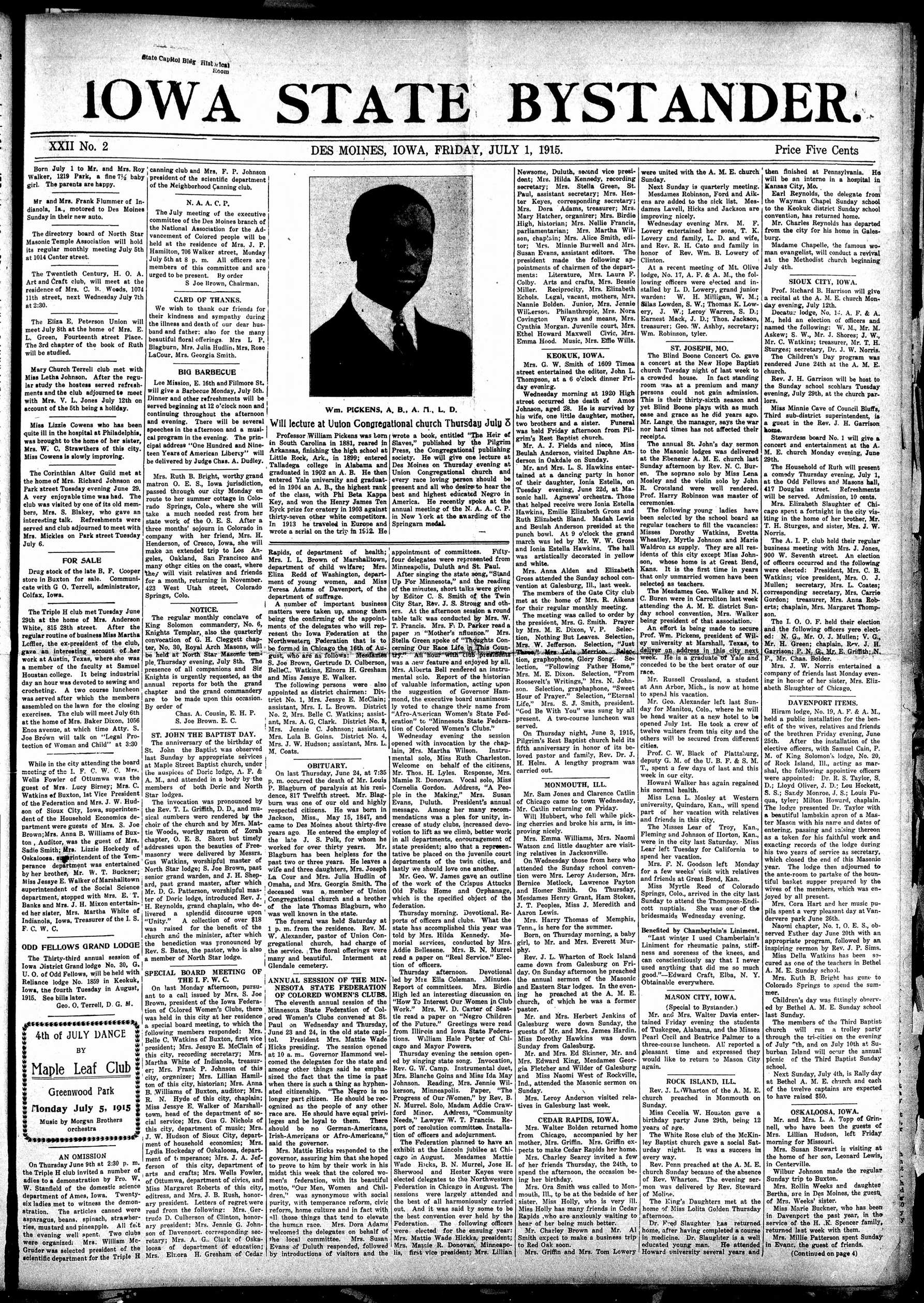
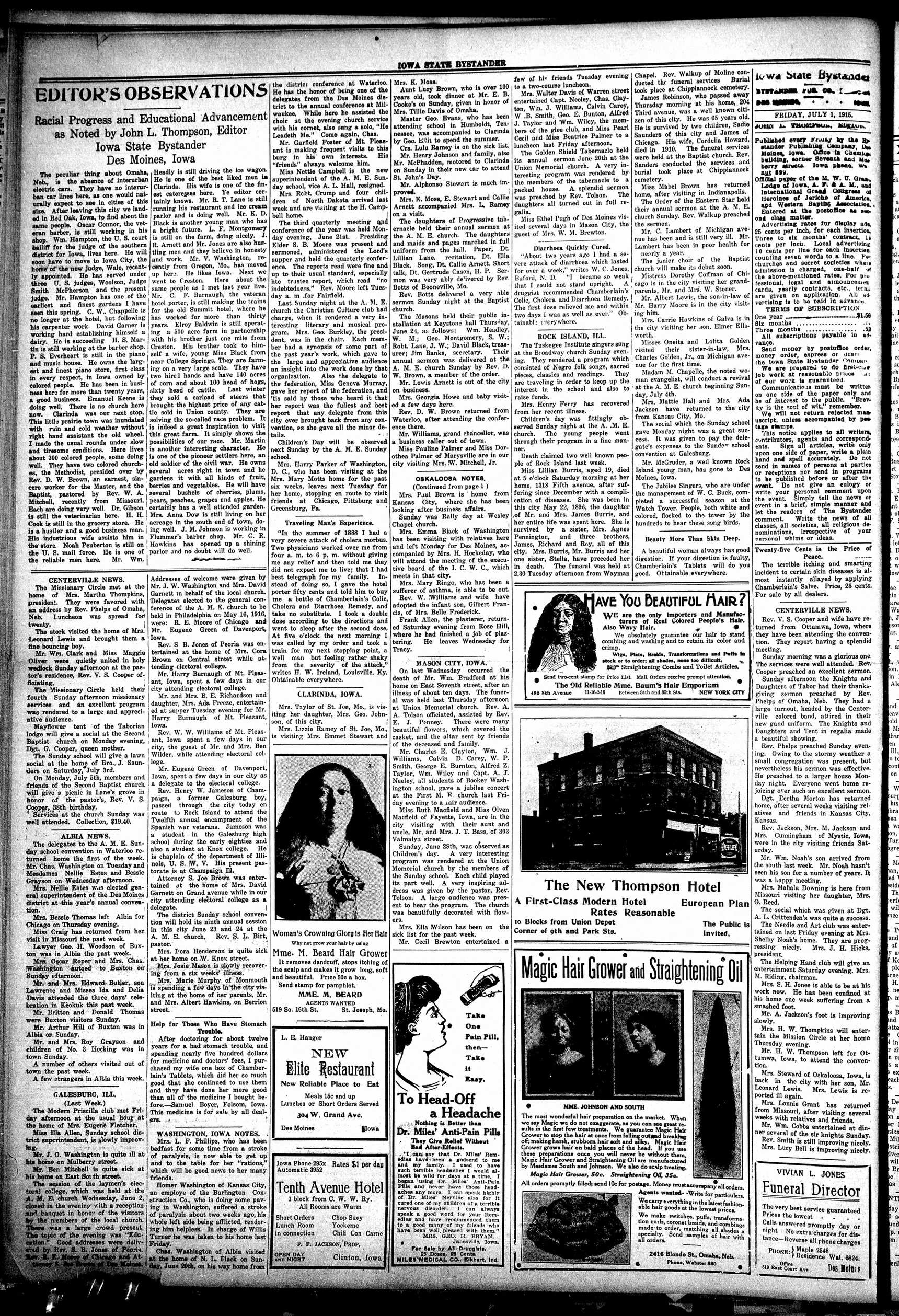
Page text (machine-generated)
IOWA STATE BYSTANDER.
XXII No. 2
Born July 1 to Mr. and Mrs. Roy Walker, 1219 Park, a fine 7½ baby girl. The parents are happy.
Mr and Mrs. Frank Flummer of Indiana, Ia, motored to Des Moines Sunday in their new auto.
The directory board of North Star Masonic Temple Association will hold its regular monthly meeting July 5th at 1014 Center street.
The Twentieth Century, H. O. A. Art and craft club, will meet at the residence of Mrs. C. B. Woods, 1074 11th street, next Wednesday July 7th at 2:30.
The Eliza E. Peterson Union will meet July 8th at the home of Mrs. E. L. Green, Fourteenth street Place. The 3rd chapter of the book of Ruth will be studied.
Mary Church Terrell club met with Miss Letha Johnson. After the regular study the hostess served refreshments and the club adjourned to meet with Mrs. V. L. Jones July 12th on account of the 5th being a holiday.
Miss Lizzie Cowens who has been quite ill in the hospital at Philadelphia, was brought to the home of her sister, Mrs. W. C. Strawthers of this city. Miss Cowens is slowly improving.
The Corinthian Alter Guild met at the home of Mrs. Richard Johnson on Park street Tuesday evening June 29. A very enjoyable time was had. The club was visited by one of its old members, Mrs. S. Blakey, who gave an interesting talk. Refreshments were served and club adjourned to meet with Mrs. Mickles on Park street Tuesday July 6.
FOR SALE
Drug stock of the late B. F. Cooper store in Buxton for sale. Communicate with G O. Terrell, administrator, Colfax, Iowa.
The Triple H club met Tuesday June 29th at the home of Mrs. Anderson White, 315 28th street. After the regular routine of business Miss Martha Loffler, the ex-president of the club, gave an interesting account of her work at Austin, Texas, where she was a member of the faculty at Samuel Houstan college. It being industrial day an hour was devoted to sewing and crocheting. A two course luncheon was served after the members assembled on the lawn for the closing exercises. The club will meet July 6th at the home of Mrs. Baker Dixon, 1056 Enos avenue, at which time Atty. S. Joe Brown will talk on "Legal Protection of Woman and Child" at 3:30
---
While in the city attending the board meeting of the I. F. C. W. C. Mrs. Wolls Fowler of Ottumwa was the guest of Mrs. Lucy Birney; Mrs. C. Watkins of Buxton, 1st Vice President of the Federation and Mrs. J. W. Hudson of Sioux City, Iowa, superintendent of the Household Economics department were guests of Mrs. S. Joe Brown; Mrs. Anna B. Williams of Buxton, Auditor, was the guest of Mrs. Sadie Smith; Mrs. Lizzie Hockedy of Oksalsoa, superintendent of the Temperance department was entertained by her brother, Mr. W. T. Buckner; Miss Jessye E. Walker of Marshallhill superintendent of the Social Science department, stopped with Mrs. E. T. Banks and Mrs. J. H. Mixon entertained her sister, Mrs. Martha White of Indianola, Iowa, Treasurer of the I. S. F. C. W. C.
ODD FELLOWS GRAND LODGE
The Thirty-third annual session of Iowa Jiatriet Grand lodge No. 30, G. U. O. of Odd Fellows, will be held with Reliance lodge No. 1859 in Keokuk, Iowa, the fourth Tuesday in August, 1915. See bills later. Geo. O. Terrell, D. G. M.
4th of JULY DANCE
BY
Maple Leaf Club
Greenwood Park
Monday July 5, 1915
Music by Morgan Brothers
orchestra
AN OMISSION
On Thursday June 10 at 2:30 p. m. the Triple H club invited a number of adies to a demonstration by Pro. W. W. Stainfield of the domestic science department of Ames, Iowa. Twenty-six ladies met to witness the demonstration. The articles canned were asaparagus, beans, spinach, strawberries, mustard and pineapple. All felt the evening well spent. Two clubs were organized: Mrs. William McGruder was selected president of the scientific department for the Triple H
State Capitol Blvd Historical Room
canning club and Mrs, F. P. Johnson president of the scientific department of the Neighborhood Canning club.
N. A. A. C. P.
The July meeting of the executive committee of the Des Moines branch of the National Association for the Advancement of Colored people will be held at the residence of Mrs. J. P. Hamilton, 706 Walker street, Monday July 5th at 8 p. m. All officers are members of this committee and are urged to be present. By order S Joe Brown, Chairman.
CARD OF THANKS.
We wish to thank our friends for their kindness and sympathy during the illness and death of our dear husband and father: also for the many beautiful floral offerings. Mrs L P, Blagburn, Mrs Julia Hudlin, Mrs, Rose LaCour, Mrs. Georgia Smith.
BIG BARBECUE
Lee Mission, E. 16th and Fillmore St. will give a Barbecue Monday, July 5th. Dinner and other refreshments will be served beginning at 12 o'clock noon and continuing throughout the afternoon and evening. There will be several speeches in the afternoon and a musical program in the evening. The principal address "One Hundred and Nineteen Years of American Liberty" will be delivered by Judge Chas. A. Dudley.
Mrs. Ruth B. Bright, worthy grand matron O. E. S., Iowa jurisdiction, passed through our city Monday en route to her summer cottage in Colorado Springs, Colo., where she will take a much needed rest from her state work of the O. E. S. After a three months' sojourn in Colorado in company with her friend, Mrs. H. Henderson, of Cresco, Iowa, she will make an extended trip to Los Angeles, Oakland, San Francisco and many other cities on the coast, where they will visit relatives and friends for a month, returning in November. 423 West Utah street, Colorado Springs, Colo.
NOTICE
The regular monthly conclave of King Solomon commandery, No. 6, Knights Templar, also the quarterly convocation of G. H. Cleggett chapter, No. 30, Royal Arch Masons, will be held at North Star Masonic temple, Thursday evening, July 8th. The presence of all companions and Sir Knights is urgently requested, as the annual reports for both the grand chapter and the grand commandery are to be made upon this occasion. By order of
Chas. A. Cousin, E. H. P.
S. Joe Brown. E. C.
ST. JOHN THE BAPTIST DAY.
The anniversary of the birthday of St. John the Baptist was observed last Sunday by appropriate services at Maple Street Baptist church, under the auspices of Doric lodge, A. F. & A. M., and attended in a body by the members of both Doric and North Star lodges.
The invocation was pronounced by the Rev. T. L. Griffith, D. D., and musical numbers were rendered by the choir of the church and by Mrs. Mattie Woods, worthy matron of Zorah chapter, O. E. S. Short but timely addresses upon the beauties of Freemasonry were delivered by Messrs. Gw Watkins, worshipful master of North Star lodge; S. Joe Brown, past senior grand warden, and J. H. Shepherd, past grand master, after which Mr. D. G. Patterson, worshipful master of Doric lodge, introduced Rev. J. H. Reynolds, grand chaplain, who delivered a splendid discourse upon "Unity." A collection of over $18 was raised for the benefit of the church and the minister, after which the benediction was pronounced by Rev. S. Bates, the pastor, who is also a member of North Star lodge.
SPECIAL BOARD MEETING OF
THE L.F. W.C.
On last Monday afternoon, pursuant to a call issued by Mrs. S. Joe Brown, president of the Iowa Federation of Colored Women's Clubs, there was held in this city at her residence a special board meeting, to which the following members responded: Mrs. Belle C. Watkins of Buxton, first vice president; Mrs. Jessyse E. McClain of this city, recording secretary; Mrs. Martha White of Indianao, treasurer; Mrs. Frank P. Johnson of this city, organizer; Mrs. Lillian Hamilton of this city, historian; Mrs. Anna B. Williams of Buxton, auditor; Mrs. R. N. Hyde of this city, chaplain; Miss Jessyse E. Walker of Marshalltown, head of the school of social service; Mrs. Gus G. Nichols of this city, department of music; Mrs. J. W. Hudson of Sloux City, department of household economics; Mrs. Lyda Hockeday of Oskaloosa, department of t imperance; Mrs. J. A. Jefferson of this city, department of arts and crafts; Mrs. Wells Fowler, of Ottumwa, department of civics, and Miss Margaret Roberts of this city, editress, and Mrs. J. B. Rush, honorary president. Letters of regret were read from the following: Mrs. Gertrude D. Culbertson of Clinton, honorary president; Mrs. Jennie G. Johnson of Davenport, corresponding secretary; Mrs. A. G. Clark of Oskaloosa of department of education; Mrs. Elhora H. Gresham of Cedar
DES MOINES, IOWA, FRIDAY, JULY 1, 1915.
Wm. PICKENS, A. B., A. Π., L. D.
Newsome, Dublin;
dent; Mrs. Hill;
secretary; Mr.
Paul, assistant
tor Keyes, co.
Mrs. Dora A.
Mary Hatcher,
High, historian,
parliamentarian,
son, chaplain;
tor; Mrs. M.
Susan Evans,
president ma-
pointments of
ments: Liter
Colby. Arts
Miller. Recipi
Echols. Legal
Nannie Bolden
Wilkerson. Pl.
Covington W.
Cynthia Morge
Ethel Howard
Emma Hood.
KEO
Mrs. G. W.
street entertai
Thompson, at
day evening.
Wednesday
street occurren
Johnson, aged
Will lecture at Uylon Congregational church Thursday July 8
Professor William Pickens was born in South Carolina in 1881, reared in Arkansas, finishing the high school at Little Rock, Ark., in 1899; entered Talladega college in Alabama and graduated in 1902 an A. B. He then entered Yale university and graduated in 1904 an A. B., the highest rank of the class, with Phi Beta Kappa Key, and won the Henry James Ten Eyck prize for oratory in 1908 against thirty-seven other white competitors. In 1913 he traveled in Europe and wrote a serial on the trip in 1512. He Rapids, of department of health; Mrs. I. L. Brown of Marshalltown, department of child welfare; Mrs. Eliza Redd of Washington, department of young women, and Miss Teresa Adams of Davenport, of the department of suffrage.
A number of important business matters were taken up, among them being the confirming of the appointments of the delegates who will represent the Iowa Federation at the Northwestern Federation that is to be formed in Chicago the 16th of August, as follows: Meadstine S. Joe Brown, Gertrude D. Culberson, BelleC, Watkins, Elnora H. Gresham and Miss Jessie E. Walker.
The following persons were also assigned as district chairmen: District No. 1, Mrs. Jessye E. McCain; assistant, Mrs. I. L. Brown. District No. 2, Mrs. Belle C. Watkins; assistant, Mrs. A. G. Clark. District No. 3, Mrs. Jennie C. Johnson; assistant, Mrs. Lula B. Goins. District No. 4, Mrs. J. W. Hudson; assistant, Mrs. L. M. Coats.
OBITUARY
On last Thursday, June 24, at 7:35 p. m. occurred the death of the Mr. Louis P. Blagburn of paralysis at his residence, 817 Twelfth street. Mr. Blagburn was one of our old and highly respected citizens. He was born in Jackson, Miss., May 15, 1847, and came to Des Moines about thirty-five years ago. He entered the employ of the late J. S. Polk, for whom he worked for over thirty years. Mr. Blagburn has been heiflens for the past two or three years. He leaves a wife and three daughters, Mrs. Joseph La Cour and Mrs. Julia Hudlin of Omaha, and Mrs. Georgia Smith. The deceased was a member of Union Congregational church and a brother of the late Thomas Blagburn, who was well known in the state.
The funeral was held Saturday at 1 p. m. from the residence. Rev. M. W. Alexander, pastor of Union Congregational church, had charge of the service. The floral offerings were many and beautiful. Interment at Glendale cemetery.
NESOTA STATE FEDERATION OF COLORED WOMEN'S CLUBS.
The eleventh annual session of the Minnesota State Federation of Colored Women's Clubs convened at St Paul on Wednesday and Thursday, June 23 and 24, in the old state capitol. President Mrs. Mattie Wade Hicks presiding. The session opened at 10 a.m. Governor Hammond welcomed the delegates for the state and among other things said he emphasized the fact that the time is past when there is such a thing as hyphenated citizenship. "The Negro is no longer part citizen. He should be recognized as the people of any other race are. He should have equal privileges and be loyal to them. There should be no German-Americans, Irish-Americans or Afro-Americans," said the governor.
Mrs. Mattie Hicks responded to the governor, assuring him that she hoped to prove to him by their work in his midst this week that the colored women's federation, with its beautiful motto, "Our Men, Women and Children," was synonymous with social purity, with temperance reform, civic reform, home culture and in fact with all those things that tend to elevate the human race. Mrs. Dora Adams welcomed the delegates on behalf of the local committee. Mrs. Susan Evans of Duluth responded, followed by introductions of visitors and the
OBITUARY
wrote a book, entitled "The Heir of Shaves," published by the Pilgrim Press, the Congregational publishing society. He will give one lecture at Des Moines on Thursday evening at Union Congregational church and every race loving person should be present and all who desire to hear the best and highest educated Negro in America. He recently spoke at the annual meeting of the N. A. A. C. P. in New York at the awarding of the Springarm medal.
appointment of committees. Fifty-four delegates were represented from Minneapolis, Duluth and St. Paul.
After singing the state song, "Stand Up For Minnesota," and the reading of the minutes, short talks were given by Editor C. S. Smith of the Twin City Star, Rev. J. S. Strong and others. At the afternoon session a round table talk was conducted by Mrs. W. T. Francis, Mrs. F. D. Parker read a paper in "Mother's influence." Mrs. Stella Green spoke of the importance of Our Race Life in This Country. "All hour with club presidents was a new feature and enjoyed by all. Mrs. Alberta Bell rendered an instrumental solo. Report of the historian of valuable information, acting upon the suggestion of Governor Hammond, the executive board unanimously voted to change their name from "Afro-American Women's State Federation" to "Minnesota State Federation of Colored Women's Clubs." Wednesday evening the session opened with invocation by the chaplain, Mrs. Martha Wilson. Instrumental solo, Miss Ruth Charleston. Welcome on behalf of the citizens, Mr. Thos. H. Lyles. Response, Mrs. Mamie R. Donovan. Vocal solo, Miss Cornelia Gordon. Address, "A People in the Making." Mrs. Susan Evans, Pululh. President's annual message. Among her many recommendations was a plea for unity, increase of study clubs, increased devotion to lift as we climb, better work in all departments, encouragement of state president; also that a representative be placed on the juvenile court departments of the twin cities, and lastly we should love one another.
Mr. Geo. W. James gave an outline of the work of the Crispus Attucks Old Folks Home and Orphanage, which is the specified object of the federation.
Thursday morning. Devotional. Reports of officers and clubs. What the state has accomplished this year was told by Mrs. Hilda Kennedy. Memorial services, conducted by Mrs. Addie Bellese. Mrs. B. N. Murrell read a paper on "Real Service." Election of officers.
Thursday afternoon. Devotional led by Mrs. Ella Coleman. Minutes. Report of committees. Mrs. Birdie High led an interesting discussion on "How To Interest Our Women in Club Work." Mrs. W. D. D. Carter of Seattle read a paper on "Negro Children of the Future." Greetings were read from Illinois and Iowa State Federations. William Hale Porter of Chicago and Mayor Powers.
Thursday evening the session opened by singing state song. Invocation. Rev. G. W. Camp. Instrumental duet. Mrs. Blanche Goins and Miss Ida May Johnson. Reading. Mrs. Jennie Wilkerson, Minneapolis. Paper, "The Progress of Our 'Women,' by Rev. B. N. Murrell. Solo, Madam Adam B. Crawford Minor. Address, "Community Needs," Lawyer W. T. Francis. Report of resolution committee. Installation of officers and adjournment.
The Federation planned to have an exhibit at the Lincoln jubilee at Chicago in August. Mesdames Mattie Wade Bickens, B. H. Murrell, Jose H. Sherwood and Hester Keyes were elected delegates to the Northwestern Federation in Chicago in August. The sessions were largely attended and the best of all harmoniously carried out. And it was said by some to be the best convention ever held by the Federation. The following officers were elected for the ensuing year: Mrs. Mattie Wade Hickels, president; Mrs. Manie R. Donovan, Minneapolis firk vice president; Mrs. Lillian
Newsome, Duluth, second vice president; Mrs. Hilda Kennedy, recording secretary; Mrs. Stella Green, St. Paul, assistant secretary; Mrs. Hester Keyes, corresponding secretary; Mrs. Dora Adams, treasurer; Mrs. Mary Hatcher, organizer; Mrs. Birdie High, historian; Mrs. Nellie Francis, parliamentarian; Mrs. Martha Wilson, chap'ain; Mrs. Alice Smith, editor; Mrs. Minnie Burwell and Mrs. Susan Evans, assistant editors. The president made the following appointments of chairmen of the departments: Literature, Mrs. Laura F. Colby. Arts and crafts, Mrs. Bessie Miller. Reciprocity, Mrs. Elizabeth Echols. Legal, vacant, mothers, Mrs. Nannie Bolden. Junior, Mrs. Jennie Wilkerson. Philanthropic, Mrs. Nora Covington. Ways and means, Mrs. Cynthia Morgan. Juvenile court, Mrs. Ethel Howard Maxwell Civic, Mrs. Emma Hood. Music, Mrs. Effie Wills.
KEQKUK. IOWA.
Mrs. G. W. Smith of 1609 Timae street entertained the editor, John L. Thompson, at a 6 o'clock dinner Friday evening.
Wednesday morning at 1920 High street occurred the death of Amos Johnson, aged 28. He is survived by his wife, one little daughter, mother, two brothers and a sister. Funeral was held Friday afternoon from Pilgrim's Rest Baptist church.
Mrs. A. J. Fields and niece, Mr. A. Beulah Anderson, visited Daphne Anderson in Oakdale on Sunday.
Mr. and Mrs. L. S. Hawkins entertained at a dancing party in honor of their daughter, Ionia Estella, on Tuesday evening, June 22, at Masonic hall. Agnews' orchestra. Those that helped receive were Ionia Estella Hawkins, Emilia Elizabeth Gross and Rutil Elisabeth Bland. Madah Lewis and Beulah Anderson presided at the punch bowl. At 9 o'clock the grand march was led by Mr. W. W. Gross and Ionia Estella Hawkins. The hall was artistically decorated in yellow and white.
Mrs. Anna Alden and Elizabeth Gross attended the Sunday school convention at Galesburg, Ill., last week.
The members of the Gate City club met at the home of Mrs. R. Aikens for their regular monthly meeting.
The meeting was called to order by the president, Mrs. G. Smith. Prayer by Mrs. M. E. Dixon, V. P. Selection, Nothing But Leaves, Selection, Mrs. W. Jefferson, Selection, "Just Threw," Mrs. John Merrion, Selection, graphophone, Glory Song, Selection, "Following Father Home," Mrs. M. E. Dixon, Selection, "From Roosevelt's Writings," Mrs. N. Johnson, Selection, graphophone, "Sweet Hour of Prayer," Selection, "Eternal Life," Mrs. S. J. Smith, president, "God Be With You" was sung by all present. A two-course luncheon was served. On Thursday night, June 3, 1915, Pilgrim's Rest Baptist church held its fifth anniversary in honor of its beloved pastor and family, Rev. Dr. J. H. Helm. A lengthy program was carried out.
MONMOUTH. ILL.
Mr. Sam Jones and Clarence Catin of Chicago came to town Wednesday, Mr. Cailin returning on Friday. Will Hubbert, who fell while picking cherries and broke his arm, is improving nicely. Mrs. Emma Williams, Mrs. Naomi Watson and little daughter are visiting relatives in Jacksonville. On Wednesday those from here who attended the Sunday school convention were Mrs. Leroy Anderson, Mrs. Bernice Metlock, Lawrence Payton and Homer Smith. On Thursday, Mesdames Henry Grant, Ham Stokes, J. T. Peoples, Miss J. Meredith and Aaron Lewis.
Mrs. Harry Thomas of Memphis, Tenn., is here for the summer.
Born, on Thursday morning, a baby girl, to Mr. and Mrs. Everett Murphy.
Rev. J. L. Wharton of Rock Island came down from Galesburg on Friday. On Sunday afternoon he preached the annual sermon of the Masonic and Eastern Star lodges. In the evening he preached at the A. M. E. church, of which he was a former pastor.
Mr. and Mrs. Herbert Jenkins of Galesburg was down Sunday, the guests of Mr. and Mrs. James Hardin. Miss Dorothy Hawkins was down Sunday from Galesburg.
Mr. and Mrs. Ed Skinner, Mr. and Mrs. Edward King, Mesdames Georgia Fletcher and Wilder of Galesburg and Miss Naomi West of Rockville, Ind., attended the Masonic sermon on Sunday.
Mrs. Leroy Anderson visited relatives in Galesburg last week.
CEDAR BAPIDS IOWA
Mrs. Walter Bolden returned home from Chicago, accompanied by her mother, Mrs. Griffin. Mrs. Griffin expects to make Cedar Rapids her home.
Mrs. Charley Searcy invited a few of her friends Thursday, the 24th, to spend the afternoon, the occasion being her birthday.
Mrs. Ora Smith was called to Monmouth, Ill., to be at the bedside of her sister, Miss Holly, who is very ill. Miss Holly has many friends in Cedar Rapids, who are anxiously waiting to hear of her being much better.
Mr. Charley Brown and Mr. Al Smith object to make a business trip to Red Oak soon.
Mrs. Griffin and Mrs. Tom Lowery
were united with the A. M. E. church Sunday.
Next Sunday is quarterly meeting.
Mesdames Robinson, Ford and Aikens are added to the sick list.
Mesdames Lavell, Hicks and Jackson are improving nicely.
Wednesday evening Mrs. M. F. Lovery entertained her sons, T. K. Lovery and family, L. D. and wife, and Rev. R. H. Cato and family in honor of Rev. Wm. B. Lowery of Clinton.
At a recent meeting of Mt. Olive lodge, No. 17, A. F. & A. M., the following officers were elected and installed by L. D. Lowery, grand junior warden: W. H. Milligan, W. M.; Silos Lowden, S. W.; Thomas K. Lovery, J. W.; Leroy Warren, S. D.; Earnest Mack, J. D.; Thos. Jackson, treasurer; Geo. W. Ashby, secretary; Wm. Robinson, tyler.
ST. JOSEPH. MO.
The Blind Boone Concert Co. gave a concert at the New Hope Baptist church Tuesday night of last week to a crowded house. In fact standing room was at a premium and many persons could not gain admission. This is their thirty-second season and yet Blind Boone plays with as much ease and grace as she did years ago. Mr. Lange, the manager, says the war nor hard times has not affected their receipts.
The annual St. John's day sermon to the Masonic lodges was delivered at the Flenezhe A. M. E. church last Sunday afternoon by Rev. N. C. Buren. The soprano solo by Miss Lena Mosley and the violin solo by John R. Crossland were well rendered. Prof. Harry Robinson was master of ceremonies.
The following young ladies have been selected by the school board as regular teachers to fill the vacancies: Misses Dorothy Watkins, Eveltta Wheatley, Myrtle Johnson and Marie Waldron as supply. They are all residents of this city except Miss Johnson, whose home is at Great Bend, Kans. It is the first time in years that only unmarried women have been selected as teachers.
The Mesdames Geo. Walker and N. C. Buren were in Carrollton last week attending the A. M. E. district Sunday school convention, Mrs. Walker being president of that association.
An effort is being made to secure Prof. Wm. Pickens, president of Willey university at Marshall, Texas, to deliver on address in this city next week. He is a graduate of Yale and conceded to be the best orator of our race.
Mr. Russell Crossland, a student at Ann Arbor, Mich., is now at home to spend his vacation.
Mr. Geo. Alexander left last Sunday for Manitou, Colo., where he will be head waiter at a new hotel to be opened July 1st. He took a crew of twelve waiters from this city and the others will be secured from different cities.
Prof. C. W. Black of Plattsburg, deputy G. M. of the U. B. F. & S. M. T., spent a few days of last and this week in our city.
Howard Walker has again regained his normal health.
Miss Lena L. Mosley at Western university, Quindaro, Kan., will spend part of her vacation with relatives and friends in this city.
The Misses Lore of Troy, Kan., Fleming and Johnson of Itton, Kan., were in the city last Saturday. Miss Lear left Tuesday for California to spend her vacation.
Mrs. F. N. Goodson left Monday for a few weeks' visit with relatives and friends at Great Bend, Kan.
Miss Myrtle Reed of Colorado Springs, Colo., arrived in the city last Sunday to attend the Thompson-Endicott nuptials. She was one of the bridesmaids Wednesday evening.
Benefited by Chamberlain's Li
Benefited by Chamberlain's Liniment.
"Last winter I used Chamberlain's Liniment for rheumatic pains, stiffness and soreness of the knees, and can conscientiously say that I never wanted anything that did me so much good."—Edward Craft, Elba, N. Y. Obtainable everywhere.
MASON CITY, IOWA.
Mr. and Mrs. Walter Davis entertained Friday evening the students of Tuskegee, Alabama, and the Misses Pearl Cecil and Beatrice Palmer to a three-course luncheon. All reported a pleasant time and expressed they would like to return to Mason City again.
ROCK ISLAND, ILL.
Rev. J. L. Wharton of the A. M. E. church preached in Monmouth on Sunday.
Miss Cecelia W. Houston gave a birthday party June 29th, being 12 years of age.
The White Rose club of the McKinley Baptist church gave a social Saturday night. It was a success in every way.
Rev. Penn preached at the A. M. E. church Sunday because of the absence of Rev. Wharton. The evening sermon was delivered by Rev. Steward of Moline.
The King's Daughters met at the home of Miss Lolita Golden Thursday afternoon.
Dr. Freed Slaughter has returned home, after having completed a course in medicine. Dr. Slaughter is a well educated young man. He attended Howard University several years and
Price Five Cents
then finished at Pennsylvania. He will be an interne in a hospital in Kansas City, Mo.
Earl Reynolds, the delegate from the Wayman Chapel Sunday school to the Keokuk district Sunday school convention, has returned home.
Mr. Charles Reynolds has departed from the city for his home in Galesburg.
Madame Chapelle, the famous woman evangelist, will conduct a revival at the Methodist church beginning July 4th.
SIOUX CITY, IOWA.
Prof. Richard B. Harrison will give a recital at the A. M. E. church Monday evening, July 12th.
Decatur: lodge, No. 14. A. F. & A. M., held an election of officers and named the following: W. M., Mr. M. Askew; S. W., Mr. J. Shores; J. W., Mr. C. Watkins; treasurer, Mr. T. H. Sturges; secretary, Dr. J. W. Norris.
The Children's Day program was rendered June 24th at the A. M. E. church.
Rev. J. H. Garrison will be host to the Sunday school schoars Tuesday evening, July 29th, at the church parors.
Miss Minnie Cave of Council Bluffs. Third sub-district superintendent, is a guest in the Rev. J. H. Garrison home.
Stewardess board No. 1 will give a concert and entertainment at the A. M. E. church Monday evening, June 29th.
The Household of Ruth will present a comedy Thursday evening, July 1, at the Odd Fellows and Masons hall, 417 Douglas street. Refreshments will be admission. 10 cents.
Mrs. Elizabeth Slaughter of Chicago spent a fortnight in the city visiting in the home of her brother, Mr. T. H. Sturges, and sister, Mrs. J. W. Norris.
The A. I. P. club held their regular business meeting with Mrs. J. Jones, 900 W. Seventh street. An election of officers occurred and the following were elected: President, Mrs. C. B. Watkins; vice president, Mrs. O. J. Mullen; secretary, Mrs. L. Coates; corresponding secretary, Mrs. Carrie Gordon; treasurer, Mrs. Anna Roberts; chaplain, Mrs. Margaret Thompson.
The I. O. O. F. held their election and the following officers were elected: N. G., Mr. O. J. Mullen; V. G., Mr. H. Green; chaplain, Rev. J. H. Garrison; P. N. G., Mr. E. Griffith; N. F., Mr. Chas Bolder.
Mrs. J. W. Norris entertained a company of friends last Monday evening in honor of her sister, Mrs. Elizabeth Slaughter of Chicago.
DAVENPORT ITEMS
Hiram lodge, No. 19, A. F. & A. M., hold a public installation for the benefit of the wives, relatives and friends of the brethren Friday evening, June 25th. After the installation of the elective officers, with Samuel Cain, P. M. of King Solomon's lodge, No. 20, of Rock Island, III., acting as marshal, the following appointive officers were appointed: Dr. R. S. Taylor, S. D.; Lloyd Oliver, D. J.; Lou Hockett, S. S.; Sandy Monroe, J. S.; Louis Fouis, tyler; Milton Howell, chaplain. The lodge presented Dr. Taylor with a beautiful lambskin apron of a Master Masen with his name and dates of entering, passing and raising thereon as a token for his faithful work and exacting records of the lodge during his two years of service as secretary, which closed the end of this Masonic year. The lodge then adjourned to the ante-room to partake of the bountiful basket supper prepared by the wives of the members, which was enjoyed by all present. Mrs. Cora Hart and her music pupils spent a very pleasant day at Vanderwerd park June 26th. Naomi chapter, No. 1, O. E. S., observed Esther day June 20th with an appropriate program, followed by an inspiring sermon by Rev. J. P. Sims. Miss Della Watkins has been secured as one of the teachers in Bethel A. M. E. Sunday school. Mrs. Kuth B. Bright has gone to Colorado Springs to spend the summer.
Children's day was fittingly observed by Bethel A. M. E. Sunday school last Sunday.
The members of the Third Baptist church will run a trolley party through the tri-cities on the evening of July 7th, and on July 10th at Suburban Island will occur the annual picnic of the Third Baptist Sunday school.
Next Sunday, July 4th, is rally day at Bethel A. M. E. church and each of the twelve captains are expected to have raised $50.
OSKALOOSA IOWA
Mr. and Mrs. L. A. Topp of Grinnell, who have been the guests of Mrs. Lillian Hudson, left Friday morning for Missouri.
Mrs. Susan Stewart is visiting at the home of her son, Leonard Lewis, in Centerville.
Wilbur Johnson made the regular Sunday trip to Buxton.
Mrs. Rollin Weeks and daughter Bertha, are in Des Moines, the guest of Mrs. Weeks's sister.
Miss Marie Buckner, who has been in Davenport the past year, in the service of the H. K. Spencer family, returned last week with them.
Mrs. Millie Patterson spent Sunday in Evanz, the guest of friends.
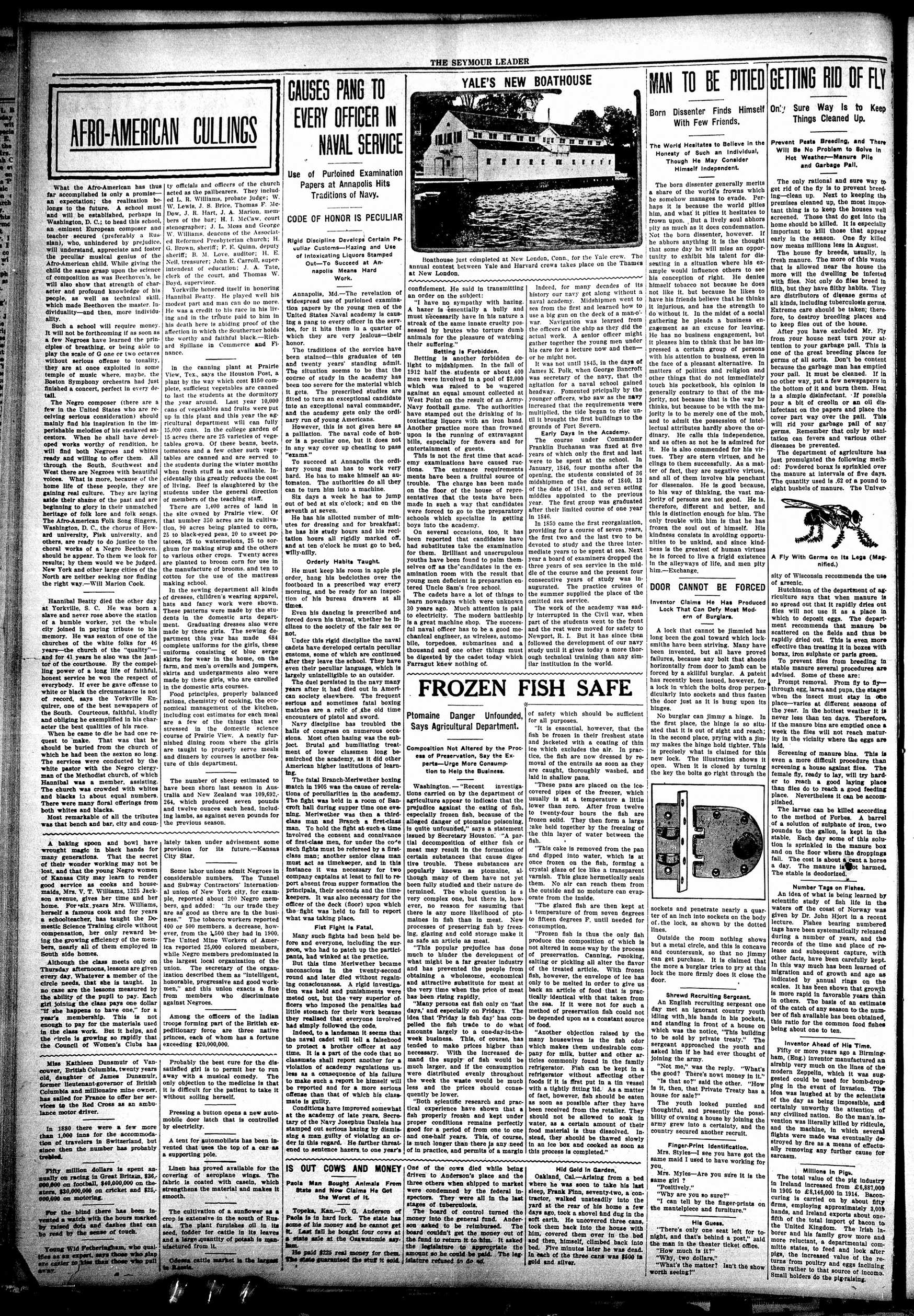
AFRO-AMERICAN CULLINGS
---
I. B. today will speech
E. the
F. the
G. the
H. the
I. the
J. the
K. the
L. the
M. the
N. the
O. the
P. the
Q. the
R. the
S. the
T. the
U. the
V. the
W. the
X. the
Y. the
Z. the
What the Afro-American has thus far accomplished is only a promise—an expectation; the realization belongs to the future. A school must and will be established, perhaps in Washington, D.C.; to head this school, an eminent European composer and teacher secured (preferably a Russian), who unhindered by prejudice, will understand, appreciate and foster the peculiar musical genius of the Afro-American child. While giving the child the same grasp upon the science of composition as was Beethoven's, he will also show that strength of character and profound knowledge of his people, as well as technical skill, which made Beethoven the master. Individuality—and then, more individuality.
Such a school will require money
It will not be forthcoming if as soon as
a few Negroes have learned the princi-
ples of breathing, or being able to
play the scale of G one or two octaves
without serious offense to tonality,
they are at once exploited in some
places, and they are not exploited
Boston Symphony orchestra had just
finished a concert, perfect in every
detail.
The Negro composer (there are a few in the United States who are receiving serious consideration) should mainly find his inspiration in the impersonable melodies of his enslaved and cestors. When he shall have developed works worthy of rendition, he will find both Negroes and whites ready and willing to offer them. All through the South, Southwest and West there are Negroes with beautiful voices. What is more, because of the home life of these people, they are gaining real culture. They are laying aside their shame of the past and are beginning to glory in their unmatched heritage of folk lore and folk songs. Washington, D. C., the chorus of Howard university, Fisk university, and others, are ready to do justice to the choral works of a Negro Beethoven, should he appear. To them we look for results; by them we would be judged. New York and other large cities of the North are neither seeking nor finding the right way—Will Marion Cook.
Hannibal Beauty died the other day at Yorkville, S. C. He was born a slave and never rose above the station of a humble worker, yet the whole city joined in paying tribute to his memory. He was exonumia of one of the churches of the white folks for 46 years—the church of the "quality"—and for 41 years he also was the jantor of the courthouse. By the compelling power of a long life of faithful, honest service he won the respect of everybody. If ever he gave offense to white or black the circumstance was not the South. Yorkville Enquirer, one of the best newspapers of the South. Courteous, faithful, kindly and obleging he exemplified in his character the best qualities of his race.
When he came to die he had one request to make. That was that he should be buried from the church of which he had been the sexton so long. The services were conducted by the white pastor with the Negro clergyman of the Methodist church, of which Hannibal was a member, assisting. The church was crowded with whites and blacks in about equal numbers. There were many floral offerings from both whites and blacks.
Most remarkable of all the tributes was that bench and bar, city and coun-
A baking spoon and bowl have wrought magic in black hands for many generations. That the secret of their wonder working may not be lost, and that the young Negro women of Kansas City may learn to render good service as cooks and housemaids, Mrs. V. V. Williams, 1325 Jackson avenue gives her time and her home a six years Mrs. Williams, has a famous cook and for years a schoolteacher, has taught the Domestic Science Training circle without compensation, her only reward being the growing efficiency of the members, nearly all of them employed in South side homes.
Although the class meets only on Thursday afternoons, lessons are given every day. Whatever a member of the circle needs, that she is taught. In no case are the lessons measured by the ability of the pupil to pay. Each girl joining the class pays one dollar "if she happens to have one," for a year's membership. This is not enough to pay for the materials used in the class work. But it helps, and the circle is growing so rapidly that the Council of Women's Clubs has Miss Kathleen Dunsmuir of Vancouver, British Columbia, twenty years old, daughter of James Dunsmuir, former lieutenant-governor of British Columbia and millionaire mine owner, has sailed for France to offer her services to the Red Cross as an ambulance motor driver.
In 1880 there were a few more than 1,000 inns for the accommodation of travelers in Switzerland, but since then the number has probably trebled.
Fifty million dollars is spent annually on racing in Great Britain, $25,000,000 on football, $40,000,000 on theaters, $30,000,000 on cricket and $25,000,000 on motoring.
For the blind there has been invented a watch with the hours marked by raised dots and dashes that can be read by the sense of touch.
Young Wid Fetheringham, who qualifies as an expert, says those who skip are easier to miss than those who pull over.
ty officials and the palefearers. They included L. R. Williams, probate judge; W. W. Lewis, J. S. Brice, Thomas F. M. McDow, J. R. Hart, J. A. Marion, members of the bar; H. I. McCaw, court stenographer; J. L. Moss and George W. Williams, deacons of the Associated Reformed Presbyterian church; H. G. Brown, sheriff; F. E. Quinn, deputy sheriff; B. M. Love, auditor; H. E. Nell, treasurer; John E. Carroll, superintendent of education; J. A. Tate, clerk of the court, and Thomas W. Boyd, supervisor.
Yorkville honored itself in honoring Hannibal Beatty. He played well his modest part and man can do no more. He was a credit to his race in his living life and the tribute paid to him in death here is abiding proof of the affection in which the Southerner holds the worthy and faithful black.-Richard Spillane in Commerce and Finance.
In the canning plant at Prairie View, Tex., says the Houston Post, a plant by the way which cost $150 complete, sufficient vegetables are canned to last the students at the dormitory the year around. Last year 10,000 cans of vegetables and fruits were put up in this plant and this year the agricultural department will can fully 15,000 cans. In the college garden of 15 acres there are 25 varieties of vegetables grown. Of these beans, beets, tomatoes and a few other such vegetables are canned and are served to the students during the winter months when fresh stuff is not available. Incidentally this greatly reduces the cost of living. Beef is slaughtered by the students under the general direction of members of the teaching staff.
There are 1,400 acres of land in the site owned by Prairie view. Of that number 350 acres are in cultivation, 90 acres being planted to corn, 25 to black-eyed peas, 20 to sweet potatoes, 25 to watermelons, 25 to sorghum for making sirup and the others to various other crops. Twenty acres are planted to broom corn for use in the manufacture of brooms, and ten to cotton for the use of the mattress making school.
In the sewing department all kinds of dresses, children's wear apparel, hats and fancy work were shown. These patterns were made by the students in the domestic arts department. Graduating dresses also were made by these girls. The year has been made by 644 complete uniforms for the girls, these uniforms consisting of blue serge skirts for wear in the home, on the farm, and men's overalls and jumpers, skirts and undergarments also were made by these girls, who are enrolled in the domestic arts courses.
Food principles, properly balanced rations, chemistry of cooking, the economical management of the kitchen, including cost estimates for each meal are a few of the things that are stressed in the domestic science course of Prairie View. A neatly furnished dining room where the girls are taught to properly serve meals and dinners by courses is another feature of this department.
The number of sheep estimated to have been shorn last season in Australia and New Zealand was 109,692,264, which produced seven pounds and twelve lams each head, including lams, as against seven pounds for the previous season.
lately taken under advisement some provision for its future—Kansas City Star.
Some labor unions admit Negroes in considerable numbers. The Tunnel and Subway Contractors' International union of New York city, for example, reported about 200 Negro members, and added: "In our trade they are as good as there are in the business." The tobacco workers reported at 500 members, a decrease, however, from the United Mine Workers. The United Mine Workers of America reported 25,000 colored members, while Negro members predominated in the largest local organization of the union. The secretary of the organization described them as "intelligent, honorable, progressive and good workmen," and this union exacts a fine from members who discriminate against Negroes.
Among the officers of the Indian troops forming part of the British expeditionary force are three native princes, each of whom has a fortune exceeding 20,000,000.
Probably the best cure for the dissatisfied girl is to permit her to run away with a musical comedy. The only objection to the medicine is that it is difficult for the patient to take it without soiling herself.
Pressing a button opens a new automobile door latch that is controlled by electricity.
A tent for automobiles has been invented that uses the top of a car as a supporting pole.
Linen has proved available for the covering of aeroplane wings. The fabric is coated with caseln, which strengthens the material and makes it smooth.
The cultivation of a sunflower as a crop is extensive in the south of Russia. The plant furnishes oil in its seed, todder for cattle in its leaves and a large quantity of potash is manufactured from it.
Oleacea cattle market is the largest in Russia.
CAUSES PANG TO EVERY OFFICER IN NAVAL SERVICE
Use of Purloined Examination
Papers at Annapolis Hits
Traditions of Navy.
CODE OF HONOR IS PECULIAR
Rigid Discipline Develops Certain Pe-
culiar Customs—Hazing and Use
of Intoxicating Liquors Stamped
Out—To Succeed at Annapolis Means Hard
Work.
Annapolis, Md—The revelation of
widespread use of purloined examination
papers by the young men of the
United States Naval academy is causing
a pang to every officer in the service
for it hits them in a quarter of
which they are very jealous—they
bore.
The traditions of the service have been stained—this graduates of ten and twenty years' standing admit. The situation seems to be that the course of study in the academy has been too severe for the material which it gets. The prescribed studies are fitted to turn an exceptional candidate into an exceptional naval commander, and the academy gets only the ordinary run of young Americans. However, this is not given here as a palliation. The naval code of honor is a peculiar one, but it does not in any way cover up cheating to pass "exam." To succeed at Academy the ordinary young man has to work very hard. He has to make himself an automaton. The authorities do all they can to turn him into a machine. He has to jump out of bed at six o'clock; and on the seventh at seven.
He has his allotted number of minutes for dressing and for breakfast; he has his study hours and his recitation hours all rigidly marked off, and at ten o'clock he must go to bed, willy-nilly.
Orderly Habits Taught.
He must keep his room in apple plea order, hang his bedclothes over the footboard in a prescribed way every morning, and be ready for an inspection of his bureau drawers at all times.
Even his dancing is prescribed and forced down his throat, whether he inclines to the society of the fair sex or not. Under this rigid discipline the naval cadets have developed certain peculiar customs, some of which are continued after they leave the school. They have even their peculiar language, which is largely unintelligible to an outsider.
The duel persisted in the navy many years after it had died out in American society elsewhere. The frequent serious and sometimes fatal boxing matches are a relic of the old time encounters of pistol and sword.
Navy discipline has troubled the halls of congress on numerous occasions. Most often hazing was the subject. Brutal and humiliating treatment lower, clasped in plumbers, smirched the academy, as it did other American higher institutions of learning.
The fatal Branch-Merlweier boxing match in 1905 was the cause of revelations of peculiarities in the academy. The fight was held in a room of Bancroft hall during supper time one evening. Merlweier was then a third-class man and Branch a first-class man. To hold the fight at such a time involved the consent and connivance of first-class men, for under the coe's such fights must be refereed by a first-class man; another senior class man must act as timekeeper, and in this case the officer must be for two company captains at least to fall to report absent from supper formation the principals, their seconds and the timekeepers. It was also necessary for the officer of the deck (door) upon which the fight was held to fall to report what was taking place.
Fist Fight Is Fatal.
Many such fights had been held before and everyone, including the surgeon, who had to patch up the participants, had winked at the practice. But this time Meriwether became unconscious in the twenty-second round and later died without regaining consciousness. A rigid investigation was held and punishments were meted out, but the very superior officers who imposed the penalties had little stomach for their work because they realized that everyone involved had simply followed the code. Indeed, to a landsman it seems that the naval cadet will tell a falsehood to protect a brother officer at any time. In the case of the code that no classmate shall report another for a violation of academy regulations less as a consequence of his failure to make such a report he himself will be reported and for a more serious offense than that of which his classmate is guilty.
Conditions have improved somewhat at the academy of late years. Secretary of the Navy Joseph Daniels has stamped out serious having by dismissing an order in this regard. He further ended to sentence hazards to one years
Paola Man Bought Animals From State and Now Claims He Got the Worst of It
Topeka, Kan—D. G. Anderson of Paola is in hard luck. The state has some of his money and he cannot get it. Last fall he bought four cows at a state sale at the Owatotomie anym.
He paid $225 real money for them. The state guaranteed the stuff it sold.
YALE'S NEW BOATHOUSE
Boathouse just completed at New London, Conn., for the Yale crew. The annual contest between Yale and Harvard crews takes place on the Thames at New London.
FROZEN FISH SAFE
THE SEYMOUR LEADER
YALE'S NEW
Boathouse just completed at New L
annual contest between Yale and Harv
at New London.
confinement. He said in transmitting an order on the subject: "I have no sympathy with hazing. A hazer is essentially a bully and must necessarily have in his nature a streak of the same innate cruelty possessed by brutes who torture dumb animals for the pleasure of watching their suffering."
Betting Is Forbidden.
Betting is another forbidden delight to midshipmen. In the fall of 1912 half the students or about 400 men were involved in a pool of $2,000 which was raised to be wagered against an equal amount collected at West Point on the result of an Army Navy football game. The authorities have stamped out the drinking of intoxicating liquors with an iron hand. Another practice more than frowned upon is the running of extravagant bills, especially for flowers and for entertainment of guests. This is not the first time that academy examinations have caused ructions. The entrance requirements have been a fruitful source of trouble. The charge has been made to the university of apparel representatives that the tests have been made in such a fruitful source that candidates were forced to go to the preparatory schools which specialize in getting boys into the academy.
On several occasions, too, it has been reported that candidates have had substitutes take the examination for them. Brilliant and unscrupulous youths have been found to palm themselves off as the 'candidates in the examination room with the result that young men deficient in preparation entered Uncle Sam's free school. The cadets have a lot of things to learn nowadays which were unknown 30 years ago. Much attention is paid to electricity. The modern battleship is a great machine shop. The successful naval officer has to be a good mechanical engineer, as wireless, automobile, carpenter, submarine and a thousand and one things must be digested by the cadet today which Farragut knew nothing of.
FROZEN F
Ptomaine Danger Unfounded,
Says Agricultural Department.
Composition Not Altered by the Process of Preservation, Say the Experts—Urge More Consumption to Help the Business.
Washington. — "Recent investigations carried on by the department of agriculture appear to indicate that the prejudice against the eating of fish, especially frozen fish, because of the alleged danger of potmaine poisoning, is quite unfounded," says a statement issued by Secretary Houston. "A partial decomposition of either fish or meat may result in the formation of certain substances that cause digestive trouble. These substances are popularly known as potmaine, although many of them have not yet been fully studied and their nature determined. The whole question is a very complex one, but there is, however, no reason for assuming that there is any more likelihood of potmaines in fish than in meat. New processes of preserving fish by freezing, glazing and cold storage make it as safe an article as meat.
"This popular prejudice has done much to hinder the development of what might be a far greater industry and has prevented the people from obtaining a wholesome, economical and attractive substitute for meat at the very time when the price of meat has been rising rapidly.
"Many persons eat fish only on 'fast days,' and especially on Fridays. The idea that 'Friday is fish day' has compelled the fish trade to do what amounts largely to a one-day-in-the-week business. This, of course, has tended to make prices higher than necessary. With the increased demand the larger, and if the consumption were distributed evenly throughout the week the waste would be much less and the prices should consequently be lower.
"Both scientific research and practical experience have shown that a fish properly frozen and kept under proper conditions remains perfectly good for a period of from one to one and one-half years. This, of course, is much longer than there is any need of in practice, and permits of a margin.
One of the cows died while being driven to Anderson's place and the three others when shipped to market were condemned by the federal inspectors. They were all in the last stages of tuberculosis.
The board of control turned the money into the general fund. Anderson asked to be reimbursed. The board couldn't get the money out of the fund to return it to him. It asked the legislature to appropriate the amount so he could be paid. The legislature refused to do ad.
Indeed, for many decades of its history our navy not along with a naval academy. Midshipmen went to sea from the first and learned how to use a big gun on the deck of a man-o-war. Navigation was learned from the officers of the ship as they did the actual work. A senior officer might gather together the young men under his care for a lecture now and then—or he might not. It was not until 1845, in the days of James K. Polk, when George Bancroft was secretary of the navy, that the agitation for a naval school gained headway. Fomented principally by the younger officers, who saw as the navy increased the requirements were raised, the tide began to rise until it brought the first buildings to the fort of Fort Severn.
Early Days In the Academy.
Early Days in the Academy.
The course under Commander Franklin Buchanan was fixed at five years of which only the first and last were to be spent at the school. In January, 1846, four months after the opening, the students consisted of 36 midshipmen of the date of 1840, 13 of the date of 1841, and seven acting middles appointed to the previous year. The first group was graduated after their limited course of one year in 1846.
In 1850 came the first reorganization, preparing for a course of seven years, the first two and the last two to be devoted to study and the three intermediate years to be spent at sea. Next year a board of examiners dropped the three years of sea service in the middle of the course and the present four consecutive years of study was inaugurated. The practice cruises of the summer supplied the place of the omitted sea service.
The work of the academy was sadly interrupted in the Civil war, when part of the students went to the front and the rest were moved for safety to Newport, R. I. But it has since then followed the development of our navy and the training of our officers through technical training than any similar institution in the world.
of safety which should be sufficient for all purposes.
"It is essential, however, that the fish be frozen in their freshest state and jacketed with a coating of thin ice which excludes the air. In practice, the fish are now dressed by removal of the entrails as soon as they are caught, thoroughly washed, and laid in shallow pans.
"These pans are placed on the ice-covered pipes of the freezer, which usually is at a temperature a little lower than zero. After from twelve to twenty-four hours the fish are frozen solid. They then form a large sake held together by the freezing of the thin layer of water between the fish.
"This cake is removed from the pan and dipped into water, which is once a frozen on the fish, forming a crystal glaze of ice like a transparent varnish. This glaze hermetically seals them. No air can reach them from the outside and no moisture can evaporate from the inside.
The glazed fish are then kept at a temperature of from seven degrees to fifteen degrees F, until needed for consumption.
"Frozen fish is thus the only fish produce the composition of which is not altered in some way by the process of preservation. Canning, smoking, salting or pickling all alter the flavor of the treated article. With frozen fish, however, the envelope of ice has only to be melted in order to give us back an article of food that is practically identical with that taken from the sea. If it were not for such a method of preservation fish could not be depended upon as a constant source of food.
"Another objection raised by the many housewives is the fish odor which makes them undesirable company for milk, butter and other articles commonly found in the family refrigerator. Fish can be kept in a refrigerator without affecting other foods if it is first put in a tin vessel with a tightly fitting lid. As a matter of fact, however, fish should be eaten as soon as possible after they have been received from the retailer. They should not be allowed to soak in water, as a certain amount of their food material is thus dissolved. Instead, they should be thawed slowly in an ice box and cooked as soon as this process is completed."
Oakland, Cal.-Arlington from a bed where he was soon to take his last sleep, Frank Finn, seventy-two, a contractor, walked unsteadily into the yard at the rear of his home a few days ago, took a shovel and dug in the soft earth. He uncovered three cans, took them back into the house with him, covered them over in the bed, himself, climbed back into bed. Five months later he was dead. In each of the three cans was $600 in gold and silver.
MAN TO BE PITIED
Born Dissenter Finds Himself With Few Friends.
The World Hesitates to Believe in the Honesty of Such an Individual, Though He May Consider Himself Independent.
DOOR CANNOT BE FORCED
Inventor Claims He Has Produced Lock That Can Defy Most Modern of Burglaries.
A lock that cannot be jimmed has long been the goal toward which locksmiths have been striving. Many have been invented, but all have proved failures, because any bolt that shoots horizontally from door to jamb can be forced by a skillful burglar. A patient has recently been issued, however, for a lock in which the bolts drop perpendicularly into sockets and thus fasten the door just as it is hung upon its hinges.
No burglar can jimmy a hinge. In the first place, the hinge is so situated that it is out of sight and reach; in the second place, prying with a my makes the place hinge hold tight. This is precisely what is claimed for this new lock. The illustration shows it open. When it is closed by turning the key the bolts go right through the
sockets and penetrate nearly a quarter of an inch into sockets on the body of the lock, as shown by the dotted lines.
Outside the room nothing shows but a metal circle, and this is concave and countersunk, so that no jimmy can get purchase. It is claimed that the more a burglar tries to pry at this lock the more firmly does it close the door.
Shrewd Recruiting Sergeant
An English recruiting sergeant one day met an ignorant country youth idling with, his hands in his pockets, and standing in front of a house on which was the notice, "This building to be sold by private treaty." The sergeant approached the youth and asked him if he had ever thought of joining the army.
"Not me, was the reply, "What's the good?" she's nowt money in it." "Is that so?" said the other. "How is it, then, that Private Treaty has a house for sale."
The youth looked puzzled and thoughtful, and presently the possibility of owning a house by joining the army grew into a certain and the country secured another recruit.
Finger-Print Identification
Mrs. Styles—I see you have got the same maid I used to have working for you.
Mrs. Myles—Are you sure it is the same girl "Positively."
"Why are you so sure?"
"I can tell by the fingerprints on the mantelpiece and furniture."
His Guess.
"There's only one seat left for tonight, and that's behind a post," said the man in the theater ticket office. "How much is it?"
how much is it?
"Why, two dollars."
"What's the matter? Isn't the show worth seeing?"
Prevent Pests Breeding, and There Will Be No Problem to Solve in Hot Weather—Manure Pile and Garbage Pall.
The only rational and sure way to get rid of the fly is to prevent breeding—clean up. Next to keeping premises cleaned up, the most important thing is to keep the houses well screened. Those that do get into the house should be killed. It is especially important to kill those that appear early in the season. One fly killed now means millions less in August.
The house fly breeds, usually, in fresh manure. The more of this waste that is allowed near the house the more will the dwelling be infested with flies. Not only do flies breed in filth, but they have fifty habits. They are distributors of disease germs of all kinds, including tuberculosis germs. Extreme care should be taken; therefore, to destroy breeding places and to keep flies out of the house.
After you have excluded Mr. Fly from your house next turn your attention to your garbage pail. This is one of the great breeding places for germs of all sorts. Don't be content because the garbage man has emptied your pail. It must be cleaned. If in no other way, put a few newspapers in the bottom of it and burn them. Heat is a simple disinfectant. If possible pour a bit of creolin or an oil disinfectant on the papers and place the cover part way over the pail. This will rid your garbage pail, any gregory Remembrance only by sanitation, and cover and various other diseases be prevented.
The department of agriculture has just promulgated the following method: Powdered borax is sprinkled over the manure at intervals of five days. The quantity used is .62 of a pound to eight bushels of manure. The Univer-
A Fly With Germs on Its Legs (Mag nified.)
A Fly With Germs on its Legs (Magnified.)
city of Wisconsin recommends the use of arsenic.
Hutchinson of the department of agriculture says that when manure is so spread out that it rapidly dries out files will not use it as a place in which to deposit eggs. The department recommends that manure be scattered on the fields and thus be rapidly dried out. This is even more effective than treating it in boxes with borax, iron sulphate or paris glue.
To prevent files from breeding in stable manure several procedures are advised. Some of these are:
Prompt removal. From fly to fly—through egg, larva and pupa, the stages when the insect must stay in one place—varies at different seasons of the hottest weather it is never less than 20 degrees. If the manure bins are emptied a week the files will not reach maturity in the vicinity where the eggs are laid.
Screening of manure bins. This is even a more difficult procedure than screening a house against files. The female fly, ready to lay, will try harder to reach a good laying place than files do to reach a good feeding place. Nevertheless it can be accomplished.
The larvae can be killed according to the method of Forbes. A barrel of a solution of sulphate of iron, two pounds to the gallon, is kept in the stable. Each day some of this solution is sprinkled in the manure box and on the floor where the droppings fall. The cost is about a cent a horse a day. The manure is not harmed. The stable is deodorized.
Number Tags on Fishes
An idea of what is being learned by scientific study of fish life in the waters off the coast of Norway was given by Dr. John Hjort in a recent lecture. Fishes bearing numbered tags have been systematically released during a number of years, and the records of the time and place of release and subsequent capture, with other facts, have been carefully kept. In this way much has been learned of migration and of growth and age as indicated by annual rings on the scales. It has been shown that growth is more rapid in favorable years than in others. The basis of an estimate of the catch of any season to the number of fish available has been obtained, this ratio for the common food fishes being about one to ten.
Inventor Ahead of His Time
Fifty or more years ago a Birmingham, (Eug.) inventor manufactured an airship very much on the lines of the modern Zeppelin, which it was suggested could be used for bomb-dropping in the event of invasion. The idea was laughed at by the scientists of the day as being impossible, and certainly unworthy the attention of any civilized nation. So the man's invention was literally killed by ridicule, and the machine, in which several flights were made was eventually destroyed by fire as a means of effectually removing any further cause for sarcasm.
Millions In Play.
The total value of the pig industry in Ireland increased from £6,837,000 in 1905 to £14,160,000 in 1914. Baconizing is carried on by about fifty employees employing approximately 3,000 hands. Irish exports about one-fifth of the total import of bacon to the United Kingdom. The Irish laborer and his family grow more and more reluctant, a dormant committee states, to feed and book after pigs, the increased value of the returns from poultry and eggs including them rather to that source of income. Small holders do the pigs raising.
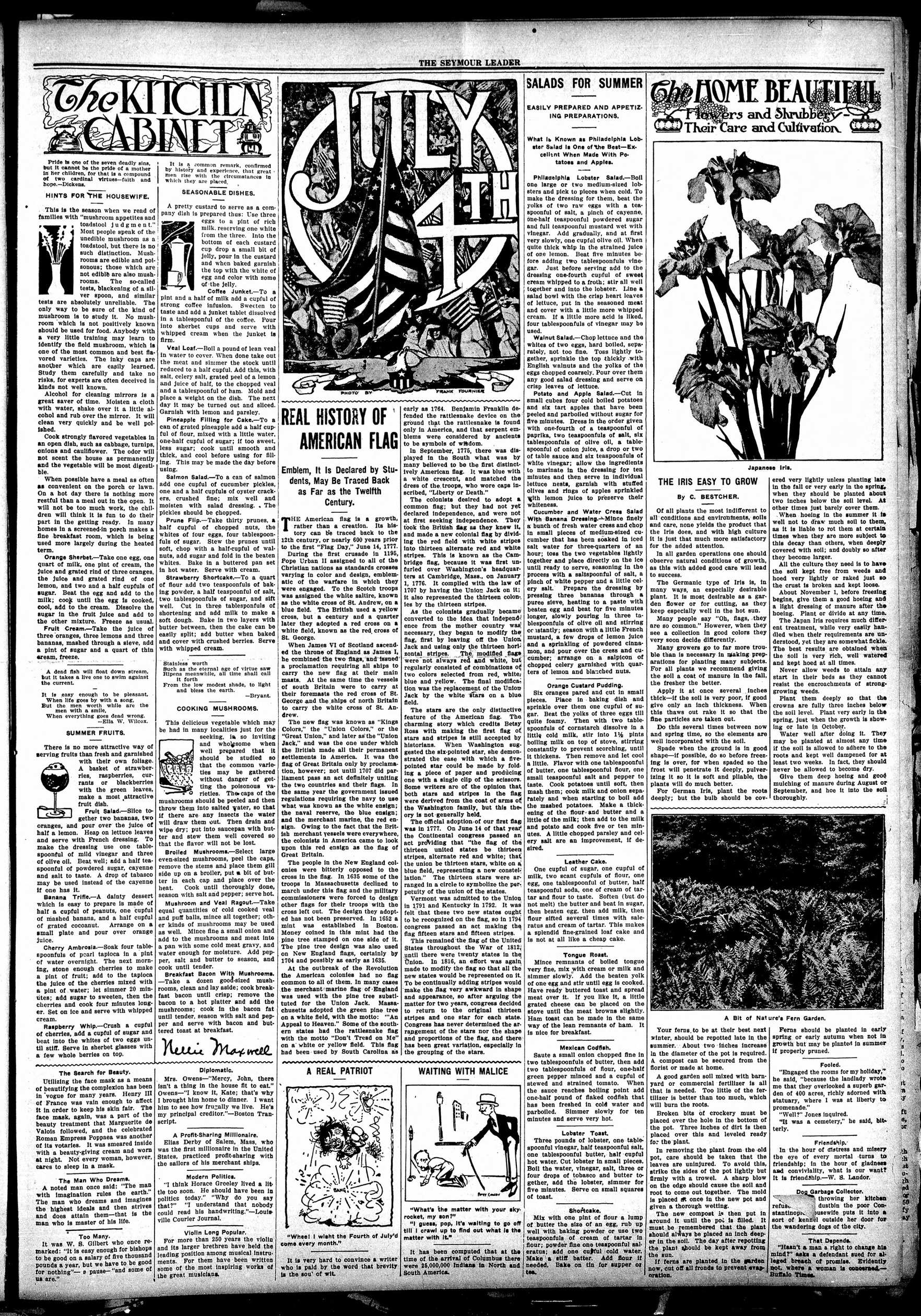
The KITCHEN CABINET
Pride is one of the seven deadly sins, but it cannot be the pride of a mother in her children, for that is a compound virtue<sup>1</sup> faith and bone.—Dickens
HINTS FOR THE HOUSEWIFE.
This is the season when we read of families with "mushroom appetites and toadstool j ud g m n t." Most people speak of the unedible mushroom as a toadstool, but there is no such distinction. Mushrooms are edible and poisonous; those which are not edible are poisoned rooms. The so-called tests, blackening of a sillier spoon, and similar
toadstool judg m ent. Most people speak of the unedible mushroom as a toadstool, but there is no such distinction. Mushrooms are edible and potious; those which are not edible and not suitable for rooms. The so-called tests, blackening of a silver spoon, and similar tests are absolutely unreliable. The only way to be sure of the kind of mushroom is to study it. No mushroom which is not positively known should be used for food. Anybody with a very little training may learn to identify the field mushroom, which is one of the most common and best flavored varieties. The inky caps are another which are easily learned. Study them carefully and take no risks, for experts are often deceived in kinds not well known. Alcohol for cleaning mirrors is a great way of cleaning a cloak with water, shake over it a little alcohol and rub over the mirror. It will clean very quickly and be well polished.
Cook strongly flavored vegetables in an open dish, such as cabbage, turnips, onions and cauliflower. The odor will not scent the house as permanently and the vegetable will be most digestible.
When possible have a meal as often as convenient on the porch or lawn. On a hot day there is nothing more restful than a meal out in the open. It will not be too much work, the children will think it is fun to do their part in the getting ready. In many homes in a screened-in porch makes a fine breakfast room, which is being used more largely during the heated term.
Sugar Sherbet—Take one egg, one quart of milk, one put of cream, the juice and grated rind of three oranges, the juice and grated rind of lemon, and two and a half cupfuls of sugar. Beat the egg and add to the milk; cook until the egg is cooked, cool, add to the cream. Dissolve the sugar in the fruit juice and add to the other mixture. Freeze, as usual.
Fruit Cream—Take the juice of three oranges, three lemons and three bananas, mashed through a sieve, add a pint of sugar and a quart of thin cream, freeze.
A dead fish will float down stream, but it takes a live one to swim against the current.
It is easy enough to be pleasant. When life goes by with a song. But the same words while are the men with a smile. When everything goes dead wrong.
SUMMER FRUITS.
There is no more attractive way of serving fruits than fresh and garnished with their own foliage.
A basket of strawberries, raspberries, currants or blackberries with the green leaves, make a most attractive fruit dish.
BREWERY
Fruit Salad—Slice to together two bananas, two oranges, and pour over the juice of half a lemon. Heap on lettuce leaves and serve with French dressing. To make the dressing use one table-spoonful of mild vinegar and three of olive oil. Beat well; add a half teaspoonful of powdered sugar, cayenne and salt to taste. A drop of tabasco may be used instead of the cayenne if one has it.
Banana Trifle—A dainty dessert which is easy to prepare is made of half a cupful of peanuts, one cupful of mashed banana, and a half cupful of grated coconut. Arrange on a small juice and pour over orange juice.
Cherry Ambrosia—Soak four table-spoonfuls of pearl tapla in a pint of water overnight. The next morning, stone enough cherries to make a pint of fruit; add to the tapla the juice of the cherries mixed with a pint of water; let simmer 20 minutes; add sugar to sweeten, then the cherries and cook four minutes longer. Set on ice and serve with whipped cream.
Raspberry Whip—Crush a cupful of cherries, add a cupful of sugar and beat into the whites of two eggs until stiff. Serve in sherbet glasses with a few, whole cherries on top.
The Search for Beauty.
Utilizing the face mask as a means of beautifying the complexion has been in vogue for many years. Henry III of France was vain enough to affect it in order to keep his skin fair. The face mask, again, was a part of the beauty treatment that Marquette de Valois followed, and he celebrated Roman Empress Poppea was another of her beauty-giving creations. It was smeared inside with a beauty-giving cream and worn at night. Not every woman, however, cares to sleep in a mask.
The Man Who Dreams
A noted man once said: "The man with imagination rules the earth." The man who dreams and imagines the highest ideals and then strives and does attain them—that is the man who is master of his life.
Too Many.
It was W. S. Gilbert who once remarked: "It is easy enough for bishops to be good on a salary of five thousand pounds a year, but we have to be good for nothing"—s pause—"and some of us are."
It is a common remark, confirmed by history and experience, that great men rise with the circumstances in which they are placed
SEASONABLE DISHES.
A pretty custard to serve as a company dish is prepared thus: Use three eggs to a pint of rich milk. reserving one white from the three. Into the bottom of each custard cup drop a small bit of jelly, pour in the custard and when baked garnish the top with the white of egg and color with some of the jelly.
```markdown
```
Coffee Junket—To a
sauceknet.—To a pint and a half of milk add a cupful of strong coffee infusion. Sweeten to taste and add a junket tablet dissolved in a tablespoon of the coffee. Pour into sherbet cups and serve with whipped cream when the junket is firm.
Veal Leaf—Boll a pound of lean veal in water to cover. When done take out the meat and simmer the stock until reduced to a half cupful. Add this, with salt, celery salt, grated peel of a lemon and juice of half, to the chopped veal and a tablespoon of ham. Mold and place a weight on the dish. The next day it may be turned out and sliced. Garnish with lemon and parsley.
Pineapple Filling for Cake.—To a can of grated pineapple add a half cupful of flour, mixed with a little water, shafful cupful of sugar, if too sweet, thick, and cool before using for filling. This may be made the day before using.
Salmon Salad.—To a can of salmon add one cupful of cucumber pickles, one and a half cupfuls of oyster crackers, crushed fine; mix well and moisten with salad dressing. The pickles should be chopped.
Prune Flip.—Take thirty prunes, a half cupful of chopped nuts, the whites of four eggs, four tablespoonfuls of sugar. Stew the prunes until soft, chop with a half-cupful of walnuts, add sugar and fold in the beaten whites. Bake in a buttered pan set in hot water. Serve with cream.
Strawberry Shortcake.—To a quart of flour add two teaspoonfuls of baking powder, a half teaspoonful of salt, two tablespoonfuls of sugar, and sift well. Cut in three tablespoonfuls of shortening and add milk to make a smooth batter. Mix with butter between, then the cake can be easily split; add butter when baked and cover with crushed berries. Serve with whipped cream.
Stainless worth
Such as the eternal age of virtue saw
Riparian shrubs, all time shall call
it forth
For the eternal shade to light,
and bless the earth.
COOKING MUSHROOMS.
This delicious vegetable which may be had in many localities just for the
seeking, in so inviting and wholesome when well prepared that it should be studied so that the common varieties are not without danger of getting the poisonous varieties. The caps of the
seeking, so in trying and wholegroups when well prepared that it should be studied so that the common varieties may be gathered without danger of getting the poisonous varieties. The caps of the mushrooms should be peeled and then throw them into salted water, so that if there are any insects the water will draw them out. Then drain and wipe dry; put into saucepan with butter and stew them well covered so that the flavor will not be lost.
Broiled Mushrooms-Select large even-sized mushrooms, peel the caps, remove the stems and place them gill side on a broiler, put bit of butter in each cap and place over the heat. Cook until thoroughly done, season with salt and pepper; serve hot.
Mushroom and Veal Ragout.—Take equal quantities of cold cooked veal and puff balls, mince all together; other kinds of mushrooms may be used as well. Mince fine a small onion and add to the mushrooms and meat into a pan with some cold meat gravy, and water enough for moisture. Add pepper, salt and butter to season, and cook until tender.
Breakfast Bacon With Mushrooms.
—Take a dozen good-sized mushrooms, clean and lay aside; cook breakfast bacon until crisp; remove the bacon to a hot platter and add the mushrooms; cook in the bacon fat until tender, season with salt and pepper and serve with bacon and buttered toast at breakfast.
Diplomatic.
Mrs. Owens—"Mercy, John, there isn't a thing in the house fit to eat." Owens—"I know it, Kate. That's why I brought him home to dinner. I want you to see how much I love your principal creditor—"Boston Transcript.
A Profit-Sharing Millionaire
Elias Derby of Salem, Mass, who was the first millionaire in the United States, practiced profit-sharing with the sailors of his merchant ships.
Modern Politics.
"I think Horace Greeley lived a life the too soon. He should have been in politics today." "Why do you say that?" "I understand that nobody could read his handwriting."—Louisville Courier Journal.
Violin Long Popular
For more than 250 years the violin and its larger brethren have held the leading position among musical instruments. For them have been written some of the most inspiring works of the great musician.
JULY 4TH
REAL HISTORY OF AMERICAN FLAG
Emblem, It Is Declared by Students, May Be Traced Back as Far as the Twelfth
THE American flag is a growth, rather than a creation. Its history can be traced back to the 12th century, or nearly 600 years prior to the first "Flag Day," June 14, 1777.
During the first crusade in 1195, Pope Urban II assigned to all of the Christian nations as standards crosses varying in color and design, emblematic of the warfare in which they were engaged. To the Scotch troops was assigned the white saltire, known as the spurred star of the blue field. The British used a yellow cross, but a century and a quarter later they adopted a red cross on a white field, known as the red cross of St. George. When James VI of Scotland ascended the throne of England as James I, he combined the two flags, and issued a proclamation requiring all ships to carry the new flag at their main masts. At the same time the vessels of south Britain were to carry at sea the white cross of St. George and the ships of north Britain to carry the white cross of St. Andrew.
The new flag was known as "Kings Colors," the "Union Colors," or the "Great Union," and later as the "Union Jack," and was the one under which the British made all their permanent settlements in America. It was the flag of Great Britain only by proclamation, however, not until 1707 did parliament pass an act definitely uniting the two countries and their flags. In the same year the government issued regulations requiring the navy to use what was known as the white ensign; the naval reserve, the blue ensign; and the merchant marine, the red ensign. Owing to the fact that the British merchant yessels were everywhere, the colonists in America came to look upon this red ensign as the flag of Great Britain.
The people in the New England colonies were bitterly opposed to the cross in the flag. In 1635 some of the troops in Massachusetts declined to march under this flag and the military commissioners were forced to design other flags for their troops with the cross left out. The design they adopted has not been preserved. In 1652 a mint was established in Boston. Money coined in this mint had the pine tree stamped on one side of it. The pine tree design was also used on New England flags, certainly by 1704 and possibly as early as 1635.
At the outbreak of the Revolution the American colonies had no flag common to all of them. In many cases the merchant-marine flag of England was used with the pine tree substituted for the Union Jack. Massachusetts adopted the green pine tree on a white field, with the motto: "AnAppeal to Heaven." Some of the southern states had the rattlesnake flag with the motto "Don't Tread on Me" on a white or yellow field. This flag had been used by South Carolina as
A REAL PATRIOT
"Wheel! I wlght the Fourth of July'd come every month."
It is very hard to convince a writer who is paid by the word that brevity is the sou' of wit.
THE SEYMOUR LEADER
LYK
4TH
FRANK FOURNIER
early as 1764. Benjamin Franklin defended the rattlesnake device on the ground that the rattlesnake is found only in America, and that serpent emblems were considered by ancients to be symbols of wisdom.
In September, 1775, there was displayed in the South what was by many believed to be the first distinctively American flag. It was blue with a white crescent, and matched the dress of the troops, who wore caps inscribed, "Liberty or Death." The colonists desired to adopt a common flag; but they had not yet declared independence, and were not at first seeking independence. They took the British flag as they knew it, and made a new colonial flag by inscribing the red field with the emblem of an alternate red and white stripes. This is known as the Cambridge flag, because it was first furled over Washington's headquarters at Cambridge, Mass., on January 1, 1776. It complied with the law of 1707 by having the Union Jack on it; it also represented the thirteen colonies by the thirteen stripes.
As the colonists gradually became converted to the idea that independence from the mother country was necessary, they began to modify the flag, first by leaving off the Union Jack and using only the thirteen horizontal stripes. The modified flags were not always red and white, but regularly consisted of combinations of two colors selected from red, white, blue and yellow. The final modification was the replacement of the Union Jack by the white stars on a blue field.
The stars are the only distinctive feature of the American flag. The charming story which credits Bety Ross with making the first flag of stars and stripes is still accepted by historians. When Washington suggested the six-pointed star, she demonstrated the ease with which a firepointed star could be made by folding a piece of paper and producing one with a single clip of the scissors. Some writers are of the opinion that both stars and stripes in the flag were derived from the coat of arms of the Washington family, but this theory is not generally held. The official adoption of our first flag was the 1777 14 of that year. The Continental Congress passed an act providing that "the flag of the thirteen united states be thirteen stripes, alternate red and white; that the union be thirteen red, white on a blue field, representing a new constellation." The thirteen stars were arranged in a circle to symbolize the perpetuity of the union of the states.
Vermont was admitted to the Union in 1791 and Kentucky in 1792. It was felt that these two new states ought to be recognized on the flag, so in 1794 congress passed an act making the flag fifteen stars and fifteen stripes.
This remained the flag of the United States throughout the War of 1812, until there were twenty states in the Union. In 1816, an effort was again made to modify the flag so that all the new states would be represented on it. To be continually adding stripes would make the flag very awkward in shape and appearance, so after arguing the matter for two years, congress decided to return to the original thirteen states and to replace the flag with the Congress has never determined the arrangement of the stars nor the shape and proportions of the flag, and there has been great variation, especially in the grouping of the stars.
WAITING WITH MALICE
"What's the matter with your sky rocket, my son?"
"I guess, pop, pop, it's waiting to go off till I crawl up to find out what is the matter with it."
It has been computed that at the time of the arrival of Columbus there were 25,000,000 Indians in North and South America.
SALADS FOR SUMMER
SALADS FOR SUMMER
EASILY PREPARED AND APPETIZING PREPARATIONS.
What Is Known as Philadelphia Lobster Salad Is One of the Best—Excellent When Made With Potatoes and Apples.
Philadelphia Lobster Salad—Boll one large or two medium-sized lobsters and pick to pieces when cold. To make the dressing for them, beat the yolks of two raw eggs with a teaspoonful of cayenne, a salt of cayenne, one half teaspoonful of sugardough and one half teaspoonful mustard wet with vinegar. Add gradually, and at first very slowly, one cupful olive oil. When quite thick whip in the strained juice of one lemon. Beat five minutes before adding two tablespoonful vinegar. Just before serving add to the dressing one-fourth cupful of sweet cream whipped to a froth; stir all well together and into the lobster. Line a salad bowl with the crisp heart leaves of lettuce, put in the seasoned meat and cover with a little more whipped cream. If a little more acid is liked, four tablespoonful of vinegar may be used.
Walnut Salad —Chop lettuce and the whites of two eggs, hard boiled, separately, not too fine. Toss lightly together, sprinkle the thick toply with English walnuts and the yolks of the eggs chopped coarsely. Pour over them any good salad dressing and serve on crisp leaves of lettuce.
Potato and Apple Salad —Cut in small cubes four cold boiled potatoes and six tart apples that have been peeled and parboiled without sugar for five minutes. Dress in the order given with one-fourth of a teaspoonful of paprika, two teaspoonfuls of salt, six tablespoonfuls of olive oil, a table spoonful of onion juice, drizzle two tablespoonfuls and six teaspoonfuls of white vinegar; allow the ingredients to marinate in the dressing for ten minutes and then serve in individual lettuce nests, garnish with stuffed olives and rings of apples sprinkled with lemon juice to preserve their whiteness.
Cucumber and Water Cress Salad With Banana Dressing→Mince finely a bunch of fresh water cress and chop in small pieces of medium-sized cucumber that has been soaked in iced salt water for three quarters of an hour; toss the two vegetables lightly together to heat up; then ready to serve, seasoning in the process with a saltspoonful of salt, a pinch of white pepper and a little celery salt. Prepare the dressing by pressing three bananas through a puree sieve, heating to a paste with beaten egg and beat for five minutes longer, slowly pouring in three tablespoonfuls of olive oil and stirring ec instantly; season with a little French mustard, a few drops of water, a few drops of cinnamon, and pour over the cress and cucumber; arrange on a salicorn of chopped celery garnished with quarters of lemon and blanched nuts.
Orange Custard Pudding.
Six orange pared and cut in small pieces. Place in baking dish and sprinkle over them one cupful of sugar. Beat the yolks of three eggs till quite foamy. Then with two tablespoons of cornstarch dissolve in a little cold milk, stir into 1½ pints boiling milk on top of stove, stirring constantly to prevent scorching, until it thickens. Then remove and let cool a little. Flavor with one tablespoonful of butter, one tablespoonful flour, one small teaspoonal salt and pepper to taste. Cook potatoes until soft, then mash them; cook milk and onion rately and when starting to boil add potatoes. Make a thickening of the flour-and butter and a little of the milk; then add to the milk and potato and cook five or ten minutes. A little chopped parsley and celery salt are an improvement, if desired.
Leather Cake.
One cupful of sugar, one cupful of milk, two scant cupfuls of flour, one egg, one tablespoonful of butter, half teaspoonful soda, one of cream of tartar and flour to taste. Soften (but do not met) the butter and beat in sugar, then beaten sugar, then beaten sugar several times with salate and cream of tartar. This makes a splendid fine-grained loaf cake and is not at all like a cheap cake.
Tongue Roast.
Mince remnants of boiled tongue very fine, mix with cream or milk and simmer slowly. Add the beaten yolk of one egg and stir until egg is cooked. Have ready buttered toast and spread meat over it. If you like it, a little grated cheese can be placed on the meat and ham toast, which is slightly. Ham toast can be made in the same way of the lean remnants of ham. It is nice for breakfast.
Mexican Codfish.
Saute a small onion chopped fine in two tablespoonfuls of butter, then add two tablespoonfuls of flour, one-half green pepper minced and a cupful of stewed and strained tomato. When the sauce reaches boiling point add one-half pound of faked codfish that has been freshed in cold water and parboled. Simmer slowly for ten minutes and serve very hot.
Lobster Toast
Three pounds of lobster, one tablespoonful vinegar, half teaspoonful salt, one tablespoonful butter, half cupful hot water. Cut lobster in small pieces. Boil the water, vinegar, salt, three or four tablespoons. Add the water to gather, add the lobster, simmer for five minutes. Serve on small squares of toast.
Shortcake.
Mix with one plint of flour a lump of butter the size of an egg, rub up well with baking powder or use two teaspoonfuls of cream of tartar in flour; powder fine one teaspoonful saleratus; add one cool cold water; add one teaspoonful salt; if needed, Bake on tin for supper or tea.
Iris
THE IRIS EASY TO GROW
Of all plants the most indifferent to all conditions and environments, soils and care, none yields the product that the Iris does, and with high culture it is just that much more satisfactory for the added attention. In all garden operations one should observe natural conditions of growth, as this with added good care will lead to success. The Germanic type of Iris is, in many ways, an especially desirable plant. It is most desirable as a garden flower or for cutting, as they keep especially well in the hot sun. Many people say "Oh, flags, they are so common." However, when they are planted in colors they very soon decide differently. Many growers go to far more trouble than is necessary in making preparations for planting many subjects. For all plants we recommend giving the soil a cost of manure in the fall, the fresher the better.
Apply it at once several inches thick—if the soil is very poor, if good give only an inch thickness. When this thaws out rake it so that the fine particles are taken out. Do this several times between now and spring time, so the elements are well incorporated with the soil. Spade when the ground is in good shape—if possible, do so before freezing is over, for when spaded so the frost will penetrate it deeply, pulverizing it so it is soft and pliable, the plants will do much better. For German Iris, plant the roots deeply; but the bulb should be coy
```markdown
```
A Bit of Nature's Fern Garden.
Your ferns, to be at their best next winter, should be repotted late in the summer. About two inches increase in the diameter of the pot is required. A compost can be secured from the florist or made at home.
A good garden soil mixed with barnyard or commercial fertilizer is all that is needed. Too little of the fertilizer is better than too much, which will burn the roots.
Broken bits of crockery must be placed over the hole in the bottom of the pot. Three inches of dirt is then placed over this and levelled ready for the plant.
In removing the plant from the old pot, care should be taken that the leaves are uninjured. To avoid this, strike the sides of the pot lightly but firmly with a trowel. A sharp blow on the edge should cause the soil and root to come out together. The mold is placed once in the new pot and given a thorough wetting.
The new compost is then put in around it until the pot is filled. It must be remembered that the plant should always be placed an inch deeper in the soil. The day after repotting the plant should be kept away from the sun. If ferns are planted in the garden now, cut off all fronds to prevent evaporation.
ered very lightly unless planting late in the fall or very early in the spring, when they should be planted about two inches below the soil level. At other times just barely cover them. When hosing in the summer it is well not to draw much soil to them, as it is liable to rot them at certain times when they are more subject to this decay than others, when deeply covered with soil; and doubly so after they become larger. All the culture they need is to have the soil kept free from weeds and hoed very lightly or raked just so the crust is broken and kept loose. About November 1, before freezing begins, give them a good food, and hoed a moist surface after the hoosing. Phone or divide at any time. The Japan Iris requires much different treatment, while very easily handled when their requirements are understood, yet they are somewhat fickle. The best results are obtained when the soil is very rich, well watered and kept hoed at all times.
Never allow weeds to attain any start in their beds as they cannot resist the encroachments of strong-growing weeds. Plant them deeply so that the crowns are fully three inches below the soil level. Plant very early in the spring, just when the growth is showing or late in October. Water well after doing it. They may be planted at almost any time if the soil is allowed to adhere to the rooftop and will well dampen for at least weeks. In fact, they should never be allowed to become dry. Give them deep hoeing and good mulching of manure in August or September, and hoe it into the soil thoroughly.
25
Ferns should be planted in early spring or early autumn when not in growth but may be planted in summer if properly pruned.
Fooled.
"Engaged the rooms for my holiday," he said, "because the landlord wrote me that they overloaded a supergarb with statuary, richly adorned with statuary, where I was at liberty to promenade."
"Well!" Jones insulted.
"It was a cemetery," he said, bitterly.
Friendship.
In the hour of distress and misery the eye of every mortal turns to fraternity, the sense of gladness and conviviality, what is our want? It is friendship—W. S. Landor.
Dog Garbage Collector
Don Garbage Collection throwing a kitchen refuse, dissuasin the poor Constantinopolis, write puts it into a sort of kennel outside her door for the wandering dogs of the city.
That Dependes. "Haan" a man a right to change his mind" asks a defendant sued for alleged breach of promise. Eridently not, where a woman is concerned. Buffalo Times.
Japanese Iris.
Fooled.
Friendship.
EDITOR'S OBSERVATIONS
Racial Progress and Educational Advancement as Noted by John L. Thompson, Editor Iowa State Bystander
Des Moines, Iowa
The peculiar thing about Omaha Neb., is the absence of interurbant electric cars. They have no interurban car lines here, as one would naturally expect to see in cities of this size. After leaving this city we land in ed Rial Oak, Iowa, to find about the same people. Oscar Connor, the vet eran barber, is still working in his shop. Wm. Hampton, the U. S. court bailiff for the southern district for Iowa, lives here. He will soon have to move to Iowa City, the home of the new judge, Wale, recently appointed. He has served under three U. S. judges, Woolson, Judge Smith McPherson and the present Mr. Hampton has one of the earliest and finest gardens I have seen this spring. C. W. Chappelle is no longer at the hotel, but following his carpenter work. David Garner is working hard establishing himself a dairy. He is succeeding H. S. Martin is still working at the harrier shop. P. Everheart is still in the piano and music house. He owns the largest and finest piano store, first class in every respect, in Iowa owned by colored people. He has been in business hers for more than twenty years, a good business. Emmanuel Keene is doing well. There is no church here now. Clarinda was our next stop. This little prairie town was inundated with rain and cold weather without right hand assistant the old wheel. I made the usual rounds under slow and tiresome conditions. Here lives about 300 colored people, some doing well. They have two colored churches, the Methodist, presided over by Rev. D. W. Brown, an earnest, sincere worker for the Master, and the Baptist, pastored by Rev. W. A. Mitchell, recently from Missouri. Each are doing very well. Dr. Gibson is still the veterinarian here. H. H. Cook is still in the grocery store. He is a hustler and a good business man. His industrious wife assists him in the store. Noah Peeberton is still on the U. S. mail force. He is one of the reliable men here. Mr. Wm.
CENTERVILLE NEWS.
The Missionary Circle met at the home of Mrs. Martha Thompkins, president. They were favored with an address by Rev. Phelps of Omaha, Neb. Luncheon was spread for twenty.
The stork visited the home of Mrs. Leonard Lewis and brought them a fine bouncing boy.
Mr. Wm. Clark and Miss Maggie Oliver were quietly united in holy wedlock Sunday afternoon at the pastor's residence, Rev. V. S. Cooper officiating.
The Missionary Circle held their fourth Sunday afternoon missionary services and an excellent program was rendered to a large and appreciative audience.
Mayflower tent of the Taborian lodge will give a social at the Second Baptist church on Monday evening, Dgt. G. Cooper, queen mother.
The Sunday school will give a lawn social at the home of Bro. J. Saunders on Saturday, July 3rd.
On Monday, July 5th members and friends of the Second Baptist church will give a picnic in Lane's grove in honor of the pastor's, Rev. V, S. Cooper, 88th birthday.
Services at the church Sunday was well attended. Collection, $19.40.
ALBIA NEWS.
The delegates to the A. M. E. Sunday school convention in Waterloo returned home the first of the week. Mr. Chas. Washington on Tuesday and Mesdames Nellie Estes and Bessie Grayson on Wednesday afternoon.
Mrs. Nellie Estes was elected general superintendent of the Des Moines district at this year's annual convention.
Mrs. Bessie Thomas left Albia for Chicago on Thursday evening.
Miss Craig has returned from hen visit in Missouri the past week.
Lawyer Geo. H. Woodson of Buxton was in Albia the past week.
Miss Oscar Roper and Mrs. Chas. Washington auted to Buxton on Sunday afternoon.
Mr. and Mrs. Edward Butler, son
Lawrence and Misses Ida and Delia
Davis attended the three days' celebration in Keokuk this past week.
Mr. Britton and Donald Thomas were Burton visitors Sunday.
Mr. Arthur Hill of Buxton was in Albia on Sunday.
Mr. and Mrs. Roy Grayson and children of No. 3 Hocking was in town Sunday.
A number of others visited out of town the past week.
A few strangers in Albia this week.
The Modern Priscilla club met Friday afternoon at the usual hour at the home of Mrs. Eugene Fletcher.
Mr. J. O. Washington is quite ill at his home on Mulberry street. Mr. Ben Mitchell is quite sick at his home on East St. street.
The session of the laymen's electoral college, which was held at the A. M. E. church Wednesday, June 2, closed in the evening with a reception and banquet in honor of the visitors by the members of the local church. There was a large crowd present. The topic of the evening was "Education." Good addresses were delivered by Rev. S. B. Jones of Pooris, Rev. B. M. Moore of Chicago and Atwater, Rev. B. M. Moore of Minneapolis.
ALBIA NEWS.
GALESBURG. ILL.
Headly is still driving the ice wagon He is one of the best liked men in Clarinda. His wife is one of the finest catereses here. Ye editor certainly knows. Mr. R. T. Lane is still running his restaurant and ice cream parlor and is doing well. Mr. K. D. Black is another young man who has a bright future. L. F. Montgomery is still on the farm, doing nicely. J. R. Arnett and Mr. Jones are also hustling men and they believe in honesty and work. Mr. V. Washington, recently from Oregon, Mo., has moved up here. He likes Iowa. Next we went to Creston. Here about the same people as I met last year live. Mr. C. F. Burna姆, the veteran hotel porter, is still making the trains for the old Summit hotel, where he worked for more than thirty years. Elroy Baldwin is still operating a 500 acre farm in partnership with his brother just one mile from Creston. His brother took to himself a wife, young Miss Black from near College Springs. They are farming on a very large scale. They have two hired hands and have 140 acres of corn and about 100 head of hogs, sixty head of cattle. Last winter they sold a carload of steers that brought the highest price of any cattle sold in Union county. They are solving the so-called race problem. It is indeed a great inspiration to visit this great farm. It simply shows the possibilities of our race. Mr. Martin is another interesting character. He is one of the pioneer settlers here, an old soldier of the civil war. He owns several acres right in town and he gardens it with all kinds of fruit, berries and vegetables. He will have several bushels of cherries, plums, peaches, grapes and apples. He certainly has a well attended garden. Mrs. Anna Dow is still living on her acreage in the south end of town, doing well. J. M. Johnson is working in Flummer's barber shop. Mr. C. R. Hawkins has opened up a shining parlor and no doubt will do well.
Addresses of welcome were given by Mr. J. W. Washington and Mrs. David Garnett in behalf of the local church. Delegates elected to the general conference of the A. M. E. church to be held in Philadelphia on May 16, 1916, were: R. E. Moore of Chicago and Mr. Eugene Green of Davenport, Iowa. Rev. S. B. Jones of Peoria was entertained at the home of Mrs. Cora Brown on Central street while attending electoral college. Mr. Harry Burnough of Mt. Pleasant, Iowa, spent a few days in our city attending electoral college. Mr. and Mrs. B. E. Richardson and daughter, Mrs. Ade Freeze, entertained at supper Tuesday evening for Mr. Harry Burnough of Mt. Pleasant, Iowa. Rev. W. W. Williams of Mt. Pleasant, Iowa spent a few days in our city, the guest of Mr. and Mrs. Ben Wilder, while attending electoral college.
Mr. Eugene Green of Davenport, Iowa, spent a few days in our city as a delegate to the electoral college. Rev. Henry W. Jameson of Campaign, a former Galesburg boy, passed through the city today en route to Rock Island to attend the Twelfth annual encampment of the Spanish war veterans. Jameson was a student in the Galesburg high school during the early eighties and also a student at Knox college. He is chaplain of the department of Illinois, U. S. W. V. His present pastorate is at Chapel St. Warren S. Brown was entertained at the home of Mrs. David Garnett on Grand avenue while in our city attending electoral college as delegate. The district Sunday school convention will hold its ninth annual session in this city June 23 and 24 at the M. A. E. church. Rev. S. L. Birt, pastor.
Mrs. Lora Henderson is quite sick at her home on W. Knox street. Mrs. Josie Mason is slowly recovering from a six weeks' illness.
Mrs. Marie Murphy of Monmouth is spending a few days in the city visiting at the home of her parents, Mr. and Mrs. Albert Hawkins, on Berrion street.
Help for Those Who Have Stomach
Troubla.
After doctoring for about twelve years for a bad stomach trouble, and spending nearly five hundred dollars for medicine and doctors' fees, I purchased my wife one box of Chamberlain's Tablets, which did her so much good that she continued to use them and they have done her more good than all of the medicine I bought before.—Samuel Boyer, Folsom, Iowa. This medicine is for sale by all dealers.
WASHINGTON, IOWA NOTES.
Mrs. L. F. Phillips, who has been bedfast for some time from a stroke of paralysis, is now able to get up and to the table for her "rations," which will be good news to her many friends.
Homer Washington of Kansas City, an employee of the Burlington Construction Co., who is doing some paving in Washington, suffered a stroke of paralysis on two weeks ago, his whole left side being afflicted, rendering him helpless. In charge of Willis Turner he was taken to his home last Friday.
Chas. Washington of Albia visited at the home of N. L. Flack on Sunday, June 20th, on his way home from
the district conference at Waterloo.
He has the honor of being one of
the delegates from the Des Moines district
to the annual conference at Milwaukee. While here he assisted the choir at the evening church service with his cornet, also sang a chas. "He Leadeth Me." Come again, Chas.
Mr. Garfield Foster of Mt. Pleasant is making frequent visits to this burg in his own interests. His "friends" always welcome him.
Miss Nettie Campbell is the new superintendent of the A. M. E. Sunday school, vice A. L. Hall, resigned.
R Mrs. Crump and four children of North Dakota arrived last week and are visiting at the H. Campbell home. The third quarterly meeting and conference of the year was held Monday evening, June 21st. Presiding Elder S. B. Moore was present and sermoned, administered the Lord's supper and held the quaterly conference reports were fine and to their annual standard, especially his trustee report, which read "no indebtedness." Rev. Moore left Tuesday a. m. for Fairfield.
Last Sunday night at the A. M. E. church the Christian Culture club had charge, when it rendered a very interesting literary and musical program. Mrs. Geo. Burkley, the president, was in the chair. Each member had a synopsis of some part of the past year's work, which gave to the large and appreciative audience an insight into the work done by that organization. Also the delegate to the federation, Miss Geneva Murray, gave her report of the federation, and 'tis said by those who heard it that her report was the fullest and best report that any delegate from this city ever brought back from any convention, as she gave all the minor details.
Children's Day will be observed next Sunday by the A. M. E. Sunday school.
Mrs. Harry Parker of Washington, D. C., who has been visiting at the Mrs. Mary Motts home for the past six weeks, leaves next Tuesday for her home, stopping en route to visit friends at Chicago, Pittsburg and Greensburg, Pa.
Traveling Man's Experience
"In the summer of 1888 I had a very severe attack of cholera morbus. Two physicians worked over me from four a. m. to 6 p. m. without giving me any relief and then told me they did not expect me to live; that I had best telegraph for my family. Instead of doing so, I gave the hotel porter fifty cents and told him to buy me a bottle of Chamberlain's Colic, Cholera and Diarrhoea Remedy, and take no substitute. I took a double dose according to the directions and went to sleep after the second dose. At five o'clock the next morning I was called by my order and took a train for my next stopping point, a well man but feeling rather shaky from the severity of the attack," writes H. W. Ireland, Louisville, Ky. Obtainable everywhere.
CLARINDA. IOWA.
Mrs. Taylor of St. Joe, Mo., is visiting her daughter, Mrs. Gee. Johnson, of this city. Mrs. Lizzie Ramey of St. Joe, Mo., is visiting Mrs. Emmet Stewart and
Woman's Crowning Glory is Her Hair
Mme. M. Beard Hair Grower
It removes dandruff, stops itching of
the scalp and makes it grow long, soft
and beautiful. Price 500 a box.
Send stamp for pamphlet.
MME. M. BEARD
AGENTS WANTED
519 So. 10th St. St. Joseph, Mo.
L. E. Hanger
NEW
Elite Restaurant
New Reliable Place to Eat
Meals 15c and up
Lunches or Short Orders Served
304 W. Grand Ave.
Des Moines Iowa
Iowa Phone 295x Rates $1 per day
Automatic 3852
Short Orders Chop Suey
Lunch Room Yockerme
in connection Chill Con Carne
F. F. JACKSON, PROP.
OPEN DAY
AND NIGHT Clinton, Iowa
IOWA STATE BYSTANDER
Mrs. K. Moss.
Aunt Lucy Brown, who is over 100 years old, took dinner at Mr. E. B. Cooke's on Sunday, given in honor of Mrs. Tillie Davis of Omaha.
Master Geo. Evans, who has been attending school in Humboldt, Tennessee, was accompanied to Clarinda by Geo. Ellit to spend the summer.
Crs. Lula Ramsey is on the sick list.
Mr. Henry Johnson and family, also Mr. McPhadden, motored to Clarinda on Sunday in their new car to attend St. John's Day.
Mr. Alphonso Stewart is much improved.
Mrs. E. Moss, E. Stewart and Callie Arnett accompanied Mrs. L. Ramsey on a visit.
The daughters of Progressive tabernacle held their annual sermon at the A. M. E. church. The daughters and maids and pages marched in full uniform from the hall. Paper, Dt. Lillian Lane. recitation, Dt. Ella Black. Song, Dt. Caille Arnett. Short talk, Dt. Gertude Cranon, H. P. Spermons was very ably delivered by Rev. Botts of Booneville, Mo. Rev. Botts delivered a very able sermon Sunday night at the Baptist church. The Masons held their public installation at Keystone hall Thursday, June 24, as follows: Wm. Headley, W. M.; Geo. Montgomery, S. W.; Robt. Lane, W. David; Black, treasurer; Jim Banks, secretary. Their annual sermon was delivered at the A. M. E. church Sunday by Rev. D. W. Brown, a member of the order. Mr. Lewis Arnett is out of the city on business. Mrs. Georgia Howe and baby visited a few days here.
Rev, D. W. Brown returned from Waterloo, after attending the conference there. Mr. Williams, grand chancellor, was a business caller out of town. Miss Pauline Palmer and Miss Dorothea Palmer of Marysville are in our city visiting Mrs. W. Mitchell, Jr.
OSKALOOSA NOTE8.
Mrs. Paul Brown is home from Kansas City, where she has been looking after business affairs.
Sunday was Rally day at Wesley Chapel church.
Mrs. Emma Black of Washington has been visiting with relatives here and left Monday for Des Moines, accompanied by Mrs. H. Hockeday, who will attend the meeting of the executive board of the I. C. W. C., which meets in that city.
Mrs. Mary Ringo, who has been a sufferer of asthma, is able to be out.
Rev. W. Williams and wife have adopted the infant son, Gilbert Francis, of Mrs. Belle Frederick.
Frank Allen, the plasterer, returned Saturday evening from Rose Hill, where he had finished a job of plastering. He leaves Wednesday for Tracy.
MASON CITY, IOWA.
On last Wednesday occurred the death of Wm. Wm. Bradford at his home on East Seventh street, after an illness of about ten days. The funeral was held last Thursday afternoon at Union Memorial church. Rev. A. A. Tolson officiated, assisted by Rev. E. J. Penney. There were many beautiful flowers, which covered the casket, and the altar sent by friends of the deceased and family.
Mr. Charles E. Clayton, Wm. J. Williams, Calvin D. Carey, W. P. Smith, George E. Burnton, Alfred Z. Taylor, Wm. Wiley and Capt. A. J. Neeley, all students of Booker Washington school, gave a jubilee concert at the First M. F. church last Friday evening to aair audience.
Miss Ruth Maccifield and Miss Olven Macfield of Fayette, Iowa, are in the city visiting with their aunt and uncle, Mr. and Mrs. J. T. Bass, of 303 Valmala street.
Sunday, June 25th, was observed as Children's day. A very interesting program was rendered at the Union Memorial church by the members of the Sunday school. Each child played its part well. A very inspiring address was given by the pastor, Rev. Tolson. A large audience was present to hear the program. The church was beautifully decorated with flowers.
Mrs. Ella Wilson has been on the sick list for the past week.
Mr. Cecil Brewton entertained a
Take
One
Pain Pill,
then—
Take
it
Easy.
"I can say that Dr. Miles' Remedies have been a godsend to me and my family. I used to have them all, but now I must be wild for days at a time, began using Dr. Miles' Anti-Pain Pills and never have those pain pills. I can speak highly of any Dr. Miles' Newly cured one of my children of a terrible nervous disorder. I can always speak a good word for your Remembrance. I can also be a good many of my friends who have been well, pleased with them." MRS. GEO. H. BRYAN, Janesville, Iowa. For Sale by Owner. 25 Doses, 28 Cents. MILES' MEDICAL CO., EKHart ind.
few of his friends Tuesday evening to a two-course luncheon.
Mrs. Walter Davis of Warren street entertained Capt. Neilee, Chaylon, Wm. J. Williams, Calvin Carey, W. B. Smith, G.e. E. Bunton, Alfred J. Taylor and Wm. Wiley, the members of the glee club, and Miss Pearl Cecil and Miss Beatrice Palmer to a luncheon last Friday afternoon.
The Golden Shield Tabernacle held its annual sermon June 20th at the Union Memorial church. A very interesting program was rendered by the members of the tabernacle to a packed house. A splendid sermon was preached by Rev. Tolson. The daughters all turned out in full regalia.
Miss Ethel Pugh of Das Moines visited several days in Mason City, the guest of Mrs. W. M. Brewton.
"About two years ago I had a severe attack of diarrhoea which lasted for over a week," writes W. C. Jones, Buford, N. D. "I became so weak that I could not stand upright. A drupein recommended Chamberlain's Colic, Cholera and Diarrhoea Remedy. The first dose relieved me and within two days I was as well as ever." Obtainable everywhere.
ROCK ISLAND, ILL.
The Tuskegee Institute singers sang at the Broadway church Sunday evening. They rendered a program which consisted of Negro folk songs, sacred pieces, classics and readings. They are traveling in order to keep up the interest in the school and also to raise funds.
Mrs. Henry Ferry has recovered from her recent illness.
Children's day was fittingly observed Sunday night at the A. M. E. church. The young people went through their program in a fine manner.
Death claimed two well known people of Rock Island last week. Miss Lillian Bursis, aged 19, died at 5 o'clock Saturday morning at her home, 1318 Fifth avenue, after suffering since December with a complication of diseases. She was born in this city May 22, 1895, the daughter of Mr. and Mrs. James Bursis, and her entire life was spent here. She is survived by a sister, Mrs. Agnes Pennington, and three brothers, James, Richard and Rey, all of this city. Mrs. Bursis, Mr. Bursis and her one sister, Stella, have preceded her in death. The funeral was held at 2:30 Tuesday afternoon from Wayman
AVE YOU BEAUTIFUL HAIR?
WE are the only Importers and Manufacturers of Real Colored People's Hair. Also Wavy Hair. We absolutely guarantee our hair to stand combing and washing and to retain its color and crimp. Pairs, Pits, Braids, Transformations and Puffs in stock or to order; all shades, none too difficult. Straightening Combs and Tail Articles.
No for Price List. Mail Orders receive prompt attention.
Available Mme. Baum's Hair Emporium
6-2-16 Between 35th and 85th Sts. NEW YORK CITY
New Thompson Hotel
Send two-cent stamp for Price List. Mail
The Old Reliable Mme. Ba-
486 8th Avenue 11-16-216 Between 34
The New Thom
A First-Class Modern Hotel
Rates Rea
BAC LOT
Magic Hair Grower and
Grower and Straightening Oil
Magic Hair Grower and Straightening Oil
MME. JOHNSON AND SOUTH
The most wonderful hair preparation on the market. When we say Magic we do not exaggerate, as you can see great results in the first few treatments. We guarantee Magic Hair Grower to stop the hair at once from falling out and break off; making harsh, stubborn hair soft and silky. Magic Hair Grower grows hair on bald places of the head. If you use these preparations once, you will never be without them. Magic Hair Grower and Straightening Oil are manufactured by Meadames South and Johnson. We also do scalp treating Magic Hair Grower, 50c. Straightening Oil, 35c.
All orders promptly filled; send 10c for postage. Money must
The most wonderful hair preparation on the market. When we say Magic we do not exaggerate, as you can see great results in the first few treatments. We guarantee Magic Hair Grower grows hair on bald places of the head. If you use these preparations once you will never be without them, Magic Hair Grower and Straightening Oil are manufactured by Meidames South and Johnson. We also do scalp treating.
```markdown
```
Diarrhoea Quickly Cured.
ROCK ISLAND. ILL
H4
10 Blocks from Union Depot Corner of 9th and Park Sts.
Chapel. Rev. Walkup of Moline conducted the funeral services. Burial took place at Chippiannock cemetery. James Robinson, who passed away Thursday morning at his home, 204 Third avenue, was a well known citizen of this city. He was 65 years old. He is survived by two children, Sadie Saunders of this city and James of Chicago. His wife, Cordelia Howard, died in 1910. The funeral services were held at the Baptist church. Rev. Sanders conducted the services and burial took place at Chippiannock cemetery. Miss Mabel Brown has returned home, after visiting in Indianapolis. The Order of the Eastern Star held their annual sermon at the A. M. E. church Sunday. Rev. Walkup preached the sermon. Mr. C. Lambert of Michigan avenue has been and is still very ill. Mr. Lambert has been in poor health for nearly a year. The junior choir of the Baptist church will make its debut soon.
Mistress Dorothy Coffman of Chicago is in the city visiting her grandparents, Mr. and Mrs. W. Stoner.
Mr. Albert Lewis, the son-in-law of Mr. Harry Moore is in the city visiting him.
Mrs. Carrie Hawkins of Galva is in the city visiting her son. Elmer Ellsworth.
Misses Oneita and Lolita Golden visited their sister-in-law, Mrs. Charles Golden, Jr., on Michigan avenue for the first time.
Madam M. Chapelle, the noted woman evangelist, will conduct a revival at the A. M. E. church beginning Sunday, July 4th.
Mattie Hall and Mrs. Ada Jackson have returned to the city from Kansas City, Mo.
The social which the Sunday school gave Monday night was a great success. It was given to pay the delegate's expenses to the Sunday school convention at Galesburg.
Mr. McGruder, a well known Rock Island young man, has gone to Des Moines, Iowa.
The Jubilee Singers, who are under the management of W. C. Buck, completed a successful season at the Watch Tower. People, both white and colored, flocked to the tower by the hundreds to hear these song birds.
Beauty More Than Skin Deep
A beautiful woman always has good digestion. If your digestion is faulty, Chamberbain's Tablets will do you good. Obtainable everywhere.
European Plan
The Public is Invited.
```markdown
```
Agents wanted - Write for particulars.
We carry everything in the latest fashion-
able hair goods at the lowest prices.
We make switches, puffs, transformation
curls, coronet braids, and combings
made to order, matching all shades a
Sund samples of hair with all orders.
2416 Blondo St, Omaha, Neb.
Phone, Webster 880
Iowa State Bystander
BYSTANDER FUR CO.
BROOK HARRIS
FRIDAY, JULY 1, 1915.
John A. Thompson, MNIA
Published every Friday by the Bystander Publishing Company, Des Moines, Iowa. Office in Chemistry building, corner Seventh and Murberry streets, Iowa place. Ww. 1909
Official paper of the M. W. U. Grant, Lodge of Iowa, A. F. & A. M., and International Grand Congress of Heroines of Jericho of America, and Western Baptist Association.
Entered at the postoffice as soo
Advertising rates for display ada
25 cents per inch, for each insertion.
Three to six months' contract, 10
cents per inch. Local advertising
10 cents per line for each insertion
counting seven words to a line. For
churches and secret societies where
admission is charged, advertisement
counting rates. For professional,
legal and advertisement cards,
yearly contracts, etc. term
are given on application. All ad
advertising is to be paid in advance.
TERMS OF SUBSCRIPTION
One year ..... $1.50
Six months .....
Three months ..... .50
All subscriptions payable in advance.
Add money by postoffice order,
money order, express or draw
the Iowa State Stbynder Company
We are prepared to do first-come-
job work at reasonable prices
of our work is guaranteed.
Communications must be written
on one side of the form only and
be of interest to the public "Brow-
field of interest of wif" remember.
We will not return rejected manuscript, unless accompanied by postage stamp.
This notice applies to all writers, contributors, agents and correspondents. Signs of distress, written upon paper, write a plain hand and spell accurately. Do not send in names of persons at parties or receptions nor send in programs to be published before or after the event. Do not give an eulogy or write your personal comment upon the event. Simply tell the news or event in a brief, simplified manner let the reader know. The Bystander comment. Write the news of all societies, all religious denominations, irrespective of your personal whims or ideas.
Twenty-five Cents is the Price of Peace .....
The terrible itching and smarting incident to certain skin diseases is almost instantly allayed by applying Chamberlain's Salve. Price, 25 cents. For sale by all dealers.
CENTERVILLE NEWS
Rev. V. S. Cooper and wife have returned from Ottumwa, Iowa, where they have been attending the convention. They report having a splendid meeting.
Sunday morning was a glorious one. The services were well attended. Rev. Cooper preached an excellent sermon.
Sunday afternoon the Knights and Daughters of Tabor had their thanksgiving sermon preached by Rev. Phelps of Omaha, Neb. They had a large turnout, headed by the Centerville colored band, attired in their new gand uniform. The Knights and Daughters and Tent in regalia made a beautiful showing.
Rev. Phelps preached Sunday evening. Owing to the stormy weather a small congregation was present, but nevertheless his sermon was effective. He preached to a larger house Monday night. Everyone went home rejoicing over such an excellent sermon. Dgt. Ertha Morton has returned home, after several weeks visiting relatives and friends in Kansas City, Kansas.
Rev. Jackson, Mrs. M. Jackson and Mrs. Cunningham of Mystic, Iowa, were in the city visiting friends Saturday. Mr. Wm. Noah's son arrived from the south last week. Mr. Noah hasn't seen his son for a number of years. It was a happy meeting. Mrs. Mahala Downing is here from Missouri visiting her daughter, Mrs. O. Reed. The social which was given at Dgt. A. L. Crittenden's was quite a success.
The Needle and Art club was entertained on last Friday evening at Mrs. Shelby Noah's home. They are progressing nicely. Mrs. J. H. Hicks, president.
The Helping Hand club will give an entertainment Saturday evening. Mrs. M. Riding, chairman.
Mrs. S. H. Jones is able to be at his work now. He has been confined at his home one week suffering from a smashed foot.
Mr. A. Jackson's foot is improving slowly.
Mrs. H. W. Thompkins will entertain the Mission Circle at her home Thursday evening.
Mr. H. W. Thompson left for Otumwa, Iowa, to attend the convention.
Mrs. Steward of Oskaloosa, Iowa, is back in the city with her son, Mr. Leonard Lewis. Mrs. Lewis is reported ill again.
Mrs. Lonnie Grant has returned from Missouri, after visiting several weeks with relatives and friends.
Mr. Wm. Cobbs entertained at dinner several of the sir knights Sunday. Rev. Smith is still improving nicely. Mrs. Lucy Bell is improving nicely.
Funeral Director
The very best service guaranteed
Prices the lowest - - - - - -
Calls answered promptly day or
night No extra charges for distance
-Reverse all phone charges
PHONE: `$ Maple 2548`