Iowa State Bystander
Friday, July 30, 1915
Des Moines, Iowa
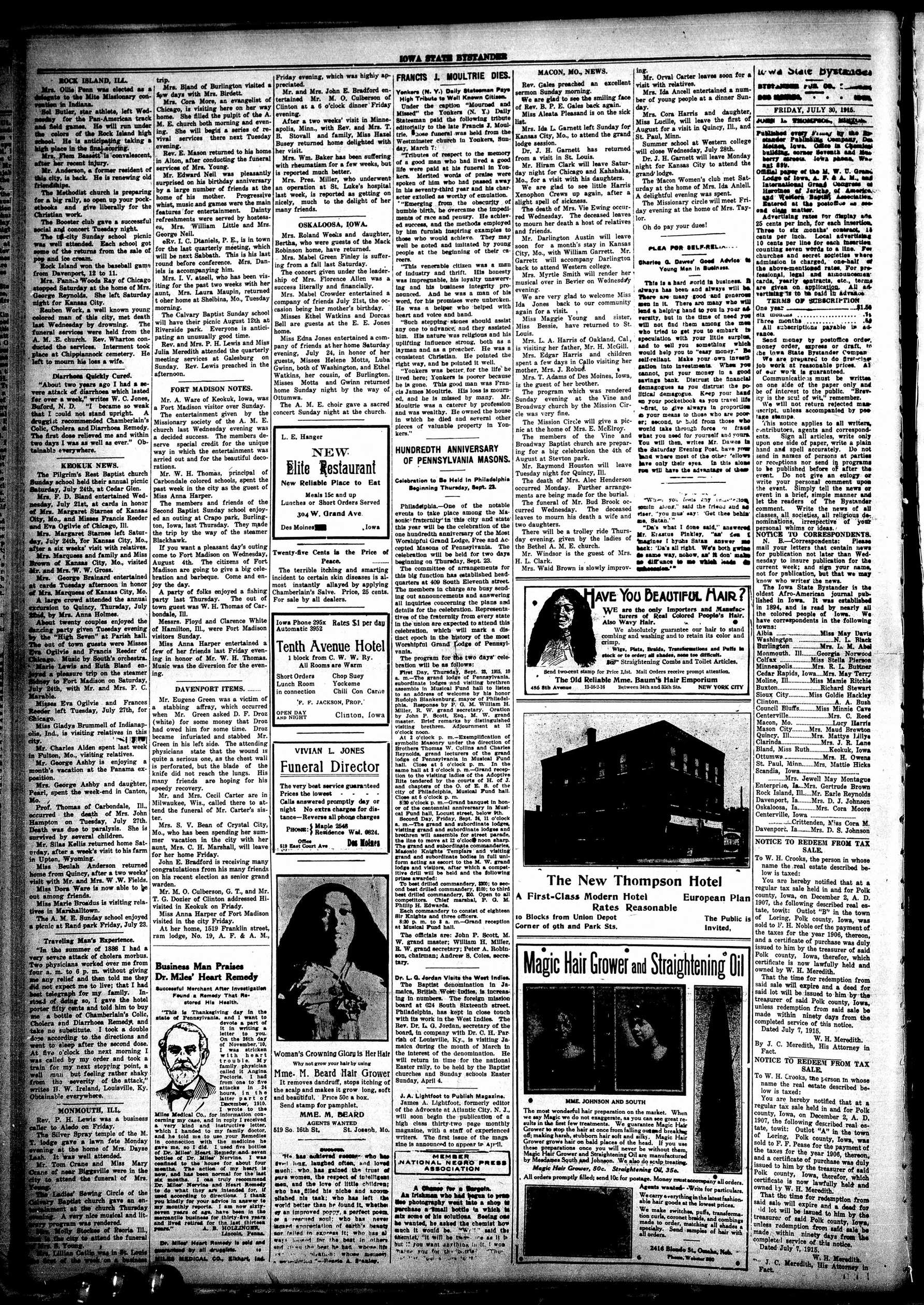
Page text (machine-generated)
IOWA STATE BYSTANDER.
State Capitol Blvd. Historical
Koem
Mrs. L. J. Shelton returned last week from several days visit to Webster city, Iowa.
Miss Manila Jewett of Lincoln, Neb., is visiting for a few days at the home of Miss Mildred Griffin.
Rev. S' Bates has returned home from a trip to Springfield, Mo., where he attended the Baptist Association.
Mr. Fred Anthony of Boone passed through Des Moines on his way to attend the Knights of Pythians at Clarinda, Iowa.
Mr. C. W. Nelson of Omaha, Nebr., an expert brick setter, has been employed on the paving of East Grand avenue to the fair grounds.
Mrs. Al Boldridge arrived in our city where her husband is in the barber business. They will make their home permanently here.
Mr. Tom Allen of Mason City, a former resident of our city, spent Sunday and Monday here enroute to the I.P. session at Clarinda.
Mrs. V. L. Jones of 500 Grand View
venue has been quite sick since last
harsday week. She is some better at
this time.
Mrs. Horace Graves underwent an
operation at Methodist hospital last
saturday. She is greatly improved at
his writing.
Mrs. Blanch Goodrich entertained a
new young people Thursday evening at
a home of Mrs. J. H. Hickman, in
nor of her cousin, Miss Beatrice
ancis.
Miss Anna White, the daughter of
Mrs. Lizzie Kinney, was married July
th to Mr. Robert Allen of St. Paul,
inn., where they will make their
ture home.
Mrs. Lorna Morgan of 825 11th street
is been seriously ill, during the past
seek, but is believed to be on the way
recovery at this writing.
The regular monthly meeting of the
court board of North Star Masonic
ample Association will be held at the
ill, 1012 Center street Monday even-
ing, Aug. 2nd.
Sunday is Stewards' rally day atbury M. E. church. Rev, O. A. Johnson of Kansas City, Mo., will each both morning and evening. The air will furnish good music.
Mrs. W. Hieronymus returned to her one Sunday night from Oakdale matiorium, where she had been for tree and a half months for medicinal eatment. She is greatly improved health and strength.
On account of the rainy weather the own social to be given by the members the Mary Church Terrell club was stoned indifinitely. The club will meet with Mrs. Emerald Mash, 824 W. st street Monday evening Aug. 2rd.
The Des Moines NegroLyceum meeting which was postponed on account of a weather, will hold its meeting next Wednesday at the home of the president, Miss Mamimie James, on Arthur avenue. The history of the liberty will be given by Miss Graves.
Mr. L. J. Shelton has opened up a new barber shop with four chairs and aining parlor on Mulberry between fifth and Sixth, on the ground floor. Mr. Shelton is a very interprising race and deserves great uredit. He is listed by Mr. Al. Boldridge of Trenton,
Mr. Carl Shelton, son of Mr. L. J. selton, is expected to arrive in the day soon to visit his father indefinitely. present he is in Seattle, Wash. Mr selton Jr. is a talented musician and will be glad to receive him in our dst.
The Dramatic Art club met Tuesday with Mrs. J. H. Armstead and studied paper on science, arts and crafts of the Eutopians. Meet next Tuesday with Mrs. Baily on 11th street and conduce the studie of book 2 of Eutopia.
Mr. and Mrs. Price Alexander referred from Rochester, Minn., last Saturday, where Mrs. Alexander underwent treatment for an afflicted knee at the Mayo Bros. sanitarium. His conition remains about the same.
Mr. D. G. Patterson left Tuesday for Rock Island, Ill., where he will be charge of a wholesale grocery use. Mr. Patterson was one of our energet young business men and we certainly sorry to lose him. He will move his family later and make Rock Island their permanent home.
Mrs. Addie Darcy, president of the archeological Neil Embroidery club, entered the club and a number of ladies
XXII No. 6
at the Masonic Temple Wednesday afternoon. Needlework was suspended on this occasion and a special program which had been prepared by the hostess was very much enjoyed, as well as a delightful repast which was served at the close of the evening. Mrs. Dalza Hammitt, 3116 North Union street will entertain the club next week.
Miss Vasila Spears entertained about 40 of her friends Wednesday evening at a dancing party. Messrs. L. B. Jackman and Fred Parker presided at the piano. A dainty two course luncheon was served. The hostess was assisted by Miss Josie Roberts. An enjoyable time was had by all present.
Among the delegates from Des Moines to the 19th annual session of the grand lodge of Knights of Pythias, which convened at Clarinda, Iowa, July 27th, were Messers Frank P. Johnson, Grand Vice Chancelor; Harrison Gould, E. Tracy Blagburn, James Jett and wife, A. L. Smith and wife, Wm. Warfield, Carter, Couch, P. S. Irwin and wife, Mrs. Eva Owens, Supreme Deputy Councilor for Court of Calantha.
Mr. and Mrs. John L. Thompson and family returned home from Chicago and other cities after a fortnight visit. They report a splendid visit and many receptions given them. They were on one of the Chicago boats Friday evening, just before the great catastrophe that happened to the Eastland boat the next morning. Read next week my Chicago observations.
Capt. E. T. Banks, District Deputy Grand High Priest, accompanied by Atty. S Joe Brown, H. Gould and B. J. Mitchell, Royal Arch Masons, went to Marshalltown last Saturday and set up a Chapter of Royal Arch Masons and assisted District Deputy Grand Commander H. E Burris of Rock Island, Ill., in sitting up a Commandery of Knights Templar in that city.
Messrs Jesse Braden of Cameron, Mo., W. H. Grier of Oklahoma City very delightfully entertained Monday evening at the home of Mrs. M. E. Morton, 776 W. 10th street, in honor of Miss Mamie Harderson and Miss Mary Jane Reeves. About twenty guests were entertained with whist during the evening, after which a delightful luncheon consisting of everything good was served. The out of town guest was Mrs. Willa Coleman nee Perkins. Messrs. Braden and Grier were considered royal entertainers.
The Triple H. club met Tuesday at the home of Mrs. James James and after the regular order of business the following officers were elected for the ensuing term: President, Mrs. J. H. McDowell; Vice President, Mrs. Clara James; Secretary, Mrs. Baker Dixon; Assistant Secretary, Mrs. W. H. McCree; Treasurer, Mrs. Richard Jones. A jainty lunch was served and the club adjourned to meet August 3rd with Mrs. Richard Jones at 1628 Carpenter avenue. Miss Georgia Carpenter will speak on "The Relation of Parent to the Child" from a pedagogical standpoint. Installation of officers.
N. A. A. C. P.
The regular monthly meeting of the board of directors of the Des Moines Branch of the National Association for the Advancement of Colored People will be held at the residence of the president, 1058 5th street, Monday evening Aug. 2nd. All officers are urged to attend. By order S. Joe Brown, chairman Mrs. Jessie E. McClain, Sec.
ALBIA NEWS.
Mr. Alfred Grayson of Knoxville, Ill. is visiting in Albia with his relatives and friends for an indifinite time.
The social hour and supper, given by the Junior League at the home of Mrs. Chas. Washington was very nice for the young hova and girls,
the young
A number of the A. M. E. church
people attended the Missionary lecture
at city park on Thursday afternoon.
The A. M. E. Sunday School sang in
a body at the park.
Mrs. Nellie Davis of Des Moines has
joined the other visitors from the city
and will visit friends and relatives in
Albie.
A Quarterly meeting at the A. M. E. church August. 1st. Nellie Bell left Albia for Oskaloos on Tuesday morning.
MYSTIC, IOWA, NEWS.
Mrs. Bryant of Lawrence, Kan., is visiting her sister, Mrs. Charley Best. The National Baptist Convention committee will have a weekly stand beginning next Saturday evening and beginning on Saturday, August 28th.
The Willing Workers of the First Baptist church of Mystic gave a social Saturday evening and cleared a neat sum of money. Several from Centerville and Jerome attended.
A beautiful woman always has good digestion. If your digestion is faulty, Chamberlin's Tablets will do you good. Obtainable everywhere.
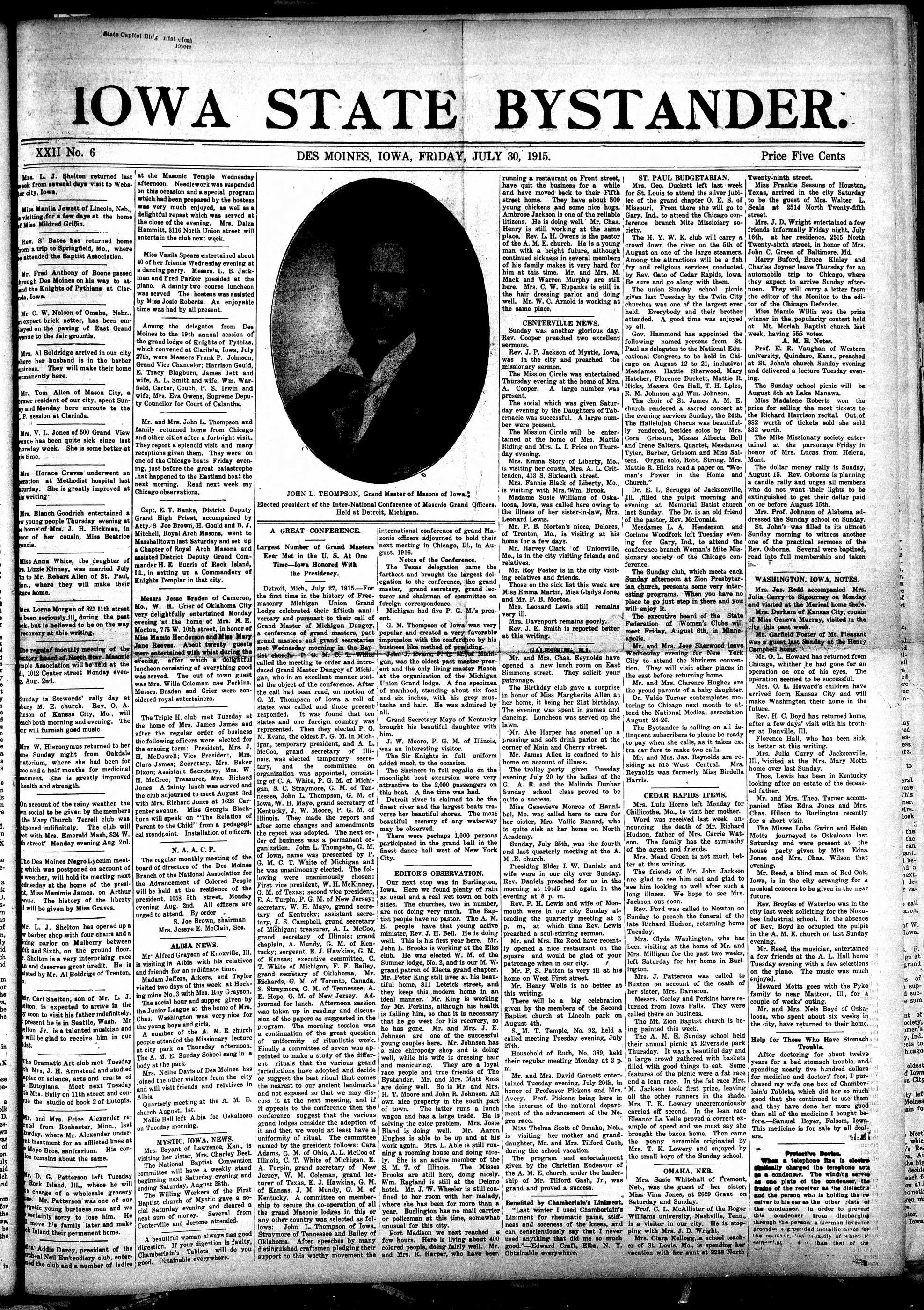
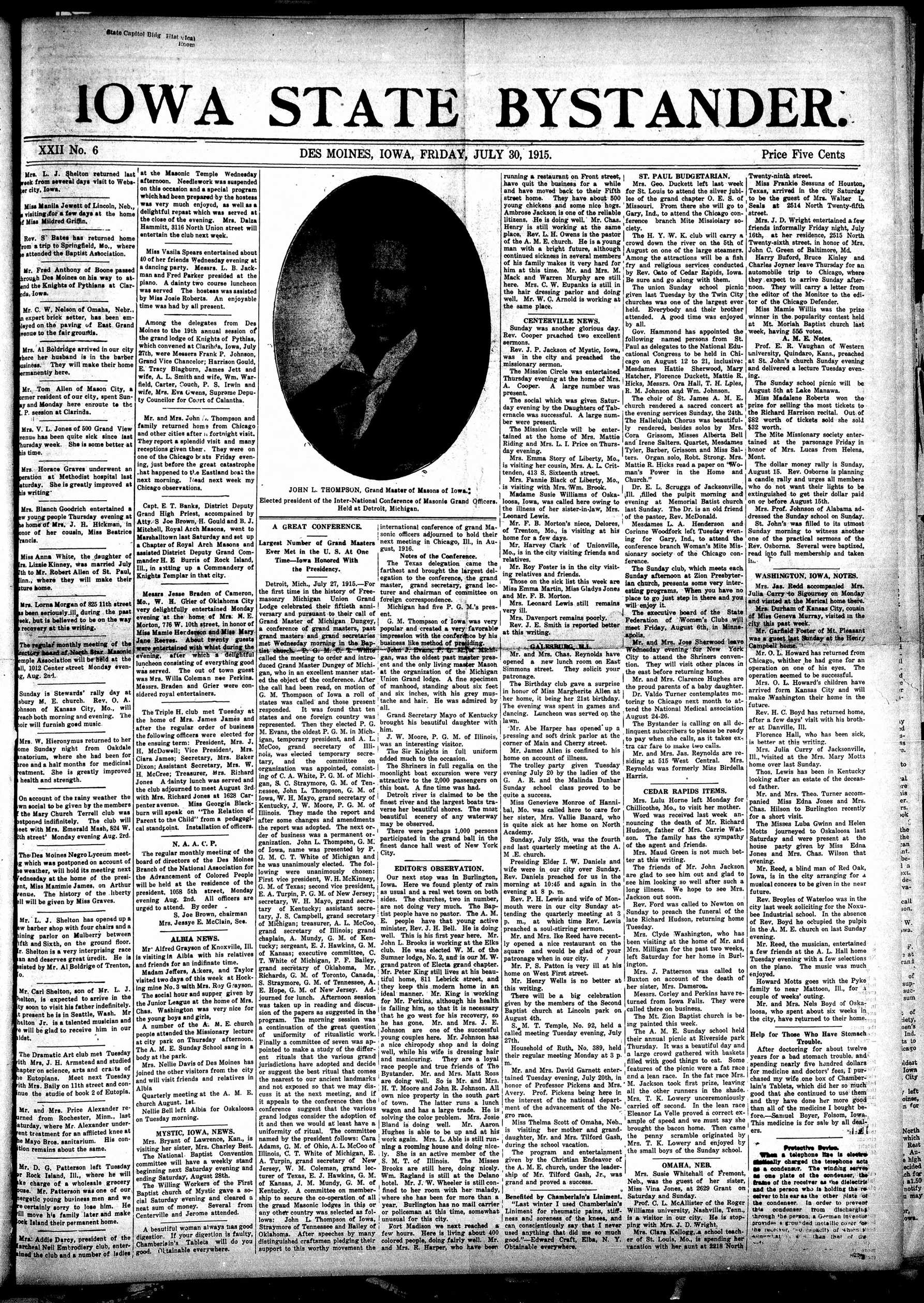
JOHN L. THOMPSON, Grand Master of Masons of Iowa. Elected president of the Inter-National Conference of Masonic Grand Officers Held at Detroit, Michigan.
A GREAT CONFERENCE.
Largest Number of Grand Masters Ever Met in the U. S. At One Time—Iowa Honored With the Presidency.
international conference of grand Masonic officers adjourned to hold their next meeting in Chicago, Ill., in August, 1916.
Notes of the Conference.
The Texas delegation came the farthest and brought the largest delegation to the conference, the grand master, grand secretary, grand lecturer and chairman of committee on foreign correspondence.
Michigan had five P. G. M.'s present.
G. M. Thompson of Iowa was very popular and created a very favorable impression with the conference by his business like method of preiding.
John J. Evans, P. G. M. Michigan, was the oldest past master present and the only living master Mason at the organization of the Michigan Union Grand lodge. A fine specimen of manhood, standing about six feet and six inches, with his grey mustache and hair. He was admired by all.
Grand Secretary Mayo of Kentucky brought his beautiful daughter with him.
J. W. Moore, P. G. M. of Illinois, was an interesting visitor.
The Sir Knights in full uniform added much to the occasion.
The Shriners in full regalia on the moonlight boat excursion were very attractive to the 2,000 passengers on this boat. A fine time was had.
Detroit river is claimed to be the finest river and the largest boats traverse her beautiful shores. The most beautiful scenery of any waterway may be observed.
There were perhaps 1,000 persons participated in the grand ball in the finest dance hall west of New York City.
EDITOR'S OBSERVATION.
Our next stop was in Burlington, Iowa. Here we found plenty of rain as usual and a real wet town on both sides. The churches, two in number, are not doing very much. The Baptist people have no pastor. The A. M. E. people have that young active minister, Rev. J. H. Bell. He is doing well. This is his first year here. Mr. John L. Brooks is working at the Elks club. He was elected W. M. of the Summer lodge, No. 2, and is our M. W. grand patron of Electa grand chapter. Mr. Peter King still lives at his beautiful home, 811 Llebrick street, and they keep this modern home in an ideal manner. Mr. King is working for Mr. Perkins, although his health is failing him, so that it is necessary that he go west for his recovery, so he has gone. Mr. and Mrs. J. E. Johnson are one of the successful young couples here. Mr. Johnson has a nice chirropody shop and is doing well, while his wife is dressing hair and manicuring. They are a loyal race people and true friends of the Bystander. Mr. and Mrs. Matt Ross are doing well. So is Mr. and Mrs. H. T. Moore and John R. Johnson. All own nice property in the south part of town. The latter runs a lunch wagon and has a large trade. He is solving the color problem. Mrs. Josis Bland is doing well. Mr. Aaron Hughes is able to be up and at his work again. Mrs. L. Able is still running a rooming house and doing nicely. She is an active member of the S. M. T. of Illinois. The Misses Brooks are still here, doing nicely. Wm. Ragland is still at the Delano hotel. Mr. J. W. Wheeler is still confined to her room with her malady where she has been for more than a year. Burlington has no mail carrier or policeman at this time, somewhat unusual for this city.
Fort Madison we next reached a few hours. Here is living about 400 colored people, doing fairly well. Mr. and Mrs. R. Harper, who have been
running a restaurant on Front street,
have quit the business for a while
and have moved back to their Fifth
street home. They have about 500
young chickens and some nice hogs.
Ambrose Jackson is one of the reliable
litizens. He is doing well. Mr. Chas.
Henry is still working at the same
place. Rev. L. H. Owens is the pastor
of the A. M. E. church. He is a young
man with a bright future, although
continued sickness in several members
of his family makes it very hard for
him at this time. Mr. and Mrs. M.
Mack and Warren Murphy are still
here. Mrs. C. W. Eupanks is still in
the hair dressing parlor and doing
well. Mr. W. C. Arnold is working at
the same place.
CENTERVILLE NEWS
Sunday was another glorious day. Rev. Cooper preached two excellent sermons. Rev. J. P. Jackson of Mystic, Iowa, was in the city and preached the missionary sermon. The Mission Circle was entertained Thursday evening at the home of Mrs. A. Cooper. A large number was present. The social which was given Saturday evening by the Daughters of Tabernacle was successful. A large number were present. The Mission Circle will be entertained at the home of Mrs. Mattie Riding and Mrs. L. I. Price on Thursday evening. Mrs. Emma Story of Liberty, Mo., is visiting her cousin, Mrs. A. L. Crittenden, 413 S. Sixteenth street. Mrs. Fannie Black of Liberty, Mo., is visiting with Mrs. Wm. Brook.
Madame Susie Williams of Oskaloosa, Iowa, was called here owing to the illness of her sister-in-law, Mrs. Leonard Lewis.
Mr. F. B. Morton's niece, Delores, of Trenton, Mo., is visiting at his home for a few days.
Mr. Harvey Clark of Unionville, Mo., is in the city visiting friends and relatives.
Mr. Roy Foster is in the city visiting relatives and friends.
Those on the sick list this week are Miss Emma Martin, Miss Gladys Jones and Mr. F. B. Morton.
Mr. Leonard Lewis still remains very ill.
Mrs. Davenport remains poorly.
Rev. J. E. Smith is reported better at this writing.
GALESBURG, M.I.
Mr. and Mrs. Chas. Reynolds have opened a new lunch room on East Simmons street. They solicit your patronage.
The Birthday club gave a surprise in honor of Miss Margerite Allen at her home, it being her 21st birthday.
The evening was spent in games and dancing. Luncheon was served on the lawn.
Mr. Abe Harper has opened up a pressing and soft drink parlor at the corner of Main and Cherry street.
Mr. James Allen is confined to his home on account of illness.
The trolley party given Tuesday evening July 20 by the ladies of the G. A. R. and the Malinda Dunbar Sunday school class proved to be quite a success.
Miss Genevieve Monroe of Hannibal, Mo. was called here to care for her sister, Mrs. Vallie Banard, who is quite sick at her home on North Academy.
Sunday, July 25th, was the fourth and last quarterly meeting at the A. M. E. church.
Presiding Elder I. W. Daniels and wife were in our city over Sunday. Rev. Daniels preached for us in the morning at 10:45 and again in the evening at 8 p. m.
Rev. P. H. Lewis and wife of Womouth were in our city Sunday attending the quarterly meeting at 3 p. m., at which time Rev. Lewis preached a soul-stirring sermon.
Mr. and Mrs. Ike Reed have recently opened a nice restaurant on the square and would be glad of your patronage when in our city.
Mr. P. S. Patton is very ill at his home on West First street.
Mr. Henry Wells is no better at this writing.
There will be a big celebration given by the members of the Second Baptist church at Lincoln park on August 4th.
S. M. T. Temple, No. 92, held a called meeting Tuesday evening, July 27th.
Household of Ruth, No. 389, held their regular meeting Monday at 3 p.m.
Mr. and Mrs. David Garnett entertained Tuesday evening, July 20th, in honor of Professor Pickens and Mrs. Avery. Prof. Pickens being here in the interest of the national department of the advancement of the Negro race.
Miss Thelma Scott of Omaha, Neb., is visiting her mother and granddaughter, Mr. and Mrs. Tilford Gash, during the school vacation.
The program and entertainment given by the Christian Endeavor of the A. M. E. church, under the leadership of Mr. Tilford Gash, Jr., was grand and proved a success.
Benefited by Chamberlain's Liniment.
"Last winter I used Chamberlain's Liniment for rheumatic pains, stiffness and soreness of the knees, and can conscientiously say that I never used anything that did me so much good."—Edward Craft, Elba, N. Y. Obtainable everywhere.
ST. PAUL BUDGETARIAN.
Mrs. Geo. Duckett left last week for St. Louis to attend the silver jubilee of the grand chapter O. E. S. of Missouri. From there she will go to Gary, Ind., to attend the Chicago conference branch Mite Missiioiary society.
The H. Y. W. K. club will carry a crowd down the river on the 5th of August on one of the large steamers. Among the attractions will be a fish fry and religious services conducted by Rev. Cato of Cedar Rapids, Iowa. Be sure and go along with them.
The union Sunday school picnic given last Tuesday by the Twin City churches was one of the largest ever held. Everybody and their brother attended. A good time was enjoyed by all.
Gov. Hammond has appointed the following named persons from St. Paul as delegates to the National Educational Congress to be held in Chicago on August 12 to 21, inclusive: Mesdames Hattie Sherwood, Mary Hatcher, Florence Duckett, Mattie R. Hicks, Messrs. Ora Hall, T. H. Lples, R. M. Johnson and Wm. Johnson.
The choir of St. James A. M. E. church rendered a sacred concert at the evening services Sunday, the 24th. The Hallelujah Chorus was beautifully rendered, besides solos by Mrs. Cora Grissom, Misses Alberta Bell and Irene Salters, Quartet, Mesdames Tyler, Barber, Grissom and Miss Salters. Organ solo, Robt. Strong. Mrs. Mattie R. Hicks read a paper on "Woman's Power in the Home and Church." Dr. E. L. Scruggs of Jacksonville, Ill, filled the pulpit morning and evening at Memorial Batist church last Sunday. The Dr. is an old friend of the pastor, Rev. McDonald. Mesdames L. A. Henderson and Corinne Woodfork left Tuesday evening for Gary, Ind, to attend the conference branch Woman's Mite Missionary society of the Chicago conference.
The Sunday club, which meets each Sunday afternoon at Zion Presbyterian church, presents some very interesting programs. When you have no place to go just step in there and you will enjoy it.
The executive board of the State Federation of Women's Clubs will meet Friday, August 6th, in Minneapolis.
Mr. and Mrs. Jose Sherwool leave Wednesday evening for New York City to attend the Shriners convention. They will visit other places in the east before returning home.
Mr. and Mrs. Clarence Hughes are the proud parents of a baby daughter. Dr. Valdo Turner contemplates motoring to Chicago next month to attend the National Medical association August 24-26.
The Bystander is calling on all delinquent subscribers to please be ready to pay when she calls, as it takes extra car fare to make two calls.
Mr. and Mrs. Jas. Reynolds are residing at 515 West Central. Mrs. Reynolds was formerly Miss Birdella Harris.
CEDAR RAPIDS ITEMS.
Mrs. Luui Horne left Monday for Chillicothe, Mo., to visit her mother. Word was received last week announcing the death of Mr. Richard Hudson, father of Mrs. Carrie Watson. The family has the sympathy of the agent and friends.
Mrs. Maud Green is not much better at this writing.
The friends of Mr. John Jackson are glad to see him out and glad to see him looking so well after such a long illness. We hope to see Mrs. Jackson out soon.
Rev. Ford was called to Newton on Sunday to preach the funeral of the late Richard Hudson, returning home Tuesday.
Mrs. Clyde Washington, who has been visiting at the home of Mr. and Mrs. Milligan for the past two weeks, left Saturday for her home in Burlington.
Mrs. J. Patterson was called to Buxton on account of the death of her sister, Mrs. Dameron.
Messrs. Corley and Perkins have returned from Iowa Falls. They were called there on business.
The Mt. Zion Baptist church is being painted this week.
The A. M. E. Sunday school held their annual picnic at Riverside park Thursday. It was a beautiful day and a large crowd gathered with baskets filled with good things to eat. Some features of the picnic were a fat race and a lean race. In the fat race Mrs. M. Jackson took first prize, leaving all the other runners in the shade. Mrs. T. K. Lowery unceremoniously carried off second. In the lean race Eleanor La Velle proved a correct example of speed and we must say she brought the bacon home. Then came the penny scramble originated by Mrs. T. K. Lowery and enjoyed by the small boys of the Sunday school.
OMAHA. NER.
Mrs. Susie Whitehall of Fremont, Neb., was the guest of her sister, Miss Vina Jones, at 2629 Grant on Saturday and Sunday. Prof. C. L. McAllister of the Roger Williams university, Nashville, Tenn., is a visitor in our city. He is stopping with Mrs. J. D. Wright.
Mrs. Clara Kellogg, a school teacher of St. Louis, Mo., is spending her vacation with her aunt at 2218 North
Price Five Cents
Twenty-ninth street.
Miss Frankie Sessons of Houston, Texas, arrived in the city Saturday to be the guest of Mrs. Walter L. Seals at 2514 North Twenty-fifth street.
Mrs. J. D. Wright entertained a few friends informally Friday night, July 16th, at her residence, 2515 North Twenty-sixth street, in honor of Mrs. John C. Green of Baltimore, Md.
Harry Buford, Bruce Kinley and Charles Joyner leave Thursday for an automobile trip to Chicago, where they expect to arrive Sunday afternoon. They will carry a letter from the editor of the Monitor to the editor of the Chicago Defender.
Miss Mamie Willis was the prize winner in the popularity contest held at Mt. Moriah Baptist church last week, having 555 votes.
A. M. E. Notes.
Prof. E. R. Vaughan of Western university, Quindaro, Kans., preached at St. John's church Sunday evening and delivered a lecture Tuesday evening.
The Sunday school picnic will be August 5th at Lake Manawa.
Miss Madalene Roberts won the prize for selling the most tickets to the Richard Harrison recital. Out of $82 worth of tickets sold she sold $32 worth.
The Mite Missionary society entertained at the parsonage Friday in honor of Mrs. Lucas from Helena, Mont.
The dollar money rally is Sunday, August 15. Rev. Osborne is planning a candle rally and urges all members who do not want their lights to be extinguished to get their dollar paid on or before August 15th.
Mrs. Prof. Johnson of Alabama addressed the Sunday school on Sunday.
St. John's was filled to its utmost Sunday morning to witness another one of the practical sermons of the Rev. Osborne. Several were baptized, read into full membership and taken in.
WASHINGTON, IOWA. NOTES.
Mrs. Jas. Redd accompanied Mrs. Julia Curry to Sigourney on Monday and visited at the Merical home there. Mrs. Durham of Kansas City, cousin of Miss Geneva Murray, visited in the city this past week. Mr. Garfield Foster of Mt. Pleasant was a guest last Sunday at the Henry Campbell home. Mr. O. L. Howard has returned from Chicago, whither he had gone for an operation on one of his eyes. The operation seemed to be successful. Mrs. O. L. Howard's children have arrived form Kansas City and will make Washington their home in the future. Rev. H. C. Boyd has returned home, after a few days' visit with his brother at Danville, Ill. Florence Hall, who has been sick, is better at this writing. Mrs. Julia Curry of Jacksonville, Ill., 'visited at the Mrs. Mary Motts home over last Sunday. Thos. Lewis has been in Kentucky looking after an estate of the deceased father. Mr. and Mrs. Theo. Turner accompanied Miss Edna Jones and Mrs. Chas. Hilson to Burlington recently for a short visit.
The Misses Luba Gwinn and Helen Motts journeyed to Oskaloosa last Saturday and were present at the house party given by Miss Edna Jones and Mrs. Chas. Wilson that evening.
Mr. Reed, a blind man of Red Oak, Iowa, is in the city arranging for a musical concerts to be given in the near future.
Rev. Broyles of Waterloo was in the city last week soliciting for the Noxu-bee Industrial school. In the absence of Rev. Boyd he occupied the pulpit in the A. M. E. church on last Sunday evening.
Mr. Reed, the musician, entertained a few friends at the A. L. Hall home Tuesday evening with a few selections on the piano. The music was much enjoyed.
Howard Motts goes with the Pyke family to near Mattoon, Ill., for a couple of weeks' outing.
Mr. and Mrs. Nels Boyd of Oskaloosa, who spent about six weeks in the city, have returned to their home.
Help for Those Who Have Stomach Trouble
After doctoring for about twelve years for a bad stomach trouble, and spending nearly five hundred dollars for medicine and doctors' fees, I purchased my wife one box of Chamberlain's Tablets, which did her so much good that she continued to use them and they have done her more good than all of the medicine I bought before.—Samuel Boyer, Folsom, Iowa. This medicine is for sale by all dealers.
Protective Device
When a telephone line is electronically charged the telephone sets as a condenser. The winding serves as one plate of the condenser, the frame of the receiver as the dielectric and the person who is holding the receiver to his ear as the other plate of the condenser. In order to prevent this condenser from discharging through the person, a German inventor provides a grounded metallic cover for the receiver, the capacity of which is greater than that of the set.
IOWA STATE BYSTANDER.
State Capitol Bldg Hist w/cal
Koom
Mrs. L. J. Shelton returned last week from several days visit to Webster city, Iowa.
Miss Manila Jewett of Lincoln, Neb., is visiting for a few days at the home of Miss Mildred Griffin.
Rev. S' Bates has returned home from a trip to Springfield, Mo., where he attended the Baptist Association.
Mr. Fred Anthony of Boone passed through Des Moines on his way to attend the Knights of Pythians at Clarends, Iowa.
Mr. C. W. Nelson of Omaha, Nebr., an expert brick setter, has been employed on the paving of East Grand venue to the fair grounds.
Mrs. Al Boldridge arrived in our city where her husband is in the barber business. They will make their home permanently here.
Mrs. Tom Allen of Mason City, a former resident of our city, spent Sunday and Monday here enroute to the K.P. session at Clarinda.
Mrs. V. L. Jones of 500 Grand View venue has been quite sick since last Thursday week. She is some better at this time.
Mrs. Horace Graves underwent operation at Methodist hospital last Saturday. She is greatly improved at his writing.
Mrs. Blanch Goodrich entertained a new young people Thursday evening at the home of Mrs. J. H. Hickman, in honor of her cousin, Miss Beatrice Francis.
Miss Anna White, the daughter of Mrs. Lissie Kinney, was married July 7th to Mr. Robert Allen of St. Paul, Minn., where they will make their future home.
Mrs. Lorna Morgan of 825 11th street is been seriously ill, during the past week, but is believed to be on the way to recovery at this writing.
The regular monthly meeting of the secretary board of North Star, Macon simple Association will be held at the all, 1012 Center street Monday evening, Aug. 2nd.
Sunday is Stewards' rally day at sbury M. E. church. Rev. O. A. Johnson of Kansas City, Mo., will reach both morning and evening. The noir will furnish good music.
Mrs. W. Hieronymus returned to her home Sunday night from Oakdale anatorium, where she had been for free and a half months for medicinal treatment. She is greatly improved in health and strength.
On account of the rainy weather the own social to be given by the members of the Mary Church Terrell club was postponed indifinitely. The club will meet with Mrs. Emerald Mash, 824 W. 8th street' Monday evening Aug. 2rd.
The Des Moines Negro Lyceum meeting which was postponed on account of the weather, will hold its meeting next Wednesday at the home of the president, Miss Mamiemie James, on Arthur avenue. The history of the liberty cell will be given by Miss Graves.
Mr. L. J. Shelton has opened up a new barber shop with four chairs and a mining parlor on Mulberry between fifth and Sixth, on the ground floor. Mr. Shelton is a very interprising race man and deserves great ureth. He is assisted by Mr. Al Boldrige of Trenton, so.
Mr. Carl Shelton, son of Mr. L. J. Shelton, is expected to arrive in the city soon to visit his father indefinitely. It present he is in Seattle, Wash. Mr. Shelton Jr. is a talented musician and we will be glad to receive him in our aid.
The Dramatic Art club met Tuesday with Mrs. J. H. Armstead and studied chapter on science, arts and crafts of the Eutopians. Meet next Tuesday with Mrs. Bally on 11th street and continue the study of book 2 of Eutopia.
Mr. and Mrs. Price Alexander returned from Rochester, Minn., last Saturday, where Mr. Alexander underwent treatment for an afflicted knee at the Mayo Bros. sanitarium. His condition remains about the same.
Mr. D. G. Patterson left Tuesday or Rock Island, Ill., where he will take charge of a wholesale grocery house. Mr. Patterson was one of our energetic young business men and we certainly sorry to lose him. He will move his family later and make Rock Island their permanent home.
Mrs. Addie Darey, president of the archaeal Neil Embroidery club, entertained the club and a number of ladies
XXII No. 6
at the Masonic Temple Wednesday afternoon. Needlework was suspended on this occasion and a special program which had been prepared by the hostess was very much enjoyed, as well as a delightful repast which was served at the close of the evening. Mrs. Dalza Hammitt, 3116 North Union street will entertain the club next week.
Miss Vasila Spears entertained about 40 of her friends Wednesday evening at a dancing party. Messrs. L. B. Jackman and Fred Parker presided at the piano. A dainty two course luncheon was served The hostess was assisted Miss Josie Roberts. An enjoyable time was had by all present.
Among the delegates from Des Moines to the 19th annual session of the grand lodge of Knights of Pythias, which convened at Claritho, Iowa, July 27th, were Messers Frank P. Johnson, Grand Vice Chancelor, Harrison Gould, E. Tracy Blagburn, James Jett and wife, A. L. Smith and wife, Wm. Warfield, Carter, Couch, P. S. Irwin and wife, Eva Gwens, Supreme Deputy Councilor for Court of Calanthes.
Mr. and Mrs. John /. Thompson and family returned homes from Chicago and other sites after a nighttight visit. They report a splendid visit and many receptions given them. They were on one of the Chicago brats Friday evening, just before the great catastrophe hat happened to the Eastland boat the next morning. Read next week my Chicago observations.
Capt. E. T. Banks, District Deputy Grand High Priest, accompanied by Atty. S Joe Brown, H. Gould and B. J. Mitchell, Royal Arch Masons, went to Marshallton last Saturday and set up a chapter of Royal Arch Masons and assisted District Deputy Grand Commander H. E Burris of Rock Island, in setting up a Commandery of Knights Templar in that city.
Messrs Jesse Braden of Cameron, Mo., W. H. Grier of Oklahoma City very delightfully entertained Monday evening at the house of Mrs. N. E. Morton, 776 W. 10th street, in honor of Miss Mamie Herderson and Miss Mary Jane Reeves. About twenty guests were entertained with whist during the evening, after which a delightful luncheon consisting of everything good was served. The out of town guest was Mrs. Willa Coleman one Perkins. Messrs Braden and Grier were considered royal entertainers.
The Triple H. club met Tuesday at the home of Mrs. James James and after the regular order of business the following officers were elected for the ensuing term: President, Mrs. J. H. McDowell; Vice President, Mrs. Ciara James; Secretary, Mrs. Baker Dixon; Assistant Secretary, Mrs. W. H. McCree; Treasurer, Mrs. Richard Jones a dainty lunch was served and the club adjourned to meet August 3rd with Mrs. Richard Jones at 1628 Carpenter avenue. Miss Georgia Blackburn will speak on "The Relation of Parent to the Child" from a pedagogical standpoint. Installation of officers.
N. A. A. C. P.
The regular monthly meeting of the board of directors of the Des Moines Branch of the National Association for the Advancement of Colored People will be held at the residence of the president, 1058 5th street, Monday evening Aug. 2nd. All officers are urged to attend. By order S. Joe Brown, chairman Mrs. Jessye E. McClain, Sec.
ALBIA NEWS.
Mr. Alfred Grayson of Knoxville, I. is visiting in Albia with his relatives and friends for an indifinite time.
Madam Jeffers, Ackers, and Taylor visited two days of this week at Hocking mine No. 3 with Mrs. Roy Grayson.
The social hour and supper given by the Junior League at the home of Mrs. Chas. Washington was very nice for the young boys and girls.
A number of the A. M. E. church people attended the Missionary lecture at city park on Thursday afternoon.
The A. M. E. Sunday School sang in a body at the park.
Nellie Davis of Des Moines has joined the other visitors from the city and will visit friends and relatives in Albia.
Quarterly meeting at the A. M. E. church August. 1st. Nellie Bell left Albia for Oskaloos on Tuesday morning.
MYSTIC JOWA NEWS
Mrs. Bryant of Lawrence, Kan, is visiting her sister, Mrs. Charley Best. The National. Baptist Convention committee will have a weekly stand beginning next Saturday evening and ending Saturday, August 28th.
The Willing Workers of the First Baptist church of Mystic gave a social Saturday evening and cleared a neat sum of money. Several from Centerville and Jerome attended.
A beautiful woman always has good digestion. If your digestion is faulty, Chamberlin's Tablets will do you good. Obtainable everywhere.
[Portrait of a man in formal attire, with a serious expression, wearing a suit and tie. The background is plain and dark, emphasizing the subject.]
JOHN L. THOMPSON, Grand Master of Masons of Iowa.
Elected president of the Inter-National Conference of Masonic Grand Officers
Held at Detroit, Michigan.
A GREAT CONFERENCE.
Largest Number of Grand Masters
Ever Met in the U. S. At One
Time—Iowa Honored With
the Presidency.
international conference of grand Masonic officers adjourned to hold their next meeting in Chicago, Ill., in August, 1916.
Notes of the Conference.
Notes of the Conference.
The Texas delegation came the farthest and brought the largest delegation to the conference, the grand master, grand secretary, grand lecturer and chairman of committee on foreign correspondence.
Michigan had five P. G. M.'s present.
G. M. Thompson of Iowa was very popular and created a very favorable impression with the conference by his business like method of preiding.
John P. Evans, P. G. M. Michigan, was the oldest past master present and the only living master Mason at the organization of the Michigan Union Grand lodge. A fine specimen of manhood, standing about six feet and six inches, with his grey mustache and hair. He was admired by all.
Grand Secretary Mayo of Kentucky brought his beautiful daughter with him.
J. W. Moore, P. G. M. of Illinois, was an interesting visitor.
The Sir Knights in full uniform added much to the occasion.
The Shriners in full regalia on the moonlight boat excursion were very attractive to the 2,000 passengers on this boat. A fine time was had.
Detroit river is claimed to be the finest river and the largest boats traverse her beautiful shores. The most beautiful scenery of any waterway may be observed.
There were perhaps 1,000 persons participated in the grand ball in the finest dance hall west of New York City.
EDITOR'S OBSERVATION.
Our next stop was in Burlington, Iowa. Here we found plenty of rain as usual and a real wet town on both sides. The churches, two in number, are not doing very much. The Baptist people have no pastor. The A. M. E. people have that young active minister, Rev. J. H. Bell. He is doing well. This is his first year here. Mr. John L. Brooks is working at the Elks club. He was elected W. M. of the Summer lodge, No. 2, and is our M. W. grand patron of Electa grand chapter. Mr. Peter King still lives at his beautiful home, 811 Lebrick street, and they keep this modern home in an ideal manner. Mr. King is working for Mr. Perkins, although his health is failing him, so that it is necessary that he go west for his recovery, so he has gone. Mr. and Mrs. J. E. Johnson are one of the successful young couples here. Mr. Johnson has a nice chiropody shop and is doing well, while his wife is dressing hair and manicuring. They are a loyal race people and true friends of the Bystander. Mr. and Mrs. Matt Ross are doing well. So is Mr. and Mrs. H. T. Moore and John R. Johnson. All own nice property in the south part of town. The latter runs a lunch wagon and has a large trade. He is solving the color problem. Mrs. Josie Bland is doing well. Mr. Aaron Hughes is able to be up and at his work again. Mrs. L. Able is still running a rooming house and doing nicely. She is an active member of the S. M. T. of Illinois. The Misses Brooks are still here, doing nicely. Wm. Ragland is still at the Delano hotel. Mr. J. W. Wheeler is still confined to her room with her malady where she has been for more than a year. Burlington has no mail carrier or policeman at this time, somewhat unusual for this city.
Fort Madison we next reached a few hours. Here is living about 400 colored people, doing fairly well. Mr. and Mrs. R. Harper, who have been
running a restaurant on Front street, have quit the business for a while and have moved back to their Fifth street home. They have about 500 young chickens and some nice hogs. Ambrose Jackson is one of the reliable litizens. He is doing well. Mr. Chas, Henry is still working at the same place. Rev. L. H. Owens is the pastor of the A. M. E. church. He is a young man with a bright future, although continued sickness in several members of his family makes it very hard for him at this time. Mr. and Mrs. M. Mack and Warren Murphy are still here. Mrs. C. W. Eupanks is still in the hair dressing parlor and doing well. Mr. W. C. Arnold is working at the same place.
CENTERVILLE NEWS
Sunday was another glorious day. Rev. Cooper preached two excellent sermons. Rev. J. P. Jackson of Mystic, Iowa, was in the city and preached the missionary sermon. The Mission Circle was entertained Thursday evening at the home of Mrs. A. Cooper. A large number was present. The social which was given Saturday evening by the Daughters of Tabernacle was successful. A large number were present. The Mission Circle will be entertained at Mrs. Mattie Riding and Mrs. L. I. Price on Thursday evening. Mrs. Emma Story of Liberty, Mo., is visiting her cousin, Mrs. A. L. Crittenden, 413 S. Sixteenth street. Mrs. Fannie Black of Liberty, Mo., is visiting with Mrs. Wm. Brook.
Madame Susie Williams of Oskaloosa, Iowa, was called here owing to the illness of her sister-in-law, Mrs. Leonard Lewis. Mr. F. B. Morton's niece, Delores, of Trenton, Mo., is visiting at his home for a few days. Mr. Harvey Clark of Unionville, Mo., is in the city visiting friends and relatives. Mr. Roy Foster is in the city visiting relatives and friends. Those on the sick list this week are Miss Emma Martin, Miss Gladys Jones and Mr. F. B. Morton. Mrs. Leonard Lewis still remains very ill. Mrs. Davenport remains poorly. Rev. J. E. Smith is reported better at this writing.
GALERBURG, W. I.
Mr. and Mrs. Chas. Reynolds have opened a new lunch room on East Simmons street. They solicit your patronage.
The Birthday club gave a surprise in honor of Miss Margherite Allen at her home, it being her 21st birthday. The evening was spent in games and dancing. Luncheon was served on the lawn. Mr. Abe Harper has opened up a pressing and soft drink parlor at the corner of Main and Cherry street. Mr. James Allen is confined to his home on account of illness. The trolley party given Tuesday evening July 20 by the ladies of the G. A. R. and the Malinda Dunbar Sunday school class proved to be quite a success. Miss Genevieve Monroe of Hannibal, Mo. was called here to care for her sister, Mrs. Vallie Banard, who is quite sick at her home on North Academy. Sunday, July 25th, was the fourth end last quarterly meeting at the A. M. E. church.
Presiding Elder I. W. Daniels and wife were in our city over Sunday. Rev. Daniels preached for us in the morning at 10:45 and again in the evening at 8 p. m.
Rev. P. H. Lewis and wife of Monmouth were in our city Sunday attending the quarterly meeting at 3 p. m., at which time Rev. Lewis preached a soul-stirring sermon.
Mr. and Mrs. Ike Reed have recently opened a nice restaurant on the square and would be glad of your patronage when in our city.
Mr. P. S. Patton is very ill at his home on West First street.
Mr. Henry Wells is no better at this writing.
There will be a big celebration given by the members of the Second Baptist church at Lincoln park on August 4th.
S. M. T. Temple, No. 92, held a called meeting Tuesday evening, July 27th.
Household of Ruth, No. 389, held their regular meeting Monday at 3 p.m.
Mr. and Mrs. David Garnett entertained Tuesday evening, July 20th, in honor of Professor Pickens and Mrs. Avery. Prof. Pickens being here in the interest of the national department of the advancement of the Negro race.
Miss Thelama Scott of Omaha, Neb., is visiting her mother and granddaughter, Mr. and Mrs. Tilford Gash, during the school vacation.
The program and entertainment given by the Christian Endeavor of the A. M. E. church, under the leadership of Mr. Tilford Gash, Jr., was grand and proved a success.
Benefited by Chamberlain's Uniment
Befeited by Chamberlain's Liniment.
"Last winter I used Chamberlain's Liniment for rheumatic pains, stiffness and soreness of the knees, and can consciously say that I never used anything that did me so much good."—Edward Craft, Elba, N. Y. Abundantly available.
CARRINGTON
ST. PAUL BUDGETARIAN.
Mrs. Geo. Duckett left last week for St. Louis to attend the silver jubilee of the grand chapter O. E. S. of Missouri. From there she will go to Gary, Ind, to attend the Chicago conference branch Mite Missiary society. The H. Y. W. K. club will carry a crowd down the river on the 5th of August on one of the large steamers. Among the attractions will be a fish fry and religious services conducted by Rev. Gato of Cedar Rapids, Iowa. Be sure and go along with them. The union Sunday school picnic given last Tuesday by the Twin City churches was one of the largest ever held. Everybody and their brother attended. A good time was enjoyed by all.
Gov. Hammond has appointed the following named persons from St. Paul as delegates to the National Educational Congress to be held in Chicago on August 12 to 21, inclusive: Mesdames Hattie Sherwood, Mary Hatcher, Florence Duckett, Mattie R. Hicks, Messs. Ora Hall, T. H. R. Lips, R. M. Johnson and Wm. Johnson. The choir of St. James A. M. E. church rendered a sacred concert at the evening services Sunday, the 24th. The Hallelujah Chorus was beautifully rendered, besides solos by Mrs. Cora Grissom, Misses Alberta Bell and Irene Salters. Quartet, Mesdames Tyler, Barber, Grissom and Miss Salters. Organ solo, Robt. Strong. Mrs. Mattie R. Hicks a paper on "Woman's Power in the Home and Church." Dr. E. L. Scruggs of Jacksonville, Ill., filled the pulpit morning and evening at Memorial Batist church last Sunday. The Dr. is an old friend of the pastor, Rev. McDonald.
Mesdames L. A. Henderson and Corinne Woodford kite Tuesday evening for Gary, Ind, to attend the conference branch Woman's Mite Missionary society of the Chicago conference.
The Sunday club, which meets each Sunday afternoon at Zion Presbyterian church, presents some very interesting programs. When you have no place to go just step in there and you will enjoy it.
The executive board of the State Federation of Women's Clubs will meet Friday, August 6th, in Minneapolis.
Mr. and Mrs. Jose Sherwood leave Wednesday evening for New York City to attend the Shriners convention. They will visit other places in the east before returning home.
Mr. and Mrs. Clarence Hughes are the proud parents of a baby daughter. Dr. Valdo Turner contemplates motoring to Chicago next month to attend the National Medical association August 24-26.
The Bystander is calling on all delinquent subscribers to please be ready to pay when she calls, as it takes extra car fare to make two calls. Mr. and Mrs. Jas. Reynolds are residing at 515 West Central. Mrs. Reynolds was formerly Miss Birdella Harris.
CEDAR RAPIDS ITEMS.
Chillicothe, Mo., to visit her mother. Word was received last week announcing the death of Mr. Richard Hudson, father of Mrs. Carrie Watson. The family has the sympathy of the agent and friends. Mrs. Maud Green is not much better at this writing. The friends of Mr. John Jackson are glad to see him out and glad to see him looking so well after such a long illness. We hope to see Mrs. Jackson out soon. Rev. Ford was called to Newton on Sunday to preach the funeral of the late Richard Hudson, returning home Tuesday. Mrs. Clyde Washington, who has been visiting at the home of Mr. and Mrs. Milligan for the past two weeks, left Saturday for her home in Burlington. Mrs. J. Patterson was called to Buxton on account of the death of her sister. Mrs. Dameron.
Messrs. Cortley and Perkins have returned from Iowa Falls. They were called there on business. The Mt. Zion Baptist church is being painted this week. The A. M. E. Sunday school held their annual picnic at Riverside park Thursday. It was a beautiful day and a large crowd gathered with baskets filled with good things to eat. Some features of the picnic were a fat race and a lean race. In the fat race Mrs. M. Jackson took first prize, leaving all the other runners in the shade. Mrs. T. K. Lowery unceremoniously carried off second. In the lean race Eleanor La Velle proved a correct example of speed and we must say she brought the bacon home. Then came the penny scrawl originated by Mrs. T. K. Lowery and enjoyed by the small boys of the Sunday school.
QMAHA. NEB.
Mrs. Susie Whitehall of Fremont, Neb, was the guest of her sister, Miss Vina Jones, at 2629 Grant on Saturday and Sunday. Prof. C. L. McAllister of the Roger Williams university, Nashville, Tenn. is a visitor in our city. He is stopping with Mrs. J. D. Wright. Mrs. Clara Kellogg, a school teacher of St. Louis, her aunt, is spending her vacation with her aunt at 2218 North
city
are
his
ers.
ers.
look
the
the
can
nt.
be-
a
ext.
de-
va-
call
son.
W.
iowa.
F.
at
and
of
su-
suc-
sum
of
diety,
men's
Ind.
to
iicago
oldest
Iowa
City
left
oines,
n for
North
which
Best
Au-
cide
high
decided
ch for
a1.500
notify
may
or,
iowa.
Price Five Cents
Twenty-ninth street.
Miss Frankie Sessuns of Houston,
Texas, arrived in the city Saturday,
to be the guest of Mrs. Walter L.
Seals at 2514 North Twenty-fifth
street.
Mrs. J. D. Wright entertained a few
friends informally Friday night, July
16th, at her residence, 2515 North
Twenty-sixth street, in honor of Mrs.
John C. Green of Baltimore, Md.
Harry Buford, Bruce Kinley and
Charles Joyner leave Thursday for an
automobile trip to Chicago, where
they expect to arrive Sunday afternoon.
They will carry a letter from
the editor of the Monitor to the editor
of the Chicago Defender.
Miss Mamie Willis was the prize
winner in the popularity contest held
at Mt. Moriah Baptist church last
week, having 555 votes.
Prof. E. R. Vaughan of Western university, Quindaro, Kana., preached at St. John's church Sunday evening and delivered a lecture Tuesday evening.
The Sunday school picnic will be August 5th at Lake Manawa.
Miss Madalene Roberts won the prize for selling the most tickets to the Richard Harrison recital. Out of $82 worth of tickets sold she sold $82 worth.
The Mite Missionary society entertained at the parsonage Friday in honor of Mrs. Lucas from Helena, Mont.
The dollar money rally is Sunday, August 15. Rev. Osborne is planning a candle rally and urges all members who do not want their lights to be extinguished to get their dollar paid on or before August 15th.
Mrs. Prof. Johnson of Alabama addressed the Sunday school on Sunday.
St. John's was filled to its utmost Sunday morning to witness another one of the practical sermons of the Rev. Osborne. Several were baptized, read into full membership and taken in.
WASHINGTON, IOWA, NOTES.
Mrs. Jas. Redd accompanied Mrs. Julia Carla to Sigourney on Monday and visited at the Marital home there. Mrs. Durham of Kansas City, cousin of Miss Geneva Murray, visited in the city this past week. Mr. Garfield Foster of Mt. Pleasant was a guest last Sunday at the Henry Campbell home. Mr. O. L. Howard has returned from Chicago, whither he had gone for an operation on one of his eyes. The operation seemed to be successful. Mrs. O. L. Howard's children have arrived form Kansas City and will make Washington their home in the future. Rev. H. C. Boyd has returned home, after a few days' visit with his brother at Danville, Florence Hall, who has been sick, is better at this writing. Mrs. Julia Curry of Jacksonville, Ill., visited at the Mrs. Mary Motts home over last Sunday.
Thos. Lewis has been in Kentucky looking after an estate of the deceased father.
Mr. and Mrs. Theo. Turner accompanied Miss Edna Jones and Mrs. Chas. Hilson to Burlington recently for a short visit.
The Misses Luba Gwinn and Helen Motts journeyed to Oskaloosa last Saturday and were present at the house party given by Miss Edna Jones and Mrs. Chas. Wilson that evening.
Mr. Reed, a blind man of Red Oak, Iowa, is in the city arranging for a musical concerts to be given in the near future.
Rev. Broyles of Waterloo was in the city last week soliciting for the Noxube Industrial school. In the absence of Rev. Boyd he occupied the pulpit in the A. M. E. church on last Sunday evening.
Mr. Reed, the musician, entertained a few friends at the A. L. Hall home Tuesday evening with a few selections on the piano. The music was much enjoyed.
Howard Motts goes with the Pyke family to near Mattoon, Ill., for a couple of weeks' outing.
Mr. and Mrs. Nels Boyd of Oskaloosa, who spent about six weeks in the city, have returned to their home.
Help for Those Who Have Stomach Trouble.
After doctoring for about twelve years for a bad stomach trouble, and spending nearly five hundred dollars for medicine and doctors' fees, I purchased my wife one box of Chamberlain's Tablets, which did her so much good that she continued to use them and they have done her more good than all of the medicine I bought before—Samuel Boyer, Folsom, Iowa. This medicine is for sale by all dealers.
Protective Devices
When a telephone line is electrically connected the telephone acts as a condenser. The winding serves as one plate of the condenser, the frame of the receiver as the dielectric and the person who is holding the receiver. When the receiver is connected to the condenser, in order to prevent this condenser from discharging through the person, a German inventor provides a grounded metallic cover for the receiver, the capacity of which is somewhat greater than that of the
AFRO-AMERICAN CULLINGS
The president's proclamation be speaking interest in the exposition at Richmond organized under the auspices of the Negro Historical and Industrial association is an evidence in itself of the extraordinary progress of that race in America since the door of opportunity was opened. It is the work of many people, fruit and black, and will bear fruit. Only a thoroughly worthy object could have brought from the chief executive such a deliverance.
The display at Richmond represented less than half a century of building along the lines of intelligent system and study. For not until a few years after the war closed did the Negro get fairly started on the road to individual effort and thrift. He was for a time in the clutches of the politicians, some pulling this way and some that, but none pulling for him. It was in the early 70s that he finally got his proper bearings and began to show under friendly leadership his capacity for good work and good citizenship. Since then he has done much; and all true men appreciate the performance, and wish him success in his further like course.
The Negro is in America to stay
All the shallow outgivings of futile
dreamers and selfish schemers about
deportation have ceased. Neither the
intelligent Negro nor the intelligent
white man was misled. Both could
appraise the real situation, and did
appraise it at its right value. America,
never more so than now, is opportunity for the man who wants to make
himself useful, qualifies to that end
and applies what he learns and save
what he earns.
The Negro should be not only in-
industrious but patient. Half a century
ago, Negroes had a day in reckoning
the advancement and achievements
of a race. But it is the first. steps
that count; and since his feet were
set in the right path the Negro's steps
have been steady and assuring.
Reference, of course, is to the Negro who respects himself and solicits by his conduct the respect of his white neighbors. When he does that he prospers. When he does his duty by himself he does it by others; and here he sees himself able to command the sympathy and recognition of the highest official of the government, speaking for all who live under the government and know the benefits of its protection.
Some idea of the abounding good will of the people of Alabama toward the Tuskegee Normal and Industrial Institute, located in the Black belt of the state, is found in the fact that each year finds large crowds of prominent white visitors from surrounding villages and the larger cities of the state attending the annual commencement exercises. This year, in addition to other visitors, the Automobile club of the chamber of commerce Montgomery, Ala., came in a body to the school.
There were more than a hundred of these important business and professional men, with their families, and it was probably the first time in the history of the South that two such important white organizations have paid honor to a Negro institution by attending the commencement exercises in a body.
As has been often pointed out, every man has his little distinction. John Klopfer hasn't had the back of his neck shaved in 30 years.
---
A record of Negro progress is given in the new Negro Year Book for 1914-15, a volume of over 400 pages. We learn here on the basis of the figures of Dr. H. K. Carroll of the Federal Council of Churches and of the census bureau that there are 38,380 Negro churches in the United States, with 4,250,000 members, and 1,740,009 Sunday school scholars. The property held by Negro churches is of near $75,000,000, while they contribute $100,000 to foreign and $200,000 to home missionary work. While Negro Christians are chiefly Protestant, there are four colored Roman Catholic priests in the United States, and one Greek Catholic. Northwestern Christian Advocate.
The census bureau is about to issue a bulletin on Negroes. We are told it indicates that there has been an increased tendency among them toward home ownership, a marked increase in the percentage of school attendance, a pronounced decrease in the percentage of illiteracy, a decrease in the mortality rate, and an increase in the proportion of church attendance. —The Living Church.
A boycott of French, English and Belgian goods is being proposed in the Vienna papers, and most of the foreign signs in front of the shops are being replaced by German inscriptions. A permanent purification of the language in this respect is being urged.
Arthur Wardwell of Skobegan, Me., is said to have the largest elm tree in the country. It measures 18 feet in circumference, more than 75 feet in height and the branches spread nearly 50 feet.
Probably the finest work of art ever exhibited in our town is the picture Jab Siergood paints of the rubber plantation in Central America in which he holds stock.
In the absence of the usual sugar supply from Germany, the British board of trade is trying to foster the best industry in England.
Of the 8,000,000 persons in London more than 200,000 are in the hands of persons
The White House issued the following proclamation, signed by President Wilson, heartily commending the Negro National exposition held in Richmond. It follows:
By the President of the United States of America.
A. PROCLAMATION.
A national exposition in commemoration of the achievements of the Negro race during the last fifty years will be held in Richmond, Va., July 5 to 25, 1915. The occasion has been recognized as of national importance by congress through an appropriation of $55,000 to aid in its promotion and consummation. This sum is being expended by the terms of the appropriation under the direction of the governor of Virginia. The exposition is under the auspices of the Negro Historical and Industrial association. The action of congress in this matter indicates very happily the desire of the nation, as well as of the people of the Negro community. The action of his efforts to solve his industrial problem. The national Negro exposition is designed to demonstrate his progress in the last fifty years and to emphasize his opportunities. As president of the United States I bespoke the active interest of the nation in the exposition and trust that every facility will be extended to the leaders, whose earnest work has made the undertaking possible.
In witness whereof, I have hereunto set my hand and caused the seal of the United States to be affixed.
Done at the city of Washington this 1st day of July, in the year of our Lord one thousand nine hundred and fifteen, and of the independence of the United States of America the one hundred and thirty-ninth.
WOODROW WILSON.
By the president.
(Seal) ROBERT LANSING
A clinic for colored mothers was organized at the Children's Homeopathic hospital, Franklin and Thompson streets, Philadelphia, and the initial lecture was delivered by Mrs. Margaret Simon, the superintendent of social work at the hospital. So great has been the attendance at the weekly lectures for mothers on Friday afternoons for women in the community to establish two additional clinics—one on Wednesdays for the mothers of sick babies and the third for colored mothers and babies.
The attendance was larger than the nurses had provided for. Colored women from all parts of the city, and even from Chester, Camden, Haddonfield and other places, came and all had at least one baby; some of them as many as three. There was probably never a brighter lot of babies at the clinic, accordin', to the attendant of the nurses, a densely dressed set of infants. The interest of the mothers was so intent that the physicians regard this clinic as one of the most promising in the city.
Mrs. Simon gave the mothers an informal talk, telling them of the purposes of the clinic and the advantage to be derived from attending it regularly and following the instruction given for the care of the babies. She explained the fundamental care of the babies, giving them plenty of food, easily digested food, proper exercises and allowing them plenty of water, and warned the mothers against "dope" remedies.
---
Emancipation day was celebrated by the Negroes of Houston and Harris county Saturday, June 19, with a street parade of decorated floats and exercises and entertainment at Emancipation park. The celebration this year, in the opinion of those in charge, eclipsed those of former years. At a meeting Friday night a number of additional decorated floats were entered for the parade. A resolution indorsing Hubert, Miller, Martimer, Sweatt, Crawford and Gilmore was read at the meeting. A list consisted three days. A number of orations were delivered at the park and the Emancipation proclamation was read.
The Los Angeles municipal markets, established last year, are said to have met the approval of households to such an extent that 25,000 people on market days come with their own baskets to carry their purchases home.
Eph Wiley, who has followed the incidents of the war closely, says an ignorant man is one who gets his information from the news sent out of Petrograd.
When writing, Confluctus used a small brush, like a camel's-hair brush, for a pen, and so did his ancestors for centuries before his time. The reed came into use for writing in the marshy countries of the Orient. It was hollow and cut in short lengths.
Greece is practically without home industries, says a consular report, and because of the outbreak of the war any first-class article of American manufacture could be sold there now if properly brought to the attention of the buyers.
Jamaica produces a great variety of hardwood trees. Laws of these trees, classified according to the suitability of the timbers (118 all) have been printed in a bullet issued by the department of agriculture.
"Burn" Hoppeed is one of those who proceed upon the theory that unless one opens his mind the people won't know he was a car.
Artificial eyes were invented by a man in the nineteenth century.
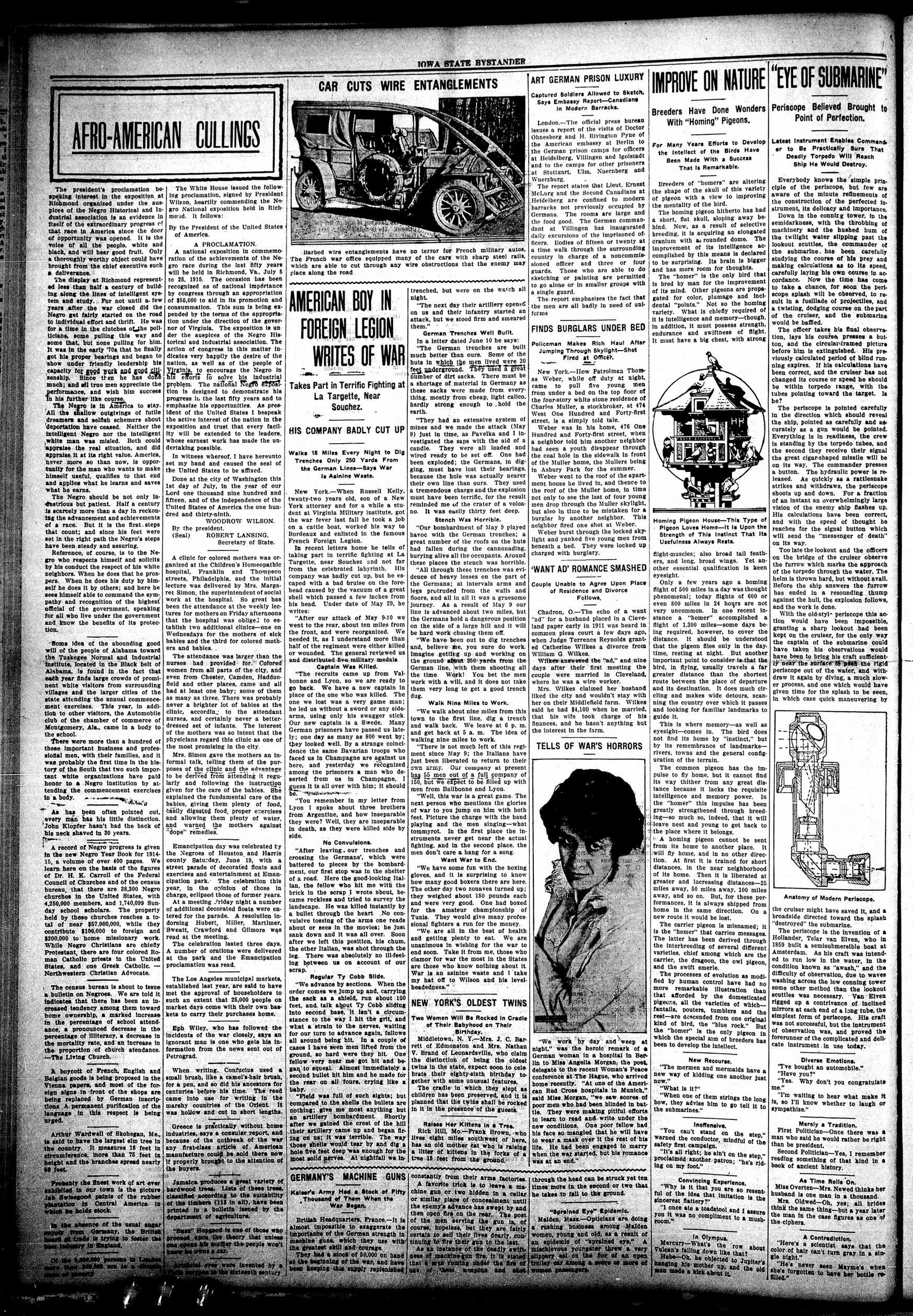
Harbed wire entanglements have no terror for French military autos. The French war office equipped many of the cars with sharp steel rails, which are able to cut through any wire obstructions that the enemy may place along the road.
AMERICAN BOY IN FOREIGN LEGION WRITES OF WAR
Takes Part in Terrific Fighting at La Targette, Near Souchez.
HIS COMPANY BADLY CUT UP
Walke 18 Miles Every Night to Dig Trenches Only 250 Vards From the German Lines—Says War Is Asinine Waste.
New York.—When Russell Kelly, twenty-two years old, son of a New York attorney and for a while a student at Virginia Military Institute, got the war fever, fall he took a job on a cattle boat, worked his way to Bordeaux and enlisted in the famous French Foreign Legion.
In recent letters home he tells of taking part in terrific fighting at La Taragette, near Souchez and not far from the celebrated labyrinth. His company was badly cut up, but he escaped with a bad bruise on the forehead caused by the vacuum of a great shell which passed a few inches from his head. Under date of May 29, he was wounded. "After our attack of May 8-10 we went to the rear, about ten miles from the front, and were reorganized. We needed it, as I understand more than half of the regiment were either killed or wounded. The general reviewed us and distributed five military medals
Captain Was Killed.
"The recruits came up from Valbonne and Lyon, so we are ready to go back. We have a new captain in place of the one who was killed. The one we lost was a very game man; he led us without a sword or any sidearms, using only his swagger stick Our new captain is a Swede. Many German prisoners have passed us late; one day as many as 800 went by; they looked well. By a strange coincidence the same Bavarian troops who faced us in Champagne are against us here, and yesterday we recognized among the prisoners a man who deserted from us in Champagne, I guess it is all over with him; it should be.
"You remember in my letter from Lyon I spoke about three brothers from Argentine, and how inseparable they were? Well, they are inseparable in death, as they were killed side by side.
No Convulsions.
"After leaving, our trenches and crossing the Germans', which were battered to pieces by the bombardment, our first stop was in the shelter of a road. Here the good-looking Italian, the fellow who hit me with the brick in the scrap I wrote about, became reckless and tried to survey the landscape. He was killed instantly by a bullet through the heart. No convulsive tossing of the arms one reads about or sees in the movies; he just sank down and it was all over. Soon after we left this position, his chum, the other Italian, was shot through the leg. There was absolutely no ill-feeling between us on account of our scrap.
Regular Ty Cobb Slide.
"We advance by sections. When the order comes we jump up and, carrying the sack as a shield, run about 100 feet, and talk about Ty Cobb sliding into second base, it isn't a circumstance to the way I hit the grit, and what a strain to the nerves, waiting for our turn to advance again, fellows all around be hit. In a couple of cases I have seen men lifted from the ground, so hard were they hit. One fellow very near me got hit and began to squeal. Almost immediately a second bullet hit him and he made for the rear on all fours, crying like a baby.
"Field was full of such sights; but compared to the shells the bullets are nothing; give me most anything but an artillery bombardment. Shortly after we gained the crest of the hill their artillery came up and began firing on us; it was terrible. The way those shells would tear by and dig a hole five feet deep was enough for the most solid nerves. At nightfall we in-
Kaiser's Army Had a Stock of Fifty
Thousand of Them When the
War Began.
British Headquarters, France — It is
almost impossible to exaggerate the
importance of the German strength in
machine guns, which they use with
the greatest skill and courage.
They had a stock of 50,000 on hand
for the war, and have been keeping this supply replenished
IOWA STATE BYSTANDER
ENTANGLEMENTS
no terror for French military autos,
any of the cars with sharp steel rails,
wire obstructions that the enemy may
trenched, but were on the watch all night.
"The next day their artillery opened on us and their infantry started an attack, but we stood firm and smear them."
German Trenches Well Built.
In a letter dated June 10 he says:
"The German trenches are built much better than ours. Some of the huts in which the men lived were 20 feet underground. They lived a great distance of dirt sacks. There must be a shortage of material in Germany as these sacks were made from everything, mostly from cheap, light calico, hardly strong enough to hold the earth.
"They had an extensive system of mines and we made the attack (May 9) just in time, as Pavelka and I investigated the saps with the aid of a candle. They were all loaded and wired ready to be set off. One had been exploded; the Germans, in digging, must have lost their bearings, because the hole was actually nearer their own line than ours. They used a tremendous charge and the explosion must have been terrific, for the result reminded me of the crater of a volcano. It was easily thirty feet deep.
Stench Was Horrible.
"Our bombardment of May 9 played havoc with the German trenches; a great number of the roofs on the buts had fallen during the cannonading, burying alive all the occupants. Around these places the stench was horrible. "All through these trenches was evidence of heavy losses on the part of the Germans; at intervals arms and legs protruded from the walls and floors, and all in all it was a gruesome journey. As a result of May 9 our line is advanced about two miles, but the Germans hold a dangerous position on the side of a large hill and it will be hard work chasing them off. "We have been out to dig trenches and, believe me, you sure do work. Imagine getting up and working on the ground shaking with them, with their booming the time. Work! You bet the men work with a work, and it does not take them very long to get a good trench dug.
Walk Nine Miles to Work.
"We walk about nine miles from this town to the first line, dig a trench and walk back. We leave at 6 p. m. and get back at 5 a. m. The idea of walking nine miles to work.
"There is not much left of this regiment since May 9; the Italians have just been liberated to return to their own army. Our company at present has 55 men out of a full company of 156, but we expect to be filled up with men from Ballonebone and Lyon. The next person who mentions the glories of war to you jump on him with both feet. Picture the charge with the band playing and the men singing—what tommyrot. In the first place the instruments never get near the actual fighting, and in the second place, the men don't care a hang for a song.
Want War to End.
"We have some fun with the boxing gloves, and it is surprising to know how many good boxers there are here. The other day two zonawas turned up; they weighed about 180 pounds each and were very good. One had boxed for the amateur championship of Tunis. They would give many professional fighters a run for the money. "We are all in the best of health and getting plenty to eat. We are unanimous in wishing for the war to end soon. Take it from me, those who clamor for war the most in the States are those who know nothing about it. War is an asinine waste and I take my hat off to Wilson and his level-headedness."
NEW YORK'S OLDEST TWINS
Two Women Will Be Rocked in Cradle of Their Babyhood on Their Birthday.
Middletown, N. Y.—Mrs. J. C. Barrett of Edmonton and Mrs. Nathan V. Brand of Leonardsville, who claim the distinction of being the oldest twins in the state, expect soon to celebrate their eighty-sixth birthday together with some unusual features. Their sleep as children has been preserved, as planned that the twins shall be rocked in it in the presence of the guests.
Raised Her Kittens in a Tree.
Rich Hill, Mo.—Frank Brown, who lives eight miles southwest of here, has an old mother cat who is raising a litter of kittens in the forks of a tree 15 feet from the ground.
constantly from their arms factories.
A favorite trick is to leave a machine gun or two hidden in a cellar or similar place of concealment until the enemy's advance has swept by and then open fire on the rear. The post of the men serving the gun in, of course, hopeless, but they are fairly certain to sell their lives dearly, continuing to fire their gun to the last.
As an instance of the deadly swiftness of machine gun fire, it is stated that a man coming under the fire of a car or two weapons and shot
ART GERMAN PRISON LUXURY
Captured Soldiers Allowed to Sketch Says Embassy Report—Canadians in Modern Barracks.
London.—The official press bureau issues a report of the visits of Doctor Ohnesberg and H. Bivington Pyne of the American embassy at Berlin to the German prison camps for officers at Heidelberg, Villingen and Igolstadt and to the camps for other prisoners at Stuttgart, Ulm, Nuernberg and Wuerzburg.
The report states that Lieut. Ernest McLorg and the Second Canadians at Heidelberg are confined to modern harracks not previously occupied by Germans. The rooms are large and the food good. The German commandant at Villingen has inaugurated daily excursions of the imprisoned officers. Bodies of fifteen or twenty at a time walk through the surrounding country in charge of a noncommissioned officer and three or four guards. Those who are able to do sketching or painting are permitted to go alone or in smaller groups with a single guard.
The report emphasizes the fact that the men are all badly in need of uniforms.
FINDS BURGLARS UNDER BED
Policeman Makes Rich Haul After Jumping Through Skylight—Shot Fired at Officer.
New York—How Patrolman Thomas Weber, while off duty at night, came to pull five young men from under a bed on the top floor of the four-story white stone residence of Charles Muller, a stockbroker, at 474 West One Hundred and Forty-first street, is a simply told tale.
Weber was in his home, 476 One Hundred and Forty-first street, when a neighbor told him another neighbor had seen a youth disappear through the coal hole in the sidewalk in front of the Muller home, the Mullers being in Asbury Park for the summer.
Weber went to the office of apartment house he leased and in thence to the roof of Muller home, in time not only to see the last of four young men drop through the Muller skylight, but also in time to be mistaken for a burglar by another neighbor. This neighborhood fired one shot at Weber.
Weer burst through the locked skylight and yanked five young men from beneath a bed. They were locked up charged with burglary.
'WANT AD' ROMANCE SMASHED
Couple Unable to Agree Upon Place of Residence and Divorce Follows,
Chadron, O.-The echo of a want "ad" for a husband placed in a Cleveland paper early in 1911 was heard in common pleas court a few days ago, when Judge Terrence Reynolds granted Catherine Wilkes a divorce from William G. Wilkes.
Wilkes answered the "ad," and nine days after their first meeting the couple were married in Cleveland, where he was a wire worker.
Mrs. Wilkes claimed her husband liked the city and wouldn't stay with her on their Middlefield farm. Wilkes said he $4,100 when he married, that his wife took charge of his finances, and he hasn't anything but the interest in the farm.
THE NEW YORK TIMES
"We work by day and weep at night," was the herocli remark of a German woman in a hospital in Berlin to Miss Angelina Morgan, the poet, delegate to the recent Woman's Peace conference at The Hague, who arrived home recently. "At one of the American Red Cross hospitals in Munich," said Mise Morgan, "we saw scores of poor men who had been blind in battle. They were making pitiful efforts to learn to read and write under the new conditions. One poor fellow had his face so mangle that he will have to wear a mask over the rest of his life. He had been engaged to marry when the war started, but his romance was at an end."
through the head can be struck yet ten times more in the second or two that he takes to fall to the ground.
"Sprained Eye" Epidemic.
Malen. Mass. Opticians are doing a rushing business among Malden women, young and old, as a result of an epidemic of "sprained eye." A Malden optician there there there, slippery on the floor of an open trooper cut among a more or more of women passengers.
IMPROVE ON NATURE
Breeders Have Done Wonders With "Homing" Pigeons.
For Many Years Efforts to Develop the intellect of the Birds Have Been Made With a Success That is Remarkable.
Breeders of "homers" are altering the shape of the skull of this variety of pigeon with a view to improving the mentality of the bird.
The homing pigeon hitherto has had a short, flat skull, sloping away behind. Now as a result of a selective breeding, it is acquiring an elongated cranium with as rounded dome. The improvement of its intelligence accounted by this means is declared to be surprising. Its brain is bigger and has more room for thoughts.
The "homer" is the only bird that is bred by man for the improvement of its mind. Other pigeons are propagated for color, plumage and incidental "points". Not so the homing variety. What is chiefly required of it is intelligence and memory—though, in addition, it must possess strength, endurance and swiftness of flight. It must have a big chest, with strong
Homing Pigeon House—This Type of Pigeon Loves Home—It is Upon the Strength of This Instinct That Its Usefulness Always Rests.
flight-muscles; also broad tail feathers, and long, broad wings. Yet another essential qualification is keen eyesight.
Only a few years ago a homing flight of 600 miles in a day was thought phenomenal; today flights of 600 or even 800 miles in 24 hours are not very uncommon. In one recent instance a "homer" accomplished a flight of 1,300 miles—some days being required, however, to cover the distance. It should be understood that the pigeon flies only in the daytime, resting at night. But another important point to consider is that the bird, in flying, usually travels a far greater distance, than the shortest route between the place of departure and its destination. It does much circling and makes wide detours, scanning the country over which it passes and looking for familiar landmarks to guide it.
This is where memory—as well as eyesight—comes in. The bird does not find its home by "instinct," but by its remembrance of landmarks—rivers, towns and the general configuration of the terrain.
The common pigeon has the impulse to fly home, but it cannot find its way thither from any great distance because it lacks the requisite intelligence and memory power. In the "homer" this impulse has been greatly strengthened through breeding—so much so, indeed, that it will leave nest and young to get back to the place where it belongs.
A homing pigeon cannot be sent from its home to another place. It will fly home, and in no other direction. At first it is trained for short distances, in the near neighborhood of its home. Then it is liberated at greater and increasing distances—25 miles away, 50 miles away, 100 miles away, and so on. But, for these performances, it is always shipped from home in the same direction. On a new route it would be lost.
The carrier pigeon is misnamed; it is the "homer" that carries messages. The latter has been derived through the interbreeding of several different varieties, chief among which are the carrier, the dragon, the owl pigeon, and the swift smerle.
The processes of evolution as modified by human control have had no more remarkable illustration than that afforded by the domesticated pigeons, all the varieties of which—fantails, pouters, tumblers and the rest—are ascended from one original kind of bird, the "blue rock." But the "homer" is the only pigeon in which the special aim of breeders has been to develop the intellect.
New Recourse.
"The mermen and mermals have a new way of kidding one another just now."
"What is it?"
"When one of them strings the long bow, they advise him to go tell it to the submarines."
**Inoffensive.**
"You can't stand on the step," warned the conductor, mindful of the safety first campaign.
"It's all right; he ain't on the step," proclaimed another patron; "he's riding on my foot."
**Convincing Experience.**
"Why is it that you are so resentful of the idea that imitation is the sincerest fattery?"
"I once ate a toadstool and I assure you it was no compliment to a mushroom."
In Olympus.
Mercury-What's the row about woman's falling down like that? Huh, he objected to Jupiter's hanging his mother up, and the old man made his sark about it.
Periscope Believed Brought to Point of Perfection.
Latest Instrument Enables Commander to Be Practically Sure That Deadly Torpedo Will Reach Ship He Would Destroy.
Everybody knows the simple principle of the periscope, but few are aware of the minute refinement of the construction of the perfected instrument, its delicacy and importance.
Down in the comfrey tower, in the semidarkness, with the throbbing of machinery and the hushed hum of the twilight water slipping past the lookout scuttles, the commander of the submarine, has been carefully studying the course of his prey and making calculations as to its speed, carefully laying his own course in accordance. Now the time has come to take a chance, for soon the periscope splash will be observed, to result in a fusilade of projectiles, and a twisting, dodging course on the part of the cruiser, and the submarine would be baffled. The officer has his final observation of his course, presses a button, and the circulum-raimed picture before him is extinguished. His previously calculated period of blind running expires. If his calculations have been correct, and the cruiser has not changed its course or speed he should be within torpedo range, with the tubes pointing toward the target. Is he?
The periscope is pointed carefully in the direction which should reveal the ship, pointed as carefully and accurately as a gun would be pointed. Everything is in readiness, the crew is standing by the torpedo tubes, and the second they receive their signal the great cigar-shaped missile will be on its way. The commander presses a button. The hydraulic power is released. As quickly as a rattlesnake strikes and withdraws, the periscope shoots up and down. For a fraction of an instant an overwhelmingly large vision of the enemy ship flashes up. His calculations have been correct, and with the speed of thought he reaches for the signal button which will the "messenger of death" on its way. Too late the lookout and the officers on the bridge of the cruiser observe the furrow which marks the approach of the torpedo through the water. The helm is thrown hard, but without avail. Before the ship answers the furrow has ended in a resounding trump against the hull, the explosion follows, and the work is done.
With the old-style periscope this action would have been impossible, granting a sharp lookout had been kept on the cruiser, for the only way the captain of the submarine could have taken his observations would have been to bring his craft sufficiently close to the surface 65 knots the right way. He would draw it again by diving, a much slower process, and one which would have given time for the splash to be seen, in which case quick maneuvering by
Anatomy of Modern Periscope.
the cruiser might have saved it, and a broadside directed toward the splash "destroyed" the submarine. The periscope is the invention of a Hollander, Telar van Elven, who in 1898 built a semisubmarine boat at Amsterdam. As his craft was intended to run low in the water, in the condition known as "awash," and the difficulty of observation, due to waves washing across the low conning tower some other method than the lookout scuttles was necessary. Van Elven rigged up a contrivance of inclined mirrors at each end of a long tube, the simplest form of periscope. His craft was not successful, but the instrument of observation was, and proved the forerunner of the complicated and delicate instrument in use today.
Diverse Emotions
"Yes. Why don't you congratulate me."
"I'm waiting to hear what make it is, so I'll know whether to laugh or sympathize."
Merely a Tradition.
First Politician—Once there was a man who said he would rather be right than be president.
Second Politician—Yes, I remember reading something of that kind in a book of ancient history.
As Time Lies On.
Miss Overten—Miss. Newed thinks her husband is one man.
Mrs. Oldwed-On, yes; all brides think the same thing—but a year later the man in the case figures as one of the cliphers.
A Contradiction.
"Here's a scientist, says that the color of hair can't turn gray in a single night."
"He's never seen Maymee's when she's forgotten to have her bottle re-filled."
322
BEST FORM OF POULTRY HOUSE
Provides for Comfort of the Fowls and Makes Work of Caring for Them Easy.
AMPLE SUPPLY OF SUNSHINE
Perfect Ventilation One of the Main Ideas In the Mind of the Designer
—All Furniture Constructed
So That Its Removal is an Easy Matter.
By WILLIAM A. BADEFORD
Mr. William A. Radford will answer questions and give advice FREE OF CHARGE in all suburbs situated in the subject of building work on the farm, for the readers of this paper. On account of the manufacturer, he is, without doubt, the highest authority on all these subjects. The manufacturer, Radford No. 101, Prairie avenue, Radford No. 101, Prairie avenue, Chicago, and only include two cent stamp for reply.
Poultry houses naturally belong on farms, in villages and in the suburbs of large cities. They are made in many different ways, from the cheapest hovels to fancy architectural designs costing considerable money. Really successful poultry raisers seldom build expensive, but they are particular to have everything neat and right in connection with the building and the furniture therein.
Success with poultry depends upon comfort for fowls, which includes cleanliness. Comfort is provided by building a good poultry house the right size to accommodate the flock in warm, well-ventilated quarters that may be easily kept clean and free from chicken insects.
When pure-bred poultry is housed in a building that is properly con-
A 32D x
is reduced to a pleasure, and the expense is less than when all sorts of makeshift sheds are used for the housing. Good, well-built buildings are labor savers to as great an extent as the much-advertised labor-saving machinery. In this sense a poultry house so thoroughly well built that it may be kept clean with half the work is a labor-saving device just as much as a so-called labor-saving machine. The expression, labor-saving farm buildings, means that labor-saving applications have reached new possibilities of application because of greater knowledge of construction and equipment. Such buildings include poultry houses.
A style of poultry house that is liked in many sections of the middle West is shown in the accompanying perspective and floor-plan illustrations. It is 24 by 18 feet in size, built with a good concrete foundation which extends a foot or so above the level of the ground. Above the foundation wall the poultry house is built in the usual way by using 2 by 4 studding covered with building paper and clapboards. On the inside the studding
24.5°
ROOSTS
NESTS UNDER DROPPING BOARD
SCRATCHING FLOOR
Floor Plan.
are covered with building paper and matched ceiling boards without beading. The ceiling boards are driven close to prevent wide cracks.
After the house is finished it is thoroughly painted outside and inside. The paint is carefully rubbed into all cracks and crevices and rough places in the woodwork. Successful poultry raisers understand the necessity for special care in this particular.
The idea of placing the windows high up is to let the sunshine into the back part of the house during the early spring weeks when sunshine is so greatly appreciated by all kinds of live stock, especially poultry. These windows are blinded at the top. There is a cord attached to the bottom of each window, which runs over a plexiglass attached to the ceiling, so the window may be pulled open for air ventilation.
Ventilation is supplied regularly and continuously in winter by covering the lower front openings with thin cotton or muslin instead of glass. This is the most natural and satisfactory way of letting fresh air into the poultry house in winter, and it works well summer.
The air enters under the low root and follows the slant of the roof back to the roosting quarters of the cow. So the air enters to keep up the heat so that the air in a poultry
house built like this and filled to the limit with poultry, in always in good condition. The droppings board is not fastened in place. It rests on cleats and fits close against the ends and back of the building so that no draft can come up from underneath. Fresh air must come up along the roof slat directly from the ventilated openings in the front of the house. As the air loads up with impurities it becomes heavier and settles to the floor, and gradually finds its way out through the lower part of the front openings. The circulation of air may be modified by the force of strong winds at times, but the practical working of this sort of ventilation is the nearest right of anything that has ever been applied to the ventilation of the houses.
The droppings board has two legs in front to keep the board level and even. The roots are supported on standards set on top of the droppings board, and the nests are fastened underneath the droppings board. This arrangement leaves the floor of the house free for litter.
All of the house furniture is constructed for easy removal to be carried outdoors for cleaning—a very necessary operation in connection with a poultry house.
The feeder hoppers for holding grit, charcoal and ground oyster shell are hung against the sides of the building. These hoppers have hinged covers that drop down at an angle of about 45 degrees to prevent chickens from roosting on the tops of the hoppers.
Water fountains are hung from the ceiling by means of wires. The fountains have cone-shaped tops to ward off roosting wires, so that the only perches left in the front part of the house are the edges of dust-bath boxes, which are suspended like the fountains to keep them off the floor. Dust boxes may be partially protected by using a great many hanging wires hitched to a center ring.
When a feeder trough is used to feed mashes it may be constructed to keep the fowls off the center partition by inserting round rods 1/4 inch in diameter and 8 or 10 inches long, so
THE HOME OF THE HERITAGE CENTER
they stand upright. The top ends of these rods should be made smooth so as not to tear the skin of fowls when they fly up to find a foothold. It is natural for poultry to roost, so they cannot be blamed for this propensity of theirs. Their feet are constructed by nature to grasp the limb of a tree, and they feel more comfortable when they have something in their claws. Keeping straw a foot deep on the floor of the poultry house provides the best possible means to gratify this natural desire.
Potato Trea
Great ignorance prevailed in parts of the United States about the potato even in recent years. In a railroad coach sat two men on a journey to the Pacific coast. The train passed through a potato section, and one of these men remarked to his companion: "What a fine field of potatoes?" Said the other: "Oh, no, you can't stuff me with that. Potatoes grow on trees just the same as pears and other such fruit. Going to the state university of Ala. to see them growing, and to the sort of tree it is." The fellow replied: "Well, all I know is, when traveling here last time someone said, 'What a field of potatoes.' Perhaps you are right, Bill; they must grow on trees; some country bumpkins tried to fool me."
Sneeze Affects Entire Body.
Will a bright light cause you to sneeze? It does some people, just as do dust, flower pollen and cold. Dust and pollen cause irritation in the nostrils and the sneeze is nature's way of stopping the irritation, by violently removing the irritant. The sneeze from cold, however, is a different process on the part of mother nature. While the dust or pollen sneeze is confined to the nose, the cold sneeze is an act of the entire body and the nose is simply the scene of the explosion. When the body is unduly cold, it makes a spasmic effort to warm the system and thus jerks up every muscle. The act culminates in the nose.
Arduous Task.
Waverly—What has become of Penelope, your attractive friend?
Marcella--She has been in a bad way for some time.
"Not ill, I hope?" "Rather. You see, she was voted the prettiest girl in town at a carnival contest a few months ago, and she now is a star from tryouts to live up to her reputation." Yqungstown Telegram.
Financial Item
In spite of the demand, gold is only growing cheaper, and should soon be within the reach of all. Where last year one gold dollar commanded in the open market the price of three dozen eggs it might have been worth more. Quarter, if you have a surplus of eggs on hand now is the time to lay in your gold for next winter.
ARMORED CARS FOR PERSIAN GULF REGION
These armored cars, made for the use of the British troops in the Persian gulf region, are of light construction and wide tread, especially designed for desert work.
GIVE ALL TO FRANCE
saying for their country's sake they have parted with their treasure.
In addition to equivalent value in
BIG EDIFICE RUINED
Rich and Poor Turn Over Hoarded Treasure.
Peddler and Seamstress Lead Great Line of Patriots Bringing Gold to Maintain Nation's Credit
Paris—Since the Bank of France opened special counters in Paris to receive the people's hoarded gold a few days ago the yellow coins have continued to flow in an uninterrupted stream. Depositors exchanged gold for bank notes in the first four days in Paris to the extent of $3,000,000. No reports from the provinces have been made out.
Capitalists went to the bank in automobiles, taking little bags of gold to strengthen the credit of France and help in the national defense. In the early morning hours working men and small employers hurried in or the way to their labor to hand in Lei jealously preserved savings.
First to respond to the call for more gold were a street lemonade seller who brought two napoleons wrapped in a big rag, and a little seamstress, who proudly gave her solitary coin.
All who take gold to the bank get in return a receipt slip as a souvenir.
SEES MOTHER FIRST TIME
THE WOMEN'S SOCIETY
Misa, Tomasya Carlyle, the student whose sight has been almost miraculously restored, is here pictured taking a happy look at her mother's face, which for a lifetime of twenty-five years she had been deprived of seeing.
The almost miraculous restoration of the sight of Miss Carlyle as she sat on the deck of the steamer "Bear" en route from San Pedro to San Francisco. Cal., is the topic of much discussion among scientists. But the girl herself valves aside all technical inquiry in the joy of actually seeing things for the first time in her life. Born blind at La Crosse, WIs., the youngest of nine children, Miss Carlyle attended a kindergarten and later graduated at the Wisconsin State School for the Blind. Against many protests she entered and took her diploma from the La Crosse State Northern University, a college she has been tutoring blind children, making enough money thereby to enter the University of California. Now she can see and intends to devote her life to blind children who may never be so fortunate as she now is.
"I am in a new universe," she declared, "one in which my eyes are not yet able to convey definite impressions to my brain, because my brain does not yet know just what the pictured scenes really mean. Things are pictured so differently to the blind eye from what they really are. Yesterday I saw some small living thing coming toward me, and I did not know what it was until I touched it—then I knew it was a dog."
They Kill Three Snakes With Which a Trout Run Man Was Battling.
Clearfield, Pa.—Permitted to roam through the woods at will, several plugs belonging to Henry Smith, a wealthy farmer near Trout Run, developed a great dislike for snakes.
Recently when Smith, while trying to kill two rattlesnakes and a blacksnake, which were fighting, was at
IOWA STATE BYSTANDER
CARS FOR PERSIAN GU
the use of the British troops in the Pers
need for desert work.
saying for their country's sake they have parted with their treasure.
In addition to equivalent value in paper money the Bank of France can issue legally three bank bills of $20 for every $20 in gold. When Finance Minister Ribot asked the governor of the Bank of France to open special gold-receiving offices in Paris and its provincial branches, M. Malin already had taken steps to this end. In addition, many competent quarters have to the estimate that gold money held privately in France amounts to $700,000,000 or nearly $80,000,000 less than the total gold reserve now at the Bank of France.
Few of the depositors say: "I wish to exchange gold," or, "I wish to pay in gold." All make the simple remark: "I bring gold."
Rich and poor alike are conscious they are taking gold, not to the bank, but for France.
It would be a mistake for the public to imagine that it is making a sacrifice in exchanging gold for notes, since the gold is unemployed and therefore unprofitable. The bank is naturally anxious to keep as large a reserve as possible so as to maintain fully the credit of its paper issues and at the same time enable the government to pay for supplies from abroad in gold. Another reason why the government wishes the nation's gold to be held in the strong hands of the bank is to prevent it from being withdrawn privately under false pretenses to find its way to the enemy by trickery. Germany and Austria are in desperate straits financially, and are ready to adopt the most deceitful practices to get gold.
WOULD "UNIONIZE THE MONK"
Court Fines Organ Grinder for Over
time and Cruelty to Hia Trained
Palo Alto, Cal.-At the instigation of Mrs. Isabelle C. Merriman, humane officer, John Sampori, Italian organ grinder, was arrested for alleged cruelty to a trained monkey.
Mrs. Merriman claimed that the monkey was jerked violently about in the hot sun and compelled to work 14 hours a day.
Evidence presented showed that Sampori had obtained a license from the city authorities and treated his dog kindly, but the Italian was unable to prove that he did not make "Jocko" work from seven o'clock in the morning until eight at night; with an internmission of only two hours for rest.
Justice Charles imposed a $10 fine upon the organ grinder for not having unionized the monkey's hours of labor.
SINGS TO HER DEAD BABY
Child Had Drowned In Four Inches of
Water In Another Room.
New York.-Mrs. Bernard Morris of 2376 Eighth avenue left her son Philip, fifteen months old, and her daughter Helen, two years old, lying in four inches of water in the bath tub while she went into another room. In a few moments she heard the little girl scream. Rushing into the bathroom, she found the baby floating face downward in the water. Thinking the baby had only turned over, the mother dried him carefully and put him in his cradle. For several minutes she sang and rocked the baby, and then, being he was quiet, she put her hand on the child's face. It was cold. Doctor Rosenbluth of the Harlem hospital, who was summoned, said the child was drowned.
POODLE FED ON $2 STEAKS
Mrs. John Jacob Asteri Pet Dog Consumes Big Actor's Pieces
New Haven, Conn.-Walters at a local hotel told of the visit of Mrs. John Jacob Astor, formerly Miss Madeleine Force, on an automobile trip into New England. With Mrs. Astor was her pet poodle Mizzie, and inasmuch as she was unable to retain the dog at the hotel where she stopped, she sent Mizzie to another hostelry in care of the chauffeur. The waiters were not surprised when the chaucher ordered a $2 stink coat he had announced that it was to be cut up for Mizzie the servant man stood aghast. He complied with the order, nevertheless. Mizzie consumed the steak with the usual canine celerity and the waiter pocketed a good tip.
tacked by all three reptiles, his hogs, feeding a short distance away, heard the noise and, coming to his aid with their sharp hoofs and tanks, tore the snakes into shreds and devoured them. The rattlesnakes, according Smith, measured three feet in length. The blacksnake was the largest ever seen in this section.
Steals Onions and 'Kerchiefs, Huntington, Ind.—Mrs. Rosanna C. Tatman reported to the police that her home had been visited by a thief,
Great Cathedral at Soissons Wrecked by German Shells.
Teuton Missiles Leave it a Venerable Broken Twelfth Century Monument of Desolation — Town Is Practically Deserted.
Paris—I made a flying visit to Soleys cathedral—or, rather, what is now left of this superb twelfth century edifice. I found the venerable Abbe Landals, vicar of the parish, standing broken-hearted amid the heaps of ruins, now and then seeking with trembling hards for a fragment of the ancient stained glass window given by Blanche de Castille, but now lying shattered in piles of broken masonry, wreckage and dust.
In the rooftops near three oglal doors, once the pride of Romanesque architecture, Abbe Landais greeted me with these words:
"This is a terrible misfortune. Not a single pane of the beautiful stained glass of the rosace windows nor of the side windows remains. It was only last Tuesday that an exquisite rosace, with its 12 rayons forming part of a tympanum of large stained glass, a structure of four divisions, was unharmed; but on Tuesday morning a German projectile smashed to atoms this last relic of the stained glass.
"The masterpieces of stained glass art were the crimson and blue portraits of Saint Louis and of Jeanne d'Arc in kneeling postures. These were demolished this week." As one approaches Soissons posted notices announce "Road repaired. Proceed only at a walking pace. Make no dust." This reminds the visitors that the Germans are intrenched 700 yards away, on the right bank of the River Alane, and they keep up a constant fire on Soissons, on the cathedral and on the ruins of the ancient abby of Saint Jean des Vignes, where Thomas a Becket lived for nine years. The town of Soissons is deserted, except for a dozen inhabitants, who prefer to live in the cellars—all that is left of their houses.
The cathedral is a mere skeleton of massive arched buttresses which support nothing except shell-pierced walls. As one stands in what was once the nave the clear, open sky is seen and encrusted with the scars of ruins. The famous antique portal on the south side no longer exists. The south tower and the spire stand as a sort of rugged, fragmentary monument of desolation.
BURIAL IS STOPPED BY LAW
Woman Gets Injunction to Prevent Interment of Her Uncle in Chelsea (Mass.) Cemetery.
Boston. Mass.—Injunction proceedings to prevent the burial of her uncle, Arthur G. Norse, at the naval cemetery in Chelsea, Mass., because it will cause her grief, humiliation and an irreparable loss if his interment takes place there, have been begun in the equity session of the superior civil court of Suffolk county by Helen V. Pearson of Philadelphia.
She asks possession of the body "for proper burial in a proper ground." Her action is aimed against George Lee of Boston and George Doherty of Somerville as defendants.
Lee, she says, engaged Doherty, an undertaker, to bury her uncle's body without consulting her. The grave has been prepared at the naval cemetery.
Judge McLaughlin ordered counsel to complete pleadings for a hearing.
WATCH. GONE YEARS. FOUND
Lost in 1911, Found in 1915 in Feed Vard With Wear Only Slightly Dented, Dented.
Klamath Falls, Ore.—During the summer of 1911 Clarence Motchenbacher of this city, then a recent graduate from the high school here, lost his seventeen-jewel gold hunting case illinois watch and fob while working in the hay field in the Ezell stock farm, south of this city.
The watch and fob were found the other day in the feed yard on the Ezell farm by one of the workmen. Motchenbacher's name was on the fob.
When found the case was slightly dented and three jewels broken.
who took only onions. The onions were so hot that he took two of Mrs. Tatman's handkerchiefs from a freshly dried washing to wipe the tears from his eyes while he ate them. The maruder left parts of the onions and the handkerchiefs in the house.
Walsh 42 Years to West.
Harrisburg, Pa.—John A. Snyder, a Harrisburg letter carrier, who is sixty years of age, has left for Los Angeles, where he will marry Mary C. Stamler, formerly of this county.
The KITCHEN CABINET
---
The heart is not always a royal mint, with patent machinery to work its magic. The heart throws out in strange form, not easily recognized as coin at alm - Dickens.
SUMMER DESSERTS.
A dalinity summer dessert is made of one-half cupful of peanuts, one cupful of mashed banana and half a cupful of grated coconut. Arrange on a small plate and pour orange juice over the mixture.
VINE
Fruit Foam
**Fruit Frozen**
Take a half box of gelatin, cupful of water, two and a half cupfuls of fruit juice and three eggs. Soak the gelatin in cold water until dissolved; heat the fruit juice, which may be strawberry, raspberry or any other fruit, pour over the gelatin, sweeten to taste, stir all together and strain and cool. Beat the whites of the eggs stiff, beat in the jelly until it is foamy, pour into a mold that has been wet and serve with whipped cream. Prepare in time for the gelatin to thicken before using. The day before using is better.
**Muskelton Frope.**—Remove the tops from small muskeltones to form a cover. Take into the seeds and membrane and place in a sieve to drain out at the juice. Scoop out the flesh and the yolk as easily removed and cut it in small pieces. To the juice add a quart of sweetened whipped cream; turn this into a freezer and freeze. Serve in the melon shells, a layer of frape and a layer of the melon pulp.
Jellied Apples.—Wash, pare, quarter and core six tart apples. Take two cupfuls of sugar and the same amount of water, boil until a thick stirup is formed. Drop the apples into this boiling sugar and cook until clear and tender, taking care to keep their shape. When tender, skim out, place on a platter to cool and measure and strain the stirup; there should be a haf' pint. Take a package of lemon jello, dissolve in two-thirds of a cupful of hot water, add to the hot stirup, pour over the apples and into a mold. Serve on a platter, garnished with whipped cream.
SOME NEW WAYS WITH MEATS
The seasoning of meat sauces,
meats and combinations of meat and
vegetables is one of the
most important points in
culinary art. The careless,
haphazard seasoning
ruins an otherwise
appetizing and whole-
some dish. Ruskin says
"much tasting means no
wasting," so the skillful
cook seasons, tastes and
seasons again until the
vegetables is one of the most important points in culinary art. The careless, hapaxhard seasoning ruins an otherwise appetizing and whole some dish. Funkin' says "much tasting means no wasting," so the skillful cook seasons, tastes and seasons again until the right blending is obtained.
Southern Hash—Put six potatoes, two onions, three green peppers and two large tomatoes all through a meat chopper. Melt four tablespoonfuls of butter in a frying pan, add the vegetables, with a cupful of soup stock and cook until the vegetables are done, keep covered and stir occasionally to prevent sticking. Add two cupfuls of chopped meat, (cold roast beef is best), season well with salt a dash of kitchen bouquet and serve hot with toast points.
Baked Fish—Place a slice of onion and lemon inside a well cleaned fish, ready for baking. Brush well with butter and bake in a moderate oven, basting occasionally with butter and water. Meanwhile cook one cupful of sliced tomato with a cupful of boiling water, a slice of onion, carrot, celery and a sprig of parsley, a bay leaf, a half dozen cloves, salt and pepper, for twenty minutes. Make a sauce, using three tablespoonfuls each of butter and flour, add the strained tomato, a fourth of a teaspoonful of kitchen bouquet, and the same amount of soda. Place the fish on a hot platter, garnish with lemon quarters, dipped in minced parsley, add a half cupful of thin cream to the sauce and strain around the fish.
Ragout of Veal. The cheaper cut may be used for this dish. Stew the meat until very tender with onion, parsley, a fourth of a cupful of vinegar and a bay leaf. Remove from the bone while warm. When cool, cut in pieces for serving, roll each in seasoned flour and brown in hot fat. For the sauce, use a fourth of a cupful each of four ounces of stock, a half teaspoon of Worcestershire sauce, a tablespoon of lemon juice and three of garlic salad.
Lending to Farmers.
Texas bankers who make a practice of lending money to farmers have adopted for their own protection and for the guidance of borrowers, what is known as a "crop rate sheet for safe farming and bank credit." Taking a 40-acre, two-horse farm as a unit, this sheet states the live stock and the quantity of food and feed crops necessary to support on such a farm a family of five. The prospective borrower is requested to state in the same way the actual system
Electrical Measuring Instruments.
Circular No. 30, recently issued by the bureau of standards at Washington, describes the operating principles of electrical instruments and for commercial measurements, including amps, voltmeters and wattmeters. It gives such information on the errors of instruments as will assist those who use them to obtain the most accurate results in any given case. Other related subjects are treated as follows: Current and voltage transformers, which make it possible to measure
It pays to stick to one thing. Only those persons in whose lives some great purpose outweighs every other, like above, shoulders of the crowd. The man who minds his own business will soon have a business to mind.
DINNER DISHES FOR COMPANY.
Cut a well cleaned chicken into pieces at the joints, cover with hot veal broth and let cook until tender. Cook a half cupful of rice, two dozen potato balls and a dozen small onions separately until nearly done, drush and add the chicken to a small string beans, rinsed in boiling water. Let simmer about ten minutes when all
veal broth and let cook until tender. Cook a half cupful of rice. two dozen potato balls and a dozen bell peppers separately until nearly done, drink and add the chicken with a can of small string beans, rinsed in boiling water. Let simmer about ten minutes when all should be done. Prepare about a dozen and a half small baking powder biscuit. Turn the chicken on a large platter and surround with the hot biscuit.
Martinique Potatoes—Scoop out the inside of four hot, baked potatoes and force through a potato rice. Add one and a half teaspoonful of butter, the yolk of an egg, three tablespoonfuls of cream, a half teaspoonful of salt, a dash of pepper and nutmeg. Keep hot and beat three minutes, then add a well beaten white of egg. Shape between two tablespoonfuls and place on a buttered sheet to brown delicately.
French Lemon Jelly—Rub the peel of three lemons upon half a pound of loaf sugar and dissolve the sugar in two cupfuls of water. Boll until reduced, add the strained juice of the lemons, two cupfuls of water and the juice of an orange. Pour it upon two well beaten eggs and whip well. Then add two teaspoonfuls of gelatin, dissolved in a little boiling water to soften. Pour into a wet mold after being well blended and serve with whipped cream sweetened and flavored with lemon and orange.
Fish Savory—Cut two small onions in slices and Try lightly in two tablespoonfuls of butter. Add a half pound of cold, cooked fish, cut in small pieces, sprinkle with a tablespoonful of flour and fry a light brown. Dredge with one teaspoonful of curry powder. Fry a little longer and add another tablespoonful of four. Moisten with four tablespoonfuls of cream, and half a cupful of stock, season with salt, mixed spices and cook for half an hour, then add two tablespoonfuls of lemon juice.
Dish up and garnish with parsley and toast points.
Some happy talent, and some fortunate opportunity may form the two sides of a men mount, but the rounds of that ladder must be made of stuff to stand wear and tear. -Dickena.
SUMMER DISHES.
SUMMER DISHES.
There is no desertest more popular than the frozen one, in fact almost any
sort more popup
in fact almost any
combination is welcome
after it has
been through the
freezer.
```markdown
```
Orange Sherbet.—Beat one egg lightly, add to a quart of milk, and a pint of cream. Dissolve two and a half cupfuls of sugar in the juice of three oranges and one lemon. Add the grated rind of three oranges and one lemon, mix and freeze.
Lemon Dumplings—Chop the rind of one lemon fine, add it to the juice, mix two cupfuls of bread crumbs with a cupful of suet, add one egg and enough milk to make a paste, sweeten to taste, divide into five portions and place in separate cloths. Boil three quarters of an hour and serve with butter and honey.
Individual Cream Chicken—Take a tablespoonful of minced chicken, season with a pinch of minced parsley and a squeeze of lemon. Season with salt and pepper and moisten with a spoonful of cream. Put into a ramen, cover and steam in hot water. Serve on a hot plate with crisp buttered toast and small pads of sweet butter rolled in parsley.
Gooseberry Dessert.—Cook slowly a quart of gooseberries with a cupful of brown sugar in a stone dish in the oven. Arrange slices of sponge cake in a dish, pour over the cooked berries a custard made of a cupful of milk, an egg, a pinch of salt and a tablespoonful of sugar. When cold cover with sweetened whipped cream, sprinkle with chopped pistachio nuts and serve well chilled.
Nellie Maxwell
followed on his own farm. The closer the actual practice approaches the system outlined in the rate sheet the better is the farmer's credit.
Unintentional Criticism
"You were not at the theater yesterday when the first representation of your new piece took place."
"I was kept away by an important engagement."
"Indeed! (kindly) Well, you didn't miss anything!"—Flegende Blaetter (Munich).
uure currents so large and voltages so high as to be on the range of ordinary instruments; standard apparatus by which ordinary instruments may be checked; and some notes on the design of electrical instruments.
What Landed Him There.
"My good man, what are you in prison for?"
"My convictions."
"Your convictions?"
Yes, mum. If the jury had acquit me, I wouldn't be here."
AFRO-AMERICAN CULLINGS
The president's proclamation be speaking interest in the exposition at Richmond organized under the auspices of the Negro Historical and Industrial association is an evidence in itself of the extraordinary progress of that race in America since the door of opportunity was opened. It is the work of all the people, white and black, that goes on, given a thoroughly worthy object could have brought from the chief executive such a deliverance.
The display at Richmond represented less than half a century of building along the lines of intelligent system and study. For not until a few years after the war closed did the Negro get fairly started on the road to individual effort and thrift. He was for a time in the clutches of the politicians, some pulling this way and some that, but none pulling for him. It was in the early '70s that he finally got his proper bearings and began to show under friendly leadership his capacity for good work and good citizenship. Since then he has done much; and all true men appreciate the performance, and wish him success in his further like course.
The Negro is in America to stay. All the shallow outgivings of futile dreamers and selfish schemers about deportation have ceased. Neither the intelligent Negro nor the intelligent white man was misled. Both could appraise the real situation, and did appraise it at its right value. America, never more so than now, is opportunity for the man who wants to make himself useful, qualifies to that end and applies what he learns and saves himself. The Negro should be not only industrious but patient. Half a century is scarcely more than a day in reckoning the advancement and achievements of a race. But it is the first steps that count; and since his feet were set in the right path the Negro's steps have been steady and assuring.
Reference, of course, is to the Negro who respects himself and solicits by his conduct the respect of his white neighbors. When he does that he prospers. When he does his duty by himself he does it by others; and here he sees himself able to command the sympathy and recognition of the highest official of the government, speaking for all who live under the government and know the benefits of its protection.
Bona idea of the abounding good will of the people of Alabama toward the Tuskegee Normal and Industrial Institute, the Black belt of Alabama, is found in the fact that each year finds large crowds of prominent white visitors from surrounding villages and the larger cities of the state attending the annual commencement exercises. This year, in addition to other visitors, the Automobile club of the chamber of commerce Montgomery, Ala., came in a body to the school.
There were more than a hundred of these important business and professional men, with their families, and it was probably the first time in the history of the South that two such important white organizations have paid honor to a Negro institution by attending the commencement exercises in a body.
As has been often pointed out, every man has his little distinction. John Klopfer hasn't had the back of his neck shaved in 30 years.
---
A record of Negro progress is given in the new Negro Year Book for 1914-15, a volume of over 400 pages. We learn here on the basis of the figures of Dr. H. K. Carroll of the Federal Council of Churches and of the census bureau that there are 38,300 Negro churches in the United States, with 42,500 members, and 1,740,099 Sunday school scholars. The property by these churches reaches a total of near $75,000,000, while they receive $160,000 for foreign and $200,000 for college education. While Negro Christians are chiefly Protestant, there are four colored Roman Catholic priests in the United States, and one Greek Catholic. Northwestern Christian Advocate.
The census bureau is about to issue a bulletin on Negroes. We are told it indicates that there has been an increased tendency among them toward home ownership, a marked increase in the percentage of school attendance, a pronounced decrease in the percentage of illiteracy, a decrease in the mortality rate, and an increase in the proportion of church attendance. —The Living Church.
A boycott of French, English and Belgian goods is being proposed in the Vienna papers, and most of the foreign signs in front of the shops are being replaced by German inscriptions. A permanent purification of the language in this is being urged.
Arthur Wardwell of Skohegan, Me, is said to have the largest elm tree in the country. It measures 18 feet in circumference, more than 75 feet in height and the branches spread nearly 60 feet.
Probably the finest work of art ever exhibited in our town is the picture Jab Swissgood paints of the rubber plantation in Central America in which he holds stock.
In the absence of the usual sugar supply from Germany, the British board of trade is trying to foster the best industry in England.
Of the 5,000,000 persons in London more than 300,000 are in a chronic state of poverty
The White House issued the following proclamation, signed by President Wilson, heartily commending the Negro National exposition held in Richmond. It follows:
By the President of the United States of America.
A. PROCLAMATION
A national exposition in commemoration of the achievements of the Negro race during the last fifty years will be held in Richmond, Va. July 5 to 25, 1915. The occasion has been recognized as of national importance by congress through an appropriation of $55,000 to aid in its promotion and consummation. This sum is being expended by the terms of the appropriation under the direction of the governor of Virginia. The exposition is under the auspices of the Negro Historical and Industrial association. The action of congress in this matter indicates very happily the desire of the nation, as well as of the people of the country. The action of his efforts to solve his industrial problem. The national Negro exposition is designed to demonstrate his progress in the last fifty years and to emphasize his opportunities. As president of the United States I bespeak the active interest of the nation in the exposition and trust that every facility will be extended to the leaders, whose earnest work has made the undertaking possible.
In witness whereof, I have hereto set my hand and caused the seal of the United States to be affixed.
Done at the city of Washington this 1st day of July, in the year of our Lord one thousand nine hundred and fifteen, and of the independence of the United States of America the one hundred and thirty-ninth.
WOODROW WILSON.
By the president.
(Seal) ROBERT LANSING.
Secretary of State.
A clinic for colored mothers was organized at the Children's Homeopathic hospital, Franklin and Thompson streets, Philadelphia, and the initial lecture was delivered by Mrs. Margaret Simon, the superintendent of social work at the hospital. So great has been the attendance at the weekly lectures for mothers on Friday afternoons that the hospital was obliged to establish two additional clinics—one on Wednesdays for the mothers of sick babies and the third for colored mothers and babies.
The attendance was larger than the nurses had provided for. Colored women from all parts of the city, and even from Chester, Camden, Haddonfield and other places, came and all had at least one baby; some of them as many as three. There was probably more than one of the mothers of the clinic, accordin', to the attendant nurses, and certainly never a better-dressed set of infants. The interest of the mothers was so intent that the physicians regard this clinic as one of the most promising in the city.
Mrs. Simon gave the mothers an informal talk, telling them of the purposes of the clinic and the advantage to be derived from attending it regularly and following the instruction given for the care of the babies. She taught the fundamental care of the babies, giving them easily digested food, proper exercises and allowing them plenty of water, and warned the mothers against "dope" remedies.
Emancipation day was celebrated by the Negroes of Houston and Harris county Saturday, June 19, with a street parade of decorated floats and exercises and entertainment at Emancipation park. The celebration this year, in the coinion of those in charge, elapsed those of former years. At a meeting Friday night a number of additional decorated floats were entered for the parade. A resolution indorsing Hubert, Miller, Martimer, Sweat, Crawford and Glimore was read at the meeting. The celebration lasted three days. All installations were delivered at the park and the Emancipation proclamation was read.
The Los Angeles municipal markets, established last year, are said to have met the approval of households to such an extent that 25,000 people on market days come with their own baskets to carry their purchases home.
Eph Wiley, who has followed the incidents of the war closely, says an ignorant man is one who gets his information from the news sent out of Petrograd.
When writing, Confucius used a small brush, like a camel's hair brush, for a pen, and so did his ancestors for centuries before his time. The reed came into use for writing in the marshy countries of the Orient. It was hollow and cut in short lengths.
Greece is practically without home industries, says a consular report, and because of the outbreak of the war any first-class article of American manufacture could be sold there now if properly brought to the attention of the buyers.
Jamaica produces a great variety of hardwood trees. Lists of these trees, classified according to the suitability of the timbers (113 in all), have been printed in a bulletin issued by the department of agriculture.
"Buzz" Hopgood is one of those who proceed upon the theory that unless one opens his muffler the people won't know he owns a car.
Artificial eyes were invented by a Paris surgeon in the nineteenth century
CAR CUTS WIRE ENTANGLEMENTS
Harbed wire entanglements have no terror for French military autos. The French war office equipped many of the cars with sharp steel rails, which are able to cut through any wire obstructions that the enemy may place along the road.
AMERICAN BOY IN FOREIGN LEGION WRITES OF WAR
HIS COMPANY BADLY CUT UP
Walks 18 Miles Every Night to Dig Trenches Only 250 Yards From the German Lines—Says War Is Asinine Waste.
New York—When Russell Kelly, twenty-two years old, son of a New York attorney and for a while a student at Virginia Military Institute, got the war fever last fall he took a job on a cattle boat, worked his way to Bordeaux and enlisted in the famous French Foreign Legion.
In recent letters home he tells of taking part in terrific fighting at La Targente, near Souchez and not far from the celebrated labyrinth. His company was badly cut up, but he escaped with a back borne on the foreword caused by the vacuum of a great shell which passed a few inches from his head. Under date of May 29, he writes:
"After our attack of May 9-10 we went to the rear, about ten miles from the front, and were reorganized. We needed it, as I understand more than the rest, and we were or wounded. The general reviewed us and distributed five military medals
Captain Was Killed.
"The recruits came up from Valbonne and Lyon, so we are ready to go back. We have a new captain in place of the one who was killed. The one we lost was a very game man; he led us without a sword or any sidearms, using only his swagger stick Our new captain is a Swede. Many German prisoners have passed us late; one day as many as 800 went by; they looked well. By a strange coincidence the Bavarian troops who faced us in Champagne are against us here, and yesterday we recognized among the prisoners a man who deserted from us in Champagne, I guess it is all over with him; it should be.
"You remember in my letter from Lyon I spoke about three brothers from Argentine, and how inseparable they were? Well, they are inseparable in death, as they were killed side by side.
No Convulsions.
"After leaving, our trenches and crossing the Germans', which were battered to pieces by the bombardment, our first stop was in the shelter of a road. Here the good-looking Italian, the fellow who hit me with the brick in the scrap I wrote about, be came reckless and tried to survey the landscape. He was killed instantly by a bullet through the heart. No convulsive tossing of the arms one reads about or sees in the movies; he just sank down and it was all over. Soon after we left this position, his chum, the other Italian, was shot through the leg. There was absolutely no ill-feeling between us on account of our scrap.
Regular Ty Cobb Slide.
"We advance by sections. When the order comes we jump up and, carrying the sack as a shield, run about 100 feet, and talk about Ty Cobb sliding into second case, it isn't a circumstance to the way I hit the grit, and what a strain to the nerves, waiting for our turn to advance again, fellows all around be hit. In a couple of cases I have seen men lifted from the ground, so hard were they hit. One fellow very near me got hit and began to squeal. Almost immediately a second bullet hit him and he made for the rear on all fours, crying like a baby.
"Field was full of such sights; but compared to the shells the bullets are nothing; give me most anything but an artillery bombardment. Shortly after we gained the crest of the hill their artillery came up and began nling on us; it was terrible. The way those shells would tear by and dig a hole five feet deep was enough for the most solid nerves. At nightfall we in-
Kaiser's Army Had a Stock of Fifty
Thousand of Them When the
War Began.
British Headquarters, France.—It is
almost impossible to exaggerate the
importance of the German strength in
machine guns, which they use with
the greatest skill and courage.
They had a stock of 50,000 on hand
at the beginning of the war, and have
been keeping this supply replenished
IOWA STATE BYSTANDER
ENTANGLEMENTS
no terror for French military autos,
any of the cars with sharp steel rails.
wire obstructions that the enemy may
trenched, but were on the watch all night.
"The next day their artillery opened on us and their infantry started an attack, but we stood firm and smeared them."
German Trenches Well Built.
In a letter dated June 10 he says:
"The German trenches are built much better than ours. Some of the bins in which the men lived were 20 feet underground. They used a great number of dirt sacks. There must be a shortage of material in Germany as these sacks were made from everything, mostly from cheap, light calico, hardly strong enough to hold the earth.
"They had an extensive system of mines and we made the attack (May 9) just in time, as Pavelke and I investigated the saps with the aid of a candle. They were all loaded and wired ready to be set off. One had been exploded; the Germans, in digging, must have lost their bearings, because the hole was actually nearer their own line than ours. They used a tremendous charge and the explosion must have been terrific, for the result reminded me of the crater of a volcano. It was easily thirty feet deep.
Stench Was Horrible.
"Our bombardment of May 9 played havoc with the German trenches; a great number of the roofs on the huts had fallen during the cannonading, burying alive all the occupants. Around these places the stench was horrible. "All through these trenches was evidence of heavy losses on the part of the Germans; at intervals arms and legs protruded from the walls and floors, and all in all it was a gruesome journey. As a result of May 9 our line is advanced about two miles, but the Germans hold a dangerous position on the side of a large hill and it will be hard work chasing them off. "We have been out to dig trenches and, believe me, you sure are working in the getting up and working on the ground about 250 yards from the German line, with them shooting all the time. Work! You bet the men work with a will, and it does not take them very long to get a good trench dug.
Walk Nine Miles to Work.
"We walk about nine miles from this town to the first line, dig a trench and walk back. We leave at 6 p. m. and get back at 5 a. m. The idea of walking nine miles to work.
"There is not much left of this regiment since May 9; the Italians have just been liberated to return to their own army. Our company at present has 55 men out of a full company of 150, but we expect to be filled up with men from Ballonne and Lyon.
"Well, this war is a great game. The one person who knows the glories of the wonders of both feet. Picture the charge with the band playing and the men singing—what tommyrotr. In the first place the instruments never get near the actual fighting, and in the second place, the men don't care a bang for a song.
Want War to End.
"We have some fun with the boxing gloves, and it is surprising to know how many good boxers there are here. The other day two zouaves turned up; they weighed about 180 pounds each and were very good. One had boxed for the amateur championship of Tunis. They would give many professional fighters a run for the money. "We are all in the best of health and getting plenty to eat. We are unanimous in wishing for the war to end soon. Take it from me, those who clamor for war the most in the States are those who know nothing about it. War is an asinine waste and I take my hat off to Wilson and his level-headedness."
NEW YORK'S OLDEST TWINS
Two Women Will Be Rocked in Cradle of Their Babyhood on Their Birthday.
Middletown, N. Y.—Mrs. J. C. Barrett of Edmonton and Mrs. Nathan V. Brand of Leonardsville, who claim the distinction of being the oldest twins in the state, expect soon to celebrate their eighty-sixth birthday together with some unusual features.
The cradle in which they slept as children has been preserved, and it is planned that the twins shall be rocked in it in the presence of the guests.
Ralaca Her Kittens in a Tree
Rich Hill, Mo—Frank Brown, who lives eight miles southwest of here, has an old mother cat who is raising a litter of kittens in the forks of a tree 15 feet from the ground.
constantly from their arms factories.
A favorite trick is to leave a machine gun or two hidden in a cellar or similar place of concealment until the enemy's advance has begun by and then open fire on the rear. The post of the men serving the gun of course, hopeless, but they are fairly certain to sell their lives deeply, continuing to fire their gun to the last.
As an instance of the deadly swiftness of machine-gun fire, it is stated that a man coming under the fire of these weapons and shot
ART GERMAN PRISON LUXURY
Captured Soldiers Allowed to Sketch
Says Embassy Report—Canadians
in Modern Barracks.
London.—The official press bureau issues a report of the visits of Doctor Ohnesberg and H. Rivington Pyne of the American embassy at Berlin to the German prison camps for officers at Heidelberg, Villingen and Igloostadt and to the camps for other prisoners at Stuttgart, Ulm, Nuernberg and Wuerzburg.
The report states that Leut, Ernest McLorg and the Second Canadians at Heidelberg are confined to modern barracks not previously occupied by Germans. The rooms are large and the food good. The German commandant at Villingen has inaugurated daily excursions of the imprisoned officers. Bodies of fifteen or twenty at a time walk through the surrounding country in charge of a noncommissioned officer and three or four guards. Those who are able to do sketching or painting are permitted to go alone or in smaller groups with a single guard.
The report emphasizes the fact that the men are all badly in need of uniforms.
FINDS BURGLARS UNDER BED
Policeman Makes Rich Haul After Jumping Through Skylight—Shot Fired at Officer.
New York.—How Patrolman Thomas Weber, while off duty at night, came to pull five young men from under a bed on the top floor of the four-story white stone residence of Charles Muller, a stockbroker, at 474 West One Hundred and Forty-first street, is a simply told tale.
Weber was in his home, 476 One Hundred and Forty-first street, when a neighbor told him another neighbor had seen a youth disappear through the coal hole in the sidewalk in front of the Muller home, the Mullers being in Asbury Park for the summer.
Weber went to the roof of the apartment house he lived in, and to the roof of the Muller home, in time not only to see the four young men drop through the Muller skylight, but to be mistaken for a burglar by another neighbor. This neighborhood one shot at Weber.
Weer burst through the locked skylight and yanked five young men from beneath a bed. They were locked up charged with burglary.
'WANT AD' ROMANCE SMASHED
Couple Unable to Agree Upon Place of Residence and Divorce Follows,
Chadron, O.-The echo of a want "ad" for a husband placed in a Cleveland paper early in 1911 was heard in common pleas court a few days ago, when Judge Terrence Reynolds granted Catherine Wilkes a divorce from William G. Wilkes.
Wilkes answered the "ad," and nine days after their first meeting the couple were married in Cleveland, where he was a wire worker.
Mrs. Wilkes claimed her husband liked the city and wouldn't stay with her on their Middlefell farm. Wilkes said he had $4,100 when he married, that his wife took charge of his finances, and he hasn't anything but the interest in the farm.
TELLS OF WAR'S HORRORS
THE NEW YORK TIMES
"We work by day and weep at night," was the heroic remark of a German woman in a hospital in Berlin to Miss Angela Morgan, the poet, delegate to the recent Woman's Peace conference at The Hague, who arrived home recently. "At one of the American Red Cross hospitals in Munich," said Miss Morgan, "we saw scores of poor men who had been blind in battle. They were making pitiful efforts to learn to read and write under the new conditions. One poor fellow had his face so mangle that he will have to wear a mask over the rest of his life. He had been engaged to marry when the war started, but his romance was at an end."
through the head can be struck yet ten times more in the second or two that he takes to fall to the ground.
"Sprained Eye" Epidemic.
Malden. Mass.—Opticians are doing a rushing business among Malden women, young and old, as a result of an epidemic of "sprained eye." We are wearing three eyeglasses eel on the flor of an open trophy car among a score or move of women passengers.
IMPROVE ON NATURE
Breeders Have Done Wonders With "Homing" Pigeons.
For Many Years Efforts to Develop the intellect of the Birds Have Been Made With a Success That is Remarkable.
Breeders of "homers" are altering the shape of the skull of this variety of pigeon with a view to improving the mentality of the bird.
The homing pigeon hitherto has had a short, flat skull, sloping away behind. Now, as a result of selective breeding, it has acquired an elongated cranium with a rounded dome. The improvement of its intelligence accomplished by this means is declared to be surprising. Its brain is bigger and has more room for thoughts.
The "homer" is the only bird that is bred by man for the improvement of its mind. Other pigeons are propagated for color, plumage and incidental "points". Not so the homing variety. What is chiefly required of it is intelligence and memory—though in addition, it must possess strength, endurance and swiftness of flight. It must have a big chest, with strong
Homing Pigeon House—This Type of Pigeon Loves Home—It Is Upon the Strength of This instinct That Its Usefulness Always Rests.
flight-muscles; and also broad tail feathers, and long, broad wings. Yet another essential qualification is keen eyesight.
Only a few years ago a homing flight of 600 miles in a day was thought phenomenal; today flights of 600 or even 800 miles in 24 hours are not very uncommon. In one recent instance a "homer" accomplished a flight of 1,300 miles—some days being required, however, to cover the distance. It should be understood that the pigeon flies only in the daytime, resting at night. But another important point to consider is that the bird, in flying, usually travels a far greater distance than the shortest route between the place of departure and its destination. It does much circling and makes wide detours, scanning the country over which it passes and looking for familiar landmarks to guide it.
This is where memory—as well as eyesight—comes in. The bird does not find its home by "instinct," but by its remembrance of landmarks—rivers, towns and the general configuration of the terrain.
The common pigeon has the impulse to fly home, but it cannot find its way thither from any great distance because it lacks the requisite intelligence and memory power. In the "homer" this impulse has been greatly strengthened through breeding—so much so, indeed, that it will leave nest and young to get back to the place where it belongs.
A homing pigeon cannot be sent from its home to another place. It will fly home, and in no other direction. At first it is trained for short distances, in the near neighborhood of its home. Then it is liberated at greater and increasing distances—25 miles away, 50 miles away, 100 miles away, and so on. But, for these performances, it is always shipped from home in the same direction. On a new route it would be lost.
The carrier pigeon is mismaned; it is the "homer" that carries messages. The latter has been derived through the interbreeding of several different varieties, chief among which are the carrier, the dragon, the owl pigeon, and the swift smerle. The processes of evolution as modified by human control have had no more remarkable illustration than that afforded by the domesticated pigeons, all the varieties of which—fantails, pouters, tumblers and the rest—are descended from one original kind of bird, the "blue rock." But the "homer" is the only pigeon in which the special aim of breeders has been to develop the intellect.
New Recourse.
the mermen and mermals have a new way of kidding on another just now."
"What is it?"
"When one of them strings the long bow, they advise him to go tell it to the submarines."
Inoffensive.
"You can't stand on the step," warned the conductor, mindful of the safety first campaign.
he's right; he sine't on the step," proclaims the patron, "he's rid proclaims on my foot."
Why is it that you are so resentful of the idea that imitation is the sincerest flattery?"
"I once ate a toadstool and I assure you it was no compliment to a mushroom."
what's the row about
Vulcan's falling down like that?
Hohn's objection
Vilas's falling down like that?
Hebe-oh, he objected to Jupiter's
higging his mother up, and the old
man made a kick about it.
"EYE OF SUBMARINE"
Latest Instrument Enables Commander to Be Practically Sure That Deadly Torpedo Will Reach Ship He Would Destroy.
Everybody knows the simple principle of the periscope, but few are aware of the minute refinements of the construction of the perfected instrument, its delicacy and importance. Down in the countryside, in the semidarkness, in the throttling machinery and the hushed bump of the twilight water slipping past the lookout scuttles, the commander of the submarine, has been carefully studying the course of his prey and making calculations as to its speed, carefully laying his own course in accordance. Now the time has come to take a chance, for soon the periscope splash will be observed, to result in a fuselid of projectiles, and a twisting, dodging course on the part of the cruiser, and the submarine would be baffled.
The officer takes his final observation, lays his course, presses a button, and the circular-framed picture before him is extinguished. His previously calculated period of blind running expires. If his calculations have been correct, and the cruiser has not been within torpedo range, with the tubes pointing toward the target, is he?
The periscope is pointed carefully in the direction which should reveal the ship, pointed as carefully and accurately as a gun would be pointed. Everything is in readiness, the crew is standing by the torpedo tubes, and the second they receive their signal the great cigar-shaped missile will be on its way. The commander presses a button. The hydraulic power is released. As quickly as a rattlesnake strikes and withdraws, the periscope shoots up and down. For a fraction of an instant an overwhelmingly large vision of the enemy ship flashes up. His calculations have been correct, and with the speed of thought he reaches for the signal button which will send the "messenger of death" on its way. Too late the lookout and the officers on deck of the cruiser observe the furrow which marks the approach of the torpedo through the water. The helm is thrown hard, but without avail. Before the ship answers the furrow has ended in a resounding thump against the hull, the explosion follows, and the work is done.
With the old-style periscope this action would have been impossible, granting a sharp lookout had been kept on the cruiser, for the only way the captain of the submarine could have taken his observations, would have been to bring his craft sufficiently near the surface 65 km away the rigid hull of the submarine would draw it again by diving, a much slower process, and one which would have given time for the splash to be seen, in which case quick maneuvering by
Anatomy of Modern Periscope.
the cruiser might have saved it, and a broadside directed toward the splash "destroyed" the submarine. The periscope is the invention of a Hollander, Telar van Elven, who in 1859 built a semisubmarine boat at Amsterdam. As his craft was intended to run low in the water, in the condition known as "awash," and the difficulty of observation, due to waves washing across the low conning tower some other method than the lookout scuttles was necessary. Van Elven rigged up a contrivance of inclined mirrors at each end of a long tube, the simplest form of periscope. His craft was not successful, but the instrument of observation was, and proved the forerunner of the complicated and delicate instrument in use today.
"Yes. Why don't you congratulate me."
"I'm waiting to hear what make it is, so I'll know whether to laugh or sympathize."
Merely a Tradition.
First Politician—Once there was a man who said he would rather be right than be president.
Second Politician—Yes, I remember reading something of that kind in a book of ancient history.
As Time Rolls On.
Miss Overey—Mrs. Newed thinks her husband
husband is one man in a thousand.
Mrs. Oldwred-Oh, yes; all brides
think the same thing—but a year later
the man in the case figures as one of
the clichers.
A Contradiction.
"Here's a scientist says that the
color of hair can't gray in a single
night."
"He's never seen Mayme's when
she's forbidden to have her bottles re-
filled."
=) io ce a eee nse
a a,
. Bo
Pi.7 ROCK ISLAND, ILL,
oe. agli Re tieatalall
legate to the Mite Missionary coa-
vention in Indiana.
Be | Butler, star athlete, left Wed-
yy for the Pan-American track
"and field games, He will run under
[iis cess ot th Reck Tnend hic
1 anticipating taking ®
Bich place in the Sra} coring.
Hii Sem Bassi is'conraleacet
‘etter ber recent injury.
©. Mr. Anderson, a former resident of
“Whls clty, is back. He is renewing old
‘friendihipe.
"| ‘The Methodist church is preparing
for a big rally, 0 open up your pock-
‘ethooks and give liberally for the
‘Christian work
‘The Booster club gave a successful
‘tocial ang concert Tuesday night.
‘The t@-city Sunday school picnic
‘wag well attended. Each school got
some of the returns from the sale of
pep and ice cream.
“Bock Island won the baseball gam+
from Davenport, 12 to 11.
Mrs. Fann.2 Woods Ray of Chicago
‘stopped Saturday at the home of Mrs.
George Reynolds, She left, Saturday
might for Kansas City.
“Reuben Work, a well known youns
colored man of this city, met death
last Wednesday by drowning. The
funeral services were held from the
‘A. M..E. church. Rev. Wharton con-
@ucted the services, Interment took
place at Chipplannock cemetery. He
Taft to mourn his loss a wife.
‘Diarrhoea Quickly Cured.
er about two. eo 5 BAC 8 Be.
‘vere attack of. Blarthoee which laste
Har over 2 week," writes W. C. Jones
Buford, N.D. “I became 50 weal
‘that I could not stand upright. A
Gcoggist recommended Chamberlain's
‘Golic, Cholera and Diarrhoea Remedy
he first dose relieved me and withir
two days I was as well as ever.” Ob-
tainabl> everywhere.
KEOKUK NEWS.
) The Pilgrim's Rest Baptist church
‘Busday school held their annual picnic
“Baturday, July 2th, at Cedar Glen.
: F, D, Bland entertained Wed.
p Fuly 2st, at cards in honor
(‘of Mrs. Margaret Starnes of Kansas
p Mo, and Misses Francis Reeder
Hund Eva Ogilvie of Chicago, Ill.
(Mrs. Margaret Starnes left Satar-
dey, July Uth, Yor Kansas City, Mo.
“athax a six woeks’ visit with relatives
© Mra. Marquess and family and Mis
a ‘of Kansas City, Mo, visited
Mis. and Mrs. 'W. W. Gross.
© Mrs. George Brainard entertained
Oat cards Tuesday afternoon in honor
Vell Mrs, Marquess of Kansas City, Mo.
/ Ailarge crowd attended the annusi
Sgecaraion to Quincy, Thureday, July
(RBA, by Mrs. Anna Holmes.
Abeat twenty couples enjoyed the
Hierclng party given Tuesday evening
Shy the “High Seven” at Parish ball
The out of town guests were Misses
Wa Ogilvie and Francis Reeder of
Rieage.. Music by South's orchestra
Marie Lewis and Huth Bland en-
id pleasure trip on the steamer
fdsry to Fort. Madison on Saturday
Maly 24th, with Mr. and Mrs. F.C.
(Misses Eva Ogilvie and Frances
(Reeder left Tuesday, July 27th, for
pShicage.
© Mias Gladys Brummell of Indianap-
is, Ind, is visiting relatives in this
4 Tod IB
VM. Charles Alden spent last week
Hin Fulton, Mo,, visiting relatives.
{' Mz, George Ashby is enjoying a
month's vacation at the Panama ex-
‘position.
F Mire. George Ashby and daughter,
Bese, spent the weekend in Canton,
Prot, Thomas of Carbondale, Il.
“eceurred the death of Mrs. John
Hampton on Tuesday, July 27th
Death was due to paralysis. She is
iaurvived by several children.
+ Mr, Silas Kellis returned home Sat-
Vorday, after = week's visit tohis farm
‘Upton, Wyoming.
© Miss Beulah Anderson returned
“home from Quincy, after a two weeks
‘visit with Me. and Mrs. W .W. Fields
7 Miss Dora Ware is now able to be
“ent among friends.
Miss Marie Broadus is visiting rela
) tives in Marshalltown.
+ The A. M, E. Sunday school enjoyes
‘s plenic at Rand park Friday, July 23
| | Traveling Man's Experience.
“fm tha summer of 1886 I had a
ery. severe attack of cholera morbus.
wo physicians worked over me from
four a. m. to 6 p. m. without giving
Je any roliet and then told me they
iid. not expect me to live: that I had
ex feresih my family. In-
stead of-ddlng 0, 1 gave the hotel
porter fifty cents and told him to boy
fue a bottle of Chamberlain's Colle,
Cholera ‘and Diarrhoea Remedy. and
ake no substitute, I took « double
oe seceding ‘to the directions and
Iwent to sléep after the second dose
At fiyo o'clock the next morning I
‘called by my order and took a
n for my. next stoping point, »
mai but feeling rather shaky
Gm tho ‘severity of the attack,”
tes H. W. Ireland, Louisville, Ky.
dainable everywhere,
erie
/ > © “MONMOUTH, ILL.
b) Rev. P. H. Lewis was a business
Feallar: to Aledo on Friday.
pe ‘Bilver Spray temple of the M
MT. lodge gave lawn fete Monday
Gvening st the home of Mrs. Days
Hash Tt’ Wns well attended.
(Me, Tom Crane and Miss Mary
Sean of nest Biggsville were in the
ity te attend the’ funeral of Mrs
wo
itlia Laties’ Bowing Circle of the
ivscy Boptiet charch pare anon
Bee os Sack Por
fags A very nice mosical and It
Ee Program was rendered.
Be, Metly Bie ‘of Reoris Il,
evar,
Hillian, Catlin sray in Bt. Lewis
trip,
‘Mrs, Bjand of Burlington visited «
fig days with Mrs, Birdett.
‘Mra, Cora More, an evangelist of
Chicago, is visiting bere on her way
home. She filled the pulpit of the A.
1M, E, church both morning and even-
ing. She will bogid » series of re-
vival services there next Tuesday
jovening.
Rev. E. Mason returned to his home
in Alton, after conducting the funeral
services of Mra. Young.
Mr. Edward Neil was pleasantly
surprised on his birthday anniversary
by a large number of friends at the
home of his mother. Progressive
whist, music and games were the main
features for entertainment, Dainty
refreshments were served by hostess-
es, Mra, William Little and Mrs
George Neil.
ey. I. C. Dtaniels, P. E., is in town
for the inst quarterly meeting, which
will be next Sabbath. This is his last
round before conference. Mrs, Dan-
els is accompanying him.
‘Mrs. [. V. atsell, who has been vis-
iting for the past two weeks with her
jaunt, Mra. Laura Maupin, returned
t ober home at Shelbina, Mo,, Tuesday
morning.
The Calvary Baptist Sunday school
‘will have their picnic August 12th at
Riverside park. Everyone is antici-
pating an unusually good time.
Rev. and Mrs. P. H, Lewis and Miss
Julia Meredith attended the quarterly
meeting services at Galesburg on
Sunday, Rev. Lewis preached in the
afternoon.
FORT MADISON NOTES.
Mr. A. Ware of Keokuk, lowa, was
‘a Fort Madison visitor over Sunday.
‘The entertainment given by the
Missionary society of the A. M. E
church last Wednesday evening was
‘a decided success. The members de
serve special credit for the unique
way in which the entertainment wa
arried out and for the beautiful deco
rations. Zs
Mr. W. H. Thomas, principal of
Carbondale colored schools, spent the
ast week in the city as the guest of
‘Miss Anna Harper.
‘The members and friends of the
Second Baptist Sunday school enjoy-
‘ed an outing at Crapo park, Burling-
ton, Iowa, last Thursday. They made
the trip by the way of the steamer
Blackhawk.
If you want a pleasant day's outing
come to Fort Madison on Wednesday,
August 4th. The citizens of Fort
Madison are going to give a big cele-
bration and barbeque. Come and en-
joy the day.
‘A party of folks enjoyed a fishing
party last Thursday. The out of
town guest was W. H. Thomas of Car-
bondale, Tl.
‘Messra. Floyd and Clarence White
of Hamilton, Ill, were Fort Madison
visitors Sunday.
‘Miss Anna Harper entertained a
few of her friends last Friday even-
ing in honor of Mr. W. H. Thomas.
Music was the diversion for the even-
ing.
DAVENPORT ITEMS. .......
| Mr. Eugene Green was a victim of
a stabbing affray, which occurred
‘when Mr. Green asked D. F, Droz
(white) for some money that Droz
hed owed him for some time, Droz
‘became infuriated and stabbed Mr.
Green in his left side. The attending
Physicians state that the wound 1s
‘quite a serious one, as the chest wall
is perforated, but the blade of the
knife did not reach the lungs. His
many friends are hoping for his
speedy recovery.
Mr. and Mrs. Cecil Carter are in
Milwaukee, Wis,, called there to at-
tend the funeral’ of Mr. Carter's sis-
ter.
"Mire. 8. V. Bean of Crystal City,
Mo., who has been spending her sum-
mer vacation in the city with her
jaunt, Mrs. C. H. Marshall, will leave
for her home Friday.
‘John E. Bradford is receiving many
congratulations from his many friends
on his recent election as senior grand
warden.
Mr. M, 0, Culberson, G. T., and Mr
T. G. Dozier of Clinton addressed Hi
visited in Keokuk on Friady.
Miss Anna Harper of Fort Madisor
visited in the city Friday.
‘At her home, 1619 Franklin street
ram lodge, No. 19, A. F. & A. M.
Business Man Praises
Dr. Miles’ Heart Remedy
‘Successful Merchant After Investigation
Found a Remedy That Rev
stored Hin Health,
“This le ‘Thanksgiving day in the
dake eb Deccan na Waa
devote = part of
fein’ writing =
letter "to, “you.
On the 26th ‘day
of November, 10,
T was stricken
with heart
(roubie. My
family” phystolan
called if Angina
Pectoris, “I had
from one to five
attacke in 24
hours, inthe
latter part of
‘December, 1910.
Tq erehe ae the
: Ga. ee ecdenae in
eit in writing 8
/ leat “oot
On the Sten Gay
g be] ot" November,
ay GRR, wae ersten
Ax Pits bear
Aes {rouble My
\ Ladi family physician
. failed if Angine
Kad Pectoris, “1 nad
FP om one to tive
wx Yy, stscxn in 4
Mees" wears. sn" the
Jet” inter’ part. of
7 Bmceaee, 81
Diyrote to. the
Miles Medical Go, tor Information cone
cerning my case, and in roply 1 received
Sr yery kind and’ Snatrvctive letter,
fwnich 1 Banded to. my family doctor,
Tad he told ma to use your Remedies
in connection "with the ‘medicine he
ave te, 20° did. 1 used five bottles
St De, Billo’ Heart. emecy and. seven
Settle ot Dr. ities’ Norvine. T'was
Coutted to. the house for. about four
Seatha, “Tao action of my heart is
ow, abd has’ Deen ‘normal for the last
Sir moather Youn truly recommend
De Miler "Nerrino. and Heart Remedy
fo éo_what thoy aie. tolended for,
feed eccordiog to directions: thane
you kindly for your advice In answer to
Ey monthiy reports om now ety:
seven years of age, Dave deen ia
Sacoantile business for thirty-ave years
Sayed’ faired tor ha inept
rere” ‘a. fawn,
5 Uscola, Pema,
(De, Mileg? Heart Remedy te sold and
C05 Bikhart, ind
Priday evening, which was highly ap-
preciated.
Mr, and Mrs. John E, Bradford en-
ftertained Mr, M. O. Culberson of
Clinton at a 6 o'clock dinner’ Friday
evening.
‘After a two weeks’ visit in Minne.
jepolis, Minn., with Rev. and Mra. T.
B. Stovall ‘and family, Miss Hazel
Busey returned home delighted with
her visit.
‘Mrs. Wm. Baker bas been suffering
]with rheumatiam for a few weeks, bat
is reported much better.
Mrs. Pres. Miller, who underwent
jan operation at St, Luke's hospital
last week, is reported as getting on
nicely, much to the delight of her
many friends.
OSKALOOSA. IOWA.
‘Mrs. Roland Weeks and daughter,
‘Bertha, who were guests of the Mack
Robinson home, have returned.
Mrs. Mabel Green Finley is suffer-
ing from a fall last Saturday.
‘The concert given under the leader-
‘ship of Mrs. Florence Allen was a
‘success literally and financially.
Mrs. Mabel Crowder entertained a
ae eee Seas ates
casion being her mother’s birthday.
‘Misses Ethel Watkins and Dorcas
Bell are guests at the E. E. Jones
home.
‘Miss Edna Jones entertained a com-
pany of friends at her home Saturday
evening, July 24, in honor of her
guests, Misses Helene Motts, Luba
Gwinn, both of Washington, and Ethel
Watkins, her cousin, of Burlington.
Misses Motts and Gwinn returned
home Sunday night by the way of
bee
‘The A. M. E. choir gave a sacred
concert Sunday night at the church.
L. E, Hanger
NEW.
Blite Restaurant
New Reliable Place to Eat
Meals 15¢ and up
Lunches or Short Orders Served
304 W. Grand Ave.
Des Moines lows
Twenty-five Cents is the Price of
Peace. seasics
The terrible itching and smarting
incident to certain skin diseases is al-
most instantly allayed by applying
Chamberlain's Salve. Price, 25 cents.
For sale by all dealers.
Towa Phone 295x
peeks Rates $1 per day
Tenth Avenue Hotel
1 block from ¢. W. W. Ry.
All Rooms are Warm
Short Orders Chop Suey
Lunch Room Yockeme
‘in connection Chili Con Carne
| ‘pr. F. JACKSON, Prop,”
Jorest clinton, fowa
VIVIAN L. JONES
Funeral Director
‘The very beat service guaranteed
ResGabre cee t
Calls answered promptly dey or
night No extra charges for dis-
tavce—Revorse all pan charges
Mi
Puowe:$ Redtence, Wal, 0824,
“sy asOTee ve Deb Mone
ee
ig ee Sees ay
ee me
ae oe
ag ch.
aft
fey So
a Pa oe
ree /)%
er nots Rime >]
dae Pe |
or a Cay.
_
‘Woman's Crowning Glory s Her Halt
Why not erm your blr by cing
Mme. M. Beard Hair Grower
It removes dandruff, stops itching of
the acalp and maker it grow long, soft
‘and beautiful, Price 50c a box.
‘Send stamp for pamphlet,
MME. M, BEARD
AGENTS WANTED
519 So. 16th St, ‘St. Josenh, Mo,
“Hts, tas Gckleved weeeme-- who bas
vel Jong, Inughed often, nd loves
much; who. has gained the trust of
pare women, the respect of {otelligent
wen, and the love of ittle children;
who bas, filled his niche and scomm
lished nie task; who has left the
‘world better than he found St, whether
47 an Improved por7r, 8 perfect poem,
or a rearnied soul: who bas never
lacked snnreciation of eatth’s Henaty
sor tiled’ tn exorean ft; who Yas a)
wart joinnid’ for, the, beat in, others
sod has Nes Aa sn
Hep ekticd | hose musinee,
» erinlttion *=-Rende A. S'snlag,.
IOWA STATS BYSTANDES
FRANCIS J. MOULTRIE DIES.
¥anbers (Wey iron nison
"High Tribute te Well Known Citizen,
Under the caption “Mourned and
Missed” the Yonkers (N.Y) Dally
Statesman pald the following tribute
caltoqaliy to the Inte Franca 3, Moat
tle, Sone funeral was held from the
‘Westminster chureh in Yonkers, San
day, March 7:
“Tributes of respect to the memory
‘of a good man who bad lived « good
‘Iife were pald at bis funeral in Yoo
ers, Merited words of praise wer
spoken of him who had passed awa)
in bis seventy-third year and his char
acter extolled as worthy of emalation.
“Emerging from, the obscurity of
bumble birth, be overcame the impedt
ments of race and penury. He achler
fed success, and the methods employed
by bim furnish inspiring examples t
those who would achieve. They ma)
well be noted and imitated by youns
people at the beginning of thelr ca
reera.
“This venerable citizen was @ man
of industry and thrift. His honesty
war impregnable, bis loyalty unswerr
ing and his business Integrity pro
nounced. And he was a man of bis
‘word, for his promises were unbroken:
He was belper who ‘belped witt
heart and voice and band.
“uch stepping: stones should assist
any one to advance, and they assisted
‘ic. His nature was religious and his
uplifting Influence strong, both as «
Inyman and as a preacher. He was #
consistent Christian. He pointed the
right way, and be polnted it well.
“Yonkers was better, for the life’ be
lived here; Yonkers is poorer because
he In gone. ‘This good man was Fran
cls James Moultrie, His loss 1s mourn
ed, and he 1s missed by mans. Mr
Moultrie was a caterer by profession
and was wealthy. He owned the house
in which he dled and several other
pleces of valuable property in Yoo:
can?
HUNDREDTH ANNIVERSARY
OF PENNSYLVANIA MASONS.
Celebration to Be Held In Philadelphia
Beginning Thursday, Sept. 23.
Philsdetphia.—One of the notable
events to take place among the Ma-
‘onic fraternity’ tn ‘this city and ‘state
this year will be the celebration of the
one hundredth anniversary of the Most
Worshipful Grand Lodge, Free and Ac
cepted Masons of Pennayivanis. ‘Tho
celebration will be beld for two days
beginning on ‘Thursday, Sept. 23.
‘The committee of arrangements for
thia big function has established head-
quarters at 400 South Eleventh street
‘The members tn charge are busy send-
Ing out announcements and answering
ail inquiries concerning the plans and
details for the celebration. Representa:
tives of tho traternlty from every atate
In the union aro expected to attend this
celebration, which will mark a. dis
‘net epoch in the bistory of the most
Worshipfal Grand of Pennayl
vonia.
‘The program tor the two days’ cele:
bration will bo a8 follows:
First Day, Thursday, Sept. 23, 1915, 10
atmeThe grand lodge of Pennaylvanta
Tavordinate Todges aad visiting brethren
Eisomblo in Musical Pund hall to listen
{oan address of welcome by hls honor
Rodoiph Blankenburg, mayor of Philadel
Bhia. "Response by PG. 3. Willam H
Mille, ie W. srand secretary. Oration
by Joon P. Scott. Bea, BM. WW. grand
Master." Brief remarks by” distinguished
Ninting brethren. Adjournment at 1
Block noon.
‘AE 2 o'clock p. mExemplifcation of
symbolic Masonty under the direction of
Brothers Thomas W. Coline and Charles
Reyncldy, grand lecturers of the rand
lodge of’ Pennaylvania. tn Musteal Fund
halt’ Close at 5 clock p. mtn. the
fame tall at 3 ofclock p. m~Grand recep-
tion to the visiting ladiea of the Adoptive
Rite tendered by the courts of 1. of J
and chapters of tho ©. of E- 8. of the
city of Philadelphia, Musleal ‘Fund hall.
Close ae 6 o'clock p.m
‘830 o'clock p. m.—Grand banquet tn hon-
or of the seotonniat anniversary I Must
oui Fund fall, Locust street, below ith.
‘econd Day, Friday, Bept. % 11 o'clock
aim=be grand and subordinate lode,
‘isting grand and subordinate lodges and
Brethren will assemble for street parade,
the line ¢9 move at Iz o'cocl noon sharp.
‘The grand and subordinate commandaries,
Masonle Knights ‘Terplats and. vittng
trand and subordinate bodies a fll uni
form acting as excort to the MW. grand
fodge ‘and vistors, after which a compet
{tive drill will be eld and the following
rises awarded:
"To bast drilled commandery, $80; to wee
ond best riled commandery, 80; to third
beat dried commandery, ff. Open to all
competitors. Chief marshal, PG. M
Paty. Bawarda
Commandery to consist of elahteen
sir ugha and three ocara. si
ia) Dem to. a. m—Orand reception
st Musical Pund natt
‘Tho officials are: John P. Scott, M.
W. grand master; Willlam H. Mitfer,
1B. W. grand secretary; Peter A. Robin:
son, chairman; Andrew 8, Coles, secre
Dr. L. G. Jordan Visits the West Indies.
‘The Baptist denomination in Je.
malce, British Weit Indies, fs increas:
ing in numbers, . The foreign mission
doard at 624 South Sixteenth street.
Philadelphia, has kept in close touch
with its work In the West Indies. The
Rey. Dr, L. G. Jordan, secretary of the
board, in company with Dr. C. H. Par
eiah of Louisville, Ky., ts visiting Ja-
maica during the month of March tn
the interest of the denomination. He
will return in. time for the national
Easter rally, to be held by the Baptist
churches and Sunday seliools Easter
Sunday, April 4.
4.As Lightfoot to Publish Magazine.
James A. Lightfoot, formerly editor
of the Advocate at Atiantle City. N. J.
‘will soon begin the publication of a
high class thirty-two page monthly
magazine, with a staff of experienced
writers. ‘The first tssue of the magn
ine is announced to appear te Ajrl.
——————=——-
‘MEMBER
‘NATIONAL NEGRO PRESS
ASSOCIATION
@ Ghee ts 4 Gran.
An Irishman who bad hegua to prae
tee photography weit tate a shop t
purchase a-feall bottle ‘a which t
atx some of his solutions Seeing one
be wanted, he asked ‘the chemist bov
|uch tt wonld ‘be. Wr" eald the
ehiertat HC WIN be thar ire ae Th by
but Fim waa i ut woe
hates rau Cor Rhy uttle® Thee
DpkersR boo teia OBR oh UC oe
LM ave You Beavtirot Hair?
7 WE are the only Importers and Manatac-
B WE sae te Cee ages hae
‘ae Oe at eet Ceeeee
‘ area aia oo tw
RR era
ras TESS
Vs Wigs, Pats, Beads, Tremfermatins and Put ta
A BS Neste pet aeenyry yl
YP sar Straightening Combs and Toilet Articles.
ena eile el mans ne pm ee
The Old Reliable Mme. Baum’s Hair Emporium
A ee Mime ase Mele rt ce
|
|
a are
a 2° ane | Hl Hy
a z
care
Hl i ia
| — boty
F a;
= Sere
The New Thompson Hotel
A First-Class Modern Hotel European Plan
Rates Reasonable
to Blocks from Union Depot The Public is
Corner of oth and Park Sts. Invited,
Magic Hair Grower ané Straightening Gi
ean nem emer ET |
‘ice a a ie a
_ a i a Fe
e oe | AeA ie &
ee ‘ +i re &
pe be ee ee) |S |
; ee ee) |: oe,
ey | an | a?
| 5
; i id *
ae en 4
° (MME. JOHNSON AND SOUTH i
The moet comet hair preparation on the market. When |
Tule the at fow treatment. "We guarantee Metis Fas i
Grower to stop the hair at once from falling outmd breakiag 19 #
‘off, making harsh, stubborn hair soft and silky, Magic Hair [ea "
thee Gepectoes Cece sera wens Crea ace ‘|
Magic Fite Grower and Staighoning Oare Mrrateceed (i |
by Mosdames Sqoth and Johnson, We also do scalp treating. [99
Magic Hair Grower, 50c. Straightening Oil, 350. 1 Er]
} Allordere promptly filled; wend I0e for postage. Money mustaccompan@all orders,
ae Agents wanted- Write for particular,
i ie ‘Wecarry everything inthe latest fashion.
i sie tools at be lowest een
a make sitchen pu
] on ur cornet a tae.
i H} made to order, matching all shades
; pe. ‘amples of hair with
, JAX6 Blond $t, Omaha; Neb =
* sniaresnmescst omer Be Were.
Or silileeententiripnemsisiienisnintanenadastaticiemi caine
MACON, MO. NEWS.
Rev. Gales preached an excellent
sermon Sunday morning.
‘We are glad to seo the smiling face
of Rev. B. P, E. Gales back again.
Miss Aleata Pleasand is on the sick
ist.
Mrs. Ida L. Garnett left Sunday for
[Kansas City, Mo,, to attend the grand
lodge session.
Dr. J. H. Garnett has retumed
from a visit in St. Louis,
‘Mr. Hiram Clark will leave Satur-
day night for Chicago and Kahshake,
‘Mo., for a visit with his daughters.
We are glad to see little Harris
Xenophon Crews up again, after a
alight spell of sickness.
‘The death of Mrs. Vie Ewing oceur-
red Wednesday. The deceased leaves
}to mourn her death a host of relatives
and friends.
Mr. Darlington Austin will leave
soon for month's stay in Kansas
City, Mo,, with William Garrett. Mr.
Garretr ‘will accompany Darlington
back to attend Westem college.
‘Mrs. Myrtle Smith will render her
musical over in Bevier on Wednesddy
evening.
We are very glad to welcome Miss
Ida Jones back to our community
again for a visit.
Miss Maggie Young and sister
Miss Bessie, have retumed to St
Louis.
Mrs. L. A. Harris of Oakland, Cal,
is visiting her father, Mr. H. McGill.
Mrs, Edgar Harris and children
spent a few days in Cpllo visiting he
mother, Mrs. J. Robu ’
Mrs. T. Adams of Des Moines, Iowa
is the guest of her brother.
‘The program which was rendered
Sunday evening at the Vine and
Broadway church by the Mission Cir-
cle was very fine.
‘The Mission Circle will give a pic
nic at the home of Mrs. E. McElroy.
‘The members of the Vine ‘and
Broadway Baptist church are prepar-
ing for a big celebration the 4th of
‘August at Stevton park,
‘Mr. Raymond Houston will leave
‘Tuesday night for Quincy, Tl.
‘The death of Mrs. Alec Henderson
occurred Monday. Further arrange-
ments are being made for the burial.
The funeral of Mr. Bud Brook oc-
curred Wednesday. The deceased
leaves to mourn his death a wife and
two daughters.
There will be a trolley ride Thurs-
day evening, given by the ladies of
the Bethel A. M, E. church.
Mr. Windsor is the guest of Mrs,
H.L. Clark.
Mrs. Waid Brown is slowly improv-
ing.
Mr. Orval Carter leaves soon for s
visit with relatives,
Mrs, Ida Ancell entertained a num
ber of young penple at 8 dinner Sun
7.
Mrs, Cora Harris and daughter
Miss Lucille, will leave the first of
‘August for a visit in Quincy, Ml, and
St. Paul, Minn.
Summer school at Western coles
‘will close Wednesday, July 28th.
‘Dr. J. H. Garnett will leave Monday
night for Kansas City to attend the
grand lodge.
‘The Macon Women’s club met Sat-
urday at the home of Mrs, Ida Anlell
‘A delightful evening was spent.
‘The Missionary circle will meet, Fri
day evening at the home of Mrs. Tay:
or.
| Oh do pay your duest
zp iiceboaes
pun pen eHLPABLin
esate lone ese ne
I “Young Mon in Business.
‘This ts shard world im business. ©
aways bas been and always will be
‘hare are many good and generows
aaen in [There are many who wil
Jend a heipirg band to you In yoar a6
versity, but io the thme of need 70s
‘will not find them among the men
who tried to get you to embark f
apeculation with your Utue surplas
and to sell you something which
‘would belp you to “easy money.” Be
self-rellact, Make your own investh
gation {nto Investments. Whew 70s
cannot, put your money Io's good
savings bank Distrust the Soanclal
demagogues as you distrust the po
Utteal demagogue. Keep your band
‘0 your pocketbook as you travel life
“Ora, to give always in proportion
© your means to those who are poor
er; second, w Zvld from those wha
world take throush foree a1 trae
bat you need for yourself and roure
You will then, writes Mr. Dawes ta
the Saturday Evening Post, bave yous
Yana where most of the other ‘ellows
dave only thelr eyes Is this alone
you will have the advantage of thew
When you fens ny eae te tom
somin alvox.” sald the frieas aud aa
fuer, “you mus say: “Get thee bebia
Be, Satan.”
“e's what I done said.” answered
‘Mr, Erastus Pinkley, “an' tom
magines { byubs Satan anzwer’ me
eck: ‘Das allright We's both ewine
@2 same way, nobow, ax’ f don’ mabe
ao dirunce to me Which fate Ge
heen?”
wwe Siete Dystances
BYOtaNEG FUR OB, * iene
ey eee
FRIDAY, JULY 90, 1916,
08M ls THOMPEOS, MIADUD
Pablabet Temas x, a b>
einen, ey "a Chemsen!
bullding, sormer Bevemia and ies
re ae jowa pases, War
OfMflal paper of the M. W. U. Gram:
Lodge of lows, 4 F. @ A M., and
Horoluen af Jeri, of america:
er weaeck Sugth ‘Lasectation
Entered at the postofive us see
ona claga matter.
‘Advertising rates for Gleplay afte
25 centa per inch, for each insertion,
Three to six months’ comeact, 14
conta per Inch. Local advertising
10 cents per line for each insertion
counting seven words toe line. Fer
churches and secret societies where
admission is charged, one-half of
the above-mentioned rates, For pre
feasiongl, legal and auinouncemen’
cards, early patric, ae. forms
are given 0b. 000) :
Scrusingte to te oaid ti adraos
TERMS OF SUBSCRIPTION
One year ———_ 1.58
ln Wowie cc vergecceseeeeeees AB
Three month eT Tae
‘All subscriptions payable I» ad
vance.
‘Send money by postofice order,
money order, express or draft,
ibe lowe Staia Bystander Compan
‘We are prepared to do Sretwise
Job work et reasonable prices. AF
of eur wo'k ie guaranteed.
Communicaticxs must be written
on one side of the paper only and
be of interest to the public. “Brew
ity is the scu! of wit,” remember.
We will not return rejected mam
ascript, unless accompanied by pee
tage stampa.
‘This notice applies to all writer,
contciblors, agents and correspond:
ents. Sign all articles, write only
upon one side of paper, write a plain
hand and spell accurately. Do not
send in names of persons at parties
or receptions nor send in programs
to be published before of after’ the
event. Do not give an eulogy or
write your personal comment “upon
the event. Simply tell the news or
event in a brief, simple manner and
let the readers of The Bystander
comment. Write the news of all
classes, all. societies, all religious de.
nominations, irrespective of ‘your
personal whims or ideas.
NOTICE TO CORRESPONDENTS.
N. B.—Correspondents: Please
mail your letters that contain news
for publication not later than Wed-
nesday to insure publication for the
current week; and sign your name,
not for publication, but that we may.
know who writer the news,
‘The Iowa State Bystander is the
oldest Afro-American journal pub-
lished in Iowa. It was established
in 1894, and is read by nearly all
the colored people of lows. We
have correspondents in the following
AYDIR a meeneneee Miss May Davis
Washingipn van. N, Le Black
Baring Ar, Le Abd
Monmouth. Til... Georgia Norwood
Colfase etna. bliss Stella, Pierson
Minneapolis. --Mrs, R. L. Buttner
Cedar Rapids, fowa...Mrs. May Terry
Moline, Il........Miss Mamie Ritchie
Buxton novos Richard Stewart
Sioux City......-Miss Goldie Hackley
Clinton de Ae Bah
Couneil Biaifa...."iffes Minnie Cave
CentervillesnncvcrnnDlrs, C. Reed
Macon, Mo. oc.aey Harrie
Mason’ City... Sirs, Maud Breweon
Quincy, MMs, Mattye Tallye
Clarinda. has, IR. Lane
‘Bland, Miss Ruth...Keokal, lowa
OOM anne Bes, H. Owens
|St. Paul, Minn... dre, Mattio Hicks
Scandia, Towa. worn
|__ -wnblrs. Jewell May Montague
Enterprise, Ia_Mra, Gertrude Brown
Rock Island, Tl..3f, Earle Reynolds
Davenport, Ia.....Mrs, D. J. Johnson
Oskaloosa, Ta.......Mrs. Cora Moore
Centerville, 10% nner ee
snion at Crittenden, Wise Gora M,
Davenport, Is.....Mrs, D. 8. Johnson
NOTICE TO REDEEM FROM TAX
‘SALE.
To W. H. Crooks, the person in whose
name the real estate described be-
low is taxed:
You are hereby notified that at a
regular tax sale held in and for Polk.
county, Iowa, on December 2, A. D.
1907, the following described real es-
tate, towit: Outlot “BY in the town
of Loring, Polk county, Iowa, was
‘sold to I’, H. Noble orf the Payment of.
the taxes for the year 1906, thereon,
‘and a certificate of purchase was duly
‘issued to him by the treasurer of said
Polk county, Towa, therefor, which
certificate is now lawfully held and
owned by W. H. Meredith.
‘That the time for redemption from
said sale will expire and a deed for
‘said lot will be issued to him ‘bythe:
treasurer of said Polk county, Iowa,
unless redemption from said sale be
made within ninety days from the
completed service of this notice,
Dated July 7, 1915,
W. H. Meredith,
By J. C. Meredith, His Attorney in
Fact,
NOTICE TO REDEEW FROM TAX
SALE,
To W. H. Crooks, tne ‘Dérson In whose
name the real estate described be-
low is taxed:
You are hereby notified that at a
regular tax sale held in and for Polk
county, Towa, on December 2A D
1907, the following described real: es-
tate, towit: Outlot “a” in the town
of Loving, Polk county, Towa, was
sold to F. F, Pease for the payment of
ithe taxes for the year 1906, thereon,
jand a certificate of Purchase was duly
issued to him by the treasurer of said
Polk county, Iowa, therefor, which
certificate is now lawfully held and
owned Ly W. H. Meredith. ‘i
That the time for redemption from
said sale will expire and a deed for
id lot will be issued: to him by the
treasures of said Polke county,
unless redemption trop ‘ald. gale
made within ninety dayn: fren the,
complete service of: this nobles,
Dated: Jaly' 7, 1g, pated
FO. hea, We Hi Meredith, ©
"52 O, Macedith,is:-Atsomney’ la