Iowa State Bystander
Friday, August 13, 1915
Des Moines, Iowa
Page text (machine-generated)
IOWA STATE BYSTANDER.
XXII No. 8
Mr. E. T. Banks still remains quite ill at her home on Enos avenue.
Mr. and Mrs Jake Hickman left last Tuesday morning for Sturgis. S. D. to make their future home.
Miss Mammie Dickey of Iowa City is visiting in our city, the guest of Mrs. S. Joe Brown, 1058 5th street.
Miss Alice Tinsley, a senior High School student of Chicago, is visiting her sister, Mrs. James Bailey, 761 11th street.
I have a good room for rent reasonable. Apply at 937 Fourteenth Street Place.
Rev. Edward Pittman of Emporia, Kans., arrived in our city this week. He expects to erect a Church of God in our city.
Mrs. H. R. Graves has returned to her home, 819 13th street, after having underment an operation at the Methodist hospital two weeks ago.
Mrs. Wm. T. Jones who underwent an operation at Mercy hospital last week is reported better and expects to return home this week.
Mrs. Claude A. Harris and Mrs. Douglass Miller left the first of the week for Chicago, where they will visit the Half Century Celebration and Lincoln Jubilee, which opens August 22nd.
The Twentieth Century H. O. A. Art and Craft club will meet at the residence of Mrs. McGuire, 1180 11th street next Wednesday at 2 30 p. m.
Miss Pearl Parker of Leavenworth, Kana, is in our city visiting her daughter, Miss Lunett Hawkins, at the residence of Mrs. Chas. Hayes, 1349 Fremont street.
DR. THOMAS S. CONNOR
1512 Walker Street
Treats all chronic disease successfully.
Office hours, 9. a. m. to 3 p. m.
Massage and Scientific Treatment
Mr. and Mrs. Rufus Smith entertained Aug. 9th, the children of Mr. and Mrs. Price Alexander in honor of their son Jack's seventh birthday. After a three course dinner, they were chaperon to the Barnum & Baily circus.
The Mary Church Terrell club met Monday evening with Mrs. Wade H. McCree at the Thompson hotel and had a very interesting lesson, after which dainty refreshments were served. Meet next week with Miss Tabatha Mash, 1243 14th.
The Wednesday Night Bridge club girls enjoyed an auto outing Wednesday day evening. After an hours ride in the suburbs of the city they returned to the home of Mrs. Wm. Gray where a danty lunch was served. A splendid time was had by all.
Mrs. Maude M. Wilkinson left Monday afternoon as a representative of Mount Moriah Tabereacle No. 567, to attend the International Order of Twelve which convened in Mason City this week. She is Chief Preceptress of the order, having been elected the second time by acclamation.
The Corinthian Aid society gave a grand reception at the home of Mrs. Ed Reeves, in honor of their former president, Mrs. Fred Hilton. A dainty two course luncheon was enjoyed by about fifty members of the society Mrs Helton expects leave soon for St. Paul for a short visit, after which she will visit Cincinnati, Pittsburg and Philadelphia where she will take up a music course
The members of Maple Street Baptist church have decided to erect a new church on the present site next year. The building committee is making arrangements for the raising of funds for the new edifice. The building committee is composed of L. J. Lucas, chairman, Earnest Ousley, secretary, C. C. Cox, John Matthews, J. Frith, C. Banks R. Webb, T. C. Brown, R. Carter, W. H. Kilbert, D. T. Mosley.
The Home and Foreign Missionary Baptist of Maple Street Baptist church held their annual service Sunday, Aug. 8th at the above church, to a large audience. The following program was rendered; Invocation by Rev. Bolden; Paper, Mrs. M. Finley; Vocal Solo Mrs. B. Black; Paper, "Missionary Work," Mrs. Florence B. Taylor; Sermon by the pastor, Rev. S. Bates; Collection lifted by Mr. M. Finley and Mrs. Warden, a neat sum being realized; benediction by Bro. Couch. The choir rendered several nice selections. Meadows H. West, Maud Taylor and Florence B. Taylor composed the program committee.
Mrs. S. Joe Brown, president of the Iowa Federation of Colored Women's Clubs, leaves Sunday evening for Chicago, where she will represent her federation on the program of the
State Capitol Bldg Hist Wee
Koorn
Northwestern Federation of Colored Women, and will also be one of the representatives commissioned by Gov. Clarke to represent this state in the National Negro Educational Congress, both of which meetings convene on Monday, the 16th.
Miss Carrie Watson was successful in recovering her watch, which was a graduating present, and mesh bag that were stolen from the Thompson hotel several weeks ago.
THE HIGH SCHOOL GIRLS CLUB.
The High School Girls club met last Sunday afternoon on the library lawn, after bidding farewell at the union station to one of the members, Miss Bessie Graves, who has been visiting in the city for the past two months.
Plans were laid for a house party to be in the near future for the elderly ladies.
The next meeting will be Sunday, August 15th, at the home of Miss Meredith Humburd, at which time Miss Georgia Williams will tell of her trip to the eastern cities; also the third chapter of "The Heir of Slaves," by Wm. Pickens, will be discussed by Miss Edna Johnson.
LYCEUM REPORT.
The Des Moines Negro Lyceum held an interesting meeting last Tuesday evening at the home of the vice president, Mr. Malcolm Griffith, at which time an excellent review of the August Crisis was given by Miss Voletta London, a student of the State university. Two visitors were present in the persons of Miss Tinsley, a senior high school student of Chicago, and Miss Dickey of the State university. The society was favored by an interesting talk about the Chicago high school girls' club and a history of the F. W. and Y. M. M. A.s of Ashville, North Carlina, by Miss Tinsley and Dickey, respectively.
The presence of all Lyceum members is desired at the home of Prof. Warricks, 1006 Thirteenth street, on Thursday evening. The purpose of this meeting is to prepare for a concert, which will be given in the near future. The proceeds will be used to defray the expenses of the Lyceum delegates to the inter-state.
The next meeting of the Lyceum has been postponed to afford the members an opportunity to hear the musical which is to be given by Miss Redman on Tuesday, the 24th. The society will resume its weekly meetings at the home of Miss Mildred Griffith, 1529 Capital avenue. A musical solo will be rendered by Mr. Malcolm Griffith. The ultimate effect of the grandfather's clause will be discussed, with Attorney Rush as leader.
NORTH HIGH ACREAGE
The only Negro colony in the middle west has been organized by Messrs. O. L. Coleman and J. W. Hill the 3rd of April, 1914, with the following persons: Rev. O. L. Coleman, Rev. J. W. Hill, Messrs. Everett Drew, John Malone, A. L. Burrell, Mr. Martin, Isaac Brew, J. R. Davis, Olay Martin, John Thomas, T. L. Stewart, Mr. Thompson and Mrs. Thompson. The colony was started when Rev. J. W. Hill and Rev. O. L. Coleman purchased their property, after which they asked the company to let it be known as a Negro colony, which they did. There are more than fifteen in the colony and others are being encouraged to do the same. Those who have already built their homes are Rev. J. W. Hill, Mr. Martin and Mr. Everett Drew.
GRAND CHAPTER R. A. M. AND GRAND COMMANDERY MEET Rock Island, Ill—(Special to the Bystander)—The grand chapter of Royal Arch Masons and the grand commandery of Knights Templar of Illinois and Iowa held their thirty-second grand sessions at their own Masonic home in this city, the grand chapter on Monday and the grand commandery on Tuesday and Wednesday. At the conclusion of the session on Monday the grand chapter elected the following officers: Rev. S. B. Walkup, Moline, Ill, grand high priest.
Frank Coleman, Chicago, department grand high priest. J. H. Washington, Galesburg, grand king.
Geo. Augustus, Chicago, grand
scribe.
W. E. Berry, Chicago, grand treasurer.
John W. Smith, Chicago, grand secretary.
Frederick Harding, Chicago, grand lecturer.
Chas. Scott, Chicago; G. G. Fletcher, Galesburg, and A. Horne, Chicago, grand trustees of Masonic home.
The grand high priest appointed the following:
C. R. Jones, Chicago, captain of the host.
R. D. Catlin, Monmouth, principal sojourner.
L. W. Dickerson, Chicago, Royal Arch captain.
Adam Horne, Chicago, grand chapain.
Samuel Daughan, Chicago, master third veil.
S. Kane, Rock Island, master second veil.
Thos. Simms, Chicago, master first veil.
Chas. Berry, Chicago, sentinel.
District deputies, J. D. Reynolds of Chicago and E. T. Banks of Des
DES MOINES, IOWA, FR1DAY, AUGUST 13, 1915.
Moines, Iowa.
On Tuesday evening the sir knights in full dress uniform attended a reception at the Masonic hall, tendered by the ladies of the Order of the Eastern Star, which also held its grand session in this city this week.
Welcome addresses were delivered by Mayor Smith, City Attorney Scott and Worthy Master Marshall of the local chapter and were responded to by Grand Commander Lee, Grand High Priest Walkup, Grand Matron Ross, Grand Patron Shepard and Grand Master Martin, after which the sir knights led the honored ladies in the grand march by the delightful music of the recently organized Rock Island cornet band.
On Wednesday afternoon the sir knights entertained the honored ladies of the O. E. S. at a picnic on the beautiful campus of the Masonic home, which is the joint property of the grand lodge, grand chapter and grand commandery, and which all declared to be a credit to the race as well as to the fraternity.
At the conclusion of the grand commandery the following were elected and installed officers for the ensuing year:
Sir Henry Young, Chicago, right eminent grand commander.
Sir L. W. Dickerson, Chicago, deputy grand commander.
Sir E. T. Banks, Des Moines, grand generalissimo.
Sir J. D. Reynolds, Chicago, grand captain general.
Sir H. E. Burris, Rock Island, grand prelate.
Sir A. Horn, Chicago, grand treasurer.
Sir Wilbur Burton, Chicago, grand recorder.
Sir H. Singleton, Decatur, grand senierewarden.
Sir A. J. Young, Springfield, grand junior warcen.
Sir A. A. Henderson, Chicago, grand instructor.
Sir J. H. Slaughter, Rock Island, grand standard bearer.
Sir J. A. Walker, Springfield, grand sword bearer.
Sir C. T. Berry, Chicago, grand warder.
Sir C. H. Brazleton, Chicago, grand sentinel.
Past Grand Commander Albert R. Lee, Champaign, was elected to represent the grand commander at the international conference of all Negro Masonic grand bodies to be held in Chicago in August, 1916, at which time and place the next grand sessions of all three of the above grand bodies will also be held.
EDITOR'S OBSERVATIONS
Keokuk, Iowa.
The great dam so recently constructed is still the talk and admiration of the tourists and visitors. Here we have one of the largest and oldest colored communities in Iowa. There are about 4,000 colored people in Lee county and the largest number of them live here. Still we have some old and highly respected as well as successful farmers, perhaps more than in any other county in Iowa. Mr. Orange Fields is one of the old and highly respected citizens here. He is a carpenter. At this time he is quite sick and the friends throughout the state and Illinois will be sorry to learn of his illness, but we hope for him a speedy recovery. Austin A. Bland is again back in his blacksmith shop. Sam Brown, a contractor, has been sick. In fact there is lots of sickness in this town, as you no doubt have seen from their regular correspondence. Mr. W. W. Gross, Mr. A. F. Johnson are still on the mail as regular carriers. Mr. Alonzo Drain, who is a special carrier, is hoping to be placed on as regular before long. Mr. A. J. Fields still runs his grocery store, assisted by his wife, and they are doing well. Mrs. Jennie Freeman has a restaurant and is doing nicely. Her husband is not on the police force any longer. I understand there are no colored police at present. Selby Johnson has been sick, but is improving. W. H. Jones is still conducting his first class tonsorial shop.
The churches are doing fairly well. The A. M. E. church is pastored by Rev. Butler. Rev. Helm is still at the Baptist church. The Episcopal parish is filled by a white minister, whose name I cannot recall. This is a splendid place for colored people in business. Those who have been here the longest seem to be getting along nicely. Race feeling is moving along smoothly.
Our next stop was in Quincy, Ill. Here we find the colored people about as usual. Rev. T. L. Smith is in charge of the Baptist church. He aws formerly from Keokuk. He still belongs to the Masonic fraternity in Keokuk. His wife is very sick. Mr. W. W. Fields, formerly of Keokuk, is still running his grocery store and is doing nicely. Mrs. E. K. Easton is living at the same place and is doing well. Mr. J. Jackson, Mrs. Minnie Harris, Edward Duncan, M. E. Young and Mrs. M. Willis are worthy citizens and M. Willis well. Mr. Dunday is still running his shining parlor and has a large trade. Mr. M. Bass is running his barber shop, doing well. I happened to be on St. John the Evangelist's anniversary and associated the Masons in commemorating that event. We had a splendid meeting at the A. M. E. church. Rev. C. R. McDowell of Hannibal delivered the principal address, which was a
masterpiece. The grand master of of Iowa made several remarks, as did several other invited members.
GALESBURG. ILL.
Mr. John Ward and Mrs. Mollie Crew left Monday evening for Champaign, Ill., to attend the convention of the Grand United Order of Odd Fellows and Household of Ruth. They will represent Little Gee lodge, No. 9511 and Olive Branch, No. 389.
Mr. John Britton and Mrs. Jennie Skinner left Monday morning to be present at the same body as delegates for Surprise lodge, No. 9466, and Progressive lodge, No. 4989.
Mr. Eugene Brown is here looking after his brother, Mr. Robert Brown, who is seriously ill at St. Mary's hospital.
Mrs. Mary King met with quite an accident; stepping out the back door of her home she fell and sprained her ankle. Dr. Auter is the attending physician.
Miss Blanche Smalley and Miss Nellie Sommers left for Peoria to be present at a house party.
There will be a dance given in Central hall August 4th by Mr. J. W. King and Earl McGill.
Miss Waunita Richardson gave a party at her home on Mulberry street to a number of her friends last Friday evening.
Mrs. Everett Murphy and little daughter, Roberta, of Monmouth, are visiting at the home of her parents, Mr. and Mrs. Albert Hawkins.
Miss Helen Wilson gave a party at her home on West First street in honor of Miss Naomi West of Indiana.
Miss Edna Williams of Monmouth is spending the day at the home of Mr. and Mrs. Finney.
Mr. and Mrs. A. Hawkins entertained at dinner today in honor of Mr. and Mrs. James Gross, Mrs. H. Stokes of Monmouth and Mrs. Florence Hurly and daughter of Pittsburg, Ill., and Mrs. Eugene Mason and family of Galesburg.
DAVENPORT ITEMS.
Mr. Jacob Bacon, a resident of this city for the last seventeen years, died suddenly at his home last Wednesday are welcome. evening of acute gastritis. Mr. Bacon ate a very hearty evening meal, went to a confectionery and bought ice cream and was stricken on his way back home. He died an hour later. The funeral was held Sunday afternoon from the Third Baptist church, of which he was a faithful member, Rev. F. K. Nicholson officiating, assisted by Rev. J. P. Sims. Dr. C. F. Wright and Mr. Logan Marshall took an automobile trip to town City last week and camped on a few days. They report a fine time. Evangelist Wilson of Jamaica preached at the A. M. E. Church evening. Mrs. Rev. Sims and her Sunday school class had a picnic Monday afternoon at the playgrounds. Mrs. Rev. Boyd of Moline visited in Davenport last Friday, a guest at the Mrs. Della Marshall home. Mrs. D. S. Johnson entertained last Saturday afternoon for Mrs. Emma Lucas of Aurora, Ill., and Mrs. Gertrude Stephens of Enid, Okla. Rev. and Mrs. Coleman, evangelists, are in the city and hope to be able to hold meetings here. Mrs. C. H. Marshall and Miss Della Watkins are conducting a mission Sunday school among the children on East Tenth street. They meet every Sunday afternoon at 3:30. Visitors are welcome.
Mrs. Eugene Perkins,left today for Quincy, Ill., and several points in Missouri.
Blind Reed, the musician, is in the city and will give a concert at Bethel A. M. E. church Wednesday evening.
Please telephone your news to 4047-Y.
What is Best for Indigestion?
Mr. A. Robinson of Drumquin, Ontario, has been troubled for years with indigestion, and recommends Chamberlain's Tablets as "the best medicine I ever used." If troubled with indigestion or constipation give them a trial. They are certain to prove beneficial. They are easy to take and pleasant in effect. Price, 25 cents. For sale by all dealers.
ROCK ISLAND ILL
The Bible class of the A. M. E. church and under the leadership of Mrs. M. Hall gave a picnic at Prospect park. A large crowd was in at The Booster club gave a concert Tuesday at the Baptist church. The Ladies' Progressive Art club gave an interesting concert Thursday at the McKinley Baptist church. Aunt Phoebe the Album was a very entertaining affair. Sol Butler left last Thursday morning for the Pan-American games at the exposition. He will be one of the galaxy of colored stars (four in number) who are expected to add luster to the fame of Negroes' athletic abilities. He will run the world champion spinner, Howard Drew (colored) and Howe, 220 yard champion (colored). Mrs. Fannie Ray, cousin of Mrs. G. W. Reynolds, was in the city visiting at 52F Seventh street. Mrs. Ray resides in Chicago. She continued on to Kansas City, Mo., after leaving this city. Mr. Alfred Moore is spending his vacation at home. He is a student of Tuskegee Institute.
Mr. Louis Windsor will take a post
graduate course at the high school.
Mrs. W. M. Stoner is still visiting in Omaha.
Mrs. Harding has moved to Moline.
Mrs. M. Clay has been very sick, but has improved a great deal. All hope for her speedy recovery.
CLARINDA, IOWA.
(Special to the rystander).
One of the social events during the K. of P. grand session was a 6 o'clock dinner by Susie Lee in honor of some of the Des Moines delegation and two members of the Nebraska band, which were present.
Those who went to Maryville on Wednesday to the 4th of August celebration were Miss Winnie Stewart, Susie Lee, Katie Moss, Callie Arnett and Mrs. Tillie Lee and Mrs. Maud Jones.
Miss Stewart and Miss Lee were accompanied home by Mr. Robinette and Mr. Parker of Omaha.
Mrs. Theo. Pemberton was pleasantly surprised by a visit from her sister, Miss Dickerson, and Mrs. Green of Sioux City.
Miss Susie Lee will leave Tuesday for a week's visit in Omaha with Mrs. Emma Davis and from there she will return to her home in Des Moines.
CLINTON, IOWA.
Barnum & Bailey's circus and Terry's Uncle Tom's Cabin Co. will be the attractions this week Wednesday.
The annual picnic of the A. M. E. Sunday school was held on July 29th. Notwithstanding the threatening weather a good number were present. A good time was enjoyed, with games of all kinds, and the contests for which prizes were given created considerable interest.
Mrs. Rebecca James of Chicago is a guest at the home of her cousin, Mr. F. F. Jackson. She is accompanied by her daughter. Before their return home they will visit with Mr. F. H. McCracken indefinitely.
The many friends of Mr. Eugene Green are glad to hear of his recovery from the assault which he suffered several days ago.
Send in your name as a subscriber to The Bystander.
Mrs. Mary Anthony and Mrs. Fred Anthony have returned to their homes in Boone, after spending a pleasant visit with Mr. and Mrs. Chas. Anthony for the past two weeks.
Miss Mamie Lewis, niece of Mr. and Mrs. F. F. Jackson, will leave soon for Chicago. She will later go to Asbury Park, N.J., where she will remain indefinitely, returning to Clinton some time in September.
Mrs. Asa Williams of Burton has returned home, after a visit with her mother, Mrs. Elizabeth Cooper, and brother, James.
W. L. Luckey of Chicago is the guest of relatives this week, while in attendance at the Masonic gathering in Rock Island. Cora Judon, who was severely scaled some time ago, is now well on the road to recovery.
OMAHA, NEB.
A pretty afternoon sitting was arranged by the Mite Mission society at Friday afternoon at St. John's A. M. e Church. The design was a Japanese room in which sat thirty-two women, with Mrs. Johnson of Alabama and Mrs. Lucas of Helena, Mont., as honored guests. After spending a delightful hour in chat and refreshments the president outlined plans for meals to be served by the society at the church during the grand lodge. Kodak pictures of the party were taken by the president, Mrs. W. T. Osborne.
The missionary program by the Sunday school on Sunday was a rare treat. The solo by Master Jesse Glove, age 9, "He Lifted Me," created great interest and praise. Also the dialogue, "Converting my Sunday school class," by Miss Ricks, Thomas and Majors. Other solos, papers and instruments were all well rendered and appreciated.
The Junior Aid met with Miss Pearl Ray on Maine street. The chicken dinner given by the Senior Aid was a success and the ladies will continue to have dinner the last Thursday in each month.
St. John's A. M. E. church, Eighteenth and Webster, will be the headquarters of the U. B. F. and S. M. T. grand lodge. Persons wanting good homes will find a committee at these headquarters.
Bishop Evans Tyre preached a powerful instructive sermon at the A. M. E. church Monday evening.
inouting
The ladies of St. John's A. M. E. church will serve three meals a day at the church during the U. B. F. and S. M. T. grand session. The church is within walking distance to the court house, where the session will be held.
Mrs. Lucille Terry, who was visiting her mother, Mrs. Kelly, of Omaha left Saturday for Des Moines with her daughter, Willa Mae.
Mrs. Vera Perry, formerly Mrs. Vera Center, is visiting her mother, Mrs. Kelly. Mr. Perry is there also. Rev. W. F. Botst left Tuesday evening for Hannibal, Mo., to attend the Masonic grand lodge.
Miss Elizabeth Gibson, who has been sick, was able to be out to church.
Mr. Simon Jeffers of Des Moines was in our city all week visiting his daughter, Mrs. Goldie Kingabad and
Mrs. Lizzie Everett. The funeral of Mr. Eli Cartright, an old citizen of our city, was held at the A. M. E. church Friday, August 6th. Interment in Forest Lawn. The funeral of Mrs. Agee, an old citizen, was held Sunday, August 9, from Obee chapel. Interment in Forest Lawn cemetery. Miss Gretchel Buford of Kansas City, Mo., is in our city visiting her aunt, Mrs. Buford, on Twenty-seventh avenue and Grant.
KEOKUK NEWS.
Mr. William Steele is ill at his home, 409 N. Tenth street.
Mrs. M. E. Dixon, Mrs. Adelia Wilson and daughter, Imogene, and Miss Isabelle Aikens are attending grand session of the Order of Tabernacle in Mason City.
Mr. George Kelles is attended the grand session of Knights of Tabor.
Miss Katherine Owens and niece, Miss Elizabeth Gross, left Saturday for a few weeks' visit in Springfield and Chicago, Ill.
A large crowd attended the emancipation celebration held at Quincy, Ill., August 4th.
There will be a jubilee concert at Pilgrim's Rest Baptist church Monday evening, August 16.
Mrs. Jennie Freeman leaves Saturday for Omaha, Neb.
Mr. George Ashby returned home Saturday from the west, accompanied by his nephew, Mr. Louis Ashby.
QTTUMWA, IOWA
Miss Mabel Spotts was in the city visiting friends. Mr. Sam Downey, son of Elizabeth Downey, met a tragic death in Kansas City, Mo. The remains were brought to this city and laid to rest in Ottumwa cemetery. Mr. Luther Williams departed this life at his home on West Mechanic stree. The remains were taken to Missouri for interment. The stewardesses of the A. M. E. church gave an entertainment at the church. A large crowd attended and a splendid financial success. The different auxiliaries of the Second Baptist church made a financial report for the year. It shows the splendid work done by the members, the best in many years. Great praise is due T. J. Carr for his excellent leadership. W. S. Page delivered a splendid sermon that was enjoyed by all. Wendell Johnson has gone to Chicago to fill a position in which he was successful in obtaining. Mr. William Thompson, Mr. Dave Wilson and family and T. Davis and family are quarantined in with the smallpox. Mrs. H. Owens has returned home from the M. M. S. convention, Chicago branch. A very successful meeting was held and Des Moines district is second to none. Net proceeds were $1,200 and about twelve more locals to be heard from. Mr. D. Abner has been appointed superintendent of the school's of Oklahoma City. We are glad to hear of the promotion.
Miss Bessie Owens, a teacher in Kansas City, was a visitor at the parental home of Charles Owens on Caldwell street.
Mr. and Mrs. James Black have gone to Hannibal for a visit with their parents.
Mrs. Frankie Andrews is in Quincy visiting.
Recommends Chamberlain's Colie, Cholera and Diarrhoea Remedy.
"I never hesitate to recommend Chamberlain's Colie, Cholera and Diarrhoea Remedy," writes Sol Williams, merchant, Jesse, Tenn. "I sell more of it than of any other preparations of like character. I have used it myself and found it gave me more relief than anything else I have ever tried for the same purpose." Obtainable everywhere.
WATERLOO NEWS
*The Ladies' Aid society of Linden Methodist church gave a play Thursday evening at the A. M. E. church, which every one enjoyed very much. After the play they retired to the lecture room, where the Busy Bees society of the A. M. E. church served refreshments, and again every one reported a glorious time. The proceeds went for the benefit of the trustees department.
Mrs. I. W. Bess and Miss Carrie Bugge took leave Saturday morning for a two weeks' visit in Minneapolis and St. Paul, Minn.
Mrs. H. T. Randolph and grand-daughter, Ladinia, from Whitman, are the guests of Rev. and Mrs. J. W. Bowles.
Mrs. Bettie L. Berkly from Whitman, Iowa, spent the week with her uncle, Rev. J. W. Bowles.
Mrs. Robert Glander entertained a few friends Tuesday evening in honor of her cousin, Mrs. Mattie Richards of St. Louis, Mo.
Little Helen Bowles entertained a few of her friends Thursday in honor of her two-year-old birthday. Out of town guests were Ladinia Randolph of Whitman, Iowa.
Mr. Samuel Edwards is on the sick list this week.
Sunday was another glorious day at Antioch Baptist church. Covenant meeting in the morning. Pastor preached to a large audience in the evening. Everybody went away rejoicing.
Mrs. Fern Dowden entertained at breakfast Tuesday morning Rev. J. W. Bowles.
Price Five Cents
Mrs. W. M. Bell from Chicago is in the city visiting relatives.
Miss Stella Tanner from St. Louis, Mo., formerly of Indianapolis, Ind., is in the city visiting her brother, James Tanner.
Mrs. Bessie Specce entertained on Wednesday Rev. and Mrs. J. W. Bowles and Mrs. Bettie Berkly at a 6 o'clock dinner.
Mrs. Carrie Pettigrew entertained the Ladies' Smile club at her home on Barclay street Thursday evening.
At a late hour they departed, voting Mrs. Pettigrew a royal entertainer.
Mrs. Mary Jones, Mrs. Anna Duke and Mrs. Effe Ship left Monday morning for their home in Water Valley, Miss. Their stay at present time is indefinite.
Every Wednesday evening at the A. M. E. church prayer services are held and an invitation is extended to all.
Mr. F. Harding was called to his home in Boone, Iowa, last week on account of illness of Mrs. F. Harding. On returning he reported the lady improving and doing nicely.
ALBIA NEWS.
Mr. Cornelius Miller returned from Chicago the first of the week. Mr. Miller and Miss Maria Thomas went to Missouri and were married. Kev. Bashon preached at the A. M. E. church on Sunday evening. Mrs. Smith and Miss Ada Davis were Hiteman visitors Sunday. Social at the A. M. E. church on Tuesday evening by Sewing Circle club. The Mite Missionary society held their monthly business meeting at the home of Mrs. Allie Bowman and at the A. M. E. church on Sunday evening. Rev. Bashon being the speaker and the choir and members giving many nice selections. The Allen Christian Endeavor is quite a feature in the church work. It consists of the junior workers, and they have some very good meetings each Sunday evening. Mrs. Burns, Headspeath and the Misses Viola Young, Robinson and Mrs. Robinson of Hocking attended services at the A. M. E. church on Sunday. Mr. and Mrs. Roy Grayson and family were in from No. 3 mines at Hocking on Sunday.
ST. PAUL BUDGETARIAN
Mesdames Maud Hoage, Ella Glass and Kittie Terrill left Monday evening for Rock Island, Ill., to attend the grand chapter O. E. S.
The boat excursion given by the A. A. association Monday evening was the largest of the season and was a success in every way.
The daylight boat excursion given by the H. Y. W. K on the 22nd ult. was successfully carried out.
They had an ideal day. Rev. R. H. Cato of Cedar Rapids was the guest of honor and spoke during the day. Everybody on board enjoyed the trip. Rev. Cato filled the pulpit at St. James A. M. E. church Sunday morning and evening. The Rev. is a good speaker and left a favorable impression on those who heard him.
Rev. E. H. McDonald of Memorial Baptist church attended the funeral of the late Dr. E. J. Fisher in Chicago last week.
Our community was pained to learn of the death of Dr. M. C. B. Mason and we feel that the race as well as the M. E. connection has lost a valuable man, who will be greatly missed.
The members of the Self-Culture club will hold their annual picnic Thursday, August 12th, at Wildwood.
The St. James A. M. E. chair will also picnic at Wildwood on Thursday. Mrs. Susan Parker of Peoria, Ill., is visiting her son-in-law and daughter. Rev. and Mrs. B. N. Murrel 788 St. Anthony avenue.
Miss Alma Parks of Chicago is spending a few weeks with her aunt, Mrs. Bettie Jones, 483 Charles street. Pilgrim Baptist church has one of the best graded Sunday schools in the twin cities. If you don't believe it, just go and see for yourself. Mrs. Wills is the superintendent and he has an efficient corps of officers. Please be ready for The Bystander agent soon. Mrs. Mattie Wade Hicks leaves Sunday morning, August 15, for Chicago to attend Northwestern Federation Educational Congress and the Lincoln jubilee and half century celebration.
MARSHALLTOWN, IOWA.
(Special to Bystander.)
Mrs. C. P. Gilmore. Mrs. Mary Sellers, Mrs. Lulu Roberson, Mrs. M. Eubanks of Fort Madison, Mrs. Geo. Green and Mr. Edward Roberson vent to Mason City to attend the grand session of the International Order of Twelve this week.
Granulated Sore Eyes Cured
Grammarate Sore
"For twenty years I suffered from a bad case of granulated sore eyes," says Martin Boyd of Henrietta, Ky. "In February, 1903, a gentleman asked me to try Chamberlain's Salve. I bought one box and used about two thirds of it and my eyes have not given me any trouble since." This salve is for fsale by all dealers.
Chance to Make Up
"We have parted forever. He writes me to send back the ring." "To him to call for it." advised the experienced friend — Louise Cox.
AFRO-AMERICAN CULLINGS
For a long time it has been suspected that the art of working iron began among the Negroes in Africa. Now it is so well confirmed that there seems little doubt about it.
Bronze was the first metal of which man availed himself. Just how that came about is uncertain. Copper and tin were abundant, but were of little value for weapons or cutting implements, when someone conceived the idea that by combining them a serviceable set of tools was easy.
It is believed that the idea may have come from Asla Minor, where the two metals are found in the domestic age. All the weapons of the domestic age were made of iron, swords and knives, do not appear to have been common until about 700 or 800 years before the Christian era.
Archeologists have come across specimens of iron in Egypt which have puzzled them. Recently in opening some graves in Nubia, the ancient Ethiopia, an iron spearhead was found in good condition. The grave dates from about 3400 B. C. and in any event was long before iron was known elsewhere.
This spearhead was discovered by an expedition of the University Museum, Philadelphia, which was excavating for ancient iron, and the astonishing thing is that it is precisely like the spearheads made by the natives in Africa today.
The native village blacksmith is an important personage. He is usually a wanderer, like the traveling tinker, but there seems to be a rather closely organized guild among them. The bellows are small and are worked generally by two men. They keep the fire very hot. The smith often uses a stone for an anvil, and his hammers are very rude. Seeing these crude implements, one would never suppose it possible to accomplish much, but they turn out some really admirable work.
They work with considerable ceremony and are highly esteemed. Witchcraft enters into their ceremonies and the natives believe that only thus can good work be accomplished.
The appearance of the blacksmith is the sign for ceremonial dances in the village. All join in. Dancing does not seem to enervate the natives and apparently takes the place of sleep.
The African villages are kept so clean that the university explorers on their return were shocked at Philadelphia and New York. In Africa the chief is the head sweeper, and if everything is not as neat as a pin he is deposed and sometimes loses his head—not his official head, but his real one.
The native ironworkers of darkest Africa are fast disappearing, because traders are gradually entering the country and selling cheap wares, which puts the Negro smith out of business. There still remains, however, a number of sections where the smith is a mighty man, even more respected than he of whom Longfellow sang.
The work of the native smiths always begins with dancing, in the entire village joins. Then there is a foast. Next day, if iron has to be smelted, the ore is first offered to the image of the native god by the hand-somest girl of the tribe. Throughout the work the chief is in attendance, watching the smiths as they sit in a ring.
Every day the bell of Eton college chapel is toled for a quarter of an hour for Etonians killed in the war.
In one of the young ladies' schools in a suburb of Berlin the pupils sent a committee to the principal asking her to discontinue instructions in French and English, as it would be unpatriotic to learn the language of "nations who, in such an infamous manner, had dragged Germany into war." It took the principal considerable time to show the girls why their request could not be compiled with.
At a Christmas-tree festival in South Paris, Me, the gifts were taken from the tree by a young lady who had recently been married. Du"rg the distribution she found one package with a name she didn't recognize, so she laid the gift aside. As the packages disappeared she began to wonder where her own was, and finally realized that the discarded package bore her own new name.
If it is anything her husband told her about his life before he married her, a wife never forgets it.
Potatoes, cabbage, celery, cauliflower, lettuce, carrots and turnips of fine quality are extensively grown in Yukon territory, Canada. Potatoes are the principal crop, retelling at five cents a pound.
If you want to hear a lot of reasons talk to the ball player who has been released.
A government survey has resulted in ranking the Yukon river in fifth place among the great streams of North America.
Many instances are related of the marching powers of the Russians. One soldier states that during the strenuous advance at Ossovie the troops marched more than seventy miles in two days.
Columbia university again claims the largest registration in this country, having 10,961 students. The university of California is second with 3,481.
```markdown
```
In a considerably enlarged and greatly improved form the Negro Year Book for 1914-15 makes its appearance. The success of the previous issues has encouraged the publishers to believe that there is "a very real need for a book which will provide. In an inexpensive form, a succinct, comprehensive and impartial review of the events of the year which affect the interests and indicate the progress of the race." It attempts to "provide this, together with a compact but comprehensive statement of historical facts arranged for ready reference. It includes an account of current events, an encyclopedia of historical a-d sociological facts, a directory of perus, and a bibliographical guide to the literature of the subjects discussed."
The topical arrangement of the volume is admirably done, placing before the reader full and essential information on a variety of subjects. In a general review of the past year many interesting facts are brought out in this volume that would otherwise have little attention: That a little colored girl in the public schools of Cincinnati won the first prize for an essay on the subject, "What I can and Will I Do?" The Bigger City;" that Frances O. Grant graduated at the head of her class at the Girls' Latin school in Boston and won the Griswold scholarship to Radcliffe; that Isaac Fisher, editor of the Negro Farmer, Tuskegee, Ala., won three first prizes in national competition, the first of $100 from the St. Louis Post Dispatch for "The Ten Best Reasons Why Persons Should Come to Missouri," the second from the Wales Visible Adding Machine company, for the best essay on "What Do You See in an Adding Machine?" and the third from a woman magazine the editor of the Criterion of Fashion." The account of what Negroes have contributed to education, the wealth and accomplishments of individual Negroes make, with a vast amount of other information, a surprising and valuable record.
One of the greatest and most representative gatherings of Afro-Americans ever assembled in the Lone Star state will be present at Austin during the Sunday school and Baptist Young People's union chauqua, which holds forth August 16-23 inclusive. Negroes of all walks of life will be there, from men of international reputation to boy cadets, who will be on hand in great numbers to lend their assistance to occasion.
The Houston indications Houston will be well represented, both by cadets from the various Sunday schools and delegates from the Sunday schools and Baptist Young People's unions. The Houston delegation will go in special cars in charge of C. F. Richardson and R. B. H. Yates.
In Austin Revs. J. B. Plus and D. A Scott and others are making ample preparations to care for a monster crowd. Interest is intense throughout the state in this great meeting, and the railroads have granted a rate of $100 per trip. It promises to eclipse all former meetings of its kind in the South among Afro-Americans.
Capt. John Sessums' Zouaves will also make the trip and hope to set a pace for all the other companies.
When it is necessary for a town to pass the hill the first move made is to secure an influential citizen to do it.
H. P. Ewing, the former potato king of the Kaw valley, returned to Kansas City from a lecture tour through Oklahoma, where he has been advocating the back-to-the-farm movement for Negroes. Ewing has a farm west of Argentine, where Negro boys are taught how to farm. He lectured at Tulsa, Bartlesville, Muskegon, South McAister and Wyhark, Okla. The Commercial club of Tulsa offered to help in the movement, and two hundred acres of ground were pledged. At Bartlesville a quarter section was offered. A farm at Tulsa is now under cultivation at Wyhark.
An institute in Kansas City similar to the Tuskegee institute in Alabama, where Negroes are taught to earn their livelihood, is planned by Ewing.
"O God, we thank Thee for success and victory of our army and navy, Grant unto us, if it please Thee, more decisive victories. We pray Thee protect our sailors, naval men, and civilians from mines and torpedoes, and our shores from the designs of the enemy. Through Jesus Christ, Amen."-Advertisement in Edinburgh Scotsman.
Besides 39 newspapers printed in English, New York city has 10 in Italian, 7 German, 7 Jewish, 3 Greek, 3 Hungarian, 2 French, 2 Bohiemian, 2 Croatian, 1 Spanish, Servian, Syrian and Chinese.
For sorting fruit as it is picked from a tree there has been invented a tube that separates the small from the large as they slide down it.
Circumstantial evidence seldom is strong enough to induce the jury to convict an attractive woman.
Potash deposits covering more than 250,000 acres were discovered three years ago in Spain, near Barcelona. The product, however, is not yet commercially available.
"When I get money," said Buck Kilby yesterday, "there is always a row among thieves over the privilege of taking it away from me."
It is the rule that no community or country does a particularly fool thing unless it has been inspired by a press
Copyright
Underwood & Underwood
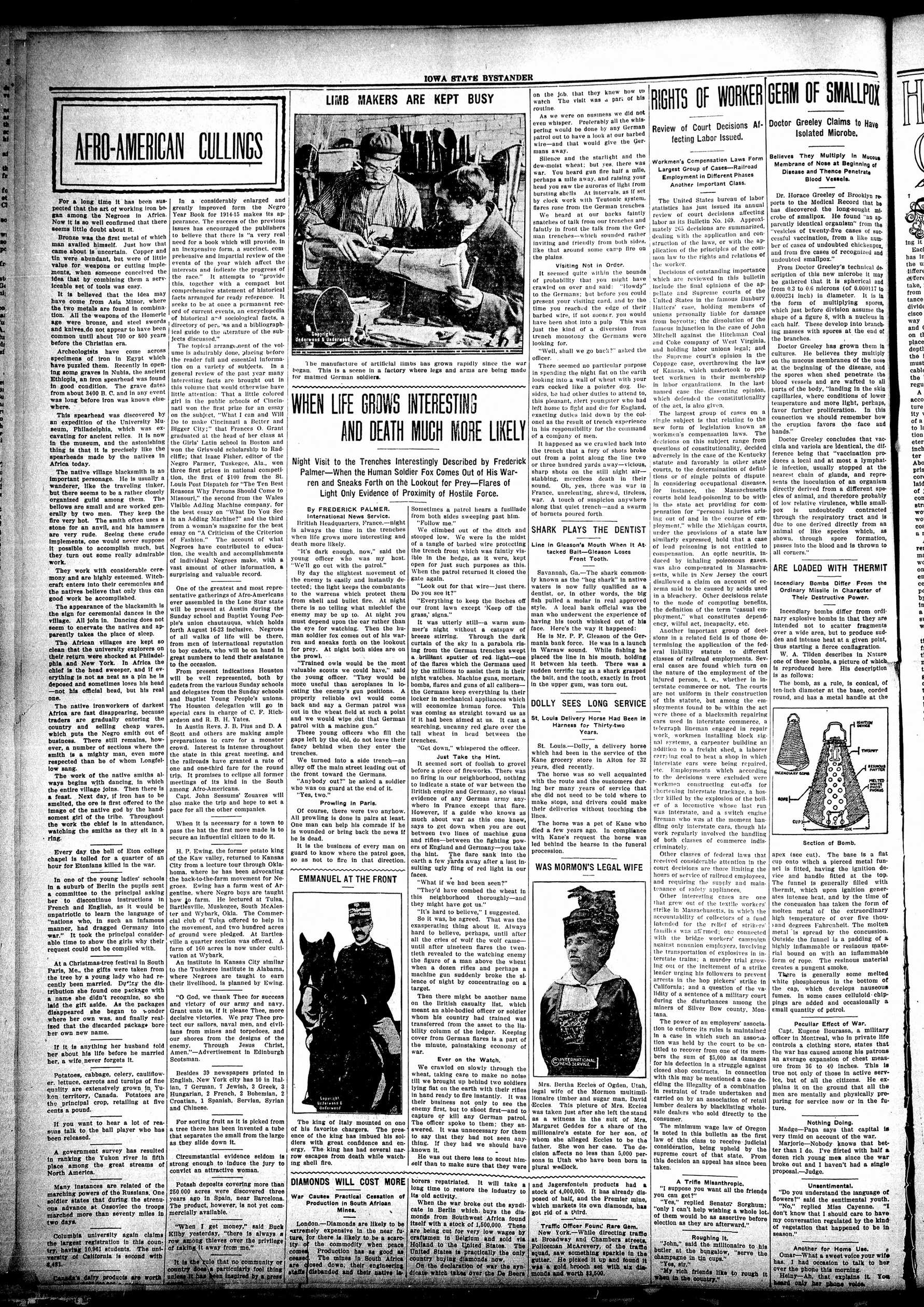
The manufacture of artificial limbs has grown rapidly since the war began. This is a scene in a factory where legs and arms are being made for malmed German soldiers.
WHEN LIFE GROWS INTERESTING AND DEATH MUCH MORE LIKELY
BY FREDERICK PALMER.
International News Service.
British Headquarters, France.—night is always the time in the trenches when life grows more interesting and death more likely.
"It's dark enough, now," said the young officer who was my host. "We'll go out with the patrol."
By day the slightest movement of the enemy is easily and instantly detected; the light keeps the combatants to the warrens which protect them from shell and bullet fire. At night there is no telling what mischief the enemy may be up to. At night you must depend upon the ear rather than the eye for watching. Then the human soldier fox comes out of his warrens and sneaks forth on the lookout for prey. At night both sides are on the prowl.
"Trained owls would be the most valuable scouts we could have," said the young officer. "They would be more useful than aeroplanes in locating the enemy's gun positions. A properly reliable owl would come back and say a German patrol was out in the wheat field at such a point that would be wise that German patrol with a machine gun."
These young officers who fill the gaps left by the old, do not leave their fancy behind when they enter the trenches.
We turned into a side trench—an alley off the main street leading out of the front toward the Germans.
"Anybody out?" he asked a soldier who was on guard at the end of it.
Prowling In Paris.
Of course, there were two anyhow. All prowling is done in pairs at least. One man can help his comrade if he is wounded or bring back the news if he is dead. It is the business of every man on guard to know where the patrol goes, so as not to fire in that direction.
Lagerricht
Unterwacht &
Unterwacht
The king of Italy mounted on one of his favorite chargers. The presence of the king has imbued his soldiers with great confidence and energy. The king has had several narrow escapes from death while watching shell fire.
DIAMONDS WILL COST MORE
War Causes Practical Cessation of Production in South African Mines.
London—Diamonds are likely to be extremely expensive in the near future, for these likely to be a scarcity of the commodity which comes. Production has as good as ceased. The mines in South Africa are closed down, their engineering stalls disbanded and their native life.
IOWA STATE BYSTANDER
ARE KEPT BUSY
arms has grown rapidly since the war where legs and arms are being made
INTERESTING
MUCH MORE LIKELY
erestingly Described by Frederick Adler Fox Comes Out of His War- e Lookout for Prey—Flares of Proximity of Hostile Force.
Sometimes a patrol hears a fusillade from both sides sweeping past him. "Follow me." We climbed out of the ditch and stooped low. We were in the midst of a tangle of barbed wire protecting the trench front which was faintly visible to the hedge, as it were, kept open for such purposes as this. When the patrol returned it closed the gate again. "Look out for that wire—just there. Do you see it?" "Everything to keep the Boches off our front lawn except 'Keep off the grass,' signs."
It was utterly still—a warm summer's night without a catspaw of breeze stirring. Through the dark curtain of the sky in a parabola rising from the German trenches swept a brilliant sputter of red light—one of the flares which the Germans used by the millions to assist them in their night watches. Machine guns, mortars, bombs, flares and guns of all calibers—the Germans keep everything in their locker in mechanical appliances which will economize human force. This was coming as straight toward us as if it had been almed at us. It cast a searching, uncanny红 glare over the tall wheat in head between the trenches.
It seemed sort of foolish to growl before a piece of fireworks. There was no firing in our neighborhood, nothing to indicate a state of war between the British empire and Germany, no visual evidence of any German army anywhere in France except that flare. However, if a guide who knows as much about war as this one knew, says to get down when you are out between two lines of machine guns between the fighters fighting for England or France the hint. The flare sank into the earth a few yards away after a last insultingly fling of red light in our faces.
"What if we had been seen?"
"They had have combed the wheat in this neighborhood thoroughly—and they might have got us."
"It's hard to believe," I suggested. So it was, he agreed. That was the exasperating thing about it. Always hard to believe, perhaps, until after all the clrres of wolf the wolf came—until after nineteen flares the twentieth revealed to the watching enemy the figure of a man above the wheat when a dozen rifles and perhaps a machine gun suddenly broke the slam of night by concentrating on a target. Then there might be another name on the British casualty list, which meant an able-bodied officer or soldier whom his comrade had trained was transferred from the asset to the liability column of the ledger. Keeping cover from German flares is a part of the minute, painstaking economy of war.
Ever on the Watch.
We crawled on slowly through the wheat, taking care to make no noise till we brought up behind two soldiers lying flat on the earth with their rifles in hand ready to fire instantly. It was their business not only to see the enemy first, but to shoot first—and to capture or kill any German patrol, the officer spoke to them; they answered. It was unnecessary for them to say that they had not seen anything. If they had we should have known it.
He was out there less to scout himself than to make sure that they were borers repatriated. It will take a long time to restore the industry to its old activity.
When the war broke out the syndicate in Berlin which buys the diamonds from Southwest Africa found itself with a stock of 1,500,000. These are being for out or craftsmen in Belgium and sold to Holland to the United States. The United States is practically the only country buying diamonds now.
On the declaration of war the syndicate which takes over the De Beers
on the job that they knew how to watch. The visit was a part of his routine.
As we were on business we did not even whisper. Preferably the all whispering would be done by any German patrol out to have a look at our barbed wire—and that would give the Germans away.
Silence and the starlight and the dew-moist wheat; but yes, there was war. You heard gun fire half a mile, perhaps a mule away, and raising your head you saw the auroras of light from bursting shells. At intervals, as if by clock work with Teutonic system, flares rose from the German trenches.
We heard at our backs faintly snatches of talk from our trenches and faintly in front the talk from the German trenches—which sounded rather inviting and friendly from both sides, like that around some camp fire on the plains.
Visiting Not in Order
It seemed quite within the bounds of probability that you might have crawled on over and said: "Howdy" to the Germans; but before you could present your visiting card, and by the time you reached the edge of their barbed wire, if not sooner, you would have been shot into a pulp. This was just the kind of a diversion from trench monotony the Germans were looking for.
"Well, shall we go back?" asked the officer.
There seemed no particular purpose in spending the night flat on the earth looking into a wall of wheat with your ears cocked like a pointer dog. Besides, he had other duties to attend to this pleasant, alert younger who had left home to fight and die for England, exacting duties laid down by the colonel as the result of trench experience in his responsibility for the command of a company of men.
It happened as we crawled back into the trench that a fury of shots broke out from a point along the line two or three hundred yards away—vicious, sharp shots on the still night air—stabbing, merciless death in their sound. Oh, yes, there was war in France. We were in the trench. A touch of suspicion anywhere along that quiet trench—and a swarm of hornets poured forth.
SHARK PLAYS THE DENTIST
Line in Gleason's Mouth When it Attacked Bait—Gleason Loses Front Tooth.
Savannah, Ga.—The shark commonly known as the "hog shark" in native waters is now fully qualified as a dentist, or in other words, the big fish pulled a molar in real approved style. A local bank official was the man who underwent the experience of having his牙 whisked out of his face. Here's the way it happened: The ceramania bank force. Gleason of the ceramania bank force. He was in a lunch in Warsaw sound. While fishing he placed the line in his mouth, holding it between his teeth. There was a sudden terrific tug as a shark grasped the bait, and the tooth, exactly in front in the upper gum, was torn out.
DOLLY SEES LONG SERVICE
St. Louis Delivery Horse Had Been in Harness for Thirty-two Years.
St. Louis.—Dolly, a delivery horse which had been in the service of the Kane grocery store in Alton for 32 years, died recently.
The horse was so well acquainted with the route and the customers during her many years of service that she did not need to be told where to make stops, and drivers could make their deliveries without touching the lines.
The horse was a pet of Kane who died a few years ago. In compliance with Kane's request the horse was led behind the hearse in the funeral procession.
WAS MORMON'S LEGAL WIFE
INTERNATIONAL
NEWS SERVICE
Mrs. Bertha Eccles of Ogden, Utah, legal wife of the Mormon multimillionaire timber and sugar man, David Eccles. This picture of Mrs. Eccles was taken just after she left the stand as a witness in the suit of Mrs. Margaret Geddes for a share of the millionaire's estate for her son, of whom she alleged Eccles to be the father. She won her case. The deserts affect her less than 5,000 persons in Utah who have been born in plural wedlock.
and Jagersfontein products had a stock of 4,000,000. He has already disposed of half, the Premier mine, which markets its own diamonds, has got rid of a Udird.
Trefft Office Found: Race Orr
Trame Oceane Whole Hare dem.
New York—Whole directing tram.
at Broadway and Chambers streets.
Policeman McArevery, of the tram
squad, saw something sparkle in the
gutter. He picked it up and found it
was a gold brooch with six diamonds
and worth $3,500.
RIGHTS OF WORKER GERM OF SMALLPOX
Review of Court Decisions Affecting Labor Issued.
Workmen's Compensation Laws Form Largest Group of Cases—Railroad Employment in Different Phases Another Important Class.
The United States bureau of labor statistics has just issued its annual review of court decisions affecting labor as its Bulletin No. 169. Approximately 265 decisions are summarized, dealing with the application and construction of the laws, or with the application of the principles of the common law to the rights and relations of the worker
Decisions of outstanding importance which are reviewed in this bulletin include the final opinions of the appellate and Supreme courts of the United States in the famous Danbury Hatters' case, holding members of unions personally liable for damages from boycots; the dissolution of the famous injunction in the case of John Mitchell against the Hitchman Coal and Coke company of West Virginia; and holding labor unions legal; and the Supreme court's opinion in the Coppage case, overthrowing the law or Kansas, which undertook to protect workmen in their membership in labor organizations. In the last named case the dissenting opinion, which defended the constitutionality of the act, is also given.
The largest group of cases on a single subject is that relating to the new form of legislation known as workmen's compensation laws. The decisions on this subject range from questions of constitutionality, decided adversely in the case of the Kentucky statute and favorably in other state courts, to the determination of definitions or of single points of dispute in considering occupational diseases, for instance, the Massachusetts courts hold lead-poisoning to be within the state act providing for compensation for "personal injuries arising out of and in the course of employment," while the Michigan courts, under the provisions of a state law similarly expressed, hold that a case of lead poisoning is not entitled to compensation. An optic neuritis, induced by inhaling poisonous gases was also compensated in Massachusetts in 1980. The state law disallowed a claim on account of eczema said to be caused by acids used in a bleachery. Other decisions relate to the mode of computing benefits the definition of the term "casual employment," what constitutes dependency, wilful act, incapacity, etc.
Another important group of decks in a related field is of those determining the application of the federal liability statute to different classes of railroad employments. Several cases are found which turn on the nature of the employment of the injured person, i.e., whether in interstate commerce or not. The courts are not uniform in their construction of this statute, but among the employments found to be within the act were those of a blacksmith repairing cars used in interstate commerce, a telegraph lineman engaged in repair work, lineman installing block signal systems, a carpenter building an addition to a freight shed, a laborer carrying coal to heat a shop in which interstate cars were being repaired, etc. Employments which according to the decisions were excluded were workmen constructing cut-offs for shortening interstate trackage, a hoster killed by the explosion of the boiler of a locomotive whose last run was interstate, and a switch engine fireman who was at the moment handling only interstate cars, though his work regularly involved the handling of both classes of commerce indiscriminately.
Other classes of federal laws that received considerable attention in the court decisions are those limiting the hours of service of railroad employees, and requiring the supply and maintenance of safety appliances.
Other interesting cases are one that grew out of the textile workers' strike in Massachusetts, in which the accountability of collectors of a fund intended for the relief of strikers' families was affirmed; one connected with the bridge workers' campaign against nonunion employers, involving the transportation of explosives in interstate trains; a murder trial growing out of the incitement of a strike leader urging his followers to prevent arrests in the hop pickers' strike in California; and a question of the validity of a sentence of a military court during the disturbances among the miners of Silver Bow county, Montana.
The power of an employers' association to enforce its rules is maintained in a case in which such an association was held by the court to be entitled to recover from one of its members the sum of $5,000 as damages in a struggle against closed shop contracts. In connection with this may be mentioned a case deciding the illegality of a contract in restraint of trade undertaken and carried on by an association of retail lumber dealers by blacklisting wholesale dealers who sold directly to the consumer. The minimum wage law of Oregon is noted in this bulletin as the first law this class to receive judicial consideration being uphold by the supreme court of that state. From this decision an appeal has since been taken.
A Trifle Misanthroica
"I suppose you want all the friends you can get?"
"Yes," replied Senator Sorgum;
"only I can't help wishing a whole lot of them would be as assertive before election as they are afterward."
Roughing it.
"John," said the millionaire to his butler at the bungalow, "serve the champagne in tin cups."
"Yes, sir."
"My rich friends like to rough it when in the country."
Doctor Greeley Claims to Have Isolated Microbe.
Believes They Multiply In Mucous Membrane of Nose at Beginning of Disease and Thence Penetrate Blood Vessels.
Dr. Horace Greeley of Brooklyn reports to the Medical Record that he has discovered the long-sought microbe of smallpox. He found "an apparently identical organism" from the "resusces of twenty-five cases of successful vaccination, from a like number of cases of undoubted chickpea-pox, and from five cases of recognized and undoubted smallpox."
From Doctor Greeley's technical description of this new microbe it may be gathered that it is spherical and from 0.3 to 0.6 microns (of 0.000117 to 0.000241 inch) in diameter. It is in the form of multiplying spores, which just before division assume the shape of a figure 8, with a nucleus in each half. These develop into branching masses with spores at the end of the branches.
Doctor Greeley has grown them in cultures. He believes they multiply on the mucus membranes of the nose at the beginning of the disease, and the spores when shed penetrate the blood vessels and are waffled to all parts of the body, "hinding in the skin capillaries, where conditions of lower temperature and more light, perhaps, are more difficult. Connection we should remember how the eruption favors the face and hands."
Doctor Greeley concludes that vaccinia and variola are identical, the difference being that "vaccination produces a local and at most a lymphatic infection, usually stopped at the nearest chain of glands, and represents the inoculation of an organism directly derived from a different species of animal, and therefore probably of low relative virulence, while small-pox is undoubtedly contracted in the respiratory tract and is due to one derived directly from an animal of like species which, as shown, through spore formation, passes into the blood and is thrown to all corners."
ARE LOADED WITH THERMIT
Incediary Bombs Differ From the Ordinary Missile In Character of Their Destructive Power.
Incediary bombs differ from ordinary explosive bombs in that they are intended not to scatter fragments over a wide area, but to produce sudden and intense heat at a given point, thus starting a fierce conflagration. We, upon describes in Nature one of these bombs, a picture of which is reproduced here. His description is as follows:
The bomb, as a rule, is conical, of ten-inch diameter at the base, corded round, and has a metal handle at the
NUTTION
DEVICE
THRUSTPIT
RESISTIVE
MATTER
MELTED
PART
PHOSPHOR
ROPE
CUP
ION
Section of Bomb.
apex (see cut). The base is a flat cup onto which a pierced metal funnel is fitted, having the ignition device and handle fitted at the top. The funnel is generally filled with thermil, which upon ignition generates intense heat, and by the time of the concussion has taken the form of molten metal of the extraordinary high temperature of over five thousand degrees Fahrenheit. The molten metal is spread by the concussion. Outside the funnel is a padding of a highly inflammable or resinous material bound on with an inflammable form of rope. The resinous material creeps up inside the mold. There is generally some melted white phosphorous in the bottom of the cap, which develops nauseous fumes. In some cases cellulol- chippings are added and occasionally a small quantity of petrol.
Recular Effect of War
Capt. Eugene Bourassa, a military officer in Montreal, who in private life controls a clothing store, states that the war has caused among his patrons an average expansion of chest measure from 36 to 40 inches. This is true not only of those in active service, but of all the citizens. He explains it on the ground that all the men are mentally and physically preparing for service now or in the future.
Nothing Doing.
Madge-Papa says that capital is very timid on account of the war. Marjorie-Nobody knows that better than I do. Five tipped with half a dozen men since the a single broke out and I have a single proposal-Judge.
Unsentimental
"Do you understand the language of flowers?" said the sentimental youth. "No," replied Miss Cayenne. "I don't know that I should care to have my conversation regulated by the kind of vegetation that happened to be in season."
Another for Home Use. Omar—What a sweet voice your wife has. Has had occasion to talk to her over the phone this morning. Heiny—Ah, that explains it. You heard only her phone voice.
HOW A SUBMARINE CABLE IS REPAIRED BY OSCAR ODEE in the POPULAR MECHANICS
F
t a time when the public expects its war news almost before the smoke of battle has cleared away, the submarine cable and the methods used in keeping it in repair are of interest. Each submarine telegraph company has in service a fleet of cable ships, the units of which are stationed at different ports for quick access to the different sections of the cable. Let us take, for example, the cable stretching from San Francisco to Manila, a distance of 10,000 miles. This cable is divided into four sections—San Frantisco to Honolulu, Honolulu to Midway Island, Midway Island to Guam, and Guam to Manila. The cable lies on the bed of the Pacific, which in places runs from three to five miles in depth, the latter depth being found off the island of Guam. Sufficient slack must be paid out in laying a submarine cable to allow every part to rest on the bottom of the ocean, however irregular the bottom may be.
A cable varies in thickness and type according to its position and the nature of the ocean bottom in the locality where it is laid. The "shore end" of a cable, meaning a section laid close to land, is always thicker than a section out at sea. Ordinarily the diameter of a shore section runs about 2 1/4 inches, while a section laid in deep water runs about 3/4 inch in diameter. About seven strands of copper, comprising a single conductor, form the core of the cable. Over this core are laid strands of gutta percha, a layer of jute or calcium, and an envelope of composition rubber. Over this some strands of strengthening wires are wound on, and tarry rope and tape are wound about the whole. The average cost of a cable complete is about $1,000 a mile.
A surprisingly small amount of current is required for operating a submarine cable. One of the hardest worked of the Atlantic cable requires only 50 volts' pressure at the sending end, and all that comes out at the receiving end is twenty-millions amper. Signals are transmitted simply by alternately charging and discharging the cable, which works much like a Leyden jar. One of the fastest of submarine cables transmits about 80 words a minute.
Interruption in cable communication between two stations may come from one of several causes. There is the "fault" caused by the teredo, a submarine boring animal that penetrates the protective coatings in an effort to get at the core. Then the shore end cable, in quite special protection, does not always withstand the rolling and friction of the tides, and besides this, there is the risk that the cable may be fouled or lifted by a ship's anchor. A cable may part completely, from one cause or another, forming what is known as a "total break."
Let us imagine that the cable from San Francisco to Manila is "down," as it is technically expressed when the cable is unworkable, in that section, 2,098 miles long, between San Francisco and Honolulu. We will assume that a series of tests based on the law of resistances has shown that the fault lies at a point 1,000 miles from San Francisco. Sometimes it is possible by testing to locate the position of the fault within one tenth mile, but the average is about five miles. Before the cable ship sails for the "ground," as the location of the break, or fault, is called, the ship's electricians will have made their own tests and advised both the San Francisco and Honolulu offices—the latter by an alternate route—to keep watch on their instruments in the office for the ship's call. As soon as the cable ship reaches the "ground," a signal, consisting of two red globes with a white diamond between, for day use, and replaced by similarly colored lamps at night, is hung in a vertical line in front of the foremast head. This signal indicates that the ship is engaged in cable-repair the ship, and is therefore out of the control so far as craft is concerned. A marked buoy, moored to a mushroom anchor, is then dropped overboard at the point where the fault in the cable is supposed to be.
The ship then proceeds to grapple for the cable. This is done by means of a grappel, of which there are many kinds, all studded with prongs calculated to catch anything that encounters. To this end the ship is loaded into the inboard end of which is connected to an instrument known as a dynamometer, or vertical scale,
BOWED TO BLOW OF FATE
Small Animalsities Forgotten When Enemy's Stroke Made Them Comrades in Misfortune.
There have lived at Hartpool eng., side by side for many years a cranky old bachelor and a spinster of doubtful age. Their houses were adoling, but the owners were not on speaking terms. The story of how their quarrel arose is safely locked within their own breasts. Suffice it to say that
Rubber Ousting Tobacco.
Strange are the capes of competition! As far away as British North Borneo the rubber estates are gradually forcing tobacco to growing the wall. Our consul at Sandakan says that only a new tobacco estates are now remaining, but that no less than 20 rubber estates, averaging 26,360 acres each and a capital of $11,970,000 are under cultivation and 19 of them are producing rubber. Within three years more all estates will be exporting crude rubber and in five years all
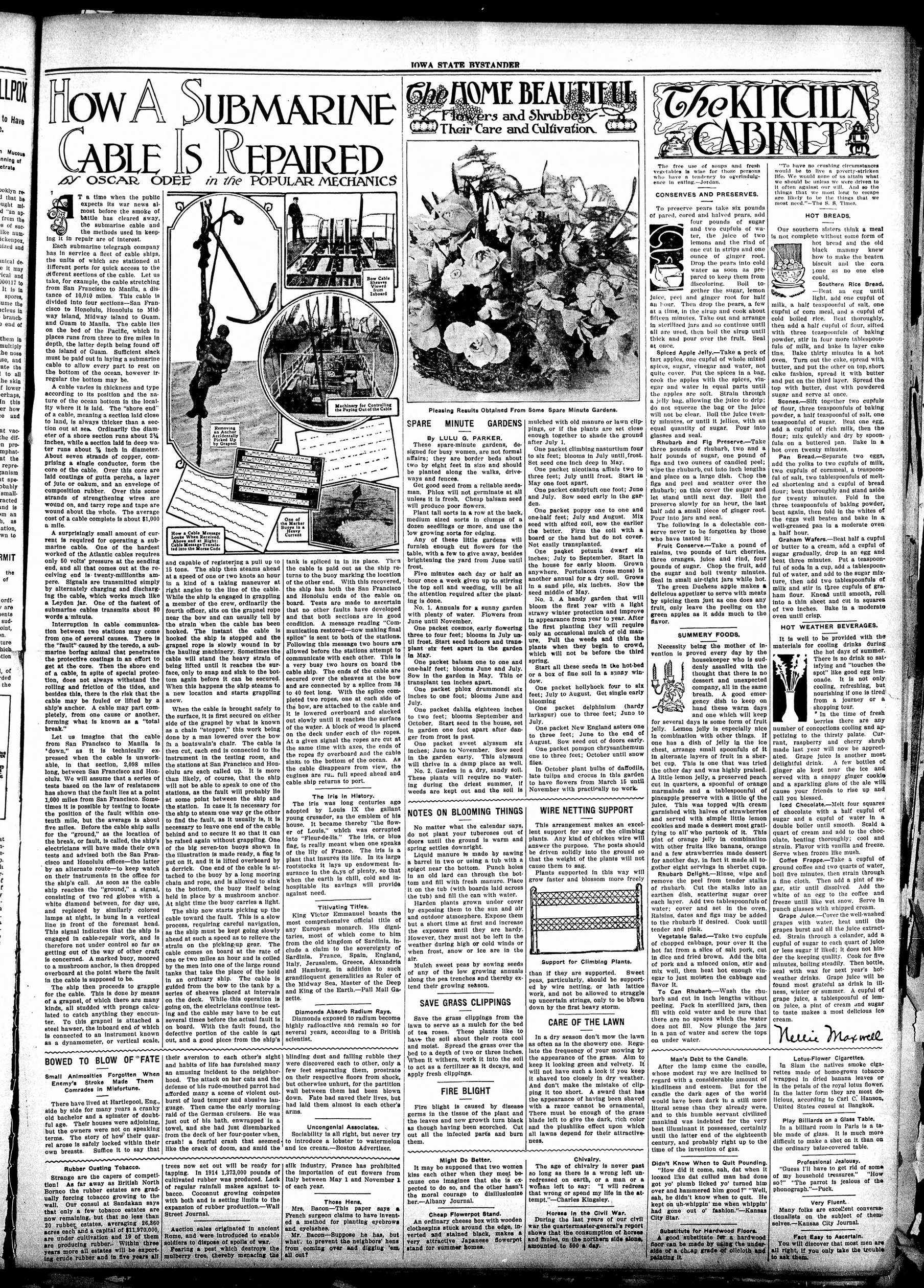
How Cable Sheaves Viewed from Inboard
Machinery for Controlling the Paying Out of the Cable
Removing an Anchor Accidentally Picked Up by Grousel
How a Cable Message Looms When Received. Above and at Right: Cable Message Tomato-tied into the Morse Code
One of the Marker Buoys in a Harry Current
and capable of registering a pull up to 15 tons. The ship then steams ahead at a speed of one or two knots an hour in a kind of a taking maneuver at right angles to the line of the cable. While the ship is engaged in grappling a member of the crew, ordinarily the fourth officer, sits on the grapnel rope near the bow and can usually tell by the strain when the cable has been hooked. The instant the cable is hooked the ship is stopped and the grapnel rope is lowered. The ship's machine. Sometimes the cable will stand the heavy strain of being lifted until it reaches the surface, only to snap and slink to the bottom again before it can be secured. When this happens the船 steams to a new location and starts grappling anew.
When the cable is brought safely to the surface, it is first secured on either side of the grappet by what is known as a chain the "stopper", this work being done by a man lowered over the bow in a boatswain's chair. The cable is then cut, each end is connected to the instrument in the testing room, and the stations at San Francisco and Honolulu are each called up. It is more than likely, of course, that the ship will not be able to speak to one of the stations, as the fault will probably lie at some point between the ship and the station. In case it is necessary for the ship to steam one unit, it can find to drive it. It usually is, it is easier to leave one end of the cable behind and to secure it so that it can be raised again without grappling. One of the big seven-on buoys shown in the illustration is made ready, a flag is put on it, and it is lifted overboard by a derrick. One end of the cable is attached to the buoy by a long mooring chain and rope, and is allowed to sink to the bottom, the buoy itself being in place by a mushroom anchor. At night time the buoy carries a light.
The ship now starts picking up the cable toward the fault. This is a slow process, requiring careful navigation, as the ship must be kept going slowly ahead at such a speed as to relieve the strain on the cable in the ship. The cable is mounted on board at the rate of two miles an hour and is colled by the men into one of the large round tanks that take the place of the hold in an ordinary ship. The cable is gudded from the bow to the tank by a series of sheaves placed at intervals on the deck. While this operation is going on, the electricians continue testing and the cable may have to be cut out. The cable is gudded on board. With the fault found, the defective portion of the cable is cut out, and a good piece from the ship's
their aversion to each other's sight and habits of life has furnished many an amusing incident to the neighborhood. The attack on her cats and the defense of his rude-mouthed parrot had afforded many a scene of violent outburst of loud temper and abusive language. Then came the early morning talk of the German cruisers. He was out of his bath, ennapped in a towel, and she had just disembarked from the deck of her four-poster when, crash' a fearful crash that seemed like the oracle of doom, and amid the trees now set out will be ready for tapping. In 1914 1,373,000 pounds of cultivated rubber was produced. Lack of regular rainfall makes against tobacco. Coconut growing competes with both and is setting limits to the expansion of rubber production.—Wall Street Journal.
Auction sales originated in ancient Rome, and were introduced to enable soldiers to dispose of spolls of war. Fearing a pest which destroys the mulberry tree, thereby menacing the
tank is spiced in its place. Then the cable is paid out as the ship returns to the buoy marking the location of the other end. With this recovered, the ship has both the San Francisco and Honolulu ends of the cable on board. Tests are made to ascertain that no other faults have developed and that both sections are in good condition. A message reading "Communication restored—now making final splice" is sent to both of the stations. Following this message two hours are allowed before the stations attempt to communicate with each other. This is a very busy two hours on board the cable ship. The ends of the cable secured over the sheaves at land and are connected by cable from 38 to 40 feet long, with the splice completed two ropes, one at each side of the body attached to the cable and the lowered overboard and slacked out slowly until it reaches the surface of the water. A block of wood is placed on the deck under each of the ropes. At a given signal the ropes are cut at the same time with axes, the ends of the ropes fly overboard and the cable sinks to the bottom of the ocean. As the cable disappears from view, the engines are run, full speed ahead and cable ship returns to port.
The Iris In History.
The iris was long centuries ago adopted by Louis IX the gallant young crusader, as the emblem of his house. It became thereby "the flower of Louis," which was corrupted into "Fleur-de-lis." The iris, or blue flag, is really meant when one speaks of the lily of France. The iris is a plant that insures its life. In its large rootstocks it lays up endowment insurance in the days of plenty, so that when the earth is chill, cold and inhospitable its savings will provide against need.
Titivating Titles.
King Victor Emmanuel boasts the most comprehensive official title of any European monarch. His dignitaries, most of which come to him from the old kingdom of Sardinia, include a claim to the sovereignty of Sardinia, France, Spain, England, Italy, Jerusalem, Greece, Alexandra and Hamburg, in addition to such grandioid generalities as Ruler of the Midway Sea, Master of the Deep and King of the Earth. Pall Mall Gazette.
Diamonds Absorb Radium Rays. Diamonds exposed to radium become highly radioactive and remain so for several years, according to a British scientist.
blinding dust and falling rubble they were discovered each to other, only a few feet separating them, prostrate on their respective floors from shock, but otherwise unhurt, for the partition wall between them had been blown down. Fate had saved their lives, but had laid them almost in each other's arms.
Uncongenial Associates.
Sociability is all right, but never try to introduce a lobster to watermelon and ice cream.—Boston Advertiser.
slik industry, France has prohibited the importation of cut flowers from Italy between May 1 and November 1 of each year.
Those Hens.
Mrs. Bacon—This paper says a French surgeon claims to have invented a method for planting eyebrows and eyelashes. Mr. Bacon—Suppose he has, but what? to prevent the neighbors' hens from coming over and digging 'em all out?
THE FLOWER Basket
Pleasing Results Obtained From Some Spare Minute Gardens.
IOWA STATE BYSTANDER
The HOME I
Flowers and
Their Care and
Pleasing Results Obtained From
SPARE MINUTE GARDENS
BY LULU G. PARKER.
The spare minute gardens, designed for busy women, are not formal affairs; they are border beds about two by eight feet in size and should be planted along the walks, driveways and fences.
Get good seed from a reliable seedman. Philox will not germinate at all until it is fresh balsam sealump will provide food for the plant. Plant tall sorts in a row at the back, medium sized sorts in clumps of a dozen seedlings or more, and use the low growing sorts for edging.
Any of these little gardens will furnish enough cut flowers for the table, with a few to give away, besides brightening the yard from June until frost.
Five minutes each day or half an hour once a week given to stirring the top soil and weeding, will be all the attention required after the planting.
No. 1. Annuals for a sunny garden with plenty of water. Flowers from June until November.
One packet cosmos, early flowering three to four feet; blooms in July until frost. Start seed indoors and transplant six feet apart in the garden in May.
One packet balsam one to one and one-half feet; blooms June and July. Sow in the garden in May. Thin or transplant ten inches apart.
One packet phlox drummondi six inches to one foot; blooms June and July.
One packet dahila eighteen inches to two feet; blooms September and October. Start seed in the house, in garden one foot apart after danger from frost is past.
One packet sweet alyssum six inches; June to November. Sow seed in the garden early. This alyssum will thrive in a damp place as well. No. 2. Garden in a dry, sandy soil. These plants will require no watering during the driest summer, if weeds are kept out and the soil is
NOTES ON BLOOMING THINGS
No matter what the calendar says, do not plant your tuberoses out of doors until the ground is warm and spring settles downright.
Liquid manure is made by sawing a barrel in two or using a tub with a spigot near the bottom. Punch holes in an old lard can through the bottom and fill with fresh manure. Place it on the tub (with boards laid across the tub) and fill the can with water.
Harden plants grown under cover by exposing them to the sun and air and outdoor atmosphere. Expose them but a short time at first and increase the exposure until they are hardy. However, they must not be left in the weather during high or cold winds or when frost, snow or ice are in the air.
Mulch sweet peas by sowing seeds of any of the low growing annuals along the pea trenches and thereby extend their growing season.
SAVE GRASS CLIPPINGS
Save the grass clippings from the lawn to serve as a mulch for the bed of tea roses. These plants like to have the soil about their roots cool and moist. Spread the grass over the bed to allow it to withers, work it into the soil to act as a fertilizer as it decays, and apply fresh clippings.
FIRE BLIGHT
Fire blight is caused by disease germs in the tissue of the plant and the leaves and new growth turn black as though having been scorched. Cut out all the infected parts and burn them.
Might Do Better.
It may be supposed that two women kiss each other when they meet be cause one imagines that she is expected to do so, and the other hasn't the moral courage to disillusionize her.—Albany Journal.
Cheap Flowerpot Stand.
An ordinary cheese box with wooden clotheships stuck around the edge, indented for easy stand up, and attractive, Japanese flowerpot stand for summer homes.
The KITCHEN CABINET
The free use of soups and fresh vegetables is wise for those persons who have a tendency to overindulgence in eating.-Jordan
CONSERVES AND PRESERVES.
To preserve pears take six pounds of pared, cored and halved pears, add four pounds of sugar and two cupfuls of water, the juice of two lemons and the rind of one cut in strips and one ounce of ginger root. Drop the pears into cold water as soon as prepared to keep them from discoloring. Boll together the sugar, lemon juice, peel and ginger root for half an hour. Then drop the pears to a few at a ting, then stir the cupwork about fifteen minutes. Take out and arrange in sterilized jars and so continue until all are used, then boil the sirup until thick and pour over the fruit. Seal at once.
Sliced Apple Jelly.—Take a peck of tart apples, one cup of whole mixed spices, sugar, vinegar and water, not quite cover. Put the spices in a bag, cook the apples with the spices, vinegar and water in equal parts until the apples are soft. Strain through a jelly bag, allowing the juice to drip; do not squeeze the bag or the juice not be ejected by the juicy juice until it jellies, with an equal quantity of sugar. Pour into glasses and seal.
Rhubarb and Fig Preserve.—Take three pounds of rhubarb, two and a half pounds of sugar, one pound of figs and two ounces of candied peel; wipe the rhubarb, cut into inch lengths and place on a large dish. Chop the figs and peel and scatter over the rhubarb; on this cover the sugar and let stand until next day. Boil the preserve slowly for an hour, the last half add a small cup of ginger root. Peel the fruit and eat.
The following is a detectable conserve never to be forgotten by those who have tasted it:
Fruit Conserve—Take a pound of raisins, two pounds of tart cherries, three oranges, juice and rind, four pounds of sugar. Chop the fruit, add the sugar and boll two minutes. Seal in small air-tight jars while hot. The green Duchess apple makes a delicous appetizer to serve with meats by splicing them just as one does any fruit, only leave the peeling on the green apples as it adds much to the flavor.
Necessity being the mother of invention is proved every day by the housekeeper who is suddenly assailed with the thought that there is no dessert and unexpected company, all in the same breath. A good emergency dish to keep on hand these warm days
for several days is some form of fruit jelly. Lemon jelly is especially nice in combination with other things. If one has a dish of jelly in the ice chest, arrange small spoonfuls of it in alternate layers of fruit in a sherbet cup. This is one that was tried the other day and was highly praised. A little lemon jelly, a preserved peach cut in quarters, a spoonful of orange marmaidal and a tablespoonful of pineapple preserve with a little of the juice. This was topped with cream garnished with halves of strawberries and served with simple little lemon cookies and made a dessert most gratifying to all' who partook of it. This pint of fruit jelly in combination with other fruits like banana, orange and a few strawberries made dessert for another day, in fact it made all together eight servings in sherbet cups.
Rhubarb Delight—Rinse, wipe and remove the peel from tender stalks of rhubarb. Cut the stalks into an earthen dish, scattering sugar over each layer. Add two tablespoonfuls of water; cover and set in the oven. Raisins, dates and figs may be added to the rhubarb if desired. Cook until tender and pink.
Vegetable Salad—Take two cupfuls of chopped cabbage, pour over it the hot fat from a slice of salt pork, cut in dice and fried brown. Add the bits of pork and a minced onion, stir and mix well, then heat hot enough vinegar to just moisten the cabbage and flavor it.
To Can Rhubarb—Wash the rhubarb and cut in inch lengths without peeling. Pack in sterilized jars, then fill with cold water and be sure that there are no spaces which the water does not fill. Now plunge the jars in a pan of water and screw the tops on under water.
boil five minutes, then strain through a fine cloth. Add a pint of sugar, stir until dissolved. Add the white of an egg to the coffee and freeze until like wet snow. Serve in punch glasses with whipped cream.
Grape Juice. Cover the well-washed grapes with water, heat until the grapes burst and all the juice extract. Strain through a colander, add a cupful of sugar to each quart of juice or less sugar if liked; it does not hinder the keeping quality. Cook for five minutes, boiling steadily. Then bottle seal with wax for next year's hot weather drinks. Grape juice will be found most grateful as drink in illness, winter or summer. A cupful of grape juice, a tablespoonful of lemon on juice, a pint of sugar and sugar to taste makes a most delicious ice cream.
After the lamp came the candle, whose modest ray we are inclined to regard with a considerable amount of kindness and esteem. But for the candle the dark ages of the world would have been dark in a still more literal sense than they already were, and to this humble servant civilized mankind was indebted for the very best illuminant it possessed, certainly until the end of the century, and probably right up to the time of the invention of gas.
Didn't Know When to Quit Pounding.
"How did it come, sah, dah when it looked like dat culdul man had done got yo' plum blicked yo' turned him and hammered him good?"" Well, sah, he didn't know when to quit. He kept on uh-whippin' me when whippin' had gone out o' fashion."—Kansas City Star.
Substitute for Hardwood Floors.
A good substitute for a hardwood floor can be made by using the under-side of a cheap grade of oilcloth and painting it.
mulched with old manure or lawn clippings, or if the plants are set close enough together to shade the ground after July 1.
One packet climbing nasturtium four to six feet; blooms in July until frost. Set seed one inch deep in May.
One packet nicotiana affinis two to three feet; July until frost. Start in May. Flower in June.
One packet candytuff one foot; June and July. Sow seed early in the garden.
One packet poppy one to one and one-half feet; July and August. Mix seed with sifted soil, sow the earlier the better. Firm the soil with a board or the hand but do not cover. Not easily transplanted.
One packet petunia dwarf six inches; July to September. Start in the house for early bloom. Grow anywhere. Portulaca (rose moss) is another plant for any soil. Grows in a pile, six inches. Sow the seed middle of May.
No. 3. A handy garden that will bloom the first year with a light strawy winter protection and improve in appearance from year to year. After the first planting they will require only an occasional mulch of old manure. Pull the weeds and thin the plants when they begin to crowd, which will not be before the third spring.
Start all these seeds in the hot-bed or a box of fine soil in a sunny window.
One packet hollyhock four to six feet; July to August. Get single early blooming
One packet delphinium (hardy larkspur) one to three feet; June to July.
One packet New England asters one to three feet; June to the end of August. Sow seed of doors early.
One packet pompon chrysanthemum one to three feet; October until snow files.
In October plant bulbs of daffodils, late tulips and crocus in this garden to have flowers from March 15 until November with practically no work.
---
WIRE NETTING SUPPORT
This arrangement makes an excellent support for any of the climbing plants. Any kind of chicken wire will answer the purpose. The posts should be driven solidly into the ground so that the weight of the plants will not cause them to sag.
Plants supported in this way will grow faster and blossom more freely.
Support for Climbing Plants.
than if they are supported. Sweet peas, particularly, should be supported by wire netting, or lath lattice work, and not be allowed to straggle up uncertain strings, only to be blown down by the first heavy storm.
CARE OF THE LAWN
In a dry season don't mow the lawn as often as in the showery one. Regulate the frequency of your moving by the appearance of the grass. Alm to keep it looking green and velvety. It will not have such a look if you keep it shaved too closely in dry weather. And don't make the mistake of clipping it too short. A sword that has the appearance of having been shaved with a razor cannot be ornamental. There must be enough of the grass blade left to give the dark, rich color and the plushlike effect upon which all lawns depend for their attractiveness.
Chivalry.
The age of chivalry is never past so long as there is a wrong left unredressed on earth, or a man or a woman left to say: "I will redress that wrong or spend my life in the attempt."-Charles Kingsley.
Horses in the Civil War.
During the last years of our civil war the quartermaster-general's report shows that the consumption of horses and hules, on the northern side alone, amounted to 600 a day.
"To have no crushing circumstances would be to live a poverty-striken life. We should be unlucky, we should be unlucky we were driven to it often against our will. And so the things that we most long to escape are the things that what we most need." -The S. S. Times.
Our southern sisters think a meal is not complete without some form of hot bread and the old black mammy knew how to make the beaten biscuit and the corn pie, as no one else could.
Southern Rice Bread
—Beat an egg until light, add one cupful of milk, a half teaspoonful of salt, one cupful of corn meal, and a cupful of cold boiled rice. Beat thoroughly, then add a half cupful of oil with the teaspoonfuls of baking powder, stir in four more tablespoonfuls of milk, and bake in layer cake mixture. Bake thirty minutes in a hot oven. Turn out the cake, spread with butter, and put the other on top, short cake fashion, spread it with butter and put on the third layer. Spread the top with butter, dust with powdered sugar and serve at once.
Scones—Sift together two cupfuls of flour, three teaspoonfuls of baking powder, a half teaspoonful of salt, one teaspoonful of sugar. Beat one egg, add a cupful of rich milk, then the flour; mix quickly and dry by spoonfuls on a buttered pan. Bake in a hot oven twenty minutes.
Pan Bread—Separate two eggs, add the yolks to two cupfuls of milk, two cupfuls of cornmeal, a teaspoonful of salt, two tablespoonfuls of melted shortening and a cupful of bread flour; beat thoroughly and stand aside for twenty minutes. Fold in the three teaspoonfuls of baking powder, beat again, then fold in the whites of the eggs well beaten and bake in a well-greased pan in a moderate oven a half hour.
Graham Wafers.—Beat half a cupful of butter to a cream, add a cupful of sugar gradually, drop in an egg and beat three minutes. Put a teaspoonful of soda in a cup, add a tablespoonful of water, and add to the sugar mixture, then add two tablespoonfuls of milk and stir in three cupfuls of graham flour. Knead until smooth, roll into a thin sheet and cut in squares of two inches. Bake in a moderate oven until crisp.
It is well to be provided with the materials for cooling drinks during the hot days of summer. There is no drink so satisfying and 'touches the spot' like good egg lemonade. It is not only cooling, refreshing, but nourishing if one is tired from a journey or a shopping tour. In the time of fresh berries there are any number of concoctions cooling and appetizing to the thirst palate. Currant, raspberry and cherry shrub made last year will now be appreciated. Grape juice is another most delightful drink. A few bottles of ginger ale kept near the ice and served with a snappy ginger cookie and a sparkling glass of the ale will cause your friends to rise up and call you blessed.
lead Chocolate—Nelt four squares of chocolate with a half cupful of sugar and a cupful of water in a double boiler until smooth. Scald a quart of cream and add to the chocolate, beating thoroughly; cool and strain. Flavor with vanilla and freeze. Serve when frozen like mush.
Coffee Frappé—Take a cupful of ground coffee and two quartes of water, boil five minutes, then strain through a fine cloth. Then add a pint of sugar, stir until dissolved. Add the white of an egg to the coffee and freeze until like wet snow. Serve in punch glasses with whipped cream.
Grape Juice.—Cover the well-washed grapes with water, heat until the grapes burst and all the juice extracted. Strain through a colander, add a cupful of sugar to each quart of juice or less sugar if liked; it does not hinder the keeping quality. Cook for five minutes, boiling steadily. Then bottle, seal with wax for next year's hot-weather drinks. Grape juice will be found most grateful as drink in winter, winter or summer. A cupful of grape juice, a tablespoonful of lemon juice, a pint of cream and sugar to taste makes a most delicious ice cream.
Nellie Maxwell
Lotus-Flower Cigarettes.
In Siam the natives smoke cigarettes made of home-grown tobacco wrapped in dried banana leaves or in the petals of the royal lotus flower. In the latter form they are most delicious, according to Carl C. Hanson, United States consul at Bangkok.
Play Billards on a Glass Table.
In a billard room in Paris is a table made of glass. It is much more difficult to make a shot on it than on the ordinary batze-covered table.
Professional Jealousy.
"Guess I'll have to get rid of some of my household treasures." "How so?" "The parrot is jealous of the phonograph."—Puck.
Very Fluent.
Many folks are excellent conversationists on the subject of themselves.—Kansas City Journal.
Fact Easy to Ascertain.
You will discover that most men are all right, if you only take the trouble to ask them.
four pounds of sugar and two cupuples of water, the juice of two lemons and the rind of one cut in strips and one ounce of ginger root. Drop the pears into cold water and pared to keep them from discoloring. Boll to together the sugar, lemon
SUMMERY FOODS.
housekeeper who is sud-
denly assailed with the
thought that there is no
dessert and unexpected
company, all in the same
breath. A good emer-
gency to hand these warm days
and one which will keep
Man's Debt to the Candle
HOT BREADS.
hot bread and the old
hot mammay knew
how to make the beaten
biscuit and the corn
bone as no one else
could.
The Rise Rice Bread.
—Deat an egg until
light, add one cuffful of.
HOT WEATHER BEVERAGES.
the hot days of summer.
There is no drink so satisfying and "touches the spot" like good egg lemonade. It is not only cooling, it makes you feel one is tired from a journey or a shopping tour.
*In the time of fresh berries there are any
Very Fluent.
Mrs. Marie White of Chicago is visiting at the home of her daughter, Mrs. John Ward.
Mrs. Susan Allen left Monday evening for Rock Island as a delegate for Patron chapter, No. 18, of Eastern Star.
Mrs. Mollie Crew and Mrs. Jennie Skinner have returned from Champaign, Ill., after attending a very fine session of the Grand United Order of Odd Fellows and Household of Ruth.
The Misses Margherite and Gladys Allen left Sunday morning for Rock Island to be present at a house party at the home of Miss Bell Taylor.
Mr. John Ward and John Gritton report a very fine session, after attending the convention of Grand United Order of Odd Fellows on their return from Champaign.
Mrs. Adolph Harris of Chicago is visiting at the home of Mrs. John Ward on Mary street.
The Improvement club met at the home of Mrs. M. C. Botts on West Brooks street Tuesday afternoon at the usual hour. They will give a chicken fry on the lawn of Mrs. Jessie McGill on Thursday evening. Short funeral services were held for Miss Esther Holly at Allen Chapel on Sunday at 12:30, after which the remains were sent to Monmouth on 1:58 train to be buried.
ST. JOSEPH. MO.
Mrs. F. N. Goodson returned last Saturday from a few weeks' visit with relatives and friends at Great Bend, Kans. Her mother's health has not been very good this summer.
Mr. Geo. Walker, who has conducted a grocery and confectionery store at 609 N. Third street for a number of years, has disposed of his stock and fixtures and leased his building, and he and his wife will take an extended vacation, as they have been very successful in conducting their business. They own some good property and possessing a nice bank account, they can well afford to take a much needed vacation.
Dr E. Y. Strawn's new runabout Ford automobile was delivered to him last week and he is now making his calls by the aid of gasoline.
Blind Wesley, a young man about 20 years of age, gave a recital at the Francis Street Baptist church last Monday night. It was his initial concert in this city.
A number of Masons are in Hannibal this week attending their annual conclave.
The union Sunday school picnic was held at Lake Contrary yesterday. A large crowd was there to enjoy the outing.
Mrs. Hughes of Kewanee, Ill., is the guest of her sister, Mrs. Sam Henson, this week.
Mr. Raymond Holt last week for a few weeks' visit in Denver, Salt Lake City and San Francisco.
Miss Hines of Lawrence, Kans., has been among our visitors for the past week.
The Tennis club of Kansas City, Mo., will be here Thursday to play our club, but as we must mail this letter before that time, cannot say who won. However, the Messrs. Jas. Gordon, Jr., M. Carpenter, Jordan Cobran, Jas. Coleman and Robt Swinney say they are going to play so hard that the teams from K. C. will know that we know that game.
Miss Mayme Hundley, who is spending the latter part of the summer in Billings, Mont., writes that she is having a pleasant vacation.
"Clean Up the Bowels and Keep Them Clean"
There are many remedies to be had for constipation, but the difficulty is to procure one that acts without violence. A remedy that does not perform by force what should be accomplished by persuasion is Dr. Milus' Lonative Tablet. Tablet After using them, Mr. N. A. Waddell, 315 Washington St., Waco, Tex. says:
A. B.
"Almost all my life. I have been troubled with compaction and have troubled many more, of which seemed to cause pain without giving much relief. I finally tried Dr. Miles' Laxative Tablets and found them excellent. Their action is pleasant and mild, and their chocolate taste makes them more than glad to recommend them."
"Clean up the bowels and keep them clean" is the advice of all physicians, and they realize that resulting from habitual constipation. Do not delay too long, but begin proper curative measures.
Dr. Miles' Laxative Tablets are a new remedy for this old complaint, and a great improvement over the cathartics you have been using in the past. They taste like candy and work like a charm. A trial will convince you.
Dr. Miles' Laxative Tablets are sold by all druggists, at 25 cents a box containing 25 doses. If not found satisfactory after trial, return the box to your druggist and he will return your money. 12 MILES MEDICAL CO., Khartel, Ind.
Crawford--Do the rich know how the other half live?
Crabshaw--After taking their money from them they must be able to turn the lives of others compelle on them.
L. E. Hanger
NEW
Elite Restaurant
New Reliable Place to Eat
Meals 15c and up
Lunches or Short Orders Served
304 W. Grand Ave.
Des Moines Iowa
MUSIC AT IOWA STATE FAIR
Martin Ballmann, Conductor of Ballmann's Symphony Band, Which Will Be One of the Many Musical Features of the Iowa State Fair and Exposition, Aug. 25-Sept. 3.
A fair, great or small, would be a dismal affair without music. A feature that appeals with force to the visitor to the Iowa State Fair from rural districts and smaller towns is the abundance of excellent music to be heard at all times and in all parts of the grounds, from the earliest forenoon concerts to the closing of the last of the night shows and various evening entertainments. Four bands, three orchestras and a nite and drum corps of twenty-five pieces will contribute to the pleasure of the occasion and to the love of music and harmony that is a part of the average person's make up.
In the way of bands this year the management has been fortunate in booking three of the best obtainable. The Ballmann Symphony band of Chicago, an organization of forty pieces, under the management and leadership of Martin Ballmann, will be a feature of the week. The Henry band of Des Moines, forty pieces and the Fischer band of Burlington, twenty-five pieces, have also been secured. Graham's orchestra, the same which for several years has delighted annual visitors to the live stock pavilion, Quist's orchestra from Fort Dodge and the Myers orchestras of Waterloo will also contribute to the occasion. In addition to all these the World at Home band, twenty-five pieces, one of the very best road bands in the country, will play on the midway. It will be a feast for music lovers.
COMBINE BUSINESS AND PLEASURE.
The Iowa farmer, at this particular season of the year, is the busiest man on earth. Crops are insistent and selfish in their demands during the growing and ripening season, and the live stock dare not be neglected if those tale telling figures in red ink are to show up in the column most desired at the end of the year. Under the circumstances one has neither the heart nor the inclination to criticise if he begrudges the time necessarily absorbed in visiting. However, in the case of the state fair it is time turned to good account and money well invested, and will bring sure returns in the way of a renewed store of practical knowledge and inspiration. Probably in no other way would it be possible for him to effect such a happy combination of business and pleasure, of work and play, which latter the tiller of the soil needs in proper proportion the same as anybody else.
BABY HEALTH CONTEST
One of the newer though none the less popular features inaugurated by the Iowa State Fair and Exposition of recent years is the Baby Health contest department. These contests will be held in the splendid new Women and Children's building, completed only last year. The value of these contests lies in the educative rather than the financial side, as the idea is to demonstrate principles of hygiene, sanitation and right living as pertaining to the proper development and growth of children. For that reason the premiums distracted are always in the form of medals, ribbons and trophies, rather than money. These contests, and especially the method of rewarding the winners, have the approval of the American Medical association, the Baby Health Contest association and various other organizations interested in child welfare and better methods of living.
SPLENDID FACILITIES FOR SHEEP EXHIBITS AT THE IOWA STATE FAIR AND EXPOSITION.
Exhibitors in the sheep department of the Iowa State Fair had ample grounds for complaint for several years. Those ancient wooden sheds, erected something less than a hundred years ago, had certainly outlived their day of usefulness, and for purposes of ornamentation they never did cut much of a swath. They were both unsafe and unsanitary. Happily they are a thing of the past, condemned to the scrap heap, and the mutton and wool contingent will this year be housed in the new sheep pavilion. it is a handsome structure of brick and steel, fire proof, commodious and up to date, in harmony with modern ideas of convenience and sanitation. Certainly it fills a long felt want, and sheep exhibitors and fanclers will appreciate its coming all the more for the long delay.
The Clerk Guaranteed It
"A customer came into my store the other day and said to one of my clerks, 'have you anything that will cure diarrhoea?' and my clerk went and got him a bottle of Chamberlain's Colic, Cholera and Diarrhoea Remedy, and said to him, 'if this does not cure you, I will not charge you a cent for it.' So he took it home and came back in a day or two and said he was cured!" writes J. H. Berry & Co., Salt Creek, Va. Obtainable anywhere.
1865 Half
Hon. JOHN DAW
Maj. GEO. W. FORD
TREASURER
Hon. MADILL McCOY
is Her Hair
using
er Grower
its itching of
w long, soft
box.
RD
Joseph, Mo.
51 per day
Hotel
W. Ry.
arm
quey
A good remedy for sleepiness is to wet a towel and apply to the back of the neck, pressing it hard up against the base of the brain and fastening over this cloth to prevent too rapid evaporation. The effect will be prompt and pleasant, cooling the brain and inducing a sweet and peaceful slumber. Warm water is better than cold for the purpose. This remedy will prove useful to people suffering from overwork, excitement or any
A.
Woman's Crowning Glory is Her Hair
Why not grow your hair by using
Mme- M. Beard Hair Grower
It removes dandruff, stops itching of
the scalp and makes it grow long, soft
and beautiful. Price 50c a box.
Send stamp for pamphlet.
MME. M. BEARD
AGENTS WANTED
519 So. 16th St.
St. Joseph, Mo.
Short Orders Chop Suey
Lunch Room Yockeme
in connection Chili Con Carne
F. F. JACKSON, PROP.
OPEN DAY
AND NIGHT Clinton, Iowa
Despondency Due to Indigestion.
"About three months ago when I was suffering from indigestion which caused headache and dizzy spells and made me feel tired and despondent, I began taking Chamberlain's Tablets," writees Mrs. Geo. Hon, Macedon, N.Y. "This medicine proved to be the very thing I needed, as one day's treatment relieved me greatly. I used two bottles of Chamberlain's Tablets.
PHONES:
Douglas 5118 Automatic 71-869 Cafe, Auto 71-374
The Iowa Club Buffet
Douglas 5118 Automatic 71-869 Cafe, Auto 71-374
Neatly Furnished Rooms in Connection KIDD BROWN, Manager
HUGH HOSKINS & SON Props. 3161 State Street
10
A Bell Telephone
Banishes Loneliness
When the hours seem long, when every-
thing seems to go wrong, a little telephone
chat brightens up the day.
Always the Bell Telephone is on duty, the
faithful representative of a great corpo-
tion that is giving the cheapest and most
efficient telephone service in the world.
"Bell Service—the Great American
Triumph."
IOWA TELEPHONE COMPANY
Iowa Phone 295x Rates $1 per day
Automatic 3952
Tenth Avenue Hotel
1 block from C. W. W. Ry.
All Rooms are Warm
VIVIAN L. JONES
Funeral Director
The very best service guaranteed
Prices the lowest - - - - - -
Calls answered promptly day or
night No extra charges for distance
-Reverse all phone charges
PHONE: $ Maple 2548
Residence Wal. 6624.
Office
519 East Court Ave
Des Moines
PETER B.
1865 Half Century Celebration
Hon. JOHN DALEY
Rev. A.J. CAREY, Ph.D. J.D.
Hon. W. DUTT PIERCE
M.A.J. GEO. W. FORD,
TREASURER
Rt. R.N. SAMUEL FALLOWS D.D. LLD.
PRESIDENT
Mr. SAMUEL LARRECKER, B.A.
VICE-PRESIDENT
Hon. MEDILL, M.CORMICK
THOMAS WALLACE SWANN,
SECRETARY
Hon. R.R. JACKSON
IOWA STATE BYSTANDER
The Illinois centennial celebration commission of Illinois will open their gigantic undertaking of holding a month's celebration and jubilee exhibition in the city of Chicago on August 22 to September 16, inclusive, at the Coliseum, in which many states will participate. It is the first of its kind ever given by colored people west of the Alleghenies. It will show the marvelous growth and progress that the Negro race has made in the years of their freedom. There will be exhibits of every kind, showing the skill of our colored women and the proficiency of our men. The following is the program for each day:
Dedicatory exercises at 3 p. m. August 22.
"Chicago Day," 10 a. m. August 23 Convention, I. B. P. O. of Elks, August 23.
S. M. T. Day and C. B. F., August 24.
Grand Army of Republic Day, August 25.
and they rid me of this trouble." Obtainable everywhere.
Souvenirs Every Night
Chicago, Ill.
8th Regiment I. N. G. Day, August 25.
Spanish War Veterans, August 25.
Michigan Day, August 26.
Negro Authors August 27.
Hamilton Club Night, August 27.
Meharry Day, August 27.
New York, Pennsylvania, August 28
Southern States Day, August 28.
Religious Congress, August 29.
Sunday School and Young People's
Society, August 29.
Knight Templar Day, August 29.
Folk Lore Musical Festival, 8 p. m.
August 29.
Farmers' Congress, August 30.
Indiana Day, August 30.
Educational Congress, August 31.
Railroad Day, August 31.
Grand United Order of Odd Fellows
Day, September 1.
Roman Catholic Day, September 2.
Catholic Order of Foresters Day,
September 2.
Folk Lore Musical Festival, 8 p. m. September 5. "Peace Day" September 5.
AVE YOU BEAUTIFUL HAIR?
WE are the only Importers and Manufacturers of Real Colored People's Hair. Also Wavy Hair.
We absolutely guarantee our hair to stand combing and washing and to retain its color and crimp.
Wigs, Plats, Braids, Transformations and Puffs in stock or to order; all shades, none too difficult.
Straightening Combs and Toilet Articles, or Price List. Mail Orders receive prompt attention.
Table Mme. Baum's Hair Emporium
16 Between 33th and 35th Sts. NEW YORK CITY
Send two-cent stamp for Price List.
The Old Reliable Mme.
486 8th Avenue 11-16-2-16 Betwe
Send two-cent stamp for Price List. Mail Orders receive prompt attention.
The Old Reliable Mme. Baum's Hair Emporium
486 8th Avenue 11-16-216 Between 8th and 85th St. NEW YORK CITY
IOWA STATE FAIR 10th EXPOSITION
You are invited to attend the greatest Agricultural and Live Stock Show of Modern Times
Iowa will demonstrate her lead in the world of agricultural fairs. Neither time nor money have been spared to make it the greatest and best of its kind.
THE HIGHWAY COMMISSION EXHIBIT,
new and novel, will be of immeasurable value to all who are interested in good roads.
A FEST OF MUSIC
by four bands and three orchestras.
THE RACING PROGRAM
will be the best ever contested in Iowa.
THE WAR OF NATIONS
in front of the amphitheatre every evening, will be beautiful, thrilling, spectacular.
ART SMITH
the wonderful boy aviator, will be a daily attraction.
Loops the loop at night to the accompaniment of brilliant dreworks.
THE EVENING ENTERTAINMENTS
in the show pavilion will delight lovers of fine horses and high-class vaudeville and circus acts.
YOU CAN'T AFFORD TO MISS IT.
C.E. CAMERON
PRESIDENT
Des Moines, Aug.25-Sept.3,1915
A.R. COREY
SECRETARY
H
Labor Day. September 6.
Industrial Congress, September 7.
Ancient Order of Foresters ,Day
September 7.
National Baptist Day, September 8.
Wisconsin Day, September 9.
Knights of Pythias Day, September
9.
Insurance Day, September 9.
Tuskegee Day, September 10.
Mound Bayou Day (Mississippi),
September 11.
Methodist Day, September 12.
Folk Lore Musical Festival, 8 p. m.
September 12.
National Baptist Woman's Day,
September 13.
Knights of Tabor Day, September
13.
Kansas, Missouri, Iowa and Northwest
Day, September 13.
International Inter-racial Congress
September 14.
Fraternal Day, September 15.
Ancient United K. D. of Africa Day,
September 15.
Closing Day, Illinois Day, September
16.
Published every Sunday by the Br
stander Publishing Company, Des
Moine, Iowa. Office in Chemical
binding, corner Seventh and Mum
berry streets, Iowa phone, War
nut 899.
Official paper of the M. W. U. Grand
Lodge of Iowa, A. F. & A. M., and
International Grand Congress of
Heroines of Jericho of America
and Western Baptist Association
Entered at the postoffice as second
class matter.
Advertising rates for display ads
25 cents per inch, for each insertion
Three to six months' contract, to
cents per inch. Local advertising
10 cents per line for each insertion
counting seven words to a line. For
churches and secret societies where
admission is charged, one-half of
the above-mentioned rates. For pro-
fessional, legal and announcements
cards, yearly contracts, etc., terms
are given on application. All ad
vertising is to be paid in advance.
TERMS OF SUBSCRIPTION
One year. $1.56
Six months. .11
Three months. .56
All subscriptions payable in advance.
Send money by postoffice order,
money order, express or draft,
to the Iowa State Bystander Company.
We are prepared to do first-class
job work at reasonable prices. All
of our work is guaranteed.
Communicatic is must be written
on one side of the paper only and
be of interest to the public. "Brevity is the soul of wit," remember.
We will not return rejected manuscript, unless accompanied by postage stamps.
NOTICE TO CORRESPONDENTS.
N. B.-Correspondents: Please
mail your letters that contain news
for publication not later than Wednes-
day to insure publication for the
current week; and sign your name,
not for publication, but that you
know who writes the news.
This notice applies to all writers,
contributors, agents and correspond-
ents. Sign all articles, write only
upon one side of paper, write a plain
hand and spell accurately. Do not
send in names of persons at parties
or receptions nor send in programs
to be published before or after the
event. Do not give an eulogy
or write your personal comment upon
the event. Simply tell the news or
event in a brief, simple manner
and let the readers of The Bystander
comment. Write the news of all
classes, all societies, all religious
denominations, irrespective of your
personal whims or ideas.
The Iowa State Bystander is the oldest Afro-American journal published in Iowa. It was cestablished in 1894, and is read by nearly all the colored people of Iowa. We have correspondents in the following towns:
Albia ..... Miss May Davis
Washington ..... N. L. Black
Burlington ..... Mrs. L. M. Abel
Monmouth. Ill. ..... Georgia Norwood
Colfax ..... Miss St. Pierson
Minneapolis ..... Mrs. R. L. Buttner
Cedar Rapids, Iowa ..... Mrs. May Terry
Moline, Ill. ..... Miss Mamie Ritchie
Buxton ..... Richard Stewart
Sioux City ..... Miss Goldie Hackley
Clinton ..... A. A. Bush
Council Bluffs ..... Miss Minnie Cave
Centerville ..... Mrs. C. Reed
Macon, Mo. ..... Lucy Harris
Mason City ..... Mrs. Maud Brewton
Quincy, Ill. ..... Mrs. Mattyte Lilly
Clarinda ..... Mrs. J. R. Lane
Bland, Miss Ruth ..... Keokuk, Iowa
Ottumwa ..... Mrs. H. Owens
St. Paul, Minn ..... Mrs. Mattie Hicks
Scandia, Iowa
Mrs. Jewell May Montague
Enterprise, Ia. Mrs. Gertrude Brown
Rock Island, Ill. ..... Mrs. Earle Reynolds
Davenport, Ia. ..... Mrs. D. J. Johnson
Oskaloosa, Ia. ..... Mrs. Cora Moore
Centerville, Iowa
Crittenden, M'iss Cora M.
Davenport, Ia. Mrs. D. S. Johnson
For a Sprained Ankle
For a Sprained Ankle.
If you will get a bottle of Chamberlain's Liniment and observe the directions given therewith faithfully, you will recover in much less time than is usually required. Obtainable everywhere.