Iowa State Bystander
Friday, August 20, 1915
Des Moines, Iowa
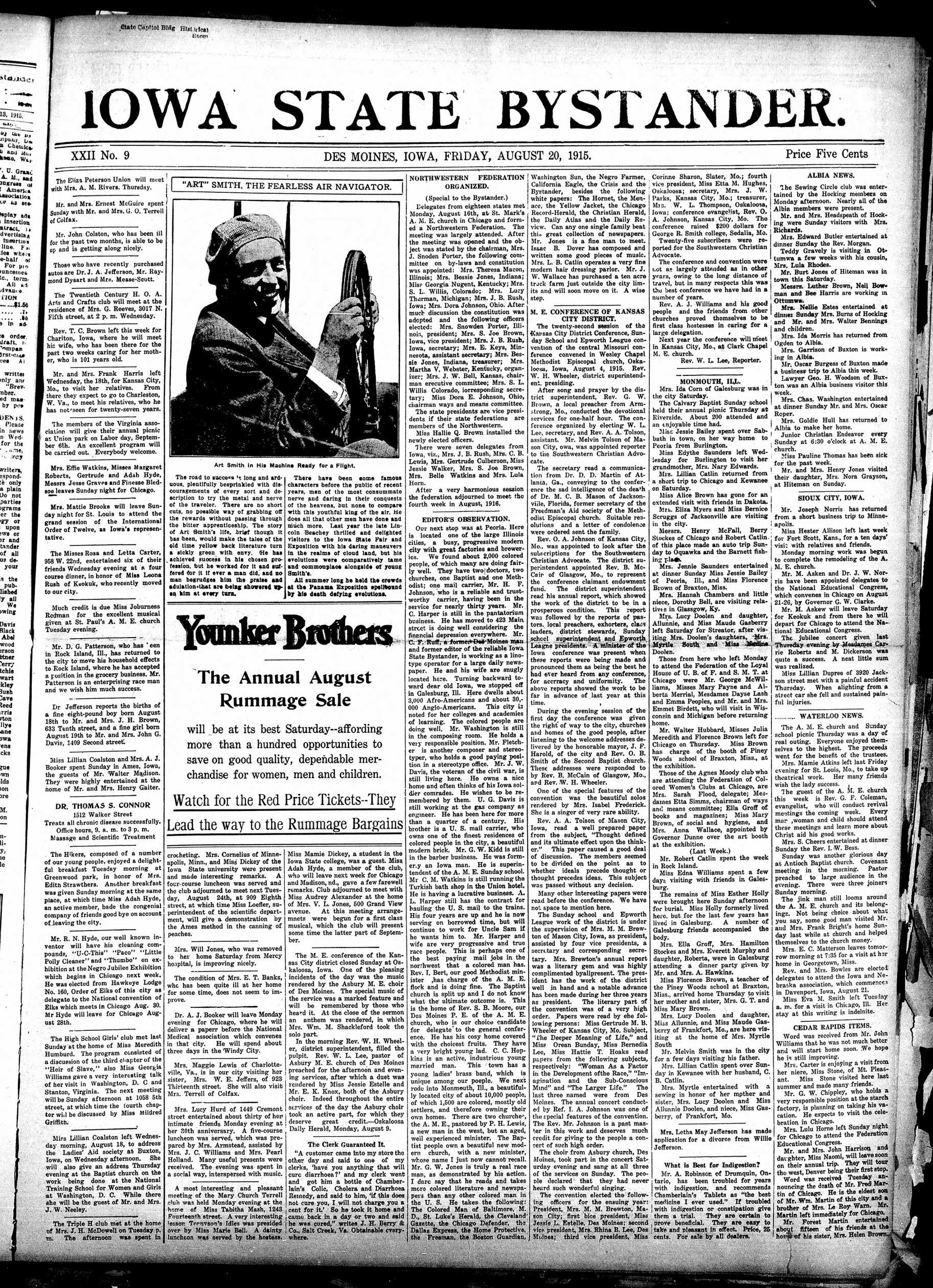
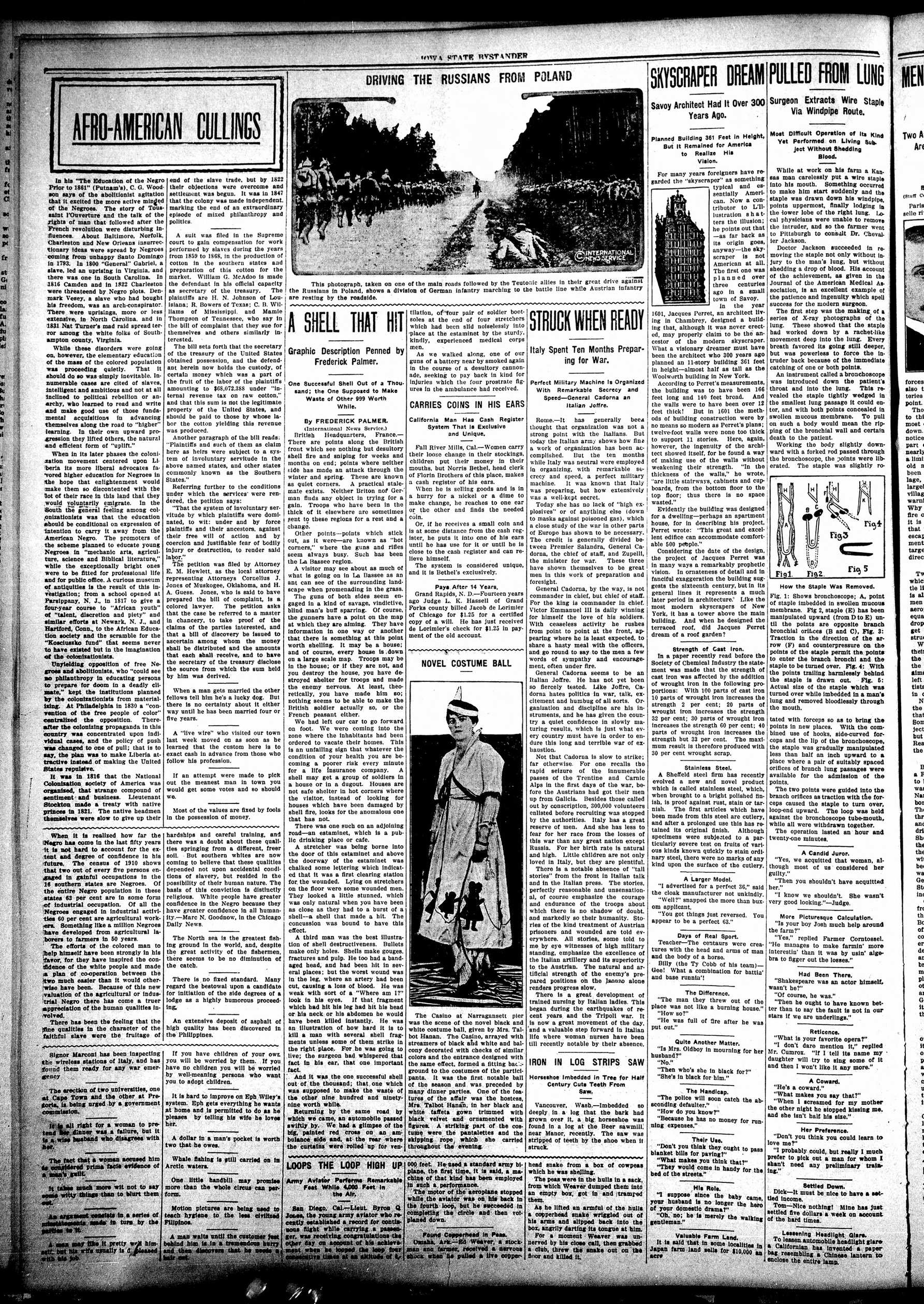
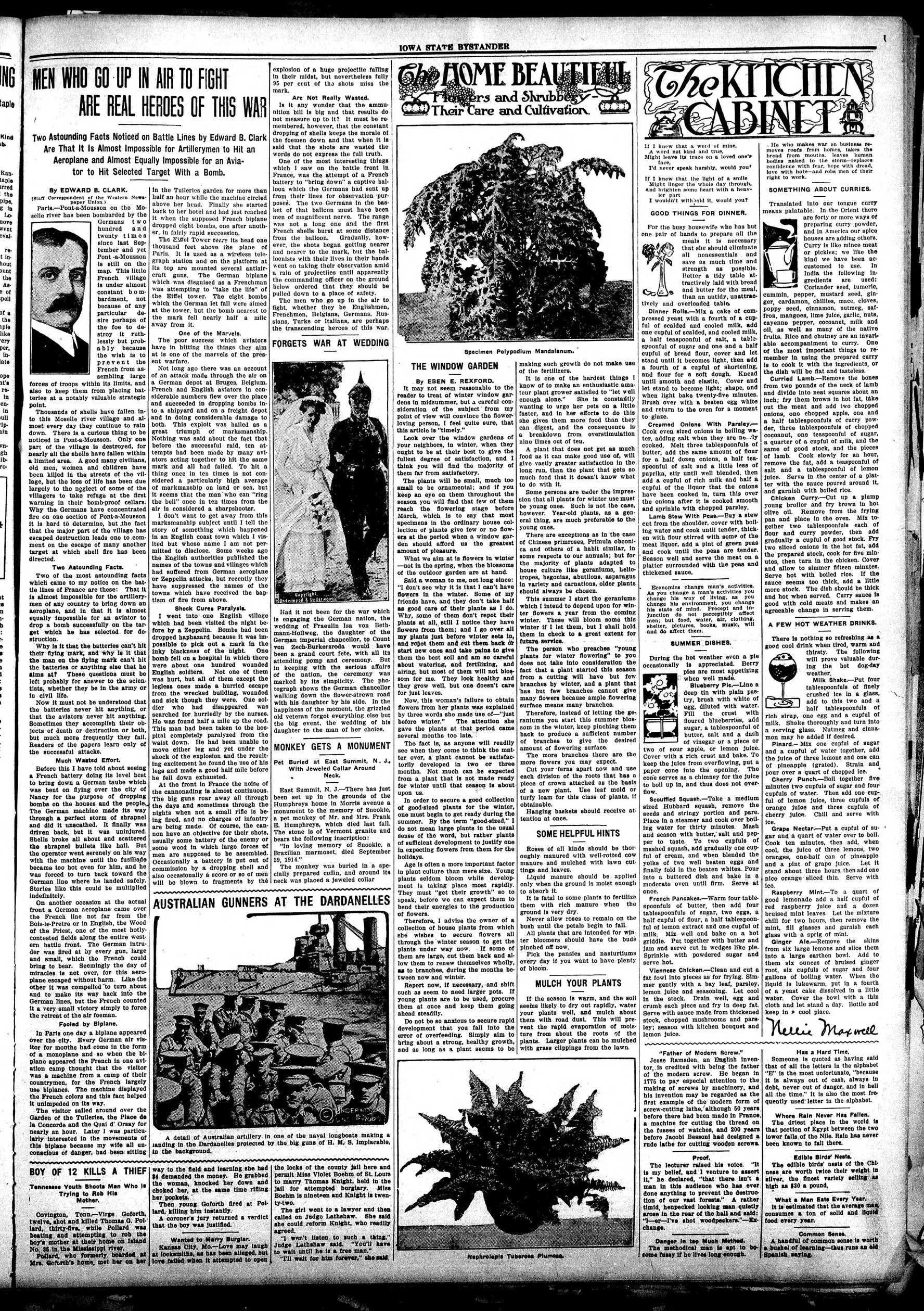
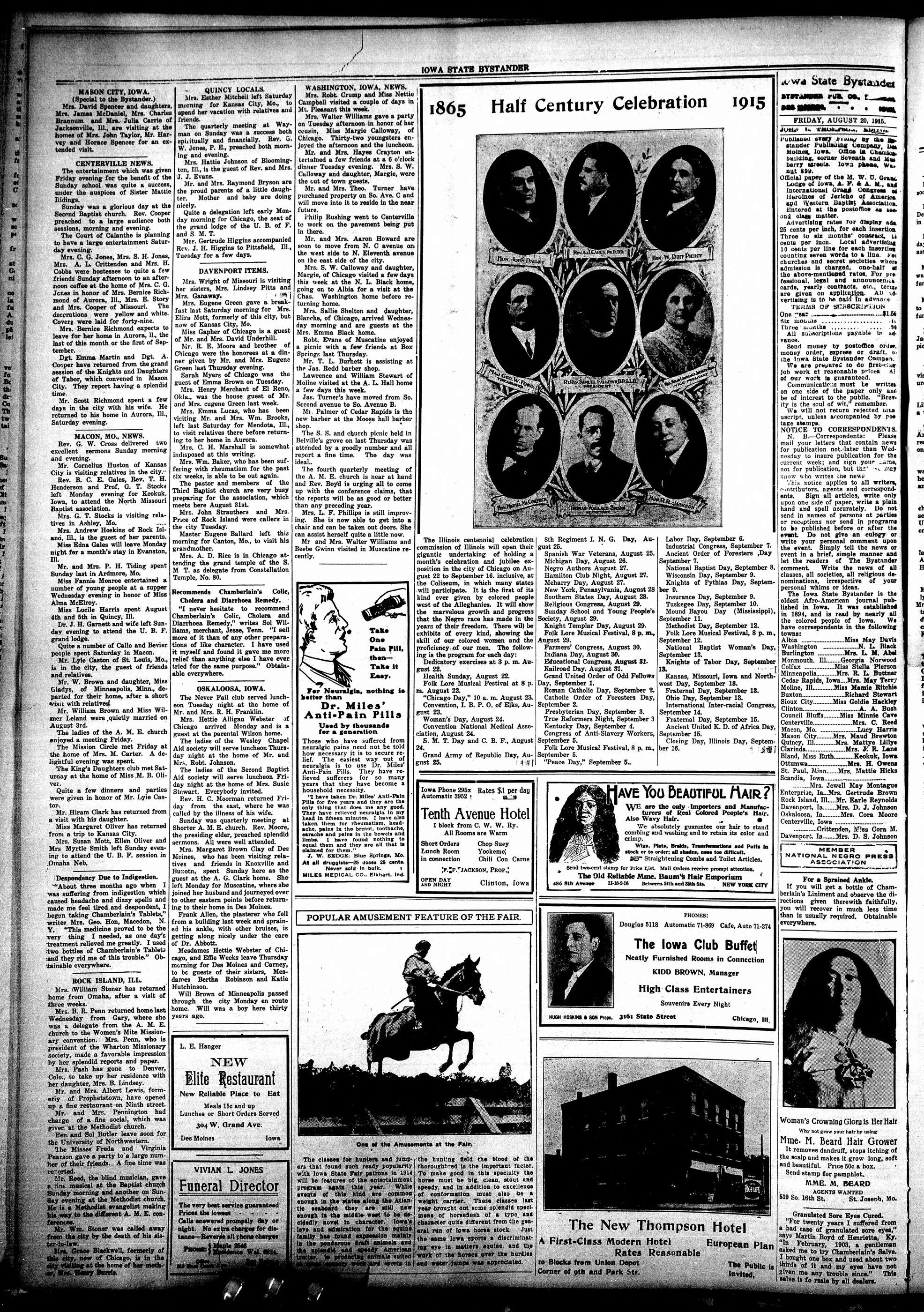
Page text (machine-generated)
IOWA STATE BYSTANDER.
State Capitol Blvd Historical
Koom
10V
The Eliza Peterson Union will meet with Mrs. A. M. Rivers. Thursday.
Mr. and Mrs. Ernest McGuire spent Sunday with Mr. and Mrs. G. O. Terrell of Colfax.
Mr. John Colston, who has been ill for the past two months, is able to be up and is getting along nicely.
Those who have recently purchased autos are Dr. J. A. Jefferson, Mr. Raymond Dysart and Mrs. Mease-Scott.
The Twentieth Century H. O. A. Arts and Crafts club will meet at the residence of Mrs. G. Reeves, 3017 N. Fifth street, at 2 p. m. Wednesday.
Rev. T. C. Brown left this week for Charlton, Iowa, where he will meet his wife, who has been there for the past two weeks caring for her mother, who is 101 years old.
Mr. and Mrs. Frank Harris left Wednesday, the 18th, for Kansas City, Mo., to visit her relatives. From there they expect to go to Charleston, W. Va., to meet his relatives, who he has not seen for twenty-seven years.
The members of the Virginia association will give their annual picnic at Union park on Labor day, September 6th. An excellent program will be carried out. Everybody welcome.
Mrs. Effie Watkins, Misses Margaret Roberts, Gertrude and Adah Hyde, Messrs Jesse Graves and Finease Bledsoe leaves Sunday night for Chicago.
Mrs. Mattie Brooks will leave Sunday night for St. Louis to attend the grand session of the International Order of Twelve, as Iowa's representative.
The Misses Rosa and Letta Carter, 958 W. 22nd, entertained six of their friends Wednesday evening at a four course dinner, in honor of Miss Leona Rush of Kookuk, who recently moved to our city.
Much credit is due Miss Joburness Rodman for the excellent musical given at St. Paul's A. M. E. church Tuesday evening.
Mr. D. G. Patterson, who has 'een in Rock Island, Ill., has returned to the city to move his household effects to Rock Island, where he has accepted a position in the grocery business. Mr. Patterson is an enterprising race man and we wish him much success.
Dr Jefferson reports the births of a fine eight-pound boy born August 18th to Mr. and Mrs. J. H. Brown, 633 Tenth street, and a fine girl born August 19th to Mr. and Mrs. John G. Davis, 1409 Second street.
Miss Lillian Coalston and Mrs. A. J. Booker spent Sunday in Ames, Iowa, the guests of Mr. Walter Madison. They were highly entertained at the home of Mr. and Mrs. Henry Gaiter.
Treats all chronic disease successfully.
Office hours, 9, a. m. to 3 p. m.
Massage and Scientific Treatment
The Hikers, composed of a number of our young people, enjoyed a delightful breakfast Tuesday morning at Greenwood park, in honor of Mrs. Edith Strawthers. Another breakfast was given Sunday morning at the same place, at which time Miss Adah Hyde, an active member, bade the congenial company of friends good bye on account of leaving the city.
Mr. R. N. Hyde, our well known inventor will have his cleaning compounds, "U-C-This" "Paco" "Little Polly Cleaner" and "Thumbo" on exhibition at the Negro Jubilee Exhibition which begins in Chicago next week. He was elected from Hawkeye Lodge No. 160, Order of Elks of this city as delegate to the National convention of Elks which meets in Chicago Aug. 30. Mr Hyde will leave for Chicago August 28th.
The High School Girls' club met last Sunday at the home of Miss Meredith Humbard. The program consisted of a discussion of the third chapter of the "Heir of Slave," also Miss Georgia Williams gave a very interesting talk of her visit in Washington, D. C and Stanton, Virginia. The next meeting will be Sunday afternoon at 1058 5th street, at which time the fourth chapter will be discussed by Miss Mildred Griffith.
Miss Lillian Coalston left Wednesday morning, August 18, to address the Ladies' Aid society at Buxton, Iowa, on Wednesday afternoon. She will also give an address Thursday evening at the Baptist church on the work being done at the National Training School for Women and Girls at Washington, D. C. While there she will be the guest of Mr. and Mrs. J. W. Neely.
The Triple H club met at the home of Mrs. J. H. McDowell on Tuesday p. m. The afternoon was spent in
XXII No. 9
"ART" SMITH, THE FEA
"ART" SMITH, THE FEARLESS AIR NAVIGATOR.
THE MOTORIST
The road to success* is long and arduous, plentifully brushed with discouragements of every sort and description to try the metal and nerve of the traveler. There are no short cuts, no possible way of grabbing off the rewards without passing through the bitter apprenticeship. The story of Art Smith's life, brief though it has been, would make the tales of the old time yellow back literature turn a sickly green with envy. He has achieved success in his chosen profession, but he worked for it and suffered for it if ever a man did, and no man begrudges him the praise and adulation that are being showed upon him at every turn.
Younker
The Annu
Rumma
will be at its best
more than a hundr
save on good quality
chandise for women
Watch for the Red
Lead the way to the
Younker Brothers
will be at its best Saturday--affording more than a hundred opportunities to save on good quality, dependable merchandise for women, men and children. Watch for the Red Price Tickets--They Lead the way to the Rummage Bargains
crocheting. Mrs. Cornelius of Minneapolis, Minn., and Miss Dickey of the Iowa State university were present and made interesting remarks. A four-course luncheon was served and the club adjourned to meet next Tuesday, August 24th, at 909 Eighth street, at which time Miss Loefer, superintendent of the scientific department, will give a demonstration by the Ames method in the canning of peaches.
Mrs. Will Jones, who was removed to her home Saturday from Mercy hospital, is improving nicely.
The condition of Mrs. E. T. Banks, who has been quite ill at her home for some time, does not seem to improve.
Dr. A. J. Booker will leave Monday evening for Chicago, where he will deliver a paper before the National Medical association which convenes in that city. He will spend about three days in the Windy City.
Mrs. Maggie Lewis of Charlotteville, Va., is in our city visiting her sister, Mrs. W. E. Jeffers, of 923 Thirteenth street. She will also visit Mrs. Terrell of Colfax.
Mrs. Lucy Hurd of 1449 Cremont street entertained about thirty of her intimate friends Monday evening at her 20th anniversary. A five-course luncheon was served, which was prepared by Mrs. Armstead, assisted by Mrs. J. C. Williams and Mrs. Pearl Holland. Many useful presents were received. The evening was spent in a social way, interspersed with music.
A most interesting and pleasant meeting of the Mary Church Terrell club was held Monday evening at the home of Miss Tabitha Mash, 1248 Fourthtown street. A very interesting lesson Tennyson's Idles was presided over by Miss Marie Bell. A dainty luncheon was served by the hostess.
Art Smith in His Machine Ready for a Flight.
The Annual August Rummage Sale
There have been some famous characters before the public of recent years, men of the most consumate nerve and daring in their conquests of the heavens, but none to compare with this youthful king of the air. He does all that other men have done and much more. Last year the late Lincoln Beachey thrilled and delighted visitors to the Iowa State Fair and Exposition with his daring maneuvers in the realms of cloud land, but his evolutions were comparatively tame and commonplace alongside of young Smith's. All summer long he held the crowds at the Panama Exposition spellbound by his death defying evolutions.
Brothers
Special August
age Sale
Saturday--affording
new opportunities to
buy, dependable mer-
men and children.
Price Tickets--They
Rummage Bargains
Miss Mamie Dickey, a student in the Iowa State college, was a guest. Miss Adah Hyde, a member of the club, will leave next week for Chicago and Madison, nd, gave a few farewell remarks. Club adjourned to meet with Miss Audrey Alexander at the home of Mrs. V. L. Jones, 500 Grand View avenue. At this meeting arrangements were begun for a first class musical, which the club will present some time the latter part of September.
The M. E. conference of the Kansas City district closed Sunday at Oskaloosa, Iowa. One of the pleasing incidents of the day was the music rendered by the Asbury M. E. choir of Des Moines. The special music of the service was a marked feature and will be remembered by those who heard it. At the close of the sermon an anthem was rendered, in which Mrs. Wm. M. Shackleford took the solo part.
In the morning Rev. W. H. Wheeler, district superintendent, filled the pulver, Rev. W. L. Lee, pastor of Asbury M. E. church of Des Moines preached for the afternoon and evening services, after which a duet was rendered by Miss Jessie Estelle and Mr. E. K. Knox, both of the Asbury choir. Indeed throughout the choir services of the day the Asbury choir took an active part, for which they deserve great credit.—Oskaloosa Daily Herald, Monday, August 9.
The Clerk Guaranteed It
"A customer came into my store the other day and said to one of my clerks, 'have you anything that will cure diarrhoea?' and my clerk went and got him a bottle of Chamberlain's Colic, Cholera and Diarrhoea Remedy, and said to him, 'if this does not cure you, I will not charge you a cent for it.' So he took it home and came back in a day or two and said he was cured," writes J. H. Berry & Co., Salt Creek, Va. Obtainable everywhere.
NORTHWESTERN FEDERATION
ORGANIZED.
(Special to the Bystander.)
(opener)
Delegates from eighteen states met Monday, August 16th, at St. Mark's A. M. E. church in Chicago and formed a Northwestern Federation. The meeting was largely attended. After the meeting was opened and the object was stated by the chairman, Mrs. J. Snoden Porter, the following committee on by-laws and constitution was appointed: Mrs. Theresa Macon, Illinois; Mrs. Bessie Jones, Indiana; Miss Georgia Nugent, Kentucky; Mrs. S. L. Willis, Colorado; Mrs. L. Lucy Tharman, Michigan; Mrs. J. B. Rush, Iowa; Mrs. Dora Johnson, Ohio. After much discussion the constitution was adopted and the following officers elected: Mrs. Snowden Porter, Illinois; president, Mrs. S. J. Soe Brown, Iowa; vice president, Mrs. J. B. Rush, Iowa, secretary; Mrs. E. Keys, Minnesota, assistant secretary; Mrs. Bessie Jones, Indians, treasurer; Mrs. Martha V. Webster, Kentucky, chairman; Mrs. J. W. Bell, Kansas, chairman executive committee; Mrs. S. L. Willis Colorado, iorresponding secretary; Miss Dora E. Johnson, Ohio, chairman ways and means committee.
The state presidents are vice presidents if their state federations are members of the Northwestern.
Miss Hallie Q. Brown installed the newly elected officers.
There were seven delegates from Iowa, viz., Mrs. J. B. Rush, Mrs. C. B. Lowis, Mrs. Gerald Culberdon, Miss Jessie Walker, Mrs. S. Joe Brown, Mrs. Belle Watkins and Mrs. Lula Horn.
After a very harmonious session the federation adjourned to meet the fourth week in August, 1916.
EDITOR'S OBSERVATION.
Our next stop was at Peoria. Here is located one of the large Illinois cities, a busy, progressive modern city with great factories and breweries. We found about 2,000 colored people, of which many are doing fairly well. They have two doctors, two churches, one Baptist and one Methodist; one mail carrier, Mr. H. F. Johnson, who is a reliable and trustworthy carrier, having been in the service for nearly thirty years. Mr. C. Harper is still in the pantatorium business. He has moved to 423 Main street is doing well considering the financial depression everywhere. Mr. C. F. Ruff, a former De Moines man and former editor of the reliable Iowa State Bystander, is working as a linetype operator for a large daily newspaper. He and his wife are snugly located here. Turning backward toward dear old Iowa, we stopped off in Galesburg. Here we dwell about 3,000 Afro-Americans and about 30,000 Anglo-Americans. This city is noted for her colleges and academies of learning. The colored people are doing well. Mr. Washington is still in the composing room. He holds a very responsible position. Mr. Fleether is another composer and stereotyper, who holds a good paying position in a stereotype office. Mr. J. W. Davis, the veteran of the civil war, is still living here. He owns a nice home and often ties of his Iowa soldier comrades. He wishes to be remembered by them. U. G. Davis is still working at the gas company as engineer. He has an office of the century. His brother is a U. S. mail carrier, who owns one of the finest residences of colored people in the city, a beautiful modern brick. Mr. G. W. Kidd is still in the harbor business. He is superintendent of the A. M. E. Sunday school. Mr. C. M. Watkins is still running the Turkish bath shop in the Union hotel. He is having a lucrative business. A. L. Harper still has the contract for hauling the U. S. mail to the trains. His four years are up and he is now serving on borrowed time, but will continue to work for Uncle Sam if he wants him to. Mr. Harper and wife are very progressive and true race people. This is perhaps one of the best paying mail jobs in the northwest that a colored man has. Rev. I. Bert, our good Methodist minister, has charge of the A. M. E. flock and is doing fine. The Baptist church is split up and I do not know what the ultimate outcome is. This is the home of Rev. S. B. Moore, our Des Moines P. E. of the A. M. E. church, who is our choice candidate for delegate to the general conference. He has his cosy home covered with the chosen fruits. They C. H. Hopkins is an active, industrious young married man. This town has a young ladies' brass band, which is unique among our people. We next rode into Mountouth, ill, a beautiful town of 1,500 are colored, mostly old settlers, and therefore owning their own homes. There are two churches: A. M. E. pasted by P. H. Lewis a new man in the west, but an aged minister, with a new minister, whose name I just now cannot recall. Mr. G. W. Jones is truly a real race man, as demonstrated by his action. I dare say that he reads and takes more colored literature and newspapers than any other colored man in the U. S. He takes the following: The S. M. He takes the following: M. D. St. Luke's Herald, the Cleveland Gazette, the Chicago Defender, the Dallas Express, the Home Protective, the Freeman, the Boston Guardian,
Washington Sun, the Negro Farmer, California Eagle, the Crisis and the Bystander, besides the following white papers: The Hornet, the Menace, the Yellow Jacket, the Chicago Record-Herald, the Christian Herald, the Daily Atlas and the Daily Review. Can any one single family beat this great collection of newspapers. Mr. Jones is a fine man to meet. Isaac B. D. Bover has composed and written some good pieces of music. Mrs. L. B. C. Batin operates a very fine modern hair dressing parlor. Mr. J. W. Wallace has purchased a ten acre track farm just outside the city limits and will soon move on it. A wise step.
M. E. CONFERENCE OF KANSAS CITY DISTRICT.
The twenty-second session of the Kansas City District Conference, Sunday School and Epworth League convention of the central Missouri conference convened in Wesley Chapel Methodist Episcopal church, Oskaloosa, Iowa, August 4, 1915, Rev. W. H. Wheeler, district superintendent, presiding.
After song and prayer by the district superintendent, Rev. G. W. Brown, a local preacher from Armstrong, Mo., conducted the devotional services for one-half hour. The conference organized by electing W. L. Lee, secretary, and Rev. A. A. Tolson, assistant. Mr. Melvin Tolson of Mason City, owa, was appointed reporter to the Southwestern Christian Advocate.
The secretary read a communication from Dr. D. D. Martin of Atlanta, Ga., conveying to the conference the sad intelligence of the death of Dr. M. C. B. Mason of Jacksonville, Florida, former secretary of the Freedman's Aid society of the Methodist Episcopal church. Suitable resolutions and a letter of condolence were ordered sent the family.
Rev. O. A. Johnson of Kansas City, Mo., was appointed to look after the subscriptions for the Southwestern Christian Advocate. The district superintendent appointed Rev. B. McCain of Glasgow, Mo., to represent the conference claimant endowment fund. The district superintendent read his annual report, which showed the work of the district to be in a prosperous condition. This report was followed by the reports of pastors, local presachers, exhorters, class leaders, district stewards, Sunday school superintendent and Epworth Learn presidents. A minister of the Iowa conference was present when these reports were being made and pronounced them as being the best he had ever heard from any conference, for accuracy and uniformity. The above reports showed the work to be far in advance of last year at this time.
During the evening session of the first day the conference was given the right of way to the city, churches and homes of the good people, after listening to the welcome addresses delivered by the honorable mayor, J. F. Harold, of the city and Rev. O. B. Smith of the Second Baptist church. These addresses were responded to by Rev. B. McCain of Glasgow, Mo., and Rev. W. H. Wheeler.
One of the special features of the convention was the beautiful solos rendered by Mrs. Isabel Frederick. She is a singer of very rare ability.
Rev. A. A. Tolson of Mason City, Iowa, read a well prepared paper from the subject, "Thought defined and its ultimate effect upon the thinker." This paper caused a good deal of discussion. The members seemed to be divided on the point as to whether ideals precede thought or thought precedes ideas. This subject was passed without any decision. Many other interesting papers were read before the conference. We have not space to mention here.
The Sunday school and Epworth League work of the district is under the supervision of Mrs. M. M. B. Mrewton of Mason City, Iowa, as president, assisted by four vice presidents, a secretary and corresponding secretary. Mrs. Brewton's annual report was a literary gem and was highly complimented by all present. The president has the work of the district well in hand and a notable advance has been made during her three years as president. The literary part of the convention was of a very high order. Papers were read by he following persons: M. Gertrude M. B. Wheeler of Kansas City, M. Subject, "the Deeper Meaning of Life," and Miss Oren Bunday, M. Bermedia Lee, Miss Hattie T. Hoakes read papers from the following subjects, respectively: "Woman As a Factor in the Development of the Race," "Imagination and the Sub-Conscious Mind" and "The Larger Life." The last three named were from Des Moines. The annual concert conducted by Ref. I. A. Johnson was one of the special features of the convention. The Rev. Mr. Johnson is a past master in this work and deserves much credit for giving to the people a concert of such high order. The choir from Asbury church, Des Moines, took part in the concert Saturday evening and sang at all three of the services on Sunday. The people declared that they had never heard such wonderful singing.
The convention elected the following officers for the ensuing year: President, Mrs. M. B. Mrewton, Mason City, first vice president, Mrs. B. Mrewton, second vice president, Mrs. Rhina B. Lee, DMoines; third vice president, Miss
Corinne Sharon, Slater, Mo.; four vice president, Miss Etta M. Hughes, Osakalao; secretary, Mrs. J. W. Parks, Kansas City, Mo.; treasurer, Mrs. W. L. Thompson, Osakalao, Iowa; conference evangelist, Rev. O. A. Johnson, Kansas City, Mo. The conference raised $200 dollars for George R. Smith college, Sedalia, Mo. Twenty-five subscribers were reported for the Southwestern Christian Advocate.
The conference and convention were not as largely attended as in other years, owing to the long distance of travel, but in many respects this was the best conference we have had in a number of years. I. W. Williams and his good people and the friends from other churches proved themselves to be first class hostesses in caring for a large delegation.
Next year the conference will meet in Kansas City, Mo., at Clark Chapel M. E. church.
Rev. W. L. Lee, Reporter.
MONMOUTH. ILL.
Mrs. Ida Corn of Galesburg was in the city Saturday.
The Calvary Baptist Sunday school held their annual picnic Thursday at Riverside. About 200 attended and an enjoyable time had.
Miss Jessie Bailey spent over Sabbath in town, on her way home to Peoria from Burlington.
Miss Edythe Saunders left Wednesday for Burlington to visit her grandmother, Mrs. Nary Edwards.
Mrs. Lillian Catlin returned from a short trip to Chicago and Kewanee on Saturday.
Miss Alice Brown has gone for an extended visit with friends in Dakota. Mrs. Eliza Myers and Miss Bernice Scruggs of Jacksonville are visiting in the city.
Meesrs. Henry McFall, Berry Stockes of Chicago and Robert Catlin of this place made an auto trip Sunday to Qauwka and the Barnett fishing place.
Mrs. Jennie Saunders entertained at dinner Sunday Miss Jessie Bailey of Peoria, Ill, and Miss Florence Brown of Braxton, Miss.
Mrs. Hannah Chambers and little niece, Dorothy Bell, are visiting relatives in Glassgow, Ky.
Mrs. Lucy Doolen and daughter, Allunce, and Miss Maude Gasberry left Saturday for Streator, after visiting Mrs. Doolen's daughters, Mrs. Myzle South and Miss Medha Doolen.
Those from here who left Monday to attend the Federation of the Loyal House of U. B. of F. and S. M. T. at Chicago were Mr. George McWilliams, Misses Mary Payne and Alberta Merrial, Medesame DayLash and Emma People, and Mr. and Mrs. Emmet Birdett, who will visit in Wisconsin and Michigan before returning home.
Mr. Walter Hubbard, Misses Julia Meredith and Florence Brown left for Chicago on Thursday. Miss Brown has charge of the booth of Piney Woods school of Braxton, Miss., at the exhibition.
Those of the Agnes Moody club who are attending the Federation of Colored Women's Clubs at Chicago, are Mrs. Sarah Flood, delegate; Medesanes Etta Simms, chairman of ways and means committee; Ella Groff of books and magazines; Miss Mary Brown, of social and hygiene, and Mrs. Anna Wallace, appointed by Governor Dunne over the art booth at the exhibition.
(Last Week.)
Mr. Robert Catlin spent the week in Rock Island.
Miss Edna Williams spent a few days visiting with friends in Galesburg.
The remains of Miss Esther Holly were brought here Sunday afternoon for burial. Miss Holly formerly lived here, but for the last few years has lived in Galesburg. A number of Galesburg friends accompanied the body.
Mrs. Ella Groff, Mrs. Hamilton Stockes and Mrs. Everett Murphy and daughter, Roberta, were in Galesburg attending a dinner party given by Mr. and Mrs. A. Hawkins.
Miss Florence Brown, a teacher of the Piney Woods school at Braxton, Miss, arrived home Thursday to visit her mother and sister, Mrs. G. T. and Miss Mary Brown.
Mrs. Lucy Doolen and daughter, Miss Allunie, and Miss Maude Gasberry of Frankfort, Mo., are here visiting at the home of Mrs. Myrtle South.
Mr. Melvin Smith was in the city for a few days visiting his father.
Mrs. Lillian Cattlin spent over Sunday in Kewanee with her husband, C. B. Cattlin.
Mrs. Myrtle entertained with a sewing in honor of her mother and sister, Mrs. Lucy Doolen and Miss Allunie Doolen, and niece, Miss Gasberry of Frankfort, Mo.
Mrs. Letha May Jefferson has made application for a divorce from Willie Jefferson.
What is Best for Indigestion?
Mr. A. Robinson of Drumquin, Ontario, has been troubled for years with indigestion, and recommends Chamberlain's Tablets as "the best medicine I ever used." If troubled with indigestion or constipation give them a trial. They are certain to prove beneficial. They are easy to take and pleasant in effect. Price, 25 cents. For sale by all dealers.
ALBIA NEWS.
The Sewing Circle club was entertained by the Hocking members on Monday afternoon. Nearly all of the Albia members were present.
Mr. and Mrs. Headpeath of Hocking were Sunday visitors with Mrs. Richards.
Mrs. Edward Butler entertained at dinner Sunday the Rev. Morgan.
Teddy Gravely is visiting in Otumwa a few weeks with his cousin, Mrs. Lula Rhodes.
Mrs. Burt Jones of Hiteman was in town this Saturday.
Messrs. Luther Brown, Neil Bowman and Bee Harris are working in Ottumwa.
Mrs. Nellie Entertained at dinner Sunday Mrs. Burns of Hocking and Mr. and Mrs. Walter Bennings and children.
Mrs. Ida Morris has returned from Ogden to Albia.
Mrs. Garrison of Buxton is working in Albia.
Mr. Oscar Burgess of Buxton made a business trip to Albia this week.
Lawyer Geo. H. Woodson of Buxton was an Albia business visitor this week.
Mrs. Chas. Washington entertained at dinner Sunday Mr. and Mrs. Oscar Reporter.
Mrs. Goldie Hull has returned to Albia to make her home.
Junior Christian Endeavor every Sunday at 6:30 o'clock at A. M. E. church
Miss Pauline Thomas has been sick for the past week.
Mr. and Mrs. Henry Jones visited their daughter, Mrs. Nora Grayson, at Hiteman on Sunday.
SIOUX CITY, IOWA.
Mr. Joseph Norris has returned from a short business trip to Minneapolis.
Miss Hester Allison left last week for Fort Scott, Kans., for a ten days' visit; with relatives and friends.
Monday morning work was begun to complete the remodeling of the A. M. E. church.
Mr. M. Asken and Dr. J. W. Norris have been appointed delegates to the National Educational Congress, which convenes in Chicago on August 21-26, by Governor G. W. Clarke.
Mr. M. Askew will leave Saturday for Keokuk and from there he will depart for Chicago to attend the National Educational Congress.
The jubilee concert given last Thursday evening by Meadames Carrie Roberts and M. Dickerson was quite a success. A neat little sum was realized.
Miss Lillian Dupree of 3920 Jackson street met with a painful accident Thursday. When alighting from a street car she fell and sustained painful injuries.
WATERLOO NEWS.
The A. M. E. church and Sunday school picnic Thursday was a day of real outing. Everyone enjoyed themselves to the highest. The proceeds went for the benefit of the trustees. Mrs. Mamie Atkins left last Friday evening for St. Louis, Mo., to take up theatrical work. Her many friends wish the lady success.
The guest of the A. M. E. church this week is Rev. G. F. Coleman, evangelist, who will conduct revival meetings the coming week. Every mar. woman and child should attend these meetings and learn more about Christ aid his good works.
S. Mrs. Cheers entertained at dinner Sunday the Rev. I. W. Bess. Sunday was another glorious day at Antioch Baptist church. Covenant meeting in the morning. Pastor preached to large audience in the evening. There were three joiners Sunday morning.
The jink man still looms around the A. M. E. church and its belongings. Not being choice about what you say, some good man visited Mr. and Mrs. Frank Brick's home Sunday last while at church and helped themselves to the church money.
Mrs. E. C. Matterson leaves tomorrow morning at 7:35 for a visit at har home in Georgetown, Miss.
Rev. and Mrs. Bowles are elected delegates to attend the Iowa and Nebraska association, which commences in Davenport, Iowa, August 21.
Miss Eva M. Smith left Tuesday a. m. for a visit in Chicago, Ill. Her stay at this writing is indelible.
CEDAR RAPIDS ITEMS
Word was received from Mr. John Williams that he was not much better and will start home soon. We hope he is still improving.
Mr. Carter is enjoying a visit from her niece, Miss Stone, of M. Pleasant. Miss Stone visited here last summer and made many friends.
Mr. G. W. Chippley, who holds a very responsible position at the starch factory, is planning on taking his vacation. He expects to visit the celebration in Chicago.
Mr. Lulu Horne left Sunday night for Chicago to attend the Federation Educational Congress.
Mr. and Mrs. John Harrison and daughter, Miss Naomi, will leave soon on their annual trip. They will tour the west, Denver being their first stop. Word was received Tuesday announcing the name of Mr. Fred Martin of Chicago. He is the eldest son of Mr. Wm. Martin of this city and a brother of Mr. Le Roy Bratcher. Mr. Forest left immediately for Chicago.
Mr. Forest Martin entertained about fifteen of his friends at the house of his sister, Mrs. Helen Brown.
AFRO-AMERICAN CULLINGS
In his "The Education of the Negro Prior to 1851" (Putnam's), C. G. Woodson says of the abolitionist agitation that it excited the more active minded of the Negroes. The story of Toussaint Iouverture and the talk of the rights of man that followed after the French revolution were disturbing influences. About Baltimore, Norfolk, Charleston and New Orleans insurrectionary ideas were spread by Negroes coming from unhappy Santo Domingo in 1793. In 1800 "General" Gabriel, a slave, led an uprising in Virginia, and there was one in South Carolina. In 1815 Camden and in 1822 Charleston were threatened by Negro plots. Denmark Vesey, a slave who had bought his freedom, was an arch-conspirator. There were uprisings, more or less extensive, in North Carolina, and in 1831 Turner's mad raid spread terror among the white folks of Southampton county, Virginia.
While these disorders were going on, however, the elementary education of the mass of the colored population was proceeding quietly. That it should do so was simply inevitable. In numerable cases are cited of slaves, intelligent and ambitious and not at all inclined to political rebellion or archey, who learned to read and write and make good use of those funds themselves. In their upward progression they lifted others, the natural and efficient form of "uplift."
When in its later phases the colonization movement centered upon Liberia its more liberal advocates favored higher education for Negroes in the hope that enlightenment would make them so discontented with the lot of their race in this land that they would voluntarily emigrate. In the South the general feeling among colonizationists was that the education should be conditional on expression of intention to carry it away from the American Negro. The promoters of the scheme planned to educate young Negroes in "mechanic arts, agriculture, science and Biblical literature," while the exceptionally bright ones were to be fitted for professional life and for public office. A curious museum of antiquities is the result of this investigation; from a school opened at Parisipany, N. J., in 1817 to give a four-year course to "African youth" of "talent, discretion and piety" and similar efforts at Newark, N. J., and Hartford, Conn., to the African Education society and the scramble for the "Kosciusko fund" that seems never to have existed but in the imagination of the colonizationists.
Uyfieldy opposition of free Negroes and abolitionists, who "could see no philanthropy in educating persons to prepare for doom in a deadly climate," kept the institutions planned by the colonizationists from materializing. At Philadelphia in 1830 a "convention of the free people of color" centralized the opposition. There after the colonizing propaganda in this country was concentrated upon individual cases, and the policy of push was changed to one of pull; that is to say, the plan was to make Liberia an island of making the United States republic. It was in 1816 that the National Colonization society of America was organized, that strange compound of sentiment and business. Leutenant Stockton made a treaty with native princes in 1821. The native headmen themselves were slow to give up their
When it is realized how far the Negro has come in the last fifty years it is not hard to account for the extent and degree of change in this future. In 1910 there were two out of every five persons engaged in gainful occupations in the 16 southern states are Negroes. Of the entire Negro population in these states 63 per cent are in some form of industrial occupation. Of all the Negroes engaged in industrial activities 60 per cent are agricultural workers. Something like a million Negroes have developed from agricultural laborers to farmers in 50 years.
The efforts of the colored man to help himself have been strongly in his favor, for they have inspired the confidence of the white people and made a plan of co-operation between the two much easier than it would otherwise have been. Because of this new valuation of the agricultural or industrial Negro there has come a truer appreciation of the human qualities involved. There has been the feeling that the fine qualities in the character of the faithful slave were the fruftage of
Signor Marconi has been inspecting the wireless stations of Italy, and has found them ready for any war emergency
The erection of two universities, one at Cape Town and the other at Pretoria, is being urged by a government commission.
It is all right for a woman to pretend she dinner was a failure, but it is a wise husband who disagrees with her.
The fact that a woman accused him as considered prime facts evidence of his guilt.
end of the slave trade, but by 1822 their objections were overcome and settlement was begun. It was in 1847 that the colony was made independent, marking the end of an extraordinary episode of mixed philanthropy and politics.
A suit was filed in the Supreme court to gain compensation for work performed by slaves during the years from 1859 to 1868, in the production of cotton in the southern states and preparation of this cotton for the market. William G. McAdoo is made the defendant in his official capacity as secretary of the treasury. The plaintiffs are H. N. Johnson of Louisiana; R. Bowers of Texas; C. B. Williams of Mississippi; and A. B. Williams of Tennessee, who say in the bill of complaint that they sue for themselves and others similarly interested.
The bill sets forth that the secretary of the treasury of the United States obtained possession, and the defendant herein now holds the custody, of certain money which was a part of the fruit of the labor of the plaintiffs amounting to $68,072.388 under "internal revenue tax on raw cotton," and that this sum is not the legitimate property of the United States, and should be paid to those by whose labor the cotton yielding this revenue was produced. Another paragraph of the bill reads: "Plaintiffs and such of them as claim here as heirs were subject to a system of involuntary servitude in the above named states, and other states commonly known as the Southern States." Referring further to the conditions under which the services were rendered, the petition says:
"That the system of involuntary servitude by which plaintiffs were dominated, to wit: under and by force plaintiffs and their ancestors, against their free will of action and by coercion and justifiable fear of bodily injury or destruction, to render said labor."
The petition was filed by Attorney E. M. Hewlett, as the local attorney representing Attorneys Cornellus J. Jones of Muskogee, Oklahoma, and H. A. Guess. Jones, who is said to have prepared the bill of complaint, is a colored lawyer. The petition assists cases be referred a master in chancery, to take proof of the claims of the parties interested, and that a bill of discovery be issued to ascertain among whom the money shall be distributed and the amounts that each shall receive, and to have the secretary of the treasury disclose the source from which the sum held by him was derived.
When a man gets married the other fellows tell him he is a lucky dog. But there is no certainty about it either way until he has been married four or five years.
A "live wire" who visited our town last week moved on as soon as he learned that the custom here is to exact cash in advance from those who follow his profession.
If an attempt were made to pick out the meanest man in town you would get some votes and so should we.
Most of the values are fixed by fools in the possession of money.
hardships and careful training, and there was a doubt about these qualities springing from a different, freer soil. But southern whites are now coming to believe that these qualities depended not upon accidental conditions of slavery, but resided in the possibility of this conviction is distinctly religious. White people have greater confidence in the Negro because they have greater confidence in all humanity—Marc N. Goodnow, in the Chicago Daily News.
The North sea is the greatest fishing ground in the world, and, despite the great activity of the fishermen, there seems to be no diminution of the catch.
There is no fixed standard. Many regard the bestowal upon a candidate for initiation of the side degrees of a lodge as a highly humorous proceeding.
An extensive deposit of asphalt of high quality has been discovered in the Philippines.
If you have children of your own, you will be worried by them. If you have no children you will be worried by well-meaning persons who want you to adopt children.
It is hard to improve on Eph Wiley's system. Eph gets everything he wants at home and is permitted to do as he pleases by telling his wife her.
A dollar in a man's pocket is worth two that he owes.
DRIVING THE RUSSIANS FROM POLAND
INTERNATIONAL
NEW SERVICE
This photograph, taken on one of the main roads followed by the Teutonic allies in their great drive against the Russians in Poland, shows a division of German infantry marching to the battle line while Austrian infantry are resting by the roadside.
This photograph, taken on one of the main roads followed by the Teutonic allies in their great drive against the Russians in Poland, shows a division of German infantry marching to the battle line while Austrian infantry are resting by the roadside.
Graphic Description Penned by Frederick Palmer.
One Successful Shell Out of a Thousand; the One Supposed to Make Waste of Other 999 Worth
By FREDERICK PALMER.
International News Service
British headquarter of France —
There are points along the British front which see nothing but desutility shell fire and sniping for weeks and months on end; points where neither side has made an attack through the winter and spring. These are known as quiet corners. A practical stalemate exists. Neither Briton nor German finds any object in trying for a gain. Troops who have been in the thick of it elsewhere are sometimes sent to these regions for a rest and a change.
Other points—points which stick out, as it were—are known as "hot corners," where the guns and rifles seem always busy. Such has been the La Basse region.
There are points on about as much of what is going on in La Basse as an ant can see of the surrounding landscape when promenading in the grass.
The guns of both sides seem engaged in a kind of savage, vindictive, blind man's buff sparing. Of course, the gunners have a point on the map at which they are aiming. They have information in one way or another that there is something at this point worth shelling. It may be a house; and of course, every house is down on a large scale map. Troops may be in the house; or if they are not, and you destroy the house, you have destroyed shelter for troops and made the enemy nervous. At least, theoretically, you have made him so; nothing seems to be able to make the British soldier actually so, or the French peasant either.
We had left our car to go forward on foot. We were coming into the zone where the inhabitants had been ordered to vacate their homes. This is an unfalling sign that whatever the condition of your health you are becoming a poorer risk every minute for a life insurance company. A shell may get a group of soldiers in a house or in a dugout. Houses are not safe shelter in hot corners where the visitor, instead of looking for houses which have been damaged by shell fire, looks for the anomalous one that has not.
There was one such on an adjoining road—an estatine, which is a public drinking place or cafe.
A stretcher was being borne into the door of this estaminet and above the doorway of the estaminet was chalked some lettering which indicated that it was a first clearing station for the wounded. Lying on stretches on the floor were some wounded men. They looked a little stunned, which was only natural when you have been struck by a bullet. The shell—shell that made a hit. The conclusion was bound to have this effect.
A third man was the best illustration of shell destructiveness. Bullets make only holes. Shells make gouges, fractures and pulp. He too had a bandaged head, and had been hit in several places; but the worst wound was in the leg, where an artery had been cut, causing a loss of blood. He was weak with sort of a "Where am I?" look in his eyes. If that fragment which had hit his leg had hit his head or his neck or his abdomen he would have been killed instantly. He was an illustration of how hard it is to kill a man with several shell fragments unless some of them strike in the right place. For he was going to live; the surgeon had whispered that fact in his ear, that one important fact. And it was the one successful shell out of the thousand; that one which was supposed to make the waste of the other nine hundred and ninety-nine worth while.
Returning by the same road by
which we came, an automobile passed
swiftly by. We had a glimpse of the
big, painted red cross on an
ambulance side and, at the rear where
the curtains were rolled up for ven-
LOOPS THE LOOP HIGH UP
Army Aviator Performs Remarkable Feat While 4,000 Feet In the Air.
San Diego, Cal.-Lieut Byron Q Jones, the young army aviator who recently established a record for continuous flight while carrying a passenger, was receiving congratulations the other day on account of his achievement when he begged the keep four consecutive times at an altitude of 4,000 feet.
IOWA STATE RYSTANDER
THE RUSSIANS FROM
of the main roads followed by the Teutonic mission of German infantry marching to the
titation, of four pair of soldier boots-soles at the end of four stretchers which had been slid noiselessly into place at the estaminet by the sturdy, kindly, experienced medical corps. As we walked along, one of our guns of a battery near by smoked again in the course of a desultory cannonade, seeking to pay back in kind for injuries which the four prostrate figures in the ambulance had received.
CARRIES COINS IN HIS EARS
California Man Has Cash Register
System That Is Exclusive
and Unique.
Fall River Mills, Cal.-Women carry
their loose change in their stockings,
children put their money in their
mouths, but Norris Bethel, head clerk
of Florin Brothers of this place, makes
a cash register of his ears.
When he is selling goods and is in
a hurry for a nickel or a dime to
make change, he reaches to one ear
or the other and finds the needed
coin.
Or, if he receives a small coin and
is at some distance from the cash
register, he puts it into one of his ears
until he has for it or until he is
close to the cash register and can
relieve himself.
The system is considered unique,
and it is Bethel's exclusively.
Rave After 14 Years
Grand Rapids, N. D.—Fourteen years ago judge L. K. Hassell of Grand Forks county billed Jacob de Lorimer of Chicago for $1.25 for a certified copy of a will. He has just received de Lorimer's check for $1.25 in payment of the old account.
NOVEL COSTUME BALL
THE FILM MAKES A SUCCESS OF THE FILM "THE FILM MAKES A SUCCESS OF THE FILM "
The Casino at Narragansett pier was the scene of the novel black and white costume ball, given by Mrs. Talbot Hanan. The Casino, arrayed with streamers of black and white and blah and blah decorated with checks of similar colors and the entrance designed with the same effect, formed a fitting background to the costumes of the participants. It was the first notable ball of the season and was preceded by many other parades. One of the feats of the fair was the hostess Mrs. Talbot Hanan, in her black and white taffeta gown trimmed with black velvet and ornamented with figures. A striking part of the costume were the pantalletes and the skipping rope, which she carried throughout the evening.
000 feet. He used a standard army biplane, the first time it, is said, a machine of that kind has been employed in such a performance.
The motor of the aeroplane stopped while the aviator was on his back in the fourth loop, but he succeeded in completing the circle and then vol- plained down.
Found Copperhead in Pens.
Umaha, Circle -Ed Weaver, a stock- man and farmer, received a nervous shock when he pulled a live copper-
Italy Spent Ten Months Preparing for War.
Perfect Military Machine is Organized With Remarkable Secrecy and Speed—General Cadrona an Italian Jeffre.
Rome—It has generally beed thought that organization was not a strong point with the Italianists. But today the Italian army shows how fine a work of organization has been accomplished. But the ten months while Italy was neutral were employed in organizing, with remarkable secrecy and speed, a perfect military machine. It was known that Italy was preparing, but how extensively was a well-kept secret.
Today she has no lack of "high explosives" or of anything else (down to masks against poisoned gas), which a close study of the war in other parts of Europe has shown to be necessary. The enemy is generally divided between Premier General, General Cadrona, the chief of staff, and Zupellac, the minister for war. These three have shown themselves to be great men in this work of preparation and foresight.
General Cadora, by the way, is not commander in chief, but chief of staff. For the king is commander in chief. Victor Emmanuel III is daily winning for himself the love of his soldiers. With ceaseless activity he rushes from point to point at the front, appearing where he is least expected, to share a hasty meal with the officers, and go round to say to the men a few words of sympathy and encouragement, often under fire.
General Cadora seems to be an Italian Joffre. He has not yet been so fiercely tested. Like Joffre, Cadora hates politics in war, talk, excitement and humbge of all sorts. Organization and discipline are his instruments, and he has given the country a quiet confidence in slowly maturing results, which is just what every country must have in order to endure this long and terrible war of exhaustion.
Not that Cadonna is slow to strike; far otherwise. For one recalls the rapid seizure of the innumerable passes of the Trentine and Carine Alps in the first days of the war, before the Austrians had got their men up from Galicia. Besides those called out by conscription, 300,000 volunteers enlisted before recruiting was stopped by the authorities. Italy has a great reserve of men. And she has less to fear for her race from the losses of this war than any great nation except Russia. For her birth rate is natural and high. Little children are not only loved in Italy, but they are plentiful.
There is a notable absence of "tail stories" from the front in Italian talk and in the Italian press. The stories, perfectly reasonable and unsensational, of course emphasize the courage and endurance of the troops about which there is no shadow of doubt, and markedly so their humanity. Stories of the kind treatment of Austrian prisoners and wounded are told everywhere. All stories, some told me by me eye witnesses of high military standing, emphasize the excellence of the Italian artillery and its superiority to the Austrian. The natural and artificial strength of the enemy's prepared positions on the Janzozo alone renders progress slow.
There is a great development of trained nursing by Italian ladies. This began during the earthquakes of recent years and the Tripoll war. It is now a great movement of the day, and a valuable step forward in Italian life where nurses have been till recently notable by their absence.
IRON IN LOG STRIPS SAW
Horseshoe imbedded in Tree for Half Century Cutte Teeth From Saw.
Vancouver, Wash.—Imbedded so deeply in a log that the bark had grown over it, a big horsehose was found in a log at the Beer sawmill, near Manor, recently. The saw was stripped of teeth by the shoe when it struck.
head snake from a box of cowpeas which he was shelling.
The peas were in the hulls in a sack, from which Weaver dumped them into an empty box, got in and tramped them.
As he lifted an armful of the hulls a copperhead snake wrigled out of his arms and slipped back into the box, angrily darting its tongue at him.
For a moment Weaver was unmerged by his close call, then grabbed a club, threw the snake out on the floor and killed it.
SKYSCRAPER DREAM|PULLED FROM LUNG
Savoy Architect Had It Over 300 Years Ago.
Planned Building 361 Feet in Height, But It Remained for America to Realize His Vision.
For many years foreigners have regarded the "skyscraper" as something typical and essentially American, a new contributor to L.L. illustration that attracts the illusion; he points out that—as far back as its origin goes, anyway—the skyscraper is not American at all. The first one was planned over three centuries ago in a small town of Savoy.
centrally American. Now a contributor to Lillustration stations the illusion; he points out that—as far back as its origin goes, anyway—the skyscraper is not American at all. The first one was planned over three centuries ago in a small town of Savoy. In the year 1601, Jacques Perret, an architect living in Chambre, designed a building that, although it was never erected, may properly claim to be the ancestor of the modern skyscraper. When a visionary senior must have been the architect who 300 years ago planned an 11-story building 361 feet in height—almost half as tall as the Woolworth building in New York.
According to Perret's measurements, the building was to have been 166 feet long and 140 feet broad. And the walls were to have been over 12 feet thick! But in 1601 the methods of building construction were by no means so modern as Perret's plans; twelve-foot walls were none too thick to support 11 stories. Here, again, however, the ingenuity of the architect showed itself, for he found a way of making use of the walls without weakening their strength. "In the thickness of the walls," he wrote, "are little stairways, cabinets and cupboards, from the bottom floor to the top floor; thus there is no space wasted." Evidently the building was designed for a dwelling—perhaps an apartment house, for in describing his project, Perret wrote: "This great and excellent edifice can accommodate comfortable 500 pennel."
Considering the date of the design, the project of Jacques Perret was in many ways a remarkably prophetic vision. In ornateness of detail and in fanciful exaggeration the building suggests the sixteenth century, but in its general lines it represents a much later period in architecture. Like the building at York, it has a tower above the main building. And when he designed the terraced roof, did Jacques Perret dream of a roof garden?
Strength of Cast Iron
In a paper recently read before the Society of Chemical Industry the statement was made that the strength of cast iron was affected by the addition of wrought iron in the following proportions: With 100 parts of cast iron 10 parts of wrought iron increases the strength 2 per cent; 20 parts of wrought iron increases the strength 32 per cent; 30 parts of wrought iron increases the strength 40 per cent; 40 parts of wrought iron increases the strength but 33 per cent. The maximum result is therefore produced with 30 per cent wrought scrap.
Stainless Steel.
A Sheffield steel firm has recently evolved a new and novel product which is called stainless steel, which when brought to a bright polished finish, is proof against rust, stain or tarnish. The first articles which have been made from this steel are cutlery, and after a prolonged use this has retained its original finish. Although specimens were subjected to a particularly severe test on fruits of various kinds known quickly to stain ordinary steel, there were no marks of any kind upon the surface of the cutlery.
A Larger Model.
"I advertised for a perfect 36," said the cloak manufacturer not unkindly. "Well?" snapped the more than buxom applicant.
"You got things just reversed. You appear to be a perfect 63."
**Days of Real Sport.**
Teacher—The contours were creatures with the head and arms of man and the body of a horse.
Hilly—The Ty Cobb of his team!—Goel! What a combination for battin' and base runnin'.
**The Difference.**
"The man they threw out of the place was not like a burning house." "How so?" "He was full of fire after he was put out."
Quite Another Matter
"Is Mrs. Oldboy in mourning for her husband?"
"No."
"Then who's she in black for?"
"She's in black for him."
The Handicap.
"The police will soon catch the absconding defaulter."
"How do you know?"
"Because he has no money for running expenses."
Their Use.
"Don't you think they ought to pass blanket bills for paying?"
"What makes you think that?"
"They would come in handy for the bed of the streets."
His Roles.
"I suppose since the baby came, your husband is no longer the hero of your domestic drama?"
"Oh, no; he is merely the walking gentleman."
vulnerable Farm Land.
It is said that in some localities in Japan farm land sells for $10,000 an acre
Most Difficult Operation of its Kind Yet Performed on Living Subject Without Shedding Blood.
While at work on his farm a Kansas man carelessly put a wire staple into his mouth. Something occurred to make him start suddenly and the staple was drawn down his windpipe, points uppermost, finally lodging in the lower lobe of the right lung. Local physicians were unable to remove the intruder, and so the farmer went to Pittsburgh to consult Dr. Chevler Jackson.
Doctor Jackson succeeded in removing the staple not only without injury to the man's lung, but without shedding a drop of blood. His account of the achievement, as given in the Journal of the American Medical Association, is an excellent example of the patience and ingenuity which spell success for the modern surgeon.
The first step was the making of a series of X-ray photographs of the lung. These showed that the staple had worked down by a rachet-like movement deep into the lung. Every breath favored its going still deeper, but was powerless to force the intruder back because of the immediate catching of one or both points. An instrument called a bronchoscope was introduced down the patient's throat and into the lung. This revealed the staple tightly wedged in the smallest lung passage it could enter and both the mucous and mucin membrane. To pull on such a body would mean the ripping of the bronchial wall and certain death to the patient. Working the body slightly downward with a forked rod passed through the bronchoscope, the points were liberated. The staple was slightly ro
Fig1
Fig2
Fig3
Fig5
How the Staple Was Removed.
Fig. 1: Shows bronchoscope; A, point of staple imbedded in swollen mucous membrane. Fig 2, staple (E) has been manipulated upward (from D to E) until the points are opposite branch bronchial orifices (B and C), Fig. 3: Traction in the direction of the arrow (F) and counterpressure on the points of the staple permit the points to enter the branch bronchi and the staple to be turned over. Fig. 4: With the points trailing harmlessly behind the staple is drawn out. Fig. 5: the size of the staple turned over while imbedded in a man's lung and removed bloodlessly through the mouth.
tated with forceps so as to bring the points in new places. With the combined use of hooks, side-curved forcels and the lip of the bronchoscope, the staple was gradually manipulated until half an inch upward to a place where the pair of suitably spaced orifices of branch lung passages were available for the admission of the points.
The two points were guided into the branch orifices as traction with the forcels caused the staple to turn over, loop up end up. The loop was held against the bronchoscope tube-mouth, while all were withdrawn together. The operation lasted an hour and twenty-one minutes.
A Candid Juror.
"Yes, we acquitted that woman, although most of us considered her guilty."
"Then you shouldn't have acquitted her."
"I know we shouldn't. She wasn't very good looking."—Judge.
More Picturesque Calculation.
"Is your boy Josh much help around the farm?"
"Yes," replied Farmer Cortosel.
"He manages to make farmin' more interestin' than it was by usin' algebra to finger out the losses."
Had Been There
"Shakespeare was an actor himself, wasn't he?" "Of course, he was." "Then he ought to have known better than to say the fault is not in our stars if we are underlines."
Retlence.
"I don't dare mention it," replied Mr. Cumrox. "If I tell its name my daughter will try to sing some of it and then I won't like it any more."
A Coward.
"What makes you say that?"
"When I screamed for my mother the other night he stopped kissing me, and she isn't half his site."
Her Preference.
"Don't you think you could learn to love?" I probably could, but really I much prefer to pick out a man for whom I shouldn't need any preliminary training.
Settled Down
Dick—It must be nice to have a settled income.
Tom—Nice nothing! Mine has just settled five dollars a week on account of the hard times.
Lessening headlight. Glare.
To lessen automobile headlight glare a Californian has invested a paper bag, resembling a Chinese lantern to enclose the entire lamp.
MEN WHO GO UP IN AIR TO FIGHT ARE REAL HEROES OF THIS WAR
Two Astounding Facts Noticeed on Battle Lines by Edward B. Clark Are That It Is Almost Impossible for Artillerymen to Hit an Aeroplane and Almost E equally Impossible for an Aviator to Hit Selected Target With a Bomb.
(S staff Correspondent of the Western News Paper Union
Paris.—Pont a-Mouson on the Mo
selle river has been bombarded by the
Germans two hundred and twenty times since last September and yet Pont a-Mousson is still on the map. This little French village is under almost constant bombardment, not because of any particular desire perhaps of the foe to destroy it ruthlessly but probably because the wish is to prevent the French from assembling large
Germans two hundred and twenty times since last September and yet Pont-a-Mousson is still on the map. This little French village is under almost constant on bardiment, not because of any particular desire perhaps of the foe to destroy it ruthlessly but probably because the wish is to prevent the French from assembling large forces of troops within its limits, and also to keep them from placing batteries at a notably valuable strategic point.
Thousands of shells have fallen into this Moselle river village and almost every day they continue to rain down. There is a curious thing to be noticed in Pont-a-Moussion. Only one part of the village is destroyed, for nearly all the shells have fallen within a limited area. A good many civilians, old men, women and children have been killed in the streets of the village, but the loss of life has been due largely to the ngglect of some of the villagers to take refuge at the first warning in their bomb-proof cells. Why the Germans have concentrated fire on one section of Pont-a-Moussion it is hard to determine, but the fact that the major part of the village has escaped destruction leads one to comment on the escape of many another target at which shell fire has been directed.
Two Astounding Facts.
Two of the most astounding facts which came to my notice on the battle lines of France are these: That it is almost impossible for the artillerymen of any country to bring down an aerospace, and in that it is almost equally impossible for an aviator to drop a bomb successfully on the target which he has selected for destruction.
Why is it that the batteries can't hit their flying mark, and why is it that the man on the flying mark can't hit the batteries or anything else that he aims at? These questions must be left probably for answer to the scientists, whether they be in the army or in civil life.
Now it must not be understood that the batteries never hit anything, or that the aviators never hit anything. Sometimes they accomplish their objects of death or destruction or both, but much more frequently they fail. Readers of the papers learn only of the successful attacks.
Much Waated Effort.
Before this I have told about seeing a French battery doing its level best to bring down a German taube which was bent on flying over the city of Nancy for the purpose of dropping bombs on the houses and the people. The German machine made its way through a perfect storm of shrapnel and did it unscathed. It finally was driven back, but it was uninjured. Shells broke all about and scattered the shrapnel bullets like hall. But the operator went serenely until on his way with the machine the fuselid was forced up for him, and he was forced to turn back toward the German line where he landed safely. Stories like this could be multiplied indefinitely.
On another occasion at the actual front a German airplane came over the French line not far from the Bois-le-Pretre or in English, the Wood of the Priest, one of the most hotly-contested fields along the entire western battle front. The German intruder was fired at by all gun, large and small, which the French could bring to bear. Seemingly, all of the aircraps is indeed without harm. Like the other it was compelled 'to turn about and to make its way back into the German lines, but the French counted it a very small victory simply to force the retreat of the air foe.
Fooled by Biplane.
In Paris one day a biblane appeared over the city. Every German air visitor for mouths had come in the form of a monoplane and so when the biblane appeared the French in one aviation camp thought that the visitor was a machine from a camp of their countrymen, for the French largely use biblanes. The machine displayed the French colors and this fact helped it unimpeded on its way. The visitor sailed around over the Garden of the Tulleries, the Place de la Concorde and the Quai d'Orsay for nearly an hour. Later I was particularly interested in the movements of this biblane because my wife all unconscious of danger, had been sitting
BOY OF 12 KILLS A THIEF
Tennessee Youth Shoots Man Who Is Trying to Rob His Mother.
Covington, Tenn.-Virge Goforth, twelve, shot and killed Thomas G. Pollard, thirty-five, while Pollard was beating and attempting to rob the boy's mother at their home on island No. 35 in the Mississippi river.
Pollard, who formerly boarded at Mrs. Goforth's home, met her on her
UNDERWATER
BAY
A detail of Australian artillery in one of the naval longboats making a landing in the Dardanelles protected by the big guns of H. M. S. Implacable,
A detail of Australian artillery in one of the naval longboats making a landing in the Dardanelles protected by the big guns of H. M. S. Implacable,
In the Tullerles garden for more than half an hour while the machine circled above her head. Finally she started back to her hotel and had just reached it when the supposed French biplane dropped eight bombs, one after another, in fairly rapid succession. The Eifel Tower rears its head one thousand feet above the plane of Paris. It is used as a wireless telegraph station and on the platform at its top are mounted several anti-aircraft guns. The German biplane which was disguised as a Frenchman was attempting to "take the life" of the Eifel tower. The eight bombs which the German let fall were aimed at the tower, but the bomb nearest to the mark fell nearly half a mile away from it.
One of the Marvels.
The poor success which aviators have in hitting the things they aim at is one of the marvels of the present warfare.
Not long ago there was an account of an attack made through the air on a German depot at Bruges, Belgium. French and English aviators in considerable numbers flew over the place and succeeded in dropping bombs into a shipyard and on a freight depot and in doing considerable damage to both. This exploit was hailed as a great triumph of marksmanship. Nothing was said about the fact that before the successful raid, ten attackers made by many aviators together to hit the same mark and all had failed. To hit a thing once in ten times is not considered a particularly high average of marksmanship on land or sea, but it seems that the man who can "ring the bell" once in ten times from the air is considered a sharpshooter.
I don't want to get away from this marksmanship subject until I tell the story of something which happened in an English coast town which I visited but whose name I am not permitted to disclose. Some weeks ago the English authorities published the names of the towns and villages which have been attacked by Zeppelin attacks, but recently they have suppressed the names of the towns which have received the baptism of fire from above.
Shock Cures Paralysis.
I went into one English village which had been visited the night before by a Zeppelin. Bomba had been drophazard and because it was impossible to pick out a mark in the inky blackness of the night. One bomb fell on a hospital in which there were about one hundred wounded English soldiers. Not one of them was hurt, but all of them except the legless ones made a hurried escape from the wrecked building, wounded and sick though they were. One soldier who had disappeared was searched for hurriedly by the nurses. He was found half a mile up the road. This man had been taken to the hospital completely paralyzed from the waist down. He had been unable to move either leg and yet under the shock of the explosion and the resulting excitement he found the use of his legs and made a good half mile before he fell down exhausted.
At the front in France the noise of the cannonading is almost continuous. The big guns roar away all through the days and sometimes through the nights when not a small rifle is being fired, and no charges of infantry are being made. Of course, the cannon have an objective for their shots, usually some battery of the enemy or some wood in which men are supra to be assembled. Occasionally battery is put out of the battery by a dropping shell and also occasionally a score or so of men will be blown to fragments by the
AUSTRALIAN GUNNERS
A detail of Australian artillery in landing in the Dardanelles protected in the background.
way to the field and learning she had $4 demanded the money. He grabbed the woman, knocked her down and choked her, at the same time riffing her pockets.
Then young Goforth fired at Polard, killing him instantly.
A coroner's jury returned a verdict that the boy was justified.
Wanted to Marry Burglar.
Kansas City, Mo—Love may laugh at locksmiths, as has been alleged, but love failed when it attempted to open
explosion of a huge projectile falling in their midst, but nevertheless fully 95 per cent of the shots miss the mark.
Are Not Really Wasted.
Is it any wonder that the ammunition bill is big and that results do not measure up to it? It must be remembered, however, that the constant dropping of shells keeps the morale of the foeen down and that when it is said that the shots are wasted the words do not express the full truth. One of the most interesting things which I saw on the battle front in France, was the attempt of a French battery to "bring down" a captive balloon which the Germans had sent up from their lines for observation purposes. The two Germans in the basket of that balloon must have been of magnificent nerve. The range was not a long one and the first French shells burst at some distance from the balloon. Gradually, however, the shots began getting nearer and nearer to the mark, but the balloons with their lives in their hands went on taking their observation amid a rain of projectiles until apparently the commanding officer on the ground below ordered that they should be pulled down to a place of safety.
The men who go up in the air to fight, whether they be Englishmen, Frenchmen, Belgians, Germans, Russians, Americans, and others, the transcending heroes of this war.
FORGETS WAR AT WEDDING
Copyright
Underwood & Underwood
Had it not been for the war which is engaging the German nation, the wedding of Fraeuilin Isa von Bethm-Holweg, the daughter of the German imperial chancellor, to Count von Zech-Burkersroda would have been a grand court fete, with all its attending pomp and ceremony. But in keeping with the serious affairs of the nation, the ceremony was marked by its simplicity. The photograph shows the German chancellor walking down the flower-strewn road with his daughter by his side. In the happiness of the moment, the grizzled old veteran forgot everything else but the big event, the wedding of his daughter to the man of her choice.
MONKEY GETS A MONUMENT
Pet Buried at East Summit, N. J., With Jewelled Collar Around Neck.
East Summit, N. J.-There has just been set up in the grounds of the Humphreys home in Morris avenue a monument to the memory of Snookie, a pet mokey of Mr. and Mrs. Frank E. Humphreys, which died last fall. The stone is of Vermont granite and bears the following inscription:
"In loving memory of Snookie, a Brazilian marmoset, died September 29, 1914."
The monkey was buried in a specially prepared coffin, and around its neck was placed a jewelled collar
AT THE DARDANELLES
one of the naval longboats making a
by the big guns of H. M. S. Implacable,
the locks of the county jail here and permit Miss Violet Boehm of St. Louis to marry Thomas Knight, held in the jail for attempted burglary. Miss Boehm is nineteen and Knight is twenty-two. The girl went to a lawyer and then called on Judge Lathshaw. She said she could reform Knight, who readily agreed. "I won't listen to such a thing." Judge Lathshaw said. "You'll have to wait until he is a free man." "I will wait for him forever," she said.
IOWA STATE BYSTANDER
The HOME
Flowers and
Their Care and
The HOME BEAUTIFUL
Flowers and Shrubbery
Their Care and Cultivation
```markdown
```
Specimen Polypodium Mandalanum.
THE WINDOW GARDEN
Bx FREN E BEXFORD:
It may not seem reasonable to the reader to enter the window gardens in midsummer, but a careful consideration of the subject from my point of view will convince the flower-loving person, I feel quite sure, that this article is "timely." Look over the window gardens of your neighbors, in winter, when they ought to be at their best to give the fullest degree of satisfaction, and I think you will find the majority of them far from satisfactory. The plants will be small, much too small to be ornamental; and if you keep an eye on them throughout the season you will find that few of them reach the flowering stage before March, which is to say that most specimens in the ordinary house collection of flowers are no flowers for the period when a window garden should afford us the greatest amount of pleasure.
What we aim at is flowers in winter—not in the spring, when the blossoms of the outdoor garden are at hand.
Said a woman to me, to not long since: "I don't see why it is that I can have flowers in the winter. Some of my friends have, and they don't take half as good care of their plants as I do. Why, some of them don't repot their plants at all, still I notice they have flowers from them; and I go over all my plants just before winter sets in, and repot them and cut them or start new ones and take pains to give them the best soil and am so careful about watering, and fertilizing, and aliring, but most of them will bloom someday when they look healthy and grow well, but one doesn't care for just leaves.
Now, this woman's failure to obtain flowers from her plants was explained by three words she made use of—"just before winter." The attention she gave the plants at that period came several months too late.
The fact is, as anyone will readily see when they come to think the matter over, a plant cannot be satisfactorily developed in two or three months. Not much can be expected from a plant that is not made ready for winter until that season is about upon us.
In order to secure a good collection of good-sized plants for the winter, one must begin to get ready during the summer. By the term "good-sized," I do not mean large plants in the usual sense of the word, but rather plants of sufficient development to justify one in expecting flowers from them for the holidays.
Age is often a more important factor in plant culture than mere size. Young plant oldloom bloom while development is taking place most rapidly. They must "get their growth" so to speak, before we can expect them to bend their energies to the production of flowers.
Therefore, I advise the owner of a collection of house plants from which she wishes to secure flowers all through the winter season to get the plants under way now. If some of them are large, cut them back and allow them to renew themselves wholly, as to branches, during the months between now and winter. Report now, if necessary, and shift such as seem to need larger pots. If young plants are to be used, procure them at once and keep them going aloft. Do not be so anxious to secure rapid development that you fall into the error of overfeeding. Simply aim to bring about a strong, healthy growth, and as long as a plant seems to be
THE
A
making such growth do not make use of the fertilizers. It is one of the hardest things I know of to make an enthusiastic anaerobic plant grower satisfied to "let well enough alone." She is constantly wanting to urge her pots on a little faster, and in her efforts to do this she gives them more food than they can digest, and the consequence is a breakdown from overstimulation nine times out of ten. A plant that does not get as much food as it can make good use of, will give vastly greater satisfaction in the long run, than the plant that gets so much food that it doesn't know what to do with it. Some persons are under the impression that all plants for winter use must be young ones. Such is not the case, however. Year-old plants, as a general thing, are much preferable to the young ones.
There are exceptions as in the case of Chinese primroses, Prunula obconica and others of a habit similar, in some respects to our annuals; but for the majority of plants adapted to house culture like geraniums, heliotropes, begonias, abutitions, asparagus in variety and carnations, older plants should always be chosen.
This summer I start the geraniums which I intend to depend upon for winter flowers a year from the coming winter. These will bloom some this winter if I let them, but I shall hold them in check to a great extent for future service.
The person who preaches "young winter flowering" to you does not take into consideration the fact that a plant started this season from a cutting will have but few branches by winter, and a plant that has but few branches cannot give many flowers because ample flowering surface means many branches.
Therefore, instead of letting the geraniums you start this summer blossom in the winter, keep pinching them back to produce a sufficient number of branches to give the desired amount of flowering surface.
The more branches there are the more flowers you may expect.
Cut your ferns apart now and use each division of the roots that has a piece of crown attached as the basis of a new plant. Use leaf mold or turf foam for this class of plants, if obtainable.
Hanging baskets should receive attention at once.
SOME HELPFUL HINTS
Roses of all kinds should be thoroughly manured with well-rotted cow manure and mulched with lawn cuttings and leaves.
Liquid manure should be applied only when the ground is moist enough to absorb it.
It is fatal to some plants to fertilize them with rich manure when the ground is very dry.
Never allow roses to remain on the bush until the petals begin to fall.
All plants that are intended for winter bloomers should have the buds pinched off now.
Pick the pansies and nasturtiums every day if you want to have plenty of bloom.
MULCH YOUR PLANTS
If the season is warm, and the soil seems likely to dry out rapidly, water your plants well, and mulch about them with road dust. This will prevent the rapid evaporation of moisture from about the roots of the plants. Larger plants can be mulched with grass clippings from the lawn.
The KITCHEN CABINET
If I knew that a word of mine,
A word not kind and true.
Might leave its trace on a loved one's face,
I'd never speak harshly, would you!
If I knew that the light of a smile
Might linger the whole day through,
And brighten some heart with a heavier part.
He who makes war on business removes roofs from homes, takes the bread from mouthes—hands human bodies mated to the storm—replaces confidence with fear, hope with dread, love with hate—and robs men of their right to work.
SOMETHING ABOUT CURRIES.
For the busy housewife who has but one pair of hands to prepare all the meals it is necessary that she should eliminate all nonessentials and save as much time and strength as possible. Better a tidy table attractively laid at the end and butter for the meal, than an untidy, unattractively and overloaded table. **Dinner Rolls.**—Mix a cake of compressed yeast with a fourth of a cupful of scalded and cooled milk, add one cupful of scalded, and cooled milk, a half teaspoonful of salt, a table-spoonful of sugar and one and a half cupful of bread flour, cover and let stand until it becomes light, then add a fourth of a cupful of shortening, and flour for a soft dough. Knead until smooth and elastic. Cover and stand to become light and airy when washed, and five-five minutes. Brush over with a beaten egg white and return to the oven for a moment to glaze.
Creamed Onions With Parsley—Cook even sized onions in boiling water, adding salt when they are nec. jly cooked. Melt three tablespoonfuls of butter, add the same amount of flour for a half dozen onions, a half teaspoonful of salt and a little less of paprika, stir until well blended, and add a cupful of rich milk and half a cupful of the liquor that the onions have been cooked in, turn this over the onions after it is cooked smooth and sprinkle with chopped parsley.
Lamb Stew With Peas—Buy a stew cut from the shoulder, cover with boiling water and cook until tender, thicken with four stirred with some of the meat liquor, add a pint of green peas and cook until the peas are tender. Season well and serve the meat on a platter surrounded with the peas and thickened sauce.
Economics change man's activities. As you change a man's activities you change his way of living, as you change his environment, you change his state of mind. Precipitation and junction water affect food, water, air, clothing, shelter, pictures, books, music, will and do affect them.
During the hot weather even a pie occasionally is appreciated. Berry pies are most appetizing when well made.
when well made.
Blueberry Pie—Lino a deep tin with plain pastry, brush with white of egg, diluted with water.
Fill the crust with floured blueberries, add sugar, a tablespoonful of butter, salt and a dash of vinegar or a piece or two of sour apple, or lemon juice.
Cover with a rich crust and bake. To keep the juice overflowing, put a paper cone into the opening. The cone serves as a chimney for the juice to boll up in, and thus does not overflow.
Scuffled Squash.—Take a medium sized Hubbard squash, remove the seeds and stringy portion and pare. Place in a steamer and cook over boiling water for thirty minutes. Mash and season with butter, salt and pepper to taste. To two cupfuls of mashed squash, add gradually one cupful of cream, and when blended the yolks of two well beaten eggs and finally fold in the beaten whites. Pour into a buttered dish and bake in a moderate oven until firm. Serve at once.
French Pancakes.—Warm four tablespoonfuls of butter, then add four tablespoonfuls of sugar, two eggs, a half cupful of flour, a half tablespoonful of lemon extract and one cupful of milk. Mix well and bake on a hot griddle. Put together with butter and jam and serve cut in wedges like ple. Sprinkle with powdered sugar and serve hot.
Viennese Chicken—Clean and cut a fat fowl into pieces as for frying. Merge gently with a bay leaf, parsley, lemon juice and seasoning. Let cool in the stock. Drain well, egg and crumb each piece and fry in deep fat. Serve with sauce made from thickened stock, chopped mushrooms and parsley; season with kitchen bouquet and lemon juice.
Jesse Ramaden, an English inventor, is credited with being the father of the modern screw. He began in 1775 to pay special attention to the making of screws by machinery, and his invention may be regarded as the first example of the modern form of screw-cutting lathe, although 50 years before there had been made in France a machine for cutting the thread on the fuses of watches, and 200 years before Jacobi Bessoni had designed a rude lathe for cutting wooden screws.
Proof.
The lecturer raised his voice. "It is my belief, and I venture to assert it," he declared, "that there isn't a man in this audience who has ever done anything to prevent the destruction of our vast forests." A rather timed, hemppeeked looking arose in the rear of the ball and audited: "I've shot woodpeckers."—Exchange.
Danger in the Much Method. The methodical man is apt to become fussy if he lives long enough.
He who makes war on business removes roofs from homes, takes the bread from mouths, leaves human bodies naked to the storm-replaces the earth, fears, hone with dread, love with hate- and robes men of their right to work.
SOMETHING ABOUT CURRIES.
Translated into our tongue curry means palatable. In the Orient there are forty or more ways of preparing curry powder, and in America our spice houses are added others. Curry is like mince meat or pickles; we like the kind we have been accustomed to use. India the following ingredients are used: Corander seed, tumeric, cumin, pepper, mustard seed, ginger, cardamon, chillies, mace, cloves, poppy seed, cinnamon, nutmeg, and fennel, mangoes, lime juice, garlic, nuts, cayenne pepper, salt, and oil we have many of the native fruits. Rice and chutney are an invariable accompaniment to curry. One of the most important things to remember in using the prepared curry is to cook it with the ingredients, or the dish will be flat and tasteless.
Curried Lamb—Remove the bones from two pounds of the neck of lamb and divide into neat squares about an inch; fry them brown in hot fat, take out the meat and add two chopped onions, one chopped apple, one and a half tablespoonfuls of curry powder, three tablespoonfuls of chopped coconut, one teaspoonful of sugar, a quarter of a cupful of milk, and same of good stock, and pieces of the lamb cook slowly for an hour, the sauce add slowly for a salt and a tablespoonful of lemon juice. Serve in the center of a platter with the sauce poured around it, and garnish with boiled rice.
Chicken Curry—Cut up a plump young broiler and fry brown in hot olive oil. Remove from the frying pan and place in the oven. Mix together two tablespoonfuls each of flour and curry powder, then add gradually a cupful of good stock. Fry two sliced onions in the hot fat, add the prepared stock, cook for five minutes, then turn in the chicken. Cover and allow to sit in the oven. Serve with boiled rice. If the chicken seems too thick, add a little more stock. The dish should be thick and hot when served. Curry sauce is good with cold meats and makes an agreeable change in serving them.
A FEW HOT WEATHER DRINK8.
There is nothing so refreshing as a good cool drink when tired, warm and thirsty. The following will prove valuable during the hot dog-day weather.
Milk Shake.—Put four tablespoonfuls of finely crushed ice in a glass, add to this two and a half tablespoonfuls of rich sirup, one egg and a cupful of milk. Shake thoroughly and turn into a serving glass. Nutmeg and cinnamon may he added if desired.
Pinard.—Mix one cupful of sugar and a cupful of water together, add the juice of three lemons and one can of pineapple juice. Strain and pour over a quart of chopped ice.
Cherry Punch.—Boll together five minutes two cupfuls of sugar and four cupfuls of water. Then add one cupful of lemon juice, three cupfuls of orange juice and three cupfuls of cherry juice. Chill and serve with ice.
Grape Nectar.—Put a cupful of sugar and a quart of water over to boil. Cook ten minutes, then add, when cool, the juice of three lemons, two oranges, one-half can of pineapple and a pint of grape juice. Let it stand about three hours, then add one nice orange sliced. Serve with ice.
Raspberry Mint.—To a quart of good lemonade add a half cupful of red raspberry juice and a dozen bruised mint leaves. Let the mixture chill for two hours, then remove the mint, fill glasses and garnish each glass with a sprig of mint.
Grape Alce.—Give the skins from large lemons and slice them into a large earloben water. Add to them six ounces of bruised ginger root, six cupfuls of sugar and four gallons of boiling water. When the liquid is lukewarm, put in a fourth of a yeast cake dissolved in a little water. Cover the bowl with a thin cloth and let stand a day. Bottle and keep in a cool place.
Nellie Marweel
Someone is quoted as having said that of all the letters in the alphabet "E" is the most unfortunate, "because it is always out of cash, always in debt, never out of danger, and in hell all the time." It is also the most frequently used letter in the alphabet.
Where Rain Never Has Fallen.
The driest place in the world is that portion of Egypt between the two lower falls of the Nile. Rain has never been known to fall there.
Edible Birds' Nests.
The edible birds' nests of the Chinese are worth twice their weight in silver, the finest variety selling as high as $30 a pound.
What a Man Eats Every Year.
It is estimated that the average man consumes a ton of solid and liquid food every year.
Common Sense.
A handful of common sense is worth a bushel of learning—thus runs an old Spanish saying.
I wouldn't withhold it, would you?
ay housewife who has but hands to prepare all the meals it is necessary the meals it is necessary all the nonessentials and save as much time and strength as possible. Better a tidy table attractively laid with bread and butter for the meal, than an untidy, unattractive
---
SUMMER DISHES.
Blueberry Pie——Line a deep tin with plain pastry, brush with white of egg, diluted with water. Fill the crust with floured blueberries, add sugar, a tablespoon of milk, and a dash of vinegar or a ople or
"Father of Modern Screw."
Proof.
are forty or more ways of preparing curry powder, and in America our spice houses are adding others. Curry is like mince meat or pickles; we like the mind we have been acclimated to. Curry is India the following Ingredients are used: Carnderel sugar, tumeric.
thirst. The following will prove valuable during the hot dog-day weather.
Milk Shake—Put four tablespoonfuls of finely crushed ice on the two a and a half tablespoonful of.
Has a Hard Time
Edible Birds' Neats
MASON CITY, IOWA
(Special to the Postmaster)
(Special to the Bystander.)
Mrs. David Spencer and daughters,
Mrs. James McDaniel, Mrs. Charles
Brannan and Mrs. Julia Carrie of
Jacksonville, Ill., are visiting at
the homes of Mrs. John Taylor, Mr. Harvey and Horace Spencer for an extended visit.
CENTERVILLE NEWS
The entertainment which was given Friday evening for the benefit of the Sunday school was quite a success, under the auspices of Sister Mattie Ridings.
Sunday was a glorious day at the Second Baptist church. Rev. Cooper preached to a large audience both sessions, morning and evening.
The Court of Calanthe is planning to have a large entertainment Saturday evening.
Mrs. C. G. Jones, Mrs. S. H. Jones, Mrs. A. L. Crittenden and Mrs. H. Cobbs were hostesses to quite a few friends Sunday afternoon to an afternoon coffee at the home of Mrs. C. G. Jones in honor of Mrs. Bernice Richmond of Aurora, Ill., Mrs. E. Story and Mrs. Cooper of Missouri. The decorations were yellow and white. Coverors were laid for forty-nine.
Mrs. Bernice Richmond expects to leave for her home in Aurora, ll., the last of this month or the first of September.
Dgt. Emma Martin and Dgt. A Cooper have returned from the grand session of the Knights and Daughters of Tabor, which convened in Mason City. They report having a splendid time.
Mr. Scott Richmond spent a few days in the city with his wife. He returned to his home in Aurora, Ill., Saturday evening.
MACON MO. NEWS.
Rev. G. W. Cross delivered two excellent sermons Sunday morning and evening.
Mr. Cornelius Huston of Kansas City is visiting relatives in the city.
Rev. B. C. E. Gales, Rev. T. H. Henderson and Prof. G. T. Stocks left Monday evening for Keokuk, Iowa, to attend the North Missouri Baptist association.
Mrs. G. T. Stocks is visiting relatives in Ashley, Mo.
Mrs. Andrew Hoskins of Rock Island, Ill., is the guest of her parents.
Miss Edna Gales will leave Monday night for a month's stay in Evanston, Ill.
Mr. and Mrs. P. H. Tiding spent Sunday last in Ardmore, Mo.
Miss Fannie Monroe entertained a number of young people at a supper Wednesday evening in honor of Miss Alma McElroy.
Miss Lucile Harris spent August 4th and 5th in Quincy, Ill.
Dr. J. H. Garnett and wife left Sunday evening to attend the U. B. F. grand lodge.
Quite a number of Callo and Bevier people spent Saturday in Macon.
Mr. Lyle Caston of St. Louis, Mo., is in the city, the guest of friends and relatives.
Mr. W. Brown and daughter, Miss Gladys, of Minneapolis, Minn., departed for their home, after a short visit with relatives.
Mr. William Brown and Miss Wilmer Leland were quietly married on August 3rd.
The ladies of the A. M. E. church enjoyed a meeting Friday.
The Mission Circle met Friday at the home of Mrs. M. Carter. A delightful evening was spent.
The King's Daughters club met Saturday at the home of Miss M. B. Oliver.
Quite a few dinners and parties were given in honor of Mr. Lyle Caston. Mr. Hiram Clark has returned from a visit with his daughter.
Miss Margaret Oliver has returned from a trip to Kansas City. Mrs. Susan Mott, Ellen Oliver and Mrs Myrtle Smith left Sunday evening to attend the U. B. F. session in Omaha Neb.
Despendency Due to Indigestion
"About three months ago when I was suffering from indigestion which caused headache and dizzy spells and made me feel tired and despondent, I began taking Chamberlain's Tablets," writes Mrs. Geo. Hon, Macedon, N.Y. "This medicine proved to be the very thing I needed, as one day's treatment relieved me greatly. I used two bottles of Chamberlain's Tablets and they rid me of this trouble." Obtainable everywhere.
ROCK ISLAND. ILL.
Mrs. William Stoner has returned home from Omaha, after a visit of three weeks.
Mrs. B. R. Penn returned home last Wednesday from Gary, where she was a delegate from the A. M. E. church to the Women's Mite Missionary convention. Mrs. Penn, who is president of the Wharton Missionary society, made a favorable impression by her splendid reports and paper.
Mrs. Pash has gone to Denver, Colo., to take up her residence with her daughter, Mrs. B. Lindsey.
Mr. and Mrs. Albert Lewis, formerly of Prophetstown, have opened up a fine restaurant on Ninth street.
Mr. and Mrs. Pennington had charge of a fine social, which was given at the Methodist church.
Ben and Sol Butler leave soon for the University of Northwestern.
The Misses Freda and Virginia Pearson gave a party to a large number of their friends. A fine time was reported.
Mr. Reed, the blind musician, gave a fine musical at the Baptist church Sunday morning and another on Sunday evening at the Methodist church. He is a Methodist evangelist making his way to the different A. M. E. conferences.
Mr. Wm. Stoner was called away from the city by the death of his sistinec law.
Mrs. Grace Blackwell, formerly of this city, now of Chicago, is in the city visiting at the home of her mother, Mrs. Henry Burris.
QUINCY LOCALS.
Mrs. Ethel Mitchell left Saturday morning for Kansas City, Mo., to spend her vacation with relatives and friends.
The quarterly meeting at Wayman on Sunday was a success both spiritually and financially. Rev. G. J. Jones, P. E., preached both morning and evening.
Mrs. Hattie Johnson of Bloomington, Ill., is the guest of Rev. and Mrs. J. J. Evans.
Mr. and Mrs. Raymond Bryson are the proud parents of a little daughter. Mother and baby are doing nicely.
Quite a delegation left early Monday morning for Chicago, the seat of the grand lodge of the U. B. of F. and S. M. T.
Mrs. Gertrude Higgins accompanied Rev. J. H. Higgins to Pittsfield, Ill., Tuesday for a few days.
DAVENPORT ITEMS.
Mrs. Wright of Missouri is visiting her sisters, Mrs. Lindsey Pitts and Mrs. Ganaway.
Mrs. Eugene Green gave a breakfast last Saturday morning for Mrs. Eliza Mott, formerly of this city, but now of Kansas City, Mo.
Miss Gopher of Chicago is a guest of Mr. and Mrs. David Underhill.
Mr. R. E. Moore and brother of Chicago were the honorees at a dinner given by Mr. and Mrs. Eugene Green last Thursday evening.
Sarah Myers of Chicago was the guest of Emma Brown on Tuesday.
Mrs. Henry Merchant of E Reno, Okla., was the house guest of Mr. and Mrs. cugene Green last week.
Mrs. Emma Lucas, who has been visiting Mr. and Mrs. Wm. Brooks, left last Saturday for Mendota, Ill., to visit relatives there before returning to her home in Aurora.
Mrs. C. H. Marshall is somewhat indisposed at this writing.
Mrs. Wm. Baker, who has been suffering with rheumatism for the past six weeks, is able to be out again.
The pastor and members of the Third Baptist church are very busy preparing for the association, which meets here August 31st.
Mrs. John Strauthers and Mrs. Price of Rock Island were callers in the city Tuesday.
Master Eugene Ballard left this morning for Canton, Mo., to visit his grandmother.
Mrs. A. D. Rice is in Chicago attending the grand temple of the S. M. T. as delegate from Constellation Temple, No. 80.
Cholera and Diarrhoea Remedy.
"I never hesitate to recommend Chamberlain's Colic, Cholera and Diarrhoea Remedy," writes Sol Williams, merchant, Jesse, Tenn. "I sell more of it than of any other preparations of like character. I have used it myself and found it gave me more relief than anything else I have ever tried for the same purpose." Obtainable everywhere.
OSKALOOSA, IOWA
The Never Fail club served luncheon Tuesday night at the home of Mr. and Mrs. R. H. Franklin.
Mrs. Hettie Alligan Webster of Chicago arrived Monday and is a guest at the parental Wilson home.
The ladies of the Wesley Chapel Aid society will serve luncheon Thursday night at the home of Mr. and Mrs. Robt. Johnson.
The ladies of the Second Baptist Aid society will serve luncheon Friday night at the home of Mrs. Susie Stewart. Everybody invited.
Rev. H. C. Moorman returned Friday from the east, where he was called by the illness of his wife.
Sunday was quarterly meeting at Shorter A. M. E. church. Rev. Moore, the presiding elder, preached splendid sermons. All were well attended.
Mrs. Margaret Brown Clay of Des Moines, who has been visiting relatives and friends in Knoxville and Buzotn, spent Sunday here as the guest at the A. G. Clark home. She left Monday for Muscatine, where she joined her husband and journeyed over to other eastern points before returning to their home in Des Moines.
Frank Allen, the plasterer who fell from a building last week and sprained his ankle, with other bruises, is getting along nicely under the care of Dr. Abbott.
Mesdames Hettie Webster of Chicago, and Effe Weeks leave Thursday morning for Des Moines and Carney, to be guests of their sisters, Mesdames Bertha Robinson and Katie Hutchinson.
Will Brown of Minneapolis passed through the city Monday en route home. Will was a boy here thirty years ago.
L. E. Hanger
NEW
Elite Restaurant
New Reliable Place to Eat
Meals 15c and up
Lunches or Short Orders Served
304 W. Grand Ave.
Des Moines Iowa
VIVIAN L. JONES
Funeral Director
The very best service guaranteed
Prices the lowest . . . . . . .
Calls answered promptly day or
night. No extra charges for distance—Reverse all phone charges
Process Maple 2648
Residence Wal 8624
Oregon Bay Marine
POPULAR AMUSEMENT FEATURE OF THE FAIR.
A
WASHINGTON, IOWA, NEWS.
Mrs. Robt. Crump and Miss Nettie Campbell visited a couple of days in Mt. Pleasant this week.
Mrs. Walter Williams gave a party on Tuesday afternoon in honor of her cousin, Miss Margie Calloway, of Chicago. Thirty-two youngsters enjoyed the afternoon and the luncheon.
Mr. and Mrs. Hayes Crayton entertained a few friends at a 6 o'clock dinner Tuesday evening. Mrs. S. W. Calloway and daughter, Margie, were the cut of town guests.
Mr. and Mrs. Theo. Turner have purchased property on So. Ave. C and will move into it to reside in the near future.
Philip Rushing went to Centerville to work on the pavement being put in there.
Mr. and Mrs. Aaron Howard are soon to move from N. C avenue on the west side to N. Eleventh avenue on the east side of the city.
Mrs. S. W. Calloway and daughter,
Margie, of Chicago visited a few days
this week at the N. L. Black home,
going on to Albia for a visit at the
Chas. Washington home before returing home.
Mrs. Sallie Shelton and daughter,
Blanche, of Chicago, arrived Wednesday
morning and are guests at the
Mrs. Emma Black home.
Robt. Evans of Muscatine enjoyed
a picnic with a few friends at Box
Springs last Thursday.
Mr. T. L. Burnett is assisting at
the Jas. Redd barber shop.
Lawrence and William Stewart of
Moline visited at the A. L. Hall home
a few days this week.
Jas. Turner's have moved from So.
Second avenue to So. Avenue B.
Mr. Palmer of Cedar Rapids is the
new barber at the Moose hall barber
shop.
The S. S. and church picnic held in Belville's grove on last Thursday was attended by a goodly number and all report a fine time. The day was ideal.
The fourth quarterly meeting of the A. M. E. church is near at hand and Rev. Boyd is urging all to come up with the conference claims, that the reports will be as good or better than any preceding year.
Mrs. L. F. Phillips is still improving. She is now able to get into a chair and can be taken out doors. She can assist herself quite a little now.
Mr and Mrs. Walter Williams and Beebe Gwinn visited in Muscatine recently.
#
A
Take One Pain Fill, then Take it Easy. For Neuralgia, nothing is better than
Used by thousands for a generation
Those who have suffered from neuralgic pain need not be told how necessary it is to secure relief. The easiest way out of neuralgia is to use Dr. Miles' Anti-Pain Pills. They have relieved sufferers for so many years that they have become a household necessity.
"I have taken Dr. Miles' Anti-Pain Pills for five years and they are the only things I have relieved neuralgia in my head in fifteen minutes. I have also taken them for rheumatism, headache, pain in the breast, toothache, earache and pains in the bowels and limbs. I have found nothing to imitate them and they are all that is claimed for them."
J. W. SEDGE. Blue Springs. Mo.
At all druglists - 25 doses 25 cents.
Never sold in bulk. 1
MILES MEDICAL CO., Elkhart, Ind.
POPULAR AMUSEMENT
One of the Amuse
The classes for hunters and jumpers that found such ready popularity with Iowa State Fair patrons in 1914 will be features of the entertainment program again this year. While events of this kind are common enough in the states along the Atlantic seabed they are still new enough in the middle west to be decidedly novel in character. Iowa's love and admiration for the squirrel family has found expression mainly in the ponderous dart animals and the upland creature speedy American tiger, in producing animals suited to numerous wood and sports in
1865 Half Century Celebration
HON. JOHN DALLEY
REV. A. J. CAREY, PH.D. BD.
HON. W. DUTY PRENCY
MAD GEO. W. FORD
TREASURER
R. RAY SAMUEL F. RALWARD, LL.D.
PRESIDENT
NORWALK LIBRARY JUNIOR
VICE-PRESIDENT
HON. MEDAL H. COVERD
TREVILLA WASH. NELSON
RECEPTANT
HON. R. R. JACKSON
IOWA STATE BYSTANDER
1865 Half
HON. JOHN DAVIS
MAJ. GEO. W. FORD
TYPE BRIDGE
BON. MEDICAL DECORATION
The Illinois centennial celebration commission of Illinois will open their gigantic undertaking of holding a month's celebration and jubilee exposition in the city of Chicago on August 22 to September 16, inclusive, at the Coliseum, in which many states will participate. It is the first of its kind ever given by colored people west of the Alleghenies. It will show the marvelous growth and progress that the Negro race has made in the years of their freedom. There will be exhibits of every kind, showing the skill of our colored women and the proficiency of our men. The following is the program for each day: Dedicatory exercises at 3 p. m. August 22.
Health Sunday, August 22.
Folk Lore Musical Festival at 8 p. m. August 22.
"Chicago Day," 10 a. m. August 23.
Convention, I. B. P. O. of Elks, August 23.
S. M. T. Day and C. B. F., August 24.
Grand Army of Republic Day, August 25.
Iowa Phone 295x Rates $1 per day
Automatic 3952!
Tenth Avenue Hotel
I block from C. W. W. Ry.
All Rooms are Warm
Short Orders Chop Suey
Lunch Room Yockeme;
in connection Chill Con Carne
F. F. JACKSON, PROP.
OPEN DAY
AND NIGHT
Clinton, Iowa
FEATURE OF THE FAIR.
ments at the Fair.
the hunting field the blood of the thoroughbred is the important factor. To make good in this specialty the horse must be big, clean, stout and speedy, and in addition to excellence of conformation must also be a weight carrier. These classes last year brought out some splendid specimens of horsefish of a type and character quite different from the general run of Iowa horse stock. Just the same Iowa sports a discriminating eye in matters equine, and the work of the horses over the hurdles and water jump was appreciated.
8th Regiment I. N. G. Day, August 25.
Spanish War Veterans, August 25.
Michigan Day, August 26.
Negro Authors August 27.
Hamilton Club Night, August 27.
Meharry Day, August 27.
New York, Pennsylvania, August 28.
Southern States Day, August 28.
Religious Congress, August 29.
Sunday School and Young People's Society, August 29.
Knight Templar Day, August 29.
Folk Lore Musical Festival, 8 p. m., August 29.
Farmers' Congress, August 30.
Indiana Day, August 30.
Educational Congress, August 31.
Railroad Day. August 31.
Grand United Order of Odd Fellows
Day, September 1.
Roman Catholic Day, September 2.
Catholic Order of Foresters Day,
September 2.
Presbyterian Day, September 3.
True Reformers Night, September 3
Kentucky Day, September 4.
Congress of Anti-Slavery Workers,
September 5.
Folk Lore Musical Festival, 8 p. m.
September 5.
"Peace Day," September 5..
AVE YOU BEAUTIFUL HAIR?
WE are the only Importers and Manufacturers of Real Colored People's Hair. Also Wavy Hair.
We absolutely guarantee our hair to stand combing and washing and to retain its color and crimp.
Wigs, Plats, Braids, Transformations and Puffs in stock or to order; all shades, none too difficult.
Straightening Combs and Toilet Articles, for Price List. Mail Orders receive prompt attention.
iable Mme. Baum's Hair Emporium
2-16 Between 34th and 58th St. NEW YORK CITY
PHONES:
Send two-cent stamp for Price List. Mail Orders receive prompt attention.
The Old Reliable Mme. Baum's Hair Emporium
486 8th Avenue 11-18-2-18 Between 35th and 56th St. NEW YORK CITY
Send two-cent stamp for Price List
The Old Reliable Mime.
486 8th Avenue 11-18-218 Betw
Douglas 5118 Automatic 71-869 Cafe, Auto 71-374
The Iowa Club Buffet
Neatly Furnished Rooms in Connection
KIDD BROWN, Manager
High Class Entertainers
Souvenirs Every Night
3161 State Street Chicago, IU
The New Th
w Thompson Hotel
HIGH LEV
The New Thompson Hotel
Depot
k Str.
The Public is
Invited,
H
A.
A First-Class Modern Rates
10 Blocks from Union Depot
Corner of 9th and Park Sts.
Labor Day, September 6.
Industrial Congress, September 7.
Ancient Order of Foresters, Day
September 7.
National Baptist Day, September 8.
Wisconsin Day, September 9.
Knights of Pythias Day, September
9.
Insurance Day, September 9.
Tuskegee Day, September 10.
Mound Bayou Day (Mississippi),
September 11.
Methodist Day, September 12.
Folk Lore Musical Festival, 8 p. m.
September 12.
National Baptist Woman's Day,
September 13.
Knights of Tabor Day, September
13.
Kansas, Missouri, Iowa and North-
west Day, September 18.
Fraternal Day, September 13.
Ohio Day, September 13.
International Inter-racial Congress;
September 14.
Fraternal Day, September 15.
Ancient United K. D. of Africa Day,
September 15.
Closing Day, Illinois Day, September
16.
PHONES:
Chicago, Ill.
Hotel Reasonable
Published every family by the Instructor Publishing Company, Des Moines, Iowa. Office in Chambers building, corner Seventh and Mam berry streets. Iowa phone, Waukegan 899. Official paper of the M. W. U. Grand Lodge of Iowa, A. F. & A. M., and International Grand Congress of Heroines of Jericho of America and Western Baptist Association. Entered at the postoffice as second claag matter. Advertising rates for display ada 25 cents per inch, for each insertion Three to six months' contract, 15 cents per inch. Local advertising 10 cents per line for each insertion counting seven words to a line. For churches and secret societies where admission is charged, one-half of the above-mentioned rates. For professional, legal and announcement cards, yearly contracts, etc., terms are given on application. All advertising is to be paid in advance.
One year.....$1.56
Six months.....$3.6
Three months.....$5.6
All subscriptions payable in advance.
Send money by postoffice order,
money order, express or draft,
to the Iowa State Bystander Company.
We are prepared to do first-try
job work at reasonable prices. All
of our work is guaranteed.
Communications must be written
on one side of the paper only and
be of interest to the public. "Brevity is the soul of wit." remember.
We will not return rejected inscript, unless accompanied by postage stamps.
NOTICE TO CORRESPONDENTS.
N. B.—Correspondents: Please
mail your letters that contain news
for publication not later than Wednesday
to insure publication for the
current week; and sign your name,
not for publication, but that they
know who writes the news
This notice applies to all writers, contributors, agents and correspondents. Sign all articles, write only upon one side of paper, write a plain hand and spell accurately. Do not send in names of persons at parties or receptions nor send in programs to be published before or after the event. Do not give an eulogy or write your personal comment upon the event. Simply tell the news or event in a brief, simple manner and let the readers of The Bystander comment. Write the news of all classes, all societies, all religious denominations, irrespective of your personal whims or ideas. The Iowa State Bystander is the oldest Afro-American journal published in Iowa. It was established in 1894, and is read by nearly all the colored people of Iowa. We have correspondents in the following towns:
Albia. Miss May Davis
Washington. N. L. Black
Burlington. Mrs. L. M. Abel
Mommouth. Ill. Georgia Norwood
Colfax. Miss Stella Plerson
Minneapolis. Mrs. R. L. Buttner
Cedar Rapids. Mrs. May Terry
Moline, Ill. Mrs. Mamie Ritchie
Buxton. Richard Stewart
Sioux City. Miss Goldie Hackley
Clinton. A. A. Bush
Council Bluffs. Miss Minnie Cave
Centerville. Mrs. C. Reed
Macon, Mo. Lucy Harris
Mason City. Mrs. Maud Brewton
Quincy, Ill. Mrs. Mattye Lilly
Clarinda. Mrs. V. R. Lane
Bland, Miss Ruth. Keokuk, Iowa
Ottawa. Mrs. H. Owens
St. Paul, Minn. Mrs. Mattie Hicks
Scandia, Iowa
Mrs. Jewell May Montague
Enterprise, Ia. Mrs. Gertrude Brown
Rock Island, Ill. Mrs. Earle Reynolds
Davenport, Ia. Mrs. D. J. Johnson
Oskaloosa, Ia. Mrs. Cora Moore
Centerville, Ia.
Crittenden, Miss Cora M.
Davenpcrk, Ia.....Mrs. D. S. Johnson
MEMBER
NATIONAL NEGRO PRESS
ASSOCIATION
For a Sprained Ankle.
If you will get a bottle of Chamberlain's Liniment and observe the directions given therewith faithfully you will recover in much less time than is usually required. Obtainable everywhere.
A.
Woman's Crowning Glory is Her Hair
Why not grow your hair by using
Mme. M. Beard H grower
It removes dandruff, stops itching of
the scalp and makes it grow long, soft
and beautiful. Price 50c a box.
Send stamp for pamphlet
MME. M. BEARD
AGENTS WANTED
519 So. 16th St. St. Joseph, Mo.
Granulated Sore Eyes Cured.
"For twenty years I suffered from a bad case of granulated sore eyes," says Martin Boyd of Henrietta, Ky.
"In February, 1903, a gentleman asked me to try Chamberlain's Salve. I bought one box and used about two thirds of it and my eyes have not given me any trouble since." This salve is for resale by all dealers.