Iowa State Bystander
Friday, August 27, 1915
Des Moines, Iowa
Page text (machine-generated)
IOWA STATE BYSTANDER.
Suit cleaned and pressed $1.00 Coat pressed.....25c
Pants pressed .....15c Vest pressed.....10c
Work called for and delivered without extra charge
Use Our Phone Located
WALNUT 7374 1108 CENTER ST.
XXII No. 10
Miss Mary Jane Reeves will leave soon for Washington, D. C.
Miss Mamie Henderson returned to Des Moines from a two weeks' visit in Buxton.
Dr. and Mrs. Booker left Monday to attend the National Medical association in Chicago.
Mrs. Frank Flummer of Indianola was in the city Tuesday to attend the funeral of Mrs. E. T. Banks.
Mr. Al Walker of Marshalltown came to our city Tuesday to attend the funeral of Mrs. E. T. Banks.
Mr. H. C. Brown, Misses Daye Jacobs and Lillian Neal went on a picnic party to Colfax, Iowa, Sunday.
Mrs. Bertha Watkins, who has been visiting in Boone, Iowa, returned Saturday to Des Moines.
Miss Daye Jacobs entertained Miss Lillian Neal and Mr. H. C. Brown to a three-course dinner Sunday.
The Twentieth Century H. O. A. Art and Craft club will meet at the residence of Mrs. H. Cary, 1108 Second street, Wednesday, September 8th.
Mr. A. L. Cook of Burlington, Iowa, was in the city this week. While here he made the Bystander office a pleasant call.
The gospel team of the First M. E. church will have full charge of the services Sunday morning at the Union Congregational church. Every one is invited.
The Mary Church Terrell club met last Monday evening with Mrs. Audry Alexander. Meet this week with Miss Helen Roberts.
For the benefit of our many friends Mr. and Mrs. J. L. Lucas have recently installed a telephone, Walnut 5628. Mr. and Mrs. J. L. Lucas have recently retained Rev. Daniel S. Malekebue at dinner last Thursday, a young African missionary, who departed last Friday for Marshalltown.
The members of the Mary Church Terrell club very deightfully entertained at an 8 clock breakfast at Greenwood park in honor of Miss Leatha Johnson, one of the club's faithful members, who will leave the city for Peoria, Ill., to tomake her home indefinitely.
Rev. I.N. Daniels of Evanston, ill., who is presiding elder of that district, spent a few days in the city with his cousin, Mr. V. L. Jones. Rev. Daniels formerly pastored at St. Paul's A. M. E. church of this city, and his old members are glad to see him.
The Lyceum met at the home of Miss Mildred Griffith. Malcolm Griffith gave an instrumental selection, Atty. J. B. Rush read a paper on the ultimate effect of the grandfather clause, after which Atty. Brown explained the grandfather clause and it was discussed by the members. Next meeting will be with Mrs. S. Joe Brown.
The Trustees of St. Paul's A. M. E. church with the assistance of some of the other brethren, have treated the church to a new coat of gray and white paint, which has greatly improved its external appearance. Next week they will, with the assistance of some of the ladies, proceed to give the interior a thorough renovating and re-decorating. Brother C. C. C. Johnson, one of the trustees, is acting as fireman of the job.
Miss Lillian Colston returned from Buxton on Friday, August 20, where she addressed the Ladies' Industrial club, also spoke at the First Baptist church. Miss Colston reports that Buxton has one of the most intelligent clubs that she has visited and are really doingthi ngs. Mr. Neily is one of the most prosperous business men of Buxton. Miss Colston enjoyed every moment of her time. She was well entertained by some of Buxton's leading citizens.
DR. THOMAS S. CONNOR
1512 Walker Street
Treats all chronic disease successfully
Office hours, 9. a. m. to 8 p. m.
Massage and Scientific Treatment
Mr. H. C. Brown, who recently
graduated from the bookkeeping and
shorthand departments of the Capital
City Commercial college of this city,
will leave Sunday evening for Laur-
onceville, Va., where he has accepted a position in the business department of St. Pauls industrial school. Mr. Brown is a well known and highly respected young man, who has lived in our midst for eight or ten years. During this time he has been an active member of the Corinthian Baptist church, president of the Business Men's League and has been associated with the Masonic lodge. His many friends will be sorry to see him leave and especially will he be missed mong the younger people, with his affable and unassuming disposition we are sure he will not be long in making many friends in his new old of work, where our best wishes or his success follow him.
Mrs. Lucy McKee Walker was born Illinois in 1869 and moved with her parents when a baby to a farm at Adel, Ia., Dallas county, where she grew to womanhood. At the age of twenty she joined the A. M. E. church. She moved to Des Moines about ten years ago and was married to Mr. John Walker in 1907. She died Monday August 22rd at the Methodist hospital, and leaves to mourn her death a husband, two sisters, Morah McKee and Mrs. Samantha Smith, two brothers, six step sons and one step daughter. Mrs. Walker was a member of the State Holiness Band, also treasurer of the Deaconess department of the A. M. E. church. Funeral services were conducted by Rev. E. G. Jackson at St. Paul's A. M. E. church. Interment at Glendale
A Peace Rally
A public meeting in the interest of universal peace will be held to-morrow, Saturday, at 2:30 p. m. in the Y. M. C. A. auditorium under the supervision of Dr. D. P. Breed of Grinnell college, and state organizer of the American Peace Society. Dr Lloyd Jenkins Jones and others of Chicago will speak. A state organization of the American Peace Society will be formed. All are invited.
Violin Recital
Pro. F. E. Butler, former student of Joseph Douglass and Clarence Cameron White and at present a student in Howard University will appear in a violin recital at St. Paul's A. M. E. church, Monday evening, August 30th, assisted by Miss Johannes Redmon, vocalist, Malcolm Griffith and Miss Mildred Griffin pianist. The admission fee has been reduced to 15 cents, and it is hoped that the auditorium of the church will be filled to its utmost capacity as this will be the last entertainment this conference year, and the proceeds are to assist in making the conference claims.
HIGH SCHOOL GIRLS ENTERTAIN
GREAT GRANDMOTHERS.
One of the most beautiful sigils ever witnessed in the city of Des Moines was that on last Thursday afternoon at the residence of Atty, and Mrs. S. Joe Brown, when the High School Girls' club met and entertained in the form of a house party the elderly women of the city, the youngest present being about 70 and the oldest 84. After a renewal of old acquaintance among these "mothers of Israel," Mrs. Brown introduced the elderly Miss Mildred Griffin, who expressed a deep appreciation of the club at being able to have these mothers as its guests on this occasion. Among those who responded expressing thanks to the girls for the real pleasure it had given them were Mrs. Nancy Wellington of Buxton, Mrs. Tennessee Robinson, Mrs. Susan Patterson, Mrs. Jennie Carter and Mother Gardner. Musical numbers were furnished throughout the afternoon by the Misses Beatrice Turner, Edna Johnson, Osceola Jones, Georgia Williams and Meredith Gardner. After a delicious repast the mothers left, rejoicing in the thought that the high school girls had so kindly remembered them.
DAVENPORT JOWA
Mr. and Mrs. Dr. Rose and mother of Dubuque, Iowa, were the guests of Mrs. Effie L. Dudley on Wednesday at 510 East Eleventh street. They were royally entertained Wednesday afternoon by the Violet Leaf club at the residence of Mrs. Archie Perkins, 1012 Ripley street. They returned home Thursday evening.
For a Sprained Ankle
If you will get a bottle of Chamberlain's Liniment and observe the directions given therewith faithfully you will recover in much less time than is usually required. Obtainable everywhere.
DES MOINES, IOWA, FRIDAY, AUGUST 27, 1915.
COUNCIL BLUFFS, IOWA.
Mrs. Burton of Omaha gave a lecture at Bethel A. M. E. church Sunday night.
Elzie Smith, the 16-year-old son of Mr. and Mrs. Little, was struck by a freight train Friday night. Funeral will be held at the Baptist Tabernacle church Wednesday afternoon.
Mrs. Hawkins died Sunday night at the home of Mrs. Ellen Rose on Seventh avenue.
Burks Giants defeated the Owls of Omaha on Friday afternoon at Rowans park.
Mrs. C. Jackson is quite ill at her home on Sixteenth street.
Mrs. Roleston left Tuesday afternoon for Oklahoma to be by the bedside of her mother, who is seriously ill.
Mr. and Mrs. Rogers and Mr. Stanley Cave left Sunday morning for their home in Parksville, Mo. They were the guests of their cousins, Mr. and Mrs. W. L. Cave, and family, Miss Daisy Cave is also visiting.
(Last Week's items.)
Keep your eyes and ears open for September 1st. The stewardess are planning for a big day at Bethel A. M. E. church. A splendid program at night.
The members of the choir will give a musical at Mrs. Jennie Moore's residence on Twentieth street, Mrs. Moore, chairman.
CENTERVILLE NEWS.
Sunday was a glorious day at the Second Baptist church. Rev. Cooper preached two soul-s stirring sermons morning and evening.
Sunday afternoon the Mission Circle held their sermon. A very good program was rendered and a neat sum was realized, as it was a rally.
The social which was given by the Court of Calantha on Saturday evening was largely attended.
The social which was given by the Helping Hand club Monday evening was very well attended and quite successful.
The Mission Circle will give a social Thursday evening at the Second Baptist church.
Miss Jenette Woodson of Lexington, Mo., is visiting with Mr. and Mrs. Earl Lacy.
Miss Opal Henry and sisters and brother, who were visiting with Mr. and Mrs. Wm. Cobbs and other relatives and friends, left for their home in Des Moines, Iowa, Wednesday morning.
A large number of girls and boys surprised Cora M. Crittenden on Tuesday evening, August 17th, it being her 18th birthday. Ice cream and cake were served. She received some very beautiful and useful presents. They departed at a late hour wishing her many more happy birthdays.
Mrs. Wm. Noah gave a party in was a three days there.
Miss Francis Kid morning from she has been in the W. White family.
Prof. F. E. McGowright, impersonal dialect teacher, will Chapel on Tuesday, Daniel Malakab Africa, will lecture Baptist church Thus gust 25th. All are Rev. and Mrs. O. Mabel Watts were to the Iowa-Nebra cation, which convoked on Tuesday, August 5th.
Mrs. Arthur Cralh, will attend ka association.
Miss Edna Jones Tuesday from Ottu the luncheon set of Mrs. Susie S evening by the lad Baptist church was the ladies of the Aid society will ser day evening at the Mrs. E. N. Witt. O Mrs. L. M. Moore Monday for Buxton the home of Mr. and ris.
The Baptist Tabernacle church will give a big picnic at the old fair grounds on Labor day.
Mrs. Hazel Turner returned Sunday morning from Moberly, Mo., where she went to attend a funeral of an aunt.
Mrs. R. V. Robinson left for Kansas City, Mo., for a visit with her sister, Mrs. Ward, indefinitely.
Mrs. Macoe Jackson from Fulton, Mo., is visiting his parents at their home on Sixteenth street.
Mr. Frank Walker died early Sunday morning at 1406 Sixteenth avenue of general decline at the age of nearly 102.
Mr. F. Means has returned from Hannibal, Mo., where he attended the grand lodge. He reports a busy and enjoyable trip.
DAVENPORT ITEMS
Prof. George Dandridge of Eola, Mo, who has been in this city visiting his niece, Mrs. D. L. Holmes, has gone to Keokuk to visit other relatives. Prof. Dandridge, Mr. Thomas, his school work September 1st in Eola, Mo, where he has been teaching for a number of years.
Miss Esther Culberson of Clinton was an over Sunday guest of Miss Marie Wilkerson.
Mrs. Sarah Wright of Marshalltown is in the city visiting her son, Dr. C. F. Wright.
Mrs. C. H. Marshall and Mrs. Sarah Wright of Marshalltown attended quarterly meeting in Moline last Sunday.
Mrs. Ida Callaway and daughter, Margery, of Chicago, Ill., were guests of Mr. and Mrs. Eugene Green last Sunday.
Mrs. Lucretia Williams is in St. Paul, Minn., visiting her son, James Williams.
Mr. and Mrs. Wallace Ballard entertained at dinner last Sunday evening for Mrs. Ida Callaway and daughter, Margery, of Chicago.
Mr. C. P. Jones is in Keokuk attending the grand session of the G. U. of O. D. as delegate from Eureka lodge, No. 3899.
Mrs. Katie Green, G. M. U. G. of the Household of Ruth of Iowa and jurisdiction, is holding the grand session in Keokuk this week. At the close of the session Mrs. Green will go to Canton, Mo., to visit friends.
The Greenway family of Muscatine made an automobile trip to Davenport last Sunday and worshipped at Bethel A. M. Church. Come again. Hopkins is hospital. Hopkins is recovery at Mercy Hospital. His recovery is doubtful.
MONMOUTH, ILL.
Mrs. Francis Holly of Galesburg is visiting for a few days at the home of her brother, Mr. Grandville Cooper.
Little Caroline P. Wallace of St. Louis, Mo., is visiting here with her grandparents, Mr. and Mrs. Reuben Wallace.
Mr. Robert Catlin was a Burlington caller on Thursday.
Mr. and Mrs. Daniel Waters have returned to their home at Pittsburg, Penn., after a two month's visit with his brother, Mr. Samuel Waters, and wife.
Mr. Richard Wallace has made a new improvement at his home by putting in cement sidewalks on the side and in the rear of his house.
Mrs. Cora Moore, who conducted revival services at the A. M. E. church, has returned to her home in Chicago.
Mr. J. T. Peoples spent the past week in Chicago attending the Federation of U. B. of F. and S. M. T.'s.
Recommends Chamberlain's Colic
Cholera and Diarrhoea Remedy.
"I never hesitate to recommend Chamberlain's Colic, Cholera and Diarrhoea Remedy" writes Sol Williams, merchant, Jesse, Tenn. "I sell more of it than of any other preparations of like character. I have used it myself and found it gave me more relief than anything else I have ever tried for the same purpose." Obtainable everywhere.
CENTERVILLE NEWS.
CENTENARY NOWS
Sunday was a glorious day at the Second Baptist church. Rev. Cooper preached two soul-stirring sermons morning and evening.
Sunday afternoon on the Mission Circle held the sermon. A very good piece was rendered and a neat sum was realized, as it was a rally.
The social which was given by the Court of Calantha on Saturday evening was largely attended.
The social which was given by the Helping Hand club Monday evening was very well attended and quite successful.
The Mission Circle will give a social Thursday evening at the Second Baptist church.
Miss Jennette Woodson of Lexington, Mo., is visiting with Mr. and Mrs. Earl Lacy.
Miss Opal Henry and sisters and brother, who were visiting with her and Mrs. Wcbs. Cobbs and other relatives and friends, left for their home in Des Moines, Iowa, Wednesday morning.
A large number of girls and boys surprised Cora M. Crittenden on Tuesday evening, August 17th, it being her 18th birthday, Ice cream and cake were departed at a late hour wishing her many happy birthdays.
Mrs. Moah Noah gave a party in honor of her niece, Miss Opal Henry, Ice cream, cake and candy were served. All departed at a late hour and report having an enjoyable time.
Delores, the little nice of Mr. F. B. Morton, who has been visiting with him for a few weeks, left for her home in Trenton, Mo., Monday morning.
Mrs. Hazel Penniston has returned from Trenton, Mo., where she has been visiting relatives and friends.
The church has elected its messengers for the association, Mrs. A. L. Crittenden and Rev. V. S. Cooper. For the Circle, Mrs. M. J. Thompson and Mrs. A. Cooper.
Mrs. Wm. Claske and Cora M. Crittenden tere out calling on Mrs. S. H. Jones on Monday afternoon.
Mrs. A. Jackson is very much better, after a few days' illness.
Phil Paul Saunders is in Mercy hospital, where he has been quite ill, but is reported better at this writing.
ROCK ISLAND, ILL.
soon for Bloomington, Ill., where they will take up their residence with Mr. Stoner's brother, who owns a large farm on the outskirts of the town.
The program given Friday night by the Allen Christian Endeavor League was a great success, over $8 being cleared from the social and program.
Mrs. Albert Lewis left Monday for a short visit in Prophetstown.
There will be a grand celebration at the ball park on September 16th, celebrating a half century of freedom.
There will be speeches, a ball game, etc. The celebration is under the auspices of the Methodist church.
Mrs. Ethel Johnston of Galesburg is in the city. She was called to the bedside of her sister, Miss Verne Elsworth.
The following students will enter the high school in September: Oneita Golden, Lolita Golden, Harry Stewart, William R. Moore, Lillian Moore, Margaret Rice, William Morrison, Edgar Heuston, Leroy Morrison, Emily Harper, Esther Behn, Edna Oliver, Earle Reynolds, Earle Bassett and Leroy Reynolds. Louis Windsor will do post graduate work.
Mrs. Penn and children were asked to come to Iowa City for a visit, so she and her children left Sunday morning for Iowa City.
The musical that was given Monday night by Mrs. Hopkins was a great success. The band, under the leadership of Mr. Clarke, played nicely.
The concert was at the Methodist church.
The grocery of Golden and Bailey was robbed last week. Twenty-four dollars in money and $100 in foodstuffs were missed by the proprietor.
ALBIA NEWS.
Rev. Neely of Lovilla preached a very interesting sermon at the A. M. E. church on Sunday morning. Mrs. Beasley was visiting in Oskaloosa this week. The A. M. E. Sunday school picnic at Hagen park on Thursday afternoon was a success. They were permitted to use the roller skates and about ten were skaters. All others showed signs of learning with a little practice. The superintendent of the park gave them one afternoon to come out and learn skating and enjoy the park. Mrs. Cowell and daughter of Chicago was visiting her sister, Mrs. Chas. Washington, this week. Mr. Earl Bowman of Des Moines is visiting at the parental home for a week. Mrs. Pearl Thomas, who has been visiting in Des Moines for a week, has returned home. Misses Ada Davis and May F. Davis visited Sunday at No. 3 mines, Hocking, at the home of Mrs. Bessie Brayson.
OSKALOOSA JOWA
Miss Edmonia Swancy, who has been visiting relatives and friends in Grinnell the past week, returned home to her mother, Mee, Lillian Hodges, who
was a three days' business visitor there.
Miss Francis Kiner arrived Monday morning from Clear Lake, where she has been in the employ of the S. W. White family.
Prof. F. E. McGirt, poet, playwright, impersonator, dramatic and dialect reader, will appear at Wesley Chapel on Tuesday, September 1st.
Daniel Malakabue, a native of Africa, will lecture at the Second Baptist church Thursday evening, August 25th. All are invited.
Rev, and Mrs. O. B. Smith and Mrs. Mabel Watts were elected delegates to the Iowa-Nebraska Baptist association, which convenes in Davenport on Tuesday, August 31st, to September 5th.
Mrs. Arthur Crowder and son, Ralph, will attend the Iowa-Nebraska association.
Miss Edna Jones arrived home on Tuesday from Ottawa.
The luncheon served at the home of Mrs. Susie Stewart on Friday evening by the ladies of the Second Baptist church was well attended.
The ladies of the Wesley Chapel Aid society will serve lunch Thursday evening at the home of Mr. and Mrs. E. N. Witt. Come.
Mrs. L. M. Moore and son, Carl, left Monday for Buxton to visit a week at the home of Mr. and Mrs. Henry Harris.
T. J. Hicks and wife and Miss Esther Kiner of Cleveland are visiting at the C. B. Kiner home in Beaunon. Mrs. Hicks is visit Mr. Kiner's sister.
WATERLOO NEWS
Mrs. Carrie Bright gave a lawn social Tuesday evening at her home, 906 Iowa street. There was a large crowd out and enjoyed themselves to the highest. The proceed went for the trustee department of the A. M. E. church.
Miss Dorothy Simms celebrated her 18th birthday Wednesday, August 18 at the home of her parents, Mr. and Mrs. C. A. Simms, 734 Venton street, Miss Altha McLourn was the lost, who took her leave for a month's visit at her home in Jackson, Miss. The out of town guest was Miss Viola Williams of Cedar Falls, Iowa, and Benton Williams of Hartford, Iowa. The evening was spent with interesting readings, after which a musical recital was held.
The Feast in the Wilderness given at Antioch Baptist Church Wednesday evening was a grand success and everyone had an enjoyable time.
Miss Fannie Jones left Monday morning for Chicago, Ill., to visit friends and relatives.
Hurrah! The lawn tennis court will be ready and in shape for play Saturday evening. Those that wish to play please notify headquarters, Phone 2558 Black.
Mr. M. R. Rhonenel was called to Fort Dodge, Iowa, to accept a position on a private car of the Iowa Central railroad, with headquarters at Omaha, Neb., and St. Louis, Mo.
Mrs. Fern Dowden is on the sick list this week.
Mr. and Mrs. McDonald entertained Friday evening in honor of Mrs. Wm. Bell of Chicago, Rev. and Mrs. J. W. Bowles and Miss Bettie Berkly. Sunday was another glorious day at Antioch Baptist church. Covenant meetings in the morning. Pastor preached to a large audience in the evening. Every one went away rejoicing.
The stewardess of the A. M. E. church met at the home of Mrs. F. Goodall, 206 Merrimon street, Tuesday last to lay plans for the winding up of year, after which a dainty lunch was served.
Mrs. I. W. Bess and Miss Carrie E. Bugg returned home Friday morning, reporting a pleasant and delightful visit.
Miss Dorothy Simms entertained her Sunday school class Thursday afternoon at her home, 734 Venton street. A two-course luncheon was served. The miss reports the children spent a pleasant afternoon.
Mrs. Lillie Whitfield entertained Thursday at her home, 211 Albany street, Rev. I. W. Bess and Mr. L. Mosby at a 6 o'clock dinner.
Mr. and Mrs. Harton returned home Friday evening from an extensive visit in the south, reporting a very pleasant trip.
Mrs. Calvin Clayton is able to be up and around the house again and doing nicely.
To the public: You may as well telephone 2558 Black your news so as to get them straight and avoid mistakes, for I am sure to get them and you may not like the way I put said items.
CEDAR RAPIDS IOWA
Miss Causby left last week for Chicago.
Mr. W. Morton of Rock Island is visiting his brother, Mr. William Lavelle.
Mr. Lucian Carter is reported sick. Mrs. Lelia Price and Miss Bertha Carter returned from Minneapolis, Minn. They report a splendid time.
Mr. Harry Lavelle and Mrs. Aikens are some better at this writing.
Miss Lola Stone returned to her home in M. Pleasant, after a pleasant visit with her aunt, Mrs. L. Carter, and friends.
Mr. Harry Orrine left Tuesday evening for Ottumwa to visit his mother.
Harry Lavelle pulled fourth place in the seventy-five mile automobile race at Iowa City on Thursday, An-
gust 19th. In the twenty-five mile race he was so unfortunate as to break an hexa shaftin the twenty-third lap. Mr. Lavelle drives an American car of very high speed. Mrs. Gresham is visiting friends in Chicago.
ST. JOSEPH. MO.
Miss Hazel Crouch of Wichita, Kan., is now the guest of Miss Tettie Allen of 815 N. 23d street. During her visit in our city she will be the guest of honor at several parties.
Several of the young men spent most of last week in Kansas City at the tennis tournament. Teams from St. Louis, Independence Lawrence, Atchison, Topeka and Kansas City, Kans., were there. The Messrs. O. A. Burns, Jas. Gordon, Jr., and M. Carpenter of the city all won in the singles. Last Friday night a banquet and reception was given in honor of the visiting teams and their friends by members of the Kansas City team, and Howard Walker, Robt. Swinney and Jordan Cohran said that most all of the pretty girls in that and other cities were present, and if you did not enjoy yourself it was your own fault.
Mrs. Lena Hines of Lawrence, Kas., after a few weeks' visit with relatives and friends in this city, returned home last Saturday. She was the recipient of many social functions while here.
Dr. Morris of Omaha Neb., was among the visitors last week.
At the last regular meeting of the school board at the 166th inst. Miss Cynova Walker was named as first year teacher in the grammar school. Miss Walker received her diploma last June from the college at Manhattan, Kans.
Miss Florence Talbert of Hiawata, Kans., has returned to her home, after a few weeks' visit with relatives and friends in this city.
Mr. W. E. Coffey left Sunday night for Chicago to spend part of his annual vacation.
Miss Martha Legler of Des Moines has been selected as domestic science instructor at Bartlett high school, Miss Etta B. Kelly having resigned that position. Miss Leffler comes highly recommended as an experienced and proficient teacher.
Mrs. Woodard of St. Louis arrived in our city last week for a few weeks' visit as the guest of Mrs. A. H. Hines of 320 W. Missouri avenue.
The delegates and visitors who were in Omaha last week attending the annual meeting of the U. B. F. and S. M. F., have returned and said it was one of the best sessions that was ever held, more than 1,000 delegates being present, and the report of Secretary S. T. Pettigrew showed that the financial condition of the order was excellent.
W. H. Whitsey is in Chicago this week.
Mrs. Sam Jones and daughter, Beatrice, have gone to Kansas City for a visit.
What is Best for Indigestion?
Mr. A. Robinson of Drumquin, Ontario, has been troubled for years with indigestion, and recommends Chamberlain's Tablets as "the best medicine I ever used." If troubled with indigestion or constipation give them a trial. They are certain to prove beneficial. They are easy to take and pleasant in effect. Price, 25 cents. For sale by all dealers.
MARSHALLTOWN, IOWA
Miss Ruth Brown is visiting with her aunt, Mrs. Emma Green, in Toledo, Iowa.
Mr. and Mrs. C. P. Gillmore and Mr. and Mrs. Tom Robinson spent Sunday in Toledo with Mrs. Lulu Sims.
Mrs. C. W. Eubanks of Fort Madison, Iowa, and Miss Scipio A. Jordan of Little Rock, Ark, who have been the guests of Mr. and Mrs. Edward Roberson, returned to their respective homes Monday.
Rev. J. Roman of the Second Baptist church preached a soul-stirring sermon Sunday morning. Rev. Geo. Brown of Winnipeg, Canada, preached a gospel sermon at night.
While in the city Miss S. A. Jordan and Mrs. C. W. Eubanks were pleasantly entertained on Monday afternoon by Mrs. C. P. Gillmore. Light refreshments were served. At a 6 o'clock dinner on Thursday by Mrs. J. R. Roman. Covers were laid for fourteen. On Sunday at 3 o'clock dinner by Mrs. Emma Jackson. Covers were laid for nine.
Rev. Maize of the A. M. E. church preached two excellent sermons Sunday.
Miss Marie Broaddus of Keckuk, who has been visiting her aunt and uncle, Mr. and Mrs. Grant Jackson, will return to her home in a few days.
Mrs. Orville Spotts, who has been quite sick at the home of her mother in Boone, is convalescing.
Little Bessie Lowry, who has been indisposed for several weeks, is able to be out again.
Mrs. Emma Flippings who has been seriously sick for several months, is convalescing. Sir E. Roberson, C. G. M., installed the officers of Royal Tabernacle and Regal Temple on Monday night. Mrs. Emma Flippings, H. P.; Mr. Tom Robison, C. M. Mr. A. Walker, Miss Jessie Walker and Mrs. Mary Jackson has gone to Chicago to attend the half century celebration. Mr. C. Roberson is somewhat in-
Price Five Cents EDITOR'S OBSERVATIONS FROM THE FARM.
Having finished my traveling itinerary for only a short period, long enough to go back to the old homestead to rebuild a new house, I thought that it might be a source of inspiration to my readers, especially the agricultural part, to know how one feels who returns to the farm after being a decade away. On the d. C. B. & B. q. train for Decatur 8th of August I, in company with my only son, Master John Nelson, board-City, in Decatur county, arriving there in the evening. We spent the night in Decatur with Mrs. Amanda Morton. Next morning by 7:30 an automobile had delivered us to the Thompson Bros. farm, a beautifully located home one-half mile from Grand River, four and one-half miles due west of Decatur City, where our old house stood for about forty years, that was recently done. We can see in all directions from ten to fifteen miles. Once more, a broad mathed hat, no coat, broad brogand; then we could haul sand, rock and when we could not haul sand, to the hay field shocking, stacking and raking hay; nothing to disturb or excite one. The hot rays of a shining sun (except this season). Occasionally you will the whiz of a bumble bee or the whistle of the Bob White or the singing of a locust r a frog and the chirp of birds or the caw caw of the frequent crow, which are all music and company to the harvest hands. Not the noise of the street cars, not the hum of the wheels of the factories and workshop, nor the rusting of the loaded wagons or autos. At eventide at the barn house the scene is changed to the ewing of the cows, the squealing of the pigs and the bleating of the mbs. All the work is done by the id of lanterns or the light of the moon. What a contrast between this scene and those of a city, where you will find the people going to the opera or moving picture show or society meetings in the glare of the electric lights, almost as light as day. It was a sudden change and yet for one who was born here and spent twenty-five years on this old homestead it seems very dear to me, the early scenes and the hard struggles of young manhood, the lofty aspirations that I received behind the plow handles. I wanted to be a lawyer, a teacher, a politician and finally I stumbled on to editor of a newspaper, with a barrister permits to reach that ambition. Let me say to my friends, back to the farm looks good and fascinating to me. How dear to my heart the scenes of childhood when fond recollections present themselves to view. The orchard, the meadow, the deep tangled wildwood and ever loved spot where my infancy knew. For one to re-enter the ring again as a farmer would be like Jeffry trying to come back into the pugilistic ring, because the modern improvements and many new machines that the old farmer of twenty years ago would have to learn over again. Yet all the farm is the safest and best place for the masses of the people, but the funniest thing is that eyesight is so poor or my nerves so unsteady that instead of hitting nails in the house I was hitng finger, thumbs and even my wrist. Well, I must close this foolish letter. While it is unique to us, it may not be interesting to my readers.
OBITUARY.
Mrs. Alice Starks Banks was born in Montgomery Hill, Baldwin count, Alabama, October 4 1847, and died August 21, 1915, making her 67 years, 9 months and 17 days old. She was married to E. T. Banks on January 5, 1869, moved to Mobile, Ala., the same year and lived there until May, 1882. She then came to Des Moines, following her husband, who had preceded her.
"She professed a hope in Christ in 1875 and became a member of the State Street A. M. E. Zion church, Mobile, Ala., and was a faithful member there until she came to Des Moines. She then became a member of St. Paul's A. M. E. church in 1883. She has been a faithful member of that church until her death. She has no children. She leaves to mourn her loss her husband, E. T. Banks, and niece, Mrs. Laurina Burk, Mobile, Ala. She was past vice grand matron of the Grand Court of Heroes of Jericho of Iowa, past matron of Princess Zoa chapter, No. 10, Des Moines. "A loving one from us has gone, A voice we loved is stilled, A place is vacant in our home, Which neer can be filled."
The funeral services were held from St. Paul's A. M. E. church, this city, Tuesday afternoon, August 24th, the sermon being delivered by the pastor, Rev. E. G. Jackson, assisted by Revs. J. Dulin, T. L. Griffith, M. W. Alexander and W. L. Lee.
After the church service the beautiful floral ceremony of the Order of the Eastern Star was carried out by the degree team of Princess Zorah Chapter, No. 10, of which deceased was the founder and first matron, assisted by Fast Past Patron S. Joo Brown of Princess Oziel chapter, No. 9. Interment was made in the family lot at Woodland cemetery.
MEMBER
NATIONAL
PRESS
ASSOCIATION
AFRO-AMERICAN CULLINGS
```markdown
```
J. C. Frasier of Farrisville, Newton county, ranks as one of the most progressive Negro teachers of east Texas and is in very high esteem by people of both races of that section, says the Houston Post. He has already introduced canning successfully into his school. Great interest has been manifested during the summer session in canning and quite a number have been studying canning in connection with the operation of school training plants where the canning of vegetables for the mess hall next session still in practice. The canning industry is proving to be a benefit to the surrounding neighborhood as well as to the school, and both white and colored neighbors are bringing in vegetables to be canned in the Prairie View school cannery. Lulu B. Young read before the summer session an interesting description of the work of the school of which she is principal; the work is probably the largest teacher in school, and she has successfully introduced industrial work into her school in Smith county, where her work has attracted favorable comment and mention from the county superintendent. A number of teachers have been taught in the school due to their successfully introduced industrial work in their schools. An unusually large number of man teachers have been taken instruction in the agricultural department as a means of running a school garden, which they have already introduced or plan to introduce into their school. The classes in sewing have been exceptionally well attended by the woman teachers, while quite a number of them have also enrolled in the cooking classes. Mrs. M. E. Hunter, formerly of Alabama, has for a number of years a resident of Laporte, Tex. is one of the most earnest students of industrial work in the institution of her husband, has proved to be a successful farm manager and has introduced industrial work also into schools which she has taught in the vicinity of her home. She has proved to be exceptionally successful in the work of raising and canning fruits and vegetables and is a cook and housekeeper of unusual ability.
Recently the Fourth Estate announced that the plant of the old Philadelphia Times had been taken over by colored men, who proposed to publish from it five weeklies for Boston, New York, Philadelphia, Baltimore and Washington. It has now been definitely decided that these papers will appear on or about September 14th, and will be publication, and that during October weeklies will be given to 30 other cities within a 12-hour radius of Philadelphia. In outlining the company's plans to the Fourth Estate, W. W. Bourk, the managing director, said: "Our publications will be absolutely free and independent. They are not to be the organ of any class or party, but will oppose vigorously and fearlessly any and every destructive force in American life.
"We mean to be broad, unbiased, clean in politics, modern enterprise, and foreign news service, and shall set and maintain a high standard in race journalism.
"The one great need of the Negro,
in my opinion, is a live, sensitive organ of public opinion in each com-
munity," he said. "We have authority to and for the race.
The Prairie View summer school, which is comprised of 470 attendants, a majority of whom are teachers already engaged in colored schools of the cities and counties of the state and who are here for further improvement as a means of fitting themselves for greater usefulness in the Negro communities, is drawing to a close. Mrs. B. T. Foster, the teacher of the colored schools of the county under the Jeanes' fund, and devotes her time to the introduction and improvement of the industrial work in various colored schools of the county. Through her influence a considerable tract of land will be devoted next year to school gardening and farming in connection with one of their larger rural schools. Mrs. Foster is a graduate of Prairie View school and is a teacher of a number of years of successful experience. Mrs. Kay of Harriburg schools and Mrs. Kay of Harriburg schools are the best female teachers of the Negroes of the state. Her successful work led the board of directors to make an addition costing 45,000 to her school at Harriburg, which is fitter with mod-
From Tukakee we learn that the colored people of Virginia pay taxes on real and personal property to the amount of $74,743,556. At the close of the war they were practically penniless.
Because from 3,000,000 to 4,000,000 tons of potatoes not every year in Germany, the government is fostering the erection of drying plants.
Husbands and wives who get along do it without "trying."
Miss Teresa Poierier is boss of several hundred men in the Oklahoma oil fields, where she acts as checker for a large oil company.
"New York girl scared by her shadow." But look at the hideous things yourself and you won't blame her.
It is our purpose to supply just that need. It is particularly opportune that our plans should mature just at this time. The end of the war in Europe will call for a readjustment in the relations of all the races of the world. This readjustment will be as necessary in America as elsewhere, and will peculiarly affect the black race here.
"It may be that none now living will ever see the tide of immigration that once flowed into this country reach again the high-water mark of 1,000,000 a year." The man with the industrial field will not return to it; they are being maimed and slaughtered by the millions. Those who do survive will be required during the next 50 years in rebuilding Europe.
"Today our industries are hopelessly crippled by lack of laborers. With out them there can be no expansion. What then? The black man? Why not? There are 10,000,000 of him in the United States. Haretohe he has been ignored, rejected. Wherever he turned seeking an honest livelihood the doors of opportunity have been slammed in his face, and today economic conditions are subjecting him to a pressure more severe than any he has heretofore experienced. Unless that condition charges, the Negro in America is doomed to pauperism and crime. Through the co-operation of broad-minded, clear-thinking men and women of both races, we hope to relieve the pressure by altering the condition.
"In taking over the plant of the Philadelphia Evening Times, we have succeeded in translating into terms of actuality the dream of thousands of colored people who long ago recognized the need of modern newspapers owned by members of the race, yet realized the impossibility of producing them without a strictly modern plant backed by sufficient funds.
"We have the money, and in our plant we have every labor-saving, cost-cutting device known to the modern newspaper world, which includes two condensed quadruple Hoe presses with a combined capacity of 96,000 complete newspapers per hour."
A broad plan for co-operation among four churches of Methodism having a Negro membership of 1,600,000, was made public in a delivery to Methodists of the world. The plan, if carried out by the Methodist general conferences, was expected to pave the way for final organic union of Negro Methodists in America into one church. It was agreed to by the commissioners of the Methodist Episcopal Association of Method and Polish African Methodist Episcopal Zion and Colored Methodist Episcopal churches at a meeting held at Cincinnati. Three white bishops—Thirkind of New Orleans; Henderson of Chattanooga, and Neeley of Philadelphia participated in the deliberations of the body. Nine bishops from the three other churches also were commissioners. The arrangements urge the adoption of a common ritual hymnal, ritual and catechism; the same standard in course of study for the ministry, standardizing the Methodist and Polish Christian workers' institutes; Christian workers' assemblies; united action on evangelism, education, home and foreign missions and a division of mission territory to stop waste.
orn improvements for teaching domestic science and manual training. M. A. Traylor of Kerens, Navarro county, has the best school garden of any of the colored teachers of the county and his garden is enrolled in the Dallas school garden contest, and he is confident of taking one of the prizes. The inspectors of the contest have already visited his school several times and have spoken very favorably of it—Houston (Texas) Post.
Efforts to organize 650 colored boys of Washington in Boy Scout companies to participate in the annual encampment here next fall of the Grand Army of the Republic are being made by the colored citizens' committee in charge of arrangements for the event. An excursion to Riverview Park will be given the colored newbows of the city with a view to starting the campaign for the organization of the companies. The steamer Charles H. Werner will lead the crew of Perdinand D. Lee of 923 R street northwest, is chairman of the colored citizens' committee—Washington Post.
Miss Pauline Marriott of Salt Lake City, Utah, by writing 87 words a minute in the recent state and intermountain school championships, set a new world's record in those classes.
Society women of Coudersport, Pa., becoming disgusted at the laxity of the city authorities, cleaned the streets of the city recently.
The government of Columbia will establish a national institute of agriculture and an experimental farm.
A woman can learn more in the course of a three weeks' visit than a man can pick up in four years at college.
An effort has been made to have every farmer's wife in Kansas to become a club woman.
Mrs. Jeanne D. Rice, who has won prominence as a pottery worker, has been divorced.
INTERNATIONAL NEWS SERVICE
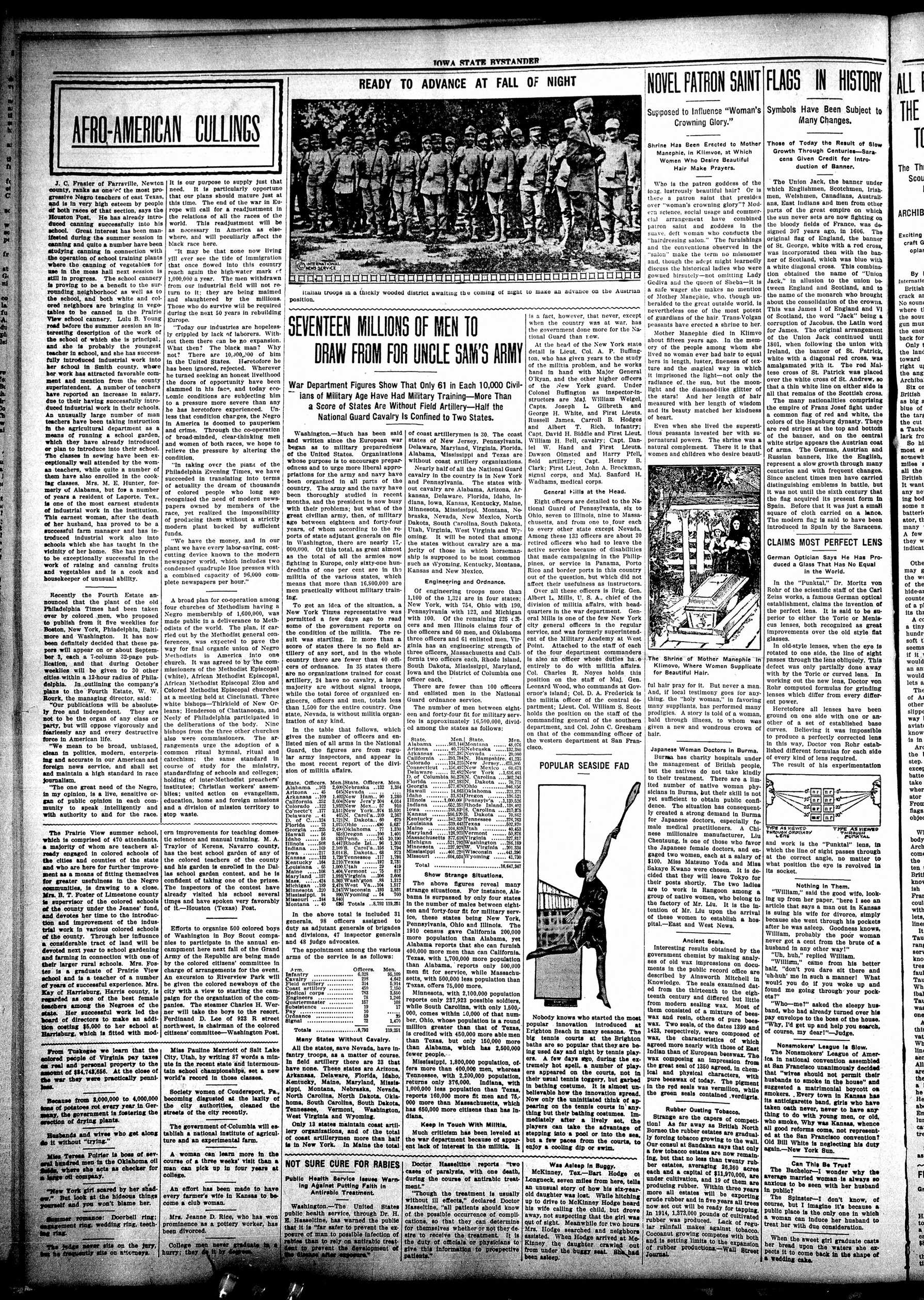
Italian troops in a thickly wooded district awaiting the coming of night to make an advance on the Austrian position.
SEVENTEEN MILLIONS OF MEN TO DRAW FROM FOR UNCLE SAM'S ARMY
War Department Figures Show That Only 61 in Each 10,000 Civilians of Military Age Have Had Military Training—More Than a Score of States Are Without Field Artillery—Half the National Guard Cavalry Is Confined to Two States.
Washington.—Much has been said and written since the European war began as to military preparedness of the United States. Organizations whose purpose is to encourage preparedness and to urge more liberal appropriations for the army and navy have been organized in all parts of the country. The army and the navy have been thoroughly studied in recent months, and the president is now busy with their problems; but what of the great civilian army, then, of military age between eighteen and forty-four years, of whom according to the reports of state adjustent generals on file in Washington, there are nearly 17,000. Of this, there are great almost as the total of all the armies now fighting in Europe, only sixty-one hundredths of one per cent are in the militia of the various states, which means that more than 16,800,000 are men practically without military training.
To get an idea of the situation, a New York Times representative was permitted a few days ago to read some of the government reports on the condition of the militia. The result was startling. In more than a score of states there is no field artillery of any sort, and in the whole country there are fewer than 40 officers of ordinance. In 35 states there are no organizations trained for coast artillery, 24 have no cavalry, a large majority are without signal troops, while the force of organization enlisted officers is more than 1,500 for the entire country. One state, Nevada, is without militia organization of any kind.
In the table that follows, which gives the number of officers and enlisted men of all arms in the National Guard, the figures are from regular army inspectors, and appear in the most recent report of the division of militia affairs.
State. Officers . 163 Men. State. Officers . 132
Alabama . 109 Nebraska . 132 134
Arkansas . 109 1403 New Ham . 139 1409
California . 152 364 New Jersey . 139 4014
Colorado . 152 364 New York . 139 5617
Co. nect'c . 171 2511 New York . 139 5621
Delaware . 147 1451 N.C. carolina . 129 239
Dakota . 147 1451 N.C. carolina . 129 239
Florida . 125 1075 Ohio . 490 5873
Georgia . 25 249 Oklahoma . 79 1630
Hawaii . 58 393 Penn . 745 1010
Idaho . 58 393 Penn . 745 1010
Illinois . 58 5447 Rhode Isle . 140 1030
Indiana . 217 3014 Dakota . 167 1783
Iowa . 217 3014 Dakota . 167 1783
Kansas . 127 1270 Tennessee . 178 1783
Kansas . 127 1270 Tennessee . 178 1783
Louisiana . 65 1000 Utah . 29 1497
Maine . 65 1000 Vermont . 75 1818
Mississippi . 108 1497 Vermont . 75 1818
Mississippi . 108 1497 Vermont . 75 1818
Michigan . 424 2497 Wash gton . 181 1512
Michigan . 424 2497 Wash gton . 181 1512
Mississippi . 144 2497 Wyoming . 54 709
Missouri . 244 3840 Totals . 3,792 119,251
Montana . 40 Totals . 3,792 119,251
In the above total is included 31 generals, 98 officers assigned to duty as adjutant generals of brigades and divisions, 47 inspector generals and 48 judge advocates.
The appointment among the various arms of the service is as follows:
Arm.
Infantry
Infantry
6,328
6,328
56,190
Field artillery
Field artillery
314
314
5,914
Coast artillery
Coast artillery
459
459
7,154
Armored corps
Armored corps
783
783
3,560
Engineers
Engineers
184
184
108
Quartermaster
Quartermaster
157
157
108
Substance
Substance
19
19
17
Pay
Pay
19
19
39
Ordnance
Ordnance
59
59
39
Signal
Signal
72
72
1,470
Totals
Totals
8,792
119,251
Many States Without Cavalry.
All the states, save Nevada, have infantry troops, as a matter of course.
In field artillery there are 23 that have none. These states are Arizona,
Arkansas, Delaware, Florida, Idaho,
Kentucky, Maine, Maryland, Mississippi,
Montana, Nebraska, Nevada,
North Carolina, North Dakota, Oklahoma,
South Carolina, South Dakota,
Tennessee, Vermont, Washington,
West Virginia, and Wyoming.
Only 13 states maintain coast artillery organizations, and of the total of coast artillerymen more than half is in New York. In Maine the total
NOT SURE CURE FOR RABIES
Public Health Service Issues Warning Against Putting Faith in Antiretic Treatment.
Washington—The United States public health service, through Dr. H. E. Hasselline, has warned the public that it is "far safer to prevent the exposure of man to possible infection of rubies than to rely on antiretic treatment to prevent the development of the disease."
IOWA STATE BYSTANDER
TO ADVANCE AT FALL OF
S OF MEN TO
UR UNCLE SAM'S ARMY
That Only 61 in Each 10,000 Civil
Military Training—More Than
About Field Artillery—Half the
Is Confined to Two States.
of coast artillerymen is 30. The coast states of New Jersey, Pennsylvania, Delaware, Maryland, Virginia, Florida, Alabama, Mississippi and Texas are without coast artillery organizations. Nearly half of all the National Guard cavalry in the country is in New York and Pennsylvania. The states without cavalry are Alabama, Arizona, Arkansas, Delaware, Florida, Idaho, Indiana, Iowa, Kansas, Kentucky, Maine, Minnesota, Mississippi, Montana, Nebraska, Nevada, New Mexico, North Dakota, South Carolina, South Dakota, Virginia, West Virginia and Wyoming, be noted that among the states with artillery, the jority of those in which horsemanship is supposed to be most common such as Wyoming, Kentucky, Montana, Kansas and New Mexico.
Engineering and Ordnance
Of engineering troops more than 1,100 of the 1,324 in four states; New York, with 754, Ohio with 190, Pennsylvania with 123, and Michigan with 100. Of the remaining 225 officers and men Illinois claims four of the officers and 60 men, and Oklahoma three officers and 61 enlisted men, Virginia has an engineering strength of three officers, Massachusetts and California two officers each, Rhode Island, South Dakota, Mississippi, Maryland, Iowa and the District of Columbia one officer. There are fewer than 100 officers and enlisted men in the National Guard ordnance service.
The number of men between eighteen and forty-four fit for military service is approximately 16,500,000, divided among the states as follows:
State. Men. Montana Men. Montana Men. Alabama 80,146 Montana 48,075 Arkansas 87,367 Nevada 20,000 Colorado 27,367 New Hampshire 20,123 Florida 134,223 New Hampshire 12,032 Connecticut 156,497 New Mexico 60,673 Connecticut 156,497 New Mexico 60,673 D. of Washington 80,178 NCarolina 72,474 Florida 197,183 Dakota 70,714 Florida 197,183 Dakota 70,714 Hawall 14,683 Oklahoma 121,274 Idaho 33,824 Oregon 138,521 Indiana 62,531 Rhode Island 18,462 Iowa 288,83 S. Carolina 217,73 Indiana 625,31 Rhode Island 18,462 Kentucky 342,32 Tennessee 376,73 Louisiana 394,48 Texas 652,87 Maryland 126,97 Vermont 50,87 Michigan 126,97 Vermont 50,87 Michigan 217,81 Michigan 217,81 Minnesota 217,98 W. Virginia 141,98 Missouri 401,644 Wisconsin 141,98 Missouri 401,644 Wyoming Total
Show Strange Situations
The above figures reveal many strange situations. For instance, Alabama is surpassed by only four states in the number of males between eighteen and forty-four fit for military service, these states being New York, Pennsylvania, Ohio and Illinois. The 110 census gave California 200,000 men, Alabama 1,000 men, yet Alabama reports that she can furnish 400,000 more men than can California, Texas, with 1,700,000 more population than Alabama, reports only 500,000 men fit for service, while Massachusetts, with 500,000 less population than Texas, offers 75,000 more. Minnesota, with 2,100,000 population reports only 237,923 possible soldiers, while South Carolina, with only 1,500,000, comes within 0,000 of that number. Ohio, whose population is a round billion greater than that of Texas, with 450,000 more able men than Texas, but only 150,000 more than Alabama, which has 2,500,000 fewer people.
Mississippi, 1,800,000 population, offers more than 400,000 men, whereas Tennessee, with 2,200,000 population, returns only 376,000. Indiana, with 1,000,000 less population than Texas, reports 160,000 more fit men and 75.000 more Massachusetts, which has 650,000 more citizens than has Indiana.
Keep In Touch With Millitia
Much criticism has been leveled at the war department because of apparent lack of interest in the militia. It Doctor Hasseltine reports "two cases of paralysis, with one death, during the course of antirabic treatment." "Though the treatment is usually without ill effecta" declared Doctor Hasseltine, "all patients should know of the possible occurrence of complications, so that they can determine for themselves whether or not they desire to receive the treatment. It is the duty of officials or physicians to give this information to prospective patients."
is a fact, however, that never, except when the country was at war, has the government done more for the National Guard than row. At the head of the New York state detail is Lieut. Col. A. P. Buffington, who has given years to the study of the militia problem, and he works hand in hand with Major General O'Ryan, and the other higher officers of the New York guard. Under Colonel Buffington as inspector-instruments are Maj. William Weigel, Capts. Joseph L. Glibreth and George H. White, and First Lieuten Russell James, Carroll B. Hodge and Albert T. Rich, Infantry; Capt. David H. Biddel and First Lieuten William H. Bell, cavalry; Capt. Dan Dawson, First Lieuten Dawson Olmsted and Henry Ptell field artillery; Capt. Henry B. Clark; First Lieut. John A. Brockman signal corps, and Maj. Sanford H. Wadhams, medical corps.
General Kills at the Head.
Eight officers are detailed to the National Guard of Pennsylvania, six to Ohio, seven to Illinois, nine to Massachusetts, and from one to four, each to every other state except Nevada. Among these 133 officers are about 20 retired officers who had to leave the active service because of disabilities that made campaigning in the Philippine Islands difficult. Rice and border ports in this country out of the question, but which did not affect their usefulness as instructors.
Over all these officers is Brig. Gen. Albert L. Mills, U.S. A. s. Chief of the division of militia affairs, with headquarters in the war department. General Mills is one of the few New York city general officers in the regular service, and was formerly superintendent of the Military Academy at West Point. Attached to the staff of each of these officers four department commissions is also an officer whose duties he, entirely to do with militia affairs. Col. Charles R. Noyes holds this position on the staff of Maj. Gen. Leonard Wood, who commands at Governor's island; Col. D. A. Frederick is the militia officer of the central department; Leut. Col. William S. Scott holds the position on the staff of the commanding general of the southern shamam on that of the commanding officer of the western department at San Francisco.
POPULAR SEASIDE FAD
Nobody knows who started the most popular innovation introduced at Brighton Beach in many seasons. The big tennis courts at the Brighton baths are so popular that they are being used day and night by tennis players. A few days ago, during the extremely hot spell, a number of players appeared on the courts, not in their usual tennis togery, but garbed in bathing costume. It is almost unbelievable how the innovation spread. Now only the uninitiated think of appearing on the tennis courts in anything but their bathing costumes. Immediately after a lively set, the players can take the advantage of stepping into a pool or into the sea, but a few paces from the courts, to enjoy a cooling dip or swim.
Was Asleep In Buggy.
McKinney, Tex.-Bart Hodge of Longneck, seven miles from here, tella an unusual story of how his six-year-old daughter was lost. While hitching up to drive to McKinney Hodge heard his wife calling the child, but drove away, not suspecting that the girl was mean. Meanwhile for two hours Mrs. Hodge and neighbors assisted. When Hodge and McKinney, the daughter crawled from under the buggy seat. She had been asleep.
Supposed to Influence "Woman's Crowning Glory."
Shrine Haa Has Erected to Mother Manephile, in Kilmvoe, at Which Women Who Desire Beautiful Hair Make Prayers.
Who is the patron goddess of the lust, lovingly beautiful hair? Or is there a patron saint that preides over "woman's crowning glory"? Modern science, social usage and commercial arrangement have in the patron saint and process in the dress, business and who conducts the hair-dressing salon." The furnishings and the conventions observed in the "salon" make the term no misneron, and though the adapt might learnly discuss the historical ladies who were gowned hirsutely—not omitting Lady Godiva and the queen of Shei—a it safe a wager she makes no mention of Mother Manephile, who, though unheralded to the great outside world, is nevertheless one of the most potent of guardians of the hair. Trans-Volgan peasants have erected a shrine to her.
Mother Manephie died in Klimpo about fifteen years ago. In the memory of the people among whom she lived no woman ever had hair to equal hers in length, luster, finessen of texture and the magical way in which it imprisoned the light—not only the radiance of the sun, but the moonlight and the diamond-like glitter of the stars! And her length of hair measured with her length of wisdom and its beauty matched her kindness of heart.
Even when she lived the superstitious peasants invested her with supernatural powers. The shrine was a natural complement. There it is that women and children who desire beauti
A
The Shrine of Mother Maniphie In Klimov, Where Women Supplicate for Beautiful Hair.
ful hair pray for it. But never a man. And, if local testimony goes for anything, the "holy woman." in favoring many suppliants, has performed many prodigies. A story is told of a woman, bald through illness, to whom was given a new and wondrous crown of hair.
Japanese Woman Doctors in Burma. Burma has charity hospitals under the management of British people, but the natives do not take kindly to their treatment. There are a limited number of native woman physicians in Burma, but their skill is not yet sufficient to obtain public confidence. The situation has consequently created a strong demand in Burma for Japanese doctors, especially female medical practitioners. A Chinese millionaire manufacturer, Liu Chesungt, is one of those who favor the Japanese female doctors, and engaged two women, each at a salary of $100. Miss Matsuno Yoda and Miss Sakaye Kwano were chosen. It is decided that they will leave Tokyo for their posts shortly. The two ladies are to work in Rangoon among a group of native women, who belong to the factory of Mr. Liu. It is the intention of Mr. Liu upon the arrival of these women to establish a hospital—East and West News.
Ancient Seals.
Interesting results obtained by the government chemist by making analyses of old wax impressions on documents in the public record office are described by Ainsworth Mitchell in Knowledge. The seals examined dated from the thirteenth to the eighteenth century and differed but little from modern sealing wax. Most of them consisted of a mixture of beeswax and resin, of others pure beeswax. Two seals, of the dates 1389 and 1423, respectively, were composed of wax, the characteristics of which agreed more nearly with those of East Indian than of European beeswax. The wax composing an impression from the great seal of 1350 agreed, in chemical and physical characters, with pure beeswax of today. The pigment in the red seals was vermilion, while the green seals contained verdigris.
Rubber Oating Tobacco
Strange are the capes of competition! As far away as British North Borneo the rubber estates are gradually forcing tobacco growing to the wall. Our consul at Sandakan says that only a few tobacco estates are now remaining, but that no less than twenty 26,360 acres and each a capital of $11,970,000 are under cultivation, and that of them are producing rubber. Within three years more all estates will be exporting crude rubber and in five years all trees now set out will be ready for cultivation. In 1914, 1,373,000 pounds of cultivated rubber was produced. Lack of regular rainfall makes against tobacco. Cocanut growing competes with both and is setting limits to the expansion of rubber productions—Wall Street Journal.
Symbols Have Been Subject to Many Changes.
Those of Today the Result of Slow Growth Through Centuries—Saracens Given Credit for Introduction of Banner.
The Union Jack, the banner under which Englishmen, Scotchmen, Irishmen, Welshmen, Canadians, Australians, East Indians and men from other parts of the great empire on which the sun never sets are now fighting on the bloody fields of France, was designed 307 years ago, in 1606. The original flag of England, the banner of St. George, white with a red cross, was incorporated then with the banner of Scotland, which was blue with a white diagonal cross. This combination obtained the name of "Union Jack", in allusion to the union between England and Scotland, and to the name of the monarch who brought about the consolidation of the crowns. This was James I of England and VI of Scotland, the word "Patrick" being a name for James. The original arrangement of the Union Jack continued until 1801, when following the union with Ireland, the banner of St. Patrick, white with a diagonal red cross, was amalgamated with it. The red Maltese cross of St. Patrick was placed over the white cross of St. Andrew, so that a thin white line on either side is all that remains of the Scottish cross.
The many nationalities comprising the empire of Franz Josef fight under a common flag of red and white, the colors of the Hapsburg dynasty. There are red stripes at the top and bottom of the banner, and on the central white stripe appears the Austrian coat of arms. The German, Austrian and Russian banners, like the English, represent a slow growth through many centuries and with frequent changes. The German, Austrian and distinguishing emblems in battle, but it was not until the sixth century that the flag acquired its present form in Spain. Before that it was just a small square of cloth carried on a lance. The modern flag is said to have been introduced in Spain by the Saracens.
CLAIMS MOST PERFECT LENS
German Optician Says He Has Produced a Glass That Has No Equal in the World.
In the "Punktal." Dr. Moritz von Rohr of the scientific staff of the Carl Zeiss works, a famous German optical establishment, claims the invention of the perfect lens. It is said to be superior to either the Toric or Meniscus lenses, both recognized as great improvements over the old style flat glasses.
In old-style lenses, when the eye is rotated to one side, the line of sight passes through the lens obliquely. This defect was only partially done away with the Toric or curved lens. In with the new lens, Doctor von Rohr computed formulas for grinding lenses which differ from every different power.
Heretofore all lenses have been ground on one side with one or another of a set of established base curves. Believing it was impossible to produce a perfectly corrected lens in this way, Doctor von Rohr established different formulas for each side of every kind of lens required.
The result of his experimentation
TYPE AS VIEWED TURBID ORDINARY METAL
TYPE AS VIEWED TURBID PUNKTALE
and work is the "Punktal" lens, in which the line of sight passes through at the correct angle, no matter to what position the eye is revolved in its socket.
and work is the "Punktal" lens, in which the line of sight passes through the correct angle, no matter to what position the eye is revolved in its socket.
Nothing In Them
"William," said the good wife, looking up from her paper, "here I see an article that says a man out in Kansas is suing his wife for divorce, simply because she went through his pockets after he was asleep. Goodness knows, William, probably the poor woman never got a cent from the brute of a husband in any other way!" "Uh, huh," replied William. "William," came from his better half, "not you dare sit there and 'u-buh' me in such a manner! What would you do? If you woke up and found me going through your pockets?" "Who—me?" asked the sleepy husband, who had already turned over his p envelope to the boss of the house. "Why, I'd get up and help you search, of course, my dear!"—Judge.
Nonsmokera' League Is Slow.
The Nonsmokers' League of America in national convention assembled at San Francisco unanimously decided that "wives should not permit their husbands to smoke in the house" and suggested a matrimonial boycott on smokers. Every town in Kansas has its antigardite band, girls who have never, never to have anything to do with young men, or old, smoke. What was Kansas, whence all good reformers represented at the San Francisco convention, Old Bill White is neglecting his duty again—New York Sun.
Can This Be True$
The Bachelor—I wonder why the average married woman is always so anxious to be seen with her husband in public?
The Spinster—I don't know, of course, but I imagine it's because a public place is the only one in which a woman can induce her husband to treat her with due consideration.
When the sweet girl graduate casts her bread upon the waters she expects it to come back in the shape of a wedding cake.
ALL ROMANCE OF THE WAR BELONGS TO THE AIRCRAFT
The Thrills and the Danger Scouting All Theirs, Says Frederick Palmer.
ARCHIBALD IS ON THE JOB
Exciting Work of the British Antiaircraft C gun Described—Sight of Aeroplane Under Shell Fire Never Loses Its Thrill.
By FREDERICK PALMER
International News Service Correspondent.
British Headquarters, France.—A crack and a whish through the air! No sound is more familiar at the front where the artillery is never silent—the sound of a shell breaking from a gun muzzle and its shrill fight toward the enemy's line to pay the Germans back for some shell they have sent.
Only this one did not pass out over the landscape in a long parabola or toward the German lines. It went right up into the heavens at about the angle of a skyrocket—for it was Archibald who was on the job.
Six or seven thousand feet over the British trenches there was something as big as your hand against the blue light on the ground. The target, a German aeroplane. By the cut of his wings you knew it was a Taube, just as you know a meadow lark from a swallow.
So high was it that it seemed almost stationary. But it was going somewhere between fifty and ninety miles an hour. It seemed to have all the heavens to itself; and to the British it was a sinister, prying eye. It wanted to see if they were building any new trenches, if they were moving bodies of troops or of transport in some new direction, and where their batteries were in hiding. That aviator, three miles above the earth, had many waiting guns at his command. A few signals from his wireless and they would let loose on the target he indicated.
Never Loses Its Thrill.
Other features of life at the front may grow commonplace, but never the work of the planes—these wings of the army's intelligence. In the hide-and-seek digging and dodging and countering of siege warfare the sight of a plane under shell fire never loses its thrill.
A couple of seconds after that crack a tiny puff of smoke breaks about a hundred yards behind the Taube. A soft tiltshie blow against the blue, it seems at that altitude; but it wouldn't if it were about your ears. Then it would sound like a bit of dynamite on an anvil struck by a hammer, and you would hear the whiz of scores of bullets and fragments about your ears.
The smoking brass shell case is out of Archibald's steel throat, and another shell case with its charge slipped in its place and started on its way before the first puff breaks. The aviator knows what is coming. He knows that one means many, once he is in range.
Archibald rushed the fighting; it is the business of the Taube to side-step. The aviator cannot hit back except through its allies, the German batteries, on the earth. They would take care of Archibald if they know where the enemy is. The aviator can see is mottled landscape. From his side Archibald飞es no goal flags. He is one of ten thousand tiny objects under the aviator's eye.
All the Romance Theirs.
Why he was named Archibald nobody knows. As his full name is Archibald the archer, possibly it comes from some association with the idea of archery. If there were ten thousand aircraft guns in the British army, every one would be known as Archibald. When the British expeditionary force went to France it had none. All the British could do was bang away at Taubes with thousands of rounds of rifle bullets, which might fall in their own lines, and with the field guns. It was pie in those days for the Taubes. It was easy to keep out of range of both rifles and guns and observe well. If the Germans did not know the progress of the British retreat from on high, they took their own. Now the business of fire at Taubes is left entirely to Archibald. When you see how hard it is for Archibald, after all his practice, to get a Taube, you understand how foolish it was for the field guns to try to get one.
Archibald, who is quite the sweetest thing in the army, has his own private car built especially for him. While the cavalry horses back of the lines grow sleek from inaction, the aeroplanes have taken their places. All the romance and risk of scouting are theirs. They get most of the fun there is in this kind of warfare. If a British aviator gets a day's leave, he does not take a train or steamer. He rises from the aviation grounds about half-past four and is at home in England for dinner and returns after lunch the next day. All the action the cavalry see is when they go into the trenches as infantry.
Important Work is Archibald's. Such of the calvary's former part as the planes do not play, Archibald
FINDS WILL IN HIS SLIPPER
Grandchild Discovers Much-Bought Document of Michigan Man Quite by Accident.
Hudsonville, Mich.—When Thomas H. Sestell, ploner resident of Filmore township, died on May 30 there began a search for a will disposing of his estate, which is valued at upward of $80,000.
A justice who drew up the will and the men who signed as witnesses testified to the existence of such a doo-
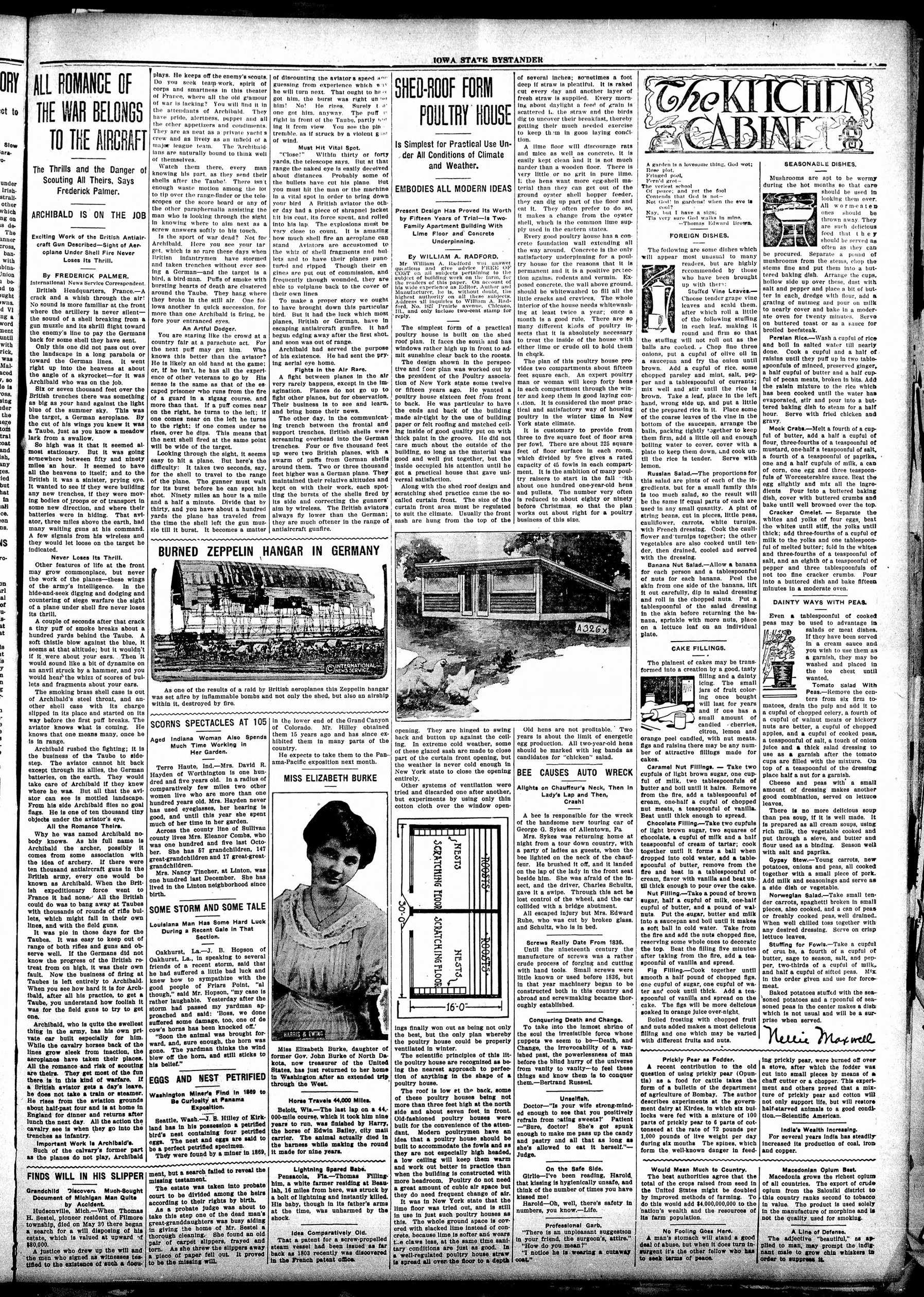
BURNED ZEPPELIN HANGAR IN GERMANY
As one of the results of a raid by British aeroplanes this Zeppelin hangar was set afire by inflammable bombs and not only the shed, but also an airship within it, destroyed by fire.
As one of the results of a raid by British aeroplanes this Zeppelin hangar was set alire by inflammable bombs and not only the shed, but also an airship
plays. He keeps off the enemy's scouts. Do you seek team work, spirit of corps and smartness in this theater of France, where all the old glamour of war is lacking? You will find it in the attendants of Archibald. They have pride, alertness, pepper and all the other appetizers and condiments. They are as neat as a private yacht's crew and as lively as an inhold of a major league team. The Archibaldians are naturally bound to think well of themselves. With them there, every man known by his art, as they send their shells after the Terrorist; there isn't enough waste motion ammunition to tip over the range-finder or the telescopes or the score board or any of the other paraphernalia assisting the man who is looking through the sight in knowing how to alim next as a screw answers softly to his touch.
Is the sport of war dead? Not for Archibald. Here you see your target, which is so rare these days when British infantrymen have stormed and taken trenches without ever seeing a German—and the target is a bird, a bird-man. Puffs of smoke with bursting hearts of death are clustered in the trenches, hang where they broke in the stifle and lown another in quick succession, for more than one Archibald is firing, be fore your entranced eyes.
An Artful Dodger.
You are staring like the crowd at a country fair at a parachute act. For the next puff may get him. Who knows this better than the aviator? He is likely an old hand at the game; or, if he isn't, he has all the experience of other veterans to go by. His sense is the same as that of the escaped prisoner who runs from the fire of a guard in a zigzag course, and more than that. If a puff comes near on the right, he turns to the left; if one comes near on the left he turns to the right; if one comes under he rises, over he dips. This means that the next shell fired at the same point will be wide of the target. Lower, like the sign, it seems easy to hit a plane. But here's the difficulty: It takes two seconds, say, for the shell to travel to the range of the plane. The gunner must wait for its burst before he can spot his shot. Ninety miles an hour is a mile and a half a minute. Divide that by thirty, and you have about a hundred yards the plane has traveled from the time the shell left the gun muzzle till it burst. It becomes a matter
BURNED ZEPPELIN H
As one of the results of a raid by
was set afire by inflammable bombs an
within it, destroyed by fire.
SCORNS SPECTACLES AT 105
Aged Indiana Woman Also Spends Much Time Working in Her Garden.
Terre Haute, Ind.-Mrs. David R. Hayden of Worthington is one hundred and five years old. In a room of comparatively few other women live here, we are more than one hundred years old. Mrs. Hayden never has used eyeglasses, her hearing is good, and this year she spent much of her time in her garden.
Across the county line of Sullivan county lives Mrs. Eleanor Combs, who was one hundred and five last October. She has 67 grandchildren, 147 great-grandchildren and 17 great-great-grandchildren. Mrs. Nancy Tincher, at Linton, was one hundred last December. She has lived in the Linton neighborhood since birth.
SOME STORM AND SOME TALE
Louisiana Man Has Some Hard Luck During a Recent Gale in That Section.
Oakhurst, La.-J. B. Hopson of Oakhurst, La., in speaking to several friends of a recent storm, said that he had suffered a little bad luck and knew how to sympathize with the good people of Friars Point, "al though," said Mr. Hopson, "my case is rather laughable. Yesterday after the storm had passed my yardman approached and said: 'Boss, we done suffered some damage, too, one of de cow's horns has been knocked off.'
"Soon the animal was brought forward, and, sure enough, the horn was gone. The yardman thinned it up the horn, and still sticks to the pallet."
EGGS AND NEST PETRIFIED
Washington Miner's Find in 1869 to be Curiosity at Panama Expedition.
Seattle, Wash.—J. B. Hilley of Kirkland has in his possession a petrified bird's nest containing four petrified eggs. The nest and eggs are said to be a perfect petrified specimen. They were found by a miner in 1869.
ment, but a search failed to reveal the missing testament.
The estate was taken into probate court to be divided among the heirs according to their rights by birth.
As a probate judge was about to take this step one of the dead man's great-granddaughters was busy using in giving the home a thorough cleanliness. She found an old pair of chest slippers, frayed and torn. As she shrew the slippers away a piece of paper fell out. It proved to be the missing will.
of discounting the aviators speed and guessing from experience which way he will turn next. That ought to be him, the burst was right under him! No! He rises. Surely that one got him, anyway. The puff is right in front of the Taube, partly lit it from view. You see the pike tremble, as if struck by a violent gust of wind.
Must Hit Vital Spot
"Closest!" Within thirty or forty yards, the telescope says. But at that range the naked eye is easily decoded about distances. Probably some of the bullets have cut his plane, but you must hit the man or the machine in spot in order to bring the other day hard. A British officer the other day hit his coat, its force went, and rolled into his lap. The explosions must be very close to count. It is amazing how much shell fire an airplane can stand. Aviators are accustomed to the whiz of shell fragments and bullets and to have their planes punctured and ripped. Though their engines are put out of commission, and frequently though wounded, they are able to volplane back to the cover of their own lines.
To make a proper story we ought to have brought down this particular bird. But it the luck which most planes, British or German, have in escaping antaircraft gunfire. It had begun edging away after the first shot, and soon was out of range.
Archibald had served the purpose of his exile. He had sent the pry in a letter.
Eights in the Air Bare.
A fight between planes in the air very rarely happens, except in the imagination. Planes do not go up to fight other planes, but for observation. Their business is to see and learn, and bring home their news. The other day, in the communicating trench between the frontal and support trenches, British shells were screaming overhead into the German trenches. Four or five thousand feet up were two British planes, with a swarm of puffs from German shells around them. Two or three thousand feet higher was a German plane. They maintained their fire advantages and kept up their work, each spotting the bursts of the shells fired by its side and correcting the gunners' aim by wireless. The British aviators always fly lower than the German; they are much oftener in the range of antialarm gunfire.
NANGAR IN GERMANY
INTERNATIONAL
NEWS SERVICE
British aeroplanes this Zeppelin bangar
and not only the shed, but also an airship
in the lower end of the Grand Canyon of Colorado. Mr. Hilley obtained them 15 years age and has since exhibited them in many parts of the country. He expects to take them to the Panama-Pacific exposition next month. MISS ELIZABETH BURKE
HARRIS & EWING
Miss Elizabeth Burke, daughter of former Gov. John Burke of North Dakota, now treasurer of the United States, has just returned to her home in Washington after an extended trip through the West.
Horse Travels 44,000 Miles
Beloit, Wis.—The last lap on a 44-000-mile course, which it took him nine years to run, was finished by Harry, the horse of Edwin Bailley, city mail carrier, who actually died in a car crash while making the round in it for nine years.
Lightning Spared Babe.
Pensacola, Fla.—Thomas Filling-
him, a white farmer residing at Beau-
lah, 16 miles from here, was struck by
a bolt of lightning and instantly killed.
His baby, though in its father's arms
at the time, was unharmed by the
shock.
Ideas Comparatively Old.
That a patent for a screw-propelled
steam vessel had been issued as far
back as 1803 recently was discovered
in the French patent office.
IOWA STATE BYSTANDEH
THE HOME
A326x
SHED-ROOF FORM POULTRY HOUSE
Is Simplest for Practical Use Under All Conditions of Climate and Weather.
EMBODIES ALL MODERN IDEAS
Present Design Has Proved Its Worth by Fifteen Years of Trial—Is Two-Family Apartment Building With Lime Floor and Concrete Undermining.
Fv WILLIAM A. BADEFORD
Mr William A. Radford will answer questions and give advice FREE OF COST on all subjects pertaining to building work on the farm, for the renders of this paper. On account of his wide experience as Editor, Author, the highest authority on all these subjects, Address all inquiries to Mr William A. Radford, Chicago IL, and only inclose two-cent stamp for reply.
The simplest form of a practical poultry house is built on the shed roof plan. It faces the south and has windows rather high up in front to admit sunshine clear back to the roosts.
The design shown in the perspective and floor plan was worked out by the president of the Poultry association of New York state some twelve or fifteen years ago. He wanted a poultry house sixteen feet from front to back. He was particular to have the ends and back of the building on the ground, and the paper or felt roofing and matched ceiling inside of good quality put on with thick paint in the groove. He did not care much about the outside of the building, so long as the material was good and well put together, but the inside occupied his attention until he got a practical house that gave universal satisfaction. Along with the shed roof design and scrached shed practice came the need to have a curtain front area must be regulated to suit the climate. Usually the front sash are hung from the top of the
opening. They are hinged to swing back and button up against the ceiling. In extreme cold weather, some of these glazed sash are made to close part of the curtain front opening, but the weather is never cold enough in New York state to close the opening entirely. Other systems of ventilation were tried and discarded one after another, but experiments by using only thin cotton cloth over the window open-
ROOSTS
ROOSTS
NESTS
NESTS
SCRATCHING FLOOR
SCRATCHING FLOOR
30.0
16.0
ings finally won out as being not only the best, but the only plan whereby the poultry house could be properly ventilated in winter. The scientific principles of this little poultry house are recognized as being the nearest approach to perfection of anything in the shape of a poultry house. The roof is low at the back, some of these poultry houses being not more than three feet high at the north side and about seven feet in front. Old-fashioned poultry houses were built for the convenience of the attendant. Modern poultrymen have an idea that poultry house should be able to accommodate the fowls and as they are not especially high headed, a low ceiling will keep them warm and work out better in practice than when the building is constructed with more headroom. Poultry do not need a great amount of cubic air space but they do need frequent change of air.
It was in New York state that the lime floor was tried out, and is still in use in just such poultry houses as this. The whole ground space is covered with shackled lime instead of concrete, because lime is softer and wears the claw less, at the same time sanitary conditions are just as good. In a well-regulated poultry house straw is well regulated the floor to a depth
of several inches; sometimes a foot
deep if straw is pleasurable. It is raked
cut every day and another layer of
fresh straw is supplied. Every morning
about daylight a feed of grain is
scattered. The lush and the birds
dig to uncover their breakfast, thereby
getting their much needed exercise
to keep them in good laying condition.
A time floor will discourage rats
and mice as well as concrete, it
is easily kept clean and it is not much
harder than a wooden floor. There is
very little or no grit in pure lime.
It the hens want more eggshell man
that they can grow on the ground
oyster shell hopper feeder,
they can dig up part of the floor and
cat it. They often prefer to do so,
it makes a change from the oyster
shell, which is the common lime supply
used in the eastern states.
Every good poultry house has a concrete foundation wall extending all the way around. Concrete is the only satisfactory underpinning for a poultry house for the reasons that it is permanent and it is a positive protection against, rodents and vorms. Exposed concrete, the wall above alluded, should be white washed all over with the crevices. The whole interior of the house needs whitewashing at least twice a year; once a month is a good rule. There are so many different kinds of poultry insects that it is absolutely necessary to treat the inside of the house with either lime or crude oil to hold them in check. The plan of this poultry house provides two compartments about fifteen feet square each. An expert poultry man or woman will keep forty hems in each compartment through the winter and keep them in good laying condition. It is considered the most satisfactory way of housing poultry in the winter time in New York state climate.
It is customary to provide from three to five square feet of floor area per fowl. There are about 225 square feet of floor surface in each room, which divided by five gives a rated capacity of 45 fowls in each compartment. It is the ambition of many poultry raisers to start in the fall - about one hundred one-year-old hens and pullets. The number very often is reduced to about eight or ninety before Christmas, so that the plan works out about right for a poultry business of this size.
A326x
Old hens are not profitable. Two years is about the limit of energetic egg production. All two-year-old hens are considered as candidates for "chicken" salad.
BEE CAUSES AUTO WRECK
Alights on Chauffeur's Neck, Then in Lady's Lap and Then, Crash! A bee is responsible for the wreck of the handsome new touring car of George G. Sykes of Allentown, Pa. Mrs. Sykes was returning home at night from a tour down country, with a party of ladies as guests, when the bee lighted on the neck of the chaufeur. He brushed it off, and it landed on the lap of the man who had beaten the bee was afraid of the insect, and the driver, Charles Schultz, gave it a swipe. Through this act he lost control of the wheel, and the car collided with a bridge abutment. All escaped injury but Mrs. Edward Ruhe, who was cut by broken glass, and Schultz, who is in bed.
Screws Really Date From 1836.
Until the nineteenth century the manufacture of screws was a rather crude process of forging and cutting with hand tools. Small screws were little known or used before 1838, but in that year machinery began to be constructed both in this country and abroad and screwmaking became thoroughly established.
Conquering Death and Change.
To take into the innest shrine of the soul the irresistible force whose puppets we seem to be—Death, and Change, the irreovocability of a vanished past, the powerlessness of man before the blind hurry of the universe from vanity to vanity—to feel these things and know them is to conquer them—Bertrand Russel.
Unselfish.
Doctor—"Is your wife strong-minded enough to see that you positively refrain from eating sweets?" Patient—"Sure, doctor! She's got spunk enough to make me pass up the candy and pastry and all that as long as she allowed to eat it herself."—Judge.
On the Safe Side
Girlie—I've been reading, Harold that kissing is hygienically unsafe, and think of the number of times you have kissed me!
Harold—Oh, well, there's safety in numbers, you know—Life.
Professional Garb.
"There is an unpleasant suggestion in your friend, the surgeon's, attire."
"How do you mean?".
"I notice he is wearing a cutaway coat."
The KITCHEN CABINET
A garden is a lovesome thing, God wot; Rose plot, Fringed pool, Fern'd grot. The great school Of peace; and yet the fool Contends that God is not—Not God! in gardens! when the eve is cold! Nay, but I have a sign; 'Tis very sure God walks in mine. -Thomas Edward Brown.
SEASONABLE DISHES.
Mushrooms are apt to be wormy during the hot months so that care should be used in looking them over. All worm-eaten ones should be thrown away. They are such delicious
FOREIGN DISHES.
ing are some dishes which most unusual to many readers, but are highly recommended by those who have been brought up with them:
The following are some dishes which will appear most unusual to many readers, but are highly recommended by those who have been brought up with thery:
Stuffed Vine Leaves. Choose tender grape vine leaves and scald them, after which roll a little of the following stuffing in each leaf, making it
Stuffed Vine Leaves —
Choose tender grape vine
leaves and scald them,
after which roll a little
leaf into the stem and
in each leaf, making it
round and firm so that
the stuffing will not roll out as the balls are cooked. Chop five three onions, put a cupful of olive oil in a saucepan and fry the onion until brown. Add a cupful of rice, some chopped parsley and mint, salt, pepper and a tablespoonful of currants; mix well and stir until the rice is brown. Take a leaf, place in the left hand, wrong side up, and put a little of the prepared rice in it. Place some of the coarse leaves of the vine in the bottom of the saucepan, arrange the leaves tightly together to keep them firm, add a little oil and enough boiling water to cover, cover with a plate to keep them down, and cook until the rice is tender. Serve with lemon.
Russian Salad.—The proportions for this salad are pints of each of the ingredients, but for a small family this is too much salad, so the result will be the same if equal parts of each are used in any small quantity. A pint of string beans, cut in pieces, little peas, cauliflower, carrots, white turnips, with French dressing. Cook the cauliflower and turnips together; the other vegetables are also cooked until tender, then drained, cooled and served with the dressing.
Banana Nut Salad.—Allow a banana for each person and a tablespoonful of nuts for each banana. Peel the skin from one side of the banana, lift it out carefully, dip in salad dressing and roll in the chopped nuts. Put a tablespoonful of the salad dressing in the skin before returning the banana, sprinkle with more nuts, place on a lettuce leaf on an individual plate.
CAKE FILLINGS.
The plainest of cakes may be transformed into a creation by a good, tasty
cakes may be transition by a good, tastey filling and a dainty icing. The small jars of fruit coloring once bought will last for years. The small amount of candied - cherries, citron, lemon and
thinking and a darny ticing. The small jars of fruit coloring once boiling will last for years and if one has a small amount of candied - cherries, citron, lemon and orange peel candied, with nut meats, figs and raisins there may be any number of attractive fillings made for cakes.
Caramel Nut Fillings. - Take two cupfuls of light brown sugar, one cupful of milk, two tablespoonfuls of butter and two until it扎s. Remove from the fire, add a tablespoonful of cream, one half a cupful of chopped nut meats, a teaspoonful of vanilla. Beat until thick enough to spread.
Chocolate Filling—Take two cupfuls of light brown sugar, two squares of chocolate, a cupful of milk and a half teaspoonful of cream of tartar; cook together until it forms a ball when dropped into cold water, add a table-spoonful of butter, remove from the fire and beat in a table-spoonful of cream, flavor with vanilla and beat until thick enough to pour over the cake.
Nut Filling—Take a pound of brown sugar, half a cupful of milk, one-half cupful of butter, and a pound of walnuts. Put the sugar, butter and milk into a saucepan and boil until it makes a soft ball in cold water. Take from the fire and add the nuts chopped fine, reserving some whole nuts to decorate the top. Beat the filling five minutes after taking from the fire, add a teaspoonful of vanilla and spread.
Fig Filling—Cook together until smooth a half pound of chopped figs, one cupful of sugar, one cupful of water and cook until thick. Add a teaspoonful of vanilla and spread on the cake. The figs will be more delicious soaked in orange juice over night.
Bolled frosting with chopped fruit and nuts adds makes a most delicious filling and one which may be varied with different fruits and nuts.
Prickly Pear as Fodder.
A recent contribution to the old question of using prickly pear (Opuntia) as a food for cattle takes the form of a bulletin of the department of agriculture of Bombay. The author describes experiments at the government dairy at Kirdee, in which six bullets were fed with a mixture of 100 parts of prickly pear to 6 parts of cottonseed at the rate of 72 pounds per 1,000 pounds of live weight per day during six months. The spines, which form the well-known feed in feed
Would Mean Much to Country.
The best authorities agree that the total of the crops raised from seed in the United States might be doubled by improved methods of farming. To do this would add $4,000,000,000 to the nation's wealth and the resources of its farm population.
No Fooling Goes Here.
A man's stomach will stand a good deal of abuse, but when it does turn insurgent it's the other fellow who has to seek terms of peace.
SEASONABLE DISHES.
Mushrooms are apt to be wormy during the hot months so that care
should be used in
looking them over.
All worm-eaten
ones should be
throw away. They
are such delicous
food that should
should be served as
often as they can
should be used in looking them over. All worm-eaten cakes should be thrown away. They are so delicious food that th'蛋 should be served as often as they can be procured. Separate a pound of mushrooms from the stems, chop the stems fine and put them into a buttered baking dish. Arrange the cups, hollow side up over these, dust with salt and pepper and place a bit of butter in each, dredge with flour, add a grating of nutmeg and pour on milk to nearly cover and bake in a moderate oven for twenty minutes. Serve on buttered toast or as a sauce for broiled beefsteak.
Persian Rice.—Wash a cupful of rice and boil in salted water till nearly done. Cook a cupful and a half of raisins until they puff up in two tablespoons of minced, preserved ginger, a half cupful of butter and a half cupful of pean meat, broken in bits. Add the raisin mixture to the rice which has been cooked until the water has evaporated, stir and pour into a buttered baking dish to steam for a half hour. Serve with fried chicken and gravy.
Mock Crabs.—Melt a fourth of a cupful of butter, add a half a cupful of flour, three-fourths of a teaspoonful of mustard, one-half teaspoonful of salt, one teaspoonful of sugar, one and a half cupfuls of milk, a can of corn, one egg and three teaspoonfuls of Worcestershire sauce. Beat the egg slightly and mix all the ingredients. Pour into a buttered baking dish, cover with buttered crumbs and bake until well browned over the top.
Cracker Omelet. — Separate the whites and yolks of four eggs, beat the whites until stiff, the yolks until thick; add three-fourths of a cupful of milk to the yolks and one tablespoonful of melted butter; fold in the whites and three-fourths of a teaspoonful of salt, and an eighth of a teaspoonful of pepper and three tablespoonfuls of not too fine cracker crumbs. Pour into a buttered dish and bake fifteen minutes in a moderate oven.
DAINTY WAYS WITH PEAS.
Even a tablespoonful of cooked peas may be used to advantage in
salads or meat dishes.
If they have been served
in a cream sauce and
you wish to use them as
a garnish, they may be
washed and placed in
the ice chest until
wanted.
#
Tomato salad With Peas—Remove the centers from six firm tomatoes, drain the pulp and add it to a cupful of chopped celery, a fourth of a cupful of walnut meat or hickory nuts are better, a cupful of chopped apples, and a cupful of cooked peas, a teaspoonful of salt, a touch of onion juice and a thick salad dressing to use as a garnish after the tomato cups are filled with the mixture. On top of a teaspoonful of the dressing place half a nut for a garnish.
Cheese and peas with a small amount of dressing makes another good combination, served on lettuce leaves.
There is no more delicious soup than pea soup, if it is well made. It is prepared as all cream soups, using rich milk, the vegetable cooked and put through a sieve, and butter and flour used as a binding. Season well with salt and paprika.
Gyppy Stew—Young carrots, new potatoes, onions and peas, all cooked together with a small piece of pork. Add milk and seasonings and serve as a side dish or vegetable.
Norwegian Salad—Take small tender carrots, spaghetti broken in small pieces, also cooked, and a can of peas or freshly cooked peas, well drained. When well chilled together with any desired dressing. Serve on crisp lettuce leaves.
Stuffing for Fowls—Take a cupful of cru bs, a fourth of a cupful of butter, sage to season, salt, and pepper, two-thirds of a cupful of milk, and half a cupful of sifted peas. Mix in the order given and use for forcemeat.
Baked potatoes stuffed with the seasoned potatoes and a pouchful of seasoned peas in the center makes a dish which is not usual and will be a surprise when served.
Nellie Maxwell
Ing prickly pear, were burned off over a stove, after which the fodder was cut into small pieces by means of a chaffer cut or a chopper. This experiment and others proved that a mixture of prickly pear and cotton will not only support life, but will restore half-starved animals to a good condition.—Scientific American.
India's Wealth Increasing.
For several years India has steadily increased its production of coal, iron and copper.
Macedonian Oplum Best:
Macedonia grows the richest opium of all countries. The export of crude opium from the Salonikli district to this country ranks second to tobacco in value. The product is used solely in the manufacture of morphine and is not the quality used for smoking.
A Line of Defense.
The adjective "beautiful," as applied to man, may prompt the indignant male to grow chin whiskers in order to suppress it.