Iowa State Bystander
Friday, September 17, 1915
Des Moines, Iowa
Page text (machine-generated)
IOWA STATE BYSTANDER.
State Capitol Bldg Historical Room
Mr. Harrison Gould is very sick at his home, 939 Sixteenth street.
Mrs. T. L. Griffith, who has been seriously ill for the past two weeks, is slightly improving.
Mr. V. L. Jones left Thursday morning for Chicago, where he went on a business trip.
Mrs. Mary Jones and daughter Alma will leave soon for Kansas City, Mo, where they will make their permanent home.
Mrs. Millie Vice of 409 S. E. 16th street, left Saturday evening for Lake Forest, Ill, to visit her sister who is very ill and not expected to recover.
Mrs. E. L. Green of 946 14th street Place, entertained a few friends in honor of her father's, Mr. Joe Tate, 83rd birthday last Sunday.
Miss Martha Lefer left Thursday morning for St. Joseph, Mo, where she has accepted a position to teach domestic science in the high schools of that city.
Miss Clementine Anita Jefferson, assisted by Misses Vivian Warrick, Lelia Smith and Georgia Williams, entertained at the home of her parents, 1822 Day street. A large number of her friends September 10th in honor of her 18th birthday.
Luther H. S. Brown and wife of 944 Fourteenth Street Place have traded their property and will open a modern rooming house at 813 West Second street. Open for business about September 25th.
The High School Girls' club holds its meeting last Sunday at the home of Mrs. S. Joe Brown. The sixth chapter of the Heir of Slave, by Bickens, was discussed by Miss Georgia Williams, after which the newly elected officers were installed.
On last Wednesday afternoon at the residence of Mrs. L. J. Jefferson the Callanan Industrial club hold an interesting session. Mrs. Mary B. Talbert of Buffalo, N. Y., and her daughter, Miss Sarah May, Dr. G. B. Grow of Wichita, Kan., and Atty S. J. Joe Brown were present and addressed the club.
The Triple H club met Tuesday Sept. 14th at the residence of Mrs. R. E. Patten, 830 Tenth street. After a work of musical selections the club took up the regular industrial work. Refreshments were served by the hostess. Next meeting held with Mrs. Anderson White, Twenty-eighth street
The Mary Church Terrell club met Monday evening with Miss Audrey Alexander at 3635 Cornell. After a brief study of the lesson, the club adjourned to meet with Mrs. Pearl Thompson. Lesson for the evening will be a review of the September Crisis. Mrs. Audrey Alexander will also present a paper on "Child Welfare."
Dr. Jefferson reports the visit of the stork September 10th at the home of Mr. and Mrs. Floyd Simmons, 2741 Center street, leaving a nine-pound baby boy, and at the home of Mr. and Mrs. J. A. Robinson on September 12th, 914 Fourteenth Street Place, leaving a seven and one-half pound baby girl. All concerned are doing well.
The Eliza E. Peterson Union met Sept 9th at the home of Mrs. H E Jacobs. After the regular routine of business and report of officers the following officers for the ensuing year were elected; President, Mrs. J. H. McDowell; Vice President, Mrs. Wm. Coulson; Secretary, Mrs. E. M Smith; Treasurer, Mrs. E. L. Green. The club adjourned to meet Sept 23rd at the home of Mrs. Charles Carl.
Mrs. S. Joe Brown and her house guests, Mrs. Mary B. Talbert of Buffalo, N. Y., and her charming young daughter, Miss Sarah May, were the center of interest at a pretty appointed dinner party Wednesday evening, September 15th, through the courtesy of a group of prominent ladies of the city. This delightful affair was held at the beautiful home of Mr. and Mrs. J. W. Fields, which was artistically decorated for the occasion, the dining room being especially attractive. Remarks were made by Atty. S. Joe Brown and Dr. C. G. Brown of Wichita, Kans., these gentlemen having joined the ladies.
Mrs. L. J. Courtney has received the sad news of her daughter's condition, Mrs. Revester CColston of Chicago. Her son, Mr. John Colston, left Monday night for Chicago to be with her during the operation, which will be quite serious. She was unable to be brought home and remains at the hospital in Chicago. Her condition is serious.
Mrs. Elizabeth Taylor, daughter of Rev. and Mrs. S. J. Taylor of Huntsville, Mo., is in the city visiting her sister, Mrs. T. Perkins, 1210 Mulberry street, and relatives. She expects to remain here until spring.
The Orchestra theater has decided
XXII No.13
to use colored girls as unhers this season. The following were selected last week: Misses Josie Roberts, Georgia and Jessie Scott, Catherine and Lelia Smith, Beulah Walden and Harriet Alexander. We congratulate the new manager, Mr. McGowan.
Mrs. Bernice Wilkerson, 828 12t St. entertained the Marchiel Neal Art club Wednesday p. m. The club was honored by the presence of Mrs Mary B. Talbert, Mrs. S. Joe Brown, Miss Talbert and Miss Dickey. Mrs. Talbert gave an interesting talk on federated clubs which was highly enjoyed. The art work was examined and pronounced splendid by the guests. The hostess, assisted by Mrs. Clara Winn and Mrs. Effe Brown served a delicious luncheon from a table beautifully decorated with flowers and hand embroidery linen. Mrs. Clara Winn will entertain the club next Wednesday.
THOMPSON HOTEL GUESTS.
Joseph Williams and wife, Minneapolis, and M. H. Everett, Orpheum theater.
N. A. A. C. P.
The September meeting of the Des Moines branch of the National Association for the Advancement of Colored People will be in the form of an emancipation meeting at the Union Congregational church at Tenth and Park streets on Wednesday evening, September 22nd, the 52nd anniversary of the issuance of the preliminary proclamation of President Lincoln. The proclamation will be read by Miss Margaret Roberts. Addresses will be delivered by Atty. Casper Schenk, chairman of the legal redress committee of the Des Moines branch, and by Atty. J. B. Rush on the ultimate effect of the recent decision of the supreme court nullifying the grandfather clauses of the constitution of Oklahoma and Maryland, and musical numbers will be rendered by Miss Gracie Fredericks, Mr. Malcolm Griffith and others. The public is cordially invited and no member of this branch should fail to be present, as the details of the national association membership campaign will be explained and the campaign for 100 new members launched at this meeting.
MRS. MARY B. TALBERT GIVEN AN ENTHUSIASTIC RECEPTION
AN ENTHUSIASTIC RECEICTION.
On last Tuesday morning, September 14th, Mrs. Mary B. Talbert of Buffalo, N. Y., vice president at large of the National Association of Colored Women, accompanied by her daughter, Miss Sarah May Talbert, who is a recent graduate of the New England Conservatory of Music, arrived in our city and that evening was greeted with a large and enthusiastic audience at St. Paul's A. M. e. church, where they appeared under the auspices of the social science department of the N. A. C. W., of which Mrs. S. Joe Brown is chairman, Mrs. Talbert, who is on "The Call of the Hour," told in a most interesting manner what has been and is now being done by the women throughout this country to better the conditions of the Negro along moral, spiritual and intellectual lines and urged the women of Des Moines to put forth every effort to develop the highest powers, to improve every opportunity, to satisfy their deepest longings for educational advantages. Mrs. Talbert's story of the mother who urged her son not to go to a shipwrecked sailor and who, when he put her aside and went, returned with his own brother, was told with a vividness, the effect of which was thrilling and far-reaching. Mrs. Talbert's lecture, which was often interrupted with applause, was one of the most inspiring ever listened to by Des Moines people. Her daughter, Miss Sarah May, who was in charge of the music, is a gifted musical artist, which was clearly demonstrated in her mastery interpretations of the authors during the rendition of her selections.
BATHS
Shower and Tub
Down at
BROWNS
229 3rd Street
Watch for big adv.
next week
ROCK ISLAND, ILL.
Mr. and Mrs. Wm. Stoner and
daughter, Glee left Friday morning
for Bloomington. They will take up
their residence on the farm of Mr.
Stoner's brother, Albert Stoner. Mr.
and Mrs. Stoner will be missed.
Mr. C. Lambert of Michigan avenue is still very ill.
Benjamin Butler left for Dubuque college Monday morning.
There will be a big emancipation celebration Thursday, September 16, at the ball park. It is an echo of the big Lincoln jubilee exposition in Chicago. There will be a big street narade at 2 p. m. Honorable Byrd of
Younker Brothers
Everything in it is dependable in quality, right in style and very much less in price. The sale continues until Saturday night. You should lose no time, in coming for these remarkable good bargains.
Springfield will be the orator of the day.
Mr. Morris has had the pleasure of having his wife join him in this city.
Mr. and Mrs. King have returned home from Chicago where they spent a two weeks' vacation.
The Ladies' Aid society of the Second Baptist church was entertained Saturday by Mrs. Belle Jones (white), Miss Lulu King has returned to her
Miss Lulu King has returned to her home in Crockett, Texas.
QMAHA. NEB
Rev. W. F. Botts and wife are in Chicago attending the National Baptist convention.
Mrs. Huggis and daughters, Ethel and Lucy, of Little Rock, Ark., left Friday night for their home.
Mrs. Ollie Rollins of our city left for Lincoln, Neb., to attend the state fair. He will visit other places also.
Mrs. Myrtle Martin is very ill at her residence, 2527 Lake street. She has been under the doctor's care for several weeks.
Rev. Billy Sunday is in our city holding a grand meeting. Great crowds are attending.
Mrs. M. Smith of 2216 N. Twenty-seventh avenue has returned home, reporting a pleasant trip in Oklahoma and Kansas City.
Mrs. Fern Martin of Cedar Rapids left for Jackson, Michigan, for an indefinite stay.
Mrs. H. Nelly of 2708 Seward, left Monday for a visit in Missouri and other places.
Rev. J. B. Herban and wife of Sioux City were in our city for a couple of days. They were on the way to the National convention in Chicago.
DUBUQUE NEWS.
The chicken supper given last Tuesday evening by the members of the A. M. E. church was a success both socially and financially. The church was full of people, mostly white people. Every colored family in Dubuque was represented at the supper. The ladies began serving the supper promptly at 6 o'clock. It continued in a rush until 11 o'clock. The committee was compelled to reinforce their help. People from East Dubuque were present. Everybody went away feeling fine.
Rev. L. W. Routt preached a glorious sermon last Sunday morning. A good many were present and enjoyed his sermon.
Dr. H. C. Rose united with the church Sunday morning. We are glad to welcome him in our church. At the close of the morning services Prof. Rogers of the Bayless business college of Dubuque, a white member of St. Luke's theodist church, spoke of the rapid progress the church had made under the administration of the pastor. Rev. Routt is a bright young man.
There is good times in Dubuque in spite of all difficulties and disappointments.
The African Methodist Episcopal church has had a good year both spiritually and financially. The Sunday school has taken on new life under Mrs. Rose, superintendent. She indeed is active in the work and a good instructor. Miss Ida Greene, secretary.
There are a good many colored people coming into the city to work at the big Julien house. We welcome them in our city. They are good church goers. We are all glad to see that in Dubuque. We will soon have a population here of colored people. Mr. Harry Rose came in contact with a severe injury of a nail in his foot. He is reported better. Mrs. Harry Rose and Mrs. Henrietta Jones have been very busy with their needlework. Mrs. Henry Martin was on the sick
list last Friday.
Harry Jones, who has been employed as chauffeur by Dr. Rose for the past few months, is now at the Julien hotel.
Dr. Rose and wife have learned to run their automobile without assistance now.
Rev. Routt will preach his last sermon Sunday, the 19th, and will leave Tuesday, September 21st, for conference.
The pastor's wife, Mrs. Lulu B. Routt, will leave soon for a visit to her brother in Topeka, Kans. Rev. J. T. Smith, D. D., presiding elder of the Kansas district. She expects to visit her other brother. Rev. E. W. Smith, Glirand, Kans. She expects to stop over in Huntsville, Mo., and visit Rev. Routt's father and mother and Moberly, Mo., relatives. She expects to stop over in Macon, Mo., and take a view at her home.
MACON, MO., NEWS.
Quite a number of Macon knights 'attended Labor day picnic in Bevier. Mr. Floyd Ancel returned Monday to enter upon his senior year work at Lincoln institute at Jefferson City, Mo.
The Baptist Mission Circle met Saturday at the home of Mrs. W. M. Lampkin. Every sister brought a basket and a feast was prepared on the lawn.
Miss Nadeen Madison departed for Mexico, Mo. after a few days' visit with Alea Pleasant.
Mrs. Samuel Jackson and two sons are visiting in St. Louis, Mo.
Several Macon people are contemvirating attending the Ringling Bros. circus in Moberly the 166th and Kirksville the 17th.
Mr. Captain Austin will drive through and attend the fair in Callo, Mo.
Mrs. Ed Harris and daughter and son, Miss Lillian and Master Jas Felton, will attend the fair in Callo.
Miss Ruth Perkins departed Friday last for Jefferson City, where she will attend the Lincoln Institute to enter her senior year. Mr. Arvel Garth accompanied her as far as Mexico, Mo.
Dumas school opened Monday last with a large enrollment.
Master Harris Xenophon Crews is on the cick list
on the sick list.
Miss Alma McElroy is contemplating visiting Miss Gravieve Adams in Milan, Mo.
Darlington Austin stage Monday in Moberly.
Mr. Frank Willson returned to his home in Monroe, Mo., after a few days' stay in our city.
Mrs. J. Maupin of Bevier has moved into our city.
Miss Ruth Reece is on the sick list.
Miss Ellen Thompson of Des Moines is visiting in the city.
Miss Lena B. Bryant passed through our city en route to Armstrong to visit Miss Juanita Richerson.
Biliousness and Constipation.
It is certainly surprising that any woman will endure the miserable feelings caused by biliousness and constipation, when relief is so easily had and at so little expense. Mrs. Peck, Peck, Gates, N. Y., writes: "About a year ago I used two bottles of Chamberlain's . . . Tablets and they cured me of biliousness and constipation." Obtainable everywhere.
KIRKSVILLE MO.
Mr. and Mrs. Nelson Yates of Warrington, Mo., visited with Mr. Yates' sister, Mrs. James Payton the first of the week. They had not seen each other for twenty-three years. Mr. Albert Crockett, who has been in Kansas City, Mo., is home again.
Services at the Baptist church on Sunday were well attended. Rev. Sayles preached a glorious sermon. The solos, "Rock of Ages" and "Abide With Me," rendered by Miss Carrie Johnson and Mrs. J.-D. Lightfoot, were very beautiful and much appreciated. Sunday was quarterly meeting at the Methodist church. The presiding
elder being absent on account of illness, Rev. V. Reed of Edina filled his place.
Mr. Sol Bell, after visiting in Kansas City for a few days, has returned home.
Mr. O. F. Donnelly is making an extended visit through the west on business.
Prof. C. B. Johnson visited in Macon on Sunday.
Mrs. O. F. Donnelly was hostess to dinner Sunday. Those enjoying her hospitality were Mr. and Mrs. H. M. Hockaday, Mr. and Mrs. Sherman Lynn and Miss Lizzie Adams and Mrs. Ball.
Mrs. J. D. Lightfoot visited with Miss L. V. Edmond on Sunday evening.
Mrs. Mary Hockaday is able to be up and around again.
Mr. Pearl Towles has gone to Hampton, Iowa, to spend the winter.
ALBIA NEWS
The A. C. E. League was largely attended Sunday evening. Many visitors were present. Mrs. Burns of Oskaloosa passed through Albia on Thursday en route to Chariton. Mrs. Ida Morris was an Oskaloosa visitor last week. Miss Henrietta Jones of San Francisco, Cal., is visiting at the parental Henry Jones home in Albia and with numerous friends in Iowa. Rev. R. N. Morgan was called to Ottumwa to assist at the funeral services of Rev. M. T. Gordon at that place Tuesday. Rev. W. S. Brasco of Cedar Ravids visited at the home of Mr. Ed Butler on Sunday. Miss Nolia Walker of Buxton is attending the Albia high school this year and is staying at the home of Mrs. Chas. Washington. Miss Alberta Robinson of Hocking is attending the Albia high school. Mr. Percy Smith and Miss Sadie Lewis are students in the high school, seniors and juniors. Miss Joe Delia Davis, the daughter of Mr. and Mrs. Monroe Davis of Albia, was married Saturday afternoon in Centerville to Mr. Brittian Thomas of Albia, the son of Mr. and Mrs. Cornelius Thomas of this city. Both of the young people are highly respected in Albia and other cities where they have lived. Mr. Thomas owns his own home in Albia. Mr. and Mrs. G. A. Washington of Chariton attended the A. C. E. League Sunday evening.
CENTERVILLE NEWS
Sunday was a glorious day at the Second Baptist church. Rev. Crowley preached two excellent sermons both morning and evening. A large congregation was present.
The entertainment which was given Saturday evening was quite a success. The Mission Circle will meet at the church Thursday, September 17.
Mrs. Wm. Wyatt of Fairfield, Iowa, is visiting at the home of Mrs. L. D. Price and friends.
School opened September 7th. Quite a few of our colored boys and girls entered high school.
Mrs. Davenport is very poorly at this writing.
CLARINDA, IOWA.
Miss Mabel Naish died at her mother's home, Mrs. Sue Naish, after a severe spell of typhoid fever.
Mrs. Henrietta Pemberton is quite ill at this writing.
Mrs. Rev. Robison is suffering with tonsillitis.
Mrs. Luther Brown is visiting at the home of his mother, Mrs. Albert Cason.
Mrs. Laura Jones just arrived home from a visit at her mother's in Blair, Neb.
Mrs. Elmer Douglas is buying fine hogs this fall.
Mr. and Mrs. Noah Pemberton are in Omaha, Neb., this week. Mr. Noah Pemberton is the delegate of the mail carriers' convention, which convenes in Omaha. Mrs. Noah Pemberton went to consult a specialist for throat trouble.
Rev. W. Mitchell returned from Davenport, Iowa, where he has been attending the association meeting.
Mrs. Gertrude Cason is expected to visit in Des Moines and Glenwood and various other points. The grand installation of the D. T. convene September 9th. Everybody invited. Mrs. L. F. Williams returned yesterday from Des Moines, Iowa, after a brief visit with friends there and attending state fair. She reported a fine time.
Good For Billousness.
"I took two of Chamberlain's Tables last night, and I feel fifty percent better than I have for weeks, says J. J. Firestone of Allegone, Mich. "They are certainly a fine article for biliousness." For sale by all dealers.
The International Order of Twelve,
No. 777, Knights and Daughters of
Tabor, No. 338, of Iowa and juridic-
tion grand temple and tabernacle held
their district grand session in Macon
City, Iowa, August 10, 1913. Will
convene in Keokuk, Iowa, the first
week in August. 1916. Sir Jordan C.
G. M., of Little Rock, Ark., presided.
Offers elected: C. G. M., Edward
Roberson of Marshallstown, Iowa; C. G.
V. H. P., Mattie Brooks of Des Moines;
H. C. M., Rev. J. H. Reynolds of Des Moines;
V. H. P., Addie Johnson of Buxton, Iowa;
C. G. S., Thomas Allen of Mason City, Iowa; G. S., Isabella Alkins, Keokui, Iowa; C. G. O., Rev. Bates of Des Moines; Iowa; C. G. M., Maud Breuwon, Mason City, Iowa; C. G. P., Ellen Dickerson, Keokui, Iowa; C. I. S., Ada White, Buxton, Iowa; C. O. S., Roy Banks, Des Moines. Iowa.
OSKALOOSA, IOWA
Frank Allen, the plasterer, who had his ankle sprained six weeks ago, has thrown away his crutches and is using a cane. Ed Willis of Evans attended services in Oskaloosa on Sunday.
Lucile Woods of Galesburg Ill., is visiting friends here.
Thos. Brown is suffering with rheumatism.
No union Sunday school picnic this year.
Chas. Adams is not feeling well.
Chas. Adams is not feeling well. Mr. and Mrs. Abe Stewart are at home, 402 N. Third street, to their friends. Mrs. Robt. Franklin is numbered among the sick. Miss Edna Jones left Tuesday night to resume her school duties in the Western university, Quindaro, Kans. The boys of the Baptist church served luncheon Friday night at the home of Mr. and Mrs. Fred Tolson, N. Fifth street. Rev. Brasco lectured at the Baptist church Monday night. Misses Alberta Fulton and Cecil Goode left Sunday morning for Kiville, Mo., after a three weeks' stay among friends and relatives. The young people's prayer meeting Wednesday night was lead by Miss Gertie Tolson and Jas. Fulton. Large crowds attended both services Sunday at the Baptist church. Rev. Brasco preached. The ladies of the Wesley Chapel Aid society serves this week at the home of Rev. and Mrs. A. J. Williams. Abe Stewart and his bride were guests Wednesday night at the home of Mr. and Mrs. Fred Tolson. Rupert Franklin returned Sunday night to the Western university, where he resumes his school work. Horace Franklin has employment at the Mercy hospital. Rev. Williams went fishing Wednesday.
Rev. Williams went with Wednesday.
The Mothers club, under the direction of its president, Cora Jones, rendered a delightful program Sunday afternoon at the Wesley Chapel church. Added remarks by Addie Clark and Rev. Brasco were appreciated by all.
Mrs. Noah Kimbrough leaves this week for St. Paul to visit with her children, Mr. and Mrs. Oscar Lee, Miss Naomi and Harry.
Master A. J., the infant son of Rev. and Mrs. Williams, is teething. He feels so sick.
Cyrus Finley is home from Chicago.
CEDAR RAPIDS IOWA
Mr. Albert Brooks received the sad news announcing the death of his mother of Boone, Iowa. Mr. Brooks left for Boone on Tuesday p.m. Ye agent and a number of friends wish to extend their sympathy to Mr. Brooks and sister.
Mrs. Pemberton was called to Claranda suddenly, her grandfather, Mr. Jackson, being very ill. We hope she finds him better.
Mr. and Mrs. L.W. Lowery left Monday noon for Chicago. Mr. Lowery has planned his vacation excellently, having taken it in periods. First he went to Marshalltown and took unto himself a bride, and now he has taken his bride on their honeymoon. I think there are about three others planning a similar vacation.
Mr. O. Thorpe spent his vacation in Illinois last week, returning home Saturday.
Mesdames Sims and Carter are on the sick list.
Little Lawrence Perkins was baptized Sunday night at the A. M. E. church.
Sunday, the 19th, Rev. Northcross will fill the pulpit at the A. M. E. church. His choir will sing. Everyone welcome.
The 9 cent concert given by Mrs. J. M. Robinson and Mrs. T. K. Lowery at the A. M. E. church for the benefit of the stewards was a grand success.
Mr. and Harold Price are visiting relatives and friends in Chicago.
MASON CITY IOWA
On last Thursday evening at the home of Mr. and Mrs. C. Brewton a unique party was given for the visitors in Mason City by Mrs. E. Williams, Mrs. Ida Smith and Mrs. M. Brewton. About forty-five persons were present. A two-course lunch was served. Mrs. L. Banning entertained Mr. and Mrs. Diggs of Des Moines for Sunday dinner. After dinner Mr. Diggs played and sang several beautiful organ selections, which all enjoyed.
Mrs. J. W. Parks club one week at the Outing club.
Mr. Thomas Allen and Mr. Thomas Allen spent Labor day in Des Moines
at the home of Mr. and Mrs. B. Carr. The Golden Shield Tabernacle celebrated their fourth year anniversary by giving a Labor day picnic two miles and a half in the country at the home of Mr. and Mrs. Watson Stratton. Every one brought well filled baskets, with all that took to make up a picnic dinner. On Labor day Mr. and Mrs. Wellington Smith entertained Mrs. F. Diggs, Mrs. B. Bass and Mrs. F. Harvey at a picnic on Lime Creek. The dinner was cooked and served on the creek banks. Mrs. Pauline Renix still remains quite sick at this writing. (This Week.) The news was received here Saturday night of the death of Mr. John Beverly of Fort Dodge, formerly of Mason City. Mrs. Marie Allen was called to Fort Dodge on Sunday morning on account of the death of her stepfather, Mr. John Beverly. Mrs. John Taylor of Warren street left Saturday for Chicago to visit with her and son daughter and attend the exposition for an indefinite time. Mrs. Walter Davis left Sunday for Fort Dodge to attend the funeral of her brother-in-law, Mr. John Beverly, who died Saturday evening. Mr. and Mrs. Chas. Brewton have moved from 771 E. State street to 644 E. Ninth street.
Mrs. Cabbell of Des Moines, who has been in the city for several weeks, left for her home, but will return to Mason City to make her future home with her son, Orphus Cabbell, and wife.
Mrs. R. O. Stratton and Mrs. Fred Wright spent two days in Marshall-town week before last. While there Mrs. Wright visited her sister-in-law, Miss Myrtle Wright, to her surprise. After a long conversation she departed for her home.
Mrs. L. Banning gave a party Friday evening in honor of her son, Willie Wiggenton, who will leave for Bloomington, Indiana, where he will take up a course in medicine.
Rev. E. J. Penney preached his farewell sermon Sunday at Union Memorial church to a large audience. Mr. and Mrs. Penney, who are teachers in the Piney Woods school, will leave the later part of the month to take up their duties, stopping at Bowley to visit a while with their daughter.
Mr. Oliver Nelson of Minneapolis was in the city a few days, the guest of Miss Ethel Pugh.
Mrs. E. J. Penney's name was omitted, who gave an address at the entertainment during the grand session of the International Order of Twelve.
The Epworth League was very interesting Sunday evening. Some good remarks were given by Mesames Reeler, Penney, Stratton, Williams, Tolson and Mr. Malvin Tolson. The president, Mrs. Brewton, presided.
Spencer brothers just completed over 300 feet of granitone walk around the church, which adds to make the church property value about $10,000. Much credit is given to the Spencers as men of our race for the progress they have made. Too much credit cannot be given these men for this excellent work. Mrs. L. Garrett has been on the sick list the past week
Worth Their Weight in Gold.
None Equal to Chamberlain's.
"I have tried most all of the cough cures and find that there is none that equal Chamberlain's Cough Remedy. It has never failed to give me prompt relief," writes W. V. Harner, Montpelier, Ind. When you have a cold this give remedy a trial and see for yourself what a splendid medicine it is. Obtainable everywhere.
WATERLOO NEWS.
Mrs. Effie Ship returned home Tuesday morning from Water Valley, Miss., her former home, where she visited friends and relatives. Mr. and Mrs. Wm. Ship will make Waterloo, Iowa, their future home.
Mrs. Mattie Moss entertained Friday evening Mr. and Mrs. Chas. Miller at a 6 o'clock dinner.
Mrs. Fern Dowden entertained dinner Tuesday Rev. J. W. Bowles and Miss Bettie Berkly.
Mrs. F. Garland of 850 Fowler street entertained at dinner Monday Rev. J. Miller of Water Valley, Mrs. Chas. Miller and Miss Bettie Berkly of Waterloo, Iowa.
Mrs. J. W. Bowles left Tuesday morning for Des Moines to visit her mother.
Mrs. C. Matterson returned home Wednesday from Memphis, Tenn., and Georgetown, Miss., stating an enjoyable trip sightseeing and visiting friends and relatives.
The services Sunday at Antioch Baptist church were well attended. Covenant meeting in the morning. Pastor spoke to a large audience in the evening. There will be three candidates to be emerged at 8 o'clock Sunday morning in the Cedar river. Go out to the end of Sycamore street.
On returning from the Iowa and Nebraska association Rev. and Mrs. J. W. Bowles reports having an enjoyable time.
The steward will give a social Saturday evening at the residence of Mrs. C. Clayton, 208 Cottage street. The public is cordially invited. Also a musical program has been arranged.
AFRO-AMERICAN CULLINGS.
One of the features of the program at the Lincoln Jubilee exposition at Chicago was a presentation of a portrait of Governor Ferris to him by William Ross Roberts of the Michigan commission. President Oscar Baker was unable to be present. The portrait was made by a Negro.
might be able to read the New Testament. When I realize what the Negro has done for himself and what has been done for him since, I am astounded.
The object of the exposition is a better understanding of the relation between the white and the Negro pop-
The Michigan exhibit came in for the lion's share of observation and all of the articles shown, from the needlework of an eight-year-old girl to numerous quilts made by eighty-Case old, "Aunt Debby" Anderson of Cass county, were made ready for inspection. "Aunt Debby" modestly bears the distinction of having made more than 3,000 quilts during her life. Particular attention was called to the needlework of two blind Negro girls who are students of a Lansing school. The principal exhibits from Michigan came from Cass county, where the majority of the Negro population, outside of the large cities of the state, is the Negro population of Cass county, where the Negro population miles, most of which is devoted to farming, at which industry the Negroes have proved themselves efficient. One or two of the Negro farmers own as much as 2,000 acres of land, and their homes are fitted out with the latest appliances for the comfort of the occupants.
While about 3,000 Negroes live in Cass county, the county was by no means limited to that area. There were exhibits from nearly every important town and in the state. The exhibits were mostly of needlework and millinery by the women and farm products raised by the men. An old darkened Turney Bryd has a new fangled dump wagon which he devised and which he is using to good advantage in his home town of Lansing. The wagon can be employed once or a second time. He is not in the field. While not strictly included in the Michigan exhibit, the booth of the United States census bureau was in charge of a Detroit Negro—Robert A. Pelham—who has been employed in that federal department for the last 15 years.
The booth was given over to the "Story of the Census" from the Negro standpoint, and tended to show that the Negro clerks in the department exceed in some respects in efficiency the white employees.
The story is told by pamphlets arranged by Mr. Pelham and deals with the growth of the Negro in Cass county in the employ and shows how he has confidence the confidence that Uncle Sam has placed in his ability. Incidentally Mr. Pelham shows two devices which he invented and which are now in use in the census bureau—namely, a paste-supplying device and a tallying machine—the latter working on the principle of an adding machine and used in recording the population.
As far as possible the industrial exhibits at the exposition in Chicago show the Negro actually at work demonstrating his handcraft, write Bishop Fallows. Tunkegee and the other great Negro schools will be represented, and Booker T. Washington and other noted Negro educators will come to add their efforts to make the exposition a success.
The Negro's progress, has been wonderful. Fifty years ago, as an army officer and minister, I saw the forbears of the Negro of today walk into camp, ignorant and unlettered. I taught the old folks, leading their children, their first letters that they
Born in 1801 and celebrating her one hundred and fourteenth birthday a few weeks ago, Hannah Owens, a Negress who lives about a quarter of a mile behind Agency Hill, is still young enough and adry enough to preside over a court consisting of five Negro women, the youngest of whom has reached the age of ninety, says the Muskegee Phoenix.
The woman was born in Georgia in 1801. She remembers nothing of her early life, and has no record of her birth, but she knows that she was married in 1823, and she remembers clearly, she says, that her mother told her on her wedding day she was twenty-eight years old. She was a slave before the war to John P. Madadox, she says.
The woman declares that she isn't glad to have her freedom.
"They made me roll logs and hoe cotton and plow," she said, "but they fed me more than I get now and they gave me a better place to sleep, with more covers, and I wish I was back there again."
She did not know of the war in Europe. She didn't know what Europe is
Reports submitted to the annual convention of the National Negro Business league, Boston, showed that, in the 15 years since the organization of the league, the total value of farm property owned by Negroes in the United States has increased from $777,404,688 to $492,892,218.
might be able to read the New Testament. When I realize what the Negro has done for himself and what has been done for him since, I am astounded. The object of the exposition is a better understanding of the relation between the white and the Negro population of the United States. We have from 9,000,000 to 11,000,000 Negroes—about one-tenth of our total population. They have developed with the nation. in every battle, from the Negro to the white, he is found in every walk of our national life. There can be a true racial and social feeling only when there is an end of needless antagonism. Our aim is to make this exposition the greatest movement ever created to bring about a better understanding. The Negro has a capacity to grow, to do things and to be one of us. We aim to show that isolated cases trumped all over the country are only the muck thrown off the great wheel of Negro progress. As a general I helped emancipate the Negro. In my church life we early gave Negro pres-vers the same right on the floor of our general council as whites. One Confederate officer who fired one of the first shots at Sumter became a bishop in my church and devoted his whole life to the education and development of the Negro. He was Lishop E. F. Stevens.
Before the war he was commander of the South Carolina Military Institute, which turned out more Confederate officers than any other institution, save possibly one. After the war he became bishop of all the Negroes of his state. He was my close friend. Indeed, it was on my motion that he became a bishop.
The exposition will include singing by great choruses of the most noted jubilee singers in the country. There will be folk song festivals, historical tableaux deicing the advance of the slored people, and other interesting and instructive features.
The work of the Tuskegee institution is extending. Mr. Julius Rosenwald of Alabama has give, this opportunity. He has reserved a fund to be expended in school extension among the Negroes of Alabama. This beneficence is to be distributed through Tuskegee institute upon the recommendation of its president. Already schools have been built upon the plan in 12 counties, including Macon, Russell, Chamber, Tallahassee, Coosa, Dallas, Perry, Tale, Montgomery and Lowndes. Each county's own teachers raise $300 and Mr. Rosenwald will give an equal amount; the teachers are deeded to the state; the teachers paid by county school funds and the schools are planned to cover just such work as I have above described in the cottage training at Tuskegee.
Can you see anything but help to accrue—civilization, better morals, better service, less need of jails and penitentaries? When everything is done to build a better man or woman, no matter what the color, it is social service, kindness, uplift. The Negro race today has a leader who is a missionary—the best amoun to whom if they belonged as I saw them at Tokegee, they are entering a new life, and their white friends, North and South, are glad to see them improve their character and their skill.—Mrs. J. S. Reid in Birmingham Age-Herald.
when she was told about it. Seemingly all she cares for is hearing news of her relatives and getting something to eat each day. The other old women who live near all her have interesting stories, but they admit themselves the inferior of their dean. They are Rose Caesar, one hundred; Emma Durham, ninety-two, and Sarah Davis and Emmar Winn, both ninety.
A Boston correspondent of an eastern paper remarks that scattered throughout the South are thousands of industrious and respected Negroes, who, while they know nothing at all about books, and are, indeed, unable to read or write, nevertheless have accumulated property and given their children the opportunity of going to good schools. This will be widely recognized as good news not only by enterprising colored people the country over, but also by white people who desire to see the colored population in the United States receive fair treatment.
The water in the Panama canal is gradually becoming salty.
The rush of people into Vera Cruz, Mexico, since United States soldiers evacuated it, has raised the population from 35,000 to more than 100,000. It is said that all traces of the cleanup our troops made have long since disappeared, and that the water and sanitation problems are acute.
The surface of the earth is computed at 100,791,000 square miles and the contents at 289,944,655,618 cable miles
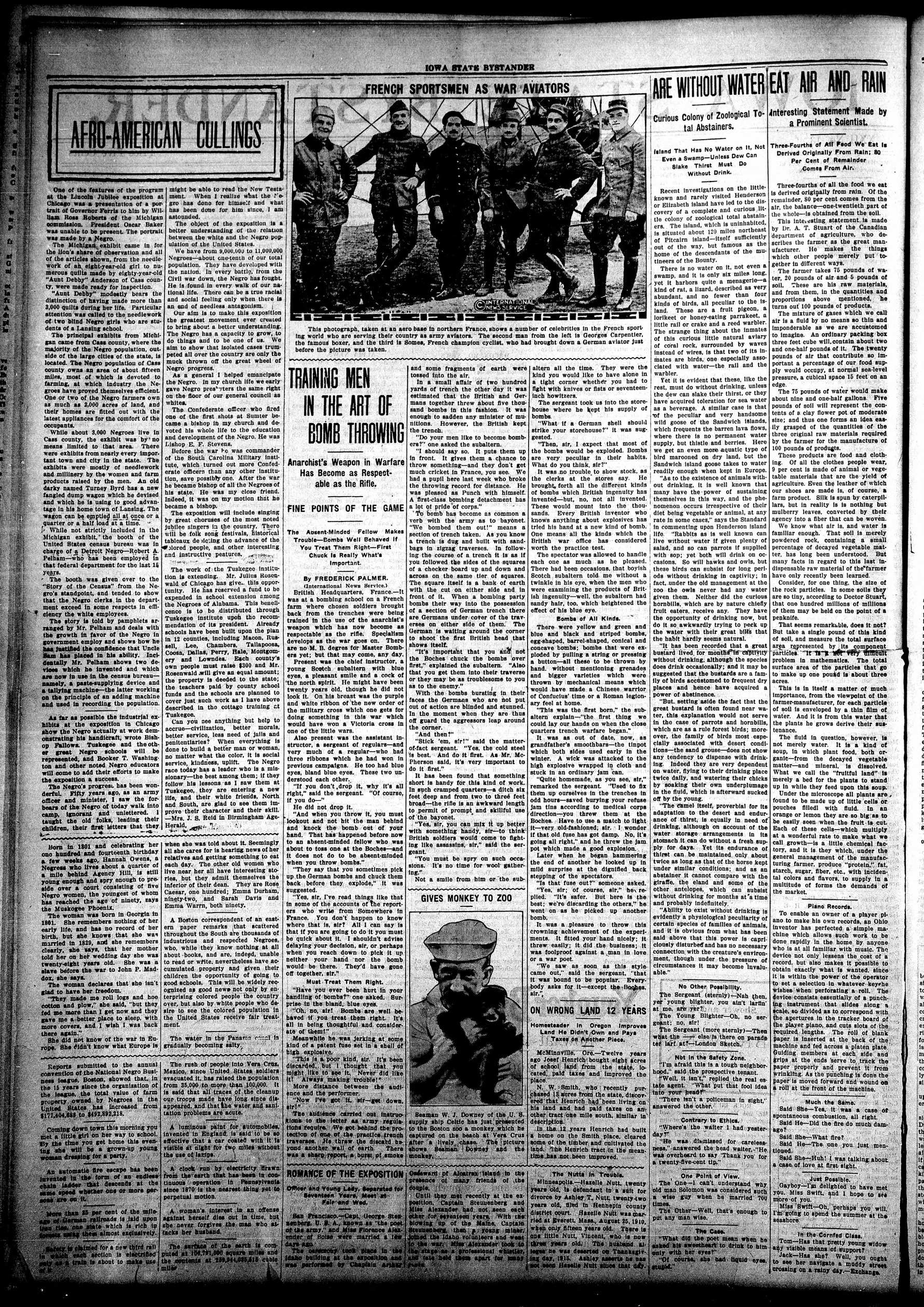
This photograph, taken at an aero base in northern France, shows a number of celebrities in the French sporting world who are serving their country as army aviators. The second man from the left is Georges Carpentier, the famous boxer, and the third is Somes, French champion cyclist, who had brought down a German aviator just before the picture was taken.
This photograph, taken at an aero base in northern France, shows a number of celebrities in the French sporting world who are serving their country as army aviators. The second man from the left is Georges Carpenter, the famous boxer, and the third is Somes, French champion cyclist, who had brought down a German aviator just before the picture was taken.
TRAINING MEN IN THE ART OF BOMB THROWING
Anarchist's Weapon in Warfare Has Become as Respectable as the Rifle.
FINE POINTS OF THE GAME
The Ausent-Minded Fellow Makes Trouble—Bombs Well Behaved If You Treat Them Right—First Chuck is Really What's Important.
By FREDERICK PALMER.
(International News Service.)
British Headquarters, France.—It was at a bombing school on a French farm where chosen soldiers brought back from the trenches were being trained in the use of the anarchist's weapon which has now become as respectable as the rifle. Specialism develops as the war goes on. There are no M. B. degrees for Master Bombers yet; but that may come, any day. Present was the chief instructor a young Soccer ambassador with blue eyes a pleasant smile and a cock of the north spirit. He might have been twenty years old, though he did not look it. On his breast was the purple and white ribbon of the new order of the military cross which one gets for doing something in this war which would have won a Victoria cross in one of the little wars.
Also present was the assistant instructor, a sergeant of regulars—and very much of a regular—who had three ribbons which he had won in previous campaigns. He too had blue eyes, bland blue eyes. These two understood each other. "Don't drop it, why it's all right," said the sergeant. "Of course, if you do—"
He did not drop it.
"And when you throw it, you must lookout and not hit the man behind and knock the bomb out of your hand. That has happened before now to an absent-minded fellow who was about to toast one the Boches—and it does not do to be absent-minded when you throw bombs."
"They say that you sometimes pick up the German bombs and chuck them back before they explode," it was suggested.
"Yes, sir. I’ve read things like that in some of the accounts of the reporters who write from Somewhere in France. You don’t happen to know where that is, sir? All I can say is that if you are going to do it you must be quick about it. I should not advise delaying your decision, sir, or perhaps when you reach down to pick it up notether your hand nor the bomb would be there. They’d have gone off together, sir."
Must Treat Them Right.
"Have you ever been hurt in your handling of bombs?" one asked. Surprise in the bland, blue eyes.
"Oh, no, sir. Bombs are well behaved if you treat them right. It’s all in being thoughtful and considerate."
Meanwhile he was sitting at some kind of a patent fuse set in a shell of high explosive.
"This is a poor kind, sir. It’s been decared, but I thought that you might like to see it. Never did like it! Always making trouble!"
More distance between the audience and the performer.
"Now I've got it. off—get down, sir!"
The audience carried out instructions to the letter as army regulations require. We got behind the protection of one of the prerequisite trench traverses. He threw the disc behind another wall of earth. There was a sharp report, a burst of smoke
Seventeen Years, Meet at
Fall and Wed.
San Francisco—Capt. George Sten-
senberg, U. S. A., known as the 'poet
of the army,' and Miss Florence Alex-
ander of Belen were married a few
days ago.
The ceremony took place in the
idea building at the exposition and
was performed by Chaplain Antoine
IOWA STATE BYSTANDER
SPORTSMEN AS WAR AVIATOR
INTERNATIONAL NEWS SERVICE
ro base in northern France, shows a number
entry as army aviator. The second man f
Somes, French champion cyclist, who had
and some fragments of earth were tossed into the air.
In a small affair of two hundred yards of trench the other day it was estimated that the British and Germans together threw about five thousand bombs in this fashion. It was enough to sadden any minister of munitions. However, the British kept the trench.
"Do your men like to become bombers?" one asked the subaltern.
I should lasse the shunter,
"I should lasse the shunter them up in front. It gives them a chance to throw something—and they don't get much cricket in France, you see. We had a pupil here last week who broke the throwing record for distance. He was pleased as Punch with himself. A first-class bombing detachment has a lot of pride of corps." To bomb has become as common a verb with the army as to bayonet. "We bombed them out!" means a section of trench taken. As you know a trench is dug and built with sandbags in zigzag traverses. In following the course of a trench it is as if you followed the sides of the squares of a checker board up and down and across on the same tier of squares. The square itself is a bank of earth with the cut on either side and in front of it. When a bombing party hits a German into the possession of a section of German trench there are Germans under cover of the traverses on either side of them. The German is waiting around the corner to shoot the first British head that shows itself.
"It's important that you and not the Boches chuck the bombs over first," explained the subpattern. "Also that you get them into their traverse or they may be as troublesome to you as to the enemy."
With the bombs bursting in their faces the Germans who are not put out of action are blinded and stunned. In the moment when they are thus off guard the aggressors leap around the corner.
"And then?"
"Stick 'em, sir!" said the matter-of-fact sergeant. "Yes, the cold steel is best. And do it first. As Mr. McPherson said, it's very important to do it first."
It has been found that something short handy for this kind of work. In such cramped quarters—a ditch six feet deep and from two to three feet broad—the rifle is an awkward length to permit of prompt and skillful use of the bayonet.
"Yes, sir, you can mix it up better with something handy, sir—to think British soldiers would come to fighting like assassins, said the sergeant.
"You must be spry on such occasions. It's no time for wool gathering."
Not a smile from him or the sub
Seaman W. J. Downey of the U. B. supply ship Celtic has just presented to the Boston zoo a monkey which he captured on the beach at Vera Cruz after a lively chase. The picture shows Seaman Downey and the monkey.
Owdward of Alcatraz island in the presence of many friends of the couple.
Until they may recently at the expedition, Captain Steenberg and Miee Alexander had not seen each other for a few years. With the blowing up of the Maine, Captain Steenberg then put young miler, named the Idaho volunteer, and went to the war. Miee Alexander took in the stage out of a professional whistler, and held him apart for many days.
altern all the time. They were the kind you would like to have alone in a tight corner whether you had to fight with knives or flats or seventeen-inch howitzers. The sergeant took us into the storehouse where he kept his supply of bombs.
"What if a German shell should strike your storehouse?" it was suggested.
Men, sir, I expect that most of the bombs would be exploded. Bombs are very peculiar in their habits. What do you think, sir?
It was no trouble to show stock, as the clerks at the stores say. He brought forth all the different kinds of bombs which British ingenuity has invented—but, no, not all invented. These would mount into the thousands. Every British inventor who knows anything about explosives has tried his hand at a new kind of bomb. One means all the kinds which the British war office has considered worth the practice test.
The spectator was allowed to handle each one as much as he pleased. There had been occurrences that boyish Schoolchildren told me without a twinkle in his eye, when the men who were examining the products of British ingenuity—well, the subaltern had sandy hair, too, which heightened the effect of his blue eye.
There were yellow and green and blue and black and striped bombs, egg-shaped, barrel-shaped, conical and concave bombs; bombs that were exploded by pulling a string or pressing a button—all these to be thrown by hand, without mentioning grenades and bigger varieties which were thrown by mechanical means which would have made a Chinese warrior of Connucifus time or a Roman legionan. "This was the first born," the subaltern explain "the first thing we could lay our hands on when the close quarters trench warfare began." It was as out of date, now, as grandfather's smoothbars—the tintop which both sides used early in the winter. A wick was attacked to the high explosive wrapped in cloth and stuck in an ordinary jam can. "Quite homemade, as you see, sir," remarked the sergeant. "Used to fix them up ourselves in the trenches in an old fashioned jam jams according to medical corps direction—you threw them at the Bochen. Have to use a match to light it—very old fashioned; I wonder if that old has got damp. No, it's going all right," and he threw the jam pot which made a good explosion. Later when he began hammering the end of another he looked up in mild surprise at the dignified back stepping of the spectators.
"Is that fuse out?" someone asked. "Well, I course, ours plied. It's safer, it fits there is the best; we discarded the others." he went on as he picked up another bomb.
It was a pleasure to throw this crowning achievement of the experiments. It fitted your hand nicely; it treads easily; it did the business; it was toolproof against a man in love or power. "We saw as soon as this style came out," said the sergeant, "that it was bound to be popular. Everybody asks for it—except the Boobes, sir."
ON WRONG LAND 12 YEARS
Homeeasteader In Oregon Improves
Homesteader in Oregon Improves Land He Didn't Own and Pays Taxes on Another Place.
McMinnville, Ore.—Twelve years ago Joe Henrich brought eight acres of school land from the state, located, paid taxes and improved the place.
N W. Smith who recently purchased 13 rows from the state, discovered that Henrich had been living on his land and had paid taxes on another tract one mile south, similar in description.
In the 12 years Henrich had built a home on the Smith place, cleared some of the timber and cultivated the land. The Henrich tract in the meantime has not been improved.
The Nutts in Trouble.
Minneapolis—Hazelle Nutt, twenty years old, is defendant in a suit for divorce by Ashley T. Nutt, twenty-two years old, filed in Henrickin county district court. Hazelle Nutt was married at Everett, Mass. August 25, 1910, when only fifteen years old. There is one little Nutt, Vincent, who is now three years old. The husband alleges he was deserved on Thanksgiving day, 1914. Ashley alleges he has not seen Hazelle Nutt since that day.
Island That Has No Water on It, Not
Even a Swamp—Unless Dew Can
Slake Thirst Must Do
Without Drink.
Recent investigations on the little-
known and rarely visited Henderson
or Elizabeth island have led to the
discovery of a complex and curious lit-
tle colony of zoological total abstainers.
The island is uninhabited,
is situated about 120 miles northeast
of Pitcairn island—itself sufficiently
out of the way, but famous as the
home of the descendants of the mu-
tualers of the Bounty.
There is no water on it, not even a swamp, and it is only six miles long, yet it harbors quite a menagerie—a kind of rat, a lizard, described as very abundant, and no fewer than four kinds of birds, all peculiar to the island. These are a fruit pigeon, a lorkeet or honey-eating parakeet, a little rail or a reed warbler. The strange thing about the inmates of this curious little natural aviary of coral rock, surrounded by waves instead of wires, is that two of its inmates are birds, one especially associated with water—the rail and the warbler.
Yet it is evident that these, like the rest, must do without drinking, unless the dew can slake their thirst, or they have acquired toleration for sea water as a beverage. A similar case is that of the peculiar and very handsome wild goose of the Sandwich islands, which frequents the barren lava flows, where there is no permanent water supply, but thistle and berries. Here we get an even more aquatic type of bird marooned on dry land, but the Sandwich island goose takes to water readily enough when kept in Europe
"As to the existence of animals without drinking, it is well known that many have the power of sustaining themselves in this way, and the phenomenon occurs irrespective of their diet being vegetable or animal, at any rate in some cases," says the Standard in commenting upon Henderson island life. "Rabbitts as is well known can live without water if given plenty of water, but if given only with sap; yet both will drink on occasions. So will hawks and owls, but these birds can subsist for long periods without drinking in captivity; in fact, under the old management at the zoo the owls never had any water given them. Neither did the curious hornbills, which are by nature chiefly fruit eaters, receive any. They have the opportunity of drinking now, but do it so awkwardly trying to peek up the water with their great bills that the habit hardly seems natural.
"It has been recorded that a great bustard lived, for months its captivity the species does drink cockroach, and it is suggested that the bustards are a family of birds accustomed to frequent dry places and hence have acquired a power of abstinence.
"But, setting aside the fact that the great bustard is often found near water, this explanation would not serve in the case of parrots and hornbills, which are as a rule forest birds; moreover, the family of birds most especially associated with desert conditions—the sand grouse—does not show any tendency to dispense with drinking. Indeed they are very dependent on water, flying to their drinking place twice daily, and watering their chicks by soaking their own underplumage which is afterward sucked off by the young.
"The camel itself, proverbial for its adaptation to the desert and endurance of thirst, is equally in need of drinking, although on account of the water storage arrangements in its stomach it can do without a fresh supply for days. Yet its endurance of thirst can be maintained only about twice as long as that of the horse kept under similar conditions; and as an abstainer it cannot compare with the giraffe, the eland and some of the other antelopes, which can subsist without drinking for months at a time and probably indefinitely.
"Ability to exist without drinking is evidently a physiological peculiarity of certain species of families of animals, which arise from what has been above that the power is capriciously disturbed and has necessary connection with the creature's environment, though under the pressure of circumstances it may become invaluable."
The Sergent (sternly)—Nah then, yer young blighter, you n't larin' at me, are yer?
The Young Blighter—Oh, no sergeant; no, sir!
The Sergeant (more sternly)—Then what the — else is there on parade ter larf at?—London Sketch.
Not in the Safety Zone.
"I am afraid this is a tough neighborhood," said the prospective tenant.
"Well, it isn't," replied the real estate agent. "What put that fool idea into your head?"
"There isn't a policeman in sight," answered the other.
Contrary to Ethics.
"Where's the waiter I had yesterday?"
"He was dismissed for carelessness," answered the head waiter. "He was overheard to say Thank you for a twenty-five-cent tip."
One Point of View.
The One—I can't understand why old man Solomon was considered such a wise guy when he married 700 times.
The Other—Well, that's enough to put any man wise.
The Case.
"What did the post mean when he asked his sweetheart to drink to him only with her eyes?"
"Of course, she had liquid eyes, stupid."
Three-fourths of All Food We Eat is Derived Originally From Rain; 80 Per Cent of Remainder Comes From Air.
Three-fourths of all the food we eat is derived originally from rain. Of the remainder, 80 per cent comes from the air, the balance—one-twentieth part of the whole—is obtained from the soil. This into, eating statement, is made by Dr. A. T. Stuart of the Canadian department of agriculture, who describes the farmer as the great manufacturer. He makes the things which other people merely put together in different ways.
The farmer takes 75 pounds of water, 20 pounds of air and 5 pounds of soil. These are his raw materials, and from them, in the quantities and proportions above mentioned, he turns out 100 pounds of products.
The mixture of gases which we call air is a fluid by no means so thin and imponderable as we are accustomed to imagine. An ordinary packing box three feet cube will contain about two and one-half pounds of it. The twenty pounds of air that contribute so important a percentage of our food supply would occupy, at normal sea-level pressure, a cubical space 15 feet on an edge. The 75 pounds of water would make about nine and one-half gallons. Five pounds of soil will represent the contents of a clay flower pot of moderate size; and thus one form an easy grasped of the quantities of the three original raw materials required by the farmer for the manufacture of 100 pounds of products.
These products are food and clothing. Of all the clothes people wear, 9 per cent is made of animal or vegetable materials that are the yield of agriculture. Even the leather of which our shoes are made is, of course, a farm product. Silk is spun by caterpillars, but in reality is is nothing but mulberry leaves, converted by their agency into a fiber that can be woven. We know what air is, and water is familiar enough. That soil is merely powdered rock, containing a small percentage of decayed vegetable matter, and is indestructible. But many facts in regard to this last indispensable raw material of the farmer have only recently been learned.
Consider, for one thing, the size of the rock particles. In some soils they are so tiny, according to Doctor Stuart, that one hundred millions of millions of them may be held on the point of a penkite.
That seems remarkable, does it not? But take a single pound of this kind of soil, and measure the total surface area represented by its component particles. It is not a very difficult problem in mathematics. The total surface area of the particles that go to make up one pound is about three acres.
This is in itself a matter of much importance, from the viewpoint of the farmer-manufacturer, for each particle of soil is enveloped by a thin film of water. And it is from this water that the plants he grows derive their sustenance.
The fluid in question, however, is not merely water. It is a kind of soup, in which food food, both organic—from the decayed vegetable matter—and mineral, is dissolved. What we call the "fruitful land" is merely a bed for the plants to stand up in while they feed upon this soup. Under the microscope all plants are found to be made up of little cells or pouches filled with fluid. In an orange or lemon they are big so as to be easily seen when the fruit is cut. Among these cells—which multiply at a wonderful rate—make what we call growth—is a little chemical factory, and it is they which under the general management of the manufacturing farmer, produce "protein", fat, starch, sugar, fiber, etc., with incidental colors and flavors, to supply in a multitude of forms the demands of the market.
To enable an owner of a player piano to make his own records, an Ohio inventor has permitted a simple machine which allows such work to be done rapidly in the room by anyone who is at all familiar with the music the device not only lessens the cost of a record, but also makes it possible to obtain exactly what is wanted, since it is within the power of the operator to set a selection in whatever keyhews wishes when perforating a roll. The device consists essentially of a punching instrument that slides along a scale, so divided as to correspond with the apertures in the tracker board of the player plano, and cuts slots of the required lengths. The roll of blank paper is inserted at the back of the machine and fed across a platen plate. Guilding members at each side and grips at the ends serve to trick the paper properly and prevent it from wrinkling. As the punching is done the paper is moved forward and wound on a roll at the front of the machine.
Much the Same.
Said She-Yes, it was a case of spontaneous combustion, all right.
Said He-Did the fire do much damage?
Said She—What fire?
Said He—The one you just mentioned.
Said She—Huh! I was talking about a case of love at first sight.
Just Possible.
Gayboy—I'm delighted to have met you, Miss Swift, and I hope to see more of you.
Miss Swift—Oh, perhaps you will, I'm going to spend the summer at the seashore.
In the Corned Class.
Tom—Has that pretty young widow any visible means of support?
Jack—Has she? Well, you ought to see her navigate a muddy street crossing on a rainy day—Exchange.
A345x
LITTER CARRIER TRACK
LITTER ALLEY
GUITER
HOSE STALLS
BOX STALLS
6 COW STALLS
MANGER
MANGER
FED CARRIER TRACK
FED ALLEY
MANGER
HOSE STALLS
BOX STALLS
6 COW STALLS
GUITER
LITTER CARRIER TRACK
LITTER ALLEY
TO MANUAL SWITCH
SILO
HARDNESS AND TORK DOORS
MANGER
MANGER
HOSE STALLS
BOX STALLS
6 COW STALLS
GUITER
LITTER CARRIER TRACK
LITTER ALLEY
DUTTER DOORS
BEST FORM OF GENERAL BARN
Provision for Cows and Horses in a Plan That Has Been Well Laid Out.
BOX STALLS ARRANGED FOR
Haymow and All Other Appurts
nances are Provided For as They
Should Be—Gambrel Roof
One of the Strongest
of its Features.
By WILLIAM A. BADFORD.
Mr. William A. Radford will answer
cost on all subjects pertaining to the
subject of building work on the farm, for
COST on all subjects pertaining to the
his wide experience as Editor, Author and
Manufacturer, he is, without doubt, the
Address all inquiries to William A. Radford, No. 107 Prattale avenue, Chicago, and only access two-cent stamp for reply.
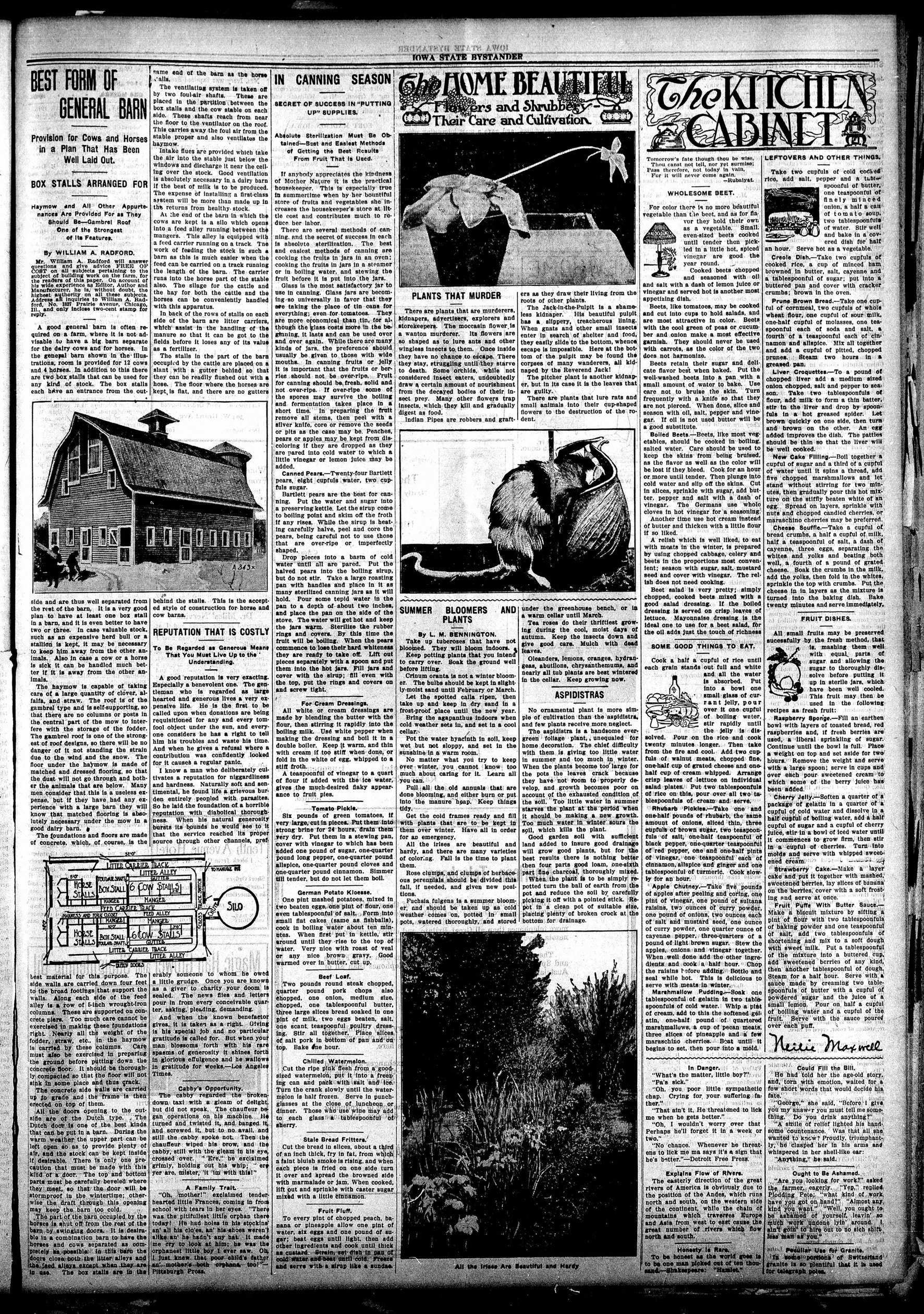
A good general barn is often required on a farm, where it is not ad-hoc. It is used for the dairy cows and for horses. In the general barn shown in the illustrations, room is provided for 12 cows and 4 horses. In addition to this there are two box stalls that can be used for any kind of stock. The box stalls each have an entrance from the out-
```markdown
```
side and are thus well separated from the rest of the barn. It is a very good plan to have at least one box stall in a barn, and it is even better to have two or three. In case valuable stock, such as an expensive hard bull or a stallion is kept, it may be necessary to keep him away from the other animals. Also in case a cow or a horse is sick it can be handled much better if it is away from the other animals.
The haymow is capable of taking care of a large quantity of clover, alfalfa, and straw. The roof is of the gambrel type and is self-supporting, so that there are no columns or posts in the central part of the mow to interfere with the storage of the fodder. The gambrel roof is one of the strongest of roof designs, so there will be no danger of it not standing the strain due to the wind and the snow. The floor under the haymow is made of matched and dressed flooring, so that the duat will not go through and damage the floor below. Many men consider that this is a useless expense, but if they have had any experience with a large barn they will know that matched flooring is absolutely necessary under the mow in a good dairy barn. The foundations and floors are made of concrete, which, of course, is the
32.00
LITTED CARRIER
50.00
HORSE
STALLS
BOX STALL
6 CO
MARRIAGE
BED CARRIER RAIL
HARDNESS AND TORK COAST
50.00
HORSE
STALLS
BOX STALL
6 CO
MARRIAGE
LITTED CARRIER
32.00
LITTED DOORS
best material for this purpose. The side walls are carried down four feet to the broad footings that support the walls. Along each side of the feed alley is a row of 5-inch wrought-iron columns. These are supported on concrete piers. Too much care cannot be exercised in making these foundations right. Nearly all the weight of the fodder, straw, etc., in the haymow is carried by these columns. Care must also be exercised in preparing the ground before putting down the concrete floor. It should be thoroughly compacted so that the soil sinks in some places and thus crack. Along the side walls are carried up to grade and the frame is then executed on top of them.
All the doors opening to the outside are of the Dutch type. The Dutch door is one of the best kinds that can be put in a barn. During the warm weather the upper part can be left open so as to provide plenty of air, and the stock can be kept inside if desirable. There is only one precaution that must be made with this kind of a door. The top and bottom parts must be carefully beveled when the doors are opened to the stormy air in the wintertime; otherwise the draft through this opening may keep the barn too cold.
The part of the barn occupied by the horses in shut off from the rest of the barn, by awinging doors. It is desirable in a combination barn to have the horses and cows separated as com- mings. The barn doors close both the litter alley and the feed alley except when they are in use. The box stalls are in the
same end of the barn as the horse nails.
The ventilating system is taken off by two floor-air shafts. These are placed in the partition between the box stalls and the cow stable on each side. These shafts reach from near the floor to the ventilator on the roof. This carries away the foul air from the stable proper and also ventilates the haymow.
Intake flues are provided which take the air into the stable just below the windows and discharge it near the ceiling over the stock. Good ventilation is absolutely necessary in a dairy barn if the best of milk is to be produced. The expense of installing a first-class system will be more than made up in the returns from healthy stock.
At the end of the barn in which the cows are kept is a silo which opens into a feed alley running between the mangers. This alley is equipped with a feed carrier running on a track. The work of feeding the stock in such a barn as this is much easier when the feed can be carried on a track running the length of the barn. The carrier runs into the horse part of the stable also. The silage for the cattle and the hay for both the cattle and the horses can be conveniently handled with this apparatus. In back of the rows of stalls on each side of the barn are litter carriers, which assist in the handling of the manure so that it can be got to the fields before it loses any of its value as a fertilizer. The stalls in the part of the barn occupied by the cattle are placed on a stant with a gutter behind so that they can be readily flushed out with a hose. The floor where the horses are kept is flat, and there are no gutters
A 343x
behind the stalls. This is the accepted style of construction for horse and cow barns.
REPUTATION THAT IS COSTLY
A good reputation is very exacting. Especially a benevolent one. The gentleman who is regarded as large hearted and generous lives a very expensive life. He is the first to be called upon when donations are being requisitioned for any and every tombool object under the sun, and everyone one considers he has a right to tell him his troubles and waste his time. And when he gives a refusal where a contribution was confidently looked for it causes a regular panic.
I know a man who deliberately cultivates a reputation for niggardness and hardness. Naturally soft and sentimental, he found a woman with parasites. So he laid the foundation of a horrible reputation with disobedientness. When his natural generosity bursts its bounds he would see to it that the service reached its proper source through other channels, pref
TRACK
WATER ALLEY
GUITER
W STALKS
ANGER
CY
OLD ALLEY
ANGER
W STALKS
GUITER
TRACK
LITTER ALLEY
TO PANEL 88
GROSS TRACK SWITCH
Silo
erably someone to whom he owed a little grudge. Once you are known as a giver to charity your doom is sealed. The news flies and letters pour in from every conceivable quarter, asking, pleading, demanding.
And when the known benefactor gives, it is taken as a right. Giving it is his special job and no particular gratitude is called for. But when your man blossoms forth with his rare spasms of generosity it shines forth in glorious effulgence and he wallows in gratitude for weeks.—Los Angeles Times.
Cabby's Opportunity.
The cabby regarded the broken down table with the delight of delight, but did not speak. The chauffeur be gan operations on his machine. He turned and twisted it, and banged it, and screwed it, but to no avail, and still the cabby spoke not. Then the chauffeur wiped his brow, and the cabby, still with the gleam in its eye, crossed over. "Ere," he exclaimed grimly, holding out his whip; "are yer are, mister, 'it 'im with this!'
"Oh, mother!" exclaimed tender-hearted little Frances; coming in from school with tears in her eyes. "There was the pitiful little orphan there today!" He had holes in his stockings "an all his cloes, an' his shoes weren't alike an' he hadn't any hat. It made me cry to look at him; he was the orphanest little boy I ever saw. Oh. I just knew that poor child's father an' mothers' both orphaned, too!- Pittsburgh.Boost
```markdown
```
IN CANNING SEASON
SECRET OF SUCCESS IN "PUTTING UP" SUPPLIES.
Absolute Sterilization Must Be Obtained - Bastel and Easel Methods
of Getting the Best Results From Fruit That Is Used.
If anybody appreciates the kindness of Mother Nature it is the practical housekeeper. This is especially true in summertime when by her bountiful store of fruits and vegetables she increases the housekeeper's store at little cost and contributes much to reduce her labor.
There are several methods of canning, and the secret of success in each is absoluto sterilization. The best and easiest methods can be cooking the fruits in jars in an oven; cooking the fruits in jars in a steamer or in boiling water, and stewing the fruit before it is put into the jars.
Glass is the most satisfactory jar to use in canning. Glass jars are becoming so universally in favor that they see taking the place of tin cans for everything; even for tomatoes. They are more economical than tin, for although the costs glass more in the beginning, it itats and can be used over and over again. While there are many kinds of jars, the preference should usually be given to those with wide mouths. In canning fruits or jelly it is important that the fruits or berries should not be over-ripe. Ripe for canning should be fresh, solid and not over-ripe. If over-ripe some of the spores may survive the boiling and fermentation takes place in a can. To prevent the spores from remove all stems, then peel with a silver knife, core or remove the seeds or pits as the case may be. Peaches, pears or apples may be kept from discoloring if they are dropped as they are pared into cold water to which a little vinegar or lemon juice may be added.
Canned Pears.—Twenty-four Bartlett pears, eight cupfuls water, two cupfuls sugar.
Bartlett pears are the best for canning. Put the water and sugar into a preserving kettle. Let the sirup come to boiling point and skim off the froth if any rises. While the sirup is heating carefully halve, peel and core the pears, being careful not to use those that are over-ripe or imperfectly shaded.
Drop pieces into a basm of cold water until all are pared. Put the halved pears into the boiling sip, but do not stir. Take a large roasting pan with handles and place in it as many sterilized canning jars as it will hold. Pour some tepid water in the pan to a depth of about two inches, and place the pan on the side of the stove. The water will get hot and keep the jars warm. Sterilize the rubber rings and covers. By this time the fruit will be boiling. When the pears commence to lose their hard whiteness they are ready to take off. Lift out pieces separately with a spoon and put them into the hot jars. Fill jars and cover with the sip; fill even with the top, put the rings and covers on and screw tight.
For Cream Dressings
All white or cream dressings are made by blending the butter with the flour, then stirring it rapidly into the boiling milk. Use white pepper when making the dressing and boil it in a double boiler. Keep it warm, and thin with cream if too stiff when done, or fold in the white of egg, whipped to a paste. A teaspoonful of vinegar to a quart of flour if added with the ice water, gives the much-desired flaky appearance to fruit pies.
Tomato Pickle.
Six pounds of green tomatoes, if very large, cut in pieces. Put them into strong brine for 24 hours, drain them very dry. Put them in a stewing pan, cover with vinegar to which has been added one pound of sugar, one-quarter pound long pepper, one-quarter pound allspice, one-quarter pound cloves and one-quarter pound cinnamon. Simmer till tender, but do not let them boil.
German Potato Kloease.
One pint mashed potatoes, mixed in two beaten eggs, one pint of flour, one even tablespoon of salt, Form into small flat cakes, (same as fabbails), cook in boiling water about ten minutes. When first put in kettle, stir around until they rise to the top of water. Very nice with roast of veal or any nice brown gravy. Good warmed over in butter, cut up.
Beef Loaf.
Two pounds round steak chopped, quarter pound pork chops also chopped, one onion, medium size, chopped, one tablepoonful butter, three large slices bread soaked in one pint of milk, two eggs beaten, salt. one scant teaspoonful poultry dressing. Stir all together, place slices of salt pork in bottom of pan and on top. Bake one hour.
Chilled Watermelon.
Cut the ripe pink flesh from a good-sized watermelon, put it into a freezing can and pack with salt and ice. Turn the crank slowly until the watermelon is half frozen. Serve in punch-glasses at the close of luncheon or dinner. Those who use wine may add to each glass a tablespoonful of sherry.
Stale Bread Eritters
Cut the bread in slices, about a third of an inch thick, fry in fat, from which a faint blush smoke is rising, and when each piece is fried on one side turn it over and spread the browned side with marmalade or jam. When cooked, lift put and sprinkle with caster sugar mixed with a little cinnamon.
**Fruit Fluff.**
To every pint of chopped peach, banana or pinceapple allow one pint of water, six eggs and one pound of sugar; beat eggs until light, then add other ingredients and cook until thick as custard. Strain set dish in pan of cold water and heat until cold. Freeze and serve with a strap like a sundae.
The HOME BEAUTIFUL Flowers and Shrubbery Their Care and Cultivation
EVERYTHING IS MORE
THE DUCK
dT
q8 bus
al janzA
BROOKLYN STATE AWOL
IOWA STATE BYSTANDER
The HOME B
Flowers and
Their Care and
PLANTS THAT MURDER
There are plants that are murderers, kidnappers, advertisers, explorers and storekeepers. The moccasin flower is a wanton murderer. Its flowers are so shaped as to lure ants and other wingless insects to them. Once inside they have no chance to escape. There they stay struggling until their starve to death. Soon orchids, while not considered insect enters, undoubtedly draw a certain amount of nourishment from the decayed bodies of their insect prey. Many other flowers trap insects, which they kill and gradually digest as food. Indian Pipes are robbers and graft-
T
SUMMER BLOOMERS AND
PLANTS
By L. M. BENNINGTON.
Tame. They will bloom, not bloomed. They will bloom indoors.
Take up tuberoses that have not bloomed. They will bloom indoors. Keep potting plants that you intend to carry over. Soak the ground well before lifting.
Crinum oranita is not a winter bloomer. The bulbs should be kept in slightly-mist sand until February or March. Let the spotted calla ripen, then take up and keep in dry sand in a frost-proof place until the new year. Bring the agapanthus indoors when cold weather sets in, and set in a cool cellar.
Pot the water hyacinth in soil, keep wet but not sloppy, and set in the sunshine in a warm room.
What do you want you to try to keep over winter, you cannot know, too much about caring for it. Learn all you can.
Pull all the old annuals that are done blooming, and either burn or put into the manure heap. Keep things tidy.
Get the cold frames ready and fill with plants that are to be kept in them over winter. Have all in order for an emergency.
All the irises are beautiful and hardy, and there are many varieties of coloring. Fall is the time to plant them.
Rose clumps, and clumps of herbaceous perennials should be divided this fall, if needed, and given new positions.
Fuchsia fulgens is a summer bloomer, and should be taken up as cold weather comes on, potted in small pots, watered thoroughly, and stored
```markdown
```
ers as they draw their living from the roots of other plants. The Jack-in-the-Pulpit is a shameless kidnapper. His beautiful pulpit has a slippery, treacherous lining. When gnats and other small insects enter in search of shelter and food, they easily slide to the bottom, whence escape is impossible. At the bottom of the pulpit may be found the corpse of many wanderers, all kidnapped by the Reverend Jack! The pitcher plant is another kidnapper, but in its case it is the leaves that are there. There are plants that lure rats and small animals into their cup-shaped flowers to the destruction of the rodent.
under the greenhouse bench, or in a warm cellar until March.
Tea roses do their trifftest growing during the cool, moist days of autumn. Keep the insects down and give good care. Mulch with dead leaves. Gardens, lemons, oranges, hydrangea, amders, aublons, chrysanthemum, and nearly all tub plants are best wintered in the cellar. Keep growing now.
ASPIDISTRAS
No ornamental plant is more simple of cultivation than the aspidistra, and few plants receive more neglect. The aspidistra is a handsome evergreen foliage plant, unequaled for home decoration. The chief difficulty with them is giving too little water in summer and too much in winter. When the plants become too large for the pots the leaves crack because they have not room to properly develop, and growth becomes poor on account of the exhausted condition of the soil. Too little water in summer starves the plant at the period when it should be making a new growth. Too much water in winter soils the soil, which kills the plant. Good garden soil with sufficient land added to insure good drainage will grow good plants, but for the best results there is nothing better than four parts good loam, one sixth part fine charcoal, thoroughly mixed.
When the plant is to be simply repotted turn the ball of earth from the pot and reduce the soil by carefully picking it off with a pointed stick. Repot in a clean pot of suitable size, placing plenty of broken crock at the bottom for drainage.
The KITCHEN CABINET
Tomorrow's fate though thou be wise,
Thou canst not tell, nor yet surmise;
Pass therefore, not today in vain,
For it will never come again.
LEFTOVERS AND OTHER THINGS.
Take two cupfuls of cold cooked rice add salt, pepper and a tablespoon of salt.
WHOLESOME BEET.
For color there is no more beautiful vegetable than the beet, and as for far- vor they hold their own as a vegetable. Small, even-sized beets cooked in a pan, lie in a little hot, spiced vinegar are good the year round.
HAPPY HOURS
Cooked beets chopped and seasoned with oil
and salt with a dash of lemon juice or vinegar and served hot is another most appetizing dish.
Beets, like tomatoes, may be cooked and cut into cups to hold salads, and are most attractive in color. Beets with the cool green of peas or cucumber and onion make a most effective garnish. They should never be used with carrots, as the color of the two does not harmonize.
Beets retain their sugar and delicate flavor best when baked. Put the well-washed beets into a pan with a small amount of water to dilute. Use the skin. Turn frequently with a knife so that they are not pierced. When done, slice and season with oil, salt, pepper and vinegar. If oil is not used butter will be a good substitute.
Boiled Beets—Beets, like most vegetables, should be cooked in boiling, salted water. Care should be used to keep the skins from being bruised, as the flavor as well as the color will be lost if they bleed. Cook for an hour or more until tender. Then plunge into cold water and silt off the skins. Cut in slices, sprinkle with sugar, add butter, pepper and salt with a dash of vinegar. The Germans use whole cloves in hot vinegar for a seasoning. Another time use hot cream instead of butter and thicken with a little flour if so liked. A relish which is well liked, to eat with meats in the winter, is prepared in melted cabbage, celery and beets the proportions most convenient; season with sugar, salt, mustard seed and cover with vinegar. The relish does not need cooking.
Beet salad is very pretty; simply chopped, cooked beets mixed with a good salad dressing. With the boiled dressing is served on crisp leaves of lettuce. Mayonnaise dressing is the ideal one to use for a beet salad, for the oil adds just the touch of richness
SOME GOOD THINGS TO EAT.
Cook a half a cupful of rice until each grain stands out full and white
and all the water is absorbed. Put into a bowl one small glass of currant jelly, pour one cup of boiling water, stir rapidly until the strur rapidly until the water is dis
and all the water is absorbed. Put into a bowl one small glass of curant jelly, pour over one of boiling water, stir rapidly until the jelly is dissolved. Pour on the rice and cook twenty minutes longer. Then take from the fire and cool. Add two cupfuls of walnut meats, chopped fine, one half cup of grated cheese and one half cup of cream whipped. Arrange crisp leaves of lettuce on individual salad plates. Put two tablespoonfuls of rice on this, pour over all two tablespoonfuls of cream and serve.
Rhubarb *Pickles*—Take one and one-half pounds of rhubarb, the same amount of onions, sliced thin, three cupfuls of brown sugar, two teaspoonfuls of salt, one-half teaspoonful of black pepper, one-quarter teaspoonful of red pepper, one and one-half pints of cinnamon, one-quarter pints of cinnamon, allspice and ginger and one tablespoonful of turmeric. Cook slowly for an hour.
Apple *Chutney*—Take five pounds of apples after peeling and coring, one pint of vinegar, one pound of sultana raisins, two ounces of curry powder, one pound of onions, two ounces each of salt and mustard seed, one ounce of curry powder, one quarter ounce of cayenne pepper, three-quarters of a pound of light brown sugar. Stew the apples, onions and vinegar together. When well done add the other ingredient to the raisins before adding. Bottle and seal while hot. This is delicious to serve with meats in winter.
Marshmallow *Pudding*—Sook one tablespoonful of gelatin in two tablespoonfuls of cold water. Whip a pit of cream, add to the softened gelatin, one half pound of quartered pineapple, one half pound of three slices of pineapple and a few maraschino cherries. Boat until it begins to set, then pour into a mold.
"That ain't it. He threatened to lick me when he gets better."
"Oh, I wouldn't worry over that Perhaps he'll forget it in a week or two."
"No chance. Whenever he threatens to lick me ma says it's a sign that he's better."—Dettroit Free Press.
Explains Flow of Rivers.
The easterly direction of the great rivers of America is obviously due to the position of the Andes, which runs north and south, on the western side of the continent, while the chain of mountains which traverses Europe and Asia from west to east cause the great number of rivers which flow north and south.
Henesty is Rare.
To be honest as the world goes is to be one man picked out of ten thousand—Shakespeare: "Hamlet."
LEFTOVERS AND OTHER THINGS.
Take two cupfuls of cold cooke
rice, add salt, pepper and a tabl
spoonful of butter,
one teaspoonful of
finally minned
onion, a half can of
tomato soup,
water, a half can of
water, stir well
and shake in a cover
dish for half
spoonful of one cupful of finely minced onion, a half a cup of tomato soup, two tablespoonfuls of water. Stir well and bake in a covered dish for half an hour. Serve hot as a vegetable.
Creole Brown —Take two cupfuls of cooked rice, a cup of minced ham browned in butter, salt, cayenne and a tablespoonful of sugar; put into a pan and cover with cracker crumbs; brown in the oven.
Prune Brown Bread —Take one cupful of cornmeal, two cupfuls of whole wheat flour, one cupful of milk, one-half cupful of molasses, one teaspoon each of salt, fourth of a teaspoon each of cinnamon and allspice. Mix all together and add a cupful of pituted, chopped prunes. Steam two hours in a greased pan.
Liver Croquettes—To a pound of chopped liver add a medium sized onion chopped, salt and pepper to season. Take two tablespoons of flour, add milk to form a thin batter, stir in the liver and drop by spoonfuls in a hot greased spider. Let brown quickly on one side, then turn and brown on the other. An egg added improves the dish. The patties should be thin so that the liver will be well cooked.
New Cake Filling—Boil together a cupful of sugar and a third of a cupful of water until it spins a thread, add marshmallows and let stand without stirring for two minutes, then gradually pour this hot mixture on the stiffly beaten shell of an egg. Spread on layers, sprinkle with nuts and chopped candied cherries, or maraschino cherries may be preferred.
Cheese Souffle—Take a cupful of bread crumbs, a half a cupful of milk, half a teaspoonful of salt, a dash of cayenne, three eggs, separating the whites and yolks and beating both well, a fourth of a pound of grated cheese. Soak the crumbs in the milk, add the yolks, then fold in the whites, sprinkle the top with crumbs. Put the cheese in in layers as the mixture is turned into the baking dish. Bake twenty minutes and serve immediately.
All small fruits may be preserved successfully by the fresh method, that is, mashing them well with equal parts of sugar and allowing the sugar to thoroughly dissolve before putting it up in sterile jars, which have been well cooled. This fruit may then be used in the following recipes as fresh fruit.
in meaning clean with equal part of sugar and allowing the sugar thoroughly discolored before putting it up in sterile jars, which have been well cooled. This fruit may then be used in the following recipes as fresh fruit:
Raspberry Sponge—Fill an earthen bowl with layers of toasted bread, red raspberries and, if fresh berries are used, a liberal sprinkling of sugar. Continue until the bowl is full. Place a weight on top and set aside for two hours. Remove the weight and serve with a large spoon; serve in cups and over each pour sweetened cream to which some of the berry juice has been added.
Cherry Jelly—Soften a quarter of a package of gelatin in a quarter of a cupful of cold water and dissolve in a half cupful of boiling water, add a half cupful of sugar and a cupful of cherry juice, stir in a bowl of feed water until it commences to grow firm, then stir in a cupful of cherry juice into a bowl of whipped sweetened cream. Cake—Make a layer cake and put it together with mashed, sweetened berries, lay slices of banana on the berries, cover with a soft frosting and serve at once.
Fruit Puffs With Butter Sauce—Make a biscuit mixture by拌 a pint of flour with two tablespoonfuls of baking powder and one teaspoonful of salt, add two tablespoonfuls of shortening and mix to a soft dough with sweet milk. Put a tablespoonful of butter into a buttered cup, add sweetened berries of any kind, then another tablespoonful of dough. Steam for a half hour. Serve with a sauce made by creaming two tablespoonfuls of butter with a cupful of powdered sugar and the juice of a small lemon. Pour on half a cupful of boiling water and a cupful of the fruit. Serve with the sauce poured over each puff.
Nettie Maxwell
Could Fill the Bill.
He had told her the age-old story, and, torn with emotion, waited for a few short words that would decide his fate.
"George," she said. "Before I give you my answer - you must tell me something. Do you drink anything?" "A tautle of relief lifted his hand-some countenance. Was that all she wanted to know? Proudly, triumphantly, he clasped her in his arms and whispered in her shell-like ear: "Anything," he said.
Ought to Be Ashamed.
"Are you looking for work?" asked the farmer, eagerly. "Yep," replied Floyding Pete, "what kind of work have you got on?" "Almost any," almost any. "Well, well, well," he be ashamed of yourself, leavin' so much work indonebth around. I can't gift it hire out to no shalt shift less man as you"
Popular Use for Granite.
I'll be porous forof Switzerland granite is no plenitant that it is used for telegraph penns.
SHOMBURG WINS IN DEBATE.
Judges Decide That Negro Is Proper Name For Our Race.
In a joint debate in the Harlem Congregational church, New York, in March between the Rev. Dr. W. S. Holder, pastor of the church, and Mr. Arthur Alfonso Schomburg, secretary of the Negro Society For Historical Research, Yonkers, N. Y., and a corresponding number of the Negro academy of Washington, on the question, "Which Is Better as a Race Name-Colored or Negro?" the decision was given in favor of the latter team. Mr. Schomburg ably defended the use of the term Negro, adducing many historical and scientific facts in its favor.
The judges, all malatties, were Miss Minnie Brown of Young's Bank exchange, Mr. G. A. Fleming of the Continental insurance company and Mr. Brown, a member of Dr. Holder's church. The judges deliberated for almost an hour before returning their verdict, which was received with aplaeuse by the audience. Mr. Schomburg was immediately challenged by the editor of a New York weekly paper to a joint discussion on the same subject, which is to be arranged and will take place at an early date.
LARGE AUDIENCE GREETS
TROTTER AT BALTIMORE.
Noted New England Orator Invades South on Second Speaking Tour.
Baltimore, April 6—Last night at the Union Baptist church in this city, of which the venerable Dr. Harvey Johnson has been pastor for upward of forty years, William Monroe Trotter, editor of the Boston Guardian and secretary of the National Independent Equal Rights league, delivered a stirring message to a mammoth audience. He urged our people with all the force at his command to fight color prejudice against the colored race and to organize under the Equal Rights league for proper and lawful contention for all rights guaranteed to them as citizens of the United States.
Mr. Trotter is concluding his second speaking tour against race segregation, which is, in truth, a crusade against injustice and cruelty carried on in a majority of the states of the Union to prevent the colored people from exercising the rights of citizenship which the federal constitution has not deprived them of, but many of the individual states have done so. The crusade for justice and equality of opportunity in government affairs, says Mr. Trotter, will not end until the very last man of the race who is entitled to his vote shall exercise that right without fear or molestation from men who dare defy the just laws of a free republic.
This second tour of the gallant leader was begun at Syracuse, N. Y., and extended over several western states, including Missouri. Many local leagues were formed, and our people rallied to the call for union and co-operation with courage and determination. Everywhere Editor Trotter spoke there was an anxious crowd of interested people who welcomed the opportunity to see the man of the race who faced the president of the United States and for the first time openly revealed the fact that segregation did exist in the government departments at Washington
After speaking at the ethical culture congress in Buffalo, Mrs. Mary B. Talbert president, where a branch of the Equal Rights league was formed, Mr. Trotter filled an engagement at Mother Zion church in New York city. This meeting was attended by thousands, many persons being unable to get either seats or standing room. Other cities included in this tour were Albany, Pittsburgh, Cincinnati, Springfield and Cleveland, O.; Louisville, Ky.; St. Louis, Jefferson City and Columbia, Mo.; Quincy and Peoria, Ill.; Indianapolis, Ind.; Detroit, Mich., and other cities en route south to Baltimore.
CHURCH FEEDS THE HUNGRY.
Ebenszer Baptist Congregation in Chicago Shows No Race Prejudice. White men and colored men alike are being fed daily at the dinners which the Ebenszer Baptist church in Chicago, one of the largest churches with a congregation of colored people in the city, is providing for those whom winter and war depression in business have thrown out of work. Id fact, the whites outnumber the blacks by four to one at the hour of the free meals served five days a week by the women of the church, according to those in charge. The dinners, which are substantial and well cooked, cost the church about $20 a day to feed about 350 men. This is a service which the church tries to give for one month out of every year, says the pastor, the Rev. John F. Thomas.
Last year 3,762 white men and 1,002 colored men in all, were fed. One of the white churches of the city which carries on a similar work bars colored men from its charity, but the Rev. Mr. Thomas committee of women welcome any one who is penniless and hungry, regardless of color, creed or race.
The Delaware Conference Convenes. The fifty-first annual meeting of the Delaware conference of the Methodist Episcopal church opened at Atlantic City, N. J., Bishop Theodore Henderson presiding, Wednesday morning, April 7. The conference will continue for a week. Its jurisdiction covers about 180 churches in parts of Virginia, Maryland, Pennsylvania, New Jersey, New York, Connecticut and Delaware. The attendance of delegates and visitors from the various states is large and great interest is taken in the session from day to day.
WASHINGTON, IOWA, NOTES.
Miss Nora Motts is in Fairfield nursing.
Mr. and Mrs. Theodore Turner have moved into the home they recently purchased and are getting nicely located where they will be at home to their many friends after October 1st.
Patients in the city were very sorry to hear of the death of the Rev. M. I. Browne. He was a former pastor of
11
day night for a visit and to attend the semi-centennial. Miss G, has returned, but Mrs. Black remains for an indefinite stay. Mr. Ollie Howard is still having trouble with his eyes, as he had to have an ulcer taken off his right eye last Saturday. Everyone hopes that the affection will not develop into anything serious.
The annual church dinner will undoubtedly be a success, as all the energy in the church is being exploited in the undertaking.
Mrs. A. G. Clark has returned to her home in Oskaloosa, after a visit at the home of her sister, Mrs. James Redd.
Mr. W. L. Brasco arrived in the city Tuesday a. m. and spent the day here in the effort to organize a K. of P. lodge, but enough "timber" was not available.
Last Saturday evening at 8 o'clock the Rev. R. W. Sawhill of the Second U. P. church pronounced the words that joined in wedlock Miss Lewis of Richmond, Ky., and Mr. Cecile Boileau of this city. Miss Lewis arrived from her home on the morning train that day. She is a charming young lady and worthy the young man she has chosen for her helpmeet. Mr. Boileau has been a resident of this place for several years and is a fine young man, who, from past observations, will be an ideal husband. Mr. and Mrs. Boileau went to housekeeping at once in a home the groom had already prepared on North Eleventh avenue, where they are at home to friends.
"I have used Chamberlain's Tablets and found them to be just as represented, a quick relief for headaches, dizzy spells and other symptoms denoting a torpid liver and a disordered condition of the digestive organs. They are worth their weight in gold." writes Miss Clara A. Driggs, Elba, N. Y. Obtainable everywhere.
NOTICE TO REDEEM FROM TAX SALE.
To C. W. Orvin, the person m whose name the real estate described below is taxed:
You are hereby notified that at a regular tax sale held in and for Polk county, Iowa, on December 2, A. D. 1912, the following described real estate towit: Lot 8, block 3, South Riverside Park, now in and forming a part of the city of De Moines, Iowa, was sold to L. J. Kasson for the payment of the taxes for the year 1911, thereon, and a certificate of purchase was duly issued to him by the treasurer of said Polk county, Iowa, therefor, which certificate is now lawfully held and owned by W. H. Meredith. That the time for redemption from said sale will expire and a deed for said lot will be issued to him by the treasurer of said Polk county, Iowa, unless redemption from said sale be made within ninety days from the completed service of this notice.
W. H. Meredith.
By J. C. Meredith,
His Attorney in Fact.
PLEA POR SELF-RELIANCE
Dharies G. Dawes' Good Advice to Young Men in Business.
This is a hard world in business. It always has been and always will be. There are many good and generous men in it. There are many who will lead a helping hand to you in your adversity, but in the time of need you will not find them among the men who tried to get you to embark in speculation with your little surplus, and to sell you something which would help you to "easy money." Be self-reliant. Make your own investment into investments. When you cannot, put your money in a good savings bank. Distrust the financial demagogues as you distrust the political demagogue. Keep your hand on your pocketbook as you travel life first, to give always in proportions as your means to those who are poor; second, to hold from those who would take through force or fright what you need for yourself and youa. You will then, writes Mr. Dawes in the Saturday Evening Post, have your hand where most of the other 'elows have only their eyes. In this alone you will have the advantage of these
Toulon—Slight scablike sheds occurred again Monday in Draguignan, Vincennes and Puy-Se-Repaure. No damage is reported, but the residents were pummeled.
Sure Washington Pericals
A rare and curious mossotin portrait of George Washington in the library of the late Lafayette S. Richardson of Lowell, Mass., was auctioned on last year in Boston. It is entitled "George Washington, late president of the United States of America, etc." and was published March 14, 1801, by J. Hinton Linden. It is a small folkt and is colored by hand. It looks as much like George III, as it does the Father of His Country, Baker, who wrote the "Engraved Portraits of Washington," says that only one time pression of this mossotin he can under the notice of the writer. It was in neither the Clarkson nor the Cassin sale of Washington portraits.
Insist on Yellow Flour.
Charles Christadoro, an expert on flour and grains, sounds the keynote of the new situation brought about by the bleached flour decision when he says in a communication to the editor commenting on the bleached flour decision: 'The housewife will now insist on yellow tinted or creamy flour and will learn to realize that a nature flour very white can in no manner compares with the creamy or yellow flour in so far as glutens and muscle-building values are concerned.
"As from 85 to 90 per cent, of the large floor mills of the country were using this bleaching process, the decision is for coaching" - National Power
CLINTON, IOWA.
Mrs. Ann Williams of Buxton visited her mother, Mrs. Elizabeth Cooper, last week.
Mr. Roy Watts visited friends in Waterloo a few days ago.
Mr. G. W. Martin was taken suddenly ill a few days ago while preparing to attend the Baptist association convention in Davenport. We are glad to note that he is around again much improved.
Mr. Geo. O. Terrell of Colfax was a visitor in Clinton a few days ago at the home of Mr. Jas. Cooper and mother.
The concert given at Bethel A. M. E. church on the 9th by Rev. and Mrs. Lowery was a success. A fair crowd was present.
Miss Esther Culberson has returned home, after a week's visit with relatives in Chicago.
Mr. Roy Watts was a Chicago visitor last week.
NEWHOME
"I'll get it for my wife"
NO OTHER LIKE IT.
NO OTHER AS GOOD.
Purchase the "NEW HOME" and you will have a life asset at the price you pay. The elimination of repair expense by superior workmanship and best quality of material insures life-long premiums. Purchase the "NEW HOME".
WARRANTED FOR ALL TIME.
Known the world over for superior sewing qualities.
Not sold under any other name.
THE NEW HOME SEWING MACHINE CO., ORANGE, MASS.
FOR SALE BY
T. W. Tobey, 816 W. Locust Street
Des Moines, Iowa.
M.
Woman's Crowning Glory is Her Halt
Why not grow your hair by using
Mme- M. Beard Hair Grower
It removes dandruff, stops itching of
the scalp and makes it grow long, soft
and beautiful. Price 50c a box.
Send stamp for pamphlet.
519 So. 16th St. St. Joseph, Mo
The Ameri
The Uni
tion, yet it has
five states of
more telepho
nesota have
The city
and Spain co
Austria.
The American Telephone
The United States has less than $6\%$ of the world's population, yet it has more than $64\%$ of all the world's telephones. The five states of Iowa, Nebraska, Minnesota, and the Dakotas, have more telephones than all Great Britain, and either Iowa or Minnesota have more telephones than all of Russia.
The city of New York has more telephones than all of France and Spain combined. Chicago has more telephones than all of Austria.
The Cost of Operating
The tele-
wages that a
telephone equi
Fully ha-
at night and
this country
service.
When th
it is consid
rates are by
The telephone companies in this country pay double the wages that are paid in Europe for the same kind of work, and telephone equipment costs a great deal more here.
Fully half of the European telephone exchanges are closed at night and on Sunday and holidays. It is the general rule in this country to give all-night and all-day Sunday telephone service.
When the efficiency of the service and the cost of producing it is considered, American local and long distance telephone rates are by far the lowest in the world.
IOWA STATE BYSTANDER
The picnic at Union park under the auspices of the Second Baptist church on Labor day was a success. A good number were present throughout the day. A bountiful dinner was spread under the oak trees on long tables, where those who desired were reaged. Rev. G. D. Rogers, pastor of the First Baptist church, was present and gave a most interesting address. The athletic events proved a very entertaining part of the day's activities and were hotly contested. Prizes were awarded the winners. The day's festivities were brought to a close with an entertainment at night at the church, which was well attended.
Mrs. A. A. Bush and children returned last week from Chicago, where they were the guests of relatives and friends and incidentally in attendance at the Lincoln exposition.
Mr. and Mrs. Luther D. Lowery of Cedar Rapida visited the past week with Rev. and Mrs. W. B. Lowery. On Monday evening an entertainment was given at Bethel A. M. E. church in compliment to them. A program was rendered. Later light refreshments were served.
Sunday last was the last quarterly meeting service for this conference
HAVE YOU
WE are sure to ture Also Wav
We are combing a crimp.
Wigs, I stock or to Stra
Send two-cent stamp for Price List.
The Old Reliable Mme.
486 8th Avenue 11-16-2-16 Betwee
Douglas 5118
The
Neatly F
K
High
The New The
A First-Class Modern H
Rates R
THE BANK
A First-Class Modern Hotel Rates Reasonable 10 Blocks from Union Depot Corner of 9th and Park Sts.
American Telephone
United States has less than 6% of the
is more than 64% of all the world.
Iowa, Nebraska, Minnesota, and
ones than all Great Britain, and e
more telephones than all of Russ
of New York has more telephones
combined. Chicago has more tele
phone companies in this country are paid in Europe for the same equipment costs a great deal more. If of the European telephone ex on Sunday and holidays. It is to give all-night and all-day the efficiency of the service and the need, American local and long olar the lowest in the world. WA TELEPHONE COMPA
WE are the only Importers and Manufacturers of Real Colored People's Hair. Also Wavy Hair.
Wigs, Plates, Braids, Transformations and Puffs in stock or to order; all shades, none too difficult.
Straightening Combs and Toilet Articles.
for Price List. Mail Orders receive prompt attention.
Diable Mme. Baum's Hair Emporium
2-1-16
Between 34th and 35th Sts.
NEW YORK CITY
PHONES:
Up for Price List. Mall Orders receive prompt attention.
Available Mme. Baum's Hair Emporium
6-2-16 Between 34th and 35th Sts. NEW YORK CITY
PHONES:
Douglas 5118 Automatic 71-869 Cafe, Auto 71-374
The Iowa Club Buffet
Neatly Furnished Rooms in Connection
KIDD BROWN, Manager
High Class Entertainers
Souvenirs Every Night
The Iowa Club Buffet
Neatly Furnished Rooms in Connection
KIDD BROWN, Manager
High Class Entertainers
Souvenirs Every Night
3161 State Street Chicago, Ill.
New Thomas
Modern Hotel
Rates Reason
w Thompson Hotel
The New Thompson Hotel
n 6% of the world's popula-
an 6% of the w
l the world's te
year. Rev. Daniels was present. He left for his home in Evanston on Sunday night. Mrs. M. O. Culberson is entertaining a friend. Mrs. Williams and daughter, of Kalamazoo, Mich., at her Eleventh avenue home.
Rev. Lindell of Cedar Rapids preached a soul-stirring sermon Sunday morning at the Second Baptist church. He is a noble speaker. Mr. S. A. Herrald of Ottumwa, Iowa, visited with Mrs. M. E. Eubanks over Sunday.
The members of the Second Baptist church attended services at the A. M. E. church Sunday evening to hear the farewell sermon of Rev. Owens. He is an able speaker.
While in the city Mr. S. A. Herrald was entertained at Sunday dinner by Mr. and Mrs. Ambrose Jackson and at supper by Mr. and Mrs. A. Redd.
On Monday Mrs. Ivery entertained at 6 o'clock dinner in honor of Mr. A. Herrald of Ottumwa. Those present were Mrs. C. C. Kittrell and Mrs. M. Eubanks.
Souvenirs Every Night
FORT MADISON, IOWA.
Chicago, Ill.
European Plan The Public is Invited,
Magic Hair Grower and Straightening Oil
```markdown
```
The most wonderful hair preparation on the market. When we say Magic Hair we do not exaggerate, as you can see great suits in the first few treatments. We guarantee Magic Hair Grower to stop the hair at once from falling out and breaking, making hair, stubborn hair soft and silky. Magic Hair Grower grows hair on bald places of the head. If you use these preparations once you will never be without them. Magic Hair Grower and Straightening Oil are manufactured by Meadness South and Johnson. We also do scalp treating. Magic Hair Grower 50c. Straightening Oil 250c.
Rev. Owens of the A. M. E. church will leave soon for conference. Mrs. Ivery was baptized Sunday at the Christian church.
To the Public.
"I feel that I owe the manufacturers of Chamberlain's Colic, Cholera and Diarrhoea Remedy a word of gratitude," writes Mrs. T. N. Witherall, Gowanda, N. Y. "When I began taking this medicine I was in great pain and feeling terribly sick, due to an attack of summer complaint. After taking a dose of it I had not long to wait for relief, as it benefited me almost immediately." Obtainable everywhere.
VIVIAN L. JONES
Funeral Director
The very best service guaranteed Prices the lowest Calls answered promptly day or night. No extra charges for distance—Reverse all phone charges
PHONE: Maple 2548
Residence Wal. 0624.
Office
519 East Court Ave
Des Moines
L. E. Hanger
NEW
Elite Restaurant
New Reliable Place to Eat
Meals 15c and up
Lunches or Short Orders Served
304 W. Grand Ave.
Des Moines Iowa
Des Moines
Woman Finally Recovers From Nervous Breakdown
Impoverished nerves destroy many people before their time. Often before a sufferer realizes what the trouble is, he is on the verge of a complete nervous breakdown. It is of the utmost importance to keep your nervous system in good condition, as the nerves are the source of body power. Mrs. Rosa Bonner, 825 N. 181st St., Birmingham, Ala., says:
"I have been suffering with nervous prostration for nine or ten years. Have I suffered many of the best doctors in Birmingham, but they all failed to reach my case. I would feel as if I was smothering; finally I went into convulsions. My little girl saw
Dr. Miles' Nervine
advertised in the papers and I at once began to take it. I continued to take it for some time and now I am well."
If you are troubled with loss of appetite, poor digestion, weakness, inability to sleep; if you are in a general run down condition and unable to bear your part of the daily grind of life, you need something to strengthen your nerves. You may not realize what is the matter with you, but that is no reason why you should delay treatment.
Dr. Miles' Nervine
has proven its value in nervous disorders for thirty years, and merits a trial, no matter how many other remedies have failed to help you. Sold by all druggists. If first bottle falls to benefit your money is returned. MILES MEDICAL CO., Elkhart, Ind.
MEMBER
NATIONAL NEGRO PRESS
ASSOCIATION
Iowa Phone 295x Rates $1 per day
Automatic 3952
Tenth Avenue Hotel
1 block from C. W. W. Ry.
All Rooms are Warm;
Short Orders Chop Suey
Lunch Room Yockeme;
in connection Chili Con Carne
Chop Suey
Yockeme'
Chili Con Carne
F. F. JACKSON, PROP.
OPEN DAY AND NIGHT
Clinton, Iowa
Magic Hair Grower a
MME. JOHNSON AND SO.
The most wonderful hair preparation on we say Magic we do not exaggerate, as you salts in the first few treatments. We give Grower to stop the hair at once from fall off, making harsh, stubborn hair soft and Grower grows hair on bald places of the these preparations once you will new Magic Hair Grower and Straightening O by Meedanes South and Johnson. We all Magic Hair Grower, 50c. Straight
All orders promptly filled; send 10c for p
```markdown
```
FRIDAY, SEPTEMBER 17, 1855.
JOHN L. THOMPSON, PINTON
Published every day by the B. stander Publishing Company, DeMonea, Iowa. Office in Chambers building, corner Seventh and Main berry streets. Iowa phone, war nut 899.
Official paper of the M. W. U. Grand Lodge of Iowa, A. F. & A. M., and International Grand Congress of Heroes of Jericho of America and Western Baptist Association.
Entered at the postoffice as second class matter.
Advertising rates for display ads.
25 cents per inch, for each insertion
Three to six months' contract, 15 cents per inch. Local advertising
10 cents per line for each insertion
counting seven words to a line. For churches and secret societies where admission is charged one-half of the above-mentioned rates. For professional, legal and announcement cards, yearly contracts, etc., terms are given on application. All advertising is to be paid in advance.
TERMS OF SUBSCRIPTION
One year $1.50
Six months .7
Three months .6
All subscriptions payable in advance.
Send money by postoffice order money order, express or draft, to the Iowa State Bystander Company. We are prepared to do first-class job work at reasonable prices. All of our work is guaranteed.
NOTICE TO CORRESPONDENTS.
We will not return rejected manuscript, unless accompanied by postage stamp.
N. B.-Correspondents: Please mail your letters that contain news for publication not later than Wednesday to insure publication for the current week; and sign your name, not for publication, but that you may know who writes the news.
This notice applies to all writers, contributors, agents and correspondents. Sign all articles, write only upon one side of paper, write a plain hand and spell accurately. Do not send in names of persons at parties or receptions nor send in programs to be published before or after the event. Do not give an eulogy or write your personal comment upon the event. Simply tell the news or event in a brief, simple manner and let the readers of The Bystander comment. Write the news of all classes, all societies, all religious denominations, irrespective of your personal whims or ideas.
Communication is must be written on one side of the paper only and be of interest to the public. "Brevity is the soul of wit." remember. The Iowa State Bystander is the oldest Afro-American journal published in Iowa. It was established in 1894, and is read by nearly all the colored people of Iowa. We have correspondents in the following towns:
Albia ..... Miss May Davis
Washington ..... N. L. Black
Burlington ..... Mrs. L. M. Abel
Momouth, Ill ..... Georgia Norwood
Colfax ..... Miss Stella Pierson
Minneapolis ..... Mrs. R. L. Buttner
Cedar Rapids, Iowa ..... Mrs. May Terry
Moline, Ill ..... Miss Mamie Ritchie
Buxton ..... Richard Stewart
Sioux City ..... Miss Goldie Hackley
Clinton ..... A. A. Bush
Council Bluffs ..... Miss Minnie Cave
Centerville ..... Mrs. C. Reed
Macon, Mo. ..... Lucy Harris
Mason City ..... Mrs. Maud Brewton
Quincy, Ill ..... Mrs. Mattte Lilly
Clarinda ..... Mrs. J. R. Lane
Bland, Miss Ruth ..... Keokuk, Iowa
Ottumwa ..... Mrs. H. Owens
St. Paul, Minn ..... Mrs. Mattie Hicks
Scandia, Iowa
Mrs. Jewell May Montague
Enterprise, Ia...Mrs. Gertrude Brown
Rock Island, Ill...Mr. Earle Reynolds
Davenport, Ia...Mrs. D. J. Johnson
Dakeloosa, Ia...Mrs. Cora Moore
Centerville, Iowa
Crittenden, Niss Cora M.
Davenport, Ia...Mrs. D. S. Johnson
Best Treatment for a Burn.
Treatment for a burn.
If for no other reason, Chamberlain's Salve should be kept in every household on account of its great value in the treatment of burns. It allays the pain almost instantly, and unless the injury is a severe one, heals the parts without leaving a scar. This salve is also unequaled for chapped hands, sore nipples and diseases of the skin. Price, 25 cents. For sale by all dealers.
---
Agents wanted - Write for particulars
We carry everything in the latest fashionable hair goods at the lowest prices.
We make switches, puffs, transformation curls, coronet braids, and combing made to order, matching all shades a specially. Send samples of hair with all orders.