Iowa State Bystander
Friday, July 14, 1916
Des Moines, Iowa
Page text (machine-generated)
ADVERTISE IN THIS PAPER The Best and only medium that reaches the colored people of the middle west.
XXIII No. 5
Mr Geo. Young left for Marshall-
town on Tuesday evening.
Mrs. S. Dean was a business visi-
tor in Des Moines on Sunday.
Wanted—First class barber at once.
Address Bystander office.
Miss Magnolia Sears left for her
home in Buxton on Monday.
L. W. Williams, the grand chanc-
cellor of the state, was in the city a
few hours Monday.
Mrs. Pearl Saunders of Colorado
Springs, Colo., arrived in the city for
a two months' visit.
Mr. Joseph Jones, who was one of
the cooks at Camp Dodge, returned
to his home in Clarinda on Saturday.
The board administrative council
will meet with Mrs. Arthur Wilson
on Monday evening, July 17th.
Mrs. J. Smith of 511 Third street
went to the Miners hospital Wednes-
day, July 14. She is in room 8.
Mr. Oscar Parks of Council Bluffs,
Iowa, member of Twin City lodge,
was a Bystander visitor Thursday.
Mr. Chas, Boy, who has been em-
ployed at the cement plant, met with
a painful accident. He mashed his
foot very badly.
Mrs. M. E. Hood of Kasapolix, Mich., who has been visiting Mrs. Martha Bass, left Wednesday night for her home.
Mrs. Lena Bates and family of Mason City, who spent over the 4th with her mother, Mrs. Anna Cabbell, 1122 West Second street, returned home Saturday.
Mr. and Mrs. Barbee wish to thank the many friends of Adelphia and Carney, also of Des Moines, for their kindness and assistance through the death and grief of our beloved son, Benjamin.
Editor J. L. Thompson, G. M., H. E. Jacobs and J. H. Shepard left Monday noon to attend the annual communication of the Masonic lodge. They went overland, stopping over in Ocalaops a few hours.
The Doers club met last Sunday at the A. M. E. church and made arrangements to take up a series of studies of boy characters of the Bible. First lesson will be of Samuel, after which there will be a debate between high school boys and non-high school boys, winners receiving $5 in gold.
The Triple H club met Tuesday, July 11th, with Miss Martha Loeffler, at which time a very instructive demonstration was given by Miss Loeffler in brand and wheat baking. The next meeting will be with Mrs. J. H. McDowell, 909 Eighth street, on Tuesday, July 18th.
Mrs. Gould, manager of the Jefferson cafe, entertained a few friends Sunday evening in honor of Mr. and Mrs. Shoecraft, who were leaving for Chicago. The former was in charge of the dining room at the Jefferson cafe. Their many friends were sorry to see them go.
Mrs. Albert Moss received a letter from a lost relative, Mrs. A. Woods of Marshall, Texas, stating that she would arrive in Des Moines some time next week. Mrs. Albert Moss and Mrs. Peter Bell are first cousins to Mrs. Woods. Relatives are overjoyed to hear this good news.
Miss Mayrie Bell was hostess to about twenty friends Sunday morning at a breakfast in honor of Miss Nelle Nettles of Madison, Ind. The table was spread upon the lawn and was beautifully decorated. A delicious repast was served, concluding with the taking of kodak pictures.
REMEMBER THE Palace Sweet Cafe UNDER NEW MANAGEMENT
Is the best place to go for Good Home Cooking Everything First Class
Red 1367 1012 Center Street Mr. and Mrs. J. R. Erickson, Props.
Constipation and Indigestion.
"I have used Chamberlain's Tablets and must say they are the best I have ever used for constipation and indigestion. My wife also used them for indigestion and they did her good," writes Eugene S. Knight, Wilmington, N. C. Chamberlain's Tablets are mild and gentle in their action. Give them a trial. You are certain to be pleased with the agreeable laxative effect which they produce. Obtainable everywhere.
Greenwood park was the scene of an early morning breakfast prepared by the "Hikers" on the 4th of July. Afterwards the party repaired to the home of Misses Effie and Bessie Maron, where a jolly time was had.
THE BYSTANDER
Nelle Nettles and Helen Dameron o Madison, Ind., were out of town guests.
A large number of young people called at the Hyde residence Sunday afternoon to call on Miss Nelle Nettles, and the following familiar faces of former Des Moines people were noticed: Clyde Glass of Boston, Alka Steele of New York and Miss Carrie Watson. The following rendered musical numbers: Mr. and Mrs. Brown, professional artists; Mr. Thurman, Nelle Nettles and Helen Dameron of Madison and Clyde Glass.
After a pleasant visit in our city, Miss Nelle Nettles of Madison, Ind, who has been visiting the Misses Gertrude and Adah Hyde, left Monday evening to visit in Indianapolis, en route home. A large delegation accompanied her to the train. She is a musician of much ability and was greatly entertained while here. Miss Nettles will enter Perdue college in the fall.
Misses Nelle Nettles and Alka Steele of New York were guests at the Mary Church Terrell club, which was entertained Monday evening by Mrs. Edith Strawhers. After a business session an elaborate course luncheon was served. Club adjourned to meet with Miss Tabita Mash.
BREAKFAST
Miss Joburness Redmon was hostess at a breakfast Sunday morning out of compliment to the Misses Nelle Nettles and Helen Dameron of Madison, Ind. The table was spread on the lawn and covers were laid for twenty. Mr. Otho Smith assisted in serving. The taking of kodak pictures completed an enjoyable morning.
DANCING PARTY.
Several young men of the city, headed by Mr. Otho Smith, entertained a number of young people at the Redmon home at a card and dancing party Tuesday evening. Music for the dancing was furnished by a player and Messrs. Harry Seymour and James Brown. Mr. and Mrs. Brown, professional artists of a high degree, introduced some new dances. Refreshments were served. Out of town guests were Mr. and Mrs. Brown, Mrs. Cleveland of St. Joseph, Mo, Helen Dameron of Madison, Ind., and Pearl Sanders.
BRILLIANT PARTY
The Messrs. Robert Miles, G. W. Scott and James Windsor entertained about seventy of their friends at a large card and dancing party Wednesday evening at the home of Mr. Robert Miles. The lawn was brilliantly lighaed wjah Japanese lanares and tables were scattered throughout the home and the prizes for high score went to Miss Ida Davis and Mr. Richard Lawton. Others receiving prizes were Mesames Louise Gray, Maude Woods, Miss Gertrude Hyde, Maydrew Robinson and Nelle Nettles. Music for the dancing was furnished by James Windsor, Nelle Nettles and Helen Dameron. The entertainers for the evening were Mr. and Mrs. Brown, clever artists, who gave vaudeville numbers. The punch bowl was presided over by Mr. Scott. At a late hour refreshments were served. The honored guests were Nelle Nettles and Helen Dameron of Madison, Ind., Carrie Watson and Adah Hyde, who have just returned to the city from teaching school, and Mr. and Mrs. Brown.
Twenty-five Cents is the Price of Peace
The terrible itching and smarting incident to certain skin diseases is almost instantly allayed bp applying Chamberlain's Salve, Price, 25 cents, for sale by all dealers.
CARNEY.
Benjamin Barbee, the youngest son of Mr. and Mrs. Barbee, was drowned on the 4th of July at Delphia, I. He was 15 years old. He was loved by all who knew him and a jewel in the family. He leaves a loving mother and father, two brothers, two sisters, two nephews and a host of friends to mourn his loss.
ALBIA NEWS
The number of visitors in Albia for the 4th of July was so many we cannot give their names, from Des Moines, Ottumwa, Buxton, Hiteman and Hocking.
Mrs. Oscar Roper has returned from a visit to Des Moines.
Mrs. Virginia Thomas is visiting in Des Moines.
The Misses Davis of Ottumwa visited over Sunday at the B. T. Lewis home.
Mrs. Will Randolph of Hiteman was in Albia a day this week.
Mr. John Thomas, Cornelius Miller and Mr. Malcolm Griffith run a lunch and ice cream stand on the square the 4th of July.
Miss Letta Johnson has returned home again.
Mrs. Chas. Carthon and children of Hiteman spent Sunday in Albia.
Mr. and Mrs. Tom Williams and Mr. and Mrs. Andrew Smith of Albia visited Sunday in Buxton.
The Mite Missionary society of the A. M. E. church were invited by M. E. church to come and hear the lecture by Dr. Stone of China. The lecture was very interesting.
Misses Frances and Edith Thomas have quite a few friends visiting them this week.
DES MOINES, IOWA, FRIDAY, JULY 14. 1916.
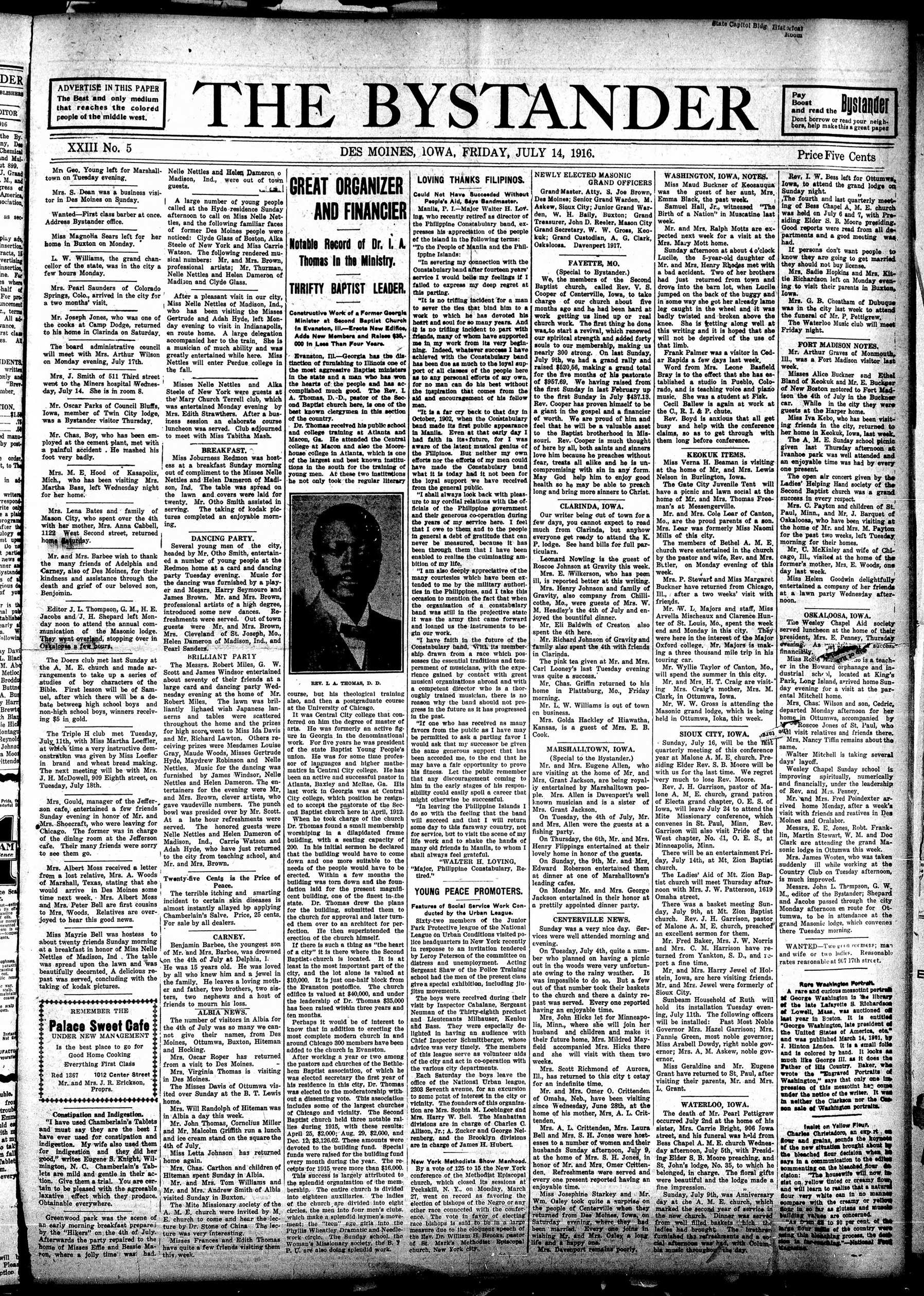
Constructive Work of a Former Georgia Minister at Second Baptist Church in Evanston, Ill.—Ernest New Edifice, Adds New Members and Raises $35,000 in Lees Than Four Years.
Evanston, Ill.—Georgia has the distinction of furnishing to Illinois one of the most aggressive Baptist ministers in the state and a man who has won the hearts of the people and has accomplished much good. The Rev. L. A. Thomas, D.-D., pastor of the Second Baptist church here, is one of the best known clergymen in this section of the country.
Dr. Thomas received his public school and college training at Atlanta and Macon, Ga. He attended the Central college at Macon and also the Moorehouse college in Atlanta, which is one of the largest and best known institutions in the south for the training of young men. At these two institutions he not only took the regular literary
REV. L. A. THOMAS, D. D.
course, but his theological training also, and then a postgraduate course at the University of Chicago.
It was Central City college that conferred on him the degree of master of arts. He was formerly an active figure in Georgia in the denominational work. For five years he was president of the state Baptist Young People's union. He was for some time professor of languages and higher mathematics in Central City college. He has been an active and successful pastor in Atlanta, Baxley and McRae, Ga. His last work in Georgia was at Central University, where he accepted to accept the pastorate of the Second Baptist church here in April, 1912. When he took charge of the church Dr. Thomas found a small membership worshiping in a dilapidated frame building, with a seating capacity of 200. In his initial sermon he declared that the building would have to come down and one more suitable to the needs of the people would have to be erected. Within a few months the building was torn down and the foundation laid for the present magnificent building, one of the finest in the state. Dr. Thomas drew the plans for the building, submitted them to the church for approval and later turned them over to an architect for perfection. He then superintended the erection of the church himself.
If there is such a thing as "the heart of a city" it is there where the Second Baptist church is located in the most important part of the city, and the lot alone is valued at $10,000. It is just one-half block from the Evanston postoffice. The church edifice is valued at $40,000, and under the leadership of Dr. Thomas $35,000 has been raised within three years and ten months.
Perhaps it would be of interest to know that in addition to erecting the most complete modern church in and around Chicago 300 members have been added to the church in Evanston. After working a year or two among the pastors and churches of the Bethlehem Baptist association, of which he was elected secretary the first year of his residence in this city, Dr. Thomas was elected to the moderationorship without a dissenting vote. He was one of the largest churches of Chicago and vicinity. The Second Baptist church held three notable rallies during 1915, with these results: April 25, $1,000; Aug. 29, $2,000; and Dec. 13, $1,326. These amounts were devoted to the building fund. Special funds were raised for the building fund every month during the year. The receipts for 1915 were more than $1,600. This success is largely attributed to the splendid organization of the membership. The entire church is divided into eighteen auxiliaryes. The ladies of the church are divided into eight circles, the men into four men's clubs, which make a splendid ladder in movement. The church is divided into Priscilla Wheatley, Dramatic and Needlework circle. The Sunday school, the Woman's Missionary society, the B. P. U. are also doing splendid work.
LOVING THANKS FILIPINOS.
Could Not Have Successed Without
Renault Aid Sensor Bendout
People's Aid, says Bandmaster.
Manila, P. I., Major Walter H. Loving, who recently retired as director of the Philippine Constabulary band, expresses his appreciation of the people of the island in the following terms:
"To the People of Manila and the Philippine Islands:
"In severing my connection with the Constabulary band after fourteen years' service I would bells my feelings if I failed to express my deep regret at this part.
"It is no trifling incident for a man to sever the ties that bind him to a work to which he has devoted his heart and soul for so many years. And it is no trifling incident to part with friends, many of whom have supported me in my work from its very beginning. Indeed, whatever success I have achieved with the Constabulary band has been due as much to the loyal support of all classes of the people here as to any personal efforts of my own, for no man can do his best without the inspiration that comes from the aid and encouragement of his fellow man.
"It is a far cry back to that day in October, 1902, when the Constabulary band made its first public appearance in Manila. Even at that early day I had faith in its future, for I was aware of the political status of the Philippines. But neither my own efforts nor the efforts of my men could have made the Constabulary band what it is today had not been for the loyal support we have received from the general public.
"I shall always look back with pleasure to my cordial relations with the officials of the Philippine government and their generous co-operation during the years of my service here. I feel that I owe to them and to the people in general a debt of gratitude that can never be measured, because it has been through them that I have been enabled to realize the culminating ambition of my life.
"I am also deeply appreciative of the many courtesies which have been extended to me by the military authorities in the Philippines, and I take this occasion to mention the fact that when the organization of a constabulary band was still in the projective state it was the army that came forward and loaned us the instruments to begin our work.
"I have with in the future of the Constabulary band. With its membership drawn from a race which possesses the essential traditions and temperament of musicians, with the experience gained by contact with great musical organizations abroad and with a competent director who is a thoroughly trained musician, there is no reason why the band should not progress in the future as it has progressed in the past.
"If one who has received as many favors from the public as I have may be permitted to ask a parting favor I would ask that my successor be given the same generous support that has been accorded me, to the end that he may have a fair opportunity to prove his fitness. Let the public remember that any discouragement coming to him in the early stages of his responsibility could easily spoil a career that might otherwise be successful.
"In leaving the Philippine Islands I do so with the feeling that the band will succeed and that I will return to this faraway country, for service, but to visit the scene of my life work and to shake the hands of many old friends in Manila, to whom I shall always feel grateful.
"WALTER H. LOVING,
"Major, Philippine Constabulary, Retired."
YOUNG PEACE PROMOTERS.
Features of Social Service Work Conducted by the Urban League.
Sikty-two members of the Junior Park Protective league of the National League on Urban Conditions visited police headquarters in New York recently in response to an invitation tendered by Leroy Peterson of the committee on distress and unemployment.
Acting Sergeant Shaw of the Police Training school had the men of the present class give a special exhibition, including juxtus movements.
The boys were received during their visit by Inspector Cahalane, Sergeant Neuman of the Thirty-eighth precinct and Lieutenants Milhauser, Kenlon and Bass. They were especially delighted in having an audience with Chief Inspector Schmittbier, whose advice was very timely. The members of this league serve as a mentor aides of the police co-operation with the various city departments.
Each Saturday the boys leave the office of the National Urban league, 2203 Seventh avenue, for an excursion to some point of interest in the city or vicinity. The founders of this organization are Mrs. Sophia M. Lobelinger and Mrs. Harry W. Bell. The Manhattan divisions are in charge of Charles C. Allison, Jr.; A. Zucker and George Nellenberg, and the Brooklyn divisions are in charge of James H. Hubert.
New York Methodists Show Manhood.
By a vote of 125 to 153 the New York conference of the Methodist Episcopal church, which closed its sessions at Peekskill, N. Y., on Monday, March 27, went on record as favoring the election of bishops of the Negro or any other race connected with the conference. The vote in favor of electing race bishops is said to be in a large measure due to the eloquent speech of the Nav. Dr William H. Brooks, pastor of St. Mark's Methodist Episcopal church, New York city.
NEWLY ELECTED MASONIC GRAND OFFICERS
Grand Master, Atty, S. Joe Brown,
Des Moines; Senior Grand Warden, M.
Askew, Sioux City; Junior Grand
Warden, W. H. Bally, Buxton; Grand
Treasurer, John D. Reeler, Mason City
Grand Secretary, W. W. Gross, Kooku;
Grand Custodian, A. G. Clark,
Osakloa. Davenport 1917.
FAYETTE, MO.
(Special to Bystander.)
We, the members of the Second Baptist church, called Rev. V. S. Cooper of Centerville, Iowa, to take charge of our church about five months ago and he had been hard at work getting us lined up or real church work. The first thing he done was to start a revival, which renewed our spiritual strength and added forty souls to our membership, making us nearly 300 strong. On last Sunday, July 9th, we had a grand rally and raised $520.56, making a grand total for the five months of his pastorate of $957.69. We having raised from the first Sunday in last February up to the first Sunday in July $471.18. Rev. Cooper has proven himself to be a giant in the gospel and a financier of worth. We are proud of him and feel that he will be a valuable asset to the Baptist brotherhood in Missouri. Rev. Cooper is much thought of here by all, both saints and sinners love him because he preaches without fear, treats all alike and he is uncompromising with sin in any form. May God help him to enjoy good health so he may be able to preach long and bring more sinners to Christ.
CLARINDA, IOWA.
Our writer being out of town for a few days, you cannot expect to read much from Clarinda, but anyhow everyone get ready to attend the K. P. lodge. See hand bills for full particulars.
Leonard Nowling is the guest of Roscoe Johnson at Gravity this week. Mrs. E. Wilkerson, who has peam ill, is reported better at this writing.
Mrs. Henry Johnson and family of Gravity, also company from Chillicothe, Mo., were guests of Mrs. W. M. Headley's the 4th of July and enjoyed the bountiful dinner.
Mr. Eli Baldwhn of Creston also spent the 4th here.
Mr. Richard Johnson of Gravity and family also spent the 4th with friends in Clarinda.
The pink tea given at Mr. and Mrs. Carl Looney's last Tuesday evening was quite a success.
Mr. Chas. Griffin returned to his home in Platttsburg, Mo., Friday morning.
Mr. L. W. Williams is out of town on business.
Mrs. Golda Hackley of Hiawatha, Kansas, is a guest of Mrs. E. B. Cook.
MARSHALLTOWN, IOWA
(Special to the Bystander).
Mr. and Mrs. Eugene Allen, who are visiting at the home of Mr. and Mrs. Grant Jackson, are being royally entertained by Marshalltown people. Mrs. Allen is Davenport's well known musician and is a sister of Mrs. Grant Jackson.
On Tuesday, the 4th of July, Mr. and Mrs. Allen were the guests at a fishing party.
On Thursday, the 6th, Mr. and Mrs. Henry Flippings entertained at their lovely home in honor of the guests.
On Sunday, the 9th, Mr. and Mrs. Edward Roberson entertained them at dinner at one of Marshalltown's leading cafes.
On Monday, Mrs. George Jackson entertained in their honor at a prettily appointed dinner party.
CENTERVILLE NEWS
Sunday was a very nice day. Services were well attended morning and evening.
On Tuesday, July 4th, quite a number who planned on having a picnic out in the woods were very unfortunate owing to the rainy weather. It was impossible to do so. But a few out of that number took their baskets to the church and there a dainty repast was served. Every one reported having an enjoyable time.
Mrs. John Hicks let for Minneapolis, Minn., where she will join her husband and children and make it their future home, Mrs. Mildred Mayfield accompanied Mrs. Hicks there and she will visit with them two weeks.
Mrs. Scott Richmond of Aurora, Ill., has returned to this city t ostay for an indefinite time.
Mr. and Mrs. Omer O. Crittenden of Omaha, Neb., have been visiting since Wednesday, June 28th, at the home of his mother, Mrs. A. L. Crittenden.
Mrs. A. L. Crittenden, Mrs. Laura Bell and Mrs. S. H. Jones were hostesses to a number of women and their husbands Sunday afternoon, July 9, at the home of Mrs. S. H. Jones, in honor of Mr. and Mrs. Omer Crittenden. Refreshments were served and every one present reported having an enjoyable time.
Miss Josephine Starkey and Mr. Wm. Oaley took quite a surprise on the people of Centerville when they returned from Des Moines, Iowa, on May 16, 2014. They been married. Every one joins in wishing Mr. and Mrs. Oaley a long life and a happy one. Mrs. Davenport reminds poorly.
---
WASHINGTON, IOWA, NOTES.
Miss Maud Buckner of Keoquaqua was the guest of her aunt, Mrs. Emma Black, the past week.
Samuel Hall Jr., witnessed "The Birth of a Nation" in Muscatine last week.
Mr. and Mrs. Ralph Motts are expected next week for a visit at the Mrs. Mary Mott home.
Sunday afternoon at about 4 o'clock Lucille, the 5-year-old daughter of Mr. and Mrs. Henry Rhodes met with a bad accident. Two of her brothers had just returned from town and drove into the barn lot, when Lucille jumped on the back of the buggy and in some way she got her already lame leg caught in the wheel and it was badly twisted and broken above the knee. She is getting along well at this writing and it is hoped that she will not be deprived of the use of that limb.
Frank Palmer was a visitor in Cedar Rapids a few days last week.
Word from Mrs. Leone Basfield Bray is to the effect that she has established a studio in Pueblo, Colorado, and is teaching voice and piano music. She was a student at Fisk.
Cecil Ballow is again at work at the C. R. I. & p. chute.
Rev. Boyd is anxious that all get busy and help with the conference claims, so as to get through with them long before conference.
KEQKUK ITEMS.
Miss Verna H. Beanman is visiting at the home of Mr. and Mrs. Lewis Nelson in Burlington, Iowa.
The Gate City Juvenile Tent will have a picnic and lawn social at the home of Mr. and Mrs. Thomas Freeman's at Messengerville.
Mr. and Mrs. Cole Lear of Canton, Mo., are the proud parents of a son. Mrs. Lear was formerly Miss Naomi Mills of this city.
The members of Bethel A. M. E. church were entertained in the church by the pastor and wife, Rev. and Mrs. Butter, on Monday evening of this week.
Mrs. P. Stewart and Miss Margaret Buckner have returned from Chicago, Ill., after a two weeks' visit with friends.
Mr. W. L. Majors and staff, Miss Arvella Mischeau and Clarence Hunter of St. Louis, Mo., spent the week end and Monday in this city. They were here in the interest of the Major Oxford college. Mr. Majors is making a three thousand mile trip in his touring car.
Mr. Wyllie Taylor of Canton, Mo., will spend the summer in this city.
Mr. and Mrs. H. T. Craig are visiting Mrs. Craig's mother, Mrs. M. Clark, in Ottumwa, Iowa.
Mr. W. W. Gross is attending the Masonic grand lodge, which is being held in Ottumwa, Joka, this week.
SIOUX CITY, IOWA.
Sunday, July 16, will be the Nell quarterly meeting of this conference year at Malone A. M. E. church, Presiding Elder Rev. S. B. Moore will be with us for the last time. We regret very much to lose Rev. Moore.
Rev. J. H. Garrison, pastor of Malone A. M. E. church, grand patron of Electa grand chapter, O. E. S. of Iowa, will leave July 24 to attend the Mite Missionary conference, which convenes in St. Paul, Minn.
Rev. Garrison will also visit Pride of the West chapter, No. 4, O. E. S., at Minneapolis, Minn.
There will be an entertainment Friday, July 14th, at Mt. Zion Baptist church.
The Ladies' Aid of Mt. Zion Baptist church will meet Thursday afternoon with Mrs. J. W. Patterson, 1619 Omaha street.
There was a basket meeting Sunday, July 9th, at Mt. Zion Baptist church. Rev. J. H. Garrison, pastor of Malone A. M. E. church, preached an excellent sermon for them.
Mr. Fred Baker, Mrs. J. W. Norris and Mrs. C. M. Harrison have returned from Yankton, S. D., and isport a fine time.
Mr. and Mrs. Harry Jewel of Holstein, Iowa, are here visiting friends, Mr. and Mrs. Jewel were formerly of Sioux City.
Sunbeam Household of Ruth will hold its installation Tuesday evening, July 11th. The following officers will be installed: Past Most Noble Governor Mrs. Hazel Garrison; Mrs. Fannie Green, most noble governor; Miss Arabell Dowdy, right noble governor; Mrs. A. M. Askew, noble governor. Miss Geraldine and Mr. Eugene Grant have returned to St. Paul, after visiting their parents, Mr. and Mrs. L. Grant.
WATERLOO, IOWA.
the death of Mr. Pearl Pettigrew occurred July 2nd at the home of his sister, Mrs. Carrie Bright, 906 Iowa street, and his funeral was held from Bess Chapel A. M. E. church Wednesday afternoon, July 5th, with Presiding Elder S. B. Moore preaching, and St. John's lodge, No. 35, to which he belonged, in charge. The floral gifts were beautiful and the lodge made a fine impression.
Sunday, July 9th, was Anniversary day at the A. M. E. church, which marked the second year of service in the new church. Dinner was served from well filled baskets, which the ladies had brought. The brethren furnished the refreshments and a special afternoon was had, with Columbia music throughout the day.
Price Five Cents
Rev, L. W. Bess left for Ottumwa, Iowa, to attend the grand lodge on Sunday night.
The fourth and last quarterly meeting of Bess Chapel A. M. E. church was held on July 6 and 7, with Presiding Elder S. B. Moore presiding.
Good reports were read from all departments and a good meeting was had.
If persons don't want people to know they are going to get married they should not buy license.
Mrs. Sadie Hopkins and Mrs. Kittie Richardson left on Monday evening to visit their parents in Burton, Iowa.
Mrs. G. B. Cheatham of Dubuque was in the city last week to attend the funeral of Mr. P. Pettigrew.
The Waterloo Music club will meet Friday night.
FORT MADISON NOTES.
Mr. Arthur Graves of Monmouth, Ill., was a Fort Madison visitor last week.
Misses Alice Buckner and Ethel Bland of Keokuk and Mr. E. Buckger of New Boston motorized to Fort Madison the 4th of July in the Buckner car. While in the city they were guests at the Harper home.
Miss Iva Kebo, who has been visiting friends in the city, returned to her home in Keokuk, Iowa, last week.
The A. M. E. Sunday school picnic given last Thursday afternoon at Ivanhoe park was well attended and an enjoyable time was had by every one present. The open air concert given by the Ladies' Helping Hand society of the Second Baptist church was a grand success in every respect. Mrs. C. Payton and children of St. Paul, Minn., and Mr. J. Barquet of Oskaloosa, who have been visiting at the home of Mr. and Mrs. M. Payton for the past two weeks, left Tuesday morning for their homes. Mr. C. McKinley and wife of Chicago, Ill., visited at the home of the former's mother, Mrs. E. Woods, one day last week. Miss Helen Goodwin delightfully entertained a company of her friends at a lawn party Wednesday afternoon.
OSKALOQSA IOWA
The Wesley Chapel Aid society served luncheon at the home of their president, Mrs. E. Penney, Thursday evening. As at the time of success financially, Miss Rois Chapel is a teacher in the Howard orphanage and industrial school, located at King's Park, Long Island, arrived home Sunday evening for a visit at the parental Mitchell home. Mrs. Chas; Wilson and son, Cedric, departed Monday afternoon for her home in Ottawa, accompanied by Mrs. Roscoe Jones of St. Paul, who will visit relatives and friends there. Mrs. Nancy Tiffin remains about the same. Walter Mitchell is taking several days' layoff. Wesley Chapel Sunday school is improving spiritually, numerically and financially, under the leadership of Rev. and Mrs. Penney. Mr. and Mrs. Fred Poindexter arrived home Monday, after a week's visit with friends and reatives in Des Moines and Oralab. Messrs. E. E. Jones, Robt. Franklin, Martin Stewart, W. M. and Doc Clark are attending the grand Masonic lodge in Ottumwa this week. Mrs. James Wooten, who was taken suddenly ill while working at the Country Club on Tuesday afternoon, is much improved.
Messrs. John L. Thompson, G. W. M., editor of the Bystander, Shepard and Jacobs passed through the city Monday afternoon en route for Otumwa, to be in attendance at the grand Masonic lodge, which convenes there Tuesday morning.
WANTED—Two girls recesses; man and wife or two babies. Reasonable rates reasonable at 967 17th street.
Bone Weakness Portrait
A rare and curious mossotist portraits of George Washington in the library of the University S. Richardson of Lowell, Mass, was auctioned last year in Boston. It is entitled "George Washington, late president of the United States of America, eta," and was published March 14, 1801, by J. Hinton Linden. It is a small folio and is colored by hand. It looks as much like George III. as it does the Father of His Country, Baker, who wrote the "Engraved Portraits of Washington," says that only one impression of this mossotist has come under the notice of the writer. It was in neither the Clarkson nor the Cannon sale of Washington portraits.
Inkjet on Yellow Flower.
Charles Chadborn, an exp. rt. on flour and sounds, sounds the keynote of the new situation brought about by the bleached flour decision when he says in a communication to the editors commenting on the bleached flour decision: "The housewife will now sit on yellow dough or creamy flour, and will learn to realize that a natural flour very white can be in no comparison with the creamy or yellow flour with the colors and muscles and muscle building values are concerned. "As Dr. Brown to 80 per cent of the large flour units of the country were using this bleaching process, the decision in inbreeding-"National Fungi
AFRO-AMERICAN CULLINGS
"There are those who would cite the lay, shiftless and indolent as typeal of the Negro race, but if the same yardardick were applied other branches of the human family might have reason to complain bitterly," wrote a prominent Negro educator recently. "Experience has shown that when given the opportunity for galnful employment under just and fair conditions, the Negro not only proves in every way his value as a workman, often most skilled, but above all, there is cultivated in his mind and heart that now too rare feeling of deep interest and loyalty to his employment. When the southern Negro works for corporation, he calls my company, and never has bomb been found in it, nor has he been branded as an anarchist. Under fall treatment his loyalty becomes deep and unchanging, and the sower of the seeds of discord finds little response to his beguiling or impassioned stories of greener fields to be had for the asking or taking.
"A few years ago in his summer home in the East there passed away an eminent captain of industry who had spent forty years in the South building up a great commercial organization and community. Of master mind, yet with heart of a child, he had met and conquered many problems, all the while dealing with eminent white and colored, so justly as to wield unfailing loyalty and even love.
"When the news of his death wasashed back to that southern community deep sorrow prevailed, but it remained for one old colored man, who had grown gray in the service of that organization, to take a part of his savings, board a train, and make the thousand-mile journey to be present when his friend was returned to earth. As the cortege was preparing to move this old Negro mounted the funeral carriage and journey, and maintained with the fellow men the end to drop a last tear. This is but typical of the response of the southern Negro to the 'helping hand.'
"In advance of the Negro's industrial progress has gone very naturally his moral and educational development, and the eagerness with which many are seizing every advantage offered by their institutions plainly foreshadows a still more wonderful development in all those attributes which go to make up citizens of whom we will have no reason to feel ashamed.
"In the light of these conditions is there no sign, in then, then, to consider this southern Negro as one of the South's greatest industrial assets, and does it not behove southern industry to deal with him so fairly, so honestly, so uprightly as to maintain unimpaired that loyalty and strong feeling of common interest found in the heart of this plain, straightforward workingman."
While the present army law is by far the best congress ever gave the country in time of peace, it has glaring defects, one of which is found in the fact no provision was made for increasing the number of colored regiments in either the regular or militia forces.
There is not a single rational excuse for the omission.
There are a score of excellent reasons why such a provision should have been added.
Southern statesmen, so-called, in congress, shock their heads and said
The communication of Charles N. Swift in the Times has attracted my attention, and just a word, if I may, to indorse his every word concerning the admission of a colored regiment into the New York National Guard. After their record in the Civil war, especially with 99,837 colored soldiers therein, why can there be any doubt about them? As an officer of both white and colored regiments, wound twice in different engagements, the last-mentioned and having had some part in the organization of the corps of Arfique in Louisiana un-Governal Banks in 1884, I have wondered why there were none in the state service. The Eighty-first U. S. C. T in Louisiana, commanded by Col. Charles B. Gaskill, now of Niagara Falls, challenged any regiment, white or black, in the Gulf department to make as good a showing in regimental or company drill, but none accepted the challenge of the Eighty-first—George B. Loud, in a communication to the New York Times.
A girl likes to be squeezed in a crowd from force of habit.
Cotton is becoming so scarce in Europe that cellulose from wood fiber is being used as a substitute in surgical dressings.
The world's highest powered motorship has been built in Italy for the Basilian navy, its oil motors developing 6,400 horse power.
It is said that in the far North of the Russian empire there is a race of people who do not know that there is a war, as that they have nothing on some of our American congressmen.
In some parts of Spanish Guinea the russo are so numerous and deserving that a cat is worth as much as a dog.
According to recent estimates, more than two million women and girls have entered national labor in Europe since the extinction of the war.
Since that prohibited the manufacture and sale of food and beverages, the wood alcohol and the salt are the residue of which it forms a part, mentioned on the label.
it would not do—the Southern people would not stand for an increase of "Nigger" soldiers, and there were enough of the old style of congressmen from the North—the "doughface" species—to prevent the addition of a clause to the bill for a considerable number of colored regiments and butteries.
It was a mistake which the next congress should rectify without delay. Colored volunteers in the Civil war were exceptionally brave soldiers. They were often severely tested.
The South began to recruit for colored regiments in 1883, and General Lee declared that one of the Confederacy's most serious mistakes was made by not enlisting negroes for their army early in the war.
Several regiments of colored men were on duty in the Confederate army the last few months of the war.
For nearly fifty years there have been four colored regiments in the United States army—two of cavalry, the Ninth and Tenth, and two of infantry, the Twenty-fourth and the Twenty-fifth.
No troops in the army were in more battles, or acquitted themselves more creditably in the Spanish-American and Philippine wars than the four colored regiments.
The colored man likes the service. He takes pride in it. He quickly conforms to the rulez and regulations. He is as neat in person, uniform, equipment, as the white man.
He almost never deserts.
There often is much difficulty in keeping white regiments recruited up to the proper number. There never is a lack of recruits for the colored commands.
There are no more obedient or better disciplined soldiers.
White officers of the South like to be assigned to the colored regiments. They and their soldiers understand each other perfectly and get along harmoniously.
There should be ten regiments of colored men in the regular army instead of four, and many regiments of them in the militia instead of the three or four—Chicago Heald.
Dr. Eben S. Johnson of Sloux City, Ia., was elected a missionary bishop at the Methodist convention held at Saratoga Springs, and will be assigned to Africa. Dr Alexander P. Camphor, a Negro of Birmingham, Ala., was also elected a missionary bishop and will be assigned to Liberia, the African republic.
A resolution indorsing woman suffrage was adopted with only half a dozen in opposition, following an earnest plea last night by William J. Bryan for votes for women. His assertion that the movement would greatly aid the temperance cause had an effect on the action of the conference.
Government officials have estimated that 1,350,000 horse power in the form of gas alone is wasted every day by the old-fashioned coke ovens of the United States.
An auxiliary control for automobiles invented by a New Yorker enables a person in the back seat of a car, by pressing a button, to stop it in an emergency.
A Louisiana inventor's automatic fire alarm calls the nearest firemen, rings alarms both outside and inside a building where a fire starts and lights a red light on the outside.
Partly mechanical and partly electrical is a Chicago inventor's alarm that fires five blank cartridges in succession if a burglar enters or tries to wander around a building.
Along the Cornwall coast many miners earn a living by washing tin out of the sands, the sea shattering the metal-bearing rocks.
An automobile coal wagon has been invented with four separate compartments, so well balanced that they can be dumped by hand.
Iowa is the first state to officially establish a library of motion picture films of current events for the use of future historians.
A new muffier to lessen the noise of a motor-boat exhaust permits the waste gases to expand considerably and cool before reaching the air.
Chinese custom of burning small pieces of gold leaf on various anniversary sacrifices several million dollars' worth of the metal annually.
To assert in Oklahoma that an incurable disease can be cured makes a physician liable to the revocation of his license.
Producers of aniline dyes in Japan have formed a trust to control the market.
Rust is a compound of oxygen and iron that forms only in the presence of water.
Paris has a plan to dam the River Rhone and obtain 800,000 horse power.
There is a waterfall in New Zealand which is 1.804 feet high.
The largest orange grove in the
world is in Cuba. It covers 2,000
acres. _____
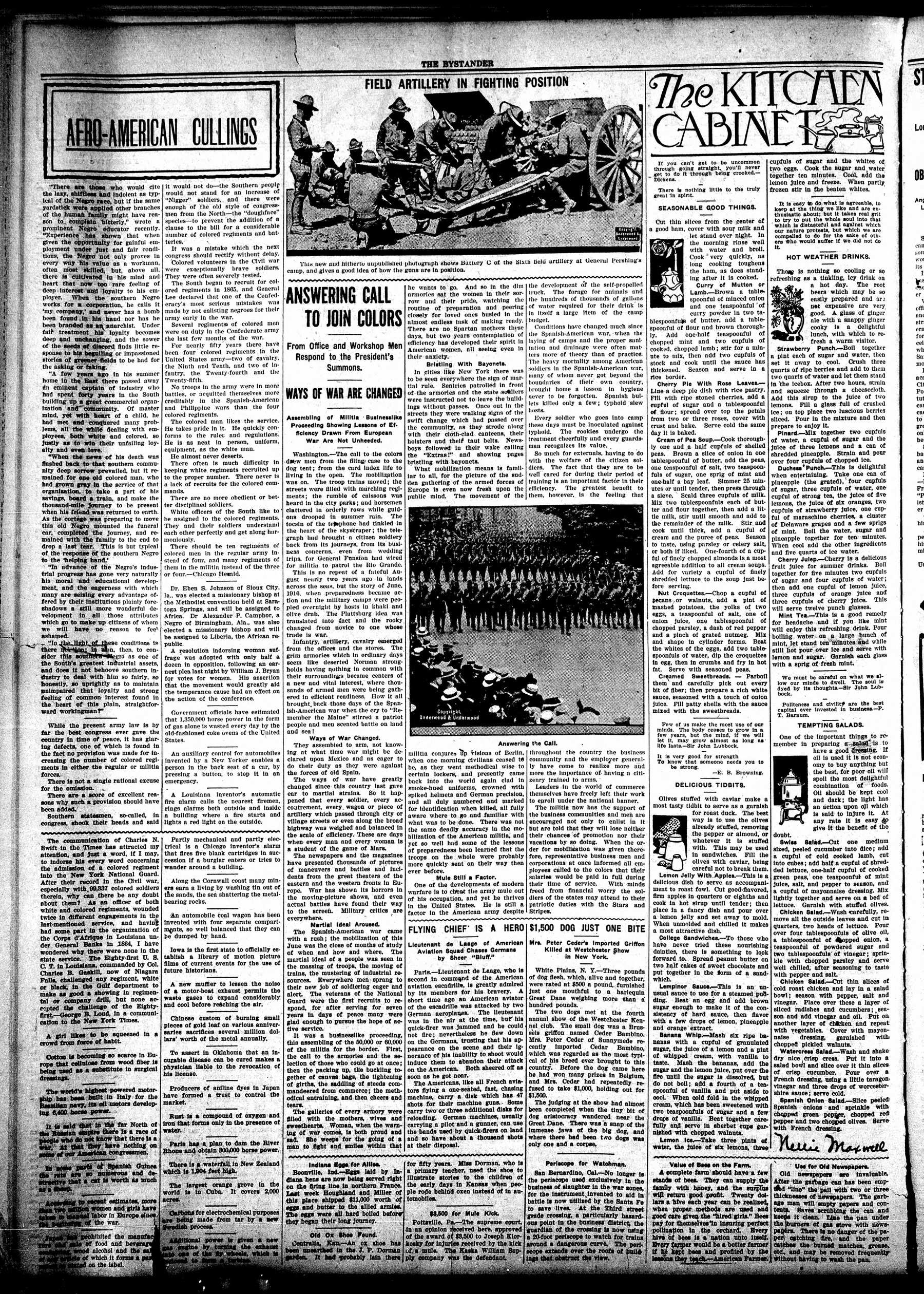
FIELD ARTILLERY IN FIGHTING POSITION
This new and hitherto unpublished photograph shows Battery C of the Sixth field artillery at General Pershing's camp, and gives a good idea of how the guns are in position.
This new and hitherto unpublished photograph shows Battery C of the Sixth field artillery at General Pershing's camp, and gives a good idea of how the guns are in position.
ANSWERING CALL TO JOIN COLORS
WAYS OF WAR ARE CHANGED
Assembling of Millita Businessline Proceeding Showing Lessons of Efficiency Drawn From European War Are Not Unheeded.
Washington.—The call to the colors drew men from the filing case to the dog tent; from the curd index life to living in the open. The mobilization was on. The troop trains moved; the streets filled with marching regiments; the rumble of caissons was heard in the city parks; and horsemen clattered in orderly rows while gullets drooped in summer rain. The toscin of the telephone had tinkled in the heart of the skyscraper; the telegraph had brought a citizen soldiery back from its journeys, from its business concerns, even from wedding trips, for General Funston had wired for militia to patrol the Rio Grande.
This is no reptent of a fateful August nearly two years ago in lands across the seas, but the story of June, 1916, when preparedness became action and the military camps were people overnight by hosts in khaki and olive drab. The Plattsburg idea was translated into fact and the rooky changed from novice to one whose trade is war.
Infantry, artillery, cavalry emerged from the office and the stores. The grim armories which in ordinary days seem like deserted Norman strongholds having nothing in common with their surroundings became centers of a new and vital interest, where thousands of armed men were gathered in efficient readiness. How it all brought, back those days of the Spanish-American war when the cry to "Remember the Male" stirred a patriot people and men seized battle on land and sea!
Wava of War Changed.
They assembled to arm, not knowing at what time war might be declared upon Mexico and as eager to do their duty as they were against the forces of old Spain.
The ways of war have greatly changed since this country last gave ear to martial strains. So it happened that every soldier, every accoutrement, every wagon or piece of artillery which passed through city or village streets or even along the broad highway was weighed and balanced in the scale of efficiency. These are days when every man and every woman is a student of the game of Mars.
The newspapers and the magazines have presented thousands of pictures of maneuvers and battles and incidents from the great theaters of the eastern and the western fronts in Europe. War has its horrors in the moving-picture shows, and even actual battles have found their way to the screen. Military critics are everywhere.
Martial Ideal Aroused.
The Spanish-American war came with a rush; the mobilization of this June was the close of months of study of when and how and where. The martial ideal of a people was seen in the massing of troops, the moving of trains, the mustering of industrial resources. Everywhere men sprang to their new job of soldiering eager and alert. The veterans of the National Guard were the first recruits to respond, for after serving for seven years in days of peace many were glad enough to pursue the hope of active service.
It was a businesslike proceeding, this assembling of the 50,000 or 60,000 of the militia for the border. First, the call to the armories and the selection of those who could go at once; then the packing up, the buckling together of canes bags, the tightening of glits, the saddling of steeds commanded from commerce; the methodical entraining, and then cheers and tears.
The galleries of every armory were filled with the mothers, wives and sweethearts. Woman, when the warning of war comes, is both proud and sad. She weeps for the going of a man to fight and smiles within that
Indiana Eggs for Allies.
Boontville, Ind.-Eggs laid by Indiana hens are now being served right on the string line in northern France.
Last week Houghtland and Miller of this place shipped $11,000 worth of eggs and butter to the allied armies.
The eggs were all hard bolted before they began their long journey.
Old Ox Shee Found.
Centralia, Kan.-An ox shoe has been unearned in the J. P. Dorman garden. It had probably lain there
TORTILLERY IN FIGHTING
photograph shows Battery C of the Sixx
guns are in position.
he wants to go. And so in the dim armories sat the women in their sorrow and their wrife, watching the routine of preparation and peering inside for loved ones busied in the almost endless task of making ready. There are no Spartan mothers these days, but two years contemplation of efficiency has developed their spirit in American women, all seeing even in their anxiety.
Bristling With Bayonets.
In cities like New York there was to be seen everywhere the sign of mortal rule. Sentries patrolled in front of the armories and the state soldiers were instructed not to leave the buildings without passes. Once out in the streets they were walking signs of the swift change which had passed over the community, as they strode along with their cloth-clad canteens, their holsters and their taut belts. Newsboys followed in their wake calling the "Extrus!" and showing pages bristling with bayonets.
What mobilization means is familiar to all, for the picture of the sudden gathering of the armed forces of the United States in public mind. The movement of the
Copyright.
Underwood & Underwood
Copyright.
Underwood & Underwood
Answering the Call.
militia conures up visions of Berlin, when one morning civilians ceased to be, as they went methodical wise to certain lockers, and presently came back into the world again clad in smoke-hued uniforms, crowned with spiked helmets and German precision, and all duly numbered and marked for identification when killed, all fully aware where to go and familiar with what was to be done. There was not the same deadly accuracy in the mobilization of the American militia, and yet so well had some of the lessons of preparedness been learned that the troops on the whole were probably more quickly sent on their way then ever before.
Mule Still a Factor.
One of the developments of modern warfare is to cheat the army mule out of his occupation, and yet he thrives in the United States. He is still a factor in the American army despite
Lieutenant de Lange of American Aviation Squad Chases Germans by Sheer "Bluff."
Paris.-Lieutenant de Lange, who is second in command of the American aviation escadrille, is greatly adruled by its members for his bravery. A short time ago an American aviator of the escadrille was attacked by two German aeroplanes. The lieutenant was in the air at the time, but his quick-fire was jammed and he could not fire; nevertheless he flew down on the Germans, trusting that his appearance on the scene and their ignorance of his inability to shoot would induce them to abandon their attack on the American. Both sheered off as soon as he got near.
The Americans, like all French aviators flying a one-seated, fast, chasing machine, carry a disk which has 47 shots for their machine guns. Some carry two or three additional disks for reloading. German machines, usually carrying a pilot and a gunner, can use the bands used by quick-firers on land and so have about a thousand shots at their disposal.
for fifty years. Miss Dorman, who is a primary teacher, used the shoe to illustrate stories to the children of the early days in Kansas when people rode behind oxen instead of in automobiles.
$8,500 for Mule Kick.
Pottsville, Pa.—The supreme court, in an opinion received here, approved of the award of $3,500 to Joseph Klorkosky for injuries received by the kick of a mule. The Kaska William Supply company was the defendant.
THE BYSTANDER
Bristling. With Bayonets.
Mule Still a Factor.
the development of the self-propelled truck. The forge for animals and the hundreds of thousands of gallons of water required for their drink is in itself a large item of the camp budget.
Conditions have changed much since the Spanish-American war, when the laying of camps and the proper sanitation and drainage were often matters more of theory than of practice. The heavy mortality among American soldiers in the Spanish-American war, many of whom never got beyond the boundaries of their own country, brought home a lesson in hygiene never to be forgotten. Spanish bullets killed only a few; typhoid slew hosts.
Every soldier who goes into camp these days must be inoculated against typhoid. The rookies undergo the treatment cheerfully and every guardman recognizes its value.
So much for externals, having to do with the welfare of the citizen soldiers. The fact that they are to be well cared for during their period of service is as important as the efficiency. The greatest benefit to them, however, is the feeling that
ing the Call.
throughout the country the business community and the employer generally have come to realize more and more the importance of having a citizenry trained to arms.
Leaders in the world of commerce themselves have freely left their work to enroll under the national banner.
The militia now has the support of the business communities and men are encouraged not only to enlist in it but are told that they will lose neither their chances of promotion nor their vacations by so doing. When the order for mobilization was given therefore, representative business men and corporations at once informed all employees called to the colors that their salaries would be paid in full during their time of service. With minds freed from financial worry the soldiers of the states may attend to their patriotic duties with the Stars and Stripes.
Mrs. Peter Ceder's Imported Griffon
Killed at Westchester Show
in New York.
White Plains, N. Y.-Three pounds
of dog flesh, alive and together,
were rated at $500 a pound, furnished
just one mouthful to a harlequin
Great Dane weighing more than a
hundred pounds.
The two dogs met at the fourth
annual show of the Westchester Kennel
club. The small dog was a Brussels
griffon named Cedar Bambino.
Mrs. Peter Ceder of Sunnymede re-
cently named Cedar Bambino,
which was rescued as the most typi-
cal of his breed ever brought to
this country. Before the dog came
he had won many prizes in Belgium,
and Mrs. Ceder had repeatedly
refused to take $1,000, holding out for
$1,500.
The judging at the show had almost been completed when the tiny bit of dog aristocracy wandered near the Great Dane. There was a snap of the dog, who was big dog, and where there had been two dogs was only one and a corpse.
Periscope for Watchman.
San Bernardino, Cal.-No longer is the periscope used exclusively in the business of slaughter in the war zones, for the instrument invented to aid in battle is now utilized by the Santa Fe to save lives. At the Third street grade crossing, a particularly hazardous point in the business district, the guardian of the crossing is now using a 20-foot periscope to watch for trains around a dangerous curve. The periscope extends over the roots of buildings that obstruct the view.
The KITCHEN CABINET
If you can't get to be uncommon through going straight, you'll never get to do it through being crooked.—Dickens.
There is nothing little to the truly great in spirit.
SEASONABLE GOOD THINGS.
Cut thin slices from the center of a good ham, cover with sour milk and let stand over night. In the morning rinse well with water and broil. Cook in oven and slowly cook cooking toughens the ham, as does standing after it is cooked.
THE ROSE LANTERN
Curry of Mutton or Lamb—Brown a table-spoonful of minced onion and one teaspoonful" of curry powder in two ta-
blespoutpies of butter, add a tablespoonful of flour and brown thoroughly. Add one-half teaspoonful of chopped mint and two cupfuls of cooked, chopped lamb; stir for a minute to mix, then add two cupfuls of stock and cook until the sauce has thickened. Season and serve in a rice border.
**Cherry Pie With Rose Leaves.** Line a deep pie dish with rice pastry. Fill with pie pieed cherries, add a sugar and a tablespoonful of flour, spread over top the petals from two or three roses, cover with crust and bake. Serve cold the same day it is baked.
Cream of Pea Soup.—Cook thoroughly one and a half cupful of shelled peas. Brown a slice of onion in one tablepoonful of butter, add the peas, one teaspoonful of salt, two teaspoonful of sugar, one sprig of mint and one-half a bay leaf. Smimer 25 minutes or until tender, then press through a sieve. Scald three cupfuls of milk. Mix two tablepoonfuls each of butter and flour together, then add a little milk, stir until smooth and add to the remainder of the milk. Stir and cook until thick, add a cupful of cream and the purée of peas. Season to taste, using parsley or celery salt, or both if liked. One-fourth of a cupful of finely chopped almonds is a most agreeable addition to all cream soups. Add for variety a cupful of finely shredded lettuce to the soup just before serving.
Nut Croquettes—Chop a cupful of pecans, or walnuts, and a pint of mashed potatoes, the yolks of two eggs, a teaspoonful of salt, one of onion juice, one tablespoonful of chopped cherry, a dash of red pepper and a pinch of grated nutmeg. Mix and shape in cylinder forms. Beat the whites of the eggs, add two tablespoonful of water, dip the croquettes in egg, then in crumbs and fry in hot fat. Serve with seasoned peas.
Creamed Sweetbreads— Parbell them and carefully pick out every bit of fiber; then prepare a rich white sauce, seasoned with a touch of onion juice. Fill patty shells with the sauce mixed with the sweetbreads.
Few of us make the most use of our minds. The body causes to grow in a few days. The body causes to we will let it, may grow indoors as long as life lasts—Sir John Lubbock.
It is very good for strength
To know that someone needs you to be strong.
DELICIOUS TIDBITS.
Olives stuffed with caviar make a most tasty tidbit to serve as a garnish for roast duck. The best way is to use the olives already stuffed, removing the pepper or almond, or whatever it is stuffed with. This may be used in prepared olives with caviar, being careful not to break them.
way is to use the olives already stuffed, removing the pepper or almond, or whatever it is stuffed with. This may be used in sandwiches. Fill the olives with caviar, being careful not to break them. Lemon Jelly With Apples—This is a delicious dish to serve as accompaniment to roast fowl. Cut good-flavored, firm apples in quarters or eighths and cook in hot sauce until tender; then place in a fancy dish and pour over a lemon jelly and set away to mold. When unmolded and chilled it makes a most attractive dish. College Sandwiches—To those who have never tried these nourishing dainties, there is something to look forward to. Spread peanut butter on two half cakes of sweet chocolate and put together in the form of a sandwich.
Lempiner Sauce—This is an unusual sauce to use for a steamed pudding. Beat an egg and add brown sugar enough to make it of the consistency of hard sauce, then flavor with a few drops of lemon, pineapple and orange extract.
Banana Whip—Mash six ripe bananas with a cupful of granulated sugar, the juice of a lemon and a pint of whipped cream, with vanilla to taste. Mash the bananas, add the sugar and the lemon juice, put over the fire until the sugar is dissolved, but do not boll; add a fourth of a teaspoonful of vanilla and put aside to cool. When cold has been in the whipped cream, which has been sweetened with two teaspoonfuls of sugar and a few drops of vanilla. Beat together carefully and serve in sheerbert cups garnished with chopped walnuts.
Lemon ice—Take three plants of water, the juice of six lemons, three
Value of Bees on the Farm
A complete farm should have a few stands of bees. They can supply the family with honey, and the surplus will return good profit. Twenty dollars a hive each year can be realized, when proper, methods are used and good care given the "hired girls." Bees pay for themselves in insuring perfect pollination in the orchard. Every hive of bees is a nation unto itself. Every farmer would be a better farmer if he kept bees and profited by the lessons they teach—American Farmer.
cupfuls of sugar and the whites of two eggs. Cook the sugar and water together ten minutes. Cool, add the lemon juice and freeze. When partly frozen stir in the beaten whites.
It is easy to do what is agreeable, to keep at the thing we like and are enthusiastic about; but it takes real grit to try to put the whole soul into that culture. We need to know our nature protests, but which we are compelled to do for the sake of others who would suffer if we did not do it.
HOT WEATHER DRINKS.
There is nothing so cooling or so refreshing as a tinkling, icy drink on a hot day. The root beers which may be so easily prepared and are not expensive are very enjoyable with a snappy ginger cooky is a delightful lunch, with which to refresh a warm visitor.
a not thy. The root beers which may be so easily prepared may be more delicious than good. A glass of ginger ale with a snappy ginger cooky is a delightful lunch, with which to refresh a warm visitor.
Strawberry Punch—Boll together a plint each of sugar and water, then set it away to cool. Crush three quartes of ripe berries and add to them two quartes of water and then stand in the icebox. After two hours, strain and squeeze through a cheesecloth. Add this sirup to the juice of two lemons. Fill a glass full of crushed ice on top; place two luscious berries sliced. Pour in the mixture and then prepare to enjoy it.
Pinch-and-mix together two cupfuls of sugar in a cupful of sugar and the juice of three lemons and a can of shredded pineapple. Strain and pour four cupfuls of chopped ice.
Duches* Punch—This is delightful when entertaining. Take one can of papplepea (the grated), four cupfuls of sugar, three cupfuls of water, one cupful of strong tea, the juice of five lemons, the juice of six oranges, two cupfuls of strawberry juice, one cupful of maraschino cherries, a cluster of Delaware grapes and a few spills of mint. Boll the water, sugar and papplepea together for ten minutes. When cool add the other ingredients and five quarts of ice water.
Cherry Jupel—Cherry is a delicious fruit juice for summer drinks. Boll together for five minutes two cupfuls of sugar and four cupfuls of water; then add one cupful of lemon juice, three cupfuls of lemon juice and three cupfuls of cherry juice. This will give twelve punch glasses.
Mint Tea—This is a good remedy for headache and if you like mint will enjoy this refreshing drink. Pour boiling water on a large bunch of mint, let stand ten minutes and while still hot pour over ice and serve with lemon and sugar. Garlicish each glass with a sprig of fresh mint.
We must be careful on what we allow our minds to dwell. The soul is dyed by its thoughts. -Sir John Lubbock.
Politeness and civility are the best capital ever invested in business. -P. T.
TEMPTING SALADS.
One of the important things to remember in preparing a salad is to have a good dressing. If oil is used it is not economy to buy anything but the best, for poor oil will spoil the most delightful combination of foods. Oil should be kept cool and dark; the light has an action upon oil which is said to injure it. At any rate it is easy to give it the benefit of the
doubt.
Swiss Salad—Cut one medium sized, peeled cucumber into dice; add a cupful of cold cooked lamb, cut into cubes; add half a cupful of shredded lettuce, one half cupful of cooked green peas, one teaspoonful of mint juice, salt, and pepper to season, and a cupful of mayonnaise dress. Mix lightly together and serve on a bed of lettuce. Garnish with stuffed olives. Chicken Salad—Wash carefully, remove all the outside leaves and cut in quarters, two heads of lettuce. Pour over four tablespoonfuls of olive oil, a tablespoonful of chopped onion, a tablespoonful of powdered sugar and two tablespoonfuls of vinegar; sprinkle with chopped parsley and serve well chilled, after seasoning to taste with pepper and salt.
Chicken Salad—Cut thin slices of cold roast chicken and lay in a salad bowl; season with pepper, salt and vinegar. Place over these a layer of sliced radishes and cucumbers; season and add vinegar and oil. Put on another layer of chicken and repeat with vegetables. Cover with mayonnaise dressing, garnished with chopped pickled walnuts.
Watercress Salad—Wash and shake dry nice crisp dress. Put it into a salad bowl and slice over it thin slices of crisp cucumber. Pour over a French dressing, using a little targon vinegar and three drops of worcestershire sauce; serve cold.
Spanish Onion Salad—Slice peeled Spanish onions and sprinkle with chopped green pepper, chopped red pepper and two chopped olives. Serve with French dressing.
Use for Old Newspapers.
Old newspapers are invaluable.
After the garbage can has been emptied "line" the pail with two or three thicknesses of newspapers. The garbage man will empty papers and contents. Sweep scratches the can and keeps it clean. Else the pan under the burners of gas stove with newspapers. There is no danger of the paper catching fire, and the paper catches the burned matches, grease, etc, and may be removed frequently without having to wash the pan.
STRONG LEADERS IN MEXICAN ARMY
Long Era of Warfare Has Produced Several Highly Efficient Generals.
OBREGON AND ANGELES BEST
Angeles Said to Have Contributed Largely to Villa's Successes — Obregon is a Highminded, Humane, Capable Leader.
San Antonio, Tex.—Were the Mexican army throughout as capable as some of its generals the United States would have no easy task in subduing its insurgents. It must be remembered that Mexico had almost uninterrupted war of one kind or another for a period longer than the American Civil war.
While conscientious American army officers have been puzzling over maps and working out problems in military strategy and tactics, the Mexican generals have been actually leading large forces in the field and giving and receiving blows in the same territory where they now clash with Uclec Sam's. Napoleonics. This is an enormous advantage.
In addition, the Mexican military academy at Chapultepec, near Mexico City, which is similar to our West Point, has a high rating among institutions of this character. In the Mexican war of 1846-47 the Chapultepec cadets put up a desperate resistance to the American invaders on the grounds of their school. They were only overcome after nearly all had been killed or wounded.
So, while the Mexican forces are badly equipped and lack ammunition and food supplies, they will in many cases be as well led as the Americans. Mexico's two leading masters of war—leaving out the undoubted genius Francisco Villar—are Alvaro Obregon, Panchos conqueror and present militant of war, and Eugene Olive, former superintendent of Chapultepec.
Obregon has the best record. Of him more anon.
Angeles is the greatest artillery expert Mexico ever produced. Indeed, his ability is recognized by European military men.
At last reports Angeles was in the United States, but it is believed he will
MILITARY OFFICER
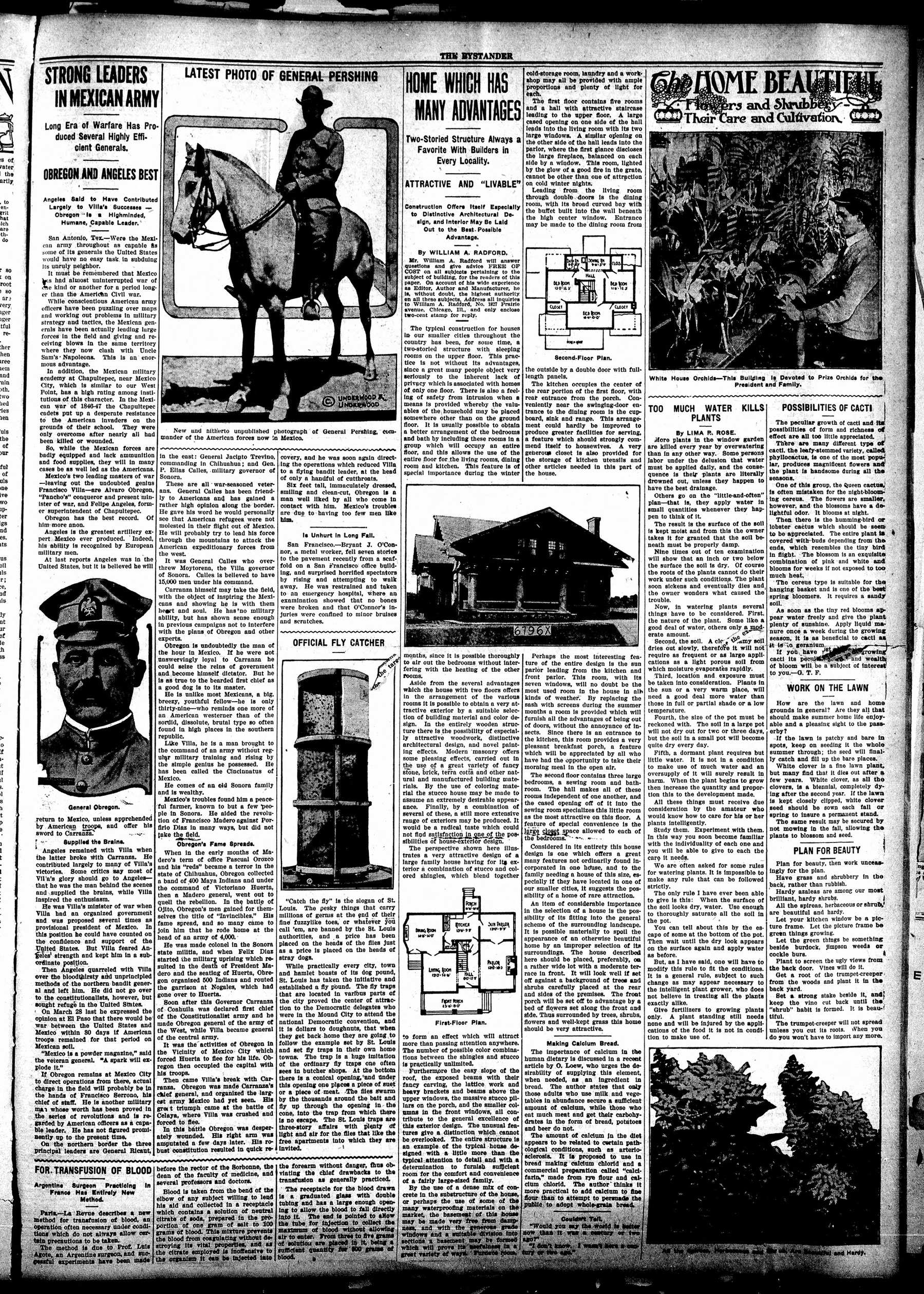
General Obregon.
return to Mexico, unless apprehended by American troops, and offer his sword to Carranza.
Supplied the Brains.
Angeles remained with Villa when the latter broke with Carranza. He contributed largely to many of Villa's victories. Some critics say most of Villa's glory should go to Angeles that he was the man behind the scenes and supplied the brains, while Villa inspired the enthusiasm.
He was Villa's minister of war when Villa had an organized government and was proposed several times as provisional president of Mexico. In this position he could have counted on the evidence of the United States. But Villa feared Angelo's strength and kept him in a subordinate position.
Then Angelo quarrelled with Villa over the bloodthirsty and unprincipled methods of the northern bandit general and left him. He did not go over to the constitutionalists, however, but sought refuge in the United States.
On March 28 last he expressed the opinion at El Paso that there would be war between the United States and Mexico within 80 days if American troops remained for that period on Mexican soil.
"Mexico is a powder magazine," said the veteran general. "A spark will explode it."
If Obregon was at Mexico City to direct operations from these, actual charge in the field will probably be in the hands of Francisco Serrano, this bietet of staff. The army's growth has been proved in the series of revolutions and is regarded by American officers as a capable leader. He has not figured prominently up to the present time.
On the northern border the three principal leaders are General Ricant.
FOR. TRANSFUSION OF BLOOD
Argentine Surgeon Practicing in France Has Entirely New Method.
Paria-La Revue describes a new method for transfusion of blood, an operation often necessary under conditions which do not always allow certain precautions to be taken. The method is due to Prof. Luis Agote, an Argentine surgeon, and successful experiments have been made
EWEST PHOTO OF GENERAL PERSHING
© UNDERWOOD RL
UNDERWOOD
New and hitherto unpublished photograph of General Pershing, commander of the American forces now in Mexico.
in the east: General Jacinto Trevino, commanding in Chihuahua; and Gen. P. Elias Calles, military governor of Sonora.
These are all war-seasoned veterans. General Calles has been friendly to Americans and has gained a rather high opinion along the border. He gave a word he would possibly see that American refugees were not molested in their flight out of Mexico. He will probably try to lead his force through the mountains to attack the American expeditionary forces from the west.
It was General Calles who overthrew Moytorena, the Villa governor of Sonora. Calles is believed to have 15,000 men under his command.
covery, and he was soon again directing the operations which reduced Villa to a flying bandit leader, at the head of only a handful of cuthroats.
Six feet tall, immaculately dressed, smiling and clean-cut, Obregon is a man well liked by all who come in contact with him. Mexico's troubles are due to having too few men like him.
Is Unhurt In Long Fall.
San Francisco—Bryant J. O'Conor, a metal worker, fell seven stories to the pavement recently from a scaffold on a San Francisco office building, and surprised horrified spectators by rising and attempting to walk
Carranza himself may take the field, with the object of inspiring the Mexicans and showing he is with them heart and soul. He has 'no military ability, but has shown sense enough in previous campaigns not to interfere with the plans of Obregon and other experts.
Obregon is undoubtedly the man of the hour in Mexico. He if were not unswervingly loyal to Carranza he could seize the reins of government and become himself dictator. But he is as true to the bearded first chief as a good dog is to its master.
He is unlike most Mexicans, a big, breezy, youthful fellow—he is only thirty-nine—who reminds one more of an American westerner than of the sordid, dissolute, brutal type so often found in high places in the southern republic.
Like Villa, he is a man brought to the command of an army without regular military training and rising by the simple genius he possessed. He has been called the Cincinnatus of Mexico.
He comes of an old Sonora family and is wealthy. Mexico's troubles found him a peaceful farmer, known to but a few people in Sonora. He aided the revolution of Francisco Madero against Porfirio Díaz in many ways, but did not take the field.
Obregon's Fame Spreads.
When in the early months of Madero's term of office Pascal Orozo and his "reds" became a terror in the state of Chihuahua, Orozo collected a band of 400 Maya Indians and under the command of Victoriano Huerta, then a Madero general, went out to quell the rebellion. In the battle of Olito, Orozo's men gained for themselves the title of "Invincibles." His fame spread, and so many came to join him that he rode home at the head of an army of 4,000.
He was made colonel in the Sonora state militia, and when Felix Diaz started the military uprising which resulted in the death of President Madero and the seating of Huerta, Orozo organized 500 Indians and routed the garrison at Nogales, which had gone over the border. Huerta, after this Governor Carranza of Cochulla was declared first chief of the Constitutionalist army and he made Orozo general of the army of the West, while Vila became general of the central army.
It was the activities of Obregon in the Vicinity of Mexico - City which forced Huerta to flee for his life. Obregon then occupied the capital with his troops.
Then came Villa's break with Carranza. Obregon was made Carranza's chief general, and organized the largest army Mexico had yet seen. His great triumph came at the battle of Celaya, where Villa was crushed and forced to flee.
In this battle Obregon was desperately wounded. His right arm was amputated a few days later. His robust constitution resulted in quick rebefore the rector of the Sorbonne, the dean of the faculty of medicine, and several professors and doctors.
Blood is taken from the bend of the elbow of any subject willing to lead his aid and collected in a receptacle which contains a solution of neutral citrate of soda, prepared in the proximal portion of the lower arm of blood. This mixture prevents the blood from coagulating without destroying its vital properties, and as the citrate employed is inoffensive to the organism it can be injected into
covery, and he was soon again directing the operations which reduced Villa to a flying bandit leader, at the head of only a handful of cutthroats. Six feet tall, immaculately dressed, smiling and clean-cut, Obregon is a man filled with who come in contact with Mexico's troubles are due to having too few men like him.
Is Unhurt In Long Fall.
San Francisco—Bryant J. O'Connor, a metal worker, fell seven stories to the pavement recently from a scaffold on a San Francisco office building, and surprised horrified spectators by rising and attempting to walk away. He was restrained and taken to an emergency hospital, where an examination showed that no bones were broken and that O'Connor's injuries were confined to minor bruises and scratches.
the import
"Catch the fy" is the slogan of St. Louis. The peeky things that carry millions of gerns at the end of their fuzzy likeoes, or whatever you call 'em, are banned by the St. Louis authorities, and a price has been placed on the heads of the files a price is placed on the heads of stray dogs.
While practically every city, town and hamlet boasts of its dog pound, St. Louis has taken the initiative and established a fly pound. The fly traps that are located in various parts of the city proved the center of attraction to the Democratic delegates who were in the Mound City to attend the national Democratic convention, and it is dollars to doughnuts, that when they get back home they are going to follow the example set by St. Louis and set fly traps in their own home town. The trap is a huge imitation of the ordinary fly traps one often sees in butcher shops. there is a cone opening, and under this opening there is a cone placing a place of suet of meat. The flies swarm by the thousands around the bait and fly up through the opening in the cone, into the trap from which there is no escape. The St. Louis traps are three-story affairs with plenty of light and air for the files that like the free apartments into which they are invited.
the forearm without danger, thus obviating the chief drawbacks to the transfusion as generally practiced. The receptacle for the blood drawn is a graduated glass with double tubing and has a large enough opening to allow the blood to fall directly into the tubing, which is pointed to allow tube for injection to collect the maximum of blood without allowing air to enter. From three to five grams of solution are placed in it, being a sufficient quantity for 600 grams of blood.
6796X
HOME WHICH HAS MANY ADVANTAGES
Two-Storied Structure Always a Favorite With Builders in Every Locality.
ATTRACTIVE AND "LIVABLE"
Construction Offers Itself Especially to Distinctive Architectural Design, and Interior May Be Laid Out to the Best-Possible Advantage.
By WILLIAM A. RADFORD.
Mr. William A. Radford will answer questions and give advice FREE OF CHARGE on all subjects of building, for the readers of this paper. On account of his wide experience in building, it is, without doubt, the highest authority on all these subjects. Address all inquiries to the address No. 127 Prairie avenue, Chicago, IL, and only enclose two-cent stamp for reply.
The typical construction for houses in our smaller cities throughout the country has been, for some time, a two-storied structure with sleeping rooms on the upper floor. This practice is not without its advantages, since a great many people object very seriously to the inherent lack of privacy which is associated with homes of only one floor. There is also a feeling of safety from intrusion when a means is provided whereby the valuables of the household may be placed somewhere other than on the ground floor. It is usually possible to obtain a better arrangement of the bedrooms and bath by including these rooms in a group which will occupy an entire floor, and this allows the use of the entire floor for the living rooms, dining room and kitchen. This feature is of special importance during the winter
months, since it is possible thoroughly to air out the bedrooms without interfering with the heating of the other rooms.
Aside from the several advantages which the house with two floors offers in the arrangement of the various rooms it is possible to obtain a very attractive exterior by a suitable selection of building material and color design. In the entirely wooden structure there is the possibility of especially attractive woodwork, distinctive architectural design, and novel painting effects. Modern masonry offers some pleasing effects, carried out in the use of a great variety of fancy stone, brick, terra cotta and other natural and manufactured building materials. By the use of coloring material the stucco house may be made to assume an extremely desirable appearance. In the case of several of these, still more extensive range of exterior may be produced. It would be a radical taste which could not find satisfaction in one of the possibilities of house-exterior design.
The perspective shown here illustrates a very attractive design of a large family house having for its exterior a combination of stucco and colored shingles, which blend together
First-Floor Plan.
to form an effect which will attract more than passing attention anywhere. The number of possible color combinations between the shingles and stucco is practically unlimited.
Furthermore the easy slope of the roof, the exposed beams with their fancy carving, the lattice work and heavy brackets and beams above the upper windows, the massive stucco pillars on the porch, and the smaller columns in the front windows, all contribute to the general excellence of this exterior of the house, a distinction which cannot be overlooked. The entire structure is an example of the typical house designed with a little more than the typical attention to detail and with a determination to furnish sufficient room for the comfort and convenience of a fairly large-sized family. By the use of a dense mix of concrete in the substructure of the house, or perhaps the use of some of the many waterproofing materials used in the construction of this house may be made very free from dampness and with the generous grade windows and a suitable division into sections a basement may be formed which will prove its durability in a great variety of windy conditions.
cold-storage room, laundry and a workshop may all be provided with ample proportions and plenty of light for each.
The first floor contains five rooms and a hall with attractive staircase leading to the upper floor. A large cased opening on one side of the hall leads into the living room with its two large windows. A similar opening on the other side of the hall leads into the parlor, where the first glance deceases the large fireplace, balanced on each side by a window. This room, lighted by a good fire in the grate, cannot be other than one of attraction on cold winter nights.
Leading from the living room through double doors is the dining room, with its broad curved bay with the buffet built into the wall beneath the high center window. Entrance may be made to the dining room from
Second-Floor Plan.
the outside by a double door with full-length panels.
The kitchen occupies the center of the rear portion of the first floor, with rear entrance from the porch. Conveniently near the swinging-door entrance to the dining room is the cupboard, sink and range. This arrangement could hardly be improved to produce greater facilities for serving, a feature which should strongly commend itself to housewives. A very generous closet is also provided for the storage of kitchen utensils and other articles needed in this part of the house.
196X
Perhaps the most interesting feature of the entire design is the sun parlor leading from the kitchen and front parlor. This room, with its seven windows, will no doubt be the most used room in the house in all kinds of weather. By replacing the sash with screens during the summer months a room is provided which will furnish all the advantages of being out of doors, without the annoyance of insects. Since there is an entrance to the kitchen, this room provides a very pleasant breakfast porch, a feature which will be appreciated by all who have had the opportunity to take their morning meal in the open air.
The second floor contains three large bedrooms, a sewing room and bathrooms, all make all of these room independent another, and the cased opening off of it the sewing room specializes this little room as the most attractive on this floor. A feature of special convenience is the large closet space allowed to each of the bedrooms.
Considered in its entirety this house design is one which offers a great many features not ordinarily found incorporated in one house, and to the family needing a house of this size, especially if they have located in one of our smaller cities, it suggests the possibility of a home of rare attraction. An item of considerable importance in the selection of a house is the possibility of its fitting into the general scheme of the surrounding landscape. It is possible materially to spoil the appearance of an otherwise beautiful home by an improper selection of its surroundings. The house described here should be placed, preferably, on a rather wide lot with a moderate terrace, and should be placed off against a background of trees and shrubs carefully placed at the rear and sides of the premises. The front porch will be set off to advantage by a bed of flowers set along the front and side. Thus surrounded by trees, shrubs, flowers and well-kept grass this home should be very attractive.
Making Calcium Bread
The importance of calcium in the human dietary is discussed in a recent article by O. Lowe, who urges the desirability of supplying this element, when needed, as an ingredient in bread. The author states that only those adults who use milk and vegetables in abundance secure a sufficient amount of calcium, while those who eat much meat and get their carbohydrates in the form of bread, potatoes and beer do not.
The amount of calcium in the diet appears to be related to certain pathological conditions, such as arteriosclerosis. It is proposed to use in bread making calcium chloride and a commercial preparation called "calci-farin," made from rye flour and calcium chloride. The author thinks it more practical to add calcium to fine flour than to attempt to persuade the public to adopt whole-grain bread.
Couldn't Tell.
"Would you say the world is better now than it was a century or two ago?"
The HOME BEAUTIFUL
Flowers and Shrubbery
Their Care and Cultivation
White House Orchids—This Bulldog is Devoted to Prize Orchids for the President and Family.
THE WOODS
TOO MUCH WATER KILLS
PLANTS
By LIMA P. ROSE.
More plants in the window garden are killed every year by overwatering than in any other way. Some persons labor under the delusion that water must be applied daily, and the consequence is their plants are literally drowned out, unless they happen to have the best drainage.
Others go on the "little-and-often plan—that is, they apply water in small quantities whenever they happen to think of it.
The result is the surface of the soil is kept moist and from this the owner takes it for granted that the soil beneath must be properly damp.
Nine times out of ten examination will show that an inch or two below the surface the soil is dry. Of course the roots of the plants cannot do their work under such conditions. The plant soon sickens and eventually dies and the owner wonders what caused the trouble.
Now in watering plants several things have to be considered. First, the nature of the plant. Some like a good deal of water, others only a moderate amount.
Second, the soil. A clay soil dries out slowly, therefore it will not require as frequent or as large applications as a light porous soil from which moisture evaporates rapidly. Third, location and exposure must be taken into consideration. Plants in the sun or a very warm place, will need a good deal more water than those in full or partial shade or a low temperature. Fourth, the size of the pot must be reckoned with. The soil in a large pot will not dry out for two or three days, but the soil in a small pot will become quite dry every day. The most important plant requires but little water. It is not in a condition to make use of much water and an oversupply of it will surely result in harm. When the plant begins to grow then increase the quantity and proportion this to the development made. All these things must receive due consideration by the amateur who would know how to care for his or her plants intelligently.
Study them. Experiment with them.
In this way you soon become familiar with the individuality of each one and you will be able to give to each the care it needs.
We are often asked for some rules for watering plants. It is impossible to make any rule that can be followed strictly.
Only rule I have ever been able to give is this: When the surface of the soil looks dry, water. Use enough to thoroughly saturate all the soil in the pot.
You can tell about this by the escape of some at the bottom of the pot. Then wait until the dry look appears on the surface again and apply water as before.
But, as I have said, one will have to modify this rule to fit the conditions. It is a general rule object to such a rule, but it can be applied to the intelligent plant grower, who does not believe in treating all the plants exactly alike.
Give fertilizers to growing plants only. A plant standing still needs nome and will be injured by the application. It is not in condition to make use of.
POSSIBILITIES OF CACTI
The peculiar growth of cacti and its possibilities of form and richness of effect are all too little appreciated. There are many different type of cacti, the leaf-stemmed variety, called phyllocactus, is one of the most popular, produces magnificent flowers and the plant is handsome during all the seasons. One of this group, the Queen cactus, is often mistaken for the night-blooming cereus. The flowers are smaller, however, and the blossoms have a delightful odor. It blooms at night. Then there is the hummingbird or lobster cactus which should be seen to be appreciated. The entire plant is covered with-buds depending from the ends, which resembles the tiny bird in flight. The blossom is an exquisite combination of pink and white and blooms for weeks if not exposed to too much heat. The cereus type is suitable for the hanging basket and is one of the best spring bloomers. It requires a sandy soil.
As soon as the tiny red blooms appear water freely and give the plant plenty of sunshine. Apply liquid moisture once a week during the growing season, it is as beneficial to cacti as it is to geranium. If you have just started growing cacti its peculiar shape and wealth of bloom will be a subject of interest to you.-G. T. F.
WORK ON THE LAWN
How are the lawn and home grounds in general? Are they all that should make summer home life enjoyable and a pleasing sight to the passerby?
If the lawn is patchy and bare in spots, keep on seeding it the whole summer through; the seed will finally catch and fill up the bare places.
White clover is a fine lawn plant, but many find that it dies out after a few years. White clover, as all the clovers, is a biennial, completely dying after the second year. If the lawn is kept closely clipped, white clover seed should be sown each fall or spring to insure a permanent stand.
The same result may be secured by not mowing in the fall, allowing the plants to blossom and seed.
PLAN FOR BEAUTY
Plan for beauty, then work unceasingly for the plan.
Have grass and shrubbish in the back, rather than rubbish.
Hardy azaleas are among our most brilliant, hardy shrubs.
All the spirales, herbaceous or shrub,
are beautiful and hardy.
Let your kitchen window be a picture frame. Let the picture frame be green things growing.
Let the green things be something beside burdock, jimpson weeds or cockle burs.
Plant to screen the ugly views from the back door. Vines will do it.
Get a root of the trumpet-creeper from the woods and plant it in the back yard.
Set a strong stake beside it, and keep the vine cut back until the "shrub" habit is formed. It is beautiful.
The trumpet-creeper will not spread unless you cut its roots. When you do you won't have to import any more.
The team will try to get in touch with the heads of work that are making people and connect up with the members of the schools who have experience of efficiency and character. It will be the aim of the bureau to help these allowing the positions and training the positions to the bureau the bureau has surpassed in information to re-train the staff so that its personnel will be to furnish the school record and information of those who know the position having the final opinion so that the institute's qualifications to employ him.
The primary mission to make clear the university vocational bureau does not lend in any way to interfere with the profession or future work of any students in helping its own graduated students. The aim is merely to supplement the course of individuals and institutions. To this end, we welcome any students and criticisms at any time, and for this work the bureau intends to the co-operation of every one.
This bureau is located at Nashville, Tennessee, headquarters of the league, to be in close touch with the larger number of Negro institutions located in the south.
The bureau offers its services to schools, colleges, business firms and other organizations desiring the services of trained men and women. Correspondence is invited, and a policy of faith, honest, straightforward dealing will be恭迎ly followed. The bureau was formally opened for services about April 1. No charge is made for the services of this bureau. Correspondence is invited. Address communications to George M. Haynes, southern Headquarters, National League on Urban Conditions Among Negroes Nashville Tenn."
Besides the Bureau, the league seeks to show social welfare agencies the advantages of co-operation, to secure and train good workers, to fit workers to work and for work, to help secure playgrounds and other clean places for assessment, to promote probation oversight of delinquents and to investigate conditions of city life as a basis of practical work. The following well known players are among the managers, teachers, and officers:
L. M. McKinney Wood, chairman; Hally Miller, vice chairman; R. R. Motin, vice chairman; H. W. Baldwin, vice chairman; A. B. Prussell, treasurer; J. George N. Baldwin, James H. Baldwin, N. Baldwin and Professor Mavin; R. A. Salgath; executive assistant; George E. Haynes and Regina Kendall Jones.
Columbian Republican of Atlantic City, N. J., Demand Party Recognition. In speaking of the political situation at Atlantic City, N. J., the Public League in a recent issue says: A committee professing to act for the 2000 Negro Republican voters of Atlantic City has made formal demands upon Republican district candidates for the Republican Light. The Light attorney, as a delegate to the Republican national convention. The delegation says:
A man with $1,000 Negroes in Atlanta the day he gave taxes upon more than $1,000,000 worth of property and $200,000 a year for rent, besides spending $1,000,000 for food. We wish to call the attention of white Republicans to the fact that there is not an elective position except magistrate, constable and fumigator to which a Negro candidate has been elected."
A. J. Booker, M. D.
Barnum was right. Two most rare virtues are sincerity and consistency. Of consistency we speak with reverence, for it seems to be only in those souls whose time is brief, and they are above earthly care and opinion as of that quality which comes from a small voice within. Consequently we believe more and more in what the late eminent sawdust monarch's die-
ly care and opinion is of that quality which comes from a small voice with in. Consistently we believe more and more in what the late eminent sawdust monarch's die-tum, "They like it." Keep a straight face, give the password, and be intimate with the collection basket and all your desire will be yours.
There is no creature who can serve God and mammon and save his soul, but if you watch him long enough you will see him come from some place with the sheckler. There is no question that the majority of church members and Christians are actuated by a high motive, and many of them will sit on the right hand and get well earned rewards. There would be little to live for, less to hope for if this faith were shaken, but the fact remains that there is many a minister and member that is wearing the church as a mighty loose and scant garment.
The presence of hypocrites never kept a well-intentioned man out of the folds of the church; but their presence does occasion some speculation as to sanity and prudence of attempting to fool the people by using sacred means.
Sincerity would at least prompt a man to refuse aid from men whose means of living they profess to despise. A minister cannot afford to claim high and lofty purpose when he denounces gamblers and then asks aid of them to carry on a sacred work. A man cannot be even interested in the work of the Master when he gives men the means to carry on the devil's program. Yet they will hide their faces when grace is said and sigh when they hear of some injustice is done which did not enter into their minds to do, not because of the unholiness of the proposition, but on account of the difference in taste. The sign of the dollar mark is mightier than the sign of the cross to many weaklings and they imagine they are fooling the people—absolutely reckless of the great avenger. You may have known of a minister or a member of a flock who would swear away his rights to a crown in glory for a hundred pennies.
These things are for us to think about; they are for us to demand not only of ministers, but of friends and of those who are lead in ideas of how things ought be, but who are not so much concerned in deeds as in words. A man or woman ought to be mighty good before they cast bricks; most of us ought to be very humble when we look into our own hearts and memories. A reformer should be at least a consistent runner and not a person who is either blind or one-sided trying to lead other glind folks out of the darkness. Entrance into the kingdom of heaven is going to be less a matter of words than a certificate of consistent running and sincerity of purpose dependent upon sincere unselfishness.
There are many remedies to be had for constipation, but the difficulty is to procure one that acts without violence. A remedy that
does not perform
by force what
should be accom-
pished by persuas-
ion is Dr. Miler
After using them,
After using them,
Mt. N. A. Waddell,
g 15 Washington
St. Waco, Tex.
says:
A. B.
Almost all my life I have trouble with constipation, and have tried many remedies, all of which seemed to cause pain without giving them any relief. Laxative Tablets and formulated gel, their action is pleasant and mild, and their chocolate tastes make them may to take. I am more than glad recommend them to me.
"Clean up the bowels and keep them clean," the bowels of physicians, because they realize the danger resulting from habitual constipation. Do not delay too long, but begin proper curative measures.
Dr. Miles' Laxative Tablets are a new remedy for this old complaint, and a great improvement over the cathartics you have been using. The cathartics you have been using like ketamine and work like a charm. A trial will convince you.
Dr. Miles' Laxative Tablets are
sold by all drugists, at 25 cents,
a box containing 25 doses. If not
found satisfactorily after visit, re-
ceive by yourrugist and he will return your money.
MILES MEDICAL CO., Elkirk, Ind.
Boys or Girls Make Money
During vacation selling our New Quality
Mile Wide. Many people use them
in the house. Bring your money. Good pay.
Keep the amounts retail.
Please your money
MILES MEDICAL CO., Elkirk, Ind.
The Columbia University between the credit of offering the first course denoted to give students a greater knowledge of the conduct of political affairs. That institution has asked the bureau of municipal research in New York to give the members of the class the benefit of the experience it has derived from the study of the affairs of this city. The growing demand for the adoption of the scientific methods of city governments leads support to the view that college men will be in demand in this department of the public service, honor the propriety and usefulness of a unit versity course established on the lines indicated by the innovation at Columbia.
Halians a Lai, Lot.
Sydney Brooks, writing to the Los
Son Chronicle about Hali, says the
Halians were the first people in the
world to abolish slavery in their
country, in early May's Weekly
says of Hali: "In that little republic
covering about 10,000 square miles
within five days' call of New York, one
may encounter more strange compli-
nies and a greater disregard for his
male life than in the remote coun-
tries of the east. Situated in the
very heart of the West Indies, where
civilization exists in a high degree,
Hali alone has kept her doors closed
to pregnancy and has managed more
than 100 years with rich trade and already under cultivation, but the lazy natives allowed
the plantations to go to ruin, and for
eats have grown up fastest."
Farm Employment for Criminals
Gov. Harris of Ohio believed that criminals can be employed on a farm with advantage to themselves and the state. He proposes that prisoners in the penitentiary who are not convicted criminals be transferred to the reformatory and put to work on the state farm. "It is the conditions of our cities that breed crime," says the governor. "Now we have a criminal justice idiosyncrasy, frequently the cause of drink. There is little drink in the country and practically no idiosyncrasy. If the young man who had slipped over the bounds of a law were taught scientific farming he would come to like it and escape the associates who carry him down when he returns to the city."
New York City alone consumes an
nally 840,000,000 quarts of milk. We
drink 2,900,000 quarts a day. And
this does not include mother's milk
infants; just cows' milk—watered
and unwatered, for both infants and
adults. "Milk," says Emerson, "is
readily made intoxicating in warm
climates simply by agitation. This
feature is quickly discovered." Be-
ing placed in a skin and slung from
the shoulder or over the back, it was
agitated by the motion of the hunter,
and fermented was soon well under
way. The skin was unobscured none
too clean, some milk of the previous
say being left in it, which would
The Bystander collector will be in your city in a fee/ days. Please see and pay him your subscription.
L. E. Hanger
NEW Elite Restaurant
New Reliable Place to Eat
Meals 15c and up
Lunches or Short Orders Served
304 W. Grand Ave.
Des Moines Iowa
Iowa Phone 778 Rates $1 per day
Automatic 3552
Tenth Avenue Hotel
1 block from C. & N. W. Ry.
All Rooms are Warm.
Restaurant and Lunch Room
SPECIALIST
Chop Suey Chili Con Carne Yeckeme
Oysters in Season
Special attention given to Theatrical People
Barber Shop in connection
W. F. JACKSON, PROP.
OPEN DAY
AND NIGHT
Clinton, Iowa
When in Ft. Dodge go to
Wright & Venable Cafe
225 Central Avenue
Quick Meals and
Prompt Service.
Ft. Dodge,
Iowa
H
Send two present stamp for Price List.
The Old Reliable Mines.
and 928 Avenue 11-10-14
Between
Pure Cream
Good Coffee
HARRISON'S
"QUICK SEE"
Special Bill of Fare
Indianapolis, Ind.-The thirty-sixth annual session of the supreme council of the Ancient and Accepted Scottish Rite Mason of the northern Masonic jurisdiction will be held in this city from Sunday, May 7, to 9, inclusive. This powerful organisation embraces Masons who have taken the thirty-sixth annual session of the lawmaking body for the Scottish Rite in its jurisdiction. The organization has a large membership in each of the northern states.
The coming session will be the second to be held away from the regular meeting place in Philadelphia, and it was only in deference to the increasingly large number of Manos in the far and middle west that this city was selected as the seat of the convocation for 1916. Constandside constabulary is planning to entertain the organization of the people of the city and迎娶 the people of the Hoosier capital. The regular business session will be interrupted with many interesting and enjoyable social features, including a banquet.
On Sunday, May 7, at 8 p. m., a special divine service will be held at Bethel African Methodist Episcopal church, when the Rev. William H. Weaver, thirty-third degree, will deliver a sermon especially prepared for the occasion. The supreme council will attend this service, accorded by the Executive Committee, on Monday, May 8, will mark the opening of the executive and business sessions, with conferring of degrees, continuing throughout the day. At night the banquet by the Constantine consistory will be held.
Tuesday the supreme council will hear reports and wind up the routine affairs of the concession, and at the close the body will be treated to a birdseye view of the numerous points of historic interest about Indianapolis, with a glance at the beautiful homes and beauty spots of the city and a survey of the business and industrial development shown by both races.
On Wednesday, May 10, the members of the supreme council will visit Detroit, Mich., as the guests of the Wolverne consistory of that valley, a ceremonial invitation to make the journey having been accepted by the organization.
Many prominent men from various portions of the country will be in attendance, among whom are J. P. Rickards of Detroit most esteemed, William H. Miller of Philadelphia, grand secretary; Hon. W. P. Powell, former United States minister to Haiti; U. G. Powell of Massachusetts; R. H. Weeks of Delaware; J. M. Morris of Minnesota, Min.; Richard E. Moore of Chicago and others.
Dr. Summer A. Furnish, grand minister of state in the supreme council, one of the best known and most popular physicians and public spirited citizens in the Hoover commonwealth, has active charge of the arrangements for the entertainment of the Scottish Eite visitors, which is in itself a guarantee that the work will be satisfactorily done.
Every family without exception should keep this preparation at hand during the hot weather of the summer months. Chamberlain's Colle, Cholera and Diarrhoea Remedy is worth many times its cost when needed and is almost certain to be needed before the summer is over. It has no superior for the purposes for which it is intended. Buy it now. Obtainable everywhere.
Creole Hair Straightine
Especially for Men
Guaranteed to straighten
and make the most stub-
born hair straight and
soft regardless of length.
Call at 220 W. 3rd St.
and see Henry Le Garde
100 testimonials furnished in the city
Taking Big Chances.
It is a great risk to travel without
a bottle of Chamberlain's Colic, Cholera
and Diarrhoea. Remedy, as this
preparation cannot be obtained on the
trains or steamships. Attacks of
complaint are often sudden and
very severe, and everyone should be
prepared for them. Obtainable everywhere.
A
Woman's Crowning Glory is Her Hair
Why not grow your hair by using
Mme. M. Beard Hair Grower
It removes dandruff, stops itching of
the scalp and makes it grow long, soft
and beautiful. Price: 50s a box.
Send stamp for pamphlet.
MME, M. BEARD
AGENTE WANTED
519 So 16th St. St. Joseph, Mo.
Relieves CATARRH of
the BLADDER
and all Blattages in
24 HOURS
Becomes the perfect
figure 8.7
Reserve of MIDY
consultation (012) 3456 7890
WHAT YOU WA
"PORO" HAIR
THERES NOTH
"JUST AS GOO
3100 Pine St., Dept Q. St.
DR. PALM
SKI
WHITE
25c Postpaid
WHAT YOU WANT IS
"PORO" HAIR GROWER
THERE'S NOTHING
"JUST AS GOOD"
3100 Pine St., Dept Q. St, Louis, Mo.
Whitens and Clears
dark and brown skin.
Bleaches sallow or dark
complexion, causing it to grow
whiter. Get the original.
Dr. Palmer's Skin
Do not accept imitations,
gists or sent direct postpaid
United States for 25c. Reme
Dr. Palmer's Skin Whitener.
Jacobs' Pharmacy, At
AGENTS WA
WRITE FOR T
Do not accept imitations. Sold by drug- gists or sent direct postpaid anywhere in the United States for 25c. Remember the name, Dr. Palmer's Skin Whitener. Made only by Jacobe' Pharmacy, Atlanta, Ga.
Mike Johnson and South
The most wonderful hair preparation on the market. When applied in the first few treatments, we guarantee Magic Hair Grower to stop the hair at once from falling out and breaking off, making hair, stubborn hair soft and silky. Magic Hair Grower grower on bald places of the head. If you use Magic Hair Grower and Straightening Oil are manufactured by Meidanese South and Johnson. We also do scalp treating Magic Hair Grower, 50c, Straightening Oil, 30c.
Advertising rates for display ads
28 cents per inch, for each insertion.
Three to eak 'months' contracts, 18
cents per inch. Local advertising
10 cents per line for each insertion,
counting seven words to a line. For
churches and secret societies where
admission is charged, one-half of
the above-mentioned rates. For professional,
legal and announcement cards,
yearly contracts, etc. terms
are given on application. All advertising
is to be paid in advance.
NOTICE TO CORRESPONDENT.
Communications must be written
on one side of the paper only and
be of interest to the public. "Bru-
riety is the soul of wit." remember.
TERMS OF SUBSCRIPTION.
One year ..... $1.60
Six months ..... $7.8
Three months ..... $9
We will not return rejected mans-
script, unless accompanied by post-
age stamps.
Send money by postoffice order,
money order, express or draft, to The
Byatander Company.
All subscriptions payable in ad-
vance.
This notice applies to all writen-
contributors, agents and correspond-
ents. Sign all articles, write only
upon one side of paper, write a pla-
nis or receptions nor send in programs
to be published before or after the
event. Do not give an enclosure or
write your personal information. Do
not send in names of persons at partne
the event. Simply tell the news or
event in a brief, simple manner and
let the readers of The Bystander
comment. Write the news of all
classes, all societies, all religious de-
nominations, irrespective of your
personal whims or ideas.
The Iowa State Bystander is the oldest Afro-American journal published in Iowa. It was established by and founded by all the colored people of Iowa. We have correspondents in the following towns:
Albia ..... Miss May Davis
Washington ..... N. L. Black
Burlington ..... Mrs. L. M. Abel
Monmouth, Ill. Mrs. Bernice Medlock
Colafax ..... Mrs. Gertrude Brodds
Minneapolis ..... Mrs. R. L. Buttus
Clinton ..... A. A. Bush
Mason, Mo. ..... Lucy Harris
Mason City ..... Mrs. Mad Brewton
Keokul ..... Miss Ruth Bland
St. Paul, Minn. ..... Mrs. Hattie Hicks
Scandia, Iowa ..... Mrs. J. Montague
Rock Island, Ill. ..... Mrs. Earle Reynolds
Davantport ..... Mrs. D. J. Johnson
Oakaloosa ..... Mrs. Cora Moore
Centerville, Miss Cora M. Grittenden
Would Be Best
Crawford—Do the job but wow
the other half live?
Crawshaw—After doing their money
from them they must be able to
some ideas of the other
to live. Pick
PERSIAN CREAM
HAIR GROWER
It is Beautiful Hand of Hair Is Your Pride. Just
Try that and the Cream, the Most Wonderful Discovery
of the Century.
PERSLAN CREAM
Alfair Grower and Strawtener
The New Way of Treating the Scalp and Growing the Hair.
There is nothing like it on the market—actually, absolutely nothing in principle as well as in its entirety. It is the best method of hair growth in petroleum, but only the best and sweet of oil. We Permanent Cream Hair Grower is not represented as a brand of hair growth product. It is the greatest natural hair grower known—inexpensive and easily used at home. Price 50 cents.
U.N.-K.-E.-D.A. DABBERCIDE AND MILK.
For Dabbercide, Soap, Staining and Rinsing.
Dabbercid is a germ disease. It is a pernicious bacterial infection of the scalp. It causes hair loss in its fur. Grow this or fall it. It results in the undercoating is a scientific result for scalp infection.
It prevents dandruff and stops licking of the scalp. It also strengthens the hair and helps maintain it in fall out. Condition so that the hair is not falling out.
It hair and leads a delicate perfume of its own.
Price 25 Cents.
U.N.-K.-E.-D.A. SKIN BLEACH
Clays and Balm or Balm Water. Wash and Dry Hair.
Price 50 Cents.
Manufactured only by the RANKIN MANUFACTURER INC. Hair, Tooth and Household Preparation.
Glen, 23 W. Windsor Street.
Talentwood, Indiana.
Milwaukee and Stomach Trouble.
"Two years ago I suffered from
fragments attacks of stomach trouble
and billowness," writes Miss Emma
Verbryke, Lima, Ohio. "I could eat
very little food that agreed with me
and I became so dizzy and sick as my
stomach at times /out I had to take
hold of something to keep from falling.
Seeing Osterberg's Tablets
advertised I could try to bryem. I
improved every where."