Iowa State Bystander
Friday, July 21, 1916
Des Moines, Iowa
Page text (machine-generated)
ADVERTISE IN THIS PAPER The Best and only medium that reacts the colored people of the middle west.
The old settlers will hold their annual picnic August 3rd. All Sunday schools are invited to take part.
Mrs. Sadie Allen returned home on Thursday, after a month's visit in Chicago.
The A. M. E. Sunday school will give their annual picnic at Union park August 8.
Rev. J. T. Clair of Ottumwa will preach at Corinthian Baptist church Sunday, July 23. Public invited.
Miss May Ruff will arrive in the city this week as the guest of Mr. and Mrs. E. T. Blagburn.
Mrs. Tillee Lee and daughter, Sadie, will leave Saturday for their home in Clarinda to attend the K. P. and C. O. grand lodge.
The members of Richard Allen Aid club will have a called meeting Tuesday night at the home of Mrs. Geo. C. Young.
The Richard Allen Aid club will give a breakfast Thursday noon, July 27th at the residence of Mrs. Geo. C. Young, 987 Sixteenth street.
The Twentieth Century Arts and Crafts club will meet next Wednesday afternoon at Union park at 1:30 All members requested to be present.
Mrs. Geo. C. Young went to Marshaltown, Iowa, on Saturday night, returning Sunday with her husband, Mr. Young was very ill, but is improving at this writing.
The M. E. district conference of the Kansas City district will convene at Clark's chapel in Kansas City, Mo, August 2-6.
Mrs. Isaac Robinson of Huntsville, Mo, will return home Sunday morning, after spending four weeks with her sister, Mrs. B. Carr, who recently underwent an operation.
The picnic of the Calahan club last Wednesday was a success. Mrs. Johnson of Minneapolis was an honored guest and wished the club much success in their work.
There will be a regular conclave of Geo. H. Clergitt chapter, No. 30, of Royal Arch Masons on Friday, July 28, 1916. All companions are requested to be present. By order of J. A. Wilson, E.H. P.
Mr. arn Mrs. J. L. Edwards will spend Friday in Boone and Fort Dodge attending to Sunday school matters. They will spend Sunday in Newton.
WANTED—First class barber at once. Address Bystander office.
On account of Mrs. Edwards being out of town Sunday the "Doors" will not hold their regular meeting at the church. Neither will there be any luncheon served.
Dr. W. H. Lowery wishes to announce the opening of a modern dental office at 757 West Ninth street on Monday noon, July 24, 1916. Public invited.
Miss Lucile Rhodes, a recent graduate of Western college at Macon, Mo., has returned to her parental home at Buxton, after having completed a five weeks' course in the summer session of Des Miones college in this city.
Arnett Crosby and Gafton Roan won the two first prizes in the push-mobile race Thursday. Each received a watch. The boys strive to win in all they may try to do.
Mrs. M. Woods and two daughters arrived in the city from Marshall, Texas, last Tuesday and are stopping with Mr. and Mrs. Albert Moss, 801 S. E. Sixth street. They will spend several weeks visiting with different relatives, Messames Peter Bell, James James and John Davis.
The High School Girls club were delightfully entertained last Sunday afternoon at the home of Mrs. Thornton Adams. After several musical numbers the club was favored with a splendid address by Mrs. J. L. Edwards. The 'allowing visitors were present: Mrs. W. H. Lowry, Miss Velletta London, Miss Calhoun and Miss Dickey of the State university of Iowa City, Miss Helen Dameron of Indiana and Miss Edyth Perry of St. Joseph, Mo. Next meeting at 1058 Fifth street.
REMEMBER THE Pa'neeo Sweet Cafe UNDER NEW MAN (GEMENT In the best place to go for Good Home Cooking Everything First Class Red 1867 . 1012 Center Street Mr. and Mrs. J. R. Erickson, Propa.
THE BYSTANDER
Mrs. Addle Clark was born in Dondephan, Kana, August 28, 1871, and cled at her home, 829 Twelfth Street Place, Sunday morning at 9 a.m. July 16, 1916, aged 44 years, 10 months and 16 days. She leaves to mourn her departure a husband, two brothers and three sisters.
The deceased had been in ill health for about three years and was confined to her home for five months. She was a faithful member of the Anchury M. E. church.
Funeral services were held from St. Paul's A. M. E. church, conducted by Rev. W. L. Lee, assisted by Rev. S. L. Birt.
Chas. H. Browning died Friday, July 7th, at his home on Fourth Street Place. He was born confined to his home for several weeks. He was born in Kentucky in 1862 and lived in this city more than thirty years. At the time of his death he was working in the federal building. He joined the church at the age of 15 and was a member of St. Paul's A. M. E. church, frim which place his funeral was held, Rev. S. L. Birt officiating.
He leaves to mourn his death two sisters, one in New York and the other in Richmond, Ky.
Clementina Anita Jefferson, daughter of Dr. J. A. and Mrs. Octavia Jefferson, was born September 11, 1897, in Goliat, Texas, and departed this life July 16, 1916, at 6:25 p. m. Aged 18 years, 10 months and 5 days.
Her mother was killed in a cyclone in Texas on May 18, 1902, and she resided with her grandmother until she came to Des Moines, on May 6, 1918, to live with her father. She attended the public school of this city, but on account of ill health was forced to give up her studies, Clementine united with St. Paul's A. M. E. church under Rev. B. U. Taylor's administration. She was faithful in attendance at both church and Sunday school services, when her health permitted, being a member of Sunday school class No. 5. Mrs. A. M. Worfolk teacher. She was a patient sufferer and was confined to her room since April 10. She was perfectly recouched to her condition and tended asked her father, "Papa, do you love me, and what are you going to do when I am gone?" She also requested her mother and father to meet her in heaven. Her favorite hymns were "Will Taure. Be Any Stars in My Crown," and "Jesus Is All the World To Me."
Clementine's gentle, unassuming disposition has won many friends. She leaves to mourn her loss a father, devoted stepmother, two brothers, grandmother and a host of relatives and friends. Peace to her ashes and felicity to her soul.
Sister, thou wust mild and lovely,
Gentle as the summer breeze,
Pleasant as the air of evening,
When it floats among the trees.
Peaceful be thy silent slumber,
Peaceful in the grave so low,
Thou no more will join our number,
Thou no more our songs shall know.
Yet again we hope to meet thee,
When the day of life is fled,
Then in heaven, with joy to greet
thee, your soul is glad.
Where no farewell tear is shed.
DAVIDSONS
DIXKER LAWNST FURNITURE STORE
412-414-416-418-WALNUT-ST
Enlargement
Sale
Prices will not be lower for years, only our need of reducing prices is possible. Take advantage. Look for the comparative price tags.
HOTEL GUESTS.
BOWL GOLF
Chas. Denwolf, Huntsville, Mo.
Herbert Davis, Hyperion club, Miss
Cleo Cary, Lancaster, Wis., Mrs. S.
L. Ramssey, Chicago, Mr. and Mrs.
Dallas Oustley, city, John. Michel and
EDITORS OBSERVATIONS.
Again after a week's vacation during the hot days of July we are back to the observation job. In company with my boy, John Nelson, we meted to Perry, a town of about 5,000 population, with about 100 colored people, of which about all of them are employed at the round house. They have a church organization. Among the leaders here are Ben Moore, A. B. Mines, A. Grifin, B. Senney, John A. Tuppeleton and M. L. Lambert. Those who became new subscribers are Mrs. A. B. Burke and Wm. Drwart.
We next took a run over to Scandia, a little mining camp of several hundred people almost unknown to our subcribants, yet more than 100 colored people live up here, and several more are moving in here, Mr. G. W. Montague is a successful miner, Robt. Nichols, Ed Flesher, J. W. Owerton and several others are race patriots who are trying to do something. W. S. Miller, former of Bataryse, has moved here, also W. A. Renders and L. I. Smith, who are hard workers.
We next motored to Oakalcoon, but did not stay there long enough to observe. We were on our way to attend the grand lodge in Ottawa. However, we all stayed in this quaint town to eat a splendid supper given by Mr. and Mrs. Robert Johnson. Ottawa being our destination to attend the Masciac grand lodge. Here we observed a great many things. One was the passing away by death of so many prominent and well known citizens. Among them was James Johnson, who worked no many years at the Ballongall hotel. Thomas Spier, a bookkeeper at one of the leading banks. Henry Elliott is one of the best known men here. See his write-up later in the Byrusher. Luther Williams and Walla Fowler were not here. Mr. Fowler had gone to Chicago, where he is preparing to move his family. They expect to make their future home here. Mr. Fowler has lived in this town for the past forty years and was active in church, society and civic life in this community. His whole family will be greatly missed. So in the absence of so many of those prominent citizens we usually meet we can see and feel their loss. Ottawa will be represented this year by Mrs. Cleo Thompson as the news reporter. Mr. Zack Taylor is no longer driving his express quarter of a city. He has for the past quarter a museum that he has for the past and is living on his income. He is well fixed. Mr. G. T. Gooch is working at the packing house. He is a valuable home. J. H. Weeks is doing nicely. He owns a beautiful home. J. H. McClelland is working at the office building. He owns a nice home. W. M. Thompson, the old soldier well known in Des Moines, is still working for the Phoenix company. S. A. Herald is working for the Otawa Dally Courier. He is doing well. The churches are two in number. A. M. E., presided over by Rey. W. A. Searcy. He has made so many new improvements on the church and parsonage that it looks new. He is doing nicely. One of his daughters graduated this last spring from the high school with honors. The Baptist church is presided over by Dr. Carr, a very eloquent and active church man. He is doing a good work here and his church is growing.
Mrs. Gilbert, who for many years, has run a restaurant, has gone out of business, so now there is no colored restaurant here. A good investment for some one. Mr. W. V. Hicks and father are still working at the Bellan-gall hotel, as is also P. Barquet. Frank Smith is doing well, working at the same place. He owns a beautiful home in the outskirts of the city. He has a fine motorcycle. Mr. H. Owens is still working at the postoffice. Rev. Rhinehart, retired A. M. E. minister, still lives here. He is one of our oldest subscribers. E. M. Bell has opened a rooming house and serves meals at 318 East Main street.
Roller Skating Rink
Have you learned that the colored skating rink is under new management and is rapidly gaining its old patrons back. If you haven't visited us yet, you are making a mistake. The floor is being surfaced smooth at an expense of between $50 and $80. The banil has improved and is rendering wonderful music and will soon tute in your ear many of the latest selections off Broadway. We have a graceful skating contest on Monday night. Special attention will be given beginners on Wednesday night and a moonlight skating party on Friday night that is far different than ever before. Each night will be revived by a special feature of entertainment. We have ordered more skates and are ready for you and will soon be ready for all your friends. Be sure to bring them along, for we will entertain them.
Mr. Allen is stocking up with ice cream, soda water, temp beer, peanuts, candy, gum and cigars and will be delighted t'reserve you. The admission has been reduced to 5 cents, skating 20 cents, with plenty of courtesy and appreciation thrown in. The motion pictures will soon be in operation. Talk up the rink, for it will be the place that puts U in front. Belson & Gilliam. Announcement of the Belson & Gilliam 1823
The image provided is too blurry and low-resolution to accurately recognize any text. It appears to be a blank or heavily pixelated area with no discernible content. Therefore, no text can be extracted from this image.
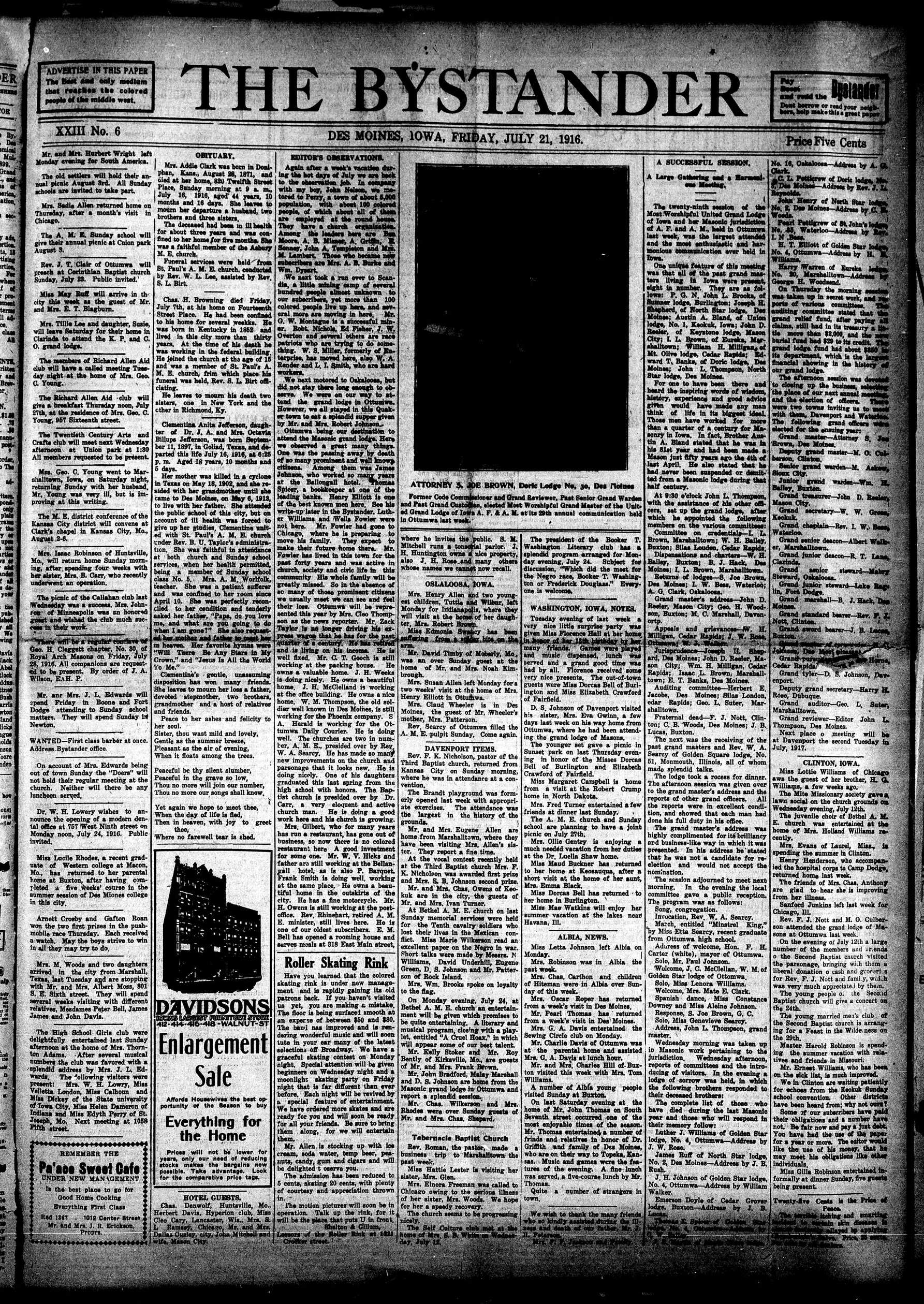
ATTORNEY 5, JOE BROWN, Doric Lodge No. 30, Des Moines
Former Code Commissioner and Grand Reviewer, Fast Senior Grand Warden and Fast Grand Custodian, elected Most Worshipful Grand Master of the Unified Grand Lodge of Iowa A. F. & A. M. at its 29th annual communication held in Ottumwa last week.
where he invites the public. S. M. Mitchell runs a tonsorial parlor. J. H. Huntington owns a nice property, also J. H. Rose, and many others whose names we cannot now recall.
OSLALOOSA, IOWA.
Mrs. Henry Allen and two youngest children, Tuttle and Wilbur, left Monday for Indianapolis, where they will visit at the home of her daughter, Mrs. Robert Brown.
Miss Edmonia Swaincy has been suffering from a sclerosis on the arm.
The president of the Booker T. Washington Literary club has a splendid program arranged for Monday evening, July 21. Subject for discussion, "Which did the meet for the Negro race, Booker T. Washington or Frederick Douglas." Everyone is welcome.
WASHINGTON, IOWA, NOTES.
Tuesday evening of last week a very nice little surprise party was given Miss Florence Hall at her home in honor of her 15th birthday by her friends.
Mr. David Timby of Mobery, Mo, was an over Sunday guest at the home of Mr. and Mrs. Noah Kimbrough. Mrs. Susan Allen left Monday for two weeks' visit at the home of Mrs. Henry Elliott in Ottumwa. Mrs. Claud Wheeler is in Des Moines, the guest of Mr. Wheeler's mother, Mrs. Patterson. Rev. Searcy of Ottumwa filled the A. M. E. pulpit Sunday. Come again.
DAVENPORT ITEMS.
Rev. F. K. Nicholson, pastor of the Third Baptist church, returned from Kansas City on Sunday morning, where he was in attendance at a convention.
The Brandt playground was formerly opened last week with appropriate exercises. The attendance was the largest in the history of the grounds.
Mr. and Mrs. Eugene Allen are home from Marshalltown, where they have been visiting Mrs. Allen's sister. They report a fine time.
At the vocal contest recently held at the Third Baptist church Mrs. F. K. Nicholson was awarded first prize and Mrs. S. B. Johnson second prize.
Mr. and Mrs. Chas, Owens of Kooke are in the city, the guests of Mr. and Mrs. Ivan Turner.
At Bethel A. M. E. church on last Sunday memorial services were held for the Tenth cavalry soldiers who lost their lives in the Mexican conflict.
Miss Marie Wilkerson read an excellent paper on the Negro in war. Short talks were made by Messra. N Williams, David Underhill, Eugene Green, D. S. Johnson and Mr. Patterson of Rock Island.
Mrs. Wm. Brooks spoke on loyalty to the flag.
On Monday evening, July 24, at Bethel A. M. E. church an entertainment will be given which promises to be quite entertaining. A literary and musical program, closing with a playlet, entitled "A Cruel Hoax," in which will appear some of our best talent.
Mr. Kelly Stoker and Mr. Roy Bentley of Kirksville, Mo., are guests of Mr. and Mrs. Frank Brown.
Mr. John Bradford, Malay Marshall and D. S. Johnson are home from the Masonic grand lodge in Ottumwa and report a splendid session.
Mr. Chas. Wilkerson and Mrs. Rhodes were over Sunday guests of Mr. and Mrs. Chas. Shepard.
Tabernacle Baptist Church
Rev. Roman, the pastor, made a business trip to Marshalltown the past week.
Miss Hattie Lester is visiting her sister, Mrs. Glen.
Mr. Elinao Freeman was called to Chicago owing to the serious illness of her sister, Mrs. Woods. We hope for her a speedy recovery.
The church seems to be progressing nicely.
The Self Culture club not as the
home of mrs. S. B. White as Workers
The president of the Booker T. Washington Literary club has a splendid program arranged for Monday evening, July 24. Subject for discussion, "Which did the meet for the Negro race, Booker T. Washington or Frederick Douglass." Everyone is welcome.
WASHINGTON, IOWA, NOTES.
Tuesday evening of last week a very nice little surprise party was given Miss Florence Hall at her home in honor of her little birthday by her many friends. Games were played and music dispensed, lunch was served and a grand good time was had by all. Florence received some very nice presents. The out-of-town guests were Miss Dorcas Bell of Burlington and Miss Elizabeth Crawford of Fairfield.
D. S. Johnson of Davenport visited his sister, Mrs. Eva Gwin, a few days last week on his way home from Ottumwa, where he had been attending the grand lodge of Masons. The younger set gave a picnic in Sunset park on last Thursday evening in honor of the Misses Dorcas Bell of Burlington and Elizabeth Crawford of Fairfield.
Miss Margaret Campbell is home from a visit at the Robert Crump home in North Dakota.
Mrs. Fred Turner entertained a few friends at dinner last Sunday. The A. M. E. church and Sunday school are planning to have a joint picnic on July 27th.
Mrs. Olle Gentry is enjoying a much needed vacation from her duties at the Dr. Luella Shaw home.
Miss Maud Buckner has returned to her home at Keosauga, after a short visit at the home of her aunt, Mrs. Emma Black.
Miss Dorcas Bell has returned to her home in Burlington.
Miss Mae Watkins will enjoy her summer vacation at the lakes near Havana, Ill.
ALBIA. NEWS.
Miss Letta Johnson left Albia on Monday.
Mrs. Robinson was in Albia the past week.
Mrs. Chas, Carthon and children of Hiteman were in Albia over Sunday of this week.
Mrs. Oscar Roper has returned from a week's visit in Des Moines.
Mr. Pearl Thomas has returned from a week's visit in Des' Molinas.
from a Week A Visit in Des Moines.
Mrs. C. Davis entertained the
Society Circle on Monday.
Mr. Charlie Davis of Motown was
at the parental home and assisted
Mrs. G. A. Davis at lunch hour.
Mr. and Mrs. Charles Hill of Buxton
visited this week with Mrs. Tom
Williams.
A number of Alba young people visited Sunday at Burton. On last Saturday evening at the home of Mr. John Thomas on South Seventh street occurred one of the most enjoyable times of the season. Mr. Thomas entertained a number of frinds and relatives in honor of Dr. Griffith and family of Des Moines, who are on their way to Topeka, Kansas. Music and games were the features of the evening. A fine lunch was served, a five-course lunch by Mr. Thomas.
Quite a number of strangers in town.
We wish to thank the many friends we kindly met in the town and the staff of our office in Boston, MA. H. Peterson.
The twenty-ninth session of the Most Worthful United Grand Lodge of Iowa and her Masonic jurisdiction of A. F. and A. M., held in Ottumwa last week, was the largest attended and the most enthusiastic and harmonious communication ever held in Iowa.
One unique feature of this meeting was that all of the past grand masters living in Iowa were present, eight in number. They are as follows: P. G. N. John L. Brooks, of Summer lake, Burlington; Joseph H. Shephard, of North Star lake, Des Moines; Austin A. Bland, of Union lake, No. 1, Kookik, Iowa; John D. Reeler, of Keystone lake, Mason City; I. L. Brown, of Eureka, Marshaltown; William H. Milligan, of Mt. Olive lake,odge, Rapidie; Edward T. Banke, of Doric lake, Des Moines; John L. Thompson, North Star lake, Des Moines.
For one to have been there and heard the inspiring words of wisdom, history, experience and good advice given would have made any man think of life in its biggest ideal. Those men have worked for more than a quarter of a century for Masonry in Iowa. In fact, Brother Austin A. Bland stated that he was in his 1st set year and had been made a Mason just fifty years ago the 4th of last April. He also stated that he had never been suspended or denied from a Masonic lodge during that half century.
At 9:30 o'clock John L. Thompson, with the assistance of his other officers, set up the grand lodge, after which he appointed the following members on the various committees: Committee on credentials—L. L. Brown, Marshallhall; W. H. Ballue, Burton; Silaa Louden, Cedar Rapids; Dispensations and charters—W. H. Ballue, Burton; B. J. Hack, Des Moines; L. I. Brown, Marshallhall.
Returns of lodges—S. Joe Brown,
Des Moines; I. W. Bess, Waterloo;
A. G. Clark, Oakloak.
Appeals and grievances—W. H. Milligan, Cedar Rapids; J. W. H. Ottmann, W. J. Walsher, Jurisprudence—Joseph H. Shapard, Des Moines; John D. Raeier, Mason City; Wm. H. Milligan, Cedar Rapids; Isaac L. Brown, Marshalltown; E. T. Banks, Des Moines.
Auditing committee—Herbert E. Jacobs, Des Moines; Silas London, edar Rapids; Geo. L. Suter, Marshalltown.
Fraternal dead—F. J. Nott, Clinton; C. B. Wood, Des Moines; J. B. Lucas, Buxton.
The next was the receiving of the past grand masters and Rev. W. A. Searcy of Golden Square lodge, No. 51, Monmouth, Illinois, all of whom made splendid talks.
The lodge took a rocess for dinner.
The afternoon session was given over to the grand master's address and the reports of other grand officers.
All the reports were in excellent condition, and showed that each man had done his full duty in his office.
The grand master's address was highly complimented for its brilliance and business-like way in which it was presented.
In his address he stated that he was not a candidate for reelection and would not accept the nomination.
The session adjourned to meet next morning. In the evening the local committee gave a public reception.
The program was as follows:
Invocation, Rev. W. A. Searcy,
March, entitled "Minstrel King,"
by Miss Etta Searcy, recent graduate
from Ottumwa high school.
Addresses of welcome, Hon. F. H. Carter (white), mayor of Ottumwa. Solo, Mr. Paul Johnson. Welcome, J. C. McClellan, W. M. of Golden Star lodge of Ottumwa.
Response, S. Joe Brown, G. C.
Solo, Miss Geneva Leary.
Address, John L. Thompson, grand
master.
Wednesday morning was taken up in
Masonic work pertaining to the
jurisdiction. Wednesday afternoon,
reports of committees and the
introducing of visitors. In the evening a
lodge of sorrow was held, in which
the following brothers responded to
their deceased brothers.
The complete list of those who
have died during the last Masonic
year and those who will respond in
their memory follow:
Luther J. Williams of Golden Star
lodge, No. 4, Ottumwa—Address by
J. W. Rose.
James Ruff of North Star lodge,
No. 2, Des Moines—Address by J. B.
Rush.
J. H. Johnson of Golden Star lodge,
No. 4, Ottumwa—Address by William
Walker.
Emerson Doyle of Cedar Grover
lodge, Burton—Address by J. B.
Lewis.
Pay
Bread
and read the
Dustborrow or read your
neigh-
born, help make this a great paper
Price Five Cents
No. 16, Oakaloosa—Address by A. G. Clark.
C. L. Fettkew of Doric lodge, No. 5, Des Moines—Address by Rev. J. L. Bagpeld.
John Henry of North Star inlay
No. 2, Dee Moseh—Address by G. B.
Woods.
Pearl Pettigrew of St. John's inlay
No. 2, Waterloo—Address by Bay
L. N. Bose.
H. T. Elliott of Golden Star lodge
No. 4, Ottawa—Address by H. W.
Williams.
Harry Warren of Burea lodge
No. 20, Marshalltown—Address by
George H. Woodsnd.
On Thursday the morning session
was taken up in secret work, and
ports of various committees.
The auditing committee stated that
the grand relief fund, after paying all
claims, still had in its treasury a little
more than $2,000, and the new
burial fund had $29 to its credit.
The grand lodge fund had about $350
its department, which is the largest
financial showing in the history of
our grand lodge.
The afternoon session was devoted to closing up the business, selecting the place of our next annual meeting, and the election of officers. There were two towns inviting us to meet with them, Davenport and Watsonville. The following grand officers were elected for the anguish year:
Grand master—Attorney S. Jae Brown, Des Moines
Deputy grand master—M. O. Colbarson, Clinton
Senior grand warden—M. Ashow, Sioux City
Junior grand warden—Wm. H. Balley, Burton
Grand treasurer—John D. Reuker, Mason City
Grand secretary—W. W. Green, Kecknell
Grand chaplain—Rev. I. W. Bee, Waterloo
Grand senior deacon—Albert Walker, Marshalltown
Grand junior deacon—R. T. Lane, Clintraff
Grand senior steward—Makry Steward, Oksaloosa
Grand junior steward—Lake Ragelin, Fort Dodge
Grand marshall—B. J. Hack, Des Moines
Grand standard bearer—Rev. F. L. Nott, Clinton
Grand sword bearer—J. B. Lees, Boston
Grand sword of attorney—M. O. Johnson, Des Moines
Grand parquet master—Horne Cedar Rapidaf
Grand tyler—D. S. Johnson, Davenport
Deputy grand secretary—Harry H. Rose, Dubuque.
Next place o meeting will be at Davenport the second Tuesday in July, 1917.
CLINTON, IOWA.
Miss Lottie Williams of Chicago
awa the guest of her brother, H. G.
Williams, a few weeks ago.
The Mite Missionary society gave a lawn social on the church grounds on Wednesday evening, July 12th.
The juvenile choir of Bethal A. M. E. church was entertained at the home of Mrs. Holland Williams recently. Mrs. Evans of Laurel, Miss., in spending the summer in Clinton.
Henry Henderson, who accompanied the hospital corps to Camp Dodge, returned home last week. The friends of Mrs. Chas, Anthony are glad to hear she is improving from her illness. Sanford Junkins left last week for Chicago, Ill. Rev. F. J. Nott and M. O. Culberson attended the grand lodge of Masons at Otkwamna last week. On the evening of July 12th a large number of the members and arends o the Second Baptist church visited the parsonage, bringing with them a liberal donation o cash and groceries for Rev. F. J. Nott and family, which was very much appreciated by them. The young people o the Second Baptist church will give a concert on the 24th. The young married men's club of the Second Baptist church is arranging for a Feast in the Wilde ness on the 29th. Master Harold Robinson is spending the summer vacation with relatives and friends in Missouri.
Mr. Ernest Williams, who has been on the sick list, is much improved. We in Clinton are waiting patiently for echoes from the Kokuk Sunday school convention. Other districts have been heard from; why not ours?
Some of our subscribers have paid their obligations and a number have not. Be fair now and pay a just debt. You have had the use of the paper for a year or more. The editor would like the use of his money, that he may meet his obligations like other individuals.
Miss Gilla Robinson entertained informally at dinner Sunday, five guests being present.
Twenty-five Cents is the Price of Peace.
This possible fishing and smarting induced by certain skin disease is allied to applying the same Price, as usual, to the consumption.
AFRO-AMERICAN CULLINGS
Robert R. Moton, the new principal of Tuskegee institute, will carry on Booker T. Washington's great work in uplifting the Negro race, Dr. H. B. Frissell, principal of Hampton institute and member of the General Education board, told the National Education association association at New York. "Booker Washington's life was a distinct victory for the Negro race and for the ideas for which Hampton stands," said Doctor Frissell.
"Washington carried from Hampton to Alabama a strong belief in the moral value of regular habits of industry. At the Tuskegee school Hampton ideas were reproduced. Throughout Washington's life he laid emphasis upon duties rather than upon rights. While he was sensitive to the injustices which his race suffers, he felt that the best preventive of injustice is improvement in physical, mental and moral conditions. Because of his real love for men, both white and black, and because he was able to render great a valuable service to both races. Doctor Washington exercised an influence second, perhaps, to that of no other man in this country.
"Robert R. Moton, the new principal of Tuskegee, who was commandant at Hampton for many years, like Doctor Washington, spent part of his boyhood in an excellent Virginia home, where he learned to love white people and believe in their kindly disposition toward the blacks. This love and faith he has never lost. Booker T. Washington had certain noteworthy characteristics, possessed also by Robert Moton, in the production of which Hampton may at least claim a share—fairly, love, modesty and service.
"Washington and Moton, carrying out Hampton's idea of education for service, believed in the educational value of daily activities. Both preached the doctrine of training the hands, the head and the heart."
A Negro bishop has been assigned to St. Louis by the African M. E. Zion church, which recently held its general conference at Louisville, Ky. Rt. Rev. L. W. Kyles of Winston-Salem, N. C., former editor of the Quarterly Review, has been elected to preside over the Missouri conference, which embraces Missouri, southern Illinois, Indiana, Arkansas, Oklahoma and California. The growth of the denominational work of the Zion church in St. Louis during the last five years, under the lead of the Rev. G. Shaw, through the establishment of a social settlement in connection with the Metropolitan church, at Lucas and Garrison avenues, has placed St. Louis in the lead as a religious center. The educational secretary of the denomination, Prof. J. W. Martin, has been directed to transfer his headquarters to St. Louis. Professor Martin for the last ten years has been president of Arkansas college. He will have charge of 14 schools and colleges, valued at more than $800,000, and will annually dispense an educational fund of $50,000.
Captain Morey says the colored troopers sang as they faced death at Carrizal. It will be remembered that the colored troops which helped to storm San Juan hill in the Spanish war went up into the rain of Spanish fire singles in the Anglo-Spanish bravery and devotion ought to be held to the lasting credit of their race in the time to come—Baltimore American.
Public Service Commissioner Hayward of New York, who announced his intention of raising a Negro regiment for service in Mexico, if necessary, received scores of applications for membership. Four recruiting stations were opened, one on Lenox avenue, between One Hundred and Thirtheth and One Hundred and Fortieth streets; one in what is known as the San Juan hill district, one in Brooklyn, and a fourth in the suburbs. Colonel Hayward does not believe there will be much difficulty in getting the war department to permit Major Charles Young of the Tenth cavalry, now in Mexico, to take charge of the instruction of the new regiment.
In Denmark the cost of living continues to advance. Considering the selling price of foodstuffs, textiles, metals, lumber, oils and labor as 100 in 1812, the index number last March was 1822. It is not believed that the end of the war will result in great relief.
A semicircular top for automobiles that drops down of sight behind the seat when not in use has been patented by a Colorado inventor.
A new tooth brush has a hollow head and can be connected with a rubber tube to an elevated reservoir for liquids to make it a fountain affair.
For propelling a boat a Frenchman has invented paddle wheels which may be attached to any boat and revolved by a man pulling at oarline handles.
An asbestos pad to hold water for moistening stamps or envelope flaps that is fastened to the back of a person's hand has been patented.
More than 20,000 feet of good lumber was made last year from trees caught while floating down the Missouri river.
The state of Pennsylvania will plant 10,000 cherry trees this year to provide food for insect-killing birds.
There is a barber in Augusta, Me,
who has worked in the same shop con-
tinuously for 44 years.
Kansas has fewer millionaires than
other state in the Union. Also it
Rev. A. Eustace Day, rector of St. Paul's (colored) church, Atlanta, Ga., and head of St. Paul's Industrial school, met his death June 10 from heart failure, induced by overexertion while in the water at Fernandina Beach, Fln. For some months he had been suffering from the ill effects of overwork, and, on the advice of his bishop, was taking a vacation at Brunswick, Ga. He went on an excursion of the colored churches of Brunswick to Fernandina, went into the water, and was playing with the children, of whom he was very fond, when the cry arose, "Father Day is drowning!" A life line was thrown out and he was brought ashore, but died almost immediately. For 12 years he has ministered to the congregation of St. Paul's church and connected the school connected with the mission. The school has steadily grown up now it has 220 pupils, and now it has besides kindergarten, industrial training, and commercial courses. He was greatly loved and respected by the people of his own race and stood high in the esteem of the bishop and white clergy of his diocese. The burial service was conducted by the bishop of Atlanta, assisted by Rev. J. J. N. Thompson,ector of St. Athanasius (colored) church, Brunswick, Ga., in the A.M. E. church at Blackshear, Ga., Rev. Mr. Day's old home. His death is a severe loss to the colored work in the diocese of Atlanta.
Fifty-two years a servant in one place is the record of Ucle Abe McClinney, who has waited on the dining table of the Judson Female college at Murion, Ala., ever since 1864. He is personally known and affectionately regarded by thousands of women all over the country who have attended that institution since the Civil war. The alumnae of Judson recently donated enough to restore McClinney's home, which was destroyed by fire. Uncle Abe is an old Negro of war times. His record for the same job at the college is said to be the longest in the country. In Marion there are almost twenty antebellum Negroes, whose attachment and service of early life bound them until death in the esteem of the white race. None is better known and more highly esteemed than Uncle Abe. He is still on the job, which he says he will hold down until he dies. When Dr. O. L. Shivers was called by the trustees to Judson to take charge of the boarding department in an effort to keep the institution going when Alabamn was prostrate from war, he carried Uncle Abe with him, and the old Negro has served through the succeeding many administrations.
The Grand Lodge of the Knights of Pythias of North America, South America, Europe, Asia, Africa, Australia and the District of Columbia (colored) closed its annual session in Washington, D. C., after having elected and installed John S. Jackson as grand chancellor; Alexander Henderson, vice grand chancellor; James F. Armstrong, grand prelate; W. W. Cochran, grand master of exchequer; J. Clay Smith, grand keeper of record and seal; P. W. Busey, grand master at arms; Charles Neal, grand marshal; Sir Campley, grand lecturer; L. E. Murray, grand representative; S. E. Minor and Messrs. Chestam and Wade, trustees. The installation exercises were in charge of Past Grand Chancellor M. F. Johnson.
All the fragmentary accounts so far received of the bloody fight between Mexican troops and American cavalry at Carrizal agree that the colored soldiers who were attacked by much larger numbers made a gallant defense. They inflicted heavy losses upon a far more powerful force, the Mexican general in command being one of the slain. The little band of troopers fought until they had suffered very heavy losses, in proportion to their number, and they did their full duty in a position which made success hopeless. This is not the first nor the tenth time that colored soldiers in the service of the United States have shown themselves hard fighters and brave men. In many actions, under widely different conditions, they have been tested and found equal to every reasonable demand. If ever war should come it will be safe to predict that the colored troops of the United States army will make good records and that they will abundantly wipe out the score they have to settle for the treacherous butchery of their comrades of the Tenth cavalry.
Every time a widower looks at a spinster the gossips get busy.
Russia's Caucasus district, with a population of more than 12,000,000, offers an excellent market for toilet soaps and perfumery, a consular report says.
In the 15 years electric street railways in the United States have increased at a very nearly steady rate of about 3,000 miles a year.
Discoveries of extensive deposits of limestone and silica in the Philippines have led to the formation of a company to manufacture cement there.
In October, 1900, the city of Ghent, in Belgium, adopted the first public system of unemployment insurance.
The world's ski jumping record is held by an American who covered a distance of just under 193 feet.
New York city is both the largest Jewish and the largest Irish city in the world.
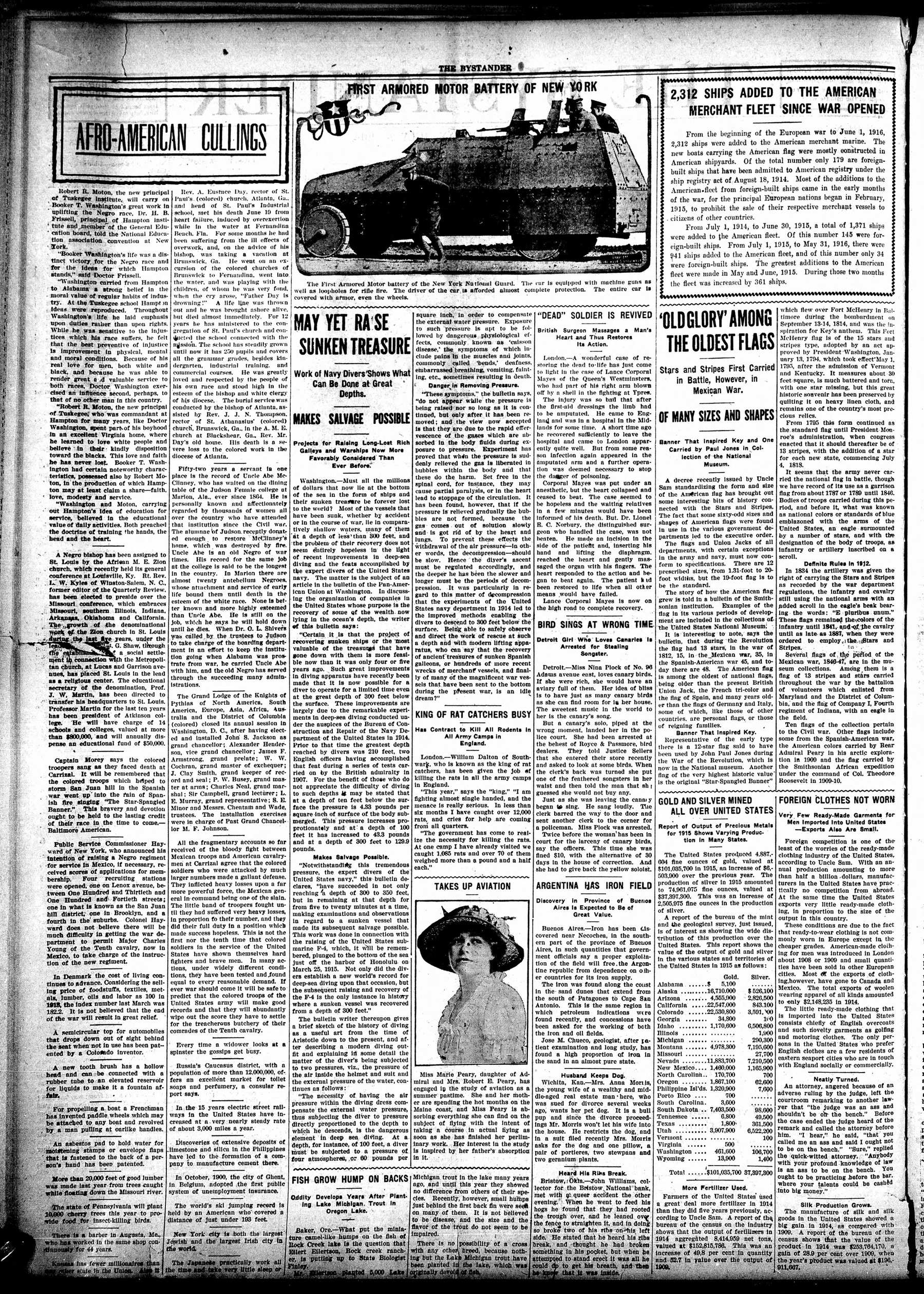
FIRST ARMORED MOTOR BATTERY OF NEW YORK
The First Armored Motor battery of the New York National Guard. The car is equipped with machine guns as well as loopholes for rifle fire. The driver of the car is afforded almost complete protection. The entire car is covered with armor, even the wheels.
The First Armored Motor battery of the New York National Guard. The car is equipped with machine guns as well as loopholes for rifle fire. The driver of the car is afforded almost complete protection. The entire car is covered with armor, even the wheels.
Projects for Raising Long-Lost Rich Gallys and Warships Now More Favorably Considered Than Ever Before.
Washington.—Must all the millions of dollars that now lie at the bottom of the sea in the form of ships and their suken treasure be forever lost to the world? Most of the vessels that have been sunk, whether by accident or in the course of war, lie in comparatively shallow waters, many of them at a depth of less than 300 feet, and the problem of their recovery does not seem entirely hopeless in the light of recent improvements in deep-sea diving and the feats accomplished by the expert divers of the United States navy. The matter is the subject of an article in the Pacific American Union at Washington. In discussing the organization of companies in the United States whose purpose is the recovery of some of the wealth now lying in the ocean's depth, the writer of this bulletin says:
"Certain it is that the project of recovering sunken ships or the most valuable of the treasuries that have gone down with them is more feasible now than it was only four or five years ago. Such great improvements in diving apparatus have recently been made that it is now possible for a diver to operate for a limited time even at the great depth of 300 feet below the surface. It is also the remarkable experiments in deep-sea diving conducted under the auspices of the Bureau of Construction and Repair of the Navy Department of the United States in 1914. Prior to that time the greatest depth reached by divers was 210 feet, two English officers having accomplished that feat during a series of tests carried on by the British admiralty in 1907. For the benefit of those who do not appreciate the difficulty of diving to such depths may be stated that at a depth of ten feet below the surface of the ocean is 433 pounds per square inch of surface of the body surmereg. This pressure increases proprudently and at a depth of 100 feet it has increased to 43.3 pounds and at a depth of 300 feet to 129.0 pounds.
Makes Salvage Possible.
"Notwithstanding this tremendous pressure, the expert divers of the United States navy," this bulletin declares, "have succeeded in not only reaching a depth of 300 to 350 feet, but in remaining at that depth for from five to twenty minutes at a time, making examinations and observations in regard to a sunken vessel that made its subsequent salvage possible. This work was done in connection with the raising of the United States submarine F-4, which, it will be remembered, plunged to the bottom of the sea just of the harbor of Honolulu on March 25, 1915. Not only did the divers establish a new world's record for deep-sea diving upon that occasion, but the subsequent raising and recovery of the F-4 is the only instance in history where a sunken vessel was recovered from a depth of 300 feet."
The bulletin writer thereupon gives a brief sketch of the history of diving as a useful art from the time of Aristotle to the present, and after describing a modern diving outfit and explaining in some detail the matter of the diver's being subjected to two pressures, viz., the pressure of the air inside the helmet and suit and the external pressure of the water, continues as follows: "In having the air pressure within the diving dress compensate the external water pressure, thus subjecting the diver to pressure directly proportioned to the depth to which he descends, is the dangerous element in deep sea diving. At a depth, for instance, of 100 feet, a diver must be subjected to a pressure of four atmospheres, or 60 pounds per
Oddity Develops Years After Planting Lake Michigan, Trout In
Oregon Lake.
Baker, Ore.—What put the miniature camel-like humps on the fish of Rock Creek lake is the question that Ellert Ellertson. Rock creek rancher, is putting up to State Biologist Finley,
Mr. Ellertson planted 5,000 Lake
square inch, in order to compensate the external water pressure. Exposure to such pressure is apt to be followed by dangerous physiological effects, commonly known as 'calison disease', the symptoms of which include pain in the muscles and joints, commonly called 'bends', deafness, embarrassed breathing, vomiting, fainting, etc., sometimes resulting in death.
Danger in Removing Pressure.
Danger in Hibernation Pressure
"These symptoms," the bulletin says, "do not appear when the pressure is being raised nor so long as it is continued, but only after it has been removed; and the view now accepts is that they are due to the rapid which are absorbed in the body fluids during exposure to pressure. Experiment has proved that when the pressure is suddenly relieved the gas is liberated in bubbles within the body and that these do the harm. Set free in the spinal cord, for instance, they may cause partial paralysis, or in the heart lead to stoppage of the circulation. It has been found, however, that if the pressure is relieved gradually the bubbles are not formed, because the gas comes out of solution slowly and is got rid of by the heart and lungs. To prevent these effects the withdrawal of the air pressure—in other words, the decompression—should be slow. Hence the diyer's ascent must be regulated accordingly, and the deeper he has been the slower and longer he must be the periods of decompression. It was particularly in regard to this matter of decompression that the experiments of the United States navy departments enable the divers to descend to 300 feet below the surface. Being able to safely observe and direct the work of rescue at such a depth and with modern lifting apparatus, who can say that the recovery of ancient treasures of sunken Spanish galleons, or hundreds of more recent wrecks of merchandise, and finally of many of the magnificent war vessels that have been sent to the bottom during the present war, is an idle dream?
KING OF RAT CATCHERS BUSY
Has Contract to Kill All Rodents in All Army Camps in England.
London.—William Dalton of Southwark, who is known as the king of rat catchers, has been given the job of killing the rats in all the army camps in England.
“This year,” says the “king,” “I am fighting almost single handed, and the menace is really serious. In less than six months I have caught over 12,000 rats, and cries for help are coming from all quarters.
“The government has come to realize the necessity for killing the rats. At one camp I have already visited we caught 1,085 rats and over 70 of them weighed more than a pound and a half each.”
THE FILM MAKER
Miss Marie Peary, daughter of Admiral and Mrs. Robert E. Peary, has engaged up the study of aviation as a summer pastime. She and her mother are spending the hot months on the Maine coast, and Miss Peary is absorbing everything she can find on the subject of flying with the intent of taking a course in actual flying as soon as she has finished her preliminary work. Her interest in the study is inspired by her father's absorption in it.
Michigan trout in the lake many years ago, and until this year they showed no difference from others of their species. Recently, however, small humps just behind the first back fin were seen on many of them. It is not believed to be disease, and the size and the flavor of the trout do not seem to be impaired.
There is no possibility of a cross with any other breed, because nothing but the Lakus Michigan trout have been planted in the lakes, which was originally devoid of Sal.
"DEAD" SOLDIER IS REVIVED
British Surgeon Massages a Man's
Heart and Restores
a Restores
London.—A wonderful case of restoring the dead to life has just come to light in the case of Lance Corporal Mayes of the Queen's Westminsters, who had part of his right arm blown off by a shell in the fighting at Ypres. The injury was so bad that after the first-aid dressings the limb had to be amputated. He came to England and was in a hospital in the Midlands for some time. A short time ago he recovered sufficiently to leave the hospital and came to London apparently quite well. But from some reason infection again appeared in the amputated arm and a further operation was deemed necessary to stop the danger of poisoning.
Corporal Mayes was put under an anesthetic, but the heart collapsed and ceased to beat. The case seemed to be hopeless and the waiting relatives in a few minutes would have been informed of his death. But Dr. Lionel B. C. Norbury, the distinguished surgeon who handled the case, was not beaten. He made an incision in the side of the patient and, inserting his hand and lifting the diaphragm, he saged the organ with his fingers. The heart responded to the action and began to beat again. The patient kid been restored to life when all other means would have failed.
Lance Corporal Mayes is now on the high road to complete recovery.
BIRD SINGS AT WRONG TIME
Detroit Girl Who Loves Canaries Is
Arrested for Stealing
Songster.
Detroit—Miss Nina Plock of No. 98 Adams avenue east, loves canary birds. If she were rich, she would have an aviary full of them. Her idea of bliss is to have just as many canary birds as she can find room for her house. The sweetest music in the world to her is the canary's song.
But a canary's solo, piped at the wrong moment, landed in her police court. She had been arrested at the behest of Royce & Passmore, bird dealers. They told Justice Sellers that she entered their store recently and asked to look at some birds. When the clerk's back was turned she put one of the feathered songsters in her waist and then told the man that she guessed she would not buy any.
Just as she was leaving the cany began *sng*. He sang loudly. The clerk barred the way to the door and sent another clerk to the corner for a policeman. Miss Plock was arrested.
Twice before the woman has been in court for the larceny of annery birds, say the officers. This time she was fined $10, with the alternative of 30 days in the house of correction. And she had to give back the yellow soloist.
ARGENTINA HAS IRON FIELD
Discovery in Province of Buenos Aires is Expected to Be of Great Value.
Buenos Aires. Iron has been discovered near Neocochea, in the southern part of the province of Buenos Aires, in such quantities that government officials say a proper exploitation of the field will free, the Argentine republic from dependence on other countries for its iron supply.
The iron was found along the coast in the sand dunes that extend from the south of Patagones to Cape San Antonio. This is the same region in which petroleum indications were found recently, and concessions have been asked for the working of both the iron and oil fields.
Jose M. Chuco, geologist, after patient examination and long study, has found a high proportion of iron in the sand in an almost pure state.
Husband Keeps Dog.
Wichita, Kan.-Mrs. Anna Morris, the young wife of a wealthy and middle-aged real estate man here, who was sued for divorce several weeks ago, wants her pet dog. It is a bull pup and since the divorce proceedings Mr. Morris won't let his wife into the house. He restricts the dog, and in a suit filed recently Mrs. Morris asks for the dog and one pillow, a pair of portieres, two stewpans and two geranium plants.
Heard His Ribs Break
Bristow, Okn—John Williams, collector for the Bristow National bank, met with qiuer accident the other evening. When he went to feed his hogs he found that they had rooted the trough over, and he leaned over the fence to straighten it, and in doing so broke two of his ribs on his left side. He stated that he heard his ribs break, and thought he had broken something in his pocket, but when he attempted to stand erect it was all he could do to get his breath, and then he knew that it was inside.
2,312 SHIPS ADDED TO THE AMERICAN MERCHANT FLEET SINCE WAR OPENED
From the beginning of the European war to June 1, 1916, 2,312 ships were added to the American merchant marine. The new boats carrying the American flag were mostly constructed in American shipyards. Of the total number only 179 are foreign-built ships that have been admitted to American registry under the ship registry act of August 18, 1914. Most of the additions to the American-fleet from foreign-built ships came in the early months of the war, for the principal European nations began in February, 1915, to prohibit the sale of their respective merchant vessels to citizens of other countries.
From July 1, 1914, to June 30, 1915, a total of 1,371 ships were added to the American fleet. Of this number 145 were foreign-built ships. From July 1, 1915, to May 31, 1916, there were 941 ships added to the American fleet, and of this number only 34 were foreign-built ships. The greatest additions to the American fleet were made in May and June, 1915. During those two months the fleet was increased by 361 ships.
'OLDGLORY' AMONG THE OLDEST FLAGS
Stars and Stripes First Carried in Battle, However, in Mexican War.
OF MANY SIZES AND SHAPES
Banner That Inspired Key and One Carried by Paul Jones in Collection of the National Museum.
A decree recently issued by Uncle Sam standardizing the form and size of the American flag has brought out some interesting bits of history connected with the Stars and Stripes. The fact that some sixty-odd sizes and shapes of American flags were found in use in the various government departments led to the executive order. The flags and Union Jacks of all departments, with certain exceptions in the army and navy, must now conform to specifications. There are 12 prescribed sizes, from 1.31-foot to 20-foot widest, and the 19-foot flag is to be the standard. The story now the American flag grew in a bulletin of the Smithsonian institution. Examples of the flag in its various periods of development are included in the collections of the United States National Museum.
It is interesting to note, says the bulletin, that during the Revolution the flag had 13 stars, in the war of 1812, 15, in the Mexican war, 35, in the Spanish-American war 45, and today there are 48. The American flag is among the oldest of national flags, being older than the present British Union Jack, the French tri-color and the flag of Spain, and many years older than the flags of Germany and Italy, some of which, like those of other countries, are personal flags, or those of rejoining families.
Banner That Inspired Key.
Representative of the early type there is a 12-star flag said to have been used by John Paul Jones during the War of the Revolution, which is now in the National museum. Another flag of the very highest historic value is the original "Star-Spangled Banner"
GOLD AND SILVER MINED
ALL OVER UNITED STATES
Report of Output of Precious Metals for 1915 Shows Varying Production in Many States.
The United States produced 4,887,604 fine ounces of gold, valued at $101,035,700 in 1915, an increase of $6,503,000 over the previous year. The production of silver in 1915 amounted to 74,901,075 fine ounces, valued at $37,937,300. This was an increase of 2,506,975 fine ounces in the production of silver.
A report of the bureau of the mint and the geological survey, just issued, of the mine as showing the wide distribution of this production over the United States. This report shows the value of the output of gold and silver in the various states and territories of the United States in 1915 as follows:
Gold. Silver.
Alabama $ 5,100
Alaska 16,170,100 $ 526,100
Arizona 4,555,500 2,826,500
California 22,547,000 843,100
Colorado 22,530,800 3,501,900
Georgia 34,800 1,00
Idaho 1,170,600 6,006,800
Illinois 1,900
Michigan 200,300
Montana 4,978,800 7,195,600
Missouri 27,700
New Mexico 1,490,000 7,210,500
North Carolina 170,700 700
Oregon 1,867,100 62,600
Philippine Isls. 1,320,900 7,600
Porto Rico 300
South Carolina 3,000
South Dakota 7,405,800 98,600
Tennessee 6,800 49,500
Texas 1,800 301,500
Utah 3,907,900 6,522,200
Vermont 100
Virginia 500
Washington 461,600 106,700
Wyoming 18,900 1,400
Total $101,035,700 77,397,300
More Fertilizer Used.
Farmers of the United States used a great deal more fertilizer in 1914 than they did five years previously, according to Uncle Sam. A report of the bureau of the census on the industry shows that the output of fertilizers in 1914 aggregated 8,414,959 net tons, valued at $152,815,786. This was an increase of 49.8 per cent in quantity and 52.7 in value over the output of 1900.
which flew over Fort McHenry in Baltimore during the bombardment on September 13, 14, 1814, and was the inspiration for Key's anthem. This Fort McHenry flag is of the 15 stars and stripes type, adopted by an act approved by President Washington, January 13, 1794, which took effect May 1, 1795, after the admission of Vermont and Kentucky. It measures about 30 foot square, is much battered and torn, with one star missing, but this great historic souvenir has been preserved by quilting it on heavy linen cloth, and remains one of the country's most precious relics. From 1795 this form continued as the third flag until President Monroe's administration, when congress enacted that it should thereafter be of 13 stripes, with the addition of a star for each new state, commencing July 4, 1818.
It seems that the army never carried the national flag in battle, though we have record of its use as a garrison flag from about 1787 or 1789 until 1846. Bodies of troops carried during this period, and before it, what was known as national colors or standards of blue embazoned with the arms of the United States, an eagle surmounted by number of stars, the designation of the body of the troops, an infantry or artillery inscribed on a scroll.
Definite Rules In 1912.
In 1834 the artillery was given the right of carrying the Stars and Stripes as recorded by the war department regulations, the infantry and cavalry still using the national arms with an added scroll in the eagle's beak bearing the words: "E pluribus unum." These flags remained the colors of the infantry until 1841, and of the cavalry as late as 1857, when they were ordered to employ the Stars and Stripes. Several flags of the period of the Mexican war, 1849-47, are in the museum collections. Among them is a flag of 13 stripes and stars carried throughout the war by the battalion of volunteers which enlisted from Maryland and the District of Columbia, and the flag of Company I, Fourth regiment of Indiana, with an eagle in the field.
Ten flags of the collection pertain to the Civil war. Other flags include some from the Spanish-American war, the American colors carried by Rear Admiral Peary in his ice exploration in 1900 and the flag carried by the Smithsonian African expedition under the command of Col. Theodore Roosevelt in 1909-10.
FOREIGN CLOTHES NOT WORN
Very Few Ready-Made Garments for Men Imported Into United States —Exports Also Are Small.
Foreign competition is one of the least of the worries of the ready-made clothing industry of the United States, according to Uncle Sam. With an annual production amounting to more than half a billion dollars, manufacturers in the United States have practically no competition from abroad. At the same time the United States exports very little ready-made clothing, in proportion to the size of the output in this country.
These conditions are due to the fact that ready-to-wear clothing is not commonly worn in Europe except in the cheaper grades. American-made clothing for men was introduced in London about 1908 or 1909 and small quantities have been sold in other European cities. Most of the exports of clothing, however, have gone to Canada and Mexico. The total exports of woolen wear apparel of all kinds amounted to about 144 million in 1944. The little ready-made clothing that is imported into the United States consists chiefly of English overcoats and such novelty garments as golfing and motoring clothes. The only persons in the United States who prefer English clothes are a few residents of eastern seaport cities who are in touch with England socially or commercially,
Neatly Turned.
An attorney, angered because of an adverse ruling by the judge, left the courtroom remarking to another lawyer that "the judge was an ass and shouldn't be on the bench." Before the case ended the judge heard of the remark and called the attorney before him. "I hear," he said, "that you called me an ass and I asked not to be on the bench." "Sure," replied the quick-witted attorney. "Anybody with your profound knowledge of law is an ass to be on the bench. You ought to be practicing before the bar, where your talents could be cashd into big money."
Silk Production Grows.
The manufacture of silk and silk goods in the United States showed a big gain in 1914, as compared with 1909. A report of the bureau of the census shows that the value of the product in 1914 was $253,747,170, a gain of 28.9 per cent over 1900, when the year's product was valued at $196,911,687.
THE KITCHEN CABINET
Every established mental condition in an acquired habit, and it has become such by continuous repetition of thought. Despondency and cheerfulness are the same, and generosity and generosity indeed are all states of mind—are habits built up by choice, until they have become automatic. A thought constantly repeated at last becomes a fixed habit of mind, from habits that proceeds the life. —James Allen
COOKING LOBSTERS.
These delicate shellfish are so well liked that although in many states they are hard to get, a few ways of preparing them will not be amiss. Those who are fortunate enough to have them in plenty will appreciate a new dish. A medium-sized lobster is the best to choose, those which are lively and heavy in weight. Lobsters should be killed immediately be-
fore boiling. If a pointed knife be run into the back between the body and tall shells, death will occur at once. No lobster is of good flavor that has been killed hours before it is cooked. A fresh boiled lobster has a stiff tail, which will, if gently raised, return with a spring to its curled condition. Care should be taken never to pull the tall straight, as it will never respond again.
Lobster Toast—Canned lobster may be used for this dish. Pick over to remove any pieces of shell. Add one dessertspoonful of warmed butter, red pepper, capers and pickled cucumber. Pound till well blended, add salt. Heat hot and serve on buttered toast.
Creamed Lobster—Remove the meat from the lobster and chop finely. Beat the yolks of two eggs and mix with a quarter of a cupful of cream, a few drops of onion juice, a half a teaspoonful of salt, a pinch of red pepper and a grating of nutmeg. Melt two tablespoonfuls of butter, add the minced lobster, cook and stir for a few minutes; then add the cream and other ingredients. Stir until the combination thickens. Serve on toast.
Broiled Lobster—Kill the lobsters as before described, and with a sharp knife and a mallet or with a cleaver split down the back on the line which runs down the middle of the line which remove the stomach and intestines, place the two pieces with the shell part down over a moderate fire. When half cooked, molten well with butter, sprinkle with pepper, salt and lemon juice. Crack the claws before serving.
Wordiness is the strength of cheerfulness, and its power of endurance—the cheerful man will do more in the same time, will do it better, will persevere, than the sad er-Carryle.
SUGGESTIVE DISHES.
For a simple little cake to serve with a cup of tea, the shortbread enjoyed so much by the Scotch will be worth adding to your cookbooks.
Scotch Shortbread.— Take a cupful of butter, creamed; one-half cupful of cornstarch or arrowroot, one-half cupful of rice flour and two cupfuls of wheat flour with one-half cupful of sugar. Cream the butter, add the sugar, and mix in the flour, kneading it well with the hands until well mixed. Pat it on a board until a fourth of an inch in thickness, and cut with small cutters, pricking well with a fork before baking. Bake in a slow oven.
Walnut Catchup—When the black walnuts are green and still soft enough to pierce with a needle, pick a hundred. Allow six ounces of small onions, a clove of garlic, two quarters of vinegar, two ounces of anchovies, two ounces of pepper, one-fourth of an ounce of mace, one-half an ounce of cloves. Pound the walnuts in a mortar until well broken, the put them into a jar with the vinegar, onion and garlic, cut fine, with two halves of mace, stirring twice a day. Strain in the liquid, add the rest of the ingredients, and boil 30 minutes. Skim well and strain when cold, and bottle.
Labscoach.—Butter a baking dish and fill with alternate layers of sliced raw potatoes and hamburg steak; season with pepper and salt and butter. When the dish is nearly full, pour over one half cup of finely chopped onions and one cupful of tomatoes, either cooked or fresh. Then pour over a cupful of sweet cream and set into the oven to bake. This should bake slowly an hour and a half. The tomatoes may be omitted if the combination is not enjoyed.
Carrot Pudding—To a cupful of boiled and mashed carrots add two well-beaten eggs, one-fourth of a cupful of sugar, half a teaspoonful of clammon, the same of grated nutmeg, one-fourth of a teaspoonful of salt and half a cupful each of milk and cream. Mix well and pour into a pudding dish and bake half an hour. Serve cold with sweetened whipped cream.
Mock Guava Jelly—Wash and soak overnight a pound of home-dried apples. The next morning cook them slowly in the water; then strain through a jelly bag. There should be five cupfuls of juice; add to the boil.
General Gallieni's Epigrams.
The lie General Gallieni was a master of epigrammatic expressions. "Don't create until you can remedy," is one who obtained great favor in France, and might be recommended to critics here. "If you've got brushes, use them; if not, plant cabbages," was another of the general's sayings. "Set things going, and keep them going," and "Say what you want done, but don't say more than a man can remember," were two other counsels.—Westminster Gazette.
COFFEE
CHEMISTRY
Coffee
ing hot juice five cupfuls of sugar and one cupful of lemon juice; cook 20 minutes; skim and strain into glasses.
The man or woman that makes character makes foos--Young.
The ideal life the life full of completion haunts us all. We feel the thing we ought to be beneath the thing we are.
FOOD SUGGESTIONS.
A pressed meat which will be found appetizing for picnics or luncheons on hot days is prepared as follows: Boil together a pound of round steak and two large pork hocks. When done, mince the meat with a fork but do not put it through the meat chopper as it makes it pusty. Put into a mold and pour over it the liquor in which the meat was cooked. Salmon With Tomatoes—Prepare tomato cups by scalding the tomato, remove the skin, then hollow out the form cups, using a sharp teaspoon. Turn upside down to drain and place on ice to keep them firm. Fill with salmon and chopped celery with a good boiled dressing that is highly seasoned.
Prune and Rice Meringue—Boll and drain one cupful of rice, then add two tablespoonfuls of butter, three of sugar, one well-beaten egg and one teaspoonful of ginger extract. Spread some of this mixture on a platter, cover it with a layer of stewed prunes; continue alternating the layers until all the rice is used. Sprinkle lightly with sugar, and cover with a meringue made of the whites of two eggs, one half cupful of sugar, and brown in the oven. Serve cold, decorated with whole stewed prunes.
Apricot Tapioca Pudding—Cover one and a half cupful of tapioca with cold water and let it soak for three hours; then drain and add three cupfuls of boiling water, one-half a teaspoonful of salt and one cupful of sugar; cook in a double bowl until transparent. Skin and cheese to the bottom are stirred baking dough, pour over the tapioca mixture and bake in a moderate oven for 20 minutes. Serve hot or cold with sugar and cream.
Pickled Cherries—Select sound large cherries and to every quart of cherries allow a cupful of the best elder vinegar, two cupfuls of sugar, one stick of cinnamon, broken in bits, a blade of mace and six whole cloves. Pit the cherries, pack them in jars and pour the boiling vinegar and spices over them. Cork and set away; they may be used almost immediately.
Monday's child is fair of face. Tuesday's child is full of grace; Wednesday's child is merry and glad. Thursday's child is loud; Friday's child is loving and giving. Saturday's child must work for his living.
But the child that is born on the Sab-
Is bithe and bonny, and good and gay.
GOOD THINGS
To make ripe olives more delicious soak them over night in olive oil in which has been placed a small clove of garlic.
Beet Salad—Cut in small pieces six cooked beets, the same quantity of cold potatoes and celery. Mix the yolks of five hard-cooked eggs, with two tablespoonfuls of anchovy sauce; then press through a sieve and add very gradually six tablespoonfuls of olive oil, two of vinegar, one tablespoonful of made mustard, one-fourth of a teaspoonful of salt, a few dashes of pepper and the whites of the eggs, cut in rings. Mix well and serve cole.
Corn Salad—Allow half as much corn of chopped celery and walnut vinegar as of grated cooked corn; season with salt, pepper and one finally chopped onion. Mix with a good bolted dressing to which whipped cream has been added.
Supper Dish.-Place eggs in a granite pie plate and sprinkle generously with cheese and bread crumbs, with salt and pepper to taste. Place in the oven and bake until the eggs are set. A little cream put into the pan before the eggs are broken into it is an improvement.
Cafe Parfait.-Take a cupful of strong coffee infusion, add two egg yolks beaten, one-half cupful of sugar and cook in a double boiler until thick. Beat a pint of cream until thick; add to the coffee mixture when cool; pour into a mold and let stand in ice and salt three hours. Unmold and serve.
Buttermilk Cake.-Take two cupfuls of buttermilk, one-half cupful of baking powder, one teaspoonful of soda, dissolved in the buttermilk; two-thirds of a cupful of wheat flour, two cupfuls of graham flour, unsifted, and one-half cupful of meat meats, coarsely broken. Bake one hour. This makes two loaves. The nuts may be omitted and a sour cream and nut frosting may be used to ice the top.
Nellie Marwee
When sharpening a colored pencil, be careful not to get any of the dust into the eye. Many such pencils are dyed with aniline, and several cases of severe injury are reported. In the Archives of Ophthalmology, Dr. R. J. McCurdy tells of a young woman who not only had the white of her eye stained blue, but who had to be operated on to correct the damage from the eyeball, these having grown together in the healing of the socks produced by the nails.
中
hot days is prepared as follows: Boll together a pound of round steak and two large pork hocks. When done, the meat with a mince but not the meat through the meat chopper as it makes it pasty.
when have been placed small clove of garlic.
Beet Salad.—Cut in small pieces six cooked beets, the same quantity of cold potatoes and celery. Mix the yolks of five hard-cooked eggs, with two tablespoonfuls of anchovy sauce; then press through a sleeve and add very gradually
The HOME BEAUTIFUL Flowers and Shrubbery Their Care and Cultivation
THE GARDEN HOUSE
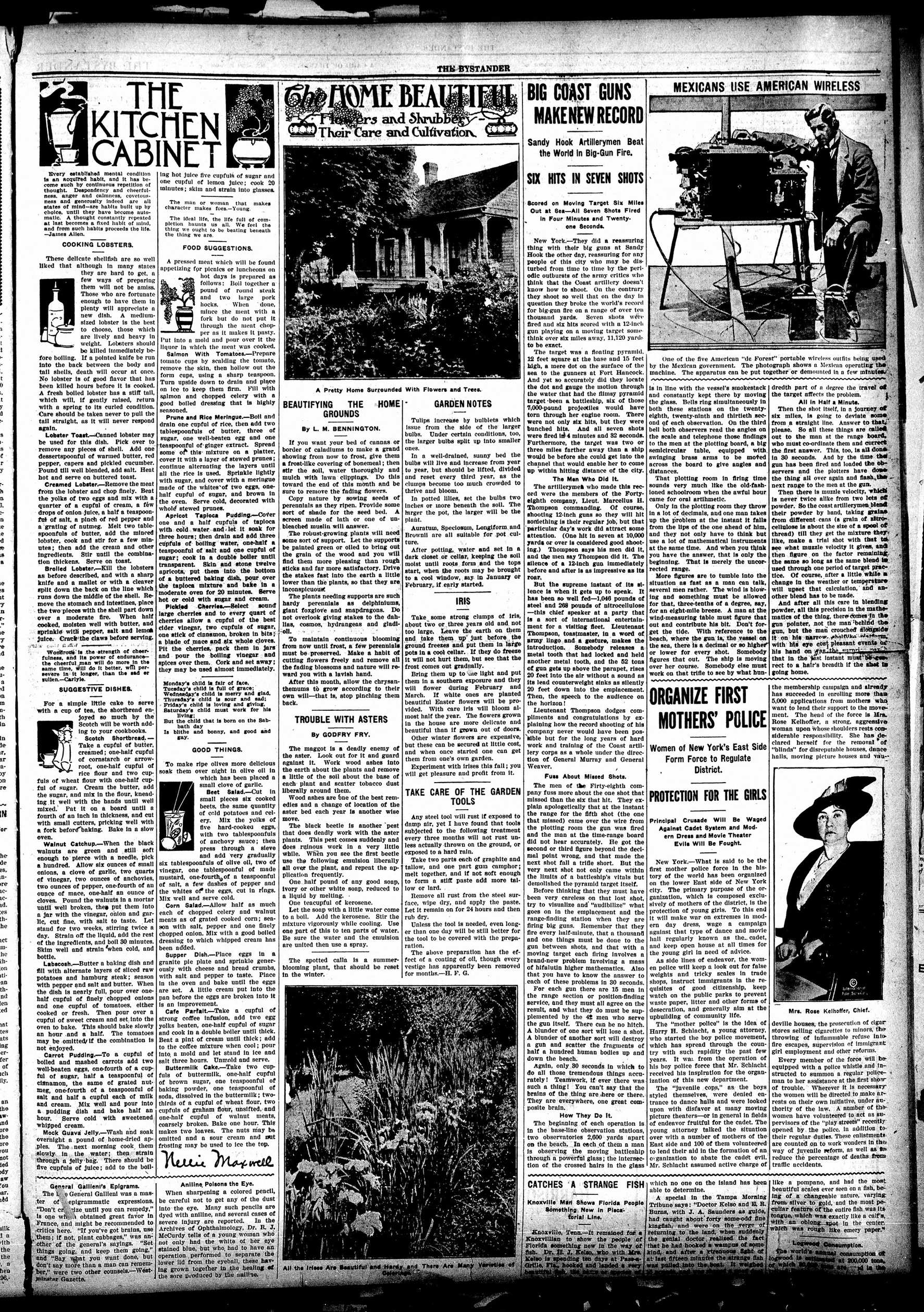
A Pretty Home Surrounded With Flowers and Trees.
```markdown
```
All the Irises Are Beautiful and Hardy and There Are Many Varieties of Coloration.
BEAUTIFYING THE HOME
GROUNDS
By L. M. BENNINGTON.
If you want your bed of cannies or border of caladiums to make a grand showing from now to frost, give them a frost-like covering of bonemeal; then stir the soil, water thoroughly and mulch with lawn clippings. Do this toward the end of the month and be sure to remove the fading flowers.
Copy nature by sowing seeds of perennials as they ripen. Provide some soil for the plants. A screen made of lath or one of unbleached muslin will answer.
The robust-growing plants will need some sort of support. Let the supports be painted green or oiled to bring out the grain of the wood and you will find them more pleasing than rough sticks and far more satisfactory. Drive the stakes fast into the earth a little lower than the plants, so that they are inconspicuous.
The plants needing supports are such hardy perennials as delphiniums, give them mats and dragonflies. Do not overlook giving stakes to the dahlias, cosmos, hydrangeas and gladiol.
To maintain continuous blooming from now until frost, a few perennials must be preserved. Make a habit of cutting flowers freely and remove all the fading blossoms and nature will reward you with a lavish hand.
After this month, allow the chrysanthemums to grow according to their own will—that is, stop pinching them back.
TROUBLE WITH ASTERS
By GODFRY FRY.
The maggot is a deadly enemy of the aster. Look out for it and guard against it. Work wood ashes into the earth about the plants and remove a little of the soil about the base of each plant and scatter tobacco dust liberally around them.
Wood ashes are one of the best remedies and a change of location of the aster bed each year is another wise move.
The black beetle is another pest that does deadly work with the aster plants. This pest comes suddenly and quickly, a very little while. When you see the first beetle use the following emulsion liberally all over the plant, and repeat the application frequently.
One half pound of any good soap, ivory or other white soap, reduced to a liquid by melting.
One teacup of kerosene.
Let the soap with a little water come to a boil. Add the kerosene. Stir the mixture vigorously while cooling. Use one part of this to ten parts of water. Be sure the water and the emulsion are united then use a spray.
The spotted calla is a summer-blooming plant, that should be reset in the winter.
THE BYSTANDER
BEAUTIFUL
and Shrubbery
and Cultivation
With Flowers and Trees.
GARDEN NOTES
Tulips increase by bulblets which issue from the side of the larger bulbs. Under certain conditions, too, the larger bulbs split up into smaller ones.
In a well-drained, sunny bed the bulbs will live and increase from year to year, but should be lifted, divided and reset every third year, as the clumps become too much crowded to thrive and bloom.
In potted illies, set the bulbs two inches or more beneath the soil. The larger the pot, the larger will be the plant.
Auratum, Speciosum, Longiform and Brown are all suitable for pot culture.
After potting, water and set in a dark closet or cellar, keeping the soil moist until roots form and the tops start, when the roots may be brought to a cool window, say in January or February, if early started.
IRIS
Take some strong clumps of iris, about two or three years old and not too large. Leave the earth on them and take them up 'just before the ground freezes and put them in large pots in a cool cellar. If they do freeze it will not hurt them, but see that the frost comes out gradually.
Bring them up to one light and put them in a southern exposure and they will flower during February and March. If white ones are beautiful flowers they will be provided. With care iris will bloom almost half the year. The flowers grown in the house are more delicate and beautiful than if grown out of doors.
Other winter flowers are expensive, but these can be secured at little cost, and when once started one can get them from one's own garden.
Experiment with irises this fall; you will get pleasure and profit from it.
TAKE CARE OF THE GARDEN
TOOLS
Any steel tool will rust if exposed to damp air, yet I have found that tools subjected to the following treatment every three months will not rust unless actually thrown on the ground, or exposed to a hard rain.
Take two parts each of graphite and tallow, and one part gum camphor; melt together, and if not soft enough to form a stiff paste add more tallow or lard.
Remove all rust from the steel surface, wipe dry, and apply the paste. Let it remain on for 24 hours and then rub dry.
Unless the tool is needed, even longer than one day will be still better for the tool to be covered with the preparation.
The above preparation has the effect of a coating of oil, though every vestige has apparently been removed for months.—H. F. G.
```markdown
```
BIG COAST GUNS
MAKE NEW RECORD
BIG COAST GUNS
MAKE NEW RECORD
Sandy Hook Artillerymen Beat the World in Big-Gun Fire.
SIX HITS IN SEVEN SHOTS
Scored on Moving Target Six Miles Out at Sea—All Seven Shots Hired In Four Minutes and Twenty-one Seconds.
New York.—They did a reassuring thing with their big guns at Sandy Hook the other day, reassuring for any people of this city who may be disturbed from time to time by the periodic outbursts of the army critics who think that the Coast artillery doesn't know how to shoot. On the contrary they shoot so well that on the day in question they broke the world's record for big gun fire on a range of over ten thousand shots who fired and six hits scored with a 12-inch gun playing on a moving target something over six miles away, 11,120 yards to be exact.
The target was a floating pyramid, 12 feet square at the base and 15 feet high, a mere dot on the surface of the sea to the gunners at Fort Hancock. And yet so accurately did they locate the dot and gauge the motion through the water that had the films pyramid target—been a battleship, six of those 7,000-pound projectiles would have torn through her engine room. There were not only six hits, but they were bunched hits. And all seven shots were fired in 4 minutes and 32 seconds. Furthermore, the target was two or three miles farther away than a ship would be before she could get into the channel that would enable her to come up within hitting distance of the city.
The Men Who Did It.
The artillerymen who made this record were the members of the Forty-eighth company, Leut. Marcellus H. Thompson commanding. Of course, shooting 12-inch guns so they will hit something is their regular job, but that particular day's work did attract some attention. (One hit in seven at 10,000 yards or over is considered good shooting.) Thompson says his men did it, and the men say Thompson did it. The silence of the a 12-inch gun immediately before and after is as impressive as its roar.
But the supreme instant of its silence is when it gets up to speak. It has been so well fed—1,046 pounds of steel and 268 pounds of nitrocellulose—this chief speaker at a party that is a sort of international entertainment for a visiting fleet. Lieutenant Thompson, toastmaster, in a word of army lingo and a gesture, makes the introduction. Somebody releases a metal tooth that had locked and held another metal tooth, and the 52 tons of gun gets up above the parapet, rises 20 feet into the air without a sound as its lead counterweight sinks as silently 20 feet down into the emplacement. Then, the speech to the audience on 20 feet down into the emplacement. Lieutenant Thompson dodges compliments and congratulations by explaining how the record shooting of his company never would have been possible but for the long years of hard work and training of the Coast artillery corps as a whole under the direction of General Murray and General Weaver.
Fuss About Missed Shots.
The men of the Fifty-eighth company fuss more about the one shot that missed than the six that hit. They explain apologetically that at the instant the range for the fifth shot (the one that missed) came over the wire from the plotting room the gun was fired and the man at the time-range board did not hear accurately. He got the second or third figure beyond the decimal point wrong, and that made the next shot fall a trifle short. But the very next shot not only came within the limits of a battleship's vitals but demolished the pyramid target itself. Before thinking that they must have been very careless on that lost shot, try to visualize and "nudibillize" what goes on in the emplacement and the range-finding station when they are firing big guns. Remember that they have to make sure that the a thousand and one things matter to the gun between shots, and that with a moving target each firing involves a brand-new problem involving a mass of hifalutin higher mathematics. Also that you have to know the answer to each of these problems in 30 seconds.
For each gun there are 15 men in the range section or position-finding service, and they must all agree on the result, and what they do must be supplemented by the 42 men who serve the gun itself. There can be no hitch. A blunder of one sort will lose a shot. A blunder of another sort will destroy a gun and scatter the fragments of half a hundred human bodies up and down the beach. Again, only 30 seconds in which to do all those tremendous actions actually teamwork, if ever there was such a thing! You can't say that the brains of the thing are here or there. They are everywhere, one great composite brain.
How They Do It.
The beginning of each operation is in the base-line observation stations, two observatories 2,600 yards apart on the beach. In each of them a man works in a large glass chamber through a powerful glass; the intersection of the crossed hairs in the glass
Knoxville Man Shows Florida People Something New in Piscatorial Line.
Knoxville, Tenn. - It remained for a Knoxville man to show the people of Florida something new in the way of Kelso. Kelso is spending ten days at Paseo-Grille, Fla. hooked and landed a very humiliated life. He needs to be sainted.
MEXICAN QUE AMERICAN TWITELESS
One of the five American "de Forest" portable wireless outfits being used by the Mexican government. The photograph shows a Mexican operating the machine. The apparatus can be put together or demounted in a few minutes.
is in line with the vessel's smokestack and constantly kept there by moving the glass. Bells ring simultaneously in both these stations on the twenty-eighth, twenty-ninth and thirteenth end of each observation. On the third bell both observers read the angles on the scale and telephone those findings to the men at the plotting board, a big semicircular table, equipped with swinging brass arms to be moved on the board to give angles and distances.
That plotting room in firing time sounds very much like the old-fashioned schoolroom when the awful hour came for oral arithmetic.
dredge part of a degree the travel of the target affects the problem.
All in Half a Minute.
Then the shot itself, in a journey of six miles, is going to deviate some from a straight line. Answer to that please. So all these things are called out to the man at the range board, who must co-ordinate them and correct the first answer. This, too, is all done in 80 seconds. And by the time the observers had used the observers and the plotters have done the thing all over again and flash the next range to the men at the gun.
There then is muzzle velocity, which is never twice alike from two lots of
Only in the plotting room they throw in a lot of decimals, and one man takes up the problem at the instant it falls from the lips of the one ahead of him, and they not only have to think but use a lot of mathematical instruments at the same time. And when you think you have the answer, that is only the beginning. That is merely the uncorrected range. Are goals to tumble into the situation as fast as a man can talk, several men rather. The wind is blowing and something must be allowed for that, three-tenths of a degree, say, for an eight-mile breeze. A man at the wind-measuring table must figure that out and contribute his bit. Don't forget the tide. With reference to the beach, where the gun is, the vessel on the sea, there is a decimal or higher or lower for every shot. Somebody figures that out. The ship is moving over her course. Somebody else must work on that trifle to see by what hun-
ORGANIZE FIRST MOTHERS' POLICE
Women of New York's East Side Form Force to Regulate District.
PROTECTION FOR THE GIRLS
Principal Crusade Will Be Waged Against Cadet System and Modern Dress and Movie Theater Evil Will Be Fought.
New York.—What is to be the first mother police force in the history of the world has been organized on the lower East side of New York city. The primary purpose of the organization, which is composed exclusively of mothers of the district, is the protection of young girls. To this end it will make war on extremes in the early day dress, the dance and movie against that type of dance and movie hall regularity, known as the cudet, and keep open house at all times for the young girl in need of advice.
As side lines of endeavor, the woman police will keep a look out for false wages and tricky trades in trade shops, instruct immigrants in the requisites of good citizenship, keep watch on the public parks to prevent waste paper, litter and other forms of desecration, and generally aim at the unbuilding of community life.
The "mother police" is the idea of Harry H. Schlacht, a young attorney, who started the boy police movement, which has spread through the country with such rapidity the past few years. It was from the operation of his boy police force that Mr. Schlacht received his inspiration for the organization of this new department.
The "juvenile cops," as the boys styled themselves, were denied entrance to dance halls and were looked upon with disfavor at many moving picture theaters—or in general in fields of endeavor fruitful for the cadet. The young attorney talked the situation over with a number of mothers of the East side and 100 of them volunteered to lend their aid in the formation of an organization to abate the cadet evil. Mr. Schlacht assumed active charge of which one on the island has been able to determine.
A special in the Tampa Morning Tribune says: "Doctor Kelso and E. B. Burns, with J. A. Saunders as guides, had caught about forty some-odd fins, kingfish, and were on the verge of returning, when the doctor realized the fact that he had hooked a wumpus of some kind, and after a tremendous fight on at last fifteen minutes the strange fish was pulled into the boat. It weighed
dredth part of a degree the travel of the target affects the problem. All in Half a Minute. Then the shot itself, in a journey of six miles, is going to deviate from a straight line. Answer to that; please. So all these things are called out to the man at the range board, who must co-ordinate them with the first answer. This, too, is all done in 30 seconds, and by by by they are loaded the observers and the plotters have done the thing all over again and flash the next range to the man at the gun.
Then there is muzzle velocity, which is never twice alike from two lots of powder. So the coast artillerymen blend their powder by hand, taking grains from different cans (a grain of atrocellose is about the size of a spool of thread) till they get the mixture they like, make a trial shot with that to see what muzzle velocity it gives, and then figure on the factor remaining the same so long as the same blend is used through one period of target practice. Of course, after a little while a change in the weather or temperature will upset that calculation, and another blend has to be made.
And after all this can be blending powder, the gun in the mathematics of the thing, there comes in the gun弹器, not the man behind the gun, but the man crouched alongside it on his narrow, oblique limb with his eye cost pleasant events or his hand on the curved surface that in the last instant must be directed to a hair's breadth if the shot is going home.
the membership campaign and already has succeeded in enrolling more than 5,000 applications from mothers who want to lend their support to the movement. The head of the force is Mrs. Rose Kelhofer, a strong, aggressive woman upon whose shoulders rests considerable responsibility. She has declared herself for the removal of "blinds" for disreputable houses, dance halls, moving picture houses and vau-
International Fair Science
Mrs. Rose Kelhoffer, Chief.
deville houses, the prosecution of cigar stores selling cigarettes to minors, the throwing of inflammable refuse into fire escapes, supervision of immigrant girl employment and other reforms.
Every member of the force will be equipped with a police whistle and instructed to summon a regular policeman to her assistance at the first show of trouble. Wherever it is necessary the women will be directed to the arrests on their own intuition under authority of the law. A number of the supervisors of the "play streets" recently opened by the police, in addition to their regular duties. These enlistments are counted on to work wonders in the way of juvenile reform, as well as to reduce the percentage of deaths from traffic accidents.
like a pompano, and had the most beautiful scales ever seen on a fish, being of a changeable nature, varying from silver to gold, and the most peculiar feature of the entire fish was its tongue, which was exactly like a cuff's, while long spot in the center, which was rough like emery paper."
MACON, MO. NEWS.
The Rights of Pythias and Court of Calcasieu will hold their annual grand lodge in one city July 24 to 28. Several Maconians attended the ball game in Bovier in Sunday between Sheburn and Bovier.
Miss Bernice Appleton of Kirksville, Mo., passed through our city Monday on route home. She has been spending a few weeks in Armstrong and Booneville, Mo.
Miss Florin Mintz and Eddie Nichlos spent Sunday in Bovier to attend the ball game.
Mr. Alonep Burton is able to be out again, after a spell of illness.
Little Miss Helen Willohlot of St. Louis, Mo., is the guest of her aunt, Mrs. G. T. Stokes.
Mr. Emmet Trices is spending his vacation in Rock Island, Ill.
Miss Eva Williams of Higbe, Mo., is in the city, the guest of Miss Gussie Jones.
Mr. and Mrs. J. B. Harris of Quincy, Ill., are expected home to attend the K. C. P. grand lodge.
Dr. and Mrs. J. H. Garnett have returned from a visit in Kansas City, Mo.
Mr. Charles Jackson and Aleata Pleasant spent Sunday in Bevier to attend the ball game.
Mrs. Johnnie Guy is on the sick list.
Mrs. H. C. McGill, the hairdresser of our city, spent a few days of last week in Shelbilla on business.
Little Frances Grant is very ill at the home of her grandparent, Mrs. W. Robinson.
Miss M. P. Russell, the music instructor of our city, spent a few days in Fayette.
Do not forget that the Knights of Pythias, and Court of Calanthe will convene July 24-28.
Master Edward Harris spent a few days in Callo, Mo.
Coaston Granshaw and Louis Brown spent Sunday in Clarence.
Mrs. Victoria Brassell and nephew,
Louis, have returned from a visit in St. Joseph.
Mrs. Mary Mars and Mrs. Martha Scott are visiting relatives in the city.
SIOUX CITY, IOWA
The rally at Malone A. M. E. church Sunday, July 16, was a success. Rev. Garrison wishes to thank the members and friends for their support.
The Ladies' Aid of Mt. Zion Baptist church will meet Thursday afternoon with Mrs. C. M. Harrison, 617 Sioux street.
Mrs. Alfred Morgan of Yankton, S. D., formerly of Sioux City, was a business visitor in the city last week. Rev. J. W. Dowden met with a bad accident last week. He fell off of his bicycle and sprained his leg. He is resting easy at this writing.
Mr. M. Ankew has returned from Ottawa and Des Moines, Iowa, and reports a pleasant time.
Mr. M. Ankew City Political club will have a meeting August 4th at North Biverside. Everyone is invited. Come one, come all. There will be a baseball game between Mt. Zion Baptist church and Malone A. M. E. church, a potato race, sack race, boat race and various other amusements. There will also be a program.
All persons having news for the
Bystander please call Bell phone 1597
Help for Those Who Have Stomach Trouble.
After doctoring for about twelve years for a bad stomach trouble, and spending nearly five hundred dollars for medicine and doctors' fees, I purchased my wife one box of Chamberlain's Tablets, which did her so much good that she continued to use them and they have done her more good than all of the medicine I bought before—Samuel Boyer, Folsom, Iowa. This medicine is for sale by all dealers.
OTTUMWA, IOWA.
Miss Minnie Blibb entertained at a most delightful evening party the M. T. T. club and a few friends. Elaborate two-course refreshments were served. Out of town guests were Mrs. Roscoe Jones of St. Paul, Minn., H. T. Craig of Keokuk, Miss Garner Fowler of Chicago, Ill., Mr. Frank Balloy of Omaha, Neb., Mr. James Cawford of Chariton, Wyo., and Mrs. Penney of Albia.
John L. Thompson G. M.; Joseph H. Shepard, P. G. M.; Herbert Jacobs, G. A.; Atty James B. Rush, master of ceremonies, of Des Moines; M. Akew, G. J. W, of Sioux City, J. D. Reeler, P. G. M, of Mason City; John L. Brooks, P. G. M, of Burlington, were guests of Mrs. Wells Fowler while the Masonic grand lodge was in session. Mrs. B. J. Abner of Oklahoma City,
Free
to Colored Woman, Our 1911 Style Book
We are the largest manufacturer of colored women's hair and in order our goods we are sending free our latest book, styling styles colored women's latest hair dressing. and women should have one guarantee every article we sell or those they need. We are also磨和 washing and washing the hair on your own.
GRANDMOTHER'S NEW CUB of solid brass, with extra heavy back abrasions, durable, made fully guarantee. With each cub we sell at the low price you see. Read your order for the straightening comb today.
Best suited for 40s.
A FINE LINE OF Hair Brushes here and Tail Articles is illustrated and designed for less than 40s. We are not stamp for book today. We are not stamp for book today. We are not stamp for book today.
FORK EW, NEW YORK
Department 61.
Okla, is visiting at the home of her parents, Mrs. and Mrs. John Cheshire, on Mechanic street.
Mr. Rob. Thomas of Eldon visited at the John Cheshire home while attending the A. F. & A. M. grand sessions.
Rev. I. W. Bess of Waterloo and Mr. Harry Rose of Dubuque were guests of Mrs. Luther Williams.
Mr. and Mrs. Harry Horne and Mrs. Queen Boone of Cedar Rapids and Mrs. Roscoe Jones of St. Paul, Minn. are visiting at the home of their mother, Mrs. Henrietta Horne, also Mr. and Mrs. Lowden and C. D. Cedar Rapids.
C. B. Woods and B. J. Hack of Des Moines were guests at the home of Mr. and Mrs. J. W. Rose on Fellows street.
Mr. A. G. Clark, Mr. Stewart, Mr. Nelson of Oakalaska and Mr. Bailey of Buxton stopped with Mr. and Mrs. Harry Owens.
Mrs. John Cheshire entertained at dinner on Thursday, July 13, Mr. Robt. Thomas of Eldon, Rev. I. R. Bess of Waterloo, Mr. Harry Rose of Dubuque and M. Askew of Sioux City.
Mrs. Harry Robinson of Omaha, Neb., is visiting at the home of her parents, Mr. and Mrs. Oscar Williams, on Ponemah.
S. Johnson of Davenport visited at the home of his uncle, Rev. Rhinehart, while attending the A. F. & A. M. grand session.
Mrs. Benny of Albia visited a few days with her sister, Mrs. Nellie Estes, on Center avenue.
Mr. and Mrs. W. A. Bibb entertained a few guests Saturday evening. Dainty refreshments were served.
Rev. W. A. Scary of the A. M. E. church assisted with services of the A. M. E. church of Oskaloosa on Sunday.
Mr. M. O. Culberson of Clinton and Mr. Hubbard of Des Moines were guests of Mrs. Laelia Sucier.
Mr. Milligan of Cedar Rapids and Mr. Gross of Keokuk were guests at the H. E. Williams home. On Monday evening Mr. and Mrs. W. H. Thompson, Miss Zella and Mr. Ray Clark entertained about fifty of their friends at the Masonic hall in honor of their sister and husband, Mr. and Mrs. H. T. Craig. Light refreshments were served. Mrs. Maud Howell of Vancouver, B. C., Canada, left for her home last Saturday, after attending the funeral of her father, H. T. Elliott. Mr. ad Mrs. H. T. Craig left on Wednesday for their home in Keokuk, after visiting at the home of Mrs. Craig's mother, Mrs. M. F. Clark.
CLARINDA, IOWA.
Mrs. Lottie Williams returned to Omaha on Saturday morning, after a visit with her aunt, Mrs. E. B. Cook.
Mrs. Laura Headly, who has been very ill at her home, is reported better at this writing.
Mr. R. T. Lane returned home Monday from Ottumwa, where he had been as a delegate for the Masonic lodge.
Mr. E. B. Cook left our city Satur-
AGENTS WANTED
For our new book, *Problems and Achievements of the Colorado People.* Showing the wonderful doings and new opportunities of our race, low price, many pictures, lightning sailing, $10.00 per day, ask for terms, write quick, Austin Jnk is Co. D., washington, D. C.
Boys or Girls Make Money
During vacation selling our Fine Quality Hair Nets. Many people use them for vells. Easy work. Good pay. Send 75 for sample outfit. ALEX MARKS
You double your money 602 BROADWAY
You run no risk—We take back unsold goods and refund money.
PORO Satisfaction
Hair Grower Guaranteed
PORO Satisfaction
Hair Grower Guaranteed
Madam M. Downs
HAIR CULTURIST
(Graduate Poro College of St. Louis)
Office Des Moines
310½ W. Grand Ava. Iowa
```markdown
```
Take
One
Pain Pill,
then—
Take it
Easy.
For Neuralgia, nothing is
better than
Dr. Miles'
Anti-Pain Pills
Used by thousands
for a generation
Those who have suffered from neurologic pain need not be told how necessary it is to secure relief. The easiest way out of neurologic pain is to take Anti-Pain Pills. They have relieved sufferers for so many years that they have become a household necessity.
"I have taken Dr. Miles Anti-Pain Pills in the first few months, only that does me any good. They have relieved neuralgia in my head in fifteen minutes. I have also taken a few other pain relievers, pains in the breast, toothache, earache and pains in the bowels and limbs. I have found nothing to be effective, all that is calmed for them.
J. W. SEDGE, Blue Springs, Mo.
All as drugdispensaries-25 doses 25 cents.
Never sold in bulk.
MILES MEDICAL CO., Bluffton, Ind.
HAVE YOU BEAUTIFUL HAIR?
WE are the only Importers and Manufacturers of Real Colored People's Hair. Also Wavy Hair.
We absolutely guarantee our hair to stand combing and washing and to retain its color and crimp.
Wigs, Plets, Braids, Transfersations and Puffs in stock or to order; all shades, sizes too difficult.
Straightening Combs and Toilets Articles.
Send two-cent stamp for Price List. Mail Orders receive prompt attention.
The Old Reliable Mme. Baum's Hair Emporium
486 8th Avenue 11-16-2-16 Between 54th and 56th St. NEW YORK CITY
day morning for Dakota, where he expects to join the Yankee Robinson circus, with whom he has an engagement with the hand boys.
Mr. G. H. Edmonds of Des Moines is expected in our city for a short visit at Mrs. Phalia Pemberton's.
Rev. D. W. Brown is in Bedford this week, expecting to remodel the church.
Mr. Green of Carroll, Iowa, is in town visiting friends for a few days.
Mrs. Martha Wright, Mrs. E. Wilkerson, Mrs. Lillian Lane, Mrs. T. G. Jones, Mrs. Mattie Cook, Mrs. Lottie Williams, Mrs. Washington and Mrs. Lorene Franklin were entertained at the home of Mrs. Henry Johnson of Gravity last week to a three-course dinner in honor of Messrs. Payne of Chillicothe, Mo.
Mrs. Give Nowling and daughter, Golda, were entertained at the home of Mrs. Richard Caldwell in Shenandoah to a three-course luncheon Sunday evening. Out of towns guests were Messrs. Morgan of Cedar Rapids, Iowa, and Mr. Harris of Omaha, Neb.
Mr. Luther Brown is visiting his mother, Mrs. Gertrude Cason, for a few days.
A sociable was given at the home of Mrs. Lou Nash on Monday evening, given by Tabernacles.
Mr. John Mitchell is on the sick list, but is better at this writing.
Mrs. K. D. Black gave a lawn social at the Second Baptist church on Saturday, $7.50 being realized.
Rev. D. W. Brown and wife returned from Bedford, after having great success in raising money to remodel the church. This speaks well for Bedford and its people.
Mr. Chas. Griffin returned Tuesday room, after enjoying a pleasant visit with his parents in Plattsburg, Mo.
After Sunday morning services there will be baptism services by the pastor, Rev. Mitchell.
Mr. George Able was called to Kansas City on Tuesday morning, to be at the bedside of his sister, who is very ill.
We are very glad to learn of the improvement of Mrs. W. Walker's health, after being ill or several months.
Every reader of the Bystander who owes please be ready to pay your correspondent, who will collect the 1st of August.
The colored K. of P. grand lodge, under the jurisdiction of the N. A. S. A., E. A. A. and A., will be held at the beautiful Clarinda fair grounds July 25, 26 and 27, 1916 (in case of rain 28th and 29th). Everybody come every day and enjoy yourselves.
Taking Big Chances.
It is a great risk to travel without a bottle of Chamberlain's Colic, Cholera and Diarrhoea Remedy, as this preparation cannot be obtained on the trains or steamships. Attacks of bowel complaint are often sudden and very severe, and everyone should go prepared for them. Obtainable everywhere.
BEDFORD, IOWA
Mrs. Alice Payne and daughter,
Miss Minnie, of Chillicothe, Mo., are
visiting in Gravity at the home of Mr.
Henry Johnson.
Mr. Adrew Ashford, who has been
L. E. Hanger
NEW
Elite Restaurant
New Reliable Place to 'Eat
Meals 15c and up
Lunches or Short Orders Served
304 W. Grand Ave.
Des Moines Iowa
Iowa Phone 778 Rates $1 per day
Automatic 3852
Tenth Avenue Hotel
1 block from C. & N. W. Ry.
All Rooms are Warm.
Restaurant and Lunch Room
SPECIATIES
Chop Suey Chill Con Carne Yoke麦
Oysters in Season
Special attention given to Theatrical People
Barber Shop in connection
F. F. JACKSON, PROP.
OPEN DAY
NIGHT Clinton, Iowa
When in Ft. Dodge go to
225 Central Avenue
Quick Meals and
Prompt Service. Ft. Dodge,
iowa
HAVE YOU
WE are a
turers
Also Wavy
We abo
combing and
crimp.
Wigs, Pl
stock or to or
Straig
Send two-cent stamp for Price List.
The Old Reliable Mme.
486 8th Avenue 11-16-2-16 Between
Pure Cream
THE BYSTANDEK
employed at Waterloo, is spending a few days at home.
Miss Selma Keene, who has been attending school in Chicago, is spending her vacation with her grandparents, Mr. and Mrs. D. Keene.
Mrs. W. A. Brown of Buxton, the state missionary, came Saturday on her way to Kanass City, Kanz, to attend the Western convention. While here she was the guest of Mrs. A. W. Robinson, who accompanied her to the convention.
Mrs. W. A. Brown of Buxton was a guest of Merritrude Lucas on Saturday evening.
Mrs. Jasper Neene is visiting her son in St. Joe.
Miss Faye Ashford, who has been visiting her aunt, Mrs. H. Martin, returned home last week.
Mrs. J. E. Johnson spent last week in St. Joe visiting her daughter.
Mr. Earl Marshall of Sharpsburg spent the 4th in Bedford.
Miss Mabel Johnson, Miss Minnie Payne and Messas. Fred Johnson and Adam Johnson of Gravity motored to Bedford on Sunday and were guests at the Lucas home.
Mrs. Georgia Howe and children returned home from Blair, Neb, where they have been visiting. Master George, who has been quite ill, is rapidly improving.
Rev. W. W. Ewing of Des Moines preached two splendid sermons Sunday at the Baptist church. The singing was led by Mrs. W. A. Brown, who also sang several numbers of her own, which were greatly appreciated.
Mr. Roscoe Johnson of Gravity and Mr. Leonard Nowling of Clarinda spent Sunday in Bedford.
Quite a number of Bedford ladies were guests at a dinner party at the home of Mr. H. Johnson of Gravity on Monday, complimentary to Mrs Payne and Miss Payne of Chillicothe, Me.
Mr. Fred Johnson brought a party of young people over from Gravity in his auto, who were at the Lucas and Howe homes.
Miss Lulu Franklin entertained a few friends on the 4th of July evening.
Rev. and Mrs. D. W. Brown of Clarinda are guests at the Lucas home this week.
-Wedding bells will soon ring in Bedford on South Court street.
Dr. Palmer's
SKIN
WHITENER
25c
Postpaid
Whitens and Clears dark or brown skin. Bleaches sallow or dark complexion, causing it to grow whiter. Get the original Dr. Palmer's Skin Whitener. Do not accept imitations. Sold by druggists or sent direct postpaid anywhere in the United States for 25c. Remember the name, Dr. Palmer's Skin Whitener. Made only by
Chamberlain's Colic, Cholera and Diarrhoea Remedy. Every family without exception should keep this preparation at hand during the hot weather of the summer months. Chamberlain's Colic, Cholera and Diarrhoea Remedy is worth many times its cost when needed and is almost certain to be needed before the summer is over. It has no superior for the purposes for which it is intended. Buy it now. Obtainable everywhere.
Creole Hair Straightine
Especially for New Guaranteed to straighten and make the most stubborn hair straight and soft regardless of length. Call at 229 W. 3rd St. and see Henry Le Garde 100 testimonials furnished in the city
DO BEAUTIFUL HAIR?
the only Importers and Manufactures of Real Colored People's Hair.
My Hair.
A absolutely guarantee our hair to stand and washing and to retain its color and
Mats, Brides, Transformations and Puffs in order; all shades, none too difficult.
Lightening Combe and Toilet Articles.
Mall Orders receive prompt attention.
Baum's Hair Emporium
on 5th and 6th Sts.
NEW YORK CITY
Country Butter
Choice Meats
'S LUNCH
SERVICE"
Open All Night
Street, Chicago
A CARD OF THANKS.
Dear Editor Bystander:
We take this method, with your permission, to attempt to express our sincerest gratitude to our friends in Des Moines for their kindness and sympathy tendered us during the recent illness and death of our precious little daughter, Clementine, also for the large display of flowers.
KEOKUK, IOWA.
Mr. Clyde Johnson spent the week in Das Moines, Iowa.
Mrs. Emery Johnson entertained the Clover Leaf club on Friday of last week at the home of her sister, Miss Mabel Bland, 1604 Fulton street.
Mrs. L. Fulton is seriously ill at her home on High street.
Mr. and Mrs. Charles Owens and daughter are visiting in Davenport, Iowa.
Miss Verna Beanan returned Sunday from Burlington, Iowa, after a pleasant visit.
Miss Clara Robinson and cousin returned to her home in Hannibal, Mo., after a month's visit with her sister, Mrs. Clyde Singleton.
Miss Eudora Ware is visiting friends in Havana, Ill.
Miss Marie Lewis gave a picnic at Rand park on Wednesday of last week in honor of Miss Clara Robinson of Hannibal, Mo.
The time is close at hand when the Knights and Daughters of Tabor grand session will convene in our city. I hope that all will help us to entertain them, as Keokuk has the name of having a nice home. I hope that they will throw their doors open. They are worthy of all we can do for them. They are ladies and gentlemen. I know you will be glad to have a chance to meet them.
A fine session was held in Mason City last year and we hope to have one here.
George W. Kelles, G. D. M. Don't forget the picnic and lawn social that will be held at Freemin's pavilion Thursday, July 27th, under the auspices of Gate City Juveniles auxiliary to U. B. F. and S. M. T.'s of Missouri jurisdiction. A prize cake will be given away.
Constipation and Indigestion
"I have used Chamberlain's Tables and must say they are the best I have ever used for constipation and indigestion. My wife also used them for indigestion and they did her good," writes Eugene S. Knight, Wilmington, N. C. Chamberlain's Tables are mild and gentle in their action. Give them a trial. You are certain to be pleased with the agreeable laxative effect which they produce. Obtainable everywhere.
CENTERVILLE, IOWA, NEWS. Sunday was a very glorious day in Centerville. Though without any preaching, services were good and were well attended. The choir rendered some excellent music Sunday evening.
Woman's Crowning Glory is Her Hair
Why not grow your hair by using
Mme. M. Beard Hair Grower
It removes dandruff, stops itching of
the scalp and makes it grow long, soft and beautiful. Price 50c a box.
Send stamp for pamphlet.
Relieves CATARRH of
the BLADDER
and all
Discharges in
24 HOURS
Each may be beaten the
same as any other
Penalty of
counterfeit,
MIDY
countries.
WHAT YOU WANT
"PORO" HAIR GR
THERES NOTHING
"JUST AS GOOD"
3100 Pine St, Dept Q. St, Louis, Mo.
Mr. Scott Richmond of Aurora, Ill., is visiting in the city for an indefinite time.
Mrs. Wm. Oliver let for Fayette, Mo., where she will visit Rev. V. S. Cooper and wife for a few days.
Mr. and Mrs. Omer O. Crittenden left for their home in Omaha, Neb., Saturday morning,ater visiting two weeks and three days with his mother and other relatives and friends.
There was given on the lawn of Mr. and Mrs. Wm. Noah on East Bank street a beautiful moonlight party in honor of Mr. and Mrs. C. C. Crittenden of Omaha, Neb, and Mrs. Scott Richmond of Aurora, Ill. Mrs. Shelby Noah was assisted by Mrs. Maria Noah, Mrs. Cobbs and Mrs. L.D. Price. Those ladies certainly had things fixed up in style. The lawn was beautifully decorated with torchs and lanterns. Two large punch bowls were placed for the convenience of the crowd. Misses Roxy Noah and Ruth Smith presided at one bowl and Misses Lucy Martin and Hazel Brown at the other, and as the weather was warm all drank freely. The crowd numbered about seventy-five. The colored concert band gave an excellent concert during the evening. The band is doing nicely under the leadership of Mr. Samuel Lee. At a late hour refreshments were served, after which the band played its farewell piece, "Are You From Dixie?" and was asked to repeat it several times. All left for home in high spirits, as "Dixie" is a spirited piece.
A good remedy for sleepiness is to wet a towel and apply to the back of the neck, pressing it hard against the base of the brain, and fastening over this cloth to prevent too rapid evaporation. The effect will be prompt and pleasant, cooling the brain and inducing a sweet and peaceful full slumber. Warm water will better warm the brain. This remedy will prove useful to people suffering from overwork, excitement or nervousness.
WEDID 30. 11 84
Crawford—Do the ich know how the other half live?
Crabshaw—After us, bring their from them they must be able to sort some idea of how they are compelled to live.
SCOTTS
SKIN WHITENER
CREAM
AND
SCOTTS
SKIN WHITENER
SOAP
BEFORE AFTER
PRICE 25¢ EACH
CLEARS THE COMPLEXION AND
KEEPS IT FREE FROM PIMPLES
BLEACHES DARK SKINS.
JAMES S. ROBINSON,
MEMPHIS, TENN.
G. W. SCOTT has opened his
Pool & Billiard Parlor
at his new location
714 West Grand Ave.
Phone Red 3829
We also handle a fine line of
Cigars and Soft Drinks.
NOTICE IN RROBATE.
To Whom It May Concern:
You are hereby notified to appear
at the court house in Folk county,
Iowa, on the 14th day of August, A.
D. 1916, at 10 o'clock a. m., to attend
the probate of an instrument
purporting to be the last will and testament of C. H. Browning, deceased,
late of Folk county, Iowa, at which
time and place you will appear and
show cause, if any, why said will
should not be admitted to probate.
In witness whereof I have hereunto
set my hand and affixed the seal of
the district court at Des Moines this
8th day of July, A. D. 1916.
A. E. Mahan,
Clerk District Court.
C. A. Horner, Deputy.
July 21-28-Aug. 4, 1916.
J WANT IS
HAIR GROWER
---
Steeplechase
BYTANDER PUBLISHING CO., PUBLISHERS
DES MONES, IOWA
Published every Friday by the Bystander Publishing Company, Des Moines, Iowa. Office in Chemical building, corner Seventh and Mulberry streets. Phone, about 897. Official paper of the M. W. U. Grand Lodge of Iowa, A. F. & A. M., and International Grand Congress of Heroines of Jericho of America, and Western Baptist Association.
Entered at the postoffice as second class matter.
Advertising rates for display ads, 25 cents per inch, for each insertion. Three to six months' contracts, 15 cents per inch. Local advertising 10 cents per line for each insertion, counting seven words to a line. For churches and secret societies where admission is charged, one-half of the above-mentioned rates. For professional, legal and announcement cards, yearly contracts, etc., terms are given on application. All advertising is to be paid in advance.
We are prepared to do first class job work at reasonable prices. All of our work is guaranteed.
NOTICE TO CORRESPONDENTS,
Communications must be written on one side of the paper only and be of interest to the public. "Brevity is the soul of wit," remember.
TERMS OF SUBSCRIPTION
One year ..... $1.50
Six months ..... $75
Three months ..... $50
We will not return rejected manuscript, unless accompanied by postage stamps.
Send money by postoffice order, money order, express or draft, to The Bystander Company.
All subscriptions payable in advance.
This notice applies to all writers, contributors, agents and correspondents.
Sign all articles, write only upon one side of paper, write a plain or receptions nor send in programs to be published before or after the event.
Do not give an eulogy or write your personal comment upon hand and spell accurately. Do not send in names of persons at parties the event.
Simply tell the news or event in a brief, simple manner and let the readers of The Bystander comment.
Write the news of all classes, all societies, all religious denominations, irrespective of your personal whims or ideas.
The Iowa State Bystander is the oldest Afro-American journal published in Iowa. It was established in 1894, and is read by nearly all the colored people of Iowa. We have correspondents in the following cities: Albia . . . Miss May Davis Washington . . . N. L. Black Burlington . . . Mrs. L. M. Abel Monmouth, ill. Mrs. Bernice Metlock Colfax . . . Mrs. Gertrude Broddus Minneapolis . . . Mrs. R. L. Butner Clinton . . . A. A. Bush Macon, Mo . . . Lucy Harris Mason City . . . Mrs. Maud Brewton Keokun . . . Miss Ruth Bland St. Paul, Minn . . . Mrs. Hattie Hicks Scandia, Iowa . . Mrs. J. M. Montague Rock Island, ill. Mr. Earle Reynolds Davenport, ill. Mrs. D. J. Johnson Oskaloosa . . . Mrs. Cora Moore Centerville, Miss Cora M. Crittenden
Chance to Make Up
"We have parted forever He writes me to send back the ring."
"Tell him to call for it." advised the experienced friend — Louisville. One the Journal
Look for the collector. Don't dodge him.
PERSIAN CREAM
HAIR GROWER
If a Beautiful Head of Hair Is Your Pride, than for the Wonderful Grower, the Most Wonderful Discovery of the Century.
2:1
PERSIAN CREAM
Affair Grower and Strainighter
The New Way of Treating the Scalp and Growing the Hair.
There is nothing like it on the market—entirely different both in principle as well as in its effect. Absolutely guaranteed to contain no vaseline nor petroleum, but only the best and finest of oils. We give you a binding guarantee to refund your money if Persian Cream. Hair Grower is not as represented or fails to improve your hair. Persian Cream is one of the quickest acting hair growers known—expensive and easily used at home. Price 50 cents.
For Dandwurf. Scales. Ishing and Roombes.
For gernin. a germ disease. It is a parasitical growth affecting hair, growin thin or fall out. It hair to loss its luster, grow thin or fall out. It arundinis. a scientific remedy for scalp trouble. It also cleans the scalp in a hygienic way. It also strengthens the hair and helps maintain it. It also strengthens the hair and helps maintain it. Condition so that the hair coheses to fall out. It presents any unpleasant odor of the scalp at all.
It prevents any unpleasant odor of the scent of hair and lends a delicate perfume of its own.
Manufactured only by BAKER MANUFACTUR
INB CO., Hair, Tail and Hairdressing Preparation,
Oklahoma, 298 W. Walnut Street,
Indianapolis, Indiana.
"Two years ago I satured from frequent attacks of stomach trouble and billiousness," writes Miss Emma Verbryke, Lima, Ohio. "I could eat very little food that agreed with me and I became so dizzy and sick stomach at times that I br and silk hold of something a knee showed aing. Seeing Chu umberlaired with advertised I decided to treat of the improved rapidly." Obtainment of the where. 8,743,170, a 1909, when led at $196.