Iowa State Bystander
Friday, October 13, 1916
Des Moines, Iowa


Page text (machine-generated)
ADVERTISE IN THIS PAPER The Best and only medium that reaches the colored people of the middle west.
TO LET- Two furnished rooms, 815
238th street. Phone Drake 535 J.
The Junior Mite Missionary society
will meet at the parsonage Saturday
afternoon.
Mr. Frank Anderson, father of Vivian
Anderson, is sick in the Methodist
hospital.
The Virginia Pienic association will
meet Sunday afternoon, October 22, at
the home of Mrs. Belle Drew, 255
Sheridan street.
The W. Mite Missionary society will
hold a silver tea October 17th at the
parsonage, 1045 Thirteenth street,
from 3 to 10 p. m. Public invited.
The South Side Crochet club will
meet at Mrs. Dan Matthews's this
week. A dainty lunch will be served.
Mrs. Sadie Blackburn, president;
Mrs. Marvin Jennings, secretary.
The young people's concert given
last Monday by the Union Congregational
church was fairly well attended.
The program was very good and each
member acquitted themselves nicely.
Rev. J. H. Ferribe, the presiding
elder for St. Paul's district, arrived in
town, to attend the reception given
Tuesday night in his and the pastor's
honor. He was a caller at the Bystander
office.
On Sunday morning at 11 o'clock Rev. Moss, one of the delegates and church workers among his people of the south in the great Christian church, will preach at the Union Congregational church Everybody is invited to come out and hear him.
The Callanan club met Wednesday with Mrs. Johnson on Twenty-sixth street. A lovely meeting was had. The president, Mrs. Pyreye, was sick and the vice president presided. The next meeting will be October 25th the home of Mrs. Tillie Lee, 909 Seventeenth street. For full program see next week's Bystander.
All who have decided to take part in the Queen Esther cantata are requested to meet Monday evening at the residence of Mrs. Hampton Graves, 909 Fourteenth street. Listen, folks. It is impossible to get all young as well as all old. Will one and all reason with yourselves and come, and all together have a nice time. One hundred voices will be required to render this cantata.
One of the most enjoyable affairs of the season was the reception given last Friday 'evening by the Mission Circle of the Corinthian Baptist church at the beautiful home of Atty. and Mrs. J. B. Rush, complimentary to Mrs. M. E. Jeffries, one of the active and efficient workers of the circle, as an expression for commendable service in behalf of the same. Mr. James Hill, late of Omaha, and Mr. Buckner, financial secretary of Tuskegee, were present. A buffet lunchon was served. The evening was one long to be remembered by all present.
Friday afternoon, October 6, the I. I. C. met at the home of Mrs. Maude Wilkinson, at which time plans were perfected for a banquet Tuesday, October 17th, the proceeds to apply to the-Booker T. Washington memorial in the form of a painting of the distinguished educator by Henry O. Tanner and which is to be placed in the Iowa-historical building. Chicken pie and tempting accessories forms the menu, all for 25 cents. Banquet to be served in the lecture room of St. Paul's A. M. E. church.
The Home and Foreign Missionary Circle of Maple Street Baptist church held their session with Mrs. Jake Smith on West Third street. The Corinthian and Union Baptist Home Circles were invited guests. A splendid time reported. After which Rev S. Bates of Maple Street Circle, assisted by Mrs. Brown of the Iowa and Nebraska association, installed the following officers: President, Mrs. S. Bates; vice president, Mrs. Saunders; secretary, Mrs. Minor; corresponding secretary, Mrs. John Smith; treasurer, Mrs. Warden.
The reception given Tuesday evening, October 10th, under the auspices of the St. Paul Sunday school and the Allen C. E. society in honor of the return of Rev S. L. Birt and family to St. Paul's church and the Rev. J. H. Ferribe, the new presiding elder of the Des Moines district, was one of the most brilliant affairs ever given in the history of the church. Every department of the church was represented on the program with words of praise of the success of the church last year. Realizing that there is a greater responsibility upon each and every member the coming year for old St. Paul, we are looking forward to a new church. The feature of the evening
REMEMBER THE
Palace Sweet Cafe
UNDER NEW MANAGEMENT
Is the best place to go for
Good Home Cooking
Everything First Class
Red 1387 1012 Center Street
Mr. and Mrs. J. R. Erickson,
Proprietor.
THE BYSTANDER
was the music, baritone solo by Mr. Chas. E. Woods, Jr., duet by Mrs. Ethel Bowmer Smith and Mrs. J. E. Ouseley and by aides by Mrs. J. H. McClaim. Miss Vivian Warricks presided at the piano. Mrs. C. B. Woods showed her marked ability as a caterer in the way she handled the 200 or more guests that were served, assisted by the young ladies of classes No. 5 and 11 of St. Paul's Sunday school.
DRAMATIC ART CLUB
The Dynamic Art club met with Mrs. W. W. Jones, 3100 Grand avenue, Lesson, "Committees and Board of Directors." Roberts' Rule of Oder. Club will meet next Tuesday with Mrs. J. B. Rush. Lesson, "Classes of Motions."
BOARD OF DIRECTORS MEET.
The board of directors for the Home for Women and Girls will meet in Des Moines at the residence of Mrs. A. Gaiter, 771 Thirteenth street. All members are urged to be present. Election of officers and the members to take the place of the nine whose time expires. Other very important business to be transacted.
Mrs. J. B. Rush, Pres.
CALLED MEETING
You are invited to attend scaled meeting of the joint lodges, namely, Wilson lodge, No. 282, Phillip Guiding Star temple, No. 341, of the United Brothers of Friendship, under the Missouri jurisdiction, located in Des Moines, Iowa. Said meeting is for the purpose of discussing the matter of our suspension and taking action, if thought necessary, to secure some relief. Said meeting to be held in the hall of North Star Masonic temple, 1010 Center street, Friday evening, October 20th, at 8 p. m.
Chas. H. Wilson, W. M. R. E. Pattien Sec'y. J. W. Franklin. John L. Thompson.
SPECIAL BOARD MEETING TO BE HELD.
Mrs. S. Joe Brown, president of the Iowa Federation of Colored Women's Clubs, and president of the board of directors for the Home for Women and Girls, has issued a call for a special executive session to be held in Des Moines on Wednesday, November 1st. The following officers are expected to be in attendance: Mesdames Belle C. Watkins of Buxton, first vice president; Lulu Horne, Cedar Rapids, second vice president; Jessie E. McClain of Des Moines, recording secretary; A. G. Clark, Osaka, treasurer; Ma-na White, Indianola, organizer; Julia Southall, Buxton, chaplain; Lilian Downey, Ottumwa, parliamentarian; Lilian Hannonil, Des Moines, historian; Corra Hennington, Ottumwa, auditor; Frank P. Johnson of Des Moines, head of the social service department; Edward A. Carter of Buxton, education; Gus G. Nichols of Des Moines, music; Cora Jones of Osakaolo, household economics; Mrs. John L. Thompson, Des Moines, child welfare; Alberta Carter, Davenport, health; Harry Allen, Des Moines, arts • and crafts; Francis Hicks, Ottumwa, credential; J. H. McDowell, Des Moines, temperance; Welles Fowler, Ottumwa, misses Margaret Roberts, Des Moines, editor; Vivian Smith, Waterloo, suffrage, and Marie I. Bell of Des Moines, superintendent young women's department. Other board members to be in attendance are Miss Jessie E. Walker, Mesdames Jennie G. Johnson, R. N. Hyle, Geo C. Young, Ada Mills, Mary Kate Brooks, Addie Johnson, Emma Brooks and Sadie Washington.
EXPOSITION COMMITTEE MAK
The ladies who are in charge of the Iowa Federation Exposition to be put on in this city the 31st of this month for the benefit of the Washington memorial fund held an interesting meeting Thursday afternoon at the Crocker roller rink, where the exposition is to be held.
Arrangements were completed for the booths and the ladies plan to open the exposition at 2 p. m. The next and final meeting will be held October 26th at the residence of the chairman at 1058 Fifth 'street, at 8 p. m., at which time all ladies are invited, also the gentlemen who are to serve on this committee.
Weeneyday Oct. 18, 1916
At this date and throughout the season admission 10c, skating 20c.
On this occasion the Pastime Orchestra, composed of ten pieces, will furnish music. Skating 7:30 to 11:15. At 9 p.m. the boys will play a game of basket ball on skates, the funniest thing yet. At 10 o'clock a few short addresses by our professional and business men. Singing by Crocker Quartette. At 11 p. m. skate-boy race
General public invited to attend
Skating Monday, Wednesday and Friday nights; Tuesday, Thursday and Saturday afternoons.
Tuesday night free for lady beginners.
SURPRISE COURTESY TO P. H. P. On Tuesday evening members of Mt. Moriah Tabernacle, No. 567, Daughters of Tabor, and a few visitors came in on much surprise to the home of Mr. and Mrs. John S. Wilkinson of 223 East Thirteenth street. Mrs. Wilkinson has been the presiding officer of the Tabernacle for the past two years and as a token for her good work and efforts a beautiful double satin pattern table linen and napkins was presented to her. Mrs. Sim Jeffers made the presentation speech. Mesdames Kelley, Yates, Miles, Hanger and Taylor took charge of the dining room and kitchen and in a short time aged two-course lunchon was served in the dining room at one long table. The centerpiece was a huge craft basket filled with fruits of the season. Among the visitors were Mrs. Nash of Spokane, Wash., Mrs. Roberson of Chicago, Mrs. Johnson and Mrs. Davis of Autic Tabernacle, Des Moines.
NEGRO CANDIDATE FOR CONGRESS TO SPEAK HERE.
Arrangements have just been completed for the first large political meeting of the present campaign to be held at the Crocker roller rink at West Thirteenth and Crocker streets tomorrow, Saturday, October 14th, at 8 p.m.
Hon. Roscoe C. Simmons, nephew of the late Dr. Booker T. Washington, and who is himself a candidate for congress from the state of Kentucky, will be present and address the citizens of Polk county upon the political issues. Music for the occasion will be furnished by the Capital City Cornet Band, and the especial invitation is extended to the ladies to attend.
Atty. S. Joe Brown, member of the county central committee, will preside. Mr. Jesse A. Graves will act as secretary and Messrs. H. Gould and M. L. Gregory as ushers.
The following have been selected as honorary vice presidents for the occasion: Henry McCraven, J. S. Bevery, Atty. J. B. Rush, H. Madden (Delphi, Iowa), W. H. McCree, J. A. L. Smith, R. N. Hyde, I. M. Jones, J. G. Browne, Editor John L. Thompson, E. T. Blagburn, Wm. Tomlin, E. R. Hall, H. W. Hunmer, Wm. Crein, E. Hall, W. Watkins, Dr. A. Booker, Archie Day, J. Reynolds, Dr. J. Alvin Jefferson, J. L. Lucas, Ed Lawson (Carney, Iowa), and W. D. Miller (Enterprise, Iowa).
these desiring to attend should come early些 Mr. Simmons is known to be an orator of rare ability, having spoken in the Y. M. C. a auditorium in this city during the last national campaign and delegates are expected to attend. The community and all the surrounding community. Admission free.
CLINTON, IOWA.
Joe Robinson and wife have returned from Huntsville, Mo., where they accompanied t ehOintTremai t they accompanied the remains of Mrs. Robinson's brother for burial.
Miss Frances Johnson has returned from Gravity, Iowa, where she visited with her parents.
Mrs. L. W. Routt and sons, Jesse, Louie and Freddie, visited relatives recently while on their way to their home in Fort Madison, where they would join Rev. Routt, who will pastor there this conference year.
The members of the Second Baptist church will have a rally on Sunday, October 15th. Three services will be held. At 3 p. m. a musical program will be rendered by the choir and others. A good time is looked forward to.
Mrs. Lillie Porter, evangelist, spoke at the A. M. E. church to a good congregation Sunday evening, October 1.
The adult choir of Bethel A. M. E. church, after a protracted rest, met Wednesday evening for reorganization.
The reappointment of Rev. W. W. Williams to the A. M. E. church this year meets with general approval. He is busy now with the trustees installing a furnace in the church, which, when it is completed, will no doubt be greatly appreciated.
Mrs. Lillie Porter, who has been the guest of Rev. and Mrs. W. W. Williams on her return from annual conference, left for her home in St. Paul on Friday night.
The corn festival which will take place on October 26, 27 and 28 will eclipse anything ever attempted in Clinton. There will be something doing all the time. Every road will lead to Clinton on those dates.
We wish to extend to the friends our many thanks for their kindness and assistance during the illness and death of my husband, and our brother, Richard Jones.
Mrs. Richard Jones, Fred Jones, Jessie Jones and Chas. Jones.
ST. PAUL, MINN.
Harry T. Burleigh, our most noted musical composer, will appear in a song recital at Pilgrim Baptist church Thursday evening, October 19, under the auspices of the Literary and Social and Ladies' Aid. Mr. Fred McCracken, our real estate man, is confined to his home by a slight attack of acute indigestion this week. Mrs. James Roberts entertained a bevy of ladies at ends Friday afternoon in honor of her Sixth Birthday. Six played. Delightful refreshments were served. She received many nice presents. A. T. Stanley was awarded the console-
Mr. and Mrs. Edward Hatton of Arch street entertained friends Friday evening in honor of their second anniversary.
Mrs. Mattie R. Hicks, honorable president of the Minnesota State Federation of Colored Women, has been appointed chairman of the rescue department of the National Association of Colored Women.
Mr. W. T. Francis, one of our most able lawyers, is a republican candidate for the legislature in the 88th district. November 7th will tell the story, and we trust his friends will give him their support.
Mr. L. L. Alexander is conducting a first class grocery at Rondo and McKubbin. We have now three such stores run by members of the race. Why not patronize them. Your race pride should more than cause you to do this.
Mrs. Lillian Taylor, who has been a house guest of Mrs. Eula Hunter of St. Anthony avenue, left for her home in Mason City, Iowa last week.
Madam L. A. Henderson, the hair dresser, has returned from Chicago.
Sixteen ladies met at the home of Mrs. Mattie R. Hicks, 1000 Igleah avenue, Monday afternoon and organized the Ladies' Matinee club.
The following officers were elected: President, Mrs. Stella Lee; vice president, Mrs. Hicks; secretary, Mrs. Carrie Lindsay; treasurer, Mrs. Bessie Miller. Mr. Thaddeus Stepp, formerly of Clinton, Iowa, will produce a moving picture play, called "The Modern Minnehaa," and it is composed of Twin City talent.
Mrs. Elizabeth Freeman (white) of New York, who accompanied the Hughes women's special to our city Saturday, spoke at Pilgrim Baptist church Sunday morning on the recent Waco lynching, as was published in the Crisis. It was through Mrs. Freeman that the $10,000 anti-lynching fund was raised and that steps are being taken to prosecute the leaders of the Waco mob. This investigation by Mrs. Freeman was for and in the interest of the N. A. A. C. P. Messrs. and Mesdames Frank and J King, who have recently moved to our city, are residing at 570 West Central avenue.
Quarterly meeting will be observed at St. James A. M. E. church on the 22nd inst. Presiding Elder James Higgins will be in charge.
Mr. R. Young, who was run over by an automobile truck and seriously injured in Tacoma, Wash., last spring, does not improve any.
Please see the agent and pay 2p your subscription. You promised the editor you would do so.
WASHINGTON, IOWA, NOTES
Rev. Boyd and family left last week for their new home at Waterloo, to which charge he was assigned by the annual conference. Rev. Morgan, our newly appointed pastor, is nicely located at the parsonage, where he is ready to receive all callers.
Margaret Campbell went to Mt. Pleasant last week for a visit with her sister, Mrs. Garlic. ster.
Mrs. Sarah Stokes, who has been spending some time at the H. Campbell home, expects to leave next week for Chicago, where we expect to make her home.
Mesdames Johnson and Hood, sisters of Miss Mac Watkins, are new arrivals in the city to make their home.
Mrs. D. Basfield of Pueblo Cole, who has been visiting at the N. L. Black home, has gone to Chicago for a short visit before returning to her home.
Mrs. Wm. Stewart of Moline spent Sunday at the A. L. Hall home.
Miss Helen Motts of Rock Island visited at the Mrs. Mary Motts home over, Sunday, returning to her home Tuesday.
Moses Hall was a visitor in the Tri-Cities on Monday.
Mrs. D. S. Johnson of Davenport and Mrs. A. G. Clark of Oskaloosa visited at the Jas. Redd home during the fall festival.
Sunday, October 15th, is the first quarterly meeting at the A. M. E. church for this conference year, and the new presiding elder will be here on his initial visit and will receive a royal welcome.
Mrs. Emma Black has returned from a visit with relatives in Oskaloosa.
Paul Greenway of Seattle, Wash., arrived from Muscatine on Monday and visited a few days at the W. B. Williams home on his way home.
Mrs. Haines, who has been ill, is convalescing.
For a Muddy Complexion.
Take Chamberlain's Tablets and adopt a diet of vegetables and cereals. Take outdoor exercise daily and your complexion will be greatly improved within a few months. Try it. Obtainable everywhere.
FORT DODGE, IOWA.
Mrs. Matthew Rhonence made a business trip to Waterloo last Friday. Mr. Al Lassac left for Chicago to work on the dining car service between Chicago and Sioux City. Mr. and Mrs. Berdoe of Meridian, Miss, have moved into the property, owned by S. Hudson of 2023 Third So. Mrs. Berdoe is a sister to Mr. Hudson. Mr. Kenney Jones, of Meridian, Miss, is also making Fort Dodge his home.
State Capitol Bldg Historical
AND
BER 13, 1916.
Fort Dodge society entertains one whole week in honor of Miss Helen Johnson of Des Moines.
The dance at the A. O. U. W. hall Tuesday evening given by Mr. Geo. E. Perkins was quite a success. All the late dances were displayed and a fine time reported by all. At 11 o'clock a luncheon was served by Mr. Emerson Wright.
The party given by Mrs. G. E. Perkins last Wednesday proved quite a novelty success. Games were played, after which a very enticing buffet luncheon was served. Many guests attended, all reporting a most delightful evening.
Thursday noon Miss Helen Johnson and Mrs. Margaret Buckner were entertained at dinner by Mrs. Joseph Wilson at her residence.
A breakfast party just for ladies was given by Mrs. C. B. Buckner on Friday morning at 9:30 a.m. The very fancy menu greeted the guests. The color scheme of pink and white was very beautifully carried out.
Mesdames Eleanor Benton and Daisy Brooks gave a private dance at the Mission dance hall Friday evening. A large number gathered. All had a fine time.
A very pretty 6 cocktail tea party was given by Mrs. Willa Coleman on Saturday. Many games were played, for which prizes were given. Mrs. Bertha Perkins won the prize for the most answers in the game "Romance of Flowers." Only ladies attended. Mrs. E.C. Southall entertained at dinner Sunday for Miss Helen Johnson, Mr. and Mrs. O. B. Buckner and Mrs. C. G. Southall.
Word was received by Mrs. Willa Coleman of the destruction by fire of the property of Mrs. Leslie Cooper at Cooperport, Iowa. Mrs. Cooper's property was valued at $25,000, partly covered by insurance.
Mr. and Mrs. Clarence Coffman have moved into their new home at 1015 So. First street.
Mr. Arthur Marshall is on the sick list this week.
Mrs. Corea Watson was very much frightened and slightly injured when the gas stove she attempted to light exploded.
Mrs. L. Robinson of Chicago and Mrs. Nellie Davis of Des Moines are visiting their father, W. H. Jameso, and sisters, Mrs. Daisy Brooks and Mrs. J. F. Guy.
Mrs. Helen Johnson departed Tuesday for her home in Des Moines. Mr. and Mrs. Clarence Coffman were the guests of Mrs. Frank Perkins at dinner Monday. Mr. George Dale entertained at the residence of Mrs. Margaret Buckner on Monday evening for Miss Helen Johnson and Mr. and Mrs. Buckner. Mr. Boston Clay, formerly of Muscine, now of Garner, was in town Sunday visiting Mr. D. A. Dishman. While the W. C. T. U. convention was in session at Fort Dodge I attended and was very much benefited. We as a race should attend any meetings, whenpossible, where valuable suggestions will be received. By so doing we can work out our individual problems of good and evil.
The State University opened with the largest number of students it has yet had on September 18th. They are: Blaze Duke of Louisiana, senior medic; Strawn of Columbia, Mo., senior pharmacist; E. J. Cobbs of Columbus, Georgia, and H. Beshares, of St. Joe, Missouri, senior dents; Keene of St. Louis, senior in the college of librarians, with mathematics as a major.
More than Enough is Too Much.
To maintain health, a mature man or woman needs just enough food to repair the waste and supply energy and body heat. The habitual consumption of more food than is necessary for these purposes is the prime cause of stomach troubles, rheumatism and disorders of the kidneys. If troubled with indigestion, revise your diet, let reason and not appetite control and take a few doses of Chamberlin's Tablets and you will soon be all right again. For sale: by all dealers.
What Happens when SICK o Why—loss of time, of course, gether with extra expenses suc A policy with the Ba Des Moines, will prov and will cost only a monthly if desired
What Happens when You're SICK or HURT
Why—loss of time, of course, which means loss of wages,—together with extra expenses such as doctor's bills medicine, etc.
A policy with the Bankers Accident Co., of Des Moines, will provide against such losses, and will cost only a small amount, payable monthly if desired.
This company has insured many of the readers of this paper and has paid many thousands of dollars to them when they were sick or hurt. If you are not now insured with us, you should at once inquire about our plan of protecting your wages. Fill out the coupon and mail it today and you will receive full particulars.
IOWA CITY.
Vaeletta London of Buxton and Minerva Graves of Moulton, seniors in the college of liberal arts, and majoring in English; Mabel Morgan of Yankton, South Dakota, senior with a German major; Ruth Southall of Buxton, with a major in history, and Iva Joiner McClain, majoring in English.
Among the freshmen and new students are Mr. Slater of Clinton, a football man; Nathan Smith of Des Moines, and Mr. Windsor of Rock Island, interested in athletics; Percy Smith of Albia, prep medic; Farrell Lawhorn, who will take music; Milred Griffin of Des Moines, Helen Dameron of Indiana, Helen Diggs of Bedford, Iowa, Mamie Diggs of Des Moines and Miss Scott of Kansas City.
Mrs. Fisher of Des Moines will be the hostess at the frat this year.
The Kappa Alpha Psi gave a dancing party in honor of the new students Saturday, September 28.. Mrs. Moore, chaperon.
A very delightful picnic was had at Midway in September. It was lead and chaperoned by Mrs. Moore and participated in the by Iowa City students and a number of residents from Cedar Rapids.
The Old Gold Literary society has begun its work for the new year. Mr. Colbert is president; Miss Diggs, secretary; Mr. Fields, treasurer; Mr. Keene, manual reader; Mr. Smith, chaplain; Mr. Beghears, journalist; Miss Southall, chairman of the program committee.
Miss Mary Louise Miller, formerly of Lawrence Jones school at Braxon, Mississippi, and Page Brown have gone to attend Lincoln Institute.
Mr. Cobbs is doing an elaborate piece of dental work for Mr. Cerney of Cedar Rapids.
Naomi Harper of Fort Madison entered the university Monday.
The girls, chaperoned by Mrs. Moore, called upon Mrs. Fisher and her daughter. Violet. Dainty refreshments were served.
Miss Eunice Nasby is taking music here.
Rev. Campbell and wife, who had the charge in Yankton, South Dakota, will be in Iowa City and Muscatine this conference year. They will reside in Muscatine.
There was election of officers in the Sunday school Sunday. Superintendent, Mr. Alberts; organist, Mildred Griffin, assistant organist, Vaeletta London; secretary, Farral Lawhorn; assistant secretary, Elizabeth Gross; assistant superintendent, Minerva Graves; librarian, Violet Fisher.
MONMOUTH, ILL.
Mrs. Sandy H. Clarke and daughters, Louise and Eloise, of Galesburg visited here for several days at the home of her. Mr and Wm. Little. Mr. John Forte, who has been sick since spring, is gradually growing weaker. Edgar Metlock of Cedar Rapids was in town for several days. Rev. and Mrs. Eugene Thompson have returned from Chicago and Danville. Ill. Rev. Thompson returns again as the pastor of St James' A. M. E. church. Miss Lavida Taylor has gone to Des Moines, Iowa, to make her home. Mrs Maria Stockes, who has been in Kewanee, Ill., for several weeks, has returned home. Mr. Bob Catin is spending a week in Champaign, Ill. His brother, Joe Catin; of Chicago will have charge of his barber shop while he is away. Mrs Lillian Catin was in Roseville, Ill., last week, where she has recently started a new beauty parlor. Miss Clara Taylor of Canton, Mo., is here visiting at the home of her uncle, Ode Weathers. Messrs. John Webb and Jim Johnson visited friends in Streator this week. Miss Harriet Collins and mother have taken their residence in the house recently vacated by Mrs. Eva Reed. Mrs. Lillian Abel had a slight attack of sickness last week. The Missionary society of the Calvary Baptist church met last week at
You're
for HURT
and Unable to Work?
which means loss of wages,—to-
ch as doctor's bills medicine, etc.
inkers Accident Co., of
side against such losses,
small amount, payable
Pay
Boost
and read the
Dont borrow or read your numbers, help make this a great piece.
Price Five Cents
the home of Mrs. Robert Bead.
Mr. A. N. Aiten has returned to Burlington, after spending a few days at the home of Mrs. Lillian Abel.
MACON, MO, NEWS.
Conference convened in our city last week with much enthusiasm. The meetings were well attended. A good number of visitors and delegates were present. On Sunday morning an excellent sermon was delivered by Bishop Parks, which everyone present enjoyed. We regret very much to lose our pastor, Rev. Cross, who has labored with us so long. Rev. Cross and wife will be greatly missed.
Mrs. Georgia Brown entertained Mrs. Mabel Bates of Carrothon and Mrs. Nora Enix of Moline, III. Sunday at dinner.
The death of Mr. C. A. Johnson, the colored barber of our city, occurred Monday evening at his home, and he was buried Wednesday by the Macaron and Knights of Pythian orders. The funeral service was conducted at the M. E. church by Rev. G. W. Crow.
Mrs. C. Harris entertained at breakfast Mrs. Mabel Bates of Carrollton and Mr. and Mrs. Clark of Centralia, Mo., and at dinner Prof. Nederson and wife of Western college.
Mrs. Willia and Mrs. Charley Baird of Moline, Ill., are the guests of Mrs. Wald Brown.
Mr. John Adams and Miss Angelina Davenport remain very ill.
Mr. Rastus Williams and Mr. Pearl McDermit of Huntsville, Mo., spent Sunday in our city to attend conference.
Mr. Louis Route and Mrs. Angil Route and baby of Huntsville spent Sunday in our city.
Quite a number of Moberly people motored to Macon on Sunday.
Miss Mary Taylor of St. Joseph Mo., is the guest of Mr. Floyd Annell.
Miss Nellie Gorham is visiting in the city.
Under Rev. underprescribed two excellent seminars at the Vine and Broadway Baptist church Sunday morning and evening.
Joe T. Ancell spent Sunday and Monday in the city.
The agent will call to see you most any time, so be ready.
Western college, the Christian institution of our city, is doing splendid work under Prof. E. S. Page, the new president, with an enrollment of ninety students, and more are coming in.
Mrs. A. C. Harris will teach private vocal and harpory music.
Mr. and Mrs. Arthur B. were called to Buxton, Iowa, Monday on account of the death of Mr. Bell's mother, who for a number of years has been a resident of our city.
BUXTON, IOWA.
We thank the friends for their old and assistance during the sickness and death of our beloved wife and sister, Mrs. A. B. Ward, who departed this life Monday, October 2, 1916. We also wish to thank our undertaker, Mr. Sol Billings, for the kind and friendly way he took charge of the funeral arrangements, also her pastor, Rev. Woodard, for his kind remarks.
Mr. J. T. Ward.
Mrs. F. Baker.
Mrs. Jas. Hamilton.
Mrs. H. Bragga.
E. Hamilton.
DAVENPORT ITEMS.
Mr. Cecil Carter met with the misfortune of having boiling hot grease spilled on one of his hands last Saturday. Mr. Carter has been suffering intense pain for several days, but is resting easier at present.
Miss Reta Hunter, who spent her two months' vacation in West Virginia, is expected home soon.
Rev. C. R. Waters is in Chicago this week preparing to move his family here.
The following were guests of Mrs. Lottie Green's rooming house last week: Mr. C. Moore, Mr. W. Jenkins, Chicago, and the Eight Black Dots, who played at the Columbia on October 1st, and Mr. and Mrs. W. H. Wright of Omaha.
Mr. Frank Wilson is on the sick list. Mrs. M. D. Hunter, the mother of Mrs. Lola Green, has been very ill for two weeks, but is gradually improving.
Bethel Christian Endeavors appeared in a splendid program last Sunday evening. The paper, songs and talks were all full of inspiration.
FT. MADISON NOTES.
Mr. Joseph Payton of St. Paul, Minn, spent Friday and Saturday in the city visiting his parents, Mr. and Mrs. M. Payton.
Miss Naomi Harper left Wednesday morning for Iowa City, where she will attend Iowa State university.
Rev. M. Payton left Sunday night for St. Paul, Minn, where he will visit at the home of his son, Mr. Charlie Payton.
Mr. and Mrs. Frank Anderson ha purchased a new Ford car. Mrs. N. Anderson and daugh Emma, of New Boston were Ft. I. son visitors last week.
AFRO-AMERICAN CULLINGS
One of the outstanding developments of the last few years is the growth of racial consciousness. The latest Negro Four Book reflects this. Not only are the exhilarates of the heroes of the race recorded but also the individual wealth of Negroes is described with pride.
For example, the rise in the price of oil is said to have boosted the income of Sarah Rector, a young girl of Taft, Oklahoma, to $600 a day. As the descendant of a Creek freedman, she happened to be allotted a piece of land in the oil district. Single taxers would hardly share in the enjoyment of this record. But it has its significance in a cumulative way.
Says Monroe N. Work, editor of the volume:
"Through purchases and increases in values, property holdings of Negroes in country increased during the year by probably $30,000,000. It is estimated that the basis of actual values and including property the total wealth of the Negroes of the United States is about $1,000,000,000. They own 21,000,000 acres of land, or more than 32,000 square miles, an area greater than that of the state of South Carolina."
This private accumulation and public emphasis on the power of property is the Negro's answer to the white man's apathy concerning his plight. Rapidly the mere possession of wealth is dying for the Negro what the white man's conscience has failed to do. Racial consciousness is the beginning of racial self-reliance. In an immense variety of ways the Negro is using his own resources to push forward his race, and, too, from many sources he is being alided. Jalius Rosecawid, among others, has made interesting gifts to the rural schools.
All this activity, the training of the Negro for more and more important services, is bound to have its consequences. On the one hand segregation is increasing—since 1911 13 cities and towns have adopted segregation ordinances—and on the other hand the Negroes are shaped by the schools and other institutions to share in the manifold efforts of the country. Here, in truth, is a genuine conflict of forces.
What is the solution? Is it that of the Brazilian statesman who was quoted by Colonel Roosevelt as follows?
"You of the United States are keeping the blacks as an entirely separate element, and you are not treating them in the same way," he self-respect.
They would remain as a menacing element in your civilization, permanent, and perhaps after a while a growing element. With as this tends to disappear, because the blacks tend to disappear and to become absorbed. In a century there will not be any Negroes in Brazil, while you will have 20,000,000 or 30,000,000 of them."
Negroes are being absorbed in the United States, despite our hostility to miscegenation. The number of mutuates steadily increases and the number of blacks decreases, despite the widespread laws forbidding intermarriage between the races. Unless the Negro's attitude toward this absorption changes, the gradual disappearance of a colored race seems to be the prospect in America — Chicago Herald.
John Frattare came into town and found employment in a pressing club. He washed windows and did errands.
Commendation for the progress made by the colored race during the last 50 years in the face of strong race prejudice was bestowed by H. Martin Williams, a slave dept. of the house, in an address before the Negro race conference at Mount Carmel Baptist church. Mr. Williams said: "You have faced it like men, and have made yourselves up in spite of the utmost violence."
Following the address of Mr. Williams, the conference took the form of a permanent organization with the election of Rev. W. H. Jernagin of Washington as president, and the election of other officers as follows: Rev. J. Milton Waldron and E. P. Check of New Jersey, vice president; W. M. Alexander of Baltimore, secretary; S. L. Curtuthera, treasurer; W. A. Taylor, corresponding secretary, and W. D. Norman, chairman of the executive committee.
The organization, on the question of indorsing the Republican nominee for president, voted to appoint a committee of nine to wait upon Mr. Hughes and ascertain his views and purposes in regard to the colored race. The ex-
American jumper, tinned goods, shoes, machinery, motor cars, coal and hardware field a ready market in Apla. If a direct customer service was installed between San Francisco and Apla, Australian competition would be almost eliminated.
Gold from lode mines in the Willow Creek district, Alaska, in 1915 was vaulted to $200,000. Government observations prove that there is still an enormous amount of gold in this same reality.
poorness of almost every precious metal have been found in Spitsbergen, but there are no signs, according to geologists, that precious mines exist in paying quantities.
for 30 cents a day, which was fair wages. In his spare moments he watched the workers. Then he took up the iron. Soon he had a table and an iron, and was drawing a wage of $1 a day. For all that he was just a pressing club Negro, Clement Richardson writes in the Southern Workman. Nobody thought of him as anything else. In a few years the owner of the business, a white man, died. Frazer bought the business.
As colored folk came in to bring and take back clothes, they inquired for a barber shop. Frazer fitted up a chair, bought a pair of clippers, and advertised for clients; that is, he at first cut hair for nothing. Then, as he mastered the art, he charged five cents, then ten cents, and on so till he received the standard price of 25 cents.
Meantime he had bought a farm and a horse. He said: "I'll take this horse and land and make it pay for another place." Scarcely had he embarked on this proposition when a few choice acres of land on the west side of Auburn were put up for sale. Strangely enough, it was the land of Frazer's father's master. Frazer bought it. He put up a three-story building. He has abandoned the pressing club, but sells clothing. He still runs a business in the rear of the store. His second store is on the property for lodges and amusements. On the third floor he has an undertaking establishment. A few paces from the store he has built a home. A little further on he has put up a hotel cottage, a rare place in the South, with clean, airy rooms, and up-to-date cooking and service.
Negro problems are to be considered as a part of the course in sociology at Howard university this year. Prof. Kelly Miller is to teach the first semester, and Dr. R. E. Parks, professional lecturer in sociology of Chicago university, is to teach the second semester of the subject.
In order that the course may be available for city school teachers and others interested the time has been set for three o'clock Mondays, Wednesdays and Fridays.
The course is to embrace such topics as distribution, and tendency of Negro population, segregation, occupation, crime, vital statistics, education, religious and benevolent organizations, and also the discussion of remedial agencies and the general progress of the race.
The advisability of naming colored bishops in the Protestant Episcopal church will be discussed at the general convention in St Louis this month. A special commission of bishops, clergyman and laymen, appointed at the 1912 convention to investigate the question, has completed its reports, one a majority favoring the naming of colored bishops, the other a minority report opposing the proposal.
The majority report, which includes the signature of the chairman, and bishops of North Carolina, Texas and Mississippi and the lay members from Virginia and Rhode Island recommends grouping the colored members of the church in the southern dioceses into one or more missionary districts over which colored bishops would be placed. The minority report is signed by the bishops of South Carolina and Georgia, Reverend Doctor Stires of New York and Judge Joseph Packard of Baltimore, who favor election of suffragan bishops for this work.
eecutive committee opposed the appointment of the committee and urged the immediate indorsement of Mr. Hughes.
President Jernagin, in speaking of the conditions among the colored race, said that in the last six months more than 500,000 colored persons had left the South for New York, Pennsylvania, Ohio and northwestern states to take the places of foreign laborers who have returned to their respective countries. He assagged the employers are more than satisfied with them as laborers and are willing to employ 1,000,000 more.
He said the leaders of the colored race feel that there are too many of their race in the South get, and that every effort would be made to secure the migration of the surplus to northern and western states.
Chinese railroad embankments are protected from floods by planting them with i native grass with tenacious roots that resist erosion.
A new steamship line has been started to transport timber between New Orleans and Cristobal, Colon.
In a Peensylvgnin town it was proposed to have Sunday baseball. The burgess declined to license unless the opposing team improved, and were placed in the churches on Sunday. The result was 900 favored and 200 opposed.
Snow took the place of Waters in Main street, Winsted, Conn., when Mrs. J. H. Snow moved from the Huggins place to the Pierre house, while Henry H. Haters moved from the Pierre house to the Huggins place.
An oil-extracting plant with a capacity of 2,500 pounds of seed a day has been started at Leon, Nicaragua. The machinery was bought in this country, says the New York Sun.
A Swedish engineer has found that an extract from sulphite lye, when powdered and made into bricks, can be used as a substitute for coal.
There was an increased demand for antimony during the past year, and ore to the value of $740,000 was mined and shipped from Alaska.
Correspondent Tells How He Was Searched When About to Leave Country.
MINUTE EXAMINATION
Every Article of Clothing Gets Cate Scrutiny and Ordeal Is Quite Humilizing for Women of Tender Senses.
FRANZ HUGO KREBS, in New York Times.
New York.—The examination which one has to undergo when entering or leaving Germany is very stringent and trying, and as the war continues is gradually becoming more rigid.
A friend of mine who had come into Germany a few days before told me that on reaching Warmemunde tickets were given out, and that passengers were given the ticket. In the order of the number on the ticket; so I arranged matters with the conductor of the train from Berlin. He told me where to stand just before we reached Warmemunde, pointed out to me, when we arrived, the man who gave out the tickets—and I received No. 1.
Entering, a building, right by the train, I was told to go through a long room, and was halted at the door of another room and asked to produce my passport. After it had been carefully scrutinized I was passed into another room. I found a porter with my grips and hatbox, and I was asked to identify my trunk. All my luggage was then placed on a wooden bench, and an officer and sub officer came over to take charge of the examination.
Search Was Thorough.
I never pack my trunk; it had been packed by the chambermaid at the Hotel Bristol, on Unter den Linden, and when I left Warmenumbe its appearance begged description. All my handkerchiefs, collars, shirts, drawers and socks were examined, one by one, to see whether any concealed papers could be located or whether anything was written on or sewed into them. Handkerchiefs were entirely unfolded, shirts, drawers and socks were turned inside out, and always there was a careful and persistent search. Every crease was examined. My soap was cut in pieces and a stick of camphor ice that had been cut in two places when I came into Germany was cut in another place. First the grips were examined, and then the hatbox; then, tray by tray, everything in the trunk was gone over. my boots and slippers were examined with great care, and, fortunately, I had no boots that had been recently resolved or rehealed; otherwise they might have been ripped apart? This, I was told, is frequently done.
Coming into Germany the examining officer had torn out the stand in my hatbox, on which the hat rested. I and this fixed in Berlin, but I might better have waited until I returned to New York, because, as it was impossible for him to get his hands between the stand on which the hat rested and the side of the box, the examiner simply tore the stand out. The hand of my silk hat was pushed up, to see whether anything was concealed underneath, and the cushion for brushing the hat was ripped open.
Suspect Paris Hat.
My evening hat was opened. Although it was bought in the United States, it seems that it had been made in Paris, and as that fact was stamped inside, I had a feeling that it did not lessen the care with which it was examined. In the bottom of my trunk there were about a dozen summer shirts; I had not worn them since the previous summer, and each had a piece of cardboard placed in it when laundered in order to hold the shirt in shape. The cardboard was taken out of each shirt and laid inside.
This completed the examination of my luggage, and I was then told to go with another, suboffer and submit to a personal examination. I was directed to go into a compartment and was told to take off all my clothing except my undershirt. I was also told to take everything out of my pockets and put it on a shelf. Banknotes were unfolded, one by one, to see that there was no tissue between; my matchsafe was opened, so was a small metal case that I carry my subway tickets in. The outer and inner cases of my watch were opened. The pockets of my top jacket were opened. The pockets of my trousers were turned inside out, and fingers passed over every seam. My boots and socks, drawers and shirt received the same careful attention previously accorded those in my trunk. The band around the hat I wore was pushed up and the sweatband was turned down. Next I was handed a paper to sign, stating that everything had been returned to me, and I was told that my examination was over.
The examination of suspected women is, of course, conducted by woman inspectors, and I was told that cipher dispatches written on oil paper have sometimes been discovered, and that the examination is rigid in the extreme. In fact, American women who consider going to Germany before the end of the war must make up their minds in advance that they may possibly be subjected to an examination that to many would be humiliating.
Cupid Wins Again.
Bloomingdale, N. C—Mrs. John Cooper's thrilling chase in an endeavor to stop her cloaking daughter, Rose, ended when her automobile skidded and tossed her into a graveyard. She was unhurt, but her daughter was married.
Feeds Town With Fish.
Middleton, Idaho—As a result of a little angling in the river early the other morning, Gilbert Hoskins brought home two sturgeons which
THE BYSTANDER
CITY OF NEW YORK
TOWN OF NEW YORK
TOWN OF NEW YORK
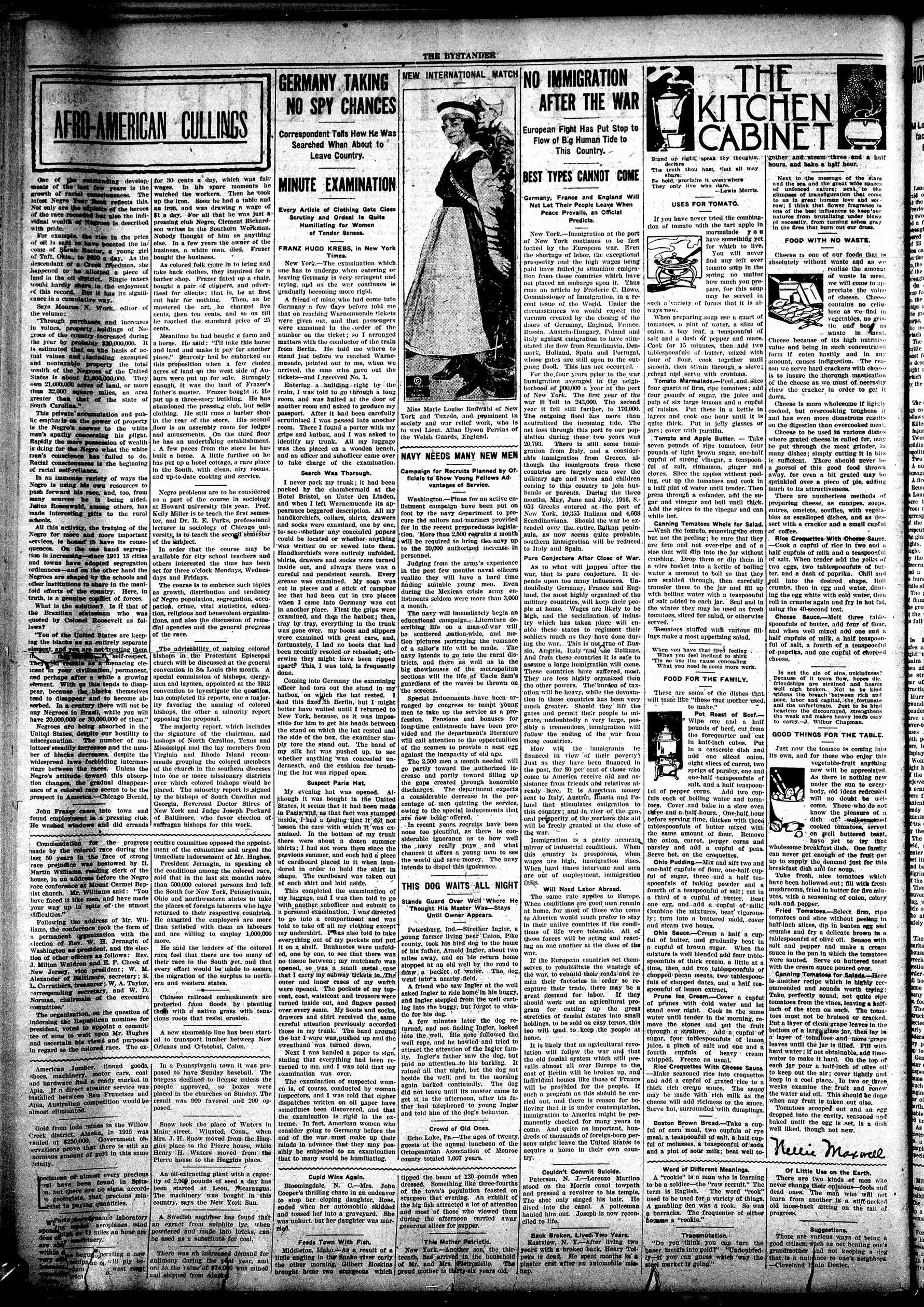
Miss Marte Louise Rodwald of New York and Tuxedo, and prominent in society and war relief work, who is the founder of Perkins of the Welsh Guards, England.
NAVY NEEDS MANY NEW MEN
Campaign for Recruits Planned by Officials to Show Young Fellows Advantages of Service.
Washington.—Plans for an active enlistment campaign have been put on foot by the navy department to procure the sailors and marines provided for in the recent preprepared legislation. More than 2,500 recruits a month will be required to bring the navy up to the 20,000 authorized increase. in personnel.
Judging from the army's experience in the past few months naval officers realize they will have a hard time finding suitable young men. Even during the Mexican crisis army enlistments seldom were more than 3,000 a month.
The navy will immediately begin an educational campaign. Literature describing life on a man-of-war will be scattered on-mobile, and motion pictures portraying the romance of a sailor's life will be made. The navy intends to go into the rural districts, and there as well as in the big showhouses of the metropolitan sections will the life of Uncle Sam's guardians of the waves be thrown on the screens.
Special inducements have been arranged by congress to tempt young men to take up the service as a profession. Large businesses for some enlistments have been provided and the department's literature will call attention to the opportunities of the seamen to provide a nest egg against the insecurity of old age.
The 2,500 men a month needed will go partly toward the authorized increase and partly toward filling up the gape created through honorable discharges. The department expects a considerable decrease in the percentage of men quitting the service, owing to the special inducements that are now being offered. In recent years, recruits have been none too plentiful, as there is considerable ignorance as to how well the navy really pays and what chances it offers a young man to see the world and save money. The navy intends to dispel this ignorance.
THIS DOG WAITS ALL NIGHT
Stands Guard Over Well Where He Thought His Master Was—Stays Until Owner Appears.
Petersburg, Ind.—Strother Ingler, a young farmer living near "Jupiter, Pike county, took his bird dog to the home of his father, Arnold Ingler, about two miles away, and on his return home stopped at an old well by the road to draw a bucket of water. The dog went into a nearby barn. Ingler at the well asked Ingler to ride home in his buggy, and Ingler stepped from the well curbing into the buggy, but forgot to whistle for his dog.
A few minutes later the dog returned, and not finding Ingler, looked into the well. His nose followed the well rope, and he howled and tried to attract the attention of the Ingler family. Ingler's father saw the dog, but paid no attention to his barking. It rained all that night, but the dog sat beside the well, and in the morning again barked continually. The dog did not leave until its master came to get it in the afternoon, after his father had telephoned to young Ingler and told him of the dog's behavior.
Crowd of Old Ones
Echo Lake, Pa.—The ages of twenty guests at the aquain luncheon of the Octogenarian Association of Monroe county totaled 1,007 years.
tipped the beam at 120 pounds when dressed. Something like three-fourths of the town's population feasted on sturgeon that evening. An exhibit of the big fish attracted a lot of attention and most of those who viewed them during the afternoon carried away generous slices for supper.
This Mother Patriotic.
New York.—Another son, the thirteenth, has arrived in the household of Mr. and Mrs. Petrosello. The proud mother is thirty-six years old.
European Fight Has Put Stop to Flow of Big Human Tide to This Country.
BEST TYPES CANNOT COME
Germany, France and England Will Not Let Their People Leave When Peace Prevails, an Official Predict.
New York.—Immigration at the port of New York continues to be fast locked by the European war. Even the shortage of labor, the exceptional prosperity and the high wages being paid have failed to stimulate emigration from those countries which have not placed an enbargo upon it. It thus runs an article by Frederic C. Howe, Commissioner of Immigration, in a recent issue of the World. Under the circumstances we would expect the government created a closing of the doors of Germany, England, France, Russia, Austria-Hungary, Poland and Italy against emigration to have stimulated the flow from Scandinavia, Denmark, Holland, Spain and Portugal, whose gates are still open to the outgoing food. This has not occurred.
For the four years prior to the war, immigration averaged in the neighborhood of 400,000 a year at the port of New York. The first year of the war it Well to 243,000. The second year it fell still further, to 170,000. The outgoing flood has more than neutralized the incoming tide. The net loss through this port to our population during these two years was 20,783. There is still some immigration from Italy, and a considerable immigration from Greece, although the immigrants from these countries are largely men over the military age and wives and children coming to this country to join husbands or parents. During the three months, May, June and July, 1916, 8,053 Greeks entered at the port of New York, 10,555 Italians and 4,003 Scandinavians. Should the war be extended over the entire, Italian peninsula, as now seems quite probable, southern immigration will be reduced to Italy and Spain.
Pure Conjecture After Close of War.
As to what will happen after the war, that is pure conjecture. It depends upon too many influences. Undoubtedly Germany, France and England, the most highly organized of the military countries, will keep their people at home. Wages are likely to be high, and the socialization of industry which has taken place will enable these states to regiment their soldiers much as they have done during the war. This is not true of Russia, Angria, Italy and the Baltics. And from these countries it is safe to assume a large immigration will come. These countries have suffered, most. They are less highly organized than the other powers. The burden of taxation will be heavy, while the devastation in these countries has been very much greater. Should they lift the gates and permit their people to migrate, undoubtedly a very large, possibly a tremendous, immigration will follow the ending of the war from these countries.
C
How will the immigrants be financed in view of their poverty? Just as they have been financed in the past, for 80 per cent of those who come to America receive aid and assistance from friends and relatives already there. It is American money sent to Italy, Austria, Russia and Poland that stimulates emigration to this country; and in view of the general prosperity of the workers this aid will be freely granted at the close of the war.
Immigration is a pretty accurate mirror of industrial conditions. When this country is prosperous, when wages are high, immigration rises. When hard times intervene and men are out of employment, immigration fails.
Will Need Labor Abroad.
The same rule applies to Europe. When conditions are good men remain at home, for most of those who come to America would much prefer to stay in their native countries if the conditions of life were tolerable. All of these forces will be acting and reacting on one another at the close of the war. If the European countries set themselves to rehabilitate the wastage of the war, to rebuild their roads and reman their facilities in order to capture their trade, there may be a great demand for labor. If they should work out an agricultural program for cutting up the great stretches of feudal estates into small holdings, to be sold on easy terms, this too will tend to. keep the people at home.
It is likely that an agricultural revolution will follow the war and that the old oakal system which still prevails almost all over Europe to the east of Berlin will be broken up, and individual homes like those of France will be provided for the people. If such a program is implemented, there is reason for believing that it is under contemplation, immigration to America might be permanently checked for many years to come. And quite as important, hundreds of thousands of foreign-born persons might leave the United States to acquire a home in their own country.
Couldn't Commit Suicide
Paterson, N. J.-Lorenzo Martino
stood on the Morris cannail towpath
and pressed a revolver to his temple.
The shot: only singed his hair. He
dived into the cannel. A policeman
hauled him out. Joseph is now recon-
cled to life.
Back Broken, Lived: Two Years.
Eastview, N. Y.-After living two
years with a broken back, Henry Tolpete is dead. He spent months in a plaster cast after an automobile mis-
hip.
茶
THE KITCHEN CABINET
S
gather and steam three and a half
hours, and bake a half hour.
Stand up right, speak thy thoughts,
The truth thou hast, that all may
Next to: the message of the stars and the sea and the great wide spaces of unfenced nature; next to: the sea and the great wide spaces to us in great human love and sorrow; I think that flower fragrance is one of the best influences to keep our hearts warm and bright in the face of necessity, from turning ash gray in the fires that burn out our dres.
Be bold, proclaim it everywhere
They only live who dare.
If you have never tried the combination of tomato with the tart apple in marmalade you have something yet for which to live. You will never find any left over tomato soup in the spring no matter how much you prepare, for this soup may be served in
C
FOOD WITH NO WASTE.
Cheese is one of our foods that is absolutely without waste and as we
realize the amount of waste in meat, we will come to appreciate the value of cheese. Cheese contains no cellulose as we find in vegetables, no griege and bone as waste in meat.
Baking Supplies
such a variety of forms that it is always new. When preparing soap use a quart of tomatoes, a plint of water, a slice of onion, a bay leaf, a teaspoonful of salt and a dash of pepper and mace. Cook for 15 minutes, then add two tablespoons of butter, mixed with milk, and cook until smooth, then strain through a sieve; reheat and serve with creme.
Cheese because of its high nutritive value and being in such concentrated form if eaten hastily and in any amount, causes indigestion. The reason we serve hard crackers with cheese is to insure the thorough mastication of the cheese and to must of necessity chew the cracker in order to get it down.
Tomato Marmalade—Peel, and slice four quarts of firm, ripe tomatoes; add four pounds of sugar, the juice and pulp of six large lemons and a cupful of raisins. Put these in a kettle in layers and cook one hour until it is quite thick. Put in jelly glasses or jars; cover with paraffin.
Cheese is more wholesome if lightly cooked, but overcooking tongues it and has even more disastrous results on the digestion than overcooked meat. Cheese to be used in various dishes where grated cheese is called for, may be put through the meat grinder, in many dishes; simply cutting it in bits and then baking it in the oven is a pares of this good food thrown away, for even a bit grated may be sprinkled over a piece of pie, adding much to its attractiveness.
Tomato and Apple Butter. — Take seven pounds of ripe tomatoes, four pounds of light brown sugar, one-half cupful of strong vinegar, a teaspoonful of salt, clammon, ginger and cloves. Slice the apples without peeling, cut up the tomatoes and cook in a half pint of water until tender. Then press through a colander, add the sugar and vinegar and boil until thick. Add the spices to the vinegar and can while hot.
There are numberless methods of preparing cheese, as canapes, soups, entrees, omelets, souffles, with vegetables as escalloped dishes, and as dessert with a cracker and a small cupful of coffee.
Canning Tomatoes Whole for Salad.
—Wash the tomato, removing the stem but not the peeling; be sure that they are firm and not over-ripe and of a size that will slip into the jar without crushing. Drop them or dip them in a wire basket into a kettle of boiling water a moment to boil so that they are scalded through, then carefully clean the jar and fill up with boiling water in the jar and pass salt of added to each jar. Scout out the winter they may be used as fresh tomatoes, sliced for salad, or otherwise served.
Rice Croustetes With Cheese Sauce.
—Cook a cupful of milk in two and a half cupfuls of milk and a teaspoonful of salt. When tender add the yolks of two eggs, two tablespoonfuls of butter, and a dash of paprika. Chili and roll into the desired shape. Roll crumbs, then in egg and water, diluting the egg white with cold water, then roll in crumbs again and fry in hot fat, using the 40-second test.
Cheese Sauce—Melt three tablespoonfuls of butter, and four of flour, and when well mixed add one and a half cupfuls of milk, a half teaspoonful of salt, a fourth of a teaspoonful of paprika, and one cupful of chopped cheese.
Tomatoes stuffed with various fillings make a most appetizing salad.
When you have that tired feeling.
When you feel inclined to shirk.
What you need is more work.
What you need is some more work.
Is not the sin of sin, unkindness? Because of it tears flow, hopes die, friendships are strained and heartlesse widens the breach between rich and poor, labor and capital, the fortune and the fortunate. Just to be kind heartens the discourased, strengthens the heart, makes it easy to carry, J. Wilbur Chapman.
FOOD FOR THE FAMILY.
These are some of the dishes that will taste like "those that mother used to make."
Pot Roast of Beef.
Wipe one and a half pounds of beef, cut from the forequarter and cut in half-inch cubes. Put in a casserole dish and add one sliced onion, eight slices of carrot, two sprigs of parsley, one and one-half teaspoonfuls of salt, and a half teaspoon.
GOOD THINGS FOR THE TABLE.
Just now the tomato is coming into its own, and for those who enjoy this
vegetable-fruit anything
new will be appreciated.
As there is nothing new
under the sun to everybody,
old ideas redressed
will no doubt be welcome.
Those who do not know
the pleasure of a dish of "well-seeded
cooked tomatoes, served
on well buttered teas,
have yet to try that.
NUTS
cuts of pepper corn. Add two cupfuls of each boiling water and tomatoes. Cover and bake in a slow oven three and a half hours. One half hour before serving time, thicken with three tablespoonfuls of butter mixed with the same amount of flour. Remove the onion, carrot, pepper corn and parsley and add a cupful of peas. Serve hot, on the croquettes.
wholesome breakfast dish. One family can never get enough of the fruit put up to supply the demand just for this breakfast dish and for soup.
Ohio Pudding—Mix and sift two and one-half cupfuls of flour, one-half cupful of sugar, three and a half teaspoonful of baking powder and a fourth of a teaspoonful of salt; cut in a third of a cupful of butter. Beet one egg, and add a cupful of milk. Combine the mixtures, beat vigorously; turn into a buttered mold, cover and steam two hours.
Take fresh, nice tomatoes which have been hollowed out; fill with fresh mushrooms, fried in butter for five minutes, with a seasoning of onion, celery salt and pepper.
Fried Tomatoes.—Select firm, ripe tomatoes and slice without peeling in half-inch slices, dip in beaten egg and crumbs and fry a delicate brown in a tablespoonful of olive oil. Season with salt and pepper and make a cream sauce in the pan in which the tomatoes were sauté. Serve on buttered toasts with the cream sauce poured over.
Oil Sauce—Cream a half a cupful of butter, and gradually beat in a cupful of brown sugar. When the mixture is well blended add four table-spoonsfuls of thick cream, a little at a time, and add four table-spoonsfuls of chopped pheasant meat, or tablespoonfuls of chopped dates, and a half teaspoonful of lemon extract.
Canning Tomatoes for Salads. Here is another recipe which is highly recommended and sounds worth trying: Take, perfectly sound, not quite ripe tomatoes from the vines, leaving a half-inch of the stem on each. The tomatoes must not be bruised or cracked. Put a layer of clean grape leaves in the bottom of a large jar, then lay it in layer of tomatoes and more grape leaves until the jar is filled. Fill with water; if it is unavailable, add line-water to make it hard. The top of each jar扮 a half-inch of to keep out the air; cover tightly and keep in a cool place. In two or three weeks examine the fruit and renew the water and oil. This should be done when any fruit is taken out also.
Prune Ice. Cream—Cover a cupful of prunes with cold water and let stand over night. Cook in the same water until tender in the morning, remove the stones and put the fruit through a strainer. Add a cupful of sugar, four tablespoonfuls of lemon juice, a pinch of salt and one and a half cups of heavy cream whipped. Freeze as usual. **Rice Creamettes with Cheese Sauce.** Make seasoned rice into crepes and add a cupful of grated rice to a thick rich cream sauce. The sauce may be made with rich milk as the cheese will add richness to the sauce. Serve hot, surrounded with dumplings.
Tomatoes scooped out and an egg dropped into the cavity, seasoned and baked until the egg is set, is a dish well liked, though not new.
Boston Brown Bread—Take a cupful of corn meal, two cupfuls of rye meal, a teaspoonful of salt, a half cupful of molasses, a teaspoonful of soda and a pint of sour milk; beat well to
Nellie Maxwell
Word of Different Meanings
Of Little Use on the Earth.
There are two kinds of men who never change their opinions—fools and dead ones. The man who will not learn from another is a stiff-necked old moss-back sitting on the tail of progress.
A "rookie" is a man who is learning to be a soldier—the "raw recruit." The term is English. The word "rook" used to be used for a variety of things. A gambling den was a rook. So was a barrack. The frequenter of either became a "rookie."
Suggestions.
There are various ways of being a good citizen, such as not bouting one's grandmother and not keeping a dog that is a nuisance to one's neighbors.
-Cleveland Hain Dealer.
"Do you think you can turn the baser meat into gold?" "Undoubtedly—if you can guess watch way the stock market is going."
NOW THE BRITISH BROUGHT DOWN TWO MIGHTY ZEPPELIN RAIDERS
London Turned Out in Its Night Clothes to Watch Thrilling Specacle of Battle Between Great Airships From Germany and Flock of Defending Aeroplanes and Land Guns—People Showed No Fright, and Millions Cheered When One Invader Shot to Earth, a Mass of Flames.
London.—The most formidable air of history apparently, has been at the same time the greatest failure, serious rulers on England carried out by two or even one allyship have exacted a far more severe toll of life and brought tremendous damage as compared with what was done by the fleet of 13 Zeppelins which came to London early one morning recently, while, on the other hand, for the second time in the history, of the present war two of the mighty Zeppelins were actually brought down and one was destroyed. On one other occasion a Zeppelin was forced to come down and was lost in the Thames. This time the airships are not met in the British through the good work of the British Flying after what was beyond a doubt the most thrilling battle in the air which has ever occurred.
The real story of the raid and the battle in the air cannot be told, at the present, and all attempts to describe what happened during the night must be limited to the accounts which are sanctioned for publication by the official press bureau.
What the Airships Did.
The sum total of casualties and damage caused by the 13 Zeppellins is as follows:
Killed—Thirty persons.
Injured—About 100 persons.
Twenty-five houses and some outbuildings slightly damaged in the Metropolitan police area.
Two water mains cut.
A number of cottages, and a church damaged in other areas.
A fire at some gas works.
Remarkable scenes were witnessed a London while the antiaircraft guns were blazing away at the raiders, from the roof of the Savoy hotel, the correspondent obtained a perfect view of the airships brought down. They presented a wonderful sight, caught in the glare of more than a dozen searchlights, illuminating them from every angle. The light flashed as a signal by the victorious airman was plainly becomel above the destroyed raider and a minute later flames were seen to burst forth from the huge airship, shells were bursting all around it.
The giant machine, now only a mass of flames, fell rapidly, meteorlike, to the ground, but so great was its height the time when it met its doom that it fall seemed slow.
Throngs on Streets.
In London theaters, restaurants, cafes and bars close promptly at night under the new Defense of the realm regulations, but although it was seen after two o'clock in the morning the streets were packed and a wild car of cheers hailed the fall and destruction of the unwelcome raider. Hurrying from the roof to the ground floor of the hotel, the correspondent, although having already seen air raids on London, witnessed ever-to-be-forgotten scenes. Staircases and corridors were thronged with people aroused from their slumers, but few indeed were those who displayed the slightest sign of fear. Women, who shortly before midnight had been dancing in the ballroom of the Savoy, elaborately gowned and elewed, were camping on the stairs of scanty night attire. Of men there were few to be seen. In private cars, excursions or even afoot they had already started for the spot where the mains of the Zeppelin and the bodies of crew were then being consumed by the flames.
The little suburb of Cuffey, near Enfield, about eighteen miles from the center of London, where the Zeppelin set its fate, jumped into sudden faince and became the scene of a continuous disfigurement of sightseers from all parts of the metropolis. Those who expected to carry off a bomb would event, however trifling, were disappointed, for every particle of the wreckage that had escaped the attention of early collectors had easily passed into official custody.
Flock to the Scene.
The scenes at Cuffley were of a remarkable character. Hundreds of thousands of persons locked to see the creaked raider, and such was the connection on the local railway that an order had eventually to be issued that all bookings must cease. When night time hundreds were stranded and many made the return journey partly a foot. The superintendent of aircraft construction and other high officers connected with the flying services were early upon the scene and spent a considerable time inspecting the machinery parts of the Zappellin which had to then been recovered. Sir Sig. Hamug, Canadian minister of militia, was among the first to inspect the wreckage. The airship to earth with such force that such the machinery, including the engines, can be weighted a quarer of a ton, was deeply buried in the earth. The work of digging these valuable parts of the debris out proceeded until dusk.
As each piece of machinery was recovered it was carefully inspected and a large number of cases photographed from different angles by a special staff of official photographers.
Sent Woman Cigars.
Milwaukee—Former Federal Judge Jenkins still has an office in the federal adding, and goes up there frequently. The other day he carefully wrapped up a book, intending to send it to a woman in Maine, but did not address.
Forgetting that it was not addressed, laid it on the table in the court messenger's room, thinking that "John" a messenger, would mail it for him in the meantime, a package of clips owned for Judge Jenkins, and the
After it was carefully placed in one of the motor forks for removal. **Test**
Building Bodies.
A special constrain has a brilling
account of the tragedy.
"When I reached the spot," he said, "the Zeppelin—a mungled mass of ruins—was a scathing furnace, with tongues of bissing flames licking the framework, and reducing it to molten metal. So fierce was the heat that it was at first impossible to approach to close quarters. Pulls of water had to be fetched from a pond in a field some distance away to cool the remains, and the work of extracting the bodies was proceeded with. That of the commander of the Zeppelin was first discovered. His left hand was still resting on the steering wheel but his right hand had been torn away. "Close by, the charred remains of six other members of the crew were with difficulty extricated from the wreck entanglement to which the skeleton of the fabric had been reduced, and were taken to the outhouse of a neighboring inn. Upon the hand of one was found a diamond ring. "Four engines were taken from the crumpled airship, together with a clock, which survived intact, the hands stopping at ten minutes past three."
Saw the Raiders.
The arrival of the German raiders over the suburbs of London is related as follows by one who saw the destruction of the airship from one of the heights of Cuffley, where the raider came to grief.
"Some time after midnight the silence was bitten into by the deep boom of guns. Occasionally the maze of noise was pierced by gun finishes. The boom of the guns found an answering echo along the hills and valleys in the distance. For a time nothing could be heard, but the unwavered sound Gradually our ears caught the sound of a dull drooning noise overhead. It came nearer, getting louder and louder, until it resembled the roar of a fast traveling train.
"I swept the skies with my glasses. The outline of an airship was faintly discernible crossing out of the mist from east to west. It hovered about for a while as though the crew were trying to find their bearings. Suddenly it began to bear north. It swerved shortly and moved rapidly westward again, turning later and making straight for the south at a high speed. "Once more it turned east until it came astride the main road to — when it bore steadily along parallel with the road.
Searchlights Shine Out.
"Meanwhile searchlights were played east, west, north and south of the road, their range stretching far out like the tentacles of an octopus. So far the ruler had managed to evade the light. Now, however, one ray fell full across its path. It lighted the alirship up beautifully, making it look like a monster silver-scaled fish. Other rays were concentrated and began to play on the monster. The sky was now one blaze of revealing light in the vicinity.
"In vain did the Zeppelin move about, hither and thither, seeking a way of escape. Everywhere the rider was pursued by those fatal rays. The gun began to play around the alirship. Shells burst all around. Some got very close. The alirship made a quick maneuver as though to escape northward. The pitiless searchlight followed and the raider was caught between two powerful rays and lined against a dark bank of clouds.
"That was the beginning of the end. There was a gun flash, followed by a roar. The raider was struck. Through my glasses I could plainly see it reel and rock under the hit. Then it began to descend earthward, very slowly. It could not now escape the rain of missiles. After the next hit the rear part of the Zeppelin broke into flames. The ship then foundered about in the air as though its crew had lost control of it. It was now one mass of flame, looking like a blazing house suspended in midair. There was no question of escape. Its descent quickened, and finally it crashed to earth less than a mile from the height on which we had watched.
Crow in Midst of Flames.
"As it approached the ground the figures of the crew could be seen wreathed by flames. Two of them either fell or jumped from the albatross when it was about two hundred feet above the ground. While the blazing raider was suspended helpless in the air three loud explosions were heard in rapid succession. It was after the last of these that the final earthward plunge was made. "The fight was watched by crowds on the hillsides for miles around. As the monster took her final plunge, round after round of cheers blended with the boom of the guns."
An occupant of one of the very few houses situated in the district where the Zeppelin fell says: "Suddenly the Zeppelin assumed a perfectly perpendicular position, and a tremendous flame burst from her, traveling from the bottom to the top. It was for all the world like applying
messenger arrived as well. He took the box of cigars into the judge, whereupon the judge, thinking it was the book package, addressed it to Maline and it was sent off.
Later the box of cigars was returned from Maline.
Another Trick of Fate.
Bochester, N. Y.—John Whittaker, who returned recently unharmed after a year's service in the trenchies in France, unfurled concussion of the brain in a football game here recently.
a match to a new incandescent gas burner. She slid down toward the ground, and it all happened in about fifteen seconds.
"I made for the spot where she fell, and found her a huge heap of broken metal. There was smoldering in some area. Shortly afterward the fire beige arrived on the scene and the hose was played on her for some time."
Sees Zeppelin Fall.
"I saw a Zeppelin completely focused by several powerful searchlights. It appeared to be at a great height, but it seemed that it must be hit at any moment, so splendid was the marksmanship of our gunners. Presently the Zeppelin disappeared in the low-lying clouds, and while the searchlights continued to play on the spot where the Zeppelin had been focussed a glow spread over the sky and gradually extended and increased in its intensity until the whole heavens were illuminated.
In the center of this magnificent glow was a huge flame, which soon became larger and larger. It was quickly apparent that Zeppelin could well call the airship fitted at an angle of some 80 degrees, and in a few seconds the confugation extended the full length of the airship. Almost as suddenly the huge blaze subsided into a dull red glow, and the spectacle was at an end."
Yet another spectator saw it thus: "The air was full of the reports of anti-aircraft guns and falling bombs. Suddenly a great blaze of light appeared in the sky at an altitude of many thousands of feet. A great column of flame shot up, and a great cloud of smoke could be seen rolling above the fire. The flames shot up hundreds of feet.
"As the raider slowly fell to the earth its appearance suggested a huge fiery parachute. The blazing mass gathered speed as it fell while the gondolls continued contracted. By the time the airship was within a thousand feet of the ground all the gas had apparently left the bag, and only the solid framework and the gondolls containing the wrecked engines and the scorched and lifeless bodies of the crew reached the ground."
Centered in Light Ball.
Another watcher on a hill north of London thus describes the plight of the Zeppelin before it was hit: "When the guns opened fire the Zeppelin had already been centered in the ball of light created by the myriad arms of light lights which shot up suddenly from the darkness of the city. The Zeppelin was at a great height—so great, indeed, that it seemed just like a bar of polished steel, about the thickness of an engine piston rod, and there it remained, apparently motionless and undedded—which way to go, while the guns peppered it without cessation. "Shells burst around it, in front and behind it, above and below it. It made to turn as if it in the direction of the coast, but a shell burst immerse near its nose and caused it to swing its tail and it made to ascend still higher, when a shell burst directly over it. Another descent was necessary, and three shells burst simultaneously below it.
Behind it and in front of it two shells burst at the same time. The Zeppelin wriggled like some leviathan in the colls. It seemed impossible for it to go north, south, east or west, and there it stood for a second or two, helpless to move, with the shells bursting all around it."
Aeroplanes in Pursuit.
One who witnessed the end from a country lane on the northern outskirts of London at a distance of eight or nine miles heard the Zeppelin pass over first and then aeroplanes in pursuit. He said:
"If there was no explosion from bombs the lack of noise from this source was made up by the whir of aeroplanes in pursuit. They took up the chase through the white fog. The Zeppelin flew off and darkness once more reigned.
"The country became as light as day and a glow of red illuminated everything. For a few moments the flame was so intense that it was easy to read the print of newspapers, and the objects in the thick fog were magnified two or three times their usual size. It was a fantastic scene. "A four followed and darkness again fell. A moment later the whole scene was again enacted and then the countryside was once more swallowed up in darkness."
A flying officer said the destroyed Zeppelin appeared to him to be larger and longer than the usual type although he was not in a position to say that it was a super Zeppelin. The second Zeppelin, slightly damaged, came down near the const. the crew's plane. The crew has been removed to an east coast arsenal. Reports given out by the official press bureau stated that 80 persons had been killed during the raid and about 100 injured. The property damage amounted to about $1,000,000.
Hunting Crows: Hurt Himself.
Middletown, N. Y.-George Neill, a farmer of Jeffersonville, took his gun and went out to shoot crowds which were raiding his cornfield. As he was about to raise his gun to fire at a crow the weapon was discharged, sending the charge into his foot and shooting off one of his toes, besides badly injuring his foot. The farmer then harnessed his team and drove several miles to have a surgeon dress the wound.
Auto Horn Alive.
Trenton, N. J. — James B. Brees has trained his prize Dalmatian' dog to act as an auto horn. The dog sits on the front seat of the machine, and whenever his master nudges, the dog burks furiously.
Should Study Chemistry.
New York — To help his rhinocerosian Samuel Yacovite put calcium carbide in his bath water, he lighted a flame that followed what every window, in the house and senile, sent to the hospital.
THE BYSTANDER
Chief Part of its Construction is a Platform Supported by Wheels, Running on a Curved Track —Cost of Building Not Great.
The problem of building a garage that is accessible to one driving a motor even though it opens on an alley so narrow that a car cannot back out of the structure, has been solved by designing a door at the side instead of the garage. The hinged edge of the door is farthest from the alley. Projecting from, and fastened to, the inner side of the door near its free edge is a platform that lies close to the ground and is supported
This Side Door, to Which a Low Plat form Supported by Wheels Is Attached, Makes a Garage Facing on a Narrow Alley Easily Accessible.
This Side Door, to Which a Low Platform Supported by Wheels is Attached, Makes a Garage Facing on a Narrow Alley Easily Accessible.
by wheels that run on a curved truck embedded in the ground. To put up a car, it is driven through the open door until its bind wheels rest on the platform. The door is then swung around, carrying the rear of the car with it. By reversing the procedure the car can be backed into the alley easily. The cost of constructing this door is not great.—Popular Mechanics Magazine.
WHERE THE POWER SHOWS
Heavy Trucks That Are So Much Used for Commercial Purposes Effect Imense Saving.
Nowhere is the automobile vehicle displayed in a higher degree of efficiency than in the big power-driven coal trucks and the wagons for the conveyance of building materials, now so common. The big coal truck carries four, six, ten times the load of the old-time one-horse coal cart, and goes and comes four times as fast, and it's just the same with the brick and sand wagons.
Here was a big wagon loaded with brick coming up the street at a good smart clip to swing out in, front of a building under construction, and there, with ample power, to back up to just where they wanted the brick dumped.
There the driver starts the automatic tilting mechanism, and in a minute he has dumped his big load and is off for another, with that tilted wagon body setting down into position again as he disappears down the street; really an engaging illustration of the big power-driven wagon as it is seen in action.
Sand Sprava Prevent Skidding
Sand Sprays Prevent Skidding.
A sandbox for motor trucks and automobiles, operated in a manner similar to the sandbox of locomotives, but which spreads the sand sideways to prevent skidding, is one of the latest inventions. On either side of the car, below the running board, are sandboxes connected by piping with a compressed air cylinder situated at the back of the car under the seat. Air is compressed by a simple attachment to the drive shaft of the car and the discharge is carried into the rear of the driver's seat. The compressed air forces out the sand, which is thrown against curved screens that depend from the running board immediately in front of the wheels. The screens reflect back the sand, throwing it to each side and thus making a sand track sufficiently wider than the wheels as to make it virtually impossible for these to skid. The invention promises to be cheap enough to come into common use, and ought to be useful on icy surfaces.
Caring for the Car
Realizing that the good appearance of their cars in owners' hands has much to do with popular impression concerning their qualities, a number of manufacturers are supplying cans of body polish as regular equipment. Dealers' instructions and even letters to new owners emphasize the importance of taking proper care of the finish of the car, especially through the consistent use of a preparation that is designed to preserve its luster.
Speeding In Rio de Janiero.
Claim may be made that nowhere in South America do automobiles run so rapidly as in Rio de Janeiro, and in few other cities are they as numerous. The many circular and gradually lengthening boulevards in and about the Brazilian capital prove ideal tracks. There is *speed limit*, but it is rarely observed, and double driveways diminishing the danger of collisions, but of course not entirely preventing them.
New Puncture-Proof Tire Idea.
New Puncture-Proof Tires
One of the newest ideas in puncture-proof auto tires is designed upon the same principle that re-earnced concrete structures are built. A framework is manufactured in tube form from more elastic vegetable fiber. It is then poured in to fill up the plate while hot. It solidifies in cooling and becomes elastic and strong enough to resist short read breaches. It is claimed to be the more durable than the solid rubber tire and also more elastic. The composition of tire treads – through a three secret.
HANDY TIRE REMOVER
HANDY TIRE REMOVER
SIMPLE TOOL DOES WORK WITH
OUT CAUSING DAMAGE.
Would Seem Destined to Have Place
in the Equipment of All Auto-
mobile Drivers.
An automobile-tire tool which is so
designed as not to damage the inner
e tool which is so damage the inner tube when removing a tire, consists of two iron parts: a straight, removable handle, and an irregularly-shaped bar hav
tube wheel removing a tire, consists of two iron parts: a straight, removable handle, and an irregularly-shaped a double curve in the center. From one side of this curve extends a large irregular hook; from the opposite side a small hook. To remove a tire, the wheel is locked up about two inches and with the aid of the handle as a pry, the hook is worked under the tire until it engages the rim. The handle is inserted in its socket at the end of the tool and pressed against the hub. By turning the wheel back and forth the lower end of the tool is made to strike the earth repeatedly, gradually forcing the tire off. To replace the tire it is deflated and partly put on by hand. Then the small hook on the tool is inserted to engage the wheel rim. By turning the wheel back and forth as before, the tire is gradually forced into position.—Popular Mechanics Magazine.
SPEEDWAY RACING A-BORE
Writer Thinks Crowds Are Drawn to Them in the Hope of Seeing a Smashup.
How far wrong was the autist who once remarked that most folk are drawn to automobile speedway races by the hope of seeing someone killed? It is the thrills it generates; the science it calls into play or the pleasure it affords that usually draw crowds to athletic contests. But long-distance speedway racing is the one so-called sport that is almost devoid of sensations; it is a contest where the spirit of contest seems almost totally absent; a spectacle that provokes no real excitement after the first few minutes. It becomes a monotonous thing to watch long before the end has been reached.
And yet year after year thousands of persons attend the speedway races. True the major portion of each race is taken first and last time. It comes to what can be seen—and it never comes back. Its place is taken the next year by another "once-boat-no-more" crowd. But there are "repeaters"; some persons do go back year after year to see the speed demons in their races against time—and against death.
Automobile road racing has its thrills. Dash races on a speedway create some real shivery feelings along the spinal column. Both are real contests where the man element actually enters; where a race is a race. But those 100 or 200 or 300 mile races around a speedway are nothing but processions; little more than tests of motors and tires; a boresome exhibition to an extreme. And yet there are some people who attend all the big speedway events. What draws them there? Was the man right? Is it that the morbid hope of seeing a frightful shmup upshems them through the gates and into the stands?—Exchange.
MAKES EXHAUST GASES WORK
By a Whirling Motion Carbon Par
ticles removed
From the Electrodes
Differing from all other spark plugs, this new device relies on the whirling
motion of the ex-
haust gases to remove carbon par-
ticles from the electrodes as soon
after the electrodes of the electrodes
is shaped like a proeller, l'ya
motion of the exhaust gases to remove carbon particles from the electrodes as soon as formed. One of the electrodes like a propeller, lying horizontal. The other electrode is a round rod in the center of the propeller-disk electrode. The gases are exhausted from the spark-plug recess with such force as to whirl them around and between the two electrodes, carrying all carbon particles with them.-Popular Science Monthly.
Flushing Does Not Remove Scale.
Flushing Does Not Remove Scale. Flushing a radiator and cooling system does not remove the scale and slime left there by the water. Take two pounds of washing soda, dissolve with hot water and pour into radiator through strainer as it dissolves. When this is done run the car three or four hours and then drain cooling system. Do not allow it to cool in radiator. Then fill with fresh water. If the engine has just been overheated, the pump is probably in good condition. This will be shown by heat descending in radiator. If bottom is cool while top is hot the pump has failed.
Hissing Valves
Of course when you hear hissing that comes from escaping compression you naturally think of valve grinding. But it does not always follow. A small piece of grit may become fastened to a valve head surface and press against it to cause a variation in or a variation stem adjustment by vibration may cause the valve to seat imperfectly, and in either case there will be a hissing sound.
Gasoline Economy.
Most drivers of automobiles use more gasoline than their cars need. Instead of cussing the Standard Oil pirates, spend half an hour in ascertaining how little gasoline you can use without loss of fuel. You can do this for himself, as the sellers of cars seem not to know, and assuredly do not care. —Chicago Tribune.
THE FLOWER BOX
Among the Most Satisfactory House Plants for Winter Are Palms and Climbing Vines.
Shouting the Beauty of the Meeting of Myanmar
HOUSE PLANTS IN WINTER
Among the most beautiful and satisfactory house plants for indoor palms. They are strong, hardy, and with the observation of can be kept green and vigorous all winter. More palms are killed by overheating than by cold. They should have a temperature of between 80 and 60 degrees. If it is not convenient to have any room in the house kept as cool at this, stand them in the corner farthest from the radiator, as close as possible to the light, but not in the glaring sun. The worst enemy of the plants is dust. Owing to its smooth leaves, the palm can be readily kept free from this. Its leaves should be washed with a soft sponge and lukewarm water.
The watering of the plants is of great interest. The great danger is that the housewife will be too generous in this respect. It is difficult to give a definite rule. Generally speaking, the earth in the pot should be kept moist, but not wet. If the room is kept at high temperature, the plant will require more water than in a cool place. But winter should be a time of rest for the plant. It should not do much growing, and therefore nourishment and water should be given sparingly. It is easy to soak the soil of a plant, but hard to dry it, once thoroughly wet.
Neither a palm, or any other plant, should ever be put in a glazed pot. If an ornamental pot is desired, the earthen pot should be set inside. A porous pot absorbs and evaporates the moisture, while in a glazed pot the earth grows sour and will not for even very hardy plants. There should be a hole in the bottom of the pot, over which something similar should be laid. This will keep the earth from filling it up, and the surplus water will trickle out beneath. A few lumps of common charcoal at the bottom of the pot will prevent the roots from rotting, and powdered charcoal mixed with the earth has the same effect, keeping the bottom from turning sour.
Having temperature and moisture right, the next enemy of the plant is parasites, such as fungi and insects, many of which are toxic. Some of these are destroyed by washing the leaves with a sponge and soft brush, using clean water only.
Those that cannot be destroyed in this way, such as scales, can be quickly dispatched by tobacco juice diluted with water. Ady tobaccoconst or cigar manufacturer will give you all the ribs of tobacco leaves you want. Put a handful of these in a quart of water and boil. Wash the leaves with this, and if you put in a little whale-oil soap, it will be more effective. Of course, there are many insecticides by forstil, but this is a cheap, simple remedy. It is also very other. Being a vegetable poison, no great care is required in handling or using the tobacco juice, whereas parts green and other mineral poisons should be applied with the greatest precaution, as even a slight overdose will scorch the leaves and thereby run the plant.
CONSIDER THE PALOX
P. L. M. BENNINGTON.*
Ever tells us that there is an clue that kind that leads
to the enjoyment of speculation and chance. For the gratification of this instinct I do not know any more interesting study than the phlox when one resorts to seeds for the growth of plants. Of course, the staid, regular garden worker will resort to cuttings, because no one can guess, even approximately, what will come from the seed venture. But there is a lot of fun in taking the seeds and watching the results. They may be anything, from a perverse and wayward floral child to the light of the garden when it is left to first principles for its start in life.
The phlox Drummondii is the first parent of the family. It was found growing wild in Texas back in 1834, and since that time it has grown in popularity. Essentially a garden flower, it fully justifies the use of the Greek name because it is literally a flame of light. There is no question but that it is far better for having been planted in the fall. At the first hint of spring it will start its growth, and the hard treatment of a rough winter will not serve to deter it in its determination to help brighten the world. The one thing that phlox will not stand is heavy clay soil. Planted along walls and hedges, with borders and in places where, the irregular size of the plants florets cannot be seen there is nothing more called to life to the garden vista than the simple phlox.
JAPANESE GARDENS POPULAR
By ELIZABETH VAN BENTHUYSEN
Another way of saying that one may make a pretty garden with comparatively little to put in it is to call attention to the Japanese idea of a value of space in decorative effect. It is shown in the Japanese garden, which, during this fall, is coming into considerable vogue. Nippon art has long taken the garden as its chief working ground. When travelers, pushing curiously through the door that Commodore Perry kicked open, to the untold benefit of the unwilling natives, first knew the island empire, they called it the Flowery kingdom. On all sides were to be for little garden town dwellers, the sort of Japanese town dwellers. What most gained attention was the fact that these bright spots, giving a colorful effect to the entire communities, were made by smartly placing a very few plants and flowers in artistic vessels, and by relieving the blank spaces with funny figures, carved to represent men or animals.
The wooden frog in the center of the little Japanese plot had all of the space it needed, and the few others scattered about in seemingly careless, but actually very careful, arrangement, managed to fit into the plan to leave the impression of a lot of color where really a handful of flowers gave the effect.
The same idea was to be found in their houses, where one daring, colorful drawing had an entire wall to itself, forcing the unoccupied space to take on a decorative task that would not have been esteemed possible in other lands.
One of the popular figures of the Japanese garden that is being very much used because it so truly represents a real Japanese idea, is the stone lantern, carved in numerous styles, from the roughly chiselled effort of a mere amateur to the most elaborate design of a skilled artisan.
Please Don't Jiggle
the Receiver Hook
It Hurts Your
Telephone Service
When you lift the telephone receiver from the hook, a small electric light signal glows in front of the operator.
While the hook is up the light burns. If you press it down the light goes out. Move the hook up and down SLOWLY and the light flashes.
This little signal on the switchboard is the same as any other electric lamp, a trifle sluggish in lighting up. You can turn the switch on the electric light over your desk or in your home so fast it will not burn. Try it.
When you "jiggle" the telephone hook rapidly the result is the same, the tiny globe will not light up and consequently the operator does not get your signal.
The New and Literary club met at the house of Mrs. Laina Horne Thursday afternoon. Mrs. Mary Horne favored the club with an instrumental solo. After breakfast Mrs. Horne served a two course lunchoon. The club will hold their next meeting with Mrs. L. Thorpe. Mr. Fred Perkins of Rock Island, Ill. visited relatives and friends in the city Tuesday. Mr. Perkins was enroute from Chillicothe, Mo., where he with his wife and Master F. Perkins had been visiting relatives of Mrs. Perkins. Quarterly meeting was held at Bethel A. M. L. church Sunday. Presiding Elder Ferdinand prescheduled b.o.h morning and evening. The evening sermon was excellent. The K. of P. Lodge will give an entertainment Thursday evening in the Moose hall.
Mr. W. A. Brown has moved his family from Houston to the city. They will reside at 1401 S. 2nd street.
Rev W. Bracco filled the pulpit Sunday evening at Mt. Zion Baptis church. Connection to the church Sunday morning was one, in the evening two.
The agent will call on subscriber next week. Please have your money.
Mastin R. Foster, son of Mr. and Mrs. C. R. Foster of Buxton, Iowa, was struck with paralysis on September 5th and died September 30, 1916. Maurice was born in Charlotteville, Va., October 26, 1879, and came to Machakinock, Iowa, with his parents at the age of 3 years, and there received his early schooling. He was married to Cornelia Smith and to this union was born a son and a daughter. In 1904 he became a Mason and later advanced to the 32d degree in that order. He became a member of the Mt. Zion Baptist church at Buxton. For two years previous to his last illness he was engaged in general mercantile business in Buxton. He leaves to mourn his loss a mother and father (who are among the earliest settlers of old Muchakinock), a wife, two children, one brother and a host of relatives and friends.
Mrs. Andrew Smith visited over Sunday in Ottawa.
Mrs. Mary Harris and Edith Harris attended the funeral of Mr. Frederick Parker in Des Moines last week. His many friends in Albia regret to hear of Mr. Parker's death.
Dr. and Mrs. Carter and a few others from Button attended the fall festival or homecoming in Albia one of the three days this week.
Lawyer Geo. H. Woodson and James Spear are attending several weeks' court in Albia.
Mrs. Tilla Putney and daughter, the mother of Hocking were in Albia this week.
Mr. Harry Bates, Mr. and Mrs. Chas. Corthon and Mrs. Maud Stovall of Hitcham spent the week in Albia at the fall festival, also Mr. Bert Jones of Hitcham.
The members of the A. M. E. church gave a social at the church on Monday evening.
Mr. Charley Davis came up from Ottumwa and spent a homecoming day at the parental Monroe Davis home.
Mr. and Mrs. Young, former people who have made business trips to Albia, are in Albia again, Mr. Young at his old trade of auctioneering and Mrs. Young selling articles.
Mrs. Ray Grayson and family of Hocking spent the week of homecoming in Albia.
DR. PALMER'S
SKIN
WHITENER
25c Postpaid
Whitens and Clears
dark and brown skin.
Bleaches sallow or dark
complexion, causing it to grow
whiter. Get the original.
Dr. Palmer's Skin Whitener
Do not accept imitations. Sold by dru-
gists or sent direct postpaid anywhere in the
United States for 25c. Remember the name,
Dr. Palmer's Skin Whitener. Made only by
Jacobs' Pharmacy, Atlanta, Ga.
AGENTS WANTED
WRITE FOR TERMS
If the operator fails to answer in a reasonable length of time on your first call, or if you wish to recall her to get another number, move the receiver hook up and down VERY SLOWLY.
A number from Hiteman, Hocking,
Buxton and surrounding towns were
in Albia at the fall festival.
Rev. Dowden left Wednesday of this
week to go to Sloux City to get his
family.
The Young Ladies' club has appointed
in their club two instructors, Mrs.
Chas Washington and Misa Sadie
Lewis, and assistant, Miss May F.
Davis.
Albia was full of visitors all this
week.
Woman's club and Sewing Circle:
President, Mrs. Robinson, Hocking,
Iowa; vice president, Mrs. Delia
Thomas, Albia; secretary, Mrs. Oscar
Roper, Albia; assistant secretary,
Miss Ada Davis, Albia; treasurer,
Mrs. G. A. Davis, Albia; corresponding
secretary, Mrs. Hattie Bennings.
Young Girls' club: Honorable president, Mrs. Chas. Washington; president, Miss Jewett Lewis; vice president, Miss Finks, Hiteman; secretary, Miss Sadie Lewis; treasurer, Miss Frances Thomas. Members, 14.
We are the largest manu-
cled colored women's hair,
our in store to introduce
our goods we have
free our latest book
styles or colored women
in latest hair dressing
Every colored woman should have one guarantee every article we sell or money refunded. All hair will positively stand combing and washing the we manufacture a STRAIGHTENING COMB of solid brass, with ex-
tensive and most serviceable made, fully guaranteed. With each comb we sell a lamp cup free. With a lamp cup free. Send your order for this straightening comb today.
A FULL LINE of Hair Brushes.
Nets and Toilet Articles is illustrated
and can be bought for less than or-
fore elsewhere.
Subscribe for The Bystander. DR. PA W S
"Once to every man and nation comes the moment to decide,
In the strife of truth with falsehood,
for the good or evil side;
Some great God's new Messiah, offering each the bloom or blight,
Parts the goats upon the left hand and the sheep upon the right,
And the choice goes on forever 'twix that darkness and that light.
Thou the cause of evil proper, yet 'tis truth alone is strong,
And albeit she wander outcast now, I see around her throng
Troops of beautiful, tall angels, to enshield her from all wrong." There is at this time in Iowa a supposed moral crisis pending. The forces of temperance and moral construction claim that it is essential that all good people stand to together for the suppression of the liquor traffic. There may be di-
pending. The forces of temperance and moral construction claim that it is essential that all good people stand together for the suppression of the liquor traffic. There may be divergent views on the question of personal liberty,b ut there can be consistent, logical, constructive, conscious opposition to liquor.
The Negroes of this nor any other community cannot afford to be allied with any force which does not tend for the betterment of conditions and people. Individuals have ever the right to do as they choose, but as a race and as communities we need to stand, in word and in deed for progress and reform. There is no middle ground on these propositions. The double-crosser and the jelly fish must clear out. We need to be more aware of moral lepers and filthy hyenas, who, although they will point with pride to the fact that they do not drink, will for a dollar not only put liquor but other drugs into the hands of the people to debauch themselves and innocent but morally unstable girls and men.
There may be some pathetic excuse for aperson who pleads weakness and self-gratification, but surely there is
no place among the respectable of earth nor the nether regions for a psalm singing dealer in dope and destruction. We must cut away from the men and the tendencies which are downward. Let us when these moral crises come be so intrenched in honor and conviction that the world will know where we stand, and when they count the elect, whether we be present or absent, they will depend upon our being on the right side. It is not a matter of who will win nor of who will lose when we come to take astand; it is and ought ever be a question of who is right.
OMAHA.NER
Mr. Alonzo Smith and Nettie Kellogg were united in marriage Saturday evening, October 1, at 8:30 p. m. at the residence of Mrs. Mamie Harrison. A delightful evening was spent. Among those present were Rev. Wilkerson and wife, Mrs. Henry Biddixe, Mrs. Griffan, Miss Muriel Brown, Miss Musa Tann, Miss Cleota Thompson, Mr. Clarence Kellogee, Mr. and Mrs. Robertson, Mr. and Mrs. Walker, Mrs. Rhoades, Mrs. Love, Mrs. Gregory and brother, Mrs. Smith and son, Mr. and Mrs. Kennedy and son and Mr. Jerry Elliott. Mrs. L. A. Ervine left for Jersey City, N. J., Monday night. Miss Camille Simpson left for Wilberforce college. Wednesday. Mr. and Mrs. Pearl Everhart, Aksar-ben guest of Doris Thornton, left
When in Davenport
Stop At
Mr. & Mrs. Ensy Green
110-114 East 5th Street
First Class Restaurant
and Rooming House
Davenport, Iowa
Iowa Phone 778 Rates $1 per day
Automatic 3952
Tenth Avenue Hotel
1 block from C. & N. W. Ry.
All Rooms are Warm.
Restaurant and Lunch Room
SPECIATIES
Chop Suey Chill Con Carne Yockeme
Oysters in Season
Special attention given to Theatrical People
Barber Shop in connection
F. F JACKSON, PROP.
OPEN DAY
AND NIGHT Clinton, Iowa
When in Hannibal,
Missouri go to
The Holland House Good Rooms and Meals
Mrs. Viney Holland, Prop.
315 Center St. Hannibal, Mo.
Despondency.
When you feel discouraged and despondent do not give up, but take a dose of Chamberlain's Tablets and you are almost certain to fell all right within a day or two. Despondency is very often due to indigestion and biliousness, for which these tablets are especially valuable. Obtainable everywhere.
AGENTS WANTED
For our new book, *Progress and Achievements of the Colored People.* Showing the wonderful doings and new opportunities of our race, low price, many pictures, lightning slick, $10.00 per day, ask for terms, write quick, Austin Jenkins Co. Bk. St. Washington, D. C.
MARIA
Woman's Crowning Glory is Her Hair
Why not grow your hair by using
Mme. M. Beard Hair Grower
It removes dandruff, stops itching of
the scalp and makes it grow long, soft
and beautiful. Price 50c a box.
Send stamp for pamphlet.
MME. M. BEARD
AGENTS WANTED
519 So 16th St. St. Joseph, Mo,
How Catarrh Is Contracted.
Mothers are sometimes so thoughtless as to neglect the colds which their children contract. The inflammation of the mucus membrane, at first acute, becomes chronic and the child has chronic chronic catarrh, a disease that is seldom cured and that may prove a life's burden. Many persons who have this loathsome disease will remember having had frequent colds at the time it was contracted. A little forethought, a bottle of Chamberlain's Cough Remedy indiciously used, and all this trouble might have been avoided. Obtainable everywhere.
Friday for their home in Red Oak, Iowa.
Mr. Eli Paul, who has been visiting his cousin, Miss Muriel Brown, left for St. Paul Tuesday morning.
Miss Muriel Brown and Elizabeth Martin were visiting church and friends in Council Bluffs on Sunday afternoon.
Mr. and Mrs. S. E. Ward, sister and daughter of Council Bluffs were visiting Miss Cleo Thompson.
Mr. Dennison of the white Y. M. C. A. spoke at the Zion Baptist church Sunday evening on the progress of the Negro race.
The ministers exchanged pulpits on Sunday morning. Rev. Botts preached at the A. M. E., Rev. Osborne at Zion Baptist and Rev. Logan at Mount Moriah.
We welcome our stalements from patients
used of the FT. L. Hanger,
Palling Sickness or Conviction by a
free sample of D
Rent-Free food or
PAY EXPRESSAGE.
FREE TRIAL BOTTLE
if you CUT OUT any
More moveable sites
covered of Fitzgerald
Falling Sickness
Falling Sickness
Roots remedy,
PAY EXPRESS
EXPRESSION,
IF YOU CUT OUT
RETURN THIS AD
in a full particul-
part. New York.
Mrs. Emma Rutherford served dinner to a few friends on Wednesday evening, October 4th, her first wedding anniversary. She received numerous pretty and useful articles in cotton.
Mrs. Susan Allen left Thursday for Albia, where she will visit friends. Mrs. E. J. Penney left Monday morning for Mason City to be a guest in the home of her daughter, Mrs. Straton. Sunday was quarterly meeting at Wesley Chapel. Rev. Wheeler filled
SCOTTS
SKIN WHITENER
CREAM
AND
SCOTTS
SKIN WHITENER
SOAP
BEFORE 11 AFTER
PRICE 25¢ EACH
CLEARS THE COMPLEXION AND
KEEPS IT FREE FROM PIMPLES
BLEACHES DARK SKINS.
JAMES S. ROBINSON,
MEMPHIS, TENN.
Fifty Cents the Bottle
Tampa Drug Company
Tampa, Florida, U.S.A.
MAILED ANYWHERE FOR 50¢
Buxton Cafe
135 E. Grand Ave,
oro College Co., 3100 Pine S
Please mention name of
THE NEW THOMAS
A First-Class Modern Home
Rates R
PORO
NEW COUPEZ
CINEMA
CINEMA
CINEMA
Have a
Box of
ORO
Sent by
Ar
3100 Pine Street, Dept Q. St. Louis, Mo.
ention name of this paper when writing.
NEW THOMPSON HOTEL
Modern Hotel European Plan
Rates Reasonable
oro College Co., 3100 Pine Street, Dept Q. St. Louis, Mo.
Please mention name of this paper when writing.
BREWERY
THE NEW THOMPSON HOTEL
HAVE YOU BEAUTIFUL HAIR?
WE are the only Importers and Manufacturers of Real Colored People's Hair. Also Wavy hair.
We absolutely guarantee our hair to stand combing and washing and to retain its color and crimp.
Wigs, Plates, Braids, Transformations and Puffs in stock or to order all shades, none too difficult.
East Strand tanning Combs and Toilet Articles.
For Price List. Mail Orders receive prompt attention.
Table Minc. Baum's Hair Emporium
116 A Between 32nd and 53rd St.
NEW YORK CITY
WE are the only Importers and Manufacturers of Real Colored People's Hair. Also Wavy hair. We absolutely guarantee our hair to stand combing and washing and to retain its color and crimp.
Send two cent stamp for Price List.
The Old Reliable Mmc.
486 8th Avenue
17-82-16
Between
FITS
OSKALGOSA, IOWA.
10 Blocks from Union Depot
Corner of 9th and Park Sts.
HAVE
WE
Also
W
comb
crimp
W
stock
the pulpit all day.
the pulpit an day.
Rev. J. H. Woods, pastor of the
Shorter A. M. E. church, arrived
Friday. He occupied his pulpit Sunday
morning and must say presached a
very interesting and instructive
sermon.
MOBERLY, MO.
Mrs. Fannie Robinson was called to Milwaukee, Wis., by the serious illness of her daughter, Mrs. Georgia Stevens.
Miss Lee Owens is spending a few weeks in St. Louis.
Mrs. Daisy Wells attended the funeral of Mrs. Pauline Franklin in Jacksonville on Friday.
The members of the A. M. E. church regret very much to lose their pastor,
L. E. Hanger
New Reliable Place to Eat
Meals 15c and up
Lunches or Short Orders Served
304 W. Grand Ave.
Des Moines Iowa
Relieves CATARRH of
SANTAL
CAPSULES
MIDY
SANTAL CAPSULES MIDY
BLADDER and all Discharges in 24 HOURS
Each capsule hears the name C.7
MIDY
and all Diseases.
ROBERTS
35 DROPS
A POSITIVE CURE FOR
Echeumaism, Catarrh, Scrofula, Tetter, Syphilis,
Eczema and all Diseases from Impure and
Infected Blood.
A Good Restaurant and Rooming House
Also has a Confectionary and Bar
Shop at Carney.
The Public is Invited,
THE BYSTANDER
BYSTANDER PUBLISHING CO., PUBLISHER
DES MOINES, IOWA
JOHN L. THOMPSON, EDITOR
FR. DAY, OCTOBER 13, 1916
Published every Friday by the Bystander Publishing Company, Des Moines, Iowa. Office in Chemical building, corner Seventh and Mulberry streets. Phone, alnut 899.
Entared at the postoffice as second class matter.
Rev. J. K. Ponder. We wish him much success in his new field of labor.
Mrs. Etta Bolden and Miss Bessie Ball are in Hot Springs, Ark.
Miss Viola Jackson spent Saturday and Sunday with her parents in Columbia.
We are glad to see Mr. D. P. Ty-
mony out again, after quite an illness.
Mrs. W.B. Colman remains the same.
Mrs. Charley Enix of Rock Island
Ill., is visiting Mrs. Katie Dirk.
Miss Mattie Renfo of Jacksonville
is a Moberly shopper.
Miss Pauline Washington is on the
sick list.
Mrs. Clyde Kizer was in Mexico on
Monday visiting his mother.
Mrs. O'Neal Johnson is on the sick
list.
Mrs. Berch Barnes entertained at
whist Wednesday night.
Mrs. Ollie Wright was seriously cur-
by her husband Sunday morning. We
hope for her a speedy recovery.
Mr. and Mrs. James Brown have re-
turned from Chicago, where the
spent their honeymoon.
Dr. J. E. Jack is able to be in his
office again, after a short spell of sick
ness
Mr. W. E. Boone and Mr. Glesner Grant visited the conference in Macon, Mo.
The Calendar club met with Mr Howard Tymony on Wednesday. Al had an enjoyable time. After a two course luncheon was served souvenirs cards were passed. The meeting was joined to meet with Mrs. Francis Atibury.
Mr. Sylvester Cooper has been out foring with his heart considerable since his best friend has been out of the city.
A large number of Moberlyites attended the conference at Macon.
When You Take Cold.
With the average man a cold is serious matter and should not be tried with, as some of the most dangerous diseases start with a common cold Take Chamberlain's Cough Remed and get rid of your cold as quickly as possible. You are not experimenting when you use this remedy, as it has been in use for many years and has an established reputation. It contain no opium or other narcotic. Obtain able everywhere.
GALESBURG ILL.
Mr. and Mrs. D. Garnett entertain at dinner Sunday, October 8, in house of Mrs. Tonslee of Muscatine.
Mr. and Mrs. Burdett and Mr. a Mrs. Murphy of Monmouth motor over and spend Sunday evening with Mr. and Mrs. A. Hawkins.
Mrs. J. Sparks of Palmyra, Mo., a Mrs. P. Harris of Hannibal spent days in the city, the guests of Mr. B. Jackson, en route to St. Paul.
The Thimble Circle was entertain at the home of Mrs. Botts on Friday evening, October 9th.
Mrs. G. Lewis entertained Mrs. Sparks and Mrs. P. Harris at supper Friday, October 6th.
Mr. and Mrs. Barnett and Mr. a Mrs. Roy Anderson motored from Monmouth to McComb and car through Galesburg, en route home. Mr. Barnett's new car.
Mr. F. Coleman entertained Mrs. Sparks and Mrs. P. Harris at dinner Saturday, October 7th.
Mrs. L. McGruder and children
McComb were the guests of Mr. a
Mrs. F. Schoots on Saturday, oct
ber 7th.
Mr. Jordan, traveling salesman in
the Overton Hygienic Co., was in the
city Tuesday. He was the guest of
Mr. Charles Anderson.
Mr. and Mrs. Charles Davis entra-
tained ten couples Thursday eveni
at an autumn party. The well
ranged decorations of ferns, roses and
autumn leaves lend beauty to
the scene. Various games were indulge
in and several selections were give
Deinty refreshments were served. A
a late hour the guests departed, wri-
ng Mr. and Mrs. Davis delightful
terainers.
Mr. and Mrs. S. Mahon of Virginia
have located in the city and purchas-
a a home on Avenue B.
The D. D. C. C. will give a chicke pie supper at the home of Mrs. Jackson on Wednesday, October 18 on W. Berrien street. Mr. J. Turpin of La Grange, Mo. visiting relatives and friends.
Ruth L. Hamblin, infant' child Mr. and Mrs. B. Hamblin, was buried Saturday afternoon from the Kimbis & West undertaking parlors. Buried in Linwood cemetery. Mrs. B. F. Brown of Knoxville was operated on at St. Mary's hospital Friday evening and is reported to be a serious condition. Miss V. Elsworth, who is very was removed to St. Mary's hospital. Those on the sick list are Mrs. A. Allcon, Mrs. McGill, Mr. B. Harmel and Mr. B. Allson.
Chapped skin, whether on the han or face, may be cured in one night applying Chamberlain's Salve. It also unequaled for sore nipples, but and scalds. For sale by all dealers.
When you lift the telephone receiver from the hook, a small electric light signal glows in front of the operator.
While the hook is up the light burns. If you press it down the light goes out. Move the hook up and down SLOWLY and the light flashes.
This little signal on the switchboard is the same as any other electric lamp, a trifle sluggish in lighting up. You can turn the switch on the electric light over your desk or in your home so fast it will not burn. Try it.
When you "jiggle" the telephone hook rapidly the result is the same, the tiny globe will not light up and consequently the operator does not get your signal.
MAPIDS, IOWA.
The Art. and Literary club met at the house of Mrs. Lula Home Thursday afternoon. Mrs. Mary Horne favored the club with an instrumental solo. After bedtime Mrs. Horne served a two-course luncheon. The club will hold their next meeting with Mrs. L. Thorpe.
Mr. Fred Perkins of Rock Island, Ill. visited relatives and friends in the city Tuesday. Mr. Perkins was enroute from Chillicothe, Mo., where he with his wife and Master F. Perkins had been visiting relatives of Mrs. Perkins. Quarterly meeting was held at Bethel A. M. E. church Sunday. Presiding Elder Forbes preached bo.h morning and evening. The evening sermon was excellent.
The K. of P. Lodge will give an entertainment Thursday evening in the Moose hall.
Mr. W. A. Brown has moved his family from Burton to the city. They will reside at 1401 S. 2nd street.
Rev W. Brasco filled the pulpit Sunday evening at Mt. Zion Baptis church. Connection to the church Sunday morning was one, in the evening two
The agent will call on subscribers next week. Please have your money.
Maurice R. Foster, son of Mr. and Mrs. C. R. Foster of Buxton, Iowa, was stricken with paralysis on September 5th and died September 30, 1916. Maurice was born in Charlottesville, Va., October 26, 1879, and came to Machakinock, Iowa, with his parents at the age of 3 years, and there received his early schooling. He was married to Cornelia Smith and to this union was born a son and a daughter. In 1904 he became a Mason and later advanced to the 32d degree in that order. He became a member of the Mt. Zion Baptist church at Buxton. For two years previous to his fast illness he was engaged in general mercantile business in Buxton. He leaves to mourn his loss a mother and father (who are among the earliest settlers of old Muchakinock), a wife, two children, one brother and a host of relatives and friends.
ALBIA NEWS.
Mrs. Andrew Smith visited over Sunday in Ottumwa.
Mrs. Mary Harris and Edith Harris attended the funeral of Mr. Frederick Parker in Des Moines last week. His many friends in Albia regret to hear of Mr. Parker's death.
Dr. and Mrs. Carter and a few others from Buxton attended the fall festival or homecoming in Albia one of the three days this week.
Lawyer Geo H. Woodson and James Spears are attending several weeks' court in Albia.
Mrs. Tilla Putney and daughter, the mother of Hocking were in Albia this week.
Mr. Harris Bates, Mr. and Mrs. Chas. Corthon and Mrs. Maud Stovall of Hiteman spent the week in Albia at the fall festival, also Mr. Bert Jones of Hiteman.
The members of the A. M. E. church gave a social at the church on Monday evening.
Mr. Charley Davis came up from Ottumwa and spent a homecoming day at the parental Monroe Davis home.
Mr. and Mrs. Young, former people who have made business trips to Albia, are in Albia again, Mr. Young at his old trade of auctioneering and Mrs. Young selling articles.
Mrs. Ray Grayson and family of Hocking spent the week of homecoming in Albia.
DR. PALMER'S
SKIN
WHITENER
25c Postpaid
Whitens and Clears
dark and brown skin.
Bleaches sallow or dark
complexion, causing it to grow
whiter. Get the original.
Dr. Palmer's Skin Whitener
Do not accept imitations. Sold by drug-
gists or sent direct postpaid anywhere in the
United States for 25c. Remember the name,
Dr. Palmer's Skin Whitener. Made only by
Jacobs' Pharmacy, Atlanta, Ga.
AGENTS WANTED
WRITE FOR TERMS
If the operator fails to answer in a reasonable length of time on your first call, or if you wish to recall her to get another number, move the receiver hook up and down VERY SLOWLY.
A number from Hiteman, Hocking,
Buxton and surrounding towns were
in Albia at the fall festival.
Rev. Dowden left Wednesday of this
week to go to Sioux City to get his
family.
The Young Ladies' club has appointed
in their club two instructors, Mrs.
Chas Washington and Mish Sadie
Lewis, and assistant, Miss May F.
Davis.
Albia was full of visitors all this
week.
Woman's club and Sewing Circle:
President, Mrs. Robinson, Hocking,
Iowa; vice president, Mrs. Della
Thomas, Albia; secretary, Mrs. Oscar
Roper, Albia; assistant secretary,
Miss Ada Davis, Albia; treasurer,
Mrs. G. A. Davis, Albia; corresponding
secretary, Mrs. Hattie Bennings.
Young Girls' club: Honorable president, Mrs. Chas. Washington; president, Miss Jewett Lewis; vice president, Miss Finks, Hiteman; secretary, Miss Sadie Lewis; treasurer, Miss Frances Thomas. Members, 14.
to Colored Women, Our 1916 Style Book
We are the largest manufacturers of colored women and in order to introduce our goods we are sending free our latest book, showing styles for colored women in the latest hair dressing.
Every colored woman should have the guarantee every article we sell or money refunded. All hair will positively stand counting and watching the suns as you own.
We manufacture a STRAIGHTENING COMB of solid brass, with ex-
tended and most serviceable made, fully
guaranteed. With each comb we sell
the low price of our comb. Send your
order for this straightening comb, today.
Send today our book
AGENTS WANTED
HUMANIA HAIR COMPANY,
181-187 Park Row. New York.
Dept. 61
Subscribe for The Bystander
HEALTH HINTS.
A. J. Booker, M. D.
"Once to every man and nation comes the moment to decide,
In the strife of truth with falsehood.
and the sheep upon the right,
And the choice goes on forever 'twixi
that darkness and that light.
Hast thou chosen, O my people, on
whose party thou shalt stand.
Thou the cause of evil prosper, yet 'tis truth alone is strong,
And albeit she wander outcast now, I see around her throng
Troops of beautiful, tall angels, to enshield her from all wrong." There is at this time in Iowa a supposed moral crisis pending. The forces of temperance and moral construction claim that it is essential that all good people stand to together for the suppression of the liquor traffic. There may be di-
pending. The forces of temperance and moral construction claim that it is essential that all good people stand together for the suppression of the liquor traffic. There may be divergent views on the question of personal liberty, but there can be consistent, logical, constructive, conscious opposition to liquor.
The Negroes of this nor any other community cannot afford to be allied with any force which does not tend for the betterment of conditions and people. Individuals have ever the right to do as they choose, but as a race and as communities we need to stand, in word and in deed for progress and reform. There is no middle ground on these propositions. The double-crosser and the jelly fish must clear out. We need to be more aware of moral lepers and filthy hyenas, who, although they will point with pride to the fact that they do not drink, will for a dollar not only put liquor but other drugs into the hands of the people to debauch themselves and innocent but morally unstable girls and men. There may be some pathetic excuse for aperson who pleads weakness and self-gratification, but surely there is
PALMER'S
SKIN
WHITENER
WY SKIN WHITENER
AND PROTECT. FOR TREATMENT.
Skin Whitener
imitations. Sold by drug-
postpaid anywhere in the
25c. Remember the name,
Whitener. Made only by
pharmacy, Atlanta, Ga.
TS WANTED
E FOR TERMS
Don't Jiggle
Receiver Hook
It Hurts Your
Telephone Service
from the hook, a small
generator.
you press it down the
own SLOWLY and the
no place among the respectable of earth nor the nether regions for a psalm singing dealer in dope and destruction. We must cut away from the men and the tendencies which are downward. Let us when these moral crises come be so intrenched in honor and conviction that the world will know where we stand, and when they count the elect, whether we be present or absent, they will depend upon our being on the right side. It is not a matter of who will win nor of who will lose when we come to take astand; it is and ought ever be a question of who is right.
OMAHA.NEB.
Mr. Alonzo Smith and Nettie Kellogg were united in marriage day evening, October 1, at 8:30 p. m. at the residence of Mrs. Mamie Harrison. A delightful evening was spent. Among those present were Rev. Wilkerson and wife, Mrs. Henry Biddick, Mrs. Griffian, Miss Muriel Brown, Miss Musa Tann, Miss Cleota Thompson, Mr. Clarence Kellogge, Mr. and Mrs. Robertson, Mr. and Mrs. Walker, Mrs. Rhodes, Mrs. Love, Mrs. Gregory and brother, Mrs. Smith and son, Mr. and Mrs. Kennedy and son and Mr. Jerry Elliott. Mrs. L. A. Ervine left for Jersey City, N. J., Monday night.
Miss Camille Simpson left for Wil-
berforce college. Wednesday.
Mr. and Mrs. Pearl Everhart, Ak-sar-ben guest of Doris Thornell, left
When in Davenport
Stop At
Mr. & Mrs. Ensy Green
110-114 East 5th Street
First Class Restaurant
and Rooming House
Davenport, Iowa
Iowa Phone 778 Rates $1 per day
Automatic 3952
Tenth Avenue Hotel
1 block from C. & N. W. Ry.
All Rooms are Warm.
Restaurant and Lunch Room
SPECIATIES
Chop Suey Chill Con Carne Yockeme
Oysters in Season
Special attention given to Theatrical People
Barber Shop in connection
F. F JACKSON, PROP.
OPEN DAY
NIGHT
Clinton, Iowa
When in Hannibal Missouri go to
The Holland House Good Rooms and Meals
Mrs. Viney Holland, Prop.
315 Center St. Hannibal, Mo.
Despondency.
When you feel discouraged and despondent do not give up, but take a dose of Chamberlain's Tablets and you are almost certain to fall all right within a day or two. Despondency is very often due to indigestion and biliousness, for which these tablets are especially valuable. Obtainable everywhere.
AGENTS WANTED
For our new book, *Progress and Achievements of the Colored People*. Showing the wonderful doings and new opportunities of our race, low price, many pictures, lightning sale, $10.00 per day, ask for terms, write quick, Austin Jankins Co., 8th St., Washington, D.C.
[Picture of a woman with long hair, wearing a white dress with a floral design.]
Woman's Crowning Glory is Her Hair
Why not grow your hair by using
Mme. M. Beard Hair Grower
It removes dandruff, stops itching of
the scalp and makes it grow long, soft
and beautiful. Price 50c a box.
Send stamp for pamphlet.
How Catarrh Is Contracted.
Mothers are sometimes so thoughtless as to neglect the colds which their children contract. The inflammation of the mucus membrane, at first acute, becomes chronic and the child has chronic chronic catarrh, a disease that is seldom cured and that may prove a life's burden. Many persons who have this loathsome disease will remember having had frequent colds at the time it was contracted. A little forethought, a bottle of Chamberlain's Cough Remedy judiciously used, and all this trouble might have been avoided. Obtainable everywhere.
Friday for their home in Red Oak, Iowa.
Mr. Eli Paul, who has been visiting his cousin, Miss Muriel Brown, left for St. Paul Tuesday morning.
Miss Muriel Brown and Elizabeth Martin were visiting church and friends in Council Bluffs on Sunday afternoon.
Mr. and Mrs. S. E. Ward, sister and daughter of Council Bluffs were visiting Miss Cleota Thompson.
Mr. Dennison of the white Y. M. C. A. spoke at the Zion Baptist church Sunday evening on the progress of the Negro race.
The ministers exchanged pulpits on Sunday morning. Rev. Botts preached at the A. M. E., Rev. Osborne at Zion Baptist and Rev. Logan at Mount Moriah.
L. E. Hanger
NEW
Elite Restaurant
New Reliable Place to Eat
We have secure state-
ments from patient to
career of Fine Lobster,
Felling Sciences
for Conversions by r
our sample of L.
Mothers, remedy.
PAY EXPRESSAGE.
FREE TRIAL BOTTLE
FOR ALL PURCHASES.
RETURNING AD is
your letter. Noo-
ne a full pretracture.
FITS
We know everyone stares
mostly at the patient in
ward of Fits Epilepsy,
Falling Sickness
or Ovulation in
from a session of
Roft's remedy.
PAY EXPRESSAGE.
FREE BROOKLYN
BUILT OUT CUT OUT
RETURN INS AD in
your letter.
Hundreds of testimonials on the site. Simply
call full particulars.
J. K. HARRY, Ph.D.
Mrs. Emma Rutherford served dinner to a few friends on Wednesday evening, October 4th, her first wedding anniversary. She received numerous pretty and useful articles in cotton.
Mrs. Susan Allen left Thursday for Albia, where she will visit friends. Mrs. E. J. Penney left Monday morning for Mason City to be a guest in the home of her daughter, Mrs. Straton. Sunday was quarterly meeting at Wesley Chapel. Rev. Wheeler filled
ROBERTS
35DROPS
A POSITIVE CURE FOR
SCOTTS
SKIN WHITENER
CREAM
AND
SCOTTS
SKIN WHITENER
SOAP
BEFORE AFTER
PRICE 25¢ EACH
CLEARS THE COMPLEXION AND
KEEPS IT FREE FROM PIMPLES.
BLEACHES DARK SKINS.
JAMES S. ROBINSON,
MEMPHIS, TENN.
Fifty Cents the Bottle
Tampa Drug Company
Tampa, Florida, U.S.A.
MAILED ANYWHERE FOR 50¢
Buxton Cafe
135 E. Grand Ave,
A Good Restaurant and
Rooming House
H. D. WILLIAMS, Proprietor.
(Known as Hustler William,)
DES MOINES, IOWA
Have a
Box of
ORO
Sent by
Ar
3100 Pine Street, Dept Q. St. Louis, Mo.
ention name of this paper when writing.
THOMPSON HOTEL
Modern Hotel European Plan
States Reasonable
oro College Co., 3100 Pine S
Please mention name of
THE NEW THO
A First-Class Modern H
Rates R
oro College Co., 3100 Pine Street, Dept Q. St. Louis, Mo.
Please mention name of this paper when writing.
HIGH LIST
THE NEW THOMPSON HOTEL
WE are the only Importers and Manufacturers of Real Colored People's Hair. Also Wavy Hair.
We absolutely guarantee our hair to stand
combing and washing and to retain its color and
crimp.
Wipe, Plate, Braide, Transformations and Puffs in
stock or to order all shades, keep too difficult.
East Strengthening Combs and Toilet Articles,
or Price List. Multi Orders receive prompt attention.
Table Mnc. Baum's Hair Emporium
18 Between 20th and 29th St.
NEW YORK CITY
Send two-cent stamp for Price List.
The Old Reliable Mine.
486 8th Avenue 11-762-16 Between
OSKALOOSA, IOWA
10 Blocks from Union Depot
Corner of 9th and Park Sts.
HAVE
WE
Also
we
confi
crimp
wr
stock
the pulpit all day.
the pulpit all day.
Rev. J. H. Woods, pastor of the
Shorter A. M. E. church, arrived
Friday. He occupied his pulpit Sunday
morning and must say preached a
very interesting and instructive sermon.
MOBERLY, MO.
Mrs. Fannie Robinson was called to Milwaukee, Wis., by the serious illness of her daughter, Mrs. Georgia Stevens.
Miss Lee Owens is spending a few weeks in St. Louis.
Mrs. Daisy Wells attended the funeral of Mrs. Pauline Franklin in Jacksonville on Friday.
The members of the A. M. E. church regret very much to lose their pastor,
L. E. Hanger
Meals 15c and up
Lunches or Short Orders Served
304 W. Grand Ave.
Relieves CATARRH of
the BLADDER
and all
Discharges in
24HOURS
Each capsule bear the
name of
Beech of
MIDY
MIDY
For all Discharges
THE
BLADDER
and all
Discharges in
24HOURS
the name
Beware of
MIDY
injuries.
Be all 24 hours
in contact.
Cheumatism, Catarrh, Scrofula, Tetler, Syphilis, Eczema and all Diseases from Impure and Infected Blood.
Also has a Confectionary and Bar
bear shop at Carney.
The Public is Invited,
BYSTANDER PUBLISHING CO., PUBLISHER
DES MOINES, IOWA
JOHN L. THOMPSON, EDITOR
FR. DAY, OCTOBER 13, 1916
Published every Friday by the Bystander Publishing Company, Des Moines, Iowa. Office in Chemical building, corner Seventh and Mal berry streets. Phone, alnut 899.
Entered at the postoffice as second class matter.
Rev. J. K. Ponder. We wish him much success in his new field of labor.
Mrs. Etta Bolden and Miss Bessie Ball are in Hot Springs, Ark.
Miss Viola Jackson spent Saturday and Sunday with her parents in Columbia.
We are glad to see Mr. D. P. Trymony out again, after quite an illness. Mrs. W.B. Colman remains the same.
Mrs. Charley Enix of Rock Island, Ill., is visiting Mrs. Katie Dirk.
Miss Mattie Renfro of Jacksonville is a Moberly shopper.
Miss Pauline Washington is on the sick list.
Mrs. Clyde Kizer was in Mexico on Monday visiting his mother.
Mrs. O'Neal Johnson is on the sick list.
Mrs. Berch Barnes entertained at whist Wednesday night.
Mrs. Ollie Wright was seriously cut by her husband Sunday morning. We hope for her a speedy recovery.
Mr. and Mrs. James Brown have returned from Chicago, where the spent their honeymoon.
Dr. J. E. Jackson is able to be in his office again, after a short spell of sickness
Mr. W. E. Boone and Mr. Gleason Grant visited the conference in Macon, Mo.
The Calendar club met with Mr Howard Tymony on Wednesday. A had an enjoyable time. After a two course luncheon was served souvenir cards were passed. The meeting is journed to meet with Mrs. France Atibury.
Mr. Sylvester Cooper has been sufering with his heart considerable since his best friend has been out the city.
A large number of Moberlyites attended the conference at Macon.
When You Take Cold.
With the average man a cold is serious matter and should not be tried with, as some of the most dangerous diseases start with a common cold. Take Chamberlain's Cough Remedy and get rid of your cold as quickly as possible. You are not experimenting when you use this remedy, as it has been in use for many years and has an established reputation. It contains no opium or other narcotic. Obtain able everywhere.
GALESBURG, ILL.
Mr. and Mrs. D. Garnett entertains at dinner Sunday, October 8, in house of Mrs. Tonslee of Muscatine.
Mr. and Mrs. Burdett and Mr. and Mrs. Murphy of Monmouth motor over and spent Sunday evening with Mr. and Mrs. A. Hawkins.
Mrs. J. Sparks of Palmyra, Mo. and Mrs. P. Harris of Hannibal spent days in the city, the guests of Mr. B. Jackson, en route to St. Paul.
The Thimble Circle was entertained at the home of Mrs. Botts on Friday evening, October 9th.
Mrs. G. Lewis entertained Mrs. Sparks and Mrs. P. Harris at supper Friday, October 6th.
Mr. and Mrs. Barnett and Mr. and Mrs. Roy Anderson motored from Monmouth to McComb and car through Galesburg, en route home to Mr. Barnett's new car.
Mr. F. Coleman entertained Mrs. Sparks and Mrs. P. Harris at dinner Saturday, October 7th.
Mrs. L. McGruder and children McComb were the guests of Mr. and Mrs. F. Schoots on Saturday, October 7th.
Mr. Jordan, traveling salesman in the Overton Hygienic Co., was in the city Tuesday. He was the guest at Mr. Charles Anderson.
Mr. and Mrs. Charles Davis entertained ten couples Thursday evening at an autumn party. The well-ranged decorations of ferns, roses and autumn leaves lend beauty to the scene. Various games were indulged in and several selections were given. Deinty refreshments were served. At a late hour the guests departed, writing Mr. and Mrs. Davis delightful tertainers.
Mr. and Mrs. S. Mahon of Virginia have located in the city and purchase a home on Avenue B.
The D. D. C. C. will give a chickie pie supper at the home of Mrs. Jackson on Wednesday, October 18 on W. Berrien street.
Mr. J. Turpin of La Grange, Mo., visiting relatives and friends.
Ruth L. Hamblin, infant' child Mr. and Mrs. B. Hamblin, was bury Saturday afternoon from the Kimber- & West undertaking parlors. Bark was in Linwood cemetery. Mrs. B. F. Brown of Knoxville operated on at St. Mary's hospital Friday evening and is reported to be a serious condition. Miss V. Elsworth, who is very was removed to St. Mary's hospital. Those on the sick list are Mrs. Alcon, Mrs. McGill, Mr. B. Harne and Mr. B. Allison.
Wedding bells will ring again
For Chapped Skin.
Chapped skin, whether on the hand or face, may be cured in one night applying Chamberlain's Salve. It also unequaled for sore nipples, burs and scalds. For sale by all dealers.
225 Central Avenue
Ft. Dodge,
Quick Meals and
Prom Service.