Iowa State Bystander
Friday, October 20, 1916
Des Moines, Iowa
Page text (machine-generated)
ADVERTISE IN THIS PAPER The Best and only medium that reaches the colored people of the middle west.
XXIII No.19
Mrs. C. F. Topson is quite sick this week.
Mr. Thos. Allen of Mason City is in the city for an indefinite stay.
TO LET—Two furnished rooms, 815 28th street.
Miss Magnolia Sears was indisposed this week and could not attend school.
Mrs. Bertha Walden of Newton, Iowa, was a Capital City visitor Wednesday.
Mr. and Mrs. Perry Walker have returned home, after an extensive trip through Missouri.
Mrs. Pearl Thompson left this morning for Kansas City for a few weeks' visit.
The Virginia Picnic association will meet Sunday afternoon at the home of Mrs. Belle Drew, 255 Sheridan street.
Princess Oziel chapter will meet next Thursday night, October 26, at their hall. All members requested to be present.
The Mary Church Terrell club will meet Monday with Mrs. J. H. Perkins, 300 11th street Mrs. Audrey Alexander will lead the lesson.
Our collector will be in Buxton, Alba, Hocking and Knoxville this week. All subscribers please lay away our subscription dues.
FOR RENT—An eight room modern house, 1009 12th street. Call Mrs. Lee Holt, Walnut 7721.
Mr. John L. Thompson motored down to his farm last week with Mrs. Henry Madden and Mr. Southall and son.
The Mother's Congress will meet the first Saturday in November with Mrs. J. W. Fields on 11th street. Election of officers will be in order.
Mrs. Balthus, a missionary to the Christian convention, of Argentina, Ark., spent last week in our city. While here she stopped with Mr. and Mrs. Richard Harris.
Mrs. Mollie Watkins entertained at a luncheon at the Thompson hotel in honor of Mr. and Mrs. Wm. Mash of Spokane, Wash. A very enjoyable time was reported.
Mrs. Frank P. Johnson left Tuesday night for her parental home in Chicago. Mrs. Johnson went for an operation. Her many friends wish her success.
Mr. George Taylor and Miss Josephine Litherall were quietly married Saturday evening at the home of the groom's cousin, John Taylor, 907 Seventeenth street.
Mr. J. H. Morris of Washington, D.C., arrived in our city last week to locate here in the practice of law, having just finished the law course at Howard university. We welcome him here and hope for him a great success. He is stopping at the Thompson hotel.
Mr. Home and Lawrence Reese of New Bloomfield, Mo., arrived in our city to enter West Des Moines high school. They are cousins to Mrs. J. H. Shepard, with whom they are stopping.
Mr. John Spencer of Grinnell was in town Wednesday on business. He says that his cement business this year was the best for him since he has been contracting. He has just completed a 30,000 cubic feet job for the city.
The Marchal Neil Embroidery club met Wednesday Oct. 18th with Mrs. Clara Winn. A two course luncheon was served and they adjourned to meet with Mrs. Mary Jones Nov. 1st 1025 Crockert street.
Mesdames Audrey Alexander and Colleen Jones beautifully entertained Wednesday to about fourteen guests at a surprise birthday dinner in honor of their father, Mr. Price Alexander, being his fifty-third birthday.
Sewing Circle met with Mrs. Macky last Tuesday and enjoyed a pleasant afternoon. Two new members were added and there will be election of officers at next meeting, so all old and new members are requested to be present.
Theodore Bell, who left the city Friday morning in the interest of W. L. Harding, said from reports coming in from over the state indicates that he
REMEMBER THE
Palace Sweet Gafe
UNDER NEW MANAGEMENT
Is the best place to go for
Good Home Cooking
Everything First Class
Red 1367 1012 Center Street
Mr. and Mrs. J. R. Erickson,
Props.
THE BYSTANDER
will be elected governor by 75,000 majority.
Mrs. Lorna Morgan left last Friday for Chicago for an indefinite stay.
Mr. and Mrs. J. H. McDowell entertained last Thursday evening at their home at an informal reception, complimentary to their brother and his wife, Mr. and Mrs. Andrew McDowell, quite a number of their friends.
There will be a Hallowe'en social given at the home of Rev. and Mrs. S. Bates, 1318 Stewart street, under the auspices of Rebecca Household of Ruth, No. 339, on October 31. Refreshments served from 5 to 11. Public invited.
The Dramatic Art club met with Mrs. J. B. Rush. Study was different classes of motions; Roberts Rules of Order. Meet next week with Mrs. Wm. Hammitt and study will be order of motions, Roberts Rules of Order.
Mr. W. L. Hutchison was the principal speaker at the Sunday afternoon forum at Corinthian Baptist church. He made a splendid address to the young people. Mr. Howard Drew, the great sprinter, was present and was introduced. He made a splendid talk. Also the forum pledged to assist Mr. Hutchison of Tuskegee. Mr. Chas. Howard, president.
The Callanan club will meet the 25th of this month at the home of Mrs. Tillie Lee, 909 Seventeenth street. The lesson will be Ruth, 2nd chapter. There will be a paper on the character of Ruth by Mrs. Thornton Adams, which will be discussed by the club. Every member was assigned a topic at the last meeting. Two new members were added, Mrs. John Roberts and Mrs. W. A. Hammers.
Mrs. C. A. Cleggett, 911 West Twelfth street, gave a 6 o'clock tea in honor of Mrs. Wm. Mash of Spokane. A very fine dinner, exquisitely prepared by an experienced cateress, such as Mrs. Cleggett is. About twenty were present. American Beauties adorned the table. All enjoyed themselves immensely.
Mr. and Mrs. J. H. McDowell gave an informal reception last Thursday, October 12th, at their beautiful home at 909 West Eighth street, in honor of Mr. McDowell's brother and wife of Chicago. About forty responded to the invitation to be present. Conversation and music was enjoyed by all. Refreshments were served and a good time reported.
Rev. Dr. P. H. Moss of Edwards, Miss., field secretary of the Bible Sunday school for the Christian church, who was a delegate to the national convention held here last week, was one of the able men of our race He was on the program Friday at the Coliseum. He preached Sunday morning at Union Congregational church. While in the city he stopped with Mr. and Mrs. John L. Thompson.
The St. Mary's Christian Home society, No. 1, was organized by Mrs. M. Mary Scott, 1040 Fourth Street Place, October 18, 1916. Officers: President, Mary M. Scott; secretary, Zelia White, corresponding secretary, Catherine Mense; treasurer, Mrs. Mary Winslow, trustee, M. Lilly Burrell; moderator, Mrs. Emma Todd; chaplain, Mrs. Bertha Wells. Will meet October 29th at Mrs. Winslow's, 1050 Fourth Street Place.
The Booker T. Washington memorial banquet given by the I. I. club on Tuesday evening, October 17th, at St Paul's A. M. E. church was a decided success from every viewpoint. Fully eight dinners were served, and as the dinner was almost wholly donated, a nice sum will be realized from the effort. The chef, Mrs. J. L. Edwards, president of the club, was assisted by the Misses Carey, Drew, Meredith, Humburd, Edwards and the members of the club.
Mr. and Mrs. Andrew McDowell departed for their home in Chicago last Sunday evening, after having spent a very delightful visit in Des Moines. In fact every moment of their time was arranged for their pleasure and entertainment by the various friends and the family during their stay here, and they left very deeply impressed with the capital city of Iowa and the hospitality of the good people here.
The Triple H club held a very interesting session last Tuesday p. m. at the home of Mrs. R. E. P.atten, at which time the club began the study of the "Negro," by Dr. Dubois. The next meeting will be with Mrs. Jackson on Fourteenth and Crocker streets. The afternoon will be devoted to fancy work and all members are requested to bring their unfinished work they have for bazar.
More Than Enough Is Too Much
To maintain health, a mature man or woman needs just enough food to repair the waste and supply energy and body heat. The habitual consumption of more food than is necessary for these purposes is the prime cause of stomach troubles, rheumatism and disorders of the kidneys. If troubled with indigestion, you should not appetite control and take a few doses of Chamberlain's Tablets and you will soon be all right again. For sale by all dealers.
DES MOINES, IOWA, FRIDAY, OCTOBER 20, 1916.
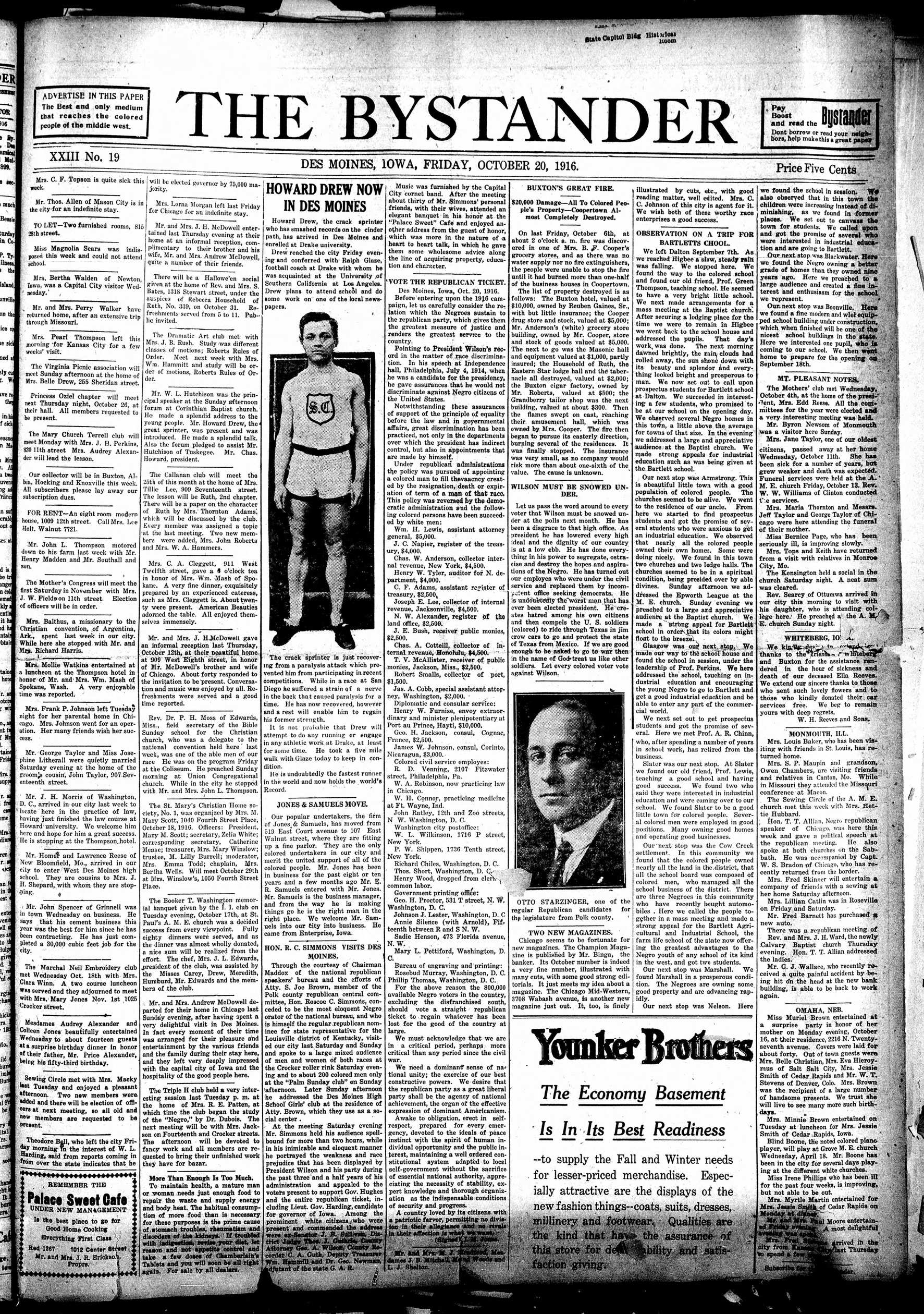
HOWARD DREW NOW
IN DES MOINES
Howard Drew, the crack spinner who has smashed records on the cinder path, has arrived in Des Moines and enrolled at Drake university. Drew reached the city Friday evening and conferred with Ralph Glaze, football coach at Drake with whom he was acquainted at the University of Southern California at Los Angeles. Drew plans to attend school and do some work on one of the local newspapers.
S.C.
The crack sprinter is just recovering from a paralysis attack which prevented him from participating in recent competitions. While in a race at San Diego he suffered a strain of a nerve in the back that caused paralysis for a time. He has now recovered, however and a rest will enable him to regain his former strength.
It is not probable that Drew will attempt to do any running or engage in any athletic work at Drake, at least for some time. He took a five mile walk with Glaze today to keep in condition.
He is undoubtedly the fastest runner in the world and now holds the world's Record.
JONES & SAMUELS MOVE
Our popular undertakers, the firm of Jones & Samuels, has moved from 519 East Court avenue to 107 East Walnut street, where they are fitting up a fine parlor. They are the only colored undertakers in our city and merit the united support of all of the colored people. Mr. Jones has been in business for the past eight or ten years and a few months ago Mr. E. R. Samuels entered with Mr. Jones. Mr. Samuels is the business manager, and from the way he is making things go he is the right man in the right place. We welcome Mr. Samuels into our city into business. He came from Enterprise, Iowa.
HON. R. C. SIMMONS VISITS DES MOINES
Through the courtesy of Chairman Maddox of the national republican speakers' bureau and the efforts of Atty. S. Joe Brown, member of the Polk county republican central committee, Hon. Roscoe C. Simmons, conceded to be the most eloquent Negro orator of the national bureau, and who is himself the regular republican nominee for state representative for the Louisville district of Kentucky, visited our city last Saturday and Sunday and spoke to a large mixed audience of men and women of both races at the Crocker roller rink Saturday evening and to about 200 colored men only at the "Palm Sunday club" on Sunday afternoon. Later Sunday afternoon he addressed the Des Moines High School Girls' club at the residence of Atty. Brown, which they use as a social center.
At the meeting Saturday evening Mr. Simmons held his audience spellbound for more than two hours, while in his inimitable and eloquent manner he portrayed the weakness and race prejudice that has been displayed by President Wilson and his party during the past three and a half years of his administration and appealed to the voters present to support Gov. Hughes and the entire republican ticket, including Lieut. Gov. Harding, candidate for governor of Iowa. Among the prominent white citizens, who were present and commanded the address were ex-Senator J. B. Sullivan, District Judge Judge of the Court Attorney William C. B. Brown, G. A. Guth, Deputy Treasurer Wm. Rammell and Dr. Gee. Newman, adjunct of the state G. A. R.
Music was furnished by the Capital City cornet band. After the meeting about thirty of Mr. Simmons' personal friends, with their wives, attended an elegant banquet in his honor at the "Palace Sweet" Cafe and enjoyed another address from the guest of honor, which was more in the nature of a heart to heart talk, in which he gave them some wholesome advice along the line of acquiring property, education and character.
VOTE THE REPUBLICAN TICKET
Des Moines, Iowa, Oct. 20, 1916.
Before entering upon the 1916 campaign, let us carefully consider the relation which the Negroes sustain to the republican party, which gives them the greatest measure of justice and renders the greatest service to the country.
Pointing to President Wilson's recourse in the matter of race discrimination, he spoke at Independence hall, Philadelphia, April 4, 1914 when he was a candidate for the presidency, he gave assurances that he would not discriminate against Negro citizens of the United States.
Notwithstanding these assurances of support of the principle of equality before the law and in governmental affairs, great discrimination has been practiced, not only in the departments over which the president has indirect control, but also in appointments that are made by himself.
Under republican administrations the policy was pursued of appointing a colored man to fill the vacancy created by the resignation, death or expiration of term of a man of that race. This policy was reversed by the democratic administration and the following colored persons have been succeeded by white men.
Wm. H. Lewis, assistant attorney general, $5,000.
J. C. Napier, register of the treasury,
$4,000.
Chas. W. Anderson, collector internal revenue, New York, $4,500.
Henry W. Tyler, auditor for N. department, $4,000.
C. F. Adams, assistant register of treasury, $2,500.
Joseph E. Lee, collector of internal revenue, Jacksonville, $4,500.
N. W. Alexander, register of the land office, $2,500.
J. E. Bush, receiver public monies,
$2,500.
Chas. A. Cottell, collector of internal revenue. Hopohua, 4,500.
T. V. McAllister, receiver of public
morities, Jackson, Miss., $2,500.
Robert Smalls, collector of port,
$1,500.
Jas. A. Cobb, special assistant attorney,
Washington, $2,000.
Diplomatic and consular service:
Henry W. Furnise, envoy extraordinary and minister plenipotentiary at Port au Prince, Hayti, $10,000.
Geo. H. Jackson, consul, Cognac,
France, $2,500.
James W. Johnson, consul, Corinto,
Nicaragua, $3,000.
Nicaragua, $3,000.
Colored civil service employees:
R. D. Venning, 2107 Fitzwater street, Philadelphia, Pa.
W. A. Robinson, now practicing law in Chicago.
W. H. Connor, practicing medicine at Ft. Wayne, Ind.
John Ratley, 12th and Zoo streets.
N W. Washington, D.C.
Washington city postoffice:
W. L. Wilkinson, 1716 P street,
New York.
P. H. Shippen, 1736 Tenth street,
New York.
Richard Chiles, Washington, D.C.
Thos. Short, Washington, D.C.
Henry Wood, dropped from clerk
common labor.
Government printing office:
Geo. H. Proctor, 531 T street, N. W.
Washington, D. C.
Johnson J. Lester, Washington, D. C
Annie Silence (with Arnold), Fifteenth between R and S N. W.
Sadie Henson, 473 Florida avenue,
N. W.
Mary L. Pettiford, Washington, D. C.
Bureau of engraving and printing: Rosebud Murray, Washington, D. C. Phillip Thomas, Washington, D. C.
For the above reason the 800,000 available Negro voters in the country, excluding the disfranchised south, should vote a straight republican ticket to regain whatever has been lost for the good of the country at large.
We must acknowledge that we are in a critical period, perhaps more critical than any period since the civil war.
We need a dominant sense of national unity; the exercise of our best constructive powers. We desire that the republican party be the greatest liberal party shall be the agency of national achievement, the organ of the effective expression of dominant Americanism.
Awake to obligation, erect in self-respect, prepared for every emergency, devoted to the ideals of peace instinct with the spirit of human individual opportunity and the public interest, maintaining a well ordered constitutional system adapted to local self-government without the sacrifice of essential national authority, appreciating the necessity of stability, expert knowledge and thorough organization as the indispensable conditions of security and progress.
A country loved by its citizens with a patriotic spirit, permitting no division in their allegiance and no rivals in their affection is what we want.
State Capitol Blvd. Historica
KOOM
ANDE
BER 20, 1916.
BUXTON'S GREAT FIRE.
$20,000 Damage—All To Colored People's Property—Coopertown Almost Completely Destroyed.
On last Friday, October 6th, at about 2 o'clock a.m. m. fire was discovered in one of Mrs. B. F. Cooper's grocery stores, and as there was no water supply nor no fire extinguishers, the people were unable to stop the fire until it had burned more than one-half of the business houses in Cooperport. The list of property destroyed is as follows: The Buxton hotel, valued at $10,000, owned by Reuben Gaines, Sr., with but little insurance; the Cooper drug store and stock, valued at $5,000; Mr. Anderson's (white) grocery store building, owned by Mr. Cooper, store and stock of goods valued at $5,000. The next to go was the Masonic hall and equipment valued at $10,000, partly insured; the Household of Ruth, the Eastern Star lodge hall and the tabernacle all destroyed, valued at $2,000; the Buxton cigar factory, owned by Mr. Roberts, valued at $500; the Grandberry tailor shop was the next building, valued at about $300. Then the fire swept on east, reaching their amusement hall, which was owned by Mrs. Cooper. The fire then began to pursue its easterly direction, burning several of the residences. It was finally stopped. The insurance was very small, as no company would risk more than about one-sixth of the value. The cause is unknown.
WILSON MUST BE SNOWED UNDER
Let us pass the word around to every voter that Wilson must be snowed under at the polls next month. He has been a disgrace to that high office. As president he has lowered every high ideal and the dignity of our country is at a low ebb. He has done everything in his power to segregate, ostracise and destroy the hopes and aspirations of the Negro. He has turned out our employees who were under the civil service and replaced them by incompetent office seeking democrats. He is undoubtedly the worst man that has ever been elected president. He creates hatred among his own citizens and then compels the U. S. soldiers (colored) to ride through Texas in jim crow cars to go and protect the state of Texas from Mexico. If we are good enough to be asked to go to war then in the name of God treat us like other soldiers. Let every colored voter vote against Wilson.
OTTO STARZINGER, one of the regular Republican candidates for the legislature from Polk county.
TWO NEW MAGAZINES.
Chicago seems to be fortunate for new magazines. The Champion Magazine is published by Mr. Binga, the banker. Its October number is indeed a very fine number, illustrated with many cuts, with some good editorials. It just meets my idea about a magazine. The Chicago Mid-Western, 3708 Wabash avenue, is another new magazine just out. It, too, is finely
Younken
The Economy
Is In Its Be
Younker Brothers
--to supply the Fall and Winter needs for lesser-priced merchandise. Especially attractive are the displays of the new fashion things--coats, suits, dresses, millinery and footwear. Qualities are the kind that have the assurance of this store for dependability and satisfaction giving.
illustrated by cuts, etc., with good reading matter, well edited. Mrs. C. C. Johnson of this city is agent for it. We wish both of these worthy race enterprises a good success.
OBSERVATION ON A TRIP FOR
BARTLETS CHOOL.
We left Dalton September 7th. As we reached Higbee a slow, steady rain was falling. We stopped here. We found the way to the colored school and found our old friend, Prof. Green Thompson, teaching school. He seemed to have a very bright little school. We next made arrangements for a mass meeting at the Baptist church. After securing a lodging place for the time we were to remain in Higbee we went back to the school house and addressed the pupils. That day's work, was done. The next morning dawned brightly, the rain clouds had rolled away, the sun shone down with its beauty and splendor and everything looked bright and prosperous to us. We now set out to call upon prosperous students for the Baptist school at Dalton. We succeeded in greeting a few students, who promised to be at our school on the opening day. We observed several Negro homes in this town, a little above the average for towns of that size. In the evening we addressed a large and appreciative audience at the Baptist church. We made strong appeals for industrial education such as was being given at the Bartlett school.
Our next stop was Armstrong. This is abeautiful little town with a good population of colored people. The churches seemed to be alive. We went to the residence of our uncle. From here we started to find prospectus students and got the promise of several students who were anxious to get an industrial education. We observed that nearly all the colored people owned their own homes. Some were doing nicely. We found in this town two churches and two lodge halls. The churches seemed to be in a spiritual condition, being presided over by able divines. Sunday afternoon we addressed the Epworth League at the M. E. church. Sunday evening we preached to a large and appreciative audience at the Baptist church. We made a strong appeal for Bartlett school in order that its colors might float to the breeze.
Glasgow was our next stop. We made our way to the school house and found the school in session, under the leadership of Prof. Perkins. We here addressed the school, touching on industrial education and encouraging the young Negro to go to Bartlett and get a good industrial education and be able to enter any part of the commercial world.
We next set out to get prospectus students and got the promise of several. Here we met Prof. A. R. Chinn, who, after spending a number of years in school work, has retired from the business.
Slater was our next stop. At Slater we found our old friend, Prof. Lewis, teaching a good school and having good success. We found two who said they were interested in industrial education and were coming over to our school. We found Slater to be a good little town for colored people. Several colored men were employed in good positions. Many owning good homes and operating good businesses.
Our next stop was the Cow Creek settlement. In this community we found that the colored people owned nearly all the land in the district, that all the school board was composed of colored men, who managed all the school business of the district. There are three Negroes in this community who have recently bought automobiles. Here we called the people together in a mass meeting and made a strong appeal for the Bartlett Agricultural and Industrial School, the farm life school of the state now offering the greatest advantages to the Negro youth of any school of its kind in the west, and got two students. Our next stop was Marshall. We found Marshall in a prosperous condition. The Negroes are owning some good property and are advancing rapidly. Our next stop was Nelson. Here
Brothersny Basementest Readiness
Price Five Cents
we found the school in session. We also observed that in this town the children were increasing instead of diminishing, as we found in former places. We set out to canvass the town for students. We called upon and got the promise of several who were interested in industrial education and are going to Bartlett.
Our next stop was Blackwater. Here we found the Negro owning a better grade of homes than they owned nine years ago. Here we preached to a large audience and created a fine interest and enthusiasm for the school we represent.
Our next stop was Boonville. Here we found a fine modern and wel equipped school building under construction, which when finished will be one of the nicest. school buildings in the state. Here we interested one pupil, who is coming to our school. We then went home to prepare for the opening on September 18th.
MT. PLEASANT NOTES
The Mothers' club met Wednesday, October 4th, at the home of the president, Mrs. Edd Reese. All the committees for the year were elected and a very interesting meeting was held.
Mr. Byron Newsom of Monmouth was a visitor here Sunday.
Mrs. Jane Taylor, one of our oldest citizens, passed away at her home Wednesday, October 11th. She has been sick for a number of years, but grew weaker and death was expected. Funeral services were held at the A. M. E. church Friday, October 13. Rev. W. W. Williams of Clinton conducted the services. Mrs. Maria Thornton and Mesars. Jeff Taylor and George Taylor of Chicago were here attending the funeral of their mother. Miss Bernice Page, who has been seriously ill, is improving slowly.
Mrs. Tops and Keith have returned from a visit with relatives in Monroe City, Mo.
The Kensington held a social in the church Saturday night. A neat sum was cleared.
Rev. Searcy of Ottumwa arrived in our city this morning to visit with his daughter, who is attending college here. He preached a the A. M. E. church Sunday night.
WHITERBERG, IO.
We kindly deserved to receive thanks to thetriennial whitberg and Buxton for the assistance rendered in the hour of sickness and death of our deceased Ella Reeves.
We extend our sincere thanks to those who sent such lovely flowers and to those who kindly donated their car services free. We beg to remain yours with deep regrets.
W. H. Reeves and Sons.
MONMOUTH ILL.
Mrs. Louis Baker, who has been visiting with friends in St. Louis, has returned home. Mrs. S. P. Maupin and grandson, Owen Chambers, are visiting friends and relatives in Canton, Mo. While in Missouri they attended the Missouri conference at Macon. The Sewing Circle of the A. M. E. church met this week with Mrs. Hettie Hubbard. Hon. T. T. Allian, Negro republican speaker of Chicago, was here this week and gave a political speech at the republican meeting. He also spoke at both churches on the Sabbath. He was accompanied by Capt. W. S. Bradon of Chicago, who has recently returned from the border. Mrs. Fred Skinner will entertain a company of friends with a sweating at her home Saturday afternoon. Mrs. Lillian Cattin was in Roseville on Friday and Saturday.
Mr. Fred Burnett has purchased a new auto.
There was a republican meeting of Rev, and Mrs. J. H. Ward, the newly Calvary Baptist church Thursday evening. Hon. T. T. Allian addressed the ladies.
Mr. G. J. Wallace, who recently received a quite painful accident by being hit on the head at the new bank building, is able to be back to work again.
OMAHA. NEB.
Miss Muriel Brown entertained at a surprise party in honor of her mother on Monday evening, October 16, at her residence, 2216 N. Twenty-seventh avenue. Covers were laid for about forty. Out of town guests were Mrs. Belle Christian, Mrs. Eva Hieronymus of Salt Salt City, Mrs. Jessie Smith of Cedar Rapids and W. M. Stevens of Denver, Colo. Mrs. Brown was the recipient of a large number of handsome presents. We trust she will live to see many more such birthdays.
Mrs. Minnie Brown entertained on Tuesday at luncheon for Mrs. Jessie Smith of Cedar Rapids, Iowa. Blind Boone, the noted colored piano player, will play at Grove M. E. church Wednesday, April 18. Mr. Boone has been in the city for several days playing at the different white churches. Miss Irene Phillips who has been ill for the past four weeks, is improving, but not able to be out. Mrs. Myrtle Martin entertained for Mrs. Jessie Smith of Cedar Rapids on Monday at dinner.
Mr. and Mrs. Paul Moore entertain-
able. A most delightful
variety of wines.
Mrs. Fran Sullivan arrived in the city from Kannapolis May last Thursday to spend a few hours.
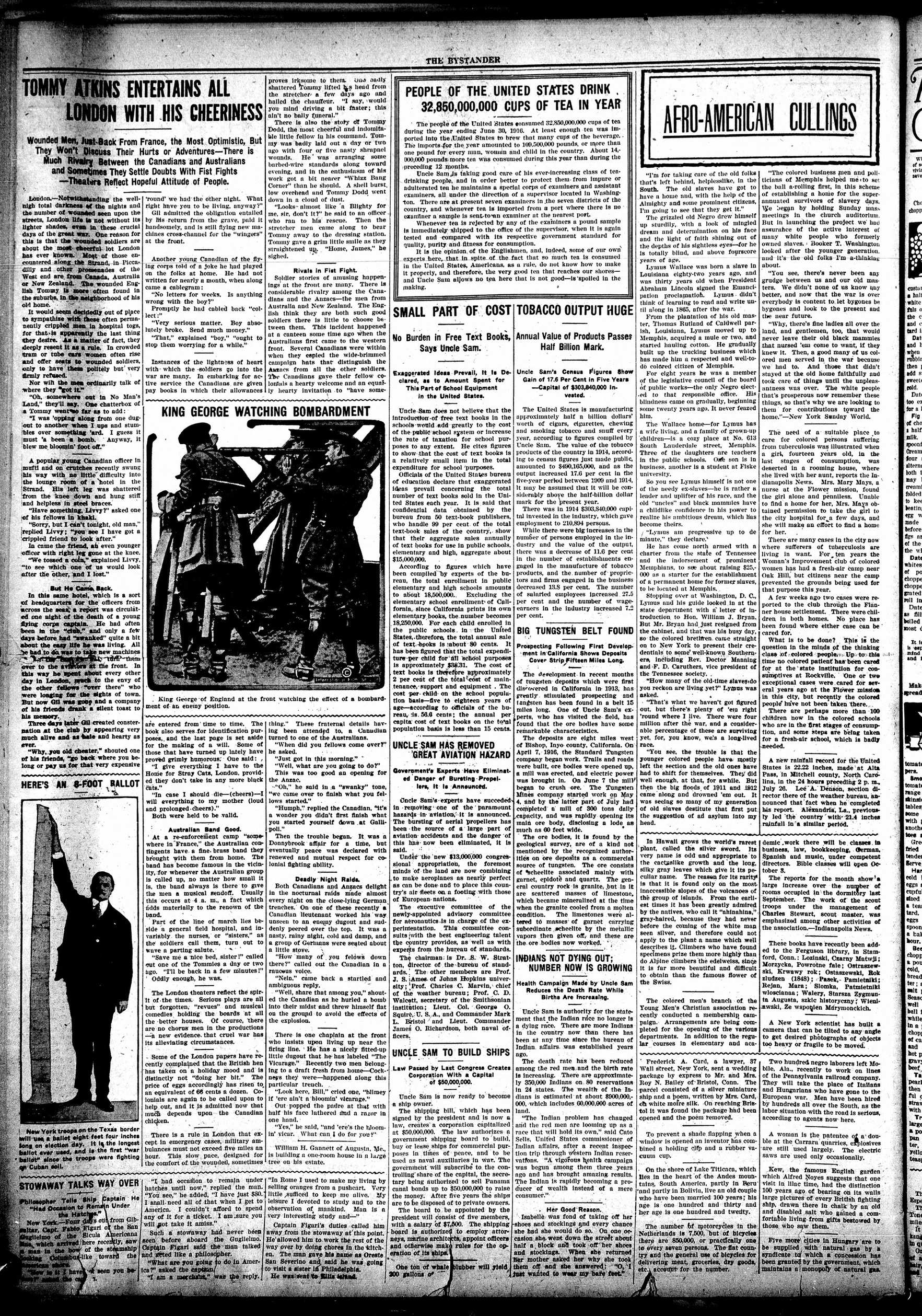
TOMMY ATKINS ENTERTAINS ALL LONDON WITH HIS CHEERINESS
Wounded Men, Just-Back From France, the Most Optimistic, But They Won't Discuss Their Hurts or Adventures—There is Much Rivival Between the Canadians and Australians and Sometimes They Settle Doubts With Fist Fights —Theaters Reflect Hopeful Attitude of People.
London. Notwithstanding the well-night total darkness of the nights and the number of wounded seen upon the streets, London life is not without its lighter shades, even in these crucial days of the great war. One reason for this is that the wounded soldiers are about the most cheerful lot London has ever known. Most of those encountered along the Strand, in Piccadilly and other promenades of the West end are from Canada, Australia or New Zealand. The wounded English Tommy is more often found in the suburbs, in the neighborhood of his old home.
round' we had the other night. What right have you to be living, anyway? Gil admitted the obligation entailed by his return from the grave, paid it handsomely, and is still flying new machines cross-channel for the "wingers" at the front.
Another young Canadian of the flying corps told of a joke he had played on the folks at home. He had not written for nearly a month, when along came a cannagram:
"No letters for weeks. Is anything wrong with the boy?"
It would seem decidedly out of place to sympathise with these often permanently crippled men in hospital togs, for that is apparently the last thing they desire. As a matter of fact, they deeply reit it as a rule. In crowded tram or tube cars women often rise and offer seats to wounded soldiers, only to have them politely but very firmly refused. Nor with the men ordinarily talk of where they "got it."
"Oh, somewhere out in No Man's Land," they'll say. One chatterbox of a Tommy went 'we far as to add: 'I was 'ipping along from one dug-out to another when I ups and stumbles over something 'ard. I guess it must 'a been a bomb. Anyway, it blew me bloomin' foot off."
A popular young Canadian officer in mufti and on crutches recently swung his way with no little difficulty into the lounge room of a hotel in the Strand. His left leg was shattered from the knee down and hung stiff and helpless in steel braces.
"Have something, Livvy?" asked one of his fellows in khaki.
"Sorry, but I can't tonight, old man," replied Livvy; "you see I have got a crippled friend to look after."
In came the friend, an even younger officer with right leg gone at the knee. "We tossed a coin," explained Livvy, "to see which one of us would look after the other, and I lost."
But He Came Back.
In this same hotel, which is a sort of headquarters for the officers from across the seat, a report was circulated one night of the death of a young dying corps captain. He had often been in the "club," and only a few days before had "swanked" quite a bit about the easy life he was living. All he had to do was to take new machines then over to the aviators at the front. In this way he spent about every other day in London, much to the envy of the other fellows of the sight, were longing for the sights of town. He was a prose and a company of his friends drank a silent toast to his memory. Three days later Gill created consternation at the club by appearing very much alive and as hate and hearty as ever. "Why, you old chester," shouted one of his friends, "go back where you belong or pay us for that very expensive
20
New York troops on the Texas border will use a ballot eight feet four inches long on election day. It is the longest ballot ever used, and is the first "war ballot" since the troops were fighting on Cuban soil.
STOWAWAY TALKS WAY OVER
Philosopher Talla Ship Captain He "Had Occasion to Remain Under John Mathew."
New York - Four days out from Gibbon Capt. Fabio Figueir of the San Diegoines of the Sicula Americana, which arrived here recently, saw a man in the bow of the steamship leading Colorado-like toward the maritime show.
"Now is it I have to see you before" asked the capt. 1.
KING GEORGE WATCHING BOMBARDMENT
King George of England at the front watching the effect of a bombardment of an enemy position.
"round" we had the other night. What right have you to be living, anyway? Gil admitted the obligation entailed by his return from the grave, paid it handsomely, and is still flying new machines cross-channel for the "wingers" at the front.
Another young Canadian of the flying corps told of a joke he had played on the folks at home. He had not written for nearly a month, when along came a cablegram:
"No letters for weeks. Is anything wrong with the boy?"
Promptly he had cabled back "collect."
"Very serious matter. Boy absolutely broke. Send much money."
"That," explained "boy," "ought to stop them worrying for a while."
Instances of the lightness of heart with which the soldiers go into the war are many. In embarking for active service the Canadians are given pay books in which their allowances
KING GEORGE WATCH
King George of England at the fr
ment of an enemy position.
are entered from time to time. The book also serves for identification purposes, and the last page is set aside for the making of a will. Some of those that have turned up lately have proved grimly humorous (see told); every gift I have to the House for Sir Tony Carson, London, provided they don't take in any more black cats.
"In case I should die—(cheers)—I will everything to my mother (loud and prolonged.cheers)." Both were held to be valid.
Australian Band Good.
At a re-enforcement camp "somewhere in France," the Australian contingents have a fine, brass band they brought with them from home. The band has become famous in the vicinity, for whenever the Australian group is called up, no matter how small it is, the band always is there to give the men a musical sendoff. Usually this occurs at 4 a.m., a fact which adds materially to the renown of the band.
Part of the line of march lies beside a general field hospital, and invariably the nurses, or "sisters," as the soldiers call them, turn out to be nurses. "Save me a nice bed, sister!" called out one of the Tommies a day or two go. "Till be back in a few minutes!" Oddly enough, he was.
The London theaters reflect the spirit of the times. Serious plays are all but forgotten, "revues" and musical comedies holding the boards at all the better houses. Of course, there are no chorus men in the productions—a new evidence that cruel war has its alleviating circumstances.
Some of the London papers have recently complained that the British hen has taken on a holiday mood and is distinctly not "doing her bit." The price of eggs accordingly has risen to an equivalent of 68 cents. Colonials are again to be called upon to help out, and it is admitted now that much depends upon the Canadian chicken.
There is a rule in London that except in emergency cases, military ambulances must not exceed five miles an hour. This slow pace, designed for the comfort of the wounded, sometimes
"I had occasion to remain under hatches until now," replied the man. "You see," he added, "I have just $30. I small need all of that when I get to America. I couldn't afford to spend any of it for a ticket. I am sure you will not take it amiss." Such a stowaway had never been seen before aboard the Guglellmo. Captain Figart said the man talked and seted like a philosopher.
"What are you going to do in America?" asked the captain, "I am a merchant." was the reply.
proves irksome to them. Oneads shattered Tommy lifted his head from the stretcher a few days ago and halled the chauffeur. "I say, would you mind driving a bit faster; this ain't no bally funeral." There is also the story of Tommy Dodd, the most cheerful and indulgent little fellow in his comeback. Tommy halled him a day or two ago with our or five nice nasty wraped wounds. He was arranging some barbed-wire standards along toward evening, and in the enthusiasm of his work got a bit nearer "Whizz Bangle Corner" then he should. A shell burst, low overhead and Tommy Dodd went down in a cloud of dust. "Looks—almost like a Blighty for me, sir, don't it?" he said to an owner who ran to his rescue. The stretcher came to bear the dressing station. Tommy gave a grim little smile as they straightened up. "Home, James," he sighed.
Rivals In Fist Fight.
Soldier stories of anusing happenings at the front are many. There is considerable rivalry among the Canadians and the Anzacs—the men from Australia and New Zealand. The English think they are both such good soldiers there is little to choose between them. This incident happened at a canteen some time ago when the Australians first came to the western front. Several Canadians were killed in a blast by a blrenhawk campaign hats that distinguish the Anzacs from all the other soldiers. The Canadians gave their fellow colonials a hearty welcome and an equally hearty invitation to "have some-
HING BOMBARDMENT
front watching the effect of a bombard-
thing." These fraternal details having been attended to, a Canadian turned to one of the Australians. "When did you fellows come over?" he asked. "Just got in this morning." "Well, what are you going to do?" This was too good an opening for the Anzac. "Oh," he said in a "swanky" tone, "we came over to finish what you fellows started." "Humph," replied the Canadian, "it's a wonder you didn't first finish what you started yourself down at Gallipoli." When the trouble began. It was a Donnybrook affair for a time, but eventually peace was declared with renewed and mutual respect for colonial fighting ability.
Deadly Night Raida
Both Canadians and Angas delight in the nocturnal raids made almost every night on the close-lying German trenches. On one of these recently a Canadian lieutenant worked his way unseen to an enquy dundet and suddenly peered over the top. It was a nasty, rainy night, cold and damp, and a group of Germans were seated about a little stove.
"How many of you felows down there?" called out the Canadian in a rancous voice.
"Nell," came back a startled and ambiguous reply.
"Well, share that among you," shouted the Canadian as he hurled a bomb into their midst and threw himself on the ground to avoid the effects of the explosion.
There is one chaplain at the front who insists upon living up near the firing line. He has a nicely fitted-up little dugout that he has labeled "The Vicarage." Recently two men belonging to a draft fresh from home—Cockneys they were—happened along this particular trench.
"Look here, Bill," cried one, "himley if 'ere ahnt a bloomin' vlærage." O popped the padre at that with half his face lathered and a razor in one hand. "Yes," he said, "and 'ere's the bloomin' ylcar. What can I do for you!" William H. Gannett of Augusta, Me, is building a one-room house in a large tree on his estate.
"In Rome I used to make my living by selling oranges from a pushcart. Very little suffered to keep me alive. My lensure I devoted to study and to the observation of mankind. Man is a very interesting study—and—"
Captain Figur's duties called him away from the stowaway at this point. He allowed him to work the rest of the way over by doing chores in the kitchen. The man gave his name as Oreste San Severino and said he was going to visit a sister in Philadelphia. He was sent to Philadelphia.
PEOPLE OF THE UNITED STATES DRINK 32.850.000.000 CUPS OF TEA IN YEAR
The people of the United States consumed 32,838,000,000 cups of tea during the year ending June 30, 1916. At least eightteen tea was imported into the United States to brew that many cups of the beverage. The imports for the year amounted to 100,500,000 pounds, or more than one pound for every man, woman and child in the country. About 14:45 the tea was consumed during this year than during the preceding 12 months.
Uncle Sam is taking good care of his ever-increasing class of tendrink drinking people, and in order better to protect them from impure or adulterated tea he maintains a special corps of examiners and assistant examiners, all under the direction of a supervisor located in Washington. There are at present seven examiners in the seven districts of the country, and whenever tea is imported from a port where there is no examiner a sample is sent to an examiner at the nearest port. Whenever tea is rejected by any of the examiners a pound sample is immediately shipped to the office of the supervisor, when it is again tested and compared with its respective government standard for quality, purity and the opinion of the Englishmen, and, indeed, some of our own experts here, that in spite of the fact that so much tea is consumed in the United States, Americans, as a rule, do not know how to make it properly, and therefore, the very good tea that reaches our shores—and Uncle Sam allows no tea here that is not good—is spoiled in the making.
THE BYSTANDER
PEOPLE OF THE UNITED
32,850,000,000 C
The people of the United States,
during the year ending June 26,
ported into the United States to be.
The imports for the year amounted
one pound for every mm, woman
100,000 pounds more tea was consu-
preceding 12 months.
Uncle Sam is taking good care
drinking people, and in order bett
adulterated he maintains a speci-
examiner, all under the direction
ton. There are at present seven ex-
country, and whenever tea is impo-
examiner a sample is sent to town ex-
Whenever tea is rejected by an
is immediately shipped to the office
tested and compared with its re-
quality, purity and fitness for constu-
It is the opinion of the English
expert here, that in spite of the
in the United States, Americans, a
it properly, and therefore, the very
and Uncle Sam allows no tea here
making.
SMALL PART OF COST
No Burden in Free Text Books,
Says Uncle Sam.
Exaggerated Ideas Prevail, It Is Declared, as to Amount Spent For This Part of School Equipment in the United States.
in the United States.
Uncle Sam does not believe that the introduction of free text books in the schools would add greatly to the cost of the public school system or increase the rate of taxation for school purposes to any extent. He cites figures to show that the cost of text books is a relatively small item in the total expenditure for school purposes.
Officials of the United States bureau of education declare that exaggerated ideas prevail concerning the total number of text books sold in the United States each year. It is said that confidential data obtained by the bureau from 50 text-book publishers, who handle 99 per cent of the total text-book sales of the country, show that their aggregate sales annually of text books for use in public schools, elementary and high, aggregate about $15,000,000.
According to figures which have been compiled by experts of the bureau, the total enrollment in public elementary and high schools amounts to about 18,500,000. Excluding the elementary school enrollment of California, since California prints its own elementary books, the number becomes 18,250,000. For each child enrolled in the public schools, in the United States, therefore the total annual sale of text-books is about 80 cents. It has been figured that the total expenditure per child for all school purposes is approximately $38.31. The cost of text books is therefore approximately 2 per cent of the total cost of maintenance, support and equipment. The cost per child on the school population basis—five to eighteen years of age—according to officials of the bureau, is 56.6 cents; the annual capital cost of text books on the total population basis is less than 15 cents.
UNCLE SAM HAS REMOVED
'GREAT AVIATION HAZARD
Government's Experts Have Eliminated Danger of Bursting Propellers, It is Announced.
Uncle Sam's experts have succeeded in removing one of the paramount hazards in aviation; it is announced. The bursting of aerial propellers has been the source of a large part of aviation accidents and the danger of this has now been eliminated, it is said.
Under the new $13,000,000 congressional appropriation, the foremost minds of the land are now combining to make aeroplanes as nearly perfect as can be done and to place this country's air fleets on a footing with those of European nations.
The executive committee of the newly-appointed advisory committee for aeronautics is in charge of the experimentation. This committee consults with the best engineering talent the country provides, as well as with experts from the bureau of standards.
The chairman is Dr. S. W. Stratton, director of the bureau of standards. The other members are Prof. J. S. James of Johns Hopkins university; Prof. Charles C. Marvin, chief of the weather bureau; Prof. C. D. Walcott, secretary of the Smithsonian institution; Lieut. Col. George O. Squire, U. S. A., and Commander Mark L. Bristol and Lieut. Commander James O. Richardson, both naval officers.
UNCLE SAM TO BUILD SHIPS
Law Passed by Last Congress Creates Corporation With a Capital of $50,000,000.
Uncle Sam is now ready to become a ship owner.
The shipping bill, which has been signed by the president and is now a law, creates a corporation capitalized at $0,000,000. The law authorizes a government shipping board to build, buy or lease ships for commercial purposes in times of peace, and to be used as naval auxiliaries in war. The government is required to hold the corporation of the capital, the secretary being authorized to sell Panama cunb bonds up to $50,000,000 to raise the money. After five years the ships are to be disposed of to private owners.
The board to be appointed by the president will consist of five members, with a salary of $7,500. The shipping board is authorized to employ attorneys, marine architects, appointees and otherwise make rules for the operation of its ships.
One ton of whale blubber will yield 200 gallons of
TOBACCO OUTPUT HUGE
Annual Value of Products Passes Half Billion Mark.
Uncle Sam's Census Figures Show
Gain of 17.6 Per Cent in Five Years
—Capital of $303,840,000 invested.
The United States is manufacturing approximately half a billion dollars' worth of cigars, cigarettes, chewing and smoking tobacco and snuff every year, according to figures compiled by Uncle Sam. The value of the tobacco products of the country in 1914, according to census figures just made public, amounted to $490,165,000, and as the output increased 17.5 per cent in the five-year period between 1909 and 1914, it may be assumed that it will be considerably above the half-billion dollar mark for the present year.
There was in 1914 $303,840,000 capital invested in the industry, which gave employment to 210,844 persons.
While there were big increases in the number of persons employed in the industry and the value of the output, there was a decrease of 11.6 per cent in the number of establishments engaged in the manufacture of tobacco products, and the number of proprietors and firms engaged in the business of tobacco. The number of salaried employees increased 27.5 per cent and the number of wage-earners in the industry increased 7.2 per cent.
BIG TUNGSTEN BELT FOUND
Prospecting Following First Development in California Shows Deposits Cover Strip Fifteen Miles Long.
The development in recent months of tungsten deposits which were first discovered in California in 1913, has greatly stimulated prospecting and tungsten has been found in a belt 15 miles long. One of Uncle Sam's experts, who has visited the field, has found that the ore bodies have some remarkable characteristics.
The deposits are eight miles west of Bishop, Inyo county, California. On April 7, 1916, the Standard Tungsten company began work. Trills and roads were built, ore bodies were opened up, a mill was erected, and electric power was brought in. On June 7 the mill began to crush ore. The Tungsten company opened a mill on April 4, and by the latter part of July had completed a mill of 300 tons daily capacity, and was rapidly opening its main ore body, disclosing a lode as much as 40 feet wide.
The ore bodies, it is found by the geological survey, are of a kind not mentioned by the recognized authorities on ore deposits as a commercial source of tungsten. The ore consists of schelite associated mainly with garnet, epidote and quartz. The general country rock is granite, but in it are scattered masses of limestone, which became mineralized at the time when the granite cooled from a molten condition. The limestones were altered to masses of garnet carrying subordinate schelite by the metallic vapors then given off, and these are the ore bodies now worked.
INDIANS NOT DYING OUT;
NUMBER NOW IS GROWING
Health Campaign Made by Uncle Sam Reduces the Death Rate While Births Are Increasing.
Uncle Sam is authority for the statement that the Indian race no longer is a dying race. There are more Indians in the country now than there has been at any time since the bureau of Indian affairs was established years ago.
The death rate has been reduced among the red men and the birth rate is increasing. There are approximately 250,000 Indians on 80 reservations in 24 states. The wealth of the Indians is estimated at about $300,000,000, which includes 60,000,000 acres of land.
"The Indian problem has changed and the red men are looming up as a race that will hold its own," said Cato Sells, United States commissioner of Indian affairs, after a recent inspection trip through western Indian reservations. "A vigorous health campaign was begun among them three years ago and has brought amazing results. The Indian is rapidly becoming a producer of wealth instead of a mere consumer."
Her Good Reason.
Isabelle was fond of taking off her shoes and stockings and every chance she had she would do so. On one occasion she went down the street about half a block and took off her shoes and stockings. When she returned her mother asked her why she took them off and she answered: "O, I just wanted to wear my bare feet."
AFRO-AMERICAN CULLINGS
"I'm for taking care of the old folks that's left behind, helplessly, in the South. The old slaves have got to have a home and, with the help of the Almighty and some prominent citizens, I'm going to see that they get it."
The grizzled old Negro drew himself up sturdy, with a look of mingled dream and determination on his face and the light of faith shining out of the depths of his sightless eyes—for he is totally blind, and above fourscore years of age.
Lymus Wallace was born a slave in Louisiana eighty-two years ago, and was thirty years old when President Abraham Lincoln signed the Enunciation proclamation. Lymus didn't think of learning to read and write until in 1863, after the war.
From the plantation of his old master, Thomas Rutland of Caldwell parish, Louisiana, Lymus moved up to Memphis, acquired a mule or two, and started hauling cotton. He gradually built up the trucking business which has made him a respected and well-to-do colored citizen of Memphis.
For eight years he was a member of the legislative council of the board of public works—the only Negro elected to that responsible office. His blindness came on gradually, beginning some twenty years ago. It never feazed him.
The Wallace home—for Lymus has a wife living, and a family of grown-up children—is a cozy place at No. 613 South Lauderdale street, Memphis.
Three of the daughters are teachers in the public schools. One son is in business, another is a student at Fiske university.
So you see Lymus himself is not one of the needy ex-shelves—he is rather a leader and uplifter of his race, and the old "uncles" and black mammals have a childlike confidence in his power to realize his ambitious dream, which has become theirs.
"Lymus am progressive up to deminute," they declare.
He has come north armed with a charter from the state of Tennessee and the indorsement of prominent Memphians, to see about raising $25,000 as a starter for the establishment of a permanent home for former slaves, to be located at Memphis.
Stopping over at Washington, D. C. Lymus and his guide looked in at the state department with a letter of introduction to Hon. William J. Bryan. But Mr. Bryan had just resigned from the cabinet, and that was his busy day, so the colored brethren came straight on to New York to present their credentials to some well-known Southerners, including Rev. Doctor Manning and F. D. Caruthers, vice president of the Tennessee society.
"How many of the old-time slaves do you reckon are living yet?" Lymus was asked.
"That's what we haven't got figured out, but there's plenty of 'en right' round where I live. There were four million after the war, and a considerable percentage of these are surviving yet, for, you know, we're a long-lived race.
"You see, the trouble is that the younger colored people have mostly left the section and the old ones have had to shift for themselves. They did well enough, at that, for awhile. But then the big floods of 1911 and 1912 came along and drowned 'em out. It was seeing so many of my generation of old slaves desituate that first put the suggestion of ad asylum into my head.
In Hawaii grows the world's rarest plant, called the silver sword. Its very name is odd and appropriate to the cactuslike growth and the long, silky gray leaves which give it its peculiar name. The reason for its rarity is that it is found only on the most inaccessible slopes of the volcanoes of the group of islands. From the earliest time it has been greatly admired by the natives, who call it "ahmahina," gray-haired, because they had never before the coming of the white man before they were introduced could apply to the plant a name which well describes it. Climbers who have found specimens prize them more high than do Alpine climbers the edelweiss, since it is far more beautiful and difficult to obtain than the famous flower of the Swiss.
The colored men's branch of the Young Men's Christian association recently conducted a membership campaign. Arrangements are being completed for the opening of the various departments. In addition to the regular courses in elementary and aca-
Frederick A. Card, a lawyer, 37 Wall street, New York, sent a wedding package by express to Mr. and Mrs. Roy N. Bailey of Bristol, Conn. The parcel consisted of a silver miniature ship and a poem, written by Mrs. Card, ch white moire silk. On reaching Bristol it was found the package had been opened and the poem removed.
To prevent a shade flapping when a window is opened an inventor has combined a holding clip and a rubber vacuum cup.
On the shore of Lake Titicaca, which lies in the heart of the Andes mountains, South America, partly in Peru and partly in Bolivia, live an old couple who have been married 100 years; his age is one hundred and thirty and her age is one hundred and twenty.
The number of motorcycles in the Netherlands is 7,500, but of bicycles there are 850,000, or practically one to every seven persons. The flat country and the general use of bicycles for delivering meat, groceries, dry goods, etc. account for the number.
"The colored business men and politicians of Memphis helped me to set the ball a rolling first, in this scheme of establishing a home for the superannuated survivors of slavery days. We began by holding Sunday mass meetings in the church auditorium. But in launching the project we had assurance of the active interest of many white people who formerly owned slaves. Booker T. Washington looked after the younger generation, and it's the old folks I'm a-thinking about. You see, there's never been any grudge between us and our old masters. We didn't none of us know any better, and now that the war is over everybody is content to let bygones be bygones and look to the present and the near future.
"Why, there's fine ladies all over the land, and gentlemen, too, that would never leave their old black mammals that nursed 'em come to want, if they knew it. Then, a good many of us colored men served in the war because we had to. And those that didn't stayed at the old home faithfully and took care of things until the unpleasantness was over. The white people that's prosperous now remember these things, so that's why we are looking to them for contributions toward the home."—New York Sunday World.
The need of a suitable place to care for colored persons suffering from tuberculosis was illustrated when a girl, fourteen years old, in the last stages of consumption, was deserted in a rooming house, where she lived with her nunt, reports the Indianapolis News. Mrs. Mary Mays, a nurse at the Flower mission, found the girl alone and penniless. Unable to find a home for her, Mrs. Mays obtained permission to take the girl to the city hospital for a few days, and she will make an effort to find a home for her.
There are many cases in the city now where sufferers of tuberculosis are living in want. For ten years the Woman's Improvement club of colored women has had a fresh-air camp near Oak Hill, where the nurses near the camp ground are used for that purpose this year.
A few weeks ago two cases were reported to the club through the Flanner house settlement. There were children in both homes. No place has been found where either case can be cared for.
What is to be done? This is the question in the minds of the thinking class of colored people. Up to this time no colored patient has been cared for at the state institution for consumptives at Rockville. One or two exceptional cases were cared for several years ago at the Flower mission in this city, but recently the colored people' have not been taken there. There are perhaps more than 100 children now in the colored schools who are in the first stages of consumption, and some steps are being taken for a fresh-air school, which is badly needed.
A new rainfall record for the United States is 22.22 inches, made at Alta Pass, in Mitchell county, North Carolina, in the 24 hours preceding 2 p. m., July 26. Lee A. Denson, section director there of the weather bureau, announced that fact when he completed his report. Alexandria, La., previously led the country with 21.4 inches rainfall in a similar period.
demic_work there will be classes in business, law, bookkeeping, German, Spanish and music, under competent directors. Bible classes will open October 3.
The reports for the month show a large increase over the number of rooms occupied in the dormitory last September. The work of the scout troops under the management of Charles Stewart, scout master, was emphasized among other activities of the association—Indianaapolis News.
These books have recently been added to the Ferguson library, in Stamford, Conn.; Lozniak, Czaray Matwij; Morzkyce, Powrote fate; Ostraszewski, Krwawy rok; Ostaszewski, Rokzludzen (1848); Pasek, Pamletniak; Rejan, Mara; Slomka, Pamletniak wlosciana; Walery, Starsza Zygmunta, augusta, skzlc historycy; Wiennawski, Ze wpopenm Dymonckyum.
A New York scientist has built a camera that can be tilted to any angle to get desired photographs of objects too heavy or fragile to be moved.
Two hundred negro laborers left Mobile, Ala., recently to work on lines of the Pennsylvania railroad company. They will take the place of Italians and Hungarians who have gone to the European war. Men have been hired by hundreds all over the South, as the labor situation with the road is serious, according to agents now here.
A woman is the patentee of a double at the Carrara quarries, explosives are still used largely. The electric saws are used only occasionally.
Kew, the famous English garden which Alfred Noyes suggests that one visit in iliac time, had the distinction 100 years ago of bearing on its walls large pictures of every British fighting ship, drawn there in chalk by an old and disabled salt who gained a comfortable living from gifts bestowed by those who saw them.
Five more cities in Hungary are to be supplied with natural gas by a syndicate to which a concession has been granted by the government, which maintains a monopoly of natural gas.
The KITCHEN CABINET
What is the Ódā so long as the fire of soil is knotted at the taper of conviviality, and the wing of friendship motes a feather?
DATES AND FIGS.
Chopped dates or figs, mixed with chopped nuts and a little cream, make fine sand-will filling.
*Fig Gustard.*—Wash in a pound of figs and add an hour in water to cover; and to the juice a few strips of the peel of a
Fig Custard—Wash a pound of figs and stew for an hour in water to cover; add to the juice a few strips of the peel of a lemon; make a custard of a quart of milk, four eggs, a half cup of sugar, reserving one white for a meringue. Put two spoonfuls of the figs in each cup, fill with the custard, cover with a meringue and cook in hot water until the custard is thick.
Date Pie—Wash a pound of dates and heat them in a quart of milk; when soft, stir in a beaten egg after rubbing the dates through a sieve, then pour into a baked pastry shell; add sugar if needed, and cover with sweetened whipped cream. Serve cold.
Dates are rich in nutrients and not too expensive to make good desserts for a light meal.
**Fig Loaf Cake.**—Take two cupfuls of chopped fries, two cupfuls of sugar, a half cupful of butter, one cupful of milk, four cupfuls of flour, two teaspoonfuls of baking powder, four eggs. Cream the butter, all the sugar, the four sifted with the baking powder alternating with the milk, until all of both is used; the yolks of the eggs may be added to the sugar while creaming, but the whites should be folded in the very last, using care to keep in all the air. Do all the heating and mixing before adding the egg whites. A fine-grained cake is made so by the hard heating it gets before the eggs are folded in. The figs are cut fine, mixed with a little of the flour and stirred in just before the whites are added.
.
Date Macaroni—Beat five egg
waters until stiff, fold in a half pound
of powdered sugar, a cupful of
chopped dates, a half cupful of
chopped nuts, and a half cupful of
grated coconut. Beat until stiff and
roll in balls.
It is too common to brown bread or used
as filling, finely chopped, added to
boiled frosting, with a few nuts, is
most delicous.
It is too common in all of us, but it
is especially in the nature of a mean
clothes and fine furniture—Dickens.
GOOD EATABLES.
Make a good turkey dressing and spread it over a two-pound round-steak. Roll it up and tie securely and boll it in a cloth bag in boiling water for two hours. About a half hour before service lay the turkey in the oven and brown it in the oven. Serve with a good brown sauce or with a seasoned
securely and boll it in a cloth bag in boiling water for two hours. About a half hour before serving, take it from the bag and brown it in the oven. Serve with a good brown sauce or with a seasoned tomato sauce and chopped green peppers. Smothered Tomatoes—Cut six small tomatoes in halves across the grain. Arrange them in a baking dish with the skimside down. Pour over three tablespoonfuls of melted butter and some finely minced parsley. Season with pepper and salt and cover with another pan and cook until the tomatoes. Green tomatoes cut in slices and fried in hot bacon until brown and tender are well liked as a change. Serve as a vegetable with steak.
Ham Trifle—Chop one cupful of cold boiled ham, three hard-cooked eggs and five soda crackers. Boll two cupfuls of milk; add to this a good-sized piece of butter and thicken with a teaspoonful each of flour and mustard. Stir into this the chopped ham, eggs and crackers, and add a 'table-spoonful of minced parsley. Put into a baking dish and bake for half an hour.
Beef Olives—Pass through a meat chopper several times until fine half a pound of raw beef, half a pound of cold, cooked meat and half a pound of bread which has been soaked in water; a little parsley and a piece of fat pork sat about the size of an egg season this and to it an egg. Mix egg and roll into balls. Wrap an egg ball oiled paper to hold in the oven while baking. But then in the oven in a pan, with plenty of some finely chopped carrots, two table-spoonfuls of canned tomatoes, an onion, chopped and a little water. Remove it to a hot platter and add a little flour to the gravy. Strain the gravity over the beef olives and serve very hot.
Tapioca Pudding—Sook a cupful of pearl tapioca in cold water over night; then cook it until clear. Stir in a cupful of sugar and a cup of preserved strawberries or tart jelly. Serve cold with cream. Slice and Onion Curry—Slice one large Spanish onion and cut into a dice of onion. Cut into a frying pan melt two tablespoons of butter, lay in the onions and cook until yellow. Sprinkle over the onions a teaspoonful of curry and a tablespoon-
CONDENSATIONS
There are at present more than 1,500 Esperanto societies in the world. The longest river in Japan is the Tone, its main course being about 200 miles long.
It is a question as to whether the kangaroo can cover a given distance in quicker time than an ostrich. Only one out of over 100 innates of a certain innate asylum had red hair, and only four were of light hair
ful of four, then add gradually a cupful of white stock. When smooth add salt and pepper to taste and the prepared tripe. Simmer gently for five minutes.
Oh, if the berry that gains my lips could teach me the woodland chat. Science would bow to my scholarships. And theology dolf the hat.
GOOD OLD PUMPKIN TIME.
There are as many kinds of pumpkin
pies as there are tastes for them. Some
are tastes for them. Some like the pies stuff with pumpkin, others so little that it is a custard flavored with pumpkin, but first get your pumpkin. The sweet pie pumpkins are so common now that the field variety has almost disappeared in the
take the pies sim with pumpkin others so little that it is owed with pumpkin, but first get your pumpkin. The sweet pie pumpkins are so common now that the field variety has almost disappeared in the markets. The small ones cook quicker and have a better flavor. For all dishes where pumpkin is used the first process is the same. Cook it until it is dry and brown. this develops the flavor. Some cut it in pieces and after removing the seeds and fiber bake it until it is soft and can be scooped out of the shell. Whether boiled, steamed or finely mashed it should be thoroughly done, finely mashed it fitted through a sieve. For the ordaining one a ful of pumpkin is used to a pint of milk, two eggs, a teaspoonful of ginger, a few drops of lemon extract, a teaspoonful of salt, and sugar to make of the desired sweetness.
Pumpkin Muffins—Sift together two cupfuls of flour, half a teaspoonful of salt, two teaspoonfuls of baking powder, beat two eggs and add them to two-thirds of a cupful of milk and a cupful of sifted pumpkin; mix well and add a fourth of a cupful of melted butter; turn into hot greased muffin pans and bake 20 minutes in a hot oven.
Croole cooks serve pumpkin cooked as one does squash, it baking it in the shell and serving it with butter. Pumpkin served seasoned with butter, salt and pepper after it is well mashed makes a most agreeable vegetable.
A most delicious' way of serving pumpkin and one which is enjoyed by all pumpkin' piover lovers is to fill tumbel cases with the mixture and bake. You get all of the filling with little crust and that crust must to digest than pastry. The custard may be cooked and just added to the cases when serving.
Pumpkin pie covered with whipped cream and sprinkled generously with a savory rich grated cheese is a dish liked by all.
Pumpkin may be dried or canned and so ready to use at any time during the year.
Pure and unselfish friendship is the most beautiful thing in the world. The beauty of it is so great and rich that it grows up absolutely all mean things.
FOR THE CHAFING DISH.
As the cool evenings are upon us the chafing dish suppers are most appealing. The dishes which may be prepared are numberless. Sweet breads are greatly favored. They are prepared in the usual way by blanching and removing all of the
which may be prepared are numberless. Sweetbreads are greatly favored. They are prepared in the usual way by blanching and removing all of the pipes and skin, then cut in large dices and cooked in thickened chicken stock. One may not always have chicken stock on hand, but a can of chicken stock is easy to open, and should always be on the emergency shelf. Flavor the soup with a bit of onion, add a teaspoonful of curry powder and a few drops of lemon juice. With this serve a dish of peas.
For patty shells the following filling may be used: Add asparagus tips to sweetbreads, mix with white sauce, mashed yolks of two eggs, a cupful of this cream and a few slices of stuffed olives. Serv hot. The cream need not be added if the sauce is thin and rich enough.
Some like curry with lobster; mix a paste of olive oil, a half teaspoonful of mustard, and paprika, salt and curry to taste; lay the lobster with a little butter in this and cook ten minutes.
Savory Toast—Cover slices of toast with grated cheese and set in the oven. Cut into pieces eight large mushrooms, or if the fruit are unattainable use a half can of buttons; fry two minutes in a blazer with three tablespoonful of butter. Add gradually six eggs and stir until thick, season with salt and pepper and pour piping hot over the toast.
Curried Chicken.—Take two cupfuls of cold cooked chicken, cut in bits, one cupful of gravy, and one teaspoonful each of minced onion and curry powder, one tablespoonful of butter and salt to taste. Cook the onion in the butter, mix the curry smoothly into the gravy, add to the chicken and simmer ten minutes. Boiled rice is a usual accompaniment to curry and well chilled bananas are also good. Try frankforts heated in cream, served with toast.
Nellie Maxwell
It is believed to be no rare occurrence for a condor to soar 4,000 feet above the earth.
Vegetable silt, which, like cotton, is valuable only for stuffing, is made from the seeds of a Brazilian tree.
Turkies derived their name from the fact that they were imported first into Europe, through Turkey.
Mines of some descriptions are found in 26 of the 31 states and territories in Mexico, and mining is the most productive industry of the com-
THE ARMY IN THE MIDDLE OF THE WORLD
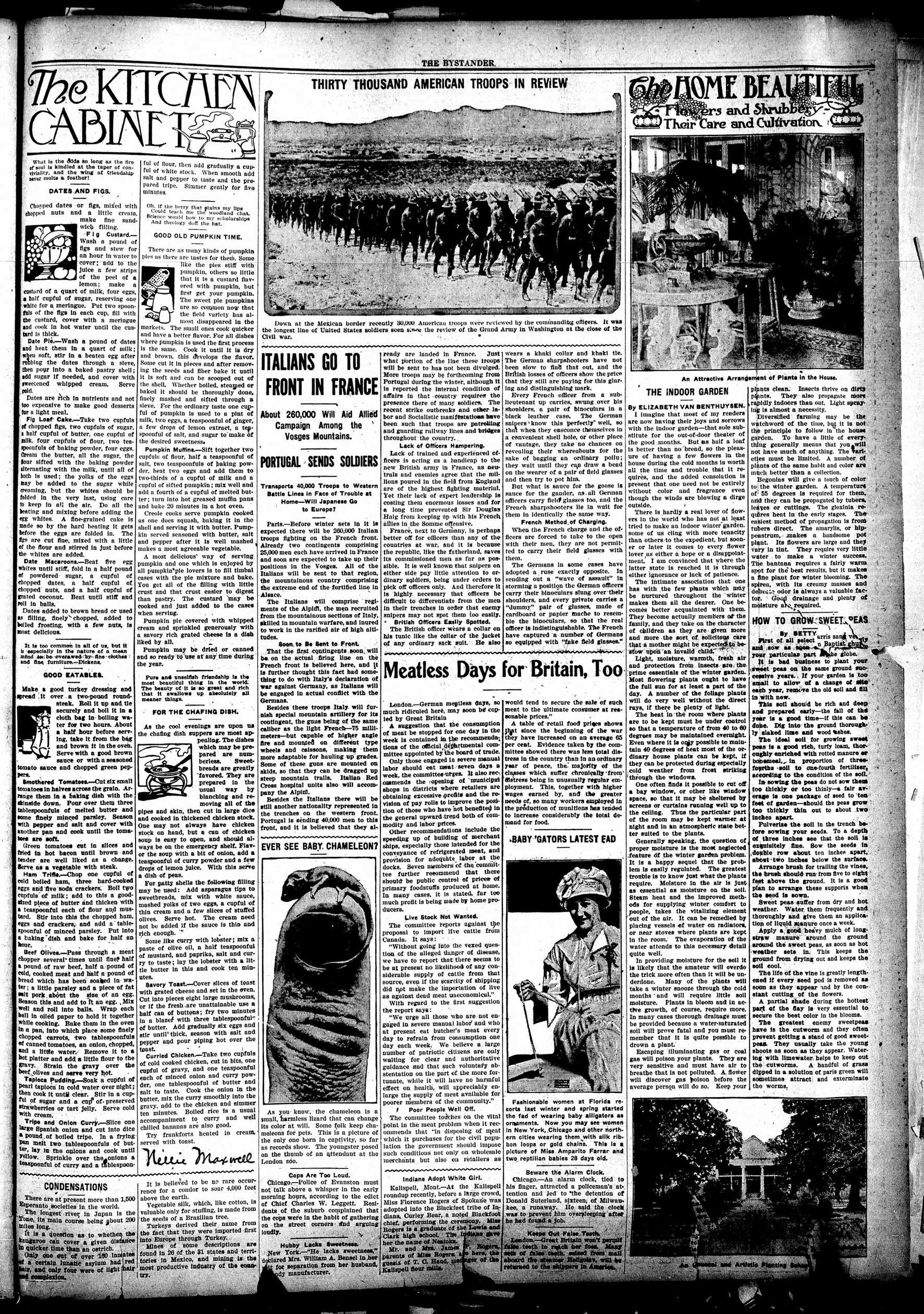
Down at the Mexican border recently 30,000 American troops were reviewed by the commanding officers. It was the longest line of United States soldiers seen since the review of the Grand Army in Washington at the close of the Civil War.
Down at the Mexican border recently 30,000 American troops were reviewed by the commanding officers. It was the longest line of United States soldiers seen since the review of the Grand Army in Washington at the close of the Civil War.
ITALIANS GO TO FRONT IN FRANCE
Transports 40,000 Troops to Western Battle Lines in Face of Trouble at Home—Will Japanese Go to Europe?
Paris—Before winter sets in it is expected there will be 260,000 Italian troops fighting on the French front. Already two contingents comprising 25,000 men each have arrived in France and soon are expected to take up their positions in the Vosges. All of the Italians will be sent to that region, the mountainous country comprising the extreme end of the fortified line in Alsace.
The Italians will comprise regiments of the Alpini, the men recruited from the mountainous sections of Italy, skilled in mountain warfare, and inured to work in the rarified air of high altitudes.
Soon, to Be sent to Front.
That the first contingents will, soon, be on the actual firing line on the French front is believed here, and it is further thought that Italy's declaration of using against Germany, as Italianists will be engaged in actual conflict with the Germans.
Besides these troops Italy will furnish special mountain artillery for its contingent, the guns being of the same caliber as the light French - 75 millimeters—but capable of higher angle fire and mounted on different type wheels and caissons, making them more adaptable for hauling up grades. Some of these guns are mounted on skids, so that they can be dragged up steep mountain trails. Italian Red Cross hospital units also will accompany the Alpinist.
Besides the Italians there will be still another nationality represented in the trenches on the western front. Portugal is sending 40,000 men to this front, and it is believed that they al-
```markdown
```
As you know, the chameleon is a small, harmless lizard that can change its color at will. Some folk keep chameleons for pets. This is a picture of the only one born in captivity, so far as records show. The youngster posed on the thumb of an attendant at the London zoo.
Cops Are Too Loud.
Chicago—POLICE of Evanston must not talk above a whisper in the early morning hours, according to the edict of Chief Charles W. Leggett. Residents of the suburb complained that the cops were in the habit of gathering on the street corners and arguing loudly.
Hubby Lacks Sweetness.
New York—"He lacks sweetness," declared Mrs. William A. Benel in her suit for separation from her husband, manufacturer.
Meatless Days for Britain, Too
THE BYSTANDER
TWENTY 80,000 American troops were reviewers seen since the review of the Grand
ready are landed in France. Just what portion of the line these troops will be sent to has not been divulged. More troops may be forcoming from Portugal during the winter, although it is reported the internal condition of afirms that country requires the most protection. The recent strike outbreaks and other labor and Socialistic manifestations have been such that troops are patrolling and guarding railway lines and bridges throughout the country.
Lack of Officers Hampering.
Lack of trained and experienced officers is acting as a handicap to the new British army in France, as neutrals and enemies agree that the millions poured in the field from England are of the highest fighting material. Yet their lack of expert leadership is costing them enormous losses and for a long time prevented Sir Douglas Haig from keeping up with his French allies in the Somme offensive. France, next to Germany, is perhaps better off for officers than any of the countries at war, and it is because the republic, like the fatherland, saves its commissioned men as far as possible. It is well known that snipers on either side pay little attention to ordinary soldiers, being under orders to pick off officers only. And therefore it is highly necessary that officers be difficult to differentiate from the men in their trenches in order that enemy snipers may not spot them too easily. * British Officers Easily Spotted. The British officer wears a collar on his tunic like the collar of the jacket of any ordinary sack suit. He also
Meatless Days
London.—German meatless days, so much ridiculed here, may soon be copied by Great Britain.
A suggestion that the consumption of meat be stopped for one day in the week is contained in the recommendations of the official departmental committee appointed by the board of trade.
Only those engaged in severe manual labor should eat meat seven days a week, the committee urges. It also recommends the opening of "municipal shops in districts where retailers are obtaining excessive profits and the revision of pay rolls to improve the position of those who have not benefited in the general upward trend both of commerce and labor prices.
Other recommendations include the speeding up of building of merchant ships, especially those intended for the conveyance of refrigerated meat, and provision for adequate labor at the docks. Seven members of the committee further recommend that there should be public control of prices of primary foodstuffs produced at home. In many cases, it is stated, far too much profit is being made by home producers.
Live Stock Not Wanted.
The committee reports against the proposal to import live cattle from Canada. It says:
"Without going into the vexed question of the alleged danger of disease, we have to report that there seems to be at present no likelihood of any considerable supply of cattle from that source, even if the scarcity of shipping did not make the importation of live as against dead meat uneconomical."
With regard to the first suggestion the report says:
"We urge all those who are not engaged in severe manual labor and who at present eat butcher's meat every day to refrain from consumption one day each week. We believe a large number of patriotic citizens are only waiting for clear and authoritative guidance and that such voluntary abstention on the part of the more fortunate, while it will have no harmful effect on health, will appreciably enlarge the supply of meat available for poorer members of the community."
Poor People Well Off.
The committee touches on the vital point in the meat problem when it recommends that "in disposing of meat which it purchases for the civil population the government should impose such conditions not only on wholesale merchants but also on retailers as
Indians Adopt White Girl.
Kallspell, Mont.-At the Kallspell roundup recently, before a large crowd, Miss Florence Rogers of Spokane was adopted on the Blackfeet tribe of Indians, Curley Bear, a noted Blackfoot chief, performing the ceremonies of the Lovin and Gook high school. The Indians gave her the name of Natokua. Mr. and Mrs. James P. Rogers, parents of Miss Rogers, are here the guests of T. C. Hand, member of the Kallspell four mums.
wears a khaki collar and knak tie. The German sharpshooters have not been slow to find that out, and the British losses of officers show the price that they still are paying for this glaring and distinguishing mark. Every French officer from a subleutenant up carries, swung over his shoulders, a pair of binoculars in a black leather case. The German sailors know this perfectly, well, so that when they enclose themselves in a convenient shell hole, or other place of vantage, they take no chances on revealing their whereabouts for the sake of bagging an ordinary poli; they wait until they can draw a bead on the weaker of a pair of field glasses and then try to pot him. But what is sauce for the goose is sauce for the gander, as all German officers carry field glasses too, and the French sharpshooters lie in wait for them in identically the same way.
French Method of Charging.
French method or changing.
When the French charge and the officers are forced to take to the open with their men, they are not permitted to carry their field glasses with them.
The Germans in some cases have adopted a ruse exactly opposite. In sending out a "wave of assault" in storming a position the German officers carry their binoculars slung over their shoulders, and every private carries a "dummy" pair of glasses, made of cardboard or papier mache to resemble the binoculars, so that the real officer is indistinguishable. The French have captured a number of Germans so equipped with "fake field glasses."
would tend to secure the sale of such meat to the ultimate consumer at reasonable prices."
A table of retail food prices shows that since the beginning of the war they have increased on an average 65 per cent. Evidence taken by the committee showed there was less total distress in the country than in an ordinary year of peace, the majority of the classes which suffer chronically from distress being in unusually regular employment. This, together with higher wages earned by, and the greater needs of, so many workers employed in the production of munitions has tended to increase considerably the total demand for food.
THE WEEKLY PRESS
Fashionable women at Florida resorts last winter and spring started the fad of wearing baby alligators as ornaments. Now you may see women in New York, Chicago, Illinois with silk bonos or gold chains. This is a picture of Miss Amparito Farrar and two reptilian babies 28 days old.
Beware the Alarm Clock
Chicago—An alarm clock, tied to his finger, attracted a policeman's attention and led to "the detention of Donald Suterland, sixteen of Milwaukee, a runaway. He said the clock was to prevent him oversleeping after he had found a job.
Keep Out False Teeth.
London, England, perforated false teeth to reach her feet. Many of false teeth, ripped from mail aboard the statermant Hallegat, will be returned to the shippers in America.
THE GARDEN
An Attractive Arrangement of Plants in the House.
An Unusual and Artistic Planting School
THE INDOOR GARDEN
By ELIZABETH VAN BENTHUYSEEN.
We are now having their joys and sorrows with the indoor garden—that sole substitute for the out-of-door theater of the good months. But us half a loaf is better than no bread, so the pleasure of having a few flowers in the house during the cold months is worth all the time. It is important that it be the added consolation is present that one need not be entirely without color and fragrance even though the winds are blowing a dirge outside.
There is hardly a real lover of flowers in the world who has not at least tried to make an indoor winter garden. some of us cling with more tenacity than others to the expedient, but sooner or later it comes to every flower lover as either a hope or a disappointment. I am convinced that where the latter state is reached it is through either ignorance or lack of patience. The intimate association that one has with the few plants which may be nurtured throughout the winter makes them all the dearer. One becomes better acquainted with them. They become actually members of the family, and they take on the character of children as they are given more and more the sort of solicitions care that a mother might be expected to bestow upon an invadee in a small, fresh, and protection from insects are the prime essentials of the winter garden. Most flowering plants ought to have the full sun for at least a part of the day. A number of the foliage plants will do very well without the direct rays, if there be plenty of light.
The heat in the room where plants are to be kept must be under control so that a temperature of from 40 to 60 degrees may be maintained overnight. Even where it is only possible to maintain 40 degrees of heat most of the ordinary house plants can be kept, if they can be protected during especially cold weather from frost striking through the windows. One often finds it possible to cut off a bay window, or other like window space, so that it may be sheltered by screens or curtains running well up to the ceiling. Thus the particular part of the room may be kept warmer at night and in an atmospheric state better suited to the plants.
Generally speaking, the question of proper moisture is the most neglected feature of the winter problem. It is a happy sequel that the problem is easily regulated. The greatest trouble is to know just what the plants require. Moisture in the air is just as essential as moisture on the soil. Steam heat and the improved methods for supplying winter comfort to people, takes the vitalizing element of water. It can be remedied by placing vessels of water on radiators, or near stoves where plants are kept in the room. The evaporation of the water attends to this necessary detail quite well.
In providing moisture for the soil it is likely that the amateur will overdo the trick more often than it will be underdone. Many of the plants will take a winter snooze through the cold months and will require little soil moisture. Plants in bloom and in active growth, of course, require more. In many cases thorough drainage must be provided because a water-saturated soil will prove fatal and you must remember that it is quite possible to drown a plant by illuminating gas or coal gas will poison your plants. They are very sensitive and must have air to breathe that is not polluted. A flower will discover gas poison before the average person will do so. Keep your
plants clean. Insects thrive on dirt plants. They also propagate more rapidly indoors than out. Light spraying is almost a necessity. Diversified farming may be the watchword of the time, but it is not the principle to follow in the house garden. Gardening generally means that you will not have much of anything. The varieties must be limited. A number of plants of the same habit and color are much better than a collection.
Begonius will give a touch of color to the winter garden. A temperature of 55 degrees is required for them, and they can be propagated by tubers, leaves or cuttings. The gloxia requires heat in the early stages. The easiest method of propagation is from tubers direct. The amaryllis, or hippeastrum, produces its flowers are large and they vary in tint. They require very little water to make a winter success. The bantana requires a fairly warm spot for the best results, but it makes a fine plant for winter blooming. The spire, with its creamy masses and delicate odor is always a valuable factor. Good drainage and plenty of moisture are required.
HOW TO GROW SWEET PEAS
First of all select arris sage year and sow as soon as in the Baptist church your particular part in the Bible. It is bad business to plant your sweet peas on the same ground successive years. If your garden is too small to allow of a change of size each year, remove the old soil and fill in with new. This soil should be rich and deep and prepared early—the fall of the year is a good time—if this can be done into the ground thoroughly lined and wood tubs. The ideal soil for growing sweet peas is a good rich, turky loam, thoroughly enriched with rotted manure or bonselme, in proportion of three-fourths soil to one-fourth fertilizer, according to the condition of the soil. In sowing the peas do not sow them too thickly or too thinly—fair average is one package of seed to ten feet of garden—should the peas grow too thickly thin to about two inches apart.
Pulverize the soil in the trench before sowing your seeds. To a depth of three inches see that the soil is exiguitely fine. Sow the seeds in double row about ten inches apart, about two inches below the surface. Arrange brush for trailing the vines, the brush should run from five to eight feet above the ground. It is a good plan to arrange these supports when the seed is sown. Sweet pea suffer from dry and hot weather. Water them frequently and thoroughly and give them an application of liquid manure once a week. Apply a good heavy mulch of long-straw manure around the ground around the sweet peas, as soon as hot weather sets in. This keeps the ground from drying out and keeps the soil cool. The life of the vine is greatly lengthened if every seed pod is removed as soon as they appear and by the constant cutting of the flowers. A partial shade during the hottest part of the day is very essential to secure the best color in the blooms.
The greatest enemy sweetpeas have is the cutworm and they often prevent getting a stand of good sweetpeas. They usually take the young shoots as soon as they appear. Watering with limewater helps to keep out the cutworms. A handful of grass dipped in a solution of paris green will sometimes attract and exterminate the worms.
Iowa, but now of Texas, who is the secretary of the Home Mission society of N. B. association. Here we met Dr. Lee, the pastor of the largest Baptist church in Atlanta, Ga., and Rev. J. W. Bates of Quincy was also with us. Rev. Bates is an unique as our own Rev. Samuel Bates of Des Moines.
BURLINGTON, IOWA.
Rev. J. H. Bell will be with us again this year as pastor of St. John's A. M. E. church.
Jamie Ray is still confined to his bed. We hope for his speedy recovery.
Mrs. Ed Williams entertained the B. J. P. club last Monday.
George Ashby of Keokuk visited a few hours with his brother, Wm. W. Ashby, last Thursday.
Rev. and Mrs. J. H. Bell and daughter have returned from attending the annual conference. Rev. Bell visited his mother in Pembroke, Ky., a sister in Centralia, Ill., and a niece in St. Louis, Mo.
Mrs. Bell visited relatives in La Grange, Ill. They had avery pleasant visit.
Mrs. Mimie Ealy and son of Milan, Mo., are visiting her sister, Mrs. Peter King, and niece, Mrs. Ed Williams.
Mrs. W. C. Dickson has returned home, after a delightful visit with her mother.
Clom Welch died at the home of his sister, Mrs. Emma Early, Saturday am at 9:30 o'clock. The deceased was born December 13, 1879. He leaves a sister and a host of friends to mourn his death. The funeral will be held from St. John's A. M. E. church Tuesday afternoon at 2 o'clock, of which he was amember. Rev. J. H. Bell will have charge of the services.
Mrs. M. Sidney entertained the B.J. P. club Monday. Mrs. M. Ely was the guest of honor. A excellent servant by the hostess and all had an enjoyable time.
Mrs. Ida Wallace has returned from Carton, Mo, where she has been visiting her grandmother.
Mrs. Bee Johnson had a very pleasant visit with her son in Mt. Pleasant last week.
COUNCIL BLUFFS, IOWA.
We are having some sickness in our city now.
Mrs. Sanders is some better at this writing.
Mr. Supplies, who has on the sick list for the past six weeks, is reported better since he passed through a very painful operation.
Mrs. G. Manuel is confined to her bed since last week.
Mr. Samuel Williams of Taylor, Texas, died from an operation on the 3rd day of October. The remains were shipped to Topeka, Kansas, by his wife, Mrs. Marta Bledsoe.
The Tabernacle church had good services all day long. Sunday. The house was filled Sunday evening. The pastor preached an impressive sermon from the subject, "Borrowed Religion." Matt. 25-8-10, which held the congregation spellbound from beginning to end. Rev. Jackson seems to be what the people really needed in the Bluffs as unpatrol.
The Tabernacle church will start their revival meeting. next Monday evening, October 16th. Rev. V. S. Cooper of Fayette, Mo, will preach for that people. Rev. Cooper is among the strongest preachers of the middle west and unequaled a$ a pastor evangelist.
Rev. Jackson has been one of the city's busy pastors since he landed in the Bluffs. Keep up with the times. The church (to is to say the Tabernacle church) is open six nights per week.
Mrs. E. Walker will give an entertainment Friday night, known as the M. Carmel association. A fine program has been prepared for the occasion.
FREE! FREE! FREE!
WE SELL HAIR GOODS
IN WIGS, PUFFS, SWITCHES, ETC.
CHEAPER THAN ANY OTHER FIRM
OUR GOODS ARE GUARANTEED
MONEY BACK IF NOT SATISFIED
WE SELL THE FINEST HAIR
STRAIGHTENING COMB IN
THE WORLD NONE BETTER MADE
FREE- A BEAUTIFUL CATALOGUE
TO EVERYONE MENTIONING THE
NAME OF THIS NEWSPAPER
Halo Hair Company
647 STEINWAY AVENUE
LONG ISLAND CITY - NEW YORK
Agents Wanted
The Ladies Aid of Malone A. M. E. church furnished the parsonage last week. They will give a Harvest Festival Friday evening, October 20th. Come one, come all, and help to make it a grand success. The choir of Malone A. M. E. church will be reorganized this week. Dr. J. W. Norris will be leader. The Ladies Aid of Malone A. M. E. church met last week at the parsonage with Mrs. E. R. Edwards. Mrs. Hermon Green will entertain the Aid Thursday afternoon at the parsonage. Mrs. Gus Harris is visiting in Paris, Mo. Mrs. C. B. Watkin has returned from a two weeks visit to Omaha and reports a very pleasant time. Mr. and Mrs. Hermon Green will go to housekeeping this week. Dr. R. A. Dobson will join us.
has returned
to Omaha and
me.
green will go
on
to work with
Sister: Read My Free Offer!
and learn how thousands of women like you are really and successfully treating these ailments from it may save you the dangers and expenses of a dreadful operation. When you are cured, and the only life again you can pass the good word along to you for the further survival from a home treatment for learning and old. To Mothers of Daughters, I will explain how to overcome great sicknessیاعلامت بلیوربنیمنوعی, irregularities, headaches, and healthide in young women and restore them to plynness and their life. Tell me if you are worried about your daughter. Remember it costs you nothing to give my I treatment a two days' trial; and does not interfere with daily work. If health is worth asking for, send your name with a few lines explaining how you feel. I want you to have a trial of this I want you to have a free copy of my illustrated booklet. Women's Own Medical Adviser: I want you to think wrappers postal. To save time, you can cut out the offer, mark your fee for the next year today, as you may not see this offer again. Address:
move this week from 911 W. 7th street
402 W. 7th street.
Miss Mary Baker, daughter of Mr,
and Mrs. Joe Baker, was very badly
burned about the face last week. She
is somewhat better at this writing.
Mrs. J. W. Dowden, wife of Rev. J.
W. Dowden, is very sick.
Persons have news for The Bystand
please call Bell phone 1697.
Mrs. Katie Askew is visiting in Providence, R. L. All persons owing for The Bystander please the agent, Mrs. M Askew at once.
HEALTH HINTS.
The Jews are a wonderful people. History is replete with stories of outrages perpetrated upon them; they are driven, pillared, plundered, imposed upon and impoverished by taxation, maligned and murdered, but they go increasing in wealth and culture. Their scientific achievements are marvelous. No science nor art has progressed without the hand or brain of the Hebrew enhancing its value and advancement.
会
Lately in New York the Jews have formed a national society for the purpose of having the members of their race take a higher place in the estimation of those who are prejudiced against them. They are getting the people to settle in neighborhoods, so that their interests may be better locked after; the poor are to be relieved, the backward helped and honor instilled into the dealings of all. Instead of attempting to defend Jews who may be accused of crime they are going to look up the record of the suspect; if his record be bad, they, instead of defending him, are going to see that they are put away for safe keeping a long time. When a Jew fails in business and he has his pocket filled they are going to octrasize, boycott and publish him. They are going to make the word of the Jew worth all honor and dependence. One might say that they have a purging society—they are going to purge the race of its worthless and damaging individuals.
What a wonderful thing it would be if all the people of our race would have the courage to purge their communities.
There are two people who are hangers on and expect to be protected on account of color; and too often we feel that every prosecuted person is a persecuted one and that it is up to us to help them out. This game has been worked too long. There ought to be no division of society based on occupation or labor, but there must be a division based on honesty of purpose and some notion of race responsibility.
The man without visible means of support ought not be allowed to enter into social and other affairs. There are too many moral lepers whose passport is a gibl rubber and a cheap suit. They ought to be drummed out of town for their audacity; women are gullible and easily taken in by these smooth chaps and the men of the community are lacking in their sense of duty to permit such goings on.
The dope selling doctor and the one who does promiscuous abortions, selling his own soul for gold and demoralizing the community by furnishing a market, for each leacherous traffic ought to be shunned by the public. It is not prejudice which prompts their prosecution, but rather color is in their favor and often keeps them from being rained on.
DR. PALMER'S
SKIN
WHITENER
25c
Postpaid
Whitens and Clears dark or brown skin. Bleaches sallow or dark complexion, causing it to grow whiter. Get the original Dr. Palmer's Skin Whitener. Do not accept imitations. Sold by druggists or sent direct postpaid anywhere in the United States for 25c. Remember the name, Dr. Palmer's Skin Whitener. Made only by JACOBS' PHARMACY ATLANTA, GA.
```markdown
```
THE BYSTANDEK
The pettifogging lawyer, who often is a more culpable scoundrel than his client, ought to be known to the public as not needing tolerated by self-respecting Negroes.
It is time that the ministers shall come up to every moral requirement. We can no longer afford to be known as a people who have an emotional religion, but no Christianity. There ought to be no excuse for laxity of morals on account of color.
We need purging societies all about in these communities. We must be square and demand squareness as a passport to tolerance even . Color ought not bind us to any false sense of solidarity. Let us demand square dealing on the part of men who desire to stand at the front.
DAYENPORT ITEMS.
Naomi chapter, No. 1, O. E. S., is planning for a masked Halloween party to be given at the home of Mrs. Lena Howard.
Mr. and Mrs. C. B. Lewis stopped off here last Thursday en route to Clinton, Chicago and other eastern cities.
Revival services are in progress at the Revival Baptist church. The pastor, Rev. F. K. Nicholson, in charge.
Miss Grace Stanchfield, the "Travelers' Aid" at the Milwaukee station addressed the club ladies at the Third Baptist church last Thursday.
Woman's Crowning Glory is Her Hair
Why not grow your hair by using
Mme. M. Beard Hair Grower
It removes dandruff, stops itching of
the scalp and makes it grow long, long
and beautiful. Price $50 a box.
Seed stainers for pampered
519 So 16th St. St. Joseph, Mo.
How Catarrh Is Contracted
Mothers are sometimes so thoughtless as to neglect the colds which their children contract. The inflammation of the mucus membrane, at first acute, becomes chyronic and the child has chronic chronic catarrh, a disease that is seldom cured and that may prove a life's burden. Many persons who have this loathsome disease will remember having had frequent colds at the time it was contracted. A little forethought, a bottle of Chamberlain's Cough Remedy judiciously used, and all this trouble might have been avoided. Obtainable everywhere.
HOW I CURED MY CATARRH TOLD IN A SIMPLE WAY
Without Apparatus, Jabbers, Salves Lotion,
Lips, Smoke or Electricity,
It is no way. It is something absolutely differ, or no longer. It is not a pickup or pickup any or no cap. It is not a pickup any or no cap.
Nothing to smoke or inhale. No steaming, or rubbing or injections. No electricity or vibration or massage. No powder, no plaster, no keeping in the house. No thing of that kind at all. Something new and different—something delightful and healthful—something netantly successful. You do not have to wait, and linger, and pay out a lot of money, you can stop it over night—and I will gladly tell you how—
SAM KATZ, Suite A. C. 457
2009 Indiana Ave. Chicago, Ill.
I am a woman. I know a woman's trials. I know her need of sympathy and help.
If you, my sister, are unhappy because of ill-health, if you feel unfit for household duties, social pleasures, or daily employment, write and tell me just how you suffer, and let me send you free, a 10 ten days' trial of home treatment that has brought joyous, blessed relief to hundreds of women who suffered in a similar way. Men cannot understand women's sufferings. What we women know from experience, we know better than any man. I want to tell you how to successfully treat yourself a home in a constant way. I like to have a good life. If you suffer from women's peculiar ailments and living pain in the head, back or bowels, feeling of weight and dragging down sensation, kidney and bladder weakness or constipation and piles, painful and irregular periods, catarrhal conditions and discharges, extreme servowness, depressed spirits, melancholy, desire to cry, fear of something evil about to happen, creeping feeling along the spine, palpitation, hot flushes, weariness, salivary complexion with dark circles under the eyes, pain in the left breast or a general feeling that life is not worth living.
MV FREE TEN FLAVC TREATMENT
lecture room of the church on Thursday evening and all report a good time. The Rev. J. H. Ferribe, the Presiding Elder for this district, was present at the quarterly meeting last Sunday, and notwithstanding his being some-what under the weather with a bad cold, he preached three powerful sermons during the day to big audiences. Monday evening the conference was held and all the auxiliaries brought in good reports.
A wedding which was a surprise to the community was that which was solemnized Monday night at 8 o'clock at the home of Mr. and Mrs. Wm. Taylor in South Rock Island, Ill., when Mrs. E. Taylor of that place, and Mr. Henry Campbell, of Washington were joined in the holy bonds of wedlock. Rev. Saunders officiating in the presence of a few relatives and friends. After congratulations a nice luncheon was served and a general good time was had till the time came for the bridal party to depart for their future home in this city, where a large party of friends was in waiting for them with the necessary paraphenalia used in receiving such parties. All week Mr. and Mrs. Campbell have been receiving congratulations of friends, who with the writer wishes them the best in life's journey. Tuesday evening a party of friends called at the Campbell home and tendered the new couple a nice reception.
Mrs. Theo. Turner who has been sick is convalescing.
Tuesday evening occurred the election of the A. M. E. S. Board, which resulted as follows: Superintendent, Mrs. Emma Black; assistant Supt. H. R. Crayton; Secretary, Miss Marie Whalley; Treasurer, Miss Nora Motts; Chostate, Miss Marie Mothe; Librarian, Raymond Hail; teachers: H. R. Crayton, Bible class, A. L. Hall, intermediate boys; Miss Nora Motts, intermediate girls; Miss Cloretta Allen, primary class. Miss Nora Motts, superintendent home department; Miss Katherine Turner, superintendent of cradle roll.
V. L. Jones E. F. Samuel Director Manager Mrs. Emm R. Crayte Whaley; Choriste, rian, Rayn
Mr, and Mrs. T. L. Burnett entertained at supper Tuesday evening Presiding Elder J. H. Ferribe and Rev Morgan and Mrs Emma Black.
EITS
We have sworn state
necessary to curre
cured of File Elli-
gence or File Edi-
cation or Documentation a
free sample of Dr.
Ross' request of PAY EXPRESSION on FREE TRAIL BOTTLE if not EVIT OUT and BEFORE TINS AS is
dreds of testimonies on file. Give age and full particular.
Dr. F. HARVEY ROOF Co. Dent. B. 1644 G. P. O. B. New York.
When in Davenport
Stop At
Chapped skin, whether on the hands or face, may be cured in one night by applying Chamberlain's Salve. It is also unequaled for sore nipples, burns and scalds. For sale by all dealers.
L. E. Hanger
NEW
Elite Restaurant
New Reliable Place to Eat
Meals 15c and up
Lunches or Short Orders Served
304 W. Grand Ave.
Des Moines
Iowa
Fifty,Cents the Bottle
Tampa Drug Company
Tampa, Florida, U.S.A.
MAILED ANYWHERE FOR 50¢
Buxton Cafe
135 E. Grand Ave,
Have a
Box of
ROUGH
THE
FILM
THE
FILM
Have a
Box of
ORC
Sent by
Ar
Poro College Co., 3100 Pine Street. Dept.
Please mention name of this paper wh
The Willing Workers of the A. M. E. church were entertained last Saturday at the home of Chas. and Russell Smith. It was the first meeting of the season and plans were made for their winter's work. Mrs. Jennie Sparkes of Palmyra, Mo. and Mrs. Pearl Harris of Hannibal, Mo. were guests of Mr. and Mrs. J. T. Harris one day last week. Mr. Edward Williams of Burlington was a visitor in the home of Mr. and Mrs. Wm. Brooks last Sunday. Mrs. Emma Jackson of Marshalltown, who has been here visiting her sisters, Mrs. Wm. Turner and Mrs. Eugene Allen, left for her home Saturday night. Mrs. B. Calloway entertained several couples one evening last week, complimentary to her daughter, Mrs. F. Walker.
WASHINGTON, IOWA, NOTES.
Earl Wagner of Ottumwa is recuperating in Washington, and is at the home of his aunt, Mrs. Fred Turner, for an indefinite stay. Mrs. Walter Williams was operated upon at the county hospital on last Monday morning for a tumor in the abdomen, which was removed successfully, and the patient is getting along as good as can be at this writing. The tumor weighed about seven pounds. Mr. and Mrs. Wm. Greenway and Mrs. Robt. Evans and children, all of Muscatine, were in the city this week to visit with Mrs. Walter Williams while being confined to the hospital, she being a sister of Mr. Greenway and Mrs. Evans. The P. E. girls gave a social in the
V. L. Jones E. F. Samuel
Director Manager
Jones & Samuels Undertakers
Phone Maple 2548
Moved to Des Mo
117 E. Walnut
Mr. & Mrs. Ensy Green
110-114 East 5th Street
First Class Restaurant
and Rooming House
Davenport, Iowa
Iowa Phone 778 Rates $1 per day
Automatic 3952
Tenth Avenue Hotel
1 block from C. & N. W. Ry.
All Rooms are Warm.
Restaurant and Lunch Room
SPECIALIES
Chop Suey Chili Con Carne Yokeme
Oysters in Season
Special attention given to Theatrical People
Barber Shop in connection
P. F. JACKSON, PROP.
OPEN DAY
AND NIGHT
Clinton, Iowa
When in Hannibal Missouri go to
The Holland House Good Rooms and Meals
315 Center St. Hanhibal, Mo.
Despondency.
When you feel discouraged and despondent do not give up, but take a dose of Chamberlain's Tablets and you are almost certain to fall all right within a day or two. Despondency is very often due to indigestion and biliousness, for which these tablets are especially valuable. Obtainable everywhere.
For Chapped Skin.
Relieves CATARRH of
the BLADDER
and all
Discharges in
24 HOURS
Each case hears the
Beecher of MIDY
company. 111-745-2222
SANTAL CAPSULES MIDY
BLADDER and all Discharges in 24 HOURS
Austria, where the name of
Bemer of (MIDY)
Bemer of (MIDY)
Bemer of (MIDY)
ROBERTS
35 DROPS
Bromusism, Carpath. Scrofa, Touter, Syphilis,
Eczema and all Diseases from Impure and
Infected Bone.
A Good Restaurant and
Rooming House
H. D. WILLIAMS, Proprietor.
(Known as Hustler William,)
DES MOINES, IOWA
Also has a Confectionary and Bar
Shop at Carney
BYSTANDER FOLLISIING CO., PUBLISHERS
DES MOINES, IOWA
Entered at the postoffice as second class matter.
VOTE FOR REPUBLICAN POLK COUNTY CANDIDATES.
Congressman Seventh congressional district, C. C. Dowell.
Legislature—Otto Starzinger and James B. Weaver.
Clerk—A. E. Mahan.
Sheriff—John Griffin.
Recorder—Chas. Guth.
Treasurer—W. M. Hammill.
Auditor—A. J. Alber.
County attorney—Ward Henry.
Coroner—Claude Koons.
Supervisor First district—Chas. Saveridge.
Supervisor Second district—John Stewart.
Supervisor Fourth district—Frank Thornton.
You must register to vote.
When You Take Cold.
With the average man a cold is a serious matter and should not be trifled with, as some of the most dangerous diseases start with a common cold.
Take Chamberlain's Cough Remedy and get rid of your cold as quickly as possible. You are not experimenting when you use this remedy, as it has been in use for many years and has an established reputation. It contains no opium or other narcotic. Obtainable everywhere.
ALBLA NEWS.
Monroe Davis is doing some repairing to his home.
The Sewing Circle club met at the home of Mrs. Burns in Hocking on Monday afternoon. After business scripture study and lunch was served by the hostess.
Mrs. Joe Robinson was in Albia and Hiteman two days of this week.
Rev. Downing returned and filled his pulpit Sunday.
A few strangers in town.
Mrs. William Randolph passed thru this city today enroute to Hiteman.
Master Floyd Bowman has returned from a visit with his mother, Mrs. Allie Bowman in Muscatine.
Mrs. James Rhodes of Ottumwa visited in Albia this week.
Mr. Dick Robinson and Callis Green of Ottumwa visited with Mrs. Joe Jameson the past week.
GALESBURG, ILL.
The Thimble Circle was entertained at the home of Mrs. S. Johnson Friday Oct 20th
The A. L. C. was entertained at the home of Mrs. J. Sime Oct. 12th, after the usual business a three course lunchon was served. All report a fine time.
The next meeting will be at the home of Mr. E. Waters Oct. 19.
The P. W. C. was entertained at the home of Mrs. W. Brown Wednesday Oct 18th.
The Philologum was entertained at the home of Miss M. Dunaway Oct. 19.
Rev. Garrison the newly appointed pastor of the A. M. E. church filled the pulpit for the first time Sunday Oct. 15th. He preached two excellent sermons to a large audience.
Mr. and Mrs. E. Dondalon are the proud parents of a son. Mother and child are doing nicely.
The Crochet club will give an entertainment at the A. M. E. church Tuesday Oct. 24th.
Rev. Garrison and wife have been the guests of Mr. and Mrs. J. H. Washington since arriving in the city. They will be at home after October 24 at the A. M. E. parsonage.
Rev. Penix of Kewance, and Rev. Scott and Mrs. P. Anderson were guests of Mrs. Botts at supper Monday Oct. 16th.
Miss M. Botts is visiting friends in Quincy.
Mrs. Peak of Westersmill, Mo., is the guest of her daughter, Mrs. Pinkard.
Mr. Claxton, professor of Western College of Macon, Mo., passed through the city Oct. 16th.
Mrs. W. Dondalson entertained Miss G. McBride and Miss Higgens of Macomb and Mr. South of Keokuk at 5 o'clock dinner Sunday Oct. 15.
Mrs. G. Alcon, B. Alcon and B. Harris are still on the sick list.
Mr. Joseph Henderson of W. Knox street is reported much improved at this writing.
Mr. J. Brown, employee of C. B. Q. R. Co., has been removed to Aurora by the company. He came Sunday after his family to take them back. Three automobiles of race women rode in the big Republican rally Monday Oct. 16th. Mrs. D. Carter of Chicago is stopping with her sister, Mrs. M. Green for the winter, while she is recovering from a broken arm.
For a Muddy Complexion. Take Chamberlain's Tablets and adopt a die of vegetables and cereals. Take outdoor exercise daily and your complexion will be greatly improved within a few months. Try it. Obtainable everywhre.
BEDFORD, IOWA.
Mr. and Mrs. A. W. Ashford are doing nicely with their cafe, with the assistance of Mrs. Clare White of Red Oak.
Mrs. L. Stark has returned from Creston, accompanied with Mrs. Grant. Rev. Brown was returned to the M. E. church.
Mrs. A. W. Robinson went to St. Joseph to attend the convention.
Rev. Ewing and little son, La Vere, spent two days at Bedford where the reverend filled his pulpit Sunday. The services were well attended.