Iowa State Bystander
Friday, December 1, 1916
Des Moines, Iowa
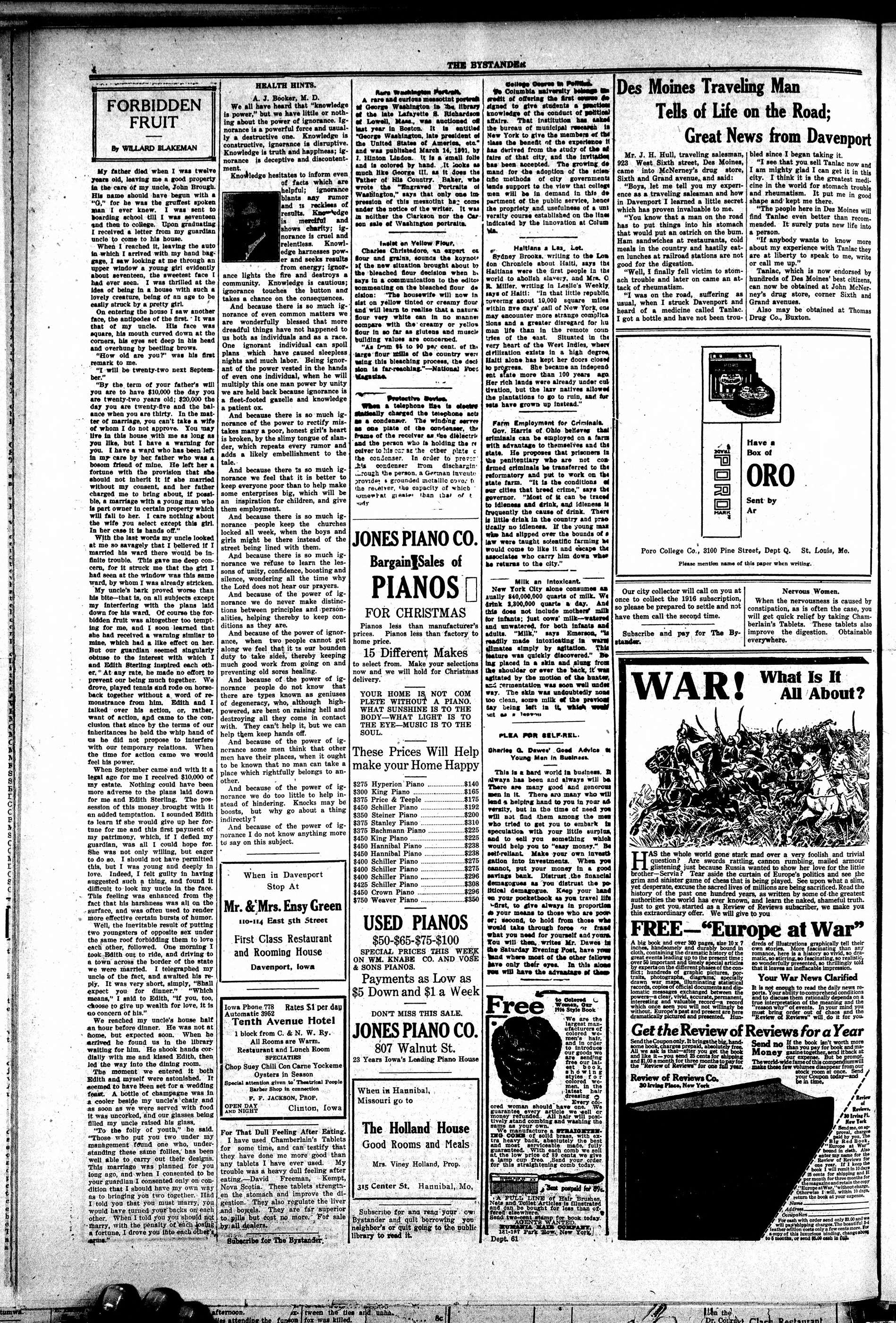
Page text (machine-generated)
THE BYSTANDER
Pay
Boost
and read The
Bystander
XXIII No. 25
RACE MIGRATION FROM THE SOUTH
FACTORS IN THE MOVEMENT
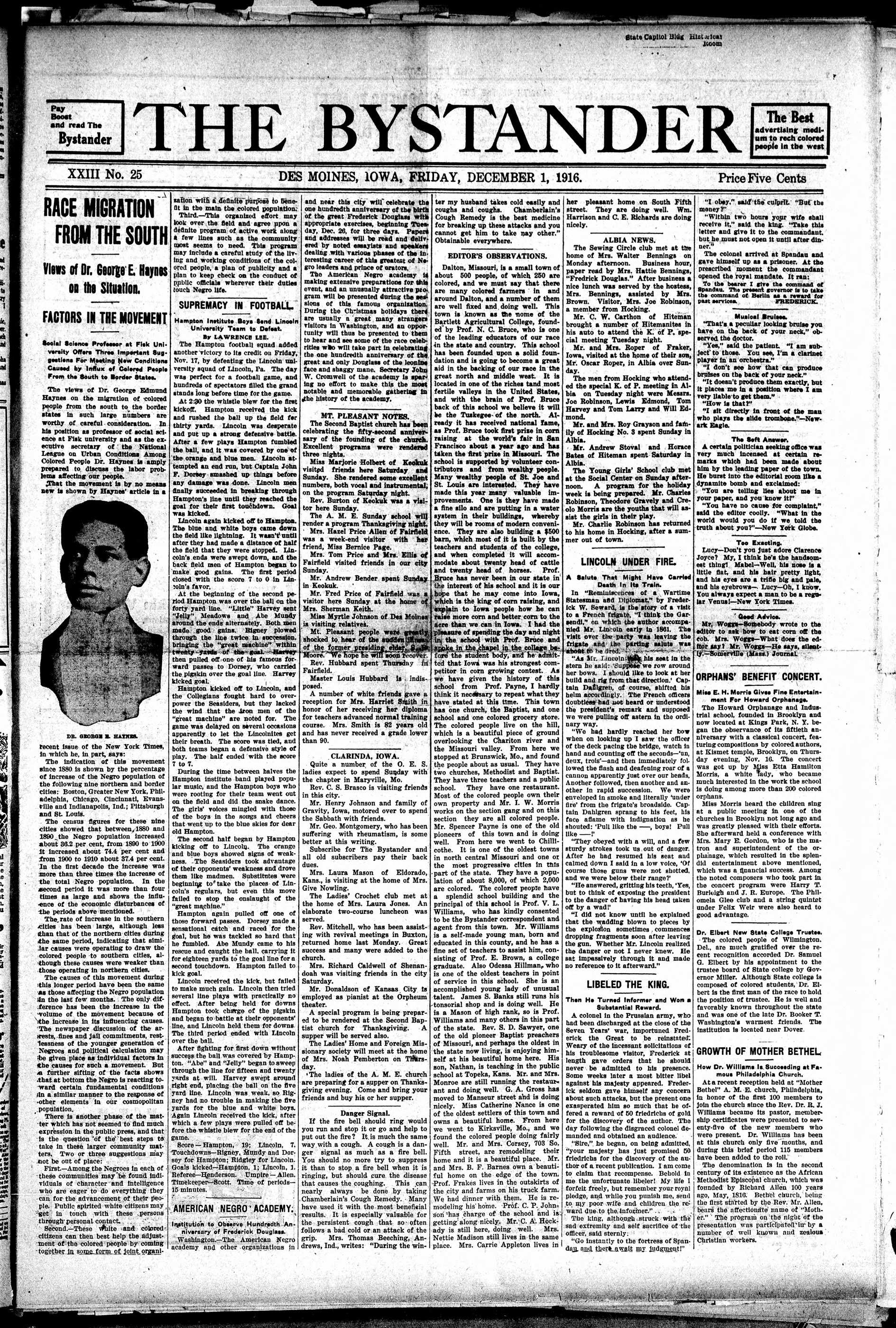
Social Science Professor at Fisk University Offers Three Important Suggestions For Meeting New Conditions Caused by Influx of Colored People From the South to Border States. The views of Dr. George Edmund Haynes on the migration of colored people from the south to the border states in such large numbers are worthy of careful consideration. In his position as professor of social science at Fisk university and as the executive secretary of the National League on Urban Conditions Among Colored People Dr. Haynes is amply prepared to discuss the labor problems affecting our people. That the movement is by no means new is shown by Haynes' article in a
DR. GEORGE R. HAYNES.
recent issue of the New York Times, in which he, in part, says:
The indication of this movement since 1880 is shown by the percentage of increase of the Negro population of the following nine northern and border cities: Boston, Greater New York, Philadelphia, Chicago, Cincinnati, Evansville and Indianapolis, Ind.; Pittsburgh and St. Louis.
The census figures for these nine cities showed that between 1880 and 1890 the Negro population increased about 36.2 per cent, from 1890 to 1900 it increased about 74.4 per cent and from 1900 to 1910 about 37.4 per cent. In the first decade the increase was more than three times the increase of the total Negro population. In the second period it was more than four times as large and shows the influence of the economic disturbances of the periods above mentioned.
The rate of increase in the southern cities has been large, although less than that of the northern cities during the same period, indicating that similar causes were operating to draw the colored people to southern cities, although these causes were weaker than those operating in northern cities.
The causes of this movement during this longer period have been the same as those affecting the Negro population in the last few months. The only difference has been the increase in the volume of the movement because of the increase in its influencing causes. The newspaper discussion of the arrests, fines and jail commitments, restlessness of the younger generation of Negroes and political calculation may be given place as individual factors in the causes for such a movement. But a further sifting of the facts shows that at bottom the Negro is reacting toward certain fundamental conditions in a similar manner to the response of other elements in our cosmopolitan population.
There is another phase of the matter which has not seemed to find much expression in the public press, and that is the question 'of the best steps to take in these larger community matters. Two or three suggestions may not be out of place:
First—Among the Negroes in each of these communities may be found individuals of character and intelligence who are eager to do everything they can for the advancement of their people. Public spirited white citizens may get in touch with these persons through personal contact.
Second—These white and colored citizens can then best help the adjustment of the colored people by coming together in some form of joint organl-
zation with a definite purpose to benefit in the main the colored population: Third—This organised effort may look over the field and agree upon a definite program of active work along a few lines such as the community most seems to need. This program may include a careful study of the living and working conditions of the colored people, a plan of publicity and a plan to keep check on the conduct of public officials wherever their duties touch Negro life.
SUPREMACY IN FOOTBALL
Hampton Institute Boys Send Lincoln University Team to Defeat.
By LAWRENCE LEE.
The Hampton football squad added another victory to its credit on Friday, Nov. 17, by defeating the Lincoln university squad of Lincoln, Pa. The day was perfect for a football game, and hundreds of spectators filled the grand stands long before time for the game.
At 2:30 the whistle blew for the first kickoff. Hampton received the kick and rushed the ball up the field for thirty yards. Lincoln was desperate and put up a strong defensive battle. After a few plays Hampton fumbled the ball, and it was covered by one of the orange and blue men. Lincoln attempted an end run, but Captain John F. Dorsey smashed up things before any damage was done. Lincoln finally succeeded in breaking through Hampton's line until they reached the goal for their first touchdown. Goal was kicked.
Lincoln again kicked off to Hampton. The blue and white boys came down the field like lightning. It wasn't until after they had made a distance of half the field that they were stopped. Lincoln's ends were swept down, and the back field men of Hampton began to make good gains. The first period closed with the score 7 to 0 in Lincoln's favor.
At the beginning of the second period Hampton was over the ball on the forty yard line. "Little" Harvey sent "Jelly" Meadows and Abe Mundy around the ends alternately. Both men made, good gains. Higney plowed through the line twice in succession, bringing the "great machine" within twenty yards of the goal. Harvey then pulled off one of his famous forward passes to Dorsey, who carried the pigskin over the goal line. Harvey kicked goal.
Hampton kicked off to Lincoln, and the Collegians fought hard to overpower the Seasiders, but they lacked the wind that the iron men of the "great machine" are noted for. The game was delayed on several occasions apparently to let the Lincolnites get their breath. The score was tied, and both teams began a defensive style of play. The half ended with the score 7 to 7.
During the time between halves the Hampton institute band played popular music, and the Hampton boys who were rooting for their team went out on the field and did the snake dance. The girls' voices mingled with those of the boys in the songs and cheers that went up to the blue skies for dear old Hampton.
The second half began by Hampton kicking off to Lincoln. The orange and blue boys showed signs of weakness. The Seasiders took advantage of their opponents' weakness and drove them like madmen. Substitutes were beginning to take the places of Lincoln's regulars, but even this move failed to stop the onslaught of the "great machine."
Hampton again pulled off one of those forward passes. Dorsey made a sensational catch and raced for the goal, but he was tackled so hard that he fumbled. Abe Mundy came to his rescue and caught the ball, carrying it for eighteen yards to the goal line for a second touchdown. Hampton failed to kick goal.
Lincoln received the kick, but failed to make much gain. Lincoln then tried several line plays with practically no effect. After being held for downs Hampton took charge of the pigskin and began to battle at their opponents' line, and Lincoln held them for downs. The third period ended with Lincoln over the ball.
After fighting for first down without success the ball was covered by Hampton. "Abe" and "Jelly" began to sweep through the line for fifteen and twenty yards at will. Harvey swept around right end, placing the ball on the five yard line. Lincoln was weak, so Rigney had no trouble in making the five yards for the blue and white boys. Again Lincoln received the kick, after which a few plays were pulled off before the whistle blew for the end of the game.
Score—Hampton, 19; Lincoln, 7. Touchdowns—Rigney, Mundy and Dorsey for Hampton; Ridgley for Lincoln. Goals kicked—Hampton, 1; Lincoln, 1. Referee—Henderson. Umpire—Allen. Timekeeper—Scott. Time of periods—15 minutes.
AMERICAN NEGRO ACADEMY.
Institution to Observe Hundredth An-
Institution to Observe Hundredth Anniversary of Frederick Douglass. Washington—The American Negro academy and other organizations in
DES MOINES, IOWA, FRIDAY, DECEMBER 1, 1916.
and near this city will celebrate the one hundredth anniversary of the birth of the great Frederick Douglass with appropriate exercises, beginning Tuesday, Dec. 26, for three days. Paper and addresses will be read and delivered by noted essayists and speakers dealing with various phases of the interesting career of this greatest of Negro leaders and prince of orators.
The American Negro academy is making extensive preparations for this event, and an unusually attractive program will be presented during the sessions of this famous organization. During the Christmas holidays there are usually a great many stranger visitors in Washington, and an opportunity will thus be presented to them to hear and see some of the race celebrities who will take part in celebrating the one hundredth anniversary of the great and only Douglass of the leonine face and shaggy mane. Secretary John W. Cromwell of the academy is sparing no effort to make this the most notable and memorable gathering in the history of the academy.
ter my husband takes cold easily and coughs and coughs. Chamberlain's Cough Remedy is the best medicine for breaking up these attacks and you cannot get him to take any other." Obtainable everywhere.
EDITOR'S OBSERVATIONS.
Dalton, Missouri, is a small town of about 500 people, of which 250 are colored, and we must say that there are many colored farmers in and around Dalton, and a number of them are well fixed and doing well. This town is known as the name of the Bartlett Agricultural College, founded by Prof. N. C. Bruce, who is one of the leading educators of our race in the state and country. This school has been founded upon a solid foundation and is going to become a great aid in the backing of our race in the great north and middle west. It is located in one of the riches tand most fertile valleys in the United States, and with the brain of Prof. Bruce
MT. PLEASANT NOTES
The Second Baptist church has been celebrating the fifty-second anniversary of the founding of the church. Excellent programs were rendered three nights. Miss Marjorie Holbert of Keokuk visitpd friends here Saturday and Sunday. She rendered some excellent numbers, both vocal and instrumental, on the program Saturday night. Rev. Burton of Keokuk was a visitor here Sunday.
Mrs. Hazel Price Allen of Fairfield was a week-end visitor with her friend, Miss Bernice Page.
Mrs. Tom Price and Mrs. Ellis of Fairfield visited friends in our city Sunday.
Mr. Andrew Bender spent Sunday in Keokuk.
Mr. Fred Price of Fairfield was a visitor here Sunday at the home of Mrs. Sherman Keith.
Miss Myrtle Johnson of Des Moines is visiting relatives.
Mt. Pleasant people were greatly shocked to hear of the sudden illness of the former presiding elder, Sara Moore. We hope he will soon recover. Rev. Hubbard spent Thursday in Fairfield. Master Louis Hubbard is indisposed. A number of white friends gave a reception for Mrs. Harriet Smith in honor of her receiving her diploma for teachers advanced normal training course. Mrs. Smith is 82 years old and has never received a grade lower than 90.
CLARINDA, IOWA.
Quite a number of the O. E. S. ladies expect to spend Sunday with the chapter in Maryville, Mo. Rev. C. S. Brasco is visiting friends in this city. Mr. Henry Johnson and family of Gravity, Iowa, motored over to spend the Sabbath with friends. Mr. Geo. Montgomery, who has been suffering with rheumatism, is some better at this writing. Subscribe for The Bystander and all old subscribers pay their back dues. Mrs. Laura Mason of Eldorado, Kans., is visiting at the home of Mrs. Give Nowling. The Ladies' Crochet club met at the home of Mrs. Laura Jones. An elaborate two-course luncheon was served. Rev. Mitchell, who has been assisting with revival meetings in Buxton, returned home last Monday. Great success and many were added to the church. Mrs. Richard Caldwell of Shenandoah was visiting friends in the city Saturday. Mr. Donaldson of Kansas City is employed as pianist at the Orpheum theater. A special program is being prepared to be rendered at the Second Baptist church for Thanksgiving. A supper will be served also.
The Ladies' Home and Foreign Missionary society will meet at the home of Mrs. Noah Pemberton on Thursday.
The ladies of the A. M. E. church are preparing for a supper on Thanksgiving evening. Come and bring your friends and buy his or her supper.
Danger Signal.
If the fire bell should ring would you run and stop it or go and help to put out the fire? It is much the same way with a cough. A cough is a danger signal as much as a fire bell. You should no more try to suppress it than to stop a fire bell when it is ringing, but should cure the disease that causes the coughing. This can nearly always be done by taking Chamberlain's Cough Remedy. Many have used it with the most beneficial results. It is especially valuable for the persistent cough that so often follows a bad cold or an attack of the grip. Mrs. Thomas Beeching, Andrews, Ind. writes: "During the win-
ter my husband takes cold easily and coughs and coughs. Chamberlain's Cough Remedy is the best medicine for breaking up these attacks and you cannot get him to take nay other." Obtainable everywhere.
EDITOR'S OBSERVATIONS.
Dalton, Missouri, is a small town of about 500 people, of which 250 are colored, and we must say that there are many colored farmers in and around Dalton, and a number of them are well fixed and doing well. This town is known as the nome of the Bartlett Agricultural College, founded by Prof. N. C. Bruce, who is one of the leading educators of our race in the state and country. This school has been founded upon a solid foundation and is going to become a great aid in the backing of our race in the great north and middle west. It is located in one of the riches and most fertile valleys in the United States, and with the brain of Prof. Bruce back of this school we believe it will be the Tuskegee- of the north. Already it has received national fame, as Prof. Bruce took first prize in corn raising at the world's fair in San Francisco about a year ago and has taken the first prize in Missouri. The school is supported by volunteer contributors and from wealthy people. Many wealthy people of St. Joe and St. Louis are interested. They have made this year many valuable improvements. One is they have made a fine silo and are putting in a water system in their buildings, whereby they will be rooms of modern convenience. They are also building a $500 barn, which most of it is built by the teachers and students of the college, and when completed it will accommodate about twenty head of cattle and twenty head of horses. Prof. Bruce has never been in our state in the interest of his school and it is our hope that he may come into Iowa, which is the king of corn raising, and explain to Iowa people how he can raise more corn and better corn to the sore than we can in Iowa. I had the pleasure of spending the day and night in the school with Prof. Bruce and spoke in the chapel in the college before the student body, and he admitted that Iowa was his strongest competitor in corn growing contest. As we have given the history of this school from Prof. Payne, I hardly think it necessary to repeat what they have stated at this time. This town has one church, the Baptist, and one school and one colored grocery store. The colored people live on the hill, which is a beautiful piece of ground overlooking the Chariton river and the Missouri valley. From here we stopped at Brunswick, Mo., and found the people about as usual. They have two churches, Methodist and Baptist. They have three teachers and a public school. They have one restaurant. Most of the colored people own their own property and Mr. I. W. Morris works on the section gang and on this section they are all colored people. Mr. Spencer Payne is one of the old pioneers of this town and is doing well. From here we went to Chillicothe. It is one of the oldest towns in north central Missouri and one or the most progressive cities in this part of the state. They have a population of about 8,000, of which 2,000 are colored. The colored people have a splendid school building and the principal of this school is Prof. V. L. Williams, who has kindly consented to be the Bystander correspondent and agent from this town. Mr. Williams is a self-made young man, born and educated in this county, and he has a fine set of teachers to assist him, consisting of Prof. E. Brown, a college graduate. Also Odessa Hillman, who is one of the oldest teachers in point of service in this school. She is an accomplished young lady of unusual talent. James S. Banks still runs his tonsorial shop and is doing well. He is a Mason of high rank, so is Prof. Williams and many others in this part of the state. Rev. S. D. Sawyer, one of the old pioneer Baptist preachers of Missouri, and perhaps the oldest in the state now living, is enjoying himself at his beautiful home here. His son, Nathan, is teaching in the public School at Topeka, Kans. Mr. and Mrs. Monroe are still running the restaurant and doing well. G. A. Gross has moved to Mansue street and is doing nicely. Miss Catherine Nance is one of the oldest settlers of this town and owns a beautiful home. From here we went to Kirksville, Mo., and we found the colored people doing fairly well. Mr. and Mrs. Corsey, 703 So. Fifth street, are remodeling their home and it is a beautiful place. Mr. and Mrs. B. F. Barnes own a beautiful home on the edge of the town. Prof. Frakes lives in the outskirts of the city and farms on his truck farm. We had dinner with them. He is remodeling his home. Prof. C. P. Johnson has charge of the school and is getting along nicely. Mr. C. A. Hockady is still here, doing well. Mrs. Nettie Madison still lives in the same place. Mrs. Carrie Appleton lives in
State Capitol Blg Historical
Koom
NDER
1916.
NDER
1916. H
her pleasant home on South Fifth street. They are doing well. Wm. Harrison and C. E. Richards are doing nicely.
"I obey money I "With receive
ALBIA NEWS.
The Sewing Circle club met at the home of Mrs. Walter Bennings on Monday afternoon. Business hour, paper read by Mrs. Hattie Bennings, "Fredrick Douglas." After business a nice lunch was served by the hostess, Mrs. Bennings, assisted by Mrs. Brown. Visitor, Mrs. Joe Robinson, a member from Hocking.
Mr. C. W. Carthon of Hiteman brought a number of Hitemanites in his auto to attend the K. of P. special meeting Tuesday night.
Mr. and Mrs. Roper of Fraker, Iowa, visited at the home of their son, Mr. Oscar Roper, in Albia over Sunday.
The men from Hocking who attended the special K. of P. meeting in Albia on Tuesday night were Messrs. Joe Robinson, Lewis Edmond, Tom Harvey and Tom Larry and Will Edmond.
Mr. and Mrs. Roy Grayson and family of Hocking No. 3 spent Sunday in Albia.
Mr. Andrew Stoval and Horace Bates of Hiteman spent Saturday in Albia.
The Young Girls' School club met at the Social Center on Sunday afternoon. A program for the holiday week is being prepared. Mr. Charles Robinson, Theodore Gravely and Creolo Morris are the youths that will assist the girls in their play.
Mr. Charlie Robinson has returned to his home in Hocking, after a summer out of town.
LINCOLN UNDER FIRE.
A Salute That Might Have Carried Death In Its Train.
In "Reminiscences of a Wartime Statesman and Diplomat," by Frederick W. Seward, is the story of a visit to a French trigate, "I think the Garsendi," on which the author accompanied Mr. Lincoln early in 1861. The visit over the party was leaving the trigate and the parting salute was about to be dred.
"As Mr. Lincoln took his seat in the stern he said: Suppose we row around her bows. I should like to look at her build and rig from that direction." Captain Dahlgren, of course, shifted his helm accordingly. The French officers doubtless had not heard or understood the president's remark and supposed we were pulling off astern in the ordinary way.
"We had hardly reached her bow when on looking up I saw the officer of the deck pacing the bridge, watch in hand and counting off the seconds—'un, deux, trois'—and then immediately followed the flash and deafening roar of a cannon apparently just over our heads. Another followed, then another and another in rapid succession. We were enveloped in smoke and literally 'under fire' from the trigate's broadside. Captain Dahlgren sprang to his feet, his face afame with indignation as he shouted: 'Pull like the —, boys! Pull like —!'
"They obeyed with a will, and a few sturdy strokes took us out of danger. After he had resumed his seat and calmed down I said in a low voice, 'Of course those guns were not shotted, and we were below their range?' "He answered, gritting his teeth, 'Yes, but to think of exposing the president to the danger of having his head taken off by a wad!' "I did not know until he explained that the wadding blown to pieces by the explosion sometimes commences dropping fragments soon after leaving the gun. Whether Mr. Lincoln realized the danger or not I never knew. He sat impassively through it and made no reference to it afterward."
LIBELED THE KING
Then He Turned Informer and Won a Substantial Reward.
A colonel in the Prussian army, who had been discharged at the close of the Seven Years' war, importoned Frederick the Great to be reinstated. Weary of the incessant solicitations of his troublesome visitor, Frederick at length gave orders that he should never be admitted to his presence. Some weeks later a most bitter libel against his majesty appeared. Frederick seldom gave himself any concern about such attacks, but the present one exasperated him so much that he offered a reward of 50 friedrichs of gold for the discovery of the author. The day following the disgraced colonel demanded and obtained an audience.
"Sire," he began, on being admitted, "your majesty has just promised 50 friedrichs for the discovery of the author of a recent publication. I am come to claim that recompense. Behold in me the unfortunate libeler! My life I forfeit freely, but remember your royal pledge, and while you punish me, send to my poor wife and children the reward due to the informer."
The king, although struck with the sad extremity and self sacrifice of the officer, said sternly:
"Go instantly to the fortress of Spandan and there await my judgment!"
---
11
"I obey," said the culprit. "But the money?"
"Within two hours your wife shall receive it," said the king. "Take this letter and give it to the commandant, but he must not open it until after dinner."
The colonel arrived at Spandau and gave himself up as a prisoner. At the prescribed moment the commandant opened the royal mandate. It ran:
To the bearer I give the command of Spandau. The present governor will take the command of Berlin as a reward for past services.
FREDRICK
"That's a peculiar looking bruise you have on the back of your neck," observed the doctor.
"Yes," said the patient. "I am subject to those. You see, I'm a clarinet player in an orchestra."
"I don't see how that can produce bruises on the back of your neck."
"It doesn't produce them exactly, but it places me in a position where I am very liable to get them."
"How is that!"
"I sit directly in front of the man who plays the slide trombone."—Newark Eagle.
The Soft Answer.
A certain politician seeking office was very much incensed at certain remarks which had been made about him by the leading paper of the town. He burst into the editorial room like a dynamite bomb and exclaimed:
"You are telling lies about me in your paper, and you know it!"
"You have no cause for complaint," said the editor coolly. "What in the world would you do if we told the truth about you?"—New York Globe.
Too Exacting.
Lucy—Don't you just adore Clarence Joyce? My, I think he's the handsome thing! Mabel—Well, his nose is a little flat, and his hair pretty light, and his eyes are a trifle big and pale, and his eyebrows—Lucy—Oh, I know. You always expect a man to be a regular Venus!—New York Times.
Good Advice.
Mr. Woggs—Somebody wrote to the editor to ask how to eat corn off the cob. Mrs. Woggs—What does the editor say? Mr. Woggs—He says, silently, "Bomerville (Mass.) Journal.
ORPHANS' BENEFIT CONCERT.
Miss E. H. Morris Gives Fine Entertainment For Howard Orphanage.
The Howard Orphanage and Industrial school, founded in Brooklyn and now located at Kings Park, N. Y. began the observance of its fifteenth anniversary with a classical concert, featuring compositions by colored authors, at Kismet temple, Brooklyn, on Thursday evening, Nov. 16. The concert was got up by Miss Etta Hamilton Morris, a white lady, who became much interested in the work the school is doing among more than 200 colored orphans.
Miss Morris heard the children sing at a public meeting in one of the churches in Brooklyn not long ago and was greatly pleased with their efforts. She afterward held a conference with Mrs. Mary E. Gordon, who is the matron and superintendent of the orphanage, which resulted in the splendid entertainment above mentioned, which was a financial success. Among the noted composers who took part in the concert program were Harry T. Burleigh and J. R. Europe. The Philomela Glee club and a string quintet under Felix Weir were also heard to good advantage.
Dr. Elbert New State College Trustees. The colored people of Wilmington. Del., are much gratified over the recent recognition accorded Dr. Samuel G. Elbert by his appointment to the trustee board of State college by Governor Miller. Although State college is composed of colored students, Dr. Elbert is the first man of the race to hold the position of trustee. He is well and favorably known throughout the state and was one of the late Dr. Booker T. Washington's warmest friends. The institution is located near Dover.
GROWTH OF MOTHER BETHEL
How Dr. William Is. Suceeding at Famous Philadelphia Church.
At a recent reception held at "Mother Bethel" A. M. E. church, Philadelphia, in honor of the first 100 members to join the church since the Rev. Dr. R. J. Williams became its pastor, membership certificates were presented to seventy-five of the new members who were present. Dr. Williams has been at this church only five months, and during this brief period 115 members have been added to the roll.
The denomination is in the second century of its existence as the African Methodist Episcopal church, which was founded by Richard Allen 100 years ago, May, 1816. Bethel church, being the first started by the Rev. Mr. Allen, bears the affectionate name of "Mother." The program on the night of the presentation was participated in by a number of well known and zealous Christian workers.
The Best advertising medium to reach colored people in the west
Price Five Cents
Musical Bruisea.
The Soft Answer
Too Exacting.
Good Advice
THE BYSTANDER
Pay
Boost
and read The
Bystander
XXIII No.25
RACE MIGRATION FROM THE SOUTH
Views of Dr. George E. Haynes on the Situation.
FACTORS IN THE MOVEMENT
Social Science Professor at Fisk University Offers Three Important Suggestions For Meeting New Conditions Caused by Influx of Colored People From the South to Border States.
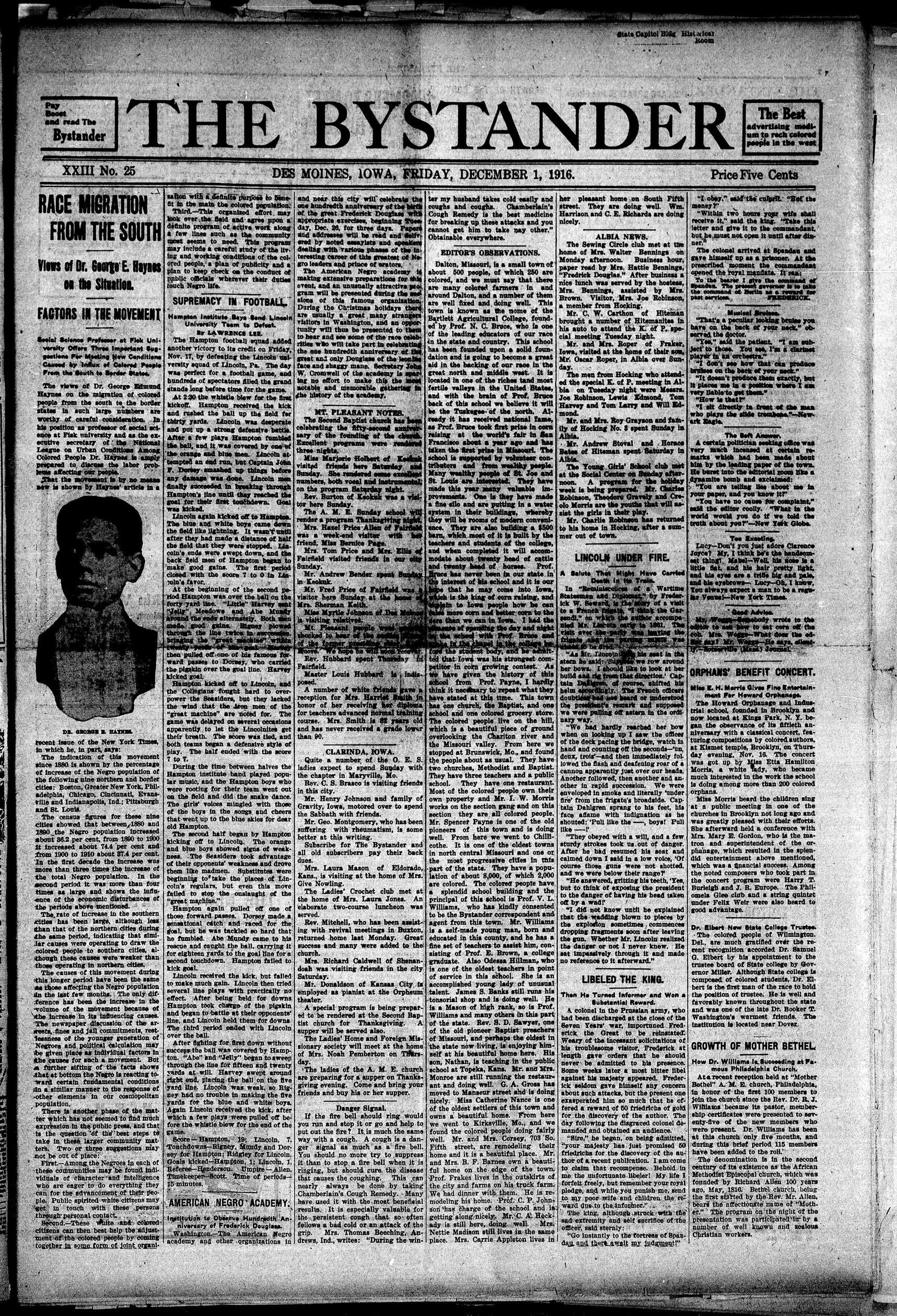
The views of Dr. George Ehmund Haynes on the migration of colored people from the south to the border states in such large numbers are worthy of careful consideration. In his position as professor of social science at Fisk university and as the executive secretary of the National League on Urban Conditions Among Colored People Dr. Haynes is amply prepared to discuss the labor problems affecting our people.
That the movement is by no means new is shown by Haynes article in a
DR. GEORGE R. FAYETT
recent issue of the New York Times,
in which he, in part, says:
The indication of this movement since 1880 is shown by the percentage of increase of the Negro population of the following nine northern and border cities: Boston, Greater New York, Philadelphia, Chicago, Cincinnati, Evansville and Indianapolis, Ind.; Pittsburgh and St. Louis.
The census figures for these nine cities showed that between 1880 and 1890 the Negro population increased about 62.2 per cent, from 1890 to 1900 it increased about 74.4 per cent and from 1900 to 1910 about 87.4 per cent. In the first decade the increase was more than three times the increase of the total Negro population. In the second period it was more than four times as large and shows the influence of the economic disturbances of the periods above mentioned.
The rate of increase in the southern cities has been large, although less than that of the northern cities during the same period, indicating that similar causes were operating to draw the colored people to southern cities, although these causes were weaker than those operating in northern cities.
The causes of this movement during this longer period have been the same as those affecting the Negro population in the last few months. The only difference has been the increase in the volume of the movement because of the increase in its influencing causes. The newspaper discussion of the arrests, fines and jail commitments, restlessness of the younger generation of Negroes and political calculation may be given place as individual factors in the causes for such a movement. But a further sifting of the facts shows that at bottom the Negro is reacting toward certain fundamental conditions in a similar manner to the response of other elements in our cosmopolitan population.
There is another phase of the matter which has not seemed to end much expression in the public press, and that is the question 'of the best steps to take in these larger community matters. Two or three suggestions may not be out of place:
First—Among the Negroes in each of these communities may be found individuals of character and intelligence who are eager to do everything they can for the advancement of their people. Public spilled white citizens may get in touch with these persons through personal contact. Second—These white and colored citizens can then best help the adjustment of the colored people by coming together in some form of joint organi-
sation with a definite purpose to benefit in the main the colored population. Third—This organised effort may look over the field and agree upon a definite program of active work along a few lines such as the community most seems to need. This program may include a careful study of the living and working conditions of the colored people, a plan of publicity and a plan to keep check on the conduct of public officials wherever their duties touch Negro life.
SUPREMACY IN FOOTBALL.
Hampton Institute Bays Send Lincoln
University Team to Defeat.
University Team to Defeat.
BY LAWRENCE LEE.
The Hampton football squad added another victory to its credit on Friday, Nov. 17, by defeating the Lincoln university squad of Lincoln, Pa. The day was perfect for a football game, and hundreds of spectators trolled the grand stands long before time for the game.
At 2:20 the whistle blew for the first kickoff. Hampton received the kick and rushed the ball up the field for thirty yards. Lincoln was desperate and put up a strong defensive battle. After a few plays Hampton rumbled the ball, and it was covered by one of the orange and blue men. Lincoln attempted an end run, but Captain John F. Dorsey smashed up things before any damage was done. Lincoln men finally succeeded in breaking through Hampton's line until they reached the goal for their first touchdown. Goal was kicked.
Lincoln again kicked off to Hampstead. The blue and white boys came down the field like lightning. It wasn't until after they had made a distance of half the field that they were stopped. Lincoln's ends were swept down, and the back field men of Hampton began to make good gains. The first period closed with the score 7 to 0 in Lincoln's favor.
At the beginning of the second period Hampton was over the ball on the forty yard line. "Little" Harvey sent "Jelly" Meadows and Abe Mundy around the ends alternately. Both men made good gains. Harvey plowed through the line twice in succession, bringing the "great machine" within thirty yards. The goal was then pulled off one of his famous forward passes to Dorsey, who carried the pigskin over the goal line. Harvey kicked goal.
Hampton kicked off to Lincoln, and the Collegians fought hard to overpower the Seasiders, but they lacked the wind that the iron men of the "great machine" are noted for. The game was delayed on several occasions apparently to let the Lincolnites get their breath. The score was tied, and both teams began a defensive style of play. The half ended with the score 7 to 7.
During the time between halves the Hampton institute band played popular music, and the Hampton boys who were rooting for their team went out on the field and did the shake dance. The girls' voices mingled with those of the boys in the songs and cheers that went up to the blue skies for dear old Hampton.
The second half began by Hampton kicking off to Lincoln. The orange and blue boys showed signs of weakness. The Seasiders took advantage of their opponents' weakness and drove them like madmen. Substitutes were beginning to take the places of Lincoln's regulars, but even this move failed to stop the onslaught of the "great machine."
Hampton again pulled off one of those forward passes. Dorsey made a sensational catch and raced for the goal, but he was tackled so hard that he fumbled. Abe Mundy came to his rescue and caught the ball, carrying it for eighten yards to the goal line for a second touchdown. Hampton failed to kick goal.
Lincoln received the kick, but failed to make much gain. Lincoln then tried several line plays with practically no effect. After being held for downs Hampton took charge of the pikskin and began to battle at their opponent's line, and Lincoln held them for downs. The third period ended with Lincoln over the ball.
After fighting for first down without success the ball was covered by Hampton. "Abe" and "Jelly" began to sweep through the line for fifteen and twenty yards at will. Harvey swept around right end, placing the ball on the five yard line. Lincoln was weak, so Biggney had no trouble in making the five yards for the blue and white boys. Again Lincoln received the kick, after which a few plays were pulled off before the whistle blow for the end of the game.
Score—Hampton, 19; Lincoln, 7. Touchdowns—Biggney, Mundy and Dorsay for Hampton; Ridgley for Lincoln. Goals kicked—Hampton, 1; Lincoln, 1. Referees—Henderson, Umpire—Allen. Timekeeper—Scott. Time of periods—15 minutes.
AMERICAN NEGRO ACADEMY:
Institution to Observe Hundredth Anniversary of Frederick Douglass.
Washington—The American Negro academy and other organizations in
DES MOINES, IOWA, FRIDAY, DECEMBER 1, 1916.
to Fene-
sulation: It may
upon a
k along
umity
program
the liv-
the col-
and a
and near this city will celebrate the one hundredth anniversary of the birth of the great Frederick Douglass with appropriate exercises, beginning Tuesday day, Dec. 26, for three days. Papers and addresses will be read and delivered by noted essayists and speakers dealing with various phases of the interesting career of the greatest of Neo-roaders and prince of protons
ter my husband takes cold easily and coughs and coughs. Chamberlain's Cough Remedy is the best medicine for breaking up these attacks and you cannot get him to take may other." Obtainable everywhere.
EDITOR'S OBSERVATIONS.
Dalton, Missouri, is a small town of
The American Negro academy is making extensive preparations for this event, and an unusually attractive program will be presented during the sessions of this famous organisation. During the Christmas holidays there are usually a great many stranger visitors in Washington, and an opportunity will thus be presented to them to hear and see some of the race celebrities who will take part in celebrating the one hundredth anniversary of the great and only Douglas of the local face and shaggy mane. Secretary John W. Cromwell of the academy is speaking no effort to make this the most notable and memorable gathering in the history of the academy.
M.T. PLEASANT NOTES.
The Second Baptist church has been celebrating the fifty-second anniversary of the founding of the church. Excellent programs were rendered three nights.
Miss Marjorie Holbert of Keokuk visited friends here Saturday and Sunday. She rendered some excellent numbers, both vocal and instrumental on the program Saturday night. Rev. Burton of Keokuk was a visitor here Sunday. The A. M. E. Sunday school will render a program Thanksgiving night. Mrs. Hazel Price Allen of Fairfield was a week-end visitor with her friend, Miss Bernice Page. Mrs. Tom Price and Mrs. Ellis of Fairfield visited friends in our city Sunday. Mr. Andrew Bender spent Sunday in Keokuk. Mr. Fred Price of Fairfield was a visitor here Sunday, at the home of Mrs. Shannon Keith. Miss Myrtle Johnson of Dan Moeen is visiting relatives. Mr. Michael paule was pauled checked to hear on the evening paule of the former paule visiting paule.
We hope you will receive
Rev. Hubbard spent Thursday in Fairfield.
Master Louis Hubbard is indisposed.
A number of white friends gave a reception for Mrs. Harriet Smith in honor of her receiving her diploma for teachers advanced normal training course. Mrs. Smith is 62 years old and has never received a grade lower than 90.
CLARINDA, IOWA.
Quite a number of the O. E. S. ladies expect to spend Sunday with the chapter in Maryville, Mo.
Rev. C. S. Brasco is visiting friends in this city.
Mr. Henry Johnson and family of Gravity, Iowa, motored over to spend the Sabbath with friends.
Mr. Geo Montgomery, who has been suffering with rheumatism, is some better at this writing.
Subscribe for The Bystander and all old subscribers pay their back dues.
Mrs. Laura Mason of Eldorado, Kans., is visiting at the home of Mrs. Give Nowling.
The Ladies' Crochet club met at the home of Mrs. Laura Jones. An elaborate two-course luncheon was served.
Rev. Mitchell, who has been assisting with revival meetings in Buxton, returned home last Monday. Great success and many were added to the church.
Mrs. Richard Caldwell of Shenandoah was visiting friends in the city Saturday.
Mr. Donaldson of Kansas City is employed as pianist at the Orpheum theater.
A special program is being prepared to be rendered at the Second Baptist church for Thanksgiving. A supper will be served also.
The Ladies' Home and Foreign Missionary society will meet at the home of Mrs. Noah Pemberton on Thursday.
The ladies of the A. M. E. church are preparing for a supper on Thanksgiving evening. Come and bring your friends and buy his or her supper.
Danger Signal.
If the fire bell should ring would you run and stop it or go and help to put out the fire? It is much the same way with a cough. A cough is a danger signal as much as a fire bell. You should no more try to suppress it than to stop a fire bell when it is ringing, but should cure the disease that causes the coughing. This can nearly always be done by taking Chamberlain's Cough Remedy. Many have used it with the most beneficial results. It is especially valuable for the persistent cough that so often follows a bad cold or an attack of the grip. Mrs. Thomas Beeching, Andrews, Ind., writes: "During the win-
ter my husband takes cold easily and coughs and coughs. Chamberlain's Cough Remedy is the best medicine for breaking up these attacks and you cannot get him to take nay other." Obtainable everywhere.
EDITOR'S OBSERVATIONS.
Dalton, Missouri, is a small town of about 500 people, of which 250 are colored, and we must say that there are many colored farmers in and around Dalton, and a number of them are well fixed and doing well. This town is known as the name of the Bartlett Agricultural College, founded by Prof. N. C. Bruce, who is one of the leading educators of our race in the state and country. This school has been founded upon a solid foundation and is going to become a great aid in the backing of our race in the great north and middle west. It is located in one of the riches and most fertile valleys in the United States, and with the brain of Prof. Bruce back of this school we believe it will be the Tuskegee-of the north. Already it has received national fame, as Prof. Bruce took first prize in corn raising at the world's fair in San Francisco about a year ago and has taken the first prize in Missouri. The school is supported by volunteer contributors and from wealthy people. Many wealthy people of St. Joe and St. Louis are interested. They have made this year many valuable improvements. One is they have made a fine silo and are putting in a water system in their buildings, whereby they will be in rooms of modern convenience. They are also building a 5500 barn, which most of it is built by the teachers and students of the college, and when completed it will accommodate about twenty head of cattle and twenty head of horses. Prof. Bruce has never been in our state in the interest of his school and it is our hope that he may come into Iowa, which is the king of corn raising, and explain to Iowa people how he can take more corn and better corn to the store than we can in Iowa. I had the pleasure of spending the day and night in the school with Prof. Bruce and
for the student body, and he admitted that Iowa was his strongest competitor in corn growing contest. As we have given the history of this school from Prof. Payne, I hardly think it necessary to repeat what they have stated at this time. This town has one church, the Baptist, and one school and one colored grocery store. The colored people live on the hill, which is a beautiful piece of ground overlooking the Chariton river and the Missouri valley. From here we stopped at Brunswick, Mo., and found the people about as usual. They have two churches, Methodist and Baptist. They have three teachers and a public school. They have one restaurant. Most of the colored people own their own property and Mr. I. W. Morris works on the section gang and on this section they are all colored people. Mr. Spencer Payne is one of the old pioneers of this town and is doing well. From here we went to Chillcothe. It is one of the oldest towns in north central Missouri and one in the most progressive cities in this part of the state. They have a population of about 8,000, of which 2,000 are colored. The colored people have a splendid school building and the principal of this school is Prof. V. L. Williams with his kindly consent to be the Bystander correspondent and agent from this town. Mr. Williams is a self-made young man, born and educated in this county, and he has a fine set of teachers to assist him, consisting of Prof. E. Brown, a college graduate. Also Odessa Hillman, who is one of the oldest teachers in point of service in this school. She is an accomplished young lady of unusual talent. James S. Banks still runs his tonsorial shop and is doing well. Prof. Williams and many others in this part of the state. Rev. S. D. Sawyer, one of the old pioneer Baptist presachers of Missouri, and perhaps the oldest in the state now living, is enjoying himself at his beautiful home here. His son, Nathan, is teaching in the public school at Topeka, Kans. Mr. and Mrs. Monroe are still running the restaurant and doing well. G. A. Gross has moved to Mansue street and is doing nicely. Miss Catherine Nance is one of the oldest settlers of this town and owns a beautiful home. From here we went to Kirksville, Mo., and we found the colored people doing fairly well. Mr. and Mrs. Corsey, 703 So. Fifth street, are remodeling their home and on the edge of the town Prof. Frakes lives in the outskirts of the city and farms on his truck farm. We had dinner with them. He is remodeling his home. Prof. C. P. Johnson's charge of the school and is getting along nicely. Mr. C. A. Hockady is still here, doing well. Mrs. Nettie Madison still lives in the same place. Mrs. Carrie Appleton lives in
NDER
1916.
NDER
1916.
her pleasant home on South Fifth street. They are doing well. Wm. Harrison and C. E. Richards are doing nicely.
"I obey money."
"With receive."
ALBIA NEWS
The Sewing Circle club met at the home of Mrs. Walter Bennings on Monday afternoon. Business hour, paper read by Mrs. Hattie Bennings, "Freddrick Douglas." After business a nice lunch was served by the hostess, Mrs. Bennings, assisted by Mrs. Brown. Visitor, Mrs. Joe Robinson, a member from Hocking.
Mr. C, W. Carthon of Hiteman brought a number of Hitemanites in his auto to attend the K. of P. special meeting Tuesday night.
Mr. and Mrs. Roper of Fraker, Iowa, visited at the home of their son, Mr. Oscar Roper, in Albia over Sunday.
The men from Hocking who attended the special K. of P. meeting in Albia on Tuesday night were Messrs. Joe Robinson, Lewis Edmond, Tom Harvey and Tom Larry and Will Edmond.
Mr. and Mrs. Roy Grayson and family of Hocking No. 3 spent Sunday in Albia.
Mr. Andrew Stoval and Horace Bates of Hiteman spent Saturday in Albia.
The Young, Girls' School club must at the Social Center on Sunday afternoon. A program for the holiday week is being prepared. Mr. Charles Robinson, Theodore Gravely and Creol Morris are the youths that will assist the girls in their play.
Mr. Charlie Robinson has returned to his home in Hocking, after a summer out of town.
LINCOLN UNDER FIRE
A Satellite Thin Might Have Carried
North Lakes Terror
Death in the Train.
In "Reminiscence of a Wartime Statesman and Diplomat" by Frederick W. Seward, is the story of a visit to a French frigate, "Think the Garsendi," on which the author accompanied Mr. Lincoln early in 1801. The visit over the polity having the frigate and the burning ship was intended to be done.
"As Mr. Lincoln came his seat in the stern he said: 'Shipboard we row around her bows. I should like to look at her build and rise from that direction.' Captain Dallagher, of course, shifted his helm accordingly. The French officers doubtless had seen heard or understood the president's remark and supposed we were pulling off astern in the ordinary way.
"We had hardly reached her how when on looking up I saw the offices of the deck pacing the bridge, watch in hand and counting off the seconds—'un, deux, trois—and then immediately followed the flash and deafening roar of a cannon apparently just over our heads. Another followed, then another and another in rapid succession. We were enveloped in smoke and literally 'under fire' from the trigrate's broadside. Captain Dahlgren sprang to his feet, his face afame with indignation as he shouted: 'Pull like the —, boys! Pull! They obeyed with a will, and a few sturdy stumps took us out of danger. After he had resumed his seat and calmed down I said in a low voice, 'Of course those guns were not shotted, and we were below their range?' "He answered, gritting his teeth. 'Yes, but to think of expoking the president to the danger of having his head taken off by a wad!'
"I did not know until he explained that the wedding blown to pieces by the explosion sometimes, commences dropping fragments soon after leaving the gun. Whether Mr. Lincoln realized the danger or not I never knew. He sat impassively through it and made no reference to it afterward."
LIBELED THE KING.
Then He Turned Infermer and Won a Substantial Reward. A colonel in the Prussian army, who had been discharged at the close of the Seven Years' war, importuned Fredrick the Great to be reinstated. Weary of the incessant solicitations of his troublesome visitor, Fredrick at length gave orders that he should never be admitted to his presence. Some weeks later a most bitter libel against his majesty appeared. Fredrick seldom gave himself any concern about such attacks, but the present one exasperated him so much that he offered a reward of 50 friedrichs of gold for the discovery of the author. The day following the disgrudged colonel demanded and obtained an audience.
be Frussian army, who died at the close of the war, importuned Fred. at to be reinstated. present solicitations of visitor, Frederick atders that he should to his presence. or a most bitter libel astype appeared. Freder. himself any concern ks, but the present one so much that he of- 50 friedrichs of gold of the author. The de disgraced colonel deined an audience.
GROW
and wan Washin institute
How Do
At a Bethel' in home join the William ship ce enty-five were p
"Sire," he began, on being admitted,
"your majesty has just promised 60
friendships for the discovery of the
author of a recent publication. I am come
to claim that recompense. Behold in
me the unfortunate lobelet! My life I
forfeit freely, but remember your royal
pledge, and while you punish me, send
to my poor wife and children the re-
ward due to the informer."
The king, although struck with the
sad extremity and self sacrifice of the
officer, said sternly:
"Go instantly to the fortress of Spandan
and there await my judgment!"
```markdown
```
"I obey," said the culprit. "Huh the money!"
"Within two hours your wife shall receive it," said the king. "Take this letter and give it to the commandant, but he must not open it until after dinner."
The colopal arrived at Spadun and gave himself up as a prisoner. At the prescribed moment the commandant opened the royal mendate. It was: To the bursar I give the command of Spadun. The present governor is to take the command of Berlin as a reward for past services.
FREDERICK.
Musical Bruises.
"That's a peculiar looking bruise you have on the back of your neck" observed the doctor.
"Yes," said the patient. "I am subject to those. You see, I'm a clarinet player in an orchestra."
"I don't see how that can produce brushes on the back of your neck."
"It doesn't produce them exactly, but it places me in a position where I am very liable to get them."
"How is that?"
"I sit directly in front of the man who plays the slide trembonae."-Newark Eagle.
The Soft Answer.
A certain politician seeking office was very much incensed at certain remarks which had been made about him by the leading paper of the town. He burst into the editorial room like a dynamite bomb and exclaimed:
"You are telling me about me in your paper, and you know it!"
"You have no cause for complaint," said the editor coolly. "What in the world would you do if we told the truth about you?"—New York Globe.
Too Exciting.
Lucy—Don't you just adore Clarence Joyce? My, I think he's the handcourt thing! Malel—Well, his nose is a little fat, and his hair pretty light, and his eyes are a trifle big and pale, and his eyebrows—Lucy—Oh, I know. You always expect a man to be a regular Venus—New York Times.
Good Advice.
Mr. Waggie—Youbody wrote to the editor and how to eat corn off the cob. Mr. Waggie—What does the editor say! Mr. Waggie—He says, almost—Borisville (Miss) Journal.
ORPHANS' BENEFIT CONCERT.
Miss E. H. Morris Gives Fine Entertainment For Howard Orphanage. The Howard Orphanage and Industrial school, founded in Brooklyn and now located at Kings Park, N. Y. began the observance of its fifteenth anniversary with a classical concert, featuring compositions by colored authors, at Kiamet temple, Brooklyn, on Thursday evening, Nov. 16. The concert was got up by Miss Etta Hamilton Morris, a white lady, who became much interested in the work the school is doing among more than 200 colored orphans.
Miss Morris heard the children sing at a public meeting in one of the churches in Brooklyn not long ago and was greatly pleased with their efforts. She afterward held a conference with Mrs. Mary E. Gordon, who is the matron and superintendent of the orphanage, which resulted in the splendid entertainment above mentioned, which was a financial success. Among the noted composers who took part in the concert program were Harry T. Burleigh and J. R. Europe. The Philomelis Glee club and a string quintet under Felix Weir were also heard to good advantage.
Dr. Elbert New State College Trustees. The colored people of Wilmington. Del, are much gratified over the recent recognition accorded Dr. Samuel G. Elbert by his appointment to the trustee board of State college by Governor Miller. Although State college is composed of colored students, Dr. Elbert is the first man of the race to hold the position of trustee. He is well and favorably known throughout the state and was one of the late Dr. Booker T. Washington's warmest friends. The institution is located near Dover.
GROWTH OF MOTHER BETHEL
How Dr. William Ia. Succeeding at Famous Philadelphia Church.
At a recent reception held at "Mother Bethel" A. M. E. church, Philadelphia, in honor of the first 100 members to join the church since the Rev. Dr. R. J. Williams became its pastor, membership certificates were presented to seventy-five of the new members who were present. Dr. Williams has been at this church only five months, and during this brief period 115 members have been added to the roll. The denomination is in the second century of its existence as the African Methodist Episcopal church, which was founded by Richard Allen 100 years ago, May, 1810. Bethel church, being the first started by the Rev. Mr. Allen, bears the inflectionate name of "Mother." The program on the night of the presentation was participated in by a number of well known and zeolous Christian workers.
The Best
advertising medium to reach colored people in the west
Price Five Cents
ernoon. tween the ties and unha es attending the fursoon fox was killed. 8c
2
3
4
5
6
7
8
9
10
11
12
13
14
15
16
17
18
19
20
21
22
23
24
25
26
27
28
29
30
31
32
33
34
35
36
37
38
39
40
41
42
43
44
45
46
47
48
49
50
51
52
53
54
55
56
57
58
59
60
61
62
63
64
65
66
67
68
69
70
71
72
73
74
75
76
77
78
79
80
81
82
83
84
85
86
87
88
89
90
91
92
93
94
95
96
97
98
99
100
3
BYSTANDER PUBLISHING CO. PUBLISHERS
DES MOINES, IOWA
Published every Friday by the By
stander Publishing Company, Des
Moines, Iowa. Office in Chemical
building, corner Seventh and Mul-
berry streets. Phone alnut 899.
Official paper of the M. W. U. Grand Lodge of Iowa, A. F. & A. M., and International Grand Congress of Heroines of Jericho of America, and Western Baptist Association.
Entered at the postoffice as second class matter.
Advertising rates for display ads, 25 cents per inch, for each insertion. Three to six months' contracts, 15 cents per inch. Local advertising 10 cents per line for each insertion, counting seven words to a line. For churches and secret societies where admission is charged, one-half of the above-mentioned rates. For professional, legal and announcement cards, yearly contracts, etc., terms are given on application. All advertising is to be paid in advance.
We are prepared to do first class job work at reasonable prices. All of our work is guaranteed. NOTICE. TO CORRESPONDENTS.
NOTICE TO CORRESPONDENTS.
Communications must be written on one side of the paper only and be of interest to the public. "Brevity is the soul of wit," remember.
TERMS OF SUBSCRIPTION.
We will not return rejected manuscript, unless accompanied by postage stamps.
Send money by postoffice order, money order, express or draft, to The Bystander Company. All subscriptions payable in advance. This notice applies to all writers contributors, agents and correspondents. Sign all articles, write only upon one side of paper, write a plair or receptions nor send in programs to be published before or after the event. Do not give an eulogy or write your personal comment upon hand and spell accurately. Do not send in names of persons at parties the event. Simply tell the news or event in a brief, simple manner and let the readers of The Bystander comment. Write the news of all classes, all societies, all religious denominations, irrespective of your personal whims or ideas.
The Iowa State Bystander is the oldest Afro-American journal published in Iowa. It was established in 1894, and is read by nearly all the colored people of Iowa. We have correspondents in the following towns:
Albia.....Miss May Davis
Washington.....N. L. Black
Burlington.....Mrs. L. M. Abel
Monmouth, Ill..Mrs. Bernice Metlock
Colfax.....Mrs. Gertwude Brodusd
Minneapolis.....Mrs. R. L. Buttner
Clinton.....A. A. Bush
Macon, Mo.....Lucy Harris
Mason City.....Mrs. Maud Brewton
Keokuk.....Miss Ruth Bland
St. Paul, Minn.....@Mrs. Hattie Hicks
Seandia, Iowa.....Mrs. J. M. Montague
Rock Island, Ill..Mr. Earle Reynolds
Davenport.....Mrs. D. J. Johnson
Oskaloosa.....Mrs. Cora Moore
Centerville..Miss Cora M. Crittenden
Burlington.....Mrs. Wm. Ashby
Monmouth, Ill..Miss Bernice Metlock
St. Paul, Minn.....Mrs. Mattie Hicks
Omaha, Neb.....Miss Murel Brown
Ottumwa.....Mrs. W. H. Thompson
Moberly, Mo.....Miss Lee Etta Owens
Dalton, Mo.....Prof. R. Payn
Chillicothe, Mo.....V. E. Williams
Sioux City.....Mrs. M. Askew
Clarinda.....Mrs. G. N. Nowling
EDITORIALS
HOME IDEALS.
The American people, and especially the colored people, have grossly neglected the home training to their children. In the busy struggle of life and living we seem to have no time or thought to give the rearing of the little ones. Think of the German family life or the Scotch home environment. See what high ideals, pure morals and parental love that those children have, a loving devotion of their parents, due wholly to the irrevocable law of early home and family devotion. Don't send your children away nor go away from them, but stay with them and have them to become a part of what you
```markdown
```
A good remedy for sleeplessness is to wet a towel and apply to the back of the neck, pressing it hard up against the base of the brain and fastening over this cloth to prevent too rapid evaporation. The effect will be prompt and pleasant, cooling the brain and inducing a sweet and peaceful slumber. Warm water is better than cold for the purpose. This remedy will prove useful to people suffering from overwork, excitement or anxiety.
Would Been So
Would Sean So
Crawford—Do the 4th know how
the other half live?
Crabshaw—After asking their money
from them they must be able to
some idea of how they are compelled
to live—Fuck.
POLLARD GREATESTHALFBACK
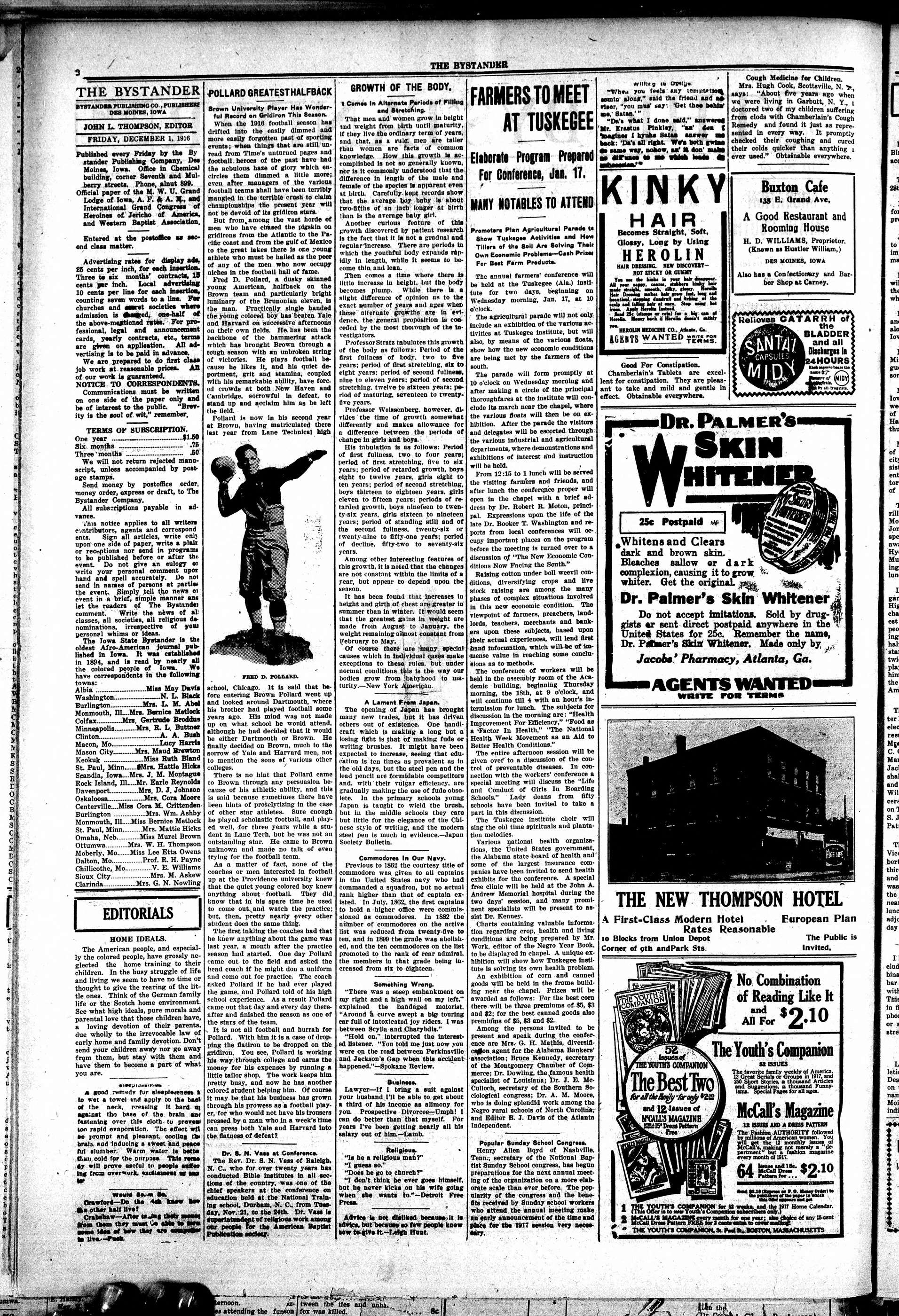
Brown University Player Has Wonderful Record on Gridiron This Season. When the 1916 football season has drifted into the easily dimmed and more easily forgotten past of sporting events; when things that are still unread from Time's unturned pages and football, heroes of the past have had the nebulous haze of glory which encircles them dimmed a little more; even after managers of the various football teams shall have been terribly mangled in the terrible crush to claim championships the present year will not be devoid of its gridiron stardew. But from among the vast horde of men who have chased the pigskin on gridirons from the Atlantic to the Pacific coast and from the gulf of Mexico to the great lakes there is one young athlete who must be hailed as the peer of any of the men who now occupy niches in the football hall of fame.
Fred D. Pollard, a dusky skinned young American, halfback on the Brown team and particularly bright luminary of the Brunonian eleven, is the man. Practically single handed the young colored boy has beaten Yale and Harvard on successive afternoons on their own fields. He has been the backbone of the hammering attack which has brought Brown through a tough season with an unbroken string of victories. He plays football because he likes it, and his quiet department, grit and stamina, coupled with his remarkable ability, have forced crowds at both New Haven and Cambridge, sorrowful in defeat, to stand up and acclaim him as he left the field.
Pollard is now in his second year at Brown, having matriculated there last year from Lane Technical high
C. W.
school, Chicago. It is said that before entering Brown Pollard went up and looked around Dartmouth, where his brother had played football some years ago. His mind was not made up on what school he would attend, although he had decided that it would be either Dartmouth or Brown. He finally decided on Brown, much to the sorrow of Yale and Harvard men, not to mention the sons of various other colleges. There is no hint that Pollard came to Brown through any persuasion because of his athletic ability, and this is said because sometimes there have been hints of proselytizing in the case of other star athletes. Sure enough he played scholastic football, and played well, for three years while a student in Lane Tech, but he was not an outstanding star. He came to Brown unknown and made no talk of even trying for the football team.
As a matter of fact, none of the coaches or men interested in football up at the Providence university knew that the quiet young colored boy knew anything about football. They did know that in his spare time he used to come out, and watch the practice; but, then, pretty nearly every other student does the same thing.
The first inking the coaches had that he knew anything about the game was last year, a month after the practice season had started. One day Pollard came out to the field and asked the head coach if he might don a uniform and come out for practice. The coach asked Pollard if he had ever played the game, and Pollard told of his high school experience. As a result Pollard came out that day and every day thereafter and finished the season as one of the stars of the team.
It is not all football and hurrah for Pollard. With him it is a case of dropping the flatiron to be dropped on the gridiron. You see, Pollard is working his way through college and earns the money for his expenses by running a little tailor shop. The work keeps him pretty busy, and now he has another colored student helping him. Of course it may be that his business has grown through his prowess as a football player, for who would not have his trousers pressed by a man who in a week's time can press both Yale and Harvard into the flatness of defeat?
Dr. S. N. Vass at Conference
DR. S. N. Vass at Conference
The Rev. Dr. S. N. Vass of Raleigh,
N. C., who for over twenty years has
conducted Bible institutes in all sections
of the country, was one of the
chief speakers at the conference on
education held at the National Training
school, Durham, N. C. from Tuesday,
Nov. 21, to the 24th. Dr. Vass is
superintendent of religious work among
our people for the American Baptist
Publication society.
THE BYSTANDER
GROWTH OF THE BODY.
t Comes In Alternate Periods of Filling and Stretching.
That men and women grow in height and weight from birth until maturity, if they live the ordinary term of years, and that, as a rule, men are taller than women are facts of common knowledge. How this growth is accomplished is not so generally known, nor is it commonly understood that the difference in length of the male and female of the species is apparent even at birth. Carefully kept records show that the average baby boy is about two-fifths of an inch longer at birth than is the average baby girl.
Another curious feature of this growth discovered by patient research is the fact that it is not a gradual and regular increase. There are periods in which the youthful body expands rapidly in length, while it seems to become thin and lean.
Then comes a time where there is little increase in height, but the body becomes plump. While there is a slight difference of opinion as to the exact number of years and ages when these alternate growths are in evidence, the general proposition is conceded by the most thorough of the investigators.
Professor Stratz tabulates this growth of the body as follows: Period of the first fullness of body, two to five years; period of first stretching, six to eight years; period of second fullness, nine to eleven years; period of second stretching, twelve to sixteen years; period of maturing, seventeen to twenty-five years.
Professor Weissenberg, however, divides the time of growth somewhat differently and makes allowance for a difference between the periods of change in girls and boys.
His tabulation is as follows: Period of first fullness, two to four years; period of first stretching, five to six years; period of retarded growth, boys eight to twelve years, girls eight to ten years; period of second stretching, boys thirteen to eighteen years, girls eleven to fifteen years; periods of retarded growth, boys nineteen to twenty-six years, girls sixteen to nineteen years; period of standing still and of the second fullness, twenty-six or twenty-nine to fifty-one years; period of decline, fifty-two to seventy-six years.
Among other interesting features of this growth, it is noted that the changes are not constant within the limits of a year, but appear to depend upon the season.
It has been found that increases in height and girth of chest are greater in summer than in winter. It would seem that the greatest gains in weight are made from August to January, the weight remaining almost constant from February to May.
Of course there are many special causes which in individual cases make exceptions to these rules, but under normal conditions this is the way our bodies grow from babyhood to maturity—New York American.
A Lament From Japan.
The opening of Japan has brought many new trades, but it has driven others out of existence. One handicraft which is making a long but a losing fight is that of making fude or writing brushes. It might have been expected to increase, seeing that education is ten times as prevalent as in the old days, but the steel pen and the lead pencil are formidable competitors and, with their vulgar efficiency, are gradually making the use of fude obsolete. In the primary schools young Japan is taught to wield the brush, but in the middle schools they care but little for the elegance of the Chinese style of writing, and the modern steel pen is much in evidence.—Japan Society Bulletin.
Commodores In Our Navy.
Previous to 1862 the courtesy title of commodore was given to all captains in the United States navy who had commanded a squadron, but no actual rank higher than that of captain existed. In July, 1862, the first captains to hold a higher office were commissioned as commodores. In 1882 the number of commodores on the active list was reduced from twenty-five to ten, and in 1899 the grade was abolished, and the ten commodores on the list promoted to the rank of rear admiral, the members in that grade being increased from six to eighteen.
"There was a steep embankment on my right and a high wall on my left," explained the bandaged motorist. "Around a curve swept a big touring car full of intoxicated joy riders. I was between Scylla and Charybds." "Hold on." interrupted the interested listener. "You told me just now you were on the road between Perkinsville and Jackson's Gap when this accident happened."—Spokane Review.
Lawyer—If I bring a suit against your husband I'll be able to get about a third of his income as alimony for you. Prospective Divorcee—Umph! I can do better than that myself. For years I've been getting nearly all his salary out of him—Lamb.
"I don't think he ever goes himself, but he never kicks on his wife going when she wants to."—Detroit Free Press.
Advice is not disliked because, it is advice, but because so few people know how to give it—Leigh Hunt.
Something Wrong.
Business
Religious
FARMERSTO MEET AT TUSKEGEE
Promoters Plan Agricultural Parade to Show Tuskegee Activities and How Tillers of the Soil Are Solving Their Own Economic Problems—Cash Prize For Best Farm Products.
The annual farmers' conference will be held at the Tuskegee (Ala.) institute for two days, beginning on Wednesday morning, Jan. 17, at 10 o'clock.
The agricultural parade will not only include an exhibition of the various activities at Tuskegee institute, but will also, by means of the various floats, show how the new economic conditions are being met by the farmers of the south.
The parade will form promptly at 10 o'clock on Wednesday morning and after making a circle of the principal thoroughfares at the institute will conclude its march near the chapel, where the various floats will then be on exhibition. After the parade the visitors and delegates will be escorted through the various industrial and agricultural departments, where demonstrations and exhibitions of interest and instruction will be held.
From 12:15 to 1 lunch will be served the visiting farmers and friends, and after lunch the conference proper will open in the chapel with a brief address by Dr. Robert R. Moton, principal. Expressions upon the life of the late Dr. Booker T. Washington and reports from local conferences will occupy important places on the program before the meeting is turned over to a discussion of "The New Economic Conditions Now Facing the South."
Raising cotton under boll weevil conditions, diversifying crops and live stock raising are among the many phases of complex situations involved in this new economic condition. The viewpoint of farmers, preachers, landlords, teachers, merchants and bankers upon these subjects, based upon their actual experiences, will lend first hand information, which will be of immense value in reaching some conclusions as to methods.
The conference of workers will be held in the assembly room of the Academic building, beginning Thursday morning, the 18th, at 9 o'clock, and will continue till 4 with an hour's intermission for lunch. The subjects for discussion in the morning are: "Health Improvement For Efficiency." "Food as a Factor In Health." "The National Health Week Movement as an Aid to Better Health Conditions." The entire afternoon session will be given over to a discussion of the control of preventable diseases. In connection with the workers' conference a special meeting will discuss the "Life and Conduct of Girls In Boarding Schools." Lady deans from fifty schools have been invited to take a part in this discussion. The Tuskegee institute choir will sing the old time spirituals and plantation melodies.
Various national health organizations, the United States government, the Alabama state board of health and some of the largest insurance companies have been invited to send health exhibits for the conference. A special free clinic will be held at the John A. Andrew Memorial hospital during the two days' session, and many prominent specialists will be present to assist Dr. Kenney.
Charts containing valuable information regarding crop, health and living conditions are being prepared by Mr. Work, editor of the Negro Year Book, to be displayed in chapel. A unique exhibition will show how Tuskegee institute is solving its own health problem.
An exhibition of corn and canned goods will be held in the frame building near the chapel. Prizes will be awarded as follows: For the best corn there will be three premiums of $5, $3 and $2; for the best canned goods also premiums of $5, $3 and $2.
Among the persons invited to be present and speak during the conference are Mrs. G. H. Mathis, diversification agent for the Alabama Bankers' association; Bruce Kennedy, secretary of the Montgomery Chamber of Commerce; Dr. Dowling, the famous health specialist of Louisiana; Dr. J. E. McCulloch, secretary of the Southern Sociological congress; Dr. A. M. Moore, who is doing splendid work among the Negro rural schools of North Carolina, and Editor B. J. Davis of the Atlanta Independent.
Popular Sunday School Congress
Popular Sunday School Congress. Henry Allen Boyd of Nashville, Tenn.; secretary of the National Baptist Sunday School congress, has begun preparations for the next annual meeting of the organization on a more elaborate scale than ever before. The popularity of the congress and the benefits received by Sunday school workers who attend the annual meeting make an early announcement of the time and place for the 1917 session very necessary.
DR. PALMER'S
SKIN
WHITENER
25c Postpaid
Whitens and Clears
dark and brown skin.
Bleaches sallow or dark
complexion, causing it to grow
whiter. Get the original.
Dr. Palmer's Skin Whitener
Do not accept imitations. Sold by drug-
gists or sent direct postpaid anywhere in the
United States for 25c. Remember the name,
Dr. Palmer's Skin Whitener. Made only by
Jacobs' Pharmacy, Atlanta, Ga.
AGENTS WANTED
WRITE FOR TERMS
HIGHLIFT
THE NEW THOMPSON HOTEL
No Combination of Reading Like It and All For $2.10
52 Issues of THE YOUTH'S COMPANION
The Best Two for all the family - for only $2.12
and 12 Issues of M.CALL'S MAGAZINE IN 15' Dress Pattern Free
The Youth's Companion
52 ISSUES
The favorite family weekly of America, 12 Great Serials or Groups in 1917, and 250 Short Stories, a thousand Articles and Suggestions, a thousand Funny-isms. Special Pages for all ages.
McCall's Magazine
12 ISSUES AND A DRESS PATTERN
The Fashion AUTHORITY followed by retailers of American women. You will get the 12 monthly issues of McCall's, making not merely a "department" but a fashion magazine every month of 1917.
64 Issues and 15c. McCall's Pattern for ...
$2.10
Pattern for ...
Send $2.10 (impossibly as P.O. Mail Order) to the publisher of the paper in which this Offer appears and get
1 THE YOUTH'S COMPANION for 52 weeks, and the 1917 Home Calendar.
(The Offer is to new Youth's Companion subscribers only.)
2 THE YOUTH'S COMPANION for 15c. McCall's Dress Pattern FREE for 1 cent extra to cover mailing.
THE YOUTH'S COMPANION, St. Paul St. BOSTON, MASSACHUSETTS
"When you feels any temptation comin' along," said the friend and adviser, "you mus' say: 'Get thee behin' me, Satan.'"
"De'what I done said," answered Mr. Erastus Pinkley, "an' den I imagine I hyra Satan answer me back: 'De' all right. We' both gwine to same way, nowoh, an' it don't make no diffence to me which leads to questionation."
KINKY
HAIR
Becomes Straight, Soft,
Glossy, Long by Using
HEROLIN
HAIR DRESSING. NEW DISCOVERY—
NOT STICKY OR GUMMY
You see the hinks in your hair disappear.
All your nappy, coarse, stubborn hinky hair
made straight, smooth, silky, glossy. Herolin
Hair Dressing not hard, easy to find huge and
beautiful spotted daffruff and fishing of the
scalp and falling hair at once. Stop using hot
irrum. Apply Herolin Instead.
Read 25c (stamp or crib) for a big can of
Herolin. Money back if Herolin doesn't satisfy
you.
HEROLIN MEDICINE CO., Atlanta, Ga.
AGENTS WANTED WRITE FOR
TERMS.
Good For Constipation.
Chamberlain's Tablets are excellent for constipation. They are pleasant to take and mild and gentle in effect. Obtainable everywhere.
Cough Medicine for Children.
Mrs. Hugh Cook, Scottsville, N. N., says: "About five years ago when we were living in Garbutt, N. Y., I doctored two of my children suffering from clods with Chamberlain's Cough Remedy and found it just as represented in every way. It promptly checked their coughing and cured their colds quicker than anything ever used." Obtainable everywhere.
Buxton Cafe
135 E. Grand Ave.
A Good Restaurant and
Rooming House
H. D. WILLIAMS, Proprietor.
(Known as Huntler William,)
DES MOINES, IOWA
Also has a Confectionary and Bar-
ber Shop at Carney.
Relieves CATARRH of
the BLADDER
and all
Discharges in
24HOURS
Each angel bear the
name CT-
MIDY
MIDY
By all Angels.
L letic
Dep
on
nama
Moi
indi
CITY LOCALS
Mrs. M. L. Gregory. is ill this week.
Mrs. C. H. Irwin left Thursday for Birmingham and Montgomery, Ala., accompanied by little Josephene Peco.
TO LET—Two furnished rooms, 815 28th street.
Mrs. Dr. J. Dulin, who has been sick for several months, is somewhat improved. She is able to be up again.
Jeff Logan, who has been confined to his home because of ill health, is improving, which is good news to his many friends.
Mrs. W. H. Johnson of Chesterfield will leave Friday morning to spend the week-end with her son, Major, who is in the hospital at Iowa City.
Master Major Johnson, son of Mr. and Mrs. W. H. Johnson, is getting along very nicely at the hospital in Iowa City.
Mrs. ..... of Hastings, Minn., is visiting in our city, the guest of Mr. and Mrs. John S. Wilkinson, on East Thirteenth street.
Mrs. A. C. Waldon of Marshalltown, Iowa, was in our city a few days this week. While here she was the guest of Mrs. Harris at the home of Mrs. Harris' mother, Mrs. Reeves, on Arthur street.
Misses Gladys and Retha Mitchell of Guthrie, Okla., have arrived in our city to make their homes with their sister, Mrs. Gus Watkins. They have entered the public schools preparatory to entering West High the first of the year.
The girls of the Mary Church Terrill club enjoyed an evening party Monday at the home of Mrs. Colleen Jones. A very enjoyable time was spent and beautiful prizes were awarded during the evening to Adah Hyde, Letha Johnson and Stella Hyde. Music was also a feature of the evening and at a late hour a delicious luncheon was served.
Last Saturday the annual football game between the East and West High schools for the city and state championship was played to the largest crowd ever seen. Fully 10,000 people saw the game, which was nothing to nothing. Mr. M. Ashby, the halfback colored boy, was easily the star man in the game, as he made twice the ground gained as any other player. Those who know and saw him play say that he is undoubtedly the best halfback high school man in America.
The members of Princess Oziel Chapter No. 9, O. E. S. held their annual election last Thursday evening which resulted as follows: Worthy Matron, Mrs. Izelia Robinson; Worthy Patron, C. C. Johnson; Associate Matron, Mrs. Marie Johnson; Treasurer, Mrs. John Jackson; Secretary, Mrs. N. C. Marshall; Conductress, Mrs. C. M. Wilson and Associate Conductress, Mrs. J. A. Wilson. These together with the officers to be appointed will be installed on Thursday Dec 7th by Grand Master, S. Joe Brown, who is also Past Grand Patron of the O. E. S.
The Girl's Club met Sunday with the Vice President, Miss Meredith Humbert. The program consisted of the third, and fourth chapter of the "Girl and her Mother." Mrs. Gus Nichols was present and instructed the girls in the plans for a play to be given in the near future. A lovely three course lunch was served by the hostess. Club adjourned to meet the following Sunday with Miss Gretchen Tucker.
FOR SALE
I have a first class barber outfit including 3 Kohen hydraulic chairs, combination mug case, I twelve foot front bar and combination cabinet stands with two large French plate glass. This furniture is of metallic finish and in first class condition. If interested phone No. 82, address P. O. Box 172, or see me at my residence, 730 West street. John Spencer, Grinnell, Iowa.
FOOTBALL ERROR.
Last week in the article on our athletics we stated that Ashby was from Des Moines college. He was the star on the East High team, while a man named Richmond played on the Des Moines college team and was the best individual player on that team.
REMEMBER THE Palace Sweet Cafe
UNDER NEW MANAGEMENT
Is the best place to go for Good Home Cooking
Everything First Class
Special Sunday Dinner
25c and 35c.
Red 1367 1012 Center Street
Mr. and Mrs. J. R. Erickson,
Proper.
At the annual meeting of Cleggett chapter, No. 30, Royal Arch Masons last Friday evening the following were elected and installed as officers for the ensuing year: High priest, J. A. Wilson; king, John L. Thompson; scribe, S. Joe Brown; treasurer, Chas Carl; secretary, Fred Graham; captain of host, B. N. Hyde; royal arch captain, Wm. Tomlin; veil masters, C. C. Johnson, Chas. Cousin and J. J. Roach.
N. A. A. C. P.
The regular monthly meeting of the executive committee of the Des Moines branch of the N. A. A. of C. P. will be held at the residence of the chairman, 1058 Fifth street, Monday evening, December 4th, at which time the standing committees for the ensuing year will be appointed and arrangements perfected for the annual emancipation meeting for January 1.
CHARITY LEAGUE MAKES MANY HAPPY ON THANKSGIVING.
Charity League sent Thanksgiving baskets to twenty families. The churches co-operated with the league and made it possible to send chickens in the baskets. Dr. J. A. Jefferson, Dr. A. J. Booker and Rev. H. A. Perry were kind enough to assist the ten women on the committee to deliver the baskets. The following donations were received from the churches: Corinthian, $5.13; St. Paul's A. M. E., $4.00; Corinthian B. Y. P. U., $2.00; Lee Mission, $2.25; Asbury Chapel, $1.45. Many donations of money, fruit and canned goods were received. It will cost too much to publish the names of those who donated. The League wishes to thank all who contributed
Mrs. J. B. Rush, Chairman.
FEDERATION EXPOSITION NETS
$400.00.
At the meeting of the Washington memorial committee of the Iowa Federation of Colored Women's Clubs, held at the residence of Mrs. S. Joe Brown, president, last Tuesday evening, the various department superintendents made their final report of moneys raised from the Federation, which, together with moneys solicited to date, made a total of $400, $100 of which has been forwarded to Prof. Tanner, the artist, in Paris and the balance on deposit in bank.
To this fund the following clubs made contributions: Intellectual Improvement, Des Moines, $20; Mrs. J. L. Edwards, president, $5.00, making a total of $25; Richard Allen Aid, Des Moines, $15; Mrs. W. B. Cottoma, president, $1.00; Albia Girls' Social Center, Mrs. Chas. Washington, director, $10 and articles for sale made by girls; Enterprise Mission Circle, Mrs. Wm. Holland, president, $1.50, and citizens of Colfax, $7.80.
The committee also desires to acknowledge the receipt of $10 and articles for sale from Mrs. S. D. Davis, Calgary, Alta, Canada, and $8.05 from contest over hand painted chocolate pot presented by Mrs. J. E. Johnson of Burlington, and articles for sale from Miss Letta Cary, Marshall, Texas; also $18.50 raised by a committee of young men, under the leadership of Mr. Wade H. McCree, as the proceeds of the Fisk Jubilee concert, to all of whom, together with all others who have in any way aided in this campaign, the committee is deeply grateful.
The chocolate pot was awarded to Mrs. A. G. Coleman and the prize for having raised the largest amount of money over expenses was awarded to Mrs. R. E..Patten.
CENTERVILLE NEWS
Rev. M. Carrington preached two excellent sermons Sunday. Both were well attended.
The musical given by Mrs. W. A. Brown on Monday, November 20th, was well attended and enjoyed by all. She was assisted by some of the home talent. We are glad to see our home folks come to the front, especially the young folks, and may God help them to go on.
The Sunday school is still progressing and they are planning for their Thanksgiving program.
The youngest daughter of Mrs. John Nelson is reported quite ill with typhoid fever at the Diamond mines.
Mrs. W. A. Brown was the guest at Mrs. H. W. Thompkins on Franklin street while in this city.
Mrs. E. F. Brown of Mystic visited in the city Tuesday.
Mr. Lee Bell and family are visiting relatives and friends in the city. Everyone was glad to see Mr. Bell after his long absence from the city. Mrs. Mary Triplet and Mrs. Henry Woods will entertain the Daughters of Tabor on Thursday, November 23. Mr. and Mrs. Willie Oliver have moved into the T. T. Ward property on South Eighteenth street. The paying committee will give an entertainment Saturday, November 25th. Chairman, Bro. Cleary Noah. Rev. Carrington's members and friends are still remembering him. Mrs. John Childs presented him with $5.60, donated by members and friends, to assist him in buying shoes and other things for the children. Rev. M. Carrington wishes to thank each and every one in their kindness towards him.
Christina Crittenden was on the sick list last week. Rev. Carrington and family were
invited to dinner Sunday at Mrs. W. Cobbs'.
Several junior girls are taking music lessons from Miss Dessie Johnson and seem to be progressing nicely.
Mrs. Logan Oney celebrated her birthday last Friday with Mrs. Plummer, Mrs. Pocahontas Wright, Mrs. Wm..Oney and Miss Della Watkins as her guests.
Rev. T. L. Scott was called to Chicago to preach the funeral sermon of one of his members, after one week of revival sermons at Bethel A. M. E. church. Thus far the meetings have been a great success, as many have been added to the church.
Rev. C. R. Waters is all smiles, as his wife and daughter are with him now.
The Sunday school of the Third Baptist church enjoyed a taffy pull at the church last Tuesday evening Mrs. Lota Green has returned from a visit in Chicago and Winona, Minn. Mrs. Francis Baker entertained the Dorcas Sewing circle last Friday night at her home on Judson street.
DAVENPORT ITEMS.
Widows Son chapter, No. 13, R. A. Masons, which is composed of Masons of the tri-cities, held their annual election Thursday evening, with the following result: John Gordon, H. P.; Lou Hockett, king; Geo. Pearson, scribe; John E. Bradford, secretary, (re-elected); John Slaughter, treasurer, (re-elected); John King, C. of H., (re-elected). The past three years of this chapter has been a great success, with Samuel Cain as H. P.
For Eczema, Tetter and Salt Rheum. The intense itching characteristic of these ailments is almost instantly allayed by Chamberlain's Salve. Many severe cases have been cured by it. For sale by all dealers.
COUNCIL BLUFFS, IOWA.
Good services all day Sunday. Collection for all day. $21.60.
The Dorcas club met Thursday at the home of Mrs. Chas. Hall, 2125 Sixth avenue. Lunch was served and the afternoon was pleasantly spent.
Friday afternoon the Mission Circle met at the home of Mrs. Nathan Turner, Sr., 1114 Avenue C. Lunch was served and the afternoon was pleasantly spent.
There will be a Thanksgiving dinner at the church, served by the Dorcas club and the Mission.
Mrs. Tom Wright is ill at her home.
A surprise party was given on Rev. and Mrs. J. P. Jackson.
The converts taken in at the revival were baptized Thursday night.
The Pastor's Aid club social Friday night was a success. Mrs. Clayton of Kansas City, Mo., is visiting at the Wm. Givlins home in this city.
A Thanksgiving Prayer
A Thanksgiving Prayer
LORD, I have complained and been
A heedless toiler in the ranks
And overeager fame to win,
But now I offer up my thanks
For mercies that have been bestowed
When darkness seemed to shut me in
And on me rained the blows of fate
And when it seemed I couldn't win
I was a thing of rage and hate.
The day was dark; the path was long;
Life's purpose I misunderstood.
Today I see that I was wrong
And recognize that thou art good.
And knew not where and couldn't see
I wailed that I had lost my way
And cried, "Thou hast deserted me"
When grief was knocking at my heart
And tears were streaming from my
eyes
I only knew I felt the smart,
But now I know that thou art wise.
Lord, on the road today I pause
in gratitude to thee to pray,
For, blinded by the world's applause,
I see I should have gone astray.
I thank thee for thy watchful care
Through conflict and the hours of rest.
My consolation in despair
Henceforth shall be—thou knoweth
best.
—Detroit Free Press,
The Gobbler's Sorrow.
Achilles lamented his vulnerable heel.
"A tough drumstick doesn't help any," replied the turkey gloomily.—New York Sun.
Before Thanksgiving.
First Turkey—How will you save yourself?
Second Turkey—I shall try to get a job as cuckoo in a clock.—New York Sun.
More Background in France.
Toulouse—Slight storms have occurred again Monday in Brussels, vulture and Pay-The-Reporter. The images is reported, but the residents are pained.
Because I journeyed day by day
I only knew I felt the smart,
Guliford had lived in Paris several years when the pan-European war broke out. He at once enlisted in the Foreign legion and went to the front with the American corps. He was a handsome fellow and had a winning way with him. Women were easily attracted to him. There was an audacity about him that took well with them.
One day Guliford was knocked senseless by the bursting of a shell. He was carried to the rear on a stretcher to a field hospital and put in charge of a Red Cross nurse. Coming to himself suddenly and seeing a beautiful face bending over him, he threw his arms around the woman to whom it belonged, drew her quickly down and kissed her.
As soon as his arms were loosened the nurse arose and without a word left him. But she sent a surgeon to him, who examined him and found he was in nowise injured except for the shock he had received. Within an hour he was up on his feet, going to rejoin his command. Guilford did not forget the face of the nurse nor the look she gave him as she rose and left him. He was very much ashamed of himself. The nurse had been ready to succor him; he had returned the care she would have bestowed on him by insulting her. He could have cut off the arms he had thrown around her; he could have blighted the lips he had pressed upon hers.
Gulford was struck again, this time not with soft dirt thrown up by a bursting shell, but by shrapnel. As luck would have it, he was placed a second time under the care of the nurse who had attended him before. He recognized her at once, but whether she recognized him he could not tell. She regarded him with that impassive look usual to those accustomed to see suffering, brought restoratives as the surgeon directed and otherwise ministered to him.
A number of sick and wounded men were under her care, and she treated all alike. Guilford received his share of her attentions and no more. He wished to apologize for his action toward her when he had come under her care before, but she gave him no opportunity—that is, she kept such a reserve that he was unable to break through it. He said something about having been indebted to her for kindness on a former occasion, but while he was saying it she seemed to be thinking about something else. Before he could make up his mind to break through her reserve and express his penitence she was transferred to another ward.
Gulford received letters necessitating his presence in America, and since it was not probable that he would be fit for service again for a long while, he succeeded in getting a discharge. Before crossing the grenge he resolved to find the nurse whom he had trented so wrongfully and ask her forgiveness for her and was told that she had been worn out by a long period of nursing and had gone to her home in Paris for a rest.
Gulford learned her address, intending to go to see her and get the burden that was troubling him off his mind. He dreaded putting an ocean between him and the only woman who had shown toward him—what? That was the trouble with him; he was in the dark as to her treatment of him. How singular that she should have treated him exactly the same as hundreds of others who had not offended her!
As soon as he arrived in Paris he took a conveyance and told the driver to take him to the address that had been given him. What was his surprise to be driven to a handsome residence in the most desirable part of the dwelling portion of Paris. Leaving the cab he looked at the house and wanted to get back into the cab. It had not occurred to him that the woman who had been nursing soldiers might be an aristocrat. The fact only made him feel the more culpable. How could he, an "American, face a lady, perhaps of rank, whom he had treated as if she had been a barbarian? But he was resolved that he would not leave France without setting himself right with her. He sent up his card, on which was written "One who has received your kind attentions in a field hospital."
When mademoiselle came down to meet the caller she stood for a moment on the threshold regarding him. Again that impassive look. Then she advanced into the room, bowed to him ceremoniously and asked him to be seated. He spoke of the good work she had done at the front; of the poor fellows who had been benefited by her tender care. He commended her especially that she, a lady surrounded by comforts in a splendid home, one who would grace society, should have assumed the duties of a nurse for men brought in from a battlefield.
All this he could say, though every word seemed like lead and his encumbrums served only to make his offense seem the greater. She listened to his praise, but never for a moment did she relax from that quiet dignity of a high born dame. When Guilford could endure it no longer, he rose to go. Standing mute before her before leaving, suddenly a pent up pleading burst forth.
"Pardon," he said, almost in a wall. With a smile she put out her hand. Guilford has not yet returned to America. Some say he never will return. He has become the slave of the woman he kissed.
Younker Brothers
This store is in complete readiness for the great and joyous Christmas Season
Every section of the store--from the great and wonderful TOYLAND on the Sixth Floor, to the Economy Basement store of lesser priced merchandise, is
Ready for Christmas
THE LABOR PROBLEM SOUTH.
Shertage of Colored Laborers at Birmingham, Ala., Causes Anxiety. The demand for the services of colored men in various sections of the country is increasing. At Birmingham, Ala., recently it was stated that there was a serious shortage of colored laborers in Birmingham and vicinity due to the fact that the colored people are leaving the south at the rate of nearly 100 per day for the north, southwest and parts of Virginia and Kentucky. Among the many reasons given for this great exodus of the colored people are lack of protection from mob violence, poor wages, disfranchisement, attempted segregation in farm employment, segregation in cities and on all public conveyances and almost nothing for their farm produce. The whole matter of treatment of colored citizens in most every southern state is ridiculous.
If a colored person wants to bury a railroad or ferryboat ticket he is served at a separate window. If he enters a jimcrow car and all the seats in the coach for white people are taken and a white person comes into the jimcrow coach the colored person is forced to give up his seat. If he resists he is ejected from the car or arrested and turned over to the police at the next station. These and other outrages are some of the reasons why the colored people are leaving the south at every opportunity which presents itself for their doing so.
BAPTIST STATE CONVENTION.
Annual Meeting of New Jersey Organization Held at Camden.
The Afro-American Baptist state convention of New Jersey held its annual meeting at Camden in October, with a large attendance of delegates from churches throughout its jurisdiction. The reports on membership, finance and church property were very encouraging. Special emphasis was placed on the necessity of pushing the financial campaign in the interest of the Northern Baptist university by all the churches of the denomination in the northern and New England states.
The election of officers for the ena-
nging year resulted as follows: President,
the Rev. John C. Love of Montclair;
vice presidents, the Rev. J. P.
Gregory of Atlantic City, the Rev. E.
G. Young of Lakewood, J. W. Walker
of Moorestown, A. J. Jones of Flin-
field and J. W. Green of Paterson; re-
cording secretary, the Rev. L. C. Hurle-
d, Elizabeth; corresponding secretary,
the Rev. R. L. Harris, Engle-
wood; treasurer, G. W. Krygar, East
Orange
Charles S. Smith Rendera Fine Services
The secretary to the chief of police at Cleveland for many years is Charles S. Smith. He has several assistants (white). His appointment after a civil service examination was secured for him by the Hon. Harry E. Smith, ex-member of the Ohio legislature and father of Ohio's civil rights and anti-lynching laws. It was an appointment that had been promised to Editor Smith for two years by Mayor Robert E. McKisson, who died several months ago. The editor had to wait, however, until a member of the race passed the civil service examination.
Convention of Laymen Held at Atlanta The laymen's missionary movement held a most interesting and helpful convention in Atlanta for three days, beginning on Sunday, Oct. 22. The speakers for the various sessions held during the three days were selected from representatives of both races. One of the chief aims of the Atlanta convention was to enlist a larger number of laymen from among the colored people.
REUNION OF VIRGINIANS.
Popular Brooklyn Organizations to Hold Annual Reception Dec. 4. The big organization event in Brooklyn for the first week in December will be the nineteenth annual reception of the Society of the Sons of Virginia. The reception, which is one of the society functions to which the public looks forward with great interest, will be held at Summer hall, on Fulton street on Monday evening. Dec. 4.
John W. Winters, one of Brooklyn's well known and successful business men, is chairman of the reception com-
mittee, with James F. Flippin and J. W. Patterson secretary and treasurer respectively. Harry P. Fisher's orchestra will furnish the music for the occasion, and the comfort of the guests will be looked after by Pleasant D. Early. The occasion will afford an opportunity for a general reunion of persons from Virginia, as well as a grand social intermingling of the public. The society is in fine condition financially and numerically—eighteen new members during the year—and has met all of its financial obligations.
Woman Who "Made" Thanksgiving.
It was a woman, Mrs. Sarah J. Hale, editress of Godey's Lady's Book and well known as a writer, who championed the cause of a national Thanksgiving. Year after year she patiently fought for a national observance of Thanksgiving day, publishing endless articles on the subject. In various ways she caused an agitation of the subject that finally resulted in 1859 in the governors of most of the states of the Union annually issuing proclamations for Thanksgiving. At her suggestion President Abraham Lincoln issued a proclamation for a national Thanksgiving for Aug. 6, 1863, about a month after the battle of Gettysburg.
The
East Side Tailor Shop
511½ East Walnut Street
All kinds of repair work,
Dress Making, Cleaning
and Pressing
PHONE MAPLE 28
MRS. C. M. WILSON and
V. COUCH, Proprietors
MARIA MAYORA
Woman's Crowning Glory is Her Hair
Why not grow your hair by using
Mme. M. Beard Hair Grower
It removes dandruff, stops itching of
the scalp and makes it grow long, soft
and beautiful. Price 50c a box.
Send stamp for pamphlet.
MME. M. BEARD
AGENTS WANTED
519 So 16th St. St. Joseph, Mo,
When in Ft. Dodge go to
Wright & Venable Cafe
225 Central Avenue
Quick Meals and
Prompt Service. Ft. Dodge,
lowa
L. E. Hanger
NEW
Elite Restaurant
New Reliable Place to Eat
Meals 15c and up
Lunches or Short Orders Served
304 W. Grand Ave.
Des Moines Iowa
---
By WILLARD BLAKEMAN
My father died when I was twelve years old, leaving me a good property in the care of my uncle, John Brough. His name should have begun with a "G." for he was the gruffest spoken man I ever knew. I was sent to boarding school till I was seventeen and then to college. Upon graduating I received a letter from my guardian uncle to come to his house. When I reached it, leaving the auto in which I arrived with my hand bagage, I saw looking at me through an upper window a young girl evidently about seventeen, the sweetest face I had ever seen. I was thrilled at the idea of being in a house with such a lovely creature, being of an age to be easily struck by a pretty girl. On entering the house I saw another face, the antipodes of the first. It was that of my uncle. His face was square, his mouth curved down at the corners, his eyes set deep in his head and overhanging by beetling brows.
"How old are you?" was his first remark to me.
"I will be twenty-two next September."
"By the term of your father's will you are to have $10,000 the day you are twenty-two years old; $20,000 the day you are twenty-five and the balance when you are thirty. In the matter of marriage, you can't take a wife of whom I do not approve. You may live in this house with me as long as you like, but I have a warning for you. I have a ward who has been left in my care by her father who was a bosom friend of mine. He left her a fortune with the provision that she should not inherit it if she married without my consent, and her father charged me to bring about, if possible, a marriage with a young man who is part owner in certain property which will not fall to her. I care nothing about the wife you select except this girl. In her case it is hands off."
With the last words my uncle looked at me so savagely that I believed if I married his ward there would be infinite trouble. This gave me deep concern, for it struck me that the girl I had seen at the window was this same ward, by whom I was already stricken.
My uncle's bark proved worse than his bite—that is, on all subjects except my interfering with the plans laid down for his ward. Of course the forbidden fruit was altogether too tempting for me, and I soon learned that she had received a warning similar to mine, which had a like effect on her. But our guardian seemed singularly obtuse to the interest with which I and Edith Sterling inspired each other. At any rate, he made no effort to prevent our being much together. We drove, played tennis and rode on horseback together without a word of remonstrance from him. Edith and I talked over his action, or, rather, want of action, and came to the conclusion that since by the terms of our inheritances he held the whip hand of us he did not propose to interfere with our temporary relations. When the time for action came we would feel his power.
When September came and with it a legal age for me I received $10,000 of my estate. Nothing could have been more adverse to the plans laid down for me and Edith Sterling. The possession of this money brought with it an added temptation. I sounded Edith to learn if she would give up her fortune for me and this first payment of my patrimony, which, if I defied my guardian, was all I could hope for. She was not only willing, but eager to do so. I should not have permitted this, but I was young and deeply in love. Indeed, I felt guilty in having suggested such a thing, and found it difficult to look my uncle in the face. This feeling was enhanced from the fact that his harshness was all on the surface, and was often used to render more effective certain bursts of humor.
Well, the inevitable result of putting two youngsters of opposite sex under the same roof forbidding them to love each other, followed. One morning I took Edith out to ride, and driving to a town across the border of the state we were married. I telegraphed my uncle of the fact, and awaited his reply. It was very short, simply, "Shall expect you for dinner." "Which means," I said to Edith, "if you, too, choose to give up wealth for love, it is no concern of his."
We reached my uncle's house half an hour before dinner. He was not at home, but expected soon. When he arrived he found us in the library waiting for him. He shook hands cordially with me and kissed Edith, then led the way into the dining room.
The moment we entered it both Edith and myself were astonished. It seemed to have been set for a wedding feast. A bottle of champagne was in a cooler beside my uncle's chair and as soon as we were served with food it was uncorked, and our glasses being filled my uncle raised his glass.
"To the folly of youth," he said. "Those who put you two under my management found one who, understanding these same follies, has been well able to carry out their designs. This marriage was planned for you long ago, and when I consented to be your guardian I consented only on condition that I should have my own way as to bringing you two together. Had I told you that you must marry, you would have turned your backs on each other. When I told you you should not marry, with the penalty of each losing a fortune, I drove you into each other a crime."
HEALTH HINTS.
We all have heard that "knowledge is power," but we have little or nothing about the power of ignorance. Ignorance is a powerful force and usually a destructive one. Knowledge is constructive, ignorance is disruptive. Knowledge is truth and happiness; ignorance is deceptive and discontentment. Knowledge hesitates to inform even of facts which are helpful; ignorance blants any rumor and is reckless of results. Knowledge is merciful and shows charity; ignorance is cruel and relentless. Knowledge harnesses power and seeks results from energy; ignor-
helpful; ignorance blants any rumor and is reckless of results. Knowledge is merciful and shows charity; ignorance is cruel and relentless. Knowledge harnesses power and seeks results from energy; ignorance lights the fire and destroys a community. Knowledge is cautious; ignorance touches the button and takes a chance on the consequences.
And because there is so much ignorance of even common matters we are wonderfully blessed that more dreadful things have not happened to us both as individuals and as a race. One ignorant individual can spoil plans which have caused sleepless nights and much labor. Being ignorant of the power vested in the hands of even one individual, when he will multiply this one man power by unity we are held back because ignorance is a fleet-footed gazelle and knowledge a patient ox.
And because there is so much ignorance of the power to rectify mistakes many a poor, honest girl's heart is broken, by the slimy tongue of slander, which repeats every rumor and adds a likely embellishment to the tale.
And because there is so much ignorance we feel that it is better to keep everyone poor than to help make some enterprises big, which will be an inspiration for children, and give them employment.
And because there is so much ignorance people keep the churches locked all week, when the boys and girls might be there instead of the street being lined with them.
And because there is so much ignorance we refuse to learn the lessons of unity, confidence, boosting and silence, wondering all the time why the Lord does not hear our prayers.
And because of the power of ignorance we do never make distinctions between principles and personalities, helping thereby to keep conditions as they are.
And because of the power of ignorance, when two people cannot get along we feel that it is our bounden duty to take sides, thereby keeping much good work from going on and preventing old sores healing.
And because of the power of ignorance people do not know that there are types known as geniuses of degeneracy, who, although high-powered, are bent on raising hell and destroying all they come in contact with. They can't help it, but we can help them keep hands off.
And because of the power of ignorance some men think that other men have their places, when it ought to be known that no man can take a place which rightfully belongs to another.
And because of the power of ignorance we do too little to help instead of hindering. Knocks may be boosts, but why go about a thing indirectly?
And because of the power of ignorance I do not know anything more to say on this subject.
Iowa Phone 778 Rates $1 per day
Automatic 3962
Tenth Avenue Hotel
1 block from C. & N. W. Ry.
All Rooms are Warm.
Restaurant and Lunch Room
SPECIATIES
Chop Suey Chili Con Carne Yorkeme
Oysters in Season
Special attention given to Theatrical People
Barber Shop in connection
F. F. JACKSON, PROP,
OPEN DAY
AND NIGHT
Clinton, Iowa
For That Dull Feeling After Eating.
I have used Chamberlain's Tablets for some time, and can testify that they have done me more good than any tablets I have ever used. My trouble was a heavy dull feeling after eating.—David Freeman, Kempt, Nova Scotia. These tablets strengthen the stomach and improve the digestion. They also regulate the liver and boyels. They are far superior to pills but cost no more. For sale by all dealers.
THE BYSTANDE
Sea Washington School
Rare Washington portraits
A rare and curious mesotint portrait
of George Washington in the library
of the late Lafayette S. Richardson
of Lowell, Mass., was auctioned off
last year in Boston. It is entitled
"George Washington, late president of
the United States of America, eta.,
and was published March 14, 1891, by
I. Hinton Lindon. It is a small folle
and is colored by hand. It looks as
much like George III, as it does the
Pather of His Country. Baker, who
wrote the "Engraved Portraits of
Washington," says that only one impression
of this mesotint has come
under the notice of the writer. It was
in neither the Clarkson nor the Car-
son sale of Washington portraits.
Charles Christadorde, an expert on flour and grains, sounds the keynote of the new situation brought about by the bleached flour decision when he says in a communication to the editor commenting on the bleached flour decision: "The housewife will now in sist on yellow tinted or creamy flour and will learn to realize that a natural flour very white can in no manner compare with the creamy or yellow flour in so far as glutens and muscle building values are concerned.
"As from 55 to 90 per cent. of the large flour mills of the country were using this bleaching process, the decision is far-reaching."—National Ebert Magazine.
When a telephone line is electrically charged the telephone acts as a condenser. The winding server as one plate of the condenser, the frame of the receiver as the dielectric and the person who is holding the receiver to his car as the other plate of the condenser. In order to protect this condenser from discharging through the person, a German inventor provides a grounded metallic cover to the receiver, the capacity of which somewhat greater than that of the body.
JONES PIANO CO. Bargain Sales of PIANOS
FOR CHRISTMAS
Pianos less than manufacturer's prices. Pianos less than factory to home price.
15 Different Makes
to select from. Make your selections now and we will hold for Christmas delivery.
YOUR HOME IS NOT COM
PLETE WITHOUT A PIANO.
WHAT SUNSHINE IS TO THE
BODY—WHAT LIGHT IS TO
THE EYE—MUSIC IS TO THE
SOUL.
These Prices Will Help make your Home Happy
$275 Hyperion Piano ..... $140
$300 King Piano ..... $165
$375 Price & Teeple ..... $175
$450 Schiller Piano ..... $192
$350 Steiner Piano ..... $200
$375 Stanley Piano ..... $310
$375 Bachmann Piano ..... $225
$450 King Piano ..... $225
$450 Hannibal Piano ..... $238
$450 Hannibal Piano ..... $238
$400 Schiller Piano ..... $275
$400 Schiller Piano ..... $275
$400 Schiller Piano ..... $296
$425 Schiller Piano ..... $308
$450 Crown Piano ..... $296
$750 Weaver Piano ..... $350
USED PIANOS
$50-$65-$75-$100
SPECIAL PRICES THIS WEEK
ON WM. KNABE CO. AND VOSE
& SONS PIANOS.
Payments as Low as
$5 Down and $1 a Week
DON'T MISS THIS SALE.
JONES PIANO CO.
807 Walnut St.
23 Years Iowa's Leading Piano House
The Holland House
Good Rooms and Meals
Mrs. Viney Holland, Prop.
315 Center St. Hannibal, Mo,
Subscribe for and read your own
Bystander and quit borrowing you
neighbor's or quit going to the public
library to read it.
and nobe
Insist on Yellow Flour.
Protective Review
When in Hannibal, Missouri go to
College course in Pennsylvania
the Columbia university belongs
credit of offering the first course
signed to give students a practical
knowledge of the conduct of political
affairs. That institution has asked
the bureau of municipal research in
New York to give the members of the
class the benefit of the experience it
has derived from the study of the afi
fairs of that city, and the invitation
has been accepted. The growing de
mand for the adoption of the scien
tific methods of city governments
tends support to the view that college
men will be in demand in this de
department of the public service, hence
the propriety and usefulness of a unit
versity course established on the lines
indicated by the innovation at Colum
bia.
Sydney Brooks, writing to the London Chronicle about Haiti, says the Haitians were the first people in the world to abolish slavery, and Mrs. O. R. Miller, writing in Leslie's Weekly, says of Haiti: "In that little republic governing about 10,000 square miles within five days' call of New York, one may encounter more strange complications and a greater disregard for human life than in the remote counties of the east. Situated in the very heart of the West Indies, where civilization exists in a high degree, Haiti alone has kept her doors closed to progress. She became her independent state more than 100 years ago. Her rich lands were already under cultivation, but the lax natives allowed the plantations to go to ruin, and for sets have grown up instead."
Farm Employment for Criminals.
Farm Employment for Criminals. Gov. Harris of Ohio believes that criminals can be employed on a farm with advantage to themselves and the state. He proposes that prisoners in the penitentiary who are not con-筑ed criminals be transferred to the reformatory and put to work on the state farm. "It is the conditions of our cities that breed crime," says the governor. "Most of it can be traced to idleness and drink, and idleness is frequently the cause of drink. There is little drink in the country and praeci- taneously no idleness. If the young man who had slipped over the bounds of a law were taught scientific farming he would come to like it and escape the associates who carry him down when he returns to the city."
New York City alone consumes an
usually $40,000,000 quarts of milk. We
drink 2,300,000 quarts a day. And
this does not include mothers' milk
for infants; just cows' milk—watered
and unwatered, for both infants and
adults. "Milk," says Emerson, "is
readily made intoxicating in warm
climates simply by agitation. This
feature was quickly discovered." Being
placed in a skin and slung from
the shoulder or over the back, it was
agitated by the motion of the hunter
and fermentation was soon well under
way. The skin was undoubtedly none
too clean, some milk of the previous
day being left in it, which would
not as a lesson.
PLEA FOR SELF-REL.
Sherlie G. Dawes' Good Advice &
Young Men in Business
This is a hard world in business. It always has been and always will be. There are many good and generous men in it. There are many who will lend a helping hand to you in your adversity, but in the time of need you will not find them among the men who tried to get you to embark in speculation with your little surplus and to sell you something which would help you to "easy money." Be self-reliant. Make your own investment into investments. When you cannot, put your money in a good savings bank. Distrust the financial demagogues as you distrust the political demagogue. Keep your hand on your pocketbook as you travel life first, to give always in proportion to your means to those who are poor; second, to hold from those who would take through force or fraud what you need for yourself and you. You will then, writes Mr. Dawes in the Saturday Evening Post, have your hand where most of the other followers have only their eyes. In this almo
Free
to Colored
Women, Our
1916 Style Book
We are the largest man-
ufacturers of
colored men's hair,
and in order
to introduce
our goods we
are sending
free our la-
test book,
half the
styles for
colored women, in the
latest hair
dressing
Every col-
ored woman should have one. We
guarantee every article we sell or
money refunded. All hair will posi-
tioned, shampooed and washing the
same as your own.
We manufacture a STRAIGHTENER
and a STRAIGHTENER, both brass, with ex-
tra heavy back, also absorbed,
and most serviceable made, fully
guaranteed. With each comb we sell
a lamp cup free. A lamp cup free. Send your order
for this straightening comb today.
Sent postcard for 89
A WHITE WEDDING of Hail Brushes
Nets and Toullet Articles is filled
and can be bought for less than or-
fared elsewhere.
Send two crisp stamp for book today.
AGENTS WANTED.
Haltlana a Laz Lot
Milk an Intoxicant
Des Moines Traveling Man Tells of Life on the Road; Great News from Davenport
Have a
Box of
ORO
Sent by
Ar
Poro College Co., 3100 Pine Street, Dept Q. St. Louis, Mo.
Please mention name of this paper when writing.
WAR! What Is It All About?
HAS the whole world gone stark mad over a very foolish and trivial question? Are swords rattling, cannon rumbling, mailed armour glistening just because Russia wanted to show her love for the little brother—Servia? Tear aside the curtain of Europe's politics and see the grim and sinister game of chess that is being played. See upon what a slim, yet desperate, excuse the sacred lives of millions are being sacrificed. Read the history of the past one hundred years, as written by some of the greatest authorities the world has ever known, and learn the naked, shameful truth. Just to get you, started as a Review of Reviews subscriber, we make you this extraordinary offer. We will give to you
Mr. J. H. Hull, traveling salesman, 923 West Sixth street, Des Moines, came into McNerney's drug store, Sixth and Grand avenue, and said: "Boys, let me tell you my experience as a traveling salesman and how in Davenport I learned a little secret which has proven invaluable to me. "You know that a man on the road has to put things into his stomach that would put an ostrich on the bum. Ham sandwiches at restaurants, cold meals in the country and hastily eaten lunches at railroad stations are not good for the digestion. "Well, I finally fell victim to stomach trouble and later on came an attack of rheumatism. "I was on the road, suffering as usual, when I struck Davenport and heard of a medicine called Tanlac. I got a bottle and have not been trou-
Poro College Co., 3100 Pine St.
Please mention name of
Our city collector will call on you at once to collect the 1916 subscription, so please be prepared to settle and not have them call the second time.
Subscribe and pay for The Bystander.
WAR!
HAS the whole world gone start
question? Are swords rattl
glistening just because Russia
brother—Servia? Tear aside the cu
grim and sinister game of chess that
yet desperate, excuse the sacred lives
history of the past one hundred ye
authorities the world has ever know
Just to get you started as a Review
this extraordinary offer. We will give
FREE—“Eur
A big book and over 300 pages, size 10 x 7 inches, handsomely and durably bound in the great events leading up to the history of the over 50 important and timely special articles by experts on the different phases of the conspiracy traits, photographs, diagrams, specially drawn war maps, illuminating statistical records, copies of official documents and diagrams, powers—a clear, vivid, accurate, permanent, interesting and valuable record—a record which once you have not willingly be allowed to Europe, you will not be allowed dramatically pictured and presented. Hunt
Get the Review of
Send the Coupon only. It brings the big, handsome book, charges prepaid, absolutely free. All we ask is that—if you get the book and like it—you send 25 cents for shipping and $1.00 a month for three months to pay for the "Review of Reviews" for one full year.
Review of Reviews Co.
30 living Place, New York
bled since I began taking it.
"I see that you sell Tanlac now and I am mighty glad I can get it in this city. I think it is the greatest medicine in the world for stomach trouble and rheumatism. It put me in good shape and kept me there.
"The people here in Des Moines will find Tanlac even better than recommended. It surely puts new life into a person.
"If anybody wants to know more about my experience with Tanlac they are at liberty to speak to me, write or call me up."
Tanlac, which is now endorsed by hundreds of Des Moines' best citizens, can now be obtained at John McNerney's drug store, corner Sixth and Grand avenues.
Also may be obtained at Thomas Drug Co., Buxton.
Have a
Box of
ORO
Sent by
Ar
reet, Dept Q. St. Louis, Mo.
this paper when writing.
Nervous Women.
When the nervousness is caused by constipation, as is often the case, you will get quick relief by taking Chamberlain's Tablets. These tablets also improve the digestion. Obtainable everywhere.
What Is It All About?
k mad over a very foolish and trivial ing, cannon rumbling, mailed armour wanted to show her love for the little curtain of Europe's politics and see the is being played. See upon what a slim, of millions are being sacrificed. Read the wars, as written by some of the greatest, and learn the naked, shameful truth. Of Reviews subscriber, we make you e to you
"ope at War"
dreds of illustrations graphically tell their stories of love, romance, here is a history so vivid, so dramatic, so stirring, so fascinating, so realistic, so real, so told that it leaves an ineffable impression.
Your War News Clarified
It is not enough to read the daily news reports. Your ability to comprehend conditions and to discuss them rationally depends on a true interpretation of the meaning and the "reason why" of events. In your mind you must bring order out of chaos and the "Review of Reviews" will do it for you.
Reviews for a Year
Send no If the book isn't worth more than your book and magazine together, send it back at our expense. But be prompt.
The world-wide fame of this compendium will make these few volumes disappear from our stock room at once. Send your Coupon today—and be in time.
Review of Reviews.
30 Irving Pl.
New York
Send me, on approval, charges paid by you. The Big Red Book.
"Europe at War"