Iowa State Bystander
Friday, February 15, 1918
Des Moines, Iowa
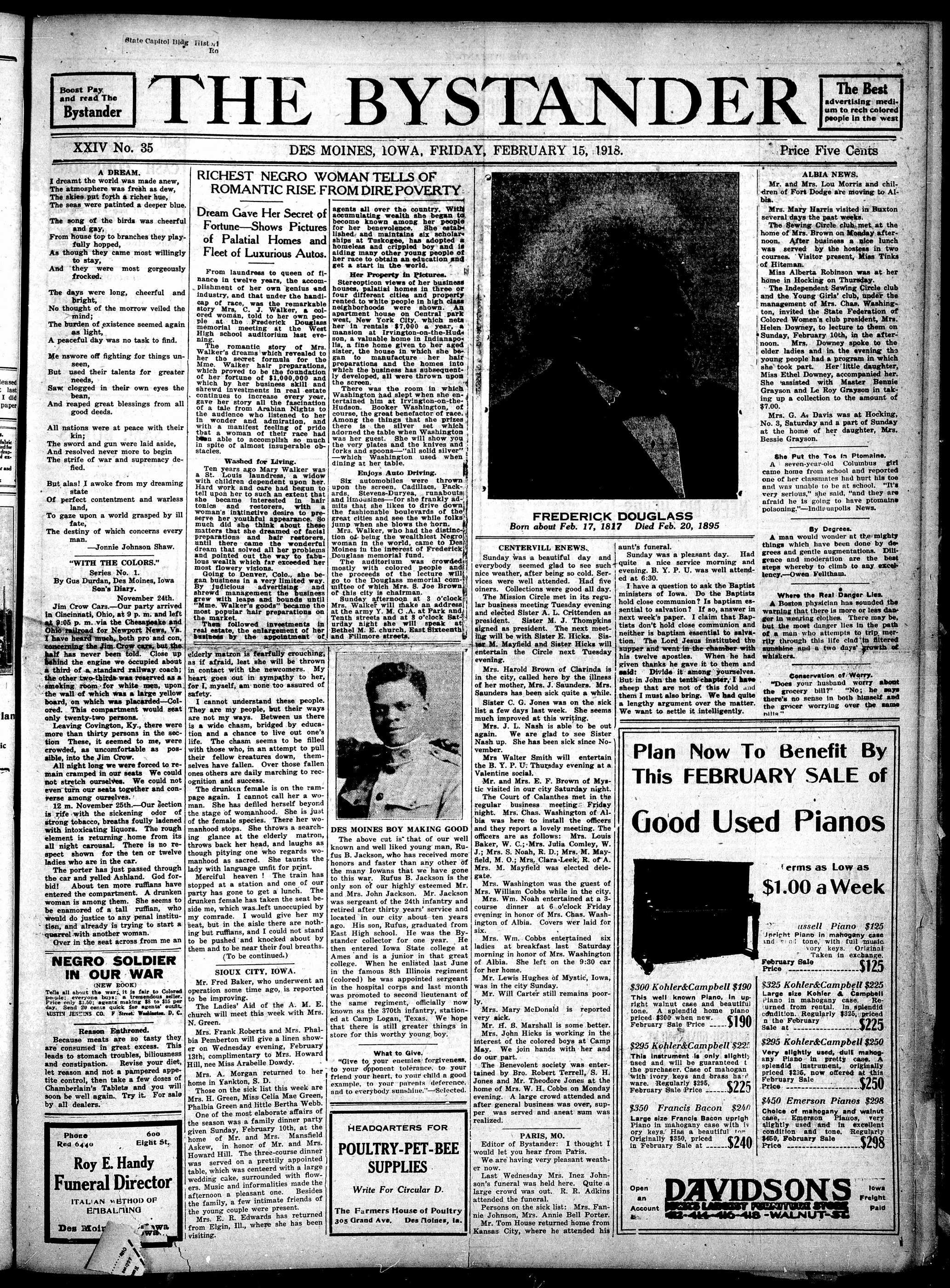
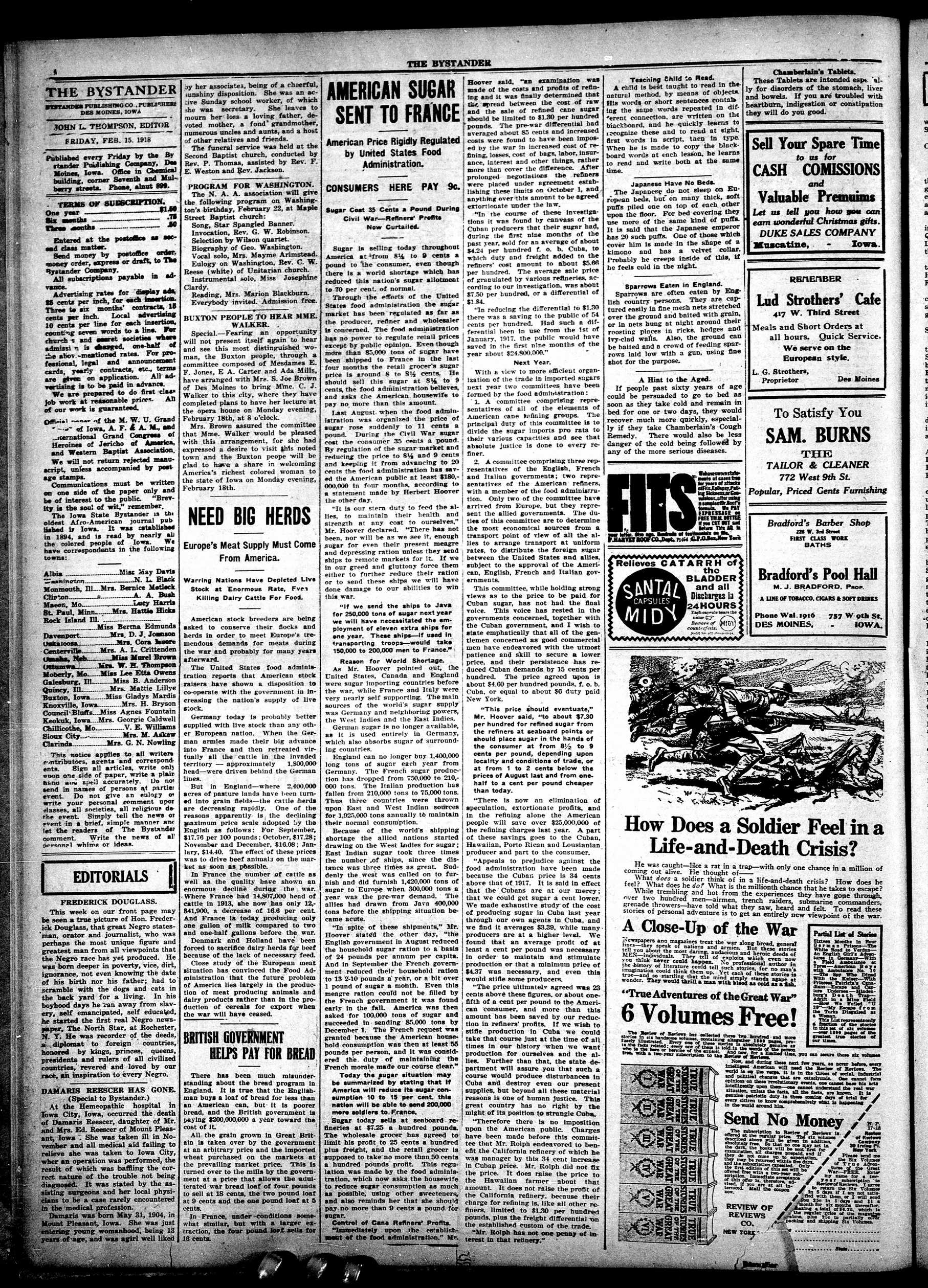
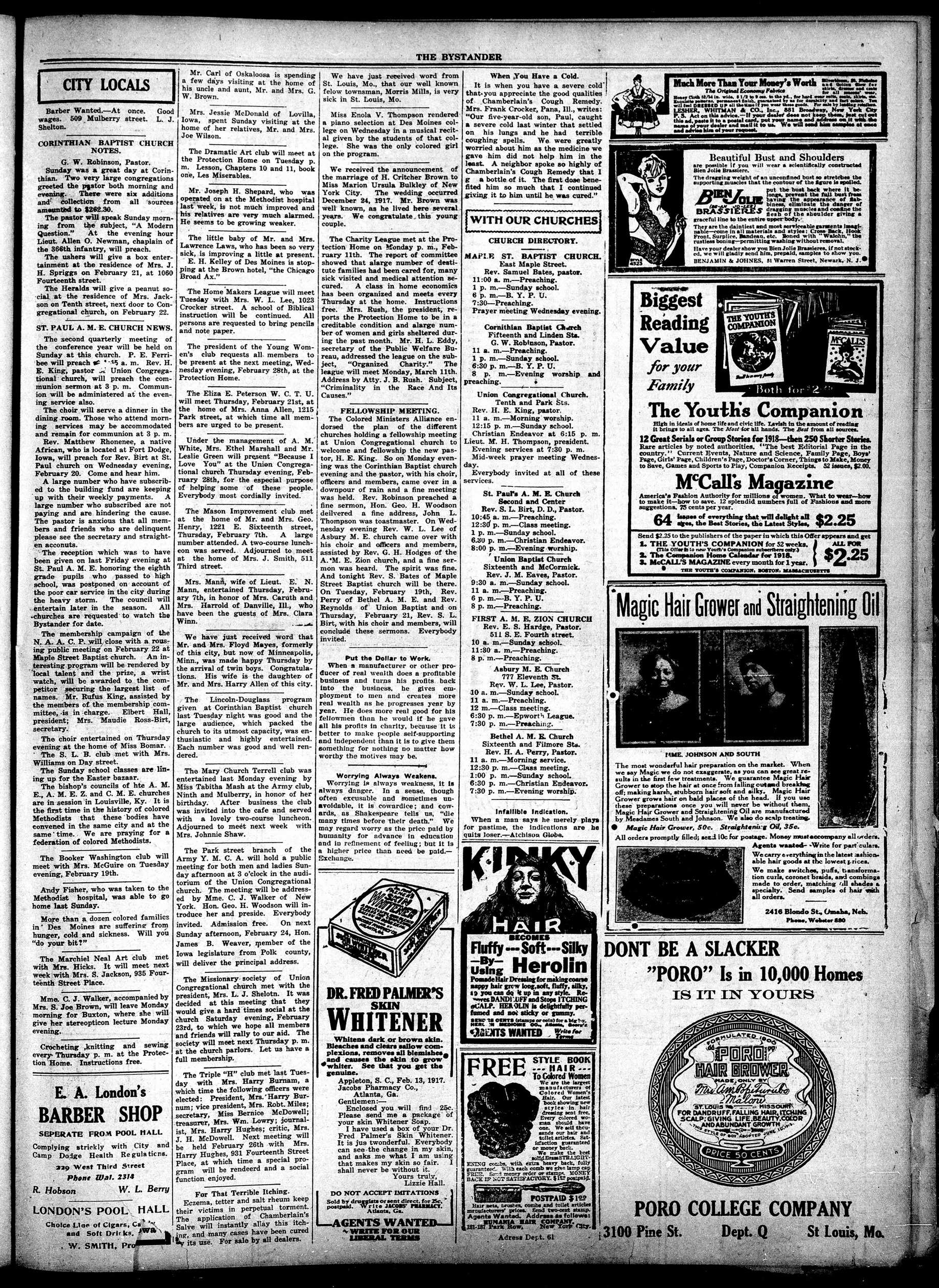
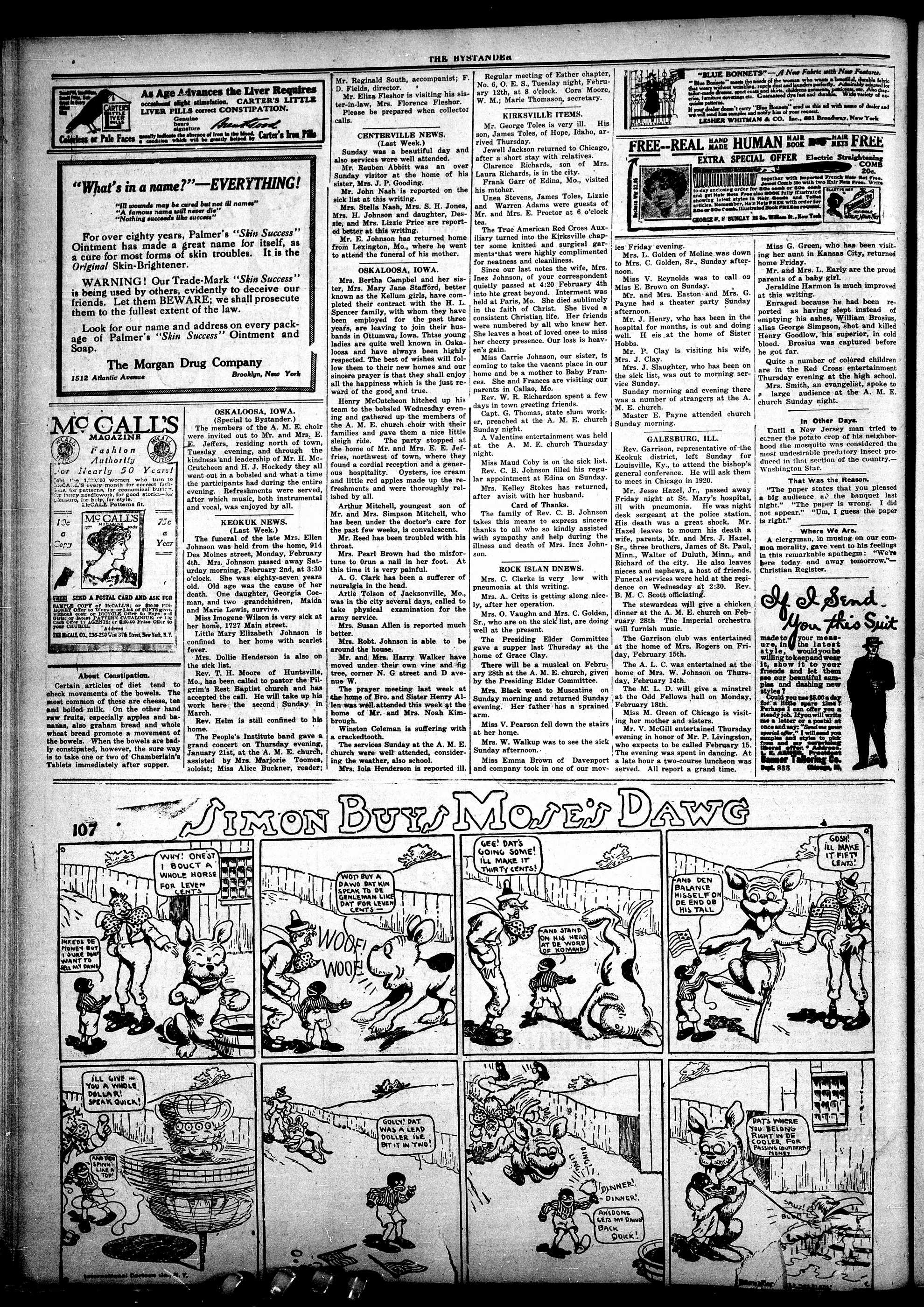
Page text (machine-generated)
THE BYSTANDER
State Capitol Blvd. Hts. 11
Fo
Boost Pay and read The Bystander
XXIV No. 35
A DREAM.
I dreamt the world was made anew,
The atmosphere was fresh as dew,
The skies put forth a richer hue,
The seas were patinted a deeper blue.
The song of the birds was cheerful
and gay,
From house top to branches they play-
fully hopped,
As though they came most willingly
to stay,
And they were most gorgeously
frocked.
The days were long, cheerful and
bright,
No thought of the morrow veiled the
mind;
The burden of existence seemed again as light,
A peaceful day was no task to find.
Me nswore off fighting for things unseen,
But used their talents for greater needs.
And reaped great blessings from all good deeds.
All nations were at peace with their kin;
The sword and gun were laid aside,
And resolved never more to begin
The strife of war and supremacy defied.
But alas! I awoke from my dreaming state
Of perfect contentment and warless land,
To gaze upon a world grasped by ill fate,
The destiny of which concerns every man.
—Jonnie Johnson Shaw.
"WITH THE COLORS."
"WITH THE COLORS."
Series No. 1.
By Gus Durdan, Des Moines, Iowa
Son's Diary.
November 24th.
Jim Crow Cars.—Our party arrived in Cincinnati, Ohio, at 9 p. m. and left at 9:05 p. m. via the Chesapeake and Ohio railroad for Newport News, Va. I have heard much, both pro and con, concerning the Jim Crow cars, but the half has never been told. Close up behind the engine we occupied about a third of a standard railway coach; the other two-thirds was reserved as a smoking room for white men, upon the wall of which was a large yellow board, on which was placarded—Colored. This compartment would seat only twenty-two persons.
Leaving Covington, Ky., there were more than thirty persons in the section. These, it seemed to me, were crowded, as uncomfortable as possible, into the Jim Crow.
All night long we were forced to remain cramped in our seats. We could not stretch ourselves. We could not even turn our seats together and converse among ourselves.
12 m. November 25th.—Our section is rife with the sickening odor of strong tobacco, breaths fouly ladened with intoxicating liquors. The rough element is returning home from its all night carousel. There is no respect shown for the ten or twelve ladies who are in the car.
The porter has just passed through the car and yelled Ashland. God forbid! About ten more ruffians have entered the compartment. A drunken woman is among them. She seems to be enamored of a tall ruffian, who would do justice to any penal institution, and already is trying to start a quarrel with another woman.
Over in the seat across from me an
NEGRO SOLDIER IN OUR WAR
(NEW BOOK)
Tells all about the war; it is fair to Colored people; everyone buys; a tremendous seller, a great seller; a great day; day. Send 20 cents quick for agents' outfit. MUSTIN JENNIES CO. F. Street: Washington, D. C.
Reason Enthroned.
Because meats are so tasty they are consumed in great excess. This leads to stomach troubles, biliousness and constipation. Revise your diet, let reason and not a pampered appetite control, then take a few doses of Chamberlain's Tablets and you will soon be well again. Try it. For sale by all dealers.
Phone 600
Red 6440 Eight St.
Roy E. Handy
Funeral Director
ITALIAN METHOD OF
EMBALMING
Des Moines, Iowa
DES MOINES, IOWA, FRIDAY, FEBRUARY 15, 1918. RICHEST NEGRO WOMAN TELLS OF ROMANTIC RISE FROM DIRE POVERTY
Dream Gave Her Secret of Fortune—Shows Pictures of Palatial Homes and Fleet of Luxurious Autos.
From laudress to queen of finance in twelve years, the accomplishment of her own genius and industry, and that under the handicap of race, was the remarkable story Mrs. C. J. Walker, a colored woman, told to her own people at the Frederick Douglass Memorial meeting at the West High school auditorium last evening.
The romantic story of Mrs. Walker's dreams which revealed to her the secret formula for the Mme. Walker hair preparations, which proved to be the foundation of her fortune of $1,000,000 and which by her business skill and shrewd investments in real estate continues to increase every year, gave her story all the fascination of a tale from Arabian Nights to the audience who listened to her wonder and admiration, and with a fieriest feeling of pride that a woman of the race had been able to accomplish in spite of almost insuperable obstacles.
Washed for Living.
Ten years ago Mary Walker was a St. Louis laudress, a widow with children dependent upon her. Hard work and care had begun to tell upon her to such an extent that she became interested in hair tonics and restorers, with a woman's instinctive desire to preserve her youthful appearance. So much did she think about these matters that she dreamed of facial preparations and hair restorers, until there came the wonderful dream that solved all her problems and pointed out the way to fabulous wealth which far exceeded her most flowery visions.
Going to Denver, Colo., she began business in a very limited way. By juicyulous advertising and shrewd management the business grew with leaps and bounds until "Mme. Walker's goods" became the most popular hair preparations on the market.
Then followed investments in real estate, the enlargement of her business by the appointment of elderly matron is fearfully crouching, as if afraid, lest she will be thrown in contact with the newcomers. My heart goes out in sympathy to her, for I, myself, am none too assured of safety.
I cannot understand these people. They are my people, but their ways are not my ways. Between us there is a wide chasm, bridged by education and a chance to live out one's life. The chamam seems to be filled with those who, in an attempt to pull their fellow creatures down, themselves have fallen. Over those fallen ones others are daily marching to recognition and success. The drunken female is on the rampage again. I cannot call her a woman. She has defiled herself beyond the stage of womanhood. She is just of the female species. There her womanhood stops. She throws a searching glance at the elderly matron, throws back her head, and laughs as though pitying one who regards womanhood as sacred. She taunts the lady with language unfit for print. Merciful heaven! The train has stopped at a station and one of our party has gone to get a lunch. The drunken female has taken the seat beside me, which was left unoccupied by my comrade. I would give her my seat, but in the aisle there are nothing but ruffians, and I could not stand to be pushed and knocked about by them and to be near their foul breaths. (To be continued.)
SIOUX CITY, IOWA.
Mr. Fred Baker, who underwent an operation some time ago, is reported to be improving.
The Ladies' Aid of the A. M. E. church will meet this week with Mrs. N. Green.
Mrs. Frank Roberts and Mrs. Phalbia Pemberton will give a linen shower on Wednesday evening, February 13th, complimentary to Mrs. Howard Hill, nee Miss Arabelle Dowdy.
Mrs. A. Morgan returned to her home in Yankton, S. D.
Those on the sick list this week are Mrs. H. Green, Miss Celia Mae Green, Phalbia Green and little Bertha Webb.
One of the most elaborate affairs of the season was a family dinner party given Sunday, February 10th, at the home of Mr. and Mrs. Mansfield Askew, in honor of Mr. and Mrs. Howard Hill. The three-course dinner was served on a prettily appointed table, which was centeedily with a large wedding cake, surrounded with flowers. Music and informalities made the afternoon a pleasant one. Besides the family, a few intimate friends of the young couple were present. Mrs. E. R. Edwards has returned from Elgin, Ill., where she has been
agents all over the country. With accumulating wealth she began to become known among her people for her benevolence. She established, and maintains six scholarships at Tuskogee, has adopted a homeless and crippled boy and is alding many other young people of her race to obtain an education and get a start in the world.
Her Property in Pictures.
Stereopticon views of her business houses, palatial homes in three or four different cities and property rented to the elite people in high class neighborhoods were shown. An apartment house in Central park west, New York City, which nets her in rentals $7,000 a year, a mansion at Irvington-on-the-Hudson, a valuable home in Indianapolis, a fine home given to her aged sister, the house in which she began to manufacture her hair preparations and the homes into which the business has subsequently developed, all were thrown upon the screen.
There was the room in which Washington had slept when she entertained him at Irvington-on-the-Hudson. Booker Washington, of course, the great benefactor of race. Among the things that she prizes there is the silver set which adorned the table when Washington was her guest. She will show you the very plates and the knives and forks and spoons—"all solid silver"—which Washington used when dining at her table.
Enjoys Auto Driving.
Six automobiles were thrown upon the screen, Cadillacs, Packards, Stevens-Duryea, runabouts and limousines—for she frankly admits that she likes to drive down the fashionable boulevards of the great cities and see the while folks jump when she blows the horn.
Mrs. Walker, who had the distinction of being the wealthiest Negro woman in the world, came to Des Moines in the interest of Frederick Douglass memorial fund. The auditorium was crowded mostly with colored people and the proceeds of the lecture will go to the Douglass memorial committee of which Mrs. S. Joe Brown of this city is chairman. Sunday afternoon at 3 o'clock Mrs. Walker will make an address at the army Y. M. C. A. at Park and Tenth streets and at 8 o'clock Saturday night she will speak at Bethel M. E. church, East Sixteenth and Fillmore streets.
DES MOINES BOY MAKING GOOD
The above cut is that of our well known and well liked young man, Rufus B. Jackson, who has received more honors and faster than any other of the many Iowaans that we have gone to this war. Rufus B. Jackson is the only son of our highly esteemed Mr. and Mrs. John Jackson. Mr. Jackson was sergeant of the 24th infantry and retired after thirty years' service and located in our city about ten years ago. His son, Rufus, graduated from East High school. He was the Bystander collector for one year. He then entered Iowa State college at Ames and is a junior in that great college. When he enlisted last June in the famous 8th Illinois regiment (colored) he was appointed sergeant in the hospital corps and last month was promoted to second lieutenant of the same regiment, officially now known as the 370th infantry, stationed at Camp Logan, Texas. We hope that there is still greater things in store for this worthy young boy.
What to Give.
"Give to your enemies/forgiveness, to your opponent tolerance, to your friend your heart, to your child a good example, to your parents deference, and to everybody sunshine."—Selected
The Farmers House of Poultry 305 Grand Ave. Des Moines, IA.
THE WORLD'S FIRST WOMEN'S HISTORY MUSEUM
FREDERICK DOUGLASS Born about Feb. 17, 1817 Died Feb. 20, 1895
Sunday was a beautiful day and everybody seemed glad to see such nice weather, after being so cold. Services were well attended. Had five oiners. Collections were good all day. The Mission Circle met in its regular business meeting Tuesday evening and elected Sister A. L. Crittenden as president. Sister M. J. Thompkins signed as president. The next meeting will be with Sister E. Hicks. Sister M. Mayfield and Sister Hicks will entertain the Circle next Tuesday evening.
Mrs. Harold Brown of Clarinda is in the city, called here by the illness of her mother, Mrs. J. Saunders. Mrs. Saunders has been sick quite a while. Sister C. G. Jones was on the sick list a few days last week. She seems much improved at this writing.
Mrs. J. L. Nash is able to be out again. We are glad to see Sister Nash up. She has been sick since November.
Mrs Walter Smith will entertain the B. Y. P. U. Thursday evening at a Valentine social.
Mr. and Mrs. E. F. Brown of Mystic visited in our city Saturday night.
The Court of Calanthes met in the regular business meeting Friday night. Mrs. Chas. Washington of Albia was here to install the officers and they report a lovely meeting. The officers are as follows: Mrs. Louis Baker, W. C.; Mrs. Julia Comley, W. J.; Mrs. S. Noah, R. D.; Mrs. M. Mayfield, M. O.; Mrs. Clara-Leek, R. of A. Mrs. M. Mayfield was elected delegate.
Mrs. Washington was the guest of Mrs. William Cobbs while in the city. Mrs. Wm. Noah entertained at a 3 course dinner at 6 o'clock Friday evening in honor of Mrs. Chas. Washington of Albia. Covers wer laid for six.
Mrs. Wm. Cobbs entertained six ladies at breakfast last Saturday morning in honor of Mrs. Washington of Albia. She left on the 9:30 car for her home.
Mr. Lewis Hughes of Mystic, Iowa, was in the city Sunday.
Mr. Will Carter still remains poorly.
Mrs. Mary McDonald is reported very sick.
Mr. H. B. Marshall is some better.
Mrs. John Hicks is working in the interest of the colored boys at Camp May. We join hands with her and do our part.
The Benevolent society was entertained by Bro. Robert Terrell, S. H. Jones and Mr. Theodore Jones at the home of Mrs. W. H. Cobbs on Monday evening. A large crowd attended and after general business was over, supper was served and aneat sum was realized.
Editor of Bystander: I thought I would let you hear from Paris. We are having very pleasant weather now. Last Wednesday Mrs. Inez Johnson's funeral was held here. Quite a large crowd was out. R. R. Adkins attended the funeral. Persons on the sick list: Mrs. Fannie Johnson, Mrs. Annie Bell Porter. Mr. Tom House returned home from Kansas City, where he attended his
aunt's funeral.
Sunday was a pleasant day. Had quite a nice service morning and evening. B. Y. P. U. was well attended at 6:30.
I have a question to ask the Baptist ministers of Iowa. Do the Baptists hold close communion? Is baptism essential to salvation? If so, answer in next week's paper. I claim that Baptists don't hold close communion and neither is baptism essential to salvation. The Lord Jesus instituted the supper and went in the chamber with his twelve apostles. When he had given thanks he gave it to them and said: Divide it among yourselves.
But in John the tenth chapter, I have sheep that are not of this fold and them I must also bring. We had quite a lengthy argument over the matter. We want to settle it intelligently.
Plant This Go
Plan Now To This FEBRU Good Use
Plan Now To Benefit By This FEBRUARY SALE of Good Used Pianos
$300 Kohler&Campbell $190
This well known Piano, in upright walnut case and beautiful tone. A splendid home piano priced $300 when new.
February Sale Price ---- $190
$295 Kohler&Campbell $225
This instrument is only slightly used and will be guaranteed to the purchaser. Case of mahogan with ivory keys and brass hard ware. Regularly $295,
February Sale Price ---- $225
$350 Francis Bacon $240
Large size Francis Bacon upright
Piano in mahogany case with ivory keys. Has a beautiful top
Originally $350, priced
in February Sale at $240
Open
an
Account
DAVID
MUSIC LABORATORY
412-414-416-416
Open an Account at DAVID BROOKS LARGEST PARK 412-414-416-416
DAVIDSONS
BROOKS LAKES CITY PUBLIC LIBRARY
412-414-410-418 - WALNUT-ST
The Best advertising medium to reach colored people in the west
Price Five Cents
Mr. and Mrs. Lou Morris and children of Fort Dodge are moving to Albia.
Mrs. Mary Harris visited in Buxton several days the past weeks.
The Sewing Circle club met at the home of Mrs. Brown on Monday afternoon. After business a nice lunch was served by the hostess in two courses. Visitor present, Miss Tinks of Hiteman.
Miss Alberta Robinson was at her home in Hocking on Thursday.
The Independent Sewing Circle club and the Young Girls' club, under the management of Mrs. Chas. Washington, invited the State Federation of Colored Women's club president, Mrs. Helen Downey, to lecture to them on Sunday, February 10th, in the afternoon. Mrs. Downey spoke to the elder ladies and in the evening the young people had a program in which she took part. Her little daughter, Miss Ethel Downey, accompanied her. She assisted with Master Bennie Grayson and Le Roy Grayson in taking up a collection to the amount of $7.00.
Mrs. G. As Davis was at Hocking, No. 3, Saturday and a part of Sunday at the home of her daughter, Mrs. Bessie Grayson.
She Put the Tos in Ptomaine.
A seven-year-old Columbus girl came home from school and reported one of her classmates had hurt his toe and was unable to be at school. "It's very serious," she said, "and they are afraid he is going to have ptomaine polsoning."—India unpolls News.
By Degrees.
A man would wonder at the mighty things which have been done by degrees and gentle augmentations. Diligence and moderation are the best steps whereby to climb to any excellency.—Owen Felltham.
Where the Real Danger Lies.
A Boston physician has sounded the warning that there is more or less danger in wearing clothes. There may be, but the most danger lies in the path of a man who attempts to trip merrily through this life clad in filtered sunshine and a two days' growth of whiskers.
"Does your husband worry about the grocery bill?" "No; he says there's no sense in both himself and the grocer worrying over the same bills."
o Benefit By
ARY SALE of
ed Pianos
terms as Low as
$1.00 a Week
ussell Piano $125
Upright Piano in mahogany case
and sound tone, with full music
vory keys. Original
Taken in exchange.
February Sale
Price $125
$325 Kohler&Campbell $225
Large size Kohler & Campbell
Piano in mahogany case. Returned from rental. In splendid
condition. Regularly $325, priced
in the February
Sale at $225
$295 Kohler&Campbell $250
Very alightly used, dull mahogany
Piano in pretty case. A splendid instrument, originally
priced $235, now offered at this
February Sale
Price $250
$450 Emerson Pianos $298
Choice of mahogany and walnut
case, Emerson Pianos, very
very slightly used and in excellent
condition and tone. Regularly
$450, February Sale
Price $298
OSONS
AUTUNTE STORE
B-WALNUT-SL
Iowa
Freight
Paid
STEINANDER PUBLISHING CO., PUBLISHERS
DES MOINES, IOWA
JOHN L. THOMPSON, EDITOR
FRIDAY, FEB. 15, 1918
Published every Friday by the By
stander Publishing Company, Des
Moines, Iowa. Office in Chemical
building, corner Seventh and Mul-
berry streets. Phone, alnut 899.
TERMS OF SUBSCRIPTION.
One year $1.50
Six months .78
Three months .50
Entered at the postoffice as sec-
nd class matter.
Send money by postoffice order,
money order, express or draft, to The
Bystander Company.
All subscriptions payable in advance.
Advertising rates for display ad 25 cents per inch, for each insertion. Three to six months' contracts, 18 cents per inch. Local advertising 10 cents per line for each insertion, counting seven words to a line. For church's and secret societies where admission is charged, one-half of the above-mentioned rates. For professional, legal and announcement cards, yearly contracts, etc., terms are given on application. All advertising is to be paid in advance. We are prepared to do first class job work at reasonable prices. All of our work is guaranteed.
Official names of the M. W. U. Grand of Iowa, A. F. & A. M., of International Grand Congress of Heroines of Jericho of America, and Western Baptist Association. We will not return rejected manuscript, unless accompanied by post age stamps.
Communications must be written on one side of the paper only and be of interest to the public. "Brevity is the soul of wit." remember.
The Iowa State Bystander is the oldest Afro-American journal published is Iowa. It was established in 1894, and is read by nearly all the colored people of Iowa. We have correspondents in the following towns:
Albia Miss May Davis
Washington N. L. Black
Monmouth, Ill. Mrs. Bernice Metlock
Clinton A. A. Bush
Maceon, Mo. Lucy Harris
St. Paul, Minn. Mrs. Hattie Hicks
Rock Island Ill.
Bock htm htm Miss Berna Edmunds
Davenport Mrs. D. J Johnson
Oakatoa Mrs. Cora hosee
Centerville Mrs. A. L. Crittenden
Umaha, Neb Mrs. Murel Brown
Ottamwa Mrs. W. H. Thompson
Moberly, Mo Mrs. Lee Etta Owens
Galeenburg, Ill Miss B. Anderson
Quincy, Ill Mrs. Mattie Lillie
Buxton, Iowa Miss Gladys Mardis
Knoxville, Iowa Mrs. H. Bryson
Council Bluffs Miss Agnes Fountain
Keoku, Iowa Mrs. Georgie Caldwell
Chillicothe, Mo V. E. Williams
Sioux City Mrs. M. Askew
Clarinda Mrs. G. N. Nowling
This notice applies to all writers contributors, agents and correspondents. Sign all articles, write only upon one side of paper, write a plain hand and spell accurately. Do not send in names of persons at party event. Do not give an eulogy or write your personal comment upon classes, all societies, all religious de the event. Simply tell the news or event in a brief, simple manner and let the readers of The Bystander comment. Write the news of all personal whims or ideas.
FREDERICK DOUGLASS.
This week on our front page may he seen a true picture of Hon. Frederick Douglass, that great Negro statesman, orator and journalist, who was perhaps the most unique figure and greatest man from all viewpoints that the Negro race has yet produced. He was born deeper in poverty, vice, dirt, ignorance, not even knowing the date of his birth nor his father; had to scramble with the dogs and cats in the back yard for a living. In his boyhood days he ran away from slavery, self emancipated, self educated, he started the first real Negro newspaper, The North Star, at Rochester, N. Y. He was recorder of the deeds, a diplomat to foreign countries, honored by kings, princes, queens, presidents and rulers of all civilized countries, revered and loved by our race, an inspiration to every Negro.
DAMARIS REESCER HAS GONE.
(Special to Bystander.)
At the Hemeopathic hospital in Iowa City, Iowa, occurred the death of Damaris Reeser, daughter of Mr. and Mrs. Ed. Reeser of Mount Pleasant, Iowa. She was taken ill in November and all medical aid failing to relieve she was taken to Iowa City, wher an operation was performed, the result of which was baffling the correct nature of the trouble not being diagnosed. It was stated by the assisting surgeons and her local physicians to be a case rarely encountered in the medical profession. Damaris was born May 31, 1904, in Mount Pleasant, Iowa. She was just entering young womanhood, being 13 years of age, and was agirl well liked
by her associates, being of a cheerful, sunshiny disposition. She was an active Sunday school worker, of which she was secretary. She leaves to mourn her loss a loving father, devoted mother, a fond grandmother, numerous uncles and aunts, and a host of other relatives and friends.
The funeral service was held at the Second Baptist church, conducted by Rev. P. Thomas, assisted by Rev. F. E. Weston and Rev. Jackson.
PROGRAM FOR WASHINGTON.
The N. A. A. association will give the following program on Washington's birthday, February 22, at Maple Street Baptist church:
Song, Star Spangled Banner.
Invocation, Rev. G. W. Robinson.
Selection by Wilson quartet.
Biography of Geo. Washington.
Vocal solo, Mrs. Mayme Arimstead.
Eulogy on Washington, Rev. C. W. Reese (white) of Unitarian church. Instrumental solo, Miss Josephine Clardy.
Reading, Mrs. Marion Blackburn.
Everybody invited. Admission free.
BUXTON PEOPLE TO HEAR MME.
WALKER
Special.—Fearing an opportunity will not present itself again to hear and see this most distinguished woman, the Buxton people, through a committee composed of Mesdames E. F. Jones, E A. Carter and Ada Mills, have arranged with Mrs. S. Joe Brown of Des Moines to bring Mme. C. J. Walker to this city, where they have completed plans to have her lecture at the opera house on Monday evening, February 18th, at 8 o'clock.
Mrs. Brown assured the committee that Mme. Walker would be pleased with this arrangement, for she had expressed a desire to visit this noted town and the Buxton people will be glad to have a share in welcoming America's richest colored woman to the state of Iowa on Monday evening, February 18th.
NEED BIG HERDS
Warring Nations Have Depleted Live Stock at Enormous Rate, Even Killing Dairy Cattle For Food.
American stock breeders are being asked to conserve their flocks and herds in order to meet Europe's tremendous demands for meats during the war and probably for many years afterward.
The United States food administration reports that American stock raisers have shown a disposition to co-operate with the government in increasing the nation's supply of live stock.
Germany today is probably better supplied with live stock than any other European nation. When the German armies made their big advance into France and then retreated virtually all the cattle in the invaded territory — approximately 1,800,000 head—were driven behind the German lines.
But in England—where 2,400,000 acres of pasture lands have been turned into grain fields—the cattle herds are decreasing rapidly. One of the reasons apparently is the declining maximum price scale adopted by the English as follows: For September, $17.76 per 100 pounds; October, $17.28; November and December, $16.08; January, $14.40. The effect of these prices was to drive beef animals on the market as soon as possible.
In France the number of cattle as well as the quality have shown an enormous decline during the war. Where France had 14,807,000 head of cattle in 1913, she now has only 12,841,000, a decrease of 16.6 per cent. And France is today producing only one gallon of milk compared to two and one-half gallons before the war. Denmark and Holland have been forced to sacrifice dairy herds for beef because of the lack of necessary feed.
Close study of the European meat situation has convinced the Food Administration that the future problem of America lies largely in the production of meat producing animals and dairy products rather than in the production of cereals for export when the war will have ceased.
There has been much misunderstanding about the bread program in England. It is true that the Englishman buys a loaf of bread for less than an American can, but it is poorer bread, and the British government is paying $200,000,000 a year toward the cost of it.
All the grain grown in Great Britain is taken over by the government at an arbitrary price and the imported wheat purchased on the markets at the prevailing market price. This is turned over to the mills by the government at a price that allows the adulterated bread loaf of four pounds to sell at 18 cents, the two pound loaf at 9 cents and the one pound loaf at 5 cents.
In France, under conditions somewhat similar, but with a larger extraction, the four pound loaf sells for 16 cents.
---
AMERICAN SUGAR SENT TO FRANCE
American Price Rigidly Regulated by United States Food Administration.
Sugar Cost 35 Cents a Pound During Civil War—Refiners' Profits New Custard
Sugar is selling today throughout America at from 8½ to 9 cents a pound to the consumer, even though there is a world shortage which has reduced this nation's sugar allotment to 70 per cent, of normal. Through the efforts of the United States food administration the sugar market has been regulated as far as the producer, refiner and wholesaler is concerned. The food administration has no power to regulate retail prices except by public opinion. Even though more than 85,000 tons of sugar have been shipped to France in the last four months the retail grocer's sugar price is around 8 to 8½ cents. He should sell this sugar at 8½ to 9 cents, the food administration believes, and asks the American housewife to pay no more than this amount.
Last August when the food administration was organized the price of sugar rose suddenly to 11 cents a pound. During the Civil War sugar cost the consumer 35 cents a pound. By regulation of the sugar market and reducing the price to 8½ and 9 cents and keeping it from advancing to 20 cents the food administration has saved the American public at least $180,000,000 in four months, according to a statement made by Herbert Hoover the other day.
"It is our stern duty to feed the allies, to maintain their health and strength at any cost to ourselves," Mr. Hoover declared. "There has not been, nor will be as we see it, enough sugar for even their present meagre and depressing ration unless they send ships to remote markets for it. If we in our greed and gluttony force them either to further reduce their ration or to send these ships we will have done damage to our abilities to win this war.
"If we send the ships to Java for 250,000 tons of sugar next year we will have necessitated the employment of eleven extra ships for one year. These ships—if used in transporting troops—would take 150,000 to 200,000 men to France."
Reason for World Shortage.
As Mr. Hoover pointed out, the United States, Canada and England were sugar importing countries before the war, while France and Italy were very nearly self supporting. The main sources of the world's sugar supply was Germany and neighboring powers, the West Indies and the East Indies. German sugar is no longer available, as it is used entirely in Germany, which also absorbs sugar of surrounding countries. England can no longer buy 1,400,000 long tons of sugar each year from Germany. The French sugar production has dropped from 750,000 to 210,000 tons. The Italian production has fallen from 210,000 to 75,000 tons. Thus three countries were thrown upon East and West Indian sources for 1,925,000 tons annually to maintain their normal consumption.
Because of the world's shipping shortage the allied nations started drawing on the West Indies for sugar; East Indian sugar took three times the number of ships, since the distance was three times as great. Suddenly the west was called on to furnish and did furnish 1,420,000 tons of sugar to Europe when 300,000 tons a year was the pre-war demand. The allies had drawn from Java 400,000 tons before the shipping situation became acute.
"In spite of these shipments," Mr. Hoover stated the other day, "the English government in August reduced the household sugar ration to a basis of 24 pounds per annum per capita. And in September the French government reduced their household ration to 13-210 pounds a year, or a bit over 1 pound of sugar a month. Even this mengre ration could not be filled by the French government it was found early in the fall. America was then asked for 100,000 tons of sugar and succeeded in sending 85,000 tons by December 1. The French request was granted because the American household consumption was then at least 55 pounds per person, and it was considered the duty of maintaining the French morale made our course clear."
Today the sugar situation may be summarized by stating that if America will reduce its sugar consumption 10 to 15 per cent, this nation will be able to send 200,000 more soldiers to France.
Sugar today sells at seaboard refineries at $7.25 a hundred pounds. The wholesale grocer has agreed to limit his profit to 25 cents a hundred plus freight, and the retail grocer is supposed to take no more than 50 cents a hundred pounds profit. This regulation was made by the food administration, which now asks the housewife to reduce sugar consumption as much as possible, using other sweeteners, and also reminds her that she should pay no more than 9 cents a pound for sugar.
Control of Cana Refiners' Profits
"Immediately upon the establishment of the food administration," Mr.
THE BYSTANDER
Hoover said, "an examination was made of the costs and profits of refining and it was finally determined that, spread between the cost of raw and the sale of refined cane sugar should be limited to $1.30 per hundred pounds. The pre-war differential had averaged about 85 cents and increased costs were found to have been imposed by the war in increased cost of refining, losses, cost of bags, labor, insurance, interest and other things, rather more than cover the difference. After prolonged negotiations the refiners were placed under agreement establishing these limits on October 1, and anything over this amount to be agreed extortionate under the law.
"In the course of these investigations it was found by canvass of the Cuban producers that their sugar had, during the first nine months of the past year, sold for an average of about $4.24 per hundred f. o. b. Cuba, to which duty and freight added to the refiners' cost amount to about $5.66 per hundred. The average sale price of granulated by various refineries, according to our investigation, was about $7.50 per hundred, or a differential of $1.84.
"In reducing the differential to $1.30 there was a saving to the public of 54 cents per hundred. Had such a differential been in use from the 1st of January, 1917, the public would have been in the first nine months of the year about $24,800,000."
Next Year.
With a view to more efficient organization of the trade in imported sugars next year two committees have been formed by the food administration:
1. A committee comprising representatives of all of the elements of American cane refining groups. The principal duty of this committee is to divide the sugar imports pro rata to their various capacities and see that absolute justice is done to every refiner.
2. A committee comprising three representatives of the English, French and Italian governments; two representatives of the American refiners, with a member of the food administration. Only two of the committee have arrived from Europe, but they represent the allied governments. The duties of this committee are to determine the most economical sources from a transport point of view of all the allies to arrange transport at uniform rates, to distribute the foreign sugar between the United States and allies, subject to the approval of the American, English, French and Italian governments.
This committee, while holding strong views as to the price to be paid for Cuban sugar, has not had the final voice. This voice has rested in the governments concerned, together with the Cuban government, and I wish to state emphatically that all of the gentlemen concerned as good commercial men have endeavored with the utmost patience and skill to secure a lower price, and their persistence has reduced Cuban demands by 15 cents per hundred. The price agreed upon is about $4.60 per hundred pounds, f. o. b. Cuba, or equal to about $6 duty paid New York.
"This price should eventuate." Mr. Hoover said, "to about $7.30 per hundred for refined sugar from the refiners at seaboard points or should place sugar in the hands of the consumer at from $8½ to 9 cents per pound, depending upon locality and conditions of trade, or at from 1 to 2 cents below the prices of August last and from one-half to a cent per pound cheaper than today.
"There is now an elimination of speculation, extortionate profits, and in the refining alone the American people will save over $25,000,000 of the refining charges last year. A part of these savings goes to the Cuban, Hawaiian, Porto Rican and Lousianian producer and part to the consumer.
"Appeals to prejudice against the food administration have been made because the Cuban price is 34 cents above that of 1917. It is said in effect that the Cubans are at our mercy; that we could get sugar a cent lower. We made exhaustive study of the cost of producing sugar in Cuba last year through our own agents in Cuba, and we find it averages $3.39, while many producers are at a higher level. We found that an average profit of at least a cent per pound was necessary in order to maintain and stimulate production or that a minimum price of $4.37 was necessary, and even this would stifle some producers.
"The price ultimately agreed was 23 cents above these figures, or about one-fifth of a cent per pound to the American consumer, and more than this amount has been saved by our reduction in refiners' profits. If we wish to stifle production in Cuba we could take that course just at the time of all times in our history when we want production for ourselves and the allies. Further than that, the state department will assure you that such a course would produce disturbances in Cuba and destroy even our present supplies, but beyond all these material reasons is one of human justice. This great country has no right by the might of its position to strangle Cuba.
"Therefore there is no imposition upon the American public. Charges have been made before this committee that Mr. Rolph endeavored to benefit the California refinery of which he was manager by this 34 cent increase in Cubap price. Mr. Rolph did not fix the price. It does raise the price to the Hawaiian farmer about that amount. It does not raise the profit of the California refinery, because their charge for refining is, like all other refiners, limited to $1.30 per hundred pounds, plus the freight differential on the established custom of the trade. "Mr. Rolph has not one penny of interest in that refinery."
Next Year.
How Does a Soldier Feel in a Life-and-Death Crisis?
He was caught—like a rat in a trap—with only one chance in a million of coming out alive. He thought of—
What would happen if he were caught?
that does a soldier think of in a life-and-death crisis? How does he feel? What does he do? What is the millionth chance that he takes to escape? While trembling and hot from the experiences they have gone through, over two hundred men—airmen, trench raiders, submarine commanders, grenade throwers—have told what they saw, heard and felt. To read these stories of personal adventure is to get an entirely new viewpoint of the war.
A Close-Up of the War
Newspapers and magazines treat the war along broad, general lines, and they arm and armies. But these stories tell you about the most daring and brave individuals. They tell of exploits which even now you hear in newspapers. No professional author in the history of literature could tell of imagination could think them up. Yet each of these stories is a wonder. They would thrill a man with bleedings at wonder.
The Books of Bowers has collected these two two-volume and more volumes, containing altogether 1800 pages, previously illustrated. The volumes contain genius as well as facts related; every one of them is told in the words of the author, with a few for a limited time, with a two-year subscription to the Bowers Library.
Teaching Child to Read.
A child is best taught to read in the natural method, by means of objects. His words or short sentences contabing the same words repeated in different connection, are written on the blackboard, and he quickly learns to recognize these and to read at sight, first words in script, then in type. When he is made to copy the blackboard words at each lesson, he learns to read and write both at the same time.
Japanese Have No Beds.
Japanese Hate The Japanese do not sleep on European beds, but on many thick, soft puffs piled one on top of each other upon the floor. For bed covering they use more of the same kind of puffs. It is said that the Japanese emperor has 20 such puffs. One of those which cover him is made in the shape of a kimono and has a velvet collar. Probably he creeps inside of this, if he feels cold in the night.
Sparrows Eaten in England.
Sparrows are often eaten by English country persons. They are captured easily in fine mesh nets stretched over the ground and baited with grain, or in nets hung at night around their roosting places in ricks, hedges and ivy-clad walls. Also, the ground can be baited and a crowd of feeding sparrows laid low with a gun, using fine shot for the purpose.
A Hint to the Aged.
If people past sixty years of age could be persuaded to go to bed as soon as they take cold and remain in bed for one or two days, they would recover much more quickly, especially if they take Chamberlain's Cough Remedy. There would also be less danger of the cold being followed by any of the more serious diseases.
FITS
Welcome to statements of care for many of attacks of Fits, Epilepsy, Failing of Fits, Epilepsy, Coming out of wounds, and in a sample Dr. Root's formula. We PAY EVERY SESSION on FREE TRIAL BUTTLE. If you CUT BUT and if you write One age, hundreds of testimonies on it.
F. HARVEN ROOF CO. Dugge, 7144 64 F. O. J. O. New York
Relieves CATARRH of
the BLADDER
and all
Discharges in
24 HOURS
Each carcule bears the
name of the
Bevore of MIDY
counterfeits.
Kids will not be permitted.
These Tablets are intended especially for disorders of the stomach, liver and bowels. If you are troubled with heartburn, indigestion or constipation they will do you good.
Sell Your Spare Time to us for CASH COMISSIONS and Valuable Premuims
Let us tell you how you can earn wonderful Christmas gifts.
DUKE SALES COMPANY
Muscatine, - Iowa.
REMEMBER
Lud Strothers' Cafe
417 W. Third Street
Meals and Short Orders at
all hours. Quick Service.
We serve on the
European style.
L. G. Strothers,
Proprietor Des Moines
To Satisfy You
SAM. BURNS
THE
TAILOR & CLEANER
772 West 9th St.
Popular, Priced Gents Furnishing
Bradford's Barber Shop
228 W. 3rd Street
FIRST CLASS WORK
BATHS
Bradford's Pool Hall
M. J. BRADFORD, Prop.
A LINE OF TOBACCO, CIGARS & SOFT DRINKS
Phone Wal. 1916 757 W 9th St.
DES MOINES, IOWA
Soldier Feel in a Death Crisis?
rap—with only one chance in a million of a life-and-death crisis? How does he be millionth chance that he takes to escape? the experiences they have gone through, trench raiders, submarine commanders, they saw, heard and felt. To read these set an entirely new viewpoint of the war.
Partial List of Stories
Sixteen Months in Four
Gam m a n Prizes—The
Girl's Great Adventure
The Girl's Great Adventure
A Field Ambulance at
With Ambulance No. 19
With Ambulance No. 19
With the Killer—With
Princess Patrick's Creature
Undersea—Hinden-
Adrift in a Mine Field
Adrift in a Mine Field
3F—My Excuse f o m
3F—Disagued
a Woman.
CITY LOCALS
Barber Wanted.—At once. wages. 509 Mulberry street. Shelton.
Sunday was a great day at Corinthian. Two very large congregations greeted the pastor both morning and evening. There were six additions and collection from all sources amounted to $262.30.
The pastor will speak Sunday morning from the subject, "A Modern Question." At the evening hour Lieut. Allen O. Newman, chaplain of the 368th infantry, will preach.
The ushers will give a box entertainment at the residence of Mrs. J. H. Spriggs on February 21, at 1060 Fourteenth street.
The Heralds will give a peanut social at the residence of Mrs. Jackson on Tenth street, next door to Congregational church, on February 22.
ST. PAUL A. M. E. CHURCH NEWS.
The second quarterly meeting of the conference year will be held on Sunday at this church. P. E. Ferribee will preach 15 a.m. Rev. H. E. King, pastor of Union Congregational church, will preach the communion sermon at 3 p.m. Communion will be administered at the evening service also. The choir will serve a dinner in the dining room. Those who attend morning services may be accommodated and remain for communion at 3 p.m. Rev. Matthew Rhonenee, a native African, who is located at Fort Dodge, Iowa, will preach for Rev. Birt at St. Paul church on Wednesday evening, February 20. Come and hear him.
A large number who have subscribed to the building fund are keeping up with their weekly payments. A large number who subscribed are not paying and are hindering the cause. The pastor is anxious that all members and friends who are delinquent please see the secretary and straighten accoutns. The reception which was to have been given on last Friday evening at St. Paul A. M. E. honoring the eighth grade pupils who passed to high school, was postponed on account of the poor car service in the city during the heavy storm. The council will entertain later in the season. All churches are requested to watch the Bystander for date.
The membership campaign of the N. A. A. C. P. will close with a rousing public meeting on February 22 at Maple Street Baptist church. An interesting program will be rendered by local talent and the prize, a wrist watch, will be awarded to the competitor securing the largest list of names. Mr. Rufus King, assisted by the members of the membership committee, is in charge. Elbert Hall, president; Mrs. Maudie Ross-Birt, secretary.
The choir entertained on Thursday evening at the home of Miss Bomar.
The S. L. B. club met with Mrs. Williams on Day street.
The Sunday school classes are lining up for the Easter bazaar.
The bishop's councils of hte A. M. E., A. M. E. Z and C. M. E. churches are in session in Louisville, Ky. It is the first time in the history of colored Methodists that these bodies have convened in the same city and at the same time. We are praying for a federation of colored Methodists.
The Booker Washington club will meet with Mrs. McGuire on Tuesday evening, February 19th.
Andy Fisher, who was taken to the Methodist hospital, was able to go home last Sunday.
More than a dozen colored families in' Des Moines are suffering from hunger, cold and sickness. Will you "do your bit?"
The Marchiel Neal Art club met with Mrs. Hicks. It will meet next week with Mrs. S. Jackson, 935 Fourteenth Street Place.
Mme. C. J. Walker, accompanied by Mrs. S. Joe Brown, will leave Monday morning for Buxton, where she will give her stereopticon lecture Monday evening.
Crocheting, knitting and sewing every Thursday p. m. at the Protection Home. Instructions free.
Mr. Carl of Osakaloa is spending a few days visiting at the home of his uncle and aunt, Mr. and Mrs. G. W. Brown.
Mrs. Jessie McDonald of Lovilla, Iowa, spent Sunday visiting at the home of her relatives, Mr. and Mrs. Joe Wilson.
The Dramatic Art club will meet at the Protection Home on Tuesday p. m. Lesson, Chapters 10 and 11, book one, Les Miserables.
Mr. Joseph H. Shepard, who was operated on at the Methodist hospital last week, is not much improved and his relatives are very much alarmed. He seems to be growing weaker.
The little baby of Mr. and Mrs. Lawrence Laws, who has been so very sick, is improving a little at present. E. H. Kelley of Des Moines is stopping at the Brown hotel, "the Chicago Broad Ax."
The Home Makers League will meet Tuesday with Mrs. W. L. Lee, 1023 Crocker street. A school of Biblical instruction will be continued. All persons are requested to bring pencils and note paper.
The president of the Young Women's club requests all members to be present at the next meeting, Wednesday evening, February 28th, at the Protection Home.
The Eliza E. Peterson W. C. T. U. will meet Thursday, February 21st, at the home of Mrs. Anna Allen, 1215 Park street, at which time all members are urged to be present.
Under the management of A. M. White, Mrs. Ethel Marshall and Mr. Leslie Green will present "Because I Love You" at the Union Congregational church Thursday evening, February 28th, for the especial purpose of helping some of these people. Everybody most cordially invited.
The Mason Improvement club met at the home of Mr. and Mrs. Geo. Henry, 1221 E. Sixteenth street, Thursday, February 7th. A large number attended. A two-course luncheon was served. Adjourned to meet at the home of Mrs. J. Smith, 511 Third street.
Mrs. Mann, wife of Lieut. E. N. Mann, entertained Thursday, February 7th, in honor of Mrs. Caruth and Mrs. Harrold of Danville, Ill., who have been the guests of Mrs. Clara Winn.
We have just received word that Mr. and Mrs. Floyd Mayes, formerly of this city, but now of Minneapolis, Minn., was made happy Thursday by the arrival of twin boys. Congratulations. His wife is the daughter of Mr. and Mrs. Harry Allen of this city.
The Lincoln-Douglass program given at Corinthian Baptist church last Tuesday night was good and the large audience, which packed the church to its utmost capacity, was enthusiastic and highly entertained. Each number was good and well rendered.
The Mary Church Terrell club was entertained last Monday evening by Miss Tabitha Mash at the Army club, Ninth and Mulberry, in honor of her birthday. After business the club was invited into the cafe and served with a lovely two-course luncheon. Adjourned to meet next week with Mrs. Johnnie Shaw.
The Park street branch of the Army Y. M. C. A. will hold a public meeting for both men and ladies Sunday afternoon at 3 o'clock in the auditorium of the Union Congregational church. The meeting will be addressed by Mme. C. J. Walker of New York. Hon. Geo. H. Woodson will introduce her and preside. Everybody invited. Admission free. On next Sunday afternoon, February 24, Hon. James B. Weaver, member of the Iowa legislature from Polk county, will deliver the principal address.
The Missionary society of Union Congregational church met with the president, Mrs. L. J. Shelotn. It was decided at this meeting that they would give a hard times social at the church Saturday evening, February 23rd, to which we hope all members and friends will rally to our aid. The society will meet next Thursday p. m. at the church parlors. Let us have a full membership.
The Triple "H" club met last Tuesday with Mrs. Harry Burnam, a which time the following officers were elected: President, Mrs. Harry Burnum; vice president, Mrs. Robt. Miles; secretary, Miss Bernice McDowell; treasurer, Mrs. Wm. Lowry; journalist, Mrs. Harry Hughes; critic, Mrs. J. H. McDowell. Next meeting will be held February 26th with Mrs. Harry Hughes, 931 Fourteenth Street Place, at which time a special program will be rendeerd and a social function enjoyed.
For That Terrible Itching.
For that treatment, Eczema, tetra and salt rheum keep their victims in perpetual torment. The application of Chamberlain's Salve will instantly allay this itching, and many cases have been cured its use. For sale by all dealers.
We have just received word from St. Louis, Mo., that our well known fellow townman, Morris Mills, is very sick in St. Louis, Mo.
Miss Enola V. Thompson rendered a piano selection at Des Moines college on Wednesday in a musical recital given by the students of that college. She was the only colored girl on the program.
We received the announcement of the marriage of H. Critcher Brown to Miss Marion Urula Bulkley of New York City. The wedding occurred December 24, 1917. Mr. Brown was well known, as he lived here several years. We congratulate this young couple.
WM
It is with you, that you are of Cham
Mrs. Fran
"Our five
a severe
on his l
coughing
worried al
gave him
least. A
Chamberb
a bottle
fited him
giving it t
The Charity League met at the Protection Home on Monday p. m., February 11th. The report of committee showed that alarge number of destitute families had been cared for, many sick visited and medical attention secured. A class in home economics has been organized and meets every Thursday at the home. Instructions free. Mrs. Rush, the president, reports the Protection Home to be in a creditable condition and alarge number of women and girls sheltered during the past month. Mr. H. L. Eddy, secretary of the Public Welfare Bureau, addressed the league on the subject, "Organized Charity." The league will meet Monday, March 11th. Address by Atty. J. B. Rush. Subject, "Criminality in the Race And Its Causes."
FELLOWSHIP MEETING.
FELLOWSHIP MEETING.
The Colored Ministers Alliance endorsed the plan of the different churches holding a fellowship meeting at Union Congregational church to welcome and fellowship the new pastor, H. E. King. So on Monday evening was the Corinthian Baptist church evening and the pastor, with his choir, officers and members, came over in a downpour of rain and a fine meeting was held. Rev. Robinson preached a fine sermon, Hon. Geo. H. Woodson delivered a fine address, John L. Thompson was toastmaster. On Wednesday evening Rev. W. L. Lee of Asbury M. E. church came over with his choir and officers and members, assisted by Rev. G. H. Hoidges of the A. M. E. Zion church, and a fine sermon was heard. The spirit was fine. And tonight Rev. S. Bates of Maple Street Baptist church will be there. On Tuesday, February 19th, Rev. Perry of Bethel A. M. E. and Rev. Reynolds of Union Baptist and on Thursday, February 21, Rev. S. L. Birt, with his choir and members, will conclude these sermons. Everybody invited.
When a manufacturer or other producer of real wealth does a profitable business and turns his profits back into the business, he gives employment to men and creates more real wealth as he progresses year by year. He does more real good for his fellowmen than he would if he gave all his profits in charity, because it is better to make people self-supporting and independent than it is to give them something for nothing no matter how worthy the motives may be.
Worrying Alwaya Weakens
Worrying is always weakness, it is always danger. In a sense, though often excusable and sometimes unavoidable, it is cowardice; and cowards, as Shakespeare tells us, "die many times before their death." We may regard worry as the price paid by humanity for advance in education and in refinement of feeling; but it is a higher price than need be paid.—Exchange.
DR. FRED PALMER'S SKIN WHITENER
Whitens dark or brown skin. Bleaches and clears sallow complexions, removes all blemishes and causes the skin to grow whiter. See that you get the genuine.
I have used a box of your Dr. Fred Palmer's Skin Whitener. It is jus twonderful. Everybody can see the change in my skin, and asks me what I am using that makes my skin so fair. I shall never be without it. Yours truly, Lizzie Hall.
DO NOT ACCEPT IMMITATIONS
Sold by druggists or direct, for $20 postpaid. Write JACOBS PHARMACY, Atlanta, Ga.
Put the Dollar to Work.
When You Have a Cold.
It is when you have a severe cold that you appreciate the good qualities of Chamberlain's Cough Remedy. Mrs. Frank Crocker, Pana, Ill., writes: "Our five-year-old son, Paul, caught a severe cold last winter that settled on his lungs and he had terrible coughing spells. We were greatly worried about him as the medicine we gave him did not help him in the least. A neighbor spoke so highly of Chamberlain's Cough Remedy that I g a bottle of it. The first dose benefited him so much that I continued giving it to him until he was cured."
WITH OUR CHURCHES
MAPLE ST. BAPTIST CHURCH.
East Maple Street.
Rev. Samuel Bates, pastor.
11:00 a. m.—Preaching.
1 p. m.—Sunday school.
6 p. m.—B. Y. P. U.
7:30—Preaching.
Prayer meeting Wednesday evening.
Cornithian Baptist Church
Fifteenth and Linden Sts.
G. W. Robinson, Pastor.
11 a. m.—Preaching.
1 p. m.—Sunday school.
6:30 p. m.—B. Y. P. U.
8 p. m.—Evening worship and
preaching.
Evening services at 7:30 p. m.
Mid-week prayer meeting Wednesday.
Everybody invited at all of these services.
St. Paul's A. M. E. Church
Second and Center
Rev. S. L. Birt, D. D., Pastor.
10:45 a. m.—Preaching.
12:30 p. m.—Class meeting.
1 p. m.—Sunday school.
6:30 p. m.—Christian Endeavor.
8:00 p. m.—Evening worship.
Union Baptist Church
Sixteenth and McCormick.
Rev. J. M. Eaves, Pastor.
9:30 a. m.—Sunday school.
11 a. m.—Preaching.
6 p. m.—B. Y. P. U.
8 p. m.—Preaching.
Rev. E. S. Haruge, Pastor.
511 S. E. Fourth street.
10 a. m.—Sunday school.
11:30 a. m.—Preaching.
8 p. m.—Preaching.
Asbury M. E. Church
777 Eleventh St.
Rev. W. L. Lee, Pastor.
10 a. m.—Sunday school.
11 a. m.—Preaching.
12 m.—Class meeting.
6:30 p. m.—Epworth League.
7:30 p. m.—Preaching.
Bethel A. M. E. Church
Sixteenth and Filmore St.
Rev. H. A. Perry, Pastor.
11 a. m.—Morning service.
12:30 p. m.—Class meeting.
1:00 p. m.—Sunday school.
6:30 p. m.—Christian Endeavor.
7:30 p. m.—Evening worship.
When a man says he merely plays for pastime, the indications are he quits loser.—Atchison Globe.
KINKY
HAIR
BECOMES
Fluffy --- Soft --- Silky
-By- Herolin
Using Hair Dressing for making coarse
nappy hair grow long,soft, fluffy, silky,
if you can do it up in any style. Re-
serves DANDIUFF and Stops ITCHING
oCALP. HEROLIN is delightfully perfumed and not sticky or gummy.
HEROLIN or other scent or oils) for a big bray.
HEROLIN. 18 MEDDOME Ave.
Agents WANTED
Write for Terms
FREE
STYLE, BOOK
-To Colored Women
We are the largest
manufacturers of
Colored Women's
Hair Dressing
book showing new
styles in hair
dressing sent free.
Depy colored hair
man should have
one. We sell thru-
this office to all
toilet articles. Satisfaction guaranteed or money back.
We make the best
soilBrass STRAIGHT-
ENING combs, with extra heavy back, fully
guaranteed. Mail to: Hair
Guild, 121-187 Park Row,
New York City.
POSTPAID $129
Hair sets, brushes, combs and toilet articles
murganties are a must
Agents Wanted. Address as follows:
HUNANIA HAIR COMPANY.
121-187 Park Row,
New York City.
CHURCH DIRECTORY.
Bethel A. M. E. Church
Infallible Indication.
The Original Economy Fabrics
suit, dress and case
Henry Cloth 12/44 in. wide. In shoes to the pd. for hard wear, suits, dresses, etc.
Henry Cloth 12/44 in. wide. In shoes to the pd. for hard wear, suits, dresses, etc.
will be DRESSED UP all the time if you wear these goods. For sale by retail resellers.
LESHER, WHITMAN & CO., Inc.
Broadway, New York
will be DRESSED UP all the time if you wear these goods. For sale by retail resellers.
this ad, paste it to a postal card, put your name and address on it when it is
paid to him, and send it to us. We will send him samples at once
and adhere him of your request.
Beautiful Bust and Shoulders are possible if you will wear a scientifically constructed Bien Jolie Brasierie. The dragging weight of an unconfined bust so stretches the
Fracture it so to take the upper body.
Give a large, three-dimensional game pieces imag-
mable—come in all materials and styles: Cross Back, Hook
Front, Surplice, Bandage, etc. Boned with Waltonh, the
sculptor. Have you ever seen a sculptor? Have
You have dealer show you Bien Jole Brasiernes, if not stocked,
we will gladly send him, prepaid, to show you
BENJAMIN & JOHNES, 51 Warren Street, Newark, N. J.
THE YOUTH'S COMPANION
Both for $2.99
MCCALLS
The Youth's G
High in Ideals of home life and civic life
it brings to all ages. The Most for all
12 Great Serials or Group Stories for
Rare articles by noted authorities,
county, Current Events, Nature's
Page, Girl's Page, Children's Page, Doctor
to Save, Games and Sports to Play, Com
McCall's M
America's Fashion Authority for millions
to make it—how to save. 12 splendid nid
suggestions, 75 cents per year.
64 issues of everything that
ages, the Best Stories, the
Send $2.25 to the publishers of the paper.
1. THE YOUTH'S COMPANION
(This Offer go to new Youth's Companion su
2. The Companion Home Calendar
3. McCALL'S MAGAZINE every month
THE YOUTH'S COMPANION, B
Magic Hair Grower and
Youth's Companion
of home life and civic life. Lavish in the amount of reading
all ages. The Most for all hands. The Best from all sources.
or Group Stories for 1918—then 250 Shorter Stories.
very noted authorities. "The best Editorial Page in the
Event Events, Nature and Science, Family Page, Royal
Children's Page, Doctor's Corner, Things to Make, Money
and Sports to Play, Companion Receipts. $2 issues, $2.00.
Call's Magazine
on Authority for millions of women. What to wear—how
to save. 12 splendid numbers full of Fashions and more
events per year.
less of everything that will delight all
the Best Stories, the Latest Styles, $2.25
publishers of the paper in which this Offer appears and get
YOUTH'S COMPANION for $2 weeks.
to new Youth's Companion subscribers only.)
Union Home Calendar for 1918.
MAGAZINE every month for 1 year.
YOUTH'S COMPANION, BOSTON, MASSACHUSETTS
Grower and Straightening Oil
High in ideals of home life and civic life. Lavish in the amount of reading it brings to all ages. The Most for all hands. The Best from all sources.
12 Great Serials or Group Stories for 1918—then 250 Shorter Stories. Rare articles by noted authorities. The best Editorial Page in the world. The most entertaining and engaging. The Best Page. Girls' Page. Children's Page. Doctor's Corner. Things to Make, Money to Save, Games and Sports to Play. Companion Receipts. 52 issues. $2.00.
Magic Hair Grower and Straightening Oil
Magic Hair Grower and Straightening Oil
MARY AND JOHN
PME. JOHNSON AND SOUTH
The most wonderful hair preparation on the
we say Magic we do not exaggerate you can
use it. We guard Grower to stop the hair at once from falling on
making hair, stubborn hair soft and silky
Grower grows hair on bald places of the hair
these preparations once you never be
Magic Hair Grower and Straightening Oil are
by Meidames South and Johnson. We also do
Magic Hair Grower, 50c. Straightening
All orders promptly filled; sezd 10c for postage
The most wonderful hair preparation on the market. When we say Magic we do not exaggerate, as you can see great results in the first few treatments. We guarantee Magic Hair Grower to stop the hair at once from falling out and breaking off, making harsh, stubborn hair soft and silky. Magic Hair Grower grows hair on bald places of the head. If you use these preparations once you will never be without them, Magic Hair Grower and Straightening Oil are manufactured by Meadames South and Johnson. We also do scalp treating.
Magic Hair Grower, 50c, Straightening Oil, 35c.
All orders promptly filled; see 10c for postage. Money must accompany all orders.
Agents wanted- Write for part culars.
We carry everything in the latest fashionable hair goods at the lowest prices.
We make switches, puffs, transformation curls, coronet braids, and combings made to order, matching oil shades a specially. Send samples of hair with all orders.
2416 Blondo St, Omaha, Neh.
Phone, Webster 800
A SLACKER 0" Is in 10,000 Homes IT IN YOURS
DONT BE A SLACKER
"PORO" Is in
IS IT IN Y
FORMULATED 1800
PORO
HAIR GROWER
MADE, ONLY BY
Mrs Amelia Furubo
Malone
ST. LOUIS, MO. SOUTH
FOR DANDRUFT, FALLING HAIR, MOUNG
SCALP; GIVING LIFE, BEAUTY, COLOR
AND ABUNDANT GROWTH
THIS STYLE OF BON AROSTED JUNE 1800.
PRICE 50 CENTS
Muse
Keep
Knitting
will be
LESSE
P.S.
like
name
and a
MUSE
4523
Biggest Reading Value for your Family
```markdown
```
Agents wanted- Write for particulars.
We carry everything in the latest fashionable hair goods at the lowest prices.
We make switches, puffs, transformation curls, coronet braids, and combions made to order, matching all shades a specially. Send samples of hair with all orders.
2416 Blondo St., (Maha, Neh.
Phone, Webster 800