Iowa State Bystander
Friday, July 18, 1919
Des Moines, Iowa
Page text (machine-generated)
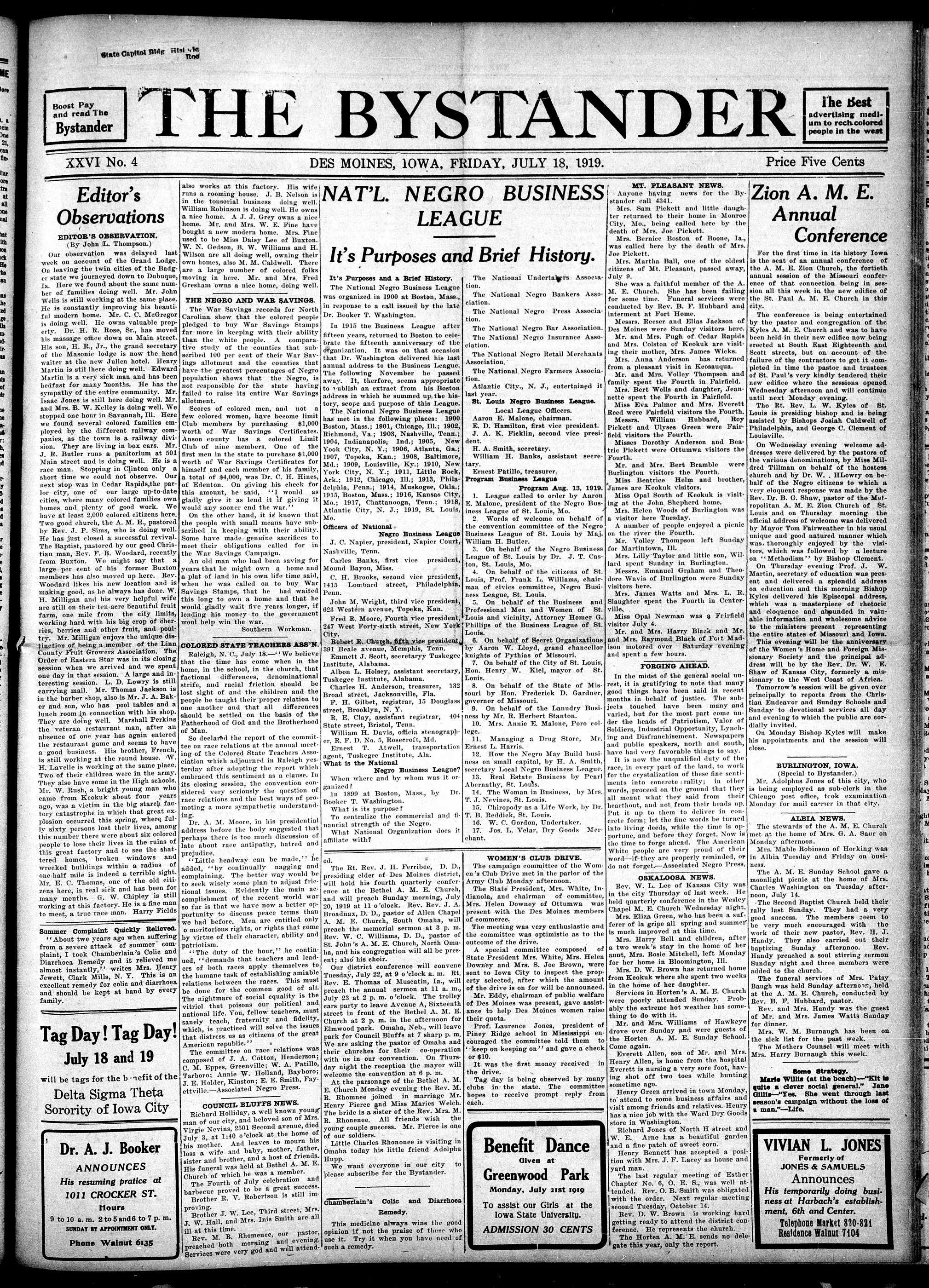
THE BYSTANDER
State Capitol Bldg. Historic
Rod
Boost Pay and read The Bystander
XXVI No.4
Editor's Observations
EDITOR'S OBSERVATION.
(By John L. Thompson.)
Our observation was delayed last week on account of the Grand Lodge. On leaving the twin cities of the Badger state we journeyed down to Dubuque Ia. Here we found about the same number of families doing well. Mr. John Wells is still working at the same place. He is constantly improving his beautiful modern home. Mr. C. C. McGregor is doing well. He owns valuable property. Dr. H. R. Rose, Sr., has moved his massage office down on Main street. His son, H. R., Jr., the grand secretary of the Masonic lodge is now the head waiter at the new Julien hotel. Henry Martin is still there doing well. Edward Martin is a very sick man and has been bedfast for many months. He has the sympathy of the entire community. Mr. Isaac Jones is still here doing well. Mrs. B. W. Kelley is doing well. We stopped one hour in Savannah, Ill. Here we found several colored families employed by the different railway company, as the town is a railway division. They are living in box cars. Mr. J. R. Butler runs a panitorium at 501 Main street and is doing well. He is a race man. Stopping in Clinton only a short time we could not observe. Our next stop was in Cedar Rapids, the parlor city, one of our large up-to-date cities, where many colored families own homes and plenty of good work. We have at least 2,000 colored citizens here. Two good church, the A. M. E., pastored by Rev. J. P. Sims, who is doing well. He has just closed a successful revival. The Baptist, pastored by our good Christian man, Rev. F. B. Woodard, recently from Buxton. We might say that a large per cent of his former Buxton members has also moved up here. Rev. Woodard likes his new location and is making good, as he always has done. W. H. Milligan and his very helpful wife are still on their ten-acre beautiful fruit farm, one mile from the city limits, working hard with his big crop of cherries, berries and other fruit, and poultry. Mr. Milligan enjoys the unique distinction of being a member of the Linn County Fruit Growers Association. The Order of Eastern Star was in its closing session when we arrived and we spent one day in that session. A large and interesting session. L. D. Lowry is still carrying mail. Mr. Thomas Jackson is in the barber shop, also is Mr. J. A. Baker and son, who has pool tables and a lunch room in connection with his shop. They are working at the round house. W. H. Lavelle is working at the same place. Two of their children were in the army. They also have some in the High schools. Mr. W. Rush, a bright young man who came from Keokuk about four years ago, was a victim in the big starch factory catastrophe in which that great explosion occurred this spring, where fully sixty persons lost their lives, among this number there were about six colored people to lose their lives in the ruins of this great factory and to see the shattered homes, broken windows and wrecked buildings within a radius of one-half mile is indeed a terrible sight. Mr. E. C. Thomas, one of the old citizens here, is real sick and has been for many months. G. W. Chipley is still working at this factory. He is a fine man to meet, a true race man. Harry Fields
Summer Complaint Quickly Relieved.
"About two years ago when suffering from a severe attack of summer complaint, I took Chamberlain's Colic and Diarrhoea Remedy and it relieved me almost instantly," writes Mrs. Henry Jewett, Clark Mills, N. Y. This is an excellent remedy for colic and diarrhoea and should be kept at hand by every family.
Tag Day! Tag Day! July 18 and 19
will be tags for the benefit of the Delta Sigma Theta Sorority of Iowa City
also works at this factory. His wife runs a roaming house. J. B. Nelson is in the torsional business doing well. William Robinson is doing well. He owns a nice home. A J. J. Grey owns a nice home. Mr. and Mrs. W. E. Fine have bought a new modern home. Mrs. Fine used to be Miss Daisy Lee of Buxton. W. N. Gedson, B. W. Williams and H. Wilson are all doing well, owning their own homes, also M. M. Caldwell. There are a large number of colored folks moving in here. Mr. and Mrs. Fred Gresham owns a nice home, doing well.
THE NEGRO AND WAR SAVINGS.
The War Savings records for North Carolina show that the colored people pledged to buy War Savings Stamps far more in keeping with their ability than the white people. A comparative study of the counties that subscribed 100 per cent of their War Savings allotment and the counties that have the greatest percentages of Negro population shows that the Negro, is not responsible for the state having failed to raise its entire War Savings allotment.
Scores of colored men, and not a few colored women, have become limit Club members by purchasing $1,000 worth of War Savings Certificates. Anson county has a colored Limit Club of nine members. One of the first men in the state to purchase $1,000 worth of War Savings Certificates for himself and each member of his family, a total of $4,000, was Dr. C. H. Hines, of Edenton. On giving his cheek for this amount, he said, "I would as gladly give it as lend it if giving it would any sooner end the war."
On the other hand, it is known that the people with small means have subscribed in keeping with their ability. Some have made genuine sacrifices to meet their obligations called for in the War Savings Campaign.
An old man who had been saving for years that he might own a home and a plat of land in his own life time said, when he was called on to buy War Savings Stamps, that he had waited this long to own a home and that he would gladly wait five years longer, if lending his money to the government would help win the war.
Southern Workman.
COLORED STATE TEACHERS ASS'N
Raleigh, N. C., July 18.—'We believe that the time has come when in the home, in the school, in the church, that factional differences, denominational strife, and racial friction should be lost sight of and the children and the people be taught their proper relation to one another and that all differences should be settled on the basis of the Fatherhood of God and the Brotherhood of Man.
So declared the report of the committee on race relations at the annual meeting of the Colored State Teachers Association which adjourned in Raleigh yesterday after adopting the report which embraced this sentiment as a clause. In its closing session, the convention considered very seriously the question of race relations and the best ways of promoting a more sympathetic understanding.
Dr. A. M. Moore, in his presidential address before the body suggested that perhaps there is too much discussion of late about race antipathy, hatred and prejudice.
"Little headway can be made," he added, "by continually nagging and complaining. The better way would be to seek wisely some plan to adjust frictional issues. Evidently the main accomplishment of the recent world war so far is that we have now a better opportunity to discuss peace terms than we had before. Men are entitled only to meritorious rights, or rights that come by virtue of their character, ability and patriotism.
"The duty of the hour," he continued, "demands that teachers and leaders of both races apply themselves to the humane task of establishing amiable relations between the races. This must be done for the common good of all. The nightmare of social equality is the vitriol that poisons our political and national life. You, fellow teachers, must sanely teach, fraternity and fidelity, which, is practiced will solve the issues that distress us as citizens of the great American republic."
The committee on race relations was composed of J. A. Cotton, Henderson C. M. Epps, Greenville; W. A. Patillo, Tarboro; Annie W. Holland, Bayboro; J. E. Holder, Kinston; E. E. Smith, Fayettville—Associated Negro Press.
COUNCIL, BLUFFS NEWS.
Richard Holliday, a well known young man of our city, and beloved son of Mrs. Virgine Nevins, 2501 Second avenue, died July 3, at 1:40 o'clock at the home of his mother. And leaves to mourn his loss a wife and baby, mother, father, sister and brother, and a host of friends. His funeral was held at Bethel A. M. E. Church of which he was a member. The Fourth of July celebration and barbecue proved to be a great success. Brother R. V. Robertson is still improving. Brother J. W. Lee, Third street, Mrs. J. W. Hall, and Mrs. Inis Smith are all
ill at this time.
Rev. M. R. Rhomenee, our pastor,
preached both morning and evening.
Services were very god and well attend-
DES MOINES, IOWA, FRIDAY, JULY 18, 1919.
NAT'L. NEGRO BUSINESS LEAGUE
It's Purposes and Brief History.
It's Purposes and a Brief History.
The National Negro Business League was organized in 1900 at Boston, Mass., in response to a call issued by the late Dr. Booker T. Washington.
In 1915 the Business League after fifteen years, returned to Boston to celebrate the fifteenth anniversary of the organization. It was on that occasion that Dr. Washington delivered his last annual address to the Business League. The following November he passed away. It, therfore, seems appropriate to publish an extract from his Boston address in which he summed up the history, scope and purpose of this League. The National Negro Business League has met in the following places: 1900 Boston, Mass.; 1901, Chicago, Ill.; 1902, Richmond, Va.; 1903, Nashville, Tenn.; 1904, Indianapolis, Ind.; 1905, New York City, N. Y.; 1906, Atlanta, Ga.; 1907, Topeka, Kan.; 1908, Baltimore, Md.; 1909, Louisville, Ky.; 1910, New York City, N. Y.; 1911, Little Rock, Ark.; 1912, Chicago, Ill.; 1913, Philadelphia, Penn.; 1914, Muskogee, Okla.; 1915, Boston, Mass.; 1916, Kansas City, Mo.; 1917, Chattanooga, Tenn.; 1918, Atlantic City, N. J.; 1919, St. Louis, Mo.
Officers of National
Negro Business League
J. C. Napier, president, Napier Court,
Nashville, Tenn.
Carles Banks, first vice president,
Mound Bayou, Miss.
C. H. Brooks, second vice president,
1415 Lombard street, Philadelphia,
Penn.
John M. Wright, third vice president,
623 Western avenue, Topeka, Kan.
Fred R. Moore, Fourth vice president,
247 West Forty-sixth street, New York
City.
Robert R. Church, Fifth vice president,
391 Beale avenue, Memphis, Tenn.
Albon L. Holsey, assistant secretary,
Tuskegee Institute, Alabama.
Charles H. Anderson, treasurer, 132
Broad street, Jacksonville, Fla.
F. H. Gilbet, registrar, 15 Douglass
street, Brooklyn, N. Y.
R. E. Clay, assistant registrar, 404
State street, Bristol, Tenn.
William H. Davis, officia stenographer,
R. F. D. No. 5, Rosecroft, Md.
Ernest T. Atwell, transportation agent, Tuskegee Institute, Ala.
What is the National Negro Business League?
When where and by whom was it organized?
In 1899 at Boston, Mass., by Dr. Booker T. Washington.
What is its purpose?
To centralize the commercial and financial strength of the Negro.
What National Organization does it affiliate with?
The Rt. Rev. J. H. Ferribe, D. D., presiding elder of Des Moines district, will hold his fourth quarterly conference at the Bethel A. M. E. Church, and will preach Sunday morning, July 20, 1919 at 11 o'clock. Rev. Rev. J. A. Broadnax, D. D., pastor of Allen Chapel A. M. E. Church, South Omaha, will preach the memorial sermon at 3 p. m. Rev. W. C. Williams, D. D., pastor of St. John's A. M. E. Church, North Omaha, and his congregation will all be present; also his choir.
Our district conference will convene Tuesday, July 22, at 9 o'clock a. m. Rt. Rev. E. Thomas of Muscatin, Ia., will preach the annual sermon at 11 a. m., July 23 at 2 p. m. o'clock. The trolley cars party to leave Avenue A, Sixteenth street in front of the Bethel A. M. E. Church at 2 p. m. in the afternoon for Elmwood park. Omaha, Neb., will leave park for Council Bluffs at 2 sharp p. m. We are asking the pastor of Omaha and their churches for their co-operation with us in our convention. On Thursday night the reception the mayor will welcome the convention at 6 p. m.
At the parsonage of the Bethel A. M. E. Church Monday evening the Rev. M. R. Rhomenee joined in marriage Mr. Henry Pierce and Miss Maries Welch. The bride is a sister of the Rev. Mrs. M. R. Rhonenee. All friends wish the young couple success. Mr. Pierce is one of our soldiers. Little Charles Rhononee is visiting in Omaha today his little friend Adolpha Hupp. We want everyone in our city to please subscribe for the Bystander.
Chamberlain's Colic and Diarrhoea
This medicine always wins the good opinion if not the praise of those who use it. Try it when you have need of such a remedy.
William H. Banks, assistant secretary.
Ernest Patillo, treasurer.
Program Business League
Program Aug. 13, 1919.
1. League called to order by Aaron E. Malone, president of the Negro Business League of St. Louis, Mo.
2. Words of welcome on behalf of the convention committee of the Negro Business League of St. Louis by Maj. William H. Butler.
3. On behalf of the Negro Business League of St. Louis by Dr. J. T. Caston, St. Louis, Mo.
4. On behalf of the citizens of St. Louis, Prof. Frank L. Williams, chairman of civies committee, Negro Business League, St. Louis.
5. On behalf of the Business and Professional Men and Women of St. Louis and vicinity, Attorney Homer G. Phillips of the Business League of St. Louis.
6. On behalf of Secret Organizations by Aaron W. Lloyd, grand chancellor knights of Pythias of Missouri.
7. On behalf of the City of St. Louis, Hon. Henry W. Kiel, mayor of St. Louis.
8. On behalf of the State of Missouri by Hon. Frederick D. Gardner, governor of Missouri.
9. On behalf of the Lanudry Business by Mr. R. Herbert Stanton.
10. Mrs. Annie E. Malone, Poro college.
11. Managing a Drug Store, Mr
Ernest L. Harris.
12. How the Negro May Build busi
ness on small capital, by H. A. Smith
secretary Local Negro Business League.
13. Real Estate Business by Pearl
Abernathy, St. Louis.
14. The Woman in Business, by Mrs
T. J. Nevines, St. Louis.
15. Chiropody as a Life Work, by Dr
T. B. Reddick, St. Louis.
16. W. C. Gordon, Undertaker.
16. W. C. Gordon, Undertaker.
17. Jos. L. Velar, Dry Goods Merchant.
WOMEN'S CLUB DRIVE.
The campaign committee of the Women's Club Drive met in the parlor of the Army Club Monday afternoon. The State President, Mrs. White, Indianola, and chairman of committee, Mrs. Helen Downey of Ottumwa was present with the Des Moines members of commerce. The meeting was very enthusiastic and the committee was optimistic as to the outcome of the drive. A special committee composed of State President Mrs. White, Mrs. Helen Downey and Mrs. S. Joe Brown, were sent to Iowa City to inspect the property selected, after which the amount of the drive is on for will be announced. Mr. Eddy, chairman of public welfare of Des Moines was present, gave assistance to help Des Moines women raise their quota. Prof. Laurence Jones, president of Piney Ridge school in Mississippi encouraged the committee told them to 'keep on keeping on' and gave a check or $10. It was the first money received in the drive. Tag day is being observed by many clubs in the state. The committee hopes to receive prompt reply from each.
Benefit Dance
Given at
Greenwood Park
Monday, July 21st 1919
To assist our Girls at the
Iowa State University.
ADMISSION 30 CENTS
MT. PLEASANT NEWS.
Anyone having news for the Bystander call 4341.
Mrs. Sam Pickett and little daughter returned to their home in Monroe City, Mo., being called here by the death of Mrs. Joe Pickett.
Mrs. Bernice Boston of Boone, Ia., was called here by the death of Mrs. Joe Pickett.
Mrs. Martha Ball, one of the oldest citizens of Mt. Pleasant, passed away, July 9.
She was a faithful member of the A. M. E. Church. She has been failing for some time. Funeral services were conducted by Rev. B. F. Hubbard and interment at Fort Home.
Messrs. Receser and Elias Jackson of Des Moines were Sunday visitors here.
Mr. and Mrs. Pugh of Cedar Rapids and Mrs. Colston of Keokuk are visiting their mother, Mrs. James Wicks.
Mrs. Anna Anderson has returned from a pleasant visit in Keosauqua. Mr. and Mrs. Volley Thompson and family spent the Fourth in Fairfield. Mrs. Bert Wells and daughter, Jeannette spent the Fourth in Fairfield. Miss Eva Palmer and Mrs. Everett Reed were Fairfield visitors the Fourth. Messrs. William Hubbard, Roy Pickett and Ulysse Green were Fairfield visitors the Fourth. Misses Dorothy Anderson and Beatric Pickett were Ottumwa visitors the Fourth. Mr. and Mrs. Bert Bramble were Burlington visitors the Fourth. Misses Beatrice, Helm and brother.
Miss Beatrice Helm and brother, James are Keokuk visitors.
Miss Opal South of Keokuk is visiting at the John Shepherd home.
Mrs. Helen Woods of Burlington was a visitor here Tuesday. A number of people enjoyed a picnic on the river the Fourth.
Mr. Volley Thompson left Sunday for Martintown, Ill.
Mrs. Lilly Taylor and little son, Willard spent Sunday in Burlington.
Messrs. Emanuel Graham and Theodore Wavis of Burlington were Sunday visitors here.
Mrs. James Watts and Mrs. L. R. Slaughter spent the Fourth in Centerville.
Miss Opal Newman was a Fairfield visitor July 4.
Mr. and Mrs. Harry Black and Mr. and Mrs. Raymond Black of Foot Madison motored over Saturday evening and spent a few hours.
FORGING AHEAD.
In the midst of the general social unrest, it is gratifying to note that many good things have been said in recent months in behalf of justice. The subjects touched have been many and varied, but for the most part come under the heads of Patriotism, Valor of Soldiers, Industrial Opportunity, Lynching and Disfranchisement. Newspapers and public speakers, north and south, have had very favorable things to say. It is now the unqualified duty of the race, in every part of the land, to work for the crystallization of these fine sentiments into concrete reality; in other words, proceed on the ground that they all meant what they said from their heartthought, and not from their heads up. Put it up to them to deliver in concrete form; let the fine words be turned into living deeds, while the time is opportune, and before they forget. Now is the time to forge ahead. The American White people are very proud of their word—if they are properly reminded, or do not forget—Associated Negro Press.
OSKALOOSA NEWS.
Rev. W. L. Lee of Kansas City was in the city Thursday of last week. He held quarterly conference in the Wesley Chapel M. E. Church Wednesday night. Mrs. Eliza Green, who has been a sufferer of la gripe all spring and summer is much improved at this time. Mrs. Harry Bell and children, after a two week's stay in the home of her aunt, Mrs. Rosie Mitchell, left Monday for her home in Bloomington, Ill. Mrs. D. W. Brown has returned home from Keokuk where she spent two weeks in the home of her daughter. Services in Horten's A. M. E. Church were poorly attended Sunday. Probably the extreme hot weather has something to do with it. Mr. and Mrs. Williams of Hawkeye drove over Sunday and were guests of the Horten A. M. E. Sunday School. Come again. Everett Allen, son of Mr. and Mrs. Henry Allen, is home from the hospital Everett is nursing a very sore foot, having shot off two toes while hunting sometime ago. Henry Green arrived in town Monday, to attend to some business affairs and visit among friends and relatives. Henry has a nice job with the Ward Dry Goods store in Washington. Richard Jones of North H street and W. E. Arne has a beautiful garden and a fine patch of sweet corn.
Henry Bennett has accepted a position with Mrs. J. F. Lacey as house and yard man.
The last regular meeting of Esther Chapter No. 6, O. E. S., was well attended. Rev. O. B. Smith was obligated with the order. Next regular meeting second Tuesday, October 14.
Rev. D. W. Brown is working hard getting ready to attend the district conference. He represents the church.
The Horten A. M. E. sends no delegate this year, only the report.
1.
2.
3.
4.
5.
6.
7.
8.
9.
10.
11.
12.
13.
14.
15.
16.
17.
18.
19.
20.
21.
22.
23.
24.
25.
26.
27.
28.
29.
30.
31.
32.
33.
34.
35.
36.
37.
38.
39.
40.
41.
42.
43.
44.
45.
46.
47.
48.
49.
50.
51.
52.
53.
54.
55.
56.
57.
58.
59.
60.
61.
62.
63.
64.
65.
66.
67.
68.
69.
70.
71.
72.
73.
74.
75.
76.
77.
78.
79.
80.
81.
82.
83.
84.
85.
86.
87.
88.
89.
90.
91.
92.
93.
94.
95.
96.
97.
98.
99.
100.
101.
102.
103.
104.
105.
106.
107.
108.
109.
110.
111.
112.
113.
114.
115.
116.
117.
118.
119.
120.
121.
122.
123.
124.
125.
126.
127.
128.
129.
130.
131.
132.
133.
134.
135.
136.
137.
138.
139.
140.
141.
142.
143.
144.
145.
146.
147.
148.
149.
150.
151.
152.
153.
154.
155.
156.
157.
158.
159.
160.
161.
162.
163.
164.
165.
166.
167.
168.
169.
170.
171.
172.
173.
174.
175.
176.
177.
178.
179.
180.
181.
182.
183.
184.
185.
186.
187.
188.
189.
190.
191.
192.
193.
194.
195.
196.
197.
198.
199.
200.
201.
202.
203.
204.
205.
206.
207.
208.
209.
210.
211.
212.
213.
214.
215.
216.
217.
218.
219.
220.
221.
222.
223.
224.
225.
226.
22
The Best advertising medium to rech-colored people in the west
Price Five Cents
For the first time in its history Iowa is the seat of an annual conference of the A. M. E. Zion Church, the fortieth annual session of the Missouri conference of that connection being in session all this week in the new edifice of the St. Paul A. M. E. Church in this city.
The conference is being entertained by the pastor and congregation of the Kyles A. M. E. Church and was to have been held in their new edifice now being erected at South East Eighteenth and Scott streets, but on account of the failure of the contractors to get it completed in time the pastor and trustees of St. Paul's very kindly tendered their new edifice where the sessions opened Wednesday afternoon and will continue until next Monday evening.
The Rt. Rev. L. W. Kyles of St. Louis is presiding bishop and is being assisted by Bishops Josiah Caldwell of Philadelphia, and George C. Clement of Louisville.
On Wednesday evening welcome addresses were delivered by the pastors of the various denominations, by Miss Mildred Tillman on behalf of the hostess church and by Dr. W. HLowry on behalf of the Negro citizens to which a very eloquent response was made by the Rev. Dr. B. G. Shaw, pastor of the Metropolitan A. M. E. Zion Church of St. Louis and on Thursday morning the official address of welcome was delivered by Mayor Tom Fairweather in his usual unique and good natured manner which was, thoroughly enjoyed by the visitors, which was followed by a lecture on "Methodism" by Bishop Clement.
On Thursday evening Prof. J. W. Martin, secretary of education was present and delivered a splendid address on education and this morning Bishop Kyles delivered his Episcopal address, which was a masterpiece of rhetoric and eloquence and alpunded in valuable information and wholesome advice to the ministers present representing the entire states of Missouri and Iowa.
This evening will be the anniversary of the Women's Home and Foreign Missionary Society and the principal address will be by the Rev. Dr. W. E. Shaw of Kansas City, formerly a missionary to the West Coast of Africa.
Tomorrow's session will be given over principally to reports from the Christian Endeavor and Sunday Schools and Sunday to devotional services all day and evening to which the public are cordially invited.
On Monday Bishop Kyles will make his appointments and the session will close.
BURLINGTON, IOWA.
Mr. Adolphus Jones of this city, who is being employed as sub-clerk in the Chicago post office, took examination Monday for mail carrier in that city.
ALBIA NEWS.
The stewards of the A. M. E. Church met at the home of Mrs. G. A. Saur on Monday afternoon. Mrs. Mable Robinson of Hocking was in Albia Tuesday and Friday on business. The A. M. E. Sunday School gave a moonlight picnic at the home of Mrs. Charles Washington on Tuesday afternoon, July 14. The Second Baptist Church held their rally last Sunday. They had a very good success. The members seem to be very much encouraged with the work of their new pastor, Rev. H. J. Handy. They also carried out their baptizing Sunday afternoon. Rev. Handy preached a soul stirring sermon Sunday night and three members were added to the church. The funeral services of Mrs. Patsy Baugh was held Sunday afternoon, held at the A. M. E. Church, conducted by Rev. B. F. Hubbard, pastor. Rev. and Mrs. Handy was the guest of Mr. and Mrs. James Watts Sunday for dinner. Mrs. W. M. Burnaugh has been on the sick list for the past week.
The Mothers Counsel will meet with Mrs. Harry Burnaugh this week.
Some Strategy.
Marie Willis (at the beach)—"Kit is quite a clever social general." Jane Gillis—"Yes. She went through last season's campaign without the loss of a man."—Life.
VIVIAN L. JONES
Formerly of
JONES & SAMUELS
Announces
His temporarily doing business at Harbach's establishment, 6th and Center.
Telephone Market 820-821
Residence Walnut 7104
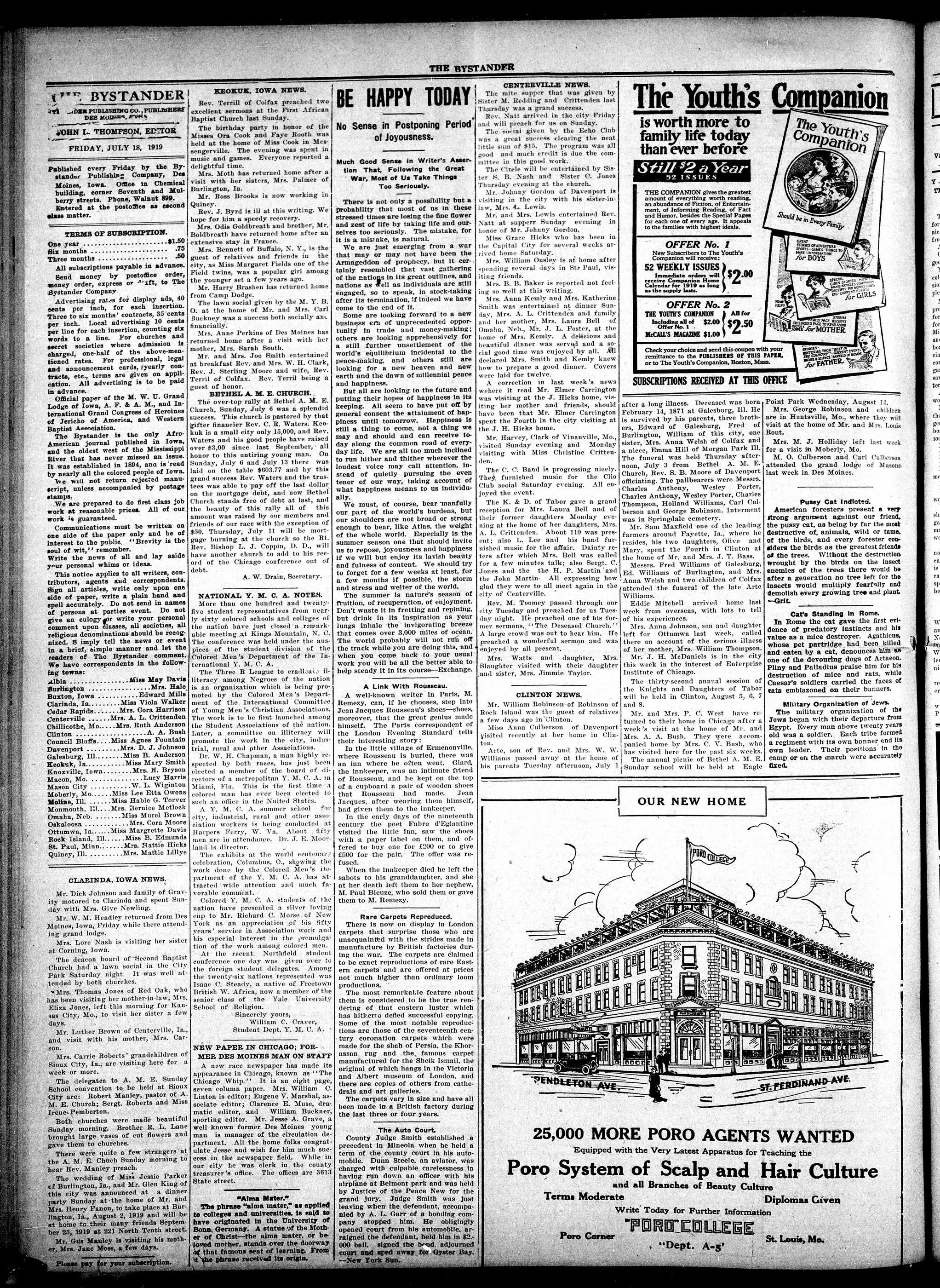
Published every Friday by the Bystander Publishing Company, Des Moines, Iowa. Office in Chemical building, corner Seventh and Mulberry streets. Phone, Walnut 899. Entered at the postoffice as second class matter.
TERMS OF SUBSCRIPTION.
One year ..... $1.50
Six months ..... .75
Three months ..... .50
All subscriptions payable in advance.
Send money by postoffice order,
money order, express orift, to The
Bystander Company.
Advertising rates for display ads, 40
cents per inch, for each insertion.
Three to six months' contracts, 35 cents
per inch. Local advertising 10 cents
per line for each insertion, counting six
words to a line. For churches and
secret societies where admission is
charged, one-half of the above-mentioned
rates. For professional, legal
and announcement cards, yearly
contracts, etc., terms are given on application.
All advertising is to be paid
in advance.
Official paper of the M. W. U. Grand Lodge of Iowa, A. F. & A. M., and International Grand Congress of Heroines of Jericho of America, and Western Baptist Association.
The Bystander is the only Afro-American journal published in Iowa, and the oldest west of the Mississippi River that has never missed an issue. It was established in 1894, and is read by nearly all the colored people of Iowa. We will not return rejected manuscript, unless accompanied by postage stamps.
We are prepared to do first class job work at reasonable prices. All of our work is guaranteed.
Communications must be written on one side of the paper only and be of interest to the public. "Brevity is the soul of wit," remember.
Write the news of all and lay aside your personal whims or ideas.
This notice applies to all writers, contributors, agents and correspondents. Sign all articles, write only upon one side of paper, write a plain hand and spell accurately. Do not send in names of persons at parties event. Do not give an eulogy or write your personal comment upon classes, all societies, all religious denominations should be recognized. S imply tell the news or event in a brief, simple manner and let the readers of The Bystander comment. We have correspondents in the follow-
Albia . . . Miss May Davis
Burlington . . . Mrs. Hale
Buxton, Iowa . . . Edward Mills
Clarinda, Ia. . . Miss Viola Walker
Cedar Rapids . . . Mrs. Cora Harrison
Centerville . . . Mrs. A. L. Crittenden
Chillicothe, Mo. . . Mrs. Ruth Anderson
Clinton . . . A. A. Bush
Council Bluffs . . Miss Agnes Fountain
Davenport . . . Mrs. D. J. Johnson
Galesburg, Ill. . . Miss B. Anderson
Kookuk, Ia. . . Miss Mary Smith
Knoxville, Iowa . . Mrs. H. Bryson
Macon, Mo. . . Lucy Harris
Mason City . . . W. L. Wiginton
Moberly, Mo. . . Miss Lee Etta Owens
Mollane, Ile. . . Miss Hable G. Torver
Monmouth, Ill. . . Mrs. Bernice Metlock
Omaha, Neb. . . Miss Murel Brown
Oskaloosa . . Mrs. Cora Moore
Ottumwa, Ia. . . Miss Margrete Davis
Rock Island, Ill. . . Miss B. Edmunds
St. Paul, Minn. . . Mrs. Rattie Hicks
Quincy, Ill. . . Mrs. Mattie Lillys
CLAEINDA. IOWA NEWS.
Mr. Dick Johnson and family of Gravity motored to Clarinda and spent Sunday with Mrs. Give Newling.
Mr. W. M. Headley returned from Des Moines, Iowa, Friday while there attending grand lodge.
Mrs. Lore Nash is visiting her sister at Corning, Iowa.
The deacon board of Second Baptist Church had a lawn social in the City Park Saturday night. It was well attended by both churches.
* Mrs. Thomas Jones of Red Oak, who has been visiting her mother-in-law, Mrs. Eliza Jones, left this morning for Kansas City, Mo., to visit her sister a few days.
Mr. Luther Brown of Centerville, Ia., and visit with his mother, Mrs. Carson.
Mrs. Carrie Roberts' grandchildren of Sioux City, Ia., are visiting here for a week or more.
The delegates to A. M. E. Sunday School convention to be held at Sioux City are: Robert Manley, pastor of A. M. E. Church; Sergt. Roberts and Miss Irene-Pemberton.
Both churches were made beautiful Sunday morning. Brother R. L. Lane brought large vases of cut flowers and gave them to churches.
There were quite a few strangers at the A. M. E. Chuck Sunday morning to bear Rev. Manley preach.
The wedding of Miss Jessie Parker of Burlington, Ia., and Mr. Glen King of this city was announced at a dinner party Sunday at the home of Mr. and Mrs. Henry Fanon, to take place at Burlington, Ia., August 2, 1919 and will be at home to their many friends September 25, 1919 at 221 North Tenth street. Mr. Gus Manley is visiting his mother, Mrs. Jane Moss, a few days.
Rev. Terrill of Colfax preached two excellent sermons at the First African Baptist Church last Sunday.
The birthday party in honor of the Misses Ora Cook and Faye Rooth was held at the home of Miss Cook in Messengerville. The evening was spent in music and games. Everyone reported a delightful time.
Mrs. Moth has returned home after a visit with her sisters, Mrs. Palmer of Burlington, In.
Mr. Ross Brooks is now working in Quiney.
Rev. J. Byrd is at this writing. We hope for him a speedy recovery.
hope for a special society.
Mrs. Odis Goldbreath and brother, Mr. Boldbreath have returned home after an extensive stay in France.
Mrs. Bennett of Buffalo, N. Y., is the guest of relatives and friends in the city, as Miss Margaret Fields one of the Field twins, was a popular girl among the younger set a few years ago.
Mr. Harry Brashen has returned home from Camp Dodge.
The lawn social given by the M. Y. B. O. at the home of Mr. and Mrs. Carl Buckney was a success both socially and financially.
Mrs. Anne Perkins of Des Moines has returned home after a visit with her mother, Mrs. Sarah South.
Mr. and Mrs. Joe Smith entertained at breakfast Rev. and Mrs. W. H. Clark, Rev. J. Sterling Moore and wife, Rev. Terril of Colfax. Rev. Terril being a guest of honor.
BETHEL A. M. E. CHURCH.
BETHEL A. M. E. CHURCH.
The over-top rally at Bethel A. M. E. Church, Sunday, July 6 was a splendid success. This church is pastored by that gifter financier Rev. C. R. Waters. Keokuk is a small city only 15,000, and Rev. Waters and his good people have raised over $3,00 since last September, all honor to this untiring young man. On Sunday, July 6 and July 13 there was laid on the table $603.77 and by this grand success Rev. Waters and the trustees was able to pay off the last dollar on the mortgage debt, and now Bethel Church stands free of debt at last, and the beauty of this rally all of this amount was raised by our members and friends of our race with the exception of $50. Thursday, July 11 will be mortgage burning at the church so the Rt. Rev. Bishop L. J. Coppin, D. D., will have another church to add to his record of the Chicago conference out of debt.
A. W. Drain, Secretary
NATIONAL Y. M. C. A. NOTES.
NATIONAL T. M. C. A. NOTE.
More than one hundred and twenty-five student representatives from nearly sixty colored schools and colleges of the nation have just closed a remarkable meeting at Kings Mountain, N. C. The conference was held under the auspices of the student division of the Colored Men's Department of the International Y. M. C. A.
The Three R League to eradicate illiteracy among Negroes of the nation is an organization which is being promoted by the Colored Men's Department of the International Committee of Young Men's Christian Associations. The work is to be first launched among the Student Associations of the nation. Later, a committee on illiteracy will promote the work in the city, industrial, rural and other Associations.
Dr. W. H. Chapman, a man highly respected by both races, has just been elected a member of the board of directors of a metropolitan Y. M. C. A. in Miami, Fla. This is the first time a colored man has ever been elected to such an office in the United States. A Y. M. C. A. summer school for city, industrial, rural and other association workers is being conducted at Harpers Ferry, W. Va. About fifty men are in attendance. Dr. J. E. Moorland is director. The exhibits at the world centenary celebration, Columbus, O., showing the work done by the Colored Men's Department of the Y. M. C. A. has attracted wide attention and much favorable comment.
Colored Y. M. C. A. students of the nation have presented a silver loving cup to Mr. Richard C. Morse of New York as an appreciation of his fifty years' service in Association work and his especial interest in the premulgation of the work among colored men. At the recent Northfield student conference one day was given over to the foreign student delegates. Among the twenty-six nations represented was Isaac C. Steady, a native of Freetown British W. Africa, now a member of the senior class of the Yale University School of Religion. Sincerely yours, William C. Craver, Student Dept. Y. M. C. A.
NEW PAPER IN CHICAGO; FOR-
MER DES MOINES MAN ON STAFF
A new race newspaper has made its appearance in Chicago, known as "The Chicago Whip." It is an eight page, seven column paper. Mrs. William C. Linton is editor; Eugene V. Marshal, associate editor; Clarence E. Muse, dramatic editor, and William Buckner, sporting editor. Mr. Jesse A. Grave, a well known former Des Moines young man is manager of the circulation department. All the home folks congratulate Jesse and wish for him much success in the newspaper field. While in our city he was clerk in the county treasurer's office. The offices are 3613 State street.
"Alma Mater."
The phrase "alma mater," as applied to colleges and universities, is said to have originated in the University of Bonn, Germany. A statue of the Mother of Christ—the alma mater, or beloved mother, stands over the doorway of that famous seat of learning. From it the phrase received its origin.
THE BYSTANDFR
BE HAPPY TODAY
No Sense in Postponing Period of Joyousness.
Much Good Sense in Writer's Assertion That, Following the Great War, Most of Us Take Things
There is not only a possibility but a probability that most of us in these stressed times are losing the fine flower and zest of life by taking life and ourselves too seriously. The mistake, for it is a mistake, is natural.
We are just emerging from a war that may or may not have been the Armageddon of prophecy, but it certainly resembled that vast gathering of the nations in its great outlines, and nations as well as individuals are still engaged, so to speak, in stock-taking after its termination, if indeed we have come to the end of it.
Some are looking forward to a new business era of unprecedented opportunity in trade and money-making; others are looking apprehensively for a still further unsettlement of the world's equilibrium incidental to the peace-making, and others still are looking for a new heaven and new earth and the dawn of millennial peace and happiness.
But all are looking to the future and putting their hopes of happiness in its keeping. All seem to have put off by general consent the attainment of happiness until tomorrow. Happiness is still a thing to come, not a thing we may and should and can receive today along the common road of everyday life. We are all too much inclined to run hither and thither wherever the loudest voice may call attention, instead of quietly pursuing the even tenor of our way, taking account of what happiness means to us individually.
We must, of course, bear 'manfully our part of the world's burdens, but our shoulders are not broad or strong enough to bear, like Atlas, the weight of the whole world. Especially is the summer season one that should invite us to repose, joyousness and happiness if we will but enjoy its lavish beauty and fulness of content. We should try to forget for a few weeks at least, for a few months if possible, the storm and stress and welter of the world.
The summer is nature's season of fruition, of recuperation, of enjoyment. Don't waste it in fretting and repining, but drink in its inspiration as your lungs inhale the invigorating breeze that comes over 3,000 miles of ocean. The world probably will not run off the track while you are doing this, and when you come back to your usual work you will be all the better able to help steady it in its course—Exchange.
A Link With Rousseau.
A well-known writer in Paris, M. Remezy, can, if he chooses, step into Jean Jacques Rousseau's shoes—shoes, moreover, that the great genius made himself. The Paris correspondent of the London Evening Standard tells their interesting story:
In the little village of Ermenonville, where Rousseau is buried, there was an inn where he often went. Glard, the innkeeper, was an intimate friend of Rousseau, and he kept on the top of a cupboard a pair of wooden shoes that Rousseau had made. Jean Jacques, after wearing them himself, had given them to the innkeeper.
In the early days of the nineteenth century the poet Fabre d'Eglantine visited the little inn, saw the shoes with a paper label on them, and offered to buy one for £200 or to give £500 for the pair. The offer was refused.
When the innkeeper died he left the sabots to his granddaughter, and she at her death left them to her nephew, M. Paul Bleuze, who sold them or gave them to M. Remezy.
Rare Carpets Reproduced.
There is now on display in London carpets that surprise those who are unacquainted with the strides made in manufacture by British factories during the war. The carpets are claimed to be exact reproductions of rare Eastern carpets and are offered at prices not much higher than ordinary loom productions. The most remarkable feature about them is considered to be the true rendering of that eastern luster which has hitherto defied successful copying. Some of the most notable reproductions are those of the seventeenth century coronation carpets which were made for the shah of Persia, the Khorassan rug and the famous carpet manufactured for the Sheik Ismail, the original of which hangs in the Victoria and Albert museum of London, and there are copies of others from cathedrals and art galleries.
The carpets vary in size and have all been made in a British factory during the last three or four years.
County Judge Smith established a precedent in Mineola when he held a term of the county court in his automobile. Dunn Steele, an aviator, was charged with culpable carelessness in having run down an officer with his airplane at Belmont park and was held by Justice of the Peace New for the grand jury. Judge Smith was just leaving when the defendant, accompanied by A. L. Garr of a bonding company stopped him. He obligingly opened court from his automobile, arraigned the defendant, held him in $2,000 ball, signed the bond, adjourned court and sped away for Oyster Bay. —New York Sun.
The Auto Court
CENTERVILLE NEWS.
The mite supper that was given by Sister M. Redding and Crittenden last Thursday was a grand success.
Rev. Natt arrived in the city Friday and will preach for us on Sunday.
The social given by the Echo Club was a great success clearing the neat little sum of $15. The program was all good and much credit is due the committee in this good work.
The Cirele will be entertained by Sister S. B. Nash and Sister C. Jones Thursday evening at the church.
Mr. Johnny Gordon of Davenport is visiting in the city with his sister-in-law, Mrs. L. Lewis.
Mr. and Mrs. Lewis entertained Rev. Natt at supper Sunday evening in honor of Mr. Johnny Gordon.
Miss Grace Hicks who has been in the Capital City for several weeks arrived home Saturday.
Mrs. William Ousley is at home after spending several days in St. Paul, visiting friends.
Mrs. B. B. Baker is reported not feeling so well at this writing.
Mrs. Anna Kemly and Mrs. Katherine Smith was entertained at dinner Sunday, Mrs. A. L. Crittenden and family and her mother, Mrs. Laura Bell of Omaha, Neb., Mr. J. L. Foster, at the home of Mrs. Kemly. A delicious and beautiful dinner was served and a social good time was enjoyed by all. All declared Mrs. Smith and Kemly knew how to prepare a good dinner. Covers were laid for twelve.
A correction in last week's news where it read Mr. Elmer Carrington was visiting at the J. Hicks home, visiting her mother and friends, should have been that Mr. Elmer Carrington spent the Fourth in the city visiting at the J. H. Hicks home.
Mr. Harvey, Clark of Vinanville, Mo., visited Sunday evening and Monday visiting with Miss Christine Crittenden.
The C. C. Band is progressing nicely. They furnished music for the Clio Club social Saturday evening. All enjoyed the event.
The K. & D. of Tabor gave a grand reception for Mrs. Laura Bell and of their former daughters Monday evening at the home of her daughters, Mrs. A. L. Crittenden. About 110 was present; also L. Lee and his band furnished music for the affair. Dainty reters after which Mrs. Bell was called for a few minutes talk; also Sergt. C. Jones and the the H. P. Martin and the John Martin. All expressing how glad they were to all meet again in the city of Centerville.
Rev. M. Toomey passed through our city Tuesday and preached for us Tuesday night. He preached one of his former sermons, "The Deseased Church." A large crowd was out to hear him. He preached a wonderful sermon and was enjoyed by all present.
Mrs. Watts and daughter, Mrs. Slaughter visited with their daughter and sister. Mrs. Jimmie Taylor.
Mr. William Robinson of Robinson of Rock Island was the guest of relatives a few days ago in Clinton.
Miss Anna Culberson of Davenport visited recently at her home in Clinton.
Arte, son of Rev. and Mrs. W. W. Williams passed away at the home of his parents Tuesday afternoon, July 1
OUR NEW HOME
25,000 MORE PORO AGENTS WANTED
Equipped with the Very Latest Apparatus for Teaching the
Poro System of Scalp and Hair Culture
and all Branches of Beauty Culture
Terms Moderate Diplomas Given
Write Today for Further Information
"PORO COLLEGE
Poro Corner
"Dept. A-5"
St. Louis, Mo.
CLINTON NEWS.
The Youth's Companion
is worth more to family life today than ever before
Still $2 a Year
52 ISSUES
THE COMPANION gives the greatest amount of everything worth reading, an abundance of Fiction, of Entertainment, of Informing Reading, of Fact and Humor, besides the Special Pages for each one of every age. It appeals to the families with highest ideals.
OFFER No. 1
New Subscribers to The Youth's Companion will receive:
52 WEEKLY ISSUES
Immediate orders will receive Companion Home Calendar for 1919 as long as the supply lasts.
OFFER No. 2
THE YOUTH'S COMPANION
Including all of $2.00
Offer No. 1
McCALL'S MAGAZINE $1.00
All for $2.50
Check your choice and send this coupon with your remittance to the PUBLISHERS OF THIS PAPER, or to The Youth's Companion, Boston, Mass.
SUBSCRIPTIONS RECEIVED AT THIS OFFICE
The Youth's Companion
Should be in Every Family
GREAT STORIES OF ADVENTURE
SPORTS • GAMES • THINGS TO
MORE INFORMATION
for BOYS
SPRINT STORIES FROM
MAKES-LESS COMMON
PRESENTS MY MONEY UNLEAS
ETC CURRENT EVENTS
for GIRLS
SPRINT STORIES FROM
MAKES-LESS COMMON
PRESENTS MY MONEY UNLEAS
ETC CURRENT EVENTS
for MOTHER
STORIES
MOTORIAL IMAGE 'BEST IN
THE COUNTRY' • CURRENT EVENTS
BREW & SCIENCE IMAGES OF MORAL
for FATHER.
after a long illness. Deceased was born February 14, 1871 at Galesburg, Ill. He is survived by his parents, three brothers, Edward of Galesburg, Fred of Burlington, William of this city, one sister, Mrs. Anna Welsh of Colfax and a niece, Emma Hill of Morgan Park Ill. The funeral was held Thursday afternoon, July 3 from Bethel A. M. E. Church, Rev. S. B. Moore of Davenport officiating. The pallbearers were Messrs. Charles Anthony, Wesley Porter, Charles Anthony, Wesley Porter, Charles Thompson, Holland Williams, Carl Culberson and George Robinson. Interment was in Springdale cemetery.
Mr. Sum Maxfield one of the leading farmers around Fayette, Ia., where he resides, his two daughters, Olive and Mary, spent the Fourth in Clinton at the home of Mr. and Mrs. J. T. Bass.
Messrs. Fred Williams of Galesburg, Ed. Williams of Burlington, and Mrs. Anna Welsh and two children of Colfax attended the funeral of the late Arte Williams.
Eddie Mitchell arrived home last week from overseas, with lots to tell of his experiences.
Mrs. Anna Johnson, son and daughter left for Ottumwa last week, called there on account of the serious illness of her mother, Mrs. William Thompson.
Mr. J. H. McDaniels is in the city this week in the interest of Enterprise Institute of Chicago.
The thirty-second annual session of the Knights and Daughters of Tabor will be held in Clinton, August 5, 6, 7 and 8.
Mr. and Mrs. P. C. West have returned to their home in Chicago after a week's visit at the home of Mr. and Mrs. A. A. Bush. They were accompanied home by Mrs. C. V. Bush, who has visited here for the past six weeks. The annual picnic of Bethel A. M. E. Sunday school will be held at Eagle
Point Park Wednesday, August 13
Mrs. George Robinson and children are in Huntsville, Mo., where they will visit at the home of Mr. and Mrs. Louis Rout.
Mrs. M. J. Holliday left last week for a visit in Moberly, Mo.
M. O. Culberson and Carl Culberson attended the grand lodge of Masons last week in Des Moines.
Pussy Cat Indicted.
American foresters present a very strong argument against our friend, the pussy cat, as being by far the most destructive of animals, wild or tame, of the birds, and every forester considers the birds as the greatest friends of the trees. Without the destruction wrought by the birds on the insect enemies of the trees there would be after a generation no tree left for the insects would multiply fearfully and demolish every growing tree and plant. -Grit
Cat's Standing In Rome.
In Rome the cat gave the first evidence of predatory instincts and his value as a mice destroyer. Agathicus, whose pet partridge had been killed and eaten by a cat, denounces him as one of the devouring dogs of Actaeon. Pliny and Palladius praise him for his destruction of mice and rats, while Caesar's soldiers carried the faces of cats emblazoned on their banners.
Military Organization of Jews.
The military organization of the Jews began with their departure from Egypt. Every man above twenty years old was a soldier. Each tribe formed a regiment with its own banner and its own leader. Their positions in the camp or on the march were accurately fired.
Vacant Lots and Improved Property
Phone D. 774
Y.W. C. A. RECREATIONAL CENTER FOR COLORED WOMEN AND GIRLS PIGNIC IN GOOD'S PARK
The Y. W. C. A. Recreational Center for Colored Girls announces its first picnic at Good's Park, Saturday, July 19 from 2 to 6 p. m.
All girls from 10 to 15 invited.
Come, bring your lunch and have a good time.
Y. W. C. A. recreational Center for colored women and girls. Provisional committee of management completes organization.
Monday morning, July 14, 1919, the provisional committee of management for the Y. W. C. A. recreational center for colored women and girls, met with Miss E. Ruth Pyrtle, general secretary and Mrs. C. A. Rawson, president of the board of directors of the Central Association, met at the American Building, corner Ninth and High streets, to organize the various committees necesary to carry on the work of the center.
At a previous meeting the following women had been elected as chairmen: Mrs. H. H. Coggeshall, chairman of the provisional committee. Mrs. Coggeshall is also vice president of the board of directors of the Central Association. Mrs. S. Joe Brown, membership. Mrs. H. R. Graves, social. Mrs. William H. Lowry, educational. Mrs. J. B. Morriss, house and equipment. Mrs. Gertrude E. Rush, girls' work. Mrs. John L. Thompson, religious work. With the exception of Mrs. Coggeshall, these various chairmen have organized a committee of ten members, making a group of more than sixty women.
These committees will be busy from now on, planning ways and means for carrying on the work of the center. It is hoped that this work will grow so rapidly and extensively, that all the splendid women of Des Moines can soon be incorporated.
GRAND LODGE NOTES.
Jefferson Logan of North Star and W. D. Crawford of Cedar Grove Lodge and R. N. Hyde, charter members of North Star, No. 2, and Rev. G. W. Robinson and Rev. S. L. Birt. Hon. H. R. Wright of War Camp Community Service were introduced and each made a nice speech.
This Grand Lodge was noticeably to a regular attendant that so few of the older members were present.
The younger members of the lodge were very punctual in their attendance. Perhaps due to our war time conditions.
Roy E. Handy J. W. Bland
Handy and Bland
Funeral Director
Golden Rule Services
Golden Rule Prices
PHONE MARKET 1488
600 Eight Street
Des Moines, Iowa
New Monarch Cafe
When you are in Omaha we would be pleased to have you call and pay us a visit at The New Monarch Cafe THE FINEST OF IT'S KIND WEST OF CHICAGO C. R TRAMBLE 107 So. 14th St. Phone; Tyler 4591 J
WHEN IN COUNCIL BLUFFS
Go To
HALL'S CAFE
For good meals, short orders
Ice Cream and Soft Drinks.
Also Rooms to Let.
A. S. HALL, Prop.
1013 Broadway
Bradford's Barber Shop
228 W. 3rd Street
FIRST CLASS WORK
BATHS
Bradford's Pool Hall
M. J. BRADFORD, PROP
A LINE OF TOBACCO, CIGARS & SOFT DRINKS
Phone Wal. 1916 757 W 9th St.
DES MOINES, IOWA.
The Des Moines ladies looked their very best this week. Why not because the very best looking men were visitors!
The unexpected happened when all of the present officers were re-elected that were present.
There were six lawyers, five physicians, three undertakers, five mail carriers and two dentists attending the Grand Lodge.
We leave father lodge No. 2 this year and meet nevt year with mother lodge No. 1—"Adieu."
Summer Complaint in Children
There is not anything like so many deaths from this disease now as before Chamberlain's Colic and Diarrhoea Remedy came into such general use. When this remedy is given with castor oil as directed and proper care is taken as to diet, it is safe to say that fully ninety-nine out of every hundred cases recover. Mr. W. G. Campbell of Butler, Tenn., says, "I have used Chamberlain's Colic and Diarrhoea Remedy for summer complaint in children. It is far ahead of anything I have ever used for this purpose."
CLUBS.
The dinner given by the Mary B. Tolbert Club Tuesday evening at Good's Park was a decided success and the members wish to thank those who helped make it a success.
The Mary Church Terrell Club met Monday night with Miss Gertrude Hyde and a very pleasant evening was spent. Club adjourned to meet Tuesday evening, July 22 with Mrs. Stella Hyde.
HOME MAKER'S LEAGUE
Mrs. Willie S. Layton of Philadelphia, president of the National Baptist Women's convention on last Saturday afternoon in the community center spoke interestingly on "Our Pass in the Reconstruction Period." Among other things she advised our women to make study of political affairs in order that they might be able to do their duty along all lines. Mesdames J. B. Reeve, A. J. McNeil and C. C. Robbins of the Political Equality Club were present and extended these women an invitation to join their forces. Mrs. Layton, who is an officer of the National Travelers Aid Society complimented the Home Maker's League under whose auspices she appeared for the work they are doing in the city especially in caring for travelers at the station. Mrs. Jackson Redmon-Kelso san. The next regular meeting of the League will be held Tuesday the 29th at the usual place at 2 p. m.
PERSONALS.
Mrs. Laurence C. Jones, wife of Prof,
L. C. Jones of Braxton, Miss., underwent
an operation at the Methodist hospital
last week. She is rapidly improving under
the excellent care of Miss Tabithia
Mash, registered nurse.
Don't miss the dance at Greenwood
Park Monday evening, July 21.
Mrs. May Ruff of Peoria, Ill., is in
the city visiting friends. While in the
city she will be the guest of Mrs. E.
Tracy Blagburn.
Do you dance? Come to Greenwood
Monday evening, July 21.
Mrs. Anna Cook of St. Louis, Mo., is
in the city visiting her mother and sister,
Mrs. George Bauks and Mrs. J. B.
Mitchell.
Mr. and Mrs. W. G. Madison of Ames,
Ia., were in the city Wednesday.
Mrs. C. H. Covington of Chicago, Ill.,
is visiting Mrs. B. Carr of 1329 School
street and Mrs. J. W. Fiels of 765 West
Eleventh street.
Mrs. Albert Moss has been so seriously sick that she was removed to the home of her daughter, Mrs. Clara James, 3230 East Eighth street. Her family and friends are alarmed at her illness. Miss Jessie E. Lindsey of Heutsburg, W. Va., and Miss Blanch P. Christian of Hinton, W. Va., both teachers, arrived in the city Wednesday evening for a three week's visit the guests of Mrs. Effie Wagner, at the residence of Dr. and Mrs. W. A. Lowry. These young ladies are both graduates of West Virginia Institute where Dr. and Mrs. Lowry were teachers for several years. Mrs. Edward Reeves, 205 Arthur avenue, is visiting her son, William Reeves in Peoria, Ill.
Mrs. Anna Harris was hostess to a lawn party given at her home, 205 Arthur avenue last week. The afternoon's diversion was music. A three course lunch was served. The honored guests were Miss Ione Colemand and Mrs. John Moss.
Mr. and Mrs. W. D. Cottons of 960 West Twenty-second street, have returned from Omaha where they visited relatives and friends.
WEDDINGS.
On Tuesday evening at the home of his parents, Mr. and Mrs. E. Tracy Blagburn occurred the marriage of Mr. Alden P. Blagburn and Miss Mary B. Grigsby. The ring service was performed by Rev. S. L. Birt, pastor of St. Paul's A. M. E. Church. An informal reception was held after the ceremony. The bridal couple received many beautiful gifts. They will be at home to their friends at 1827 Jefferson avenue.
THE BYSTANDER
Mr. and Mrs. S. G. Lewis of 1548 Des Moines street announce the wedding of their daughter, Miss Bertha L. Lewis to Mr. Eddie Griffin of Linecoln, Neb., which takes place on the evening of July 28, 1919. They will make their home in Linecoln after August 1. The wedding will be of interest to their friends in the city.
Look forward for the first meeting of the Virginia Pienic Association to be held at the residence of Mr. C H. Roane, 1420 Chocker street Sunday afternoon, July 20 at 4 p. m. We are asking the co-operation of all interested in making this the greatest affair in the history of the Association. Remember the time, Labor Day. Take Center or Urbandale car. Get off at Fourteenth street; one block north and one block west. C. H. Roane, President.
All women interested in political affairs of the city, state or nation, are invited to be present at the Community Center at Ninth and Mulberry streets on next Tuesday afternoon at 2 p. m. for the purpose of perfecting a political organization among colored women. Mrs. S. Richardson left Friday for a few week's visit with friends and relatives in Keokuk, Ia.
The following persons left the city this week to attend the Western Baptist convention in St. Louis, Mo., this week. Rev. G. W. Robinson, Mrs. Stanton, Mrs. Ghee, Mrs. Jefferies, Mrs. Selma Brown, Mrs. Helton, Miss Mary Stanton all of Corinthian Baptist Church, Rev. and Mrs. S. Bates of Maple street and Rev. Toomey of Union.
TO WHOM THIS MAY CONCERN:
This is to say that the delegates of Des Moines who are going to attend the convention which convenes at Conneil Bluffs, July 22 to 25, will leave by the way of the Rock Island, Monday next at 5 p. m. Will be glad to have anyone join us who expects to attend.
At the soldiers home in Marshall-town, Ia., is an unique character in the person of Mr. Isaac Johnson, an old soldier who fought in the civil war. He was a member of the old Sixty-eighth regiment which made a grand charge a Fort Blakey on the Ninth of April, 1964. This regiment lost a hundred men. The charge, he says, was made at 4 o'clock in the morning. Mr. Johnson is the father of our state wide known Mrs. Helen Downey of Ottumwa. Indeed it is a pleasure to hear the staunch old soldier tell of his experiences during the civil war.
Twenty-Five Cents is the Price of Peace.
The terrible itching and smarting incident to certain skin diseases, is almost instantly allayed by applying Chamberlain's Salve. Price 25 cent.
We Are Always Ready to serve you with good printing. No matter what the nature of the job may be we are ready to do it at a price that will be
Satisfactory
Morgan & Elliston
When you are in the City do not fail to see the old
1110 CENTER STREET
WHEN IN
MINNEAPOLIS
VISIT THE
REX CAFE
FOR MEALS
Sunday Dinner 40c
322½ So 3rd Phone Main 1682
Relieves CATARRH of
the
BLADDER
and all
Discharges in
24 HOURS
Each capsule bears the
name of
Beware of
counterfeits.
Both be all drained.
NOTICE
NOTICE
URGES USE OF BOTH HANDS
French Authority Points Out the Value of Ambidexterity and Its Need of Cultivation.
France, in her earnest efforts to rehabilitate herself, has come to the wise conclusion that a child—a man or woman of the near future—who can use either hand with equal facility is almost twice as useful to the state as a "right-handed" or a "left-handed" person.
The Paris correspondent of the Journal of the American Medical Association writes of the attempt to encourage ambidexterity in French children.
"At the recent meeting of the Academie de Medicine Doctor Armalgaud pointed out the loss—military, civil and economic—which results from an artificial disability imposed on young children, and therefore on adults, in allowing them to use only their right hand, so that the left hand is used only as an auxiliary to the right.
"Speaking from a military point of view, Armalgaud called attention to the statement made by General Baden-Powell to the effect that no one could doubt the value of ambidexterity. If both hands were used equally by everybody instead of being used only occasionally, or by a few persons, as is the case today, the strength of the army would be increased notably.
"At this time, when the population of France is decimated by tuberculosis and alcoholism, and when the excess of births over deaths is less each year, it is not a matter of indifference to permit the population of France to continue what may be called a physiologic mutilation, one which may be made to disappear at will.
"Armaingaud proposed to the academy (1) to issue an appeal to the people of France, asking that the mothers, in the interest of the nation and in the interest of defense of the country, teach their children from the first to use both hands equally; (2) to request the minister of public instruction to make the equal use of both hands obligatory in all the primary and secondary schools; (3) to urge the foundation of a prize to be awarded annually to the teacher in France who has been most successful in carrying out this most desirable reform."
Another Antigas Invention.
"Neutralizing ointment" is one of the latest war inventions. It is publicly revealed in an official description of the protective devices against gas attacks, now being issued to our troops. The mask, with its contained chemicals for neutralizing any poisonous fumes that creep in, is familiar. But one so-called gas is a liquid, and because of its blistering effect the soldiers have given it the name "mustard gas."
When an area is drenched with this stuff the menace may persist for many days. The peril is not from the liquid itself. Mustard gas burns through the clothing, and makes painful wounds where the flesh is reached. The newly invented ointment must apparently be rubbed all over the body, as well as on face and hands, to protect the soldier when the enemy's bursting shells are spraying this horrible liquid gas about.—Providence Journal.
Phones and Divorces.
Statisticians tell us that there is one telephone for every ninth person in this country and that every ninth marriage ends in divorce. The inference is obvious! The truth is out at last! Mr. Bell's ingenious little invention has joined the discredited ranks of the summer hammock, the cocktail, the fox trot, the roller skate, the ice cream parlor and the automobile. It is indeed a sorry state of affairs. One telephone for every ninth person, and on every ninth phone Cupid gets the busy signal forever! All too soon, alas, the wireless telephone will come into general use, and no home will be complete without its own little aerial runabout. O, statistician with thy pen, prepare to write new records then!—Thrift Magazine.
Fish Leathers a Success.
The bureau of fisheries has received a sample lot of leather made from the skins of aquatic animals, including ray, shark, sturgeon, paddlefish and porpoise. It has received also articles made from such leathers, including men's, women's and children's shoes, as well as a belt, wallet, portfolio, brief case, etc. The manufacturers have established stations on the South Atlantic and Gulf coasts where supplies of raw material are obtained, and are producing from such sources a very high grade of leather suitable for nearly every purpose for which leather is used.
The Rabbit Skin Industry.
Rabbit skins from Australia and New Zealand were among the largest offerings in the recent international fur auction at St. Louis. Half a million pounds of Australian skins and 50,000 pounds from New Zealand were sold for a total of $335,000. Prices advanced 25 per cent over quotations last January, according to the official market announcement. The largest lots went to hatters and felt manufacturers.
"Waydown," a comedian in a colored regiment, was asked when he received his discharge if he would enlist in case of another war. His reply was: "Boy, if this man's country gets into another war they is gona be two men missing—this nigger and the man what's chasing him."
Hard to Catch.
Indians Good Orchardists.
The American apple owes much to the care of the Indian farmers, for the Indian was an able pomologist. It was not unusual 150 years ago for Indian orchards to have 1,500 trees, which all had been duly pruned and cultivated by the people we are prone to regard as nomadic savages. The peach and quince were also cultivated by them in later years. To the world the Indian introduced such fruits as the persimmon, the pawpaw, the pineapple and the Virginia strawberry.
Help for Those Who Have Stomach Trouble.
Aftering doctoring for about twelve years for a bad stomach trouble, and spending nearly five hundred dollars for medicine and doctors' fees, I purchased my wife one box of Chamberlain's Tablets, which did her so much good that she continued to use them and they have done her more good than all of the medicine I bought before.—Samuel Boyer, Folsom, Iowa.
PHONE CEDAR 3079 QUICK SERVICE
WHEN IN
ST. PAUL
We invite you to come to the
mos tup-to-date cafe and con-
fectionary the
NEW FLOROS CAEE
Taylor Bros. Prop.
PRIVATE ROOMS FOR PRIVATE PARTIES
12 West 6th St. St. Paul
35¢
DARLING
NATURAL ROUG
POSSESSING
TIES YET
DEPARTMENT
APPARATUS
"DARL"
OR WHILE
221 FOURS
"HOLD-TIG"
"HOLD-TIG"
Carter's Litt
You Cannot be
Constipated
and Happy
Small Pill
Small Dose
Small Price
ABSENCE of Iron in the
Blood is the reason for
many colorless faces but
Can't sleep! Can't eat! Can't ever
AL
DYSP
will make you
known remedy
and Dyspepsi
Carter's Little Liver Pills
You Cannot be
Constipated
and Happy
A Remedy That
Makes Life
Worth Living
Genuine bears signature
Small Pill
Small Dose
Small Price
ABSENCE of Iron in the
Blood is the reason for
many colorless faces but
CARTER'S IRON PILLS
will greatly help most pale-faced people
25 cents a package at all Druggists, or sent to any address postpaid, by the
U. S. ARMY & NAVY TABLET CO. 260 West Bro
U. S. ARMY & NAVY TABLET CO. 260 West Broadway, N.Y.
A. E. H.
MADAM C. J. WALKER President of the Madam C. J. Walker Manufacturing (Co., and the Lelia College, 640 North West Street, Indianapolis, Ind.
Is Your Hair Shop
Thin or Fat
Have you Tetter or Eczema?
more than a normal amount of Dane.
If so, write for MADAM C. J.
GROWER, which positively cures
from Falling Out and starts it at
are manufactured only by
The Mme. C. J. W.
640 North West Stre
A SIX WEEKS TR
Send to any address by mail for $
able to MME. C. J. WALKER.
WANTED. Write for term.
Have you Tetter or Eczema? Does your Scalp Itch? Have you more than a normal amount of Dandruff?
If so, write for MADAM C. J. WALKER'S WONDERFUL HAIR GROWER, which positively cures all Scalp Diseases, Stops the Hair from Falling Out and starts it at once to growing. These remedies are manufactured only by
Send to any address by mail for $1.50. Make all Money Orders pay able to MME. C. J. WALKER. Send stamp for reply. AGENTS WANTED. Write for terms.
MONROE
That Was the Reason.
"The paper states that you pleased a big audience and the banquet last night." "The paper is wrong. I did not appear." "Um, I guess the paper is right."
NEGRO SOLDIERS' IN OUR WAR
(New Book)
Tells all about the war; it is fair to colored people. A tremendous seller. Price only $2.50. Agents making $5 a day. Send $30 quick for agent's suit.
AUSTIN JENKINS CO.
by Ninth Street, Washington, D. C.
KINKY
HAIR
MADE STRAIGHT
SOFT.LONG.SILKY
By using Heroll Pomade Hair Dressing, which is delightfully perfumed and really fits the soft hair makes kinky, mazy hair—just the kind you want. Heroll faces the soft hair makes kinky, mazy, short, stubborn hair so soft, long and luxurious that you can easily handle it and put it up as a haircut. It is your material right to have she, lovely hair, and Heroll offers you a chance, but don't be fooled by getting nothing else than HEROLIN
It makes short hair grow long and beautiful, stops itching scalp and dandruff.
SENT 25 cents BY
FOR
HEROLIN Med. Co., Atlanta, Ga.
AGENTS Be your own man or woman.
We make you a liberal offer—and show you how to make money fast.
BILING HOLD-TIGHT ROUGE
REMARKABLE BEAUTIFYING PROPER-
ABSOLUTELY HARMLESS. ALL SHADES.
WITH A FULLY FABRICY YOUR FINEST
CELI. ASK YOUR FAVORITE DEALER FOR
BILING" HOLD-TIGHT ROUGE, 35C A BOX
AT ADOLPH KLAR
WITH AVENUE MASTER AND IMPORTED NEW YORK
HIGH" HAIR NETS 2 for 25$
HIGH" HAIR WAVERS 10 A PACKAGE
le Liver Pills
A Remedy That
Makes Life
Worth Living
Genuine bears signature
HARTER'S IRON PILLS
will greatly help most pale-faced people
en digest what little you do eat!
One or two doses
ARMY & NAVY
PEPSIA TABLETS
you feel ten years younger. Best
eddy for Constipation, Sour Stomach
sla.
ET CO. 260 West Broadway, N.Y.
The Wonderful Art of Hair Growing
A Complete Course by Mail or Personal Instruction.
The Peerless Walker System, Ready MONEY and the Door way to Prosperity. A Diploma From Lelia College of Hair Culture, is the Magic Key.
ort, Breaking Off
falling Out?
Does your Scalp Itch? Have you
adruff?
WALKER'S WONDERFUL HAIR
all Scalp Diseases, Stops the Hair
once to growing. These remedies
Walker M'f g Co.
Seet, Indianapolis, Ind.
BRIAL TREATMENT
$1.50. Make all Money Orders pay
. Send stamp for reply. AGENTS
8OFT
McCree's Prescription Drug Store
McCree's Prescription Drug Store
1014 Center Street
GOOD LOOKS is made for the BEAUTY HELPS. We space will not permit us to list all
Her's Hair Grower, Shampoo, Tettee, 52 cents each
Her's Glossine and Temple Oil, 37 cents each
Much, Vanishing Cream and Lotion, 52 cents
Brown Powder, 26 cents and 52 cents
Straightening Combs, $1.00
White Goods, 26 cents and 52 cents
mail orders now, including 8 cents, given to your orders. Make money
Wade H. McCree
Prescription Druggist
ES MOINES - IOWA
Telephone Market 1485
The road to GOOD
using high grade BEAUTY
complete line but space will not
Madam Walker's Hair Gro
52 ce
Madam Walker's Glossi
37 ce
Kashmir Bleach, Vanis
52
High Brown Powder
Straightening
Black and White Good
Send in your mail orders
Prompt attention given to you
payable to
Wade H.
Prescription
DES MOINES
The road to GOOD LOOKS is made easy by using high grade BEAUTY HELPS. We have a complete line but space will not permit us to list all of them.
Madam Walker's Hair Grower, Shampoo, Tetter Salve, 52 cents each
Kashmir Bleach, Vanishing Cream and Powder, 52 cents
Black and White Goods, 26 cents and 52 cents
Send in your mail orders now, including 8 cents postage. Prompt attention given to your orders. Make money orders payable to
July 18-19 will will be tag days all over the state to raise funds to buy a place at Iowa City that will be a home for the girls of our race, who desire to attend that college.
The history of the school life of our girls at Iowa City has been one of struggles and humiliation. There are but few of our people in Iowa City and to get a place to stay the girls have gone into the homes of the other race to work—running to schol in the mornings without a chance to glance in the glass, hurrying back at noon to help with the mid-day meal, then another run to school. When the evening work was done, they were to tired to study. There was no social life for these girls, when sick they were homeless and friendless.
Three years ago a few girls who had gone there to college decided to make conditions better at Iowa City for Negro girls. They took the money received from their parents and rented a house, the faculty of the university gave them furniture and they started a home with Mrs. Helen Dameron Beshears as matron. It has been a success. They have gained prestige for all Iowa and now have a Delta Sigma Theta Chapter. In 1918 they sent a delegate to Iowa Federation and asked for assistance, but little was done. Like Bancho's ghost they would not down and this year sent another delegate, who said the people of Iowa must make a permanent place at Iowa City for our girls. Last year the boys of the other race rented their home to our girls; the boys will use it the coming
We Want Y
to have a real t
PALMER'S HAIR-S
A Sure Enough Hair Po
Decently Perfumed. A
Dandruff and for smoothi
hair. Only 25 cents for la
store, or sent by mail upo
The Morgan D
1512 Atlantic Ave. -
PALMER'S
SKIN-SUCCESS
~Soap~
Makers of
Famous Skin
JOB PR
The kind you ought
have it, that is when
We have contracted
our customers. Our
quality and our serv
instant disposal. We
to turn out letterhead
statements, folders,
cards, circulars, pro
Come in aud see us
something in the print
Grant Your Scars
have a real treat—just try
HAIR-SUCCESS DRESS
High Hair Pomade. Carefully refined. A Proper Treatment for smoothing out coarse or stubbed scents for large package at your pay mail upon receipt of price.
Morgan Drug Company
Eric Ave. - - Brooklyn, N.
Makers of these Two Famous Skin Preparations.
PALM SKIN-SUCK
B PRINTING
If you ought to have and when the that is when you really need it. We contracted the habit of satisfying customers. Our work is of the highest and our services are always at your disposal. We are especially prepared for letterheads, billheads, noteheads, kits, folders, booklets, envelopes, cururlars, programs and sale bills. And see us next time you need in the printing line.
A Sure Enough Hair Pomade. Carefully made. Decently Perfumed. A Proper Treatment for Dandruff and for smoothing out coarse or stubborn hair. Only 25 cents for large package at your drug store, or sent by mail upon receipt of price.
The kind you ought to have and when to have it, that is when you really need it. We have contracted the habit of satisfying our customers. Our work is of the highest quality and our services are always at your instant disposal. We are especially prepared to turn out letterheads, billheads, noteheads, statements, folders, booklets, envelopes, cards, circulators, programs and sale bills. Come in aud see us next time you need something in the printing line.
THE BYSTANDER
---
---
Des Moines, Iowa
LOOKS is made easy by
PARTY HELPS. We have a
not permit us to list all of them.
Power, Shampoo, Tetter Salve,
cents each
Gone and Temple Grower,
cents each
Fishing Cream and Powder,
cents
, 26 cents and 52 cents
G Combs, $1.00
cents, 26 cents and 52 cents
now, including 8 cents postage.
Your orders. Make money orders
M. McCree
in Druggist
- IOWA
school year and our girls are looking to the people of Iowa to get a place for them.
Will you help? The drive is on. You were tried in the various patriotic movements of the past two years and not found wanting.
This cause of the Negro girl is also important.
If you would better the condition of our race, make it stronger intellectually, morally and socially—then educate the girl of today, the mother of tomorrow.
Everyone can help. July 18-19 are tag days. Buy a tag for 10 cents.
Everyone who gives one dollar will have their card in the Friendship Chest in the house. Five dollars your name on the Honor Roll in the home.
Ten dollars from Clubs, Lodges, etc,
and their names on Honor Roll.
One thousand donation or subscription
cards will be sent out.
Please fill out and return at once.
Every bit of help that can be given
this movement is needed and should
be forthcoming.
The list of all donors of one dollar
and over will be published.
Send all donations to Committee.
Chairman of Committees:
Scholarship Committee—Mrs. Helen
Downey, 236 Bashaw street, Ottumwa,
Ia.
There's a Difference.
An epigrammatist says a classical education is for conversation and the other kind for use.—Pittsburgh Dispatch.
Your Scalp
reat—just try
SUCCESS DRESSING
made. Carefully made.
Proper Treatment for
g out coarse or stubborn
ge package at your drug
n receipt of price.
Drug Company
- Brooklyn, N. Y.
these Two
Preparations.
PALMER'S
SKIN-SUCCESS.
Ointment.
INTING
to have and when to
you really need it.
the habit of satisfying
work is of the highest
ces are always at your
are especially prepared
s, billheads, noteheads,
booklets, envelopes,
grams and sale bills.
next time you need
ating line.
---
THE BYSTANDEK
QUAINT OLD FINNISH TOWN
Everything in Borga Seems to Go Back to About the Earliest Period of History.
The first glimpse of Borga from the water is a cluster of old wooden buildings carelessly assembled along the skyline. You gather that the town is red, owing to the bulky, crimson-painted packhouses in the foreground, but upon climbing up the steep, cobble-stoned street to the town, you change your mind, and decide that it is going to be yellow. For all the funny, old-fashioned houses are painted that color. A little farther on, however, it comes upon you suddenly that Borga possesses a color scheme—that all the red and yellow is just a background for the splendid, solemn grayness of its ancient cathedral, which completely dominates the town from the depths of a walled courtyard of the type that was popular in the early fifteenth century.
Borga began about thirteen hundred and something, and must have reached its height about the seventeenth century, for it contains very little of a later date than that. The cathedral contains nothing more modern than an organ, for example. Its white and gold pulpit was carved in the sixteenth century, and its wall sconces and wonderful crystal chandeliers are centuries old. Other Finnish towns have replaced their marvelous chandeliers with less beautiful but more practical fixtures of the current century, but Borga proudly upholds the past. The Borga cathedral still measures time by means of a quaint old hourglass filled with sand.
It was in this cathedral that the emperor of Russia, Alexander I, received the oaths of allegiance of the newly conquered Finns, a few days after he had signed the constitution which gave them their freedom. The house in which the constitution was signed—a modest, little, frame structure with old-fashioned, blue-painted blinds—is also pointed out with reverence to the traveler, and if you are duly sympathetic, the Borgans will then lead you up to the site of an old fortress reported to date back to an obscure period, even before the cathedral, when the Finns were heathens. It must be admitted that this site is anything but impressive now. There are some peculiar ditches, which, one is assured, are moats, and several barbwire fences which are supposed to inclose the ancient and venerable embattlements. Nevertheless, the place must have atmosphere, if you can only find it, for it was here that Walter Runeberg, the great Finnish poet, used to find the inspiration for so many of his splendid songs.
The bureau of American ethnology has made public the discovery of a human skull "in concrete," filled with hard breccia, which was found on the coast of Florida. The skull, collected by Samuel L. King of Bristol, Tenn., from Demere Key, off Fort Myers, is believed to be of prehistoric origin, because, like other human bones discovered by scientists, it is so placed in a strata of earth and pebbles that the age of the bones can be ascertained geologically. Other bones mineralized by age and believed to be from 20,000 to 40,000 years old have been discovered in Florida, Peru and California, giving proof of the existence of prehistoric man, as well as the prehistoric huge beasts; but man, it would seem, were not so much larger than those of today.
Students of these fossil remains believe that some of them were men who died during the glacial period, and that since then the shifting of the earth buried them under from 75 to 150 feet of gravel which water partly eroded, which makes it possible to estimate that at least thousands of years have elapsed since the man died.
Electric lights heat, up, and an inventor, William L. Barnard, comes forward—that is to the patent office—with a scheme for making your electric lights cold. Heat is cumulative. You turn your lights on. They brighten immediately, but it takes them a few minutes to grow warm. This inventor purposes turning off the light before it has had time to develop any great heat. That is, he provides an incandescent electric lamp with numerous filaments, instead of the usual single one. These filaments are connected with a rotary switch which turns each filament on and off at intervals, but the periods of luminosity of the filaments are so spaced that a continuous illumination results. In other words, when one is switched off others are switched on, so that there is no discontinuity.
"Do you act toward your wife as you did before you married her?"
"Exactly. I remember just how I used to act when I first fell in love with her. I used to lean over the fence in front of her house and gaze at her shadow on the curtain, afraid to go in. And I act just the same way now when I get home late."—London Tit-Bits.
Sheet Him on the Spot.
Some Connecticut chump is about to enrage the people of that state by recalling that roe shad were once obtained for 20 cents each, instead of $2.50 as now. A man who would recall such things in a time like this might be put in stocks.—Houston
Prehistoric Skull
Cold Electric Light.
Just the Same.
MICE AND MISERS
Two Would Seem to Have Some Sort of Affinity.
And Uncle Sam Is Frequently Called Upon to Make Good the Depredations Made in Hidden Hoards by the Rodents.
Uncle Sam is so broad-minded that he goes out of his way to help the miser. The treasury in Washington often receives wads of greenbacks or banknotes that misers have buried or otherwise hidden in places where they rotted or were chewed up by mice, anl in such cases the money, if enough is left of it to be recognizable, is repaid to the owner in crisp new bills. It is a curious fact about misers that nearly always they do not hide their money in one place, but scatter it about in all sorts of odd spots—the idea doubtless being that in case of theft only a minor fraction of the board is likely to be discovered by the robber.
Thus it has happened many a time that a miser's house, after his demise, had to be literally torn to pieces in order to recover his wealth. Indeed, in such instances it is often found expedient to break up the furniture and rip the seams of every article of clothing and bedding. The miser is popularly supposed to entertain a marked preference for gold. But gold is hard to get nowadays; and, anyway, misers in these times would rather have paper money, which is more easily and safely hidden.
Unfortunately, mice think highly of banknotes and greenbacks for nest-making purposes, tearing them into tiny scraps, the putting together of which (for identification and redemption at the treasury) is a task surpassing in difficulty the most complicated picture puzzles. Paper money, by the way, cannot be so torn by human hands as to imitate successfully notes, chewed by mice. Their work cannot be counterfeited—a fact that has revealed a number of attempted frauds on the government.
The really up-to-date miser, however, does not hide his money at all, but puts it away in savings banks, where it cannot be stolen and draws compound interest. He scatters it among a number of such institutions, the bank books doubtless furnishing satisfactory material for those "glouts" in which the miser is supposed privately to indulge.
Jewelry Reveals History.
Increasing demand for all-American jewelry, designed from ancient models fashioned by the Aztecs and Toltecs of Mexico, has brought to light a striking similarity between them and those of the contemporaneous Roman empire. The characteristic features of Roman jewelry were its broad surfaces, massive construction, use of large stones and open-work ornament. The same features are equally true of the aboriginal American jewelry, and of that of the restoration now in vogue.
Betokening strength and luxury, they both differed radically from the jewelry of the Greeks and Etruscans, especially in that the latter was chiefly distinguished by its delicate beauty and minutely cunning workmanship. Comparatively, it is the difference between the imposing canvas and the miniature. Montezuma and the Aztec nobles—and their Toltec predecessors—wore this magnificent, colorful jewelry, and so did the emperors and nobles of Rome, while both great empires were flourishing at the same period.
In the Days of "Seventeen."
"What's the matter, your girl turn you down?" asked a sympathetic friend of John, whose long face indicated such trouble.
"She told me that she and her folks were going to the country one Sunday to see some relatives," replied John, without answering the direct question. "I didn't know what to do myself, so I went to Broad Ripple swimming. I was standing near the pool and heard a loud smack, as a girl made a high dive and instead of going into the water head first hit too flat. It knocked all the breath out of her. A guard picked her up and got her to the bank, and as I was the nearest person, I helped her out. She looked at me and I looked at her. Then she said, 'Hello, John!' and I said, 'Hello, Mary!' and she hadn't gone to the country at all. Then I walked away."
"Well, how you and Mary making it now?" asked the friend a few days later. "Oh, I go out to her house 'bout every night," said John with a smile.
Colonel Kolb is telling the tale of a colored speculator who was an incurable optimist.
The anecdote was in answer to the pessimism of one of his friends who hoped that America would do as well in these piping times of peace as she had done in war.
It seems the colored man, who was a farmer, had bought a hog for which he paid $10. Then he had to invest $5 in corn to feed his porcine majesty.
When market day at last arrived he received but $11.50 for the animal.
One of his friends poked fun at him. "You didn't pan out wild dat hawg, did you, 'Rastus?'
Rastus grinned from ear to ear, as if he had made a handsome profit.
"Ah didn't do so well on de corn, man," he answered, "but on de hawg Ise done cleared a dollah an' a half!" —Philadelphia Ledger.
Figured Out a Profit.
EARLY HISTORY OF COFFEE
Traditions Differ, but the Beverage Has Been Appreciated for Many Hundreds of Years.
There is a tradition to the effect that coffee was found growing wild in Arabia some 600 years ago by Hadji Omar, a dervish. Hadji Omar was dying of hunger in the desert, when he found some small, round berries and tried to eat them. They were, however, too bitter. After roasting them he finally steeped them in water—and found the decoction as refreshing as if he had partaken of solid food. Upon his return to Mohka, he brought his discovery to the attention of "the wise man," who were so well pleased therewith that they proclaimed Hadji Omar a saint.
In the Bibliotheque Nationale at Paris there is a manuscript written in Arabic by one Abdelcader, who avers that coffee was drunk for the first time in Arabia in the fifteenth century. Other authorities have it that coffee was used in Persia as early as the ninth century, but there is little evidence to bear out their content.
Abdelcader's story of the discovery of coffee is as follows: A certain Arab, Gemalledin, a judge in Aden, while traveling to Persia—or, as the historians correct the manuscript, to Abyssinia—observed people using coffee as medicine. Gemalledin so employed it, and was cured of an illness. Later, on becoming a monk, he taught his bretinien in Aden the use of the berry.
No opposition to the use of coffee appears to have been offered until the middle of the sixteenth century, when the Egyptian sultan sent a new governor, Chair Bey, to Mecca. The governor knew nothing of the beverage and became greatly enraged at the sight of the dervishes drinking coffee in the mosques. Upon consulting with two Persian physicians he decided that coffee was a substitute for wine, which was prohibited by the Koran, and that, therefore, coffee drinking was a violation of Mohammed's law. The result was a decree forbidding the use of coffee. All berries that could be found were gathered and burned in the market place. When Chair Bey reported his action to the sultan, it is said that he received this written reply:
"Your physicians are asses. Our lawyers and physicians in Cairo are better informed. They recommend the use of coffee, and I declare that no faithful will lose heaven because he drinks coffee."
Abyssinians Claim Recognition.
Abyssinians Claim Recognition.
A delegation from Abyssinia bearing rich gifts of ivory and silks for the announced purpose of congratulating France on her recent victory, appeared at the peace conference in Paris. This is in strict accordance with the ancient oriental procedure. The real purpose of a visit is not disclosed until preliminary ceremonies are concluded. These native Africans—whose rulers claim descent from Solomon and the queen of Sheba—wished to be in on the carving up of the world, for they have interests which seem vital to them, although little known to the rest of the world. Seated in that natural bastion of Africa, the Abyssinians have lived in greater or less security for unknown centuries. They are not negroes, but a mixture of Hamitic and Semitic races, with a culture of their own and professing the Christian religion, being a branch of the Coptic church of Egypt. Until recently they have been unmolested save by native tribes.
"Five Shillings and Upward."
"Five Shillings and Upward."
Among the many "lots" of tremendous interest disposed of at the recent much-discussed sale of the Medici archives in London, none surely were more interesting than the ledgers, accountbooks and memoranda of various members of the Medici family as bankers and merchants, which were disposed of en bloc. What a field for some twentieth century Carlylean transmuter of the dry-as-dust into vivid story! All the tale of Florentine trade, finance, rates of wages, taxes, prices of land, live stock and produce is there, to say nothing of the revelation made of what the Florentine paid for his things of gold and things of silver, his jewelry and ornaments. Whether or not the sale was a success from the point of view of its promoters does not transpire, but it is a terrible thing, surely, to read of any of the contents of the Medici archives being "knocked down" as they were, for "5s. and upward."
Once for Terre Haute
Three-year-old Mary Ellen McKee of Terre Haute believes that "nice and clean" are inseparable expressions, because they apply to objects to which she is most accustomed—namely, hands, dresses, toys, etc. The other day she was taken to her first vaudeville. She was impressed by the performance, and when she arrived home tled to describe it for mother's benefit. "Oh, it was the prettiest show," she began, and then enthusiastically, "It was so nice and clean."
Then she couldn't understand why the family laughed.—Indianapolis News.
Jap Industry Stimulated
The war has greatly stimulated the Japanese to undertake the manufacture of leather, and several large factories have been established in Tokyo and other districts. Owing to the undeveloped condition of the live stock industry in Japan, practically all the leather used in the manufacture of boots and shoes had heretofore been imported.
CHURCH DIRECTORY.
MAPLE ST. BAPTIST CHURCH
East Maple Street.
Rev. Samuel Bates, pastor.
11:00 a. m.—Preaching.
1 p. m.—Sunday school.
6 p. m.—B. Y. P. U.
7:30—Preaching.
Prayer meeting Wednesday evening.
Cornithian Baptist Church
Fifteenth and Linden Sta.
G. W. Robinson, Pastor.
1 a. m.—Preaching.
1 p. m.—Sunday school.
6:30 p. m.—B. Y. P. U.
8 p. m.—Evening worship and
preaching.
Rev. H. E. King, pastor.
11 a. m.—Morning worship.
12:15 p. m.—Sunday school.
Christian Endeavor at 6:15 p. m.
Lieut. M. H. Thompson, president.
Evening services at 7:30 p. m.
Mid-week prayer meeting Wednesday.
Everybody invited at all of these services.
St. PauFs A. M. E. Church
12th and Crocker Sts.
Rev. S. L. Birt, D. D., Pastor.
10:45 a. m.—Preaching.
12:30 p. m.—Class meeting.
1 p. m.—Sunday school.
6:30 p. m.—Christian Endeavor.
8:00 p. m.—Evening worship.
Union Baptist Church
Sixteenth and McCormick.
Rev. M. Toomey, Pastor.
9:30 a. m.—Sunday school.
11 a. m.—Preaching.
6 p. m.—B. Y. P. U.
8 p. m.—Preaching.
St. John A. M. E. Zion Church.
S. E. 19th and Scott Sts.
Rev. E. S. Hardge, Pastor.
10:00 a. m.—Sunday school.
11:00 a. m.—Preaching.
6:30 p. m.—V. C. E. Society.
8:00 p. m.—Preaching.
8:00 p. m. Friday—Prayer and class
meeting.
Bethel A. M. E. Church
Sixteenth and Filmore Sts.
Rev. H. A. Perry, Pastor.
11 a. m.—Morning service.
12:30 p. m.—Class meeting.
1:00 p. m.—Sunday school.
6:30 p. m.—Christian Endeavor.
7:30 p. m.—Evening worship.
Prayer, Wednesday, 8 p. m.
Epworth League, 6:45 p. m.
Asbury M. E. Church.
Services in Knights of Tabro Hall,
12th and Park Sts.
Rev. Spencer Ray, Pastor.
Phone Wal. 8241.
Sunday School, 10:00 a. m.
Evening Service.
Preaching, 7:45 p. m.
Class Meeting, Friday, 8 p. m.
CHURCH OF GOD AND SAINTS OF CHRIST.
928, 12th St.
Elder E. W. Pittman, Pastor.
Preaching every 4th Sunday A. M.
11:30.
Preaching every Sunday evening, 7:30.
Preaching every Friday evening, 7:30. Services all day Saturday.
Please pay your subscription.
She Put the Toe in Ptomaine.
A seven-year-old Columbus girl came home from school and reported one of her classmates had hurt his toe and was unable to be at school. "It's very serious," she said, "and they are afraid he is going to have potomaine polsoning."—Indiaapolis News.
Proof Conclusive.
"No bachelor can understand a woman," declared Mrs. Stubkins. "Huh, you don't say so!" replied Stubkins, with a snort. "What else in the world do you suppose makes a man a bachelor?"—Judge.
YOUR PRINTING
Is
A Valuable Asset
of Your Business
We Help Our Customers to Success
With Presentable,
Profitable
PUBLICITY