Kansas City Advocate
Friday, December 1, 1916
Kansas City, Kansas
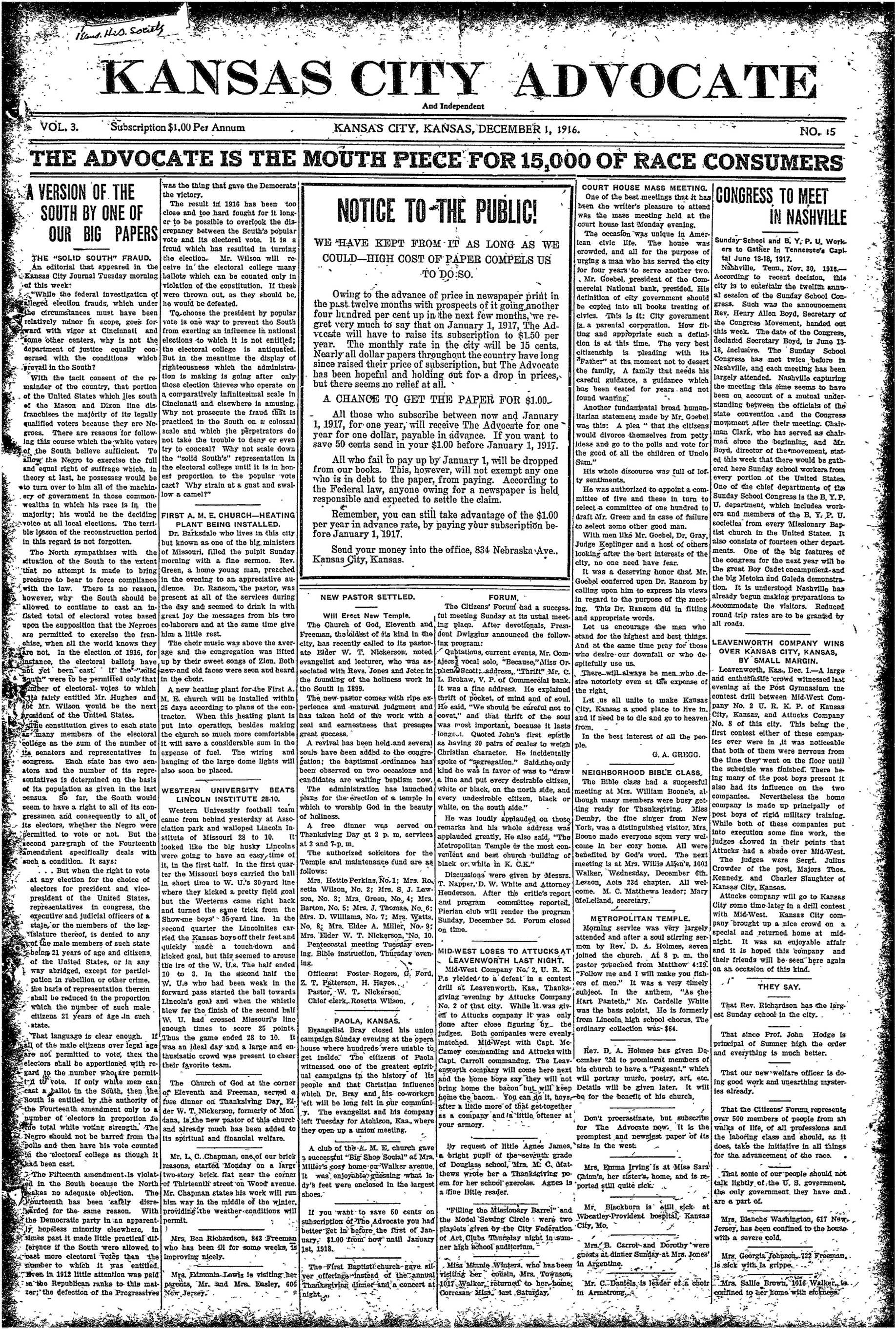
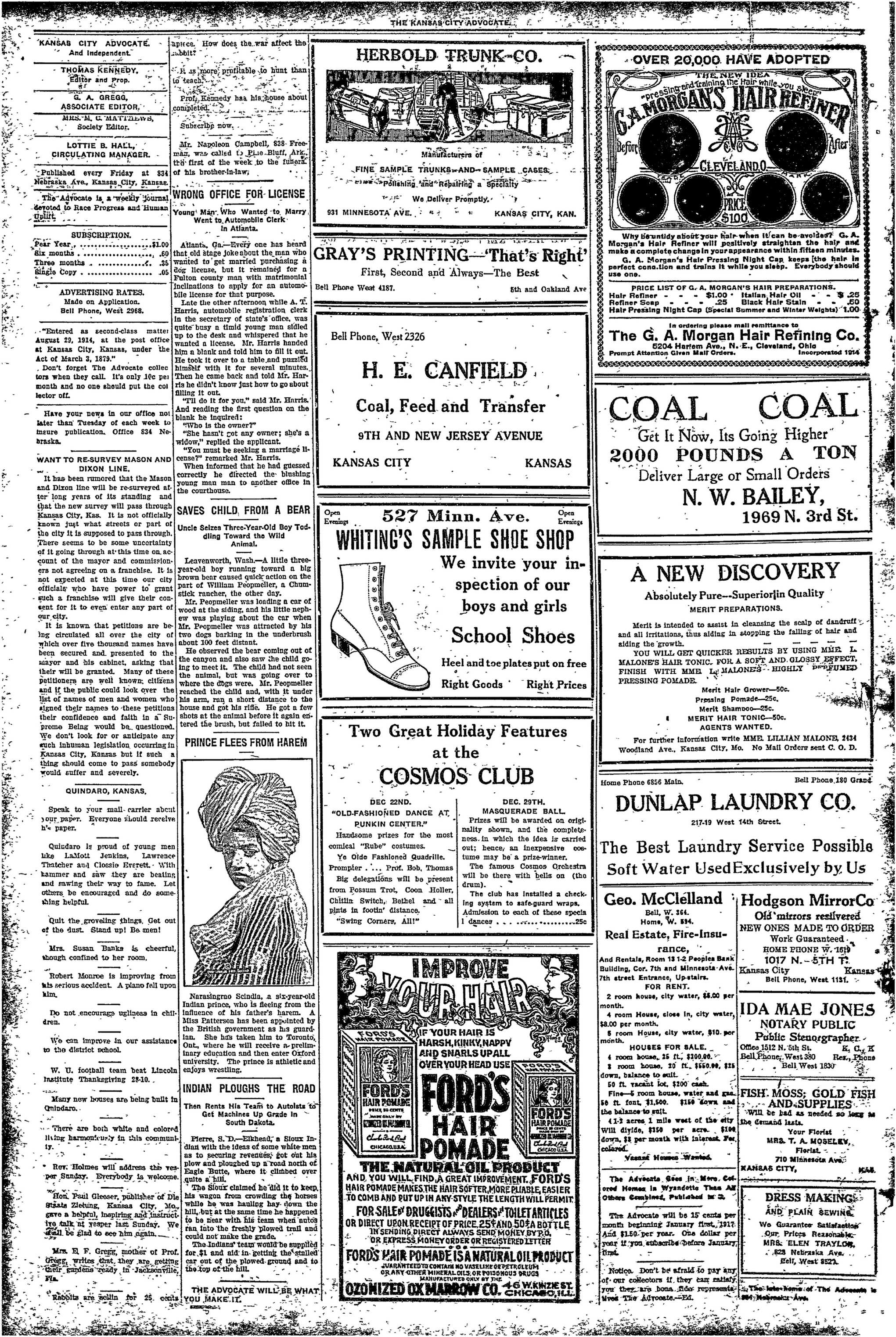
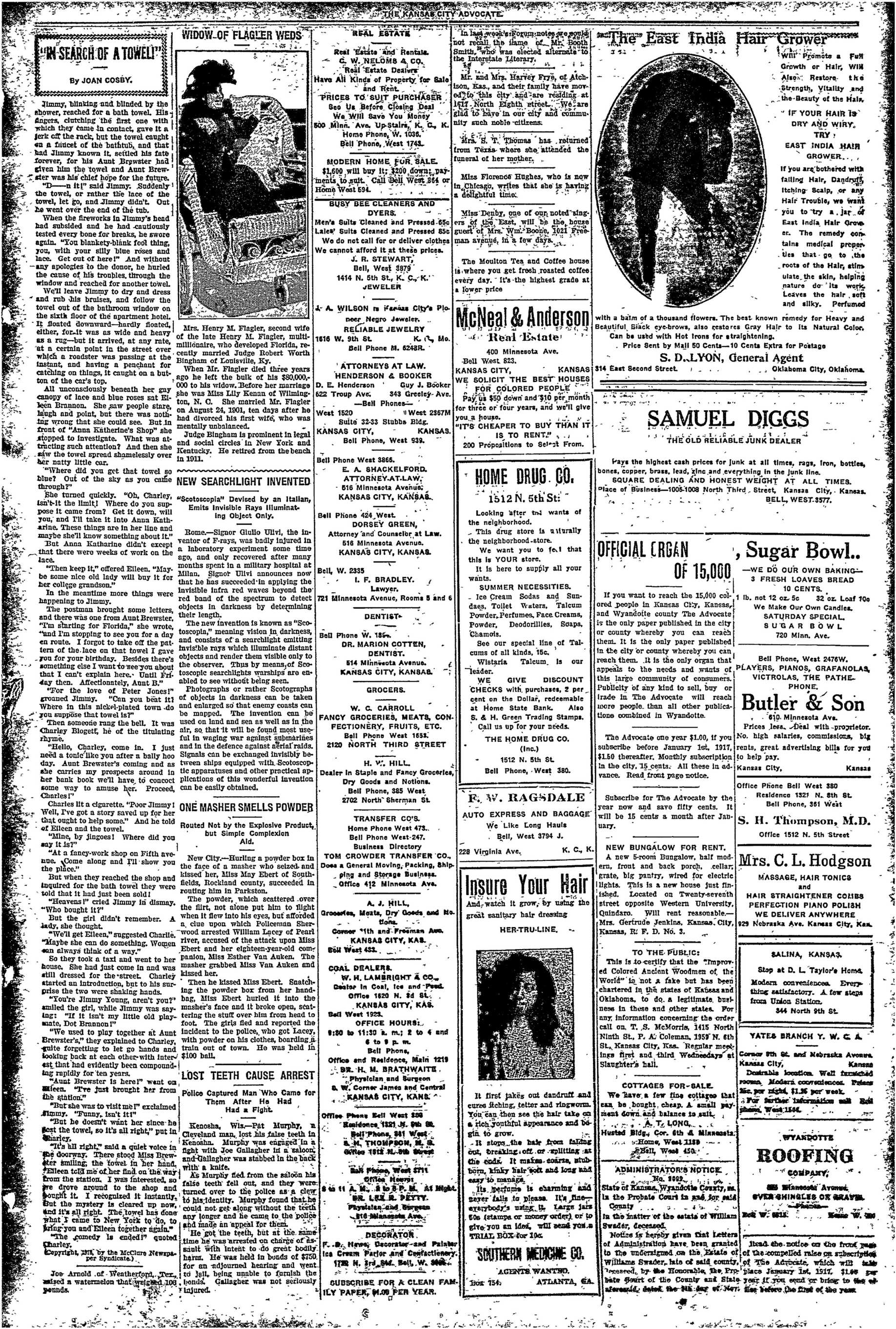
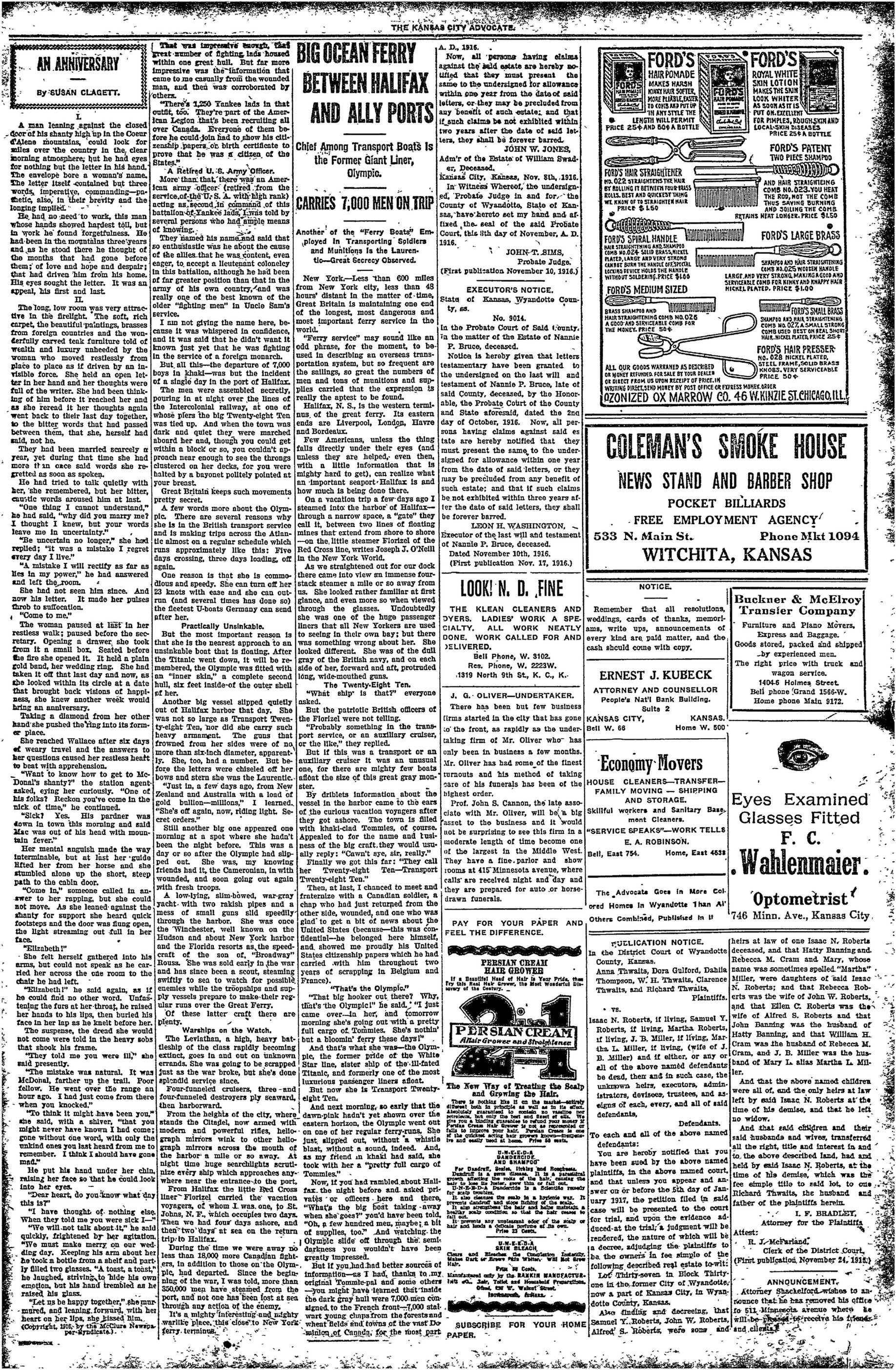
Page text (machine-generated)
KANSAS CITY ADVOCATE
Subscription $1.00 Per Annum
VERSION OF THE SOUTH BY ONE OF OUR BIG PAPERS
VERSION OF THE SOUTH BY ONE OF OUR BIG PAPERS
THE "SOLID SOUTH" FRAUD.
An editorial that appeared in the Kansas City Journal Tuesday morning of this week:
While the federal investigation of alleged election frauds, which under the circumstances must have been relatively minor in scope, goes forward with vigor at Cincinnati and some other centers, why is not the department of justice equally concerned with the conditions which prevail in the South?
With the tacit consent of the remainder of the country, that portion of the United States which lies south of the Mason and Dixon line disfranchises the majority of its legally qualified voters because they are Negroes. There are reasons for following this course which the white voters of the South believe sufficient. To allow the Negro to exercise the full and equal right of suffrage which, in theory at last, he possesses would be to turn over to him all of the machinery of government in those commonwealths in which his race is in the majority; his would be the deciding voice at all local elections. The terrible lesson of the reconstruction period in this regard is not forgotten.
The North sympathizes with the situation of the South to the extent that no attempt is made to bring pressure to bear to force compliance with the law. There is no reason, however, why the South should be allowed to continue to cast an inflated total of electoral votes based upon the supposition that the Negroes are permitted to exercise the franchise, when all the world knows they are not. In the election of 1916, for instance, the electoral ballots have not yet been cast. If the "sold-out" were to be permitted only that number of electoral votes to which this fairly entitled Mr. Hughes and not Mr. Wilson would be the next president of the United States.
The constitution gives to each state as many members of the electoral college as the sum of the number of its senators and representatives in congress. Each state has two senators and the number of its representatives is determined on the basis of its population as given in the last census. So far, the South would seem to have a right to all of its congressmen and consequently to all of its electors, whether the Negro were permitted to vote or not. But the second paragraph of the Fourteenth amendment specifically deals with such a condition. It says:
But when the right to vote at any election for the choice of electors for president and vice-president of the United States, representatives in congress, the executive and judicial officers of a state, or the members of the legislature thereof, is denied to any of the male members of such state being 21 years of age and citizens of the United States, or in any way abridged, except for participation in rebellion or other crime, the basis of representation therein shall be reduced in the proportion which the number of such male citizens 21 years of age In such state.
That language is clear enough. If all of the male citizens over legal age are not permitted to vote, then the electors shall be apportioned with regard to the number who are permitted to vote. If only white men can cast a ballot in the South, then the South is entitled by the authority of the Fourteenth amendment only to a number of electors in proportion to the total white voting strength. The Negro should not be barred from the polls and then have his vote counted in the electoral college as though it had been cast.
The Fifteenth amendment is violated in the South because the North makes no adequate objection. The Fourteenth has been safely disregarded for the same reason. With the Democratic party in an apparently hopeless minority elsewhere, in times past it made little practical difference if the South were allowed to past more electoral votes than the number to which it was entitled. Even in 1912 little attention was paid in the Republican ranks to this matter; the defection of the Progressives
VOL. 3.
was the thing that gave the Democrats the victory. The result in 1916 has been too close and too hard fought for it longer to be possible to overlook the discrepancy between the South's popular vote and its electoral vote. It is a fraud which has resulted in turning the election. Mr. Wilson will receive in the electoral college many ballots which can be counted only in violation of the constitution. If these were thrown out, as they should be, he would be defeated.
To choose the president by popular vote is one way to prevent the South from exerting an influence in national elections to which it is not entitled; the electoral college is antiquated. But in the meantime the display of righteousness which the administration is making is going after only those election thieves who operate on a comparatively infinitesimal scale in Cincinnati and elsewhere is amusing. Why not prosecute the fraud that is practiced in the South on a colossal scale and which the perpetrators do not take the trouble to deny or even try to conceal? Why not scale down the "solid South's" representation in the electoral college until it is in honest proportion to the popular vote cast? Why strain at a gnat and swallow a camel?"
FIRST A. M. E. CHURCH—HEATING PLANT BEING INSTALLED
PLANT BEING INSTALLED.
Dr. Barksdale who lives in this city but known as one of the big ministers of Missouri, filled the pulpit Sunday morning with a fine sermon. Rev. Green, a home young man, preached in the evening to an appreciative audience. Dr. Ransom, the pastor, was present at all of the services during the day and seemed to drink in with great joy the messages from his two co-laborers and at the same time give him a little rest.
The choir music was above the average and the congregation was lifted up by their sweet songs of Zion. Both new- and old faces were seen and heard in the choir.
A new heating plant for the First A. M. E. church will be installed within 25 days according to plans of the contractor. When this heating plant is put into operation, besides making the church so much more comfortable it will save a considerable sum in the expense of fuel. The wiring and hanging of the large dome lights will also soon be placed.
WESTERN UNIVERSITY BEATS
LINCOLN INSTITUTE 28-10.
Western University football team came from behind yesterday at Association park and walloped Lincoln Institute of Missouri 28 to 10. It looked like the big husky Lincolnes were going to have an easy time of it, in the first half. In the first quarter the Missouri boys carried the ball in short time to W. U.'s 30-yard line where they kicked a pretty field goal but the Westerns came right back and turned the same trick from the Show-me boys' 35-yard line. In the second quarter the Lincolnites carried the Kansas boys off their feet and quickly made a touch-down and kicked goal, but this seemed to arouse the lure of the W. U.s. The half ended 10 to 3. In the second half the W. U.s who had been weak in the forward pass started the ball towards Lincoln's goal and when the whistle blew for the finish of the second half W. U. had crossed Missouri's line enough times to score 25 points. Thus the game ended 28 to 10. It was an ideal day and a large and enthusiastic crowd was present to cheer their favorite team.
The Church of God at the corner of Eleventh and Freeman, served a fine dinner on Thanksgiving Day, Elder W. T. Nickerson, formerly of Montana, is the new pastor of this church and already much has been added to its spiritual and financial welfare.
Mr. L. C. Chapman, one of our brick masons, started Monday on a large two-story brick flat near the corner of Thirteenth street on Wood avenue. Mr. Chapman states his work will run him way in the middle of the winter, providing the weather conditions will permit.
Mrs. Ben Richardson, 843 Freeman who has been ill for some weeks, is improving nicely.
Mrs. Edmonia Lewis is visiting her parents, Mr. and Mrs. Dasley, 606 New Jersey.
KANSAS CITY, KANSAS, DECEMBER 1, 1916.
NOTICE TO THE PUBLIC!
NOTICE TO THE PUBLIC!
WE HAVE KEPT FROM IT AS LONG AS WE COULD—HIGH COST OF PAPER COMPELS US TO DO SO.
Owing to the advance of price in newspaper print in the past twelve months with prospects of it going another four hundred per cent up in the next few months, we regret very much to say that on January 1, 1917, The Advocate will have to raise its subscription to $1.50 per year. The monthly rate in the city will be 15 cents. Nearly all dollar papers throughout the country have long since raised their price of subscription, but The Advocate has been hopeful and holding out for a drop in prices, but there seems no relief at all.
A CHANCE TO GET THE PAPER FOR $1.00.
All those who subscribe between now and January 1, 1917, for one year, will receive The Advocate for one year for one dollar, payable in advance. If you want to save 50 cents send in your $1.00 before January 1, 1917.
All who fail to pay up by January 1, will be dropped from our books. This, however, will not exempt any one who is in debt to the paper, from paying. According to the Federal law, anyone owing for a newspaper is held responsible and expected to settle the claim.
Remember, you can still take advantage of the $1.00 per year in advance rate, by paying your subscription before January 1, 1917.
Send your money into the office, 834 Nebraska Ave.. Kansas City, Kansas.
If you want to save 60 cents on subscription of The Advocate you had better get in before the first of January. $1.00 from now until January 1st, 1918.
The First Baptist church gave silver offerings instead of the annual Thanksgiving dinner and a concert at night.
NEW PASTOR SETTLED.
Will Erect New Temple.
The Church of God, Eleventh and Freeman, the oldest of its kind in the city, has recently called to its pastorate Elder W. T. Nickerson, noted evangelist and lecturer, who was associated with Revs. Jones and Jeter in the founding of the holiness work in the South in 1899.
The new pastor comes with ripe experience and matured judgment and has taken hold of the work with a zeal and earnestness that presages great success.
A revival has been held and several souls have been added to the congregation; the baptismal ordinance has been observed on two occasions and candidates are waiting baptism now.
The administration has launched plans for the erection of a temple in which to worship God in the beauty of holiness.
A free dinner was served on Thanksgiving Day at 2 p. m, services at 3 and 7 p. m.
The authorized solicitors for the Temple and maintenance fund are as follows:
Mrs. Hettle Perkins, No. 1; Mrs. Rosetta Wilson, No. 2; Mrs. S. J. Lawson, No. 3; Mrs. Green, No. 4; Mrs. Barton, No. 5; Mrs. J. Thomas, No. 6; Mrs. D. Williams, No. 7; Mrs. Watts, No. 8; Mrs. Elder A. Miller, No. 9; Mrs. Elder W. T. Nickerson, No. 10. Pentecostal meeting Tuesday evening. Bible instruction, Thursday evening.
Officers: Foster Rogers, G. Ford, Z. T. Patterson, H. Hayes.
Pastor, W. T. Nickerson.
PAOLA. KANSAS.
Evangelist Bray closed his union campaign Sunday evening at the opera house where hundreds were unable to get inside. The citizens of Paola witnessed one of the greatest spiritual campaigns in the history of its people and that Christian influence which Dr. Bray and his co-workers left will be long felt in our community. The evangelist and his company left Tuesday for Atchison, Kas, where they open up a union meeting.
A club of the A. M. E. church gave a successful "Big Shop Social" at Mrs. Miller's cozy home on Walker avenue. It was enjoyable guessing what lady's feet were enclosed in the largest shoes.
And Independent
KANSAS, D.C.
PEACE FOR
TO THE PAPER
FROM IT AS
A CIT OF PAPER
TO DO SO.
of price in new
with prospects or
so in the next few
that on January
its subscription
in the city
throughout the
of subscription, be
holding out for
at all.
AT THE PAPER
cribe between me
will receive The A
stable in advance,
our $1.00 before
up by January 11.
However, will not
paper, from paying
owing for a n
to settle the cla
still take advance
by paying your
to the office, 83
THE PUBLIC!
FROM IT AS LONG AS WE
OF PAPER COMPELS US
DO SO.
If price in newspaper print in
prospects of it going another
in the next few months, we re-
ason January 1, 1917, The Advocate subscription to $1.50 per
in the city will be 15 cents.
boughtout the country have long
subscription, but The Advocate
going out for a drop in prices,
all.
THE PAPER FOR $1.00_
be between now and January
receive The Advocate for one
in advance. If you want to
$1.00 before January 1, 1917.
by January 1, will be dropped
over, will not exempt any one
from paying. According to
bringing for a newspaper is held
settle the claim.
I take advantage of the $1.00
paying your subscription be-
the office, 834 Nebraska Ave..
The Citizens' Forum had a successful meeting Sunday at its usual meeting place. After devotionals, President Dwiggins announced the following program:
"Quotations, current events, Mr. Comajers, vocal solo, "Because," Miss Orpenae Scott," address, "Thrift" Mr. C. L. Brokaw, V. P. of Commercial bank. It was a fine address. He explained thrift of pocket, of mind and of soul. He said, "We should be careful not to covet," and that thrift of the soul was most important, because it lasts longest. Quoted John's first epistle as having 20 pairs of scales to weigh Christian character. He incidentally spoke of "segregation." Said the, only kind he was in favor of was to "draw a line and put every desirable citizen, white or black, on the north side, and every undesirable citizen, black or white, on the south side."
He was loudly applauded on those remarks and his whole address was applauded greatly. He also said, "The Metropolitan Temple is the most convenient and best church building of black or white in K. C.K."
Discussions were given by Messrs. T. Napper, D. W. White and Attorney Henderson. After the critic's report and program committee reported, Pierian club will render the program Sunday, December 3d. Forum closed on time.
MID-WEST LOSES TO ATTUCKS AT LEAVENWORTH LAST NIGHT.
Mid-West Company No. 2, U. R. K. P.s yielded to a defeat in a contest drill at Leavenworth, Kas., Thanksgiving evening by Attucks Company No. 2 of that city. While it was given to Attucks company it was only done after close figuring by the judges. Both companies were evenly matched. Mid-West with Capt. McCamey commanding and Attucks with Capt. Carroll commanding. The Leavenworth company will come here next and the home boys say they will not bring home the bacon but will keep home the bacon. You can do it, boys, after a little more of that get-together as a company and a little oftener at your armory.
By request of little Agnes James, a bright pupil of the seventh grade of Douglass school, Mrs. M. C. Matthews wrote her a Thanksgiving poem for her school exercise. Agnes is a fine little reader.
"Filling the Missionary Barrel" and the Model Sewing Circle were two playlets given by the City Federation of Art, Clubs Thursday night in summer high school auditorium.
Miss Mimie Winters, who has been visiting her cousin, Mrs. Townson, 1017 Walker, returned to her home; Corresan Miss, last Saturday.
COURT HOUSE MASS MEETING.
One of the best meetings that it has been the writer's pleasure to attend was the mass meeting held at the court house last Monday evening.
The occasion was unique in American civic life. The house was crowded, and all for the purpose of urging a man who has served the city for four years to serve another two.
Mr. Goebel, president of the Commercial National bank, presided. His definition of city government should be copied into all books treating of civics. This is it: City government is a parental corporation. How fitting and appropriate such a definition is at this time. The very best citizenship is pleading with its "Father" at this moment not to desert the family. A family that needs his careful guidance, a guidance which has been tested for years and not found wanting.
Another fundamental broad humanitarian statement made by Mr. Goebel was this: A plea "that the citizens would divorce themselves from petty ideas and go to the polls and vote for the good of all the children of Uncle Sam."
His whole discourse was full of lofty sentiments.
He was authorized to appoint a committee of five and these in turn to select a committee of one hundred to draft Mr. Green and in case of failure to select some other good man.
With men like Mr. Goebel, Dr. Gray, Judge Keplinger and a host of others looking after the best interests of the city, no one need have fear.
It was a deserving honor that Mr. Goebel conferred upon Dr. Ransom by calling upon him to express his views in regard to the purpose of the meeting. This Dr. Ransom did in fitting and appropriate words.
Let us encourage the men who stand for the highest and best things. And at the same time pray for those who desire our downfall or who despitefully use us.
There will always be men who desire notoriously even at the expense of the right.
Let us all unite to make Kausas City, Kansas a good place to live in, and if need be to die and go to heaven from.
In the best interest of all the people.
G. A. GREGG.
NEIGHBORHOOD BIBLE CLASS.
The Bible class had a successful meeting at Mrs. William Boone's, although many members were busy getting ready for Thanksgiving. Miss Demby, the fine singer from New York, was a distinguished visitor. Mrs. Boone made everyone seem very welcome in her cozy home. All were benefited by God's word. The next meeting is at Mrs. Willis Allen's, 1001 Walker, Wednesday, December 6th Lesson, Aots 23d chapter. All welcome. M. C. Matthews leader; Mary McLelland, secretary.
METROPOLITAN TEMPLE.
METROPOLITAN TEMPLE.
Morning service was very largely attended and after a soul stirring sermon by Rev. D. A. Holmes, seven joined the church. At 8 p. m. the pastor pitched from Matthew 4:19.
"Follow me and I will make you fishers of men." It was a very timely subject. In the anthem, "As the Hart Panthee," Mr. Cardelle White was the bass soloist. He is formerly from Lincoln high school chorus. The ordinary collection was $64.
---
Rev. D. A. Holmes has given December 22d to prominent members of his church to have a "Pageant," which will portray music, poetry, art, etc. Details will be given later. It will be for the benefit of his church.
Don't procrastinate, but subscribes for The Advocate now. It is the promptest and newsiest paper of its size in the west.
Mrs. Emma Irving is at Miss Sara Chitm's, her sister's, home, and is reported still quite sick.
Mr. Blackburn is still sick at Wheatley-Provident hospital, Kansas City, Mo.
Mrs. B. Carrol and Dorothy were guests at dinner Sunday at Mrs. Jones' in Argentine.
Mr. C. Daniels is leader of a choir in Armstrong.
---
NO.15
CONGRESS TO MEET IN NASHVILLE
Sunday School and B. Y. P. U. Workers to Gather In Tennessee Capital June 13-18, 1917.
Nashville, Tenn., Nov. 30, 1915. According to recent decision, this city is to entertain the twelfth annual session of the Sunday School Congress. Such was the announcement Rev. Henry Allen Boyd, Secretary of the Congress Movement, handed out this week. The date of the Congress, declared Secretary Boyd, is June 13-18, inclusive. The Sunday School Congress has met twice before in Nashville, and each meeting has been largely attended. Nashville capturing the meeting this time seems to have been on account of a mutual understanding between the officials of the state convention and the Congress movement after their meeting. Chairman Clark, who has served as chairman since the beginning, and Mr. Boyd, director of the movement, stated this week that there would be gathered here Sunday school workers from every portion of the United States. One of the chief departments of the Sunday School Congress is the B. Y.P. U. department, which includes workers and members of the B. Y, P. U. societies from every Missionary Baptist church in the United States. It also consists of fourteen other departments. One of the big features of the congress for the next year will be the great Boy Cadet encampment and the big Metoka and Galeda demonstration. It is understood Nashville has already begun making preparations to accommodate the visitors. Reduced round trip rates are to be granted by all roads.
LEAVENWORTH COMPANY WINS
OVER KANSAS CITY, KANSAS,
BY SMALL MARGIN.
Leavenworth, Kas., Dec. 1.—A large and enthusiastic crowd witnessed last evening at the Post Gymnasium the contest drill between Mid-West Company No. 2 U. R. K. P. of Kansas City, Kansas, and Attucks Company No. 8 of this city. This being the first contest either of these companies ever were in, it was noticeable that both of them were nervous from the time they went on the floor until the schedule was finished. There being many of the post boys present it also had its influence on the two companies. Nevertheless the home company is made up principally of post boys of rigid military training. While both of these companies put into execution some fine work, the judges showed in their points that Attucks had a shade over Mid-West.
The judges were Sergt. Julius Crowder of the post, Majors Thos. Kennedy, and Charles Slaughter of Kansas City, Kansas.
Attacks company will go to Kansas City some time later in a drill contest with Mid-West. Kansas City company brought up a nice crowd on a special and returned home at midnight. It was an enjoyable affair and it is hoped this company and their friends will be seen here again on an occasion of this kind.
THEY SAY.
That Rev. Richardson has the largest Sunday school in the city.
That since Prof. John Hodge is principal of Summer high the order and everything is much better.
That our new welfare officer is doing good work and unearthing mysteries already.
That the Citizens' Forum represents over 500 members of people from an walks of life, of all professions and the laboring class and should, as it does, take the initiative in all things for the advancement of the race.
That some of our people should not talk lightly of the U. S. government, the only government they have and are a part of.
Mrs. Blanche Washington, 617 New Jersey, has been confined to the house with a severe cold.
Mrs. Georgia Johnson, 722 Freeman. Is sick with In grippe.
Mrs. Sallie Brown, 1016 Walker, is confined to her home with sickness.
KANSAB CITY ADVOCATE.
And Independent.
THOMAS KENNEDY,
Editor and Prop.
G. A. GREGG,
ASSOCIATE EDITOR.
MRS. M. G. MATTELWS,
Society Editor.
LOTTIE B. HALL,
CIRCULATING MANAGER.
The Advocate is a weekly journal devoted to Race Progress and Human Uplift.
SUBSCRIPTION.
Pear Year. $1.00
Six months. .60
Three months. .35
Single Copy. .05
ADVERTISING RATES.
Made on Application.
Bell Phone, West 2968.
"Entered as second-class matter
August 29, 1914, at the post office
at Kansas City, Kansas, under the
Act of March 3, 1879."
Don't forget The Advocate collectors when they call. It's only 10c per month and no one should put the collector off.
Have your news in our office not later than Tuesday of each week to insure publication. Office 834 Nebraska.
WANT TO RE-SURVEY MASON AND DIXON LINE.
It has been rumored that the Mason and Dixon line will be re-surveyed after long years of its standing and that the new survey will pass through Kansas City, Kas. It is not officially known just what streets or part of the city it is supposed to pass through. There seems to be some uncertainty of it going through at this time on account of the mayor and commissioners not agreeing on a franchise. It is not expected at this time our city officials who have power to grant such a franchise will give their consent for it to even enter any part of our city.
It is known that petitions are being circulated all over the city of which over five thousand names have been secured and presented to the mayor and his cabinet, asking that their will be granted. Many of these petitioners are well known, citizens and if the public could look over the list of names of men and women who signed their names to these petitions their confidence and faith in a Supreme Being would be questioned. We don't look for or anticipate any such inhuman legislation occurring in Kansas City, Kansas but if such a thing should come to pass somebody would suffer and severely.
QUINDARO, KANSAS,
Speak to your mall-carrier about your paper. Everyone should receive h's paper.
Quindaro is proud of young men like LaMott Jenkins, Lawrence Thatcher and Closie Everett. With hammer and saw they are beating and sawing their way to fame. Let others be encouraged and do something helpful.
Quilt the groveling things. Get out of the dust. Stand up! Be men!
Mrs. Susan Banks is cheerful, though confined to her room.
Robert Monroe is improving from his serious accident. A plano fell upon him.
Do not encourage ugliness in children.
We can improve in our assistance to the district school.
W. U. football team beat Lincoln Institute Thanksgiving 28-10.
Many new houses are being built in Quindaro.
There are both white and colored living harmoniously in this community.
Rev. Holmes will address this vesper Sunday. Everybody is welcome.
Hon. Paul Gleeser, publisher of Die Straats Zieting, Kansas City. Mo. gave a helpful, inspiring and instructive talk at vesper last Sunday. We shall be glad to see him again.
Mrs. E. F. Gregg, mother of Prof. Gregg, writes that they are getting their gardens ready in Jacksonville, Pa.
Rabbits are sellin for 25 cents.
apiece. How does the war affect the rabbit?
It is more profitable to hunt than to teach.
Prof. Kennedy has his house about completed.
Subscribe now.
Mr. Napoleon Campbell, 838 Freeman, was called to Blue Bluff, Ark. the first of the week to the funeral of his brother-in-law,
Young Man Who Wanted to Marry Went to Automobile Clerk in Atlanta.
Atlanta, Ga.—Every one has heard that old stage joke about the man who wanted to get married purchasing a dog license, but it remained for a Fulton county man with matrimonial inclinations to apply for an automobile license for that purpose.
Late the other afternoon while A. T. Harris, automobile registration clerk in the secretary of state's office, was quite busy a timid young man sldled up to the desk and whispered that he wanted a license. Mr. Harris handed him a blank and told him to fill it out. He took it over to a table and puzzled himself with it for several minutes. Then he came back and told Mr. Harris he didn't know just how to go about filling it out.
"Till do it for you," said Mr. Harris. And reading the first question on the blank he inquired:
"Who is the owner?"
"She hasn't got any owner; she's a widow," replied the applicant.
"You must be seeking a marriage license?" remarked Mr. Harris.
When informed that he had guessed correctly he directed the blushing young man man to another office in the courthouse.
SAVES CHILD, FROM A BEAR
Uncle Seizes Three-Year-Old Boy Todling Toward the Wild Animal.
Leavenworth, Wash.—A little three-year-old boy running toward a big brown bear caused quick action on the part of William Peopmeller, a Chumstick rancher, the other day.
Mr. Peopmeller was loading a car of wood at the siding, and his little nephew was playing about the car when Mr. Peopmeller was attracted by his two dogs barking in the underbrush about 100 feet distant.
He observed the bear coming out of the canyon and also saw the child going to meet it. The child had not seen the animal, but was going over to where the dogs were. Mr. Peopmeller reached the child and, with it under his arm, ran a short distance to the house and got his rifle. He got a few shots at the animal before it again entered the brush, but failed to hit it.
PRINCE FLEES FROM HAREM
C
Narasingrao Scindia, a six-year-old Indian prince, who is fleeing from the influence of his father's harem. A Miss Patterson has been appointed by the British government as his guardian. She has taken him to Toronto, Ont., where he will receive a preliminary education and then enter Oxford university. The prince is athletic and enjoys wrestling.
INDIAN PLOUGHS THE ROAD
Then Rents His Team to Autolsta to Get Machines Up Grade In South Dakota.
Pierre, S. D.—Elkhead, a Sioux Indian with the ideas of some white men as to securing revenues; got out his plow and ploughed up a road north of Eagle Butte, where it climbed over quite a hill.
The Sioux claimed he did it to keep his wagon from crowding the horses while he was hauling hay down the hill, but at the same time he happened to be near with his team when autos ran into the freshly plowed trail and could not make the grade.
The Indians' team would be supplied for $1 and aid in getting the stuilled car out of the plowed ground and to the top of the hill.
THE ADVOCATE WILL BE WHAT YOU MAKE IT.
TREASURES
FINE SAMPLE TRUNKS AND SAMPLE CASES Polishing and Repairing a Specialty
GRAY'S PRINTING—'That's Right'
First, Second and Always—The Best
Bell Phone West 4187. 8th and Oakland Ave
IMPROVE
YOUR HAIR
IF YOUR HAIR IS
HARSH, KINKY, NAPPY
AND SNARLS UP ALL
OVER YOUR HEAD USE
FORD'S
HAIR POMADE
PRICE, SO CENTRE
IMAGE CALL BY
CHRIS D. BURD
Chicago, Illinois
FORD'S
HAIR POMADE
PRICE, SO CENTRE
IMAGE CALL BY
CHRIS D. BURD
Chicago, Illinois
THE NATURAL OIL PRODUCT AND YOU WILL FIND A GREAT IMPROVEMENT. FORDS HAIR POMADE MAKES THE HAIR SOFTER MORE PLIABLE, EASIER TO COMB AND PUT UP IN ANY STYLE THE LENGTH WILL PERMIT FOR SALE DRUGGISTS DEALERS TOILET ARTICLES OR DIRECT UPON RECEIPT OF PRICE, 25£ AND 50£ A BOTTLE IN SENDING DIRECT ALWAYS SEND MONEY BY P.O. OR EXPRESS MONEY ORDER OR REGISTERED LETTER
OZONIZED OXMARROW CO. 46 W. KINZI ST. CHICAGO,ILL.
```markdown
```
Two Great H
at
COSMO
DEC 22ND.
"OLD-FASHIONED DANCE AT
PUNKIN CENTER."
Ye Olde Fashioned Quadrille.
Prompter . . . Prof, Bob, Thomas
Big delegations will be present from Possum Trot, Coon Holler, Chittlin Switch, Bethel and all plints in footin' distance.
"Swing Corners, All!"
KANSAS
Minn. Ave. Open Evenings
IMPLE SHOE SHOP
We invite your inspection of our boys and girls
School Shoes Heel and toe plates put on free Right Goods Right Prices
Holiday Features
at the
NOS CLUB
DEC. 29TH.
MASQUERADE BALL.
Prizes will be awarded on originality shown, and the completeness in which the idea is carried out; hence, an inexpensive costume may be a prize-winner.
THE NEW IDEA
"pressing and training the hair while you sleep"
G.A. MORGAN'S HAIR REFINER
Before After
CLEVELAND.O
PRICE
$100
Why be untidy about your hair when it can be avoided? G. A. Morgan's Hair Refiner will positively straighten the hair and make a complete change in your appearance within fifteen minutes. G. A. Morgan's Hair Pressing Night Cap keeps the hair in perfect condition and trains it while you sleep. Everybody should use one.
PRICE LIST OF G. A. MORGAN'S HAIR PREPARATIONS.
Hair Refiner - - - $1.00. Italian Hair Oil - - $.25
Refiner Soap - - .25 Black Hair Stain - - .50
Hair Pressing Night Cap (Special Summer and Winter Weights) 1.00
In ordering please mail remittance to
The G. A. Morgan Hair Refining Co.
5204 Harlem Ave., N. E., Cleveland, Ohio
Prompt Attention Given Mail Orders.
Incorporated 1914
COAL COAL
Get It Now, Its Going Higher
2000 POUNDS A TON
Deliver Large or Small Orders
N. W. BAILEY,
1969 N. 3rd St.
A NEW DISCOVERY
Merit is intended to assist in cleansing the scalp of dandruff and all irritations, thus aiding in stopping the falling of hair and aiding the growth.
YOU WILL GET QUICKER RESULTS BY USING MME L MALONE'S HAIR TONIC. FOR A SOFT AND GLOSSY EFFECT, FINISH WITH MME L MALONE'S HIGHLY PERFUMED PRESSING POMADE.
For further information write MME. LILLIAN MALONE, 2434 Woodland Ave., Kansas City, Mo. No Mail Orders sent C. O. D.
The Best Laundry Service Possible Soft Water UsedExclusively by Us
Home Phone 6856 Main
DUNLAP LA
217-19 West
The Best Laundry
Soft Water Used
Geo. McClelland
Bell, W. 364.
Home, W. 394.
Real Estate, Fire-Insu-
And Rentals, Room 13 1-2 Peoplea Bank Building, Cor. 7th and Minnesota Ave. 7th street Entrance, Up-stairs.
FOR RENT.
2 room house, city water, $5.00 per month.
5 room House, city water, $10. per
month.
HOUSES FOR SALE.
4 room house, 25 ft. $200.00.
8 room house, 20 ft. $550.00, $25
down, balance to suit.
50 ft. vacant lot, $200 cash.
Fine—5 room house, water and gas.
50 ft. font, $1,500. $150 down and
the balance to suit.
412 acres 1 mile west of the city
Will divide, $350 per acre. $100
down, $8 per month with interest. For
colored.
The Advocate Goes in More. Colored Homen in Wyandotte Than All Others Combined. Published in
The Advocate will be 15 cents per month beginning January first, 1917. And $150 per year. One dollar per year if you subscribe before January first.
Notice. Don't be afraid to pay any of our collectors if they can satisfy you they are bona fide representatives The Advocate.-Ed.
Bell Phone 180 Grand
UNDRY CO.
14th Street.
Service Possible
Exclusively by Us
Hodgson MirrorCo
Hodgson MirrorCo
Old mirrors resilvered
NEW ONES MADE TO ORDER
Work Guaranteed
HOME PHONE W. 1019
1017 N. - 5TH T.
Kansas City Kansas
Bell Phone, West 1131.
IDA MAE JONES
Public Stenorgrapher
Office 1512 N. 5th St. K. C. K
Bell Phone, West 380 Rex., Phone
Bell West 1830
FISH. MOSS; GOLD FISH
AND SUPPLIES
Will be had as needed so long as
the demand lasts.
Your Florist
MRS. T. A. MOSELEV,
Florist
710 Minnesota Ave.
KANSAS CITY, MAR.
DRESS MAKING
AND PLAIN SEWING
Wo Guarantee Satisfaction
Our Prices Reasonable
MRS. ELEN TRAYLOR
823 Nebraska Ave.
Hell, West 8523.
The late home of The Advocate is 364 Nebraska Ave.
A man leaning against the closed door of his shanty high up in the Coeur d'Alene mountains, could look for miles over the country in the clear morning atmosphere, but he had eyes for nothing but the letter in his hand. The envelope bore a woman's name. The letter itself contained but three words, imperative, commanding—pathetic, also, in their brevity and the longing implied.
He had no need to work, this man whose hands showed hardest toll, but in work he found forgetfulness. He had been in the mountains three years and as he stood there he thought of the months that had gone before them; of love and hope and despair; that had driven him from his home. His eyes sought the letter. It was an appeal, his first and last.
The long, low room was very attractive in the firelight. The soft, rich carpet, the beautiful paintings, brasses from foreign countries and the wonderfully carved teak furniture told of wealth and luxury unheeded by the woman who moved restlessly from place to place as if driven by an invisible force. She held an open letter in her hand and her thoughts were full of the writer. She had been thinking of him before it reached her and as she reread it her thoughts again went back to their last day together, to the bitter words that had passed between them, that she, herself had said, not he.
They had been married scarcely a year, yet during that time she had more than once said words she regretted as soon as spoken.
He had tried to talk quietly with her, she remembered, but her bitter, cuiric words aroused him at last.
"One thing I cannot understand," he had said, "why did you marry me? I thought I knew, but your words leave me in uncertainty."
"Be uncertain no longer," she had replied; "it was a mistake I regret every day I live."
"A mistake I will rectify as far as lies in my power," he had answered and left the room.
She had not seen him since. And now his letter. It made her pulses throb to suffocation.
The woman paused at last in her restless walk; paused before the secretary. Opening a drawer, she took from it a small box. Seated before the fire she opened it. It held a plain gold band, her wedding ring. She had taken it off that last day and now, as she looked within its circle at a date that brought back visions of happiness, she knew another week would bring an anniversary.
Taking a diamond from her other hand she pushed the ring into its former place.
She reached Wallace after six days of weary travel and the answers to her questions caused her restless heart to beat with apprehension.
"Want to know how to get to McDonal's shanty?" the station agent asked, lying her curiously. "One of his folks? Reckon you come in the nick of time?" he continued.
"Sick? Yes. His pardner was down in town this morning and sald Mac was out of his head with mountain fever."
Her mental anguish made the way interminable, but at last her guide lifted her from her horse and she stumbled alone up the short, steep path to the cabin door.
"Come in," someone called in answer to her rapping, but she could not move. As she leaned against the shanty for support she heard quick footsteps and the door was flung open, the light streaming out full in her face.
"Elizabeth!"
She felt herself gathered into his arms, but could not speak as he carried her across the one room to the chair he had left.
"Elizabeth!" he said again, as if he could find no other word. Unfastening the furs at her throat, he raised her hands to his lips, then buried his face in her lap as he knelt before her. The suspense, the dread she would not come were told in the heavy sobs that shook his frame.
"They told me you were ill," she said presently.
"The mistake was natural. It was McDonal, farther up the trail. Poor fellow. He went over the range an hour ago. I had just come from there when you knocked."
"To think it might have been you," she said, with a shiver, "that you might never have known I had come; gone without one word, with only the unkind ones you last heard from me to remember. I think I should have gone mad."
He put his hand under her chin, raising her face so that he could look into her eyes.
"Dear heart, do you know what day this is?"
"I have thought of nothing else. When they told me you were sick I—" "We will not talk about it," he said quickly, frightened by her agitation. "We must make merry, on our wedding day. Keeping his arm about her he took a bottle from a shelf and partly filled two glasses. "A toast, a toast," he laughed, striving to hide his own emotion, but his hand trembled as he raised his glass.
"Let us be happy together," she murmured, and leaning, forwrd, with her heart on her lips, she kissed him. (Copyright, 1915, by the McClure Newspaper Syndicate.)
That was impressive enough, that great number of fighting lads housed within one great hull. But far more impressive was the information that came to me casually from the wounded man, and then was corroborated by others. "There's 1,250 Yankee lads in that outfit, too. They're part of the American Legion that's been recruiting all over Canada. Everyone of them before he could join had to show his citizenship papers, or birth certificate to prove that he was a citizen of the States." A. Belfred L. S. Army Officer.
A Retired U. S. Army Officer.
More than that, there was an American army officer (retired from the service, of the U. S. A. with high rank) acting as second in command of this battalion of Yankee lads, I was told by several persons who had simple means of knowing.
They named his name and said that so enthusiastic was he about the cause of the allies that he was content, even eager, to accept a lieutenant colony in this battalion, although he had been of far greater position than that in the army of his own country, and was really one of the best known of the older "fighting men" In Uncle Sam's service.
I am not giving the name here, because it was whispered in confidence, and it was said that he didn't want it known just yet that he was fighting in the service of a foreign monarch.
But all this—the departure of 7,000 boys in khaki—was but the incident of a single day in the port of Halifax. The men were assembled secretly, pouring in at night over the lines of the Intercolonial railway, at one of whose plers the big Twenty-eight Ten was tied up. And when the town was dark and quiet they were marched aboard her and, though you could get within a block or so, you couldn't approach near enough to see the throngs clustered on her decks, for you were halted by a bayonet politely pointed at your breast. Great Britain keeps such movements pretty secret.
A few words more about the Olympic. There are several reasons why she is in the British transport service and is making trips across the Atlantic almost on a regular schedule which runs approximately like this: Five days crossing, three days loading, off again.
One reason is that she is commodious and speedy. She can turn off her 23 knots with ease and she can outrun (and several times has done so) the fleetest U-boats Germany can send after her.
Practically Unsinkable.
But the most important reason is that she is the nearest approach to an unsinkable boat that is floating. After the Titanic went down, it will be remembered, the Olympie was fitted with an "inner skin," a complete second hull, six feet inside-of the outer shell of her.
Another big vessel slipped quietly out of Hallifax harbor that day. She was not so large as Transport Twenty-eight Ten, nor did she carry such heavy armament. The guns that frowned from her sides were of no more than six-inch diameter, apparently. She, too, had a number. But before the letters were chiseled off her bows and stern she was the Laurentic.
"Just in, a few days ago, from New Zealand and Australia with a load of gold bullion—millions," I learned.
"She's off again, now, riding light. Secret orders."
Still another big one appeared one morning at a spot where she hadn't been the night before. This was a day or so after the Olympic had slipped out. She was, my knowing friends had it, the Cameronian, in with wounded, and soon going out again with fresh troops.
A low-lying, slim-bowed, war-gray yacht- with two rakish pipes and a mess of small guns sild speedily through the harbor. She was once the Winchester, well known on the Hudson and about New York harbor and the Florida resorts as the speedcraft of the son of, "Broadway" Rouss. She was sold early in the war and has since been a scout, steaming swiftly to sea to watch for possible enemies while the troopships and supply vessels prepare to make their regular runs over the Great Ferry.
Of these latter craft there are plenty.
Warships on the Watch.
The Leviathan, a high, heavy battleship of the class rapidly becoming extinct, goes in and out on unknown errands. She was going to be scrapped just as the war broke, but she's done splendid service since.
Four-funneled cruisers, three and four-funneled destroyers ply seaward, then harborward.
From the heights of the city, where stands the Citagafel, now armed with modern and powerful rifles, hellograph mirrors wink to other hellograph mirrors across the mouth of the harbor a mile or so away. At night time huge searchlights scrutinize every ship which approaches anywhere near the entrance to the port.
From Halifax the little Red Cross liner Florizel carried the vacation voyagers, of whom I was one, to St. Johns, N. F., which occupies two days. Then we had four days ashore, and then two days at sea on the return trip to Halifax.
During the time we were away no less than 18,000 more Canadian fighters, in addition to those on the Olympic, had departed. Since the beginning of the war, I was told, more than 350,000 men have stemmed from the port, and not one has been lost at sea through any action of the enemy.
It's a mighty interesting and mighty warlike place, this close to New York ferry terminus.
BIG OCEAN FERRY BETWEEN HALIFAX AND ALLY PORTS
Chief Among Transport Boats Is the Former Giant Liner, Olympic.
CARRIES 7,000 MEN ON TRIP
Another of the "Ferry Boats" Employed in Transporting Spiders and Munitions is the Laurentio—Great Secrecy Observed.
New York—Less than 600 miles from New York city, less than 48 hours' distant in the matter of time, Great Britain is maintaining one end of the longest, most dangerous and most important ferry service in the world.
"Ferry service" may sound like an odd phrase, for the moment, to be used in describing an overseas transportation system, but so frequent are the sailings, so great the numbers of men and tons of munitions and supplies carried that the expression is really the aptest to be found.
Halifax, N. S., is the western terminus of the great ferry. Its eastern ends are Liverpool, London, Havre and Bordeaux.
Few Americans, unless the thing falls directly under their eyes (and unless they are helped, even then, with a little information that is mighty hard to get), can realize what an important seaport-Halifax is and how much is being done there.
On a vacation trip a few days ago I steamed into the harbor of Halifax—through a narrow space, a "gate" they call it, between two lines of floating mines that extend from shore to shore—on the little steamer Florizel of the Red Cross line, writes Joseph J. O'Nell in the New York World.
As we straightened out for our dock there came into view an immense four-stack steamer a mile or so away from us. She looked rather familiar at first glance, and even more so when viewed through the glasses. Undoubtedly she was one of the huge passenger liners that all New Yorkers are used to seeing in their own bay; but there was something wrong about her. She looked different. She was of the dull gray of the British navy, and on each side of her, forward and aft, protruded long, wide-mouthed guns.
The Twenty-Eight Ten.
"What ship is that?" everyone asked.
But the patriotic British officers of the Florizel were not telling.
"Probably something in the transport service, or an auxiliary cruiser, or the like," they replied.
But if this was a transport or an auxiliary cruiser it was an unusual one, for there are mighty few boats afloat the size of this great gray monster. By dribble information about the vessel in the harbor came to the ears of the curious vacation voyagers after they got ashore. The town is filled with khaki-clad Tommies, of course. Appealed to for the name and business of the big craft, they would usually reply: "Cawnt sye, sr, really." Finally we got this far: "They call her Twenty-eight Ten—Transport Twenty-eight Ten."
Then, at last, I chanced to meet and fraternize with a Canadian soldier, a chap who had just returned from the other side, wounded, and one who was glad to get a bit of news about the United States (because—this was confidential—he belonged here himself, and showed me proudly his United States citizenship papers which he had carried with him throughout two years of scrapping in Belgium and France).
"That's the Olympic."
"That big hooker out there? Why, that's the Olympic!" he said. "I just came over—in her, and tomorrow morning she's going out with a pretty full cargo of Tommies. She's nothin' but a bloomin' ferry these days!"
And that's what she was—the Olympic, the former pride of the White Star line, sister ship of the ill-fated Titanic, and formerly one of the most luxurious passenger liners afloat. But now she is Transport Twenty-eight Ten. And next morning, so early that the dawn-plink hadn't yet shown over the eastern horizon, the Olympic went out on one of her regular ferry-runs. She just slipped out, without a whistle blast, without a sound, indeed. And, as my friend in khaki had said, she took with her a "pretty full cargo of Tommies."
Now, if you had rambled about Hallafax the night before and asked privates or officers here and there, "What's the big boat taking away when she goes?" you'd have been told, "Oh, a few hundred men, maybe; a bit of supplies, too." And watching the Olympic slide off through the semi-darkness you wouldn't have been greatly impressed.
But if you had had better sources of information—as I had, thanks to my original Tommie-pal and some others—you might have learned that inside the dark gray hull were 7,000 men consigned to the French front—7,000 stalwart young chaps from the forests and wheat holds and towns of the vast Dominion of Canada, for the most part
Now, all persons having claims against the said estate are hereby notified that they must present the same to the undersigned for allowance within one year from the date of said letters, or they may be precluded from any benefit of such estate; and that if such claims be not exhibited within two years after the date of said letters, they shall be forever barred.
JOHN W. JONES,
Adm'r of the Estate of William Swader,
Deceased.
Kansas City, Kansas, Nov. 8th, 1916.
In Witness Whereof, the undersigned, Probate Judge in and for, the County of Wyandotte, State of Kansas, have hereto set my hand and affixed the seal of the said Probate Court, this 8th day of November, A. D. 1916.
JOHN-T. SIMS,
Probate Judge.
(First publication November 10, 1916.)
EXECUTOR'S NOTICE.
State of Kansas, Wyandotte County, ss.
No. 9014.
In the Probate Court of Said County,
in the matter of the Estate of Nannie P. Bruce deceased.
Notice is hereby given that letters testamentary have been granted to the undersigned on the last will and testament of Nannie P. Bruce, late of said County, deceased, by the Honorable, the Probate Court of the County and State aforesaid, dated the 2nd day of October, 1916. Now, all persons having claims against said estate are hereby notified that they must present the same, to the undersigned for allowance within one year from the date of said letters, or they may be precluded from any benefit of such estate; and that if such claims be not exhibited within three years after the date of said letters, they shall be forever barred.
LEON H. WASHINGTON,
Executor of the last will and testament
of Nannle P. Bruce, deceased.
Dated November 10th, 1916.
(First publication Nov. 17, 1916.)
LOOK! N. D. FINE
THE KLEAN CLEANERS AND DYERS. LADIES' WORK A SPECIALTY. ALL WORK NEATLY DONE. WORK CALLED FOR AND DELIVERED.
Bell Phone, W. 3102.
Res. Phone, W. 2223W.
1319 North 9th St., K. C., K.
J. G. OLIVER—UNDERTAKER.
There has been but few business firms started in the city that has gone to the front, as rapidly as the undertaking firm of Mr. Oliver who has only been in business a few months.
Mr. Oliver has had some of the finest turnouts and his method of taking care of his funerals has been of the highest order.
Prof. John S. Cannon, the late associate with Mr. Oliver, will be a big asset to the business and it would not be surprising to see this firm in a moderate length of time become one of the largest in the Middle West. They have a fine. parlor and show rooms at 415 Minnesota avenue, where calls are received night and day and they are prepared for auto or horse-drawn funerals.
PAY FOR YOUR PAPER AND FEEL THE DIFFERENCE.
If a Beautiful Head of Hair is Your Pride, then
it is the Most Wonderful Discovery of the Greatest
21
PERSIAN CREAM
Affair Grower and Stylistener
The New Way of Treating the Scalp and Growing the Hair.
There is nothing like it on the market—actually differently. It is produced by the finest. Absolutely guaranteed to contain no resinine nor petroleum, but only the best and finest of oils. We do not use any other ingredients. Persian Cream Hair Grower is not as represented or fails to improve your hair. Persian Cream is one of the best hair growers in the world and easily used at home. Price 49 cents.
U.N.E.E.D.A
DANDERCIDE
AND SHAMPOO
For Dandruff, Scales, Itching and Roughness.
Dandruff is a germ disease. It is a parasitical condition that causes itching and roughness of the hair to lose its hairs, giving them or fall out.
U-N-E-D-D-A Dandruff is a Scientific remedy for scalp troubles.
It also cleans the scalp in a hygienic war. It prevents dandruff and stops fishing of the scalp.
It also strengthens the hair and helps maintain a healthy scalp condition so that the hair ceases to fall out.
It prevents any unpleasant odor of the scalp or hair and keeps a delicate perfume of its own.
Price 23 Cost.
U-N-E-D-D-A
SKIN SLEACH
Clours and Bleaches the Complication Instantly.
Makes Dark or Greasy Pit Wrinkles. WHI Not Grow Hair.
Price 23 Cost.
Manufactured only by the RANKIN MANUFACTURER INU ed. Sair, Tellet and Household Propritions.
Ogden, CW U. Wabert Street.
Boston, MA.
SUBSCRIBE FOR YOUR HOME PAPER.
FORD'S HAIR POMADE
MAKES HARSH KINNY HAIR SOFTER, MORE PLiABLE EASER TO COMB AND PUT UP IN ANY STYLE THE LENGTH WILL PERMIT PRICE 25¢ AND 50¢ A BOTTLE
FORD'S ROYAL WHITE SKIN LOTION
MAKES THE SKIN LOOK WHITER AS SOON AS IT IS PUT ON EXCELLENT FOR PIMPLES, ROUGH SKIN AND LOCAL-SKIN DISEASES PRICE 25¢ A BOTTLE
FORD'S PATENT TWO PIECE SHAMPOO
AND HAIR STRAIGHTENING COMB NO.023. YOU HEAT THE ROD, NOT THE COMB THUS SAVING BURNING AND SOILING THE COMB RETAINS HEAT LONGER. PRICE $1.50
FORD'S SPIRAL HANDLE
HAIR STRAIGHTENING AND SHAMPOO COMB NO.024. SOLID BRASS, NICKEL PLATED, LARGE AND VERY STRONG CANNOT BURN THE HANDLE OFF, SPECIAL LOCKING DEVICE HOLDS THE HANDLE WITHOUT SOLDERING. PRICE $1.00
FORD'S MEDIUM SIZED
BRASS SHAMPOO AND HAIR STRAIGHTENING COMB NO.026 A GOOD AND SERVICIABLE COMB FOR THE MONEY. PRICE 50¢
FORD'S SMALL BRASS
SHAMPOO AND HAIR STRAIGHTENING COMB NO.027. A SMALL STRONG COMB USED BEST ON REAL SHORT HAIR. NICKEL PLATED. PRICE 25¢
ALL OUR GOODS WARRANTIES AS DESCRIBED OR MONEY REFUNDED. FOR SALE BY YOUR DEALER OR DIRECT FROM US UPON REceipt OF PRICE. IN WRITING DIRECT, SEND MONEY BY POST OFFICE OR EXPRESS MONEY. ORDER
AZONIZED OX MARROW CO. 46 W.KINZIE ST. CHICAGO, ILL.
COLEMAN'S SMOKE HOUSE NEWS STAND AND BARBER SHOP
NOTICE
Remember that all resolutions, weddings, cards of thanks, memoriams, write ups, announcements of every kind are paid matter, and the cash should come with copy.
ERNEST J. KUBECK
ATTORNEY AND COUNSELLOR
People's Nat'l Bank Building.
Sulte 2
KANSAS CITY, KANSAS.
Bell W. 66 Home W. 500
Economy Movers
HOUSE CLEANERS—TRANSFER
FAMILY MOVING — SHIPPING
AND STORAGE.
Skillful workers and Sanitary Bass-
ment Cleaners.
"SERVICE SPEAKS"—WORK TELLS
E. A. ROBINSON.
Bell, East 754. Home, East 4538
The Advocate Goes In More Colored Homes In Wyandotte Than All Others Combined. Published In It
PUBLICATION NOTICE.
In the District Court of Wyandotte County, Kansas.
Anna Thwaits, Dora Gulford, Dahila Thompson, W. H. Thwaits, Clarence Thwaits, and Rohard Thwaits,
Isaac N. Roberts, if living, Samuel Y. Roberts, if living, Martha Roberts, if living, J. B. Miller, if living, Martha L. Miller, if living, (wife of J. B. Miller) and if either, or any or all of the above named defendants be dead, then and in such case, the unknown heirs, executors, administrators, devisees, trustees, and assigns of each, every, and all of said defendants,
Defendants.
To each and all of the above named defendants:
You are hereto notified that you have been sued by the above named plaintiffs, in the above named court, and that unless you appear and answer on or before the 5th day of January 1917, the petition filed in said case will be presented to the court for trial, and upon the evidence adduced-at the trial; a judgment will be rendered, the nature of which will be a decree, adjudging the plaintiffs to be the owners. In fee simple of the following described real estate to-wit: Lot Thirty-seven in Block Thirty-one in the former City of Wyandotte, now a part of Kansas City, in Wyandotte County, Kansas.
Also finding and decreeing, that Samuel Y..Roberts, John W. Roberts, Alfred S..Roberts, were sons and
Buckner & McElroy
Transier Company
Furniture and Piano Movers,
Express and Baggage.
Goods stored, packed and shipped
by experienced men.
The right price with truck and
wagon service.
1404-6 Holmes Street
Bell phone Grand 1566-W.
Home phone Main 9172.
Eyes Examined
Glasses Fitted
F. C.
Wahlenmaier.
Optometrist
746 Minn. Ave., Kansas City
heirs at law of one Isaac N. Roberts deceased, and that Hatty Banning and Rebecca M. Cram and Mary, whose name was sometimes spelled "Martha" Miller, were daughters of said Isaac N. Roberts; and that Rebecca Roberts was the wife of John W. Roberts, and that Ellen C. Roberts was the wife of Alfred S. Roberts and that John Banning was the husband of Hatty Banning, and that William H. Cram was the husband of Rebecca M. Cram, and J. B. Miller was the husband of Mary L. alias Martha L. Miller.
And that the above named children were all of, and the only heirs at law left by said Isaac N. Roberts at the time of his demise, and that he left no widow.
And that said children and their said husbands and wives, transferred all the right, title and interest in and to the above described land, had and held by said Isaac N. Roberts, at the time of his demise, which was the fee simple title to said lot, to one Richard Thwaits, the husband and father of the plaintiffs herein.
I. F. BRADLEY,
Attorney for the Plaintiffs
Attest:
R. J. McKarland.
Clerk of the District Court
(First publication, November 24, 1911.)
ANNOUNCEMENT.
Attorney Shackelford wishes to announce that he has removed his office to 511 Minnesota avenue where he will be pleased to receive his friend and client.