Kansas City Sun
Saturday, January 24, 1914
Kansas City, Missouri
Page text (machine-generated)
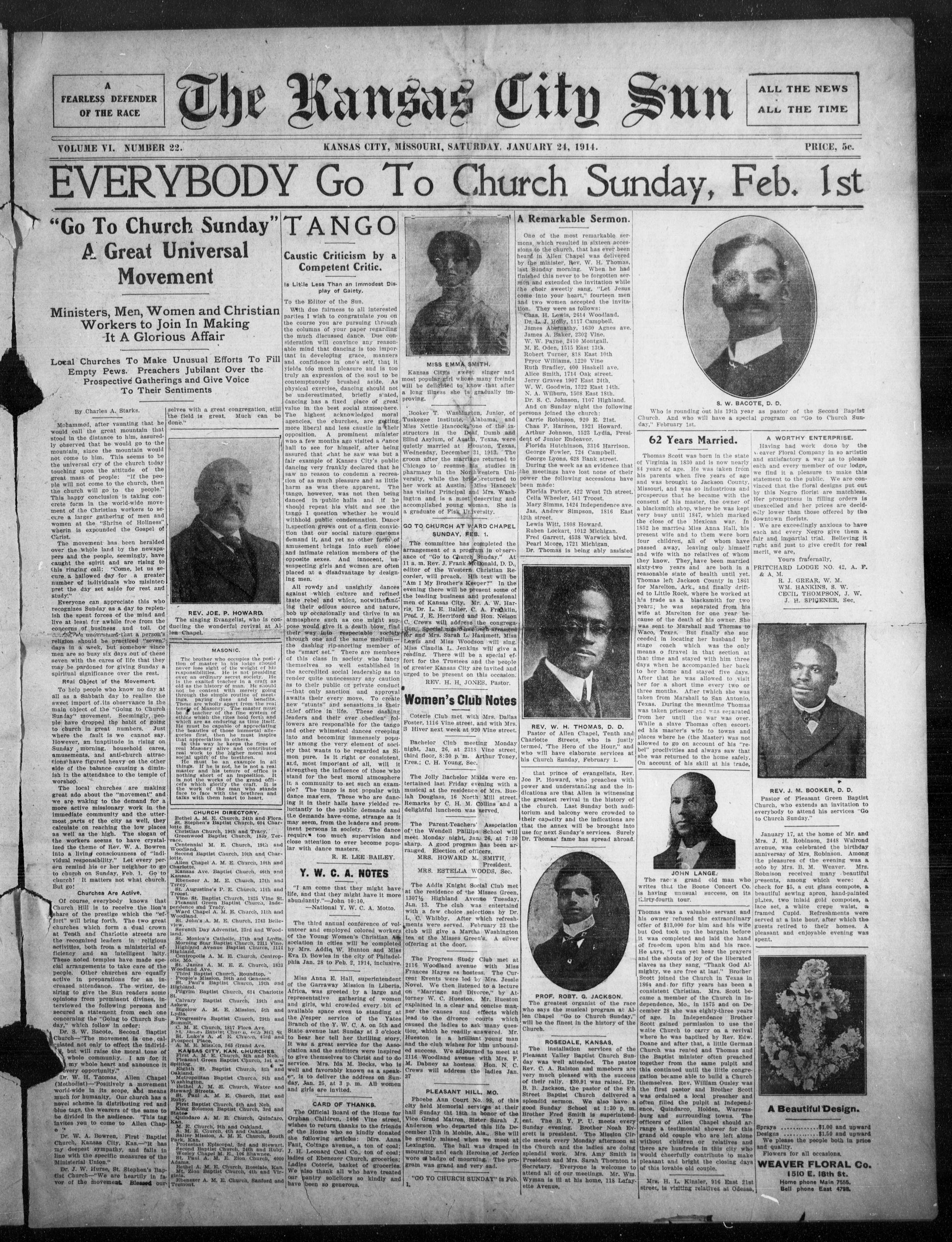
EVERYBODY Go To Church Sunday, Feb. 1st
"Go To Church Sunday" A Great Universal Movement
Ministers, Men, Women and Christian Workers to Join In Making It A Glorious Affair
Local Churches To Make Unusual Efforts To Fill Empty Pews. Preachers Jubilant Over the Prospective Gatherings and Give Voice To Their Sentiments
A FEARLESS DEFENDER OF THE RACE
VOLUME VI. NUMBER 22.
EVERY
"Go To Church
A Great Un
Movem
Ministers, Men, Women
Workers to Join
It A Glorious
Local Churches To Make Un
Empty Pews. Preachers
Prospective Gatherings
To Their Sent
By Charles A. Starks.
Mohammed, after vaunting that he would call the great mountain that stood in the distance to him, assuredly observed that he would go to the mountain, since the mountain would not come to him. This seems to be the universal cry of the church today touching upon the attitude of the great mass of people: "If the people will not come to the church, then the church will go to the people." This happy conclusion is taking concrete form in the world-wide movement of the Christian workers to secure a larger gathering of men and women at the "Shrine of Holiness" wherin is expounded the Gospel of Christ.
The movement has been heralded over the whole land by the newspapers and the people, seemingly, have caught the spirit and are rising to this ringing call: "Come, let us secure a hallowed day for a greater number of individuals who misinterpret the day set aside for rest and study."
Everyone can appreciate this who recognizes Sunday as a day to replenish the spent time of the mind and live at least for awhile free from the concerns of business and toll. Of course we understand that a person's religion should be practiced "seven" days in a week, but somehow since men are so busy six days out of these seven with the cares of life that they may be pardoned for giving Sunday a spiritual significance over the rest.
Real Object of the Movement.
To help people who know no day at all as a Sabbath day to realize the sweet import of its observance is the main object of the "Going to Church Sunday" movement. Seemingly, people have dropped the habit of going to church in great numbers. Just where the fault is we cannot say. However, an inapitude in rising on Sunday morning, household cares, amusements, and anti-church attractions have figured heavy on the other side of the balance causing a diminish in the attendance to the temple of worship.
The local churches are making great ado about the "movement" and we are waking to the demand for a more active missionary work in the immediate community and the uttermost parts of the city as well, they calculate on reaching the low places as well as the high. The slogan of the workers seems to have crystalized the theme of Rev. W. A. Bowren into a living consciousness of "individual responsibility." Let every person remind his or her neighbor to go to church on Sunday, Feb. 1. Go to church! It matters not what church. But go!
Churches Are Active.
Of course, everybody knows that Church Hill is to receive the lion's share of the prestige which the "effort" will bring forth. The two great churches which form a dual crown at Tenth and Charlotte streets are the recognized leaders in religious activities, both from a ministerial efficiency and an intelligent laity. These noted temples have made special arrangements to take care of the people. Other churches are equally active in preparations for an increased attendance. The writer, desiring to give the Sun readers some opinions from prominent divines, interviewed the following persons and secured a statement from each one concerning the "Going to Church Sunday," which follow in order:
Dr. S. W. Bacote, Second Baptist Church—"The movement is one calculated not only to effect the individ- but will raise the moral tone of whole community. I am for it my whole heart and announce it every opportunity."
Dr. W. H. Taomas, Allen Chapel (Methodist)—Positively a movement world-wide in its scope, and means much for humanity. Our church has a novel scheme in distributing red and blue tags, the wearers of the same to be divided in the audience. This tag invites you to come to Allen Chapel.
Dr. W. A. Bowren, First Baptist Church, Kansas City, Kas—"It has my deepest sympathy, and falls in line with the specific measures of the Ministerial Union."
Dr. J. W. Hurse, St. Stephen's Baptist Church—"We are heartily in favor of the movement. Blessed our-
The Kansas City Sun
selves with a great congregation, still the field is great. Much can be done."
REV. JOE. P. HOWARD.
The singing Evangelist, who is conducting the wonderful revival at Allen Chapel.
MASONIC.
The brother who occupies the position of master in his lodge should never lose sight of the weight of his hands over an ordinary secret society. He is the exalted teacher in a craft or old as the history of man. He should never pass through the simple routine of meetings, paying dues and benefits, these to the master apart from the master of Masory. The master must be a teacher of the fine system of ethics which the rites hold forth and which are as enduring as time itself. The beauties of those immortal allegories first, then he must inspire the souls. In this way he keeps the fires of real Masory alive and contributes real work to the higher moral and spiritual temples. He must be an example in all things. If he is not, he is not a real Masory. He must be a temple of nothing short of imposition. It is not the works of the grand officers which glorify the craft. It is not the works of the stands face to face with the brethren and talks with them heart to heart.
CHURCH DIRECTORY.
Bethel A. M. E. Church 24th and Flora
Bethlehem Baptist Church 604 Charlote
lottie St.
Christian Church, 19th and Tracy.
Greenwood Baptist Church, 1839 Terrace.
Centennial M. E. Church, 19th and Woodland.
Second Baptist Church, 19th and Charlotte.
Allen Chapel A. M. E. Church, 10th and Greenwood.
Kansas Ave. Baptist Church, 46th and Kansas.
Ebenezer A. M. E. Church, 17th and Tracy.
St. Augustine's P. E. Church, 11th and Tracy.
Wine. St. Baptist Church, 1823 Vine St. Pleasant Green Baptist Church, Independence and Tracy.
Ward Chapel A. M. E. Church, 11th and St. John's A. M. E. Church, 1743 Belevue.
Seventh Day Adventist, 23rd and Woodland.
St. Monica's Catholic, 17th and Lydia. Morning Star Baptist Church, 2511 Vine. Higgins Avenue Baptist Church, 1141 Highland.
Centropolis A. M. E. Church, Centropolis.
St. James A. M. E. Z. Church, 1839 Third Baptist Church, Roundtop. People's Mission, 20th and Genesee. Paul's Baptist Church, 19th and Highland.
Pligrim Baptist Church, 614 Charlotte St.
Calvary Baptist Church, 19th and Askew.
Bigelow A. M. E. Mission, 5th and Lydia. Progressive Baptist Church, 29th and Summit.
C. M. E. Church, 1817 Flora Ave.
Brownboro Church, 4131 St. Luke's A. M. E. Church, 43rd and Prospect Place.
A. M. E. MISSION, 669 Grand Ave.
KANSAS CITY, KAN. CHURCHES.
Baptist Church, 8th and Neb.
Pleasant Green Baptist Church, 1st and
Splitton.
Eighth St. Baptist Church, 8th and
Glenwood.
Metropolitan Baptist Church, 9th and
Washington.
Bethel A. M. E. Church, Water and
Seward Streets.
St. Paul A. M. E. Church, 21st and
Ruby.
First Baptist Church, 5th and Neb.
King Solomon Baptist Church, 3rd and
Staples.
Quindarco A. M. E. Church, Quincar, Kan.
1 Protestant Episcopal, 3rd and Stewart
2 Second Baptist Church, 36th and Ruby
3 Second Church M. E, 106 Shawney
4 St. Paul A. M. E. Zion Church, 4000
Amboy
5 Bethel A. M. E. Church, Rosalie, Kana
6 M. Zion Baptist Church, 4th and Virg
Pebnser A. M. E. Church, Sanford and
Premont.
KANSAS CITY, MISSOURI, SATURDAY, JANUARY 24, 1914.
Caustic Criticism by a Competent Critic.
Is Little Less Than an Immodest Dis
play of Gaiety.
To the Editor of the Sun.
With due fairness to all interested parties I wish to congratulate you on the course you are pursuing through the columns of your paper regarding the much discussed dance. Due consideration will convince any reasonable mind that dancing is too important in developing grace, manners and confidence in one's self, that it yields too much pleasure and is too truly an expression of the soul to be contemptuously brushed aside. As physical exercise, dancing should not be underestimated, briefly sated, dancing has a fixed place of great value in the best social atmosphere. The highest acknowledged moral agencies, the churches, are getting more liberal and less casual in their opposition. A prominent minister who a few months ago visited a dance hall to see for himself, after being assured that what he saw was but a fair example of Kansas City's public dancing very frankly declared that he saw no reason to condemn a recreation of as much pleasure and as little harm as was there apparent. The tango, however, was not then being danced in public halls and if he should repeat his visit and see the tango I question whether he would withhold public condemnation. Dance h.spection grows out of a firm conviction that our social nature customs demand it, and yet no other form of amusement brings into such close and intimate relation members of the opposite sexes. And innocent, unsuspecting girls and women are often placed at a disadvantage by designing men.
All rowdy and unisightly dances against which culture and refined taste rebel and whiten, notwithstanding their odious source and nature, bob up occasionally and thrive in an atmosphere such as one might suppose would give it a death blow, find their way into respectable society through one and the same medium—the dashing rip-snorting member of the "smart set." There are members of this class in society who fancy themselves so well established in the accredited social leadership as to render quite unnecessary any caution as to their public or private conduct—that only sanction and approval awaits their every move. To create new "stunts" and sensations is their chief office in life. These dashing leaders and their ever obedient followers are responsible for the tango and other whimsical dances creeping into and becoming immensely popular among the very element of society that wants to be regarded as Silmon pure. Is it right or consistent, ard, most important of all, will it strengthen the influence of those who stand for the best moral atmosphere it a community to set such an example? The tango is not popular with dance masters. Those who are dancing it in their halls have yielded reluctantly to the public demands and the demands have come, strange as it may seem, from the leaders and prominent persons in society. The dance require too much supervision and close attention to ever become popular with dance masters.
R. E. LEE BAILEY.
Y. W. C. A. NOTES
"I am come that they might have life, and that they might have it more abundantly."—John 10:10.
—National Y. W. C. A. Motto.
The third annual conference of volunteer and employed colored workers of the Young Women's Christian Association in cities will be completed by Mrs. Addie L. W. Hunton and Miss Eva D. Bowles in the city of Philadelphia Jan. 28 to Feb. 2, 1914, inclusive.
Miss Anna E. Hall, superintendent of the Garraway Mission in Liberia, Africa, was greeted by a large and representative gathering of women and girls, whil crowded every bit of available space even to standing at the Nesper service of the Yates Branch of the Y. W. C. A. on 5th and State avenue last Sunday at 3 o'clock to hear her tell her thrilling story. It was a great service for the Association and the auditors were inspired to give themselves to Christ and to do service. Mrs. Ida M. Becks, who is well and favorably known as a speaker, is to deliver the address on Sunday, Jan. 25, at 3 p. m. All women and girls are invited.
CARD OF THANKS
The Official Board of the Home for Orphan Children, 1406 Vine street, wishes to return thanks to the friends of the Home who so kindly donated the following articles: Mrs. Anna Fant, Cottage avenue, a ton of coal; J. H. Leonard Coal Co, ton of coal; ladies of Ebenezer Church, groceries; Ladies Coterie, basket of groceries. We also thank all who have treated our pantry solicitors so kindly and have been so generous.
MISS EMMA SMITH.
Kansas City's sweet singer and most popular girl whose many friends will be delighted to know that after a long illness she is gradually improving.
Booker T. Washington, Junior, of Tuskegee Institute, Alabama, and Miss Nettie Hancock, one of the instructors in the Deaf, Dumb and Blind Asylum, of Austin, Texas, were quietly married at Houston, Texas, Wednesday, December 31, 1913. The groom after the marriage returned to Chicago to resume his studies in pharmacy in the Northwestern University, while the bride returned to her work at Austin. Miss Hancock has visited Principal and Mrs. Washington and is a most deserving and accomplished young woman. She is a graduate of Fisk University.
GO TO CHURCH AT WARD CHAPEL
SUNDAY, FEB. 1.
The committee has completed the arrangement of a program in observance of "Go to Church Sunday." At 11 a. m. Rev J. Frank McDonald, D. D., editor of the Western Christian Recorder, will preach. His text will be "Am I My Brother's Keeper?" In the evening there will be present some of the leading business and professional men of Kansas City. Mr. A. W. Harris, Dr. L. E. Bailer, C. A. Franklin, Prof J. E. Herriford and Hon. Nelson C. Crews will address the congregation. Special music may be arranged for and Mrs. Sarah L. Hammett, Miss Lewis and Miss Woodson will sing. Miss Claudia L. Jenkins will give a reading. There will be a special effort for the Trustees and the people of greater Kansas City are invited and urged to be present on this occasion.
REV H. H. JONES, Pastor
Women's Club Notes
Coterie Club met with Mrs. Dallas Foster, 1116 Vine street, and with Mrs. S Hiver next week at 920 Vine street.
Bachelor Club meeting Monday night, Jan. 26, at 2318 Vine street, third floor, 8:30 p. m. Arthur Toney, Fres.; C. H. Young, Sec.
The Jolly Bachelor Malds were entertained last Friday evening with a musical at the residence of Mrs. Bueleah Doughlass, 16 North Mill street. Remarks by C. H. M. Collins and a delightful luncheon was served.
The Parent-Teachers' Association of the Wendell Phillips School will meet Monday night, Jan. 26, at 7:30 sharp. A good program has been arranged. Election of officers.
MRS. HOWARD M. SMITH, President
The Addis Knight Social Club met at the residence of the Misses Green, 1307th Highland Avenue Tuesday, Jnm. 13. The club was entertained with a few choice selections by Dr. L. C. Whibbly. After which refreshments were served. February 23 the club will give a Martha Washington tea at the Misses Green's. A silver offering at the door.
The Progress Study Club met at 2116 Woodland avenue with Miss Frances Hayes as hostess. The Current Events were led by Mrs. Jessie Novel. We then listened to a lecture on "Marriage and Divorce." by Attorney W. C. Hueston. Mr. Hueston explained in a clear and concise manner the causes and effects which lead to the divorce courts which caused the ladies to ask many question, which he readily answered. Mr. Hueston is a brilliant young man and the club wishes for him unbounded success. We adjourned to meet at 2116 Woodland avenue with Mrs. P. M. Dabney as hostess. Horn. N. C. Crews will address the ladies Jan. 27
PLEASANT HILL, MO
Phoebe Ann Court No. 98, of this city held Memorial services at their hall Sunday the 18th in honor of the Vice Grand Matron, Sister Sarah J. Anderson who departed this life December 17th in Mobile, Ala. She will be greatly missed when we meet at Lexington. The hall was draped in mourning and each Heroine of Jerice wore a badge of mourning. The program was grand and very sad.
"GO TO CHURCH SUNDAY" is Feb. 1.
A Remarkable Sermon.
One of the most remarkable sermons, which resulted in sixteen accessions to the church, that has ever been heard in Allen Chapel was delivered by the minister, Rev. W. H. Thomas, last Sunday morning. When he had finished this never to be forgotten sermon and extended the invitation while the choir sweetly sang, "Let Jesus come into your heart," fourteen men and two women accepted the invitation. They were as follows:
Chaas H. Lewis, 2614 Woodland.
Dr. L. J. Holly, 1117 Campbell.
James Abernathy, 1630 Agnes ave.
James A. Baker, 2202 Vine.
W. W. Payne, 2410 Montgall.
M. E. Oden, 1515 East 13th.
Robert Turner, 818 East 10th
Pryor Williams, 1220 Vine
Ruth Bradley, 400 Haskell ave.
Alice Smith, 1714 Oak street.
Jerry Graves 1907 East 24th.
W. W. Goodwin, 1322 East 14th.
N. A. Wilburn, 1508 East 18th.
Dr. S. C. Johnson, 1107 Highland.
And on Sunday night the following persons joined the church:
Carrie Robinson, 920 E. 21st.
Chas F. Harmon, 1921 Howard.
Arthur Johnson, 1523 Lydia, President of Junior Endeavor.
During the week as an evidence that the meetings have lost none of their power the following accessions have been made:
Florida Parker, 422 West 7th street,
Cella Wheeler, 541 Troost.
Mary Simms, 1424 Independence ave.
Jas, Andrew Simpson, 1816 East 12th street.
Lewis Witt, 1808 Howard.
Ruben Lockart, 1012 Michigan.
Fred Garrett, 4538 Warwick blvd.
Pearl Moore, 1721 Michigan.
Dr. Thomas is being ably assisted
REV. W. H. THOMAS, D. D. Pastor of Allen Chapel, Tenth and Charlotte Streets, who is justly termed, "The Hero of the Hour," and who will have elaborate services at his Church Sunday, February 1.
that prince of evangelists, Rev. Joe P. Howard, who preaches with power and understanding and the indications are that Allen is witnessing the greatest revival in the history of the church. Last Sunday both auditorium and balcony were crowded to their capacity and the indications are that the annex will be brought into use for next Sunday's services. Surely Dr. Thomas' fame has spread abroad.
PROF. ROBT. G. JACKSON.
The greatest organist of the race who says the musical program at Allen Chapel "Go to Church Sunday," will be the finest in the history of the Church.
ROSEDALE, KANSAS
ROSEDALE, KANSAS.
The installation services of the Pleasant Valley Baptist Church day was well attended. The pastor Rev. C. A. Ralston and mmebers are very much pleased with the success of their rally, $30,91 was raised. Dr. B. B. Jackson, the pastor of the 8th Street Baptist Church delivered a splendid sermon. We also have a good Sunday School at 1:30 p. m. Brother Fred Smith is superintendent. The B. Y. P. P. meets every Sunday evening. Brother Noah Everett is president. The Mission Circle meets every Monday afternoon at the Church and the ladies are doing splendid work. Mrs. Amy Smith is President and Mrs. Sarah Thornton is Secretary. Everyone is welcome to attend all of our meetings. Mr. Wm Wyman is ill at his home, 118 Lafayette Avenue.
S. W. BACOTE, D. D.
Who is rounding out his 19th year as pastor of the Second Baptist Church. And who will have a special program on "Go to Church Sunday," February 1st.
62 Years Married.
Thomas Scott was born in the state of Virginia in 1830 and is now nearly 84 years of age. He was taken from his parents when five years of age and was brought to Jackson County, Missouri, and was so industrious and prosperous that he became with the consent of his master, the owner of a blacksmith shop, where he was kept very busy until 1847, which marked the close of the Mexican war. In 1852 he married Miss Anna Hall, his present wife and to them were born four children, all of whom have passed away, leaving only himself and wife with no relatives of whom they know. They have been married sixty-two years and are both in a reasonable state of health until yet. Thomas left Jackson County in 1861 for Marelton, Ark., and finally drifted to Little Rock, where he worked at his trade as a blacksmith for two years; he was separated from his wife at Marelton for one year because of the death of his owner. She was sent to Marshall and Thomas to Waco, Texas. But finally she succeeded in locating her husband by stage coach which was the only means o f travel in that section at that time and stayed with him three days when he accompanied his back to her home and stayed five days. After that he was allowed to visit her for a short time every two or three months. After twich when she was taken from Marshall to San Antonio, Texas. During the meantime Thomas was taken prisoner and was separated from her until the war was over. While a slave Thomas often escorted his master's wife to towns and places where he (the Master) was not allowed to go on account of his "rebel" proclivities and always saw that she was returned to the home safely. On account of his skill at his trade,
JOHN LANGE.
The race's grand old man who writes that the Boone Concert Co. is having unusual success, on its thirty-fourth tour.
Thomas was a valuable servant and his owner refused the extraordinary offer of $13,000 for him and his wife but God took up the bargain before it was completed and laid the hand of freedom upon him and his race. He says, "I can yet hear the prayers and the shouts of joy of the liberated slaves as they sang, "Thank God Almighty, we are free at last." Brother Scott joined the Church in Texas in 1864 and for fifty years has been a consistent Christian. Mrs. Scott became a member of the Church in Independence, Mo., in 1875 and on December 28 she was eighty-three years of age. In Independence Brother Scott gained permission to use the white Church to carry on a revival where he was baptized by Rev. Edw. Doane and after that, a little German Church was rented and Thomas and the Baptist minister often preached together from the same pulpit and this continued until the little congregation became able to build a Church themselves. Rev. William Ousley was the first pastor and Brother Scott was ordained a local preacher and often filled the pulpit at Independence, Quindarco, Holden, Warrensburg and surrounding towns. The officers of Allen Chapel should arrange a testimonial shower for this grand old couple who are left alone without children or relatives and there are hundreds in this city who would cheerfully contribute to make pleasant and bright the closing days of this lovable old couple.
Mrs. H. L. Kliner, 916 East 21st
street, is visiting relatives at Odessa.
ALL THE NEWS
ALL THE TIME
eb. 1st
NOTE, D. D.
or as pastor of the Second Baptist
al program on "Go to Church Sun-
A WORTHY ENTERPRISE.
Having had work done by the
Weaver Floral Company in so artistic
and satisfactory a way as to please
each and every member of our lodge,
we find it a pleasure to make this
statement to the public. We are con-
vinced that the floral designs put out
by this Negro florist are matchless.
Her promptness in filling orders is
unexcelled and her prices are decid-
ely lower than those offered by the
downtown florists.
We are exceedingly anxious to have
each and every Negro give them a
fair and impartial trial. Believing it
right and just to give credit for real
merit, we are.
Yours fraternally,
PRITCHARD LODGE NO. 42, A. F.
& A. M.
R. J. GREAR, W. M.
WM. HANKINS, S. W.
CECIL THOMPSON, J. W.
J. H. SPIGENER, Sec.
REV. J. M. BOOKER, D. D.
Pastor of Pleasant Green Baptist
Church, who extends an invitation to
everybody to attend his services "Go
to Church Sunday."
January 17, at the home of Mr. and Mrs. J. H. Robinson, 2448 Walrond avenue, was celebrated the birthday anniversary of Mrs. Robinson. Among the pleasures of the evening was a solo by Mrs. B. M. Weaver. Mrs. Robinson received many beautiful presents, among which were: A check for $5, a cut glass compote, a beautiful sewing apron, hand-painted plates, two inlaid gold compotes, a lace set, a white crepe waist, a framed Cupid. Refreshments were served at a late hour, after which the guests retired to their homes. A pleasant and enjoyable evening was spent.
A Beautiful Design.
Sprays ..... $1.00 and upward
Designs ..... $1.50 and upward
We please the people both in price
and quality.
Flowers for all occasions.
WEAVER FLORAL Co.
1510 E. 18th St.
Home phone Main 7555.
Bell phone East 4798.
---
PRICE, 5c.
TOOKINIG F2C=./ NWA D'
ST ets 1
apa oye Oh.
ct NaS > aie
er vi: ae Ye
poi . Wa aa
Cae alg | aby pale Heo est
royp> ¢ MRTG
ee ee
Lake | pean Wer Geo
ow Mp th We# Ny rk i.
Se AU WW Milby
eo ys cae BO ah nap Be da
a
Ra eae
ee ee 2
ee Oe 4 mg. oe,
oy eee
—— se ae
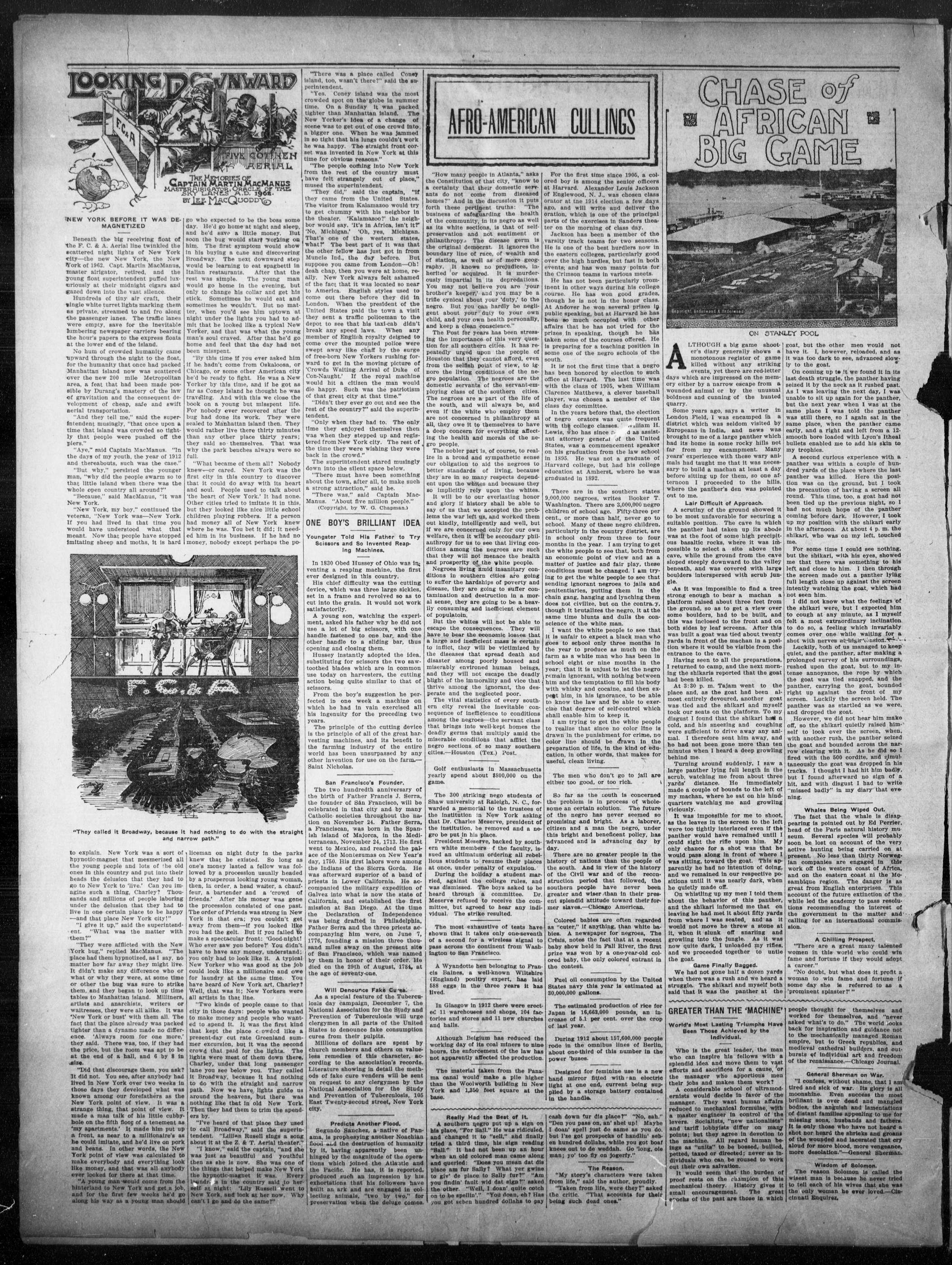
“They called It Broadway, because It had nothing to do with the straight
‘and narrow path.”
WNEW YORK BEFORE IT WAS DE
MAGNETIZED
Beneath the big receiving float of
‘the F, C. & A. Aerial line twinkled the
scattered night lights of New York
city—the new New York, the New
Work of 1962. Capt. Martin MacManus,
‘Master airigator, retired, and the
Young float superintendent puffed 1ux-
‘riously at thelr midnight cigars and
‘fazed down into the vast silence.
Hundreds of tiny air craft, their
‘single white turret lights marking them
‘88 private, streamed to and fro along
‘the passenger lanes. The traffic lanes
were empty, save for the Inevitable
Jumbering newspaper carriers bearing
‘the hour's papers to the express floats
at the lower end of the island.
No hum of crowded humanity came
‘upward through the night to the float,
for the humanity that once had packed
Manhattan {sland now was scattered
‘over the new 200 mile Metropolitan
area, a feat that had been made pos-
sible by Durang’s mastery of the law
‘of gravitation and the consequent de-
‘Yelopment of cheap, safe and swift
aerial transportation.
“And they tell me,” sald the super
intendent musingly, “that once upon a
time that island was crowded so tight-
ly that people were pushed off the
piers.”
“Aye,” said Captain MacManus, “In
the days of my youth, the year of 1912
and thereabouts, such was the case.”
“But why,” persisted the younger
man, “why did the people swarm so to
that little island when there was the
whole open country all around?”
“Because,” said MacManus, “it was
New York.
“New York, my boy,” continued the
veteran, "New York was—New York.
If you had Myed in that time you
would have understood what that
meant. Now that people have stopped
{mitating sheep and moths, {t is hard
to explain. New York was a sort of
hpynotic-magnet that mesmerized all
the young people and lots of the old
ones in this eountry and put into their
heads the delusion that they had to
fo to New York to ‘ive’ Can you im.
gine such a thing, Charley? ‘Thou-
bands and millions of people laboring
ander the datusien thas thay bad @
live in one certain place to be happy
mand that place New York city!”
“I give it up,” said the superintend-
ent, “What was the matter with
them?”
“They were afflicted with the New
‘York bug,” replied MacManus, “The
Place had them hypnotized, asI say, no
matter how far away they might live.
Ty alia’ woke wer dldtergung win go
what or why they were, at some time
or other the bug was sure to strike
them, and they began to look up time
tables to Manhattan ‘sland. Milliners,
artists and anarchists, writers or
‘waitresses, they were all alike. It was
‘New York or bust’ with them all. The
fact that the place already was packed
tighter than a dynamo made no differ-
ence, ‘Always room for one more,’
‘they sald. There was, too, if they had
‘the price, but the room was apt to be
at the end of @ hall, and 6 by 8 in
aise,
“Did that alscourage them, you ask?
‘It did not. You see, after anybody had
lived In New York over two weeke in
‘those days they developed what was
known among our forefathers as the
‘New York point of view. It was a
‘strange thing, that point of view. It
‘made a man talk of his little cubby:
‘rs ipeastnelay “it ode hi pas
‘my apartments,’ je him put up
‘Se coula imitate, and hea live on ork
Te could eo
and ean ier ordn te Se
‘Tor ‘point of view was la to
peass-srertbeay, aad. everything. look
0 who expected to be the boss some
day, He'd go home at night and sleep,
and he'd save a little money. But
soon the bug would start yorxing on
him. ‘The first symptom would show
in his buying ® cane and discovering
Broadway, The next downward step
would be learning to eat spaghett! in
Italian restaurants, After that the
rest was simple. ‘The young man
would go home in the evening, but
only to change his collar and get his
stick. Sometimes he would eat and
sometimes he wouldn't, But no mat-
ter, when you'd see him uptown at
night under the lights you had to ad:
mit that he looked like a typical New
Yorker, and that was what the young
man's soul craved. After that he'd go
home and feel that the day had not
been misspent.
“By this time if you ever asked him
if he hadn't come from Oskaloosa, or
Chicago, or some other American city
he'd be ready to fight, He was a New
Yorker by this time, and if he got as
far as Coney Island he thought he was
traveling. And with this we close the
book on a young but misspent life.
For nobody ever recovered after the
bug had done its work. They were
sealed to Manhattan island then. They
would rather live there thirty minutes
than any other place thirty years;
they sald so themselves. That was
why the park benches always were so
full.
“What became of them all? Nobody
kmew—or cared. New York was the
first city in this country to discover
that It could do away with its heart
and soul. People used to talk about
‘the heart of New York.' It had none.
Other cities tried to imitate it in this,
but they looked Ike nice little school
children playing robbers. If a person
had money all of New York knew
where he was. You bet it did; it need-
ed him in its business. If he had no
money, nobody except perhaps the po-
iceman on night duty in the parks
knew that he existed. So long as
one’s money lasted a fellow was fol-
lowed by a procession usually headed
by @ prosperous looking young woman,
then, in order, a head waiter, a chauf-
feur, a bartender and a ‘crowd of
friends’ After his money was gone
the procession consisted of one past.
The order of Friends was strong in New
York in that era; you couldn't get
away from them—If you looked like
you bad the gelt. But if you failed to
make @ spectacular front: ‘Good-night!
Who ever saw you before?’ You didn’t
have to have any money, understand;
you only bad to look like it, A typical
New Yorker who was good at the job
could look Ike a millionaire and owe
for laundry at the same time, You
have heard of New York art, Charley?
‘Well, that was it; New Yorkers were
all artists in that line.
“Two kinds of people came to that
city in those days: people who wanted
to make money and people who want-
ed to spend ft. It was the first kind
that kept the place c/owdod like @
present-day cut rate Greenland sum-
mer excursion, but It was the second
crowd that paid for the lights. The
lights were mest of them down there,
Charley, under that long passenger
lane you see below you. They called
X Broadway, because it had nothing
to do with ‘the straight and narrow
path. Now we have, lights guide us
around the heavens, but there was
nothing Wke that in'old New York.
‘Then they Nad them to rim the apeud
ers by.
"I've heard of that’ place they used
to call Broadway,” sald the superin-
fendent, "Lilian Rusell sings a song
Lrg heKored Bepieesin ote
“T know," eald the captain, “and
was Just as beautiful and’ youthful
dhen as eho Js now. She was ono of
the things that balped make Now ¥rl
the hypmaticmagnet ft was. Hyver
[isandr: in the country uaid to her
Pag Te Pie
the BrP dea
. “There was a place called Coney
‘sland, too, wasn't there?” ratd the a
perintendent,
"Yes. Coney island was thé most
‘crowded spot on the’globe in summer
‘time, On a Sunday tt was packed
‘tighter than Manhattan island, The
New Yorker's idea of a change
scene was to get out of one crowd tnto.
‘a bigger one. When he was jammed
in so tight that his lungs couldn't work
he was happy. ‘The straight front cor
set was invented in Now York at this
time for obvious rensons.”
“The people cothing into New York
from the rest of the country must
have felt strangely out of place,”
mused the superintendent.
“They did,” sald the enptain, “If
they came from the United States.
‘The visitor from Kalamazoo would try
to get chummy with his neighbor in
the theater. ‘Kalamazoo? the nolgh-
bor wonld say, ‘It's in Africa, isn't tt?”
‘No, Michigan.’ ‘Oh, yes, Michigan.
‘That's one of the western states,
what? ‘The best part of it was that
the other fellow has just got in from
Muncie Ind, the duy before. But
Suppose you came from London—Oh!
deah chap, then you were at home, re-
ally. New York always felt ashamed
of the fact that it was located x0 near
to America, English styles used to
come out there before they did in
London. When the president of the
United States paid the town a visit
they sent a traffic policeman to the
depot to seo that his taxicab didn't
break any speed Jaws. When any
‘member of Englinh royalty delgned to
come over the mounted police were
swept away like chaff by the surge
of free-born New Yorkers rushing for-
ward to get In the moving picture of
‘Crowds Waiting Arrival of Duke ot
Con-Naught’ If the royal machine
would hit @ cltizen the man would
die happy. Such was the patriotism
of that great city at that time.”
“Didn't they ever go out and see the
rest of the country?” sald the superin-
tendent.
“Only when they had to. The only
time they enjoyed themselves then
was when they stepped up and regis-
tered from New York city, The rest of
the time they were wishing they were
back in the crowd.”
‘The superintendent stared musingly
down into the silent space below.
“There must have been something
about the town, after all, to make such
a strong attraction,” sald he.
“There was,” said Captain Mac-
Manus. “About five million people.”
(Copyright, by W. G. Chapman.)
ONE BOY’S BRILLIANT IDEA
Youngster Told His Father to Try
Scissors and So Invented Reap-
Ing Machines,
In 1830 Obed Hussey of Ohio was in;
venting a reaping machine, the first
ever designed in this country.
His chiet dimculty was the cutting
device, which was three largo sickles,
set in a frame and revolyed s0 as to
| cut into the grain. It would not work
satisfactorily,
pei aes noe eieaae era
ment, asked his father why he did not
use a lot of big scissors, with one
handle fastened to one bar, and the
other handle to a sliding bar, thus
opening and closing them.
Hussey instantly adopted the idea,
‘substituting for scissors the two saw-
toothed blades which are in common
use today on harvesters, the cutting
action being quite similar to that of
selssors,
From the boy's suggestion he per-
fected Ip one week a machine on
which he had in yain exercised all
his ingenuity for the preceding two
years.
The principle of the cutting device
{is the principle of all of the great har.
vesting machines, and its benefit to
the farming industry of the entire
world has been unsurpassed by any
other invention for use on the farm—
Saint Nicholas.
Gun Mrkaatiedts imate:
The two hundredth anniversary of
the birth of Father Francis J. Serra,
the founder of San Francisco, will be
celebrated In that city and by many
Catholic: societies throughout the na-
tion on November 24. Father Serra,
a Franciscan, was born in the Span-
ish island of Majorca, in the Medi-
terranean, November 24, 1713, He first
went to Mexico, and reached the pak
ace of the Montezumas on New Year's
day, 1750. His first labors were among
the Indians of the Siorra Gorda, He
was afterward superior of a band of
priests in Lower California. He ac-
companied the military expedition of
Galvez into what is now the state of
California, and established the: first
mission at San Diego, At the time
the Declaration of Independence
was being drafted in Philadelphia,
Father Serra and the three priests ac-
companying him were, on June 7,
1776, founding a mission three thou-
sand miles away on the present site
of San Francisco, which was named
by them in honor of their order. He
died on the 29th of August, 1784, at
the age of seventy-one,
‘Will Denounce Fake Cuca:
As a special feature of the Tubercu-
losis day campaign, December 7, the
National Association for the Study and
Prevention of Tuberculosis will urge
clergymen in all parts of the United
States to denounce fake consumption
cures from their pulpits,
Millions of dollars are spent by
chureh members and others on value-
less remedies of this character, ac-
cording to the association's records,
Literature showing in detail the meth-
ods of fake cure venders will be sent
on request to any clergymen by the
National Association for the Study
and Prevention of Tuberculosis, 105
East Twenty-second street, New York
city.
Predicts Another Flood.
Segundo Sanchez, a native of Pan-
ama, Js prophesying another Noachian
food aid the destruction of humanity
by it, having apparently been un-
hinged by the magnitude of the opera
Hons which joined the Atlastic and
the Pacific, “He has, it 1s reported,
auch an impression by his
: that his followers have
an ark and are ed in col-
Jeoting ssid “iyo "for
AFRO-AMERICAN CULLINGS
“How many people in Atlanta,” asks
the Constitution of that city, “know to
8 certainty that their domestic serv-
ants do not come from diseased
homes?” And in the discussion it puts
forth these a truths: “The
business of suf ling the health
of the community, in {ts negro as well
as its white sections, is that of self:
preservation and not sentiment or
philanthropy» ‘The diseaso germ ts
the original democrat. It ignores the
boundary line of race, of wealth and
of station, as well as of mere geog:
raphy. It knows no prejudices, in-
herited ‘or acquired. It ts murder-
ously impartial in its depredations,
You may not believe you are ‘your
brother's Keeper” and you may be a
trifle cynical about your ‘duty,’ to the
negro. But you can hardly be negil-
gent about your’duty to your own
child, and your own health personally,
and keep a clean ¢onsclence.”
‘The Post for years has been stross-
ing the importance of this very ques-
tion for all southern citiés. It has re
peatedly urged upon the people of
Houston that they’ cannot afford, even
from the selfish point of view, to tx
nore the living conditions of the ne-
ro population. ‘Whe nogroes are the
domestic servants of the servant-em-
ploying class of the southern cities.
The negroes are w part of the life of
the south, and will always be, and
even If the white who employ them
are not concerned in philanthropy at
‘all, they owe It to themselves to have
@ deep concern for everything affect:
ing the health and morals of the ne
‘gro people,
‘The nobler part is, of course, to real
ize In a broad and sympathetic sense
our obligation to ald the negroes to
better standards of living, because
they are in so many respects depend
ent upon the whites and because they
80 implicitly rely upon the whites
It will be to our everlasting honor
and glory if history shall be able to
say of us that we accepted the prob
Jems the war left us, and worked them
out kindly, intelligently and well, but
Af we rs Goncgenag only tae our om
welfare, then it will be secondary pil
authropy for us to see that living con
ditions among the negroes are suck
that they will not menace the health
and prosperity of the white people.
Negroes living tmid insanitary con
ditions in southern cities are going
to suffer the hardships of poverty and
disease, they are going to suffer con:
tamination and destruction in a mor
al sense, they are going to be a heav
ily consuming and inefficient element
of populatoin,
But the whites will not be able tc
escape the consequences. They wil
have to bear the economic losses. that
a large and ineficient mass {6 certafr
to inflict, they will be victimized by
the diseases that spread death and
disaster among poorly housed and
miserably environed human beings
and they will not escape the deadly
blight of the immorality and vice tha
thrive among the ignorant, the des
erate and the neglected poor.
‘The vital statistics of every south
en city reveal the inevitable con
sequence of Ineffieience to conditions
among the negroes—the servant class
that brings into well-kept homes the
deadly germs that multiply amid the
miserable conditions that afflict the
hegro sections of so many southerr
elties.—Houston (Tex.) Post,
Golt enthusiasts in Massachusetts
yearly spend about $800,000 on the
game.
The 300 striking nego students of
‘Shaw university at Raleigh, N. C., for-
warded a memorial to the trustees of
the institution in New York asking
that Dr. Charles Meserve, president of
the institutfon, be removed and a ne-
gro be put in his place.
President Meserye, backed by south-
ern white members f the faculty, is-
sued an ultimatum ordering all rebel-
Hous students to resume their places
at once, under penalty of expulsion.
During the holiday a student mar-
ried, against the college rules, and
was dismissed. ‘The boys asked to be
heard through a committee. Dr.
Meserve refused to recelve the com-
mittee, but agreed to hear any indi-
vidual. ‘The strike resulted.
‘Tho most exhaustive of tests have
shown that {t takes only one-seventh
of a second for a wireless signal to
pass across the continent from Wash-
ington to San Francisco.
A Wyandotte hen belonging to Fran-
cis Baines, a well-known Wiltshire
(Bngland) poultry expert, has laid
688 eggs in tho three years it has
lived.
In Glasgow in 1912 there were erect
ec 11 warehouses and shops, 104 fac
tories and stores and 11 new churches
‘and balls.
Although Belgium hae reduced the
working day of its coal miners to nine
hours, the enfordement of the law has
not apparently affected the production.
‘The imaterial taken from the Pana-
ma canal would make a pile higher
than the Woolworth bullding in New
York nd 1,850 feet square at the
dase.
Really Had the Best of It.
A southern negro put up a sign on
hia place, “For Sail.” He wes ridiculed,
and changed it to “sell,” abd finally
trled a third thme, his sign reading
“Ball” It had not been up an hour
when an old colored man. came along
‘and queried: “Does you mean
placo am fur Sally? What yer gwine
to giv! de place to Sally fur?” “Am
you Mindin' fault wid dat sign?” asked
the other, “Well, I doan' quite ootch
on to be spellin’.”” "You doen, eh? Has
you got seben bundred dollahs to pay
Seed bee ie: ee Se ae
ored boy is among the senior officers
at Harvard, Alexander Louis Jackson
of Englewood, N. J., was chosen class
orator at the 1914 election a few daya
ago, and will write and deliver tho
oration, which is one of the prinetpal
parts of the exercises in Sanders thea-
ter on the morning of class day.
Jackson has beon a member of the
varsity track teams for two seasons.
He {s one of tho best hurdlers now in
the eastern colleges, particularly good
over the high hurdles, but fast in both
events; and has won many points for
the Crimson teams in various meets.
He has not been particularly prom:
inent in other ways during his college
course. He has won good grades,
though he is not in the honor class.
At Andover he won several prizes ip
public speaking, but at Harvard he has
been 80 much’ occupied with other
affairs that he has not tried for the
prizes in speaking, thoygh he his
taken some of the courses offered. He
is preparing for a teaching position in
some one of the negro schools of the
south.
It ig not the first time that a negro
has been honored by election to such
office at Harvard, ‘The last time: was
with the class of 1905, when William
Clarence Matthews, a clever baseball
player, was chosen a member of the
class day committee.
In the years before that, the election
of negro orators was quite frequent
with thf college classes. ° alias H.
Lewis, who has since td as assist
ant attorney generat of the United
States, was a commencement speaker
on his graduation from the law school
in 1895, He was not a graduate of
Harvard college, but had his college
education at Amherst, where he was
graduated in 1892.
‘There are in the southern states
9,000,000 negroes, writes Booker T.
Washington. There are 3,000,000 negro
children of school age, Fifty-three per
cent. or more than half, never go to
school. Many of these negro children,
particularly tn the country distriet, are
in school only from three to four
months in the year. Iam trying to get
the white people to see that, both from
an economfe point of view and as a
matter of justice and fair play, these
conditions must be changed. I am try-
ing to get the white people to see that
sending ignorant negroes to jails and
penitentiaries, putting them in the
chain gang, hanging and lynching them
does not civilize, but on the contra.y,
though it brutalizes the negro, it at the
same time blunts and dulis the con-
science of the white man.
T want the white people to see that
it fs unfair to expect a black man who
goes to school only three months in
the year to produce as much on the
farm as a white man who has been in
school eight or nine months in the
year; that {t 1s unjust to let the negro
remain ignorant, with nothing between
him and the temptation to fill his body
with whisky and cocaine, and then ex-
fept him, in his ignorance, to be able
to know the law and Be able to exer-
else that degree of self-control which
shall enable him to keep it.
Tam trying to get the white people
to Yealize that since no color Itne ts
drawn In the punishment for crime, no
color line should be drawn in the
preparation of life, in the kind of edu-
cation, In other words, that makes for
useful, clean living. x
‘The men who don't go to Jail are
either too good, or too rich. \
So far as the couth ts concerned
the problem is in process of whole-
some an certain solution. ‘The future
of the negro has never seemed 10
promising and bright Asa laborer,
citizen and @ man the negro, under
this bright and beneficent policy, has
advanced and is advancing day by
day.
‘There.are no greater people in the
history of nations than the people of
the south. And in view of the history
of the Civil war and of the recon-
struction period that followed, the
southern people have never "been
greater and wiser than in thelr pres-
ent splendid attitude toward thetr for
mer #laves.—Chieago American.
Colored babies are often regarded
‘as “cuter,” If anything, than white ba-
‘bies. A newspaper for negroes, The
‘Crisis, notes the fact that at a recent
baby show held in Fall River, the frst
prizo was won by @ one-yearold col
red baby, the only colored entrant in
the contest. .
Fuel off consumption by the United
States navy this year 1s estimated at
430,000,000 gallons.
‘The estimated production of ree for
Japan ia 16,662,000 pounds, an tn-
‘crease of 5.1 per cent. over the erop
‘ol laa your.
During 1912 about 157,600,000 people
rode in the omnibus lines of Berlin,
about one-third of this number in the
power ‘buses.
‘Designed for feminine use is a new
hand mirror fitted withran electric
Might at one end, current being sup-
pled by a storage battery contained
in the handle, *
cash down tur dis place?” “No, sab.”
“Den you pass on, an'shet up! Maybe
T doan’ spell just de same as you do,
‘but I'se got prospecks of handlin’ seb-
en hundred dollahs, while you got boat
Axnees out to de weddah. Go ‘long, ole
man; yo' too fly on jogerty.”
The Reason.
“My story's characters were taken
from life,” sald the author, proudly.
“Taken from life, were they?” asked
‘the critic. “That accounts for thelr
being such dead ones.” i
CHASE ov
"Bi CAME.
a
by a =
eee ie
peer ee
Se eSoft ee
ON STANLEY POOL
Guts”. RGe- La cae) Eh oe
events, yet there are red-letter
days which are impressed on the mem-
ory either by a narrow escape from &
wounded animal or by the unusual
boldness and cunning of the hunted
quarry.
Some years ago, siys a writer in
London Field, 1 was encamped in a
district which was seldom visited by
Europeans in India, and news was
brought to me of a large panther which
had its home in some rocky hills not
far from my encampment. Many
years’ experience with these wary ant
mals had taught me that it was neces-
sary to build a machan at least a day
before sitting up for them, so one at-
ternoon I proceeded to the hills,
where the panther's den was pointed
ont to me,
Lair Difficult of Approach.
A scrutiny of the ground showed It
to be most unfavorable for securing a
suitable position. The cave in which
the panther had taken up its abode
was at the foot of some high precipit-
‘ous basaltic rocks, where it was im-
possible to select a site above the
cave, while the ground from the cave
sloped steeply downward to the valley
beneath, and was covered with large
boulders interspersed with scrub jun-
gle.
sAa {t was Impossible to find a tree
strong enough to beara machan a
platform raised about three feet from
the ground, so as to get a view over
some boulders, had to be built, and
this was inclosed to the front and on
both sides by leat screens. After this
was built a goat was tied about twenty
yards in front of the machan in a post-
tion where it would be visible from the
entrance to the cave.
Having seen to all the preparations,
T returned to camp, and the next morn-
ing the shikaris reported that the goat
had been killed.
‘At 2:30 p. m. Tajam went to the
place and, as tho goat had been al-
most entirely devoured, another goat
was tied and the shikarl and myself
took our seats on the platform. ‘To my
disgust I found that the shikari haat 0
cold, and his sneezing and coughing
were sufficient to drive away any anl-
mal. I therefore sent him away, and
ho had not been gone more than ten
minutes when I heard a deep growling
behind me.
Turning around suddenly, I saw a
large panther lying full length {n the
serub, watching me from about three
yards’ distance. Ho {mmediately
made a couple of bounds to the left of
my machan, where he sat on his hind:
quarters watching me and growling
jviclously.
It was impossible for me to shoot,
‘as the leaves in the screen to the left
were too tightly interlaced even if tho
panther would have rematned until |
could sight the rifle upon him. My
only chance for a shot was that he
would pass along in front of where I
‘was sitting, toward the goat. This ap-
parently he had no intention of doing,
and we remained in our respective po-
sitions until it was nearly dark, when
he quietly made off.
‘On whistling up my men I told them
about the behavior of this panther,
and the shikari informed me that on
leaving he had met it about fifty yards
from where I was seated, and as it
would not move he threw a stone at
it, when it slunk off snarling and
growling into the jungle, As it was
now quite dark, I unloaded my rifles,
and we proceeded together to untle
the goat.
Game Finally Bagged.
‘We had not gone half a dozen yards
when there was a rush and we heard a
struggle. The shikari and myself both
said that it was the panther at the
GREATER THAN THE ‘MACHINE’
World's Most Lasting Trlumphs Have
Been Those Achieved by the
Individual.
Who Is the great leader, the man
who can inspire his fellows with a
splendid ides and move them to vast
efforts and sacrifices for @ cause, ‘or
the manager who apportions men
thelr jobs and makes them work?
‘A considerable school of ultramod-
ernists would decide in favor of the
manager, ‘They want human affairs
reduced to mechanical formulae, with
‘a master engineer in control of the
levers. Soclalists, “new nationalists”
‘and tarift lobbyists differ on many
points; but they agree In devotion to
the machine, All regard human be-
ings as ‘unite’ to be bosed, bullied,
potted, taxed or directed; never as to-
Aividuals who. can, be roused to work
‘out thet own salvation.
Tt would seem that tho burden of
proof rests on the champion of this
mechanical theory. History gives tt
small encouragement. The great
‘evvohs of the past are those In which
goat, but the other men would not
have it. 1, however, reloaded, and as
it was too dark to see, advanced slow-
ly to the goat.
On coming up te {t we found it In its
last death struggle, the panther haying
seized It by the neck as {t rushed past,
As I was leaving the next day, I was)
unable to sit up again for the panther,
but the next year when 1 was at the
same place I was told the panther
‘was still there, o I again sat in the
same place, when the panther came
early, and a right and left from a 12-
smooth bore loaded with Lyon's Itheal
bullets enabled me to add his skin to
my trophies.
‘A second curious experience with @
panther was within a couple of hun-
red yards of the place where the last
panther was killed. Here the posal
tion was on the ground, but I took
the precaution of having a screen all
round. ‘This time, too, a goat had not
been tied up the previous night, so 1
had not much hope of the panther
coming before dark. However, I took
up my position with the shikarl early
in the afternoon. At about 4 p. m. the
shikari, who was on my left, touched
me,
For some time 1 could see nothing,
but the shikarl, with his eyes, showed
me that there was something to his
left and close to him. I then through
the screen made out a panther lying
full length close up against the screen
intently watching the goat, which had
‘not seen him.
I did not know what the feelings ‘of
‘the shikarl were, but I expected him
to cough at any’ minute, as I myselt
felt a most extraordinary inclination
to do so, a feeling which invariably
comes over one while waiting for a
shot with nerves at-istgir*nston.“e-
Luckily, both of us managed to keep
quiet, and the panther, after making a
prolonged survey of his surroundings,
rushed upon the goat, but to my In-
tense annoyance, the rope by. which
the goat was tled snapped, and the
panther, carrying the goat, bounded
right up against the front of my
screen. Luckily the screen held. The
panther was as startled as we were,
and dropped the goat. ~
However, we did not hear him make
off, so the shikarl quietly raised him:
self to look over the screen, when,
with another rush, the panther seized
the goat and bounded across the mar
row clearing with It. As he did 80 1
fired with the 500 cordite, and simul
taneously the goat was dropped in his
tracks, I thought I had hit him badly,
but I found afterward no sign of a
hit, and with disgust 1 bad to write
[mised badly” In my diary that eve:
et
Whales Being Wiped Out,
‘The tact that the whale ts disap
pearing is pointed out by Ed Perrier,
head of the Paris natural history mu
seum. Several spectes will probably
soon be lost on account of the very
active hunting being carried on at
present. No less than thirty Norwes-
fan companies are engaged in thie
work off the western coast of Africa,
and on the eastern coast ni the Mo-
sambique region. The danger is as
great from English enterprises. This
‘account of the future extinction of the
while led the academy to pass resolu:
tions recommending the interest of
the government in the matter and:
calling for an international commis
sion.
A Chilling Prospect,
“There are a great many talented
women in this world who could win
fame und fortune {f they would adopt
a career."
“No doubt, but what does it profit a
woman to win fame and fortune it
some day she {6 referred to as a
‘prominent spinster?" "
RAR
‘people thought for themselves and
worked for themselves, and ‘never
asked what's to do.” ‘The world jooks
back for Inspiration and guidance not
‘to the mechantcally managed Rotian
empire, but to Greek republics, and
‘medieval cathedral bullders. and out-
arate ‘eft individual art and freedom
of the renaissance.—Chicago Journal,
General Sherman on War. |
“I confess, without shame, that 1 am
tired and sick of war. Its glory fs all
moonshine, Even suecéss the moat
brilliant Is over dead and mangled
bodies, the anguish and lamentations
of distant families appealing to'me tor
missing sons, husbands and tathérs.
It {s only those who have not heard’ s
shot nor heard the shrieks and groas
of the wounded and lacerated that ory
aloud for more blood, more vengeance,
more desolation."—General Sherman:
Wisdom of Solomon.
‘The reason Solomon 1s called tho
Sriseat man is beaause 2» scare tes
to tell each of hie wives that,
the valy women bo ever loved. che
cinnat! Enquirer, * @
A Chilling Proanect_
Wisdom of Solomon.
```markdown
```
A MEAN ADVANTAGE?
By GEORGE MUNSON
Dorothy, wearing a sweater and rubber-soled shoes, with her fair hair loosely coiled about the nape of her seek, sat in a cave upon the seashore at Blue Harbor, reading a newspaper. To be more accurate, she was reading a two-column article upon the front page of a newspaper, and it was headed "No News of Dorothy Lamont." It gave one a creepy feeling to know that one was being searched for all over the United States, that the sudden disappearance of the millionaire's daughter had aroused the interest and apprehensions of ninety millions of people, while the girl in question was resting quietly at a little, unfashionable seaside resort in Massachusetts. But Dorothy had no compunctions whatever.
"I won't marry Harold Curtis," she said, twisting herself upon her side and looking out at the leaping waves. "I don't care if father will go bankrupt unless the Lamont and Curtis interests are 'affiliated,' as he calls it. It isn't right!"
An American girl has certainly the inborn right to choose her husband. And, to be truthful, Dorothy's parents were not altogether insistent upon the marriage. But it would mean bankruptcy otherwise, for Curtis, mindful of old scores to be paid off, had been pushing Lamont hard, and now he had him at his mercy.
"If only they'd give me a chance to fall in love with Harold," sobbed Dorothy. But she had only seen him once, and she didn't even remember what he looked like, except that he was not quite a monster.
"No, he isn't a monster," Dorothy tearfully admitted. As a matter of fact, Harold Curtis had fallen desperately in love with Dorothy at first sight. But her mother was indiscreet, and the hint of a marriage had been enough to set the spoiled girl in immediate opposition. And she had taken the bit between her teeth and simply run away. She had dreamed, as all girls dream, of a possible lover. But there would
THE WATER CAVE
The Water Was Swirling About Her Knees.
be no "financial interests" or "affiliations" when the right man came along. Dorothy would marry him for love and for nothing else. She was dreaming of him now as she lay in the little cave, half asleep, until a splash and a trickle of moisture into her shoe caused her to leap up with a scream. The tide was lapping against the mouth of the cave!
She looked out in horror. Dorothy could not swim, and the freshening wind was sending huge rollers breaking into the mouth of the cave, which would, she knew, be entirely filled at high tide. Dorothy screamed again and again. She lost her presence of mind completely, for there was no refuge, and in half an hour she would be looking death in the eyes.
The minutes rolled by. Now she was crouching, pressing her hands against the roof, and the water was swirling about her knees. Suddenly a black speck appeared round the distant rocks. It was a boat. Dorothy shouted, and she saw the speck grow larger and turn inward. There was a man in it, and he was pulling hard toward her. Presently, with a few quick strokes, he sent the boat gliding against the cave.
"Jump in!" he said.
Dorothy stepped in and sank down exhausted in the bottom of the boat. Now that the danger was over she felt ready to fallm from relaxation after the nervous tension. She must have fainted, in fact, for the next thing she knew the boat had grounded and the young fisherman had lifted her in his arms and was carrying her ashore. This was a humiliating situation. Dorothy felt almost angry when he set her down and stood smiling over her from his superior height.
"That was a narrow escape you had, miss," he said, in the quaint intonation of the New England countryman. "Best not go on the rocks agen until you know this coast. You're staying at Mrs. Jones, ain't you?" "Yes," answered Dorothy resentfully. "Then I'll jest take you there," said the young fisherman.
Dorothy heard his story and duly listened to Mrs. Jones' motherly scoldings. Her spirit was chastened, and she felt thoroughly disgusted with herself. This young man apparently regarded her only as a wilful girl—her, Dorothy Lamont, who was being sought for all over the country. Worse than that, the papers, which had been filled for days with the tale of her flight, suddenly ceased to "feature" the news.
Then came a blow which fairly crushed Dorothy's spirits. It was the report of an interview with her father, and contained these words:
"I do not believe that my daughter has come to any harm, and I am sure she has gone away of her free will. I shall, therefore, make no further effort to find her. When she is ready to come home she may do so, and she
Then when the force was thoroughly conversant with the "star boarder" farms of the state and had planned an efficient campaign whose object was to eradicate the evil features of the unprofitable farm, they offered to help the general farmer re-map his system of management, his crop rotations, his methods of marketing his produce, and to adapt his line of farming to the region in which he resided.
Confidence in Organization Grows.
It was a case of "first come, first served," and after these business management doctors had cured a few severe cases of "loafer" farms and made them profitable and more productive, applications requesting aid came ir
will find me still her father. But until then I shall cease to interest myself in her whereabouts."
Dorothy read that on the beach, and she burst into bitter tears. The enormity of her behavior suddenly became clear to her. She had run away, not to avoid a marriage which was being forced upon her, but to become a popular heirine. She must write to her father and go home. But aa for Harold—never, never!
A step at her side made her look up. The young fisherman was standing by her.
"In trouble, miss?" he asked, seeing her streaming eyes.
"I don't know what to do," sobbed Dorothy. "Oh, I wish you were a woman, so that I could tell you about it. I am in such trouble. I—I—"
To her amazement the fisherman had calmly sat down at her side and taken her hand in his. Then, to her further amazement, she felt his arms about her.
"Dorothy, don't you know me?" he asked. "Don't you remember that evening at my father's house?" "Harold!" she exclaimed, staring at him in consternation. "O, what a fool I was!" Then she tore herself away and her anger began to rise swiftly. "But you—how dared you take such a mean advantage of me?" she demanded hotly. "Forgive me, Dorothy," he pleaded humbly. "I learned that you were here and telegraphed to your father yesterday. I've loved you all the time, Dorothy, and wanted you mighty bad; and now I've got you I'm going to keep you, because I saved your life and it's going to be mine." And Dorothy thought this reasonable.
(Copyright, 1914, by W. G. Chapman.)
FOODS HARMFUL TO CHILDREN
Among the Numerous Errors Made in the Nursery Indiscriminate Eating Must Be Reckoned.
"The indiscriminate eating of indigestible food, such as many adults eat, is a practice to be condemned. Fried food of any kind, with the exception of steak or chops, is harmful to the child, because the fat with which it is fried is cooked into the food and surrounds the particles of which it is made up, so that the digestive juices cannot act upon them. Most children are allowed too many sweets. Remember that, even though they are given a restricted amount of candy, cake, and desserts, they will get enough sugar in some form, in the course of a week, to supply all their needs. This restriction of sweets ought not to be a hardship if the child is fond of fruit. Instead of giving a piece of cake or candy between meals, or even for dessert, an apple, pear, or peach will please him just as well, and will be beneficial instead of harmful. For some years mothers have held the erroneous idea that raw fruits are difficult to digest. This is not true if the fruit is neither green nor over-ripe. If the child has not sufficient teeth with which to chew it the fruit should be given in mashed or scraped form so that no hard particles will be swallowed.
"Indiscriminate eating is not the only error in a child's diet. The overcareful mother occasionally goes to the other extreme in endeavoring to plan a healthful diet for her child. For instance, she does not allow anything but milk and cereals throughout the second year, for fear that solid food cannot be digested. This lack of solid food really does harm, because when the second year of life is reached the child is much more like the adult than during the first year, and food which approaches the adult diet should be begun. It is at this time that the mother most needs the diet list to guide her."—Woman's Home Companion.
Famous Library to Be Sold.
In order to straighten its financial affairs the vesty of the Marian Kirche, in Halle, has decided to sell its famous library. This library consists of 26,000 volumes and contains also the most complete collection of manuscripts in the handwriting of Martin Luther and his co-reformers. It also possesses the only original death mask of Luther. Most of the books are on theology and a few of them are said to be worth as much as $25,000. In spite of tempting offers from the outside, it has been decided to offer the entire library at a comparatively low price to the city of Halle in order to keep it, if at all possible, "at home."
Antique Watches Sell
A sale of seventeenth century watches and miniatures realized about $10,000 at Christie's, in London. Pawsey paid $525 for a miniature of a general of Cromwell's time, by S. Cooper, dated 1649, and $866 for a miniature of a gentleman, by J. Hoskins, 1769. Hohnes gave $972 for an early seventeenth century watch, by C. Peiras, with a silver dial engraved with the heads of cherubs, birds, squirrels and foliage; the watch is in a crystal case with silverglott borders.
A West Virginia schoolma'am has installed a small isolated plant in an anteroom of the schoolhouse. It is necessarily a heating plant because it is an electric "spanker." This engine delivers 5 s. b. p. s. (5 sharp blows per second). The lady engineer says that while the run is short it is long on efficiency. Central stations might adopt the "spanker," says Power, as a means of building up a day load.
Heredity and insanity.
Heredity accounts for about fifty per cent of the cases of insanity. This is encouraging. It shows that the shocks and conditions of modern life do not make people insane; the strenuous life merely brings out the insanity that is intent in some persons as a result of heredity. A noraml person cannot be driven insane by any of the conditions of modern life.
"Our boss is a crank on efficiency."
"What's he up to now?"
"Trying to teach the stenographer to chew her gum in two movements less per minute to the lower jaw."
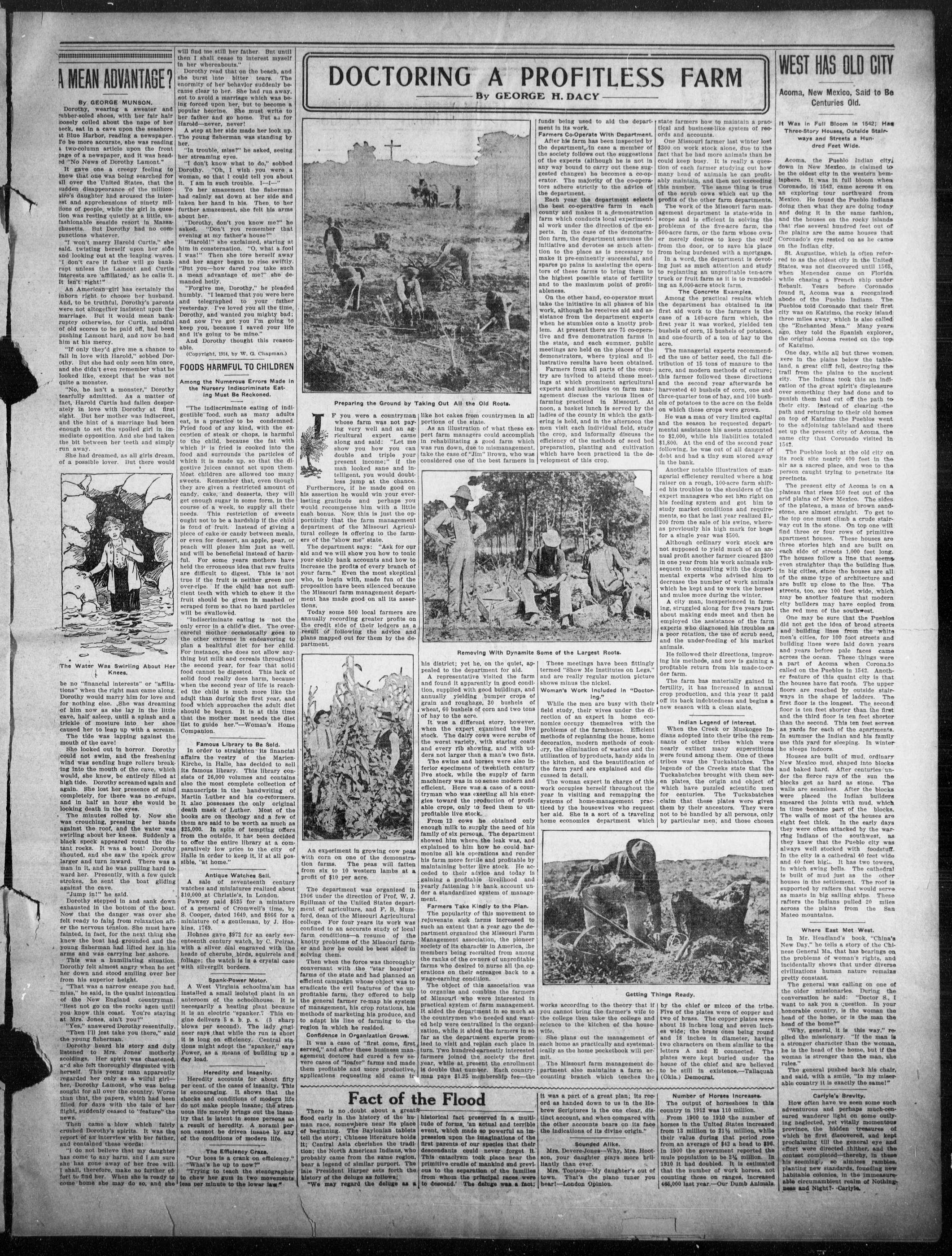
DOCTORING A PROFITLESS FARM
THE WORKING
Preparing the Ground by Taking Out All the Old Roots.
If you were a countryman whose farm was not paying very well and an agricultural expert came along and said: "Let me show you how you can double and triple your present income;" if the man looked sane and intelligent, you would doubtless jump at the chance. Furthermore, if he made good on his assertion he would win your everlasting gratitude and perhaps you would recompense him with a little cash bonus. Now this is just the opportunity that the farm management department of the Missouri Agricultural college is offering to the farmers of the "show me" state.
like hot cakes from countrymen portions of the state.
As an illustration of what the pert farm managers could accomplish in rehabilitating a good farm was run down, due to mismanagement, take the case of "Jim" Brown, considered one of the best farms.
The department says: "Ask for our aid and we will show you how to tonic your sickly bank accounts and how to increase the profits of every branch of your farm." Even the most skeptical who, to begin with, made fun of the proposition have been silenced because the Missouri farm management department has made good on all its assertions.
Today some 500 local farmers are annually recording greater profits on the credit side of their ledgers as a result of following the advice and plans mapped out for them by the department.
A
An experiment in growing cow peas with corn on one of the demonstration farms. The peas will fatten from six to 10 western lambs at a profit of $10 per acre.
The department was organized in 1906 under the direction of Prof. W. J. Spillman of the United States department of agriculture, and F. B. Mumford, dean of the Missouri Agricultural college. For four years its work was confined to an accurate study of local farm conditions—a resume of the knotty problems of the Missouri farmer and how he could be best aided in solving them.
Fact of the Flood
There is no doubt about a great flood early in the history of the human race, somewhere near its place of beginning. The Baylonian tablets tell the story; Chinese literature holds it; Central Asia cherishes the tradition; the North American Indians, who probably came from the same region, bear a legend of similar purport. The late President Harper sets forth the history of the deluge as follows;
"We may regard the deluge as a
I
like hot cakes from countrymen in all portions of the state. As an illustration of what these expert farm managers could accomplish in rehabilitating a good farm which was run down, due to mismanagement, take the case of "Jim" Brown, who was considered one of the best farmers in
Removing With Dynamite
THE LANDS OF THE WOODS
Removing With Dynamite Some of the Largest Roots.
his district; yet he, on the quiet, appealed to the department for aid.
A representative visited the farm and found it apparently in good condition, supplied with good buildings, and annually yielding bumper crops of grain and roughage, 30 bushels of wheat, 60 bushels of corn and two tons of hay to the acre.
It was a different story, however, when the expert examined the live stock. The dairy cows were scrubs of the worst variety, with staring coats and every rib showing, and with unders not larger than a man's two fists.
The swine and horses were also inferior specimens of twentieth century live stock, while the supply of farm machinery was in no sense modern and efficient. Here was a case of a countryman who was exerting all his energies toward the production of profitable crops, only to feed them to unprofitable live stock.
These meetings have been termed "Show Me Institutes" and are really regular motions minus the nickel. Woman's Work Included ing."
While the men are busy field study, their wives unrection of an expert in nomics occupy themselves problems of the farmhouse methods of replanning the decoration, modern methodry, the elimination of was utilization of byproducts, has the kitchen, and the beauty the farm yard are explained cussed in detail.
The woman expert in cha work occupies herself three year in visiting and rem systems of home-managed by the housewives her aid. She is a sort of
From 12 cows he obtained only enough milk to supply the need of his family of six persons. The department showed him where the leak was, and explained to him how he could harmonize all his operations and render his farm more fertile and profitable by maintaining better live stock. He acceded to their advice and today is gaining a profitable livelihood and yearly fattening his bank account under a standardized system of management.
Farmers Take Kindly to the Plan.
The popularity of this movement to rejuvenate sick farms increased to such an extent that a year ago the department organized the Missouri Farm Management association, the pioneer society of its character in America, the members being recruited from among the ranks of the owners of unprofitable farms who desired to nurse all the operations on their acreages back to a wage-earning condition.
The object of this association was to organize and combine the farmers of Missouri who were interested in practical system of farm management. It aided the department in so much as the countrymen who needed and wanted help were centralized in the organization, while it aided the farmers in so far as the department experts promised to visit and replan each place in turn. Two hundred earnestly interested farmers joined the society the first year, while at present the enrollment is double that number. Each country-man pays $1.25 membership fee—the
historical fact preserved in a multitude of forms, 'an actual and terrible event, which made so powerful an impression upon the imaginations of the first parents of our species that their descendants could never forget it. This cataclysm took place near the primitive cradle of mankind and previous to the separation of the families from whom the principal races were to descend.' The deluge was a fact;
funds being used to aid the department in its work.
Farmers Co-Operate With Department.
After his farm has been inspected by the department, in case a member of the society follows out the suggestions of the experts (although he is not in any way bound to carry out these suggested changes) he becomes a co-operator. The majority of the co-operators adhere strictly to the advice of the department.
Each year the department selects the best co-operative farm in each county and makes it a demonstration farm which conducts local experimental work under the direction of the experts.
In the case of the demonstration farm, the department assumes the initiative and devotes as much attention to the place as is necessary to make it pre-eminently successful, and spares p oains in assisting the operators of these farms to bring them to the highest possible state of fertility and to the maximum point of profit-ableness.
On the other hand, co-operator must take the initiative in all phases of his work, although he receives aid and assistance from the department experts when he stumbles onto a knotty problem. At present there are 75 co-operative and five demonstration farms in the state, and each eummer, public meetings are held on the places of the demonstrators, where typical and illustrative results have been obtained. Farmers from all parts of the country are invited to attend these meetings at which prominent agricultural experts and authorities on farm management discuss the various lines of farming practiced in Missouri. At noon, a basket lunch is served by the ladies of the county in which the gathering is held, and in the afternoon the men visit each individual field, study the crop, and informally discuss the efficiency of the methods of seed bed preparation, planting and cultivation which have been practiced in the development of this crop.
Some of the Largest Roots.
These meetings have been fittingly termed "Show Me Institutes on Legs," and are really regular motion picture shows minus the nickel.
Woman's Work Included in "Doctoring."
While the men are busy with their field study, their wives under the direction of an expert in home economics occupy themselves with the problems of the farmhouse. Efficient methods of replanning the home, home decoration, modern methods of cookery, the elimination of wastes and the utilization of byproducts, handy aids in the kitchen, and the beautification of the farm yard are explained and discussed in detail.
The woman expert in charge of this work occupies herself throughout the year in visiting and remapping the systems of home-management practiced by the housewives who request her aid. She is a sort of a traveling home economics department which
Getting T
Getting Things Ready.
works according to the theory that if you cannot bring the farmer's wife to the college then take the college and science to the kitchen of the housewife.
She plans out the management of each home as practically and systematically as the home pocketbook will permit.
The Missouri farm management department also maintains a farm accounting branch which teaches the
it was a part of a great plan; its record as handed down to us in the Hebrew Scriptures is the one clear, distinct account, and when compared with the other accounts bears on its face the indications of its divine origin."
Sounded Allike.
Mrs. Devere-Jones—Why, Mrs. Hootson, your daughter prays more brilliantly than ever.
Mrs. Tootson—My daughter's out of town. That's the piano tuner you hear!—London Opinion.
state farmers how to maintain a practical and business-like system of records and accounts.
One Missouri farmer last winter lost $300 on work stock alone, due to the fact that he had more animals than he could keep busy. It is really a question of each farmer studying out how many head of animals he can profitably maintain, and then not exceeding this number. The same thing is true of the scrub cows which eat up the profits of the other farm departments.
The work of the Missouri farm management department is state-wide in scope and is efficient in solving the problems of the five-acre farm, the 500-acre farm, or the farm whose owner merely desires to keep the wolf from the door, or to save his place from being burdened with a mortgage.
In a word, the department is devoting just as much attention and study to replanting an unprofitable ten-acre truck or fruit farm as it is to remodeling an 8,000-acre stock farm.
The Concrete Examples.
Among the practical results which the department has obtained in its first aid work to the farmers is the case of a 140-acre farm which, the first year it was worked, yielded ten bushels of corn, 15 bushels of potatoes, and one-fourth of a ton of hay to the acre.
The managerial experts recommended the use of better seed, the fall distribution of 15 tons of manure to the acre, and modern methods of culture; this farmer followed these directions and the second year afterwards he harvested 40 bushels of corn, one and three-quarter tons of hay, and 100 bushels of potatoes to the acre on the fields on which these crops were grown.
He was a man of very limited capital and the season he requested departmental assistance his assets amounted to $2,000, while his liabilities totaled $1,800. At the end of the second year following, he was out of all danger of debt and had a tiny sum stored away in the bank.
Another notable illustration of managerial efficiency resulted where a hog raiser on a rough, 100-acre farm shifted his troubles to the shoulders of the expert managers who set him right on his feeding system and got him to study market conditions and requirements, so that he last year realized $1,200 from the sale of his swine, whereas previously his high mark for hogs for a single year was $500.
Although ordinary work stock are not supposed to yield much of an annual profit another farmer cleared $500 in one year from his work animals subsequent to consulting with the departmental experts who advised him to decrease the number of work animals which he kept and to the horses and mules more during the winter.
A city man, inexperienced in farming, struggled along for five years just about making ends meet and then he employed the assistance of the farm experts who diagnosed his troubles as a poor rotation, the use of scrub seed, and the under-feeding of his market animals.
He followed their directions, improving his method, and now is gaining a profitable return from his made-to-order farm.
The farm has materially gained in fertility, it has increased in annual crop production, and this year it paid off its back indebtedness and begins a new season with a clean slate.
Indian Legend of Interest
When the Creek or Muskogee Indians adopted into their tribe the remnants of other tribes which were nearly extinct many superstititions were found among them. One of these tribes was the Tuckabatches. The legends of the Creeks state that the Tuckabatches brought with them seven plates, the origin and object of which have puzzled scientific men for centuries. The Tuckabatches claim that these plates were given them by their ancestors. They were not to be handled by all persons, only by particular men, and those chosen
10
by the chief or micco of the tribe.
Five of the plates were of copper and two of brass. The copper plates were about 18 inches long and seven inches wide; the brass ones being round and 18 inches in diameter, having two characters on them similar to the letters A and E connected. The plates were kept buried under the house of the chief and are believed to be still in existence—Tallaquah (Okla.) Democrat.
Number of Horses Increases.
The output of horseshoes in this country in 1912 was 110 million.
From 1900 to 1910 the number of horses in the United States increased from 13 million to 21½ million, while their value during that period rose from an average of $42 a head to $96. In 1900 the government reported the mule population to be 2½ million. In 1910 it had doubled. It is estimated that the number of work horses, not counting those on ranges, increased 466,000 last year.—Our Dumb Animals.
Acoma, New Mexico, Said to Be Centuries Old.
It Was in Full Bloom in 1542; Has Three-Story Houses, Outside Stairways and Streets a Hundred Feet Wide.
Acoma, the Pueblo Indian city, down in New Mexico, is claimed to be the oldest city in the western hemisphere. It was in full bloom when Coronado, in 1542, came across it on an exploring tour northward from Mexico. He found the Pueblo Indians doing then what they are doing today and doing it in the same fashion, and the houses on the rocky islands that rise several hundred feet out of the plains are the same houses that Coronado's eye rested on as he came on the Indian city.
St. Augustine, which is often referred to as the oldest city in the United States, was not discovered until 1565, when Menendez came on Florida while chasing a French ship under Rebault. Years before Coronado found ft. Acoma was a recognized abode of the Pueblo Indians. The Pueblos told Coronado that their first city was on Katzimo, the rocky island three miles away, which is also called the "Enchanted Mesa." Many years ago, they told the Spanish explorer, the original Acoma rested on the top of Katzimo.
One day, while all but three women, were in the plains below the tableland, a great cliff fell, destroying the trafall from the plains to the ancient city. The Indians took this an indication of the great spirit's displeasure over something they had done and to punish them had cut off the path to their city. Instead of clearing the path and returning to their old homes on top of Katzimo the Puebios went to the adjoining tableland and there set up the present city of Acoma, the same city that Coronado visited in 1542. The Puebios look at the old city on its rock site nearly 400 feet in the air as a sacred place, and woe to the person caught trying to penetrate its precincts.
The present city of Acoma is on a plateau that rises 350 feet out of the arid plains of New Mexico. The sides of the plateau, a mass of brown sandstone, are almost straight. To get to the top one must climb a crude stairway cut in the stone. On top one will find three or four rows of primitive apartment houses. These houses are three stories high and are built on each side of streets 1,000 feet long. The houses follow a line that seems even straighter than the building line in big cities, since the houses are all of the same type of architecture and are built up close to the line. The streets, too, are 100 feet wide, which may be another feature that modern city builders may have copied from the red men of the southwest.
One may be sure that the Pueblos did not get the idea of broad streets and building lines from the white men's cities, for 100 foot streets and building lines were laid down years and years before pale faces came across the ocean. These things were a part of Acoma when Coronado called on the Pueblos in 1542. Another feature of this quaint city is that the houses have flat roofs. The upper floors are reached by outside stairways in the shape of ladders. The first floor is the longest. The second floor is ten feet shorter than the first and the third floor is ten feet shorter than the second. This ten feet serves as yards for each of the apartments. In summer the Indian and his family use this yard for sleeping. In winter he sleeps indoors.
Houses are built of mud, ordinary New Mexico mud, shaped into blocks and baked hard. After centuries under the fierce rays of the sun the blocks get as hard as stone. The walls are seamless. After the blocks were placed the Indian builders smeared the joints with mud, which in time became part of the blocks. The walls of all the houses are eight feet thick. In the early days they were often attacked by the warring Indians of the southwest, as they knew that the Pueblo city was always well stocked with foodstuff. In the city is a cathedral 40 feet wide and 40 feet high. It has two towers, in which swing bells. The cathedral is built of mud just as the other houses in the settlement. The roof is supported by rafters that would serve as masts in big sailing ships. These rafters the Indians pulled 20 miles across the plains from the San Mateo mountains.
Where East Met West
In Mr. Headland's book, "China's New Day," he tells a story of the Chinese General Ma, that has bearings on the problems of woman's rights, and incidentally shows that under diverse civilizations human nature remains pretty constant.
The general was calling on one of the older missionaries. During the conversation he said: "Doctor S. I want to ask you a question. In your honorable country, is the woman the head of the home, or is the man the head of the home?"
"Why, general, it is this way," replied the missionary. "If the man is a stronger character than the woman, he is the head of the home, but if the woman is stronger than the man, she rules."
The general pushed back his chair, and said, with a smile, "In my miserable country it is exactly the same!"
Carlyle's Brevity.
How often have we seen such such adventurous and perhaps much-censured wanderer light on some outlying neglected, yet vitally momentous province, the hidden treasures of which he first discovered, and kept proclaiming till the general eye and effort were directed thither, and the contest completed—thereby, in these his seeming', so aimless rambles, planting new standards, founding new habitable colonies, in the immeasurable circumambient realm of Nothingness and Night*-Carlyle.
= Ail communiontions should be addrensea
Pe ee
Bell Phone East 999, |
mlered aa vocond-clnss matter, Augus
gate ‘he powtafiee at ‘aniae Cy,
a ee aera eee ee
Rolson C. Grews......,.Baitor ang Owner
Willa, Glenns..12.2/: General Manager
Goo, i thompida::.:2 Advertning Agent
eG, Wyler ssreeresssAdvertining: Soltetor|
Bra P Wasi ieee ccciaue
Riba MortoA LLecssesssseeooseseGoulector
BIBER since RS
SUBSCRIPTION RATES:
Gis Fig teresctasorvcianvscssoyec Cie
Bee Mentha osisecssscseiesssceseons aE
Freres Montha ‘csissscsssseucscacsccas
Te occastonally happens that papers sent
tolbufecribers ure lowt or stolen. in cane
fensde not eelve any murber ehen dus
orm ‘us by postal card. and. we wilt
cheerfully, forward a duplicate “ot he
missing ‘number. %
ADVERTISING HATE 60 CENTS PER
INCH. ‘
Good Morning.
Visit Provident Hospital.
Do you want stock in the Kaw Val-
ley Truck Gardening Co.? Call E. A.
Robinson, president, Bell, East 754.
Are you a Democrat, Republican,
Socialist, Bull Moose or for Commis:
gion Government?
“E come that they might hayg life;
and that they might have it more
abundantly."—John 10:10.
—National Y. W. C, A. Motto.
‘The Editor received a letter from
J. T. Fox enclosing two years’ sub-
scription nad saying, “It's hard to
live without the Sun.”
More than three hundred subserib-
ers have taken advantage of our spe-
celal offer of one dollar for a year's
subscription during the month of Jan-
wary and we hope to record a thou-
sand subscribers before the expiration
of the month,
‘The Sun forgot to mention the fact
that in the recent contest for original
musical composition at the Inter
State Literary Society hald in Atch-
‘ison, Kas., that Miss ‘‘ma Bass, @
student of the Musical Department at
Western University, under the direc-
tion of Prof, R, G. Jackson, won the
first prize.
‘That Kansas City is one of the best
Masonic fields in the Jurisdietion was
‘again demonstrated on jast Satarday
night when twenty-five men were gly-
en the three symbo'lc degiees of Ma-
sonry, making seventy-six maen ‘Ault
‘ated since the 15th of December, Six-
teen of them wen to the now lodge,
Mt. Oread, U. D. giving that lusty
and promising younzser a member-
ship of fifty-three Undoubtedly this
is to be a big year in the Masonic
fraternity.
‘The meeting of the Tusiness League
lust Tuesday night was largely atiend
ed and excellent addiesses were de
livered by T. G. McCampbell, Sr., and
H. P. Ewing. Prof. A. A. Anderson
and family, just home from Eurove
furnished some delightful music and
Mr, Anderson made a few remark:
that were highly interesting. On nex!
Tuesday night President Smith of the
Commonwealth National Bank wil
address the League promptly at §
‘eae
‘The Editor, Dr, B. @, Bunch and
John Hughes were the guests of Lieu-
tenant Jobn Todd, Captain Eliott,
‘Amos Smith and Eugene King of No.
11 Fire Department at a splendid stag
dinner last Monday noon. A delightful
menu was spread consisting of wild
goose, rabbit, squirrel, celery, salad,
cranberries, pickles, macaroni, hot
corn bread and cigars. And it 1s need-
less to say that everybody did Justice
to the occasion. The boys of No. 11
are not only good fire fighters, but
Bood cooks as well. They were as
sisted by Frank Sayers and Mr, T. H
Sines ta ceanarine tha cheek’,
While the Negro has not had a
great deal to say relative to things
political during the past few weeks,
he has been watching carefully the
trend of events and will be found a
solid and formidable force in the next
campaign, The Negro is naturally
@ Republican and would be found
solidly within the ranks of that party
‘were {t not for a few white-livered,
contemptible and time-serving alleged
Republicans who have been permitted
to secure control of the organization
and cater to that element who think
it is popular and wise to assail and
villity the Negro. But we have the
satisfaction of knowing that that class
of demagogues can never be elected
to office in the ranks of the Repub-
Mean party, and the sooner the decent,
manly and courageous Republicans
realizb that and drive them from its
ranks the better it will be for the
Grand Old Party. In the meantime
keep your eye on Henry L. Jost who
fs one of the most courageous little
men that ever sat in the mayor's
chair,
HEARD ABOUT TOWN.
Thus far no clamor of remon-
strance has been heard against the
@iscontinuance of the Allen Chapel
advertising bureau. ‘The people are
ee quite well without be-
‘over and over that “Class
‘meets on Tuesday night.”
What is planned to be the greatest
school event-ever. held in Kansas City
will be the grand music festival next
May, All the schools will participate
and the colored’ schools section will
include every pupll in the city. Re-
Dearsals are now under way and ad-
‘mittance will’ be free,
Manual training js to be introduced
at the Sumner School....Mr. Joe E,
Herriford, Jr, is teaching special
classes in refla and paper cutting at
suet tensher nthe ataen
sinelpal W. 1, Gritfin’ is sill unable
10 resume his work at the Booker 7.
‘Washington School. q
WHERE CAN YOU FIND ITs EQUAL?
It has been said the value of advertising lies in
nvinee the public of the advantages to be gained in
e advertiser, It is not the intention of the manag
monico Cafe and Home Bakery to deal at length wi
vertising phrases that long since should have been
g bag of time. We have no desire to advertise in
hich that term is most generally aceepted ; we simply ¢
few open facts which your investigation will neces
It has been said the value of advertising lies in its power to
convince the public of the advantages to be gained in dealing with
is advertiser, It is not the intention of the management of the
Delmonico Cafe and Home Bakery to deal at length with customary
advertising phrases that long since should have been cast into the
rag bag of time. We have no desire to advertise in the sense it
which that term is most generally accepted; we simply desire to state
a few open facts which your investigation will necessarily verify,
i.
A STATEMENT OF FACTS:
The Delmonico Cafe and
Home Bakery, located at 1512
East Eighteenth street, Kan-
sas City, Mo., is the most
thoroughly equipped Cafe west
of the Mississippi, rendering as
it does a service almost wholly _
to Negroes. ;
The rooms in connection are
centrally situated at the Hub
of the Negro District, and are
the most modern and neatly
furnished in their various ap-
pointments.
The Home Bakery in con-
nection, while comparatively a
new enterprise to the Negroes
of greater Kansas City, has
. from the day it was installed
measured well to the standard
in the quality of their products.
And has today in service the
, most finished Bakers ever em-
ployed by Bakeries of small ca-
pacity anywhere.
Our solicitation for your patronage, either to the local trade or
he traveling public, is based on the foregoing facts coupled with
ervice and as a guarantee of our position in this matter, the man-
agement of the Delmonico Cafe and Home Bakery willingly makes
his proposition: ‘To supply anyone of the recognized Charities of
sur people in this city with their bread and pastry for one year if
che foregoing statement of facts can be: disproven.
HENRY C. COMPTON, Prop.
Delmonico Cafe and Home Bakery,
1512 East 15th Stree
Betty@ Sam's Y. M. C. A. NOTES
Little Corme® | te annua too tor membership
{F the Young Men's Christian Associ
BR ZR |1i0n, Paseo Department, ts now $3.
Cs yer : Zi, \ on rast Monday evening a civil x
sy CMT |/j vice class of cient was organiz
Nein (A (Na embers of this clagh are stu
WG. ty WN ee HY) \\ng together, preparing for the ne
MALTA A MSGR] |estmisation to be even tor ray
TN shares a Wes [isa cis, otros
"Ve Ava SD VE members may join.
Va aN RAE
(eget Friday evening will be the last
me Oa ui AB. |portunity to enroll in the men’s ne
TA ig 17 SeS7, SGI [Bible class, ‘The older Dincoln Ht
4 Pe) LAM |schooi boys have requested that t
Ne AN pir |Sseorition oreantze a ten Se
ara Ws N/a, | 2°78’ Bible class. ‘This reques* w
j een Vas At ‘f “q be granted this week,
= eee? Aa rs ees
a wit ae The following persons made pi
_ # ments during the past four days; m¢
re” of which are final payments: | Mi
E. Naom! White, D. N, Crosthwait,
DET ETY S AVS timer, AV, Popp, Miss Aman
= EAE ARE SE 8 TOA) BOWE
that shall he reap.
—That he who climbs alone
climbs to barrenness,
——That you're out/ of date it you
do not belong to the Negro Business
League.
—That a certain Negro lawyer in
representing Negro ellents invariably
refers to them in addressing the Jury
as “niggers,” Cut It out,
—That: many of the social leaders
of greater Kansas City were very
nuch in evidence at the Evelyn Nes-
bit Thaw performances, Oh, well!
——That every man who has a ten-
der memory of home and mother will
Gemonstrate it Sunday, Feb. 1, by go:
ing to some chureh, somewhere,
——That those Negroes who pald
exorbitant prices to. vulgar’ Thaw
show were grossly insulted by the
“anaedotes” of one of the bum actors,
Served ’em right,
——#hat @ prominent young gallant
thought to surprise his ist girl by
corrying her a brick of Morton's best
cream, but when he reached the house
he found another dude being enter-
tained and ite proceeded to bounce the
brick off the dude’s head a6 well as
to smear up the scenery, Oh, what a
night,
My name is Eugene Edward
Vatughan,
"Tis for renters that 1 yawn
1 like for him to surely be
A purchaser of some property.
BUGENE EDW. VAUGHAN,
Real Estate Brokerage and Ins,
Bell West 1757.
Bo! ees
ii
|
Y. M. C. A. NOTES |
‘The annual fee for membership in
the Young Men's Christian Associa-
tion, Paseo Department, is now $3.
On last Monday evening a clvil ser-
vie class of eight was organized.
‘The members of this class are study-
ing together, preparing for the next
examination to be given for railway
postal clerks. Other Association
members may join,
"Friday evening will be the last op-
portunity to enroll in the men’s new
Bible class, The older Dincoln High
School boys have requested that the
Association organize a High School
Boys’ Bible class. This reques* will
be granted this week, *
‘The following persons made pay-
ments during the past four days; most
of which are final payments: | Miss
E, Naoml White, D. N, Crosthwalt, R.
8. Turner, A. V. Pepp, Miss Amanda
Wheeler, N. ©. Crews, W. W. Penn,
Wilson Dawson, Richard Allen, B, J.
Nesbit, J. BE. Herriford, Miss’ Clara
V. Lynden, W. M. Bradshaw, A. V.
Barton, R. W. Foster, B, R, ‘Thomp-
ie Ta ost
The Men's Meeting last Sunday|
was of the usual high standard and
Rey. Bowren, the speaker of the aft-|
ernoon, delivered an inspiring’ lecture
on “Individual Responstbility”’ Dr,
Garnett of the Wester Baptist Col-|
lege at Macon, Mo,, also made a few
timely remarks, Next Sunday Rev.
J. B, Beckham of Independence, Mo.,
will deliver the afternoon address at
3:30 p. m, His subject will be, “Shall
We Save the Boys or Reform the
Men?” Come and bring a friend,
VINE STREET BAPTIST CHURCH.
The Hospital Association held their
annual meeting Wednesday 14th, of
last week. Much interest is being
shown by the community relative to
the Hospital for Negroes: Rev. T.
H. Ewing was re-elected President;
Prof, en Vice President. They
reported over $1,700 on hand. Let
the good work go on. St. Mark Class
No. 2 presented a fine Bible to Bro,
'G. W. Taylor, thelr teacher. This
great book, the greatest of all books
will be held in high esteem by Bro.
Taylor in remembrance of his ‘amous
[class ot which he has been a eacher
for many years,...Rev. Jackson was
ordained Sunday the 18th, by our pas:
tor and other visiting preachers and
deacons, ‘The charge. was delivered
by Rev. Richardson of Kansas..City,
‘Kansas, Morning and evening perv.
ices were good, Hight additions were
made to the Chureb,
NOTICE.
Ladies and Gents’ Shoe shining at
the Colored Shoe Store.
1507 € 18th St,
Ladies Especially Invited.
Se eters SN AE AR Tet Bane Bay oes eet HAN
Jas, B, Shannon, N. B. Cor. 13th antl Paseo,’ Bell East 670. “i
T, ©. Unthank, 1112 Independence avenue. Both phones, Main 7488.
penne, Quiddats, Kas
Ee siape, 9 Bios Aafiae ce Kans,
Fred T. Drew, 2002 Bales avenue, Bell phone, East 6277-W.
PHOTOGRAPHERS,
Charles Williams.....s...ssss.e0+0++ +1015 Oak; Main 3154 Bell ~
=< PRINTERS. ahd
©, A. Franklin, at, Main; Grand 2088 Bell,
Arthur W, Harris, 1615 Kast Kightennth; Wast 4746 Bell, Reg
John-H. Fairley, Square Deal Pringing Co, 1731 Lydia, Bell prone
Grand. 1647-¥,
REAL ESTATE.
William Hopkins Afro-American Investment Co,
J. Dalias Bowser, 2400 Paseo. Bell Phone 3795 W Grand.
F. 3. Weaver, President Afro-American Iny. Co., 911 McGee St. Bell
Main 751, —
‘The Ward & Samlington Investment Co,, Bell Phone Bast 4204,
W. M. Johnston, rental agent; Main 7555'Home; Main 751 Rell,
W. G. Mosely, Ivanhoe Investment Co,, 2220 Woodland avenue. *
E. B. Vaughan, 26th and Parkway, Kansas City, Kan. Bell, West 1757.
PROBATION OFFICER,
Edward Ross, 1419 B. 18th St. Bell Grand 885. *
REGALIAS, BADGES, ETC,
Geo, W. K. Love, 2418 Flora, Telephone East 944. 4
Moses Dixon, 1217 Woodland; Wast 3797 Bell,
SHOE SHINING PARLOR.
Moses Fields, 614 Main.
. SHOE STORES.
Henry Jones, Mgr., Tempie Shoe Co., 1507% E. 18th street,
TEACHERS. ,
R, T. Coles, Principal Garrison School, 2327 Lydia; Grand 1851 Bell.
W. T. White, manual training, 1612 Lydia; Grand 3631 Bell,
G. A. Page, 2419 Flora, Bell B. 501, Principal Attucks School.
T. W. H. Williams, 1323 Jackson, Bell BD. 3259-Y, Principal Bruce
School.
Chas. A. Westmoreland, 2325 Lydia, Bell Grand 1320-W. Lincoln High
School,
THEATRES.
Homer Roberts, “Dixie Theatre,” 2411 Vine St,
Prof. D. G. Watson, 1906 East Twenty-fourth. i
‘TRANSFER,
Geo. Jones, 1008 McGee. Home Phone, 5188 Main,
W. Lee Whibby, 18th and Forest. Home phone M. 4023,
R, W. Elmore, 1607 Harrison street,
UNDERTANERS.
C. H. Countee, 2220 Vine St. Bell East 3336,
Watkins Bros. & Co, 1729 Lydia, Telephone Grand 987,
People’s Undertaking Co., 1211 Bast 18th; Phones, Bell Grand 1565;
Home 8163 Main, Edward Jones, Mgr.
Jno. W. Jorfes, 440 State Ave, Kansas City, Kans. Both Phones,
‘West 253, é
: DIRECTORY
oY THE
Negro Business League of Kansas City.
Ne Gayt > ey Bae
‘ FORTUNE J. WEAVER, President.
A, E, ESTES, Secretary, - s
bors will rt 10,8
‘A, Nobingon, "Pinahelat aectetars" and Viscat Agent. HaliPhone Hest 104
AUTOMOBILES, t
Wm, D, Foster Auto Co, 1428 Korest, hiro and repair; office Bell
Grand 1630W; res, phone Bell Kast 4417W.
Ji BAKERS, ‘
“Henry Compton, home bakery, 1512 Bast 18th,
Susie Owens, 2320 Vine.
George Puypell, 1812 Vine; Bast 4915W Bell
5 _BARBERS. ‘
‘William Dabbs, 1219 Baltimore; Grand 9126 Bell, _
J. A. Jones, 1514 B. 18h St; Home Phone Main 6119,
Palace Barber Shop, J. C. Hobbs, Prop., 1518 B, 19th St. Bell phone,
2898, Rast,
William Btitts, Criterion Barber Shop and Pool Hall. /
BLACKSMITH. ~
Jas. Hopkins, 2325 Vine St.
‘ CAFES AND, RESTAURANTS,
Henry Compton, 1512 B. 18th St. Bell phone, East 618.
Mrs. King, ightoonth and Paseo.
Magkle Seamster, 1507% Kast Twelfth.
Harmless Wynn, barbecued meats, 2315 Vine,
J, B Rollgna, “Catfish John's, Cate," 2930 Vine, street,
Mrs, H, W. Dotson, 1705 B, Twelfth St, Phone, Bell 2214
CLEANERS, DYERS AND TAILORS,
©. K. Cleaners and Dyers, guaranteed not to shrink any garment we
dye, 11) Bast 18th; Bell Grand 2437.
R. Bennett, 1515 Hast Bighteenth; Bast 4746 Bell.
4. F, Basil,'1509 Main; Main 6449 Home.
John Holmes, 1903 Vine.
Laden Bros,, 2427 Vine; East 569W.
Worthan Bros., 1222 Bast Nineteenth; Grand 2023W Boll.
G. W. Golden Steam Dye Works, 1605 East 18th; Bell East 589.
st CARPET CLEANERS.
D, W, West, 1718 Huclid; Bast 2555 Bell.
CIGAR MANUFACTURER.
Henry Parks.1509 East Bighteenth; Main 4905 Home, Hast 45 Bell
COAL, FEED, ICE AND KINDLING,
J. Hy Hall, 1208 Vine.
Herman Kinslee, 2012 Harrison; Grand 2760W Bell.
BA, Salisbity, 2206 vine; Bast $79 Bell
W. H. Winters,'1915 Highland.
R. Williams, 1815 Bast Seventeenth,
Hopkins Bros,, 2323. Vine,
W. H. Lambright & Sons, Coal, Iee and Feed. Bell phone, W. 1923.
1620 North 3d street, Kansas City, Kas.
CONTRACTORS—GENERAL.
‘Wm, 'P, Garner, contractor and builder, 1728 Woodland; Bell B. 4741W.
A. B. Bstes, 2460 Waldron. Bel 1, Fast 4394-Y,
Leon H, Jordan, 712 East 12th St.’ Bell Grand 2873,
W. R. Nelson, 1822 Pacific Street.
©.S. Page, 1514 East Bighteenth; Main 5119 Home,
COOPER.
Lee Londen, 407 West 5th,
DENTISTS.
Tr. C, Chapman, 1505 Bast Bighteenth; East 798 Bell.
ALB. Hudson, 2330 Vine; Bast 2830 Bell.
MeQueen Carrion, 18th and Pasco. Beil Phone, E, 144, Home
Phone,,Main 3490. ,
DRESSMAKING.
Mrs, Blane Page, Dressmaker, 2413 Vine St,, Bell Phone, East $192.
Miss Georgia Coleman, 1510 E. 18th street,
Birdie Jackson, 1918 East Nineteenth.
DRUG STORES.
‘McCampbell & Houston, 2800 Vine street, and N. W. Cor. Howard and
Vine Sts,
E, 8. Lee Pallace Drug Store, 19th and Vine, Both phones.
DRY GOODS, GENT’S FURNISHINGS, NOTIONS.
Mrs, Josephine Abernathy, Ladies Furnishings and Notion, 241%
Vine strect.. Bell phone East 2192.
Bi Harris, 2983 Vine St.
‘Taylor Homes & Laden Bros, & Co., gents’ furnishings and notions,
2427 Vine,
EMPLOYMENT AGENTS.
Afro-American Employment & Inv. Co, 911 McGee, Both phones,
FISH AND OYSTER MARKET.
Miles & Hill, 1702 East Eighteenth,
FLORISTS.
‘Weaver Floral Co. .1507% E, 18th; Main 7555 Home; 3, 4798 Bell
J GROCERS,
Wilson & Gray, 1504 North rd St., Kansas City, Kans,
G. E, Arnett, 2200 Bast Twenty-f11th,
R. Mason, 1905 Vine,
3. L, Matson, 19th and Grove, Bell Grand 1417-X. :
MM. R, Wilson, 2644 Woodland,
HOTELS, g
J. H, Simmons, 915 Oak; Main 4072 Bell,
Hotel Woods, 721 Charlotte, Lewis Woods, Prop. Bell Main 2078,
' INSURANCE, i
XH. A. Robinson, 2413 Montgall; Kast 754 Bell.
1. A. Ross, 1507 East Bighteenth; West 146 Bell,
H, D, Simmons, 1832 Vine, Phone Bast887.
G, F, Porter, 1507- Gast Bighteenth; wast 4955 Bell,
J. W. Golden, 1612 Lydia, Grand 3631,
INVENTOR,
W. J. Dixon, 2828 Cleveland Avenue,
JEWELER.
J. A. Wilson, 1616 W. 9th St, Bell Main 6453-Y,
HAIR DRESSING AND MILLINERY.
Madame N; P, Jones, Beauty Culture, Hair Goods, ete, 2110 Vine
street. :
Mattie P. Garner, electric straighteneing, comb and hair goods; Bell
East 4741W.
Lillie Johnson, 1608 Bast 18th; Bell Kast 1795, 4
Chapman & Caldwell, 18t hand Pasen, Phone Bast 798,
Eva P. Washington, ‘milliner and hair dresser, $49 Freeman, Bell
phowie, 2806 West.
Mrs, Stella Hubbard, 1510 B. 18th St. Bell Phone Fast 1007.
4 LAWYERS.
William B; Bruce, Attorney.at-Law ari Counsellor, Phone, Home
Main 6478; Office, 117 West Sixth Street,
Chas. H, Callaway, 117 W. 6th, Home Main 68.
W. C. Hueston, 117 W. 6th, Home Main 58,
L, A, Knox, 117 W. 6thSt, Home Main 5478.
g MISCELLANEOUS,
J. Hill, 1510 Woodland Ave. Bell phone, Bast 1204,
Aimus Barnett, 1280 Forest; Main 6018 Home,
©, Roland, '2423 Grove,
8. J. Hightower, 2436 Highland.
Solomon Smith, 2043 Highland,
George Teeters, Southwest National Bank of Commerce,
John ‘Thomas, 425 Waverly Way; South 6087W Bell.
H, TT, Kealing, Western University; West 4480 Lell, ‘i
Baward Tiree, eaueade inanutacharee base Bnceha:
Save 20 Per Cent
—
DIAMONDS AND WATCHES
Money Loaned at a Low Rate. Fine Watch
Repairing. Cash Paid for Old Gold, Silver and
Diamonds. Unredeemed Pledges For Sale/at
a Bargain, see
Mi o R I N © OPPOSITE POST OFFICE
812 Grand Ave.
eo,
Elk Markét
GROCERIES AND MEATS 2
The Lowest of Prices and Best
Brands of Goods. j
20 Pounds Sugar........ .,.$1.00| 24 Pounds Kelly's King Flour. .60c
1 Pound Good Coffee... ......20c|{ Pound Country Bacon........20¢
Round Steak..............+5 15c| Best Vaid sp... o's onan cea oe
Milk, per Quart...-..........6¢
| ‘We Appreciaie Your Trade, ss
EBLMER’s PLACE
1305 EAST EIGHTEENTH STREET.
Home Phone 9723:
Bank t Sal
| of the John M, Habash $2,000 stock of
| Drawn Work, Cluny Lace, Renaissance, Needle Work
|Silk Shawls and Crochet Silk Neckties, Kimonas, Shirt
| Waists and Dresses.
All goods are imported and will be sold at actual cost.
Sale commences Saturday Morning at 8:00 o'clock and continues for
two weeks: Come quick and get Christmas bargains.
|
\JNO. M. HABASH, 518 East 121h St. 2
/
e cd
_ -Special Offer-
a TO COLORED PEOPLE
; aa age a Tre
ji lel cd pam 5 & High Grade Trunks and
| " Ps ped Grips for the Holidays._
; he ES } hd BIG DRESS TRUNK- Reg-
Nb pistes iss S00 Velee, C4 7H
Special Offer of $25.00 Fibre Trunks for..........$10.75
Real Leather Bags, hand sewed, at ..,.$6.95 and $2.95
jon peace’ ” American Trunk & Grip Mfg. Co, sce
| SPECIAL ATTENTION given to repair work, Call Home Main 1909, \y."
Go to the Ow! Market
S. W. 18th and Woodland Ave. for
‘Good Things to Eat for Christmas
| And Free Useful Christmas and
| New Year’s Presents
| Owl! Market, 1725 Hast 18th Street
Home Phone 5238 Main } Bell Phone 8262 East
ee ee et Ne Me ee a ee
The League of Lost Causes
~————————_ Being the Romantic Adventures of
By H. M. EGBERT Paul Lane, ‘American Milisnaire
. The Education of Edward
SMM) etek Gace koe ct Mestena’,
King George of England,
) PAA || rising with a yawn and but:
[Ay tonite “sp nts’ gloves
“Tho last regular moct-
dng lr," answered Lord Claude Tre
sham, secretary to the organization.
“Tho' premises will always be open.”
“But for more convivial purposes,”
out In exiing Manuel of Portugal,
Yaughing. “I regret to say that an im:
mediate engagemont—"
“Manuel,” interrupted the English
monarch, clapping the young fellow
apo the shoulder, “we owe you much
gratitude. By detaching yourselt from
this criminal Toague you have put an
end to its activities in Burope. When
{he ‘Tear withdrew his support you
wore the last prop lett. And now—"
“Well, I did think it could get me
‘oack my throne,” sald Manuel, yawn-
tng. ‘And naturally I was not greatly
ayorse to using It as a means toward
‘that end. But now, if you will pardon
‘ne, & moat important affair of state
enakes my presence Imperative, and
o—
“Wa curious," observed King
George, Ungering at the door, “it's
fp in @ night and Tost its Influence in
a day. When Professor Dyornak pro-
Gounded his plan. for the revival of
aristocracy he had an Immediate re-
‘ponse from half the fulers of Europe.
© confess that for & time he influ
enced me. I believe the league would
hhaye effected its purposes, too, had it
fot been used by base men for thir
‘own purposes, and sunk to the level of
au anarchistie organization, thus com-
pelling us to form a counter league to
thyraet it. And that we have sueceed.
‘ed {s due entirely to you, ‘Tresham.”
“And to Paul Lane,” said Tresham.
“Tha American millionaire?”
“Yes, sir. He, too, was entrapped
into joining the leagio and alding tt
with his money, princtpally through
he Influence of her highness the Prin
cess Clothilde of Austria, He came
over to us when he learned the true
fiature of the society, and has ance
one all In his power to ald us, And
Chave hopes that the princess herselt
will Join in, giving the league the
coup de grace.”
“A very remarkable woman, the
Princess Clothilde,” sald King George
thoughtfully. “I know her well and
fiope to see her often now that she has
abandoned Dvornak and his fellow
conspirators. As for this Lane—
where is he?"
“Not far from here, sir,” answered
Lofit Claude.
“Well, you must bring him to see
me next Ume we are both In Paris
Do you go my way, Manuel?” he con:
Hnwed, turning to the Portuguese soy.
reign.
*No, cousin. T have a most press.
fug appointment on weighty matters
‘of state,” replied the other, and van:
shed without further coromony down
the name staira by which King George
soon agterward took his departure.
Te was In the private dining room
of Monsleur Gabriel, In Paris. Soven
kings had attended what was tobe
the inst session of thelr club. Form
ed by the steadier heads among the
European rulers, to combat the peril
‘os activities of the league, it had ac
complished its purpose. ‘The leagu
was on its last legs. And Paul Lane
who had opposed {t with all his re
sources, had been mainly instrumen
tal In securing its overthrow.
Lord Claude Tresham stepped back
to the mantel and lit a cigarette,
“I wonder,” he mused, as he puffed
out a cloud of fragrant smoke, 1
wonder just how soon King George
will learn that his heir has been kid
snapped!”
Ue strode across the room and pull
‘ed back the curtain which separate
the dining room from that of th
attendants. ,
“Paul!” he called, “come tn."
Paul Lane, in walter’s garb, whict
‘was converted into conventional eve
ing dress by the removal of the nap
&in protruding from his waistcoat, en
Cored and took the cigarette whlct
he other handed him.
"1 wanted you to hear our conversa
ion tonight, Paul,” said Lord ‘Tres
foam, “because I have good reason te
belive that the activities of | the
feague are not wholly ended. Tn fact
they have succeeded in pulling off s
most daring coup. Prince Edward 0
Walos was kidnapped two hours ago.”
“In Paris?”
“Yea, from the town house of the
Marquis de Bretoull, whose guest hi
thas beon, as you know, for. severa
‘months, In order that he might be
come proficient in French. Kin
George and Queen Mary arrived {1
Parts this afternoon incognito, to se
tholr son, ‘They visited the marquis
house and met the prince, and, bein
satisfled that all is right with him
sil not expect to seo him again untl
‘omorrow. Between now and ther
ho prince must be found. I havi
fust learned the news from ono of ou
Agents. Nobody knows it yet, no
even the Marquis de Breteuil.”
nent
lee or: Paul, is wholly un
to me, ‘There’ does exist
Pea! aia ieee as eae
Deover Prison Officials Find the Bane-
ful Drug in Missive to
Inmate.
‘Tho core of an apple, the peel of a
Danan and the atone of a peach havo
been used ow a, moane of smuggling co-
alse into the county Jail, but at-
taches believe that an entirely new
Spa been evolved, eayy a Denvor
9 was received yesterday ad-
oppose the league, but fears to do #0
openly owing to some hold which Von
Holzrath, their leader, has over her,
wishes to see you at midnight in the
Cafe Celestiel, on the Boulevard
Richepin—a famous haunt of actors
and soubrettes. She sent me this
message halt an hour before the club
convened. It was something of an
ordeal to keep all knowledge of this
affair from King George, as you may
well imagine, Now the best thing
you can do will be to follow up this
clue. I rely ‘mplicitly in you, Paul—
only remember, Prince Edward must
be found by daybreak and restored to
the house of the marquis before his
father and mother get wind of the
affair.”
Paul did not delay a moment, but,
clapping on his hat and struggling
into his overcoat, he hurried down the
stairs of Gabriel's and took a tax!
cab to tho corner of the Boulevard
Richepin. Arrived there, he dismissed
the vehicle and proceeded afoot to
ward the cafe, reaching it just as a
clock pealed the hour of twelve in
announcement to, twenty other clocks,
which solemnly took up the sound.
‘The Cafe Colestiel was brilliant
with Ughts and gay with diners. Men
In evening dress and women {n mag-
nificent gowns, set off with flashing
jewels, moved restlessly among those
Seated, or, seated themselves, atpped
thelr liquors and chattered incessant:
ly, while over the buzz of conversa:
tion rang out the lively strains of
muste, Paul, standing at the en:
trance, let his eyes wander bver the
throng. He scanned each face, but
he did not detect that of Clothilde.
"He notleed, however, that, though
apparently engrossed in their own at
fairs, each couple looked furtively
toward one central focus, on which all
eyes were more or less directed
while he could hear low exclamations
of astonishment among those nearest
him. Following these glances, Paul
suddenly found himself staring at a
Jad of about seventeen or eighteen
years who, seated besida a loudly
@ressed woman, evidently an actress,
was indulging in hilarious laughter
due quite as much to wine as to
amusement. Paul looked harder and
‘then gasped in astonishment. This
was Princo Edward. There was no
‘mistaking that trim coat, of English
cut, those patent leather shoes, top
ped with the white spats, and’ the
very cane with a dog's head, all o!
which had been famillarized to the
Parisians through newspaper draw.
ings and cartoons. And the woman
was—Gabrielle de Soucy, the noto
rious actress whose indiscretions had
formed the staple of Paris gossip ever
since sho entangled the ex-king o!
Portugal in her clutches and released
him several thousand pounds the
poorer.
“But {t {s Indiscreet!” he heard a
woman near iim murmur to his com:
panton. “To princes much is forgly
en—but to parade himself thus, here!”
“Oh!” murmured the man,’ rolling
up his eyebrows in affected horror
“if his royal mother knew—that Purl
tan lady of England! Mon Dieu!
Doubtless she thinks he is asleep 1:
his bed at this hour.”
“The marquis, his guardian, must b
stark, raving mad to allow thls,” ex
claimed the woman again,
Paul's eye caught that of th
prince, He detected a distiact mes
sage in it. He moved toward th
| young fellow, puzzled, wondering;
“something in'that glance made hin
| dimly aware that he had seen him tr
the flesh, knew him... .
It was the Princess Clothilde, mas
querading in the prince's clothes!
‘The shock of the discovery stupe
fled Paul. Quite quietly he sat dow
Into the chair which the princess in
Gleated to him. He saw the looks o
the diners fixed on him; he fel
amazed, helpless, out of his depth
But the pseudo-prince was talkinj
more hilariously than ever, and thi
actress, apparently believing Paul t
bo one of the prince's friends, had al
ready transfixed him with her lan
guishing glances,
“No, no," hiccoughed the prince
catching the glance, “No, he 1s no
for you, my dear Gabrielle. ‘This {
@ particular friend of mine, wit!
whom I have an {mportant engage
ment, You will pardon me if I leay
you for one moment?”
“O, certainly,” murmured Gabrielle
not in the most friendly tone, Ev!
dently she suspected Paul of bein:
an agent of the marquis, he thought
‘Then, slipping out of the chal
Clothilde plucked Paul by the arn
‘and motioned to him to follow into :
dimly lighted corner, a ttle apar
from the crowd. She sat down at ;
smalt table and Paul took his seat a
her side.
“Clothilde, what folly 1s this?” h
began harshly. “To masquerade 1
public while—"
“Hush, Paul!" she answered, an
suddenly he perceived that there wa
a depth of passionate emotion unde
the feigned merriment. “Paul, whe
I told you that I was resolved to lea
the league, I told you also that 1 mus
first work out my destiny, until T ha
crushed the league or till it ha
‘crushed me, Von Holzrath knows tha
Vinnie ies RRAR nin Aneta
dressed to one of the inmates of the
“dopo” ward. No signs of cocaine
could be detected in the corners of the
envelope, but the jail oMfcials decided
to examine the letter more closely.
A minute. scrutiny of the paper on
which the letter was written revealed
that it was saturated with the drug.
‘There was enough in the sheet to sup-
ply one of thy victims a week ut least.
Tho letter might have escaped detec-
the, pa hgh been for He fact that
the sender had overdone is work. A
‘white powdery substance which cov-
A ef, mp eX is il 7 ML IO
WAZD tif Va { |
ii We ef ge NG i
3 Ny inh as Li ei Wy K ial i We WY
Se DAE Y) as oy WO
NO a Ne Gy
eh Ze de CO 9
SSN 4 ( i
Dy Wil etal id hi (7 —M |
ay le ea Wa i Wife ia Ip |
NM i) WN WH is) Kee a Ze WS ~ i Ye a
h \ NIZA Wil i ZS
I NOR Ma ZA
“i HI We aT Sen Wk ll
( / Se H| | \ WA Na) NCGAN AN)
a, || a eral
\ Aan , H La Ni fe |
ON TE
iy HY \ IN
i Ae
a. | Wee
ce ais “Mp 4 | h EA i |
\ | ht | | [
Ny. a 5 } dni \ al
ai | Ar " by) hi
« ‘ that \ ry ith Zt WA lk
Oe ai Prrince 2” | <= fei! |
1 am no longer an enthusiast tn his
cause. He offered me the cholee be-
tween furthering his schemes and—
ruin, I pretended to obey him; ne-
cretly I sent a message to Lord Tres-
ham, making an appointment for you
to meet me here, for I had heard you
wore in Paris, Now listen, Paul:
“They mean no harm to the prince.
‘They want to set France and Eng-
land by the ears—and what easier
than to make England think that the
young prince, who is a model ot
decorum, has fallen into evil ways
and that the Marquis de Breteuil has
been unfaithful to his trust? They
know that King George and Queen
Mary arrived incognito in Paris this
afternoon to see their son. So they
have kidnapped him for a few hours,
meaning that I shall play his part
with Gabrielle de Soucy in public.
‘Tomorrow, when the prince is releas-
ed, his story of kidnapping will be
scouted; the king will take him back
to England tmmediately, and public
opinion in England will be aflame
against France.
“I dared not refuse Von Holsrath,
but T sent a message secretly, as you
know.”
“But where is the prince?" cried
Paul.
“I do not know. T could not learn.
Paul, for heaven's sake follow on his
track, for I must go back and play my
part again. Von Holzrath is ubiqut-
tous, his spies may even now be
Watching me. It is madness to be
seen talking with you.”
“One moment. Gabrielle thinks
you the prince? It {s incredible that
& woman should be deceived.”
“No, Paul. She ts but playing her
part. ‘She knows nothing of the plot
and thinks the whole thing a wager,
wheretrom she {8 to reap ten thou-
sand francs for aiding in the jest
Now I must go.” She rose.
“But the prince,” Paul cried again
fn desperation, “Give me some clue.”
“T cannot, Paul. Ask at the house
of the marquis. ‘That 1s all I,can sug-
gest. I must go, Paul—forgive me.”
For a fraction of a moment he felt
her band in his, and then he knew
that, whatever the part which she
must play, her love was his. Some
day, when all their sufferings were
ended, he would take her home with
him, to dwell in peace and quiet fo1
all their lives in his own land
Home! The thought, the memory o!
it burned'in his heart and gave him
new resolution, He buttoned his coat
tightly and hurried away from the res
taurant toward tho marquis’ town
house,
But it was five miles from the Cafe
Celestiel to that fashionable neighbor
hood where’ the Marquis de Breteu!
resided, and Paul, when about to hail
& taxicab, discovered to his consterna
tion that he had no money in his
e | exed the entire letter first aroused sus-
@ | plelon,
e| According, to the Jail attaches. tho
4| paper had been boiled in water In
| which there was cocaine, After the
n| water had boiled away the cocaine
4 | was observed by the paper, which was
.| then rolled and dried. ‘The sender of
| the lettor has not been found. He
| slgned no name,
|The whleper of a beautiful woman
A} can be heard farther than the loudest
r-eall of duty—Anonymous,
aa
Biv ie ;
Pocket. He knew no one from whom
to oiyow lo) CHA regione Tt Was al
mat fe far to oars abode as
to that of the marquis. There was
nothing to do but to watk. So he
strode through the endless streets,
crossed the Seine, and then proceed:
ed through a mean region of little
shops, while from time to time the
pealing of the éity clocks indicated
the swift passage of tho hours. It
‘was nearly two before he stood at
last in front of the old chateau in
which the prince was harbored.
He knew his room! it had been
indicated in many a diagram and plan
in many a newspaper. It overlooked
‘the avenue, and now Paul, standing
‘directly under tt, perceived that there
‘was a light in the prince's window.
And, as he looked up, straining his
eyes to catch a clearer glimpse of the
figure behind the curtain, suddenly
the window was thrown wide open
and the youthful figure-ot the prince
looked out.
It was Prince Edward! There was
no mistaking him! None could have
mistaken that characteristic figure,
that bright, English face, the profile—
it was the prince complete, oven down
to the fashionable coat so often por
trayed.
As Paul watched the prince turned
round, the curtain fell, and the light
went out,
He had come on a wild goose
chase, and the true explanation of it
suddenly flashed through his mind.
Von Holzrath, the soul and cunning in-
spiration of ‘the league, distrusting
Clothilde, had merely pretended that
the prince had been kidnapped, in or-
der that she might reveal the story
and spread the rumor, they incidexttal-
ly throwing his enemies off their
guard, Paul had not credited the man
with so much originality. In the
midst of these ramors, which would
doubtless be’ communicated to King
George, who ‘would believe the
prince's own story that he had spent
the night quietly at home, when the
newspapers would be full of his night
adventure In the Cafe Celestiel?
‘Truly Von Holzrath had hit upon a
cunning scheme, and one which far
transcended the vulgar vice of kid-
napping the heir apparent,
Paul's resolution was made up in an
instant. He must hurry back to the
Cafe Celestiel, acquaint Clothilde with
the truth about the affair, and force
her, by any means in his power, to
accompany him to Lord Claude's
house and there reyeal the details of
‘the conspiracy,
‘The Cafe Celestiel was still bril-
Mant. with lights, and the band still
played, but the vate itself was almost
empty. A few newcomers lazily stp-
ped thelr absinthe there—shabby
folks, night birds, journalists and
writers who kept frregular hours.
gene
new IDEA NOT IMPRESSIVE
e| Cabman Tried It and It Worked, but
n| He Stl Prefers the Old
; Way.
| “1 was in a county court the other
| day,” ald the séedyooking cabman,
e| “and 1 heard ‘ott, of those solicitor
chaps say, ‘People Hon't seem to under
stand that the only thing necessary
n | to keep @ horse-trom kicking whoa he
t'| is down is to get hold of his ear and
| keep bls nosp, up In the alr, & horse
hk sae ss ts . - i
They were gathered in little group#
and nolsily discussing. some tople of
interest. Paul, seating himselt close
by, made out the tenor of the conver.
sation with no diffulty.
“{ wish I had beon there!" moaned
& shagey-haired newspaper writer.
“Just my luck to mfss such an event!
Tell me, Alphonse, Just what _oc-
curred.”
“He was here at midnight with her
Mademoiselle de Soucy,” he sald.
“Sapristi! they drank together for
two hours, Mademoiselle and the
prince, till’ both were tipsy. And he
flaunted himselt so daringly, Mos-
sieurs, in his English cont and his
patent leathers, yes, even to the dog’s-
head cane that all Paris has learned
to know. He won all hearts, this
English prince, And then, just as we
were wondering whether or not he
would roll under the table, up stops
—who do you think? Mantel of Por
then?"
“Ciel! What a meeting! And
hten?” x
“When Mademotselle pereglved him
she grew pale as death and rose trom
the table with a little cry of fear, and
stood facing the exking with armé
stretched out as though to shield the
doy prince from his wrath. And the
prince rose, too, and looked upon Man-
uel with calm dignity—the dignity of
‘a prince, an English prince, Mes-
slours. And then Manuel walked up
to the prince and, taking off his gloves
in a leisurely way, folded them to-
gether and struck Prince Edward
across the face. And then men
‘sprang between them and—and—"
“A duel!” exclaimed the shaggy-
haired journalist, “Mon Dieu! Where
will it be?”
“None knows. They went off with
their seconds in two taxicabs, leaving
Poor Mademoiselle de Sotcy alone
and half hysterical. But it 18 certain
that they will fight before morning.”
Paul sprang to his feet in horror.
A duel! Clothilde, in a boy's garb,
engaged in a fencing bout with the in-
furiated young man who had been
ruler of Portugal!
Ho made his way drunkenly to-
ward the corner in which he and
Clothtide had sat. A scrap of paper
was lying upon one of the chairs.
Paul opened it mechanteally and saw
‘a sorap of writing upon it. He read:
“The little park in the Hols at five.”
‘The blood tingled in his veins. Clo
thilde, in the supreme moment of the
challenge, had, then, found time some-
how to indite that note to him, know-
ing that he would come back, and
trusting that he would discover tt.
Paul knew the Httle park—an unfre
quented glade, one of the score and
more in which duelists met to settle
thelr differences,
It was a quarter before four. He
had no time to go to Lord Tresham's
;| Cannot kick when his nose is in the
alr. T have seen # lady keep @ horse
¢aulet that way without solling her
gloves.’ ‘What's good enough for a
lady,’ says 1, ls good enough for mo,
and I tried it éxperimental-lke, instead
+ | of sittin’ on his ‘ead,’
,| “Well,” remarked the attentive tat
;}oner, “did the horse kick?”
-| “Not bit! He seemed so tickled
y| with the idea that he couldn't stir for
»| Inti!’ But T think I shall sit on his
1| ‘ead neat time, all the aame."—Londou
» | Anawors, {
!
f
5 Hee
ist Ln dia Z
be gocher es! ‘time.
palo light of tho summer morn-
trees and paths ‘when
Paul arrived at the gate of the Bola
nearest to the dueling grotnd. It
wag twenty minutes” to five, He
quickened his steps, directing them
toward the little gindo, At last he
reached It—thank God, it was empty—
and, flinging himself ‘down upon the
dewy grass, he rested. His limbs
ached and his head was swimming;
his eyes wore heavy from want of
sleep. He necded all his strength to
‘control himself. He must act wisely,
‘swiftly and say not one rash word.
Presently a fiacre rattled up and
halted In the middle of the nearby
carrlage drive, and two men stepped
out of it. Almost immediately it was
followed by another, which, halting in
‘the identical spot, “disgorged threo
others, Through ‘the bushes betind
which he lay concealed Paul could
see, in the rapidly increasing Meht,
‘that the first two men were Manuel
and his second; tho other three wore
the supposed prince, his second, and
a man who carried a little black case
and was evidently a doctor.
‘The parties saluted formally, and
the man with the ease stepped for.
ward and communed for a while with
Manuel's second, ‘Then, being Joined
by their parties, they stationed, them
in chosen places, some fitteen paces
apart. And, as the man with the case
openod it, Paul perceived to his hor-
ror that the case did not contain
surgical supplies.
Tt contained two pistols. ‘This was
evidently to be a duel a loutrance,
And one of the combatants would
fall, ‘killed, or perhaps mortally
wounded,
‘That the duel was to be a serious
‘one was evinced from the fact that
the combatants were set facing each
other, and not’ back to back,.as is
commonly done in encounters when
only honor is sought. ‘The principals
raised thelr pistols; the seconds took
thetr: stations. ‘The man with the
case, half between the two, raised a
white handkerchiet,
“One!” he counted,
Suddenly Paul saw a third carriage,
driven at a furlous pace, dash down
the drive and come to a halt fitty
yards away. A middle-aged gentle-
man and a lady, primly dressed, de-
Scended, and, perceiving what ‘was
taking place, began running wildly to-
ward the combatants,
“Two!” shouted the man in the mid-
ate.
Paul bounded from the underbrush.
“Put up your weapons!” he yelled in
French. And the five, startled by
this sudden appearance and still more
unceremontous command, obeyed,
“Monsieur!” exclaimed the man
with the handkerchiel, as Paul stum:
bled toward him, “this 1s most un:
seemly. If you—”
“Well done! Well done!” shouted
the middleaged man, finding his voiee
as he staggered into the middle of the
group, leaving the lady tolling in the
rear. ‘Just in the nick of'time. Ed.
ward!”
But if the others were disconcerted
the middle-aged man was more dis-
comfitedithan they, Hé seemed to tot-
ter backward; his eyes stared through
their heavy fringes, and his mouth
opened and remained open. ‘The lady,
who Joined the group at that moment,
seemed paralyzed with fear. She sank
to the ground, sobbing. ‘The gentle
man raised her in his arms and, turn
tng upon the group with an expresston
of stcrnness, sald:
“That man is not my son.”
Round the bend of the drive came
a fourth carriage, and before it stop.
ped a young man leaped from it and
came bounding, lithe as a deer, across
the grass, shouting as he advanced.
He burst’ into the midst of the as
sembled company gnd clasped hii
mother in his arms, And the rest, en
tirely overcome by the crescendo o!
these unparalleled circumstances, only
Ieoked wildly at one another, "The}
could not find thelr tongues,
It was really astonishing how little
they resembled each other—the true
princo and the false. If clothes mak
the man, they had certainly made the
prince in the minds of the Paristans
For, save that each wore a trim Eng
Msh coat and patent leather boot:
and spats, and carrfed a cane with «
dog's head, there was astonishingly
little resemblance between the tru
Prince "award, with his arms rount
his sobbing ‘mother, and the fals
Prince Edward, still holding the duel
Ing pistol. ei
“I heard that you had como here te
look for mo, father,” exclaimed the
prince. “What does it mean? ‘They
sent a telephone mesage to the mar
quis’ house—"
“Who sent it?"
“The ‘Daily’ Star.’ ‘They told th
marquis that I had been out all nigh
in a cafe, that I was to fight @ duel
that you had come to Paris and hai
been warned to be in the Bols, and
I—what does it mean?"
Queen Mary picked herself up an¢
came forward, her eyes boring ks
steel augers into Clothilde's face,
“Who fs that woman, masquerading
as my son, the prince?” she asked.
‘Then, rising to the occasion, Pav
stepped forward, dofing his hat witt
hls politest smile,
| "It means, Madam,” he said, “tha
Scythe Was a. Fixture.
‘Three years ago last summer old
Bi) Shiftless got an industrious streak
on and concluded he would cut some
weeds in his back yard. He went to a
neighbor's house and borrowed a
seythe. When Bill got it back home
ho was all fagged out and hung the
weythe over the limb of a peach tree
and told bis wife he would wait until
morning to mow the weeds. I passed
by Bill's house yesterday and the
seytho was still hanging over ‘the
same lmb.—Kanaas City Star,
@ HELPS
Pine ne eee CUD CCE
CHANGE WROUGHT BY GARDEN
Experiment by Mine Official Demon
strates How Much Good There Is
In Beautiful Surroundings:
Grace Tabor, one of the department:
editors of the Houxe and Garden, ays
that there is an intimate connection
between a man and his garden. She
was describing the early gardens of
this country, those of the Spanish aet-
tlera in Florida, the Puritans in New
England, the Dutch in New Amster-
dam and the cavalfers and Quakers
in Maryland and Pennsylvania, But
no matter what the nationality or the
style involved, a true garden reflects
the character of its maker. She spoke
truly, as any visitor to the format
terraces of Mount Vernon or to the
democratic ledges of Monticello will
agree, But it a garden reflects its
maker's temperament, it is no los
true that often,a garden Influences it.
In one of the American trade pub-
Ucations there recently appeared
story told by the general manager of
‘4 coal mining corporation at Weyan-
oke, W. Va—a settlement in the dis-
trict sorely affiicted with industrial
conflicts, He saw that the average
man worked short hours and rarely
put tn full time every month. This
idleness was not voluntary, but came
about in the regular course of the
work. Idloness added to the aiscon-
tent, so ho hit on the idea of intro-
ducing into the mountain region the
small garden system so profitably
practiced by the Inborers of England.
He tried to induce his men to utilize
thelr spare time in cultivating gar
dens, and offered prizes for various
kinds of vegetables and flower plots.
At first the miners viewed the pro-
posal with suspicion. One or two, won
the prizes. The next year the change
was remarkable. Out of 225 men em-
ployed at the camp all the heads of
families had started gardens. And
splendid specimens they were, full of
luscious small fruits and crisp, fresh
vegetables. ‘The women brightened
their ives by sowing flower seeds.
No matter how garish the color—It
was color, and color brightened thelr
hard lives.—Indianapolis News.
MUST LOOK TO THE FUTURE
New Law In Massachusetts Makes the
Proper Planning of All Towne
Compulsory,
‘The Inst legislature of Massachu-
setts, by two briet acts, made clty
planning compulsory for every town
‘of more than 10,000 population and for
every city. A large measure of home
rule 1a provided by the law, since the
local governing bodies—eity councils,
commissions or town mectings—will
determine the number of members. In
each board, the rate.of oayment-far
services and expenses and other ad-
ministrative details, State-wide unity
will be given to the work by the su-
pervision of the Massachusetts home-
stead commission.
Under the Inw the first task given
tho focal boards Is to mae 0 compre
hensive study of the resources, 1est-
bilitfes and needs of the community.
‘This provision means that In the
‘course of a comparatively brief time
‘each elty and town affected by the lew
‘will make an adequate social survey.
| City planning under the Massachu-
setis law is a very human thing. First
emphasis is lald upon the ordering of
the municipal activites, both publte
and private, so that the health and
vesltaro of the individual will be Gia
served, All city’ planning, of courle,
has this human end for its ultimate
aim, The Massuchusetts law makes
this human end not only ultimate but
feamentiite:
Hanging Gardun In Minneapolis,
‘The work of the committee on hang-
Ing gardens of the Minenapolis Ciylo
and Commerce association has been
in evidence throughout the summer.
As a result of the activity of this com-
mittee more than 1,500 feet of window
boxes were installed by downtown
business houses, and 105 of the orna-
mental lamp poses were decorated
with vines and flowers, says Town De-
velopment.
‘The association attended to the wa
tering of the lamp-post boxes, and the
renewal of faded and dead plants.
Frequent cominent upon this custom
has come from summer visitors, and a
large number of inquiries have been
received from ofties throughout) the
country with a view to the adoption
of a similar plan'in those cities, Aud,
by the way, by the end of the pres
ent year Minneapolis will have had
120 conventions.
Renutifvine sf Citles.
We have built our cities and in
thom we imust live, A country pop»
lation we have turned and are. still
turning tnto a clty population. Our
poll tillers we have industrialized, take
ing them from surroundings where
health and prosperity were largely &
matter of Individual gumption into
surroundings where the assumption
may be warranted perhaps, but where
it certainly does not work. The elt.
jes are the battle ground of modern
civilization. We must learn the nteate
egy of this new social warfare. ot
peace. One name for one part of tite
‘city-planning. ,
Ready With Retort,
Candid Hostess (on seeing her
nephews Mancee for the fret ume)—
“Tnever should bave known you from
your photograph. Beggle told me you
were so pretty.” Beggle's Mancee—
“No, I'm not pretty, so | have to try
and be pet. a4 it’s such a bore.
Have you evbv tried?”—Punch, Ke
© Word to Huabanda,
‘The man who praises bis ‘waite
cheapens her, and he who criticls
ter cheapens’ Bimoelt-—a ‘Whgelas
‘Wilco, nee
A. F. and A. M.
Missouri Jurisdiction
N. C. Crews, Kansas City, Grand Master.
Deputy Grand Master, Richard Young, Lincoln, Neb.
L. F. Payne, Glasgow, Mo., Grand Bender Warden.
F. J. Brown, St. Louis, Grand Junior Warden.
H. H. Walker, St. Joseph, Grand Treasurer.
Geo. W. K. Love, Grand Secretary, Kansas City, Mo.
W. W. Fields, Secretary of Masonic Relief, Cameron, Mo.
E. J. Cooper, Mexico, Mo., Grand Lecturer.
Grand Commandery Officers.
A. D. Butler, R. E. G. C., St. Joseph, Mo.
Theo. Wiley, V. E. D. G. C., St. Louis, Mo.
W. G. Mosely, E G. C. G., Kansas City.
T. P. Mahammitt, G. Treasurer
Omaha, Neb.
C. H. Lewis, G. Rec., Kansas City.
Grand Chapter Officers.
T. G. McCampbell, D. G. H. P., Kansas City.
A. L. Thomas, G. K., Jefferson City Mo.
J. P. Moffitte, G. S., Sedalia, Mo.
Chas, Griggsby, G. Treas., Liberty Mo.
E. S. Baker, G. Sec'y, Kansas City
Mo.
MASONIC BUILDING ASSOCIATION
MEMBERS.
R. T. Coles, Chairman.
E. S. Baker, Secretary.
H. Lewis, Asst. Secretary.
W. Foster, Treasurer.
W. hi
Mallory, Sandy Meyers,
W. ilon
Washington, Geo. Bradley,
T. he
H. Williams, H. R. Edwards,
J. he
Herriford, E. G. Lacey,
Miller, W. C. Hueston.
Expert
Furnace and Stove
Repairs
RESIDENCE 1612 COTTAGE AVENUE.
Expert Dental
tal Specialists
Expert Dental Specialists
OF KANSAS CITY.
Our work has stood the test. We have been doing a
Painless Work for the past 26 years. We have thousand
Remember, in Business 20
All work kept in repair free of charge.
SAVE MONEY EXAMINATION FREE GET
All work guaranteed 20 years
The doctor who extracts your teeth here has undoubtedly
in this line than any other dentist in the city, so you
service. Painless Extracting, 25c.
We have been doing high class guaranteed
work. We have thousands of satisfied patients.
The Business 20 Years
opt in repair free of charge.
INFINITION FREE
GUARANTEED 20 years
GET THE BEST
with here has undoubtedly had more experience
list in the city, so you get the most expen
Our work has stood the test. We have been doing high class guaranteed
Special Work for the past 26 years. We have thousands of satisfied patients.
Remember, in Business 26 Years
All work kept in repair free of charge.
SAVE MONEY EXAMINATION FREE
All work guaranteed 26 years
The doctor who extracts your teeth here has undoubtedly had more experience
in this line than any other dentist in the city, so you get the most express
service. Painless Extracting, 25a.
BRIDGE WORK
Spaces where from one to ten teeth have
been lost we replace with bridge work.
Looks the same as natural teeth, lasts a life-
time and requires no plate. Broken down
teeth we restore to beauty and usefulness
with crowns of porcelain and gold.
Spaces where from one to ten teeth have been lost we replace with bridge work. It looks the same as natural teeth, lasts a lifetime and requires no plate. Broken down teeth we restore to beauty and usefulness with crowns of porcelain and gold.
$8
, 750. and $1
te Crowns $3, $4 and $5
Platina Fillinge 260
TEETM $4 TO $8
K DENTAL CO
on 1017-19 Walnut St.
1 door north Emery, Bird, Thayer Co
FLOUR
Cord Crowns $3, $4 and $8
Silver Fillings, 75o. and
White Crowns
FULL SET TEETH
'NEW YORK DE
New Location 1017-10
Over Jaccard's Jewelry store, 1 door no
$3,1 Crowne $3, $4 and $8
Silver Fillings, 75c, and $1
White Crowne $3, $4 and $8
Platina Fillings $20
New Location 1017-19 Walnut St.
Over Jaccard's Jewelry store, 1 door north Emery, Bird, Thayer Co.
KELLEY'S FLOUR
BEST
HIGH PATENT
Kelley's Best
Beat all the Rest.
Kelley Milling Co.
K. C., U. S. A.
NT Kelley Milling Co.
K.C., U.S.A.
MARSHOCK
S AND MEATS
D VEGETABLES
Fresh and First Class
FRED MARY
GROCERIES A
FRUITS AND VE
Everything Fresh an
HOME PHONE 64
700 Charlotte Street
REAL E
FRED MARSHOCK
GROCERIES AND MEATS
FRUITS AND VEGETABLES
Everything Fresh and First Class
HOME PHONE 6496 MAIN
Property of All Kinds For Sale In Both Kansas Citys and Topeka TERMS TO SUIT
MISS RUTH BRADLEY & CO.
Main Office: 400 Haskell Ave., Kansas City, Kas.
BELL PHONE WEST 644
Branch Office: Portsmouth Bldg., Sixth and Minnesota Ave.
Branch Office, Topeka, Kas.: 410 Kansas Ave.
DR. J. H. JONES
Physician and Surgeon
Office Hours: 10 to 11 a.m.
1 to 3 and 5 to 6 p.m.
Office, 1301 EAST 18th STREET
Residence, 1326 Highland Ave.
Res. Home Phone, East 852
KANSAS CITY, MO.
Over THEODORE. SMITH, Druggist
Home Phone, 5467 Main
Bell 4901 Grand
1301 EAST 18th St.
KANSAS CITY, MO.
Mme. Benton Dean, the popular milliner, has moved to 1010 Troost avenue, where she is elegantly located and will be extremely pleased to meet her many friends and customers at that number. Belle phone East 2102J.
VISIT THE New Negro Enterprise
Known as the
Fad Studio
A First Class, Up-to-Date Gallery.
Views, Flashlights of Banquets, Parties,
Groups of all Public Functions.
Enlargements our Speciality.
Post Cards, three for... 250
per dozen
G. BRUCE SANTEE, Prop.
1718 E. 18th ST., KANSAS CITY, MO.
No greater opportunity for education and uplift could be furnished the adult colored people of this city than is offered in the excellent Night School now being conducted at Lincoln High School. This is especially true of the Domestic Science and Cooking Departments under the Management of that peer of all Domestic Science Teachers Mrs. Fredericka D. Perry whose pupils are unanimous in their praise of her versatility as well as ability. Every negro who is desirous of bettering himself and the race will take advantage of this splendid opportunity. And those who have not been attending should enroll at once and fill every room of this commodious building.
TYPEWRITING DONE at Kansas City Son office, 1803 East Eighteenth street. Neat, quick work. Rates reasonable. Engagements by appointment. Bell phone E-999.
BRIDGE WORK
Kelley's Best Beat all the Rest.
ALL HAND WORK
Oysters, Fish and Game in Season.
Fancy Groceries and all Table
Luxuries.
Courteous Treatment to All
1819 Howard Ave.
Bell Phone 3596 East
Kansas City, Missouri.
Office of
DR. M. G. BROOKINS,
24th and Vine Sts.
Bell Phone last 232.
Residence, 1816 Woodland Avenue,
Beil Phone E. 838.
Office hours: 11 to 12 a. m.; 2 to
4 p. m.; 6 to 8 p. m.
Calls Answered Day or Night.
WOULD YOU BE A STENOGRA-
PHER?
Full Business Course, including
Shorthand, Typewriting, Bookkeeping
Commercial Law, English, and other
subjects, is offered at
GEORGE R. SMITH COLLEGE,
SEDALIA, M.C.
Also: Normal, Preparatory and
College Courses, with splendid instruction
in Music, Sewing, Dressmaking and
Cooking. Second term opens Wednes
day, Jan. 21. For rates and other in-
formation address
GEORGE EVANS, President.
"GO TO CHURCH SUNDAY" is Feb
1.
Best Shine in K. C.
5c
For Ladies Gents
AGENCY FOR
The Kansas City Son.
The Crisis,
The New York Age,
The Freeman
and All Daily Papers
Ice Cream and Soda
Cigars and Tobacco
HENRY SHUMAKER
1625 East 18th St.
Mrs. C. A. Smith has opened a branch office of MRS. S. BEDFORD'S Wonderful Hair Grower & Scalp Treatment
Scalp Treatment
This treatment has proved to be a wonderful success. Mrs. Smith will receive patients for treatment from
From 8:30 a.m. to 6:00 p.m. at her residence. 11th and Highland
Every ingredient used on the hair is perfectly safe and
Guaranteed to Give Satisfaction
Bell Phone, East 4975.
Latest and shortest method in millinery taught. Private pupils and classes. Hats made to order. Hair treatment, braids, transformations and all kinds of hair goods made to order. Bell phone West 2306. All persons on our list to collect from in or out of the city please be in readiness as we will call on you soon. You will find us in our new location. Address or call
Kansas City, Kans.
Bell Phone West 2306.
Just the Information We Need
WEBSTER'S
NEW INTERNATIONAL
- THE MERRIAN WEBSTER
Every day in your talk and reading,
on the street car, in the office, shop,
and school some new question is sure
to come up. You seek quick, accurate,
encyclopedic, up-to-date information.
This NEW CREATION will answer
all your questions with final authority.
400,000 Words Defined. 2700
Pages. 6000 Illustrations. Cost
$400,000. The only dictionary with
the new divided page. A "Stroke of Genius."
Write for specimen pages, li-
lustrations, etc.
Monitor this publication and receive
FILMS a set of pocket maps.
G. & C.
MERRIAM
CO.
Swingfield,
Mass.
U. S. A.
Fashion Craft J. GREENBURG, Prop: Cleaning and Repairing
718 East 8th St.
Suits Cleaned and Pressed, $1 00. Goods
called for and delivered. Bell phone Main
4231Y: Home phone Main $336.
Provident Hospital Makes Announcement
To the Public: The institution formerly run by Dr. J. E. Perry and known as the Perry Sanitarium has been taken over by the Provident Hospital Association. The doors of this institution were thrown open to the general public January 1st, 1914, and the management of the same is vested in a board of directors consisting of five of Kansas City's well known and public spirited citizens, towit: Evelyn Baldwin, Marlida Gardner, Clara T. Knox, E. M. Smith and T. B. Watkins. The officers are: President, Evelyn Baldwin; secretary, Eva M. Smith; assistant secretary, Eftie watkins; treasurer, Mrs. Clara T. Knox. The building of which the Provident Hospital Association assumes charge has twenty-five beds, two of which this association has for several months maintained as free beds and this policy will be continued. The building is provided with steam heat and lighted with electricity and has an operating room with all the instruments necessary for the most difficult operations. In this connection also the institution has retained the service of Miss Nellie the nurse in the West, together with other competent nurses who will render valuable assistance. This institution is now public in every sense of the word and whatsoever money realized from operating the same will be expended for the maintenance of the hospital. This institution therefore belongs to the public, is a public necessity and merits the public's support. The following physicians and surgeons are on the lecturing staff: Dr. Lloyd E. Bailer, Dr. G. W. Brown, Dr. J. H. Williams, Dr. J. E. Perry, Dr. Thos. A. Jones, Dr. E. A. Walker, Dr. M. H. Lambright, Dr. Thos. A. Fletcher, Dr. C. M. Kane, Dr. Whittington Bruce, Dr. Wm. J. Thompson. The medical profession when desiring hospital services for their patients will find the Provident Hospital an ideal place. Doctors desiring to serve on the staff for either medical or surgical are kindly requested to apply to the president.
Dodging Promotion
There is a chafing-dish period for every college girl; but when the time comes for the promotion to the higher position hard by a grand square cooking stove, most of the graduates prefer to toot the alarm whistle on a limousine.-Dallas News.
Curiosity.
"Beware of the counterfeit $50 notes," says Uncle Sam, "it must be pleasant even to look at an imitation. If Uncle Sam will show us some real ones, perhaps we'll know how to guard against the imitations."—Salt Lake Tribune.
Record Oat Plant
A wonderful oat plant was exhibited at a recent meeting of the farmers' union of New Zealand. It was an oat plant with 210 strong stems growing from it. The owner hopes to raise a new variety of a very prolific kind.
Right in the Swim.
"My wife is always complaining she has nothing to wear." "Great Scot, fellow! What on earth is she kicking about? Get to her quick and tell her she's right in style and doesn't know it."—St. Louis Republic.
Protection Against Crime
Substitute Against Crime.
It is estimated that there are in use in the United States about 100,000 elaborate electric protective systems against crime, about 300,000 smaller systems, and some 2,000,000 minor devices.
Cinched.
"Have you adequate police protection for your house?" asked a man of a friend who lived in a lonely spot "You bet! Why, we've got the pretiest servant girl in the country."
Nagging Wife—drinking husband. Which is cause and which is effect? Sociologists and temperance lecture may think they know but they don't.—Philadelphia Record.
Bill (reading)—"Here's a guy just went crazy that never used terbacker or liquor or played cards." Hank—"He didn't 'went,' Bill—the allers wuz!"—Kansas City Star.
To Keep Your Dog Well.
Linseed oil once a week is a great help to keeping a dog in good condition. For a grown dog use one tea spoonful; for a puppy, one-half.
Retort Professional.
Author—"I would have you know, sir, that I have written for better magazines than yours!" Editor—"And did you get them?"—Judge.
R-R-Revenge.
Frend—"So the editor rejected your verses, did he?" Poetess—"Yes, but I got even with him. I rejected his son."
"Women have all sorts of excuses for wearing slit skirts." "Yes, and some of the excuses are mighty slim."
Office Hours
8 to 12 m. & 1 to 5 p. m.
Sunday by Appointment
Bell Grand 2553W
DR. E. C. BUNCH
DENTIST
Gold Crown, Bridges and
Plates A Speciality
Painless Extraction
716 East 12th St. Kansas City, Mo.
The Crescent
Cafe
For
HOME COOKING
Don't Forget our Thanksgiving and Christmas Turkey
DINNERS.
Meals, 15c, 20c and 25c.
1007 INDEP. AVE.
Mrs. Sandy Williams, Prop.
A. E.
J H. SIMMONS, Prop.
ATLAS HOTEL,
915 Oak Street
Nicely Modern
Furnished Rooms
For Light
Housekeeping
BY DAY OR WEEK
Rates $1.50, $2.00, $2.50
and $3.00 a week.
You All Know Uncle Sam
Money to Loan on Everything. Big line of full Dress Suits For Sale or Rent.
UNCLE SAM'S
LOAN OFFICE
Sam Gingsberg, Prop,
812 MAIN STREFT
WORDS OF APPRECIATION.
More Mothers Testify to Merits of XXth Century Hair Preparations.
Nelson, Mo., April 13, 1913.
Dear Madam Debney: I am writing you for a small order. I want you to please send by mail 3 bottles of shampoo, 3 boxes of hair grower and 2 boxes of pressing oil. I like the remedy just fine; I would not be without it for anything. I am using it on my little girl's hair; it seems to be helping it greatly.
Kansas City, Mo., Jan. 20, 1913.
Dear Madam Dabney: I am a mother of four girls. In trying to improve their hair I had tried several preparations, but none gave me good results until I used Madam Dabney's XXth Century Preparations. Their hair was thin, harsh and would fall out so that I dreaded to use a comb. Now their hair is growing nicely—does not fall—has no dandruff—is soft and pretty. Three of these girls are attending Wendell Phillips School, Howard and Vine streets, Investigation will bear out my testimony. I would not be without the XXth Century Preparation in my house.
MRS. DORA HAWKINS,
2455 Woodland Ave.
A six week's treatment of Madam P. M. Dabney's XXth Century Hair Preparations sent on receipt of P. O. money order of $1.25, or a single package of XXth Century Hair Grower, Pressing Oil or Shampoo sent for 50c. Write today to Madam P. M. Dabney's XXth Century Hair Preparations Co., 1806 E. 24th St., Kansas City, Mo. Dept. 40. Persons living in Kansas City who cannot be supplied by their druggist will be called upon by an agent on dropping a postal card to the above address or calling Bell phone, East 2478.
Read The Sun
---
Heckel Bro's.
Arbers' and Cooks' Supply
Pocket Knives, Razors, S
and Elite Pomade.
RINDERS OF ALL I
TOOLS.
20 Main St., Kansas City
Barbers' and Cooks' Supplies, Pocket Knives, Razors, Shears, and Elite Pomade.
GRINDERS OF ALL EDGE TOOLS.
620 Main St.. Kansas City. Mo.
H. B. MOORE, Proprietor.
THE HAND
For Ladies' and
We most cordially invite you and
at your earliest opportunity and see
and Notions we carry. We hope we
trust that you will help us build up a
ALSO DESIGNING
HANDY STORES
for Ladies' and Gents' Notions
cordially invite you and your friends to visit our
best opportunity and see for yourselves the line of
we carry. We hope we can gain your trade and
will help us build up a creditable race enterprise
DESIGNING AND TAILOR
THE HANDY STORE
For Ladies' and Gents' Notions.
We most cordially invite you and your friends to visit our little store at your earliest opportunity and see for yourselves the line of Dry Goods and Notions we carry. We hope we can gain your trade and sincerely trust that you will help us build up a creditable race enterprise.
ALSO DESIGNING AND TAILORING
CLEANING AND DYEING
SPECIAL values in Overalls, Work Shirts, Gloves, Susp
Shirts, Hosiery, Linen Collars, Fancy Ties, Handkerchiefs, L
Work Baskets, Thread; Underwear for men, women and chi
and so forth.
LADEN BROS., HOLMES &
MRS. ANNIE HOLMES SALESL
values in Overalls, Work Shirts, Gloves, Suspenders, Linen Collars, Fancy Ties, Handkerchiefs, Laptops, Thread; Underwear for men, women and children. BROS., HOLMES & S. ANNIE HOLMES SALESLA
SPECIAL values in Overalls, Work Shirts, Gloves, Suspenders, Fancy-
Shirts, Hosiery, Linen Collars, Fancy Ties, Handkerchiefs, Ladies' Aprons,
Work Baskets, Thread; Underwear for men, women and children, Notions
and so forth.
2427 Vine Street
The Eureka Carp
1718 Eucl
The Only Steam Carpet
and Operate
Your Old Carpets Made to L
Special Attention
Town Order
Freight One
the Rest.
ALL WORK GUARANTY
Call Up or Write
Yours in
PHONES: Home M. 1169, Bell E. 3555
1718 EUCLID AVENUE
WINES LIQU
Home Pho
Eureka Carpet Cleaning
1718 Euclid Avenue
Only Steam Carpet Cleaner in Missouri
and Operated by a Negro.
Carpets Made to Look New for a Reason
Special Attention Given to Our
Town Orders---You Pay
Freight One Way and I
the Rest.
ARK GUARANTEED TO BE FIRST
Call Up or Write for Information
Yours in J. M. & T.
M. 1169. Bell E. 3555. D. M. WEST
UCLID AVE. Kansas C
LIQUORS
The Eureka Carpet Cleaning Co.
1718 Euclid Avenue
The Only Steam Carpet Cleaner in Missouri Owned and Operated by a Negro.
Your Old Carpets Made to Look New for a Reasonable Price
Special Attention Given to Out of Town Orders---You Pay the Freight One Way and I Pay the Rest.
ALL WORK GUARANTEED TO BE FIRST CLASS
Call Up or Write for Information.
Yours in J. M. & T.
PHONES: Home M. 1169. Bell E. 3555. D. M. WEST, Prop. 1718 EUCLID AVE. Kansas City, Mo
Home Phone Main 5130
Leo's Place
STRICTLY UNION
S. E. Cor. 13th and Baltimore, Kansas
r. 13th and Baltimore, Kansas
S. E. Cor. 13th and Baltimore, Kansas City, Mo.
DEALERS IN
Cooks' Supplies,
Goves, Razors, Shears,
e Pomade.
OF ALL EDGE
TOOLS.
St. Kansas City, Mo.
Kansas City Undertaking Co.
Motto: Prompt attention and courteous treatment.
Lady Attendants. Caskets and Carriages
Only Chapel Room in the City
OPEN DAY AND NIGHT
Home Phone, Main 3341.
Bell Phone, Main 3398.
1031-33 Independence, Ave.
KANSAS CITY, MO.
INDY STORE
and Gents' Notions.
and your friends to visit our little store
free for yourselves the line of Dry Goods
we can gain your trade and sincerely
a creditable race enterprise.
ING AND TAILORING
Work Shirts, Gloves, Suspenders, Fancy
Fancy Ties, Handkerchiefs, Ladies' Aprons,
for men, women and children, Notions
HOLMES & CO.
HOLMES SALESLADY
If you should ask a Kansas Cityan so to the most elegant and popular barber shop in the city he would unhesitatingly say—The Palace Barber Shop at 1516 Earring 19th street (near Vine) owned by that prince of good fellow—Prof. J. C. Hobbs who also has next door one of the neatest and best kept Pool Halls in town. Prof. Hobbs employees only the Best workmen among whom are Messrs. C. J. Nelson, David Robinson, T. D. Henderson J. S. McCree and H. A. Peace, while himself is a barber of acknowledged ability. Ernest Turner, the best known porter in Kansas City, looks after the comfort of his patrons with Miss Mary A. Woodson, the neat and capable canker. He is popular in the city, the popular dancing master, being manages of the People's Dancing Academy, which dances every Thursday night at Lyle Hall, 1731 Lydia avenue, all the latest dances. Telephone. Bell 2833 East.
Carpet Cleaning Co.
Cyclid Avenue
Pet Cleaner in Missouri Owned
created by a Negro.
Look New for a Reasonable Price
Section Given to Out of
Hors---You Pay the
Way and I Pay
TEED TO BE FIRST CLASS
Write for Information.
In J. M. & T.
55. D. M. WEST, Prop.
E. Kansas City, Mo.
QUORS CIGARS
Maltimore, Kansas City, Me
M. B.
The popular pastor of St. Stephen's Baptist Church, whose many friends were alarmed at his reported illness during the past week.
SWITCHES 50 $ ^{c} $
24 inches long, made of good quality combable hair, on
three stems. Sell regularly at $1. In this sale only $0.
```markdown
```
AGENTS WANTED Hundreds earn $10
to $80 weekly selling
our High Grade Guaranteed Goods. Call or write for
Special Agents Offer.
People's Undertaking Co.
Best Rate Undertakers
Directors and Licensed Embalmers
OUR MOTTO
unto others as you would they
should do unto you."
Our Specialties
NEW PRICES—FIRST CLASS SERVICE.
And of an Undertaker call and get our prices and
buy over our stock before going elsewhere.
Edward Jones,
Licensed Embalmer.
Manager.
ONE, 8165 MAIN.
BELL PHONE, 1565 GRAND.
1211 EAST 18th STREET.
HOLIDAY SPECIAL
ON
Pies and Overcoats
To Order, $20.00 and Up.
Workmanship and Fit Guaranteed.
Cleaning and Pressing. Work called for and delivered.
EN SCHWARTZBERG
408 East Twelfth Street
Main 2876.
KANSAS CITY, MO.
Guid Opportunity For Investment
STOCK FOR SALE IN THE
CALLEY TRUCK FARM CO.
(INCORPORATED)
And Shippers of Early Garden Veget-
Sweet Potato Plants, Tomato,
Peper and Cabbage Plants, Po-
tataes and Watermelons.
Commercial National Bank, Independence, Kans.
Commercial National Bank, Kansas City, Kans.
The People's Undertaking Co. Cut Rate Undertakers
Funeral Directors and Licensed Embalmers
OUR MOTTO
"Do unto others as you would they
should do unto you."
Our Specialties
LOW PRICES—FIRST CLASS SERVICE.
When in need of an Undeniaker call and get our prices and
look over our stock before going elsewhere.
Experienced and EDWARD JONES,
Practical Licensed Embalmer. Manager.
Repairing, Cleaning and Pressing. Work called for and delivered. Give us a trial.
BEN SCHWARTZBERG
408 East Twelfth Street
Home Phone Main 2876. KANSAS CITY, MO.
A Splendid Opportunity For Investment
Growers and Shippers of Early Garden Vegetables, Sweet Potato Plants, Tomato, Pepper and Cabbage Plants, Potataes and Watermelons.
E. A. Robinson, Pres.
W. R. Carter, Vice Pres.
W. C. Hueston, Treas.
H. P. Ewing, Secy.
Directors: Robt. Turner, Asst. Treas.
Geo. McNeal, Asst. Secy.
D. B. Jackson, Auditor.
Nick Chiles, Asst. Auditor.
C. H. Calloway, Atty.
Offices 117 West Sixth Street. H. P. EWING, Mgr.
P. MAYNARD, 2330 Vine Street, Bell Phone, East 2330.
V. G. T. MOSBY, 2404 Highland Avenue.
scribe for The Sun
General Office 117 West Sixth Stfreet. H. P. EWING, Mgr. Aegnts: J. P. MAYNARD, 2330 Vine Street, Bell Phone, East 2330. REV. G. T. MOSBY, 2404 Highland Avenue. Subscribe for The Sun
814 E. 1218 St.
HESSEL'S
Kansas City, Mo
```markdown
```
All-a-round
Transformations,
wt. 1½ oz. 20, in
long; of long-quality
airy hair, straight
or wavy.
We carry a complete line of Hair
Goods including
Wigs and Braids
at 15 to 18 to 85,
which we make
and we sell direct
to you at Half-Fare
```markdown
```
Do You Read The Sun?
Do you know you can get it for ONE YEAR for ONE DOLLAR during the month of January only? Sent anywhere in the United States.
ORDER NOW! OUR PHONE IS BELL EAST 999.
1803 East 18th Street.
MISSOURI
EXCELSIOR SPRINGS, MO.
Mrs. Opal Richardson spent three days here visiting relatives and friends....Mr. Vernon Young has cast his lot with the Elms waiters.
We are glad to have him with us as he appears to be budding material for the race....Mr. Emmons Massey of Kansas City has joined that noble crew....Since last week Mr. Vernon Yopung's wife has joined him....Mr. Jess mabson has begun raising high breed chickens. He bought three prize chickens from the poultry show for which he paid $5.00....Misses Hattie Jpson and Lydia Gibson spent a few days visiting relatives and friends in Randolph and Kansas City....The Misses Webb of Kansas City, Mo., were the guests of Mr. McDonald three days of last week....Mr. C. M, Ross one of the members of the old crew of Excelior waiters has returned from St. Paul. His wife will follow later as she now attends the bedside of her sister in Kansas City, Mo....Mr. Chip Jacobs visited relatives in Liberty Monday....Mrs. Kate Jones of Kansas City is head cook at the Nebraska house.J She is stopping at the Cornell flats....Mrs. McKnight of Kansas City and her friends of New York will visit her husband, W. M. McKnight at Excelior five week....The Elmsiors have week....The Elmsiors giving five men a right to talk five minutes each day; it has already proved a success....Mrs. Jim Clark was called to Kansas City on account of the sudden illness of her sister. It is reported fatal illness....The following resolutions were offered to a deceased member:
The Golden Gate Court No. 53 offers the following resolution:
In the midst of life there is death. Whereas, the great has in his infinite wisdom removed from among one of our worthy and esteemed sisters, Mrs. Eliza Lewis, and whereas, the long and intimate relation held with her in the faithful discharge of her duties in this Court makes it benefitting that we record our appreciation of her. Therefore, be it resolved that the wisdom and ability which she has exercised in the aid of our Court by service, contributions and counsel, will be held in grateful remembrance. Resolved, that the sudden removal of such a life, from among our midst leaves a vacancy and a shadow that will be deeply realized by all the members of this Court and will prove a serious loss to the community. Resolved that with deep sympathy for the bereaved relatives and the deceased sister, we express our hope that even so great a loss to us all may be overruled by Him who doeth all things well. Be it resolved, that a copy of these resolutions be placed upon the records of this Court and a copy be printed in the Kansas City Sun and carefully handed to the be reaved family.
Respectfully sumbitted in F. H
and L.
GOLDEN GATE COURT.
PLEASANT HII, L. MO.
Rev. Reader Rozelle of the A. M.
E. Church is confined to his bed this
week the victim of a very unusual
Hello, Neighbor!
Call us, write, or see our agents.
disease which, we understand is pronounced "widoworsis" . . . Miss Blanche Bryant has lately returned from a visit with her sister, Mrs. Bradford at Mayvley, Mo. . . Mrs. S. C. Glipson of the Glipson Floral Co. is spending as few days at home . . . Memorial services were held Sunday by the "Heroines of Jerico" in honor of the memory of Mrs. Sarah J. Anderson, late Vice Grand Matron . . . Mrs. Cornella Braitht lies dangerously ill at her home of appendicitis and is to be operated upon this week . . . The Rev. Mr. Nelloms of Kansas City in a series of Sunday sermons here is demonstrating to the congregation of Second Baptist Church the difference between preaching and pounding a Bible. He is indeed "alluring to brighter worlds" and leading the way . . . The Primer Class of Douglass School and the "wee Misses" of Pleasant Hiss were entertained at a Doll's party last Saturday by Mrs. E. W. Turner . . . Mr. and Mrs. J. W. Owings entertained at a five-course dinner Thursday last. The guests were Mr. and Mrs. S. C. Glipson, Mr. and Mrs. Lester Bryant Prof. and Mrs. E. W. Turner, Mr. and Mrs. J. C. Bryant, Mr. Lewis Wright, Mr. A. W. Scott . . . Mrs. Emma Anderson has returned to her home in this city after an extended visit to relatives in Kansas City.
CHILLICOTHE, MO.
Mr. Henry Green of Mason City, Ia., and Mr. Paul Bealer of Canada, are visiting relatives and friends... Miss Oletha Brown returned from a month's visit with relatives at Atchison, Kansas Sunday night... Mrs. David Roundtree one of our aged and much respected citizens is very ill at his home... Mr. Pleasant Bell who bore patiently under a prolonged illness succumbed to the common fate of all Monday afternoon... Missionary day was observed at the A. M. E. Church last. Sunday. In the afternoon a joint session of the Junior and Senior H. and P. Missionary societies was held and a benefiting program was rendered by several members of the same. Mrs. M. E. Oaks is president of the Senior and Juniors and have Mrs. Katie Nance as their leader. A very good Missionary collection was raised...Mr. Jas. Banks the barber, is no respect of persons. This fact was brought to light several days ago at the Livingston County poultry show when he gave his poultry raising competitors a clean shave as he received first prize. His fine birds won third prize for three consecutive years. We congratulate our number one poultry raiser...Saturday afternoon the home of Miss Minnie Payne was the scene of pleasure. The young ladies had assembled and whist and music wert the features of their meeting. Business was interspersed when they elected Miss Minnie Payne President, Miss Sadie Saunders Vice President, Miss Odessa Hillman Secretary and Miss Lizzie Jones Treasurer. The new society has a membership of twelve young ladies. After the election of officers Miss Payne invited the society into the dining room where a four-course lunch was served. The color scheme was pink and white. The next meeting of this society will be held at the home of Miss Iva Brown January 24th. Such a
NELSON C. CREWS, Editor and Owner.
clearly as this is subject to a decrease than an increase of membership. The high sea for which no compass has yet been invented is very inviting to members of the lookout committee, the officers and others of the members as well.
Mr. Editor: Please allow space in your widely read paper for this correction. You published the report of the District Presidents in the Missionary work of the North Missouri Conference and stated that Mrs. B. F. Bates was president of the St. Joseph District. I wish to state that Mrs. Bates is President of the Columbia district and Mrs. Hattle L. Buren of St. Joseph is the President of St. Joseph District but at the time the report was made, Mrs. M. E. Oaks was the president of this district. I was first appointed to the office 'by Mrs. John A. Gregg who was then president of the district and when she became the Conference President I was appointed to succeed her. At the Convention which was held in this city I was elected for the ensuing year. I was elected at the Annual Conference to the office of Conference President and as it was in the power of the President to appoint my successor, I appointed Mrs. Hattie Buren for the St. Joseph District, the appointment was highly endorsed by P. E. Rev. M. S. Bryant Why I was not given credit for having led this work, I am unable to say but I am not ashamed of the report as the total amount of money raised was $202.60. Anyone doubting this statement may look in the July issue of the Voice of Missions.
KATHERINE D. TILLMAN,
Secretar
FARMINGTON, MO.
Mrs. Laura Kennedy looked the first of the week in Coffman looking after her hair trade.....Mr. Chas. Doulth of Coffman was in the city Thursday on business.....The Ivy Leaf Club entertained Wednesday evening by Miss Amy Busch and a very pleasant evening was enjoyed.....The Clover Bee Club was entertained Thursday evening by Miss Corrine Wilkins and a very pleasant evening was enjoyed.....Miss Mary Becket and Master Gus Becket of Boone Terre arrived Sunday on a visit with Mrs. Malina Murphy.....Messrs. Matt Townsend, Chas. Alexander and Harry Overson of Bonne Terre drove over Sunday afternoon in an automobile and were the guests of Mr. H. B. Keatts.....The body of Mr. Ellis Poston, St. Louis, arrived Sunday and the funeral was conducted from the M. E. Church at 2:30 p. m. under the charge of Burleigh Lodge No. 39, K of F. and Rev. J. L. Brooks assisted by Rev. S. B. Anderson.....Mrs. Belle Poston, mother of Mr. Ellis Poston, Mr. Thos. Poston and Miss Ada Poston, accompanied the body from St Louis.....On January 30 at the A. M. E. Church the Rev. Sampson Brooks pastor of St. Paul Chapel at St Louis will give one of his famous lectures for Rev. Anderson.
HARRISONVILLE, MO.
Mr. and Mrs. J. R. Elliott gave a delightful party on last Monday evening at their residence. The occasion was in honor of Mr. Elliott's 49th birthday. The guests were served an excellent supper after which the evening was spent in games, story
telling and other amusements. The presents were many and beautiful. The following persons were in attendance: Mr. and Mrs. John Lee, Jr. Mr. and Mrs. A. C. Vernon, Mr. and Mrs. B. P. Martin, Mr. and Mrs. Geo. Jones, Mr. and Mrs. Fred Thomas Mrs. Mary Elizabeth Page, Mrs Susan Elliott, Miss Fannie Elliott, Miss Mary and Winnie Davidson, Miss Lizzie Gradham, Miss Cleo Page, Miss Annie Mae Jacobs, Prof. A. A. Hughes.
HIGGINSVILLE, MO.
Memorial services of J. H. Pelham
Court, No. 88, was held in the Masonic Hall Sunday, the 18th in mem-
ory of our deceased sister, Mrs. Sarah
Anderson. . . The meeting was opened by
Mrs. Susie Lee, M. A. M. Prayer
by Brother Marshall GGraham, M. W.
J. Paper by Mrs. Daisy Britt. Paper
by Mrs. A. L. Watta. Prayer by
Mrs. Josie Elmore. Closing remarks
by Brother Marshall Graham.
MRS. SUSIE LEE, M. A. M.
MRS. LIZZIE EDWARDS, Secy
KANSAS
Mr. and Mrs. Henderson Carter gave a reception Friday evening at 7:30 p.m. in honor of their daughter, Miss Henrietta Carter, who was united in marriage to Mr. Limmie Miller of St. Joseph, Mo. The dining room was beautifully decorated with blue and white carnations and a huge bouquet of roses and lilies. The colors extending from four corners to the center of the dining room down to the table with bride's cake in the center. At 11:30 a six course luncheon was served by the bride's sister, Miss Sallie Carter. A number of friends and relatives were present. The guests were: Mrs. Cella Woods of Atchison, Mrs. Pearl Carter of Reno, Kas; Miss Sallie Carter of St. Joseph, Mrs. Alexandr Jackson, Mr. Alexander, Jr. Lester, Milo and Amerett; Mrs. Martin Williams, Miss Alice Mason and Master P. Williams of Fairmount, Kas, and Mr. and Mrs. Mason of this city. Mr. and Mrs. Miller departed for St. Joseph, where they will make their future home...Mr. John Caldwell and sistr. Mrs. Laura, made a trip to Leavenworth last Thursday. Mrs. Nettie Caldwell left for Kansas City Saturday morning, where she will spend a few days with relatives. ...Mr. Earl Williams of Kansas City visited relatives and friends Wtndday...Miss Georgia Collins and Miss Lulu Pullium of Leavenworth are visiting Mrs. John Caldwell, Jr. ...Mr. M. Butter visited here Friday...Mr. Fred Carter visited friends here Sunday...Mrs. H. Walton visited Toni ganoxie Sunday and was the guest of Mrs. Tom Brurg...Miss Donor Walton took dinner with Gussie Nelson Sunday...Mr. Roy Walton and Clem Nichols have enrolled with the Sun day school...Mr. O. K. Lee made a business trip Monday to Tonganoxie Mrs. Madge Jarrett returned from Leavenworth and will spend the winter with her mother...Mrs. Alex Jackson entertained a few friends last week. Those present were: Mrs. Cella Woods of Atchison, Mr. Will Mason, Mrs. H. Carter and Mr. Roy Horton.
Mr. A. Sheppard made a business trip to Lawrence Friday...Mrs. W. Roffle is spending a few days in Lawrence...Mrs. P. Brown was called to Lawrence on account of her daughter's illness. Mrs. J. Scott...Mr. and Mrs. Edward Grant were visiting Mr. J. M. Nelson and Mr. O. Lee...Mr. Riley Harvey is spending a few days with Mr. A. Sheppard...Miss Lousenia Hawkins shopping in Lawrence Saturday...Miss Addle Brown is spending a few days with her sister, Mrs. J. Scott...Mr. Wm. Hawkins was called to Kansas City, Mo, on account of the death of his cousin, Ott Smith...Miss Mable Glideon went to Lawrence Sunday...Mr. Andrew Carter is home from Kansas City on a short visit...Mrs. W. Nelson of Tonganoxie, Kas, was in Reno Thursday on business...Miss Marie Lee returned Monday after spending a few days with her mother, Mrs. A. Lee of Klekapoo...Wm. Hawkins, Jr., was in Tonganoxie Saturday on business.
Less Muddy Voice
The madam's voice is creamy and clear. Better focused than most contrasts and evener. More ringing in climax, less muddy in soft passages. It is as good as any voice can be that springs from fleshy throat, trusts the quivering lung for power, and records itself on the more or less dull, waxy surfaces of miscellaneous ears. It satisfies. It uplifts. It inspires. It completely conveys the message of a pure and confident motherhood, brooding over the whole human race.—St. Paul News.
Up in Alaska there used to be a district attorney who was long on native oratory, but short on education. Once, while prosecuting a big case, coming to the finish of his argument, he leaned across the rail and made this plea: "All I acts of you, gentlemen of the jury, is that you now retire and mete out justice as she deserves to be met!"
Had to Do It
"What do you mean by suing me for breach of promise?" he demanded. "I never proposed to you in my life." "Why of course you didn't," she answered, in a conciliatory tone. "And I wouldn't have accepted you if you had. But you know I am going on the stage, and I must have some preparations." - Judge.
Dreadful.
"Mercy, child?" exclaimed Mrs. Harlem. "I never would have believed my little boy could use such language. Been playing with bad children again, haven't you?" "No!m," replied her little boy. "Teddy Bacon and I have been playing with a parrot his uncle sent him from Chicago."
Suffocated by Wine Eumes
Suffocated by Wine Fumes.
Five were suffocated in a wine vat at Brugier, near Limoges, France, few days ago. The five were working at a wine press, when one of them, a woman, pressed the wine in vat, fell and was asphyxiated. Her four companions rushed to her help, but also succumbed to the fumes.