Kansas City Sun
Saturday, February 21, 1914
Kansas City, Missouri

Page text (machine-generated)
[Image of a man in a military uniform with a feathered hat and a sword. The uniform is dark with gold accents. The man is facing slightly to the right.]
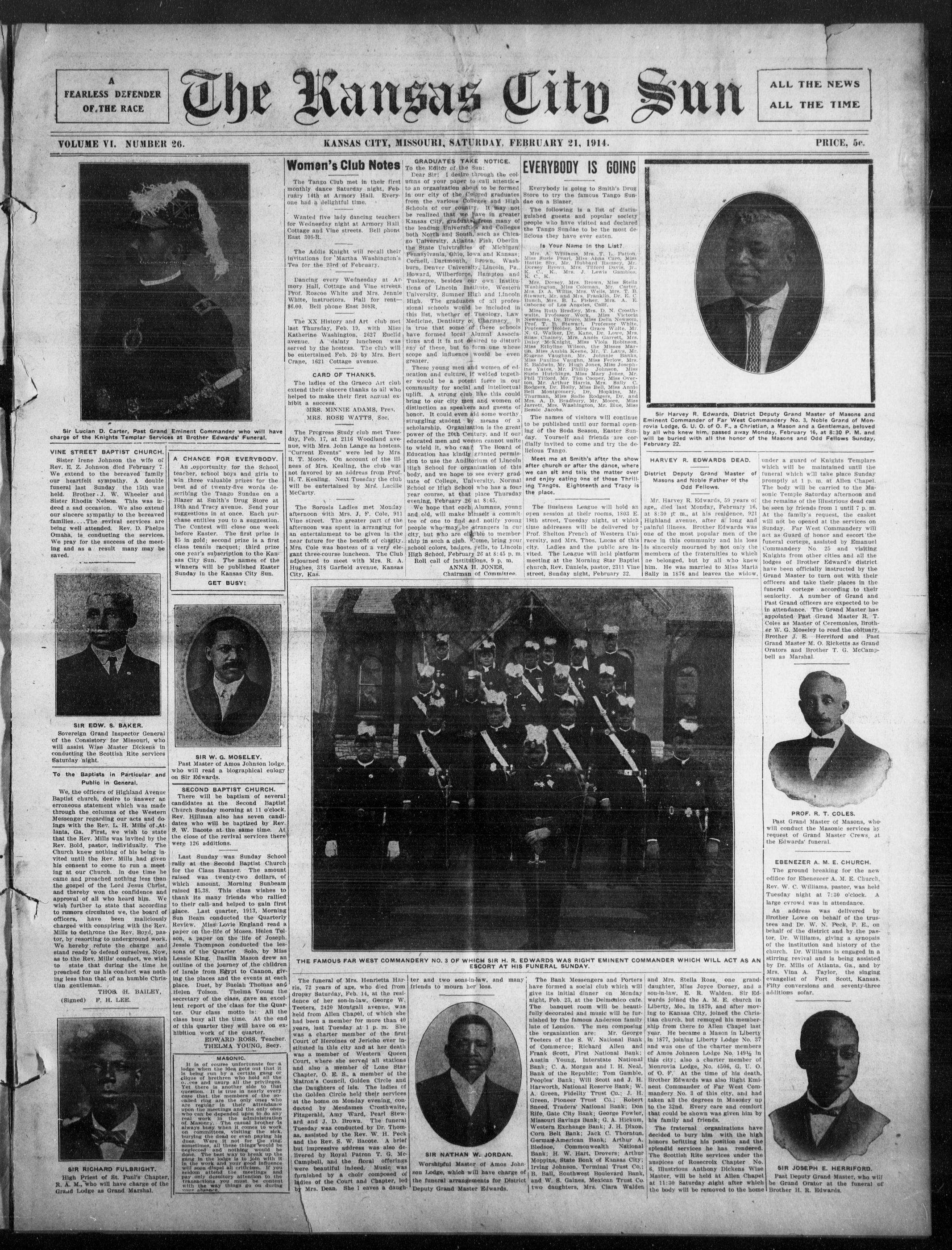
Sir Lucian D. Carter, Past Grand Eminent Commander who will have charge of the Knights Templar Services at Brother Edwards' Funeral.
A FEARLESS DEFENDER OF.THE RACE
VOLUME VI. NUMBER 26.
Sir Lucian D. Carter, Past Grand Emilion charge of the Knights Templar Services at VINE STREET BAPTIST CHURCH.
Sister Irene Johnson the wife of Rev. E. Z. Johnson died February 7. We extend to the bereaved family our heartfelt sympathy. A double funeral last Sunday the 15th was held. Brother-J. W. Wheeler and Sister Rhodia Nelson. This was indeed a sad occasion. We also extend our sincere sympathy to the bereaved families... The revival services are being well attended. Rev. D. Phelps Omaha, is conducting the services. We pray for the success of the meeting and as a result many may be saved.
SIR EDW. S. BAKER.
Sovereign Grand Inspector General of the Consistory for Missouri, who will assist Wise Master Dickens in conducting the Scottish Rite services Saturday night.
To the Baptists in Particular and Public in General.
We, the officers of Highland Avenue Baptist church, desire to answer an erroneous statement which was made through the columns of the Western Messenger regarding our acts and doings with the Rev. L. H. Mills of Atlanta, Ga. First, we wish to state that the Rev. Mills was invited by the Rev. Bold, pastor, individually. The Church knew nothing of his being invited until the Rev. Mills had given his consent to come to run a meeting at our Church. In due time he came and preached nothing less than the gospel of the Lord Jesus Christ, and thereby won the confidence and approval of all who heard him. We wish further to state that according to rumors circulated we, the board of officers, have been maliciously charged with conspiring with the Rev. Mills to dethrone the Rev. Bold, pastor, by resorting to underground work. We hereby refute the charge and stand ready to defend ourselves. Now as to the Rev. Mills' conduct, we wish to state that during the time he preached for us his conduct was not ing less than that of an humble Christian gentleman.
SIR RICHARD FULBRIGHT.
High Priest of St. Paul's Chapter,
R. A. M., who will have charge of the
Grand Lodge as Grand Marshal.
SIR RICHARD FULBRIGHT.
High Priest of St. Paul's Chapter,
R. A. M., who will have charge of the
Grand Lodge as Grand Marshal.
The Kansas City Sun
A CHANCE FOR EVERYBODY.
A CHANCE FOR EVERYBODY.
An opportunity for the School teacher, school boys and girls to win three valuable prizes for the best ad of twenty-five words describing the Tango Sundae on a Blazer at Smith's Drug Store at 18th and Tracyacy. Send your suggestions in at once. Each purchase entitles you to a suggestion. The Contest will close one week before Easter. The first prize is $5 in gold; second prize is a first class tennis racquet; third prize one year's subscription to the Kansas City Sun. The names of the winners will be published Easter Sunday in the Kansas City Sun.
SIR W. G. MOSELEY.
Past Master of Amos Johnson lodge, who will read a biographical eulogy on Sir Edwards.
SECOND BAPTIST CHURCH.
There will be baptism of several candidates at the Second Baptist Church Sunday morning at 11 o'clock. Rev. Hillman also has seven candidates who will be baptized by Rev. S. W. Bacote at the same time. At the close of the revival services there were 126 additions.
Last Sunday was Sunday School rally at the Second Baptist Church for the Class Banner. The amount raised was twenty-two dollars, of which amount, Morning Sunbeam raised $5.38. This class wishes to thank its many friends who rallied to their call and helped to gain first place. Last quarter, 1913, Morning Sun Beam conducted the Quarterly Review. Miss Lovie England read a paper on the-life of Moses. Helen Telson, a paper on the life of Joseph. Jessie Thompson conducted the lessons of the Quarter. Solo, by Miss Lessie King. Basililla Mason drew an outline of the journey of the children of Israel from Egypt to Cannon, giving the places and the events at each place. Duet, by Buelah Thomas and Helen Tolson. Thelma Young the secretary of the class, gave an excellent report of the class for the Quarter. Our class motto is: All the class busy all the time. At the end of this quarter they will have on exhibition work of the quarter.
EDWARD ROSS, Teacher
THELMA YOUNG, Secy.
MASONIC.
It is of course unfortunate for a lodge when the idea gets out that it is being run by a certain gang or clique of brethren who all call it the lodge. Yet there is another side to that question. It is true in nearly every case that the members of the lodge are the ones who are regular in their attendance upon the meetings and the only ones who can be depended upon to do any work. The lodge is paying a dues of Masonry. The casual brother is always busy when it comes to work on committees, whiting, staking, and other tasks, and paying dues. Were it not for the ring, sometimes, all these things would be neglected and nothing would be done. The lodge is paying a gang in the lodge is to join with it in the work and your good influence will soon dispel all criticism. If you are not in the lodge and pay only desultory attention to the transactions you must be content with the way things go on during
KANSAS CITY, MISSOURI, SATURDAY, FEBRUARY 21, 1914.
THE SCHOOL OF THE MARTIAL ARTS
THE FAMOUS FAR WEST COMMANDERY NO. 3 OF WHICH SIR H. R. EDWARDS WAS RIGHT EMINENT COMMANDER WHICH WILL ACT AS AN ESCORT AT HIS FUNERAL SUNDAY.
Women's Club Notes
The Tango Club met in their first monthly dance Saturday night, February 14th at Armory Hall. Everyone had a delightful time.
Wanted five lady dancing teachers for Wednesday night at Armory Hall, Cottage and Vine streets. Bell phone East 308-R.
The Addis Knight will recall their invitations for 'Martha Washington's Tea for the 23rd of February.
Dancing every Wednesday at Armory Hall, Cottage and Vine streets. Prof. Roscoe White and Mrs. Jennie White, instructors. Hall for rent—$6.00. Bell phone East 308R.
The XX History and Art club met last Thursday, Feb. 19, with Miss Katherine Washington, 2627 Euclid avenue. A dainty luncheon was served by the hostess. The club will be entertained Feb. 26 by Mrs. Bert Crane, 1621 Cottage avenue.
CARD OF THANKS
The ladies of the Graeco Art club extend their sincere thanks to all who helped to make their first annual exhibit a success.
MRS. MINNIE ADAMS, Pres.
MRS. ROSE WATTS, Sec.
The Progress Study club met Tuesday, Feb. 17, at 2116 Woodland avenue, with Mrs. John Lange as hostess. "Current Events" were led by Mrs. R. T. Moore. On account of the illness of Mrs. Kealing, the club was not favored by an address from Prof. H. T. Kealing. Next Tuesday the club will be entertained by Mrs. Lucille McCarty.
The Sorosia Ladies met Monday afternoon with Mrs. J. F. Cole, 911 Vine street. The greater part of the afternoon was spent in arranging for an entertainment to be given in the near future for the benefit of charity. Mrs. Cole was hostess of a very elegant three-course luncheon. The Club adjourned to meet with Mrs. R. A. Hughes, 318 Garfield avenue, Kansas City, Kas.
THE FAMOUS FAR WEST COMMAND
The funeral of Mrs. Henrietta Harris, 72 years of age, who died from dropy Saturday, Feb. 14, at the residence of her son-in-law, George W. Teeters, 2420 Montgall avenue, was held from Allen Chapel, of which she had been a member for more than 40 years, last Tuesday at 1 p. m. She was a charter member of the first Court of Heroines of Jericho ever instituted in this city and at her death was a member of Western Queen Court, where she served all stations and also a member of Lone Star Chapter, O. E. S., a member of the Matron's Council, Golden Circle and the Daughters of Isls. The ladies of the Golden Circle held their services at the home on Monday evening, conducted by Mesdames Crostwaite, Fitzgerald, Amy Ward, Pearl Steward and J. D. Brown. The funeral Tuesday was conducted by Dr. Thomas, assisted by the Rev. W. H. Peck and the Rev. S. W. Bacote. A brief but impressive address was also delivered by Royal Patron T. G. McCampbell, and the floral offerings were beautiful indeed. Music was furnished by a choir of ladies of the Court and Chapter, led by Mrs. Dean. She 1 eaves a daugh
GRADUATES TAKE NOTICE.
To the Editor of the Sun:
Dear Sir, I desire through the columns of your paper to call attentive to an organization about to be formed in our city of the Colored graduates from the various Colleges and High Schools of our country. It may not be realized that we have in greater Kansas City, graduates from many of the leading Universities and Colleges both North and South, such as Chico go University, Atlanta, Fisk, Oberlin the State Universities of Michigan Pennsylvania, Ohio, Iowa and Kansas; Cornell, Dartmouth, Brown, Washburn, Denver University, Lincoln, Pa. Howard, Wilberforce, Hampton and Tuskegee, besides our own Institutions of Lincoln Institute, Western University, Summer High and Lincoln High. The graduates of all professional schools would be included in this list, whether of Theology, Law Medicine, Dentistry or Upharmacy. It is true that some of these schools have formed local Alumni Associations and it is not desired to disturb any of these, but to form one whose scope and influence would be even greater.
These young men and women of education and culture. Wilted together would be a potent force in our community for social and intellectual uplift. A strong club like this could bring to our city men and women of distinction as speakers and guests of honor. It could even aid some worthy struggling student by means of a scholarship. Organization is the great power of the 20th Century, and if our educated men and women cannot unite to wield it, who can? The Board of Education has kindly granted permission to use the Auditorium of Lincoln High School for organization of this body, and we hope to see every graduate of College, University, Normal School or High School who has a four year course, at that place Thursday evening, February 26 at 8:45.
We hope that each Alumnus, young and old, will make himself a committee of one to find and notify young people who may be strangers in our city, but who are eligible to membership in such a club. Come, bring your school colors, badges, yells, to Lincoln High School, February 25 at 8:45 p. m. Roll call of Institutions, 9 p. m.
ANNA H. JONES,
Chairman of Committee.
ANDERY NO. 3 OF WHICH SIR H. R. E.
ESCORT AT HIS
ter and two sons-in-law, and many
friends to mourn her loss.
SIR NATHAN W. JORDAN.
Worshipful Master of Amos Johnson Lodge, which will have charge of the funeral arrangements for District Deputy Grand Master Edwards.
SIR NATHAN W. JORDAN.
Worshipful Master of Amos Johnson Lodge, which will have charge of the funeral arrangements for District Deputy Grand Master Edwards.
EVERYBODY IS GOING
The names of visitors will continue to be published until our formal opening of the Soda Season, Easter Sunday. Yourself and friends are cordially invited to come and try the delicious Tango.
Meet me at Smith's after the show after church or after the dance, where we can sit and talk the matter over and enjoy eating one of those Thrilling Tangos. Eighteenth and Tracy is the place.
The Business League will hold an open session at their rooms, 1803 E. 18th street, Tuesday night, at which time addresses will be delivered by Prof. Shelton French of Western University, and Mrs. Thos. Lucas of this city. Ladies and the public are invited. The League will hold platform meeting at the Morning Star Baptist church, Rev. Daniels, pastor, 2311 Vine street, Sunday night, February 22.
EDWARDS WAS RIGHT EMINENT COM
S FUNERAL SUNDAY.
The Bank Messengers and Porters have formed a social club which will give its initial dinner on Monday night, Feb. 23, at the Delmonico cafe. The banquet room will be beautifully decorated and music will be furnished by the famous Anderson family late of London. The men composing the organization are: Mr. George Teeters of the S. W. National Bank of Commerce; Richard Allen and Frank Scott, First National Bank; Austin Young, Interstate National Bank; C. A. Morgan and I. H. Neal, Bank of the Republic; Tom Gamble, Peoples' Bank; Will Scott and J. H. Harworth, National Exchange Bank; W. A. Green, Fidelity Trust Co.; J. H. Green, Pioneer Trust Co.; Robert Sneed, Traders' National Bank; Don Rife, Gate City Bank; George Fowler, Missouri Savings Bank; G. A. Hickum, Western Exchange Bank; J. H. Dixon, Corn Belt Bank; Jack C. Thornton, German American Bank; Arthur A. Bledsoe, Commonwealth National Bank; H. W. Hart, Drovers; Arthur Moppins, State Bonk of Kansas City; Irving Johnson, Terminal Trust Co., B. Ball, Southwest Boulevard Bank and W. S. Galnes, Mexican Trust Co. two daughters, Mrs. Clara Walden
M.
Sir Harvey R. Edwards, District Deputy Grand Master of Masons and Eminent Commander of Far West Commandery No. 3, Noble Grand of Monrovia Lodge, G. U. O. of O. F., a Christian, a Mason and a Gentleman, beloved by all who knew him, passed away Monday, February 16, at 8:30 P. M. and will be buried with all the honor of the Masons and Odd Fellows Sunday, February 22.
HARVEY R. EDWARDS DEAD
District Deputy Grand Master o Masons and Noble Father of the Odd Fellows.
Mr. Harvey R. Edwards, 59 years of age, died last Monday, February 16, at 8:30 p.m. at his residence, 922 Highland avenue, after a long and painful illness. Brother Edwards was one of the most popular men of the race in this community and his loss is sincerely mourned by not only the members of the fraternities to which he belonged, but by all who knew him. He was married to Miss Maria Sally in 1876 and leaves the widow
COMMANDER WHICH WILL ACT AS AN
and Mrs. Stella Ross, one grand-daughter, Miss Joyce Dorsey, and a son-in-law, E. R. Walden. Sir Edwards joined the A. M. E. church in Liberty, Mo., in 1879, and after moving to Kansas City, joined the Christian church, but removed his membership from there to Allen Chapel last year. He became a Mason in Liberty in 1877, joining Liberty Lodge No. 37 and was one of the charter members of Amos Johnson Lodge No. 149½ in this city; also a charter member of Monrovia Lodge, No. 4506, G. U. O. of O. F. At the time of his death, Brother Edwards was also Right Eminent Commander of Far West Commandery No. 3 of this city, and had taken all the degrees in Masonry up to the 32nd. Every care and comfort that could be shown was given him by his family and friends.
The fraternal organizations have decided to bury him with the high honors befitting his position and the splendid services he has rendered. The Scottish Rite services under the auspices of Rosecrox Chapter No. 6, Illustrious Anthony Dickens Wise Master, will be held at Allen Chapel at 11:30 Saturday night after which the body will be removed to the home
ALL THE NEWS
ALL THE TIME
PRICE. 5c.
Deputy Grand Master of Masons and
Commandery No. 3, Noble Grand of Mon-
lan, a Mason and a Gentleman, beloved
Sunday, February 16, at 8:30 P. M. and
the Masons and Odd Fellows Sunday,
under a guard of Knights Templars which will be maintained until the funeral which will take place Sunday promptly at 1 p. m. at Allen Chapel. The body will be carried to the Masonic Temple Saturday afternoon and the remains of the illustrious dead can be seen by friends from 1 until 7 p. m. At the family's request, the casket will not be opened at the services on Sunday. Far West Commandery will act as Guard of honor and escort the funeral cortege, assisted by Emanuel Commandery No. 25 and visiting Knights from other cities and all the lodges of Brother Edward's district have been officially instructed by the Grand Master to turn out with their officers and take their places in the funeral cortege according to their seniority. A number of Grand and Past Grand officers are expected to be in attendance. The Grand Master has appointed Past Grand Master R. T Coles as Master of Ceremonies, Brother W. G. Moseley to read the obituary Brother J. E. Herriford and Pas Grand Master M. O. Riclettes as Grand Orators and Brother T. G. McCamp bell as Marshal.
PROF. R. T. COLES.
Past Grand Master of Masons, who will conduct the Masonic services by request of Grand Master Crews, at the Edwards' funeral.
EBENEZER A. M. E. CHURCH.
The ground breaking for the new edifice of Ebenezeer A. M. E. Church, Rev. W. C. Williams, pastor, was held Tuesday night at 7:30 o'clock. A large crowd was in attendance.
An address was delivered by Brother Lowe on behalf of the trustees and Dr. W. N. Peck, P. E., on behalf of the district and by the pastor, Dr. Williams, giving a synopsis of the institution and history of the church. Dr. Williams is engaged in a stirring revival and is being assisted by Dr. Mills of Atlanta, Ga., and by Mrs. Vina A. Taylor, the singing evangelist of Fort Scott, Kansas. Fifty conversions and seventy-three additions sofar.
SIR JOSEPH E. HERRIFORD.
Past Deputy Grand Master, who will be Grand Orator at the funeral of Brother H. R. Edwards.
SIR JOSEPH E. HERRIFORD.
Past Deputy Grand Master, who will
be Grand Orater at the funeral of
Brother H. R. Edwards.
AFRO-AMERICAN CULLINGS
Recently in New York there met the National Association for the Advancement of Colored People. The association, according to committee reports, is growing. That is well. There can be no doubt of the need of organized effort to protect the interests and even the most elementary rights of the negro.
This is an unpleasant thought, but true. The appearance of Jim Crowism in the national offices at Washington, now thrown into higher relief by the president's strange reluctance to attack it, is only one expression of the tendency to isolate and hold the negro down. Recently Mr. Hyde has described the harsh and demoralizing conditions with which the most worthy class of negroes has to cope in Chicago. There is now appearing in the south a new segregation proposal, namely, that when more than a half of the acreage of a section is owned by one race, the voters of the section may exclude ownership by members of another race. In other words, says Doctor Du Bols, here is the policy of race segregation which has resulted in the degradation and destruction of the Indians.
The reminder is sharp-edged. Our mistreatment of the Indians has been admitted to be a blot on the nation's 'scutcheon. Are we to drift into an evil even greater? As Doctor Du Bois says, a quarter century ago the solution of the negro problem was formulated thus: "Take the negro out of politics. Train him for work, especially for farm work." The negro has been taken out of politics by various devices of disfranchisement which in effect annul the thirteenth amendment. This process of constitutional repeal has been accepted complaisantly by a generation preoccupied with its own material achievements and political and social problems. The results of this twofold policy, according to Doctor Du Bois and other observers are "that the negro schools have been neglected; that a large proportion of the negro children are not in school, and that there has been quiet but determined opposition to the success of the higher schools for negroes, while in the industrial and agricultural field the negro has had to content against tremendous odds."
It should be said in supplement to this, that in the south white schools also have been neglected; that the south has been very poor and economically retarded, and that in many districts the poor whites are worse off than the negroes. Yet, after all factors are brought within view, the human paradox appears that wherever the negro, in spite of the staggering handicaps under which he moves, has forced himself upward he thereby places himself in competition with white men and immediately becomes the object of their opposition. What is really wanted of him is humble, useful labor. Freedom in name he is to enjoy, but not the freedom a free soul demands, the freedom to move forward, to enjoy "the blessings of liberty," freedom in the "pursuit of happiness."
We shall not solve the negro problem on any such basis. The wisdom of Abraham Lincoln, who said "this government cannot endure permanently half slave and half free" is wisdom to day. Our policy toward the negro most certainly and most profoundly will react upon ourselves. That is a consideration which gives to the movement for the advancement of colored people the force of enlightened self interest.—Chicago Inter Ocean.
Fifty-seven years of continuous service as a weaver is the remarkable record of a woman employed in a cotton mill in Saco, Me.
The National Association for the Advancement of the Colored People, of which Oswald Garrison Villard, president of the New York Evening Post company, is one of the prime movers, was characterized as dangerous and misleading, and one of its Washington agents charged with fraud in a meeting of colored people in the Metropolitan church in M street, Washington. A resolution was adopted inquiring the number of school teachers and government employees who are giving their aid to the association, the manner of expenditure of money publicly collected for "the advancement of the colored people," the necessity for the existence of such an organization in the district, and whether the organization is incorporated according to the laws of the district.
The largest electrical egg hatching plant in the world is in England, having an average output of 8,000 chickens a week.
Mme. Alice Deschamps, a well-known French sportswoman, celebrated her eighty-fourth birthday by taking part in a lawn tennis, a golf and a croquet match at Le Touquet.
To encourage the use of paper twine instead of jute for balancing wool the government of Uruguay has lowered the duty on the former.
Montana produced a record amount of zinc last year and increased its silver output 4 per cent. over the figures for 1912.
Another Tribute to the Horse.
When it was first said last April that horseracing was to be resumed in the state of New York, Col. Frank Lin P. Morgan, who loves sport of any sort, expressed his gratification at the news.
"Horseracing," he said enthusiastically, "is a great and glorious thing. It warms the heart, thrills the brain and puts money into circulation."
in the group who was listening to him. "The only trouble is," added the
An earnest plea for the bettermort of the rural colored schools of the south was made by James H. Dillard, president and director, at the annual meeting of the board of the Negro Rural school fund of the Anna T. Jeanes foundation, which was held at New York a few days ago.
"The city, town and village schoolhouses for the colored children are often fairly good," says Mr. Dillard, "but in the open country, where we profess to wish the people to remain, and where we profess to wish to train these country children to better country living, anything better than a disgraceful shack is rarely found for the schoolhouse."
The Jeanes foundation, established five years ago, and with the active and financial co-operation of the various counties of the southern states, and that of the Phelps-Stokes fund, is carrying on an educational campaign among the rural negro population of the south.
The scope of the work is so large that though more than $38,000 has been spent for teachers' salaries alone, the officers and executive committee find themselves badly handicapped for funds with which to properly extend the work of the foundation. Only $1,195 was available for repairs and equipment of schoolhouses. So great has been the increase in the number of schools, that it has been found advisable to organize a corps of supervising teachers and state supervisors. The problem of meeting the traveling expenses of these workers is by no means an easy one. In many cases they are dependent upon private contributions from patrons of the schools, where the counties have made no appropriations for the purpose.
Mr. Dillard is optimistic regarding the future of the work, and feels that in spite of many handicaps, a constantly increasing appreciation and spirit of co-operation is being manifested by school officials, both state and county.
More than 300 members of the congregation of St. Francis Xavier's Catholic church at Baltimore, Md., sat at a banquet in the lecture hall of the church, the occasion being the continuation of the golden jubilee celebration of the church, which was opened by Cardinal Gibbons on Sunday. The congregation of St. Francis Xavier's church is a colored one and around the table were many of the most prominent people of the colored community. Councilman Harry S. Cummings said in part:
"We are all citizens of a great government to which we owe all the loyalty and patriotism which we can command. We owe respect and obedience to the law of the land and devotion to everything which makes for the prosperity of our common country. And as our president, whoever he may be in person, is the head of the government, we owe respect and loyalty to him as citizens. We, in return for this loyalty and patriotism, are entitled to receive and enjoy to its fullest extent every right granted to us under the law. And as there should be no difference in degree in our patriotism, so also should there be no difference or discrimination in according to all citizens their rights. Let us hope that our president, with all the power at his command, may see to it that all citizens may be accorded the full measure of their rights, so that each and every one of us may vie with each other in his love and devotion for our flag and our country."
A cork sunk 200 feet deep in the ocean will not rise again to the surface, owing to the great pressure of the water. At any less distance, however, it will gradually work its way back to light.
Booker T. Washington finds that "Virginia is setting a great example for the rest of the south in the matter of showing how the white and colored people may co-operate for general improvement. I find," Doctor Washington adds, "that not only have the efforts of the Negro Organization society received the hearty support of the white people of the state, but that other special lines of endeavor have likewise received their most cordial support.
"This is particularly true in the matter of education. Virginia was the first state to have a state supervisor of rural colored schools, and by so doing set an example for the rest of the south. The work of Jackson Davis in improving the negro schools of Virginia is an indication of how the best white people of the south are ready to give their time and talent for the betterment of conditions among negroes."
Among improvements to be carried out soon on the harbor of Newcastle, New South Wales, Australia, is the building of an electric power plant to supply new coal loading machinery.
The London (England) county council has decided to issue an order for the closing of barber shops throughout London at the same time.
Canada cuts about 2,000,000 cords of pulp wood annually, about half of which is exported for manufacture in the United States.
colonel dryly, "that in the matter of horseracing all of the horse sense is on the track, and none of it in the bett ing ring."-Popular Magazine.
Keeping Cheese.
To prevent cheese from getting hard, cut a small piece off for present use and place the remainder in cool place. Spread a thin film of butter over the cut part and cover with a clean cloth. This will prevent that hard, cracked condition which ruins the best of cheeses.
TO MAKE PERFECT DUMPLINGS
Really Is No Great Secret, Though Some Housewives Fail to Make a Success of it.
The ability to make really good dumplings is to be desired in these days of high prices; and if we can get as much food value from half the quantity of meat, while adding to it a palatable and digestible amount of dumplings, we will get a better proportion of protein to the needs of the body. Dumplings made by the following recipe will be light and dry, and will be found excellent to serve with chickens, guinea fowl or veal, and may be beaten in the gravy in a casserole. They may be made successful on the top of the stove, also, if care is taken to keep the liquid at the simmering point, and not let boil rapidly after the dumplings are dropped in. Have the gravity thinner than is wanted to serve, as it will thicken some with the cooking of the dumplings.
For five persons, beat one egg till smooth and light, add one cup of sweet milk, one-fourth of a teaspoonful of salt, and flour enough to make a stiff batter. Mix one teaspoonful of baking powder with the last of the flour, and beat well. Drop by teaspoonful into the hot gravy, cover and cook 15 minutes. Dish around the edge of a deep plate, the meat and gravy in the middle.
OLD STYLE OF POTTED BEEF
Nothing Better Has Been Devised
Than This Method That Was Used
by Our Grandmothers.
Take a good piece of a round of beef and cut off all the fat. Rub the lean well with salt and let it lie two days. Then put it into a jar and add to it a little water in the proportion of half a pint to three pounds of meat. Cover the jar as closely as possible (the best cover will be a coarse paste or dough) and set it in a slow oven or in a vessel of boiling water for about four hours. Then drain off all the gravy and set the meat before the fire that all the moisture may be drawn out. Pull or cut it to pieces and pound it for a long time in a mortar with pepper, allspice, cloves, nutmeg and melted fresh butter, adding these ingredients gradually and moistening it with a little of the gravy. You must pound it to a fine paste, or till it becomes of the consistency of cream cheese. Put it into the potting cans and cover it an inch thick with fresh butter that has been melted, skimmed and strained. Tie a leather over each pot and keep them closely covered. Set them in a dry place.
Game and poultry may be potted in this manner. From the use of melted fresh butter, instead of paraffin in sealing, and other points in this recipe, it will be simply suggestive and a good study for adaptation to modern conditions by those who desire to put up some of this delicacy for special occasion or emergencies.
Angels on Horseback
In spite of its name, this dish is a close relative of our older friends "pigs in blankets," To make these tid-bits, wrap each big plump oyster, drained and dried and seasoned with salt and pepper, in a nice, thinly sliced blanket of bacon. Skewer with a wooden toothpick and stick two cloves in the fat end of each oyster. Cook in a hot frying pan or the chafing dish blazer until the bacon is crisp and the "angel" or "pig," as you choose to call it, is ruffled around its edges. Serve on small squares of toast with a garnish of watercress and an olive or tiny pickle as an appropriate finish.
Cupid Wafers.
Beat one-half cup of softened butter to a cream and gradually beat into it the following in order given: One-half cup powdered sugar, grated rind of one lemon, one cup of strained honey, and two cups of sifted flour. Spread thinly on buttered tins in round forms about two inches in diameter and bake in moderate oven till browned slightly. Let stand for a minute then lift carefully and roll over a round stick. Very dainty to serve at St. Valentine's party. Tie each roll or two together with ribbon and serve with the ice.
Poor Man's Sauce
Mince an onion finely. Fry it in a little dripping until it is tender, then pour over it a glass of vinegar and a glass of water or broth, and a little pepper and salt. Let the sauce simmer gently for a few minutes, then add a tablepoon of mushroom ketchup. This sauce is to be served with young roast turkey. Sufficient for three or four persons.
Painted Flat Irons
One neat housekeeper's flat frons were painted with aluminum paint, such as is used to give a silvery appearance to radiators and stove pipes. She says it keeps them in perfect condition, preventing them from rusting. They were treated to a coat once a year. Of course the flat face of the iron is not touched with the paint.
Old English Crisps.
One cup sugar, one-half cup butter, one and one-half cups molasses, three cups flour. Melt the butter and the other ingredients, mix well together and drop by small spoonfuls far apart on a greased fat baking tin. Bake in a rather slow oven, remove from the tin with a broad bladed knife and place over the edge of a bowl to curl and cool.
Whiten Scorched Linen.
When white linen has been scorched in the froning, wet it with soapsuds, and lay it it in the sun, if the scorch is a slight one. If this does not remove the scorch, boil the piece in milk and soap in the proportion of a quarter of a pound of soap to a quart of milk.
Butter Toffee.
Very good toffee is made with one pound of sugar, one-half pound of butter, one-quarter pound of sirup, a pinch of salt, a little water and two tablespoons of vinegar, which last-named should be added Just before the toffee is done.
AFRO-AMERICAN CULLINGS
It is the reproach oftened brought against the colored laborer that he loves pleasure too well to work steadily week in and week out the year round, and the charge is well founded, though it is equally true as regards a part of the native whites. Happy- lucky habitures inherited from slave ancestors are in large part responsible for the disbelief of the whites in the manifest improvement in the material condition of the colored people. Canners in the Chesapeake basin often import foreign labor from Baltimore through the padrones, because the newcomers can be counted upon to stick by the job the season through, while the colored laborer is apt to run off to a camp-meeting or take a trip to Balti- more when the cannery is busiest. Housewives are driven nearly mad by the impossibility of knowing whether the cook will report for duty on any given morning. When spring comes and the men have regular work and wages, the women desert the kitchens and let their husbands or lovers support them. With late autumn, when the farm work is done and many farm laborers are idle, the women are glad to go back to the kitchen in order that there may be money for the household. Thrift is a lesson that the descendant of the slave is slow in learning.
In spite of much idleness, however, and extravagant indulgence in pleasure, the colored people of the Chesapeake basin are vastly transformed for the better in outward aspect within the past generation. The colored folk that crowd the villages on Saturday night are far better dressed than many European peasant proprietors. Indeed, the colored man's improvidence is apt to take the form of over-indulgence in dress and display. A colored farmer on the eastern shore of Virginia, finding himself with more than $2,000 in bank at the end of the season, bought five vehicles of various kinds. The bicycle is already much used by the colored people, and it will not be many years before colored men in the Chesapeake basin will be seen driving their own auto.—A. E. Vallandigham.
The clinic of the negro school is showing every day more plainly the price southern white people have paid for their neglect of the problem of the backward race. A cook in a famous Nashville hotel, followed to her home, was found to house in a cellar beneath a foul tenement, to the last degree unsanitary. From this she passed daily to the preparation of food for fastidious whites. A student nurse found a colored baby sick of a contagious disease lying staring up at a clothesline stretched across the crowded, untidy cabin, on which hung the spotless linen destined to be sent back to an exclusive white home.
Here in the north the doctrine of social interdependence has been pretty thoroughly learned. We know, if we do not live up to our knowledge, that the rich pay a terrible toll for the degradation of the poor. In the south, it would seem, there has been too much trust among the less inquiring classes that the negro's sins against sanitation would react only upon himself. They are awake now. Five thousand students in southern colleges are this year studying Dr. Weatherford's book on the race problem. The rank and file are coming to see that the tying up of negro religion with social hygiene is likely to have results incalculably important to the whole south—Mary Bronson Hartt, in the Boston Transcript.
Fifteen thousand colored men in Paris are forming a trades union to resist the efforts of the white workmen, who are claimed to be attempting to prevent the colored men from getting an increase in pay. The union will include chauffeurs, hotel porters, domestic servants and others.
To the Department of Public Instruction and Fine Arts of Spain has been allotted $63,000 for use toward establishing and improving workshops of the country's industrial schools.
Canada is nearly 30 times as large as Great Britain and Ireland, the total area of the Dominion being only 237,000 square miles less than the whole continent of Europe.
A Freiburg physician reported in his practice alone seven persons whose eyes were permanently injured by gazing at the sun during the progress of an eclipse.
The average woman can get more exhilaration out of a cheap compliment than a man can out of a quart of champagne.
The United States patent office last year granted 38,754 patents. In the same period 21,427 patents expired.
Searchlights are to be found mounted on the observation platforms of some western railroad trains.
The largest and highest cactus in the world is found in Arizona. It is 232 feet in height.
German cities having a population of 100,000 or more boast of their fine taxicab service.
Jane Addams, while walking in South Halsted street the other day, was approached by an excited woman, evidently a Greek. The woman, unable to talk English, was gesticulating frantically and pointing to a house in Ewing street. "Pyrros!" she exclaimed. "Pyrros! " "Yes?" said Miss Addams gently. "Pyrros!" repeated the woman, tugging at the other's sleeve.
Finally a great light broke *boke* in the
Addams. "Pyrros" is *greek* on
these words.
Many of the whites in the Chesapeake basin believe that their colored fellow-citizens are not improving materially, morally and intellectually, but he that has known the region for 30 years or so, and who returns to it with a fresh eye, cannot fail to note the improvement that has taken place in that time. The statistics of farming alone in the period between 1900 and 1910 are convincing as to the recent economic improvement of the colored man. In Maryland, Delaware and Virginia, as in many other states, the actual acreage in farms decreased in the decade 1900-1910, but in each of those states the number of colored farmers owning their land decidedly increased. In Delaware the increase was from 332 in 1900 to 406 in 1910; in Maryland, from 3,262 to 3,350; in Virginia, from 26,566 to 32,228.
In each of these states colored tenant farmers are being converted into land owners, for in each the number of tenants is decreasing, while the whole number of negro farmers is increasing. The value of farm lands and buildings owned by colored persons was more than $22,500,000, and colored tenants and managers were intruded with the administration of farm lands and buildings to the value of nearly $25,000,000. Thus the colored farmers of the Chesapeake basin are now in the ownership or occupying of farm lands and buildings to the value of more than $55,000,000. A generation ago, when the colored people were still almost within the shadow of slavery, a prosperous negro farmer was a rare sight in the Chesapeake basin. In that region the system common in the cotton states of turning over from 20 to 100 acres of land to be cultivated to cotton by a single slave family was little practiced, so that the colored people were not ready to be turned into tenant farmers, and then into land owners. A few free colored persons had owned land in Delaware, Maryland and Virginia while yet slavery flourished.—Baltimore American.
Twenty-two years ago Jonas W. Thomas, a negro of Marlborough county, South Carolina, began his career as a farmer by buying an old horse for $40.75, and by renting 30 acres of South Carolina land for 1,400 pounds of lint cotton. After four years of hard work and close saving he was able to buy a mule for $65 and also 67 acres of land. Then he began renting and working farms which belonged to other men. Gradually he was able to buy the land he had been renting. He also found it worth while to open a commissary.
Now Thomas lives in a 12 room house and employs on his $40,000 plantation, 39 families, consisting of 189 men, women and children. He grows a variety of crops, including cotton, corn, and some garden truck, and raises his own horses, mules, cows and hogs. He has received as much as $31,000 for his cotton crop alone—400 bales of long staple. On an average he has saved $3,000 a year for 22 years. All that he now has on his farm is his own, "directly and indirectly," he affirms with justifiable pride. In a single year he has borrowed one local bank and repaid $23,000. "Good credit," so Thomas says, "explains a fair share of my success."
There are floating "movies" in the Netherlands.
A bill was introduced in the senate by Senator Kenyon of Iowa providing for the expenditure of $200,000, the balance remaining in the hands of the freedmen's bureau, for the construction of a home for aged and infirm colored persons in the District of Columbia.
When navigation officially opened April 24, there were in elevators, on steamers and on railroad cars at Ft William and Port Arthur, at the head of Lake Superior, more than 42,750,000 bushels of grain awaiting transportation.
British exports to Mexico during the first ten months of this year were considerably greater than during similar periods of the two preceding years.
There are 438 iron mines in the United States, employing 65,170 persons, and costing for operation and development $74,017,830.
A gas buoy broke away from the moorings in the St Lawrence and drifted for two years, covering a distance of 18,000 miles.
The total production of coal in China at present reaches almost 10,000,000 tons a year.
A patent has been issued for a pen-cil-holding clip to be fastened to a person's ear.
The homes of this country require about $239,887,000 worth of furniture each year.
The total output of Idaho's various metal mines last year set a new high record.
word meaning "fire," and the woman was simply trying to tell her that her house was on fire.
An alarm was sent in. The blaze proved to be only a small one and the fire department experienced no difficulty in putting the "pyrros" out—Chicago Inter Ocean.
Hallowe'en Happenings
When the boys smash our neighbor's gate, it's the exuberance of youth, but when they smash our gate, it's an outrage.
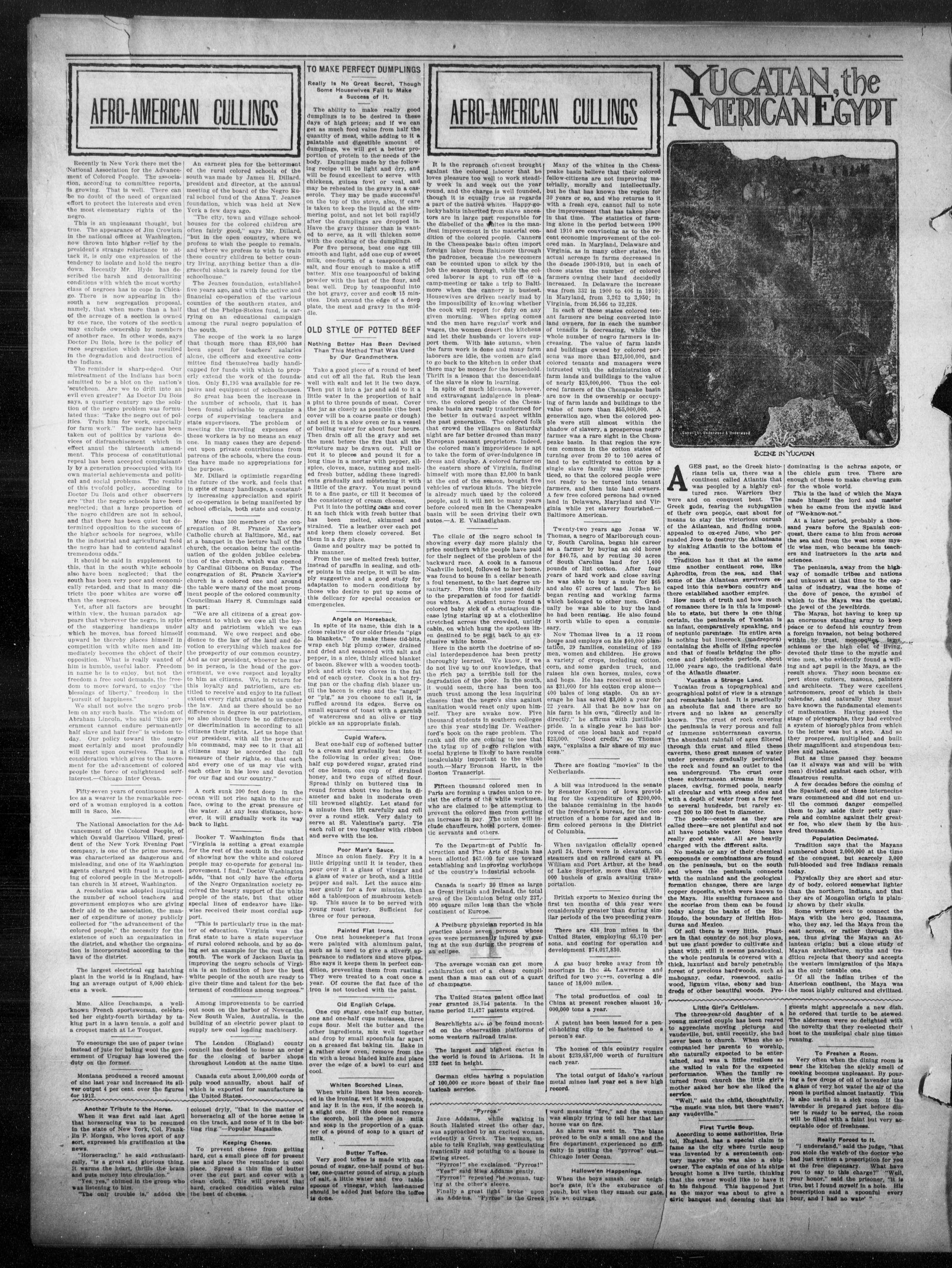
YUCATAN,the AMERICAN EGYPT
Copyright by Underwood & Underwood
SCENE IN YUCATAN
GES past, so the Greek historians tells us, there was a continent called Atlantis that was peopled by a highly cultured race. Warriors they were and on conquest bent. The Greek gods, fearing the subjugation of their own people, cast about for means to stay the victorious onrush of the Atlantean, and finding none, appealed to oxyed Juno, who persuaded Jove to destroy the Atlanteans by sinking Atlantis to the bottom of the sea.
Tradition has it that at the same time another continent rose, like Aphrodite, from the sea, and that some of the Atlantean survivors escaped into this newborn country and there established another empire.
How much of truth and how much of romance there is in this is impossible to state, but there is one thing certain, the peninsula of Yucatan is an infant, comparatively speaking, and of neptunic parentage. Its entire area is nothing but limerock (madreporis) containing the shells of living species and that of fossils bridging the phocene and pleistocene periods, about 12,000 years ago, the traditional date of the Atlantis disaster.
bacteria from a topographical and geographical point of view is a strange and remarkable land. It is practically an absolute flat and there are no rivers and no lakes as generally known. The crust of rock covering the peninsula is very porous and full of immense subterranean caverns. The abundant rainfall of ages filtered through this crust and filled these caverns, these great masses of water under pressure gradually perforated the rock and found an outlet to the sea underground. The crust over these subterranean streams in some places, caving, formed pools, nearly all circular and with steep sides and with a depth of water from a few feet to several hundreds, but rarely exceed 200 to 300 feet in diameter. The pools—cenotes as they are called there—are not plentiful and not all have potable water. None have really good water. All are heavily charged with the different salts.
No metals or any of their chemical compounds or combinations are found on the peninsula, but on the south and where the peninsula connects with the mainland and the geological formation changes, there are large copper deposits, which were known to the Maya. His smelting furnaces and the scoriae from them can be found today along the banks of the Río Hondo, the boundary of British Honduras and Mexico. Of soil there is very little. Planters in that country do not buy plows, but use giant powder to cultivate and plant with; still it seems paradoxical, the whole peninsula is covered with a thick, luxuriant and barely penetrable forest of precious hardwoods, such as mahogany, cedar, rosewood, sainwood, lignum vitae, ebony and hundreds of other beautiful woods. Pre
The three-year-old daughter of a young married couple has been reared to appreciate moving pictures and vaudeville, but, until recently, she had never been to church. When she accompanied her parents to worship, she naturally expected to be entertained, and was a little restless as she waited in vain for the expected performance. When the family returned from church the little girl's mother asked her how she liked the service.
"Well," said the child, thoughtfully, "the music was nice, but there wasn't any vaudeville."
First Turtle Soup.
According to some authorities, Bristol, England, has a special claim to fame as the city where turtle soup was invented by a seventeenth century mayor who was also a shipowner. The captain of one of his ships brought home a live turtle, thinking that the owner would like to have it in his fahond. This happened just as the mayor was about to give a civic banquet and deeming that his
A
Yucatan a Strange Land.
Little Girl's Criticism.
First Turtle Soup.
dominating is the achras sapote, or the chicle gum tree. There are enough of these to make chewing gum for the whole world.
This is the land of which the Maya made himself the lord and master when he came from the mystic land of "We-know-not."
At a later period, probably a thousand years before the Spanish conquest, there came to him from across the sea and from the west some mystic wise men, who became his teachers and instructors in the arts and sciences.
The peninsula, away from the highway of nomadic tribes and nations and unknown at that time to the captains of industry, was the home of the dove of peace, the symbol of which to the Maya was the quetzal, the jewel of the jewelbirds.
The Mayan, hot having to keep up an enormous standing army to keep peace or to defend his country from a foreign invasion, not being bothered within by trust, monopolized lions, schisms or the high cost of living, devoted their time to the mystic and wise men, who evidently found a willing and apt pupil in the Maya, as the result shows. They soon became expert stone cutters, masons, painters and architects. They were excellent astronomers, proof of which is their calendar, and naturally they must have known the fundamental elements of mathematics. Having passed the stage of pictographs, they had evolved a system of hieroglyphs from which to the letter was but a step. And so they prospered, multiplied and built their magnificent and stupendous temples and palaces.
But as time passed they became (as it always was and will be with men) divided against each other, with disastrous results.
A few decades before the coming of the Spaniel, one of these internecine wars commenced and did not end until the common danger compelled them to Jay aside their petty quarrels and combine against their greater foe, who slew them by the hundred thousands.
Population Decimated.
Tradition says that the Mayans numbered about 2,000,000 at the time of the conquest, but scarcely 3,000 full-blooded and free Indians remain today.
Physically they are short and sturdy of body, colored somewhat lighter than the northern Indians, and that they are of Mongolian origin is plainly shown by their skulls.
Some writers seek to connect the Maya with the hero god, Itzamma, who, they say, led the Maya from the east across, or rather through the sea, thus giving the Mayan an Atlantean origin; but a close study of Mayan architecture, myths and tradition rejects that theory and accepts the western immigration of the Maya as the only tenable one.
Of all the Indian tribes of the American continent, the Maya was the most highly cultured and civilized.
guests might appreciate a new dish. he ordered that turtle to be stewed. The aldermen were so delighted with the novelty that they re-elected their host to the municipal chair nine times running.
Very often when the dining room is near the kitchen the sickly smell of cooking becomes unpleasant. By pouring a few drops of oil of lavender into a glass of very hot water the air of the room is purified almost instantly. This is also useful in a sick room. If the lavender is prepared just before dinner is ready to be served, the room will be filled with a faint but very acceptable odor of freshness.
Really Forced to it.
"I understand," said the judge, "that you stole the watch of the doctor who had just written a prescription for you at the free dispensary. What have you to say to this charge?" "Well, your honor," said the prisoner, "it is true, but I found myself in a hole. His prescription said a spoonful every hour, and I had no wate"
Population Decimated.
To Freshen a Room
Really Forced to It
Over THEODORE SMITH, Druggist
Home Phone, 5476 Main
1301 East 18th St. KANSAS CITY, MO.
Office of
DR. M. G. BROOKINS,
24th and Vine Sts.
Bell Phone Last 232.
Residence, 1816 Woodland Avenue.
Bell Phone E. 838.
Office hours: 11 to 12 a. m.; 2 to
4 p. m.; 6 to 8 p. m.
Calls Answered Day or Night.
Office Hours
8 to 12 m. & 1 to 5 p. m.
Sunday by Appointment
Bell Grand 2553W
DR. E. C. BUNCH
DENTIST
Gold Crown, Bridges and
Plates A Specialty
Painless Extraction
716 East 12th St. Kansas City, Mo
Mrs. C. A. Smith
has opened a branch office of
MRS. S. BEDFORD'S
Wonderful Hair Grower &
Scalp Treatment
This treatment has proved to be a
wonderful success. Mrs. Smith will
receive patients for treatment from
From 8:30 a.m. to 6:00 p.m. at
her residence, 11th and Highland
Every ingredient used on the hair
is perfectly safe and
Guaranteed to Give Satisfaction
Bell Phone, East 4975.
A.
J H. SIMMONS, Prop.
ATLAS HOTEL,
915 Oak Street
Nicely Modern
Furnished Rooms
For Light
Housekeeping
BY DAY OR WEEK
Rates $1.50, $2.00, $2.50
and $3.00 a week.
FISHERMAN TELLS THIS ONE
Giant Sturgeon Tows Austrian to Camp and is Later Served to Crew of Hungry Men.
Lashing a 100-pound sturgeon to a raft, when he found the fish too heavy to carry, forcing the big member of the finny tribe to haul him into camp where later the sturgeon was served up to a crew of hungry men, is the latest fish story that has reached Boise. It was brought to Boise, Idaho, by Frank Maxwell, an engineer of the forest service with headquarters in Boise.
A large crew of men is stationed at the Ox Bow tunnel, on the Snake river, between Idaho and Oregon. A rancher named McPherson notified the foreman in charge of the camp that if he would send some of his men up he would give them a fish. Thinking that one man could manage a single fish without trouble, the foreman sent one of his Austrian laborers after it. When he arrived at the McPherson ranch, however, the Austrian found the sturgeon.
As the fish was still alive the Austrian built a raft from logs, leaving an opening in the middle for the fish to swim, and then lashed the sturgeon securely to the raft. Pushing the craft from the shore he allowed the fish to propel him into camp, several miles below. A fish menu was served at the camp that night.
"It is estimated that one-ninth of the world's supply of quinine is used in India," said a well known Chicago doctor at the Hotel Safford.
"Java now gives the world more quinine than any other country. At one time India tried to lead the world in the supply of quinine, and if that country should at present take steps to extend the culture of cinchona it may not only protect its own interest, but perform a world-wide service.
Kansas City Undertaking Co.
Carpet Cleaning Co.
Solid Avenue
It Cleaner in Missouri Owned
listed by a Negro.
Look New for a Reasonable Price
ion Given to Out of
ers---You Pay the
Way and I Pay
TEED TO BE FIRST CLASS
ite for information.
n J. M. & T.
The Eureka Carpet
1718 Euclid A
The Only Steam Carpet Clean
and Operated by
Your Old Carpets Made to Look New
Special Attention G
Town Orders---Y
Freight One Way
the Rest.
ALL WORK GUARANTEED
Call Up or Write for
Yours in J.
The Eureka Carpet Cleaning Co.
1718 Euclid Avenue
The Only Steam Carpet Cleaner in Missouri Owned and Operated by a Negro.
Your Old Carpets Made to Look New for a Reasonable Price
Special Attention Given to Out of Town Orders---You Pay the Freight One Way and I Pay the Rest.
ALL WORK GUARANTEED TO BE FIRST CLASS
Call Up or Write for Information.
Yours in J. M. & T.
1718 EUCLID AVE.
KELLEY'S BEST HIGH PATENT
Hello
```markdown
```
```markdown
```
Do You Read The Sun?
DO YOU LIKE IT?
Do you know you can get it for ONE YEAR for ONE DOLLAR AND FIFTY CENTS. Sent anywhere in the United States.
ORDER NOW! OUR PHONE IS BELL EAST 999.
1803 East 18th Street.
H. B. MOORE, Proprietor.
PHONES: Home M. 1169. Bell E. 3555.
TYPEWRITING DONE at Kahssas City Son Office, 1803 East Eighteenth street. Neat, quick work. Rates reasonable. Engagements by appointment. Bell phone East 999.
Hello, Neighbor!
Call us, write, or see our agents.
Motto: Prompt attention and courteous treatment.
Lady Attendants. Caskets and Carriage
Only Chapel Room in the City
OPEN DAY AND NIGHT
Home Phone, Main 3341.
Dell Phone, Main 3398.
1031-33 Independence, Ave.
KANSAS CITY, MO.
D. M. WEST, Prop. Kansas City, Mo
Get used to the imprint of the race printer, who wishes your patronage on the basis of better and quicker printing service. This is it: C. A. Franklin, Printer, 1409 Main St
FLOUR
Kelley's Best Beat all the Rest
Kelley Milling Co.
K.C., U.S.A.
NELSON C. CREWS, Editor and Owner.
ADVERTISE YOUR SOCIETY.
We would like to see every lodge and society in Kansas City put their cards in The Sun. It is the most popular way to let the world know who you are, when and where you meet and your object and purpose. For the next month we will make special announcements to have you put in your lodge or society list of of officers in this paper.
Mme. Benton Dean, the popular milliner, has moved to 1010 Troost avenue, where she is elegantly located and will be extremely pleased to meet her many friends and customers at that number. Belle phone East 2102J.
WORTH WHILE.
Don't ask, "Has the world been true to me?"
But have I to the world been true?
'Tis not what you get, but what you give,
That makes life worth while to you.
'Tis the kind word said to the little child,
As you wiped its tears away;
The smile you brought to a care-worn face
That really lights up your day.
'Tis the hand you clasp with honest grasp
That gives a hearty thrill;
'Tis the good you pour into other lives
That comes back your own to fill,
'Tis the dregs you drain from another's cup
That makes your own seem sweet,
And the hours you give your fellow-men
That makes your own life complete.
'Tis the burdens you help another bear
That makes your own seem light;
'Tis the dangers seen for another's feet
That shows your path to right;
'Tis the good you do each passing day
With a heart sincere and true—
By giving the world your very best.
Its best will return to you.
If you have Rheumatism one bottle of Lees Balsam
Will Convince You
Send for testimonials, FREE.
At Druggists $1.00; by Express,
prepaid, $1.25
GREEK BALSAM CO.
835 E. 15th St., Kansas City, Mo.
Read The Sun
, Neig
MISS RUTH BRADLEY & CO.
Main Office: 400 Haskell Ave., Kansas City, Kas.
BELL PHONE WEST 644
Branch Office: Portsmouth Bldg., Sixth and Minnesota Ave.
Branch Office, Topeka, Kas.: 410 Kansas Ave.
Expert Dental Specialists
OF KANSAS CITY.
Our work has stood the test. We
Dental Work for the past 26 years.
Remember, all work is
SAVE MONEY EXAM
All work
The doctor who extracts your teeth in this line than any other dentist service. Painless Extracting, 85
stood the test. We have been doing it
for the past 26 years. We have thousands
in Member in Business Sec.
All work kept in repair free of charge.
HONEY EXAMINATION FREE GE
All work guaranteed 28 years
he extracts your teeth here has undoubted
an any other dentist in the city, so you
uses Extrating. 25a.
Our work has stood the test. We have been doing high class guarantees
Dental Work for the past 26 years. We have thousands of satisfied patients
Remember, in Business 26 Years
All work keeps in repair free of charge
The doctor who extracts your teeth here has undoubtedly had more experience in this line than any other dentist in the city, so you get the most expensive service. Painless Extracting, 25a.
BRIDGE WORK
Spaces where from one to ten teeth have been lost we replace with bridge work. It looks the same as natural teeth, lasts a lifetime and requires no plaster. Broken down teeth we restore to beauty and usefulness with crowns of porcelain and gold.
Gold Crowns #3, $4 and $8
Silver Fillings, 75c, and $1
White Crowns $3, $4 and $8
Platine Fillings 28c
FULL SET TEETH $4 TO $8
'NEW YORK DENTAL CO
New Location 1017-19 Walnut St.
Over Jaccard's Jewelry store, 1 door north Emery, Bird, Thayer Co
$3, $4 and $8
Silver Fillings, 750. and $1
White Crowne $3, $4
Plaza
FULL SET TEETH $4 TO $8
NEW YORK DENTAL
New Location 1017-19 Walnut
's Jewelry store, 1 door north Emer
Gold Crowne #3, $4 and $8
Silver Fillings, 75o. and $1
White Crowne $3, $4 and $5
Platline Fillings 250
'NEW YORK DENTAL CO
New Location 1017-19 Walnut St.
Over Jaccard's Jewelry store, 1 door north Emery, Bird, Thayer Co.
Fashion Craft
J. GREENBURG, Prop.
Cleaning and Repairing
718 East 8th St.
Suits Cleaned and Pressed, $1 00. Goods
called for and delivered. Bell phone Main
4231Y; Home phone Main 3336.
ALL HAND WORK
FRED MARSHOCK
GROCERIES AND MEATS
CERIES AND
GROCERIES AND MEATS
We have been doing high class guarantees
We have thousands of satisfied patients
in Business 20 Years
in repairs of charge
INATION FREE
guaranteed 20 years
here has undoubtedly had more experience,
list in the city, so you get the most expes
BRIDGE WORK
Speeds where from one to ten teeth have
been lost we replace with bridge work.
I looks the same as natural teeth, lasts a lifetime
and requires no plate. Broken down
teeth we restore to beauty and usefulness
with crowns of porcelain and gold.
$8
, 750. and $1
Ke Crowne $3, $4 and $5
Platina Fillings 200
TEETH $4 TO $8
K DENTAL CO
on 1017-19 Walnut St.
, 1 door north Emery, Bird, Thayer Co
Fashion Craft
J. GREENBURG, Prop.
Cleaning and Repairing
718 East 8th St.
Suits Cleaned and Pressed, $1 00. Goods called for and delivered. Bell phone Main 4231Y; Home phone Main 3336.
MARSHOCK
S AND MEATS
AND VEGETABLES
Fresh and First Class
PHONE 6496 MAIN
Kansas City, Mo.
Kansas City, Mo.
A. F. and A. M.
Missouri Jurisdiction
Officers—1913.
N. C. Crews, Kansas City, Grand Master.
Deputy Grand Master, Richard Young, Lincoln, Neb.
L. F. Payne, Glasgow, Mo., Grand Senior Warden.
F. J. Brown, St. Louis, Grand Junior Warden.
H. H. Walker, St. Joseph, Grand Treasurer.
Geo. W. K. Love, Grand Secretary, Kansas City, Mo.
W. W. Fields, Secretary of Masonic Relief, Cameron, Mo.
E. J. Cooper, Mexico, Mo., Grand Lecturer.
Grand Commandery Officers.
A. D. Butler, R. E. G. C., St. Joseph,
Mo.
W. G. Mosely, V. E. G. C., Kansas
City.
P. C. Kincade, E. G. C. G., Kansas
City.
T. P. Mahammitt, G. Treasurer,
Omaha, Neb.
C. H. Lewis, G. Rec., Kansas City.
Geo. Broomfield, G. H. P., St. Louis,
Mo.
T. G. McCampbell, D. G. H. P., Kansas City.
A. L. Thomas, G. K., Jefferson City,
Mo.
J. P. Mofitte, G. S., Sedalia, Mo.
Chas. Griggsby, G. Treas., Liberty,
Mo.
E. S. Baker, G. Sec'y, Kansas City,
Mo.
MASONIC BUILDING ASSOCIATION MEMBERS.
R. T. Coles, Chairman.
E. S. Baker, Secretary.
C. H. Lewis, Asst. Secretary.
R. W. Foster, Treasurer.
W. C. Mallory, Sandy Meyers,
Wm. Washington, Geo. Bradley.
T. W. H. Williams, H. R. Edwards,
J. E. Herriford, E. G. Lacey,
E. G. Miller, W. C. Hueston.
Lodge Directory
Pritchard Lodge No. 42, A. F. and A. M. meets the 2nd and 4th Monday in each month. All Master Masons in good standing welcome. Cver, W. M.; J. H. Snigner, Sec'y.
Rone Lodge No. 25, A. F. and A. M. meets the 1st and 3rd Monday in each month. All Master Masons in good standing welcome. F. W. Glimore, M.; T. J. McCampbell, Sec'y.
Mt. Olive Lodge No. 53, A. F. and A. M. meets the 2nd and 4th Friday in every month. Visitors are welcome. Thos. Jackson, W. M.; J. A. Johnson, Sec'y.
Expert
Furnace and Stove
Repairs
RESIDENCE 1612 COTTAGE AVENUE.
VISIT THE
New Negro Enterprise
Known as the
Fad Studio
A First Class, Up-to-Date Gallery.
Views, Flashlights of Banquets, Parties, Groups of all Public Functions.
Enlargements our Specialty.
Post Cards, three for.....25c
Cabinet Photos made, per dozen,
$2.00 UP.
AGENTS WANTED
G. BRUGE SANTEE, Prop.
1718 E. 18th ST., KANSAS CITY, MO.
J.C.WAGNER
The Clean Market Man
Oysters, Fish and Game in
Season.
Fancy Groceries and all Table
Luxuries.
Courteous Treatment to All
1819 Howard Ave.
Bell Phone 3596 East
Kansas City, Missouri.
Best Shine in K.C. 5c For Ladies Gents
AGENCY FOR
The Kansas City Son.
The Crisis,
The New York Age,
The Freeman
and All Daily Papers
Ice Cream and Soda
Cigars and Tobacco
HENRY SHUMAKER
1625 East 18th St.
THE KANSAS CITY SUN
All communications city Sun, 1803 East 18th
Rd.
Bell Phone East 999.
Entered as second-class matter, August
42, 1988, at the postoffice at Kansas City,
Mo. under the date of March 3, 1879.
Nelson C. Crews.....Editor and Owner
Willa B. Glenn.....General Manager
J. Thompson.....Advertising Agent
J. G. Tyler.....Advertising Solicitor
Eva P. Washington.....Traveling Representative
Rosa Morton.....Collection
Alma Crews.....Collection
SUBSCRIPTION RATES:
One Year ..... $1.50
Six Months ..... 75
Three Months ..... 50
It occasionally happens that papers sent
to subscribers are lost or stolen. In case
you do not receive any number when due,
inform us by postal card and we will
permissionally a duplicate of the missing
number.
ADVERTISING RATE ..... 50 CENTS PER
INCH
CHURCH DIRECTORY
Bethel A. M. E. Church, 24th and Floral
St. Stephen's Baptist Church, 604 Char-
ristian Church, 19th and Tracy
Greenwood Baptist Church, 1839 Trac-
centennial M. E. Church, 19th and
Woodland.
Second Baptist Church, 10th and Char-
lotte
Alen Chapel A. M. E. Church, 10th and
Charlotte
Kansas Ave. Baptist Church, 46th and
Kansas Avenue Tracy
Ebenezer A. M. E. Church, 17th and
Tracy
Augustine's P. E. Church, 11th and
Troost.
Vine St. Baptist Church, 1325 Vine St.
Plessan Green Baptist Church, Independent
Church Tracy
Ward Chapel A. M. E. Church, 11th and
Woodland
Join's A. M. E. Church, 1748 Pelie-
view
Seventh Day Adventist, 23rd and Wood-
land.
St. Monica's Catholic, 17th and Lydia.
Morning Star Baptist Church, 2311 Vine.
Highland Avenue Baptist Church, 1111 Hir-
d
Centropolis A. M. E. Church, Centropolis
Mt. James A. M. E. Z. Church, 1823
Woodland Ave.
Third Baptist Church, Roundtop,
People's Mission, 30th and Genesee,
St. Paul's Baptist Church, 19th and
Highland.
Pilgrim Baptist Church, 614 Charlotte
St.
Calvary Baptist Church, 19th and
Askew.
Biglow A. M. E. Mission, 5th and
Lydia.
Progressive Baptist Church, 29th and
Summit.
C. A. E. Church, 1817 Flora Ave.
St. James Baptist Church, 40th Mill St.
St. Luke's A. M. E. Church, 42nd and
Propeace Ave.
A. M. E. Mission, 565 Grand Ave.
KANSAS CITY, KAN. CHURCHES.
First A. M. E. Church, 8th and Neb.
Pleasant Green Baptist Church, 1st and
Spitlott.
Eighth St. Baptist Church, 8th and
Oakland.
Metropolitan Baptist Church, 9th and
Washington.
Bethlehem A. M. E. Water and
St. Edward Street.
St. Paul A. M. E. Church, 21st and
Raby.
First Baptist Church, 5th and Neb.
King Solomon Baptist Church, 3rd and
State.
Quadro A. M. E. Church, Quindaro,
Pleasant Valley Baptist Church, Rosalee, K.
M. E. Church, 9th and Oakland,
Salt Lake City, 4th and Oakland,
Salter Misman, 4th and South
Park, Kan.
Second Episcopal, 3rd and Stewart,
Second Baptist Church, 2nd and Ruby,
Wesley Chapel M. E. 106 Shawnee,
Wesley F. A. M. E. Zion Church, 4000
Adams
Bethel A. M. E. Church, Roselale, Kan
M. Baptist Church, 4th and Virgina.
Ebenezer A. M. E. Church, Sanford and Tremont.
"The Republican party is the ship, all else the sea for the Negro," said Frederick Douglass forty years ago. What was true then is true now. Stick to the party, boys.
Do you want stock in the Kaw Valley Truck Gardening Co., incorporated and bonded? Call E. A. Robinson president. Bell, East 754.
Don't criticise the police for looking long-faced and downhearted this week. They are worried over the dynamiting outrages against Negroes living in the North End.
---
In living up to the strict temperance principles of Oklahoma, Senator Gore properly refuses to be "Bottled in Bond" although the goods had been aged in wood.
The big May Music Festival in the public schools has been declared off by the superintendent. This leaves us with nothing but the choir soloist and the robin for spring cheer.
Kansas City is conspicuous for its marvelous growth, its surpassing trade advantages, its unrivaled park system, its enviable banking facilities and its increasing race prejudice. This ought to insure a reserve bank.
The best way to kill undeserved scandal or gossip is to ignore it. Chase it and, like the yelping hound, it will run and attract everyone within hearing. Let it alone and it will die of its own weight, leaving a bitter taste on the lips of its originator.
A young man handed a shop girl a get-acquainted note. That was very indiscreet. A welfare worker trapped the young man by means of a fake telephone call. That was very unfair. A judge fined the young man five hundred dollars. That was very high. Moral:—"Let 'em alone."
Prof. J. Silos Harris, president of the Negro Educational Congress, is disposed to take a gloomy view of recent proposed legislation aimed at the liquor traffic. He thinks that the enactment of such laws would strike at the very root of human liberty and that they should not have the support of the Negro.
OVERCOMING PREJUDICE.
Every person of color is compelled to notice some instance of race hate, prejudice or so-called intolerance every day of his life. This is especially true of the down-town worker, whose active and widespread activity carries him into the different marts, business district; then, too, on the cars; in the homes of the other race and every conceivable place where activity is or has any bearing with the life of a great bustling city. Perhaps the colored porter is more often reminded that there is a "difference" between him and his fairer brother who works along beside him for the same employer, often at the same scale of wages, but with this difference the colored brother's sta
---
tion is usually "fixed" and he is seldom encouraged to look above a certain height; whereas his fairer brother is flooded with opportunities and inducements to rise to the highest possible position. May we not conclude that the Negro loses out on account of color? Of course unjustly so.
What About Personality?
What About Personality?
If the Negro loses on account of color prejudice he is making it up in personality. Herein lies the one power to overcome prejudice and solutionize the race problem individually and effectively in our own business dealings with the other fellow, whether it be transacting a pure business deal or as employee and employer. Personal worth is a fair definition of personality, since it is left to the individual to prove of what grade his personality is made. Whether it be good or bad, strong or weak. We believe the average colored person who works in the downtown stores is aiming to make his personal services win recognition over the usual boundary lines and hence overcome an unreal prejudice which can not stand before his intrinsic worth to his employer. This is certain: Good service has never hurt any employee's standing, but goes a long way toward breaking down fences which have been built by the vain imaginations of men. The intelligent Negro keeps this thought in mind. The 'other fellow' whom we showed to be overflowed with opportunities for advancement, often fails on account of lack of this "personality" or personal worth. Seeing this how much more should the Negro seek to be efficient in his own line (to use the vernacular) and not be content to merely "get by." In proportion as the Negro becomes a recognized economic factor in that institution by which he is employed however humble that may be, he is not only demanding a better wage but wins for his race a deeper consideration.
Intelligence and Politeness.
Intelligence and Politeness.
We have confined this line of reasoning chiefly to the porter, the hotel waiter and the car driver, believing these to make up what is termed the real "people" they certainly come in contact with other races more so than any other class of Negroes and among whom are found some of the best examples of manhood. These people know better than anybody how the door of opportunity is lrigely closed and they know best how to partly open that door, too. They know that intelligence has won for them places which nothing else could have done. There was a time when the Negro was considered as a mere clown and an object of amusement, but the "yessa, boss" person is becoming obsolete, employers perferring service rather than entertainment. Then intelligence and politeness are the prime factors which will move any amount of intelligence, in our business relations with others. We find that courtesy is not altogether withheld from us and that it is largely dependent upon our own sense of what is good and true in attempting to break down the barriers of a falsely drawn line which cannot remain be fore Truth and Justice.
VILLA IS NOT GOLDSBY
VILLA IS NOT GOLDUSBY.
We are in possession of definite information that proves beyond a doubt that General Francisco Villa is not Goldsby, the Negro sergeant of 10th Cavalry. The proof is that when Villa was closely and thoroughly examined and all his personal effects scrutinized it was found that his shoes bore the stamp of a shoe firm in Mexico City, Mex., while it is a fact that "G. A. Page," who owns and operates an up-to-date shoe store at 1507% East 18th, sold Sergeant Goldsby his last pair of fighting shoes.-Adv.
Betty & Sam's Little Corner
THEY SAY
—That just as a couple were being married recently a large plate glass mirror fell to the floor and was shivered to a thousand pieces. What does it portend?
—That there are a bunch of low, measly knockers who never take the Sun, yet are always trying to get a puff for themselves inserted in its columns. Sabe?
—That Dr. Theo. Smith is preparing to entertain the social sets of the two Kansas Cities with a Musical and dance at an early date.
—That "one should avoid that stage in life where he thinks it makes no different what he is, but how he acts; for then he is lost."
—That the man who attends strictly to his own business never has to explain how he got that black eye.
—That some are always ready to criticise others for what they are un able to do themselves.
—That if you haven't any trouble, it is easy to start some.
—That the wages of bin is death.
```markdown
```
A Beautiful Design.
Sprays ..... $1.00 and upward
Designs ..... $1.50 and upward
We please the people both in price
and quality.
There is a reason why the larger per cent of Cabinet Stationary used in the printing industry came from the Arthur W. Harris Printing Establishment. First their workmanship is superior to the larger and best equipped, printing establishments by any of the larger and speciality this class of work. Second, while their prices are not always lowered, they have a delivered" with accuracy and despatch to over 90 per cent of the class which makes them a past year and now when a function of class is announced its a ten-to-one shot that Harris will handle the job.
Y. M. C. A. NOTES
Y. M. C. A. NOTES
Sunday, February 22, the regular Men's Meeting will be addressed by Mr. H. C. Mesley, a layman of the First Baptist Church of Kansas City, Kas. Special music by the Imperial Instrumental Quartet. A short report of the state convention will be made by the delegates.
The meeting last Sunday was addressed by the Rev. G. L. Prince of the Metropolitan Baptist Church of Kansas City, Kas, and the men who heard him unto in their praise of his manly way of handling the teachings of faith in whatever one attempts to do. We are proud of such men as Rev. Prince and expect to have him with us again.
The state conference of the Y. M. C. A., held at Sedalia, February 13-15, was the third convention held in that city since the organization of state work thirty-six years ago. At that time the budget of the state commission was $93.40, for he year 1913 it was $10,006.70. There were 250 delegates in attendance. Of the seven colored, two were from Geo. R. Smith College, two from St. Louis and three from Kansas City.
Y. W. C. A. NOTES
"I am come that they might have life an itth that they might have it more abundantly." John 10-10. National Motto Y. W. C. A.
"I am come that they might have life; and that they might have it more abundantly." John 10:10. National Y. W. C. A. Motto.
A big musical entertainment is to be given by the Y. W. C. A. under the auspices of its social committee. Mrs. J. H. Claybourne, chairman, in the Summer High School Auditorium on Washington Blvd. and Ninth Street on Wednesday evening, February 25th. Prominent men and women are to take part in the program. The public is invited. No admission fee will be charged but an opportunity will be given to ra silver offering. All members of this branch of the Young Women's Christian Association are urged to be present at our first annual meeting on Monday, March 2, 1914, at 8 o'clock. The meeting will be held downstairs in the large restaurant in the Y. W. C. A. building, 1101 North 5th street or at the corner of Fifth and State. We want to have a real jubilee in celebration of the c lose of our first year because we have done well. The fact that we are to close without a deficit is grafting to say the least. Come let us sing together. "The Lord hath done great things for us wherewe are glad." Some of our members have not given aid in full. If you will come to this office 'and day after 9 a. m. or send your check made payable to the Yates Branch of the Y. W. C. A., 5th and State Avenue, Kansas City, we shall be glad to lodge you with the financial members. We would like to close the year with 350 paid in full members.
LYDIA C. SMITH,
General Secy.
ST. JOHN A. M. E. CHURCH, 1747
BELLVIEW AVENUE.
Sunday services at 9:30 a. m. Sunday School at 10:40. The general will preach "Strange Things Happen Today." At 7:45 p. m. he will preach "What Think Ye of Christ?" On Friday night there will be a grand musical and literary concert given by the public schools of Kansas City, Mo., and Kansas City, Kans. Everybody come and help the members of St. John.
Peace Power Plenty
Are you Discouraged, Discontented or
Despondent?
Are you Poor, Poverty-striken or Painful?
Are you Sick, Sad or Sinful?
Negro Business League of Kansas City.
Members will please report any mistake or change of address to E A. Robinson, Financial Secretary and Fiscal Agent. Bell Phone East 754
AUTOMOBILES.
Wm. D. Foster Auto Co. 1423 Forest, hire and repair; office Bell Grand 1630W; res. phone Bell East 4417W.
Henry Compton, 1512 E. 18th St. Bell phone, East 618.
Mrs. King, Eighteenth and Paseo.
Maggie Steamer, 1507½ East Twelfth.
Harmless Wynn, barbecued meats, 2315 Vine.
Mrs. H. W. Dotson, 1705 E. Twelfth St. Phone, Bell 2214
Madame U. F. Scales, Northeast Cor. 5th and State, Kansas City, Kans.
Bishop's Cafe, H. Bishop, Prop., 911 MeeGe St. Bell phone, Main 751.
CLEANERS, DYERS AND TAILORS.
O. K. Cleaners and Dyers, guaranteed not to shrink any garment we
dye, 1113 East 18th; Bell Grand 2437.
R. Bennett, 1515 East Eighteenth; East 4746 Bell.
J. F. Basil, 1509 Main; Main 6449 Home.
John Holmes, 1903 Vine.
Wortham Bros., 1222 E. 19th St. Bell Phone, Grand 3933-W.
Laden Bros., Tailors, Designers and Cutters, 2427 Vine Street. Bell
Phone, E 569-W.
E. N. Cohron, State Baptist Missionary, 708 North 24th St., St. Joseph, Mo. Phone 2137.
G. T. Mosby, Pastor Greenwood Baptist Church, 18th and Terrace,
Kansas City, Mo.
W. H. Thomas, Pastor Allen Chapel A. M. E. Church. Bell, Main 3660.
J. W. Hurse, Pastor Saint Stephens Baptist Church. Bell, East 4090.
G. W. Boyd, Pastor Highland Avenue Baptist Church.
W. A. Bowren, Pastor First Baptist Church. Bell Phone, West 3510.
COAL, FEED, ICE AND KINDLING.
James Alexander, 574 Tracy Ave. Both Phones, Main 7488.
J. H. Hall, 1298 Vine.
Herman Kinslee, 2012 Harrison; Grand 2766W Bell.
E. A. Sallsbury, 2206 Vine; East 879 Bell.
W. H. Winters, 1915 Highland.
R. Williams, 1815 East Seventeenth.
Hopkins Bros., 2223 Vine.
W. H. Lambright & Sons, Coal, Ice and Feed. Bell phone, W. 1923.
1620 North 3d street, Kansas City, Kas.
CONTRACTORS—GENERAL.
Wm. T. Garner, contractor and builder, 1728 Woodland; Bell E. 4741W.
A. E. Estes, 2460 Waldron. Bell, East 4394-Y.
Leon H. Jordan, 712 East 12th St. Bell Grand 2873.
W. R. Nelson, 1322 Pacific Street.
C. S. Page, 1514 East Eighteenth; Main 5119 Home.
H. D. Vooriles, 500 Minnesota Ave., Kansas City, Kans. Bell Phone, West 1910.
DRESSMAKING.
Mrs. Blanche Page, Dressmaker, 2413 Vine St., Bell Phone, East 3192. Miss Georgia Coleman, 1510 E. 18th street. Birdie Jackson, 1913 East Nineteenth.
E. S. Lee Pallace Drug Store, 19th and Vine. Both phones.
Ideal Pharmacy, 1532 E. 12th Street. Bell phone, East 26; Home phone, Main 1532.
DRY GOODS, GENT'S FURNISHINGS, NOTIONS.
Mrs. Josephine Abernathy, Ladies Furnishings and Notions, 2413 Vine street. Bell phone East 3192.
Ell Harris, 2333 Vine St.
Taylor Homes & Laden Bros. & Co., gents' furnishings and notions,
2427 Vine.
EMPLOYMENT AGENTS.
Afro-American Employment & Inv. Co., 911 McGee. Both phones.
EXPRESS AND BAGGAGE.
E. A. Robinson, 2413 Montgall Ave. Bell, East 754.
FLORISTS.
Weaver Floral Co., 1510 East 18th St. Main 7555 Home; E. 4798 Bell
FURNITURE DEALERS.
L. M. Furniture & Repair Co., Lewis Townsend, 1720 Lydia Ave.
Bell phone, Grand 1772.
J. H. Simmons, 915 Oak; Main 4072 Bell.
Hotel Woods, 721 Charlotte. Lewis Woods, Prop. Bell Main 2078.
INSURANCE.
E. A. Robinson, 2413 Montgall; East 754 Bell.
T. A. Ross, 1507 East Eighteenth; West 1496 Bell.
H. D. Simmons, 1832 Vine. Phone East887.
G. F. Porter, 1507- East Eighteenth; East 4955 Bell.
J. W. Golden, 1612 Lydia. Grand 3631.
Charles C. Buster, 1508 East 18th Street. Bell; East 4955.
Judge I. F. Bradley, 721 Minnesota Ave., Kansas City, Kan. Rooms 5 and 4. Bell Phone, West 2335.
William B. Bruce, Attorney-at-Law and Counsellor. Phone, Home Main 5478; Office, 117 West Sixth Street.
Chas. H. Callaway, 117 W. 6th. Home Main 58.
W. C. Hueston, 117 W. 6th. Home Main 58.
L. A. Knox, 117 W. 6thSt. Home Main 5478.
A. E. ESTES, Secretary.
Members will please report A. Robinson, Financial Secrets
A
Wm. D. Foster Auto Co., 1
Grand 1630W; res. phone
Henry Compton, home baker
Susie Woley, 2329 Vine.
George Purnell, 1312 Vine; B
Wm. Lewis, Atlanta Pool Ha
St. Bell Phone, East
William Dabbs, 1219 Baltimore
J. A. Jones, 1514 E. 18th St.
Palace Barber Shop, J. C. H
2833 East.
Wm. Stitt, Crifteron Barber
B
Jas. Hopkins, 2225 Vine St.
FORTUNE J. WEAVER, President.
AUTOMOBILES.
1423 Forest, hire and repair; office
home Bell East 4417W.
BAKERS.
Berkery, 1512 East 18th.
East 4915W Bell.
BARBERS.
Hall, Barber Shop and Bath, 1609-11 E.
East 721.
Immore; Grand 3125 Bell.
St.; Home Phone Main 5119.
Hobbs, Prop., 1518 E. 19th St. Bell ph
Bar Shop and Pool Hall, 1717 East 18th.
BLACKSMITH.
L.
AND RESTAURANTS.
818th St. Bell phone, East 618.
L Paseo.
East Twelfth.
And meats, 2315 Vine.
E. Twelfth St. Phone, Bell 2214
Theast Cor. 5th and State, Kansas City E.
Prop., 911 McGee St. Bell phone, Main
DYERS AND TAILORS.
Is guaranteed not to shrink any garment
2437.
Theteenth; East 4746 Bell.
Main 6449 Home.
91th St. Bell Phone, Grand 3933-W.
Signers and Cutters, 2427 Vine Street.
Works, 1605 East 18th; Bell East 539.
PET CLEANERS.
Phones, Bell East 3555; Home, Main 17
MANUFACTURER.
Eighteenth; Main 4905 Home, East 45 Bell
CLERGYMEN.
West Missionary, 708 North 24th St., St. John.
M. E. Church, 8th and Nebraska, Kansas City,
West 2904.
Second Baptist Church, Kansas City, Mo.
Greenwood Baptist Church, 18th and Tenn.
Helen Chapel A. M. E. Church. Bell, Main.
Stephens Baptist Church. Bell, East,
Oland Avenue Baptist Church.
First Baptist Church. Bell Phone, West
ED, ICE AND KINDLING.
Cracy Ave. Both Phones, Main 7488.
Harrison; Grand 2766W Bell.
East 879 Bell.
Oland.
Seventeenth.
E.
Coal, Ice and Feed. Bell phone, W. 19.
Kansas City, Kas.
INTRACTORS—GENERAL.
Oor and builder, 1728 Woodland; Bell E. 4.
Con. Bell, East 4394-Y.
12th St. Bell Grand 2873.
Mafic Street.
Eighteenth; Main 5119 Home.
COOPER.
5th.
DENTISTS.
East Eighteenth; East 798 Bell.
East 2330 Bell.
Grand Paseo. Bell Phone, E. 144. Home.
Minnesota Ave., Kansas City, Kans. Bell Phone
DRESSMAKING.
DRUG STORES.
H. Lambright, Mgr. Bell Phone, East
In 4382.
2300 Vine street, and N. W. Cor. Howard
Store, 19th and Vine. Both phones.
E. 12th Street. Bell phone, East 26;
A Bros. & Co., gents' furnishings and m
EMPLOYMENT AGENTS.
Agent & Inv. Co., 911 McGee. Both pho
PRESS AND BAGGAGE.
Montgall Ave. Bell, East 754.
FLORISTS.
O East 18th St. Main 7555 Home; E. 47
FURNITURE DEALERS.
Repair Co., Lewis Townsend, 1720 Lydia
1772.
GROCERS.
North 3rd St., Kansas City, Kans.
Twenty-fifth.
Grove. Bell Grand 1417-X.
Odoland.
North 9th St., Kansas City, Kan. Bell
and Washington Blvd. Bell phone, West
Freeman Ave., Kansas City, Kan.
R AND SCALP CULTURIST.
6th and State Ave., Kansas City, Kans.
t 3715-J.
HOTELS.
X; Main 4072 Bell.
Otte. Lewis Woods, Prop. Bell Main 2
GROCERS.
INSURANCE.
Montgall; East 754 Bell.
Eighteenth; West 1496 Bell.
Zine. Phone East887.
Eighteenth; East 4955 Bell.
Ila. Grand 3631.
8 East 18th Street. Bell; East 4955.
INVENTOR.
Ireland Avenue.
JEWELER.
9th St. Bell Main 6453-Y.
BRESSING AND MILLINERY.
Beauty Culture., Hair Goods, etc., 213.
Arric straightening, comb and hair good.
East 18th; Bell East 1795.
18th hand Pase., Phone East 798.
milliner and hair dresser, 849 Freeman.
MISCELLANEOUS.
John Hill, 1513 Woodland. Bell Phone, East 1254.
Amus Barnett, 1230 Forest; Main 5018 Home.
R. C. Roland, 2423 Grove.
S. J. Hightower, 2436 Highland.
Solomon Smith, 2643 Highland.
George Teeters, Southwest National Bank of Commerce.
John Thomas, 425 Waverly Way; South 5087W Bell.
H. T. Kealing, Western University; West 4480 Bell.
Edward D. Craig, sausage manufacturer, 5328 Kansas.
Henry P. Ewing, scientific farmer, 1105 Woodland.
Wm. Sprangles, milk and butter, 53rd and Montgall; Lin. 750 Home.
D. W. White, "White's Furniture Exchange." Bell West 483, 423
Minnesota avenue Kansas City, Kas.
Samuel S. R. S. Stewart, 1714 South 4th Street, East, Salt Lake City, Utah.
NEWSPAPERS.
Arthur A. Anderson, 543 State St., Kansas City, Kans..
N. C. Crews, Kansas City Sun, 18th and Woodland; East 999 Bell.
Rev. J. Frank McDonald, Western Christian Recorder, 2517 Grove St. Bell phone East 488.
C. A. Murray Kane, Southeast corner 18th and Paseo. Bell, East 5069.
Home, Main 5807, Residence Phone, Bell East 693.
Henry W. Dillard, Graduate Ph.D., 1512 North 5th St., Kansas City,
Kansas
J. Franklin Wilson, 1317 North 10th St. Kansas City, Kansas. Bell Phone, West 2249. Res. Bell West 7374R. Thos. A. Jones, Southeast Cor. 18th and Faseo. Phones: Home, Main 5807; Bell, E5069.
C. A. Franklin, 1409 Main; Grand 2988 Bell.
John H. Fairley, Square Deal Printing Co., 1731 Lydia. Bell phone
Grand 1647-Y.
REAL ESTATE.
Afro-American Investment Co.
900 Paseo. Bell Phone 3795 Home
Afro-American Inv. Co., 918
Boston Investment Co., Bell Phone
Mobile; Main 7555 Home; Mac
oe Investment Co., 2220 Wood
and Parkway, Kansas City, Kara
527 State Ave, Kansas City,
phone, West 503.
PROBATION OFFICER.
E. 18th St. Bell Grand 885.
REGALIAS, BADGES, ETC.
Woodland; East 3797 Bell.
SHOE SHINING PARLOR.
main.
SHOE STORES.
G. A. Page, Prop., 1507 E. 18th
STOCKMEN.
In High Class Stock, Mexico.
TEACHERS.
Gallagron Garrison School, 2227 Lydia
training, 1621 Lydia; Grand A.
Bell. E 501. Grand A.
1323 Jackson. Bell E. 3259-
land, 2225 Lydia. Bell Grand 132
1906 East Twer'ty-fourth.
THEATRES.
Xie Theatre," 2411 Vine St.
TRANSFER.
1220 Lydia Ave. Bell, Grand 172
Gee. Home Phone, 5188 Main
th and Forest. Home phone M
Harrison street.
UNDERTAKERS.
Vine St. Bell East 3336.
, 1729 Lydia. Telephone Gran
Co., 1211 East 18th; Phone.
Edward Jones, Mgr.
State Ave, Kansas City, K
C. H. Countee, 2220 Vine St. Bell East 3336.
Watkins Bros. & Co., 1729 Lydia. Telephone Grand 987.
People's Undertaking Co., 1211 East 18th; Phones, Bell Grand 1565;
Home 8163 Main. Edward Jones, Mgr.
Jno. W. Jones, 440 State Ave., Kansas City, Kans. Both Phones,
West 253.
Calling Cards, Business Cards, Church, Society, Book and
Stationery Printing of all kinds.
JNO. R. FAIRLEY, Mgr.
Re Deal Printing
home for the two Kansas City
going first class work unexc
1731 Lydia Ave. (Hos
HAVE YOU SEEN
Campbell & How
New Drug St
the Finest in the C
thing Fresh and
andries, Cigars and To
Perfumes, Soda Water
Prescriptio
—Bell 765 East; Home 58
or. Howard and
CAMPBELL COL
Square Deal Printing Co.
The Printing House for the two Kansas Citys. Our Facilities for doing first class work unexcelled
Home 2783 Main
Bell 1647Y Grand
1731 Lydia Ave. (Hod Carriers' Hall.)
HAVE YOU SEEN IT? McCampbell @ Houston's New Drug Store The Finest in the City
Everything Fresh and New
Druggists' Sundries, Cigars and Tobacco
Perfumes, Soda Water
Prescriptions a Specialty
Phones—Bell 765 East; Home 5806 Main
N. W. Cor. Howard and Vine Sts.
CAMPBELL COLLEGE
JACKSON, MISS.
--Theological, Collegiate, Normal, Sub-Normal, Mu Trained Teachers, Thorough Christian Influences information, write to the P Miss.
Departments--Theological, Collegiate, College Preparatory, Scientific, Normal, Sub-Normal, Musical, Commercial Industrial
For further information, write to the President Campbell College, Jackson, Miss.
Bishop J. M. CONNOR, D. D., Ph. D. LL.D., Chancellor.
WILLIAM T. VERNON, A. M., D. D., LL. D., President.
Mr. Wm. Jamison is reported quite ill.
Mr. Harry W. Bean of 1009 Euclid avenue, who has been seriously ill, is convalescing.
Mrs. Jas. H. Crews of 2020 E 19th street, has been seriously indisposed throughout the week.
Mrs. F. Harden of 215 E. 55th Terrace, was a pleasant caller and a subscriber of the Sun.
Why have kinky hair when "Presto" will make the necessary improvements? See ad in this paper.
Mrs. Mattie Willis of Weston, Mo., is visiting her daughter, Mrs. J. H. Robinson, 2488 Waldron avenue.
Mrs. S. L. Hammett, 2032 Harr, who has been quite ill for the past two weeks, is reported much improved.
Mrs. N. A. Wilburn, 1508 E. 18th street, left Tuesday for her home at Fulton, Mo., to visit relatives and friends.
Notice—The Lincoln Theatre at 12th and Vine Streets is an up-to-date picture show house and deserves your patronage.
Mrs. Gladys Johnson of Memphis, Tenn., returned home after a five weeks' visit with her sister, Mrs. Thos. Jackson.
Miss Cozetta Kingsberry, of 1007 Tracy avenue, has been ill for the past two weeks or more being absent from her school during that period.
Do you want stock in the Kaw Valley Truck Gardening Co., incorporated and bonded? Call E. A. Robinson president, Bell, East 754
Prof. Shelton French and Mrs. Thos Lucas will address the League Sunday. The League will hold a meeting at Rev. Daniel's Church, 2311 Highland avenue.
Mrs. Charity Glenn of 1800 East Fourteenth street, was found dead in her home last Wednesday afternoon. Her death was quite a shock to her many friends.
NOTICE.
Ladies and Gent's Shoe shining at the Colored Shoe Store.
1507½ E 18th St.
Ladies Especially Invited.
Mrs. Bessie Storey, daughter of Mrs. Mattie Harden 1721 Highland, has been sick for the past three weeks but is improving nicely under the care of Dr. E. B. Ramsey.
Mr. Eugene A. Woods of Excelsior Springs returned home after a month's visit with relatives and friends. While here he was the guest of Mrs. Kelton and sister, Miss McAfee.
Poro hair dressing, hair weaving and facial massaging, Scalp treatment a specialty. Mrs. E. Norles, 1737 Paseo, upstairs.
Mrs. Ella Neff, 1714 East-Eighteenth street, returned Tuesday from Marshall, Mo., where she was called to attend the funeral of her sister-in-law, Mrs. Maria Henderson.
Cheap rent and light expenses enable me to give you the same shoe you get downtown at 10, 15 and 20 per cent reduction. G. A. Page, 1507 East Eighteenth street.
Mrs. Helen Green of Leavenworth, Kan., the guest of her aunt, Mrs. Carrie Balthorp, and who has been ill for the past six weeks under the care of Dr. Bradbury, is convalescing and will return home soon.
Mr. Colored Man:—Are you looking around to buy a home? If so call Main 751, Bell Phone. Ask for Wm. Hopkins. Why Worry? Why tire yourself out when I can take you direct to what you want?
Mrs. Missouri Moseley of Muskogee, Okla., pand a short visit to Mr. and Mrs. Daniel Lucas, 1831 Paseo this week. She is now visiting her son and daughter, Mr. and Mrs. Penne E Moseley of 2026 Woodland Avenue.
The only Colored shoe store west of the Mississippi River is anxious to fit you out in a pair of shoes in the next thirty days. Try that place once and ease both your feet and conscience.
Little Miss Edith Greenlee of 2302 Highland Avenue gave a birthday party February 14. Thirty-two little friends gretted her with many presents. All had a jolly time. Refreshments of ice cream, cake and candy were served. They parted with a sweet good bye.
The trustee helps, with Mrs. Jennie Whitworth, president, and Mrs. Lucy Benford, secretary, entertained last Friday evening at the residence of Mrs. Sadie Johnson, 1008 Char lotte, in honor of the Trustees. A large crowd was present and a pleasant evening spent.
THERE ARE A NUMBER OF PEOPLE AT TOPEKA, KANSAS, AND GREENFIELD, MO., WHO WILL FAIL TO RECEIVE THE PAPER THIS WEEK. WHY? "THEY WILL NOT MAY US NOR ANSWER OUR LETTERS." THERE ARE OTHER TOWNS TO FOLLOW.
CITY NEWS.
WANTED—Several honest industrious people to distribute Negro literature; salary $60 per month, Prof. Nichols Box 135, Naperville, Ill.
Mr J. D. Reed, 1226 Vine Street, who has been seriously ill at the Provident Hospital, is convalescing. Mr. Reed especially wishes to thank the members of Jno. Lange Lodge No. 66, K. of P., the members of the Blue Goose Cafe and the many other friends for their kindness during his illness.
Mrs. Geo. Howard, the Poro Hair Grower. Scalp Treatment a specialty. Braids made from combings. For further information call at her residence. Hours from 8 a. m. to 6 p. m. 567 Harrison street. This treatment is guaranteed to grow hair, regardless of the condition of one's scalp. Give it a trial.
Alexander Lee of 2010 Bales avenue, graduate pharmacist, has recently received his state license as a registered pharmacist in the State of Missouri by a reciprocity with Tennessee and is now located with the Unthank drug store at Independence and Harrison streets, where he will be pleased to meet his many friends and acquaintances.
The Progressive Church, 29th and Summit, Rev. H. E. Strickland pastor had four additions last Sunday. Revival services began Monday night, conducted by the pastor, assisted by Rev. Lightsey and Rev. D. White. There were two candidates on Monday night. The meetings will continue throughout the week.
A. M. JACKSON, Reporter.
Miss Ada McAfee entertained a few friends February 11 at her home, 2110 Highland Avenue. Miss McAfee was assisted by Miss Nannie Isaacs and Mrs Hattie Bradshaw. The guests present were: Mr. and Mrs. Saunders, Mr. and Mrs. Van Golden, Miss Jennie Allen of Richmond, Mo.; Mr. Jas. McDonald, Excelsior Springs, Mo.; Miss Elsie Spence, Miss Roehena Isaacs, Mr. R. M. Miles, Mr. and Mrs. Oliver Kelton, Mr. L. J. Berry. Prizes were awarded to Mr. and Mrs. Saunders, Mr. and Mrs. Bradshaw and Mrs. O. Kelton. The guests departed with many praises to the hostess.
The Sun was the recipient of an unexpected but welcome and generous donation from the A. M. E. Ministerial Alliance as a token of their appreciation for the excellent work of the paper for "the go-to-church-Sunday" and the publication without cost of the various churches and their locations in the twin cities. The editor desires to assure the Alliance through Dr. Williams that their donation was deeply appreciated and the columns of the paper are always open for every church, every denomination and every movement for racial uplift and advancement.
Bishop H. B. Parks, presiding bishop of the Fifth Episcopal District, convened the Presiding Elders of his district and the Trustee Board of Western University last Wednesday to formally accept the new Ward Hall, which has just been completed. The Bishop reports the church progressing along all lines throughout the district, and is especially proud of the work being done in greater Kansas City. Among the Presiding Elders present were Rev. J. D. Barksdale and J. F. Sage of the Missouri Conference; Revs. Owens, King and Price of the Kansas Conference; Crews, Bryant and Beal of the North Missouri Conference; A. M. Ward of the Colorado Conference, and W. H. Peck of the Southwest Missouri Conference.
A beautiful and elaborate dinner was served to the bridal party of Miss Claudia E. Elkins and Rev. T. H. Wiseman at the handsomely appointed Delmonico Cafe on 18th Street. Preceding the dinner, the guests were entertained with a social and musical program in the luxurious apartments of Mr. and Mrs. Henry Compton at 1510 East 18th Street. After which they descended to the Cafe and sat down to the dinner at 9:25 p. m. The table was lavishly and artistically decorated with cut flowers and beautiful cut glass, while the brilliant electric lights shed luster over the handsome assemblage. Every delicacy of the season was served in that imitable style that has made the Delmonico famous. And it was an occasion long to be remembered. The bridal party consisted of Mrs. I. F. Bradley and Miss Ruth Bradley, Miss Bessle, Jacobs and Dr. Bruce, Miss Frances Kealing and Mrs. A. E. Jenkins, Miss Claudia E. Jenkins and Rev. T. H. Wiseman. Among the other guests were Mr. and Mrs. Benj. McCormick, Mr. and Mrs. Wm. Sprangles, Miss Marion Compton, and the host and hostess, Mr. and Mrs. H. C. Compton.
CLIPPER'S HANDKERCHIEF
SHOWER.
Although a bad day, "Claudia's" handkerchief shower was quite a success on Saturday afternoon, February 14, when Miss Effie Grant, Marguerite Jackson and Katherine Davis were hostesses to a number of friends at the home of Mrs. H. T. Kealng. The handkerchiefs received by Miss Jenkins were showered over her from an umbrella are more than beautiful and to say that Miss Jenkins appreciates the same is saying the least. After a delicious two-course luncheon was served, everybody left having a "grand time at Quindaro."
Need to Watch Horseradish
The cultivation of horseradish is thriving industry, a writer in the Country Gentleman says, and he describes a three-acre farm devoted to this industry which keeps two men busy, one of them making good money out of his miniature farm. One advantage of this crop is thus described: "The horseradish farmer can well lie back and rest in easy security, for he has a crop that only insects with suicidal motives attack."
Helps the Tuberculous
In Switzerland, at Saranac Lake, N, Y, and other health resorts, on bright, crisp winter days, sufferers from tuberculosis are urged to go snowshoeing in the brilliant sunlight across the blinding snow. They are made to wear colored lenses to protect their eyes from the powerful ultraviolet rays which are shot down from the sun and reflected back from the white earth.
Very Hard Ships.
The class in history was wrestling with the terrible experiences of the continental army at Valley Forge when the teacher asked one to describe the hardships of the patriot army. A small girl finally volunteered an answer, brief and comprehensive. "The hardships at Valley Forge were very hard ships; they were the hardest ships in all the world."
Melting Aluminum
While charcoal should be invariably used in melting brass and bronze states the Brass World, it is not only useless in melting aluminum, but dangerous. Aluminum is so light that the charcoal is apt to become intermingled with it, and the castings made from it will have small specks and pieces in them.
Daily Thought
Just to be good, to keep life pure from degrading elements, to make it constantly helpful in little ways to those who are touched by it; to keep one's spirit always sweet, and to avoid all manner of petty anger and irritability that is an idea as noble as it is difficult.
Says Electricity Aids Digestion.
Professor Bergonie of Bordeaux and Professor Arsenval of Paris announce that currents of electricity of three amperes and from 1,000 to 1,500 volts passed through the body of a man enable him to digest 70 per cent. of the food which ordinarily passes away undigested.
Easy to Tint Candles
Candles can be tinted in any color, or painted in any design by using fuchsin, methyl violet or any others of this class of colors, dissolved in wood alcohol. They may be dipped into a bath of the dye, or this may be applied with a paint brush.
Oh. Quit It!
The tea drinking of Great Britain amounts to about 3,000 cups per individual for a year, according to statistics, which probably accounts for the tannin' her athletes get whenever they enter into competition with us.—Philadelphia Inquirer.
Borrowing Trouble
"Bliggins is a terrible man to hunt trouble." "What is worrying him now?" "He is worrying about the income tax he will have to pay if he ever gets an income big enough to be taxed."-"Springfield (Mass.) Republican
Science Scorps Roultices
Poulitices must go the way of the fairies. Soothing and comforting as they were before the days of antiseptics, modern science will have none of them.—Dr. Woods Hutchinson.
Ancient Telescopes.
Explorers have found in the ruins of Nineveh a kind of magnifying glass which would seem to prove that the Egyptians and Assyrians observed the stars through a primitive telescope.
Sure Thing
"Yes," said the boss plumber, as he cranked up; "a buzz wagon is sure expensive, but think how many more times a day I can go back for my tools."
What He Would Do.
"What would you do if you had a million dollars?" "I'd quit associating with people who ask such foolish questions."-Detroit Free Press.
Epitaph of Truth.
Fogg says that the oldest epitaph he ever saw was that over the grave of a man who was notoriously lazy. It ran: "Asleep (as usual)."
Pessimistically Speaking.
"The trouble with the pace that kills," says the Philosopher of Folly, "is that it doesn't kill enough of them."
All the Difference.
Men who save their money become men of mark. Men who do not save their money become marked men.
Wealth may be a curse, yet a lot of use are ready to take our punishment.
Curious to Know.
Motorist—"Lift this car off me, will you?" Farmer—"Sure! But how did you ever crawl under it?"
A. E.
The above cut is the likeness of Mrs. Bessie M. Weaver, the popular Negro florist who decorated the Blue Goose Cafe for their opening last Monday night. It is said by many who had an opportunity to see the decorations that the blending of the color scheme showed the work of a master hand and the decorations, as a whole, were rare and beautiful and met with the highest approval of the guests and management.
Mrs. Weaver also furnished the cut flower decorations for the main floor of Convention Hall at last year's Automobile Show and she is taking a very important part in the decorations this week.
Mrs. Weaver is demonstrating that in her line of business, as in many other lines, that service, quality and price are the things that count in business regardless of color.
Three-chair barber outfit; three handsome hydraulic chairs, mirrors, hat racks, boot black stand, six-foot cigar and wall case, cuspidors and hot water tank. Good condition.
Three pool tables, two gas arc lights, cue-racks, roller top desk, two barber chairs, mirrors, wash bowl, cuspidors, stove, cigar and wall case, two ceiling fans and chairs.
Six elegantly furnished rooms—best location in town; cheap rent; $140.00; strictly modern.
Five elegantly furnished rooms, practically new with or without piano—piano new, cost $250. Best location in town on street car line. Bath—hot and cold water free. With piano, $310; without piano, $185. House rent cheap.
Ten rooms elegantly furnished;
modern. House rent cheap; good location, $300. Piano new. Doing good business. Free water, hot and cold; bath. With piano, $450; without piana, $350.
Ten modern houses in north end for rent to colored people from $8 to $25; from four to twenty rooms.
FRED L. DOUGLASS.
Bell Phone East 2377-W.
1607 East Eighteenth St., 2nd Floor.
THE COLORED SHOE STORE.
The following is the standing of the various churches in the purchase of shoes at the Colored Shoe Store, 1507 East 18th street:
St. Augustine Church.....$5.00
Second Baptist Church.....4.75
Allen Chapel.....8.00
Vine Street Baptist Church.....4.50
Ebenezeer A. M. E. Church.....3.25
Morning Star Baptist Church.....3.50
Centennial M. E. Church.....5.75
St. Stephen's Baptist Church.....3.75
Pleasant Green Church.....6.25
Greenwood Baptist Church.....2.50
Zion A. M. E. Church.....3.00
—ONLY 2 WEEKS LEFT—
Please mention the name of your
church when making purchases and
remember the place.
1507 EAST 18th ST.
The above cut is the likeness of Negro florist who decorated the Blue G day night. It is said by many who had that the blending of the color scheme and the decorations, as a whole, were highest approval of the guests and m.
Mrs. Weaver also furnished the cut of Convention Hall at last year's Auto important part in the decorations this.
Mrs. Weaver is demonstrating that other lines, that service, quality and pness regardless of color.
Earth's Coldest Spot
The lowest temperature ever recorded on the earth was taken at Werchojank, in the interior of Siberia, January 15, 1885. It was 90 degrees and a fraction below zero. Werchojank is in the latitude of the pole of cold. There the earth is frozen to a depth of about 100 feet, and in the warmest weather it never thaws.
The Sweetest Words.
"Are there any sweeter words in the English language," musingly inquired Professor Swiggs, "than I love you?" "Well," grimly remarked the pessimistic hearer, "I understand that some authorities regard. There's that money I owe you," as about the epitome of satisfactory sentences."
Vaishnava Love Lyric
In one of the Valashnava lyrics the lover says to his beloved: "I feel as if I have gazed upon the beauty of thy face from my birth, yet my eyes are hungry still; as if I have kept the pressed to my heart for millions of years, yet my heart is not satisfied."—Rabindranath Tazore.
Sees Class Morality.
The following assertion of A. M. Gloannetti opens up an interesting discussion: "All social morality today is class morality. We have a capitalistic morality, a middle class morality and a proletarian morality, to speak only of the three greatest subdivisions of modern society."
Character Told by Thumb
In telling the character, and from a mechanical point of view, the thumb is important. The loss of the right thumb is held at 35 per cent. of the value of the whole hand; of the left 15 per cent. The index finger is rated next on the right hand at 20 per cent
Typewriter Hint.
Those who use the typewriter often should keep at hand a small bottle of alcohol and a piece of absorbent cotton. There is nothing more efficacious for removing the telltale marks of the typewriter ribbon than cotton moistened with alcohol.
We wish to thank our many friends
for their kindness to us during the
illness and death of our dear sister
and wife, Ida M. Hogue, for their
beautiful floral offerings.
BERRY HOGUE, Husband.
MATTIE REID, ANNA
YOUNG, SADIE TAYLOR,
LUCINDA HUFF, Sisters.
GEO. W. LEWIS, Brother.
To the many friends who lovingly rendered their sympathy and services at the death of Mrs. Irene Johnson, mother of Mrs. H. J. Spigner, which occurred Saturday morning, Feb. 7, 1914, we desire to tender our heart-felt thanks for their noble services and beautiful floral offerings. May the spirit of God and His blessings rest continually upon you all. Since cerely,
MR. and MRS. H. J. SPIGENER.
2544 Michigan Ave.
IN MEMORIAM
In loving memory of the Rev. W. J.
Richardson, who died Feb. 21, 1912.
Just two years ago you left us.
How we miss your Christian care
Safe above the water's whirl
You have crossed the bar.
MRS. SARAH H. BRYANT,
2407 Highland avenue.
```markdown
```
We wish to extend our sincere thanks to the many friends and neighbors for their kindness and sympathy in our sad bereavement of our dear mother and sister, and also for the beautiful floral offerings.
LELA BALLARD, Sister,
LEANNA HARRIS, Sister,
NANCY HARRIS, Sister,
PARTHENA BALLARD,
EUGENE ELDER,
ARZIE ELDER,
FECIE ELDER.
Mrs. Bessie M. Weaver, the popular Goose Cafe for their opening last Monday an opportunity to see the decorations she showed the work of a master hand in rare and beautiful and met with the management.
It flower decorations for the main floor mobile Show and she is taking a very week.
At in-her line of business, as in many price are the things that count in busi-
CARD OF THANKS
Eastern Star Lodge No. 18, K. of P, E. and W. Hemis, extends our sincere thanks to the uniform rank, subordinate members and sisters of the Court of Calanthe, and also the many friends who attended the funeral of Brother J. W. Wheeler, Sunday, Feb. 15.
CARD OF THANKS
We wish to express our heartfelt thanks to our many, many friends for their kindness and condolence tendered us during the illness of our dearly beloved mother, Mrs. Rhoda Nelson. Their many beautiful tributes of flowers and expressions of sympathy, also their esteem of her Christian life endured them to our pleasant memories.
```markdown
```
AARON NELSON,
MR. AND MRS S. E. SMITH,
LUCILE NELSON.
2420. Weekend
RESOLUTIONS OF CONDOLENCE.
O death, what art thou? A lawgiver that never altereth, fixing the consummating seal whereby the deeds of life become established. O! death, what art thou? A stern and silent usher, leading to the judgment for eternity after trial scene of time. O! death, what art thou? An husbandman that reapeth always, out of season as in season, with the sickle in his hand. Mrs. Rhoda Nelson, our dearly beloved neighbor and friend, has gone and she knows that question: O! death, what art thou? She knew that the law says, "We must all die," and years ago she made preparations to meet "Our Father which art in Heaven." A good, a noble woman, an ideal neighbor, a conscientious Christian, has gone and we miss her; yes, we miss her, but we know, O God, that "Thy will must be done."
NEIGHBORS AND FRIENDS.
Your Groceries and Meats will Cost You Less and Give You Better Satisfaction if You Buy Them Here
Our Prices are Right We Treat You Right Our Goods are Always Dependable
THREE STORES BalsigerBros THREE STORES 9th and Charlotte Sts. 1121 East 12th St. 9th and Campbell Sts.
WATKINS
BRO
Undert
J. T. WATKINS.
1729 Lydia
Home Phone Main 7989
THE LI
1729 Lydia Avenue Home Phone Main 7989 Bell Phone Grand 987
THE LINCOLN
12th and Vine Streets
The most of the best for the least in motion picture of good, clean pictures every week night and five Su best Western pictures, in fact, the best pictures of being offered. Come and be convinced.
Admission Always 5 C
The most of the best for the least in motion pictures. Four reels of good, clean pictures every week night and five Sunday night. The best Western pictures, in fact, the best pictures of any kind now being offered. Come and be convinced.
Admission Always 5 Cents
KANSAS CITY. KAN.
Miss Winifred Morton is able to res-
cur her duties at school again.
Miss J. Ewing, 209 Reely, enterta-
tained the Morning Whist Club this
week.
Hyacinth Art Club met Wednesday
afternoon, February 18, with Mrs.
Groomer.
The funeral of Louvenla Carter, 18
years of age, was held from the Vine
Street church, February 13.
Lawyer E. A. Shackleford was called
to Tipton, Mo., by the death of his
father.
Rev. A. M. Ward of Denver, Colo.
for many years pastor of First A. M.
E. church, preached to a crowded au-
dience Sunday night.
Miss Zelma Calhoun, 928 Oakland avenue, entertained with a party Saturday evening. Forty-two guests were present.
Mr. and Mrs. W. S. Brown, 932 Greely avenue, were given a delightful surprise party Saturday evening by about twenty of their friends.
The funeral of Mrs. Fannie Stanford, 930 Everett avenue, was held Thursday afternoon, February 19, at Bonner Springs, Kas., under the auspices of Queen of Sheba Chapter.
Albert Buford, 918 Greeman avenue, is suffering from injuries received by a fall accidentally Monday morning He is under the care of Dr. J. R. Thompson.
Mrs. Jordan Nabary of Tuscaloosa, Ala., returned to Weir City, Kas, after a three days' visit with her niece, Mrs. Samuel L. Flowers, 356 Rowland avenue, Kansas City, Kas.
Mr and Mrs. S. W. Brown entertained seven young couple at cards Tuesday evening in their beautiful new home, 923 Greeley Avenue, Kansas City, Kansas.
Miss Cora Black, 932 Greely avenue, entertained a few friends Tuesday evening. The features of the evening were music and games. Fifteen guests were present and refreshments were served.
The many friends of Mrs. Mamie Hightower will regret to learn of the death of her husband, who accompanied by his wife and mother some time ago went to Springfield, Mo. The funeral was held from Washington Avenue Baptist church. Rev. D. A. Holmes officiated.
Mr. Jno. Harris, formerly in the railway mail service, who conducted a grocery store at Fourth and Walker, died at Lee Summit, Mo., Sunday, February 11, his former home. The funeral was held at the Baptist church conducted by Rev. Chas. Ferguson of Mt. Zion* Baptist church. His many friends extend sympathy
Face and Fight Worry.
Realize your worries for what they are worth—for what they really are. Face them—stare them in the face. Leave the future to the future, and all your worrying and anxious wondering will not alter it an atom. All you do is to burden yourself with your exaggerated conception of your worry and to carry it with you upon your back into your future. Face it, realize its limits and fight it.
THREE STORES
J. T. WATKINS.
KINS
OS.
takers
T. B. WATKINS.
a Avenue
Bell Phone Grand 987
NCOLN
always 5 Cents
Confer with me--It costs you nothing
Wm. HOPKINS
Representing
THE AFRO-AMERICAN
INVESTMENT & IMPLOYMENT CO.
Makes a Specialty of Assisting You to
Buy a Home in Either Kansas City
PHONES: Bell, Main 751 HomeMain 7555
911 McGee Street., Kansas City, Mo.
Furnished and Unfurnished Rooms For Rent.
FOR RENT—Large, light basement room, furnished. $1.25 a week. 2634 Euclid avenue.
Furnished rooms for rent, modern. 1210 Highland Ave. Also two nice unfurnished rooms. Mrs. T. B. Carter.
FOR RENT—Large front room suitable for two ladies or couple; also unfurnished and housekeeping rooms. Bell phone Main 4506W.
Wanted—Five hundred people to buy 500 pairs of shoes in the next thirty days at the Colored Shoe Store. 1507 East Eighteenth street; opposite People's Drug Store.
Ten room brick, strictly modern, polished oak floors, combination furnace, using gas or coal or both at the same time, fronting Paseo and Lydia avenue, near 24th street. $35.00 per month. Call Grand 3795W, Bell phone.
WORDS OF APPRECIATION.
More Mothers Testify to Merits of XXth Century Hair Preparations.
Nelson, Mo., April 13, 1913.
Dear Madam Dabney: I am writing you for a small order. I want you to please send by mail 3 bottles of shampoo, 3 boxes of hair grower and 2 boxes of pressing oil. I like the remedy just fine; I would not be without it for anything. I am using it on my little girl's hair; it seems to be helping it greatly.
Kansas City, Mo., Jan. 20, 1913.
Dear Madam Dabney: I am a mother of four girls. In trying to improve their hair I had tried several preparations, but none gave me good results until I used Madam Dabney's XXth Century Preparations. Their hair was thin, harsh and would fall out so that I dreaded to use a comb. Now their hair is growing nicely—does not fall out—has no dandruff—is soft and pretty. Three of these girls are attending Wendell Phillips School, Howard and Vine streets. Investigation will bear out my testimony. I would not be without the XXth Century Preparation in my house.
MRS. DORA HAWKINS,
2455 Woodland Ave.
A six week's treatment of Madam
P. M. Dabney's XXth Century Hair
Preparations sent on receipt of P. O.
money order of $1.25, or a single package
of XXth Century Hair Grower,
Pressing Oil or Shampoo sent for 50c.
Write today to Madam P. M. Dabney's
XXth Century Hair Preparations Co.
1806 E, 24th St., Kansas City, Mo.
Dept. 40.
Persons living in Kansas City who
cannot be supplied by their druggist
will be called upon by an agent on
dropping a postal card to the above
address or calling Bell phone, East
2475.
---
THREE STORES
T. B. WATKINS.
MRS. ANNA BRUNER
2455 Woodland Ave.
The Lighthouse of the North
An Audacious Hazard of Nikolai, Independent Agent, as Related by His Lieutenant, Summers By H. M. EGBERT
(Copyright, 1913, by W. G. Chapman)
Our little yacht cut daily through the great waves that rolled in an unceasing surge off the great Northcape of Norway. It was the end of September; the nights and days were equal, but a blue line on the horizon betokened the approach of the Arctic icepack that would soon descend to seal that silent coast until the following spring. Nothing could exceed the loneliness and desolation of the sea-scape; not a sail or line of smoke was visible. Far on our starboard lay the Norwegian coast.
There were six of us aboard with Nikolai. We were all consumed to know the reason for our presence in those cold waters, far from civilization. This was the day on which we were to be told. Nikolai assembled us on deck—we were all members of the international league—and broke the seal of a document.
Then he read out the orders.
"Satcha Alexandrovitch, with five other revolutionary patriots, is on his way to Archangel aboard the Potemkin," he told us.
Our mission was to rescue them. For these men had been the hope of Russia and of freedom through many stormy months; at last, treacherously betrayed to the minions of the tsar, they had been sentenced, after a mock trial, to perpetual banishment in the frozen wastes of northern Russia, where no man ever lived long enough to communicate with his friends again. It was a sentence of death in the penal settlement there.
And on the following day the cruiser Potemkin would round the great cape on her journey into the White sea, the last before the closing in of the ice, bearing her victims.
Afterward, Nikolai communicated to me his plans, as we sat side by side within the cabin, studying the charts.
"Here we shall intercept her," he said, pointing to a dot off the coast. "And all her guns and complement of soldiers and sailors will never save her."
He unfolded his scheme. "Here is the lighthouse," he said. "Its light, burning steadily, alone makes possible a voyage between those rocks and shoals. We shall destroy the light; the ship, misled, will be buffeted to pieces upon the rocks. The prisoners have been warned. They will escape in the confusion. Perhaps they will perish; but the chance is better than the certain death which awaits them."
It was a desperate undertaking, the little yacht against the armored battleship, but none of us thought of chat. Our hearts were elated with the magnitude of our task. That night, running in close along the rocky shore, we sighled the lighthouse.
It was of the old-fashioned type. The lenses did not revolve, but a steady stream of light issued through them on three sides, shooting out like a warning finger far into the darkness.
"We shall shoot out the glasses," I said to Nikolai. "Perchance, if we shoot out the central lens, no light visible from a distance will issue. The Potemkin will sail to her destruction."
Nikolai smiled rather sadly.
"We cannot approach that coast within two thousand yards," he answered. "And, at that distance, no rifle bullet would penetrate those thick lenses. Moreover, at such a distance, who could hit a beam of light by night—or even the lighthouse, by day, clothed, as it always is, with perpetual sea-fogs?
"What then?" I asked.
"We must take it by storm," he answered. "It is guarded by three soldiers—veterans of the Imperial Guard, Russia leaves little to chance. It must be captured."
That night the lighthouse was to be rushed. There was no other way. At dark we took our way in toward the shore cautiously by means of the Sead; we anchored at a distance of a mile and a little more, and leaving two men aboard, the five of us remaining rowed cautiously through the rocks.
More than once our little boat upset, leaving us clinging to the sharp, needle-pointed crags. But each time we recovered ourselves, by some fortuitous miracle. At length, dripping, frozen and utterly exhausted, we reached the rocks on which the great lighthouse stood. It towered above us, a veritable colossus of masonry; and from its summit the steady beams of light poured forth on three sides through the fogs. And now I perceived why my suggestion could not have been carried out. The lenses were set back into the masonry, so that no rifle bullet could have been aimed at them from the base of the cliffs. Only far out at sea would they become accessible, and there, as Nikolai had said, they could not have been pierced.
We had brought cutlasses and revolvers. At a word from Nikolai we crept cautiously across our slippery foothold until we reached the ironbound door at the base of the tower. Faintly within we heard two watchmen singing a peasant song. "Now, men," said Nikolai, "it will be useless to knock. Nobody will open
IS THE BACKYARD OF EUROPE
Conflict Between Races the Result of Centuries of Mohammedan Oppression.
Those are not a particularly popular tot of Christians who are just now fighting the Turk. Bulgarians, Servians and Macedonians sound a bit rampageous and fantastic to those of us in this country who do not happen to be running for office. Nevertheless,
"What then?" I asked.
to the sea, for they know that no person could some here with anything but evil intent." He picked up a huge bowler, polishing it aloft with ease. "Follow me!" he cried, and hurled himself with his burden against the door.
That was the mightiest blow that ever I saw struck. It shivered the oaken timbers from bottom to top. Only the iron bolts restrained the fragments of the door. A moment later and we had cleared away this obstruction, just as two bearded giants stepped along the flags within and confronted us.
"Yield!" cried Nikolai in Russian, covering them with his revolver. They threw up their hands with alacrity. "Where is your companion?" Nikolai asked.
"In the light chamber," they answered sullenly.
We dashed pell-mell up the stone stairs. We came upon him as he descended; in a twinkling he was disarmed. The lighthouse was ours. It was the work of a few moments to pour out the oil and break the lenses. "We should have kept those fellows prisoners," said Nikolai. "Still, they can do no harm. They will not dare attack us, and there is nowhere for them to go. Now, men, back to the boat.
We hurried down. As we ran we heard shouts beneath us—defiant, mocking, they seemed. When we reached the ruins of the door below the cries came from the darkness, mingled with the pounding of the surf. Nikolai exclaimed aloud and ran on alone across the slippery rocks. I heard him stumble and fall. Then curses came to us from without, and a hall of bullets whizzed past our ears. At the same instant we heard oars grating against the rocks.
Then we understood. We had not thought to guard our boat. The watchmen had taken it, and, knowing every inch of the coast, would doubtless run it away.
Another hail of bullets made us dodge. Nikolai came limping back to me, his face convulsed with fury.
"We're trapped like rats," he said between his teeth. Then a thought struck him.
"They must have a boat of their own," he called. "Follow me!" He dashed across the rocks again, the rest of us after him. When we reached the other side we found the remains of a painter. The light-house keepers had taken their own boat as well. And, while we waited there, a succession of five shots came from the darkness on this side also. We cowered back into the darkness.
"One man in that boat," said Nikolai. "Those shots are from his magazine. And two in the other. Now—are they acting in concert, or does each think we are the other?" We were soon undeceived. As by a signal, a volley came from either side. Two of our men cried, stumbled, and sliding across the slippery weed, splashed into the sea. The wind was rising, and all the while the breakers had been pounding upon the rocks. We shouted in vain; we could not make our voices heard above the uproar of the elements. Rain was falling, mingled with a light snow. "Into the light-house, men," cried Nikolai; and we reached cover just as another volley flattened itself against the massive walls.
We looked around us. In a tiny chamber was a heavy table, bolted into the stone. Nikolai set his shoulder against it and wrenched it bodily from its fastenings. Then we half dragged, half carried it along the narrow passage to the doorway, where we tilted it on end. It fitted the orifice well and formed a barricade against surprise.
But our condition was a desperate one. We had only our cutlasses and revolvers against rifles, and no more than twelve cartridges apiece. Yet we were three against three; and if our adversaries had command of the offensive there was always the vacht.
As the attack was not renewed, we left the third on guard and descended into the bottom story of the lighthouse. Here we found a curious, winding passageway, cut out of the living rock, apparently, and opening into an extensive chamber, evidently the work of engineers. At the entrance we discovered ample provisions in the shape of flour and salted meat, as well as dried fruits and a great tank of water, connecting with what must have been a rain reservoir on the top of the light-house. As we approached the chamber in the rock a low moan reached my ears.
"There are men in there!" I cried to Nikolai.
"Who are you?" he called.
Only a moan answered. An oil lamp was burning in a niche of the damp wall. Nikolai snatched it up and, despite my warnings, advanced toward the dark recesses of the prison, I following. In the far nook we saw a sight that called forth a cry of pity from my companion.
Stretched out upon a bed of filthy straw, his hands chained to steel staples in the wall, was an old man, emaculated, and apparently upon the verge of death. Beside him knelt a
remarks Harper's Weekly, they represent Christian civilization as against Turkish Mohammedanism, and if they are backward in it, be it remembered that it is the Turks who have kept them backward. In the fourteenth century, when the Turks overran the Byzantine empire, southeastern Europe was well to the front in civilization and the leader of Europe in the arts. For six centuries the Turks
"In the name of God who are you?"
Alfred Marris
woman, of mature years, but bearing the marks of great beauty and dignity, despite the prison pallor of her face.
"In the name of God, who are you, friend?" asked Nikolai.
"I am Adam Gortchakoff," answered the old man, opening his eyes.
I saw Nikolai start back and clap his hand to his forehead.
"How long have you been confined here, Adam Gortchakoff?" he asked with a quavering voice.
"Twelve years," the old man answered. "And my daughter also."
"God help you," muttered Nikolai. Tears welled into his eyes. "Russia has not forgotten you," he said, raising the old man's hand to his lips. "Nor you, madame. But we thought you had died in Archangel."
"There were twelve prisoners here when I arrived," said the woman in French. "My father and I have alone survived." She turned upon Nikolai fiercely. "Does Nicholas Stambuloff still work for Russia?" she asked.
"He is still our hope and Russula's hope," said Nikolai. Then, hastily, he began telling-them of the desperate chance that had let us hither. "Can you endure your chains for a few hours longer?" he asked.
"We have endured them twelve years," answered the woman; and she bent over her father and pressed a damp sponge to his lips. The sight was inexpressibly painful to me; for the first time I began to understand
"In the name of God. who are
something of the hatred which inspired Nikolai against the tyranny of the tsar.
But he could linger no longer. Bidding them a hasty farewell, and assuring them of their approaching liberty, Nikolai retreated up the stairs. Outside dawn was breaking. Our man was still on guard; the attack had not been renewed.
"I dared not tell her that her lover is aboard the Potemkin," said Nikolai to me. "Nicholas Stambulov was captured and sentenced to Archangel; he is one of the six revolutionary leaders —otherwise known as Satcha Alexandrovitch. We must and will restore him and his bride to liberty. And think—for twelve years they have not met."
"On guard!" cried our companion.
We heard steps on the rocks; we drew our revolvers and waited. But, what was our astonishment when, through the mists, we saw our two companions of the yacht and the three Russian soldiers conversing amicably together as they approached us. A short interrogation convinced Nikolai that the truce was a genuine one. We hurried down and, by the aid of a file which the soldiers gave us, had soon freed the prisoners from their bonds. Then, seated together over a meal, explanations were offered and received.
It appeared that the light-house was used as a secret penal station to which prisoners were sent who had been sentenced to the mines of Archangel. The secret had been well kept, and this explained why none of those sent to the frozen north had ever been heard from. They were not there; the cruisers put them invariably up on this desolate rock, where they remained in chains until death claimed them. The soldiers naturally thought
have damned the progress of these states that have now assailed them. For all that time southeastern Europe has been a hotbed of hatreds and racial, political and religious jealousies, and the atmosphere of such things does not favor the gentler and more attractive virtues. The Christians out there seem pretty wild religionists, but they have the Christian impulse to better themselves.
It is a cruel war, full of desperate venoms, but well worth understanding and following To persons who
that we had discovered the location of their captives; this explained their desperate efforts to regain the lighthouse. They had abandoned the attempt, knowing of the death of two of our men, and had resolved to make by boat for the open sea.
But they had known nothing of our yacht. The men whom we had left there, seeing the soldiers advancing in their boat through the fog, had believed them to be us; they themselves were not seen by the soldiers, who, in rowing, naturally had their backs toward the open sea. Thus the two parties ran into each other's arms. Cut off from the open sea, the soldiers had nowhere to escape; on the other hand, the men in the yacht, anxious to learn our fate, opened a parley with them, being all Russians and from the same territory. In the end it was recognized that a truce must be effected until the fortune of war should decide for one side or the other. This was satisfactory to the soldiers, but more so to us, who knew of the approach of the Potemkin.
"Fools that we were," said Nikolai to me. "Had we known what we know now we should have let the Potemkin land her new captives here, concealing our yacht in the offing, and, when she had departed, we should have taken them with us and sailed away. Now all is lost. The vessel will pound to pieces on the rocks and our captives will die with the crew. Or if they land, we shall encounter
you?
the attack of a hundred desperate men. At all costs the Potemkin must be saved."
"We can save her yet," I answered.
"One lens is still unbroken. It was struck from the frame but not shattered. With this we can bring the vessel in safely."
"How?" asked Nikolai.
I took him up into the light chamber. As I had said, one of the three great lenses had remained uninjured. Then I explained my plan. As Nikolah took it in he became greatly excited. He clapped me upon the shoulder and strode up and down the room, vowing that the bride should yet be restored to her husband, from whose arms she had been snatched a short week after the wedding, twelve years before.
This was the scheme. The single lens, set into the central frame, would convey the light straight out to sea and afford a signal for the cruiser. The Potemkin would anchor in the offing, place the prisoners in a boat under a guard, and row them ashore. We should admit them, capture and disarm the guard, and hold them in the vaults. The next party that came would meet a similar fate; and so all who arrived, for even if they suspected any danger, we could defend the light-house against a regiment, while the thick fog would render a bombardment impossible. What would probably occur, however, would be that the ship's officers, after the second party failed to return, would believe that both boats had been swamped in the breakers, and would take the ship back to Russia without further investigation.
We raised the great lens into the central frame. We refilled the oil lamp; and once more, though on either of two sides was darkness, through the central aperture a great are not students of history and international politics it may seem just a backyard fight. To scholars and diplomatic experts it is much more interesting, for there, in the backyard of Europe, the leaf is turning on six centuries of history, and the processes of civilization are working out with scrapping and bloodshed, as is the immemorial way.
Rescue Mission for City.
Atlanta is to have a large interde nominal rescue mission.
```markdown
```
---
searchlight shone straight out to sea.
It was a little after midday when,
through the thick mists that cafedo
us, we heard the booming of guns.
One, two, three—and silence. Then
the signal was repeated.
It was the Potemkin.
We put our three friendly enemies
down in the vaults, first exchanging
clothes with them. They went readily
enough, when we had explained to
them that their imprisonment—was
only temporary, until after the vessel's departure. Then three of us,
dressed in the Russian uniform, with
the two other men in the rear of us,
waited for the arrival of the boat.
It seemed an endless interval—it was really about an hour before the ship's boat grated against the rocks. She carried the six prisoners, chained, with six armed guards. Nikolai welcomed the sailors in their native tongue. They advanced, entirely unsuspecting. Then, in a trice, we had sprung on them and disarmed them. So sudden was our attack that they attempted no resistance; they stood staring at us, foolishly grinning. The prisoners were no whit less astonished. I did not admit Nicholas Stambullo to see his bride, as Nikolai wanted. The shock would have been too sudden for both of them. We kept her below with her father; he still required her constant attention, although the hope of freedom had wonderfully fanned the flickering flame of life. But he would live now: he
Alfred Morrow
would see freedom if never Russia again.
We placed our new captives with the soldiers below and waited for the second boat. But no boat came. With the callousness of the Russian officer, the commander cared nothing for the fate of the crew. If they had perished on that dangerous coast, at least their captives, chained as they were, had died with them. That was all he cared about. At four o'clock we heard four guns fired in swift succession. It was the sign of departure.
Excusing himself, Nikolai rushed up the stairs. I would have followed him, but he signed to me to wait below. When he returned I could gather no information as to the reason of his departure.
We brought our captives, now nine in number, up from the vaults. The situation had already been explained to the sailors by the three soldiers. We offered them a safe passage to England, our destination, whence they could readily ship aboard some boat for the Baltic. As there was no alternative, our terms were eagerly accepted, and once more our enemies were converted into friends. I congratulated ourselves upon the termination of our adventure—bloodless, save for the death of our two men the night preceding.
But when at last Nicholas Stambuloff understood the situation he turned upon Nikolai like a madman. At first his anger was in comprehensible to all of us. Nikolai, soothing him as a child, told him that presently he should meet some one whom he would be gald to see.
“There is nobly whom I would be glad to see,” raved Nicholas. “Do you know what you have done, you hound? Listen, and I will tell you.
Pretty Tradition of Moss Rose.
A German tradition gives the origin of the moss rose as follows: Once upon a time an angel, having a mission of love to suffering humanity, came down to earth. He was much grieved at all the sin and misery he saw, and all the evil things he heard. Being tired, he sought a place where in to rest, but as it fared with his master, so it fared with him, there was no room for him, and no one would give him shelter. At last he lay
Twelve years ago my bride, married a week to me, was snatched from my arms and carried off to a dungeon by the soldiers of Russia's tyrant. I never saw her face from that day to this. After a mackery of a trial she was found guilty of conspiring against the taar and sentenced to Archangel. "I could have given myself up and received the same sentence. I could have been banished thither and have joined her there. And I refused. Do you know why I voluntarily cut myself off from sharing her exile? For Russia's sake. For Russia's sake, and because, while free, I could still fight for liberty, I hid from the soldiers, I worked in Russia for the cause. Every day I have hoped for capture; and every day I have worked like a mole in the dark to avoid it—for Russia's sake.
"And when at last the tsar laid hold of me and I was sentenced to Archangel, all my heart leaped up. I knew she was not dead. Had she died I should have felt and known it. I always knew that somewhere my wife lived, waiting for the day of reunion. And all through the voyage on the Potemkmil, I was happier than I have ever been before, because I was going to her and should see her again! "And you, you fool, have ruined this! You have given me back my accused liberty, and once again I must return to Russia to fight for freedom." Nikolai had signaled to me in the midst of this tirade and I had understood. I went into the vault and led the woman up the stairs. I think she saw him first. Her face grew even paler than the prison pallor had bleached it. Then a flush spread over her cheek and throat. I caught Nicholas by the arm and spun him around. At first he gazed at her with incredulous eyes; then he drew toward her, wonderingly. She held out her arms. I turned and left them.
On the next day we pulled out to the yacht and put our crew aboard. There was nothing but joy among us all at the prospect of departure from those gloomy shores, for already winter was at hand and ice floes choked the sea. There was no time to be lost. We set off southward down the Norwegian coast toward a land of sunshine. I never saw a happier couple than Nicholas and his bride. Only one thing siddened me: bith announced their determination to return to Russia to take up the people's battle.
"It is right," said Nikolai. "That is their only happiness in life. And some day through their efforts and those of their comrades, the land will find its peace again."
Upon the rocky shores lay the wreck of a mighty ship—an armored vessel. Trough the glasses I could make out the name Potemkin on the stern.
She lay half submerged among the lapping waves. There was no signal, no sign of life on board. Had a man survived that sudden wreck he must have perished in the boisterous surf. Nikolai, standing by my shoulder, smiled grimly.
"Look at the light-house," he answered, to my unspoken question.
And then, looking backward, I saw no light.
"Yes," said Nikolai, "that is my work." And then he told me what he had done in the tower on the preceding day.
With his blood-thirst unsatisfied, he had creep up and shifted the great lens from the middle to the side compartment. The light, cut off from the open sea, now flared at an angle of ninety degrees, invisible from where we were, but clearly discernible round the arm of the coast. The captain of the Potemkin, ignorant that the direction of the light beam had been changed, had steered his course by it straight upon the rocks and perished there, with all his crew.
ENGLAND'S MANY RICH MEN
Incomes Largely Derived From Investments Abroad, Which Reach an Enormous Total.
England's assessed income from abroad, as set forth in the income tax statistics last year, reached the immense total of $620,000,000, which represents capital of nearly $13,000,000. These incomes are derived from foreign mines, gas works, water works, tramways, breweries, tea and coffee plantations, nitrate grounds, oil fields, land, financial, telegraph, cable, shipping and insurance companies, branches of banks and mercantile companies, mortgages on property, loans and deposits abroad and profits of all kinds arising from business done abroad by manufacturers, merchants and commission agents. When it is realized how great is the capital invested by Englishmen abroad in these varied interprises the immense aggregate income, outside that included in the income tax statistics, can be imagined.
According to the same statistics, there are 214 persons in the United Kingdom with an income of $275,000, which means that there are that many persons possessing a capital of about $6,000,000 each. But these are not the richest Englishmen. There are 66 with an income of $500,000 and over, 55 with an income of from $375,000 to $500,000, 27 with incomes of $235,000 to $375,000, and 56 with incomes of from $275,000 to $325,000. Furthermore, there are 4,143 persons with incomes of $50,000 and over, which means the possession of a capital of $1,000,000 and more. Consequently the total of persons 'in the country who possess at least $1,000,000 does not fall short of 4,751.
Each tray in an egg carrier invented by an Iowa woman opens out at a different angle so that all the contents can be examined at once.
down under the shade of a rose, and slept till the rising sun awoke him. Before winging his flight heavenward he addressed the rose and said, as it had given him the shelter which man denied, it should receive an enduring token of his power and love, and so leaf by leaf, and twig by twig, the soft green moss grew around the stem, and there it is to this day, a cradle in which the new-born rose may lie, a proof, as the angel said, of God's power and love.—Boston Transcript.
HOME TOWN HELPS
New Town Official Has Become an important Factor in American Life.
There is a new official in American city life—the civic secretary. He represents the link between education and life in the big cities. For a number of years American educators have been striving to bridge the chasm that seemed to exist between educational influences and the every day lives of the people. By means of evening schools, libraries, extension lectures and more recently civic, social and recreational centers much has been done. It has remained to combine these connecting educational forces under one active officer, and this has been accomplished by the new position of civic secretary.
The civic secretary at Duluth, Minn. is appointed by the board of public welfare of that city. He has charge of all the local social center work. Plans to secure the same sort of officer are reported to be under way in several other cities of the middle west. The official may not always be called the "civic secretary," but his functions are generally the same. He organizes educational extension work; gives intelligent and sympathetic aid to play and recreation; stimulates discussion of public problems; in short, he consolidates and directs the civic agencies of the community for the benefit of all the citizens.
In Superior, Wis., a "city exposition" is planned by the civic secretary, who is here called "director of the civic center department." In this city exposition not only local industries but the educational and municipal institutions will have an opportunity to exhibit their methods and results. The exposition idea is only a single item in a large program mapped out by the director. There will be various social and recreational activities, lecture courses, civic and ward improvement clubs, and a clipping bureau will be established to collect information on social, civic and municipal matters.
BEQUESTS ALL COULD ENJOY
Money Left for Public Parks Would
Keep Donor's Memory Ever in
Remembrance.
He hath left you all his walks,
His purple arbors, and new planted or-
chards.
On this side Tiber; he hath left them you,
And he hath bare him from some snares
and to your heirs for ever; common pleasures.
To walk abroad and recreate yourselves.
Why do not more persons wishing to benefit the people after their demise leave, for park purposes, their private gardens to the dear public?
What more effective way to insure remembrance after one is good could be devised? Those who provide in their wills for silly shafts of stone, etc., do the public no lasting benefit, nor do they perpetuate a memory of the donor, for they leave nothing worthy of remembrance or that proves either a boon or a benefit to their fellow-man. Parks, either large or small, are imperishable monuments to the fellow-being who, in his wisdom, craved remembrance from his kind.
Misuse of Vines.
The mission of the vine, in its relation to dwelling houses, is to soften the harsh, monotonous lines of architecture, to extend its beautiful tracery partially over the sides of the building so that sprays of stem and foliage have their beauty accentuated by a suitable background. Its misuse consists of allowing it to grow in thickened mass, obscuring all lines of architectural beauty, shutting out light and air, thus conducive to unhealthful atmosphere, funeral aspect and a general air of depression suggestive of tomb-like darkness and silence. Vines are glorious in their proper use, but become nuisances by abuse.
Basic Idea of City Planning
The basic topic of city planning is the clear recognition of the fact that no one can accept responsibility for any smallest element in the complex unit that we call a city without participating also in the joint, undivided and complete responsibility for the future excellence or inferiority of the city as a whole, says Frederick Law Olmsted, in the American City. This joint responsibility is one which cannot be shifted, even though our knowledge and powers be inadequate to the task of meeting it completely.
San Diego to Have Civic Center
San Diego to Have Civic Center.
San Diego, Cal., is to have a civic center and the Business Men's and Civic association are determined to make it a model of its kind. The idea of locating it so that the courthouse will be on the north, the park in the center and the city hall on the south, with the enlarged San Diego hotel on the west and the chamber of commerce on the east of the park, has aroused the admiration and enthusiasm of all.
Excess Condemnation.
Without the principle of excess condemnation American cities must either be planned from the very beginning, or else city planning on any effective scale must be abandoned, for the cost is prohibitive.
It is strange that frowns should be worn by some people who could not possibly be induced to wear anything else that did not become them.—Lipncott's.
Questioning Your Own Worth.
There is no readier way of bringing your own worth into question than by detracting from the worth of others.—N. Vincent.
The world owes every man a living, but it doesn't send out checks.
THEIR BEST PEOPLE
BY LAWRENCE DEVINE.
Linfield meant to buy the old house in that remote Mississippi county. He held the option, and Colonel Jarrett had courteously left him in charge for two weeks while he went to New Orleans to sell his tobacco. Linfield was tired of city life; he wanted a good soil for the crops he intended to plant, with hunting for his leisure hours, and enough atmosphere to make his next novel readable. Besides, his people came from the south.
Then there was the girl—a shy, wondering girl of about twenty years, who took her outhouses out walking every day past Linfield's gate. Linfield had been set upon once by Tiger, and the girl's apologies opened the way for an introduction. Linfield learned that her name was Mary Gates, and that her father, the major, and three brothers, lived in the big house a mile away, among the cotton-pickers' cabins.
Once, while they were talking, one of the brothers rode by, and at the sight of him the girl turned swiftly aside, as though she had not spoken to Linfield; yet, as the man rode by Linfield could see that he half checked his horse, with a frown on his face. After that the girl only offered the least nod.
"Our best people, the Gates," said the only other neighbor that Linfield had—the man who brought the milk and provisions from the town, four miles away. "Real southern gentry, sir."
"Those brothers don't seem remarkably friendly," said the writer.
"Friendly!" echoed the other. "They haven't any friendship for strangers. Why, only last year there was a fellow town here from Nashville, staying with Colonel Jarrett. Miss Mary used to go past his gate, and a sort of flirtation sprang up. She got talked about—you know country ways. The brothers came down with guns to shoot him up, but he got over the back fence a minute too quick for 'em. Jarrett and Gates haven't spoken since." Evidently the Gateses were dangerous neighbors. Linfield was conscious of an increasing interest in Miss Mary. She was a type he had never met before, a primitive survival in these wilds. Next time she passed he drew her into conversation. In the midst of it hoofs were heard, and instinctively the girl darted into the shelter of a high privet hedge, leaving Linfield staring foolishly into the face of the rider as he came past.
Stolen interviews are proverbially sweet, and not many days had passed before both were conscious of their dawning love. But when Linfield hinted at an invitation to the house Mary showed every sign of terror. "I had a friend last year," she said
R. H. H. P. E. S.
"What Do You Think of This, Mary?" tremulously. "He was only—a friend—he lived here—and Jim and Bob threatened to shoot him. Some busy-body saw us talking. Colonel Jarrett and father haven't spoken since. You see, we are very formal in this district. If only we were friendly with the colonel, and he could introduce you—"
The thud of fists against his door startled Linfield out of his sleep. He struck a match and lit his oll lamp. The blows were redoubled. Outside were threatening voices.
Linfield opened the door. A rush of men bore him to the ground. In a trice he was bound, limp and helpless, and staring up into the faces of the Gates men.
"Get his clothes on, Bob," said one of them.
Ten minutes later, having been unbound and dressed, Linfield was conducted at pistol point into the road, where, fastened to a horse's bridle, he was made to jog over the ruts and stones until the Gates house was reached. The captors led him into the huge hall.
There stood Mary and an old man with a long beard, whom Linfield guessed to be her father. And a little apart, with downcast eyes and clasped hands, stood a man in clerical costume.
"We've got him, dad," said one of the men.
The old man turned to Linfield, and his hands shook with passion as he spoke.
"We've caught you this time, you infernal scoundrel," he shouted.
"Thought you'd eluded us last year, didn't you? In these parts, when a man gets a woman talked about—"
"Father," cried Mary in agonized tones. "I tell you this isn't—"
"Silences!" roared the old man. "When he gets her talked about he dies like the dog he is or—" "Marries her!" yelled the young men in chorus. "Make your choice and make it quick!" said Major Gates. Linfield lifted his eyes toward the blushing girl. If they had said hell or heaven he would have felt much as he did then. "T'll marry her," he said.
"Parson, you may proceed," said the major to the clergyman.
THE RESIDENCE OF LORD FAIRFAX AT ALEXANDRIA VA
PRESBYTERIAN CHURCH AT ALEXANDRIA VIRGINIA
OMEN have done much at Alexandria, Va., to preserve the relics of the days of George Washington. It is not the capital of the nation, despite its name, that is richest in intimate a sociations with the life of the first president, but Alexandria, which stands midway between Mount Veron and the city of Wash-
the seas to be of the east a of the West I mous tobacco one big wareh a period of b courtly grace.
On the right the large dragon's day it w white, and the took an activeivity and lea-
Alexandria played no small part in the formative years of Washington's youth and early manhood. A representative Virginia town, it stood then and for generations later for all that was beat of colonial standards. Its people had much to do with the molding of Washington's character, and Washington richly repaid Alexandra, or Belle Haven as it was first called, by his never failing concern for its welfare and advancement.
Probably no surviving structure in Alexandria harbored Washington within its hospitable walls more frequently than the old Carlyle house, and certainly none was more directly associated with the foundation of the milltary side of his life. Strange as it may seem, for many years this historical landmark has been hidden away behind the battered front of Alexandria's once noted hotel, the Braddock house, occupying one corner of the inner courtyard, shut away from the public gaze and denied the outlook of the broad approach which it once enjoyed in the days of its well nigh baronial importance. Until a few years ago the Carlyle house was largely used as a storage place by a local dealer in colonial antiques, but a few patriotic Virginia women saved the building from further indignity, though not entirely from danger, as the old furniture found a new abiding place within the still more inflammable Braddock house, adjoining.
1732 John S. Carlyle imported from the Isle of Wight the stone of which the house is built, and he absorbed for part of the foundation a portion of an old fort which had been built many years before for the protection of the English traders at Hunting Creek, as the place was then known, against the Indians. The barracks of that ancient defense became the cellar of the Carlyle house, and in those cool, dark, dry retreats were stored in Washington's day the bulging casks, cob-webbed bottles, and delicious old hams for which Virginia has long been noted.
Another part of the old fort forms the plaza at the rear of the house upon which the broad central hallway opens. It was upon this plaza, in the far away days, that the Carlyles and their guests gathered on summer evenings to discuss the questions of the time or to pass the hours chatting over a heartsome glass amid the soothing smoke of the fragrant Oronoko. It was there the young people watched the moon rise over the river and took their pleasures in the decorous manner of those days.
Then, the gardens ran down to the river's bank and overlooked the docks at which the trading craft were moored —trading craft that came from over
HAD THE STAFF GUESSING
New Reporter's Monumental Bluff All most Deserved to Succeed, But He Overlooked One Point.
The New Reporter (going to the telephone and ostentatiously starting the machinery)—Hello, central! Let me have 2745 C, please. (A pause.) You giddy little thing! No, I said twen-tz-seven. Twen-tz-sev—Hello! Is that 2745 C? Is Mr. Sawgteres Devoy in the office? Will you tell him that Mr.
BICYCLE NURSE IS LATEST
So Well Drilled Is This Berlin Corps They Often Beat the Hospital Ambulance.
The bicycle nurse is the most recent addition to the city hospital corps in Germany. The idea originated in Berlin.
In that city women nurses are given bicycles, and now a corps of these highly trained and drilled women is sent to the scene of any accident at a
Five minutes later he gripped Linneld's hand between his own.
"My boy," he said, "family relationships are hard things to come by sometimes, but, once made, we hold to them in this part of the country."
There were tears in his eyes as he clasped his daughter in his arms.
"What do you think of this, Mary?" asked her husband, reading the above.
"I think it's the stupidest story I've ever read," answered Linneld's wife.
"And you've actually used our names."
"I have to, dear, according to the rules of the competition," replied her husband.
"Competition, my dear?"
"Yes. The 'Ladies' Fireside Companion' is offering 20 prizes of a thousand dollars apiece, you know, for the best description of 'How I Met My Wife.' Don't you think this ought to have a chance?"
"Well," said his wife thoughtfully, "it's got sentiment, and it's got atmosphere. But don't you think it is a little improbable?"
"Not so improbable as the truth," answered Linfield. "Fancy, in a whole world full of people, that I should actually have met you that unforgettable morning in the subway."
"I'm afraid we weren't introduced properly, dear," his wife answered.
"Were we?"
"Well, you see, you didn't happen to have any brothers," said her husband, kissing her.
(Copyright, 1914, by W. G. Chapman.)
NERVES ALWAYS SUFFER
No Matter What the Bodily Affliction, They Are Bound to Be Involved in the Trouble.
Almost every little or great alliment throughout your system affects your nerves, says a writer in the New York American. Your eyes and liver and lungs and stomach and heart and many other things throughout your system all "take it out" on the poor nerves if they happen to be a bit out of order themselves.
Recent discoveries show that 90 per cent. of nervous troubles are due to other disorders. Eye strain is one cause. Not only those who have to use their eyes constantly, like students and lapidaries and miniature artists and engravers, but city folks who live and work where their vision is restricted, are all sufferers from nervous troubles, more or less.
The eye wants to get exercise as well as muscles. Living in narrow streets and gazing out across little alley against brick walls, rushing into narrow cars and hurrying into small rooms, all keep the vision down to narrow limits and pretty soon eye strain sets in and this brings on nervous trouble.
And one of the peculiarities of this is that many people will not notice that they have eye strain because the nervous disorders that result will be so much worse than the cause. Eye strain is much less common in the country.
Working in a stooping position, curving the spine, brings pressure on the tiny blood vessels, and this in turn acts on the nerves.
"I get so nervous sitting still," one will say. As a matter of fact, the continual pressure on the spine reacts on the nerves. As Sedentary occupations are more common to the cities there is more nervousness from this cause in cities.
Liver troubles bring on quick nervous disorders; city noises in time affect the ears and the nerves are again in for a siege of trouble. Not even at night or during sleep is there complete quiet in the city. Women become irritable because of excessive blood pressure, and again it is their nerves that suffer—also every one else about them is apt to suffer.
Valuable Antiquarian Find
Valuable Antiquarian Fidg.
An antiquarian find has recently been made in the Isle of Oxna, a barren, sea-sexed spot near Scaallow, Shetland. It is one of the most ancient and interesting gold ornaments ever found in Scotland. A crofter's son observed a brownish yellow object protruding from a spot where turf had been taken for farm purposes. He picked it up and found it was a heavy, curiously-plaited bracelet of rustic or rude make, and from its weight, seemingly gold. Recently it was shown the schoolmistress of a neighboring district. She wrote the antiquarian society describing the bracelet and suggesting purchase. An offer of $100 was made, and at once, without further inquiry or advertisement", accepted by the holder, James Fulaton, Hamno Voe, Burra Isle. The bracelet now rests in special case and on special pedestal in Edinburgh museum.
Father Had a Very Good Excuse
A little girl from out of town was visiting a little Jamestown miss, the Optimist says, and the visitor noticed that no one asked divine blessing before the meal was served. "My papa always asks the blessing before we eat," the little visitor to her chum. "That's all right," quickly replied the little hostees, who was eager to defend her papa, "and my papa would, too, but he doesn't know any."—Kansas City Star.
Can You Find the Answer?
A farmer asked a blacksmith what he would charge to join five pieces of chain of three links each. The blacksmith answered, "A cent a cut, and a cent a weld." "Let me see," said the farmer, "that would be eight cents." "No, six," replied the blacksmith. It took the customer a long time to see how the two extra cents could be saved. "Youth's Companion.
A Common Quest:
"I say, my friend," called the motorist to the farmer, as he drew up alongside of the field. "I'm looking for a decent road to take me to Squiggles-ville."
"I'm derned glad to hear it," replied the farmer. "Et ye happen to find it, stranger, send me a tellygram, will ye?"—Judge.
Conceit
Conceit loses a man more friends and gains him more enemies than any other foble, perhaps vice, in the world. It makes him harsh to his inferiors and disrespectful to his better.
OMEN have done much at Alexandria, Va., to preserve the relics of the days of George Washington. It is not the capital of the nation, despite its name, that is richest in intimate associations with the life of the first president, but Alexandria, which stands midway between Mount Vernon and the city of Washington.
TOWN WASHINGTON LOVED
the seas to barter the silks and riches of the east and the tropic abundance of the West Indies in return for the famous tobacco with which Alexandria's one big warehouse was filled. That was a period of bounthe hospitality and courtly grace.
On the right of the broad hallway is the large drawing room. In Washington's day it was finished in gold and white, and there on many occasions he took an active part in ball and festivity and led many a fair Virginian through the stately steps of the minute and the less exacting reel. The hallway itself, if tradition be correct, is not without its sentimental interest, for it was at the foot of the beautiful staircase of solid mahogany that Washington awaited the coming of the lovely Sally Fairfax upon a particular evening and while escorting her into the ballroom offered her his heart, which she rejected.
On the opposite side of this same hall is the blue and white room, which was John Carlyle's particular retreat. Within that room Washington received his commission as a member of General Braddock's staff in 1755. What that meant to Washington we can only partly divine, but there is no doubt of its significance to us as a nation because of what it taught him of the fighting ways of the British soldier. From the broad portico of Mount Vernon Washington saw Braddock arrive with his transports and his regiments of red coated soldiery and pass onward to Alexandria, nine miles above, coming with the splendid traditions of the king's troops and with all the martial fanfare of regulars. As a leader of the local provincial troops Washington had won for himself a creditable renown, but here were soldiers supposedly of sterner stuff and higher military capabilities.
General Braddock promptly accepted the hospitable invitation of John Carlyle and established his headquarters under the roof of that gracious host, the little blue and white room becoming the council chamber in which were planned the preparations for that memorable but ill fated campaign against the Indians, Washington's previous experience as a leader of local troops against the savages made him welcome at those conferences and his keen judgment and practical advice earned for him Braddock's admiration and the invitation to serve upon the British general's staff. It is enough to add that in the trying work that followed the British records testify that "the Virginia officers and troops behaved like men and died like soldiers," and Washington came out of the strife unscathed and ripier for the far more serious task that lay ahead of him.
The architectural student will find much to interest him and to warrant study in the Carlyle house. The old windows, the doorways, the primitive cupboards, chairboards, doorsteps, cornices, molding, etc., are exquisite in taste and rich in quaintness and elegance of detail. There they are as they were in Washington's time, and in common with the rest of the mansion are regarded as among the best specimens of the so-called colonial style.
In February, 1752, a market was in
Jefferson McAddister would like to speak with him? Yes, that's the name, McAddister, journalist.
(The other reporters listen in awe-struck silence.)
The New Reporter—Is this really Mr. Devoy? My name is—Ah, you recognize my voice? You perhaps remember that I interviewed you yesterday? What's that? Best report? Oh, thank you! You're very kind. I tried to make it so. Has anything turned up in regard to that case since noon? Well, sorry to trouble you. Eh? Din moment's notice. With such speed do they get ready to start that often they arrive on the scene before the hospital ambulance.
Many lives have been saved by this almost instantaneous response to a hurried call for help. There is much that the nurse can do before the ambulance comes, and not infrequently these few moments mean the saving of life.
Each nurse wears a plain dark costume. There is a short skirt, a simple blouse, with white turnover lines.
1
situated in Alexandria and the citizens were justly proud of their enterprise. The market place then lay directly in front of the approach to the Carlyle house and that same mart of country produce was intimately identified with Washington's domestic life at Mount Vernon and was one other means of displaying his common sense. We of today know but little of the hardships of that colonial period, and feasting was not always as abundant as the etory book would have it. Rev. Mr. Weems, that chatty chronicler of the times, tells us that Alexandria then boasted more rightly of its beauty than its means of charming the palate.
"The neighborhood of Belle Haven was not a desert; on the contrary it was in many places a garden spot, abounding with luxuries. But its inhabitants, the wealthy, were not wise. By the successful culture of tobacco they had money. And having filled their coach houses with gift carriages and their dining rooms with gift glasses they began to look down upon the poorer sort and to talk about families. "Of course it would never do for such great people to run market carts! Hence the poor Belle Havenites though embosomed in plenty, were often in danger of gawning their nails. And unless they could cater a lamb from some good natured 'cracker' or a leash of chickens from the Sunday negres were obliged to sit down with long faces to a half graced dinner of salt meat and journey cake.
"This was the order of the day, A. D. 58, when Washington, just married to the wealthy young widow Custis, had settled at Mount Vernon, nine miles below Belle Haven. The unpleasant situation of the families at that place soon reached his ears. To a man of his character, with too much spirit to follow a bad example when he had the power to set a good one and too much wit to look for happiness anywhere but in his own bosom, it could not long be questionable what part he had to act.
"A market cart was instantly constructed, and regularly three times a week sent off to Belle Haven filled with nice roasters, kidney covered lamb and veal, green geese, fat ducks and gobblers, chickens by the basket, fresh butter, new laid eggs, vegetables and fruits of all sorts. Country gentlemen dining with their friends in town very soon remarked the welcome change in diet. 'Bless us all,' exclaimed they, 'what's the meaning of this? You invited us to family fare, and here you have given us a lord mayor's feast.' 'Yes,' replied the others, 'thank God for sending a Colonial Washington into our neighborhood.'
Cut Off.
The world is well aware that a stern kaiser has forbidden his officers to dance the tango or to go to tango parties. They say that a young lieutenant met a friend in the streets of Berlin the other day and embraced him with fervor.
"I'm dying of loneliness!" said the lieutenant.
"What!" said the friend, "lonely in Berlin!"
"Just that," returned the other.
"You can't go to anybody's house any more. They all dance the tango"—New York Evening Post.
ner? You're extremely kind. At Sherry's? What? And a bottle? (Surging interest in the entire staff.) It's awfully kind of you. Well, say Tuesday at eight. But really I—City Editor (in his everyday voice)—I have some work here, McAddister, when you are quite through talking to yourself. That telephone has been disconnected since morning.—Puck.
Dangerous Mistake
Dangerous mistake.
A hobby is all right, as long as you don't mistake it for a principle.
collar, and a dark peaked cap with a triangle of stiff white linen in front.
The nurse carries her small outfit strapped under the saddle of her bicycle.
Tactless.
I say, you with my first husband on the street yesterday, Mr. Singleton." "Yes, Mrs. Oftwed." "By the way, did he say anything about me?" "Not a word. We were just having a pleasant little chat, you know."
COOKING TERMS MADE PLAIN
With These Thoroughly In Mind the Housekeeper Will Have Complete Understanding of Recipes.
Different terms are properly used for different methods of combining ingredients in cooking, as any one who has handled a cook book very much must know. But every one who has tried to cook does not know just what these various terms signify. Stirring is one thing, beating is another, folding and cutting are yet others—that we all know. But what are they?
Stirring is effected with a circular motion, widening from the center. That is the technical description.
Folding is the term applied to the motion which prevents the air already inclosed from escaping and at the same time mixes the ingredients concerned. It is this motion which must be used when whipped cream, beaten egg whites and other light and beaten ingredients are mixed together or with more solid masses.
Keep the meaning of these terms in mind when you cook according to a recipe. Remember that an ordinary cake you stir and beat. An omelet you beat and fold, and you do the same thing to a sponge cake.
Cutting is the lightest sort of mixing—hardly mixing at all. Shortening is sometimes cut into flour with a knife. But the shortening and flour cannot be mixed completely by cutting.
IN THE MATTER OF FLOUR
Important Thing to Know, Since So Much Depends on the Quality of This Staple.
Perfect flour has a slight yellow tinge and a faint, pleasant smell, especially after wetting. Dazzling whiteness indicates bleaching; a gray tinge or minute black specks, showing only under the microscope, grinding from spoiled grain. Test by gripping a handful—if it remains the shape of the hand and shows the lines of the palm, buy it. Gluten is a most desirable element. Test for it by wetting a pinch to a stiff dough, and washing the starch out of it in cold water. The greater and tougher the stringy residue the greater the gluten content. Wet another pinch very soft, take it betwixth thumb and finger, and try to spin a thread. If it spins it is right; if it does not, but makes only blobs on the finger tips, there is likely to have been corn ground with the wheat. Another test for corn mixture is to dry a pinch, but not scour it, and rub between the fingers. Pure wheat flour will not feel gritty, but corn, no matter how finely ground, remains a little rough.
Set flour barrels a little above the floor, and do not use the same one continuously. Any wooden container may become a harbor for insects. A japaned tin can, emptied and aired monthly, is best for keeping flour, meal or oatmeal in bulk. All should be kept where it is dry, airy and free of smells, as all take up taints very readily.
Tea Ring
Method—Use part of the dough and place on well-filled board. Now put and work it lightly, dipping the hands into flour until stiff enough to handle. With floured rolling pin pat into a flat sheet, brush with melted butter, strew sugar and chopped almonds over, then roll like a jelly roll. Grease a large flat tin, place a greased empty baking powder can in center and slip the ring around. When light, flour a dull pair of scissors, snip the ring two inches apart, from outer edge to center, now turn each section on edge, like a star. Bake in brisk oven, reducing the heat after awhile. When nearly done brush with icing made of confectioners' sugar rubbed smooth with hot water strew chopped almonds over and place
New Upholsterings.
Among the materials for upholstering are a lot of new Puritan prints. These are new in texture, in design, in colorings and color harmony shadings. One called "fantasy," shows a well covered floral pattern allover, with fluttering birds between, splendid color harmony and exquisite shadings. A new printed linen in Riverlin design, and mercerized rep in diadem and feeton designs, are unusually attractive, while Aurora and other new subjects on Bedouin cloth show to exceptional advantage.
French and Fruit Creams
French Cream—Break into bowl white of egg, add equal amount of water, stir into it confectioners' sugar and mold into shape. Then set aside to dry on plates of waxed paper.
Fruit Cream—Seeded raisins, fig, citron or currants chopped fine, may be mixed with French cream before all the sugar is added. Press into cake an inch thick and cut into cubes. Chopped nuts are very nice. English walnuts with cream between, too.—Eryad.
Dry in the Shade
While it is well to dry all stockings out of the sun, this is particularly true of black stockings. Another precaution to take so that hosiery will not lose the quality of its black is to add a little vinegar to the water in which they are rinsed—a teaspoonful to a quart of water is the right proportion. It is well, after the stockings are dry, to shape them with the hand but not to iron them.
When Peeling Apples
When peeling apples if boiling was
needed, you can use the skins the
will come off more easily.
Willing to Suffer.
Louise had made loud and repeated calls for more turkey at the Sunday dinner. After she had disposed of a liberal quantity she was told that too much turkey would make her sick. Looking wistfully at the fowl for a moment, she said: "Well, give me anuzzer piece an' send for the doctor."—Ladies' Home Journal.
Milliner's Worry
The Milliner—Run fast, boy! Get that delivered before it's out of style —Life
The ONLOOKER HENRY HOWLAND
Grow a little every day,
Seek to learn a little more;
Put some long-used fault away,
Know some truth unknown before.
Every day add something new
To the skill that is your own—
Something that may bring to you
How soon other people see you
IGNORANCE
Every day some cause remove
That has limited your strength;
Add some virtue that will prove
Worthy of its cost, at length.
PROGRESS
Make some progress every day,
Take at least one step ahead;
Men may linger by the way
Only when their hopes are dead
The Same Old Story
The Same Old Story.
"It's curious how habits fasten themselves on people. You know Wappsley?"
"Yes."
"He's an enthusiastic fisherman, and always has a story to tell about some gigantic monster of the deep that he almost caught."
"I've heard him tell a lot of lies of that kind."
"Well, it seems that burglarls broke into his house the other night and he got up and captured one of them—a little fellow—but you ought to hear him tell about the size of the one that got away."
Didn't Get It.
"So you think you are entitled to a raise of salary?"
"Yes, sir. I am always the first one here in the morning and the last to leave at night."
"Oh, that's no argument. I happen to know that your home life is unhappy."
Enviable.
Deeply loving, and glad at heart,
He goes his way.
Faithfully doing his ordered part
From day to day.
Gladly trusting and satisfied,
He does not moan
If others have greater cause for pride
Than is his own.
Pity him if you please because
His place is poor.
But never a luckier mortal was;
His faith is sure.
Down and Out.
"I shall not permit you," he declared, "to trample on my love with impunity."
"I shall not do it," she saucily replied, for she had just been invited to go to dinner with the son of a Pittsburgh millionaire. "When I trample on your love I shall do it with my feet."
Might Have Expected It
"My wife belongs to all the antisultry societies there are. She believes that kindness will accomplish anything. It would pain her to even harm a fly. In fact, she once tried to write an essay on sticky flypaper." "What happened?" "She got stuck on the first sentence."
A Mean Man.
"Does your husband turn his salary over to you?"
"Yes," she sadly replied.
"Then why are you so downhearted?"
"Oh, it doesn't do any good. He often makes a few dollars extra which he spends for his own pleasure without letting me know about it."
His Only Chance
The man who has never become sufficiently important to lift a first shovelful of earth or lay a corner stone or drive a last spike may as well try to become reconciled to the fact that prosperity will have to honor him, if he is to be honored.
How It Happened
"How did you ever happen to pick out such a dismal place as the Mammoth Cave in which to spend your honeymoon?" "You see, our parents objected, and we were both anxious to keep it dark."
Remarkable.
"Chiggsworth admits that he gets seasick every time he happens to be on a boat in rough weather."
"Remarkable!"
"What is remarkable about it?"
"That he admits it."
Voice of the Skeptic.
"What a liar Bankhead is."
"Why do you say that?"
"He has just got home after having been away on a four weeks' trip with his wife and three children, and he claims that he enjoyed himself."
1910
This house was built for an ex-Mayor of Kansas City. It has 9 large, light and airy rooms, large attic suitable for pool room or gymnasium, full cemented basement, combination furnace, lot 50x150, east front, street and alley paved, large barn suitable for garage.
Several prominent Negroes have bought in this block, so the owner has decided to sell and in order to make a quick sale has reduced the price from $4,000 to $3,500, $500 down and $20 monthly. An ordinary family could live in four of the rooms and the other five could be rented for enough to make the payments and interest.
Surely opportunity is knocking at your door. Will you continue to pay rent or will you buy? If this is too large, we have several others.
Subscribe for The Sun
"House of Love"
Badges, Banners,
Books, Robes, Emblems,
Buttons, Furniture,
Uniforms
FOR ALL
Lodge and Church Societies
The Love Regalia Company
2418 Flora Avenue Kansas City, Missouri
Bell Phone, East 944
Home 7555 Main.
[Picture of a man with a mustache and a suit].
Bell 751 Main
If you should ask a Kansas Cityan as to the most elegant and popular barber shop in the city he would unhesitatingly say, "The Palace Barber Shop at 1516 East Nineteenth street (near Vine) owned by that prince of good fellow—Prof. J. C. Hobbs—who, also, has next door one of the neatest and best kept Pool Halls in town.
Prof. Hobbs employees only the BEST workmen, among whom are Messrs. C. J. Nelson, David Robinson, W. T. Scott and H. A. Peace, while he himself is a barber of acknowledged ability. Ernest Turner, the best known porter in Kansas City, looks after the comfort of his patrons with Miss Mary A. Woodson, the neat and capable cashier. Prof. J. C. Hobbs, a popular dancing master, being manager of the People's Dancing Academy, which dances every Thursday night at Lyric Hall, 1731 Lydia avenue, all the latest dances, Telephone, Bell 2833 East.
MISSOURI
TIPTON, MO.
J. C. SHACKELFORD DIES AT AGE
OF 75
The funeral of J. C. Shackelford of this city was held from the Methodist Episcopal church of that city last Sunday. Rev. Richard Rush of Sedalla, Mo., preached the sermon, which inspired rather than made sad the vast throng of citizens who turned out to pay last respects to the departed that stormy morning. J. C. Shackelford was one of the best known and most useful citizens of the race in central Missouri. He leaves to mourn his loss a widow and eight children; Millie Alpha Shackelford, the mother; O. M. Shackelford, former teacher of Lincoln Institute, now author of a book; E. A. Shackelford, a lawyer in Kansas City, Kas.; L. M. Shackelford, principal of school in St. Louis county; Hattie Shackelford, teacher, Mosele, Mo.; Hora, Stella and Cornellus Shackelford, who reside at the home. The family feel keenly the loss. They desire to express through the columns of the Sun their sincere thanks to the friends (from different sections of the state) who sympathized, served and sent such beautiful floral offerings as a token of love and respect for the family and the departed dead.
MOBERLY, MO.
The members and friends of Grant Chapel, A. M. E. church, are very pleased to know that Rev. F. D. Wells is doing a great work at Bethel A. M. E. church in Kansas City. When we hear of the work being done by this splendid young minister we are reminded of the five years of good work done in this city. Our present pastor, Rev. J. K. Ponder, took the work up where Rev. Wells left off, and is carrying it on to success. Rev. P. C. Crews, our presiding elder, was present at our quarterly meeting and quarterly conference, and was very much pleased with the reports, $87.30 having been raised during the quarter. Revival meetings started last Monday night, Rev. F. D. Abbott of Huntsville, assisting.
CHILLICOTHE, MO.
By I. C. U. Know.
Yes, Garrison High School has an orchestra. The musical standard of the school must be maintained.... Miss Jewel Cabbell was called to Marceline, Mo., last week to attend the funeral of her cousin.... Mr. Daniel Monroe's lunch room is doing good business these wintry days. Business and professional men, laborers and idlers; all are at home when it comes to lunching at Dan's place. Mr. Jones is working up a similar business down on the levee.... Last Sunday was Missionary Day at the A. M. E. church. A program was rendered in the afternoon, the roll was called and to be brief, all signs of the "send ye" spirit were in evidence.... The H. H. of R. gave a masquerade entertainment at Armory Hall last Friday night. Enjoyment for attendants and profit for the society were the results of the entertainment.... The third election for the $5,000 school bond was carried last Monday. This means the erection of a high school and repairs to be made on Garrison and the Ward schools. The men with a wide
seeing vision voted for the bond. We were pleased to learn that the majority of our voters had a wide seeing vision. It seems that an invisible hand holds out to the children of men sweet and bitter trouble made so by love. Last Friday Miss Gabella Starks became loveborn and attempted suicide by drinking carbolic acid at the home of Mr. and Mrs. David Miles. Her mother arrived from Keysville, Mo., Sunday morning. At present indications point to her recovery.
MARYVILLE, MO.
A quiet wedding occurred the evening of the 12 at St. Joseph, Mo. Mr. Everett Page and Miss Frankie Tillman, both of Maryville, were united in matrimony at 3:00 p. m. Rev. N. C. Buchanan officiated...Mr. and Mrs. Gee. K. Ousley are the proud parents of a ten-pound boy, born February 10th...Mr. Wm. Gunn of Maitland, Mo., is visiting his brother and family...Mrs. Thos. Holmes went to Leavenworth, Kas, to visit her son Mr. Wm. Holmes...Mrs. Henry Wilson is ill...The A. M. E. church gave a Valentine Social for P. E. Bryant. Miss Denore White is ill...Mr. Arthur Smith is ill...Mr. J. M. Palmer spent Monday in Maitland Mo...Little Lewis and Jessie Thomas, sons of Rev. and Mrs. Thomas, are ill...Mrs. Art Brown of Keokuk, Ia., is visiting her father, Geo. Y. Palmer, who has been quite ill...Little Miss Jennie Tate, daughter of Mr. and Mrs. Wm. E. Tate, is ill.
EXCELSIOR SPRINGS, MO.
EXCELSIOR SPRINGS, MO.
The Main Street Baptist Church ended its week Chautauqua last Sunday which was a great success....The Musicale given by Misses Douglass and Woodson on the night of the Banquet was second to none. They were assisted by Prof. Norman Page's string band and on the whole the affair was the greatest in the history of the Church.....Mr. John King, Jr. student of law is visiting his parents....Mrs. J. Clark returned home Sunday....We are sorry to learn of the illness of Miss Clara Little of Parksville.....Miss Channie Golf has been ill for some time.....Mrs. Emmons Massey joined her husband at the Albany Hotel.....Mrs. Vernon Young has also returned and we are glad to have her with us again....The picture of Mr. Curly and Pullman will appear in the next issue of the Son....The program rendered by the Elms boys on last Wednesday night at the Church was excellent.....Mrs. Allie Hubert is home visiting relatives.....Mr. A. C. Stanley of Lincoln has joined the Elms waiters.....There was an 8 o'clock luncheon at the home of Mrs. Dora Trigg. Many were present and enjoyed themselves. Mr. McKnight presents the public with fashionable dances at the Studio every Wednesday.
FARMINGTON, MO.
The Ivy Leaf Club entertained by Miss Loraine Staten at the residence of Mr. and Mrs. Pter Swink Wednesday evening....The Clover Bee Club entertained Thursday evening by Mrs. Fannie Baker....Mr. H. Overton went to St. Louis Thursday....Thursday departed this life shrdlu shrdlushrd at 12 o'clock Mr. Thos Kennedy departed this life, leaving to his death a wife and four children....Mrs. Mary Poston of St. Louis, arrived Saturday to attend the funeral of her uncle, Thomas Kennedy. She returned to St. Louis Sunday....Mrs. and Mrs. Chas. Douthit of Coffman, spent Saturday and Sunday in the city....Mrs. Jane Hurt from Fredericktown returned Saturday where she has been since Wednesday looking after her hair work....Mr. Reuben Staten of Coffman, came to the city Saturday and is spending a few days with friends.
THANKS
Grand Junction, Colo.
Dear Mr. Crews: I have just received notice of my indebtedness for the Son. I enjoy reading your paper very much. Please continue sending it. Enclosed find $1.50. When this amount is again due, I will be in old Missouri.
MAMIE BISHOP.
Mt. Vernon, Mo.
To The Kansas City Son: I herein remit $1.10 for your lovely paper. I could not get along without it. I get it every Saturday morning. And I am always awaiting its arrival. I hope that many more of our people will see the need of helping such a grand paper. Yours respectfully,
Ottawa, Kansas, Feb. 16, 1914.
Mr. N. C. Crews, Editor: Enclosed find my subscription for one year to the Kansas City Son, which I consider the best Negro newspaper ever published in Kansas City or the West. When I read it, it makes me feel as though I was back in dear old Kansas City so faithfully and fully does it cover the news field. I think you will have a few subscribers here in the near future. Yours for the race.
Medicine From Juniper Berries.
Rather Too Boastful.
Hather Too Boatful.
The ancient dwellers in Arcady boasted that their beastie race came into existence before the moon herself, but they were probably ignorant of the period they claimed for their ancestry. They must needs have mounted back in time some 57,000,000 years, in which case their race would be hallowed indeed by prelunar antiquity—Kansas City Star.
KANSAS
OSKALOOSA, KANASAS.
A play will be given at the A. M. E. church Saturday night by the South Slide Club...Mr. Clifford Jones and wife of Kansas City visited relatives and friends Sunday...Mrs. Nancy Slaughter of Kansas City was here Monday to attend the funeral of Mrs. Amanda Nichols...Mr. Geo. Ford of Topea visited here Friday and Saturday...Rev. C. Ferguson returned to his home in Kansas City Tuesday...Mr. Vergil Graha mof Denver, Colo, is visiting his grandparents, Mr. and Mrs. Tompkins. Mr. John Nichols has moved from town to his old home place in the country...Mrs. Amanda Nichols, an old resident of Oskaloosa, died at the home of her daughter, Mrs. Rebecca Bradshaw of Kansas City, Mo. February 6th, and was brought to Oskaloosa Monday morning, where her funeral was conducted at the Baptist church by Rev. Harris of Kansas City, Mo. Her body was interred in Pleasant View Cemetery beside that of her husband. She leaves seven children, 15 grandchildren and a host of relatives and friends to mourn her loss.
TONGANOXIE, KANSAS
TONGANOXIE, KANSAS.
Laura Grant, the little daughter of Mr. and Mrs. Chas. Grant, is the chapion speller...Mrs. Cora James is ill...Mr. Mat Wilson and Chas. Grant made a business trip to Bonner Springs last week...Mrs. Douglas Hilderbrandt and children visited here...Mr. Chas. Grant and Lee Baker took dinner with Mr. Willis Nelson and family Sunday...Mr. Fred Carter visited Geo. Fowler Sunday...Mr. Dennis Carter was a visitor Saturday...Mrs. Z. E. Nelson is ill...Mr. Mat Wilson attended church...Mr. and Mrs. Alex Jackson made a business trip to Lawrence Monday...Mrs. Frances Jarrett is ill...Rev. Saunders took dinner with Mr. and Mrs. Rob Hilderbrandt...Mrs. Queen Gideon shopping here Monday...Mr. B. Humes of Kansas City, visited his brother, Mr. Willis Nelson...Gussie Nelson made a business trip to Reno Monday...Mr. Otto Horton was here Saturday on business.
RENO, KANSAS
MR. Albert Shepard spent Thursday in Lawrence...Mr. Joseph Suttles was a visitor here Monday...Mr. Wm. Woods of Tonganoxie was here on business...Mr. Jas Nelson went to Hogue on business...O. B. Lee went to Jorbola Wednesday...Mr. Wash Roffie was a Tonganoxie visitor...Mr. Brad Suttles, Joseph Suttles and Mr. Frank Scott of Six Corners, went jackrabbit hunting...Miss Mable Gideon made a trip to Lawrence...Miss Marie Lee went home Saturday...Mr. B. Humes of Kansas City is visiting Mr. and Mrs. J. Nelson...Misses Della and Marie Lee of Kickapoo, are the guests of Mr. and Mrs. O. B. Lee this week...W. M. Hawkins, Sr., made a business trip to Lawrence Monday...Mr. Grant Gideon made a business trip to Leavenworth Monday.
ROSEDALE. KANSAS.
Mrs. J. P. Huff is convalescent after her recent illness...Mr. Jas. Irvine of 266 Valley street, returned from Little Rock, Ark., after a pleasant visit with relatives...At the Christian Endeavor of the St. Paul A. M. E. Zion church Sunday evening, February 22, a program will be rendered at 7:00 o'clock. Mr. Thos. Fleming District Superintendent of the Christian Endeavor, will deliver an address. The public is invited.
THE UNIVERSITY OF CALIFORNIA
THE UNIVERSITY OF CALIFORNIA
27th and Parkway, K, C., Kas.
Bell phone West 1757.
straightens the most obstinate stubborn Kinky Hair. "PRESTO" eradicates Dandruff, Tetter and other diseases of the scalp. "PRESTO" promotes a luxuriant growth of hair. "PRESTO" is the greatest discovery known to chemists in this line. Throw away your old pulling and pinching hot irons, also the so-called Electric Combs, and use "PRESTO," the king of all hair preparations. Apply "PRESTO" just once to your hair and your hair becomes straight and remains straight for months.
"THINK OF IT!"
"PRESTO" is applied only two or three times a year, "that's all." Nothing in the world like "PRESTO." A package of "PRESTO" with full directions sent postpaid on receipt of One Dollar ($1.00). Satisfaction Guaranteed or Money Refunded.
LA FAYETTE MEG. GO.
A Dumb Agent Can Sell "PRESTO." It Talks.
Scalp Treatment a Specialty, Caldwell's Pomade and Tonic really Grows Hair. Try it. Save your combbins, cut hair and any old hat you may have.
Hair Matched From Samples. Feathers and Hats Cleaned, Dyed and Blocked. Agents for Spirilla Corsets. Mail orders answered promptly
THE BARBER'S CHAIR
THOMAS E. GREAR
Tonsorial Parlor
2211 1-2 Vine Street
If You are Pleased Tell Your Friends and If not Tell Us. Fine Cigars and Tobaccos Jackson Laundry Agency
General Contracting Repairing a Specialty
Estimates Cheerfully Furnished
SATISFACTION GUARANTEED
(The Modern Builders Co., are successors to)
A. E. ESTES
Contracting @ Building Co.
Growers and Shippers of Early Garden Vegetables, Sweet Potato Plants, Tomato, Pepper and Cabbage Plants, Potataes and Watermelons.
General Offices 117 West Sixth Street. H. P. EWING, Mgr.
Aegnts: J. P. MAYNARD, 2330 Vine Street, Bell Phone, East 2330,
REV. G. T. MOSBY, 2404 Highland Avenue.
Bell Phone E. 4394Y
Office 2460 Waldrond Ave
In Builder
All Contract
ing a Special
Cheerfully Ful-
VION GUARANTY
Builders Co., are succe-
E. ESTES
Building @ Building Co.
It's Undertaking
ate Undertaking
ers and Licensed E
OUR MOTTO
others as you would
could do unto you."
Our Specialties
—FIRST CLASS SEED
undertaker call and get o
stock before going elsewhere.
EDWARD J.
E. Ebalmer.
MAIN. BELL PHONE, L.
EAST 18th STREET
Opportunity For
FOR SALE IN THE
Y TRUCK FAC
(INCORPORATED)
Papers of Early G
Potato Plants,
Cabbage Plants
and Watermelons.
National Bank, Independen-
National Bank, Kansas C
Builders Co.
Contracting
a Specialty
Warrfully Furnished
GUARANTEED
(Co., are successors to)
ESTES
Building Co.
Undertaking Co.
Undertakers
11 Licensed Embalmers
MOTTO
as you would they
unto you."
Specialties
1ST CLASS SERVICE.
Her call and get our prices and
before going elsewhere.
EDWARD JONES,
Palmer. Manager.
BELL PHONE, 1365 GRAND.
18th STREET.
unity For Investment
SALE IN THE
TRUCK FARM CO.
(OBRATED)
of Early Garden Veget
to Plants, Tomato,
Cabbage Plants, Po-
Watermelons.
Al Bank, Independence, Kans.
Al Bank, Kansas City, Kans.
E. A. Robinson, Pres.
W. R. Carter, Vice Pres.
H. P. Ewing, Secy.
Robt. Turner, Asst. Treas.
Geo. McNeal, Asst. Secy.
D. B. Jackson, Treasurer.
Nick Chiles, Asst. Auditor.
C H. Calloway, Atty.
West Sixth Street. H. P. E.
D, 2330 Vine Street, Bell P.
OSBY, 2404 Highland Avenue
h Street, H. P. EWING, Mgr.
Vine Street, Bell Phone, East 2330,
04 Highland Avenue.