Kansas City Sun
Saturday, March 7, 1914
Kansas City, Missouri
Page text (machine-generated)
Read Dennis Thompson's Article on The Negro's Power
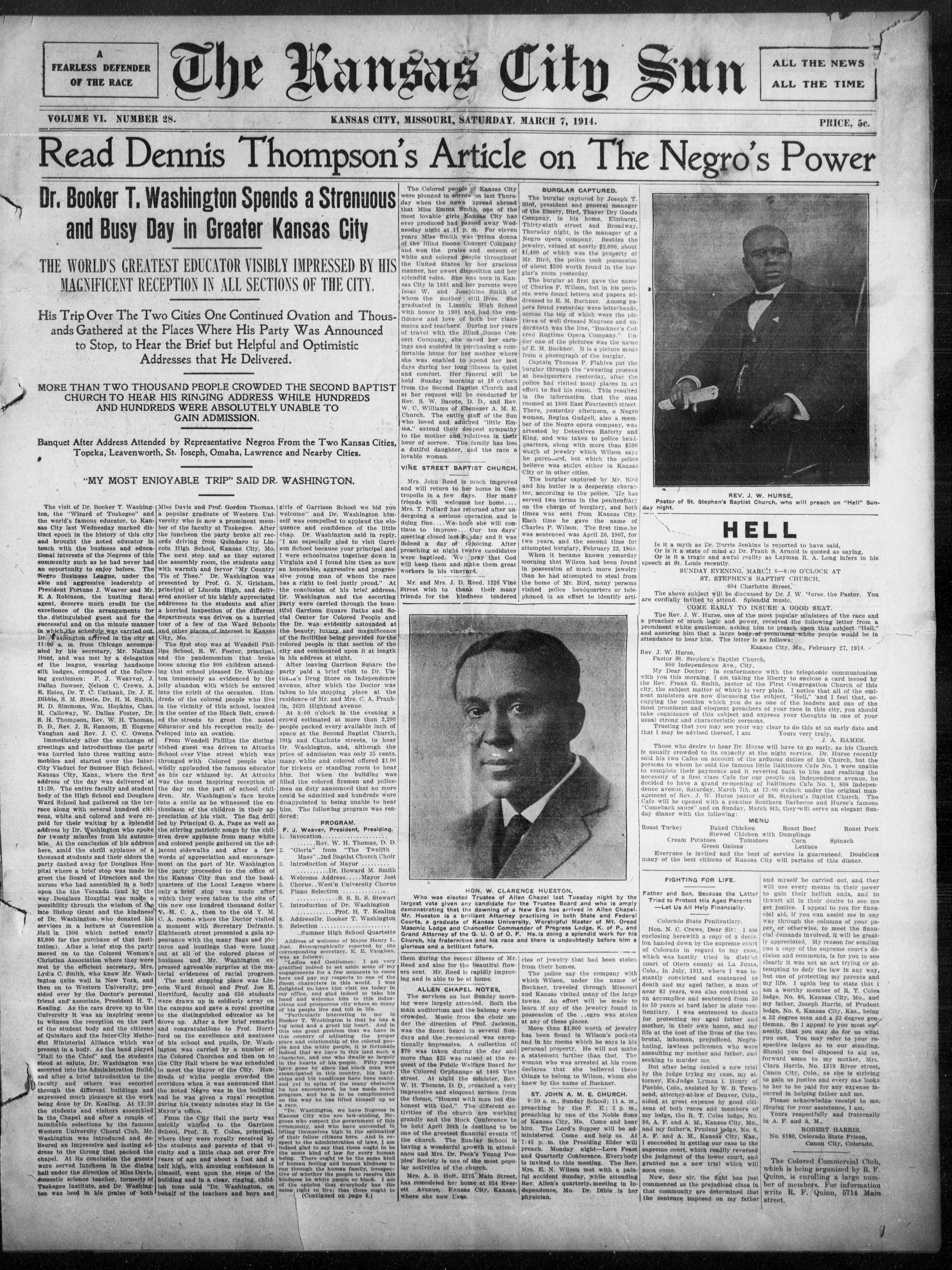
Dr. Booker T. Washington Spends a Strenuous and Busy Day in Greater Kansas City
THE WORLD'S GREATEST EDUCATOR VISIBLY IMPRESSED BY HIS MAGNIFICENT RECEPTION IN ALL SECTIONS OF THE CITY.
His Trip Over The Two Cities One Continued Ovation and Thousands Gathered at the Places Where His Party Was Announced to Stop, to Hear the Brief but Helpful and Optimistic Addresses that He Delivered.
MORE THAN TWO THOUSAND PEOPLE CROWDED THE SECOND BAPTIST CHURCH TO HEAR HIS RINGING ADDRESS WHILE HUNDREDS AND HUNDREDS WERE ABSOLUTELY UNABLE TO GAIN ADMISSION.
Banquet After Address Attended by Representative Negros From the Two Kansas Cities, Topeka, Leavenworth, St. Joseph, Omaha, Lawrence and Nearby Cities.
"MY MOST ENJOYABLE TRIP" SAID DR. WASHINGTON.
A FEARLESS DEFENDER OF THE RACE
VOLUME VI. NUMBER 28.
Read Der
Dr. Booker T. Was
and Busy Day
THE WORLD'S GREATEST
MAGNIFICENT RECEPT
His Trip Over The Two C
ands Gathered at the Pl
to Stop, to Hear the
Address
MORE THAN TWO THOUSAN
CHURCH TO HEAR HIS
AND HUNDREDS
Banquet After Address Attended by
Topeka, Leavenworth, St.
"MY MOST ENJOYA
The visit of Dr. Bocker T. Washington, the "Wizard of Tuskegee" and the world's famous educator, to Kansas City last Wednesday marked distinct epoch in the history of this city and brought the noted educator in touch with the business and educational interests of the Negroes of this community such as he had never had an opportunity to enjoy before. The Negro Business League, under the able and aggressive leadership of President Fortune J. Weaver and Mr. E. A. Robinson, the hustling fiscal agent, deserve much credit for the excellence of the arrangements for the distinguished guest and for the successful and on the minute manner in which the schedule was carried out. Dr. Weslington arrived in the city at 11:00 a.m. from Chicago accompanied by his secretary, Mr. Nathan Hunt, and was met by a delegation of the league, wearing handsome silk badges, composed of the following gentlemen: F. J. Weaver, J. Dallas Bowser, Nelson C. Crews, A. E. Estes, Dr. T. C. Unthank, Dr. J. E Dibble, S. M. Steele, Dr. H. M. Smith, H. D. Simmons, Wm. Hopkins, Chas. H. Calloway, W. Dallas Foster, Dr. S. H. Thompson, Rev. W. H. Thomas, D. D. Rev. J. R. Ransom, E. Eugene Vaughan and Rev. J. C. C. Owens.
Immediately after the exchange of greetings and introductions the party was hurried into three waiting automobiles and started over the Inter-City Viaduct for Sumner High School, Kansas City, Kansas, where the first address of the day was delivered at 11:30. The entire faculty and student body of the High School and Douglass Ward School had gathered on the terrace along with several hundred citizens, white and colored and were repaid for their waiting by a splendid address by Dr. Washington who spoke for twenty minutes from his automobile. At the conclusion of his address here, amid the shrill applause of a thousand students and their elders the party dashed away for Douglass Hospital where a brief stop was made to greet the Board of Directors and the nurses who had assembled in a body upon the the Veranda (and by the Douglass Hospital was made a possibility through the wisdom of the late Bishop Grant and the kindness of Dr. Washington who donated his services in a lecture at Convention Hall in 1906 which netted nearly $2,000 for the purchase of that institution). After a brief stop the party moved on to the Colored Women's Christian Association where they were met by the efficient secretary, Mrs. Lyda C. Smith, who knew Mr. Washington quite well in New York, and then on to Western University, presided over by the Doctor's upward and associate, President H. T. Kealing. As the cars drove up to the University it was an inspiring scene to witness the reception on the part of the student body and the citizens of Quindaro and the Inter-City Methodist Ministerial Alliance which was present in a body. As the band played "Hail to the Chief" and the students stood at salute, Dr. Washington was escorted into the Administration Building and after a brief introduction to the faculty and others was escorted through the different buildings and expressed much pleasure at the work being done by Dr. Kealing. At 12:30 the students and visitors assembled in the Chapel and after a couple of imitative selections by the famous Western University Choral Club, Mr. Washington was introduced and delivered an impressive and lasting address to the throng that packed the chapel. At its conclusion the guests were served luncheon in the dining hall under the direction of Mrs. Davis, domestic science teacher, formerly of Tuskegee Institute, and Dr. Washington was loud in his praise of both
---
The Kansas City Sun
Miss Davis and Prof. Gordon Thomas, a popular graduate of Western University who is now a prominent member of the faculty at Tuskegee. After the luncheon the party broke all records driving from Quindaro to Lincoln High School, Kansas City, Mo. The next stop and as they entered the assembly room, the students sang with warmth and fervor "My Country 'Tis of Thee." Dr. Washington was presented by Prof. G. N. Grisham, principal of Lincoln High, and delivered another of his highly appreciated addresses to the students and after a hurried inspection of the different departments was driven on a hurried tour of a few of the Ward Schools and other places of interest in Kansas City, Mo.
The first stop was at Wendell Phillips School, R. W. Foster, principal, and the pandemonium that broke loose among the 800 children attending that school pleased Dr. Washington immensely as evidenced by the jolly abandon with which he entered into the spirit of the occasion. Hundreds of the colored people who live in the vicinity of this school, located in the center of the Black Belt, crowded the streets to greet the noted Educator and his reception really developed into an ovation.
From Wendell Phillips the distinguished guest was driven to Attuck's School over Vine street which was thronged with Colored people who wildly applauded the famous educator as his car whizzed by. At Attuck was the most inspiring reception of the day on the part of school children. Mr. Washington's face broke into a smile as he witnessed the enthusiasm of the children in their appreciation of his visit. The flag drilled by Principal G. A. Page as well as the stirring patriotic songs by the children drew applause from many white and colored people gathered on the adjacent sidewalks and after a few words of appreciation and encouragement on the part of Mr. Washington the party proceeded to the office of the Kansas City Sun and the headquarters of the Local League where only a brief stop was made after which they were taken to the site of the new one hundred thousand dollar Y. M. C. A., then to the old Y. M. C. A. rooms where the Doctor visited a moment with Secretary Defrantz. Eighteenth street presented a gala appearance with the many flags and pictures and buntings that were out at all of the colored places of business and Mr. Washington expressed agreeable surprise at the material evidences of racial progress. The next stopping place was Lincoln Ward School and Prof. Joe E. Herriford, faculty and 650 students were drawn up in soldierly array on the campus and gave a royal greeting to the distinguished educator as he drove up. After a few brief remarks and congratulations to Prof. Herriford on the excellence and neatness of his school and pupils, Dr. Washington was carried by a number of the Colored Churches and then on to the City Hall where he was scheduled to meet the Mayor of the City. Hundreds of white people crowded the corridors when it was announced that the noted Negro was in the building and he was given a royal reception during his twenty minutes stay in the Mayor's office.
From the City Hall the party was quickly whirled to the Garrison School, Prof. R. R. T. Coles, principal, where they were royally received by the students and parents of that vicinity and a little chap not over five years of age and about a foot and a half high, with amusing confidence in himself, went upon the steps of the building and in a clear, ringing, childish tone said "Dr. Washington, on behalf of the teachers and boys and
KANSAS CITY, MISSOURI, SATURDAY, MARCH 7, 1914.
girls of Garrison School we bid you welcome" and Dr. Washington himself was compelled to applaud the etoquence and confidence of the little chap. Dr. Washington said in reply, "I am especially glad to visit Garrison School because your principal and I were schoolmates together down in Virginia and I found him then as now an honorable, aggressive and progressive young man of whom the race has a right to feel justly proud." At the conclusion of his brief address, Dr. Washington and the escorting party were carried through the beautiful Garrison Square Baths and Social Center for Colored People and the Dr. was evidently astonished at the beauty, luxury and magnificence of the facilities being provided for the colored people in that section of the city and commented upon it at length in his address at night.
After leaving Garrison Square the party paid a brief visit to Dr. Untia.k's Drug Store on Independence avenue, after which the Doctor was taken to his stopping place at the residence of Mr. and Mrs. C. A. Franklin, 2626 Highland avenue.
At 8:00 o'clock in the evening a crowd estimated at more than 2,200 people packed every available inch of space at the Second Baptist Church, 10th and Charlotte streets, to hear Dr. Washington, and, although the price of admission was only 35 cents, many white and colored offered $1.00 for tickets or standing room to hear him. But when the building was filled the colored firemen and policemen on duty announced that no more could be admitted and hundreds were disappointed in being unable to hear him. The following program was rendered:
PROGRAM.
F. J. Weaver, President, Presiding.
1. Invocation.
..... Rev. W. H. Thomas, D. D.
2. "Gloria" from "The Twelfth Mass".2nd Baptist Church Choir
3. Introduction of Mayor
Dr. Howard M. Smith
Address. WEST n University Chorus
Chorus. West n University Chorus
Piano Selection
S. S. R. S. Stewart
Introduction of Dr. Washington
Prof. H. T. Kealing
AddressDr. Booker T. Washington
Selection
Summer High School Quartette
Address of welcome of Mayor Henry L. Jost. Stenographically reported by the corresponding secretary, E. E. Vaughan, was as follows:
"Ladies and Gentlemen: I am very gratified indeed to set aside some of my time to correspond with my messages to come here and pay my respects to one of the finest characters in this world. I was delighted to have him visit me today in my office, and glad indeed to take his hand and welcome him to this indus- tion of our campus, to meet many of his people live and toll in life.
"Particularly interesting to me in Booker T. Washington is that he has a big mind and a great big heart. And in this one great problem that we have in this country, we must place and relationship of the colored people and the white people, it is fortunate indeed that we have in this land such a character, and one who dwells so largely in the hearts of his people. Fifty years ago, he was an emancipated in this country, his hard-ships and his handicaps have been many, and yet in spite of the many obstacles he has encountered, he has made much progress, and he is to be complimented on the way he has lifted himself up as
"Dr. Washington, we have Negroes in Kansas City who are law-abiding, Negroes who respect the government of this community, and who have succeeded in getting their rights," he said of their fellow citizens here. And in respect to the administration of laws, I am indeed glad to say that there ought to be the same kind of law for every human being, and that the human feeling and human kindness to run through the human family, irrespective of whether the people to receive this kindness be white people or black. I am of the opinion that everybody has the same kind of right to run through the human family." (Continued on page 8.)
The Colored people of Kansas City were plunged in sorrow on last Thursday when the news spread abroad that Miss Emma Smith, one of the most lovable girls Kansas City has ever produced had passed away Wednesday night at 11 p. m. For eleven years Miss Smith was prima dona of the Blind Boone Concert Company and won the praise and esteem of white and colored people throughout the United States by her gracious manner, her sweet disposition and her splendid voice. She was born in Kansas City in 1881 and her parents were Issac W. and Josephine Smith of whom the mother still lives. She graduated in Lincoln High School with honor in 1901 and had the confidence and love of both her classes and teachers. During her years of travel with the Blind Boone Concert Company, she saved her earnings and assisted in purchasing a comfortable home for her mother where she was enabled to spend her last days during her long illness in quiet and comfort. Her funeral will be held Sunday morning at 10 o'clock from the Second Baptist Church and at her request will be conducted by Rev. S. W. Bacote, D. D., and Rev W. C. Williams of Ebenezer A. M. E. Church. The entire staff of the Sun who loved and admired "little Emma," extend their deepest sympathy to the mother and relatives in their hour of sorrow. The family has losse a dutiful daughter, and the race a lovable woman.
VINE STREET BAPTIST CHURCH.
Mrs. John Reed is much improved and will return to her home in Centropolis in a few days. Her many friends will welcome her home.... Mrs. T. Pollard has returned after undergoing a serious operation and is doing fine.... We hope she will continue to improve. Our ten days' meeting closed last Sunday and it was indeed a day of rejoicing. After preaching at night twelve candidates were baptised. We pray that God will keep them and make them great workers in his vineyard.
Mr. and Mrs. J. D. Reed, 1226 Vine Street wish to thank their many friends for the kindness tendered
A.
M.
HON. W. CLARENCE HUESTON.
Who was elected Trustee of All largest vote given any candidate for demonstrating that the dawning of a Mr. Hueston is a brilliant Attorney Courts, a graduate of Kansas Univer Masonic Lodge and Chancellor Comm Grand Attorney of the G. U. O of O. I Church, his fraternities and his race glorious and a brilliant future.
Who was elected Trustee of Allen Chapel last Tuesday night by the largest vote given any candidate for the Trustee Board and who is amply demonstrating that the dawning of a New Era has arrived in Allen Chapel, Mr. Hueston is a brilliant Attorney practicing in both State and Federal Courts, a graduate of Kansas University, Worshipful Master of Mt. Oread Masonic Lodge and Chancellor Commander of Progress Lodge, K. of P., and Grand Attorney of the G. U. of O. F. He is doing a splendid work for his Church, his fraternities and his race and there is undoubtedly before him a glorious and a brilliant future.
them during the recent illness of Mr. Reed and also for the beautiful flowers sent. Mr. Reed is rapidly improving and is able to be at home.
cases of jewelry that had been stolen from their homes.
The police say the company with which Wilson under the name of
ALLEN CHAPEL NOTES
ALLEN CHAPEL NOTES.
The services on last Sunday morning were largely attended. Both the main auditorium and the balcony were crowded. Music from the choir under the direction of Prof. Jackson, was the finest heard in several Sundays and the recessional was exceptionally impressive. A collection of $70 was taken during the day and more than $25 was raised at the request of the Public Welfare Board for the Colored Orphanage at 1406 Vine street. At night the minister, Rev. W. H. Thomas, D. D., preached a very impressive and eloquent sermon from the theme, "Honest with man but dishonest with God." The different activities of the church are working grandly and the Mock Conference to be held April 20th is destined to be one of the greatest financial events of the church. The Sunday School is having a wonderful growth in attendance and Mrs. Dr. Peck's Young Peoples' Society is one of the most popular activities of the church.
Mrs. A. B. Holt. 3215 Main Street, has remodeled her home at 334 Everett Avenue, Kansas City, Kansas where she now lives.
---
BURGLAR CAPTURED.
BURGLAR CAPTURED.
The burglar captured by Joseph T. Bird, president and general manager of the Elmery, Bird, Thayer Dry Goods Company, in his home, Elmhurst, Thirty-sixth street and Broadway, Thursday night, is the manager of a Negro opera company. Besides the jewelry, valued at nearly $2,000, about $1,400 of which was the property of Mr. Bird, the police took possession of about $500 worth found in the burglar's room yesterday.
The burglar at first gave the name of Charles P. Wilson, in but in his pockets were found letters and papers addressed to E. M. Buckner. Among papers found yesterday were letterheads, across the top of which were the pictures of well dressed Negroes and underneath was the line, "Buckner's Colored Ragtime Opera Company." Under one of the pictures was the name of E. M. Buckner. It is a picture made from a photograph of the burglar.
Captain Thomas P. Flahive put the burglar through the "sweating process at headquarters yesterday, after the police had visited many places in an effort to find his room. This resulted in the information that the man roomed at 1806 East Fourteenth street. There, yesterday afternoon, a Negro woman, Regina Gudgell, also a member of the Negro opera company, was arrested by Detectives Raferty and King, and was taken to police headquarters, along with more than $500 worth of jewelry which Wilson says he purchased, but which the police believe was stolen either in Kansas City or in other cities.
The burglar captured by Mr. Bird and his butler is a desperate character, according to the police. He has served two terms in the penitentiary on the charge of burglary, and both times was sent from Kansas City. Each time he gave the name of Charles P. Wilson. The first time he was sentenced was April 20, 1907, for two years, and the second time for attempted burglary, February 22, 1908.
When it became known yesterday morning that Wilson had been found in possession of much more jewelry than he had attempted to steal from the home of Mr. Bird, many persons visited police headquarters or telephoned in an effort to identify arti-
[Image of a man in a suit with a tie].
en Chapel last Tuesday night by the Trustee Board and who is amply New Era has arrived in Allen Chapel, practicing in both State and Federality, Worshipful Master of Mt. Oread under of Progress Lodge, K. of P., and. He is doing a splendid work for his and there is undoubtedly before him acles of jewelry that had been stolen from their homes.
The police say the company with which Wilson, under the name of Buckner, traveled through Missouri and Kansas visited many of the large towns. An effort will be made to learn if any of the jewelry found in possession of the .egro was stolen at any of these places.
More than $1,000 worth of jewelry has been found in Wilson's pockets and in his rooms which he says is his personal property. He will not make a statement further than that. The woman who was arrested at his room declares that she believed these things to belong to Wilson, whom she knew by the name of Buckner.
ST. JOHN A. M. E. CHURCH.
9:30 a. m. Sunday School; 1 a. m. preaching by the P. E.; 3 p. m. preaching by one of the Noble Sons of Kansas City, Mo. Come and hear him. The Lord's Supper will be administered. Come and help us. At 7:45 p. m. the Presiding Elder will preach. Monday night—Love Feast and Quarterly Conference. Everybody is invited to this meeting. The Rev. Mrs. E. N. Wilson met with a painful accident Sunday, while attending Rev. Allen's quarterly, meeting in Independence, Mo. Dr. Dible is her physician.
Pastor of St. Stephen's Baptist Church, who will preach on "Hell" Sunday night.
Is it a myth as Dr. Burris Jenkins is reported to have said,
Or is it a state of mind as Dr. Frank S. Arnold is quoted as saying,
Or is it a tragic and awful reality as Layman R. A. Long infers in his speech at St. Louis recently.
SUNDAY EVENING, MARCH 8—8:00 O'CLOCK AT
ST. STEPHEN'S BAPTIST CHURCH,
604 Charlotte Street.
The above subject will be discussed by Dr. J. W. Hurse, the Pastor. You are cordially invited to attend. Splendid music.
COME EARLY TO INSURE A GOOD SEAT.
The Rev. J. W. Hurse, one of the most popular ministers of the race and a preacher of much logic and power, received the following letter from a prominent white gentleman, asking him to preach upon this subject "Hell," and assuring him that a large body of prominent white people would be in attendance to hear him. The letter is as follows:
My Dear Doctor: In conformance with the telephonic communication with you this morning. I am taking the liberty to enclose a card issued by the Rev. Frank G. Smith, pastor of the First Congregation Church of this city, the subject matter of which is very plain. I notice that all of the eminent ministers are now discussing the subject, "Hell," and I feel that, occupying the position which you do as one of the leaders and one of the most prominent and eloquent preachers of your race in this city, you should take cognizance of this subject and express your thoughts in one of your usual strong and characteristic sermons.
Trusting that you may see your way clear to do this at an early date and that I may be advised thereof, I am Yours very truly,
J. A. EAMES.
Those who desire to hear Dr. Hurse will have to go early, as his Church is usually crowded to its capacity at the night service. Dr. Hurse recently sold his two Cafes on account of the arduous duties of his Church, but the persons to whom he sold the famous little Baltimore Cafe No. 1 were unable to complete their payments and it reverted back to him and realizing the necessity of a first class Cafe for our people on Independence avenue, he decided to have a grand re-opening of Baltimore Cafe No. 1, 808 Independence avenue, Saturday, March 7th, at 12:00 o'clock under the original management of Rev. J. W. Hurse pastor of St. Stephen's Baptist Church. The Cafe will be opened with a genuine Southern Barbecue and Hurse's famous "Comeback sauce" and on Sunday, March 8th, they will serve an elegant Sunday dinner with the following:
Everyone is invited and the best of service is guaranteed. Doubless many of the best citizens of Kansas City will partake of this dinner.
Pastor St. Stephen's Baptist Church,
800 Independence Ave., City.
My Dear Doctor: In conformance with you this morning, I am taking the
the Rev. Frank G. Smith, pastor of the
city, the subject matter of which is very
nent ministers are now discussing the s
cupping the position which you do as
most prominent and eloquent preachers
take cognizance of this subject and exp
usual strong and characteristic sermons.
Trusting that you may see your way
that I may be advised thereof, I am
Those who desire to hear Dr. Hurse
is usually crowded to its capacity at
the sold his two Cafes on account of the
persons to whom he sold the famous litt
to complete their payments and it reve
necessity of a first class Cafe for our
decided to have a grand re-opening of
dence avenue, Saturday, March 7th, at 1
decade of Rev. J. W. Hurse pastor of
Cafe will be opened with a genuine Sou
"Comeback sauce" and on Sunday, March
day dinner with the following:
MENU
Roast Turkey Baked Chicken
Stewed Chicken w
Cream Potatoes Tomatoe
Green Onions
Everyone is invited and the best o
many of the best citizens of Kansas Ch
FIGHTING FOR LIFE.
Father and Son, Because the Latter
Tried to Protect His Aged Parents
—Let Us Help Financially.
Colorado State Penitentiary.
Hon. N. C. Crews, Dear Sir: I am enclosing herewith a copy of a decision handed down by the supreme court of Colorado in regard to my case, which was hastily tried in district court of Otero county at La Junta, Colo., in July, 1911, where I was instantly convicted and sentenced to death and my aged father, a man of near 83 years, was also convicted as an accomplice and sentenced from 30 to 50 years at hard labor in state penitentiary. I was sentenced to death for protecting my aged father and mother, in their own home, and my life at the cost of the lives of the two brutal, inhuman, prejudiced, Negrohating, lawless policemen who were assaulting my mother and father, and seeking to murder me.
But after being denied a new trial by the judge trying my case, my attorney, Ex-Judge Lyman I. Henry of Pueblo, Colo., assisted by W. B. Townsend, attorney-at-law of Denver, Colo., aided at great expense by good citizens of both races and members of my lodge, the R. T. Coles lodge, No. 86, A. F. and A. M., Kansas City, Mo., and my father's, Prudent lodge, No. 6, A. F. and A. M., Kansas City, Kas. I succeeded in getting our case to the supreme court, which readily reversed the judgment of the lower court, and granted me a new trial which will soon come.
Now, dear sir, the fight has just commenced as the prejudiced class in that community are determined that the sentence imposed on my father
ALL THE NEWS
ALL THE TIME
PRICE. 5c.
J. W. HURSE,
at Church, who will preach on "Hell" Sun-
ELL
Banks is reported to have said,
Frank S. Arnold is quoted as saying,
quality as Layman R. A. Long infers in his
MARCH 8—8:00 O'CLOCK AT
S BAPTIST CHURCH,
carlotte Street.
passed by Dr. J. W. Hurse, the Pastor. You
insure a good seat.
the most popular ministers of the race and
ever, received the following letter from a
him to preach upon this subject "Hell."
y of prominent white people would be in
is as follows:
Kansas City, Mo., February 27, 1914.
church,
y.
ance with the telephonic communication
g the liberty to enclose a card issued by
of the First Congregation Church of this
very plain. I notice that all of the emi-
t subject, "Hell," and I feel that, oce
o as one of the leaders and one of
others of your race in this city, you should
and express your thoughts in one of your
amons.
way clear to do this at an early date and
in Yours very truly,
J. A. EAMES.
Jurse will have to go early, as his Church
at the night service. Dr. Hurse recently
the arduous duties of his Church, but the
as little Baltimore Cafe No. I, were unable
reverted back to him and realizing the
our people on Independence avenue, he
ing of Baltimore Cafe No. 1, 808 Independ,
at 12:00 o'clock under the original manor
of St. Stephen's Baptist Church. The
Southern Barbecue and Hurse's famous
March 5th, they will serve an elegant Sun-
MENU
enen Roast Beef Roast Pork
kken with Dumplings Corn Spinach
tomatoes Lettuce
best of service is guaranteed. Doubtless
as City will partake of this dinner.
and myself be carried out, and they will use every means in their power to gain their hellish ends, and to thwart all in their desire to see me get justice. I appeal to you for financial aid, if you can assist me in any way through the columns of your paper, or otherwise, to meet the financial demands involved, it will be greatly appreciated. My reason for sending you a copy of the supreme court's decision and comments, is for you to see clearly it was not an act trying or attempting to defy the law in any way, but one of protecting my parents and my life. I again beg to state that I am a worthy member of R. T. Coles lodge, No. 86, Kansas City, Mo., and my father, Joseph Harris, of Prudent lodge, No. 6, Kansas City, Kas., being a 32 degree man and a 33 degree gentleman. So I appeal to you most earnestly, that you may do for us what you can. You may refer to your respective lodges as to our standing. Should you feel disposed to aid us, forward same to my mother, Mrs. Clara Harris, No. 1319 River street, Canon City, Colo., as she is striving to gain us justice and every one looks to her to be paid for any expense incurred in helping father and me.
Please acknowledge receipt to me, Hoping for your assistance, I am, Yours respectfully and fraternally in A. F. and A. M.,
ROBERT HARRIS,
No. 8180, Colorado State Prison,
Canon City, Colorado.
The Colored Commercial Club, which is being organized by R. F. Quinn, is enrolling a large number of members. For information write R. F. Quinn, 5714 Main street.
AFRO-AMERICAN CULLINGS
"The educated man usually overestimates himself because his intellect has grown faster than his experience of life."—General Armstrong.
"Every time I think of Hampton, I get a new definition of education and a new ideal of human training. I believe that Hampton is, after all, the real American university. I believe that this institution comes nearer having found the clew to the maze in this great process of training people for life, in life and by life, than any other institution in the world."
This striking tribute has been paid to Hampton institute by Dr. Wallace Buttrick, secretary of the General Education board, who knows intimately educational institutions throughout the whole country.
Some 20,000 people are attracted annually to Hampton institute, the pioneer industrial and agricultural training school for negro and Indian youth, founded in 1868 by Gen. Sam
THE MUSEUM OF THE WEST
The Old Plantation "Great House," Which Was Completely Remodeled by Hampton Institute Tradesmen, and Is Now Occupied by Principal Hollis Burke Frissell and His Family.
uuel C. Armstrong. These visitors, from all parts of the world, are attracted by the unique and effective educational methods which Hampton institute has been successfully employing for over 45 years in the training of negroes and Indians for unselfish and efficient service in the home, on the farm, in the shop and in the kitchen.
Hampton institute, indeed, fits young negroes and Indians for life—"in life and by life." It emphasizes in every department of its work the value of clean, honest and useful living.
Russia's population is increasing at the rate of 2,500,000 a year. It now stands at about 147,000,000, of which 100,000,000 are peasants.
In some parts of Mexico proficiency of the school children is rewarded by giving them the cigarette-smoking privilege in school.
Nothing gives a clearer idea of the progress being made by the negro in the south and of the prospect that in time the vexed "race question" will find its own solution than the annual report of Dr. Booker T. Washington, principal of Tuskegee institute, to the trustees of the institution.
It is not too much to say that Tuskegee, more than any other single agency, has been and is effective in bringing about this condition. It is the pioneer of institutions for the uplifting of the negro race, and its work, its graduates and its example are mighty factors in solving the vexed race problem.
The condition of the institution is thoroughly healthy. Doctor Washington's report shows that it is living within its means and has effected large and important savings in current and operating expenses.
The institute had during the year ended May 31, 1913, students to the number of 2,137, including 1,618 regular students from 33 states and 18 foreign countries; 219 pupils in the children's training school, and 300 teachers in the summer school for teachers.
During the fiscal year nearly 32,000 grazing permits were issued in the national forests, and more than 20,000 head of domestic animals were given advantage of the privilege. Out of the vast number of permits issued only 144 cases of grazing trespass were observed.
In dry air sound travels 1,442 feet a second; in water, 4,900 feet; in iron, 17,500 feet.
Australia has nearly 300,000 acres of untouched forests.
An Expert in Handwriting.
Mother was fair, but she wished to be fairer still. Adorned by nature, she sought further beautification. Loveliness was her great goal.
Invited out to dinner, she stood before the mirror, and, having made her yellow locks a trifle yellower, she proceeded to apply the pencil to her eyebrows. This, it may be remarked, is an age of artificiality, and mother had reached this age.
The little daughter stood by and wondered.
At St. Louis the Southern Baptist convention appointed a committee consisting of E. Y. Mullins, O. L. Hailey, A. J. Barton, Ben Cox, E. E. Atkinson, J. M. Frost, B. F. Riley, G. W. McDaniel and J. J. Bennett to confer with the colored brethren on the subject of establishing a theological seminary for the training of their preachers. (See Baptist Annual, page 21.) There was to be held in the city of Memphis, Tenn., immediately following the adjournment of the convention, a meeting of their education board and missionary board. It was important that our communication should be brought before them. Five brethren were appointed to do this, namely, O. L. Hailey, Ben Cox, B. F. Riley, A. J. Barton and J. M. Frost. Only two could fulfill this appointment—O. L. Hailey and B. F. Riley. They had a full and frank conference with the colored brethren there assembled, and as a result of that conference the whole matter was referred to a joint meeting of nine brethren appointed by the National Baptist convention and the nine brethren from the Southern Baptist convention. That fuller meeting of the two committees was held in Nashville in connection with the meeting of the National Baptist convention in September following.
At that meeting the whole question was fully and deliberately canvassed and a satisfactory agreement unanimously reached, all the members of both committees heartily agreeing thereto. That agreement was in favor of the establishment of a negro theological seminary at the place where it promises to do the must good. Five cities were mentioned as possible locations, and the corresponding secretary of the Northern Baptist convention, Rev. S. C. Griggs, was instructed to bring the matter to the attention of the proper persons in those cities. They are Louisville, Ky., Nashville, Tenn., Atlanta, Ga., Birmingham, Ala., and Memphis, Teen. The full report of the committee will be brought to the convention at its approaching session in May of this year, when we meet in Nashville, Teen. Our committee will report in favor of the establishment and maintenance of such a seminary. —Baptist and Reflector.
Challenging an implied suggestion, by Senator Hoke Smith of Georgia, that there are no negro chemists in this country, during the debate on the agricultural extension work bill in the senate, Ralph W. Tyler has sent a letter to Senator Smith naming a number of negro chemists. "I do not know a negro chemist," was the remark of Senator Smith, which called forth the letter from Mr. Tyler. In his letter Mr. Tyler says:
At Tuskegee institute they have a negro agricultural chemist, Professor Carver, a graduate of the University of Iowa, whom former Secretary of Agriculture Wilson pronounced on of the best agricultural chemists in the country. There is also now in the department of agriculture a negro chemist, Richard H. Lewis of the University of Illinois, who won his place in competition with white chemists. I could give the names of many negro chemists, but even one is sufficient to puncture your sweeping statement that there are no negro chemists."
There are colored farmers of Accomack county, Virginia, who clear from $1,000 to $2,000 a year on their crops, whose homes are comfortable, whose stock is well cared for, whose families ride on Sunday in comfortable carriages. Some of the colored farmers of Accomack and Northampton counties are members of the interesting association which for nearly twenty years past has acted as a buying and selling agency for the farmers of the region. This association buys annually more than $200,000 worth of seed for its members, and spends $10,000 a year in telegraph tolls to keep in touch daily with the markets over a large part of the United States.
Along the highways at Topsham Me, where new state roads are being built, wild apple trees outside the old stone walls are being grafted with summer apples. Big trees bear metal signs informing the public that the fruit is for public use.
A leather belt in an English factory has been running at a speed of 1,800 feet a minute from nine to twelve hours a day for more than 32 years.
It's easier to boast than make good.
There are affiliated to the American Federation of Labor 118 international trade unions, with their 27,000 labor unions, 36 state federations, 537 city central bodies and 650 local trade and federal labor unions having no internationals.
The population of Belfast is slightly under 400,000, and in the entire province, some of the remote parts of which are unsuited to motor cars, there are only about 1,750,000 people.
"Mother, what are you writing on your face for?"—The Popular Magazine.
Coal Production:
It was thought that in 1900 a highwater mark of coal production in this country had been reached with a production of 269,684,287 short tons, yet the production of the past two years has been nearly double, or 231,912,351 and 226,504,281 tons greater, respectively.
A
Full-Dress Coiffure and Ornaments
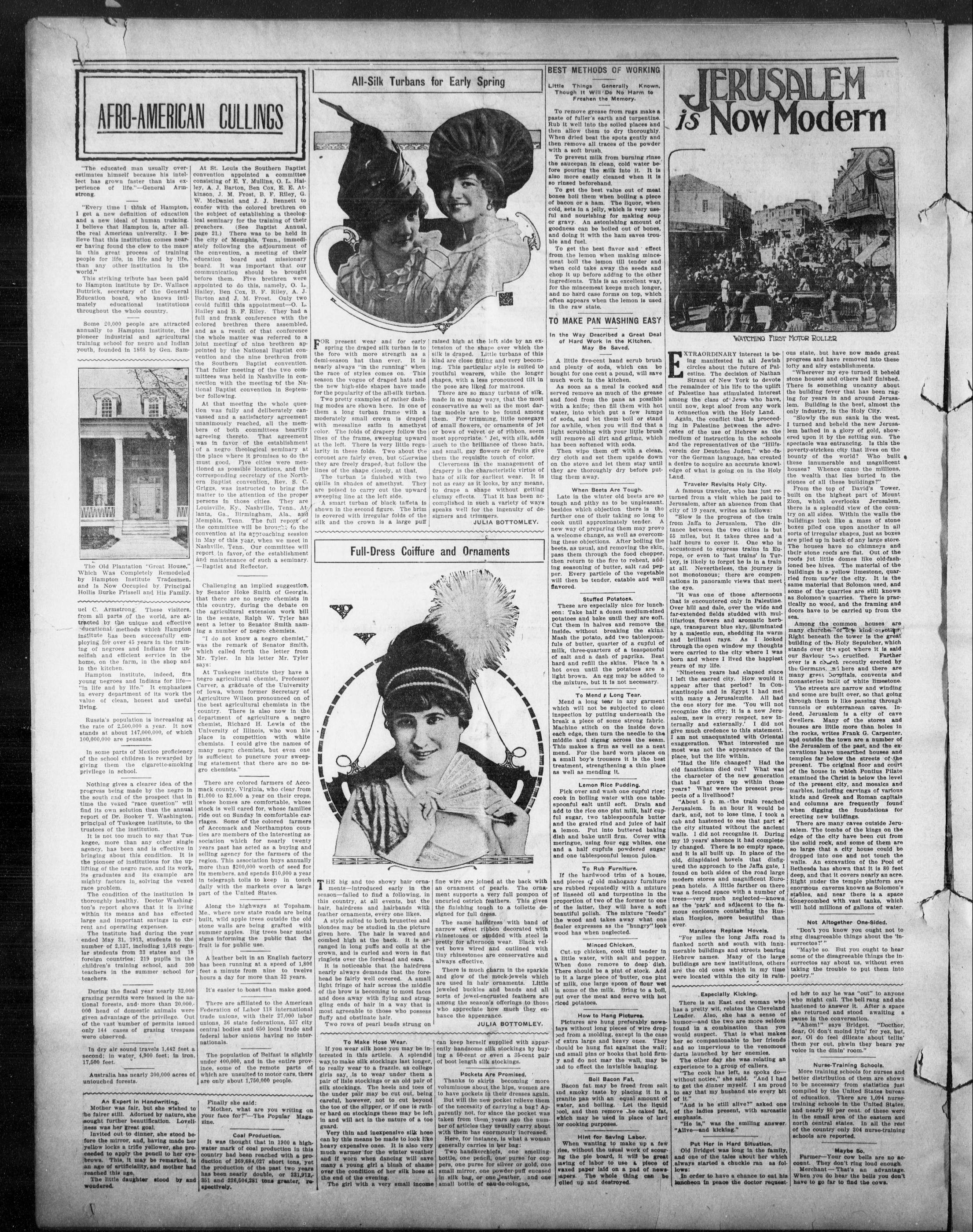
FOR present wear and for early spring the draped silk turban is to the fore with more strength as a demi-season hat than ever. It is nearly always "in the running" when the race of styles comes on. This season the vogue of draped hats and the new high-side shapes have made for the popularity of the all-silk turban. Two pretty examples of rather dashing modes are shown here. In one of them a long turban frame with a moderately small crown is draped with messaline satin in amethyst color. The folds of drapery follow the lines of the frame, sweeping upward at the left. There is very little regularity in these folds. Two about the coronet are fairly even, but otherwise they are freely draped, but follow the lines of the shape closely, at that. The turban is finished with two quills in shades of amethyst. They are poised to carry out the upward sweeping line at the left side.
A smart turban of black taffeta is shown in the second figure. The brim is covered with irregular folds of the silk and the crown is a large puff
Full-Dress Coiffure
THE big and too showy hair ornaments—introduced early in the season—failed to find a following, in this country, at all events, but the hair, hairdress and hairbands with feather ornaments, every one likes. A style suited to both brunettes and blondes may be studied in the picture given here. The hair is waved and combed high at the back. It is arranged in long puffs and colls at the crown, and is curled and worn in flat ringlets over the forehead and ears. It is noticeable that the hairdress nearly always demands that the forehead be fairly well covered. A small light fringe of hair across the middle of the brow is becoming to most faces and does away with flying and straggling ends of hair in a way that is most agreeable to those who possess fluffy and obstinate hair. Two rows of pearl beads strung on
To Make Hose Wear.
If you wear silk hose you may be interested in this article. A splendid way to make silk stockings last longer, to really wear to a frazzle, as college girls say, is to wear under them a pair of lisse stockings or an old pair of silk stockings. The heels and toes of the under pair may be cut out, being careful, however, not to cut beyond the toe of the slipper, or if one is rather hard on stockings may be left in and will act in the nature of a toe guard. Very thin and inexpensive silk hose can by this means be made to look like heavy expensive ones. It is also very much warmer for the winter weather and if worn when dancing will save many a young girl a blush of shame over the condition of her silk hose at the end of the evening.
The girl with a very small income
raised high at the left side by an extension of the shape over which the silk is draped. Little turbans of this kind are close fitting and very becoming. This particular style is suited to youthful wearers, while the longer shapes, with a less pronounced tilt in the pose are liked for matrons. There are so many turbans of silk, made in so many ways, that the most conservative as well as the most daring models are to be found among them. For trimming, little nosegays of small flowers, or ornaments of jet or bows of velvet or of ribbon, seem most appropriate. Jet, with silk, adds much to the brilliance of these hats, and small, gay flowers or fruits give them the requisite touch of color.
Cleverness in the management of drapery is the characteristic virtue of hats of silk for earliest wear. It is not as easy as it looks, by any means, to drape a shape without getting clumsy effects. That it has been ac complained in such a variety of ways speaks well for the ingenuity of designers and trimmers. JULIA BOTTOMLEY.
e and Ornaments
fine wire are joined at the back with an ornament of pearls. The ornament supports a very full pompon of uncurled ostrich feathers. This gives the finishing touch to a toilette designed for full dress.
The same handiness with band of narrow velvet ribbon decorated with rhinestones or studded with steel is pretty for afternoon wear. Black velvet bows wired and outlined with tiny rhinestones are conservative and always effective.
There is much charm in the sparkle and glow of the mock-jewels which are used in hair ornaments. Little jeweled buckles and bands and all sorts of jewel-encrusted feathers are among the season's offerings to those who appreciate how much they enhance the appearance.
JULIA BOTTOMLEY.
can keep herself supplied with apparently handsome silk stockings by buying a 50-cent or even a 35-cent pair of boot length silk stockings.
Pockets Are Promised
Thanks to skirts becoming more voluminous about the hips, women are to have pockets in their dresses again.
But will the new pocket relieve them of the necessity of carrying a bag? Apparently not, for since the pocket was taken from them, years ago the number of articles they usually carry about with them has enormously increased.
Here, for instance, is what a woman generally carries in her bag:
Two handkerchiefs, one smelling-bottle, one pencil, one purse for coppers, one purse for silver or gold, one small mirror, one powder-puff encased in silk bag, or one leather, and one small bottle of eau-de-cologne.
BEST METHODS OF WORKING
Little Things Generally Known,
Though It Will Do No Harm to
Freshen the Memory.
To remove grease from rugs make a
paste of fuller's earth and turpentine.
Rub it well into the soiled places and
then allow them to dry thoroughly.
When dried beat the spots gently and
then remove all traces of the powder
with a soft brush.
To prevent milk from burning rinse
the saucepan in clean, cold water be-
fore pouring the milk into it. It is
also more easily cleaned when it is
sirned beforehand.
To get the best value out of meat bones boil them when boiling a piece of bacon or a ham. The liquor, when cold, sets in a jelly, which is very useful and nourishing for making soup or gravy. An astonishing amount of goodness can be boiled out of bones, and doing it with the ham saves trouble and fuel.
To get the best flavor and effect from the lemon when making mincemeat boil the lemon till tender and when cold take away the seeds and chop it up before adding to the other ingredients. This is an excellent way, for the mincemeat keeps much longer, and no hard case forms on top, which often appears when the lemon is used in the raw state.
TO MAKE PAN WASHING EASY
In the Way Described a Great Deal of Hard Work in the Kitchen. May Be Saved.
A little five-cent hand scrub brush and plenty of soda, which can be bought for one cent a pound, will save much work in the kitchen.
As soon as a meal is cooked and served remove as much of the grease and food from the pans as possible with a knife; then fill them with hot water, into which put a few lumps of soda, and let them boil or stand for awhile, when you will find that a light scrubbing with your little brush will remove all dirt and grime, which has been softened with soda.
Then wipe them off with a clean, dry cloth and set them upside down on the stove and let them stay until they are thoroughly dry before putting them away.
When Beets Are Tough.
Late in the winter old beets are so tough and pithy as to be unpleasant, besides which objection there is the further one of their taking so long to cook until approximately tender. A new way of preparing them may prove a welcome change, as well as overcoming these objections. After boiling the beets, as usual, and removing the skin, pass them through the food chopper, then return to the fire to reheat, adding seasoning of butter, salt and pepper. Every particle of the vegetable will then be tender, edible and well flavored.
Stuffed Potatoes.
These are especially nice for lunchon: Take half a dozen medium-sized potatoes and bake until they are soft. Cut them in halves and remove the inside, without breaking the skins. Mash the potato, add two tablespoonfuls of butter, quarter of a cupful of milk, three-quarters of a teaspoonful of salt and a dash of paprika. Beat hard and refill the skins. Place in a hot oven until the potatoes are a light brown. An egg may be added to the mixture, but it is not necessary.
To Mend 2 Long Tear.
Mend a long tear in any garment which will not be subjected to close inspection by putting underneath the break a piece of some strong fabric. Machine stitch on the inside down each edge, then turn the needle to the middle and zigzag across the seam. This makes a firm as well as a neat mend. For the hard worn places on a small boy's trousers it is the best treatment, strengthening a thin place as well as mending it.
Lemon Rice Pudding
Pick over and wash one cupul fruit, cook in boiling water with one tablespoonful salt until soft. Drain and add to the rice one pint milk, half cupful sugar, two tablespoonfuls butter and the grated rind and juice of half a lemon. Put into buttered baking dish and bake until firm. Cover with meringue, using four egg whites, one and a half cupul fruits powdered sugar and one tablespoonful lemon juice.
To Rub Furniture.
If the hardwood trim of a house, and pieces of old mahogany furniture are rubbed repeatedly with a mixture of limeseed oil and turpentine in the proportion of two of the former to one of the latter, they will have a soft beautiful polish. The mixture "feeds" the wood and takes away what one dealer expresses as the "hungry" look wood has when neglected.
Minced Chicken.
Cut up chicken, cook till tender in a little water, with salt and pepper. When done remove to deep dish. There should be a pint of stock. Add to it a large piece of butter, one pint of milk, one large spoon of flour wet in some of the milk. Bring to a boll, put over the meat and serve with hot riced potatoes.
How to Hang Pictures.
Pictures are hung preferably nowadays without long pieces of wire dropped from a molding, except in the case of extra large and heavy ones. They should be hung flat against the wall; and small pins or hooks that hold firmly and do not mar the wall, may be ad to effect the invisible hanging.
Boll Bacon Fat.
Bacon fat, may be freed from salt and smoky taste by placing it in a granite pan with an equal amount of water, and boiling. Let the liquid cool, and then remove he caked fat, which may be used in place of lard or cooking purposes.
Hint for Baying Labor
Hint for Saving Labor.
When wanting to make up a few pies, without the usual work of scouring the pie board, it will be great saving of labor to use & piece of waxed paper laid on a pad of newspapers. The whole thing can be rolled up and destroyed.
JERUSALEM is NowModern
THE CITY OF NEW ORLEANS
WATCHING FIRST MOTOR ROLLER
EXTRAORDINARY interest is being manifested in all Jewish circles about the future of Palestine. The decision of Nathan Straus of New York to devote the remainder of his life to the uplift of Palestine has stimulated interest among the class of Jews who have, until now, kept aloof from any work in connection with the Holy Land. Again, the conflict that is proceeding in Palestine between the advocates of the use of Hebrew as the medium of instruction in the schools and the representatives of the "Hilfs-verein der Deutsches Juden," who favor the German language, has created a desire to acquire an accurate knowledge of what is going on in the Holy Land.
Traveler Revisits Holy City.
A famous traveler, who has just returned from a visit which he paid to Jerusalem, after an absence from that city of 19 years, writes as follows: "Slow is the progress of the train from Jaffa to Jerusalem. The distance between the two cities is but 55 miles, but it takes three and a half hours to cover it. One who is accustomed to express trains in Europe, or even to 'fast trains' in Turkey, is likely to forget he is in a train at all. Nevertheless, the journey is not monotonous; there are compensations in panoramic views that meet the eve.
"It was one of those afternoonns that is encountered only in Palestine. Over hill and dale, over the wide and far-extended fields studded with multifarious flowers and aromatic herbage, transparent blue sky, illuminated by a majestic sun, shedding its warm and brilliant rays. As I looked through the open window my thoughts were carried to the city where I was born and where I lived the happiest years of my life.
"Nineteen years had elapsed since I left the sacred city. How would it appear after that period? In Constantinople and in Egypt I had met with many a Jerusalemite. All had the one story for me. 'You will not recognize the city; it is a new Jerusalem, new in every respect, new internally and externally.' I did not give much credence to this statement I am not unacquainted with Oriental exaggeration. What interested me most was not the appearance of the place but the life within.
"Had the life changed? Had the old fanaticism died out? What was the character of the new generation that had grown up within those years? What were the present prospects of a livelihood?
"About 5 p. m. the train reached Jerusalem. In an hour it would be dark, and, not to lose time, I took a cab and hastened to see that part of the city situated without the ancient walls. I did not recognize it. During my 19 years' absence it had completely changed. There is no empty space, and it is all built up. In place of the old, dilapidated hovels that disfigured the approach to the Jaffa gate. I found on both sides of the road large modern stores and magnificent European hotels. A little farther on there was a fenced space with a number of trees—very much neglected—known as the 'park' and adjacent to the famous enclosure containing the Russian Hospice, more beautiful than ever.
Mansions Replace Hovels.
"For miles the long Jaffa road is flanked north and south with innumerable buildings and streets bearing Hebrew names. Many of the large buildings are new institutions, others are the old ones which in my time were located within the city in ruin-
Especially Kicking.
There is an East end woman who has a pretty wilt, relates the Cleveland Leader. Also, she has a sense of humor—and the two are more seldom found in a combination than you would suspect. That is what makes her so companionable to her friends and so impervious to the venomous darts launched by her enemies.
The other day she was relating an experience to a group of callers.
"The cook has left, as quocks do—without notice," she said. "And I had to get the dinner myself. I am proud to say that my husband ate every bit of it."
"And is he still alive?" asked one of the ladies present, with sarcastic emphasis.
"He is," was the smiling answer. "Alive—and kicking."
Put Her in Hard Situation.
Old Bridget was long in the family, and one of the tales about her which always started a chuckle ran as follows:
In order to have a chance to eat his luncheon in peace the doctor request
ous state, but have now made great progress and have removed into these lofty and airy establishments.
"Wherever my eye turned it beheld stone houses and others half finished. There is something uncanny about the building fever that has been raging for years in and around Jerusalem. Building is the best, almost the only industry, in the Holy City.
"Slowly the sun sank in the west. I turned and beheld the new Jerusalem bathed in a glory of gold, showered upon it by the setting sun. The spectacle was entrancing. Is this the poverty-stricken city that lives on the bounty of the world? Who built these innumerable and magnificent houses? Whence came the millions, the wealth that lies buried in the stones of all these buildings?"
From the top of David's Tower, built on the highest part of Mount Zion, which overlooks Jerusalem, there is a splendid view of the country on all sides. Within the walls the buildings look like a mass of stone boxes piled one upon another in all sorts of irregular shapes, just as boxes are piled up in back of any large store. The houses have no chimneys and their stone roofs are flat. Out of the roofs jut little domes like old-fashioned bee hives. The material of the buildings is a yellow limestone, quarried from under the city. It is the same material that Solomon used, and some of the quarries are still known as Solomon's quarries. There is practically no wood, and the framing and doors have to be carried up from the sea.
Among the common houses are many churches of the kind oyster. Right beneath the tower is the great building of the Holy Sepulcher, which stands over the spot where it is said our Saviour crutified. Farther over is a church recently erected by the Germans, and here and there are many great hospitals, convents and monasteries built of white limestone.
The streets are narrow and winding and some are built over, so that going through them is like passing through tunnels or subterranean caves. Indeed, Jerusalem is a city of cave dwellers. Many of the stores and houses are little more than holes in the rocks, writes Frank G. Carpenter, and outside the town are a number of the Jerusalem of the past, and the excavations have unearthed houses and temples far below the streets of the present. The original floor and court of the house in which Pontius Pilate examined the Christ is below the level of the present city, and mosaics and marbles, including carvings of various kinds and Greek and Roman capitals and columns are frequently found when digging the foundations for erecting new buildings.
There are many caves outside Jerusalem. The tombs of the kings on the edge of the city have been cut from the solid rock, and some of them are so large that a city house could be dropped into one and not touch the walls. An excavation of the Pool of Bethesda has shown that it is 80 feet deep, and that it covers nearly an acre. Right under the temple platform are enormous caverns known as Solomon's stables, and near there is a space honeycombed with vast tanks, which will hold millions of gallons of water.
Not Altogether. One-Sided.
"Don't you know you ought not to sing disagreeable things about the 'insurrectos?'"
"Maybe so. But you ought to hear some of the disagreeable things the insurrectos say about us, without even taking the trouble to put them into poetry."
ed her to say he was "out" to anyone who might call. The bell rang and she hastened to answer it. After a space she returned and stood awaiting a pause in the conversation.
"Ahem!" says Bridget. "Docther, dear, Ol don't mound lyn' fer yez, but, sor, Ol do feel dilicate about tellin' them yer out, phwin they hears yer voice in the dinin' room."
Nurse-Training Schools
More training schools for nurses and better distribution of them are shown to be necessary from statistics just compiled by the United States bureau of education. There are 1,094 nurse-training schools in the United States, and nearly 80 per cent. of these were in the small area of the eastern and north central states. In all the rest of the country only 304 nurse-training schools are reported.
Farmer- Your cow bells are no account. They don't ring loud enough. Merchant — That's an advantage. When you do hear the bells you don't have to go far to find the cows.
Office, 1301 EAST 18th STREET
Residence, 1326 Highland Ave.
Res. Home Phone, East 852
KANSAS CITY, MO.
Over THEODORE SMITH, Druggist
Home Phone, 5467 Main
Bell 4891 Grand
1301 East 18th St.
KANSAS CITY, MO.
Office of
DR. M. G. BROOKINS,
24th and Vine Sts.
Bell Phone Last 232.
Residence, 1816 Woodland Avenue.
Bell Phone E. 838.
Office hours: 11 to 12 a. m.; 2 to
4 p. m.; 6 to 8 p. m.
Calls Answered Day or Night.
Office Hours
8 to 12 m. & 1 to 5 p. m.
Sunday by Appointment
Bell Grand 2553W
DR. E. C. BUNCH
Gold Crown, Bridges and
Plates A Specialty
Painless Extraction
716 East 12th St. Kansas City, Mo.
Mrs. C. A. Smith
has opened a branch office of
MRS. S. BEDFORD'S
Wonderful Hair Grower &
Scalp Treatment
This treatment has proved to be a
wonderful success. Mrs. Smith will
receive patients for treatment from
From 8:30 a.m. to 6:00 p.m. at
her residence. 11th and Highland
Every ingredient used on the hair
is perfectly safe and
Guaranteed to Give Satisfaction
Bell Phone, East 4975.
A.
J H. SIMMONS, Prop.
ATLAS HOTEL,
915 Oak Street
Nicely Modern
Furnished Rooms
For Light
Housekeeping
BY DAY OR WEEK
Rates $1.50, $2.00, $2.50
and $3.00 a week.
Some of these days some brave Masons are going to get together and rewrite the burial ceremonies for each of the departments so as only to the order of the men bring them into touch with modern spirit.
Each ceremony appears to have been written without regard for any other and the higher the rank of the degree, the ceremonies. They are positively tiresome, especially as they are usually carried out.
There was a time when ceremonies but the time has passed. What formerly interested them now bore them and the demand for much jolts. Perhaps it would be better to carry out all the ceremonies in private, and the sincerity in our grief and eliminating the physical endurance features of our public appearances.
If You Want What You Ask
For Call on the
Beatty Coal Co.
Second and Oak Sts.
Either Phone Main 1136
We see that you get correct weight.
Coal without slack or slate in it.
We attend to your order at once.
Call for J. L. Alexander, B. East 999
Are you Discouraged, Discontented or Despondent?
Are you Poor, Poverty-stricken or Painful?
Are you Sick, Sad or Sinful?
If so, write now and learn the SECRETS OF PEACE, POWER AND PLENTY.
GEO. W. SPEARS
P. O. Box 21 INDEPENDENCE, MO.
H. B. MOORE, Proprietor.
The Eureka Carpet
1718 Euclid A
The Only Steam Carpet Clean
and Operated by
Your Old Carpets Made to Look New
Special Attention G
Town Orders---Y
Freight One Way
the Rest.
ALL WORK GUARANTEED
Call Up or Write for
Ekea Carpet Cleaner
18 Euclid Avenue
Team Carpet Cleaner in Missouri
and Operated by a Negro.
It s Made to Look New for a Re
al Attention Given to O
wn Orders---You Pa
right One Way and
Rest.
GUARANTEED TO BE F
Up or Write for Informa
The Eureka Carpet Cleaning Co.
The Eureka Carpet Cleaning Co.
1718 Euclid Avenue
The Only Steam Carpet Cleaner in Missouri Owned and Operated by a Negro.
Your Old Carpets Made to Look New for a Reasonable Price
Special Attention Given to Out of Town Orders---You Pay the Freight One Way and I Pay the Rest.
ALL WORK GUARANTEED TO BE FIRST CLASS
Yours in J. M. & T.
PHONES: Home M. 1169. Bell E. 3555.
1718 EUCLID AVE.
TYPEWRITING DONE at Kansas City Son office, 1803 East Eighteenth street. Neat, quick work. Rates reasonable. Engagements by appointment. Bell phone East 999.
KELLEY'S
BEST
HIGH PATENT
```markdown
```
He
```markdown
```
Do You Read The Sun?
DO YOU LIKE IT?
Do you know you can get it for ONE YEAR for ONE DOLLAR AND FIFTY CENTS. Sent anywhere in the United States.
1803 East 18th Street.
Motto: Prompt attention and courteous treatment.
ady Attendants. Caskets and Carriages
Only Chapel Room in the City
OPEN DAY AND NIGHT
Home Phone, Main 3341.
Bell Phone, Main 3398.
KANSAS CITY, MO.
pet Cleaning Co.
d Avenue
Cleaner in Missouri Owned
by a Negro.
Look New for a Reasonable Price
In Given to Out of
----You Pay the
Way and I Pay
EED TO BE FIRST CLASS
e for Information.
D. M. WEST, Prop. Kansas City, Mo
Cheap rent and light expenses en-
able me to give you the same shoe you
get downtown at 10, 15 and 20 per-
cent reduction. G. A. Page, 1507 East
Eighteenth street.
FLOUR
Kelley's Best
Beat all the Rest.
Kelley Milling Co.
K. C., U. S. A.
Hello
Hello, Neighbor!
Call us, write, or see our agents.
Uncle Eph. *is passing—bare the head.
Let no words of scorn or same e'er be
added.
For he wrought as doth the mole
Save that light shone in his soul,
And in like comes not again—bare the
head.
Uncle Eph. *is passing—bow the knee.
For what, wherethe future holds, still was
he.
Who whath fathered wall the race
And his grave yet kindly face
Conquers wrong, and grief and death,—
bow the knee.
Uncle Eph. *is passing—whisper low.
While the mild and soothing gently
gently
Who but he the way could tread
Through the living and the dead
And survive the dread ordeal?—whisper
low.
Uncle Eph. *is passing—let us pray;
Grant, on wondrous Lord of Hosts, in our
day.
We may rise to equal height
By our standards and our light
And the glory shall be Thine—so we
pray.
—Tiford Davis, Jr.
"The Republican party is the ship, all else the sea for the Negro," said Frederick Douglass forty years ago. What was true then is true now. Stick to the party, boys.
"WHY HAVE KINKY HAIR"
"PRESTO"
straightens the most obstinate stubborn Kinky Hair. "PRESTO" eradicates Dandruff, Tetter and other diseases of the scalp. "PRESTO" promotes a luxuriant growth of hair. "PRESTO" is the greatest discovery known to chemists in this line.
Throw away your old pulling and pinching hot irons, also the so-called Electric Combs, and use "PRESTO". the king of all hair preparations. Apply "PRESTO" just once to your hair and your hair becomes straight and remains straight for months.
"THINK OF IT!"
"PRESTO" is applied only two or three times a year, "that's all." Nothing in the world like "PRESTO". A package of "PRESTO" with full directions sent postpaid on receipt of One Dollar ($1.00). Satisfaction Guaranteed or Money Refunded.
LA FAYETTE MFG. CO.
A Dumb Agent Can Sell "PRESTO." It Talks.
ADVERTISE YOUR SOCIETY.
We would like to see every lodge and society in Kansas City put their cards in The Sun. It is the most popular way to let the world know who you are, when and where you meet and your object and purpose. For the next month we will make special announcements to have you put in your lodge or society list of of officers in this paper.
Mme. Benton Dean, the popular milliner, has moved to 1010 Troost avenue, where she is elegantly located and will be extremely pleased to meet her many friends and customers at that number. Belle phone Main 2102J.
Read The Sun
, Neig
Property of All Kinds For Sale In Both Kansas Citys and Topeka TERMS TO SUIT
Branch Office: Portsmouth Bldg., Sixth and Minnesota Ave. Branch Office, Topeka, Kas.: 410 Kansas Ave.
Expert Dental Specialists
Our work has stood the test. We have been doing high class guaranteed Dental Work for the past 20 years. We have thousands of satisfied patients.
Remember, in Business 20 Years
All work kept in repair free of charge.
SAVE MONEY EXAMINATION FREE GET THE BEST
All work guaranteed 20 years
The doctor who extracts your teeth here has undoubtedly had more experience in this line than any other dentist in the city, so you get the most express service. Painless Extracting, 25s.
Gold Crowns #3, $4 and $8
Silver Fillings, 750. and $1
White Crowns $3, $4 and $5
FRUITS AND VEGETABLES
Everything Fresh and First Class
HOME PHONE 6496 MAIN
ALL HAND WORK
REAL
Property of A
In Both Kansas
TERM
MISS RUTH
Main Office: 400 HA
BELL PR
Branch Office: Portsmouth
Branch Office, Tope
Expert Dent
OF KAN
Our work has stood the test.
Dental Work for the past 26 years
Remember, In
All work k
SAVE MONEY EXAM
All work k
The doctor who extracts your teeth
in this line than any other dental
service. Painless Extracting, 250
Gold Crowns #3, $4 and
Silver Fillings
White
FULL SET
'NEW YORK
Suits Cleaned and Pressed, $1 00. Goods called for and delivered. Bell phone Main 4231Y; Home phone Main 3336.
ESTATE
All Kinds For Sale
S Citys and Topeka
MMS TO SUIT
BRADLEY & CO.
Naskell Ave., Kansas City, Kas.
PHONE WEST 644
North Bldg., Sixth and Minnesota Ave.
Kea, Kas.: 410 Kansas Ave.
Dental Specialists
Kansas CITY.
We have been doing high class guaranteed
cases. We have thousands of satisfied patients.
In Business 20 Years
keps in repair free of charge.
IMATION FREE
guaranteed 20 years
GET THE BEST
with here has undoubtedly had more experience
list in the city, so you get the most expen
a.
BRIDGE WORK
Spaces where from one to ten teeth have been lost we replace with bridge work. We look for gaps in the bridge and time and requires no plate. Broken down teeth we restore to beauty and usefulness with crowns of porcelain and gold.
and $8
s, 75c. and $1
White Crowne $3, $4 and $8
Platina Fillinge 20g
T TEETH $4 TO $8
BK DENTAL CO
on 1017-19 Walnut St.
e, 1 door north Emery, Bird, Thayer Co
MARSHOCK
S AND MEATS
ND VEGETABLES
Fresh and First Class
PHONE 6496 MAIN
Kansas City, Mo.
or!
A. F. and A. M.
Missouri Jurisdiction
N. C. Crews, Kansas City, Grand Master.
Deputy Grand Master, Richard Young, Lincoln, Neb.
L. F. Payne, Glasgow, Mo., Grand Senior Warden.
F. J. Brown, St. Louis, Grand Junior Warden.
H. H. Walker, St. Joseph, Grand Treasurer.
Geo. W. K. Love, Grand Secretary, Kansas City, Mo.
W. W. Fields, Secretary of Masonic Relief, Cameron, Mo.
E. J. Cooper, Mexico, Mo., Grand Lecturer.
Grand Commandery Officers.
A. D. Butler, R. E. G. C., St. Joseph,
Mo.
W. G. Mosely, V. E. G. C., Kansas
City.
P. C. Kincade, E. G. C. G., Kansas
City.
T. P. Mahammitt, G. Treasurer,
Omaha, Neb.
C. H. Lewis, G. Rec., Kansas City.
Grand Chapter Officers.
Geo. Broomfield, G. H. P., St. Louis,
Mo.
T. G. McCampbell, D. G. H. P., Kansas
City.
A. L. Thomas, G. K., Jefferson City,
Mo.
J. P. Mofitte, G. S., Sedalia, Mo.
Chas. Griggsby, G. Treas., Liberty,
Mo.
E. S. Baker, G. Sec'y, Kansas City,
Mo.
MASONIC BUILDING ASSOCIATION
MEMBERS.
R. T. Coles, Chairman.
E. S. Baker, Secretary.
C. H. Lewis, Asst. Secretary.
R. W. Foster, Treasurer.
W. C. Mallory, Sandy Meyers,
Wm. Washington, Geo. Bradley,
T. W. H. Williams, H. R. Edwards,
J. E. Herriford, E. G. Lacey,
E. G. Miller, W. C. Hueston.
Lodge Directory
Pritchard Lodge No. 42, A. F.
and A. M. meets the 2nd and
4th Monday in each month. All
Master Masons in good standing
welcome. W. M.; J.
H. Sniginer, Sec'y.
Rone Lodge No. 25, A. F. and
A. M. meets the 1st and 3rd
Monday in each month. All
Master Masons in good standing
welcome. F. W. Glmore, W.
M.; T. J. McCampbell, Sec'y.
Mt. Olive Lodge No. 53, A. F.
and A. M. meets the 2nd and
4th Friday in each month. Visiting
Master Masons we welcome. Thos. Jackson, W. M.; Jno. A. Johnson, Sec'y.
Harrison Williams
Expert
Furnace and Stove
Repairs
RESIDENCE 1612 COTTAGE AVENUE.
VISIT THE
New Negro Enterprise
Known as the
Fad Studio
A First Class, Up-to-Date Gallery.
Views, Flashlights of Banquets, Parties, Groups of all Public Functions.
Enlargements our Specialty.
Post Cards, three for.....25c
Cabinet Photos made, per dozen,
$2.00 UP.
G. BRUCE SANTEE, Prop.
1718 E. 18th ST., KANSAS CITY, MO.
J.C.WAGNER
The Clean Market Man
Oysters, Fish and Game in
Season.
Fancy Groceries and all Table
Luxuries.
Courteous Treatment to All
1819 Howard Ave.
Bell Phone 3596 East
Kansas City, Missouri.
Best Shine in K. C.
5c
For Ladies Gents
AGENCY FOR
The Kansas City Son.
The Crisis,
The New York Age,
The Freeman
and All Daily Papers
Ice Cream and Soda
Cigars and Tobacco
HENRY SHUMAKER
1625 East 18th St.
THEKANSAS CITY SUN
All communications should be addressed
to the Kansas City Sun, 1803 East 18th
Stre.
Bell Phone East 999.
Entered as second-class matter, August
12, 1908, at the postoffice at Kansas City,
Mo., under the order of March 3, 1879.
Nelson C. Crews. Editor and Owner
Willa B. Glenn. General Manager
Sea B. Thompson. Advertising Agent
J. G. Tyer. Advertising Solicitor
Eva P. Washington. Traveling Representative
Rosa Motta. Collector
Alma Crews. Collector
SUBSCRIPTION RATES:
One Year. $1.50
Six Months. .75
Three Months. .50
It occasionally happens that papers sent
to subscribers are lost or stolen. In case
you do not receive any number when due,
inform us by postal card and we will
advertise a duplication of the
missing number.
ADVERTISING RATE, 50 CENTS PER
INCH.
CHURCH DIRECTORY
Bethel A. M. E. Church, 24th and Flora. St. Stephen's Baptist Church, 604 Charleston Christian Church, 19th and Tracy. Greenwood Baptist Church, 1839 Terrace. Centennial M. E. Church, 19th and Woodland. Second Baptist Church, 10th and Charleston. Allen Chapel A. M. E. Church, 10th and Charlotte. Kansas Ave. Baptist Church, 46th and Kansas Ave. Ebenezer A. M. E. Church, 17th and Tracy. Augustine's P. E. Church, 11th and Troost. Vine St. Baptist Church, 1825 Vine St. Pleasant Green Baptist Church, Independent Ward Chapel A. M. E. Church, 11th and Woodland. John's A. M. E. Church, 1743 Belleview. Seventh Day Adventist, 22nd and Woodland. Monica's Catholic, 17th and Lydia. Morning Star Baptist Church, 2311 Vine Highland Avenue Baptist Church, 1119 Highland. Apollo's A. M. E. Church, Centropolis, Mo. St. James A. M. E. Z. Church, 1823 Woodland Third Baptist Church, Roundtown. People's Mission, 30th and Genesee. St. Paul's Baptist Church, 19th and Hilbright Pilgrim Baptist Church, 014 Charlotte St. Calvary Baptist Church, 19th and Askew. Bigelow A. M. E. Mission, 5th and Lydia. Progressive Baptist Church, 29th and Summit. C. M. E. Church, 1817 Flora Ave. St. James Baptist Church, 4038 Mill St. St. James A. M. E. Church, 45rd and Prospect Place. A. M. E. Mission, 565 Grand Ave.
KANSAS CITY, KAN. CHURCHES. First A. M. E. Church, 2nd and Neb. Pleasant Green Baptist Church, 1st and Spitting. Eighth St. Baptist Church, 8th and Oakland. Metropolitan Baptist Church, 9th and Washington. Bethel A. M. E. Church, Water and Steward Streets. Paul A. M. E. Church, 21st and Ruby. First Baptist Church, 5th and Neb. King Solomon Baptist Church, 3rd and State. Quindaro A. M. E. Church, Quindaro Pasant Valley Baptist Church, Rosedale K. M. E. Church, 9th and Oakland. A. M. E. Church, 4th and Oakland. St. Mission, A. M. E. Church, South Park. Protestant Episcopal, 3rd and Stewart Second Baptist Church, 24th and Ruby. Ward Chapel A. M. E. 106 Shawnee. St. Paul A. M. E. Zion Church, 400 Adams. Bethel A. M. E. Church, Roselake, K. M. Zion Baptist Church, 4th and Virginia. Ebenezer A. M. E. Church, Sanford and Trenford.
Negro men must cultivate a greater respect for Negro women and the women must cultivate a greater respect for themselves. It is not a one-sided question by any means. It is quite frequent that women even lead in course, bolsterous conduct in public. One such act offsets the refinement of a dozen good women. In our race it is the exception which breaks rather than proves the rule. It is always galling to hear a crowd of our women indulging in loud laughing and talking on street cars or in other public places. As Goldsmith says, it be trays "the vacant mind," and is the index of very common breeding Such women not only expose them selves to the contempt of other people but their lack of refinement and modesty reflects upon all other colored women.
If the noble achievements of Negro bread-winners were given half the prominence in the big daily papers as that accorded to the Negro malefactors, the race would have a far better setting even in this prejudiced nation. As it is, the picture is all one-sided, all black! The worst and weakest side is constantly held up for the contempt of mankind and we are regarded as incapable of anything that is good and noble, entitled to none o f the considerations of virtue, possessing no vested rights, entitled to no gratitude for service, worthy of no rewards for sacrifices—just Negroes, black, lustful, horrible! Is it not strange that in the face of all this the members of our race continue to be so disloyal to each other? Is it not strange that we do not emulate the race-love of the Irish, the Italians and the Jews? Is there no lesson for us in jim crowism, lynchings and burnings?
Now that school days are nearing an end and preliminaries are being cast for annual closing exercises, teachers should keep in mind a criticism which many thoughtful patrons made from time to time relative to the over-pretentiousness of grammar school exercises. It can hardly be expected that grade pupils should write and deliver theses upon abstract subjects or that they should be sufficiently matured to discuss popular subjects interestingly. It naturally follows that any attempts toward these would to the average person indicate much false bolstering and veneering upon part of either parent or teacher, usually the latter.
Elementary school exercises should be elementary, simple and should reflect child ideals rather than classifies. They should not presume upon the realm of the high school or the college. They should not invade the sphere of the drama or the grand opera. These will come later when the minds of the children are more nearly mature and their experiences are more in harmony with the larger undertaking. Children get most out of what they do for themselves and out of themselves. Education is an unfolding. It is not a propping-up. Propping-up produces weakness and ultimate use-
lessness. Its only support is vanity and sham from which we have already suffered too much. Let us erect our educational superstructures upon good, sensible, sound, conservative foundations and they will endure forever.
That Masonry is having a wonderful revival in this community was again evidenced on last Saturday night, when a class of 26 novices were initiated into the mysteries of the Order by the famous degree team conducted by Past Master E. G. Lacey. The lodges working were Pritchard, Westport, R. T. Coles, Mt. Olive, and Mt. Oread, and nearly a hundred brethren were present to assist in the ceremonies. The degrees were not finished until 6:30 Sunday morning, when an elegant luncheon was served by the newly initiated Masons. The Grand Master ansnounced that the vacancy of District Deputy would be filled with a prominent and aggressive young Mason and the Craft is wondering who it will be.
THE NEGRO'S POWER FOR GOOD IN THE MATTER OF RACE UPLIFT.
When we look around us, view the situation, and study the conditions, there is little doubt but that racial prejudice is growing, and the Negro's opportunities are becoming more and more restricted each year.
The chief cause of this is, that the Negro is becoming more independent each year, in that he accumulates more property, and launches more business ventures, which will be found in nine cases out of ten to be the first institution of all race prejudice.
The one great disadvantage against which a great many Negroes have to labor at this time, arises from their failure in the past to obtain land, and build homes for themselves, both in the country and city, when values were not so high.
The lack of proper foresight has been the means of heaping up burdens on the shoulders of many, that will require years to unload.
Whatever the feelings may be between the races, there is much that the Negro can do himself in the way of wielding power, and showing himself a worthy example among his people. Whether or not, the discrimination against us mally, because of our color, is curtailing our privileges, is not to be taken into account here, but I would admonish sound judgment at all times in everything.
Common sense teaches us that we must be one thing, or the other. It is possible to be many things for a time, but it finally narrows down to the right thing before we can hope for success.
The writer after having made a careful study of the Negro race in two states, covering a period of thirty years, of personal observation, has found: (1) That strong drink is the greatest enemy of the race, and not the white man.
(2) That the majority will not engage in gainful pursuits; and (3), they will not study the value of the dollar. These are the three things that I see is hurting the race the worst. Eighty-seven per cent of the crime may be traced directly or indirectly to strong drink, which is, also, daily increasing immorality among the race. Saloons and pool halls, and dens of vice seem to be the height of the business ambition of many Negroes, but of those so engaged in 1894, ninety-three per cent of the owners are bankrupt today.
There should be this regret, however, on the part of the thoughtful Negro: The inability of so many to recognize the value of their earnings; too many expend their money in a way that gives them no returns, and in various ways hurtful to society. Hundreds are spending their money thoughtlessly, knowing full well that in the course of time, the penalty must be paid, in want, and in poverty. Let us then be frank enough to acknowledge these shortcomings. Christians and other leaders, could not do otherwise; if the people are to hide their faces against wrong, and say it is none of their business and have fears of striking at the root of human liberty, what virtue is there in the teachings of Christianity? Every year thousands of our young people are led from the paths of right, through the influence of strong drink, and the desire to have what they call a "good time."
I believe that the Christians would have more power with the world or sin, if they were fearless enough to denounce the evil-doer, for I find there are but few people but that are willing to be uplifted, if the person that is doing the uplifting are what they should be.
The Negro race can never be what it ought to be, until those in the forefront are brave enough to speak in plain terms, but, the business man is afraid to say for fear of losing a customer, society is afraid of offending its patrons, and so on down the line.
The consequences are, that each year we are going to contribute more to the promotion of crime, simply because of our fear to speak the truth. But the Negro can only become a power for good, in the uplift of his people, as he points out, contends for, and walks in right paths.
The great drawback to the race may lie in an objection to our color, to an extent, but our greatest handicap has been, and will continue to be, strong drink, say what you will.
The fifty years of progress just behind us, with all the odds against us, has been the most remarkable in the annals of the world's history. Suppose that we could now have to our credit, one-fourth of the money that has gone into strong drink, we would be an important factor in the commercial world.
But perhaps we may see when it is too late.
DENNIS S. THOMPSON.
YOU PEOPLE TO WHOM WE HAVE MAILED STATEMENTS, WHY DON'T YOU PAY UP? OR AT LEAST BE KIND ENOUGH TO ANSWER YOUR LETTERS WHICH WERE SENT YOU?
Y. M. C. A. NOTES
Y. M. C. A. NOTES
The corner stone laying for the 100,000 Y. M. C. A. plant on the Paseo will be the next big event for Kansas City.
"Modern Giants" will be the subject discussed by Dr. Chesteen Smith, of the Howard Memorial Methodist Church at the Y. M. C. A. headquarters Sunday afternoon, March 8, at 3:30 p. m. Undoubtedly the men will hear one of the best talks of the season. All men, especially strangers are cordially invited to be present.
Dr. Booker T. Washington is interested in seeing that the Negroes in all sections of the country "make good" on their pledges to the Y. M. C. A. building funds. He said in his address at the Second Baptist Church on last Wednesday night: "The reputation of Kansas City has gone throughout the country for its liberality in subscribing. May the same be said of you in meeting your payments." Mr. Rosenwald, who makes the offer of $25,000 is a member of the trustee board of Tuskegee Institute.
Y. W. C. A. NOTES
Not by might nor by power but by my spirit saith the Lord of hosts, Zech 4:6. World's Y. W. C. A. Motto.
The City Federation voted $5 the last of our many gifts for the year on Friday of last week which we acknowledged with thanks.
Mrs. G. L. Prince gave an interesting address on Christianity to an enthusiastic gathering of young women at our Vesper service last Sunday. The singing was especially good. All women are invited to come on Sunday at 3 p. m.
An enjoyable musical entertainment was given under the auspices of the Y. W. C. A. social committee Wednesday evening. Mrs. J. H. Claybourne was in charge. Vocal solos were rendered by Mrs. Tilford Davis and Prof. T. H. Reynolds. Mrs. Ida M. Pecks and Mr. W. F. Fairfax gave dramatic readings and Miss Jessie Ewing furnished instrumental music.
The first annual meeting of the Yates Young Women's Christian Association was held in the lower part of its building, 5th and State Avenue on Monday evening of this week. Prompt yat 8 o'clock the crowd assembled. Mrs. Ella Smith conducted devotional service. Mrs. W. G. Wood presided. The Anderson family furnished pleasing musical numbers. Miss Anna H. Jones, principal of Douglass School on the Missouri side, Miss Frances Cross, National Field Secretary; Miss Mildred C. Mitchell, General Secretary of the Central Association and Mrs. Catherine Willard Eddy, the new President of the Central Association, were the instructive and inspiring speakers. Our National Secretary commended the Association for its success in finance, its growth numerically; the former showed that the Y. W. C. A. had succeeded in well throughout the first year closing without any indebtedness and with a balance of about $45. The membership has grown from two to 335 members. Mrs. Alice Bailey gave the treasurer's report following that of the eGeneral Secretary. Harmony, enthusiasm and good will prevailed throughout the evening. The songs by Master Anderson in foreign language was also an enjoyable feature. The minutes of the meeting held March 27, 1913, when the organization was perfected were read by Mrs. T. H. Dickson. Mrs. S. H. Thompson gave the report for the nominating which showed that twelve women had been selected from which the membership should choose six. Mrs. Thompson explained that Andrew Wilson and herself were not candidates for re-election owing to home duties preventing them from giving time necessary to the work. The election resulted as follows: Mrs. F. K. Douglass of chairman of the Finance Committee (re-elected) by a large majority; Mrs. J. H. Freeman (one of those who took the lead in the move to establish this Association, Mrs. H. T. Kealing, wife of President of Western University; Mrs. B. C. Scott, succeeding Mrs. E. J. Thompson, Mrs. W. St. Clair to fill the unexpired tern of two years of the E. A. Wilson and Mrs. J. C. Branch, all of whom were selected by large majority. These six complete the bord of fifteen managers and were elected with one exception for a term of three years. Too much cannot be said in praise of women who have stood ready to do service throughout the year. Our membership has responded to every call so that everything that has been planned with the exception of the January dinner has been carried out successfully. We begin the new year with grateful heart filled with desire to do more in this year than we did during our first We are inviting our young women to join the Y. W. C. A., the greatest or organization of women in the world. I costs but one dollar yearly for your fee. The Treasurer's report shows that the receipts of the Association from beginning of move to establish it to May 1, 1913, were $148.71; from May 1, to March, $721.95. Total receipts, $1,140.66. Ttotal expended, $1,095.26. Balance in bank $45.40 March 1, 1914.
LYDIA C. SMITH. General Secy.
REMEMBER.
The Delmonico Cafe and Home Bakery (first in everything). The best meals at popular prices, carrying a large line of the finest bakery goods. The place to get your daily bread. Banquets, weddings and parties served. Where the Elite go.
Mr. and Mrs. E. G. Evans 2457 Bellefontaine avenue, will spend the week in Excelsior Springs, Mo.
Negro Business League of Kansas City.
FORTUNE J. WEAVER, President.
A. E. ESTES, Secretary.
Members will please report any mistake or e.
A. Robinson, Financial Secretary and Fiscal Agent
AUTOMOBILES.
Wm. D. Foster Auto Co., 1423 Forest, hire s
Grand 1830W; res. phone Bell East 4417W
BAKERS.
Secretary.
Please report any mistake or change of address to
the Secretary and Fiscal Agent. Bell Phone East
AUTOMOBILES.
into Co., 1423 Forest, hire and repair; office
res. phone Bell East 4417W.
BAKERS.
Members will please report any mistake or change of address to E. A. Robinson, Financial Secretary and Fiscal Agent. Bell Phone East 754.
AUTOMOBILES.
Wm. D. Foster Auto Co., 1423 Forest, hire and repair; office Bell Grand 1630W; res. phone Bell East 4417W.
BAKERS.
Henry Compton, home bakery, 1512 East 18th.
Susie Owens, 2229 Vine.
George Purnell, 1312 Vine; East 4915W Bell.
BARBERS.
Wm. Lewis, Atlanta Pool Hall, Barber Shop and Bath, 1609-11 E. 18th St. Bell Phone, East 721.
William Dabbs, 1219 Baltimore; Grand 3125 Bell.
J. A. Jones, 1514 E. 18th St.; Home Phone Main 5119.
Palace Barber Shop, J. C. Hobbs, Prop., 1518 E. 19th St. Bell phone, 2833 East.
Wm. Stitts, Criterion Barber Shop and Pool Hall, 1717 East 18th St.
BLACKSMITH.
Jas. Hopkins, 2325 Vine St.
BARBERS.
La Pool Hall, Barber Shop and Bath, 1609-11 E.
one, East 721.
19 Baltimore; Grand 3125 Bell.
E. 18th St.; Home Phone Main 5119.
p, J. C. Hobbs, Prop., 1518 E. 19th St. Bell pl
on Barber Shop and Pool Hall, 1717 East 18th
BLACKSMITH.
Vine St.
Wm. Stitts, Criterion Barber Shop and Pool Hall, 1717 East 18th St.
CAFES AND RESTAURANTS.
Nannie Glover & Daughter, East End Dairy
teenth Street, Bell phone, E. 3813.
Henry Compton, 1512 E. 18th St. Bell phone, I.
Mrs. King, Eighteenth and Paseo.
Maggle Seamster, 1507½ East Twelfth.
Harmless Wynn, barbecued meats, 2315 Vine.
Mrs. H. W. Dotson, 1705 E. Twelfth St. Pho-
made U. F. Scales, Northeast Cor. 5th and 8th
Bishop's Cafe, H. Bishop, Prop, 911 McGee St.
Mrs. Glover and Daughter, East End Dairy I.
Phone, E. 3813.
R. W. Alexander, 1619 E. 18th St. Barbecued
Hughes & Buckner, 1514 E. 19th St. Barbecu
East 2833.
M. Hunter & Son, 1319 E. 18th St. "M. C. L.
CHRISTIAN SOCIETIES
Mrs. Lydia C. Smith, General Secretary Y. W.
Avenue, Kansas City, Kanss. Bell phone.
R. B. Defrantz, Secretary Y. M. C. A., 1419
Bell phone, Grand 885.
CLEANERS, DYERS AND TAIL
O. K. Cleaners and Dyers, guaranteed not to
dye, 1113 E. 18th; Bell Grand 2437.
R. Bennett, 1515 E. Eighteenth; E. 4746 J.
E. F. Basil, 1509 Main; Main 6449 Home.
John Holmes, 1903 Vine.
Worthham Bros., 1222 E. 19th St. Bell Phone,
Laden Bros., Tailors, Designers and Cutters,
Phone, E. 569-W.
G. W. Golden Steam Dye Works, 1605 East 18t
R. L. Hopkins, 2326 Vine St. "The Star." B
CARPET CLEANERS.
D. W. West, 1718 Euclid. Phones, Bell East 32
CIGAR MANUFACTURER.
Henry Parks, 1509 East Eighteenth; Main 4905
Daughter, East End Dairy Lunch, 1613 East St.
Bell phone, East 3813.
112 E. 18th St. Bell phone, East 618.
enth and Paseo.
1507½ East Twelfth.
Barbecued meats, 2315 Vine.
n, 1705 E. Twelfth St. Phone, Bell 2214
es, Northeast Cor. 5th and State, Kansas City, K.
Bishop, Prop, 911 McGee St. Bell phone, Main
Daughter, East End Dairy Lunch, 1613 E. 18th
3813.
1619 E. 18th St. Barbecued Meats.
r, 1514 E. 19th St. Barbecued Meats. Bell Pl
1319 E. 18th St. "M. C. Lunch Room."
CHRISTIAN SOCIETIES.
enth, General Secretary Y. W. C. A., Fifth and
ascity City, Kans. Bell phone, West 1566.
Secretary Y. M. C. A., 1419 East Eighteenth S
and 885.
ANERS, DYERS AND TAILORS.
and Dyers, guaranteed not to shrink any garment
18th; Bell Grand 2437.
East Eighteenth; East 4746 Bell.
main; Main 6449 Home.
Vine.
222 E. 19th St. Bell Phone, 3933-W.
ors, Designers and Cutters, 2427 Vine Street.
569-W.
m Dye Works, 1605 East 18th; Bell East 539.
262 Vine St. "The Star." Bell Phone, East 31
CARPET CLEANERS.
Euclid, Phones, Bell East 3555; Home, Main 12
CIGAR MANUFACTURER.
East Eighteenth; Main 4905 Home, East 45 Bell
Mrs. Lydia C. Smith, General Secretary Y. W. C. A., Fifth and State Avenue, Kansas City, Kansas. Bell phone, West 1566.
R. B. Defrantz, Secretary Y. M. C. A., 1419 East Eighteenth Street. Bell phone, Grand 885.
CLEANERS, DYERS AND TAILORS.
O. K. Cleaners and Dyers, guaranteed not to shrink any garment we dye, 1113 East 18th; Bell Grand 2437.
R. Bennett, 1515 East Eighteenth; East 4746 Bell.
J. F. Basil, 1509 Main; Main 6449 Home.
John Holmes, 1903 Vine.
Worthham Bros., 1222 E. 19th St. Bell Phone, Grand 3933-W.
Laden Bros. Tailors, Designers and Cutters, 2427 Vine Street. Bell East 1560 W.
G. W. Golden Steam Dye Works, 1605 East 18th; Bell East 539.
R. L. Hopkins, 2326 Vine Works, "The Star" 18th; Bell East 3135.
CLERGYMEN
Rev, G. H. Daniels, 2313 Vine Street. Home phone, Main 5618.
E. N. Cohran, State Baptist Missionary, 708 North 24th St., St. Joseph,
Mo. Phone 2137.
J. R. Ransom, Pastor A. M. E. Church, 8th and Nebraska, Kansas City,
Kans. Bell Phone, West 2904.
S. W. Bacote, Pastor Second Baptist Church, Kansas City, Mo. Bell
Phone, East 3522.
G. T. Mosby, Pastor Greenwood Baptist Church, 18th and Terrace,
Kansas City, Mo.
H. W. Hepburn, Pastor Allen Chapel A. M. M. Church. Bell, Main 3600.
J. W. Hurse, Pastor Saint Stephens Baptist Church, Bell, East 4090.
G. W. Boyd, Pastor Highland Avenue Baptist Church.
W. A. Bowren, Pastor First Baptist Church. Bell Phone, West 3510.
Rev. G. H. Daniels, 2313 Vine Street. Home e
E. N. Cohran, State Baptist Missionary, 708 N. Mo.
N. Mo. Phone 2137.
J. R. Ransom, Pastor A. M. E. Church, 8th and
Kans. Bell Phone, West 2904.
S. W. Bacote, Pastor Second Baptist Church,
Phone, East 3522.
G. T. Mosby, Pastor Greenwood Baptist Chr
Kansas City, Mo.
W. H. Thomas, Pastor Allen Chapel A. M. E. C
J. W. Hurse, Pastor Saint Stephens Baptist
G. W. Boyd, Pastor Highland Avenue Baptist
W. A. Bowren, Pastor First Baptist Church.
COAL, FEED, ICE AND KINDL
James Alexander, 574 Tracy Ave. Both Pho
J. H. Hall, 1208 Vine.
Herman Kinsleby, 2012 Harrison; Grand 2766W
E. A. Salisbury, 2206 Vine; East 879 Bell.
W. H. Winters, 1915 Highland.
R. Williams, 1815 East Seventeenth.
Hopkins Bros., 2323 Vine.
W. H. Lambright & Sons, Coal, Ice and Feed.
1620 North 3d street, Kansas City, Kas.
S. 2313 Vine Street. Home phone, Main 5618.
State Baptist Missionary, 708 North 24th St., St. Jo-
2137.
A. M. E. Church, 8th and Nebraska, Kansas City.
Phone, West 2904.
Astor Second Baptist Church, Kansas City, Mo.
3522.
Astor Greenwood Baptist Church, 18th and Tet-
y, Mo.
Astor Allen Chapel A. M. E. Church. Bell, Main.
Astor Saint Stephens Baptist Church. Bell, East.
Astor Highland Avenue Baptist Church.
Astor First Baptist Church. Bell Phone, West
CAL, FEED, ICE AND KINDLING,
574 Tracy Ave. Both Phones, Main 7488.
Vine.
2012 Harrison; Grand 2766W Bell.
2006 Vine; East 879 Bell.
115 Highland.
East Seventeenth.
23 Vine.
& Sons, Coal, Ice and Feed. Bell phone, W. 19
d street, Kansas City, Kas.
James Alexander, 574 Tracy Ave. Both Phones, Main 7488.
J. H. Hall, 1208 Vine.
Herman Kinslee, 2012 Harrison; Grand 2766 W Bell.
E. A. Salisbury, 2206 Vine; East 879 Bell.
W. H. Winters, 1915 Highland.
R. Williams, 1815 East Seventeenth.
Hopkins Bros., 2323 Vine.
W. H. Lambright & Sons, Coal, Ice and Feed. Bell phone, W. 1923.
1620 North 3d street, Kansas City, Kas.
CONTRACTORS—GENERAL.
Wm. T. Garner, contractor and builder, 1728 Woodland; Bell E. 4741W. A. E. Estes, 2460 Waldron. Bell I, East 4394-Y. Leon H. Jordan, 712 East 12th St. Bell Grand 2873. W. R. Nelson, 1322 Pacific Street. C. S. Page, 1514 East Eighteenth; Main 5119 Home.
Wm. T. Garner, contractor and builder, 1728 W
A. E. Estes, 2460 Waldron. Bell, E. 4394
Leon H. Jordan, 712 East 12th St. Bell Gran
W. R. Nelson, 1322 Pacific Street.
C. S. Page, 1514 East Eighteenth; Main 5119
COOPER
contractor and builder, 1728 Woodland; Bell E. 414.
Waldron. Bell, East 4394-Y.
712 East 12th St. Bell Grand 2873.
222 Pacific Street.
East Eighteenth; Main 5119 Home.
COOPER.
West 5th.
DENTISTS.
505 East Eighteenth; East 798 Bell.
30 Vine; East 2330 Bell.
n. 18th and Paseo. Bell Phone. E. 144. Home
a 3490.
500 Minnesota Ave., Kansas City, Kans. Bell L
Lee London, 407 West 5th.
DENTISTS.
T. C. Chapman, 1505 East Eighteenth; East 7
A. H. Hudson, 2230 Vine; East 2330 Bell.
McQueen Carrion, 18th and Paseo. Bell Ph
Phone, Main 3490.
H. D. Voorhies, 500 Minnesota Ave., Kansas
West 1910.
DRESSMAKING.
Mrs. Blanche Page, Dressmaker, 2413 Vine S
Miss Georgia Coleman, 1510 E. 18th street.
Birdie Jackson, 1913 East Nineteenth.
DRUG STORES.
Peoples Drug Store, M. H. Lambright, Mgr.
Home Phone, Main 4382.
McCampbell & Houston, 2300 Vine street, and
Vine Sts.
E. S. Lee Pallace Drug Store, 19th and Vin
Ideal Pharmacy, 1532 E. 12th Street, Bell
phone, Main 1532.
DRY GOODS, GENT'S FURNISHING
Mrs. Josephine Abernathy, Ladies Furnish
Vine street, Bell phone, East 3192.
age, Dressmaker, 2413 Vine St., Bell Phone, East
Sieman, 1510 E. 18th street.
913 East Nineteenth.
DRUG STORES.
Store, M. H. Lambright, Mgr. Bell Phone, East
line, Main 4382.
Louston, 2300 Vine street, and N. W. Cor. Howard.
e Drug Store, 19th and Vine. Both phones.
1532 E. 12th Street. Bell phone, East 26;
in 1532.
GOODS, GENT'S FURNISHINGS, NOTIONS.
Albernathy, Ladies Furnishings and Notions;
bell phone, East 3192.
Mrs. Blanche Page, Dressmaker, 2413 Vine St., Bell Phone, East 3192.
Miss Georgia Coleman, 1510 E. 18th street.
Birdie Jackson, 1913 East Nineteenth.
**DRUG STORES.**
Peoples Drug Store, M. H. Lambright, Mgr. Bell Phone, East 1814.
Home Phone, Main 4382.
McCampbell & Houston, 2300 Vine street, and N. W. Corr. Howard and
Vine Sts.
E. S. Lee Pallace Drug Store, 19th and Vine. Both phones.
Ideal Pharmacy, 1532 E. 12th Street. Bell phone, East 26; Home
phone, Main 1532.
**DRY GOODS, GENT'S FURNISHINGS, NOTIONS.**
Mrs. Josephine Abernathy, Ladies Furnishings and Notions, 2413
Vine street. Bell phone East 3192.
Eli Harris, 2333 Vine St.
Taylor Homes & Laden Bros. & Co., gents' furnishings and notions,
2427 Vine.
L. M. Furniture & Repair Co., Lewis Townsend, 1720 Lydia Ave. Bell phone, Grand 1772.
GROCERS.
Wilson & Gray, 1504 North 3rd St., Kansas City, Kans.
G. E. Arnett, 2200 East Twenty-fifth.
R. Mason, 1905 Vine.
M. Matson, 19th and Grove. Bell Grand 1417-X.
M. R. Wilson, 2644 Woodland.
Geo. M. King, 1208 North 9th St., Kansas City, Kan. Bell Phone, West 3597.
J. H. Claybourne, 10th and Washington Blvd. Bell phone, West 2682.
E. Johnson & Son, 852 Freeman Ave., Kansas City, Kan.
W. J. Dixon, 2828 Cleveland Avenue.
JEWELER.
J. A. Wilson, 1616 W. 9th St. Bell Main 6453-Y.
L. W. Johnson Offices, 325 New York Life building, Stein-Miller building, corner Sixth and State. Bell phone, West 938; Residence, West 3985.
John Hill, 1513 Woodland. Bell Phone, East 1254.
Amus Barnett, 1230 Forest; Main 5018 Home.
R. C. Holland, 2423 Grove Street.
S. J. Hightower, 2436 Highland.
Solomon Smith, 2643 Highland.
George Teeters, Southwest National Bank of Commerce.
John Thomas, 425 Waverly Way; South 5087W Bell.
H. T. Kealing, Western University; West 4480 Bell.
Edward D. Craig, sausage manufacturer, 5328 Kansas.
Henry P. Ewing, scientific farmer, 1105 Woodland.
Wm. Sprangles, milk and butter, 53rd and Montgall; Lin. 750 Home.
D. W. White, "White's Furniture Exchange." Bell West 483, 423
Minnesota avenue Kansas City, Kas.
Mr. T. G. McCampbell, Custodian Western University Grounds,
Phone, West 1454.
MUSICIANS.
Samuel S. R. S. Stewart, 1714 South 4th Street, East, Salt Lake City,
Utah.
NEWSPAPERS.
State St. Kansas
Sun, 18th and Wor
Western Christian
I.
S AND PAPERH
see St. Bell phone
PHYSICIANS.
East Eighteenth St
st 3151
9 Waldron. Bell
east corner 18th
Residence Phone
te Ph.D, 1512 No
st 18th; Bell East
west 171; Residen
0910 East 18th.
22th and Vine. Bell
east 18th St. St.
E. 18th St. Bell.
E. 18th St. Bell.
bell phone. Bell
nine street. Bell p
nine Corner 24th and
Vine. Bell East
st. Bell East 315
r. 18th and Paseo
dependence avenue.
Minnesota Ave, Kr
north, West 478.
10th St. 10th St.
Res. Bell West
cor. 18th and Pa
39.
OLTRY RAISEI
venue, Quindaro, K
north, Bell ph
OTOGRAPHERS.
1015
st 18th St. "PIANO SALEMES
chines, Etc. Bell
PRINTERS.
; Grand 2988 Bell
Deal Printing Co
Arthur A. Anderson, 543 State St., Kansas City, Kans. N. C. Crews, Kansas City Sun, 18th and Woodland; East 999 Bell. Rev. J. Frank McDonald, Western Christian Recorder, 2517 Grove St. Bell phone East 488.
C. A. Franklin, 1409 Main; Grand 2988 Bell.
John H. Fairley, Square Deal Printing Co., 1734 Lydia - Bell phone
Grand 1647-Y.
REAL ESTATE
William Hopkins Afro-American Investment Co.
J. Dallas Bowser, 2400 Paseo, Bell Phone 3795 W Grand.
F. J. Weaver, President Afro-American Inv. Co., 911 McGee St. Bell Main 751.
The Ward & Samlington Investment Co., Bell Phone East 4294Y.
W. M. Johnston, rental agent; Main 7555 Home; Main 751 Bell.
W. G. Mosely, Ivanhoe Investment Co., 2220 Woodland avenue.
E. E. Vaughan, 26th and Parkway, Kansas City, Kan. Bell, West 1757.
Patterson & Gayden, 527 State Ave., Kansas City, Kan. Bell phone, West 215; Home phone, West 503.
Gee, W. M.
American Investment
Paseo, Bell Phone
Afro-American Inv
Investment Co., Bent
Mansion 7557 Hill
Hove Investment Co., 22
Parkway, Kansas
State Ave 503,
Kansas, West 503,
Yo, MO.
NOBATION OFFICI
h St. Bell Grand.
ALIAS, BADGES,
and East 3797 B
BOE SHINING P
SHOE STORES
Shoe Prop., 1500
INTER AND SCEN
st 17th St. Home.
STOCKMEN,
high Class Stock.
TEACHERS.
arrison School, 23
nining, 1612 Dylia;
Bell E. 501. Prim
Jackson. Bell I
325 Lydia. Bell C
East Twenty-four
THEATRES,
theatre, 2411 Vil
TRANSFER.
Dylia Ave. Bell.
Home Phone, 5
Forest. Home
Arison street.
UNDERTAKER
St. Bell East 3
29 Lydia. Teleph
, 1211 East 18th
dward Jones, Mgr
ate Ave., Kansas
REGALIAS, BADGES, ETC.
Moses Dixon, 1217 Woodland; East 3797 Bell.
SHOE SHINING PARLOR.
Moses Fields, 614 Sign.
SHOE STORES.
Temple Shoe Store, G. A. A. Prop., 1507 E. 18th St.
SIGN PAINTER AND SCENIC ARTIST.
Geo. W. Martin, 1812 East 17th St. Home Phone Main 1133
Lewis Townsend, 1720 Lydia Ave. Bell, Grand 1772.
Geo. Jones, 1008 McGee. Home Phone, 5188 Main.
W. Lee Whibby, 18th and Forest. Home phone M. 4023.
R. W. Elmore, 1607 Harrison street.
There is a reason why the larger per cent of Cabinet Stationary used in the establishment from the Arthur W. Harris Printing Establishment. First their work was uniformly excelsed by any of the larger and best equipped printing establishments to make a specialty of this class of work. Second, while their prices are lower than those of other ways the fairest, they have "delivered" with accuracy and despatch of their wedding and reception during the past year and now when a function of class is announced its a ten-to-shot that Harris will handle the job.
COAL TO SELL IN SMALL ORDERS
Per Ton $4.00
Half Ton 2.25
10 Full Half Bushel Baskets 1.00
Deliveries Made Promptly
Bell Phone Grand 2808R
Home Phone Main 6516
H. L. KINSLER
918 East 21st, Street
```markdown
```
Sprays ..... $1.00 and upward
Designs ..... $1.50 and upward
We please the people both in price
and quality.
Flowers for all occasions.
WEAVER FLORAL Co.
1510 E. 18th St.
Home phone Main 7555.
Bell phone East 4798.
A Beautiful Design.
The Burning of Batoum
An Audacious Hazard of Nikolai, Independent Agent, as Related by His Lieutenant, Summers By H. M. EGBERT
(Copyright, 1913, by W. G. Chapman)
Two years ago, when the revolutionary movement in Russia was at its height and frightful excesses, perpetrated both by the government and the Nihilists, were reported daily in all the newspapers of western lands, the world was appalled to learn that a great part of Batoum, the largest city in the Caucasus, had been consumed by fire.
Batoum is the center of the Russian oil refining business. It is the only place that rivals the Pennsylvanian and Kansan fields. Inexhaustible gushers of petroleum exist everywhere in its vicinity, and oil-shops from Batoum pass oil-vessels from New York harbor on every sea. Naturally, a Russian city of this description is a hot-bed of revolution. Persians, Russians, Tartars, Turks Khivans—men from all eastern countries, all equally infected with Nihilist doctrines, work side by side in the refineries.
A feature of the conflagration, which though half forgotten amid the greater disaster, excited much speculation at the time, was the blowing up of the oil-ship Caspian, which lay in the harbor. This is how the series of events began. A general strike had been proclaimed by the Nihilists, in answer to the edict establishing martial law in the city. The refinery owners, whose interests made them close allies of the government, had grown equally embittered and exasperated. The refineries were all situated upon the water-front, and a large number of breakers had been employed by the owners and lodged and fed within these buildings, so that the strikers could not approach them. There they worked, night and day.
Out in the basin lay the Caspian, waiting to take on board a cargo of refined oil for Glasgow. The revolutionists had sworn that she should not sail. Nikolai and I had hurried to Baston at the first outbreak of trouble; he was at the head of the inner section of the party, and if the strike succeeded in bringing the government to terms, it would immensely increase their prestige throughout the Russian empire; it would even react upon St. Petersburg, where the czar had just convoked the duma and was wavering between constitutionalism and absolutism.
All hinged upon one thing. If the Caspian sailed with her cargo of oil, it would demonstrate that the revolutionists' cause was hopeless. She must not sail. But how was the threat to be translated into action? The police boats patrolled the stretch of water that lay between the vessel and the land. Moreover, it was not necessary to bring the Caspian to the dock, for a pipe line had been laid down between her and the refinery, and through this the crude oil, when ready, would be pumped into the hold. In two days, or at most, in three, the strike-breakers would have restored order and resumed the suspended operations within the great building
The revolutionists opened negotiations with the governor general. If he would suspend martial law and summary executions, business should be resumed. They sent Nikolai to him with such proposals. We went up to the palace upon the hill and were admitted to General Kaulbars, a man of sinister fame who, having failed in the Manchurian campaign, had been sent back to shoot down men of his own nation that aspired to freedom. Kaulbars was seated at the table of his office in uniform. He heard Nikolai in scornful silence, fiddling with his black beard and twining his song fingers round each other nervously.
"You tell me that unless I suspend martial law you will blow up the Caspian," he said suavely. He seemed to think for a moment, then pressed a bell upon his table twice. Instantly a pair of armed guards appeared at the door, their rides turned full upon Nikolai and myself.
"Take these men out and hang them in the courard," he said. Hitherto Nikolai had spoken in the vulgar Russian of the laboring man. Now, without a sign of trepidation, he addressed Kaulbars in his own dialect.
"I wouldn't do that," he said persuasively.
"Why not?" demanded Kaulbars, starting from his seat in astonishment.
"Because his majesty would be annoyed with you," said Nikolai; and, unimpining his lapel, he exposed to the general's view the insignia of the Black Hundred, that murderous organization very close to the emperor's heart.
Kaulbars signed to the soldiers to depart. "Who are you?" he stammered. "Why did you come to me with threats?"
"General," said Nikolai, "you failed to hear me patiently. I did not threaten to blow up the Caspian. I was repeating to you the absurd threats of the Nihilists. I came to assure you that I can lay my hands upon the inner council; I know where they meet and what they plan."
MAKES OLD MAIDS MARRY
Kings of Slam apparently do not believe in the wisdom of allowing single women to drift unattended about the country. In certain districts after a girl has reached an age where her securing for herself a husband is considered doubtful, she becomes a "daughter of the king." That is, the king takes upon himself the task of settling her suitably in life. His process is quite simple and to the point. He proceeds to the Slamess
Kaulbars started to his feet excitedly. "I will lead a battalion there," ha cried. "At once!" "It is not so easy as that," Nikolai responded. "The house is fortified; they have three pieces of artillery, which they brought in, in oil drums. And there are two hundred men with Mausers and Browning pistols. Why, general, the town is full of American correspondents, and since his majesty was mistakenly persuaded into relaxing the censorship of the press, they would telegraph to their papers that civil war has broken out. How would that affect your interests?"
The general sank back into his chair. "But I must have them," he muttered, wiping the sweat from his brow. "What shall I do?"
"Give me six men tomorrow evening," said Nikolai. "Let me meet me at the corner of Presbykoff street, with picks and shovels. That is all I require to exterminate revolution in Batum."
And he went on to expound his scheme. As Kaulbars listened I saw the sweat start out upon his face again; I could not understand the words Nikolai uttered, but I could see that Kaulbars was badly terrified. At last he stood up.
"I agree," he said. "But, one of the six goes armed. And, at the first sign of treachery, he will shoot you. You see," he went on apologetically, "these cursed Nihilists have taken to forging badges of the Black Hundred now, and it is my duty to be on guard against every man. Curse this appointment! I wish I were back in St. Petersburg. Yes, one of the six goes armed. And I shall be that, Captain—"
"Skobelow," said Nikolai with a bow; and then we left him. When we were back in our quarters Nikolai explained his scheme to me.
"I told the governor general," he said, "that the Nihilists, as employees of the city council, have succeeded in laying a dynamite mine under the palace, controlled by an electric wire which runs from their headquarters in the suburbs, a mile away. Of course he wanted to dig it up. I represented that such an attempt would have disastrous results, and propounded an alternative scheme. The other end of the wire, I explained, runs into their arsenal. By disconnecting the wire mid-way, and establishing a miniature battery underground the current can be reversed and sent into the revolutionists' headquarters, where an accomplice will have affixed a side-wire running into the revolutionists' cordite store. One touch of a button, and the fort goes into the air. Picture the general's joy! I found by a few judicious questions, that he knows nothing at all of electricity. He is too terrified to remain in the palace, so he himself will take charge of the party of excavators; and at the first sign of treachery, he will shoot. I told him that it might be necessary to destroy a few harmless people in blowing up the fort. "Burn the whole cursed town, if you want to," he answered. So there you are, Summers."
Then from a desk he drew a large sheet of blue paper, which he spread out on the table in front of him. "Do you know what this is?" he asked.
I saw a multitude of white and red lines traced upon it, but their meaning was incomprehensible to me. "This," said Nikolai, "is a map of the underground city of Batoum. It is the only complete map in existence, although, of course, it exists in sections. The sewers are known to the sewage department, for instance, and the gas mains to the gas companies. It was prepared for the inner section by one of the city engineers. It is very useful to know what one is living over.
"Here," he continued, tracing his finger along a series of thick, white lines, "are the sewers, which come to the surface in the suburbs as open ditches. Here are the gas mains—not many of them as yet." He pointed to a broad ribbon of red which shot into the map from without and divided into several branches, all terminating in parallel lines along the waterfront. What do you suppose these to be?" he asked.
I shook my head.
"That is the underground pipe line. It runs from the oil gushers toward the mountains through the city, taps some local gushers, and connects with the terminal refineries. The crude oil is there converted into the commercial product, and loaded upon the ships—or, in our case, pumped through a submarine pipe into the hold of the Caspian. Now do you begin to glimpse my plan?"
"I understand that you are to blow up some buildings with dynamite, which the governor general will think are strongholds of the Nihilists," I answered. "But what that has to do with the pipe line, or how you will blow up the Caspian, is still a puzzle to me."
"You are very slow at deduction," said Nikolai impatiently. "Now let me explain fully. We are not going penitentiary and looks over the various prisoners. There is a law in Siam that any prisoner can obtain his release by marrying one of this class of girls, and naturally enough, any prisoner whom the king picks out is not likely to be backward about consenting to the ceremony. Nor does it make any difference if he is married, for the men of that country are not restricted to one wife.
As far as can be learned, there is no allowance made for the inclination of the girl to question. She has failed in
I SAW THE REVOLVER TREMBLE
IN HIS HAND.
to set off any dynamite. There exists no dynamite, outside the brain of Kaulbars. 'What we shall do is this: Tomorrow night we meet him and his excavators at the appointed spot and lead them out to here.' He put his finger down upon a part of the map, "Here the oil pipeline and the main gas-pipe cross one another—although the fact is probably unknown to both the oil and the gas companies. Here the oil pipe-line swings around for the refineries, and, ten feet immediately below, is the gas main.
Here we pretend to dig for the electric wire which supposedly connects with the dynamite store. Kaulbars will not get down into the mud, and his soldiers will obey my orders without understanding or questioning. We take with us some lengths of rubber hose. We cut a hole in either pipe and switch off the flow. The oil, diverted from its natural channel, streams through the gas main. The gas, choked off by the oil, flows into the oil pipe, which is temporarily emptied. The result?"
"The oil pours through all the branches of the gas main, into every home, comes into contact with the light, and sets fire to the city." I cried.
"Precisely. But since only the officers and police have gas in their homes, the poor will not suffer. And the gas, rushing through the oil pipe into the refineries, comes into contact with the lights and explodes with terrific violence; moreover, it passes straight through the pipe-line beneath the water into the hold of the Casplan and the work of the revolutionary party is accomplished."
He looked at me triumphantly, and I saw, not the horror of the scheme, with its attendant holocaust of lives, but only the master-plan of a master-mind. I rrasped his hand fervently.
I SAW THE REVOLVER TRE
IN HIS HAND.
"It is the plan of a genius," I exclaimed.
Kaulbars and his men were already upon the spot when we arrived at the corner of Presbykoff street upon the following evening. The general was dressed as a captain of sappers. Behind him his six men stood at attention.
"It is something of a tramp," said Nikolai, as he greeted him. "If you will follow us—"
"I shall accompany you," said Kaulbars grimly. "And if you play us false, Captain Skobeloff—" He hestated and looked back. Two men sprang forward and grasped me; two more grasped my companion.
"Search them," said the governor general.
We were neither of us armed. When this became patent to Kaulbars, he apologized with some unaciness.
"The truth is, Captain Skobeloff," he said to Nikolai, "I am really at my wits' end, surrounded as I am by spies and traitors. I confess that I have had suspicions of you. There are four Captain Skobeloffs in the army list; but three are stationed in Moscow and one is upon special duty in Vienna."
"I am he," Nikolai answered, and began to speak of men at the emperor's court. Kaulbars had been an attache there. The last vestige of suspicion disappeared.
"And now let us set out," said Nikolai; and he led us through the deserted streets, with their patrols at every corner, who challenged us and
her mission in life as far as she herself is concerned, and she must abide by the decision of the king.
HUMANE ENTERPRISE
A moving picture theater in New-
burg is humanely enterprising. When
a small child is injured while playing
alone in the street the news is flashed
on the screen, so that the child's
mother may, if she desires, go out and
investigate.—New York Press.
received the pass-word from the governor general. At last we emerged into a wilderness of building lots, a desolate district among the oil fields, where the rank autumn growth struggled against the black ash from the refineries that lay thickly over all. Nikolai stopped at a small post which indicated the turn of the subterranean oil pipe.
"Here is the most suitable place," he said in a low voice. "You have the battery, Summers?"
I drew the two dry cells which I had brought from my overcoat pocket. Kaulbars looked at them suspiciously.
"For generating the current," Nikolai explained. "Two cells are sufficient to detonate the arsenal. My confederate has run the wire into the center of a heap of loose cordite. No, these are not bombs, General Seel!"
He let them fall into the grass, then picked them up and stood them against the post. "Now to work," he said, and snatched a pick from the nearest soldier. I took another, and we began to break up the ground, while Kaulbars, buttoning his military overcoat tightly around him, seated himself upon the grass and watched the operations with some interest. At our command the soldiers fell to work, and soon a large hole had been excavated. Then we set to with the spades, leaped into the excavation, and shoveled until we could hardly throw up the earth to the edge of the pit. At last the picks chinked. "That's the gas main," whispered Nikolai. "We must have missed the pipe. Widen the hole!" he directed the soldiers, and the excavation began to spread out in all directions, until all at once an immense earthen pipe, of wide dimensions, appeared above our heads amidst the crumbling soil.
EMBLE
Nikolai unfastened his coat and, from his waist, took a length of rubber hose, tough but flexible; it was a marvel to me how he had worn it. Kaulbars sprang to his feet.
"What is that?" he cried, bending into the darkness.
"The electric conductor." Nikolai answered briskly. "Now, general, will you throw down the dry cells to me?" Rather distastefully, Kaulbars picked up the cells and dropped them upon Nikolai's shoulders. They tumbled down, into the pit.
"In ten minutes, general," said he, "you will see the conspirator's stronghold leap into the air. It may be that some near-by building will fall—"
"Let the whole town burn," responded Kaulbars savagely, stamping his feet to warm them against the frosty air.
The soldiers, leaning upon their implements, looked to Nikolai for instructions.
"This is ticklish work," he called to Kaulbars. "Let your men step out of the pit."
The general called them and they clambered up the yielding sides, leaving Nikolai and myself alone.
He drew the rubber hose close, tied one end, and held the other against the pipe. Very carefully I chinked my pick against it. A chip flew, another; I struck more strongly and the pipe split. Instantly a stench of escaping gas filled the air. With all his force Nikolai thrust the end of the hose into the orifice.
WHISKERS AND RELIGION
Whiskers and religion have ever been associate. Imagine a priest of any of the Greek churches without his flowing beard. Fancy, if you can, a picture of a British Druld unbearded. Look back only to the beginnings of the primitive Methodists, with their shaved top lip, but full beard and whiskers. Look at our own day and the Jesreelite with his "Flying Roll" of hair and finger-combed chin growth. And look at the Plymouth
"What are you doing?" cried Kaulbars in alarm.
"Burned out a carbon fuse," called Nikolal. "Now for the oil-pipe line, Summers."
We clung to the sides of the pit and renewed our toll. This pipe was stronger, however, and it required a violent effort to break it. A large, irregular hole suddenly appeared, and a sudden rush of oil drenched us to the skin.
The fluid was spurting under the force of the pumps. For a moment we could make no headway. It bathed us, running down our clothes, twisting us round; we clung to the hose, which writhed and spun in our hands like an enormous snake. At last, with a final effort, we thrust it into the orifice. A little jet of oil spurted beside it, but meager in comparison with what we had dammed back.
"How long," cried Kaulbars in an agitated voice. He was becoming nervous. I saw the revolver tremble in his hand as it was turned, now upon Nikolai, now upon myself. Nikolai scrambled out of the pit, I followed, and we stood, dripping with oil, two hardly human figures, in front of the governor general.
"It is finished!" said Nikolai slowly.
A cry came from one of the soldiers. I spun round and followed the line of his outstretched finger. Batoum had suddenly grown dark. The palace, twinkling with its thousand lights upon the hill, the brilliantly illuminated quarters of the officers, the light upon the sea, the lights of the harbor front, the red glare from the refineries—all had vanished, leaving us alone among a world of shadows. Kaulbars uttered a terrible cry and leveled his pistol at Nikolai's head. I
Oliver Morrison
struck up his arm; there was a report, and the bullet went high above our heads. The governor general stood irresolute and trembling; his soldiers, their leader having issued no command, wavered also. "Look!" shouted Nikolai.
A stream of light sprang into the sky; another, and another. From every refinery chimney came a leaping tongue of ruddy flame; the palace glowed again; the quarters of the officers hung out broad banners of fire. It rose into the air, this universal light, in twisting spirals that locked and interlaced, like streamers of the Northern Lights. And all along the harbor front the fires sprang into life, passing from dock to dock Only upon the waters the shadows brooded. Then, as we watched, we heard a muffled, distant roar, and a volcano of flame seemed to spring from the bed of the sea; columns of fire shot upward, and a dense pall of smoke, following them, hid everything from view, in a blackness deeper than that of night, though rent here and there by the red streamers that quivered at its heart.
The Caspian had been strewn, smaller than shingles, on the breast of the waters. And with it, two parts of the city of Batoum had disappeared.
Nikolai touched me on the sleeve. Kaulbars had dropped his weapon and stood nodding and smiling at the flames. Fear seemed to have unhinged his mind, and he regarded the destruction of his palace as the end of brethren—they have an unwritten law which means an unrazored face. But you never get Beelzebub and beards—never see a Mephistopheles with more than a cocky mustache and perhaps a chin-fork—never an edition of Milton with illustrations of a flowing-bearded Satan—London Chronicle.
LARGEST ELECTRIC GARAGE
With room for more than 200 cars, Denver claims to have the largest exclusive electric garage in the world.
his term of oxile in the Cancasan. Whether he suspected Nikolat of this work or believed that he had merely failed to frustrate the revolutionists' design we never knew. We backed slowly away; then, seeing that Keulbars still made no signal, we strode off through the bewildered soldiers. They called and moved after us; we walked away faster; while they waited, a wave of darkness rushed toward us across the fields, composed of stinging particles of ashes and soot. It enveloped us; hand in hand we groped our way through the distracted city to safety.
CHINESE OF THE OCCIDENT
Men of Business Are the ideal of Both United States and New Republic.
The soldier is, relatively speaking, unimportant in American life. As compared to other countries and other times, even our statemen, with the possible exception of our presidents, are not held first in our estimation. In spite of all convictions under the Sherman law and the many disclosures of business lobbies, a "successful business man" comes to being our national ideal.
We are beginning even to utilize business in fiction in a way that previous generations have not done. Always there have been "business man" in literature. Shakespeare wrote of Antonio and Shylock, but it was not the technique of their business that he chose to portray. To glorify merchandising and to put in a novel the science of salesmanship is a thing that is probably peculiar to this age. Neither soldier, sailor, poet nor politician is looked upon with such regard as the American business man.
And this should have its good effect. The more esteemed a calling the better its standards. A nation that looks up to its industrial leader puts a premium upon making business a high calling. Already at least two colleges, Harvard and Dartmouth, have business schools, not so much to teach the student business practice as to give him a broad business vision and a high business standard, such an attitude toward his calling as is common among the professions that require special training.
In a way we are becoming the Chinese of the occidental world, says the World's Work. We are doing now what they have done for centuries, glorifying the merchant and neglecting the soldier who with us for centuries past in fact and in fiction has been the dominant man of our national ideals.
"STUPID VICE OF SWEARING"
Magazine Explains Why It Has Practically Been Barred From Its Pages.
For two months I was printer's devil for the proprietor of the Valparaiso Vidette. I learned to set type and makeup the paper, but what I most remember was learning to swear. Profanity was then the accepted etiquette about a country newspaper office. The oaths meant nothing. They were not even ingenious or amusing, and they were not indicative of strong feeling. It was simply an ugly habit, like tobacco chewing—which I got to hate there because the loafers in the office used to spit on the floor about the type cases, from which I often had to pick up type. I soon became expert in profanity myself, and could scarcely utter a sentence without an oath. When I got over the habit of swearing, I got over it entirely. Ever since it has seemed to me a vice as stupid as it is ugly.
I have always been against using profane expressions in McClure's Magazine, except where the author could convince me that they were absolutely necessary for the truthful portrayal of character—and then the author had to be some one who knew what he was talking about. — McClure's Magazine.
Scant Praise to the "Good Losers."
Maj. M. M. Beck thinks too much credit is given to a "good loser." "A man," he says, "fighting for a principle should never be a 'good loser.' The men who for years unsuccessfully fought slavery in this country, in congress and on the rostrum, were not 'good losers.' They suffered defeat after defeat and yet always came back. The same may be said of the men and women who have been fighting the liquor traffic. Defeat has only made them more zealous and determined. General Grant was not a 'good loser.' At Pittsburgh Landing and in the battles against Lee on the way to Richmond reverses and seeming defeat only nerved him for more determined efforts. General Thomas would never have won or deserved the cognomen of the Rock of Chickamauga if he had been a 'good loser.' Colonel Roosevelt has none of the earmarks of a 'good loser' in the fight he has espoused for equal opportunities and better conditions for the common people of this land of the free."
—Kansas City Star.
Too Wise to Start a Hunger Strike.
"A white man was talking, down to de postoffice de mawnin', 'bout dat 'ar Mis' Pankhyurat, de English sufferer', 'sald old Brother Bulginback" 'Nigh as I could make out, sah, de lady swo' she wouldn't eat nuthin' twell dy done emigrated her, or suppin like dat. Uh—well, sah, wid all do respect to a white lady, if my old mule was to take dat notion—he ain't never 'zibited on symptoms like it yit, but I says, if he should—I'd dess remark, 'Ah-ho, Brudder Mule, much oblegged; uh-kaze de less yo' eats de d'bar d'am for de cow!'"
Keeping out the cold—a troublesome job just now—is a business which engages the attention of all save the natives of the tropics, and some savage or semi-stillized races have hit upon curious methods. The commonest practice, apart from wearing furs, is that of greasing the body. All the arctic tribes do this, and in Tibet they go further and smother themselves from head to foot with a thick black oil pigment.
HOMETOWN HELPS
American Estate Owners Are Awakening to the Advantage of Beautifying Grounds.
I am aware that the estate owners abroad are more attracted to their gardens than we find the American owners to be, but I am also awake to the fact that Americans are manifesting a keener interest in gardening in this present age than they ever did before. Long before many of our American estates attain the age of most of the English estates they will compare most favorably in their natural beauty, which is being developed, but which only time can finish.
American landscapes should not be compared with English landscapes. An American landscaper who knows his business can get more beautiful effects in the fall from the coloring of the leaves than Europe ever dreamed of. This is due to different, climatic conditions. On the other hand, Europe surpasses us in its winter landscape effects on account of the holly, hews and many varieties of laurel that are ever green in Europe, and which we, owing to our climate, cannot grow successfully, because they are not hardy with us. But the possibilities for beautiful effects are just as great here as in Europe or in any other part of the world. It sumply remains for the skill of the gardener to develop them.
Up to now, much of our trouble has been due to lavishly trying to follow European models and ideas. America presents opportunities for horticulture which are unequaled in any other portion of the globe. California and Florida can produce wonderful tropical effects; the east, while it may miss some of the hardy evergreens, still can grow enough varieties to make evergreens a feature, and, as stated above, our beautiful fall effects are unequaled in any part of the world.—M. C. Ebel, secretary National Association of Gardeners, in Letter to New York Times.
CITY PLANNERS WILL MEET
Those Interested in Advance Movement to Gather at London, England, Probably in July.
The International Garden Cities and Town Planning association was formally launched at a large meeting of representatives from different countries recently held in London to consider various proposals put forward with the idea of promoting unity of action between workers for the same object in different countries.
Cecil Harmsworth, M. P., presided, and there were also present Chasezer Howard (the founder of the movement), Doctor Dobrzynski (Warsaw), Prof. Augustin Rey (Paris), City Architect Tonnessen (Bergen), Doctor Monckberg (Hamburg), Richard B. Watrous (secretary, American Civic association), Masao Ito (Osaka, Japan), Baron con Strantz (Berlin), Doctor Ludwig (Stuttgart), Adolf Otto (secretary, German Garden City association), Alderman Thompson (chairman, National Housing and Town Planning Council), Prof. S. D. Adshead, H. V. Lancaster, M. Gauger Harris, Dr. R. O. Moon, W. R. Daydge and Ewart G. Culbin.
Meetings of the committee have since been held, and a framework of a constitution has been submitted to the constituent bodies. The first congress was decided upon for 1914, to take place, if possible, at Letchwork, during the month of July. All propagandist bodies will be invited to join, and societies and companies, having for their object the proper layout of land and the building of houses with a limited dividend, will be invited to become members.
Signs on Electric Light Posts.
When electric lights posts are placed on the corners, a good form of street sign consists of a frame of four sides, carrying the names of the streets, two sides of the frame being parallel and the other two converging inwardly, the shorter parallel side, about twelve inches long, bearing the name of the main street and facing that street, while the long one, bearing the same sign, is turned toward the sidewalk and is clearly visible to one approaching along the side street. The name of the side street is placed on the two converging sides, and therefore is more clearly visible from street cars than if placed at right angles. The placing of such signs on lighting posts enables them to be seen readily at night.
Planning Landscape Gardens
Planning Landscape Gardens.
Mrs. John B. Henderson of Washington city has a plan for landscape gardens that if carried out will be the finest of their kind in this country and will rival the Kew gardens of London. She has chosen a site on the Avenue of Presidents which is now covered with thick woods. She has been in London for several months studying the Kew gardens with the hope of undertaking their reproduction and expecting if possible to surpass them. It was Mrs. Henderson who had the name of Sixteenth street changed to the Avenue of Presidents.
Land of Indolence.
There is no doubt that the climate of Mexico inclines to both physical and moral indolence, and exercise of either body or mind such as people indulge in in the United States or Europe seems impossible there. The old fashioned Mexican of culture was quite content if his daughters went to church constantly, embroidered, sang a little and painted a little.
Daily Thought.
A noble aspiration is a deed though unachieved.—John Kendrick Banga.
```markdown
```
AN ATTACK OF ART
"It was some three years since I'd visited Sister Emma, her living in York state and me in Ohio, but when she writ me to come and spend the month of March, because she had something important to say to me, my natural curiosity overcome me, and I packed my trunk and went.
"Where's Cynthy? I asked, soon as I had kissed Emma and John.
"That's what I writ you to come about, Lidy,' says Emma. 'She won't come home."
"But you writ me she had gone to New York to study art, and was coming home on Washington's birthday, I answered. 'And how about that young man of hers, Fred Holden'"
"Then the truth came out. Cynthy had writ she wasn't coming home for a long time to come and she intimated if Fred liked to wait for her he could wait and if he didn't he needn't. She had an attack of art badly and was living in a hall bedroom in New York and doing her own laundry, which is what art brings one to. And Emma, knowing how I'd always had a powerful influence over Cynthy, wanted me to go to New York and bring her home.
"How about Fred?" I asked.
"How about Fred? I asked.
"Fred just mooned around town and didn't speak to anyone. I gathered there had been some sort of quarrel, so I thought it best to say nothing but to go to New York as soon as possible. And a couple of mornings later I was knocking at Cynthy's door on the top floor of a filthy dark tenement place near Washington Square.
"Come in,' said Cynthy. 'Why, Aunt Lidy, whatever brung you here?' "I'll tell you later, Cynthy, says I. 'Meanwhile, have you got a bite of lunch for me?' "Cynthy made tea over the gas and we ate sausage sandwiches together, Cynthy looking at me curious-like all the while.
"I sure do love sausage sandwiches, especially them forrin kinds,' says I, and I see a look in Cynthy's eyes that told me I had got home. I forgot to say that the tiny room was all fixed up with hangings and sofa
W.K.
"Had a Party That Afternoon."
pillows, and the walls was plastered with Cynthy's pictures.
"Sold any of 'em, my dear?" I asked.
"Not yet, auntie,' says Cynthy, 'but I expect to soon. The public isn't educated in art matters, you know. If I chose to give them what they wanted I could sell them all. Now what brings you here, Aunt Lidy?"
"I'm tired of the humdrum of domestick life,' I told her. 'Your Uncle Abe gets on my nerves. I want to live my own life and obey the impulses of my soul. That's' why I come to you.'
"Cynthy stared at me as if I was an animal. Then she comes up and throws her arms round my neck and kisses me, and I know she's the same Cynthy.
"We had a party that afternoon, the queerest folks. All the men wore jaded looks and loose black ties, and the women was dressed any old way. The things they talked about I'd be ashamed to tell you, but I didn't look feazed.
"Auntie," says Cynthy, when we were alone again, "I don't know whether you'd care to have dinner with me at the Eclectic club tonight. It costs twenty-five cents and there's a discussion afterward."
"What's it about?" I asks.
"What's it about? I asks.
"It's called 'Should Women Have Children?' says Cynthy, looking at me.
"Why, that suits me to the ground,' I answers. 'I've always wanted to know. What's the answer?'
"Well, says Cynthy, 'some will say yes and some no, and it will be a very interesting debate.'
"It was. I was feeling sort of empty after the dinner, but that talk filled me all right. I'd never heard anything like it.
"I'm afraid you must be shocked, auntie, with your old-fashioned ways,' says Cynthy, when we'd shook off the art people and got home.
"Shocked? I answered. 'Why, Cynthy, I feel the art rising in my bones. That's the sort of message that the world needs. And to think of the years we've wasted with your Uncle. Abe and that Poor dub, Freed Holden, who don't know art from a turnip. My, I'm glad he's hankering after that Lucy Brown.'
"Cynthy seemed quite shooked, 'what do you mean, auntie?' she asks. So I told her how Lucy and Fred went walking out on Sundays and how the neighbors was sort of speculative about 'em. Cynthy didn't say much more that night. I slept on the floor, on five sofa pillows. I didn't like it, but she never knew.
"Cynthy didn't seem quite so bright the next few days. Every time she took me out I'd ask her, disappointed like. If that was the best she could
show me. I said I wanted to hear a real artistic debate. I didn't want to know if women should have children, I told her, but how many, and why. The meals I put down was terrible.
"Aunty,' said Cynthy, at last, taking me by the shoulders, 'tell me, honesty, ain't you shocked at all?"
"Why no, says I. 'I think it's lovely to have the artistic spirit. My, what do we care about those poor creatures at home?"
"But, aunty, I-I do care about them, says Cynthy, strangling a sob. 'But we've flung 'em overboard. I says, executing a Pa Soul about the room. 'We're the army of the future, Cynthy, the army of martyrs. We've left home and husband and sweathe for art's sake. When're we going to the club again?"
"But don't father and mother mind me, we artify!" says Cynthy.
"They love it,' I answered. 'And Fred says, he's glad he found out the marrierness of his soul, being only a country lawyer, or he might have made your life miserable. Don't you want 'em to approve of your taking to art, Cynthy?' "No,' sobs Cynthy, 'I wanted to shock 'em, aunt. I hate art.' "Hate art! I exclaimed. Cynthy, you make me feel terrible. How am I going to appease my hankerings if you're going back on me?" "But it's different, says Cynthy, now fairly crying. 'You've got Uncle Abe, and you were always contented at home, and now I've led you astray, at your age and made him miserable, and—I'd never have left Monattah, only Fred told me if I did he'd never ask me to return, and I couldn't take that from him—but it all makes me sick. Aunt Lidy."
"So it does me, Cynthy, 'I answered. 'And maybe I got that wrong about Fred Holden and Lucy Brown. Now I come to think of it, it was Jack Higgins was going with her. My, Cynthy, what's the matter? What are you hunting for?"
"The time-table," answers Cynthy.
(Copyright, 1914. by W. G. Chapman.)
WILLING FOR BOY TO HAVE IT
It Was All Right So Long as Wife
Understood Just What Became
of the Rose.
Every morning the wife pins a
flower to his lapel as he starts for
the office—a rose when she has one,
a blossom of some plainer sort when
roses are scarce.
This morning she had a rose, but
she withheld the usual delicate attention,
and for the first time he perceived an ominous look in her eyes.
"You never have the flower in your
buttonhole when you come home in
the evenings?" began his wife, sarcastically.
"How do you always contrive
to lose it?"
"I do not lose it," he replied.
"I wear the flower until I reach my desk.
I feel that that is far enough for a
plain business man to carry a flower."
"Afteraching your desk, what do
you do with the flower?" she asked.
"I give it snow," he replied.
"To the girl stenographer?" suggested his wife, icly.
"Oh, no, I give it to the office boy," he answered.
"I beg your pardon, but you do not give it to the office boy," she retorted with acerbity. "You give it to the stenographer. I have seen it pinned on her shirt waist every day that I have called at your office. I think I shall discontinue the flower."
"In that case I shall lose an office boy—probably by suicide," remarked her husband, meeting her indignant eyes frankly. "He is head over heels in love with the stenographer, and is trying to make a hit with the flower." Hastily she pinned a rose to her husband's lapel, and said:
"Be careful not to lose it—and give it to the office boy as usual."
Nature's Ironies.
The trony of fate has had few finer illustrations than that staged in the western part of this country during the last seven months. A drouth, unrivaled for duration and severity, held nearly a dozen states in its grip last summer, drying up wells and streams, parching pastures, ruining crops. As a result of this drouth, hundreds of thousands of breeding stock or unfinished steers were sent to market, because there was no fodder to carry them through the winter.
Having struck her blow, nature began to smile. She sent an open season which enabled farmers to do their plowing at a time when the ground usually is locked in frost. She followed this favor with a series of snowfalls throughout the west, all of them remarkable and one quite unprecedented. Melting snow will supply the moisture too often lacking, good crops are almost assured, and not for a generation has there been such good range pasture as will be found this summer. But the stock which should fatten and multiply on that pasture have gone to the stock yards.—Chicago Journal.
Flowers That Give Light
Under certain conditions nasturtiums, sunflowers, dahlias, tuberoses and yellow lilies may be seen to glow with a soft radiation, varying in color and intensity. Only those flowers that have an abundance of yellow or orange shades exhibit this phosphorescence. The best time to see the light is after dark, when the atmosphere is clear and dry. The light is sometimes steady, but often intermittent and flashing.
Different "Front:"
A retired army officer was in his back garden one day when a tramp came round the end of the house. "I've been at the front," he began, "and—" The old officer beamed at him as he interrupted to ask, "have you, indeed, my man? And were you wounded?" "No," said the man, "no, sir, not exactly. But I couldn't make no one 'ear, so I come round to the back!"
Another Thing.
"How did you propose to support my daughter, sir?" "I didn't propose to her to support her at all. I only proposed to her to marry ma."—Rehoboth Sunday Herald.
Senora Castrillo, wife of Minister from Nicaragua
Malvina Pena, daughter of Minister from Uruguay
BEAUTY and CHARM of LATIN AMERICAN WOMEN
Senora Dona Elena de Cordova, wife of the Minister from Ecuador
Miss Marta Calvo, Daughter of the Minister from Costa Rica
Mme. Pezet, wife of the Minister from Peru
Senorita Elena Calderon, daughter of the Bolivian Minister
C. HARRIS & LYNNE
OMEN of the United States, look to your laurels!
You've carried off all the worth while prizes in international beauty contests for a long, long time.
Your good looks, your superior intelligence, your keen wit and airy grace, to say nothing of your numerous other surpassing qualities and nents, have won for you an enviable one the woman of the world.
accomplishments, have won for you an enviable position among the women of the world.
position among the women of the world.
In fact, you have worked your way up until in recent years your supremacy has been unquestioned. You are conceded the most beautiful, the most accomplished, the most sought after women in the world.
Beware! Your supremacy is threatened. Your pedestal is insecure. The world's admiration, which you so long have held, at some not distant day may be transferred to the women of another quarter of the globe.
Your competitors for the world's admiration are close upon your heels. They have come upon you all unawares, so quietly, in fact, that it's a two to one wager you don't even know who they are.
In fact, you have worked your way up until in recent years your supremacy has been unquestioned. You are conceded the most beautiful, the most accomplished, the most sought after women in the world.
Beware! Your supremacy is threatened. Your pedestal is insecure. The world's admiration, which you so long have held, at some not distant day may be transferred to the women of another quarter of the globe.
Your competitors for the world's admiration are close upon your heels. They have come upon you all unawares; so quietly, in fact, that it's a two to one wager you don't even know who they are.
Who are they?
The women of Latin-America.
Probably you won't believe this. You'll laugh and say that the principal business of Latin-America is to raise comic opera revolutions, not women capable of wrestling from you the laurels which your beauty and charm have won.
Probably you won't believe this. You'll laugh and say that the principal business of Latin-America is to raise comic opera revolutions, not women capable of wresting from you the laurels which your beauty and charm have won. If you think that way, just read what Mrs. Sherrill, the wife of the American minister to Argentina, has to say about the women of the southern republics.
"They dress better, look better and have finer manners than any other women in the world," declares Mrs. Sherrill. "They are enchanting creatures, and now Europe is learning of their wonderful charm. They are fond of home life and make ideal mothers, although they are not domestic to a sordid degree. They are as fond of society as the women of the United States, only they are absolutely without the faintest trace of snobbishness, which is probably due to their breeding. They are vastly well informed and well bred women, and strangely enough their social obligations are never such as to interfere with their home life. The women are good mothers and are devoted to their large families."
Europe, where the Yankee girl has so long ruled a favorite, has fallen victim to the Latin-American girl's charms. Whether she appear in her favorite Paris, or in other centers of fashion or recreation, she is surrounded by a crowd of admirers. She has the entree to exclusive drawing rooms. At her chateaux, which she loves to hire for the season that she may entertain on her own account, she is always sure of as many guests as she desires. She is the joy of continental modistes, and the despair of those who would wear gowns such as hers.
If you think that way, just read what Mrs. Sherrill, the wife of the American minister to Argentina, has to say about the women of the southern republics.
"They dress better, look better and have finer manners than any other women in the world," declares Mrs. Sherrill. "They are enchanting creatures, and now Europe is learning of their wonderful charm. They are fond of home life and make ideal mothers, although they are not domestic to a sordid degree. They are as fond of society as the women of the United States, only they are absolutely without the faintest trace of snobbishness, which is probably due to their breeding. They are vastly well informed and well bred women, and strangely enough their social obligations are never such as to interfere with their home life. The women are good mothers and are devoted to their large families."
Europe, where the Yankee girl has so long ruled a favorite, has fallen victim to the Latin-American girl's charms. Whether she appear in her favorite Paris, or in other centers of fashion or recreation, she is surrounded by a crowd of admirers. She has the entree to exclusive drawing rooms. At her chateaux, which she loves to hire for the season that she may entertain on her own account, she is always sure of as many guests as she desires. She is the joy of continental modistes, and the despair of those who would wear gowns such as hers.
are suffering from malnutrition. The water employed in Europe is literally dug up from the bay of Biscay and later modified, under scrupulously aseptic conditions, until it is in shape to be injected into the sick child's veins as a plasma, as the liquid is termed.
Here, the water has been brought up from a depth of forty feet some forty miles beyond the coast of New Jersey, the precautions of distance and depth being observed to make sure that no possible infection from
---
Senora
Dona Elena de Cordova, wife
of the Minister from Ecuador
W
Who are they?
The women of Latin-America
SEA WATER AS LIFE SAVER
Brought From Ocean's Depth and Injected Into the Veina It is Beneficial.
For several years the doctors of the world have had before them the advocacy of sea water as a life saver in various diseases, the value of the remedy being largely based on the reports made by Dr. Robert Simon of Paris and Doctor Quinton in London. It is used chiefly for infants who
It must be admitted that her wealth in worldly possessions does add to her attractiveness to many eyes. The continent is filled with impeccable younger sons of varied brands of aristocracy, and few would in the least mind marrying the newest American girl because of her great wealth. Still, even without her wealth she would deserve all the praise that has been heaped upon her.
The new American girl of the Latin states is strangely composite of the old and the new order of things which her land has known. In the modern world's capitals and fashionable centers she is indeed a woman of the present; but in Latin America she is a woman of the past. In her native home still persists an order of things which in many respects is almost medieval. The stamp of Spain, so strongly seen on her, is also seen on the religion, the language, and the social creed of this girl. The laws and the landscape of her people alike are still dominated by this ancient influence. Indeed, Spain itself has infinitely more variety in speech and custom than is seen in the vast territory it has people, and the people of Valparaiso, Bogota, and Caracas speak better Castilian than usually is heard in Madrid and Cadiz.
Hence it is that the Latin-American woman has but little of the freedom enjoyed by the American girl she now would rival. There still exists between the sexes that armed neutrality which is a tradition of the Spanish blood. Matrimony still is a lottery. The would-be husband never sees his wife alone until they are married. His negotiations for her hand are largely because the Roman Catholic church dominates all society, and it recognizes no divorce. In addition, the Latin-
HOW TO TELL COUNTERFEITS
The hand is quicker than the eye in detecting fraudulent bank notes. The "feel" of the distinctive paper used by the government is the first warning signal that the money tendered is bad. This paper is distinctive not alone because of the introduction of silk fiber in the bill itself, but because of the treatment the stock receives in printing. The silk threads are sometimes imitated by pen-and-ink lines, but these do not bear close examination. The engraving has been the greatest protection, for even photo-engraving fails to bring out the proper color values, and retouching by the graving tool makes the lines heavy and irregular. Photography also falls in reproducing the color of the seal, which must be washed in with water colors, the black lines of the engraving showing through in counterfeiters. The most dangerous counterfeit is that in which a genuine bill of lower denomination is bleached out and a false plate showing a high denomination placed upon it. Here is a genuine bank bill. It has the "feel." The silk threads are present. If the engraving is fairly well done and the color of approximate correctness it becomes a dangerous counterfeit, and bankers are at once warned to be on the watch for it. In this connection the "check letter" often comes into play. All government notes are print-
Mime. Pezet, wife of the Minister from Peru
American woman, wrapped up in her family, for children generally are numerous, endures many indignities rather than separate from her husband and babies.
The United States knows them best and most pleasantly through their representatives connected with the diplomatic corps in Washington. They are almost without exception representatives of the modern trend in Latin-American development. They have won for themselves in official society a regard based primarily upon their own beauty and charm, and only secondarily upon their official position.
One of the most prominent of these women is Mme. Pezet, wife of the minister from Peru. She is considered a great beauty, and is a leader in diplomatic society. Of equal charm and beauty are Mme. Malbran, bride of the first secretary of the Argentine legation; Mme. Suarez, wife of the minister from Chile; Senora de la Cueva, wife of the first secretary of the Mexican legation; Mme. de Naon, wife of the Argentine minister, and Senora Castrillo, wife of the new minister from Nicaragua, who is a recent arrival at Washington.
Among the younger Latin-American women who have charmed social Washington, and whose beauty vies with that of their northern sisters, are Senorita Dona Luz Mendez, daughter of the minister from Guatemala; Senorita Marta Calvo, tended daughter of the minister from Costa Rica; Senorita Amelia Mejia, daughter of the minister from Salvador, and the young bride of Don Alejandro Heruquinigo, of the Chilean legation, who before her recent marriage was Senorita Malvina de pena, daughter of the minister from Uruguay.
ed of one denomination, four on a sheet, and are lettered respectively A, B, C and D. Each note bears a treasury number. If, when that number is divided by four there remains one, the check letter should be A; if two remains, the letter should be B; if three, then C, and if there is no remainder, D. If the result shows otherwise then the numbering is wrong and the note is a counterfeit. All denominations from $1 to $1,000 have been counterfeited, as well as all our coins. The most usual method of defrauding when gold coins are handled is to saw the coins in half, extract the interior, and fill with base metal.
Lady at card party who had exchanged seats with her partner—What excellent luck. Why is this thus, partner?
Partner—Because U and I have changed places."
HE KNEW.
"You know, my son, it is your first step which is your undoing," said the parent.
"Guess I'd better take dancing lessons then, pop, before I go into society," replied the boy.
"You know, my son, it is your first step which is your undoing," said the parent.
"Guess I'd better take dancing lessons then, pop, before I go into society," replied the boy.
sewage can occur. It is brought to laboratories and prepared after the manner used in Paris and London. Half a dozen cases of malnutrition among children showed marked improvement after the second or third treatments. Other patients respond more or less markedly to the remedy. The idea underlying the use of the sea water as an injection is that the blood plasma of all animals appears to be very closely related and that we, as land animals, owe our earliest origins to the ocean. Real sea water
JUST ONE LETTER
HE KNEW.
presents an affinity for animal life which, because of the underlying nature of both, is superior to any salt water preparation man can make up in his laboratories.
Blood Will Tell.
He—Those Brown boys are in bad. Tom had to leave the state for grafting, and now his brother Bill is accused of the same offense.
She—It must run in the family; I understand their father was a horticulturist.
KNEW THE LOBSTER
Veteran Fisherman Put Sherlock to Shame When It Came to Past History of the Crustacean—Was "Some" Detective.
A weather beaten old man of the sea he was, and fitted perfectly in the picture at the wholesale fish market. There certainly was nothing about him to remind one of the Sherlock Holmes of fiction or the Inspector Fauror of real life, says the New York Sun. Yet he was something of a detective.
"That biggest lobster there," he asserted as he pointed to a barrel of them, "fought a duel with a blackfish, in which the fish got the worst of it, is blind and has been fed by his mate; backed into a Long Island sound lobster pot by accident, and was caught off Thimble island in the waters that beat themselves into a froth on the rocks of Outer Island, home of Addison E. Verrill, professor at Yale and government expert in the bureau of fisheries for many years."
There was no label on either the lobster or the barrel in which he lay squirming, the topmost of a hundred champions, nothing that wrote a life history so large that a mover passible could read it at a glance. Yet this veteran fisherman saw and deducted it all. Could he prove it? He would try.
The loss of an eye from one of those movable stalks on the lobster's head and a cataractlike film over the other proved him to be blind. They also told the story of a battle with a blackfish. A perpetual war from birth is on between this fish and the crustacean. Blackfish have an appetite for lobster that would make the most ardent devotees of the broiled one in any Broadway palace appear as mere nibblers.
In this instance a blackfish had been beaten in his fight for a meal, for the lobster had lost only one eye. Had the fish got both there would have been no lobster and no deduction. Instead, the fish, using its own body as a battering ram, would have crushed the life out of its blind and helpless prey by beating the shell against the rocky bottom of the sea. Then with its sheeplike teeth the fish would have dined. Such is the cheerful custom of the blackfish after deriving a lobster of its eyes.
But in this engagement the lobster had probably caught the attacking blackfish with one of its huge claws, and the would-be eater had become the eaten. It was an obvious story to one who knows the habits of the two denizens of the sea.
Blind as he now was, the lobster must have been fed by his mate. He could get his food in no other way. She fed and protected him as she did during those periods when he shed his shell and was helpless. That was plain to one familiar with the etiquette and family affairs of the lobster tribe.
Lobsters always back into the pots used to catch them. They can't get in any other way, because of their big claws. This blind one must then have backed in by accident or, guided by his mate, followed her in when she went in to get the fish heads used for bait. So far it was easy.
"Color, size and shape make it look like a Long Island sound lobster. Blackfish are more numerous and voracious off the Thimbles than any other place I know. It is the sort of a bottom lobsters like—jagged rocks full of crevices. Blackfish know it, and forage accordingly. Both are plenty from Faulkner's, just east of Outer Island, around Niggarhead reef, Bransford beacon and west to Cow and Calf. Now, let's find out where the lobsters came from," suggested the grizzled old Sherlock Holmes of the sea.
The marketman bought them from the fishing schooner Jane, just in from New London, and tied up back of the market. There then the slew ran and the amateur Watson led the fishy Holmes to it.
On board the Jane the skipper acknowledged selling lobsters to the marketman named. He left New London with a miscellaneous cargo of fish. Off the Thimbles he picked up three lots of lobsters from the men clearing their pots and got two lots of small ones off New Haven breakwater. Most of the big ones he got from Del Foote, whose pots run from Outer island east to Faulkner's; he reckoned those asked about must have been in that lot.
That looked pretty good for the Sherlock Holmes of the fish market.
"How did I guess it? Didn't guess at all," he explained. "Knew what I was talking about. I lobstered those waters for 12 years. What I did not know about lobsters and blackfish and their habits Professor Verrill did. I just drank from a scientific fountain of knowledge. Fine drinking."
"Marvelous!" exclaimed the amateur, as was proper under the circumstances.
"Not at all, when you know lobsters and blackfish," replied the grizzled veteran of the lobster pots.
Probably
Nodd—My baby had his picture taken yesterday and, while I haven't seen it, they say it is as natural as can be.
Todd—What view?
Nodd—I didn't ask, but I supposes it's a throat view—Puck.
Never Again.
Said the man with the concave facial expression to his philosopher friend: "Don't ever again tell me that the hand that rocks the cradle rules the world, for since my wife has joined three debating societies, two bridge clubs and a private dancing class, that hand is mine."—Exchange.
Vocational Training:
"She has a complexion like tinted porcelain." "Yes, I know; she took lessons in china painting."—Cleveland Plain Dealer.
The Tuskegee Edition of DR. BOOKER T. WASHINGTON'S WORKS
THE STORY OF THE NEGRO
WASHINGTON
THE STORY OF THE NEGRO
WASHINGTON
MYLARGE EDUCATION
WASHINGTON
THE MATERIAL DAY
WASHINGTON
CHARACTER BUILDING
WASHINGTON
WORKING WITH THE HANDS
WASHINGTON
UPFAMILY SLAVING
WASHINGTON
DOUBLE DAY
PAGE & CO.
DOUBLE DAY
PAGE & CO.
DOUBLE DAY
PAGE & CO.
DOUBLE DAY
PAGE & CO.
DOUBLE DAY
PAGE & CO.
WHOLE SET ONLY ($2.00) TWO DOLLARS|DOWN
and the balance at $1.00 per month for six months
"Up From Slavery" A history of Dr. Washington's life and experiences told
by himself. In this book also is given a history of the Tuskogee Institute
and Dr. Washington's famous Aalanta Address of 1895. PRICE $1.50, postage
15 cents extra.
"Working With The Hands" Contains Dr. Washington's experience and
advice with reference to the importance of industrial education and the
methods of imparting same. PRICE $1.50, postage 15 cents extra.
"Character Building" A collection of Dr. Washington's Sunday Evening
Talks to the student body in the Chapel of the Tuskogee Institute. These
talks have become widely known and famous. PRICE $1.50, postage 15
cents extra.
"Story of the Negro." (Two Volumes) Gives the history of the Negro
race from its beginning in plain, simple words that may be understood by
any school child. This history also contains sketches of many noted colored
men and women who have succeeded in various walks of life. This history
should form a part of the education of every Negro boy or girl. PRICE $3.00,
postage 30 cents extra.
"My Larger Education" is a supplement to "Up From Slavery" and contains Dr. Washington's experiences in contact with men and movements in this and other countries. PRICE $1.50, postage 15 cents extra.
"The Man Farthest Down" the latest book from the pen of Dr. Washington. It contains an account of his observations and experiences among the working classes in Europe. In this book he compares the progress and the problems of the American Negro with that of the same type of people in Europe. PRICE $1.50, postage 15 cents extra.
Write at once to A. R. STEWART. Tuskegee Institute, Ala.
(Continued from page 1.)
on the same rights to color people in this life, and where they work, and labor and sacrifice to get on, there ought to be the same encouragements, for the tears flow just as freely, the pains are just as acute, and the anguish lies just as deep beneath the black as under the white in this life, and you are friends, that in this day and time when we are all trying to learn that great lesson of forebearance, this is indeed a great feeling to have. Dr. Washington, I welcome you to Kansas City.
Dr. Washington was given a magnificent reception upon being introduced and said, in part:
Members of the Negro Business League, Ladies and Gentlemen:—
If I am surprised and gratified on account of the many evidences of progress which I have discovered among the members of the Negro race in Kansas, I have here last. You have here in Kansas City the most progressive local Negro Business League that I have found anywhere in the country, and the needs of our people right here at your doors, and not devoting itself to theoretical matters, but to actual and practical matters that cover the industrial, business and moral life of the whole community.
"One of the things that has pleased me most has been for the first time to be taken through the residence section of the city where our people live in the largest numbers. I congratulate you that you live in such good houses for the most part; that the streets are well laid out; that the city has been generous enough and wise enough to provide you with first-class school facilities. You have here in Kansas City some of the best equipped Negro schools that exist anywhere in the country; not only are they among the best so far as their physical equipment is concerned but this is equally true concerning the grade and character of the teaching
Praises Negro Social Center.
"I am glad, too, to note that the city is providing you with the Garrison Social Center, including bath rooms and recreation rooms of every character. This is something that no other city in the Union, so far as I know, has provided for. We are here the city hospital is thrown open on equal terms to all races, and Negro doctors have an opportunity to practice upon their own patients in the hospital." "I have referred to the broad-minded citizen, to their disposal to encourage members of my race by helping them to climb up instead of pushing them down. The liberality of the city toward up places a serious responsibility upon us, the responsibility of seeing to it that we repay all that has been done for us in good, order."
"At the bottom of progress of every character is respect for labor. No race of people that seeks to escape honest education has the right to education one has, he should never get to the point where he is ashamed to labor in the field or in the shop or wherever it is necessary. There is as much there is in writing poetry or preaching the gospel. Through business enterprises, and through the schools and churches, we want to exert a continual influence in the character of goodness and immorality of every character.
Says Clean Out Evils.
"A dozen idle men on a street corner attract more attention than twenty men who are hard at work. One criminal can offend damage the reputation and stand for himself, but a public sentiment created among us which will get rid of the idle class, clean out the dens of sin and misery, get rid of gambling and loafing and cause these men to take up honorable and respectable labor. "Above all things we must not get discouraged as a race. We are making progress in all the fundamental things of American citizenship. We are growing more and more in both in the North and in the South, than we have ever had as a race. We are growing in intelligence, we are getting bold of property. We are outside of the South hear of the white man who curses the Negro; they solidem hear of the white man who is friendly to the Negro. "Just fifty years ago we started life property holding us. We stood so far as property holding is. Today we
own over 20,000,000 acres of land; we have built and paid for about 700,000 houses; our property holdings on which we pay taxes amount to about $700,000,-000.
"When we were made free fifty years ago only 3 per cent of the race could read or write. Today 69 per cent can at least read and write to some extent. We should place less emphasis upon our disadvantages, and more upon our advantages as a race."
At the conclusion of Dr. Washington's address calls were made for Judge Ralph S. Latshaw who occupied a seat upon the rostrum and in response to these insistent calls Judge Latshaw delivered one of the most forceful and eloquent addresses of his career. And to say that it was wildly applauded is putting it mild. He paid high compliment to Dr. Washington and said that if there were more Booker T. Washington there would be fewer criminal judges, jails and Alms houses. And that regardless of color or color prejudice he was proud to claim Dr. Washington as friend and acclaim him one of America's and the world's greatest men. In conclusion he urged the colored people to follow the teachings of Dr. Washington, be thrifty, industrious and take advantage of their opportunities for education and after awhile the socalled race problem would set the itself. At the conclusion of his address Judge Latshaw was given an ovation.
After the address a banquet tendered Dr. Washington was held in the parlor of the Church and a hundred representative men and women gathered to discuss a delightful menu and hear many pointed and splendid adresses. The following program was rendered:
Mr. Joseph A. Wilson, Toastmaster.
1. Address of Welcome.....
...Attorney Chas. H. Calloway
2. Response...Hon. Jno. M. Wright
Fourth Vice Pres. Nat'l Negro Busi
ness League
9. "Our Kansas City, Kansas,
Business Interests" ...
... Mr. James H. Clayborne
10. "The Woman's League" ...
... Miss Anna Jones
11. "The New Emancipation" ...
... Hon. Nelson C. Crews
12. Address ...
... Dr. Booker T. Washington
Principal Tuskegee Institute.
On Thursday morning at 9:55 Dr. Washington and his secretary left for Los Angeles, Calif., where he is scheduled to deliver an address next Sunday. The Doctor was a guest of President Weaver and wife for breakfast Thursday morning where he also met Mr. E. A. Robinson, the hustling fiscal agent of the local league to whom the Doctor expressed a desire to have take up the work of organization in this section of the country for which he believed him highly fitted on account of the excellent work he has done for the local league which stands today as one of the most aggressive and successful in the country.
All in all it was the greatest day for the Negro race ever experienced in Kansas City.
MISSOURI
EXCELSIOR SPRINGS, MO.
The services Sunday was grand.... Prof. Burton spent Saturday in the city....Mrs. Norman Page recently had a back set....Mr. Clarence Wnson entertained a few of his friends last Wednesday....Mr. Pitt and friend of Kansas City, visited W. M. Pitts Sunday and Monday....The reception given in honor of Ralph Baylis last Saturday was a grand success and was largely attended....The Bachelor Maids of Kansas City were present and had a grand time. Mr. Baylis entered the hall draped in an American flag while Mrs. Corpue played the Star Spangled Banner. He took his seat by a table holding three large pink and white cakes glistening with candles. Mr. Robert Breedlove was toastmaster. After the program Mr. Baylis drank punch to the honor of the Bachelor Maids. Elms Sorority Bunch Philomatium Club and friends. The color scheme was well carried out. Following is a list of presents: Mr. and Mrs. Rueben Baylis, $20; Miss Emma Majestic, $1; Miss Bessie Dickerson, $1; Mr. Roy Starks, $1; Elms Sorority Club, bath robe; Bachelor Maids, book of Shelby's Poems; Miss Ethel Bains & Co., silk tie; Miss Anna Hannon, silk tie; Mrs. Pauline Wilson, Indian slippers; Mr. Bear Garnett, silk handkerchiefs; Miss Georgia Millon, satin combination coat rack; Mr. and Mrs. Edwin Johnson, three boxes of assorted candies. Two large cars carried the party to the Albany where hot cocoa and club sandwiches were served by Mrs. Mc Donald and others. The affair was grand and proved the popularity of Mr. Baylis....Mr. Allen Gibson will move his family on the farm below Excelsior Springs....Mr. Ralph Baylis was taken suddenly ill Monday evening but is able to be out again....Miss Jetter Rice of Kansas City, Kas. is here visiting friends.
MARYVILLE, MO.
Mrs. Art Brown has returned to her home at eKokuk, Ia., accompanied by her father, George Y. Palmer for a six months' visit....Rev. P. Thomas of the Mt. Zion Baptist Church went to Organ, Mo., to assist Rev. Mitchell in a revival meeting....On account of the severe snow storm Sunday there were no services at the two colored Churches....Mrs. O. R. Vance is on the lick list....Mr. John McGeehee made a business trip to Omaha, Neb....Mr. Wm. Vance is on the sick list....Miss Dalle Walker has returned home after a two weeks' visit with Mr. and Mrs. Henry Wilson and daughter....Master Paul Smith has been very sick the past week....Mr. Emmett Gunn is moving in town from his place in the country....Mr. O. Gunn is moving from his place at Bedison to a place at Arko, Mo....Mrs. Joe Graves is very sick with pneumonia.
MOBERLY, MO.
"The Ecclesiastical Alliance," an organization which meets at Coleman's hall each Tuesday morning at 10:30 and 12 o'clock is an organization at 12:00 and 12 o'clock is an organization that the people of Moberly should be proud of, the object of this society is for the betterment of this community and to help those who feel the need of help along moral and intellectual lines....Rev. F. D. Avant read a splendid paper on "The Conscious" before the Ecclesiastical Alliance Tuesday morning. His paper aroused quite a deal of interest. This subject is to be continued....S. E. Boone will deliver a lecture on "Growth on Preception," a topic from Psychology, next Tuesday morning....The service at Grant Chapel last Sunday was good. The pastor preached two good practical sermons. Collection $25.70....Rev. F. D. Avant the pastor of Gillman Chapel M. E. Church is preparing for Conference, which convenes in Fulton, Mo., March 25th. He has made a good record and his many friends wish to have him return and serve another year....The Starr of Hope Commander under the leadership of Eminent Commander G. W. Edwards, is making great progress. Since the Commander was organized last November 26th, there has been ten additions to the Knighthood and six to the Chapter. Last Saturday night there was seven who took the Knighthood degree and three took the Chapter degree. There will be a meeting Thursday night to confer degrees on more candidates. The commander hopes to have the commandry in good condition by the setting of the Grand Lodge.
KEYTESVILLE, MO.
Corrine Porter was born February 1, 1899 at 1 p.m. She was united with the Vine Street Baptist Church of Kansas City three years ago this March and has been a faithful member so far as her health would permit. She leaves a host of friends to mourn her loss. She was a student of Kansas City High School and highly esteemed as a bright scholar in her class and school. She was devoted to her grandmother and stepfather of her place. She leaves a mother, father, two brothers, a grandmother, grandfather and a host of relatives.
CHILLICOTHE, MO.
Rev. and Mrs. I. L. Tally and family returned from Osage, Kas., Monday where they attended the funeral of Mr. Talley...Mrs. Marguerite Hicks who has been confined to her bed for several years is bearing her affliction trying though it is at times, with a Christian forbearance. And nothing but showers of blessings are in reserve for her sister, Mrs. Carolina Ballew, who cares and provides for her untringly...Mrs. Ida Alvis returned to her home in Minneapolis, Minn., last Tuesday after three months' visit and recuperation with Mr. and Mrs. Monroe...The Bachelor Girls' Club was entertained by Miss
Lizzie Jones last Sunday afternoon....The Jones' resort was an ideal meeting place and the members of the Club reported a very enjoyable afternoon spent in needle work and they spoke in gratifying words of the delicious three-course luncheon served by Mrs. Jennie Anderson who was assisted by Mrs. Wm. Anderson....Rev. Charles Crews a superannuated minister of the North Missouri Conference arrived last week from the Preachers' Home at Colorado Springs, Colo. Revv. Crews is an original inhabitant of this city and he will reside at the Crews' family home with his sister, Mrs. Annie Saunders. He was among the ministers of the earlier days who walked in untridden paths from circuit to circuit carrying the light and enlisting Christian soldiers. Lowell says, "Words, money and all things else are comparatively easy to give away; but when a man makes a gift of his daily life and practice it is plain the "truth" whatever it may be has taken possession of him."
BRUNSWICK, MO.
Sunday was a beautiful day and services were well attended. Our pastor, Rev. W. H. Davis, preached two excellent sermons at 11 a. m. and 7:30 p. m. Evening text was "The Unfaithful Bride." All present were delighted...There are many on the sick list...Mrs. Barbara Jackson is very ill at this writing...Mrs. Lueisa Ford who has been very sick is better...Mr. Ed Jones is to be up and around again...Mr. Chas. Ford and Mrs. Sarah Porter remain the same...Mrs. Carrie Lee Evans has gone to Kansas City to visit her sister, Mrs. Hetty Stricken.
To the Kansas City Son:
Revenge is sweet and revenge is what I want for some of the many, many wrongs that have been done me, yes the many accusations that have been made about me. "Vengeance is mine saith the Lord." But I some times think that the Lord is awfully slow in righting our wrongs and if all the many persons who have done me injury in word and deed were to die horrible deaths, it would not clean the stain that has been placed upon my character. Therefore, I want revenge while I'm living. People have not made me any better or worse by the many undermining little and dirty tricks that they have done to me. I am still living by the help of that God that lets them live. They call me bully, but I have never bullied any one out of anything or told a wilful lie, although I can't say as much about some of the people who live around me. Some Negroes, the police and the Judge tried to get me out of my house but the Lord was with me and they were not successful. A policeman came to me with a fake warrant but I went on to work just as I have been doing for many months and I have not spoken to him since that time. It seems the more trouble I get into, the more I find out. But I do not intend to rob anyone or steal anything or waylay anyone, but whatever I have done was done because they tried to down me. It would be better that some of my enemies had a millstone around their necks and were cast into the river for God will have more mercy on them than I would.
Respectfully,
J. R. RHOES,
7304 East 12th.
THE COLORED SHOE STORE.
The following is the standing of the
various churches in the purchase of
shoes at the Colored Shoe Store, 1507
East 18th street:
St. Augustine $17.85
Second Baptist 16.75
Allen Chapel 18.25
Vine Street Baptist Church 9.75
Ebenezer A. M. E. Church 9.25
Morning Star Baptist Church 8.85
Centennial M. E. Church 9.75
St. Stephen's Baptist Church 8.65
Pleasant Green 10.75
Greenwood Baptist Church 10.25
Zion A. M. E. Church 7.35
Eighth Street Baptist Church 3.00
—ONLY 2 WEEKS LEFT—
Please mention the name of your
church when making purchases and
remember the place.
1507 EAST 18th ST.
Betty & Sam's
Little Corner
—That even a long lane has a turning point.
—That some Negro women go to public places like Billy Goats. Why?
—That those who have practiced wrongdoing are the most merciless to those who are found out.
—That it don't pay to carry off steaks, roasts and pickles an another thing that belong to "de white folks."
—That when a well-known Negro was asked to pay a just debt, he grinned and said "Jesus paid it all," and was promptly knocked down for laying his bad debts on Jesus
KANSAS
ROSEDALE, KAS.
Miss Florence Schooler an Evangelist formerly of Quincy, Ill., is now residing with Mr. and Mrs. W. G. Pinkard, 4022 Adams Street....Mrs. Adolph Washington has returned from Clarksville, Texas, where she attended the funeral of her cousin....Mrs. Ida May Brown of 4007 Adams Street who has been ill the past two weeks with lagripe is convalescent....Mrs. Vassie Barber, formerly of Cape Gladieu, Mo., is now residing with her brother and sister, Mr. and Mrs. J. F. Barber, 240 Valley Street....Mr. Walter Henderson died at his home in South Park, Kansas, Saturday. Besides his mother he is survived by three sons and other relatives. The funeral services were conducted from the Shiloh Baptist Church of which eh was a deacon, Monday afternoon.
... Cozetta, the little daughter of Mr. and Mrs. J. H. Thornton, 3909 Lloyd Avenue, who has been ill, is convalescent. ...Rev. John Harvey, the pastor of the St. Paul A. M. E. Zion Church is ill at his home, 4117 Lloyd Avenue, but is improving.
TONGANOXIE, KAS
There will be a sacred concert given at the A. M. E. Church Sunday evening, March 22...Mrs. Annie Hilderbrandt made a business grip to Lawrence...Mrs. Cora James made a business trip to Leavenworth...Mrs. Hattie Carter of Hoge was here shopping Monday...Rev. Saunders visited Neely friends last Saturday and Sunday...Mr. and Mrs. Marion Newby and little grand-daughter visited Mrs. Newby's mother of Hoge last Wednesday...Miss Florence Hicks left for DeSoto, Kas, where she will spend a few weeks...The Jolly Rovers met with Mrs. Eugene Jarrett Saturday evening. The evening was pleasantly spent with music...Mr. Willis Nelson is able to be out again after a severe attack of LaGrille. There will be a poorman's supper given at the A. M. E. Church Thursday evening. Admission 10 cents. Supper free. Don't forget the Bazar at the First Baptist Church, March 28...Mr. and Mrs. Caldwell, Jr., left for Kansas City, Kas., last week...Mr. Caldwell is taking treatments from Dr. S. H. Thompson for injuries sustained from a kick by a horse.
RENO, KANSAS.
Mr. Frank Scott and Mr. Brad Sutles were in Reno Tuesday....Mr. Babylon Roffle and Mr. Levi McKinney were shopping in Tonganoxie Friday....Mr. and Mrs. Wash Roffle were shbopping nLawrence Friday....Miss Laura Nelson is the only colored girl from Reno who will enter the County Spellinf Bee at Lansing and she has our most hearty congratulations and we hope she will win the contest....Mrs. Chas Hicks of Tonganoxie was here Saturday....Mr. Joseph Suttles of Six Corners has been spending a few days as the guest of Mr. James and David Nelson....Miss Odell Nelson is visiting at Six Corners....Mr. and Mrs. Albert Shephard went to Lawrence on business Saturday....Mr. Harry Shephard is spending a few days with his brother, Mr. Albert Shephard....Mr. Walker Roffle was shopping in Lawrence Tuesday....Wm. Hawkins, Jr., returned from Lawrence Tuesday where he has been spending a few days with friends....Wm. Gideon and Levi McKinney ewre visitors in Tonganoxie. Saturday....Mr. Harry Tolliver has been visiting a few friends in Reno....Mr. P. Brown and son George, were shopping in Lawrence Tuesday....Mr. Albert Shephard to be Leavenworth Thursday on business....Mr. Roy Waltong went to Leavenworth Friday shopping....Miss Marle Lee who has been staying with her brother, Mr. O. B. Lee, returned to her home in Kickapoo....Mr. O. B. Lee was visiting Mr. Frank Nelson and Mr. P. Brown Sunday....Mr. Albert Shephard is one of the successful farmers of this city and will move soon to Lawrence and we are sorry to see him go, but we wish him success....Mr. and Mrs. O. B. Lee moved to Six Corners on a farm....Mr. Frank Nelson and David Nelson have been helping Mr. Lee move....Mr. and Mrs. J. M. Nelson, Mr. and Mrs. O. B. Lee, r. Grant Nelson, Mrs. Queen Gideon, Wm. Hawkins, Mr. Walter Nelson, Mr. Wm. Gideon, went to Leavenworth to attend the trial of Mr. Austin Gideon Wednesday, Mr. Wash Roffle was in Tonganoxie on business....Miss Mable Gideon went to Lawrence Thursday to take music lessons.
HIGHLAND AVENUE BAPTIST
CHURCH.
Elects Officers and Calls Pastor.
Thank God despite all the efforts the devil is making to defeat us we are to report that God is blessing us wonderfully. We had excellent services all day Sunday. The church was filled at all services. Had four additions to the church and raised $32.36. "If God be for us, who can be against us?" Rom. 8-31. Glory to God in the highest. At a regular meeting of the officers and members the following officers were elected for the ensuing year: Deacons, Thos. H. Bailley, F. H. Lee, M. Boswell, B. Ellis, Wm. Cannon, F. Starks, Grant Burnsids; treasurer, B. Warren; trustees, Samuel Johnson and Jacob Oglesby; church clerk, B. K. Knox; Sunday school superintendent, Mrs. Rosa Hurt; president B. Y. P. U., Mrs. E. A. Knox; president Mission Circle, Mrs. S. E. Preward; ushers, James Hall, Jas. Glover, Wm. Kimball. After the election of officers a "Call" to the pastorate of this church was extended to Rev. Lee H. Mills of Atlanta, Ga. Order of services Sunday, March 8, 1914: 1 a. m., preaching by Pastor Mills. Subject, "Human Depravity." 1 p. m., Sunday school; 6 p. m., B. Y. P. U.; 8 p. m., preaching by Pastor Mills. Subject, "Paradise Lost." The public is cordially invited to attend these services.
B. J. KNOX, Reporter.
Scalp Treatment a Specialty. Caldwell's Pomade and Tonic really Grows Hair. Try it. Save your combings, cut hair and any old hat you may have.
Hair Matched From Samples. Feathers and Hats Cleaned, Dyed and Blocked. Agents for Spirella Corsets. Mail orders answered promptly
THE BARBER'S CHAIR
GOOD SERVICE ELECTRIC LIGHTED First Class Shaves, Hair Cuts & Shampoos. Best Shop in the City. Do not take your money down town when you can get good service for it at home. You will always find us at our post and ready to serve.
CIVE US A CALL If You are Pleased Tell Your Friends and If not Tell Us. Fine Cigars and Tobaccos Jackson Laundry Agency
Office 2460 Waldron d Ave
General Contracting Repairing a Specialty
Estimates Cheerfully Furnished
SATISFACTION GUARANTEED
(The Modern Builders Co., are successors to)
A. E. ESTES
Contracting @ Building Co.
The People's Undertaking Go. Cut Rate Undertakers
Funeral Directors and Licensed Embalmers
When in need of an Undertaker call and get our prices and look over our stock before going elsewhere.
A Splendid Opportunity For Investment
Growers and Shippers of Early Garden Vegetables, Sweet Potato Plants, Tomato. Pepper and Cabbage Plants, Potataes and Watermelons.
References: Commercial National Bank, Independence, Kans.
Commercial National Bank, Kansas City, Kans.
E. A. Robinson, Pres.
W. R. Carter, Vice Pres.
H. P. Ewing, Secy.
Officers and Directors: Robt. Turner, Asst. Treas.
Geo. McNeal, Asst. Secy.
D. B. Jackson, Treasurer.
Nick Chiles, Asst. Auditor.
C H. Galloway, Atty.
General Offices 117 West Sixth Stfreet. H. P. EWING, Mgr.
Aegnts: J. P. MAYNARD, 2330 Vine Street, Bell Phone, East 2330.
REV. G. T. MOSBY, 2404 Highland Avenue.