Kansas City Sun
Saturday, April 4, 1914
Kansas City, Missouri
Page text (machine-generated)
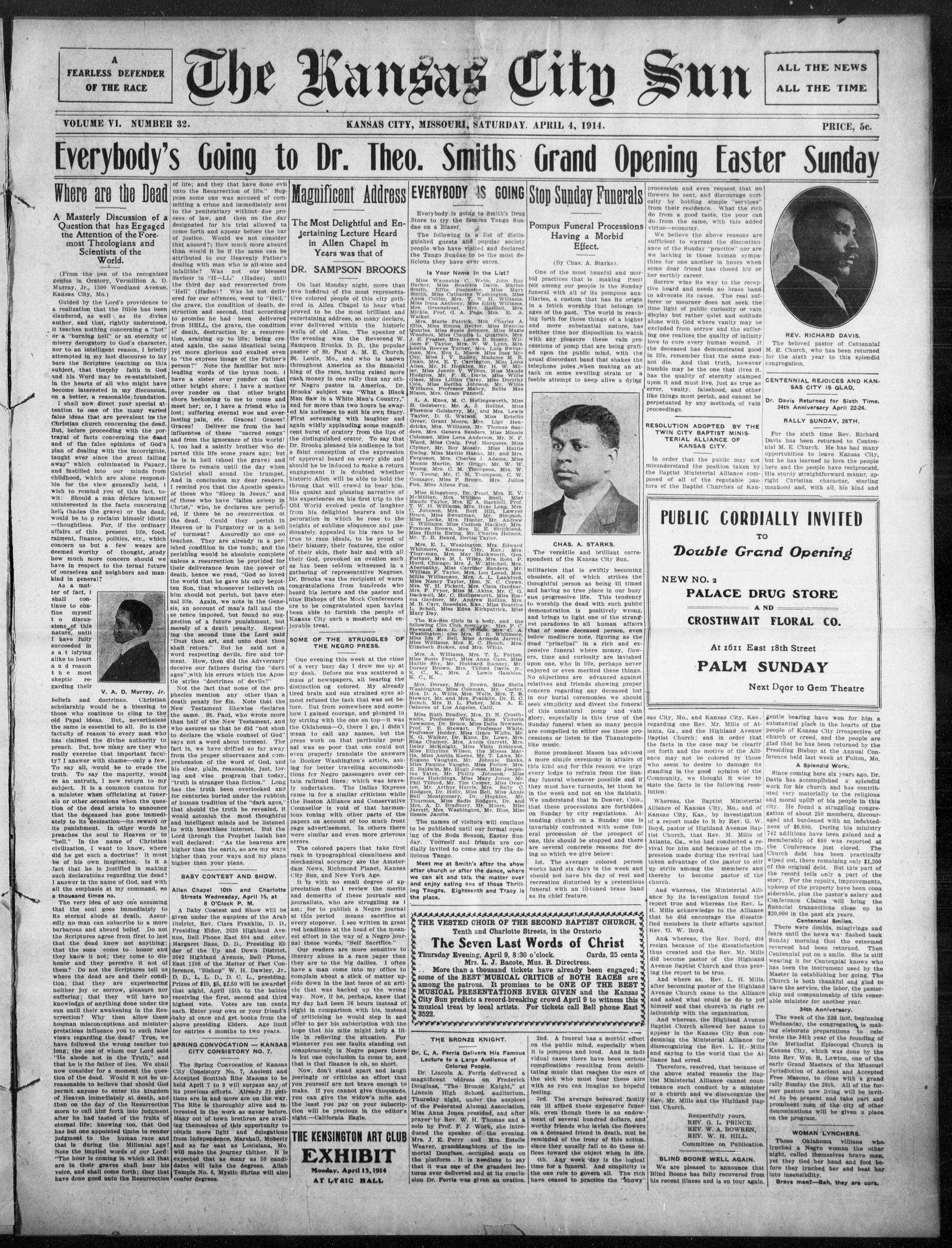
Everybody's Going to Dr. Theo. Smiths Grand Opening Easter Sunday
A FEARLESS DEFENDER OF THE RACE
VOLUME VI. NUMBER 32.
Where are the Dead
A Masterly Discussion of a Question that has Engaged the Attention of the Foremost Theologians and Scientists of the World.
(From the pen of the recognized genius in Oratory, Vermillion A. D. Murray, Jr., 1300 Woodland Avenue Kansas City, Mo.)
Guided by the Lord's providence to a realization that the Bible has been slandered, as well as its divine author, and that, rightly understood, it teaches nothing concerning a "hot" or a "burning hell" or an eternity of misery derogatory to God's character, nor to an intelligent reason, I briefly attempted in my last discourse to lay bare the Scripture teaching on this subject, that thereby faith in God and his Word may be re-established, in the hearts of all who might have become interested in my discussion, on a better, a reasonable foundation.
I shall now direct your special attention to one of the many varied false ideas that are prevalent in the Christian church concerning the dead. But, before proceeding with the por-traal of facts concerning the dead and of the false opinions of God's plan of dealing with the incorrigible, taught ever since the great falling away" which culminated in Papacy and instilled into our minds from childhood, which are alone responsible for the view generally held, I wish to remind you of this fact, to wit: Should a man declare himself uninterested in the facts concerning hell (hades the grave) or the dead, would be to p roclaim himself idiotic—thoughtless. For, if the ordinary affairs of this present life, food, raiment, finance, politics, etc., which concern us but a few wears are deemed worthy of thought, study how much more concern should we have in respect to the ternal future of ourselves and neighbors and mankind in general?
As a matter of fact, I shall continue to confine myself t o discussions of this nature, until I have fully succeeded in s a t isfying alike to heart a n d reason t h e most skeptic regarding their
V. A. D. Murray, Jr.
beliefs and doctrines. Christian scholarship would be a blessing to those who continue to cling to the old Papal ideas. But, nevertheless the same is essential to all. So is the facty of reason to every man who has claimed the divine authority to preach. But, how many are they who really exercise that important faculty? I answer with shame—only a few. To say all, would be to evade the truth. To say the morality, would ze an untruth, I now return to my subject. It is a common custom for a minister when officiating at funerals or other occasions when the question of the dead arists to announce that the deceased has gone immediately to its destination—its reward or its punishment. In other words he preaches the soul to Heaven or to "hell." In the name of Christian civilization, I want to know, where did he get such a doctrine? It must be of his own inspiration. Is it a fact that he is justified in making such declarations regarding the dead? I answer in the name of God, and with all the emphasis at my command, no a thousand times no.
The very idea of any one assuming that the soul goes immediately to its eternal abode at death. Assuredly no man can subscribe to a more barbarous and absurd belief. Do not the Scriptures agree from first to last that the dead know not anything; that the sons come to honor and they know it not; they come to dishonor and they perceive it not of them? Do not the Scriptures tell us where the dead are and their condition; that they are experiencing neither joy or sorrow, pleasure nor suffering; that they will have no knowledge of anything done under the sun until their awakening in the Resurrection? Why then allow these houman misconceptions and misinterpretations influence you to such false views regarding the dead? True, we have followed the wrong teacher too long; the one of whom our Lord said "He abode not in the Truth," and that he is the father of lies. We shall now consider for a moment the question of the dead. Would it be unreasonable to believe that should God permit anyone to enter the kingdom of Heaven immediately at death, and then on the day of the Resurrection morn to call him forth into judgment after he had tasted of the fruits of eternal life; knowing too, that God has but one appointed time to render judgment to the human race and that is during the Millennial age: Note the implied words of our Lord: "The hour is coming in which all that are in their graves shall hear his voice, and shall come forth; they that have done good unto the Resurrection
The Kansas City Sun
Not the fact that none of the prophecies mention any other than a death penalty for sin. Note that the New Testament likewise declares the same. St. Paul, who wrote more than half of the New Testament, and who assures us that he did "not shun to declare the whole counsel of God" says not a word about torment. The fact is, we have drifted so far away from the proper observance and comprehension of the word of God, and his clear, plain, reasonable, just, loving and wise program that today "truth is stranger than fiction." Long has the truth been overlooked and for centuries buried under the rubbish of human tradition of the "dark ages," that should the truth be revealed, it would astonish the most thoughtful and intelligent minds and be listened to with breathless interest. But the Lord through the Prophet Isaiah has well declared: "As the heavens are higher than the earth, so are my ways higher than your ways and my plans higher than your plans.
BABY CONTEST AND SHOW.
Allen Chapel 10th and Charlotte Streets Wednesday, April 15, at 8 O'Clock P. M.
A Baby Contest and Show will be given under the auspices of the Arab District, Rev. Clara Franklin, D. D., Presiding Elder, 2626 Highland Avenue, Bell Phone East 804 and eRev. Margaret Bass, D. D., Presiding Elder of the Up and Down District, 2642 Highland Avenue, Bell Phone, East 1108 of the Matter of Fact Conference, "Bishop" W. H. Wahley, Jr., D. D., L. L. D., D. C. L., presiding, Prizes of $10, $15, $2.50 will be awarded that night, April 15th to the babies receiving the first, second and third vote. Votes are ten cents each. Enter your own or your friend's baby at once and get books from the above presiding Elders. Age limit for entries 4 months to two years.
SPRING CONVOCATION KANSAS CITY CONSISTORY NO.7.
The Spring Convocation of Kansas City Consistory No. 7, Ancient and Accepted Scottish Rite Masons to be held April 7 to 9 will surpass any of its previous efforts. Already 31 petitions are in and more on the way. The Rite is thoroughly alive and interested in the work as never before. Many out of town brethren are availing themselves of this opportunity to obtain more light and delegations from Independence, Marshall, Moberly and as far east as Louisiana, Mo. will make the journey thither. It is expected that as many as 50 candidates will take the degrees. Allah Temple No. 6, Mystic Shring will also confer degrees.
KANSAS CITY, MISSOURI, SATURDAY, APRIL 4, 1914.
Magnificent Address
The Most Delightful and Entertaining Lecture Heard in Allen Chapel in Years was that of
DR. SAMPSON BROOKS
On last Monday night, more than nine hundred of the most representative colored people of this city gathered in Allen Chapel to hear what proved to be the most brilliant and entertaining address, so many declare, ever delivered within the historic walls of old Allen. The speaker of the evening was the Reverend W. Sampson Brooks, D. D., the popular pastor of St. Paul A. M. E. Church, St. Louis, Mo., and who is known throughout America as the financial king of the race, having raised more cash money in one rally than any other Negro pastor in America. Dr. Brooks' subject was "What a Black Man Saw in a White Man's Country," and for more than two hours he swayed his audience to suit his own fancy. First screaming with laughter and again wildly applauding some magnificent burst of oratory from the lips of the distinguished orator. To say that Dr. Brooks pleased his audience is but a faint conception of the expression of approval heard on every side and should be induced to make a return engagement it is doubted whether historic Allen will be able to hold the strong that will crowd to hear him. His quaint and pleasing narrative of his experiences on his first trip to the Old World evoked peals of laughter from his delighted hearers and his peroration in which he rose to the heights of sublime eloquence and passionately appealed to his race to be true to race ideals, to be proud of their history, their features, the color of their skin, their hair and with all their God, provoked an ovation such as has been seldom witnessed in a gathering of representative Negroes. Dr. Brooks was the recipient of warm congratulations from hundreds who heard his lecture and the pastor and nine Bishops of the Mock Conferences are to be congratulated upon having been able to furnish the people of Kansas City such a masterly and enjoyable treat.
SOME OF THE STRUGGLES OF
THE NEGRO PRESS.
One evening this week at the close of a very busy day I drew me up at my desk. Before me was scattered a mass of newspapers, all bearing the distinction og colored. My already tired brain and strain strained eyes almost refused the task that was set before. But from somewhere and somehow I gained courage, and plunged in by string with the one on top—it was the Oklahoma—O, there I go, I didn't mean to call any names, but the press work on that particular journal was so poor that one could not even properly translate the answers to Booker Washington's article, asking for better traveling accommodations for Negro passengers over certain railroad lines; which was bravely undertaken. The Dallas Express came in for a similar criticism while the Boston Alliance and Conservative Counselor is void of that harmonious toning with other parts of the papers on account of too much front page advertisement. In others there were similar and even more grievous errors. The colored papers that take first rank in typographical cleanliness and mechanical accuracy are the Amster dam News, Richmond Planet, Kansas City Sun, and New York Age.
It is with no small degree of appreciation that I review the merits and demurts of these journals and journalists, who are struggling as I am; for to publish a Negro journal at this period means sacrifice at every stopover. I see written in great red headlines at the head of the meantest effort in the work of a Negro journal these words, "Self Sacrifice."
Our readers are more sensitive to literary abuse in a race paper than they are to the big dailies. I often have a man come into my office to complain about a stick of matter upside down in the last issue of an article that was backed up the wrong way. Now, if he, perhaps, knew that my day had been 36 hours instead of eight in comparison with his, instead of criticising he would step in and offer to pay his subscription with the hope that his mite might help a little in relieving the situation. For whenever you see faults standing out conspicuously in Negro papers there is but one conclusion to come to, and that is that finance is oh, so short. Now, don't stand apart and laugh jeeringly or criticise an effort that you yourself are not brave enough to make. If you cannot give thousands, you can give the widow's mite and the least you pay on your subscription will be precious in the editor's sight. California Eagle.
Monday, April 13, 1914
AT LYRIC HALL
Mrs. L. J. Bacote, Mus. B. Directress. More than a thousand tickets have already been engaged; some of the BEST MUSICAL CRITICS of BOTH RACES are among the patrons. It promises to be ONE OF THE BEST MUSICAL PRESENTATIONS EVER GIVEN and the Kansas City Sun predicts a record-breaking crowd April 9 to witness this musical treat by local artists. For tickets call Bell phone East 3522.
Everybody is going to Smith's Drug Store to try the famous Tango Sundae on a Blazer.
The following is a list of distinguished guests and popular society people who have visited and declared the Tango Sundae to be the most delicious they have ever eaten.
Is Your Name In the List?
Mrs. E. L. Washington, Mrs. Edward Whitmore, Kansas City, Kass, Mrs. Thurman, Mrs. May Hackworth, Geo. Foreman, Mrs. M. Wiley, Mrs. Robert P. H. Ford, Chicago, Mrs. J. W. Mitchell, M. Abernathy, Miss Carriner Sanders, Mr. William F. Taylor, Mrs. Ion Lored, Mrs. Mille Williamson, Mrs. A. Lankford, Miss Nancy Taylor, Hon. N. C. Crews, Mrs. W. P. Pickett, Miss Gardner, Mrs. F. Pryor, Miss M. Akins, Mr. Backwell, Mr. C. Hollinsworth, Miss Enema Gardner, Mr. Andrew Rollins, Mrs. M. B. Carr, Rosedale, Kass, Miss Beatrice Scholl, Miss E. E. K. Kirkpatrick, Miss Mary Day.
The K-See Girls in a body and the following, Clio Club members, Mrs. C. P. Steward, Mrs. L. E. Wood, Mrs. P. A. Washington; also Mrs. E. R. Whitmore, Miss Ida F. Bell, Miss Armeda Jarrett, Miss Williams, Mrs. E. C. Bunch, Mrs. Elizabeth Stokes, and Mrs. Wills.
Mrs. A. Williams, Mrs. T. L. Patton, Mrs. Sue Foster, Miss Anna, Mrs. D. Hattie Shy, Mr. Hubbard Ramsey, Mr. Dorsey Brown, Mrs. Tilford Davis, Jr., K. C., K. K., Mrs. J. Lewis Gambles, K. C., K.
Mrs. Dorsey, Mrs. Brown, Miss Stella Washington, Miss Coleman, Mr. Carter, Mrs. D. A. Willis, Mrs. Wells, Mrs. T. B. Hart, Mr. and Mrs. Frankenon, Dr. E. C. Bunch, Mrs. B. Fisher, Mrs. A. E. Osborne of Los Angeles, Calif.
Miss Ruth Bradley, Mrs. D. N. Crosthawe, Professor Work, Miss Victoria Newsome, Dr. Bruce, Miss Della Newsom, T. B. Professor, Pressed Write, Mr. N. G. Walker, Dr. Kane, Dr. Lowe, Mrs. S. S. Chalkney, Mrs. Annis Garrett, Mrs. J. J. B. Wright, Miss Holt, Robinson, Miss Ethyline Wilson, the Misser Max, in Miss Ambia Keene, Mr. T. L. Laws, Mr. Eugene Vaughan, Mr. Johnnie Banks, Miss Pauline Vaughan, Miss Now, Mrs. E. Baldwin, Mr. H. H. Jones, Miss Jones, in the Yates, Mr. Phillip Johnson, Miss Sussie Hutchings, Miss Mary Jones, Mr. Phil Tiford, Mr. Tim Cooper, Miss Overley, Miss Arthur Harris, Mrs. B. C. Rodgers, Dr. Holly, Miss Bell, Miss Annie Bell Montgomery, Dr. Hopkins, Mr. Thurman, Miss Sadle Rodgers, Dr. and Mr. Bradbury, Mr. Moore, Miss Jarrett, Mrs. Washington, Mr. Blue, Miss Bessie Jacobs.
The names of visitors will continue to be published until our formal opening of the Soda Season, Easter Sunday. Yourself and friends are cordially invited to come and try the delicious Tango.
Meet me at Smith's after the show after church or after the dance, where we can sit and talk the matter over and enjoy eating one of those Thrilling Tangos. Eighteenth and Tracy is the place.
THE VESTED CHOIR OF THE
Tenth and Charlotte S
The Seven Last
Thursday Evening, April 9, 8:30
Mrs. L. L. J. Bacote,
More than a thousand tickets
some of the BEST MUSICAL C
among the patrons. It promise
MUSICAL PRESENTATIONS
City Sun predicts a record-break
musical treat by local artists.
3522.
THE BRONZE KNIGHT.
Dr. L. A. Ferris Delivers His Famous
Lecture to a Large Audience of
Colored People.
Dr. Lincoln A. Ferris delivered a magnificent address on Frederick Douglass, "The Bronze Knight," at Lincoln High School auditorium, Thursday night, under the auspices of the Federated Alumni Association. Miss Anna Jones presided, and after prayer by Rev. W. H. Thomas and a solo by Prof. F. J. Work, she introduced the speaker of the evening. Mrs. J. E. Perry and Mrs. Estelle Weaver, granddaughters of the immortal Douglass, occupied seats on the platform. It is needless to say that it was one of the grandest lectures ever delivered and at its conclusion Dr. Ferris was given an ovation.
Pompus Funeral Processions Having a Morbid Effect.
(By Chas. A. Starks).
One of the most baneful and more bid practices that is making itself felt among our people is the Sunday funeral with all of its pompous auxillaries, a custom that has its origin in a fetch worship that belongs to ages of the past. The world in reaching forth for those things of a higher and more substantial nature, has neither time nor disposition to watch with any pleasure these vain processes of pomp that are being grafted upon the public mind, with the usual discordant band that shakes the telephone poles_when making an attack on some swelling strain or a feeble attempt to keep alive a dying
CHAS. A. STARKS.
The versatile and brilliant correspondent of the Kansas City Sun.
militarism that is swiftly becoming obsolete, all of which strikes the thoughtful person as being ill timed and having no true place in our busy and progressive life. This tendency to worship the dead with such public demonstration is positively wrong, and brings to light one of the strongest paradoxes in all human affairs that of some deceased person, even below mediocre note, figuring this dead "principal" in a rich and expensive funeral where money, flowers, time and curiosity are lavished upon one, who in life, perhaps never enjoyed or even merited these things. No objections are advanced against relatives and friends showing proper concern regarding any deceased but in our burial ceremonies we should seek simplicity and divest the funeral of this unnatural pomp and vain glory, especially is this true of the Sunday funeral when so many people are compelled to either see these processes or listen to the Thanatopsis-like music.
Some prominent Mason has advised a more simple ceremony in affairs of this kind and for this reason we urge every lodge to refrain from the Sunday funeral whenever possible and if they must have turnouts, let them be in the week and not on the Sabbath. We understand that in Denver, Colo., that these processions are forbidden on Sunday by city regulations. Attending church on a Sunday one is invariably confronted with some funeral procession or the prospect of one, this should be stopped and there are several concrete reasons for doing so which we give below:
1st. The average colored person works hard six days in the week and should not have his day of rest and recreation disturbed by a pretentious funeral with an ill-tuned brass band as its chief feature.
THE SECOND BAPTIST CHURCH,
Streets, in the Oratorio
Words of Christ
10 o'clock. Cards, 25 cents
Mus. B. Directress.
lets have already been engaged;
CRITICS of BOTH RAGES are
to be ONE OF THE BEST
EVER GIVEN and the Kansas
ing crowd April 9 to witness this
For tickets call Bell phone East
2nd. A funeral has a morbid effect on the public mind, especially when it is pompous and loud. And in individual cases there have been serious complications resulting from debilitating music that reaches the ears of the sick who must hear these airs with as you can imagine no hopeful feeling.
3rd. The average bereaved family can ill afford these expensive funerals, even though there is an endowment of several hundred dollars, and worthy friends who lavish the flowers on a deceased friend in death, but be reminded of the irony of this action, since they usually fall to do these offices toward the object when in life.
4th. Any week 'day is the logical time for a funeral. And simplicity is the one rule to govern all. The rich have ceased to practice the "showy"
procession and even request that no flowers be sent, and discourage curiosity by holding simple "services" from their residence. What the rich do from a good taste, the poor can do from the same, with this added virtue—economy.
We believe the above reasons are sufficient to warrant the discontinuance of the Sunday "practice" nor are we lacking in those human sympathies for one another in hours when some dear friend has closed his or her earthly career.
Sorrow wins its way to the receptive heard and needs no brass band to advocate its cause. The real sufferer or mourner does not seek the lime light of public curiosity or vain display but rather quiet and solitude alone with God where vanity may be excluded from sorrow and the suffering one realizes the quality of infinity love to cure every human wound. If the deceased has demonstrated good in life, remember that the same cannot die. And that truth, however humble may be the one that lives it, has the quality of eternity stamped upon it and must live, just as true as error, vanity, falsehood, and other like things must perish, and cannont be perpetuated by any methods of vain proceedings.
RESOLUTION ADOPTED BY THE
TWIN CITY BAPTIST MINISTERIAL ALLIANCE OF KANSAS CITY.
In order that the public may not misunderstand the position taken by the Baptist Ministerial Alliance composed of all of the reputable pastors of the Baptist Churches of Kan-
PUBLIC CORDI
TO
Double Grant
NEW NO. 2
PALACE DR
CROSTHWAIT
At 1611 East
PALM S
Nex
sas City, Mo., and Kansas City, Kas., regarding one Rev. Mr. Mills of Atlanta, Ga., and the Highland Avenue Baptist Church; and in order that the facts in the case may be clearly set forth and the motive of the Alliance may not be colored by those who seem to desire to damage its standing in the good opinion of the Community, we thought it wise to state the facts in the following resolution:
Whereas, the Baptist Ministerial Alliance of Kansas City, Mo., and of Kansas City, Kas., by investigation of a report made to it by Rev. G. W. Boyd, pastor of Highland Avenue Baptist Church, that Rev. M. Mills of Atlanta, Ga., who had conducted a revival for him and because of the impression made during the revival had taken advantage of the pastor to stir up strife among the members and thereby to become pastor of the church.
And whereas, the Ministerial Alliance by its investigation found the report true and whereas the Rev. L. H. Mills acknowledge to the Alliance that he did encourage the dissatisfied members in their efforts against Rev. G. W. Boyd.
And whereas, the Rev. Boyd, did resign because of the dissatisfaction thus created and the Rev. Mr. Mills did become pastor of the Highland Avenue Baptist Church and thus proving the report to be true.
And where as, Rev. L. H. Mills, after becoming pastor of the Highland Avenue Church came to the Alliance and asked what could he do to put himself and that churevh in right relationship with the organization. And whereas, the Highland Avenue Baptist Church allowed her name to appear in the Kansas City Sun condemning the Ministerial Alliance for disrecognizing the Rev. L. H.-Mills and saying to the world that the Alliance had erred. Therefore, resolved, that because of the above stated reasons the Baptist Ministerial Alliance cannot countenance such conduct by a minister or a church and we disrecognize the Rev. Mr. Mills and the Highland Baptist Church.
Respectfully yours,
REV. G. L. PRINCE,
REV. W. A. BOWREN,
REV. W. H. HILL.
Committee on Publication.
BLIND BOONE WELL AGAIN.
BLIND BOONE WELL AGAIN. We are pleased to announce that Blind Boone has fully recovered from his recent illness and is en tour again.
ALL THE NEWS ALL THE TIME
PRICE, 5c.
Mister Sunday
REV. RICHARD DAVIS.
The beloved pastor of Centennial M. E. Church, who has been returned for the sixth year to this splendid congregation.
CENTENNIAL REJOICES AND KANSAS CITY IS GLAD.
Dr. Davis Returned for Sixth Time.
34th Anniversary April 22-24.
RALLY SUNDAY, 26TH.
For the sixth time Rev. Richard Davis has been returned to Centennial M. E. Church. He has had many opportunities to leave Kansas City, but he has learned to love the people here and the people have reciprocated. His sturdy straightforward mannr, upright Christian character, sterling manhood and, with all, his kind and
DIALLY INVITED
TO
Grand Opening
DRUG STORE
AND
AIT FLORAL CO.
East 18th Street
SUNDAY
Next Door to Gem Theatre
gentle bearing have won for him a substantial place in the hearts of the people of Kansas City irrespective of church or creed, and the people are glad that he has been returned by the Presiding Bishop at the Annual Conference held last week at Fulton, Mo.
A Splendid Work.
Since coming here six years ago, Dr. Davis has accomplished a splendid work for his church and has contributed very materially to the religious and moral uplift of his people in this city. He found a struggling congregation of about 250 members, discouraged and burdened with an indebtedness of $6,600. During his ministry 742 additions have been gained and a membership of 880 was reported at the Conference just closed. The Church debt has been practically wiped out, there remaining only $1,200 of the original debt. But this part of the record tells only a part of the story. For the repairs, improvements, upkeep of the property have been coon siderable, plus the pastor's salary and Conference Claims will bring the financial transactions close up to $20,000 in the past six years.
Centennial Smiles
There were doubts, misgivings and fears until the news was flashed back Sunday morning that the esteemed reverend had been returned. Then Centennial put on a smile. She is still wearing it for Centennial knows who has been the instrument used by the Master in establishing her going. The Church is both thankful and glad to have the service, the labor, the pastorship and companionship of this venerable minister for another year.
34th Anniversary.
The week of the 22d inst. beginning Wednesday, the congregation is making elaborate preparations to celebrate the 34th year of the founding of the Methodist Episcopal Church in Kansas City, which was done by the late Rev. Wmi. R. Lawn, one of the early Grand Masters of the Missouri Jurisdiction of Ancient and Accepted Free Masons, to close with a grand rally Sunday the 26th. 'All of the former pastors now living will be invited to be present and take part and prominent men of the city of other denominations will be given a place on the program.
WOMAN LYNCHERS
cation.
IN.
that from again.
Those Oklahoma villians who lynched a Negro woman the other night, called themselves brave men, yet they tied her hand and foot before they lynched her and beat her into insensibility.
Brave men?—Bah, they are curs.
"House of Love"
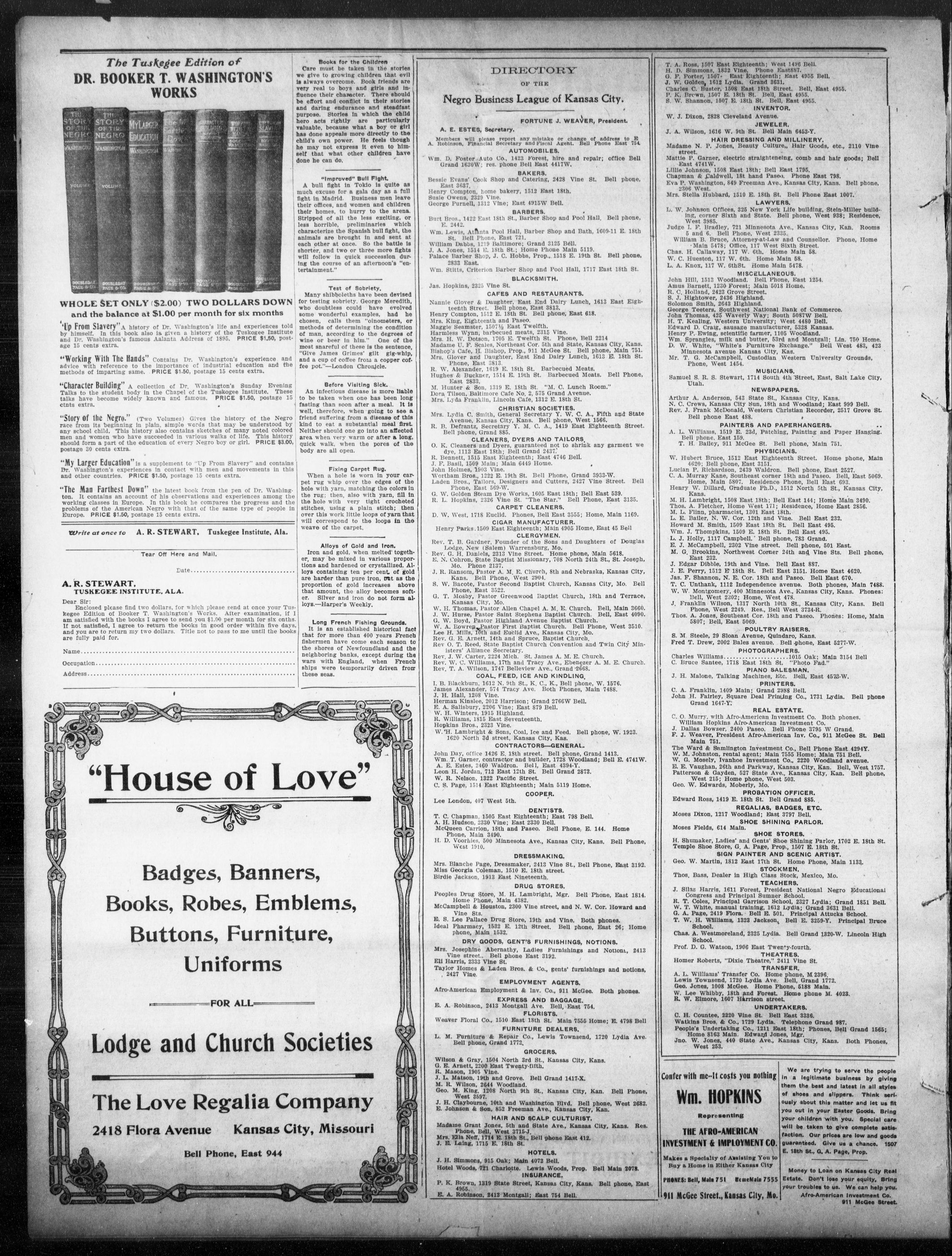
The Tuskegee Edition of DR. BOOKER T. WASHINGTON'S WORKS
THE STORY OF THE NEGRO
WASHINGTON
VOLUME I
THE STORY OF THE NEGRO
WASHINGTON
VOLUME II
MYLARGER EDUCATION
WASHINGTON
The My Larger Dewy
WASHINGTON
CHARACTER BUILDING
WASHINGTON
WORKING WITH HANDS
SOCIAL WASHINGTON
UP FROM SLAVES
WASHINGTON
DOUBLEDAY
PAGE D-CO
DOUBLEDAY
PAGE D-CO
DOUBLEDAY
PAGE D-CO
DOUBLEDAY
PAGE D-CO
WHOLE SET ONLY ($2.00) TWO DOLLARS DOWN and the balance at $1.00 per month for six months
"Up From Slavery" A history of Dr. Washington's life and experiences told by himself. In this book also is given a history of the Tuskogee Institute and Dr. Washington's famous Aalanta Address of 1895. PRICE $1.50, postage 15 cents extra.
"Working With The Hands" Contains Dr. Washington's experience and advice with reference to the importance of industrial education and the methods of imparting same. PRICE $1.50, postage 15 cents extra.
"Character Building" A collection of Dr. Washington's Sunday Evening Talks to the student body in the Chapel of the Tuskogee Institute. These talks have become widely known and famous. PRICE $1.50, postage 15 cents extra.
"Story of the Negro." (Two Volumes) Gives the history of the Negro race from its beginning in plain, simple words that may be understood by any school child. This history also contains sketches of many noted colored men and women who have succeeded in various walks of life. This history should form a part of the education of every Negro boy or girl. PRICE $3.00, postage 30 cents extra.
"My Larger Education" is a supplement to "Up From Slavery" and contains Dr. Washington's experiences in contact with men and movements in this and other countries. PRICE $1.50, postage 15 cents extra.
"The Man Farthest Down" the latest book from the pen of Dr. Washington. It contains an account of his observations and experiences among the working classes in Europe. In this book he compares the progress and the problems of the American Negro with that of the same type of people in Europe. PRICE $1.50, postage 15 cents extra.
Tear Off Here and Mail.
A. R. STEWART,
TUSKEEGE INSTITUTE, ALA.
Enclosed please find two dollars, for which please send at once your Tuskegee Edition of Booker T. Washington's Works. After examination, if I am satisfied with the books I agree to send you $1.00 per month for six onths. If not satisfied, I agree to return the books in good order within five days, and you are to return my two dollars. Title not to pass to me until the books are fully paid for.
Name.....
Occupation.....
Address....
Books for the Children
Care must be taken in the stories we give to growing children that evil is always overcome. Book friends are very real to boys and girls and influence their character. There should be effort and conflict in their stories and daring endurance and steadfast purpose. Stories in which the child acts rightly are particularly valuable, because what a boy or girl has done appeals more directly to the child's own power. He feels though he may not express it even to himself that what other children have done he can do.
"Improved" Bull Fight
A bull fight in Tokyo is quite as much excuse for a gala day as a full fight in Madrid. Business men leave their offices, and women and children their homes, to hurry to the arena. Stripped of all the less exciting, or less horrible, preliminaries which characterize the Spanish bull fight, the animals are brought in and sent at each other at once. So the battle is shorter, and two or three more fights will follow in quick succession during the course of an afternoon's "entertainment."
Test of Sobriety.
Many shibboleths have been devised for testing sobriety. George Meredith, who doubtless could have evolved some wonderful examples, had he chosen, calls them "oinometers, or methods of determining the condition of man, according to the degrees of wine or beer in him." One of the most snareful of these is the sentence, "Give James Grimes" gift, gig-whip, and a cup of coffee from a copper coffee pot."—London Chronicle.
Before Visiting Sick
An infectious disease is more liable to be taken when one has been long fasting than soon after a meal. It is well, therefore, when going to see a friend suffering from a disease of this kind to eat a substantial meal first. Neither should one go into an affected area when very warm or after a long, quick walk, when the pores of the body are all open.
Fixing Carpet Rug.
When a hole is worn in your carpet rug whip over the edges of the hole with yarn, matching the colors in the rug; then, also with yarn, fill in the hole with very tight crocheted stitches, using a plain stitch; then over this work little loops of yarn that will correspond to the loops in the weave of the carpet.
Alloys of Gold and Iron.
Iron and gold, when melted together, may be mixed in various proportions and hardened or crystallized. Alloys containing ten per cent of gold are harder than pure iron, but as the proportion of gold increases above that amount, the alloy becomes softer. Silver and iron do not form alloys—Harper's Weekly.
Long French Fishing Grounds.
Grounds. It is an established historical fact that for more than 400 years French fishermen have come each season to the shores of Newfoundland and the neighboring banks, except during the wars with England, when French ships were temporarily driven from these seas.
FORTUNE J. WEAVER, President.
A. E. ESTES, Secretary.
Members will please report any mistake or change of address to E. A. Robinson, Financial Secretary and Fiscal Agent. Bell Phone East 754.
AUTOMOBILES.
Wm. D. Foster Auto Co., 1423 Forest, hire and repair; office Bell Grand 1630W; res. phone Bell East 4417W.
BAKERS.
Bessie Evans' Cook Shop and Catering, 2428 Vine St. Bell phone, East 3637.
Henry Compton, home bakery, 1512 East 18th.
Susie Owens, 2329 Vine.
George Purnell, 1312 Vine; East 4915W Bell.
BARBERS.
Burt Bros., 1422 East 18th St., Barber Shop and Pool Hall. Bell phone, E. 2442.
Wm. Lewis, Atlanta Pool Hall, Barber Shop and Bath, 1609-11 E. 18th St. Bell Phone, East 721.
Wm. Stitts, Criterion Barber Shop and Pool Hall, 1717 East 18th St. BLACKSMITH
CAFES AND RESTAURANTS.
Nannie Glover & Daughter, East End Dairy Lunch, 1613 East Eighteenth Street. Bell phone, East 3813.
Henry Compton, 1512 E. 18th St. Bell phone, East 618.
Mrs. King, Eighteenth and Paseo.
Maggie Seamster, 1507½ East Twelfth.
Harmless Wynn, barbecued meats, 2315 Vine.
Mrs. H. W. Dotson, 1708 E. Twelfth St. Phone, Bell 2214
Madame U. F. Scales, Northeast Cor. 5th and State, Kansas City, Kans.
Bishop's Cafe, H. Bishop, Prop., 911 McGee St. Bell phone, Main 751.
Mrs. Glover and Daughter, East End Dairy Lunch, 1613 E. 18th St.
Phone, East 3813.
R. W. Alexander, 1619 E. 18th St. Barbecued Meats.
Hughes & Buckner, 1514 E. 19th St. Barbecued Meats. Bell Phone,
East 2833.
M. Hunter & Son, 1319 E. 18th St. "M. C. Lunch Room."
Dora Tilson, Baltimore Cafe No. 2, 575 Grand Avenue.
Mrs. Lyda Franklin, Lincoln Cafe, 1312 E. 18th St.
CHRISTIAN SOCIETIES.
Mrs. Lydia C. Smith, General Secretary Y. W. C. A., Fifth and State Avenue, Kansas City, Kansas. Bell phone, West 1566.
R. B. Defrantz, Secretary Y. M. C. A., 1419 East Eighteenth Street. Bell phone, Grand 885.
CLEANERS, DYERS AND TAILORS.
O. K. Cleaners and Dyers, guaranteed not to shrink any garment we dye, 1113 East 18th; Bell Grand 2437.
R. Bennett, 1515 East Eighteenth; East 4746 Bell.
J. F. Basil, 1509 Main; Main 6449 Home.
John Holmes, 1903 Vine.
Worthham Bros., 1222 E. 19th St. Bell Phone, Grand 3933-W.
Laden Bros., Tailors, Designers and Cutters, 2427 Vine Street. Bell Phone, East 559-W.
G. W. Golden Steam Dye Works, 1605 East 18th; Bell East 539.
R. L. Hopkins, 2326 Vine St. "The Star." Bell Phone, East 3135.
CARPET CLEANERS.
D. W. West, 1718 Euclid. Phones, Bell East 3555; Home, Main 1169.
CIGAR MANUFACTURER.
Henry Parks. 1509 East Eighteenth; Main 4905 Home, East 45 Bell
CLERGYMEN.
Rev. T. B. Gardner, Founder of the Sons and Daughters of Douglas Lodge, New (Salem) Warensburg, Mo.
Rev. G. H. Daniels, 2313 Vine Street. Home phone, Main 5618.
E. N. Cohran, State Baptist Missionary, 708 North 24th St., St. Joseph,
Mo. Phone 2137.
J. R. Nielsen, Pharer A, M. E. Church, 8th and Nebraska, Kansas City,
Kans. Bell Phone, West. 2004.
S. W. Bacote, Pastor Second Baptist Church, Kansas City, Mo. Bell
Phone, East. 3522.
G. T. Mosby, Foster Greenwood Baptist Church, 18th and Terrace,
Kansas City, Mo.
Rev O. T. Reed, State Baptist Church Convention and Twin City Ministers' Alliance Secretary.
COAL, FEED, ICE AND KINDLING
I. B. Blackburn, 1612 N. 9th St., K. C., K., Bell phone, W. 1576.
James Alexander, 574 Tracy Ave. Both Phones, Main 7488.
J. H. Hall, 1208 Vine.
Herman Kinslee, 2012 Harrison; Grand 2766 W Bell.
E. A. Salisbury, 2206 Vine; East 879 Bell.
W. H. Winters, 1915 Highland.
R. Williams, 1815 East Seventeenth.
Hopkins Bros., 2223 Vine.
W. H. Lambricht & Sons, Coal, Ice and Feed. Bell phone, W. 1923.
1620 North 3d street, Kansas City, Kas.
CONTRACTORS-GENERAL.
John Day, office 1426 E. 18th Street, Bell phone, Grand 1413.
Wm. T. Garner, contractor and builder, 1728 Woodland; Bell E. 4741W.
A. E. Estes, 2460 Waldron. Bell, East 4394-Y.
Leon H. Jordan, 712 East 12th St. Bell Grand 2873.
W. R. Nelson, 1322 Pacific Street.
C. S. Page, 1514 East Eighteenth; Main 5119 Home.
COOPER.
Lee London, 407 West 5th.
H. D. Voorhies, 500 Minnesota Ave., Kansas City, Kans. Bell Phone, West 1910.
DRESSMAKING.
Mrs. Blanche Page, Dressmaker, 2413 Vine St., Bell Phone, East 3192.
Miss Georgia Coleman, 1510 E. 18th street.
Birdie Jackson, 1913 East Nineteenth.
DRUG STORES.
Peoples Drug Store, M. H. Lambright, Mgr. Bell Phone, East 1814.
Home Phone, Main 4382.
McCampbell & Houston, 2300 Vine street, and N. W. Cor. Howard and
Vine Sts.
E. S. Lee Pallace Drug Store, 19th and Vine. Both phones.
Ideal Pharmacy, 1532 E. 12th Street. Bell phone, East 26; Home
phone, Main 1532.
DRY GOODS, GENT'S FURNISHINGS, NOTIONS.
Mrs. Josephine Abernathy, Ladies Furnishings and Notions, 2413
Vine street. Bell phone East 3192.
Eli Harris, 2333 Vine St.
DRUG STORES.
Taylor Homes & Laden Bros. & Co., gents' furnishings and notions,
2427 Vine.
EMPLOYMENT AGENTS.
Afro-American Employment & Inv. Co., 911 McGee. Both phones.
EXPRESS AND BAGGAGE.
E. A. Robinson, 2413 Montgall Ave. Bell, East 754.
FLORISTS.
Weaver Floral Co., 1510 East 18th St. Main 7555 Home; E. 4798 Bell
FURNITURE DEALERS.
L. M. Furniture & Repair Co., Lewis Townsend, 1720 Lydia Ave.
Bell phone, Grand 1772.
GROCERS.
Wilson & Gray, 1504 North 3rd St. Kansas City, Kans.
G. E. Arnett, 2200 East Twenty-fifth.
R. Mason, 1905 Vine.
J. L. Matson, 19th and Grove. Bell Grand 1417-X.
M. R. Wilson, 2644 Woodland.
Geo. M. King, 1208 North 9th St., Kansas City, Kan. Bell Phone,
West 3597.
J. H. Claybourne, 10th and Washington Blvd. Bell phone, West 2682.
E. Johnson & Son, 852 Freeman Axe, Kansas City, Kan.
T. A. Ross, 1507 East Eighteenth; West 1496 Bell.
H. D. Simmons, 1832 Vine, Phone East887.
G. F. Porter, 1507 East Eighteenth; East 4955 Bell.
J. W. Golden, 1612 Lydia, Grand 3631.
Charles C. Buster, 1508 East 18th Street, Bell, East 4955.
P. K. Brown, 1507 E. 18th St. Bell, East 4955.
S. W. Shannon, 1507 E. 18th St. Bell, East 4955.
INVENTOR.
W. J. Dixon, 2828 Cleveland Avenue.
JEWELER.
J. A. Wilson, 1616 W. 9th St. Bell Main 6453-Y.
HAIR DRESSING AND MILLINERY.
Madame N. P. Jones, Beauty Culture, Hair Goods, etc., 2110 Vine street.
Mattie P. Garner, electric straightening, comb and hair goods; Bell East 4741W.
Lillie Johnson, 1508 East 18th; Bell East 1795.
Chapman & Caldwell, 18th hand Paseo., Phone East 798.
Eva P. Washington, 849 Freeman Ave., Kansas City, Kans. Bell phone, 2306 West.
L. W. Johnson Offices, 325 New York Life building, Stein-Miller building, Sixth and State. Bell phone, West 938; Residence, West 938.
Judge L. F. Bradley, 721 Minnesota Ave., Kansas City, Kan. Rooms 5 and 6. Bell Phone, West 2335.
William B. Bruce, Attorney-at-Law and Counsellor, Phone, Home Main 5478; Office, 117 West Sixth Street.
Chas. H. Callaway, 117 W. 6th. Home Main 58.
W. C. Hueston, 117 W. 6th. Home Main 58.
L. A. Knox, 117 W. 6thSt. Home Main 5478.
MISCELLANEOUS.
John Hill, 1513 Woodland. Bell Phone, East 1254.
Amus Barnett, 1230 Forest; Main 5018 Home.
R. C. Holland, 2423 Grove Street.
S. J. Hightower, 2436 Highland.
Solomon Smith, 2643 Highland.
George Teeters, Southwest National Bank of Commerce.
John Thomas, 425 Waverly Way; South 5087W Bell.
H. T. Kealing, Western University; West 4480 Bell.
Edward D. Craig, sausage manufacturer, 5328 Kansas.
Henry P. Ewing, scientific farmer, 1105 Woodland.
Wm. Sprangles, milk and butter, 53rd and Montgall; Lin. 750 Home.
D. W. White, "White's Furniture Exchange." Bell West 483, 423 Minnesota avenue Kansas City, Kas.
Mr. T. G. McCampbell, Custodian Western University Grounds, Phone, West 1454.
MUSICIANS.
Samuel S. R. S. Stewart, 1714 South 4th Street, East, Salt Lake City, Utah.
NEWSPAPERS.
Arthur A. Anderson, 543 State St., Kansas City, Kans.
N. C. Crews, Kansas City Sun, 18th and Woodland; East 999 Bell.
Rev. J. Frank McDonald, Western Christian Recorder, 2517 Grove St.
Bell phone East 488.
PAINTERS AND PAPERHANGERS.
A. L. Williams, 1519 E. 23d, Patching, Painting and Paper Hanging.
Bell phone, East 159.
T. H. Balley, 911 McGee St. Bell phone, Main 751.
PHYSICIANS.
W. Hubert Bruce, 1512 East Eighteenth Street. Home phone, Main
4620; Bell phone, East 3151.
Lucian P. Richardson, 2439 Waldron. Bell phone, East 2527.
C. A. Murray Kane, Southeast corner 18th and Paseo. Bell, East 5069.
Home, Main 5807. Residence Phone, Bell East 693.
Henry W. Dillard, Graduate Ph.D., 1512 North 50th St, Kansas City,
Kans.
M. H. Lambricht, 1508 East 18th; Bell East 144; Home Main 3490.
Thos. A. Fletcher, Home West 171; Residence, Home East 2856.
M. L. Flinn, pharmacist, 1301 East 18th.
L. E. Baller, N. W. Cor. 12 and Vine. Bell East 232.
Howard M. Smith, 1509 East 18th St. Bell East 495.
Wm. J. Thompkins, 1509 E. 18th St. Bell East 495.
L. J. Holly, 1117 Campbell. Bell phone, 783 Grand.
E. J. McCampbell, 2302 Vine street. Bell phone, 501 East.
M. G. Brookins, Northwest Corner 24th and Vine Sts. Bell phone,
East 232.
J. Edgar Dibble, 19th and Vine. Bell East 887.
J. E. Perry, 1512 F 18th St. Bell East 3151. Home East 4620.
Jas. F. Shannon, N. E. Cor. 18th and Paseo. Bell East 670.
T. C. Unthank, 1112 Independence avenue. Both phones, Main 7488.
W. W. Montgomery, 400 Minnesota Ave., Kansas City, Kans. Phones:
Bell, West 2302; Home, West 478.
J. Franklin Wilson, 1317 North St. Kansas City, Kansas. Bell Phone, West 2249. Res., Bell West 3734-R.
Thos. A. Jones, Southeast Cor. 18th and Paseo. Phones: Home, Main 5807; Bell, East 5069.
POULTRY RAISERS.
S. M. Steele, 29 Sloan Avenue, Quindaro, Kansas.
Fred T. Drew, 2002 Bales avenue. Bell phone, East 5277-W.
PHOTOGRAPHERS.
Charles Williams.....1015 Oak; Main 3154 Bell
C. Bruce Santee, 1718 East 18th St. "Photo Fad."
PIANO SALESMAN.
J. H. Malone, Talking Machines, Etc. Bell, East 4573-W.
PRINTERS.
PHOTOGRAPHERS
C. A. Franklin, 1409 Main; Grand 2988 Bell.
John H. Fairley, Square Deal Printing Co., 1731 Lydia. Bell phone Grand 1647-Y.
REAL ESTATE.
C. O. Murry, with Afro-American Investment Co. Both phones.
William Hopkins Afro-American Investment Co.
J. Dallas Bowser, 2400 Paseo. Bell Phone 3795 W Grand.
F. J. Weaver, President Afro-American Inv. Co., 911 McGee St. Bell Main 751.
The Ward & Samlington Investment Co., Bell Phone East 4294Y.
W. M. Johnston, rental agent; Main 7555 Home; Main 751 Bell.
W. G. Mosely, Ivanhoe Investment Co., 2220 Woodland avenue.
E. E. Vaughan, 26th and Parkway, Kansas City, Kan. Bell, West 1757.
Patterson & Gayden, 527 State Ave., Kansas City, Kan. Bell phone, West 215; Home phone, West 503.
Geo. W. Edwards, Moberly, Mo.
PROBATION OFFICER.
Edward Ross, 1419 E. 18th St. Bell Grand 885.
REGALIAS, BADGES, ETC.
Moses Dixon, 1217 Woodland; East 3797 Bell.
SHOE SHINING PARLOR.
Moses Fields, 614 Main.
SHOE STORES.
REAL ESTATE.
SHOE STORES.
H. Shumaker, Ladies' and Gents' Shoe Shining Parlor, 1702 E. 18th St.
Temple Shoe Store, G. A. Page, Prop, 1507 E. 18th St.
SIGN PAINTER AND SCENIC ARTIST
Geo. W. Martin, 1812 East 17th St. Home Phone, Main 1133.
STOCKMEN.
Thos. Bass, Dealer in High Class Stock, Mexico, Mo.
TEACHERS.
J. Silas Harris, 1611 Forest, President National Negro Educational Congress and Principal Summer School.
R. T. Coles, Principal Garrison School, 2227 Lydia; Grand 1851 Bell.
W. T. White, manual training, 1612 Lydia; Grand 3631 Bell.
G. A. Page, 2419 Flora. Bell E. 501. Principal Attucks School.
T. W. H. Williams, 1323 Jackson, Bell E. 3259-Y. Principal Bruce School.
Chas. A. Westmoreland, 2325 Lydia. Bell Grand 1220-W. Lincoln High School.
Prof. D. G. Watson, 1906 East Twenty-fourth.
THEATRES.
Homer Roberts, "Dixie Theatre," 2411 Vine St.
TRANSFER.
A. L. Williams' Transfer Co. Home phone, M 2396.
Lewis Townsend, 1720 Lydia Ave. Bell, Grand 1772.
Geo. Jones, 1008 McGee. Home Phone, 5188 Main.
W. Lee Whibby, 18th and Forest. Home phone M. 4023.
R. W. Elmore, 1607 Harrison street.
UNDERTAKERS.
C. H. Countee, 2220 Vine St. Bell East 3336.
Watkins Bros. & Co., 1729 Lydia. Telephone Grand 987.
People's Undertaking Co., 1211 East 18th; Phones, Bell Grand 1565; Home 8163 Main. Edward Jones, Mgr.
Jno. W. Jones, 440 State Ave., Kansas City, Kans. Both Phones, West 253.
We are trying to serve the people in a legitimate business by giving them the best and latest in all styles of shoes and slippers. Think seriously about this matter and let us fit you out in your Easter Goods. Bring your children with you. Special care will be taken to give complete satisfaction. Our prices are low and goods guaranteed. Give us a chance. 1507 E. 18th St., G. A. Page, Prop.
Confer with me--It costs you nothing
Wm. HOPKINS
THE AFRO-AMERICAN INVESTMENT & IMPLOYMENT CO.
Makes a Specialty of Assisting You to
Buy a Home in Either Kansas City
PHONES: Bell, Main 751 HomeMain 7555
911 McGee Street., Kansas City, Mo.
PHONES: Bell, Main 751 HomeMain 7555
911 McGee Street., Kansas City, Mo.
Money to Loan on Kansas City Real Estate. Don't lose your equity. Bring your troubles to us. We can help you.
Afro-American Investment Co.
911 McGee Street.
DR. H. H. JONES
Physician and Surgeon
Office Hours: 10 to 11 a.m.
1 to 3 and 5 to 6 p. m.
Office: 1301 EAST 18th STREET
Residence,1326 Highland Ave.
Res. Home Phone,East852
KANSAS CITY, MO.
Over THEODORE SMITH, Druggist
Home Phone,5467 Main Bell 4001 Grand
1301 East 18th ST KANSAS CITY, MO.
Office of
DR. M. G. BROOKINS,
24th and Vine Sts.
Bell Phone Last 232.
Residence, 1816 Woodland' Avenue
Bell Phone E. 838.
Office hours: 11 to 12 a. m.; 2 to
4 p. m.; 6 to 8 p. m.
Calls Answered Day or Night.
Office Hours
8 to 12 m. & 1 to 5 p. m.
Sunday by Appointment
Bell Grand 2553W
DR. E. C. BUNCH
DENTIST
Gold Crown, Bridges and
Plates A Specialty
Painless Extraction
716 East 12th St. Kansas City, Mo
Mrs. C. A. Smith has opened a branch office of MRS. S. BEDFORD'S
Scalp Treatment
This treatment has proved to be a wonderful success. Mrs. Smith will receive patients for treatment from
From 8:30 a.m. to 6:00 p.m. at her residence. 11th and Highland
Every ingredient used on the hair is perfectly safe and
Guaranteed to Give Satisfaction
Bell Phone, East 4975.
FIGHTING FOR LIFE.
Father and Son, Because the Latter Tried to Protect His Aged Parents —Let Us All Help Financially.
Colorado State Penitentiary.
Hon. N. C. Crews, Dear Sir: I am enclosing herewith a copy of a decision handed down by the supreme court of Colorado in regard to my case, which was hastily tried in district court of Otero county at La Junta, Colo., in July, 1911, where I was instantly convicted and sentenced to death and my aged father, a man of near 83 years, was also convicted as an accomplice and sentenced from 30 to 50 years at hard labor in state penitentiary. I was sentenced to death for protecting my aged father and mother, in their own home, and my life at the cost of the lives of the two brutal, inhuman, prejudiced, Negrohating, lawless policemen who were assaulting my mother and father, and seeking to murder me.
But after being denied a new trial by the judge trying my case, my attorney, Ex-Judge Lyman I. Henry of Pueblo, Colo., assisted by W. B. Townsend, attorney-at-law of Denver, Colo., aided at great expense by good citizens of both races and members of my lodge, the R. T. Coles lodge, No. 86, A. F. and A. M., Kansas City, Mo., and my father's, Prudent lodge, No. 6, A. F. and A. M., Kansas City, Kas. I inceeding in getting our case to the supreme court, which readily reversed the judgment of the lower court, and granted me a new trial which will soon come.
Now, dear sir, the fight has just commenced as the prejudiced class in that community are determined that the sentence imposed on my father and myself be carried out, and they will use every means in their power to gain their hellish ends, and to thwart all in their desire to see me get justice. I appeal to you for financial aid, if you can assist me in any way through the columns of your paper, or otherwise, to meet the financial demands involved, it will be greatly appreciated. My reason for sending you a copy of the supreme court's decision and comments, is for you to see clearly it was not an act trying or attempting to defy the law in any way, but one of protecting my parents and my life. I again beg to state that I am a worthy member of R. T. Coles lodge, No. 86, Kansas City, Mo., and my father, Joseph Harris, of Prudent lodge, No. 6, Kansas City, Kas, being a 32 degree man and a 33 degree gentleman. So I appeal to you most earnestly, that you may do for us what you can. You may refer to your respective lodges as to our standing. Should you feel disposed to aid us forward same to my mother, Mrs. Clara Harris, No. 1319 River street, Canon City, Colo., as she is striving to gain us justice and every one looks to her to be paid for any expense incurred in helping father and me.
Please' acknowledge receipt to me
Hoping for your assistance, I am,
Yours respectfully and fraternally
in A. F. and A. M.
ROBERT HARRIS.
No. 8180, Colorado State Prison,
Canon City, Colorado.
If You Want What You Ask
For Call on the
Beatty Coal Co.
Second and Oak Sts.
Either Phone Main 1136
We see that you get correct weight
Coal without slack or slate in it
We attend to your order at once.
Call for J. L. Alexander, B. East 999
[Name]
Kansas City Undertaking Co.
Home Phone, Main 5341.
Bell Phone, Main 5398.
1031-33 Independence, Ave.
KANSAS CITY, MO.
Harpet Cleaning Co.
Celid Avenue
It Cleaner in Missouri Owned
otted by a Negro.
Look New for a Reasonable Price
On Given to Out of
urs---You Pay the
Way and I Pay
TEED TO BE FIRST CLASS
ite for Information.
H. B. MOORE, Proprietor.
The Eureka Carpet
1718 Euclid A
The Only Steam Carpet Clean
and Operated by
Your Old Carpets Made to Look New
Special Attention G
Town Orders---Y
Freight One Way
the Rest.
ALL WORK GUARANTEED
Call Up or Write for
The Eureka Carpet Cleaning Co.
1718 Euclid Avenue The Only Steam Carpet Cleaner in Missouri Owned and Operated by a Negro.
Special Attention Given to Out of Town Orders---You Pay the Freight One Way and I Pay the Rest.
ALL WORK GUARANTEED TO BE FIRST CLASS
Call Up or Write for Information.
Yours in J. M. & T.
PHONES: Home M. 1169. Bell E. 3555. D. M. WEST, Prop.
1718 EUCLID AVE. Kansas City, Mo
TYPEWRITING DONE at Kansas City Son office, 1803 East Eighteenth street. Neat, quick work. Rates reasonable. Engagements by appointment. Bell phone E999.
FLOUR
KELLEY'S BEST HIGH PATENT
Hello
```markdown
```
```markdown
```
Do You Read The Sun?
DO YOU LIKE IT?
Do you know you can get it for ONE YEAR for ONE DOLLAR AND FIFTY CENTS. Sent anywhere in the United States.
ORDER NOW! OUR PHONE IS BELL EAST 999.
1803 East 18th Street.
Motto: Prompt attention and courteous treatment.
Lady Attendants. Caskets and Carriage
Only Chapel Room in the City
OPEN DAY AND NIGHT
D. M. WEST, Prop. Kansas City, Mo
Cheap rent and light expenses enable me to give you the same shoe you get downtown at 10, 15 and 20 per cent reduction. G. A. Page, 1507 East Eighteenth street.
Kelley's Best Beat all the Rest.
Kelley Milling Co.
K. C., U. S. A.
Hello, Neighbor!
Call us, write, or see our agents.
NELSON C. CREWS, Editor and Owner.
Afro Americans go on until you hear
the voice of God, ringing out so clear
Come unto me, you who the victory
has won,
As to respect of persons I have none.
God we know created all mankind,
And in the midst the blackman you'll
find
Where you're going to shun him no
one can tell.
For he is sure to be found in earth,
heaven and hell.
"WHY HAVE KINKY HAIR"
"PRESTO"
straightens the most obstinate stubborn Kinky Hair. "PRESTO" eradicates Dandruff, Tetter and other diseases of the scalp. "PRESTO" promotes a luxuriant growth of hair. "PRESTO" is the greatest discovery known to chemists in this line.
Throw away your old pulling and pinching hot irons, also the so-called Electric Combs, and use "PRESTO," the king of all hair preparations. Apply "PRESTO" just once to your hair and your hair becomes straight and remains straight for months.
"THINK OF IT!"
"PRESTO" is applied only two or three times a year, "that's all." Nothing in the world like "PRESTO." A package of "PRESTO" with full directions sent postpaid on receipt of One Dollar ($1.00). Satisfaction Guaranteed or Money Refunded.
A Dumb Agent Can Sell "PRESTO." It Talks.
ADVERTISE YOUR SOCIETY.
We would like to see every lodge and society in Kansas City put their cards in The Sun. It is the most popular way to let the world know who you are, when and where you meet and your object and purpose. For the next month we will make special anouncements to have you put in your lodge or society list of of officers in this paper.
Mme. Benton Dean, the popular milliner, has moved to 1010 Troost avenue, where she is elegantly located and will be extremely pleased to meet her many friends and customers at that number. Belle phone Main 2102J.
No
A man working at a desk.
ALL HAND WORK
REAL
Property of A
In Both Kansas
TERM
MISS RUTH
Main Office: 400 H
BELL PR
Branch Office: Portsmou
Branch Office, Tope
Expert Den
OF KAN
Our work has stood the test.
Dental Work for the past 26 year
Remember
All work k
SAVE MONEY
EXAM
All work
The doctor who extracts your test
in this line than any other den
service. Painless Extracting, 350
REAL ESTATE
City of All Kinds For
Kansas Citys and
TERMS TO SUIT
RUTH BRADLEY
State: 400 Haskell Ave., Kansas City
BELL PHONE WEST 644
Portsmouth Bldg., Sixth and M
e, Topeka, Kas.: 410
At Dental Special
OF KANSAS CITY.
and the past 26 years. We have been doing high
member, in Business 26 Y
All work kept in repair free of charge.
KEY EXAMINATION PREN GET
Reports your teeth here has undoubtedly h
any other dentist in the city, so you go
extracting, 356.
Property of All Kinds For Sale In Both Kansas Citys and Topeka TERMS TO SUIT
Main Office: 400 Haskell Ave., Kansas City, Kas.
BELL PHONE WEST 644
Branch Office: Portsmouth Bldg., Sixth and Minnesota Ave.
Branch Office, Topeka, Kas.: 410 Kansas Ave.
Expert Dental Specialists
Our work has stood the test. We have been doing high class guaranteed Dental Work for the past 26 years. We have thousands of satisfied patients.
Remember, in Business 26 Years
All work kept in repair free of charge.
SAVE MONEY EXAMINATION FREE GET THE BEST
All work guaranteed 26 years
The doctor who extracts your teeth has undoubtedly had more experience in this line than any other dentist in the city, so you get the most expedited service. Painless Extracting, 35a.
BRIDGE WORK
Spaces whore from one to ten teeth have been lost we replace with bridge work. It looks the same as natural teeth, lasts a bit time and requires no plats. Broken down teeth we restore to beauty and usefulness with crowns of porcelain and gold.
Gold Crowne $3, $4 and $5
Silver Fillings, 75o. and $1
White Crowne $3, $4 and $5
Platine Fillings 20o
FULL GET TEETH $4 TO $8
'NEW YORK
New Location
Over Jaccard's Jewelry store
FRED I
GROCERIES
FRUITS AND
Everything
HOME E
YORK DENTAL
New Location 1017-19 Walnut St
jewelry store, 1 door north Emery,
LED MARSHOOK
EDIES AND
FRUITS AND VEGETABLES
Everything Fresh and First Class
HOME PHONE 6496 MAIN
700 Charlotte Street Kansas City
Cleaning and Repairing
718 East 8th St.
Suits Cleaned and Pressed, $1.00. Goods
called for and delivered. Bell phone Main
4231Y.
ESTATE
All Kinds For Sale
S Citys and Topeka
IMS TO SUIT
BRADLEY & CO.
Naskell Ave., Kansas City, Kas.
PHONE WEST 644
North Bldg., Sixth and Minnesota Ave.
Eka, Kas.: 410 Kansas Ave.
Specialists
KISAS CITY.
We have been doing high class guaranteed
work. We have thousands of satisfied patients.
In Business 20 Years
cept in repair free of charge.
NATIONAL FREE
guaranteed 20 years
GET THE BEST
with here has undoubtedly had more experience
artist in the city, so you get the most expedi
BRIDGE WORK
Spaces where from one to ten teeth have been lost we replace with bridge work. It looks the same as natural teeth, lasts a lifetime and requires no plaque. Broken down teeth we restore to beauty and usefulness with crowns of porcelain and gold.
BK DENTAL CO
on 1017-19 Walnut St.
e, 1 door north Emery, Bird, Thayer Co
MARSHOCK
S AND MEATS
ND VEGETABLES
Fresh and First Class
PHONE 6496 MAIN
or!
Kansas City, Mo.
A. F. and A. M.
Missouri Jurisdiction
N. C. Crews, Kansas City, Grand Master.
Deputy Grand Master, Richard Young, Lincoln, Neb.
L. F. Payne, Glasgow, Mo., Grand Senior Warden.
F. J. Brown, St. Louis, Grand Junior Warden.
H. H. Walker, St. Joseph, Grand Treasurer.
Geo. W. K. Love, Grand Secretary, Kansas City, Mo.
W. W. Fields, Secretary of Masonio Relief, Cameron, Mo.
E. J. Cooper, Mexico, Mo., Grand Lecturer.
Grand Commandery Officers.
A. D. Butler, R. E. G. C., St. Joseph,
Mo.
W. G. Mosely, V. E. G. C., Kansas
City.
P. C. Kincade, E. G. C. G., Kansas
City.
T. P. Mahammitt, G. Treasurer,
Omaha, Neb.
C. H. Lewis, G. Rec., Kansas City.
Grand Chapter Officers.
Geo. Broomfield, G. H. P., St. Louis,
Mo.
T. G. McCampbell, D. G. H. P., Kansas
City.
A. L. Thomas, G. K., Jefferson City,
Mo.
J. P. Moffitte, G. S., Sedalia, Mo.
Chas. Griggsby, G. Treas., Liberty,
Mo.
E. S. Baker, G. Sec'y, Kansas City,
Mo.
MASONIC BUILDING ASSOCIATION
MEMBERS.
R. T. Coles, Chairman.
E. S. Baker, Secretary.
C. H. Lewis, Asst. Secretary.
R. W. Foster, Treasurer.
W. C. Mallory, Sandy Meyers,
Wm. Washington, Geo. Bradley.
T. W. H. Williams, H. R. Edwards,
J. E. Herriford, E. G. Lacey,
E. G. Miller, W. C. Hueston.
Lodge Directory
Pritchard Lodge No. 42, A. F. and A. M. meets the 2nd and 4th Monday in each month. All Master Masons in good standing welcome. R. Greer, W. M.; J. H. Snigher, Sec'y.
Rene Lodge No. 25, A. F. and A. M. meets the 1st and 3rd Monday in each month. All Master Masons in good standing welcome. F. W. Glmore, W. M.; T. J. McCampbell, Sec'y.
Mt. Olive Lodge No. 53, A. F. and A. M. meets the 2nd and 4th Friday in every month. Visiting Master Masons are welcome. Thos. Jackson, W. M.; Jno. A. Johnson, Sec'y.
VISIT THE New Negro Enterprise Known as the
Fad Studio
A First Class, Up-to-Date Gallery.
Views, Flashlights of Banquets, Parties, Groups of all Public Functions.
Enlargements our Specialty.
Post Cards, three for.....25c
Cabinet Photos made, per dozen,
$2.00 UP.
AGENTS WANTED.
G. BRUCE SANTEE, Prop.
1718 E. 18th ST., KANSAS CITY, MO.
COAL TO SELL
IN SMALL ORDERS
Lexington or Richmond Lump Forked
Per Ton $4.00
Half Ton 2.25
10 Full Half Bushel Baskets 1.00
Deliveries Made Promptly
Bell Phone Grand 2308R
Home Phone Main 6516
H. L. KINSLER
918 East 21st, Street
J.C.WAGNER
The Clean Market Man
Oysters, Fish and Game in
Season.
Fancy Groceries and all Table
Luxuries.
Courteous Treatment to All
1819 Howard Ave.
Bell Phone 3596 East
Kansas City, Missouri.
Best Shine in K. C.
5c
For Ladies Gents
AGENCY FOR
The Kansas City Son.
The Crisis,
The New York Age,
The Freeman
and All Daily Papers
Ice Cream and Soda
Cigars and Tobacco
HENRY SHUMAKER
1702 East 18th St.
---
All communications should be addressed
to the Kansas City Sun, 1803 East 18th
Street
Bell Phone East 999
Entered as second-class matter, August
12, 1908, at the postoffice at Kansas City,
Mo., under the March 3, 1879.
Nelson C. Crews.....Editor and Owner
Willa B. Glenn.....General Managers
Geo E. Thompson.....Adv. Agent
J. G. Terry.....Advertising Solicitor
Eva F. Washington.....Traveling Representative
Rosa Morton.....Collector
Alma Crews.....Collector
It occasionally happens that papers sent to subscribers are lost or stolen. In case you do not receive any number when due, you can use your postal card, and will cheerfully forward a duplicate of the missing number. $\frac{1}{4}$
ADVERTISING RATE, 50 CENTS PER INCH.
CHURCH DIRECTORY.
Bethel A. M. E. Church, 24th and Flora. St. Stephen's Baptist Church, 604 Charlestle St. Christian Church, 19th and Tracy. Greenwood Baptist Church, 1839 Terrace Centennial M. E. Church, 19th and Woodland. Second Baptist Church, 19th and Charlestle Chapel A. M. E. Church, 10th and Allen Creek Ave. Kansas Ave. Baptist Church, 46th and Kansas. Ebenezer A. M. E. Church, 17th and Tracy. St. Augustine's P. E. Church, 11th and Troost. St. Baptist Church, 1825 Vine St. Pleasant Green Baptist Church, independence and Tracy. St. Chapel A. M. E. Church, 11th and Woodland. St. John's A. M. E. Church, 1743 Belleview. Seventh Day Adventist, 23rd and Woodland.
St. Monica's Catholic, 17th and Lydia
Morning Star Baptist Church, 2313 Vine
Highland Avenue Baptist Church, 111
Highland.
St. Paul's Baptist Church, 19th and Highland.
Fligrim Baptist Church, 614 Charlotte St.
Calvary Baptist Church, 19th and Anaconda.
Biglow A. M. E. Mission, 5th and Lydia.
Progressive Baptist Church, 29th and Summit.
C. M. E. Church, 1817 Flora Ave.
St. Luke's B.A. Church, 1817 St.
St. Luke's A.M. E. Church, 43rd and Prospect Place.
A. M. E. Mission, 655 Grand Ave.
KANAS S.C. KAN, CHURCHES.
Pleasant Green Baptist Church, 1st and
Splittig.
Eighth St. Baptist Church, 8th and Oakland. Baptist Church, 8th and
First Baptist Church, 5th and Neb.
King Solomon Baptist Church, 3rd and Sue
Quindaro A. M. E. Church, Quindaro
Pleasant Valley Baptist Church, Rosedale
Kan.
M. E. Church, 9th and Oakland.
A. M. E. Church, 4th and Oakland.
Salter Mission, A. M. E. Church, South
Park, Kan.
Protestant Episcopal, 3rd and Stewart
Second Baptist Church, 24th and Ruby
Wesley Chapel M. E. 106 Shawnee,
Paul A. M. E. 8 Zion Church, 400
Adams
Bethel A. M. E. Church, Roselale, Kan.
Mt. Zion Baptist Church, 4th and Virgina.
Ebenezer A. M. E. Church, Sanford and Tremont.
Why meetings of any kind should be held in Lincoln High school auditorium with its unkempt stage, dirty floor, broken seats and miserable accoustics is beyond our comprehension. Who is responsible for its lack of cleanliness?
Whenever a Negro as much as offends a white man by presuming to be his equal in ordinary rights he is marked for abuse or hate or lynching. Uncle Pete is all right with his hat in his hand and his head bowed down—"Yaas, Boss,"—but don't put on your hat, uncle, and do not raise your head like mine, you impudent scoundrel! The Negro is all right in his place, and he has no place!
The sight of a merry-go-round is so unusual in Sedalia that a recent visit from one of the "critters" caused an all-night race war in that town. Negroes and whites could not decide as to which the front seats and, naturally, the whites wanted all the hobby horses, leaving the mules to the colored brother. This caused war so fierce as to involve all the loosebricks, the loose police and the loose fire department.
It's like Dr. W. Sampson Brooks says, however, the Negro must hold himself to blame for much of his condition. He has enjoyed the first emancipation which freed his body from physical serfdom but he has yet to enjoy that higher emancipation from the slavery of prejudice against his own race, his own color, his own institutions and his own powers. Perhaps if we could get ourselves right other things would be rapidly added.
The man who offers to buy a vote is just as criminal as the one who offers to sell. Neither is worthy of citizenship, whether he is block or white. This abuse of suffrage is not confined to the Negroes or to the poor whites. The man higher up is usually the big criminal because he does things upon a big scale. True, he gets by with the goods more easily than the little fellow but its the same crime.
At the election to be held next week the school ballot will be separate from the big blanket ballot upon which the city officers are to be chosen. Voters are cautioned not to forget to ask for the school ballot. They also cautioned not to forget the necessity of voting for the school levy by which our educational work is kept up to its present high standard and for William Volker who has been re-nominated for member of the Board of Education. Mr. Volker a citizen of such peerless class and character as to need no special commendation for the position which he is willing to accept. He is opposed by men of exactly opposite caliber. This natural and to be expected. Mr. Volker deserves and should receive the support of every Negro voter. If his name is not on your school ballot, write it there.
---
A
THEY SAY
- That the Palace Drug Store No. 2 is going to be a dream.
- That you can't be an Angel in the day and a devil at night and keep the people fooled.
- That a cracked and screechy voice will spoil the music of the best choir in the world.
- That the Sun is one of the four best Negro newspapers published in America. How's that, brother?
- That those who miss hearing Rev. W. H. Thomas on Sunday nights, miss the most classical and profound serons possible to hear in the pulpits of the race.
—That if the eleven Masonic lodges, the two Commanderies, two Chapters, Consistency, Daughters of Isis, Ladies of the Golden Circle, Eight Chapters, O. E. S., eight Courts, H. of J., with the combined membership of nearly two thousand, should decide to celebrate St. John's Day, all other fraternal organizations will have to take a back seat, on numbers, splendor, and display.
—That a certain wife was—begulled to leave her home and follow a peanutuckle dude to Chicago, but after two or three days riotous association he quietly stole away and left her without funds and among strangers. And when her landlady became importunate in her demands for her room rent and hunger began to gnaw at her vitals she sent a S. O. S. message to her hubby saying, "Honey please send and get me," and out of his bighearth edness she forgave and brought her back. And she was so happy when she arrived that bursting in tears, as she threw herself in his arms she said, "Honey, I'll never go outside that door unless you're with me if I live fifty years." That's some pledge, ain't it?
BRILLIANT OPENING OF BEAUTIFUL LINGOLN
The opening of the Lincoln Cafe on last Thursday evening is now a matter of history. For several weeks past, in fact since the closing of the Criterion Theatre, the work of reconstruction and putting in shape the third floor at 1740 Vine Street had been eagerly watched by the pleasure seekers of greater Kansas City, and when the announcement cards were mailed, reservations from many of Kansas City's most exclusive set were daily received, until upon the evening of the grand opening every available table had been contracted for. A special representative of the Sun was on hand at 9:00 o'clock to witness the most elaborately appointed Cabaret operated for and owned by Negroes in America. The natural beauty of this large and spacious room was materially augmented by a profusion of palms and cut flowers, which virtually transformed the Cafe into a garden fit for a King. A six-piece Orchestra under the directorship of Milton D. Vassar, furnished the music. M. G. O. Smith, Kansas City's popular head waiter, who officiated at the opening of the Blue Goose and Prince Henry Cafes, with his regular crew of twenty-six men from the Hotel Kupper, uniformed to the minute, did the serving, and the service which they rendered was par excellent. The two entertainers, Miss Bessie LaBelle of Omaha, Neb, and Speedy Smith, sang a Repertoire of songs and dities that served only to make one forget the very inclement weather without and wish for more. From 9:00 o'clock until the wee hours of the morning crowds continued to come and go and not a hitch nor a bobble of any description was in evidence at any time.
The Management of the Lincoln Cafe is to be congratulated on the kind of service and entertainment which they are offering to the pleasure seeking public. The atmosphere from every angle of this institution inspires the most wholesome respect and decorum upon the part of all who pass within its portals. The Lincoln is open every evening in the week and the cabaret entertainment begins at 9:00 p. m.
KANSAS CITY, KAN.
Mrs. Ed Whitmore, 921 Freeman Avenue is ill.
Mrs. Ella Gatewood, 919 Walker Avenue is ill.
Mr. and Mrs. Thos. Weaver, 837 Oakland Avenue, are beautifying their home.
Mr. and Mrs. Fulbright, 845 Freeman Avenue, entertained their Church Saturday, March 28.
Dr. R. C. Hayden of this city has made great progress in his profession during the time he has been here.
Mr. Aubrey Hayes, 946 Oakland Avenue, spent last week at Fulton Mo., attending the M. E. Annual Conference.
Mr. Frank Tyler of Abiline, Kansas, is in the city the guest of a sister and family, Mr. and Mrs. Warder, 836 Oakland Avenue.
A musical and literary program was rendered at the A. M. E. Church, Sunday evening followed by the fare well sermon of Rev. Spurgeon Davis who left Tuesday morning, March 31 for Annual Conference.
Mrs. Mary Miller who has been West for several months returned home Sunday seroously ill and expeets to undergo an operation soon She is at the home of her sister Mrs. S. W. Brown, 932 Greely Ave.
The annual sermon of the K. of P. and Courts of this city were held at the First Baptist Church Sunday afternoon. A fitting program was rendered and a fine sermon delivered. The line of march was headed by the Western - Imperial Band and they made a fine showing.
The funeral of Mrs. Kate Dameron, 2000 Hillack Avenue, was held at the First Christian Church Sunday afternoon under the auspices of Stain Luke Court Auxiliary to the Compact Masons. Rev. W. Hancock officiated. Floral tributes were beautifully. She leaves to mourn her loss, a husband and seven children.
Hayden-Cowden Wedding
The marriage of Miss Iza Cowden, one of Kansas City's most lovable girls, to Mr. Wm. H. Hayden, on March 25, was one of the most delightful weddings of the season. The house was beautifully decorated and festoned for the occasion and the beautiful ring ceremony of the African Methodist Episcopal Church was performed by the Rev. Wm. H. Thomas, D. D., pastor of Allen Chapel. Many letters and telegrams of congratulation were received, among them one from Mr. and Mrs. A. J. Crew of Galesburg, Ill. Among the beautiful and useful presents received were the following: Cut glass olive dish, Mrs. Mattie Taylor; gold frame picture and salad dish, Mr. and Mrs. Whitfield Diehl; half dozen ice cream dishes, celery dish and sugar bowl, Mr. and Mrs. E. H. Freeman; set of silver, Miss S. Taylor; silver berry spoon, Mrs. E. H. Freeman; H. Peck; string hand-made beads, Miss Christina Cowden; sterling silver manicure set, Mrs. Rosa Buford Brown; china tureen, Mrs. Ellen Dunn; set of sauce dishes and pie plates, Miss Maggie Williams, Miss Ethel Crossley; dozen dinner plates, Mr. and Mrs. Junius Grant; pair hand-embroidered pairtils, Mr. and Mrs. Steve Harris; pair silk lobe, Miss M. Howard; Japanese hand-hainted vase, Mrs. Jas Campbell; half dozen pairs pillow cases, Mrs. Martin Hurd, Mrs. E. Lane and Columbia, Mo.; 1 pair calf sheets, Mrs. Straun, Mrs. Roberts, Mrs.Cowden and daughter, Mrs. Caldwell, Columbia, Mo.; pair linen sheets, Mrs. Alex Hicks, Columbia, Mo.; shadow lace corset, Mrs. A. J. Drew of Galesburg, Ill; one quilt, Mr. and Mrs. Tullis and daughters; half dozen bread and butter plates, Emergency Club—Mesdames Maggie Stimmetz, Leonard Johnson and daughter, London, Fanie ed Edward, Whitsett, Misses Curry Flora Parker, Mary Bradford, and Mr Geo Lyons; one linen lunch cloth Mesdames M. A. Lewis, Amanda Nein, A. B. Robinson, A. E. Smith, C. Drumm, M. F. Thornton, Katie Allen; two pairs pillow cases, Mrs. Stella Adams; pair embroidered pillow cases, Mrs. H. A. Watts; tablecloth Mr. and Mrs. Jas Cowden; pair hand embroidered towels, Mrs. F. J. Brooks; tablecloth, Miss Hattie Thompson; pair embroidered pillow cases, Mr. Tooley; half dozen berry bowls, Mrs. H. V. Bell; half dozen pie plates, Mr. and Mrs. W Brown.
The Sun extends to this happy cou
The Sun extends to this happy couple the sincere wish for a pleasant voyage on life's matrimonial sea.
ROSEDALE, KANSAS.
The pastor of the Pleasant Valley Baptist Church, Rev. C. A. Ralston, invites all to attend the services Sunday, April 5th, both morning and evening. He has a special message for all...Mr. and Mrs. Irving Johnson are ill at their home on Adams Street....Palm Sunday will be observed at the St. Paul M. E. Zion Church with special services at 11 o'clock....The members of the Choir of the St. Paul A. M. E. Church and friends of Mr. and Mrs. J. L. Pearson gave a very pleasant supprise party in their honor Saturday evening at their residence, 41st street....Mr. and Mrs. Pearson left Monday evening for Little Hicking, Ohio, and will go from there to Wheeling, West Va., for an indefinite stay.
Peace Power Plenty
Are you Discouraged, Discontented or
Despondent?
Are you Poor, Poverty-stricken or Painful?
Are you Sick, Sad or Sinful?
If so, write now and learn the SECRETS OF
PEACE, POWER AND PLENTY.
GEO. W. SPEARS
P. O. Box 21
INDEFENDENCE, MO.
The Resurrection of the Dead.
(By Wm Sitts, International Bible Student.)
There will be a resurrection of the dead both the just and unjust. Acts 24-15. The characteristic of this subjects has been erroneous and has been taught with little weight. That is supposing this body of flesh which we possess will rise from the dead. We know that flesh and blood cannot inherit the Kingdom of God. 1 Cor. 15-50. Notice how the Apostle Paul explains the text. "And some man will say how are the dead raised up and with what body do they come? Thou fool that thou soweth is not quickened except to die." I Cor. 15-35-36-37. Thou soweth not that body that shall be but to bear grain. Notice how he uses the word (it) it is sown in corruption; (it) is raised in incorruption. I Cor. 15-42. It is the personality (the soul) that died for all dies in Adam. I Cor. 15-22. Ezek. 18-4. Ps. 87.4. The soul that died has been preserved in the memory of God to be raised by the power of God for all who are in the grave shall come forth. God will give (it) a body. I Cor. 15-38. Notice the coming forth and resurrection is in contrast. The coming forth is only awakening but the word resurrection came from the Greek word (anastasis) and signifies rest or rise completely out of sin. Christ poured out his soul unto death but he was not a sinner, his soul died and body also. Isiah 53-13. Acts 2127. His soul was in hell (Hades); his body was in the 6-foot space the tomb The Greek word in contrast to the 6-foot space is (Nay meon); the Hebrew word, (guber), signifies the memory or invincible grave. All souls that are dead are embalmed in the memory of God or the invisible grave. They will hear his voice and come forth. Dear friends I am only discussing the resurrection of the just and will take the unjust next.
BE STEADFAST.
Do not be alarmed because you heard that some one said something not complimentary about you. People have always said ugly things about those who struggle to be, and are achieving something; those against whom there is nothing said, are negligible quantities—people talk about those who are doing good. You go ahead, like the ancient philosopher, who, when he was asked by an apparent friend, who really desired to help the old sage, what he could 'do for him, replied: "Please stand out of my sunshine." That is all the alert, energetic, aspiring young person asks: "stand out of my sunshine."
The Kansas City Sun can be found on sale at the following prominent places:
Palace Barber Shop, 19th and Vine streets; Shumacher's News Stand, 18th and Highland; Unthanks' Drug Store, Independence and Harrison; Tucker's News Stand, 12th and Vine.
VINE STREET BAPTIST
VINE STREET BAPTIST CHURCH.
Sunday morning services were good...Our pastor, Dr. T. H. Ewing, preached a good sermon. His theme was "Obedience." It was indeed a discourse long to be remembered and we trust will bring about a greater desire in our hearts to obey God that we may become one of the greatest Nations of the earth. Evening services—after a few brief remarks by the pastor the meeting was turned over to the Business Men's League and we were royally entertained by some of the best speakers of our race. The striking feature of the evening was the introduction of all persons in business; about thirty were introduced. This speaks well for the race. Easter Sunday will be a busy day at our Sunday school. Be sure to come. A fine program will be rendered by some of our best talent. Everybody is invited.
ST. JOHN'S A. M. E. CHURCH.
St. John's A. M. E. Church will hold special services Palm Sunday. Sunday School at 9:30; at 10:30 the chair will render some special music for the occasion. Miss Cherry McGill will read a paper on "Christ's Entrance into Jerusalem." Miss Grace Newman will give a selection, and soles will be bung by Miss Macy Ball and Mrs. E. Newman; at 11:30 the pastor will preach from the subject, "This is Jesus." At 12:30 general praise meeting; 7:45 p. m. the Negro business league will have charge of the services. All are invited to be present. Mrs. E. N. Wilson is still confined to her room, suffering from the injuries received the first Sunday in March. The officers of the Church will give a Joint Entertainment to clean up the Church, outside and inside, the Friday and Saturday before Easter. The Sunday School and choir under the leadership of Mr. Clarence Parker, or ganist, will render the Easter program at 8 p. m., April 12.
HIGHLAND AVENUE BAPTIST
CHURCH.
The services Sunday were largely attended. One addition to the church. Collection for the day $25.43. The Lord is still blessing us. Our revival services began. Monday night, and will run through the fourth Sunday. We are having glorious meetings. Attend them. Order of services for Sunday, April 5: 0:30 a. m., Sunday school; 11 a. m., preaching by Pastor Miss, subject, "The Books in Judgment;" 3 p. m., Communion service; 5:30 p. m., B.Y. P. U.; 8 p. m., preaching by Pastor Mills, subject, "The Mission of the Church to Men." Everybody is cordially invited to attend these services. B. J. KNOX, Reporter.
WOULD HAVE HAD THE MONEY
Shah's Cold-Blooded Suggestion to English Monarch—Why the Prince Left White's Club.
An amusing story of particular interest at the moment is told concerning the duke of Sutherland by Lord Suffield in "My Memories." When the shah of Persia visited this country, the late King Edward, who was then prince of Wales, told him that the duke of Sutherland owned large estates in Scotland, as well as in England. The shah is alleged to have said: "He must be very rich. Of course, when you come to the throne you will—" And here he made an expressive gesture with his finger across his throat.
Lord Suffield was on close terms of intimacy with the late king, who, although he had the reputation of affability and geniality, drew very plainly the limits which guarded his dignity. On one occasion his late majesty was leaving White's club, and began to light a cigar in a room in which people did not usually smoke. Some officious official came up and said so, and the prince replied, quite pleasantly, that he was just going. The official retorted, rather rudely, that the club rules must be observed, no matter who the member was, and the prince, without another word, left the club, and withdrew his name next day. The Markborough owes its existence to that little lapse or lack of tact on the part of one of White's people.
EUROPE'S MOST TACTFUL MAN
Viscount Knoilys, the Late King Edward's Friend, Has Been Accorded That Distinction.
Europe's most "tactful man" is, by common consent, Viscount Knollys, first baron of Caversham, who is now just seventy-six. For over 40 years he was private secretary to British royalty, the friend and counsellor of three monarchs, and his recent retirement was considered in court circles to be little less than a calamity. It has been said of him that "no other man ever knew so much or said so little." The tribute is deserved, for Lord Knollys was always a human sphynx. Shrewd insight, unfailing tact and courtesy, and the rare ability to hold his tongue, enabled him to win and hold the esteem and respect of not only those he directly served, but of cabinet ministers, diplomats and the people at large. Only the reporters disliked him, for never a word were they able to get out of him.
It was in 1886 that Francis Knolly, then merely a "Mr.", entered the service of royalty as gentleman usher to Queen Victoria. Two years later he was appointed private secretary to the prince of Wales, later King Edward.
Cameras Barred on Italy's Frontier.
The secretary of state for foreign affairs has been informed by his majesty's charge d'affaires at Rome that the Italian government has issued regulations prohibiting the use of cameras on the whole of the Italian frontier, where there are positions of military importance, and also in places in the interior of Italy requiring protection from spies. The position of these prohibited districts is always indicated on posts and placards clearly marking the limits of such zones.
Visitors to Italy are therefore warned that if, after crossing the Italian frontier, they enter any of those zones, they will be liable to have cameras seized and be subjected to penal proceedings and fines. Should a plate or film be found on a visitor with the negative of a military locality of importance, the consequences would be still more serious.—London Telegraph.
Shortening the Law's Delay.
Shortening the Law's Delay.
A remarkable change has come over the king's bench courts, remarks the London Globe. Twelve months ago the condition of the courts was so congested that the judges were trying actions which had stood for hearing six months and more. Recently five actions were before the judges which were set down for trial the month before. The ex-lord chancellor once expressed the hope that judges might be in the agreeable position of saying to litigants, "Come into the courts today and we will hear you tomorrow." When litigants have to wait less than three weeks for their cases to be reached the fulfillment of this hope would appear to be not far off. Not in every part of the work of the king's bench division, however, are things so expeditious.
No Royal Cross Saddles
No Royal Cross Saddles.
King George and Queen Mary do not favor the use of cross saddles by girls and women. Hence Princess Mary's recent first appearance in the hunting field carried with it a certain sense of disappointment to those aristocratic women—and their number is an ever-increasing one—who have exchanged the side saddle of their ancestresses for the cross saddle of men not only at the covert side, but also in the park. Nevertheless, the new custom is one that has not yet found any favor in royal circles.
Newark Joke.
"I know now why they are called department stores," said a stout bald citizen.
"Why are they called department stores?" asked the special policeman.
"Because a man departs from them as soon as he can."
Putting on his coat, the stout, bald citizen moved further away—Newark Newa.
A *Wealthy Norseman* named Thorinn Karlsefrie, with three ships and 60 men, founded a colony somewhere on the American coast in 1007, and here his son Snorro was born, the first white child born in America. Because of the trouble made by the Indians the colony was given up after three years, and little Snorro with the others went back to Europe. Spanish children were born in Florida, but the first English child was Virginia Dare, born in 1587, on Roanoke island, now a part of North Carolina. Two children were born on the Mayflower and named Oceanus and Peregrine.
BREVITY LEADS TO ACCURACY
Form of Old-Fashioned Indictment,
With All Its Jargon of Law,
Is Out of Date.
Those who know nothing of the superstitious awe with which the legal fraternity regard the forms of procedure can scarcely appreciate the high courage required of the district attorney of Kings county, New York, to break with tradition and draw up an indictment, say, for murder, with the aid of only sixty simple words, the Philadelphia Record remarks. In the old form the grand jury makes its accusation briefly enough, but the description of the felonious act is fearfully and woefully designed. A long paragraph freely interluded with such terms as "force of arms" and other phrases from the jargon of the law, is required for the mere statement that the defendant committed an assault with intent to kill.
The old-fashioned indictment describes the course of the bullet in about 600 words, stating how the 'endant "a certain pistol then and here charged and loaded with gunpowder and one leaden bullet"—which is manifestly an untruth. The weapon with which the killing is accomplished is not loaded in the presence of the victim, but is charged with ready-made cartridges. Nor does it contain only one leaden bullet, for it is usually a revolver holding five or six shots.
This painful striving after accuracy, which, after all, merely breeds inaccuracies and results in appeals for error and endless retrials, is intolerable in an age which lays such stress on efficiency. We criticise the artisan who goes through twelve motions in laying a brick when the feat could be accomplished in three or four motions; but the legal tautologist gets paid proportionately to the greatness of his waste of words.
The sin of tautology permeates every department of the law, and it is one of the prime causes of the expensiveness and dilatoriness of litigation. The reform of legal procedure is practically in the hands of the courts and the lawyers themselves.
AS IT WAS 300 YEARS AGO
Definitely Settled That Women May Not Practice Law in the Courts of England.
Women cannot practice law in the courts of England. This doctrine was recently affirmed by the court of appeal which decided against Miss G. M. Beh in a suit which she had brought against the Law society and in which she claimed the right to practice as a solicitor. The master of the rolls said that 300 years ago Lord Coke had expressed the view that women could not be attorneys, and so far as this case was concerned, the master of the rolls said he decided it on the ground that, at the date of the passing of the solicitors' act of 1843, there was a disability on the part of women to be attorneys.
The act had not destroyed the pre-existing disability. He disclaimed any right to legislate in the matter. No doubt many women, and in particular the present applicant, were in education, intelligence and competency superior to many candidates who would come up for examination. But with that the court had nothing to do. The lord justices concurred and the appeal was dismissed.
Early Suffragette.
Militant-minded women were known in England before the suffragettes, one of whom lies in Henry VII's chapel—Margaret, countess of Richmond, its builder's mother, with her brass effigy by Torrigiano. She hated the Turk, and she made, as Camden reports, a sporting offer to the chivalrous of her day: "On the condition that princees of Christendom would combine themselves and march against the common enemy, the Turk, she would most willingly attend them and be their laudress in camp." That position of laudress to the Crusaders would have been an easy one, for it was the fashion to make vows to change no underclothing until the holy sepulcher was regained.
Korean Marriages.
Marriages between widows and bachelors are very much in favor in Korea because not nearly so much money is required from the bridegroom as in the case of his marriage with a young girl. The impecunious bridegroom is scorned by the parents of the girl and he is also unable to pay for the elaborate wedding ceremonies which must take place. All of this he escapes by running off with a widow. It happens in Korea, as in other countries, that the impecunious bachelor is often more desirable from every point of view but a mercenary one than the well to do member of the community. Consequently, the widow has a way of attaching a handsome young husband to herself that might well be envied by the young girl.
Smile and Others WILL Smile
Butler Glaenzer, poet and essayist, listened with his calm smile, at the Players' club in New York, to a sonneteer who lamented that a magazine had paid him only a cent a line for a sonnet cycle.
Mr. Glaenzer did not seem at all perturbed at these starvation rates. He blinked his eyes rapidly behind his pince-nez, smiled his calm smile, and said in his calm voice:
"My dear fellow, don't you know that the only successful poet nowadays is he who is able to make a living at something else?"
E. EUGENE VAUGHAN.
If you have money to invest, come to me; if you want to buy a home and be satisfied, come to me. I am always ready to help smooth out the wrinkles.
What doth the fair queen demand,
Which accomplished means to thee
her hand?
"Tis a riddle fair enough for thee,
Listen thau, young man—"Begin to
buy property."
Some of these places I can sell for $50
down—
Vase near 27th, 4 r, $1,650; Merington
near 29th, 4 r, $1,650; Rowland near
Sherman Ave., 4 r, $1,250; State near
St., 50 ft, $1,500; College Ave. in
Roseland, 4 r, $1,500; State near
$1,800 and $2,400; 5 r, and electric lights
on Tromont, $1,000; 2725 North 7th St.
near porches, $1,000; College Ave. near
Near Bass, modern, $2,400; 4 r,
40 ft, near 5th and Rowland, $1,150; 15
acres 8 miles from town, $2,000.
EUGENE EDWARD VAUGHAN,
Twenty-sixth and Parkway,
KANSAS CITY, KANSAS,
Bell phone, West 1757.
Ladies' Tailoring Dressmaking AND Drafting...
Fancy Gowns a Specialty
I am prepared to offer the public the best dressmaking, tailoring, drafting and fitting.
Graduate of one of the best white downtown colleges.
Will also teach Drafting.
Bell Phone East 4138 W
Mrs. Lillie Williams
2914 Woodland Avenue
KANSAS CITY, MISOURI
Furnished and Unfurnished Rooms For Rent.
Furnished rooms for rent, modern.
4210 Highland Ave. Also two nice unfurnished rooms. Mrs. T. B. Carter.
FOR RENT—Three unfurnished rooms for housekeeping with gas and city water, 2010 Bales street.
Furnished room for rent to a gentleman. Bell phone, East 4869-W. House strictly modern, 1913 Woodland avenue.
Three furnished room for light housekeeping, strictly modern with telephone; 2313 Woodland avenue. Bell Phone, East 3446-W.
Mr. Colored Man:—Are you looking around to buy a home? If so call Main 751, Bell Phone. Ask for Wm. Hopkins. Why Worry? Why tire yourself out when I can take you direct to what you want?
WORDS OF APPRECIATION.
More Mothera Testify to Merits of XXth Century Hair Preparations.
Nelson, Mo, April 13, 1913.
Dear Madam Dabney: I am writing you for a small order. I want you to please send by mail 3 bottles of shampoo, 3 boxes of hair grower and 2 boxes of pressing oil. I like the remedy just fine; I would not be without it for anything. I am using it on my little girl's hair; it seems to be helping it greatly.
MRS. ANNA BRUNER.
Kansas City, Mo., Jan. 20, 1913.
Dear Madam Dabney: I am a mother of four girls. In trying to improve their hair I had tried several preparations, but none gave me good results until I used Madam Dabney's XXth Century Preparations. Their hair was thin, harsh and would fall out so that I dressed to use a comb. Now their hair is growing nicely—does not fall out—has no dandruff—is soft and pretty. Three of these girls are attending Wendell Phillips School, Howard and Vine streets. Investigation will bear out my testimony. I would not be without the XXth Century Preparation in my house.
MRS. DORA HAWKINS,
2455 Woodland Ave.
A six week's treatment of Madam P. M. Dabney's XXth Century Hair Preparations sent on receipt of P. O. money order of $1.25, or a single package of XXth Century Hair Grower, Pressing Oil or Shampoo sent for 50c. Write today to Madam P. M. Dabney's XXth Century Hair Preparations Co., 1806 E. 24th St., Kansas City, Mo., Dept. 40. Persons living in Kansas City who cannot be supplied by their druggist will be called upon by an agent on dropping a portal card to the above address or calling Bell phone, East 2475
Mr. W. E. Randolph has been ill but is able to be out again.
Mr. and Mrs. L. B. Wheeler have moved to 2032 Harrison street.
Mrs. Fannie Pryor, 1812 E. 10th has been quite indisposed during the week.
Mrs. Sarah Lewis, 2519 Woodland Avenue, who has been ill is convalescent.
Poro hair dressing, hair weaving and facial massaging. Scalp treatment a specialty. Mrs. E. Norles, 1737 Paceup, backs.
Mr. J. A. Smith,847 Freeman Ave., has returned from Tennessee after a stay of three months.
FOR RENT—Nice furnished front room; strictly modern. Bell phone. Grand 1967-W.
Mrs. C. L. Davis, 1320 Kensington, has returned home from Topeka, Kas., where she has been visiting her cousin.
Mr. and Mrs. Jess H. Robinson of St. Joseph, Mo., were the guests last Sunday of Mr. and Mrs. Samuel A. Robinson.
Mrs. Myrtle Wadnely who has been ill for some time is much improved and hopes to attend church next Sunday.
Money to Loan on Kansas City Real Estate. Don't lose your equity. Bring your troubles to us. We can help you. Afro-American Investment Co.
911 McGee Street.
FOR RENT—Neatly modern furnished rooms. Transcients, a specialty. East 4721-W. Wm. Fisher, Propr., 910 Garfield.
Mrs. Stella Greenleen, 3202 Highland Avenue, entertained thirteen members of the Ebenezen Improvement oBard, March 27th. All had an enjoyable time.
Evelyn, the little daughter of Mr. and Mrs. Robert Tallafero, who has been ill for quite awhile is convalescent at their residence, 53rd and Kansas Avenue.
Music furnished oy capable pianist for parties, receptions, teas, etc. Also ingrudient given beginners on the piano forte. Rates reasonable.
MISS CARMEN HACKLEY.
2028 Harrison St.
Rev. W. J. Deboe of St. Joseph, Mo., enroute home from Central Missouri Conference, which convened at Fulton, Mo., is the guest of Mrs. Rosa B. Smith, 2440 Vine street.
We are in position to show you a complete line of Colonials in satin, French kid, patent leather, and gun metal with the latest heel. G. A. Page, Prop., H. G. Jones, Mgr. 1507 E. 18th Street.
March 27 Mrs. Lula Miller and a few friends gave a surprise party to her sister, Cora McKay, 2406 Flora Avenue in honor of her birthday anniversary. A splendid time was had and many nice presents received.
Have your collar, cuffs and hat piece crocheted, only $5.00 entire set. Send in your order for hand crocheted set. Write Miss Pearl Newton, 3921 Scarritt Ave.
Prof, Roscoe White has returned from Pleasanton, Kas., where Mrs. Janie White, lady instructor of Armory Hall, received great applause on such dances as the Tango, Hesitation Waltz, Fish Walk and others of her dances at the great ball given in Pleasanton, Monday night, March 30th.
We are asking our friends to bring their children in early and have them fitted out in Easter shoes and Mary Janes. Our stock is complete in these lines. 1507 E. 18th Street.
In passing, look at our windows. Remember all our shoes are not in the windows. Come in therefore and let us show you our entire stock. 1507 E. 18th Street.
Get used to the imprint of the race printer, who wishes your patronage on the basis of better and quicker printing service. This is it:
C. A. Franklin, Printer 1409 Main St
IN MEMORIAM.
In loving memory of our son and brother who departed this life April 5, 1912.
In the silent shade of Highland
In a narrow casket bed.
They have placed our son and brother
With the calm and peaceful dead.
With the roses wreathed about him
And the flowers on his breast
Wake him not, for Jesus called him
Sweetly, calmly let him rest.
MR. AUSTIN LEWIS.
MRS. AUSTIN LEWIS.
EDWARD C. LEWIS.
CHAS. A. LEWIS.
We are now entering upon our sixth year in the Undertaking business in Kansas City and we take this method of expressing our deep appreciation of the confidence and respect that the many families have shown in our efforts to please and our ability to render service by calling us into their homes or sending their loved ones to our parlors where they receive the same tender care as in the home. In the future as in the past, our time and energy shall always be spent in properly preparing the body, giving an expression to the face and restoring the life like appearance, for a body properly prepared and buried in the most ordinary priced Casket leaves a better impression with family and friends than a body poorly prepared and buried in the most expensive Casket and we spare neither pains nor expense in procuring the materials so necessary to obtain these results. We shall continue to render the same high class service in every case and our prices will be as low as can be obtained any place for the same quality of materials used. We strive to be first in quality of work, first in courteous service and first in reasonable prices.
CITY NEWS.
Grand Master Hawkins of the Kansas Jurisdiction and Grand Master Crews of the Missouri Jurisdiction have called a joint meeting of all the Masonic lodges of the two Kansas Cities for Sunday, April 5th at 2 p.m., at the office of Grand Master Crews, 18th and Woodland, to discuss the Harris case and the advisability of a monster celebration of St. John's Day.
NEGRO BUSINESS LEAGUE.
The Negro Business League will hold an open meeting Sunday night, April 5, at Ebenezer A. M. E. Church, 17th and Tracy, and will hold their regular meeting Tuesday night, April 12, at their rooms, 1863 E. 18th street, at which time the president will read his annual address. Refreshments will be served and ladies are invited.
A CHANCE FOR EVERYBODY.
A CHANCE FOR EVERYBODY.
An opportunity for the School teacher, school boys and girls to win three valuable prizes for the best ad of twenty-five words describing the Tango Sundae on a Blazer at Smith's Drug Store at 18th and Tracy avenue. Send your suggestions in at once. Each purchase entitles you to a suggestion. The Contest will close one week before Easter. The first prize is $5 in gold; second prize is a first class tennis racquet; third prize one year's subscription to the Kansas City Sun. The names of the winners will be published Easter Sunday in the Kansas City Sun.
GET BUSY!
FOR SALE TO COLORED PEOPLE.
Two modern 8-room houses with barns, one brick veneer and the other frame; rental value, $70 per month; lot 75x120 feet; near 12th and Michigan; can be sold to colored people; prefer to sell together, but will consider selling separately; can make terms and might take in smaller property at its value; for additional information see W. H. Livingston, 21c Finance Bldg.
J. T. WATKINS.
We are now entering upon our service in Kansas City and we take this mention of the confidence and respect the our efforts to please and our ability to homes or sending their loved ones to the same tender care as in the home. In energy shall always be spent in propression to the face and restoring the early prepared and buried in the most impression with family and friends that in the most expensive Casket and we procuring the materials so necessary willinue to render the same high class will be as low as can be obtained aerials used. We strive to be first in vice and first in reasonable prices.
There is a reason why the larger per cent of Cabinet Stationary used in the printing industry is from the Arthur W. Harris Printing Establishment. First their work was unexcelled by any of the larger and best equipped printing establishments, and make a specialty of this class of work. Second, while their prices are lower than the average, they ways the fairest. They have "delivered" with accuracy and despatch the wedding and reception during the past year and now when a function of class is announced its a ten-to-a shot that Harris will handle the job.
NOTICE.
The Independent Order of Immaculates I. O. L., and Courts of Kansas City, Mo., and Kansas City, Kas., will hold their Easter Thanksgiving services at 2 o'clock Easter Sunday at the First Baptist Church, Fifth and Nebraska avenue, Kansas City, Kas. Rev. J. R. Ransom will deliver the sermon.
J. M. SMITH,
Grand Master.
IN MEMORIAM
In loving memory of my husband,
Wm. Black, who departed this life
April 5th, 1913.
Just one year today you deft me,
And your loss I deeply feel,
But 'tis God who has bereft me
He can all my sorrows heal.
Sleep on beloved, sleep and take your
rest,
Lay down your head upon the
Saviour's breast,
I loved you well but Jesus loved you
best,
Sleep on, sleep on, sleep on.
Lovingly,
—ALICE BLACK.
LYDIA COURTS,
1422-32 E. 3rd St.,
STRICTLY MODERN FLATS
Women's Club Notes
Mrs. J. W. Banks entertained the KaSees last Wednesday.
The Peck Mite Missionary Society have bath and bedroom rugs, aprons, boudor caps for sale.
The Clippers will meet Saturday, April 4th, at Miss Naomi White, 1020 Virginia. All members are requested to be present.
Dancing every Wednesday night at Armory Hall, Cottage and Vine Streets. Roscoe White, dancing master. Hall for rent. Call Bell East 308-R.
All members of the Tango Club meet at 1228 Vine Street Tuesday night, April 7th for arrangement of the grand party to be given April 17. Call Bell phon e.East 308-R.
To the Kansas City Sun:
TO the Kansas City Sun:
I desire to have this expression in
"They Say" Column and oblige,
PEAL CHOUTEAU STEWART.
Clio's are certainly observing the
Ten Commandments "attending to
their own business."
The Baptist Relief Workers will
meet with Mrs. Geo. Gamble, Sunday,
April 5, at 4 p. m., 1628 Agnes Ave.
All Penny Holders must be turned in
on that date.
MRS. MAUDE GAMBLE,
President.
INEZ PAGE, Secretary.
Kensington Art Club desires its
many friends and the public in general
to know that the article in the
last week's issue of this paper
referring to Kensington was erroneous.
Kensington is moving peacefully on-
ward as heretofore.
(Signed)
KENSINGTON ART CLUB
MRS. M. G. BROOKINS, President.
MRS. JAS. A. LEE, Secretary.
xixth year in the Undertaking business method of expressing our deep appreciation to the many families have shown in our render service by calling us into their so our parlors where they receive the future as in the past, our time and early preparing the body, giving an ex-life like appearance, for a body proprietary priced Casket leaves a better than a body poorly prepared and buried we spare neither pains nor expense in to obtain these results. We shall conserve in every case and our prices any place for the same quality of ma- quality of work, first in courteous ser-
The Sorosis met with Mrs. L. A. Herndon, 1008 Tracy Avenue Monday. The talk on home gardening by Dr. Soule was the feature of the meeting. Talks were made by other visitors relative to the infancy of the club and the amount of substantial work already done. A large amount of provisions were donated to St. Simon's Day Nursery. The Club will meet with Mrs. J. F. Shannon, 1414 E. 17th Street, Monday, April 6th.
The XX History and Art Club met April 2d with Mrs. J. J. Abernathy, 1630 Agnes. The ladies are working zealously, preparing for their exhibit. New officers: Mrs. Lige Hendricks, president; Mrs. F. S. Douglas, vice president; Mrs. Wm. W. McEhaney, secretary; Mrs. Lw. Fitzpatrick, assistant secretary; Mrs. Bert Crane, Federation delegate; Mrs. Wm. Patrick, treasurer. A delightful repast was served by the hostess.
Progress Study Club met at 2116 Woodland Avenue with Mrs. Jessie Novel as hostess. The Club was favored with an eloquent address by Rev. Wm. H. Thomas on "Religion Among Negroes." Rev. Thomas explained in a scholarly manner, the many kinds of religion of different countries. But he reached the climax when he so beautifully described the religion of Christ that comes from the soul—The old time religion of our ancestors. Rev. Thomas comes to us as a scholar a thinker and a Christian gentleman. Quite a number of visitors were present. Among the out of town visitors were Dr. J. C. Owen, presiding elder of Omaha District and Mrs. C. B. Lewis of Des Moines, Ia. A delicious three-course luncheon was served by the hostess. We adjourned to meet with Mrs. J. C. Starnes as hostess, April 7th.
NOTICE.
Everybody is cordially invited to attend the opening of the soda season Easter Sunday, April 12, 1914 at Smith's Drug Store, Cor., 18th and Tracy. Hours from 2 p. m. to 12 m. Music; souvenirs for the ladies.
About "Chief" Sam
About "Chief" Sam
A Letter from the Department of State that Will Interest Many of Our Readers, to Prof. J. Silas Harris of this City.
March 14, 1914.
Mr. J. Silas Harris,
President, Negro National Educational Congress, Kansas City.
Sir: The Department has received your letter of March 9, 1914, in which you request information as to the genuineness of the representations made by one "Chief Sam" in inducib American Negroes to migrate to the Gold Coast Colony.
In reply you are informed that it would appear from information received by the Department that in certain statements attributed to "Chief Sam" he has misrepresented conditions in the Gold Coast Colony. The Department is reliably informed that there is practically no land in the possession of the Gold Coast Government, it being held almost entirely by the native chiefs and communities. Broadly speaking, immigrants could acquire lands in the Colony in two ways only:
(1). By adoption into a native community when they would be allotted land by the chief, subject to the customs of the tribe—a condition which would not likely be acceptable to persons who are Christians and civilized, and
(2) By obtaining a lease of land from any native chief or community that may be prepared to grant it, which transaction would have to be sanctioned by the Government of the Colony, and, in this connection, it may be stated that no leases have been registered with that Government by "Chief Sam" or his followers. The Department has been reliably informed that the West African climate and conditions have a deleterious effect on the health of immigrants, regardless of race. Requests have been made by the Department by parties having a thorough knowledge of conditions in the Gold Coast Colony that it do all in its power to prevent the departure for the Colony of the intending immigrants referred to above, stating that they are foredoomed to disappointment and would, without doubt, become a public charge upon their arrival there. I am, sir, your obedient servant, for the secretary of state.
MR. R. QUINN,
The enterprising and intrepid young hustler who will give a mammoth entertainment in Convention Hall
GRAND MUSICAL RECITAL.
at Convention Hall, June 19, 1914.
Speakers of Note In and Out of the City Will Be Present.
Music by the Best Talent Procured
Tickets will be on sale at the leading drug stores of the city after February 15, 1914.
For further information write R. F. Quinn, 5714 Main street, Kansas City, Mo.
Y. M. C. A. NOTES
The collections have passed the $15,000 mark. As a goal, $17,000 is approached, the enthousiasm of the collectors and subscribers increases. When $17,000 has been received Mr. Rosenwald will be notified. Thereupon he will forward his check for $25,000.
On last Sunday at the Men's Meeting, in a most pleasing manner, Prof. G. B. Buster, of the Summer High School, told the story of "The Fourth Wise Man." This was the last Sunday meeting at the old Association Headquarters. Sunday, April 5th, a praise service will be held at the new address, 1820 Paseo.
Nashville, Tennessee is in the midst of a big building campaign conducted by Dr. J. E. Mooreland, international secretary; $30,000 is to be subscribed by the Colored citizens of Nashville. Four men, H. A. Boyd, Preston Taylor, R. H. Boyd and Wm. Beckman have each subscribed $1,000. J. C. Napier subscribed $500. This gives Nashville the record for the number of large subscriptions.
Call
Chas. Monroe
For
Carriage or
Automobile
Funerals and Parties a Specialty
Rates Reasonable
2102 Woodland Ave.
Bell Phone 5194 East
Bell Phone 2523 East
Kansas City, Mo.
MASONIC
Tuskegee institute has never had a more cordial and sincere support than that which has come so spontaneously from the Masonic Grand Lodge of Alabama. The annual communications have been held upon the school grounds several times and donations have been frequently voted by the brethren who are also sending their children to the institution.
When President Booker T. Washington felt himself ready for the mystic rites of the order he hied himself up to Boston where, in the bright limelight, the ceremonies were performed by the Grand Master of the Prince Hall Grand Lodge, much to the surprise of Masons throughout the whole country.
The affair caused no little commotion in the craft circles and had to have several "official" doctorings before it was straightened out. The short-sightedness of Dr. Washington is quite apparent in the affair and goes to show that big men can do some very foolish things sometimes.
—HERRIFORD.
DIDN'T FIND IT INTERESTING
Settler Had No Hesitation in Declaring Encyclopedia Had Its Dry Spots.
Dudley Field Malone, the new collector of the port of New York, said to a reporter:
"I'm too new to my job to talk about it yet. If I talked about it I might, like the mountaineer, give away my ignorance.
"A man was hunting in Pike county, and up around Porters lake he visited a settler's house.
"He noticed a volume of a good encyclopedia on a shelf above the gun, and said:
"It must be a handy thing away off here to have an encyclopedia."
"Yep,' said the mountaineer. 'Yep, she's handy. I only got the first book.'
"Why haven't you got the others?'
"I can't finished this one yet, so I ain't ready for another. I bought this one off'n an agent about eight years ago. He come round six months afterwards and says, says he: 'Here's yer second volume, mister.'"
"'What?' says I. 'Why, I ain't finished the first volume yet. You jest dig out!"
"He dug, too. Nine year ago it was. I ain't more'n half through her yet. The wife, she's about quarter through. It took a lot o' brains to write this book, but it's my opinion, all the same, and I don't mind tellin' ye, that I think she's got her dry streaks, like most everything else."
To Retain English Thatch Roof
To Retain English Thatch Roof.
A strong appeal is made to lovers of English rural scenery, landowners, stock breeders and others in favor of retaining the thatch roof for rural cottages and farms. It is remarked that there are few, if any, lovelier artificial things than a thatched English cottage or farmstead, and none that have become more completely a part of the tradition and the spirit of English landscape, of the rural scenery which has for centuries inspired the work of the greatest artists and poets. The thatch of these buildings, it is regretted, is to a large extent giving place to iron roofs in many parts of the country, and the aim is to preserve thatched roofing where possible.
One of the supporters of the movement quotes a famous live stock auctioneer, who said he had never seen stock do so well as when brought up under the thatch roof, as it is warm in winter and cool in summer—very important factors in bringing a young animal along, more or less, under a moderate temperature.
One Rule of Nature
Every few years we must slow up a blast—stop producing as much as we can, otherwise all markets would be swamped with unsold products.
Food is the one thing—if we except radium—which never becomes too plentiful. People increase in number a little faster than the supply of things to eat.
Reason: Science has not multiplied the output of the soil in the same feverish way that it has increased manufacturing possibilities. An acre does better than it did on New Year's day, 1800, but not nearly so much better as almost every other thing that you can think of. So our farmers are busy all the time, and yet food is never too plentiful.
Hard Luck Experiences
Two New Yorkers of some experience in travel other than by the rapid transit lines of the metropolis were telling hard luck stories.
"About the worst I ever got up against," said one, "was buying from a Connecticut Yankee what was represented to be a pullet, and, by gravy, it turned out to be a hen so old she couldn't lay fresh eggs."
"Hard lines, hard lines," sighed the other, who had a red nose, "but think of me being marooned for a whole month in a Kansas town which was so teetotal temperance that even the cows had gone dry at the last election."
Danger In a Dark Kitchen.
Danger in a dark kitchen.
No man has a right to expect a woman to keep a sweet heart and a cheerful mind and live in a house bare of comfort and beauty and work in a dark kitchen. Too many farmers when building a house never consult their wives, take no thought of their comfort or convenience, and leave the kitchen the last thing to be considered if it is considered at all. And if asked to spend money on decorating the home would actually feel abused? A woman's life in the country is often necessarily lonely and she ought to have the very sunniest, most pleasant rooms in the house for her sitting-room and kitchen. Most farm wives spend two-thirds of their waking hours in the kitchen, and no money spent in making this place one of convenience and comfort can ever be wanted.
NEW FLORAL PARLOR
The Crosthwait Floral Co.
Begs to announce that they are now open for business at
1611 East Eighteenth Street
Where they will be pleased to meet their many friends and all others desiring anything in their line.
PROMPT ATTENTION COURTEOUS TREATMENT
ANNA J. CARTER LILAH H. SWANE
MINNIE L. CROSTHWAIT
Bell Phone East 3813
Formal Grand Opening--Palm Sunday
Grand Easter Ball
they will be pleased to meet their
friends and all others desiring anything
in their line.
ATTENTION COURTEOUS TRE
A. J. CARTER LILAH H. SW
MINNIE L. CROSTHWAIT
Bell Phone East 3813
Formal Grand Opening--Palm Sun
Grand Easter Ba
Where they will be pleased to meet their many friends and all others desiring anything in their line.
PROMPT ATTENTION COURTEOUS TREATMENT
ANNA J. CARTER LILAH H. SWANN
MINNIE L. CROSTHWAIT
Bell Phone East 3813
Formal Grand Opening--Palm Sunday
MONDAY EVENING APRIL 13th, 1914
ARMORY HALL
Cottage and Vine Streets
Grand March 10:15 P. M.
GREAT WESTERN ORCHEST
PROF. S. J. MORTON, Conductor
Dance Every Monday Evening, From
TO MUSICAL STUDENTS.
GREAT WESTERN ORCHESTRA PROF. S. J. MORTON, Conductor Every Monday Evening, From TO MUSICAL STUDENTS.
GREAT WESTERN ORCHESTRA
PROF. S. J. MORTON, Conductor
Dance Every Monday Evening, From 8 to 12
Carl H. X. Stewart will take a few Mrs. Mary D. S. pupils in Harmony, or on the Piano few pupils on either and Violin. Mandolin, or Banjo Music.
1321 Jackson Avenue, Kansas City, Mo.
For First Class Meals Go to the Magnolia Café
MEALS AT ALL HOURS
15 cents and up
MODERN FURNISHED ROOMS IN CON
Board and Rooms by the
Rates Reasonable
ELIZA DIXON, Prop.
1518 E.
For First Class Meals Go to the
Magnolia Café
MEALS AT ALL HOURS
15 cents and up
BURN FURNISHED ROOMS IN CONNEL
board and Rooms by the two
Rates Reasonable
ELIZA DIXON, Prop.
1518 E. 189
For First Class Meals Go to the
Magnolia Cafe
MEALS AT ALL HOURS
15 cents and up
MODERN FURNISHED ROOMS IN CONNECTION
Board and Rooms by the week
Rates Reasonable
ELIZA DIXON, Prop.
1518 E. 18th Street
IT PAYS TO ADVERTISE.
"I did not know you were keen been around to patronize you," we heard to say to a colored business man had been at the one stand did not know it. He was managing gotten his friends' trade because he know that he was in business.
How many friends were there jlars had this colored man lost three which includes his friends.
The business man did not ever date method of scattering circular vertising. He, too, knew that while business from small beginning to users of advertising space in the care to know that the public large cause they let the community know still in the beginning class, making gets.
Mr. Colored Business Man, the the white man who began small. T wants you to let the public know w
not know you were keeping store here, else he'd to patronize you," was what a colored manvy to a colored business man a few days ago and been at the one stand for several years, saw it. He was managing to make a living, his friends' trade because he had neglected to one he was in business. Many friends were there just like the first? He was colored man lost through neglect to not dies his friends. Business man did not even resort to the sound of scattering circulars. He had never seen He, too, knew that white merchants who had small beginning to large propositions in advertising space in the newspapers. He did know that the public largely patronized these, let the community know what they had for beginning class, making but little more colored Business Man, the opportunity is you man who began small. The race wants to suicid let the public know what you have.
"I did not know you were keeping store here, else I would have been around to patronize you," was what a colored man was overheard to say to a colored business man a few days ago. This business man had been at the one stand for several years, but this friend did not know it. He was managing to make a living, but he had not gotten his friends' trade because he had neglected to let his friends know that he was in business.
How many friends were there just like the first? How many dollars had this colored man lost through neglect to notify the public which includes his friends.
The business man did not even resort to the somewhat out-of-date method of scattering circulars. He had never considered advertising. He, too, knew that white merchants who have built their business from small beginning to large propositions had been large users of advertising space in the newspapers. He did not seem to care to know that the public largely patronized these merchants because they let the community know what they had for sale. He was still in the beginning class, making but little more than a laborer gets.
Mr. Colored Business Man, the opportunity is yours, like that of the white man who began small. The race wants to support you, but wants you to let the public know what you have.
Try the Sun for results.
If you should ask a shop in the city he w say—The Palace Bar East Nineteenth street ed by that prince of J. C. Hobbs—who, a one of the neatest Halls in town.
Prof. Hobbs employ workmen, among whom J. Nelson, David Roh and H. A. Peace, who barber of acknowledged Turner, the best known sas City, looks after patrons with Miss the neat and capa Hobbs is also Kansas lar dancing master, the People's Dancing dances every Thursen Hall, 1731 Lydia avd dances. Telephone, I
Home Phone Main 7646.
COHN'S
All Bonded Whiskevs
800 East 12th St.
Subscribe fo
JOHN'S BUFF
aded Whiskevs with Soda 10c.
st 12th St. Kansa
bscribe for The S
COHN'S BUFFET
All Bonded Whiskeys with Soda 10c.
Subscribe for The Sun
used to meet their many
desiring anything
r line.
COURTEOUS TREATMENT
LILAH H. SWANN
ROSTHWAIT
East 3813
ning--Palm Sunday
aster Ball
BARN ORCHESTRA
BARTON, Conductor
Evening, From 8 to 12
L STUDENTS.
Mrs. Mary D. Stewart will take a few pupils on either the Piano, Guitar, Mandolin, or Banjo and the Theory of Music.
Meals Go to the
Cia Cafe
ALL HOURS
and up
ROOMS IN CONNECTION
rooms by the week
reasonable
YON, Prop.
1518 E. 18th Street
keeping store here, else I would have was what a colored man was over-s man a few days ago. This busi- sid for several years, but this friend to make a living, but he had not he had neglected to let his friends just like the first? How many dol- rough neglect to notify the public when resort to the somewhat out-of- ers. He had never considered ad- dite merchants who have built their large propositions had been large newspapers. He did not seem to rely patronized these merchants be-ow what they had for sale. He was ing but little more than a laborer
The opportunity is yours, like that of The race wants to support you, but what you have.
If you should ask a Kansas Cityan as to the most elegant and popular barber shop in the city he would unhesitatingly say—The Palace Barber Shop at 1516 East Nineteenth street (near Vine) owned by that prince of good fellow—Prof. J. C. Hobbs—who, also, has next door one of the neatest and best kept Pool Halls in town.
Prof. Hobbs employees only the BEST workmen, among whom are Messrs. C. J. Nelson, David Robinson, W. T. Scott and H. A. Peace, while he himself is a barber of acknowledged ability. Ernest Turner, the best known patron in Kansas City, looks after the comfort of his patrons with Miss Mary A. Woodson, the neat and capable cashier. Prof. Hobbs manages the larger dancing master, being manager of the People's Dancing Academy, which dances every Thursday night at Lyrick Hall, 1731 Lydia avenue, all the latest dances, Telephone, Bell 2833 East.
BUFFET with Soda 10c.
Kansas City, Mo.
or The Sun
THE GIRL from PROSPERITY By GEORGE RANDOLPH CHESTER
(Copyright by the McClure Newspaper Syndicate.)
When James E. Carroll, his attire fully keyed up to his pink tie, swaggered into the Hotel Belveigh barber shop, the boss barber loafing over at the table of Bessie Williams grinned in spite of his present ill humor.
"Pipe the village cut-up," he observed.
The Manicure Girl surveyed the newcomer with a keen eye.
"No, Billy," she replied, "it's the village sport."
"Whatever he is," insisted Billy, "he's a Hick and looking for a tencent shave."
Again the girl surveyed the newcomer critically.
"No," she once more dissented, "Till bet you the size of the tip that he tips you."
"The same which would be a fine and wise bet for me to make, I think not," observed Billy, and added a forible word or so under his breath as he started forward, for Mr. James E. Carroll, having looked down the line of Greeks and Italians who stood invitingly at their empty chairs, gave a glance at the only American barber in the place, and climbed into the only chair which had no attendant. "I'll take a round trip," he affably observed as Billy slipped the sleeves of the shaving apron over his arms. "Shave, sir?" coldly inquired Billy, who, nevertheless, had understood perfectly what his customer meant. "The whole howling hippodrome," said young Mr. Carroll, unabashed. "Do everything you know how." "Just watch me make this fresh wop's pocket change shrink down to the edge of his' return ticket," growled Billy to the Manicure Girl as he made a pretext to go past her table for fresh towels.
"I wouldn't have your ingrowing grouch for money," laughed the girl. "You would if you ached to furnish a flat and got turned down every time you mentioned it," he complained. "I told you that was barred," she informed him. "I think I see myself in an East Harlem flat, with cheese-cloth curtains on the front windows and a garbage can on the fire escape, counting how many wienwersts we get for a dime." It was in consequent savageness that Billy began upon the task of giving his country customer "a round trip." He cut that hearty young gentleman's hair, and sunged and shampooed and dandruffed it, he shaved him and massaged his head and his face, he put upon him drenches of every bottled thing in his possession, then he grinned, yanked up the chair jerked off the towels and handed over his largest check. But Mr. Carroll was scarcely interested.
"Is that all you can do?" he asked.
"We have a chiroptodist, but he's not on duty just now." snarled Billy; "while you're waiting, though, you can get manicured."
"Me for the manicure. I've heard about 'em' said Mr. Carroll; "and just as a sporting proposition I'm going to sample a sample of everything there is in New York."
"Just go right ahead and see if New York cares," Bill advised him.
"I don't care whether New York cares," returned Mr. Carroll, largely.
"and that's where I've got the best of New York."
As a matter of living up to that largeness he presented Billy with half a dollar, then he swaggered across the shop to the cashier's desk, faunting a twenty-dollar bill in his hand and glancing with speculative assurance at the row of manicure girls. Tess, who was quite universal in her tastes, used her large eyes freely, but with the usual negative effect. Nobody could be persuaded to believe them. Instead of succumbing to the girl who owned them, Mr. Carroll's gaze roved right on over her head to the deceptively demure Miss Williams.
"Mr. Smarty from Smartville," commented Tess with a toss of her head.
"I don't want him," retorted Miss Williams. "If I draw Johnny Fresh I'll give him the salting down of his life. It'll be a real quiet convention we'll hold, with me in the steam roller part."
As a preliminary to this process, when Mr. Carroll sat down at her table she spread out both his hands before her and surveyed them critically; then she smiled with an apparent attempt to conceal it; then she looked demurely up. Mr. Carroll was red. Some uncomfortable thought held him silent throughout the entire operation, checking any desire for conversation and killing any inclination whatsoever toward flippancy. When he got up to go he looked at the change dubiously, then at the girl, then back at the change and again grew red. His dilemma was obvious. He did not know whether or not it was the proper thing to tip a lady. Sometimes Miss Williams took tips and sometimes she refused them. This time she accepted before one was really offered.
"Thank you," said she very sweetly.
He pushed a quarter toward her tentatively and she swept it noncha-
WAS PROOF-READER'S ERROR
A story demonstrating the lasting effect of a proof-referrer's error was told by Sir Everard im Thurn in the course of an address to the members of the Royal Horticultural society recently. It had been noticed, he said, that in the course of its growth the nut which was now known as the coconut was similar to the face of a monkey, and so the Spanish and Portuguese word "coo," meaning a grin or grimace, was attached to it.
lanty into the little drawer of her table.
"Thank you," she said again, still very sweetly.
Those were the only four words that had been spoken during the entire event.
"How did you tame him, Bess?" asked the other girl.
"Made him see the size of his hands," explained Miss Williams with a shrug. "You can do that with any of them that have big ones, and after that they'll lay down and roll over and jump through hoops at the mere glance of command."
The next day he came again, but with not nearly so much assurance. Again he took Billy's chair, but there was very little aggressiveness about him.
"What will you have a sample of today?" asked Billy.
"Shave," said Mr. Carroll, wearily, as he lay back in the chair.
When Billy turned him loose he went over to Miss Williams and spread out his hands upon her table, dropping opposite to her with a dead-tired air.
"You don't want me to treat your nails again?" she objected.
"Sure," he said. "I came in on purpose."
"This is one of the good things you can overdo," she told him. "If I'd give those nails the full course so soon you'd have to get a new set."
He was quite dismal about it.
"Can't you just fuss around with them a little bit, then?" he inquired. "I'm so lonesome I could go to jail for company."
"Maybe I could finish yesterday's job a little," she returned. "It would be cheating, but I don't mind," and she studied them carefully.
The fact of the matter was that Mr. James E. Carroll was quite palpably unhappy, and the Manicure Girl, who always wore her claws unheated for "fresh" people, could not withhold comfort from unhappy ones.
asked, as she went gingerly to work.
"No," he complained, "the town's too slow. There's more fun out in Prosperity, Indiana, where I came from."
"That isn't what alls you. There's a girl back in Prosperity."
"There's half a dozen of them," he grinned.
"Yes?" she inquired, and looked him over carefully. "There's only one. I'll put a little bet down on it; a bag of peanuts against a package of chewing gum."
He looked a long time at the Manture Girl's imported pompadour, then he called a boy and handed him a quarter.
"Bring a package of chewing gum," he ordered.
That's when Miss Williams began not to dislike him so much.
"Yes," he went on by and by.
"There is just one girl back in Prosperity, that is, one worth mentioning, and I'd give a hundred dollars if she was here."
"So much as a hundred left," she asked, in apparent surprise; "and you here two days?" "It does melt pretty fast," he confessed, smiling, "but I'm good for a few days longer. I brought between three and four hundred dollars with me." "Gee!" exclaimed Miss Williams. "What will they do for a circulating medium out there?" "Oh, there's some left, I guess," he told her, "but not among the gang. You see, I won this in a poker game, the biggest one we ever had in town." "My, what a wicked little sport!" she gasped. "I guess you're the horrible example in Prosperity. I guess they won't let you come to the church sociales, the muskling bees, nor anything. What does the girl think of it?" "She doesn't know anything about it," he returned rather soberly. "If she found it out, I don't think she'd like it very much."
Miss Williams liked him even better for the seriousness with which he considered this phase of the matter.
"Of course, she's pretty," she suggested by and by.
It was good to see his face light up.
"I call her Reddy, but her hair isn't really red," he explained. "It's a dark brown, that seems to flare up copper colored sometimes when the sun shines through it; and she has the brownest of brown eyes, and the reddest of red lips, and the whitest of white teeth, and the pinkest cheeks; and—"
"Sure," she interrupted; "I know the kind. You can find her on the front page of any of the twenty-six best sellers, and on the covers of all the magazines when they haven't anything special to feature; and I suppose after this lonesome little Seeing-New-York trip all by yourself, you'll go back home and marry the girl in the last chapter."
"You bet I will," he returned, decidedly, and when he got up to go he was feeling a lot more cheerful.
When Dr. Johnson was writing his famous dictionary, he had an article on the "coco nut," but the careless proof-reader passed a mistake in the spelling of the word, the compositor having inserted an "a," and the word appeared as "cocoa-nut." This spelling of the word has been adhered to ever since. Of late years the nuts have sometimes been styled "koker-nuts" and "kokers."
The average depth of sand in the deserts of Africa is from 30 to 40 feet.
English Cast Biggest Ingot. The biggest ingot ever cast in the world has just been turned out by a Sheffield, England, company, according to the Engineering and Mining Journal. It is designed for admiralty purposes and is cast of acid open-hearth steel. The feat was accomplished without accident and stands as a record in the production of steel ingots.
It is 24 feet long, 7 feet 1 inch mean diameter over flats and 7 feet 6 inches mean diameter over corners
CASINO
NY01
"In a Big Red Racer With Three Stunning Chorus Girls."
The boss barber was not, however. "Some chummy with Mr. Yap from Yapville," he sneered to the Manicure Girl. "He's a real nice little Hick, Billy," she insisted, "but he was as solemn as classic music; and you know me Any time I see anybody look mooey I've got to be Busy Bessie, the Cheerful-Chirker-up." "So I notice," said Billy, "but you usually manage to spring that gag on the strangers."
"You needn't worry, Billy," she retorted. "Not that you've got any mortgage on the premises, but that I hate to see you taking all that spite out on the poor Dagoes. Considering the couple of hundred dollars my pet Hick has left, he's not likely to be in any more."
She was mistaken. In a week he was in again, more aggressive even than he had been the first time. Some way there was a change in him. The noisy tie was gone, he had a new hat, and he carried himself a shade "scrapy." as she expressed it.
"Hello!" she hailed him. "I thought you'd gone back to the girl in Prosperity."
"Not yet," he said. "I don't think I'm going back except when I go after the girl."
"No?" she asked. "What's holding you?"
"Money," he replied gleefully, and displayed a huge roll of bills.
"Who died in your family?" she asked.
"It isn't that," he laughed "but New York has too much loose coin for a man to leave. I've found out how to take its wealth away from it." "Good!" she exclaimed. "Little old New York needs a trimming. Go after it and get it good. But how are you doing it? I'm greedy to know."
"Oh, just speculating a little in stock and grains," he replied.
"Reuben, Reuben!" she gasped. "You'll be the death of me yet."
"You're mistaken in the name," he retorted. "It's Hiram H. Hanks of Hawkinsville, or possibly Josh Dill of Picklesburg."
She surveyed him with some disfavor.
"My, but I bet they miss you In Prosperity. What a merry wag you must be when you're going good."
"Regular clown," he grinned.
"Just for that I'll make you listen to my real name."
From his pocket he drew a stamped and addressed letter and pointed to the "James E. Carroll" written in the corner under the Belveigh card.
"And here's the girl," he said, pointing to the address with a strange combination of diffidence and assertiveness. "Elizabeth Ruth
Casino
NY01
"In a Big Red Racer With T
Emery. Don't you think it's some pumpkins of a name?"
"It's a shine to Elizabeth E. Carroll; and for that I suppose I get paid double."
"You sure do," he agreed. "I'm writing her a dandy letter, I'm telling her all about the good business I'm in and how much money I'm making. Why, say, do you known I'm ahead over five hundred dollars since I saw you?"
The Manicure Girl pushed back his hand, and hastily reached down his hat from the hook overhead.
"Run!" she exclaimed. "Get away quick before they find out you've got it, or they'll take it away if they have to strangle you."
He merely grinned.
"Oh, I don't know," he said confidently. "I've noticed that the people who do gouge its money out of New York, and keep it, come from places like Prosperity, Indiana. There's a lot more where this five hundred粗暖, and I'm going to pick it."
"Poor child," she commiserated. "I can see your bumps on the way."
"Maybe so," he admitted, "but let me tell you, little lady, I'll be having the time of my life until they reach me, and if they clean me I've made my three hundred stretch a long, long way."
He held his head high and his big shoulders square as he walked out, and Billy snorted; but he got no satisfaction out of the Manicure Girl.
English Cast Biggest Ingot. The biggest ingot ever cast in the world has just been turned out by a Sheffield, England, company, according to the Engineering and Mining Journal. It is designed for admiralty purposes and is cast of acid open-hearth steel. The feat was accomplished without accident and stands as a record in the production of steel ingots. It is 24 feet long, 7 feet 1 inch mean diameter over flats and 7 feet 6 inches mean diameter over corners.
"Hick, isn't he, Billy? Yap, I guess! Also a pin-head and a few other things; but just the same, he came here to spend three hundred dollars, and he's been here over a week, and he's got about six hundred of it. I call that real Marathon blood myself. If you'd go out and turn a few tricks like that you could come down to your daily toll in a buzz-wagon." "He'll be down on the Bower pan-handling before he gets through," growled Billy.
It did not seem to happen right at once, however. Every time James E. Carroll came in he looked more prosperous, and he told the Manicure Girl each time of how much money he was making as a "grain and stock operator." Every time it was more and more. He didn't exactly boast about it; he was only gleeful in a large, childish way, and it is doubtful if he gloated to any one else as he did to Miss Williams. He had constituted her his confidante from the beginning, and seemed to feel it a solemn duty, as well as a joy, to come in and let her know his progress. It was strange, too, to see his transition from a country boy to an all-rounder. His clothing now was up to the minute, his talk up to the second, and everything about him was right on the dot; but in place of the rugged pink and brown of his cheeks he now had a massaged complexion, and there were pouches under his eyes.
The Manicure Girl came in one day laughing and still half vexed.
"Guess where I saw James E. Carroll," she said to Tess; "in a big red racer with three stunning chorus girls.
I was with Frank--you know him; head rusher over at Churley's.
"It's Plunger Jimmy Carroll.' Frank told me.
"Geel!" I said. "Has he got so far along that Broadway knows him?
"Sure,' said Frank. 'He's the hottest member on the main stem. He's just Jimmy, along the line. All the late places know him and all the follies and Fluffies know him.' How's that for a pace?
"He got the quickest education of anybody ever I saw," commented Tess. "If he was mine I'd have a sparkling rock as big as the head of a hat pin out of him."
"You've had plenty of chances," retorted Miss Williams, "but I don't notice that Tiffany effect on you."
Mr. Carroll came in the next day, beaming.
"You ought to see my new car," he told the Manicure Girl as he sat down at her table.
"I saw it yesterday," she snapped.
"You were peddling a fine load of shrimps."
"Weren't they the class of the
Three Stunning Chorus Girls."
card?" he laughed, and seemed quite proud of it. "That flossy blonde on the outside was Beauty Phillips, the sensation of 'The Pink Canary.' She's going to star next season, and Angel Jimmy may back the show."
"Fine for Beauty Phillips!" said the Manicure Girl, and then she was angrily silent for a few minutes. "Look here, Mr. James E. Carroll," she suddenly demanded; "when did you write last to the girl in Prosperity?"
"By George, I—I intended to write her last night," he stammered. "I—I haven't been answering her letters as promptly as I ought, and that's a fact."
"When — did — you — write — to — her?" she insisted.
"Well, it's been—why, confound it, it's over three weeks," he finally confessed.
"And then I'll bet it was on one page," she snapped back at him. "You told her you were too busy to write, only just those few lines, but would write more tomorrow."
That time she made him blush.
"Now," she sternly went on, "you go right out of here and write to that girl; and keep it up, or don't ever come back."
"Cross my heart, hope to die if I don't," he promised.
The next time he came in he was leading a particularly ugly bulldog.
"Isn't that a lovely mut?" he asked as he tied the end of the chain to his chair.
"What's it good for besides kill-
RABBITS OUTWIT MAN
About 45 years ago three pairs of enterprising rabbits were introduced into Australia. Today, the increase of these six immigrants may be counted by millions. They became a pest to the country. Fortunes have been spent to exterminate them. Wire fences many feet high and thousands of miles long have been built to keep out the invaders. The rabbits had to fight
ing?" she asked, eyeing the creature with supreme disfavor.
"It's to make an already poorer beauty look still more like a queen," he told her, complacently. "I examined something like two tons of dogs to find this specimen. I bought it to take my place in the honk wagon alongside of Beauty Phillips, when I'm busy throwing a harpoon into the wheat pit."
"Did you write that letter yet?" she demanded.
"Yes," he answered shortly.
"It's about time to write another one, isn't it?"
"No," he replied, defiantly. "I'm not going to write any more."
She looked at him and shook her head, but she said nothing, and her very silence angered him.
"What's the use?" he hotly went on, and she divined that, after all, his anger was more at himself than at her. "Why should I hide the facts from myself any longer. I've grown away from Prosperity."
"I should say you had," she agreed.
"If Prosperity could know how you've changed for the worse, it wouldn't recognize you on the street."
"It's not my world any more," he continued, paying no attention to her interruption, "and the people are not of my world."
"So you hinted before," she reminded him; "but that doesn't keep you from writing to the girl."
He hesitated a moment.
"But her letters do," he finally said.
"I got one from her yesterday. It was about nothing but the new coat of paint on the Baptist church, and about there being an epidemic of measles in the town, and about—"
"That's about far enough," she told him, furiously angry. "Awful drivel, isn't it? I can see the little fool out there now, sitting down to write about such trifling things in her ignorance. Red hair I think you said she had, and red cheeks, and you called her Reddy. Coarse, ignorant, country person, no doubt. Well, I don't blame you for shaking her, now that you have got up among the real people, real ladies like Beauty Phillips and her crowd, and real gentlemen of the sort that loaf around the hotel bars on Broadway. You're right to cut her dead right now. Why, she might sometime come to New York, and if she should happen to meet you on Broadway when you were with some of your swell friends, and should not to you, you'd be disgusted for life. I'll bet she'd be a scream on Broadway, with her funny clothes and her funny little hat and her red complexion."
"That'll be about all," he said, as he jumped up and unwound his dog chain; and his face had turned suddenly pale. "My ideas have changed somewhat about things back in Prosperity, but I can't stand for having that girl roasted, even in a joke."
It was over a month before he came in again, and the Manicure Girl had missed him. Now she saw at once that something was wrong. He was nervous and abstracted, though he tried to be his old flippant self. With the shrewd eyes of Miss Williams upon him he kept thinking of one thing while he talked of another, asked questions without listening to the answers, then asked the same questions again.
"How much did you lose?" she finally asked him.
He stared at her in wonder.
"How did you know? Where did you hear?" he slowly questioned.
QUESTIONED.
"You've been telling me ever since you came in," she asked.
you came in," she said.
"I expect I have," he admitted.
"Well, they got to me in lumps and gobbs. For the past month I think I was about the only bull in a bear market. I went down the greased incline so fast it smoked from the friction. The first of this week I had to sell both automobiles."
"I can see the headlight and the glimmer studded watch going next," she commented, with a shake of her head.
"I suppose they've about got all that automobile money by now."
"Suppose again," he retorted. "They did get nearly all of it at first but the market changed at last, and I've made a little money since. If I'd close out now I'd have at least three thousand."
"Tell me where it is and I'll go get it for you," offered the Manicure Girl, hastily. "You take that money and go right back to Prosperity, Indiana; buy the village dry goods emporium; marry that girl; settle down and get fat. Then this experience will have done you good."
He shook his head.
"I can never go back there," he said; "never! That's not my world, I tell you. I'll make back the money I lost. I've learned a few tricks in the last couple of weeks."
"Oh, New York will educate you," she owned; "but, you college graduates don't amount to much."
"Never mind," he insisted. "I've played this game to win before, and I can do it again. Watch me."
"You'd better send at least one thousand dollars of that money to the girl back home to plant under the cellar stairs," she suggested.
She watched him narrowly, and then she smiled to herself. The mention of the girl in Prosperity did not seem to annoy him this time.
"That much money wouldn't scare her, at any rate," he said, smiling. "She's rather well-to-do for a country town. She's an orphan and lives with her married sister. But don't you worry about that thousand. I can use that to elegant advantage myself."
The next time she saw him was on the street. He tried to pass on by with a nod, but she called to him and he came back reluctantly.
awful odds to live. They have developed a new nail—a long nail by which they can retain their hold on the fence while climbing. With this same nail they can burrow six or eight inches under the netting, and thus enter the fields that mean food and life to them. They are now laughing at man. Reserve power has vitalized for these rabbits latent possibilities, because they did not tamely accept their condition, but in their struggle to live, learned how to live.
"What's the matter with you?" she demanded. "You look like a yesterday's three-cent bunch of soup vegetables."
He glanced down at himself ruefully. His clothes needed brushing and pressing, his shoes needed polishing, his face needed shaving.
"I'll give you four guesses," he offered, with an attempt at his old gayety.
"I only need one," she replied. "You wouldn't listen to your Aunt Bessie, and they got you."
"Yes," he admitted, "they got me and they got me good. I haven't a dollar."
"What are you going to do?"
What are you going to do?
"I don't know," he said, and, in spite of his attempt to carry it off manfully, there was a catch in his voice. The ginger was all out of him. "I'll get another start somehow, I guess."
"Oh, yes," she agreed. "Some of your friends are sure to help you get back on your feet again; Beauty Phillips, for instance."
"Hang Beauty Phillips!" he said.
"Such language!" she exclaimed, but nevertheless she secretly delighted in it, this time. "I guess you're about ready to go back to Prosperity," she decided.
He drew a sharp breath.
"I'd die first!" he declared. "T'll live some way, though. They always live," and he laughed bitterly. "I passed a group of just such men as I may become, sitting on the stone bench at Herald square; but I'll keep on living. I am sure of that."
He seemed to be afraid that he would not. He seemed to be afraid of himself, and suddenly Miss Williams saw with a shock that he was "one of the tragedy kind!" It set her to swift thought, and a sudden bold idea came to her.
"I believe I know of an opening for you," she said, with a suppressed gasp at her own temerity; "a partnership that would be about the best thing you ever had offered to you Come around and see me next Monday afternoon."
"What kind of a business is it?" he asked eagerly, a new light of hope springing in his eyes.
"You mustn't ask questions," she warned him, "because I don't want to disappoint you. I feel very sure, though, that I can land it for you."
That afternoon between work she wrote a letter, a proceeding which always made the boss barber nervous.
Billy, however, managed to get a glimpse at the envelope before it was mailed, and felt better about it, for the letter was addressed to Elizabeth Ruth Emery, Prosperity, Indiana. On Monday morning, Elizabeth Ruth Emery and her sister arrived, and Elizabeth Ruth sent down word that she would like to see Miss Williams. That young lady promptly went up to the room, and was confronted by a girl almost as pretty as Jimmy had tried to describe. The two girls shook hands, and if there had been any distrust in the bosom of Miss Edwards it melted in a moment, as she looked, into the truthful eyes of Bessie Williams. "Where is Mr. Carroll?" asked the girl from Prosperity, with trembling eagerness. "How ill is he? Has he a good doctor?"
"I'm his only doctor," responded Miss Williams, "and the only prescription I've given him was the one I wrote to you. You see, it isn't his body that's sick, it's his mind. Jimmy Carroll's a good boy, but he's a fool."
Miss Emery flushed a bit, indignantly, but her sister smiled.
"I suspected as much," she said.
"I think your description is about right, Miss Williams. He is a good boy, and I'm afraid he is the rest of it."
"I guess he's cured of that," said Miss Williams, laughing, "but after all, he's no bigger fool than the crowd that put him on the reefs. He thought he could play the bucket shops, and no living man has ever kept at that and finished on the cozy side of it. For about a month he thought he owned New York, and now he's down and out; that's all. I tried to get him to go home, but he wouldn't go, so I sent for the sheriff."
The girl from Prosperity was nonplussed; also she was honest.
"I don't quite know whether to thank you for inducing me to take this trip or not," she said, a little coldly.
"Wait until you see Jimmy," responded Miss Williams easily, for she felt quite confident of the outcome.
It was about two o'clock when he came, looking worse than ever. He was pale now and also shabby, and she judged that maybe he was hungry, too, but he was shaved and his clothes were brushed. She looked at his hand. The ring was gone. He had made that sacrifice to appear neatly in case the "partnership chance" should come out right, and he was tremblingly eager to know if she had heard anything favorable.
She took him up to the girl from Prosperity just as he was. He will not be whiter when he is dead than he turned when he saw her. For a moment they just looked and looked. They were both trembling. Then slowly she held out her hands to him. Suddenly, with a sob, he dropped on his knees before her, there upon the parlor floor, and buried his head upon her hands.
Outside in the hall the Manicure Girl was dabbing her eyes with a pocket handkerchief and upbraiding herself.
"I certainly am the prize Weeping Winifred," she said, impatient, as she hurried for the elevator.
Seems This Way Sometimes.
Some men succeed in life by minding their own business. Others manage to draw large salaries for neglecting other people's business.—Washington Star.
Origin of "Whisky."
The word Usk is an Anglicized form of the Welsh word wysg, a Celtic word meaning water. It is connected with the Irish word uisque, from which the Saxon gets the word whisky.
HOME TOWN HELPS
Advice Given New Yorkers Is Worth Heeding by Residents of the Smaller Cities.
Don't block the fire escapes. You may need them yourself tonight.
Don't leave everything to the landlord. Inspect your own house from cellar to garret and locate all exits.
Don't throw cigars or cigarettes out of windows. They drop on awnings and set them afire.
Don't allow children to play with matches.
Don't use matches or candles in dark closets or cellars. Don't keep matches except in a tin box with cover attached. Don't toss away a match unless completely extinguished, and then toss it into a metal or porcelain receptacle. Don't fill lamps or oil stoves while lighted. Don't use naphtha or gasoline for cleaning purposes where there are open lights or fires. Don't put ashes on a dumbwaiter. Don't accumulate old beds and bedding or other trash in cellars. Don't allow delivery boys to tie back the dumbwaiter door in cellar; by this means fires have spread throughout buildings. Don't neglect to have the chimney flue cleaned once a year. You are responsible, not your landlord—From "Fireproofing a City," by Joseph Johnson, Fire Commissioner of New York, in the American Review of Reviews.
OWN THEIR OWN GREENHOUSE
Leading Municipalities Are Beautifying Their Streets With a Profit to Themselves.
Tree planting campaigns are being carried on in many cities of the United States, resulting in profit and attractiveness to these cities. In St. Louis, for instance, the estimated value of the 66,500 trees and shrubs turned out in two years by the two municipally owned greenhouses was $12,721.70. The original cost and maintenance expenditures amounted to $4,000, leaving a net profit to the city of $8,721. Formerly the park department was forced to buy the trees they set out. In Philadelphia, the Fairmount Park commission, which has supervision of over 127,000 'street trees in the city, is planning to turn many treeless streets into shady avenues as a step toward conserving life and health. A tree-planting campaign in Baltimore in 1914 will be extended to the planting of 1,500 trees, and during the winter all the dead trees in the city will be removed. It is estimated that by planting seedlings the city will in the course of three years save many hundreds of dollars each year.
Progressive Publicity
When you want a new cook you advertise. When you want to let the world know—which means the man around the corner and his wife—that you sell better meat or better carpets or better automobiles for less money than your competitor down the street you advertise.
Therefore, if a big city wants to be bigger, if a prosperous city wants to be richer, why not advertise? Publicity, in one way or another, has made most big fortunes and most big industries. Advertising, clever, consistent, persistent advertising, has turned half-starved little businesses into sleek, well-fed corporations.
Let Easterners wake up to the business interests of their home town and build up their city commercially by the same methods that they would adopt in booming their own business. Money spent on municipal advertising pays—cities out West learned that long ago—Washington Herald.
Gratifying Progress.
Gratifying Progress.
The current decade is remarkable for the generality of the movement among American cities in way of developing the public service equipments and the improving of living conditions. This march of progress is not an unreasonable reaching after visionary things, but is only in keeping with the increasing populations and the expanding wealth of cities. In most instances the betterments are based upon the perspective view—upon the consideration that the city must grow, and that this growth must be prepared for—but the betterments are needful and are not being pushed before the need for them has developed.
Futurist Roses
In Bond street, London, there are to be seen some crude artificial roses with the label "Nuances futuristes." A rose of harsh toned pink would have a violet center, or a brilliant peacock green heart, one of violent mustard was centered with brown, while one of raw scarlet had an orange heart. The futurist rose has appropriately unnatural leaves with a dark metallic sheen.
Sunny Streets Desirable
In the city planning congress at Ghent there was much advocacy of streets so laid out as to allow the greatest possible amount of sunlight, in order to secure the fullest microbicidal action of the rays.
New Application.
Maude—She's such a quiet little person that I'm surprised to hear she's wearing a diaphanous skirt.
Edna—Perhaps she believes in the old saying that little girls should be seen, but not heard—London Tid-Bits.
Simple.
"An aeroplane should never be sold to a fool."
"But how is a dealer to know that the prospective purchaser is a fool?"
"By the fact that he wants to buy an aeroplane."
AFRO-AMERICAN CULLINGS
The American Missionary association is making a strong effort to raise $1,000,000.00 for the partial endowment of the following colleges: Fisk, Talladega, Tougaloo, Straight and Tiltonon, for the education of our people in the south, writes Booker T. Washington. They are concentrating particularly on Talladega at present.
I wish people might realize how farreaching the work of these colleges is in the development of the civilization of our country. I am constantly traveling throughout the South and other sections of our country, and wherever I go I meet strong men and women who have been educated at one of these institutions. The men and women from these colleges are succeeding as teachers and leaders in nineteen other occupations. Many of the strongest men in the pulpits of the large denominations, such as Methodist and Baptist, have been educated at one of these institutions. But for the presence and influence of such educated men and women it would have been impossible for us to maintain peace and order between the white and black people in the South during all these years.
If anyone wants to help in changing the attitude of the white people in the South toward the education of the colored people, he cannot do it in a more effective way than by contributing toward the endowment of these five leading colleges for our race in the South.
It was my privilege recently, through an invitation, to attend the meeting of the executive committee of the American Missionary association, and I have never met a body of men who were more unselfishly devoted to the welfare of the South than is true of these committeemen. I very much hope the appeal which they are making to the public will meet a hearty response.
Those cities which have a large colored population show high death rates. It has long been known as a scientific fact that the mortality among the negroes is greater than among whites, and the returns from the various states and cities demonstrate this fact. For instance, while the death rate in Porland, Ore., is but 11.0, in Richmond, Va., it is 22.4; in Birmingham, Ala., 20.4; in Atlanta, Ga., 19.3; in New Orleans, La., 21.3, and in Baltimore, Md., 19.4. Here in Washington, where one-third of the population is colored, the death rate is 17.5, and in 1911 it was as high as 18.9. These figures for the national capital are more significant when it is remembered that conditions are vastly different from those prevailing in such industrial centers as Pittsburgh, Cleveland and Detroit, where the danger from violent death in the mills and factories is a feature to be reckoned with. Here there are no factories and death from accident is much rarer than in cities such as those named.—Washington Star.
Coal is by far the most important mineral product of India. The value of the output of the coal fields in 1912 reached a total of $16,088,274, which represents an advance of more than 32 per cent.
But it's better to be born great than it is to thrust yourself upon greatness.
Chinese bought 1,000,000 Bibles the first six months of this year.
For thirty years a work for colored mothers has been maintained under many difficulties at Haddonville, N. J., under the auspices of the Woman's Christian Temperance Union. Mrs. Isabel Shipley is the superintendent, and has succeeded in bringing a great deal of comfort into the lives of working women of the colored race who have homes dependent upon them. These mothers are brought together in cheerful meetings and both helped and taught to better their lot. Arrangements are made to assist them in their necessary purchases and to help them in their earnings. This winter the work has been extended to take in a larger district, the need being great. Mrs. Shipley found herself confronted with many pleas for a larger circle of those who could enjoy the benefits of these mother-meetings, and in the face of the heavily increased expense has undertaken to meet the call. These helpful meetings are but one line of the excellent work among colored people conducted under Mrs. Shipley's direction.
There are some 60,000 Asiatics employed on British ships.
A strange instance of freak memory is recorded in the case of a servant girl in a Scottish manse. She was almost illiterate, yet, when delirious in fever, surprised those around her by repeating long passages of the Bible in Hebrew. The kitchen where the girl spent her evenings adjoined the minister's study. He was accustomed to read aloud. The girl had not understood or consciously taken heed of the reading, yet her mind had seized upon and stored the phrases.
Hoke Smith who, in addition to being a United States senator, was for many years president of the board of education of Atlanta, received a visit one afternoon from a Georgian who wanted his indorsement for a government job. Mr. Smith was as genial and cheery as a fine day in June, and the job seeker was greatly encouraged because he had already secured the indorsement of many other senators. After he had finished his explanation of what he wanted.
In an address before the Wabash Avenue Y. M. C. A., former Governor Charles S. Deneen of Illinois, reviewing the negro's activities in this country during the half century of his freedom, told the exact truth when he said that the record was one of which no member of the race need be ashamed. The sudden stepping from a "paternal and protective" condition, where the negro was entirely a dependent, and his individual efforts were repressed to the utmost by the very nature of his condition, to a status of freedom made his problem an unusually difficult 'one.
When to the normal difficulties of such a condition were added the natural race prejudice which existed and still exists, and the bitter prejudices engendered of four years of bloody civil strife, it is plain enough that the negro's problem was one of the hardest that history records. Thus, however, is the negro's record summarized by Mr. Deneen:
"It was under these adverse conditions that the negroes of the United States began their uphill struggle for industrial independence. Fifty years have elapsed since that time; a very brief period in the calendar of racial or national progress, and yet in that time I think it can safely be said that the advancement made has been something which the American people, and those of your own race in particular, may well be proud."
The conclusion reached by Mr. Deneen is that the negro has "made good." That must be the conclusion of any unbiased observer. This fact gives promise that, despite noisy and offensive agitators among the whites and the impulsive and frequently ill-timed and ill-judged utterances of some negro leaders, we shall ultimately reach a solution of the "race problem" through the fairness and tolerance of the majority of the dominant race and the industry and continued usefulness and progress of the great majority of the negroes.—Chicago Inter Ocean.
Addressing an audience of 500 negroes at Chicago, Judge Orrin N. Carter pointed out the real and gratifying progress made by the negro in America since the Civil war and, commenting upon the future of the race, said:
"The future is largely in your own hands and must be provided for by education. It depends upon both the white and colored races if the Emancipation Proclamation is fully carried out."
It is true that education is usually a solvent of prejudice. In that sense education is an excellent thing for the negro. Education to a certain degree is absolutely requisite. The negro should be able to read and write, should know commercial arithmetic and should have a fair knowledge of things in general.
It is doubtful, however, whether what is commonly known as "higher education" will prove an unmixed blessing to the negro. One of the unhappiest persons in the world is the average highly educated negro. By supereducation he acquires a contempt for the ordinary activities of his race and the prejudice which still unhappily prevails prevents him from mingling upon terms of equality with the dominant white race, in which he would find in larger numbers his intellectual and cultural values. There are exceptions to this rule, but their number is exceedingly small.
Colored teachers of the District of Columbia public schools formed an organization looking to obtain closed relations between these educators. Officers were elected at the meeting, which was held in the colored Y. M. C. A., as follows: R. A. Gillen, president; Miss Mary Cromwell, vice-president; Miss Helen Moore, recording secretary; Miss Julia H. Smith, corresponding secretary, and Miss N. E. Gibbs, treasurer. A. U. Craig, Robert Mattingly; Miss Zela Dyson, Miss L. G. Arnold and J. L. Chestnut were appointed a committee to frame a constitution and by-laws.
The Italian supreme court has refused to allow Signorina Teresa Labriola to practise law in the country on the grounds that a woman cannot do anything in public life without the consent of her husband, and if she were allowed to practise law her husband might withdraw his consent.
As an additional safeguard against icebergs one transatlantic passenger steamer is carrying a 72,000 candle-power searchlight with an effective range of five miles.
The Texas owner of a large dairy herd believes he is the only man in the United States who cultivates the prickly pear, raising a 600-acre field of it annually and feeding his stock the pods after removing the thorns.
The Swiss silk industry consists at present of more than 80 mills, nearly all of which are in the vicinity of Zurich. There are 14,000 looms in operation, and about 25,000 workers, chiefly women, are employed in this industry, earning from 60 ceats to $1.20 a day.
the senator observed urbanely: "My dear boy, I bear not the slightest grudge against you, but I can't forget that you have opposed me for the last six years." -Popular Magazine.
The Reason.
"That banker seemed annoyed that he could not leave his woman companion to float in the water while he took a swim." "Being a financier, he might have known that a woman could not float alone."
ROI
AFTER THE CURRENCE IS ENUMERATED WITH A SIXTH BRUSH
F you should chance to discover your friend Brown, the usually groomed and sedate president of the First National bank, dressed in overalls, down on his knees and busily engaged in scorching a board with the flame from a gasoline torch, would you jump to the conclusion that he had lapsed into second childhood, which made you fear for the safety of your deposits in the aforesaid
bank, or—horrible thought—that he had gone in for pyrography?
But don't worry. The chances are that he is "sugi-ing," and that the board on which he is lavishing his attention and the blue flame of the torch is a decorative panel for the dining room of his new bungalow. Ask him about, watch him work, and very likely you will be a convert to this curiously named occupation before you know it.
For the benefit of the unenlightened who may be tempted to look up this word in the dictionary—where they won't find it—it may be well to state at the outset that "sugi-ing" means the process of burning or charring wood to give it the beautiful effect produced by the Japanese on their chief commercial wood, sugi.
The method has been employed by Japanese craftsmen for centuries, and they have reaped a rich harvest from the sale of samples of the wood to English and American travelers. For want of a better name, these samples were known in this country as "Japanese driftwood." It was not driftwood, however, as the effect was artificially obtained by the use of fire, the individual pieces having first been charred and then rubbed with rice straw. How the Japanese came to employ this
gone in for
that he is
which he is lav-
of the torch
of his new
work, and
this curiously
who may be
dictionary—
well to stafe
the process of
the beautiful
their chief
by Japanese
we reaped a
of the wood
or want of a
down in this
was not drift-
tificially ob-
l pieces hav-
ed with rice
bank, or—horrible thought—that he had gone in for pyrography?
But don't worry. The chances are that he is "sugi-ing," and that the board on which he is lavishing his attention and the blue flame of the torch is a decorative panel for the dining room of his new bungalow. Ask him about, watch him work, and very likely you will be a convert to this curiously named occupation before you know it.
For the benefit of the unenlightened who may be tempted to look up this word in the dictionary—where they won't find it—it may be well to state at the outset that "sugi-ing" means the process of burning or charring wood to give it the beautiful effect produced by the Japanese on their chief commercial wood, sugi.
The method has been employed by Japanese craftsmen for centuries, and they have reaped a rich harvest from the sale of samples of the wood to English and American travelers. For want of a better name, these samples were known in this country as "Japanese driftwood." It was not driftwood, however, as the effect was artificially obtained by the use of fire, the individual pieces having first been charred and then rubbed with rice straw. How the Japanese came to employ this
```markdown
```
MIDDOR MADE OF SUCH FINISH
a driftwood fresh wood area covered need to them may to hurry it by other the artificial a means for producing beautiful, economical a ever obtained on any w extreme simplicity is of its success. The only t line torch, such as is use an ordinary steel wire bing brush.
A HIMDOR MADE OF SUGI-FINISHED CYPRESS
of artistic delight. But the supply of driftwood was limited and its evolution from fresh wood through the action of the sun and the sea covered a long period of time. Then it occurred to them that the thing to do was to find a way to hurry the process, to gain the same result by other methods—in other words, to produce artificial driftwood.
Finally they discovered that charred wood, with the char brushed out, left the same result as erosion by the sea—and thereupon was born the "sud-finish."
Just how it was done only the Japanese themselves knew, and they couldn't be coaxed or bribed into divulging the secret. For a long time it was the general impression that the work was done with acids, and that the secret lay in the knowledge of when and how to stop the action of the acids.
Finally an American, the noted Oriental scholar and traveler, John S. Bradstreet of Minneapolis, got on the right track. What he did not find out in Japan he shrewdly guessed at, and upon his return to America satisfied himself by numerous experiments that he had found the correct method. But that was only half of the game. The other half was to discover an American wood capable of taking the sugi finish.
The Japanese sugi, which is rather soft and easily worked, differs from most conifers or cone-bearing trees in that it is not resinous according to the generally accepted term. It is close grained, and when cut into flat-sawed boards shows a beautiful figure. The spring growth is much harder than the summer growth, so that when fire is applied to a sugi board a degree of heat which completely chars the softer grain will merely discolor the harder grain. Then when the burned pieces are rubbed until all the charred portions are removed, the darkened grain is left standing out like an embossed surface against the lighter colored soft grain.
During the world's fair a few Japanese carpenters were brought to this country to aid in the construction of certain of the exposition buildings. When these carpenters became familiar with American woods, they indicated a strong preference for cypress, which they stated possessed almost exactly the same qualities of texture and workability as their native sugi.
Here was Mr. Bradstreet's tip. He immediately began to experiment with cypress, and the results convinced him that it was the ideal wood.
Not only is cypress free from resin and pitch, a condition which is necessary to the success of the sugi treatment, but by reason of the unusual degree of difference between the hardness of the spring and summer growths, it presents a superior contrast after the scorching and brushing-out process.
Just how it was done only the Japanese themselves knew, and they couldn't be coaxed or bribed into divulging the secret. For a long time it was the general impression that the work was done with acids, and that the secret lay in the knowledge of when and how to stop the action of the acids.
Finally an American, the noted Oriental scholar and traveler, John S. Bradstreet of Minneapolis, got on the right track. What he did not find out in Japan he shrewdly guessed at, and upon his return to America satisfied himself by numerous experiments that he had found the correct method.
But that was only half of the game. The other half was to discover an American wood capable of taking the suki finish.
The Japanese sugi, which is rather soft and easily worked, differs from most conifers or conebearing trees in that it is not resinous according to the generally accepted term. It is close grained, and when cut into flat-sawed boards shows a beautiful figure. The spring growth is much harder than the summer growth, so that when fire is applied to a sugi board a degree of heat which completely chars the softer grain will merely discolor the harder grain. Then when the burned pieces are rubbed until all the charred portions are removed, the darkened grain is left standing out like an embossed surface against the lighter colored soft grain.
free of heat will more often when the charred brain is left against the carpentair in the buildings. Alliar with long preferred-assessed al-exture and immediately the results wood, and pitch, a access of the unusual dexes of the a superior crushing-out to favor as the mill work should pieces burned and brush into place, because of the warp when subjected to gasoline flame—equally Warping under such conditions and unavoidable and need that is considered absolutely much moisture as an or about at 12 per cent. Driving this moisture from the wood through to a causing a shrinkage of the other. The result becomes concave and the setting the board aside burning and allowing it days, it will re-absorb en up with the atmosphere It is then ready for the It is advisable to do to or three inch strips the rather than to start at the full width. The one thing. The ultimate color nearly so much by the
FIRE WORSHIP
During the world's fair a few Japanese carpenters were brought to this country to aid in the construction of certain of the exposition buildings. When these carpenters became familiar with American woods, they indicated a strong preference for cypress, which they stated possessed almost exactly the same qualities of texture and workability as their native sugi.
Here was Mr. Bradstreet's tip. He immediately began to experiment with cypress, and the results convinced him that it was the ideal wood.
Not only is cypress free from resin and pitch, a condition which is necessary to the success of the sugi treatment, but by reason of the unusual degree of difference between the hardness of the spring and summer growths, it presents a superior contrast after the scorching and brushing-out process.
The sugi process is rapidly coming into favor as
SURVIVAL OF FIRE WORSHIP
plety to kindle from any other. In Scotland sacred fire will ward off evil and protect domestic animals from witchcraft. Remnants of the practices of the Babylonian fire-worshipers and the name of the deity, even are preserved to this day in Gaellic Scotland and Ireland, in their Baal fire. In Scotland he who was formerly the sacrificed must now leap over the flame to propitiate the gods. In Ire-
---
---
I
method of decorating wood is interesting; it also serves to show that as a race of commercial geniuses they are right in the front rank and wearing bells of considerable size.
Many centuries ago these keen-sighted Orientals began to gather driftwood from the sea and turn it to the uses of beauty without treating it in any way. Its embossed-like surface, due to the long-continued swashing of the waves and the chemical action of the salt of the sea, which destroys the softer parts of the wood and leaves the harder growth in irregular ribs, was to them a source
The sacredness of fire was an element in the Druid worship and remnants of their practices remain to this day. In the old temple of Flachta in Munster a temple to Samhain, the moon, a fire on November eve was lighted by the Druid priests with great pomp and ceremony. From the holy flame and no other, was every fire in the land first started in winter. It was deemed an act of the highest im-
SUGHING ROBERT H·MOULTON
```markdown
```
SERVING TRAY MADE OF CYPRESS
18
1234
SUGI-TREATED CYPRESS
a means for producing one of the most novel, beautiful, economical and easily attained effects ever obtained on any wood for interior trim. Its extreme simplicity is one of the chief factors in its success. The only tools necessary are a gasoline torch, such as is used by plumbers or painters, an ordinary steel wire brush and a small scrubbing brush.
a means for producing one of the most novel, beautiful, economical and easily attained effects ever obtained on any wood for interior trim. Its extreme simplicity is one of the chief factors in its success. The only tools necessary are a gasoline torch, such as is used by plumbers or painters, an ordinary steel wire brush and a small scrubbing brush.
In selecting cypress for sugi work, care should be taken to see that the wood is flat grained, with very little edge grain, and that it is perfectly dry. The only defects to be avoided are splits, large season checks and unsound knots. On account of the slightly uneven surface, it is difficult to glue the edges of two boards together, as may be done with oak, mahogany, etc., and for this reason it is better to limit paneling to twelve or, preferably, ten inches. Another reason is that it will take huge logs to produce very wide boards showing a flat grain figure the full width.
The torch used should have as large and as hot a blue flame as possible, since speed in burning the wood is important. If the surface can be charred so quickly that the heat does not go through the board, the result will be much better and much time will be saved. The use of two torches at one time, arranged on a handle so that the flames are a couple of inches apart, will also facilitate the work.
Since the burning is for the purpose of coloring the hard parts of the outer grain only, it is important not to burn too deeply. If the charring is carried too far the soft parts will be burned clear through to the next hard grain and the effect will not be nearly so good.
The mill work should be done and the individual pieces burned and brushed out before they are put into place, because of the tendency of the wood to warp when subjected to the intense heat of the gasoline flame—equaling about 1,000 degrees. Warping under such conditions is perfectly natural and unavoidable and need cause no worry. Wood that is considered absolutely dry still contains as much moisture as an ordinary indoor atmosphere, or about 12 per cent. The heat has the effect of driving this moisture from the burned surface of the wood through to the reverse side, thereby causing a shrinkage of one face and a swelling of the other. The result is that the charred face becomes concave and the other face convex. By setting the board aside immediately after the burning and allowing it to stand for two or three days, it will re-absorb enough moisture to balance up with the atmosphere and thus straighten out. It is then ready for the rubbing process.
It is advisable to do the burning in narrow two or three inch strips the full length of the board rather than to start at the top and work over the full width. The one thing to avoid is overburning. The ultimate color effect is not controlled nearly so much by the burning as by the brush-
The mill work should be done and the individual pieces burned and brushed out before they are put into place, because of the tendency of the wood to warp when subjected to the intense heat of the gasoline flame—equaling about 1,000 degrees. Warping under such conditions is perfectly natural and unavoidable and need cause no worry. Wood that is considered absolutely dry still contains as much moisture as an ordinary indoor atmosphere, or about 12 per cent. The heat has the effect of driving this moisture from the burned surface of the wood through to the reverse side, thereby causing a shrinkage of one face and a swelling of the other. The result is that the charred face becomes concave and the other face convex. By setting the board aside immediately after the burning and allowing it to stand for two or three days, it will re-absorb enough moisture to balance up with the atmosphere and thus straighten out. It is then ready for the rubbing process.
It is advisable to do the burning in narrow two or three inch strips the full length of the board rather than to start at the top and work over the full width. The one thing to avoid is overburning. The ultimate color effect is not controlled nearly so by the burning as by the brush-
---
18
rubbed out
never be used
results are
Not only
distinctly
trim for b
cheapness
played, and
be obtained
numerable
it to be con-
t as well as
New
Where cerned the
ture than
realize me
is for art
real delig
schemes o
Look ba
how great
varied, sa
fourteenth
ED EXPRESS
one of the most novel,
and easily attained effects
good for interior trim. Its
one of the chief factors in
tools necessary is a gaso-
d by plumbers or painters,
brush and a small scrub-
one done and the individual
had out before they are put
a tendency of the wood to
the intense heat of the
ing about 1,000 degrees.
ditions is perfectly natural
and cause no worry. Wood
is extremely dry still contains as
primary indoor atmosphere,
the heat has the effect of
from the burned surface of
the reverse side, thereby
one face and a swelling
is that the charred face
the other face convex. By
immediately after the
to stand for two or three
rough moisture to balance
and thus straighten out.
crubbing process.
the burning in narrow two
full length of the board
the top and work over the
to avoid is overburn-
e effect is not controlled
burning as by the brush-
The person
sponsible
just as the
cult of re
We cloth
tions that
train, and
another u
and wait
freak of f
"How'd
"I heard
And you
but you a
No, I s
"Look h
eye with h
I'm
an eye do
you his lo
land on St. John's day the Baal fires are lighted.
Osign of Ring and Coattail.
The wedding ring and the dress coat are relics of barbarism. The former is a most noteworthy example of the survival of primitive customs. It was the ring by which the slave was dragged from the market after purchase by her new master.
The dress coat, morning or evening, is simply the garment worn by your ancestors when they went hunting.
G
ON
BURNING EXPRESS WITH A GASOLINE TORCH
ing. The more the soft grain is rubbed out the
lighter in color will be the general tone. And the
rubbing must be done evenly so that the tone will
not vary. If the rubbing is done only with the
grain the work will be slower and the tone darker. A good plan is to first go over the board lengthwise in order to remove the black charcoal, and then rub across the grain. Under no circumstances, however, should there be any diagonal rubbing. One
rubbed out with cotton waste. Varnishes should never be used. They cheapen the work and the results are far from pleasing.
Not only is sugi-finned cypress one of the most distinctly beautiful of all woods as an interior trim for buildings, but because of the ease and cheapness with which the process can be employed, and the pleasing and novel effects that can be obtained, its use for special furniture and innumerable small articles will undoubtedly cause it to become extremely popular with the amateur as well as the professional craftsman.
New Colors in Modern Dress
Where the question of woman's dress is concerned there is perhaps no more interesting feature than the study of color, for year by year we realize more fully what an immense scope there is for artistic skill in this direction and what a real delight the production of beautiful color schemes can be.
Look back through the past decades and notice how great ideas on this particular subject have varied, says "The London Globe." Early in the fourteenth and fifteenth centuries the dress of the day was more wonderful in its combinations of rich hues than at any other time. The Renaissance period brought with it the use of purples and reds, and lovely tones of green and brown that were lavishly used for the fur-edged and bejeweled robes of the great ladies and the embroidered doubles of the gentlemen, while from Italy came the exquisite brocades and stamped velvets that were manufactured in Florence and Venice, more beautiful in color and design than any material that had ever before been seen, and which with all our modern knowledge we still copy faithfully and find as lovely as anything of present-day workmanship.
Later on came the delicate silks and satins of Georgian days, with new tones of mauve, blue and pink that originated in France, and the combination of all kinds of soft shades, especially grays and dull blues, that for over a hundred years held their place in favor with both men and women.
Eventually there arrived the early Victorian era, with its crude tones of red, green and yellows, and the use of much black and the weaving of dress materials that are almost an eyesore to twentieth century notions, but to which all the same we are indebted for much that we admire today.
The post-impressionism of the art world is responsible for many of our color schemes today, just as the pre-Raphaelite school originated the cult of red hair and the green and clinging gown. We clothe ourselves according to the latest notions that advancing civilization brings in its train, and chop and change from one theory to another until one can only wonder "what next" and wait with mild astonishment for the latest freak of fashion.
"How'd you get the black eye?"
"I heard a man abusing his wife, and——"
"And you butted in to make him stop! Gee,
but you are a chump!"
"Look here, madam, you just jabbed me in the eye with your umbrella."
"I'm very sorry. Here's my father's card. He's an eye doctor, and if you use my name he'll give you his lowest rates."
or two experiments on small pieces will teach all there is to know. The work of the wire brush leaves the board completely covered with a fine brown powder, which must be entirely removed. This is done by going over it first with a whiskbroom and then with a small dry scrubbing brush, the latter being handled vigorously to polish the raised surface. Cloth should not be used to remove the powder, as it will rub the powder in instead of removing it.
The final finish depends upon the taste of the operator. If the process is completed after the removal of the powder, the board will be softer in tone and less brilliant than if waxed. Ordinary floor wax, however, will bring out the full effect of the grain. The wax should be applied and then polished with a bristle brush. Thin stains, while permissible, have the effect of darkening the wood. An excellent way to give color to the board is to apply ordinary lead paint of the desired color and then immediately remove all that can be
THE SAME RESULT
HEARD ON A RAINY DAY
Because they were gentlemen they thought they had to ride in their long-tailed coats, so they split the coats on the back and cut them away in front. The buttons at the back were to hold up the sword belt.
"Yes. His family is one of those which insist that the test of a good father is a willingness to go without overshoes himself while the others have sleds and skates."
GIFT OF RED HAT
After Ceremony of Creation of New Cardinal It is Hung in His Church —When He Dies It is Buried With Him.
To a woman the idea of paying several hundred pounds for a hat and then never wearing it must seem the most shocking waste of money.
Yet the famous red hat which is the badge of the cardinals, the great dignitaries of the Roman Catholic church, is not used as headgear—except, indeed, for a minute or two at the ceremony of the creation of the new cardinal.
It is afterward hung in the church of the cardinal's title and remains his most cherished possession. When he dies it is taken down, laid upon his coffin and buried with him.
The recent deaths of two very well known cardinals—Mgrs. Oreglia and Rampolla—have left vacancies in the college of cardinals which the pope will shortly fill, Pearson's Weekly states.
The full number of the college is 70, but they are not all of equal rank. There are six cardinal bishops, 50 cardinal priests and 14 cardinal deacons. At present the number is only 58, there being no fewer than 12 vacancies.
So it is almost certain that the pope will take the occasion to select more than two new members.
According to the law, the nomination of new cardinals rests with the pope, but he not only consults existing cardinals, but also considers suggestions offered by the government of Roman Catholic countries such as Spain and Austria.
When the nominations have been decided upon a secret consistency is called and all the cardinals, or as many as are able to be present, assemble in the vatican. At one end of the room is a magnificent throne draped in crimson, on which is seated the pope. Before the proceedings open the room is cleared of all except the cardinals. No one else may remain, with the one exception of a ruling monarch. The pope then delivers an address and after this is over reads out the names of the new cardinals. At that all the cardinals present rise and remove the red silk caps which they are wearing as a token of assent.
But this is not by any means the end of the business. The new cardinal has many formalities to go through and large sums of money to pay out before he is properly invested. First, he receives a messenger, usually, we believe, one of noble birth and belonging to the pope's own bodyguard, who formally gives him notice of the honor conferred upon him. In the past times it was the custom to pay this messenger a fee amounting to £400. This has been decreased, but is still heavy. Then comes another messenger called the "agileate," who carries the "beret." He has to be rewarded with £250. The new cardinal must also pay for the "bull" or his "commission," as it may be called. This means an outflow of about £85, while his cardinal's ring will cost him not less than £120.
To add to all this comes an enormous tailor's bill. By ecclesiastical regulation a cardinal must possess four costumes. These vary in cost from £200 down to about £100. The hatter, too, comes in for his share, for he has to supply four different hats bound with green and gold cords, and a scarlet silk cap.
The new cardinal's installation is a magnificent ceremony which takes place in the royal hall of the vatican. Many great personages are invited. The new cardinal is ushered in between two existing cardinals, and led up to the papal throne, which has a canopy of violet silk hung with gold. He there does his obeisance, kisses the hand of the pope and is embraced by him.
The famous hat itself is of scarlet cloth and scarlet silk, and has 30 scarlet tassels which are arranged in two triangles of 15 each.
It is the College of Cardinals which elects a new pope at the death of the holder of the title.
Idea for Wives.
"Dearie," said the young married man, "I have to go to New York on business. It will only take a day or so and I hope you won't miss me too much while I'm gone, but—" "I won't," answered his young wife, positively, "because I'm going with you." "I wish you could, dear, but it won't be convenient this time. What would you want to go for, anyhow? I'm going to be too busy to be with you, and—" "I have to go. I need clothes." "But, darling—you can get all the clothes you want right here." "Thank you. That's all I wanted."
Lese Meat Eaten:
Housewives will be interested to know that the department of agriculture bears them out in the statement that the high cost of meat has made a reduction in its consumption. While the per capita production of dressed meats was 211.2 in 1900 it declined to 160.6 in 1913 and the consumption in the same length of time from 172.2 in 1900 to 151.9 in 1913. The report states that the high cost of meat has made the American people eat less of it.
Set Free.
Crawford—I remember your wife used to make you go shopping with her. How did you manage to get out of it?
Crabshaw—I made a point to flirt with the pretty salesgirls—New York Globe.
Conviction.
"No man can serve two masters," observed the good parson who was visiting the penitentiary.
"I know it," replied convict 1312.
"I'm in here for bigamy."
1900
This house was built for an ex-Mayor of Kansas City. It has 9 large, light and airy rooms, large attic suitable for pool room or gymnasium, full cemented basement, combination furnace, lot 50x150, east front, street and alley paved, large barn suitable for garage.
Several prominent Negroes have bought in this block, so the owner has decided to sell and in order to make a quick sale has reduced the price from $4,000 to $3,500, $500 down and $20 monthly. An ordinary family could live in four of the rooms and the other five could be rented for enough to make the payments and interest.
Surely opportunity is knocking at your door. Will you continue to pay rent or will you buy? If this is too large, we have several others.
AFRO-AMERICAN INVESTMENT CO.
Drink
"Falstaff"
THE CHOICEST
PRODUCT OF
THE BREWERS'
ART
E. GODRON, Manager
Families Supplied
Telephones No.
Grand 350 Bell Main 529 Home
Everything Fresh and New
Druggists' Sundries, Cigars and Tobacco
Perfumes, Soda Water
Prescriptions a Specialty
Phones—Bell 765 East; Home 5806 Main
N. W. Cor. Howard and Vine Sts.
Calling Cards, Business Cards, Church, Society, Book and Stationery Printing of all kinds.
JNO. R· FAIRLEY, Mgr.
The Printing House for the two Kansas Citys. Our Facilities for doing first class work unexcelled
Home 2783 Main
Bell1647Y Grand 1731 Lydia Ave. (Hod Carriers' Hall.)
CAMPBELL COLLEGE JACKSON, MISS.
Departments--Theological, Collegiate, College Preparatory, Scientific, Normal, Sub-Normal, Musical, Commercial Industrial
Advantages--Trained Teachers, Thorough Discipline, Good Buildings and Christian Influences
For further information, write to the President Campbell College, Jackson, Miss.
HAPPY FEELINGS RAG
Home 7555 Main.
Bishop J. M. CONNOR, D. D., Ph. D. LL.D., Chancellor. WILLIAM T. VERNON, A. M., D. D., LL. D., President.
Bell 751 Main
[Name]
PROF. JNO. HOWARD
PROF. JNO. HOWARD.
Above is the likeness of Prof. Jno. Howard of Jefferson City, Mo., whom we have secured as Representative of the Kansas City Sun. Prof. Howard is now conducting a beautiful ice Cream Parlor and the Pullman Hotel for colored people at Jefferson City in the heart of the city, opposite the Court House, and serves a first class meal at all hours night or day. Extra good service. Modern rooms—only one block from the Missouri Pacific Station. Prof. Howard would be delighted to have you stop at the Pullman Hotel on your next visit to Jefferson City.
JEFFERSON CITY, MO
Mrs. Gertrude Triggs is very sick at the home of her sister, Mrs. Rankins, on McCarthy street....Let's not attend the Jefferson Theater picture shows any more unless we are treated as humans. The manager of the theater refused to put any electric fan in the colored people's chicken roost as they call it, last summer. He was asked by several theater goers to put in fans and this is all we could get out of him: "Aw, it's cool in the roost." The stairway leading to the roost is not in any shape for you and me to take our wives, sweethearts or friends on. Let's have more respect for them than to take them in such places. By and by we will have better if we show them that our money is just as good as the whites who sit on cushioned seats in comfort while we sit on old hard boards and we reel at by a rough buncer....Rev. Prater, our beloved pastor of the A. M. E. Zion Church, is very sick in Kansas City. Much credit is due Rev. and Mrs. Printer for the great work that they have done in behalf of the A. M. E. Church. His many friends wish him a speedy recovery....Mr. Jas. Price is very sick at his home on Locust street....Among the good office seekers are Mr. Peters for prosecuting attorney and Mr. E. P. Billat for councilman in the Second ward. It is useless for me to recommend these men. The election day is April 7th; above all vote for these two Republican candidates whom we know are worthy of the offices. Their records show greatness....Revival meetings at the Second Baptist Church were a great success....Dr. H. I. Johnson is making a wonderful success in this city as he now has the field alone....Prof. Jno Howard wants to secure one hundred yearly subscribers for the Sun during the month of April. Get ready to meet him. It's the only live colored newspaper in Missouri. Only one dollar and fifty cents a year.
CHILLICOTHE, MO.
Mr. Braadeon a hustling representative of the Topeka Plaindealer, was a business visitor in our city for several days. We must admit that the Plaindealer is one of the race defenders and a veritable electric light shing for our people. Yet in accordance with nature's law the brilliance of the Kansas City Sun makes the electric light a shadow...Among our visitors are Mr. Alonza Anderson of Chicago, Ill.; Mrs. Almyra Jones of Denver, Colo.; Mrs. Maud Wilkerson of Des Moines, Ia.; Mrs. Goodwin and son of Ottumwa, Ia.; and Mr. Alex Green of Gallatin, Mo....The funeral of Mr. Wm. Clark whose sudden death occurred last Monday morning was held from his home Wednesday afternoon with Rev. Taley officiating. The funeral was attended by the mother of the deceased Mrs. Rhinehart of Ottumwa, Ia., her son, Mr. Silas Clark of St. Joseph, Mo., and other relatives and a host of friends. That one must struggle to maintain his life and health during the month of March is a thought the fathers had. But the lion and the lamb of the year has gone and left us heirs of the following sick list: Mrs. Amy Green, the wife of M. Redderick Green oof ottumwa Ia., Mrs. Wallace Rowland, Mrs. Denny, Mrs. Sallie Dickson, and Hattie Cabel, Mrs. Stewart, Mrs. Jane Lee and Prof. Wm. Longdon....A group of listeners assembled in the Carrison High School Auditorium, March 20, seemed to suggest music and the high School Orchestra assisted that it was a real musical entertainment. Prof. Longdon and his orchestra of six made their first appearance before the public that night. Despite this fact, the players were at home 1 arranging the selections right nobly. Blanche Winfrey, the talented little girl, favored us with a beautiful instrumental solo. Misses Miney Payne and Oletha Brown seemed to be in love with their vocal solos and judging from the way they sang there was a happy uniting. The Bruce Quartette under the direction of Miss Payne struck the audience with their quick and happ songs. After several hours' refuge in music the principal invited us to room No 2, where refreshments were sold by the Garrison girls....The largest crowd ever assembled for the purpose of hearing the program of the Garrison Patrons' League was seen last Thursday night at the Baptist Church. The program was opened by Miss Gee Parker who read a select
tion from Dunbar. Miss Iva Brown read an excellent essay on "Education and its Use," Miss Payne rendered a solo which was followed by a discussion dealing with city and country life. Miss Oletha Brown and Mr. BenJ. Hland were very apt in seeing the advantages of country life while Mr. Earl Talley and Miss Hays exhibited the opportunities offered by the city. Such discussions tend to develop thinkers. That is one of the objects of the League and the liberal collections taken show too clearly its second object which is to cancel the indebtedness on Garrison plona in the near future. If the poetic "signs of spring" as printed in last week's Sun be true, we are permitted to say that our first sign of spring became visible last Sunday afternoon at 2:00 p. m. The annual Thanksgiving services of the Knights of Pythias was held at the Mt. Zion Baptist Church on the above date. Rev. Talley delivered an appropriate annual sermon to the K. of P.'s. Mr. Herbert Beach, on the foundation members, made very impressive remarks dealing with the history of the Order in this city and of its prosperity throughout the state and country.
FARMINGTON, MO.
Mr. Sylvester Swink of Minneth was a visitor in the day Sunday.... Mr. Rueben Taylor returned from St. Louis Tuesday.... Mrs. Jane Hunt returned from Cape Girardeau Monday, where she had been called on account of the illness of Mr. and Mrs. Charles Hunt.... The Clover Bee Club was entertained Thursday evening by Mrs. Ada Murphy.... Moses Hunt went to Cape Girardeau Friday on account of his brother's illness.... The Annual Thanksgiving services of the Knights of Pythias was observed Sunday by Burleigh Lodge No. 39 and Masoleate Court No. 127 at the M. E. Church.
LEXINGTON, MO
Mrs. Chas, Wolfe, who has been ill for quite awhile passed away as saturday in Kansas City at the hospital. The body was brought here Sunday morning for burial....Mrs. Emma Green left Saturday morning for Barron, Fla., to be at the bedside of her sister who is quite ill there....Mrs. Henderson and daughter, Ethyl, spent Saturday and Sunday in Kansas City visiting friends....Dr. and Mrs. Hudson left Sunday evening for Kansas City....Dr. and Mrs. J. D. Ball spent Sunday in Kansas City....Mrs. Jas Britt of Higginsville, Mo., is here to attend the funeral of her brother who passed away Saturday.
MASONIC HOME NOTES, HANNI-
BAL, MO.
The Reading Club is proving quite a help to its inmates...Some fruit trees and shrubbery would be acceptable just now. Considerable repairing is being made...The home was agreeably surprised last Monday by receiving a hundred-pound shoat from the members of New Hope Lodge No. 19 and Marlon Court No. 30 of Palmyra. Let the other district deputies get busy as did Bro A. R. Bohon, the Fourth District in pushing the pig donation. The following named visitors enrolled at the home last Sunday: Thos. W. Banks, Chillicothe; Misses Gertrude Henderson and Kate M. Hopkins and Messrs. Jno. H. Austin and Noman McPike and Mrs. Ellen Braxton, Hannibal; Mesdames Arthur Bryant and Mollie Hackley of Kansas City.
MOBERLY, MO.
Mr. Harry Lowery is getting much better from a sprained ankle. We are very glad to know that Rev. F. D. Avant has been appointed another year to the Gillam Chapel M. E. Church. .Rev. S. A. Graves was assigned to Mt. Zion M. E. Church at Higbee. .Rev. J. H. Boone of St. Louis, came from the Conference by the way of Moberly, to spend a few days with relatives and to attend to some very important business. .Go-to-Church day was observed on last Sunday. There was an increase in attendance at all of the churches. The services at Grant Chapel were very interesting. Rev. J. K. Ponder preached at 11 a. m., Rev. W. B. Coleman preached at 3 p. m., and Rev. Spencer Robinson preached at 8 p. m. All of the sermons, were good; all three of the preachers seemed to be at their best; 300 hundred persons attended; collection $25.65. Five additions to the church.
The pastor and officers of the Second Baptist church were very much pleased at the results of last Sunday Go-to-Church day. Rev. E. D. Green preached at 11 a. m.; Estil Johnson at 3 p. m., and Rev. J D. Davis at 8 p. m. There was a special rally all day. Collection $31.65.
Sunday was a glorious day at the Pilgrim Rest Baptist church. Being go-to-meeting day many took advantage of it. At morning services a large audience greeted the pastor. He preached a powerful sermon from the subject, "The Perfect Church." The afternoon was used for the children, and about 100 old and young were present. The pastor, Rev. J. S. Swancy, preached to them from the subject, "The Seven Downward Steps," which was listened to attentively. At the evening services the church was crowded, the pastor preached another ygreat sermon from Rom. 6:4, 5, after which three happy souls were baptized. Collection $19.00.
"The Ecclesiastical Alliance" witnessed one of the best meetings last Tuesday morning of its existence. We had three visitors, Revs. Spencer Robinson, J. R. Carter and J. H. Boone. Rev. Boone instructed the class in the S. S. lesson, and the lesson was discussed with great interest, the explanations and illustrations given by the instructor was about as good as we have ever had in our class. Rev. Boone also preached one of the most powerful sermons that we have had the pleasure to listen to for some time, at Grant Chapel, Tuesday night. Those who heard him cannot forget his burning words soon, this should inspire every young man to do something, as we got a clear idea what a
man can do if he will only try. Mrs Georgia Ann Timony, the wife of Mr. D. T. Timony, died Sunday night and her funeral was preached at the A. M. E. Church by Rev. Ponder. A very large crowd turned out to show respect to this good woman. There has been some talk of organizing a Negro Business League in this city. Rev. Swancy will lecture at the Alliance Tuesday morning.
Scalp Treatment a Specialty. Caldwell's Pomade and Tonic really Grows Hair. Try it. Save your combings, cut hair and any old hat you may have.
OSKALOOSA, KANSAS.
Mr. Burney Cotton visited here Saturday and Sunday...Mr. Charley Gaines and Neely Woods of Atchison, visited relatives and friends here a few days last week...Mrs. Ann Young, Mrs. Eunice Bell and Little Josephine Gaines are all on the sck list...Mrs. Martha Stice of Atchison, formerly of this place, died last night...There will be a paper social at the A. M. E. Church Friday night...Mr. Cecil Kirkpatrick visited in Kansas City a few days last week.
THE BARBER
THE STEADY SUBSCRIBER.
How dear to our heart is the steady subscriber
Who pays in advance at this time of each year,
Who lays down the money and does it quite gladly,
And casts round the office a halo of cheer.
He never says—"Stop it, I cannot afford it.
I'm getting more papers now than I can read;"
But always says—"Send it, our people all like it—
In fact we all thing it a help and a need."
How welcome this when it reaches our sanctum,
How it makes our pulse throb, how it makes our heart dance;
We outwardly thank him; we inwardly bless him—
The steady subscriber who pays in advance.
PRESIDENT OF THE KAW VALLEY
TRUCK FARM CO. RESIGNS.
GOOD SERVICE ELECTRIC LIGHTED
First Class Shaves, Hair Cuts & Shampoos. Best Shop in the City. Do not take your money down town when you can get good service for it at home. You will always find us at our post and ready to serve.
BARBERS; T. E. Grear. Prop., F. J. Walker, Martin Franklin
GIVE US A CALL
If You are Pleased Tell Your Friends and If not Tell Us.
Fine Cigars and Tobaccoos Jackson Laundry Agency
I am primarily forced to resign the presidency of the above stated ost worthy venture because I am unable to see my way clear to the public. In a great measure I should be able to have such an exact oversight of the adventure as to assure the stockholders a safe, sane and sound business method in conducting affairs. Such an assurance I cannot give. Second: Our contracts should be kept as a duty; and not broken for convenience. For these stated reasons of responsibility I cannot afford to do less than restore every dollar placed in my hands as to those who entrusted me with it. I remain, yours for Negro enterprise.
Bell Phone E. 4394Y Office 2460 Waldrond Ave
E. A. ROBINSON.
2413 Montgall avenue:
Our shoe business has been unusually good. We want to thank our many friends for their patronage. We earnestly solicit a report as to how our goods are holding out. We have unlimited credit and are in position to take care of any reliable citizen and his family. G. A. Page, Propr.: H. G. Jones, Mgr. 1507 E. 18th St.
NOTICE.
The Negro Business League Directory as it now appears will undergo change but once each month. New members are being added daily as usual to the Negro Business League roll, but they are put into the directory, changes and mistakes corrected once each month. Time, system and economy demand this change. The Negro Business men in Kansas City and the surrounding country in general are in better shape to do business than has prevailed in the last twenty years. The white man of principle, honors a Negro for being true to his own race. Let us lay off our weights of jealousy and prejudice, envy and littleness, meet our brothers on the square and great things will result. Let the slogan be "On men of Ethiopa, On," Get together as one man and success is assured. Yours for Negro enterprise, E. A. E.BROINSON,
Estimates Cheerfully Furnished SATISFACTION GUARANTEED (The Modern Builders Co., are successors to) A. E. ESTES Contracting @ Building Co.
The People's Undertaking Go. Cut Rate Undertakers
SIGNS OF SPRING
Go way, Niggah, spring's done come,
Wintah sho is on de bum;
Robin tell me? Nary whit,
Red birds wahble, not a bit;
I got signs what fills de bill,
Annyul suhmons on de "Hill."
Go on coon, I guess I know,
Spring's drive' wintah de do
Sprouting Grass? You lose agn,
Busting buds? You's full o' gin,
I got signs what fill de bill,
Annyul suhmons on de "Hill."
Take away yo' grass an' trees,
Take away you birds an' bees
Take away your clothes
Take away yo' new spring clothes
And yo' seeds what nebter grows,
Cause my signs Jes' fills de bill,
Anyulu suhmons on de "Hill."
A Splendid Opportunity For Investment
A. SUCCESSFUL AGENT.
In a company doing business in every state in the Union composed of some of the best writers the country affords, the printed records sent to all parts of the United States on new business last February gave E. A. Robinson first place in Missouri and third place in the entire country. Robinson's special agency commission giving him permission to use his own trained assistants under his immediate superintendency...Mr. G. F. Porter is director of Kansas and Missouri divisions of the Standard Life Insurance Company. Mr. Robinson's commission granted him by Mr. Herman E. Perry, president of the Standard Life under the supervision of Mr. G. Porter is a distinct recognition of local merit. Mr. Robinson's entire force consists of Kansas City boys. The selection of Robinson by Mr. Perry and Mr. Porter is a chance given to home talent rewarding where reward is due and inspires hope and confidence.
Growers and Shippers of Early Garden Vegetables, Sweet Potato Plants, Tomato, Pepper and Cabbage Plants, Potataes and Watermelons.
General Offices 117 West Sixth Stfreet. H. P. EWING, Mgr.
Aegnts: J. P. MAYNARD, 2330 Vine Street, Bell Phone, East 2330.
REV. G. T. MOSBY, 2404 Highland Avenue.