Kansas City Sun
Saturday, April 11, 1914
Kansas City, Missouri
Page text (machine-generated)
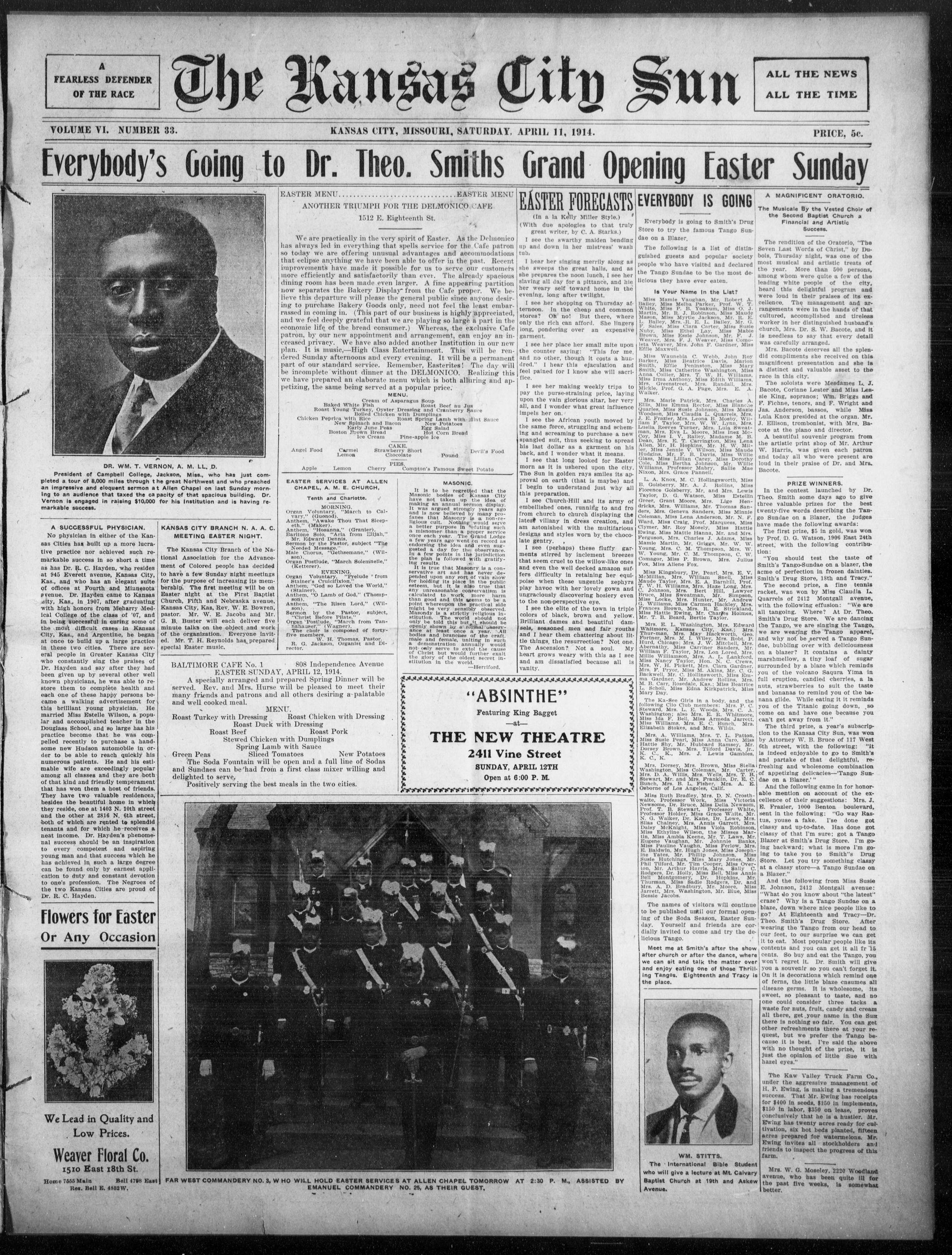
Everybody's Going to Dr. Theo. Smiths Grand Opening Easter Sunday
A FEARLESS DEFENDER OF THE RACE
VOLUME VI. NUMBER 33.
Everybody's
body's Goi
M.
DR. WM. T. VERNON, A. M. LL, D.
President of Campbell College, Jackson, Miss., who
pleted a tour of 8,000 miles through the great Northwest to
an impressive and eloquent sermon at Allen Chapel on lia-
ing to an audience that taxed the capacity of that spacious
Vernon is engaged in raising $10,000 for his Institution
markable success.
campbell College, Jackson, Mies., with 30 miles through the great Northwest to eloquent sermon at Allen Chapel on line that taxed the ca pacity of that spacious in raising $10,000 for his Institution
President of Campbell College, Jackson, Mies., who has just completed a tour of 8,000 miles through the great Northwest and who preached an impressive and eloquent sermon at Allen Chapel on last Sunday morning to an audience that taxed the capacity of that spacious building. Dr. Vernon is engaged in raising $10,000 for his Institution and is having remarkable success.
A SUCCESSFUL PHYSICIAN.
No physician in either of the Kansas Cities has built up a more lucrative practice nor achieved such remarkable success in so short a time as has Dr. R. C. Hayden, who resides at 945 Everett avenue, Kansas City, Kas., and who has an elegant suite of offices at Fourth and Minnesota avenue. Dr. Hayden came to Kansas City, Kas., in 1907, after graduating with high honors from Mehairy Medical College of the class of '07, and in being successful in curing some of the most difficult cases in Kansas City, Kas., and Argentine, he began at once to build up a large practice in these two cities. There are several people in Greater Kansas City who constantly sing the praises of Dr. Hayden and say after they had been given up by several other well known physicians, he was able to restore them to complete health and each one of these happy persons became a walking advertisement for this brilliant young physician. He married Miss Estelle Wilson, a popular and accomplished teacher in the Douglass School, and so large has his practice become that he was compelled recently to purchase a handsome new Hudson automobile in order to be able to reach quickly his numerous patients. He and his estimable wife are exceedingly popular among all classes and they are both of that kind and friendly temperament that has won them a host of friends. They have two valuable residences, besides the beautiful home in which they reside, one at 1403 N. 10th street and the other at 2816 N. 6th street, both of which are rented to splendid tenants and for which he receives a neat income. Dr. Hayden's phenomenal success should be an inspiration to every competent and aspiring young man and that success which he has achieved in such a large degree can be found only by earnest application to duty and constant devotion to one's profession. The Negroes of the two Kansas Cities are proud of Dr. R. C. Hayden.
Flowers for Easter Or Any Occasion
```markdown
```
We Lead in Quality and Low Prices.
Weaver Floral Co.
1510 East 18th St.
Home 7555 Main Bell 4798 East
Res. Bell E. 4852 W.
Quality and
Prices.
Floral Co.
t 18th St.
Bell 4798 East
E. 4852W.
FAR WEST COM
Home 7555 Main Bell 4798 East FAR WEST COMMANDERY NO. 3, WHO WILL HOLD EASTER SERVICES AT ALLEN CHAPEL TOMORROW AT 2:30 P. M., ASSISTED BY Res. Bell E. 4852 W. EMANUEL COMMANDERY NO. 25, AS THEIR GUEST.
The Kansas City Sun
Jackson, Mies., who has just come great Northwest and who preached Allen Chapel on last Sunday morn- oacity of that spacious building. Dr. for his institution and is having re-
KANSAS CITY BRANCH N. A. C
MEETING EASTER NIGHT.
The Kansas City Branch of the National Association for the Advancement of Colored people has decided to have a few Sunday night meetings for the purpose of increasing its membership. The first meeting will be on Easter night at the First Baptist Church, Fifth and Nebraska avenue, Kansas City, Kas, Rev. W. E. Bowren, pastor. Mr. W. E. Jacobs and Mr. G. B. Buster will each deliver five minute talks on the object and work of the organization. Everyone invited. Mr. T. H. Reynolds has prepared special Easter music.
BALTIMORE CAFE No. 1 808 Independence Avenue
EASTER SUNDAY, APRIL 12, 1914.
A specially arranged and prepared Spring Dinner will be served. Rev. and Mrs. Hurse will be pleased to meet their many friends and patrons and all others desiring a palatable and well cooked meal.
Green Peas Sliced Tomatoes New Potatoes The Soda Fountain will be open and a full line of Sodas and Sundae can be had from a first class mixer willing and delighted to serve. Positively serving the best meals in the two cities.
THE MILITARY CORPS
KANSAS CITY, MISSOURI, SATURDAY, APRIL 11, 1914.
EASTER MENU.....EASTER MENU
ANOTHER TRIUMPH FOR THE DELMONICO CAFE
1512 E. Eighteenth St.
We are practically in the very spirit of Easter. As the Delmonico has always led in everything that spells service for the Cafe patron so today we are offering unusual advantages and accommodations that eclipse anything we have been able to offer in the past. Recent improvements have made it possible for us to serve our customers more efficiently and satisfactorily than ever. The already spacious dining room has been made even larger. A fine appearing partition now separates the Bakery Display from the Cafe proper. We believe this departure will please the general public since anyone desiring to purchase Bakery Goods only, need not feel the least embarrassed in coming in. (This part of our business is highly appreciated, and we feel deeply grateful that we are playing so large a part in the economic life of the bread consumer.) Whereas, the exclusive Cafe patron, by our new appointment and arrangement, can enjoy an increased privacy. We have also added another Institution in our new plan. It is music.—High Class Entertainment. This will be rendered Sunday afternoons and every evening. It will be a permanent part of our standard service. Remember, Easterites! The day will be incomplete without dinner at the DELMONICO. Realizing this we have prepared an elaborate menu which is both alluring and appetizing, the same being served at a popular price.
EASTER SERVICES AT ALLEN
CHAPEL, A. M. E. CHURCH,
Tenth and Charlotte.
MORNING.
Organ Voluntary, "March to Calvary" (Guonod).
Anthem, "Awake Thou That Sleep"
(Meth).
Anthem, "Hosanna" (Granler).
Bartonone Sole, Aria from Elijah,
Mr. Ewaltone to the Sermon by the Pastor, subject "The Needed Message."
Mary Chorus, "Gethsemane" (Wilson).
Organ Postude, "March Solemelle" (Ketterer).
EVENING.
Organ Voluntary, "March to Prelude from Stainer's Crucifixion."
Anthem, "God so Loved the World," (Stainer).
Anthem, "O Lamb of God," (Thompson).
Anthem, "The Risen Lord," (Wilson).
Anthem by the Pastor, subject "Christ Before Pilate."
Organ Postude, "March from Tanah
Wagner."
The book is composed of forty-five members.
W. H. Thomas, Pastor.
R. G. Jackson, Organist and Director.
```markdown
```
MASONIC
It is to be regretted that the Masonic bodies of Kansas City has made an annual sermon display. It was argued strongly years ago that now bound bodies by many professors that Masonry is a religious cult. Nothing would serve a better purpose in *f*ucating such bodies once each year. The Grand Lodge a few years ago went on record as endorsing the idea and even sugared in a few points in the jurisdiction the plan is followed with gratification. It is true that Masonry is a conservative art and has never depended upon any sort of vain show or esteem, but it is also true that any unreasonable conservatism is not very well observed than good and this act should be a point whereupon the practical side of Masonry is very closely situated. The world should not only be told this but it should be made at least once a year. All bodies and branches of the craft, as a demonstration, annually would not only serve to extol the cause the glory of the older secret institution in the world.
(In a la Kelly Miller Style.) (With due apologies to that truly great writer, by C. A. Starks.) I see the swarthy malden bending up and down in her mistress' wash tub.
I hear her singing merrily along as she sweeps the great halls, and as she prepares the noon lunch, I see her shaving all day for a pittance, and he her weary self toward home in the evening, long after twilight.
I see her shopping on Thursday afternoon. In the cheap and common stores? Oh no! But there, where only the rich can afford. She lingers long, pondering over an expensive garment.
I see her place her small mite upon the counter saying: "This for me, and no other, though it costs a hundred." I hear this ejaculation and feel pained for I know she will sacrifice.
I see her making weekly trips to pay the purse-straining price, laying upon the vain glorious altar, her very all, and I wonder what great influence impels her on.
I see the African youth moved by the same force, struggling and scheming and screaming to purchase a new spangled suit, thus seeking to spread his last dollar as a garment on his back, and I wonder what it means.
I see that long looked for Easter morn as it is ushered upon the city. The Sun in golden rays smiles its approval on earth (that is maybe) and I begin to understand just why all this preparation.
I see Church-Hill and its army of embellished ones, runnifg to and fro from church to church displaying the latest villany in dress creation, and am astonished with the multifarious designs and styles worn by the chocolate gentry.
I see (perhaps) these fluffy garments stirred by inclement breezes that seem cruel to the willow-like ones and even the well decked amazon suffers difficulty in retaining her equipoise when these ungentle zephyr play havoc with her lovely gown and ungraciously discovering hosiery even to the non-perspective eye.
I see the elite of the town in triple colors of black, brown and yellow. Brilliant dames and beautiful damels, seasoned men and fair youths and I hear them chattering about little things, the resurrection? Not one. The Ascension? Not a soul. My heart grows weary with this as I see and am dissatisfied because all is vanity.
EVERYBODY IS GOING
Everybody is going to Smith's Drug Store to try the famous Tango Sundae on a Blazer.
The following is a list of distinguished guests and popular society people who have visited and declared the Tango Sundae to be the most delicious they have ever eaten.
Is Your Name In the List?
Miss Mamle Vaughan, Mr. Robert A. Bailey, Miss Melba Parker, Prof. W. T. White, Miss P. B. Yoakum, Miss O. J. Martin, Mr. R. J. Robinson, Miss Maude Mason, Miss Myrtle Jackson, Mr. R. E. M. Middledow, Mr. R. E. Baller, Mr. F. Sales, Miss Clara Carter, Miss Suie Nuby, Miss Ethel Lay, Miss Mabie Brown, Miss Esie Johnson, Mr. F. J. Weaver, Mrs. F. J. Weaver, Miss Comoleta Weaver, Mrs. John F. Gardner, Miss Effie Maxwell.
Miss Waunebla C. Webb, John Roy Barker, Miss Beatrice Davis, Marion Smith, Effie Penlston, Miss Mary M. C. Collier, Mrs. W. C. Williams, Miss Irma Hathney, Miss Edith Williams, Mrs. Greenstreet, Mrs. Randall, Mrs. Mickle, Prof. G. A. Page, Mrs. E. A. Walker.
Mrs. Marie Patrick, Mrs. Charles A. Ellis, Miss Emma Rector, Miss Blanche Quarles, Miss Susie Johnson, Miss Mazie Woodson, Miss Claudia L. Quarrels, Mrs. J. E. Frazier, Mrs. Leona B. Mosby, William F. Taylor, Mrs. W. W. Lynn, Mrs. Luella Reeves Turner, Mrs. Lula Sweatman, Miss Eva L. Alison, Miss Inez Coy, Miss I. V. Ralley, Madame M. B. Dean, Mrs. E. T. Carrington, Miss Lena Allen, Mr. H. Hopkins, Mr. H. W. Miller, Miss Jennie V. Wilson, Miss Maude Hudkins, Mr. L. F. B. Davis, Miss Willie Glass, Miss Bethan Carey, Miss Dorothy M. Miss Debra M. Moffat, Mrs. W. W. Williams, Professor Mabry, Miss M. Nixon, Mrs. Grace Pannell,
WM. STITTS.
The International Bible Student who will give a lecture at Mt. Calvary Baptist Church at 19th and Askew Avenue.
W.M. STITTS.
The International Bible Student who will give a lecture at Mt. Calvary Baptist Church at 19th and Askew Avenue.
ALL THE NEWS
ALL THE TIME
PRICE. 5c.
A MAGNIFICENT ORATORIO.
The Musicale by the Vested Choir of
the Second Baptist Church a
The rendition of the Oratorio, "The Seven Last Words of Christ," by Dubois, Thursday night, was one of the most musical and artistic treats of the year. More than 500 persons, among whom were quite a few of the leading white people of the city, heard this delightful program and were loud in their praises of its excellence. The management and arrangements were in the hands of that cultured, accomplished and tireless worker in her distinguished husband's church, Mrs. Dr. S. W. Bacote, and it is needless to say that every detail was carefully arranged.
Mrs. Bacote deserves all the splendid compliments she received on this magnificent presentation and she is a distinct and valuable asset to the race in this city.
The soloists were Mesdames L. J. Bacote, Corinne Lester and Miss Leslie King, soprans; Wm. Briggs and F. Fiche, tenors, and F. Wright and Jas. Anderson, bassos, while Miss Lula Knox presided at the organ. Mr. J. Ellison, trombonist, with Mrs. Bacote at the piano and director.
A beautiful souvenir program from the artistic print shop of Mr. Arthur W. Harris, was given each patron and today all who were present are loud in their praise of Dr. and Mrs. Bacote.
PRIZE WINNERS.
In the contest launched by Dr. Theo. Smith some days ago to give three valuable prizes for the best twenty-five words describing the Tango Sundae on a Blazer, the judges have made the following awards:
The first prize, $5 in gold, was won by Prof. D. G. Watson, 1906 East 24th street, with the following contribution:
"You should test the taste of Smith's Tango-Sundae on a blazer, the acme of perfection in frozen dainalties. Smith's Drug Store, 18th and Tracy."
The second prize, a fine tennis racket, was won by Miss Claudia L. Quarrels of 2412 Montgall avenue, with the following effusion: "We are all tangoing. Where? At Dr. Theo. Smith's Drug Store. We are dancing the Tango, we are singing the Tango, we are wearing the Tango apparel, and why not be served a Tango Sundae, bubbling over with deliciousness on a blazer? It contains a dainty marshmellow, a tiny loaf of sugar surrounded by a blaze which reminds you of the volcano Saqura Yima in full eruption, candied cherries, a la nuts, strawberries to suit the taste and bananas to remind you of the banana glaze. While eating it it reminds you of the Titanic going down, so come on and have one because you can't get away from it."
The third prize, a year's subscription to the Kansas City Sun, was won by Attorney W. B. Bruce of 117 West 6th street, with the following: "It is indeed enjoyable to go to Smith's and partake of that delightful, refreshing and wholesome combination of appetizing delicacies—Tango Sundae on a Blazer." And the following came in for honorable mention on account of the excellence of their suggestions: Mrs. J. E. Frazier, 1000 Benton boulevard, sent in the following: "Go way Rastus, youse a fake. Ise done got classy and up-to-date. Has done got classy of that I'm sure; got a Tango Blazer at Smith's Drug Store. I'm going backward; what is more I'm going to take you to Smith's Drug Store. Let you try something classy at a classy store—a Tango Sundae on a Blazer."
And the following from Miss Susie E. Johnson, 2412 Montgall avenue: "What do you know about "the latest" craze? Why is a Tango Sundae on a blaze, down where nice people like to go? At Eighteenth and Tracy-Dr. Theo. Smith's Drug Store. After wearing the Tango from our head to our feet, to our surprise we can get it to eat. Most popular people like its contents and you can get it all fr 15 cents. So buy and eat the Tango, you won't regret it. Dr. Smith will give you a souvenir so you can't forget it. On it is decorations which remind one of ferns, the little blaze cumsens all disease germs. It is wholesome, its sweet, so pleasant to taste, and no one could consider three tacks a waste for nuts, fruit, candy and cream all there, get, your name in the Sun there is nothing so fair. You can get other refreshments there at your request, but we prefer the Tango because it is best. I've said the above with no thought of the prize, it is just the opinion of little Sue with hazel eyes."
The Kaw Valley Truck Farm Co., under the aggressive management of H. P. Ewing, is making a tremendous success. That Mr. Ewing has receipts for $400 in seeds, $150 in implements, $150 in labor, $350 on lease, proves conclusively that he is a hustler. Mr. Ewing has twenty acres ready for cultivation, six hot beds planted, fifteen acres prepared for watermelons. Mr. Ewing invites all stockholders and friends to inspect the progress of this farm.
Mrs. W. G. Moseley, 2220 Woodland avenue, who has been quite ill for the past five weeks, is somewhat better.
"House of Love"
Lodge and Church Societies
The Tuskegee Edition of DR. BOOKER T. WASHINGTON'S WORKS
THE STORY OF THE NEGRO
WASHINGTON
VOLUME
THE STORY OF THE NEGRO
WASHINGTON
VOLUME
MY LARGER EDUCATION
WASHINGTON
THE FARTHER D
WASHINGTON
COMMUNITY BUILDING
DOWNTON WASHINGTON
WOODVIEW WETTERHOUSE
DOWNTON WASHINGTON
UPPER CROSSING
DOWNTON WASHINGTON
DOUBLEDAY
PAGE 6-CO
DOUBLEDAY
PAGE 6-CO
DOUBLEDAY
PAGE 6-CO
DOUBLEDAY
PAGE 6-CO
WHOLE SET ONLY ($2.00) TWO DOLLARS DOWN and the balance at $1.00 per month for six months
"Up From Slavery" A history of Dr. Washington's life and experiences told by himself. In this book also is given a history of the Tuskogee Institute and Dr. Washington's famous Aalanta Address of 1895. PRICE $1.50, postage 15 cents extra.
"Working With The Hands" Contains Dr. Washington's experience and advice with reference to the importance of industrial education and the methods of imparting same. PRICE $1.50, postage 15 cents extra.
"Character Building" A collection of Dr. Washington's Sunday Evening Talks to the student body in the Chapel of the Tuskogee Institute. These talks have become widely known and famous. PRICE $1.50, postage 15 cnts extra.
"Story of the Negro." (Two Volumes) Gives the history of the Negro race from its beginning in plain, simple words that may be understood by any school child. This history also contains sketches of many noted colored men and women who have succeeded in various walks of life. This history should form a part of the education of every Negro boy or girl. PRICE $3.00, postage 20 cents extra.
"My Larger Education" is a supplement to "Up From Slavery" and contains Dr. Washington's experiences in contact with men and movements in this and other countries. PRICE $1.50, postage 15 cents extra.
"The Man Farthest Down" the latest book from the pen of Dr. Washington. It contains an account of his observations and experiences among the working classes in Europe. In this book he compares the progress and the problems of the American Negro with that of the same type of people in Europe. PRICE $1.50, postage 15 cents extra.
Write at once to A. R. STEWART, Tuskegee Institute, Ala.
Tear Off Here and Mail.
A. R. STEWART,
TUSKEGEE INSTITUTE, ALA.
Dear Sir:
Enclosed please find two dollars, for which please send at once your Tuskegee Edition of Booker T. Washington's Works. After examination, if I am satisfied with the books I agree to send you $1.00 per month for six onths. If not satisfied, I agree to return the books in good order within five days, and you are to return my two dollars. Title not to pass to me until the books are fully paid for.
Name.
Occupation.
Address.
FREQUENT WARNING
The young Englishwoman had become very fond of American seaside hotels, with their rockers and cool plazzas, but in one respect she was critical. The story is told in the Wide World Magazine.
"If only they would clean our boots once in awhile," she cried, "instead of sending us out to have a 'ten-cent shine' at a 'shoe parlor'! I have left my shoes outside my door every night for a week, and they have not been touched."
Her new acquaintance looked at her a few moments pityingly, and cleared his throat. "I am afraid," he said, "you can hardly count on finding such honesty everywhere."
She Was No Easy Mark
Martha is seven, and has shown more than ordinary childish aversion to learning lessons, being washed and having curls made smooth and shiny, and less than the average delight in fairy-tales.
One day upon her return from Sunday school she was questioned as to what she had learned from her nice teacher this time. She cried out with flashing eyes and an indignant toss of her pretty head, "Why, mamma; my teacher told me today that story about the Children of Israel walking across the Red sea and not getting theirselves wet one single bit—and she es-pected me to believe it!"
Another Triumph for Cement. By using finely-powdered ingredients, articles are now made of cement which have the quality of the finest porcelain.
Philosophic.
The difference between truth and gossip is that one is true and the other merely true to life.—Puck.
In and Out of Damascus Buildings.
The hotel is called the "Grand Victoria," but it is above a blacksmith shop and a saddle shop. The lower stories are mostly blank, bare walls. From the upper stories project balconies of lattice oriels, some of which extend so far over the street as to make it easy for the velled damsel of the harem to leap across.
In contrast with these plain exterior, the interiors are often exquisitely beautiful, having an open court paved with marble and a fountain fed by the waters of the Abana, tinkling and splashing through the hot hours of the day, and wooing one to rest during the cool of the evening. Palms, orange trees and oleander stand here and there. Within the house you discover rooms cold and formal to an American, but brilliant with Oriental hangings, brasses and inlaid mother-of-pearl furnishings.—Christian Herald.
Transforming Trouble.
An artist once painted a lovely picture, but just as he finished it he managed by some mishap to get several blots in the sky. To rub these out without spoiling the whole picture was impossible. What did he do? Possibly you may think that he began to tear his hair and fume. Not at all. He quietly took his pencil and turned the blots into birds. To each blot he gave a beak and a pair of wings—and lo, it was a bird!
A glorious way of dealing with troubles. Make them into birds, and get them wings, and then they may even fly away and leave you.
Negro Business League of Kansas City.
A. E. ESTES, Secretary.
Members will please report any mistake or change of address to E A. Robinson, Financial Secretary and Fiscal Agent. Bell Phone East 754.
AUTOMOBILES.
Wm. D. Foster Auto Co., 1423 Forest, hire and repair; office Bell Grand 1630W; res. phone Bell East 4417W.
BAKERS.
Bessie Evans' Cook Shop and Catering, 2428 Vine St. Bell phone, East 3637.
Burt Bros, 1422 East 18th St., Barber Shop and Pool Hall, Bell phone, E. 2442.
Wm. Lewis, Atlanta Pool Hall, Barber Shop and Bath, 1609-11 E. 18th St., Bell Phone, E. 721.
Wm, Stitts, Criterion Barber Shop and Pool Hall, 1717 East 18th St.
Nannie Glover & Daughter, East End Dairy Lunch, 1613 East Elighteenth Street. Bell phone, East 3813.
Madame U. F. Scales, Northeast Cor. 5th and State, Kansas City, Kans.
Bishop's Cafe, H. Bishop, Prop, 911 McGee St. Bell phone, Main 751.
Mrs. Glover and Daughter, East End Dairy Lunch, 1613 E. 18th St.
Phone, East 3813.
R. W. Alexander, 1619 E. 18th St. Barbecued Meats.
Hughes & Buckner, 1514 E. 19th St. Barbecued Meats. Bell Phone,
East 2833.
M. Hunter & Son, 1319 E. 18th St. "M. C. Lunch Room."
Dora Tilson, Baltimore Cafe No. 2, 575 Grand Avenue.
Mrs. Lyda Franklin, Lincoln Cafe, 1312 E. 18th St.
CHRISTIAN SOCIETIES.
Mrs. Lydia C., Smith, General Secretary Y. W. C. A., Fifth and State Avenue, Kansas City, Kans. Bell phone, West 1566.
R. B. Defrantz, Secretary Y. M. C. A., 1419 East Eighteenth Street. Bell phone, Gran 885.
CLEANERS, DYERS AND TAILORS.
O. K. Cleaners and Dyers, guaranteed not to shrink any garment we dye, 1113 East 18th; Bell Grand 2437.
R. Bennett, 1515 East Eighteenth; East 4746 Bell.
J. F. Basil, 1509 Main; Main 6449 Home.
John Holmes, 1903 Vine.
Wortham Bros., 1222 E. 19th St. Bell Phone, Grand 3933-W.
Laden Bros., Tailors, Designers and Cutters, 2427 Vine Street. Bell Phone, East 569-W.
G. W. Golden Steam Dye Works, 1605 East 18th; Bell East 539.
R. L. Hopkins, 2326 Vine St. "The Star." Bell Phone, East 3135.
CARPET CLEANERS.
D. W. West, 1718 Euclid. Phones, Bell East 3555; Home, Main 1169.
CIGAR MANUFACTURER.
Henry Parks, 1509 East Eighteenth; Main 4905 Home, East 45 Bell
CLERGYMEN.
Rev. T. B. Gardner, Founder of the Sons and Daughters of Douglas Lodge, New (Salem) Warrensburg, Mo.
Rev. G. H. Daniels, 2313 Vine Street. Home phone, Main 5618.
E. N. Cohron, State Baptist Missionary, 708 North 24th St., St. Joseph, Mo. Phone 2137.
S. W. Bacote, Pastor Second Baptist Church, Kansas City, Mo. Bell Phone, East 3522.
G. T. Mosby, Pastor Greenwood Baptist Church, 18th and Terrace, Kansas City, Mo.
Rev O. T. Reed, State Baptist Church Convention and Twin City Ministers' Alliance Secretary.
Rev J. W. Carter, 2224 Mich. St. James A. M. E. Church.
Rev W. C. Williams, 17th and Tracy Ave., Ebenezer A. M. E. Church.
Rev T. A. Wilson, 1747 Belleview Ave., Grand 2668.
COAL, FEED, ICE AND KINDLING
I. B. Blackburn, 1612 N. 9th St., K. C., K., Bell phone, W. 1576.
James Alexander, 574 Tracy Ave. Both Phones, Main 7488.
J. H. Hall, 1208 Vine.
Herman Kinslee, 2012 Harrison; Grand 2766W Bell.
E. A. Salisbury, 2206 Vine; East 879 Bell.
W. H. Winters, 1915 Highland.
R. Williams, 1815 East Seventeenth.
Hopkins Bros, 2323 Vine.
W. H. Lambright & Sons, Coal, Ice and Feed. Bell phone, W. 1923.
1620 North 3d street, Kansas City, Kas.
CONTRACTORS—GENERAL.
John Day, office 1426 E. 18th street. Bell phone, Grand 1413.
Wm. T. Garner, contractor and builder, 1728 Woodland; Bell E. 4741W.
A. E. Estes, 2460 Waldron. Bell, East 4394-Y.
Leon H. Jordan, 712 East 12th St. Bell Grand 2873.
W. R. Nelson, 1322 Pacific Street.
C. S. Page, 1514 East Eighteenth; Main 5119 Home.
DENTISTS.
T. C. Chapman, 1505 East Eighteenth; East 798 Bell.
A. H. Hudson, 2330 Vine; East 2350 Bell.
McQueen Carrion, 18th and Paseo. Bell Phone; E. 144. Home
Phone, Main 3490.
H. D. Voorhies, 500 Minnesota Ave., Kansas City, Kans. Bell Phone,
West 1910.
DRESSMAKING
Mrs. Blanche Page, Dressmaker, 2413 Vine St., Bell Phone, East 3192.
Miss Georgia Coleman, 1510 E. 18th street.
Birdie Jackson, 1913 East Nineteenth.
DRUG STORES.
Peoples Drug Store, M. H. Lambright, Mgr. Bell Phone, East 1814.
Home Phone, Main 4382.
McCampbell & Houston, 2300 Vine street, and N. W. Cor. Howard and
Vine Sts.
E. S. Lee Pallace Drug Store, 19th and Vine. Both phones.
Ideal Pharmacy, 1532 E. 12th Street, Bell phone, East 26; Home
phone, Main 1532.
DRY GOODS, GENT'S FURNISHINGS, NOTIONS.
Mrs. Josephine Abernathy, Ladies Furnishings and Notion, 2413
Vine street.. Bell phone East 3192.
Eli Harris, 2333 Vine St.
Taylor Homes and Laden Bros. & Co., gents' furnishings and notions,
2427 Vine.
EMPLOYMENT AGENTS.
Afro-American Employment & Inv. Co., 311 McGee. Both phones.
T. A. Ross, 1507 East Eighteenth; West 1496 Bell.
H. D. Simmons, 1832 Vine. Phone East 887.
G. F. Porter, 1507- East Eighteenth; East 4955 Bell.
H. W. Golden, 1612 Lydia. Grand 3631.
Charles C. Buster, 1508 East 18th Street. Bell, East 4955.
P. K. Ercwn, 1507 E. 18th St. Bell, East 4955.
S. W. Shannon, 1507 E. 18th St. Bell, East 4955.
INVENTOR.
W. J. Dixon, 2828 Cleveland Avenue.
JEWELER.
J. A. Wilson, 1616 W. 9th St. Bell Main 6453-Y.
HAIR DRESSING AND MILLINERY.
Madame N. P. Jones, Beauty Culture., Hair Goods, etc., 2110 Vine street.
Mattle P. Garner, electric straightening, comb and hair goods; Bell East 4741W.
Lillie Johnson, 1508 East 18th; Bell East 1795.
Chapman & Caldwell, 18th hand Paseo). Phone East 798.
Eva P. Washington, 849 Freeman Ave., Kansas City, Kans. Bell phone, 2306 West.
Mrs. Stella Hubbard, 1510 E. 18th St. Bell Phone East 1007.
LAWYERS.
L. W. Johnson Offices, 325 New York Life building, Stein-Miller building, corner Sixth and State. Bell phone, West 938; Residence, West 3985.
Judge I. F. Bradley, 721 Minnesota Ave., Kansas City, Kan. Rooms 5 and 6. Bell Phone, West 2335.
William B. Bruce, Attorney-at-Law and Counselor. Phone, Home Main 5478; Office, 117 West Sixth Street.
Chas. H. Callaway, 117 W. 6th. Home Main 58.
W. C. Hueston, 117 W. 6th. Home Main 58.
L. A. Knox, 117 W. 6thSt. Home Main 5478.
MISCELLANEOUS.
John Hill, 1513 Woodland, East 1254.
Amus Barnett, 1230 Forest; Main 5018 Home.
R. C. Holland, 2423 Grove Street.
S. J. Hightower, 2436 Highland.
Solomon Smith, 2643 Highland.
George Teeters, Southwest National Bank of Commerce.
John Thomas, 425 Waverly Way; South 5087W Bell.
H. T. Kealing, Western University; West 4480 Bell.
Edward D. Craig, sausage manufacturer, 5328 Kansas.
Henry P. Ewing, scientific farmer, 1105 Woodland.
Wm. Springles, milk and butter, 53rd and Montgall; Lin. 750 Home.
D. W. White, "White's Furniture Exchange." Bell West 483, 423 Minnesota avenue Kansas City, Kas.
Samuel S. R. S. Stewart, 1714 South 4th Street, East, Salt Lake City, Utah.
NEWSPAPERS.
Arthur A. Anderson, 843 State St., Kansas City, Kans.
N. C. Crews, Kansas City Sun, 18th and Woodland; East 999 Bell.
Rev. J. Frank McDonald, Western Christian Recorder, 2517 Grove St.
Bell phone 488.
PAINTERS AND PAPERHANGERS.
A. L. Williams, 1519 E. 23d, Patching, Painting and Paper Hanging.
Bell phone, East 159.
T. H. Bailey, 911 McGee St. Bell phone, Main 751.
PHYSICIANS.
W. Hubert Bruce, 1512 East Eighteenth Street. Home phone, Main 4620; Bell phone, East 3151.
Lucian P. Richardson, 2439 Waldron. Bell phone, East 2527.
C. A. Murray Kane, Southeast corner 18th and Paseo. Bell, East 5069.
Home, Main 5807. Residence Phone, Bell East 693.
Henry W. Dillard, Graduate Ph.D., 1512 North 5th St., Kansas City, Kansas.
M. H. Lennight, 1508 East 18th; Bell East 144; Home Main 3490.
Thos. A. Fletcher, Home West 171; Residence, Home East 2856.
M. L. Flinn, pharmacist, 1301 East 18th.
L. E. Bailey, N. W. Cor. 12th and Vine. Bell East 232.
Howard M. Smith, 1509 East 18th St. Bell East 495.
Wm. J. Thompkins, 1509 E. 18th St. Bell East 495.
L. J. Holly, 1117 Campbell. Bell phone, 783 Grand.
E. J. McCampbell, 2302 Vine street. Bell phone, 501 East.
M. G. Brookins, Northwest Corner 24th and Vine Sts. Bell phone, East 232.
J. Edgar Dibble, 19th and Vine. Bell East 887.
J. E. Perry, 1512 E 18th St. Bell East 3151 Home East 4620.
Jas. F. Shannon, N. E. Cor. 18th and Paseo. Bell East 670.
T. C. Unthank, 1112 Independence avenue. Both phones, Main 7488.
W. W. Montgomery, 400 Minnesota Ave. Kansas City, Kans. Phones: Bell, West 2302; Home, West 478.
J. Franklin Wilson, 1317 North 10th St. Kansas City, Kans. Bell Phone, West 2249. Res., Bell West 3734-R.
Thos. A. Jones, Southeast Cor. 18th and Paseo. Phones: Home, Main 5867; Bell, East 5069.
POULTRY RAISERS.
S. M. Steele, 29 Sloan Avenue, Quindaro, Kans.
Fred T. Drew, 2002 Bales avenue. Bell phone, East 5277-W.
PHOTOGRAPHERS.
PHOTOGRAPHERS
Charles Williams.....1015 Oak; Main 3154 Bell
C. Bruce Santee, 1718 East 18th St. "Photo Fad."
C. A. Franklin, 1409 Main; Grand 2988 Bell.
John H. Fairley, Square Deal Printing Co., 1731 Lydia. Bell phone
Grand 1647-Y.
REAL ESTATE.
REAL ESTATE.
C. O. Murry, with Afro-American Investment Co. Both phones.
William Hopkins Afro-American Investment Co.
J. Dallas Bowser, 2400 Paseo. Bell Phone 3795 W Grand.
F. J. Weaver, President Afro-American Inv. Co., 911 McGee St. Bell
Main 751.
The Ward & Samlington Investment Co., Bell Phone East 4294Y.
W. M. Johnston, rental agent; Main 7555 Home; Main 751 Bell.
W. G. Mosely, Ivanhoe Investment Co., 2220 Woodland avenue.
E. E. Vaughan, 26th and Parkway, Kansas City, Kan. Bell, West 1757.
Patterson & Gayden, 527 State Ave, Kansas City, Kan. Bell phone,
West 215; Home phone, West 503.
Geo. W. Edwards, Moberly, Mo.
PROBATION OFFICER.
Edward Ross, 1419 E. 18th St. Bell Grand 885.
REGALIAS, BADGES, ETC.
Moses Dixon, 1217 Woodland; East 3797 Bell.
SHOE SHINING PARLOR.
Moses Fields, 614 Main.
SHOE STORES.
SHOE STORES
H. Shumaker, Ladies' and Gents' Shoe Shining Parlor, 1702 E. 18th St.
Temple Shoe Store, G. A. Page, Prop., 1507 E. 18th St.
SIGN PAINTER AND SCENIC ARTIST.
Geo. W. Martin, 1812 East 17th St. Home Phone, Main 1133.
STOCKMEN.
Thos. Bass, Dealer in High Class Stock, Mexico, Mo.
TEACHERS.
J. Silas Harris, 1611 Forest, President National Negro Educational Congress and Principal Summer School.
R. T. Coles, Principal Garrison School, 2327 Lydia; Grand 1851 Bell.
W. T. White, manual training, 1612 Lydia; Grand 3631 Bell.
G. A. Page, 2419 Flora. Bell E. 501. Principal Attucks School.
T. W. H. Williams, 1323 Jackson. Bell E. 3259-Y. Principal Bruce School.
Chas. A. Westmoreland, 2325 Lydia. Bell Grand 1320-W. Lincoln High School.
A. L. Williams' Transfer Co. Home phone, M 2396.
Lewis Townsend, 1720 Lydia Ave. Bell, Grand 1772.
Geo. Jones, 1008 McGee. Home Phone, 5188 Main.
W. Lee Whibby, 18th and Forest. Home phone M. 4023.
R. W. Elmore, 1607 Harrison street.
UNDERTAKERS.
C. H. Countee, 2220 Vine St. Bell East 3336.
Watkins Bros. & Co., 1729 Lydia. Telephone Grand 987.
People's Undertaking Co., 1211 East 18th; Phones, Bell Grand 1565;
Home 8163 Main. Edward Jones, Mgr.
Jno. W. Jones, 440 State Ave., Kansas City, Kans. Both Phones,
West 253.
We are trying to serve the people in a legitimate business by giving them the best and latest in all styles of shoes and slippers. Think seriously about this matter and let us fit you out in your Easter Goods. Bring your children with you. Special care will be taken to give complete satisfaction. Our prices are low and goods guaranteed. Give us a chance. 1507 E. 18th St., G. A. Page, Prop.
Confer with me--It costs you nothing
Wm. HOPKINS
THE AFRO-AMERICAN
INVESTMENT & IMPLOYMENT CO.
Makes a Specialty of Assisting You to
Buy a Home in Either Kansas City
PHONE: Bell, Main 751 HomeMain 7555
911 McGee Street., Kansas City, Mo.
Money to Loan on Kanaae City Real Estate. Don't lose your equity. Bring your troubles to us. We can help you. Afro-American Investment Co. 911 McGee Street.
THE KANSAS CITY SUN
All communications should be addressed to The Kansas City Sun, 1803 East 18th Street, Kansas City, KS 66103.
Bell Phone East 999.
Entered as second-class matter, August
12, 1908, at the postoffice at Kansas City,
Mo., under the act of March 3, 1878.
Nelson C. Crews ..... Editor and Owner
Willa B. Glenn ..... General Manager
Jec B. Thompson ..... Agent
J. G. Tylery ..... Advertising Solicitor
Eva P. Washington .....
Rosa Morton ..... Traveling Representative
Alma Crews ..... Collector
SUBSCRIPTION RATES:
It occasionally happens that papers sent to subscribers are lost or stolen. In case you do not receive any number when due, inform us by postal card and we will cheerfully forward a duplicate of the missing number. $\frac{1}{2}$
ADVERTISING RATE, 50 CENTS PER INCH.
CHURCH DIRECTORY.
Bethel A. M. E. Church, 24th and Flora.
St. Stephen's Baptist Church, 604 Charleston.
Christian Church, 19th and Tracy.
Greenwood Baptist Church, 1839 Terrace
Centennial M. E. Church, 19th and
Woodland,
Second Baptist Church, 10th and Char-
lote,
Alien Chapel A. M. E. Church, 10th and
Charlotte,
Kansas Ave. Baptist Church, 46th and
Kansas,
Ebenezer A. M. E. Church, 17th and
Tracy,
St. Augustine's P. E. Church, 11th and
Troost,
Virgin St. Baptist Church, 1825 Vine St.
Pleasant Green Baptist Church, Independence and Tracy.
St. Monica's Catholic, 17th and Lydia
Morning Star Baptist Church, 2311 Vine
Highland Avenue Baptist Church, 1111
Highland.
Centropolis A. M. E. Church, Centropolis, Mo.
St. James A. M. E. Z. Church, 1823
Woodland Ave.
Third Baptist Church, Roundtown,
People's Mission, 30th and Genesee.
St. Paul's Baptist Church, 19th and
Highland.
Pilgrim Baptist Church, 614 Charlotte
St.
Calvary Baptist Church, 19th and
Ackw.
Askew.
Biglow A. M. E. Mission, 5th and
Lyndon
Progressive Baptist Church, 29th and
Summit.
E. Church, 1817 Flora Ave.
St. James Baptist Church, 405 M31 St.
M. E. Church, 43rd and
Prospect Place.
A. M. E. Mission, 655 Grand Ave.
KANAS CITY, KAN. CHURCHES.
First A. M. E. Church, 8th and Neb.
First Green Baptist Church, 1st and
Splitting.
Eighth St. Baptist Church, 8th and Oakland.
Metropolitan Baptist Church, 9th and Washington.
First Baptist Church, 5th and Neb.
Solomon Baptist Church, 3rd and
State
Quindardo A. M. E. Church, Quindardo
Pasant Valley Baptist Church, Rosedale,
Missouri
Protestant Episcopal, 3rd and Stewart.
Second Baptist Church, 24th and Ruby.
Wesley Chapel M. E., 106 Shawnee.
St. Paul A. M. E. Zion Church, 4000
Adams.
Bethel A. M. E. Church, Roseale, Kan.
Mt. Zion Baptist Church, 4th and Virgil.
Ebenezer A. M. E. Church, Sanford and
Tremont.
Professor DuBois claims for the
"Crisis" is a rapidly increasing circulation, though the size of the magazine remains unchanged and the contents are marked by a doleful monotony. All the dark and discomforting phases of the race question are paragraphed from the south and west, while much space is devoted to the hopeful erudition of the eastern section of the country. The "Crisis" should grow harmoniously and me theoretically and should travel around and see more of the country.
Negro school principals are unantious in their disapproval of the lengthened noon hour for the school children. The period is now ninety minutes and the principals declare that it only offers greater chance for the children to loiter upon the streets and fall into mischief. This has been especially noticeable in cases where parents are away from home all day. It is urged that a much shorter period which would encourage a greater number of children to remain at the schools during noon, thus being under the constant supervision of the teachers, would be highly preferable to the present plan.
It is announced as a social axiom that no matter how bad a woman may be she is entitled to safety upon the public streets against thugs and other criminals.
Now, if the jury can be instructed that no matter how "black" a woman may be she is entitled to the same protection and will receive it, our modern civilization will be getting down to a working form. Since it is a social principle that everything black is bad, the black and bad woman should at least be treated alike.
The influential colored politician is now back into his own. The election is over and his courageous wisdom has been vindicated, one way or the other. His glory has departed and his office-seeking "brother" knows him no more for two years. His striped red and black vest, together with his red necktie has been placed in moth balls for a long hibernation. His voice is stilled and the curbstone knoweth him no more.
Neither will he get that promised janitorship now, for it has been found that his color will be objectionable to the white clerks around whom he will have to sweep. O, woeful day of days!
Hon. Nelson C. Crews, Editor Kansas City Sun, City.
Mr. Dear Mr. Crews: I write to congratulate you upon the steady improvement in the Kansas City Sun. It is one of the cleanest and most up-to-date Journals published by our race and reflects great credit upon you and those who contribute to its success. The Sun is a potent factor in the life of Kansas City and we know that in your hands it will rapidly become indispensable to our people.
Yours for continued success,
GEO. F. PORTER,
Agency Director, Standard Life Insurance Co.
LAWRENCE COUNTY
—That the New Theatre, 2411 Vine street, is showing the finest and best pictures in Kansas City.
—That at Dr. Smiths' Easter Opening there will be flowers, music and pretty women galore.
—That a certain white man spends a lots of time at a certain lady's house each week. Why?
—That there is one Buffet flat in this city where the ladies who serve wear pink pajamas. Oh, Me!
—That Dr. Theo. Smith's decorations for his Easter opening are the finest ever seen in Kansas City.
—That a certain physician takes more of his medicine than anyone else which is usually rock candy and whisky.
—That all those two dollar bills in evidence on Election Day have found their way by the route of the saloon back to the white folks pockets.
—That Dr. M. L. Flinn, the polite and efficient drug clerk at Smith's Pharmacy, is an expert on making Tango-Sundaes on a Blazer.
—That another well known married lady has a beautiful black eye for Easter which she received "running against a door jamb in the dark." Uh huh.
—That there was a hair pulling match last week because one woman charged another perfectly innocent party of being the lady who ran off to Chicago as recounted in our column last week. Now both are wearing handsome new wigs bought at Caldwell & Chapman's popular hair store.
EBENEZER GREETS THE NEGRO BUSINESS LEAGUE WITH A GREAT AUDIENCE.
President Weaver of the Negro Business League and the members of that enterprising organization received a splendid welcome by Rev W.C. Williams and his grand church and friends Sunday night, April 5th. The president opened the exercises by giving his hearers a general idea of the true situation of the Negro in the business world.
Dr. J. Edgar Dibble was introduced and it is stating it mildly to say that the learned, logical and practical talk he made was able and fully sustained by his past record for wit, facts, statistics, and general information. The race needs more men like Dr. Dibble to stand on the firing line of its cause; men who are workmen indeed, approved of God, and men; men who stand for a square deal, who respect the other fellow's rights, and who without giving offense to any man, holls up high the cause of Negro individuals for ability, for merit and for principles which will assure success to Negro enterprise. Such a careful, candid and courageous talk can but result in lasting impressions of good to all Negro business.
Mr. J. A. Wilson, the pioneer jeweler, and J. H. Malone also made remarks which were timely and accept able.
Brother Williams' welcome and his pointed sayings served to add importance and dignity to the occasion.
Permit us to say that the flying Calvary under Mr. C. A. Franklin and William Hopkins met the congregation of Rev. J. A. Wilson, 1743 Bellview, and it is sufficient to say Franklin made a decided hit with that good people for the cause. Next Sunday, April 12th, Mr. C. A. Franklin and his speakers—Henry Laden, C. H. Countee, John Day and Dr. Herbert Bruce—are booked to appear at the Greenwild Baptist church, Eighteenth and Terrace. Owing to the fact that the churches in general are all anxious for these meetings, the campaign committee decided to have two meetings each week as it would be impossible to reach all with one meeting a week before hot weather. Another meeting is scheduled for the 12th, at Eleventh and Highland Baptist church, with Mr. F. J. Weaver, president, leading, assisted by Mr. J. A. Wilson, master of ceremonies; Speakers: Dr. L. P. Richardson, T. B. Watkins, J. L. Mattson and Dr. L. E. Baller. You members who dwell nearest the above named meeting places are earnestly requested to turn out and aid the greatest cause of this age to you and me by your presence, namely, "The Second Emancipation of the Negro."
Yours for Negro Enterprise,
E. A. ROBINSON,
Sec'y Campaign Committee
The Kansas City Sun can be found on sale at the following prominent places:
Palace Barber Shop, 19th and Vine streets; Shumacher's News Stand, 18th and Highland; Unthanks' Drug Store, Independence and Harrison; Tucker's News Stand, 12th and Vine.
Y. W. C. A. NOTES
"Not by might, nor by power, but by my spirit saith the Lord of Hosts." Zech. 4: 16. World's Y. W. C. A. motto.
Our last notes announced to the readers of our column in the "Sun" that Miss Eva D. Bowles, National Secretary for City Association of our young women in the Y. W. C. A., with headquarters in New York City, had arrived and was guest of the Yates Branch, Y. W. C. A. at 5th and State avenue on the Kansas side. Miss Bowles spent twelve busy days, having received a most cordial welcome from our Association women and
Mary Louise
MRS. LYDIA C. SMITH,
the Affable and Aggressive Secretary
girls, and also our citizens in general. She came to conduct our finance campaign to meet the current expenses of this year, and to inspire our women and girls in the worldwide movement, "The Young Women's Christian Association." She accomplished both. As speaker of the vesper service at our own Association, Sunday, March 29, she swayed the large audience from beginning to end of that remarkable address on looking upward. The campaign was launched on Monday, March 30, and in nine days, though busy with Association affairs and with several of our workers ill, we realized more than $800 of the $1,000 in subscription which we started out to raise for our budget of $1,500. Several of our workers are yet to report. The campaign closed on Wednesday evening with two of the Smith family (though note related) in the lead. Mrs. J. H. M. Smith and Lydia C. Smith had one hundred fourteen dollars and $121.00 respectively. Mrs. W. G. Wood ran next with $67.00, Mrs. D. F. Harris (who was very ill for a week during the campaign, Mrs. F. K. Douglass, Mrs. Tilford Davis, Jr., Miss Ollie Henderson, Miss Myrtle Jackson, Mrs. H. T. Kealing, Mrs. J. C. Branche, Mrs. J. N. Freeman, Mrs. Dorsey Green, Mrs. J. J. Lewis, Miss Gertrude Lankford, Mrs. E, J. Thompson, Mrs. Fitzhugh Raynes, Mrs. W. Barnett, Mrs. Kate Cummings and Mrs. Ann Scruggs followed as workers. Too much in praise cannot be said of Miss Gertrude Jackson, who gave the Association twelve days in clerical work Mrs. John Hodge, Mrs. S. C. Bucken and Miss Ida May Jones also assisted in office work, giving service as other workers.
A. Y. W. C. A, mass meeting was held at the First A. M. E. Church, Rev. Dr. J. R Ransom, pastor, on the evening of March 31. We had a good audience. Miss Brooks was the principal speaker. Mrs. W. G. W. Wood presided. Mrs. Toole gave an instrumental selection; Miss Harlan rendered a solo with Miss Jackson as pianist. Remarks were made by Prof. A. J. Neely, Judge I. F. Bradley, Prof. G. B. Buster and Mr. Thos. Knapper. The Rev. G. L. Prince conducted devotional and the Rev. J. W. Jacobs gave the benediction. Echoes since the meeting evidenced the fact that it proved helpful to the interest of the Y. W. C. A. among our people here.
The election of officers of the Board of Management for our Association was held on Tuesday afternoon with more than two-thirds present and resulted as follows: President, Mrs. F. K. Douglass; vice president, Mrs. J. W. Jacobs; recording secretary, Mrs. Dorsey Green; corresponding secretary, Mrs. Thos. H. Dickerson; treasurer, Mrs. J. M. Freeman. Others of the members of the Board of Management are Mrs. W. G. Wood, Mrs. J. M. H. Smith, Mrs. H. T. Kealing, Mrs. W. Sinclair, Mrs. B. C. Scott, Mrs. D. W. White, Mrs. J. H. Claybourne, Mrs. D. F. Harris and Mrs. J. C. Branche. Mrs. Wood presided.
Following the parting words of Miss Eva D. Bowles, our National Secretary, to the members of the Board, each of the latter pledged her allegiance to the Association. Miss Bowles left on Wednesday of this week for the West Side Y. W. C. A. in St. Paul, where she is to be the guest of Miss Edith Leonard, the general secretary, During her stay in this city she was domiciled with Mr. and Mrs. P. L. Groomer in N. 6th street.
LYDIA C. SMITH,
General Secretary.
Y. M. C. A. NOTES
Next Sunday and the Sunday following will be given over to praise services at the Association rooms, 3:30 p. m. All men are cordially invited to take part.
The work on the building is progressing rapidly. The wooden forms for the upright concrete columns and the cross beams are now being set between the first and second floors.
In compiling a list of the vocations of the subscribers, including professional, business, tradesmen and laborers, it is found that the employees of the school board subscribed $2,081.50. The largest amount by any one of these was $525; the smallest $4. The bulk of all the subscription made by the school employees has been paid. Other lines and vocations will be given later.
The New Theatre
The New Theatre, 2411 Vine street, is absolutely the finest and most up to date motion picture house owned and operated by negroes, in the United States. The building is not a made-over house, but was built strictly for a theatre. Since the acquisition of the place by Dr. E. J. McCampbell and Homer B. Roberts, many notable changes have been made. Two cozy corners at the entrance have been inaugurated at no little expense. The one containing a beautiful mirror, 4x8 feet, framed in the finest mahogany, in which you might "see yourself as others see you" from your Easter bonnet down to your shoe tops. On the floor in either corner is a beautiful oriental rug and the walls will be decorated with fine oil paintings from the world's famous artists. The aisles have been carpeted with heavy cocoanut matting and the exits are garnished with heavy green portiers. Also 400 opera chairs, every one commanding a direct view of the curtain.
By far the biggest investment in the theatre, cannot be seen by the public, but the result can surely be observed. When this place was opened several months ago, complaints came to the ears of the management of the delay between the pictures. To avoid this delay $600 was spent for new machines, so that now one picture follows another with mechanical precision, without a moment's delay. The service is the best that can possibly be procured. The Universal Film Company is the largest and most up-to-date firm in the movie business. The same pictures are shown to you for 5 cents that the Maze theatre, at 12th and Baltimore, shows to its patrons at 10 cents. Your patronage is solicited. If you enjoy motion pictures you will be pleased if you visit the New Theatre.
Sunday, April 12th, in addition to the regular program will be shown "Absinthe," a four-reel picture featuring the "King of the Movies," that handsome and most popular actor, King Baggot. The drink absinthe, or green devil as it is sometimes called, to France bears almost the same relation as opium does to the Chinese nation. It is used by the high and low in France and might almost be called the national drink. Used mildly it acts almost in the same way that whiskey does, but when used to excess it takes a grip upon the victim that is more difficult to loosen than perhaps any other drug. In the taking of one of the scenes of this picture Mr. Baggot was wounded by Miss Baird, the leading lady, who struck him a blow while resisting an attack of the supposed absinthe fiend. The emotional strain upon Miss Baird was terrific and she put herself so completely into the part that she fainted twice during the taking. Mr. Baggot sustained a badly lacerated lip and the loss of a tooth.
This four-reel picture cost the Universal Film Company thousands of dollars to produce, and incidentally cost the management of the New Theatre $25 just for this one night. This picture will be educational and beneficial, for while the drug, absinthe, has no hold upon the American people, the realistical portrayal should act as a moral lesson to all and any against the use of alcohol and drugs in general.
Don't miss this special feature. This is absolutely your only opportunity to see it. Remember, this is shown in addition to the regular program, so you will see eight reels of the best motion pictures at this time and it will take only a short time to show them with the two machines working with undoubted precision. The admission at this time will be: Adults 10c, children 5c. The pictures start promptly at 6 p. m.
The program of the New Theatre for the ensuing week will appear in this paper every Saturday. Watch for it!
STITTS LECTURE
STITTS LECTURE
On April 19th Mr. Stitts will perhaps finish his subject, "Resurrection of the Dead." Not only on this subject but scores of other subjects he is able to throw a flood of light and there are but few can equal him. He has a clear view on the Scripture and speaks evil of no Christian, regardless of denomination. He is calm and considerate in all biblical discussions. He was born July 4, 1880, at Anniston, Ala.
(Note—In the last issue the word guber was used instead of qebar, meaning the six-foot space for the dead body.)
CRUCIFIXION.
By Charles A. Starks.
Despised and rejected the lowly Savior came,
Bearing the hate of men with His spotless life.
Serenely he bore the cross of ill-heaped Fame,
And willingly drank the bitterness of sin and strife.
Eager to save those of this hatred so rife,
He spake not, thus dumb-like reproving the vain.
While religious scourges applied the spearing knife,
Crucifying Him who with God must reign.
Executed, dead and buried this solemn fact,
Too brief! But how beyond all mortal pain.
Ingratitude and envy had done their last act,
They thought to villify Him whom they now had slain.
Placed in a sepulcher where man ne'er lain,
They thought to bury truth with a massive rock.
But immortal life threw off this stain,
Hence the victory over the grave and death made a mock.
Arise! Arise! Oh truth, heaven saw and heard!
Angels descended and rolled the stone away.
This must have been because it was the Word
That was to rise on that glorious day.
He had said: "I am life, thus beyond decay,
Rising in Eternal being, his work was done.
From now, only the spirit was to play.
Now Father is glorified in the glory of the Son.
Ascension.
O' Gallieans, what marvel do ye behold,
As you gaze so steadily on Heaven's bright blue?
Is your Master, forsaking His dear bought fold?
Not so! Only hiding himself from mortal view.
Immortality claims its own, the time is due,
Christ takes the one Heavenward flight
And stamping spirit on time, proving truth true
He loses himself to all fleshly sight.
Call Chas.Monroe
For Carriage or Automobile
Funerals and Parties a Specialty
Rates Reasonable
2102 Woodland Ave.
Bell Phone 5194 East
Bell Phone 2523 East
Kansas City, Mo.
A. E.
The enterprising and intrepid young hustler who will give a mammoth entertainment in Convention Hall
GRAND MUSICAL RECITAL.
at Convention Hall, June 19, 1914.
Speakers of Note In and Out of the City Will Be Present.
Music by the Best Talent Procured
Tickets will be on sale at the leading drug stores of the city after February 15, 1914.
There is a reason why the larger per cent of Cabinet Stationary used by Kansas City's 406" is turned from the A at the West Wash. the Publishing Establishment. First their workmanship in this class of service is unexcelled by any of the larger and best equipped machines in this city, since they all but make a speciality of this class of work. Second, while their prices are not always the fairest, they have "delivered" with accuracy and despatch to now 60 per cent of the classy weddings and recitals during the past year and now when a function of class is announced its a ten-to-one shot that Harris will handle the job.
Rev. J. W. Hurse, Proprietor of Baltimore Cafe No.1.
Headquarters for Home Made Pies
OFFICE PHONE BELL 3786 M.
We Boast of Serving the Best Meals in the Twin Cities
JAMES W. HURSE, Proprietor
3rd Member of Board of Management U. B. F. @ S. M. T. of M
Imported and Domestic Cigars
ICE CREAM, SODAS and SUNDAES.
Have You Bad Debts? Do You Need Your Money? IF SO SEE
J. H. Spears, Mgr., Attorney Chas. W. Adkins, Secy-Treas Bell Phone East, 1695
THE HOME OF THE MAYFIELD MUSEUM
This house was built for an ex-Mayor of Kansas City. It has 9 large, light and airy rooms, large attic suitable for pool room or gymnasium, full cemented basement, combination furnace, lot 50x150, east front, street and alley paved, large barn suitable for garage.
Several prominent Negroes have bought in this block, so the owner has decided to sell and in order to make a quick sale has reduced the price from $4,000 to $3,500, $500 down and $20 monthly. An ordinary family could live in four of the rooms and the other five could be rented for enough to make the payments and interest.
Surely opportunity is knocking at your door. Will you continue to pay rent or will you buy? If this is too large, we have several others.
Subscribe for The Sun
JOHN H. HARRIS
808 Independence Ave.
KANSAS CITY, MISSOURI
have defective sight, have your eyes examined with gold filled spectacles and best quality FREE. You pay for the examination or 50 cents, and receive the glasses absolutely FREE
DR. M. B. JONES,
SPECIALIST
phone G. 2443 1412 E. 18th St.
You Bad Debts
Need Your Money?
SEE
Kansas Collection C
9 PASEO
Money Chas. W. Adkins, Secy-Tr
phone East, 1695
For an ex-Mayor of Kansas City. It is large, large attic suitable for pool room, basement, combination furnace, lot 50x100, large barn suitable for garage doors have bought in this block, so and in order to make a quick sale 100 to $3,500, $500 down and $20 month in four of the rooms and the other to make the payments and interest. Mocking at your door. Will you contend? If this is too large, we have seven.
ICAN INVESTMENT CO.
McGee Street.
Free-Gold Filled Spectacles
If you have defective sight, have your eyes examined and fitted with gold filled spectacles and best quality lenses—FREE. You pay for the examination only, which is 50 cents, and receive the glasses absolutely
FREE
DR. M. B. JONES,
EYE SPECIALIST
Bell Phone G. 2443 1412 E. 18th Street
for The Sun
lectacles
our eyes examined
and best quality
amination only.
passes absolutely
ES,
ALIST
18th Street
debts ?
money ?
ion Co.
, Secy-Treas
s City. It has
r pool room or
ace, lot 50x150,
for garage.
s block, so the
quick sale has
and $20 monthly.
and the other five
and interest.
will you continue
we have several
Bell 751 Main. Sun
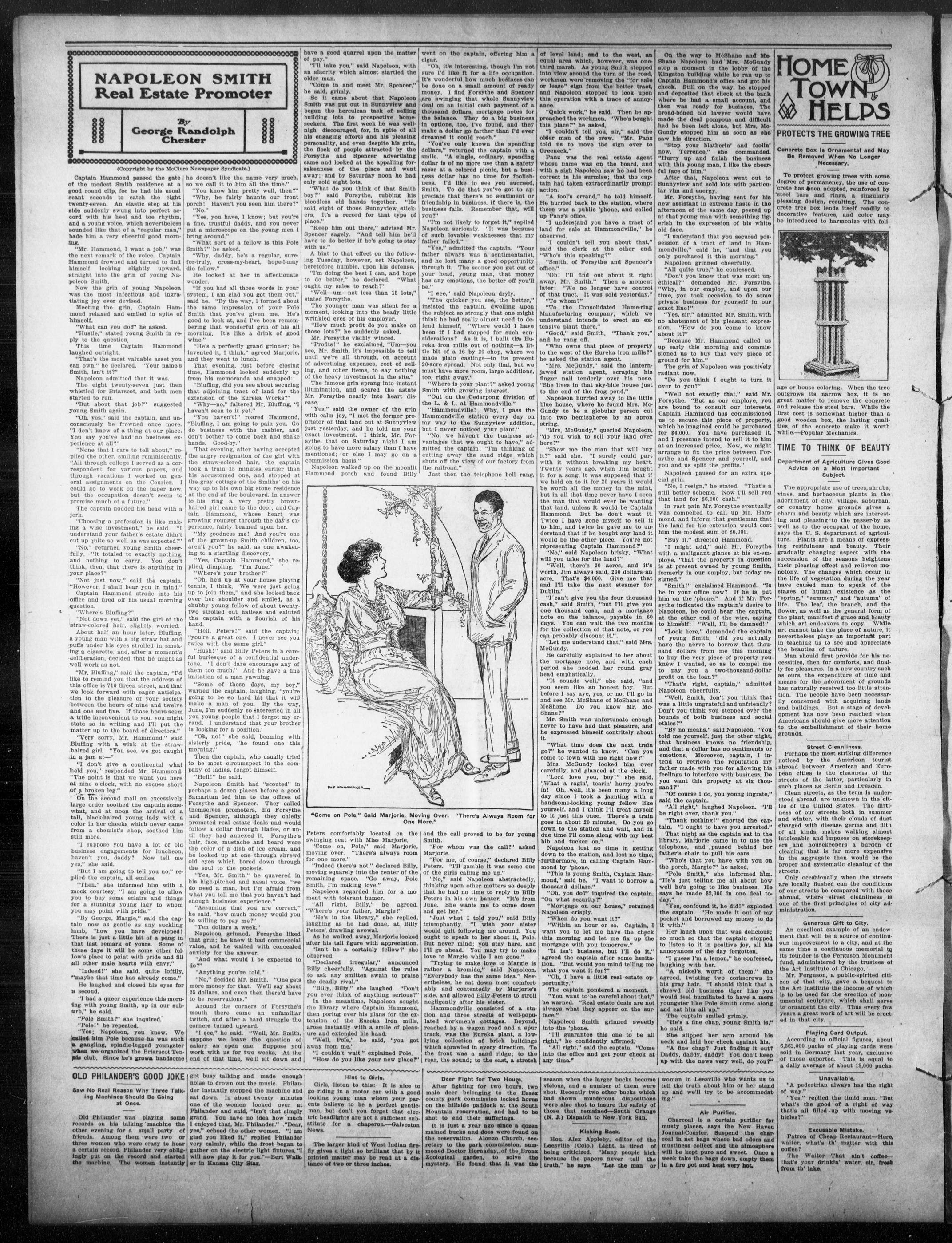
NAPOLEON SMITH
Real Estate Promoter
By
George Randolph
Chester
Captain Hammond passed the gate of the modest Smith residence at a good round clip, for he had his usual scant seconds to catch the eight twenty-seven. An elastic step at his side suddenly swung into perfect accord with his heel and toe rhythm, and a young voice, which nevertheless sounded like that of a "regular man," bade him a very cheerful good morning.
"Mr. Hammond, I want a job," was the next remark of the voice. Captain Hammond frowned and turned to find himself looking slightly upward, straight into the grin of young Napoleon Smith.
Now the grin of young Napoleon was the most infectious and ingratiating joy ever devised.
Meeting the grin, Captain Hammond relaxed and emiled in spite of himself.
"What can you do?" he asked.
"Hustle," stated young Smith in reply to the question
This time Captain Hammond laughed outright,
"That's the most valuable asset you can own," he declared. "Your name's Smith, isn't it?"
Napoleon admitted that it was.
Napoleon admitted that it was. The eight twenty-seven just then whistled for Briarscott, and both men started to run. "But about that job?" suggested young Smith again. "Oh, yes," said the captain, and unconsciously he frowned once more. "I don't know of a thing at our place. You say you've had no business experience at all?" "None that I care to tell about," replied the other, smiling reminiscently. "All through college I served as a correspondent for various papers, and through vacations I worked on general assignments on the Courier. I could go to work on the paper now, but the occupation doesn't seem to promise much of a future." The captain nodded his head with a jerk. "Choosing a profession is like making a wise investment," he said. "I understand your father's estate didn't cut up quite so well as was expected."
"No," returned young Smith cheerfully. "It totaled to exactly nothing, and nothing to carry. You don't think, then, that there is anything in your place?" "Not just now," said the captain. "However, I shall bear you in mind." Captain Hammond strode into his office and fired off his usual morning question. "Where's Bluffing?" "Not down yet," said the girl of the straw-colored hair, slightly worried. About half an hour later, Bluffing, a young man with a big straw hat and puffs under his eyes strolled in, smoking a cigarette, and, after a moment's deliberation, decided that he might as well work as not.
"Mr. Bluffing," said the captain, "Td like to remind you that the address of this office is 710 Green street, and that we look forward with eager antiplation to the pleasure of your society between the hours of nine and twelve and one and five. If those hours seem a trifle inconvenient to you, you might state so in writing and I'll put the matter up to the board of directors."
"Very sorry, Mr. Hammond," said Bluffing with a wink at the straw-haired girl. "You see, we got caught in a jam at—"
"I don't have a continental what held you," responded Mr. Hammond. "The point is that we want you here at nine o'clock, with no excuse short of a broken leg."
On the second mall an excessively large order soothed the captain somewhat, and at noon the arrival of a tall, black-haired young lady with a color in her cheeks which never came from a chemist's shop, soothed him still more.
"I suppose you have a lot of old business engagements for luncheon, haven't you, daddy? Now tell me yes," she said.
"But I am going to tell you no," replied the captain, all emiles.
"Then," she informed him with a mock courtesy, "I am going to allow you to buy some claims and things for a stunning young lady to whom you may point with pride."
"By George, Margie," said the captain, now as gentle as any suckling lamb, "how you have developed! There is just a little bit of a pang in that last remark of yours. Some of these days it will be some other fellow's place to point with pride and fill all other male hearts with envy."
"Indeed!" she said, quite loftily, "maybe that time has already come."
He laughed and closed his eyes for a second.
"I had a queer experience this morning with young Smith, up in our suburb," he said.
"Pole Smith?" she inquired.
"Pole!" he repented.
"Yes; Napoleon, you know. We called him Pole because he was such a gangling, spindle-legged youngster when we organized the Briarscot Tennis club. Since he's grown handsome
Saw No Real Reason Why Three Talking Machines Should Be Going at Once.
Old Philander was playing some records on his talking machine the other evening for a small party of friends. Among them were two or three women who were crazy to hear a certain record. Philander very obligingly put on the record and started the machine. The women instantly
he doesn't like the name very much, so we call it to him all the time."
"You know him pretty well, then?"
"Why, he fairly haunts our front porch! Haven't you seen him there?"
"No."
"Yes, you have, I know; but you're a fine, trustful dad, and you never put a microscope on the young men I bring around."
"What sort of a fellow is this Pole Smith?" he asked.
"Why, daddy, he's a regular, sure-forthy, cross-my-heart, hope-I-may die fellow."
He looked at her in affectionate wonder.
"If you had all those words in your system, I am glad you got them out," said he.
"By the way, I formed about the same impression of your Pole Smith that you've given me. He's good to look at, and I've been remembering that wonderful grin of his all morning. It's like a drink of good wine."
"He's a perfectly grand grimmer; he invented it, I think," agreed Marjorie, and they went to lunch.
That evening, just before closing time, Hammond looked suddenly up from his memoranda and snapped: "Bluffing, did you see about securing that adjoining tract of land for the extension of the Eureka Works?" "Why—no," faltered Mr. Bluffing, "I haven't seen to it yet."
"You haven't!" roared Hammond, "Bluffing, I am going to pain you. Go do business with the cashier, and don't bother to come back and shake hands. Good-by."
That evening, after having accepted the angry resignation of the girl with the straw-colored hair, the captain took a train 15 minutes earlier than his accustomed one, and stopped at the gray cottage of the Smiths' on his way up to his own big stone residence at the end of the boulevard. In answer to his ring a very pretty brown-haired girl came to the door, and Captain Hammond, whose heart was growing younger through the day's experience, fairly beamed upon her.
"My goodness me! You're one of the grown-up Smith children, too, aren't you?" he said, as one awakening to a startling discovery.
"Yes, Captain Hammond," she replied, dimpling, "I'm June."
"Where's your brother?"
"Oh, he's up at your house playing tennis, I think. We were just going up to join them," and she looked back over her shoulder and smiled, as a chubby young fellow of about twenty two strolled out bathes and saluted the captain with a flourish of his hand.
"Hell, Peters!" said the captain; "you're a great one. I never see you twice with the same girl."
"Hush!" said Billy Peters in a careful burlesque of a confidential undertone. "I don't dare encourage any of them too much." And he gave a fine imitation of a man yawning.
"Some of these days, my boy," warned the captain, laughing, "you're going to be so hard hit that it will make a man of you. By the way, June, I'm suddenly so interested in all you young people that I forgot my errand. I understand that your brother is looking for a position."
"Oh, no!" she said, beaming with sisterly pride, "he found one this morning."
Then the captain, who usually tried to be most circumspect in the company of ladies, forgot himself.
"Hell!" he said.
Napoleon Smith had "scouted" in perhaps a dozen places before a good Samaritan led him to the offices of Forsythe and Spencer. They called themselves promoters, did Forsythe and Spencer, although they chiefly promoted real estate deals and would follow a dollar through Hades, or until they had annexed it. Forsythe's hair, face, mustache and beard were the color of a dish of ice cream, and he looked up at one through shrewd old eyes which bored down through the soul to the pockets.
"Yes, Mr. Smith," he quavered in his high-pitched and nasal voice, "we do need a man, but I'm afraid from what you tell me that you haven't had enough business experience."
"Assuming that you are correct," he said, "how much money would you be willing to pay me?"
"Ten dollars a week."
Napoleon grinned. Forsythe liked that grin; he knew it had commercial value, and he waited with concealed anxiety for the answer.
"And what would I be expected to do?"
"Anything you're told."
"No," decided Mr. Smith. "One gets more money for that. We'll say about 25 dollars, and even then there'd have to be reservations."
Around the corners of Forsythe's mouth there came an unfamiliar twitch, and after a hard struggle the corners turned upward.
"I see," he said. "Well, Mr. Smith, suppose we leave the question of salary an open one. Suppose you work with us for two weeks. At the end of that time, we'll sit down and
got busy talking and made enough noise to drown out the music. Philander instantly stopped the machine and sat down. In about twenty minutes one of the women looked over at Philander and said, "isn't that simply grand. You have no idea how much I enjoyed that, Mr. Philander." "Dear, yes," echoed the other women. "I am glad you liked it," replied Philander very calmly, while the frost began to gather on the electric light fixtures, "I will now play it for you."—Bert Walker in Kansas City Star
P.W. HOWHAMAKER
"Come on Pole," Said Marjorie, Moving Over. "There's Always Room for One More."
have a good quarrel upon the matter of pay."
"I'll take you," said Napoleon, with an alacrity which almost startled the older man.
"Come in and meet Mr. Spencer," he said, grimly.
So it came about that Napoleon Smith was put out in Sunnyview and began the herculean task of selling building lots to prospective home-seekers. The first week he was well-night discouraged, for, in spite of all his engaging efforts and his pleasing personality, and even despite his grin, the flock of people attracted by the Forsythe and Spencer advertising came and looked at the appalling forsakenness of the place and went away; and by Saturday noon he had only sold eight lots.
"What do you think of that Smith boy?" said Forsythe, rubbing his bloodless old hands together. "He sold eight of those Sunnyview etickers. It's a record for that type of place."
"Keep him out there," advised Mr. Spencer sagely. "And tell him he'll have to do better if he's going to stay with us." A hint to that effect on the following Tuesday, however, set Napoleon, heretofore humble, upon his defense.
"I'm doing the best I can, and hope to do better," he declared. "What ought my sales to reach?"
"Well—um—not less than 15 lots," stated Forsythe.
The younger man was silent for a moment, looking into the beady little wrinkled eyes of his employer. "How much profit do you make on those lots?" he suddenly asked.
Mr. Forsythe wisely winced.
"Profits!" he exclaimed. "Um—you see, Mr. Smith, it's impossible to tell until we're all through, on account of advertising expenses, cost of selling, and other items, to say nothing of the heavy investment in the site."
The famous grin sprang into instant illumination, and scared the astute Mr. Forsythe nearly into heart disease.
"Yes," said the owner of the grin with calm joy, "I met the former proprietor of that land out at Sunnyview just yesterday, and he told me your exact investment. I think, Mr. Forsythe, that on Saturday night I am going to have more salary than I have mentioned; or else I may go on a commission basis." Napoleon walked up on the moonlit Hammond porch and found Billy
"Come on Pole," Said Marjorie, Moving One M
Peters comfortably located on the swinging seat with Miss Marjorie,
"Come on, Pole," said Marjorie, moving over. "There's always room for one more."
"Indeed there's not," declared Billy, moving squarely into the center of the remaining space. "Go away, Pole Smith, I'm making love."
Napoleon regarded him for a moment with tolerant humor.
"All right, Billy," he agreed.
"Where's your father, Margie?"
"He's in the library," she replied, laughing as he had done, at Billy Peters' drawing avowal.
As he walked away, Marjorie looked after his tall figure with appreciation.
"Isn't he a certainly fellow?" she observed.
"Declared irregular," announced Billy cheerfully. "Against the rules to ask any smitten swain to praise the deadly rival."
"Billy, Billy," she laughed. "Don't you ever think of anything serious?" In the meantime, Napoleon sought the library where Captain Hammond, then poring over his plans for the extension of the Eureka Iron mills, arose instantly with a smile of pleasure and extended his hand. "Well, Pole," he said, "you got away from me." "I couldn't wait," explained Pole. "How do you like your new place?"
Hint to Girls.
Girls, listen to this: It is nice to go riding in a motor car with a good looking young man whom your parents believe to be a perfect gentleman, but don't you forget that electric headlights are not a sufficient substitute for a chaperon—Galveston News.
The larger kind of West Indian firefly gives a light so brilliant that by it printed matter may be read at a distance of two or three inches.
went on the captain, offering him a cigar.
"Oh, it's interesting, though I'm not sure I'd like it for a life occupation. It's wonderful how much business can be done on a small amount of ready money. I find Forsythe and Spencer are swinging that whole Sunnyview deal on an initial cash payment of a thousand dollars, mortgage notes for the balance. They do a big business in option, too, I've found, and they make a dollar go farther than I'd ever dreamed it could reach."
"You've only known the spending dollars," returned the captain with a smile. "A single, ordinary, spending dollar is of no more use than a safety razor at a colored picnic, but a business dollar has no time for foolishness. I'd like to see you succeed, Smith. To do that you've got to appreciate that there's no sentiment or friendship in business. If there is, the business fails. Remember that, will you?"
"I'm not likely to forget it," replied Napoleon seriously. "It was because of such lovable weaknesses that my father failed."
"Yes," admitted the captain. "Your father always was a sentimentalist, and he lost many a good opportunity through it. The sooner you get out of your head, young man, that money has any emotions, the better off you'll be."
"I eee," said Napoleon dryly.
"The quicker you see, the better," insisted the captain, dwelling upon the subject so strongly that one might think he had really almost need to defend himself. "Where would I have been if I had stopped for such considerations? As it is, I built the Eureka iron mills out of nothing—a little bit of a 16 by 20 eph, where we made plain castings—to its present 20-acre spread. Not only that, but we must have more room, large additions, too, right away."
"Where is your plant?" asked young Smith with growing interest.
"Out on the Cedarpong division of the L. & L. at Hammondville."
"Hammondville! Why, I pass the Hammondville station every day on my way to the Sunnyview addition, but I never noticed your plant."
"No, we haven't the business advantages that we ought to have," admitted the captain; "I'm thinking of cutting away the sand ridge which shuts off the view of our factory from the railroad."
Just then the telephone bell rang.
ving Over. "There's Always Room for More."
and the call proved to be for young Smith.
"For whom was the call?" asked Marjorie.
"For me, of course," declared Billy Peters. "I'll gamble it was some one of the girls calling me up."
"No," said Napoleon abstractedly, thinking upon other matters so deeply that he had no time to reply to Billy Peters in his own banter. "It's from June. She wants me to come down and get her."
"Just what I told you," said Billy triumphantly. "I wish your sister would quit following me around. You ought to speak to her about it. Pole. But never mind; you stay here, and I go ahead. You may try to make love to Margie while I am gone."
"Trying to make love to Margie is rather a bromide," said Napoleon. "Everybody has the same idea." Nevertheless, he sat down most comfortably and contentedly by Marjorie's side, and allowed Billy Peters to stroll neglectily after his sister.
Hammondville consisted of a station and three streets of well-populated workmen's cottages. Beyond, reached by a wagon road and a spur track, was the Eureka plant, a lowly collection of brick buildings which sprawled in every direction. To the front was a sand ridge; to the rear, the sound; to the east a stretch
Deer Fight for Two Hours.
After fighting for two hours, two male deer belonging to the Essex county park commission locked horns on the hillside paddock at the South Mountain reservation, and had to be shot to end their sufferings.
It is just a year ago since a dozen manned bucks and does were found on the reservation. Alonzo Church, secretary to the park commission, summoned Doctor Hornaday., of the Bronx Zoological garden, to solve the mystery. He found that it was the
of level land; and to the west, an equal area which, however, was one third marsh. As young Smith stepped into view around the turn of the road, workmen were removing the "for sale or lease" sign from the better tract, and Napoleon stopped to look upon this operation with a trace of annoyance.
"Quick work," he said. Then he approached the workmen. "Who's bought this place?" he asked.
"I couldn't tell you, sir," said the older man of the crew. "Mr. Panz told us to move the sign over to Greeneck."
Panz was the real estate agent whose name was on the board, and with a sigh Napoleon saw he had been correct in his surmise; that the captain had taken extraordinarily prompt action.
"A fool's errand," he told himself. He hurried back to the station, where there was a public 'phone, and called up Panz's office.
"I understand you have a tract of land for sale at Hammondville," he observed,
"I couldn't tell you about that," said the clerk at the other end. "Who's this speaking?"
"Smith, of Forsythe and Spencer's office."
"Oh! I'll find out about it right away, Mr. Smith." Then a moment later: "We no longer have control of that tract. It was sold yesterday." "To whom?"
"To the Consolidated Hame-ring Manufacturing company, which we understand intends to erect an extensive plant there."
"Good," said Smith. "Thank you," and he rang off.
"Who owns that piece of property to the west of the Eureka iron mills?" he asked the station agent.
"Mrs. McGundy," said the llantern-jawed station agent, scraping his finger nail tenderly over his nose. "She lives in that sky-blue house just to the end of the frog pond."
Napoleon hurried away to the little blue house, where he found Mrs. McGundy to be a globular person cut into two hemispheres by an apron string.
"Mrs. McGundy," queried Napoleon, "do you wish to sell your land over here?"
"Show me the man that will buy it?" said she. "I surely could part with it without breaking my heart. Twenty years ago, when Jim bought it for a song, it was supposed that if we held on to it for 20 years it would be worth all the money in the mint, but in all that time never have I seen the man that would ever be wanting that land, unless it would be Captain Hammond. But he don't want it. Twice I have gone myself to sell it to him, and twice he gave me to understand that if he bought any land it would be the other piece. You're not representing Captain Hammond?"
"No," said Napoleon brisky, "What will you take for the land?"
"Well, there's 20 acres, and it's worth, Jim always said, 200 dollars an acre. That's $4,000. Give me that and I'll take the next steamer for Dublin."
"I can't give you the four thousand cash," said Smith, "but I'll give you one thousand cash, and a mortgage note on the balance, payable in 60 days. You can wait the two months for the collection of that note, or you can probably discount it."
"Let me understand that," said Mrs. McGundy.
He carefully explained to her about the mortgage note, and with each period she nodded her round gray head emphatically.
"It sounds well," she said, "and you seem like an honest boy. But before I say aye, yes, or no, I'll go in and see Mr. McShane of McShane and McShane. Do you know Mr. McShane?"
Mr. Smith was unfortunate enough never to have had that pleasure, and he expressed himself contritely about it.
"What time does the next train go?" he wanted to know. "Can you come to town with me right now?"
Mrs. McGundy looked him over carefully, and glanced at the clock.
"Lord love you, boy!" she said,
"What a ragi, tearin' hurry you're in! Oh, well, it's been many a long day since I took a jaunting with a handsome-looking young fellow like yourself, and I think I'll treat myself to it just this one. There's a train goes in about 20 minutes. Do you go down to the station and wait, and in due time I'll come along with my best bib and tucker on."
Napoleon lost no time in getting down to the station, and lost no time, furthermore, in calling Captain Hammond by 'phone.
"This is young Smith, Captain Hammond," said he. "I want to borrow a thousand dollars."
"Oh, you do?" inquired the captain.
"On what security?"
"Mortgage on our house," returned Napoleon crisply.
"When do you want it?"
"Within an hour or so. Captain, I want you to let me have the check this morning and let me fix up the mortgage with you tomorrow."
"It isn't business, but I'll do it," agreed the captain after some hesitation. "But would you mind telling me what you want it for?" "Oh, I have a little real estate opportunity."
The captain pondered a moment. "You want to be careful about that," he warned. "Real estate deals are not always what they appear on the surface."
Napoleon Smith grinned sweetly into the phone. "I'll guarantee this one to be all right," he confidently affirmed. "All right," said the captain. "Come into the office and get your check at any time."
season when the larger bucks become vicious, and a number of them were shot. Recently two other bucks which had shown murderous dispositions were also shot to insure the safety of those that remained—South Orange (N. J.) Dispatch to New York Sun.
Hon. Alex Appleby, editor of the Leesville (Colo.) Light, is tired of being criticized. "Many people kick because the papers never tell the truth," he says. "Let the man or
On the way to McShane and MeShane Napoleon had 'Mrs. McGundy stop a moment in the lobby of the Kingston building while he ran up to Captain Hammond's office and got his check. Still on the way, he stopped and deposited that check at the bank where he had a small account, and then was ready for business. The broad-boned old lawyer would have made the deal pompous and difficult had he been left alone, but Mrs. McGundy stopped him as soon as she saw his direction.
"Stop your blatherin' and foolin' now, Terrence," she commanded.
"Hurry up and finish the business with this young man. I like the cheerful face of him."
After that, Napoleon went out to Sunnyview and sold lots with particular vim and energy.
Mr. Forsyth, having sent for his new assistant in extreme haste in the afternoon of the same day, peered up at that young man with something tigerish in the expression of his white old face.
"I understand that you secured possession of a tract of land in Hammondville," cald he, "and that you only purchased it this morning."
Napoleon grinned cheerfully.
"All quite true," he confessed.
"Don't you know that was most unethical?" demanded Mr. Forsyth.
"Why, in our employ, and upon our time, you took occasion to do some private business for yourself in our exact line!"
"Yes, sir," admitted Mr. Smith, with no abatement of his pleasant expression.
"How do you come to know about it?"
"Because Mr. Hammond called us up early this morning and commissioned us to buy that very piece of ground for him."
The grin of Napoleon was positively radiant now.
"Do you think I ought to turn it over to you?"
"Well not exactly that," said Mr. Forsythe. "But as our employee, you are bound to consult our interests. Captain Hammond has commissioned us to secure this piece of property, which he imagined could be purchased for $4,000. You have purchased it, and I presume intend to sell it to him at an increased price. Now, we might arrange to fix the price between Forsythe and Spencer and yourself, and you and us split the profits."
Napoleon paused for an extra special grin.
"No, I resign," he stated. "That's a still better scheme. Now I'll sell you that land for $6,000 cash."
In vast pain Mr. Forsythe eventually was compelled to call up Mr. Hammond, and inform that gentleman that the land for his extension would cost him the modest sum of $6,000.
"Buy it," directed Hammond. "I might add," said Mr. Forsythe with a malignant glance at his ex-employee, "that the property in question is at present owned by young Smith, formerly in our employ, but today resigned."
"Smith!" exclaimed Hammond. "Is he in your office now? If he is, put him on the 'phone.' And if Mr. Forsythe indicated the captain's desire to Napoleon, he could hear the captain, at the other end of the wire, saying to himself: "Well, I'll be damned!" "Look here," demanded the captain of young Smith, "did you actually have the nerve to borrow that thousand dollars from me this morning to buy the very piece of property you knew I wanted, so as to compel me to pay you a two-thousand-dollar profit on the loan."
"That's right, captain," admitted Napoleon cheerfully.
"Well, Smith, don't you think that was a little ungrateful and unfriendly? Don't you think you stepped over the bounds of both business and social ethics?"
"By no means," said Napoleon. "You told me yourself, just the other night, that business knows no friendship, and that a dollar has no sentiments or emotions. Moreover, captain, I intend to retrieve the reputation my father made with you for allowing his feelings to interfere with business. Do you want this property at six thousand?"
"Of course I do, you young ingrate," said the captain.
"All right," laughed Napoleon. "Till be right over, thank you."
"Thank nothing!" snorted the captain. "I ought to have you arrested."
That night as the captain sat in the library, Marjorie came in to use the telephone, and paused behind her father's chair to pull his ears.
"Who's that you have with you on the porch, Margie?" he asked.
"Pole Smith," she informed him. "He's just telling me all about how well he's going to like business. He says he made $2,000 in one deal today."
"Yes, confound it, he did!" exploded the captain. "He made it out of my pocket and borrowed my money to do it with."
Her laugh upon that was delicious; so much so that the captain stopped to listen to it in positive joy, all his annoyances of the day forgotten.
"I guess I'm a lemon," he confessed, laughing with her.
"A nickel's worth of them," she agreed, twisting two corkscrews in his gray hair. "I should think that a shrewd old business tiger like you would feel humiliated to have a mere youngster like Pole Smith come along and eat him all up."
The captain smiled grimly.
"He's a fine chap, young Smith is," he said.
She slipped her arm around his neck and laid her cheek against his.
"A fine chap? Just finding it out? Daddy, daddy, daddy! You don't keep up with the news very well, do you?"
woman in Leesville who wants us to tell the truth about him or her stand up and we'll try to be accommodating."
Air Purifier
Charcoal is a certain purifier for musty places, says the New Haven Journal-Courier. Suspend the charcoal in net bags where bad odors and mustiness collect and the atmosphere will be kept pure and sweet. Once a week take the bags down, empty them in a fire pot and heat very hot.
HOME TOWN HELPS
Concrete Box Ia Ornamental and May Be Removed When No Longer Necessary.
To protect growing trees with some degree of permanency, the use of concrete has been adopted, reinforced by steel bars and rings, a singularly pleasing design, resulting. The concrete tree box lends itself readily to decorative features, and color may be introduced to harmonize with foli-
T
age or house coloring. When the tree outgrows its narrow box, it is no great matter to remove the concrete and release the steel bars. While the first cost is somewhat higher than a good wooden box, the lasting qualities of the concrete make it worth while.-Popular Mechanics.
TIME TO THINK OF BEAUTY
Department of Agriculture Gives Good Advice on a Most Important Subject.
The appropriate use of trees, shrubs, vines, and herbaceous plants in the adornment of city, village, suburban, or country home grounds gives a charm and beauty which are interesting and pleasing to the passer-by as well as to the occupant of the home, says the U. S. department of agriculture. Plants are a means of expressing restfulness and beauty. Their gradually changing aspect with the succession of the seasons heightens their pleasing effect and relieves monotony. The changes which occur in the life of vegetation during the year have caused man to speak of the stages of human existence as the "spring," "summer," and "autumn" of life. The leaf, the branch, and the flower, as well as the general form of the plant, manifests grace and beauty which art endeavors to copy. While art cannot take the place of nature, it nevertheless plays an important part in teaching us to see and appreciate the beauties of nature.
Man should first provide for his necessities, then for comforts, and finally for pleasures. In a new country such as ours, the expenditure of time and means for the adornment of grounds has naturally received too little attention. The people have been necessarily concerned with acquiring lands and buildings. But a stage of development has now been reached when Americans should give more attention to the embellishment of their home grounds.
Street Cleanliness
Perhaps the most striking difference noticed by the American tourist abroad between American and European cities is the cleanness of the streets of the latter, particularly in such places as Berlin and Dresden. Clean streets, as the term is understood abroad, are unknown in the cities of the United States. The dirtiness of our streets both in summer and winter, with their clouds of dust charged with disease germs and fifth of all kinds, makes walking almost intolerable and imposes on storekeepers and housekeepers a burden of cleaning that is far more expensive in the aggregate than would be the proper and systematic cleaning of the streets.
Only occasionally when the streets are locally flushed can the conditions of our streets be compared with those abroad, where street cleanliness is one of the first principles of city administration.
An excellent example of an endowment that will be a source of continuous improvement to a city, and at the same time a continuous memorial to its founder is the Ferguson Monument fund, administered by the trustees of the Art Institute of Chicago.
Mr. Ferguson, a public-spirited citizen of that city, gave a bequest to the Art Institute the income of which is to be used for the erection of monumental sculpture, which shall serve to ornament the city. Thus every few years a great work of art will be erected in that city.
Playing Card Output.
According to official figures, about 6,562,000 packs of playing cards were sold in Germany last year, exclusive of those exported. This is equal to a daily average of about 18,000 packs.
Unavailable.
"A pedestrian always has the right of way."
"Yes," replied the timid man. "But what's the good of a right of way that's all filled-up with moving vehicles?"
Excusable Mistake.
Patron of Cheap Restaurant—Here, waiter, what's th' matter with this coffee?
The Waiter—That ain't coffee—that's your drinkin' water, sir, fresh from th' lake.
AFRO-AMERICAN CULLINGS
Lindsay Winslow, born a slave, for 42 years a messenger in the war department, body servant to a succession of commanding generals of the army, and known to every officer in the military service, died from a stroke of apoplexy at his home in Washington. Messenger Lindsay was fifty-nine years old, having been appointed in the government service when a youth of seventeen years. Lindsay was born in 1855, the property of the Temple family of Fredericksburg, Va. Miss Temple, one of the daughters of the family, who now lives in Richmond, Va., never came to Washington without calling on the old family slave, whom she held in great esteem and watched over.
It was during the Civil war that Lindsay first made acquaintance with the army, with which he was to be associated for the rest of his life. In 1865, when ten years old, he used to sell pies to the soldiers of the army, encamped near Fredericksburg. One of the veterans of that campaign, now an official of the war department, tells of an attack of indigestion which he charges against a bit of pastry bought from Lindsay.
A year ago Lindsay made his first appearance as an actor. In the role of himself, playing the part of a messenger to the commanding officer of the army, in a playlet written by Captain McCoy of the army, he appeared when the play was presented at the dinner of the Carabao society. Lindsay saw service in Cuba during the Spanish-American war. Detached from the war department he accompanied General Bell, in command of the army of pacification, and was his personal attendant throughout the campaign.
Appointed a laborer in the war department July 1, 1872, Lindsay was given a fireman's job November 1, the same year, July 17, 1879, he was made a messenger. Transferred to the door of the adjutant general of the army, at that time the commanding officer of the military service, November 4, 1879, Lindsay was given the rank of an assistant messenger because of the change of service. June 16, 1893, he became a messenger at $840 a year. When the office of adjutant general of the army lost its directing influence, and the office of chief of staff was created, Lindsay was transferred from the one office to the other, maintaining his dignity and responsibilities. He was relieved for temporary duty in Cuba October 6, 1906, when he accompanied General Bell. He resumed his duties as messenger January 3, 1907.
Lindsay served as messenger and personal attendant to every adjutant general of the army from incumbency of General Drum to that of General Corbin, and-of every chief of staff of the army since that time.
Not many years ago Russia was a strong rival of the United States in the production of petroleum. Now the Russian empire yields only about 68 per cent as much old as California alone, and not much more than Oklahoma.
Two carpenters and a plumber from England have recently been traveling in Belgium. Vocational scholarships were awarded to them, by means of which they are investigating old and new methods of house construction.
The colored man in America has gone through the same experiences as the white man. He gave 250 years of unrequited toll to build up the nation. In the Revolutionary war Crisp Attuces, a mulatto, was the first man to shed his blood that white men might be really free.
One hundred and nine of the 425 dawntess sailors who fought with Perry at the battle of Lake Erie were colored men. Nearly 200,000 colored soldiers fought with white men in the slaveholders' rebellion in defense of their common country. In the Spanish-American war the colored troopers did their duty splendidly at El Caney.
From a little farm owned by John Jones, a former slave in Shelby county, Tenn., has come to the Supreme court of the United States the question of whether former slaves are entitled to inherit from their brothers and sisters who likewise were in servitude.
The supreme court of Tennessee had held that ex-slaves have no inheritable blood. One of John Jones' brothers has taken the case to the United States Supreme court seeking a reversal.
It is estimated that 75 per cent of the laws have to do with the home in some way.
The United States has become the heaviest buyer of South African diamonds.
A bill providing for women judges in the children's court has been introduced in the New York legislature.
Margaret E. McNamara has been appointed chief matron of the Industrial School for Girls at Delaware, Ohio.
Changes In Geography.
Should the scheme proposed by Isle of Wight councillors for a tunnel to the mainland go through the island will merely be reverting to its ancient bond of union. For there is the evidence, not only of geology—convincing enough—but of a Sicilian writer, who speaks of lctis as a market for tin, the theory being that lctis is the sale of Wight, and that an overland route existed just before the beginning of the Christian era, by which the tin was brought from Cornwall.
E
eaten in Poland. Good Friday, dressed in mourning, the women go to church and pray for an hour. The grave of Christ is always represented at the church, and it is before this prayers are said. Saturday, too, is spent in fasting and prayer. Easter Sunday the great luncheon, or "swieceny," as it is called in Polish, takes place. At the castles of the nobility refreshments are prepared for hundreds of guests. The tables are laden with cold meats, pigs roasted whole, various kinds of sausages and great cakes, or "haba," which are always eaten at Eastertide. During the afternoon visitors call. It is the custom of the host and hostess to meet their guests at the door with a plate of eggs, each visitor takes a small piece and the greeting of the day, "Hallelujah," is exchanged.
On the day preceding this luncheon the food is blessed by the priest. As the castle is usually the center of the community, the peasants or farmers bring their food there. When the priest blesses the castle luncheon he also bestows a blessing upon the food of the servants and peasants in the lower hall. During the entire week following Easter Sunday visitors are invited to partake of the cold dishes on the Easter luncheon table, which is replenished as necessity arises.
Landowners receive gifts from the peasants on their estates at Eastertide. One may bring his best calf, another his fattest pig, and a woman her largest chicken or duck. In turn the peasants receive presents of money and other valuables.
The children play with eggs on Easter Sunday in much the same manner they do on the White House lawn in Washington. In Austria-Hungary the same ceremony is observed, with the exception of the great luncheon. Always on Good Friday the emperor and his court attend divine service for an hour.
Easter in France is primarily a floral celebration. The flower market along the Seine is redolent with the perfume of lilies and other as fragrant, though less stately blooms. Every one wears a flower at Eastertide, and poor indeed is the household that does not display a floral symbol of "the resurrection and the life."
It is not one of the great celebrations of France, but is decidedly a children's day. Of course, it is a legal holiday and the banks, government buildings and schools are closed. There are the usual religious services to be found in a Catholic country. The Parisian child makes mery with Easter eggs, which are generally painted in vivid colors. For the children of the wealthier class are eggs of chocolate and sugar, either solid candy or hollowed out so as to conceal pretty favors in the form of small toys.
In Italy, Easter is quite the most important religious festival of the year and a time of public and private rejoicing. In Rome on Easter Sunday and for several days afterward religious processions are to be seen on the streets. Dignitaries of the church, clad in gorgeous raiment, march from church to church, blessing the baptismal fonts and rekindling the altar fires that were extinguished on Good Friday in memory of the death of Christ.
A unique ceremony marks the observance of Holy week in Florence, Italy. It is probable this ceremony will be discontinued before many years because of the fatalities and serious accidents which have occurred in recent years.
At noon on Saturday of Holy week a ceremony called the "scoppio del carro" (the explosion of the car) takes place in the Plaza del Duomo, just in front of the Battistero. It is in fulfilment of a provision in the will of the de Pazzi family, an ancient Florentine household, certain members of which brought flints from the holy land with which to kindle the fires on the altars at Easter.
The "car," which resembles an altar and is nearly as large as a small frame house, is drawn to the square before the cathedral by a team of white oxen, where it is filled with fireworks and
dressed in mourning, the women go to church and pray for an hour. The grave of Christ is always represented at the church, and it is before this prayers are said. Saturday, too, is spent in fasting and prayer. Easter Sunday the great lunchon, or "swieceny," as it is called in Polish, takes place. At the castles of the nobility refreshments are prepared for hundreds of guests. The tables are laden with cold meats, pligs roasted whole, various kinds of sausages and great cakes, or "haba," which are always eaten at Eastertide. During the afternoon visitors call. It is the custom of the host and hostess to meet their guests at the door with a plate of eggs, each visitor takes a small piece and the greeting of the day, "Hallelujah," is exchanged.
France
On the day preceding this luncheon the food is blessed by the priest. As the castle is usually the center of the community, the peasants or farmers bring their food there. When the priest blesses the castle luncheon he also bestows a blessing upon the food of the servants and peasants in the lower hall. During the entire week following Easter Sunday visitors are invited to partake of the cold dishes on the Easter luncheon table, which is replenished as necessity arises. Landowners receive gifts from the peasants on their estates at Eastertide. One may bring his best calf, another his fattest plg, and a woman her largest chicken or duck. In turn the peasants receive presents of money and other valuables. The children play with eggs on Easter Sunday in much the same manner they do on the White House lawn in Washington. In Austria-Hungary the same ceremony is observed, with the exception of the great luncheon. Always on Good Friday the emperor and his court attend divine service for an hour.
Easter in France is primarily a floral celebration. The flower market along the Seine is redolent with the perfume of lilies and other as fragrant, though less stately blooms. Every one wears a flower at Eastertide, and poor indeed is the household that does not display a floral symbol of "the resurrection and the life." It is not one of the great celebrations of France, but is decidedly a children's day. Of course, it is a legal holiday and the banks, government buildings and schools are closed. There are the usual religious services to be found in a Catholic country. The Parisian child makes merry with Easter eggs, which are generally painted in vivid colors. For the children of the wealthier class are eggs of chocolate and sugar, either solid candy or hollowed out so as to conceal pretty favors in the form of small toys.
In Italy, Easter is quite the most important religious festival of the year and a time of public and private rejoicing. In Rome on Easter Sunday and for several days afterward religious processions are to be seen on the streets. Dignitaries of the church, clad in gorgeous raiment, march from church to church, blessing the baptismal fonts and rekindling the altar fires that were extinguished on Good Friday in memory of the death of Christ.
A unique ceremony marks the observance of Holy week in Florence, Italy. It is probable this ceremony will be discontinued before many years because of the fatalities and serious accidents which have occurred in recent years.
At noon on Saturday of Holy week a ceremony called the "scoppi del carro" (the explosion of the car) takes place in the Piazza du Dumo, just in front of the Battistero. It is in fulfillment of a provision in the will of the de Pazzi family, an ancient Florentine household, certain members of which brought flints from the holy land with which to kindle the fires on the altars at Easter.
The "car," which resembles an altar and is nearly as large as a small frame house, is drawn to the square before the cathedral by a team of white oxen, where it is filled with fireworks and
REACH OLD FEEDING GROUNDS
Deer Are Coming Back In Large Numbers to New England, After Long Absence.
A map printed for the purpose of defining the distribution of the northern white tailed deer, the representative of the race above the continental divide, shows that within recent years the animal has come almost to the outskirts of Detroit, the Toledo Blade states. It would seem that it still which street York to south northwester of Ohio, will for many hunters, the that follow closed the
A woman lives in Philadelphia who has seen three centuries; who has been an eye witness of the changes they have brought; who has herself been most thrillingly affected by them. Her name is Mrs. Kate Whitehurst, and her century and more of life was most of it lived as a slave in the South long years before there was a dream of questioning seriously the rights of slavery to exist. Her home is at 2237 Oxford street with her daughter, Mrs. Caroline Mitchell. She is still able to move about, although feebly, for she suffered a serious nervous shock a few weeks ago, when fire broke out right in her bedroom, and she was saved by policemen when she was not very far from suffocation.
She is known to be in her one hundred and fourteenth year, but she may be somewhat older, and one estimate gave her age as one hundred and seventeen. But the recollection of her age by a daughter of her old master in the South, based on the record in her sales papers as a slave, is that she was born at the end of the eighteenth century, and she may be the senior by a few months of Aunt Mahala Ayers, whose one hundred and fourteenth birthday celebration has been planned as an event this year at the Home for Aged Colored People. Mrs. Whitehurst's own memory of dates in her long Life carries her back as far as 1811, when the great comet, from whose year the most famous wines of Europe have been dated, was visible and gravely at frightening all over the world.
"I saw the great star fall," she says, when she refers to that overshadowing event in her childhood, the one thing which could leave an indefinite impression on the mind of a girl slave not yet in her teens, when all the ignorant, startled around her lived in terror of the great star's fall. She still sees herself standing in the midst of other skives, at night under the soft southern sky, staring up at the awful portent and wondering, while her elders in that doubly hapless horde argued its consequences of pestilence and war.
PRACTICAL TRAINING FOR GIRLS.
1
Hampton girls are taught to do plain hand and machine sewing, cut, fit and make dresses, trim hats, weave rugs and select house furnishings.
Tuskegee institute was opened July 4, 1881, in a rented church, a mere shanty, with 30 pupils and one teacher. To bring a school with such a beginning as that up to what it is now, and to gain for it a more than national reputation in the lifetime of one man, is a marvelous work. Back of it all is a master mind. There are scores of well-trained teachers, preachers (from Phelps Hall Bible training school), farmers, mechanics, trained nurses, seamstresses and good housekeepers sent out every years from this school, carrying with them the spirit of Tuskegee to uplift the race.
Wyoming mines and oil wells in 1913 had an output valued at $37,000,000, and live stock gave the state's ranchers revenues totaling more than $35,000,000.
Gas City, Kan., has a population of 1,200, but abolished the office of city marshal for the reason that there has been nothing for him to do in a long time.
Boston is planning to establish municipal lodging houses.
There are two wage-earning women to every five wage-earning men in Great Britain.
In Denver a woman can sign her husband's name to a check even when the bank account is in the latter's name.
Vancouver recently received a shipment of 125 cub foxes from Skagway, Alaska, valued at $100,000.
Sweden this year will import coal from Spitzbergen.
At low water the carts were able to cross the Solent to the Phoenician galleys lying at anchor in Rickster Cove. One must not forget that in the sixth century the Island of Jersey, now separated from the mainland by a gulf of waters, was linked to France by a plank bridge.—London Chronicle.
"What do they mean by altruistic?" "Well, an altruistic man is one who will buy you a drink without expecting anything in return."
TO REACH THE
HOLY FIRE=HOLY SEPULCHRE CHURCH
ASTER in foreign lands is the gala day of the year and is celebrated with a zest rarely found in this country, where the chief features of the occasion are choral services and Dame Fashion's parade of Easter finery. Easter festivities abroad are elaborate in the extreme and marked by many unique customs and ceremonies.
During Holy week no meat is
the food is unusually the for farmers the best blesses a blessingants in the following take of thee, which is peasants on bring his a woman the peasants valuable. Sunday the White-Hungary the exception Good Friday line service.oral celebranee is read other as Every one indeed is floral sym-iorations of the day. Ofanks, gov-ided. There found in a makes merely painted the wealthier neither solid pretty important re-ute of public Sunday tous proces-denitigents, march baptismal were ex-ef of the death reservation of probable this many years accidents a ceremony explosion of Duomo, just milment of a family, an members land with at Easter, at and is, is drawn a team of decorated with flowers. the car to the altar in the clusion of the service as a "dove," traveling for and bearing a small fire sacred fire on the alter, to the car filled with a vision that follows is a w-play. The peasants in touch considerable import the "car," and especially scent of the "dove" dows transpires without a homen of plentiful crops. Abounding in quaint mones Mexico uphold Easter celebration. The geance—not upon the berles images of Judas Christ. All over the co-Judas are made, gene with ropes fastened the hoots and jeers of swung aloft and hung. stones and knives are h provinces the figures are till they are literally scant an image is stuffed with and trinkets, strung alluse running to the gree scattered in the explo-grown-ups as well as to the flying gifts. The ceremonies really ning of Holy week, whi-casas," or the calling churches, is held. The sion visit seven or more seven at the lowest—an are decorated, and then as to which has the most afternoon of Good Friday "la palestras," or to the seven words of women attending this s in mourning or in sombain attired in the same man called "pesame," a se-mourning. On Saturday morning held, after which comes of Judas. In the at the theaters or a bull too warm for the latter the celebration is almost. Easter is the holiday. This is partly due to the first celebration of the warm weather naturally of-doors. On Easter eve in Russia ice held which begins at times for half an hour among the peasants who strictly followed, the pea lightest clothes.
EASTER SUNDAY AMONG THE ARMENIANS
occurs in that part of Ontario bordering Lake Erie, and in the northern part of the southern peninsula of Michigan, to mention only sections near by where it is known.
But over all that sweep of country which stretches from eastern New York to southern Minnesota, including northwestern Pennsylvania, the whole of Ohio, wild deer have not been seen for many years. Agriculture, the hunters, the lumbermen and the fire that follows the lumbermen have closed the region to the white tailed.
CATHEDRAL
OF
TOURS
decorated with flowers. A wire is stretched from the car to the altar in the cathedral. At the conclusion of the service a wooden device known as a "dove," traveling over the wire on a wheel and bearing a small fuse, is lighted from the sacred fire on the alter. It rushes down the wire to the car filled with combustibles. The explosion that follows is a wonderful pyrotechnic display. The peasants in and near Florence attach considerable importance to the explosion of the "car," and especially to the uninterrupted descent of the "dove" down the wire; if everything transpires without a hitch, they consider it an omen of plentiful crops the rest of the year.
Abounding in quaint customs and strange ceremonies Mexico upholds her reputation in her Easter celebration. The day is a day of vengeance—not upon the living, but upon the numberless images of Judas Iscarlot, the betrayer of Christ. All over the country countless images of Judas are made, generally in peasant clothes, with ropes fastened around their necks. Amid the hooks and jeers of the crowd the images are swung aloft and hung. As they swing to and fro stones and knives are hurled at them; out in the provinces the figures are riddled with bullets until they are literally cut to ribbons. Sometimes an image is stuffed with cigarettes, confections and trinkets, strung aloft and exploded from a fuse running to the ground. The contents are scattered in the explosion, of course, and the grown-ups as well as the children scramble for the flying gifts.
The ceremonies really begin with Thursday evening of Holy week, when the "visita de la siete casas," or the calling of the seven houses or churches, is held. The populace on this occasion visit seven or more churches—there must be seven at the lowest—and pray. All the churches are decorated, and there is considerable rivalry as to which has the most gorgeous altar. On the afternoon of Good Friday there is a service called "la siete palabras," or the seven words, referring to the seven words of Christ on the cross. All women attending this service are dressed either in mourning or in somber colors. In the evening, attired in the same manner, they attend a service called "pesame," a service of condolence and mourning.
On Saturday morning the "gloria" service is held, after which comes the hanging of the effigies of Judas. In the afternoon the people attend the theaters or a bull fight if the weather is not too warm for the latter. On Easter day proper the celebration is almost entirely a religious one. Easter is the holiday of holidays in Russia. This is partly due to the fact that Easter is the first celebration of the spring season, and the warm weather naturally draws people to the out-of-doors.
On Easter eve in Russia there is a church service held which begins before midnight and continues for half an hour. In the country, even among the peasants where the customs are more strictly followed, the people wear their best and lightest clothes.
decorated with flowers. A wire is stretched from the car, to the altar in the cathedral. At the conclusion of the service a wooden device known as a "dove," travelling over the wire on a wheel and bearing a small fuse, is lighted from the sacred fire on the alter. It rushes down the wire to the car filled with combustibles. The explosion that follows is a wonderful pyrotechnic display. The peasants in and near Florence attach considerable importance to the explosion of the "car," and especially to the uninterrupted descent of the "dove" down the wire; if everything transpires without a hitch, they consider it an omen of plentiful crops the rest of the year.
Abounding in quaint customs and strange ceremonies Mexico upholds her reputation in her Easter celebration. The day is a day of vengeance—not upon the living, but upon the numberless images of Judas Iscariot, the betrayer of Christ. All over the country countless images of Judas are made, generally in peasant clothes, with ropes fastened around their necks. Amid the hoots and jeers of the crowd the images are swung aloft and hung. As they swing to and fro stones and knives are hurled at them; out in the provinces the figures are riddled with bullets until they are literally cut to ribbons. Sometimes an image is stuffed with cigarettes, confections and trinkets, strung aloft and exploded from a fuse running to the ground. The contents are scattered in the explosion, of course, and the grown-ups as well as the children scramble for the fiving gifts.
The ceremonies really begin with Thursday evening of Holy week, when the "visita de la siete casas," or the calling of the seven houses or churches, is held. The populace on this occasion visit seven or more churches—there must be seven at the lowest—and pray. All the churches are decorated, and there is considerable rivalry as to which has the most gorgeous altar. On the afternoon of Good Friday there is a service called "la siete palabras," or the seven words, referring to the seven words of Christ on the cross. All women attending this service are dressed either in mourning or in somber colors. In the evening, attired in the same manner, they attend a service called "pesame," a service of condolence and mourning.
On Saturday morning the "gloria" service is held, after which comes the hanging of the effigies of Judas. In the afternoon the people attend the theaters or a bull fight if the weather is not too warm for the latter. On Easter day proper the celebration is almost entirely a religious one. Easter is the holiday of holidays in Russia. This is partly due to the fact that Easter is the first celebration of the spring season, and the warm weather naturally draws people to the out-of-doors.
On Easter eve in Russia there is a church service held which begins before midnight and continues for half an hour. In the country, even among the peasants where the customs are more strictly followed, the people wear their best and lightest clothes. After the service comes the Easter kiss. Friends
---
A wire is stretched from the cathedral. At the conna wooden device known over the wire on a wheel case, is lighted from the It rushes down the wire combustibles. The explo- wonderful pyrotechnic dis- and near Florence at-ance to the explosion of to the uninterrupted de- on the wire; if everything match, they consider it an the rest of the year. Customs and strange cere- on her reputation in her the day is a day of ven- ing, but upon the num- Iscarlot, the betrayer of country countless images of really in peasant clothes, and round their necks. Amid the crowd the images are as they swing into and fro- carled at them; out in the riddled with bullets un- to ribbons. Sometimes cigarettes, confections soft, and exploded from a round. The contents are onion, of course, and the children scramble for begin with Thursday even- in the "visita de la siete of the seven houses or populace on this occa- churches—there must be敬 pray. All the churches are considerable rivalry of gourmet altar. On the there is a service called the seven words, referring Christ on the cross. All service are dressed either for colors. In the evening, they attend a service of condolence and the "gloria" service is the hanging of the effec- tion the people attend right if the weather is not. On Easter day proper entirely a religious one of holidays in Russia. The fact that Easter is the spring season, and the draws people to the out- there is a church service before midnight and con- in the country, even the customs are more people wear their best and are also always seen also a cus- "Christ is friend replierly he Another Easter is tine. The from Russo world as w Jordan on waters in of the risk Moab a sh a accord from tismal robe the stream hospices for march. Easter in Church of descent of All lights certain here that the high prizes suddenly priests them light the various tar candles stances way way back a great seclusion of shouting branches. The most miration in pilgrims t sands of pate in the Christ in the Good Fri day the day and the garb and be before of the Vie in other the form carnival at the homage sum, seceded up gn are thousands. The be is by far in tion in V Church in The entire the aftere the square it broadcast.
as they have closed all the United States east of Minnesota to the American elk, whose former range was as far south and east as South Carolina and northern Georgia and Alabama.
Deer have beeh coming back to their old feeding grounds in New England—in such numbers, indeed, as to cause complaint among farmers whose clover fields are ravished. It was the custom of Thoreau to talk with old timers who had beheld the animals in the country of which he made such an intimate study. There are deer
PILORIMO
VISITING
SACRED SITES OUTSIDE
PHORINE
VISITING
SACRED SITES OUTSIDE
JERUSALEM
kiss three times, first or
other, and the last time.
This represents the joy
the Savior's resurrection
times continued for seven
ants often kiss those who
Following the half-hour
a night mass held, the c
This is not usually end-
morning. From the ch
home and have what is
but which is more like
boiled eggs, "pascha" and
the features of the renast
kiss three times, first on one cheek, then on the other, and the last time on the other cheek again. This represents the joy they feel on account of the Savior's resurrection. The custom is sometimes continued for several days, and the peasants often kiss those whom they have just met. Following the half-hour church service there is a night mass held, the only one during the year. This is not usually ended until 3 o'clock in the morning. From the church the people return home and have what is really an early breakfast, but which is more like a feast. They eat hard-bolled eggs, "pascha" and "cooltich," which form the features of the repast.
kiss three times, first on one cheek, then on the other, and the last time on the other cheek again. This represents the joy they feel on account of the Savior's resurrection. The custom is sometimes continued for several days, and the peasants often kiss those whom they have just met. Following the half-hour church service there is a night mass held, the only one during the year. This is not usually ended until 3 o'clock in the morning. From the church the people return home and have what is really an early breakfast, but which is more like a feast. They eat hard-boiled eggs, "pascha" and "coolitch," which form the features of the repast. The custom of kissing is also observed in the court. Easter day the emperor receives the members of his household, his bodyguard and representatives from the officers and soldiers of the regiments stationed in and near St. Petersburg.
Easter is a joyful occasion for the children. For two or three days previous their elders dye eggs for them, much as is done in this country. Easter the children roll them and play with them. It is also the custom to exchange eggs, and many people carry a few with them to present to their friends after the church service. The children play with their eggs for a week after Easter and sometimes longer. The "pascha" and "coolitch"
are also eaten during the always served to visit also a custom to greet "Christ is risen from my friend replies in the same verily, he is risen!"
Another phase of the Easter is to be found now from Russia, but also world as well, assemble Jordan on Easter morning in which Christ is of the rising sun gild the Moab a shout of "Hosanna accord from every thronemal robes are donned the stream. The Russian hospies for the pilgrim march.
Easter is in Jerusalem in Church of the Holy Sepulchre descent of the holy fire. All lights in the church certain hour and the way that the holy fire be sent high priests go down in suddenly lights appear priests hand down dawn them lighted. These can the various churches in tar candles, and, in fractions wherein they lay back to Russia by a great service is held a clusion of which the shouting "Hosanna!" branches.
The most remarkable ablation in Jerusalem, he pilgrims through the Vesicles of persons from mate in this march, follicle Christ in his journey to Good Friday in Spain the day on which the vase and the monks array garb and parade the star before them huge of the Virgin Mary and In other sections of the form of a carnival carnival are chosen and the homage usually shows, secured by popped upon the parade gin are garbed in robe thousands of dollars.
The beautiful service is by far the chief feature in Venice. The church in gondolas litter The entire scene is a ride the afternoon every one the square in front of it broadcast to the county fly about the stated edify
are also eaten during the week after Easter, and always served to visitors who may call. It is also a custom to greet friends Easter day with "Christ is risen from the dead." To that the friend replies in the same way or exclaims: "Yea, verily, he is risen!"
Another phase of the Russian celebration of Easter is to be found not in Russia, but in Palestine. Thousands upon thousands of pilgrims, from Russia, but also from other parts of the world as well, assemble on the banks of the river Jordan on Easter morning to bathe in the same waters in which Christ was baptized. As the rays of the rising sun gild the tops of the mountains of Moab a shout of "Hosanna" bursts forth with one accord from every throat, followed by song. Baptismal robes are drawn on and the people rush into the stream. The Russian government has erected hospices for the pilgrims all along their line of march.
Easter in Jerusalem is a great occasion. At the Church of the Holy Sepulchre the ceremony of the descent of the holy fire is celebrated on Saturday. All lights in the church are extinguished at a certain hour and the worshipers stand praying that the holy fire be sent down from heaven. Two high priests go down into the sacred sepulchre, suddenly lights appear in the tomb, and other priests hand down candles, which are returned to them lighted. These candles are then carried to the various churches in the city to light their altar candles, and, in fact, there have been instances wherein they have been carried all the way back to Russia by pilgrims. On Palm Sunday a great service is held in the church, at the conclusion of which the worshipers stream forth shouting "Hosanna!" and waving their palm branches.
The most remarkable feature of the Easter celebration in Jerusalem, however, is the march of the pilgrims through the Vla Dorosura. Many thousands of persons from all over the world participate in this march, following the course taken by Christ in his journey to the cross on Calvary.
Good Friday in Spain, especially in Seville, is the day on which the various guilds and societies and the monks array themselves in fantastic garb and parade the streets as mummers. They bear before them huge standards, crosses, images of the Virgin Mary and queer symbolic devices. In other sections of the country the parade takes the form of a carnival of flowers; queens of the carnival are chosen and they are fed with all the homage usually shown a real sovereign. Vast sums, secured by popular subscription, are expended upon the parades. The images of the virgin are garbed in robes and jewels that cost thousands of dollars.
The beautiful service in St. Mark's cathedral is by far the chief feature of the Easter celebration in Venice. The worshippers come to the church in gondolas literally covered with flowers. The entire scene is a riot of color and blooms. In the afternoon every one bears a supply of food to the square in front of the cathedral and scatters it broadcast to the countless flocks of pigeons that fly about the stately edifice.
are also eaten during the week after Easter, and always served to visitors who may call. It is also a custom to greet friends Easter day with "Christ is risen from the dead." To that the friend replies in the same way or exclaims: "Yea, verily, he is risen!" Another phase of the Russian celebration of Easter is to be found not in Russia, but in Palestine. Thousands upon thousands of pilgrims, from Russia, but also from other parts of the world as well, assemble on the banks of the river Jordan on Easter morning to bathe in the same waters in which Christ was baptized. As the rays of the rising sun gild the tops of the mountains of Meaab a shout of "Hosanna" bursts forth with one accord from every throat, followed by song. Baptismal robes are doned and the people rush into the stream. The Russian government has erected hospices for the pilgrims all along their line of march.
Easter in Jerusalem is a great occasion. At the Church of the Holy Sepulchre the ceremony of the descent of the holy fire is celebrated on Saturday. All lights in the church are extinguished at a certain hour and the worshipers stand praying that the holy fire be sent down from heaven. Two high priests go down into the sacred sepulchre; suddenly lights appear in the tomb, and other priests hand down candles, which are returned to them lighted. These candles are then carried to the various churches in the city to light their altar candles, and, in fact, there have been instances wherein they have been carried all the way back to Russia by pilgrims. On Palm Sunday a great service is held in the church, at the conclusion of which the worshipers stream forth shouting "Hosanna!" and waving their palm branches.
The most remarkable feature of the Easter celebration in Jerusalem, however, is the march of the pilgrims through the Vla Dorosura. Many thousands of persons from all over the world participate in this march, following the course taken by Christ in his journey to the cross on Calvary.
Good Friday in Spain, especially in Seville, is the day on which the various guilds and societies and the monks array themselves in fantastic garb and parade the streets as mummers. They bear before them huge standards, crosses, images of the Virgin Mary and queer symbolic devices. In other sections of the country the parade takes the form of a carnival of flowers; queens of the carnival are chosen and they are fed with all the homage usually shown a real sovereign. Vast sums, secured by popular subscription, are expended upon the parades. The images of the virgin are garbed in robes and jewels that cost thousands of dollars.
The beautiful service in St. Mark's cathedral is by far the chief feature of the Easter celebration in Venice. The worshippers come to the church in gondolas literally covered with flowers. The entire scene is a riot of color and blooms. In the afternoon every one bears a supply of food to the square in front of the cathedral and scatters it broadcast to the countless flocks of pigeons that fly about the stately edifice.
---
---
now roaming at will almost to the banks of Thoreau's beloved Concord. Strict game laws and a humane interest in these former inhabitants have served to bring this about. It will be interesting to people who care for such things to watch if deer, recovering their boldness and widening their present narrowed range, venture again to seek a living within the borders of Ohio.
In the British museum there is to be seen the first envelope ever mada.
When Grumpus Struck Us
A man in a coat and hat walks past two men.
"Cheer up," said Mr. Gladstone, As he and Grumpus met;
"Cheer up," said Mr. Gladsome.
As they parted:
"whispering."
Who can tell what joy, what blessings.
Fate may be to tomorrow bring?
Yes, before the sun goes down.
You may strut around the town.
The special pet of fortune and as proud as any king."
Next day when Mr. Gladsome
And the happy Grumps met,
Mr. Gladsome's heart was heavy.
He was prone to snarl, to fret;
Every minute he got sadder.
Every hour he got madder.
He was envious of Grumps, who had struck it rich, you bet.
CANDID 'OPINION
If a widower doesn't buy his wife's tombstone till after the first year of his bereavement he is pretty sure to save money on it.
Love is made in the same old way, but every boy thinks he has hit upon an important improvement.
Man's superiority over animals is further shown by the fact that they can't swear when they get mad.
Most men would rather have money here and fame when they go where there are no dollar-marks.
All the literature that has been made to order wouldn't cover a mosquito's left hind foot.
Rebuked.
The Bostonian who had opened a grocery in St. Louis; was called to the telephone in great haste.
"Does some one wish to speak to Mr. Perkins?" he asked.
"Yes," said the young lady at the other end of the wire, "mamma wishes me to tell you that she wants the eggs she ordered this morning very bad."
"I am sorry," replied the obliging gentleman, "that we have not, to my knowledge, a bad egg in the house. Couldn't your mother possibly use good ones?"
"Dear me!" he said, hanging up the receiver, "I wonder why she rang in my ear that way?"
Justly Condemned
"What an unfortunate contretemps that was of Mrs. Goldthwaite's at the Rockingham's last night."
"I know it. I was tellin' Josiah on the way home that I was surprised that a woman who's the mother of grown-up daughters should of wore such a thing, and with her long neck, too."
Ah. Me!
"Did you have a pleasant voyage?" "No," sighed the beautiful American heiress. "It was one of the saddest experiences of my life. There were two counts and a duke aboard, but the weather was so rough that they never came out of their rooms."
HIS HARD LUCK.
"I read in one of the papers the other day," said Mrs. Henpeck, "that a Pittsburgh man has just discovered that his wife secured a divorce from him ten years ago."
A
"Heavens!" replied Mr. Henpeck. "Ten years
of joy taken right out of the poor felkow's life."
Consolation.
The things you wished for as a boy
Would, if you had them, yield no joy;
Cheer up—the joys denied today
May, when you're eighty-one or two,
And bent and weary-limbed and grar,
Have not a single charm for you.
In Old Missouri.
"I beg your pardon," said the polite stranger; "can you direct me to the foundry?" "Which one," asked the Missouri lady; "hash or iron?"
Farthest Limit
"Henpeck doesn't dare to say his soul's his own."
"It's worse than that. His wife even tips the waiter when they go out to lunch together."
The Ruling Passion:
"How was it that Mrs. Dubbs paid so much more for the same article than you did?" "Oh, she got hers in a bargain sale rush."
Mixed.
"How do you like my biscuits, hubby? I got the recipe out of a paper."
"Well, my dear, I found a button in one and a feather in another. Maybe you got the cooking recipe mixed with the fashion hints."
Of Course
"That fellow Smith has his wife well trained," said Mr. Gabb.
"Yes," replied Mrs. Gabb. "He can make her do almost anything that she wants to do."—Cincinnati Enquirer.
Men Admire
Women
with
Beautiful
Hair
NELSON'S
HAIR DRESSING
will make you proud of your hair
It is unsurpassed for making harsh, kinky and
stubborn hair—soft, glossy and luxurious.
It not only beautifies the hair—but also keeps it
in good condition.
Price, 25 and 50 Cents Everywhere
NELSON MFG. CO., RICHMOND, VA.
COOPER & CAMPBELL
Successor to G. A. Roy
Carry a Full Line of
DRUGS,
Patent Medicines
Cigars, Sundries
and Paints
PHONES: Home Main 7345; Bell East 43.
18th and Paseo
We call for you with our 5 passenger car to show you our
Prices ranging from $15.00 up. Let us show you early that you may have them up for Decoration day. Make your appointment with
All Bonded Whiskeys with Soda 10c.
ALLSTAFF
FR. J. LEMP BREWING CO.
STLEUIS, GS.A.
Drink
"Falstaff"
THE CHOICEST
PRODUCT OF
THE BREWERS'
ART
MADE IN THE BREWERY OF LEMP
ST. LOUIS, MO.
E. GODRON, Manager
Families Supplied
Telephones No.
Grand 350 Bell Main 529 Home
Home Phone Main 7646.
UFFET
da 10c.
Kansas City, Mo.
[Name]
PROF. JNO. HOWARD.
PROF. JNO. HOWARD.
Above is the likeness of Prof. Jno. Howard of Jefferson City, Mo., whom we have secured as Representative of the Kansas City Sun. Prof. Howard is now conducting a beautiful ice Cream Parlor and the Pullman Hotel for colored people at Jefferson City in the heart of the city, opposite the Court House, and serves a first class meal at all hours night or day. Extra good service. Modern rooms—only one block from the Missouri Pacific Station. Prof. Howard would be delighted to have you stop at the Pullman Hotel on your next visit to Jefferson City.
DALTON, MO.
Owing to our necessity of building the new Boys' Dormitory and completing other necessary school equipments, we had to close the Academic School Friday, April 3rd, at the end of a most successful seven months' session. We had a very practical and Verile Payne and Lilly Payne, Armstrong, Mo., received the first diplomas issued in the history of the School, the B. H. E. (Bachelors of Home Economics) diplomas. Bessie Harrelson, Clifton Hill, Mo., was granted an honorary certificate for "Industrial Efficiency in Home Economics." The Spring and Summer Farm School opens April 6th for five months, and until September. The Academic and Literary departments for 1914-15 will open in the new building September 28th next. The future of this Missouri-West Rural Life School for our people is very encouraging. N. C. BRUCE,
CHILLICOTHE, MO.
The funeral of Mrs. Stewart, who died of pneumonia last Tuesday morning, was held at the A. M. E. Church Wednesday morning with Revs. Oakes and Talley officiating. The body was shipped to Breckenridge, Mo., for burial. The deceased, who was a devout Christian and mother, is survived by a son, Mr. Stewart of Breckenridge, Mo., and a daughter, Mrs. Snowden, of this city, and to them we extend sympathy....It was with pleasure that we learned of a hopeful change in following persons who have been seriously ill for several days; Mr. Wallace Rowland, Prof. Wm. Longdon, and Mrs. Deney....Mr. Henry Longdon, Jr., who was graduated from the Mehary Pharmaceutical College of Walden University this year, spent several days with parents last week. A 'spring revival was opened' at the A. M. E. Church Monday night, Rev. D. W. Oakes, the local ministers and loyal members are drawing largely upon their stock of faith and hope for a successful meeting. We are looking forward to a glorious celebration at our Churches Easter Sunday. The Bachelor Girls Club was entertained by Miss Elfe Alex Saturday afternoon. The guest of honor Mrs. Almyra Jones spoke encouragingly of the manner in which the afternoon was spent and was delighted with the luncheon served by the hostess. The Garrison son Patron's League met at the A. M. E. Church Thursday night. President Lucillus Sawyer expressed his surprise upon seeing so many who had braved the rain and threatening clouds and welled the attendance. The excellent program rendered was a recompense. It consisted of vocal solos by Miss Oletha Brown and Alice Talley; a violin solo by Mr. Roy Page; a select reading by Mrs. Katie Nance; an intelligent discussion revelling the benefits derived from industrial and literary education by Miss Odessa Hillman and Mr. Benj V. Longdon, and the literary advocates, Prof. Wm. Longdon and Mr Herbert Beach, all served to replein the fires of interest and enthusiasm.
HIGGINSVILLE. MO.
Sunday, March 29, was observed as "Everybody go to Church Day." All of the Churches were well attended. Rev H. Green, pastor of the A. M. E. Church, preached excellent sermons to a large and appreciative audience at morning and evening services.... Mrs H. Green entertained the Ald Society Wednesday. After a regular routine of business a dainty repast was served. Rev U. B. Johnson of Osage, Mo., was guest. The next meeting at Mrs. Cella Evans, April 8th.... A special Easter program was arranged by Mrs. Green and the young ladies for Sunday at 8 p. m.... Mr. and Mrs. Jas, Perry were guests at dinner with Mrs. Annis Britt.... Mrs. Minnie Mitchell of Salt Lake City, Utah, is visiting her sister, Mrs. Arthur Groves.... Mrs. Maggie Mathews received the sad intelligence of the death of her sister at Slater, Mo. She left for Slater Sunday evening.... Prof. Wm. Hobbs, principal of Douglass School, spent the week end in Marshall, Mo., with his family.
HARRISONVILLE, MO.
Messrs. Jno. Lee and Cyrus Vernon attended a meeting of the Masonic lodge at Holden last week...Mrs. Mary E. Davis and daughter of Flagstaff, Ariz., are visiting relatives and friends here. They were called home on account of the death of Mrs. Davis'
mother....Reginald Wallace was a visitor in our school Monday. He is a pupil of one of the leading public schools in Arizona and a very bright boy....Master Ralph Kellogg Jacobs is making good with his work at the postoffice....Florence Hazel Lee, Cleopatra Page, Leta Mae Ellott and Cleopatra K. Jacobs will complete the eighth year grammar school course this term and be awarded diplomas. The parents should make strong efforts and great sacrifices to give them a good course in a modern high school.
FARMINGTON, MO
The Ivy Leaf Club was entertained very pleasantly Wednesday evening by Miss Amy Busch.....The married ladies' Industrial was very pleasantly entertained Thursday evening by Mrs. Louise Anthony.....Mr. Moses Hunt returned from Cape Girardeau Thursday, after attending the sick bed of his brother and Mr. Hunt was taken ill immediately upon his return home He was called Sunday to Cape Girardeau on the expectation of the death of his brother.....Mrs. Virgile Simms and sister of St. Louis arrived Saturday to make her home here.....Mr. A. A. Sims of St. Louis arrived Monday on a business trip.....Mr. Thos. Cayce came in Monday to spend a few days with Mrs. Cayce.....Mr. Chas. Swink of Minnehah arrived Sunday on a visit with relatives and friends.....The Clover Bee Club was very uniquely entertained Thursday by Miss Mable Meyers.....Mesdames L. Maul, G. Robinson and F. Maul were visitors in the city Sunday, attending Sunday services.....Queen of Honor Court No. 33, observed Palm Sunday by having services at the A. M. E. Churcn. Rev. S. B. Anderson preached an eloquent and illustrative sermon for the Court.....Mrs Laura Kennedy went to Charleston Saturday to spend the week in her trade.....Mr. Arthur Murphy returned to De Soto Saturday after a week's visit with Mr. Jno. Kennedy.
MARYVILLE, MO.
Thos. Jackson, Jr., the 13-month-old son of Mr. and Mrs. Thos. Jackson, died Friday, March 27, of indigestion. The funeral was held Saturday, March 28, at the home, the Rev. D. A. Brown officiating...Mrs. P. Thomas is ill...Miss Isabel Palmer has been ill for the past week....Prof. E. O. Boone visited parents at Boonville, Mo...Mrs. Bessie Mauldung of Organ, Mo., returned home after spending the winter in Mayville, Mo...Mr. Augustus Romanus, the Republican candidate for mayor, was born and reared in Maryville, Mo., and from a boy was always a friend to the colored people and remains so, and has the hearty support of the colored voters....The School was opened Monday after being closed for ten days on account of the scarlet fever. Not a case among the colored people was reported.
SPRINGFILED, MO.
Miss Ethel Jackson of Kansas City returned home after a three weeks' visit with her sister, Mrs. D. A. Holmes, 817 Washington avenue. She was guest of honor at many social affairs...Sunday, March 22, Mrs. Fred Williams, 830 Summit avenue, entertained with a four-course dinner, Rev. and Mrs. D. A. Holmes, Mrs. Clayton of Wichita, Kas., Miss Jackson of Kansas City, Mo., and Mrs. Forsen of St. Louis, Mo...March 24 the choir of the Washington Avenue Baptist Church entertained for Miss Ethel Jackson...The Kensington Art club met Thursday, March 26 with the Misses Puzie and Pernicle Adams...Among those who entertained for Miss Ethel Jackson were Dr. and Mrs. E. A. Harris on March 25, the Misses Rosalie Franklin, Esle Oliver and Blanche Brown on March 30, Mrs. D. A. Holmes, April 1 and Miss Marie Stemmons, April 1 A delightful time was had at all functions.
PLEASANT HILL, MO.
Mr. and Mrs. Ishmael Clark are rejoicing the arrival of a son.....Mrs. Minnie Bryant spent the week end in Kansas City visiting with her two daughters....Prof. and Mrs. E. W. Turner spent Sunday in Liberty guests of Prof. and Mrs. J. A. Gay.... The Heriones of Jericho celebrated Palm Sunday in their usually elaborate manner at Wayman Chapel, A. M. E. church.... One of the most impressive features of the service was the singing of their beautiful anthems and quartettes. Uniformity in dress by the assembled membership of the order proved very impressive.
EXCELSIOR SPRINGS, MO.
Mir. McKnight is improving.... Miss Cleta White died Saturday night and her remains were sent to Utica for burial.... J. Knight returned from Kansas City, where he was recently married.... Mr. and Mrs. Jess Mabion are preparing for their spring opening.... Mr. Oliver Walker left for Kansas City Tuesday.... Mrs. E. Mabion gave a fashionable dance at the Chesapeake Hall on Monday night and was wel attended.... Mr. Baylis will visit Western University next week.... Rev. Hillman will take charge of Main Street Baptist Church Sunday.... Prof. Foster and Prof. Alen of Western University were here last week on business.... Mr. Washington returned to Omaha.... Miss Ada McAfee and sister are the guests of Mrs. Miller.
ROSEDALE. KAS.
The Parent-Teachers' meeting will be held Friday, April 17th at the Attucks School. An address will be given by Rev. J. Harvey on "Law of Parents." Solo—Mrs. Groves; reading from Dunbar, Mrs. Childs; solo; Mrs. Richard Hayes, and a paper by Mrs. L. C. Allen...There will be an Easter program rendered at the Pleasant Valley Baptist Church, Sunday afternoon at 2:30 o'clock...The Bethel A. M. E. Church will render their Easter program Sunday after noon...The Senior and Junior Choirs of the St. Paul A. M. E. Zlon Church will render an Easter program Sunday evening at 8:00 o'clock.
TONGANOXIE, KAS.
Mr. and Mrs. C. Lankford and daughter from Wichita, Kas., visited relatives and friends here last week ...Mrs. F. K. Barnett of Omaha, Neb., is visiting her mother, Mrs. Alex. Jackson...Oliver Hicks is suffering from a broken arm...Mrs. Sylvia Nelson and children were among the visitors Sunday...Miss Estella Jarrett left last Monday to spend a few weeks in Lawrence.
CALDWELL & CHAPMAN
Hair and Millinery
18th and Paseo, Kansas City, Mo.
Home Phone Main 7499
Scalp Treatment a Specialty. Caldwell's Pomade and Tonic really Grows Hair. Try It. Save your combings, out hair old and broken.
NEELY. KAS.
Miss Nora Bland was a visitor here last, week....Mr. McKenny King made a business trip to Leavenworth ...Mr. C. H. Butler is out again....Mr. Matt Wilson made a business trip to Tonganoxie Friday....Mrs. M. Wake is ill....Mr. Sherman Wake and Miss Luella Wake attended an entertainment at First Baptist Church....Mr. Jno. Matthews is ill....Miss Cora Bland went to Tonganoxie on business....Fish Fry April 10th for Neely Sunday School.
Hair Matched From Samples. Feathers and Hats Cleaned, Dyed and Blocked. Agents for Spirella Corsets. Mall orders answered promptly
THE BARBER'S CHAIR
A. A. S. R.
Zerubbabel Chapter, Rose Croxon No. 7, Ancient and Accepted Scottish Rite, Valley of Kansas City, celebrated the Feast of Maundy Thursday, Thursday evening, April 9, at Masonic Temple, Eighteenth street and Woodland avenue, Kansas City, Mo., with a mystic banquet at 9 p. m., at which more than a hundred peers were present.
Toastmaster, D. N. Crosthwaite, 38°
Hon. Master of Ceremonies.
Invocation.....Rev. R. C. Pierce, 32°
The President of the United States...
The Supreme Council...
.....Wm. H. Dawley, Jr.,33°
Quartette "On the Bannister"...
.....Sinclair Glee Club
Robert L. Pendleton, Sovereign
Grand Commander...
.....Edward Sherman Baker, 33°
Grand Chancellor of Supreme
Council and Inspector General of
Missouri.
Our Country.....J. Louis Gamble, 32°
Piano solo.....W. Lee Whibby
Kansas City Consistory...
.....D. N. Crosthwaite, 33°
Hon. Commander in Chief of Kansas
City Consistory.
The Class of 1914.Hon. W. C. Hueston
The Grand Lodge of Missouri...
Nelson C. Crews, 32° Grand Master
Grand Chapter of Royal Arch Masons of Missouri
THOMAS E. GREAR
Tonsorial Parlor
2211 1-2 Vine Street
GOOD SERVICE ELECTRIC LIGHTED
First Class Shaves, Hair Cuts & Shampoos. Best Shop in the City. Do not take your money down town when you can get good service for it at home. You will always find us at our post and ready to serve.
BARBERS, T. E. Grear, Prop., F. J. Walker, Martin Franklin
CIVE US A CALL
If You are Pleased Tell Your Friends and If not Tell Us.
Fine Cigars and Tobacco Jackson Laundry Agency
SONS OF MEMORIAM
..... T. G. McCampbell, 33°
Hon. District Deputy Grand High
Priest.
United Grand Commanadery of Missi-
oul... Willis Gipson Moseley, 33°
Hon. G. Gen.
Fraternity ..... A. D. Butler, 33°
Hon. Right Eminent G. Commander.
Roll Call ..... Chas, Henry Lewis, 33°
Taps ..... Clay Brassfield, 32°
In Memoriam ..... R. C. Pierce, 33°
Ceremony of Extinguishing the Lights
The ceremony of relighting the
lights will take place at 8 o'clock
Easter Morning, Sunday, April 12, 1914
and Easter services will be under the
direction of Rev. Robinson Crusoe
Pierce, 32°, and James Harrison
Crews, 32° Hon.
The following menu was served:
Essense Lamb, en Tassa
Celery Olives Radishes
Roast Spring Lamb, Mint Sause
June Peas Parisian Potatoes
Ice Cream Cake
Cream Cheese Bent Crackers
Coffee
Estimates Cheerfully Furnished SATISFACTION GUARANTEED (The Modern Builders Co., are successors to) A. E. ESTES Contracting @ Building Co.
Cigars White Wine
Unleavened Bread
THE HIGHLAND AVENUE BAPIST
CHURCH
The Highland Avenue Baptist Church is progressing nicely. Sunday services were well attended. Pastor Mills is being sick, Rev. Dr. Mann officiated. The collections for the day were $41.27. Order of service—Sunday, April 12—9:30 a. m., Sunday School; 11:00 a. m., preaching by Pastor Mills; subject, "The Coming Resurrection"; 4:30 p. m., B. Y. P. U. Special Easter services; 7:30 p. m. The choir under the leadership of B. J. Knox as charioter and Mrs. Estella Wright, organist, will render the following Easter program; Doxology ..... Choir "The Empty Tomb" Declaration ..... Miss M. Everett "Consider the Lillies" quartet..... Messrs. Hurt, Knox, Knox and Smith, "The Risen Christ," paper..... Mrs. Josephine Robinson "No Hero Beyond," duet
NO Hope Beyond, duc. ..... Messrs. Knox and Knox
Address ..... Dr. Jones
"Nearer My God to Thee" ..... Choir
"The Beneficence of Christ's Resur-
rection" ..... Mrs. Lena Render
"Calvary," solo
..... Mrs. Florence Montague
Closing Remarks ..... Pastor Mills
Money to Loan on Kansas City Real
Estate. Don't lose your equity. Bring
your troubles to us. We can help you.
STATEMENT OF THE OWNERSHIP, MANAGEMENT, CIRCULATION, ETC., OF THE KANSAS CITY SUN—Published Weekly, at Kansas City, Mo., required by the Act of August 24, 1912.
A $plendid Opportunity For Investment
ch Editor—Nelson C. Crews, Kansas City, Mo.
al- Managing Editor—Nelson C. Crews, Kansas City, Mo.
h- Business Manager—Willa B. Glenn, Kansas City, Mo.
ts Published—Nelson C. Crews, Kansas City, Mo.
owners: (If a corporation, give names and addresses of stockholders holding 1 per cent or more of total amount of stock.)
Growers and Shippers of Early Garden Vegetables. Sweet Potato Plants, Tomato. Pepper and Cabbage Plants, Potataes and Watermelons.
NELSON C. CREWS.
Known bondholders, mortgages, and
other security holders, holding 1 per-
cent or more of total amount of bnds,
mortgages or other securities;
* None.
Signature of Editor, Publisher, Busi-
ness Manager or Owner.
NELSON C. CREWS,
Sworn to and subscribed before me
this 9th day of April, 1914:
E. M. SMITH,
(SEAL)
Notary Public.
My commission expires July 1, 1916.
General Offices 117 West Sixth Street. H. P. EWING, Mgr.
Agents: J. P. MAYNARD, 2303 Vine Street, Gell Phone, East 2330
J. W. MALONE, 1421 E. 22d.
J. C. BRANCHE, Asst. Mgr., 835 Nebraska, Kansas City, Kaa.