Kansas City Sun
Saturday, June 13, 1914
Kansas City, Missouri
Page text (machine-generated)
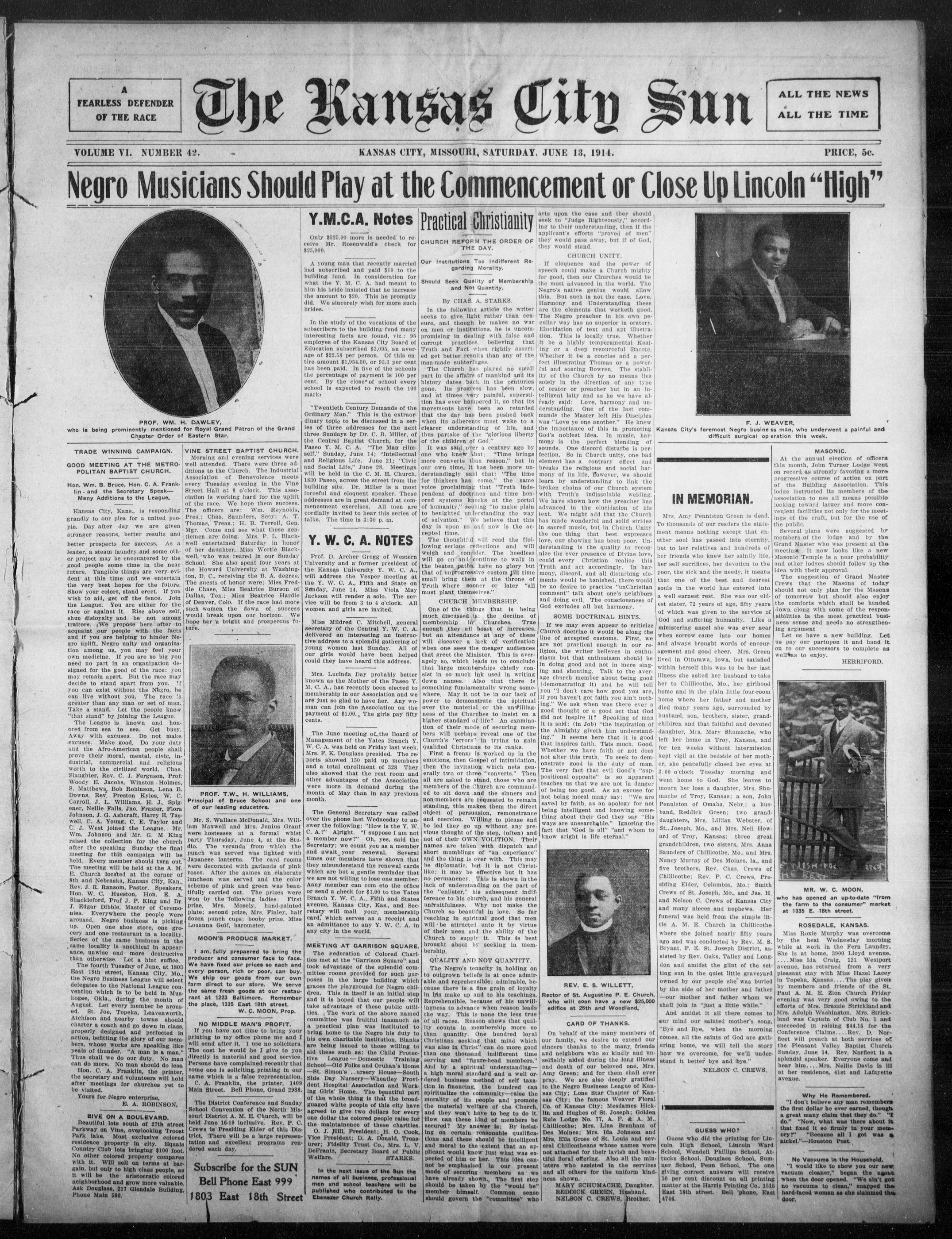
Negro Musicians Should Play at the Commencement or Close Up Lincoln "High"
PROF. WM. H. DAWLEY,
who is being prominently mentioned for Royal Grand Patron of the Grand
Chapter Order of Eastern Star.
A FEARLESS DEFENDER OF THE RACE
VOLUME VI. NUMBER 42.
Negro Music
PROF. WM. H. DA
who is being prominently mentioned for R
Chapter Order of East
TRADE WINNING CAMPAIGN.
GOOD MEETING AT THE METROPOLITAN BAPTIST CHURCH.
Hon. Wm. B. Bruce, Hon. C. A. Franklin and the Secretary Speak—Many Additions to the League.
Kansas City, Kans., is responding grandly to our plea for a united people. Day after day we are given stronger reasons, better results and better prospects for success. As a leader, a steam laundry and some other project may be encountered by the good people some time in the near future. Tangible things are very evident at this time and we entertain the very best hopes for the future. Show your colors, stand erect. If you wish to aid, get off the fence. Join the League. You are either for the race or against it. Rise above self, shun disloyalty and be not among traitors. We propose here after to acquaint our people with the facts and if you are helping to hinder Negro uplift, Negro unity and organization among us, you may feel your own medicine. If you are so big you need no part in an organization designed for the good of the race: you may remain apart. But the race may decide to stand apart from you. If you can exist without the Negro, he can live without you. The race is greater than any man or set of men. Take a stand. Let the people know "that stand" by joining the League.
The League is known and honored from sea to sea. Get busy. Away with excuses. Do not make excuses. Make good. Do your duty and the Afro-American people shall prove their moral, mental, civic, industrial, commercial and religious worth to the civilized world. Chas. Slaughter, Rev. C. J. Ferguson, Prof. Woody E. Jacobs, Winston Holmes, S. Matthews, Bob Robinson, Lena B. Downs, Rev. Preston Kyles, W. C. Carroll, J. L. Williams, H. J. Spigener, Nellie Falls, Jno. Frazier, Flora Johnson, J. G. Ashcraft, Harry E. Taswell, C. A. Young, C. E. Taylor and C. J. West joined the League. Mr. Wm. Johnson and Mr. G. M. King raised the collection for the church after the speaking Sunday the final meeting for this campaign will be held. Every member should turn out. The meeting will be held at the A. M. E. Church located at the corner of 8th and Nebraska, Kansas City, Kan. Rev. J. R. Ransom, Pastor. Speakers. Hon. W. C. Hueston, Hon. E. A. Shackleford, Prof. J. P. King and Dr. J. Edgar Dibble, Master of Ceremonies. Everywhere the people were aroused. Negro business is picking up. Open one shoe store, one grocery and one restaurant in a local. Series of the same business in the same locality is unethical in appearance, unwise and more destructive than otherwise. Let a bint suffice.
The fourth Tuesday of June, at 1803 East 18th street, Kansas City, Mo. the Negro Business League will select delegates to the National League convention which is to be held in Muskogee, Okla., during the month of August. Let every member be aroused. St. Joe, Topeka, Leavenworth, Atchison and nearby towns should charter a coach and go down in class, properly designed and perfected in action, befitting the glory of our members, whose works are speaking like peals of thunder. "A man is a man." Thus shall we do our duty. No man can do more. No man should do less. Hon. C. A. Franklin, the printer, the secretary and volunteers will hold after meetings for churches yet to be visited.
Yours for Negro enterprise.
E. A. ROBINSON.
BIVE ON A BOULEVARD.
Beautiful lots south of 27th street Parkway on Vine, overlooking Troost Park lake. Most exclusive colored residence property in city. Equals Country Club lots bringing $100 foot. No other colored property compares with it. Will sell on terms at bargain, but only to high class people, as it will be the aristocratic colored neighborhood and grow more valuable. Ask Douglass, 217 Glendale Building, Phone Main 580.
The Kansas City Sun
VINE STREET BAPTIST CHURCH.
Morning and evening services were well attended. There were three additions to the Church. The Industrial Association of Benevolence meets every Tuesday evening in the Vine Street Hall at 8 o'clock. This association is working hard for the uplift of the race. We hope them success.
The officers are: Wm. Reynolds, Pres; Chas. Saunders, Secy; A. T. Thomas, Treas; H. B. Terrell, Gen Mgr. Come and see what these gentlemen are doing. Mrs. P. L. Black well entertained Saturday in honor of her daughter, Miss Wertle Black well, who was reared in our Sunday School. She also spent four years at the Howard University at Washington, D. C., receiving the B. A. degree. The guests of honor were: Miss Freed die Chase, Miss Beatrice Burson of Dallas, Tex.; Miss Beatrice Hardie of Denver, Colo. If the race had more such women the dawn of success would break upon our horizon. We hope her a bright and prosperous future.
PROF. T.W., H. WILLIAMS,
Principal of Bruce School and one
of our leading educators.
PROF. T.W., H. WILLIAMS,
Principal of Bruce School and one
of our leading educators.
Mr. S. Wallace McDonald, Mrs. William
Maxwell and Mrs. Junius Grant
were hostesses at a formal whistle
party Thursday, June 4, at the Studi-
do. The veranda from which the
punch was served was lighted with
Japanese lanterns. The card rooms
were decorated with garlands of pink
roses. After the games an elaborate
luncheon was served and the color
scheme of pink and green was bea-
tifully carried out. The prizes were
won by the following ladies: First
prize, Mrs. Mosely, hand-painted
plate; second prize, Mrs. Finley, half
dozen punch cups; booby prize, Miss
Louanna Golf, barometer.
MOON'S PRODUCE MARKET.
I am, fully prepaired to bring the producer and consumer face to face. We have fixed our prices so each and every person, rich or poor, can buy. We ship our goods from our own farm direct to our store. We serve the same fresh goods at our restaurant at 1223 Baltimore. Remember the place, 1335 East 18th street. W. C. MOON. Pron.
NO MIDDLE MAN'S PROFIT
NO MIDDLE MAN'S PROFIT.
If you have not time to bring your printing to my office phone me and I will send after it. I use no solicitors.
The cost he would be I give to you directly in material and good service.
Persons have complained recently that some one is soliciting printing in our name which is a false representation.
C. A. Franklin, the printer, 1409 Main Street, Bell Phone, Grand 2988.
The District Conference and Sunday School Convention of the North Missouri District A. M. E. Church, will be held June 16-19 inclusive. Rev. P. C. Crews is Presiding Elder of this District. There will be a large representation and excellent programs rendered each day.
Subscribe for the SUN
Bell Phone East 999
1803 East 18th Street
KANSAS CITY, MISSOURI, SATURDAY, JUNE 13, 1914.
Y.M.C.A. Notes
Only $25,00. more is needed to receive Mr. Rosenwald's check for $25,000.
A young man that recently married had subscribed and paid $10 to the building fund. In consideration for what the Y. M. C. A. had meant to him his bride insisted that he increase the amount to $20. This he promptly did. We sincerely wish for more such brides.
In the study of the vocations of the subscribers to the building fund many interesting facts are found, viz.: 95 employees of the Kansas City Board of Education subscribed $2,095, an average of $22.58 per person. Of this entire amount $1,954.50, or 93.3 per cent has been paid. In five of the schools the percentage of payment is 100 per cent. By the close* of school every school is expected to reach the 100 mark.
"Twentieth Century Demands of the Ordinary Man." This is the extraordinary topic to be discussed in a series of three addresses for the next three Sundays by Dr. C. B. Miller, of the Central Baptist Church, for the Paseo Y. M. C. A. "The Man Himself," Sunday, June 14; "Intellectual and Religious Life, June 21; "Civic and Social Life," June 28. Meetings will be held in the C. M. E. Church, 1830 Paseo, across the street from the building site. Dr. Miller is a most forceful and eloquent speaker. These addresses are in great demand at commencement exercises. All men are cordially invited to hear this series of talks. The time is 3:30 p. m.
Y. W. C. A. NOTES
Prof. D. Archer Gregg of Western University and a former president of the Kansas University Y. W. C. A., will address the Vesper meeting at the Y. W. C. A., Fifth and State on Sunday, June 14. Viola Miay Jackson will render a solo. The service will be from 3 to 4 o'clock. All women and girls are invited.
Miss Mildred C. Mitchell, general secretary of the Central Y. W. C. A. delivered an interesting an instructive address to a splendid gathering of young women last Sunday. All of our girls would have been helped could they have heard this address.
Mrs. Lucinda Day probably better known as the Mother of the Paseo Y. M. C. A., has recently been elected to membership in our Association and we are just so glad to have her. Any woman can join the Association on the payment of $1.00. The girls pay fifty cents.
The June meeting of the Board of Management of the Yates Branch Y. W. C. A. was held on Friday last week. Mrs. F. K. Douglass presided. The reports showed 150 paid up members and a total enrollment of 328. They also showed that the rest room and other advantages of the Association were more in demand during the month of May than in any previous month.
The General Secretary was called over the phone last Wednesday to answer the following: "How is the Y. W. C. A.?" Alright. "I suppose I am not a member now?" Oh, yes, said the Secretary; we count you as a member and await your renewal. Several times our members have shown that they misunderstand the renewal cards which are but a gentle reminder that we are not willing to lose one member. Any member can com eto the office or send a check for $1.00 to the Yates Branch Y. W. C. A., Fifth and States avenue, Kansas City, Kas., and Secretary will mail your membership card, which serves as a receipt and an admittance to any Y. W. C. A. in any city in the world.
MEETING AT GABRISON SQUARE
MEETING AT GARRISON SQUARE.
The federation of Colored Charities met at the "Garrison Square" and took advantage of the splendid committee rooms provided for such purposes in the large building which graces the playground for Negro children. This in itself is an initial step and it is hoped that our people will take advantage of these public utilities. The work of the above named committee was fruitful inasmuch as a practical plan was instituted to bring home to the Negro his duty to his own charitable institution. Blanks are being issued to those willing to aid these as; the Child Protective League—Domestic Training School—Old Fols and Orhuan's Home—St. Simon's ..ursery House—Side Side Day Nursery—Wheatley Provident Hospital Association and Working Girls' Home. The beautiful part of the whole thing is that the broad-gauged white people of this city have agreed to give two dollars for every one dollar the colored people raise for the maintenance of these charities. O. J. Hill, President; H. O. Cook Vice President; D. A. Donald, Treasurer; Fidelity Trust Co., Mrs. L. V. DeFrantz, Secretary Board of Public Welfare.
STARKS.
In the next issue of the Sun the names of all business, professional men and school teachers will be published who contributed to the Ebenezer Church Rally.
Practical Christianity
CHURCH REFORM THE ORDER OF
THE DAY.
Our Institutions Too Indifferent Re-
garding Morality.
Should Seek Quality of Membership
and Not Quantity.
By CHAS. A. STARKS.
In the following article the writer seeks to give light rather than censure, and though he makes no war on men or institutions, he is uncompromising in dealing with false and corrupt practices, believing that Truth and Fact when rightly asserted get better results than any of the man-made subterfuges.
The Church has played no small part in the affairs of mankind and its history dates back in the centuries gone. Its progress has been slow, and at times very painful, superstition has ever hampered it, so that its movements have been so retarded that the day has been pushed back when its adherents must wake to a clearer understanding of life, and thus partake of the "glorious liberty of the children of God."
It was said over a century ago by one who knew that: "Time brings more converts than reason," but in our own time, it has been more understandingly said that: "The time for thinkers has come," the same voice proclaiming that "Truth independent of doctrines and time honored systems knocks at the portal of humanity," seeking "to make plain to benighted understanding the way of salvation." We believe that this day is upon us and now is the accepted time.
The thoughtful will read the fallowing serious reflections and will weigh and consider. The heedless will go on and continue to walk in the beaten paths, have no glory but that of unprogressive custom till time small bring them at the throne of Truth where sooner or later "all must plant themselves."
CHURCH MEMBERSHIP.
One of the things that is being much discussed is: the decline of membership in Churches. True enough they all boast of increases, but an attendance at any of these will discover a lack of verification when one sees the meager audiences that greet the Minister. This is averagely so, which leads us to conclude that large membership chiefly consist in so much ink used in writing down names. Also that there is something fundamentally wrong somewhere. May it not be in our lack of power to demonstrate the spiritual over the material or the unwillingness of the Churches to insist on a higher standard of life? An examination of their mode of securing members will perhaps reveal one of the Church's "errors" in trying to gain qualified Christians to its ranks.
First a frenzy is worked up in the emotions, then Gospel of intimidation, then the invitation which nets generally two or three "converts." Then all are asked to stand, those who are members of the Church are commanded to sit down and the sinners and non-members are requested to remain standing, this makes them the direct object of persuasion, remonstrance and coercion. Willing to please and be led they go up without any previous thought of the step, (often) and not of their OWN VOLITION. Their names are taken with dispatch and short mumblings of "an experience" and the thing is over with. This may be diplomatic, but it is not Christ-like; it may be effective but it has no permanency. This is shown in the lack of understanding on the part of the "enlister," his subsequent indifference to his church, and his general unfruitfulness. Why not make the Church so beautiful in love. So far reaching in spiritual good that men will be attracted unto it by virtue of their neen and the ability of the Church to supply it. This is best brought about by seeking in membership.
QUALITY AND NOT QUANTITY.
The Negro's tenacity in holding on to outgrown beliefs is at once admirable and reprehensible; admirable, because there is a fine grain of loyalty in his make up and to his teachings. Reprehensible, because of his unwillingness to advance when reason leads the way. This is none the less true of all races. Reason shows that quality counts in membership more so than quantity. One hundred loyal Christians seeking that mind which was also in Christ" can do more good than one thousand indifferent time serving and "figure-head members." And by a spiritual understanding—a high moral standard and a well ordered business method of self taxation in financing, the hundred can spiritualize the community—raise the morality of its people and promote the material welfare of the Church, and they won't have to beg to do it. How can these kind of members be secured? My answer is; By insisting on certain reasonable qualifications and these should be intelligent and moral to the extent that an applicant would know just what was expected of him or her. This idea can not be emphasized in our present mode of securing members as we have already shown. The first step should be taken by the "would be" member himself. Common sense should govern the "committee" who
acts upon the case and they should seek to "Judge Righteously," according to their understanding, then if the applicant's efforts "proved of men" they would pass away, but if of God, they would stand.
CHURCH UNITY
If eloquence and the power of speech could make a Church mighty for good, then our Churches would be the most advanced in the world. The Negro's native genius would allow this. But such is not the case. Love, Harmony and Understanding these are the elements that worketh good. The Negro preacher in his own peculiar way has no superior in oratory. Elucidation of text and apt illustration. This is locally true. Whether it be a highly temperamental Kealing or a deep resourceful Bacuto. Whether it be a concise and a perfect illustrating Thomas or a powerful and soaring Bowren. The stability of the Church by no means lies solely in the direction of any type of orator or preacher but in an intelligent laity and as he we have already said: Love, harmony and understanding. One of the last commands the Master left His Disciples was "Love ye one another." He knew the importance of this in promoting God's noblest idea. In music, harmony is the perfect blending of sounds. One discord disturbs is one bad element has a contrary effect and breaks the religious and social harmony of its life. However, we should learn to link the broken chains of our Church system with Truth's indissoluble welding. We have shown how the preacher has advanced in the elucidation of his text. We might add that the Church has made wonderful and solid strides in sacred music, but in Church Unity the one thing that best expresses love, our showing has been poor. Understanding is the quality to recognize the ever presence of Divine love, could every Christian realize this Truth and act accordingly. In harmony, discord, and all disturbing elements would be banished, there would be no desire to practice "unChristian comment" talk about one's neighbors and doing evil. The consciousness of God excludes all but harmony.
SOME DOCTRINAL HINTS.
If we may even appear to criticize Church doctrine it would be along the line of accepted customs. First, we are not practical enough in our religion, the writer believes in enthusiasm but that enthusiasm should be in doing good and not in mere singing and shouting. Talk to the average church member about being good (demonstrating it) and he will tell you "I don't care how good you are, if you haven't got faith you aren't nothing." We ask when was there ever a good thought or a good act that God did not inspire it? Speaking of man it is said: (In Job) "the inspiration of the Almighty giveth him understanding." It seems here that it is good that inspires faith. This much. Good. Whether we have faith or not does not alter this truth. To seek to demonstrate good is the duty of man. The very fact that evil Good's "supositional opposite" is so apparent teaches us that we are not in danger of being too good. As an excuse for not being moral many say: "We are saved by faith, as an apology for not being intelligent and knowing some thing about their God they say "Hii ways are unsearchable." Ignoring the fact that "God is all" "and whom to know aright is life eternal."
REV. E. S. WILLETT,
Rector of St. Augustine P. E. Church,
who will soon have a new $25,000
edifice at 26th and Woodland.
CARD OF THANKS.
On behalf of the many members of our family, we desire to extend our sincere thanks to the many friends and neighbors who so kindly and unselfishly aided during the long illness and death of our beloved one, Mrs. Amy Green; and for them shall ever pray. We are also deeply gratified to the Negro Business League of Kansas City; Lone Star Chapter of Kansas City; the famous Weaver Floral Co. of Kansas City; Mesdames Hicklin and Hughes of St. Joseph; Golden Rule Lodge No. 77, A. F. & A. M. Chillicothe; Mrs. Lina Branham of Des Moines; Mrs. Ida Johnson and Mrs. Ella Gross of St. Louis and several Chillicothete whose names were not attached for their lavish and beautiful floral offering. Also all the ministers who assisted in the services and all others for the uniform kindness shown.
MARY SCHUMACHE, Daughter,
REDDICK GREEN, Husband,
NELSON C. CREWS, Brother
F. J. WEAVER,
Kansas City's foremost Negro business man, who underwent a painful and difficult surgical operation this week.
IN MEMOBIAN
Mrs. Amy Penniston Green is dead. To thousands of our readers the statement means nothing except that another soul has passed into eternity, but to her relatives and hundreds of her friends who knew her saintly life, her self sacrifices, her devotion to the poor, the sick and the needy, it means that one of the best and dearest souls in the world has entered into a well earnest rest. She was our oldest sister, 72 years of age, fifty years of which was given to the service of God and suffering humanity. Like a ministering angel she was ever near when sorrow came into our homes and always brought words of encouragement and good cheer. Mrs. Green lived in Ottumwa, Iowa, but satisfied within herself this was to be her last illness she asked her husband to take her to Chillicothe, Mo., her girlhood home and in the plain little four-room home where her father and mother died many years ago, surrounded by husband, son, brothers, sister, grandchildren and that faithful and devoted daughter, Mrs. Mary Shumache, who left her home in Troy, Kansas, and for ten weeks without intermission kept vigil at the bedside of her mother, she peacefully closed her eyes at 3:00 o'clock Tuesday morning and went home to God. She leaves to mourn her loss a daughter, Mrs. Shumache of Troy, Kansas; a son, John Penniston of Omaha, Nebr.; a husband, Reddick Green; two granddaughters, Mrs. Lillian Webster, of St. Joseph, Mo., and Anna Saunders of Chillicothe, Mo., and Anna Nancy Murray of Des Moines, la., and five brothers, Rev. Chas, Crews of Chillicothe; Rev. P. C. Crews, Presiding Elder, Columbia, Mo.; Smith Crews of St. Joseph, Mo., and Jas. H., and Nelson C. Crews of Kansas City and many nieces and nephews. Her funeral was held from the simple little little M. E. Church in Chillicothe where she joined nearly fifty years ago and was conducted by Rev. M. S. Bryant, P. E. St. Joseph District, asisted by Rev. Oaks, Talley and Longdon and amidst the glint of the setting sun in the quiet little graveyard owned by our people she was buried by the side of her mother and father—our mother and father whom we shall join in "just a little while." And amidst it all there comes to our mind our sainted mother's song, "Bye and Bye, when the morning comes, all the saints of God are gathering home, we will tell the story how we overcome, for we'll understand it better bye and bye."
NELSON C. CREWS.
GUESS WHO?
Guess who did the printing for Lincoln High School, Lincoln Ward School, Wendell Phillips School, Attucks School, Douglass School, Summer School, Penn School. The one giving correct answers will receive 10 per cent discount on all printing matter at the Harris Printing Co. 1515 East 18th street. Bell 'phone, East 4746.
ALL THE NEWS ALL THE TIME
PRICE. 5c.
coln "High"
EAVER,
less man, who underwent a painful and
eration this week.
MASONIC.
MASONIC.
At the annual election of officers this month, John Turner Lodge went on record as strongly favoring a more progressive course of action on part of the Building Association. This lodge instructed its members of the association to use all means possible looking toward larger and more convenient facilities not only for the meetings of the craft, but for the use of the public.
Several plans were suggested by members of the lodge and by the Grand Master who was present at the meeting. It now looks like a new Masonic Temple is a near probability and other lodges should follow up the idea with their approval.
The suggestion of Grand Master Crews that the Masons of today should not only plan for the Masons of tomorrow but should also enjoy the comforts which shall be handed down along with some of the responsibilities is the most practical business sense and needs no strengthening argument.
Let us have a new building. Let us pay our partupon it and hand it on to our successors to complete as well as to enjoy.
HERRIFORD.
MR. W. C. MOON,
who has opened an up-to-date "from
the farm to the consumer" market
at 1335 E. 18th street.
ROSEDALE. KANSAS.
Miss Roxie Murphy was overcome by the heat Wednesday morning while at work in the Fern Laundry. She is at home, 3900 Lloyd avenue. .Miss Ida Craig. 121 Westport avenue, has returned from a very pleasant stay with Miss Hazel Lacey in Topeka, Kansas....The play given by members and friends of the St. Paul A. M. E. Zion Church Friday evening was very good owing to the efforts of Mrs. Brazzie Strickland and Mrs. Adolph Washington. Mrs. Strickland was Captain of Club No. 1 and succeeded in raising $44.15 for the Conference Claims. .Rev. D. Norfeet will preach at both services of the Pleasant Valley Baptist Church Sunday, June 14. Rev. Norfeet is a splendid speaker. Everyone come and hear him....Mrs. Nellie Davis is ill at her residence, 41st and Lafayette avenue.
Why He Remembered.
Why He Remembered.
"I don't believe any man remembers the first dollar he ever earned, though a great many claim that they do." "E do." "Now, what was there about it that fixed it so firmly in your memory?" "Because all I got was nickel."—Houston Post.
No Vacuum in the Household
No Vacuums in the Household.
"I would like to show you our new, vacuum cleaner," began the agent when he turned off the WD-WC no vacuums to clean," snapped the hard-faced woman as she slammed the door.
DIRECTORY OF THE
Negro Business League of Kansas City.
F. J. Weaver, Pres. E. A. Robinson, Secy.
Members will please report any mistake or change of address to
Society Secretaries and Fiscal Officer 754.
AUTHOR AND WRITER.
C. A. Starks, 1125 Vine street. Bell phone, East 1128-W.
AUTOMOBILES.
Chas. Monroe, 2102 Woodland Auto & Hack Service. Bell East 5194.
Jas. Cowden, 1617 E. 12th St. Automobile to hire. Bell East 26;
Home Main 1532.
Wm. D. Foster Auto Co., 1423 Forest, hire and repair; office Bell
Grand 1630W; res. phone Bell East 4417W.
Thomas Black, 7-Passenger Packard, Safety and Service. Bell, East
2833. Home, Main 6545.
Bessie Evans' Cook Shop and Catering, 2428 Vine St. Bell phone, East 3637.
Jas, Cowden, 1617 E 12th. Barber Shop and Bath.
Burt Bross, 1422 E 18th St. Barber Shop and Pool Hall. Bell phone,
800-222-2222.
Wm. Lewis, Atlanta Pool Hall, Barber Shop and Bath, 1609-11 E. 18th St. Bell Phone, Ease 721.
William Dabbs, 1219 Baltimore; Grand 3125 Bell.
J. A. Jones, 1514 E. 18th St.; Home Phone Main 5119.
Palace Barber Shop, J. C. Hobbs, Prop., 1518 E. 19th St. Bell phone, 2833 East.
Wm. Stitts, Criterion Barber Shop and Pool Hall, 1717 East 18th St. BLACKSMITH.
J. A. Reid, Daisy Cafe, 1610 E. 18th St.
Henry Compton, 1512 E. 18th St. Bell phone, East 618.
Mrs. King, Eighteenth and Paseo.
Mrs. H. W. Dotson, 1705 E. Twelfth St. Phone, Bell 2214
Madame U. F. Scales, Northeast Cor. 5th and State, Kansas City, Kans.
R. W. Alexander, 1619 E. 18th St. Barbecued Meats.
Hughes & Buckner, 1514 E. 19th St. Barbecued Meats. Bell Phone,
East 2833.
CHRISTIAN SOCIETIES.
CLEANERS, DYERS AND TAILORS
Laden Brothers, Cutters and Designers, 2420 Vine St. Bell, E. 4950-J.
O. K. Cleaners and Dyers, guaranteed not to shrink any garment we dye, 1113 East 18th; Bell Grand 2437.
R. Bennett, 1515 East Eighteenth; 4746 Bell.
J. F. Bass, 1509 Main, Main 6449 Home.
J. John Holmes, 1603 Vine.
Wortham Bros., 1223 E 19th St. Bell Phone, Grand 3933-W.
G. W. Golden Steam Dye Works, 1605 East 18th; Bell East 539.
R. L. Hopkins, 2326 Vine St. "The Star," Bell Phone, E 3135.
CARPET CLEANERS.
CLERGYMEN
G. E. Arnett, 14th and Spruce, Baptist Church.
Rev. G. H. Daniels, 2313 Vine Street. Home phone, Main 5618.
E. N. C. Groover, First Baptist Missionary, 708 North 24th St., St. Joseph,
Mo. Phone 2137.
J. R. Ransom, Pastor A. M. E. Church, 5th and Nebraska, Kansas City,
Kans. Bell Phone, West 2904.
S. W. Bacote, Pastor Second Baptist Church, Kansas City, Mo. Bell
Phone, East 3522.
G. T. Mosby, Pastor Greenwood Baptist Church, 18th and Terrace,
W. H. Thomas, Pastor Allen Chapel A. M. E. Church, Bell, Main 3600.
J. W. Hurse, Pastor Saint Stephens Baptist Church. Bell, East 4090.
W. A. Bowren, Pastor First Baptist Church. Bell Phone, West 3510.
Lee H. Mills, 10th and Euclid Ave., Kansas City, Mo.
Rev. G. E. Arnett, 14th and Spruce, Baptist Church.
Rev O. T. Reed, State Baptist Church Convention and Twin City Ministers' Alliance Secretary.
Rev J. W. Carter, 2224 Mich. St. James A. M. E. Church.
Rev W. C. Williams, 17th and Tracy Ave., Ebenezer A. M. E. Church.
Rev T. A. Wilson, 1747 Belleview Ave. Grand 2668.
J. M. Booker, Pleasant Green Baptist Church. Res. 595 Tracy.
J. W. Clay, King Solomon Baptist Church. Res. Bell, West 1434.
D. B. Jackson, 8th Street Baptist Tabernacle, 710 Freeman. Bell, West 3763.
G. McNell, 211 Garfield. Bell, West 1999.
J. M. Gilbert, First Baptist Church, Bonner Springs, Kans.
C. C. Callaway, Pilgrim Baptist Church.
Rev A. A. Harris, Second Christian Church, 2220 Michigan.
**COAL, FEED, ICE AND KINDLING.**
I. B. Blackburn, 1612 N. 9th St., K. C., K. Bell phone, W. 1576.
J. H. Hall, 1208 Vine.
Herman Kinslee, 2012 Harrison; Grand 2766W Bell.
E. A. Sallsbury, 2206 Vine; East 879 Bell.
W. H. Winters, 1915 Highland.
R. Williams, 1815 East Seventeenth.
Hopkins Bros., 2232 Vine.
W. H. Lambright & Sons, Coal, Ice and Feed. Bell phone, W. 1923.
1620 North 3rd street, Kansas City, Kas.
CONTRACTORS—GENERAL.
Thos. W. Rice, Cement, stone, sodding and grading. Home Main 8236. 1908 Woodland Ave. in Day, office 1426 E. 18th street. Bell phone, Grand 1413. Wm. T. Garner, contractor and builder, 1728 Woodland; Bell E. 4741W. A. E. Estes, 2460 Waldron. Bel l, East 4394-Y. Leon H. Jordan, 712 East 12th St. Bell Grand 2873. W. R. Nelson, 1322 Pacific Street. C. S. Page, 1514 East Eighteenth; Main 5119 Home. COOPER. Lee London, 407 West 5th. DENTISTS.
DENTISTS.
W. L. Hayden, cor. 4th and Minnesota. Bell, West 823. K. C., K.
T. C. Chapman, 1505 East Eighteenth; East 798 Bell.
A. H. Hudson, 2330 Vine; East 2330 Bell.
McQueen Carrion, 18th and Paseo. Bell Phone, E. 144. Home
Phone, Main 3490.
H. D. Voorhies, 500 Minnesota Ave., Kansas City, Kans. Bell Phone
West 1910.
DRESSMAKING
Mrs. Blanche Page, Dressmaker, 2413 Vine St., Bell Phone, East 3192.
Miss Georgia Coleman, 1510 E. 18th street.
Birdie Jackson, 1913 East Nineteenth.
DRUG STORES.
Palace Drug Store No. 2, E. S. Lee, 1611 E. 18th St. Bell Phone
E. 3813.
People's Drug Store, M. H. Lambright, Mgr. Bell Phone, East 1814.
Home Phone, Main 4382.
McCampbell & Houston, 2300 Vine street, and N. W. Cor. Howard and
Vine Sts.
E. S. Lee Pallace Drug Store, 19th and Vine. Both phones.
Ideal Pharmacy, 1532 E. 12th Street. Bell phone, East 26; Home
phone, Main 1532.
DRY GOODS, GENT'S FURNISHINGS, NOTIONS.
Taylor Holmes, Ladies' and Gents' Furnishings and Notions, 2409
Vine St.
Mrs. Josephine Abernathy, Ladies Furnishings and Notions, 2413
Vine street. Bell phone East 3192.
Ell Harris, 2333 Vine St.
EMPLOYMENT AGENTS.
Afro-American Employment & Inv. Co., 911 McGee. Both phones.
EXPRESS AND BAGGAGE.
Ransom White, 1106 Wendell, Kansas City, Kans.
E. A. Robinson, 2413 Montgall Ave. Bell, East 754.
C. Washington, 1326 Highland. Home phone, Main 5119.
FLORISTS.
Crosthawe Floral Co., 1611 E. 18th St. Anna J. Carter, Lilia H. Swan
and Minnie L. Crosthawe. Bell Phone East 3813.
Weaver Floral Co., 1510 E. 18th St. Main 7555 Home; E. 4798 Bell
FURNITURE DEALERS.
L. M. Furniture & Repair Co., Lewis Townsend, 1720 Lydia Ave.
Bell phone, Grand 1772.
GROCERS.
GROCERS.
Abraham Clark, 2831 East 54th St.
G. E. Arnett, 2200 East Twenty-fifth.
R. Mason, 1905 Vine.
J. L. Matson, 19th and Grove. Bell Grand 1417-X.
M. R. Wilson, 2644 Woodland.
Solomon Smith, Phillips School Grocery, 2440 Vine. Bell East 3679W.
Geo. M. King, 1268 North 9th St., Kansas City, Kan. Bell Phone,
West 3597.
J. H. Claybourne, 10th and Washington Blvd. Bell phone, West 2682.
E. Johnson & Son, 852 Freeman Ave., Kansas City, Kan.
C. L. Williams, 1508 E. 24th St. Bell Phone East 1437W.
Marshall Wilson, 2644 Woodland. Bell, East 1493.
Phone, Bell, West 3715-J
Mrs. Ela Neft, 1714 E. 18th St., Bell phone East 412.
Mrs. C. E. Taylor, Poro & Scalp Treatment. Bell, East 1927-W.
HOTELS
J. H. Simmons, 915 Oak; Main 4072 Bell.
Hotel Woods, 721 Charlotte. Lewis Woods, Prop. Bell Main 2078.
Madame S. A. Bell, Hair Culturist and College in Connection. 923
Campbell.
ICE CREAM PARLORS.
INSURANCE.
Standard Life Insurance Co., General Office, Atlanta, Ga. Heman E. Perry, president; Harry H. Pace, secretary; G. F. Porter, superintendent local branch, Kansas & Missouri; T. A. Ross and Charles C. Buster, assistants; P. K. Brown, superintendent Health & Accident department; W. L. Robnett, assistant superintendent; 1507 E. 18th St. Bell Phone East 4955.
H. Walden, 2442 Montgall, 1507 East 18th St. Bell, East 4955.
A. Parron, Agent, Bell, East 4955.
Health and Accident Dept. Service Life Ins. Co. Bell, East 4955.
H. D. Simmons, 1832 Vine, Phone East87.
J. W. Golden, 1612 Lydia. Grand 3631.
E. A. Robinson, 2413 Montgall, Bell, East 754. Special agent Standard Life and District Mgr. Continental.
INVENTOR.
W. J. Dixon, 2828 Cleveland Avenue.
Madame N. P. Jones, Beauty Culture., Hair Goods, etc., 2110 Vine street.
Eva P. Washington, 849 Freeman Ave., Kansas City, Kans. Bell phone, 2306 West.
LAWYERS.
L. W. Johnson Offices, 325 New York Life building, Stein-Miller building, corner Sixth and State. Bell phone, West 938; Residence, West 3985.
Judge I. F. Bradley, 721 Minnesota Ave., Kansas City, Kan. Rooms 5 and 6. Bell Phone, West 2335.
William B. Bruce, Attorney-at-Law and Counsellor. Phone, Home Main 5478; Office, 117 West Sixth Street.
Chas. H. Callaway, 117 W. 6th. Home Main 58.
W. C. Hueston, 117 W. 6th. Home Main 58.
L. A. Knox, 117 W. 6thSt. Home Main 5478.
Dorsey Green, 516 Minnesota Ave. Bell, West 424.
E. A. Shackelford, 516 Minnesota Ave. Bell, West 424.
I. H. Spears, 18th & Paseo. Bell, East 1690.
MANUFACTURER.
MANUFACTURER.
J. E. Leing, Human Hair, Hair Dye, Hair Dresser Supply and Hair Dressing School in connection, 1715 E. 18th St.
MISCELLANEOUS.
Mrs. Francis J. Jackson, Inspector, 2434 Montgall. Bell East 3942. Maggie Seamster.
John Hill, 1513 Woodland. Bell Phone, East 1254. Amus Barnett, 1230 Forest; Main 5018 Home.
R. C. Holland, 2423 Grove Street.
R. J. Hightower, 2436 Highland.
Solomon Smith, 2643 Highland.
George Teeters, Southwest National Bank of Commerce.
John Thomas, 425 Waverly Way; South 5087W Bell.
H. T. Kealing, Western University; West 4480 Bell.
Henry P. Ewing, scientific farmer, 1105 Woodland.
Wm. Sprangles, milk and butter, 53rd and Montgall; Lin. 750 Home.
D. W. White, "White's Furniture Exchange." Bell West 483, 423 Minnesota avenue Kansas City, Kas.
Mr. T. G. McCampbell, Custodian Western University Grounds, Phone, West 1454.
John Acy, Glacier, plasterer and plumber, 1405 Spruce.
Independent Printing & Publishing Co., Kansas City, Kas. 1103 N.
5th Street. C. A. Young.
MUSICIANS.
Samuel S. R. S. Stewart, 1714 South 4th Street, East, Salt Lake City,
Utah.
NEWSPAPERS.
Arthur A. Anderson, 543 State St., Kansas City, Kans.
N. C. Crews, Kansas City Sun, 18th and Woodland; East 999 Bell.
Rev. J. Frank McDonald, Western Christian Recorder, 2517 Grove St.
Bell phone East 488.
PAINTERS AND PAPERHANGERS.
A. L. Williams, 1519 E. 23d, Patching, Painting and Paper Hanging.
Bell phone, East 159.
T. H. Balley, 311 McGee St., Bell phone Main 751
PHYSICIANS.
Dr. E. A. Walker, office and residence, 1426 E. 18th. Home Phone M. 8071; Bell G. 4332.
W. Hubert Bruce, 1512 East Eighteenth Street. Home phone, Main 4620; Bell phone, East 3151.
Lucian P. Richardson, 2439 Waldron. Bell phone, East 2527.
C. A. Murray Kane, Southeast corner 18th and Paseo. Bell, East 5069. Home, Main 5807. Residence Phone, Bell East 693.
Henry W. Dillard, Graduate Ph.D., 1512 North 5th St., Kansas City, Kansas.
M. H. Lambright, 1508 East 18th; Bell East 144; Home Main 3490.
Thos. A. Fletcher, Home West 171; Residence, Home East 2856.
M. L. Finn, pharmacist, 1301 East 18th.
L. E. Baller, N. W. Cor. 12th and Vine. Bell East 232.
Howard M. Smith, 1509 East 18th St. Bell East 495.
Wm. J. Thompkins, 1509 E. 18th St. Bell East 495.
L. J. Holly, 1117 Campbell. Bell phone, 783 Grand.
E. J. McCampbell, 202ine Street. Bell phone, 501 East.
M. G. Brookins, Northwest Corner 24th and Vine Sts. Bell phone, East 232.
T. C. Unthank, 1112 Independence avenue. Both phones, Main 7488. W. W. Montgomery, 400 Minnesota Ave., Kansas City, Kans. Phones: Bell, West 2302; Home, West 478.
A. D. Bradbury, 821 Independence Ave. Bell Phone, Main 4438.
Lee R. Petty, 516 Minnesota Ave., Kansas City, Kans. Bell Phone,
West 3711.
M. B. Petty, Eye Specialist, 1419 East 18th St. Grand 2243.
R. C. Hayden, cor. 4th and Minnesota Bell, West 823. Res., 1403
North 10th St. Bell, West 3739-R.
E. B. Ramsey, northwest cor. 18th and Paseo. Office, Bell, Grand
1413. Res., East 2144.
H. Sylvester Gillespie, northwest cor. 18th & Paseo. Bell, Grand 1413.
**POULTRY RAISERS.**
S. M. Steele, 29 Sloan Avenue, Quindaro, Kans.
Fred T. Drew, 2002 Bales avenue. Bell phone, East 5277-W.
**PHOTOGRAPHERS.**
Charles Williams. 1015 Oak; Main 3154 Bell
C. Bruce Santee, 1718 East 18th St. "Photo Fad."
C. A. Franklin, 1409 Main; Grand 2388 Bell.
John H. Fairley, Square Deal Printing Co., 1731 Lydia. Bell phone
Grand 1647-Y.
REAL ESTATE.
REAL ESTATE.
William Hopkins Afro-American Investment Co.
J. Dallas Bowser, 2400 Paseo. Bell Phone 3795 W Grand.
F. J. Weaver, President Afro-American Inv. Co., 911 McGee St. Bell Main 751.
The Ward & Samlington Investment Co., Bell Phone East 4294Y.
W. M. Johnston, rental agent; Main 7555 Home; Main 751 Bell.
W. G. Mosely, Ivanhoe Investment Co., 2220 Woodland avenue.
E. E. Vaughan, 26th and Parkway, Kansas City, Kan. Bell, West 1757.
Patterson & Gayden, 527 State Ave., Kansas City, Kan. Bell phone, West 215; Home phone, West 503.
Geo. W. Edwards, Moberly, Mo.
C. H. Adkins, Colored People's Investment Co. 2427 Vine. Home Phone, Main 9203. Bell, East 1011.
PROBATION OFFICER.
Edward Ross, 1419 E. 18th St. Bell Grand 885.
REGALIAS, BADGES, ETC.
Moses Dixon, 1217 Woodland; East 3797 Bell.
SHOE SHINING PARLOR.
Moses Fields, 614 Main.
SHOE STORES.
A. W. Williams, General Repairing, 1960 N. 3rd St., Kansas City, Kans.
H. Shumaker, Ladies' and Gents' Shoe Shining Parlor, 1702 E. 18th St.
Temple Shoe Store, G. A. Page, Prop., 1507 E. 18th St.
SIGN PAINTER AND SCENIC ARTIST
Geo. W. Martin, 1812 East 17th St. Home Phone, Main 1133.
STOCKMEN.
Thos. Bass, Dealer in High Class Stock, Mexico, Mo.
Chas. A. Westmoreland, 2325 Lydia. Bell Grand 1320-W. Lincoln High School.
R. G. Jackson, Music, 531 Nebraska. Bell, West 1032, Kansas City, Ks.
THEATRES.
Homer Roberts, "Dixie Theatre," 2411 Vine St.
TRANSFER.
A. L. Williams' Transfer Co. Home phone, M 2396.
Lewis Townsend, 1720 Lydia Ave. Bell, Grand 1772.
Geo. Jones, 1008 McGee. Home Phone, 5188 Main.
W. Lee Whibby, 18th and Forest. Home phone M. 4023.
R. W. Elmore, 1607 Harrison street.
A. B. Hun, northeast cor. 7th and May. Home, Main 7261.
UNDERTAKERS.
R. G. Jackson, Music, 531 Nebraska. Bell, West 1032, Kansas City, Ks.
THEATRES.
Homer Roberts, "Dixie Theatre," 2411 Vine St.
TRANSFER.
A. L. Williams' Transfer Co. Home phone, M 2396.
Lewis Townsend, 1720 Lydia Ave. Bell, Grand 1772.
Geo. Jones, 1008 McGee. Home Phone, 5188 Main.
W. Lee Whibby, 18th and Forest. Home phone M. 4023.
R. W. Elmore, 1607 Harrison street.
A. B. Hun, northeast cor. 7th and May. Home, Main 7261.
UNDERTAKERS.
Wyatt & Randolph, 920 N. 3rd St., Kansas City, Kans. Bell West 2569.
Nathan W. Thatcher, Home Phone West 847; Bell West 821. 1514 N.
5th St., Kansas City, Kans.
C. H. Countte, 2220 Vine St. Bell East 3336.
Watkins Bros. & Co., 1729 Lydia. Telephone Grand 987.
People's Undertaking Co., 1211 East 18th; Phones, Bell Grand 1565;
Home 8163 Main. Edward Jones, Mgr.
Jno. W. Jones, 440 State Ave., Kansas City, Kans. Both Phones,
West 253.
836.
One Grand 987.
Phones, Bell Grand 1565;
City, Kans. Both Phones,
Golden Steam Dye Works
When sending your Clothing to be cleaned and pressed have you ever realized, and every clean minded man would shudder with a gust at the thought, that the cloth use to press your suit had previously been used to press the suit of a man suffering from Disease, Filthy Habits, etc.—the cloth in the interim being wet and wrinkled out in a pail of probably dirtier water, especially so toward the end of the day's work?
cleaned and pressed have you
man would shudder with dis-
so press your suit had just
man suffering from Disease,
rim being wet and wrung
especially so toward the end
When sending your Clothing to be cleaned and pressed have you ever realized, and every clean minded man would shudder with disgust at the thought, that the cloth use to press your suit had just previously been used to press the suit of a man suffering from Disease, Filthy Habits, etc.—the cloth in the interim being wet and wrung out in a pail of probably dirtier water, especially so toward the end of the day's work?
THE SHOPPER.
OLD WAY OF PRESSING
To overcome unsanitary methods we have installed an up-to-date Sanitary Steam Press. A garment that passes through this machine is disinfected, as no germs or microbes can exist under a temperature as high as the dry steam we inject. At the same time it removes odor, takes away the grimy appearance, raises the nap, revives colors and imparts to the garment that freshness desired by dressers.
THE MOFF-MAH
have installed an up-to-date presses through this machine an exist under a temperature the same time it removes any raises the nap, revives the best freshness desired by all
THE HOFF-MAN
To overcome unsanitary methods we have installed an up-to-date Sanitary Steam Press. A garment that passes through this machine is disinfected, as no germs or microbes can exist under a temperature as high as the dry steam we inject. At the same time it removes any odor, takes away the grimy appearance, raises the nap, revives the colors and imparts to the garment that freshness desired by all dressers.
THE HOFF-MAN
NEW WAY OF PRESSING
We are Hatters, Tailors and Cleaners. No delay in getting your work. We do everything in our own shop. When you send us your work we do not have to disappoint or delay you, as our equipment equal to anyone's. We specialize on quality and carefulness, for it pleases you it please us.
We have one of the best Dyeing and Tailor Shops in the city. Everything new and up-to-date. We are prepared to clean any garment, no matter how richly trimmed or flouneed, without injury. We employ only expert workmen and guarantee to satisfy every customer. Soliciting an opportunity to serve you, we are yours,
GOLDEN'S STEAM DYE WORK
No delay in getting your
p. When you send us your
way you, as our equipment is
quality and carefulness, for if
d Tailor Shops in the city.
prepared to clean any gar-
flouenced, without injury.
guarantee to satisfy every cus-
se you, we are yours,
DYE WORKS
We are Hatters, Tailors and Cleaners. No delay in getting your work. We do everything in our own shop. When you send us your work we do not have to disappoint or delay you, as our equipment is equal to anyone's. We specialize on quality and carefulness, for if it pleases you it please us.
We have one of the best Dyeing and Tailor Shops in the city. Everything new and up-to-date. We are prepared to clean any garment, no matter how richly trimmed or flouenced, without injury. We employ only expert workmen and guarantee to satisfy every customer. Soliciting an opportunity to serve you, we are yours.
GOLDEN'S STEAM DYE WORKS
Bell Phone East 539
KEEPS YOUR HOME FRESH and CLEAN
Duntley
Combination Pneumatic Sweeper
THIS Swiftly-Sweeping, Easy-Running DUNTLEY Sweeper cleans without raising dust, and at the same time picks up pins, lint, ravelings, etc., in ONE OPERATION. Its ease makes sweeping a simple task quickly finished. It reaches even the most difficult places, and eliminates the necessity of moving and lifting all heavy furniture.
The Great Labor Saver of the Home—Every home, large or small, can enjoy relief from Broom drudgery and protection from the danger of flying dust.
Duntley is the Pioneer of Pneumatic Sweepers—Has the combination of the Pneumatic Suction Nozzle and revolving Brush, Very easily operated and absolutely guaranteed. In buying a Vacuum Cleaner, why not give the "Duntley" a trial in your home at our expense?
solutely guar-
not give
expense?
TRANSFER
UNDERTAKERS
1605 East 18th Street
Emery, Bird, Thayer D. G. Co. Kansas City, Mo.
SHIVERED THE RECORD
ONE CONSOLATION LEFT TO VIC-
TIMIZED PEDESTRIAN.
Effort Cost Him Much, However, and
It Was Without Great Pleasure
That He Learned He Had Been
"Fooled, B'Gosh."
It was a typical old-fashioned country store. The real native that goes with such a place was seated on a cracker box, clad in the old-time careless country style. Another of the same vintage was engaging him—let us call him Gray Whiskers—in a heated argument on election. The second man in the course of his remarks said "he was nigh onto eighty years old" referring with pride to his war record. (He was mustered out at Readville.)
"What time does the next train leave here for Boston" briskly inquired the writer.
"Oh, about two hours or more they'll be one," said Gray Whiskers. The writer lost some of his brisk manner and expressed discontent and a few other things.
At this point the veteran volunteered the information that a train stopped at Sharon Junction in an hour and the writer might walk there and wait for it.
"Holy smoke," howled the writer, "you expect me to walk four miles in an hour? Couldn't do it."
"Huh, four mile 's nothin'; I've walked it in three-quarters of an hour an' I'm eighty years old," boasted the veteran.
"Yes, an' I seen him do it and I'll bet ye he kin do it again," butted in Gray Whiskers.
Well, various remarks were passed and the writer offered to cover all bets, but there was nothing doing. It was two o'clock sharp when the writer left for the long journey down the track; the train was due at Sharon Heights about three or a little after
"I wonder if that old ruble could make it," he pondered as he skipped the ties. "There's Edward Payson Weston, he was an old has-been. I reckon I'll try to make a little record myself."
The day was fairly cool; a little of the sun lent its rays to warm the scene. The sky was blue and walking fairly good. One mile post after another flashed by. Feverishly the writer gazed at his watch; he was well inside the limit. The last mile post was dancing toward him, but what a difference in the atmosphere. He was stifled with the heat. Hat in hand and coat over arm he sped onward as if the devils were at his heels.
At last the journey was ended. He fell into a chair at the station and looked at his watch once more. The veteran's record was smashed to atoms, done in 35 minutes, and the station agent there to prove it. He would hand it to those rubs. The fact that his collar was a shapeless pulp and his clothes wringing wet with the strenuous effort was nothing. The record was broken. That was enough. A few weeks passed and the incident was forgotten. Lately, however, the writer had occasion to visit Foxboro again. He went to the general store and sought Gray Whiskers and the veteran. The proprietor was the only one present. Triumphantly the writer told how speedily he had covered those four miles.
The proprietor blew out a wreath of smoke; "an' you took any stock in the talk of those two fellers? Why, they never walked more than 100 yards from this here store in years," he said. "An' that old veteran he's all bunged up with rheumatism. I guess ye were fooled b'gosh." The writer took a look at the time table; he had an hour to wait, but he took Gray Whiskers' place on the cracker box and did not try to break any more records.
Jersey Journalism's Jaunts
Jersey Journalism's Jaunts.
The first regular newspaper published in New Jersey, the New Jersey Gazette, was issued from Burlington on December 8, 136 years ago. Isaac Collins, a Quaker, was the founder of the publication. It did not long have the field to itself, for within a year the New Jersey Journal was established at Chatham by David Franks. Collins, the father of New Jersey's fourth estate, was a printer, and had a printing office in Burlington for several years before he undertook the publication of a newspaper. Twelve years before the Gazette appeared a paper called the Constitutional Courant was issued in Burlington "by Andrew Marvel, at the sign of the Bribe Refused, on Constitution Hill, North America." Only one number was issued, and while the Courant was printed in New Jersey it was circulated principally in New York. The real publisher was William Goddard, who later published a paper in Philadelphia. The Courant bitterly attacked the British government, and was promptly suppressed.
On the Road.
A Yankee tourist spending a holiday in Dublin happened to be riding a motor bicycle on a road that leads to the town of Bray. Seeing an Irishman riding an ass toward the city and thinking to have a joke with him, he dismounted, and, approaching Pat, exclaimed:
"Hello Pat. Is your motor or mine the best?"
"I think they're just the same" said Pat.
"Do you think this motor of mine is an ass?"
Wireless Operation.
Wireless messages are sent much more easily at night than in the daytime and in winter than in summer, and the range under favorable conditions at midnight during midwinter is said to be several hundred per cent better than at noon in midsummer.
Benjamin Franklin on War.
Benjamin Franklin said in 1783: All wars are follies, very expensive and very mischievous ones. In my opinion there never was a good war or a bad peace. When will mankind be convinced and agree to settle their troubles by arbitration?
DR. J. H. JONES
Physician and Surgeon
Office Hours: 10 to 11 a.m.
1 to 3 and 5 to 6 p.m.
Office, 1301 EAST 18TH STREET
Residence, 1526 Highland Ave.
Res. Home Phone, East 852
KANSAS CITY, MO.
Over THEODORE SMITH, Druggist
Home Phone, 5407 Main
Bell 4891 Grand
1301 East 18th St.
KANSAS CITY, MO.
Office of
DR. M. G. BROOKINS
1816 Woodland Avenue.
Bell Phone East 838. Home
Phone Main 2554.
Office Hours: 10 to 12.. 2 to 4.
6 to 9 p. m.
Calls Answered Day or Night.
Office Hours
8 to 12 m. & 1 to 5 p. m.
Sunday by Appointment
Bell Grand 2553W
DR. E. C. BUNCH
DENTIST
Gold Crown, Bridges and
Plates A Specialty
Painless Extraction
Mrs. C. A. Smith
has opened a branch office of
MRS. S. BEDFORD'S
Wonderful Hair Grower & Scalp Treatment
This treatment has proved to be a wonderful success. Mrs. Smith will receive patients for treatment from:
From 6:30 a.m. to 6:00 p.m. at her residence. 11th and Highland
Every ingredient used on the hair is perfectly safe and
Guaranteed to Give Satisfaction
Bell Phone, East 4975.
Father and Son, Because the Latter Tried to Protect His Aged Parents —Let Us All Help Financially.
Colorado State Penitentiary.
Hon. N. C. Crews, Dear Sir: I am enclosing herewith a copy of a decision handed down by the supreme court of Colorado in regard to my case, which was hastily, tried in district court of Otero county at La Junta, Colo., in July, 1911, where I was instantly convicted and sentenced to death and my aged father, a man of near 83 years, was also convicted as an accomplice and sentenced from 30 to 50 years at hard labor in state penitentiary. I was sentenced to death for protecting my aged father and mother, in their own home, and my life at the cost of the lives of the two brutal, inhuman, prejudiced, Negrohating, lawless policemen who were assaulting my mother and father, and seeking to murder me.
But after being denied a new trial by the judge trying my case, my attorney, Ex-Judge Lyman I. Henry of Pueblo, Colo., assisted by W. B. Townsend, attorney-at-law of Denver, Colo., aided at great expense by good citizens of both races and members of my lodge, the R. T. Coles lodge, No. 86, A. F. and A. M., Kansas City, Mo., and my father's, Prudent lodge, No. 6, A. F. and A. M., Kansas City, Kas., I succeeded in getting our case to the supreme court, which readily reversed the judgment of the lower court, and granted me a new trial which will soon come.
Now, dear sir, the fight has just commenced as the prejudiced class in that community are determined that the sentence imposed on my father and myself be carried out, and they will use every means in their power to gain their hellish ends, and to thwart all in their desire to see me get justice. I appeal to you for financial aid, if you can assist me in any way through the columns of your paper, or otherwise, to meet the financial demands involved, it will be greatly appreciated. My reason for sending you a copy of the supreme court's decision and comments, is for you to see clearly it was not an act trying or attempting to defy the law in any way, but one of protecting my parents and my life. I again beg to state that I am a worthy member of R. T. Coles lodge, No. 86, Kansas City, Mo., and my father, Joseph Harris, of Prudent lodge, No. 6, Kansas City, Kas, being a 32 degree man and a 33 degree genetian. So I appeal to you most earnestly, that you may do for us what you can. You may refer to your respective lodges as to our standing. Should you feel disposed to aid us forward same to my mother, Mrs. Clara Harris, No. 1319 River street Canon City, Colo., as she is striving to gain us justice and every one looks to her to be paid for any expense in curred in helping father and me.
Please acknowledge receipt to me.
Hoping for your assistance, I am,
Yours respectfully and fraternally
in A. F. and A. M.
ROBERT HARRIS,
No. 8180, Colorado State Prison,
Canon City, Colorado.
Confer with me--it costs you nothing
Wm. HOPKINS
Representing
THE AFRO-AMERICAN
INVESTMENT & IMPLOYMENT CO.
Makes a Specialty of Assisting You to
Buy a Home in Elither Kansas City
PHONES: Bell, Main751 HomeMain 7555
911 McGee Street, Kansas City, Mo.
If you know your neighbor, you know me For I am your neighbor's druggist On the corner of 12th and Highland
Come in and see me, courteous treatment and very "quick delivery service" will make you want to come again.
IT PAYS TO ADVERTISE.
"I did not know you were keen been around to patronize you," he heard to say to a colored business man had been at the one star did not know it. He was managing gotten his friends' trade because know that he was in business.
How many friends were there lars had this colored man lost the which includes his friends.
The business man did not evale method of scattering circula vortising. He, too, knew that wh business from small beginning to users of advertising space in the care to know that the public large cause they let the community kno still in the beginning class, maki gets.
Mr. Colored Business Man, the white man who began small wants you to let the public know
new you were keeping store here, pronize you," was what a colored business man a few days at the one stand for several years was managing to make a life trade because he had neglect in business. buds were there just like the first man lost through neglect in friends. man did not even resort to the lettering circulars. He had no knew that white merchants were beginning to large proposition space in the newspapers. the public largely patronized community know what they hading class, making but little more business Man, the opportunity began small. The race wants public know what you have.
"I did not know you were keeping store here, else I would have been around to patronize you," was what a colored man was overheard to say to a colored business man a few days ago. This business man had been at the one stand for several years, but this friend did not know it. He was managing to make a living, but he had not gotten his friends' trade because he had neglected to let his friends know that he was in business.
How many friends were there just like the first? How many dollars had this colored man lost through neglect to notify the public which includes his friends.
The business man did not even resort to the somewhat out-of-date method of scattering circulars. He had never considered advertising. He, too, knew that white merchants who have built their business from small beginning to large propositions had been large users of advertising space in the newspapers. He did not seem to care to know that the public largely patronized these merchants because they let the community know what they had for sale. He was still in the beginning class, making but little more than a laborer gets.
Mr. Colored Business Man, the opportunity is yours, like that of the white man who began small. The race wants to support you, but wants you to let the public know what you have. Try the Sun for results.
Mme. Benton Dean, the popular milliner, has moved to 1010 Troost avenue, where she is elegantly located and will be extremely pleased to meet her many friends and customers at that number. Belle phone Main 2102J.
The Kansas City Sun can be found on sale at the following prominent places:
Palace Barber Shop, 19th and Vine streets; Shumacher's News Stand, 18th and Highland; Unthanks' Drug Store, Independence and Harrison;
TYPEWRITING DONE at Kansas City Son office, 1803 East Eighteenth street. Neat, quick work. Rates reasonable. Engagements by appointment. Bell phone East 999.
KELLEY'S
EY'S FL
KELLEY'S FLOUR
BEST
HIGH PATENT
Kelley's Best
Beat all the Rest.
Kelley Milling Co.
K. C., U. S. A.
Do You Read The Sun?
Do you know you can get it for ONE YEAR for ONE DOLLAR AND FIFTY CENTS. Sent anywhere in the United States.
ORDER NOW! OUR PHONE IS BELL EAST 999.
1803 East 18th Street.
keeping store here, else I would have was what a colored man was over a man a few days ago. This business for several years, but this friend ought to make a living, but he had not he had neglected to let his friends just like the first? How many dolls through neglect to notify the public been resort to the somewhat out-offers. He had never considered adobe merchants who have built their large propositions had been large newspapers. He did not seem to rely patronized these merchants below what they had for sale. He was ing but little more than a laborer the opportunity is yours, like that of The race wants to support you, but what you have.
The Kansas City Sun can be found on sale at the following prominent places:
Palace Barber Shop, 19th and Vine streets; Shumacher's News Stand, 18th and Highland; Unthanks' Drug Store, Independence and Harrison; Tucker's News Stand, 12th and Vine.
Cheap rent and light expenses enable me to give you the same shoe you get downtown at 10, 15 and 20 per cent reduction. G. A. Page, 1507 East Eighteenth street.
FLOUR
Hello, Neighbor!
Call us, write, or see our agents.
SOME OF THE STRUGGLES OF
THE NEGRO PRESS.
One evening this week at the close of a very busy day I drew me up at my desk. Before me was scattered a mass of newspapers, all bearing the distinction og colored. My already tired brain and sun strained eyes almost refused the task that was set before. But from somewhere and somehow I gained courage, and plunged in by string with the one on top—it was the Oklahoma—O, there I go, I didn't mean to call any names, but the press work on that particular journal was so poor that one could not even properly translate the answers to Booker Washington's article, asking for better traveling accommodations for Negro passengers over certain railroad lines; which was bravely undertaken. The Dallas Express came in for a similar criticism while the Boston Alliance and Conservative Counsellor is void of that harmonious toning with other parts of the papers on account of too much front page advertisement. In others there were similar and even more grievous errors.
The colored papers that take first rank in typographical cleanliness and mechanical accuracy are the Amsterdam News, Richmond Planet, Kansas City Sun, and New York Age.
It is with no small degree of appreciation that I review the merits and demerits of these journals and journalists, who are struggling as I am; for to publish a Negro journal at this period means sacrifice at every stopover. I see written in great red headlines at the head of the meanest effort in the way of a Negro journal these words, "Self Sacrifice."
Our readers are more sensitive to literary abuse in a race paper than they are to the big dailies. I often have a man come into my office to complain about a stick of matter upside down in the last issue of an article that was backed up the wrong way. Now, if he, perhaps, knew that my day had been 36 hours instead of eight in comparison with his, instead of criticising he would step in and offer to pay his subscription with the hope that his mite might help a little in relieving the situation. For whenever you see faults standing out conspicuously in Negro papers there is but one conclusion to come to, and that is that finance is oh, so short. Now, don't stand apart and laugh jeeringly or criticise an effort that you yourself are not brave enough to make. If you cannot give thousands, you can give the widow's mite and the least you pay on your subscription will be precious in the editor's sight—California Eagle.
ADVERTISSE YOUR SOCIETY.
We would like to see every lodge and society in Kansas City put their cards in, The Sun. It is the most popular way to let the world know who you are, when and where you meet and your object and purpose. For the next month we will make special announcements to have you put in your lodge or society list of of officers in this paper.
Money to Loan on Kansas City Real Estate. Don't lose your equity. Bring your troubles to us. We can help you.
Afro-American Investment Co.
911 McGee Street.
Hertzfield Hair Store
1132 Independence Avenue
KANSAS CITY, MO.
We Guarantee Our Wavy Switches, Pompadours and Wigs any Shade of Hair for Colored People.
SEND SAMPLE AND WE WILL MAIL YOU THE ORDER
Bell Phone Main 3297W.
REAL ESTATE
Property of All Kinds For Sale
In Both Kansas Citys and Topeka
TERMS TO SUIT
Main Office: 400 Haskell Ave., Kansas City, Kas.
BELL PHONE WEST 644
Branch Office: Portsmouth Bldg., Sixth and Minnesota Ave.
Branch Office, Topeka, Kas.: 410 Kansas Ave.
Expert Dental Specialists
Our work has stood the test. We have been doing high class guaranteed Dental Work for the past 26 years. We have thousands of satisfied patients.
Remember, in Business 26 Years
All work kept in repair free of charge.
SAVE MONEY EXAMINATION FREE GET THE BEST
All work guaranteed 20 years
The doctor who extracts your teeth here has undoubtedly had more experience in this line than any other dentist in the city, so you get the most expensed service. Painless Extracting. 25c.
Gold Crowns $3, $4 and $5
Silver Fillings, 75e. and $1
White Crowns $3, $4 and $5
Platine Fillings 200
New Location 1017-19 Walnut St.
Over Jaccard's Jewelry store, 1 door north Emery, Bird, Thayer Ce
FRUITS AND VEGETABLES Everything Fresh and First Class HOME PHONE 6496 MAIN
```markdown
```
Spaces where we can to see teeth have been lost we replace with denture work. It looks the same as natural teeth, lasts a lifetime and requires no plate. Broken down teeth we restore to beauty and usefulness with crowns of porcelain and gold.
$8
, 75e. and $1
te Crowne $3, $4 and $5
Platina Filling 200
TEETH $4 TO $8
BK DENTAL CO
on 1017-19 Walnut St.
1 door north Emery, Bird, Thayer Co
MARSHOCK
AND MEATS
AND VEGETABLES
Fresh and First Class
PHONE 6496 MAIN
Kansas City, Mo.
A. F. and A. M.
Miasouri Jurisdiction
Officers—1913.
N. C. Crews, Kansas City, Grand Master.
Deputy Grand Master, Richard Young, Lincoln, Neb.
L. F. Payne, Glasgow, Mo., Grand Senior Warden.
F. J. Brown, St. Louis, Grand Junior Warden.
H. H. Walker, St. Joseph, Grand Treasurer.
Geo. W. K Love, Grand Secretary, Kansas City, Mo.
W. W. Fields, Secretary of Masonio Relief, Cameron, Mo.
E. J. Cooper, Mexico, Mo., Grand Lecturer.
Grand Commandery Officers.
A. D. Butler, R. E. G. C., St. Joseph,
Mo.
W. G. Mosely, G. E. G, Kansas City,
Mo.
Theo. Wiley, V. E. G. C., St. Louis,
Mo.
P. C. Kincade, E. G. C. G., Kansas
City.
T. P. Mahammitt, G. Treasurer,
Omaha, Neb.
Geo. Broomfield, G. H. P., St. Louis,
Mo.
T. G. McCampbell, D. G. H. P., Kansas City.
A. L. Thomas, G. K., Jefferson City,
Mo.
J. P. Mofitte, G. S., Sedalia, Mo.
Chas. Griggsby, G. Treas., Liberty,
Mo.
E. S. Baker, G. Sec'y, Kansas City,
Mo.
MASONIC BUILDING ASSOCIATION
MEMBERS.
R. T. Coles, Chairman.
E. S. Baker, Secretary.
R. W. Foster, Treasurer.
W. C. Mallory, Sandy Meyers,
Wm. Washington, Geo. Bradley.
T. W. H. Williams, H. R. Edwards,
J. E. Herriford, E. G. Lacey,
E. G. Miller, W. C. Hueston.
Lodge Directory
Pritchard Lodge No. 42, A. F. and A. M., meets the 2nd and 4th Monday in each month. All Master Masons in good standing welcome. R. Greer, W. M.; J. H. Sniginer, See'y.
Rone Lodge No. 25, A. F. and A. M., meets the 1st and 3rd Monday in each month. All Master Masons in good standing welcome. F. W. Glimore, W. M.; T. J. McCampbell, See'y.
Mt. Olive Lodge No. 53, A. F. and A. M., meets the 2nd and 4th Friday in every month. Visiting Master Masons are welcome. Thos. Jackson, W. M. Jno. A. Johnson, See'y.
VISIT THE New Negro Enterprise Known as the
A First Class, Up-to-Date Gallery.
Views, Flashlights of Banquets, Parties,
Groups of all Public Functions.
Ensure Specialty.
Post Cards, three for
Post Cards, three for.....250
Cabinet Photos made, per dozen,
$2.00 UP.
AGENTS WANTED.
G. BRUCE SANTEE, Prop.
1718 E. 18th ST., KANSAS CITY, MO.
We are trying to serve the people in a legitimate business by giving them the best and latest in all styles of shoes and slippers. Think seriously about this matter and let us fit you out in your Easter Goods. Bring your children with you. Special care will be taken to give complete satisfaction. Our prices are low and goods guaranteed. Give us a chance. 1507 E. 18th St., G. A. Page, Prop.
In passing, look at our windows. Remember all our shoes are not in the windows. Come in therefore and let us show you our entire stock. 1507 E. 18th Street.
J.C.WAGNER
The Clean Market Man
Oysters, Fish and Game in
Season.
Fancy Groceries and all Table
Luxuries.
Courteous Treatment to All
1819 Howard Ave.
Bell Phone 3596 Eas
Kansas City, Missouri.
Best Shine in K.C.
5c
For Ladies Gents
AGENCY FOR
The Kansas City Son.
The Crisis,
The New York Age,
The Freeman
and All Daily Papers
Ice Cream and Soda
Cigars and Tobacco
HENRY SHUMAKER
1702 East 18th St.
THE KANSAS CITY SUN
All communications should be addressed
the Kansas City Sun, 1803 East 18th
Stre
Bell Phone East 999.
Entered as second-class matter, August
12, 1988, at the postoffice at Kansas City,
Mo., under the act of March 3, 1879.
Nelson C. Crews. . . Editor and Owner
Willa B. Glenn. . . General Manager
Geo E. Thompson. . . Adv. Agent
Eva P. Washington. . Advertising Solicitor
Eva P. Washington. . . Traveling Representative
Rosa Morton. . . Collector
Alma Crews. . . Collector
SUBSCRIPTION RATES:
One Year. $1.50
Six Months. .75
Three Months. .50
ADVERTISING RATE, 50 CENTS PER INCH.
CHURCH DIRECTORY.
Bettel A. M. E. Church, 24th and Flora St. Stephen's Baptist Church, 604 Charlotte St. Christian Church, 19th and Tracy. Greenwood Baptist Church, 1839 Terrace.
Centenial M. E. Church, 19th and Woodland.
Second Baptist Church, 19th and Charlotte.
Allen Chapel A. M. E. Church, 10th and Charlotte. Kansas Ave. Baptist Church, 46th and Kansas.
Ebenezer A. M. E. Church, 17th and Tracy.
St. Augustine's P. E. Church, 11th and Troese.
Vine St. Baptist Church, 1832 Vine St.
Peasant Green Baptist Church, Independence and Tracy.
Ward Chapel A. M. E. Church, 11th and Woodland.
Blue Valley Baptist church, 1120 Crystal
Avenue.
St. John's A. M. E. Church, 1743 Helle-
view.
Fourth Day Adventist, 23rd and Woodland.
St. Monica's Catholic, 17th and Lydia.
Morning Star Baptist Church, 2311 Vine,
Highland Avenue Baptist Church, 1111
Highland.
Centropolis A. M. E. Church, Centropolis, Mo.
olms, Mo.
James A. M. E. Z. Church, 1823
Woodland Ave.
Third Baptist Church, Roundtop.
Broadway Ward, 60th and Seventh
People's Mission, 30th and Genesee.
Paul's Baptist Church, 19th and Highland.
Highland.
Pilgrim Baptist Church, 614 Charlotte St
Calvary Baptist Church, 19th and
Arkansas.
Biglow A. M. E. Mission, 5th and
Bigelow A. M. E. Mission, 5th and Lydia.
Progressive Baptist Church, 29th and
Bummit.
E. Church, 1817 Flora Ave.
J. James Baptist Church, 402 Mill St.
St. Joseph's Church, 1600 N. 4th St.
Prospect Place.
555 45th St. Grand Rapids, MI 49501
A. M. E. Mission, 565 Grand Ave.
KANSAS CITY, KAN CHURCHES
KANSAS CITY, KAN. CHURCHES.
First A. M. E. Church, 8th and Neb.
Pearant Green Baptist Church, 1st and
Epithet.
Eighth St. Baptist Church, 8th and 9th Street. Metropolitan Baptist Church, 9th and Washington. M. E. Church, Water and Stewart Streets.
Steward Streets.
Paul A. M. E. Church, 21st and
Ruby.
First Baptist Church, 5th and Neb.
Solomon Baptist Church, 3rd and
King St.
Quindarao A. M. E. Church, Quindarao
Pleasant Valley Baptist Church, Rosedale, M
M. E. Church, 9th and Oakland.
A. M. E. Church, 4th and Oakland.
A. M. E. Session, A. M. E. Church, South
Park, Kan.
Protestant Episcopal, 3rd and Stewart,
Second Baptist Church, 24th and Ruby
Wesley Chapel M. E., 106 Shawnee,
Wesley A. M. A. E. Zion Church, 4000
Adams.
Bethel A. M. E. Church, Roseale, Kan.
Zion Eapts Church, 4th and Vineh
Zion Eapts Church, 4th and Vineh
Ebenezer A. M. E. Church, Sanford and Tremont.
Changes in Business League Directory will be made next week.
Again the police are engaged in a rush of frenzied "lid" clamping and the "lifters" are all on the qui vive. If the police have promised any sort of immunity to the clubs the promise ought to be kept. If no immunity has been promised then the clubs should not attempt to run.
The Lincoln, Garrison and Phillips Schools each had graduating exercises at the same hour Thursday afternoon, thus making the affair strictly local, as should be, and placing the opportunity for school appreciation within reach of all who might have any real interest in the work of the children.
Churches that are inclined to make extortionate terms with societies seeking accommodations for annual sermons should keep in mind that the best members of secret fraternities are usually the best church workers and that any sort of banding upon the subject simply makes better society workers and poorer church workers.
The disposition of Supt. Cammack toward raising the standard of teaching in Negro schools will meet with positive approval of our people. While our schools have always occupied a high rank in order of efficiency, still there is doubles great room for improvement. The teachers of Negro youth should be just as proficient, capable and progressive as the teachers of any other race. If there are any dead limbs they should be cut off, thus ridding both the press ent and the future of a serious handicap.
THE BUSINESS LEAGUE
Members of great Kansas City knowing that a fellow member, also editor of the Kansas City Sun, official organ of the League, who suffered the loss of a beloved sister, and feeling that some token of regret and sympathy should be shown our bereaved brother, sent a magnolia wreath as a floral offering expressing words of sympathy, better than we are able to speak. While we few united and acted yet to the honor of every other member of the League, let it be said they would if asked have acted likewise.
Prof. J. Dallas Bowser, Dr. M. G. Brookins, C. A. Franklin, G.V Golden, J W. Golden, Mary King, Dr E. S. Lee, Prof. G. A. Page, G. F. Porter, Geo. H. Furnell, J. A. Reid, Joo. Simmons, F. J. Weaver, Bessie M. Weaver and Prof. T. W. H. Williams.
Secretary Business League,
E. A. ROBINSON
DIFFER AS TO IDEAL WOMAN
Should She Be Plump or Slender, Is a Question Over Which There Is Controversy.
One of the London papers has put the question to its readers. "Is the slender woman or the plump woman the ideal type?" It arose from a disagreement among the physiological and artistic authorities. The American doctors have declared that the plump woman is the standard, while the English artists say that the thin woman approaches more nearly to the normal type. "There is no question," writes one, "that the 'new figure,' long and willow, the result of the modern athletic movement, is superior in vitality and natural grace to the old short and stumpy figure. The tall, thin woman is freer and more healthy, and is a better comrade for her husband."
Another says: "Surely there is a golden mean between the plump and the meager. Let a woman aim at keeping her mind active and her body fit, and she will find that she can have a good figure"—which seems to me highly illogical. Who has not known women with the most active of minds and of bodies whose figures, according to the received standard, are absolutely "dowdy?" "A Woman of Forty" writes sensibly, "Why not recognize the fact that there may be several equally good physical types? The girl of twenty may properly be slim, while the woman in the thirties looks quite as normal, if she is plump."—Leslie's Weekly.
READY TO SUPPLY SPEECHES
London Man, for a Consideration, Will Come to the Aid of the Poor Speaker.
A little, quiet, book-lined office in the heart of the West end of London is occupied by a gentleman who is prepared to turn out speeches for all occasions. During a recent interview the speechmaker-in-chief remarked that, while speeches have often been written by others than those who deliver them, he thinks his is the first attempt to concentrate the supply and to establish the new profession of gentleman speechmaker.
"I am as ready with an after-dinner speech as any other," he said. "They can be bright or serious, as required, and I have already prepared a good many speeches, which have been delivered with success in different parts of the country. 'Impromptus' are a specialty.
"The method is simple enough. I ask clients to supply me with any local allusions they require, and an idea, if they have one, of the trend of the speech. The rest they can leave to me. I have made a practise of attending all the functions I could for years past, so I know exactly the speech that is popular at garden parties or foundation stone layings, at chapel extension meetings or after dinner. I have a good store of anecdotes, and as I am not a recluse, but go about and know what is in the air, I am able to supply the most up-to-date allusions."
Unknown but Common Germs.
Unknown but Common Germs.
Measles and chickpeen are the commonplaces of every household; but their germs have eluded the most elaborate attempts at detection. Back in the eighteenth century Jenner conquered smallpox with vaccination; but the most industrious search for 30 years has disclosed no trace of the smallpox microbe. Medical men deal with an unknown agent today, just as Jenner did 100 years ago. Reed and Carroll showed us how to conquer yellow fever; no one, however, has succeeded in imprisoning any microorganism of the disease. Scarlet fever, one of the most contagious diseases, has also successfully hidden its secret. Pasteur, who discovered a way to control hydrophobia, searched patiently for its organism, but did not find it. Typhus fever, the scourge of American cities 50 years ago, still prevailed in attenuated form; but no one has isolated its agent. Trachoma, a disease introduced chiefly by immigration, has also so far concealed its definite cause.—World's Work.
Anyway. They're Good.
Henry Cabot Lodge, in his "Early Memories," tells a number of good anecdotes. Perhaps the best of all is the legend which Oliver Wendell Holmes is said to have placed on his door when he began practising as a physician: "The smallest fevers thankfully received and gratefully acknowledged." Another notice that was put on a door is mentioned by Mr. Lodge. It was on the door of Mr. Evarts, when, as secretary of state, he was besieged by applicants for consulates and other minor diplomatic posts, and it read: "Come ye disconsulate!" That, one hastens to admit, is the anecdote, and nobody will pretend that an anecdote is necessarily true.
Speech Made to Dead Man.
Karl Glimper, a concert agent, who died at Berlin a few days ago, left the whole of his estate to a priest, with the following reservation:
"I consider that death is a private affair, and therefore I request that no one except the priest to whom I leave my property shall accompany my coffin to the cemetery, where he will deliver an address."
This clause of the will was observed, and the priest made a speech over the open grave. A public notary, who stood at a distance as a witness that the terms had been fulfilled, was the only other person present.
Just Once
Teacher—"Willie, what is your greatest ambition?" Willie—"To wash mother's ears."—Stanford Chaparral.
Daily Thought
By taking revenge a man is but even with his enemy, but in passing it over he is superior.—Bacon.
Widespread General Deception.
Dancing is largely a matter of self-deception. No man is really as graceful as he.
"RAILROAD DAYS"
With reference to the observance or "Railroad Days" about which I have already written you, it occurs to me to suggest to committees which may be appointed to present our grievances a plan of action.
While I do not want to encourage any body of our people to move in this matter unless they feel their complaints are amply justified by conditions in their locality, we should bear in mind that railway officials are busy persons and whatever we say to them should be definite and to the point.
For that reason I suggest the following program of protest:
First.—A statement of present conditions.
Second.—A statement of conditions desired.
I believe that the following statement covers pretty well the conditions of which we have reason to complain as well as the conditions we should like to see enforced. If any, or all of these conditions exist in your community, I urge upon you to see that they are brought to the attention of the proper officials.
1. PROPER ACCOMMODATIONS IN RESTAURANTS CONTROLLED BY RAILROADS.
MENT CONCLUSION:
I. Colored persons can purchase no food on trains in the South in the majority of cases. This makes it necessary for them to try to obtain food at the railroad restaurants.
II. They are seldom permitted to buy food at railroad restaurants.
III. If they are allowed to purchase food at these restaurants, they must take the food out of the place, be sent to some room not properly cared for, or be kept waiting at the lunch stand until it is almost time for their trains to leave.
IV. Colored restaurants are seldom near enough to the depots to be of any service to the passengers.
B. Conditions Desired:
(a) In Particular:
I. Opportunity to purchase food at railroad restaurants so that colored passengers may claim the service, not as a favor grudgingly given, but as a privilege to which they, like all other passengers, are entitled, and without paying higher prices.
II. Proper provision in these restaurants so that colored passengers may be served promptly and courteously, always with a view of their having the same time to eat their meals as other classes of passengers have.
2. PROPER ACCOMMODATIONS IN SITTING ROOMS IN THE DE. POTS CONTROLLED BY RAILROADS.
A. Present Conditions:
(a) Waiting Rooms, Alons— Colored waiting rooms,
I. Are not kept clean.
II. Are usually too small.
III. Seldom are built so as to permit proper ventilation.
IV. In winter, are very often with out fires.
V. Seats are often of the most uncomfortable character.
VI. Seldom offer any toilet comforts for colored women who travel—in most cases conveniences for washing the face and hands and preparing the toilet, generally, are absolutely unheard of.
VII. In most every case the accommodations denied colored passengers, as indicated above, are given to other passengers in other waiting rooms at the same depots.
(b) Waiting Rooms In Connection With Employees of the Railroads—
VIII. In a great trunumber of cases, ticket agents will not sell colored people tickets until all other passengers have been served, even though colored passengers have been standing at their windows long before the arrival of the most favored class of passengers.
1X. The harshness of speech of many ticket sellers, directed studiously and specifically to colored passengers, is provocative of needless friction and bitterness, and is one of the most grevious burdens laid upon colored travelers.
B. Conditions Desired:
I. Clean waiting rooms.
II. Rooms large enough to accommodate comfortably all the colored passengers.
III. Properly ventilated waiting rooms.
IV. Efficient janitor service as is provided for passengers of the most favored class.
V. Comfortable seats.
VI. Cleanly kept toilets with necessary comforts for women who travel.
VII. Ticket agents who will not needlessly insult colored passengers who ask for tickets.
VIII. Such regulations for the government of railroad ticket offices, or such increase in the number of ticket agents, as will permit colored passengers to purchase their tickets in ample time to allow the former to check their baggage and go into their trains without needless friction and bitterness.
3. PROPER AND JUST ACCOMMODATIONS ON RAILROADS.
A. Present Conditions:
1. Interior equipment of cars, embracing—
1. In many cases, but half of a car, the other half being either a baggage compartment or a smoker for white men.
2. In most cases but one toilet for men and women.
3. Toilts without conveniences for washing the face and hands.
4. Dilapidated and worn-out cars.
5. Cars without any conveniences for sleeping. In the South, colored passengers are prohibited from riding in sleeping cars, even when they hold sleeping-car tickets.
6. Cars without smokers for colored passengers.
7. Cars without conveniences for the purchase of food.
II. Annoyances and Embarrassments
1. Location of news "butchers" in Negro coaches.
Since these agents sell cigars, papers, and magazines, the colored coach is constantly being invaded by white men who usually light their cigars and begin smoking before leaving the car, whereby making a smoking car of the only car the Negroes have.
2. Use of the colored coach to transport section hands from one point to another on the road.
3. Failure to keep cars clean.
4. Permitting conductors and news "butchers" to prohibit lunch venders at way stations to bring food into cars for colored passengers.
B. Conditions Desired: .....
1. Cars equipped as for white passengers, to include-
sengers to include
1. At least one compartment or car for colored passengers, separate from the baggage car and from the smoker for whites.
2. Separate toilets for men and women, each properly equipped.
3. The same class of cars as used for the most favored class of passengers.
4. A smoking compartment for colored men.
5. Such changes in car construction or equipment as will provide either sleeping accommodations or reclining chair cars.
6. Such changes in car equipment or regulations as will permit colored passengers to purchase food on trains.
7. Steel cars for colored passengers wherever steel cars are used behind or before Negro coaches, or before and behind them.
8. Removal of news "butchers."
9. Use of separate car or compartments for the transportation of section hands of all races, so that the colored coach need not be employed for this purpose.
10. Clean cars.
11. Permission for lunch venders to sell lunches to colored passengers in their cars, that is, permission for them to enter these cars.
12. Some authority to whom these matters may be referred, where friction arises, and who will, in good faith, investigate and adjust them.
4...IN GENERAL, CONDITIONS DE
SIRED ARE:
I. The same class and quality of accommodations for colored passengers as are provided for the most favored class of travelers.
II. Such regulations as will protect colored passengers from the rudeness and insults of employees of the railroad.
III. Some definite authority to whom these matthes may be referred, where friction arises, and who will, in good faith, investigate and adjust them.
All those who are going to act on the suggestions to make a united effort to bring about better railroad and other traveling facilities, should not omit to remind our people that they have a duty to perform as well as the railroads.
First, our people should try to keep themselves clean and presentable when traveling, and they should do their duty in trying to keep waiting rooms and railroad coaches clean.
Second, it should be borne in mind that little or nothing will be accomplished by merely talking about white people who are in charge of railroads, etc. The only way to get any results is to go to the people and talk to them and not about them. (Signed) Booker T. Washington.
A. B.
Dr. G. W. Stevens, the well known and famous spiritualist, can be consulted at his residence, 1904 Paseo, any day from 8 a. m. to 9 p. m.
SUMMER MUSIC SCHOOL.
R. G. Jackson and Miss Beulah Douglass are going to conduct a summer school of music at Allen Chapel, 10th and Charlotte, Kansas City, Mo.
All persons who may desire to take lessons will find it to their advantage to speak to Mr. Jackson early, for a number of periods have already been given away to city, and out of town persons.
The advantage in enrolling early is, that you may have a choice of periods and avoid coming for lessons in the heat of the day.
The studios at Allen Chapel are nicely located, well appointed and are equipped with pianos that are kept in fine condition.
Special attention is given to children between the ages of seven and twelve years.
The pipe organ of the church is at the service of pupils for practice, who are doing organ work.
On account of the large enrollment in piano, organ and voice, only a limited number can be admitted into harmony classes, so it is advisable for persons wanting to do work along this line to enroll now.
Mr. Jackson invites interested parties to call at Allen Chapel on Saturdays, between 8 a. m. and 8 p. m. to talk over music for the summer, or address him at 531 Nebraska Ave. Kansas City, Kansas, Bell Phone West 1632 and West 1102-W.
Flowers for Any And All Occasions
We Lead in Quality and Low Prices.
Home 7555 Main Bell 4798 East
Res. Bell E. 4852W.
JUST A WORD
We are giving you a good paper.
You owe us.
Don't you think you ought to pay us?
BE STEADFAST.
Do not be alarmed because you heard that some one said something not complimentary about you. People have always said ugly things about those who struggle to be, and are achieving something; those against whom there is nothing said, are negligible quantities—people talk about those who are doing good. You go ahead, like the ancient philosopher, who when he was asked by an apparent friend, who really desired to help the old sage, what he could do for him, replied: "Please stand out of my sunshine." That is all the alert, energetic aspiring young person asks; "stand out of my sunshine."
Ladies' Tailoring Dressmaking AND Drafting...
Fancy Gowns a Specialty
I am prepared to offer the public the best dressmaking, tailoring, drafting and fitting.
Graduate of one of the best white downtown colleges.
Will also teach Drafting.
Bell Phone East 4139 W
Mrs. Lillie Williams
2914 Woodland Avenue
KANSAS CITY, MISOURI
[Picture of a young man in a suit].
MR. R. QUINN,
The enterprising and intrepid young
hustler who will give a mammoth
entertainment in Convention Hall
GRAND MUSICAL RECITAL.
at Convention Hall, June 19, 1914.
Speakers.of Note In and Out of
the City Will Be Present.
Music by the Best Talent Procured
Tickets will be on sale at the
leading drug stores of the city
after February 15, 1914.
Call Chas.Monroe
Carriage or
Automobile
Funerals and Parties a Specialty
Rates Reasonable
2102 Woodland Ave.
Bell Phone 5194 East
Bell Phone 2523 East
Kansas City, Mo.
Keep Cool and Be Pleasant!
TAKE YOUR MEALS
AT THE
DELMONICO CAFE
And Have Both
We have installed our electric fans which practically make our dining room a place of pleasure Remember where the Elite go. Remember the excellent service. Best quality of food and music with your meals. Finest selection of Bakery Goods from our own ovens.
H. COMPTON,
Bell Phone, East 613. 1510 E. 18th St.
MISS NAME
Vocal Cu
S NANNIE C. BURNS
Teacher of
Local Culture and Staging
Woodland Studio 2116 Woodland Ave.
For First Cause
Magna
MEALS
15 C
MODERN FURNISH
Board and
ELIZA
U.B.F. ATT
SPECIAL
STOCK R
T. CORO
See Us for Q
on R
The Moses Dickson
1217 Woodland Ave.,
For First Class Meals Go to the Magnolia Café
MEALS AT ALL HOURS
15 cents and up
FURNISHED ROOMS IN CONNEL
Hard and Rooms by the two
Rates Reasonable
ELIZA DIXON. Prop.
1518 E. 18
ATTENTION S
SPECIAL PRICES ON NEW
STOCK REGULATION S. M.
CORONETS.
Us for Quick Service and Low Pr
on Robes and Badges.
Dickson Regalia & Supplies
and Ave., KANSAS
For First Class Meals Go to the
Magnolia Cafe
MEALS AT ALL HOURS
15 cents and up
MODERN FURNISHED ROOMS IN CONNECTION
Board and Rooms by the week
Rates Reasonable
ELIZA DIXON, Prop.
1518 E. 18th Street
U.B.F. ATTENTION S.M.T.
SPECIAL PRICES ON NEW STOCK REGULATION S.M. T. CORONETS. See Us for Quick Service and Low Prices on Robes and Badges.
The Moses Dickson Regalia & Supplies Company
1217 Woodland Ave., KANSAS CITY, MO
Headquarters for Home Made Pies OFFICE PHONE BELL 3786 M.
We Boast of Serving
The Bank
JAMES W
3rd Member of Board
Important
ICE CREAM
808 In
SOL
H. ADKINS, Trea
Peoples
REAL
Fire and A
Collections
B
Home Main 92
427 VINE STREET
WAGNE
Choice
Cigars
Of_Serving the Best Meals in the T
the Baltimore C
HOMES W. HURSE, Propriet
Member of Board of Management V. B. F. @ S. M. T.
Imported and Domestic Cigars
CREAM, SODAS and SUNDA
808 Independence Ave.
We Boast of Serving the Best Meals in the Twin Cities
SOL. SMITH, Pres.
INS, Treas. R. D. JACK
Sales Investment
REAL ESTATE
and Accident Insur
ctions Help Furn
BOTH PHONES
Main 9203 Bell E
E STREET KANSAS
GNER'S BUR
choice Wines, Liquor
gars and Tobacco
Peoples Investment Co.
REAL ESTATE
Fire and Accident Insurance
Collections Help Furnished
BOTH PHONES
Home Main 9203 Bell East 1011
2427 VINE STREET KANSAS CITY, MO.
WAGNER'S BUFFET
Choice Wines, Liquors Cigars and Tobaccos Heim's Beer on Tap We solicit your patronage
000 Indep. Ave. A. L.
Subscrib
scribe for The
1000 Indep. Ave. A. L. Wagner, Prop. Home Phone 4959 M.
Subscribe for The Sun
CONCERT
ORATORIO RECITAL
NIE C. BURDEN
Teacher of
Nature and Staging
Residence
2444 Highland Ave.
Mass Meals Go to the
Colia Cafe
EAT ALL HOURS
Items and up
FURNITED ROOMS IN CONNECTION
Rooms by the week
Times Reasonable
DIXON, Prop.
1518 E. 18th Street
ENTION S.M.T.
PRICES ON NEW
REGULATION S.M.
NETS.
Book Service and Low Prices
Clubs and Badges.
Regalia & Supplies Company
KANSAS CITY, MO
the Best Meals in the Twin Cities
timore Cafe
HURSE, Proprietor
Management U. B. F. @ S. M. T. of Mo.
and Domestic Cigars
SODAS and SUNDAES.
dependence Ave.
KANSAS CITY, MISSOURI
SMITH, Pres.
R. D. JACKSON, Sec.
Investment Co.
ESTATE
Accident Insurance
Help Furnished
TH PHONES
3 Bell East 1011
T KANSAS CITY, M
R'S BUFFET
Wines, Liquors
and Tobaccos
for The Sun
FOR
RECITAL
CITY NEWS.
Mrs. K. D. Price, 1714 Howard, has been quite ill, is convalescing.
Miss Edna B. Simmons of Quindaro, Kas., left Saturday for a few weeks' stay on a farm near Tonganoxie, Kas.
Mrs. Caddie Farrell of Charendo, Ia., is visiting Mrs. Parry Grear and Mrs. Georgia Compton, 918 Vine street.
Mrs. W. M. Miller, 932 Greely avenue, is much improved and will be out in a few days.
Misses Daisy Peake and Tillie Wellins of Paola, Kans., are visiting with friends in the city.
Mdme Cora McGinnis, who has resumed her maiden name, will hereafter be known as Mdme Cora Isom.
Mrs. J. C. Granger, 2448 Brighton, entertained for Mrs. Shephard, Mrs. Perkins and Mrs. Singleton of Colorado Springs, Colo., Friday evening.
Mrs. Shephard entertained at tea for Mrs. Perkins and Mrs. Singleton of Colorado Springs, at her residence, 1010 Virginia.
Mrs. Sarah Morris of Springfield, is visiting with her daughter, Mrs. Douglass M. McMillan, 1330 Vine street, for ten days.
Let E. A. Robinson rent, sell or buy you a home. A square deal, prompt and courteous service. Call Bell East 754.
Rev. E. P. Green, 2323 Michigan, has been called to the pastorate of the Sunflower Baptist Church in South Leavenworth, Kas.
Mrs.Helen Carter of Chicago and Mrs. Rebecca Logan of Milwaukee, Wls, are visiting Mrs. J. H. Heltz of Kansas City, Kans., 1829 Park Ave.
Miss Cora Black of 932 Greeley has returned from a ten days' visit at Kingfisher, Okla., and neighboring towns.
Mrs. H. L. Kinsler of 916 E. 21st street, who underwent an operation at the Wheatley Provident Hospital, is rapidly improving.
Mrs. Harry Perkins and Mrs. Eugenia Singleton of Colorado Springs, Colo., are the guests of Mrs. B. B. Officer, 2321 Lydia avenue.
FOUND—In the Atlanta Pool Hall, a pair of eye glasses about May 28. Owner can claim same by paying for ad. Apply to W. M. Lewis, 1609 E. 18th street.
For prices that are right in drugs, paints, toilet articles, etc., visit the Cooper & Campbell Drug Store at 18th and Paseo.
LOOK! LOOK! WHO ARE WE?
Moore & Moore Bros. Cafe. Don't
you see we are near Armour's and the
freight houses too? All are cordially
invited to 1617 West 9th street.
SMITH'S QUICK LUNCH
CAFE.
Meals at all hours—15, 20, 25 Cents
Lunches Put Up
CHAS. F. SMITH, Prop.
815 Independence Ave.
Watch for the big mid-season sale
in men's, women's and children's
shoes at 1507 East Eighteenth street.
Pick them out at $1.00 for any man's
or woman's show, and only 50 cents
for any child's show.
H. G. JONES, Mgr.
G. A. PAGE, Prop.
Miss Lillie Page, advertiser and agent for Mrs. Simpson's Vegetable Salve and Hair Tonic, will give treatments at 1730 Michigan avenue. Simpson's Hair Tonic.....50c Salve.....50c Treatments.....$1.00 Kansas City Agency, 1730 Michigan avenue, Kansas City, Mo.
Miss Jeanette Saddler of Guthrie, Okla, en route home from Fiske University, was the guest of Mr. and Mrs. W. F. Brown, 932 Greely avenue, Kansas City, Kan. Other guests were: Profs. I. F. Scott and Henderson of Guthrie.
E. W. Williams Ice Cream and Freshment Parlor is graced with beautiful electric lights. The Mosler Place visitors must patronize this enterprise young man. Stop at his place, 2721 E. 54th street, when in that locality.
Rev. O. T. Reed returned from Platte City, Mo., where he preached the baccalaurate sermon Sunday, May 31, and presented diplomas to the graduating class June 4. He reports the teacher, Mrs. Lizzie Fields, to have had a most successful year.
Miss Cora Carr of Rosedale, Kas., who has been teaching at Clarmont, Va., for the past two years, returned home last Thursday after a short visit at Washington, D. C.
Miss Desdemona West has returned from Waskom, Texas, where she taught music at Boggy College. She will spend the summer with her parents.
Miss B. K. Morrison, Supervisor of Music, Bartlett High School of St. Joseph, Mo., spent Tuesday and Wednesday in the city the guest of Mrs. T. C. Greenstreet. She left Wednesday en route to Jefferson City to attend Commencement and Alumni Meeting at Lincoln Institute.
The Tuskegee Edition of DR. BOOKER T. WASHINGTON'S WORKS
THE STORY OF THE NEGRO NEGRO WASHING TOWERS VOLUMES
DOULELEY SALE SALE
DOULELEY ROLE 8000
DOULELEY ROLE 8000
MYLARGO EDUCATION
The 15 Fate Do
CHARACTER BUILDING
DOULELEY ROLE 8000
DOULELEY ROLE 8000
Write at once to A. R. STEWART. Tuskegee Institute, Ala.
Poro hair dressing, hair wea-
ling and facial massaging. Scalp
treatment a specialty. Mrs. E.
Norles, 1737 Paseo, upstairs.
Miss Mable Fairchild of Houston,
Tex., was a guest of Mrs. J. D. Bowyer,
Wednesday, while en route to
Washington, D. C., and other Eastern
points.
ELITE CAFE
LUNCH ROOM
Meals at all hours
Prices reasonable
Home Cooking
Quick Service
WHEELER & WHEELER, Props.
1904 Vine St.
Just think how your Shoe Store has grown. Call and see for yourself.
1507 East 18th Street, opposite the People's Drug Store. G. A. Page, Prop., H. G. Jones, Mgr.
Mrs. Martha Moorehead, the estimable wife of J. H. Moorehead, mall carrier, and two grandchildren, Veryl Bernece and Russel Wright, have just returned from a five months' visit to her parents in Texas. She also visited an uncle in Houston, and the National Grand Princess of the S. M. T. Miss Emma Scull of Galveston. She reports a very pleasant trip.
Mr. Harry T. Motin of Topeka, Kas,
and Miss Lula Duncan of Belton, Tex,
were married Wednesday, June 3, at
the home of Mrs. Eugenie Mosely,
1823 Paseo. Rev. Wm. H. Thomas of
Allen Chapel officiated. Mr. and Mrs.
Motin will be at home at Orleans,
Neb.
The many friends of Mr Fred McCline,
920 East 21st, were shocked to
learn of his death at Douglass, Ariz,
May 30, where he went seven weeks
ago to improve his health. He was a
member of Allen Chapel. He leaves
a wife, Mrs. Marie McCline and two
sisters to mourn his loss.
THE UNITED STATES MOCK CON
GRESS TO CONVENE JUNE 22.
A great educational affair which will be interesting from the word go. Everybody can take part in the session. National characters to be impersonated. Tillmans—Underwoods—Smiths and Vardafans to make vittie rollic speeches against Negroes. All kinds of freak bills to be introduced. Segregation and Disfranchisement to be attempted. Remember the Second Baptist Church is to be the "Capitol." The Primaries to be held one week before the great session, June 15. Much interest is being shown in the possible outcome of the Contest for the "Speaker of the House." Do you want to be a Senator? Do you want to be a Representative
The Tuskegee
DR. BOOKER T.
WO
THE
STORY
OF THE
THE
STORY
OF THE
MYLARGER
Women's Club Notes
Dancing every Wednesday night at Armory Hall, Cottage and Vine streets. Roscoe White, Dancing Master. Mrs. Janie White, Instructor. Hall for rent. Bell phone East 308R.
The Great Western Tabernacle, No. 83, met with 15 members present. The receipts of the evening were $12.
It's refreshing to hear such a sweet musical yet powerful voice as Miss Mazie Woodson of Allen Chapel choir possesses.
The solo by Mrs. Edmonia Brown at Allen Chapel was divine, again proving that she has no peer as a soloist.
All ball room dances taught in classes every Saturday night. Children from 2 to 4 p. m. Five assistant teachers. Armory Hall, Cottage and Vine Streets. Mrs. Janie White, Teacher.
The Social Pathfinders were entertained at the home of Mr. and Mrs. F. A. Harris Wednesday evening due to the inability of Mrs. Jas. H. Crews to entertain them. The young people were very agreeably entertained by Mrs. Love and Miss Guy of Coffeyville, Kans., who are Mrs. Crews' guests. The Club meets at the same place next Wednesday evening. 1627 Park avenue.
The Phyllis Wheatly Art Club held its fourteenth anniversary and exhibit at Lyric hall, Wednesday evening, May 27, with a large attendance.
A special feature of the exhibit was the elaborate display of hand-painted china by the club ladies, which was beautifully placed on varied linen needle work, covering an attractive dining room set.
Our president and representative to the State Federation held at Lexington, reports a very beneficial session and a brilliant time socially.
Mrs. E. M. Bridges, 1208 Woodland avenue, entertained the club June 11; closing meeting with Miss Iniz V. Page, June 18.
Mrs. G. G. Mason, President,
Mrs. W. R. Briggs, Secretary,
Mrs. A. E. Estes, Instructor of china painting.
The Harris Publishing Co., true to their past record, continues to do classical printing for the discriminating buyers of printing matter of the two Kansas Cities. This week's output includes the closing exercises for seven Negro Schools. When you want to have some first class printing done see A. W. Harris at the Hub of the Negro District, 1515 East 18th street. Bell phone, East 4746.
The ill-fated ship, Empress of Ireland, which sank recently in the St. Lawrence river, carrying 954 human beings to their death, was the same upon which Mr. J. Dallas Bowser took passage four years ago.
Everybody Is Going To Smith's
Everybody is going to Smith's Drug Store to try the famous Tango Sundae on a Blazer. The following is a list of distinguished guests and popular society people who have visited and declared the Tango Sundae to be the most delicious they have ever eaten.
Is Your Name in the List?
Mrs. L. A. Knoe, T. S. C. Begam, Mr. Sam Watson, Miss. Farline, Tarwater, Mrs. C. L. Davis, Mrs. B. O. Cave, Mr. M. Glenn, Mrs. R. F. Fulbright, Mrs. M. Keever, Mrs. R. F. Fulbright, Mrs. B. Fulbright, Mrs. Maggie Brown, Mrs. McKeever, Mrs. Mary Johnson, Miss Irene Johnson, Mrs. H. Clark, Miss Mary Dixon, Mr. Edward Fletcher, Miss Norah Rey-
Miss Vloa McDaniels, Mr. E. T. Carrington, Mrs. Breatice McCranahan, John W. Ront, Bent Thomas, Mrs. Ben Colbert, Mrs. Bessie Harris, Colbert, Mrs. Bessie Harris, Mrs. Earl Carter, Miss Ollie Carter, Mr. Earl Carter, Mr. Snell, Mrs. Charles H. Lewis, Miss Erma Johnson, Dr. A. W. Fox, Jr., Miss Carrie Curtis, Mrs. Scott Materson,
Mrs. J. W. Daniels, Miss Lizzie Dusen,
Miss Leona Johnson, G. S. Murphy, J. L.
Murray, Miss Lizzie Dusen, Miss W.
Miss F. Washington, Jack Wengate, W.
B. Kennedy, W. Mrs. B. Kennedy, L. J.
Man, Mrs. B. Kennedy, Man, Parkee Harris, Mrs. Emma Montine, Mrs. Lula Spalding, Will Finnel, Mrs. Lula Spalding, Will Finnel, W. D. Holmes, Mrs. W. D. Holmes, Edna Winkfield, Mrs. Douglass McMillan, Mr. Fred Plummer, Mr. Fred Snoddy, Mrs. Mable Edwards, Mrs. Fred W. Wilburn, Mrs. Geo Washington, Mrs. Anna Combs, Bertha Smith, Mr. Milton Clay, Mrs. W. Anthony, Miss May Shields, Mr. C. C. Derder, Miss Arthur Brown, Mr. Wm. Johnson, Mrs. E. P. Fagan, Mrs. Anna White, Rev. Remyds, Miss Clara Howard of
Miss Ethel Berryman, Mrs, Lillian Berryman, Dr. William H. Thompkins Mrs, William H. Thompkins, Mr. Ernest Davis, Mrs, William H. Thompkins, Ms. Damon, Mrs, Leslie Brown, Mrs Stella Dudley, Mrs, Mary King, Mrs John A. Norles, Mrs, Mary Henderson Mrs, Mary Lewis, Mrs, Jesse Meyers, Mrs Galena Plummer,
Miss Ruth Bradley, Mrs. D. N. Crosstwaite, Professor Work, Miss Victoria Newsome, Dr. Bruce, Miss Della Newsom, Prof. T. B. Stewart, Professor White
MAIN INGREDIENT IN COOKING
Not the Simplicity or Richness of Food, but the Manner in Which It is Prepared.
The gentle reader who has been observant of these columns, so far at least as the poetry and eating is concerned, could not have failed to notice how much we enforced the idea that the cook was the main ingredient. What she is so is the pie, the pudding, the hash, the buckwheat cakes, the biscuits, and whatever graces the table. It is her divine conceits that make all the delicacy and fragrance of the vand which she constructs. Some have, no doubt, regarded this idea as purely fanciful, but greater men are now indulging it. Speaking of pumpkin pie in an article in the Independent, E. P. Powell, one of the greatest authorities in matters of this kind, says:
"But you must find the right woman to mix and cook it—that is, the pie. It is like ginger cookies, not too much ginger; not too little, and the same with the sugar; and after that if you stir the mixture just once too many times you spoil the cookies. Nobody can tell why, only it is so. But the pumpkin pie must have a bracing charge of ginger, and sugar enough to be really sweet in the raw; and as for the milk! our word for it, don't try condensed milk, and one more thing, don't try making just one pie. We have never known stinginess to work well with pumpkins."
It is not the pumpkin, or the sugar, or the milk that make the pie—it is the woman, says the Ohio State Journal. And the more poetry she has in her soul the more she puts into the pie. We forget this. We think the artist puts his soul into his landscape, the architect his in the edifice, the musician his into his coaring strains, but when it comes to the cook, she is just nothing but corn, molasses and potatoes. That's sacrilege. Anybody can tell whether a woman puts a smile or a growl into a pie. And everybody can tell immediately if it is some fellow down in a cellar making a pie for ten cents.
Still In Doubt as to His Mission.
"I am a trifle uncertain as to what
I really came to Kansas City for," confessed Tobe Sagg of Goshkonong, who had consented to be interviewed.
"I left home with the intention of having a quiet, orderly and entirely orthodox visit, watching the people do their Christmas shopping early, listening to the walls of the overcrowded passengers in the street cars observing the deftness with which the drivers of motor vehicles disregard the traffic ordinances, and so forth, interspersed by resting now and then at my nephew's comfortable residence.
However, my neighbors at home, many
Miss Mamle Vaughan, Mr. Robert A. Bailey, Miss Melba Parker, Prof. W. T. White, Miss P. B. Yoakum, Miss O. J. Martin, Mr. R. J. Robinson, Miss Maude Mason, Miss Myrtle Jackson, Mr. R. E. Bailey, Mrs. E. B. Bailey, Mr. F. Sales, Miss Clara Carter, Miss Susie Nuby, Miss Ethel Lay, Miss Mabie Brown, Miss Essle Johnson, Mr. F. J. Weaver, Mrs. F. J. Weaver, Miss Comoleta Weaver, Mrs. John F. Gardner, Miss Effie Maxwell.
M. J. Kingbury, Dr. Pearl, Mrs. E. V. McMillis, William Snell. Miss Maude Taylor, Mrs. E. Barnhill, Prof. T. W. H. Williams, Mrs. Haze Long, Mrs. C. Johnson, Mrs. Bert Hill, Lawyer Bruce, Miss Sweatman, Mr. Simpson, Miss Locke Mrs. Hunter, Mr. Andrew G. Williams Miss Carmen Hackley, Mrs. F. H. H. Engler, Mrs. Chickland, Miss Little Engler, Mrs. Chickane Holmes, Mr. T. R. Beard Bertie Taylor.
Miss Waunbeia C. Webb, John Roy Barker, Miss Beatrice Davis, Marion Smith, Effie Peninston, Miss Mary Smith, Miss Catherine Washington, Miss Anna Collier, Mrs. T. W. H. Williams, Miss Irma Anthony, Miss Edith Williams, Mrs. Greenstreet, Mrs. Randall, Mrs. Mickie, Prof. G. A. Page, Mrs. E. A. Walker
The Ka-See Girls in a body, and the following Clio Club members: Mrs. P. C. Steward, Mrs. L. E. Woods, Mrs. C. A. Washington; also Mrs. E. R. Whitmore, Miss Ida F. Bell, Miss Armeda Jarrett, Miss Williams, Mrs. E. C. Bunch, Mrs. Elizabeth Stokes, and Mrs. Willis.
Mrs. Dorsey, Mrs. Brown, Miss Stella Washington, Miss Coleman, Mr. Carter, Mrs. D. A. Willis, Mrs. Wells, Mrs. T. E. Stewart, Mr. and Mrs. Franklin, Dr. E. C. Bunch, Mrs. B. L. Fisher, Mrs. A. E. Osborne of Los Angeles.
Mrs. A. Williams, Mrs. T. L. Patton, Miss Susie Pearl, Miss Anna Caro, Miss Hattie Shy, Mr. Hubbard Ramsey, Mr. Dorsey Brown, Mrs. Tilford Davis, Jr., K. C., K., Mrs. J. Lewis Gambles, K. C., K.
Meet me at Smith's after the show after church or after the dance, where we can sit and talk the matter over and enjoy eating one of those Thrilling Tangos. Eighteenth and Tracy is the place.
of whom asked me in a circumlocutory way what might be my business in the city and received more or less diplomatic replies that whatever else my business might be it probably wouldn't be any of their business, seemed to be so thoroughly under the impression that I was coming here to match dollars with total strangers and perhaps become drugged and wander around with my mind a total blank, and appear to hope so earnest that it would be so, that, frankly, I am unable to determine exactly what I came for until it is all over and I find what I got."—Kansas City Star.
KINDLY WORD MEANS MUCH
World Would Be Happier and Better
If Approbation Were More Freely
Expressed.
It is often told that Engene Field
one day wandered into a basement
restaurant, sat down at a table, put
his chin in his hands and gazed moody
into space, relates the Youth's Companion. A waiter came up to him, and
after the manner of his kind enumerated the long list of dishes that were
ready to be served.
"No, no," said Field, dejectedly, "I
require none of those things. All I
want is some silced oranges and a few
kind words."
Whether or not the incident be true, it is suggestive. Unquestionably, deeds weigh far more than words, and yet it is almost tragic to think how much happier and better this struggling world would become if kind words were more often heard. We all, every day, come in contact with those who are in Eugene Field's state of mind. They are in our own homes; mothers and fathers and children. They are behind counters of stores; they are employees on trains; they are servants in kitchens; they are everywhere, and their name is legion. A word of appreciation would brighten the whole day and would make it easier for them to keep on trying.
When Wagner Searched for Pawnshop. Wagner's worst experience of poverty was during his sojourn in Paris in 1840, when he had to pawn all that he and his wife possessed of any value. "I looked up the French equivalent for a pawnshop," he relates in his autobiography, "as I was too shy to make inquiries. The only word I could find in my little dictionary was 'Lombard.' On the map of Paris I found a very small thoroughfare called 'Rue des Lombards,' and thither I went, only to find the expedition fruitless. Often, on reading the inscription 'Mont de Piepe' I felt curious to know its meaning. Eventually, to my great delight, I learned that this 'Berg der Freemigkeit' was where I should find salvation, and there we now carried all we possessed in the way of silver."
Little Corner
—That she has seen better days.
—That the diaphanous skirt a certain teacher wore on the Hill last Sunday is the talk of the town this week.
—That a certain married man was visiting a lady the other evening and had to rush off before saying goodbye.
—That the young lady on Woodland avenue, who insists on posing as "September Morn," ought to take a tumble and draw the shades.
—That a "swell" party went out autoting last month and when they came to pay both dudes in the crowd had only $2.15 between them and the bill was $6.00. Now what do you think happened?
T
BOB ROBINSON Seven Passenger Car
24-HOUR SERVICE
Special attention given to sight-
seeing parties.
Day phones—Bell Grand 3125.
Night phones—Home Main 8647; Bell
East 1759
Kansas City, Mo.
Music furnished by capable pianist for parties, receptions, teas, etc. Also instructed given beginners on the piano forte. Rates reasonable. MISS CARMEN L.ACKLY. 2028 Harrison St.
Show your children the way to their Shoe Store, 1507 East 18th Street, opposite the People's Drug Store.
All aboard to Leavenworth on the Odd Fellows' second annual Trolley Party Thursday, June 25. Come and go with us, and enjoy one of the best outings of the season. Good music and entertainments at Coliseum Rink Round trip, 60 cents. Thursday, June 25.
"There is a cause by which the larger per cent of the Stationary Company by Kansas City's '400' is turned from the Arthur W. Harris Printing Company this city, since they all but make a speciality of this class of work. Second, while their prices are not always the lowest they all ways the largest. They have 'delivered' with accuracy and despatch to their weddings and receptions during the past year and now when a function of class is announced its a ten-to-one shot that Harris will handle the
WORDS OF APPRECIATION.
More Mothers Testify to Merits of XXth Century Hair Preparations.
Nelson, Mo, April 13, 1913.
Dear Madam Dabney: I am writing you for a small order. I want you to please send by mail 3 bottles of shampoo, 3 boxes of hair grower and 2 boxes of pressing oil. I like the remedy just fine; I would not be without it for anything. I am using it on it little girl's hair; it seems to be helping it greatly.
MRS. ANNA BRUNER.
Kansas City, Mo., Jan. 20, 1913.
Dear Madam Dabney: I am a mother of four girls. In trying to improve their hair I had tried several preparations, but none gave me good results until I used Madam Dabney's XXth Century Preparations. Their hair was thin, harsh and would fail out so that I dreaded to use a comb. Now their hair is growing nicely—does not fall out—has no dandruff—is soft and pretty. Three of these girls are attending Wendell Phillips School, Howard and Vine streets. Investigation will bear out my testimony. I would not be without the XXth Century Preparation in my house.
MRS. DORA HAWKINS,
2455 Woodland Ave.
A six week's treatment of Madam
P. M. Dahney's XXT Century Hair
Preparations sent on receipt of P. O.
money order of $1.25, or a single package
of XXT Century Hair Grower,
Pressing Oil or Shampoo sent for 50c.
Write today to Madam P. M. Dahney's
XXT Century Hair Preparations Co.
1806 E. 24th St., Kansas City, Mo.
Dept. 40.
Persons living in Kansas City who cannot be supplied by their druggist will be called upon by an agent on dropping a postal card to the above address or calling Bell phone, East
2476.
---
E. EUGENE VAUGHAN.
MEMBER K. C. BUSINESS LEAGUE.
THE FIRST STEP UPWARD.
When the telephone rings right mer-
ly.
I feel there's joy for me;
So I answer with a merry howdy do,
And say "Yes' I can build for thee."
ANNOUNCEMENT.
I have plenty of capital to build
houses. Telephone me to-day. Eventually you will. Estimates cheerfully
given.
SPECIALS.
Two brand new houses, each with
five (5) rooms and bath, in Kansas
City, Kansas.
Fifty (50) lots in Riverside Park,
opposite Western University, to go at
easiest kind of terms. A new rock
road is now being built to this addi-
tion. Use the telephone, and make
an engagement with me to-day to see
these lots.
Five (5) room and three (3) room
house, forty (40) feet ground, close-
in. Three thousand ($3,000.00) Dollars.
Terms.
Four (4) room house, and one acre of ground, $2,250. Terms.
EUGENE EDWARD VAUGHAN,
Twenty-sixth and Pa-kway,
KANSAS CITY, KANSAS.
Bell phone, West 1757.
YOUNG LADIES WANTED.
We want a number of energetic, intelligent young ladies of neat appearance to handle Mme. P. M. Dabney's XXth Century Hair Preparations. We pay salaries to those who are qualified. Previous experience not necessary. Apply in person Saturday, Monday of Tuesday morning between 9 and 11 o'clock at 1806 East 24th Street.
Furnished and Unfurnished Rooms For Rent.
For Rent—Neatly furnished rooms, for
neat young man. Apply to Mrs. Cooper,
2640 Woodland avenue.
FOR RENT—Nice, large, cool rooms.
Bell, East 4888-W. 2304 Woodland.
FOR RENT—Nicely furnished rooms
modern, 1301 Michigan. Bell phone,
East 2825.
For Rent—Two furnished sleeping
rooms for gentlemen, 913 Woodland,
Mrs. Frances Wilson.
FOR RENT—Modern furnished
room. Bell phone, East 4721-W, 910
Garfield avenue. Wm. Fisher, Prop.
FOR RENT—Nicely furnished
rooms; strictly modern; Bell phone
East 4090; 1606 Garfield Avenue.
FOR RENT—Four rooms strictly
modern. $9.00 per month. 1215 Indep.
Avenue. Call 211 W. 6th Street. Home
Phone Main 5595.
FOR RENT—Neat and clean furnished rooms; strictly modern 1228 Vine street Mrs. Janie White, Bell phone, East 308-R.
FOR RENT—Nicely furnished rooms upstairs—light and airy. Suitable to persons desiring a quiet suburban home. Telephone service. Address, Kansas City Sun Office, 1803 E. 18th street. Bell 'phone East 999.
FOR RENT—2440 Montgall avenue, 6 rooms modern, $22.50 per month. J. M. Day, N. W. Cor. 16th and Paseo. Grand 1413—Bell phone.
FOR RENT—A Cafe doing good business. Cheap. 1705 E. 12th street. Bell phone, East 2214.
FOR RENT—Nine rooms strictly modern; hard wood floors; facing two streets, Lydia avenue and the Paseo. Call J. Dallas Bowser, Bell Phone, Grand 3795-W.
SPECIAL TO HOME BUYERS.
We are agents for several 6, 7 and 8 room strictly modern houses on Michigan Av., Euclid Av., and Garfield between 10th and 15th st. This is an excellent chance to buy a home in a fine neighborhood at a reasonable price.
These houses will be shown by appointment only. We also have 4 new cottages, 3 and 4 rooms each near Wendell Phillips School, price $1100 to $1500 easy terms.
FOR RENT
FOR RENT.
1108 Vine, 3 rooms. $8.00
1108 Vine, 5 rooms. $12.00
269 Highland Ave, 4 rooms. $15.00
269 Highland Ave, 7 room (four). $15.00
1112 Campbell 14 rooms (modern) $45.00
1123 Flora Ave, 7 rooms (modern) $22.50
172 E. 18th St, 5 rooms. $15.00
FOR SALE.
1916 Highland, 7 room modern frame, $15.00
1321 Highland, 4 room brick. $1800
1611 Garfield, 9 room frame. $1800
1611 Garfield, 9 room mod. frame. $1800
2220 Flora, 4 room mod. frame. $1800
Howard and Garfield—4 room new cottage, $1,200; $100 down, $10 a month.
Any of the above can be bought on
Any of the above can be bought on very liberal terms.
THE DEVIL CHAIR
A Chronicle of the Strange Adventures of John Haynes and His Gyroscope Vehicle
THE ARM OF JUSTICE
close league for mutual aid. In the end he arranged to go to Portland, Oregon. Charteris knew that Hopkins would not betray him.
In a cluster of trees, perched upon the summit of the lone hill that dominated the town, John Haynes was watching the Judge's house, which stood on the outskirts of Nokomis, through a powerful field-glass.
He knew that the letter would reach him when he left his court that afternoon. He had seen him enter the house, saw it blaze up with lights, and, in imagination, saw his enemy receive the blow.
He was seated in a strange-looking vehicle. It might have been described best as a runabout, but it was unlike any make now on the market, for it was built like a farmer's cart, and as it snorted and puffed westward through the sparsely settled country it had excited great derision among the inhabitants, whose motor cars were always of the latest pattern. But what the bucolics of Kansas and Nebraska and Colorado did not know was that at night the four wheels were detached and placed within the vehicle, which, running upon a single wheel, driven by the gyroscope, outpaced the swiftest trains in its mad flight toward Nokomis. In a blinding snow storm John Haynes had brought his companion to their post on the top of the hill. The wheels were removed, the huge tank stored with gasoline; now they were waiting, comfortable enough in the warm and weather-proof interior, stocked as it was with food and even luxuries for road travel.
"He'll bolt," said Haynes with conviction. "Tomorrow morning he will take a train eastward. I know the dog; he won't dare wait to take his medicine."
Suddenly lights flashed through the gloom below them. Immediately afterward, borne across the stillness of the night air, came the chugging of a locomotive.
"He's going to bolt now!" John Haynes cried in exultation. "Theo bald, your duty will soon be at an end."
"Thank God!" ejaculated the other forcibly, and, stooping down, he began to unroll a little surgeon's case in which were the instruments of his craft.
"You've done well, Theo bald," said John Haynes, seating himself beside him. "And after-to-night you can wipe me out of your memory. Reflect, man," he continued, placing his strong hands upon the other's shoulders, "you might have been in his situation to-night."
"It's a terrible job," said Theobald.
"All justice is terrible, Doctor," answered the other. "But it is less terrible than crime. When you assisted the land gang to railroad me into the penitentiary, when you left me crippled and helpless with a treacherous bullet in my spine which you were bribed not to remove—was not that terrible."
"I know—I know," Theobald muttered, uncorking the bottle of bichloride of mercury with which he was to sterilize his instruments.
"When I held you at my mercy," John Haynes pursued relentlessly, "I laid upon you two conditions. First, that you should cure me—and that you did. Second, that when I summoned you you should obey my call. You have obeyed—and after tonight you can forget the past; it will be atoned for and you shall never see me again."
"But this—this is the dream of a madman!" muttered the doctor. "It can't succeed."
"It will succeed, Theobald," answered Haynes sternly, "and by reason of its inherent justice, even though it may be as you say, a madman's dream. Perhaps I am mad—but I have suffered and I will exact justice to the uttermost."
He broke off and, taking up the glass, peered long and hard through it. An automobile was chugging in the road before Judge Charteris' house. Down at the station a heavy locomotive was revolving on the turntable, just visible as the two bright lights spun their circular course through the gloom. Haynes placed his hand upon the steering wheel.
"East or West, it is all one," he said. "Theobald, are you ready?"
The doctor folded up his instrument case, Haynes pressed a spring and the strange vehicle sped off through the darkness at a moderate rate, ran into the prairie, and returned toward the station by a different route. Outside the yards it stopped and Haynes descended. Now it could be seen that he was wearing a dark gray uniform, upon the breast of which was a pointed star. The station master came up to him.
"Taking a special out to night?" asked Haynes.
"What's that to you?" the other retorted. His eyes fell on the badge. "Who are you?" he demanded.
"I'm the sheriff of Blue River," answered John Haynes. "There's been an attempt at a hold-up in the Blue Mountains. Logs were placed across the line, and the west-bound limited was nearly derailed. Two bullets were fired and one went into the cab. It's
"A compositor did his hour of Balzac as a convict did his imprisonment," wrote Champfleur. The stupendous task of setting up Balzac's manuscripts is shown by the fact that "Cesar Birot-eau" had to be recomposed fifteen times in twenty days.—London Standard.
Fault Finding.
If we had no faults, we should not take so much pleasure in noticing the faults of other people.—La Rochefoucal.
In his comfortable bachelor house in the Western town of Nokomis, Judge Charteris was seated in his arm chair. But he was not seated as a judge should sit, well polished and at ease, secure in the consciousness of his integrity and the approbation of his fellow men. Judge Charteris was huddled up and crouching forward, a drained glass of whisky and milk at his right hand, and at his left a hardly inhaled perfecto burning itself slowly away in an ash-tray. The Judge's face was an unhealthy yellow, touched here and there with streaks of livid white which gave it a curiously blotched appearance. And, in fact, the man was trembling upon the verge of a nervous breakdown.
He had returned that afternoon from the court in which he had earned a reputation for the severe sentences which he met out to the wretched criminals who fell into the clutches of the law. There he exemplified the law's outraged majesty; but here he was nothing but a cowardly, weak, elderly man, with a whole life of evil and injustice stretching away behind him and the unknown future ever drawing more near.
The knowledge that his life was passing and that it had availed him nothing bore hardly on him at times of introspection. But now the cause of his despair was more immediate. It lay upon the table, a sheet of paper taken from an envelope that had been posted in Pittsburgh, which he had received some minutes before. On the enclosure were scrawled four words: "Your turn comes next," they said.
That was all; there was no signature—but he knew well what that message portended. When, five years previously, he had assisted in the Nokomis Land Company's nefarious scheme in return for a thousand shares in it, he had imagined that he could place his memories away and grind his conscience under foot, as he had done so many times. John Haynes, the millionaire owner of the estates which the land gang had coveted, was an Englishman, ignorant of the law, the customs, and of the country. He had been torn from his wife and daughter, railroaded into the penitentiary for fourteen years as Pete Timmons, a gang leader—and the gang secured his lands, those upon which Nokomis stood. Five years went by—five years of loneliness and despair for Haynes. Then he was placed in the penitentiary machine shop, where he invented a gyroscopic attachment which would propel any vehicle at an incredible rate of speed; he had escaped by means of it, and, one by one, was hunting down and punishing the men who had betrayed and plundered him.
None of them knew where the next blow would fall or who would be the victim. Now here, now there, East, West and South, John Haynes went like the wind in some infernal contrivance propelled by his gyroscope. And each visit was followed by swift and terrible retribution.
Had it been death alone that would satisfy him, John Haynes might have been met by armed men; his victims would have taken heart and armed themselves and gone abroad like arsenals.
Judge Charteris looked up. The light was dying out of the West, the desolate prairies stretched almost up to the threshold of his home. Charteris shuddered. In such a land anything was possible. He would flee, he would go south to warmer climes and leave no trail behind him. The letter had been posted only two days before. Surely, if he acted at once, he could yet contrive to elude that terrible vengeance.
He would leave no sign of his departure. He would pack a couple of suit cases, rush East upon a special car to De Moines or Omaha, and there vanish. His shares had been sold long since; his money was salted away in banks in various cities. If he abandoned everything in Nokomis, money, house, land, reputation, he could still Florida with more than a hundred thousand dollars in gold. Panic-stricken, he could think of nothing else to do.
He reached his trembling hand out to the telephone. "Give me Giraour, 27," he called. "Hello! Is that you, Mr. Hopkins? This is Judge Charteris speaking. I've got to go to Omaha at once on private business. Private, mind you; nobody must know. Can you get me a special car inside two hours?"
He heard the President of the Nokomis and Western answer: "Sorry, but the trains are stalled in snow-drifts. Now if you wanted to go West I could manage it, but—"
"Then I'll go West," cried Charteris, terror-streken at this conspiracy of the elements against him. "For God's sake get me a special car for anywhere—San Francisco, Portland, Los Angeles—"
"Between himself and Hopkins existed an intimacy of many years' standing. It had been born in infamy, when both were struggling lawyers, it had been nursed by Charteris through days of growing self-respect and importance, until it blossomed into a
The prolongation of the rue de Rennes on the left bank of the Seine has already condemned the famous Passage du Pont Neuf, described by Zola in "Therese Raquil," and it now seems that the house in which Balzac installed his printing office in the rue Visconti, or the rue des Marais, as it then was, is also doomed. It has been said that the failure of the printing business was the direct result of the enormous labor entailed in making corrections in Balzac's manuscripts.
(Copyright by W. G. Chapman)
Fault Finding.
---
By H. M. EGBERT
believed to be the work of Clancy's gang.
"West bound, did you say?" exclaimed the other. "Why—why—" He broke off and eyed the other suspiciously again. "I guess there won't be no hold-ups with this special," he answered grimly. "There's nothing worth plundering aboard of her and there'll be two armed men in the cab. Get that?"
"You seem to think I'm one of the thieves," remarked Haynes petutantly in the broad dialect of the West.
"Why," said the other caddidly, "maybe you are and maybe you ain't. But there won't be no hold-ups on this special. Thanks!"
Haynes spun on his heel as though offended and re-entered the vehicle, which proceeded slowly westward along the road that ran for a short distance parallel with the embankment. About a mile from the station it ended in a deep gully, beyond which was nothing but flat prairie for a hundred miles and a little more, until the steep ascent of the Blue Mountain range began. Haynes laughed grimly as they sped through the darkness.
"He's going west, then," he said. "It's lucky we had this old auto covered, Theobald, for it must be nearly zero outside. Keep up your courage, man; in two hours, or three at the outside, all will be over and you'll be on your way back to your comfortable house in Nokomis, as snug as though you'd never left your bed to answer my summons."
They drew up the automobile and waited patiently, some distance from the road, in case the station master should send searchers for them. Three hundred feet from the embankment they would have escaped the observation of the most keen-eyed hunters in that darkness and in the snow which fell steadily about them.
Meanwhile Judge Charteris, suitcases in hand, was waiting at the railroad station. He had driven his own automobile through the bitter weather and now stamped impatiently up and down the platform, waiting for the engine and car to come alongside. When it arrived he noticed the two guards beside the driver.
"Who are those men?" he seked sharply.
"Assistants," answered the stationmaster. He would not arouse the Judge's fears by detailing the news of the hold-up which he had received. With sure instinct he had discerned the lie that had been told him. He had no doubt that the two men were actually members of Clancey's gang sent to make observations. But, being unarmed, he had prudently suffered them to withdraw. He had privately instructed the driver to keep a sharp look-out for obstacles upon the track. Only at one spot could such be placed, for the prairie stretched away, without a sign of a tree, clear to the Blue Mountains—and then on and on again until the foothills of the Rockies and the broad alkali plains confronted them. At the Blue Mountains only, where the engine must slow down to surmount the hills, could any attempt occur. And the guards carried loaded rifles.
Judge Charteris knew nothing of any danger. His only danger he felt he had shaken off when he stepped into his warm, comfortable car. Hopkins had not forgotten his love of comfort. Beside the sleeping berth was a table piled with magazines, a box of choice cigars, and a little case containing some of those liqueurs which the Judge dearly loved. When the train drew out of Nokomis he settled himself down in his chair, all fear forsaking him. He meant to take ship at Portland for San Francisco under an alias; thence to double back on his tracks toward the south, possibly to cross into Mexico. His plans were not matured. Confident that he had outwitted his former victim, he placed his fears behind him.
He had no ties. He lived the luxurious, selfish life of an elderly bachelor. To break new ground was easy. He had no qualms. He had meant to retire soon anyway. He felt that he had acted wisely in arriving at his decision to fly.
He had heard the name Clancy mentioned softly as he was about to step into the car, and the word sent a sudden flash of recollection through his brain. He remembered Clancy—that patient, easy-going middle-aged man who had become involved in a law-suit with the Nokomis Land Company a year or two previously, Clancy had been a power in Nokomis by reason of his large interests there and his unswerving honesty. It had been a stiff fight before the land gang trapped him. Judge Charteris shivered as he remembered how, when he sentenced him to ten years in the penitentiary, Clancy had threatened him in court and denounced him as a tool of the confederates. Then had come the spectacular escape from prison; and the respectable, portly gentleman—a little like himself—had become an outlaw and the terror of the country. Yes, it was well that he had planned this flight.
The train rolled on. A blissful
Chance for the Reformer.
The Chicago Evening Post opens up a vital question in ethics by wondering how soon the time will come when the toastmaster at a banquet will feel at liberty to squeich the speaker who has overrun his time limit. Here is a chance for those earnest souls who spend their leisure and other people's time by organizing societies for the prevention of things. We believe we echo the soullful sentiments of nearly every experienced bon vivant in laying down the dictum that a proper
DIEWIN MILLS
1917.
BEFORE THEM LAY THE FILTHIEST TRAMP THAT EVER BEGGED FOR ALMS.
peace descended over Judge, Charteris. He nodded his head and dozed, his repose deepened, soothed by the good whisky with which his friend Hopkins had supplied him. When he awakened, he had reflected, he would be speeding through the desert, milos from Nokomis. Had he not better undress and go to bed? Before he answered his own question he was snoring in his chair.
Behind the train, so close that it might almost have formed an integral part of it, John Haynes and Theobald were speeding in their one-wheeled automobile upon a single rail. And underneath the basy gyroscope hummed, ever so faintly. Its tune accorded well with the Englishman's mind; it hummed as merrily as his own thoughts, and yet it soothed him with its monotonous murmuring. All the while the snow fell steadily. But the automobile ran through it snugly and comfortably; there was not the slightest jar or vibration. When the train quickened its speed the vehicle did the same. It could have outpaced the train in a run of a hundred miles and met her half way back.
"We must be nearing the foothills of the Blue Mountains, Theobald," said John Haynes, half an hour later. "They stretch for forty miles or so before we enter upon the steepest grade at the head of Blue River. I think we'll make our preparations."
Theobald shivered and rose, grapping his instrument case. At that moment he felt like a man bewitched, helpless, hypnotized by the power of his terrible master.
Haynes slowed down to twenty miles, leaped the machine from the rail to the roadbed, and, putting on speed again, caught up with the vanishing train. Throwing back the hood of the runabout, he stood upon the step a moment in the pelting snow, ran alongside of the train, and flinging a rope noose, one end of which was fixed to his steering wheel, made the runabout fast. He leaped aboard the train, and standing on the back platform, he strained at the rope, working it until the runabout shifted her course, caught the rail again and ran on smoothly behind. Then, at his
BEFORE THEM LAY THE FILTHIEST TR
signal his companion leaped aboard, instrument case in hand.
To force the door of the car was the work of a few moments. Then the two men crept cautiously inside. Judge Charteris was sleeping profoundly in his chair, his drained glass by his side, his hands folded across his abdomen and a smile of perfect happiness upon his face. He did not stir as they approached, but snored in drunken slumber.
Haynes took the cigar box from the table, selected a perfecto, lit it, and began to smoke. The doctor shook his head nervously when his companion offered him one. He was agog to finish his work and be gone. Haynes smiled indulgently, and seeing that Theobald was almost overcome by the tension, opened his case and drew out the bottle of chloroform. He crumpled up his handkerchief, saturated it, and clapped it over the Judge's face.
A sigh, a stir—and then the Judge's breathing deepened and became stortorous and slow. A deathly pallor began to overspread his face. When Haynes removed the handkerchief at last he lay profoundly still.
"How long will it last?" asked John Haynes coolly.
"Fifteen minutes," said Theobald, wringing his hands.
"That will be time enough?"
"Ample."
"Then get to work."
He turned aside and seating himself in the chair, took up a magazine and read. Inside he saw a picture of his gyroscope attached to an invalid chair. "The devil-chair," the editors had captioned it, and Haynes read the article with a quiet chuckle. It was right in its statements, embodying as it did the principle of the gyroscope correctly. But it did not mention the
banquet should be one-fourth oratory and three-fourths gustatory. When the proportions are reversed—as usually happens—there is joy in neither phase of the things, and life becomes a howling wilderness and a dreary waste. Every banquet speaker should be placed on an automatic platform which would either collapse and drop him into a coal chute or gently wheel him out of the dining room at the end of 20 minutes. A banquet ought to be something more than an endurance contest.
device by which Haynes had attached it to the gasoline engine which controlled it; nor had the author the least conception of the personality of this "devil of crime," as he quaintly depicted him. Haynes was glad of these things, for as long as the nature of his contrivance remained unknown he felt secure from capture, and with his own scheme ungestured at, he could be sure of success. None of the land gang would dare to reveal the story. Above the rattle of the train he heard the fussy, panting breathing of his ally as he moved to and fro, busy about his work. Suppose he should assault him with his instruments or tie a chloroform wrapped cloth round his own face, he thought—and smiled. He did not turn his head. He was a judge of men.
"It's finished," said Theobald, fifteen minutes later, and Haynes arose. At the first sight he started back in sheer amazement; then laughed uproariously at the grim humor of the situation. For Theobald had done his work too well. The sight of the face of his old enemy had filled Haynes with scarcely controllable anger; but now—it was a different man. For Theobald had almost bloodlessly made deft little cuts in certain facial muscles which made the cheeks hang flabby and loose; he had touched tiny muscles about the eyes and eyelids which had altered the whole aspect of the Judge's face, he had filled in the sagging flesh under the eyes with paraffin, even now hardening and not distinguishable from healthy tissue; he had given an upward turn to the eyebrows and a scowling droop to the mouth; and lastly he had snipped one infinitely small muscle in the sclerotic membrane of the eye which made Charteris' eyes, when the lids were lifted, diverge extravagantly.
And Clancy had a pronounced squint of just that character. Theo bald had done his work too well.
"Now come, there is no time to lose," said Haynes, with gusty anger.
"Walt there, and hold him if he attempts to wake." He stepped out on the platform of the car, pulled in the lagging runabout, and bending down
DIRWIN MYERS.
1917.
AMP THAT EVER BEGGED FOR ALMS.
drew out a bundle of clothes and a mud-caked painter's brush, which he moistened in the snow outside the car. They stripped Judge Charteris of his clothes, which they threw into the runabout, and attired him in the bundle of filthy rags which they had taken with them for just such a purpose. Then they bespankled his face and hands with mud from the brush, stepped back, and watched him critically. Before them lay the flikhest tramp that ever begged for alms. Outside a flash of lights lit up the gloom and disappeared behind them. The train ran through the station and began to ascend a grade. "That must be the Blue River," said Haynes, pointing out into the darkness. "This is the steepest grade of the line. At the top we uncouple her. Wake him, Theobald." The doctor shook the sleeping man. Slowly the Judge's eyes unclosed. He stared at the two with vacancy; presently a gleam of intelligence came into his face.
"Who—who are you?" he gasped, rising and staggering toward them. John Haynes, standing facing him, his back against the mirror which was fixed in the wall of the compartment immediately opposite the sleeping berth, looked at the shaking man quizzically.
"You don't know me, Judge Charteris?" he asked.
Charteris stared at him in horror, raised his hand to his head, and totered backward into the arms of Dr. Theobald.
"Mereful God!" he gasped and let his hands fall to his sides like a paralytic.
"You got my letter, Judge Charteris?" continued Haynes, eyeing him more sternly. "You ought to know
I cannot believe that the Creator made man to leave him in an endless struggle with the intellectual miseries that surround us. I am ignorant of his designs, but I cannot cease to believe in them because I cannot fathom them, and I had rather mistrust my own capacity than his justice—De Tocqueville.
Their Turn Now.
Father—"I am sorry to have to say, my son, that from what I hear about
me, since you consigned me to the hospitality of the State for fourteen years."
The Judge staggered forward again. He passed his hand across his face; he still seemed dazed. Haynes moved aside and let him see his reflection. In the mirror a wretched tramp, mud splashed and ragged, stared back at Charteris. The Judge shock his head like a bull, went near, made motions with his hands and arms, and suddenly, with a fearful cry collapsed insensible at Haynes' feet. The train was moving at no more than eight miles an hour, for the engine was puffing near the summit of the hill. From his post in the cab the engine-driven was watching the track for obstacles, while the two armed guards shivered and clapped their arms across their breasts.
Noiselessly Haynes crept to the front platform, leaped to the ground and reached for the couplings. His task was one which few men could have accomplished. But in the loneliness of the penitentiary Haynes had developed the muscles of his right arm into those of a giant, before he had invented his machine, and while he yet dreamed of physical vengeance upon his enemies. As the train poised itself upon the top of the hill, almost immovable, waiting to make the downward plunge, Haynes uncoupled the engine and leaped back into the car.
The engine leaped forward, freed of the car, and raced wildly down the long slope which dipped toward the alkall country. For half a dozen miles nothing could stay her flight. It would be half an hour before she could snortingly puff backward to the summit again, and then the car, rushing backward along that swift descent, would lie buried beneath the waters of the Blue River that would receive her when she left the track at the turn below.
But that was not yet to be. For, barring the way, buzzing like a bee, the little gyroscope runabout nobly bore up against the weight of the descending car. Had the latter obtained more impetus before encumbering her, the runabout would have been crushed like an eggshell, broken though never moved from her place until her frame sprang into fragments. But now, with this slow, dead weight leaning against her breast, the gyroscope only hummed and crooned its song of victory; and there they clung, the car and the motor car, locked in that struggle in which neither could gain a yard. The car stood still.
Haynes took the unconscious judge by the arms and dragged him off the car into the snow. The fall had ceased; the cold was terrible upon the mountains. It might have been twenty-five below zero, it might have been more. The rags which the judge wore might as well have been wrappings of straw.
The fearful cold, penetrating to the bone, roused him from his faint. Haynes pulled him to his feet and, propping him against the platform of the car, stood over him.
"Once there was a corrupt Judge," he said with slow and terrible precision. "Sworn to do justice and uphold the law, he plundered the poor, pillaged the strong, and wrought injustice. Once, in the loneliness of a cell to which he had consigned him, one of the victims swore to kill that man, whose name was Charteris. And having so sworn he would not break his oath.
"But Charteris has outwitted him," Haynes continued to the cowering Judge. "He died before his victim's vengeance fell. He died in that car, ten minutes ago, in a drunken slumber. And so his victim's vengeance has been rendered useless and all his schemes of no avail.
"But in his place stands one who is soon to learn what Charteris taught so many other poor souls who stood before him, confident in the honor and majesty of the law which he betrayed. It is Dan Clancy who now waits here in the place of Charteris to receive his punishment. "That punishment will be life imprisonment, for it was he who killed Judge Charteris, and in this state, by lucky chance, there is no capital punishment. Clancy," he continued, with an abrupt change of manner, "you can live half an hour, and not much more, in this temperature. In half an hour the guards who are now on that engine will be back. Make yourself known to them and they will spare you, warm you, feed you, and convey you to a place where you will never be cold again."
He left the man in the snow and stepped into the runabout. With a turn of the wheel and pressure of the spring, he backed her, steered her from the path of the released car, and guided her to the roadbed just as the latter, freed from its support, rolled forward. It sped on down the grade, gathering momentum, till the roadbed vibrated, rattled onward and downward, the noise of its progress growing fainter and fainter till only the least sound remained. Above the watchers waited in breathless silence. There came a crash, a roar from far below; then the splash of a cascade of water.
The train car lay fathoms deep in the swift-moving, icy waters of the Blue River.
"Come, Theobald," said John Haynes.
But even as the car leaped forward screams echoed from behind and a figure came running over the snow. It shrieked with idiotic laughter, and gesticulated and danced.
"I'm Clancy!" it cried in mirth, and clapped its hands. "I've killed Judge Charteris."
The rear lights of the returning engine flashed over the hill. Guided by the sounds the guards came hurrying along the track to where the madman danced.
town you must be running into debt." Son—"You are mistaken, sr. I am already in debt; my creditors are doing all the running."
A wag the other day denied that John Bunyan was the author of "The Pilgrim's Progress." Being vehemently contradicted, "Nay," said he, "I question even if he contributed to the work; for it is impossible that a bunion could contribute to any pilgrim's progress."
HOME TOWN HELPS
Communities Are Now Generally Awake to the Fact That Attractiveness is an Asset.
Practically every community is now awake to the importance of some unusual and generally hitherto unknown move looking to civic beautifying. It is well that a special stimulus in this work occasionally comes to us, for the results are often, in some cases, and always in others, of permanent benefit. Many private grounds and some whole cities or communities will never again drop back to the ranks of the uncared-for.
It must be impressed upon all centers of population, so far as is possible, that civic ugliness is a liability just as much as civic beauty is an asset and that the public suffers or enjoys just in proportion to the neglect or the care manifested in neighborhood surroundings. Slovenian municipal housekeeping is a reflection upon the general public, even upon the one whose private premises are above reproach, for even though the individual qualifies as neat and cleanly in the care of his home grounds, his efforts may be without effect or influence except he works for the general good of all, ever insistent upon a high local standard of civic beauty.
Cities and towns should keep clean streets, sidewalks, vacant lots, school grounds, etc.; various organizations should look to churchyards, cemeteries, clubhouse grounds and all community or sectional properties. Individuals should not only clean and beautify their own premises, but strive with their neighbors, both individually and collectively, toward the accomplishment of like results. All should mend, paint, plant, rake and sweep, both publicly and privately, for rest assured that none labor in vain who serve the cause aight. Some organization will be necessary, for zealous, energetic co-operation is needed for the successful prosecution of all civic improvement.
GOOD EXAMPLE FOR CITIES
State of Michigan Has Made Plans to Plant Two Million Trees This Year.
It is characteristic of youth that it pursues whatever it undertakes with undivided energies. This is true of nations no less than individuals. As a nation we are young. When we tackle a problem, we seem for the time being to forget that there is anything outside of the problem in question that needs our attention.
As a nation we have been greatly interested of late in social reforms, in ameliorating the lot of the laboring man. With the vigor of youth we went after the social problem and much good has been accomplished, while plans are in the making for even greater benefits. We have not forgotten, however, other interests that are quite important to our national well-being. For example, the state of Michigan will plant this year 2,000,000 trees. Hundreds of acres where a few years ago stood giant pine trees, but which are now bare, will once more be turned into beautiful forests by that state. Michigan is the second state to take up the matter of reforestry. A year ago the state of Minnesota planted 1,000,000 trees. The example of Michigan and Minnesota might be followed by other states with a good deal of profit—Chicago Tribune.
Back Yard Gardening
About this time every year numberless householders have the gardening fever, and very many yield to it, but they are frequently too anxious to have the first lettuce or radishes in the neighborhood, and undertake too much. They work too hard and unwisely, and soon tire, but there are always some who persevere and succeed. A small back yard that commands plenty of sun will grow vegetables enough to make a notable difference in the size of household bills, and will not require a great deal of work. There are no vegetables which taste so good as those freshly gathered from your own garden.
The Ideal Garden.
Even "a slip of ground for a cabbage and a gooseberry bush," as one writer quaintly put it, is better than no garden at all; but happy those who are blessed with a corner of earth large enough to grow flowers and shrubs, fruit and vegetables, and still leave space for the owner to work or to rest in. For a garden that is devoted merely to decorative or utilitarian ends falls short of its rightful mission. To be an ideal outdoor spot, it must be adapted to human comfort and refreshment, cheered by the intimate touch of personal occupancy.—Craftsman.
Keeping Money at Home.
"Keep the Money at Home" clubs are being organized in many nearby cities. It will surprise you to know how many bills a ten-dollar bill spent at home will pay and then come back to you. But if you send it away, it's gone from the community.—Winchester Democrat.
Kindness.
No one thing does human life more need than a kind consideration of the faults of others. Everyone sins; every one needs forbearance. Our own imperfections should teach us to be merciful—Henry Ward Beecher.
Wisdom of Mohammed
A man's true wealth is the good he does in this world. When he dies mortals will ask: What property has he left behind? But angels will inquire: What good deeds hast thou sent before thee?—Hammed.
BIRTHDAY OF OLD GLORY
NCE the stars and stripes of Old Glory were devised at an epocalyptic period in our history 138 years, with their changes, their trials, their sorrows, their tragedies and their glories also, have passed away. Amid the carnage of war it took its place among the ensigns
of the world—a banner dedicated in the blood of the fathers of the republic to the doctrine of human freedom. Over a little group of thinly populated colonies, hugging the shores of the Atlantic, with the wilderness and the Indians, more merciless than the wilderness, for a background, it first floated in its baptism of blood. Today its glorious folds throughout a vast empire reaching from ocean to ocean smile benignly over a happy and prosperous people numbering 90,000,000 souls. It has carried the light of liberty to the frozen Arctic; it has brought to the tropics in Cuba and Porto Rico peace and freedom; it has borne the dawn of a new day to the far-off Philippines and in its red, white and blue the oppressed of the earth read love and law and hope. Of all the flags which have ever inspired men to heroism and death it is the most free, the most just and the most consecrated to peace, good will and human fellowship.
of the world—a banner dedicated in it
the fathers of the republic to the doctrin
freedom. Over a little group of thin
colonies, hugging the shores of the A
the wilderness and the Indians, more m
the wilderness, for a background, it
its baptism of blood. Today its g
throughout a vast empire reaching fr
ocean smile benignly over a happy and
people numbering 90,000,000 souls. It
the light of liberty to the frozen A
brought to the tropics in Cuba and Port
and freedom; it has borne the dawn o
to the far-off Philippines and in its re
blue the oppressed of the earth read
and hope. Of all the flags which have
men to heroism and death it is the m
most just and the most consecrated to
will and human fellowship.
Stand by the flag! Its folds have streak
Tooes a fear, to friends a festal ro
And spread in rhythmic lines the sac
Of freedom's triumphs over all the g
Stand by the flag! On
land and ocean
billow,
By it our fathers
stood, unmoved
and true;
a banner dedicated in the blood of the republic to the doctrine of human life a little group of thinly populated the shores of the Atlantic, with the Indians, more merciless than for a background, it first floated in the blood. Today its glorious folds hast empire reaching from ocean to almost over a happy and prosperous age 90,000,000 souls. It has carried on the frozen Arctic; it has tropics in Cuba and Porto Rico peace and has borne the dawn of a new day, Philippines and in its red, white and used of the earth read love and law all the flags which have ever inspired and death it is the most free, the most consecrated to peace, good fellowship.
flag! Its folds have streamed in glory, war, to friends a festal robe; rhythmic lines in the sacred story of triumphs over all the globe.
flag! On the ocean fathers unmoved, dying, pillow, best it on
flag! All and treasuring, courant and time, until morn- glories nights of
ation of our flag heart, the force of emblem cries of untended of commit birth. new american on was purpose the many so which had submitted the flag, using pleco do duty as an advance agent unceivable kind of merchandise. the work of this association there on the statute books of almost extended to protect the flag from respect and love for the flag are into the minds of the rising gen- very general observance of Flag tools of the land.
took the eagle for their war stand-freeks the owl of Athena; the an- marched to war with the device animal which they worshiped. In of Roman conquest these emblems taken the form of flags, the verillum ward, probably being the first in- national flag. In English history there were a religious character. They cross, and the crusaders sailed to the red cross of their patron saint.
is the story of the flag, and the stand it is. It is necessary to go back besides. Prior to the Revolutionary former used in the American colourse that of Great Britain, though,ames in different colonies, minor are introduced. The first English in what is now the United States of George—a red cross upon and under this emblem various attmade to establish colonies in the 1606, after the union between Scotland, the white cross of St. And the field was changed from Under this flag the Mayflower it were established the first perma- ment settlements in the new world, was generally used in the colonies, was used at all, down to 1707, in England the flag underwent a field was changed from blue to the crosses of St. George and St. covered the entire field, were upper left hand corner. In 1707 adopted for the whole realm the St. James. During the early part of year period each colony used an own—frequently the coat-of-arms with the addition of some such truistult sustinet, or "George Liberties of America." One flag appeared from 1707 to 1776 was "pine tree" flag, and under it some of the Revolution on land and sea Both at this time and earlier was a favorite device. Banners app- representsations of rattlesnakes, representing the 13 colonies. In Pennsylvania Journal published an emitting a rattlesnake in 13 parts, or which bore the initials of one and beneath the whole was printed
8, 1776, Colonel Gadsden of thetee of the Continental congress,
Stand by the flag! Its holds have streamed in glory.
To foes a fear, to friends a festal robe;
And spread in rhythmic lines the sacred story
Of freedom's triumphs over all the globe.
Stand by the flag! Its holds have streamed in glory.
To foes a fear, to friends a festal robe;
And spread in rhythmic lines the sacred story
Of freedom's triumphs over all the globe.
THE KEY MANSION
Living defended, dying,
for their pillow,
With their last blessing,
passed it on
to you.
Stand by the flag! All doubt and treason scorning,
Believe, with courage firm and faith sublime,
That it will float until the eternal morning
Pales in its glories all the lights of time.
The recognition of the anniversary of the adoption of our flag and, in large part, the growing reverence for our national emblem which the exercises of Flag day are intended to inspire are of comparatively recent birth. It was just a few years ago that the American Flag association was formed for the purpose of repressing the many insulting uses to which
WHERE KEY WROTE "THE STAR SPANGLED BANNER"
commercialism had submitted the flag, using pictures of it to do duty as an advance agent for every conceivable kind of merchandise. As a result of the work of this association there are now laws on the statute books of almost every state intended to protect the flag from desecration. Respect and love for the flag are being instilled into the minds of the rising generation by the very general observance of Flag day in the schools of the land.
commercialism had submitted the flags, pictures of it to do as duty an admira-
for every conceivable kind of me.
As a result of the work of this association are now laws on the statute books of every state intended to protect the desecration. Respect and love for the being instilled into the minds of the eration by the very general observa-
dation in the schools of the land.
The Romans took the eagle for their ard, and the Greeks the owl of Athena client Egyptians marched to war with one of the sacred animal which they wore the later days of Roman conquest these seem to have taken the form of flags, or cavalry standard, probably being the stance of a national flag. In English the earliest flags were of a religious chara-
usually bore a cross, and the crusader the East with the red cross of their paw as their banner.
Interesting is the story of the flag better to understand it. It is necessary several centuries. Prior to the Red war the flag generally used in the Americas was of course that of Great Britain at different times in different colors were introduced. The first flag to appear in what is now the United was the red cross of St. George—a red a white field—and under the flag tempts were made to establish color new world. In 1606, after the union England and Scotland, the white cross drew was added and the field was chie white to blue. Under this flag the sailed; under it were established the entire Anglo-Saxon settlements in the and the flag was generally used in when any flag was used at all, dow Previous to this in England the flag unchange. The field was changed from crifson and the crosses of St. George Andrew, which had covered the entire placed in the upper left hand corner Great Britain adopted for the whole union flag of St. James. During the the Revolutionary period each colon emblem of its own—frequently the c of the colony with the addition of mottoes as "Quil transtult sustinet," Rex and the Liberties of America," which often appeared from 1707 to known as the "pine tree" flag, and one of the battles of the Revolution on la were fought. Both at this time and rattlesnake was a favorite device. I peared bearing representations of it with 13 rattles, representing the 13 c 1775 the Pennsylvania Journal publise blem representing a rattlesnake in 13 joints, each of which bore the initial the colonies, and beneath the whole w "Unite or die."
On February 8, 1776, Colonel Gads marine committee of the Continental
The Romans took the eagle for their war standard, and the Greeks the owl of Athena; the ancient Egyptians marched to war with the device of the sacred animal which they worshiped. In the later flays of Roman conquest these emblems seem to have taken the form of flags, the verilium or cavalry standard, probably being the first instance of a national flag. In English history the earliest flags were of a religious character. They usually bore a cross, and the crusaders sailed to the East with the red cross of their patron saint as their banner.
Interesting is the story of the flag, and the better to understand it it is necessary to go back several centuries. Prior to the Revolutionary war the flag generally used in the American colonies was of course that of Great Britain, though, at different times in different colonies, minor variations were introduced. The first English flag to appear in what is now the United States was the red cross of St. George—a red cross upon a white field—and under this emblem various attempts were made to establish colonies in the new world. In 1606, after the union between England and Scotland the white cross of St. Andrew was added and the field was changed from white to blue. Under this flag the Mayflower sailed; under it were established the first permanent Anglo-Saxon settlements in the new world, and the flag was generally used in the colonies, when any flag was used at all, down to 1707. Previous to this in England the flag underwent a change. The field was changed from blue to crimson and the crosses of St. George and St. Andrew, which had covered the entire field, were placed in the upper left hand corner. In 1707 Great Britain adopted for the whole realm the union flag of St. James. During the early part of the Revolutionary period each colony used an emblem of its own—frequently the coat-of-arms of the colony with the addition of some such mottoes as "Qui transtult sustine," or "George Rex and the Liberties of America." One flag which often appeared from 1707 to 1776 was known as the "pine tree" flag, and under it some of the battles of the Revolution on land and sea were fought. Both at this time and earlier the rattlesnake was a favorite device. Banners appeared bearing representations of rattlesnakes with 13 rattles, representing the 13 colonies. In 1775 the Pennsylvania Journal published an emblem representing a rattlesnake in 13 parts, or joints, each of which bore the initials of one of the colonies, and beneath the whole was printed "Unite or die."
On February 8, 1776, Colonel Gadsden of the marine committee of the Continental congress.
SEEKS TO SHAME "DRUNKS"
French Journalist Publishes the Names of Men Who Become Intoxicated in Public.
The City of Caen in Normandy, noted for its building stone, and for being the center of the most disrupted portion of the civilized world is beginning to resent quite seriously the reputation which it has been'enjoying more or less for a great number of years.
The worst of it is that according to
---
S
ies, minor
t English
United States
cross upon
earliest at-
tes in the
between
of St. An-
gled from
Mayflower
first perma-
new world.
For you are the flag
't were sweet fo
Native or foreign a
cometh the day
What is the dearest
the flag but a
Native or foreign a
the heart's bloo
And native or foreign
the ultimate te
government statistics there are more inebriates there than in any other part of France, and the reputation is therefore well deserved. Not only when it's apple blossom time, but all year round in Normandy the streets and roads are rarely without one, two or even a small crowd of men unable to find their way home. But all this will soon change if the campaign undertaken by a local newspaper proves as effective as is expected.
This journal has announced that it will print every week a complete list
described to congress as follows, a flag used by the commander-in-chief of the American navy, "a yellow flag with a lively representation of a rattlesnake in the middle in the attitude of going to strike, and with these words underneath, 'Don't tread on me.'" On January 2, 1776, a new flag was raised at George Washington's headquarters at Cambridge, Mass., where the Continental army was then stationed. This flag retained the crosses of St. George and St. Andrew of Great Britain, and in addition had, as a field, 13 stripes, alternate red and white, to represent the 13 colonies. Finally on June 14, 1777, the Continental congress adopted a flag, having as before a field of 13 stripes,
A SONG OF THE FLAG.
(By Denis A. McCarthy.)
Here is my love to you, flag of the free,
and flag of the tried and true.
Here is my love to your streaming stripes,
and your stars in a field of blue!
Here is my love to your silken folds where-
ever they wave on high.
For you are the flag of a land for which
't were sweet for a man to die!
Native or foreign are all as one when
cometh the day of strife;
What is the dearest gift we can give for
the flag but a human life?
Native or foreign are all the same when
the heart's blood reddens the earth.
And native or foreign, 't is love like this is
the ultimate test of our worth!
Native or immigrant—here is the task to
which we must summon our powers;
Ever unsullied to keep the flag in peace as
in war's wild hours.
Symbol of hope to me and mine, and to all who aspire to be free!
Ever your golden stars may shine, from the east to the western sea!
Ever your golden stars may shine, and ever your stripes may gleam
To lead us on from the deeds we do to the greater deeds that we dream!
Here is our love to you, flag of the free, and flag of the tried and true;
And native or foreign we love the land for which it were sweet to die!
---
of a land for which
or a man to die!
he all as one when
of strife;
gift we can give for
human life?
all the same when
reddens the earth,
't it love like this is
t of our worth!
still remain
stars were
flag was no
differed co
followed in
arranging
formed on
stars began
were place
flag today,
of our co
voice the
of all those who have been seen intoxicated during the past seven days in the streets of Caen. The first list met with great success. Every wife in town carefully scrutinized it, fearing at first to find the name of her husband and rejoicing thereafter over the fact that families of friends or neighbors were well represented.
The editor has been flooded with letters of encouragement from the women and to these communications he gives much space in his paper. But no mention is made of the other
but with a union of 13 stars on a blue ground,
"representing a new constellation." According to tradition, the first flag after the new design was made by Mrs. Betsy Ross in Philadelphia. There is much uncertainty both all regards the origin and as regards the first use by the army and navy of this new flag—probably, however, it was first used at Fort Stanwix on August 6, 1777. No change was made in the flag until January, 1794, when two new states, Vermont and Kentucky, having been admitted to the Union (in 1791 and 1792, respectively), congress enacted that after May 1, 1795, "the flag of the United States be 15 stripes, alternate red and white, that the Union be 15 stars, white in a blue field."
No further change was made until 1818, when five new states, Tennessee, Ohio, Louisiana, Indiana and Mississippi, having been admitted to the Union, congress enacted on April 4, "that from and after the fourth day of July next the flag of the United States be 13 horizontal stripes, alternate red and white, that the union have 20 stars, white in a blue field," and "that on the admission of every new state into the Union one star be added to the union of the flag and that such addition shall take effect on the fourth of July next succeeding such admission." This law still remains in force. The manner in which the stars were to be arranged in the union of the flag was not prescribed and ever since flags have differed considerably in this respect. The rule followed in our first expansion flags of 1795 of arranging the stars so that the whole number formed one large star was abandoned as new stars began to appear on the flag, and the stars were placed in rows. This is the form of the flag today, whose stars tell the marvelous story of our continental expansion and whose folds voice the spirit of freedom and justice on land and sea.
but with a union of 13 stars on a blue ground,
"representing a new constellation." According to tradition, the first flag after the new design was made by Mrs. Betsy Ross in Philadelphia. There is much uncertainty both as regards the origin and as regards the first use by the army and navy of this new flag—probably, however, it was first used at Fort Stanwix on August 6, 1777. No change was made in the flag until January, 1794, when two new states, Vermont and Kentucky, having been admitted to the Union (in 1791 and 1792, respectively), congress enacted that after May 1, 1795, "the flag of the United States be 15 stripes, alternate red and white, that the Union be 15 stars, white in a blue field."
No further change was made until 1818, when five new states, Tennessee, Ohio, Louisiana, Indiana and Mississippi, having been admitted to the Union, congress enacted on April 4, "that from and after the fourth day of July next the flag of the United States be 13 horizontal stripes, alternate red and white, that the union have 20 stars, white in a blue field," and "that on the admission of every new state into the Union one star be added to the union of the flag and that such addition shall take effect on the fourth of July next succeeding such admission." This law still remains in force. The manner in which the stars were to be arranged in the union of the flag was not prescribed and ever since flags have differed considerably in this respect. The rule followed in our first expansion flags of 1795 of arranging the stars so that the whole number formed one large star was abandoned as new stars began to appear on the flag, and the stars were placed in rows. This is the form of the flag today, whose stars tell the marvelous story of our continental expansion and whose folds voice the spirit of freedom and justice on land and sea.
Hall brightest banner that floats on the gale!
Flag of the country of Washington, hall!
Red are the strips with the blood of the brave;
Bright are the thy stars as the sun on the wave;
Wrap in thy folds are the hopes of the free.
Banner of Washington! blessings on thee!
Traitors shall perish, and treason shall fail; Kingdoms and thrones in thy glory grow pale; Thou shalt live on and thy people shall own Loyalty's sweet, when each heart is thy throne; Union and freedom thine heritage be Country of Washington, blessings on thee!
On July 4, 1912, by the addition of two new stars, one for each of the two new states of Arizona and New Mexico, the total of stars reached 48 and the end of the chapter was reached. There can be no more states admitted to the Union, as all the territories of continental United States have now reached statehood, and the only possibility of additional stars being added is the partition of Texas into two or more states, which was reserved as a constitutional right by that state upon its coming into the Union.
Traitors shall perish, and treason shall fail; Kingdoms and thrones in thy glory grew pale; Thou shalt live on and thy people shall own. Loyalty's sweet, when each heart is thy throne; Union and freedom thine heritage be Country of Washington, blessings on thee!
On July 4, 1912, by the addition of two new stars, one for each of the two new states of Arizona and New Mexico, the total of stars reached 48 and the end of the chapter was reached. There can be no more states admitted to the Union, as all the territories of continental United States have now reached statehood, and the only possibility of additional stars being added is the partition of Texas into two or more states, which was reserved as a constitutional right by that state upon its coming into the Union.
---
FIRST AMERICAN FLAG
OF INDEPENDENCE
RAISED BY GEORGE
WASHINGTON AT
CAMBRIDGE IN 1776
messages which he undoubtedly is re ceiving.
Inventa Tea Test.
Dr. Alberta Reed, who is employed in the bureau of chemistry in Washington, is one of the micro-analysts and is a holder of several degrees, having graduated from Cornell, where she was once an instructor in histology. She has invented a cheap method of testing tea that will aid the government very much in its efforts to detect adulteration.
AFRO-AMERICAN CULLINGS
E. C. Branson, professor of rural economics at the State Normal school, Athens, Ga., recently addressed the Southern Sociological congress on the subject of negro progress. What he had to say is gratifying to those who hope to see the American negro elevated in education, citizenship and ambition. If Professor Branson is right, the American negro is working out his own salvation, not in the town, but in the country. In the southern states in 1910 the ratio of negro workers ran far ahead of that of negro population in general. For instance, in South Carolina, the negroes were 55 per cent of the population, but 68 per cent of the farm workers. In Mississippi during the last census period negro farmers increased at a rate nearly two and one-half times greater than the rate of increase for negro population in general. In Georgia the difference was even more pronounced. The drift everywhere among the negroes of the South is from the city to the country
Southern cities that between 1865 and 1880 were in a way of being overwhelmed by the negroes, now show, in some cases, a diminishing ratio. In the South are about one hundred thousand negroes engaged in teaching, preaching, the practise of medicine and law and in business enterprises. These are, of course, upward-looking negroes. But on the farms of the South there are 2,500,000 negroes, most of these are looking upward, too. In the farm regions the southern negro is achieving a new economic status. He is rapidly rising out of farm tenancy to the farm ownership. He is becoming to the South what the "peasant proprietor" is to France and Belgium. He is finding that bank books and barns are more important at present than ballot boxes. Nearly one-fourth of all the negro farmers in the South own the farm they cultivate. This rural property is valued at nearly $500,000,000. The Russian serfs, after 50 years of freedom, have not made greater head way. They have not done so well indeed, in their conquest of illiteracy
During the last census period the negroes of the South increased less than ten per cent in population, but they increased 17 per cent in the ownership of farms, against a 12 per cent increase of white farm owners. The negro farmer now owns $37,000,000 worth of farm implements and tools, $177,000,000 worth of farm animals and $273,000,000 worth of farm lands and buildings. In 1880 Georgia negroes owned 580,604 acres of farm land, but in 1910 they owned 1,607,900 acres. Negro property upon the tax lists of Georgia now amounts in value to $34,000,000. The facts show a dwindling ratio of negro population in the southern state except Arkansas and Oklahoma; a decreasing ratio in the cities of the South, but an increasing ratio in the farming regions of every southern state except Louisiana.
Hampton Court palace, London, may become the home of Lady Scott, widow of the South pole explorer, King George, it is said, having decided to make the offer. These apartments are occupied principally by the widows of men who have greatly distinguished themselves in the service of the country in a naval, military or civil capacity. The only stipulation made by the king when he offers a suite is that the recipient may not sublet rooms to any one without obtaining permission from the court.
Hampton institute, the pioneer among the schools for teaching negroes and Indians, has decided that in the future it will not give a diploma to any boy or girl who has not received definite vocational training. According to Dr. H. B. Frissell, principal of the institution, the result of this will be a better prepared body of rural teachers. A great many of the Hampton graduates go back among their own people to teach the things they have learned in school. "In order to make their training more effective," says Dr. Frissell, "much thought has been given to the selection of new students. The application department reports that 2,328 letters have been written this year; 1,536 application blanks have been sent out; 909 have been returned; 384 admission cards have been issued; and 237 applicants have entered."
The Times of Ceylon has been investigating the possibility that Ceylon may be able to produce raw ramine fiber for supplying the ramine mills of the United States and Europe.
Colored people who take Booker Washington's advice and become farmers will make no mistake. The farmer enjoys the most independent existence on earth. What surer recipe than that of acquiring financial competence can there be for minimizing if not entirely removing the handicap of social ostracism?
Through the work of the Minnesota agricultural botany department of the agricultural college it will soon be possible for farmers to become familiar with the seeds of 96 varieties of weeds.
Italian State Telephones
Under an act of the Italian parliament of July 15, 1997, the telephone service in the larger cities of the kingdom was taken over by the government through the purchase of the plants of the largest two operating companies. Several smaller companies were allowed to continue operations for ten years before being taken over. The government operates the principal long distance lines and has exchanges in 69 cities. On June 30, 1913, the government sub
Judge McCants Stewart of the supreme court of Liberia says that the affairs of the African republic are in better shape than for years past, owing to its financial reorganization under the guidance of Reed Page Clark, who was loaned by the state department to handle the customs receipts of the nation, in connection with the assumption of the national debt by Kuhn, Loeb & Co. Clark, as acting chief, was assisted by officials of the English, French and German governments.
Stewart says it was some time before the system got under way, on account of the bond issue, but it is now very successful, and there is no friction similar to that of Persia during Shuster's stay at Teheran. The British Bank of West Africa has a new building at Monrovia, with four branches.
A German firm has asked for a concession for a railway in Monrovia, to run 100 miles inland. Another German firm, and Lever, the English soap manufacturer, have both sought the palm oil concessions.
It is understood that American capital has not shown great interest yet in Liberian operations, but it would undoubtedly be welcomed, because it is not considered that financial investments by American merchants and capitalists would be followed by any policy of imperialism such as might follow the investment of German or French money.
President Howard, according to Judge Stewart, is having a very successful diplomatic administration. Major Charles Young, a West Pointer, has done great work in organizing the constabulary. Judge Stewart will sail from Liverpool in company with George Washington Buckner, the new American minister to Liberia, and Leutenant Martin, who will assist Major Young with the constabulary.
The pastors of the colored churches of Indianapolis conducted a memorial service in the auditorium of the colored Y. M. C. A. under the auspices of the Martin R. Delaney post of the G. A. R. and the Women's Relief corps. The Rev. D. P. Roberts of Bethel church was master of ceremonies. The proclamation authorizing the observance was read by Miss Susie Wilson. The Rev. C. W. Lewis conducted the Scripture lesson. The Rev. J. R. Harvey offered the invocation.
Short addresses were made by the Rev. W. H. Weaver, J. H. Lott, the Rev. H. L. Herod, the Rev. W. S. Hodge and the Rev. Father A. H. Maloney. A choir composed of members selected from the choirs of the various churches sang. A parade by the veterans, headed by the Y. M. C. A. band preceded the services. Several lodges acted as escorts for the G. A. R. men.
---
Results of anti-typhoid inoculation among the French troops in Algeria and Morocco during 1912 were reported by Professor Vincent at the recent international medical congress in London. In western Morocco, while about 16 per cent among the non-inoculated contracted the disease, only one in 5,000 among the inoculated did so.
The average output of coal to each person employed in the industry in the United States is a little more than 600 tons, in the United Kingdom 266 tons, in Germany 240 tons, in France 188 tons, and in Belgium 164 tons.
The party of negroes assembled by "Chief" Alfred Charles Sam have sailed to establish a colony on the Gold Coast of Africa. The steamer Curlyba, chartered by Sam last winter and brought to Portland, Me., for overhauling, has been changed from Cuban to British registry and now bears the name of Liberia.
"We will first go to Norfolk to take on our bunker coal," said Sam, "and we will then head for Galveston, where many of the colonists are waiting for us. We will have accommodations for a few over sixty."
Capt. McKenzie of the Holy Ghost and Us society will be master of the steamer.
In Stavanger, Norway, even peasants and fishermen use electric lights. The engineer of the municipal electric plant has organized a class of housewives for instruction in the use of electricity-heated cooking apparatus.
The New York Housewives' league has engaged several women to act as inspectors in their crusade against cold storage food.
Two London daily newspapers—the Mail and the Chronicle—are insuring their readers against rail accidents. The London Express figures that the odds against death from injury caused by accidents to trains are 80,000,000 to 1, while London Truth estimates the value to each subscriber is six cents a year.
Investigation in North Carolina has shown that school attendance in cotton-mill communities is always lower than in rural or even mountain districts.
scrippers was 51,828 and of subscribers to private lines 24,233.
Parrot Had Hie Outing.
Jeremiah, a parrot owned by little Miss Frances Macomber of Belfast, Me, escaped from his cage and refused to be caught for several days, nying up in the trees and even going without food. On one of the cold days, however, he apparently had enough of it, and appeared on the windowill, trying to get in. Aside from lack of food, he appeared none the worse.
The ONLOOKER
HENRY HOWLAND
A
"I've traveled till I'm sick of travel-ing;
"Ive broken sporting records and I've played
At working corners up in stocks and wheat;
Such things have lost their charms for me; I've made
The whole great round, the circle is complete.
"Woman, wine and song-bah! Not for me;
There's nothing left to long for any more.
Their wishing left to do or tastes or see.
The world has not another thrill in store."
But fate was kind to him who thus complained:
It came to pass by happy chance, one day,
That all alone and with his pockets drained,
He on a far-off shore was cast away.
There, where his voice could reach no friendly ear
And where remittances could not be had.
Hard masters made him toll from year to year
And every time he ate his son was glad.
He longed for things that he could not obtain;
The prospect of a day or two of rest,
The chance to save a little extra gain,
Sent new thrills trooping gladly through his breast.
He sat him down no more with listless sighs,
But with the hope of winning liberty
He worked and looked ahead with eager
Till Death was kind enough to set him free.
A Lucky Escape.
"I owe my success in life to politics."
"I was not aware that you were a politician."
"I'm not; but I thought I was once, and got myself nominated for an office that, if I had been elected, would have paid me about $1,500 a year. I was so badly beaten that I dropped politics forever and took up the business that has brought me a fortune. It makes me shudder when I remember that if I had been elected I might now be afraid of doing something that would deprive me of the lodging-house vote."
Naturally.
"We gave our preacher a purse of $500 last Sunday, and also a beautiful album containing the pictures and signatures of the people who had contributed the money. He was greatly affected, and almost with tears streaming down his cheeks said he valued the album much more than the purse." "What happened then?" "We went home with diminished confidence in our preacher."
How to Please Her
"My dear," said Bilkington when he returned after having remained out on the road four days longer than was absolutely necessary, "you seem to look younger every time I come home."
"When are you going away again, John?" she asked. "And can't you manage it so that you can take your trips oftener and make them shorter?"
IT WOULD BE USELESS.
A
"Mike, how would yelz like to live to be a hundred year age?" "I don't want to, Pat. I never seen a man that old that could put up ht."
anny kind av a foight.
Properly Rebuked.
"Mamma, how much almony did you receive when you got divorced from papa?"
"Sh! My dear child, don't you know that it is an indication of very poor taste to talk about financial matters in the presence of formal callers?"
The Beginning.
"There," said the man who intended to become great. "I have finished my autobiography. It is full of anecdotes of an ordinary sort. Now I must go to work and do something so that the book will be a delight to cultured minds."
The Main Question:
Each cloud may have a silver lining,
the sun of golden beams no end,
But he that's down to his last copper,
Oh, has he still a single friend?
What He Could Get.
"What kind of a rug can I get for
about $50?" asked the young husband.
"Well," replied the absent-minded
proprietor of the auction store, "we
have some good $20 rugs that we're
selling for about that price."
His Composition.
"They say Mr. Smithlerley is a composer."
"Yes. Isn't it funny? He is such
a nervous man. It seems to be abolutely impossible for him to compose
himself for a minute!"
WHOM SHALL I EMPLOY?
IF YOU DESIRE MODERATE PRICES, THE BEST QUALITY,
COURTESY AND PROMPTNESS, CALL
2220 VINE ST. Lady Attendant BOTH FKONES
Men Admire Women with Beautiful Hair!
NELSON'S HAIR DRESSING
will make you proud of your hair
It is unsurpassed for making harsh, kinky and stubborn hair—soft, glossy and luxurious.
It not only beautifies the hair—but also keeps it in good condition.
Price, 25 and 50 Cents Everywhere
NELSON MFG. CO., RICHMOND, VA.
GOOPER & CAMPBELL
Successor to G. A. Roy
Carry a Full Line of
DRUGS,
Patent Medicines
Cigars, Sundries
and Paints
PHONES: Home Main 7344; Bell East 43
18th and Paseo
All Bonded Whiskevs with Soda 10c.
Particular attention may be given to the following subject, since there are hundreds of thousands using theEureka Comb throughout the United States and Isles. They give the best of satisfaction as to our recommend, straightening the hair beautifully with one stroke, and as assistance in causing a rapid growth. Evidences coming to us from every source of which we please, the
Comb performs precisely as advertised.
No better comb on the market for purposes as we have been advised that other combs are toys, when it comes to benefits and effectual influences when used as to directions, for which every comb placed goes with it instructions, how to use and for what purposes. Wherever introduced the Eureka preferable. Merchants and agents are successful when they are placed conveniently in quantities for the public.
They are usually sold for $1.50 (one dollar and fifty cents) each complete. The only thing is to be careful in the purchase as there is no other comb that will answer the purposes so well as the Eureka. We wholesale the Eureka Comb, being the manufacturers and promoters, and are the only wholesalers of this special device; if there are others we would be pleased to be informed.
The devises are patented and registered. For prices and further information
This question comes at a time of Great Bereavement. Many are Least Prepared for it.
Unhesitatingly the answer is, the Firm that does not take Advantage of its patrons because of peculiar bereavement, but Protects and Advises them Sympathetically.
The firm whose goods are of the best quality, prices the Most Reasonable services the Promptest, Most Efficient and Most Courteous.
IF YOU DESIRE MODERATE
COURTESY AND P
C. H. CO
UNDER
2220 VINE ST. Lady Att
Men A
World
w
Beaut
Ha
NELSON
HAIR DRI
will make you p
It is unsurpassed for
stubborn hair—soft, glo
It not only beautifies
in good condition.
Price, 25 and 50
NELSON MFG. CO
COOPER &
Successor to
Carry a F
DRU
Patent M
Cigars, S
and E
PHONES: Home Ma
18th an
A.
Home Phone
COHN'S
All Bonded Whiskevs w
800 East 12th St.
LAMP
CAP
Comb performs precisely as advert
No better comb on the market
when it comes to benefits and effec-
placed goes with it instructions, he
preferable. Merchants and agents
the public.
They are usually sold for $1.5
be careful in the purchase as their
Eureka. We wholesale the Eurek
wholesalers of this special device;
The devises are patented and n
The firm that is well known for its Upright Dealing and Unquestioned Integrity.
Such a firm is C. H. Countee, Undertaker and Licensed Embalmer. It entered the business first and Paved the way for the others. Its Nineteen years of unstinted satisfaction to Hundreds of patrons in the conduct of Thousands of funerals enable it to understand the Peculiar needs of the patrons of Greater Kansas City.
RICES, THE BEST QUALITY,
PROMPTNESS, CALL
UNTEE,
TAKER
endant BOTH PHONES
admire
men
with
beautiful
hair
NELSON'S
DRESSING
proud of your hair
making harsh, kinky and
柔 and luxurious.
The hair—but also keeps it
Cents Everywhere
RICHMOND, VA.
CAMPBELL
G. A. Roy
Full Line of
JGS,
Medicines
Sundries
Paints
n 7344; Bell East 43
Paseo
If you should ask a Kansas Cityan as to the most elegant and popular barber shop in the city he would unhestailingly say. The Palace Barber Shop, at 1516 East Nineteenth street (near Vine) owned by that prince of good fellow—Prof J. C. Hobbs—who, also, has next door one' of the neatest and best kept Poahs Hall in town.
Prof. Hobbs employees only the BEST workmen. T. D. Henderson. Henry Hobbs, David Robinson, W. T. Scott, and H. A. Peace, while he himself is a barber of acknowledged ability. Ernest Turner, the best known porter in Kansas City, looks after the comfort of his patrons with Miss Mary A. Woodson, best and capable cashier. Prof. Hobbs joins Kansas City's most popular dancing masters, manager of the People's Dancing Academy, who dances every Thursday night at Lytle Hall, 1721 Lydia avenue, all the latest dances. Telephone, Bell 2833 East.
Main 7646.
BUFFET
with Soda 10c.
Kansas City, Mo.
CHILLICOTHE, MO.
Mr. Edw. Brown and wife were called to Salisbury, Mo., Sunday to attend the funeral of his aunt, Mrs Philipot. They returned Monday morning...Editor Nelson C. Crews of Kansas City, Mo., and Mr. Penterson of Omaha, Nebr., the son of Mrs. Amy Green, were summoned Monday at the request of Mrs. Green, whose illness seems to be determined to bear her away...Mrs. Alexander Winfrey, one of our women of culture, departed with her children, Marvel and Blanche, for St. Louis, Mo., Tuesday morning. Mr. and Mrs. Winfrey received an invitation from Miss Zenobia Shoulder, a teacher in the notable Summer High School of that city, requesting their presence at the Commencement Exercises. Mr. Winfrey will join his wife and family within a few days...Mr. Jones of Harris, Mo., spent several days in this city last week...The O. of E. S. observed Eather Day at the Pupstist Church Sunday afternoon. The illuminating sermon by Rev. I. L. Talley; the liberal collection taken with dispatch; the unique Golden crown of the Matron, Mrs. Fannie William; the colors of the Order worn by the Chapter ladies, and the signs of wisdom, strength and beauty personified by the members of the Masonic Order; all of these brought about a beautiful appropriate and impressive observance of the day. The Bachelor Girls called together a group of their friends and formed a camping party that convened Wednesday afternoon at Bear Lake and adjourned Monday morning. The members of the party report a very pleasant time and behind their sun-tanned faces they have material at command for a winning fish story and a thrilling snake-killing feat.
Mrs. Amy Peniston Green of Ottumwa, Ia., passed away at the family home in this city Tuesday, June 9 after a long and painful illness at the age of 71 and her funeral one of the largest ever held here was last Thursday, conducted by her old pastor, Rev. M. S. Bryant, P. E. of the St. Joseph District, assisted by Revs Talley, Longdon, Thornley and Oaks The A. M. E. choir sang her favorite songs directed by Prof. Longdon and the floral offerings were both lavish and beautiful. Many telegrams and letters of sympathy were received by the family. Beside her husband, Reddick Green, Rev. Chas, Crews, her brother; Mrs. Anna Saunders, her sister, and Misses Sadie Saunders and Mamie Crews, nieces who reside here, the following out-of-town relatives and friends attended her funeral; Rev. P. C. Crews, P. E. of the Columbia District; Smith Crews of St. Joseph, Jas. H., and Nelson C. Crews of Kansas City; Mr. and Mrs. Webster and children of St. Joseph; Mrs. H. Hughes of St. Joseph; Mr. and Mrs. Chas, Shumache, Mrs. Nellie Howard and Mrs. Mollie Brown of Troy, Kans.; Rev. J. T. Thornly of Gallatin, Mo.; Rev. R. H. Longdon of Brookfield; Jno. Benton and wife, J. Kelly Benton and wife, David Keyes and wife, Mrs. Mollie Estes, Mrs. Amanda Taylor, Miss Edna Cooper, Mrs. Mary Keyes and Verne Smith of Trenton, Mo.; Mrs. Elmora Mitchell, Geo. Wolfscale and Henry Green, Mason City, Ia.; Nettie Z. Woods, St. Louis; Mrs. Lizzie Reynolds and Mrs. Bell Anderson, Carrollton, Mo.
MOBERLY, MO.
Prof. L. B. Quinn has been elected Principal of Lincoln School and another teacher sis to be added, making five teachers; there are also some improvements to be made about the school grounds and a walk to be laid soon....The cause of the death of Mr. Geo. L. Richardson last Wednesday is a mystery too hard to solve, but it is supposed that he lost his life by the train, as he was found near the railroad. Mr. Richardson's funeral was held at Grant Chapel last Sunday evening. Rev. J. K. Ponder officiating. He leaves an aged mother. Mrs. Lydia Richardson, three sisters and a host of relatives and friends....Misses Sophia Athouse and Alline E. Brown attended the commencement exercises at Western University and report a pleasant visit....Mr. W. E. Boone attended the Board Meeting of Western University and witnessed one of the best Commencements in the history of the school....Rev. J. K. Ponder is out of town this week on business....Rev. J. S. Swancy is one of the happiest men in Moberly and has been wearing a smile ever since the birth of a son. J. S. Jr. and mother are feel-
When in Moberly, Mo., Stop at
ALONZO RAY'S
ROOMING HOUSE
ALONZO RAY, Prop.
Electric Lights and Hot Baths
and Ladies Massage
Best Rooming House in Moberly
212 North Ault Street
Opposite Union Station
EUREKA REG. PAT D AUG 8 J 1911
the following subject, since there are humb
throughout the United States and
as to our recommend, straightening the
assistance in causing a rapid growth,
of which is pleasing, that the Eureka
been advised that other combs are toys,
as to directions, for which every comb
poses. Wherever introduced the Eureka
be placed conveniently in quantities for
each complete. The only thing is to
answer the purposes so well as the
users and promoters, and are the only
be pleased to be informed.
other information write
EUREKA COMB COMPANY,
Chattanooga, Tenn.
ing fine...Prof. A. B. Bolden has been re-elected Principal of the Public School at Sallisbury...Prof. Geo. H. Donaldson of Paris was in the city Saturday on business...Joseley Beverly and W. E. Boone have been re-elected delegates to S. S. Convention, Rev. W. B. Coleman was elected District Steward. The "Ecclesiastical Alliance" took on new life Tuesday morning; the S. S. lesson was led by Rev. J. K. Ponder and good results were obtained, Rev. W. B. Coleman gave a very able address on Homoeics. Rev. J. S. Swancy will lecture on the same subject next Tuesday; come and hear him, Mr. J. A. Barton was present and took quite an interest in the discussions...Grand Chapel Choir is rehearsing some very difficult music for the Conference. There has been some talk about organizing a new Business League, which should be done...Mrs. W. B. Coleman will give a big social at the Second Baptist Church; members of other churches have been asked to take a part in the program. It is to be hoped that all will assist as Mrs. Coleman is very kind towards other churches. Remember the date, June 19...Mrs. Mattie Lovell will give an entertainment Friday; May 12, for the benefit of her club...F. D. Wells of Kansas City was the winner of the debate that took place at Western University last week between the Students of the Theological Department of which he is a member...Mr. Geo. W. Edwards was elected Worshipful Master of Western Star No. 34, A. F. & A. M. last Saturday night...Mr. Albert Arnold was elected Master of Progressive Lodge No. 171, U. B. F.
LEXINGTON, MO
Mr. and Mrs. Noble Green of Carolla, are visiting Mrs. Green's parents, Mr. and Mrs. Chas. Talbot. Mr. Elijah Douglass is at home this week from St. Louis visiting his father, Mr. Douglass. Miss Josie Daniels, a teacher in the public schools of Montgomery City, Mo., is visiting Miss Glover Hawkins. Miss Cora Childa of Miami, Mo, who has been visiting her cousin, Mrs. Cleo Hunter, on North 10th street, left for her home Sunday morning. Mrs Belle Lewis, who has been sick for a number of weeks, passed away at her home on Bloom street Saturday morning and was buried Monday at 2:00 o'clock from the Second Baptist Church of which she was a member. Rev. Williams conducted the funeral services. Two sons survive. George Coleman died suddenly Sunday morning. Mrs. Mayne Moses is still quite ill at her home on North 5th street. Mr. Wm. Cogswell, who has been attending Western University, came home Sunday evening to spend the summer with his mother. The commencement exercises of Douglass School and No. 2 School were held June 2 at the Grand Opera House, the exercises were real good and were well attended, the same teachers were reelected and Miss Eva Hunter was elected as supply teacher. Miss Francis Hicklin is in Sedalia this week attending the Institute.
UNHEARD OF BEFORE IN HIS TORY.
History records the awful slaughter of the famous Light Brigade at Balaklava, also the terrible butchery in the Alamo—added to this is the story of the bloody carnage at Ft Pillow. But my dear reader, if the history of the past has been properly written there is nothing therein that will be equal to the Mammoth slaughter sale Thursday, June 11, at the Colored Shoe Store at 1507 East 18th street. Think of it—right here where Canvas and Buckskin Shoes and slippers are in season, they will be knocked down at $1.00 for women and 50 cents for children. In fact a large line of men's and women's shoes will be sold at a $1.00 per pair and all the children's good shoes are going at 50 cents. Come in and pick out your size, almost free of charge:
In remembrance of our daughter and sister who passed away four years ago June 10, 1910:
A precious one from us is gone,
The voice we loved is stilled;
A place is vacant in our home which
never can be filled.
Mr. and Mrs. Wm. Anderson,
Miss Mayetta Anderson.
BONNER SPRINGS KANSAS
BONNER SPRINGS, KANSAS.
The District Quarterly Conference of the M. E. Church was held Tuesday and Wednesday, June 2 and 3. Rev. Strickland, district superintendent, preached a wonderful sermon. Rev. H. South, pastor in charge... Mrs. Samuel Lewis and Mrs. Henry Pope, who are sisters, were called to Kansas City, Kas., to attend the funeral of their aunt, Mrs. Bell... Mrs. Elkano Bland and children are visiting Mrs. Bland's parents, Mr. and Mrs. Stewart, at Sterling, Kas... Mr. Jas. Green of Kansas City, Mo. Mr. Jno. Turner of Bonner Springs, gave a nice picnic Saturday, June 6. Everything was fine... Miss Edna Ford arrived home last Wednesday from her long visiting 'tour in California and Colorado... The Ladies' Aid gave a fine social entertainment Friday evening at the M. E. Church and did nicely.
LAWRENCE, KANSAS
The Steward Board of St. Luke A. M. E. Church met at the home of Mrs. Powell.....Mr. Herbert Gleed leaves soon for Denver. Colo.....Rev. J. T. Smith underwent an operation for a growth on his eye. He is doing nicely now.....Misses Marcia and Hattie Jamison of Topeka spent the week-end here visiting Miss Cordelia Baker. .....Mrs. Pearl Jones of Topeka visited Miss Carrie Davis last week.... Messrs. Shirley Hamilton and Wiley Thompson and Misses Carrie Davis, Cordelia Baker, Anna Rodgers and Gladys Anderson were the colored graduates of the Lawrence High School which held their annual commencement exercises in Bowersock's Opera House, Friday, June 5....Mr. Theo. Hamilton was in town for a week....Miss Alma Robinson entertained a few friends at her home last Monday evening.
ALL IN THE SPIRIT EVINCED
"Profession" or "Trade" Have Little Distinction Without Certain Important Differences.
It is contrary to human instinct to be idle. Some naturally prefer the good and live to be useful. Others evily inclined, if useful at all, are so by compulsion—in order to live. Between these extremes are the careless or discouraged, who work only to get the means of a living.
We would not be misunderstood as meaning that, to be a professional man, one must work for nothing, declares a writer in Power. Nevertheless, the truly professional man who deserves the dignity of that classification makes his chief concern the good he can do. He is more anxious to be useful than rich.
Common acceptance of the term makes all clergymen, doctors and lawyers professional, but, more is the pity, some in their ranks forget that the mission of service is fundamental, the acquisition of wealth incidental. Just as there are these exceptions among those supposed to be of these professional classes, there are many in the humbler walks considered to belong to the trades, who care more to excel in their lines than for anything else. They have a pride in their work and will do as conscientiously whether their wages are high or low. We submit that the real distinction between profession and a trade is the spirit in which it is usually followed. Viewed in this light, your vocation is the one or the other according to whether you engage in it for what you put in it, or what you get out of it. In other words, whether you work for the love of it, or for the money it brings.
PERHAPS THAT CARRIAGE WAS
Recruit May Not Have Been Altogether in the Wrong as to the Upper Furnishings.
The German recruit was being drilled in military manners—a most important branch of the art of war as practised in the Fatherland. For one thing he had to be taught how to behave on the street—whom to salute, and when, and all that sort of thing. The method of instruction was to have the novice walk up and down the court yard of the barracks, while from this corner and that non-commissioned officers kept popping out suddenly and saying "I am a Royal Highness," or "I am the Military Governor" or "I am the Master of the Royal Dachshunds," or the like exalted titles. Thereupon the appropriate salute had to be given.
Everything had been going on very well until a mischievous corporal suddenly planted himself before the recruit and said, "I am a Royal Carriage." The recruit marched straight on without taking any notice.
"Why didn't you salute?" yelled the sergeant in charge.
"I beg your pardon," stammered the recruit, "but I was under the impression that the carriage was empty."
Sad Sights in Mexico.
I saw beggars everywhere in Mexico, many of them ranged alongside the church soliciting alms from worshipers or from passersby. I saw the signs of ignorance and general deprivation. I saw wounded men and suffering women. But the worst thing that I saw in Mexico was a little six-year-old boy, badly crippled, who was compelled to walk on his hands as well as his feet, because his legs weren't strong enough to support even his frail little body. He looked like a toad, but his face was gentle and sad. He had big black eyes that seemed to search one's soul. Occasionally he would stop as he crawled along the street, and look at his torn fingers and hands—the streets were made of gritty little stones that cut his flesh. If only somebody had provided him with gloves! But this was Mexico. Nobody seemed concerned about this little fellow. He wasn't a beggar. He made no appeal for money. He was just a little boy who needed friendship. But "of such is the kingdom of heaven."—Christian Herald.
Touching Appeal.
A literary critic called one day to see a friend who was trying hard to establish a reputation as a novelist.
"Read that!" said the novelist, thrusting a manuscript into his guest's hand. "It's my latest short story, and I want you to tell me what you think of it."
A few minutes later he was surprised to see his visitor, wiping tears from his eyes. "My dear chap, this is really the most pathetic thing you've ever done!" said the critic.
"What!" gasped the author. "I wrote it as humorously as I could! He looked at the manuscript. "Oh, I see; it's my mistake. I've given you the wrong thing. That is my letter to the income tax commissioners asking for a rebate."
Keeping Your Word
The following quotation from De Morgan's "When Ghost Meets Ghost" may help a few to see the moral issue more clearly. Mr. Jerry began, feebly: "You can't do more than keep your word. Mo. . . . Mo, a fine old exprize-tighter, replies: "Yes, you can, Jerry. You can keep your meanin'. And you can do more than that. You can keep to what the other party thought you meant, when you know. I know this time. I ain't in a court o' justice, Jerry, dodgin' about, and I know when I'm square, by the feel."
Easily Elucidated.
"Johnny," asked a little miss of her small brother, "what is a widower?" "I'm surprised at such ignorance," replied Johnny, "Anybody ought to know that a widower is a widow's husband."
Not a Matter of Wages
"No person can live properly on less than a thousand a year," says a writer. But some persons wouldn't live properly no matter how much or how little they got.
We are now entering upon our sixth year in the Undertaking business in Kansas City and we take this method of expressing our deep appreciation of the confidence and respect that the many families have shown in our efforts to please and our ability to render service by calling us into their homes or sending their loved ones to our parlors where they receive the same tender care as in the home. In the future as in the past, our time and energy shall always be spent in properly preparing the body, giving an expression to the face and restoring the life like appearance, for a body properly prepared and buried in the most ordinary priced Casket leaves a better impression with family and friends than a body poorly prepared and buried in the most expensive Casket and we spare neither pains nor expense in procuring the materials so necessary to obtain these results. We shall continue to render the same high class service in every case and our prices will be as low as can be obtained any place for the same quality of materials used. We strive to be first in quality of work, first in courteous service and first in reasonable prices.
Scalp Treatment a Specialty. Caldwell's Pomade and Tonic really Grows Hair. Try it. Save your combings, cut hair and any old hat you may have.
Hair Matched From Samples. Feathers and Hats Cleaned, Dyed and Blocked. Agents for Spirella Corsets. Mail orders answered promptly
THE BARBER
THOMAS E. GREAR Tonsorial Parlor 2211 1-2 Vine Street
GOOD SERVICE ELECTRIC LIGHTED First Class Shaves, Hair Cuts & Shampoos. Best Shop in the City. Do not take your money down town when you can get good service for it at home. You will always find us at our post and ready to serve.
Bell Phone E. 4394Y Office 2460 Waldrond Ave THE Modern Builders Co. A.E. ESTES, President
Estimates Cheerfully Furnished SATISFACTION GUARANTEED (The Modern Builders Co., are successors to) A. E. ESTES Contracting @ Building Co.
J. T. WATKINS.
T. B. WATKINS.