Kansas City Sun
Saturday, September 5, 1914
Kansas City, Missouri
Page text (machine-generated)
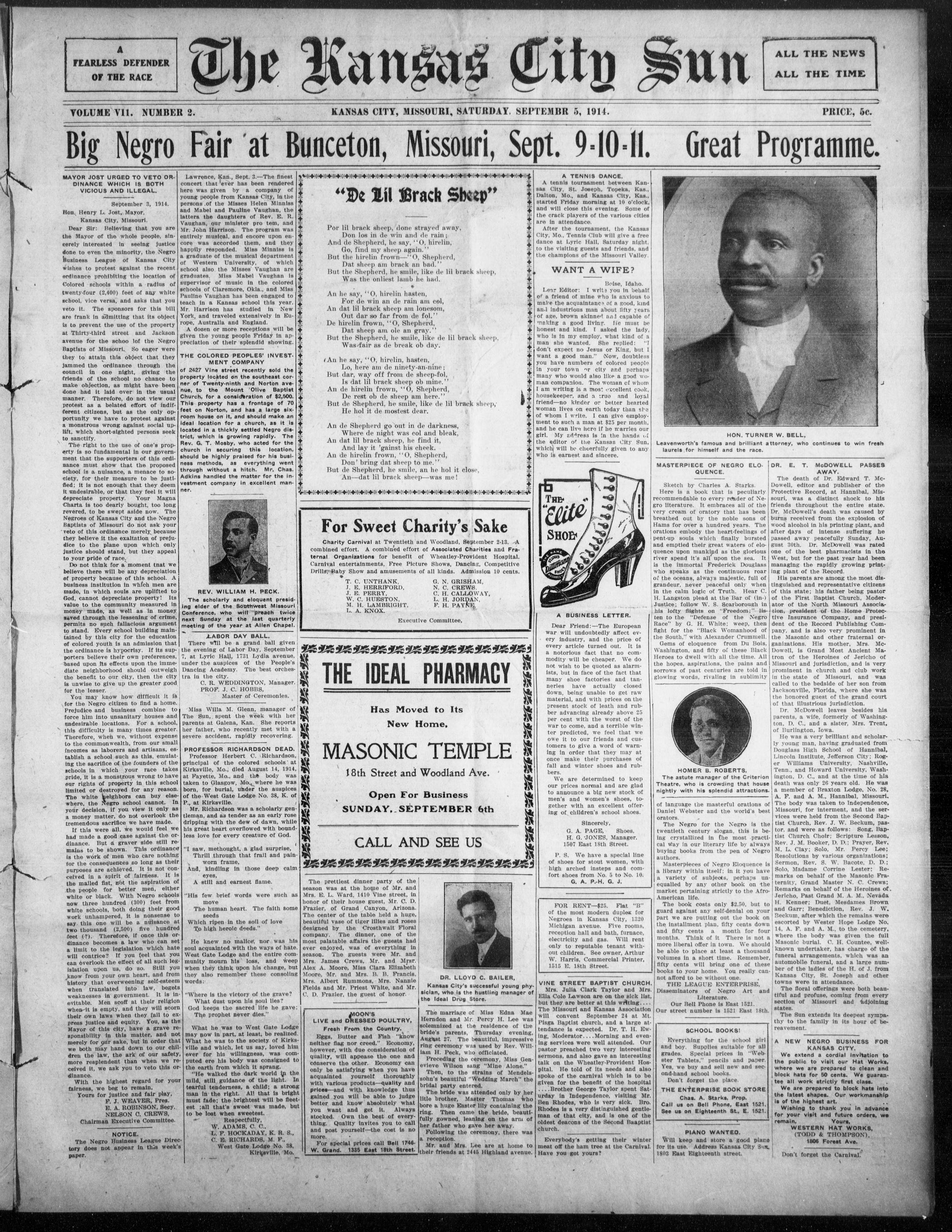
Big Negro Fair at Bunceton, Missouri, Sept. 9-10-11. Great Programme.
A FEARLESS DEFENDER OF THE RACE
VOLUME VI1. NUMBER 2.
MAYOR JOST URGED TO VETO ORDINANCE WHICH IS BOTH
VICIOUS AND ILLEGAL.
September 3, 1914.
Hon. Henry L. Jost, Mayor.
Kansas City, Missouri
Dear Sir: Believing that you are the Mayor of the whole people, sincerely interested in seeing justice done to even the minority, the Negro Business League of Kansas City wishes to protest against the recent ordinance prohibiting the location of Colored schools within a radius of twenty-four (2,400) feet of any white school, vice versa, and asks that you veto it. The sponsors for this bill are frank in admitting that its object is to prevent the use of the property at Thirty-third street and Jackson avenue for the school lof the Negro Baptists of Missouri. So eager were they to attain this object that they jammed the ordinance through the council in one night, giving the friends of the school no chance to make objection, as might have been done it ladd ever in the usual manner. Therefore, do not view our protest as a belated effort of indifferent citizens, but as the only opportunity we have to protest against a monstrous wrong against social uplift, which short-sighted persons seek to sanctify.
The right to the use of one's property is so fundamental in our government that the supporters of this ordinance must show that the proposed school is a nuisance, a menace to society, for their measure to be justified; it is not enough that they deem it undesirable, or that they feel it will depreciate property. Your Magna Charta is too dearly bought, too long revered, to be swept aside now. The Negroes of Kansas City and the Negro Baptists of Missouri do not ask your veto of this ordinance merely because they believe it the exalation of prejudice to the plane upon which only justice should stand, but they appeal to your pride of race.
Do not think for a moment that we believe there will be any depreciation of property because of this school. A business institution in which men are made, in which souls are uplifted to God, cannot depreciate property! Its value to the community measured in money made, as well as in money saved through the lessening of crime, permits no such fallacious argument to stand. Every school building maintained by this city for the education of colored youth is an admission that the ordinance is hypocrisy. If its supporters believe their own preferences, based upon its effects upon the immediate neighborhood should outweigh the benefit to our city, then the city is unwise to give up the greater good for the lesser.
You may know how difficult it is for the Negro citizen to find a home. Prejudice and business combine to force him into unsanitary houses and undesirable locations. For a school, this difficulty is many times greater. Therefore, when we, without expense to the commonwealth, from our small incomes as laborers and artisans, establish a school such as this, emulate the sacrifice of the founders of the schools in which your race takes pride, it is a monstrous wrong to have our rights of property in this school limited or destroyed for any reason. The white neighbors can buy elsewhere, the Negro school cannot. In your decision, if you view it only as a money matter, do not overlook the tremendous sacrifice we have made.
If this were all, we would feel we had made a good case against the ordinance. But a graver side still remains to be shown. This ordinance is the work of men who care nothing for the consequences so long as their purposes are achieved. It is not conceived in a spirit of fairness. It is the mailed fast, not the aspiration of the people for better men, either white or black. With Negro schools now three hundred (300) feet from white schools, both doing their good work unhampered, it is nonsense to say this one will be a nuisance at two thousand (2,500) five hundred feet (?). Therefore, if once this ordinance becomes a law who can set a limit to the legislation which hate will contrice? If you feel that you can overlook the effect of all such legislation upon us, do so. Still you know from your own heart, and from history that overweening self-esteem when translated into law, begets weaknesses in government. It is inevitable. Men scoff at their religion when it is empty, and they will scorn their own laws when they fall to express justice and equity. You, as the Mayor of this city, have a grave responsibility in this matter, and not merely for our sake, but in order that we both may hand down to our children the law, the ark of our safety, more resplendent than when we received it, we ask you to veto this ordinance.
With the highest regard for your fairness, we beg to remain.
Yours for justice and fair play,
F. J. WEAVER, Pres.
E. A. ROBINSON, Secy.
NELSON C. CREWS,
Chairman Executive Committee.
NOTICE.
The Negro Business League Directory does not appear in this week's paper.
The Kansas City Sun
Lawrence, Kan., Sept. 3.—The finest concert that ever has been rendered here was given by a company of young people from Kansas City, in the persons of the Misses Helen Minniss and Mabel and Pauline Vaughan, the latters the daughters of Rev. E. R. Vaughan, our minister pro tem, and Mr. John Harrison. The program was entirely musical, and encore upon encore was accorded them, and they happily responded. Miss Minniss is a graduate of the musical department of Western University, of which school also the Misses Vaughan are graduates. Miss Mabel Vaughan is supervisor of music in the colored schools of Claremore, Okla., and Miss Pauline Vaughan has been engaged to teach in a Kansas school this year. Mr. Harrison has studied in New York, and traveled extensively in Europe, Australia and England. A dozen or more receptions will be given the young people Friday in appreciation of their splendid showing.
THE COLORED PEOPLE'S INVEST
MENT COMPANY
of 2427 Vine street recently sold the property located on the southeast corner of Twenty-ninth and Norton avenue, to the Mount 'Olive Baptist Church, for a consideration of $2,500. This property has a frontage of 70 feet on Norton, and has a large six-room house on it, and should make an ideal location for a church, as it is located in a thickly settled Negro district, which is growing rapidly. The Rev. G. T. Mosby, who acted for the church in securing this location, should be highly praised for his business methods, as everything went through without a hitch. Mr. Chas. Adkins handled the matter for the investment company in excellent manner.
The scholarly and eloquent presiding elder of the Southwest Missouri Conference, who will preach twice next Sunday at the last quarterly meeting of the year at Allen Chapel.
LABOR DAY BALL
There will be a grand ball given the evening of Labor Day, September 7, at Lyric Hall, 1731 Lydia avenue, under the auspices of the People's Dancing Academy. The best orchestra in the city. C. R. WEDDINGTON, Manager. PROF. C. HOBBS.
Miss Willa M. Glenn, manager of The Sun, spent the week with her parents at Galena, Kan. She reports her father, who recently met with a severe accident, rapidly recovering.
PROFESSOR RICHARDSON DEAD.
Professor Herbert C. Richardson, principal of the colored schools at Kirksville, Mo., died August 14, 1914, at Payette, Mo., and the body was taken to Glasgow, Mo., where he was born, for burial, under the auspices of the West Gate Lodge No. 38, K. of P., at Kirksville.
Mr. Richardson was a scholarly gentleman, and as tender as an early rose dripping with the dew of dawn, while his great heart overflowed with boundless love for every creature of God.
"I saw, methought, a glad surprise, Thrill through that frall and pain-worn frame,
And, kindling in those deep calm eyes,
A still and earnest flame.
"His few brief words were such as move
The human heart. The faith some seeds
Which ripen in the soil of love
To high heroic deeds."
He knew no malice, nor was his soul acquainted with the ways of hate. West Gate Lodge and the entire community mourn his loss, and weep when they think upon his change, but they also remember these consoling words:
"Where is the victory of the grave?
What dust upon his soul lies?"
What dust upon his soul hes:
God keeps the sacred life he gave;
The prophet never dies."
What he was to West Gate Lodge
may now in part, at least, be realized.
What he was to the society of Kirk-
ville and which, let us say, loved him
ever for his willingness, was computed ere his body was consigned to
the earth from which it sprang.
"He walked the dark world in the
mild, still guidance of the light. In tearful tenderness, a child; a strong man in the right. All that is bright
must fade; the brightest will be feet
est; all that's sweet was made, but
to be lost when sweetest.
Respectfully,
W. ADAMS, C. C.
L. F. HOCKADAY, K. R. S.
C. E. RICHARDS, M. F.
West Gate Lodge No. 38,
Kirkville, Mo.
KANSAS CITY, MISSOURI, SATURDAY. SEPTEMBR 5, 1914.
"De Lil Brack Sheep"
Por lil brack sheep, done strayed away,
Don los in de win and de rain;
And de Shepherd, he say, "O, hirelin,
Go, find my sheep again."
But the hirelin frown—"O, Shepherd,
Dat sheep am brack an bad."
But the Shepherd, he smile, like de lil brack sheep,
Was the onliest lamb he had.
An he say, "O, hirelin hasten,
For de win an de rain am col,
An dat lil brack sheep am lonesom,
Out dar so far from de fol."
De hirelin frown, "O, Shepherd,
Dat sheep am ole an gray."
But the Shepherd, he smile, like de lil brack sheep,
Was fair as de break ob day.
An he say, "O, hirelin, hasten,
Lo, here am de ninety-an-nine;
But dar, way off from de sheep-fol,
Is dat lil brack sheep ob mine."
An de hirelin frown, "O, Shepherd,
De rest ob de sheep am here."
But de Shepherd, he smile, like de lil brack sheep,
He hol it de mostest dear.
```markdown
```
For Sweet Charity's Sake
For Sweet Charity's Sake
Charity Carnival at Twentieth and Woodland, September 2-13. A combined effort. A combined effort of Associated Charities and Fraternal Organizations for benefit of Wheatley-Provident Hospital. Carnival entertainments, Free Picture Shows, Dancing, Competitive Drills, Baby Show and amusements of all kinds. Admission 10 cents.
T. C. UNTHANK, G. N. GRISHAM,
J. E. HERRIFORD, N. C. CREWS,
J. E. PERRY, C. H. CALLOWAY,
W. C. HUESTON, L. H. JORDAN,
M. H. LAMBRIGHT, F. H. PAYNE,
L. A. KNOX.
Executive Committee,
THE IDEAL PHARMACY
THE IDEAL PHARMACY
Has Moved to Its New Home. MASONIC TEM
MASONIC TEMPLE
18th Street and Woodland Ave.
Open For Business
SUNDAY. SEPTEMBER 6th
Open For Business SUNDAY, SEPTEMBER 6th
CALL AND SEE US
The prettiest dinner party of the season was at the home of Mr. and Mrs. E. L. Ward, 1419 Vine street, in honor of their house guest, Mr. C. D. Frazier, of Grand Canyon, Arizona. The center of the table held a huge, beautiful vase of tiger lilies and roses designed by the Crosthwait Floral company. The dinner, one of the most palatable affairs the guests had ever enjoyed, was of everything in season. The guests were Mr. and Mrs. James Crews, Mr. and Mrsr. Alex A. Moore, Miss Clara Elizabeth Moore, Mr. and Mrs. B. B. Francis, Mrs. Albert Rummons, Mrs. Nannie Fields and Mr. Priest White, and Mr. C. D. Frazier, the guest of honor.
DR. LLOYD C. BAILER,
Kansas City's successful young physician, who is the hustling manager of
Eggs, Butter and Fish "know neither flag nor creed." Economy, however, with due consideration of quality, will appease the one and conserve the other. Economy can only be satisfying when you have acquainted yourself thoroughly with various products—quality and prices—and with knowledge thus gained you will be able to judge better and know absolutely what you want and get it. Always stocked. Own the best of everything. Quality invites you to call and post yourself—the cost is no more.
For special prices call Bell 1746-W. Grand. 1335 East 18th Street.
N. G. N. GRISHAM,
RD. N. C. CREWS.
C. H. CALLOWAY,
N. L. H. JORDAN.
HT. F. H. PAYNE.
Executive Committee.
DR. LLOYD C. BAILER,
Kansas City's successful young physician, who is the hustling manager of the Ideal Drug Store.
The marriage of Miss Edna Mae Herndon and Mr. Percy H. Lee was solemnized at the residence of the bride's parents, Thursday evening, August 27. The beautiful, impressive ring ceremony was used by Rev. William H. Peck, who officiated.
Preceding the ceremony, Miss Genevieve Wilson sang "Mine Alone."
Then, to the strains of Mendelssohn's beautiful "Wedding March" the bridal party entered.
The bride was attended only by her little brother, Master Thomas who bore a huge Easter lily containing the ring. Then came the bride, beautifully gowned, leaning on the arm of her father who gave her away.
Following the ceremony, there was a reception.
Mr. and Mrs. Lee are at home to their friends at 2445 Highland avenue.
A tennis tournament between Kansas City, St. Joseph, Topeka, Kas, Dalton, Mo., and Kansas City, Kas, started Friday morning at 10 o'clock, and will close this evening. Some of the crack players of the various cities are in attendance.
After the tournament, the Kansas City, Mo. Tennis Club will give a free dance at Lyric Hall, Saturday night, to the visiting guests and friends, and the champions of the Missouri Valley.
WANT A WIFE?
Boise, Idaho.
Lear Editor: I write you in behalf of a friend of mine who is anxious to make the acquaintance of a good, kind and industrious man about fifty years of age, brown skinned and capable of making a good living. He must be honest and kind. I asked the lady, who is in my employ, what kind of a man she wanted. She replied: "I don't expect no Jesus or King, but I want a good man." Now, doubtless you have numbers of colored people in your town or city and perhaps many who would also like a good woman companion. The woman of whom I am writing is a most excellent cook, housekeeper, and a true and loyal friend—no kinder or better hearted woman lives on earth today than she of whom I write. I can give employment to such a man at $25 per month, and he can live here if he marries our girl. My address is in the hands of the editor of the Kansas City Sun, which will be cheerfully given to any who is earnest and sincere.
THE
"Elite"
SHOE
THE NAME
ALBUMS
DIMMANG
SHOES
ASSUMED
A BUSINESS LETTER.
Dear Friend:—The European war will undoubtedly affect every industry, and the price of every article turned out. It is a notorious fact that no commodity will be cheaper. We do not wish to be quoted as alarmists, but in face of the fact that many shoe factories and tanneries have actually closed down, being unable to get raw material, and with prices on the present stock of leath and rubber advancing already above 25 per cent with the worst of the war to come, and a terrible winter predicted, we feel that we owe it to our friends and customers to give a word of warning in order that they may at once make their purchases of fall and winter shoes and rubbers.
We are determined to keep our prices normal and are glad to announce a big new stock of men's and women's shoes, together with an excellent offering of children's school shoes.
Sincerely.
G. A. PAGE, Shoes.
H. G. JONES, Manager.
1507 East 18th Street.
P. S. We have a special line of
of shoes for stout women, with
high arched insteps and comfort
shoes from No. 5 to No. 10.
G. A. P. H. G. J.
FOR RENT—$25. Flat "B" of the most modern duplex for Negroes in Kansas City, 1320 Michigan avenue. Five rooms, reception hall and bath, furnace, electricity and gas. Will rent only to reputable tenant without children. See owner, Arthur W. Harris, Commercial Printer, 1515 E. 18th Street.
VINE STREET BAPTIST CHURCH.
Mrs. Julia Clark Taylor and Mrs. Ella Cole Lawson are on the sick list, but they are better at this writing.... The Missouri and Kansas Association will convent September 24 at Mt. Pisga Baptist church, and a large attendance is expected. Dr. T. H. Ewing, Moderator.... Morning and evening services were well attended. Our pastor preached two very interesting sermons, and also gave an interesting talk on the Wheatley-Provident Hospital. He told of its needs and also spoke of the carnival which is to be given for the benefit of the hospital.... Brother George Taylor spent Saturday in Independence, visiting Mr. Ben Rhodes, who is very sick. Bro. Rhodes is a very distinguished gentleman of that city, and is one of the oldest deacons of the Second Baptist church.
Everybody's getting their winter meat off the ham tree at the Carnival. Have you got yours?
HON. TURNER W. BELL.
Leavenworth's famous and brilliant attorney, who continues to win fresh laurels for himself and the race.
MASTERPIECE OF NEGRO ELOQUENCE.
Sketch by Charles A. Starks.
Here is a book that is peculiarly recommendable to every reader of Negro literature. It embraces all of the very cream of oratory that has been breathed out by the noble sons of Hams for over a hundred years. The orations embody the heart-feelings of pent-up souls which finally bursted and emptied their great waters of eloquence upon mankind as the glorious river spend it all upon the sea. It is the immortal Frederick Douglass who speaks as the continuous roar of the oceans, always majestic, full of grandeur, never peaceful only when in the calm logic of Truth. Hear C. H. Langston plead at the Bar of (in-)Justice; follow W. S. Scarborough in his lofty flights on "Freedom;" listen to the "Defense of the Negro Race" by G. H. White; weep, then fight for the "Black Womanhood of the South" with Alexander Crummell. Gems of eloquence from Du Bois, Washington, and fifty of these Black Heroes to dwell with all the time. All the hopes, aspirations, the pains and sorrows of past centuries are told in glowing words, rivaling in sublimity
DR. E. T. McDOWELL PASSES AWAY.
The death of Dr. Edward T. McDowell, editor and publisher of the Protective Record, at Hannibal, Missouri, was a distinct shock to his friends throughout the entire state. Dr. McDowell's death was caused by burns received from the explosion of wood alcohol in his printing plant, and after days of intense suffering he passed away peacefully Sunday, August 30th. Dr. McDowell was rated one of the best pharmacists in the West, but for the past year had been managing the rapidly growing printing plant of the Record.
His parents are among the most distinguished and representative citizens of this state; his father being pastor of the First Baptist Church, Moderator of the North Missouri Association, president of the Home Protective Insurance Company, and presi dent of the Record Publishing Company, and is also very prominent in the Masonic and other fraternal or organizations. His mother, Mrs. McDowell, is Grand Most Ancient Master of the Heroines of Jericho of Missouri and jurisdiction, and is very prominent in church and club work in the state of Missouri, and was
A. B.
HOMER B. ROBERTS.
The astute manager of the Criterion Theatre, who is crowding that house nightly with his splendid attractions.
of language the masterful orations of Daniel Webster and the world's best orators.
The Negro for the Negro is the twentieth century slogan, this is being crystallized in the most practical way in our literary life by always buying books from the pen of Negro authors.
Masterpieces of Negro Eloquence is a library within itself; in it you have a variety of subjects, perhaps unequalled by any other book on the market pertaining strictly to the Afro-American Life.
The book costs only $2.50, but to guard against any self-denial on your part we are putting out the book on the installment plan, fifty cents down and fifty cents a month for four months. Think of it. There is not a more liberal offer in town. We should be able to place at least a thousand volumes in a short time. Remember, fifty cents will bring one of these books to your home. You really cannot afford to be without one.
THE LEAGUE ENTERPRISE, Disseminators of Negro Art and Literature.
Our Bell Phone is East 1521. Our street number is 1521 East 18th.
Everything for the school girl and boy. Supplies suitable for all grades. Special prices in "Webster Tablets," pencils and paper. Yes, we buy and sell new and second-hand school books.
Don't forget the place.
THE ENTERPRISE BOOK STORE
Chas, A. Starks, Prop.
Call us on Bell Phone, East 1521.
See us on Eighteenth St. E, E. 1521.
Will keep and store a good piano for its use. Address Kansas City Sun, 1802 East Eighteenth street.
SCHOOL BOOKS!
PIANO WANTED
ALL THE NEWS ALL THE TIME
Programme.
DR. E. T. McDOWELL PASSES AWAY.
The death of Dr. Edward T. McDowell, editor and publisher of the Protective Record, at Hannibal, Missouri, was a distinct shock to his friends throughout the entire state. Dr. McDowell's death was caused by burns received from the explosion of wood alcohol in his printing plant, and after days of intense suffering he passed away peacefully Sunday, August 30th. Dr. McDowell was rated one of the best pharmacists in the West, but for the past year had been managing the rapidly growing printing plant of the Record.
His parents are among the most distinguished and representative citizens of this state; his father being pastor of the First Baptist Church, Moderator of the North Missouri Association, president of the Home Protective Insurance Company, and president of the Record Publishing Company, and is also very prominent in the Masonic and other fraternal organizations. His mother, Mrs. McDowell, is Grand Most Ancient Matron of the Heroines of Jericho of Missouri and jurisdiction, and is very prominent in church and club work in the state of Missouri, and was called to the bedside of her son from Jacksonville, Florida, where she was the honored guest of the grand court of that illustrious jurisdiction.
Dr. McDowell leaves besides his parents, a wife, formerly of Washington, D. C., and a sister, Mrs. Trent, of Burlington, Iowa.
He was a very brilliant and scholarly young man, having graduated from Douglass High School of Hannibal, Lincoln Institute, Jefferson City; Roger Williams University, Nashville, Tenn, and Howard University, Washington, D. C., and at the time of his death was only 26 years old. He was a member of Braxton Lodge, No. 28, A. F, and A. M, Hannibal, Missouri. The body was taken to Independence, Missouri, for interment, and the services were held from the Second Baptist Church, Rev. J. W. Beckum, pastor, and were as follows: Song, Baptist Church Choir; Scripture Lesson, Rev. J. M. Booker, D. D.; Prayer, Rev. M. L. Clay; Solo, Mr. Percy Lee; Resolutions by various organizations; Sermon, Rev. S. W. Bacote, D. D.; Solo, Madame Corrine Lester; Remarks on behalf of the Masonic Fraternity, Grand Master N. C. Crews; Remarks on behalf of the Heroines of Jericho, Past Grand M. A. M. Nevada H. Kenner; Duet, Mesdames Brown and Garr; Benediction, Rev. J. W, Beckum, after which the remains were escorted by Wester Hodge Lodge No. 14, A. F. and A. M., to the cemetery, where the body was given the full Masonic burial. C. H. Countee, well-known undertaker, has charge of the funeral arrangements, which was an automobile funeral, and a large number of the ladies of the H. of J. from Kansas City, St. Joseph and other towns were in attendance.
The floral offerings were both beautiful and profuse, coming from every section of Missouri and adjoining states. The Sun extends its deepest sympathy to the family in its hour of bereavement.
A NEW NEGRO BUSINESS FOR KANSAS CITY.
We extend a cordial invitation to the public to visit our Hat Works, where we are prepared to clean and block hats for 50 cents. We guarantee all work strictly first class. We are prepared to block hats into the latest shapes. Our workmanship is of the highest art. Wishing to thank you in advance for your visit and future orders, we remain. Yours.
Don't forget the Carnival.
PRICE, 5c.
By E. G. SELLERS, Director of Evening Department, The Moody Bible Institute, Chicago.).
LESSON FOR SEPTEMBER 6
THE GREAT COMMANDMENTS.
LESSON TEXT-Mark 12:28-44
GOLDEN TEXT-"Thou shalt love the Lord thy God with all thy heart, and with all thy soul, and with all thy strength, and with all thy mind; and thy neighbor as selfthy." Luke 10:27.
This lesson considers a third question asked of our Lord; two others in this connection we studied last week. It was not so much a question of placing one commandment in competition with another, but rather which commandment most clearly epitomizes or reveals the final principle in law. It was the business of this scribe to know the law and to interpret the commandments. Jesus in his reply quotes from Deut. 5:4; and from Lev. 19:18, which are both in a sense an exposition of the Deca logue.
Love the Basis.
1. The answer of Jesus, vv. 28-34. The scribe's question seemed to be quite specific and so the Lord strikes at once at the heart and by his quotation reveals to us the fact that the principle which is the inspiration of the law is that of love. In passing we have here another illustration of the master's ready use and knowledge of the Scripture. Jesus makes a four-fold summary. Man must love God with (a) the heart, e. g., in sincerity and uprightness; (b) with the soul, with the warmth of the emotions, and the feelings; (c) "with all thy mind." the intellect, not as a blind devotee; (d) with "strength." vlz., with intensity of service, with energy. "To love God with all the heart and soul and mind and strength is to have supreme desire for and delight in God's glory, making everything else second to that." This statement is but half, for the complement of our love of God is to love man. Man created in God's image was "so loved" by God that he gave his son (John 3:18); man can do not less and must express that love in service to others. To fail in the first is to break the greatest of the commandments and therefore to be guilty of all, Rom. 3:22. Notice the god first is not man then God, but God first. First in business, in social life, in pleasure, in everything, and not to do so is sin. The similarity of these two is in that the same principle of love governs in both cases. From I John 4:20, 21, it would seem that the second is really involved in the first. If we love God whom we have not seen we must love men whom we have soon and who are made in the image and likeness of God. This scribe readily saw that spiritual worship is the very essence of the answer of Christ. This is also the teaching of the Old Testament, see I Samuel 15:22. Church going, psalm singing, saying prayers, or even reading the Bible are not a substitute for love, either to God or man. We are justified in God's sight by our faith but in the sight of man by our works. Many who profess to be Christians do not seem to manifest as clear a moral and spiritual discernment as this scribe for they place a greater emphasis upon doing rather than being, upon works rather than upon service. Worship and service must go hand in hand. As this scribe recognized this truth he confessed his recognition with candor and earnestness.
Human and Deity.
11. The question of Jesus, vv. 35-37. Our Lord's question in return was a Messianic one and he grounds his argument on the 110th Psalm, a Messianic one. Jesus is inferior to David as his son according to the flesh but superior to him as lord of the kingdom of which David himself is a subject and not the sovereign. Christ is both human and deity; his kingdom is spiritual and earthly sovereigns are honored if they are his subjects.
III. The teaching of Jesus, vv. 38-40. The word "doctrine" in verse 38 is translated "teaching" in the revision. These words of warning are full of solemn significance. The scribes, and they have theirimitators today, sought the places of preferment, the seats of honor in the synagogue and the chief places at the feasts. The motive that governed them was a selfish one. They devoured widows' houses, and sought to cover their covetousness and dishonesty by long prayers and a pretense of plenty. This brought upon them the "greater condemnation." Matt. 24:51 Law and love is here again in contrast. Law must become life.
IV. The view of Jesus, vv. 41-44.
Jesus had one look of love and compassion for his friends and the needy and another that was exceedingly terrible for his enemies. Thus it was as a master teacher that he saw right at hand as illustration for his lesson, an application of the truth in the case of the widow who gave out of her penury and because of her love for God, supporting these carping, selfish scribes. She had two mites (about fourth-fifths of a cent) and might have withheld one except that the rabbis forbade the offering of a single one. Her love, however, went beyond the "tenth" and she gave "all," therefore in proportion to their means she "cast more than they all," see II Cor. 8:12. Offerings are needed still for the Lord's work. Jesus is "over against the treasure" and "sees" who it is that "casts in" how much they cast and the motive behind the gift. The master's standard of a commendable offering is not according to our superfluity, but our deficiency, not what will be missed but what of sacrifice and in proportion thereto. Not to please man, but God. Read II Cor. 8:1-8. Our Lord's valuation of gifts past into the treasury remains for all time the true standard of measure.
AFRO-AMERICAN CULLINGS
Since the Southern Baptist convention adjourned, the joint committees of the Southern Baptist convention and the National Baptist convention have held two meetings, both at Memphis, Tenn. Of these meetings, Dr. T. J. Searcy, of the Metropolitan Baptist church, and representing the committee of the National Baptist convention, has been the chairman; and Dr. O. L. Halley of Corsicana, Tex., representing the Southern Baptist convention, has been secretary. Our last session was held on July 8. There were present from the Southern Baptist convention committee: Dr. E. Y. Mullins, Dr. O. L. Halley, Dr. B. F. Riley, Dr. B. Cox and Hon. W. E. Atkinson.
From the National Baptist convention there were present of their committee: Dr. T. J. Searcy, the chairman; Dr. E. C. Morris, president of the convention; Dr. Sutton E. Griggs, the corresponding secretary of their educational board; Dr. J. H. Henderson and Dr. J. D. Grenshaw. Wm Haynes held proxy for Dr. E. J. Fish, er E. C. Morris for Booker T. Washington and S. E. Griggs for J. W Bailey. So we had a good representation from both conventions.
Memphis, Nashville, New Orleans and Little Rock were represented in applications for the location of the negro theological seminary. New Orleans was not directly ask for it, but honored brethren who are interested presented a request that we consider it. Little Rock would have made a more definite offer, perhaps, if other cities had not been specially named. Louisville and Birmingham had no specific propositions. Both Nashville and Memphis made good offers, and through their representatives indicated their several advantages. Dr. Rufus W. Weaver came to speak for Nashville, and Dr. T. O. Fuller for Memphis. Other brethren freely discussed the two places and their several strong features. The committee sought carefully to give each place proper consideration.
But we unanimously decided in favor of Memphis, Tenn. They had made an offer which was in matter of financial inducements, the equal of Nashville. The principle upon which we decided to locate the seminary, "Where it could do the greatest good to the largest number," led the committee to decide in favor of Memphis.
Then the committee from the Southern Baptist convention, to whom was committed the whole question of raising the $50,000 for the seminary, decided to ask Dr. B. F. Riley of Birmingham, Ala., to do that. And he has agreed to undertake the matter. We authorize him to fix the amount at $60,000 so as to cover the whole expense of raising the money, and provide for any failure on the part of subscribers. Dr. Riley will acquaint the denomination with his plans. And we earnestly bespeak the most cordial response and hearty co-operation in the undertaking.
E. Y. MULLINS, Chairman.
O. L. HAILEY, Secretary.
For the Southern Baptist convention committee.
Old rules still obtain in the British navy, among them that which forbids the health of the king to be drunk aboard ship while standing up. They always drink the health of the king sitting in the British navy and are very proud of the difference between them and their comrades of the land service.
Throughout their course at Hampton institute, negro and Indian girls are taught the elements of arithmetic, English, agriculture, history, as well as scientific housekeeping, physiology, cooking and sewing, and the principles of teaching.
Almost eight thousand young men and women, including 1,200 Indians, have already gone from Hampton Institute into the South and West, equipped in body, mind and heart to help their races get land, build better homes, schools and churches, and improve social and economic conditions. Many of the Hampton students have literally reconstructed in many places the existing community life and have brought prosperity to men and women by helping them increase their earning power, and showing them how to use to the best advantage the resources at their doors. For 45 years under the efficient leadership of Gen. Sampel C. Armstrong and Dr. Hollis B. Frissell, Hampton Institute has been training boys and girls for safe and safe leadership in business, in home-making, in improving church, home and school life throughout the South and West.
A shipbuilding slip is maintained in connection with the high school in San Pedro, Cal., where, under the practical instruction of a nautical architect, the students learn how to build a boat, make and place the engine and launch and run the craft.
W. F. Passett, who has done more than any other man to make the dahlia one of New Jersey's most extensive and profitable crops, has been raising this flower for more than seventy years. He is now eighty-eight years old
Dangerous Hiccoughs.
Dangerous Hiccups.
Two unusual cases of suffering through hiccups are reported. In one, a man had an attack of hiccups which lasted for nine days before he obtained relief. A little girl had a much worse attack, which lasted between three and four months, and was the result of a fright. Doctors had been unable to end the paroxysms, and many times it was thought the child would die. She had wasted away alarmingly, and hope for her recovery was abandoned.
LABOR
BENEFITS OF UNION
Protective and Fraternal In Their
Scope, They Are of Inestimable
Worth to Every Man Who Has
the honor to Be At
T
There is no law limiting the scope of trade unions," says the article, "neither is there any artificial barrier to check their usefulness, growth and development. The scope of a trade union, as constituted at present, embraces many valuable features.
"It is a protective organization. It raises wages and prevents reduction; it equitizes wages for equal work performed; it endeavors to secure a living to all; it establishes a minimum wage for common work; it restricts cut-throat and unfair competition.
"It is a fraternal association. It sympathizes with the sick and the afflicted and the unemployed by the payment of stipulated benefits; in cases of distress the help is of a substantial nature.
"It is an insurance society. The operative insurance in cases of death and total disability is superior and
10
George W. Perkins.
President International Cigarmakers'
Union.
less costly than the rates charged by the ordinary insurance company; it is mutual, safe and economical.
"It is a savings bank. The trade union enables the worker to deposit weekly small sums of money in the shape of dues and assessments, which are returned to him when most needed.
"It is a legislative body. It plans, adopts and amends a constitution and by-laws without any interference and advice from outside parties. There is no conflict of interest of any appre-able extent; local differences can be adjusted in the interest of the general welfare, viewed from a broad standpoint.
"It is a direct legislative league. The initiative and the referendum, which are the cardinal features in the structure of the constitution, enable a small number of unions to propose amendments and substitutes. They are submitted to a referendum vote,
"The ballot is placed in the hands of an American citizen for the protection of his rights, and the negro as a citizen must contend for everything that is given him, but he will find that he has many friends," were the words of Prof. William Pickens, in addressing the national convention of Congregational church workers at Washington. The convention opened with song and prayer service and a short talk by President A. Lawless, Jr., of New Orleans. A short business session was held, in which the amended constitution and by-laws were adopted. Rev. H. H. Dunn of New Orleans, La., followed with a discussion on "Superintendency." He called attention to the growing work in the southern states, and declared that it was necessary to have a competent and well-prepared man to superintend it.
Judge Robert Terrell addressed the convention and called attention to the necessity of the negro turning attention to his own interest in this country.
At the close of his address Rev. Dr. Garner of Plymouth Congregational church introduced a resolution, which passed, appointing a committee consisting of Revs. De Berry of Springfield, Mass.; H. H. Proctor of Atlanta, Ga., and Eugene Lawrence of Chicago, to draft a memorial to the senate asking for the confirmation of Judge Terrell.
Revs. B. F. Watson, secretary of the Church Extension society of the A. M. E. church, and I. N. Ross, pastor of Metropolitan A. M. E. church, Washington, made short addresses, as did Prof. T. S. Inborden, Brick Normal and Industrial college, Enfield, N. C.; Zeph P. Moore, Washington; J. C. Napier, Nashville, Tenn.; F. F. Sims, Beaufort, N. C.; A. C. Garner, Washington; George W. Moore, Nashville, Tenn.; Harold M. Kingsley, secretary college extension department, Austin, Tex.
It was decided to hold biennial sessions in the future.
Liberia, its aims and prospects were toasted at a banquet given at New York in honor of Hon. John Lewis Morris, secretary of the treasury for Liberia. The function was arranged by a committee of prominent colored citizens, headed by Rev. Dr. W. H. Brooks, and was given in St. Mark's Methodist Episcopal church.
The affair was largely attended. Dr. Booker T. Washington, who has shown a deep interest in the welfare of the little West African republic, was unable to be present and sent a letter of regret.
Charles W. Anderson, collector of internal revenue for the Wall street district, was toastmaster. Among those who responded to toasts were Fred R. Moore, editor of the New York Age and former American minister to Liberia; Dr. Ernest Lyon of Baltimore, the Liberian consul general to the United States; Dr. John H. Reed, principal of the Caroline Donovan institute, Liberia, and Rev. Dr. Brooks.
Secretary Morris, in responding to the many good things said about his country, praised the colored people for the progress they are making and declared that he was grateful for the way in which he had been received here.
Large deposits of radium ore have been discovered in the Ferghana district of Russian Turkestan.
Three hundred men and women attended the eighth annual session of the Grand Lodge of Modern Wood Chopers, at Houston, Tex.
"If the negro would climb, or mount to anything, he must help himself," declared the sovereign commander, Prof. W. E. Johnson of Bonham, "and he must not expect others to do for him what he should do for himself. We are opposed to idlers, grumblers, fault-finders, but we are holding up the men who are willing to do something and who will do something; all others must get out of the way.
"We have here today men and women who are not ashamed to work. Men and women who stand for Christian manhood and womanhood, and those who believe in the possibilities of the South. We are willing that we should go to the farm if we can only find protection of life and property there, and good schools for the education of our children. We are no longer willing to permit our children to grow up in ignorance."
Of the seventeen serious accidents to submarines in the last ten years 11 have occurred to British vessels.
The meteorological service of Russia finds itself in the position, rare in the experience of European scientific institutions, of having ample funds for its present needs and future development, thanks to a liberal increase in its budget recently authorized by the government.
The mileage of railways operated in India was 32,520 in 1912 and 33,509 in 1913, showing an increase of 989 miles.
The public service of France utilizes 155,028 women in various capacities.
But a short time ago she had a violent attack of coughing. Her mother gave her cold tea and lemon. The coughing stopped. Everybody waited anxiously expecting the hiccoughing to return. But it did not.
The Reason He Does Not.
"I am quite sure that I can stop drinking when I have had enough."
"But you never seem to do it."
"I know it. You see, the trouble is that when I have had enough I don't know it."
LIKE the man who faces what he must
With step triumphant and a heart of cheer;
Who fights the daily battle without fear;
Sees his hopes fail, yet keeps unfaltering trust
That God is God,—that somehow, true and just
His plans work out for mortals; not a tear
Is shed when fortune, which the world holds dear,
Falls from his grasp—better, with love, a crust
Than living in dishonor; envies not,
Nor loses faith in man; but does his best,
Nor ever murmurs at his humbler lot;
But, with a smile and words of hope, gives zest
To every toller. He alone is great
Who by a life heroic conquests fate.
HE different benefits which are presented to the members of labor unions were admirably set forth a short time ago in an article printed in the Cigarmakers Journal.
with or without any discussion, as the case may be, and approved or rejected. This form of legislation is simple, direct and effective.
"It is a school of economics. The Manchester school of political economy, from Adam Smith to the present day, has evolved a school of doctrines and critics of all shades and colors. Numerous books have been issued on the functions of capital, the value of labor, the rate of wages and profits, the laws of supply and demand, of exchange, finance, etc. The trade union has, in the attempt to improve the condition of the workers, exposed their economic fallacies. It is developing a new school, based on facts and scientific investigation.
"It is a debating club. The business of the union, be it of routine character, or of a more complicated nature, requires discussion and deliberation. Points of order are raised which require careful decision. Parliamentary skill is brought into play; the natural abilities of the members as debaters are brought into constant practice. The progress made in this direction, in the course of years, is of vital influence in the affairs of the nation.
"It is a trial court. The rules of the union require, for the management of its affairs, the enforcement of discipline and obedience to the laws enacted by the majority. Punishment as a deterrent, in the shape of fines, suspension and expulsion from membership, forms a part of the laws. The right of trial and defense is afforded to every member, with the right of appeal to the higher court."
"It is an industrial democracy. The object of the trade union is primarily industrial. It aims to elevate the economic conditions which affect the welfare of the workers on a higher standard of usefulness and efficiency. The idea of equity is based on a full measure of justice, compatible with the general welfare. From these points it cannot depart without destroying the foundation" on which its structure is reared."
THE wholesome ideals of the workers, whose day is celebrated this September 7, are leavening all human society. It is admitted that there must be a fair wage for a fair day's work, but both ends of the maxim are insisted on—that the man who gets a million must work for it, just as the man who gets his two or three or four dollars a day works for it.
Belleve in the Trade Union.
By contrast with the growth in the ranks of the labor unions the entire strength of avowedly revolutionary organizations, in this country, is extremely small. It is evident that the great mass of the wage-workers of America are still wary of movements which have nothing to show that can compare with the services the old-line unions have rendered the men and women who live by the labor of their hands.
Finer instincts Always There.
This is an industrial nation. The pursuits of commerce may sometimes momentarily obscure the finer instincts of our people, but the body of American industry is a fine-grained thing after all. And nowhere does it show to greater advantage than in the relaxations of the first Monday in September.
Dignity of Labor Recognized. The dignity of labor has never required assertion in the United States, for Americans as a class deem labor their heritage. "What does he do?" is the American man's instinctive inquiry about any stranger. If he does nothing he is justly open to suspicion.
LABOR day emphasizes the obligation of service for every man and woman throughout the land.
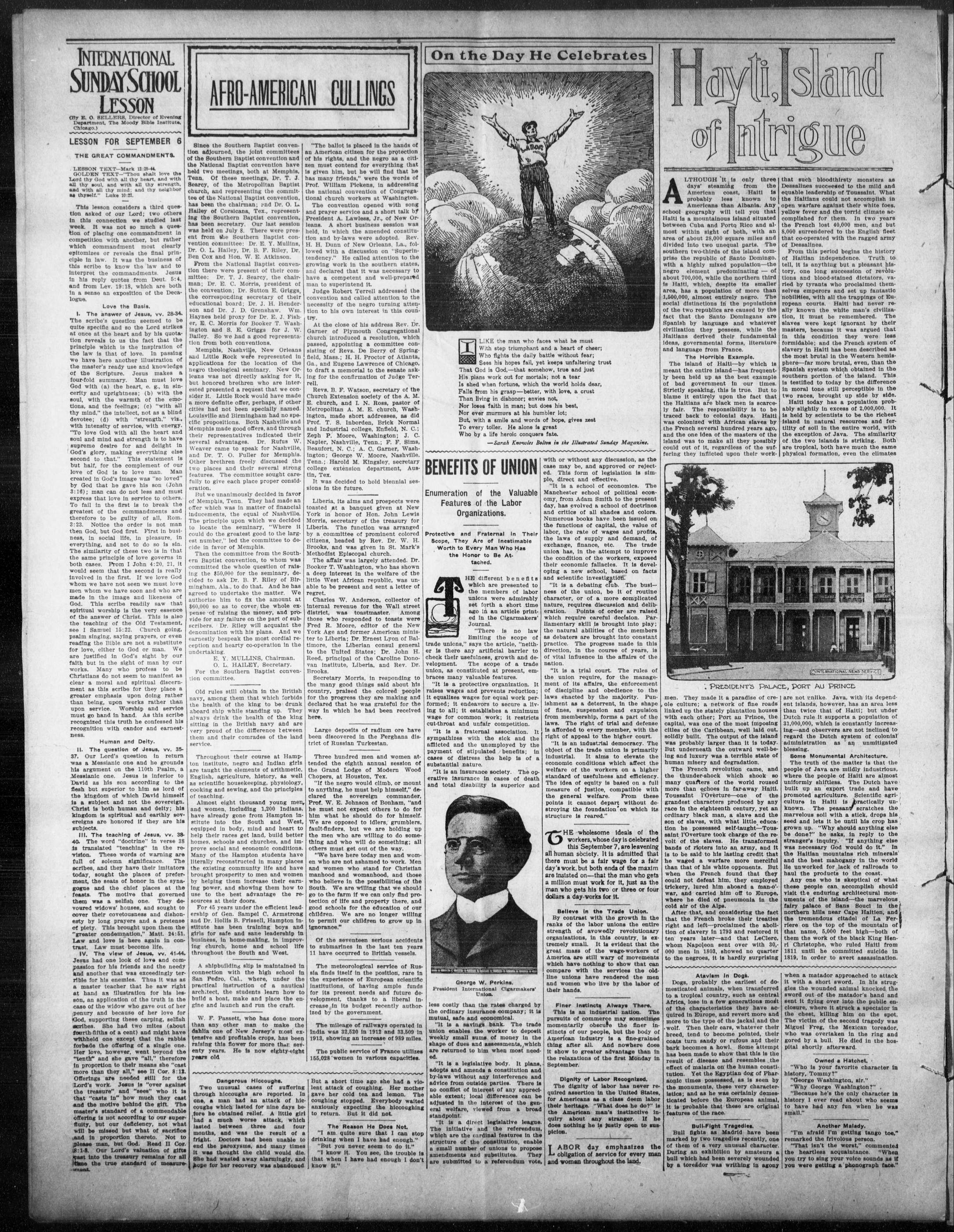
Hayti,Island of Intrigue
INTERNATIONAL NEWS SERVICE
: PRESIDENT'S PALACE, PORT AU PRINCE
Americans than Albania. Any school geography will tell you that Haiti is a mountainous island situated between Cuba and Porto Rico and almost within sight of both, with an area of about 28,000 square miles and divided into two unequal parts. The southern two-thirds of the island comprise the republic of Santo Domingo, with a highly mixed population—the negro element predominating — of about 700,000, while the northern third is Haiti, which, despite its smaller area, has a population of more than 1,500,000, almost entirely negro. The social distinctions in the populations of the two republics are caused by the fact that the Santo Domingans are Spanish by language and whatever civilization they possess, while the Haitians derived their fundamental ideas, governmental forms, literature and language from France.
The island of Haiti—by which is meant the entire island—has frequently been held up as the best example of bad government in our times. Strictly speaking, this is true. But to blame it entirely upon the fact that the Haitians are black men is scarcely fair. The responsibility is to be traced back to colonial days. Haiti was colonized with African slaves by the French several hundred years ago, and the one idea of the masters of the island was to make all they possibly could out of it, regardless of the suffering they inflicted upon their work
PRESIDENT'S PALACE
men. They made it a paradise of creole culture; a network of fine roads linked up the stately plantation houses with each other; Port au Prince, the capital, was one of the most imposing cities of the Caribbean, well laid out, solidly built. The output of the island was probably larger than it is today. But underneath the outward well-being and luxury was a terrible state of human misery and degradation.
The French revolution came, and the thunder-shock which shook so many quarters of the world roused more than echoes in far away Haiti. Toussaint I'Overture—one of the grandest characters produced by any race in the eighteenth century, yet an ordinary black man, a slave and the son of slaves, with what little education he possessed self-taught—Toussaint I'Overture took charge of the revolt of the slaves. He transformed bands of rioters into an army, and it is to be said to his lasting credit that he waged a warfare more merciful than that of his white opponents. But when the French found that they could not defeat him, they employed trickery, lured him aboard a man-o'war, and carried him off to Europe, where he died of pneumonia in the cold air of the Alps.
After that, and considering the fact that the French broke their treaties right and left—proclaimed the abolition of slavery in 1793 and restored it ten years later—and that LeClerc, whom Napoleon sent over with 30,000 men in 1803, showed no quarter to the negroes, it is hardly surprising
Ataylam In Dogs.
Dogs, probably the earliest of domesticated animals, when transferred to a tropical country, such as central Africa, lose in a few generations most of the characteristics they have acquired in Europe, and revert more and more to the type of the jackal and the wolf. Then their ears, whatever their breed, tend to become pointed, their coats turn sandy or rufous and their bark becomes a howl. Some attempt has been made to show that this is the result of disease and resembles the effect of malaria on the human constitution. Yet the Egyptian dog of Pharaonic times possessed, as is seen by the monuments, these very characteristics; and as he was certainly demesticated before the European animal, it is probable that these are original features of the race.
Bull fights as Madrid have been marked by two tragedies recently, one of them of a very unusual character. During an exhibition by amateurs a bull which had been severely wounded by a toreador was writhing in agony
that such bloodthirsty monsters as Dessalines succeeded to the mild and equable leadership of Toussaint. What the Haitians could not accomplish in open warfare against their white foes, yellow fever and the torrid climate accomplished for them. In two years the French lost 40,000 men, and but 8,000 surrendered to the English fleet that co-operated with the ragged army of Dessalines.
From this period begins the history of Haitian independence. Truth to tell, it is anything but a pleasant history, one long succession of revolutions and blood-stained dictators, varied by tyrants who proclaimed themselves emperors and set up fantastic nobilities, with all the trappings of European courts. Haiti had never really known the white man's civilization, it must be remembered. The slaves were kept ignorant by their masters, because it was argued that in this condition they were less formidable; and the French system of slavery in Haiti has been described as the most brutal in the Western hemisphere—far more brutal, even, than the Spanish system which obtained in the southern portion of the island. This is testified to today by the difference in moral tone still perceptible in the two races, brought up side by side.
Haiti today has a population probably slightly in excess of 2,000,000. It is held by scientists to be the richest island in natural resources and fertility of soil in the entire world, with the exception of Java. The similarity of the two islands is striking. Both are tropical, both have much the same physical formation, even the climates
INTERNATIONAL NEWS SERVICE
CE, PORT AU PRINCE
are not unlike. Java, with its dependent islands, however, has an area less than twice that of Haiti; but under Dutch rule it supports a population of 31,000,000, which is constantly increasing—and observers are not inclined to regard the Dutch system of colonial administration as an unmitigated blessing.
Some Monumental Architecture.
The truth of the matter is that the people of Java are mildly industrious, where the people of Haiti are almost uniformly shiftless. The Dutch have built up an export trade and have promoted agriculture. Scientific agriculture in Haiti is practically unknown. The peasant scratches the marvelous soil with a stick, drops his seed and lets it be until his crop has grown up. "Why should anything else be done?" he asks, in reply to the stranger's inquiry. "If anything else was necessary God would do it." In the Haitian mountains rich minerals and the best mahogany in the world lie unworked for lack of railroads to haul the products to the coast.
Any one who is skeptical of what these people can accomplish should visit the enduring architectural monuments of the island—the marvelous fairy palace of Sans Souci in the northern hills near Cape Haïtien, and the tremendous citadel of La Ferriere on the top of the mountain of that name, 5,000 feet high—both of them the work of the black King Henri Christophe, who ruled Haiti from 1811 until he committed suicide in 1819, in order to avert assassination.
when a matador approached to attack it with a short sword. In his struggles the wounded animal knocked the sword out of the matador's hand and sent it flying over into the public enclosure, where it struck a spectator in the chest, killing him on the spot. The victim of the second tragedy was Miguel Freg, the Mexican tooread, who was overtaken in the ring and gored by a bull. He died in the hospital shortly afterward.
Owned a Hatchet
"Who is your favorite character in history, Tommy"
"George Washington, sir."
"Why George Washington?"
"Because he's the only character in history I ever read about who seems to have had any fun when he was small."
Another Malady.
"I'm afraid I'm getting tango toe," remarked the frivolous person.
"That isn't the worst," commented the heartless acquaintance. "When you try to sing your voice sounds as if you were getting a phonograph face."
STATEMENT OF FACTS BY THE BOARD OF MANAGEMENT OF THE WESTERN COLLEGE.
Submitted by Dr. J. H. Garnett, President.
The Board of Managers of the Western College and Industrial Institution located at Macon, Missouri, desires to make the following statement of facts to its friends, concerning its purchase and ownership of the property located at 33rd street and Jackson avenue Kansas City, Mo.
For the past twenty years the college has been located at Macon, Mo., and during its existence there, we are proud to say, has accomplished a great work of education for the ambitious youth of our race. As a result we have men and women in many useful walks of life, and some missionaries in the foreign field. It has been the wish of the managers of the institution for a number of years to locate our college at some place where we could be in close touch with a larger Negro population than it is possible for us to reach at Macon, Mo., and also to locate our school where indigent students might find opportunities of support while endeavoring to educate themselves.
Kansas City appealed to us especially as being the center of the territory from which we draw much of our support, also because of the 30,000 Negroes located in and adjacent to Kansas City. We have investigated several locations in and about Kansas City, and finally the location at 33rd and Jackson was suggested to us by those who posed as our friends, and negotiations were entered into which led up to our purchase of this property at the sum of $25,000. It is a tract of ten acres of land situated at the southwest corner of 33rd street and Jackson avenue, and has located upon it a big stone residence building which can be used for our purpose and other buildings which can be utilized.
We desire to say that this property had never been proposed to us by anyone prior to the beginning of the negotiations which were consummated in our purchase of this property, and we purchased same without any suggestions that there would be any opposition to our location in this district. The property is located, as can be demonstrated, by investigation, in an unimproved territory. At the time we purchased this property, there was not a sidewalk or improved street south of 31st and east of Indiana avenue, with the exception of one sidewalk. Within about three blocks of this location there is now located a colored public school and a settlement of fifty to seventy Negro families. Immediately surrounding the location are a few unpretentious homes occupied by white people, but none of them so expensive that we cannot find ready purchasers for them at their actual worth, among our people.
After looking the situation over we were impressed that this was a place where we could locate with as little opposition from the white people as any place in Kansas City. Without arguing the right or wrong of the matter, we are conscious of course that it would be difficult for us to locate anywhere without arousing some opposition from the white people. But, we are confronted with the all-important fact to us, that we are here and we are entitled to at least an opportunity to make the best of our condition and we ask from the white people their co-operation in securing for us the opportunity of doing what we can for the elevation and betterment of our race.
When it became known that this property was to be used as a site for the Western College, a Negro school, considerable opposition was manifested in the neighborhood by residents and land-owners owning land adjacent to our location. An effort was made to have the Park Board condemn the property for park purposes. This petition was rejected by the Park Board and matters were left to stand in statu quo. When it became manifest that we would not be able to occupy this property without opposition, we at once assured those opposing us that it was not our disposition to intrude ourselves upon any community where we were not wanted, as we realized that our greatest asset was the friendship of the white people, and we were willing to allow our plans to be defeated to suit their desires if the same could be done without absolute ruin to ourselves.
We expressed our willingness to postpone our plans of locating here, and offered to sell the property at exactly what it cost us. That offer has been made all along and stands good today, but no substantial attempt has been made on the part of anyone to purchase our ground.
We submit to the sense of fairness of the white people, that it is not right to ask us to sacrifice the money that we have now invested in this property. We are not able to hold the property in its present unproductive condition, and unless it is disposed of at once, we will be compelled, for our own protection, to take possession of the property and use it for the purpose we had intended.
Before we do this, we desire to place before the white people of Kansas City, who we believe will look with favor upon our efforts to help ourselves and benefit our race, a statement of the facts as we desire that our white friends shall understand fully and completely the facts with reference to this location.
J.C.WAGNER The Clean Market Man
Oysters, Fish and Game in Season.
Fancy Groceries and all Table Luxuries.
Muehlebach's PILSENER BEER
"A HOME PRODUCT"
"A DELICIOUS DRINK"
"A BEER OF PURITY"
Surpassed by None in the Market.
The People's Undertaking Go. Cut Rate Undertakers
Funeral Directors and Licensed Embalmers OUR MOTTO "Do unto others as you would they should do unto you."
When in need of an Undertaker call and get our prices and look over our stock before going elsewhere.
Experlenced and EDWARD JONES,
Practical Licensed E.nalberm. Manager.
THIS Swiftly-Sweeping, Easy-Running DUNTLEY Sweeper cleans without raising dust, and at the same time picks up pins, lint, ravelings, etc., in ONE OPERATION. Its ease makes sweeping a simple task quickly finished. It reaches even the most difficult places, and eliminates the necessity of moving and lifting all heavy furniture. The Great Labor Saver of the Home- Every home, large or small, can enjoy relief from Broom drudgery and protection from the danger of flying dust.
```markdown
```
Hello, Neighbor!
Do You Read The Sun?
Do you know you can get it for ONE YEAR for ONE DOLLAR AND FIFTY CENTS. Sent anywhere in the United States.
ORDER NOW! OUR PHONE IS BELL EAST 999.
1803 East 18th Street. NELSON C. CREWS, Editor and Owner.
Duntley is the Pioneer of Pneumatic Sweepers—Has the combination of the Pneumatic Suction Nozzle and revolving Brush. Very easily operated and absolutely guaranteed. In buying a Vacuum Cleaner, why not give the "Duntley" a trial in your home at our expense? Write today for full particulars Emery, Bird, Thayer D. G. Co., Kansas City, Mo.
Call us, write, or see our agents.
VINEYARD
MEN AND WOMEN OF AFFAIRS.
Mr. Burdon of the Burton Publishing Co., of this city, is compiling a brief but complete and comprehensive history of the institutions, associations, societies, and clubs of Greater Kansas City, that have for their purpose the betterment and general uplift of the Colored race. Emphasizing the struggle they have had in the building and maintaining, the efforts being made, and the results that are being obtained in every phase of humanitarian and philanthropic efforts.
The history of each institution or association will be written by the man or woman whom is deemed best equipped, by association or knowledge of the subject, to give the desired information.
Following is a partial list, with the name of the writer of the article: Garrison Square, by R. E. L. Bailey; City Hospital, by Wm. J. Thompkins, M. D.; Douglas Hospital, by S. H. Thompson, M. D.; Wheatley-Provident Hospital, by J. E. Perry, M. D.; Y. M. C. A, by R. B. Frantz; Y. W. C. A, by Mrs. Lydin C. Smith; Kansas City Medical Society, by G. W. Brown, M. D.; Business League, by F. J. Weaver; Western University, by Prof. H. T. Kealing; Schools of Kansas City, Mo, by Prof. G. N. Gresham; Methodist Churches, by Rev. William H. Peck; Baptist Churches, by Rev. Samuel W. Bacote; Episcopal Churches, by Rev. E. S. Willett; Federated Clubs of Kansas City, Mo., by Mrs. M. A. Bailey; Federated Alumni, by Miss Anna Jones; Holders Hall, by C. H. Harris; Domestic Science in Schools, by Mrs. Fredericka D. Perry; Domestic Training in Schools, by Mrs. T. W. H. Williams; South Side Day Nursery, by Mrs. J. Abernathy; St. Simon's Nursery, by Rev. E. S. Willett; Working Girls' Home, by Mrs. L. A. McCampbell; Old Folks and Orphans' Home, by Victoria E. Overall Others will be added as writers are obtained.
In addition to the historical feature, which will be profusely illustrated, will be a brief biography with portrait, also picture of the homes of many prominent men and women of Kansas City. The title of this work will be, "Negro Men and Women of Affairs of Greater Kansas City, and Kansas City, Kas," and will be a work of art in every respect.
Our people are being interviewed in regard to their biographies by Mr. George W. Little, the well known solicitor and magazine promoter of this city.
Old houses made new; we will point your house, stop all kinds of leaks, patch your porches and fix up your steps for a reasonable sum. Call Bell phone 2089W. James L. Blake.
We would like to see every lodge and society in Kansas City put their cards in The Sun. It is the most popular way to let the world know who you are, when and where you meet and your object and purpose. For the next month we will make special announcements to have you put in your lodge or society list of of officers in this paper.
TYPEWRITING DONE at Kansas City Son office, 1803 East Eighteenth street. Neat, quick work. Rates reasonable. Engagements by appointment. Bell phone East 999.
REAL ESTATE
Property of All Kinds For $1
North Kansas Citys and T
TERMS TO SUIT
RUTH BRADLEY &
Office: 400 Haskell Ave., Kansas City,
BELL PHONE WEST 644
Office: Portsmouth Bldg., Sixth and Minne
Office, Topeka, Kas.: 410 K
ert Dental Special
OF KANSAS CITY.
stood the test. We have been doing high clin
for the past 28 years. We have thousands of mati
remember, in Business 20 Years
All work kept in repair free of charge.
MONEY EXAMINATION PRESS GET THE
no extracts your teeth here has undoubtedly had more
can any other dentist in the city, so you get the
less Extracting, 25a.
Property of All Kinds For Sale In Both Kansas Citys and Topeka TERMS TO SUIT
Main Office: 400 Haskell Ave., Kansas City, Kas.
BELL PHONE WEST 644
Branch Office: Portsmouth Bldg., Sixth and Minnesota Ave.
Branch Office, Topeka, Kas.: 410 Kansas Ave.
Expert Dental Specialists
Our work has stood the test. We have been doing high claims guaranteed. Dental Work for the past 36 years. We have thousands of satisfied patients.
Remember in Business 20 Years
All work kept in repair free of charge.
SAVE MONEY EXAMINATION FREE GET THE BEST
All work guaranteed 20 years
The doctor who extracts your teeth here has undoubtedly had more experience in this line than any other dentist in the city, so you get the most expert service. Painless Extracting, 25a.
BRIDGE WORK
Spaces where from one to ten teeth have been lost we replace with bridge work. It looks the same as natural teeth, lasts a lifetime and requires no plaster. Broken down teeth we restore to beauty and usefulness with crowns of porcelain and gold.
Gold Crowne S3, S4 and
Silver Fillings
Whi
FULL SET
'NEW YORK
New Location
Over Jaccard's Jewelry store
FRED M
GROCERIES
FRUITS AND
Eyns $3, $4 and $8
Silver Fillings, 750. and $1
White Crowns $3, $4 and
Platina F
FULL SET TEETH $4 TO $8
NEW YORK DENTAL
New Location 1017-19 Walnut St.
D's Jewelry store, 1 door north Emery, Bird
TRED MARSHOCK
CERIES AND ME
FRUITS AND VEGETABLES
Gold Crowne $3, $4 and $8
Silver Fillings, 75c, and $1
White Crowne $3, $4 and $8
Platina Fillings 300
New Location 1017-19 Walnut St.
Over Jaccard's Jewelry store, 1 door north Emery, Bird, Thayer Co
Everything Fresh and First Class
HOME PHONE 6496 MAIN
lotte Street Kansas
bor!
900 Charlotte Street
Kelley's Best Beat all the Rest. Kelley Milling Co. K.C., U.S.A.
ESTATE
All Kinds For Sale
S Citys and Topeka
IS TO SUIT
BRADLEY & CO.
Muskell Ave., Kansas City, Kas.
NONE WEST 644
North Bldg., Sixth and Minnesota Ave.
ka, Kas.: 410 Kansas Ave.
Dental Specialists
SAS CITY.
We have been doing high class guaranteed.
We have thousands of satisfied patients.
Business 20 Years
up in repair free of charge.
NATIONAL FREE
guaranteed 20 years
GET THE BEST
here has undoubtedly had more experience
last in the city, so you get the most expen
BRIDGE WORK
Spaces where from one to ten teeth have been lost we replace with bridge work. It looks the same as natural teeth, lasts a mid-time and requires no plaster. Broken down teeth we restore to beauty and usefulness with crowns of porcelain and gold.
$8
, 75c. and $1
Crowns $3, $4 and $8
Platina Fillage $9
TEETH $4 TO $8
K DENTAL CO
in 1017-19 Walnut St.
1 door north Emery, Bird, Thayer Co
MARSHOCK
AND MEATS
AND VEGETABLES
Kansas City, Mo.
r!
A. F. and A. M.
Missouri Jurisdiction
N. C. Crews, Kansas City, Grand Master.
Deputy Grand Master, Richard Young, Lincoln, Neb.
L. F. Payne, Glasgow, Mo., Grand Senior Warden.
F. J. Brown, St. Louis, Grand Junior Warden.
H. H. Walker, St. Joseph, Grand Treasurer.
Geo. W. K. Love, Grand Secretary, Kansas City, Mo.
W. W. Fields, Secretary of Masonie Relief, Cameron, Mo.
E. J. Cooper, Mexico, Mo., Grand Lecturer.
A. D. Butler, R. E. G. C., St. Joseph.
Mo.
W. G. Mosely, G. E. G, Kansas City.
Mo.
Theo, Wiley, V. E. G. C., St. Louis.
Mo.
P. C. Kincade, E. G. C. G., Kansas
City.
T. P. Mahammitt, G. Treasurer,
Omaha, Neb.
Geo. Broomfield, G. H. P., St. Louis,
Mo.
T. G. McCampbell, D. G. H. P., Kansas City.
A. L. Thomas, G. K., Jefferson City,
Mo.
J. P. Mofitte, G. S., Sedalia, Mo.
Chas. Griggsby, G. Treas., Liberty,
Mo.
E. S. Baker, G. Sec'y, Kansas City,
Mo.
MASONIC BUILDING ASSOCIATION
MEMBERS.
R. T. Coles, Chairman,
E. S. Baker, Secretary.
R. W. Foster, Treasurer.
W. C. Mallory, Sandy Meyers,
Wm. Washington, Geo. Bradley.
T. W. H. Williams, H. R. Edwards,
J. E. Herriford, E. G. Lacey,
E. G. Miller, W. C. Hueston.
Lodge Directory
Pritchard Lodge No. 42, A. F. and A. M. meets the 2nd and 3rd Masons in each month. All Master Masons good faith welcome. R. Greer, W. M.; J. H. Sniginer, Sec'y.
Rone Lodge No. 25, A. F. and A. M. meets the 1st and 2nd Monday in each month. All Master Masons good faith welcome. F. W. Glmore, W. M.; T. J. McCampbell, Sec'y.
Mt. Olive Lodge No. 58, A. F. and A. M. meets the 2nd and 4th Friday in every month. Visiting Master Masons are welcome. Thos. Jackson, W. M. W. Love, Secretary, 1518 Baltimore Ave.
U. B. F.
King of West Lodge No. 28 meets first and third Mondays in each month at 563 Grand avenue. D. M. West, R. Greer, W. M.; J. H. Sniginer, Sec'y. 1732 Woodland Ave.
Office of
DR. M. G. BROOKINS
1816 Woodland Avenue
Bell Phone East 838. Home
Phone Main 2554.
Office Hours: 10 to 12; 2 to 4;
6 to 9 p. m.
Calls Answered Day of Night.
Office Hours
8 to 12 m. & 1 to 5 p. m.
Sunday by Appointment
Bell Grand 2553W
DR. E. C. BUNCH
DENTIST
Gold Crown, Bridges and
Plates A Specialty
Painless Extraction
716 East 12th St. Kansas City, Mo.
BEDFORD'S HAIR GROWER.
Mrs. C. A. Smith
has opened a branch office of
MRS. S. BEDFORD'S
Wonderful Hair Grower &
Scalp Treatment
This treatment has proved to be a
wonderful success. Mrs. Smith will
receive patients for treatment from
From 8:30 a.m. to 6:00 p.m. at
her residence. 11th and Highland
Every ingredient used on the hair
is perfectly safe and
Guaranteed to Give Satisfaction
Bell Phone, East 4975.
Best Shine in K. C.
5c
For Ladies Gents
AGENCY FOR
The Kansas City Son.
The Crisis,
The New York Age,
The Freeman
and All Daily Papers
Ice Cream and Soda
Cigars and Tobacco
HENRY SHUMAKER
1702 East 18th St.
THEKANSAS CITYSUN
All communications should be addressed to The Kansas City Sun, 1803 East 18th
Bell Phone East 999.
Entered as second-class matter, August
1983, at the postoffice at Kansas City,
Mo. In office of Mayor M. H. McCormick.
M. G. Crawes, Ed. & Owens
Willin B. Glenn, . . . General Manager
Geo. E. Thompson, . . . Adv. Agent
Eva P. Washington, . . . Advertising Solicitor
Rosa Morton Traveling Representative
Alma Crews Collector
SUBSCRIPTION RATES
One Year $1.50
Six Months .75
Three Months .50
It occasionally happens that papers sent
to subscribers are lost or stolen. In case
you have not received a number, you
inform us by postal card and we will
cheerfully forward a duplicate of the
missing number. ¼
ADVERTISING RATE, 50 CENTS PER
INCH.
CHURCH DIRECTORY
Bethel A. M. E. Church, 24th and Flora.
St. Stephen's Baptist Church, 604 Char-
tice.
Christian Church, 19th and Tracy.
Centennial M. E. Church, 19th and
Woodland.
Second Baptist Church, 10th and Charl-
tice.
Alen Chapel A. M. E. Church, 10th and
Charlotte.
Kansas Ave. Baptist Church, 46th and
Kennett.
Ebenezer A. M. E. Church, 17th and
Tracy.
Augustine's P. E. Church, 11th and
Troost.
Vine St. Baptist Church, 1825 Vine St.
Vine Chapel A. M. E. Church, 11th and
Woodland.
Blue Valley Baptist church, 1129 Crysta
venue.
John's A. M. E. Church, 1743 Helie-
view.
Seventh Day Adventist, 23rd and Wood-
land.
St. Monica's Catholic, 17th and Lydia.
Morning Star Baptist Church, 231 Vine.
Highland Avenue Baptist Church, 1111
Highland.
Centropolis A. M. E. Church, Centropolis, Mo.
Highland.
Bligrim Baptist Church, 614 Charlotte
St.
Calvary Baptist Church, 19th and
Arden.
Biglow A. M. E. Mission, 5th and
Lydia.
Progressive Baptist Church, 29th and
Sumner.
C. M. E. Church, 1817 Flora Ave.
St. James, Japist Church, 4059 Mill
St. Luke's A. M. E. Church, 43rd and
Prospect Place.
Cemetery, 555 Grosvenor Ave.
A. M. E. Mission, 656 Grand Ave.
KANAS CITY, KAN. CHURCHES.
Five M. E. Church, 8th and Neb.
Pleasant Green Baptist 8th, 1st and
Spillitt.
Eighth St. Baptist Church, 8th and Oakland.
Metropolitan Baptist Church, 9th and Washington. M. E. Church, Water and Steward Streets. Paul A. M. E. Church, 21st and Ruby. First Baptist Church, 5th and Neb. King Solomon Baptist Church, 3rd and St.
Quindaro A. M. E. Church, Quindaro
Pleasant Valley Baptist Church, Rosedale
Kan.
M. E. Church, 9th and Oakland.
M. E. Church, 4th and Oakland.
Salter Mission, A. M. E. Church, South
Park, Kan.
Protestant Episcopal, 3rd and Stewart.
Second Baptist Church, 24th and Ruby.
Wesley Chapel M. E., 106 Shawnee.
Paul A. M. A. E. Zion Church, 4000
Adams
Bethel A. M. E. Church, Roselale, Kan.
Mt. Zion Baptist Church, 4th and Virgint
Ebenzer A. M. E. Church, Sanford and
Tremont.
EDITORIALS
As a rule the loudest knockers against a race business enterprise are those who have been refused credit or who have been asked to settle bills long overdue.
The five Lincoln school teachers who have just returned from taking summer school work, will enter upon their duties next week with renewed zeal and reinforced energy.
The school authorities will insist this year that all children attend school in their own districts. Herefore there has been much laxity in this particular, and these are to be corrected. Parents who do not wish their children taken out of one school and sent to another should start them in at the right place.
The Tennessee Supreme Court ruled that Negroes born in slavery could not inherit from each other, and the United States Supreme Court upheld the decision. This may be taken to mean that slavery was right, that debauchery of slave blood was no crime, that there was no consanguinity in Negro blood, and so on.
Mr. Clarence Poe, southern agitator of Negro segregation in country districts, declares that the Colored farmers by their criminal habits, dirty clothes and shabby houses, are driving out the white tillers of the soil. It is obvious that he has not become familiar with the habits of the white hoodlums and the rednecks.
It is refreshing to note that the Crisis has found something worthy of note among the Colored people west of the Atlantic coast. A full page cut of the surgeon-in-chief and fourteen nurses and internes of the Kansas City General Hospital. The "Clippers" girls' club is also given commendatory mention for its work in race uplift.
It is fortunate for the United States that our geographical position protects us from such tangling alliances as have plunged the whole of Europe into one of the most inexcusable conflicts recorded upon the pages of history. The present war among those jealous nations of the Old World is at least five centuries overdue and is a sad commentary upon the supposed present day civilization.
Negroes who are wasting their substance upon vanities and frivolities should remember that winter is coming on and that this promises to be a severe season for those who have to rely upon limited means. The expenses of living are constantly increasing and will be most felt during the rigor of the dull, wintry months. The prodigality of today simply means the suffering of tomorrow.
All kinds of amusements and pleasures at the Charity Carnival for the Hospital. Everybody lend a helping hand.
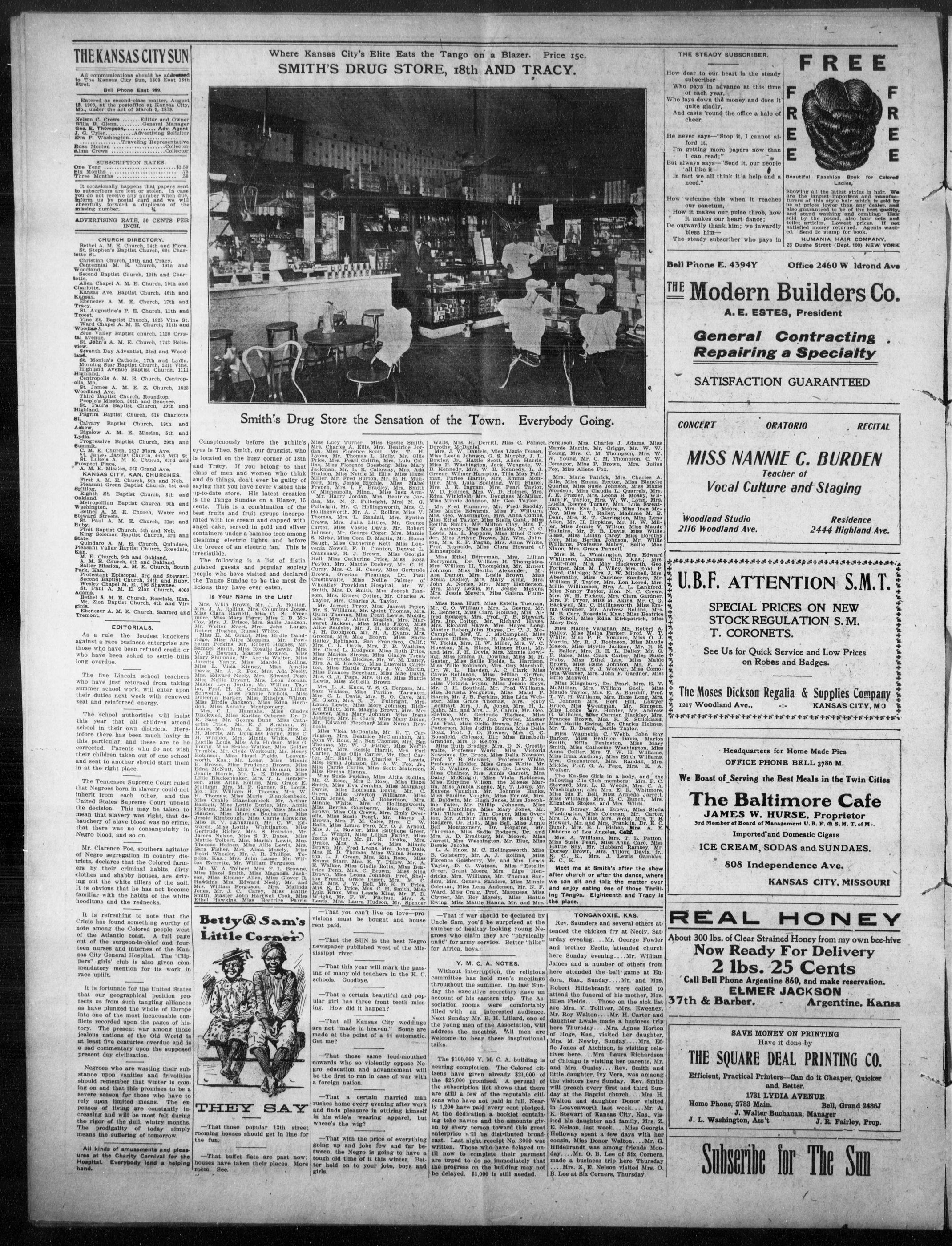
Where Kansas City's Elite Eats the Tango on a Blazer. Price 15c. SMITH'S DRUG STORE, 18th AND TRACY.
THE COFFEE SHOP
Smith's Drug Store the Sensation of the Town. Everybody Going.
Conspicuously before the public's eyes is Theo. Smith, our druggist, who is located on the busy corner of 18th and Traty. If you belong to that class of men and women who think and do things, don't ever be guilty of saying that you have never visited this up-to-date store. His latest creation is the Tango Sundae on a Blazer, 15 cents. This is a combination of the best fruits and fruit syrups incorporated with ice cream and capped with angel cake, served in gold and silver containers under a bamboo tree among gleaming electric lights and before the breeze of an electric fan. This is irresistible.
The following is a list of distin guished guests and popular society people who have visited and declared the Tango Sundae to be the most delicious they have eaten.
Is Your Name In the List?
Mrs. Willa Brown, Mr. J. A. Rolling,
Mrs. J. A. Rolls, Mrs. Columbus Jones,
Miss Clara Barnett, Miss C. S. Freeman,
Miss Mary Perry, Miss I. B. McCormack,
Mr. Walton Evert, John Jackson,
Mr. Walton Evert, Mrs. John Lange
Robert Hughes, Russel White
Miss E. M. Grant, Miss Birdie Dandelion, Miss Patricia Batman Perkins, Miss Robbie Hughes, Mr. Samuel Smith, Miss Rosalie Lewis, Mrs. H. Bowren, Master Bowren, Mrs. Amelia Batman, Miss Jainite Yancy, Miss Mardell Rollins, Miss L. Vioia Kinney, Miss Amelia Batman, Miss Jainite Yancy, Miss Mardell Rollins, Miss Edward Neely, Miss Edward Page, Miss Nellie Bryant, Mrs. Leon Jougan, Leon Jordan, Mr. William Taylor, Prof. Schweich, Miss Fannie Nichols, Miss Dulceina Barker, Miss Ethelyn Wilson, Miss Schweich, Miss Fannie Nichols, Miss Dulceina Barker, Miss Ethelyn Wilson, Miss Schweich, Miss Fannie Nichols,
Mr. W. A. Tobert, Mrs. F. L. Browne,
Miss Hazel Smith, Miss Magnolia Jack-
Hawkins, Mrs. Edward Neville, Mrs. and
William Ferguson, Mrs. Malinda
Sneth, Carey M. Miss Hattie
Sneth, Master John E. Miss Ethel
Hawkins, Mrs. Benttle, Parris
Little Corner
—That those popular 13th street rooming houses should get in line for the fun.
—That buffet flats are past now; houses have taken their places. More room. See.
Miss Lucy Turner, Miss Bessie Smith, Miss Charles A. Ellis, Mrs. Beatrice Jones, Miss Lyons, Mr. Thomas L. Holly, Mr. Ollie Miss Fleece, Mrs. George Miss Fleece, Miss Florence Miss Mary Jackman, Mr. R. L. Calloway, Mrs. Ada Miller, Mrs. Bradley Miller, Mr. Fred Burton, Mr. E. H. Murford, Mrs. Jessie Ritchie, Miss Mabell Miss Minneapolis, Mrs. Rega Miss Minneapolis, Miss Rega
Mr. Harry Jordan, Mrs. Beatrice Jordan, Mr. N. G. Fulbright, Mrs. N. G. Fulbright, Mr. C. Collingworth, Mrs. C. Collingworth, Mr. A. J. Rolls, Mrs. N. G. Fulbright, Mrs. C. Crews, Mrs. Julia Little, Mrs. George Carter, Miss Vassie Davis, Mr. Robert Johnson, Mr. George Coger, Mrs. Mamle Kirby, Miss Cora B. Martin, Mr. Homa Baugh, Miss Catherine Kett, Miss Louvena Nowell, F. D. Clanton, Denver L. Hull, Miss George Georgia Hull, Miss Catherine Price, Miss Peyton, Mrs. Mattie Dockery, Mr. C. H. Curry, Mrs. C. H. Curry, Miss Gertrude Brown, Overian Fleming, Dr. Paul Crosthaite, Miss Nelle Palmer of Cheatwaite Provident Hospital, Mr. W. St. John Smith, Mr. Joseph Ransom, Mrs. Ernest Smith, Mr. Charles A Taylor, Mrs. Charles A. Taylor
Mr. Jarrett Pryor, Mrs. Jarrett Pryor, Mr. S. Williams, Mr. Quint Thomas, Mrs. N. Williams, Mrs. Pearl Lewis, Mobile, Ala. Mrs. Williams, Mrs. Garet Jackson, Mrs. Mable Floyd, Mrs. Alice Saulby, Mr. J. H. Robinson, Mrs. Robinson, Mr. M. A. Evans, Mrs. Groom Robinson, Mrs. Mable Floyd, Bailey Robinson, San Francisco, Calif.; Mrs. C. L. Davis, Mrs. T. B. Watkins, Mrs. C. L. Davis, Mrs. M. Ruth Price, Miss Marion Hudgens, Mrs. Marge Gertrude Bledsoe, Mr. W. M. Dauny, Mrs. A. E. Hackley, Mrs Luevelia Carle, Mrs. Battie Brown, J. W. Martin, Mrs. Fritz Hirsch, Mrs. Mattie Lewis, Mrs Zettella Brown.
Mrs. L. A. Knox, T. S. G. Bergam, Mr. Sam Watson, Miss Parline Tawarter, Mr. Sam Watson, B. O. Cave, Mr. M. Glenn, Mrs. R. F. Cave, Mr. Laura Lewis, Miss More Johnson, Richard Ellott, Mrs. Maggie Brown, Mrs. McKeever, Miss Mary Johnson, Miss Irene Johnson, Mrs. H. Clark, Miss Mary Dixon, Mr. Edward Fletcher) Miss Norah Reynolds.
Miss Vloa McDaniels, Mr. E, T. Carrington, Mrs. Beatrice McClainhan, Mr. Bert Thomas, Mrs. Ben Thomas, Mr. W. O. Thomas, Mrs. Ben Colbert, Mrs. Bessie Harris, Mrs. Earl Carter, Miss Ollie Carter, Mr. Earl Carr, Snell, Mrs. Charles H. Lewis, Miss Ernie, Dr. A. W. Fox, Jr. Miss Carrie Curtis, Miss Scott Materson, Miss Bertha Hanna.
Miss Susie Perkins, Miss Altha Rollins, Mr. C. Rose, Mrs C. Roso, Miss Hazel Smith, Miss Eva Jenkins, Miss Margaret Davis, Miss Louisa Davis, Mr. Green, Miss Overton Williams, Miss Clara Jones, Mr. A. J. Robertson, Mrs. Minnie White, Mrs. C. Hollingsworth, Miss Bertha Goesberry, Mrs. S. Brown, Miss O'Lea, Miss Emily Overalls, Miss Susie Pearl, Mr. Harry Brown, Mrs. F. M. Coles, Mrs. C. J. Balls, Miss Laura Pero, Mr. O. J. Arnold, Mr. J. Bowler, Miss Estellene Greer, Miss Wright, Miss Lillian Farley, Miss Azeta Farley, Mr. H. B. Drake, Mrs. A. Lewis, Miss Minnie Brown, Mr. Fred Lyons, Mrs. John Dale, Mrs. E. D. Thomas, Miss Wilma Hampton, Miss J. Green, Miss Ella Rose, Miss Emma Starr, Mrs. E. F. Willow, Mr. E. Walker, Miss Gladys Botts, Miss A. Brice, Miss Ann Armon, Miss Leona Johnson, Prof. Shelton, Mr. George Dusen, Mr. M. C. Jeff, Mr. J. W. Bell, Mr. K. D. Price, Mrs. K. D. Price, Mrs. C. H. Smith, Mr. Lula Knox, Miss Leslie King, Mr. F. Wright, Mr. F. W. Fitchue, Mrs. A. Lewis, Mrs. Laura Hudson, Mr. Spencer
—That you can't live on love—provisions must be bought and house rent paid.
—That the SUN is the best Negro newspaper published west of the Mississippi river.
—That this year will mark the passing of many old teachers in the K. C. schools. Goodbye.
—That a certain beautiful and popular girl has three front teeth missing. How did it happen?
—That all Kansas City weddings are not "made in heaven." Some are made at the point of a 44 automatic. Get me?
—That those same loud-mouthed cowards who so violently oppose Negro education and advancement will be the first to run in case of war with a foreign nation.
—That a certain married man rushes home every evening after work and finds pleasure in attiring himself in his wife's wearing apparel, but where's the wig?
—That with the price of everything going up and jobs few and far between, the Negro is going to have a tough old time of it this winter. Better hold on to your jobs, boys and girls.
Walls, Mrs. H. Derritt, Miss C. Palme
Dorothy. McDaniel.
Miss Rosa Hurt, Miss Estella Tuman, Mr. C. O. Williams, Mrs. L. George, Mr. R. Bennett, Miss Clara Holland, Mrs. Alfred Rodgers, Mrs. Prof. T. B. Stewart, Mrs. Jno. Cotton, Mr. Richard Hayes, Mrs. H. H. Hays, Mrs. H. Hays, Mrs. H. Hays, Mr. T. J. M. Campbell, Mrs. T. J. McCampbell, Miss Lenora Dillon. Theo. H. M. Miller, Mrs. W. H. Fields, Mrs. H. W. Miller, Mrs. W. C. Hueston, Mrs. Hines, Misses Hunt, Mr. and Mrs. J. H. Davis, Mrs. Minnie Dowling, Miss Emma D. Dowling, Miss M. H. W. Miss Miss H. Filds, Mr. G. J. J. J. Miss Tillie Robinson, Mrs. Guy Marshall, Dr. W. L. Hayden, Mr. C. Clark, Miss Carrie Robinson, Miss Hillian Griffin, Mrs. R. P. Jackson, Mrs. Samuel F. Price, Miss Victoria Flynn, Miss Jennie Keys, Mr. C. H. Southall, Mr. Fred Williams, Miss Jerusha Ferguson, Miss Maud P. Harris, Mr. J. P. Perkins Miss Lida P. Wester, Miss Grace Thomas, Mr. Ruy Lockhart Mrs. J. A. Jones, Mrs. H. L. Kahn, Mr. and Mrs. J. P. Caivin, Mr. Geo. Bledsoe, Mr. Gertrude Bledsoe, Miss Grace Austin, Mr. Jno. Fowler Master Jas. Feal, Miss Ollala Brown, Mr. Arthur Patterson, Miss Judith Simms, Miss Delia and Prof. D. Bower, Mrs. C. C. Bousfield, Chicago, J., Miss Elizabeth Grandson, Mrs. O. Kelton,
Miss Ruth Bradley, Mrs. D. N. Crosthawe, Professor Work, Miss Victoria Newsome, Dr. Bruce, Miss Della Newsom, Prof. T. B. Stewart, Professor White, Professor Holder, Mr. Grace White, Mr. N. G. Walker, Dr. Kane, Dr. Lowe, Mrs. Siles, Chainey, Mrs. Annis Garrett, Mrs. Daisy McKnight, Miss Vola Robinson, Miss Ethyline Wilson, the Misses Marry-Miss. W. E. Keene, Mr. T. Laws, Eugene Vaughan, Miss John Banks, Miss Pauline Vaughan, Miss Ferlow, Mrs. E. Baldwin, Mr. Hugh Jones, Miss Josephine Yates, Mr. Phillip Johnson, Miss Sue Hutchings, Miss Mary Jones, Mr. Jill Thilford, The Cooper, Miss W. V. et Max Arthur Harris, Mr. Sally, C. Rodgers, Dr. Holly, Miss Bell, Miss Annie Bell Montgomery, Dr. Hopkins, Mr. Thurman, Miss Sadle Rodgers, Dr. and Mrs. A. D. Bradbury, Mr. Moore, Miss Jarrett, J. J. Washington, Mr. Blue, Miss Essie Jacobs, L. A. Knox, M. C. Hollingsworth, Miss B. Golsberry, Mr. A. J. Rollins, Miss Florence Goisberry, Mr. and Mrs. Lewis Taylor, D. G. Watson, Miss Estellin Greer, Grant Moore, Mrs. Lige Hendricks, Mrs. Williams, Mr. Thomas Sanders, Mrs. Geneva Sanders, Miss Minnie Coleman, Miss Lena Anderson, Mr. N. F. Ward, Miss Craig, Prof. Marquess, Miss Clymer, Mr. Roy Mosey, Miss Hattie Ewing, Miss Mattie Hanna, Mr. and Mrs.
—That if war should be declared by Uncle Sam, you should be surprised at the number of healthy looking young Negroes who claim they are "physically unfit" for army service. Better "hike" for Africa, boys.
Y. M. C. A. NOTES.
Without interruption, the religious committee has held men's meetings throughout the summer. On last Sunday the executive secretary gave an account of his eastern trip. The Association rooms were comfortably filled with an interested audience. Next Sunday Mr. B. H. Lillard, one of the young men of the Association, will address the meeting. All men are welcome to hear these inspirational talks.
The $100,000 Y. M. C. A. building is nearing completion. The Colored citizens have given already $21,000 of the $25,000 promised. A perusal of the subscription list shows that there are still a few of the reputable citizens who have not paid in full. Nearly 1,200 have paid every cent pledged. At the dedication a booklet containing the names and the amounts given by every person toward this great enterprise will be distributed broadcast. Last night receipt No. 3000 was written. Those who have delayed until now to complete their payment are urged to do so immediately that the progress on the building may not be delayed. $5,000 is still needed.
Ferguson, Mrs. Charles J. Adams, Miss Mamie Martin, Mr. Griggs, Mr. W. W. Young, Mrs. C. M. Thompson, Mrs. W. W. Young, Mrs. C. M. Thompson, C. W. Comagor, Miss P. Brown, Mrs. Julius Fox, Miss Allene Fox.
Mrs. Marie Patrick, Mrs. Charles A. Quarles, Miss Susie Johnson, Miss Mazie Woodson, Miss Claudia L. Quarrels, Mrs. Quarles, Miss Susie Johnson, Miss Mazie Lamf F. Taylor, Mrs. W. W. Luella Reeves Tremor, Mrs. Lula Swatman, Mrs. Eva L. Moore, Miss Inez Mcm. Dean, Mrs. E. T. Carrington, Mrs. Lena Allen, Mr. H. Hopking, Mr. H. W. Millen, Jennie B. Daw, Miss Maud Hudgins, B. B. Daw, Glass, Miss Lilian Carey, Miss Dorothy Cole, Miss Bertha Johnson, Mr. Willie Nixon, Mrs. Grass Patryl, Sallie Mae Nixon, Mrs. Grass Patryl.
Mrs. E. L. Wanslington, Mrs. Edward Whitmore, Kansas City, K.S.; Mrs. Thurman, Mrs. May Hackworth, Geo. Fortner, Mrs. M. I. Wiley, Mrs. Robt. F. Hurd, Chicago; Mrs. J. W. Mitchell, Mrs. Abernathy, Miss Carriner Sanders, Mr. William F. Taylor, Mrs. Lon Lored, Mrs. Millie Williamson, Mrs. A. L. Lankford, Miss Nancy Taylor, Hon. N. C. Crews, Mrs. W. H. Pickett, Mrs. Clara Gardner, Mrs. F. Pryor, Miss M. Akins, Mr. C. G. Buckall, Mr. C. Hollinsworth, Miss Em. J. Gardner, Mr. Andrew Rollin, Miss M. B. Carr, Rosedale, K.S.; Miss Beatrice L. Scholl, Miss Eda Kirkpatrick, Miss Mary Day.
Miss Mamie Vaughan, Mr. Robert A. Bailey, Miss Melba Parker, Prof. W. T. White, Miss P. B. Yoakum, Miss O. J. Martin, Mr. R. J. Robinson, Miss Maude Mason, Miss Myrtle Jackson, Mr. R. E. L. Balley, Mrs. R. E. L. Bailey, Mr. G. G. Sales, Miss Clara Carter, Miss Susie N.oby, Miss Ethel Lay, Miss Mabie, Bran, Miss Essie Johnson, Mr. R. J. Weaver, Mrs. F. J. Weaver, Miss Comte Leve, Mr. John F. Gardner, Miss Effie Maxwell.
Miss Kingsbury, Dr. Pearl, Mrs. E. V. McMillan, Mrs. William Snell, Miss Maude Taylor, Mrs. E. A. Barnhill, Prof. T. W. H. Williams, Mrs. Haze Long, Mrs. H. Johnson, Mrs. Bert Hill, Lawyer Bruce, Miss Sweatman, Mr. Simpson, Miss Locke, Mrs. Hunter, Mr. Andrew G. Williams, Miss Carmen Hackley, Mrs. Frances Brown, Mrs. R. E. Strickland, Miss Attila King, Miss Holmes, Mr. E. Beard Bertie Taylor, Miss Waunbeia C. Webb, John Roy Barker, Miss Beatrice Davis, Marion Smith, Effie Peniston, Miss Mary Scina Collier, Mrs. W. H. Williams, Miss Invitation, Miss Edith Williams, Mrs. Greenstreet, Mrs. Randall, Mrs. Mickle, Prof. G. A. Page, Mrs. E. A. Walker.
The Ka-See Girls in a body, and the following Clio Club members: Mrs. P. C. Scardard, Mrs. L. E. Woods, Mrs. C. A. Washington, Mrs. E. R. Hitchman, Miss Ida F. Bell, Miss Armeda Jarrett, Miss Williams, Mrs. E. C. Bunch, Mrs. Elizabeth Stokes, and Mrs. Willis.
Mrs. Dorsey, Mrs. Brown, Miss Stella Washington, Miss Coleman, Mr. Carter, M. D. W. Wills, Mrs. Wells, Mrs. T. B. Stewart, Mr. Mrs. Franklin, Dr. E. Bunch, Mrs. B. L. Fisher, Mrs. A. E. Osborne of Los Angeles.
Mrs. A. Williams, Mrs. T. L. Patton,
Miss Susie Pearl, Miss Anna Caro, Miss
Hattie Slyr, Mr. Hubbard Ramsey, Mr.
Dorsey Brown, Mr. Tibiah Davis, Jr.
K. C., K. C., Mrs. J. Lewis Gambles,
K. C., K.
Meet me at Smith's after the show
after church or after the dance, where
we can sit and talk the matter over
and enjoy eating one of those Thrilling Tangos. Eighteenth and Tracy is
the place.
TONGANOXIE, KAS.
Rev. Saunders and several others attended the chicken fry at Neely, Saturday evening.....Mr. George Fowler and brother Ezelle, attended church here Sunday evening.....Mr. William James and a number of others from here attended the ball' game at Eudora, Kas., Sunday.....Mr. and Mrs. Robert Hildebrandt were called to attend the funeral of his mother, Mrs. Ellen Fields.....Those on the sick list are Mrs. V. Tolliver, Mrs. Eweeney, Mr. Roy Walton.....Mr. H. Carter and daughter Lwale made a business trip here Thursday.....Ms. Agnes Horton of Hoge, Kas., visited her daughter, Mrs. M. Newby, Sunday.....Ms. Eile Jones of Atchison, is visiting relatives here.....Ms. Laura Richardson of Chicago is visiting her parents, Mr. and Mrs. Ousley.....Rev. Smith and little daughter, Ivy Vera, was among the visitors here Sunday. Rev. Smith will preach every first and third Sunday at the Baptist church.....Mrs. H. Walton and daughter Donor visited in Leavenworth last week.....Mr. A. K. Stewart of Kansas City, Kas., visited his daughter and family, Mrs. Z. E. Nelson, last week.....Miss Georgia Holloway spent a few days with her cousin, Miss Donor Walton.....Mr. G. Hildebrandt was among friends Monday.....Mr. O. B. Lee of Six Corners, made a business trip here Thursday.....Ms. Z. E. Nelson visited Mrs. O. B. Lee at Six Corners, Thursday.
How dear to our heart is the steady subscriber
Who pays in advance at this time of each year,
Who lays down the money and does it quite gladly,
And casts 'round the office a halo of cheer.
He never says—"Stop it, I cannot afford it,
I'm getting more papers now than I can read;"
But always says—"Send it, our people all like it—
In fact we all think it a help and a need."
How welcome this when it reaches our sanctum,
How it makes our pulse throb, how it makes our heart dance;
De outwardly thank him; we inwardly bless him—
The steady subscriber who pays in
THE Modern H
A. E. ESTE
General C
Repairing
SATISFACTION
Modern Builder
A. E. ESTES, President
General Contractor
Repairing a Special
ISFACTION GUARANTY
ORATORIO
S. NANNIE C. BURG
Teacher of
Local Culture and Staging
General Contracting Repairing a Specialty
SATISFACTION GUARANTEED
MISS NANNIE
Teach
Vocal Culture
Woodland Studio
2116 Woodland Ave.
U.B.F. ATTEN
SPECIAL PRICE
STOCK REGU
T. CORONET
See Us for Quick S
on Robes
The Moses Dickson Rega
1217 Woodland Ave.,
ATTENTION S
SPECIAL PRICES ON NEW
STOCK REGULATION S. I.
CORONETS.
Us for Quick Service and Low Price
on Robes and Badges.
Dickson Regalia & Supplies
and Ave., KANSAS
U.B.F. ATTENTION S.M.T.
SPECIAL PRICES ON NEW STOCK REGULATION S.M. T. CORONETS. See Us for Quick Service and Low Prices on Robes and Badges.
The Moses Dickson Regalia & Supplies Company
1217 Woodland Ave., KANSAS CITY, MO
Headquarters for Home Made Pies OFFICE PHONE BELL 3786 M.
We Boast of Serving the B
The Balti
JAMES W. HU
3rd Member of Board of Manag
Imported'and
ICE CREAM, SOD
808 Indepen
KA
REAL
About 300 lbs. of Clear Straine
Now Ready
2 lbs. 2
Call Bell Phone Argentine
ELMER
37th & Barber.
of Serving the Best Meals in the T
the Baltimore Co
MES W. HURSE, Propriet
Member of Board of Management U. B. F. @ S. M.
Imported and Domestic Cigars
CREAM, SODAS and SUND
808 Independence Ave.
We Boast of_Serving the Best Meals in the Twin Cities
REAL HONEY
s. of Clear Strained Honey from my
New Ready For Deliver
2 lbs. 25 Cents
Phone Argentine 860, and make re-
ELMER JACKSON
Barber. Argenti
REAL HONEY
About 300 lbs. of Clear Strained Honey from my own bee-hive Now Ready For Delivery 2 lbs. 25 Cents Call Bell Phone Argentine 860, and make reservation. ELMER JACKSON 37th & Barber. Argentine. Kansa
SAVE MONEY ON PRINTING
Have it done by
THE SQUARE DE
Efficient, Practical Printers
and
1731 LYDE
Home Phone, 2783 Main.
J. Walter Bucc
J. L. Washington, Ass't
Subseribe f
SQUARE DEAL PRINTING
Practical Printers—Can do it Cheaper
and Better.
1731 LYDIA AVENUE.
None, 2783 Main.
Bell, Gr
J. Walter Buchanaz, Manager
Washington, Ass't
J. R. Fain
Subscribe for The S
Efficient, Practical Printers—Can do it Cheaper, Quicker and Better.
CONCERT
FREE
FREE FREE
Showing all the latest styles in hair. We are the largest importers and manufacturer of hair at prices lower than any dealer, and also guaranteed to be of the best quality, and stand and wash. Our hair is sold by the pound, also hair nets and artificial lowers prices. If not satisfied, money refunded. Agents wanted. Send 2c stamp for book.
HUMANIA HAIR COMPANY,
23 Duane Street (Dept. 100) NEW YORK
Office 2460 W Idrone Ave
Builders Co.
STES, President
Contracting
ing a Specialty
ON GUARANTEED
ORATORIO RECITAL
NIE C. BURDEN
Teacher of
Nature and Staging
Residence
2444 Highland Ave.
ENTION S.M.T.
PRICES ON NEW
REGULATION S.M.
NETS.
Stock Service and Low Prices
Robes and Badges.
Regalia & Supplies Company
KANSAS CITY, MO
the Best Meals in the Twin Cities
Littimore Cafe
HURSE, Proprietor
Management U. B. F. @ S. M. T. of M.
and Domestic Cigars
SODAS and SUNDAES.
dependence Ave.
KANSAS CITY, MISSOURI
HONEY
rained Honey from my own bee-hive
ly For Delivery
25 Cents
ntine 860, and make reservation.
ER JACKSON
Argentine. Kansas
DEAL PRINTING CO.
printers—Can do it Cheaper, Quicker
and Better.
LYDIA AVENUE
in. Bell, Grand 2486J
r Buchanaz, Manager
't J. R. Fairley, Prop.
RECITAL
Mr. E. J. Banks, 1022 Michigan, who has been ill for five weeks, is convalescing.
A large delegation has gone to Parsons, Kas., where the U. B. F. and S. M. T. grand lodges hold forth this week.
Miss Eva Taylor has returned from the East, where she visited with friends in Toronto, Detroit and Chicago.
Mrs. John Taylor of Lawrence, spent the week end with Mrs. Essie Lewis.
Miss Margaret Mason has returned home to St. Joseph, after a pleasant stay with her father at 1908 E 13th street.
Every Negro in Greater Kansas City should visit the Carnival. All kinds of amusements and then think what it's for.
Miss Lela Williams of Philadelphia, will be the guest of Mrs. F. J. Weaver, 2635 Euclid avenue during the next ten days.
Mr. and Mrs. E. B. Cotton, 2322 Flora avenue, have returned from a month's visit with their parents in Springfield, Mo.
Mr. and Mrs. E. B. Cotton, 2322 Flora avenue, have returned from a month's visit with their parents in Springfield, Mo.
FOR RENT—1011 Tracy Avenue, Nicely furnished rooms in modern house, for gentlemen; reasonable.
Miss A. E. Wheeler, 2456 Euclid, has returned from Excelcior Springs after a very pleasant stay of two weeks at the Hotel Albany.
FOR SALE—A No. 1 second hand upright piano for sale cheap. Parties going away. 1415 N. 8th street, Kansas City, Kas.—Adv.
Mr. Wharton, owner of a large cleaning and pressing establishment in Muskogee, was induced by Miss Washington to take the Sun.
Mrs. P. C. Kincaide has returned home from Excelcior Springs after spending ten days recuperating. She says she feels much improved now.
WANTED—A position as housekeeper, by a widow with small child. Refences. Address reply care Kansas City Sun.
Miss Ella Whett left Sunday for her home in St. Louis. Miss Whett has been in the city the past two weeks visiting her nephew, Mr. Harry W. Miller, 1621 Norton avenue.
Poro hair dressing, hair weaving and facial massaging. Scalp treatment a specialty. Mrs. E. Nories, 1737 Paseo, upstairs.
Prof. C. G. Williams of Boonville, Mo. spent Wednesday in Kansas City. Mr. Williams made the Sun a very pleasant call, and attended the Jubilee concert at Allen Chapel Wednesday evening.
NOTICE.
Lawyer I. H. Spears has moved his office to northeast corner of Eighteenth and Tracy, Bell phone 4591, Home 5467. He will be pleased to meet his clients and friends.
The Dunbar Art Club held its first meeting at the residence of Mrs. Mattie Balley, 2630 Euclid avenue, and were elaborately entertained. The club meets next Thursday at Mrs. William Ash, 1225 Highland avenue.
Mrs. Laura Lewis, 713 Troost avenue, has returned from a visit in the southeast, at South Boston, Richmond, Lynchburg and Norfolk, Virginia. Mrs. Lewis has been gone since July 1, and is glad to see old friends again.
Mrs. B. L. Eaton and two daughters of St. Louis, Mo., who have been sojourning at Excelsior Springs the last month made a visit to Kansas City, Saturday, and were the guests of Mrs. P. C. Kinealde, 1605 Virginia avenue.
St. Louis recently cleared $5,000 on its Church Carnival. Why can't we do as well - for Provident-Whateley Hospital? We can if you will attend the Carnival at Twentleth and Woodland, September 2-13 inclusive. Admission only 10 cents.
Mr. Henry Patton, the well known barber of 1321 Woodland, informs us that his/brother Joseph, the famous musician, who has been seriously ill at their old home in Magnolia, Miss., is improving nicely, and will soon be out again.
Mr. Thomas Shumacker, now in Kagawong, Ontario, writes that he will be back in the United States in about a month, then will go to New York City. He also says that he hopes to be with the boys about this time next year.
Dancing every Wednesday night,
Armory Hall, Cottage and Vine
streets. Hall for rent. Bell Phone
East 308R.
Prof. Roscoe White, Dancing Master,
MRS. JANIE WHITE, Teacher,
PROF. FRANK BUCKNER,
MISS KATIE ANDERSON,
ALBERT THOMAS,
EARL THOMAS.
Assistants.
CITY NEWS.
Mrs. Frank Day and Mrs. Ernest Sprague, of Chicago, are visiting Mrs. Essie Lewis, after a two weeks' stay in Lawrence. Mrs. Day is a sister of Mrs. Lewis.
REMOVAL NOTICE
The Crosthwait Floral Company has been forced to move, on account of the great increase of its business, from 1611 East 18th street to 1711 East 19th street, where they will be pleased to see all patrons and friends. Bell 'phone, East 272.—Crosthwait Floral Co.
Mrs. Ida Washington Gladney of 916 Garfield one of our most efficient teachers, returned Thursday from a month's visit to Chicago, Detroit, Milwaukee and Benton Harbor at each of which places she reports a delightful stay.
Will Lindsay, the famous "Lexington Tiger" ball player, and crack pitcher for the American Giants, died in Chicago this week; after a brief illness. Walter Lindsay, of this city, a brother, went to Chicago in response to a summons and conveyed the body to Lexington for interment.
Miss Molle Berry, en route to her home, Boley, Oklahoma, is visiting Mr. and Mrs. T. M. King, 2309 Highland. Miss Berry is a graduate of Tuskegee Institute, and is now in the employ of T. L. Woods, a dry goods merchant of Boley. She and Mrs. King were classmates at Tuskogee.
Mr. Abe summers of Hastings, Neb. stopped over on his way from excelsior Springs, where he has been for the benefit of his health the past three weeks. While here he was the guest of his brother, Mr. John McKay, 2400 Flora avenue, and other relatives.
The South Side Day Nursery desires us to correct its report concerning the Peet Brothers Manufacturing Co. that this company gave one hundred bars of toilet soap in addition to the one hundred bars of laundry soap The Nursery desires to be accurate in all its reports.
The genius and style of Prof. R. G. Jackson was demonstrated in the program of the Jubilee Singers at Allen Chapel last Wednesday night, as two of the company were products of his labors at Western University. Mr. Edward Atkinson and Miss Freeleeman very ably showed his magnificent training.
There is a reason why the larger per cent of Cabinets Stationary used by Kansas City's "400" is turned from the Arthur W. Harris Printing Enterprise in this class of service is unexcelled by any of the larger and best manufacturers in this city, since they all but make a speciality of this class of furniture 100 per cent of the blissful weddings and receptions during the past year and now when a function of class is announced a ten-to-one shot that Harris will handle the job.
Mrs. A. V. Barton, 3410 E 21st, entertained twenty-four guests at whist Thursday afternoon, at her residence in compliment to her guest, Mrs. A. A. Alexander of Topeka, Kas. Prizes were won by mesames A. A. Alexander, M. N. Young, Cecil Thompson and M. G. Brookins. Mrs. Alexander has now returned to her home.
REMOVAL NOTICE
C. D. Franklin, the Printer, has moved from 1409 Main street to 1008 E. 18th street, near Troost Transfer Co. and K. P. Hall, Bell, Grand 2988. Call at the above number after August 3rd.
FOR RENT
2927 Norton, 4-r frame cottage. $ 9.00
2927 Grove, 3-r. $ 9.00
2927 Grove, 3-r mod. bungalow. $ 9.00
2927 Belleview, 5-r. $ 15.00
2927 Woodland, 2-r rear. $ 5.00
24th and Main, 5-r. $ 7.00
24th and Main, 5-r part, br. $ 10.00
1097 Oak, 9-r mod, br. $ 10.00
1097 Oak, 9-r mod, br. $ 40.00
2499 Penn, 7-r partly modern. $ 18.00
2499 Penn, 7-r partly modern. $ 18.00
2603 Woodland, 4-r br. cottage. $ 14.00
2603 Woodland, 4-r br. str. mod. $ 14.00
21st and Indiana, 5-r str. mod. $ 18.00
2722 Lydia, 5-r mod. $ 15.00
2722 Lydia, barn for 20 horses. $ 15.00
2722 Lydia, barn for 20 horses. $ 15.00
FOR SALE
1226 Michigan-6-r, modern cot age
1286 Michigan-6-r, new cot age
2126 High and High-1-r, modern cot
taxe, $1,800; $100 down, $10 monthly,
$10 monthly; new cotage
$100; $50 down, $8 monthly
Near 14th and Michigan—S-r. str. mod
br. slate roof, lot 401x45, worth $5,000
will sell for $4,000, $800 down, $20 month.
Afro-American Investment Co.
911 McGEE St.
Phones: - Home 7555 Main; ST, 751 Main
To my many friends, both public and fraternal, I desire to announce that I am much improved from the serious attack of last Saturday, and, by the help of the Supreme Ruler of the Universe, and under the care of Dr. J. E. Dibble, who has also made a wonderful improvement in my wife's condition, who has been seriously ill for seven or eight months, she is now able to be up and around. Saturday night she was at ml bedside every half hour giving attention and medicine and consolation. I also thanks my many friends for advice and consolation. I expect to be able to go back to work next week.
A. W. FOX.
KANSAS CITY, KAS.
Mrs. S. A. Fitzhugh has removed to 1514 N. Ninth street.
The Carnival of All Nations has a large crowd each evening.
Mr. and Mrs. O. R. Fleasant, 950 Walker avenue, entertained Mr. and Saturday, Mrs. Mary Mathews, 1044 Freeman avenue, made a hurried trip to Independence, Mo.
Mrs. H. R. Richardson of Alququerque, N. M., with an elaborate dinner last Monday evening.
Mr. J. W. Truman, 1811 N. 3d street, was injured last week in a wreck on the Kansas City Southern line.
Also Mr. and Mrs. G. N. Fulbright, 845 Freeman avenue, have moved into their new home at 2109 N. Third street.
Rev. C. J. Flashback, Topeka, Kas., preached to a large crowd Sunday night, at the Carnival grounds, Tenth and Oakland.
Mr. Homer Bunch, 924 Oakland avenue, is erecting a five-room house on his lots in Riverside Park, Quindaro, which is very creditable.
Mr. and Mrs. Chas. Ousley, 116 Edgerton avenue, entertained Sunday for lunch. Mrs. M. Monholland and daughter of 2448 Flora avenue.
Mrs. Mary Jones, 1240 Barnett avenue, attended the funeral of Mr. Simpson, who became suddenly ill while attending Grand Lodge of the K. of P.'s. Rev. G. Henry preached the sermon.
The body of William Gregory, who was killed at the Fowler Packing plant last week by falling down an elevator shaft, was sent to Winchester for burial.
Mrs. Frank Dunean of 1015 Oakland avence, left for Quincy, Ill., the 19th, and will, after a few days' visit there, go on to Chicago and Ann Arbor, Mich. She will return home about September 30.
Mrs. Clarence Jenkins, 939 Nebraska avenue, is visiting friends in Colorado Springs and St. Lake City. She is accompanied by Mrs. Mary Kelly of Chicago, Ill. They are the guests of Mrs. J. W. Brox at Colorado Springs, and Mrs. Nora McSwine in Salt Lake. They will return home September 6, after an absence of three weeks.
Messrs. A. F. Nelson, Brinkley Letcher, John Walker, I. B. Blackburn, all delegates to the twenty ninth annual session of the Prince Hall Grand Lodge, A. F. & A. M., have returned home and report an excellent session. Grand Master E. J. Hawkins was re-elected to a third term and all the other grand officers were re-elected excepting the grand secretary, who was succeeded by Prof. J. M. Marquess of this city. Prof. J. P. King, also of this city, was appointed chairman of the Committee on Foreign Correspondence. Next session in Wichita, Kas.
Miss Eva P. Washington and Mr. J. H. Clayborne, two of the delegates of the Negro Business League of Greater Kansas City, from the Kansas side, report a very successful meeting in Muskogee, Oklahoma. Miss Washington was immensely pleased to be shown through the steam laundry owned by a young man, Mr. John Williams by name, a laundry equipped with the very latest machinery for first class work. Mr. Williams subscribed for the Sun.
Work, instead of a long and serious discussion, will solve quite a number of problems.
A professional nurse knows almost as much as a doctor and some things the doctor doesn't hear.
Rooms For Rent
Rooms For Rent
FOR RENT—Rooms, furnished or unfurnished. 1009 Euclid avenue. Mrs. H. Bean.
FOR RENT—Four rooms, bath, electricity, gas. 1209 Highland, Unfurnished. Apply 1123 E. 11th street. Ask for Dan, the janitor.
FOR RENT—Neatly furnished front room. 1607 Harrison. Inquire 1326 East 14th street.
FOR RENT—2440 Montgall avenue, 6 rooms modern, $22.50 per month. J. M. Day, N. W. Cor. 18th and Paseco Grand 1413—Bell phone.
FOR RENT—Two furnished rooms, modern, with or without board. Teachers preferred. Mrs. Jacob Allen Moore, 2316 Michigan Ave.
FOR RENT—Rooms and board for teachers. Modern. Telephone, bath, piano, Mrs. Kingsberry, 1007 Tracy.
FOR RENT—Neatly furnished rooms, modern with furnace heat. Phone Bell East 2825.
BOOMS FOR RENT.
Furnished and unfurnished rooms in the rear of 21st and Harrison Street Flats, for light housekeeping if desired. All modern conveniences. Only $1.50 and $1.75 per week. Also rooms in fats. See Kinsler, 918 E. 21st St. Phones, Bell, Grand 2303-R; Home, 6516 Main.
A Nervous Woman Finds Relief From Suffering.
Women who suffer from extreme nervousness, often endure much suffering before finding any relief. Mrs. Joseph Snyder, of Tiffin, O., had such an experience, regarding which she save:
"Six months I was bedfast with nervous prostration. I had sinking spells, a cold, clammy feeling. —could not stand the slightest noise. At times I would almost fly to pieces; stomach very weak. My husband insisted on my taking Dr.
was bedfast with nervous prostration. I had sinking spells, a cold, clammy feeling.—could not stand the slightest noise. At times I would almost fly to pieces; stomach very weak. My husband insisted on my taking Dr. Miles' Neryline, and I began to improve before I had finished the first bottle until I was entirely cured." MRS. JOSEPH SNYDER.
262 Hudson St., Tiffin, Ohio.
Many remedies are recommended for diseases of the nervous system that fail to produce results because they do not reach the seat of the trouble. Dr. Miles' Nervine has proven its value in such cases so many times that it is unnecessary to make claims for it. You can prove its merits for yourself by getting a bottle of your druggist, who will return the price if you receive no benefit.
MOBERLY, MO.
Mr. Ralph Bass has purchased a splendid piece of property on Harsley street, and has begun at once to improve it... Mrs. Susan Terrill is very much better at this writing... Mrs. Lizzie Grant is quite ill... Mrs. S. A. Graves remains o the slick list... Mr. William Collins has sold out his restaurant business and will leave this week for St. Paul, Minn... The 49th annual session of the North Missouri Association closed last Sunday night with a large and appreciative audience present. Resolutions were read and appropriate words were spoken thanking the people for their hospitality. Total money collected by the association $461.85. The next place of meeting will be in Keokuk, Iowa, and Dr. Gales of Macon will be Moderator. The Second Baptist choir is to be complimented for their splendid music furnished for the association...
The Mexico District Conference and Sunday School Convention of the M. E. Church closed a very interesting session here Sunday night. This was the largest in attendance in the history of the district, and practically all the members were present, while several visiting ministers came. The papers and discussions were good. Thursday night the meeting was devoted to educational exercises. Dr George Evans, president of George R. Smith College delivered a good practical lecture on education. The collection for the week was $108. Rev R. E. Gillam, district superintendent. ....The delegates of the conventions which met here last week expressed themselves as being pleased with the entertainment received from the good people of Moberly. Rev Hayes and Avant deserve much credit for the way they managed their meetings. ....
Pilgrim Rest Baptist Church was supplied Sunday with ministers from the North Missouri Association, Rev. Harris for the morning and Rev. Sales for the evening services. Collection $22. Grant Chapel pulpit was filled Sunday morning by Rev. Embree, and at night by the Rev. Mackey. Both gave splendid service... Grant Chapel choir, assisted by other good talent, gave a concert at the Second Baptist Church last Saturday night, with Prof. L. B. Quinn, leader...Dr. Joseph Timony has been in the city for a few days visiting parents. Mr. Timony is a recent graduate of the Dental School at Iowa City, Ia...Rev. and Mrs. J. S. Swancy left for Glassgow the first of the week to attend Mt. Zlon Association. Mrs. Anna Brown and Mrs. Cropp are messengers and will attend. Mrs. P. E. Swancy is in the city visiting Rev. and Mrs. Swancy... Miss Ella Boone will leave Thursday for Liberty being one of the teachers there. School opens Monday... Mrs. Ethel Boone is very much better at this writing. Two of the busiest persons during the association were the Misses Elmerine Taylor and Oneta Carr, clerks for the association.
PROBING HIGH COST OF FOOD
State and Federal Governments Begin Inquiries.
Washington, Aug. 15.—The legal forces, state and federal, all over the country, got into action, carrying out the President's suggestion for an investigation as to whether food prices are being increased artificially on the pretext of the European war, and criminal prosecutions will follow if that is found to be the case.
The national capital authorities started the campaign with a grand jury investigation to which commission merchants, wholesalers and retailers, buyers for hotels and restaurants were subpoenaed and citizens having evidence were invited.
Reports of other investigations beginning in many localities by United States attorneys and state and county authorities are pouring into the attorney general's office. Special agents of the department of justice have begun their search for evidence of manipulations or other methods of price-fixing and Secretary Redfield sent detailed instructions to agents of the department of commerce on carrying out their part of the investigation.
Very Dangerous.
Friend="Why, Elvira, what's the matter?" Elvira="Oh, I don't know, only I'm worried to death! I've had the same girl six weeks and she doesn't talk about leaving yet!" Friend="She doesn't?" Elvira="Not a word. She must be in love with my husband!"
Dancing lessons taught at Armory Hall every Saturday night. We teach all the latest dances. We guarantee that everyone will learn who takes an interest in dancing. Clase from 9:30 to 11:30. Price 25 cents. Private lessons from 6:30 to 9:30. Price 50 cents.
Mme. Benton Dean, the popular milliner, has moved to 1010 Troost avenue, where she is elegantly located and will be extremely pleased to meet her many friends and customers at that number. Belle phone Main 2102J.
WADE H. HAMMOND,
Bandmaster, Ninth Cavalry,
DOUGLAS, ARIZ.
Are you Discouraged, Discontented or
Despondent?
Are you Poor,Poverty-streken or Painful?
Are you Sick, Sad or Sinful?
If so, write now and learn the SECRETS OF
PEACE, POWER AND PLENTY.
GEO. W. SPEARS
P. O. Box 21
INDEPENDENCE, MO.
[Name]
Dr. G. W. Stevens, the well known and famous spiritualist, can be consulted at his residence, 618 State St., Kansas City, Kan., any day from 8 a. m. to 9 p. m.
J.C.WAGNER
The Clean Market Man
Oysters, Fish and Game in Season.
Fancy Groceries and all Table Luxuries.
Courteous Treatment to All
1819 Howard Ave.
Bell Phone 3596 Eas
Kansas City, Missouri.
LIP, AND HAIR MUST
WS FOR OUR WOMEN
LAST
In Scalp Food and Always Young
better recommendation here. We
festify that my Goods grow Hair
ins fail. I manufacture prepara-
lp needs and will send you the
cure YOUR scalp, for there are
TREAT YOUR SCALP, AND GROW! GOOD NEWS FOR AT LAST
The Brice Afro-American Scalp Fo Cream is too well known for better record know as millions of others will testify that even when all other preparations fail. I tions according to what the scalp needs Goods that will be necessary to cure YOU no two scalps alike.
TREAT YOUR SCALP, AND HAIR MUST GROW! GOOD NEWS FOR OUR WOMEN
The Brice Afro-American Scalp Food and Always Young Cream is too well known for better recommendation here. We know as millions of others will festify that my Goods grow Hair even when all other preparations fail. I manufacture preparations according to what the scalp needs and will send you the Goods that will be necessary to cure YOUR scalp, for there are no two scalps alike.
[Picture of a woman with a headband, wearing a dark dress with a white collar and a decorative pin on her left shoulder.]
Mme. W. H. Brice
Face and Scalp Specialist
or Terms. Big Profits.
0c. per. jar.
id Face Powder, 50c. per. bottle.
er. box.
Agents wanted. Write for Terms.
Always Young Cream, 50c. per. jar.
Brice's Snow Bloom Liquid Face P
Brice's Herb Tea, 25c. per. box.
Agents wanted. Write for Terms. Big Profits.
Always Young Cream, 50c. per. jar.
Brice's Snow Bloom Liquid Face Powder, 50c. per. bottle.
Brice's Herb Tea, 25c. per. box.
Brice's Corn Cream, 25c. per. box.
Brice's Pressing Comb, $1.00.
Brice's Six Weeks Trial Treatment for the scalp, to grow hair, Two Dollars.
Remember the name and number, MME. W. H.
BRICE, 804 Tremont St., Boston, Mass.
The Brice Mfg. Company's Branch Offices, where you can get the Brice Preparations are listed below:—
Richard Arnold, 1114 N. Senate Ave., Indianapolis, Ind.
J. J. Howe Drug Store, Tremont & Cabot St., Boston, Mass.
Brice's Dandruff Cream, 50c per box.
Brice's Bone and Nerve Linament, 50c per bottle.
1.00.
Treatment for the scalp, to grow
and number, MME. W. H.
Boston, Mass.
's Branch Offices, where you can
sted below:—
Senate Ave., Indianapolis, Ind.
Semont & Cabot St., Boston, Mass.
box.
25c per bottle.
per box.
package.
set, 15c per package.
colors, 25c per box.
Brice's Six Weeks Trial Treatment for the scalp, to grow hair, Two Dollars.
Remember the name and number, MME. W. H. BRICE, 804 Tremont St., Boston, Mass.
The Brice Mfg. Company's Branch Offices, where you can get the Brice Preparations are listed below:
Richard Arnold, 1114 N. Senate Ave., Indianapolis, Ind.
J. J. Howe Drug Store, Tremont & Cabot St., Boston, Mass.
Brice's Dandruff Cream, 50c per box.
Brice's Bone and Nerve Linament, 50c per bottle.
Brice's Eczema Scalp Lotion, 50c per box.
Brice's Gray Hall Restorer, 25c per package.
Brice's Dusting Powder for tired feet, 15c per p
Brice's Best Face Powder, in three colors, 25c
Brice's Afro-American Scalp Food, 4 boxes for
Brice's 6 Weeks' trial treatment Two Dollars,
of the age, just send her as near as you can how
and if the hair is dry and brittle and breaks off;
sends this treatment—you will have healthy scalp.
Brice's Afro-American Scalp Food, 4 boxes for One Dollar, no less sold. Brice's 6 Weeks' trial treatment Two Dollars, with the greatest discovery of the age, just send her as near as you can how the condition of the scalp, and if the hair is dry and brittle and breaks off; it will stay after Madame sends this treatment—you will have healthy scalp, long and beautiful hair.
MUSICIANS WANTED
Ninth U. S. Cavalry Band and Orchestra
can place players as follows: 1 snare drummer, who can handle ordinary traps; 2 clarinet players, 1 cornet and 1 saxophone player. Applicants should have talent and ambition. No objection to good amateur players.
Sobriety and respectability essential.
Excellent opportunity for bright young men to become identified with one of the finest Government' Bands. State age, experience and give name of instruments you play. Immediate correspondence necessary.
Address
Pictures of the Grand Lodge taken in Moberly, Mo., can be had for 50 cents per, postage prepaid, by writing to J. H. Green, 721 South Fourteenth street, St. Joseph, Mo., or John Harvey, 516 North Twenty-fourth street, St. Joseph, Mo.
WORDS OF APPRECIATION.
More Mother's Testify to. Merits of XXth Century Hair Preparations.
Nelson, Mo., April 13, 1913.
Dear Madam Dabney: I am writing you for a small order. I want you to please send by mail 3 bottles of shampoo, 3 boxes of hair grower and 2 boxes of pressing oil. I like the remedy just fine; I would not be without it for anything. I am using it on my little girl's hair; it seems to be helping it greatly.
Kansas City, Mo., Jan. 20, 1913.
Dear Madam Dabney: I am a mother of four girls. In trying to improve their hair I had tried several preparations, but none gave me good results until I used Madam Dabney's XXth Century Preparations. Their hair was thin, harsh and would fall out so that I dressed to use a comb. Now their hair is growing nicely—does not fall out—has no dandruff—is soft and pretty. Three of these girls are attending Wendell Phillips School, Howard and Vine streets. Investigation will bear out my testimony. I would not be without the XXth Century Preparation in my house.
A six week's treatment of Madam P. M. Dabney's XXth Century Hair Preparations sent on receipt of P. O. money order of $1.25, or a single package of XXth Century Hair Grower, Pressing Oil or Shampoo sent for 50c. Write today to Madam P. M. Dabney's XXth Century Hair Preparations Co., 1806 E, 24th St., Kansas City, Mo. Dept. 40. Persons living in Kansas City who cannot be supplied by their drugstiff will be called upon by an agent on dropping a postal card to the above address or calling Bell phone, East 247K
Have you Eczema or Tetter? Have you Dandruff? Does your hair break off at times? Is it harsh and stubborn, and are you annoyed with Itching of your scalp? If so, write for Mme. W. H. Brice's Wonderful Afro-American Scalp Food and Hair Grower, which will positively cure all scalp trouble and start your hair growing at once. These remedies are manufactured only by W. H. Brice Mfg Co., 804 Tremont Street, Boston, Mass. Formerly of Indianapolis, Ind.
A six weeks trial treatment for Two Dollars, mailed to any address. Make all Money Orders payable to Mme. W. H. Brice. Send stamp for reply.
Brice's Eczema Scalp Lotion, 50c per box.
Help Wheatley-Provident Hospital
MRS. JANIE WHITE, Instructor.
MISS KATIE ANDERSON,
MR. GEO. DARNELL,
MR. ALBERT THOMAS,
PROF. FRANK BUCKNER,
MR. EARL THOMAS,
Assistants.
Bell Phone East 308R.
Peace Power Plenty
E. EUGENE VAUGHAN.
MEMBER K, C. BUSINESS LEAGUE.
I have plenty of capital to build houses. Telephone me to-day. Eventually you will. Estimates cheerfully given.
TO THE NEWLYWEDS.
While now your hearts are so joyful, Take heed lest you forget, That buying a home today, for tomorrow, Is a step you'll ne'er regret.
GOING!
GOING!
What?
First class 7 per cent mortgages for
sale.
4 rooms, 25 ft.....$50.00 down
EUGENE EDWARD VAUGHAN,
TWENTIETH PAVILION,
KANASS CITY, KANASS.
Bell phone, West 1757.
CHEAP
JOHN'S
PLACE
New and Second Hand
Goods Bought, Sold and
Exchanged
Bell Phone East 3418 M
2122 Vine Street
WM. HOPKINS, Prop.
Ladies' Tailoring Dressmaking AND Drafting...
Fancy Gowns a Specialty
I am prepared to offer the public the best dressmaking, tailoring, drafting and fitting.
Graduate of one of the best white downtown colleges.
Will also teach Drafting.
Bell Phone East 3413 M
Mrs. Lillie Williams
2914 Woodland Avenue
KANSAS CITY, MISGURI
A League Enterprise!
On Eighteenth in the
Fifteen Hundred Block
A News Bureau
Every Negro Periodical Negro Pictures. Negro Books. Novelties Stationery
5c. Every Day in the Year
1521 East 18th Street.
CHAS. A. STARKS, Prop.
Our Motto: "Nothing but The Best"
The Crosthwait
Floral Company
Everything in Flowers
and Flower Designs
"WE DELIVER THE GOODS"
The People say we have
made some of the most
beautiful and original de-
signs in flowers ever seen
in Kansas City.
Our Specialty—
"Quick Delivery--Satisfactory Service"
Bell Phone East 273
1719 E. 17th St., Kansas City, Mo.
Subscribe for the SUN
Bell Phone East 999
1803 East 18th Street
Human Documents of Married Life
Intimate and Human, Intensely Alive, Each Story Presenting a Problem Which Might Occur to Any One of Us at Any Time
Daisy's letters showed him that she had forgotten or disregarded his advice, for they were full of accounts of the various functions she was attending and the good times she was having. Feeling powerless to interfere any further, the husband shrugged his shoulders and accepted philosophically his present life. But when she had been away for a fortnight he was aroused from his placidity of mind by a special-delivery letter from his mother-in-law. It informed him that Daisy had been taken suddenly ill, that the worst was now over, but that she had asked that he come and take her home as soon as she was well enough to travel. The next paragraph in the letter stunned the reader:
"I am sorry," it ran, "that neither you nor Daisy thought it worth while to inform me of the true condition of affairs. Had you done so I would have guarded the dear girl against such over-exertion as has culminated in her present illness. It followed upon a long evening of dancing. I find it hard to excuse your reticence and hers when I consider that, had he been more careful, I should by next summer have held my first grandbaby in my arms."
The husband gasped and dropped the letter. How could he tell his mother-in-law that he, himself, had not known the truth? Yet, when he knelt beside Daisy's bed and felt her arms about his neck, all resentment died within him.
"Don't be angry, Dan," she sobbed. Of course he kissed her and told her not to cry. "But," he queried, "didn't you know you should be taking care of yourself? Why didn't you tell me everything, darling?"
"Yes," she declared, "of course I did! And," her eyes overflowing again with tears, "I planned all about the pretty things I would buy for it—and now that's all over!" Pity for her evident distress kept the man silent on the subject during the weeks and months that followed. It was this same motive that prevented his uttering any objection when, as soon as she was well again, Daisy returned to the social world of which she liked to feel herself a part. It helped her forget her disappointment, Dan reminded himself. Yet, in her heart, the wife longed for greater liberty than she possessed. Once she tried to break away from what she felt to be her husband's restraining influence and accepted an invitation without waiting for his final decision upon it. It was on a beautiful spring morning more than two years after her illness that she received an invitation for herself and Dan to spend the week-end at a country place on Long Island.
Daisy's heart beat high with anticipation. Dan had already gone to his office for the day—what about him? He had said last fall that he hated week-end parties, and that the last one of which he was a self-sacrificing part, and at which Daisy had had "a perfect time," was "a miracle of stupid, ity." He did not play bridge, and would not learn when asked to; he did not dance, he had no small talk, and in the huge house in which they were guests there was, he complained, "nothing worth reading, even if the people had been quiet long enough to allow one to read." No more of that kind of thing for him! Daisy had bitten her lip and said nothing. But today she hoped he had forgotten his decision. To make sure of it she would call him up at once. His voice at the other end of the wire was so perfunctory and dry that his wife felt little shivers run along her spine. But, summoning her courage, she explained the situation. There was a moment's silence, then her husband's only reply was in the form of a question:
"Oh, Dan, didn't you hear what I told you?" exclaimed the nervous woman. "I said that this morning I got a letter—"
The wife knew by her husband's tone that he was exercising all his self-control to speak patiently. "My dear, I really have no time to consider any trifling matter of that kind this morning. I am up to my ears in work at present. We will talk the matter over when I come home tonight. Is there anything of any importance that you wish to speak about just now?"
"Nothing else of any importance!" snapped the wife.
"All right! Good-by!" and he was gone.
For a moment the angry woman held the receiver in her hand, her face flushed, her eyes full of tears. Then she made a sudden resolution and, with a voice that still trembled, called up the number of the friend from whom she had received the alluring invitation. She explained that creative and interesting work instead of being household drudges.
"One reason for this is that the middle-aged woman, like the middle-aged man, when occupied in business or intellectual work, has little time to brood over departing youth.
"You know we women become very sour as we grow old. But, when we work, perhaps the ungallant comparison that a cynical bachelor once made to me will lose some of its truthfulness. Here is the comparison:
THE TIE THAT BINDS
PPOSITES attract each other," say those who would explain the marriage of two persons totally unlike in taste and temperament. They may attract, but do they hold each other? When the excitement and flush of passion—mistaken for love—have subsided, the to an unconscious unloik
PPOSITES attract each other," say those who would explain the marriage of two persons totally unlike in taste and temperament. They may attract, but do they hold each other? When the excitement and flush of passion—mistaken for love—have subsided, the two parties to an uncongenial union remain distinct entities, together but entirely separate.
Of course when people fancy themselves in love they will not believe these facts. With the fine sophiary born of that condition, they think they know their own minds and that they are right and all the skeptical world is wrong.
So it was with Daniel Drayton and Daisy, his wife. Their Christian names were not more unlike than their characters. She was fond of society, caring nothing for intellectual pursuits—a butterfly of a girl. The man she married was deep hearted and affectionate, but grave and thoughtful. When released from business, he desired no other recreation than that found in his library. Books were his delight.
His wife was, by nature, a happy little creature, lovely to look at and ready to make friends with her husband's acquaintances in New York, to which city she came as a bride. She had a graceful, almost deferential manner that won for her a ready liking and admiration from all who met her. She was delighted to find herself invited to many places, and would bring cards and invitations to her husband with the joyous enthusiasm of a child.
"Dan!" she would exclaim, "you will go to this dinner-dance, won't you?"
"But I don't dance, Daisy," he demurred on one occasion soon after their marriage.
"But you can 'sit out' dances, and you can always talk when you want to." she added archely.
He smiled affectionately. "I always want to talk to you," he said, "and I can do that to much better advantage in our own house than in a great drawing room full of chattering people for whom I care nothing."
"But you ought to care for them," she insisted. "I do. And I love that kind of thing—society, I mean—and I wish you did. You see, I never have had much of it, for I was at school until last year. And I am interested in knowing all about real life."
Her husband shook his head. "That is not real life, child. Don't fancy that. Society is the thing that people go into to try to make them forget that they have not made the most of the real things, or that they do not appreciate them."
"And what are the real things?" queried the woman.
"True human beings with souls above dress and dances and silly gossip; books that take one out of one's own narrow sphere and fill the brain with big thought," he declared gravely.
"It's queer," commented the wife, "that you care for dull, sober things when I want you to like what I am fond of—pretty clothes and jolly times. As for books, really, Dan, I could live happily all my days without them. I like a novel once in a while, but those dull books you have on your shelves are the limit!"
She raised her eyes to his as she spoke, and he noted with a thrill of admiration how pretty she was.
"It is time we were dressing to go to Mrs. Burton's reception, Dan." He looked at her, appalled. "Mrs. Burton's reception! It is it tonight?" His wife moved impatient. "My dear Dan, I reminded you of it this morning and told you not to forget it!" "Well, I did forget it," was the rueful reply. "Don't let's go. Send some one around with our cards." The pretty face before him flushed with vexation. "But I want to go," Daley explained. In spite of his distaste for the kind of life that his wife loved, Daniel Drayton appreciated that she was too attractive a woman to be allowed to attend evening functions unattended by her husband, and, for the sake of the conventionalities, he formed the habit of acting as her escort to theaters and dinner, to receptions and soirees.
The second winter after their marriage Daisy was pale and languid, and Dan suggested that she consult a physician. This she refused to do, declaring that she was "just tired." The Christmas holidays, with their attendant festivities, had weared her, mused her husband. She needed rest and change of air and scene. Such being the case, he acquiesced readily to her proposal that she make a visit to her mother, living in Chicago. The husband urged her to refrain from too much galaxy while absent.
"You know that your social life is waiting here for you when you return," he reminded her, "so do take care of yourself and get rested while away."
Leader Believes Women Should Cease to Be "Household Drudges" and Gives Her Reasons.
Mrs. Charlotte Perkins Gilman, speaking in New York to an audience composed chiefly of women, compared the lives of some American mothers to the harlem lives of the East.
"Women," Mrs. Gilman declared, "should go into the world and do us.
"Because," she murmured, "I knew you would stop my going out, and make me stay stupidly at home for months. And I didn't want to do that yet."
"Didn't you think of the baby that was coming to make us happy, dear?" suggested the husband.
"Well?"
Ladies, in their childhood, resem-
haps-Dan would be detained in town on business, but that she, herself, would surely come if her hostess would take her alone. Would it be time enough if she let her know Dan's plans tomorrow?
When Dan heard the condition of affairs that night he looked his astonishment. "You accepted an invitation without knowing whether I would go or not!" he exclaimed.
There was a new note of defiance in the wife's tone. "I certainly did," she retorted. "I do not mean to miss the things I enjoy just because of a whim of yours."
"But suppose I do not want to go?" "Then I shall go without you," declared the woman firmly.
There was a dead silence for a minute. Then Daisy on with: "I would, however, like to know, for the sake of courtesy, what I am to tell Mrs. Jackson. Common politeness demands that you accept or decline."
"And uncommon politeness has
moved you to leave me out of your
work."
The wife laughed with forced mirth, then grew grave. "See here, Dan," she urged, "do, for once, look at the matter sanely and, if possible, unselfish. You like one kind of thing, I like another kind. Why may not each of us enjoy life in our own way? You like to stay at home and read, and I prefer to go out and have a good time. Is not my right to live my life as good as your right to live yours?"
"You mean," asked her husband, "that you want me to say you may accept any invitations without consulting me, and I am at liberty to decline or accept them as I please?"
"Just that."
For a moment the man knew that he felt in his innermost soul a throb of relief at the possibility that hereafter he need not go about to all kinds of society affairs with his wife.
His wife's voice checked his musings. "Really, Dan," she was saying tremulously, "when you remember that in a few months I won't be able to go out and have fun. I do not think that you need grudge me the enjoyment of this little outing now."
With a pang of remorse the husband drew her to him. "Forgive me, dear!" he pleaded. "I was a brute to forget. Of course we'll go to the Jackson's week-end party, and anywhere else you want to go, and you shall have all the good times you want now, for"—his voice softening—"when you have a dear little child who needs you, you will not want to go away from home any more."
His wife looked at him gravely. "I am not so sure of that," she said calmly.
And her husband had the wisdom to make no reply.
During the weeks of the following summer when Daisy's physical condition prevented her going into society, Dan set aside, as often as was practicable, his work, his books, and all his personal inclinations in order to minister to her whims and fancies. He walked with her and drove with her, for they had taken a furnished cottage in a quiet country place for the heated term. He knew that she was wearied by the monotony of their daily life, for, as she cared little for books, and was not well enough to meet the few city people who were summering in the nearby village, one day was much like another. He wondered sometimes whose fault it all was. One day a man met on the train was talking of marriage, and dropped a sentence that lingered in Daniel Drayton's memory for months afterward.
"Married life," affirmed his new acquaintance, "must have something more than love to hold two people together. A couple who are congenial may be comparatively happy, even if they do not feel a passionate love for each other; but the most ardent love will faint and die if it is not backed by congeniality of taste and interests. Were I a woman I would rather that my husband were my friend than my lover. A real man does not go back on a friend, but husband and wife who are not comrades and chums tire of each other, and"—with an express gesture—"smash something—the marriage vows, or their own lives, unless, of course, there is the one great tie which makes their smashing things a crime."
"And that tie," queried Dan, "is?" "A child or children, sir!" "They do not always hold their parents together," Drayton reminded him.
"No," said the other bitterly, "they don't, except when the parents are too decent to let the children pay for their mistakes."
In his own room that night, after a dull evening with Daisy, Dan sat by the open window, smoking and pondering. He dwelt on the evening just past, and recalled how Daisy had talked a little of what some of her friends were doing in the mountains or at the seashore, of what the magazines said of the fashions for the coming autumn, of how she would like to have her furs remodeled for next winter. Dan had yawned, but not openly, as Daisy did, for he did not want to hurt her feelings. But he
ble water. As girls of twelve to fifteen, they're like lemonade; as young persons from eighteen to twenty-five, champagne; as women of twenty-five to forty, liqueur. A woman from forty to fifty years of age is equal to home-made port wine. After fifty, most ladies turn to vinegar."
No Use.
"I'm going to engage in a battle of wits," he announced. "What's the use of going into battle without any ammunition?" she asked.
sighed with relief when the clock struck ten, and she said that she was weary and wanted to go to bed. She heard the sigh and turned on him suspiciously.
"What's the matter? Are you tired of hearing me talk?" she demanded.
"Why, no," he answered mendactously, "but the heat in town today was very enervating."
Now, alone, he whispered the truth. "Heaven forgive me! I was bored to death!"
He sat for some time trying to appreciate what the condition of affairs meant, how he and his wife would live together through all the coming years, each preying on the other. His soul sickened at the thought. Did Daisy appreciate it as he did?
Her voice calling him from the next room came as an answer to his question. He obeyed her summons promptly, carrying his cigar with him.
"Dan," came the sweet but fretful voice, "won't tomorrow be the first of September?"
"Yes, dear." (That perfunctory "dear!" How hard married couples "work" it!)
"And we will surely go home the fifteenth, won't we?"
"Certainly."
"Thank the Lord!" she murmured. Daniel and Daisy Drayton had been married five years when their son was born. Daisy took the responsibilities of motherhood as she took everything, lightly. She was not to blame, for it was her nature. A full pint-measure is really just as full as is a gallon-measure. The husband used to remind himself of this fact when he was tempted to be impatient with what he called, when angry, her "shallow nature." "Perhaps, after all," he would muse, "she is wiser than I. Things don't hurt her long. As for me—well, I won't let them hurt me. She and I will just have to rub along as other people do. And, thank God, there's the baby to keep life endurable!"
For the dissatisfied man soon found that the knowledge that he had a son to love and live for did much toward making the future bright.
As long as Daisy had her baby and her social pleasures she looked no deeper into conditions. She did not neglect her child as the woman of today terms neglect. She made time each day to play with him, to rock him in her arms and to listen to suggestions from his nurse as to what was needed to make his tasteful wardrobe even more elaborate.
Familiarity with society and obedience to its many claims did not breed contempt of it in Daisy. As she and her husband grew farther apart, she threw herself into the gay life more enthusiastically than ever. As Dan must be at his office all day he need never be pressed into service for afternoon engagements. But he still, with such patience as he could muster, did escort duty to evening affairs, except on the one night of the week on which Daisy attended the meeting of the musical club to which she belonged. To this club she went in a cab, returning in one. She did not mention to her husband that one of the men members often accompanied her to her front door. But one evening, returning home earlier than usual, she suggested that Tom Nash, her escort, come in for a few minutes. Dan, hearing a man's voice in the drawing-room, left his book and came in, in as duty bound, making an ennuye third in the brief chat that ensued before the guest took his departure.
The next morning at breakfast the husband remarked, apropos of the conversation of the previous evening, that "Tom Nash carried light guns."
The wife fushed uncomfortably. "I wish you would not criticize my friends," she demurred.
Dan raised his brows in suprise. "Is he a friend of yours?" he queried. "I thought of him simply as a chance acquaintance."
"He has been of service to me several times," insisted Daisy, too much vexed to consider the admission she was making, "in bringing me home from the club."
Her husband frowned. "I wish," he protested, "that you would not have men bring you home at night."
"Why, not?" queried the woman petulantly. "I see no reason why I should take that drive alone."
"And if I am willing to leave at a garage a standing order for a taxi for you whenever you want one, I see no reason why any man need it as escort to you."
"Fortunately," retorted the wife, "other men have more regard for my comfort and safety than you have."
A hard look came into the man's eyes. Only last week he had received a letter from his sister, who had been paying a visit in Daisy's former home town, and it had contained a sentence that had ratched. "I wonder," it ran, "if you ever knew that Daisy was engaged to another man when she met you, and that rumor declares that she did not break off her affair with him until after she had accepted you." Dan had grown hot with indignation when he read the sentence, but the resentment was against his sister, not Daisy. He did not believe the rumor. Women were fearous; his wife was a popular beauty, his sister an unattractive spinster. But, underneath, the suspicion remained, not dead, but smoldering. At his wife's taunt it flashed into a blaze.
"You seem to know a great deal of other men's regard for you," he said significantly. "Apparently you know how to handle several of them at a time, as you did at the time that we became engaged."
To the husband's painful surprise the shaft went straight home. The woman paled slightly, and her eyes widened in startled amazement. "What do you mean?" she asked quickly.
PEST OF THE WEST INDIES
PEST OF THE WEST INDIES
Planture Wage War Against Species of Crabs That Are Destructive to the Vegetation.
A curiously destructive pest of Grand Cayman island of the British West Indies is found in certain species of crabs. They not only partake ravenously of everything edible, but their burrows do great damage, and they fill these burrows with every kind of stolen small articles. A bulletin of
"Only that it is well to be off with the old love before one is on with the new!" scoffed the man. "I happen to know that you kept one man dangling on your string until you had landed another, then dropped number one."
Daisy's eyes flashed. "So you've been listening to gossip about your wife, have you!" she burst forth. "And may I ask what business it is of yours or of anybody's what I did before I was married?"
"It's a good deal of my business what you did after you were engaged to me," replied her husband, but the woman rushed on, heedless of his remark.
With a sob of rage she fled from the room. Her husband stood looking at the door she had slammed behind her. "It's hell!" he muttered between set teeth. "That's what it is, hell!" Then, with a sudden chill, he appreciated that, though angry, he was not wounded. Once such a scene with Daisy would have wrung his heart. Now he felt no tenderness of pity for her. Was his love dead? he asked himself. And was hers, too?
After that episode the shams of mutual consideration which each had reared during the past years were often down. Daisy liked her ease too much to quarrel unnecessarily, and, as it was more comfortable to be pleasant than unpleasant, she did not, unless already angered, seek cause for quarrel, and her husband followed her lead. But only those who are bound to each other by law and the church know how many inescapable causes of friction occur in the family life.
It is strange how certain traditions hold when that for which they first stood is gone, how those who deny the spirit still cling to the form. This is shown in nothing more strongly than in the meaningless nightly kiss exchanged in some households between the uncongenial heads. It amused Dan that Daisy kept up this custom. She, not being of an analytic or introspective nature, retained the habit of pausing each night long enough to drop upon his unresponsive lips the perfunctory percussion that had replaced the wifely kiss. The irony of the situation caused his nature to revolt on a certain night on which, as he had a cold, he had gone to his room early. It was on the evening of the annual dinner of the musical club, to which each member was allowed to bring a guest. As Dan had been the unwilling victim upon several of these occasions, he found himself reconciled to the slight attack of bronchitis which made his remaining at home on this particular night advisable. Daisy declared that she must go if he was well enough to be left, and, she added as an afterthought, if Dan did not mind. Dan did not mind, he assured her, seeing in her unusual deference to his wishes a happy mood produced by pleasurable anticipation of an evening of gaiety undarkened by the shadow of his compulsory presence. At heart he knew that Daisy would not let a little thing like his wishes stand in the way of the jolly dinner at Delmonico's with the set which she enjoyed, and of which he inwardly disapproved. He had voiced this disproval long ago, but his remarks were met with such outbursts of vehement protest from his wife that he had not, since then, ventured to utter any further criticism on this subject. He did not care enough to court a scene by interfering.
So this evening, after he and his boy, who was now over two years old, had had their accustomed romp, Dana took his solitary dinner, and went to his room. He lay in bed reading when his wife returned from the Delmonico dinner at eleven o'clock and stopped to tell him good night. As she approached him the acrid odor of cigarette smoke reached his nostrils. "Whew!" he ejaculated, "what a smell of tobacco! Have you had a cigarette?" he demanded suspiciously, for he was so old fashioned that he disapproved of women's smoking and drinking in public places. "No," was the soft reply, "but all the men were smoking, and I sat near Tom Nash, who had an awfully strong cigar. That's why my hair and dress smell of it." Her eyes did not meet her husband's, and he knew she was evading the truth. To prevent further questioning she bent hurriedly and gave him the usual good night kiss. He laughed roughly.
"And I suppose Tom Nash had been drinking, and the reason your breath smells of liquor is because your lips were so near his!" he mocked.
For a moment the wife was staggered by the cool brutality of the speech, then a wave of anger, made more intense by the champagne she had been drinking, swept away her self-control.
"You brute!" she exclaimed.
"Only your husband, remember," suggested the man coldly.
"That's as hard on me as it is on you!" she retorted.
"You are overexcited, my dear," remarked Drayton, still calmly. "The wine you took at dinner has affected you somewhat. By morning you will be more sane."
"Oh!" she gasped, striking her palms together, "when you talk like that I almost feel as if I could kill you!"
With a yawn the man turned over on his side, with his face from her,
Kew Gardens notes that such utterly useless objects as knives and pocket compasses are hidden away.
Eggs from under a setting hen are devoured, if not the hen herself, and so many leaves of seedling coconut trees are eaten that 6 to 10 per cent of the plants may require replacing in newly cleared ground from which the crabs have been thoroughly thinned out. Patches of thin soil in the bush become covered with vegetation after the complete driving away of the crabs. They shut themselves un-
closed his eyes, and settled himself as though to go to sleep.
"Perhaps," he said colorlessly, "that would be about the kindest thing you could do and the simplest solution to this whole damnable business"
Then he switched off the light at the head of his bed, leaving the woman to find her way across the room and into her own chamber by the gleam of the hall chandelier.
It was a week later that Daniel Drayton, opening his front door with his latch-key on his return from business one night, was arrested by the sound of his wife's voice speaking at the telephone. The instrument was in the rear of the hall and not in sight from the front door, but the words reached the master of the house in that moment in which he instinctively paused:
"Yes, Tom, he's going out at eight-thirty. Come any time after that."
The husband slammed the front door, and his wife, startled, hurried toward him, where he stood under the glaring ceiling light. A glance at his grimly determined countenance told her that her speech had been overheard.
"Dan," she tried to explain, "I was only telling—" but her voice failed her, trailing off feebly into silence, and she sank down, trembling, on the hall chair near her. "Well?" she whispered, looking up at her husband.
His voice was so unnatural that she started violently when he spoke, but her eyes did not leave his.
"Daisy," he said, "this is the end! I won't stand this life any longer! I said long ago in anger that it was hell, now I say it in sober truth. It's hell for you as well as for me. You do not love me; I sometimes think that you hate me. We are tired of each other. It's got to stop! You may go your way, and I'll go mine."
"Dan, listen to me. I've been faithful to you."
He smiled drearily. "As if that counted," he said, "in a case like ours! So far you've been what the world calls faithful—I don't say you haven't. But you'd always rather be with other men than with me; you make an appointment with a man on the only evening in weeks on which I happen to have a business engagement, and you telephone him that I'm to be away! How long do you think that kind of thing could go on and either of us keep a spark of respect?"
Still the look of hope in the woman's eyes. The husband saw it with a peculiar thrill and rushed on, his voice rising as his excitement increased.
"We made a mistake in marrying! I'm tired of it, so are you! I say I won't stand for it any longer. Yes, this is the end!"
His wife shrank from him, her eyes still on his face. "When?" she whispered.
"Now!" he exclaimed. "I swear I won't—"
He caught his breath sharply. A childish voice sounded from the landing on the stairs above him.
"Daddy! Daddy!" came the high treble. "Aren't you comin' up?"
The man steadied his voice to answer, though his face was contorted with a spasm as of physical pain. "Yes, son," he called hoarsely. "In a minute!"
But the baby voice came again, "Daddy!"
There was a hurrying of feet in the upper hall as the nurse hastened to capture her small charge, who had for the moment escaped her vigilance. The nursery door closed behind the pair. The man dropped upon the lower stair, his face buried in his hands. "The boy!" he groaned.
His wife sprang up and caught him by the arm excitedly. "You won't let him make any difference!" she exclaimed imploringly. "His life is all before him! Surely we have a right to ours!"
Her husband lifted his head and looked at her, and again she shrank from him, although her hand still clutched his arm. He rose and faced her.
"Listen!!" he said sternly. "For the moment I forgot him—God forgive me! I forgot the child! Yours and mine, remember—the child that for our own pleasure we called from no where to suffer in this devilish world; the child for whom we are responsible to man and to God Almighty: Can't you see, he exclaimed fiercely, "that we have no right to punish him for our mistakes?"
But his wife shook her head as if dazed. The man made a hopeless gesture.
"We've got to stand it!" he declared savagely. "If there were only you and I we could do as we pleased. But we're tied, tied, do you hear?—and with a tie made of flesh and blood? He didn't ask to be born, did he? We've got to pretend to live decent lives until he needs us no longer. We can't get away! We can!"
The woman uttered a weak wall. "And what about me? What about me?"
The man pulled himself roughly from her grasp on his arm, and she sank down again, trembling, upon the chair, still looking up at him.
"You're his mother, that's all I care!" he exclaimed. "And that's why we've got to play the game out till death delivers us!"
He turned and, without another glance at the crouching woman, went heavily up the stairs toward the room in which the child was waiting for him.
(Copyright, by Moffat, Yard & Co.)
derground in the early part of the year to change their shells, and for their barricades of sticks and rubbish they趴 off or root up saplings three quarters of an inch in diameter. Another reprehensible characteristic, less harmful to the planter, is cannibalism.
Study Great Men.
To be ignorant of the lives of the most celebrated men of antiquity is to continue in a state of childhood all our days. -Plutarch.
THE
ONLOOKER
HENRY HOWLAND
IN AUTUMN-TIME
In autumn-time the good world seems
To leave all hate and strife behind;
It is a time for pleasant dreams,
For claiming peace and being kind;
In the riches they have treasured long!
The lions that play beside the ewes
Proclaim a faith still sure and strong!
A haze that softens and subdues
Lends grace to distant, rugged slopes;
The lambs that play beside the ewes
Are eloquent of well-won hopes.
In autumn-time the orchards yield
The riches they have treasured long!
The lions that play beside the ewes
Proclaim a faith still sure and strong!
A haze that softens and subdues
Lends grace to distant, rugged slopes;
The lambs that play beside the ewes
Are eloquent of well-won hopes.
In autumn-time the world appears
To turn awhile from frettless;
Contentment comes to banish fears,
And love reclaims the pitiless;
Scenes that were drew in former days
And all the peaceful winding ways;
Lead heavenward, in autumn-time.
CANDID OPINION.
One good thing about a church is that one needn't feel ashamed if one is seen going in even at a side door.
Most of the explaining is done by men who act upon their first impulses.
Conscience, like the housebreaker, does most of its work after dark.
If only one fool is born every minute it is evident that fools never die in their infancy.
Optimism is a good thing, if one doesn't try to use it as a substitute for hard work.
The man who is always going to do something important tomorrow may never do it, but, even so, he has an important advantage over the man who thinks there is no chance left for him.
A Liberal Soul.
"I tell you, it's unreasonable for a man to expect his wife to get along on nothing while he is spending money having a good time."
"I agree with you. Most of the domestic unhappiness is caused by men who expect their wives to take care of their homes and get nothing for it but what they have to eat and wear."
"You've got the right idea. I give my wife a dollar a week for pin money, whether she needs it or not."
Lucky.
"I consider my wife the loveliest woman in the world."
"I congratulate you. A man who considers his wife the loveliest woman in the world has a blessing that is greater than riches. He is luckier than the man who has millions and is bored when he has to be alone with his wife. How long have you been married?"
"It will be six weeks next Thursday."
Sensible.
"Your son's wife seems to be such a sensible girl."
"She is sensible. When his salary was raised $5 a week recently she stubbornly declined to have their mode of living changed so that it would cost them $10 a week more."
A CRUEL MAN.
"My dear," he said, "we've got to call a halt. We can't go on forever living beyond our income!"
A
"There," she replied. "I knew
you'd go and bring up some disagreeable subject to spoil the day. This is the first morning for a week that I haven't had a headache."
"I have to laugh every time I see that." He smiles. "He can't help his looks."
"He can't help his looks."
"I know; but his wife thinks every other woman is trying to lure him away from her."
Easy.
"Oh, I just love children."
"It is too bad you have none of your own."
"Why, how did you find out that I had none of my own?"
"You said you loved them."
"You said you loved them."
Not What He Had Hoped For
"What's the matter, old man? You
seem downhearted."
"I have reason to be. The court has
just decided that the lady I've
arranged to marry may retain possession
of her children."
MARLEY,THECLOWN
BY ELIZABETH SCHOEN COBB.
From a distance Marley, circus clown, worshiped the darting female equestrienne, Gloria. It was no wonder. She was unlike any dainty-toed, sylph-fashioned girl who had ever swayed trippingly across the platformed back of a trained ring steer. There was none of the simpering praises seeker in her smile or of faming audacity in her pose. She was simply a lively, delighted girl, full of vivacity and loving the sawdust atmosphere because she had been brought up in it, her father having been a ringmaster for over a quarter of a century.
Gloria's father watched his motherless child as the apple of his eye. He was jealous of any attention bestowed upon her by her fellow actors. When her part was over, her chaperone took charge of her.
"A new clown, eh?" he remarked to the manager the day Marley appeared to succeed the one invalided.
"Yes, and a good one," was the response. "He will have to learn the antics, but as to the face and voice, he is a genius."
So it proved. All the players knew was that Marley had been an actor, then a teacher in a school of mimicry. Then the new-comer turned out to be a mystery. He acted strange and unsocial. One would almost guess he was striving to hide himself from somebody or something.
"He leaves the show and disappears, and you never see him on the street," said Mr. Rice one day to the manager.
"What matters, so he fills the bill and draws the crowd?" retorted the manager.
"Yes, he does that, all right," was conceded.
Then there happened something that awoke both gratitude and uneasiness in the old ringmaster. One
M. H. H.
"Now, Then, I Want Your Story!"
night, just as Gloria was rounding the ring with tip-toe elegance, a gasoline chandelier fell across the head of the steed she rode.
The horse screamed, reared and backed. Gloria sprang lightly to the sawdust floor of the arena. A whirl of the scattering flames, however, had caught her light guazy dress.
A shriek of alarm rang from the audience at this vivid picture of impending destruction.
"She is doomed!"
"Save her—oh, quick!"
The ringmaster stood petrified with helpless master. Others, in the ring moved forward, but stupidly gazed with no plan of aid or rescue. A quick figure suddenly flew past dressing room curtains. It was Marley.
His face was white as death, his eyes glowered eager fire. He had torn down a drapery in his mad rush. How he did it, he himself could not tell afterwards, but in a flash he had enveloped that beloved form, extinguished the flames and Gloria, her hair barely singed, bowed and smiled to the audience, while Marley toterted back out of view, face and hands seared and blistered.
But the audience would not have it that way. They yelled and clapped their hands and shouted until the manager forced Marley into the ring. Gloria, radiant, had caught his hand, and both stood bowing amid the deafening plaudits.
The thrill of that sweet contact rewarded Marley for all he suffered. Then after that, whenever she came to the tent, Gloria lingered always a few moments by the side of her hero.
This it was that the ringmaster resented, fearing a growing attachment between the two. He need not have worried, however. Marley held Gloria as high above him as the stars. Besides that, a certain secret in his life oppressed him, crushed him, shut him away from appearing as the true man that he really was.
It was one morning, about a week after this episode, that a few of the actors met to rehearse a new act. The ringmaster, for a wonder, was absent, but his daughter and Marley were both on hand.
They had drawn aside in the dressing-room entrance to await their call in the act being rehearsed, and were conversing casually, she with interest as always in her companion, he with glowing eyes, for her presence was a sweet balm to his loneliness and trouble, when two men came through the main entrance and approached the manager.
"You have a man here named Marley," spoke one of them.
"Yes, what of it?" snapped the manager, ruffled at the intrusion.
"We are officers of the law, and we have a warrant for his arrest as Charles Page."
Gloria fixed her startled eyes upon her companion. Marley had pailed. He shrank back slightly.
"He is a criminal, an embezzler," continued the officer.
"I shall go with him," spoke Marley.
FARMING IN A CAVE ROBERT H. MOULTON
NE of the queerest farms in the world is located 75 feet underground, in a cave six miles southeast of Springfield, Mo. This is believed to be the only cave farm in existence. There are small caverns in which mushrooms are grown in France, but this Missouri cave produces not only mushrooms in large quantities, but also a superior crop of rhubarb. It is also used as a bleaching place for celery. But one of the most remarkable crops ever produced in this cave is one that cultivates itself, and is gathered for the market by a flashlight process. Bullfrogs constitute this staple.
Robert Smith, the cave farmer, used to live in St. Louis. About a dozen years ago the "back
to the farm" manla took possession of him. He wanted a small farm in the Ozarks, but he expected to cultivate it in the usual way. Casting about for a location Mr. Smith found a tract of 26 acres three miles beyond the terminus of the National cemetery road that runs out from Springfield. It was a rolling tract, with sloping fields and a bluff and a woodland. Under the bluff was a cave, known as Fisher's cave, from the name of a former owner of the place. The St. Louisan looked over the place, purchased it and became Farmer Smith. But before making the purchase he determined to become Cave Farmer Smith, to be the pioneer in a new and unique sort of agriculture. Somewhere he had read of the mushroom industry in France, where abandoned quarries, artificial caves, were rented to growers of the delicate fungus which is so much in table demand by epicures when they are assured that it is not a toadstool.
He studied diligently the haunts and habits of the mushroom, which knowledge led to his establishment of the first and only natural cave farm. From mushrooms to rhubarb and celery and frogs Farmer Smith progressed by easy stages, experimenting as he went along, until finally he developed a system of intensive underground farming, which has given him a unique position amongst the million of American farmers. Mr. Smith learned, in the first place, that Fisher's cave has an even temperature of 60 degrees all the year round. August may fry and sizzle at 100 in the shade of the saplings just outside the mouth of the cave; inside, back beyond the curve where daylight dies and midnight darkness prevails, the temperature is 60 degrees. January zero weather may, and does create ice at the mouth of the cave; back in its depths the thermometer registers exactly 60 degrees.
Fisher's cave differs from the ordinary cavern of the Ozarks, of which there are many, in its freedom from a disagreeable and chilling breeze. There is no apparent air current, no clammy feeling, and yet the atmosphere always is fresh and there is enough moisture to give growth to such plants as flourish in the dark. This is a highly important factor in cave farming. Many caves drip so much moisture from the roof that it is impracticable to grow crops of any sort. Fisher's cave has a happy minimum of dripping. In many places the roof of limestone is dry enough to light a match by friction.
There was some "clearing" to be done in opening up this novel farm. No trees, bushes or weeds, of course, were in the way, but there were stalagmites to be "grubbed" out, and there were downhanging stalactites to be removed. These rock formations, built up by the slow-dripping process of ages, were broken off where their removal was found necessary, and they served as material for banking up a lake outside of the cave, fed by clear water from a perennial river that runs through the cavern and empties at its mouth. This lake came in handy later on as an outdoor picnic ground for bullfrogs when they weared of the inner recesses.
quickly, "I am neither Charles Page nor an embezzler, but duty demands that I should be the scapegoat for both."
"Oh, I knew you were innocent!" cried Gloria, her hands clasping his arm fervently. "No, you shall not sacrifice yourself. Quick—this way!" It was with considerable wonderment that a search for Marley began, the manager noting that he had disappeared. It was with irascible defeat that the officers realized that their prey had escaped them. Gloria's heart fluttered for hours after that. More than once her eyes glanced toward the cage where her performing tiger, Hudah, was confined. She learned that a guard of officers hung around the outside of the tent.
And there within, in the cage, hidden by the great canvas cover of the cage wagon, Marley lurked. He was at the mercy of the ferocious Judah, but he held a tallman that made the animal gentle as a kitten towards him—the scarf Gloria always wore when in the cage. When the great cirpus caravan wended its slow, gaudy way from the city the next day, the watching officers again missed it in finding a clew to the man who had vanished.
The show made a long trip across four states. That evening they settled at their fixed stand, Rice called Marley into his room at the hotel.
"Now, then, I want your story," he said, mandatorily.
"Why?" challenged Marley.
"For Gloria's sake."
That was enough. If Gloria was interested! Ah! was it friendship, gratitude only? But Marley recited all the details of an event, to save a sorrowing mother, he had assumed the blame of the crime of another.
"I have an offer for a long tour in Europe," said Rice. "There you would be safe."
"But why should I trouble you thus?" began Marley, and the old ringmaster answered:
"I think Gloria will wish to go where you go. She believes in you. Are you dense, man! She loves you, and I know you to be a man of honor, and so—"
And so the circus romance ended in a quiet, happy wedding, and peace, and security and love.
(Copyright, 1914, by W. G. Chapman.)
LIKES TO ENCOURAGE BORES
Formerly Man Shunned Them, But Now He Listens and Smiles Graciously.
"A friend of mine," said Maj. Jaspen Bulwinkle, according to the Indianapolis News, "has taken on a new fad, of which he is likely for some time to come to have a monopoly. For some time it has been in my mind that he was in some fashion making a study of me. He was not long since a person of somewhat trascible temper and listened but badly to some, I may say to nearly all of my best stories. Now he smiles encouragingly and listens as a laemkbek to any narrative, no matter how ancient, how long or how dreary it may be.
"No matter how anacoluthic an anecdote, in the telling he remains smiling to the end. I have recently found out that I am not the only person to whom he is so gracious, that half a dozen persons whom you and I know to be out and out bores are being assiduously fostered and encouraged by my strange friend, and I no longer enjoy the monopoly I supposed was mine.
"It is a whim, a fad, he admitted to me the other day, 'that I have taken up and out of it I get not only amusement—and some little instruction—but a discipline in patience that I have long needed. It is teaching me to be kind, gentle and considerate of certain of my fellow creatures whom heretofere I have shunned as a pestilence and to whom has been given the unlovely designation of bores. Thus far in this new cult I believe I am without competition. I have entered a neglected field, a field from which other students of mankind have been too willing to escape. I am only sorry that the greatest commonwealth of boredom has been overlooked, nay, positively shunned by me so long. My fear now is that when these bore friends make the discovery that I am actually finding enjoyment in their fatiguing wearisomeness they will set up a quarantine against me."
Process of Evolution.
The evening primrose of Lamarck is a flower which, Hugo de Vries has discovered, most easily proves Lamarck's theory that evolution processes by "leaps" and not by slow and imperceptible changes over millions of years. De Vries announced at the University of Brussels that one or two in every hundred evening primrose seedlings would produce new races that are readily kept pure during their succeeding generations. He predicts that the principle of variability discovered here and in other plants and animals shows the way into a "vast new domain of investigation."
His Time Had Come.
Again that ringing in his ears! It was the warning he had dreaded. He knew his time had come. Yet, although he he had started at the sound, he seemed half-dazed and wholly careless of the consequences. But still the ringing in his ears! "Drat it!" he finally said, and springing from bed the careworn commuter shut off the alarm clock and proceeded to dress for the 7:10 train.-Puck.
Mildew Stains
Mildew stains are sometimes a source of great trouble, and are difficult to remove unless you know just the right way. Rub a little soap over the mildew spots, and on top of this a little chalk and lemon juice. If the garment is then put out in the sun for a couple of hours and afterwards washed in the usual way the spots will disappear.
Wife—Any fashions in that paper,
Jack!
Kid (who has just settled a dress-
maker's bill)—Yes, but they're no use
to you, dear. It's yesterday's paper!
NE of the queerest farms in the world is located 75 feet underground, in a cave six miles southeast of Springfield, Mo. This is believed to be the only cave farm in existence. There are small caverns in which mushrooms are grown in France, but this Missouri crop produces not only mushrooms in large quantities, but also a superior crop of rhubarb. It is also used as a bleaching place for celery.
to the farm" mania took possession of him. He wanted a farm in the Ozarks, but he expected to cultivate it in the usual way.
Casting about for a location Mr. Smith found a tract of 26 acres three miles beyond the terminus of the National cemetery road that runs out from Springfield. It was a rolling tract, with sloping fields and a bluff and a woodland. Under the bluff was a cave, known as Fisher's cave, from the name of a former owner of the place.
The St. Louisan looked over the place, purchased it and became Farmer Smith. But before making the purchase he determined to become Cave Farmer Smith, to be the pioneer in a new and unique sort of agriculture. Somewhere he had read of the mushroom industry in France, where abandoned quarries, artificial caves, were rented to growers of the delicate fungus which is so much in table demand by epilepsies when they are assured that it is not a toadstool.
He studied diligently the haunts and habits of the mushroom, which knowledge led to his establishment of the first and only natural cave farm. From mushrooms to rhubarb and celery and frogs Farmer Smith progressed by easy stages, experimenting as he went along, until finally he developed a system of intensive underground farming, which has given him a unique position amongst the million of American farmers.
Mr. Smith learned, in the first place, that Fisher's cave has an even temperature of 60 degrees all the year round. August may fry and sizzle at 100 in the shade of the saplings just outside the mouth of the cave; inside, back beyond the curve where daylight dies and midnight darkness prevails, the temperature is 60 degrees. January zero weather may, and does create ice at the mouth of the cave; back in its depths the thermometer registers exactly 60 degrees.
Fisher's cave differs from the ordinary cavern of the Ozarks, of which there are many, in its freedom from a disagreeable and chilling breeze. There is no apparent air current, no clammy feeling, and yet the atmosphere always is fresh and there is enough moisture to give growth to such plants as flourish in the dark. This is a highly important factor in cave farming. Many caves drip so much moisture from the roof that it is impracticable to grow crops of any sort. Fisher's cave has a happy minimum of dripping. In many places the roof of limestone is dry enough to light a byfriction.
There was some "clearing" to be done in opening up this novel farm. No trees, bushes or weeds, of course, were in the way, but there were stalagmites to be "grubbed" out, and there were downhanging stalactites to be removed. These rock formations, built up by the slow-dripping process of ages, were broken off where their removal was found necessary, and they served as material for banking up a lake outside of the cave, fed by clear water from a perennial river that runs through the cavern and empties at its mouth. This lake came in handy later on as an outdoor picnic ground for bullfrogs when they weared of the inner recesses.
Having cleared his farm, Mr. Smith found it necessary to introduce some soil. There is a clayey substance called ochre covering the floor here and, but many of the little "fields" were floored only with the bare limestone. The first task was the building of a boat, for river navigation was necessary in order to develop the farm. There is only one way to get to and from the Smith farm, and that is by boat.
Mr. Smith built a flatboot, 25 feet long, 5 feet wide and 1 foot deep. This peculiar craft is so steady that the pastime of "rocking the boat" is impossible. One may stand in any corner of the boat without causing it to tip up. The boat has no cars, no paddles, no motive power, except a pole operated by the muscles of the pilot. A wharf at the mouth of the cave, where the river is about forty feet wide, is the mooring place of the flatboot when not in use.
S
ON
THE
R
I
N
OUTSIDE THE ENTRANCE TO THE GAVE FARM
Having cleared his farm, Mr. Smith found it necessary to introduce some soil. There is a clayey substance called ochre covering the floor here and there, but many of the little "fields" were floored only with the bare limestone. The first task was the building of a boat, for river navigation was necessary in order to develop the farm. There is only one way to get to and from the Smith farm, and that is by boat.
Mr. Smith built a flatboot, 25 feet long, 5 feet wide and 1 foot deep. This peculiar craft is so steady that the pastime of "rocking the boat" is impossible. One may stand in any corner of the boat without causing it to tip up. The boat has no cars, no paddles, no motive power, except a pole operated by the muscles of the pilot. A wharf at the cave, where the river is about forty feet wide, is the mooring place of the flatboot when not in use.
When Mr. Smith wishes to get into his farm.
Kitchener, turning his back on the would-be interviewer.
Another story comes from Aberdeen. Lord Kitchener was discovered one morning at Aberdeen station, having arrived there on his way to Balmoral by the night express. The youngest reporter of the evening paper was on the platform, and approached the great man, explaining that he represented a local journal. "Glad to meet you," said his lordship. "Now, tell me, do you know Aberdeen well?" "Yes," said the youth, delighted to find his
```markdown
```
CAN'T MAKE KITCHENER TALK
British Field Marshal Has Proved a Hard Subject for Reporters' Efforts.
Many have been the attempts to interview Lord Kitchener. About these the best story is that of the Yankee who handed his card to the general when he returned from South Africa, with the remark, "Sir, I represent that paper."
"How interesting," responded Lord
ING
E
ON
ONE OF
THE
MUSHROOM
BEDS
ROBERT
SMITH,
OWNER OF
THE GAVE
FARM
STARTING
ON A VOYAGE
INTO THE GAVE FARM
the clearing process, or the inverted stump of one that has been broken off. The boat moves with surprising smoothness and celerity.
Navigation thus being established, it was an easy matter to take top soil from the land outside and transfer it to the floor of the cave. Comparatively little soil was required for the growing of such crops as the farmer found possible underground. For the mushroom fields the chief need was a thick bed of manure, which was topped by an inch or so of soil after the mushroom spawn had been planted and had begun to sprout.
The rhubarb required soil enriched by manure. This plant being an outdoor vegetable, according to all prior agricultural experience, Farmer Smith's experiments in growing it in the dark were at first the subject of some derision from the real Top-o'-the-Ozarks farmer. As but as time wore on and it was discovered that rhubarb thrived and grew amazingly in the cave, this derision changed to congratulation, and in some instances to envy, for the outdoor vegetable growers, who lacked underground fields, learned that Mr. Smith was beating them to the market.
The rhubarb is first planted outside. When the roots get a fair start, they are taken up and transplanted in the cave. The rapidity of the plant's growth in the cave is remarkable. Mr. Smith does not advance any scientific reason why rhubarb thrives so well in the dark, but he says he can almost "see it grow" when he poles his boat into the cavern and surveys his crops by the light of his oil lamps.
"I found," he said, "that rhubarb stalks grew about an inch a day. I picked out individual stalks and kept tab on them, finding that in 21 days a stalk had grown 22 inches. The plant is firm and juicy, of a more attractive pinkness than when grown outside, and the fiber is more tender."
On surface farms rhubarb requires cultivation to keep down the weeds and let in moisture about the roots. In the cave this is not necessary, as there are no weeds and the native moisture is sufficient to give growth. There is no sun heat to bake the soil and thus make frequent plowing or hoeing necessary. Drought never affects the crop.
Dry seasons, that stunt vegetable growth on the surface, have no terrors for Farmer Smith, since always there is the same degree of moisture in the cave. "Backward" seasons, due to continued cold weather, or too much rain, likewise are not taken into consideration. That even temperature of 60 degrees, regardless of outside weather conditions, gives cave farming freedom from the ills that affect plants exposed to cold, heat, wind and rain. Celery is another vegetable with which Mr. Smith has experimented successfully. The cave is used for bleaching the celery, which is transplanted after being grown on surface ground. The celery stalks are set several inches apart, and they take root in the cave soil, but are not banked up as on outside ground. Banking is made unnecessary because of the lack of light and sun heat. The stalks bleach beautifully and evenly, and they have a superior tenderness which the epicurian teeth welcome.
Before civilization came, bears used Fisher's cave for their hibernating refuge. The marks of their claws are still visible in the ochre side walls of the cave and their winter beds have been turned into mushroom beds. The mushroom spawn comes in bricks, which are broken into bits and thus introduced into the manure, which lies in long ridges. The fiber spreads until it knits together from each lump, and the whole bed becomes a mushroom unit, which in a few weeks produces thousands of the little hooded fungi. From one mulching a bed continues to produce for two or three months.
"I never found any trouble in getting a market for my mushrooms," said Mr. Smith. "They sell
readily at 50 cents a pound. That is nearly all clear profit, the only expense to be figured in the cost of the spawn and the work required in bedding and picking them. They keep sprouting up for many weeks after the first gathering, and it is necessary only to go over the ground again to get a fresh supply. One mulching will run out in about three months. Figuring in the time required for the mushrooms to begin producing, after the beds are planted, three crops a year are practicable.
"One square foot of ground sometimes produces two pounds of mushrooms from one crop, though this is above the average. I should say that from a pound to a pound and a half is the yield that can be counted upon. I have not used all the available space in the cave suitable to mushrooms, because I have other interests that require my attention for a considerable part of the year, but my experience in raising mushrooms has shown that, with comparatively little labor, I can clear $100 a month from mushrooms alone. I have done that and could make a good deal more at it, if I devoted my attention exclusively to mushrooms.
of soil after the mush-planted and had begun soil enriched by manure.oor vegetable, according to personal experience. Farmer growing it in the dark out of some derision from its farmer. But as time discovered that rhubarb singly in the cave, this graduation, and in some the outdoor vegetable underground fields, learned them to the market-tainted outside. When the they are taken up and die. The rapidity of the cave is remarkable. Mr.any scientific reason why in the dark, he says "row" when he poles his surveys his crops by. that rhubarb stalks grew I picked out individual them, finding that in 21 22 inches. The plant is more attractive pinkness, and the fiber is more carp requires cultivation and let in cultivation cave this is not neceseds and the native moise growth. There is no and thus make frequent assery. Drought never af- vegetable growth on errors for Farmer Smith, the same degree of moisekward" seasons, due to or too much rain, like-consideration. That even, regardless of outside s cave farming freedom plants exposed to cold, vegetable with which Mr. successfully. The cave the celery, which is trans- on surface ground. Set several inches apart, the cave soil, but are not side ground. Banking is use of the lack of light cuts bleach beautifully and a superior tenderness with welcome. Some, bears used Fisher's rug refuge. The marks of life in the ochre side walls winter beds have been beds. The mushroom which are broken into into the manure, which the fiber spreads until it lump, and the whole unit, which in a few buds of the little hooded using a bed continues to the months. Double in getting a market Mr. Smith. "They sell
"This can fruits and perature hing and a sprouting. able for large crops around this cave. age over w able that h the farm their sweet early spring to a marke that at tain the cave have been. The frog one, altho Bull frogs, like bears, on the them to be round. Just out where with wire when they Back in the their wint delight in croaking cros into at hand for. The chili frog cultiv makes frogs is outside blinding to their faces both mute into a net "saddles," legs, are legs brings kets. It require a markete are noted large part are protec overtakes the proper
"Do you I certa "Aha! a man!" I don't
"They s are remove "Not as feathers a
Church-increase? Gotham-born, the
"This cave is a natural storage house for such fruits and vegetables as require an even temperature high enough to keep them from freezing and a degree of moisture that will not cause sprouting. Sweet potatoes are the most profitable for storage. Many farmers hereabouts raise large crops of sweet potatoes, and for 20 miles around they bring their product for storage in this cave. I get 15 cents a bushel for their storage over winter, so you can figure out how profitable that branch of my cave industry is."
The farmers realize a large extra profit on their sweet potatoes thus held in storage until early spring, when they can supply the tubers to a market that is not glutted. Mr. Smith says that at times sweet potatoes have been kept in the cave two years and at the end of that period have been found to be in fine condition.
The frog item in cave farming is a considerable one, although it is limited to the frog season. Bull frogs have a natural habit of hibernating, like bears, and no amount of coaxing, or coaching, on the part of Farmr Smith, has induced them to keep themselves "in season" the year round.
Just outside the cave is the special frog lake, where the hoarse-voiced bellowers are fenced in with wire netting to keep them from migrating, when they emerge from the cave for an outing. Back in the cave, when the frogs come out of their winter refuges, they seem to take much delight in sitting upon the stumps of stalagmites, croaking so loudly that the cavern echoes each croak into a chorus. The river is always near at hand for them to leap into for a frolic.
The chief advantage of having the cave for frog cultivation lies in the fact that the darkness makes frog hunting as profitable in daytime as it is outside at night. The frogs are caught by blinding them with a sudden light thrown in their faces. This startles them so that they are both mute and motionless, and they are scooped into a net and carried out to be killed. Their "saddles," otherwise their long and luscious hind legs, are cut off and shipped to market. Frogs legs bring from $1.50 to $2 a dozen in the markets.
It requires two years for a tadpole to grow into a marketable bullfrog. The Fisher's cave frogs are noted for their unusual size. They spend a large part of their time in the cave, where they are protected from the premature doom that overtakes many frogs before they have attained the proper size.
"This cave is a natural storage house for such fruits and vegetables as require an even temperature high enough to keep them from freezing and a degree of moisture that will not cause sprouting. Sweet potatoes are the most profitable for storage. Many farmers hereabouts raise large crops of sweet potatoes, and for 20 miles around they bring their product for storage in this cave. I get 15 cents a bushel for their storage over winter, so you can figure out how profitable that branch of my cave industry is."
The farmers realize a large extra profit on their sweet potatoes thus held in storage until early spring, when they can supply the tubers to a market that is not glutted. Mr. Smith says that at times sweet potatoes have been kept in the cave two years and at the end of that period have been found to be in fine condition.
The frog item in cave farming is a considerable one, although it is limited to the frog season. Bull frogs have a natural habit of hibernating, like bears, and no amount of coaxing, or coaching, on the part of Farmer Smith, has induced them to keep themselves "in season" the year round.
Just outside the cave is the special frog lake, where the hoarse-voiced bellowers are fenced in with wire netting to keep them from migrating, when they emerge from the cave for an outing. Back in the cave, when the frogs come out of their winter refuges, they seem to take much delight in sitting upon the stumps of stalagmites, croaking so loudly that the cavern echoes each croak into a chorus. The river is always near at hand for them to leap into for a frolic. The chief advantage of having the cave for frog cultivation lies in the fact that the darkness makes frog hunting as profitable in daytime as it is outside at night. The frogs are caught by blinding them with a sudden light thrown in their faces. This startles them so that they are both mute and motionless, and they are scooped into a net and carried out to be killed. Their "saddles," otherwise their long and luscious hind legs, are cut off and shipped to market. Frogs-bring from $1.50 to $2 a dozen in the markets.
It requires two years for a tadpole to grow into a marketable bullfrog. The Fisher's cave frogs are noted for their unusual size. They spend a large part of their time in the cave, where they are protected from the premature doom that overtakes many frogs before they have attained the proper size.
"Ana! I suspected that you were that kind of a man!"
"I don't know everything."
SUFFERING.
"They say that birds suffer when their feathers are removed by collectors."
"Not as much as women seem to suffer when feathers are removed by customs collectors."
"They say that birds suffer when their feathers are removed by collectors."
"Not as much as women seem to suffer when feathers are removed by customs collectors."
INCREASING THE TROUBLE.
Church—Do you think indigestion is on the increase?
Gotham—It must be. I saw where a boy was born, the other day, with two stomachs.
Church—Do you think indigestion is on the increase?
Gotham—It must be. I saw where a boy was born, the other day, with two stomachs.
victim so complaisant. "Excellent," said Lord Kitchener. "Then you can tell me where I can find a good barber, one who really shaves well." "Oh, yes," replied the newspaper man, and he led his lordship to a barber's shop. His lordship thanked him much, but the youth interposed with a request that he might state he had spoken to Lord Kitchener. He hoped for more of an interview.
"Certainly," responded the field marshal heartily, "and you can add that you are the most obliging and intell-
---
he steps into the boat, pushes it off, poles it along first by poking the pole against the bottom of the stream and later on by putting it in contact with the roof and the sides of the cave. Here and there his hands come into play. He grasps a stalactite that has escaped
A MODEST MAN.
SUFFERING.
INCREASING THE TROUBLE.
gent inhabitant of Aberdeen I have ever met!" The lad went back to his editor rather shamafied with his tale, but the expert was enthusiastic. "Write every word," he commanded, and himself supplied a string of headings, in which "Lord Kitchener in Aberdeen—Interview with our representative this morning" were the least.
Egypt is adopting modern agricultural machinery after using the most primitive kinds for thousands of years.
BIG OCEAN ACROBAT
Mola, One of the Strangest Creatures of the Sea.
Thousand Pound Fish, all Head, but Can Jump—Delicate Pompanoes Which Glide Like an Aeroplane—Striped Shark That Leaps.
One of the strangest jumpers it has been my good fortune to watch and catch is the sunfish, or mola, in all probability the strangest fish in the sea, as it appears to be all head, says a writer in the New York Press. This is so seemingly true that in a specimen three feet long the vertebra is but an inch and a half long. Some of the fish weigh over one thousand pounds.
I have had some weird experiences with this fish. In 1875 I was fishing at the mouth of the St. John river, Florida, for channel bass, tarpon and big sharks, when a monster sunfish came sailing in and, like a ship, grounded on the bar opposite Pilot-town. I went out to watch its capture. It was said to weigh 2,200 pounds, and looked it. It was 11 feet high.
The next one I saw was off the isles of Shoals, in 1877. I had been trying to take a tuna with a rod off Boon island, and on the way, in the dory, we nearly ran into a sunfish. I hooked on to it with a gaff and brought it in. Later at Santa Catalina I found a very large one. I ran alongside, seized its fin and bent it over the rail while the boatman cut a hole in the fin and passed a rope through it.
While we were doing this the monster nearly wrecked the launch and towed us toward shore; when we finally got it in tow our launch could not move when the fish felt like swimming the other way. It took two launches to tow this sunfish, which must have weighed over 1,000 pounds, into Avalon bay, where I had an excellent opportunity to watch and study it, after which I released it uninjured.
Off Santa Catalina or San Clemente in summer thousands of the young of this fish are seen from a foot to three feet in length. They swim in small schools; are very social, swimming about the boats, engaged in a continual game of leaping. Sometimes wherever you look you see a leaping sunfish. At times they leap very clumsily, but generally come down with a resounding crash. To see dozens of these "big heads" in the air coming down in a continual patter is fascinating.
The big barracuda and the kingfish of Florida are jumpers of high degree. The former is a wild and splendid jumper after it is hooked, while the latter makes magnificent leaps after the bait before it is hooked; so it is in the class with the tuna. I should not care to go on record with a mere guess as to the length of the jumps, but they are supreme in vivacity, length and exhilaration among the wild finny tribes of the sea.
That there should be so great a difference in the mere leaps of game fish seems impossible to the layman, but your keen observing angler notices all the niceties of the jump and is quick to see it.
Several years ago I was fishing just outside of Aransas pass, Texas, for channel bass, which we took with shrimp bait in extraordinary holes in the lagoon when the gafftopsail catfish would allow it. This was an extraordinary locality for jumping fishes. Apparently everything leaped, and at the slightest suggestion. If I splashed the water with an oar a score of mullets would go into the air, and over what appeared to be a variety of tule there was a constant flash of scales in the hot August sun. Suddenly the pompanoes began to leap and I was afforded a remarkable opportunity to watch their methods. The pompano is a little fish, but very broad. An ordinary leap covered ten or 15 feet. But the peculiar feature was that this little fish, about the size of the palm of your hand, did not jump high, yet covered incredible distances. After watching several I believe I solved the mystery.
In leaping the pompano did not go up; it dashed out of the water at an angle and when at an elevation of four or five feet I distinctly saw it turn on its side, and so, like an aeroplane, with its broad surface to the air, it slid away in a long and graceful parabola. I saw this repeatedly, as the fish were jumping by our boat every few minutes, and one or two fell into the boat. A friend told me that in beating up a narrow river in Florida he alarmed a school of these delicious, delightful little fishes and they came out of the water in swarms, bombarding him, hitting the sail and falling into the boat.
At Aransas, in the pass, I hooked a shark, which jumped so exactly like a tarpon that I was more than once deceived by it. In Catalina Harbor, Cal, there is a striped shark which leaps when hooked and gives a very long imitation of a game fish.
National Parks.
There are in the entire country twenty national parks—Yellowstone; Hot Springs, Ark.; National Zoo Park. Washington, D. C.; Chickamauga and Chattanooga, Ga. and Tenn.; Antietam, Md.; Rock Creek, D. C.; Sequoia, Cal.; General Grant, Cal.; Yosemite, Cal.; Shiloh, Tenn.; Gettsyburg, Pa.; Vicksburg, Miss.; Mount Rainier, Wash.; Crater Lake, Ore.; Platt, Okla.; Wind Cave, S. D.; Sully's Hill, N. D.; Mesa Verde, Colo.; Glacier, Mont. The Yellowstone, Mont., and Wyo., has an area of 2,142,700 acres.
Sounds Like It.
Redd—I hear an automobile was built in 11 minutes and put on the road in 19, at a test conducted at a factory in Manchester, England.
Greene—Wonder if this was the one which broke down in four minutes and reached the scrap-heap in 16 minutes.
Unaccountsole.
"Queer about this tainted water supply business."
"How is it queer?"
"That well water makes people sick."
Swope Park
An Inexpensive Outing for the whole family—
Five cent fare for adults; half fare for all between 8 and 12; children under 8, accompanied by fare, ride free; universal transfers. Kansas City, Missouri. Kansas City, Kansas, and Rosedale. An instance: Transfer to Swope Park line, continue to Swope Park for a picnic. Possible walk from Swope Park, 67th and Cleveland, to south end of Dodson line, 85th and Prospect, and return by cars to your home.
COOPER & CAMPBELL
Successor to G. A. Roy
Carry a Full Line of
DRUGS,
Patent Medicines
Cigars, Sundries
and Paints
PHONES: Home Main 7344; Bell East 43
18th and Paseo
On Sale June 1st to September 30th.
Trains Daily to St. Louis.
2 Trains Daily to Little Rock and Hot Springs.
2 Trains Daily to Omaha.
3 Trains Daily to Joplin and Carthage.
2 Trains Daily to Wichita.
2 Trains Daily to Pueblo, Denver, Salt Lake
and Pacific Coast.
MISSOURI
Ticket Offices
901 Main Street, Union Depot.
Third and Washington, Kansas City, Kansas
Particular attention may be given to the following subject, since there are hundreds of thousands using theEureka Comb throughout the United States and Isles. They give the best of satisfaction as to our recommend, straightening the hair beautifully with one stroke, and as assistance in causing a rapid growth. Evidences coming to us from every source, of which is pleasing, that theEureka
Comb performs precisely as advo
No better comb on the mark
when it comes to benefits and ef
placed goes with it instructions,
preferable. Merchants and agent
No better comb on the market for purposes as we have been advised that other combs are toys, when it comes to benefits and effectual influences when used as to directions, for which every comb placed goes with it instructions, how to use and for what purposes. Wherever introduced the Eureka preferable. Merchants and agents are successful when they are placed conveniently in quantities for the public.
They are usually sold for $1.50 (one dollar and fifty cents) each complete. The only thing is to be careful in the purchase as there is no other comb that will answer the purposes so well as the Eureka. We wholesale the Eureka Comb, being the manufacturers and promoters, and are the only wholesalers of this special device; if there are others we would be pleased to be informed.
The devises are patented and registered. For prices and further information
MISSOURI
PACIFIC
IRON
MOUNTAIN
LAMP
CAP
R. J. DUNHAM-Receiver-FORD F. HARVEY
Glenwood Springs, Colo.
Ashville, N. C.
Lufa at Nargis Falls
Washington and Baltimore.
Philadelphia.
St. Paul.
Minneapolis.
Duluth
LEXINGTON, MO.
Messrs. Leonard Jackson and Montrose Johnson left Thursday morning for Jefferson City, Mo., where they will attend school...Misses Ollie Hancock, Goldie Talbot, Gladys Kicklin, Nelle Ray and Cordella Hayden left Sunday morning for Jefferson City to attend Lincoln Institute...Mrs. George Johnson and Miss Ethyl Henderson spent Saturday and Sunday in Higginsville, the moats, of Mrs. Henry Shaughter and Mrsr. J. W. Perry...Mrs. George Johnson left Monday evening for Kansas City after having spent two weeks here visiting friends...Mrs Emanuel Saunders spent Saturday and Sunday here They came from Kansas City...Mrs. O. A. Johnson left last week for Oskaloosa, Ia., to visit her parents...Miss Rosa Carter left Saturday evening for Des Moines, Ia.
HOWARD UNIVERSITY
Stephen M. Newman, A. M., D. D., President
COLLEGE OF ARTS AND
A. B. and B. S. in Pedagogy Courses
SCHOOL OF MANUAL ARTS
AND APPLIED SCIENCES
Courses in Engineering
Domestic Science
Domestic Arts
Manual Arts
CONSERVATORY OF MUSIC
ACADEMY
Three Preparatory Courses
(Classical, Scientific, Normal)
COMMERCIAL COLLEGE
Stenography
Typewriting
Economics
Bookkeeping
LIBRARY SCHOOL
PROFESSIONAL SCHOOLS
SCHOOL OF THEOLOGY
SCHOOL OF MEDICINE
College of Medicine
College of Dentistry
College of Pharmacy
SCHOOL OF LAW
Stenography
Typewriting
Economics
Bookkeeping
All Courses begin Sept. 30th, 1914.
For Catalogue, address Howard
University, Washington, D. C.
EUREKA REG. PAT D AUG. 8, 1911
the following subject, since there are hun-
dred throughout the United States and
has to our recommend, straightening the
assistance in causing a rapid growth,
of which is pleasing, that the Eureka
been advised that other combs are toys,
as to directions, for which every comb
posses. Wherever introduced the Eureka
be placed conveniently in quantities for
each complete. The only thing is to
answer the purposes so well as the
users and promoters, and are the only
be pleased to be informed.
Further information write
EUREKA COMB COMPANY,
Chattanooga, Tenn.
Men Admire Women with Beautiful Hair!
NELSON'S HAIR DRESSING
will make you proud of your hair
It is unsurpassed for making harsh, kinky and stubborn hair—soft, glossy and luxurious.
It not only beautifies the hair—but also keeps it in good condition.
Price, 25 and 50 Cents Everywhere
NELSON MFG. CO., RICHMOND, VA.
Mrs. M. Brown reports a fine session of the S. M. T. in Keokuk, Iowa....Chas. Schumache stopover on Trenton, Mo., en route from Keokuk....Miss Vermay Lightle is improving slowly....Miss Beatrice Wartin of Atchison is visiting Mr. and Mrs. Frank Martin....Mesdames Hattle Hughes, Amanda Mason and Katherine Wallace were in Sparks one day last week....Those who attended the funeral of the late John B. Fleming were Enyard, Mr. and Mrs. George Lair, Mr. and Mrs. Chas. Schumache, Mr. and Mrs. E. Holland, Mr. and Mrs. Bert Wakefield and daughter, Dorothy, Mrs. Lillie Webster and children, Mrs. Mollie Brown and Miss Elsie Lair....Mrs. Reddick Green of Ottawa, Iowa, is visiting his step daughter, Mrs. Schumache....Mrs. Mabel Gaston entertained at dinner for Mrs. Jess Howard of Sweet Springs, Mo., who returned to her home last Sunday....The entertainment for the "Cradle Roll" of the A. M. E. Church was a phenomenal success. Mesdames Dora Lee and Lillie Webster had charge of these twenty little ones and deserve much credit, as was evidenced by the applause every number received. Mr. Butler assisted in training the boys for the "gun drill." The other features were "Grown-up Land," a song and drill by the little girls dressed as grown-ups. Solos were rendered by Lillian Webster, Dorothy Wakefield, Florence and Charles Webster, and a recitation was given by the charming little speaker, Jaunita Birch. James Lightle, and Charles Webster deserve special mention for their "school work." The money raised, $8.00, will be used for the "Cradle Roll" Dollar Money....Mrs. Mathew McCurry of Elwood spent a day with her mother, Mrs. Alex. Wilkinson....Mrs. Mattie Eubanks has Mrs. Greene of Chicago for her guest....Born to Mr. and Mrs. Jess Pennell, August 17, a daughter....Mrs. Alice Duncan, of "White Cloud, passed through here Saturday, en route to her school in Wathena....Mrs. F. Martin is enjoying a visit from her brother, Mr. Bingaman....A gasoline stove explosion resulted in a slight loss to Mr. and Mrs. Lee last Sunday morning, only clothing, however....School has been postponed until the seventh inst....Rev. Enyard was in Elwood marketing peaches the first of this week....Quite a pleasant surprise was tendered Mr. E. D. Holland on Tuesday, August 25, the occasion being his birthday anniversary. He is leader of class number one, and to show their appreciation, his members took ice cream, cake and watermelon to help him spend the evening, and also remembered him with numerous articles. May he live many years longer....Mr. and Mrs. Robert Butcher have returned from Jefferson City for an indefinite stay....Mrs. Lillie Webster returned to St. Joseph Sunday, preparatory to resuming her school work in Elwood.
CHILLICOTHE, MO.
Miss Odessa Hillman returned Sunday after taking a two months' vacation trip... Mr. and Mrs. Clem Brown arrived Sunday after a week's visit with relatives and friends in St. Joseph. Mo.... The mother, sister and niece of Rev. I. L. Talley are visiting with Rev. and Mrs. Talley and family. ...Mrs. Estella Winfrey Woods and Master William Carper of Kansas City, Mo., are the guests of Mr. and Mrs. Alex. Winfrey.... After a pleasant visit with her uncle and aunt, the Rev. and Mrs. J. W. Wilson, Miss Aletha Brown arrived Tuesday night. And, we state authoritatively that Miss Oletha Brown, daughter of Mr. and Mrs. Edward Brown, will be given in marriage by them to Mr. George H. Kerford of Atchison, Kan. Surely Mr. Kerford has been dealt with kindly by Gupid, in winning for himself the hand of our young lady who has proved to be a willing worker in both secular and religious affairs, and one so accomplished for a life companion. ...Buckner's Famous Jubilee Company was heard at the Majestic theater, Monday night, and as we listened we were reminded that "music is not merely a study; it is an entertainment." The music of this company frequently caused the audience to burst forth with applause.... A carnival or a "trip around the world," was made by a large crowd for three nights at the A. M. E. Church this week. Starting with a farewell reception from a chosen few of the U. S. A., the people were received and entertained by seven European countries, despite their efforts to meet the common foe, and those countries were represented by booths, appropriately decorated and used for maker places, governed by rulers and their committees. The trip was unique, and afforded a certain degree of pleasure to all. Mrs. Oakes is to be commended for the success of the trip all along the lines of endeavor.
ROSEDALE, KANSAS.
Mrs. Chas. Maddux, her daughters,
Edith and Marguerite, and Miss Mabel
Greenwood, have returned from Chicago, Illinois, after having had a pleasant stay of two weeks with Miss Amelia Greenwood...Mr. T. Smith lies critically ill at the residence of his parents, Mr. and Mrs. Nelson Smith. ...The members of the Pleasant Valley Baptist church met Wednesday evening and perfected plans to begin the erection of the church immediately. The members are working earnestly and expect great results with the assistance of the able pastor, Rev. D. Norfleet. Bro. Preston Smith has given the church a beautiful Bible, which was very gratefully received. ...Master Leon Strickland of Kansas City, Mo., has returned home after a stay of five days with Mr. and Mrs. George Turner, 3918 Lloyd avenue. ...Mrs. Turner leaves Saturday to attend the camp meeting of the Seventh Day Adventists, in Wichita, Kan.
LAWRENCE. KAS.
The Stewardess Board of St. Luke A. M. E. Church, met at the residence of Mrs. R. L. King.....Thursday night, August 28th, a splendid program was rendered by several Topeka talents at the A. M. E. Church.....Mr. Kenneth, Mason of North Lawrence, has been very sick, but is improving, which his many friends will be glad to know.... Mrs. M. Williams has been very sick during the past month.....Miss Bessie Johnson of St. Louis, who has been visiting Miss Cordella Baker, left Monday for home.....Miss Florence Burse and brother are visiting their aunt and cousin. Miss Burse will leave Saturday, September 6, for her home, but her brother will remain to attend the Lawrence High School this fall.....Miss Carrie Davis, who is visiting in Muskegue, Okla., is expected home shortly.....Mr. Theodore Copeland, the pianist of St. Luke's church, will not return home after his vacation, but will go to Minneapolis, instead, where he has a very lucrative position. The people of Lawrence wish him the great success.....Miss Amelia Gleed has return home from her vacation trip to Chicago, and Miss Maude Davis has returned from Colorado Springs, where she has been spending the summer. A number of Lawrence boys and girls spent Sunday in Eudora, Kas.....Richard Elliot spent last week in City, City, Kas, and Missouri.....Miss Jennie Boswell has returned to Solina after spending the greater part of the summer in Lawrence.....Mr. and Mrs. C. Hogan has returned to Kansas City Sunday, after having visited their folks, Mr. and Mrs. William Hagen.....Mrs. Zenobia Nelson was in the city the first of the week visiting her aunt.....Mrs. Cora Bowler left August 31 for Wichita, where her husband, Mr. Joseph Bowler, is to teach this year.....Mr. Harold Smith, formerly of this city, is visiting his friends who are all more than glad to see him.....When in Lawrence stop at W. C. Brown's pantorium.....Stop at Scoot's cafe for meals of appetizing taste.....Richard Elliot is back for a few days from his work in western Kansas and Colorado, where he has been spending the greater part of the summer.....Mr. Shirley and Thomas Hamilton have returned from Kansas City, Kas, where they were visiting Mr. Theodore Hamilton.
EXCELSIOR SPRINGS, MO.
Quite a number of the guests at the Harris Flats have returned to their respective homes, declaring Excelsior Springs an ideal place to spend a vacation...The party given by the young men in honor of the guests of the Albany and Harris Flats Friday was a great success...Miss Essie Nichols returned home Sunday...Mr. and Mrs. Reuben Martin and Mr. and Mrs. Lester Banks motored to Excelsior Springs Sunday, and were the guests of Mrs. Alena Mabion and Mrs. Dora Trigg...Miss Ethel Cox of Weston, Mo., and Mr. Henry Glenn of Excelsior Springs were married Tuesday of last week. Congratulations...Mr. Jake Jackson spent Monday evening in our city...Mr. and Mrs. Oliver Baker are proud parents of a 11-pound boy...Miss Nora Lewis is visiting Carrollton, Mo...It was quite disappointing to a large number who had planned to attend the lecture given by Dr. Hurse of Kansas City, when they found him unable to be present...Mr. Ralph Bayllis will spend Supday with his parents in Atchison...We are glad to know Mrs. Ida Mae Washington has opened up a manicuring parlor for both ladies and gentlemen.
BONNER SPRINGS, KAS.
Mr. Anderson is on the sick list.... Mr. John Greer is rapidly recovering from a sprained wrist received from a fall....Mr. W. Miller visited here Sunday morning, but returned home Sunday evening....Mrs. Rev. King and daughters are visiting in St. Louis this week....Benjamin Machnell has returned after a brief stay from home....Mrs. T. Dickington and Miss Clara Bell Stewart have gone to Parsons, Kas.
Lincoln Institute
Normal, Collegiate, Industrial and Agricultural Courses JEFFERSON CITY, MO.
Normal Diplomas carry with them the degree B. Pd., (Bachelor of Pedagogy) and are Life Certificates to teach in public schools of Mo. College Course leading to the degree A. B. Modern Buildings, Voice, Piano, Violin, Band and Orchestra, Tailoring, Shoe Making. School Farm of 60 acres, Three Teachers of Agriculture
For Catalogue Write B. F. ALLEN, President
offers Courses in English, Ancient and Modern Languages, Science, Agriculture, Music, Business, Sewing, Dressmaking, Cooking, etc. Next School Year Opens October Ist. For terms and other information address GEORGE EVANS, Pres.
WESTERN COLLEGE
at Macon, Mo.
Here the student will find a pleasant and comfortable home, thorough instruction, good discipline and Christian culture, at low rates.
For further particulars address
J. H. GARNETT, President
WESTERN COLLEGE, MACON, MO.
M. A. B.
CALDWELL
Hair and
18th and Paseo,
Home Phone
Scalp Treatment a Specialty. Cal
Grows Hair. Try it. Sca
and an old hair
Hair Matched From Samples. For
Blocked. Agents for Spirella Cors
WORK GUARANTEED.
MANICURING
We teach th
WHOM SHAL
Scalp Treatment a Specialty. Caldwell's Pomade and Tonic really Grows Hair. Try it. Save your combings, cut hair and an old hat you may have.
Hair Matched From Samples. Feathers and Hats Cleaned, Dyed and Blocked. Agents for Spirella Correts. Mall orders answered promptly
WHOM SHALL I EMPLOY?
This question comes at a time of Great Bereavement, Many are Least Prepared for it.
Unhesitatingly the answer is, the Firm that does not take Advantage of its patrons because of peculiar bereavement, but Protects and Advises them Sympathetically.
The firm whose goods are of the best quality, prices the Most Reasonable services the Promptest, Most Efficient and Most Courteous.
IF YOU DESIRE MODERATE
COURTESY AND F
C. H. CO
UNDER
2220 VINE ST. Lady Att
IF YOU DESIRE MODERATE PRICES, THE BEST QUALITY,
COURTESY AND PROMPTNESS, CALL
The Star Cleaners and Dyers, Mr. R. L. Hopkins, proprietor, five years at this location, 2326 Vine street, wish to take your measure for summer and winter suits. Steam and French dry cleaning a specialty. Ladies' and gentlemen's clothes called for and delivered. We make a specialty of altering Ladies' and Gentlemen's clothes. Our work speaks for itself as well as hundreds of satisfied customers. If you want good work at moderate prices, give us a call. Bell phone, East 1207 J. R. L. HOPKINS, 2326 Vine street.
& CHAPMAN
Millinery
Kansas City, Mo.
e Main 7499
Midwell's Pomade and Tonic really
love your combings, cut hair
but you may have.
Heathers and Hats Cleaned, Dyed and
Bests. Mail orders answered promptly
LIVE AGENTS WANTED
FACIAL MASSAGE
e work we do
L I EMPLOY?
The firm that is well known for its Upright Dealing and Unquestioned Integrity.
Such a firm is C. H. Countee, Undertaker and Licensed Embalmer. It entered the business first and Paved the way for the others. Its Nineteen years of unstinted satisfaction to Hundreds of patrons in the conduct of Thousands of funerals enable it to understand the Peculiar needs of the patrons of Greater Kansas City.
PRICES, THE BEST QUALITY,
PROMPTNESS, CALL
DUNTEE,
BARTAKER
endant BOTH PHONES