Kansas City Sun
Saturday, September 12, 1914
Kansas City, Missouri
Page text (machine-generated)
Negro Days. Everybody's Going. St. Joseph, Mo. Sept. 16-17. Come Along.
A FEARLESS DEFENDER OF THE RACE
VOLUME V11. NUMBER 3.
Negro Days.
Josephine Kruse
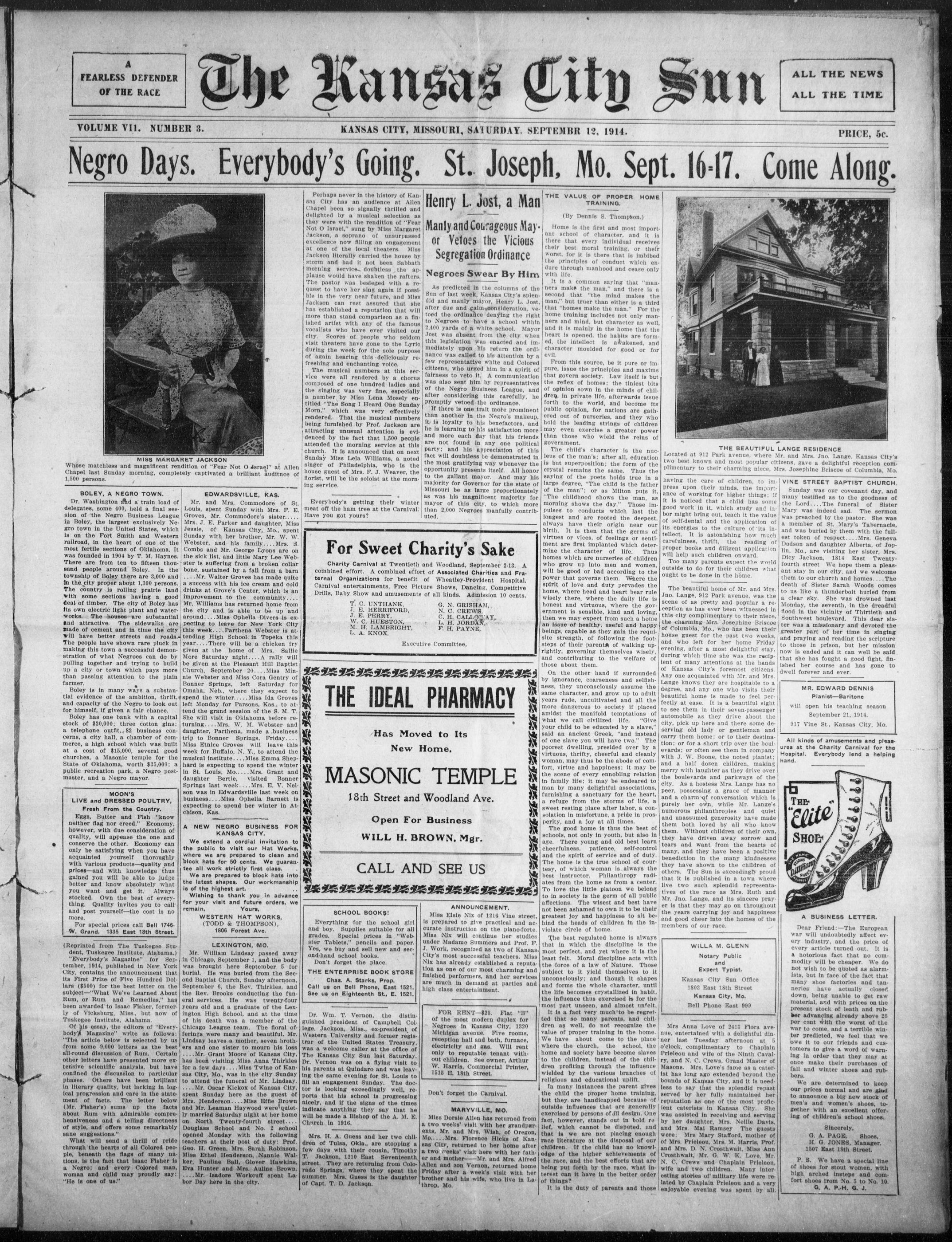
MISS MARGARET JACKSON
Whose matchless and magnificent rendition of "Fear Not O Israel" at Allen Chapel last Sunday morning, completely captivated a brilliant audition of 1,500 persons.
BOLEY, A NEGRO TOWN.
Dr. Washington and a train load of delegates, some 400, held a final session of the Negro Business League in Boley, the largest exclusively Negro town in the United States, which is on the Fort Smith and Western railroad, in heart of one of the most fertile sections of Oklahoma. It was founded in 1904 by T. M. Haynes. There are from ten to fifteen thousand people around Boley. In the township of Boley there are 3,000 and in the city proper about 1,300 persons.
The country is rolling prairie land with some sections having a good deal of timber. The city of Boley has its own electric light plant and waterworks. The houses are substantial and attractive. The sidewalks are made of cement and in time the city will have better streets and roads. The people have shown rare pluck in making this town a successful demonstration of what Negroes can do by pulling together and trying to build up a city or town which pays more than passing attention to the plain farmer.
Boley is in many ways a substantial evidence of the ambition, thrift, and capacity of the Negro to look out for himself, if given a fair chance.
EDWARDSVILLE, KAS.
Mr. and Mrs. Commodore of St Louis, spent Sunday with Mrs. F. E. Groves, Mr. Commodore's sister.... Mrs. J. E. Parker and daughter, Miss Jessie, of Kansas City, Mo., spent Sunday with her brother, Mr. W. W. Webster, and his family.... Mrs. S. Combs and Mr. George Lyons are on the sick list, and little Mary Lee Webster is suffering from a broken collar bone, sustained by a fall from a barn.... Mr. Walter Groves has made quite a success with his ice cream and cold drinks at Grove's Center, which is an improvement to the community.... Mr. Williams has returned home from the city and is able to be up and around.... Miss Ophelia Divers is expecting to leave for New York City this week.... Parthena Webster is attending High School in Topeka this year.... There will be a chicken fry given at the home of Mrs. Sallie More Saturday night.... A rally will be given at the Pleasant Hill Baptist Church, September 20.... Miss Mimie Webster and Miss Cora Gentry of Bonner Springs, left Saturday for Omaha, Neb., where they expect to spend the winter.... Miss Ida Groves left Monday for Parsons, Kas., to attend the grand session of the S. M. T.
Boley has one bank with a capital stock of $20,000; three cotton gins; a telephone outfit; $2 business concerns, a city hall, a chamber of commerce, a high school which was built at a cost of $15,000, several good churches, a Masonic temple for the State of Oklahoma, worth $35,000; a public recreation park, a Negro post master, and a Negro mayor.
Eggs, Butter and Fish "know neither flag nor creed." Economy, however, with due consideration of quality, will appease the one and conserve the other. Economy can only be satisfying when you have acquainted yourself thoroughly with various products-quality and prices—and with knowledge thus gained you will be able to judge better and know absolutely what you want and get it. Always stocked. Own the best of everything. Quality invites you to call and post yourself—the cost is no more.
For special prices call Bell 1746 W. Grand. 1335 East 18th Street.
(Reprinted from The Tuskeguee Student Turkicum Institute Akhara)
dent, Tuskegee Institute, Alabama.) "Everybody's Magazine" for September, 1914, published in New York City, contains the announcement that its First Prize of Five Hundred Dollars ($500) for the best letter on the subject—"What We've Learned About Rum, or Rum and Remedies," has been awarded to Isaac Fisher, formerly of Vicksburg, Miss., but now of Tuskegee Institute, Alabama.
Of his essay, the editors of "Everybody's Magazine" write as follows: "The article below is selected by us from some 9,000 letters as the best all-round discussion of Rum. Certain other letters have presented more extensive scientific analysis, but have confined the discussion to particular phases. Others have been brilliant in literary quality, but lacking in logical progression and care in the statement of facts. The letter below (Mr. Fisher's) sums up the facts about Rum with admirable comprehensiveness and a telling directness of style, and offers some remarkably sane suggestions."
What will send a thrill of pride through the hearts of all Colored people, beneath the flags of many nations, is the fact that Isaac Fisher is a Negro; and every Colored man, woman and child may proudly say: "He is one of us."
---
The Kansas City Sun
EDWARDSVILLE, KAS.
EDWARDSVILLE, KAS.
Mr. and Commodore of St. Louis, spent Sunday with Mrs. F. E. Groves, Mr. Commodore's sister....Mrs. J. E. Parker and daughter, Miss Jessie, of Kansas City, Mo., spent Sunday with her brother, Mr. W. W. Webster, and his family....Mrs. S. Combs and Mr. George Lyons are on the sick list, and little Mary Lee Webster is suffering from a broken collar bone, sustained by a fall from a barn....Mr. Walter Groves has made quite a success with his ice cream and cold drinks at Grove's Center, which is an improvement to the community....Mr. Williams has returned home from the city and is able to be up and around....Miss Ophelia Divers is expecting to leave for New York City this week....Parthena Webster is attending High School in Topeka this year....There will be a chicken fry given at the home of Mrs. Sallie More Saturday night....A rally will be given at the Pleasant Hill Baptist Church, September 20....Miss Minnie Webster and Miss Cora Gentry of Bonner Springs, left Saturday for Omaha, Neb., where they expect to spend the winter....Miss Ida Groves left Monday for Parsons, Kas., to attend the grand session of the S. M. T. She will visit in Oklahoma before returning....Mrs. W. M. Webster and daughter, Parthena, made a business trip to Bonner Springs, Friday....Miss Etnice Groves will leave this week for Buffalo, N. Y., to attend the musical Institute....Miss Emma Shephard is expecting to spend the winter in St. Louis, Mo....Mrs. Grant and daughter Bertle, visited Bonner Springs last week....Mrs. E. V. Nelson was in Edwardsville last week on business....Miss Ophelia Barnett is expecting to spend her winter in Atchison, Kas.
A NEW NEGRO BUSINESS FOR KANSA'S CITY.
We extend a cordial invitation to the public to visit our Hat Works, where we are prepared to clean and block hats for 50 cents. We guarantee all work strictly first class. We are prepared to block hats into the latest shapes. Our workmanship is of the highest art. . . . Wishing to thank you in advance for your visit and future orders, we remain, Yours, WESTERN HAT WORKS, (TODD & THOMPSON), 1806 FOREST Ave.
Mr. William Lindsay passed away in Chicago, September 1, and the body was brought here September 5 for burial. He was buried from the Second Baptist Church, Sunday afternoon, September 6, the Rev. Thirkles, and the Rev. Brooks conducting the funeral services. He was twenty-four years old and a graduate of the Lexington High School, and at the time of his death was a member of the Chicago League team. The floral offerings were many and beautiful. Mr. Lindsay leaves a mother, seven brothers and one sister to mourn his loss ....Mr. Grant Moore of Kansas City, has been visiting Miss Anna Thirkles for a few days....Miss Twine of Kansas City, Mo, was in the city Sunday to attend the funeral of Mr. Lindsay....Mr. Oscar Klickok of Kansas City, spent Sunday here as the guest of Mr. Henderson....Miss Effe Brown and Mr. Leaman Hayman Woolley were quietly married Saturday night at her home on North Twenty-fourth street....Douglass School and No. 2 school opened Monday with the following teachers at their post of duty: Prof. Geo. H. Green, Mrs. Sarah Robinson, Miss Ethel Henderson, Nannie Walker, Pauline Ball, Glover Hawkins, Eva Hunter and Mrs. Auline Brown....Mr. Isadore Workcuff spent Labor Day here in the city.
LEXINGTON, MO.
KANSAS CITY, MISSOURI, SATURDAY, SEPTEMBR 12, 1914.
Perhaps never in the history of Kansas City has an audience at Allen Chapel been so signally thrilled and delighted by a musical selection as they were with the rendition of "Fear Not O Israel," sung by Miss Margaret Jackson, a soprano of unsurpassed excellence now filling an engagement at one of the local theaters. Miss Jackson literally carried the house by storm and had it not been Sabbath morning service doubtless the aplause would have shaken the rafters. The pastor was besieged with a request to have her sing again if possible in the very near future, and Miss Jackson can rest assured that she has established a reputation that will more than stand comparison as a finished artist with any of the famous vocalists who have ever visited our city. Scores of people who seldom visit theaters have gone to the Lyric during the week for the sole purpose of again hearing this delicously refreshing and enchanting voice.
The musical numbers at this service were all rendered by a chorus composed of one hundred ladies and the singing was very fine, especially a number by Miss Lena Mosely entitled "The Song I Heard One Sunday Morn," which was very effectively rendered. That the musical numbers being furnished by Prof. Jackson are attracting unusual attention is evidenced by the fact that 1,500 people attended the morning service at this church. It is announced that on next Sunday Miss Lela Williams, a noted singer of Philadelphia, who is the house guest of Mrs. F. J. Weaver, the florist, will be the soloist at the morning service.
Everybody's getting their winter meat off the ham tree at the Carnival. Have you got yours?
For Sweet C
Charity Carnival at Twentieth
combined effort. A combined effo
ternal Organizations for benefit
Carnival entertainments, Free Pic
Drills, Baby Show and amusements
T. C. UNTHANK,
J. E. HERRIFORD,
J. E. PERRY,
W. C. HUESTON,
M. H. LAMBRIGHT,
L. A. KNOX.
Execu
THE IDEAL
Charity Carnival at Twentieth and Woodland, September 2-13. A combined effort. A combined effort of Associated Charities and Fraternal Organizations for benefit of Wheatley-Provident Hospital. Carnival entertainments, Free Picture Shows, Dancing, Competitive Drills, Baby Show and amusements of all kinds. Admission 10 cents.
Has Moved to Its New Home.
MASONIC TEME
18th Street and Woodland Ave
Open For Business
WILL H. BROWN, Mgr.
CALL AND SEE US
SCHOOL BOOK$!
Everything for the school girl and boy. Supplies suitable for all grades. Special prices in "Webster Tablets," pencils and paper. Yes, we buy and sell new and second-hand school books.
Don't forget the place.
THE ENTERPRISE BOOK STORE
Chas. A. Starks, Prop.
Call us on Bell Phone, East 1521.
See us on Eighteenth St. E. 1521.
Dr. Wm. T. Vernon, the distinguished president of Campbell College, Jackson, Miss., ex-president of Western University and former registrar of the United States Treasury, was a welcome caller at the office of the Kansas City Sun last Saturday. Dr. Vernon was on a flying visit to his parents at Quindaro and was leaving the same evening for St. Louis to fill an engagement Sunday. The doctor is looking exceedingly well, reports that his school is progressing nicely, and if the signs of the times indicate anything they say that he will be made a Bishop of the A. M. E. Church in 1916.
Mrs. H. A. Guess and her two children of Tulsa, Okla., are stopping a few days with their cousin, Timothy T. Jackson, 1210 East Seventeenth street. They are returning from Colorado Springs, where they spent the summer. Mrs. Guess is the daughter of Capt. T. D. Jacksqn.
Henry L. Jost, a Man Manly and Courageous Mayor Vetoes the Vicious Segregation Ordinance
Negroes Swear By Him
As predicted in the columns of the Sun of last week, Kansas City's splendid and manly mayor, Henry L. Jost, after due and calm consideration, vetoed the ordinance denying the right to Negroes to have a school within 2,400 yards of a white school. Mayor Jost was absent from the city when this legislation was enacted and immediately upon his return the ordinance was called to his attention by a few representative white and Colored citizens, who urged him in a spirit of fairness to veto it. A communication was also sent him by representatives of the Negro Business League, and after considering this carefully, he promptly vetoed the ordinance.
If there is one trait more prominent than another in the Negro's makeup, it is loyalty to his benefactors, and he is learning to his satisfaction more and more each day that his friends are not found in any one political party; and his appreciation of this fact will doubtless be demonstrated in the most gratifying way whenever the opportunity presents itself. All honor to the gallant mayor. And may his majority for Governor for the state of Missouri be as large proportionately as was his magnificent majority for mayor of this city, to which more than 2,000 Negroes manfully contributed.
Charity's Sake
and Woodland, September 2-13. A
part of Associated Charities and Fra-
cure of Wheatley-Provident Hospital.
Texture Shows, Dancing, Competitive
s of all kinds. Admission 10 cents.
G. N. GRISHAN,
N. C. CREWS,
C. H. CALLOWAY,
L. H. JORDAN,
F. H. PAYNE,
tive Committee.
PHARMACY
TEMPLE Woodland Ave.
ANNOUNCEMENT.
Miss Elsie Nix of 1216 Vine street, is prepared to give practical and accurate instruction on the planoforte. Miss Nix will continue her studies under Madame Summers and Prof. F. J. Work, recognized as two of Kansas City's most successful teachers. Miss Nix has already established a reputation as one of our most charming and finished performers, and her services are much in demand at parties and high class entertainment.
FOR RENT—$25. Flat "B" of the most modern duplex for Negroes in Kansas City, 1320 Michigan avenue. Five rooms, reception hall and bath, furnace, electricity and gas. Will rent only to reputable tenant without children. See owner, Arthur W. Harris, Commercial Printer, 1515 E. 18th Street.
Don't forget the Carnival.
MARYVILLE, MO.
Miss Dorsie Allen has returned from a two weeks' visit with her grandparents, Mr. and Mrs. Wish, of Oregon, Mo....Mrs. Florence Hicks of Kansas City, returned to her home after a two weeks' visit here with her father and mother—Mr. and Mrs. Alfred Allen and son Vernon, returned home Friday after a week's visit with her brother and his wife, who live in Lathrop, Mo.
THE VALUE OF PROPER HOME TRAINING.
(By Dennis S. Thompson.)
Home is the first and most important school of character, and it is there that every individual receives their best moral training, or their worst, for it is there that is imbibed the principles of conduct which endure through manhood and cease only with life.
It is a common saying that "manners make the man," and there is a second that "the mind makes the man," but truer than either is a third that "homes make the man." For the home training includes not only manners and mind, but character as well, and it is mainly in the home that the heart is opened, the habits are formed, the intellect is awakened, and character moulded for good or for evil.
From this source, be it pure or impure, issue the principles and maximus that govern society. Law itself is but the reflex of homes; the tiniest bits of opinion sown in the minds of children, in private life, afterwards issue forth to the world, and become its public opinion, for nations are gathered out of nurseries, and they who hold the leading strings of children may even exercise a greater power than those who wield the reins of government.
The child's character is the nuc leus of the man's; after all, education is but superposition; the form of the crystal remains the same. Thus the saying of the poets holds true in a large degree, "The child is the father of the man"; or as Milton puts it "The childhood shows the man, as morning shows the day." Those impulses to conducts which last the longest and are rooted the deepest, always have their origin near our birth. It is then that the germs of virtues or vices, of feelings or sentiment are first implanted which determine the character of life. Thus homes which are nurseries of children who grow up into men and women, will be good or bad according to the power that governs them. Where the spirit of love and duty pervades the home, where head and heart bear rule wisely there, where the daily life is honest and virtuous, where the government is sensible, kind and loving, then we may expect from such a home an issue of healthy, useful and happy beings, capable as they gain the requisite strength, of following the footsteps of their parents of walking uprightly, governing themselves wisely, and contributing to the welfare of those about them.
On the other hand if surrounded by ignorance, coarseness and selfishness, they unconsciously assume the same character, and grow up to adult years rude, uncultivated and all the more dangerous to society if placed amidst the manifold temptations of what we call civilized life. "Give your child to be educated by a slave," said an ancient Greek, "and instead of one slave you will have two." The poorest dwelling, presided over by a virtuous, thrifty, cheerful and cleanly woman, may thus be the abode of comfort, virtue and happiness; it may be the scene of every ennobling relation in family life; it may be endeared to man by many delightful associations, furnishing a sanctuary for the heart, a refuge from the storms of life, a sweet resting place after labor, a consolation in misfortune, a pride in prosperity, and a joy at all times.
The good home is thus the best of schools, not only in youth, but also in age. There young and old best learn cheerfulness, patience, self-control and the spirit of service and of duty. The home is the true school of courtesy, of which woman is always the best instructor. Philanthropy radiates from the home as from a center. To love the little platoon we belong to in society is the germ of all public affections. The wisest and best have not been ashamed to own it to be their greatest joy and happiness to sit behind the heads of children in the inviolate circle of home.
The best regulated home is always that in which the discipline is the most perfect, and yet where it is the least felt. Moral discipline acts with the force of a law of Nature. Those subject to it yield themselves to it unconsciously; and though it shapes and forms the whole character, until the life becomes crystallized in habit, the influence thus exercised is for the most part unseen, and almost unfeel. It is a fact very much to be regretted that so many parents, and children as well, do not recognize the value of proper training in the home. We have about come to the place where the church, the school, the home and society have become slaves to the children, instead of the children profiting through the influence wielded by the various branches of religious and educational uplift.
In many instances the parent gives the child the proper home training, but they are handicapped because of outside influences that are generally exercised by persons of all design. One fact, however, stands out in bold relief, which cannot be disputed, and that is we are not placing enough race literature at the disposal of our children. If the child has no knowledge of the higher achievements of the race, and the best efforts that are being put forth by the race, what interest can it have in the better order of things?
It is the duty of parents and those
THE BEAUTIFUL LANGE RESIDENCE
Located at 912 Park avenue, where Mr. and Mrs. Jno. Lange, Kansas City's two best known and most popular citizens, gave a delightful reception complimentary to their charming niece, Mrs. Josephine Briscoe of Columbia, Mo.
having the care of children, to impress upon their minds, the importance of working for higher things; if it is noticed that a child has some good work in it, which study and labor might bring out, teach it the value of self-denial and the application of its energies to the culture of its intellect. It is astonishing how much carefulness, thrift, the reading of proper books and diligent application will help such children onward.
Too many parents expect the world outside to do for their children what ought to be done in the home.
VINE STREET BAPTIST CHURCH.
Sunday was our covenant day, and many testified as to the goodness of the Lord....The funeral of Sister Mary was indeed sad. The sermon was preached by the pastor. She was a member of St. Mary's Tabernacle, and was buried by them with the fullest token of respect....Mrs. Geneva Dodson and daughter Alberta, of Joplin, Mo., are visiting her sister, Mrs. Dicy Jackson, 1814 East Twenty-fourth street. We hope them a pleasant stay in our city, and we welcome them to our church and home.
The beautiful home of Mr. and Mrs. Jno. Lange, 912 Park avenue, was the scene of as pretty and popular a reception as has ever been witnessed in this city complimentary to their niece the charming Josephine Briscoe of Columbia, Mo., who has been their house guest for the past two weeks, and who left for her home Friday evening, after a most delightful stay, during which time she was the recipient of many attentions at the hands of Kansas City's foremost citizens. Any one acquainted with Mr. and Mrs. Lange knows they are hospitable to a degree, and any one who visits their beautiful home is made to feel perfectly at ease. It is a beautiful sight to see them in their seven-passenger automobile as they drive about the city, pick up here and there some deserving old lady or gentleman and carry them home; or to their destination; or for a short trip to the boulevards; or often see them in company with J. W. Boone, the noted pianist; and a half dozen children, merry with laughter as they drive over the boulevards and parkways of the city. As a hostess Mrs. Lange has no peer, possessing a grace of manner and a charm of conversation which is purely her own, while Mr. Lange's numerous philanthropies and quiet and unassumed generosity have made them both loved by all who know them. Without children of their own they have driven away sorrow and tears and want from the hearts of many, and they have been a positive benediction in the many kindnesses they have shown to the children of others. The Sun is exceedingly proud that it is published in a town where live two such splendid representatives of the race as Mrs. Ruth and Mr. Jno. Lange, and its sincere prayer is that they may go on throughout the years carrying joy and happiness and good cheer into the homes of the members of our race.
WILLA M. GLENN
Notary Public
and
Expert Typist.
Kansas City Sun Office
1803 East 18th Street
Kansas City, Mo.
Bell Phone East 999
Mrs Anna Love of 2413 Flora avenue, entertained with a delightful dinner last Tuesday afternoon at 5 o'clock, complimentary to Chaplain Prieleau and wife of the ninth Cavalry, and N. C. Crews, Grand Master of Masons. Mrs. Love's fame as a caterist has long ago extended beyond the bounds of Kansas City, and it is needless to say that the splendid repast served by her fully maintained her reputation as one of the most proficient caterers in Kansas City. She was assisted in receiving and serving by her daughter, Mrs. Nellie Davis, and Mrs. Mai Ramsey The guests were: Mrs Mary Stafford, mother of of Mrs. Prieleau, Mrs. M. Harris, Prof. and Mrs. D. N. Crosthwait, Miss Ann Crosthwait, Mr. G. W. K. Love, Mr. N. C. Crews and Chaplain Prieleau, wife and two children. Many interesting stories of military life were related by Chaplain Prieleau and a very enjoyable evening was spent by all
ALL THE NEWS
ALL THE TIME
ome Along.
Sunday was our covenant day, and many testified as to the goodness of the Lord....The funeral of Sister Mary was indeed sad. The sermon was preached by the pastor. She was a member of St. Mary's Tabernacle, and was buried by them with the fullest token of respect....Mrs. Geneva Dodson and daughter Alberta, of Joplin, Mo., are visiting her sister, Mrs. Dicy Jackson, 1814 East Twenty-fourth street. We hope them a pleasant stay in our city, and we welcome them to our church and homes....The death of Sister Sarah Woods comes to us like a thunderbolt hurled from a clear sky. She was drowned last Monday, the seventh, in the dreadful flood in the vicinity of Thirtieth and Southwest boulevard. This dear sister was a missionary and devoted the greater part of her time in singing and praying and reading the scripture to those in prison, but her mission now is ended and it can well be said that she has fought a good fight, finished her course and has gone to dwell forever and ever.
MR. EDWARD DENNIS
Pianist—Baritone
will open his teaching season
September 21, 1914.
917 Vine St., Kansas City, Mo.
All kinds of amusements and pleasures at the Charity Carnival for the Hospital. Everybody lend a helping hand.
THE "Elite" SHOE
THE NAME
Ditman
Ditman
SHOE
ASSUMED
Dear Friend:—The European war will undoubtedly affect every industry, and the price of every article turned out. It is a notorious fact that no commodity will be cheaper. We do not wish to be quoted as alarmists, but in face of the fact that many shoe factories and tanneries have actually closed down, being unable to get raw material, and with prices on the present stock of leather and rubber advancing already above 25 per cent with the worst of the war to come, and a terrible winter predicted, we feel that we owe it to our friends and customers to give a word of warning in order that they may at once make their purchases of fall and winter shoes and rubbers.
We are determined to keep our prices normal and are glad to announce a big new stock of men's and women's shoes, together with an excellent offering of children's school shoes.
Sincerely,
G. A. PAGE, Shoes,
H. G. JONES, Manager,
1507 East 18th Street.
P. S. We have a special line of shoes for stout women, with high arched insteps and comfort shoes from No. 5 to No. 10. G. A. P.-H. G. J.
PRICE, 5c.
INTERNATIONAL
SUNDAY SCHOOL
LESSON
(BY E. O. SELLERS, Director of Evening Department, The Moody Bible Institute. Chicago)
LESSON FOR SEPTEMBER 13
**LESSON TEXT - Matt.** 25.1-13.
**GOLDEN TEXT - "Watch therefore for you, know neither the day nor the hour when the Son of Man cometh."** Matt. 12.13.
A parable is "an earthly story with a heavenly meaning." An analogy is "a ikeneas." This story is a parable. It is to illustrate the vigilant, expert attitude of faith, Heb. 6:28; II Tim. 4:8. Leaving the temple, Jesus drew the disciples' attention to its buildings and predicted its destruction. Proceeding to the Mount of Olives, his disciples ask him, "Tell us, when shall these things be? And what shall be the sign of thy coming, and the end of the world?" In reply Jesus gave the disciples his Olivet discourse and prophecies found in chapters 24 and 25. To fully comprehend this parable we ought to review all of this teaching. The discourse as a whole falls into these parts (1) 24:1:44 deals with Israel as a nation; (2) 24:45:28:30 deals with the church as being responsible for the king during the period between his two adventions; and (3) 25:31:46 deals with the judgment of the nations when the Son of Man comes in his glory. It will be seen then that this lesson comes in the second part and is one of three parables concerning the responsibility of the church. Jesus is the bridegroom, John 3:28, 29; Eph. 5:25; II Cor. 11:2; Rev. 21.9, and sets forth the love of Christ for the church. Eph. 5:25, 28:30.22
Two Classes.
1. "While the bridegroom tarried"
vv. 1:5. The first and strongest idea of this section is that he, Jesus, the bridegroom, is coming again. Among those who wait are two classes, the wise and the foolish, though both were right intentioned. The lamps symbolize Christian profession, Luke 12:35; II Tim. 3:5, and the oil that which is essential to give us power whereby we maintain our profession, Acts 10:38; I John 2:20-27. The foolish virgins were superficial and had not enough to maintain their professions. The wise virgins had enough oil; so also may the believer have the abiding spirit of Christ's presence wherein to maintain his Christian profession. Waiting they all nodded (slumbered) and others evidently lay down (slept). The wise virgins could afford to rest as they had all things ready. If they had been awake, however, they might have seen and rendered aid to those who were in the sorry plight of not being ready. The tarrying was a test of the faith and patience of both the wise and the foolish as both awaited the "fulness of time" when he should appear.
The Great Question:
II. Behold the bridegroom cometh" vv. 6-13. All are awakened by this midnight cry. The hour was one when he was least expected, and the church of today needs to be awakened to a realizing sense of this truth. Both the wise and the foolish have to meet him, but the wise were the only ones whose lights could shine and show the way into the banqueting room. They all outwardly appear alike even to the very point of separation. The church of God individually and collectively, has yet to sense the danger to it and to others if its light for any reason be not continuous. This cry was a call to "meet him" and we all need to ask ourselves, "are we ready to meet him?" The hour was too late to make needful preparation to meet him. In their emergency they turned to the five wise ones but the wisdom of one cannot supply the deficiency or the foolishness of others (v. 9). There is no Scripture to support the teaching that one man's merit is applicable to another except the merit of the God-man Jesus as applied to sinful humanity. Hence the wise sent their sisters to the original source of supply for oil, and as they went "the bridegroom came." So will it be with all who put off too long the securing of the Holy Spirit in their lives.
"They that were ready" went in, they that were not ready when they came found the door "shut." To attend a marriage feast is highly esteemed everywhere, but it is a privilege that is worthy of careful preparation. Remember that Jesus is here showing the attitude towards himself of those who profess to be devoted to him during the period of his absence, and who expect his return as king. That being so, we need to remind ourselves of the laws of the kingdom as he gave them at the beginning of his public career. In them we hear his saying, "Ye are the light of the world." Neither do men light a candle and put it un
der a bushel but on a candlesick.
Let your light so shine before men that they
may glorify your Father which is in heaven." Matt. 6:14-16. If we apply these words to this particular parable there is revealed to us the fact that true and real waiting for Christ is that which witnesses to men, and it was in this that the foolish virgin sins failed. At the outset their lights were shining but they failed to be in that close contact, in the exercise of those habits and practises of spiritual fellowship with their Lord which would insure the continuous shining of their light. This broken fellowship explains what he means by his words at his coming, "Verily I say unto you, I know you not." They had broken connection with him, the source of needful supply. There must be the careful maintenance of the relations of closest friendship with him if we are to have that supply of the Spirit as shall enable us to keep the light shining clearly and effectually.
AFRO-AMERICAN CULLINGS
Charles S. Osborne of Boston, a colored porter employed by the Oakland Motor Car company, has just finished a portrait of Cardinal O'Connell, which in many ways proves the ability of the artist. The picture and the wood carving in the frame that encloses it, and the pedestal on which it stands, required eight weeks to finish.
The accomplishment is the more striking in that Mr. Osborne can devote only part of his spare time, about two hours a day when there is daylight, to the practicing of his favorite recreation and prospective life work. When his duties as porter are over at five o'clock in the afternoon he hastens to his little room, which is a studio as well, and while the light is good paints or does charcoal drawing.
Cardinal O'Connell's portrait, which is done in oil, was painted from a recent photograph by a well known Boston photographer, and is 20 by 27 inches. The carved and painted frame is about four feet high and is an excellent representation of the old Florentine art, as is the hand carved pedestal on which it rests. In the center of the woodwork above the picture is a miniature reproduction of the "Nativity," and on either side in the carved replica of Florentine cathedral windows is an angel, one holding a harp and the other a bugle. On the base of the frame is carved a wreath of red roses, harmonizing with the cardinal's cape. The work of Mr. Orborne is a triumph over difficulties, for practically all of the carving was done with a lackknife.
Mr. Osborne was born in Savannah, Ga. In 1870, and spent the first 20 years of his life in the South. He worked with carpenters and learned panelling and moulding, but all the while he fostered a strong desire to become a painter. He used to draw in the sand with pointed sticks and occasionally procured a little crayon. Feeling that there was larger opportunity in the North, he came to Boston in 1891, and while working as a porter went to the evening school of the Boston Art club. There he received instruction in charcoal drawing from Ernest Major.
Later he studied water colors under Miss Agnes Leavitt, an artist in Copley square. For several years after that he kept up his artistic endeavors alone, money not being very plentiful. He disposed of quite a number of paintings in this period, and with the proceeds he was able to go to the drawing school of Eric Pape in 1911, studying there three years. Much of his spare time has been spent in visiting art exhibitions and in the art department of the Boston city library. Mr. Osborne has sold a number of outdoor sketches and portraits done from life. He considers his best work to be the "Oriental Dancing Girl," from life, a picture which took him six months to complete and which is now on exhibition at the Boston City club. After a rest of two weeks he intends to begin a work called "Star of Bethlehem," which he hopes to have on exhibition by Christmas.
Adulterated olive oil is hard to detect, even by the expert tasters. They allege, however, that they can tell the spurious article by flavor and effect on the throat.
The first smoking car was put into operation on the Eastern Counties railway in England in 1846.
The grand lodge of colored Masons of Indiana met in New Albany. Richmond was chosen for the 1915 meeting. Officers elected were: Grand master, D. W. Caine, Seymour; deputy grand master, C. E. Dunlap, Indianapolis; senior warden, Marcus Herring, Crawfordsville; junior warden, henry Edmonds, Mitchell; secretary, Fred D. Blake, Terre Haute; treasurer, R. F. Taylor, Jeffersonville; lecturer J. H. Williams, Washington; marshal, James Ferguson, Richmond; senior deacon, Silas Mills, Fort Wayne; junior deacon, R. W. Manuel, Princeton, stewards, G. S. Peoples, Rockville, Frank James, Evansville; chaplain, W. H. Anderson, Evansville; tiler, E. P. Stewart, Vincennes; trustees, E. O. Price, Connerville; Joseph Jackson, Terre Haute; Theodore Crawford, Indianapolis.
On June 30 last the state of Western Australia owned 3,150 miles of railway and more than 600 miles were in course of construction.
Every man has an excuse for wanting the earth, but his excuse is never satisfactory to his neighbors.
Dairen, China, has 21 public primary schools with nearly 6,000 pupils, and 289 private schools with 7,000 pupils.
The highest inland building is the new Chamber of Commerce at St. Louis, Mo. The height above the street level is 495 feet.
Mines and quarreys in Bavaria, Germany, employ 15,000 men.
There is a lighthouse every 14 miles along the English coast.
using coal in Germany.
Peat cake in Germany is proving serviceable in many ways. It is not only valuable for generating electricity at moorland stations, but is much used by blacksmiths and for various metallurgical purposes, especially as a substitute for charcoal in producing high-grade iron. A new turf-cooking plant at Elizabeth-Fehn, Oldenburg, converts 30 tons of peat into nine of coke, with gas and tar as by-products. Specially-designed ovens are used and the gas generated
When the authorities of the Calhoun school decided to add a story to the Armstrong-Slater Memorial Trade school, the student tradesmen attacked with enthusiasm the laborious task of raising the heavy roof and putting on the second story. Then came the tedious days devoted to finishing the interior work. There was always the joy of doing successfully tasks generally considered beyond the reach of tradesmen 'in' the training.
Again the call came to do some building which would require skill, patience, and endurance. It was the erection of a two-story brick building to be used as a social center for the boys. Contracts were awarded to the Trade Schools departments and student tradesmen did the construction work. Today the building stands completed. It is known as Clark hall. It is used by the Young Men's Christian association. To appreciate the meaning of these three examples of construction work done by the Hampton tradesmen, one must see the completed structures and realize the building problems which the young negro and Indian tradesmen met and successfully solved.
While construction work calls for ability to read working drawings and follow detailed specifications, the demands made by repair problems are in many instances even more taxing. To make a repair quickly, skilfully, and economically, requires unusual ability. Hampton institute is indeed an industrial village in which there is constant demand for men who can do good repair and construction work. Hampton aims to fit young men and women to do well and in an uncommon way the common tasks of life. Students are taught to handle their tasks like skilled workmen. They have for their work an excellent equipment and they are expected and required to take the best possible care of the school's property. They receive financial credit for their work and they are required to keep a strict account of all that they earn and spend during the years of their training at Hampton.
Clerks in the stores and shops of all kinds in Mexico smoke while waiting on customers.
The work for girls at Hampton leads to the important occupations of homemaking and teaching. When a girl enters Hampton institute she has the opportunity of receiving thorough training in domestic science. The girls work daily for 12 months in the laundry and in the boarding departments under the supervision of experienced teachers, and in carry on their academic studies in the evening the same as the boys who are in the work class. The mental and moral training, which the year of combined work and study gives, makes it one of the most valuable years of the course. The working day for the girls is shorter than for the boys, but a girl may earn from $15 to $18 a month. This enables her to be entirely self-supporting during her first year in school, and to accumulate a balance toward defraying the expenses of the second year. A girl in the work class needs very little money besides her entrance fee and first month's board. This course is advised for all new girls regardless of their ability to pay their way in the day school.
Belgian state railways buy cloth from England for uniforms of employees.
Within an area only eight per cent. larger than Rhode Island the English county of Lancashire supplies the world with 70 per cent of its cotton manufactures.
A gas buoy broke away from its moorings in the St. Lawrence and drifted two years, covering a distance of 18,000 miles.
Pennsylvania has one automobile for each 150 inhabitants, which is quite a good deal more than the average for the whole country.
The maximum depth of the Pacific ocean is near the island of Mindanao, while in the Atlantic a spot off the coast of Porto Rico holds the record.
The indications are that the Chinese will lead the world with their aeroplane fleet in the course of a very few years.
Electrical workers in Sheffield, England, are paid 17 cents an hour.
Birmingham, England, is doubling its water supply at a cost of $3,400,000.
Russian railroads protect ties and telegraph poles against decay by soaking them for several months before use in strong brine.
Insomnia is one thing and a nightmare is another. Eat lobster and take your choice.
When a man mixes religion with politics the religion is apt to lose its identity.
Wild animals work great havoc in India's wheat fields.
is made to heat the retorts and to generate electric current to drive the peat dredging machines. The tar yields creosote oil, gas oil, paraffin, sulphuric acid and ammonia.
Of No Use to Him
Coal Dealer—Why don't you wheel the barrow along more quickly, Pat? It's not a very hard job; there's an inclined plane to relieve you. Pat—Aye, master, the plane may be inclined, but hang me if I am!—Pearson's Weekly.
THE FASHION OF THE TWENTIETH CENTURY
Olivia
RATHER as a suggestion than as couples to be exactly followed, these two dresses designed for little girls are shown here. American adaptations of French clothes for children usually show greater length of skirt and somewhat more fullness than the original designs. The little dress designed for the tiny girl is so plain in the body as to be boyish, but the fancy decoration in smocked silk on sleeves and collar, and the puffing of the sleeves, places it as a girl's dress.
The material used is a checked velveteen. The little garment is cut with a long shoulder and made over a muslin body. The back is plain, but the front is cut wide enough to be gathered into scant fullness along the shoulder seams and about the neck. The shoulders extend over the sleeves, which are set into the body. There is a narrow collar extending from shoulder to shoulder. This is made on a plain silk foundation covered with smocking of the same silk and finished with narrow soutache braid about the edge and along the center. A decoration of the same sort is placed across the puffed sleeve and finishes it at the bottom. Two short straps of the material of the dress
Dancing Cap o
SINCE the introduction of dancing caps, which made their debut along with the strenuous tango, ribbons and laces, nets and gauzes, have been fashioned in unending variety into caps for the dancing girl. And now that we have gold and silver tissues, silver spangled nets, and gauzes striped with tinsel, designers have been quick to seize upon these new fabrics and to make alluring head decorations of them.
These little caps are also to be worn to the theater and called "opera caps" as well as "dancing caps." They are worn with fancy neckpieces of ostrich finished with ribbons. A cap and neckpiece like those illustrated here are wonderfully effective and brilliant.
For decorating evening caps of this kind tassels of silver or gold filigree, or little balls, are used. To add a little touch of color small flowers of silk or satin ribbon are most often employed. But the matter of decora-
Wide Use of Lace
According to the Dry Goods Economist, entire capes of Chantilly lace are featured in Paris and this lace cape idea is being used here, especially in dressy blouses and dancing frocks. Bolero effects of lace and long lace sleeves and even basques of lace are in evidence in the new gowns and blouses. Black lace brims will appear in millinery and all net and lace dancing caps and camisoles will be strong holiday features.
simulate the belt near the bottom of the skirt, to which they are fastened with silk buttons.
For practical use the sleeve should be made longer, and a little additional length of skirt will improve the design.
A plain dress in a smooth-face cloth is shown, with a little cape to be worn with it. The cape is in reality one of those odd new garments which are part cape and part coat and are best described as a cape into which sleeves are introduced. There are numbers of these new developments in outer garments, which suggest a cape and are the results of its inspiration. It is only possible to make them by securing a pattern.
This garment, like all others of the same character, is lined with a plain soft silk. Its only decoration appears about the cuffs and in the three fancy buttons with simulated buttonholes at the neck.
A touch of vivid color enliven this plain dress. It is introduced in a scarf of Roman stripe ribbon at the neck. The usual collar of dainty organie, which is so often the part of misses' dresses, finishes this one.
of Flitter Silver
tion gives much scope to the individual fancy.
Since the materials of which the caps are made are so brilliant one should be careful to use very little in the way of trimming on them.
The popularity of caps of this kind is assured. They are more brilliant than any collure. They do not have to be removed at the theater, and at the dance they keep the hair in place. But above all they are amazingly becoming, as full of dash and brilliance as a diamond.
Ostrich neckpieces are not very long and are made up in white and all the light colors, and in the natural colors.
The latter are more generally useful than others because they are suitable for afternoon wear as well as for evening.
JULIA BOTTOMLEY.
Berlin doctors have named a new disease "tango foot" and attributed it to that dance.
Tunics of net are a characteristic feature of many of the smartest gowns. Frequently they are used in combination with an edging of fur, beads or roses.
Not Pretzels
Man (in bakeshop)—My wife told me to get something else—what was it?" Baker—You have biscuits and a pie—maybe it was some crullers." Man—Not I; I distinctly remember her telling me not to get things twisted.
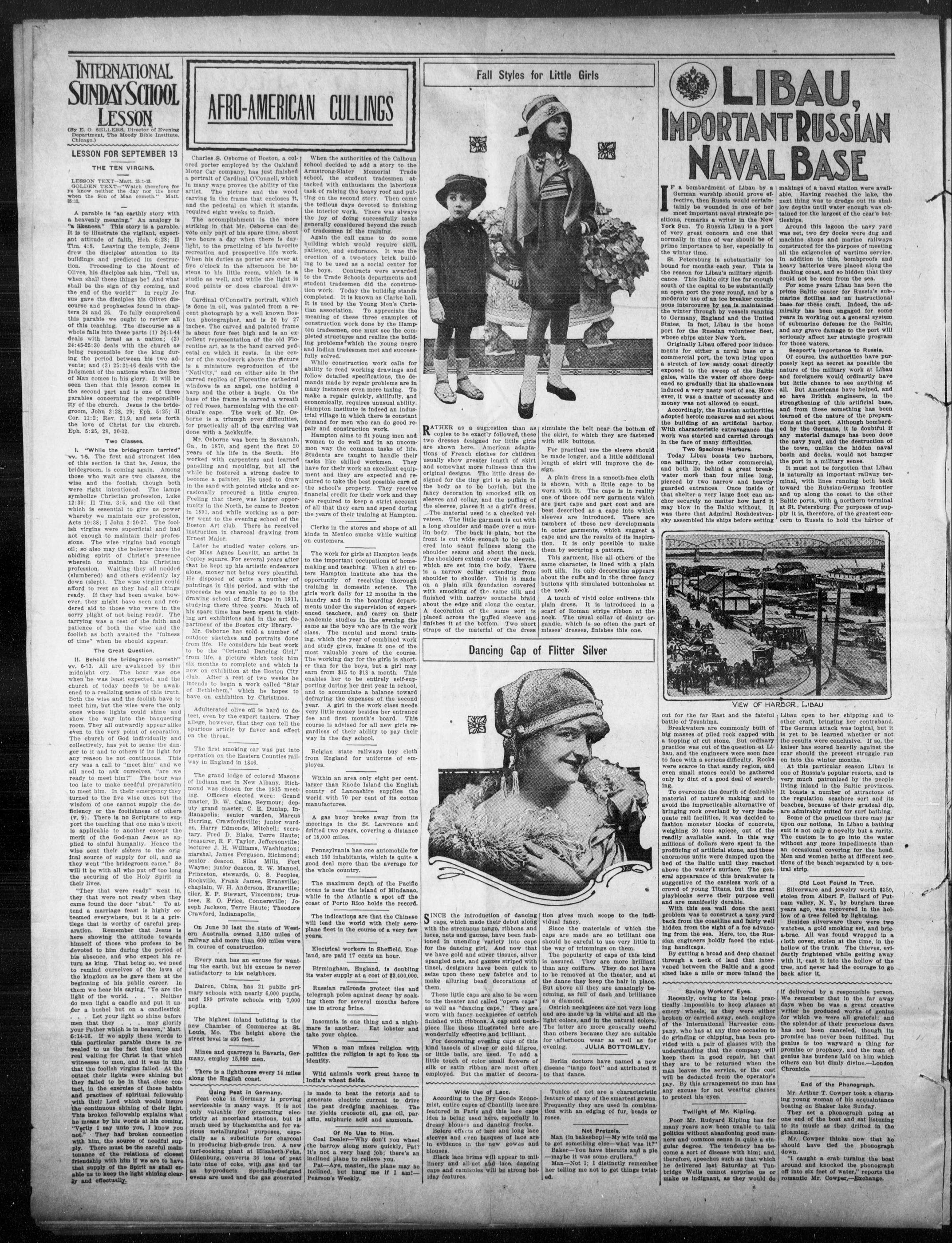
LIBAU IMPORTANT RUSSIAN NAVAL BASE
If a bombardment of Libau by a German warship should prove effective, then Russia would certainly be wounded in one of her most important naval strategic positions, remarks a writer in the New York Sun. To Russia Libau is a port of very great concern and one that normally in time of war should be of prime importance to her, especially in the winter time.
St. Petersburg is substantially ice bound for months each year. This is the reason for Libau's military significance. This Baltic city lies far enough south of the capital to be substantially an open port the year round, and by a moderate use of an ice breaker continuous intercourse by sea is maintained the winter through by vessels running to Germany, England and the United States. In fact, Libau is the home port for the Russian volunteer fleet, whose ships enter New York.
Originally Libau offered poor inducements for either a naval base or a commercial port, the town lying upon a stretch of low sandy coast directly exposed to the sweep of the Baltic gales, while the water off shore deepened so gradually that its shallowness induced a very nasty sort of sea. However, it was a matter of necessity and money was not allowed to count. Accordingly, the Russian authorities adopted heroic measures and set about the building of an artificial harbor. With characteristic extravagance the work was started and carried through in the face of many difficulties.
Today Libau boasts two harbors, one military, the other commercial, and both lie behind a great breakwater more than four miles long, pierced by two narrow and heavily guarded entrances. Once inside of that shelter a very large fleet can anchor securely no matter how hard it may blow in the Baltic without. It was there that Admiral Rozhdestvensky assembled his ships before setting
AIRWAYS
VIEW OF HARDOR LIBAU
out for the far East and the fateful battle of Tushima. Breakwaters are commonly built of big masses of piled rock capped with a topping of cut stone. But ordinary practice was out of the question at Llau, and the engineers were soon face to face with a serious difficulty. Rocks were scarce in that sandy region, and even small stones could be gathered only by dint of a good deal of searching.
To overcome the dearth of desirable material of nature's making and to avoid the impracticable alternative of bringing rock overland by very inadequate rail facilities, it was decided to fashion monster blocks of concrete, weighing 30 tons apiece, out of the readily available sand. In this way millions of dollars were spent in the producing of artificial stone, and these enormous units were dumped upon the bed of the Baltic until they reached above the water's surface. The general appearance of this breakwater is suggestive of the careless work of a crowd of young Titans, but the great playbolds serve their purpose well and are manifestly durable. With this sea wall done the next problem was to construct a navy yard back from the coastline and fairly well hidden from the sight of a foe advancing from the sea. Here, too, the Russian engineers boldly faced the existing handicaps.
By cutting a broad and deep channel through a neck of land that intervened between the Baltic and a good sized lake a mile or more inland the
Saving Workers' Eyes
Saving Works' Lodge
Recently, owing to its being practically impossible to keep glasses at emery wheels, as they were either broken or carried away, each employee of the International Harvester company, who has at any time occasion to do grinding or chipping, has been provided with a pair of glasses with the understanding that the company will keep them in good repair, but that they are to be returned when the man leaves the service, or the cost will be deducted from the operator's pay. By this arrangement no man has any excuse for not wearing glasses to protect his eyes.
Twilight of Mr. Kipling.
Poor Mr. Rudyard Kipling has for many years now been unable to talk politics without abandoning good manners and common sense in quite a singular degree. The tendency has become a sort of disease with him; and, therefore, speeches such as that which he delivered last Saturday at Tunbridge Wells cannot surprise us or make us indignant, as they would do
makings of a naval station were available. Having reached the lake, the next thing was to dredge out its shallow depths until water enough was obtained for the largest of the cxar's battleships.
Around this lagoon the navy yard was set, two dry docks were dug and machine shops and marine railways constructed for the purpose of meeting all the exigencies of wartime service. In addition to this, bombproofs and heavy batteries were placed along the flanking coast, and so hidden that they could not be seen from the sea.
For some years Libau has been the prime Baltic center for Russia's submarine flotillas and an instructional base for these craft. Indeed, the admiralty has been engaged for some years in working out a general system of submarine defense for the Baltic, and any grave damage to the port will seriously affect her strategic program for those waters.
Seaport's importance to Russia. Of course, the authorities have purposely kept as secret as possible the nature of the military work at Libau and foreigners would ordinarily have but little chance to see anything at all. But Americans have helped, and so have British engineers, in the strengthening of this artificial base, and from these something has been learned of the nature of the preparations at that port. Although bomarded by the Germans, it is doubtful if any material damage has been done the navy yard, and the destruction of the town, unlike the hidden naval basin and docks, would not hamper the port in a military sense. It must not be forgotten that Libau is naturally an important railway terminal, with lines running both back toward the Russian-German frontier and up along the coast to the other Baltic ports, with a northern terminal at St. Petersburg. For purposes of supply it is, therefore, of the greatest concern to Russia to hold the harbor of
THE TOWN OF BAYSIDE
Libau open to her shipping and to other craft, bringing her contraband. The German attack was logical, but it is yet to be learned whether or not the results were conclusive. If so, the kaiser has scored heavily against the czar should the present struggle run on into the winter months.
At this particular season Libau is one of Russia's popular resorts, and is very much patronized by the people living inland in the Baltic provinces. It boasts a number of attractions of the regulation seashore sort and its beaches, because of their gradual dip, are admirably suited for surf bathing.
Some of the practices there may jar upon our notions. In Libau a bathing suit is not only a novelty but a rarity. The custom is to go into the water without any more impediments than an occasional covering for the head. Men and women bathe at different sections of the beach separated by a neutral strip.
Old Lost Found In Tree
Silverware and jewelry worth £350, stolen from Albert F. Ballard of Putnam valley, N. Y., by burglaries three years ago, was recovered in the hollow of a tree felled by lightning.
Besides silverware there were two watches, a gold smoking set, and brie-brac. All was found wrapped in a cloth cover, stolen at the time, in the hollow of the trunk. The thieves, evidently frightened while getting away with it, cast it into the hollow of the tree, and never had the courage to go back after it.
if delivered by a responsible person.
We remember that in the far away days when he was a great creative writer he produced works of genius for which we were all grateful; and the splendor of their precocious dawn has not been canceled, though its promise has never been fulfilled. But genius is too wayward a thing for promise or prophecy, and the man of genius has burdens laid on him which others can but dimly divine.—London Chronicle.
End of the Phonograph.
Mr. Arthur T. Cowper took a charming young woman of his acquaintance boating on Shaker lake Sunday. They set a phonograph going at one end of the boat and sat listening to its music as they drifted in the gloaming. Mr. Cowper thinks now that he should have tied the phonograph down. "I caught a crab turning the boat around and knocked the phonograph off into six feet of water," reports the romantic Mr. Cowper.—Exchange.
STATEMENT OF FACTS BY THE BOARD OF MANAGEMENT OF THE WESTERN COLLEGE.
Submitted by Dr. J. H. Garnett, President.
The Board of Managers of the Western College and Industrial Institution located at Macon, Missouri, desires to make the following statement of facts to its friends, concerning its purchase and ownership of the property located at 33rd street and Jackson avenue Kansas City, Mo.
For the past twenty years the college has been located at Macon, Mo., and during its existence there, we are proud to say, has accomplished a great work of education for the ambitious youth of our race. As a result we have men and women in many useful walks of life, and some missionaries in the foreign field. It has been the wish of the managers of the institution for a number of years to locate our college at some place where we could be in close touch with a larger Negro population than it is possible for us to reach at Macon, Mo., and also to locate our school where indigent students might find opportunities of support while endeavoring to educate themselves.
Kansas City appealed to us especially as being the center of the territory from which we draw much of our support, also because of the 30,000 Negroes located in and adjacent to Kansas City. We have investigated several locations in and about Kansas City, and finally the location at 33rd and Jackson was suggested to us by those who posed as our friends, and negotiations were entered into which led up to our purchase of this property at the sum of $25,000. It is a tract of ten acres of land situated at the southwest corner of 33rd street and Jackson avenue, and has located upon it a big stone residence building which can be used for our purpose and other buildings which can be utilized.
We desire to say that this property had never been proposed to us by anyone prior to the beginning of the negotiations which were consummated in our purchase of this property, and we purchased same without any suggestions that there would be any opposition to our location in this district. The property is located, as can be demonstrated, by investigation, in an unimproved territory. At the time we purchased this property, there was not a sidewalk or improved street south of 31st and east of Indiana avenue, with the exception of one sidewalk. Within about three blocks of this location there is now located a colored public school and a settlement of fifty to seventy Negro families. Immediately surrounding the location are a few unpretentious homes occupied by white people, but none of them so expensive that we cannot find ready purchasers for them at their actual worth, among our people.
After looking the situation over we were impressed that this was a place where we could locate with as little opposition from the white people as any place in Kansas City. Without arguing the right or wrong of the matter, we are conscious of course that it would be difficult for us to locate anywhere without arousing some opposition from the white people. But, we are confronted with the all-important fact to us, that we are here and we are entitled to at least an opportunity to make the best of our condition and we ask from the white people their co-operation in securing for us the opportunity of doing what we can for the elevation and betterment of our race.
When it became known that this property was to be used as a site for the Western College, a Negro school, considerable opposition was manifested in the neighborhood by residents and land-owners owning land adjacent to our location. An effort was made to have the Park Board condemn the property for park purposes. This petition was rejected by the Park Board and matters were left to stand in statu quo. When it became manifest that we would not be able to occupy this property without opposition, we at once assured those opposing us that it was not our disposition to intrude ourselves upon any community where we were not wanted, as we realized that our greatest asset was the friendship of the white people, and we were willing to allow our plans to be defeated to suit their desires if the same could be done without absolute ruin to ourselves.
We expressed our willingness to postpone our plans of locating here, and offered to sell the property at exactly what it cost us. That offer has been made all along and stands good today, but no substantial attempt has been made on the part of anyone to purchase our ground.
We submit to the sense of fairness of the white people, that it is not right to ask his to sacrifice the money that we have now invested in this property. We are not able to hold the property in its present unproductive condition, and unless it is disposed of at once, we will be compelled, for our own protection, to take possessions of the property and use it for the purpose we had intended.
Before we do this, we desire to place before the white people of Kansas City, who we believe will look with favor upon our efforts to help our selves and benefit our race, a statement of the facts as we desire that our white friends shall understand fully and completely the facts with reference to this location.
J.C.WAGNER The Clean Market Man
Oysters, Fish and Game in Season.
Fancy Groceries and all Table Luxuries.
Hello, Neighbor!
Do You Read The Sun?
Do you know you can get it for ONE YEAR for ONE DOLLAR AND FIFTY CENTS. Sent anywhere in the United States.
ORDER NOW! OUR PHONE IS BELL EAST 999.
Muehlebach's PILSENER BEER
"A HOME PRODUCT"
"A DELICIOUS DRINK"
"A BEER OF PURITY"
Surpassed by None in the Market.
Geo. Muehlebach Brewing Co.
Bell Phone 777 Grand Kansas City, Mo. Home Phone 3277 Main
The People's Undertaking Go. Cut Rate Undertakers
Funeral Directors and Licensed Embalmers
OUR MOTTO
"Do unto others as you would they should do unto you."
When in need of an Undertaker call and get our prices and look over our stock before going elsewhere. Experienced and EDWARD JONES Practical Licensed Enbalmer. Manager.
THIS Swiftly-Sweeping, Easy-Running DUNTLEY Sweeper cleans without raising dust, and at the same time picks up pins, lint, ravelings, etc., in ONE OPERATION. Its ease makes sweeping a simple task quickly finished. It reaches even the most difficult places, and eliminates the necessity of moving and lifting all heavy furniture.
The Great Labor Saver of the Home—Every home, large or small, can enjoy relief from Broom drudgery and protection from the danger of flying dust.
Duntley is the Pioneer of Pneumatic Sweepers—Has the combination of the Pneumatic Suction Nozzle and revolving Brush. Very easily operated and absolutely guaranteed. In buying a Vacuum Cleaner, why not give the "Duntley" a trial in your home at our expense?
Write today for full particulars
Emery, Bird, Thayer D. G. Co.,
Kansas City, Mo.
1803 East 18th Street.
MEN AND WOMEN OF AFFAIRS.
Mr. Burton of the Burton Publishing Co., of this city, is compiling a brief but complete and comprehensive history of the institutions, associations, societies, and clubs of Greater Kansas City, that have for their purpose the betterment and general uplift of the Colored race. Emphasizing the struggle they have had in the building and maintaining, the efforts being made, and the results that are being obtained in every phase of humanitarian and philanthropic efforts. The history of each institution or association, will be written by the man or woman whom is deemed best equipped, by association or knowledge of the subject, to give the desired information.
Following is a partial list, with the name of the writer of the article: Garrison Square, by R. E. L. Bailey; City Hospital, by W. J. Thompkins, M. D.; Douglas Hospital, by S. H. Thompson, M. D.; Wheatley-Provident Hospital, by J. E. Perry, M. D.; Y. M. C. A., by R. B. DeFrantz; Y. W. C. A., by Mrs. Lydia C. Smith; Kansas City Medical Society, by G. W. Brown, M. D.; Business League, by F. J. Weaver; Western University, by Prof. H. T. Kealing; Schools of Kansas City, Mo., by Prof. G. N. Gresham; Methodist Churches, by Rev. William H. Peck; Baptist Churches, by Rev. Samuel W. Bacote; Episcopal Churches, by Rev. E. S. Willett; Federated Clubs of Kansas City, Mo., by Mrs. M. A. Bailey; Federated Alumni, by Miss Anna Jones; Holders Hall, by C. H. Harris; Domestic Science in Schools, by Mrs. Fredericka D. Perry; Domestic Training in Schools, by Mrs. T. W. H. Williams; South Side Day Nursery, by Mrs. J. Abernathy; St. Simon's Nursery, by Rev. E. S. Willett; Working Girls' Home, by Mrs. L. A. McCampbell; Old Folks and Orphans' Home, by Victoria E. Overall. Others will be added as writers are obtained.
In addition to the historical feature, which will be profusely illustrated, will be a brief biography with portrait, also picture of the homes of many prominent men and women of Kansas City. The title of this work will be, "Negro Men and Women of Affairs of Greater Kansas City, and Kansas City, Kas," and will be a work of art in every respect.
Our people are being interviewed in regard to their biographies by Mr. George W. Little, the well known solicitor and magazine promoter of this city.
Old houses made new; we will point your house, stop all kinds of leaks, patch your porches and fix up your steps for a reasonable sum. Call Bell phone 2089 W. James L. Blake.
We would like to see every lodge and society in Kansas City put their cards in The Sun. It is the most popular way to let the world know who you are, when and where you meet and your object and purpose. For the next month we will make special announcements to have you put in your lodge or society list of of officers in this paper.
TYPEWRITING DONE at Kansas City Son office, 1803 East Eighteenth street, Neat, quick work. Rates reasonable. Engagements by appointment. Bell phone East 999.
Call us, write, or see our agents.
KELLEY'S BEST HIGH PATENT
ESTATE
All Kinds For Sale
s Citys and Topeka
IMS TO SUIT
BRADLEY & CO.
Muskell Ave., Kansas City, Kas.
HONE WEST 644
North Bldg., Sixth and Minnesota Ave.
ka, Kas.: 410 Kansas Ave.
Dental Specialists
SAS CITY.
We have been doing high class guaranteed.
We have thousands of satisfied patients.
Business 20 Years
not in repairs free of charge.
NATIONAL PRIZE
guaranteed 20 years
GET THE BEST
th here has undoubtedly had more experience
list in the city, so you get the most expen
BRIDGE WORK
REAL E
Property of All Kid
In Both Kansas City
TERMS TO
MISS RUTH BRA
Main Office: 400 Haskell Ave
BELL PHONE W
Branch Office: Portsmouth Bldg.,
Branch Office, Topeka, Ks
Expert Dental
OF KANSAS
Our work has stood the test. We have b
Dental Work for the past 26 years. We ha
Remember, in Business
All work kept in repairs for
SAVE MONEY EXAMINATION PL
All work guaranteed
The doctor who extracts your teeth here has
in this line than any other dentist in the
service. Painless Extracting, 35a.
Property of All Kinds For Sale In Both Kansas Citys and Topeka TERMS TO SUIT
Main Office: 400 Haskell Ave., Kansas City, Kas.
BELL PHONE WEST 644
Branch Office: Portsmouth Bldg., Sixth and Minnesota Ave.
Branch Office, Topeka, Kas.: 410 Kansas Ave.
Expert Dental Specialists
Our work has stood the test. We have been doing high class guaranteed Dental Work for the past 26 years. We have thousands of satisfied patients.
Remember, in Business 20 Years
All work kept in repair free of charge.
SAVE MONEY EXAMINATION FREE All work guaranteed 20 years
The doctor who extracts your teeth here has undoubtedly had more experience in this line than any other dentist in the city, so you get the most expert service. Painless Extracting, 25a.
BRIDGE WORK
Spaces where from one to ten teeth have been lost we replace with bridges work. It looks the same as natural teeth, lasts a little time and requires no plata. Broken down teeth we restore to beauty and usefulness with crowns of porcelain and gold.
Gold Crowns $3, $4 and $8
Silver Fillings, 75c. and
White Crowns
FULL SET TEETH
'NEW YORK DIST
New Location 1017-1
Over Jaccard's Jewelry store, 1 door n
FRED MARTIN
GROCERIES A
FRUITS AND VE
Everything Fresh as
HOME PHONE 64
$8
, 75o. and $1
Re Crowne $3, $4 and $8
Platina Fillings 200
TEETH $4 TO $8
K DENTAL CO
Gold Crowne #3, $4 and $8
Silver Fillings, 75c. and $1
White Crowne $3, $4 and $8
Platina Fillings 200
NEW YORK DENTAL CO
New Location 1017-19 Walnut St.
Over Jaccard's Jewelry store, 1 door north Emery, Bird, Thayer Co
hbor
```markdown
```
900 Charlotte Street
Kelley's Best Beat all the Rest.
Kelley Milling Co.
K.C., U.S.A.
A. F. and A. M.
Missouri Jurisdiction
N. C. Crews, Kansas City, Grand Master.
Deputy Grand Master, Richard Young, Lincoln, Neb.
L. F. Payne, Glasgow, Mo., Grand Senior Warden.
F. J. Brown, St. Louis, Grand Junior Warden.
H. H. Walker, St. Joseph, Grand Treasurer.
Geo. W. K. Love, Grand Secretary, Kansas City, Mo.
W. W. Fields, Secretary of Masonle Relief, Cameron, Mo.
E. J. Cooper, Mexico, Mo., Grand Lecturer.
A. D. Butler, R. E. G. C., St. Joseph,
Mo.
W. G. Mosely, G. E. G, Kansas City,
Mo.
Theo. Wiley, V. E. G. C., St. Louis,
Mo.
P. C. Kincade, E. G. C. G., Kansas
City.
T. P. Mahammitt, G. Treasurer,
Omaha, Neb.
Geo. Broomfield, G. H. P., St. Louis.
Mo.
T. G. McCampbell, D. G. H. P., Kansas City.
A. L. Thomas, G. K., Jefferson City.
Mo.
J. P. Moffitte, G. S., Sedalia, Mo.
Chas. Griggsby, G. Treas., Liberty.
Mo.
E. S. Baker, G. Sec'y, Kansas City.
Mo.
MASONIC BUILDING ASSOCIATION
MEMBERS.
R. T. Coles, Chairman.
E. S. Baker, Secretary.
R. W. Foster, Treasurer.
W. C. Mallory, Sandy Meyers.
Wm. Washington, Geo. Bradley.
T. W. H. Williams, H. R. Edwards.
J. E. Herriford, E. G. Lacey.
E. E. Miller, W. C. Hueston.
Lodge Directory
Pritchard Lodge No. 42, A. F. and A. M., meets the 2nd and 4th Monday in each month. All Master Masons in good standing welcome. R. Grey, W. M.; J. H. Sniginer, Sec'y.
Rone Lodge No. 25, A. F. and A. M., meets the 1st and 3rd Monday in each month. All Master Masons in good standing welcome. R. Grey, W. M.; T. J. McCampbell, Sec'y.
Mt. Olive Lodge No. 53, A. F. and A. M., meets the 2nd and 4th Friday in every month. Visiting Master Masons are welcome. Thos. Jackson, W. M. Baltimore Secretary, 1618 Baltimore Ave.
U. B. King of the West Lodge No. 218 meets first and third Mondays in each month at 563 Grand avenue. D. M. West, R. Grey, Secretary, 1629 Sec'y. 1732 Woodland Ave.
Office of
DR. M. G. BROOKINS
1816 Woodland Avenue
Bell Phone East 838. Home
Phone Main 2554.
Office Hours: 10 to 12; 2 to 4;
6 to 9 p. m.
Calls Answered Day or Night.
Office Hours
8 to 12 m. & 1 to 5 p. m.
Sunday by Appointment
Bell Grand 2553W
DR. E. C. BUNCH
DENTIST
Gold Crown, Bridges and
Plates A Specialty
Painless Extraction
716 East 19th St. Kansas City, Mo
Mrs. C. A. Smith
has opened a branch office of
MRS. S. BEDFORD'S
Wonderful Hair Grower &
Scalp Treatment
This treatment has proved to be a
wonderful success. Mrs. Smith will
receive patients for treatment from
From 8:30 a.m. to 6:00 p.m. at
her residence. 11th and Highland
Every ingredient used on the hair
is perfectly safe and
Guranteed to Give Satisfaction
Best Shine in K.C.
5c
For Ladies Gents
AGENCY FOR
The Kansas City Son.
The Crisis,
The New York Age,
The Freeman
and All Daily Papers
Ice Cream and Soda
Cigars and Tobacco
HENRY SHUMAKER
1702 East 18th St.
THE KANSAS CITY SUN PUBLISHED WEEKLY.
All communications should be addressed to
the Kansas City Sun, 1803 East 18th
Stre.
Bell Phone East 999
Entered as second-class matter, August
12, 1988, at the postoffice at Kansas City
Mo., under the act of March 8, 1879.
Nelson C. Crews.....Editor and Owner
Willa B. Glenn.....General Manager
Geo. E. Thompson.....Avoc Agent
Eva P. Washington.....Advertiser
Solicitor
Eva P. Washington
Ross Morton ..... Collector
SUBSCRIPTION RATES:
One Year ..... $1.50
Six Months ..... 75
Three Months ..... 50
It occasionally happens that papers sent to subscribers are lost or stolen. In case you do not receive any number when due, inform us by postal card and we will cheerfully forward a duplicate of the missing number.
ADVERTISING RATE, 50 CENTS PER INCH.
CHURCH DIRECTORY.
Bethel A. M. E. Church, 24th and Flora
Saint's Baptist Church, 640 Charlotte
St.
Christian Church, 19th and Tracy.
Centennial M. E. Church, 19th and
Woodland Church.
Augustine's P. E. Church, 11th and
Troost,
St. Baptist Church, 1835 Vine St.
Ward Chapel A. M. E. Church, 11th and
Woodland,
Woodland church, 1120 Cree
Baptist church, 1129 Crystal
avenue
St. John's A. M. E. Church, 1743 Hale-
view.
Sixth Day Adventist, 23rd and Wood-
land
St. Monica's Catholic, 17th and Lyda
Morning Star Baptist Church, 3231 Vine
Highland Avenue Baptist Church, 1111
*Highland.*
Centropolis A. M. E. Church, Centropolis, Mo.
St. James A. M. E. Z. Church, 1823
Woodland Ave.
Third Baptist Church, Roundtown,
People's Baptist, 30th and Genesee,
People's Baptist Church, 19th and
Highland.
Pilgrim Baptist Church, 614 Charlotte
st.
Calvary Baptist Church, 19th and
Akew.
Bigelow A. M. E. Mission, 5th and
Lake Progressive, Baptist Church, 29th and
Summit.
C. M. E. Church, 1817 Flora Ave.
Bigelow Baptist Church, 4036 Mt. J.
St. Luke's A. M. E. Church, 403d and
Prospect Place.
A. M. E. Mission, 565 Grand Ave.
KANSAS CITY, KAN. CHURCHES.
A. M. E. Church, 8th and Neb.
Pleasant Green Baptist Church, 1st and
Spilttog.
Eighth St. Baptist Church, 8th and Oakland.
Metropolitan Baptist Church, 9th and Washington.
Bethel A. M. E. Church, Water and Steward Streets.
St. Paul A. M. E. Church, 21st and
Ruby.
First Baptist Church, 5th and Neb,
King Solomon Baptist Church, 3rd and Sd.
Quindaro A. M. E. Church, Quindaro,
Pleasant Valley Baptist Church, Rosedale,
Kan.
M. E. Church, 9th and Oakland.
A. M. E. Church, 9th and Oakland.
Salter Mission, A. M. E. Church, South
Park, Kan.
Protestant Episcopal, 3rd and Stewart.
Second Baptist Church, 24th and Ruby.
Wesley Chapel M. E., 106 Shawnee.
Paul A. M. E. Zion Church, 4006
4dams
Bethel A. M. E. Church, Roselale, Kan
Mt. Zion Baptist Church, 4th and Virg
Ebenezer A. M. E. Church, Sanford and
Tremont.
EDITORIALS.
Notwithstanding the increased enrollment reported in the Negro schools, there are still many children upon the streets in apparent idleness. "An idle mind is the devil's workshop."
Instead of sending warships into Turkish waters to guard against the massacre of Christian missionaries who stir up foment in the pagan government, vessels should be sent to guard the southern section of our own country in order to prevent the lynching and burning of Christian citizens who are bearing the brunt of productive labor.
In all of the world's great wars the Negro has always been at hand to meet the crucial test. This is shown in the records of the Revolution, the Civil War and the Spanish-American conflict. Now it is noted that as soon as Jack Johnson got warmed up as a French soldier the German march against Paris was given a most serious setback.
Local Negro democrats boasted that through their influence the mayor would veto the school segregation ordinance aimed against the location of the Baptist college. The mayor did veto the ordinance, but stated that he did not object to its provisions; he simply objected to the informal manner in which the act had been passed by the council. The principle of class hate involved was O. K.
Little Corner
—That pride goeth before a fall.
—That it is easier to advise than to execute.
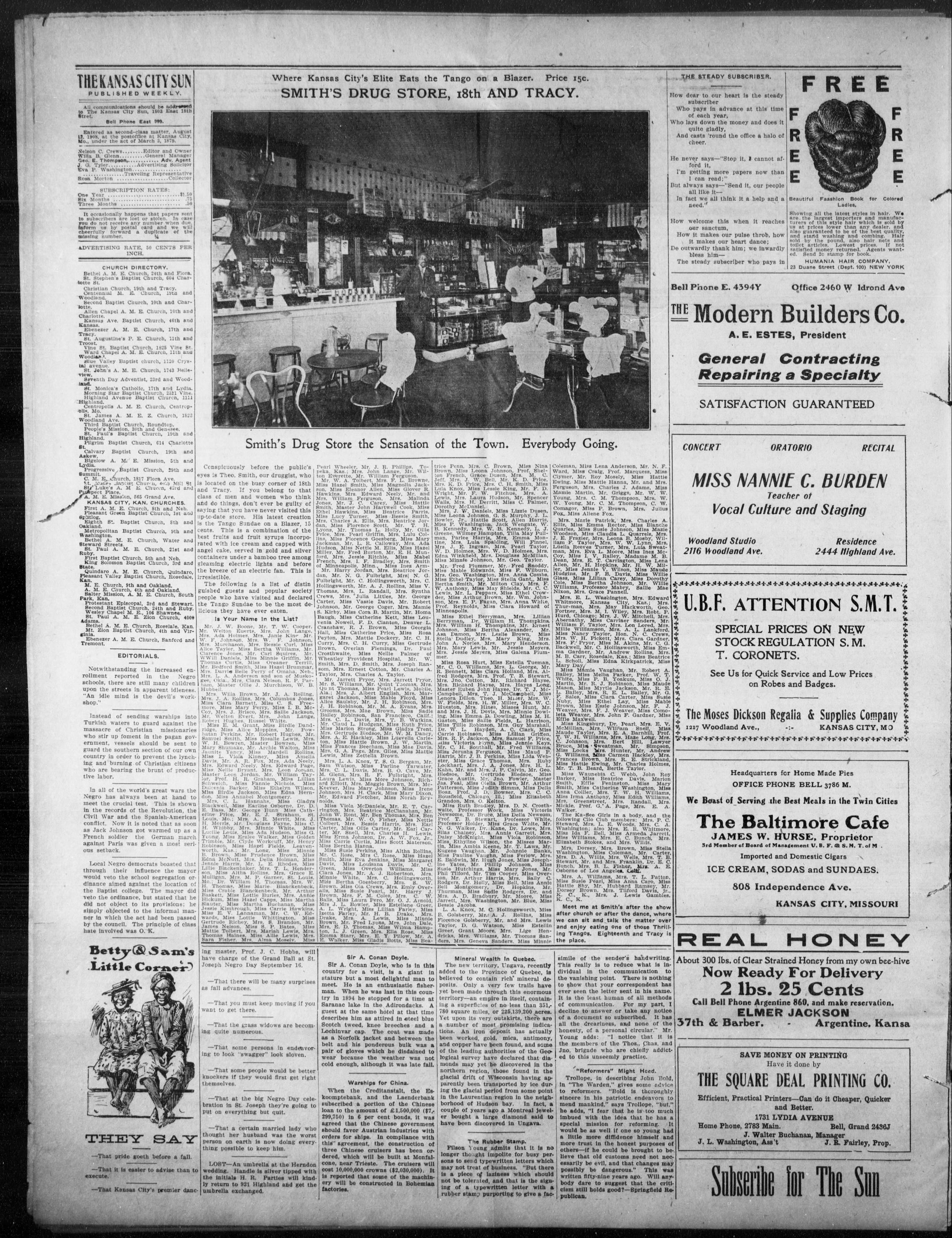
Where Kansas City's Elite Eats the Tango on a Blazer. Price 15c SMITH'S DRUG STORE, 18th AND TRACY.
Coca-Cola
Smith's Drug Store the Sensation of the Town. Everybody Going.
Conspicuously before the public's eyes is Theo. Smith, our druggist, who is located on the busy corner of 18th and Tracy. If you belong to that class of men and women who think and do things, don't ever be guilty of saying that you have never visited this up-to-date store. His latest creation is the Tango Sundae on a Blazer, 15 cents. This is a combination of the best fruits and fruit syrups incorporated with ice cream and capped with angel cake, served in gold and silver containers under a bamboo tree among gleaming electric lights and before the breeze of an electric fan. This is irresistible.
The following is a list of distin guished guests and popular society people who have visited and declared the Tango Sundae to be the most delicious they have eaten.
Is Your Name In the List?
Mr. J. W. Boone, Mr. T. W. Cooper, Mr. Welton Euerts, Mrs. John Lange, Mrs. Ada Holmes, Mrs. Janie Kinv, Mr. Johnson, Mrs. Janie Kinv, Mrs. Johnson, Mrs. Bessie Clemens, Alice Taylor, Mrs. Berta Williams, Mr. Clarence Jones, Mrs. Carl Squires, Mr. Will Daniels, Miss Minnie Griffin, Mr. Johnson, Miss Oreane, Mr. Bedford Smith, Mrs. Brunnman, Mrs. Darrie Beile Perry of Omaha, Neb. Mrs. L. A. Anderson and son of Muskgoe, Okla, Mrs. Clara Nelson, R. P. Parr, Master Ollie J. Murchison, W. H. Bubb
Mrs. Willa Brown, Mr. J. A. Rolling, Mrs. J. A. Rolling, Mrs. Columbus Jones, Miss Clara Barnett, Miss C. S. Freemore, Miss Mary Perry, Miss I. B. McCoy, Mrs. J. Brisco, Mrs. Sallie Jackson, Mr. Welton Evert, Mrs. John Lange, Robert Hughes, Russell White.
Miss E. M. Grant, Miss Birdie Dandridge, Miss Alice Moppins, Mr. Powhatan Perkins, Mr. Robert Hughes, Mr. Samuel Smith, Miss Rosalie Lewis, Mrs. W. H. Bowren, Master Bowren, Miss Mary Shumake, Mr. Archie Walton, Miss Jaunite Yancy, Miss Mardell Rollins, Miss L. Viola Kinney, Miss Amelia Davis, Mr. A. R. Fox, Mrs. Ada Neely, Mrs. Edward Neely, Mrs. Edward Page, Miss Nellie Bryant, Mrs. Leon Jordan, Master Leon Jordan, Mr. William Taylor, Prof. H. R. Graham, Miss Lillian Schweich, Miss Fannie Nichols, Miss Dulcenia Barker, Miss Ethelyn Wilson, Miss Birdie Jackson, Miss Edna Herndon, Miss Annabel Montgomery.
—That there will be many surprises as fall advances.
—That you must keep moving if you want to get there.
—That the grass widows are becoming quite numerous.
—That some persons in endeavoring to look "swagger" look sloven.
—That some people would be better knockers if they would first get right themselves.
—That at the big Negro Day celebration in St. Joseph they're going to put on everything but quit.
—That a certain married lady who thought her husband was the worst person on earth is now doing everything possible to keep him.
LOST—An umbrella at the Herndon wedding. Handle is silver tipped with the initials H. R. Parties will kindly return to 921 Highland and get the umbrella exchanged.
Pearl Wheeler, M. J. R. Phillips, Topeka, Kas.; Mrs. J. Lange, Mr. Willett, Topeka, Kas.; Mrs. J. Lange, Mr. Willett, Mr. W. A. Tolbert, M. F. L. Browne, Miss Hazel Smith, Miss Magnolia Jackswick, Mrs. Edward Nielsen, Mr. and Mrs. William Ferguson, Mrs. Malinda Smith, Mrs. Edward Nielsen, Mr. and Mrs. William Ferguson, Mrs. Malinda Smith, Master John Hartwell Cook, Miss Ethel Hawkins, Miss Beatrice Parris, Mrs. Curtis Currie, Miss Bessie Smith, Mrs. Chelsea Currie, Mrs. Dan, Mrs. Florence Scott, T. M. H. Lyons, Mr. Thomas Holly, Mr. Ollie Johnson, Mr. F. Holly, Mr. Dan, Mrs. Florence Scott, T. M. H. Lyons, Mr. Thomas Holly, Mr. Ollie Johnson, Mrs. Florence Goesberg, Miss Mary Jackman, Mr. L. R. Calloway, Mrs. Ada Johnson, Mrs. Fred Burton, Mr. E. H. Munford, Mrs. Jessie Ritchie, Miss Mabel Smith of Minneapolis, Mrs. Miss Inez
Mr. Harry Jordan, M. Beatrice Jordan, Mr. N. G. Fulbright, N|. N. G. Fulbright, Mr. C. Hollingsworth, Mrs. C. Hollingsworth, Mr. A. J. Rollins, Miss V. Thomas, Mr. M. J. Lillis, Mrs. Symyne Carter, Mrs. Jula Lillis, Mrs. Carter, Mrs. Vassie Davis, Mr. Robert Johnson, Mr. George Coger, Mrs. Mamie Kirby, Mrs. Cora B. Martin, Mr. Homa Baugh, Mrs Catherine Kett, Miss Louvena Nowell, F. D. Clanton, Denver L., Mrs. Clanton, Denver L., Mrs. Hall, Mrs. Catherine Price, Miss Rosa Peyton, Mrs. Mattle Dockery, Mr. C. H. Curry, Mrs. C. H. Curry, Miss Gertrude Brown, Overian Flemings, Dr. Paul Crosthwaite, Miss Nelle Palmer of Wheatley Provident Hospital, Mr. W. Wheatley Provident Hospital, Joseph Ransom, Mrs. Ernest Cotton, Mr. Charles A Taylor, Mrs. Charles A Taylor.
Mr. Jarrett Pryor, Mrs. Jarrett Pryor
Mr. S. Williams, Mr. Quint Toonaas, Mrs.
M. Williams, Mrs. Toonaas, Mrs.
Ala.; Mrs. J. Albert English, Mrs. Margaret Jackson, Mrs. Mable Flynn, Mrs.
J. Robinson, Mrs. Mable Flynn, Mrs.
J. H. Robinson, Mr. M. A. Evans, Mrs.
Grooms, Mrs. Mae Brown, Mrs. Sadie
Gulley, Robinson, San Francisco, Calif.
Mr. C. Gulley, Mrs. C. Gulley,
Mr. C. Claud L. Hudgens, Mrs. Ruth Price
Miss Marion Strong, Miss Gladys Trent,
Miss Marion Strong, Miss Gladys Trent,
Miss A. E. Hackley, Miss Luevela Carleton,
Miss Hattie Brown, J. W. Martin,
Miss A. E. Hackley, Miss Luevela Carleton,
Miss G. Page, Mrs. Gles, Mrs. Matte Lewis, Mrs. Zettella Brown.
Mrs. L. A. Knox, T. S. G Bergam, Mrs.
L. A. Knox, T. S. G Bergam, Mrs.
M. C. L Davis, Mrs. B. O. Carwater,
M. G. Lenn, Mrs. R. F. Fulbright, Mrs.
E. Lewis, Miss More Johnson, Richard E. Keever, Miss Mary Johnson, Miss Irene Johnson, Mrs. H. Clark, Miss Mary Dixon,
Edward Fletcher, Miss Norah Kynold
Miss Viola McDaniels, Mr. E. T. Carrington, Mrs. Beatrice McClanahan, Mr. John W. Ront, Mr. Ben Thomas, Mrs. Ben Thomas, Mr. W. O. Fisher, Miss Nettle Colbert, Mrs. Bessie Harris, Mrs. E. Carter, Miss Ollie Carter, Mr. Earl McDonnell, Mrs. Charles H. Lewis, Miss Erma Johnson, Dr. A. W. Fox, Jr., Miss Carrie Curtis, Miss Scott Materson, Miss Bertha Hanna.
Miss Susie Perkins, Miss Altha Rollins, Mr. C. Rose, Mrs. C. Rose, Miss Haze Smith, Miss Eva Jenkins, Miss Margaret Davis, Miss Louisana Davis, Mr. C. Green, Miss Overton Williams, Miss Clara Jones, Mr. A. J. Robertson, Mrs. M. M. White, Mrs. C. Hollingsworth, Miss Bertha Goesberry, Mrs. E. W. Brown, Miss Ola Crews, Mrs. Emil Overalls, Miss Susie Pearl, Mr. Mr. H. Brown, Mrs. F. M. Coles, Mrs. C. W. Balls, Miss Laura Pero, Mr. O. J. Arnold, Mrs. J. L. Bowler, Miss Estellene Greer, A. L. Wright, Miss Lillian Farley, Miss Izetta Farley, Mr. A. B. Drake, Mrs. B. Brown, Mrs. F. L. Lyons, Mrs. John Dale, Mrs. E. D. Thomas, Miss Wilma Hampton, Mr. G. Green, Mrs. Ela Rose, Mr. Emma Starr, Mrs. E. Y. Pillow, Mr. A. E. Walker, Miss Gladys Botts, Miss Bea
Sir A. Conan Doyle.
Sr A. Conan Doyle, who is in this country for a visit, is a giant in stature but a most delightful man to meet. He is an enthusiastic fisherman. When he was last in this country in 1894 he stopped for a time at Saranac lake in the Adirondacks. A guest at the same hotel at that time describes him as attired in steel blue Scotch tweed, knee breeches and a Lochinvar cap. The coat was made as a Norfolk jacket and between the belt and his ponderous bulk was a pair of gloves which he disdained to wear because the weather was not cold enough, although it was late fall.
Warships for China
When the Creditanstalt, the Eskoemptebank, and the Laenderbank subscribed a portion of the Chinese loan to the amount of £1,500,000 ($7,299,750) in 6 per cent bonds, it was agreed that the Chinese government should favor Austrian industries with orders for ships. In compliance with this agreement, the construction of three Chinese cruisers has been ordered, which will be built at Monfalcone, near Trieste. The cruisers will cost 10,000,000 crowns ($20,030,000). It is reported that some of the machinery will be constructed in Bohemian factories.
Miss Ethel Berryman, Mrs. Lillian Berryman, Dr. William H. Thompkins, Mrs. William H. Thompkins, Mr. Ernest Jones, Berryman B. Berryman, Jaspe Damon, Mrs. Leslie Brown, Mrs Stella Dudley, Mrs. Mary King, Mrs John A. Nories, Mrs. Mary Henderson, Mrs. Mary Lewis, Mrs. Jesse Meyers, Mrs. Jessie Meyers, Mrs Galena Plummer,
Miss Rosa Hurt, Miss Estella Tueman, Mr. C. O. Williams, Mrs. L. George, Mr. C. O. Williams, Mrs. L. George, Mr. Fred Rodgers, Mrs. Prof. T. B. Stewart, Mrs. Jno Cotton, Mrs. Richard Hayse, Mrs. Hayes Long, Mrs. Richard Hayse, Mrs. Hayes Long, Campbell, Mrs. T. J. Campbell, Mrs. Lenora Dillon Theo. H. Muler, Mrs. W. Wields, Mrs. H. Willer, Mrs. W. C. Wields, Mrs. H. Willer, Mrs. W. C. Wields and Mrs. J. H. Dovis, Mrs. Minkle Dowling, Miss Emma D. Dowling, Miss M. H. Gaston, Miss Sallie Fields, L. Harrison, Dr. W. L. Haden, Mrs. Minkle Dowling, Dr. W. L. Haden, Q. Clark, Mrs. Carrie Robinson, Miss Lillian Griffen, Mrs. R. P. Jackson, Samuel F. Price, Dr. W. L. Haden, Mr. C. H. Southall, Mr. Fred Williams, Miss Jerusha Ferguson, Miss Maud P. Harris, Mr. J. B. Perkins, Miss Lida Webb, Mr. C. H. Southall, Mr. Fred Williams, Miss Jerusha Ferguson, Miss Maud P. Harris, Mr. J. B. Perkins, Miss Lida Webb, Lockhart, J. A. Jones, Mrs. H. L. Kahn, Mr. and Mrs. J. P. Calvin, Mr. Geo Bledsoe, Mr. Gertrude Bledsoe, Mrs. Jas Feal, Mrs. Oelia Brown, Mr. Arthur Patterson, Miss Judith Shmms, Miss Della Boaz, Prof. J. D. Bowser, Mrs. C. I. Grendon, Mrs. O. Kelner,
Miss Ruth Bradley, Mrs. D. N. Crosthwaite, Professor Work. Miss Victoria Newsome, Dr. Bruce, Miss Della Newsom, Prof. T. B. Stewart, Professor White Professor Holder, Miss Grace White, Mr. N. G. Walker, Dr. Kane, Dr. Lowe, Mrs. Sillas Chainey, Mrs. Annis Garrett, Mrs. Daisy McKnight, Miss Viola Robinson, Miss Ethyline Wilson, the Misses Martin, Miss Ambia Keene, Mr. T. Laws, Mr. Eugene Vaughan, Mr. Johnnie Banks, Miss Pauline Vaughn, Miss Ferlow, Mrs. E. Baldwin, Mr. Hugh Jones, Miss Josephine Yates, Mr. Phillip Johnson, Miss Susie Hutchings, Miss Mary Jones, Mr. Phil Thiford, Mr. Tim Cooper, Miss Overton, Mr. Arthur Harris, Mrs. Sally C. Rodgers, Dr. Holly, Miss Bell, Miss Anne Bell Montgomery, Dr. Hopkins, Mr. Thurman, Miss Sadie Rodgers, Dr. and Mrs. A. D. Bradbury, Mr. Moore, Miss Jarrett, Mrs. Washington, Mr. Blue, Miss Bessie Jacobs.
L. A. Knox, M. C. Hollingsworth, Miss B. Golsberry, Mrs A. J. Rollins, Miss Florence Golsberry, Mr. and Mrs. Lewis Taylor, Mrs A. J. Rollins, Miss Estelin McGrant, Grant Mrs. Williams, Mr. dricks, Mrs. Williams, Mr. Thomas Sanders, Mrs. Geneva Sanders, Miss Mimie
Mineral Wealth In Quebec.
The new territory, Ungava, recently added to the Province of Quebec, is believed to contain rich mineral deposits. Only a very few trails have yet been made through this enormous territory—an empire in itself, containing a superficies of no less than 351,780 square miles, or 225,139,200 acres. Yet upon its very outskirts, there are a number of most promising indications. An iron deposit has actually been worked, gold, mica, antimony, and copper have been found, and some of the leading authorities of the Geological survey have declared that diamonds may yet be discovered in the northern region, those found in the glacial drift of Wisconsin having apparently been transported by ice during the glacial period from some point in the Laurentian region in the neighborhood of Hudson bay. In fact, a couple of years ago a Montreal jewel or bought a large diamond said to have been discovered in Ungava.
The Rubber Stamp.
Filson Young admits that it is no longer thought impolite for busy persons to treat typewritten letters which may not treat of business. "But there is a piece of laziness which should not be tolerated, and that is the signing of a typewritten letter with a rubber stamp purporting to give a fac-
Coleman, Miss Lena Anderson, Mr. N. F. Ward, Miss Craig, Prof. Marquess, Miss Clymer, Mr. Roy Mosely, Miss Hattie Ewing, Miss Mattie Hanna, and Mrs. Ferguson, Mrs. Charles J. Adams, Miss Mamble Martin, Mrs. Griggs, Mr. W. W. Marble Martin, Mr. C. Thompson, Mrs. W. Young, Mr. C. M. Thompson, Mrs. W. Comagor, Miss P. Brown, Mrs. Julius Fox. Miss Allene Fox.
Mrs. Marile Patrick, Mrs. Charles A. Ellis, Miss Emma Rector, Miss Blanche Quarles, Miss Susie Johnson, Miss Maze Coy, Miss Susie Johnson, J. E. Frazier, Mrs. Leona B. Mosby, William F. Taylor, Mrs. W. W. Lynn, Luiella Reeves Turner, Mrs. Lula Sweat-Coy, Mrs. Lula Sweat-Coy, Mrs. I. V. Ralley, Madame M. B. Dean, Mrs. E. T. Carrington, Miss Lena Allen, Mr. H. Hopkins, Mr. H. W. Milligan, Mrs. H. W. Milligan, Hudgins, Mr. F. B. Davis, Miss Wille Glass, Miss Lillian Carey, Miss Dorothy Wille, Miss Bertha Johnson, Mr. Wille Glass, Miss Lillian Carey, Sallee Mae Nixon, Mrs. Grace Pannell
Miss Waunebia C. Webb, John Roy Barker, Miss Beatrice Davis, Marlon Porter, Miss Catherine Washington, Smith, Miss Catherine Washington, Miss Anna Collier, Mrs. T. W. H. Williams, Miss Iris Anthony, Miss Edith Williams, Enstreet, Mrs. Randall, Mrs. Mickle, M. G. A. Page, Mrs. E. A. Walker.
She Ka-Se girls in a body, and the following Clintie, Mrs. E. R. Steward, Mrs. L. E. Woods, Mrs. C. A. Washington; also Mrs. E. R. Whitmore, Bell, Miss Armeda Jarrett, Miss Williams, Mrs. E. R. Stewart, Mr. and Mrs. Franklin, Dr. E. C. Bunch, Mrs. B. L. Fisher, Mrs. A. E Osborne of Los Angeles, Colr.
Mrs. A. Williams, Mrs. T. L. Patton, Miss Coleman, Mrs. C. R. Stewart, Mr. and Mrs. Franklin, Dr. E. C Bunch, Mrs. B. L. Fisher, Mrs. A. E Osborne of Los Angeles, Colr.
Mrs. A. Williams, Mrs. T. L. Patton, Miss Coleman, Mrs. C. R. Stewart, Mr. and Mrs. Franklin, Dr. E. C Bunch, Mrs. B. L. Fisher, Mrs. A. E Osborne of Los Angeles, Colr.
Meet at Smith's after the show after church or after the dance, where we can sit and talk the matter over and enjoy eating one of those Thrilling Tangos. Eighteenth and Tracy is the place.
simile of the sender's handwriting. This really is to reduce what is individual in the communication to the vanishing point. There is nothing to show that your correspondent has ever seen the letter sent in his name. It is the least human of all methods of communication. For my part, I decline to answer or take any notice of a document so subscribed. It has all the dreariness, and none of the honesty, of a personal circular." Mr. Young adds: "I notice that it is the members of the Thos. Chas, and Jno. brigade who are chiefly adducted to this unseemly practise.
Trollope, in describing John Bold, in "The Warden," gives some advice to reformers. "Bold is thoroughly sincere in his patriotic endeavors to mend mankind," says Trollope, "but" he adds, "I fear that he is too much imbued with the idea that he has a special mission for reforming. It would be as well if one so young had a little more diffidence himself and more trust in the honest purposes of others—if he could be brought to believe that old customs need not necessarily be evil, and that changes may possibly be dangerous." This was written fifty-nine years ago. Will anybody dare to suggest that the criticism still holds good?—Springfield Republican.
How dear to our heart is the steady subscriber
Who pays in advance at this time of each year,
Who lays down the money and does it quite gladly,
And casts round the office a halo of cheer.
He never says—"Stop it, I cannot afford it,
I'm getting more papers now than I can read;"
But always says—"Send it, our people all like it—
In fact we all think it a help and a need."
How welcome this when it reaches our sanctum,
How it makes our pulse throb, how it makes our heart dance;
De outwardly thank him; we inwardly bless him—
The steady subscriber who pays in
Bell Phone E. 4394Y
THE Modern I
A. E. ESTE
General C
Repairing
SATISFACTION
Modern Builder
A. E. ESTES, President
General Contractor
Repairing a Special
SFACTION GUARANTEE
General Contracting Repairing a Specialty
SATISFACTION GUARANTEED
MISS NANNIE
Teach
Vocal Culture
S NANNIE C. BURNS
Teacher of
Local Culture and Stagie
MISS NANNIE C. BURDEN Teacher of Vocal Culture and Staging
Woodland Studio 2116 Woodland Ave.
U.B.F. ATTER
SPECIAL PRICE
STOCK REGU
T. CORONET
See Us for Quick S
on Robes
The Moses Dickson Reg
1217 Woodland Ave.,
ATTENTION S
SPECIAL PRICES ON NEW
STOCK REGULATION S. I.
CORONETS.
Us for Quick Service and Low Price
on Robes and Badges.
Dickson Regalia & Supplies
and Ave., KANSAS
U.B.F. ATTENTION S.M.T.
SPECIAL PRICES ON NEW STOCK REGULATION S.M. T. CORONETS. See Us for Quick Service and Low Prices on Robes and Badges.
The Moses Dickson Regalia & Supplies Company
1217 Woodland Ave., KANSAS CITY, MO
Headquarters for Home Made Pies OFFICE PHONE BELL 3786 M.
We Boast of Serving the B
The Balti
JAMES W. HU
3rd Member of Board of Man
Imported and
ICE CREAM, SO
of Serving the Meals in the
Baltimore Co
JAMES W. HURSE, Proprie
Member of Board of Management U. B. F. @ S. M.
Imported and Domestic Cigars
CREAM, SODAS and SUNDAY
We Boast of Serving the Best Meals in the Twin Cities
JAMES W. HURSE, Proprietor
3rd Member of Board of Management U. B. F. @ S. M. T. of M
Imported and Domestic Cigars
ICE CREAM, SODAS and SUNDAES.
808 Independence Ave.
REAL
About 300 lbs. of Clear Strain
Now Ready
2 lbs. 2
Call Bell Phone Argentin
ELMER
37th & Barber.
REAL HONEY
of Clear Strained Honey from me
Ready For Delive
2 lbs. 25 Cent
Phone Argentine 860, and make r
ELMER JACKSON
Barber. Argent
About 300 lbs. of Clear Strained Honey from my own bee-hive Now Ready For Delivery 2 lbs. 25 Cents Call Bell Phone Argentine 860, and make reservation. ELMER JACKSON 37th & Barber. Argentine. Kansa
SAVE MONEY ON PRINTING
Have it done by
THE SQUARE DE
Efficient, Practical Printer
and
1731 LYD
Home Phone, 2783 Main.
J. Walter Bu
J. L. Washington, Ass't
Subseribe
SQUARE DEAL PRINTING
Practical Printers—Can do it Cheap,
and Better.
1731 LYDIA AVENUE
One, 2783 Main. Bell, G
J. Walter Buchanan, Manager
Washington, Ass't J. R. Fa
CONCERT
FREE
FREE
FREE
Beautiful Faashion Book for Colored Ladies.
Showing all the latest styles in hair. We are the largest importers and manufacturers of this style hair which is sold by us at prices lower than any dealer, and also guaranteed to be of the best quality, and stand washing and combing. Hair and by the pound also hair nets and toilet articles. Lowest prices. If not satisfied money returned. Agents wanted. Send 2c stamp for book.
HUMANIA HAIR COMPANY,
23 Duane Street (Dept. 100) NEW YORK
Office 2460 W Idrond Ave
Builders Co.
TES, President
Contracting
ing a Specialty
ON GUARANTEED
ORATORIO RECITAL
NIE C. BURDEN
teacher of
ure and Staging
ORATORIO
Residence 2444 Highland Ave.
ENTION S.M.T.
PRICES ON NEW
REGULATION S.M.
NETS.
Book Service and Low Prices
Hoes and Badges.
Regalia & Supplies Company
KANSAS CITY, MO
the Best Meals in the Twin Cities
timore Cafe
HURSE, Proprietor
Management V. B. F. @ S. M. T. of M.
and Domestic Cigars
SODAS and SUNDAES.
KANSAS CITY, MISSOURI
HONEY
trained Honey from my own bee-hive
Pay For Delivery
25 Cents
antine 860, and make reservation.
R JACKSON
Argentine, Kansas
DEAL PRINTING CO.
Printers—Can do it Cheaper, Quicker
and Better.
LYDIA AVENUE
in. Bell, Grand 2436J
r Buchanan, Manager
t J. R. Fairley, Prop.
RECITAL
Mrs. E. Dorn Thomas of 3412 East Twenty-first street, visited in St. Joseph.
Miss Maude Glover left Friday for Fort Scott, where she will teach in the public school.
FOR RENT—Three-room cottage, 1630 Agnes avenue. Gas and water. Bell phone, E2487.
Miss Catherine Jefferson left last Thursday to attend the State Normal College at Emporia, Kas.
Mr. Jefferson Dawson of Marshall, Mo., is visiting his niece, Mrs. Dora Hobbs, 1222 Michigan avenue.
FOR RENT—1011 Tracy Avenue. Nicely furnished rooms in modern house, for gentlemen; reasonable.
Mrs. Hunes has returned from St. Louis, where she had been visiting her mother, Mrs. Mary Clayborne.
The editor is attending the big Negro Fair at Bunceton this week, and will return home Saturday evening.
FOR RENT—Furnished rooms; bath, gas and telephone. Bell, East 308-R. Mrs. Janie White, 1228 Vine St.
Mr. J. T. Jones and family, 1210 East Seventeenth street, are spending a few weeks in Tennessee visiting relatives.
Mrs. Burghett of 1011<sup>th</sup> Virginia, and Mrs. Taylor of 1004 Virginia, were pleasant callers at the Sun office last Saturday.
FOR SALE—A No. 1 second hand upright piano for sale cheap. Parties going away. 1415 N. 8th street, Kansas City, Kas.—Adv.
Among the Sun callers during the week were Mrs. Clara Rodgers, Mrs. J. E. Frazier, Mr. Henry Patton and Mr. John Lange. Call again.
Mrs. Annie E. Floyd, Mrs. Harry J. Brown and little Helen Floyd have returned home after a three weeks' visit in Keokuk, Ia., and Chicago, Ill.
Mrs. T. M. King of 2309 Highland avenue, entertained at whist Wednesday evening, September 2, in honor of Miss Mollie Berry, of Boley, Okla.
Mrs. Mayne Webster has returned from Minneapolis and St. Paul, Minn., where she spent four weeks visiting friends. She reports a delightful stay.
Mrs. B. Johnson and grandson, Benjamin Webster, visited Junction City and Clay Center, Kas., three weeks. They returned feeling much better in health.
FOR SALE—Seven-room house with bath and gas, 919 Highland avenue, $2,800. Easy terms. E. C. Moore, owner and occupant. Bell phone, East 2155X.
Mr. and Mrs. Roscoe White have returned from Butler, Mo., to which place they were called on account of the death of Mr. White's sister, Miss Myrtle White.
Miss Henrietta Faulkner has returned from Minneapolis, Minn., where she visited Mrs. Emma Warfield. Miss Faulkner says she had a delightful stay.
Mrs. Nellie E. Young, 3412 East Twenty-first street, left the city for Philadelphia. Before returning home she will visit New York, Boston and other points in the East.
Poro hair dressing, hair weaving and facial massaging. Scalp treatment a specialty. Mrs. E. Norles, 1737 Paseo, upstairs.
FOR RENT—Three large, pretty rooms for light housekeeping. Gas, water paid, fine neighborhood. 2424 Flora avenue. See J. Dallas Bowser, 2400 Paseo. Bell phone Grand 3795W.
Mrs. B. M. Weaver, the florist, announces that she will be at home from 10 to 2 every day until the 17th, to meet her friends, complimentary to her guest, Miss Williams of Philadelphia, Pa.
WANTED—A lady of refinement and ingenuity—one with ability to meet people and get effective results. Good pay while it lasts. Inquire at the Kansas City Sun office, 1803 East Eighteenth street.
Among the guests at Armory Hall last Wednesday evening were:
Mrs. Katie E. Robinson,
Mrs. Elsie Boyd,
Miss Florence M. Jones,
Miss Mable Green,
The Tango Club is still alive.
Rev. W. J. Deboe, pastor of the M. E. Church of St. Joseph, Mo., was a guest of the Colored People's Investment Co., last week. Mrs. Rosa Smith, his daughter, is the bookkeeper and stenographer for the company, and returned to St. Joseph with her father, to spend a week visiting.
Mrs. Sidney Johnson was at home to friends Friday afternoon from 3 to 5, to meet Miss Minnie Wade. Later an automobile party was given for the charming young lady, and she became very much impressed with our city. In the party were Mrs. F. Rapier, Mrs. L. D. Hines, Miss Ruth Bradley and Mrs. Johnson.
---
CITY NEWS.
Salt Lake City, Sept. 3, 1914.
Mr. Benjamin Parks of the Hotel Utah, and Miss Susie Lewis of Kansas City, Mo., were married here today. Please send out some more girls, as I have four more young men and each needs a wife.—A. Frank Neal.
The wise business man advertises his merit. Business is good with him. He uses printer's ink. The Kansas City Sun will tell your story. You need the printer, too. Try Franklin. He gives service. 1008 East Eighteenth street. Transfer at Troost, Bell phone, Grand 2988.
St. Louis recently cleared $5,000 on its Church Carnival. Why can't we do as well for Provident-Wheatley Hospital? We can if you will attend the Carnival at Twentieth and Woodland, September 2-13 inclusive. Admission only 10 cents.
Miss Cecil Fulcher and Mr. Silas
Gleaves were married at the residence of her brother, 2638 Highland avenue. Quite a number of presents were showered upon the young couple, and a large concourse witnessed the ceremony. They have now gone to Chicago to make it their home.
Mrs. A. E. Jenkins, 1324 Vine street, accompanied by her son, Master Haven Jenkins, has returned from Okla homa, where she visited her daughter, Mrs. Claudia E. Wiseman, of Okrugge, and also the Business League in Muskogee. The Progress Study Club of which she is the president, will meet with her next Tuesday, September 15.
Mrs. Clara Walden of 921 Highland avenue, has gone to Minneapolis, Minn., where she will be with her husband, Mr. E. B. Walden. Mrs. Walden will look after the interest of her niece, who is there taking a course of music in the Conservatory. Mr. and Mrs. Walden expect to be away from the city until Miss Dorsey finishes school. They are located at 3129 Findley Place.
There is a reason why the larger per cent of Cabinet Stationary used from the Arthur W. Harris Printing Establishment. First their work was unexcelled by any of the larger and best equipped printing establishments, and make a specialty of this class of work. Second, while their prices are not always the lowest they are, they are not the lowest they deliver" with accuracy and despatch to over 90 per cent of the class. The class has past year and now when a function of class is announced its a ten-to-one shot that Harris will handle the 90.
---
The Poro Club met August 28 with Mrs. Jennie Ball, 1419 East 22d. The Club desires to have other Agents meet with them at their next meeting at the residence of Mrs. B. F. Isaacs, 835 Freeman avenue Those present were:
Miss Daisy B. Baldwin,
Mrs. Cora Williams,
Mrs. Alice Thomas,
Mrs. Beulah Franklin,
Mrs. Jennie Ball,
Miss Melia Collier.
Mrs. F. D. Woods entertained in honor of Mrs. Lauretta Baker of Chicago, at whist, Wednesday, September 2, from 11 a. m. to 2 p. m., at the residence of Mrs. N. C. Crews, 2624 Highland avenue. The following ladies were present: Mesdames Hubbell, Watkins, Brown, Glass, Herndon, Allen, Thompson, Grey, Payne, Baker and De Frantz. Mrs. Smith won the high score prize, a cream pitcher, and Mrs. Bass won second. Crab salad and wafer, hot tea, ice cream and assorted cakes were served.
Dancing every Wednesday night, Armory Hall, Cottage and Vine streets. Hall for rent. Bell Phone East 308R.
Prof. Roscoe White, Dancing Master.
MRS. JANIE WHITE, Teacher.
PROF. FRANK BUCKNER,
MISS KATIE ANDERSON,
ALBERT THOMAS,
FARL THOMAS,
Assistante.
Hon. W. Clarence Hueston, the brilliant young attorney, accompanied by Edw. S. Lewis, Grand Secretary of the Odd Fellows, left for the East Wednesday night. He will transact some legal business in Massachusetts and New Jersey, will drop in for a few moments on the B. M. C. of the Odd Fellows at Boston, will run over to Philadelphia for a conference with Lawyer Bass, and will then go to Washington, where he will meet his wife and children, who are visiting there, and accompany them home.
FOR RENT
2927 Norton, 4-r frame cottage.....$ 9.00
1827 Grove, 3-r.....$ 9.00
2440 Montgall, 6-r mod. bungalow.....$ 20.00
2017 Belleview, 5-r.....$ 15.00
2407 Woodland, 2-r rear.....$ 5.00
24th and Main, 5-r.....$ 7.00
1807 West Prospect, 6-r part. mod.....$ 18.00
1007 Oak, 9-r mod. br.....$ 40.00
1017 Oak, 9-r mod. br.....$ 40.00
2439 Penn, 7-r partly modern.....$ 18.00
1410 Cypress, 7-r frame.....$ 12.00
2638 Woodland, 4-r br. cottage.....$ 14.00
21st and Indiana, 5-r str. mod.....$ 18.00
1722 Lvdia, 5-r mod.....$ 15.00
911 McGee, store room.....$ 15.00
1722 Lydia, barn for 20 horses.....$ 10.00
FOR SALE
1226. Michigan—6-r. modern cot age
$2,600. $200 down. $15 monthly.
Near 11th and Michigan – s-r. str. mod.
br. slate roof, lot 40x145, worth $5,000,
will sell for $4,000; $600 down, $20 mouth.
Afro-American Investment Co.
31 McOEE ST.
Phones: -Home 7555 Main; ST, 751 Main
Dr. Theo Smith, our popular drug-gist, spent a very delightful time at excelsior Springs, Mo., and has now returned feeling fine. While there Mr. McKnight, the affable head waiter took him through the Elms a half-million dollar hotel. He claims it was a grand sight. During his stay in Excelsior Springs, Dr. Smith entertained the following ladies with an auto party: Mrs. J. Slas Harris, Miss Nina Bell, Mrs. Dr. J. R. Thompson, the latter of Kansas City, Kas., and Mrs. Hadge Campbell and Miss Parker, both of St. Louis, Mo.
CARD OF THANKS
The matron and children inmates of the Orphans' Home, 1406 Vine street, wish to thank Mr. D. M. West, proprietor, of the Eureka Carpet Cleaning Works, for the generous donation of sherbet which he sent to the Home on Labor Day.
MARION HOWARD, Secretary.
REMOVAL NOTICE
The Bennett Tailoring Company,
formerly at 1515 East Eighteenth
street, has moved to larger quarters
and will be pleased to see his patrons
and friends at the new location, 1610
East Eighteenth street. Bell phone
East 4746.
BENNETT TAILORING CO.
IN MEMORIAM.
Gone, but still she lives, Mrs. Mary F. Crawford, who died two years ago the fourth of September, 1912:
O- Mother dear, speak a word of cheer,
O! Loving Lord, My Comforter,
Make strong the step that else would fall;
Inspire the heart that else might quail.
Lighten each darkening day and hour
To glow with Love's all conquering power.
MR. JOHN T. CRAWFORD.
MISS ETHEL J. CRAWFORD
CARD OF THANKS.
We want kindly to thank our many friends and neighbors for the kindnesses shown us during the recent illness and death of our dear husband and brother, Earl Meadows, who departed this life September 5, 1914 Also for the beautiful floral offerings. We wish especially to thank the Rev. Mr. Davis, pastor of the Centennial M. E. Church, the Ladies' Ald Society and also Princess Tharah House hold of Ruth.
ROSETTA MEADOWS, wife, BERTHA HOLDEN, sister, ADELLE REYNOLDS, sister,law
REMOVAL NOTICE
C. D. Franklin, the Printer, has moved from 1409 Main street to 1088 E. 18th street, near Troost Transfer Co. and K. P. Hall, Bell, Grand 2988 Call at the above number after August 3rd.
KANSAS CITY, KAS.
Mrs. W. T. Lewis, 344 Haskell avenue, made a visit to Platte City, Mo. this week, and reports a pleasant time.
Mr. and Mrs. R. C. Calhoun, of Minneapolis, Minn., are the guests of Mr. and Mrs. Sam Whiting, 1238 Barrett avenue.
Mrs. D. F. Harris, 1109 North Tenth street, has returned home from St. Louis, where she was the guest of her sister.
Mr. Nathaniel Holmes, 1506 Ninth street, returned home Monday after a delightful trip through the state of Oklahoma.
Master John Kenneth Heltz, accompanied his grandmother, Mrs. Elizabeth Carter, to Palmyra, Mo., last Saturday.
Mrs. Susie McWilliams of Wichita, Kas., was the guest of Mr. and Mrs. Harry White and Mrs. Bland, 318 Greeley avenue, last week.
Mr. D. A. Boatner of Little Rock, Ark., is chef at Western University, and is stopping at the residence of Mr. and Mrs. D. F. Harris.
Miss Jennie Hill, 1057 Freeman avenue, returned home after a pleasant visit with her cousin, Mrs. Anna Ware, of St. Joseph, Mo., and entertained the Athenia Art Club at her home Wednesday. Dainty refreshments were served.
Mr. A. R. Ewing, 635 Georgia avenue, returned home Saturday from Parsons, Kas., where he attended the U. B. F. Grand Lodge, Kansas Jurisdiction. Mrs. Ewing and children left Saturday for a visit in Mississippi and Tennessee, and will be there several weeks.
Mrs. Nannie P. Jones of New York City, arrived here September 9, and is the guest of her sister, Mrs. Tillie Moss, 2051 North Water street. Mr. and Mrsr. G. N. Jones of Denver, Colo., en route to Lincoln, Neb. stopped over here Sunday and were the guests of Mr. and Mrs. Wm. Moss.
Mrs. Catherine Jones, 44 South James street, and her granddaughter, Miss Geraldine Jones of Leavenworth, Kas., have returned from a two months' tour through the East. While away they visited in Pittsburg, Pa.; Washington, D. C.; Baltimore, Md. and New York City. They report a very pleasant stay.
Guard Your Children
Many children at an early age become constipated, and frequently serious consequences result. Not being able to realize his own condition, a child's bowels should be constantly watched, and a gentle laxative given when necessary. Dr. Miles' Laxative Tablets are especially well adapted to women and children. The Sisters of Christian Charity, 531 Charles St., Luzerne, Pa., who attend many cases of sickness say of them: "Some time ago we began using Dr. Miles' Laxative Tablets and find that we like them very much. Their action is excellent and we are grateful for having been made acquainted with their benefits, and good results in every case and the Sisters are very much pleased."
The form and flavor of any medicine is very important, no matter who is to take it. The taste and appearance are especially important when children are concerned. All parents know how hard it is to give the average child "medicine," even though the taste is partially disguised. In using Dr. Miles' Laxative Tablets, however, this difficulty is overcome. The shape of the tablets, their appearance and candy-like taste at once appeal to any child, with the result that they are taken without objection.
The rich chocolate flavor and absence of other taste, make Dr. Miles' Laxative Tablets the ideal remedy for children.
If the first box fails to benefit, the price is returned. Ask your druggist. A box of 25 doses costs only 25 cents. Never sold in bulk.
MILES MEDICAL CO., Eikhart, Ind.
IN MEMORIAM
In memory of my beloved husband,
Moses Edward Vaughan who died two
years ago today, September 10, 1914:
Calmly he sleeps in his narrow bed
While I am sorrowful here;
Weeping and praying for my dear be
loved.
Whose soul is with Jesus above.
Dear Lord, my days are so lonely without him,
Help me to bear my grief;
Give me strength to carry my burden,
Lord,
Till death come to my relief.
His wife,
MRS. M. E. VAUGHAN.
FOR SALE.
FOR SALE
726 and 728 Freeman Ave., Kansas
City, Kaa—5-room frame houses, $1,200
entire fall terms to suit.
1310 Michigan highways to suit,
$2,500; low/high modern, frame,
$3,000; any kind of terms.
1410 Cypress—5-room frame, $2,500;
terms.
1410 Highland—5-room frame, price
$2,250; any kind of terms.
2425 Montgall—6-room modern, frame,
$2,250; any kind of terms.
1902 East Twenty-marth. modern except
heat, $2,100; $500 down, terms to
except heat; best kind of terms.
FOR RENT.
1214 Highland, 9 rooms, modern, $26.50
1214 Belfontaine, 6 rooms, stricty
modern, $20.00
2457 Bellfortaine, 5 rooms, partly
modern, $15.00
2457 Bellfortaine, 4 rooms, partly
1210 Michigan Ave. 4, rooms, water
1219 Campbell, 4 rooms, 2d floor. 15.00
2120 Campbell, 4 rooms, 2d floor. 15.00
2125 Michigan, 5 room cottage. 16.00
2126 Vypress, 2 room cottage. 16.00
2129 Vypress, 2 room cottage. 16.00
2130 Mine, room w/ gas and gas 18.50
1121 Highland, 9r, mod. apt. 30.00
1122 Highland, 2d floor, 5 rooms.
1123 Highland, 2d floor, 5 rooms.
1124 Highland, 5r, mod. apt. 22.50
1124 Highland, 5r, mod. apt. 22.50
1124 and numerous others.
COLORD DEBRIEWS INVESTMENT
COMPANY,
2427 Vine Street.
Bell Phone, E1011; Home Phone, M9203
HOWARD UNIVERSITY
Stephen M. Newman, A. M., D. D., President
COLLEGE OF ARTS AND
SCIENCES
A. B. and B. S. Courses
TEACHERS' COLLEGE
A. B. and B. S. in Pedagogy Courses
SCHOOL OF MANUAL ARTS
AND APPLIED SCIENCES
Courses in Engineering
Domestic Science
Domestic Arts
Manual Arts
CONSERVATORY OF MUSIC
ACADEMY
Three Preparatory Courses
(Classical, Scientific, Normal)
COMMERCIAL COLLEGE
Stenography
Typewriting
Economics
Bookkeeping
LIBRARY SCHOOL
PROFESSIONAL SCHOOLS
SCHOOL OF THEOLOGY
SCHOOL OF MEDICINE
College of Medicine
College of Dentistry
College of Pharmacy
SCHOOL OF LAW
All Courses begin Sept. 30th, 1914.
For Catalogue, address Howard
University, Washington, D. C.
Our Motto: "Nothing but The Best"
The Crosthwait Floral Company
Everything in Flowers and Flower Designs
"WE DELIVER THE GOODS"
The People say we have made some of the most beautiful and original designs in flowers ever seen in Kansas City.
Our Specialty--
"Quick Delivery--Satisfactory Service"
Bell Phone East 272
1719 E. 17th St., Kansas City, Mo.
TREAT YOUR SCALP, AND HAIR MUST GROW! GOOD NEWS FOR OUR WOMEN
The Brice Afro-American Scalp Food and Always Young Cream is too well known for better recommendation here. We know as millions of others will testify that my Goods grow Hair even when all other preparations fail. I manufacture preparations according to what the scalp needs and will send you the Goods that will be necessary to cure YOUR scalp, for there are no two scalps alike.
Agents wanted. Write for Terms. Big Profits. Always Young Cream, 50c. per. jar. Brice's Snow Bloom Liquid Face Powder, 50c. per. bottle. Brice's Herb Tea, 25c. per. box.
Brice's Six Weeks Trial Treatment for the scalp, to grow hair, Two Dollars.
Remember the name and number, MME. W. H. BRICE, 804 Tremont St., Boston, Mass.
The Brice Mfg. Company's Branch Offices, where you can get the Brice Preparations are listed below:—
Richard Arnold, 1114 N. Senate Ave., Indianapolis, Ind.
J. J. Howe Drug Store, Tremont & Cabot St., Boston, Mass.
Brice's Dandruff Cream, 50c per box.
Brice's Afro-American Scalp Food, 4 boxes for One Dollar, no less sold. Brice's 6 Weeks' trial treatment Two Dollars, with the greatest discovery of the age, just send her as near as you can how the condition of the scalp, and if the hair is dry and brittle and breaks off; it will stay after Madame sends this treatment—you will have healthy scalp, long and beautiful hair.
MUSICIANS WANTED!
Ninth U. S. Cavalry Band and Orchestra
can place players as follows: 1 snare drummer, who can handle ordinary traps; 2 clarinet players, 1 cornet and 1 saxophone player. Applicants should have talent and ambition. No objection to good amateur players. Sobriety and respectability essential. Excellent opportunity for bright young men to become identified with one of the finest Government Bands. State age, experience and give name of instruments you play. Immediate correspondence necessary. Address
WADE H. HAMMOND.
Bandmaster, Ninth Cavalry.
DOUGLAS, ARIZ.
NOTICE.
NOTICE
Pictures of the Grand Lodge taken in Moberly, Mo., can be had for 50 cents per, postage prepaid, by writing to J. H. Green, 721 South Fourteenth street, St. Joseph, Mo., or John Harvey, 516 North Twenty-fourth street St. Joseph, Mo.
WORDS OF APPRECIATION.
More Mothers Testify to Merits of XXth Century Hair Preparations.
Nelson, Mo, April 13, 1913.
Dear Madam Dabney; I am writing you for a small order. I want you to please send by mail 3 bottles of shampoo, 3 boxes of hair grower and 2 boxes of pressing oil. I like the remedy just fine; I would not be without it for anything. I am using it on my little girl's hair; it seems to be helping it greatly.
Kansas City, Mo., Jan. 20, 1913.
Dear Madam Dabney: I am a mother of four girls. In trying to improve their hair I had tried several preparations, but none gave me good results until I used Madam Dabney's XXth Century Preparations. Their hair was thin, harsh and would fall out so that I dreaded to use a comb. Now their hair is growing nicely—does not fall out—has no dandruff—is soft and pretty. Three of these girls are attending Wendell Phillips School, Howard and Vine streets. Investigation will bear out my testimony. I would not be without the XXth Century Preparation in my house.
A six week's treatment of Madam P. M. Dabney's XXth Century Hair Preparations on sent on receipt of P. O. money order of $1.25, or a single package of XXth Century Hair Grower, Pressing Oil or Shampoo sent for 50c. Write today to Madam P. M. Dabney's XXth Century Hair Preparations Co., 1806 E. 24th St., Kansas City, Mo., Dept. 40.
Persons living in Kansas City who cannot be supplied by their druggist will be called upon by an agent on dropping a postal card to the above address or calling Bell phone, East 2475
TREAT YOUR SCALP,
GROW! GOOD NEWS
AT LAKE
The Brice Afro-American So
Cream is too well known for better
know as millions of others will testi
even when all other preparations f
tions according to what the scalp m
Goods that will be necessary to cure
no two scalps alike.
Have you Eczema or Tetter? Have you Dandruff? Does your hair break off at times? Is it harsh and stubborn, and are you annoyed with Itching of your scalp? If so, write for Mme. W. H. Brice's Wonderful Afro-American Scalp Food and Hair Grower, which will positively cure all scalp trouble and start your hair growing at once. These remedies are manufactured only by W. H. Brice Mfg Co., 804 Tremont Street, Boston, Mass. Formerly of Indianapolis, Ind.
A six weeks trial treatment for Two Dollars, mailed to any address. Make all Money Orders payable to Mme. W. H. Brice. Send stamp for reply.
Agents wanted. Write for Te
Always Young Cream, 50c. p.
Brice's Snow Bloom Liquid F
Brice's Herb Tea, 25c. per. b
Brice's Corn Cream, 25c. per.
Brice's Pressing Comb, $1.00.
Brice's Six Weeks Trial Treen
hair, Two Dollars.
Remember the name and
BRICE, 804 Tremont St., Boston
The Brice Mfg. Company's B
get the Brice Preparations are listed
Richard Arnold, 1114 N. Sena
J. J. Howe Drug Store, Tremont
Brice's Dandruff Cream, 50c per box.
Brice's Bone and Nerve Linament, 50c p
Brice's Eczema Scalp Lotion, 50c per box
Brice's G Hall Restorer, 25c per pack
Brice's Dusting Powder for tired feet, 15
Brice's Best Face Powder, in three color
Brice's Afro-American Scalp Food, 4 b
Help Wheatley-Provident Hospital
Dancing lessons taught at Armory
Hall every Saturday night. We teach
all the latest dances. We guaraantee
that everyone will learn who takes an
interest in dancing. Class from 9:30
to 11:30. Price 25 cents. Private
lessons from 6:30 to 9:30. Price 50
cents.
MRS. JANIE WHITE, Instructor.
MISS KATIE ANDERSON,
MR. GEO. DARNELL,
MR. ALBERT THOMAS,
PROF. FRANK BUCKNER,
MR. EARL THOMAS.
Mme. Benton Dean, the popular milliner, has moved to 1010 Troost avenue, where she is elegantly located and will be extremely pleased to meet her many friends and customers at that number. Belle phone Main 2102J.
Peace Power Plenty
Are you Discouraged, Discontented or
Despondent?
Are you Poor, Poverty-stricken or Painful?
Are you Sick, Sad or Sinful?
If so, write now and learn the SECRETS OF
PEACE, POWER AND PLENTY.
GEO. W. SPEARS
P. O. Box 21
INDEPENDENCE, MO.
PROG. GEO. W. STEVENS.
Dr. G. W. Stevens, the well known and famous spiritualist, can be consulted at his residence, 618 State St. Kansas City, Kan., any day from 8 a.m. to 9 p. m.
J.C.WAGNER
The Clean Market Man
Oysters, Fish and Game in Season.
Courteous Treatment to All
1819 Howard Ave.
Bell Phone 3596 Eas
Kansas City, Missouri.
HLP, AND HAIR MUST
WS FOR OUR WOMEN
LAST
An Scalp Food and Always Young
better recommendation here. We
testify that my Goods grow Hair
ons fail. I manufacture prepara-
calp needs and will send you the
o cure YOUR scalp, for there are
[Name]
Mme. W. H. Brice
Face and Scalp Specialist
for Terms. Big Profits.
50c. per. jar.
Liquid Face Powder, 50c. per. bottle.
per. box.
. per. box.
$1.00.
Treatment for the scalp, to grow
e and number, MME. W. H.
Boston, Mass.
Ly's Branch Offices, where you can
4
SAFETY FIRST
While the great war storm
Hovers with so much alarm,
Place your money in a farm
And some elbow grease into your
arm.
The h. c. 1 will be eased,
Your other wants appeased,
And poverty will become diseased,
If this opportunity now is seized,
Call me today, and let's have a talk
over these properties. Will be glad
to show any of these properties to
persons who mean business.
FARMS-PAYMENTS ACCEPTABLE.
2½ acres, 3 blks, car line.....1,500
65 acres, stern boat, 3 km house,
and good barns; 9 miles K. C., 6,500
100 acres, Stevens Co. Kans., 52
acres in cultivation, balance in
hill trade for Kansas City.
Will trade for Kansas City.
Kans., property.....2,250
Several good quarter sections cheap.
1½ acres, 4-rm. house, 4 blks, car
line; fruit.....2,500
SPECIALTY IN CITY PROPERTY.
Kansas
9 rms, and bath, also cistern. $2,250
rms, and electric lights, 1/2 bil. $2,250
rms, not modern. 900
rms, not modern. 900
1 building, hardwood rooms. 3,250
1 building, mugging rooms. $900 house, 5 years, 7 per cent. 300
**Missouri**
9 rms, and bath, $800 down.$2,000
rms, and bath, paved alley, on
quick-service car line. 3,250
rms, and bath, either of two
car lines, modern. 5,000
4 rms, electric lights, city water,
open pens and other improve
ments. 1,800
5 rms, electric lights, bath room and
GOING!
GOING!
What?
EUGENE EDWARD VAUGHAN,
twenty-sixth and Parkway,
KANSAS CITY, KANSAS.
Bell phone, West 1757.
CHEAP
JOHN'S
PLACE
New and Second Hand Goods Bought, Sold and Exchanged
Bell Phone East 3413 M
2122 Vine Street
WM. HOPKINS, Prop.
Ladies' Tailoring Dressmaking AND Drafting...
Fancy Gowns a Specialty
I am prepared to offer the public the best dressmaking, tailoring, drafting and fitting.
Graduate of one of the best white downtown colleges.
Will also teach Drafting.
Bell Phone East 3413 M
Mrs. Lillie Williams
2914 Woodland Avenue
KANSAS CITY, MISOURI
A League Enterprise!
On Eighteenth in the
Fifteen Hundred Block
A News Bureau
Every Negro Periodical,
Negro Pictures. Negro
Books. Novelties
Stationery
5c. Every Day in the Year
1521 East 18th Street.
CHAS. A. STARKS, Prop.
Subscribe for the SUN
Bell Phone East 999
1803 East 18th Street
ROAST BEEF, MEDIUM
A Business Adventure of Emma McChesney
By EDNA FERBER
Author of "Dawn O'Hara," "Buttered Side Down," etc.
There is a journey compared to which the travels of Bunyan's hero were a summer evening's stroll. The Pilgrims by whom this forced march is taken belong to a maligned fraternity, and are known as traveling men. Sample case in hand, trunk key in pocket, cigar in mouth, brown derby atilt at an angle of ninety, each young and untried traveler starts on his journey down that road which leads through morasses of chicken a la Creeola, over greasy mountains of queen fritters made doubly perilous by slippery glaciers of rum sauce, into formidable jungles of breaded veal chops threaded by sanguine and deadly streams of tomato gravity, past slugish mires of dreadful things in casserole, over hills of corned beef hash, across shaking quagmires of veal glace, plunging into sloughs of slaw until, haggard, weary, digestion shattered, complexion gone, he reaches the safe haven of roast beef, medium. Once there, he never again strays, although the pompadoured, white-aproned siren sing-songs in his ear the praises of Irish stew, and pork with apple sauce.
Emma McChenesway was eating her solitary supper at the Berger house at Three Rivers, Mich. She had arrived at the roast beef haven many years
M.
Emma McChesney.
before. She knew the digestive perils of a small town hotel dining room as a guide on the snow-covered mountain knows each treacherous pitfall and chasm. Ten years on the road had taught her to recognize the deadly snare that lurks in the seemingly calm bosom of minced chicken with cream sauce. Not for her the impenetrable mysteries of a hamburger and onions. It had been a struggle, brief but terrible, from which Emma McChesney had emerged triumphant, her complexion and figure saved.
No more metaphor. On with the story, which left Emma at her safe and solitary suit.
She had the last number of the Dry Goods review propped up against the vinegar cruet, and the Worcestershire, and the salt shaker. Between conscientious, but disinterested mouthful of medium roast beef, she was reading the snappy ad set forth by her firm's bitterest competitors, the Strauss Sans-silk Skirt company. It was a good reading ad. Emma McChesney, who had forgotten more about petticoats than the average skirt salesman ever knew, presently allowed her lukewarm beef to grow cold and flabby as she read. Somewhere in her subconscious mind she realized that the lanky head waitress had placed some one opposite her at the table. Also, subconciously, she heard him order liver and bacon, with onions. She told herself that as soon as she reached the bottom of the column she'd look up to see who the fool was. She never arrived at the column's end. "I just hate to tear you away from
"I just hate to tear you away from that love lyric; but if I might trouble you for the vinegar—"
Emmra groped for it back of her paper and shoved it across the table without looking up.
"—and the Worcester—"
One eye on the absorbing column,
she passed the tail bottle. But at its
removal her prop was gone. The Dry
Goods Review was too weighty for
the salt shaker alone.
"—and the salt. Thanks. Warm,
isn't it?"
There was a double vertical frown
between Emma McChessen's eyes as
she glanced up over the top of her
Dry Goods Review. The frown gave
way to a half smile. The glance sett-
tled into a stare.
"But then, anybody would have
stared. He expected it," she said, aft-
REAL WORTH IN HOT MILK
REAL WORTH IN HOT MILK
Not Only as Food, But for Many Other Reasons it is of Considerable Value.
Not every one appreciates the value of hot milk. Many persons who cannot digest cold milk find that when it is heated and a pinch of salt added it agrees with them perfectly. Milk so hot that it must be slipped will often soothe the nerves of a person too
erwarda, in telling about it. "I've seen matinee idols, and tailors' supplies salesmen, and Julian Eltinge, but this boy had any male professional beauty I ever saw, looking as handsome and dashing as a bowl of cold oatmeal. And he knew it."
Now, in the ten years that she had been out representing T. A. Buck's featherloom petticoats, Emma McChesney had found it necessary to make a rule or two for herself. In the strict observance of one of these she had become past mistress in the fine art of congealing the warm advances of fresh and friendly salesmen of the opposite sex. But this case was different, she told herself. The man across the table was little more than a boy—an amazingly handsome, astonishingly impudent, cockily confident boy, who was staring with insolent approval at Emma McChesney's trim, shirt-waist ed figure, and her fresh, attractive coloring, and her well-cared-for hair be neath the smart summer hat.
"It isn't in human nature to be as good looking as you are," spake Emma McChesney, suddenly, being a person who never trifled with half-way measures. "Till bet you have bad teeth, or an impediment in your speech." The gorgeous young man smiled. His teeth were perfect. "Peter Piper picked a peck of pickled peppers," he announced, glibly. "Nothing missing there, is there?" "Must be your morals then," retorted Emma McChesney. "My! My! And on the road! Why, the trail of bleeding hearts that you must leave all the way from Maine to California would probably make the Red sea turn white with envy." The fresh young kid speared a piece of liver and looked soulfully up into the adoring eyes of the waltress who was hovering over him. "Got any nice hot biscuits tonight, girlie?" he inquired.
"I'll get you some; sure," wildly promised his handmaiden, and disappeared kitchenward.
"Brand new to the road, aren't you?" observed Emma McChesney, cruelly.
"What makes you think—"
"Liver and bacon, hot biscuits, Worcestershire" elucidated she. "No old-timer would commit suicide that way. After you've been out for two or three years you'll stick to the Rock of Glbaltar—roast beef, medium. Oh, I get wild now then, and order eggs if the girl says she knows the hen that laid "em, but plain roast beef, unchloroformed, is the one best bet. You can't go wrong if you stick to it."
The god-like young man leaned forward, forgetting to eat.
want forgetting to eat.
"You don't mean to tell me you're on the road!"
"Why not?" demanded Emma McChesney, briskly.
"Oh, fie, fie!" said the handsome youth, throwing her a languishing look. "Any woman as pretty as you are, and with those eyes, and that hair, and figure—Say, little one, what are you going to do tonight?"
Emma McChesney sugared her tea, and stirred it, slowly. Then she looked up. "Tonight, you fresh young kid, you!" she said calmly. "I'm going to dictate two letters, explaining why business was rotten last week, and why it's going to pick up next week, and then I'm going to keep an engagement with a nine-hour beauty sleep."
"Don't get sore at a fellow. You'd take pity on me if you knew how I have to work to kill an evening in one of these town pump burgs. Kill 'em! It can't be done. They die harder than the hero in a ten, twenty, thirty. From supper to bedtime is twice as long as from breakfast to supper. Honest!"
But Emma McChesney looked inexorable, as women do just before they relent. Said she: "Oh, I don't know, By the time I get through to convince a bunch of customers that T. A. Buck's featherloom petticoat has every other skirt in the market looking like a piece of Fourth of July bunting that's been left out in the rain, I'm about ready to turn down the spread and leave a call for sk-thirty."
"Be a good fellow," she pleaded the unquenchable one. "Let's take in all the nickel shows, and then see if we can't drown our sorrow in—cr—"
Emma McChesney slipped a coin under her plate, crumpled her napkin, folded her arms on the table, and regarded the boy across the way with what our best talent calls a long, level look. It was so long and so level that even the airiness of the buoyant youngster at whom it was directed began to lessen perceptibly, long before Emma began to talk.
"Tell me, young 'un, did any one ever refuse you anything? I thought not. I should think that when you realize what you've got to learn it would scare you to look ahead. I don't expect you to believe me when I tell you I never talk to fresh guys like you, but it's true. I don't know why I'm breaking my rule for you, unless it's because you're so unbelievably good looking that I'm anxious to know where the blemish is. The Lord don't make 'em perfect, you know. I'm
tired and excited by the events of the day to sleep. For a woman tired and hungry after shopping a cup of hot milk and a crisp cracker, a piece of toast or a graham wafer will supply the needed refreshment. A little flavoring is an acceptable addition, such as a pinch of chinamon, cloves, allspice, nutmeg, vanilla or maple extract. Then again hot milk is valuable for the toilet. It is good to apply to a burn. Should the skin be dry or chapped wash it night and morning
going to get out those letters, and then, if it's just the same to you, we'll take a walk. These nickel shows are getting on my nerves. It seems to me that if I have to look at one more western picture about a fool girl with her hair in a braid riding a show horse in the wilds of Clapham Junction and being rescued from a band of almost-Indians by the handsome, but despised eastern tenderfoot, or if I see one more of those historical pictures, with the women wearing costumes that are a cross between early Egyptian and late State street, I know I'll get hysterics and have to be carried shrieking up the alse. Let's walk down Main street and look in the store windows, and up as far as the park and back."
"Great!" assented he. "Is there a park?"
"I don't know," replied Emma McChesney, "but there is. And for your own good I'm going to tell you a few things. There's more to this traveling game than just knocking down on expenses, talking to every pretty woman you meet, and learning to ask for fresh white bread heels at the Palmer house in Chicago. I'll meet you in the lobby at eight."
Emma McChesney talked steadily, and evenly, and generously, from eight until eight-thirty. She talked from the great storehouse of practical knowledge which she had accumulated in her ten years on the road. She told the handsome young cub many things for which he should have been undy
Kurtz
Frida
A strong arm encircled her shoulders.
ingly thankful. But when they reached the park—the cool, dim, moon-silvered park, its benches dotted with glimpses of white showing close beside a blur of black, Emma McChesney stopped talking. Not only did she stop talking, but she ceased to think of the boy seated beside her on the bench. In the band-stand, under the arc light, in the center of the pretty little square, some neighborhood children were playing a noisy game, with many shrill cries, and much shouting and laughing. Suddenly, from one of the houses across the way, a woman's voice was heard, even above the clamor of the children. "Fred-dee!" called the voice. "May belle! Come, now." And a boy's voice answered, as boys' voices have since Cain was a child playing in the Garden of Eden, and as
THE NEW YORK TIMES
The lanky head waitress had placed some one opposite her at the table.
boys' voices will as long as boys are:
"Aw, ma, I ain't a bit sleepy. We just begun a new game, an' I'm leader. Can't we just stay out a couple of minutes more?"
"Well, five minutes," agreed the voice. "But don't let me call you again."
Emma McChesney leaned back on the rustic bench and clasped her
with warm skimmed milk. This is far more healing than the average cosmetic. Milk has a way of softening and whitening dark complexions. It is beneficial for those who live in steam heated rooms and should be used as a face lotion upon retiring.
It's a Way They Have. Mrs. Medill McCormick declares that women will name the next president. In all probability some woman named him forty or fifty or sixty years ago.—Kansas City Journal.
strong, white hands behind her head, and stared straight ahead into the soft darkness. And if it had been light you could have seen that the bitter lines showing faintly about her mouth were outweighed by the sweet and gracious light which was glowing in her eyes. "Fred-dee!" came the voice of command again. "May-belle! This minute, now!"
One by one the flying little figures under the arc light melted away in the direction of the commanding voice and home and bed. And Emma McChesney forgot all about fresh young kids and featherloom petiocats and discounts and bills of lading and sample cases and grouchy buyers. After all, it had been her protecting maternal instinct which had been aroused by the boy at supper, although she had not known it then. She did not know it now, for that matter. She was busy remembering just such evenings in her own life—summer evenings, filled with the high, shill laughter of children at play. She, too, had stood in the doorway, making a funnel of her hands, so that her clear call through the twilight might be heard above the cries of the boys and girls. She had known how loath the little feet had been to leave their play, and how they lagged up the porch stairs, and into the house. Years, whose memory she had tried to keep behind her, now suddenly loomed before her in the dim quiet of the little flower-scented park. 'A voice broke the silence, and sent
A man in a suit and hat is walking down a street. He is holding a bag and looking at something in his hands. The background is a rainy street with trees and buildings.
her dream-thoughts scattering to the winds.
"Honestly, kid," said the voice, "I could be crazy about you, if you'd let me."
The forgotten figure beside her woke into sudden lite. A strong arm encircled her shoulders. A strong hand seized her own, which were clasped behind her head. Two warm, eager lips were pressed upon her lips, checking the little cry of surprise and wrath that rose in her throat.
Emma McChesney wrenched herself free with a violent jerk, and pushed him from her. She did not storm. She did not even rise. She sat very quietly, breathing fast. When she turned at last to look at the boy beside her it seemed that her white profile cut the darkness. The man shrank a little, and would have stammered something, but Emma McChesney checked him.
"You nasty, good-for-nothing, handsome young devil, you!" she said. "So you're married."
He sat up with a jerk. "How did you—what makes you think so?"
"That was a married kiss—a two-year old married kiss, at least. No boy would get as excited as that about kissing an old stager like me. The chances are you're out of practice. I knew that if it wasn't teeth or impediment it must be morals. And it is."
She moved over on the bench until she was close beside him. "And, listen to me, boy." She leaned forward, impressively. "Are you listening?"
"Yes," answered the handsome young devil, sullenly.
"What I've got to say to you isn't so much for you sake, as for your wife's. I was married when I was eighteen, and stayed married eight years. I've had my divorce ten years, and my boy is seventeen years old. Figure it out. How old is Ann?"
"I don't believe it," he flashed back. "You're not a day over twenty-six—anyway, you don't look it. I—
"Thanks," drawled Emma. "That's because you're never seen me in negligee. A woman's as old as she looks with her hair on the dresser and bed only a few minutes away. Do you know why I was decent to you in the first place? Because I was foolish enough to think that you reminded me of my own kid. Every fond mamma is gump enough to think that every Greek god she sees looks like her own boy, even if her own happens to squint and have two teeth missing—which mine hasn't, thank the Lord! He's the greatest young—Well, now, look here, young un'im. I'm going to return good for evil. Traveling men and geniuses should never marry. But as long as you've done it, you might as well start right. If you move from this spot till
Five Feet Is Considered Tall Enough for the Soldiers of Emperor Francis Joseph.
The new recruiting law of the Austro-Hungarian forces stipulates a height of at least five feet for men in be enlisted in the ordinary rank and file of the territorial forces or of the navy, while for those men who will work in the workshops or arsenals or
I get through with you. I'll yell police and murder. Are you ready?" "I'm dead sorry, on the square, I am—"
"Ten minutes late," interrupted Emma McChesney. "I'm dishing up a sermon, hot, for one, and you've got to choke it down. Whenever I hear a traveling man howling about his lonesome evenings, and what a dog's life it is, and no way for a man to live, I always wonder what kind of a summer picnic he thinks it is for his wife. She's really a widow seven months in the year, without any of a widow's privileges. Did you ever stop to think what she's doing evenings? No, you didn't. Well, I'll tell you. She's sitting home, night after night, probably embroidering monograms on your shirt sleeves by way of diversion. And on Saturday night, which is the night when every married woman has the inalienable right to be taken out by her husband, she can listen to the woman in the flat upstairs getting ready to go to the theater. The fact that there a coiling between "em doesn't prevent her from knowing just where they're going, and why he has worked himself into a rage over his white lawn tie, and whether they're taking a taxi or the car and who they're going to meet afterward at supper. Just by listening to them coming downstairs she can tell how much Mrs. Third Flat's silk stockings cost, and if she's wearing her new lavaliere or not. Or maybe you don't. There's so much you've missed."
"Say, look here—" broke from the man beside her. But Emma McChesney laid her cool fingers on his lips. "Nothing from the side-lines, please," she said. "After they've gone she can go to bed, or she can sit up, pretending to read, but really wondering if that squeaky sound coming from the direction of the kitchen is a loose screw in the storm door, or if it's some one trying to break into the flat. And she'd rather sit there, scared green; than go back through that long hall to find out. And when Tillie comes home with her young man at eleven o'clock, though she promised not to stay out later than ten, she rushes back to the kitchen and falls on her neck, she's so happy to see her. Oh, it's a gay life. You talk about the heroslm of the early Pilgrim mothers! I'd like to know what they had on the average traveling man's wife." "Bess goes to the matinee every Saturday," he began, in feeble defense.
"Matinee!" scoffed Emma McChesney. "Do you think any woman goes to matinee by preference? Nobody goes but girls of sixteen, and confirmed old maids without brothers, and traveling men's wives. Matinee! Say, would you ever hesitate to choose between an all-day train and a sleeper? It's the same idea. What a woman calls going to the theater is something very different. It means taking a nap in the afternoon, so her eyes will be bright at night, and then starting at about five o'clock to dress, and lay her husband's clean things out on the bed. She loves it. She even enjoys getting his bath towels ready, and putting his shaving things where he can lay his hands on 'em, and telling the girl to have dinner ready promptly at six-thirty. It means getting out her good dress that hangs in the closet with a cretonne bag covering it, and her black satin coat, and her hat with the paradise algebrates that she bought with what she saved out of the house-keeping money. It means her best silk stockings, and her diamond sunburst that he's going to have made over into a lavaliere just as soon as business is better. She loves it all, and her cheeks get pinker and pinker, so that she really doesn't need the little dash of rouge that she puts on 'because everybody does it, don't you know?' She gets ready, all but her dress, and then she puts on a kimono and slips out to the kitchen to make the gravy for the chicken because the girl never can get it as smooth as he likes it. That's part of what she calls going to the theater, and having a husband. And if there are children—"
There came a little, inarticulate sound from the boy. But Emma's quick ear caught it.
"No? Well, then, we'll call that one black mark less for you. But if there are children—and for her sake I hope there will be—she's father and mother to them. She brings them up, single-handed, while he's on the road. And the worst she can do is to say to them, 'Just wait until your father gets home. He'll hear of this.' But shucks! When he comes home he can't whip the kids for what they did seven weeks before, and that they've forgotten all about, and for what he never saw, and can't imagine. Besides, he wants his comfort when he gets home. He says he wants a little rest and peace, and he's darned if he's going to run around evenings. Not much, he isn't! But he doesn't object to her making a special effort to cook all those little things that he's been longing for on the road. Oh, there'll be a seat in heaven for every traveling man's wife—though at that, he bet most of 'em will find themselves stuck behind a post."
"You're all right!" exclaimed Emma McChesney's listener, suddenly. "How a woman like you can waste her time on the road is more than I can see. And—I want to thank you. I'm not such a fool—"
"I haven't let you finish a sentence so far, and I'm not going to yet. Wait a minute. There's one more paragraph to this sermon. You remember what I told you about old stagers, and the roast beef diet? Well, that applies right through life. It's all very well to trifle with the little side dishes at first, but there comes a time when you've got to quit fooling with the minced chicken, and the imitation lamb chops of this world, and settle down
in the offices as clerks, the minimum height will be one inch less than five feet. Furthermore, the new requirements pay increased attention to the antecedents of the men, especially the mental history, and a history of previous epileptic attacks or mental instability will make the man ineligible for the service. In the last year, when, owing to the uncertainty of the political situation, preparations for war included the recruiting of large numbers of men from apparently underdied districts, it was noted that per-
to plain, everyday roast beef, medium.
That other stuff may tie your palate for a whale, but sooner or later it will turn on you, and ruin your moral digestion. You stick to roast beef, medium. It may sound prosac, and unimaginative and dry, but you'll find that it wears in the long run. You can take me over to the hotel now. I've lost an hour's sleep, but I don't consider it wasted. And you'll oblige me by putting the stopper on any conversation that may occur to you between here and the hotel. I've talked until I'm so low on words that I'll probably have to sell featherlooms in sign language tomorrow."
They walked to the very doors of the Berger house in silence. But at the foot of the stairs that led to the
M. H.
"it haven't been so ashamed of my self since I was a kid."
"I haven't been so ashamed of myself since I was a kid."
parlor floor he stopped, and looked into Emma McChesney's face. His own was rather white and tense.
"Look here," he said. "I've got to thank you. That sounds idiotic, but I guess you know what I mean. And I won't ask you to forgive a hound like me. I haven't been so ashamed of myself since I was a kid. Why, if you knew Bess—if you knew—"
"I guess I know Bess, all right. I used to be a Bess myself. Just because I'm a traveling man it doesn't follow that I've forgotten the Bess feeling. As far as that goes, I don't mind telling you that I've got neuralgia from sitting in that park with my feet in the damp grass, I can feel it in my back teeth, and by eleven o'clock it will be camping over my left eye, with its little brothers doing a war dance up the side of my face. And, boy, I'd give last week's commissions if there was some one to whom I had the right to say: 'Henry, will you get up and get me a hot-water bag for my neuralgia? It's something awful. And just open the left-hand lower drawer of the chiffonter and get out one of those gauze vests and then get me a safety pin from the tray on my dresser. I'm going to pin it around my head."
HOLDS ROUSSEAU IN HONOR
French Republic, Unlike America Commemorates the Birthday of One of Its Chief Founders.
It is interesting to note that the French republic is not ungrateful to its founders. On every twenty-eighth day of June, the birthday of Jean Jacques Rousseau is commemorated in Paris and throughout France. Like Paine, the author of "The Social Contract" was hardly respectable, and he is known to Americans not as the friend—one might almost say the father—of liberty, but as the author of those "Confessions," in which he laid bare all his weaknesses, all his vices and all his petty sins, and gave to the world for the first and only time the spectacle of a man who dared to tell the whole truth about himself. But despite these revelations, France does not leave to its ultra radicals and social outcasts the task of perpetuating Rousseau's memory. The foremost statesmen of the republic have joined in the annual tribute of respect to Jean Jacques.
So France honors Rousseau. But of the 100,000,000 people who live under the flag of the American republic which Paline helped to found, only a few hundreds remember his birthday. A few gather in New Rochelle, perhaps a few others meet in Philadelphia and Boston—and for the rest, silence. Why? Because Paline neglected his finger nails—or so his enemies alleged—and because he was supposed to be an atheist—he who began his confession of death, written in the shadow of death, with the statement: "I believe in one God."—Chicago Journal.
Its Kind.
"Did you see where somewhere later a judge decided the validity of a marriage by a kiss?"
"Well, I suppose a marriage service like that ought to be ranked as merely lip service."
Chances.
"Does your husband ever gamble?"
"No," replied young Mrs. Torkins.
"Sometimes I wish he would gamble a little instead of waiting for those sure things that somehow go wrong."
sons otherwise quite healthy did not reach the height limit. These would be lost if the old law should continue in force.—From the Journal of the American Medical Association.
Church of England.
The Church of England, so-called, is the "state church," and is necessarily supported by the government, just as the Greek church is in Russia, or the Roman Catholic church in Spain and elsewhere, and the Lutheran church in the Scandinavian countries.
Home Town Helps
Chicago Organization Has Comprehensive Scheme for the Improvement of Western Metropolis.
The modern city is a haphazard conglomeration of private and public institutions, according to the City club of Chicago. It suffers from a want of healthy neighborhood life. The efficiency of many public institutions, such as charity stations, social settlements and the like, is greatly impaired by the thoughtless manner in which they are distributed.
The club announces, therefore, a competition for plans for a neighborhood center. The plans are designed to show "the practical possibilities of enhancing neighborhood life in our cities by proper grouping of buildings and grounds for neighborhood activities." The ideal city, according to the promoters of this competition, is a federation of such properly planned neighborhoods.
Any study of housing conditions in our industrial cities should be welcomed. Inefficient housing is at the root of a great many disressing situations which for want of a better word must be designated as "social problems." The work of the City club in the direction of finding practical and graphic suggestions for better city planning may be made to hold great benefit if the plans decided upon are brought to the attention of the public and are made the opening wedge for a vigorous campaign for better city building.
We have had so many commissions in recent years "studying," "investigating," reporting and resolving on all manner of matters that are wrong with us. It is to be hoped the City club competition will be more than just another, destined to dust and desuetude—Chicago Tribune.
PLANT FLOWERS AND SHRUBS
Easy to Beautify Streets If Entire Community Is of One Mind in the Matter.
I visited Europe last summer and had occasion to travel a great deal in different parts, but nowhere could I see a small city like that of Strassburg, Alsace, writes a correspondent of the Chicago Daily News. There, wherever one looks, one sees the Boston ivy growing up along fences and around trees. The street called Ruprechtauern Alle is simply a park, as all places along this street have their flower boxes and gardens in front of the house and Boston ivy all along their fences.
It is so easy to cultivate flowers and shrubs, including the Boston fry, as just a little time and patience is needed, mornings and nights. Where one has the good fortune to have running water, it should be a pleasure and comfort, compared to us in the country, where we must pump all our water by hand in order to keep up our flower garden.
Another thing in the cultivation of flowers is a beautiful rose garden, where one can have roses all summer, as they are also easy to raise and care for. Just a little common sense is required in feeding them well from the start and using a good insect powder to keep off the green lice.
It ought to be a pleasure for people who live in a house or flat to keep their yards, and windows cultivated, in not alone growing flowers but all kinds of vegetables for their kitchens.
Good Use of Elcus Renens
It is often necessary to erect retaining and other walls of cement where their use is strictly utilitarian and in no wise adding to the embellishment of garden and grounds. To hide the face without obliterating the form of such walls is one of the missions of Flocus repens, and splendidly is it designed and equipped for the purpose. Then, too, an excess of cement wall and walk is monotonous, and during summer this noticeably raises the local temperature. This in turn may be considerably modified by covering excess areas of cement with this closely-mantling evergreen vine.
Best Place for Babies
Best Place for Babies.
Miss Julia C. Lathrop, chief of the children's bureau at Washington, says that the United States could learn much from New Zealand in the way of saving babies. New Zealand has an infant mortality rate which is lower than that of any other country and which is but half the size of the estimated American rate. The New Zealand Society for the Health of Women and Children has had much to do in preserving the health of babies. The society was founded in 1907 for the purpose of extending a health mission which had been started by the medical superintendent in one of the hospitals of a large city.
Australia's Record Wool Exports.
The wool exports from Australia for ten months of the season showed an increase of over 200,000 bales, compared with the figures for the corresponding period of the previous season. Queensland alone showed an increase of 30,000 bales.
A monument dealer says but few people now have epitaphs on the monuments of their loved ones. It is getting so in many cases that you can't guess a fellow's final destination by the way the marble ticket routes him. -Houston Poet.
Beauty to be Seen in Rain.
It is a great mistake always to know enough to go in when it rains. One may keep snug and dry by such knowledge, but one misses a world of love- illness.
CHANGED HER MIND
By MAY CUNNINGHAM COBB.
The lighthouse keeper looked round as a light step sounded on the stone stairs. At his side stood a pretty, petulant looking girl of about nineteen, his adopted daughter, Lucy.
"Father," she said, with the suspicion of a sob in her voice, "I'm thinking of going to N'York tomorrow."
John Eldridge's face became a mask, and over it a white pallor crept. He stared at the girl for a moment or two.
"So! You've quarreled with Ned," he said.
"He wants to remain here after we're married, father," the girl protested. "it's—so slow here. I want to see life and gayety."
"Wail!" shouted Eldridge. "Put a pin in them words, girl, and remember them. I'm going to tell you a story.
"You don't know how I came to adopt you, nor who your folks was, do you? Didn't know your mother lived in these parts? Yet everybody round about here knew Milly Torrance, when she was a slip of a thing like you.
"Had the same ideas, too, she had, about seeing life. She was engaged to a young fellow who had just got the charge of this lighthouse. Mighty proud and pleased he was, I tell you, girl, when Milly, whom he'd knew ever since she was a baby along with him, promised to be his wife. He was looking forward to the spring, so as they'd start housekeeping in the light house together.
"There was a young fellow whom we'll call Cray, because that wasn't his name. Son of a millionaire, and hadn't never done a day's honest work in his life. Used to come down here winters for the duck shooting, which was pretty good in them times. Used to spend his time shooting and trying to turn the heads of foolish girls. He was a flashy chap, with his gold jewelry and ostentatious ways." The speaker's voice had become menacing; the girl recolled and locked
```markdown
```
"And the Lights Appeared, and—He Couldn't."
at him in dismay. She had never seen that expression on his face before.
"Milly and he struck up an acquaintance," he continued.
"Heaven knows he wasn't worthy so much as to touch the hem of her gown. But he was flasy and sporty, and Milly had seen few men of his class—she didn't understand. Used to talk to her for hours about New York and foreign parts. Then he went away.
"The young fellow at the lighthouse was eating his heart out in grief and bitterness. But he had his charge, which he couldn't leave, and there was nothing that he could do. However, after Cray had gone back to New York, Milly seemed to realize that she had played with an honest man's heart. She asked him to forgive her. He forgave her, and they arranged the day for the wedding. But there was always a something between them.
"The minister was to bring the girl out in his boat, and they were to be married in the lighthouse. The day before the wedding a note from Milly came. She told him that she and Cray were sailing for Europe together. I love him,' the letter said, 'and he has promised to marry me. You must forget me and find some better woman."
"You can imagine what that blow meant. And there was the man who had been waiting for her, stuck in the lighthouse and couldn't leave his post, no, not for anything in the world. He was alone there, because the light needed tending only each eight hours, and one man was enough to manage it.
"He knew the ship on which she was to sail. It was the 'Grosvenor', and she would pass the light at ten in the night. He knew each ship among the hundreds that passed to and fro each year between the Atlantic gateways and New York. And he was their safety and their trust. For, if that little light went out, the ships that were eastward bound would dash themselves to pieces upon Rockman's ledge, five miles away, thinking that they were on the high seas before they had cleared the shoals. And as the young man stood, helpless, beside his light, gazing out through the thick glass at the fog and the wheeling mews, a dreadful temptation assailed him.
"If only he let the light go out, the 'Grosvenor' would run aground on Rockman's ledge and, in that tide, split up before morning. Many would die, some might be saved, but at least he would stop Milly's voyage. Perhaps she would die, or Cray well, even that would be better than the future in store for her.
"At nine o'clock he was waiting on the platform, listening to the shrieking birds. When he saw the distant twinkle of the 'Grosvenor's' lights he
meant to put out his own. And she would go sailing by, and he would watch her, invisible in the mist, and see her drift helplessly ever nearer and nearer to the dredged Rockman's ledge. He gloated over the thought.
"And the lights appeared, and—he couldn't. For you know, girl, habit forms character, and he, who had held his post so long, the one trust of many a mighty ship, he couldn't fail. His hand wouldn't move; the light burned steadily, and the ship swept past, so near that if it had been day, he would have seen each person on her decks distinctly.
"That's all, girl. For I mustn't speak of the rest, nor how she creep back home to die, with the little girl. But she saw the young lighthouse keeper before the end, and he forgave her; and that's why—that's why—"
His voice grew incoherent, and the girl, who had been staring, open-mouthed at him; feeling something of the tragedy, recolled and gripped the stair railing in her terror. All the desire had gone out of her. She wanted a home now, as this lonely man had wanted one so many years. Before either could speak a heavy tread sounded below, and a boat began splashing at anchor beside the light house landing. Then a young man tanned by the sun and weather-beach, and distinctly anxieus, strode up the stairs.
"Lucy!" he cried. "So you are here! I heard!—I heard—"
He caught her in his arms and her head drooped and nestled against his shoulder.
"I heard you were going to N'York," he exclaimed, with a terror in his voice that contrasted strangely with his looks. "Lucy, it isn't true? You wouldn't go there, when I want you, to make a home for both of us? I know it's quiet here, child, but—but maybe you'll get to like it when the babies come," he added with rough honesty. "You'll stay, Lucy, won't you, my dear, for ever and ever?" The girl raised her eyes to his.
"Yes, I'll stay, Ned," she answered, and slipped her hand trustfully into his. And then both turned to look at the lighthouse keeper. They had always been a little afraid of him. He was a lonely man, and the lonely are not as other men in their joys and sorrows.
But the lighthouse keeper was staring out through the fog, and he might have been alone, for all the notice he took of them. He was picking up the light of a ship that crept slowly eastward toward Rockman's ledge.
(Copyright, 1914, by W. G. Chapman.)
WHY THEY REMAINED SMALL
Experience of Man With Broken Alarm Clock at Once Enlightened Him.
"I often wondered," said a bachelor business man living in the fifties not far from Broadway, according to the New York Sun, "why it was that one jeweler around my neighborhood had a fine big shop and three or four others had places not half so large and didn't seem to be doing any business at all. But I know now.
"I had occasion to have one of these modern alarm clocks repaired and to make some business-for the small chaps, I went to one of them to do the job. He said he couldn't do it for less than 75 cents, if it could be fixed at all, and when it was done it couldn't be of any account and I had better buy a new one. He offered me one for $1 up. I left him and went to the others. All had about the same answer.
"Then I thought I'd go to the big shop jeweler and hear what he had to say. He said if it could be fixed he'd do it for 50 cents and guarantee it for a year. He said he'd let me know next day if it could be done or not. When I went in again the clock was finished. I paid my 50 cents, and he said if it got out of order with in a year to come around and get it fixed without cost.
"Then I knew why he had the big shop and the business, and I wondered why it was that the small shops didn't wake up and do business in a way to attract trade and hold it when it had once been secured. I also began to get a glimmer why it is that the small shopkeepers are nearly always small shopkeepers. When they know how to do business they soon grow into big shopkeepers."
Too Much for Mother
A Pasadena boy asked his father what was meant by the expression: "the woman had a Greek profile." The father put down the paper he was reading and replied: "Why, it merely means a classic outline." The mother took a hand, declaring the answer was too short and really a shifty euphemism. "Give our son a long and clear answer," she insisted. Paterfamilias sat up and made this lucid, orate reply: "A Greek profile is a bold silhouette, blending the Doric and Ionian expression and deplaining that clear-cut plastic work of Praxi-teles, which is entirely free from the rocco renaissance school and which in modern melodrama, would be called the marble face." Both mother and son took the count, and father resumed his reading of the article: "Why Oysters Have Strong Lungs."—Pasadena News.
Granted.
A sweet-faced old lady walked up the avenue hanging on the arm of her husband, who was a little bit hard of hearing. A girl brushed past them rudely, bumping into the little old lady.
"She didn't even say 'Excuse me.'" she said, indignantly to her husband.
"What, my dear?" he inquired mildly.
The old lady repeated her statement in a louder tone. Still the old gentleman did not understand.
"Excuse me," she shrinked above the rush and roar of the automobiles. "Certainly, my dear," he answered, graciously. "But what did you do?"
Daily Thought.
We may build more splendid habitations, fill our rooms with paintings and sculptures, but we cannot buy with gold the old associations—Long fellow.
A GLIMPSE OF HONOLULU
THE Hawaiian islands are a lotus eaters' land, where it is always afternoon and where the call to strenuous work is seldom heard. They are an ideal place for a vacation, especially in the winter months, when ice and snow hold fast most of the United States. Even to a Californian the climate is singularly equable, as the mercury seldom drops lower than 55 degrees and in midsum-
mer it rarely climbs above 85 degrees. To one used to a harsher climate this equable temperature, with its soft, balmy winds, seems very enervating. Walking in the middle of the day produces profuse perspiration and energy is much relaxed. It is a positive effort to walk more than a block or two, and mental work is not pleasant. After one is acclimated, however, the blood becomes thinner and old residents of Honolulu declare that they can do nearly as much work as on the mainland.
mer it rarely climbs above 85 degrees, to a harsher climate this equitable tem its soft, balmy winds, seems very eneing in the middle of the day produce spiration and energy is much relaxed tive effort to walk more than a bloo mental work is not pleasant. After o d, however, the blood becomes thine dents of Honolulu declare that they as much work as on the mainland.
y climbs above 85 degrees. To one used or climate this equitable temperature, with any winds, seems very enervating. Walk middle of the day produces profuse peroid energy is much relaxed. It is a position to walk more than a block or two, and walk is not pleasant. After one is acclimatize, the blood becomes thinner and old rest conuloul declare that they can do nearly work as on the mainland.
Thoroughly Americanized as they are, these islands present a variety of races that make their future a problem for any thoughtful observer. While the Hawaiians are a rapidly dying race, the Japanese have leaped into the foremost place in numbers and have seized all the small manufactures and petty trades and industries that were once controlled by the natives. With thousands of Chinese, these two people have orientalized many quarters of Honolulu, while they give a peculiar stamp to many of the small towns throughout the island. Together they form 60 per cent of the population. These orientals retain their native
THE SWIFT RUSH TO THE SHORE
dress and customs far more than they do in Calli-
ress and customs far more than they do in Calli-
ress. In fact, in passing through many of the
villages, big sugar and pineapple plantations,
the visitor is reminded of the country
towns in Japan.
dress and customs far more than they formia. In fact, in passing through a villages on the big sugar and pineations, the visitor is reminded of the towns in Japan.
It is the exception in Hawaii when today a native Hawaiian of pure blood cross is that between the Hawaiian nese, the oriental blood giving that bity which the native lacks. Next to the Japanese and Hawaiian, a blend of many beautiful girls. The energy of man is greatly impaired by union wailian. With this blending of races is breaking down of the usual racial limi-formia the Japanese has no social stair a white girl who marries a Japanese cized. In Hawaii the Japanese and it when crossed with the Hawaiian, has social position as the whites.
This extraordinary cosmopolitanism very clearly at an entertainment give luu. It was a variety performance for charity, held in the roof garden o ander Young hotel, and all Honolulu out in force. Girls of great beauty plexions like rare porcelain, had the s the Mongolian; others had almond ed dusky skin of their mothers; others w southern negroes, with thick lips and a features—representatives of the native is fast disappearing. And all these precious races mingled in perfect amity will.
It is curious to observe the absolu down of all race prejudice as seen on cars and at all public places and ente the man who is used to the Jie Cr colored people in all our southern c startled in Honolulu to see a dusk woman, with her bundles of household drop down into the seat beside him on ed street car of Honolulu, or a Japanese share his seat, with no fearing an intruder. It is this absolute ass social equality by what we have come inferior races that gives a shock to the visitor to Hawaii. But after the file one is apt to admire this new such which takes no count of race or creeding, of color of skin or setting of the. The two most wonderful sightings in H the work of man. These are the Aq the Bishop museum. The first belongs and, because of the extraordinary a coloring of the fishes, it surpasses in great Aquarium at Naples. The other ed by Charles Reed Bishop, a wealth of Honolulu, in memory of his wife, Tauahi, who was the great-granddaughter chief at the time of Captain a and a direct descendant of Kameh Great. The museum is housed in a building in the center of the Kameh grounds at Kailiki, a suburb of Honolulu. The Aquarium is located near the fikki beach and is easily reached by a about twenty minutes. The building tentious, and the tanks are not arr art shown in the Naples Aquarium impresses the visitor almost at the o wonderful variety of the fishes and the wonderful coloring. To describe them lays one open to the charge of e Not only are there fish of fiery red, light blue, orange and other primary these colors are blended in many w stripes and other eccentric markings.
customs far more than they do in Callifac, in passing through many of the cities, the big sugar and pineapple planta-visitor is reminded of the country Japan.
Exception in Hawaii when one meets alive Hawaiian of pure blood. The best hat between the Hawaiian and the Chiloriental blood giving that business abilie the native lacks. Next to this comes face and Hawaiian, a blend that produces difficult girls. The energy of the white hat impaled by union with the hat, this blending of races is a complete item of the usual racial lines. In Calli-Japanese has no social standing, and girl who marries, a Japanese is estra-fawali the Japanese and the Chinese, died with the Hawaiian, has as good a tion as the whites.
Ordinary cosmopolitanism was shown by at an entertainment given in Honolulu a variety performance for the benefit held in the roof garden of the Alex-g hotel, and all Honolulu society was. Girls of great beauty, with com-merce porcelain, had the slant eyes of Hawaiian; others had almond eyes and the of their mothers; others were dark as groves, with thick lips and bold, rugged representatives of the native race which appearing. And all these people of va-ningled in perfect amity and good ous to observe the absolute breaking of race prejudice as seen on the street in all public places and entertainments. Who is used to the Jim Crow cars for people in all our southern cities will be Honolulu to see a dusky Hawaiian with her bundles of household purchases, to the seat beside him on any crowdar of Honolulu, or a Japanese or Chilulu seat, with no feeling that he is it. It is this absolute assumption of city by what we have come to regard that gives a shock to the American Hawaii. But after the first surprise to admire this new social equality, is no count of race or creed or trainer of skin or setting of the eyes.
Most wonderful sights in Honolulu are of man. These are the Aquarium and museum. The first belongs to the city, use of the extraordinary variety and the fishes, it surpasses in interest thearium at Naples. The other was foundes Reed Bishop, a wealthy merchant, in memory of his wife, the Princess who was the great-granddaughter of the at the time of Captain Cook's visit. Object descendant of Kamehameha the museum is housed in a fine stone in the center of the Kamehameha school Kalkali, a suburb of Honolulu.
Ararium is located near the famous Wai-land is easily reached by a car ride of six minutes. The building is unpre-ended the tanks are not arranged with down in the Naples Aquarium. What the visitor almost at the outset is the variety of the fishes and their equally coloring. To describe them as they are open to the charge of exaggeration, there fish of fiery red, deep blue, orange and other primary colors, but are blended in many variations of other eccentric markings. Then, too,
It is the exception in Hawaii when one meets today a native Hawaiian of pure blood. The best cross is that between the Hawaiian and the Chinese, the oriental blood giving that business ability which the native lacks. Next to this comes the Japanese and Hawaiian, a blend that produces many beautiful girls. The energy of the white man is greatly impaired by union with the Hawaiian. With this blending of races is a complete breaking down of the usual racial lines. In California the Japanese has no social standing, and a white girl who marries a Japanese is ostracized. In Hawaii the Japanese and the Chinese, when crossed with the Hawaiian, has as good a social position as the whites.
This extraordinary cosmopolitanism was shown very clearly at an entertainment given in Honolulu. It was a variety performance for the benefit of charity, held in the roof garden of the Alexander Young hotel, and all Honolulu society was out in force. Girls of great beauty, with complexions like rare porcelain, had the slant eyes of the Mongolian; others had almond eyes and the dusky skin of their mothers; others were dark as southern negroes, with thick lips and bold, rugged features—representatives of the native race which is fast disappearing. And all these people of various races mingled in perfect amity and good will.
It is curious to observe the absolute breaking down of all race prejudice as seen on the street cars and at all public places and entertainments. The man who is used to the Jim Crow cars for colored people in all our southern cities will be startled in Honolulu to see a dusky Hawaiian woman, with her bundles of household purchases, drop down into the seat beside him on any crowded street car of Honolulu, or a Japanese or Chinese share his seat, with no feeling that he is an intruder. It is this absolute assumption of social equality by what we have come to regard inferior races that gives a shock to the American visitor to Hawaii. But after the first surprise one is apt to admire this new social equality, which takes no count of race or creed or training, of color of skin or setting of the eyes.
The two most wonderful sights in Honolulu are the work of man. These are the Aquarium and the Bishop museum. The first belongs to the city, and, because of the extraordinary variety and coloring of the fishes, it surpasses in interest the great Aquarium at Naples. The other was founded by Charles Reed Bishop, a wealthy merchant of Honolulu, in memory of his wife, the Princess Pauahi, who was the great-granddaughter of the ruling chief at the time of Captain Cook's visit and a direct descendant of Kamehameha the Great. The museum is housed in a fine stone building in the center of the Kamehameha school grounds at Kaliki, a suburb of Honolulu. The Aquarium is located near the famous Waitiki beach and is easily reached by a car ride of about twenty minutes. The building is unpretentious, and the tanks are not arranged with the art shown in the Naples Aquarium. What impresses the visitor almost at the outset is the wonderful variety of the fishes and their equally wonderful coloring. To describe them as they are lays one open to the charge of exaggeration. Not only are there fish of fiery red, deep blue, light blue, orange and other primary colors, but these colors are blended in many variations of strines and other eccentric markings. Then, too,
LUCKY FOUR-LEAFED CLOVER
Since four-leafed clover is said to be "lucky," it might be well to know how it happens that while most clover has only three leaves, one is found now and then with four.
According to J. Perriraz, who discusses the question in the Archives des Sciences Physiques et Naturelles,
---
I
do in Cali-
many of the
apple planta-
the country
one meets
The best
and the Chi-
niness abil-
this comes
that produces
the white
the Ha-
a complete
s. In Calli-
landing, and
he is ostra-
ne Chinese,
as good a
was shown
in Hono-
the benefit
of the Alex-
society was
with com-
tant eyes of
thees and the
there dark as
gold, rugged
race which
people of va-
s and good
the breaking
the street
entertainments,
new cars for
rides will be
Hawaiian
purchases,
any crowd
ese or Chi-
that he is
umption of
he to regard
the American
best surprise
equality,
and or train-
eyes.
monolulu are
marium and
to the city,
variety and
interest the
was found
by merchant
the Princess
enter of the
Cook's visit
amehua the
fine stone
mehua school
in.
famous Wal-
car ride of
is unpre-
changed with
um. What
setset is the
eel equally
as they are
aggeration,
deep blue,
colors, but
variations of
Then, too,
scores of these fish are
of vivid colors appear
the fish. Others have
streamers of white or
like a pennant.
The Bishop museum
two and a half hours, al-
be found profitable. Thi-
is singularly fine. Fro-
look out upon a noble
Bishop, after a life of
left her entire estate to
Hawaiians. Amid a f
grouped the buildings of
where a large number
are educated in the o
and in manual training
constisted of an entrant
to this have been ad
Hawaiian curios and
sides its unique collect
that serve to illustrate
the museum is the riche
sian exhibits. Much o
which the tourist gains
to the fine arrangement
admirable casts of Haw-
tor, Dr. William T. Br
charge of the institu-
tion
Doctor Brigham is wel-
his works on the volca-
though nearly eighty
of energy, and if you
carry a letter of intro-
only show you all the
he will give you a
early Hawaii and its pared
during his fifty y
islands. The doctor i
he is not partial to
he declares little good
whose language has no
home.
the nucleus of the m
priceless collection of
work, tapa and relics
Mrs. Bishop as the last
Kamehamehas. To the
treasures given by the l
collections of 9,000 spec-
plants, birds and inse-
ethological specimens
but from all the prince
The rare treasures of
Kahill room. These are
standards used at fun-
famous robe of the first
tirely of feathers from
mo bird, which is said
clovers with more than three leaves are due to two causes—one hereditary, the other nutritive. After a moist season clover plants with four or even five, six or seven leaves are relatively common, and plants with only two leaves are also seen at such times, but these are very rare. But some are abnormal by heredity and reproduce themselves with the same characteristics in successive years when their environment remains the same, external influences merely modifying the sizes of the leaves.
SURFING
THE SWEET RUSH TO THE SHORE
scores of these fish are marked by queer patches of vivid colors apparently set into the body of the fish. Others have elongated noses or long streamers of white or yellow that follow them like a pennant.
The Bishop museum can be seen very fairly in two and a half hours, although a second visit will be found profitable. The location of the building is singularly fine. From its windows one may look out upon a noble stretch of territory. Mrs. Bishop, after a life of usefulness to her people left her entire estate to found schools for young Hawaiians. Amid a fine park at Kaliki are grouped the buildings of the Kamehameha school where a large number of young boys and girls are educated in the ordinary English branches and in manual training. The original museum consisted of an entrance hall and three rooms to this have been added two wings, one for Hawaiian curios and one for Polynesian. Besides its unique collection of Hawaiian articles that serve to illustrate the old life of the people the museum is the richest in the world in Polynesian exhibits. Much of the pleasure and profit which the tourist gains from the museum is due to the fine arrangement of the exhibits and the admirable casts of Hawaiians made by the director, Dr. William T. Brigham, who has been in charge of the institution since its foundation. Doctor Brigham is well known to scientists for his works on the volcanoes of Hawaii.
Though nearly eighty years of age, he is full of energy, and if you are fortunate enough to carry a letter of introduction to him he will not only show you all the treasures of the museum but he will give you a mass of information about early Hawaii and its people which he has gathered during his fifty years of residence on the islands. The doctor is violently anti-Japanese and he is not partial to the native Hawaiian, as he declares little good can be expected of a race whose language has no words for virtue, honor or home.
The nucleus of the museum was the large and priceless collection of mats, calabashes, feather work, tapa and relics that were bequeathed by Mrs. Bishop as the last of the royal line of the Kamehameha. To these have been added manacles given by the late Queen Emma and fine collections of 9,000 species of shells, of Hawaiian plants, birds and insects and rich exhibits of ethnological specimens not only from Hawaii but from all the principal islands of Polynesia. The rare treasures of the museum are in the Kahili room. These are Kahili or large feather standards used at funerals of royalty, and the entire robe of the first Kamehameha, made entirely of feathers from the orange and black moss bird, which is said to be valued at a million.
PUTTING OUT THE CANOE
scores of these fish are marked by queer patches of vivid colors apparently set into the body of the fish. Others have elongated noses or long streamers of white or yellow that follow them like a pennant.
ing was done by ve contains also many basket work, which Perhaps the most Hawaiian hall are
The Bishop museum can be seen very fairly in two and a half hours, although a second visit will be found profitable. The location of the building is singularly fine. From its windows one may look out upon a noble stretch of territory. Mrs. Bishop, after a life of usefulness to her people, left her entire estate to found schools for young Hawaiians. Amid a fine park at Kaliki are grouped the buildings of the Kamehameha school, where a large number of young boys and girls are educated in the ordinary English branches and in manual training. The original museum consisted of an entrance hall and three rooms; to this have been added two wings, one for Hawaiian curtios and one for Polynesian. Besides its unique collection of Hawaiian articles that serve to illustrate the old life of the people, the museum is the richest in the world in Polynesian exhibits. Much of the pleasure and profit which the tourist gains from the museum is due to the fine arrangement of the exhibits and the admirable casts of Hawaiians made by the director, Dr. William T. Brigham, who has been in charge of the institution since its foundation. Doctor Brigham is well known to scientists for his works on the volcanoes of Hawaii.
Though nearly eighty years of age, he is full of energy, and if you are fortunate enough to carry a letter of introduction to him he will not only show you all the treasures of the museum, but he will give you a mass of information about early Hawaii and its people which he has gathered during his fifty years of residence on the islands. The doctor is violently anti-Japanese, and he is not partial to the native Hawaiian, as he declares little good can be expected of a race whose language has no words for virtue, honor or home.
The nucleus of the museum was the large and priceless collection of mats, calabashes, feather work, tapa and relics that were bequeathed by Mrs. Bishop as the last of the royal line of the Kameheamehas. To these have been added many treasures given by the late Queen Emma and fine collections of 9,000 species of shells, of Hawaiian plants, birds and insects and rich exhibits of ethnological specimens not only from Hawai, but from all the principal islands of Polynesia. The rare treasures of the museum are in the Kahili room. These are Kahili or large feather standards used at funerals of royalty, and the famous robe of the first Kameheamehame, made entirely of feathers from the orange and black mani bird, which is said to be valued at a million
---
marked by queer patches only set into the body ofelongated noses or longyellow that follow them can be seen very fairly in though a second visit will locate of the building on its windows one may stretch of territory. Mrs. usefulness to her people, found schools for young one park at Kaliki are the Kamehameha school of young boys and girls ordinary English branches. The original museum the hall and three rooms; fed two wings, one for Polynesian. Beion of Hawaiian articles the old life of the people, it in the world in Polyneast the pleasure and profit from the museum is due of the exhibits and thealians made by the direcgham, who has been in on since its foundation, known to scientists foroes of Hawaii. years of age, he is full are fortunate enough toction to him he will notreasures of the museum, mass of information about people which he has gathars of residence on the violently anti-Japanese, the native Hawaiian, as can be expected of a race words for virtue, honor or museum was the large andmats, calabashes, feather that bequeathed by of the royal line of the she have been added many Queen Emma and fine shells of Hawaii and rich exhibits of not only from Hawaii, total islands of Polynesia. the museum are in the Kahilis or large featherals of royalty, and the Kamehameha, made en the orange and black mafo be valued at a million ing was o contains basket wow Perhaps Hawaiian containing a replica grass house the islands were univ islands. garden is skilled strong raft by tough only open though so gable. The feet high, floor was mats, serv furniture, when worn who came mus. Surf rid furnishes other know of volcanbeach at a surf ridin shore at them about upon the onlookers, outstretch hover, floor the crests. Describe writer said "Clad is forth, a parency of the long, ger, a sleeper waddle in front of the exciting got soily, for a men began huge wave down its sers of blinds drowned The steep canoe. Water whi we forgot
PUTTING OUT THE CANOE
Pennsylvania at one time produced practically all the petroleum of the country, but last year its output was little over 3 per cent. of the total, and was exceeded by that of seven states. The total production in 1913 as reported by the geological survey was 248,500,000 barrels, 11 per cent more than in 1912. California produced 31 per cent of the country's total last year and Oklahoma 25 per cent, these two states ylefong more than all the others. The average price
IN THE SURF AT HONOLULU
dollars. These birds, as well as the yellow and black oo, the scarlet lliwi and others, were protected by stringent decrees, and the feathers were used exclusively in the making of these royal cloaks and standards. The rich yellow of the mamo cloak is contrasted with the more common cloaks of the oo bird. The British museum has a smaller mamo cloak than this, which was given to Queen Victoria.
The Hawaiian hall is rich in articles that illustrate the early life of the people of the islands. Doctor Brigham devised the ingenious plan of taking plaster casts of living Hawaiians who were good types of their race. Then from these casts were made the figures that now represent the worship and the industries of the people. Thus, for instance, we have natives pounding the taro to make poi, the national dish, and others cutting
dollars. These birds, as well as the yellow and black oo, the scarlet lliw and others, were protected by stringent decrees, and the feathers were used exclusively in the making of these royal cloaks and standards. The rich yellow of the mamo cloak is contrasted with the more common cloaks of the oo bird. The British museum has a smaller mamo cloak than this, which was given to Queen Victoria. The Hawaiian hall is rich in articles that illustrate the early life of the people of the islands. Doctor Brigham devised the ingenious plan of taking plaster casts of living Hawaiians who were good types of their race. Then from these casts were made the figures that now represent the worship and the industries of the people. Thus, for instance, we have natives pounding the taro to make noi, the national dish, and others cutting
ing was done by vegetable dyes. The museum contains also many fine_specimens of the old basket work which has now become extinct.
Perhaps the most interesting exhibits in the Hawaiian hall are the large central cases, one containing an ancient grass house and the others a replica of an ancient sacrificial temple. The grass houses have well-nigh disappeared from the islands, although over thirty years ago they were universal in the more remote parts of the islands. This house was found in Kauai, the garden island, and it was evidently made by skilled workmen. The frame is of timber, with strong rafters, the whole being bound together by tough braid and thatched with peli grass. The only opening usually provided was the door, although sometimes a small hole was made in one gable. The door of plank was seldom over three feet high. A small circle of stones on the ground floor was raised slightly and, covered with fine mats, served as the family bed. There was no furniture, as the Hawaiian squats on his haunches when working or taking his food. These houses were wholesome when new, but they soon became musty and vermin-infested.
Surf riding is a sport peculiar to Hawaii. It furnishes more thrills to the minute than any other known sport, with the possible exception of volplaning in an aeroplane. On the Waikiki beach at any hour of the day men may be seen surf riding on boards. Beginners roll about inshore at the mercy of the waves, which batter them at and throw them in huddled heaps upon the sand, amid roars of laughter from the onlookers. In the far distance, tiny figures with outstretched arms, like the wings of a bird, fly, hover, float, with perfect poise and grace, upon the crests of green breakers.
Describing his first experience in this sport a writer says:
"Clad in scanty bathing dresses, we venture forth, a party of three, and trust ourselves to the mercy of two brawny, mahogany-colored natives. The long, narrow canoe is steadied by an outrigger, a slender log held by crossed crosses. As we paddled out, breakers rose like green walls in front of us; thrilling enough, nothing to the excitement when we turned to come in. Having got some way out, we waited, paddling gently, for a really big wave. Suddenly our black men began to shout wildly, and away we went, a huge wave gathering up behind us, while we fled down its green and gleaming surface amid showers of blinding spray and the shouts of the men, drowned by the hissing of the roaring water. The steeper grew the wave, the faster fled the canoe. We were going at racehorse pace, the water whirling in our faces. It was so thrilling, we forgot to be afraid."
Perhaps the most interesting exhibits in the Hawaiian hall are the large central cases, one containing an ancient grass house and the others a replica of an ancient sacrificial temple. The grass houses have well-high disappeared from the islands, although over thirty years ago they were universal in the more remote parts of the islands. This house was found in Kauai, the garden island, and it was evidently made by skilled workmen. The frame is of timber, with strong rafters, the whole being bound together by tough braid and thatched with pell grass. The only opening usually provided was the door, although sometimes a small hole was made in one gable. The door of plank was seldom over three feet high. A small circle of stones on the ground floor was raised slightly and, covered with fine mats, served as the family bed. There was no furniture, as the Hawaiian squats on his haunches when working or taking his food. These houses were wholesome when new, but they soon became musty and vermin-infested.
Surf riding is a sport peculiar to Hawaii. It furnishes more thrills to the minute than any other known sport, with the possible exception of volplaning in an aeroplane. On the Waikkfi beach at any hour of the day may be seen surf riding on boards. Beginners roll about inshore at the mercy of the waves, which batter them about and throw them up in huddled heaps upon the sand, amid roars of laughter from the onlookers. In the far distance, tiny figures with outstretched arms, like the wings of a bird, fly, hover, float, with perfect poise and grace, upon the crests of green breakers. Describing his first experience in this sport a writer saves:
"Clad in scanty bathing dresses, we venture forth, a party of three, and trust ourselves to the mercy of two brawny, mahogany-colored natives. The long, narrow canoe is steadied by an outrigger, a slender log held by curved crosspieces. As we paddled out, breakers rose like green walls in front of us; thrilling enough, but nothing to the excitement when we turned to come in. Having got some way out, we waited, paddling gently, for a really big wave. Suddenly our black men began to shout wildly, and away we went, a huge wave gathering up behind us, while we fed down its green and gleaming surface amid showers of blinding spray and the shouts of the men, drowned by the hissing of the roaring water. The steeper grew the wave, the faster fled the canoe. We were going at racehorse pace, the water whirling in our faces. It was so thrilling, we forgot to be afraid."
---
from stone the pounders used in this work. Others are shown spinning and weaving and making weapons and fishing tackle. One of the most striking groups is that of a kahuna, or medicine man, praying before a big calabash, in order to draw down a curse upon his enemy. So superstitions are the natives that even in these days if a man learns that a kahuna is praying for his death he takes leave of his friends, settles his estate, turns his face to the wall and gives up the ghost.
Among the valuable specimens in this room is a unique collection of kapa, or tapa cloth, made from vegetable fiber. Of all the islanders of the Pacific, these Hawaiians made the finest tapa, and Doctor Brigham has gathered here wonderful specimens of their skill. Most of this cloth was made from the paper meltberry a shrub that was cultivated by all Polynesians. The bark from the lower branches of these trees was stripped off, dried and then laboriously beaten, and the fiber welded together into sheets. The pattern carved on the beater gave figure to the tapa cloth, and the color
paid in the entire country was 95.4 cents a barrel in 1913 and 73.7 cents in 1912.
Right Size Too Large.
Bell—A French shoemaker has patented a machine that makes a plaster cast of a customer's foot and from it forms a last over which his shoes are made.
Beulah—That would never do over here. A shoe made like that would be altogether too large for a New York woman.
CODE FOR MANNERS
Rules of Propriety Changed in Reign of Victoria.
Betrothed Girls in 1810 Forced to Endure Embarrassing Jests, Says Writer—Sees Decline in Taste for Good Literature.
What manners had the early Victorians beheld in their youth? asks Annie Winsor Allen, in the Atlanta Monthly. According to her, in 1810 a young woman in New York's best society refused to spend the winter in New York because, being lately betrothed, she must wear a large miniature of the young gentleman around her neck and endure coarse and embarrassing jokes whenever she appeared.
General Washington may be seen, in the penell sketches by John Trumbull, comfortably sitting in church with his arm around a young woman's waist, nor was she kith or kin to him. Read the familiar memoirs of the reign of George IV, infer carefully what the manners and conversation must then have been and ask yourself seriously how comfortable you would have felt in the midst of them.
The early Victorians thought these manners unfit for the presence of a young girl. They adjusted their demeanor to shield her. In consequence there arose from the court of Victoria an expectation of decorum, serene and assured, for every man or woman of sensitive fiber. A winnowing wind, with quiet, gleaning hand of selection and rejection, passed over all England and America, through every drawing room, across every printing press, gently up and down the thoroughfare.
No one even smoked on the streets. Without outcry or indignation the change was wrought, and decent people could go about, unabashed. Of course, indecency and cruelty, barbarianism and selfishness did not suddenly die. They lived, and thought the change an awful bore. Delicacy, sympathy, civilization and generosity were the accepted standard, and those who by nature had them or longed to have them, found encouragement all about. So the early Victorians impressed propriety upon the rising generation of mid-Victorians.
Do the surviving late Victorians, the present still young generation of grandparents, realize that around them moves and works a whole generation which does not know Emerson, never read Tennison, has not heard of Mrs. Gaskell and despies George Elliot? Every book which inspired the mid-Victorians is "outgrown," it is a "back number" to post-Victorians. What have they read? They may have read Trolope, George Meredith and Thomas Hardy, those doubting late Victorians. Many of them have ridden nothing published before 1890, and practically none go back of 1870.
This means that they have read chiefly what is expounded by Wells, Shaw, Chesterton, Galsworthy and Masefield, not to mention Robert W. Chambers. Now, such literature, coming into the reader's mind after what preceded it, frequently took its place as refreshing and novel. But suppose you have never read anything else, what has Meredith or Hardy to tell you about the conduct of your own affairs, what precious secrets of civilization do they transmit? How will Wells, Shaw and Galsworthy do for rulers of life? What laws do they expound? What inspirations do they offer?
The Revival of Croquet
In eastern centers whose whims and inclinations make themselves felt throughout this land, croquet is coming back and we may look for it to bloom in our own yards presently. We welcome the prospect. It presages, we sanguinely believe, reversal to a milder mode of life. Our momentum has been increasing season by season, what with the tango, suffrage, aerolanning and the joy ride, until we are borne along at a pace threatening—it is declared—the fundamentals of our mental existence. Croquet will be an antidote to this. It is essentially a soothing diversion. Side-wiskers, lemonade and Laura Jean Libbey are its natural accompaniments. It requires skill of a subdued sort and can be played by young ladies who are loath to shake loose their coiffures—Detroit News.
Standard Seeking Oil in China
Large oil-bearing tracts have been located in the province of Shenxi, China, by the geologists of the Standard Oil company. The operations of the drilling gang were delayed because the military forces commandeered all vehicles for transport purposes. Foreign groups interested in oil are now endeavoring to mark areas in Honan, Kansu, Szechuan and Kiangsi for operation on the expiry of the Standard Oil company's prospecting period. The British resent the secret examination of the province of Shenxi by the Standard Oil company's geologists, claiming that Great Britain has the sole right to operate in that province.
Overcome.
"Is Mr. Blobb at home?" asked a voice over the telephone.
"No," answered Mrs. Blobb, "but I expect him home in half an hour." "Then I'll call up later." "I'm afraid it won't be worth your while. Two friends are bringing him."
Historic Russian Town. Koshroma, where the first czar of Russia was crowned, is a pretty town of 45,000 inhabitants. It is also known for its beautiful monastery of Ipatiev, founded in 1830, but the town itself is much older. It was in this old monastery that Mikhael Feodorovitch Romanov, who later became czar, was hidden when pursued by the Poles. He was founder of the dynasty of the Romanovs and the ancestor of the present czar. Before him the house of Rurik had ruled over Russia for seven centuries.
BARBERS: T. E. Grear, Prop. F..J. Walker. Martin Franklin. First Class Shaves, Hair Cuts and Shampoos. Best Shop in the City. Do not take your money down town when you can get good service for it at home. You will always find us at our post and ready to serve.
If You are Pleased Tell Your Friends and if not Tell Us. Fine Cigars and Tobacco Jackson Laundry Agency
Men Admire Women with Beautiful Hair!
NELSON'S HAIR DRESSING
will make you proud of your hair
It is unsurpassed for making harsh, kinky and stubborn hair—soft, glossy and luxurious.
It not only beautifies the hair—but also keeps it in good condition.
Price, 25 and 50 Cents Everywhere
NELSON MFG. CO., RICHMOND, VA.
GOOPER & CAMPBELL
Summer Tourist Fares VIA Missouri Pacific
On Sale June 1st to September 30th.
Los Angeles and San Francisco. $60.00 Glenwood Springs, Colo. 27.50
Portland and Seattle 60.00 Ashville, N. C. 31.60
Salt Lake and Ogden 30.50 Buffalo and Niagara Falls 36.00
Washington and Baltimore 47.20
Denver, Colorado Springs and
Pueblo 17.50 Philadelphia. 50.50
Nashville, Tenn. 26.10 Minneapolis. 16.50
Chattanooga. 27.45 Duluth. 22.50
Return Limit October 31st.
New York. 43.00 Montreal. $36.50
Boston 42.50 Quebec. 40.50
Atlantic City 43.00 Toledo. 27.00
Niagara Falls 31.10 Portland, Me. 43.85
Return Limit 60 Days.
"THE LINES WITH THE SERVICE"
4 Trains Daily to St. Louis.
2 Trains Daily to Little Rock and Hot Springs.
3 Trains Daily to Omaha.
3 Trains Daily to Joplin and Carthage.
2 Trains Daily to Wichita.
2 Trains Daily to Pueblo, Denver, Salt Lake
and Pacific Coast.
901 Main Street, Union Depot.
Ticket Offices
Third and Washington, Kansas City, Kas.
Telephones—6327 Main, Home; 6740 Main, Bell.
R. T. G. MATTHEWS,
Trains Daily to St. Louis.
2 Trains Daily to Little Rock and Hot Springs.
3 Trains Daily to Omaha.
3 Trains Daily to Joplin and Carthage.
2 Trains Daily to Wichita.
2 Trains Daily to Pueblo, Denver, Salt Lake
and Pacific Coast.
MISSOURI
Ticket Offices
901 Main Street, Union Depot.
Third and Washington, Kansas City, Kas.
Particular attention may be given to the following subject, since there are hundreds of thousands using theEureka Comb throughout the United States and Isles. They give the best of satisfaction as to our recommend, straightening the hair beautifully with one stroke, and as assistance in causing a rapid growth. Evidences coming to us from every source, of which is pleasing, that theEureka
Evidences of Comb performs precisely as adv
No better comb on the mark
when it comes to benefits and e
placed goes with it instructions,
preferable. Merchants and agen
No better comb on the market for purposes as we have been advised that other combs are toys, when it comes to benefits and effectual influences when used as to directions, for which every comb placed goes with it instructions, how to use and for what purposes. Wherever introduced the Eureka preferable. Merchants and agents are successful when they are placed conveniently in quantities for the public.
They are usually sold for $1.50 (one dollar and fifty cents) each complete. The only thing is to be careful in the purchase as there is no other comb that will answer the purposes so well as the Eureka. We wholesale the Eureka Comb, being the manufacturers and promoters, and are the only wholesalers of this special device; if there are others we would be pleased to be informed.
The devices are patented and registered. For prices and further information write
MISSOURI
PACIFIC
IRON
MOUNTAIN
LAMP
CAP
Glenwood Springs, Colo. 27.50
Ashville, N. C. 31.60
Missouri Falls 36.50
Washington and Baltimore 47.20
Philadelphia. 50.50
St. Paul. 16.50
Minneapolis 16.50
Duluth. 22.50
Montreal $36.50
Quito $40.50
Toledo $27.00
Poznań $27.00
Assistant General Passenger Agent
L.Taylor & Co.
Henry T. Taylor
London
To those who wear clothes:—
I desire to announce that we now have on display at our establishment, 1605 East 18th street, as fine a line of Suit Samples as have ever been shown in the city. Every sample shown is either from the famous Detmer or Taylor Mills, which is guarantee superior in fabric.
I have lately secured the service of Kansas City's expert cutter whose cutting and fitting ability is unsurpassed in this section. He cut for years for the most exclusive tailoring shop in Kansas City, where the cheapest suits were made at a cost not less than $50.
It has been no small effort to secure such exclusive patterns and a cutter like the one above mentioned, all of which is an advantage to you.
The thought has often occurred to me since moving to Kansas City, that the Negro rightfully boasts of his fine schools, able teachers, drug stores, physicians, dentists, and in fact successful men in every phase of life's endeavor; but where do they buy their clothes? I have wondered what each individual thinks of his own efficiency. If he were in business would he want the support of his fellow men?
This establishment is not disposed to "knock or run down" any of like nature in Kansas City. Our policy is "All men up." It is a lamentable fact, however, that a press table and iron, with positively no knowledge of tailoring, has been quite sufficient for some entering this much abused field of labor.
The Golden Steam Dye Works in its every appointment proves to the contrary. Every workman employed is an expert in his line. You take no chances here, we guarantee every job from the insertion of the smallest patch to the cleaning and making of the most expensive garments. Here you get the largest values for the money we ask you to pay. We are asking that you stop in. Ring our phone; yes, give us a trial that we may demonstrate our superiority in this line.
Respectfully,
G. V. GOLDEN, Prop.
Bell Phone, East 539.
1605 E. 18th St.
Rooms For Rent
FOR RENT—Rooms, furnished or unfurnished. 1009 Euclid avenue. Mrs. H. Bean.
FOR RENT—Four rooms, bath, electricity, gas, 2739 Highland. Unfurnished. Apply 1123 E. 11th street. Ask for Dan, the janitor.
FOR RENT—Neatly furnished front room. 1607 Harrison. Inquire 1326 East 14th street.
FOR RENT—2440 Montgall avenue, 6 rooms modern, $22.50 per month. J. M. Day, N. W. Cor. 18th and Pasco. Grand 1413—Bell phone
FOR RENT—Two furnished rooms, modern, with or without board. Teachers preferred. Mrs. Jacob Allen Moore, 2316 Michigan Ave.
FOR RENT—Rooms and board for teachers. Modern. Telephone, bath, piano. Mrs. Kingsberry, 1007 Tracy.
ROOMS FOR RENT
Furnished and unfurnished rooms in
the rear of 21st and Harrison Street
Flats, for light housekeeping if
desired. All modern conveniences. Only
$1.50 and $1.50 per week. Also rooms
in flats. See Kinsler, 918 E. 21st St.
Phones, Bell, Grand 2302-R; Home,
6516 Main
EUREKA REG. PAT D AUG 8, 1911
In following subject, since there are hum-
to throughout the United States and
as to our recommend, straightening the
assistance in causing a rapid growth
of which is pleasing, that the Eureka
been advised that other combs are toys,
as to directions, for which every comb
posses. Wherever introduced the Eureka
be placed conveniently in quantities for
(1) each complete. The only thing is to
tell answer the purposes so well as the
users and promoters, and are the only
be pleased to be informed.
Further information write
EUREKA COMB COMPANY,
Chattanooga, Tenn.
HELP FOR COLLEGE
Conference of M. E. Church, South, Pledges $15,000 to Central at Fayette.
APPLE GROWERS ORGANIZE
Orchardists of Southwest Missouri Lay Plans to Eliminate the Commission Merchants.
Educational night at the Methodist Episcopal Church, South, annual conference at St. Joseph resulted in the raising of $15,000 for Central College at Fayette. Clergymen delegates gave their notes for the amounts subscribed, the money to be raised by their congregations upon their return. The money was raised following an address by Bishop E. R. Hendrix, former president of the college. The present president, Dr. Paul H. Lind, had charge of the raising the money. The afternoon was given over to a temperance rally under the direction of W. C. Shape of St. Louis, state superintendent of the Anti-Saloon league.
The organization of the Southwest Missouri Apple Growers' association was perfected at a meeting at Springfield, W. P. Brennan of Marionville being elected president and Charles Logan of Logan, secretary.
The growers effected a temporary organization there recently, the object being to retain in the apple harvest this fall the profits that heretofore have fallen to the middlemen in the marketing of the fruit. The aim is to deal as directly with the consumer as possible. Revised estimates place this year's output of the Ozark apple orchards at 2,500 carloads.
TEAMSTER HOLDS DESERTER
Springfield Man Arrests Former Soldier in Hope of Getting Fifty Dollar Reward.
When Edward Murray approached Charles Potter, a teamster, in the street at Springfield and asked where he could find a policeman, saying he was a deserter from the United States army, Potter immediately collared him. Instead of turning him over to the police, Potter is guarding his prisoner till he hears from the war department, in the hope of collecting the standing reward of $50 offered for the arrest of an army deserter.
Murray said he deserted from the army post at Texas City, Tex., April 14. He was hungry and tired of being hunted, he said, and decided to give himself up.
★★
Road to Gulf Routed.—The routing and marking of the Sedalia-Springfield field of the proposed Lakes-to-the-Gulf highway was completed with the arrival at Springfield of A. G. Norris of Sedalia, representing business clubs of Sedalia and the state fair board. Mr. Norris made the trip by automobile, erecting large markers bearing the letters "L-G" at all turns and crossroads. The route is via Warsaw and Buffalo, and is 150 miles long. Sedalia, has undertaken the marking of the leg north from there, and Springfield will carry on the work to the Arkansas state line. The construction of an automobile highway from Duluth, Minn., to a point on the gulf is the object of the preliminary routing and marking.
★★
Former Mayor Dies--Jose C. Young,
formerly mayor of Lexington, who has
been in the livery business there for
the last fifty-one years, is dead at his
home after an illness of fifteen weeks
★★
Intercounty Road Club.—The five business men's associations of Springfield, operating through the greater Springfield committee, has made the initial move toward forming an Intercounty highway association, that will embrace twenty-two counties of this part of the state. Each county seat town will form an 8-mile road district. These districts will build rock highways to connect the towns. The counties included in the proposed association include Cedar, Dade, Lawrence, Barry, Stone, Taney, Christian, Greene, Polk, Hickory, Benton, Pettis, Dallas, Webster, Ozark, Douglas, Wright, Laclede, Pulaski, Texas, Howell and Oregon.
★★
$20,000 Fire at Bucklin—Fire starting from an unknown cause destroyed the property of the Bucklin Lumber Company, George Smith's blacksmith shop and J. W. Wouse's barn and other buildings. The total loss will be $20,000, with insurance about $10,000. This is the fourth mysterious fire that has occurred in the business section of Bucklin the last four months.
★★
One Thing to Boast Of.—Howell county boasts of a boy 2 years of age that weighs two pounds more than its mother. The mother weighs 102 pounds and the 3-year-old lad 104. The parents also have an infant daughter 19 months old, who weighs 50 pounds.
To Mark Road to Iowa.—A delegation from the automobile club of Petsi county will leave Sedalia September 9 to mark the Trans-continental Lakes-to-the-Gulf highway, from Sedalia to Corydon, Iowa.
★★
May Die From Burns. While burning paper in a stove at her home, two miles north of Rich Hill, Mrs. T. S. Harrison was probably fatally burned. The blaze caught her dress. She ran into the yard, where her children threw water on her to extinguish the flame.
Hard Weather on Fairs. The promoters of the Chillicothe fair claim that it was not a financial success, due largely to the extreme dry weather which that part of the country is undergoing.
The old saying, "of the making of books there is no end," is probably more nearly true today than ever before. So the publication of a new book is not usually the signal for general public excitement. But when the new book is written with particular reference to a certain class or group of people, the members of that group are justified in noting carefully its contents. Negroes then will be interested in reading "Democracy and Race Friction" by John Moffatt Mecklin, Ph.D. professor of philosophy in the University of Pittsburg. Prof. Mecklin's book is saturated with a militant and all-absorbing Anglo-Saxonism; and is the frankest statement yet put forth by those who believe in the divinity and infallibility of the white man, and that the Negro in America has no rights whatever. It is above the average of its type in force and clarity of statement, and by being couched in rather scientific phraseology, will be likely to catch the fancy and command the belief of the unthinking. The style of composition is on its face almost purely expositional, but the exposition is defily carried out in such a manner as to constitute a strong, subtle and menacing argument.
Apart from the many little argumentative side implications in which the author delights in indulge, such for instance as that the Anglo-Saxon race is the chief creator, preserver and guardian of civilization, the main purpose of the book is to convince the American people of two things: (1) that the Negro being of a different ethnic type from the white man and possessing different racial characteristics, can never appropriate unto himself nor realize within his own life those -culture ideals of civilization which constitute the white man's peculiar social heritage; and therefore, (2) the American people should exclude the Negro from any participation in our social democracy, and should deny him every form of equality, including equality before the law. Now if it were possible to sustain the argument assumed in the first proposition, namely, that the Negro in America cannot take in and take on the best in American civilization, the deduction that therefore he has no natural rights and should be denied equality before the law, exemplifies a species of logic of which John Stuart Mill would hardly be proud. But the attempt to show that one ethnic group cannot appropriate and absorb the civilization to the history of civilization, and so totally at variance with contemporaries human events that it really amounts to a crude and gross absurdity. No race, as Prof. Kelly Miller has already pointed out, has a sole proprietorship in civilization; and if the Anglo-Saxon race had been the necessity of inventing its own alphabet and symbols to represent numbers or evolving its own religion, or enriching and elaborating without borrowing from the Latin its own language, or creating without the benefit of previous models its own system of jurisprudence—in that case those people today would be in the same state they were when the Caesars used to sell them in the slave markets of Rome. In trying to show that the Negro cannot acquire what he calls the white man's social heritage, Prof. Mecklin rehashes a lot of matter that has been exploded time and time again, besides mis-stating, misinterpreting and suppressing facts.
There are two broad and fundamental considerations that Prof. Mecklin ignores. One is that the Negro is, after all, a human being; and the other is that ethics cannot be divorced from the problem. But Prof. Mecklin has no patience with any effort to inject any considerations of equity or humanitarianism into the matter. He denounces the attitude of those who believe that the Negro has natural and inalienable rights in the case as an "uncritical humanitarianism," and repudiates Prof. Royce of Harvard as being an "uncritical humanitarian." Dixon, Vardaman, Thomas Nelson Page, Ben Tillman—they are philosophers. But Josiah Royce, professor of philosophy of Harvard—he is uncritical. But Prof. Mecklin's plea will be in vain. The greatest Americans will never repudiate equity, and they will never consent to pervert those fundamental doctrines of natural rights, and equality before the law, which are the particular safeguards of our civilization. Prof. Mecklin's book does not add anything of value to the literature of the problem he has under discussion. W. E. GRIFFIN.
STEERS AT $165.95 A HEAD
Kearney Man Gets Highest Price Paid in Kansas City This Year for Beef Cattle.
Prices for prime beef cattle continue to climb and the season for summer fed cattle is drawing to a close with prices listed about $1.25 a hundred pounds higher than at the opening in June. The other day some 1,575 foot steers sold at $10.60 a hundred pounds and ten cents above any previous price this year. Each steer brought $166.95 and the sixteen head in the carload sold for $2,670.20.
The cattle were fed corn on grass, by Gilbert Barr of Kearney. The contest for record prices on the market between Clay and Clinton counties has been in progress since July, when those two sections began marketing their prime beetles. The top price at the beginning of the contest, $9.40, went to Clinton county, and each succeeding week saw a nickel to a dime advance until now Clay county is leading Clinton by a dime and the record price for the year. Clinton county still has some good cattle left and they may win the year's record price. A report from Tarkloi said that Armour & Co. recently bought from feeders 1,200 steers at $10 a hundred pounds for September delivery.
The highest prices ever paid for steers on the Kansas City market, $10.90, was recorded in September, 1912. Salesmen and commission men expect cattle to sell better than $11 this month.
Lincoln Institute
Lincoln Institute
Normal, Collegiate, Industrial and Agricultural Courses JEFFERSONCITY, MO. Supported by the State of Missouri Normal Diplomas carry with them the degree B. Pd., (Bachelor of Pedagogy) and are Life Certificates to teach in public schools of Mo. College Course leading to the degree A. B. Modern Buildings, Voice, Piano, Violin, Band and Orchestra, Tailoring, Shoe Making. School Farm of 60 acres, Three Teachers of Agriculture
Write B. F. ALLEN, President
offers Courses in English, Ancient and Modern Languages, Science, Agriculture, Music, Business, Sewing, Dressmaking, Cooking, etc.
Next School Year Opens October 1st.
For terms and other information address GEORGE EVANS, Pres.
WESTERN COLLEGE
at Macon, Mo.
Here the student will find a pleasant and comfortable home, thorough in struction, good discipline and Christian culture, at low rates.
For further particulars address
J. H. GARNETT, President
WESTERN COLLEGE, MACON, MO.
A. E. B.
CALDWELL
Hair and
18th and Paseo,
Home Phon
Scalp Treatment a Specialty. Can
Grows Hair. Try it. S
and any old h
Hair Matched From Samples. For
Blocked. Agents for Spirella Core
WORK GUARANTEED.
MANICURING
Scalp Treatment a Specialty. Caldwell's Pomade and Tonic really Grows Hair. Try it. Save your combins, cut hair and any old hat you may have.
Hair Matched From Samples. Feathers and Hats Cleaned, Dyed and Blocked. Agents for Spirella Corsets. Mail orders answered promptly
We teach the work we do
WHOM SHAL
WHOM SHALL I EMPLOY?
WHOM SHALL I EMPLOY?
This question comes at a time of Great Bereavement. Many are Least Prepared for it.
Unhesitatingly the answer is, the Firm that does not take Advantage of its patrons because of peculiar bereavement, but Protects and Advises them Sympathetically.
The firm whose goods are of the best quality, prices the Most Reasonable services the Promptest, Most Efficient and Most Courteous.
IF YOU DESIRE MODERATE
COURTESY AND D
C. H. CO
UNDER
2220 VINE ST. Lady At
IF YOU DESIRE MODERATE PRICES, THE BEST QUALITY,
COURTESY AND PROMPTNESS, CALL
2220 VINE ST. Lady Attendant BOTH PHONES
The Star Cleaners and Dyers, Mr. R. L. Hopkins, proprietor, five years at this location, 2326 Vine street, wish to take your measure for summer and winter suits. Steam and French dry cleaning a specialty. Ladies' and gentlemen's clothes called for and delivered. We make a specialty of altering Ladies' and Gentlemen's clothes. Our work speaks for itself as well as hundreds of satisfied customers. If you want good work at moderate prices, give us a call. Bell phone, East 1207-J. R. L. HOPKINS, 2326 Vine street.
& CHAPMAN
Millinery
Kansas City, Mo.
The Main 7499
Holdwell's Pomade and Tonic really
have your combings, cut hair
at you may have.
Sheathers and Hats Cleaned, Dyed and
sets. Mail orders answered promptly
LIVE AGENTS WANTED
FACIAL MASSAGE
L I EMPLOY?
The firm that is well known for its Upright Dealing and Unquestioned Integrity.
Such a firm is C. H. Countee, Undertaker and Licensed Embalmer. It entered the business first and Paved the way for the others. Its Nineteen years of unstinted satisfaction to Hundreds of patrons in the conduct of Thousands of funerals enable it to understand the Peculiar needs of the patrons of Greater Kansas City.
PRICES, THE BEST QUALITY,
PROMPTNESS, CALL
DUNTEE,
RTAKER
Attendant BOTH PHONES
Will Open on