Kansas City Sun
Saturday, October 24, 1914
Kansas City, Missouri
Page text (machine-generated)
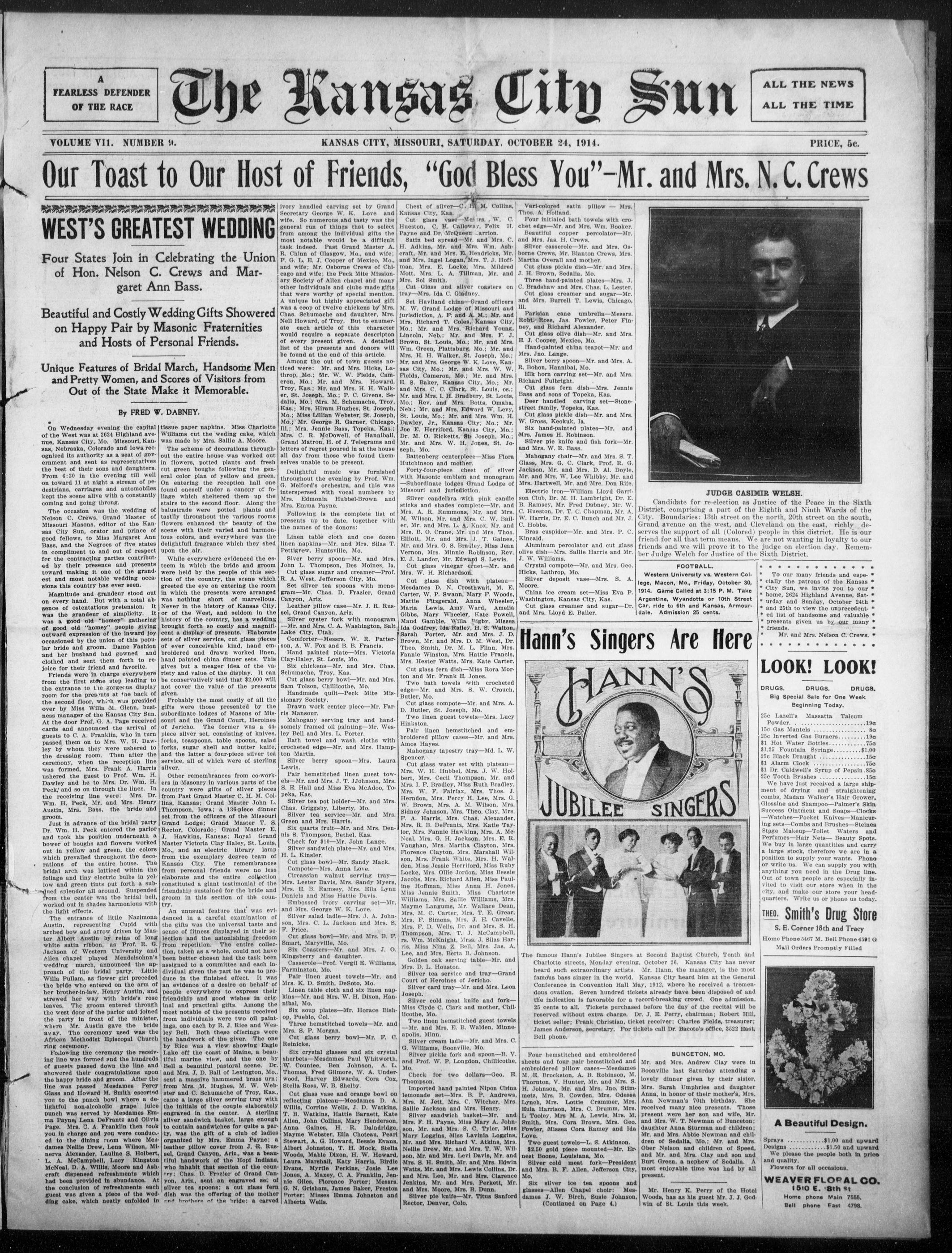
Our Toast to Our Host of Friends, "God Bless You"-Mr. and Mrs. N.C. Crews
A FEARLESS DEFENDER OF THE RACE
VOLUME VI1. NUMBER 9.
Our Toast to
WEST'S GREATES
Four States Join in Cele
of Hon. Nelson C. C
garet Ann L
Beautiful and Costly Wedd
on Happy Pair by Mast
and Hosts of Person
Unique Features of Bridal M
and Pretty Women, and Sc
Out of the State Make
Four States Join in Celebrating the Union of Hon. Nelson C. Crews and Margaret Ann Bass.
Beautiful and Costly Wedding Gifts Showered on Happy Pair by Masonic Fraternities and Hosts of Personal Friends.
Unique Features of Bridal March, Handsome Men and Pretty Women, and Scores of Visitors from Out of the State Make it Memorable.
By FRED W. DABNEY.
On Wednesday evening the capital of the West was at 2624 Highland avenue, Kansas City, Mo. Missouri, Kansas, Nebraska, Colorado and Iowa recognized its authority as a seat of government and sent as representatives the best of their sons and daughters. From 6:30 in the evening till well on toward 11 at night a stream of pedestrians, carriages and automobiles kept the scene alive with a constantly coming and going throng.
tissue paper napkins. Miss Charlotte Williams cut the wedding cake, which was made by Mrs. Sallie A. Moore.
The scheme of decorations throughout the entire house was worked out in flowers, potted plants and fresh cut green boughs following the general color plan of yellow and green. On entering the reception hall one found oneself under a canopy of foliage which sheltered them up the stairs to the second floor. Along the
The occasion was the wedding of Nelson C. Crews, Grand Master of Missouri Masons, editor of the Kansas City Sun, orator and prince of good fellows, to Miss Margaret Ann Bass, and the Negroes of five states in compliment to and out of respect for the contracting parties contributed by their presence and presents toward making it one of the grandest and most notable wedding occasions this country has ever seen.
Magnitude and grandeur stood out on every hand. But with a total absence of ostentate pretension: It was the grandeur of simplicity. It was a good old "homey" gathering of good old "homey" people giving outward expression of the inward joy occasioned by the union of this popular bride and groom. Dame Fashion and her husband had gowned and clothed and sent them forth to rejoice for their friend and favorite.
Friends were in charge everywhere from the first stone step leading to the entrance to the gorgeous display room for the presuits at the back of the second floor, which was presided over by Miss Willa M. Glenn, business manager of the Kansas City Sun. At the door Prof. G. A. Page received cards and announced the arrival of guests to C. A. Franklin, who in turn passed them on to Mrs. W. H. Dawley by whom they were ushered to the dressing room. Then after the ceremony, when the reception line was formed, Mrs. Frank A. Harris ushered the guest to Prof. Wm. H. Dawley and he to Mrs. Dr. Wm. H. Peck; and on through the lines. In the receiving line were: Mrs. Dr. Wm. H. Peck, Mr. and Mrs. Henry Austin, Mrs. Bass, the bride and groom.
Just in advance of the bridal party Dr. Wm. H. Peck entered the parlor and took his position underneath a bower of boughs and flowers worked out in yellow and green, the colors which prevailed throughout the decorations of the entire house. The bridal arch was latticed within the foliage and tiny electric bulbs in yellow and green tints put forth a subdued splendor all around. Suspended from the center was the bridal bell, worked out in shades harmonious with the light effects.
The entrance of little Nazimina Austin, representing Cupid with arched bow and arrow driven by Master Albert Austin by reins of long white satin ribbon, as Prof. R. G. Jackson of Western University and Alen chapel played Mendelssohn's wedding march, announced the approach of the bridal party. Little Willa Pullam, as flower girl preceded the bride who entered on the arm of her brother-in-law, Henry Austin, and strewed her way with bride's rose leaves. The groom entered through the west door of the parlor and joined the party in front of the minister where Mr. Austin gave the bridge away. The ceremony used was the African Methodist Episcopal Church ring ceremony.
Following the ceremony the receiving line was formed and the hundreds of guests passed down the line and showered their congratulations upon the happy bride and groom. After the line was passed Mesdames Percy Glass and Howard M. Smith escorted you to the punch bowl where a delightful non-alcoholic grape juice punch was served by Mesdames Emma Payne Lena DeFrantz and Olivia Page. Mrs. C. A. Franklin then took you in charge and you were conducted to the dining room where Mesdames Nellie Drew, Lena Wilson, Minerva Alexander, Lauline S. Holbert, L. A. McCampbell, Lucy Kingston McNeal, D. A. Willis, Moore and Ashcraft dispensed refreshments which had been provided in abundance. At the conclusion of refreshments each guest was given a piece of the wedding cake, which neatly enfolded in
The Kansas City Sun
tissue paper napkins. Miss Charlotte Williams cut the wedding cake, which was made by Mrs. Sallie A. Moore.
The scheme of decorations throughout the entire house was worked out in flowers, potted plants and fresh cut green boughs following the general color plan of yellow and green. On entering the reception hall one found oneself under a canopy of foliage which sheltered them up the stairs to the second floor. Along the balustrade were potted plants and tastily throughout the various rooms flowers enhanced the beauty of the scene with their varied and harmonious colors, and everywhere was the delightful fragrance which they shed upon the air.
While everywhere evidenced the esteem in which the bride and groom were held by the people of this section of the country, the scene which greeted the eye on entering the room in which the presents were arranged was nothing short of marvellous. Never in the history of Kansas City, or of the West, and seldom in the history of the country, has a wedding brought forth so costly and magnificent a display of presents. Elaborate sets of silver service, cut glass pieces of ever conceivable kind, hand embroidered and drawn worked linen, hand painted china dinner sets. This gives but a meager idea of the variety and value of the display. It can be conservatively said that $2,000 will not cover the value of the presents given.
Probably the most costly of all the gifts were those presented by the subordinate lodges of Masons of Missouri and the Grand Court, Heroines of Jericho. The former was a 44-piece silver set, consisting of knives, teaspoons, table spoons, salad forks, sugar shell and butter knife, and the latter a four-piece silver tea service, all of which were of sterling silver.
Other remembrances from co-workers in Masonry in various parts of the country were gifts of silver pieces from Past Grand Master C. H. M. Collins, Kansas; Grand Master John L. Thompson, Iowa; a 136-piece dinner set from the officers of the Missouri Grand Lodge; Grand Master T. S. Rector, Colorado; Grand Master E. J. Hawkins, Kansas; Royal Grand Master Victoria Clay Haley, St. Louis, Mo, and an electric library lamp from the exemplary degree team of Kansas City. The remembrances from personal friends were no less elaborate and the entire collection constituted a giant testimonial of the friendship sustained for the bride and groom in this section of the country.
An unusual feature that was evidenced in a careful examination of the gifts was the universal taste and sense of fitness displayed in their selection and the astonishing freedom from repetition. The entire collection, taken as a whole, could not have been better chosen had the task been assigned to a committee and each individual given the part he was to produce in the finished effect. It was an evidence of a desire on behalf of people everywhere to express their friendship and good wishes in original and practical gifts. Among the most notable of the presents received from individuals were two oil paintings, one each by R. J. Rice and Wesley Bell. Both these offerings were the handwork of the giver. The one by Rice was a view showing Eagle Lake off the coast of Maine, a beautiful marine view, and the one by Bell a beautiful pastoral scene. Dr. and Mrs. J. D. Ball of Lexington, Mo., sent a massive hammered brass arm: from Mrs. M. Hughes, M. W. Webster and C. Schumache of Troy, Kas, came a large silver serving tray with the initials of the couple elaborately engraved in the center. A sterling silver sandwich basket, large enough to contain sandwiches for quite a party, was the gift of a club of ladies organized by Mrs. Emma Payne; a leather pillow cover from J. R. Rusel, Grand Canyon, Ariz., was a beautiful handwork of the Hopi Indians, who inhabit that section of the country: Chas. D. Frazier of Grand Canyon, Ariz., sent an engraved set of silver tea spoons; a cut glass fern was the offering of the mother and brothers of the bride; a carved
KANSAS CITY, MISSOURI, SATURDAY, OCTOBER 24, 1914.
lvory handled carving set by Grand Secretary George W. K. Love and wife. So numerous and tasty was the general run of things that to select from among the individual gifts the most notable would be a difficult task indeed. Past Grand Master A. R. Chinn of Glasgow, Mo., and wife; P. G. L. E. J. Cooper of Mexico, Mo., and wife; Mr. Osborne Crews of Chicago and wife; the Peck Mission Society of Allen chapel and many other individuals and clubs made gifts that were worthy of special mention. A unique but highly appreciated gift was a coop of twelve chickens by Mrs. Chas. Schumache and daughter, Mrs. Nell Howard, of Troy. But to enumerate each article of this character would require a separate description of every present given. A detailed list of the presents and donors will be found at the end of this article.
Among the out of town guests noticed were: Mr. and Mrs. Hicks, Lathrop, Mo.; Mr. W. W. Fields, Cameron, Mo.; Mr. and Mrs. Howard, Troy, Kas.; Mr. and Mrs. H. H. Walker, St. Joseph, Mo.; P. C. Givens, Sedall, Mo.; Mrs. M. Schumache, Troy, Kas.; Mrs. Hiram Hughes, St. Joseph, Mo.; Miss Lillian Webster, St. Joseph, Mo.; Mr. George R. Garner, Chicago, Ill.; Mrs. Jennie Bass, Topeka, Kas.; Mrs. C. R. McDowell, of Hannball, Grand Matron, H. of J. Telegraphs and letters of regret poured in at the house all day from those who found themselves unable to be present.
Delightful music was furnished throughout the evening by Prof. Wm. G. Melford's orchestra, and this was interspersed with vocal numbers by Mrs. Edmonla Hubbel-Brown and Mrs. Emma Payne.
Following is the complete list of presents up to date, together with the names of the donors:
Linen table cloth and one dozen linen napkins—Mr. and Mrs. Silas T. Pettigrew, Huntsville, Mo.
Silver berry spoon—Mr. and Mrs. John L. Thompson, Des Moines, Ia. Cut glass sugar and creamer—Prof. R. A. West, Jefferson City, Mo.
Set silver tea spoons with monogram—Mr. Chas. D. Frazier, Grand Canyon, Ariz.
Leather pillow case—Mr. J. R. Russel, Grand Canyon, Ariz.
Silver oyster fork with monogram —Mr. and Mrs. C. A. Washington, Salt Lake City, Utah.
Comforter—Messrs. W. R. Patterson, A. W. Fox and B. B. Francis.
Hand painted plate—Mrs. Victoria Clay-Haley, St. Louis, Mo.
Six chickens—Mr. and Mrs. Chas. Schumache, Troy, Kas.
Cut glass berry bowl—Mr. and Mrs.
Sam Tolson, Chillicothe, Mo.
Handmade quilt-Peck Mite Missionary Society.
Drawn work center piece—Mr. Farris Mansour.
Mahogany serving tray and hand-somely framed oil painting—Mr. Wesley Bell and Mrs. L. Porter.
Bath towel and wash cloths with crocheted edge—Mr. and Mrs. Hampton Martin.
Silver berry spoon—Mrs. Laura Lewis.
Pair hemstitched linen guest towels—Mr. and Mrs. J. T. JJohnson, Mrs. S. E. Hall and Miss Eva McAdoo, Topeka, Kas.
Silver tea pot holder—Mr. and Mrs. Chas. Griggsby, Liberty, Mo.
Silver tea service--Mr. and Mrs. Green and Mrs. Harris.
Six quarts fruit—Mr. and Mrs. Dennis S. Thompson, Bethel, Kas.
Check for $10—Mr. John Lange.
Silver sandwich plate—Mr. and Mrs. H. L. Kinsler.
Cut glass bowl—Mr. Sandy Mack.
Compote—Mrs. Anna Love.
Ciclassian walnut serving tray—Mrs. Lester Davis, Mrs. Sandy Myers, Mrs. E. B. Ramsey, Mrs. Ella Lynn Daniels and Miss Matt Davis.
Embossed ivory carving set—Mr. and Mrs. George W. K. Love.
Silver salad ladie—Mrs. J. A. John son, Mrs. C. L. Jackson and Mrs. S. F. Price.
Cut glass bowl—Mr. and Mrs. B. F. Smart, Maryville, Mo.
Six Coasters—Mr. and Mrs. J. O
Kingsberry and daughter.
Casserole-Prof. Vergil E. Williams, Farmington, Mo.
Pair linen guest towels—Mr. and Mrs. K. D. Smith, DeSoto, Mo.
Linen table cloth and six linen napkins—Mr. and Mrs. W. H. Dixon, Hannibal, Mo.
Six soup plates—Mr. Horace Bishop, Pueblo, Col.
Three stitched towels—Mr. and Mrs. S. P. Morgan.
Cut glass berry bowl—Mr. F. C. Reinicke.
Six crystal glasses and six crystal sherbetz—Mesdames Paul Whitworth, W. Countee, Ben Johnson, A. L. Thomas, Fred Gilmore, W. A. Underwood, Harvey Edwards, Cora Cox, Stella Ross, W. B. Shelby.
Cut glass vase and orange bowl on reflecting plateau—Mesdames D. A. Willis, Corrine Wells, J. D. Watkins, T. B. Watkins, Hattle Barnett, Kate Allen, John Collins, Mary Henderson, Anna Gaines, H. R. Dalbridge, Mayme Webster, Ella Choteau, Pearl Stewart, A. G. Howard, Bess Evans, Albert Johnston, T. H. Mock, Stella Woods, Mable Dixon, H. W. Howard, Laura Marshall, Katy Harris, Birdle Evans, Myrtle Perkins, Josie Lee Jones, A. Maxey, C. A. Franklin, Jenie Gies, Florence Porter; Messrs. G. N. Grisham, James Baker, Preston Porter; Misses Emma Johnston and Alberta Wells.
Chest of silver - C. H. M. Collins, Kansas City, Kas.
Cut glass vase - Mei rs., W. C. Hueston, C. H. Calloway, Felix H Payne and Dr. McQueen Carrion.
Satin bed spread - Mr. and Mrs. C. H. Adkins, Mr. and Mrs. Wm. Ascraft, Mr. and Mrs. E. Hendricks, Mr. and Mrs. Ingel Logan, Mrs. T. J. Hoffman, Mrs. E. Locke, Mrs. Mildred Mott, Mrs. L. A. Tillman, Mr. and Mrs. Sol Smith.
Cut Glass and silver coasters on tray. Mrs. Ida C. Gladney.
Set Haviland china - Grand officers M. W. Grand Lodge of Missouri and jurisdiction, A. F. and A. M.; Mr. and Mrs. Richard T. Coles, Kansas City, Mo.; Mr. and Mrs. Richard Young, Lincoln, Neb.; Mr. and Mrs. F. J. Brown, St. Louis, Mo.; Mr. and Mrs. Wm. Green, Plattsburg, Mo.; Mr. and Mrs. H. H. Walker, St. Joseph, Mo.; Mr. and Mrs. George W. K. Love, Kansas City, Mo.; Mr. and Mrs. W. W. Fields, Cameron, Mo.; Mr. and Mrs. E. S. Baker, Kansas City, Mo.; Mr. and Mrs. C. C. Clark, St. Louis, os.; Mr. and Mrs. I. H. Bradbury, St. Louis, Mo.; Rev. and Mrs. Botts, Omaha, Neb.; Mr. and Mrs. Edward W. Levy, St. Louis, Mo.; Mr. and Mrs. Wm. H. Dawley, Jr., Kansas City, Mo.; Mr. Joe E. Herriford, Kansas City, Mo.; Dr. M. O. Rickett, St. Joseph, Mo.; Mr. and Mrs. W. H. Jones, St. Joseph, Mo.
Battenberg centerpiece - Miss Flora Hutchinson and mother.
Forty-four-piece chest of silver with Masonic emblem and monogram—Subordinate lodges Grand Lodge of Missouri and jurisdiction.
Silver candelbra with pink candle sticks and shades complete—Mr and Mrs. A. R. Rummons, Mr and Mrs. M. Wilson, Mr and Mrs. C. W. Wailer, Mr and Mrs. L. A. Knox, Mr and Mrs. B. O. Crane, Mr and Mrs. Thos. Elliott, Mr and Mrs. J. T. Gaines, Mr and Mrs. G. S. Bradley, Miss Jean Vernon, Mrs. Minnie Robinson, Rev. E. J. Landor, Mr. Edward S. Lewis.
Cut glass vinegar cruet—Mr and Mrs. W. H. Richardson.
Cut glass dish with plateau—Mesdames D. N. Crostwait, M. E. Carter, W. P. Swann, Mary F. Woods, Mattle Fitzgerald, Anna Wheeler, Maria Lewis, Amy Ward, Amelia Gibbs, Mary Wheeler, Kate Powell, Maud Gamble, Willa Fibg, Misses Ida Godfrey, Ida Ralley, H. S. Walton, Sarah Porter, Mr and Mrs. J. D. Brown, Mr and Mrs. D. M. West, Dr. Theo, Dr. M. L. Flinn, Mrs. Fannie Winston, Mrs. Hattie Francis, Mrs. Hester Watts, Mrs. Kate Carter.
Cut glass fern dish—Miss Rora Morton and Mr. Frank E. Jones.
Two bath towels with crocheted edge—Mr and Mrs. S. W. Crouch, Butler, Mo.
Cut glass compote—Mr and Mrs. A. D. Butler, St. Joseph, Mo.
Two linen guest towels—Mrs. Lucy Hinkston.
Pair linen hemstitched and embroidered pillow cases—Mr. and Mrs. Amos Hayes.
Mahogany tapestry tray—Md. L. W. Spencer.
Cut glass water set with plateau—Mrs. W. H. Hubbel, Mrs. J. W. Holbert, Mrs. Cecil Thompson, Mr. and Mrs. I. F. Bradley, Miss Ruth Bradley, Mrs. W. F. Fairfax, Mrs. Thos. J. Herndon, Mrs. Percy H. Lee, Mrs. G. W. Brown, Mrs. A. M. Wilson, Mrs. Sidney Johnson, Mrs. Theo Clay, Mrs. F. A. Harris, Mrs. Chas. Alexander, Mrs. R. B. DeFrantz, Mrs. Katle Taylor, Mrs. Fannie Hawkins, Mrs. A. McNeal, Mrs. G. H. Jackson, Mrs. E. R. Vaughan, Mrs. Martha Clayton, Mrs. Florence Clayton, Mrs. Marshall Wilson, Mrs. Frank White, Mrs. H. Walden, Miss Jessie Herriford, Miss Ruby Locke, Mrs. Ollie Jordon, Miss Bessie Jacobs, Mrs. Richard Allen, Miss Pauline Hoffman, Miss Anna H. Jones, Miss Jennie Smith, Miss Charlotte Williams, Mrs. Salle Williams, Mrs. Maye Langues, Mr. Wallace Dean, Mrs. M. C. Carter, T. E. E. Grear, Mrs. F. Simons, Mrs. J. E. Cavelle, Mrs. F. D. Wells, Dr. and Mrs. S. H. Thompson, Mrs. T. J. McCampbell, rs. Wm. McKnight, Mrs. J. Silas Harris, Miss Nina Z. Bell, Mrs. J. Asa, and Mrs. Berta B. Johnson.
Golden oak serving table—Mr. and Mrs. D. L. Houston.
Silver tea service and tray—Grand Court of Heroines of Jericho.
Silver card tray—Mr. and Mrs. Leon Joseph.
Silver cold meat knife and fork—Miss Clyde C. Clark and mother, Chillicothe, Mo.
Two linen hemstitched guest towels—Mr. and Mrs. E. B. Walden, Minneapolis, Minn.
Silver cream ladle—Mr. and Mrs. C. G. Williams, Boonville, Mo.
Silver pickle fork and spoon—B. V. and Prof. W. P. Longdon, Chillicothe, Mo.
Check for two dollars—Geo. E. Thompson.
Imported hand painted Nipon China lemonade set—Mrs. B. P. Andres.
Mrs. M. Jett, Mrs. C. Witcher, Mrs. Sallie Jackson and Mrs. Henry.
Silver sandwich basket—Mr. and Mrs. F. H. Payne, Miss Mary A. Johnson, Mr. and Mrs. S. C. Tyler, Miss Mary Loggins, Miss Lavinia Loggins, Mr. and Mrs. Richard V. Atkins, Mrs. Nellie Drew, Mr. and Mrs. T. W. Wilson, Mr. and Mrs. Levi Davis, Mr. and Mrs. S. H. Smith, Mr. and Mrs. Edwin Watts, Mr. and Mrs. Lewis Collins, Dr. and Mrs. Lee, Mr. and Mrs. Clarence Jenkins, Mr. and Mrs. Perkett, Mr. and Mrs. Moore, Mrs. B. Dunn.
Silver ple knife--Mr. Titus Sanford
Rector, Denver, Colo.
Hann's Singers Are Here
HANN'S
JUBILEE SINGERS
The famous Hann's Jubilee Singers at Second Baptist Church, Tenth and Charlotte streets, Monday evening, October 26. Kansas City has never heard such extraordinary artists. Mr. Hann, the manager, is the most famous bass singer in the world. Kansas City heard him at the General Conference in Convention Hall May, 1912, where he received a tremendous ovation. Seven hundred tickets already have been disposed of and the indication is favorable for a record-breaking crowd. One admission, 25 cents to all. Tickets purchased before the day of the recital will be reserved without extra charge. Dr. J. E. Perry, chairman; Robert Hill, ticket seller; Frank Christian, ticket receiver; Charles Fields, treasurer; James Anderson, secretary. For tickets call Dr. Bacote's office, 3522 East, Bell phone.
Vari-colored satin pillow — Mrs.
Thos. A. Holland.
Four initialb bath towels with cro-
chet edge—Mr. and Mrs. Wm. Booker.
Beautiful copper percolator—Mr.
and Mrs. Jas. H. Crews.
Silver casserole—Mr. and Mrs. Os-
borne Crews, Mr. Blanton Crews, Mrs.
Martha Overall and mother.
Cut glass pickle dish—Mr. and Mrs.
J. H. Brown, Sedalia, Mo.
Three hand-painted plates—Mrs. J.
C. Bradshaw and Mrs. Chas. L. Lester.
Cut glass creamer and sugar—Mr.
and Mrs. Burrell T. Lewis, Chicago.
Ill.
Parisian cane umbrella—Messrs.
Robt. Ross, Jas. Fowler, Peter Fin-
ney, and Richard Alexander.
Cut glass olive dish—Mr. and Mrs.
E. J. Cooper, Mexico, Mo.
Hand-painted china teapot—Mr. and
Mrs. Jno. Lange.
Silver berry spoon—Mr. and Mrs. A. R, Bohon, Hannibal, M. Elk horn carving set—Mr. and Mrs. Richard Fulbright.
Cut glass fern dish—Mrs. Jennie
Bass and sons of topera, Kas.
Deer handled carving set—Stone street family, Topeka, Kas.
street family, 'Otpeka, Kus.
Cut glass pickle dish—Mr. and Mrs.
Wr. hand-painted plates—Mr. and
Six hand-painted plates—Mr. and
Six James H. Robinson.
Silver ple knife and fish fork—Mr. and Mrs. W, R. Bass.
Mahogany chair—Mr. and Mrs. S. T. Glass, Mrs. G. C. Clark, Prof. R. G Jackson, Mr. and Mrs. D. Al Doyle, Mr. and Mrs. W. Lee Whibby, Mr. and Mrs. Hartwell, Mr. and Mre. Don Rife.
Electric iron—William Lloyd Garrison Club, Dr. M. H. Lambright, Dr. E. B Ramsey, Mr. Fred Dabney, Mr. W. C. Hueston, Dr. T. C. Chapman, Mr. A. W. Harris, Dr. E. B Cunch and Mr. J. C. Hobbs.
Bras cuspidor—Mr. and Mrs. P. C. Kincaid.
Aluminum percolator and cut glass olive dish—Mrs. Sallie Harris and Mr. J. W. Williams.
Crystal compote—Mr. and Mrs. Geo. Hicks, Lathrop, Mo.
Silver deposit vase—Mrs. S. A. Moore.
China ice cream set—Miss Eva P. Washington, Kansas City, Kas.
Cut glass creamer and sugar—Dr. and Mrs. Lloyd E. Bailer.
Hann's Singer
HANN
JUBILEE
The famous Hann's Jubilee Singers in Charlotte streets, Monday evening, heard such extraordinary artists, famous bass singer in the world. Conference in Convention Hall Middous ovation. Seven hundred tick tie indication is favorable for a 25 cents to all. Tickets purchased reserved without extra charge. Ticket seller: Frank Christian, tick James Anderson, secretary. For the Bell phone.
Four hemstitched and embroidered sheets and four pair hemstitched and embroidered pillow cases—Mesdames M. E. Brockston, A. B. Robinson, M. Thornton, V. Hunter, Mr. and Mrs. S. H. Johnson, Mr. and Mrs. Jno. Stimmetz, Mrs. B. Cowden, Mrs. Odessa Lynch, Mrs. Lottie Crammer, Mrs. Eula Harrison, Mrs. C. Drumm, Mrs. L Tooley, Mrs M. A. Lewis, Mrs M. Smith, Mrs. Cora Brown, Mrs. Geo. Fowler, Misses Cora Ramey and Ida Love.
Two guest towels—L. S. Atkinson.
$2.50 gold piece mounted—Mr. Ernest Boone, Louisiana, Mo.
Silver cold meat fork—President and Mrs. B. F. Allen, Jefferson City, Mo.
Six silver ice tea spoons and glasses—Allen Chapel choir: Mesdames J. W. Birch, Susie Johnson, (Continued on Page 4.)
Mrs. N. C.
M. H.
JUDGE CASIMIR WELSH
Candidate for re-election as Justice of the
District, comprising a part of the Eighth and
City. Boundaries: 13th street on the north, 20th
Grand avenue on the west, and Cleveland on
the serves the support of all (Colored) people in this
friend for all that term means. We are not want
friends and we will prove it to the judge on el-
ber Judge Welch for Justice of the Sixth District
pre-election as Justice of the Court, a part of the Eighth and 13th street on the north, 20th street west, and Cleveland on the of all (Colored) people in this term means. We are not want prove it to the judge on either Justice of the Sixth District
Candidate for re-election as Justice of the Peace in the Sixth District, comprising a part of the Eighth and Ninth Wards of the City. Boundaries: 13th street on the north, 20th street on the south, Grand avenue on the west, and Cleveland on the east, richly deserves the support of all (Colored) people in this district. He is our friend for all that term means. We are not wanting in loyalty to our friends and we will prove it to the judge on election day. Remember Judge Welch for Justice of the Sixth District.
FOOTBALL.
Western University vs. Western College, Macon, Mo., Friday, October 30, 1914. Game Called at 3:15 P. M. Take Argentine, Wyandotte or 10th Street Car, ride to 6th and Kansas, Armour-dale. Admission 25 cents.
* To our many friends and especially the patrons of the Kansas City Sun, we invite you to our home, 2624 Highland Avenue, Saturday and Sunday, October 24th and 25th to view the unprecedented list of handsome
ers Are Here
ANN'S
SINGERS
At Second Baptist Church, Tenth and
eighth, October 26. Kansas City has never
Mr. Hann, the manager, is the most
Kansas City heard him at the General
Day, 1912, where he received a tremen-
kets already have been disposed of and
record-breaking crowd. One admission,
ed before the day of the recital will be
Dr. J. E. Perry, chairman; Robert Hill,
ticket receiver; Charles Fields, treasurer;
tickets call Dr. Bacote's office, 3522 East,
BUNCETON, MO.
Mr. and Mrs. Andrew Clay were in Boonville last Saturday attending a lovely dinner given by their sister, Mrs. Sarah Umphries and daughter Anna, in honor of their mother's, Mrs. Ann Newman's 70th birthday. She received many nice presents. Those present were her son and wife, Mr. and Mrs. W. T. Newman of Bunceton; daughter Anna Sturman and children; Mr. and Mrs. Abbie Newman and children of Sedalia, Mo.; Mr. and Mrs. Ober Nelson and children of Speed, and Mr. and Mrs. Clay and son and Burt Green, a nephew of Sedalia. A most enjoyable time was had by all present.
Mr. Henry K. Perry of the Hotel Woods, has as his guest Mr. J. J. Godwin of St. Louis this week.
---
FOOTBALL
ALL THE NEWS
ALL THE TIME
N. C. Crews
justice of the Peace in the Sixth
Eighth and Ninth Wards of the
the north, 20th street on the south,
cleveland on the east, richly de-
people in this district. He is our
we are not wanting in loyalty to our
judge on election day. Remem-
Sixth District.
* To our many friends and espe-
cially the patrons of the Kansas
* City Sun, we invite you to our
home, 2624 Highland Avenue, Sat-
rday and Sunday, October 24th
and 25th to view the unpreceden-
ed list of handsome and valuable
presents given us by our many
friends.
Mr. and Mrs. Nelson C. Crews.
LOOK! LOOK!
DRUGS. DRUGS. DRUGS.
Big Special Sale for One Week
Beginning Today.
25c Lazell's Massatta Talcum
Powder. 19c
15c Gas Mantels 8c
25c Inverted Gas Burners. 19c
$1 Hot Water Bottles. 75c
$1.25 Fountain Syringe. $1.00
25c Black Draught 15c
1 Alarm Clock 15c
$1 Dr. Caldwell's Syrup of Pepsin. 85c
25c Tooth Brushes. 15c
We have just received a large shipment of drying and straightening combs, Madam Walker's Hair Grower, Glossine and Shampoo—Palmer's Skin Success Ointment and Soaps—Clocks—Watches—Pocket Knives—Manicuring sets—Combs and Brushes—Stelnes Stage Makeup—Toilet Waters and Perfumes—Hair Nets—Beauty Spots.
We buy in large quantities and carry a large stock, therefore we are in a position to supply your wants. Phone or write us. We can supply you with anything you need in the Drug line.
Out of town people are especially invited to visit our store when in the city, and make our store your headquarters. Write us or phone us today.
THEO. Smith's Drug Store
S. E. Corner 18th and Tracy
Home Phone 5467 M. Bell Phone 4591 G
Mail Orders Promptly Filled
A Beautiful Design.
Sprays ..... $1.00 and upward
Designs ..... $1.50 and upward
We please the people both in price
and quality.
Flowers for all occasions.
WEAVER FLORAL CO.
1510 E. 18th St
Home phone Main 7555.
Bell phone East 4798.
PRICE, 5c.
Particular attention may be given to the following subject, since there are hundreds of thousands using the Eureka Comb throughout the United States and Isles. They give the best of satisfaction as to our recommend, straightening the hair beautifully with one stroke, and as assistance in causing a rapid growth. Evidences coming to us from every source, of which is pleasing, that the Eureka Comb performs precisely as advertised.
No better comb on the market for purposes as we have been advised that other combs are toys, when it comes to benefits and effectual influences when used as to directions, for which every comb placed goes with it instructions, how to use and for what purposes. Wherever introduced the Eureka preferable. Merchants and agents are successful when they are placed conveniently in quantities for the public.
They are usually sold for $1.50 (one dollar and fifty cents) each complete. The only thing is to be careful in the purchase as there is no other comb that will answer the purposes so well as the Eureka. We wholesale the Eureka Comb, being the manufacturers and promoters, and are the only wholesalers of this special device; if there are other s we would be pleased to be informed.
The devises are patented and registered. For prices and further information write
"House of Love"
Badges, Banners,
Books, Robes, Emblems,
Buttons, Furniture,
Uniforms
FOR ALL
Lodge and Church Societies
The Love Regalia Company
2418 Flora Avenue Kansas City, Missouri
Bell Phone, East 944
THE
NELSON
GIRL
Are you satisfied with your
hair?
Is it as long as it should be?
Is it soft and glossy and full of life?
Can you comb it out easily or is it full of tangles?
Are you proud of your hair?
The Answer
Is:-
NELSON'S
HAIR DRESSING
25¢
50¢
LAMP CAP
Particular dreds of the Isles. They hair beauti Evidences.
Comb performs precisely as ad
No better comb on the man when it comes to benefits and placed goes with it instructions preferable. Merchants and age the public.
They are usually sold for $ be careful in the purchase as t
Nelson's Hair Dressing as we do
you would never use anything
else on your hair.
We want you to know it—
know it personally by actual use,
don't take our word for it, or any-
one elses,—test it yourself.
You can do this,
send us your name and address
and we will send you,
Free of cost,
a sample box of Nelson's Hair
Dressing; also a sample of Nelson's
Scalp and Hair Cleaner and
a sample cake of Nelson's Skin
and Complexion Soap.
Test them
in your own home, if they are
not what we claim, you are not
out anything.
We have confidence
in them and are ready and anxious to prove every claim we make.
Write to day,
enclosing two cent stamp to pay postage on samples.
NELSON MANUFACTURING CO.,
Richmond, Virginia
Has no superior as
a hair beautifier
Thousands of men and
women have improved the
appearance of their hair by
using NELSON'S HAIR
DRESSING.
For those who know—it
is a toilet necessity.
Why not try it yourself?
Ask your druggist. If he
cannot supply you, send us
his name and address and we
will send you a free sample.
NELSON MFG. CO.
RICHMOND, VA.
THE
NELSON
GIRL
EUREKA REG. PAT D AUG. 8.1911.
The following subject, since there are humbly throughout the United States and as to our recommend, straightening the assistance in causing a rapid growth of which is pleasing, that the Eurekai been advised that other combs are toy as to directions, for which every combs. Wherever introduced the Eurekai be placed conveniently in quantities for (i) each complete. The only thing is to answer the purposes so well as the carriers and promoters, and are the only be pleased to be informed.
Further information write
EUREKA COMB COMPANY,
Chattanooga, Tenn.
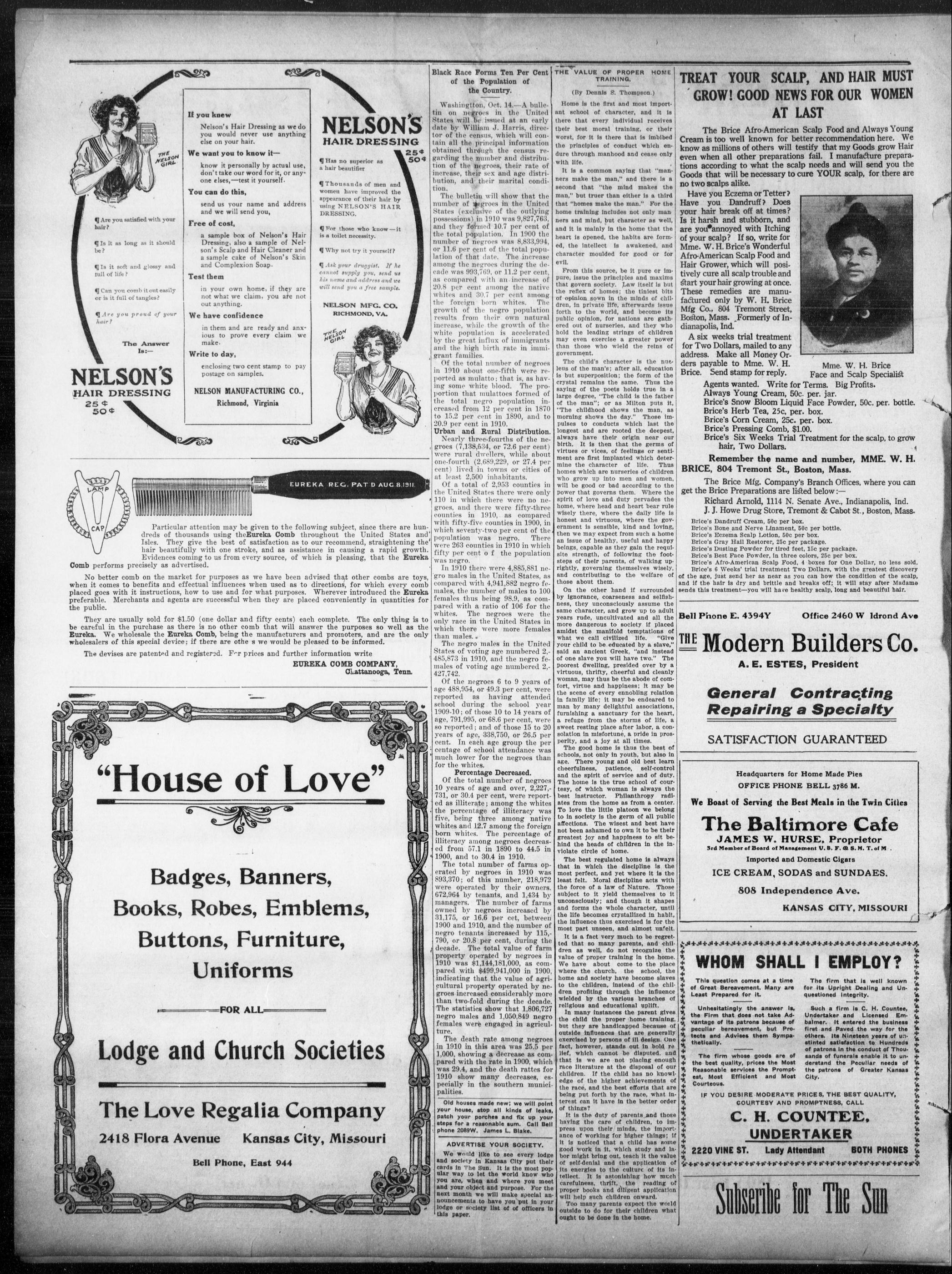
Black Race Forms Ten Per Cent of the Population of the Country.
Washington, Oct. 14.—A bulletin on negroes in the United States will be issued at an early date by William J. Harris, director of the census, which will contain all the principal information obtained through the census regarding the number and distribution of the negroes, their rate of increase, their sex and age distribution, and their marital condition.
The bulletin will show that the number of negroes in the United States (exclusive of the outlying possessions) in 1910 was 9,827,763, and they formed 10.7 per cent of the total population. In 1900 the number of negroes was 8,833,994, or 11.6 per cent of the total population of that date. The increase among the negroes during the decade was 993,769, or 11.2 per cent, as compared with an increase of 20.8 per cent among the native whites and 30.7 per cent among the foreign born whites. The growth of the negro population results from their own natural increase, while the growth of the white population is accelerated by the great influx of immigrants and the high birth rate in immigrant families.
Of the total number of negroes in 1910 about one-fifth were reported as mulatto; that is, as having some white blood. The proportion that mulattoes formed of the total negro population increased from 12 per cent in 1870 to 15.2 per cent in 1890, and to 20.9 per cent in 1910.
Urban and Rural Distribution.
Nearly three-fourths of the negroes (7,138,534, or 72.6 per cent) were rural dwellers, while about one-fourth (2,689,229, or 27.4 per cent) lived in towns or cities of at least 2,500 inhabitants.
Of a total of 2,953 counties in the United States there were only 110 in which there were no negroes, and there were fifty-three counties in 1910, as compared with fifty-five counties in 1900, in which seventy-two per cent of the population was negro. There were 263 counties in 1910 in which fifty per cent o f the population was negro.
In 1910 there were 4,885,881 negro males in the United States, as compared with 4,941,882 negro females, the number of males to 100 females thus being 98.9, as compared with a ratio of 106 for the whites. The negroes were the only race in the United States in which there were more females than males. The negro males in the United States of voting age numbered 2,485,873 in 1910, and the negro females of voting age numbered 2,427,742.
Of the negroes 6 to 9 years of age 488,954, or 49.3 per cent, were reported as having attended school during the school year 1909-10; of those 10 to 14 years of age, 791,995, or 68.6 per cent, were so reported; and of those 15 to 20 years of age, 338,750, or 26.5 per cent. In each age group the per centage of school attendance was much lower for the negroes than for the whites.
Percentage Decreased.
Of the total number of negroes 10 years of age and over, 2,227., 731, or 30.4 per cent, were reported as illiterate; among the whites the percentage of illiteracy was five, being three among native whites and 12.7 among the foreign born whites. The percentage of illiteracy among negroes decreased from 57.1 in 1890 to 44.5 in 1900, and to 30.4 in 1910.
The total number of farms operated by negroes in 1910 was 893,370; of this number, 218,972 were operated by their owners. 672,964 by tenants, and 1,434 by managers. The number of farms owned by negroes increased by 31,175, or 16.6 per cent, between 1900 and 1910, and the number of negro tenants increased by 115,790, or 20.8 per cent, during the decade. The total value of farm property operated by negroes in 1910 was $1,144,181,000, as compared with $499,941,000 in 1900, indicating that the value of agricultural property operated by negroes increased considerably more than two-fold during the decade. The statistics show that 1,806,727 negro males and 1,050,849 negro females were engaged in agriculture.
The death rate among negroes in 1910 in this area was 25.5 per 1,000, showing a decrease as compared with the rate in 1900, which was 29.4, and the death rattles for 1910 show many decreases, especially in the southern municipalities.
Old houses made new; we will point your house, stop all kinds of leaks, patch your porches and fix up your steps for a reasonable sum. Call Bell phone 2089W. James L. Blake.
We would like to see every lodge and society in Kansas City put their cards in The Sun. It is the most popular way to let the world know who you are, when and where you meet and your object and purpose. For the next month we will make special announcements to have you put in your lodge or society list of of officers in this paper.
Home is the first and most important school of character, and it is there that every individual receives their best moral training, or their worst, for it is there that is imbibed the principles of conduct which endure through manhood and cease only with life.
It is a common saying that "manners make the man," and there is a second that "the mind makes the man," but truer than either is a third that "homes make the man." For the home training includes not only manners and mind, but character as well, and it is mainly in the home that the heart is opened, the habits are formed, the intellect is awakened, and character moulded for good or for evil.
From this source, be it pure or impure, issue the principles and maximus that govern society. Law itself is but the reflex of homes; the tiniest bits of opinion sown in the minds of children, in private life, afterwards issue forth to the world, and become its public opinion, for nations are gathered out of nurseries, and they who hold the leading strings of children may even exercise a greater power than those who wield the reins of government.
The child's character is the nuleus of the man's; after all, education is but superposition; the form of the crystal remains the same. Thus the saying of the poets holds true in a large degree, "The child is the father of the man"; or as Milton puts it, "The childhood shows the man, as morning shows the day." Those impulses to conducts which last the longest and are rooted the deepest, always have their origin near our birth. It is then that the germs of virtues or vices, of feelings or sentiment are first implanted which determine the character of life. Thus homes which are nurseries of children who grow up into men and women, will be good or bad according to the power that governs them. Where the spirit of love and duty pervades the home, where head and heart bear rule wisely there, where the daily life is honest and virtuous, where the government is sensible, kind and loving, then we may expect from such a home an issue of healthy, useful and happy beings, capable as they gain the requisite strength, of following the footsteps of their parents, of walking uprightly, governing themselves wisely, and contributing to the welfare of those about them.
On the other hand if surrounded by ignorance, coarseness and selfishness, they unconsciously assume the same character, and grow up to adult years rude, uncultivated and all the more dangerous to society if placed amidst the manifold temptations of what we call civilized life. "Give your child to be educated by a slave," said an ancient Greek, "and instead of one slave you will have two." The poorest dwelling, presided over by a virtuous, thrifty, cheerful and cleanly woman, may thus be the abode of comfort, virtue and happiness; it may be the scene of every ennobling relation in family life; it may be endeared to man by many delightful associations, furnishing a sanctuary for the heart, a refuge from the storms of life, a sweet resting place after labor, a consolation in misfortune, a pride in prosperity, and a joy at all times.
The good home is thus the best of schools, not only in youth, but also in age. There young and old best learn cheerfulness, patience, self-control and the spirit of service and of duty. The home is the true school of courtesy, of which woman is always the best instructor. Philanthropy radiates from the home as from a center. To love the little platoon we belong to in society is the germ of all public affections. The wisest and best have not been ashamed to own it to be their greatest joy and happiness to sit behind the heads of children in the involate circle of home.
The best regulated home is always that in which the discipline is the most perfect, and yet where it is the least felt. Moral discipline acts with the force of a law of Nature. Those subject to it yield themselves to it unconsciously; and though it shapes and forms the whole character, until the life becomes crystallized in habit, the influence thus exercised is for the most part unseen, and almost unfeelt. It is a fact very much to be regretted that so many parents, and children as well, do not recognize the value of proper training in the home. We have about come to the place where the church, the school, the home and society have become slaves to the children, instead of the children profiting through the influence wielded by the various branches of religious and educational uplift.
In many instances the parent gives the child the proper home training, but they are handicapped because of outside influences that are generally exercised by persons of ill design. One fact, however, stands out in bold relief, which cannot be disputed, and that is we are not placing enough race literature at the disposal of our children. If the child has no knowledge of the higher achievements of the race, and the best efforts that are being put forth by the race, what interest can it have in the better order of things?
It is the duty of parents and those having the care of children, to impress upon their minds, the importance of working for higher things; if it is noticed that a child has some good work in it, which study and labor might bring on, teach it the value of self-denial and the application of its energies to the culture of its intellect. It is astonishing how much carefulness, thrift, the reading of proper books and diligent application will help such children onward. Too many parents expect the world outside to do for their children what ought to be done in the home.
TREAT YOUR SCALP, AND HAIR MUST GROW! GOOD NEWS FOR OUR WOMEN AT LAST
The Brice Afro-American Scalp Food and Always Young Cream is too well known for better recommendation here. We know as millions of others will testify that my Goods grow Hair even when all other preparations fail. I manufacture preparations according to what the scalp needs and will send you the Goods that will be necessary to cure YOUR scalp, for there are no two scalps alike.
Have you Eczema or Tetter? Have you Dandruff? Does your hair break off at times? Is it harsh and stubborn, and are you annoyed with Itching of your scalp? If so, write for Mme. W. H. Brice's Wonderful Afro-American Scalp Food and Hair Grower, which will positively cure all scalp trouble and start your hair growing at once. These remedies are manufactured only by W. H. Brice Mfg Co., 804 Tremont Street, Boston, Mass. Formerly of Indianapolis, Ind.
A six weeks trial treatment for Two Dollars, mailed to any address. Make all Money Orders payable to Mme. W. H. Brice. Send stamp for reply.
Agents wanted. Write for
Always Young Cream, 50c
Brice's Snow Bloom Liqui
Brice's Herb Tea, 25c, pe
Brice's Corn Cream, 25c.
Brice's Pressing Comb, $4
Brice's Six Weeks Trial
hair, Two Dollars.
Remember the name
BRICE, 804 Tremont St., H
The Brice Mfg. Company
get the Brice Preparations are li
Richard Arnold, 1114 N.
J. J. Howe Drug Store, Tr
Brice's Dandruff Cream, 50c per b
Brice's Bone and Nerve Linament,
Brice's Eczema Scalp Lotion, 500 p
Brice's Gray Hail Restorer, 25c per
Brice's Dusting Powder for tired fe
Brice's Best Face Powder, In three
Brice's Afro-American Scalp Food
Brice's 6 Weeks' trial treatment T
of the age, just send her as near as y
and if the hair is dry and brittle and
sends this treatment—you will have he
Bell Phone E. 4394Y
THE Modern H
A. E. ESTE
General C
Repairing
SATISFACTION
wanted. Write for Terms. Big Pro-
Young Cream, 50c. per. jar.
Snow Bloom Liquid Face Powder, 50c.
Herb Tea, 25c. per. box.
Corn Cream, 25c. per. box.
Pressing Comb, $1.00.
Six Weeks Trial Treatment for the
Two Dollars.
Number the name and number, B
Tremont St., Boston, Mass.
Face Mfg. Company's Branch Offices,
Preparations are listed below:—
Arnold, 1114 N. Senate Ave., India
Drug Store, Tremont & Cabot St.
Iff Cream, 50c per box.
And Nerve Linament, 50c per bottle.
A Scalp Lotion, 50c per box.
Hall Restorer, 25c per package.
G Powder for tired feet, 15c per package.
Face Powder, in three colors, 25c per box.
American Scalp Food, 4 boxes for One Do-
ks' trial treatment Two Dollars, with the
end her as near as you can how the cond
dry and brittle and breaks off; it will s
ent—you will have healthy scalp, long and
Agents wanted. Write for Terms. Big Profits.
Always Young Cream, 50c. per. jar.
Brice's Snow Bloom Liquid Face Powder, 50c. per. bottle.
Brice's Herb Tea, 25c. per. box.
Brice's Corn Cream, 25c. per. box.
Brice's Pressing Comb, $1.00.
Brice's Six Weeks Trial Treatment for the scalp, to grow hair, Two Dollars.
Remember the name and number, MME. W. H.
BRICE, 804 Tremont St., Boston, Mass.
The Brice Mfg. Company's Branch Offices, where you can get the Brice Preparations are listed below:—
Richard Arnold, 1114 N. Senate Ave., Indianapolis, Ind.
J. J. Howe Drug Store, Tremont & Cabot St., Boston, Mass.
Brice's Afro-American Scalp Food, 4 boxes for One Dollar, no less sold. Brice's 6 Weeks' trial treatment Two Dollars, with the greatest discovery of the age, just send her as near as you can how the condition of the scalp, and if the hair is dry and brittle and breaks off; it will stay after Madame sends this treatment—you will have healthy scalp, long and beautiful hair.
Modern Builder
A. E. ESTES, President
General Contractor
Repairing a Special
INSFACTION GUARANTY
SATISFACTION GUARANTEED
Headquarters for Home Made Pies OFFICE PHONE BELL 3786 M.
We Boast of Serving the B
The Balti
JAMES W. HU
3rd Member of Board of Manag
Imported and
ICE CREAM, SOD
808 Indepen
KA
WHOM SHAL
Of Serving the Best Meals in the
Baltimore Co
MES W. HURSE, Proprietor
Member of Board of Management U. B. F. @ S. M.
Imported and Domestic Cigars
CREAM, SODAS and SUND
808 Independence Ave.
We Boast of Serving the Best Meals in the Twin Cities
M SHALL I EMP
WHOM SHALL I EMPLOY?
This question comes at a time of Great Bereavement. Many are Least Prepared for it.
Unhesitatingly the answer is, the Firm that does not take Advantage of its patrons because of peculiar bereavement, but Protects and Advises them Sympathetically.
The firm whose goods are of the best quality, prices the Most Reasonable services the Promptest, Most Efficient and Most Courteous.
IF YOU DESIRE MODERATE
COURTESY AND R
C. H. CO
UNDER
2220 VINE ST. Lady Atte
Subseribe
RESIRE MODERATE PRICES, THE BEST COURTESY AND PROMPTNESS, CALL
C. H. COUNTEE
UNDERTAKER
ST. Lady Attendant BO
ubseribe for The
IF YOU DESIRE MODERATE PRICES, THE BEST QUALITY,
COURTESY AND PROMPTNESS, CALL
[Picture of a woman with a headband and a dark dress].
Mme. W. H. Brice
Face and Scalp Specialist
ate for Terms. Big Profits.
in, 50c. per. jar.
Liquid Face Powder, 50c. per. bottle.
c. per. box.
25c. per. box.
nb. $1.00.
Trial Treatment for the scalp, to grow
s.
Name and number, MME. W. H.
St., Boston, Mass.
Company's Branch Offices, where you can
are listed below:—
1 N. Senate Ave., Indianapolis, Ind.
e, Tremont & Cabot St., Boston, Mass.
per box.
ement, 50c per bottle.
50c per box.
55c per package.
red feet, 15c per package.
three colors, 25c per box.
Food, 4 boxes for One Dollar, no less sold.
ent Two Dollars, with the greatest discovery
as you can how the condition of the scalp,
e and breaks off; it will stay after Madame
ave healthy scalp, long and beautiful hair.
Office 2460 W Idrond Ave
n Builders Co.
TES, President
Contracting
ing a Specialty
ON GUARANTEED
The Best Meals in the Twin Cities
timore Cafe
HURSE, Proprietor
Management U.B. F. @ S.M.T. of M.
and Domestic Cigars
SODAS and SUNDAES.
dependence Ave.
KANSAS CITY, MISSOURI
ALL I EMPLOY?
The firm that is well known for its Upright Dealing and Unquestioned Integrity.
Such a firm is C. H. Countee, Undertaker and Licensed Embalmer. It entered the business first and Paved the way for the others. Its Nineteen years of unstinted satisfaction to Hundreds of patrons in the conduct of Thousands of funerals enable it to understand the Peculiar needs of the patrons of Greater Kansas City.
ATE PRICES, THE BEST QUALITY,
AND PROMPTNESS, CALL
COUNTEE.
SERTAKER
By Attendant BOTH PHONES
I am prepared to offer the public the best dressmaking, tailoring, drafting and fitting.
Graduate of one of the best white downtown colleges.
Will also teach Drafting.
Ball Paone East 3413 M
Mrs. Lillie Williams
2914 Woodland Avenue
KANSAS CITY, MISOURI
A League Enterprise!
On Eighteenth in the
Fifteen Hundred Block
A News Bureau
Every Negro Periodical,
Negro Pictures, Negro
Books, Novelties
Stationery
A FIRST-CLASS
Shoe Shining Parlor
5c. Every Day in the Year
1521 Bast 18th Street,
CHAS. A. STARKS, Prop.
A. B.
Dr. G. W. Stevens, the well known and famous spiritualist, can be consulted at his residence, 618 State St., Kansas City, Kan., any day from 8 a. m. to 9 p. m.
WILLA M. GLENN
Notary Public
and
Expert Typist.
Kansas City Sun Office
1803 East 18th Street
Kansas City, Mo.
Bell Phone East 999
EUGENE VAUGHAN.
MEMBER K, C. BUSINESS LEAGUE
Save in Youth to Spend in Age.
Save now, for the day may come.
Where you'll need an earthly home.
Where you can sit and watch the woody
room.
While you wait to enter the Celestial
dome.
Residences, Kansas.
8 rms, water, gas, st. imp. in., $1.900
13 rms, st. imp. in., $1.900
13 rms, mod. 50 ft. big bargain, $2.50
6 rms, frame street paved, 1.200
Residences, Missouri.
7 rms, water, gas, st. imp. in., $3.000
8 rms, brick and fr. mod. 4.50
8 rms, frame, mod. 50 ft. 4.50
8 rms, brick and fr. mod. 4.50
8 rms, frame, mod. 50 ft. 4.50
8 rms, brick and fr. mod. 4.50
PAYMENTS IF DESIRED.
IT COSTS LITTLE TO INVEST—IT
COSTS NOTHING TO INVEST—
EUGENE EDWARD VAUGHAN,
Twenty-sixth and Parkway,
KANSAS CITY, KANSAS.
Bell phone, West 1757.
J.C. WAGNER
The Clean Market Man
Oysters, Fish and Game in Season.
Fancy Groceries and all Table
Luxuries.
Courteous Treatment to All.
1819 Howard Ave.
Bell Phone 3596 East
Kansas City. Missouri
"A HOME PRODUCT"
"A DELICIOUS DRINK"
"A BEER OF PURITY"
Surpassed by None in the Market.
The People's Undertaking Co. Cut Rate Undertakers
Funeral Directors and Licensed Embalmers OUR MOTTO "Do unto others as you would they should do unto you."
When in need of an Undertaker call and get our prices and look over our stock before going elsewhere.
Experlenced and EDWARD JONES,
Practical Licensed Embalmer. Manager.
HOME PHONE, 8163 MAIN. BELL PHONE, 1565 GRAND.
1211 EAST 18th STREET.
KEEPS YOUR HOME FRESH and CLEAN
Duntley
Combination Pneumatic
THIS Swiftly-Sweeping, Easy-Runni
cleans without raising dust, and at
pins, lint, ravelings, etc., in ONE O
makes sweeping a simple task quickly
even the most difficult places, and elim
of moving and lifting all heavy furniture
The Great Labor Saver of the Home
small, can enjoy relief from Broom drudge
the danger of flying dust.
Duntley is the Pioneer of Pneumatic
Has the combination of the Pneumatic Suct
revolving Brush. Very easily operated and
a anteed. In buying a Vacuum Cleaner, wh
the "Duntley" a trial in your home at our
**On Pneumat**
ing, Easy-Running
ing dust, and at t
in ONE OP
te task quickly fi
places, and elimi
ll heavy furniture.
**Car of the Home—**
from Broom druger;
of Pneumatic S
the Pneumatic Suction
operated and abu
cuum Cleaner, whi
home at our
THIS Swiftly-Sweeping, Easy-Running DUNTLEY Sweeper cleans without raising dust, and at the same time picks up pins, lint, ravelings, etc., in ONE OPERATION. Its ease makes sweeping a simple task quickly finished. It reaches even the most difficult places, and eliminates the necessity of moving and lifting all heavy furniture.
The Great Labor Saver of the Home—Every home, large or small, can enjoy relief from Broom drudgery and protection from the danger of flying dust.
Duntley is the Pioneer of Pneumatic Sweepers—Has the combination of the Pneumatic Suction Nozzle and revolving Brush. Very easily operated and absolutely guaranteed. In buying a Vacuum Cleaner, why not give the "Duntley" a trial in your home at our expense?
Write today for full particulars
Emery, Bird, Thayer D. G. Co.,
Kansas City, Mo.
Hello, Neighbor!
Do You Read The Sun?
DO YOU LIKE IT?
Do you know you can get it for ONE YEAR for ONE DOLLAR AND FIFTY CENTS. Sent anywhere in the United States.
ORDER NOW! OUR PHONE IS BELL EAST 999. Call us, write, or see our agents.
```markdown
```
Betty & Sam's Little Corner)
EVER CORPS
THEY SAY
—That it pays to be loyal to your race.
—That times are mighty hard. What do you say?
—That a whole lot of fellows are going to try lawyer Hueston's "warm blanket" recipe.
—That Kansas City, Kas., has one of the finest and most up-to-date groceries in the country.
—That wedding bells will soon ring for a well known young lady physician.
—That two well known women were so busy at a recent wedding that they didn't have time to gossip.
—That the photographer is putting out the best work seen for the book, "Negro Men, Women and Affairs of Greater Kansas City."
—That two prominent teachers who believe in "rule or ruin" tried to break up the Citizen's Forum, but they have not been successful.
—That Amos Smith of No. 11 deserves the thanks of the race for having apprehended the young bunch of criminals who have been committing so many crimes recently.
—That a certain business man dares not come out of his place of business for fear of being slugged by an irate husband who swears he'll lick him "if it takes all summer."
—That a certain business man gets a call from his lady love every evening, and converses with her from twenty minutes to an hour over the telephone, and Oh, what joy he experiences as he twists and turns in his chair and rolls his eyes in ecstacy.
TYPEWRITING DONE at Kansas City Son office, 1803 East Eighteenth street. Neat, quick work. Rates reasonable Engagements by appointment. Bell phone East 999.
KELLEY'S BEST HIGH PATENT
REAL E
Property of All Kill
In Both Kansas City
TERMS TO
MISS RUTH BRA
Main Office: 400 Haskell Ave
BELL PHONE W
Branch Office: Portsmouth Bldg.,
Branch Office, Topeka, Kas
Expert Dental
OF KANSAS
Our work has stood the test. We have b
Dental Work for the past 36 years. We have
Remember, in Bualin
All work kept in repair for
SAVE MONEY
EXAMINATION P
All work guaranteed
The doctor who extracts your teeth here has
in this line than any other dentist in the
service. Painless Extracting, 36a.
ESTATE
All Kinds For Sale
S Citys and Topeka
MS TO SUIT
BRADLEY & CO.
Baskell Ave., Kansas City, Kas.
PHONE WEST 644
North Bldg., Sixth and Minnesota Ave.
ka, Kas.: 410 Kansas Ave.
Metal Specialists
SAS CITY.
We have been doing high class guarantees.
We have thousands of satisfied patients.
Business 80 Years
Not in repair free of charge.
NATION FREE
guaranteed 18 years
GET THE BEST
With here has undoubtedly had more experience
list in the city, so you get the most expen
BRIDGE WORK
REAL ESTATE Property of All Kinds For Sale In Both Kansas Citys and Topeka TERMS TO SUIT
MISS RUTH BRADLEY & CO.
Main Office: 400 Haskell Ave., Kansas City, Kas.
BELL PHONE WEST 644
Branch Office: Portsmouth Bldg., Sixth and Minnesota Ave.
Branch Office, Topeka, Kas.: 410 Kansas Ave.
Expert Dental Specialists
Our work has stood the test. We have been doing high class guaranteed Dental Work for the past 36 years. We have thousands of satisfied patients.
Remember in Business 20 Years
All work keeps in repair free of charge.
SAVE MONEY EXAMINATION FREE GET THE BEST
All work guaranteed 30 years
The doctor who extracts your teeth here has undoubtedly had more experience in this line than any other dentist in the city, so you get the most expert service. Painless Extracting, 25a.
BRIDGE WORK
Spaces where from one to ten teeth have been lost we replace with bridge work. It looks the same as natural teeth, lasts a little time and requires no plaster. Broken down teeth we restore to beauty and usefulness with crowns of porcelain and gold.
Gold Crowns $3, $4 and $8
Silver Fillings, 75c. and
White Crowns
FULL SET TEETH
'NEW YORK DRE
New Location 1017-1
Over Jaccard's Jewelry store, 1 door no
FRED MARY
GROCERIES A
FRUITS AND VE
Everything Fresh an
HOME PHONE 64
$8
, 75e. and $1
te Crowne $3, $4 and $8
Platina Fillage 200
TEETH $4 TO $8
BK DENTAL CO
in 1017-19 Walnut St.
1 door north Emery, Bird, Thayer Co
MARSHOCK
AND MEATS
AND VEGETABLES
Fresh and First Class
PHONE 6496 MAIN
Gold Crowns #3, $4 and $5
Silver Fillings, 75o. and $1
White Crowns $3, $4 and $5
Platine Fillings $50
New Location 1017-19 Walnut St.
Over Jaccard's Jewelry store, i door north Emery, Bird, Thayer Co
FRUITS AND VEGETABLES
Everything Fresh and First Class
HOME PHONE 6496 MAIN
700 Charlotte Street Kansas City
r!
```markdown
```
700 Charlotte Street
Kelley's Best Beat all the Rest.
Kelley Milling Co.
K.C., U.S.A.
Kansas City, Mo
A. F. and A. M.
Missouri Jurisdiction
Olmers. 1914-15.
N. C. Crews, Kansas City, Grand Master.
Deputy Grand Master, Richard Young, Lincoln, Neb.
F. J. Brown, Louis, Grand Senior Warden.
Wm. Green, Plattsburg, Grand Junior Warden.
H. H. Walker, St. Joseph, Grand Treasurer.
Geo. W. K. Love, Grand Secretary, Kansas City, Mo.
W. W. Cameron, Secretary of Masonic Relief, Cameron, Mo.
P. L. Pratt, Kansas City, Mo., Grand Lecturer.
Grand Commandery Officers.
W. G. Mosely, Kansas City, Mo,
R. E. G. C.
J. H. Sherwood, St. Paul, Minn,
G. E. G.
P. C. Kincaid, Kansas City, Mo,
V. E. G. C.
J. W. Beard, St. Louis, Mo., E. G.
C. G.
Wm. Roberts, Hannibal, Mo., Grand
Secretary.
T. P. Mahammitt, Grand Treasurer,
Omaha, Neb.
Grand Chapter Officers.
Geo. Broomfield, G. H. P., St. Louis,
Mo.
T. G. McCampbell, D. G. H. P., Kansas
City.
A. L. Thomas, G. K., Jefferson City,
Mo.
J. P. Moffitte, G. S., Sedalia, Mo.
Chas. Griggsby, G. Treas., Liberty,
Mo.
E. S. Baker, G. Sec'y, Kansas City,
Mo.
MASONIC BUILDING ASSOCIATION
MEMBERS.
R. T. Coles, Chairman.
E. S. Baker, Secretary.
R. W. Foster, Treasurer.
W. C. Mallory, Sandy Meyers,
Wm. Washington, F. P. Porteet,
T. W. H. Williams, W. G. Moseley,
J. E. Herriford, E. G. Lacey,
E. G. Miller, Robt. Wiley.
Lodge Directory
Pritchard Lodge No. 42, A. F. and A. M. meets the 2nd and 4th Monday in each month. All master Masons in good standing Mason in R. W. M.; J. H. Snigner, Sec'y.
Rone Lodge No. 25, A. F. and A. M. meets the 1st and 5th Monday in each month. All master Masons in good standing Mason in F. W. Glumley, W. M.; T. J. McCampbell, Sec'y.
Mt. Olive Lodge No. 53, A. F. and A. M. meets the 4th Friday in every month. Visiting Master Masons are welcome. Thos. Jackson, W. M. Frank Lowe, Secretary, 1518 Baltimore Ave.
U. B. F. King of the West Lodge No. 218 Mason in days in each month at 583 Grand avenue. D. M. W. West Harris, Sec'y. 1732 Woodland
Office of
DR. M. G. BROOKINS
1816 Woodland Avenue
Bell Phone East 838. Home
Phone Main 2554.
Office Hours: 10 to 12; 2 to 4;
6 to 9 p. m.
Calls Answered Day or Night.
Office Hours
8 to 12 m. & 1 to 5 p. m.
Sunday by Appointment
Bell Grand 2553W
DR. E. C. BUNCH
DENTIST
Gold Crown, Bridges and
Plates A Specialty
Painless Extraction
716 East 12th St. Kansas City, Mo
BEDFORD'S HAIR GROWER.
Mrs. C. A. Smith
has opened a branch office of
MRS. S. BEDFORD'S
Wonderful Hair Grower &
Scalp Treatment
This treatment has proved to be a
wonderful success. Mrs. Smith will
receive patients for treatment from
From 8:30 a.m. to 6:00 p.m. at
her residence. 11th and Highland
Every ingredient used on the hair
is perfectly safe and
Guaranteed to Give Satisfaction
Bell Phone, East 4975.
Best Shine in K. C.
5c For Ladies Gents
AGENCY FOR
The Kansas City Son.
The Crisis,
The New York Age,
The Freeman
and All Daily Papers
Ice Cream and Soda
Cigars and Tobacco
HENRY SHUMAKER
1702 East 18th St.
THE KANSAS CITY SUN
All communications should be addressed
to the Kansas City Sun. 1803 East 18th
Street
Bell Phone East 999.
Entered as second-class matter, August
1908, at the postoffice at Kansas City,
Missouri, or at Mason of Kansas.
Nelson C. Grews, Editors and Owwe
Willa B. Glenn, General Manager
Geo. E. Thompson, Adv. Agent
Geo. A. Adverting Solicitation
Eva P. Washington.
..... Traveling Representative
Rosa Morton ..... Collector
SUBSCRIPTION RATES:
One Year ..... $1.50
Six Months ..... $75
Three Months ..... $50
It occasionally happens that papers sent to subscribers are lost or stolen. In case you do not receive any number when due, inform us by postal card and we will cheerfully forward a duplicate of the missing number.
△DVERTISING RATE, 60 CENTS PER INCH.
CHURCH DIRECTORY.
Bethel A. M. E. Church, 24th and Flora.
St. Stephen's Baptist Church, 64 Charlson.
Christian Church, 19th and Tracy.
Continental M. E. Church, 19th and
Wilton.
Second Baptist Church, 10th and Charlotte.
to
Alen Chapel A. M. E. Church, 10th and
Charlotte.
Kansas Ave. Baptist Church, 46th and
King Ebenezer A. M. E. Church, 17th and
St. Augustine's P. E. Church, 11th and Troost
St. Baptist Church, 1835 Vine St.
Ward Chapel A. M. E. Church, 11th and Woodland.
VIR
Seventh Day Adventist, 23rd and Wood-
land
St. Monica's Catholic, 17th and Lydia.
Morning Star Baptist Church, 231 Vine.
Highland Avenue Baptist Church, 1111
Highland.
Centropolis A. M. E. Church, Centropolis
M. James A. M. E. Z. Church, 1823
Woodland Ave.
Third Baptist Church, Roundtop.
People's Mission, 30th and Genesee.
St. Paul's Baptist Church, 19th and
Highland.
Pilgrim Baptist Church, 614 Charlotte
St.
Pleasant Green Baptist Church, Independence Avenue and Tracy.
York Baptist Church, 19th and
Ackew
Bigelow A. M. E. Mission, 5th and Lydia.
Progressive Baptist Church, 29th and Summit.
E. Church, 1817 Flora Ave.
S. James Baptist Church, 4058 Mll St.
M. E. Church, 45rd and Prospect Place.
A. M. E. Mission, 565 Grand Ave.
KANSAS CITY, KAN. CHURCHES.
First A. M. E. Church, 8th and Neb.
Pleasant Green Baptist Church, 1st and
Spilting.
Eighth St. Baptist Church, 8th and
Oakland.
Mopolitan Baptist Church, 9th and
Washington.
Bethel A. M. E. Church, Water and
Steward Streets.
Paul A. M. E. Church, 21st and
Ruby.
First Baptist Church, 5th and Neb.
King Solomon Baptist Church, 3rd and
Stuart
Quindaro A. M. E. Church, Quindaro,
Pleasant Valley Baptist Church, Rosedale,
Kan.
M. E. Church, 9th and Oakland.
M. E. Church, 11th and Oakland.
Salter Mission, M. A. E. Church, South
Park, Kan.
Protestant Episcopal, 3rd and Stewart.
Second Baptist Church, 24th and Ruby.
Wesley Chapel M. E., 106 Shawnee.
Wesley A. M. A. E. Zion Church, 4000
Adams.
Bethel A. M. E. Church, Roseale, Kan.
Mt. Zion Baptist Church, 4th and Virgil.
Ebenezer A. M. E. Church, Sanford and
Tremont.
EDITORIALS.
The musicale given by the Inter-
City Dames at Lyric Hall last Sunday
was characterized by the usual high
class program and scarcity of seats.
White christian neighbors near Abbe-
ville, S. C., ran a Negro farmer out
of the country last week because he
refused to sell his holdings for four
thousand dollars.
In the matter of community spirit
and charitable efforts the Clippers
stand ahead of all other girls' clubs.
Their recent benefit at Lyric Hall
was a complete success, one hundred
forty dollars net.
The "A. N. D." girls' club is plan-
ning a series of entertainments for
local charities. A recent effore cleared
nine dollars, which was donated
to the Wheatly-Provident Hospital
house committee.
The formation of a students orchestra at Lincoln High school fulfills a long delayed need. At the June exercises the patrons will be delighted at the efforts of this organization, even if it is slightly inferior to the white dance hall aggregation.
Will H.Brown, manager of the Ideal Pharmacy, who has nothing else to keep him warm during the cold winter nights, held the lucky number in the Clippers blanket contest Monday evening.
In the death of Alda Overton Walker the race loses its brightest female star in the theatrical profession. It will be a long time before her place will be filled. Beginning at the age of sixteen this talented young artist forged to the top of her calling with a pace almost miraculous. She was not only interpreter of comedy roles but also took high rank in legitimate dramatic are and as a dancer she had few equals. Her loss is mourned by thousands, white and colored, throughout the entire country.
LUNCHES FOR NEGRO PUPILS.
Food Will Be Served at Cost to Lin
coln School Children.
The first lunch room to be built in connection with a negro school will be installed at the Lincoln ward school. Many of the pupils attending the school live considerable distances from the building, and it is for their convenience that the lunch room will be established. Food will be served to the children at cost. The room will be open for use in about ten days. Another department valuable to many of the children personally will be a shoe-repairing department to be opened at the Lincoln school. The work will be done in connection with the manual training and the children will have their own shoes to care for. The course is believed to be a practical one for the Lincoln school, especially—Kansas City Journal.
WEST'S GREATEST WEDDING.
(Continued from Page 1.)
Washington, Clayton, Bates, Misses
Jordan, Cotton, Taylor, R. M. Johnson,
Vaughan: Messrs. R. G. Jackson
Wilson, Holloway, Armstrong, Wolton,
Timble, Jas, Crews, A. T. Moore
and Dr. Johnson.
Two initiated bath towels—Mrs.
Chas, S. Plummer.
Pair embroidered day pillow cases—Mr. and Mrs. H. Compton and Miss Nora Reynolds.
Hand-painted individual salts—Mr. and Mrs. Cicero S. Smith, Topeka, Kas.
Engraved silver cold meat fork—Mr. and Mrs. A. B. Clay, Bunceton, Mo.
Engraved silver berry spoon—Mr. and Mrs. Herbert Beach, Chillicothe, Mo.
Set silver knives and forks—Mr. and Mrs. Ed. Gilbert, Chillicothe, Mo.
Silver inlald cut glass sugar, creamer and vinegar cruet—B. M. Brooks,
St. Paul, Minn.
Two embroidered pillow cases and a bouquet of daybreak roses—No name attached.
Brass bonbon basket—Edw. Ross.
Copper percolator and check for five dollars—W. C. Moon.
Four embroidered and hemstitched pillow cases—Mr. Janie Golns.
Brass bonbon basket—Mesdames S. E. Brandon, P. Shrader, M. Perry, Gertrude Bruce.
Cut glass berry bowl—Mr. and Mrs. Henry Austin.
Pocket manicuring set—Prof. and Mrs. N. C. Bruce, Dalton, Mo.
Battenberg centerpiece—Mrs. Jessie Novel and Doris R. Novel.
Pair hemstitched and embroidered pillow cases—Mr. and Mrs. Milton W. Wilson.
Two linen guest towels—Rev. Rueben Barbour, Macon, Mo.
Cigars for the groom—E. W. Perkins, Macon, Mo.
Cut glass vase—Dr. and Mrs. J. E. Perry.
Cut glass berry bowl—Mr. and Mrs.
Edw. C. Jones.
Cut glass olive dish—Mr. and Mrs.
C. V. Lillard and Mr. and Mrs. J. T.
Gouley.
Electric mission reading lamp—Mr.
and Mrs. F. D. Woods.
Cut glass olive dish—Mrs. Thos. N.
Grant.
Two embroidered day pillow cases—Dr. and Mrs. Wm. J. Thompkins.
Two embroidered pillow cases—Mr. and Mrs. Andrew J. Keith.
Dozen linen napkins—P. C. Givens, Sedalia, Mo.
Oil painting—Mr. and Mrs. R. J. Rice.
Six silver ice tea spoons—Mr. and Mrs. Smith Crews, St. Joseph, Mo.
Cut glass olive dish—Mr. and Mrs. F. D. Bland, Keokuk, Ia.
Cut glass flower basket—Mr. and Mrs. M. N. Young.
Electric reading lamp—Exemplary Degree Team, Masons: E. G. Lacey, F. W. Dahney, W. E. Griffen, M. W. Wilson, Life Hendricks, Amos Smith Jno. Todd, P. L. Pratt.
Silver tea service—Mrs. M. A. Kirp patrick, Misses Anna and Edna Kirk patrick.
Silver grape fruit spoon—Miss Jennie Ashby.
Cut glass vase with gold inlaid—Mr. and Mrs. Benj. McCormick, and Mrs. Jno. Taylor.
Silver sandwich tray—Mrs. A. E. Smith.
Bath rug—Marjorie Odessa Perkins.
Negro doll and silver syrup pitcher
—Rev. J. W. Hurse and Dr. J. H. Williams.
Plaid embroidered linen pillow cases—Mr. and Mrs. Geo. V. Golden.
Cut glass napiep—Mr. and Mrs. W. M. Bates, Mr. and Mrs. J. E. Frazier.
Mrs. Bettie Brown, Mrs. T. C. Caton.
Cut glass guest room water set—Mr. and Mrs. F. W. Dabney.
Japanese breakfast cloth and six napkins—Misses Maud Taylor, Sallie Smith, Lizzie Gleaves, Mrs. J. W. Trimble and daughter, Mr. and Mrs. Jno. Hemsley, Mr. and Mrs. A. S. Fulcher, Mr. and Mrs. A. G. Allen, Mr. and Mrs. Silas Gleaves, Mr. and Mrs. Clyde Fulcher.
Silver monogramed sandwich tray—Messrs. Jas Baker, S. Edwards, C. V. Lowe, W. Godwin, Mrs. Pearl Riley.
Silver cold meat fork—Rey. and
Six silver spoons—Mr. and Mrs. S. C. Gipson, Pleasant Hill, Mo.
Casserole—C. H. Countee and Miss M. C, Olden.
Boudolr cap—Mrs. Stella Hubard.
Box lace handkerchiefs to the bride box handkerchiefs to the groom—Dr. and Mrs. Howard M. Smith.
Drawn work centerpiece and pearl ornament—Mrs. Bertha Danforth.
Silver cream ladle—Clipper girls.
Box choice cigars—Mr. Will H. Brown.
Gold engraved cake plate—Mr. and Mrs. Dan Lucas.
Box cigars—J. C. Hobbs.
Bath rug and linen table cover—Mr. and Mrs. W. G. Mosely.
Cut glass relish dish—Mr. and Mrs. B. F. Isaac and Mr. and Mrs. Tutt. Kansas City. Kas.
Embroidered sheet and pair pillow cases—Mrs. A. T. Thompson.
Mahogany tapestry serving tray—Mr. and Mrs. Robt. H. Wiley, Dr. and Mrs. E. M. Phenix, Mr. and Mrs. Fred Clay.
Six silver tea spoons—Mr. and Mrs. Chas. Howard, Troy. Kas.
Two linen guest towels—Mr. and Mrs. W. H. Harrison.
Silver service tray—Mesdames H. Hughes, M. W. Webster, C. Shumache, Troy. Kas.
Pair white woolen blankets—Mrs. Amy Green, Ottumwa, Ia. (deceased sister of the groom, her last request to her daughter, Mrs. Shumache to see that this was done).
Cold meat fork—Gee. W. Little.
Electric desk lamp—Chas. A. Starks.
Gold engraved china celery and salt set—Miss Naomi Tywan.
Set silver salad forks—Mrs. C. A. Smith.
Scales—Mr. and Mrs. F. J. Weaver.
Brown linen dresser scarf—Mr. and Mrs. B. O. Cave.
Pair embroidered pillow cases—
Mrs. Bessie H. Jones,
Silk shirt waist—Mr. and Mrs. Preston Bass.
Set silver tea spoons—Mrs. Mollie Brown, Troy, Kas.
Set silver tea spoons—Miss Nannie C. Burden and Mrs. Martha V. Burden.
Linen embroidered lunch cloth—Mrs. L. R. Askin.
Hand-painted plate—Mr. and Mrs. B. F. Wilson.
Cut glass berry dish—Dr. E. J. McCampbell and Mr. Geo. Teeters.
Hand-painted nut bowl—Mr. and Mrs. Jno. A. Jones.
Cut glass olive dish—Mrs. Bettle Mason and mother, Mr. and Mrs. St. Clair.
Two bath towels—Mr. and Mrs. E. A. Robinson.
Cut glass sugar and creamer—Dr. and Mrs. T. C. Chapman and Miss Josie Caldwell.
Battenberg dresser scarf — Mesdames Mary Davis, Annis Garrett, E. Baldwin.
Pair embroidered pillow cases—Mesdames M. E. Frenes, Luck Benford, and Mr. Grant Lecher.
Embroidered centerpiece—Mr. and Mrs. J. W. Oden, Etta Kenyon and Mrs. Florence Coles.
Two hand-painted plates—Mr. and Mrs. Lewis Moseley and Mr. and Mrs. Frank Moze.
Embroidered dolls—Rev. and Mrs. J. W. Wallace.
Pottery vase—W. J. Dixon.
Hand-painted plate—Miss Buelah Douglass, Mr. and Mrs. S. French, E. E. and Edw. R. Vaughan and Mdme. DeVaul Vincent.
Tea pot (pottery)—Little Hellen Floyd.
Hammered brass jardinier—Dr. and Mrs. J. D. Ball, Lexington, Mo.
Silver salad spoon—Mr. and Mrs.
C. C. Baker, Maryville, Mo.
Cold meat fork—Mr. and Mrs. Wm.
Anderson, Chillicothe, Mo.
Silver berry spoon—Dr. and Mrs. E.
A. Harris, Rev. and Mrs. D. A. Holnes,
Springfield, Mo.
Cut glass berry bowl—Prof. E. J.
Hawkins, Ft. Scott, Kas.
Cake used at centerpiece—Graduating
Class, 1915, Lincoln High School
baked by Herbert R. Johnson. Mem
bers: Herbert R. Johnson, Mrs. Jas
H. Crews, Mrs. Hunter, Mrs. Pickett
Mrs. Williamson, Mrs. Williams, Mrs
House, Mrs. Marie McCline, Mrs. F.
D. Perry, Instructress.
HIGHLAND AVENUE BAPTIST
CHURCH
Last Sunday, October 18th was a high day at the Highland Avenue Baptist Church, on Highland, between 11th and 12th streets. Dr. Mills, our honored and beloved pastor, had just returned from his six week's vacation at Philadelphia, New York, Atlanta, Savannah and Macon, refreshed, looking well, and in his characteristic way preached two powerful sermons during the day.
Sunday morning he preached from the Subject: "The Gospel Standard" to the delight of all present, and at night a large audience greeted him, and we were all treated to another gospel feast of good things from the Subject: "The Saints' Glorious Calling." Dr. Mills was never more under the inspiration of the Spirit. After having injoyed two very able sermons delivered by the pastor the members and friends began to bestir themselves in a financial way, and when the smoke of the battle had cleared away for the day we had raised $80.75.
I would like to mention here also that our Pentecostal Revival Meeting will begin here at our church, next Sunday night, and that we are expecting the Rev. Dr. Wm. Bryant, of Georgia by next Wednesday, who will assist our pastor, Dr. Mills, in this undertaking. The public are invited to attend these services.
THE REPORTER.
CHILLICOTHE MO
Rev. M. S. Bryant was a visitor in this city last Monday.
Miss Estella Gales of Linneus, Mo., is the guest of Miss Effie Alex. Rev. I. L. Tally attended the Baptist Convention at Kansas City, Mo., last week.
Miss Beatrice Dimery returned to her home at St. Louis, Mo., last Saturday, after a month's visit with her grand parents, Mr. and Mrs. Charles Ballero.
Mr. Creede Jones opened to the public Oct. 18th a restaurant in the negro business district. Along with this necessary convenience for travelers, visitors and local patrons lurk the danger of over-crowding. We trust such will not be the case with our ideal lunch rooms, restaurants and cafes. We use the word ideal because in the way of food and attendance, nothing desirable is wanted but appetite and means.
For the past two years Bethel A. M. E. Church has been under the pastorate of an experienced minister, Rev. D. W. Oakes. This month his energy and determination enabled him to add unique accomplishments to his years of actual service. The recent Annual Conference saw fit to remove Rev. Oakes. His successor, Rev. Burbridge, made a very good impression upon the large congregation at his first appointment las Sunday. All things considered, he has many years of valuable service for the church he has been called to serve.
That Mr. Nelson Crews is favored with a genius for editing and managing the Kansas City Sun is but knowledge long known by this people. Get his recent success under the guidance of General Love, thereby standing a good and sympathetic wife by his side—this information sinks to the depths of our hearts only to rise with sincere congratulations andd wishes. Congratulations for his happy marriage, and best wishes for a long and happy journey with his beloved.
---
Dr. Howard M. Smith wishes to announce the removal of his office to 2409 Vine street, where he will be pleased to see his patrons and friends. Office hours until 10 a. m.; 2-4 and 7-8 p. m. Bell phone East 3424.
Y. M. C. A. NOTES
Y. M. C. A. NOTES
All who have had the privilege of going through the new Y. M. C. A. building are amazed at its immensity and the number of departments. It is undoubtedly one of the finest buildings of its size in the country. The dedication will take place the latter part of November.
"The Open Door" is the subject of the address to be delivered by Prof. Shelton French at the Y. M. C. A. headquarters, 1830 Paseo, Sunday, October 25, 3:30 p. m. Prof. French always delivers a popular talk to the Y. M. C. A. men. A stirring talk by Mr. H. J. Harris of Excelsior Springs, a subscriber of $100 to the furnishing fund, was a feature of last Sunday's meeting.
More than $2,300 has been raffed toward the furnishings. The teams are pushing the amount up daily. Team No. 3 is still in the lead. Assured by the present subscriptions, the furnishings for the dormitories have been ordered and will be installed immediately and after the 26th inst. applications for rooms will be accepted. With a membership in the Y. M. C. A. a young man may receive accommodations for from $1.50 to $2.50 week.
Y. W. C. A. NOTES.
"I am come that they might have life and that they might have it more abundantly."—John 10:10. National motto W. W. C. A.
The gymnasium classes under the direction of Miss Ruth G. Smith, director of the Central Y. W. C. A. "gym" are doing fine. The little girls from 3 to 4 p. m.; the high school girls from 4 to 5 and young women from 7 to 8 p. m. on Saturday.
The Y. W. C. A. beauty culture class began October 15 at 8 p. m., with Mrs. Howard M. Smith as instructor. The class fee is only 50 cents to members of the association. It is a splendid opportunity for women and girls desiring to learn the art as a business or otherwise.
Prof. D. A. Gregg of Western University delivered a forceful and interesting address on "Temperance" at the Y. W. C. A. vesper service last Sunday at 3 p. m. On next Sunday our general secretary will be the speaker. Special music will be a feature of the services.
The Bible class, composed of nurses at Douglass, started Monday evening with Mrs. Lydia C. Smith as teacher. The Thursday evening Bible class at the association is to be taught by the
Having Enlarged Our Quarters.
As a result of cnanging phones
ARTHUR V.
COMMERCIAL
1515 East 18th Street
Same place, same price, same
Hub of the Negro
If you forget the phone number ask
It is depressing to note
are being trained in our modern
ligious influences have almost
tually being encouraged in the
The real traits of character
fidelity, filial love, punctuality,
little esteem that it almost causes
Flocks of children are seen
They appear to have no idea a
many cases they are loud and
attracting the attention of those
our frailties.
The school must not be he
things. We must look to the
fluences.
Having Enlarged Our Quarters. Quicker and Better Service. As a result of cnanging phones, Our Bell No. is East 2782 ARTHUR W. HARRIS COMMERCIAL PRINTER 1515 East 18th Street. Kansas City, Mo. Same place, same price, same high class workmanship.
Hub of the Negro business district.
If you forget the phone number ask Information. Don't look in the book
It is depressing to note with what laxity our children are being trained in our modern homes. The old-fashioned religious influences have almost disappeared. Children are actually being encouraged in things that are vain and shallow. The real traits of character among which are truthfulness, fidelity, filial love, punctuality and reverence are given such little esteem that it almost causes one to shudder for the future. Flocks of children are seen going late to school each day. They appear to have no idea of the value of promptness. In many cases they are loud and boisterous upon the streets, thus attracting the attention of those who are fond of pointing out our frailties.
The school must not be held wholly responsible for these things. We must look to the home for the most enduring influences.
1234
SPECIAL WAR-TIME BARGAINS.
2412 Mersington—Four-room cottage; water and lot 40x130. Price, $1,200; $100 down, $12 per month.
Corner 28th and Highland—Five-room modern suite south front; hardwood floors, very cozy. Price, $2,19.50 per month including interest.
403 Steptoe—Five-room cottage; water and garage 45x130. Price, $1,500; $100 down, $10 per month.
Eleventh and Euclid—Eight-room, strictly n brick, slate roof, south exposure. Price, $4,250; $50 to suit.
We have 700 houses for you to select from. See buying.
AFRO-AMERICAN INSURANCE COMPANY
(Incorporated.)
Phones—Bell, Main 751; Home, Main 7555. 91
2412 Mersington—Four-room cottage; water and gas in house; lot 40x130. Price, $1,200; $100 down, $12 per month.
Corner 28th and Highland—Five-room modern stucco bungalow, south front; hardwood floors, very cozy. Price, $2,500; $200 down, $19.50 per month including interest.
403 Steptoe—Five-room cottage; water and gas in house; lot 45x130. Price, $1,500; $100 down, $10 per month.
Eleventh and Euclid—Eight-room, strictly modern, pressed brick, slate roof, south exposure. Price, $4,250; $500 down, balance to suit.
We have 700 houses for you to select from. See us before buying.
late Rev. Ernest A. Brown. The Tuesday evening class on Bible study will be taught by Mrs. Lydia C. Smith. All women are invited to join one or more of these Bible classes.
Our recent out of town visitors included Miss Helen M. Knosker, general secretary at Leavenworth, Kas.; Mrs. D. M. Brigg of Oklahoma City, Ok.; Miss Elva Griffen, a manager of the Central Y. W. C. A.; Miss Mildred C. Mitchell, general secretary of the Central Y. W. C. A. We are indebted to the latter for the visit of many recent association workers.
CORNERSTONE LAYING
The Baptist Ministers' Alliance of the twin cities will lay the cornerstone for the Friendship Baptist Church, 17th street and Tracy avenue, October 25, Rev. G. W. Boyd, pastor. All ministers of the various churches and their congratulations are requested to be present during the service and take part therein; the special service, 11 a. m. and 8 p. m.
11 a. m.—Praise service by the Deacons of the various churches. Dr. T. C. Unthank, F. J. Weaver and Prof. J. D. Bowser will make addresses. Prof. Chas. Watts will render a violin solo. We ask the presence of those in attendance who are in sympathy with the cause of Christ.
At 2 p. m.—The Alliance will take chage. Revs. C. C. Callaway and J. W. Jenkins will conduct devotionals, after which they will proceed with the service and lay the stone. Rev. J. M. Booker, D. D. President. Rev. O. T. Redd, D. D. Secretary.
At 8 p. m.—Prayer and praise service will be held. Dr. J. E. Dibble, Prof. G. A. Page, and J. S. Harris will deliver addresses. Miss Maude Olden will render a selection. Miss Magnolia Lewis and Mrs. Sarah Lee Hammett will render a duet. Mr. L. A. Knox will be Master of Ceremonies. To miss hearing any of the above speakers you will miss a treat. We ask the attendance of our many friends to the cause of Christianity at some service during the day.
The Second Christian Church, 24th street and Woodland avenue, will have their dedication the first Sunday in November. Watch next week's issue for the purpose.
REV, W. A. A. HARRIS, Pastor.
Committee—J. F. Watkins, A. J. Lewis, J. R. Brown, R. P. Jackson.
Four large modern rooms, bath, gas, water paid. Cedar closets. $12.50; worth $15.00. For rent by the owner, 2502 Michigan Avenue. J. Dallas Bowser, 2400 Paseo; Bell phone Grand 3275 W.
Quicker and Better Service.
Our Bell No. is East 2782
W. HARRIS
MAL PRINTER
St. Kansas City, Mo.
home high class workmanship.
business district.
Information. Don't look in the book
with what laxity our children
in homes. The old-fashioned re-
disappeared. Children are ac-
cents that are vain and shallow.
among which are truthfulness,
and reverence are given such
ones to shudder for the future.
in going late to school each day.
of the value of promptness. In
obisterous upon the streets, thus
se who are fond of pointing out
old wholly responsible for these
home for the most enduring in-
cottage; water and gas in house;
town, $12 per month.
live-room modern stucco bungalow,
very cozy. Price, $2,500; $200 down,
t.
age; water and gas in house; lot
$10 per month.
-room, strictly modern, pressed
Price, $4,250; $500 down, balance
to select from. See us before
ing.
SURANCE COMPANY,
orated.)
main 7555. 911 McGee Street.
NOTICE.
FOR RENT
A.
WATCH THIS SPACE
ACME SHAMPOO POWDER
FOR CLEANSING THE HAIR AREA
DIRECTIONS
Since the invention of acme shampoo powder, it has been used for hair cleansing and conditioning. It is a mild, non-irritating powder that can be used on all hair types. It is also used for hair drying and conditioning.
Here they are! The Big Four dressing (full 3-oz. box), a two-ounce full size box of face powder in (1 oz. box of shampoo powder that does not pliable condition, all for 80c. Any postage prepaid. Agents wanted. for future use as this is an introductory Ltd., Wilkes-Barre, Pa. P. O. Box 18th.
COOPER & CO.
Successor
Carry a DR
Patent M.
Cigars,
and I
PHONES: Home M.
18th an
M. MYER
1518 E.
Home Phone East 2192
ACME
100 POWDER
THE MAIN INDUCTION
More may be
distributed by
VELVETY CO. L.
RES BARRE, PA.
ACME
Pomatum for the
DIRECTIONS:
Apply at night, may be best
time to use in evening.
soft, light and plain.
Acme Novelty.
Limited.
WILKES BARRE, PA.
OLD
CREAM
are! The Big Four. An unsurpassed scal-
3-oz. box), a two-ounce box of snow white
of face powder in (high brown, flesh color,
so powder that does the work and leaves the
on, all for 80c. Any three 65c. Choice of
d. Agents wanted. Send money order toda
as this is an introductory offer. Address A
arre, Pa. P. O. Box 36.
PER & CAMPBLE
Successor to G. A. Roy
Carry a Full Line of
DRUGS,
tent Medicin
gars, Sundr
and Paints
ES: Home Main 7344; Bell
18th and Pasee
MYERS, Ta
1518 E. 12th Street
phone East 2192 Bell Phone E
ACME
SHIMPOO POWDER
FOR CLEANSING THE HAIR APPLA
DIRCTIONS
Acme is a type of powder of the
acme shimpoo powder, and used in
the shampoo, wash, and condition
the hair. More may be used in
the hair than in the soap.
DISTRIBUTED BY
ACME NOVELTY CO.
WILKES BARRE, PA
ACME
Pomatum for the Hair
Directions
Apply at right or left, by hand, at any
time as a dressing. Hands the hair
with hairbrush and plum.
Acme Novelty Co.
Limited.
WILKES BARRE, PA
GOLD
CREAM
VELVET
COMPLEXION
POWDER
Strictly Pure and Exqui-
sibly Perfumed.
DISTRIBUTED BY
ACME NOVELTY CO.
WILKES BARRE, PA
Here they are! The Big Four. An unsurpassed scalp food and hair dressing (full 3-oz. box), a two-ounce box of snow white beauty cream, a full size box of face powder in (high brown, flesh color, or white), and a box of shampoo powder that does the work and leaves the hair in a soft pliable condition, all for 80c. Any three 65c. Choice of any two, 50c, postage prepaid. Agents want. Send money order today, and get them for future use as this is an introductory offer. Address Acme Novelty Co. Ltd., Wilkes-Barre, Pa. P. O. Box 36.
GOOPER & CAMPBELL
Successor to G. A. Roy
Carry a Full Line of
DRUGS,
Patent Medicines
Cigars, Sundries
and Paints
PHONES: Home Main 7344; Bell East 43
18th and Paseo
Home Phone East 2192 Bell Phone East 1667W
Man, you don't know what you miss,
Every time that you forget,
Real life is only this,
Clothes will make you happy yet.
High-grade clothes is what I make,
And you would well pleased be
Now if we your measure take
To perfectly fit thee.
Try me, then give me a chance,
And you will content be;
I know your business will advance—
Long my clothes will last thee.
Our grade of goods are best,
Rightly tried by long, long test.
TELEPHONE
THE WHIE
Cleaners
SUITS TO ORDER, $
manship
TELEPHONE GRAND 1356W
THE WHIBBY UNIQ
caners and Dy
TO ORDER, $15.00 up. Fit an
manship Guaranteed.
TELEPHONE GRAND 1356W
THE WHIBBY UNIQUE Cleaners and Dyers
SUITS TO ORDER, $15.00 up. Fit and Workmanship Guaranteed.
RAINCOATS TO ORDER, $7.50 up. Including the celebrated Balmacaans for men and women
We also clean Portiers, Curtains, Shawls, Piano Covers, Carpets, Furs, Etc. Prices on application
THE TEST OF SUPREMACY IS COMPARISON
Work Called for and Delivered. Gloves and Neckties Cleaned free
1808 Forest Ave. KANSAS CITY, MO.
FREE
FREE
FREE
Beautiful Fashion Book for Colored Ladies.
Showing all the latest styles in hair. We are the largest importers and manufacturers of this style hair which is sold by at price lower than any dear, and also guaranteed to be of the best quality, and stand washing and combing. Hair sold by the pound, also hair nets and toilet articles. Lowest prices if not satisfied money returned. Agents wanted. Send 2c stamp for book.
HUMANIA HAIR COMPANY,
23 Duane Street (Dept. 100) NEW YORK
ACME
Pomatum for the Hair
DIRECTIONS:
Apply thickly or thinly to each of two
times as a fragrant lather the hair
with lathrens and phasels.
Acme Novelty Co.
Dissolved
WILKES BARRE, PA.
VELVET
COMPLEXION
POWDER
Strictly Pure and Exqui-
sibly Perfumed.
RESTORED BY
ACME NOVELTY CO., LTD.
WILKES BARRE, PA.
An unsurpassed scalp food and hair
the box of snow white beauty cream, a
thick brown, flesh color, or white), and a
the work and leaves the hair in a soft
tree 65c. Choice of any two, 50c,
send money order today, and get them
factory offer. Address Acme Novelty Co.
CAMPBELL
To G. A. Roy
Full Line of
JGS,
Medicines
Sundries
Paints
Hair 7344; Bell East 43
d Paseo
RS, Tailor
22th Street
Bell Phone East 1667W
GRAND 1356W BY UNIQUE and Dyers 5.00 up. Fit and Work- guaranteed.
Mrs. E. T. McDowell of Hannibal,
Mo., is a guest in the city.
What it takes to make your hair
grow. Mamie Hill has it. 1606 Lydia.
Mr. Geo. Fowler and wife are visiting
friends at St. Louis and Excelsior
Springs.
Tango Club Party and dance the
first Friday night every month, at Armory Hall.
The Ladies' Carnation Art Club had
a delightful meeting last Friday with
Mrs. E. W. Fields, 2319 Michigan avenue.
Mrs. C. R. McDowell, Grand Matron
of the Heroines of Jericho, is the
guest of Mrs. Anna J. Carter, 1413
East 17th.
For Rent—Furnished front room, single man or married couple, 612 New Jersey Avenue, Kansas City, Kansas. Bell Phone, West 3568.
THE OAK LEAF ART CLUB WILL GIVE A HALLOWEEN DANCE PARTY OCTOBER 30 AT LYRIC HALL. ADMISSION 25 CENTS.
David Graves, past master of John Turner Lodge, who was brutally assaulted several days ago, still is confined to his home in a very serious condition.
Mr. Thos. Eliott, Captain of No. 11 Fire Department, and Mrs. Jennie Campbell, were quietly married last Sunday. Both are prominent young people and the Sun wishes them success
Let Prof. Roscoe White conduct your dances. He gives dances every Wednesday night at Armory Hall, Cottage and Vine streets. Hall for rent $6.00 per night; afternoon, $3.00. Bell phone East 308R.
THE ATHENAEUM ART CLUB HALLOWEE'N DANCE.
October 30, 1914.
At Armory Hall,
Cottage and Vine.
Admission 25 cents.
Communion will be administered at the Pleasant Valley Baptist Church Sunday afternoon. Covenant services also. We do not intend to let the church go down because the pastor resigned and some of the members left with him. We are not discouraged because the Lord will never forsake his people as long as they put their trust in him.
The Social Pathfinders met with Mrs. J. E. Frazier, 1101 Michigan, Wednesday evening. A large number of visitors were present and enjoyed the meeting very much. Words will not express the style and quality of the refreshments served by Mrs. Frazier. Announcement of meeting place for next week will be read at Allen Chapel Sunday morning and evening.
The K. of P. and Sisters of Calantha E. & W. Hemis, instituted a grand lodge and grand court for the state of Kansas on last Friday night, October 16. The result of the election was as follows:
P. G. C., Samuel L. Johnson; G. C. James H. Weldon; G. C. G. Terrence B. Waller; Prelate, William Ward; G. M. of E., Amos J. Hill; G. M. of F., George Wheeler; K. K. of R. & S. Dr. J. Franklin Wilson; G. M. at A. J. H. Olver; G. I. G., Clifford McCry; G. O. G., E. B. Coles; Supreme Representatives one year, Thaddeus S. Hulsey, second year J. M. Budette; P. G. W. C., Mrs. Avaline Hill; G. W. C., Mrs. Sadie Baldwin; G. W. A. C. Mrs. Jennie Jones; G. W. O., Mrs. Sarah A. Burdette; G. W. Escort, Mrs Lena Steward; G. W. R. of D., Miss Janie Hill; G. W. R. of Accounts, Mrs Maggie L. Hulsey; G. W. R. of Dept. Mrs. Edith W. Gibbs; G. W. Guide Mrs. Effie Williams; G. W. Conductor, Mrs. Pearl Scott; G. W. Herald Mrs. Othelia Williams; G. W. Protector, Miss Adeline Taylor, Grand Organist, Miss Martha Ford; Supreme Representatives one year Miss Missouri Brown, second year Mrs. Annie H. Weldon.
The advertisement of the Nelson Manufacturing Company of Richmond, Va., which will be found in another column is of special interest to every one who takes a pride in their personal appearance. They are the originators of Nelson's Hair Dressing, a preparation that is sold in every state in the Union. It has been on the market for nearly twenty years and today has probably the largest sale of any preparation of its kind. Such a remarkable success would not be possible unless the article had real merit. Many of our readers have no doubt used it and know of its value. Those who have not used it and would like to test it can do so without cost, as the manufacturers offer to send any reader of this paper a liberal free sample if they will enclose a 2 cent stamp to pay postage and mention this paper. They will also include a sample of their other preparations. Nelson's Scalp and Hair Cleaner and Nelson's Skin and Complexion Soap. Write today and get these samples and give them a personal test.
The wise business man advertises his merit. Business is good with him. He uses printer's ink. The Kansas City Sun will tell your story. You need the printer, too. Try Franklin. He gives service. 1008 East Eighteenth street. Transfer at Troost. Bell phone, Grand 2988.
CITY NEWS.
Mrs. Katherine Houston, 813 Pacific street, left for Alemetta, Calif., to spend the winter for her health.
Mr. Robt. Martin of Topeka, Kansas, has returned home after a few weeks work at Ebenezer Church. He will return home in about two weeks.
Mr. andd Mrs. J. W. Woodson, 948 Oakland Avenue, returned from a visit to Omaha, Lincoln and Chillicothe. They report a pleasant stay.
Mr. Samuel Winston, Jr., was in the city Sunday from Lawrence, Kansas, where he has been attending Kansas University to celebrate his 19th anniversary.
CARD OF THANKS
We desire to extend our sincere thanks to the many friends for their kindness shown during the illness and death of our dear mother and for the beautiful floral offerings and to the Damon Court who was loyal to her. MRS. BORT, SIMPSON.
Quarterly Meeting next Sunday, October 25th at the C. M. E. Church, 1815 Paseo; across the street from M. Y. C. A. Bishop M. F. Jamison of Leigh, Texas, the Presiding Bishop of the Fifth Episcopal District, will preach the Sacramental sermon at 3:00 P. M. The public is cordially invited.
J.R. McCLAIN, Pastor.
Mrs. Martha Martin, a pioneer and a resident of Kansas City, died at the home of her daughter, 1323 E. 14th street, October 2nd. Two children survive her. Mrs. Amanda Simpson and Mr. James Martin of Fulton, Mo. Interment in Highland Cemetery.
NELLE HENDRICKS Teacher of Piano.
* Thorough Instruction
* Guaranteed.
* Studio 1802 E. 24th Street.
ROSEDALE NOTES.
Miss Myrtle Edwards is ill at her residence 247 Valley street.
A HALLOWE'EN FROLIC.
Given by the Ladies of St. Pancras Guild, Monday evening, October 26, at Lyric Hall. Admission 25 cents.
AN APPRECIATION
Mr. and Mrs. L. C. Stewart and Mr. L. C. Smith, formerly of Winnipeg, Manitoba, Canada, beg to express their appreciation of the pleasing reception accorded them by the InterCity Dames at Lyric Hall, on Sunday afternoon, October 18, 1914.
HOLLOWE'EN LUNCHEON
HOLLLOWE'EN LUNCHON.
On October 9, with Mrs. Felix H. Payne as hostess, twenty-eight ladies were guests to an elaborate luncheon in honor of Mrs. Cora Bunch of Portland, Ore. Mrs. Payne's beautiful home was decorated stricly Hallow'een style. After playing 500 from 1 to 4 p. m., the guests were served to a daintily prepared buffet luncheon.
Poro hair dressing, hair weaving and facial massaging. Scalp treatment a specialty. Mrs. E. Norles, 1737 Paseo, upstairs.
CARD OF THANKS.
The Clipper Girls desire to express their appreciation to the public for the excellent attendance at their Charity Ball, Monday night, October 19. The amount raised was $175.10. Expenses $22.50. The whole amount realized will be spent for Charity. The blanket which was pink and white woll, was won by Mr. Will H. Brown.
SECOND BAPTIST CHURCH NOTES.
Judge A. C. Mayo of Chicago will preach at this church Sunday night, October 25.
This church gave more money to Educational and Mission work than all the Baptist churches combined in Kansas City this year. The women alone gave $26.00 last week; amount given during the year, $475. During the session of the Convention the women raised $1,802. The men raised $1,400 at St. Stephen's church.
The Mass Meeting, Sunday afternoon, was a gem. Every indication points to Western College being located in Kansas City. The women of the Convention were largely entertained by members of the Second Baptist church. Six addresses last Sunday.
A NEW NEGRO BUSINESS FOR KANSAS CITY.
We extend a cordial invitation to the public to visit our Hat Works, where we are prepared to clean and block hats for 50 cents. We guarantee all work strictly first class. We are prepared to block hats into the latest shapes. Our workmanship is of the highest art. Wishing to thank you in advance for your visit and future orders, we remain. Yours,
LOOK HERE!
CLARENCE CAMERON WHITE
Our Foremost Violinist
At Allen Chapel,
Wednesday, October 28, 1914.
Admission 25 cents.
Twelfth and Highland.
The greatest contest of the two cities ever given will be the popularity contest between the business men of the two cities, also the baby contest. The popularity contest will close November 2. The baby contest will close October 31. We hope to make this one of the most interesting affairs in the history of the two Kansas Cities. Already 10,000 tickets have been given out to the warm hearted, energetic mothers. The prizes given to the babies with the highest number of votes are as follows:
First prize—$7.50 in gold.
Second prize—$5 in gold.
Third prize—$2 in gold.
There will also be given 10 per cent to those selling 100 or more. The picture of the winning baby and mother will be shown on the canvass the night of the 31st. Also their pictures will appear in the Kansas City Sun the following week. The names and votes of all babies over 100 will appear in the same paper. For further information see next week's issue.
GEO. W. LITTLE.
who has given up his position as manager of a hotel to devote his entire attention to the compiling of the book "Negro Men, Women and Affairs of Greater Kansas City," and he desires all who are interested to get their biographies and photos to office of the Burton Publishing Co., 509 E. 9th street. All calls answered in person
FOR RENT.
Cottage, 4 rooms, good neighborhood, city water, two churches, school, $5.70 month, 1607 Myrtle. George Donnelly, 401 Whittier, and Division No. 7, Court House.
Dancing lessons taught at Armory Hall every Saturday night. We teach all the latest dances. We guarantee that everyone will learn who takes an interest in dancing. Class from 9:30 to 11:30. Price 25 cents. Private lessons from 6:30 to 9:30. Price 50 cents.
MRS. JANIE WHITE, Instructor.
MISS KATIE ANDERSON,
MR. GEO. DARNELL,
MR. ALBERT THOMAS,
PROF. FRANK BUCKNER,
MR. EARL THOMAS.
NOTICE TO REAL ESTATE BUYERS
—COUNSEL FREE.
Have you made up your mind to buy? Have you saved up one or two hundred dollars? Do you want the best bargain you can get for your savings and enjoy it paying for you a home as you would pay rent? Ask Wm. Hopkins. He will give you sound and reliable information free; has the very best knowledge of property values in Greater Kansas City and will gladly help you. Free consultation. Absolutely no charges. I make it my business to list property for sale to Colored folks at the lowest figures for your money. I show you the property and let you find out for yourself. Bell phone East 3851-W.
WM. HOPKINS.
ANNOUNCEMENT.
A course in Violin has been added to the Music Department at Western University, Captain N. Clark Smith, formerly Bandmaster at Tuskegee, is instructor. The class will be organized Wednesday, September 23. All persons wishing instruction along this line, may call R. G. Jackson, over Bell phone West 4481, or West 1102 W, after 5 o'clock.
THE STEADY SUBSCRIBER.
How dear to our heart is the steady subscriber
Who pays in advance at this time of each year,
Who lays down the money and does it quite gladly,
And casts 'round the office a halo of cheer.
He never says—"Stop it, I cannot afford it,
I'm getting more papers now than I can read;"
But always says—"Send it, our people all like it—
In fact we all think it a help and a need."
How welcome this when it reaches our sanctum,
How it makes our pulse throb, how it makes our heart dance;
De outwardly thank him; we inwardly bless him—
The steady subscriber who pays in
Professionals Grow Reminiscent.
Two extended dining boards at which were seated some 42 men, with swift and silent waitresses serving the delights of a well order feast is what partly composed a Banquet Hall last Tuesday evening at the Kansas City Sun in its large Assembly room. The occasion was one of those unusual stags and it was in honor of Nelson C. Crews, citizen, Mason and friend of man. Yes, a goodly number of Kansas City's representative men were there and an abundance of happy wit, and good natured sarcasm featured the evening's entertainment. Many toasts were responded to and each one seemed the "best." All present immensely enjoyed the things that were said, so that the real fear was one of mental delight with levity and good will working in their finest habit. The Hon. C. H. Calloway, toastmaster in Chief, was keenly on edge and proceeded like a real lawyer to state the case to the jury who was to pass judgment upon the "accused." The toast makers were not long in proving the candidate for matrimonial honors, guilty of many good and sterling things during his long public career.
The toasts called for and responded to were as follows:
"Mr. Crews as a Citizen," Capt. Leon H. Jordan; "As an Editor," J. Dallas Bowser; "As a Pythian," Fred W. Dabney; "As a Mason," Prof. Wm. H. Dawley, Jr.; "As a loyal U. B. F," Dr. J. H. Williams; "As a Statesman," J. Silas Harris; "As a Race Leader," Dr. J. Edward Perry; "Our Guest," W. C. Hueston; "As a Political," Dr. J. Edgar Dibble; "As a Newspaper Man," A. W. Harris; "As President of the William Lloyd Garrison Club," Dr. T. C. Unthank.
Dr. T. C. Unthank was called on to deliver the joker of the evening, which was quite humorous.
The ball was started to rolling by Mr. Dabney and kept on fire by the Toasterians. It seems that at one time Mr. Crews and such worthy compeers as Lawyer Hueston, Dr. Unthank, Dr. Carrion, and others had a most worthy debating society called the "William Lloyd Garrison" etc., a kind of literary affair, having as its chief asset several members who loomed up big in the argumentative forum and who did not particularly care just where this was pulled off.
According to Dr. J. E. Perry, the society included Gymnastics in their Curriculum and the August President Mr. Crews admitted that there were some "stunts" pulled off that would not find favor with the Sunday School Supt. This was quite digging full of merriment and good fun, many witty shots being put.
In introducing the Editor of the Kansas City Sun Mr. Calloway told how this son of genius was first in Oratory, first in achievements and first in the hearts of his fellow citizens. In response, the guest of the evening spoke of his appreciation for such a splendid token of the esteem the best citizenry held him.
Somehow of late, there is even a nobler ring in that matchless voice. The eye seems to possess a new fire, and time seems to have brought to this gifted man a newer freedom and a warmer touch of human sympathy. There is no word in the English language which so adequately expresses the intrinsic worth of human individuality as manliness and Mr. Crews seems to be coming more manly each day. The people are seeking this therefore his popularity is in the ascendancy making it possible with his recognized ability to do much good for this people. It was out of these facts which came that message which he delivered to the banqueters in his own inimitable way. In all it was a glorious meeting full of noble congratulations well received by the West's First Orator and Statesman, Mr. Crews in his address mentioned the "Service" of H. Compton as a Caterer citing same as illustrative of the advancement of the Negro special lines.
The following excellent menu was sedved:
Oyster Cocktail
Celery Olives Pickles
Mashed Potatoes. Peas. Hot Rolls
Apple Ple with Cream Chees and
Black Coffee.
Those present were: F. J. Weaver
A. W. Harris, J. E. Herroford, R. T
Coles, Wm. H. Dawley, Jr., Leon H
Jordan, C. A. Starks, J. C. Hobbs, Fe
lix H. Payne, Daniel C. Houston, Ed
S. Lewis, Jas. H. Crews, Theo. Clay
Chas. H. Calloway, Dr. Howard, Smith
Dr. T. C. Chapman, Henry Compton
Wm. H. Brown, Dr. T. C. Unthank
G. W. K. Love, C. H. Countee, A. T
Moore, B. H. Moore, F. W. Dabney, D.
B. Dobser, Daniel Lucas, Dr. M. H
Lambright, Dr. G. W. Brown, Dr. J. H
Williams, Dr. L. E. Bailer, Dr. E. B
Ramsey, Dr. J. E. Perry, Dr. W. B
Bruce, Dr. Wm. J. Thompkins, W. C
Hueston, Dr. J. E. Dibble, J. Sila
Harris, Dr. J. F. Shannon, Dr. M. G
Brookins, Capt. N. Clark Smith, and
Nelson C. Crews.
VINE STREET BAPTIST CHURCH
The Canite Club raised $312.59; Brother James Graham, Captain.
The Queen of Sheba Club raised $316.60; Sister Samantha Walker, Queen.
Brother Ell Harris is very sick and we hope for his recovery soon. Sister G. W. Taylor is somewhat better at this writing. Sunday was the last Rally Day of the year and two clubs made their final report.
POINTED PARAGRAPHS
Necessity is often mistaken for courage.
Did you ever hear of a woman suffering untold agony?
Love may be blind, but the girl's small brother sees things.
We refuse to judge a man's char acter by his actions in public.
An Open Letter to The Negro Business League
An Open Letter to The Negro Business League
By Charles A. Starke.
If there is anything in a name, then the National Negro Business League means a great national body of Negro business men leagued together, mind you, to promote the general order of business among Negroes. This is doubly true in local organizations, as the national affairs are fraught with the convention spirit, it is to our local league that we must look for an effective work toward unplifting business standards and the promotion of trade among ourselves. To do this we will find it necessary to follow the well established rules of commerce which has always for its basis honesty, full value for the money and fair dealing. Other peculiarities should be dealt with with strong and unusual methods of race loyalty and common sense.
The business outlook for the negro is great. To the wide awake the light of truth sheds its rays over the horizon of the business world and opens to him possibilities never discovered before, but across this favorable sky emblazoned in bold and stern reading is this one command—work.
Unless you invest your money in a business of some kind and work and feel the hopes and setbacks, follow the daily routine with added vigor improve and wrestle with the thousand phases that bob up for consideration, you can not lay claim to real membership in the local league if that league means business. Then the Negro Business League is for business people, and business people should only be admitted to the ranks in order that nothing but business might be transacted or promoted. If you wanted to organize a carpenters' union you would not go to bricklayers, iron workers or common laborers to secure members, would you? No. But you would naturally go to carpenters, and carpenters only.
Here we have a quite a contrast from this. We have the business league going to churches, women's clubs and to every place but to the highways of business life to get timber for its use, so that today we have upon the books of the organization a list of names that really mean nothing and stand for nothing in the business community. What the Negro Business League wants now is customers and patrons of the businesses the individual members and association of a roomful of vociferous persons arguing points of order, berating each other about their knowledge of "parliamentary usages" and debating whether preachers shall be admitted with special honor, and that gratis.
"Resolve," said Booker T. Washington, rolling up his sleeves in imitation of the mysterious individual whose activity consists in making resolutions that reach no farther than the door of the meeting place. Let us get out of this habit of resolving and do a little active work in bringing about better conditions among our people and institute a sounder business policy among business people.
There are some 33,000 Negroes in Greater Kansas City to be fed, clothed and housed. Abstractly, this means much, how to feed, clothe and house these people through Negro enterprises and with capital controlled by Negroes is the practical problem of our business men. We have had great orations in abundance telling us how far the Negro has come, but little or nothing about how to really solve the "eternal now" problems which are confronting the business person of the hour. We believe that the Business League started wrong, and therefore can not end right.
The thing to do is to halt and correct ourselves and put this organization which really has a latent power for great good upon a better working basis. To do this we are giving (what appears in our opinion) some practical suggestions to advance the cause of business.
First—Cleaner and better appointed business places, neat and attractive, polite and prompt service, not a mere sign hanging on the wall, but a real active and sincere effort to please and satisfy. Satisfaction they say makes regular customers.
Second— Honest advertisements, with persistency, not the halting or sporic kind, but steady, practical advertising that brings business and keeps alive business consciousness of the people who would otherwise forget. Back up everything we say and pay for advertising as scrupulously as we do our gas bills.
Advertising is a science. If you do not know the game secure the services of an expert and pay him for his labor. Advertising is what keeps the wheel of industry "a going." "So the people may know" is a good slogan in advertising.
Third—A concerted action on the part of all members to his own people, and make it a crime for any member of the business league to trade with a people who despises his very presence but who will take his money and hate him more. Any member of the Business League found guilty of buying an article from a white concern when he could easily secure the same from like place run by colored should be ostracised from the league, church and lodge. If the white man wanted your patronage he would not bar you from his best places. Then out of decency and self-respect we should stay out altogether.
Fourth—We speak for cleaner and better places. Remember it does not cost as much to keep a place clean as it does dirty.
Cleanliness is economy—dirt is wasterfulness. Order invites business and trade. Disorder repulses both.
Fifth—Let the league get out a "merit sign" for window display and general efficiency to be given only to members who meet requirements or standards set by the league.
Sixth—Amount, every member,
Sixth—Appoint every member a
Finds Cure for Epilepsy After Years of Suffering
"My daughter was afflicted with epileptic fits for three years, the attacks coming every few weeks. We employed several doctors but they did her no good. About a year ago we heard of Dr. Miles' Nervine, and it certainly has proved a blessing to our little girl. She is now apparently cured and is enjoying the best of health. It is over a year since she has had a fit. We cannot speak too much.
good. About a year ago we heard of Dr. Miles' Nervine, and it certainly has proved a blessing to our little girl. She is now apparently cured and is enjoying the best of health. It is over a year since she has had a fit. We cannot speak too highly of Dr. Miles' Nervine. MRS. FRANK ANDERSON, Comfrey, Minn.
Thousands of children in the United States who are suffering from attacks of epilepsy are a burden and sorrow to their parents, who would give anything to restore health to the sufferers.
Dr. Miles' Nervine
is one of the best remedies known for this affliction. It has proven beneficial in thousands of cases and those who have used it have the greatest faith in it. It is not a "cure-all," but a reliable remedy for nervous diseases. You need not hesitate to give it a trial.
Sold by all Drummets. If the first bottle falls to benefit your money is returned.
MILES MEDICAL CO., Elkhart, Ind.
delegate to actually go upon the streets and boost Negro business and direct customers to all progressive Negro enterprises. By a little work on our part and a little loyalty on the part of the public we could easily "freeze out" a certain element who are not of our race and who do not contribute anything to our churches, public institutions or to our real economic life. Ask the administration for cleaner streets in our business district. Stop the tendency to slum our best community. Put our small capitals together and do something practical. A big, well established grocery store on Eighteenth street, run and controlled by negroes, would contribute toward more race salvation than a hundred poverty ridden churches which sap the vitality of the people at least financially. Start a great movement to patronize our press enterprises and we will have better business concerns. Put enthusiasm in our business and let us be loyal to ourselves. There are 4,000 suggestions to be carried out, but let us start right.
COOKERY IN CENTRAL AFRICA
People There Have Wonderful Mastery of the Art, According to a Returned Traveler.
Probably few people suspect central Africa of harboring some of the most wonderful cooks in the world, but the fact was announced by Mrs. M. French Sheldon, the well known traveler and explorer, in the course of a lecture recently.
"These African people are the most wonderful and fastidious cooks in the world," said the lecturer; "their cooking is marvelous and they know practically every tree and plant that simulates a flavor. For instance, the negress chef is in no way dismayed by the lack of onions and pepper; she merely gathers the bark of a certain tree and scrapes the inner side to get the one and searches for a particular plant, which, rightly used, produces the flavor of the other; and her skill and patience in blending new flavors and concocting fresh dishes are unbounded. With these powers at her command, it is scarcely to be wondered at that wives in central Africa are in great demand."
The possession of many wives is, in fact, a sign of wealth, and as their industry is by no means confined to the kitchen the chief who owns 1,500 wives is really the owner of an army of workers, who cook, wash, garden and otherwise justify their existence by performing tasks usually regarded as men's work. Marriage laws are rigorous and some faults or crimes are punished with great severity. A childless wife may find herself returned to her father, provided the gifts she brought her husband go with her. The only consolation she has is that her position in no way damages her market value as a wife if another suitor should happen to present himself. Her matrimonial experience is considered rather a desirable asset as having taught her exactly how a wife should behave.
Moses and the Commandmer
Moses and the Commandments.
A simple cross marks the spot which investigators of Sinai have decided is the place where Moses read out to the children of Israel the laws of God. The mountain itself must stand for the monument. Rus Sufsafeh, the elevation on which the cross stands, is wild, barren and rocky. About three hundred yards from the base of the mountain there runs across the plain a low, semi-circular mound which forms a kind of natural theater; while farther distant, on either side of the plain, the slopes of the enclosing mountains would afford seats to an almost unlimited number of spectators. Not far off there is an extensive recess which was probably used as a camping ground. No spot on the whole peninsula is well supplied with water and pasturage.—Strand Magazine
He Knew the Answer.
His name was Tommy, and he came home from school looking so down in the mouth that mother asked him severely what was the matter? Out of his little trousers pocket he fished a note from the teacher, which said: "Tommy has been a very naughty boy. Please have a serious talk with him." "What did you do?" asked mother. "Nothing." sobbed Tommy. "She asked a question and I was the only one who could answer it." "H'm," murmured mother. "What was the question?" "Who put the dead mouse in her desk drawer?" answered Tommy.—Lippincott's Magazine.
Enormous Damage by Rats.
When the extermination of rats was widely agitated in the United States in 1909, it was said then by authorities that the loss in this country from rats was more than $150,000,000 yearly. No more destructive animal exists. Besides its thefts of grain, it commits depredations upon all sorts of merchandise, devours eggs, kills poultry and game, robs the family larder, even gnaws through lead pipes, causing flooded houses. More than a few fires have been laid to the rat, who carries matches sometimes to his hole, and gnaws away insulation from electric wires. And, worst of all, the rat multiplies with great rapidity, one pity, under favorable circumstances, increasing to 800 in a year's time.
Office Phone Residence Phone
House, Main 58 Bell, East1216
C. H. CALLOWAY
Attorney at Law
Notary Public
Admitted to Practice in all
State and Federal Courts.
601 Delaware St., Kansas City, Mo.
FOR RENT
1828 E. 19, 5 r. (rear) $ 7.00
1829 Hondaland, r. 7 $ 14.00
1830 Hondaland, r. 5 $ 14.00
916 Vine Street, 5 rms. $ 17.50
1222 Highland, 3-r. $ 7.00
1223 Highland, 4-mod. $ 17.50
2448 Belfontain, 4-room $ 13.00
1807 W. Prospect, 6-room partly
modern stage $ 13.00
2407 Montgall, 6-room $ 15.00
2415 E. 21st, 5 r mod. $ 18.00
2417 E. 21st, 8 r mod. $ 25.00
2317 Lyda, 8 r mod. $ 15.00
2109 Highland, 5 r. $ 12.50
2430 Garfield, 3 r. $ 12.50
2435 Garfield, 5 r. $ 12.50
1716 Euclid, 5 r. $
FOR SALE
Michigan; 6-r, modern cotage,
$2,600; 6-r, monthly,
28th and Highland; 6-r, modern cotage,
$1,800; $150 down, $10 monthly.
Howard and Garfield—4-r, new cottage,
$1,800; $150 down, $10 monthly.
Near 14th and Michigan; 8-r, str. mod.
br. slate roof, lot 40x145, worth $5,000.
w sell for $4,000; *500 down $20 monthly.
Sell for $4,000; *500 down $20 monthly.
Modern cottage, $1,900.00; $0.00 down and
$14.00 per month.
24th and Lydia. 8-r, structly modest brick, worth $4,000.00; will sell for $2,000.00; $0.00 down and $20.00 per month.
This is a real bargain. Get busy!
Afro-American Investment Co.
911 McGEE S.
Phones: Home 7555 Main; Bell. 751 Main
Our Mottor "Nothing but The Best"
The Crosthwait Floral Company
Everything in Flowers and Flower Designs WE DELIVER THE GOODS" The People say we have made some of the most beautiful and original designs in flowers ever seen in Kansas City.
Bell Phone East 272
Home Phone Main 9070
1801 E. 18th St.. Kansas City, Mo.
CHEAP JOHN'S PLACE
New and Second Hand
Goods Bought, Sold and
Exchanged
Bell Phone East 3851 W
2122 Vine Street
WM. HOPKINS, Prop.
Rooms For Rent
FOR RENT—Three unfurnished rooms, modern except heat; $10.00 per month. 2738 Highland avenue. Bell East 872W.
Neatly Furnished Room—Strictly modern. Six blocks south of the new Union Station. A suite of rooms suitable for men. For information call Home 'phone South 4098.
ROOMS FOR RENT—Two first class rooming houses—modern—best location in the city. $813 Charlotte street and 1023 Charlotte street. Rates from $2.00 per week up. Geo. W. Little, Prop. Bell phone Main 3910.
FOR RENT—Eight-room modern house at 2531 Michigan avenue; steam heat. See Janitor. No. 4 W. Missouri avenue. Room 14.
For Rent—First class rooms. One
rooming house, strictly modern, steam
heat. Telephone Mrs. Daniel Lucas,
1831 Paseo.
FOR RENT—Three-room cottage,
1630 Agnes avenue. Gas and water,
Bell phone, East 2487.
FOR RENT—Furnished rooms;
bath, gas and telephone. Bell, East
308-R. Mrs. Janie White, 1228 Vine St.
ROOMS FOR RENT.
Furnished and unfurnished rooms in the rear of 21st and Harrison Street Flats, for light housekeeping if desired. All modern conveniences. Only $1.50 and $1.75 per week. Also rooms in flats. See Kinsler, 918 B. 21st St. Phones, Bell, Grand 2303-R; Home, 6516 Main.
HELIGOLAND GERMANY'S GIBRALTAR
FOR 14 years England has been laughing over the kaiser's bargain when he traded vast German claims in eastern Africa for Heligoland, a tiny little trangle in the North sea. The Englishmen boasted over their good bargain and said the kaiser was crazy, and that in a short time it would be washed away by the sea.
One famous English author some years ago wrote a book on Germany, and in it he devoted a chapter to Heligoland, mostly making fun of the kaiser. He says the only reason the kaiser wanted it was so that it would go down in history and be taught in the public schools that Wilhelm II had annexed something during his reign, and that the kaiser would swell with pride every time he looked into a German school text-book and read, "1890, Wilhelm II annexed Heligoland." The whole article was written as though the joke on the kaiser was one of the best ever pulled off, and the chapter ends: "Poor little Heligoland melting away in the German ocean."
But the kaiser did not let his little island melt away. He got to work and bolstered up its sides and patched it and built new and wonderful fortifications, and today England is lamenting her loss and would give her vast African territories and much more beside if she had hung on to her Helioland and had not done so much boasting.
Cosmopolitan Population.
Cosmopolitan Population.
Today Helgoland is counted as the second strongest fort in the world, being second only to Gibraltar. Helgoland lies opposite the mouths of the Rivers Elbe and Weser and guards the harbors of Bremen, Hamburg and the Kiel canal. Even the shape of the island, that of a triangle, helps it in its strategical position. The town is built on one corner of the island and on a small plain on one side at the foot of the cliffs, and a new landing place has been built since it has come into the kaiser's possession.
The population numbers between two and three thousand people, and
100
CARRARA
ONE VIEW of HELIGOLAND
they are a queer mixture of English and German blood. In fact, everything about the place is a mixture of these two nations. For instance, the Empress of India hotel stands side by side with the Deutsche Reichs Adler, and O'Brien strasse crosses Kaiser strasse.
The principal industries are fishing and running hotels for the summer boarders who cross from Germany each year to spend the summer, for the climate is very fine.
The Helioglobers themselves are well enough satisfied with the German rule, for although they cannot be lawless under the Germans, they can better market their fish in Bremen and Hamburg, and they are much cleaner and more prosperous. Order, cleanliness and prosperity are three things that follow German rule. On this island Richard Mansfield, the great actor, was born when his father was stationed here as an army officer.
Kiel is the home of the German heavy, the seat of the commander of the navy, and the Imperial Naval academy. A better natural harbor than Kiel's would be hard to imagine—a narrow bay cutting deep into the land. Magnificent harbor fortifica-
Activities of Women.
Japan's empress is making bandages for the Red Cross nurses.
Queen Elena of Italy is an ideal true wife and mother.
The Swedish parliament has rejected the woman suffrage bill.
Paris dressmakers are now busily engaged in making hospital garments.
Several hundred women industrial workers in the state of Washington have asked the labor commissioner for permission to work for less than the minimum wages prescribed by law.
Mrs. Laura C. Kellogg, a full-blooded Indian, acts as a lobbyist for her race in Washington and always sees to it that the Indian gets a fair hearing before congressional committees.
The percentages of failures among women students at Leland Stanford university is only from 2 to $2\frac{1}{2}$ per cent, while that of the men ranges from 11 to $13\frac{1}{2}$ per cent.
About It and About.
Pat was called into court to testify so a talk that he had with the defendant in a civil suit, and everything went
tions have transformed it into a model harbor for ships of battle. Kiel also guards the eastern end of the Kaiser Wilhelm canal that was built in 1905 from Kiel to the Elbe across Schleswig-Holstein's neck. The building of this canal was a strategic rather than a commercial enterprise, and it makes it possible for the warships to be transferred from the Baltic to the North sea without going around Denmark. The whole thing is a very good example of modern German technique and hydraulic engineering, and cost the kaiser $38,000,000. The canal is 113 miles long. 67 meters wide and nine meters deep, making it possible for the largest warships to go through.
Since the Germans obtained possession of the island, enormous sums have been spent upon fortifications, and so on, including $30,000,000 spent on protecting the coast from erosion. Probably it will never be known how many millions Germany has spent in strengthening the place. But it is known that a million and a half was spent in improving the harbor as an anchorage for torpedo craft. Millions have been spent in fortifications and the construction of powder magazines, while refuges have been built for the inhabitants as a protection against the island being shelled by an enemy.
Two hundred feet from the water there stand a series of big gun batteries and armored turrets.
For purposes of protection, a cliff of granite was built, so that now the island to a large extent possesses cliffs which are purely artificial. In addition, hundreds of tons of cement were used to strengthen the face of the natural rock.
Most of the people depend for their livelihood upon the lobster and other fisheries, together with their harvest from the summer visitors. They live to long years, and have as their native tongue the North Frisian dialect. Once Overrun With Smugglers. In 1897 Great Britain obtained the island from the Danes. When she took possession of the island it was
THE VIEW OF THE CITY OF BIRMINGHAM.
the "jumping ground" of a horde of smugglers, there being practically no room left on the island which was free from kegs and human beings. At the time the island was traded to Germany there was great dissatisfaction shown in each country. It was recognized by many far-seeking men that so long as we possessed Heligoland the island was in the position of a menace to Germany. Those Germans who objected to the bargain were sore that Germany did not obtain a much larger territory; even Bismarck said they had exchanged a pair of trousers for a mere button. It was then that the plateau was fortified. Quite recently some of the most massive guns produced by Krupps' were placed there, while provisions were laid in sufficient to withstand a siege of three years. Money, in fact, was spent like water that the island should become the North sea storehouse of the German fleet.
Mistake Some of Them Make
The reformer who undertakes to derive profit from his activities is very likely to transform the "uplift" into the "holdups."—Exchange.
along swimmingly until the lawyer attempted to bring out the important points of the conversation. "Now, then, Pat," said he, encouragingly, "please tell the court what you and the defendant talked about." "Yis, sor," answered Pat, willingly. "We talked about fifteen minutes." "No, no, no!" interposed the lawyer. "I mean what did you and the defendant talk over?" "Yis, sor," was the calm rejoinder of Pat. "We talked over the telephone, sor."
"In't it foolish for people to drink out of bottles in the dark without knowing what they contain?"
"Yes, but before the pure food law went into effect people were always drinking out of bottles without knowing what they contained."
Met His Approval.
Passer-by (to farmer leaning on roadside fence)—"Do you approve of automobiles?" Farmer—"Sure! Why wouldn't I? Didn't I make over $50 clean cash haulin' 'em out of snowdrifts last winter?"
Sure.
Met His Approval.
AFRO-AMERICAN CULLINGS
Our readers have already been instructed and edited by Mrs. George F. Shears' account of the biennial meeting of the Federation of Colored Women's clubs at Wilberforce, O. Miss Zona Gale, her companion, the two, we believe, making the only white attendante, has given her version of the story in Life and Labor, the organ of the Woman's Trade unions. The extracts from the utterances of those present found in Miss Gale's article are so persuasive and inspiring that we gladly lay hold of them for the benefit of Unity readers. The chairman of the executive board, Mrs. Mary Talbert of Buffalo, among other things, said:
"Never in the history of our race have our women had so great a privilege as is granted to us, the privilege to be and to do what we will, to develop our highest powers, to improve every opportunity, to satisfy our deepest longings for educational advantages. For the women of our race of 50 years ago were the common burden bearers, the common property of the horde, refused the privilege of reading and writing, forbidden to recognize their own names when they saw them in writing. And yet they were trusting in God.
"To my mind comes the first Negro club woman, Frances Ellen Watkins Harper, who after the Civil war—or rather, I might say, after our new birth—went up and down the Southland to the newly liberated slaves, and urged upon those mothers to start at the fireside. In a letter dated Greenville, Ga., March 29, 1870, she writes: 'Now is the time for women to begin to try to lift up their heads and plant the roots of progress under the hearthstones.' Today the Negro women all over the country have seen that flower grow, and it is for us to continue to plant.
"This is the field. Now what of the co-operation? There can be but one motive in all our work—the spirit of Christian love, the expression of racial brotherhood. What we have done cannot be measured only by advance, but by the deterioration which we have helped to prevent. We know that in every community there are splendid women who have not yet seen the necessity of 'lifting as we climb,' who have not felt that they could leave their whist tables to do this work, and yet they will tell you that they are in sympathy with what we are trying to do. Nobody can be the friend of any class by being the enemy of any other class. You can be the friend of one class only by showing it the line along which it can accommodate its work to the best advantage. The lines of help are always the lines of this accommodation. I firmly believe that the more we interest our women of the favored classes to work with the women in humbler lives the better our work will be done—this work of lifting an entire Negro manhood and womanhood into better life.
"It behooves us as club women to see that we urge our ministry to co-operate with us. Often ministers have been particularly antagonistic to this club movement, fearing that it will affect the financial support of the church. We sympathize with the feeling of such ministers, for we know that the average minister does not receive a living salary, much less a working salary. But we must educate them to the fact that the time has come when they, too, must join with us in enlarging the work by these organizations of women's clubs."—Unity
Inquiries replies to which will demonstrate convictions pertaining to a majority of the questions now of the greatest importance to the Negro race have been sent to all candidates for congress of the Republican, Democratic and Progressive parties by the National Association for the Advancement of Colored People, with headquarters in New York. The candidate is requested to make known his intention as to whether, if elected, he will vote against any measure abrogating the fourteenth and fifteenth amendments, segregation in the federal service, residential segregation in the District of Columbia, segregation as regards "Jim Crow" cars in the district and laws making racial intermarriage in the district invalid. He is also asked if, under any circumstances, he justifies lynching or favors the enforcement of clause 2 of the fourteenth amendment of the Constitution.
Recently colored nurses have been placed in responsible positions as attendants in the state hospitals of Kansas.
Applewood is the favorite material for ordinary saw handles, and some goes into so-called briar pipes.
Nearly five hundred cities now have public playgrounds and about half of them receive municipal support.
To_the close of 1913 Alaska had produced known mineral wealth to the value of $248,300,000.
More than 558,000 young trees are being set out on national forests in Utah and southern Idaho.
Name Was a mistake.
The island of Luzon, the principal one of the Philippine group, owes its name to a mistake of interpretation on the part of the early Spanish discoverers, according to Mr. Kaloa, secretary of the Philippine commissioner at Washington. There seems to have been no name applied to the whole island, as such, by the natives; each tribe, such as the Tagalog, the Ilokanos and others, designated only their own particular territory.
"Luzon" is a word in the Tagalog
If one of three Negro boys can't ride the animal, that horse will not see service in the allies' cavalry. The British government, which continues buying horses at the Kansas City stock yards, says nothing about Negroes in its horse contracts, but under the clause "well broken" the British inspectors have to see the horse ridden, and it is up to the man selling the horse to supply riders. Therefore it falls to Negro cuffers at the horse barns to supply the "nerve touch" required by the British. Sambo, Pete, Jake one day, it may be Fred, "William," or "Toots" the next. It makes little difference what their last names are. They are heroes among their fellow beings, and in addition to the receipt of three to five dollars a day, by risking their necks oftener they may get a tip from the boss.
The firm handling the horses has tried cowboys and circus riders, but because riders are not allowed saddles real cowboys pass up the job. The uncertain gait and movements of the horses soon discourage the circus riders. But the Negro boys stick. An alley 150 feet long, flanked by high board fences and brick paving underneath, may be the horses' last run in America. Horse and Sambo are at one end, the inspector at the other.
"Ready," calls the ring master, and Sambo goes in the air, alights like a spring clothespin on a new rope line. The horse may go all right, and then he may go both ways at once, but if he passes up and down the alley twice without displacing his jibsall he goes to the British.
The British government has accepted 5,100 horses at the Kansas City stock yards barn. The animals had all been measured, tested for sight and soundness, and the bulk of them ridden by colored boys.
Most of them had been given the "Mallein" test for glanders. D. H. B. Adair and his assistants in Kansas City of the United States bureau of animal industry, applied that test to 4,370 horses, during September, and 1,000 more are at Lathrop, Mo., awaiting the test. The government test for glanders is free of charge.
After the rider has discharged his duty the horse is turned to the branders and when he gets through, there is an arrow on the shoulder, and a number on the hoof. The horse is a Britisher.
Jacob Estey, one of the pioneer makers of pianos and organs in America, was born in Hlnsdale, N. H., one hundred years ago. His youth was one of adversity, and it was only by the hardest work and personal sacrifice that he was able to obtain a common school education. At the age of twenty-one he bought with his savings an interest in a business for the making of melodone. For a number of years thereafter he acted as his own salesman, travelling through New England and Canada selling his instruments. With the profits thus obtained he embarked in the manufacture of pianos and organs. His business grew rapidly, and at the time of his death, in 1890, it was the largest of its kind in the world. Mr. Estey spent his large fortune liberally for good purposes. He was the chief founder of Shaw university for colored people at Raleigh, N. C.
in the Hampton Trade school, and,
indeed, in other departments, a student is rated for speed, accuracy, judgment, initiative, earnestness, neatness, responsibility and conduct. Of course, all of these factors do not receive the same weight, but they do form the basis for judging individuals. Hampton applies, in its daily routine, the common tests of everyday life used in the outside world where men and women must stand or fall according to the standards which they attain in their work.
Learning by doing, turning disadvantages into advantages, making the best use of one's resources—these are some of the fundamentals in the Hampton idea of education. Service and self-sacrifice form the core of the Hampton training. Results in good citizenship and safe leadership characterize Hampton's work.
The total coal supply of the world recently was estimated at 7,397,533,000,000 tons, of which nearly 4,000,000,000,000 tons are bituminous, Asia having the largest quantity of any confi dent.
Last year the revenue cutter service saved 327 persons from death or peril, took 264 persons off shipwrecked vessels, destroyed 31 derelicts and saved other derelicts to the value of $18,000.
San Antonio, Tex., is to try the experiment of paving streets with mesquite wood blocks. It is stated that millions of acres of land in southern Texas and northern Mexico are covered with a thick growth of mesquite trees. The wood, it is said, is of remarkable durability.
dialect, and means a mortar, such as was used by the natives to pound their rice. The Spanish discoverers of the island, who sailed not from Spain, but Mexico, first encountered the natives squatting before their mortars, pounding out their dinners. By signs the Spaniards attempted to ask them the name of the country. The natives, however, mistook their gestures for inquiries as to the name of the utensil they were busied with, and answered "Lazon," a name that has clung to the island ever since.
---
Dr. Marden's Uplift Talks
By ORISON SWETT MARDEN.
Copyright by McClure Newspaper Syndicate
R USKIN kept on his study table a handsome block of chalcedony, on which was engraved "Today."
which was engraved today.
We all know people who, according to their own account, would be very philanthropic if they had but the time; who would visit the sick, relieve the poor, and comfort the widow and the fatherless in their afflictions, did leisure permit.
Others would become great authors, singers, inventors, statesmen, if they only had the time. But, aha! they have absolutely no time—not more than one or two or three hours a day at most, and what does that amount to?
An education that would adorn a man of letters, or qualify a college professor, has been secured in the fragments of leisure that are often wasted because they are so brief.
Some people will pick up a good education in the odds and ends of time which others carelessly throw away, as one man saved a fortune by small economies which others disdain to practice. Who is too busy to give an hour a day for self-improvement?
Great characters have ever been misers of their moments; they have always placed high value upon their time, and I have never known a man to do anything very great in this world who set a light value upon his time. A youth has the ability that does things when he sets a high value upon his time and is always trying to improve himself in his spare moments. I have never known such a youth who has not turned out well.
You will never "find" time for anything. If you want time, you must make it.
"There are moments," says Dean Alford, "which are worth more than years. We cannot help it. There is no proportion between spaces of time in importance or in value. A stray, unthought-of five minutes may contain the event of a life. And this all-important moment—who can tell when it will be upon us?
"Drive the minutes, or they will drive you."
Many a great man has snatched his reputation from odd bits of time which others, who wonder at their failure to get on, throw away. In Dante's time nearly every literary man in Italy was a hard-working merchant, physician, statesman, judge or soldier. Rufus Choate used to lay out a course of study in the classics practically parallel with that of the young men in Harvard university, and by improving the few spare moments which his immense practice left him would keep pace with the students, year after year.
Macaulay wrote his "Lays of Ancient Rome" in the war office while holding the post of secretary of war. Mr. Gladstone also kept in front of him this word: "Today." This was to be a perpetual reminder to him of the rapid flight of time, the rapid slipping through his fingers of his precious life capital, and it was his determination never to allow an hour to pass through his hands from which he had not extracted every possibility. He was always storing up bits of precious knowledge, valuable information, and this colossal accumulation, this marvelous self-improvement and self-culture, were responsible for a large part of his gigantic achievement. What a rebuke is such a life to thousands of young men and women who throw away whole months, and even years, of that which the "Grand Old Man" hoarded up to even the smallest fragments.
Success in life is what Garfield called a question of "margins." Tell me how a young man uses the little ragged edges of time while waiting for meals or tardy appointments, after his day's work is done, or evenings—what he is revolving in his mind at every opportunity—and I will tell you what that young man's success will be.
The worst of a lost hour is not so much in the wasted time as in the wasted power. "If you are idle, you are on the way to ruin, and there are few stopping places upon it. It is rather a precipice than a road," said Henry Ward Beecher.
Let no moment pass until you have extracted from it every possibility. Watch every grain in the hour-glass. Yet your record be for the coming new year: "No moment wasted, no power perverted, no opportunity neglected."
SOME time ago I read a story about a young officer in India who con-
sulted a great physician because he felt fagged from the excessive heat and long hours of service. The physician examined him and said he would write to him on the morrow. The letter the patient received informed him that his left lung was entirely gone, his heart seriously affected, and advised him to adjust his business affairs at once. "Of course, you may live for weeks," it said, "but you had best not leave important matters undecided."
Naturally the young officer was dismayed by this death warrant. He grew rapidly worse, and in 24 hours respiration was difficult and he had an acute pain in the region of the heart. He took to his bed with the conviction that he should never rise from it.
More to His Liking.
Proud uncle, showing off small nephew of saintly countenance and seraphic eyes: "Johnny, wouldn't you like to be an angel?" Johnny, with cold scorn: "Not so long as there's a show for me to become a baseball pitcher."
New Material for Lead Pencils.
Junipter from the Indian reservations of New Mexico and Arizona may prove an excellent source of material for lead pencils.
During the night he grew rapidly worse and his servant sent for the doctor.
"What on earth have you been doing to yourself?" demanded the physician.
"There was no indication of this sort when I saw you yesterday."
"It is my heart, I suppose," weakly answered the patient in a whisper.
"My lungs, then," said the patient.
"What is the matter with you, man? You don't seem to have been drinking."
"Your letter, your letter!" gasped the patient. "You said I had only a few weeks to live."
"Are you crazy?" said the doctor, "I wrote you to take a week's vacation in the hills and you would be all right."
The patient, with the pallor of death in his face, could scarcely raise his head from the pillows, but he drew from under the bedclothes the doctor's letter.
"Heavens, man!" cried the physician; "this was meant for another patient! My assistant misplaced the letters."
The young officer sat up in bed immediately and was entirely well in a few hours.
We are all at some time in our lives victims of the imagination. The conviction that we are desperately lil, or that we have been exposed to a terrible malady, to some incurable, contagious disease, completely upsets the entire system and reverses the processes of the various functions; the mind does not act with its customary vitality and power and there is a general dropping of physical and mental standards all along the line, until we become the victims of the thing we fear.
When I was in the Harvard Medical school, one of the best professors there, a celebrated physician, who had been lecturing upon the power of the imagination, warned the students against the dangers of imagining that they, themselves, had the disease about which they studied. The professor told me that once he got it into his head that he was developing Bright's disease in his system. The conviction became so strong that he was in the grasp of this so-called fatal disease that he preferred to die rather than be told of his condition by another physician.He lost his appetite, lost flesh rapidly, and became almost incapable of lecturing, until one day a medical friend, astonished at the change in his appearance, asked what was the matter with him.
"I have Bright's disease," was the reply. "I am sure of it, for I have every symptom."
"Nonsense," said his friend; "you have nothing of the kind."
After a great deal of persuasion, the professor was induced to submit to an examination, and it was discovered that there was not the slightest evidence of Bright's disease in his system. He rallied so quickly that even in a day those who knew him noticed the change. His appetite returned, his flesh came back, and he was a new man. Medical history shows that thousands of people have died the victims of their imagination. They were convinced they had diseases which in reality they never had. The trouble was not in the body, but in the mind.
Something About Your Fingers
The cutting of the finger nails is one of those little tasks from which we are relieved only by the grave. It is computed that their average growth, in sickness and in health, is one-thirty-second of an inch a week, a little more than an inch and a half a year.
This rate of growth, however, is not the same for all the fingers, the thumb and the little finger being the ones whose nails grow more slowly than the others, while the middle finger is the fastest of the lot. In summer it has been observed that they grow quicker than in winter, and some authorities hold that the nails on the right hand lengthen more rapidly than those on the left. In either case they grow four times as fast as the nails on our toes.
Heroic Remedy.
A contributor to Everybody's Magazine tells how an idiot woman cured her husband of the drink habit after he had spent money on "booze" that she had meant to use for getting clothes for the children: "I jest let him go to bed, and after he's been sleeping long enough to be pretty near sober. I goes and sews him up in the bedclothes, takes the broomstick and pounds the devil out of 'im, and I've never had a day's worry since.' After reading stories of wife-beleaching, there is a certain satisfaction in coming across the tale of a woman who turned the tables to good purpose and exorcised her husband "devil."
A Social Warning.
"What are you going to do with all the money you expect to make?" asked Miss Cayenne.
"I'm going to have a fine house and entertain sumptuously," replied the price-booster.
"Yes—but in the meantime you are rendering yourself so unpopular that no really nice people will come to your parties."
A Summer Hotel.
"You ought to mix more with the other guests, my dear. I'm sure they are willing to be friendly." "Aw, what's the use of listening to the scandals of a lot of perfect strangers."—Louisville Courier-Journal.
Puzzled.
"I can't make out my boy's standing in college."
"What's the trouble?"
"He writes me that he's on the left end, and I can't tell whether that's the top or bottom of his class."
Shingles From Tree Stumps.
Shingles from Free Stumps. The stumps of the great trees which have been cut in the Northwest are now being utilized for shingles. Ten thousand have been made from one stump.
INTERNATIONAL
SUNDAY SCHOOL
LESSON
(By E. O. SELLERS, Director Sunday School Course, Moody Bible Institute, Chicago.)
JESUS AND JUDAS.
LESSON TEXT—Matt. 26:14-25, 47-50; 27a
8-10
GOLDEN TEXT—Woe unto that man through whom the Son of Man is betrayed. Matt 28:42 R. V?
No literature has a more terrible story than that of Judas. Matthew gives us perhaps the fullest account of his last acts and the part he had in those final hours of the suffering and death of Jesus.
Mary's act of anointing, by Jesus commended, and by Judas condemned, caused the latter to fare forth for his final act of faithless infamy. Contrasted with the odor of her good deed, we here have the stench of an evil deed.
1. The Bargain, vv. 14-25. (1) The Price, vv. 14-16. Disappointed in his hopes that Jesus would establish an earthly kingdom wherein he should hold a high position, stung by the rebuke of vv. 10-13. (cf. John 12:4-8) and moved by cupidity, Judas hurries to the enemies of Jesus (see John 13:27). He saw no further opportunity to profit through "holding the bag," John 13:29, and so got what he could from the rulers. He estimated his worth at 30 pieces of silver about seventeen or nineteen dollars, or the value of a slave; see Ex. 21:22 and Phil. 2:7, also the prophecy of Zechariah 11:12-13. Hate, envy, disappointed ambition, and cupidity drove Judas with relentlessness in his final act of Infamy. Verily, "Whatsoeer a man soweth, that shall he also reap." Gal. 6:7. (2) The Penalty, vv. 17-25. As we read the various accounts of that tragic last night we note that being warned and singled from among the other disciples in no wise moved Judas to repentence. The conspiracy, see Matt. 26:1-5, 14-16, had been consummated before that last meeting in the upper room. We are also struck with the significance of the fact that Judas did not call Jesus "Lord" (v. 25).
Even grace cannot save us in our sins. All of his gifts, his nearness to the Son of God, his knowledge, first handed, of those marvelous teachings of Jesus, did not grip his heart. Head knowledge alone never saved anyone. It is not enough even to be numbered among the disciples. There must be a new creation, we must be born again, John 3:7. In verse 24 we read the final warning and John tells us (13:27) that following these words he is commanded to "go out quickly."
11. The Betrayal, vv. 47-50. There are four stages in this episode: (1) In the house of Simon at the anointing of Jesus by Mary; (2) The one just considered and which took place in the "upper room" in connection with the Passover feast; (3) The third is the subject of this paragraph and took place in the Garden following the events of last week's lesson. This picture has been painted so often as to be familiar to us all. The Son of Man, the advancing apostate disciple, the mob; what an appalling scene. Judas had probably led first to the house whence he had left Jesus. Finding Jesus and the disciples had departed (v. 30) he knew where, in all probability, he would find the Master. It was a familiar resort for Jesus and his disciples, John 18:2, 3. Judas had often sat under these same olive trees and listened to him who "taught as never man taught." It was also a place sacred to prayer. How are they changed? Judas had allowed Satan to enter his heart (John 13:27, see also James 4:7) and with eager feet he crosses the brook Kedron, past the disciples and into the presence of Jesus to betray him with a kiss. This mark of love, this evidence of affection, served to take Jesus and the disciples by surprise and frustrate any rally on the part of the friends of Jesus. All the evangelists emphasize the fact that Judas was "one of the twelve." This augments the sorrow of Jesus and intensifies the guilt of Judas. This kiss was the last received on earth by our Lord. What a picture is this of the depths of degradation and the ruin of the soul of one that was called an apostle. Having thus carried out his part of the compact, Judas withdrew.
The Final Stage.
III. "He Went and Hanged Himself" 27:3-10. The fourth and final stage is reached when, seeing that Jesus is condemned and about to be executed, Judas, filled with remorse, carried back the 30 pieces of silver to the chief priests and the elders. What an exhibition of hypocrisy they evidenced, not to take the price of blood, forsooth! Judas did not really repent. The word here used for "repent" is rather that he suffered remorse, and that does not necessarily involve repentance as we all know. Had he truly repented he would not have hanged himself and he would have been saved even as the repentant thief was saved.
There is no necessary contradiction between this and the account given in Acts 1:8. "If he hanged himself in the 'field of blood' and the rope broke the account given in Acts would naturally follow."
The Teaching. As we recall these final things in the life of Judas we must remember that they are not the beginnings of his defection. The development of the lives of Judas and Peter are profoundly different. Both looked for a temporal kingdom and both were out of sympathy with the teachings of Jesus as to the necessity of his death. One, for personal gain, betrayed, and the other, for self-protection, denied his Lord. When Judas saw Jesus condemned, he too saw the end of his dreams the same as Peter. At that hour he committed suicide, an act of cowardice of the worst kind.
JARED AND MARTIN
By CHARLES FRAZER BAILEY.
Old Jared Bliss sat out in the back yard of the place he called home, the tears streaming down his wrinkled face.
"It's killing me," he sobbed desolately. "I don't care for myself, but little Martin—oh! how can those people who have wrested from me all I had in the world treat the poor child as they do?"
Tenderly the old man passed his hand over a small tin tail that hung suspended from a triangular conjunction of three iron rods, forming a tripod. Beneath there were the ashes of a fire. Jared had rigged up the contrivance so that his little favorite might play "camping out." Mrs. Henry Porter had soon put an angry ter mination "to that nonsense."
Little Martin had been chided by his stepmother for wasting his time while he should have been carrying in fuel from the woodpile. Then she had ordered him up to his room under the roof rafters. She had locked him in, and there accompanied the act by the threat that he would have a diet of bread and water until he learned to obey orders.
No orders, in fact, had little Martin disobeyed. It was the nagging disposition of Mrs. Porter to find fault with everything when she was out of humor. Just now she had been particularly crossed by her husband. He was usually meek and afraid of her brawling, unwomanly ways, but a chance had come up to go with some fellow lodge members on a junket to another town. This time, instead of asking her permission to go, which would have been refused, he waited till they were comfortably aboard of the train and sent a verbal message as to his action.
Always M. Porter cowed down her husband, always she took a high hand in scolding and sometimes punishing little Martin. Henry Porter had at least a vestige left of fatherly feeling for the little fellow, but gradually he
wak
"There's a Way Out of This."
ad accepted the iron rule of his second wife as settled law and no longer dared to rebel.
Henry Porter felt mean over it all, but he had put himself and the boy as well completely in the power of the household tyro. It had come about through a small estate left by Martin's dead mother. Her husband had promised to conserve the estate for the benefit of the lad. There was a shrewd lawyer in the service of Mrs. Porter, however. By some legal hocus pocus she managed it so that the little property came into the possession of her husband. Then there were some dubious transfers and the title now reposed securely in her name.
After that she domineered over all hands. Each day she treated Martin more and more cruelly, while her craven better half accepted the situation, not daring to say a word.
Old Jared Bliss was the father of the first Mrs. Porter and therefore grandfather of Martin. He had come to visit his bereaved son-in-law. From the first his tender heart went out to the forlorn half orphan. He had no other relative in the world, he had a thousand dollars in bank. Speciously the avaricious second Mrs. Porter worked it so that this sum came into her hands. In return for the acquisition it was agreed that Mr. Bliss should have a permanent home with them. At the present time, however, all sense of gratitude or justice had departed from the mind of the scheming Mrs. Porter. She grudgingly doloed out to her pensioner the sparsest of meals. She made him feel that he was a burden and unwelcome.
Of all this Jared Bliss was thinking as he sat watching the dying embers of the play camp fire. Then he would glance up at the narrow attic window, catch sight of a pale, tear stained face beyond it and sigh dolorously.
"There's a way out of this," suddenly spoke old Jared. "I've waited patiently and hoped, but it's no earthly use. That woman gets worse and worse. I could stand it, but poor little Martin!" and the tears choked him and he walked away from the spot.
It was an hour later when he returned. There was a new look of determination on his old bronze face. There was a certain excitement and eagerness in his eye as he skimmed about the place. He tried front, side and back doors in turn cautiously. He found them locked. Then he went around and faced the attic window in the gathering dusk with the mysterious hall:
"S-st!"
"I see you," called down a thin, piping voice. "What is it, grandpa?"
"Mrs. Porter?"
"She's gone to a neighbor's who called for her. I heard her say she was going to sit up all night, if she had to, so as to be on hand to give father a piece of her mind when he got back." "Uum!" mused Jared, gazing thought-
tully about him. Then he spoke aloud: "There's a ladder here?" "Yes, grandpa," nodded Martin. "I'm going to raise it—just as the runaways do in the story books. Then we'll loosen a window and get into the home and make up a bundle of our clothes and—run away." "Oh, grandpa!" fluttered Martin in an ecstasy of glorious anticipation. "Good riddance!" sniffed Mrs. Porter, when that night later she guessed what had come about. "It's terrible lonesome," said Henry a week later, and began to upbraid his wife for her evil work, took to drink, lost his position, and the downward path began for those two. The refugees led an ideal life for a month, wandering from town to town, living mostly in the woods like the birds about them. Then the ready money of the old man gave out. Martin broke his ankle in jumping among some rocks. They had got down to actual beggary when the old man arrived at a serious decision.
"I am too old and you too young to learn true gypsy ways, Martin," he told the lad. "I hoped never to go back to my ungrateful relatives again, but we can't starve."
"Oh, grandpa! not to Mrs. Porters?" "No. You see, there is a brother of mine, William. We quarreled and haven't spoken for years. Surely, though, he must by this time have forgotten his old animosity toward me. Yes, we will try brother William."
It was a long tramp and Martin with his home-made crutch made slow progress. One evening they lined the grounds of a grand old country place that Jared had not seen for many years.
"What a lovely home!" cried little Martin.
"It belongs to my brother William," explained old Jared and he was anglous faced and tremulous as he stood at the front door after he rang the bell.
"Why, sir," exclaimed the servant who answered the summons, staring in seeming gladness at the visitor, "you have come at last!"
"I want to see your master, Peter," said Jared.
"Sir—why—aren't you here?" flustered the puzzled servant. "Oh, sir, is it possible you hadn't heard that Mr. William is dead? And we have been trying to find you for a long time, for he left everything to you."
"And to dear Martin," wispered old Jared fervently to himself, winding his arm about the dear little companion he so loved.
(Copyright, 1914, by W. G. Chapman.)
ORIGIN OF AMERICAN INDIANS
Theory That They Came From Asia is the One That Is Most Generally Entertained.
There has been a revival of interest lately in the origin of American Indians, and the way in which the western continent was peopled.
Our great-grandfathers were satisfied to lay the achievements to those mysterious "lost tribes" of Israel; but the scientific spirit of today demands more plausible theories. These are many and varied, but the old belief that the ancestors of the Indians crossed the straits and narrow seas from northern Asia to Alaska remains the most probable of all.
The Eskimos of America are almost identical with some tribes of eastern Siberia. The straight, uncompromising black hair of the Indian is found elsewhere only in Asia, and his broad skull is likewise an Asiatic trade mark.
As for means of getting across, the voyage is often made over Bering straits today, and in the mild climate before the last glacial period the trip would have been easier still. Only the other day two sampans, or native boats, arrived on the coast of California whose occupants claimed to have made the passage from Japan. Without doubt there was a certain European alloy in the Indian blood, even before the days of Columbus. The blond Eskimos found in the far north bear witness to this. Norse rovers who reached the New England coast in the tenth century must have fused in some measure with the natives.
How Norman Kings Raised Money.
The Norman kings had a way of
their own of making money from their
warlike preparations. William Rufus,
in the sixth year of his reign, "caused
twenty thousand foot to be lifted in
England to rendezvous in Normandy;
but when they were come to the sea
coast in order to be transported he
sent them all home again, after
exacting ten shillings from each of them
for their diet." Years afterwards
Richard I, according to the old chore-
cle, "Ordahed that there should be
joists and tournaments throughout
England, for the better exercise of
men in martial affairs; yet so that
all persons should pay for their
licenses to bear a part in these exercises,
after the following rates: Every earl 20 marks, every baron ten marks, and such as had no land, two marks."
The "Black Death."
The awful plague known as the "black death" appears to have passed by way of Armenia into Asia Minor, thence to Egypt and northern Africa, from which region it crossed the Mediterranean into Europe. Nobody will ever know how many were the victims, but careful estimates place the death liat at 25,000,000. You are probably without warrant in fearing a repetition of that ancient plague in consequence of the slaughter now going on in Europe. Even should the pestilence start, modern science would in all probability be able to check it before it could do much damage.
Switzerland's Hotels.
The capital invested in Swiss hotels, according to the latest figures, amounts to over $200,000,000, while the average annual gross profits are estimated at $500,000,000. The report shows that a number of the biggest hotels are controlled by large companies, which form a kind of trust, in which there is a large proportion of foreign capital invested. There are 43,000 hotel servants in Switzerland, most of whom are very well paid.
SOUTH AMERICA NEEDS MONEY
A
AN the United States spare South America $500,000,000 during the next five years? Can it supply $100,000,000 during the next 12 months? South America wants these amounts within the period stated. The needs of several of the countries are pressing. They must get money somewhere. When the war cloud broke at least half a dozen countries were negotiating in Europe for loans. Most of them
were in the midst of commercial and financial crises due to economic causes which were at work the world over. Part of the loans wanted were merely to take up old obligations by new issues, but in every case there was also a demand for additional capital which would have increased the total indebtedness.
were in the midst of commercial and financial crises due to economic causes which were at work the world over. Part of the loans wanted were merely to take up old obligations by new issues, but in every case there was also a demand for additional capital which would have increased the total indebtedness. The war has dealt a death blow to these expectations. In the famous Jockey club at Buenos Aires, where international finance is discussed, it is now perfectly understood that with the European countries staggering for the next 50 years under the debts which the war will create there will be no more loans for South America. The same under standing exists on the coffee exchange in Río de Janeiro and on the bourse in Santiago.
The war has dealt a death blow to these expectations. In the famous Jockey club at Buenos Aires, where international finance is discussed, it is now perfectly understood that with the European countries staggering for the next 50 years under the debts which the war will create there will be no more loans for South America. The same understanding exists on the coffee exchange in Rio de Janeiro and on the bourse in Santiago. Temporarily some of the South American countries
CAPITAL AT SANTIAGO
right about
obly provision
in addition
is in cir-
sidem or
emergency
in that the
diplomatic
independence
and fully
countries, in-
tates, and
comes as to
few hun-
the question
states is to
dominate
New York
big gold by
look ahead
question as
the way of the
question
any of the
American
United States,
us?
bad numbers
we in the
out the nu-
mous, some of
total govern-
ment
we had the
and more
continent a
view of
reid develop-
ment, 000 is not
very large
led by the
culpulous-
which the
has been
real amount
consolidated
,000. The interest in a
fishery
whether it
from the
real loan of
railways and
heading $20.
Brazil has met the situation, brought about through the inability to float new loans, by providing for a new issue of paper currency in addition to the abundant volume which already is in circulation. Time may demonstrate the wisdom or the unwisdom of this action as an emergency measure, but it shows the demoralization that the European war has caused.
Brazil has met the situation, brought about through the inability to float new loans, by providing for a new issue of paper currency in addition to the abundant volume which already is in circulation. Time may demonstrate the wisdom or the unwisdom of this action as an emergency measure, but it shows the demoralization that the European war has caused.
South American public men and the diplomatic representatives of the different governments in Washington who know how great the dependence has been on Europe and who understand fully the fiscal status of their respective countries, inevitably turn their eyes to the United States, and it is through them that the query comes as to whether the United States can supply a few hundred millions capital.
The answer which may be given to the question will determine whether the United States is to obtain commercial supremacy and to dominate South America financially.
European financiers who until the New York Stock exchange was closed were getting gold by unloading American securities in their look ahead are now doubtless revolving the same question as to what the United States may do in the way of financing South America. To them the question takes the form of a query: Whether any of the $2,000,000,000 indebtedness of the South American governments can be shifted to the United States, and if so how soon and under what terms?
Two billion dollars represents in round numbers what the South American countries owe in the form of public debts. What may be called the national debts do not foot up this sum, but the municipal and state or provincial debts, some of which are not guaranteed by the national government, bring up the total.
All the South American countries have had the borrowing habit. Some of the weaker and more reckless ones have given the whole continent a bad name. Yet the truth is that in view of resources and natural wealth and the rapid development that has been going on $2,000,000,000 is not an extravagant public debt total.
The answer which may be given to the question will determine whether the United States is to obtain commercial supremacy and to dominate South America financially. European financiers who until the New York Stock exchange was closed were getting gold by unloading American securities in their look ahead are now doubtless revolving the same question as to what the United States may do in the way of financing South America. To them the question takes the form of a query: Whether any of the $2,000,000,000 indebtedness of the South American governments can be shifted to the United States, and if so how soon and under what terms?
Two billion dollars represents in round numbers what the South American countries owe in the form of public debts. What may be called the national debts do not foot up this sum, but the municipal and state or provincial debts, some of which are not guaranteed by the national government, bring up the total.
All the South American countries have had the borrowing habit. Some of the weaker and more reckless ones have given the whole continent a bad name. Yet the truth is that in view of resources and natural wealth and the rapid development that has been going on $2,000,000,000 is not an extravagant public debt total.
It will be found, moreover, that the very large proportion of the debts has been created by the countries which are solvent and which scrupulously meet their obligations.
Since the international imbrogilo, in which the United States took a hand, Venezuela has been paying off its debt until now the total amount outstanding is less than $35,000,000.
Colombia has what is known as a consolidated debt, which does not exceed $24,000,000. The country has managed to meet the interest in a manner to satisfy even the critical British foreign bondholders committee. Colombia, whether it gets the $25,000,000 Panama gratuity from the United States or not, wants a general loan of something like $50,000,000 to build railways and rehabilitate the country generally.
Since the international imbrogio, in which the United States took a hand, Venezuela has been paying off its debt until now the total amount outstanding is less than $25,000,000.
Colombia has what is known as a consolidated debt, which does not exceed $24,000,000. The country has managed to meet the interest in a manner to satisfy even the critical British foreign bondholders committee. Colombia, whether it gets the $25,000,000 Panama gratuity from the United States or not, wants a general loan of something like $50,000,000 to build railways and rehabilitate the country generally.
Ecuador has a public debt not exceeding $20.
not his parents' home. It belonged to Captain Stephenson, an uncle-in-law of the poet, and the poet's mother was only temporarily visiting there when he was born. The real Longfellow home, which was built by the poet's grandfather, Gen. Peleig Wadsworth, on Congress street, was given by the poet's sister, Mrs. Ann Longfellow-Pierce, to the Maine Historical society as a public museum and memorial. There are kept and shown the old family furniture and some books, pictures and manuscripts. It is still
---
CAPITAL, AK LA PAZ, BOLIVIA
AN the United States s America $500,000,000 duri five years? Can it supply during the next 12 months. South America wants th within the period stated. of several of the countrie ing. They must get money. When the war cloud br half a dozen countries wi
Temporarily some of the S will suffer as much from the war as the nations which actually are engaged in it. They will not only be unable to obtain money abroad but also their whole foreign commerce will be dislocated through the loss of markets. Some of the countries have met the emergency by following the example of the European nations and decreeing moratoriums. Harassed South American financial institutions and big commercial firms which were in difficulties may therefore bless the war as avoiding the necessity of forced payments, but they will welcome it only as a means of immediate relief to debtors who otherwise would be forced into bankruptcy.
BIRTHPLACE OF GREAT POET
A relative of Henry W. Longfellow has written to the Houghton Mifflin company a letter concerning the movement to buy the birthplace of the poet through subscription. The letter says:
"The birthplace of Mr. Longfellow on Fore street, Portland, Me., was
MONTAÑA SEGURIDAD GRACIA PERÚBIL
SITET SCENE IN CARACAS, VENEZUELA
CAPITAL AT SANTIAGO
000,000, most of which grows out of
assured for the Guayaquil and Quito w
are held in England, France and the
The provision made for the sanitary
quail carried with it a prospective lo
000. A proposition which was brie
York bankers a year ago was for a
of $45,000,000 to $50,000,000 to take
obligations, provide for the sanitary
quail and to leave a balance for nati
A New York banking house a few y
Ecuador over a stringency by merci
mary loan and realized a very hard
Peru, after the war with Chile in
with a debt so monumental that it
have recovered if the burden had n
country worked out of the situation
over the state railways under a long
Peruvian corporation, which was a
remaining guano deposits and var-
cessions.
The Peruvian corporation and tha
have had more or less friction unden-
ment; but so far as its status as a
tion was concerned Peru was ab
world without a big debt. During g
of a century the ite debt now amounta
not been large. It now amounts a
$50,000,000. Peru was in the mans
when the European war broke out
Bolivia, the midcontinent coun-
America, left by the war with C
escape, also was able to start the
out a big national debt. The amo
debt is now between $19,000,000 and
Paraguay, on account of its nu-
tions and possibly for other reasons
had much success in securing mo-
rope. Its present public debt is be
000 and $13,000,000. The opening
munications with Buenos Aires
atters of peaceful development have
pean financiers to look more favou-
gay, and a loan for the country w
until a month ago. Now, if Paraguay will have to be in New York instead
Taking the group of countries
large borrowers out of ken, it will
the bulk of the public debts of S
countries are those of the Argue
Brazil, Chile and Uruguay. This
tries owes Europe—that is, the go
Europe—more than $1,700,000,000
to meet their obligations, though
loans may require refounding on n
The borrowing nations are real
or mediating South American c
helped President Wilson settle the
brogillo, and Uruguay.
The total of the Argentine obli
ble, according to the amount of
national mortgage bonds, which are
000,000, most of which grows out of the bonds issued for the Guayaquil and Quito railway. These are held in England, France and the United States. The provision made for the sanitation of Guayaquil carried with it a prospective loan of $10,000,000. A proposition which was brought to New York bankers a year ago was for a blanket loan of $45,000,000 to $50,000,000 to take up outstanding obligations, provide for the sanitation of Guayaquil and to leave a balance for national purposes. A New York banking house a few years ago tided Ecuador over a stringency by means of a temporary loan and realized a very handsome profit. Peru, after the war with Chile in 1881, was left with a debt so monumental that it never could have recovered if the burden had remained. The country worked out of the situation by turning over the state railways under a long lease to the Peruvian corporation, which was also given the remaining guano deposits and various land concessions.
The Peruvian corporation and the government have had more or less friction under the arrangement; but so far as its status as a borrowing nation was concerned Peru was able to face the world without a big debt. During the last quarter of a century the total indebtedness incurred has not been large. It now amounts approximately to $25,000,000. Peru was in the market for a loan when the European war broke out. Bolivia, the midcontinent country of South America, left by the war with Chile without a seaport, also was able to start the peace era without a big national debt. The amount of the different forms of what may be called the Bolivian debt is now between $19,000,000 and $20,000,000. Paraguay, on account of its numerous revolutions and possibly for other reasons, never has had much success in securing money from Europe. Its present public debt is between $12,000,000 and $13,000,000. The opening of railway communications with Buenos Aires and other chapters of peaceful financial have inclored European financiers to look more favorably on Paraguay, and a loan for the country was in prospect until a month ago. Now, if Paraguay borrows, it will have to be in New York instead of in London.
Taking the group of countries which are not large borrowers out of ken, it will be found that the bulk of the public debts of South American countries are those of the Argentine republic, Brazil, Chile and Uruguay. This group of countries owes Europe—that is, the governments owe Europe—more than $1,700,000,000. They are able to meet their obligations, though some of the loans may require refunding on new basis. The borrowing nations are really the A.B.-C., or mediating South American countries which helped President Wilson settle the Mexican imbroglio, and Uruguay. The total of the Argentine obligations is variable, according to the amount of cedulas, or national mortgage bonds, which are in circulation.
3
Uruguay assumed to total now a public, which has a dollar United Statical circles its financial
r with Chile without a
start the peace era with-
The amount of the dif-
be called the Bolivian
,000,000 and $20,000,000.
"Why, ea
"Every p
relatives h
summer w
"You m
European
curing honey from Eudebt is between $12,000. opening of railway com- ales Afres and other chap- ment have inclined Euro- more favorably on Para- country was in prospect, if Paragay burrows, it work instead of in London. countries which are not en- it, it will be found that debts of South American the Argentine republic, say. This group of coun- is, the governments owe 0,000,000. They are able as, though some of the lying on new basis. as are really the A.-B.-C., american countries which settle the Mexican im- routine obligations is varia- amount of cedula, or na- which are in circulation.
Little Re- siderably s "Just w browns per- The Wor- "I've he- movement, his cigare- thing in it.
"Right f giving him "That's- "But he- had to say "You be- to me that me for five
a handsome house, in a good part of the city, easily accessible to strangers and visited by several thousand every year.
"On the other hand, the Fore street house, in which the poet happened to be born, is now in a tenement house district, inhabited mostly by Italians, and is out of the way. The house has been dismantled of its front door and side lights, front doorsteps and best mantelpiece, and its partitions have been changed to fit it for six families. There are no Longfellow or Wads
COLONIAL CITY OF SAN JOAQUIN
when the inevitable readjustment takes place, Brazil most likely will seek to place her loans in the United States. Chile now has outstanding obligations in the nature of public debts to the amount of $210,000,000. The country has borrowed largely on the underlying security of the nitrate beds and the revenue to be obtained from them. The European war interferes with the demand for these fertilizers and a temporary result may be that the workmen in many of the nitrate fields will be out of employment. However, the permanent source of wealth which Chile possesses in the nitrate beds remains. Uruguay, for an agricultural country, may be assumed to have a pretty large debt, since the total now amounts to $138,000,000. Yet the republic, which is on the gold standard and which has a dollar worth more than the dollar of the United States holds high rank in European financial circles because of the certainty with which its financial obligations have been met.
Uruguay, for an agricultural country, may be assumed to have a pretty large debt, since the total now amounts to $138,000,000. Yet the republic, which is on the gold standard and which has a dollar worth more than the dollar of the United States holds high rank in European financial circles because of the certainty with which its financial obligations have been met.
A few months ago when an emergency loan of $10,000,000 was wanted Uruguay made vain efforts to place it in the United States. Ultimately it had to be placed in London, Paris and Antwerp, at 86½.
By far the larger part of the public debts of the South American countries is held in England. While some of the loans which have been placed through London have been apportioned to other monetary centers in Europe and have been absorbed on the continent probably between seventy and seventy-five per cent of the obligations remain in England.
These general facts about the debts of the South American countries and their distribution in Europe are essential to know in judging of the probability of American capital at some period in the near future relieving Europe of a part of its South American financial burden. Heretofore there has been no market in the United States.
The main question recurs, and on it depend in large degree the future trade relations of the United States with South America: Can the United States spare South America $500,000,000 during the next five years? Can it supply $100,000,000 during the next 12 months.
"Awful, isn't it?"
"Dreadful! But I did not know you knew about it."
"Why, every paper is full of it!"
"Every paper full of the fact that my wife's relatives have come to spend the balance of the summer with us? You must be crazy!" "You must be crazy! I was referring to the European war situation." "Huh! I wouldn't be bothered by a little thin like that."
Little Red Ridginghood, however, was still considerably at a loss.
"Just why," she asked, missing her pretty brows perplexed, "do you wish to eat me?" The Wolf threw one leg carelessly over the other and laughed.
"I've heard so much about this better babies movement," quoth he, and fliecked the ashes from his cigarette, "that I wish to see if there's anything in it."—Puck.
"Right in the midst of the advice you were giving him you broke off and hurried away."
"That's what I did!"
"But he was listening deferentially to all you had to say."
"You bet he was. I never had a man listen to me that deferentially that he didn't try to touch me for five dollars before I got away."
---
BARIA, BRAZIL
Two years ago the Argentine debt was approximately $657,000,000. A year later it had risen nominally to $732,000,000.
Something more than a year ago Argentina sought to float a new loan in France, but the conditions were unfavorable. A new loan on the same basis would doubtless still be desirable, but the Argentine government would look to New York rather than to Paris or London for funds.
Brazil's various debt issues now approximate $660,000,000. There have been loans for public improvements and other objects. Brazil, as a vast country, greater in size than the United States, with undeveloped resources the extent of which is not yet known, has been a free borrower.
Within the last year there have been various propositions for new loans to take up the old ones. It is not likely that any Brazilian loan can now be floated in Europe and none is therefore likely to be sought by the government. Later,
COMPARATIVELY LITTLE.
QUESTION OF QUALITY.
HAD BEEN THERE BEFORE.
worth furniture, books or manuscripts that can be had to put in this house. "It is believed that the movement for purchasing this birthplace, such as it is, is not a spontaneous one. It has not the approval of either the Maine Historical society nor of the Longfellow family, nor of any but a very few Portland citizens."
More Overproduction.
Japanese tooth brush manufacturers are the latest to join the chorus of complaint of overproduction.
HOME TOWN HELPS
BUILD HOMES FOR CITIZENS
English Municipalities Erect Buildings
That Rent for Exceedingly
Moderate Sums.
A shortage of houses at Newport, Monmouthshire, England, is encouraging private enterprise and stimulating the public authorities to supply the necessary homes, according to the United States consul at Cardiff, Wales. The official architect of Newport has presented a scheme to the town council for constructing 248 houses, 16 feet wide, containing two bedrooms, in blocks of six, four and two, at a cost of $242.63 each, and to rent at $1.82 per week. It is also proposed to erect 87 houses with a frontage of 25 feet, with three bedrooms, at a cost of $1,070.63 each, to rent at $2.04 per week. The land on which these houses will be erected varies in cost to the municipality from $1,703.27 to $2,189.92 per acre.
The Cardiff municipal government has adopted the small dwellings acquisition act, 1899, which authorizes the city to advance money for enabling residents to acquire the ownership of houses in which they live, provided the value of such house and lot does not exceed $2,000. Three-fourths of the market value of the house and lot will be advanced, to be repaid by installments spread over a period of 20 years, the rate of interest being four per cent a year. A Cardiff householder living in a house of the value of $2,000 will henceforth be able, if in possession of $500, to borrow $1,500 from the city and acquire the fee simple of the property.
ALL ARE SHOWING INTEREST
Progress of City Planning Most Gratifying to Those Who Have the Subject Deep in Mind.
The other day I asked George H. Ford, the well-known city planner of New York what had most impressed him along progressive city planning lines, and he replied: "The recent interest which the real estate bodies, in particular the more enlightened real estate men, have been taking in city planning."
"The increasing number of real estate men at our conferences," he said, "and the sessions devoted to city planning at the convention of real estate exchanges at Pittsburgh, promises more for the wholesome extension of city planning interests in America than almost anything that has yet taken place. I also am most favorably impressed with the interest shown by the chambers of commerce and members of boards of trade throughout the country, and the fact that it was even recognized at the recent convention of the Chamber of Commerce of the United States of America."—The Living Church.
Use Hardy Plants
In gardens of large extent, such as usually obtain in rural districts, shrubs and other plants should be chosen that need little care or attention. Those that really need nothing more to carry them through the year alive than the winter's rains are ideal, and the nearer all approach this standard the more popular they should prove. Plants from similar climates, as Australia and South Africa, for example, are sure to prove satisfactory in most parts of California. Those from Japan, Europe, and the eastern part of our own country need too much humidity both in soil and atmosphere—Los Angeles Times.
Back to the Land.
When the country has schools equal to those of the cities, roads and highways comparable to streets and boulevards, when sanitary methods prevail that are equal to those in congested centers, and transportation of agricultural products from small stations to the central market is as economical in time and money as that between large cities, then, and not till then, will there be a real exodus "back to the land." When this happy day arrives, and it is rapidly approaching, large centers of population will be almost deserted at night.
Training Building Officials
Facilities are now provided in every large city and important center of population in Germany not only for the technical and business training of builders, contractors, building mechanics and construction engineers, but also for the instruction of prospective building inspectors and other public officials, to whom will be intrusted the enforcement of state and municipal regulations relating to buildings and construction operations of all kinds.
The Latest
"I'm so sorry!" exclaimed the sympathetic woman. "Did you hurt yourself?" "Hurt myself!" responded Uncle Flopsole. "Certainly not."
"But your foot slipped and you slid quite a distance on your chest!" "Of course. That's the latest figure. It's called the walrus wallop—supposed to represent a walrus sliding off a cake of ice. I do it rather neatly for a beginner, don't you think?"
Noncommittal.
Redd—Which of the cup-defense yachts do you think will win?
Greene—I dunno.
"Some say the number of letters in the yachts' names has something to do with it."
"So I heard."
"One of the yachts has eight letters and the others have seven."
"Yes, I know that."
"Well, what do you think are the chances?"
"Why, it looks like seven to eight."
TICKETS
It's Dangerous to Cross Car Tracks Without Looking First
When leaving a car by the rear platform do not cross the track before looking to see whether a car is coming from the opposite direction. All of our employees are carefully instructed in safeguarding against accidents. We respectfully request your cooperation.
The Metropolitan Street R'y Co. R. J. Dunham, Ford F. Harvey, Receivers.
71
Are You a Knights of
IF NOT,
JOIN THE
BEC
They keep every promise.
They pay funeral and death
They protect YOU in life, You
They have 108,000 loyal men
They have 18,000 members in
They have 38,000 members of
They have the cheapest, yet
They are the best governed by
They have honest, thorough
Membership in Missouri over
WE NOW HAVE NINE LODGES IN KANSAS CITY
CAUSE THEY T
Dispensations now on in
If you wish to become a
now being organized, phone
Bell phone East 2098.
J. S.
Are You a Member of the Knights of Pythias?
IF NOT, WHY NOT?
JOIN THE K. OF P.'S
They keep every promise.
They pay funeral and death benefits promptly.
They protect YOU in life, YOUR family after death.
They have 108,000 loyal members.
They have 18,000 members in the Uniform Rank department.
They have 38,000 members of the ladies' auxiliary.
They have the cheapest, yet BEST, endowment policy.
They are the best governed of any fraternal society.
They have honest, thorough business men officials.
Membership in Missouri over 7,500.
WE NOW HAVE NINE LARGE AND AGGRESSIVE
LODGES IN KANSAS CITY. THEY SUCCEED BE-
CAUSE THEY TREAT YOU RIGHT.
Dispensations now on in Kansas City and St. Louis
If you wish to become a charter member of the new lodge now being organized, phone or write
J. P. MAYNARD.
Bell phone East 2098. 2330 Vine Street.
—OR—
L. A.
117 West
If you wish to organize
progressive of negro society
A. W.
Pythian Temple Bldg., 3
If you wish to organize a lodge in this greatest and most progressive of negro societies, write for particulars.
A. W. LLOYD. G. C..
Pythian Temple Bldg., 3137 Pine St., St. Louis, Mo.
Grand 3891.
The Star Cleaners and Dyers, Mr. R. L. Hopkins, proprietor, five years at this location, 2326 Vine street, wish to take your measure for summer and winter suits. Steam and French dry cleaning a specialty. Ladies' and gentlemen's clothes called for and delivered. We make a specialty of altering Ladies' and Gentlemen's clothes. Our work speaks for itself as well as hundreds of satisfied customers. If you want good work at moderate prices, give us a call. Bell phone, East 1207-J. R. L. HOPKINS, 2326 Vine street.
Member of the
f Pythias?
HY NOT?
K. OF P.'S
BECAUSE
KANSAS CITY, KAS.
Rev. E. D. Green of Palmyra, attended the State Baptist Convention of Missouri, and preached at the 8th Baptist Church Sunday night.
A new H. H. of Ruth No. 5047 was set up Saturday night by 3669 and visiting P. M. N. G. and members of D. H. H. R. of Kansas and jurisdiction. A fine reception was tendered them.
Night school enrollment was so large that three new teachers were added.
Rev. W. W. Perry and Rev. King of St. Louis, Mo., were delegates to the Missouri Baptist Convention and while here called on several friends in Kansas City, Kansas.
Mrs. A. Timony of Moberly, President of Women's State Convention and Board Members, visited this city a few days last week.
Mrs. Lena B. Downs, 422 Haskell avenue, returned home from the Kansas State Convention at Coffeyville, and reports a delightful time.
Rev. H. L. Moore, Topea, Kansas;
Rev. G. N. Jackson and wife of Lawrence attended the Baptist Convention and visited friends here.
Rev. W. H. Davis of Brunswick, and Rev. McClain of St. Louis, preached for Rev. G. McNeal Sunday at Pleasant Green Baptist Church.
Rev. King of St. Louis, Mo., preached at the Baptist Church, 14th and Spruce, Sunday evening. Rev. G. E. Arnett, pastor.
Mrs. Lacy Washington, 940 Wash
Blvd., died at the Bell Memorial Hospita-
l, Rosedale, Kansas, Monday afternoon,
October 19 and was buried from the 1st Baptist Church October 25, under the auspices of the H. of R. No.
267 G. U. O. of Royal House Sermon
267 G. U. O. of O. F., and Auxiliary to Patriarches, Maple Leaf S. M. T.
Royal House Sermon by Rev. W. A. Bowren, pastor. Funeral director.
Mrs. M. E. Goins of Jefferson City,
Mo., President of Womens' State Con-
vention, spent a few days in the City
this week, the guest of Mrs. Ed.
Smith, 907 Wash. Blvd.
Mrs Trussie Smothers after a few
days illness is somewhat improved.
Mrs. Tilford Davis, 1116 Wash. Blvd.,
sang, a solo Thursday evening at
Womens' Baptist Convention at Second
Baptist Convention.
Miss Olie Henderson is now at the home of Mr. and Mrs. Robinson, 1227 Wash. Bldd.
Rev. Hunt of Leavenworth, Kansas, attended the Convention and visited friends here.
Mr. E. D. Tolder, 202 Stewart avenue, is spending a few days here in Quincy, ill.
Anexcellent reception was tendered Rev. McMorris. He will attend the Conference at Nashville, Teun., Alabama, and several points in the South.
Mr. Aubrey Hayes, 946 Oakland, has added a new porch to their already beautiful residence.
Rev. Ross and wife of Leavenworth, attended the Baptist Convention and visited friends here.
LAWRENCE, KANSAS.
The Warren Street Baptist Church rendered a good program Sunday evening at the Forum.
Mrs. Dan Baker is confined to her bed.
Mr. Floyd Fishback, after a year of illness passed away Monday, October 19, at his home.
Mrs. E. M. Lymon, sister to John Hill and James Hill, of Kansas City, Mo., died Monday, October 19 at Leavenworth, Kansas.
Mrs. Payne, St. Luke's new pastor's wife, arrived Saturday and the members welcome her.
Among the University students this year we are proud to note: Miss Carrie Davis, Miss Cordelia Baker, Miss Bertice Harvey, Miss Amelia Gleed, Miss Anna Rodgers, Miss Gladys Anderson, Mr. Wiley Thompson, Mr. Sherley Hamilton and Mr. Aldon Logan.
Mr. Frank Hamilton of Topeka, was a visitor.
Miss Jessie Hadley and Miss Stone street were also visitors last week.
The Lawrence Athletic Club foot ball teams would like to get games through Kansas and Missouri. Write Richard Elliott, 1508 Kentucki Avenue for games.
Mr. Richard Elliott is in Lawrence to stay so he says.
FARMINGTON, MO.
Mr. A. A. Simms of St. Louis, made a short visit with Mrs. Simms Monday evening.
Rev. S. B. Anderson left Tuesday for Cape Girardeau to attend the Missouri Conference.
Mr. Chas. Baker, Grand Master of Exchequer of the Grandd Lodge of the Knights of Pythias, of Missouri, was in St. Louis the latter part of the week attending the meeting of the Endowment Board.
Mr. L. C. Clay of St. Louis, spent the week-end visiting his mother and friends.
Mrs. Louisa Anthony returned from St. Louis Saturday after a week's visit in the city.
Miss Mattie Valley spent a portion of the week with relatives in Coffman. Mo.
Mr. andd Mrs. Mattingly of Fred-
And Have Good Hair
Mme. P. M. Dabney's XXth Century Hair Grower
Madam P. M. Dabney's XXth Century Hair Grower promotes a beautiful growth of hair, stops falling out and breaking of hair, removes dandruff and relieves itching of scalp. It will make YOUR hair grow. For woman, man or child.
PRICE 50c. PER JAR
Mme. P. M. Dabney's XXth Century Hair Grower
TESTIMONIAL
"This is to certify that the writer suffered for four years with danduff and itching of the scalp until practically bald, trying many remedies but of no avail. About six months ago I began to use Madam P. M. Dabney's X.Xth Century Hair Grower, the results up to date are pleasing. Dandruff removed, itching stopped, good growth of hair started. The remedy is O. K. Yours for success, Rev. L. W. Harris, Mod. Mt. Zion Baptist Association, Carrollton, Mo."
ericktown, were visitors with Mrs. Hattie Matthews Sunday.
Mrs. Lucy Bridges returned to St. Louis after an extended visit here with friends.
Miss Dayse F. Baker was a visitor in Bonne Terre Sunday.
Mrs. Susie Smith returned from a business trip to Fredericktown Sunday.
Moon's Live & Dressed Poultry
Eggs, Butter and Fish,
Fresh from the Country. Wholesale and Retail.
THE GREATEST DRAMA
Of all history, crimsoning Europe with the blood of ten nations, yields to the United States the commercial and industrial supremacy of the world.
Just remember, you are living in the best and soundest country in the world, and keep on hustling. If the war fever gets you and you like shooting—shoot your orders in to MOONS—where the "Best of Everything" quality. A place where time may be well spent in just "being shown." There is an "Almost Compelling Consideration" when you see—the cost is no more. For quick service call Bell 1746W.
Moon's market, with its "Best of EVERYTHING" quality, going constantly forward, is on the march to win. Business expansion and development will take care of your every need here—the cost is no more.
Moon Bros. Commission Co.
1335 EAST 18TH STREET.
By A. R. Smith.
Phoenix, Ariz.
Within the next few weeks we hope to see dirt flying for the erection of the Y. M. C. A. building. If the Phoenix Forum does no other work aside from the completion of this grand and noble project, it will have served its purpose.
In order to acquaint every reader of the Sun with the organization called the Phoenix Forum, perhaps it would not be amiss to give some inside information concerning it. The Phoenix Forum is an organization that has as its object the creation of unity among the colored people of Phoenix and to work for their general uplift. The question of erecting a Y. M. C. A. building has been discussed time and again in the Forum meetings. When Mrs. S. L. Gross was elected president she started out to make the Y. M. C. A. building a reality. During these last two months of her administration th public meetings of the Forum have been closed, but she and a host of lowal supporters have not closed to push the Y. M. C. A. project. On November 1st the Forum will again commence its public meetings and we shall talk nothing but Y. M. C. A.
We have secured an option on a very desirable piece of property, that will make an ideal place for the Y. M. C. A. building. All we want now is to interest monied men and philanthropists in the movement so that we may proceed in the movement so that we may proceed with the erection of the proposed building. Anyone desiring to contribute to a monument of this kind may send his donation to Mr. A. C. Council, 1205 East Jefferson street, Phoenix, Ariz., and you will receive proper credit and mention. The Sun is the people's paper and is gaining in circulation weekly. Headquarters at 1026 East Jefferson. We want your subscription.
Mme. P. M. Dabney's XXth Century Pressing Oil
Madam P. M. Dabney's XXth Century Pressing Oil is an ideal hair dressing, having properties which protect the hair from wind, weather and disease, make it soft and glossy; improves the quality of the hair and promotes straightening without irons. For woman, man or child.
PRICE 50c. PER BOX
Mme. P. M. Dabney's XXth Century Pressing Oil
Six Weeks'
Six Weeks' Treatment $1.25
XXth Centu
Make a course of treatm
which will last six week
enclosing P. O. money or
by parcel post prepaid, or w
mation to
Madam P. M. Da
HAIR PREP
1806 E. 24th St.
Make a course of treatment for the hair and scalp which will last six weeks. Send us an order today enclosing P. O. money order for $1.25 and receive them by parcel post prepaid, or write for literature and information to
Madam P. M. Dabney's XXth Century
HAIR PREPARATIONS CO.
1806 E. 24th St. Kansas City, Mo.
Mme. Benton Dean, the popular milliner, has moved to 1010 Troost avenue, where she is elegantly located and will be extremely pleased to meet her many friends and customers at that number. Belle phone. Main 2102J.
CALDWELL
Hair and
18th and Paseo,
Home Phone
Scalp Treatment a Specialty. C
Grows Hair. Try it. S
and any old H
Hair Matched From Samples. F
Blocked. Agents for Spirella Cor
WORK GUARANTEED.
MANICURING
Scalp Treatment a Specialty. Caldwell's Pomade and Tonic really Grows Hair. Try it. Save your combings, cut hair and any old hat you may have.
Hair Matched From Samples. Feathers and Hats Cleaned, Dyed and Blocked. Agents for Spirella Corsets. Mail orders answered promptly
WORK GUARANTEED. LIVE AGENTS WANTED
Thomas
TONSORIA
2211 1-2
GOOD SERVICE
GOOD SERVICE ELECTRIC LIGHTED
BARBERS: T. E. Grear, Prop. F. J. Walker. Martin Franklin
First Class Shaves, Hair Cuts and Shampoos. Best Shop in the City.
Do not take your money down town when you can get good service
for it at home. You will always find us at our post and ready to serve.
GIVE US A CALL
If You are Pleased Tell Your Friends and if not Tell Us.
Fine Cigars and Tobaccos Jackson Laundry Agency
U.B.F. ATTENTION S.M.T.
See Us for Quick Service and Low Prices on Robes and Badges.
The Moses Dickson Regalia & Supplies Company
1217 Woodland Ave., KANSAS CITY, MO
Weeks' Treatment
One jar Madam P. M. Dabney's
XXth Century Hair Grower
One box Madam P. M. Dabney's
XXth Century Pressing Oil
And one bottle Madam P. M.
Dabney's
XXth Century Shampoo . . . course of treatment for the hair a
last six weeks. Send us an order
P. O. money order for $1.25 and rec
post prepaid, or write for literature a
Am P. M. Dabney's XXth Cent
HAIR PREPARATIONS CO.
24th St. Kansas C
Caldwell & Chapman
and Millin
18th and Paseo, Kansas City, Mo.
Home Phone Main 7499
ent a Specialty. Caldwell's Pomade and T
s Hair. Try it. Save your combings, cut it
and any hat you may have.
From Samples. Feathers and Hats Cleane
ents for Spirella Corsets. Mail orders answer
GUARANTEED. LIVE AGENTS WANT
RING FACIAL MA
We teach the work we do
Thomas E. Grear
SORIAL PARC
2211 1-2 Vine Street
RVICE ELECTRIC L
SPECIAL PRICES ON NEW STOCK REGULATION S.M. T. CORONETS.
TESTIMONIAL
"With the use of Madam P. M. Dabney's XXth Century Hair Preparations my hair has grown four inches in six months. I would not be without them." Mrs. Henderson, 1721 Forest Ave., Kansas City, Mo.
Mme. P. M. Dabney's XXth Century Shampoo
Madam P. M. Dabney's XXth Century Shampoo is the best cleaner for the washing of the heads of colored people. It contains no astringents or other ingredients harmful to the scalp. It promotes hair health and vigor. For woman, man or child.
PRICE 50c. PER BOTTLE
Mme. P. M. Dabney's
XXth Century Shampoo
Treatment $1.25
tury Shampoo ...
treatment for the hair and scalp
seeks. Send us an order today
or order for $1.25 and receive them
or write for literature and infor-
Dabney's XXth Century
DEPARATIONS CO.
Kansas City, Mo.
Subscribe for the SUN
Bell Phone East 999
1803 East 18th Street
L & CHAPMAN
d Millinery
Seo, Kansas City, Mo.
Phone Main 7499
Caldwell's Pomade and Tonic really
Save your combings, cut hair
and hat you may have.
Feathers and Hats Cleaned, Dyed and
Dorsets. Mail orders answered promptly.
LIVE AGENTS WANTED
FACIAL MASSAGE
S E. Grear
AL PARLOR
2 Vine Street
ELECTRIC LIGHTED