Kansas City Sun
Saturday, November 14, 1914
Kansas City, Missouri
Page text (machine-generated)
HAVE YOU A ROOM FOR RENT?-ADVERTISE IT IN THE SUN.
A FEARLESS DEFENDER OF THE RACE
VOLUME VIII. NUMBER 12.
HAVE Y
THE NEGRO AND
An Entertaining Account of the
Grand Master and Other
Dignitaries to the F
NOTABLE PERSONS AND CITIES
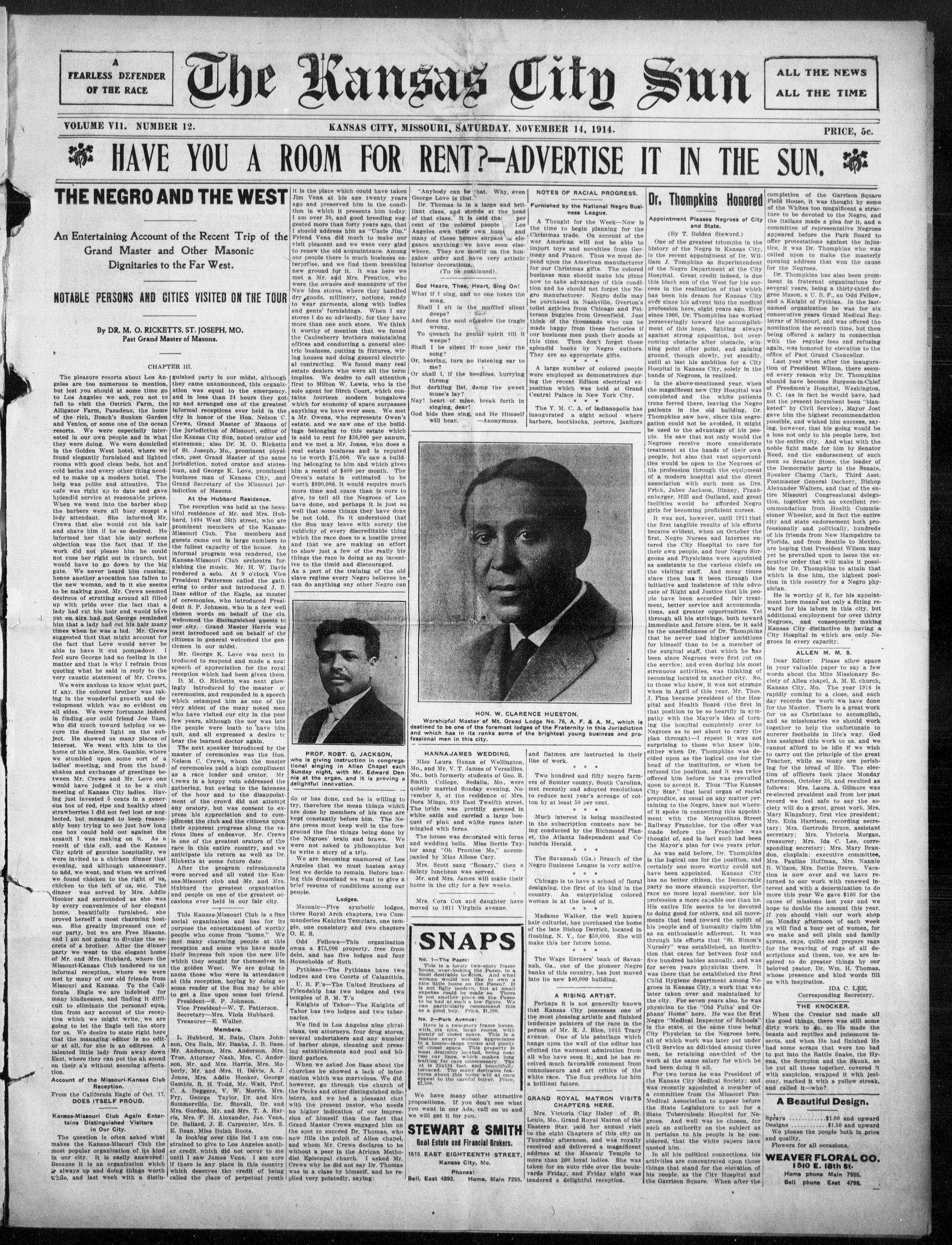
THE NEGRO AND THE WEST
An Entertaining Account of the Recent Trip of the Grand Master and Other Masonic Dignitaries to the Far West.
NOTABLE PERSONS AND CITIES VISITED ON THE TOUR
By DR. M. O. RICKETTS. ST. JOSEPH, MO.
Past Grand Master of Masons.
CHAPTER III.
The pleasure resorts about Los Angeles are too numerous to mention, but lest you should at some time go to Los Angeles we ask you not to fall to visit the Ostrich Farm, the Alligator Farm, Pasadena, the home of the rich, Busch's Sunken Garden and Venice, or some one of the ocean resorts. We were especially interested in our own people and in what they were doing. We were domiciled in the Golden West hotel, where we found elegantly furnished and lighted rooms with good clean beds, hot and cold baths and every other thing needed to make up a modern hotel. The help was polite and attentive. The cafe was right up to date and gave hplendlid service at reasonable prices. When we went into the barber shop the barbers were all busy except a lady attendant. She informed Mr. Crews that she would cut his hair and shave him if he so desired. He informed her that his only serious objection was the fact that if the work did not please him he could not cuss her right out in church, but would have to go down by the big gate. We never heard him cussing, hence another avocation has fallen to the new woman, and in it she seems to be making good. Mr. Crews seemed desirous of strutting around all filled up with pride over the fact that a lady had cut his hair and would have put on airs not George reminded him that a lady had cut his hair many times when he was a lad. Mr. Crews suggested that that might account for the fact that Love would never be able to have it cut pompadour. I feel sure George had no feeling in the matter and that is why I refrain from quoting what he said in reply to the very caustic statement of Mr. Crews.
We were anxious to know what part if any, the colored brother was taking in the wonderful growth and development which was so evident on all sides. We were fortunate indeed in finding our ould friend Joe Bass who did much toward helping us secure the desired light on the subject. He showed us many places of interest. We went with him to the home of his niece, Mrs. Gamble, where we stumbled upon some sort of a ladies' meeting, and from the hand shakes and exchange of greetings beween Mr. Crews and Mr. Love one would have judged it to be a club meeting of Kansas City ladies. Having just invested 5 cents in a generous box of red, ripe and healthy sized strawberries I did not feel lost or neglected, but managed to keep reasonably busy trying to see just how long one box could hold on against the one box I was making out on it. As a result of this call, and the Kansas City spirit of genuine hospitality, we were invited to a chicken dinner that evening, and although unnecessary, we went, and when we arrived we found chicken to the right of us, chicken to the left of us, etc. The dinner was served by Mrs. Addle Hooker and surrounded by she was by every convenience of her elegant home, beautifully furnished, she proved herself a most charming hostess. She greatly impressed one of our party, but we are Free Masons, and I am not going to divulge the secrets of a brother. After the dinner party we went to the elegant home of Mr. and Mrs. Hubbard, where the Missouri-Kansas Club tendered us an informal reception, where we were met by many of our old friends from Missouri and Kansas. To the California Eagle we are indebted for many kindnesses, and finding it difficult to eliminate the personal equation from any account of the reception which we might write, we are going to let the Eagle tell the story for us. We desire to state right here that the managing editor is no editor at all, for she is an editress. A talented little lady from away down East, where they can put the ah sound on their a's without seeming affectation.
Account of the Missouri-Kansas Club Reception.
From the California Eagle of Oct. 17, DOES ITSELF PROUD.
Kansas-Missouri Club Again Entains Distinguished Visitors in Our City.
The question is often asked what makes the Kansas-Missouri Club the most popular organization of its kind in our city. It is easily answered: Because it is an organization which always up and doing things worth while, and last week with a distin-
Jones, Gamble, C. A. B. Fry, G. Summer, Mrs. Gorris, Mrs. Dr. Ball, E. Bean.
In look strained er credit until I see if there which called th
The Kansas City Sun
guished party in our midst, although they came unannounced, this organization was equal to the emergency, and in less than 24 hours they got up and arranged one of the greatest informal receptions ever held in the city in honor of the Hon. Nelson C. Crews, Grand Master of Masons of the jurisdiction of Missouri, editor of the Kansas City Sun, noted orator and statesman; also Dr. M. O. Ricketts of St. Joseph, Mo., prominent physician, past Grand Master of the same jurisdiction, noted orator and statesman, and George K. Love, prominent business man of Kansas City, and Grand Secretary of the Missouri jurisdiction of Masons.
At the Hubbard Residence.
the reception was held at the beautiful residence of Mr. and Mrs. Hubbard, 1494 West 36th street, who are prominent members of the Kansas-Missouri Club. The members and guests came out in large numbers to the fullest capacity of the house. An informal program was rendered, the Kansas-Missouri Club orchestra furnishing the music. Mr. H. W. Davis rendered a solo. At 9 o'clock Vice President Patterson called the gathering to order and introduced J. B. Bass editor of the Eagle, as master of ceremonies, who introduced President S. P. Johnson, who in a few well chosen words on behalf of the clu welcomed the distinguished guests to our city, Grand Master Harris was next introduced and on behalf of the citizens in general welcomed the gentlemen in our mildst.
Mr. George K. Love was next introduced to respond and made a neat speech of appreciation for the royal reception which had been given them. D. M. O. Rickettts was next glowingly introduced by the master of ceremonies, and responded in a speech which stamped him as one of the very ablest of the many noted men who have visited our city in the past few years, although the nor was late the people were loath to have him quit, and all expressed a desire to hear the learned doctor again.
The next speaker introduced by the master of ceremonies was the Hon. Nelson C. Crews, whom the master of ceremonies paid a high compliment as a race leader and orator. Mr. Crews in a happy vein addressed the gathering, but owing to the lateness of the hour and to the disappointment of the crowd did not attempt any oratory, but was content to express his appreciation and to compliment the club and the citizens upon their apparent progress along the various lines of endeavor. Mr. Crews is one of the greatest orators of the race in this entire country, and we anticipate his return as well as Dr. Ricketts at some future date.
After the program refreshments were served and all voted the Kansas-Missouri club and Mr. and Mrs. Hubbard the greatest organization and people on one of the greatest occasions ever held in our fair city.
This Kansas-Missouri Club is a fine social organization and has for its purpose the entertainment of worthy people who come from "home." We met many charming people at this reception and some who have made their impress felt upon the new life which they sought for themselves in the golden West. We are going to name those who were in attendance at this reception, hoying by doing some reader of the Sun may be able to get a line upon some lost friend.
President S. P. Johnson
Vice President—W. T. Patterson.
Secretary—Mrs. Viola Hubbard.
Treasurer—F. Waller.
Members.
L. Hubbard, M. Bain, Clara Johnson, Ora Bain, Mr. Banks, J. B. Bass, Mr. Anderson, Mrs. Anderson, Mrs. True, Attorney Nash, Mrs. C. Anderson, son, Mr. and Mrs. Harris, Mrs. Moberly, Mr. and Mrs. H. Davis, A. J. Jones, Mrs. Addie Hooker, George Gamble, R. H. Todd, Mr. Wait, Prof. C. A. Beggers, V. W. Morris, Mrs. Fry, George Taylor, Dr. and Mrs. Summerville, Dr. Stovall, Dr. and Mrs. Gordon, Mr. and Mrs. T. A. Harls, Mrs. F. H. Alexander, Jas. Vena, Dr. Ballard, J. E. Carpenter, Mrs. S. E. Bean, Miss Bulla Roots.
In looking over this list I am constrained to give to Los Angeles another credit which did not occur to me until I saw James Vena. I am sure if there is any place in this country which deserves the credit of being called the place of perpetual youth
KANSAS CITY, MISSOURI, SATURDAY. NOVEMBER 14, 1914.
it is the place which could have taken Jim Vena at his age twenty years ago and preserved him in the condition in which it presents him today. I am over 30, and good breeding suggested more than forty years ago, that I should address him as "Uncle Jim." Friend Vena did much to make our visit pleasant and we were very glad to renew the old acquaintance. Among our people there is much business enterprise, and we find them breaking new ground for it. It was here we met a Mr. agd Mrs. Prentice, who were the owners and managers of the New idea stores, where they handled dry goods, millinery, notions, ready to wear garments, along with ladies and gents' furnishings. When I say stores I do so advisely, for they have more than one store. We think it worthy of mention that we found the Caulesberry brothers maintaining offices and conducting in electrical business, putting in fixtures, wiring houses and doing general electrical contracting. We found many real dealers who were all the term implies. We desire to call attention first to Milton W. Lewis, who is the sole agent for Birch Court, which bungalows which for economy of space surpasses anything we have ever seen. We met a Mr. Owens, who represents Owen's estate, and we saw one of the buildings belonging to this estate which is said to rent for $36,000 per annum, and we met a Mr. Jones, who does a real estate business and is reputed to be worth $75,000. We saw a building belonging to him and which gives him a rental of $400 per month. The Owen's estate is estimated to be worth $800,000. It would require much more time and space than is ours to give, to tell all the Negroes of Los have done, and perhaps it is just as well that some things they have done be not told. Be it understood that the Sun may leave with surety the publicity of every discreditable thing which the race does to a hostile press and that we are making an effort to show just a few of the really big things the race is doing as an incentive to the timid and discouraged. As a part of the training of the old slave regime every Negro believes he can do anything any other Negro can
PROF. ROBT. G. JACKSON, who is giving instruction in congregational singing in Allen Chapel each Sunday night, with Mr. Edward Dennis at the organ, and it is proving a delightful innovation.
do or has done, and he is willing to try, therefore the mean things which are done by members of his race are kept constantly before him. The Negro press must keep well in the foreground the fine things being done by the Negroes' brain and brawn. We were not asked to philosophize but to write a story of a trip.
We are becoming enamored of Los Angeles that we must hasten away lest we decide to remain. Before leaving this dreamland we want to give a brief resume of conditions among our people.
Lodges.
Masonic—Five symbolic lodges, three Royal Arch chapters, two Commanderies Knights Templars, one temple, one consistory and two chapters O. E. S.
Odd Fellows—This organization owns a $75,000 property, free from debt, and has five lodges and four Households of Ruth.
Pythlians—The Pythlians have two lodges and two Courts of Calanthia. U. B. F.'s—The United Brothers of Friendship has two lodges and two temples of S. M. T.'s
Knights of Tabor—The Knights of Tabor has two lodges and two tabernacles.
We find in Los Angeles nine physicians, ten attorneys, four drug stores, several undertakers and any number of barber shops, cleaning and pressing establishments and pool and billiard parlors.
When we asked Joe Bass about the churches he showed a lack of information which was marvelous. We did however, go through the church of the Pecks and other distinguished ministers, and we had a pleasant chat with the present pastor, who needs no higher indication of our impression of himself than the fact that Grand Master Crews engaged him on the spot to succeed Dr. Thomas, who now fills the pulpit of Allen chapel, and whom Mr. Crews declares to be without a peer in the African Methodist Episcopal church. I asked Mr. Crews why he did not say Dr. Thomas was in a class by himself, and he replied very pointedly, saying:
"Anybody can be that. Why, even George Love is that."
Dr. Thomas is in a large and brilliant class, and stands at the head of that class. It is said that per cent of the colored people Los Angeles own their own home and many of these homes surpass in elegance anything we have seen elsewhere. They are mostly on the bungalow order and have very artistic interior decorations.
(To be continued).
God Hears, Thee, Heart, Sing On!
What if I sing, and no one hears the song.
Shall I sit in the muffled silent deeps?
And does the soul of voice the tragic wrong.
To quench its genial spirit till it weeps?
Shall I be silent if none hear the song?
Or, hearing, turn no listening ear to me?
Or shall I, if the heedless, hurrying throng
But darkling list, damp the sweet muse's lay?
Nay! heart of mine, break forth in singing, dear!
God bids thee sing, and He Himself will hear. —Anonymous.
THE NEW YORK TIMES
M.
HON. W. CLARENCE HUESTON.
Worshipful Master of Mt. Oread Lodge No. 76, A. F. & A. M., which is destined to be one of the foremost lodges of the Fraternity in this Jurisdiction and which has in its ranks some of the brightest young business and professional men in this city.
HANNA-JAMES WEDDING
Miss Laura Hanna of Wellington, Mo., and Mr. V. T. James of Versailles, Mo., both formerly students of Geo. R. Smith College, Sedalia, Mo., were quietly married Sunday evening, November 8, at the residence of Mrs. Dora Mingo, 919 East Twelfth street. The bride was prettily gowned in white satin and carried a large bouquet of pink and white roses intermingled with ferns.
The house was decorated with ferns and wedding bells. Miss Bertie Taylor sang "Oh Promise Me," accompanied by Miss Allene Cary.
Mrs. Scott sang "Rosary," then a dainty luncheon was served.
Mr. and Mrs. James will make their home in the city for a few weeks.
Mrs. Cora Cox and daughter have moved to 1011 Virginia avenue.
SNAPS
No. 1—The Paseo:
This is a lovely two-story frame house approximately the Paseo in most desirable location, and what woman would not like to own a nice little home on the Paseo? It is not fully modern, but an annual expense could be made so. There is not another place on the Paseo to be had at such a low figure. We can particularly recommend this as a good buy. Price, $1,200.
Here is a two-story frame house, with six nice, large rooms, with plenty of closet space. This is a beautiful home with high apartment in a home - large rooms and plenty of closet space. This property is most desirable located, being near to our lines, which makes long waiting for cars unnecessary. The ot is 25x134 feet, and beautiful, terraced. The many desirable features about the home make a once appeal to the careful buyer. Price, $2,500.
We have many other attractive propositions. If you don't see what you want in our Ads, call on us and we will get it for you.
STEWART & SMITH
Real Estate and Financial Brokers.
1515 EAST EIGHTEENTH STREET,
Kansas City, Mo.
Phones:
Bell, East 4893. Home, Main 7255.
No. 1—The Paseo:
No. 2—Park Avenue:
NOTES OF RACIAL PROGRESS.
Furnished by the National Negro Busi ness League.
A Thought for the Week—Now is the time to begin planning for the Christmas trade. On account of the war American will not be able to import toys and novelties from Germany and France. Thus we must depend upon the American manufacturer for our Christmas gifts. The colored business man should make his plans now to take advantage of this condition and he should not forget the Negro manufacturer. Negro dolls may be purchased in Nashville, Overton's toilet articles from Chicago and Patterson buggies from Greenfield. Just think of the thousands who can be made happy from these factories if our business men push their goods at this time. Then don't forget those splendid books by Negro authors. They are so appropriate gifts.
A large number of colored people were employed as demonstrators during the recent Edison electrical exhibition which was held at Grand Central Palace in New York City.
The Y. M. C. A. of Indianapolis has inaugurated a night school where barbers, bootblacks, porters, lancers
```markdown
```
and flatmen are instructed in their line of work.
* * *
Two hundred and fifty negro farmers of Sumter county, South Carolina, met recently and adopted resolutions to reduce next year's acreage of cotton by at least 50 per cent.
* * *
Much interest is being manifested in the subscription contests now being conducted by the Richmond Planet, the Atlanta Independent and Columbia Herald.
* * *
The Savannah (Ga.) Branch of the Negro Business League is very active.
* * *
Chicago is to have a school of floral designing, the first of its kind in the country. An enterprising colored woman is at the head of it.
* * *
Madame Walker, the well known hair culturist, has purchased the home of the late Bishop Derrick, located in flushing, N. Y., for $50,000. She will make this her future home.
* * *
The Wage Earners' bank of Savannah, Ga., one of the pioneer Negro banks of this country, has just moved into its new $40,000 building.
A RISING ARTIST
Perhaps it is not generally known that Kansas City possesses one of the most pleasing artistic and finished landscape painters of the race in the person of Mr. R. J. Rice, 1015 Tracy avenue. One of his paintings which hangs upon the wall of the editor has elicited the warmest admiration from all who have seen it; and he has received much favorable comment from connolseurs and art critics of the white race. The Sun predicts for him a brilliant future.
GRAND ROYAL MATRON VISITS CHAPTERS HERE.
Mrs. Victoria Clay Haley of St. Louis, Mo., Grand Royal Matron of the Eastern Star, paid her annual visit to the eight Chapters of this city on Thursday afternoon, and was royally received and delivered a magnificent address at the Masonic Temple to more than 200 loyal ladies. She was taken for an auto ride over the boulevards Friday, and Friday night was tendered a delightful reception.
```markdown
```
Dr. Thompkins Honored
Appointment Pleases Negroes of City and State.
(By T. Bolden Steward.)
(By T. Bolden Steward.)
One of the greatest triumphs in the history of the Negro in Kansas City is the recent appointment of Dr. William J. Tompkins as Superintendent of the Negro Department at the City Hospital. Great credit indeed, is due this black son of the West for his success in the realization of that which has been his dream for Kansas City ever since his advent into the medical profession here, eight years ago. Ever since 1906, Dr. Tompkins has worked perseveringly toward the accomplishment of this hope, fighting always against strong opposition, but over coming obstacle after obstacle, winning point after point, and gaining ground, though slowly, yet steadily, until at last his ambition for a City Hospital in Kansas City, solely in the hands of Negroes, is realized.
In the above-mentioned year, when the magnificent new City Hospital was completed and the white patients trans ferred there, leaving the Negro patients in the old building, Dr. Thompkins saw how, since this segregation could not be avoided, it might be used to the advantage of his people. He saw that not only would the Negroes receive more considerate treatment at the hands of their own people, but also that vast opportunities would be open to the Negroes of his profession through the equipment of a modern hospital and the direct association with such men as Drs. Frick, Jabez Jackson, Blinney, Frank enberger, Hill and Outland, and great facilities would be afforded Negro girls for becoming proficient nurses.
It was not, however, until 1911 that the first tangible results of his efforts became evident, when on October the first, Negro Nurses and Internes entered the City Hospital to care for their own people, and four Negro Surgeons and Physicians were appointed as assistants to the various chiefs on the visiting staff. And many times since then has it been through the initiative and insistence of this advocate of Right and Justice that his people have been accorded fair treatment, better service and accommodations, and greater opportunities. Yet through all his strivings, both toward immediate and future aims, be it sold to the unselfishness of Dr. Thompson that he never had higher ambitions for himself than to be a member of the surgical staff, that which he has been Negroes were first put on the service; and even during his most strenuous activities, was thinking of becoming located in another city. So, to those who knew, it was not strange when in April of this year, Mr. Thos. J. Finn became president of the Hospital and Health Board (the first in that position to be so heartily in sympathy with the Mayor's idea of turning the hospital completely over to Negroes as to set about to carry the plan through)—I repeat it was not surprising to those who knew him, either when Dr. Thompson was decided upon as the logical one for the head of the institution, or when he refused the position, and it was twice offered him before he was prevailed upon to accept it. Thus "The Kansas City Star," that local organ of racial prepudice, as usual on any matter pertaining to the Negro, knew not where it spoke in connecting this appointment with the Metropolitan Street Railway Franchise, for the offer was made before the Franchise was thought of, and in fact such had been the Mayor's plan for two years prior.
As was said before, Dr. Thompkins is the logical one for the position, and certainly one more worthy could not have been appointed. Kansas City has no better citizen, the Democratic party no more staunch supporter, the race no more loyal member, nor his profession a more capable one than he. His entire life seems to be devoted to doing good for others, and all movements that tend toward the uplift of his people and of humanity claim him as an enthusiastic adherent. It was through his efforts that "St. Simon's Nursery" was established, an institution that cares for between four and five hundred babies annually, and was for seven years physician there. It was there that he established the first Child Hygiene department among Negroes in Kansas City, a work that was later taken over and maintained by the city. For seven years also, he was physician to the "Old Folks" and Orphans' Home" here. He was the first Negro "Medical Inspector of Schools" in the state, at the same time being City Physician to the Negroes here, all of which work was later put under Civil Service an indulged among three men, he retaining one-third of the work at the same salary for which he had been doing it all.
For two terms he was President of the Kansas City Medical Society; and was recently appointed a member of a committee from the Missouri Pan-Medical Association to appear before the State Legislature to ask for a State Tuberculosis Hospital for Negroes. And well was he chosen, for such an authority on the subject as it pertains to his people is he considered, that the white papers have quoted him. In all his political connections, his activities are concentrated upon those things that stand for the elevation of his people, as the City Hospital and the Garrison Square. When after the
ALL THE NEWS
ALL THE TIME
PRICE. 5c.
completion of the Garrison Square Field House, it was thought by some of the Whites too magnificent a structure to be devoted to the Negro, and the italians made a plea for it, and a committee of representative Negroes appeared before the Park Board to offer protestations against the injustice, it was Dr. Thompkins who was called upon to make the masterly opening address that won the cause for the Negroes. Dr. Thompkins has also been prominent in fraternal organizations for several years, being a thirty-third degree Mason, a U. B. F., an Odd Fellow, and a Knight of Pythias. In the last named organization he was for six consecutive years Grand Medical Registrar of Missourl, and was offered the nomination the seventh time, but then being offered a salary in connection with the regular fees and refusing again, was honored by elevation to the office of Past Grand Chancellor.
Last year when after the inauguration of President Wilson, there seemed every reason why Dr. Thompkins should have become Surgeon-in-Chief of Freedmen's Hospital, Washington, D. C. (as in fact he would have, had not the present incumbent be "blanketed" by Civil Service), Mayor Jost gave him the highest recommendation possible, and wished him success, saying, however, that his going would be a loss not only to his people here, but to the entire city. And what with the noble fight made for him by Senator Reed, and the endorsement of such men as Senator Stone, the leader of the Democratic party in the Senate, Speaker Champ Clark, Third Assist Postmaster General Dockery, Bishop Alexander Walters, and that of the entire Missouri Congressional delegation, together with an excellent recommendation from Health Commissioner Wheeler, and in fact the entire city and state endorsement both professionally and politically, hundreds of his friends from New Hampshire to Florida, and from Seattle to Mexico, are hoping that President Wilson may yet be prevailed upon to issue the executive order that will make it possible for Dr. Thompkins to attain that which is due to the highest position in this country for a Negro physician.
He is worthy of it, for his appointment here means not only a fitting reward for his labors in this city, but additional employment for over thirty Negroes, and consequently making Kansas City distinctive in having a City Hospital in which are only Negroes in every capacity.
ALLEN M. M. S.
Dear Editor: Please allow space in your valuable paper to say a few words about the Mite Missionary Society of Allen chapel, A. M. E. church, Kansas City, Mo. The year 1914 is rapidly coming to a close, and each day records the work we have done for the Master. There is a great work for us as Christians to accomplish, and as missionaries we should work together to help the unfortunate to surerer footholds in life's way. God has assigned this work to us, and we cannot afford to be idle if we wish to carry out the principle of the great Teacher, while so many are perishing for the bread of Life. The election of officers took place Monday afternoon, October 26, and resulted as follows: Mrs. Laura A. Gilmore was re-elected president and from her past record we feel safe to say the society will do a great, great work. Mrs. Mary Kings堡, first vice president; Mrs. Eula Harrison, recording secretary; Mrs. Gertrude Bruce, assistant secretary; Mrs. Victoria Morgan, treasurer; Mrs. Ida C. Lee, corresponding secretary; Mrs. Mary Brandon, chaplain; executive committee, Mrs. Pauline Hoffman, Mrs. Nannle B. Wilson, Mrs. Bettle Brown. Vacation is now over and we have returned to our work with renewed interest and with a determination to do more this year We gave $100 for the cause of missions last year and we hope to double the amount this year. If you should visit our work shop on Monday afternoon of each week you will find a busy set of women, for we make and sell plain and family aprons, caps, quilts and prepare rags for the weaving of rugs of all descriptions and theen, too, we are inspired to greater things by our beloved pastor, Dr. Wm. H. Thomas, whose presence and kind words fill us with inspiration.
THE KNOCKER
When the Creator nad made all the good things, there was still some dirty work to do, so He made the beasts and reptiles and poisonous insects, and when He had finished He had some scraps that were too bad to put into the Rattle Snake, the Hyena, the Scroplon and the Skunk, he put all these together, covered it with suspicion, wrapped it with jealousy, marked it with a yellow streak, and called it—who?
A Beautiful Design.
Sprays .....$1.00 and upward
Designs .....$1.50 and upward
We please the people both in price
and quality.
Flowers for all occasions.
WEAVER FLORAL CO.
1510 E. 18th St.
Home phone Main 7555.
Bell phone East 4798.
No better comb on the market for purposes as we have been advised that other combs are toys, when it comes to benefits and effectual influences when used as to directions, for which every comb placed goes with it instructions, how to use and for what purposes. Wherever introduced the Eureka preferable. Merchants and agents are successful when they are placed conveniently in quantities for the public.
They are usually sold for $1.50 (one dollar and fifty cents) each complete. The only thing is to be careful in the purchase as there is no other comb that will answer the purposes so well as the Eureka. We wholesale the Eureka Comb, being the manufacturers and promoters, and are the only wholesalers of this special device; if there are othes we would be pleased to be informed.
The devises are patented and registered. For prices and further information write
"House of Love"
Badges, Banners,
Books, Robes, Emblems,
Buttons, Furniture,
Uniforms
FOR ALL
Lodge and Church Societies
The Love Regalia Company
2418 Flora Avenue Kansas City, Missouri
Bell Phone, East 944
LAMP
CAP
Address
Thousands of men and women have improved the appearance of their hair by using NELSON'S HAIR DRESSING.
Hair Nel-
er and Skin
For those who know it is a toilet necessity.
Why not try it yourself?
Ask your druggist. If he cannot supply you, send us his name and address and we will send you a free sample.
NELSON MFG. CO.
RICHMOND, VA.
THE
NELSON
GIRL
the following subject, since there are humbly throughout the United States and as to our recommend, straightening the assistance in causing a rapid growth of which is pleasing, that the EurekA REG. PAT D AUG. 8.1911
been advised that other combs are toyed to directions, for which every combses. Wherever introduced the EurekA be placed conveniently in quantities for each complete. The only thing is to answer the purposes so well as theurers and promoters, and are the only be pleased to be informed.
Further information write
Particular attention may be given to the following subject, since there are hundreds of thousands using the Eureka Comb throughout the United States and Isles. They give the best of satisfaction as to our recommend, straightening the hair beautifully with one stroke, and as assistance in causing a rapid growth. Evidences coming to us from every source, of which is pleasing, that the Eureka especially is a trusted
EUREKA COMB COMPANY,
Chattanooga, Tenn.
An Open Letter to The Negro Business League
If there is anything in a name, then the National Negro Business League means a great national body of Negro business men leagued together, mind you, to promote the general order of business among Negroes. This is doubly true in local organizations, as the national affairs are fraught with the convention spirit, it is to our local league that we must look for an effective work toward uplifting business standards and the promotion of trade among ourselves. To do this we will find it necessary to follow the well established rules of commerce which has always for its basis honesty, full value for the money and fair dealing. Other peculiarities should be dalt with strong and unusual methods of race loyalty and common sense.
The business outlook for the negro is great. To the wide wake the light of truth sheds its rays over the horizon of the business world and opens to him possibilities never discovered before, but across this favorable sky emblazoned in bold and stern reading is this one command—work.
Unless you invest your money in a business of some kind and work and feel the hopes and setbacks, follow the daiyy routine with added vigor, improve and wrestle with the thousand phases that bob up for consideration, you can not lay claim to real membership in the local league if that league means business. Then the Negro Business League is for business people, and business people should only be admitted to the ranks in order that nothing but business might be transacted or promoted. If you wanted to organize a carpenters union you would not go to bricklayers, iron workers or common laborers to secure members, would you? No. But you would naturally go to carpenters, the dear carpenters only.
Here we have quite a contrast from this. We have the business league going to churches, women's clubs and to every place but to the highways of business life to get timber for its use, so that today we have upon the books of the organization a list of names that really mean nothing and stand for nothing in the business community. What the Negroion of a roomful of vociferous per-Business League wants now is customers and patrons of the business the individual members and associations arguing points of order, berating each other about their knowledge of "parliamentary usages" and debating whether preachers shall be admitted with special honor, and that gratis.
"Resolve," said Booker T. Washington, rolling up his sleeves in imitation of the mysterious individual whose activity consists in making resolutions that reach no farther than the door of the meeting place. Let us get out of this habit of resolving and do a little active work in bringing about better conditions among our people and institute a sounder business policy among business people.
The Way.
There are some 33,000 Negroes in Greater Kansas City to be fed, clothed and housed. Abstractly, this means much, how to feed, clothe and house these people through Negro enterprises and with capital controlled by Negroes is the practical problem of our business men. We have had great orations in abundance telling us how far the Negro has come, but little or nothing about how to really solve the "eternal row" problems which are confronting the business person of the hour. We believe that the Business League started wrong, and therefore can not end right.
The thing to do is to halt and correct ourselves and put this organization which really has a latent power for great good upon a better working basis. To do this we are giving (what appears in our opinion) some practical suggestions to advance the cause of business.
zFirst—Cleaner and better appointed business places, neat and attractive, polite and prompt service, not a mere sign, hanging on the wall, but a real active and sincere effort to please and satisfy. Satisfaction they say makes regular customers.
Second — Honest advertisements with persistency, not the halting or sporic kind, but steady, practical advertising that brings business and keeps alive business consciousness of the people who would otherwise forget. Back up everything we say and pay for advertising as scrupulously as we do our gas bills.
Advertising is a science. If you do not know the game secure the services of an expert and pay him for his labor. Advertising is what keeps the wheel of industry "a going." "So the people may know" is a good slogan in advertising.
Fourth—We speak for cleaner and better places. Remember it does not cost as much to keep a place clean as it does dirty. Cleanliness is economy—dirt is wastefulness. Order invites business and trade. Disorder repulses both. Fifth—Let the league get out a "merit sign" for window display and general efficiency to be given only to members who meet requirements or standards set by the league.
Sixth—Appoint every member a delegate to actively patrol the streets and boost Negro business and direct customers to all progressive Negro enterprises. Gy a little work on our part and a little loyalty on the part of the public we could easily "freeze out" a certain element who are not of our race and who do not contribute anything to our churches, public institutions or to our real economic life. As the administration for cleaner streets in our business district. Stop the tendency to slum our best community. Put our small
Black Race Forms Ten Per Cent of the Population of the Country.
Washington, Oct. 14.—A bulletin on negroes in the United States will be issued at an early date by William J. Harris, director of the census, which will contain all the principal information obtained through the census regarding the number and distribution of the negroes, their rate of increase, their sex and age distribution, and their marital condition.
The bulletin will sho what the number of negroes in the United States (exclusive of the outlying possessions) in 1910 was 9,827,763, and they formed 10.7 per cent of the total population. In 1900 the number of negroes was 8,833,994, or 11.6 per cent of the total population of that date. The increase among the negroes during the decade was 993,769, or 11.2 per cent, as compared with an increase of 20.8 per cent among the native whites and 30.7 per cent among the foreign born whites. The growth of the negro population results from their own natural increase, while the growth of the white population is accelerated by the great influx of immigrants and the high birth rate in immigrant families.
Of the total number of negroes in 1910 about one-fifth were reported as mulatto; that is, as having some white blood. The proportion that mulattos formed of the total negro population increased from 12 per cent in 1870 to 15.2 per cent in 1890, and to 20.9 per cent in 1910.
Urban and Rural Distribution.
Nearly three-fourth of the negroes (7,138,534, or 72.6 per cent) were rural dwellers, while about one-fourth 2,689,229, or 27.4 per cent) lived in towns or cities of at least 2,500 0inhabitants.
Of a total of 2,953 counties in the United States there were only 110 in which there were no negroes, and there were fifty-three counties in 1910, as compared with fifty-five counties in 1900, in which seventy-two per cent of the population was negro. There were 263 counties in 1910 in which fifty per cent of the population was negro.
In 1910 there were 4,885,881 negro males in the United States, as compared with 4,941,882 negro females, the number of males to 100 females thus being 98.9, as compared with a ratio of 106 for the whites. The negroes were the only race in the United States in which there were more females than males. The negro males in the United States of voting age numbered 2, 485,873 in 1910, and the negro females of voting age numbered 2, 427,742.
Of the negroes 6 to 9 years of age 488,954, or 49.3 per cent, were reported as having attended school during the school year 1909-10; of those 10 to 14 years of age, 791,995, or 68.6 per cent, were so reported; and of those 15 to 20 years of age, 338,750, or 26.5 per cent. In each age group the percentage of school attendance was much lower for the negroes than for the whites.
Percentage Decreased.
Of the total number of negroes 10 years of age and over, 2,227,731, or 30.4 per cent, were reported as illiterate; among the whites the percentage of illiteracy was five, being three among native whites and 12.7 among the foreign born whites. The percentage of illiteracy among negroes decreased from 57.1 in 1890 to 44.5 in 1900, and to 30.4 in 1910.
The total number of farms operated by negroes in 1910 was 893,370; of this number, 218,972 were operated by their owners, 672,964 by tenants, and 1,434 by managers. The number of farms owned by negroes increased by 31,175, or 16.6 per cent, between 1900 and 1910, and the number of negro tenants increased by 115,790, or 20.8 per cent, during the decade. The total value of farm property operated by negroes in 1910 was $1,144,181,000, as compared with $499,941,000 in 1900, indicating that the value of agricultural property operated by negroes increased considerably more than two-fold during the decade. The statistics show that 1,806,727 negro males and 1,050,849 negro females were engaged in agriculture.
The death rate among negroes in 1910 in this area was 25.5 per 1,000, showing a decrease as compared with the rate in 1900, which was 29.4, and the death rates for 1910 show many decreases, especially in the southern municipalities. capitals together and do something practical. A big, well established grocery store on Eighteenth street, run and controlled by negroes, would contribute toward more race salvation than a hundred poverty ridden churches which sap the vitality of the people at least financially. Start a great movement to patronize our present enterprises and we will have better business concerns. Put enthusiasm in our business and let us be loyal to ourselves. There are 5,000 suggestions to be carried out, but let us start right.
It isn't every doctor who can turn a theory in practice.
TREAT YOUR SCALP, AND HAIR MUST GROW! GOOD NEWS FOR OUR WOMEN AT LAST
The Brice Afro-American Scalp Food and Always Young Cream is too well known for better recommendation here. We know as millions of others will testify that my Goods grow Hair even when all other preparations fail. I manufacture preparations according to what the scalp needs and will send you the Goods that will be necessary to cure YOUR scalp, for there are no two scalps alike.
Have you Eczema or Tetter? Have you Dandruff? Does your hair break off at times? Is it harsh and stubborn, and are you annoyed with Itching of your scalp? If so, write for Mme. W. H. Brice's Wonderful Afro-American Scalp Food and Hair Grower, which will positively cure all scalp trouble and start your hair growing at once. These remedies are manufactured only by W. H. Brice Mfg Co., 804 Tremont Street, Boston, Mass. Formerly of Indianapolis, Ind.
A six weeks trial treatment for Two Dollars, mailed to any address. Make all Money Orders payable to Mme. W. H. Brice. Send stamp for reply.
Agents wanted. Write for
Always Young Cream, 50
Brice's Snow Bloom Liquid
Brice's Herb Tea, 25c, p
Brice's Corn Cream, 25c
Brice's Pressing Comb,
Brice's Six Weeks Triple
hair, Two Dollars.
Remember the name
BRICE, 804 Tremont St.,
The Brice Mfg. Company
get the Brice Preparations are
Richard Arnold, 1114 N.
J. J. Howe Drug Store, T
Brice's Dandruff Cream, 50c per
Brice's Bone and Nerve Linament
Brice's Eczema Scalp Lotion, 50c
Brice's Gray Hall Restorer, 25c p
Brice's Dusting Powder for tired
Brice's Best Face Powder, in three
Brice's Afro-American Scalp Food
Brice's 6 Weeks' trial treatment
of the age, just send her as near as
and if the hair is dry and brittle and
sends this treatment—you will have
Are You a Nine
Knights or
IF NOT,
JOIN THE
BEC
They keep every promise.
They pay funeral and death
They protect YOU in life, You
They have 108,000 loyal members
They have 18,000 members in
They have 38,000 members on
They have the cheapest, yet
They are the best governed on
They have honest, thorough
Membership in Missouri over
WE NOW HAVE NINE
LODGES IN KANSAS CITY
CAUSE THEY T
Dispensations now on in
If you wish to become a
now being organized, phone
Bell phone East 2098.
J.
Grand 3891.
L. A.
117 West
If you wish to organize
progressive of negro societies
A. W.
Pythian Temple Bldg.,
Wanted. Write for Terms. Big Professionals. Young Cream, 50c. per. jar.
Now Bloom Liquid Face Powder, 50c. Herb Tea, 25c. per. box.
Corn Cream, 25c. per. box.
Pressing Comb, $1.00.
Six Weeks Trial Treatment for the Two Dollars.
Member the name and number, M. Tremont St., Boston, Mass.
M. Mfg. Company's Branch Offices, with preparations are listed below:
Arnold, 1114 N. Senate Ave., Indian Drug Store, Tremont & Cabot St., Jeff Cream, 50c per box.
And Nerve Linament, 50c per bottle.
A Scalp Lotion, 50c per box.
All Restorer, 25c per package.
Powder for tired feet, 15c per package.
Face Powder, in three colors, 25c per box.
American Scalp Food, 4 boxes for One Dollars' trial treatment Two Dollars, with the groomer and her as near as you can how the condition and brittle and breaks off; it will stand—you will have healthy scalp, long and brittle.
You a Member of the Rights of Pythias
IF NOT, WHY NOT?
IN THE K. OF BECAUSE
every promise.
General and death benefits promptly.
YOU in life, YOUR family after death.
108,000 loyal members.
8,000 members in the Uniform Rank.
8,000 members of the ladies' auxiliary.
The cheapest, yet BEST, endowment per best governed of any fraternal society.
Orient, thorough business men officials in Missouri over 7,500.
HAVE NINE LARGE AND ACCESS IN KANSAS CITY. THEY SUCCEED BECAUSE THEY TREAT YOU RIGHTS.
Nations now on in Kansas City and wish to become a charter member of the organized, phone or write
J. P. MAYNARD
One East 2098. 2330 Vine
—OR—
J. SILAS HARE
1891. 1611 Forest
L. A. KNOX, Grand Atton
117 West Sixth Street, Kansas
wish to organize a lodge in this great of negro societies, write for particular
A. W. LLOYD. G.
Brice's Six Weeks Trial Treatment for the scalp, to grow hair, Two Dollars.
Remember the name and number, MME. W. H. BRICE, 804 Tremont St., Boston, Mass.
The Brice Mfg. Company's Branch Offices, where you can get the Brice Preparations are listed below:
Richard Arnold, 1114 N. Senate Ave., Indianapolis, Ind.
J. J. Howe Drug Store, Tremont & Cabot St., Boston, Mass.
Brice's Dandruff Cream, 50c per box.
Brice's Bone and Nerve Linament, 50c per bottle.
Brice's Eczema Scalp Lotion, 50c per box.
Brice's Gray Hall Restorer, 25c per package.
Brice's Dusting Powder for tired feet, 15c per package.
Brice's Best Face Powder, in three colors, 25c per box.
Brice's Afro-American Scalp Food, 4 boxes for One Dollar, no less sold.
Brice's A Nov-Americana scalp food, "4 boxes for 'One Dollar,' and less good. It is a great discovery of the age, just send her as neat as you can how the condition is and if the hair is dry and brittle and breaks off; it will stay after Madame sends this treatment—you will have healthy scalp, long and beautiful hair.
Are You a Member of the Knights of Pythias? IF NOT, WHY NOT?
They keep every promise.
They pay funeral and death benefits promptly.
They protect YOU in life, YOUR family after death.
They have 108,000 loyal members.
They have 18,000 members in the Uniform Rank department
They have 38,000 members of the ladies' auxiliary.
They have the cheapest, yet BEST, endowment policy.
They are the best governed of any fraternal society.
They have honest, thorough business men officials.
Membership in Missouri over 7,500.
WE NOW HAVE NINE LARGE AND AGGRESSIVE
LODGES IN KANSAS CITY. THEY SUCCEED BE-
CAUSE THEY TREAT YOU RIGHT.
If you wish to become a charter member of the new lodge now being organized, phone or write
If you wish to organize a lodge in this greatest and most progressive of negro societies, write for particulars.
Headquarters for Home Made Pies
OFFICE PHONE BELL 3786 M.
We Boast of Serving the Best Meals in the T
The Baltimore C
JAMES W. HURSE, Proprietor
5rd Member of Board of Management V. B. F. @ S. M.
Imported and Domestic Cigars
ICE CREAM, SODAS and SUNDAY
808 Independence Ave.
KANSAS CITY, M
Of Serving the Best Meals in the T
the Baltimore C
JAMES W. HURSE, Propriet
Member of Board of Management U. B. F. @ S. M.
Imported and Domestic Cigars
CREAM, SODAS and SUNDAY
808 Independence Ave.
KANSAS CITY, M
The Baltimore Cafe
JAMES W. HURSE, Proprietor
3rd Member of Board of Management U. B. F. @ S. M. T. of M
Imported and Domestic Cigars
ICE CREAM, SODAS and SUNDAES.
808 Independence Ave.
KANSAS CITY, MISSOURI
W. E. H.
Mme. W. H. Brice Face and Scalp Specialist
Terms. Big Profits.
c. per. jar.
d Face Powder, 50c. per. bottle.
r. box.
per. box.
1.00.
Treatment for the scalp, to grow.
and number, MME. W. H.
Boston, Mass.
's Branch Offices, where you can
sted below:—
Senate Ave., Indianapolis, Ind.
Bemont & Cabot St., Boston, Mass.
x.
50c per bottle.
per box.
package.
at, 15c per package.
colors, 25c per box.
4 boxes for One Dollar, no less sol
two Dollars, with the greatest discover
you can how the condition of the scal
breaks off; it will stay after Madam
healthy scalp, long and beautiful hair.
Member of the
of Pythias?
WHY NOT?
K. OF P.'S
CAUSE
benefits promptly.
PR family after death.
pers.
the Uniform Rank department
the ladies' auxiliary.
BEST, endowment policy.
any fraternal society.
business men officials.
1500.
LARGE AND AGGRESSIVE
TY. THEY SUCCEED BE-
EAT YOU RIGHT.
Kansas City and St. Louis
arter member of the new lodge
write
P. MAYNARD.
2330 Vine Street.
R—
ILAS HARRIS.
1611 Forest Avenue.
KNOX, Grand Attorney.
Sixth Street, Kansas City, Mo.
lodge in this greatest and most
write for particulars.
LLOYD. G. C..
37 Pine St., St. Louis, Mo.
Best Meals in the Twin Cities
Amore Cafe
URSE, Proprietor
Element U. B. F. @ S. M. T. of M.
Domestic Cigars
DAS and SUNDAES.
Indence Ave.
INSAS CITY, MISSOURI
Attorney at Law
Notary Public
Admitted to Practice in all
State and Federal Courts.
601 Delaware St., Kansas City, Mo.
Dr. Howard M. Smith wishes to announce the removal of his office to 2409 Vine street, where he will be pleased to see his patrons and friends. Office hours until 10 a. m.; 2-4 and 7-8 p. m. Bell phone E3424.
Ladies' Tailoring
Dressmaking
AND
Drafting...
Fancy Gowns a Specialty
I am prepared to offer the public the best dressmaking, tailoring, drafting and fitting.
Graduate of one of the best white downtown colleges.
Will also teach Drafting.
Bell Phone East 3413 M
Mrs. Lillie Williams
2914 Woodland Avenue
KANSAS CITY, MISOURI
A League Enterprise!
On Eighteenth in the Fifteen Hundred Block
A News Bureau
Every Negro Periodical,
Negro Pictures, Negro
Books, Novelties
Stationery
A FIRST-CLASS
Shoe Shining Parlor
5c. Every Day in the Year
1521 Bast 18th Street.
CHAS. A. STARKS, Prop.
WILLA M. GLENN
Notary Public
and
Expert Typist.
Kansas City Sun Office
1803 East 18th Street
Kansas City, Mo.
Bell Phone East 999
Our Motto: "Nothing but The Best"
The Crosthwait Floral Company
Everything in Flowers
and Flower Designs
"WE DELIVER THE GOODS"
The People say we have
made some of the most
beautiful and original de-
signs in flowers ever seen
in Kansas City.
Our Specialty--
"Quick Delivery--Satisfactory Service"
Bell Phone East 273
Home Phone Main 9070
1801 E. 18th St., Kansas City, Mo.
CHEAP
JOHN'S
PLACE
New and Second Hand
Goods Bought, Sold and
Exchanged
Bell Phone East 3851 W
2122 Vine Street
WM. HOPKINS, Prop.
J.C.WAGNER
The Clean Market Man
Oysters, Fish and Game in
Season.
Fancy Groceries and all Table
Luxuries.
Courteous Treatment to All.
1819 Howard Ave.
Bell Phone 3396 East
Kansas City. Missouri
"A HOME PRODUCT"
"A DELICIOUS DRINK"
"A BEER OF PURITY"
Surpassed by None in the Market.
Geo. Muehlebach Brewing Co.
Bell Phone 777 Grand Kansas City, Mo. Home Phone 3277 Main
THIS Swiftly-Sweeping, Easy-Running DUNTLEY Sweeper cleans without raising dust, and at the same time picks up pins, lint, ravelings, etc., in ONE OPERATION. Its ease makes sweeping a simple task quickly finished. It reaches even the most difficult places, and eliminates the necessity of moving and lifting all heavy furniture.
The Great Labor Saver of the Home—Every home, large or small, can enjoy relief from Broom drudgery and protection from the danger of flying dust.
Duntley is the Pioneer of Pneumatic Sweepers—Has the combination of the Pneumatic Suction Nozzle and revolving Brush. Very easily operated and absolutely guaranteed. In buying a Vacuum Cleaner, why not give the "Duntley" a trial in your home at our expense?
C. 4394Y Office 2460 W Idrond Ave
dern Builders Co.
dern Builders Co. A.E. ESTES, President
General Contracting Repairing a Specialty
SATISFACTION GUARANTEED
Subscribe for The Sun
If the world is so full of color and colored things so much admired, why is a COLORED PERSON so much hated and despised? Why does a white something pretend to despise a colored something when all nature declares that that colored something is the rule of all creation? White is not supreme. Black can not be a basis of inferiority. When we behold color so dominant in everything earthy, then we begin to think that this is the rule of creation.
NEW YORK DENTAL CO
New Location 1017-19 Walnut St.
Over Jaccard's Jewelry store, 1 door north Emery, Bird, Thayer Co
HIGHLAND CEMETERY COMPANY STOCK
FOR SALE CHEAP
We have for sale a few shares of this stock very cheap, and recommend its purchase. If interested, phone or call
J. G. STREAN INVESTMENT COMPANY,
Bonds and Stocks.
521 LATHROP BUILDING.
Phones—Home, Main 1677; Bell, Main 1742.
Hello, Neighbor!
Do You Read The Sun?
Do you know you can get it for ONE YEAR for ONE DOLLAR AND FIFTY CENTS. Sent anywhere in the United States.
ORDER NOW! OUR PHONE IS BELL EAST 999.
Call us, write, or see our agents.
Write today for full particulars
Emery, Bird, Thayer D. G. Co.,
Kansas City, Mo.
Bell Phone E. 4394Y Office
THE Modern Bu
THE BANEFUL HYPOTHESIS.
The white man in seeking to enthrone himself on the high hills of heaven has used every argument from the sublime to the ridiculous. This last one he has so warmly espoused that though recognizing its utter falsity he has learned to actually believe it himself, and between the real truth and a decent doubt he finally grits his teeth and proclaims truth falsehood and falsehood truth. One of the fallacies that has become a dogma in his religion is color prejudice and the unrealistic dream of white supremacy. Scientists and naturalists in summing up causes and effects usually pretend to find a certain law or evidence of proportion in generalizing them, and the deduction thus gained they call a rule or principle. We have never believed much in these deductions because error and falsehood are generally the result of all. Nothing proves this better than the position the average white scholar takes regarding color. He usually sees himself as the prototype of the human species and the world's civilization. However, present conditions refute the first and history denies the last. The white race is not the original of the human family, the darker races having this preference according to all authentic history. It is generally known that civilization knew its incipiency in the Egyptian and Ethiopian governments of which the Greeks borrowed generously from their customs.
Our white brother dates his origin some centuries from this in what history calls the "Aryan type." In stating causes for this breach of color some attribute it to sociological complications and others simply to leprocal tendencies. According to this, then, white is neither natural or supreme. As a color white is not dominant in any line or species. First of all over 85 per cent of the races are of the darker type. This holds good in the animal kingdom, on earth and under the sea the darker colors predominate. The heavens are blue and dark as against the "fleecy white." The birds wear the fine plumage of the darker hues; the sun is golden, also the saffron moon; the earth, full of God's riches, is black. Gold, the most precious metal, is "yellow." Diamonds are appreciated for their blue fire. The world is teeming with color. This proves white the reverse type. White appears only as a reversal of the natural order of the color scheme. This may be brought about by atmospheric or climatic conditions, or chemical processes. The white light is artificial, the yellow light is natural. The white cotton ball comes from a black stem.
If the world is so full of color and colored things so much admired, why is a COLORED PERSON so much hated and despised? Why does a white something pretend to despise a colored something when all nature declares that that colored something is the rule of all creation? White is not supreme. Black can not be a basis of inferiority. When we behold color so dominant in everything earthy, then we begin to think that this is the rule of creation.
KELLEY'S BEST HIGH PATENT
ESTATE
All Kinds For Sale
s Citys and Topeka
MS TO SUIT
BRADLEY & CO.
Kaskell Ave., Kansas City, Kas.
PHONE WEST 644
Sth Bidg., Sixth and Minnesota Ave.
ka, Kas.: 410 Kansas Ave.
Metal Specialists
SAS CITY.
We have been doing high class guaranteed
orn. We have thousands of satisfied patients
in Business 80 Years
got in repair free of charge.
INATION FREE
guaranteed 20 years
GET THE BEST
here has undoubtedly had more experience
in the city, so you get the most expen
BRIDGE WORK
REAL E
Property of All Kind
In Both Kansas City
TERMS TO S
MISS RUTH BRAN
Main Office: 400 Haskell Ave.
BELL PHONE WI
Branch Office: Portsmouth Bldg., S
Branch Office, Topeka, Kas.
Expert Dental S
OF KANSAS O
Our work has stood the test. We have been Dental Work for the past 38 years. We have
Remember in Business
All work kept in repairs from
SAVE MONEY EXAMINATION PRE
All work guaranteed 25 yrs.
The doctor who extracts your teeth here has us in this line than any other dentist in the o
service. Painless Extracting, 25a.
REAL ESTATE Property of All Kinds For Sale In Both Kansas Citys and Topeka TERMS TO SUIT
Main Office: 400 Haskell Ave., Kansas City, Kas.
BELL PHONE WEST 644
Expert Dental Specialists
Our work has stood the test. We have been doing high class guaranteed Dental Work for the past 36 years. We have thousands of satisfied patients.
Remember in Business 20 Years
All work kept in repairs free of charge.
SAVE MONEY EXAMINATION FREE GET THE BEST
All work guaranteed 20 years
The doctor who extracts your teeth here undoubtedly had more experience in this line than any other dentist in the city, so you get the most expo service. Painless Extracting, 25a.
BRIDGE WORK
Spaces where from one to ten teeth have been lost we replace with bridge work. It looks the same as natural teeth, lasts a little time and requires no plaster. Broken down teeth we restore to beauty and usefulness with crowns of porcelain and gold.
Gold Crowne #3, $4 and $8
Silver Fillings, 75c. and
White Crowne
FULL SET TEETH
'NEW YORK DE
New Location 1017-19
Over Jaccard's Jewelry store, 1 door nor
HIGHLAND CEMETERY C
$8
, 75e. and $1
te Crowne $3, $4 and $8
Platina Fillings 200
TEETH $4 TO $8
K DENTAL CO
Gold Crowne $3, $4 and $8
Silver Fillinga, 75c. and $1
White Crowne $3, $4 and $8
Platina Fillinga 200
NEW YORK DENTAL CO
New Location 1017-19 Walnut St.
Over Jaccard's Jewelry store, 1 door north Emery, Bird, Thayer Co
HIGHLAND CEMETERY COMPANY STOCK
hbor!
```markdown
```
FOR SALE CHEAP
Kelley's Best Beat all the Rest. Kelley Milling Co. K.C., U.S.A.
A. F. and A. M.
Missouri Jurisdiction
Officers—1914-15.
N. C. Crews, Kansas City, Grand Master.
Deputy Grand Master, Richard Young, Lincoln, Neb.
F. J. Brown, St. Louis, Grand Senior Warden.
Wm. Green, Plattsburg, Grand Junior Warden.
H. H. Walker, St. Joseph, Grand Treasurer.
Geo. W. K. Love, Grand Secretary, Kansas City, Mo.
W. W. Fields, Secretary of Masonic Relief, Cameron, Mo.
P. L. Pratt, Kansas City, Mo., Grand Lecturer.
Grand Commandery Officers.
W. G. Mosely, Kansas City, Mo.
R. E. G. C.
J. H. Sherwood, St. Paul, Minn.
G. E. G.
P. C. Kincald, Kansas City, Mo.
V. E. G. C.
J. W. Beard, St. Louis, Mo., E. G.
C. G.
Wm. Roberts, Hannibal, Mo., Grand
Secretary.
T. P. Mahammitt, Grand Treasurer,
Omaha, Neb.
Grand Chapter Officers.
Geo. Broomfield, G. H. P., St. Louis,
Mo.
T. G. McCampbell, D. G. H. P., Kansas
City.
A. L. Thomas, G. K., Jefferson City,
Mo.
J. P. Mofitte, G. S., Sedalia, Mo.
Chas. Griggsby, G. Treas., Liberty,
Mo.
E. S. Baker, G. Sec'y, Kansas City,
Mo.
MASONIC BUILDING ASSOCIATION
MEMBERS.
R. T. Coles, Chairman.
E. S. Baker, Secretary.
R. W. Foster, Treasurer.
W. C. Mallory, Sandy Meyers,
Wm. Washington, F. P. Porteet.
T. W. H. Williams, W. G. Moseley,
J. E. Herriford, E. G. Lacey,
E. G. Miller, Robt. Wiley.
Lodge Directory
LODGE DIRECTORY.
Pritchard Lodge No. 42, A. F. and A. M., meets the 2nd and 4th Monday in each month. All Master Masons good standing welcome. F. Grie, W. M.; J. H. Sniginer, Sec'y.
Rone Lodge No. 25, A. F. and A. M., meets the 1st and 2nd Monday in each month. All Master Masons good standing welcome. W. Glenn, W. M.; T. J. McCampbell, Sec'y.
Mt. Olive Lodge No. 53, A. F. and A. M., meets the 4th Friday in every month. Visiting Master Masons are welcoming Thos. Jackson, W. M.; Frank Lodge, Secretary, 1518 Baltimore Ave.
U. D. F.
King of the West Lodge No. 218 meets first and third Mondays in each month at 683 Grand Avenue. D. M. West, 1718 W. Euc; Harris, Sec'y, 1732 Woodland Ave.
ADVERTISE YOUR SOCIETY.
We would like to see every lodge and society in Kansas City put their cards in The Sun. It is the most popular way to let the world know who you are, when and where you meet and your object and purpose. For the next month we will make special announcements to have you put in your lodge or society list of of officers in this paper.
Office Hours
8 to 12 m. & 1 to 5 p. m.
Sunday by Appointment
Bell Grand 2553W
DR. E. C. BUNCH
DENTIST
Gold Crown, Bridges and
Plates A Specialty
Painless Extraction
716 East 12th St. Kansas City, Mo.
Mrs. C. A. Smith
has opened a branch office of
MRS. S. BEDFORD'S
Wonderful Hair Grower & Scalp Treatment
This treatment has proved to be a wonderful success. Mrs. Smith will receive patients for treatment from
From 8.30 a. m. to 6.00 p. m. at her residence. 11th and Highland
is perfectly safe and
Guaranteed to Give Satisfaction
Bell Phone, East 4975.
Best Shine in K.C. 5c For Ladies Gents
AGENCY FOR
The Kansas City Son.
The Crisis,
The New York Age,
The Freeman
and All Daily Papers
Ice Cream and Soda
Cigars and Tobacco
HENRY SHUMAKER
1702 East 18th St.
THE KANSAS CITY SUN PUBLISHED WEEKLY.
All communications should be addressed to The Kansas City Sun, 1803 East 18th
Bell Phone East 999.
Entered as second class matter, August
15, 1908, at the postoffice at Kansas City,
Mo., under the act of March 3, 1879.
Nelson C. Crews.....Editor and Owner
Willa B. Glenn.....General Manager
Geo E. Thompson.....Adv. Agent
J. G. Tytter.....Advertising Solicitor
P. E. Washington.....Traveling Representative
Rosa Morton Collector
SUBSCRIPTION RATES
# SUBSCRIPTION RATES:
One Year $1.50
Six Months $7.50
Three Months $5.00
It occasionally happens that papers sent
to subcribers are lost or stolen. In case
you have lost your paper, please inform
us by postal card and we will
cheerfully forward a duplicate of the
missing number. %
ADVERTISING RATE, 50 CENTS PER
INCH
CHURCH DIRECTORY.
Bethel A. M. E. Church, 24th and Flora
St. Stephen's Baptist Church, 604 Charlotte St.
Cornellian Church, 19th and Tracy.
Cornellian M. E. Church, 19th and Woodland.
Second Baptist Church, 10th and Charleston.
Alen Chapel A. M. E. Church, 10th and Charlotte.
Kansas Ave. Baptist Church, 46th and Kansas.
Ebenezer A. M. E. Church, 17th and Tracy.
St. Augustine's P. E. Church, 11th and Troost.
Vine St. Baptist Church, 1835 Vine St.
Chapel A. M. E. Church, 11th and Woodland.
Blue Valley Baptist Church, 1120 Crystal Avenue.
St. John's A. M. E. Church, 1743 Belleview.
Seventh Day Adventist, 23rd and Woodland.
St. Monica's Catholic, 17th and Lydia.
Morning Star Baptist Church, 2311 Vine.
Highland Avenue Baptist Church, 1111 Highland.
Centropolis A. M. E. Church, Centropolis.
St. James A. M. E. Z. Church, 1823 Woodland Ave.
Third Baptist Church, Roundtop,
People's Mission, 30th and Genesee.
St. David's Baptist Church, 19th and
Highland.
Pilgrim Baptist Church, 614 Charlotte
St.
Pleasant Green Baptist Church,
Independence Avenue and Tracy.
Calvary Baptist Church, 19th and
Askew.
Yellow A. M. E. Mission, 5th and
Lydia.
Progressive Baptist Church, 29th and
Summit.
E. E. Church, 1817 Flora Ave.
St. James' Baptist Church, 4039 Mill St
St. Luke's A. M. E. Church, 43rd and
Prospect Place.
A. M. E. Mission, 565 Grand Ave.
KANSAS CITY, KAN. CHURCHES.
First A. M. E. Church, 8th and Neb.
Pleasant Green Baptist Church, 1st and
Bishop Eighth St. Baptist Church, 8th and
Oakland.
Saint Quentin Baptist Church, 9th and
Washington.
Bethel A. M. E. Church, Water and
Steward Streets.
Paul A. M. E. Church, 21st and
Ruby.
First Baptist Church, 5th and Neb.
King Solomon Baptist Church, 3rd and
Sta.
Quindaro A. M. E. Church, Quindaro,
Rasant Valley Baptist Church, Rosedale,
Kan.
M. E. Church, 9th and Oakland.
M. E. Church, 4th and Oakland.
Saint Mission, A. M. E. Church, South
Park, Kan.
Protestant Episcopal, 3rd and Stewart.
Saint Quentin Church, 4th and Ruby.
Wesley Chapel M. E. 106 Shawnee.
St. Paul A. M. E. Zion Church, 4000
Bethel A. M. E. Church, Roselale, Kan.
Mt. Zion Baptist Church, 4th and Viru-
tual.
Ebenezer A. M. E. Church, Sanford and
Tremont.
EDITORIALS.
Have you put in your coal for the winter?
Keep on smiling, everything will be all right after while.
Well, maybe there'll be new faces on Western University Board soon. Hey, Rube!
The editor is in receipt of an annual pass to the Alachua county exposition, to be held at Galennville, Fla., beginning November 17. This is one of the best fairs held in the Southland.
All the Segregationists and Negrophobists are unanimous in urging "Prof. Si" Harris as the next spokesman, instead of gallant Monroe Trotter, to place the Negroes' case before President Wilson, but the Negroes want "Si" to have foreign appointment, the "foreigner" the better.
The Star devotes itself to a lengthy sloppy editorial in praise of the Jews, who have never produced a new dollar in this country, but has no voice in behalf of the Negro citizen who has been one of the chief producers and whose blood has been shed many times in defense of the country's honor.
It shows a noticeable awakening spirit in Kansas City Negro teachers that so many decided to attend the State Teachers' Association which is meeting in St. Joseph this week. Our teachers are among the best favored and best paid instructors in the West, and should naturally make themselves felt in all the general educational work of the state.
The Plaindealer laments the defeat of Governor Hodges and regrets that so many people in Kansas still think they are voting for Lincoln. Well, the people in Dixie are still voting for Jeff Davis, and of the two we take Lincoln. The Negroes will find that in the end the party of Grant and Lincoln, which delivered them in the past, will take care of them in the future.
Two able Negro lawyers were honored by Kansas counties with election to the office of prosecuting attorney. One was a Democrat, the other a Progressive. Each was chosen by the votes of white men and women and from the standpoint of ability. Politics produces some good things as well as strange things, and we are waiting to hear what the g. o. p. has to say upon the subject.
Every once in a while some decadent Negro who has sucked the blood out of all his friends and who feels himself slipping into deserved oblivion will place himself into the
Caffeine
ilmelight by some sort of abusive tirade against his own people. He gets so hungry that he does not hesitate, through sedition and treason, to curry favor with the most rabid Negro-haters and can see no good in Negro manhood since he has none himself. Fortunately both white and colored people of ordinary intelligence understand such cattle and they receive but little notice except for their folly and spectacular ignorance. Selah!
Y. M. C. A. AS AN ECONOMIC FAC. TORL
Considering that the Y. M. C. A. building is about to throw open its doors to the public, it is high time we are asking ourselves what economic part the institution is to play in the lives of the ones for whom it was especially built, namely, the young Negro.
The institution should not appear so much to the young man with a good home as it should to the one who is living in doubtful circumstances who does not enjoy the best advantages that this good home offers with its Christian and restraining influences. It will be the work of those connected with the Y. M. C. A. to see that this institution reaches this particular individual, the success of which depends very largely on the economic advantages that we offer to him and back up with the truth, remembering that to fail to offer the prospective member better advantages for less money than he could get elsewhere will surely render the whole institution an ever present burden on the people in the way of maintenance. This positively should not happen. The opening of its doors should close the gruelling financial campaign under which the people have struggled painfully though quite valiantly. However, we believe that it will be so efficiently managed on such a good business basis that it will not prove a further burden but will be a self-supporting concern, meeting financial obligations effectively, and this, too, by giving to its members certain certain accommodations to them. For this reason certain privileges should be confined to members only. Under this regime the place will be a "good hotel" for its members who want to pay for comfortable accommodations. A "home" for those who can appreciate pleasant surroundings and Christian influences. And a "meeting place" for those who can not resist the enticing auxiliaries of the gymnasium. The last should never outweigh the first two. The concern should by no means be construed as a commercial proposition but by all means should pay the officials promptly, including especially the janitors and other help. If there is one office sacred in this world it is that of "cleaning up," and any person performing this solemn duty should be promptly paid. On a whole we can see no good reason why this institution will not help the colored people of Kansas City and solve many of the important problems in the lives of young men. If in the future it only realizes half of its possibilities in the great power of human uplift the sacrifices of the people will have been sweetly justified.
C. A. STARKS.
DR. THEO. SMIT
HEALTH IS WEALTH
Favorite Prescriptions Which Have Been Used as a Preventive As Well As a Cure.
HOW TO GET WELL
If you are troubled with any of the following diseases, rheumatism, kidney and liver troubles, female weakness, headache, neuralgia, piles, constipation, billousness, stomach troubles, in. The following prescriptions have given satisfaction to hundreds of people.
We recommend them and stand behind them with our guarantee to give satisfaction or money refunded: digestion, dyspepsia, etc., our favorite prescriptions are recommended and guaranteed to give satisfaction. These
A
—That all that glitters is not gold.
—That a great many Negroes want their names in print but never want to pay for the paper.
—That brother Nick Chiles is inconsolable since the defeat of Governor Hodges. Oh wirra, wirra.
—That a certain teacher wanted to attend the State Teachers' Association at St. Joseph, but her salary was mortgaged up to the minute and she couldn't raise the necessary two plnnks. Too bad.
—That if parents and teachers would desist from using the offensive term "nigger" in their daily conversations they would not be shocked by hearing the children using it so pro miscuscuously on the streets. Remember reformation must come from within.
---
—That at a recent wedding here when the contracting parties stood before the minister and he asked in clear but solemn tones, "Does anyone have any reason why this man should not take this woman in the bonds of wedlock," the assembled audience was startled to hear a weak but firm voice say—"Yes, I have," and a slender, man faced young woman made her way through the gaping crowd to the spot where the minister stood. Looking at her intently the minister said, "What reason have you that this man should not marry this woman; speak now or forever hold your peace." "This reason," said she, and raising the shawl with which her form was enveloped, she laid a six weeks' old lusty lunged chap in the intended bridegroom's arms and turned and made her way quickly out of the room. Consternation prevailed, the ceremony was stopped and the father of the bride and her two husky brothers asked the groom for an explanation, which he was unable to satisfactorily give, and after passing the baby to a lady standing near they proceeded for about twenty minutes to "wear him out," and when he finally made his escape unkempt and bedrag gled to the outer darkness, they could hear him as he made a mile a minute
Cafe
H'S FAMOUS UP-TO-DATE DRUG ST
prescriptions are only at SMITH'S
DRUG STORE. CUT THIS OUT AND
BRING IT TO OUR STORE.
No. 10.
For rheumatism, aches, pains and neuralgia; Potassium Iodide 4 dracams; Soap and Vigor Analgesic comp. V. S. 8 ounces; Sig: teapoufonil every three hours; price seventy-five cents. No. 4.
Cut this out and bring to ur store. Potassium Acetate 4 dracams; Vim and Vigor diuretic comp. V. S. 6 ounces; Sig: teapoufonil every three hours; price seventy-five cents.
No. 44.
For female complaints: Cut this out and bring Comp. 3 ounces; Vim and Vigor analgesic comp. V. S. 8 ounces; Sig: teapoufonil every three hours; price one dollar.
(A) For coughs, colds and liaspipe:
Ammonium Chloride 2 drachms; Elixir
herbon and tarsen hydrate 1 ounce;
Glyco heion 1 ounce; Creosote 1
drachm; Eixr. analgesic Comp. 1 X
4 ounces; Sig. X Quinine Sulphate 15
grains; Codine Sulphate 2 grains; Aspirin 15 grains.
(B) Caffine Citrate 10 grains; Analgesic
powders 20 grains; make twelve cap-
down the road crying "Have mercy." Well it served him right, don't you think so?
Y. M. C. A. NOTES
Men are now selecting their rooms in the new building. Some of these will enter their rooms on the 16th.
The "Week of Prayer" services have been attended this year as probably never before in the history of the Association movement. Pro. J. E. Patterson, of Western University, will address the Men's meeting next Sunday, November 15, at 3:30 p. m.
The week of November 22 to 29 will be the "Opening Week" of the Paseo Y. M. C. A. building. There will be a change of program each evening: Sunday, Nov. 22, 3:30 p. m.-Big Opening Meeting.
Monday, Nov. 23, 8:15 p. m.—"Sub
scribers' Night."
Tuesday, Nov. 24, 8:15 p. m.—"Citi
zens' Night."
Wednesday, Nov 25, 8:15 p. m.—
"Exhibition Night."
Thanksgiving afternoon or night—
"Praise Service."
Friday, Nov. 27, 8:15 p. m.—"Woman's or Open Night."
Saturday, Nov 28, 8:15 p. m.—"Members' or Fellowship Night."
Sunday, Nov 29, 3:30 p. m.—"Men's Big Meeting."
Next week the program in detail will be printed.
Y. W. C. A. NOTES.
Our World's Week of Prayer began at the Yates Branch of the Young Women's Christian Association at Fifth and State avenue on Sunday, with Miss Myrtle Jackson in charge, Miss M. Frances Cross, National Field Secretary, and Mrs. Wm. Shaw Ward, Chairman of the National Field Committee, both of Denver, Colo., were the special speakers. The audience was thoroughly appreciative. The singing was good. Both speakers emphasized the importance of the Y. W. C. A. work in foreign fields. Many of the auditors cheerfully decided to give at least a birthday gift of 52 cents yearly to Miss Radford in Singapore. Miss Ida Godfrey presided at the plano. Come in next Sunday at 3:00 p. m.
It is a beautiful sight to see our Gymnasium classes in action on Saturday of each week. Well that's one of the things for which the Y. W. C. A. stands. Its object is to develop the girl mentally, morally, physically and spiritually. It stands ready to help each girl to make the most of life and to enjoy a good time in a safe and sane way. It is a beautiful sight to look into the faces of twenty-six happy girls at one time. These girls showed up to a good advantage to our National visitors last Saturday. They were so pleased. At least one hundred of these growing girls should enjoy this opportunity. The Y. W. C. A. does obliterate all class distinction and as Jane Addams said, "would mix them as the Lord does." For further information call Bell phone West 1556
TYPEWRITING DONE at Kansas City Son office, 1808 East Eighteenth street. Neat, quick work. Rates reasonable. Engagements by appointment. Bell phone E999.
STORE, EIGHTEENTH STREET AND T
sus; sig; one every three hours.
Vim and Vigor Laxative Powder 1 ounce.
(C) Dissolve in a half glass of water and take all at once. This combination is recommended to cure the most severe case of laripe, coughs, colds, and etc. Price one dollar.
Drug Specials for This Week.
25-cent Black Draught 15 cents.
$1 Wine of Cardui 85 cents.
50-cent Caldwell Syrup of Pepsin 45 cents.
25-cent Ellisian Cream 20 cents.
$1.25 Fountain Syringes 71 cents.
25-cent Massatta Talcum Powder 19 cents.
Ice cream sodas served the year around.
Tango Sundae on a blazer, 15 cents.
Hot soda drinks, hot chocolalte, 5 cents.
Hot coffee, 5 cents; hotb eef tea, 5 cents.
HARRIS AN ASS.
Playing to the "Grand Stand" Says a Well Known Educator.
Just before the election of November 3 a circular was mailed all candidates to both branches of congress by the National Association for the Advancement of Colored People, a negro organization, asking where each candidate stood on the following: Abrogation of the Fourteenth and
Abrogation of the Fourteenth and Fifteenth amendments.
Segregation in the federal service.
Segregation in the District of Columbia.
Anti-Intermarriage laws.
Lynching.
Reduction of representation in the states that distrancise the negro.
J. Silas Harris, president of the Negro National Educational congress, has given the Post a statement concerning the questions and measures, in which he says:
"The cost of printing, mailing and distribution of such a circular must have been considerable—far more than the issues it sought to inject merited or the financial condition of its promoters warranted. There is really no necessity for such an organization, since it increases rather than diminishes the feeling between the two races.
Up to the Negro.
"The final acceptance or rejection of the fourteenth and fifteenth amendments is a matter that rests almost entirely with the negro himself. He can so live as to make their annulment impossible or their abrogation imperative.
"The question of segregation in the federal service and in the District of Columbia is of trivial importance, and the enactment of one or both into laws would in no wise hinder the progress of the race.
"Jim Crow cars in the District of Columbia are no worse than Jim Crow cars in Texas, the Washington negro being no better than his kinsman in the Lon Star state.
"The most contemptible of all of the questions propounded is that which pertains to the anti-intermarriage laws; only the negro who is endeavoring to get away from his race opposes the passage of such a law. The principal contenders against such legislation are to be found among the negro school teachers, many of whom are colored only to the extent of drawing salary for misinstructing the negro youth, and who are, in the main, responsible for the restless condition of the race.
"All lawabiding citizens are unreservedly opposed to lynching, but the causes which lead thereto must be eliminated before lynching will become a thing of the past.
"The reduction of representation in those states in which the negro is disfranchised needs no argument. If the negro will prove himself worthy of those rights that he now has, he will soon have but little cause to complain of a denial of those rights to which he feels himself entitled."—The Post.
NOTE—The Sun is ready to print the views of any citizen upon this remarkable letter.
Poro hair dressing, hair weaving and facial massaging. Scalp treatment a specialty. Mrs. E. Norles, 1737 Paseo, upstairs.
TRACY AVENUE.
Hot tomato bouillon, 5 cents; hot chicken bouillon, 5 cents; hot clam bouillon, 5 cents; hot egg chocolate, 10 cents; hot egg and grape juice, 10 cents. All ice cream sodas 5 cents. You have a standing invitation to visit our store. It is the finest and best equipped negro store in the West. It is well lighted and ventilated, sanitary in every respect. The surroundings are artistic which appeal to those of aesthetic taste. Our large shipments of goods, such as Madame Walker's Hair Grower, Glossine, straightening and drying combs, hair pressers, watches and clocks, talcum powders and toilet articles enables us to supply your wants at rock bottom prices. Phone us or write us today.
TREO. Smith's Drug Store
S. E. Corner 18th and Tracy
Home Phone 5467 M. Bell Phone 4591 G
Mail Orders Promptly Filled
Emphatically "YES" Confectionaries and Fruit 1519 E.12th St.
ACME
SHAMPOO GOWN
FOR CLEANSING THE HAIR AND
DIRECTIONS
Distributed by
ACME NOVELTY CO. L.
WILKES BARRE, PA.
COLD
CREAM
Here they are! The Big Four. An unsu-
dressing (full 3-oz. box), a two-ounce box of
full size box of face powder in (high brown,
box of shampoo powder that does the work a
pliable condition, all for 80c. Any three 65c.
postage prepaid. Agents wanted. Send money
for future use as this is an introductory offer
Ltd., Wilkes-Barre, Pa. P. O. Box 36.
Acme
NO POW
THE MAIN AD
THINE
MOREWAY TO
frog or city
NO BOW
Lubricated by
VELTY CO. L.
BARRE, PA.
ACME
Pomatum for the
DIRECTIONS
Apply at night, or may be
time in a dressing. Israel
wet, feathery and
Acme Novelty
Lubricated by
VELTY CO. L.
BARRE, PA.
VELVET
COMPLEXION
POWDER
Striely Pure and
sily Perfume
SERVED BY
ACME NOVELTY CO.
VELTY CO. L.
BARRE, PA.
L
D
AM
re! The Big Four. An unsurpassed scape-
oz. box), a two-ounce box of snow white
face powder in (high brown, flesh color,
powder that does the work and leaves
all for 80c. Any three 65c. Choice of
Agents wanted. Send money order to
this is an introductory offer. Address
re, Pa. P. O. Box 36.
ACME
SHAMPOO GOWNS
AND CLEANSING THE HAIR AND
DIRT TONES
This is a concentrated toner for
the hair. It is a concentrated toner
for the hair. It is a concentrated toner
for the hair. More way to
make it more effective.
Distributed by
ACME NOVELTY CO. LTD.
WILKES BARRE, PA.
ACME
Pomatum for the Hair
DIRECTIONS:
Apply at right or may be used to any
time as a cleanser. Hydrate the hair
with fresh and gentle.
Acme Novelty Co..
London.
WILKES BARRE, PA.
COLD
CREAM
VELVET
COMPLEXION
POWDER
Strictly Pure and Exquisitely Perfumed.
ACME NOVELTY CO. LTD.
WILKES BARRE, PA.
Here they are! The Big Four. An unsurpassed scalp food and hair dressing (full 3-oz. box), a two-ounce box of snow white beauty cream, a full size box of face powder in (high brown, flesh color, or white), and a box of shampoo powder that does the work and leaves the hair in a soft pliable condition, all for 80c. Any three 65c. Choice of any two, 50c, postage prepaid. Agents wanted. Send money order today, and get them for future use as this is an introductory offer. Address Acme Novelty Co. Ltd., Wilkes-Barre, Pa., P. O. Box 36.
THE HOME OF THE MAYFIELD MUSEUM
SPECIAL WAR-TIME BARGAINS.
913 Michigan—6-room, two story, water, electric gas in. Price, $1,800; $100 down and $15 per month.
1604 E. 10th St.—7 room modern, in excellent room has an outside entrance. Price, $3,00; ten rooms.
2412 Mersington—Four-room cottage; water and lot 40x130. Price, $1,200; $100 down, $12 per month.
403 Steptoe—Five-room cottage; water and gas 45x130. Price, $1,500; $100 down, $10 per month.
Eleventh and Euclid—Eight-room, strictly m brick, slate roof, south exposure. Price, $4,250; $50 to suit.
1315 Michigan—7-room modern, two-story frame—price $20 per month.
2436 Garfield Avenue—Three-room ne w cottage—$1,100; per month.
We have 700 houses for you to select from. See buying.
AFRO-AMERICAN INVESTMENT COMMISSION (Incorporated.)
**Can**—6-room, two story, water, water, elec
$1,800; $100 down and $15 per month
**St**—7 room mod ern, in excellent t
outside entrance. Price, $3,00; ten
**Engton**—Four-room cottage; water and
price, $1,200; $100 down, $12 per month
—Five-room cottage; water and gas
$1,500; $100 down, $10 per month.
**and Euclid**—Eight-room, strictly n
of, south exposure. Price, $4,250; $50
7-room modern, two-story frame—price $1
h.
venue—Three-room ne w cottage—$1,100;
700 houses for you to select from. See
buying.
**NO AMERICAN INVESTMENT COMM**
(Incorporated.)
913 Michigan—6-room, two story, water, electric lights and gas in. Price, $1,800; $100 down and $15 per month.
2412 Mersington—Four-room cottage; water and gas in house; lot 40x130. Price, $1,200; $100 down, $12 per month.
403 Steptoe—Five-room cottage; water and gas in house; lot 45x130. Price, $1,500; $100 down, $10 per month.
Eleventh and Euclid—Eight-room, strictly modern, pressed brick, slate roof, south exposure. Price, $4,250; $500 down, balance to suit.
We have 700 houses for you to select from. See us before buying.
Phones—Bell, Main 751; Home, Main 7555
TELEPHONE GRANDE
THE WHIBBY
Cleaners and
SUITS TO ORDER, $15.00 u
manship Guaran
RAINCOATS TO ORDER, $
TELEPHONE GRAND 1356W
LE WHIBBY UNION
maners and D
TO ORDER, $15.00 up. Fit
manship Guaranteed.
ATS TO ORDER, $7.50 up.
TELEPHONE GRAND 1356W
THE WHIBBY UNIQUE Cleaners and Dyers
SUITS TO ORDER, $15.00 up. Fit and Workmanship Guaranteed.
RAINCOATS TO ORDER, $7.50 up. Including the celebrated Balmacaans for men and women
We also clean Portiers, Curtains, Shawls, Piano Covers, Carpets, Furs, Etc. Prices on application
THE TEST OF SUPREMACY IS COMPARISON
Work Called for and Delivered. Gloves and Neckties Cleaned free
1808 Forest Ave. KANSAS CITY, MO
FREE
FREE
FREE
E
Beautiful Faashion Book for Colored Ladies.
Beautiful Faaishon Book for Colored Ladies.
Showing all the latest styles in hair. We are the largest importers and manufacturers of this style hair which is sold by us at prices lower than any dealer, and is available in a variety of colors and stand washing and combing. Hair sold by the pound, also hair nets and satin ties, at prices. Agents not satisfied money returned. Send 2c stamp for book.
HUMANIA HAIR COMPANY,
23 Duane Street (Dept. 100) NEW YORK
ACME
Pomatum for the Hair
DIRECTIONS
Apply at night or may be used in any time as a moistening, balancing the hair soft, brittle and shine.
Acme Novelty Co..
Limited by
WILKES BARRE, PA.
VELVET
COMPLEXION
POWDER
Strictly Pure and Equi-
sibly Perfumed.
PRODUCED BY
ACME NOVELTY CO., L.L.
WILKES BARRE, PA.
An unsurpassed scalp food and hair
ice box of snow white beauty cream, a
sh brown, flesh color, or white), and a
te work and leaves the hair in a soft
tree 65c. Choice of any two, 50c,
end money order today, and get them
factory offer. Address Acme Novelty Co.
story, water, electric lights and
and $15 per month.
lern, in excellent condition; every
Price, $3,00; terms to suit.
cottage; water and gas in house;
down, $12 per month.
age; water and gas in house; lot,
$10 per month.
t-room, strictly modern, pressed
Price, $4,250; $500 down, balance
story frame—price $2,7700; $200 down,
w cottage—$1,100; $50 down and $8
to select from. See us before
buying.
INVESTMENT COMPANY.
borated.)
GRAND 1356W
BY UNIQUE
and Dyers
15.00 up. Fit and Work-
Guaranteed.
DER, $7.50'up. Including
911 McGee Street.
Mrs. Sopha' Jackson, 617 E. 16th street, who has been ill for the past few weeks, is able to be out again.
Mrs. B. F. Wilson and Mrs. O. L. Lynch constituted a visiting committee for all the new members of Allen chapel.
The Ladies' Carnation Art Club met with Mrs. eBarman, 1329 Michigan avenue, last Friday and a delicious luncheon was served by the hostess.
FOR SALE
Oddfellows and Knights Templar uniform. Inquire at the Sun Office, 1803 E. 18th street. Bell phone East 999.
Miss India H. Gross of Charlottesville, Va., is the guest of Mr. and Mrs. E. W. Williams, 2721 East Fifty-fourth. Miss Gross is a sister of the latter.
Mr. Oliver Woods, who has been confined at the general hospital on account of a painful injury, is convalescing to the delight of his many friends.
```markdown
```
Mr. and Mrs. Jno. Daugherty of Chicago, Ill., former Kansas Cityans, were in the city for several days last week the guests of Mr. and Mrs. D. A. Willis, 2610 Highland.
An elderly Christian woman of respectability desiring a good home in a nice colored family, can get information by calling at the Sun office, 1803 E. 18th street.
Mrs. Cornell Briggs, Mrs. Stelle Harper and Mrs. Lydia Jackson of Atchison, aKs., were the week end guests of Mrs. Daisy Alexander, 531 Nebraska avenue, Kansas City, Kass.
Mrs. Sarah Jackson, worthy princess of Sylvester No. 24, who has been ill for three months, is improving rapidly and spent last Wednesday with Mrs. J. T. Goatley, 2403 Highland avenue.
Mrs. Moore Bates of Carrollton, Mo. is visiting her brother and sister, Mr. and Mrs. Jesse Marshall, 1017 Highland Avenue. From here Mrs. Bates will go to Pasedena, Cal., to spend the winter.
IN MEMORIAM.
* Nov. 13, 1913—Nov. 13, 1914.
* In sad and loving remembrance of my beloved stepmother, Mrs. Amanda Thompson, who passed away a year ago.
E. B. THOMPSON.
Mr. Abraham Clark died on his way home to Fifty-fourth and Chestnut streets Thursday. He leaves a wife, Mrs. Amanda Clark, and a son. The funeral services were held Sunday from the Kansas Avenue Baptist church, of which he was a deacon for four years. The Sun extends its sympathy to the bereaved survivors.
The Sun is receiving calls from everywhere for copies of the paper containing Dr. Rickett's entertaining story of "The Negro and the West." Our first edition being exhausted we have had extra copies issued containing the first issue which can be had by writing to this office.
Miss Bertha. Webb, formerly of Springfield, Mo., died at the residence of her parents Sunday, November 8, after a brief illness of one month from typhoid fever. The funeral services were held Wednesday the 11th, from the Centennial M. E. Church, 19th and Woodland, the Rev. Richard Davis officiating. Miss Webb leaves a mother, father, five brothers and a number of other relatives and many friends to mourn her loss. The Bachelor Boys were pallbearers.
FOOTBALL
LINCOLN INSTITUTE OF JEFFERSON CITY, MO.,
vs.
FOOTBALL
WESTERN UNIVERSITY OF QUIN-
DARO, KAS.
Thanksgiving Day. Game will be
played at BRENNENIEN'S PARK, 6th
and Kansas ave., Armourdale.
AN ENJOYABLE DINNER.
Mr. and Mrs. T. G. McCampbell of Quindaro, Kas., entertained at their beautiful home with a delightful dinner last Friday. Those present were: Bishop H. B. Parks, Presiding Bishop of the Diocese; Editor and Mrs. N. C. Crews, Rev. and Mrs. Wm. H. Peck, Mrs. G. A. Page, Mrs. Jas. H. Crews, and Dr. E. J. McCampbell. All voted unanimously to extend Mr. and Mrs. McCampbell an urgent invitation to have them at dinner again in the near future.
NOTICE
Miss Birdie Jackson, the well known and fashionable dressmaker at 1802 East Sixteenth street, is located with the Bennett aTiloring and Pressing Company and asks the patronage of the public. Mrs. Jackson uses the K里斯 system in cutting. Remodeling and alterations a specialty. Bell phone East 4746.
WANTED.
A neat intelligent woman to solicit subscriptions and advertising matter Steady job. None other need apply Call at Sun Office, 1803 E 18th St.
Having Enlarged Our Quarters. Quicker and Better Service.
As a result of cnanging phones, Our Bell No. is East 2782
ARTHUR W. HARRIS
COMMERCIAL PRINTER
1515 East 18th Street. Kansas City, Mo.
Same place, same price, same high class workmanship.
Hub of the Negro business district.
you forget the phone number ask Information. Don't look in the book
HUNTER & SON
LUNCH ROOM
"WE LIVE AND LET LIVE"
ALWAYS OPEN—1319 EAST T EIGHTEENTH STREET.
CITY NEWS.
CARD OF THANKS.
I desire to extend my heartfelt thanks to the many friends, Daughters of Isis, Ruth Court, and pastors and members of Centennial M. E. Church, and all others whom space will not permit me to mention, for the many acts of kindness and sympathy shown during the long illness and death of my beloved wife.
WILLIS G. MOSELY.
NELLE HENDRICKS
Teacher of Piano.
* Thorough Instruction
* Guaranteed.
* Studio 1802 E. 24th Street.
CARD OF THANKS.
We wish to thank the many friends for the kindness that was shown our sister, Mrs. Garland Sawyer of 1401 Howard street, during the sickness and death of her husband, Mr. Garland Sawyer, and for the beautiful floral offerings and sympathy. Her sisters.
MRS. D. T. GRANT
2628 Woodland,
MISS CASERLYNE JONES
2515 Grove St.
RECITAL.
* The Choir of the Second Baptist *
* Church presents Miss Cora Lilly-
* etta Carr, pianist; and Mrs. Cor-
* rine White-Lester, soprano, at the
* Second Baptist Church, Friday,
* November 20.
*****
REMOVAL NOTICE.
Attorney L. A. Knox announces ½ the removal of his offices to 1419 East Eighteenth street, where he will be pleased to see his many clients and friends.
PHONES:
Office—Bell, Grand 1413;
Home, Main 5478.
Residence—Bell, East 2121.
1825 Paseo.
Having Enlarged Our Quarters.
As a result of cnanging phones, C
ARTHUR W
COMMERCIAL
1515 East 18th Street.
Same place, same price, same
Hub of the Negro
you forget the phone number ask I
HUNTER
LUNCH
WE LIVE AN
ALWAYS OPEN—1319 EAS
MRS. FANNIE BOURNE HARRIS
DEAD.
Mrs. Fannie Bourne Harris, wife of Vincil D. Harris, 2508 Michigan avenue, died Friday, November 6, at 12 o'clock, having been ill only twelve days. Mrs. Harris came to Kansas City thirteen years ago from Kentucky, where she was married to Mr. V. D. Harris. Mrs. Harris was 32 years old and leaves besides her husband, a mother, father, grandmother, thirteen brothers and two sisters and a large number of relatives and friends to mourn her demise. Mr. Harris was dear to all whom she knew, and it will be a long time before she will be forgotten by her many friends. Three years ago she helped her husband organize the boys' band, and it is safely said that no teacher has done more for her pupils than did Mrs. Harris for these young people. The funeral services were held at Alen chapel Monday afternoon. Just before leaving the home with the remains two of the band boys, Wendell Strong and Lewis Fletcher, played Mrs. Harris' favorite song, "Face to Face." Never did their cornet and piano send forth sweeter tones. The Sun extends its deepest sympathy.
CARD OF THANKS.
Mr. Vincil D. Harris wishes to thank the many friends for their kindness during the illness and death of his wife, Mrs. Fannie B. Harris, and also for the large contribution of beautiful flowers. There may have been some names of contributors omitted but we are grateful to those as well. We especially thank the following:
The band boys, the Billikens Club, Excelsior Court No. 14, E. and W. Hemis, Mesamides Strong, Smith, Thompson, Allen, Hyde, Hurd, Cordella Burris, Mollie Davis, Jew Johnson, Salsbury of Lawrence, Kas; A. Fields, C. Thompson, L. Williams, F. J. Weaver, M. H. Key, W. B. Jackson, Finley W. Snell, Hickum A. Angel, Amelia Glbs, Goff and daughter Wilson and daughter, Mr. and Mrs Jenkins, Mr. and Mrs. I. W. Page, Mr and Mrs. Bradford, Messrs. Suggett J. M. Davis, Davenport, Roy Glbs.
VINCIL D. HARRIS.
KANSAS CITY, KAS.
The infant of Mr. and Mrs. S. L. Vaughan, 207 Greely avenue, was buried Sunday afternoon, November 6.
Mrs. Zenia Visian and sister, Miss Glennie Williams of Gallatin, Mo., are the guests of Mrs. Lossle Penn, 101 Franklin avenue.
Prof. and Mrs. H. L. Watkins, 332 Greeley avenue, have as their guest the latter's mother, Mrs. Susan Morris of Muncle, Ind.
Madame M. B. Tull, returned Missionary from Africa, is the guest of Mrs. H. D. Scott, 2411 North Fourth street, while here.
Mrs. Samuel Diggs, 1012 North Third street, went to Leavenworth, Kas, to attend the funeral of her uncle, Mr. Simon Harlan.
Mrs. T. A. Bush of East St. Louis, Ill., spent a part of the week on business and was the house guest of Mrs. J. L. Langford, 337 Nebraska avenue.
Mission Society and Sewing Circle of the Metropolitan Baptist Church, tendered Rev. D. A. Holmes and wife a reception Thursday afternoon, November 12.
Rev. J. W. E. Bowren of Atlanta, Ga., delivered an address at the Teachers' State Convention of Kansas at Topeka, this week. All of the city teachers attended.
Mrs. Willa Dwiggins made a flying trip to Topeka to meet the Executive Board of the Interstate Literary Association, which convenes in Lawrence during the holidays.
Miss Laura Harlan, principal of Douglass School, was called to Leavenworth, Kas., by the death of her father, who was buried Friday, October 30. The Sun extends sympathy.
Prof. W. E. Guy, principal of Lincoln School of Leavenworth, Kas., will deliver an address at the Citizens Forum at the Metropolitan Baptist church at 4:00 p. m., November 15. Tilford Davis, President.
Quicker and Better Service.
Our Bell No. is East 2782
W. HARRIS
PRINTER
St. Kansas City, Mo.
home high class workmanship.
business district.
Information. Don't look in the book
R & SON
ROOM
AND LET LIVE
ST EIGHTEENTH STREET.
Rev. D. A. Holmes and family of Springfield, Mo., arrived here and took up the pastorate of the Metropolitan Baptist Church. We welcome this highly cultured family to our city and our church.
The C. M. E. Annual Conference just closed in Topeka, was one of the best in its history. Bishops Lane and Jamison officiated. Presiding Elder Jacobs was reappointed for this district, while Rev W. I. Warfield was returned here as pastor. He is an excellent Christian gentleman.
Miss Ethlyn Ransom and Rev. R. C. Henderson of St. Louis, Mq., were married Thursday afternoon at the home of her parents, Rev. and Mrs. J. R. Ransom, Bishop H. B. Parks officiated. Thirty-five guests were present. Mr. and Mrs. Henderson left Friday for their home in St. Louis, Mo., where he has the pastorate of an A. M. E. Church in that city.
OBITUARY NOTICE.
In the death of Alfred Perry, at St. Joseph Sanitarium, on Tuesday morning last, Kansas City loses one of its oldest and most respected colored citizens. For years Mr. Perry has been janitor at the Garrison School, which position he was forced to give up on account of ill health. He was a mason for more than a quarter century; at the time of his death being one of the oldest members of Rone Lodge No. 25, A. F. & A. M. He was, also, a conspicuous member of Allen Chapel, of which church he was class leader and trustee for many years. Indeed, he devoted the better part of his life to church and fraternal obligations.
The body will be held at Countee's, undertaking estamishment, where friends may view the remains. A brief funeral service will be held there on Saturday afternoon at 2 o'clock, for the benefit of the many local friends of the deceased. The body will be shipped on the following Sunday morning to Higginsville, Mo., for interment in the Perry family burial lot.
Women's Club Notes
The Progress Study Club begins its study of the Dark Ages nect Wednesday day, instead of Tuesday, its usual day.
The Social Pathfinders meet Wednesday evening, November 18, 1914, at Garrison Field House, entertained by Mr. Randolph Wisdom. Visitors welcome.
The management of the Girls' Home desires to publicly thank the Clio Art Club for its recent donation of three sheets, three counterpanes and three pairs pillow cases, to the Home.
MRS. L. A. McCAMPBELL, President.
The Neighborly Christmas movement being promoted by a number of energetic ladies of both races, is a timely and deserving movement, and should be made an unqualified success and can be by the earnest co-operation of all concerned. More will be said about this later.
On the 21st of November the Old Kentucky Theater will give a handsome prize to the prettiest baby holding the most votes, ages from six month to eighteen months. One vote will be given to every person attending the theater from Saturday the 14th, to Saturday the 21st, but an individual can buy as many votes as he wishes. The pictures of the babies will be exhibited from the 14th, and the babies will appear in person on the evening of the 21st. For further information call at box office, 12th and Highland, or phone West 2455W.
The masked Halloween social given by the Progressive Art Club at the residence of Mrs. Mayme Jenkins, 939 Nebraska avenue, October 30, was one of the most enjoyable affairs of the season. The beautiful decorations of the house with the latest Halloween novelties was unsurpassed. The menu consisted of sandwiches, ginger bread, pumpkin pie, apples and cider. Music and Halloween games were features of the evening. Mr. C. H. Adkins, treasurer of the Colored People's Investment Company, and wife have sold their residence property at 2429 and 2431 Michigan avenue and have moved to 1209 Vine street, where they will be pleased to have their friends call to see them.
On Wednesday evening Mrs. M. R. Green, visitor of the Provident Association, tendered a reception to the Friendly Visitors of her department. The affair was at the residence of her son and wife, Mrs. and Mrs. W. E. Green, 2447 Woodland avenue. Mrs. Sallie Love and Mrs. Annis Garrett, who presided at the door, were kept busy ushering in the guests for so closely did each follow in the other's wake that verily the door stood ajar. The permanent beauty of the house was enhanced by dainty tastefully arranged foliage and flowers. Mrs. M. E. Green stood at the head of the line of friendly visitors. Promptly at 9 o'clock all were seated and a good program was rendered. Vocal solo Mrs. W. E. Green; talk, "Need of Cooperation." Mr. E. Ross; vocal solo Mrs. Andrews; talk, friendly visitors of the Provident Association and their work, Mrs. Ream, superintendent of Friendly Visitors; vocal solo (by request). "Little Red Riding Hood," Mrs. Andrews; reading, monologue Mrs. Tocley; vocal solo, Mrs. W. E. Green. Mesdames Loves, Garrett and Aschcraft served in elegant style.
THE CLIPPERS.
The Clippers met with Miss Irma French, Sunday. Committees were appointed to visit the seven Charitable institutions of Kansas City, Mo., and Kansas City, Kas., to see what was most needed. Fifteen dollars was voted by the Club to be paid on the piano at Garrison Square.
PHYLLIS WHEATLEY CLUB.
The Phyllis Wheatley Art Club met at the Field House, Fifth and Troost avenue, November 12, with Mrs. M. D. Briggs as hostess. After routine of business, a one-course luncheon was served.
MRS. ELLA BERRY, President
MRS. M. D. BRIGGS, Secretary
THE XX CLUB.
The XX Art and History Club meet Thursday, November 12, with Mrs Mabel Dixon, 1022 Virginia. An enjoyable program was rendered. The Club will meet with Mrs Douglass 1105 East 36th street, next Thursday and all members are urged to be present.
KATHERINE WASHINGTON.
President.
ROSA SMITH, Secretary.
TANGO CLUB NOTES.
The Tango Club held its monthly meeting Friday, November 6, at Armory Hall, where an excellent program was rendered under the supervision of Mrs. Janie White. Mrs. White, who possesses a beautiful soprano voice, sang by request the "isle de Amour," and so excellently it rendered that she was compelled to give as an encore. "The Rose in the Garden of Dreams." The next meeting of the Club will be held Friday, December 4, at which time another brilliant program will be given.
JOYFUL NEWS.
Work on the home for incorrigible colored girls at Tipton, Mo., is being rapidly pushed forward. We are in receipt of a post card showing the building completed to the second story. The work of securing a place to which we could send our delinquent girls was started by the State Federation of Colored Women twelve years ago. Some grew discouraged and ceased to agitate, while others have kept constantly after it, giving freely of their time and means. When the legislature convenes in January the State Federation will petition for an appropriation to frunish and maintain the home. Then our girls of tender age will be kept out of the work houses, jails and penitentiary.—St. Joe Appeal.
WHY WORRY ABOUT SEGREGA
TION?
DENNIS 8. THOMPSON
Since the meeting of the National Negro Business League in Muskogee last summer, occasioned by the speech of Booker T. Washington, to the delegates to that body to cease fighting segregation measures, the Negro press has in some parts of the country been somewhat bitter in their denunciation of Mr. Washington and his doctrine. It would seem from reading some of these scatching comments on Mr. Washington's speech that in the majority of cases some misconstruction has been placed on his real meaning in the matter. There is no doubt but that there are many intelligent people throughout the country that would profit through the advice of Booker T. Washington, if they would work out the plans that he outlines.
When Booker T. Washington advised the delegates to the Negro Business League to "stop fighting segregation laws, and get more property and more sense," it was mighty sound doctrine, a doctrine that I do not think that anyone of intelligence could scarcely be offended at. Too many of us are too quick to take offense at the right thing where, if in many instances we would look into, and thoroughly analyze the question presented, we would be greatly benefitted thereby and be enabled to speak the good word to some one else. The matter of a people securing their rights is something that every man and woman of the right thought will commend, but when we come to view the thing from a business standpoint, is there not many ways in which we can improve our condition other than by fighting?
I believe if we look around us we can find every day, in almost every community, some step upwar that may be gained through mediums other than aggressiveness.
It is good and well to assume the offensive in the right thing, but too many of us are too willing to fight the wrong thing; if we could get it into our minds to fight the things that are doing us the greatest injury we would have little time to criticize Booker T. Washington. The Negroes in the large cities who have comfortable, palatial homes did not secure them through constant warring with the white people, but through industriousness, thrift and good common sense. It is true that in some cities and different parts of the country the progressive Negro has met with some opposition, on the part of the white people, but I believe this trouble is easily eradicated when the whites see that the Negro is all right and means business.
In almost every city there are districts that have a large Negro population; these districts I can say here in the Middle West was not necessarily forced upon the Negro, but the Negro has forced himself upon the district, because he likes to live there. In another quarter of the city you may find another type, the intelligent Negro, who has acquired property, wealth and a high standing in the world, in many instances has trouble residing in a white neighbor hood, because the whites are afraid the other class of Negroes will try to work their way into their midst. In the first case we must notice that in these populous districts just a few years back, the Negro could have acquired at a reasonable figure the greater portion of the property which he is paying rent on now, but he did not have that insight into the future possibilities of the country that the white man had.
The thought that Booker T. Washington advances is very timely, "to quit thinking of the parts of the cities that can't be lived in, but begin to beautify the parts that can be lived in."
This will apply to many of us, both in the country and the cities; it is advice that we all should heed and endeavor to profit thereby.
There is more progress to be made in fighting immorality than segregation; if in these objectionable districts three Negroes out of every would put half that they spend with the saloons into soap and scrub brushes, into paint and paint brushes, we would soon see a new order of things.
Let us clean up and beautify the places where we live before wanting to go where some one else has cleaned up.
Let us carry more buckets of paint, and fewer buckets of beer; let us plant flowers and beautify our lawns, our back yards; let us read and study the plans of others who are successful, and I believe we will have less fighting to do. There are many communities that would be fine places to live in if they were cleaned up; houses painted, fences built, sidewalks laid, and many other improvements that could be made with the nickels that go annually into the "ratholes."
The white people will continue to segregate the races in certain districts; the best thing for the Negro to do is to continue to improve his condition in every possible way. The best course to pursue is to do that which is right at all times. Every person knows, and must admit, that right will prevail; it may be slow sometimes but in the end it will predominate.
The great fight now should be for a higher morality; there will be lots of good places in the cities to live in if the money given to the saloons were spent to improve the homes and to educate and uplift the unfortunate. But it must be done through the Christians, as no great good can be accomplished unless it be actuated by the spirit of God. The worldly people are always busy concocting and carrying out their plans, which the Christians can not overcome until they become more active in their dealing with the things that are promoting vice on every hand. No, it is not so much that we need to fight segregation laws; the fight should be more for cleaner lives, and to get houses, to be useful each day of our lives that we might be examples to those around us, and become accountable citizens in the community
in which we live.
These are the things that count.
There should be less opposition to such leaders as Booker T. Washington and such good advice as he gues,
but many leading Negroes and influential race journals do not accept his logic. The November issue of the Crisis observes:
"What earthly reason is there in trying to cater to and humiliate oneself before people who talk and think like this?"
What a pity that such great men as DuBois and Washington are at abeyance; but if every great man thought like the other man, what a quiet world it would be, and when we come to think, it is the busy, opposing forces that make the world go round.
Among the Churches
SECOND BAPTIST CHURCH.
Good services all last Sunday. At
11 a. m. the pastor preached; Sunday
school was very good; 6:30 B. Y.
P. U. Services at 8 p. m. well
attended. Additions were four. Next
Sunday the pastor will preach a
special sermon on "God as Moses' Undertaker."
VINE STREET BAPTIST CHURCH.
VINE STREET BAPISTH CHURCH
Mother Ell Harris is somewhat better....G. W. Taylor is doing fine and will be able to go home in about two weeks....Mr. and Mrs. Samuel Core are visiting the latter's mother, Mrs. F. D. Mitchell. We were glad indeed to see them and welcome them to our city, to our church and to our homes. Don't forget the Thanksgiving dinner and concert at night. The Cadets of the G. U. O. of O. F. will give an exhibition drill in connection with the concert. Don't fall to see this grand drill. Admission 10 cents. Morning and evening services were well attended.
Moon's Live & Dressed Poultry Eggs, Butter and Fish,
Seeing something different and better than its price signifies; acquainting yourself with values; practical lessons in economy; all are possible if you give some time and thought to your poultry purchases.
Moon—with the best of everything. Quality is a real live exposition of good stuffs; drop in at Moon's and get your head full of good practical ideas—study the values—the cost is no more.
Don't forget to think about Thanksgiving, as we are making special preparations to save you money if you will only give us your orders in time.
SPECIAL PRICES SATURDAYS FOR QUICK SERVICE CALL BELL PHONE GRAND 1746W
Moon Bros. Commission Co.
1336 EAST 18TH STREET.
"OUT OF THE HOUSE OF BOND AGE," By Kelly Miller. This is the great writer's latest effusion and is the best work on the American negro, full of hope and logic. A message worth while. Only $1.50 a copy. Sold at THE LEAGUE ENTERPRISE BOOK
THE LEAGUE ENTERPRISE BOOK
STORE, 1521 E. 18th St..
Bell phone East 1521.
Remember, we are disseminators of
Negro art and literature.
Whole Family Benefited
There are many little things to annoy us, under present conditions of life. The hurry, hard work, noise and strain all tell on us and tend to provoke nervousness and irritability.. We are frequently so worn out we can neither eat, sleep nor work with any comfort. We are out of line with ourselves and others as well.
A good thing to do under such circumstances is to take something like
Dr. Miles' Anti-Pain Pills
to relieve the strain on the nerves.
Mrs. J. B. Hartsfield, 82 Plum St.,
Atlanta Ga., writes:
"I have on several occasions been
vastly relieved by the use of your medicines, especially the Anti-Pain Pills, which are used to relieve the use of myself, husband and two sons. Nothing in the world equals them as a headache remedy. Often I am enabled by the use of one or two of the Pills to continue my housework when otherwise I would be in bed. My mother is one of the Anti-Pain Pills and Nervine."
Dr. Miles' Anti-Pain Pills
are relied upon to relieve pain,
nervousness and irritability in thousands
of households. Of proven
merit after twenty years' use, you
can have no reason for being longer
without them. 11
At all Druggists, 25 doses 25 cents.
MILES MEDICAL CO., Elkhart, Ind.
"When Ethiopia Stretcheth Forth Her Hand"
it affords us much pleasure to extend our thanks to our patrons and Kansas Our workmanship has success in business. Our workmanship has been satisfied to the public, and second to none. Our prices are reasonable. All work strictly by hand, which enables us to clean and lock and shape the most delicate HU into the Latest Styles. We carry a full line of the very latest trimlings. HATS CLEANED AND BLOCKED 50c. We call and deliver in Kansas City, Mc., Kansas City, Kansas and Independence. Special Rates to Agents in and Out of the City. WESTERN HATS WORKS
HARD WORK.
Joe Hanover
First Stork—You look bad. Don't you need a vacation?
Second Stork—Yes. That last youngster I brought was a terror. He wanted me to land him on the moon and bawled because I wouldn't let him pull the tail of a comet. I'm just about all in.
Intramural Strife
"I would not go to war," said Binks,
"I do not care to roam."
Just then his wife came in the door
And war began at home.
Meant No Harm.
"Patrolman Murphy charges you with trying to flirt with this young woman."
"She sent me a wireless message across the street, your honor."
"Is this true?"
"Er—yes, your honor, but I merely flashed the distress signal for an ice cream soda."
Things That Are Not
A young woman student protested under criticism. "Mr. Whistler, is there any reason why I shouldn't paint things as I see them?" "Well, really, there is no statute against it, but the dreadful moment will be when you see things as you painted them!"
Two Ways.
Some persons get up with the lark. And others, be it said. Go out and have their little lark. Before they go to bed.
Mercenary Art.
"You don't seem to arouse much political enthusiasm out our way," commented Senator Sorghum.
"I'm afraid the partisan spirit is gradually fading," admitted the scout, "What's the reason?"
"Well, you see nobody takes money for a vote any more, but every campaigner needs a brass band. So everybody has quit taking an interest in practical politics and has gone to studying music."
Rooms For Rent
Front room for rent; also other rooms. Quiet home. Mrs. H. Bean, 1009 Euclid.—14
For Rent—Modern furnished room for gentleman. Heat furnished. 1013 Tracy Ave.
For Rent—Nice furnished front room; house modern; second floor. Mrs. Eliza Jesse, 923 Campbell st.
For Rent—Furnished or unfurnished rooms; gas light, steam heat and bath; $1.50 per week and up. 2531 Michigan ave. —31
For rent to gentleman—Neatly furnished front room, modern. Bell grand 2779. Mrrs. Daisy Smith, 1211 E. 21st.-ind.
For Rent—Furnished room; strictly modern; use of kitchen if desired. Bell Main 3409W. Miss Anna Clark, 1027 Charlotte.
For Rent—Nice furnished front room for two men; railroad porters preferred. Mrs. Thos. Gaines, 1636 Wyandotte. Bell phone 3211R Grand.
For Rent—Nice furnished rooms; house strictly modern; quiet family; in good neighborhood; heat furnished. Mrs. L. E. Woods, 2219 Woodland.
Neatly Furnished Room—Strictly modern. Six blocks south of the new Union Station. A suite of rooms suitable for men. For information call Home 'phone South 4098.
ROOMS FOR RENT—Two first class rooming houses—modern—best location in the city. 613 and 813 and 1013 Charlotte street. Rates from $2.00 per week up. Geo. W. Little, Prop. Bell phone Main 3910.
Houses and Flats
FOR RENT
913 Michigan—6 rms, water, gas
and electric lights.
914 Electric lights.
918 8 rms.
423 E. 6th St—10 rms, mod. br.
425 E. 6th St—10 rms, part mod.
429 Get complete rental list at office.
1106 Vine—10 rms. mod.
1107 Forest—7 rms. part mod.
1108 Highland bath.
1109 Highland—6 rms.
1109 Vine St—5 rms new decy.
1126 Lydia—8 rms block. mod.
1217 Holmes, 7 rms.
1218 Holmes, 8 rms.
1219 Belfountain, 3 rms.
1287 W. Prospect, 6-room partly
modern cottage.
2104 Highland, 5 r.
Afro-American: Investment. Ca.
Phones:—Home, 7555 M; Bell, 751 M.
The wise business man advertises his merit. Business is good with him. He uses printer's ink. The Kansas City Sun will tell your story. You need the printer, too. Try Franklin. He gives service. 1008 East Eighteenth street. Transfer at Troest. Bell phone, Grand 2988.
TO THE LOVERS OF GOOD THINGS TO EAT.
Mrs. M. B. Carr solicits their patronage for mince meat, 20 cents a pint and 40 cents a quart. Orders to be in before the 15th and delivered after that date.
The Charm of Edinburgh
PHOTO BY
E.W. PICKARD
EDINBURGH CASTLE FROM HIGH STREET
DINBURGH is always haunted by ghosts, to those who have read a little history, the novels of Walter Scott and the minstrelsy of old poets, says Philip Gibbs in the London Graphic; but when the king is there and old ceremonies are revived in his honor, and the spirit of the ancient chivalry of Scotland is lighted up by this royal visit, the ghosts walk so that one can hardly fall to meet them down by Holy-rood and round about the Grassmarket and the Canongate.
Once again lights are flashing in the windows of Holyrood itself, and, wandering this way by night for a stroll under the stars, one's mind gropes back to the romantic, tragic memories of this house of ghosts. One woman's face peers out upon one from the dark shadows. There behind the walls are those little dark-paneled rooms in which she sat smiling and hiding her heartache, where men paid homage to her and schemed her ruin, where poets made connets to her beauty and preachers scowled at her laughter. There, still, is the very room, thronged on most days of the year by loud-volced tourists, where she rose with her hands to her breast at the clatter of feet up the stairways, giving the shelter of her skirt to the Italian clerk, Rizzio, until Darnley, her husband, put his arms about her and kept her still while Ruthven and Morton and Ker of Fawdonside butchered their man in the chamber beyond. There are other places in Edinburgh where one is haunted by the spirit of Mary Queen of Scots, whose beauty bewitched the hearts of men less dour than John Knox and more chivalrous than Bothwell.
But as the carriages pass through the gates of Holyrood and highland soldiers swing their kilts across the courtyard, another figure, tall and debonair, appears before one's mind's eye. One sees Prince Charles Edward.
EDINBURGH CASTLE
who held his court here on his last adventure for a crown, in '45. The faults of the Stuarts were forgotten then—only their good Scots blood was remembered, and the romance which bound them to the hearts of the Scottish people. Women sold their jewels for him. The clans came down from the highlands to fight for him. On the night before Prestonpans there was a great ball at Hollyrood and the Cameron pipes played to the tune of "The King Shall Enjoy His Own Again."
Along the Canongate.
Not far away, at the foot of the Cannonate, is the White Horse close, and the ancient hostelry with its high steps and pointed gable where many of Prince Charlie's officers put up before their march across the border. The Canonate itself, with its old Tolbooth and ancient houses, is crowded with the great characters of Scottish history, and the very stones tell one of the scenes that were played on this small space. The Scottish nobility had their manslons here. Through the gateways at night came their retainers with swords and bucklers and dirks. Many a man felt the prick of a "bare bodkin" at his throat 'twix "my Lord Seaton's house" and Playhouse close, the coaches flared about the coaches of the nobles and many times a tall tree grew up in the night outside the Tolbooth to bear human fruit in the morning.
The passerby stares up at Moray house and at the long balcony below
Rejoiced In the Prospect
James, who is not a natural student one day was observed to seem very happy about something. A sympa thetic neighbor inquired the reason for his joy. "Oh," explained James, just entering third grade, "I asked pap this morning if I had to go to college, an he said if I stayed as stupid as I am now it wouldn't be any use, an 'teacher says I'm naturally stupid, so I only have 12 more years to go to school!"
When Embarrassed.
A successful singing teacher gives this remedy for embarrassment: A deep breath inhaled and exhaled slowly with the help of the diaphragm muscle. Try it the next time you feel nervous, whether it is the thought of meeting someone or a burden of the small details of housekeeping that causes your nervousness or embarrassment.
Oldtime Needlework
Needlework is so rapidly becoming a lost art that it is in the nature of a fairy tale to explain that something like half a century ago little girls,
its gables. It was on this very balcony that Lady Mary Stuart eat with her bridegroom, Argyll, when gallant Montrose was brought by in a gallows-cart with his hands tied. The cart was stopped so that Argyll might gaze upon his enemy; but when Montrose turned and stared at him Argyll shifted ed his eyes, not daring even then to look him in the face. That was in 1650. Ten years later Argyll passed this same house himself on his way to the gallows.
Cromwell put up in this old house. Queensberry house, nearby, has tragic memories of its own, but is haunted by one dear ghost—that third duchess who was Prior's "Kitty aur fair," and who was gracious to a company which included the poet Gay.
High Street Now a Slum.
High Street Now a Slum. There are famous characters to meet in memory to the left and right of one all the way along the Canongate and the old High street, in every close with its narrow entry leading to the "lands" behind—those tall white houses built like fortresses and densely crowded, which held within a small area all that is famous and noble and memorable in the story of old Edinburgh. It is a slum now, where tattered garments hang out to dry, where poverty is naked in crowded tenements, from which on days of royal progress, whenever a carriage passes, there swarms out a legion of "harf bairns" with shrill cheers and fluttering rags, but where, in days gone by, the wit and fashion and rank of Edinburgh were closely housed.
In Lady Stair's close the countess who gave her name to the place kept up great state in a little flat, after the unhappy days of her married life, when her first husband threatened to cut her throat with his rapier, and her second husband struck her with his fist. She was the leader of fashion in Edinburgh when Lady Mary Wortley Montagu came to record her im-
PHOTO BY
E. W. PICKARD
FROM HIGH STREET
pressions, and a stately old dame
given to the strongest language in mo-
ments of anger.
Home of Famous Folk.
In Hynddon's close, where the earls of Stirling lived, was the house of Lady Maxwell of Monrelith and her three beautiful daughters, known as the "three romps of Monrelith," one of whom, Miss Jane, afterwards the duchesse of Gordon, was once riding down the High street on a sow which Miss Elantine thumped lustily behind with a stick! Here also lived Lady Anne Lindsay, who wrote "Auld Robin Gray," and all flats in this and other closes near by were the scenes of fashionable little parties in the eighteenth and early nineteenth centuries, when Scottish ladies took to tea drinking and music, when the earl of Kellie was considered an excellent performer on the jew's-harp, when Sir Gilbert Elliott introduced the German flute, when Lords Haddington and Colville played the violin and 'cello, and when Jane Maxwell, duchess of Gordon, Miss Jardine, Miss Murray of Lintrose, Bess Burnet, Miss Hay of Hayston and other fair women inspired the muse of Robert Burns, or fired the hearts of many literary gentlemen, advocates and men of fashion. It is strange and rather tragic, this utter change which has made a slum of old Edinburgh and peopled so many famous houses with the poorest classes in the city, who know little of the romance which clings to the walls about them.
not especially precocious, either, learned the fundamental principles of threading a needle and pushing it through the fabric at the age of two and one-half years, and by the time they were three, pegged away at squares of patchwork, ultimately completing "quilts" for future use.
First American Sugar Factory
First American Sugar Factory.
America's first beet sugar factory was erected in Philadelphia in 1880. It did not prove a success and was dismantled. The first successful beet sugar factory was built in 1870 at Alvarado, Cal. This factory was in operation until 1913, when it closed down. It is estimated that $100,000,000 is now invested in the sugar beet industry of this country.
Who Wrote the Constitution?
It is generally understood that James Madison was the chief author of the Constitution of the United States. Beyond a doubt the great instrument was the joint product of the entire convention, but from the best accounts Madison was the man who put it into shape as we have it today.
AFRO-AMERICAN CULLINGS
Booker T. Washington, in a letter to the Negro people, makes these timely suggestions:
"There are 1,400,000 colored families who live on farms or in villages, or small towns. Of this number, at the present time, 700,000 have no pigs. I want to ask that each family raise at least one pig this fall. Where one or more pigs are already owned, I want to ask that each family raise one additional pig this fall.
"As soon as possible, I want to ask that this plan be followed by the organization of a pig club in every community where one does not already exist. I want to ask that the matter be taken up at once through families, schools, churches, and societies, farmers' institutes, business leagues, etc.
"The average pig is valued at about five dollars. If each family adds only one pig, in a few months at the press ent prices for hogs, $10 would be added to the wealth of the owner, and $14,000,000 to the wealth of the colored people. If each family adds two pigs, it would have in a few months $20 more wealth, and $28,000,000 would be added with which to promote the welfare of the race during the money stringency created by the European war."
The "pig club" idea is one that the Negroes of the South should embrace. At this time all farmers of the South are discussing the problem which an enforced reduction of the cotton area has precipitated, and it is generally agreed that hogs and the feed crops necessary to maintain them will be the most profitable substitute for cotton. There is no doubt that the white farmers will as far as possible pay more attention to hogs hereafter than they ever have before, and the Negro farmers are just as much interested in the hog question as others.
The Negro farmers have made much progress during the past quarter of a century, but they have usually suffered from the same causes which have impoverished the white farmers, the chief of which is the failure to raise on the farm what is consumed at the farm table. Out of the present dilemma the South ought to emerge the greatest meat-producing region of the world, and this objective will certainly be reached if the 1,400,000 Negro families take Washington's advice and organize pig clubs in every village and farm community. The South will have all her agricultural problems pretty well settled when the southern farmers "live at home." It will be the most prosperous region of the United States, and we shall soon see the end of the tenant system, the credit system and all the old systems which have kept so many thousands impoverished—Houston Post.
Mrs. C. J. Walker, one of the most prosperous colored business citizens of Indianapolis and one of the most successful colored women of America, is founding an industrial school in West Pondoland, South Africa. The school is modeled after the Tuskegee institute, and has the indorsement of Booker T. Washington. She is also maintaining at Tuskegee institute scholarships, three boys and two girls, with the hope that they will go to Africa to engage in educational work. She was left an orphan at the age of seven, and has won her own way in the world. She is the only colored woman in the world to give $1,000 to Y. M. C. A. work.
The number of Negroes in the United States proper in 1910 was 8,827,763, compared with 8,833,994 in 1900, or an increase of 993,769, a preliminary report of the census bureau announced. In 1910 Negroes formed 20.7 per cent of the total population, as against 11.6 per cent in 1900. The increase for the decade was 11.2, compared with 20.8 per cent among the native whites and of 30.1 per cent among the foreign-born whites.
Of a total of 2,953 counties in the United States there were only 110 in which there were no Negroes, and there were 53 counties in 1910, as against 55 counties in 1900, in which 75 per cent of the population was Negro.
Of the total number of Negroes ten years of age and over, 2,227,731, or 30.4 per cent, were reported as illiterate. The percentage of illiteracy decreased from 57.1 in 1890 to 30.4 in 1910.
The total value of farm property operated by 'Negroes was $1,144,181,000, as against $499,941,000 in 1910. The death rate among them in the registration area was 25.5 for 1,000, as against 29.4 in 1900.
Boats equipped with gasoline engines are used a great deal in Paraguay for carrying fruit down the river. Government officials have estimated that 1,350,000 horsepower in the form of gas alone is wasted every day by the old-fashioned coke ovens of the United States.
A Norwegian scientist has advanced the theory that Saturn's rings are electrical phenomena, produced by the radiation of luminous particles from the planet, which constantly renews them.
Feeds Milk to Sunflowers
Feeds Milk to Sunflowers.
Measuring 51 inches in circumference, the largest sunflower ever produced here has been added to the chamber of commerce exhibits, says a San Bernardino dispatch to the Seattle Post-intelligencer, and it was condensed milk that brought the sunflower up to champion size, so it is told. John Poppet discovered that condensed milk was good for the growth of the sunflower vine, and for several weeks he purchased the canned goods for the rapidly growing specimen that.
At the opening of the forty-third annual session of the Negro Baptist General Missionary and Educational convention at Fort Worth, Tex., Dr. L. K. Williams told 1,000 Negroes that if the Negro ever amounted to anything he would have to help himself, and not sit around on the streets complaining about white people or any other people. "Every man, woman and child in the state can be something and have something," he declared, "and if the Negro falls he will have only himself to blame."
Proof. F. W. Gross, president of the Houston college, delivered an address. The convention was one of the largest in its history.
Among the visitors introduced were Rev. E. Arlington Wilson and wife, of Muskogee, Okla.; C. G. Fishback, D. D. Topeka, Kan., field secretary of the National Baptist Foreign Missionary board; H. B. Britt, Louisville, Ky., singing evangelist.
In addressing the convention in its second day's session, Rev. L. K. Williams declared that ignorance was the Negroes' great liability, and urged the convention to work as never before to wipe it out or the future of the race in America would be dark.
"The pew is demanding a trained minister," said Reverend Williams, "and no time in our history have we had as many idle preachers waiting for some one to call them, and then we have few worthy churches looking for the proper men to call."
Dr. J. E. Knox of Dallas, superintendent of missions, delivered an address, and introduced Rev. Dr. F. M. McConnell of Dallas, corresponding secretary of the General Baptist State convention (white), who delivered an address.
"When I think of the war in Europe in respect to my people," said Doctor Williams in his annual address, "I shudder, and I call upon you ministers as leaders of people, as you go from this place, urge them to live closer to God, and do all of our work well."
Rev. J. Frank Norris, D. D., pastor of the First Baptist church, addressed the convention. He congratulated the Negro Baptists on what they had accomplished and the stand they had taken against intemperance and the saloon. "I believe it is possible to drive out whisky from our country."
Attributing the inability of the Negro Presbyterian church to keep pace with churches of other denominations to too much culture, Rev. J. B. Isaacs, Wilmington, in a paper read at the session of the twenty-first annual convention of the Afro-American Presbyterian council at Reading Pa., representing five eastern states, suggested zeal and practical religion as a panacea for the ills of the sect.
Rev. Isaacs said the church was afflicted with plague known as "intellectual achievement of the scholarship," and that something woefully was wrong with its ideas, otherwise the progress would be greater than at present.
After a paper by Rev. Francis Gregory, Philadelphia, on "How to Reach the Unchurched," the session adjourned.
A famous German physician proves that infantile paralysis is often carried from one household to another by domestic animals, such as chickens, ducks and cows.
---
At the National Negro Business League convention at Muskogee, Oklahoma, it was stated that the 2,000,000 Negroes living in Oklahoma, Kansas, Missouri, Arkansas, Louisiana, and Texas have under their control, as owners and renters, about three hundred million dollars worth of farm property and and own 60,000 farms, containing 6,000,000 acres of land with farm property, land, live stock, and farming implements worth $200,000,000.
The first state tuberculosis sanitarium for colored people in this country is to be located in Delaware, near Hope farm. It consists of several acres of well wooded and well watered land. A temporary building has been opened, with accommodations for about twenty patients.
The livestock exhibit at the Panama-Pacific international Exposition in San Francisco will last throughout the period of the exposition, from February 20 to December 4, 1915. Competitions will take place in October and November of next year.
Russia's population is increasing at the rate of 2,500,000 a year. It now stands at about one hundred and forty-seven million, of which 100,000,000 are peasants.
American wire wheels with rubber tires are soon to be used on Japanese rickhas in place of the old Japanese wooden wheels.
Fire, in a Pennsylvania coal mine was extinguished by exploding dynamite in the airway, the concussions blowing out the flames.
it is admitted by former residents of that state, shames anything that Kansas ever produced in the sunflower line.
Education.
Education is the instruction of the intellect in the laws of nature, under which name I include not merely things and their forces, but men and their ways; and the fashioning of the affections and of the will into an earnest and loving desire to move in harmony with those laws.—Huxley.
THE PRICE OF ONE CIGAR A DAY.
"How can you afford all these books?" asked a young man, calling upon a friend; "I can't seem to find spare change for even the leading magazines."
"Oh, that library is only 'my one cigar a day,'" was the reply.
"What do you mean?" inquired the visitor.
"Mean? Just this: when you advised me to indulge in an occasional cigar, several years ago, I had been reading about a young fellow who bought books with money that others would have burned in cigars, and I thought I would try to do the same. You may remember that I said I should allow myself one cigar a day."
"Yes, I recall the conversation, but don't quite see the connection."
"Well, I never smoked, but I put by the price of a five-cent cigar every day; and, as the money accumulated, I bought books—the very books you see."
"You don't mean to say that your books cost no more than that! Why, there are dollars' worth of them."
"Yes, I know there are. I had six years more of my apprenticeship to serve when you advised me 'to be a man.' I put by the money, which, at five cents a day, amounted to $18.25 a year, or $109.50 in six years. I keep those books by themselves, as a result of my apprenticeship cigar money; and, if you'd done as I did, you would by this time have saved many, many more dollars than I have, and would have been better off in every way and own a library besides."
Surround yourself with good books. There is something in the very atmosphere of books which is helpful and inspiring. One seems to absorb culture from the presence of books and contact with them. The mind changes; our ideals enlarge when we are surrounded by good books. One can learn to love books, and derive much pleasure from them, too, by constantly being in their presence and getting acquainted with them. Good books are lengthening and brightening the lives of a multitude of people. How many a wretched one, poor and forsaken perhaps by the world, has found solace in his poverty and a refuge from his want and woe, a pleasant substitute for his gloomy thoughts, as he has delved like a prince in some great book!
We hear a great deal about the increased, cost of living, but never in history could poor people get so much of life's essentials, and even the things that were luxuries a short time ago, for so little money as today. The products of the greatest minds that have ever lived were never so cheap. Copies of the great masterpieces of literature, which a century ago were only within the reach of the rich, are now often found in the poorest homes and can be bought for the price of a cigar.
Many of our choicest friends live between the leaves of our favorite books. We become more intimate with them than with any living characters. We are not afraid to open our hearts to one of them without reserve. There need be no clash of opinion. Our communion is heart to heart.
People are often ashamed to be seen with some persons with whom they desire to associate, and they are often secretive about some of their friendships, but they are frank in choosing friends in books. Hence, the voluntary selection of book companions is very important, and we can quickly estimate a man's character by his choice. They indicate the degree of his culture, his good taste and refinement or his coarseness and vulgarity. The books we collect are confessions of what we like and of what we are. If you are anxious to improve yourself read books which tend to elevate your being to some purpose. Read books which make you resolve to do and be a little better; to try a little harder to be somebody and to do something in the world.
"WHY CAN'T I DO IT?" THE AN SWER.
Spartan mothers, in order to stimulate their amftition, used to take their boys to the Pantheon in Athens, where their young imaginations would be fired by the sight of the statues of the nation's gods and heroes. Standing before one of those heroic marble figures, the mother would tell the story of the original, while boyish hearts would sparkle with awakened ambition under the inspiration of her words. Many a young mind was thus fired to emulate the hero that particularly appealed to him.
No other one thing is of such precious help to a youth as to be constantly stimulated along the line of his career, and nothing else will give him such inspiration, nothing else is so ambition-rousing as the life-stories of those who have accomplished things under great difficulties.
Emerson says: "I cannot even hear of personal vigor of any kind, great power of performances, without fresh resolution. . . . This is the moral of biography." Great inspiring life-stories of those who have won and pushed their way
The Neglected Recan
The Neglected Pecan.
The tree is nature's real engine of production. Wild trees producing barrels and barrels of fruit are not uncommon. We have failed to develop a tree agriculture long ago because nobody happened to think of it. For a hundred years the white man has been chopping down pecan trees in the Mississippi valley. Yet the meat in the nuts of these trees is more nutritious than the meat of pigs. A single pecan tree at times produces more meat than does the squealing quadruped. Still
to the front against all sorts of obstacles have proved the turning point in tens of thousands of careers. They have encouraged the disheartened to hold on when they were ready to let go; they have induced them to persevere when they had decided to turn back. They have given them fresh hope and renewed confidence in themselves when those dearest to them even had predated failure and had told them that to continue would be to waste their time. Smiles "Self-Help" was a wonderful stimulus to me and I believe it has proved the turning point in the careers of tens of thousands of youths. Nothing else is more fascinating than the romance of achievement under difficulties. The youth full of hope, bubbling over with enthusiasm, reads the life-stories of men and women who have succeeded under difficulties, and he says to himself: "Why can't I do it?" To which something within him replies: "I can and I will!"
Ambition requires a great deal and a great variety of food to keep it vigorous. An ambition must be backed by a robust will power, stern resolve, physical energy, powers of endurance, to be effective. The fact that you have an almost uncontrollable impulse, a great absorbing ambition to do a thing which meets with the approval of your judgment and your better self, is a notice served upon you that you can do the thing, and should do it at once.
There are tens of thousands of day laborers in this country—common workmen—putting their lives into drudgery, who, if they had only been aroused to their possibilities, would have been employers themselves—would have been men of force, of standing in their community—but they have been held down by their ignorance of their own power. They have never discovered themselves, and so they must be "hewers of wood and drawers of water." We see them everywhere—splendid men and women, who impress us as giants in possibility, but who are totally ignorant of the great forces that are sleeping within them.
Why not take an inventory of yourself at the beginning of this new year? If you are dissatisfied with what you are doing and think you ought to do better, try to discover, no matter how long it takes you, just where your trouble lies. Find out the things that keep you back. Make long searching tours of discovery in your own consciousness. Say to yourself over and over again: "Why can others do such remarkable things while I do ordinary, common things? Constantly ask yourself: "If others can do them, why cannot I!" You may find some great nuggets of gold in these tours of self-discovery which you never dreamed you possessed—great possibilities of power which you never uncovered before, and which may, if developed, revolutionize your life.
Stars Enough for All of Us.
When Emerson advised everybody to hitch his wagon to a star, it was thought the advice was impracticable—that there were not stars enough to go around. At that time there were only three or four thousand stars visible, which number was far short of the demand. But when maps of the skies were made with the assistance of the telescope and camera, it was found there were 55,000,000 stars—not yet quite enough for all. These stars were below the seventeenth magnitude, which was as far as the optical instruments would reach, but since then the twenty-fourth magnitude stars have been brought to view, and now the number of stars is estimated at 1,600,000,000. So there will need be no trouble about it. There is a star for every wagon, and a few left for unborn generations. So hitch your wagon to a star, and don't delay. The times demand it.—Ohio State Journal.
The Bauer of Austria
The most interesting of Austrian types and the backbone of the dual monarchy, is the "bauer." In social rank he occupies somewhat the same position as the old English yeoman, farming his own land, and in many cases enjoying a far more substantial fortune than the nobility. The "bauer" has a strict social code of his own, mixing neither with the laborers on one hand nor the aristocracy on the other, is apparently quite content with his lot, and takes pride in his ability to provide almost all the necessaries of life from the productions of his own land, even, in many cases, growing the flax from which his womenfolk weave all the household clothing.
Volkswagen Good Fortune
Volcanoes Good Fertilizer Plants. A Swiss scientist has discovered that the ashes which still largely cover the buried cities of Herculaneum and Pompeli contain large quantities of potash and clay, from which an excellent agricultural fertilizer can be obtained. The whole region is very rich in potash, and it is said the Italian government is seriously intending to organize the exploitation of "Vesuvian Mines."
In the Age of Movies
An amateur photographer stopped one morning at a Kansas farmhouse and inquired for the farmer.
"I want to trespass on your premises," he said, "long enough to take a picture of that cornfield. It's the most magnificent one I ever saw."
"That's all right," responded the farmer. "But you'll have to take it instantaneous—it's growing so fast."—Oldport Herald.
We have let the tree stand unheeded or cut it down. Not in one hundred years have we turned it into a corn belt—Harper's Weekly.
Betrayed by Her Sister
Sister.
The advanced maiden was out rowing with a possible sutton, and had taken her little sister along, who was exhibiting much fear at the waves.
"Why, Martha, if you are so new now, what will you be at my age?" "Thirty-nine, I suppose," weekly replied little sister.
INTERNATIONAL
SUNDAY SCHOOL
LESSON
(By E. O. SELLERS, Acting Director Sunday School Course, Moody Bible Institute, Chicago.)
LESSON FOR NOVEMBER 15
JESUS AND PETER.
LESSON TEXT-Mark 14:27-31, 58, 54, 66-
72
GOLDEN TEXT-Let him that thinkketh
he standtake he need he fall-I Cor.
10:12.
The record of Peter's is a sad story. Mark, who received his
Gospel from Peter, gives it in clear
outline. This suggests that Peter did
not spare himself.
1. After Passover Feast, vv. 27-31.
On the way to Olivet Jesus warns the disciples that all would be "offended" (caused to stumble) because of what was about to occur. Not one escaped, Matt. 26:56, Zech. 13.7. Peter, assured in his own mind, denies that this should be true of him, so confident was he of himself and of his devotion. Over against this warning Jesus sounds the note of his resurrection, and it was chiefly in their inability to catch, or comprehend this note, that they stumbled. Particularly is this true of Peter. That Jesus could found a church on the vulgar tragedy of a criminal's death was beyond the range of his understanding. This self-confidence was the beginning of his fall, Prov. 16:18. It is pride like this which men have in their own strength, that is the chief reason why they are not saved. If they are able to care for themselves, why do they need the help of another?
Peter's Denials.
Peter trusted his own heart. A man is a fool who will trust a deceitful member, Jer. 17:9, Prov. '28:26. Peter's loud profession is answered by a definite prophecy of his utter failure, v. 30. "Before the cock shall crow twice, thou shall deny me thrice." Again Peter contradicts the Lord, "I will not deny thee." Peter's later denial of the person of Jesus in the judgment hall is prefaced by a denial of his master's assertions on the way thither. He had to learn wisdom and humility in the bitter school of experience. Peter is quite like us all, but he did learn and profited thereby (I Peter 5:5), which cannot be said of all of us.
II. Following Afar Off, vv. 53, 54. Peter "followed afar" into the court of the high priest's palace. We have suggested (Lesson of Nov. 1st) that zeal and affection prompted Peter, yet he was expressly forbidden and forewarned, John 13:36-38. Some one has said that the development of Peter's weakness began in the garden when he ceased to pray. That courtyard and its brazier of coals was a dangerous place for any disciple of the Lord. The servants and soldiers of the powers against Christ were congregated about that first. It is never safe to warm oneself at the enemies' fire though we see it constantly being done, Matt. 6:13; Ps. 1:1.
III. "I Know Not This Man," vv. 68-72. While at the fire, a serving maid looking at Peter said, "Thou also wast with the Nazaren, even Jesus." Immediately and without any seeming hesitancy Peter denied, and declared his ignorance both of the man and of understanding what she said. Peter did not sympathize with what was being done to Jesus, but at heart he was not brave enough to separate himself from the enemies of Jesus thereby to draw upon himself some sort of censure or condemnation. Thus conforming to the world about him made it easy for Peter to utter his first note of denial. Having done so he passed on into the porch and heard the first crowing of the cock. The apparent contradiction between Mark and the other writers over the question of the number of maids seems to be solved by John 18:25, where reference is made to several who spoke at the same time. Doubless the words' of the first maid are reinforced by those of another on the second occasion; they both brought an accusation against him.
Speech Betrayed Peter.
This second maid addressing the unlooking spectators said, "This is one of them," and again Peter denies the accusation. He had escaped one predicament only to be plunged into another and perhaps more dangerous one. To deny afresh seemed to be the only way of escape, James 4;4 I. Cor. 15.32 R. V. A few words of a serving maid filled Peter with dismay but a second dental did not deliver him from his predicament. After a little those standing with him declared he must be one of the followers of Jesus, for his speech betrayed him to be a Gallilean. Then Peter touched the bottom, for he accompanies his denial with curses and oaths. One of the principal uses of profanity is to emphasize a lie and the larger the lie the more profuse the profanity. Again he hears the cock crow. Mark says nothing about the look of the master and seems to associate Peter's weeping chiefly with the effect produced up his memory by what the master had said. The memory of those words banished Peter's disloyalty and cowardness, filled him with remorse and shame and turned him to tears of bitterness and repentance. The memory of his own act and the evident dashing of his Messianic hopes of Jesus, plunged him into the depths of dispair.
From his high and exalted state of mind, his high hopes as to Jesus, he sees himself a traitor and Jesus about to be crushed by the hand of man. Peter was passionately devoted to Jesus and had felt that he could go with him to the limit. Once before at Caesarea-Philippi Peter had been warned. He had been mystified by what Jesus said about the cross and had protested. He had high and noble aspirations but they carried him beyond the limits of his permission into danger and defeat.
---
SAVED THE JEWELS
By MARY LYLE WARNER.
In the most critical situation of her young life, Alma Waite gazed longingly at the engagement ring upon her finger and wondered if she would ever see its giver again.
"Where is he, and what is to become of me!" was the constant burden of her thoughts.
A knight errant brave and true, Adrian Bond would have been speedily coming to the rescue of his lady love in distress, but that grim visaged war had presented its ugly menace and rude clamors shook the commonwealth.
Her father and mother were at Paris. There, too, were the Bonds, making the European trip with their closest friend. It was a strange circumstance that had taken Alma away from them. It appeared that a half brother of Mrs. Waite lived in a little town in Belgium, near the German border. He had invited the family to pay him a visit, but their plans would not admit of it. Then he expressed a wish to see Alma, who had been named after his dead wife. He was fervent in his appeal and half-minded to give up his business and return to America he said. The result was that Alma took a quick trip from Paris and found herself an honored guest in the splen did but lonely home of her half-uncle
Zepherin Dacre was a diamond merchant, conducting his business by traveling from country to country. Alma was enchanted with the kindly way in which he treated her. She was to have remained with her relative only three days, but Mr. Dacre made up his mind to close up his business, accompany her to Paris and return with the family to America and take up a permanent residence there.
Directly upon the heels of this came a declaration of war. Mr. Dacre has tened his preparations to get out of the country. He urged Alma to remain indoors, for the community sur
1
A Loud Summons From the End of a Mucket.
rounding them was in a wild state of excitement.
The evening before the day set for their departure Mr. Dacre discharged all the servants. Just about dusk he came hurrying into the house in a great state of excitement.
"Why, what is the matter?" questioned Alma anxiously, as she noted his colorless face and trembling frame.
"Listen, my dear," said Mr. Dacre hurriedly. "You must leave here at once if a certain thing happens, and it may happen quickly. The war spirit is abroad. They are suspicious of me because of my business connections with other countries. I was just secretly advised that I am listed as one of the proscribed."
"Oh, uncle, they will do you no harm, surely?"
"They will hamper, perhaps arrest me. I was all ready to leave here in the morning. I fear they will not allow me to do so."
"But why not?"
"Official, and in some cases corrupt persons will try to prevent me from taking my fortune out of the country. See, Alma," and Dacre drew a little chamois bag from a secret pocket, "the diamonds in this represent the bulk of my fortune. Take it, secrete it. If I am arrested fly at once—not into Germany, as we proposed, for that course is blocked, but straight for Paris."
"But, uncle—"
"Quick! they are here already, as I feared," cried Mr. Dacre.
His worst apprehensions were confirmed. There was a loud summons from the end of a musket at the street door.
"Do not lose your nerve, dear child," spoke Dacre. "They dare not harm me and I will soon join you in Paris. Hurry away through the rear garden, take the first train for the border. At all hazards protect the fortune with which I have entrusted you."
Then he was gone to answer the imperious summons at the street door. Alma lingered only long enough to learn that he was really taken in charge as a suspect. Then she filled her handbag, secured the jewels in a safe pocket and hurried away through the garden apparently unobserved. Alma reached the train. She tried not to think that she was cowardly in deserting a relative in trouble. She felt relieved when the train started. Then she stared in wonder and even suspicion at the other occupant of the carriage. There sat a person who until the day previous had been a servant, a sort of major domo in the service of her uncle. He lifted his cap with a servile smirk on his face Alma did not at all like.
"The master is in trouble," he remarked. "I have heard of it. I too, may be proscribed and I am bound for another country. If mademoiselle will
BENEDICT XV to WORK a REVOLUTION at the VATICAN
Della Chiesa has been known as identified with Rampolla in contrast to the policies of Plus X and Merry del Val.
And now Della Chiesa is Pope Benedict XV!
Truly it is the return of Rampolla in the spirit if not in the flesh.
In a thousand ways, some little and some big, a revolution will be wrought at the Vatican. Just to mention a minor matter—Plus X could converse in no modern tongue save Italian. Foreigners had to talk through an interpreter on the rare occasions when they were received by his holiness. Besides Italian, Benedict XV speaks fluently English, French, Spanish and understands German. Like Leo XIII, he will make a practice of addressing every visitor in his native language.
If, on leaving Bologna, Benedict XV failed to buy a return ticket to his archiepiscopal see, as Plus X did when in 1903 he left Venice to attend the conclave from which he emerged pontiff, yet Cardinal Della Chiesa little expected to sit a few days afterward on the death of Peter. A faithful disciple of Rampolla, and, as such, little liked by the state chancellery set of cardinals, and a cardinal of only a few months' standing, the archbishop knew that he had against him the supporters of Plus X's new religious and political policies, the secretary of state with his powerful friends and, perhaps, the votes and the influence of all German and Austrian cardinals. It was perhaps due to these many obstacles in his way that the clergy and the civil authorities of the diocese of Bologna failed to escort the archbishop to the railroad station and wish him all success as is the custom.
What happened within the frescoed walls of the Sistine chapel will not be known for some time to come. One day, when Benedict XV will consider the time ripe, the necessary permission will be given and a new Cardinal Mathieu will publish his diary of the conclave, giving the details of the religious and diplomatic struggle that led the sacred college to vote for Cardinal Della Chiesa.
Giacoma Della Chiesa was born in Genoa on November 21, 1854, and belongs to one of the oldest families of the Riviera. On his mother's side his family has already given to the church another pope, Cosimo Migliorati, who was Innocent VII (1404-1406), while on his father's, the new pope is connected with nearly thirty aristocratic families of northern Italy, among whom are some of the most prominent society leaders of the capital, Hike Marquis Durazzo, Prince Centurione and Count Sasshi.
Of Benedict XV's boyhood days very little is known. His sister-in-law relates that he was a quiet, obedient lad who studied and seldom inducted in his companions' pastimes. One day, when only twelve, the young marquis approached his father and told him pointblank that he wanted to become a priest. His father thought it over for a minute and then said:
For eight years not a word more was said on the subject. The young man attended the school at Genoa, always distinguishing himself and later on entered the law faculty of the local university. His early inclination had been wholly forgotten by all when one day the young man returned home and laying on his father's desk the parchment stating that he was a full-fledged doctor of law, said:
allow, I will do what I can to see her safely across the border."
Alma murmured her thanks. She did not like the man. She was suspicious of his ready presence. She fancied her uncle had said something about his being untrustworthy. An unprotected young girl, however, she reflected that because of his former employer Boyard might strive to really serve her.
There was no stoppage to the train during the long night. Alma did not sleep. She felt uncomfortably conscious somehow of the constant glance Boyard kept upon her. Was it possible that he knew of the rich treasure she carried?
Just at daybreak the train was halted at a little town in the mountains. A body of soldiers ordered all to alight; Boyard was carrying the little satchel belonging to Alma. Suddenly he disappeared. He did not return. Then Alma was persuaded that he had made away with it, believing its contents valuable. Her passport was gone. She was ordered to remain in the country.
What a fate for the delicate young girl, when that evening, distraught, footsore, affrighted, she neared the light of a lonely hut in the mountains. She dared not remain in the town where the prejudice against an alien would pursue her. She feared being imprisoned, searched, and the jewels taken from her, so she had wandered away from human habitations, blindly hoping some chance might put her across the border.
Once she believed she was pursued, and in the distance fancied she noted the lurking Boyard. Now, hungry, athirst, exhausted, she hastened toward the light. As she neared it a cry of acute pain came from the hut. A wild figure of a man dashed by her. The cry from the hut was repeated. Alma entered to find a peasant woman lying on a bed in a spasm of pain. Then she aroused to minister to the sufferer. It was her keen womanly sympathy that helped her successfully. The man, who had hastened for a neighbor and found no one at home, came back frantic. When he learned, however, of the timely aid of Alma he overwhelmed her with his sincere gratitude. That night there was a dread alarm at the lonely hut. Half a dozen armed men appeared outside and demanded that Alma be handed over to them as a prisoner. When Alma recognized Boyard as their leader she knew that he was after the diamonds.
She had learned during the evening that her host was a smuggler of laces over the border of France, yet in her dire extremity Alma felt that she must trust in him. She told him her story while the group outside were clamoring vociferously for admission. The smuggler's eyes brightened.
"Ah," he said, "you wish to save your jewels from that horde? Then I can help you and show my gratitude for your kindness to my wife. Tell me the Paris address of your friends. The diamonds shall be there within two days."
And then the speaker whistled for a keen-eyed little dog Alma had noticed about the place. He secured the chamois bag about its neck, scrawled a few lines, and inclosed the screed inside of a padded coat he fitted to the dog, and, going to the window, opened it, dropped the intelligent animal in the dewy grass and away it sped.
Boyard soon learned that he had been baffled. Three days later the smuggler managed to get Alma across the border. There was a great reunion when Mr. Dacre arrived to find the gems safe and sound, for the smuggler's dog had carried the treasure sately over the border to trusty friends of his master, who had sent it on to Paris. (Copyright, 1914, by W. G. Chapman.)
London a Junk-Shop City.
London a Junk-Shop City.
I suspect that the great charm of London for us Americans is that it has not been improved yet, and is still considerably a second-hand city. The fine junk-shop atmosphere of it was a poulice to my spirit. New York what one sees of it, is so new. Our whole blessed country is so new—so much newer than it was when I first began to notice it. It seems as if four-fifths of it, as I knew it 50, 40, 30 years ago, had either been scraped bodily and carted off, or else altered, rebuilt, planted out, built out, or abandoned. Who can have associations with anything in a land so terribly exposed to improvement as ours is? What is there left of what we had when we were young except the Bible, the Declaration of Independence and the Constitution, and improvers have revised the first and flouted the next and daily denounce the last as the chief obstacle to "progress."—E. S. Martin, in Scribner's.
Check!
It happened the other evening, and now a certain New York clubman is trying to figure out how he will square things with his wife the next time he is "detained" in town. He was not going home for dinner and when his wife answered his telephonic message he said:
"Don't wait for me at dinner this evening, dear. I shall be detained on business."
"Very well," she replied. "I'm sorry you can't come home. But business is business, I suppose. Where are you now?"
"Where am I? In my office, of course. I have had a very busy day."
"It's too bad you have to work so hard, George. But tell me something." "Yes, dear. What is it?" "How can you keep your mind on business with the orchestra playing that jolly rag-time tune?"
Rare.
"I heard yesterday of a married man who took his handkerchief and wiped the paint off his wife's cheeks." "Is she going to get a divorce?" "No. She actually smiled while he was doing it."
"I didn't think anything like that ever happened."
"It doesn't happen more than once in a thousand years."
He Shall Not Want.
"Yes," said Mrs. Twickenbury, "our minister has decided to go to another pasture."—Christian Register.
INTERNATIONAL NEWS SERVICE
ELLA CHIESA was almost exited from Rome to be the archbishop of Bologna because he was the disciple of Rampolla. His elevation to the cardinalate was delayed until last spring, also because it was thought this honoring of Della Chiesa would be something gained by the Rampola faction at the Vatican. Throughout
Della Chiesa has been known as identified with Rampolla in contrast to the policies of Plus X and Merry del Val.
And now Della Chiesa is Pope Benedict XV!
Truly it is the return of Rampolla in the spirit if not in the flesh.
In a thousand ways, some little and some big, a revolution will be wrought at the Vatican. Just to mention a minor matter—Plus X could converse in no modern tongue save Italian. Foreigners had to talk through an interpreter on the rare occasions when they were received by his holiness. Besides Italian, Benedict XV speaks fluently English, French, Spanish and understands German. Like Leo XIII he will make a practice of addressing every visitor in his native language.
If, on leaving Bologna, Benedict XV failed to buy a return ticket to his archipecipal see as Plus X did when in 1903 he left Venice to attend the conclave from which he emerged pontiff, yet Cardinal Della Chiesa little expected to sit a few days afterward on the throne of Peter. A faithful disciple of Rampolla, and, as such, little liked by the state chancellor set of cardinals, and a cardinal of a few months' standing, the archbishop knew that he against him the supporters of Plus X's new religious and political policies, the secretary of state with his powerful friends and, perhaps, the votes and the influence of all German and Austrian cardinals.
It was perhaps due to these many obstacles in his way that the clergy and the civil authorities of the diocese of Bologna failed to escort the archbishop to the railroad station and wish him all success as in the custom.
What happened within the frescoed walls of the Slistine chapel will not be known for some time to come. One day, when Benedict XV will consider the time ride, the necessary permission will be given and a new Cardinal Mathieu will publish his diary of the conclave, giving the details of the religious and diplomatic struggle that led the sacred college to vote for Cardinal Della Chiesa.
Giacoma Della Chiesa was born in Genoa on November 21, 1854, and belongs to one of the oldest families of the Riviera. On his mother's side his family has already given to the church another pope, Cosimo Magniorati, who was Innocent VII (1404-1406), while on his father's, the new pope is connected with nearly thirty aristocratic families of northern Italy, among whom are some of the most prominent society leaders of the capital, like Marquis Durazzo, Prince Centurione and Count Sasshli.
Of Benedict XV's boyhood days very little is known. His sister-in-law relates that he was a quiet, obedient lad who studied and seldom indulged in his companions' pastimes. One day, when only twelve, the young marquis approached his father and told him pointblank that he wanted to become a priest. His father thought it over for a minute and then said:
"Very well, but first get your diploma and then renew your request."
For eight years not a word more was said on the subject. The young man attended the school at Genoa, always distinguishing himself and later entered the law faculty of the local university. His early inclination had been wholly forgotten by all when one day the young man returned home and laying on his father's desk the parchment stating that he was a full-fledged doctor of law, said:
"Now, will you give me your consent to become a priest?"
The old marquis was thunderstruck. There stood before him the same slim figure of eight years previous, whose steady gaze betrayed a strong determination. The marquis surveyed him carefully and then said:
are occasions less. Besides English, French, like Leo XIII, every visitor failed to buy bee as Plus X extend the con- yet Cardinal w days afterful discipline of the state chan- of only a few w that he had new religious state with his notes and the cardinals. ostacles in his portions of the archbishop to success as is walls of the time to time to still consider on will be publish details of that led thella Chiesa. Genoa on one of the is mother's the church was Inno-ther's, the dirty aristo-whom are leaders of Prince Cen-ry little is he was a seldom in- One day, approached he wanted
signor Tripepi, who was Rampolla's substitute, a portunity of acquiring XIII and Cardinal Ram experience which is no. The many years spent were the happiest of B as a prelate. He resi-whom he was deeply d tahio, in an apartment furnished for him and place of Catholic artist-ing the young diploma- ed by a number of do never tired of listening tion, and for whom he s and a delicious cup of m ly banished from the ning to a diplomat whome some burning question, "My friend, why do g gestion and my appetite On another occasion, er the affairs of the ch smoothly, he smilingly.
a and then was said on the school of and later university, which forgot him returned the parch-d doctor of it to become back. There were of eight betrayed a surveyed him in the young in Rome, later on the as D. D. at the then in 1885, came up and special envoy, secretary and spy solution by Leo the Vatican chiesa went the ladder. needed Mon-
With Leo XIII's death to be elected pope Moncy days at the state chair. Although he still retained del Val's substitutive gone and he was graduate elements, composed of the secretary of state, were the fact that he retained them only equal to that secretary of state knew Della Chiesa repre- ceryllery Rampolla's tradition remove him. His servi- regarded as precious an Chiesa's intellectual call to a minor position. The opportunity of re- in 1908 when, followin- Svampa, the archi薛pe came vacant. In order all sorts Plus X decide archi薛pe personally, that the idea was to se- of Rampolla's devoted to
While archi薛pe on gained the reputation of arian, a hard worker a ideas. His activity was invariably sat up at his night he was at work five. On one occasion rose from his sickbed to a little mountain vill point the inhabitants.
"Very well, but first get your diploma and then renew your request."
"Now, will you give me your consent to become a priest?"
The old marquis was thunderstruck. There stood before him the same slim figure of eight years previous, whose steady gaze betrayed a strong determination. The marquis surveyed him carefully and then said:
"Of course, if you still think so."
That settled it. A few months later the young man entered the Capranica college in Rome, where he took his minor orders, and later on the Nobles' academy, where he graduated as D. D.
That settled it. A few months later the young man entered the Capranica college in Rome, where he took his minor orders, and later on the Nobles' academy, where he graduated as D. D. It was while he was teaching that the then Cardinal Rampolla put his eyes on him. In 1885, when the Caroline islands questions came up and Rampolla was sent to Spain as special envoy, Della Chiesa was given him as his secretary and highly distinguished himself. The happy solution in 1887 of the Caroline islands question by Leo XIII opened to Rampolla the gate of the Vatican state chancellery and Monsignor Della Chiesa went with him, beginning at the bottom of the ladder. A few years later, however, he succeeded Mon-
It was while he was teaching that the then Cardinal Rampella put his eyes on him. In 1885, when the Caroline islands questions came up and Rampella was sent to Spain as special envoy, Della Chiesa was given him as his secretary and highly distinguished himself. The happy solution in 1887 of the Caroline islands question by Leo XIII opened to Rampella the gate of the Vatican state cancelling and Monsignor Della Chiesa went with him, beginning at the bottom of the ladder. A few years later, however, he succeeded Mon-
which the government would pay for the trail were the work done by the regular force. The trail makers will be selected from first-class scouts in Washington, Baltimore and Boston—eight from each city. The trail which they will build is intended primarily as a means of protection against fire. However, it will also be useful in making the White mountain national forest more accessible to tourists and prospective timber purchasers, and parts of it may even be used later on in the logging
---
---
CROWNING OF FORCE BENEDICT
ELLA CHIESA was almost exiled Rome to be the archbishop of Bo because he was the disciple of Ram His elevation to the cardinalate was layed until last spring, also because was thought this honoring of Della G would be something gained by the
"Of course, if you still think so."
FOREST WORK BY BOY SCOUTS
Lads Will Build Trail in White Mountains Intended for Protection Against Fire.
Twenty-four boy scouts under direction of three scout masters will build ten miles of trail for the United States forest service in the White mountain national forest this summer. K. W. Woodward writes in Boys' Life. In return for this work the boy scouts will be paid at a rate equivalent to that
ELECTING A NEW POPE
A
signor Tripepi, who was appointed cardinal, and Rampolla's substitute, and this gave him the opportunity of acquiring under great masters, Leo XIII and Cardinal Rampolla, the wide diplomatic experience which is now his chief asset.
The many years spent at the state chancellery were the happiest of Benedict XV's life in Rome as a prelate. He resided with his mother, to whom he was deeply devoted, in Piazza S. Eusebio, in an apartment that the marchioness had furnished for him and which was the meeting place of Catholic artists and literati. Every evening the young diplomat found himself surrounded by a number of devoted friends, who were never tired of listening to his brilliant conversation, and for whom he always had a good Havana and a delicious cup of mocha. Politics was severely banished from the conversations. One evening to a diplomat who wanted his opinion on some burning question, the young monsignor said: "My friend, why do you want to ruin your digestion and my appetite?"
On another occasion, having been asked whether the affairs of the church were proceeding or smoothly, he smilingly replied:
signor Tripepi, who was appointed cardinal, as Rampolla's substitute, and this gave him the opportunity of acquiring under great masters, Leo XIII and Cardinal Rampolla, the wide diplomatic experience which is now his chief asset.
The many years spent at the state chancellery were the happiest of Benedict XV's life in Rome as a prelate. He resided with his mother, to whom he was deeply devoted, in Piazza S. Eustachio, in an apartment that the marchioness had furnished for him and which was the meeting place of Catholic artists and literati. Every evening the young diplomat found himself surrounded by a number of devoted friends, who were never tired of listening to his brilliant conversation, and for whom he always had a good Havana and a delicious cup of mocha. Politics was severely banished from the conversations. One evening to a diplomat who wanted his opinion on some burning question, the young monsignor said: "My friend, why do you want to ruin your di-
Carega of Gen.
As a rigid trained a spec taste, more es tist bishop to his pastoral le indulge in the days that issue he made many ters of Bologna to him in order consisted of, t "Never. I w francs."
And pushing ished professo r mighty severi t "Come for m Benedict XV common law, b edge of ancle
On another occasion, having been asked whether the affairs of the church were proceeding on smoothly, he smilingly replied:
"No, they limp some, like me."
With Leo XIII's death and Rampolla's failure to be elected pope Monsignor Della Chiesa's happy days at the state chancellery came to an end. Although he still retained his position as Cardinal del Val's substitute, yet his influence was gone and he was gradually put aside. The new elements, composed of trusted friends of the new secretary of state, were hostile to him chiefly for the fact that he retained for his superior a devotion only equal to that for his mother. The new secretary of state knew that if Rampolla was gone Della Chiesa represented in the state chancellery Rampolla's tradition. Yet they did not dare remove him. His services, his advice, were still regarded as precious and besides a man of Della Chiesa's intellectual caliber could not be appointed to a minor position.
With Leo XIII's death and Rampolla's failure to be elected pope Monsignor Della Chiesa's hardy days at the state chancellery came to an end. Although he still retained his position as Cardinal del Val's substitute, yet his influence was gone and he was gradually put aside. The new elements, composed of trusted friends of the new secretary of state, were hostile to him chiefly for the fact that he retained for his superior a devotion only equal to that for his mother. The new secretary of state knew that If Rampolla was gone Della Chiesa represented in the state chancellery Rampolla's tradition. Yet they did not dare remove him. His services, his advice, were still regarded as precious and besides a man of Della Chiesa's intellectual caliber could not be appointed to a minor position.
The opportunity of removing Della Chiesa came in 1908 when, following the death of Bologna Svampa, the archipecipal see of Bologna be came vacant. In order to prevent criticism of all sorts Plus X decided to consecrate the new archipcipal personally, but everybody understood that the idea was to send away from Rome one of Rampolla's devoted friends.
While archipcipal of Bologna Benedict XV gained the reputation of being a strict disciplinarian, a hard worker and a man of well-defined ideas. His activity was prodigious; though he invariably sat up at his desk till long after midnight he was at work again in the morning and five. On one occasion, though seriously ill, he rose from his sickbed to perform a pastoral visit to a little mountain village, not wishing to disapoint the inhabitants.
The opportunity of removing Della Chiesa came in 1908 when, following the death of Cardinal Svampa, the archiepiscopal see of Bologna became vacant. In order to prevent criticism of all sorts Plus X decided to consecrate the new archbishop personally, but everybody understood that the idea was to send away from Rome one of Rampolla's devoted friends.
While archbishop of Bologna Benedict XV gained the reputation of being a strict disciplinarian, a hard worker and a man of well-defined ideas. His activity was prodigious; though he invariably sat up at his desk till long after midnight he was at work again in the morning at five. On one occasion, though seriously ill, he rose from his sickbed to perform a pastoral visit to a little mountain village, not wishing to disapoint the inhabitants.
---
as appointed cardinal, as and this gave him the op-under great masters, Leo colla, the wide diplomatic his chief asset.
at the state chancellery聂诚 XV's life in Rome led with his mother, to devoted, in Plaza S. Eusso that the marchioness had which was the meeting and literati. Every ever found himself surround-ved friends, who were to his brilliant conversa-ways had a good Havana socha. Politics was severe-conversations. One even wanted his opinion on the young monsignor said: "you want to ruin your di-?"
having been asked wheth-urch were proceeding on replied: "like me."
Hamp and Pololla's failure signor Della Chiesa's hap-nancellery came to an end. led his position as Cardi-ly, yet his influence was really put aside. The new trusted friends of the new hostile to him chiefly for for his superior a devo-rior his mother. The new that if Rampolla was presented in the state chan-ion. Yet they did not dare his advice, were still and besides a man of Della berber could not be appoint-
moving Della Chiesa came the death of Cardinal see of Bologna be-du to prevent criticism of and consecrate the new out everybody understood and away from Rome one friends.
Bologna Benedict XV being a strict disciplin- and a man of well-defined prosigibility; though he desk till long after mid-again in the morning at though seriously ill, he perform a pastoral visit, not wishing to disap-
Carega oi- As a ri-tained a taste, mo- first bishe his pastor indulge in days that he made masters of Be- to him in consisted "Never. francs."
And punished profi-ly may see "Come Benedic common ledge of an confirmed.
Nor do exercise, when he cast at several he nephews.
Although poor eaters is related to the man used to se-ing account of priest thirst in order pared and course had that a thirst there were expecting "Oh, yet.
Annoyed "Well, o- quantity oi- to the po-
Unfortune down and am 17
Enterprise London, 1
"Goose "Can't oi- "Why n- "We're y-
of the timber through which it passes. The boys will be working approximately ten miles from the nearest town, Gilead, Me. They will camp in the valley of the Wild river, a tributary of the Androscoggin. The trail work in itself will consist in clearing out the brush, grading the tread of the trail and building the necessary culverts and bridges. In cases where rock needs to be broken up the forest officer who will have charge of this project will use dynamite.
The boys can practice many forms
Copyright
Underwood & Under
ROPE
BENEDICK
XV
The see of Bologna has always been occupied by a cardinal. This, although not a right, was a tradition which had invariably been respected and the Bolognese expected their archbishop to receive the purple shortly after his appointment. But time passed and no intimation came from the Vatican. More than once petitions were sent to the holy father, but they were, it is said, always thwarted by the secretary of state, who thought that the purple conferred upon Monslignor Della Chiesa would be taken to mean a recognition of Rampolla's services as secretary of state.
This systematic opposition lasted for several years, till the death of Rampolla put an end to it. In fact the Bologna archbishop was created a cardinal in the consistory of May last.
This systematic opposition lasted for several years, till the death of Rampolla put an end to it. In fact the Bologna archbishop was created a cardinal in the consistory of May last. Benedict XV, although of noble lineage, is comparatively poor, and when the news reached him that he was to receive the red hat he was serious-
Benedict XV, although of noble lineage, is comparatively poor, and when the news reached him that he was to receive the red hat he was serious-
Carega of Genoa, who is one of his relatives.
As a rigid moralist Mgr. Della Chiesa entertained a special dislike for dances of doubtful taste, more especially for the tango. He was the first bishop to condemn the tango in Italy and his pastoral letter warning the Bolognese not to indulge in the new dances preceded only a few days that issued by the vicar of Rome. Naturally he made many victims among the dancing masters of Bologna, and when one of these appealed to him in order to explain to him what the dance consisted of, the archbishop replied:
Carega of Genoa, who is one of his treatises,
As a rigid moralist Mgr. Della Chiesa entertained a special dislike for dances of doubtful taste, more especially for the tango. He was the first bishop to condemn the tango in Italy and his pastoral letter warning the Bolognese not to indulge in the new dances preceded only a few days that issued by the vicar of Rome. Naturally he made many victims among the dancing masters of Bologna, and when one of these appealed to him in order to explain to him what the dance consisted of, the archbishop replied:
"Never. I will rather give you two thousand francs."
And pushing a roll of banknotes in the astonished professor's hands he added, with a show of mighty severity:
"Come for more when you need it."
Benedict XV is not only versed in theology and common law, but possesses sound and vast knowledge of ancient and modern literature and is a confirmed admirer of D'Anunzio.
Benedict XV is not only versed in theology and common law, but possesses sound and vast knowledge of ancient and modern literature and is a confirmed admirer of D'Anunzio.
Nor does he disdain a certain form of physical exercise. He loves tennis and during the summer when he repaired for a short rest to the family castle at Pegil, near Genoa, he played tennis for several hours every day with his many nieces and nephews.
Although a hard worker, the new pontiff is a poor eater and likes plain and simple foods. It is related that on the eve of his periodical visits to the many parishes of his vast archdiocese he used to send a circular letter to the priests warning them against going to too much trouble on account of his visit. In one instance the parish priest thought that the bishop sent this circular in order to avoid him embarrassment and prepared an elaborate dinner. After the second course had been consumed the archbishop, seeing that a third was coming, asked the priest whether there were any poor in his parish. The priest, expecting a donation, said:
Nor does he disdain a certain form of physical exercise. He loves tennis and during the summer when he repaired for a short rest to the family castle at Pegli, near Genoa, he played tennis for several hours every day with his many nieces and nephews.
Although a hard worker, the new pontiff is a poor eater and likes plain and simple foods. It is related that on the eve of his periodical visits to the many parishes of his vast archdiocese he used to send a circular letter to the priests warning them against going to too much trouble on account of his visit. In one instance the parish priest thought that the bishop sent this circular in order to avoid him embarrassment and prepared an elaborate dinner. After the second course had been consumed the archbishop, seeing that a third was coming, asked the priest whether there were any poor in his parish. The priest, expecting a donation, said:
"Oh, yes; they are plentiful." Annoyed and angry the archbishop replied.
"Well, one would not think so, judging by the quantity of vlands you have prepared. Give them to the poor."
"Well, one would not think so, judging by the quantity of viands you have prepared. Give them to the poor."
FIRST AID.
Unfortunate Pedestrian (who has been knocked down and is a little dazed)—Where am I? Where am I?
Enterprising Hawker—'Ere y' are, sir—map of London, 1 penny—Punch.
Unfortunate Pedestrian (who has been knocked down and is a little dazed)—Where am I? Where am I? Enterprising Hawker—'Ere y' are, sir—map of London, 1 penny.—Punch.
"Goose step it!" yelled the German officer.
"Can't do it!" answered a private, saluting.
"Why not?" exploded the astonished captain.
"We're wearing duck pants," replied the soldier.
---
The new archbishop first went to Bologna in 1908. He immediately adopted energetic measures to exact the fullest observance of the strictest discipline from his rather free and easy-going clergy, and when they protested, saying: "In the past things were managed differently," the new archbishop would reply: "Yes, but let the past alone; we have the present to deal with now." Though far from rich, the new pope was famous for his enlightened and generous charity. It is calculated that during the eight years he was in Bologna he spent like 15,000 francs a year of his own private income and none who sought help at his antechamber ever wished fitted.
ly embarrassed to meet the expenses. A committee of Bologna nobles was organized to present the new cardinal with some sort of souvenir and a large sum of money was collected. After a long consultation it was decided to present him with a motor car. Five thousand francs remained and the opinion of the cardinal was asked as to how it should be employed.
"Give it to me," said the cardinal promptly, "for I have been obliged to run into debt, owing to my nomination."
His cardinal's robes were presented to him by the Marchioness
FIRST AID.
SUCH A FOOLISHMENT
of their scoutcraft, and will learn how to handle tools, something about forestry and a large measure of self-control. On the part of the forest service this departure from the usual method of building trails should also be of advantage, because it will bring a large number of intelligent boys into direct contact with the work of the service. This should help a great deal in educating the boys and their relatives and friends to the work which is being done in conserving the timber resources of the country.
Home Town Helps
GARDEN CITIES OF ENGLAND
Two of the Most Beautiful Are Letchworth, Near London, and Port Sunlight.
Letchworth is the "Garden City" of England—the garden city, if you please; first-born, we may be very sure, among many sister cities. Port Sunlight, all but an ideal little place, came into existence by the will of one man. It was born of the fertile brain of Sir William Lever, and of his big and brotherly interest in the men whose labor helps to create his wealth. Bournville, too, with its fine streets, beautiful cottages and homes, noble educational and recreational buildings, represents private enterprise and philanthropy. The brothers Cadbury are the builders and makers of Bournville.
Letchworth is situated 34 miles from London. The site is well chosen. You must plan your garden city near enough to the centers of population to enable industries to flourish; deep enough in the country to secure space, air, light—and all that a garden needs. It comprises an area of 3,800 acres. The land was purchased by a corporation registered as "First Garden City company," with a capital of $1,500,000 (common stock, without preferred stock or bonds) in $25 shares. At no time, now or in the future, can stockholders take more than five per cent interest upon their investment. All profits in excess of this must be devoted to the improvement of the town. The central portion of the estate, what may be called the urban area, takes 1,200 acres; the remaining 2,600 afford land for all the "garden" features essential to the scheme. The city is planned for a population of 30,000—Chicago Examiner.
VINES ON UNSIGHTLY POLE
California Man's Use of Morning-Glories Might Well Be Copied in Other States.
How to make trolley, electric light, telegraph and telephone poles anything more than eyesores is a problem that many an advocate of the "city beautiful" has pondered over in vain. Possibly the best solution is the discovery of George W. Long, park superintendent of Long Beach, Cal. Five years ago he planted a few morning-glory seeds at the foot of a guy line to an electric light pole in front of his property. His morning-glories are now one of the sights of that beautiful little beach city. In the genial climate of southern California the morning-glory is a perennial, growing and blooming winter and summer. Consequently, the vines he planted now form a mass of bloom and foliage from the foot of the guy line to the summit of the pole. By actual measurement this morning-glory skyscraper is 20 feet in circumference, and is still growing.
Naturally, the success of Mr. Long's experiment has resulted in imitation, and guy wires all over the city are being similarly transformed into real things of beauty. Several have obtained a good start in Los Angeles; and it now appears that the morning-glory is likely to become as characteristic of southern California as the rose and poinsettia.
City's Physical Director
Many cities might well profit by the example set by Ishpeming, a city of about 13,000 people. The state law now in operation requires the board of education to employ a physical training director for the schools. The plan, introduced by the association's field secretary, includes the employment of a permanent worker to handle the physical training work in the schools and also take charge of the recreational activities of the community. As the system is developed, a full time worker will undoubtedly be required, but the present plan is working out successfully for the first year of the recreation program.—Chicago News.
Dangerous Corners.
In rural districts, where all road machines are allowed to clip along at 25 miles an hour, corner gardens should not be planted so that drivers may not see across a small triangle next to the road intersection. With the coming of the automobile it has been found necessary to modify many of our ideals in home building, and the up-to-date designer or planter should have an eye to avoidance of accidents at rural corners. Plant low-growing material back for at least 20 feet from the corner and then a cluster of trees is quite permissible and quite what one "auto" have.
How Indians Played Ball
Ellery B. Crane, librarian of the Worcester (Mass.) Society of Antiquity, possesses a baseball which was used by the Indians. It is the size of a quarter ball, perfectly rounded. Their glove was usually made of cowhide and was shaped just like a pocket. This pocket the fielder would attach to a forked stick in such a way that it would always remain open. Then when they wished to catch a fine drive they just got in its way and allowed their bag or glove to do the catching.
Successful Day.
"Well, I guess I'll have to congratulate you for sure," said the proprietor of the place as the summer boarder closed the gate.
"On what?"
"On your luck as a fisherman."
"Why, I haven't had any luck. I didn't catch a fish."
"I wasn't talkin' bout fish. I was talkin' about that fancy pole and reel you brought along. When you started out this mcrinl, I was powerful afraid somebody would take 'em away fromgon."
A Hint That Means Success
F you haven't been as successful in the past as you had expected,
it is probably because your clothes didn't have
The Hopkins Touch!
M ANY a successful man around town is wearing tailored clothes from my shop, and is glad of it.
A SK him “what's the difference” and he will tell you “It's because of the neatness, the distinctiveness, and the artistic cut” of my garments that win for him favors over the fellow who wears a suit that is bought elsewhere and that never
"Gives the Prosperous Appearance."
measure every customer, thereby giving you my personal service and the prices are equal to down-town prices. Suits and Overcoats, $15 to $40.
My Cleaning, Pressing and Repairing Department
Is the most attractive thing on Vine street. The expert supervision that every garment gets makes my work absolutely satisfactory and is sure to please you.
The prices are the same and the war will not increase them.
Deliveries Made Promptly and Without Extra Charge.
R. L. HOPKINS, Tailoring.
Bell Phone East 1207J
GRAND
Saturday,
New York
and Lun
Meals at all hours, 1
Chili and Spaghetti. Lun
free with all 15 cent m
10:00 a. m.
OPEN A
1422 East Eighteenth St
H. L. K
RENTAL AND R
Have homes to sell or rent,
1916-18 EA
In the rear of these flats we have
housekeeping a
Bell Phone Grand 2303R
Jones
K. C. TEA
AND OPENED
Say, November
OF
New York Restaurant
Lunch Room
all hours, 10 cents and up.
chetti. Lunches of all kind
55 cent meals. Breakfast
OPEN ALL NIGHT
Stateenth Street. Ka
L. KINSLE
AND REAL ESTATE
sell or rent, also modern furnished
1916-18 EAST 21st STREET
flats we have furnished and unfurni-
usekeeping and cheap living quarters
and 2303R. Home P
ones & Bark
TEA & COFFEE
Meals at all hours, 10 cents and up. Hot Mexican Chili and Spaghetti. Lunches of all kinds. Hot Cakes free with all 15 cent meals. Breakfast from 5:00 to 10:00 a.m.
In the rear of these flats we have furnished and unfurnished rooms for light housekeeping and cheap living quarters.
Butter, Eggs and Dressed Poultry
Give Us a Trium
BELL PR
Orders Pr
1520 E. 19th Street
Us a Trial, We can Please BELL PHONE EAST 328 Orders Promptly Delivered. th Street Kansas City
Give Us a Trial, We can Please You. BELL PHONE EAST 328 Orders Promptly Delivered.
Successor to G. A. Roy
Carry a Full Line of
DRUGS,
Patent Medicines
Cigars, Sundries
and Paints
PHONES: Home Main 7344; Bell East 43
18th and Paseo
Calling Cards, Business Cards, Church, Society, Book and Stationery Printing of all kinds.
JNO. R. FAIRLEY, Mgr.
2326 VINE STREET
OPENING
November 14
restaurant
A Room.
s and up. Hot Mexican
of all kinds. Hot Cakes
Breakfast from 5:00 to
NIGHT.
HUSLER
ESTATE AGENT
warm furnished rooms in flats.
ST STREET
and unfurnished rooms for light
living quarters.
Home Phone Main 6516
Barker
COFFEE CO.
can Please You.
EAST 328
Delivered.
Kansas City, Missouri
Kansas City, Mo.
MRS. MATTIE E. WINN
Mrs. Mattle E. Winn, the successful Divine Healer who has healed people from all parts of the state. She says: "When they come to me-sick, they go away well, giving God the praise. I cured Mr. Agee, who had been paralyzed for three years; Mrs. Seldier of Dewitt, Mo., and many others who came to my home at Tripplett, Mo. And all that are sick can come to me between the hours of 8:00 a. m. and 6:00 p. m. and be healed. My address is Box 88, Tripplett, Mo."—adv.
FARMINGTON, MO.
Mrs. Jane Hunt went to Fredericktown Thursday to spend the remainder of the week attending her hair patrons, returning home Sunday afternoon. Mrs. Eliza Douthit went to Avon Thursday to attend the sick bed of Miss Jessie Chappelle....Rev. T. L. Watson was called to Avon Saturday to conduct the funeral of Miss Jessie Chappelle, who died Friday, leaving two sisters, two brothers and father and mother....A number of relatives and friends attended the funeral of Miss Jessie Chappelle Saturday at Avon, who were as follows: Misses Cora Meyers, Mattie Valle, Bertha Matthews, Lorraine Staten, Mesdames Eliza Overton, Susie Smith, Ada Murphy, Fannie Burke, Mr. and Mrs. James Robinson, Tolliver Burns, Messrs. Wesley Douthit, John Douthit, George Evans and Eric Matthias ....Mr. Elmer Bridges went to Coffe man Saturday to spend a few days hunting.....Prof. J. C. Sten of Charles ton spent the week's end with his family.
EXCELSIOR SPRINGS, MO
EXCELSIOR SPRINGS, MO.
Prof. Walker of Omaha, is in the city teaching music...Miss Ora Clark entertained Friday, November 6, in honor of — Quinn, who left for his home in Atlanta, Ga., Saturday...Mrs. Lena Mablon spent last week with parents in Parksville...Miss Myrtle Estes, aged 16 years, died at her home November 6. She was a jewel of the home and will be greatly missed by parents and friends...Mrs. Edna Boswal was the guest of her parents Sunday...Mrs. Clarence Wisdom is very ill—Miss Hope Frye and Mr. Chas, Brown of California, Mo. left for Kansas City, Kas., November 9, accompanied by Mr. and Mrs. Benj, Frye and Jewel Frye, where they were married by Rev Clay. Both are well thought of and we extend heartiest congratulations They are at home on Cannon avenue...Miss Ora Clark and Mr. W. D Seals spent Monday evening at Liberty...Mrs. Dora Trigg spent Sunday in Parksville with relatives...Mr. and Mrs. Clarence Carter will leave next week for their winter home in Macon, Mo....Mr. Lewis broke his lower limb while training a horse. We wish for him a speedy recovery.
HOLDEN, MO.
Mrs. Emma Dodd and Miss Maud Ewing spent a pleasant evening in Kingsville Friday...Mr. and Mrs. Alfred Taylor having completed their new residence in the west part of Holden will be at home to their many friends...Rev. Graham has closed a very successful revival on Blackwater, having several conversions and a spiritual awakening among the Christians...Wade Briscoe, son of Charles Briscoe, formerly of Blackwater, died in Kansas City, Mo., Nov. 22. His remains were brought to Holden. The funeral services were conducted at the cemetery...The Sunday school of the Second M. E. church is doing splendidly under the supervision of Alexander Jacobs, with R. W. Sins assistant...Rev. J. D. Evans, pastor of the Second Baptist church, has a splendid Sunday school, under the supervision of Mrs. Belle Hanley...Mr. W. C. Harden spent Saturday night with his sister in Warrensburg, Mo...Mr. J. M. Edward Dodd have rented the home of Mr. and Mrs. Miles Smith on Tenth and Vine streets where their many friends will find them very cozy situated...Prof. B. B. Tully spent Saturday and Sunday with his many friends at home, returning later to his school.
LAWRENCE. KAS.
The St. Luke Steward Board met with Mrs. Moore Monday afternoon. Thursday night there will be a grand musical program at St. Luke's. Admission 25 cents...Richard Elliott was in Kansas City Sunday...Miss Fredda Jackson of Topeka, Kas, who attends K. U. went home Sunday....The Lawrence Athletic football team invaded Jefferson City and played Lincoln Institute a good fast ball game until the stor arose and the score was then 19 to 7 in favor of Lincoln. Lawrence had the ball and was working it fast against Lincoln when the rain forced the game to be called off and neither was given the honor. The Lawrence boys, however, were well impressed with the girls, and anticipate attending there next season.
ROSEDALE. KANSAS
Mrs. Lizzie Slater is ill at her residence...Mr. and Mrs. William Locke announce the birth of their little daughter November 7, to whom they have given the name of Dorothy May. Mrs. Locke was formerly Miss Ethel Collins....The Pleasant Valley Baptist Church had splendid services morning and evening of last Sunday....The B. Y. P. U. was reorganized with a large attendance....This church is expecting a pastor soon.
We certainly want an intelligent gentleman, one who associates with other prominent ministers, because our recent experience has taught us only educated men are capable of leading any organization....Mr. and Mrs. Turner Mills announce the birth of their daughter- November 8, to whom they have given the name of Florence.
TONGANOXIE, KAS.
Mr. H. Walton and children attended church here Sunday....Mr. Matt Wilson and Mr. King were among the visitors Sunday....Mr. and Mrs. H. Harvey spent a few days in Kansas City, Mo, with Mr. Harvey's sister last week....Mrs. C. James and Miss Florence Hicks made a business trip to Lawrence last Friday....Mr. and Mrs. F. Sweeney visited their mother, Mrs. Alice Sweeney, here....Mrs. N. Newby visited her mother at Hoge Friday....Mr. Chas, Vernon and family have moved from Oskaloosa, Kas, here....Mrs. W. Roffel and sister of Lawrence visited here Monday....Mr. and Mrs. F. Barnett of Omaha, Neb, visited their parents last week....Mr. and Mrs. Alex Jackson spent Sunday with Mr. and Mrs. Lee Baker Sunday....Rev. R. E. Saunders preached at Oskaloosa Sunday....Mr. Grant Glden visited here Sunday....There will be a box social given November 23 at the A. M. E. church....Louis Nelson will spend the winter with grandparents at Kansas City, Kansas....Mr. Gus Saunders and family have moved from Leavenworth, Kas, here....Mr. and Mrs. R. B. Hilderbrandt visited friends in Kansas City, Kas, Saturday and Sunday....Messrs. John Nichols, R. Reynolds, W. Jones, C. Nichols made a business trip to Kansas City Saturday....Those on the sick list are: Murrell Saunders and Mrs. M. Tucker.
TROY, KANSAS, NEWS
Mr. Stanley Snyder, a young man of this city, has been quite indisposed the past two weeks with a severe case of typhoid fever, but at present is very much improved. We hope for him a speedy recovery.
Miss Dora Barnes remains quite ill at the home of Mrs. Mollie Brown.
Mr. and Mrs. William Gaskin were the guests of Mr. and Mrs. Abe Lake of St. Joseph, Saturday and Sunday, and on returning home, Mrs. Gaskin stopped over in Elwood for a day with her sister, Mrs. Matthew McCurry.
Mr. John Shaw has been transacting business in St. Joseph the past two weeks.
Mr. Charles Schumache and his son-in-law, Mr. M. W. Webster, made a business trip to Severance, Kas., Sunday.
Miss Lizzie Lightle and Mrs. Louie Snyder and her little daughter Virginia, were shopping in St. Joseph the past week.
Mrs. Alice Lincoln, who lives on a farm near Atchison, Kas., was the guest of her mother, Mrs. Evileen Mack, Sunday.
Miss Edith Rucker, who has been visiting here, went to Elwood Sunday to visit her father, Mr. Abram Rucker.
Mr. True Davis of Wathena, Kas., was in the city one evening this week to call on Miss Rucker.
Mr. Charles Schumache spent a couple of days in St. Joe this week, the guest of his daughter, Mrs. M. W. Webster.
The school children very pleasantly surprised their teacher, Miss Elsie Lair, Friday evening, with a dainty luncheon. While she was out on the campus grounds playing ball with the smaller children, the older pupils, assisted by Miss Maurine Weaver, slipped into the room and placed paper napkins on the teacher's desk, and each of the pupils, and thereon placed a dainty menu that was fit for a queen. When recess was taken up, much to the teacher's surprise, she enjoyed what the pupils had prepared for her. This shows the appreciation of the pupils towards their teacher, and I guess they were returning the compliments of the Hallowe'en party she gave for them the Saturday before.
Minister Wag Puzzled.
At a marriage service performed some time ago in a little country church in Georgia, when the minister said in a solemn tone: "Wilt thou have this man'to be the twed husband" instead of the woman answering for herself, a gruff man's voice answered: "I will." The minister looked up very much perplexed and paused. He repeated the sentence, and again the same gruff voice answered. "I will." Again the minister looked up surprised, not knowing what to make of it, when one of the groomsmen at the end of the row said: "She is deaf. I am answering for her." — Lippincott's Magazine.
Gave the Thing Away.
Harry—"I understand Gertrude Gadolate married a man who made a big fortune by a lucky speculation in soap." Grace—"Yes; and he disgraced her while they were on their honeymoon." Harry—"How did he do it?" Grace—"Gertrude wanted the other passengers to think an ocean voyage was an old story to them, when her husband, the first crack out of the box, pointed to a row of life preservers and asked the captain what was the idea of all the extra tires."
Whole Class Guilty.
A school-teacher complained to the principal the other day that one of the big boys was flirting outrageously with the music teacher, who came in once a day. The principal spoke severely to the class and ended by saying that, out of consideration for the feelings of the culprit, he would not name him in public. At the close of the session, however, he was to come to the principal's office for an interview. Yes, you guessed it. All the boys in the class showed up.
Asking Too Much.
Vicar—You know, Thomas, you set the younger men of the parish a bad example by going into public houses on Sunday. Why don't you take your gallon of beer home on Saturday night? Thomas—Ah, sir. A couldna gang t' sleep wi' a gallon o' beer in the house—London Tatler.
And Have Good Hair
Mme. P. M. Dabney's XXth Century Hair Grower
Madam P. M. Dabney's XXth Century Hair Grower promotes a beautiful growth of hair, stops falling out and breaking of hair, removes dandruff and relieves itching of scalp. It will make YOUR hair grow. For woman, man or child.
PRICE 50c. PER JAR
Mme. P. M. Dabney's XXth Century Hair Grower
TESTIMONIAL
"This is to certify that the writer suffered for four years with danduff and itching of the scalp until practically bald, trying many remedies but of no avail. About six months ago I began to use Madam P. M. Dabney's XXth Century Hair Grower, the results up to date are pleasing. Dandruff removed, itching stopped, good growth of hair started. The remedy is O. K. Yours for succes, Rev. L. W. Harris, Mod. Mt. Zlon Baptist Association, Carrollton, Mo."
GEO. W. LITTLE.
who has given up his position as manager of a hotel to devote his entire attention to the compiling of the book "Negro Men, Women and Affairs of Greater Kansas City," and he desires all who are interested to get their biographies and photos to office of the Burton Publishing Co., 509 E. 9th street. All calls answered in person.
TO THE EDITOR OF THE SUN.
The Federated Alumni of Greater Kansas City and vicinity desires you to allow them to make a statement through your columns to this effect:
The alumni its first meeting of the fall on October 22, 1914, at the Garrison Square Field House. A goodly number were present. The executive committee, through its chairman, Prof. Buster of the Sumner High school, Kansas City, Kas., reported that it had decided that the association should discuss for study this year the history of the Negro race, from its origin and development up to the present time, through all of its phases and many sidedness. This history shall be in the form of monthly editorials, in which at each meeting there shall be an editor in chief who will associate with him two or three associate editors, and they together will write and prepare for presentation in person their editorials on that particular phase of the historical development of the race, set apart for that particular monthly discussion, and so on down the line until we have systematically, intelligently, authoritatively and logically studied and discussed, by all members, up to and inclusive of, the present time, in order that we may have a thorough and fundamental conception of the origin and "hari passu" development of our beloved race. For instance, for our next meeting, which will take place on the third Thursday in November, we shall present for discussion and study the history of the Negro race up to and inclusive of the Fifteenth century, from the very beginnings of human existence. The speakers or editors for this occasion will be: Prof. Buster, who will be the editor-in-chief. His associate editors will be Rev. Wm. H. Thomas, pastor of Allen chapel; Prof. G. N. Grisham, principal of Lincoln high school, Kansas City, Mo., and Hon. L. Amasa Knox, the learned colored lawyer of the Kansas City, Moo., bar. All members are invited to be present on that occasion, for I am sure that the editorials will be inspiring, instructive and interesting indeed.
By order of the president.
MISS ANNA JONES.
Mme. P. M. Dabney's XXth Century Pressing Oil
Madam P. M. Dabney's XXth Century Pressing Oil is an ideal hair dressing, having properties which protect the hair from wind, weather and disease, make it soft and glossy; improves the quality of the hair and promotes straightening without irons. For woman, man or child.
PRICE 50c. PER BOX
Mme. P. M. Dabney's XXth Century Pressing Oil
Six Weeks'
Six Weeks' Treatment $1.25
Make a course of treat which will last six weeks enclosing P. O. money by parcel post prepaid, or mation to Madam P. M. Da HAIR PRE 1806 E. 24th St.
Make a course of treatment for the hair and scalp which will last six weeks. Send us an order today enclosing P. O. money order for $1.25 and receive them by parcel post prepaid, or write for literature and information to
Mme. Benton Dean, the popula milliner, has moved to 1010 Troos avenue, where she is elegantly lcated and will be extremely pleased to meet her many friends and customers at that number. Belle phone Main 2102J. CALDWELL Hair and
Scalp Treatment a Specially. Caldwell's Pomade and Tonic really Grows Hair. Try it. Save your combings, cut hair and any old hat you may have.
BARBERS: T. E. Grear, Prop. F. J. Walker. Martin Franklin.
First Class Shaves, Hair Cuts and Shampoos. Best Shop in the City.
Do not take your money down town when you can get good service for it at home. You will always find us at our post and ready to serve.
See Us for Quick Service and Low Prices on Robes and Badges.
The Moses Dickson Regalia & Supplies Company
1217 Woodland Ave., KANSAS CITY, MO
Weeks' Treatment
One jar Madam P. M. Dabney's
XXth Century Hair Grower
One box Madam P. M. Dabney's
XXth Century Pressing Oil
And one bottle Madam P. M.
Dabney's
XXth Century Shampoo
course of treatment for the hair a
will last six weeks. Send us an order
P. O. money order for $1.25 and rec
post prepaid, or write for literature a
Nam P. M. Dabney's XXth Cent
HAIR PREPARATIONS CO.
. 24th St. Kansas C
DWELL & CHAPM and Millin 18th and Paseo, Kansas City, Mo.
SPECIAL PRICES ON NEW STOCK REGULATION S.M. T. CORONETS.
TESTIMONIAL
With the use of Madam P. M. Dabney's XXth Century Hair Preparations my hair has grown four inches in six months. I would not be without them." Mrs. Henderson, 1721 Forest Ave., Kansas City, Mo.
Madam P. M. Dabney's XXth Century Shampoo is the best cleaner for the washing of the heads of colored people. It contains no astringents or other ingredients harmful to the scalp. It promotes hair health and vigor. For woman, man or child.
PRICE 50c. PER BOTTLE
Mme. P. M. Dabney's XXth Century Shampoo
Treatment $1.25
tury Shampoo
treatment for the hair and scalp
seeks. Send us an order today
or order for $1.25 and receive them
or write for literature and infor-
Dabney's XXth Century
DEPARATIONS CO.
Kansas City, Mo.
Subscribe for the SUN
Bell Phone East 999
1803 East 18th Street
L & CHAPMAN Millinery Co, Kansas City, Mo.