Kansas City Sun
Saturday, November 21, 1914
Kansas City, Missouri
Page text (machine-generated)
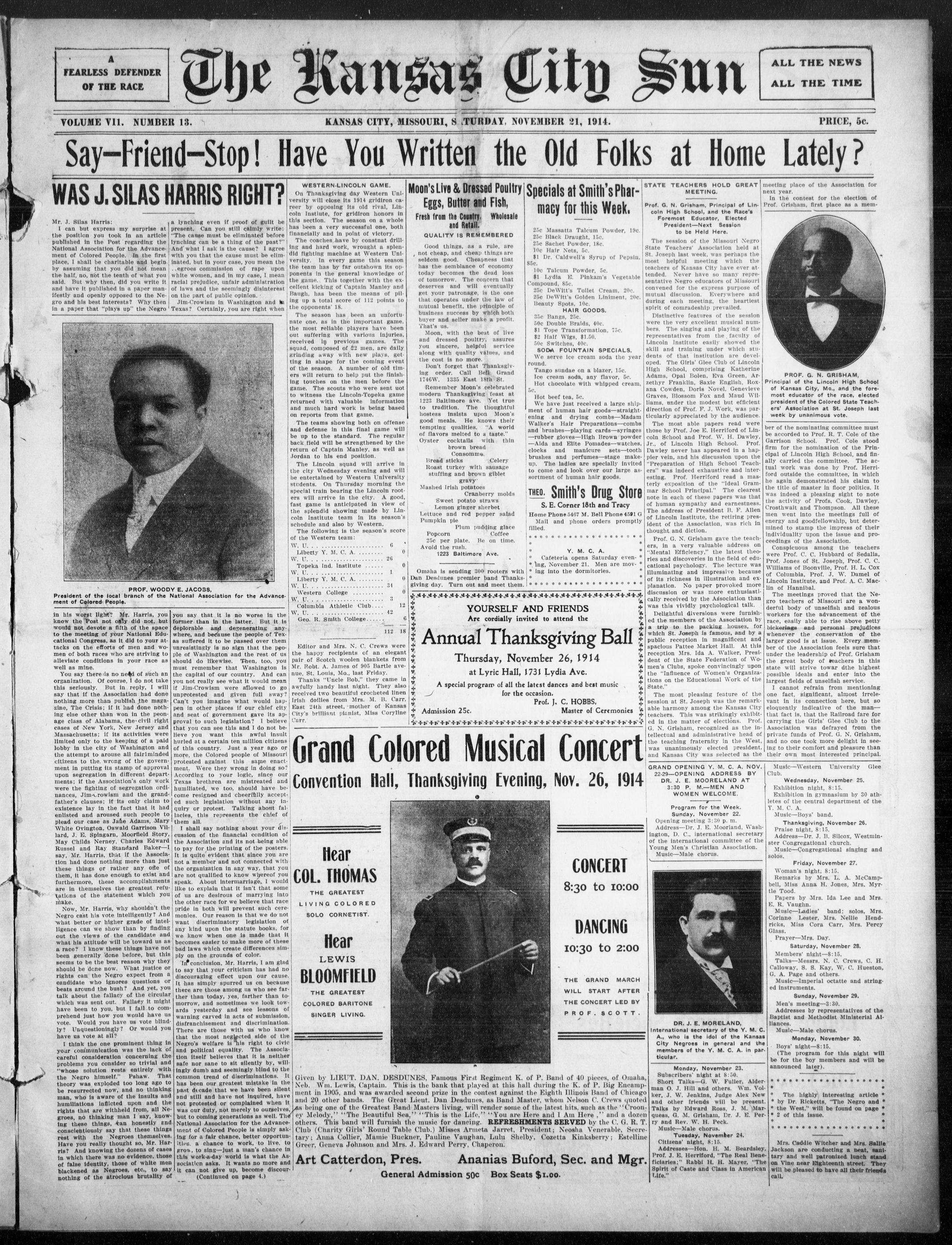
Say-Friend-Stop! Have You Written the Old Folks at Home Lately?
Say-Friend WAS J. SILAS HAR
WAS J. SILAS HARRIS RIGHT?
PROF. WOODY E. JA
President of the local branch of the National
ment of Colored People.
[Picture of a man in a suit and tie].
PROF. WOODY E. JACOBS,
President of the local branch of the National Association for the Advance
ment of Colored People.
---
A FEARLESS DEFENDER OF THE RACE
Mr. J. Silas Harris:
I can but express my surprise at the position you took in an article published in the Post regarding the National Association for the Advancement of Colored People. In the first place, I shall be charitable and begin by assuming that you did not mean the half, no, not the tenth of what you said. But why then, did you write it and have it published in a paper manifestly and openly opposed to the Negro and his best interests? Why then in a paper that "plays up" the Negro
in his worst light? Mr. Harris, you know the Post not only did not, but would not devote a fifth of the space to the meeting of your National Educational Congress, as it did to your attacks on the efforts of men and women of both races who are striving to alleviate conditions in your race as well as mine.
You say there is no need of such organization. Of course, I do not take this seriously. But in reply, I will say that if the Association had done nothing more than publish the magazine, The Crisis; if it had done nothing else other than won in the peonage class of Alabama, the civil right cases of New York, New Jersey and Massachusetts; if its activities were limited only to the keeping of a paid lobby in the city of Washington and the attempt to arouse all fair-minded citizens to the wrong of the government in putting its stamp of approval upon segregation in different departments; if the Association's only work were the fighting of segregation ordinances, Jim Crowism and the grandfather's clauses; if its only claim to existence lay in the fact that it had enlisted and aroused such people to plead our case as Jane Adams, Mary White Ovington, Oswald Garnison Villard, J. E. Spingarn, Moorfield Story, May Childs Nerney, Charles Edward Russel and Ray Standard Baker—say, Mr. Harris, that if the Association had done nothing more than just these things or rather any one of them, it has done enough to exist and furthermore, these accomplishments are in themselves the greatest refutations of the statement which you make.
Now, Mr. Harris, why shouldn't the Negro cast his vote intelligently? And what better or higher grade of intelligence can we show than by finding out the views of the candidate and what his attitude will be toward us as a race? I know these things have not been generally done before, but this seems to be the best reason why they should be done now. What justice or rights can the Negro expect from a candidate who ignores questions or beats around the bush? And yet, you talk about the fallacy of the circular which was sent out. Fallacy it might have been to you, but I fall to comprehend just how you would have us vote. Would you have us vote blindly? Unquestioningly? Or would you have us vote at all?
I think the one prominent thing in your communication was the lack of careful consideration concerning the problems you consider so trivial and "whose solution rests entirely with the Negro himself." Pshaw. That theory was exploded too long ago to be resurrected now, and no thinking man, who is aware of the insults and humiliations inflicted upon and the rights that are withheld from, all Negroes, no thinking man I say, knowing these things, can honestly and conscientiously say that these things rest with the Negroes themselves. Have you really thought so, Mr. Harris? And knowing the dozens of cases in which there was no evidence, those of false identity, those of white men blackened as Negroes, etc., to say nothing of the atrocious brutality of
The Kansas City Sun
a lynching even if proof of guilt be present. Can you still calmly write: "The cause must be eliminated before lynching can be a thing of the past?" And what I ask is the cause? I agree with you that the cause must be eliminated, in but your case, you mean the .groes commission of rape upon white women, and in my case, I mean racial prejudice, unfair administration of laws and the seemingly disinterest on the part of public opinion. Jim-Crowism in Washington and Texas? Certainly, you are right when
DY E. JACOBS,
National Association for the Advance-
you say that it is no worse in the former than in the latter. But it is deplorable and degenerating anywhere, and because the people of Texas suffered it to be passed over them unresistingly is no sign that the people of Washington and the rest of us should do likewise. Then, too, you must remember that Washington is the capital of our country. And can you not really see what it would mean if Jim-Crowism were allowed to go unprotested and given full sway? Can't you imagine what would happen in other places if our chief city and seat of government gave its approval to such legislation? I believe that you can see this and I do not believe you want this awful insult hurled at a certain ten million citizens of this country. Just a year ago or more, the Colored people of Missouri protested against this same enactment. Were they wrong in doing so? According to your logic, since our Texas brethren are mistreated and humiliated, we too, should have be resigned and cheerfully accepted such legislation without any inquiry or protest. Talking about failures, this represents the chief of them all.
I shall say nothing about your discussion of the financial condition of the Association and its not being able to pay for the printing of the posters. It is quite evident that since you are not a member and not connected with the organization in any way, that you are not qualified to know whereof you speak. About intermarriage, I would like to explain that it isn't that some of us are desirous of marrying into the other race for we believe that race pride in both will prevent such ceremonies. Our reason is that we do not want discriminatory legislation of any kind upon the statute books, for we know when one is made that it becomes easier to make more of these bad laws which create differences simply on the grounds of color.
In conclusion, Mr. Harris, I am glad to say that your criticism has had no discouraging effect upon our cause. It has simply spurred us on because there are those among us who see farther than today, yes, farther than tomorrow, and sometimes we look towards yesterday and see lessons of warning carved in acts of submission, disfranchisement and discrimination. There are those with us who know that the most neglected side of the Negro's welfare is his right to civic and political equality. The Association itself believes that it is neither safe nor sane to sit silently by, willing dumb and seemingly blind to the common trend of discriminations. It has been our greatest mistake in the past decade that we have been silent and still and have not inquired, have not protested or complained when it was our duty, not merely to ourselves, to coming generations as well. The National Association for the Advancement of Colored People is simply asking for a fair chance, better opportunities, a chance to work, to live, to grow, to sing—just a man's chance in this work-a-day world is what the Association asks. It wants no more and it can not give up, become discour
(Continued on page 4.)
KANSAS CITY, MISSOURI, S. TURDAY, NOVEMBER 21, 1914.
Grand Colored Musical Concert Convention Hall, Thanksgiving Evening, Nov. 26, 1914
Given by LIEUT. DAN. DESDUNES. Famous First Regiment K. of P. Band of 40 pieces, of Omaha, Neb. Wm. Lewis, Captain. This is the bank that played at this hall during the K. of P. Big Encampment in 1905, and was awarded second prize in the contest against the Eighth Illinois Band of Chicago and 20 other bands. The Great Lieut. Dan Desnues, as Band Master, whom Nelson C. Crews quoted as being one of the Greatest Band Masters living, will render some of the latest hits, such as the "Crooney Melody," "The Beautiful Sea," "This is the Life," "You are Here and I Am Here," and a dozen others. This band will furnish the music for dancing. REFRESHMENTS SERVED by the C. G. R. T. Club (Charity Girls' Round Table Club.) Misses Armeta Jarret, President; Neosha Venerable, Secretary; Anna Collier, Mamie Buckner, Pauline Vaughan, Luhu Shelby, Cozetta Kinksberry; Estelline Greer, Geneva Johnson and Mrs. J. Eden Perry, Chaperon.
General Admission 50c Box Seats $1.00.
WESTERN-LINCOLN GAME.
On Thanksgiving day Western University will close its 1914 gridiron career by opposing its old rival, Lincoln Institute, for gridiron honors in this section. The season on a whole has been a very successful one, both financially and in point of victory.
The coaches have by constrain drilling and hard work, wrought a splendid fighting machine at Western University. In every game this season the team has by far outshown its opponents in the general knowledge of the game. This together with the excellent kicking of Captain Manley and Baugh, has been the means of piling up a total score of 112 points to the opponents' 18.
The season has been an unfortunate one, as in the important game, the most reliable players have been out suffering with various injuries, received in previous games. The squad, composed of 22 men, are daily grinding away with new plays, getting in shape for the coming event of the season. A number of old timers will return to help put the finishing touches on the men before the game. The scouts who were sent not to witness the Lincoln-Topeka game returned with valuable information and much hard work is being based on reports from that game.
Thanks "Uncle Bob," they came in awfully handy last night. They also received two beautiful crocheted linen Irish doilies from Mrs. M. B. Carr, East 24th street, mother of Kansas City's brilliant pianist, Miss Coryline Carr.
Grand Colo
Convention Hall,
Hear
COL. THOMAS
THE GREATEST
LIVING COLORED
SOLO CORNETIST.
Hear
LEWIS
BLOOMFIELD
THE GREATEST
COLORED BARITONE
SINGER LIVING.
Given by LIEUT. DAN. DESDENeb. Wm. Lewis, Captain. This ment in 1905, and was awarded and 20 other bands. The Greatest as being one of the Greatest Bandsey Melody," "The Beautiful Sey others. This band will furnish a Club (Charity Girls' Round Tablary; Anna Collier, Mamie Buck, Greer, Genevieve, Johnson and Mrs.
Moon's Live & Dressed Poultry Eggs, Butter and Fish, Fresh from the Country. Wholesale and Retail.
QUALITY IS REMEMBERED
Good things, as a rule, are not cheap, and cheap things are seldom good. Cheapness that has the semblance of economy today becomes the dead loss of tomorrow. The concern that deserves and will eventually get your patronage, is the one that operates under the law of mutual benefit, the principle of business success by which both buyer and seller make a profit.
That's us.
us by which both
or make a profit.
HAIR GOODS.
25c Bangs, 25c.
50c Double Braids, 40c.
the best of live
poultry, assures
helpful, service
$1 Tope Transformation, 75c.
$2 Half Wigs, $1.50.
$0 Switches, 40c.
Moon, with the best of live and dressed poultry, assures you sincere, helpful service along with quality values, and the cost is no more.
Don't forget that Thanksgiving order. Call Bell, Grand 1746W. 1335 East 18th St.
Remember Moon's celebrated modern Thanksgiving feast at 1223 Baltimore ave. Yet true to tradition. The thoughtful hostess insists upon Moon's good meals. He knows their tempting qualities. "A world of flavors melted to a taste."
Oyster cocktails with thin brown bread
Consomme
Bread sticks Celery
Roast turkey with sausage stuffing and brown giblet gravy
Mashed Irish potatoes
Cranberry molds
Sweet potato straws
Lemon ginger sherbet
Lettuce and red pepper salad
Pumpkin pie
Plum pudding glace
Popcorn Coffee
25c per plate. Be on time.
Avoid the rush.
1223 Baltimore Ave.
Omaha is sending 300 rooters with Dan Desmonds premier band Thanksgiving day. Turn out and meet them.
YOURSELF AND FRIENDS
Are cordially invited to attend the
Annual Thanksgiving
Thursday, November 26, 19
at Lyric Hall, 1731 Lydia Ave.
A special program of all the latest dances and b
Annual Thanksgiving Ball
Thursday, November 26, 1914
at Lyric Hall, 1731 Lydia Ave.
A program of all the latest dances and best music
for the occasion.
Prof. J. C. HOBBS,
Sc. Master of Ceremonies
Musical Concert
ving Evening, Nov. 26, 1914
CONCERT
8:30 to 10:00
DANCING
10:30 to 2:00
Annual Thanksgiving Ball
---
First Regiment K. of P. Band of 40 pieces, of Omaha played at this hall during the K. of P. Big Encaim the contest against the Eighth Illinois Band of Chicago tunes, as Band Master, whom Nelson C. Crews quote will render some of the latest hits, such as the "Croo Life," "You are Here and I Am Here," and a dozoeing. REFRESHMENTS SERVED by the C. G. R. Armeta Jarret, President; Neosha Venerable, Seerughan, Lulu Shelby, Cozetta Kinksberry; Estelliny, Chaperon.
Specials at Smith's Pharmacy for this Week.
25c Massatta Talcum Powder, 19c
25c Black Draught, 15c
25c Sachet Powder, 18c
10c Hair Nets, 5c
$1 Dr. Caldwell's Syrup of Pepsin
85c.
25c DeWitt's Toilet Cream, 20c.
25c DeWitt's Golden Liniment, 20c
Beauty Spots, 10c.
SODA FOUNTAIN SPECIALS.
We serve ice cream soda the year round.
Tango sundae on a blazer, 15c.
Ice cream soda, any flavor, 5c.
Hot chocolate with whipped cream 5c.
Hot beef tea, 5c.
We have just received a large shipment of human hair goods—straightening and drying combs—Madam Walker's Hair Preparations—combs and brushes—playing cards—syringes—rubber gloves—High Brown powder—Alda and Elite Pomades—watches, clocks and manicure sets—tooth brushes and perfumes—stage make up. The ladies are specially invited to come and look over our large assortment of human hair goods.
THEO. Smith's Drug Store
THE GRAND MARCH
WILL START AFTER
THE CONCERT LED BY
PROF. SCOTT.
STATE TEACHERS HOLD GREAT MEETING.
Prof. G. N. Grisham, Principal of Lincoln High School, and the Race's Foremost Educator, Elected President—Next Session to be Held Here.
The session of the Missouri Negro State Teachers' Association held at St. Joseph last week, was perhaps the most helpful meeting which the teachers of Kansas City have ever attended. Never have so many representative Negro educators of Missouri convened for the express purpose of mutual discussion. Everywhere and during each meeting, the heartiest spirit of comradeship prevailed.
Distinctive features of the session were the very excellent musical numbers. The singing and playing of the representatives from the faculty of Lincoln Institute easily showed the skill and training under which students of that institution are developed. The Girls' Glee Club of Lincoln High School, comprising Katherine Adams, Opal Bolen, Eva Green, Arzethy Franklin, Saxie English, Roxana Cowden, Doris Novel, Genevieve Graves, Blossom Fox and Maud Williams, under the modest but efficient direction of Prof. F. J. Work, was particularly appreciated by the audience.
The most able papers read were those by Joe E. Herriford of Lincoln School and Prof. W. H. Dawley, Jr., of Lincoln High School. Prof. Dawley never has appeared in a haplap vein, and his discussion upon the "Preparation of High School Teachers" was indeed exhaustive and interesting. Prof. Herriford read a masterly exposition of the "Ideal Grammar School Principal." The clearest note in each of these papers was that of human sympathy and earnestness. The address of President B. F. Allen of Lincoln Institute, the retiring president of the Association, was rich in thought and diction.
Prof. G. N. Grisham gave the teachers, in a very valuable address on "Mental Efficiency," the latest theories and discoveries in the field of educational psychology. The lecture was illuminating and impressive because of its richness in illustration and explanation. No paper provoked more discussion or was more enthusiastically received by the Association than was this vividly psychological talk.
Delightful diversions were furnished the members of the Association by a trip to the packing houses, for which St. Joseph is famous, and by a public reception in magnificent and spacious Pattee Market Hall. At this reception Mrs. Ida A. Walker, President of the State Federation of Women's Clubs, spoke convincingly upon the "Influence of Women's Organizations on the Educational Work of the State."
The most pleasing feature of the session at St. Joseph was the remarkable harmony among the Kansas City teachers. This was strikingly exhibited in the matter of elections. Prof. G. N. Grisham, recognized as the intellectual and administrative head of the teaching fraternity in the West, was unanimously elected president, and Kansas City was selected as the
GRAND OPENING Y. M. C. A. NOV.
22:29—OPENING ADDRESS BY
DR. J. E. MOORELAND AT
3:30 P. M.-MEN AND
WOMEN WELCOME.
Address—Dr. J. E. Moorland, Washington, D. C., international secretary of the international committee of the Young Men's Christian Association. Music—Male chorus.
DR. J. E. MORELAND,
International secretary of the Y. M. C. A., who is the idol of the Kansas City Negroes in general and the members of the Y. M. C. A. in particular.
Short Talks—G. W. Fuller, Alderman O. J. Hill and others. Wm. Volman, J. W. Jenkins, Judge Alex New and other friends will be present. Talks by Edward Ross, J. M. Marquess, G. M. Grisham, Dr. J. E. Perry and Rev. W. H. Peck. Music—Male chorus.
Tuesday, November 24.
Citizens' night, 8:15.
Addresses—Hon. H. M. Beardsley, Prof. J. E. Herriford, "The Real Beneficialies," Rabbil H. M. Hayer, "The Spirit of Caste and Class in American Life."
ALL THE NEWS ALL THE TIME
meeting place of the Association for next year.
In the contest for the election of Prof. Grisham, first place as a mem-
Principal of the Lincoln High School of Kansas City, Mo., and the foremost educator of the race, elected president of the Colored State Teachers' Association at St. Joseph last week by unanimous vote.
ber of the nominating committee must be accorded to Prof. R. T. Cole of the Garrison School. Prof. Cole stood firm for the nomination of the Principal of Lincoln High School, and finally carried the committee. The actual work was done by Prof. Herrford outside the committee, in which he again demonstrated his claim to the title of master in floor politics. It was indeed a pleasing sight to note the activity of Profs. Cook, Dawley, Crosthwait and Thompson. All these men went into the meetings full of energy and good fellowship, but determined to stamp the impress of their individuality upon the issue and proceedings of the Association.
Conspicuous among the teachers were Prof. C. C. Hubbard of Sedalia, Prof. Jones of St. Joseph, Prof. C. C. Williams of Boonville, Prof. H. L. Cox of Columbia, Prof. J. W. Damel of Lincoln Institute, and Prof. A. C. Maclin of Hannibal.
The meetings proved that the Negro teachers of Missouri are a wonderful body of unselfish and zealous workers for the advancement of the race, easily able to rise above petty bickerings and personal prejudices whenever the conservation of the larger good is at issue. Every member of the Association feels sure that under the leadership of Prof. Grisham the great body of teachers in this state will strive towar the highest possible ideals and enter into the largest fields of unselfish service.
I cannot refrain from mentioning one fact, significant, almost irrelevant in its connection here, but so eloquently indicative of the man—that fact is, that the Railroad fare for carrying the Girls' Glee Club to the Association was defrayed from the private funds of Prof. G. N. Grisham, and no one took more delight in seeing to their comfort and pleasure than their own most interested principal.
Music—Western University Glee Club.
Wednesday, November 25.
Exhibition night, 8:15.
Exhibition in gymnasium by 30 athletes of the central department of the Y. M. C. A.
Music—Boys' band.
Thanksgiving, November 26.
Praise night, 8:15.
Address—Dr. J. B. Silcox, Westminster Congregational church.
Music—Congregational singing and solos.
Friday, November 27.
Remarks by Mrs. L. A. McCampbell, Miss Anna H. Jones, Mrs. Myrtle Tood.
Papers by Mrs. Ida Lee and Mrs. E. R. Vaughn.
Music—Ladies' band; solos, Mrs. Corinne Lester, Mrs. Nellie Hendricks, Miss Cora Carr, Mrs. Percy Glass.
Prayer—Mrs. Day.
Saturday, November 28.
Members' night—8:15.
Talks—Messrs. N. C. Crews, C. H.
Calloway, S. S. Kay, W. C. Hueston,
G. A. Page and others.
Music—Imperial octatte and stringed instruments.
Sunday, November 29.
Men's meeting—3:30.
Addresses by representatives of the Baptist and Methodist Ministerial Alliances.
Music—Male chorus.
Monday, November 30.
Boys' night—8:15.
(The program for this night will
be for the boy members and will be
announced later).
* The highly interesting article *
* by Dr. Ricketts, "The Negro and
the West," will be found on page *
* 2 of this issue.
Mrs. Caddie Witcher and Mrs. Sallie Jackson are conducting a neat, sanitary and well patronized lunch stand on Vine near Eighteenth street. They will be pleased to have all their friends call.
Particular attention may be given to the following subject, since there are hundreds of thousands using the Eureka Comb throughout the United States and Isles. They give the best of satisfaction as to our recommend, straightening the hair beautifully with one stroke, and as assistance in causing a rapid growth. Evidences coming to us from every source, of which is pleasing, that the Eureka Comb performs precisely as advertised.
No better comb on the market for purposes as we have been advised that other combs are toys, when it comes to benefits and effectual influences when used as to directions, for which every comb placed goes with it instructions, how to use and for what purposes. Wherever introduced the Eureka preferable. Merchants and agents are successful when they are placed conveniently in quantities for the public.
They are usually sold for $1.50 (one dollar and fifty cents) each complete. The only thing is to be careful in the purchase as there is no other comb that will answer the purposes so well as the Eureka. We wholesale the Eureka Comb, being the manufacturers and promoters, and are the only wholesalers of this special device; if there are othes we would be pleased to be informed.
The devises are patented and registered. For prices and further information write
"House of Love"
Badges, Banners,
Books, Robes, Emblems,
Buttons, Furniture,
Uniforms
FOR ALL
Lodge and Church Societies
The Love Regalia Company
2418 Flora Avenue Kansas City, Missouri
Bell Phone, East 944
Are you satisfied with your
hair?
Is it as long as it should
be?
Is it soft and glossy and
full of life?
Can you comb it out easily
or is it full of tangles?
Are you proud of your
hair?
The Answer
Is:—
NELSON'S
HAIR DRESSING
25¢
50¢
LAMP CAP
Particu
dreds of the
Isles. The
hair beauti
Evidences
Comb performs precisely
No better comb on the ma
when it comes to benefits and
placed goes with it instruction
preferable. Merchants and age
the public.
¢ Has no superior as a hair beautifier
¢ Thousands of men and women have improved the appearance of their hair by using NELSON'S HAIR DRESSING.
¢ For those who know—it is a toilet necessity.
Ask your druggist. If he cannot supply you, send us his name and address and we will send you a free sample.
NELSON MFG. CO.
RICHMOND, VA.
THE
NELSON
GIRL
EUREKA REG. PAT D AUG. 8.1911.
In the following subject, since there are humbly throughout the United States and as to our recommend, straightening the assistance in causing a rapid growth of which is pleasing, that the Eurek
been advised that other combs are toy to directions, for which every combs. Wherever introduced the Eurek be placed conveniently in quantities for each complete. The only thing is to answer the purposes so well as the markers and promoters, and are the ones be pleased to be informed.
Further information write
EUREKA COMB COMPANY,
Chattanooga, Tenn.
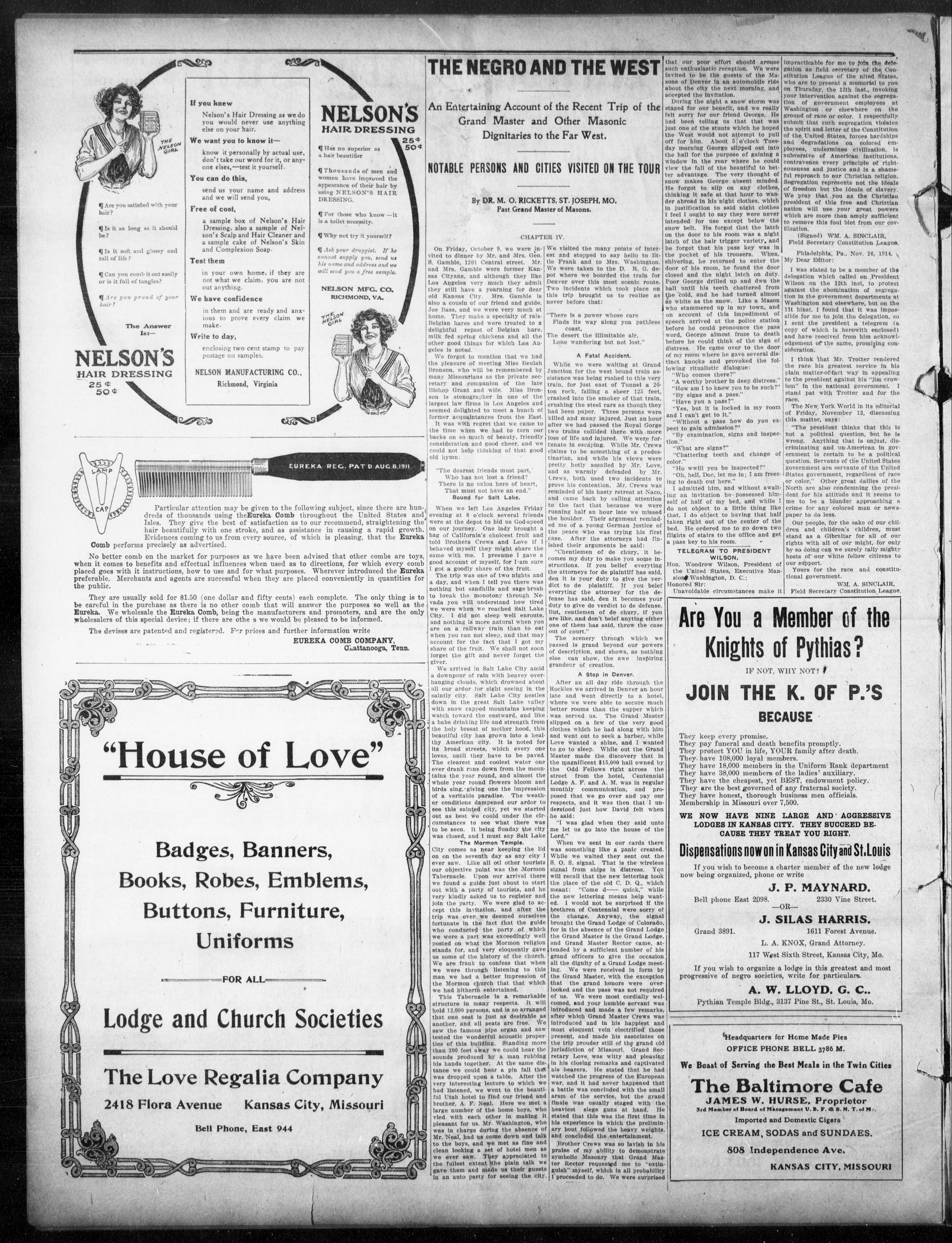
THE NEGRO AND THE WEST
An Entertaining Account of the Recent Trip of the Grand Master and Other Masonic Dignitaries to the Far West.
NOTABLE PERSONS AND CITIES VISITED ON THE TOUR
By DR. M. O. RICKETTS. ST. JOSEPH, MO.
Past Grand Master of Masons.
On Friday, October 9, we were invited to dinner by Mr. and Mrs. Geo, S. Gamble, 1201 Central street. Mr. and Mrs. Gamble were former Kansas Cityans, and although they like Los Angeles very much they admit they still have a yearning for dear old Kansas City. Mrs. Gamble is also a cousin of our friend and guide, Joe Bass, and we were very much at home. They make a specialty of rais-Belgian hares and were treated to a delightful repast of Belgian hare, milk fed spring chickens and all the other good things for which Los Angeles is noted.
We forgot to mention that we had the pleasure of meeting Miss Beulah Bronson, who will be remembered by many Missourians as the private secretary and companion of the late Bishop Grant and wife. Miss Bronson is stenographer in one of the largest law firms in Los Angeles and seemed delighted to meet a bunch of former acquaintances from the East. It was with regret that we came to the time when we had to turn our backs on so much of beauty, friendly consideration and good cheer, and we could not help thinking of that good old hymn:
When we left Los Angeles Friday evening at 8 o'clock several friends were at the depot to bid us God-speed on our journey. One lady brought a bag of California's choice fruit and told Brothers Crews and Love if I behaved myself they might share the same with me. I presume I gave a good account of myself, for I am sure I got a goodly share of the fruit.
The trip was one of two nights and a day, and when I tell you there was nothing but sandhills and sage brush to break the monotony through Nevada you will understand how tired we were when we reached Salt Lake City. I did not sleep well enroute, and nothing is more natural when you are on a railway train than to eat when you can not sleep, and that may account for the fact that I got my share of the fruit. We shall not soon forget the gift and never forget the giver.
We arrived in Salt Lake City amid a downpour of rain with heave over-hanging clouds, which drowned about all our ardor for sight seeing in the saintly city. Salt Lake City nestles down in the great Salt Lake valley with snow capped mountains keeping watch toward the eastward, and like a babe drinking life and strength from the holy breast of mother hood, this beautiful city has grown into a healthy American city. It is noted for its broad streets, which every one loves, until they have to be paved. The clearest and coolest water one ever drank runs down from the mountains the year round, and almost the whole year round flowers bloom and birds sing, giving one the impression of a veritable paradise. The weather conditions dampened our ardor to see this sainted city, yet we started out as best we could the circumstances to see what there was to be seen. It being Sunday the city was closed, and I must say Salt Lake
The Mormon Temple.
City comes as near keeping the lid on on the seventh day as any city I ever saw. Like all otl other tourists our objective point was the Mormon Tabernacle. Upon our arrival there we found a guide just about to start out with a party of tourists, and he very kindly asked us to register and join the party. We were glad to accept this invitation, and after the trip was over we deemed ourselves fortunate in the fact that the guide who conducted the party of which we were a part was exceedingly well posted on what the Mormon religion stands for, and very eloquently gave us some of the history of the church. We are frank to confess that when we were through listening to this man we had a better impression of the Mormon church that that which we had hitherto entertained.
This Tabernacle is a remarkable structure in many respects. It will hold 12,000 persons, and is so arranged that one seat is just as desirable as another, and all seats are free. We saw the famous pipe organ and saw tested the wonderful acoustic properties of this building. Standing more than 200 feet away we could hear the sounds produced by a man rubbing his hands together. At the same distance we could hear a pin fall that was dropped upon a table. After the very interesting lecture to which we had listened, we went to the beautiful Utah hotel to find our friend and brother, A. F. Neal. Here we met a large number of the home boys, who vied with each other in making it pleasant for us. Mr. Washington, who was in charge during the absence of Mr. Neal, had us come down and talk to the boys, and we met as fine and clean looking a set of hotel men as we ever saw. They appreciated to the fullest extent the plain talk we gave them and made us their guests in an auto party for seeing the city.
We visited the many points of interest and stopped to say hello to little Frank and to Mrs. Washington. We were taken to the D. R. G. depot where we boarded the train for Denver over this most scenic route. Two incidents which took place on this trip brought us to realize as never before that:
"There is a power whose care Finds its way along yon pathless coast
The desert the illimitable air,
Lone wandering but not lost."
A Fatal Accident.
While we were waiting at Grand Junction for the west bound train assistance was being rushed to this very train, for just east of Tunnel a 20-ton rock, falling a sheer 125 feet, crushed into the smoker of that train, crushing the steel cars as though they had been paper. Three persons were killed and many injured. Just an hour after we had passed the Royal Gorge two trains collided there with more loss of life and injured. We were fortunate in escaping. While Mr. Crews claims to be something of a predestinarian, and while his views were pretty hotly assailed by Mr. Love, and as warmly defended by Mr. Crews, both used two incidents to prove his contention. Mr. Crews was reminded of his hasty retreat at Naco, and came back by calling attention to the fact that because we were running half an hour we missed the boulder. The argument reminded me of a young German justice of the peace who was trying his first case. After the attorneys had finished their arguments he said:
"Chentlemen of de chury, it becomes my duty to make you some instructions. If you belief everything the attorneys for de plaintiff has said, den it is your duty to give the verdict to de plaintiff. If you belief everything the attorney for the defense has said, den it becomes your duty to give de verdict to de defense. But, centlemen of de chury, if you are like, and don't belief anything either one of them has said, throw the case out of court."
The scenery through which we passed is grand beyond our powers of description, and shows, as nothing else can show, the awe inspiring grandeur of creation.
A Stop in Denver.
After an all day ride through the Rockies we arrived in Denver an hour late and went directly to a hotel, where we were able to secure much better rooms than the supper which was served us. The Grand Master slipped on a few of the very good clothes which he had along with him and went out to seek a barber, while Love wanted a shine, and I wanted to go to sleep. While out the Grand Master made the discovery that in the magnificent $15,000 hall owned by the Odd Fellows right across the street from the hotel, Centennial Lodge A. F. and A. M. was in regular monthly communication, and proposed that we go over and pay our respects, and it was then that I understood just how David felt when he said: "I was glad when they said unto me let us go into the house of the Lord."
When we sent in our cards there was something like a panic created. While we waited they sent out the S. O. S. signal. That is the wireless signal from ships in distress. You will recall that the new lettering took the place of the old C. D. Q., which meant: "Come d—— quick," while the new lettering means help wanted. I would not be surprised if the brethren of Centenial were sorry of the change. Anyway, the signal brought the Grand Lodge of Colorado, for in the absence of the Grand Lodge the Grand Master is the Grand Lodge and Grand Master Rector came, attended by a sufficient number of his grand officers to give the occasion all the dignity of a Grand Lodge meeting. We were received in form by the Grand Master, with the exception that the grand honors were overlooked and the pass was not required of us. We were most cordially welcomed, and your humble servant was introduced and made a few remarks, after which Grand Master Crews was introduced and in his happiest and most eloquent veil electrified those present, and made his associates on the trip prouder still of the grand old jurisdiction of Missourl. Grand Secretary Love was witty and pleasing in his closing remarks and captivated his hearers. He stated that he had watched the progress of the European war, and it had never happened that a battle was concluded with the small arsm of the service, but the grand finale was usually staged with the heaviest siege guns at hand. He stated that this was the first time in his experience in which the preliminary bout followed the heavy weights, and concluded the entertainment.
Brother Crews was so lavish in his praise of my ability to demonstrate symbolic Masonry that Grand Master Rector requested me to "extingush" myself, which in all probability I proceeded to do. We were surprised
that our poor effort should arouse such enthusiastic reception. We were invited to be the guests of the Masons of Denver in an automobile ride about the city the next morning, and accepted the invitation.
During the night a snow storm was staged for our benefit, and we really felt sorry for our friend George. He had been telling us that that was just one of the stunts which he hoped the West would not attempt to pull off for him. About 5 o'clock Tuesday morning George slipped out into the hall for the purpose of gaining a window in the rear where he could view the fall of the beautiful to better advantage. The very thought of snow makes George absent minded. He forgot to slip on any clothes, thinking it safe at that hour to wander abroad in his night clothes, which in justification to said night clothes I feel I ought to say they were never intended for use except below the snow belt. He forgot that the latch on the door to his room was a night latch of the hair trigger variety, and he forgot that his pass key was in the pocket of his trousers. When, shivering, he returned to enter the door of his room, he found the door closed and the night latch on duty. Poor George drilled up and dwn the hall until his teeth chattered from the cold, and he had turned almost as white as the snow. Like a Mason who stammered up in my town, and on account of this impediment of speech arrived at the police station before he could pronounce the pass word. George almost froze to death before he could think of the sign of distress. He came over to the door of my room where he gave several distinct knocks and provoked the following ritualistic dialogue:
"A worthy brother in deep distress."
"How am I to know you to be such?"
"By signs and a pass."
"Have you a pass?"
"Yes, but it is locked in my room and I can't get to it."
"Without a pass how do you expect to gain admission?"
peet to gain admission: "By examination, signs and inspection."
"What are signs?" "Chattering teeth and change of color."
"Ho wwill you be inspected?" "Oh, hell, Doc, let me in; I am freezing to death out here."
I admitted him, and without awaiting an invitation he-possessed himself of half of my bed, and while I do not object to a little thing like that, I do object to having that half taken right out of the center of the bed. He ordered me to go down two flights of stairs to the office and get a pass key to his room.
Hon. Woodrow Wilson, President of the United States, Executive Mansion Washington, D. C.: Honored Sir: Unavoidable circumstances make it
Are You a Nine Knights of
IF NOT, W
JOIN THE
BECAUSE
They keep every promise.
They pay funeral and death bells.
They protect YOU in life, YOU.
They have 108,000 loyal members.
They have 18,000 members in.
They have 38,000 members of.
They have the cheapest, yet they are the best governed of.
They have honest, thorough membership in Missouri over
WE NOW HAVE NINE LODGES IN KANSAS CITY
CAUSE THEY THINK
Dispensations now on in
If you wish to become a clergy now being organized, phone on
J.
Bell phone East 2098.
J. S
Grand 3891.
L. A.
117 West
If you wish to organize a progressive of negro societies
A. W.
Pythian Temple Bldg., 31
Are You a Member of the Knights of Pythias?
IF NOT, WHY NOT?
JOIN THE K. OF P.'S
They keep every promise.
They pay funeral and death benefits promptly.
They protect YOU in life, YOUR family after death.
They have 108,000 loyal members.
They have 18,000 members in the Uniform Rank department
They have 38,000 members of the ladies' auxiliary.
They have the cheapest, yet BEST, endowment policy.
They are the best governed of any fraternal society.
They have honest, thorough business men officials.
Membership in Missouri over 7,500.
WE NOW HAVE NINE LARGE AND AGGRESSIVE
LODGES IN KANSAS CITY. THEY SUCCEED BE-
CAUSE THEY TREAT YOU RIGHT.
If you wish to organize a lodge in this greatest and most progressive of negro societies, write for particulars.
Headquarters for Home Made Pies
OFFICE PHONE BELL 3786 M.
We Boast of Serving the Best Meals in the
The Baltimore C
JAMES W. HURSE, Proprietor
3rd Member of Board of Management U. B. F. @ S. M.
Imported and Domestic Cigars
ICE CREAM, SODAS and SUNDAYS
808 Independence Ave.
KANSAS CITY, M.
impracticable for me to join the delegation as field secretary of the Constitution League of the nited States, who are to present a memorial to you on Thursday, the 12th inst., invoking your intervention against the segregation of government employees at Washington or elsewhere on the ground of race or color. I respectfully submit that such segregation violates the spirit and letter of the Constitution of the United States, forces harships and degradations on colored employees, undermines civilization, is subversive of American institutions, contravenes every principle of righteousness and justice and is a shameful reproach to our Christian religion. Segregation represents not the ideals of freedom but the ideals of slavery. We pray that you as the Christian president of this free and Christian nation will use your great powers which are more than amply sufficient to remove this foul blot from our civilization.
(Signed) WM. A. SINCLAIR, Field Secretary Constitution League. Philadelphia, Pa., Nov. 16, 1914. My Dear Editor:
I was slated to be a member of the delegation which called on President Wilson on the 12th inst., to protest against the abomination of segregation in the government departments at Washington and elsewhere, but on the 11th inst. I found that it was impossible for me to join the delegation, so I sent the president a telegram (a copy of which is herewith enclosed) and have received from him acknowledgement of the same, promising consideration.
I think that Mr. Trotter rendered the race his greatest service in his plain matter-of-fact way in appealing to the president against his "tim crowism" in the national government. I stand pat with Trotter and for the race.
The New York World in its editorial of Friday, November 13, discussing this matter, says:
"The president thinks that this is not a political question, but he is wrong. Anything that is unjust, discriminating and un-American in government is certain to be a political question. Servants of the United States government are servants of the United States government, regardless of race or color." Other great dailies of the North are also condemning the president for his attitude and it seems to me to be a blunder approaching a crime for any colored man or newspaper to do less.
Our people, for the sake of our children and children's children, must stand as a Glbaltar for all of our rights with all of our might, for only by so doing can we surely rally mighty hosts of our white fellow citizens to our support.
Yours for the race and constitutional government.
WM, A. SINCLAIR,
Field Secretary Constitution League
Member of the
of Pythias?
WHY NOT?
K. OF P.'S
CAUSE
benefits promptly.
OUR family after death.
ubers.
the Uniform Rank department
the ladies' auxiliary.
BEST, endowment policy.
any fraternal society.
business men officials.
7,500.
LARGE AND AGGRESSIVE
CITY. THEY SUCGEED BE-
REAT YOU RIGHT.
In Kansas City and St. Louis
charter member of the new lodge
or write
P. MAYNARD.
2330 Vine Street.
OR—
GILAS HARRIS.
1611 Forest Avenue.
KNOX, Grand Attorney.
Sixth Street, Kansas City, Mo.
lodge in this greatest and most
write for particulars.
LLOYD, G. C..
137 Pine St., St. Louis, Mo.
Best Meals in the Twin Cities
Amore Cafe
URSE, Proprietor
Agreement U. B. F. @ S. M. T. of M.
Domestic Cigars
DAS and SUNDAES.
Indence Ave.
KANSAS CITY, MISSOURI
Admitted to Practice in all
State and Federal Courts.
601 Delaware St., Kansas City, Mo
Mme. Benton Dean, the popular milliner, has moved to 1010 Troost avenue, where she is elegantly located and will be extremely pleased to meet her many friends and customers at that number. Belle phone Main 2102J.
Ladies' Tailoring
Dressmaking
AND
Drafting...
Fancy Gowns a Specialty
I am prepared to offer the public the best dressmaking, tailoring, drafting and fitting.
Graduate of one of the best white downtown colleges.
Will also teach Drafting.
Bell Phone East 3413 M
Mrs. Lillie Williams
2914 Woodland Avenue
KANSAS CITY, MISOURI
A League Enterprise!
On Eighteenth in the
Fifteen Hundred Block
A News Bureau
Every Negro Periodical,
Negro Pictures, Negro
Books, Novelties
Stationery
A FIRST-CLASS Shoe Shining Parlor
5c. Every Day in the Year
1521 Bast 18th Street.
CHAS. A. STARKS, Prop.
WILLA M. GLENN
Notary Public
and
Expert Typist.
Kansas City Sun Office
1803 East 18th Street
Kansas City, Mo.
Bell Phone East 999
Our Motto: "Nothing but The Best"
The Crosthwait Floral Company
Everything in Flowers and Flower Designs
"WE DELIVER THE GOODS"
The People say we have made some of the most beautiful and original designs in flowers ever seen in Kansas City.
Our Specialty--
"Quick Delivery--Satisfactory Service"
Bell Phone East 272
Home Phone Main 0070
1801 E. 18th St., Kansas City, Mo.
CHEAP
JOHN'S
PLACE
New and Second Hand
Goods Bought, Sold and
Exchanged
Bell Phone East 3851 W
2122 Vine Street
WM. HOPKINS, Prop.
J.C.WAGNER
The Clean Market Man
Oysters, Fish and Game in
Season.
Fancy Groceries and all Table
Luxuries.
Courteous Treatment to All.
1819 Howard Ave.
Bell Phone 3596 East
Kansas City. Missouri
U.B.F. ATTENTION S.M.T.
SPECIAL PRICES ON NEW STOCK REGULATION S.M. T. CORONETS. See Us for Quick Service and Low Prices on Robes and Badges.
The Moses Dickson Regalia & Supplies Company 1217 Woodland Ave., KANSAS CITY, MO
KEEPS YOUR HOME FRESH and CLEAN
THIS Swiftly-Sweeping, Easy-Running DUNTLEY Sweeper cleans without raising dust, and at the same time picks up pins, lint, ravelings, etc., in ONE OPERATION. Its ease makes sweeping a simple task quickly finished. It reaches even the most difficult places, and eliminates the necessity of moving and lifting all heavy furniture.
The Great Labor Saver of the Home—Every home, large or small, can enjoy relief from Broom drudgery and protection from the danger of flying dust.
Duntley is the Pioneer of Pneumatic Sweepers—Has the combination of the Pneumatic Suction Nozzle and revolving Brush. Very easily operated and absolutely guaranteed. In buying a Vacuum Cleaner, why not give the "Duntley" a trial in your home at our expense?
Write today for full particulars
Emery, Bird, Thayer D. G. Co.,
Kansas City, Mo.
Phone E. 4394Y Office Modern Bu
dern Builde A.E. ESTES, President
General Contracting Repairing a Specialty
SATISFACTION GUARANTEED
Subscribe for The Sun
of coal to the Children's Home on Highland avenue this week.
NOTICE—SUBSCRIBERS.
We are preparing to open a new set of books January 1st free of delinquents, so we are sending our collectors statements to all subscribers. Please settle.—The Sun Publishing Co.
HIGHLAND CEMETERY COMPANY STOCK
FOR SALE CHEAP
We have for sale a few shares of this stock very cheap, and recommend its purchase. If interested, phone or call
J. G. STREAN INVESTMENT COMPANY,
Bonds and Stocks.
521 LATHROP BUILDING.
Phones—Home, Main 1077; Bell, Main 1742.
Hello, Neighbor!
Do You Read The Sun?
Do you know you can get it for ONE YEAR for ONE DOLLAR AND FIFTY CENTS. Sent anywhere in the United States.
ORDER NOW! OUR PHONE IS BELL EAST 999.
Office 2460 W Idrond Ave Builders Co.
Call us, write, or see our agents.
Betty & Sam's Little Corner
A
THEY SAY
—That it's a long rough road to next summer. Lord help.
—That a whole lot of Negroes are boarding at the chill wagons. Hard times, brother.
—That each preacher ought to "work his own side of the street," then they won't get hurt. See?
—That if every man would talk over his business affairs with his wife there would be less use for lawyers.
—That Dr. Theo, Smith has a heart as big as a barrel. He's always doing something for the poor and needy.
—That a certain office holder "who got it in the neck" at the last grand session can't get over it. Too bad.
—That when a girl begins to flirt with different men she is also flirting with the undertaker. "Be keerful."
—That a charming schoolmarm got an awful licking and the "licker" got arrested. Oh you men. "Twas ever thus."
—That F. J. Weaver has sold more than 500 homes to Negroes and not a one ever lost a dime. Hurrah for Weaver.
—That a Negro lost all his week's earnings at a crap game; then, becoming desperate, went out and held up a white man and got fifty years in prison. Better let craps alone, boys.
—That a well known young man used to carry his chum every time he went to call on his girl and now his chum has got the girl and he's got the mitt. Moral—go alone.
Mr. S. Bellamy, one of our generous Colored men, gave a stove and a ton of coal to the Children's Home on Highland avenue this week.
NOTICE—SUBSCRIBERS.
We are preparing to open a new set of books January 1st free of delinquents, so we are sending our collectors statements to all subscribers, Please settle.—The Sun Publishing Co.
Kelley Milling Co.
K.C., U.S.A.
ESTATE
All Kinds For Sale
S Citys and Topeka
IS TO SUIT
BRADLEY & CO.
Mackell Ave., Kansas City, Kas.
ONE WEST 644
Sth Bidg., Sixth and Minnesota Ave.
Ka, Kas.: 410 Kansas Ave.
Specialists
SAS CITY.
We have been doing high dime guaranteed.
We have thousands of satisfied patients.
Business 80 Years
GET THE BEST
guaranteed 80 years
BRIDOK WORK
Grand
W. G.
R. E. G.
J. H. S.
G. E. G.
P. C.
V. E. G.
J. W.
C. G.
Wm. R.
Secretary.
T. P. M
Omaha, H
Geo. B.
Mo.
T. G. M.
S City.
A. L. T.
Mo.
J. P. M.
Chas.
Mo.
E. S. B.
Mo.
MASONIC
R. T.
E. S.
R. W.
W. C. M.
Wm. Wa.
T. W. H.
J. E. He.
E. G. M.
Property of All Kinds For Sale In Both Kansas Citys and Topeka TERMS TO SUIT
Main Office: 400 Haekell Ave., Kansas City, Kas.
BELL PHONE WEST 644
Expert Dental Specialists
Our work has stood the test. We have been doing high time guaranteed Dental Work for the past 26 years. We have thousands of satisfied patients.
Remember, in Business 20 Years
All work kept in repair free of charge.
SAVE MONEY EXAMINATION FREE GET THE BEST
All work guaranteed 20 years
The doctor who extracts your teeth here has undoubtedly had more experience in this line than any other dentist in the city, so you get the most expedited service. Painless Extracting, 25a.
BRIDGE WORK
Spaces where from one to ten teeth have been lost we replace with bridge work. It looks the same as natural teeth, lasts a lifetime and requires no plata. Broken down teeth we restore to beauty and usefulness with crowns of porcelain and gold.
$8
, 75e. and $1
Te Crowns $3, $4 and $8
Platina Fillings 26g
TEETH $4 TO $8
DENTAL CO
Gold Crowne $3, $4 and $8
Silver Fillings, 75c. and $1
White Crowne $3, $4 and $8
Platine Fillings $80
'NEW YORK DENTAL CO
New Location 1017-19 Walnut St.
Over Jaccard's Jewelry store, 1 door north Emery, Bird, Thayer Co
We have for sale a few shares of this stock very cheap,
and recommend its purchase. If interested, phone or call
J. G. STREAN INVESTMENT COMPANY,
Bonds and Stocks.
521 LATROP BUILDING.
Phones—Home, Main 1077; Bell, Main 1742.
KELLEY'S BEST HIGH PATENT
REAL E
Property of All Kill
In Both Kansas City
TERMS TO
MISS RUTH BRA
Main Office: 400 Haskell Ave
BELL PHONE W
Branch Office: Portsmouth Bidg.
Branch Office, Topeka, Kas
Expert Dental
OF KANSAS
Our work has stood the test. We have b
Dental Work for the past 26 years. We ha
Remember in Business
All work kept in repair
SAVE MONEY EXAMINATION P
All work guaranteed
The doctor who extracts your tooth here has
in this line than any other dentist in the
service. Painless Extracting, 35a.
Spaces
been lost
looks the
time and
teeth we
with crowd
Gold Crowns $3, $4 and $8
Silver Fillings, 75c. a.
White Crowns
FULL SET TEETH
'NEW YORK D
New Location 1017-
Over Jaccard's Jewelry store, 1 door n
HIGHLAND CEMETERY
FOR SALE CHEAP
We have for sale a and recommend its pu J. G. STREAN B 521 L Phones—Home.
Kelley's Best Beat all the Rest.
A. F. and A. M.
Missouri Jurisdiction
Officers—1914'15.
N. C. Crews, Kansas City, Grand Master.
Deputy Grand Master, Richard Young, Lincoln, Neb.
F. J. Brown, St. Louis, Grand Senior Warden.
Wm. Green, Plattsburg, Grand Junior Warden.
H. H. Walker, St. Joseph, Grand Treasurer.
Geo. W. K. Love, Grand Secretary, Kansas City, Mo.
W. W. Fields, Secretary of Masonic Relief, Cameron, Mo.
P. L. Pratt, Kansas City, Mo., Grand Lecturer.
Grand Commandery Officers.
W. G. Mosely, Kansas City, Mo,
R. E. G. C.
J. H. Sherwood, St. Paul, Minn,
G. E. G.
P. C. Kincaid, Kansas City, Mo,
V. E. G. C.
J. W. Beard, St. Louis, Mo., E. G.
C. G.
Wm. Roberts, Hannibal, Mo., Grand
Secretary.
T. P. Mahammitt, Grand Treasurer,
Omaha, Neb.
Grand Chapter Officers.
Geo. Broomfield, G. H. P., St. Louis,
Mo.
T. G. McCampbell, D. G. H. P., Kansas
City.
A. L. Thomas, G. K., Jefferson City,
Mo.
J. P. Mofitte, G. S., Sedalia, Mo.
Chas. Griggsby, G. Treas., Liberty,
Mo.
E. S. Baker, G. Sec'y, Kansas City,
Mo.
MASONIC BUILDING ASSOCIATION
MEMBERS.
R. T. Coles, Chairman.
R. S. Baker, Secretary.
R. W. Foster, Treasurer.
W. C. Mallory, Sandy Meyers,
Wm. Washington, F. P. Porteet.
T. W. H. Williams, W. G. Moseley.
J. E. Herriford, E. G. Lacey.
E. G. Miller, Robt. Wiley.
Lodge Directory
G
MASONRY
LODGE DIRECTORY.
Pritchard Lodge No. 42, A. F. and A. M., meets the 2nd and 3rd in each month of the Master Mason's good standing welcome. R. Greer, W. M.; J. H. Snigner, Sec'y.
G
MASONRY
Rone Lodge No. 25, A. F. and
Monday in each month. All
Master Masons in good standing
M. T.; J. McCampbell, Secy.
G
M. Olive Lodge No. 53, A. F. and A. M. meets the 2nd and 3rd Friday in every month. Vis to the Masons on Madison come. Thea, Mason, W. M. Frank Lowe, Secretary, 1518 Baltimore Ave.
U. B. F.
King of the West Lodge No. 218 meets first and third Mondays in each month at 563 W. M. W. 1718 Euclid; Ian W. M. Recy, 1732 Woodland Ave.
We would like to see every lodge and society in Kansas City put their cards in The Sun. It is the most popular way to let the world know you are, when and where you meet and your object and purpose. For the next month we will make special announcements to have you put in your lodge or society list of of officers in this paper.
Office Hours
8 to 12 m. & 1 to 5 p.m.
Sunday by Appointment
Bell Grand 2553W
DR. E. C. BUNCH
DENTIST
Gold Crown, Bridges and
Plates A Specialty
Painless Extraction
716 East 12th St. Kansas City, Mo.
Mrs. C. A. Smith
has opened a branch office of
MRS. S. BEDFORD'S
Wonderful Hair Grower &
Scalp Treatment
This treatment has proved to be a
wonderful success. Mrs. Smith will
receive patients for treatment from
From 8:30 a.m. to 6:00 p.m. at
her residence, 11th and Highland
Every ingredient used on the hair
is perfectly safe and
Guaranteed to Give Satisfaction
Bell Phone, East 4975.
Best Shine in K.C.
5c
For Ladies Gents
AGENCY FOR
The Kansas City Son.
The Crisis,
The New York Age,
The Freeman
and All Daily Papers
Ice Cream and Soda
Cigars and Tobacco
HENRY SHUMAKER
1702 East 18th St.
All communications should be addressed to The Kansas City Sun, 1803 East 18th Street.
Bell Phone East 999.
Entered as second-class matter, August 12, 1908, at the postoffice at Kansas City, Mo., under the act of March 3, 1879.
Nelson C. Crews.....Editor and Owner
Willa B. Glenn.....General Manager
SUBSCRIPTION RATES:
One Year.....$1.50
Six Months.....75
Three Months.....50
ADVERTISING RATE, 50 CENTS PER INCH.
CHURCH DIRECTORY
Bethel A. M. E. Church, 24th and Flora.
St. Stephen's Baptist Church, 604 Charlotte.
Christian Church, 19th and Tracy.
Centennial M. E. Church, 19th and Woodland.
Second Baptist Church, 10th and Charlotte.
Allen Chapel A. M. E. Church, 10th and Charlotte.
Kansas Ave. Baptist Church, 46th and Kansas.
Ebenezer A. M. E. Church, 17th and Troost.
St. Augustine's P. E. Church, 11th and Troost.
Victoria St. Baptist Church, 1835 Vine St. Ward Chapel A. M. E. Church, 11th and Woodland.
St. Monica's Catholic, 17th and Lydia,
Morning Star Baptist Church, 2311 Vine,
Highland Avenue Baptist Church, 1111
Highland.
First Church, Roundtown
People's Baptist Church, 19th and
Highland
Pleasant Green Baptist Church, Indiana
Calvary Baptist Church, 19th and
21st Avenues
Bigelow A. M. E. Mission, 5th and Lydia.
Respective Baptist Church, 29th and Summit.
C. M. E. Church, 1817 Flora Ave.
C. M. E. Baptist Church, 4095 Mill St.
St. Luke's M. E. Church, 452d and Prospect Place.
A. M. E. Mission, 565 Grand Ave.
KANSAS CITY, KAN. CHURCHES.
First A. M. E. Church, 8th and Neb.
Pleasant Green Baptist Church, 1st and
Splittog.
Eighth St. Baptist Church, 8th and
Oakland.
Metropolitan Baptist Church, 9th and
Washington.
Hallman A. M. E. Church, Water and
Steward Streets.
St. Paul A. M. E. Church, 21st and
East.
First Baptist Church, 5th and Neb.
King Solomon Baptist Church, 3rd and
State.
Gindaro A. M. E. Church, Quindaro,
Pleasant Valley Baptist Church, Rosedale,
Kan.
M. E. Church, 9th and Oakland.
M. E. Church, 4th and Oakland.
Salter Church, A. M. E. Church, South
Park, Kan.
Protestant Episcopal, 3rd and Stewart.
Second Baptist Church, 24th and Ruby.
St. Paul Chapel M. E., 106 Shawnee.
St. Paul M. A. M. E. Zion Church, 4000
Adams.
Bettel A. M. E. Church, Rosalele, Kan
Zion Baptist Church, 4th and Virginia
Ebenezer A. M. E. Church, Sanford and Tremont.
EDITORIALS
Have you put in your coal for the winter?
Keep on smiling, everything will be all right after while.
Why don't you write to your people down home once and a while? Many old gray-haired mothers and fathers are this day anxiously awaiting to hear from their darling boy or girl once more before they pass into the great beyond.
AMERICA!!!!
A Colored man, George Baxter, fatally injured in a mine in Pottsville, Pa., was refused admission at the local hospital because he was colored. The mine owners obtained a mandamus. It was too late. He had died.—Ex.
SIDE LIGHTS ON THE M. S. T. A.
It was a glaring example of mismanagement all round.
The local committee appropriated practically all the time and the work of the association was merely edged in.
Prof. G. N. Grisham was elected president and the next session will be held in Kansas City. Just watch us.
St. Joseph citizens who came out Thursday evening expecting to hear the teachers were as much disappointed as the teachers who came out Friday evening expecting to have a good time.
Kansas City sent about fifty teachers to the meeting. Chillicotte, Sedalia, Jefferson City, Columbia and Glasgow were well represented. No one came from St. Louis or Mexico. The musical talent from Lincoln Institute was fine. The glee club from Lincoln High school was the particular hit and the attendance from Lincoln elementary school was the largest.
On Friday evening a public session was held at Pattee Market hall. St. Joseph turned out with her most beautiful ladies, most chivalrous men and worst behaved young people and children.
The president declared that the constitution could not be found anywhere. This probably accounts for the weak heart of the association and the loss should be made up at the earliest possible moment.
The Bartlett High school is one of the best in arrangement and equipment. Principal W. H. Jones is doing his best toward making the school exert a wider influence in the community and is having the support of the best people. HERRIFORD.
NOTICE.
Miss Birdie Jackson, the well known and fashionable dressmaker at 1802 East Sixteenth street, is located with the Bennett Aitling and Pressing Company and asks the patronage of the public. Mrs. Jackson uses the Kleista system in cutting. Remodeling and alterations a specialty. Bell phone East 4746.
WAS J. SILAS RIGHT?
aged and be satisfied with any less. We know that we can not get these things all at once; they will not come in a day; we shall fail and fail and fall, but on the other hand, we shall try and try and try again. We know that this is a large program of reform, but we know that the common evil against us all is a large one too—much larger than many of us seriously think. So, therefore, the Association calls for a solid front on the part of the Colored people of this country. It appeals to the young, who have their ambition and their future; to the old, with their council and experience, and also to you, Mr. Harris. It needs us all, it wants us all. It wants us all to help in making inquiries and protests; it needs us to help in carrying our case to the city councils, legislatures, and courts; it wants us all to help in presenting our cause manfully and truthfully in the public press and it needs us to help in building up a splendid fair-minded public sentiment. And, with most of us helping, pushing, and pulling, we may rest assured that in this country we shall be making some definite and permanent progress along the battle line of real justice and freedom.
Very respectfully yours,
WOODY E. JACOBS,
National Kansas City Branch of
National Assessor Agency.
A department of Colored People.
vancement of Colored people
P. S.—I wish to thank the fearless
editor, Mr. Nelson Crews, who has
been so kind in allowing space for
this reply. W. E. J.
PUT US IN THE CLASS WITH
PRESIDENT J. SILAS HARRI
OF THE N. N. E. C., SAYS
PROF. WILLIAMS.
Your kind offer to allow space in your valuable columns the views of any citizen, relative to a letter styled by you as being remarkable and written for the benefit of the readers of the Kansas City Post by our learned fellow townman, J. Silas Harris, is gratefully appreciated by me. First, I desire to say I did not read the article referred to, published in the Post. But after reading what your valuable and reliable paper contained concerning the position taken by Prof. Harris, we were much puzzled regarding the caption. Of course it is laudable to be well spoken of by everybody, but we pity the individual receiving such favor. In the Sacred Book, Luke's Gospel, 6:26, we read, "Woe unto you when all men shall speak well of you." But as space forbids further comment on that line, I want to emphasize every line Mr. Harris said as being true. When we consider him in the column of error, we deceive ourselves and wrong the author. What the Negro race most grossly stands in need of today are men standing up for righteousness. Truth is bound to prevail. A noted writer in a recent article says:
"I believe that we should have in us that fiber of manhood which will make us follow duty whithersoever it may lead."
Instead of denouncing and enrolling Mr. Harris as a long eared mule, we ought, rather, thank and congratulate him for being brave enough to tell the truth. For whatever faults Mr. Harris may possess I can, without any hesitancy, say he of all the best informed educated Negroes comes the nearest of being a publicist. And I here state without fear of successful contradiction that if any fair minded man or woman will read and reread, then think deeply and weigh every word said by Mr. Harris they will decide that he is right.
Does any man or woman doubt what Mr. Harris says concerning Negro school teachers? He might have included others who are just as suspicious among us. I believe that Mr. Harris is right in what he said, because facts demonstrate it. As regards his position on the N. A. A. C. P., I take the same position. I have experienced enough in private and public life to know that nothing good can result from it. Behold its followers. Why, if all such persons including its rank in this city were to get together the race question would soon solve itself.
Well, read him again. But better still, read "The Crisis." That little booklet tells the story. After subscribing and paying for the meek and lowly magazine for one year I decided to drop it from my list of magazines. I saw its aim, its purpose, its object. I am not a member and never intend to be of any such organization. If the followers of the National Association of Advancement for Colored People would impress me and others who see them as they are, let them of themselves get together. Ah, in the absence of school boards and withdrawal of the real Negro support from professionals, what a great motion of dry bones there would be. However we are glad to note many of our best people on the list of membership whom we believe are sincere in real race advancement.
We hope they will soon see their mistake.
Verily, Harris is right.
PROF. COOK SPEAKS.
To the Editor:
As a member of the National Association for the Advancement of Colored People, I beg leave to offer a statement in reply to a letter of Mr. J. Silas Harris which appeared in your issue of November 14.
We are of the opinion that colored men from now on should ascertain, if possible, prior to every election in city, state or nation, just what position each candidate will assume upon bills or ordinances which affect their rights and privileges as citizens. If we men would vote solidly against the candidates who are unwilling to support such laws as will give us unrestricted opportunities for better home life, better industrial conditions and larger political recognition, we would soon see a more healthy respect on their part for the wishes of Negro citizens. Besides, it is the part of a
man, one who detests graft and political chicanery to demand his rights and keep on fighting for them regardless of the opposition or the spirit in which the demand is received. This is the reason for our organization—a purpose which we could hardly expect Mr. Harris from his reputation to appreciate. The insinuation of Mr. Harris concerning the teaching fraternity, of which he was a member for many years, are not worthy of serious consideration. Any unbiased, sane judgement on the question of intermarriage is frank to say that any political barrier to marriage of any sort whatever leads to unlawful associations over which the state has no control. If Mr. Harris, to curry favor with certain political influences, wishes to deny the protection of marriage laws to our women, who, despite the abuses of men both white and black, have survived the terrible trials and burdens of slavery as well as supplied inspiration and ambition for fifty years of progress, he has forfeited even the pity of thoughtful men and women.
Very respectfully,
H. O. COOK.
ADVICE OF A SUCCESSFUL NEGRO
MERCHANT.
If you wish me to name some of the elements of success in conducting a mercantile store, I would say: (1) You must have some capital to do business with; (2) you must have the suport of your community and the backing of the farmers, and enterprises such as mills, gin, compress factories, etc., whose direct and indirect patronage and support will be helpful to you; (3) the location of your store should be the best place obtainable; (4) you should be very careful in buying and selecting your merchandise, for if you buy well your profit is already made; (5) you should study the wants and needs of your customers and keep the goods you know they must have or which they are accustomed to buy from your competitors; (6) you must keep your store clean, and arrange your goods on your shelves or on your counters neatly and attractively; (7) you must make your store as inviting*as possible, a place where each and every one of your customers is cordially welcomed and courteously treated; (8) if you have show windows, keep them looking attractive and it matters not what kind of a mercantile business you are conducting, make frequent changes in the manner of displaying and advertising your goods and wares; (9) get the people to talk about you and your store, and when they come to your store, meet them at the door and greet them, have them feel that you are glad to see them, ask them about their families and neighbors and above all, give them value received for their money.—Charles W Gilliam, in the Southern Workman.
METHODIST T OCAMPAIGN CITY
IN BEHALF OF NEGRO CHILDREN WHO ATTEND NO
SUNDAY SCHOOL.
Recently Dr. Wm. H. Peck, presiding elder of the Southwest Missouri District, instituted a movement through the Teachers' Institute to campaign in the city in the interest of children. There are 5,000 Negro children in the city, and less than 600 are now attending Sunday school. His call for workers was responded to Thursday evening, November 12, at the C. M. E. church, Eighteenth and Paseo, by a splendid representation from the different churches. The following pledged themselves:
Allen Chapel—Mr. and Mrs. F. A. Harris, Mrs. Mamie Smith, Mrs. Florence Crews, Mrs. Fannie Peck.
Ebenezer—Mrs. Josephine Abernathy, Mrs. Sadie Mimeray, Mrs. A. M. Mott, Mrs. Blanche Page, Mrs. Anna Roberts.
Bethel Chapel—Mrs. Kittle Raynor, Mrs. Serilda Cargyle, Mrs. Florence Carroll.
C. M. E. Church—Mrs. M. E. McClain, Laura Grant, L. J. Lawyer, Bishop H. B. Parks was present. He said nothing was more noble than to go out and work for God and save the young people; also that people failed to realize the importance of a child. Much enthusiasm was manifested and we hope to have a complete report next week. A meeting will be held every Thursday evening until real active work begins. Campaign begins December 14 and closes December 20. Meeting at Rev. McClain's church, Eighteenth and Seventh.
"Clean Up the Bowels and Keep Them Clean"
"Clean Up the Bowels and Keep Them Clean"
There are many remedies to be had for constipation, but the difficulty is to procure one that acts without violence. A remedy that
does not perform by force what should be accomplished by persuasion is Dr. Miles' Laxative. Tablets, using them Mr. N. Warner, 3115 Washington St., Waco, Tex., says:
A. B. C. D. E. F. G. H. I. J. K. L. M. N. O. P. Q. R. S. T. U. V. W. X. Y. Z.
"Almost all my life. I have been troubled with conspiration and have had tried many remedies, all of which seemed to cause pain without giving much relief. I finally tried Dr. Miles' Laxative Tablets and found them exerted their action is pleasant and mild, and they have been the easiest to take. I am more than glad to recommend them."
"Clean up the bowels and keep them clean," is the advice of all physicians, because they realize the danger resulting from habitual constipation. Do not delay too long, but begin proper curative measures.
Dr. Miles' Laxative Tablets are a new remedy for this old complaint, and a great improvement over the cathartics you have been using in the past. They taste like candy and work like a charm. A trial will convince you. Dr. Miles' Tablets are sold by all druggists, at 25 cents a box containing 25 doses. If not found satisfactory after trial, return the box to your druggist and he will return your money.
MILES MEDICAL CO., Eikhart,印
KANSAS CITY, KAS.
Rev. J. R. Ransom was in Topeka, Kas., on business recently.
Mrs. Toka Kant, 605 State avenue, Kansas City, Kas., is indisposed.
Mrs. Lenora Ferguson is the guest of Mrs. Effie Richardson, 613 State avenue.
Rev. D. A. Holmes and family are at home at 1033 Freeman avenue.
Mrs. Rosa L. Jones, 1406 North Third street, has returned home after spending several weeks in Colorado, and attending the State Baptist convention in Coffeville, Kas. Her sweet soprano voice may again be heard at the Pleasant Green Baptist church.
Miss Beulah Douglass, 16 Mill street, assistant musical instructor at Western University, has remodeled her home.
Miss Eva P. Washington was a visitor at the room of Douglass school taught by Miss Marie Climer, and was highly pleased with the work done and the manner which her pupils receive visitors.
Mrs. Glaine Rhoades of Pocatello, Idaho, and Miss Mitte Reed are here for a few weeks at the home of their sister, Mrs. Bessie Washington, 808 Independence avenue. They were called here to attend the funeral of their mother, Mrs. Ella Moss Majors, last week.
Mrs. Lillie Carter and Mrs. Cora Mizner of Richmond, Mo., were here to attend the funeral of their sister, Mrs. Ella Moss Majors, Mr. Wm. Price of Springfield, Ill., a brother of the deceased was also present.
Mr. and Mrs. W. L. Jones, 1240 Barnett avenue, entertained at dinner Monday evening Mr. and Mrs. Chas, Price, Rosedale, Kas.
The funeral of Mr. Ephraim Hogg, 1407 Grandview boulevard, was held Tuesday afternoon at the A. M. E. church. Rev. J. R. Ransom officiated.
The three children of Mr. and Mrs. Harry White, 318 Greely avenue, are improving after an illness of several weeks.
Mrs. Eva Washington, 104 Lafayette avenue, has as house guests her mother, Mrs. Steele of Platte City, Mo.
The funeral of Mr. Lloyd Tillery, who died in Des Moines, Ia., was held from the Metropolitan Baptist church Friday afternoon. He leaves a mother, sisters and a host of relatives to mourn his demise.
Miss Winnifred Morton, a teacher in Summer High school, is ill at her stopping place, 1966 North Fourth street, and we hope for her speedy recovery.
Miss Ida Marr, 612 New Jersey avenue, was detained from attending the State Teachers' Association by the death of her cousin, Mr. Lloyd Tillery.
Attorney Dorsey Green, 1407 North Eighth street, has returned home after a flying business trip to Topeka Kas.
The funeral of Mrs. Lulu Smith
820 South Fourth street, was held at
the home Saturday afternoon, November
14, under the auspices of H. H. R.
No. 3669, G. U. O, of O. F., and Pearly
Gate Temple S. M. T. The Rev. Rev.
Terry, pastor of the Tabernacle Baptist
church, officiated. The remains were
shiped to Haynes, Ok., for interment,
accompanied by the husband and
other relatives. The floral tributes
were many and beautiful.
The funeral of Mrs. Ella Moss Majors,
2502 Grand avenue, Kansas City,
Mo., was held at the C. M. E. church,
Fourth and Oakland, Friday afternoon,
November 13, 1914, under the
auspices of Pearly Gate Temple, S. M.
T., and Daughters of the Tabernacle
No. 12. Rev. J. W. Jacobs officiated.
Resolutions and floral offerings were
beautiful. And the family wishes to
A THANKSGIVING
Given by the Ladies of the
B. C. C
MONDAY EVEN
AT LYR
Admission,
IN MEMORIAM.
In loving memory of our darling son and brother, B. K.
Bruce Lewis, who died one year ago, Nov. 19, 1913.
Sad and sudden was the call For Bruce, who was loved by all. We would be brought to the day That He would be called day But through the years we journey, But in what way? In hope that we shall meet him As we enter through the gates.
Mr. Austin Lewis.
Mrs. Martha A. Lewis.
Mr. Edward S. Lewis.
Mr. Charles A. Lewis.
Mr. Wm. T. Lewis.
Mr. George A. Lewis.
Mrs. Minnie E. Robinson.
Mrs. Tillie M. J. Rummons.
An optimist can face other people's troubles with great fortitude.
thank all friends, the churches and organizations for the kindness shown and beautiful floral tributes given during this sad hour. Mrs. Majors leaves to mourn her loss a husband, four daughters, four sisters, two brothers and a host of relatives.
TROY. KAS., NEWS
Mr. and Mrs. Aaron Wilkinson, Miss Myrtle Wilkinson and Mr. Willie Brown drove to Elwood and St. Joseph one day the past week. They were the guests of Mr. and Mrs. Matthew McCurry while in Elwood and spent their time shopping while in St. Joseph...Mrs. Nannie J. Taylor was called to Kansas City this week on account of sickness...Miss Dora Barnes, who has been making this her home for the past year, has gone to Hastings, Neb., to stay indefinitely...Mr. True Davis of Wathena, Kas, was the guest of Miss Beatrice Martin Sunday...Miss Edith Rucker and Mr. John Wallace were visiting in Elwood Sunday...Miss Mintle Wilkinson is the guest of Miss Beatrice Dayton of St. Joseph this week...Mr. and Mrs. Matthew McCurry of Elwood were the guests of the latter's parents, Mr. and Mrs. Alex Wilkinson, of this city, Sunday...Miss Emma, a hithaway of Highland, Kas, was the guest of Miss Mintle Wilkinson and Sunday...Mrs. Ada Wakefield and daughter, Dorothy, were shopping in St. Joseph Friday...Miss Emma Starr, a teacher of Highland, Kas, stopped over in our city Sunday and attended services, after having spent the week attending the teachers' association, which convened in Teoka, Kas...Mr. Welch of Elwood and Mr. Cliff Hammond of Highland, were visitors in the city Sunday....The following persons are quite indisposed at this writing: Mrs. Maude Butcher, Mrs. Louisa Holland, Mrs. Katie Lightle and daughter, Mrs. Vernae Lightle....The following persons attended the party in Wathena, Kas, Friday evening: Mr. and Mrs. Robert Butter, Miss Beatrice Martin, Miss Rosa Snyder, Mr. Willie Wilkinson, Mr. Julius Butcher and Mr. Burgess Snyder. They report a very pleasant time...Miss Elsie Lair and Mrs. Nelle E. Howard were the week end guests of Mrs. M. W. Webster of St. Joseph, and attended the Missouri Colored Teachers' Association and banquet and also the Masonic fair.
ALEXANDER YOUNG DEAD.
Alexander Young, 68 years of age, one of the best known colored men and Masons in the state of Missouri, passed away after a long illness at his home in Plattsburg, Mo., Friday, November 13, and was buried Sunday from the Baptist church under the auspices of the Masons, Eastern Star, the Knights of Tabor and the United Brothers of Friendship, all of which he was a member. For more than thirty years, Errother Young was a familiar figure in the Masonic Grand Lodge of this state and at the time of his death was Worshipful Master of Star of the West Lodge No. 134. He was Past Associate Royal Grand Patron of the Eastern Star and has held a chief office in every organization to which he belonged. He left a wife, son, three daughters, several grandchildren and numerous other relatives and friends to mourn his loss. The funeral eulogy, which was the most brilliant and forceful we have ever heard, was delivered by Rev. Henry Botts, pastor of the church, and a life long friend of the deceased. The Masonic services were conducted by Grand Master Nelson C. Crews of Kansas City, assisted by the following distinguished Masons: Sir Willis G. Mosely, Rt. Eminent Grand Commander of the Grand Commandery of Missouri; Vice Eminent Grand Commander P. C. Kincaid; Geo. W. K. Love, Grand Secretary and Royal Grand Patron of Missouri; Sir Benjamin Cave and Sir George C. Cole, all of Kansas City, Mo.; assisted by William Scott of Leavenworth, George Hicks and Prof. B. B. Tailow of Lathrop; William Green, Junior Grand Warden, and the members of the local lodge. It was the largest funeral ever held in Plattsburg and many of the most prominent white citizens of the cit yere in attendance. Officer Walter Howard of Kansas City is a son-law of the deceased and was present at the funeral. The Sun as well as the entire Masonic family extend their deepest sympathy to the family. The floral offerings were beautiful indeed and came from all sections of the state.
GIVING FETE
CLUB
NING, NOV. 23, '14
RIC HALL
25 Cents
"When Ethiopia
Stretcheth Forth
Her Hand"
It affords us much pleasure to extend our thanks to our patrons and Kansas City fans for their support. Our workmanship has proved satisfactory, the public, and second to none. Our prices are low, and second to none. Our hands by hand, which enables us to clean and reshape the most delicate Hat into the very latest trimming, a full line of the very latest trimming. Negro Hatters west of the Mississippi.
HATS CLEANED AND BLOCKED 50c.
We call and deliver in Kansas City, Mo.
Kansas City, Kansas and Independence.
Special Rates to Agents in and Out of
the City.
WESTERN HAT WORKS
1806 Forest Ave. Bell Grand 1356W
Emphatically "YES" Confectionaries and Fruit 1519 E.12th St.
Subscribe for the SUN Bell Phone East 999 1803 East 18th Street
Acme
O POWIN
THE HAIR AND
TIONS
MORE WAY TO
SOAP
Marked by
LITTY CO.
BARRE, PA.
Acme
Pomatum for the
DIRECTIONS
Apply straight, or may be in
line and a slight indent
with thickness and thickness
Acme Novelty
Limited
WILKES BARRE.
VELVET
COMPLEXION
POWDER
Strictly Pure and
sily Perfume
ESTABLISHED
UME NOVELTY CO.
WOLLYS BARRE, P.
Fire! The Big Four. An unsurpassed sca-
ce, box), a two-ounce box of snow white
face powder in (high brown, flesh color,
powder that does the work and leaves the
all for 80c. Any three 65c. Choice of
Agents wanted. Send money order to
this is an introductory offer. Address
e, Pa. P. O. Box 36.
ACME
SHIATTOO POWDER
FOR CLEANSING THE HAIR AND
DIRECTIONS
Shake a teaspoonful of powder and
add to water, and let it sit for
minutes. The skin will feel soft and
shiny. There may be a few long lines of hair.
TUMOR NO SOAF
Distributed by
ACME NOVELTY CO. LTD.
WILKES HARPE, PA.
ACME
Pomatum for the Hair
DIRECTIONS
Apply lightly, or may be used at any
time as a moisturizer. Apply the hair
with flattened and pliated
Acme Novelty Co..
Limited.
WILKES HARPE, PA.
COLD
CREAM
VELVET
COMPLEXION
POWDER
Strictly Pure and Exquisitely Perfumed.
VELVET
COMPLEXION
POWDER
Strictly Pure and Exquisitely Perfumed.
Here they are! The Big Four. An unsurpassed scalp food and hair dressing (full 3-oz. box), a two-ounce box of snow white beauty cream, a full size box of face powder in (high brown, flesh color, or white), and a box of shampoo powder that does the work and leaves the hair in a soft pliable condition, all for 80c. Any three 65c. Choice of any two, 50c. postage prepaid. Agents wanted. Send money order today, and get them for future use as this is an introductory offer. Address Acme Novelty Co. Ltd., Wilkes-Barre, Pa. P. O. Box 36.
THE HOME OF THE MAYFIELD MUSEUM
SPECIAL WAR-TIME BARGAINS
913 Michigan—6-room, two story, water, electric gas in. Price, $1,800; $100 down and $15 per month
1604 E. 10th St.—7 room modern, in excellent room has an outside entrance. Price, $3,00; tec
2412 Mersington—Four-room cottage; water and lot 40x130. Price, $1,200; $100 down, $12 per month
403 Steptoe—Five-room cottage; water and gas 45x130. Price, $1,500; $100 down, $10 per month.
Eleventh and Euclid—Eight-room, strictly n brick, slate roof, south exposure. Price, $4,250; $50 to suit.
1815 Michigan—7-room modern, two-story frame—price $
**man**—6-room, two story, water, elec
$1,800; $100 down and $15 per mo
**St**—7 room mod ern, in excellent
outside entrance. Price, $3,00; ter
**ington**—Four-room cottage; water and
price, $1,200; $100 down, $12 per month
—Five-room cottage; water and gas
$1,500; $100 down, $10 per month.
**and Euclid**—Eight-room, strictly nf,
south exposure. Price, $4,250; $50
7-room modern, two-story frame—price $
913 Michigan—6-room, two story, water, electric lights and gas in. Price, $1,800; $100 down and $15 per month.
1604 E. 10th St.—7 room modern, in excellent condition; every room has an outside entrance. Price, $3,00; terms to suit.
2412 Mersington—Four-room cottage; water and gas in house; lot 40x130. Price, $1,200; $100 down, $12 per month.
403 Steptoe—Five-room cottage; water and gas in house; lot 45x130. Price, $1,500; $100 down, $10 per month.
Eleventh and Euclid—Eight-room, strictly modern, pressed brick, slate roof, south exposure. Price, $4,250; $500 down, balance to suit.
THE WHIBBY UNIQUE Cleaners and Dyers
SUITS TO ORDER, $15.00 up. Fit and Workmanship Guaranteed.
RAINCOATS TO ORDER, $7.50 up. Including the celebrated Balmacaans for men and women
We also clean Portiers, Curtains, Shawls, Piano Covers, Carpets, Furs, Etc. Prices on application
THE TEST OF SUPREMACY IS COMPARISON
Work Called for and Delivered. Gloves and Neckties Cleaned free
1808 Forest Ave. KANSAS CITY, MO.
FREE FREE
Shows all the latest styles in colored Ladies' Hair and Toilet Articles. All manufacturers and importers of natural creole hair, and we guarantee every article sold, or money refunded. Don't miss any of our small competitors are offering so-called bargains of cheap and inferior hair, which will not stand up to the manufacturer's prices, also hair nets and toilet articles.
We have been doing business for
years and have always been
afflicted customer.
AGENTS WANTED.
HUMANIA HAIR COMPANY,
23 Duane Street (Dept. 100) NEW YORK
ACME
Pomatum for the Hair
DIRECTIONS
Apply straight, or may be used at any time and thoroughly rinse the hair with distilled and plain water.
Acme Novelty Co.
Limited A.
WILKES BARRE, PA
VELVET
COMPLEXION
POWDER
Strictly Pure and Exquisitely Perfumed.
ASSOCIATED
ACME NOVELTY CO., LTD.
WILKES BARRE, PA
An unsurpassed scalp food and hair
the box of snow white beauty cream, a
sh brown, flesh color, or white), and a
work and leaves the hair in a soft
free 65c. Choice of any two, 50c.
end money order today, and get them
tory offer. Address Acme Novelty Co.
story, water, electric lights and
and $15 per month.
term, in excellent condition; every
Price, $3,00; terms to suit.
cottage; water and gas in house
down, $12 per month.
gage; water and gas in house; lo-
down, $10 per month.
t-room, strictly modern, presses
Price, $4,250; $500 down, balances
story frame—price $2,700; $200 down
```markdown
```
```markdown
```
The many friends of Mrs. Lena Ingram regret to learn of her continued suffering from a fractured wrist.
Everybody should hear Desdunes Band at Convention Hall, Thanksgiving night. It's the greatest in America.
Prof. A. R. Chinn of Glasgow, Mo., and Prof. J. H. Kenner of Marshall, Mo., were pleasant callers at the Sun office en route from the State Teachers' Association at St. Joseph, Mo.
Mrs. C. H. Harris, 2624 Euclid avenue, has returned from a week's visit to her mother and sister at Sweet Springs, Mo. She reports a pleasant stay.
FOR SALE
Oddfellows and Knights Templar uniform. Inquire at the Sun Office, 1803 E. 18th street. Bell phone East 999.
Mrs. Gertrude Tibbs desires to announce to her friends that she will return to her home, 1513 East 23d street, next Monday, the 23d, after her long illness during which time she has been with Mrs. Bailey on Lydia avenue.
Mrs. Hill, wife of Dr. R. Leon Hill of Boonville, Mo., passed through the city last Saturday en route home from the State Teachers' Association at St. Joseph, Mo. She says Dr. Hill, who has been quite ill from blood poisoning, is recuperating nicely.
The management of the Old Folks and Orphans' Home, 2446 Michigan avenue, as also the inmates of the institution desire to express through the columns of the Kansas City Sun their sincere thanks for all favors bestowed in the past and to request that the Home be remembered by its patrons and friends. The Home is in great need of coal and fuel and would highly appreciate donations of coal, meats, vegetables, canned goods or cash. All persons are cordially invited to visit the Home and see for themselves its condition and wants.
Mrs. C. E. Cummings, President,
J. Dallas Bowser, Secretary,
Board of Trustees.
Mr. Frank G. Sallee died at the general hospital Saturday night at 11:30 o'clock after an illness of only nine days. Until a few days prior to this illness he had been in perfect health. His funeral services were conducted by the young men of the Y. M. C. A. from the Watkins undertaking establishment, Sunday at 4:30 p. m. They were very impressive. His employers, Mr. and Mrs. R. L. Gary, were present and showed they were deeply affected. Mr. Sallee was one of the most active and loyal members of the association. He was anxious to see the opening of the association building. In the midst o' their rejoicing at the opening of the building the men are made sad by the loss of their comrade in the Christian work
The wise business man advertises his merit. Business is good with him. He uses printer's ink. The Kansas City Sun will tell your story. You need the printer, too. Try Franklin He gives service. 1008 East Eight eighth street. Transfer at Troost Bell phone. Grand 2988.
ANNOUNCEMENT.
Our beloved daughter having passed into the beautiful land of eternal rest, November 8, 1914, at 10:45 a. m., we live to mourn her loss.
We live to mourn the loss of our beloved daughter, Bertha. Thanking our many friends for favors tendered "us. We also thank our friends for the beautiful floral offerings.
Mr. and Mrs. Webb and Family.
TYPEWRITING DONE at Kansas City Son office, 1803 East Eighteenth street. Neat, quick work. Rates reasonable. Engagements by appointment. Bell phone East 999.
A. CORRECTION
In thanking the friends and organizations for the kindness shown during the illness and death of Mrs. Willis G. Mosely, the Daughters of Isis was mentioned instead of the Ladies of the Golden Circle.
CARD OF THANKS.
We are very grateful to the many friends for the beautiful floral offerings and for their expressions of sympathy during the illness and death of our beloved son and brother, G. F Salee. Mr. and Mrs. Salee and Family.
NOTICE.
Will the lady who gave the purse to the woman who fell from the street car at Tenth street and Minnesota avenue, Kansas City, Kas., about 6 o'clock October 23, please call Bell phone East 3738 or call at 2521 Grove street, Kansas City, Mo.? Important
CARD OF THANKS.
We wish to thank our many friends and neighbors who assisted at the death of our baby, Macle Kemp, Jr., especially the teachers and pupils of the Wendell-Phillips School and Hor-
CITY NEWS.
tense Dimeray for the beautiful solo which she sang at the funeral; also for the beautiful floral offerings.
WOOD-DENMORE WEDDING.
Miss Julia Wood and Mr. Joseph Denmore were quietly married Sunday day evening, November 15, at the residence of Mrs. Juno. Heltz, 1829 Park avenue, Kansas City, Kas. Rev. Salters officiated. Many friends were present and a number of beautiful presents were received.
TO THE LOVERS OF GOOD THINGS
TO EAT.
That Thanksgiving dinner will not be complete unless that pie is made with M. B. Carr's home-made mince meat. Leave orders at 1714 East 24th street or phone Bell East 2595M. Best quality used and prepared with the best of care. Twenty cents pint—40 cents a quart.
LYRIC HALL FOR RENT
The most beautiful, comfortable and best arranged hall in the city
FOR RENT
for entertainments, receptions, balls, parties and all occasions.
Prices reasonable. For information and dates, see Watkins Bros., underneath the hall, 1731 Lydia avenue. Home phone, Main 7989; Bell phone, Grand 987; or C. H. Harris, Mgr., phone 2783 Main.
```markdown
```
FIRST ANNUAL MUSICAL AND ORATORICAL CONTEST BE TWEEN
The following educational institutions of this section: Western University, Kansas City, aKs: George R. Smith college, Sedalia, Mo.: Topeka Educational and Industrial School, and our own Lincoln High, on Wednesday, December 23. The affair will be given under the auspices of the local branch of the National Association for the Advancement of Colored People and will no doubt prove the prime event of the holiday season. A committee is negotiating for the best meeting place in Kansas City for colored, which will be announced in next week's issue.
WOODY JACOBS, President.
MYRTLE F. TODD, Secretary.
F. J. WEAVER, Treasurer.
BLACKS HAVE BETTER PLACE THAN WHITES.
The Spotless Kitchen Run by Colored Women.
Right in the near heart of the business district, one block south of the Baltimore Hotel, one block west of Main street on Thirteenth, is located a first class restaurant and lunch room for colored people. Every day at noon you can see a throng of colored persons in this place: some going, and some coming to get a well cooked dinner served fro ma hot steam table in a clean and wholesome manner. Everything appointed in modern style and figured for quick and efficient service. The long, clean and inviting counter in front of the steam table with "Tables for Ladies" in extreme opposite with all furniture harmonizing, the "Spotless Kitchen" takes rank with the best up-to-date eating places.
This place is appreciated and patronized by porters, laborers, shoppers and even professional people find it convenient at times to drop in and get a good meal at popular prices from 20 cents up. They also find the breakfast and supper service of splendid quality. Appetizing cereals, the finest steaks, with the best coffee served with all orders. Without question this is the best that has been produced by Negroes in quick lunch, and easily shades most of the white places of like nature. We understand that the place keeps open all night. This means that it never closes. Always open for business. Mrs. E. Dora Thomas runs the place. The style and appointment and the success, of the enterprise tells plainly enough that she knows the business. Free Bell phone, Grand 2863. At 23 West Thirteenth street. Note—Secial Thanksgiving day dinner.
LOUISIANA, MO.
Sunday, Nov. 15, 1914, Mr. Henry Ross passed to his reward at the ripe old age of 71 years. He was returning home from attending a meeting of Smith lodge A. F. and A. M. Paynville, Mo., presided over by Deputy Grand Master Boone, of which he was an honored member for 35 years. Brother Ross was loved by all who knew him for his steadfastness both in church and lodge. Our heart goes not in sympathy to the bereaved wife, three daughters and many relatives in this their hour of distress.
LEXINGTON, MO
Misses Ball and Henderson returned from St. Joseph Sunday evening where they had been attending the State Teachers' Association...The following persons are still on the sick list: Messrs. Robert Johnson, Irvin Hawkins and Mrs. Mayne Moses...The revival closed at St. John M. E church on North Twelfth street Sunday night with quite a number of converts...The following persons are having new homes erected: Mesdames Guy Woruffk, Tony Bates, Louis Brown. Mrs. Bates' home is to be a bungeed, strictly modern...Miss
Women's Club Notes Among the Churches Rooms For Rent
The Social Pathfinders, meet Wednesday evening, November 25, at the home of Mrs. Herndon, 2445 Highland. Visitors welcome.
The Cotorie Club will give an anniversary dance at Armory hall Thursday evening, November 26. Admission 15 cents. Public is invited.
The Kewpie Club will give their first dance Saturday evening, November 21, at Lary Hall. Admission 25 cents.
MRS. NASH PORTER, Pres.
MISS GERTRUDE BAKER, Sec.
A grand entertainment will be given by the B. L. I. P. U. of A. at Lary Hall, 1731 Lydia avenue, Monday night, November 30. Best dance music will be furnished. There will be a $1.00 prize to the baker of the best cake. Come and take the prize. Admission 25 cents.
The Ladies of the Sorosis Club solect the attendance of the public to buy home-made candy from them all of Thanksgiving week at the Paseo Y. M. C. A. building. The proceeds to go toward the plano. Orders may be left with Mrs. R. B. Jackson, 1625 Cottage avenue. Benn phone, East 3544.
ANNOUNCEMENT. $ ^{ \circ} $
Dances every Thursday afternoon at Armory Hall, Cottage and Vine streets, Special Matinee dance Thanksgiving day. Admission 15 cents.
PHYLLIS WHEATLEY CLUB.
The Phyllis Wheatley Art Club reports quite an increase of interest, being manifested in art and craft. New pieces are brought in each meeting. Attendance good. There will be no meeting Thursday, Nov. 26, Thanksgiving day.
MRS. ELLA M. BERRY,
President.
MRS. M. D. BRIGGS,
Secretary.
Chas. A. Starks, expert in advertising matter. Office at the League Enterprise, 1521 East 18th St. Bell phone East 1521. Write ups that please.
BALL
inst Kansas
VING DAY.
FOOTBALL
Missouri against Kansas
THANKSGIVING DAY.
Lincoln Institute vs. Western University.
Game will be played at Brenneisen's Park, Fifth
sas Ave., Armourdale. Take Argentine, Wyandotte,
Street car and ride to Fifth and Kansas Ave.
Special arrangements have been made for conve
spectators and players. The field will be roped of
one will be allowed on field except players and
Game will be called promptly at 3 o'clock.
Anneisen's Park, Fifth and Kan-
rgentine, Wyandotte, or Tenth
Kansas Ave.
been made for convenience of
field will be roped off, and no
except players and officials.
at 3 o'clock.
Game will be played at Brenneisen's Park, Fifth and Kansas Ave., Armourdale. Take Argentine, Wyandotte, or Tenth Street car and ride to Fifth and Kansas Ave.
Special arrangements have been made for convenience of spectators and players. The field will be roped off, and no one will be allowed on field except players and officials. Game will be called promptly at 3 o'clock.
ADMISSION 50 CENTS.
THE DELMONICO CAFE
—Offers—
ITS USUAL SUPERB THANKSGIVING DINNER
Served throughout the whole day with an abundance of bakery goods, including fruit cakes and the famous mince and sweet potato pies. These dinners are real treats and our Bakery Department will, no doubt, furnish many homes with the "sweet delights."
ONICO CAFE
ers—
HANKSGIVING DINNER
y with an abundance of bakery
d the famous mince and sweet
real treats and our Bakery De-
h many homes with the "sweet
THE DELMONICO CAFE
ITS USUAL SUPERB THANKSGIVING DINNER
Served throughout the whole day with an abundance of bakery goods, including fruit cakes and the famous mince and sweet potato pies. These dinners are real treats and our Bakery Department will, no doubt, furnish many homes with the "sweet delights."
"MUSIC WITH YOUR MEALS"
From Concert Records played on a clever Victrola.
H. COMPTON, Proprietor,
Bell Phone, East 618. 1512 East Eighteenth St.
An Evening of Interpretations
BY
From Concert Records played on a clever Victrola.
An Evening of Interpretation BY
---
EDWARD DENNIS
Four features included in this recital that will eo interest of every teacher, student and lover of music "Die Lorclei' by Liszt, described as a music dra out words;
A humoresque by Debussy, that created a furore v played in Chicago;
Visions fugitive, the famous aria from the thir Messenet's "Herodiade;"
this recital that will compel the tent and lover of music. described as a music drama with that created a furore when first us aria from the third act of
Four features included in this recital that will compel the interest of every teacher, student and lover of music.
"Die Lorelei" by Liszt, described as a music drama without words;
A humoresque by Debussy, that created a furore when first played in Chicago;
Visions fugitive, the famous aria from the third act of Messenet's "Herodiade;"
A group of songs by Negro composers
MISS DESDEMONA WEST. Accompanist.
ALLEN CHAPEL
Having Enlarged Our Quarters. Quicker and Better Service
As a result of cnanging phones, Our Bell No. is East 2782
ARTHUR W. HARRIS
COMMERCIAL PRINTER
1515 East 18th Street. Kansas City, Mo.
Same place, same price, same high class workmanship.
Hub of the Negro business district.
If you forget the phone number ask Information. Don't look in the book
Quicker and Better Service.
Our Bell No. is East 2782
W. HARRIS
AL PRINTER
L. Kansas City, Mo.
me high class workmanhip.
business district.
Information. Don't look in the book
Having Enlarged Our Quarters. Quicker and Better Service.
As a result of cnanging phones, Our Bell No. is East 2782
ARTHUR W. HARRIS
COMMERCIAL PRINTER
1515 East 18th Street. Kansas City, Mo.
Same place, same price, same high class workman, ship.
Hub of the Negro business district.
If you forget the phone number ask Information. Don't look in the book
HUNTER & SON
LUNCH ROOM
"WE LIVE AND LET LIVE"
ALWAYS OPEN—1319 EAST EIGHTEENTH STREET.
Gladys Hicklin, who is attending school at Lincoln Institute, was home a few days last week, returning to Jefferson City Sunday morning.
TONGANOGIE, KAS
The B.B.F. and S.M.T. will give a contest at the hall Nov. 26. Every body is invited...Mr. and Mrs. W.T. Selson spent Sunday with Mrs. Alex Jackson and family Sunday... Mr. Lee Baker made a business trip here Monday... Mr. John Nichol made a business trip to Kansas City Mo., Tuesday... Miss Edna Elliott and Mrs. Ellen Brewer are on the sick list... Mr. Garfield Horton was among the business visitors Tuesday... Mr. E. P. Collins of Leavenworth visited his daughter, Mrs. John Caldwell, Saturday... Mr. A. Ousley of Kansas City, Mo., visited his parents, Mr. and Mrs. H. Ousley... Mr. Chas. Hocks visited Leavenworth last Friday... Miss Madge Jarrett made a business trip to Kansas City last Wednesday... Miss Edith Carper, Mrs. E. G. Jarrett spent Saturday and Sunday with their brother at Topeka, Kass... Mr. Ed Grant and Miss Bernice Graves of Linwood made a business trip here Saturday... Mr. Silas Morris and family of Neely attended church here Sunday evening... Mr. and Mrs. W. M. James and little daughter visited Mr. James' sister at Leavenworth Friday... Mr. and Mrs. Alex Jackson were on business at Lawrence Saturday... Mr. H. G. Ddiwwings and Dr. J. R. Thompson were out on a hunting trip at Mr. Grant Gideon's Friday and Saturday... Mr. Leon Walton made a business trip to Kansas City Friday.
GLOBE SIGHTS.
It can wear clothes and still be Art, although an unusual variety, perhaps. Don't worry about your not getting credit; a good bird dog can't tell you he is good.
FOOTBALL
Offers
Bell Phone, East 618.
10th and Charlotte Streets
Tickets 25 cents
VINE STREET BAPSTIST CHURCH
Brother Ell Harris is somewhat improved. Brother Oliver is convalescing. The B. Y. P. U. gave Brother Oliver a surprise Wednesday evening of last week. Thos present were: Mrs. David Jones, Mrs. R. L. Blackwell, Mrs. Julia Caldwell, Mrs. Dic Jackson, Mrs. A. E. Johnson, Messrs. S. A. Wilson, Thos. Pollard, H. Wood and others. A pleasant evening is re
A
president of the Queen of Sheba Club of the Vine Street Baptist Church, who won the first prize in the recent contest with $316.60 to her credit and who was presented with a beautiful floral offering by the members of her club and an elegan 26-piece silver set by the church for her splendid work. Mrs. Walker is one of Kansas City's foremost women and her friends are gratified with her glorious victory.
ported. Miss Wordie Blackwell will leave for St. Louis soon where she will teach in the Lincoln High school. We hope her success. Miss Effie Prichard favored the B. Y. P. U. with a vocal solo which was indeed grand. She will sing Nov. 29. Don't fail to hear this great singer at 5:30 Sunday evening. Dr. Lambright presented the presents to the presidents of the two clubs. Mrs. Samantha Walker of the Queen of Sheba, first prize, and Mrs. James Graham, president of the Canine Club, second. The clubs did a good work for which we are thankful.
The St. Peter's A. M. E. Zion church, 1823 Grove street—a place where you can worship God in the old fashioned way. Strangers and friends are always welcome. We are not here for money but for the moral and religious uplift of our people. We sell coal to the poor. Two baskets for 20 cents, and a nice bunch of kindling thrown in. Rev. Leetha Beard, one of our evangelists, is now the pastor of this humble little church. Much good is being done. On Thanksgiving day you can get a nice dinner for 15 cents. District conference will convene at this church December 4. Come and see us.
CENTENNIAL M. E. CHURCH
CENTENNIAL M. E. CHURCH.
Next week is winning week's week with the Epworth League at Centennial M. E. church, and beginning next Monday evening the League will be divided into bands and any house where song and prayer will be welcome one of the bands will pay a visit, holding a short service with the inmates. Thanksgiving morning a joint service will be held at the church, and Sunday morning at 5:30 o'clock prayer service will be conducted at the church. Beginning Sunday evening Dr. Davis, the pastor, will begin a three or four weeks' revival service. The mercy and help department of the Epworth League are raising money to buy winter underwear for all of the inmates of the Old Folks and Orphans' Home. Mrs. Mamle McLean is at the head of this department and your contribution will be properly accounted for.
The four weeks' rally at Centennial netted $523.
Judge A. C. Mays of Cary, Ind., a Methodist minister for more than forty years, occupied the pulpit at Centennial last Sunday night and lectured the Monday night following.
HIGHLAND AVENUE BAPTIST
CHURCH.
The revival service which is being conducted at the Highland Avenue Baptist church is meeting with great success. Rev. L. H. Mills, the pastor, has had with him during the past ten days' Rev. Wm. Bryant, D.D. of Macon, Ga., who rendered valuable service to the delight of all who attended the meeting. Rev. Bryant delivered his farewell sermon Sunday night, the 15th, and left Monday in the afternoon for Georgia. In the meantime Rev. R. B. Williams, D.D. of Macon, Ga., a noted revivalist and a preacher of no mean ability, has been with us. Rev. Williams has conducted successful revivals in Georgia, Florida, Alabama, Pennsylvania and other great states and cities. Rev. Williams preached his inductory sermon last Tuesday night to an appreciative audience. We had a Pentecostal meeting and one young man was happily converted. Many others signs of deep repentance. The doctor will preach each night while the meeting continues, which will close on the night of the 27th. The public is urged to attend these services and hear this great preacher. You are further reminded that on Thursday, the 26th, the church will observe Thanksgiving day and dinner will be served at the church to the public at a meager price of 25 cents per meal. Let no one eat dinner other than at the Highland Avenue Baptist church; get your dinner and thus you help the church in its financial struggle.
Poro hair dressing, hair weaving and facial massaging. Scalp treatment a specialty. Mrs. E. Norles. 1737 Pageo, upstairs.
For Rent—Nicely furnished rooms near new Union Station, 2625 McGee street. M. Spicer, Prop.
For Rent—Nice furnished front room; house modern; second floor. Mrs. Eliza Jesse, 923 Campbell st.
For rent to gentleman—Nearly furnished front room, modern. Bell grand 2779. Mrrs. Daisy Smith, 1211 E. 21st.-ind.
For Rent—Nice furnished front room for two men; railroad porters preferred. Mrs. Thos. Gaines, 1636 Wyandotte. Bell phone 2211R Grand.
For Rent—Nice furnished rooms; house strictly modern; quiet family; in good neighborhood; heat furnished. Mrs. L. E. Woods, 2219 Woodland.
ROOMS FOR RENT—Two first class rooming houses—modern—best location in the city, 613 and 813 and 1013 Charlotte street. Rates from $2.00 per week up. Geo. W. Little, Prop. Bell phone Main 3910.
THE NEW YORK TIMES
A.
DR. C. ELIAS WINSTON,
The vocal Evangelist. Hear him in his wonderful
gospel, story and song, beginning with the Friend
and Tracy avenue, Rev. G. W. Boyd, pastor, Sunda
spiritual awakening and a rousing, soul-stirring gosp
led by Dr. Winston.
ear him in his wonderful beginning with the Friend G. W. Boyd, pastor, Sunda rousing, soul-stirring gosp
The vocal Evangelist. Hear him in his wonderful heart gripping message of gospel, story and song, beginning with the Friendship Baptist Church, 17th and Tracy Avenue, Rev. G. W. Boyd, pastor, Sunday, November 22. A great witness and a rousing, soul-stirring gospel song service every night led by Dr. Winston.
H. B. MOORE.
JOE'S NEW and Mea Saturday
OPENING OF NEW GRID Meat Ma rday, N
JOE'S NEW GROCERY and Meat Market Saturday, Nov. 21 1208 E.18 Street
With a complete line of Staple Groceries, Meats, Fish and Oysters. Don't forget the number. Give us a trial. Avery Furniture Co.
NOW IS THE TIME to give considerable thought to new arrangements for the winter months, and when your thoughts dwell on home things you will please remember that in our store you will always find a satisfactory combination of quality and price. The one policy of this store is to satisfy those who are kind to us in filling their household wants here, and it is our constant endeavor to sell only furniture that gives satisfactory service.
MR8, MATTIE E. WINN
Mrs. Mattie E. Winn, the successful Divine Healer who has healed people from all parts of the state. She says: "When they come to me sick, they go away well, giving God the praise. I cured Mr. Agee, who had been paralyzed for three years; Mrs. Selidier of Dewitt, Mo., and many others who came to my home at Tripplett, Mo. And all that are sick can come to me between the hours of 8:00 a.m. m. and 6:00 p. m. and be healed. My address is Box 88, Tripplett. Mo."—ady.
THE NEW YORK TIMES
is wonderful heart gripping message of
in the Friendship Baptist Church, 17th
pastor, Sunday, November 22. A great
stirring gospel song service every night
The Kansas City Undertaking Co. SERVICE EVERY HOUR DAY AND NIGHT.
1031 INDEPENDENCE AVENUE,
KANSAS CITY, MO.
WINING
OF
NEW GROCERY
at Market
y, Nov. 21
18 Street
taple Groceries, Meats, Fish
the number. Give us a trial
very
ure Co.
live considerable thought to new
months, and when your thoughts
will please remember that in our
satisfactory combination of qual-
y of this store is to satisfy those
their household wants here, and
to sell only furniture that gives
If You Desire.
---
Phones:
BELL MAIN 3398 W
HOME MAIN 3341.
LADY ATTENDANT.
KANSAS CITY, MO.
GETTING OVER YOUR SENSITIVE-NESS.
I know a bright, well-trained young lady, whose intimate friends, and even her near relatives, have to be continually on the watch for fear of wounding her. She broods over a jokering remark until she magnifies it into an insult. She makes herself miserable for days over a fancied slight and ex hausts the patience of her friends by asking them to explain what they meant by certain expressions, looks or gestures. People who are at first attracted by her many amiable qualities soon fall away from her because of the exactions imposed by her oversensitiveness.
Over-sensitiveness is really an exaggerated form of self-consciousness. It is far removed from conceit or self-esteem, yet it causes one's own personality to overshadow everything else. A sensitive person feels that, whatever she does, wherever she goes or whatever she says, she is the center of conversation. She imagines that people are criticizing her movements, making fun at her expense or analyzing her character, when they are probably not thinking of her at all. She does not realize that other people are too busy and too much interested in themselves and in other things to devote to her any of their time beyond what is absolutely necessary. When she thinks they are making remarks about her, putting slights upon her, or trying to hold her up to the riddle of others, they may not even be conscious of her presence.
Thousands of young women are held back from undertaking what they long to do, and are kept from trying to make real their life-dreams, because they are afraid to jostle with the world. They shrink from exposing their sore and sensitive spots, which smart from the slightest touch. Their supersensitivity makes cowards of them.
The great majority of people, no matter how rough in manner or bearing, are kind-hearted, and would much rather help than hinder fellow-beings; besides, they have all they can do to attend to their own affairs, and have no time to spend in minutely analyzing the nature and feelings of those whom they meet in the course of their daily business. In the busy world of affairs it is give and take, touch and go, and those who expect to get on must rid themselves of all morbid sensitiveness. If they do not, they doom themselves to unhappiness and failure.
A college course is of inestimable value to a girl of over-refined sensibilities. Oftentimes when girls enter college, they are so touchy that their sense of honor is constantly being hurt and their pride stung by the unconscious thrusts of classmates and companions. But after they have been in college a term, and have been rubbing up against other girls, they realize that it would be the most foolish thing in the world to betray resentment. If one shows that she is hurt, she knows she will be unpopular and will often be laughed at. She is simply forced to drop the foolish weakness. Girls who are morbidly sensitive on entering college often come out at the end of their four years' course with their excessive irritability cured by repeated doses of common sense.
There are many, however, who must go through life without going through college; and if these are troubled with sensitivity, they must be their own healers. They must learn that real nobility and courage and effectiveness as a world-worker, as well as personal happiness and success, are impossible to one who is crippled by a supersensitive nature.
"What shall I do to get rid of it?" a girl asks. Think less of yourself and more of others. Mingle freely with the people. Become interested in things outside of yourself. Do not brood over what is said to you or analyze every simple remark until you magnify it into something of the greatest importance. Do not have such a low and unjust estimate of people as to think they are bent on nothing but hurting the feelings of others, and deprecating and making light of them on every possible occasion. A girl who appreciates herself at her true value, and who gives her neighbors credit for being at least as good as she is, will not be the victim of oversensitiveness.
HOW TO GET THE BOY'S CONFI
DENCE.
Not long ago a boy was arrested in New York and tried in the children's court. The first thing he said to the officer was: "Don't tell Mr. Watkins." Mr. Watkins is a man who had taken a special interest in this boy from the slums and was trying to help him. He would often call at the boy's house and invite him out for a good time, or take him with him to his home. While in court the fear that Mr. Watkins would find him out seemed to trouble the boy most. He did not seem to care much that his parents knew of his arrest, because he had been scolded and nagged by them until he had become calloused. He knew that Mr.
Uses Sand to Clean Bottles.
Uses Sand to Clean Bottles.
A Swiss inventor makes use of sand and water to clean bottles in which there has been a deposit and which defy the ordinary brush to reach. Such bottles are often discarded because of the impossibility of removing this matter. The new invention is supplied with the shape of a rather large metal basin with a middle upright tube. Sand is put in the basin and a hose connects with the water supply. A simple arrangement allows of projecting sand and
Watkins believed in him, saw something in him which even his parents did not see, and he could not bear the thought that the man who had trusted him and believed in him should think that he had gone wrong. When you have obtained a boy's confidence and affection, when he feels that you have a real interest in him, and that you believe that there is something in him, you have a trepidous hold upon him.
The head of a Chicago business house has a large number of boys under him. For years he has felt a kindly interest in these boys, taking particular pains to notice them, to watch their work, to praise them when they do well, to correct them gently when they fall, and to manifest in general a kindly interest in their affairs. He says the results have been marvelous and that the boys have shown wonderful development under the influence of his appreciation and praise.
This man told me that he corrects the habits of his boys without their realizing the influence he brings to bear on them. He enters their sports, plays ball with them, and by his example makes them feel ashamed of doing things that are unbecoming to gentlemen.
Children are especially susceptible to praise. A boy will work harder to get the appreciation of those who trust him and believe in him than for almost anything else. Nothing except blame will so dampen his enthusiasm as the lack of recognition of good work or failure to appreciate his attempts to please.
I know a mother who reared her children upon the plan of praise. She never missed an opportunity to commend them for doing well, or to show appreciation of their efforts to do right. This, she says, has had infinitely more influence for good than perpetual scoldings. "Don'ts" harm, discourage and dwarf more children than almost anything else.
Many a child has been nagged, bullied, scolded, for every little fault or mistake, until it became discouraged, when a little timely praise and commendation would have worked wonders in getting the best out of it. Highly organized, sensitive children, have often been seriously injured, or their characters even ruined, by the harsh methods of those who do not understand the child nature and who scold and nag and bully them into obedience. Such children become sullen, obstinate and irresponsible.
The greatest thing in the rearing and education of a child is to develop his natural, normal self-expression. The youthful mind longs for activity; the pent-up forces within are struggling to express themselves; but if spontaneity is repeatedly crushed out, if the child's expression is constantly repressed with "don't do this" and "don't do that," the ambition may be ruined, the power of self-expression lost, so that the best in the child may never be developed.
When a child does not show enthusiasm in study, in work, there is something wrong, for enthusiasm and bubbling buoyancy as are natural to child life as song to the bobolink.
Spontaneity is absolutely necessary to originality—yet the buoyancy, the enthusiasm, of many a youth is absolutely crushed before majority is reached, because of constant repression.
The chief duty of the father is not only to feed and clothe his son and get all possible work out of him until he is twenty-one, but he is bound to watch with tender care the mental unfoldings, the aspirations, the bent planted by the Creator himself in the breast of the child. It is a great misfortune that so many parents feel an ownership in a child. They look upon him as a sort of chattel instead of a sacred gift, which they have received in trust, for which they assume responsibility, and enter into an implied agreement to care for mind as well as body; to guard, guide and rear with the tenderest care and greatest solic tude.
It is a father's duty not to try to bend the human sprout to suit his notions, but to watch the tendency of the child; to encourage, not stifle, his natural bent.
Every father should regard the child as a sacred trust, bringing with him into the world a sealed message which he is bound to deliver like a man and a hero. This sealed message within him is sacred; it is not even for the father to read. But it is the parent's duty to prepare his child to deliver the message he brings, to help him to live up to his ideals.
Perversity of Human Nature.
Perverity of Human Nature
The perversity of human nature will assert itself even with the best regulated disposition. When we we work, we want to rest, and when we are enforced to rest, then work is craved. In the midst of pleasure days or vacation days, the exhilaration of busy days seems more alluring. In switerting summer the cool winds of winter are recalled as a welcome memory, and in the biting frost of winter the switerting days of "the good old summer time" mellow into a pleasant recollection. The days of leisure, long anticipated as a haven of hope when it was planned to do so much of the neglected work and reading, slip away under the spell of doing nothing—and again we realize the age-old truth that the lash of necessity and pressure of the duties of the present accounts for many things accomplished that would not have been achieved if one fell under that inherent impulse to loaf that inspired Omar Khayam, and the fascinating spell of lethargy captures its willing victim—"Publishers' Department" in National Magazine.
water into the bottle which is fitted over the tube, and this cleans it effectually. Then the sand can be stopped and the operation finished with pure water.
Ready to Go to Work.
"Let me see," said the editor to a new acquisition, a graduate of the college of journalism. "I hardly know what to put you at." "Until you decide," replied the man, "I'll sit down and write a few leading editorials."—Topeka Journal.
Glimpses of Old Prague
AFTER one has seen the beautiful old city of Prague with its countless points of interest, one wonders why it is that so few of our European tourists turn their steps in that direction, writes Edna Machotka Chapin in the Los Angeles Times. Surely no other city has a more fascinating history or more quaint and beautiful monuments of the middle ages. The history of Bohemia is comparatively unfamiliar to most English and American travelers, and in consequence one of the most magnificent of the old European cities is often passed by for those which are better known and better advertised. But the traveler who does pay a visit to the "hundred-towered Prague" will find himself well repaid for his trouble and will come away with some unforgettable mind-pictures and impressions.
The new section of the city, the "Neustadt," presents a brilliant and ever-varied street picture. Not only the feminine half of humanity contributes to the life and color, for the streets are full of soldiers and army officers in their striking uniforms.
Crooked Streets of Old Town. The shops are very attractive and have as pleasing an array of wares and as well displayed as it would be possible to find anywhere. The three principal streets, Wenzelsplatz, Gaben and Ferdinand, are wide and beautiful, and one is the more impressed by them on account of the neighboring streets of the "Alstadt," or old town, which are truly a marvel of narrowness and crookedness. The unwary traveler will often wander up some much-twisted way only to find it end in a solid wall of houses from which there is apparently no exit. In a dark corner will be a low archway leading to a narrow passage underneath the houses from whence one enters onto another street. A stranger quickly loses his bearings, and one cannot help thinking, as one
KONFIRMATI
WERDEN
DE
BANDE
CITY HALL FROM ACROSS THE ELBE
follows the sharp turnings of the dark and high-walled streets, what lovely places they must have made for rough and unlawful deeds in the days when Prague was a center for the most noble as well as the most ignoble of Europe's bold spirits. Here in the old town one finds also the "Carollinium," the oldest university on the continent, founded by Karl IV in 1348, and somber enough with its high and gloomy walls.
From the Wenzelsplatz one follows the Ferdinand strasse down to Maldaun river, which flows through the middle of the city. Never shall, I forget the view which burst upon me as I came abruptly onto the wide and beautiful quay. At my feet flowed the wide stream, bordered on the other side by low-hanging trees gorgeous in their autumn foliage. White buildings shone through the open spaces, mills and factories using the river power for their machines. Behind clustered the roofs and spires of the "Klein-Seite," the oldest portion of the city, and above it all, a picture never to be forgotten, rose a high hill crowned by the great clustering buildings of the Hradschin and the noble towers of the St. Vitus cathedral rising against the rosy evening sky. The Hradschin is the ancient palace of the Bohemian kings, begun by Karl IV in the early part of the fourteenth century and later renovated by Maria Theresa. No more magnificent site for a palace could possibly be found, and I stood
---
Oil Prevents Fogs
Everyone knows the influence oil has upon stormy seas, but only recently has the experiment been tried of preventing fog with the use of oil. The fogs which are said to be susceptible to this treatment are those caused by the condensation of water vapor over certain rivers, such as has been observed on the Rhone and Saone. A French scientist suggests pouring oil into these rivers. The cost would apparently be small, since a very small quantity of oil spreads out until it covers a large area, with a film only one two-hundredth of a millimeter in thickness.
Washing Soda for Burns.
For a tiny burn dip a crystal of common washing soda in water and rub it over the injury. This eases the pain almost instantly. Extensive burns may be covered with a paste of washing soda and water (this is best when the skin has not been broken). If the skin is broken mop the surface with a solution of sodium carbonate (washing soda), a teaspoonful dissolved in a pint of clean boiled
for many minutes spellbound by the lovely picture.
I crossed the river on the Karlsbruecke, the oldest of the seven bridges which span the Moldau, and the most beautiful. It also was built by Karl IV, and is a monument to medieval architecture. At intervals across the bridge are placed huge statues of saints and ancient kings, and there is also a beautiful gilded statue of the crucifixion.
Arriving on the other side of the Moldau one is carried back into the middle ages. The sidewalks are barely wide enough to allow a single person to pass, and the high walls of old palaces, with heavy iron doors and gargoyles grinning from the cornices, rise on every side. Here in the middle of the quarter, surrounded on every side by buildings ancient and modern, is a gem of seventeenth century architecture—the Wallenstein palace. The outside walls are plain and uninviting, and one would not believe that they inclose such handsome rooms. I walked unchallenged through the doorway and into a big square court. Here a rosey-checked German woman answered my summons and consented to show me the rooms which are open to the public.
The way to Hradschin led through a tangle of narrow, twisted streets, and finally up a long flight of stone stairs, which I climbed heroically without, but I am sure there seemed to be twice that many. But I felt more than repaid for my trouble when I reached the top and turned to look at the beautiful view spread out below at the river, and, beyond, the spires of Prague's 105 churches. The blue haze of the late afternoon shrouded the horizon, and the yellows and reds of the autumn-clad trees along the river made a brilliant spot of color in the foreground. The quaint tower on the farther side of the Karisbruecke lay directly beneath me, to the right the handsome new Bohemian
PRAXIS
National theater, and behind the buildings and towers of "Altstadt" and "Josephstadt" clustered in picturesque confusion.
The buildings of the palace on Hradschin are mostly empty now or reserved for the use of the palace guard, and there are comparatively few of the 440 rooms which are open to the public. My guide led the way into an immense saal, the "Tourney Hall," where tournaments on horseback used to be held and which is said to be the largest hall in Europe. We then entered the throne room, a large, high hall with a collection of Prague student flags over the doorway. The council chamber, on the second floor, was one of the most interesting rooms in the palace.
Cathedral Is Magnificent.
After seeing several other rooms of minor interest, I left the palace buildings and went down a narrow street to the entrance to the cathedral. It is a beautiful structure in the purest French Gothic style, with five graceful towers. It was begun in 1344 by Karl IV, and even now, after six centuries, it is still unfinished. The inside is magnificent, and nearly every stone bears a history. Probably the most celebrated of its contents is the beautiful silver coffin of St. John of Nepomuk, weighing about four thousand two hundred pounds, and with a large canopy held by four life-sized silver angel figures given by Maria Theresa.
water. After a few minutes cover the injury with clean gauze which has been soaked in the soda solution, and on top of the gauze spread cotton wool to exclude the air and allay pain. lime water and linseed oil or lime water and olive oil, equal parts of each mixed, is also a very old and efficient remedy.
The thoroughly ripe banana (or less ripe fruit, after cooking) is a very useful and wholesome addition to the dietary. In hot weather the baked banana makes an excellent substitute for meat—in fact at any season it may be used as an "extra vegetable." To prepare the fruit for baking, wash the bananas, cut half an inch from each end of the banana, and then arrange the bananas on a tin plate (pie plate), and place in the oven to bake. They will be ready for use when the skin wrinkles and juice flows after pricking the skin with a fork. They are quite "done" when the plerced fruit is soft. They may be eaten as one does a baked potato—seasoned with butter, pepper and salt.
The Banana.
AFRO-AMERICAN CULLINGS
Sam Venerable, an aged colored man, for 50 years a familiar figure in Paris, died at his home in this city, writes Tom Bodine, in the Paris (Mo.) Mercury, and it is not out of place to say that former Paris people, wherever they be, will pause with a little touch of regret on reading the announcement. Sam stood for much that was distinctive in the life of the older Missouri towns like Paris 40 years ago, and is enshrined in the memory of a multitude. He was hideously ugly, yet very beautiful by reason of the unfailing courtesy he showed on all occasions. Sam liked everybody and could be happy under the dirst circumstances.
Back in the days when cordwood was not a curiosity he officiated at every woodpile in Paris, and his coming was always an event to the children of the family, whose fast friend he was. Never was prettier music than the ring of Sam's double-bitted ax on a frosty morning, and, as we recollect now, nobdy could "talk Indian" half so well as he or awaken laughter more eager or more joyous. All in all, those were famous autumn mornings, and looking back now it doesn't matter particularly whether "sniffenkykoss" was Indian, Bulgarian, Plattdettsor, or just nothing at all. We don't know and we don't care—it expressed something that was in the heart, and that suffice. Roots and stems are immaterial.
True, Sam got drunk, but so did the white folks for that matter—drunkenness was associated with gentility not so long ago—but one thing could always be said in Sam's favor. The drunker he got the happier he got, and the more courteous and deferential he became. True also that on such occasions, though not often, he "yelled." But still, however, notwithstanding, every man, colored or white, bond or free, is entitled to a yell now and then, whether he really has anything to yell about or not.
As for Sam, we are quite sure he is walking up the golden streets this autumn morning, smiling happily on old friends.
The recent report of the health department showing that the death rate among colored people of the District of Columbia is nearly double that of the white population received the attention of the conference of the colored Baptist ministers of Washington and vicinity, held at Zion Baptist church.
Rev. S. Geriah Lamkins, pastor of McKinley Memorial church, recommended that inasmuch as colored ministers are in especially close touch with their congregations, the first Sunday in November be designated as a day on which all colored clergymen should call the attention of their parishioners to this fact and should point out the sanitary and other precautions tending to lower the death rate.
Rev. Lamkins further called upon members of the conference to take concerted action to reach the unsaved of the city, giving strong instances of the need of such steps.
Other speakers were Miss Margaret Simpson of the Associated Charities, Rev. O. S. Sims of Pittsburgh and E. E. Willard, a Sioux Indian, recently baptized at McKinley church.
The meeting was presided over by the executive of the conference, Rev. M. W. D. Norman, and Rev. J. I. Loving acted as secretary.
At the National Negro Business league convention at Muskogee, Okla, it was stated that the 2,000,000 Negroes living in Oklahoma, Kansas, Missouri, Arkansas, Louisiana and Texas now have under their control, as owners and renters, about $300,000,000 worth of farm property and own 60,000 farms, containing 6,000,000 acres of land with farm property, land, live stock and farming implements worth $200,000,000.
George R. Howe of Norway, Me., is planning to build on a hill in that town a fire-proof house, entirely of artificial stone, steel and glass. The floors and stairways will be of solid glass, while electricity will be used to a great extent to eliminate possibility of fire.
A mendicant who was recently sentenced to five days in the workhouse, in New York city, for street begging, was, it was discovered, the owner of the large and well-furnished apartment house in which he lived. It was apparently the joy of faking that led him to choose a life of mendicancy.
The first state tuberculosis sanatorium for colored people in this country is to be located in Delaware near Hope farm. It consists of several acres of well wooded and well watered land. A temporary building has been opened, with accommodations for about twenty patients.
The dairy herd at the Nova Scotia agricultural college farm, consisting of pure-bred Ayrhires, Jerseyys and Holstelrs, average nearly ten thousand pounds of milk to each cow during 1911
Only a Little Mouse.
In an uptown church Sunday evening, when the pastor had got well into his sermon, he noticed an unusual commotion among the choir, at his right. For a time he tried to ignore it, but the trouble became so lively that he felt it his duty to rebuke the singers in a loud voice. The disturbance finally quieted down and the sermon proceeded with due dignity. A member of the choir managed to communicate to the much annoyed pastor the cause of the disturbance before the
According to the preliminary report of the census bureau, although the population of Negroes in the United States has increased 993,769 since 1900, in 1910 they formed only 10.7 of the total population, against 11.6 per cent in 1900. The total number of Negroes in the United States in 1910 was 9,827,763, compared with 8,883,944 in 1900. The increase for the decade was 11.2 per cent. In the same time there was an increase of 20.8 per cent among the native whites and 30.7 per cent among the foreign born whites. The Negroes are the only race in the country showing a larger percentage of females than males.
It is gratifying to note that the Negroes form 14.5 per cent of the rural population of the country. For years Negro leaders have urged their people to stay on the farm and avoid the congestion of the cities. The Negro in the country is self-supporting, healthy, and in many cases better provided with this world's goods than his white neighbor on the same economic footing. This is particularly true among the small farmers of the South, where the training of the Booker T. Washington school at Tuskegee has resulted in making some highly successful Negro farmers, in addition to the other industrial pursuits for which students are fitted. The total value of farm property operated by Negroes is shown to be $1,144,181,000 in 1910, which is no inconsiderable sum and is a large increase over the valuation of $499,941,000 in 1900.
These figures are highly significant as showing the large number of Negro farmers there are in the country and the rapidity with which they are developing. Of the total Negro population more than seven million live in the country. In the ten years illiteracy has decreased from 57.1 to 20.4, while the death rate has decreased in the registration area from 29.4 per cent to 25.5 per cent. In every way the Negroes seem to have made substantial progress during the last decade—Birmingham Age-Herald.
Officers of the Colored Workers conference are as follows: President, Ven. Henry Baird Delany, D.D., Raleigh, N. C.; vice-president, Rev. Walter Dorsey McClane, B.D., Cambridge, Mass.; secretary, Rev. George Freeman Bragg, D.D., Baltimore, Md.; assistant secretary, Rev. James K. Satterwhite, Raleigh, N. C.; treasurer, Mr. Archie S. Nicholson, Philadelphia, Pa.; historiographer, Rev. Freeman Bragg, D.D., Baltimore, Md.; necrologist, Rev. Emmet E. Miller, Petersburg, Va.
The academic year at the General Theological seminary has begun auspiciously. Six fellows are in residence and one is at Oxford, England. The new junior class number 38 and the total student body is 142. It has been found necessary to make use of the old west building and a number of graduate students are now quartered in it. The dean and all the faculty are now in residence except Professor Miller, who was detained in Italy by the illness and death of his mother. On the morning of September 27, Bishop Burch, acting for the bishop of New York, instituted Rev. Charles W. Baldwin as actor of St. Mary's church, Beechwood, Scarborough, N.Y., and preached the sermon. The new rector succeeds his brother, the late B. Oakley Baldwin, who died a few months ago.
For the first time in the history of the Supreme court of the United States a colored attorney moved the admission of a white attorney to practice before the court. William R. Stewart, a colored attorney from Youngstown, O., was admitted to practice in connection with a damage suit brought by James Welsh of Youngstown against the Erie railroad, and Stewart moved the admission to practice of Emil J. Anderson, another Youngstown attorney.
Until recent years there have been very few attorneys admitted to practice in the highest court. Each year, however, records an increasing number of colored attorneys of sufficient caliber to have business before the Supreme court. For a colored attorney to stand sponsor, however, for a Caucasian is without precedent.
The greatest tulip exhibit ever possible anywhere outside Holland will be a part of the national exhibit of the Netherlands at the Panama-Pacific International exposition at San Francisco in 1915. Two acres will be devoted to beds of these flowers.
Edmonton's newest municipally-owned public utility is a paving plant, to be established at a cost of $25,000. It is planned to lay at least 100,000 square yards of paving before the close of the season. This will provide work throughout the summer and fall months for a large number of men now unemployed.
The institute for Negro school teachers of Caldwell and Hays counties was held in Lockhart, Texas, November 9 to 12. Many prominent educators were in attendance
services were concluded. It was a mouse—only a little mouse. But with the perversity of its kind, this little mouse had managed to get under the skirts of one of the ladies.
Commandation:
Mrs. Proudman—Our Willie got meritorious commendation at school last week.
Mrs. O'Ball—Well, well! Ain't it awful, the number of strange diseases that's ketched by school children?—London Tit-Bits.
INTERNATIONAL
SUNDAY SCHOOL
LESSON
(BY E. O, SELLERS, Acting Director Sun-
lance, Moody Bible Institute,
Chicago).
LESSON FOR NOVEMBER 22.
JESUS AND PILATE:
LESSON TEXT—Luke 22:13-25. See also
Matt. 27:11-31.
GOLDEN TEXT — Plate salth unto them, What then shall I do unto Jesus, who is called Christ?—Matt. 27:22 R. V.
The false witnesses (Mark 14:55-59) did not help to formulate charges against Jesus. These rulers did, however, make three accusations. (Luke 23:2) (a) "Perverting the nation"—turning it to error; (b) "forbidding to give tribute to Caesar"—treason, (see Matt 17:24-27); and (c) "that he maketh himself Christ, a king"—e. g., his Messianic claims. Pilate (14) seems to have dwelt upon the first as only worthy of consideration.
I. Jesus and Pilate, vv. 13-19. This incident demands that we study carefully all that the other gospel writers have recorded. We have seen the accusation recorded by Luke. Matthew and Luke tell us of Pilate's question, "Art thou the king of the Jews?" and of the answer of Christ claiming that he was. Matthew records the silence of Jesus to the accusations of the chief priests and to Pilate at that time. Luke gives us the account of Pilate's perplexity, how Jesus was sent to Herod and of Pilate's second report to the Jews. Matthew tells of the offer Pilate made to release Barbas or Jesus and of the message from Pilate's wife.
Trial a Mockery.
The trial before Annas and Calaphas was a hollow mockery. The Sanhedrin was fierce in its denunciation and to add disgrace and to impress Pilate that Jesus was 'dangerous, they led him into his presence. Pilate soon saw the emptiness of their charges, and as we have suggested, dismissed all save that of 'perverting the nation.' The Roman government keenly watched for incipient rebellions. After examination he declares, 'I find no fault in this man.' He did not, however, dare incur the hatred and violence of a Jerusalem mob, and so he temporizes. The fiercest light of criticism declares Jesus to be impeccable, yet men temporize. After the disgraceful and degrading treatment Jesus received before Herod, he again stands before Pilate, and this time he is again declared to be innocent of the charges preferred against him. This is the turning point of this world's greatest tragedy. Pilate should have let him go, and would have had he not been a venal judge. "He who heistens is lost," is amply exemplified in this case. Pilate was in a worse case and one where it became less easy to do right, whatever his inclinations (Acts 3:13) may have been, by not acting resolutely at this point. It was easy for this weak-willed man then to yield to the determined wills of the enemies of Jesus, v. 24 R. V. Pilate found no fault in Jesus, neither did Herod (v. 15), yet Pilate compromisingly says, "nothing worthy of death," hence the suggestion that he be chastised and released. This is typical of the temporizing, compromising, fickle politicians. These words at once suggested to the Jews a custom of having released unto them one whom they chose at this period of the year, and they cried out, "Away with this man, release unto us Barabas." It was thus that these, his accusers, representing the nation, 'denied the holy and just, and desirable a murderer,' Acts 3:14.
Pilate Tried to Save Christ.
II. Jesus and Barabbas, vv. 20-25.
Matthew adds to that awful cry, when Pilate has washed his hands in token of innocence, "His blood be upon us" (Matt. 27:25). The other writers give us some suggestions as to who Barabbas was, and makes this choice more appalling by it seems like a strange choice, yet the same fatal mistake is being made today. Young and old, cultured and ignorant, are refusing the "Prince of Life" (Acts 2:15), and choosing him who "was a murderer from the beginning." John 8:44.
Thus these men were deceived, and the natural man showed his enmity against God, Jer. 17:9; Rom. 8:7. Pilate is not yet convinced but that he can placate the mob and save Jesus, and puts a pertinent question to them, "What evil hath he done?" Instead of calmly answering his query they clamor the more loudly. Noise is never argument. Still in this case "their voices prevailed, for Pilate desired to "content the multitude." "Vox populi, vox Del." is by no means a truism. It is easy to drum up a mob who one day cry "Hosanna" and the next "crucify him."
III. The Teaching. This lesson is intended to center itself about Pilate. In it we see the struggle between conscience and personal ambition. Pilate was impressed by the words of Christ. He told the priests and the multitude that he found no fault in him. It appears that up to a certain point he tried to save Christ, and certainly to the end he strove to avoid the responsibility for his death. Sorely pressed he temporized and the conversation recorded in John 18:33-38 shows how profoundly interested he was in this prisoner-before him. Pilate knew whom he was dealing with as a politician, but did not know this "man of Gallilee." He chose rather to be "Caesar's friend" than to perform a righteous act according to the dictates of his conscience. Pressed by the clamor of those whom he despised, he sacrificed his conscience rather than incur their anger.
Tradition tells us that soon after this he did lose his position and power, was banished and ultimately died. a suicide.
---
HIS LONELY CLIENT
BY ETHEL WAGNER MOULTON.
(Copyright, 1914, by W. G. Chapman.)
At twenty-one Basil Wordle half invented a new suction cleaner, talked too much about it, dalled in getting it protected and claimed that a big corporation stole the idea away from him.
This embittered Worden. He grumbled that the world was all against him, and acted out the child of genius rudely crushed down by an adverse fate and the hard-hearted neglect of a cold cruel world.
He was in love at the time, or fancied he was, and truth is that he acted a little more manly and sensible, Nella Brooks might have learned to esteem him. After a while, however, she began to tire of his cowardly complaints against destiny. She realized the flaws in his weak character and when he proposed to her gently but firmly declined the honor.
"I'll get event!" hissed Worden, showing his true malevolent spirit. "You'll rue the day you cast away an honest love."
This made Nella more skeptical of his manliness than ever. She shuddered at the evil glare in his eye, and when he had departed was glad that she was through with him.
"The world don't want useful inventions," snarled the misanthropic genius. "I'll give them a dose of something else."
And he did. Worden was gone from the village for a year when an article apprised his former friends that he was a fugitive from justice. It appeared that he had turned his inventive genius to very bad account. He had devised a clever apparatus for boring holes in safes. It seemed that this device was a gobletlike vessel composed of a metal refractory to heat. A hard wooden pincer was used
THE WOMAN
"I'll Get Even!"
to handle it. Placed upon the safe, a quantity of thermi, a substance igniting without explosion, produced a degree of heat capable of liquefying iron. This was placed in the goblet and ignited through a wire. One hole after another was thus easily and silently made in the safe, until the burglar could remove a piece large enough to admit his arm.
This device Worden had sold to a gang of burglaries, who were captured, betrayed him and he became a hunted criminal.
With Nella time had gone on bringing to her a due share of care and grief. Her father had died leaving her a small fortune, but also the charge of a nephew, a lad of seven years. The poor child was dumb, but this affliction tended to draw Nella the closer to him.
One day Bruce Thomas, a lawyer from the city, came down to Wadham to close up some business of the estate. He was a many, fine looking young fellow just starting out in his profession. When he called at the Brooks home he found it the scene of great commotion. The servant told him that Miss Brooks was in a state of great distress and could not see him Bruce, however, dwelt upon the importance of his business mission.
"Please tell Miss Brooks that all there is to do is to acknowledge her signature," he exclaimed. A minute later the object of his call came into the room. Despite her tear-stained face, its deathly pallor and her manifest agitation, to Bruce Thomas she appeared as the fairest creature he had ever beheld.
In a sadly subdued way Nella went through the formalities of the business on hand. Young Thomas lingered. Something he could not resist in the forlorn appearance of his lonely client appealed irresistibly to his interest and sympathy.
"You will pardon me, Miss Brooks," he spoke, "but you seem in deep distress."
"I am, indeed," she answered brokenly. "Oh, sir! If I made a confident of you, would you try and help me?"
The prompt responsive glow in the eyes of her visitor convinced Nella that she could indeed trust in this man. She told him of Basil Worden.
"About a month since," she went on, "to my amazement this man intruded upon me in the garden. I shuddered when I saw h'm. To think that we had once been friends! He was bold, defiant, vicious. He spoke of his old-time affection. He asked me to wed him. When I coldly turned from him he threatened to be revenge. Five days ago my dear little cousin, Otho, disappeared mysteriously."
"He was kidnapped?" surmised Bruce.
"Yes, and by this man Worden. He wrote me a letter stating that Otho was safe and sound in his charge. He threatened if I made the facts public to instantly kill Otho. He said I should hear from him again in a month. If then I would become his wife Otho should be spared?"—and he the poor
distressed girl ended her recital in a storm of sobs and tears. There could be but one response on the part of the chivalrous Bruce to the appeal of the anxious Nella. Whatever was done must be accomplished secretly, cautiously, for he too believed that the desperate Worden would not hesitate to sacrifice little Otho if he found out that he was being hunted down. For the time being Bruce ceased to be a lawyer and became a detective. "I will find the child if diligence and effort can bring it about," he pledged Nella, and the grateful look in her eyes was sufficient reward for his unselfish determination. Nella had a photograph of Worden taken some years previous. Bruce was also given one of Little Otho by Nella. The preliminary stages of his unusual quest gave him a rugged, baffling experience he had not apprehended. But there came a final reward for his diligence and courage.
"At last!" he breathed with intense satisfaction at the end of a gloomy rainy day, as he penetrated the bleak corridors of a still more gloomy tenement building. Thither he had traced his man and a confederate. Through the transom of an unoccupied apartment adjoining Bruce viewed the pair in earnest conversation. "Man, rich, lets the dog run loose and all that?" Worden was asking. "Yes," assented his companion. "All right, then you take the boy past the place. Make a great outcry, grab the boy up in your arms and claim that the dog has hit him in a dozen places. Get the names of some of the crowd around. Then I'll fix the kid up so that when we bring a suit for damages the rich owner of the dog will settle for a small fortune. This does it, see?" and the speaker flendishly brandished a metal instrument in the air.
"What is it?" asked his confreere.
"I call it my dog bite machine," was the chuckling reply, "and it is a true curiosity. I give it a twist and it makes a lot of holes, just like the bite of a dog. Sort of touch on the kid, but we've got to make a living," gloated the diabolical wretch, "and the kid can't squelal."
Bruce hastened for the police and within an hour was at the den of the two conspirators. Within another hour Basil Worden knew that he was doomed to a long imprisonment for past and present deeds and Bruce was on his way to Nella with little Otho.
She shuddered with horror as Bruce detailed the cruel fate Otho had escaped. She drew close to him as she realized all he had done for her. Reflected in her eyes was the tender love light that glowed within his own.
Reasoning Bird.
There is something very remarkable in the almost reasoning powers exhibited by birds in eluding pursuit or in turning attention from their nests and young, and the duck tribe is notable in this respect. Mr. King, an Arctic explorer, shot a duck; fired again and, as he thought, disabled its mate. Leaving the dead bird, he hewed into the water after the drake, which, far from being fluttered or alarmed, remained motionless. Still, as he neared it, it gilded easily away through innumerable little noobs and windings. Several times he reached out his hand, and having at last managed to coop it up in a corner, was bending down to take it when to his utter astonishment, it cried "quack," and then flew away so strongly that he was convinced he had never hit it at all. The bird's object clearly was to draw the gunner away from its companion.—Exchange.
Maps in Tapestry.
Two English-worked tapestry maps which belonged to Horace Walpole have just been put on exhibition at the Victoria and Albert Museum. They came from the Bodleian library, at Oxford, and they cover a few counties of England. One of them is fragmentary, but the other is a good example of English weaving. It was woven by Richard Hykes, on William Sheldon's looms, after he had studied weaving in Holland. Every place marked is given a little vignette of towers and turrets, and quant inscriptions abound. One of them runs: "This southly part which hear below towards Glocester fall—of corne or grasse great plentie yields, but fruit exceeded the all."
Soldier and Statesman.
One hundred years ago an American force of 6,000 men moved from the Niagara frontier toward Chippewa. The troops were in command of Gen. George Izard, a distinguished soldier of the War of 1812. General Izard belonged to a noted southern family. His great-grandfather was one of the founders of South Carolina, and his father was an eminent statesman and diplomatist in the early years of the Republic. General Izard entered the army in 1794, after receiving a classical education and making a tour of Europe. In the second war with Great Britain he saw service from the beginning to the end of the conflict. In 1825 he was appointed governor of Arkansas territory and continued to fill that position until his death in 1828.
The Glorious Apple.
Without the apple there would be no apple pie, and without its help mince pie would pass away. Without the apple there would be no cider, and how could corn-husking bees, barn raisings and other rural revives survive without the jug or jugs of cider? Once the apple was depended on for vinegar, but the world has grown independent of the apple in this respect, not because of any wrong or shortcoming on the apple's part, but because vinegar can be made cheaper without calling in the apple. However, whenever the apple is called on to produce vinegar, that vinegar is honest.
Unappreciated Valor
"I met your brother the other day and he told me he was going to the front."
"He has to go when he's called. He's a hotel bellboy."
A
HE turkey is truly an American bird. It existed on this continent with the Indians before Columbus landed. Only a few years ago among the caves of Arizona the mummified remains of a turkey were found. Practically every cave once occupied by the cliff dwellers of that region contained the bones or feathers of the turkey, but this specimen is intact. Its age is a matter of speculation among the scientists of the National
museum at Washington, where the specimen is on exhibition.
Another interesting fact resulted from a scientific expedition which Dr. C. Hart Merriam made among the mountains of Arizona; he came across a living species of bird identical with the one found mummified and which is now known to the scientific world by his name.
Another recent discovery in connection with the turkey was a Maya hieroglyphic which mentions along with other things' ten turkey hens and five turkey cocks. This is thought to be the first record of the turkey in this country and antedates the expedition of Cortes to Mexico in 1519.
Another recent discovery in connection with the turkey was a Maya hieroglyphic which mentions along with other things ten turkey hens and five turkey cocks. This is thought to be the first record of the turkey in this country and antedates the expedition of Cortes to Mexico in 1519.
among the which the among the legends, which have
in the one mark, show- held in the noticeable
nuns, there was covered continually which he birds and very gods
warnings much effort by water deep mud, dry place to fly, the mud.
get them he managed to the end day turkeys their disobey
part in the alone. Not food, but the parts of worshipped it was une ports to that the importance to while the ones chosen head tribe also purposes on gears. To costumes,ement.
when heeded natural bird of cousin to return heml upon the symbol of China for banners of ions.
ca. Wheren settlers turkeys, and a favorite turkeys the chase, practically a
the plateau eloped to a entertained selfcultices before him; turkey held. This was eaten tur-
the birds, turkey has met. Today thus in is that the choice of a prefers the
vender will bring it alleviation, fresh from the farm. North of the Rio Grande well known and treasured of Coronado, betwrited this unexplored rivi-sippi. His explorations today Texas, Arizona and of the cliff dwelling India all the Indian villages, explorers, turkeys were and domesticated.
Present day scientist in these villages which cages for wild turkeys gether, later to be domesticated according to the chron- many times a welcome as turkeys often made a larder otherwise too scarc.
Cortes, in one of his im- mentions the turkey. the bird to Spain in 153 immediate popularity, and soon became established turkey became known his relationship to the called "pavo real"—the
It was a long time in France, for the first tu the wedding of Charles tria, June 27, 1570, or first tasted the bird.
Its introduction into been in 1524. But, when into popular favor and names as Black Norfolk
It is an interesting parent stock were carried crossed with the origin they began the breed end of the country to the
As in this country, the looked upon elsewhere tion. In Spain, especially the markets are alive w of the venders and pur- vailing protests of the of the principal streets of these birds driven in.
In the early colonial abundant in Massachusetts land, Maryland, Virginia da, while in the last n still found as a native greatly decreased numb-
But the turkey goes back further among the Indians than even the probable date at which the specimen found in the cave existed. Among the Zunis, for instance, there exist many legends, handed down from time immemorial, which have for their subject the turkey.
Perhaps none is more interesting than the one which tells why his tail feathers are dark, showing, as it does, not only the place he held in the estimation of the Indians but also a noticeable similarity to the flood story of our Bible.
Once upon a time, so the legend runs, there was a flood and the face of the world was covered with water. And the turkey, weary of continually flying, decided to seek some spot on which he might light and rest. But the other birds and animals advised him not to; and the very gods themselves warned him.
He refused to heed either advice or warnings and set out in search of land. After much effort he discovered a single spot not covered by water and alighted. But he found it only deep mud. So he decided to hunt further for some dry place on which to rest. But, alas, when he came to fly, he found his tail feathers stuck fast in the mud.
He pulled and pulled, but could not get them loose. Finally, after a gigantic tug, he managed to free himself. But bits of mud stuck to the end of the tall feathers! And to this day turkeys have dark spots there—a sign of their disobedience to divine command!
The turkey plays a more important part in the life of the Indian than in his legends alone. Not only is it regarded as a choice article of food, but in many tribes it is held sacred. In the parts of the country where the turkey was worshiped it was never eaten except when other food was unobtainable. And even then separate portions were divided among various tribes, so that the religious custom would not be violated.
Once upon a time, so the legend runs, there was a flood and the face of the world was covered with water. And the turkey, weary of continually flying, decided to seek some spot on which he might light and rest. But the other birds and animals advised him not to; and the very gods themselves warned him.
He refused to heed either advice or warnings and set out in search of land. After much effort he discovered a single spot not covered by water and alighted. But he found it only deep mud. So he decided to hunt further for some dry place on which to rest. But, alas, when he came to fly, he found his tail feathers stuck fast in the mud.
He pulled and pulled, but could not get them loose. Finally, after a gigantic tug, he managed to free himself. But bits of mud stuck to the end of the tail feathers! And to this day turkeys have dark spots there—a sign of their disobedience to divine command!
The turkey plays a more important part in the life of the Indian than in his legends alone. Not only is it regarded as a choice article of food, but in many tribes it is held sacred. In the parts of the country where the turkey was worshiped it was never eaten except when other food was unobtainable. And even then separate portions were divided among various tribes, so that the religious custom would not be violated.
Turkey feathers rank next in importance to those of the eagle with all tribes, while the Apaches, the Pamunkeys and Cheyennes chose the turkey's feathers for all ceremonial headresses and ornaments. The Pamunkey tribe also used turkey feathers for ornamental purposes on their clothing, as well as for their headgears. To this day, when they don their native costumes, the turkey feather is preferred as ornament.
If Benjamin Franklin's words had been beeded the turkey would have been the national bird of the United States. The eagle is a first cousin to the species known of old in the eastern hemisphere. Furthermore, it has appeared upon the banners of many nations. It was a symbol of the Roman empire. It was known in China for ages, and today it appears upon the banners of Russia, Germany and several other nations. The turkey is indigenous to America. Where ever the early European adventurers and settlers arrived they beheld great flocks of turkeys, and it soon became known that they were a favorite food among the Indians. After a while turkeys were proudly sent home as trophies of the chase. In this way the turkey became practically a world-favorite as a food.
When Cortes, in 1519, ascended to the plateau of Mexico, he found a social life developed to a high degree of refinement. He was entertained with oriental magnificence. All the delicacies to be found within the empire were set before him, and though game was abundant, the turkey held the place of honor among the fowl. This was the first time that the Spaniards had eaten turkey.
They also saw great tame flocks of the birds. In fact, since prehistoric times, the turkey has been domesticated and raised for market. Today in Mexico many of the quaint customs then in vogue are still kept alive. And so it is that the purchaser of today may select his choice of a fowl in the village street. Or if he prefers the
CAPITAL AND CAPIT
If Benjamin Franklin's words had been heeded the turkey would have been the national bird of the United States. The eagle is a first cousin to the species known of old in the eastern hemisphere. Furthermore, it has appeared upon the banners of many nations. It was a symbol of the Roman empire. It was known in China for ages, and today it appears upon the banners of Russia, Germany and several other nations. The turkey is indigenous to America. Wherever the early European adventurers and settlers arrived they beheld great flocks of turkeys, and it soon became known that they were a favorite food among the Indians. After a while turkeys were proudly sent home as trophies of the chase. In this way the turkey became practically a world-favorite as a food.
When Cortes, in 1519, ascended to the plateau of Mexico, he found a social life developed to a high degree of refinement. He was entertained with oriental magnificence. All the delicacies to be found within the empire were set before him; and though game was abundant, the turkey held the place of honor among the fowl. This was the first time that the Spaniards had eaten turkey.
They also saw great tame focks of the birds. In fact, since prehistoric times, the turkey has been domesticated and raised for market. Today in Mexico many of the quaint customs then in vogue are still kept alive. And so it is that the purchaser of today may select his choice of a fowl in the village street. Or if he prefers the
CAPITAL AND CAPITALIZATION
than excite amazement at their remunerativeness, the stockholders were given extra shares of stock, so that instead of paying ten per cent upon $100 shares, five per cent might be paid upon $200 shares. And there are others which could not be made to pay because not enough money had been invested, and to induce financiers to put their money into at present unprofitable businesses, preferred
---
THE TURKEY HUNTER
The turkey is truly a
It existed on this co
Indians before Co
Only a few years
caves of Arizona the
mainns of a turkey w
tically every cave o
the cliff dwellers of
tained the bones on
turkey, but this sp
its age is a matter
The actual capital of a business may be equal to, greater, or less than its capitalization. The capital of a company is the money actually invested, good will, plant, and stock. The capitalization is the total amount upon which dividends have to be paid, and includes not only common or preferred stocks, but also debentures or bonds. There are companies which said such large returns that rather
SPEAKING OF TURKEY
SHOOTING
WILD TURKEYS
FINE FLOCK OF TURKEYS
THE FLOCK OF TURKEYS
vender will bring it alive to his door for instruction, fresh from the farm.
North of the Rio Grande the turkey was equally known and treasured. The celebrated edition of Coronado, between 1527 and 1547, presented this unexplored region west of the Mississippi. His explorations were chiefly in what today Texas, Arizona and New Mexico, the heart of the cliff dwelling Indians of the Southwest, all the Indian villages, according to those explorers, turkeys were to be found, both wild and domesticated.
Present day scientists have found enclosed in these villages which were at one time used cages for wild turkeys, which were herded together, later to be domesticated. The wild fowl according to the chronicles of Coronado, with many times a welcome sight to these explorers as turkeys often made a toothsome addition to a larder otherwise too scanty for comfort.
Cortes, in one of his letters written about 18 mentions the turkey. He carried specimens the bird to Spain in 1520, where they came immediate popularity, and the breeding of turkey soon became established. It was then that the turkey became known as "pavos" on account of his relationship to the peacock, which was called "pavo real"—the fowl of kings.
It was a long time before the turkey reached France, for the first turkey eaten there was the wedding of Charles IX and Elizabeth of Austria, June 27, 1570, or 50 years after Spain first tasted the bird.
Its introduction into England seems to have been in 1524. But, whenever it was, it soon came into popular favor and was given such names as Black Norfolk and Large Cambridge. It is an interesting fact that descendants of parent stock were carried to New England, where crossed with the original turkey already there they began the breed that has spread from end of the country to the other.
As in this country, the turkey has come to look upon elsewhere as a holiday feast attention. In Spain, especially during Christmas the markets are alive with the voluble argument of the vendors and purchasers and with the vailing protests of the victims. In Madrid six of the principal streets are crowded with treasures of these birds driven in from the country fast.
In the early colonial days turkeys were abundant in Massachusetts, the rest of Newland, Maryland, Virginia, the Carolinas and Florida, while in the last named states the turkey still found as a native wild fowl, although greatly decreased numbers.
vender will bring it alive to his door for inspection, fresh from the farm.
North of the Rio Grande the turkey was equally well known and treasured. The celebrated expedition of Coronado, between 1527 and 1547, penetrated this unexplored region west of the Mississippi. His explorations were chiefly in what is today Texas, Arizona and New Mexico, the home of the cliff dwelling Indians of the Southwest. In all the Indian villages, according to those early explorers, turkeys were to be found, both wild and domesticated.
Present day scientist have found enclosures in these villages which were at one time used as cages for wild turkeys, which were herded together, later to be domesticated. The wild flocks, according to the chronicles of Coronado, were many times a welcome sight to these explorers, as turkeys often made a toothsome addition to a larder otherwise too scanty for comfort.
Cortes, in one of his letters written about 1518, mentions the turkey. He carried specimens of the bird to Spain in 1520, where they came into immediate popularity, and the breeding of turkeys soon became established. It was then that the turkey became known as "pavos" on account of his relationship to the peacock, which was then called "pavo real"—the fowl of kings.
It was a long time before the turkey reached France, for the first turkey eaten there was at the wedding of Charles IX and Elizabeth of Austria, June 27, 1570, or 50 years after Spain had first tasted the bird.
Its introduction into England seems to have been in 1524. But, whenever it was, it soon came into popular favor and was given such local names as Black Norfolk and Large Cambridge.
It is an interesting fact that descendants of the parent stock were carried to New England, where, crossed with the original turkey already there, they began the breed that has spread from one end of the country to the other.
As in this country, the turkey has come to be looked upon elsewhere as a holiday feast attraction. In Spain, especially during Christmas time, the markets are alive with the voluble arguments of the venders and purchasers and with the unavailing protests of the victims. In Madrid some of the principal streets are crowded with troops of these birds driven in from the country farms. In the early colonial days turkeys were still abundant in Massachusetts, the rest of New England, Maryland, Virginia, the Carolinas and Florida, while in the last named states the turkey is still found as a native wild fowl, although in greatly decreased numbers.
---
IN "OLD KENTUCK"
circles of Coronado, were sight to these explorers, to toothsome addition to a city for comfort.
Letters written about 1518, the carried specimens of 0, where they came into the breeding of turkeys. It was then that the "pavos" on account of seacock, which was then towl of kings.
before the turkey reached key eaten there was at HX and Elizabeth of Aus-0 years after Spain had England seems to have ever it was, it soon came was given such local and Large Cambridge. it that descendants of the to New England, where, the turkey already there, that has spread from one other.
the turkey has come to be a holiday feast attracting during Christmas time, with the voluble arguments hasers and with the unactists. In Madrid some are crowded with troops from the country farms.
days turkeys were still atts, the rest of New Engla- the Carollans and Flor- imed states the turkey is wild fowl, although in ars.
The Hom- most of CoM
The broth holds the group of comes to be ed with a dark bronze coppergy the name of the fullure of broth weighs known in among dea in reality served per In the Urieties red bronze, NaTe the chief plumage. The broth the buff a black are ever, the of popular with some. Whatever falling to it by Beny it has new of the Ame fowl.
Time was be carried came the young fury ago turkey cents a p
stock which, has the first claim upon profits up to a certain specified sum has been issued. The "watered," or enlarged value stock, forms part of the capitalization, though it represents no capital invested.
Learning Through Suffering
The world is filled with men who are trying to reform some one else, with those who have some panacea or antidote for all ills and who think that by legislation or other outward pressure men and women may be made
But a short distance from Richmond is a small island inhabited by a tribe of Indians, the Pamunkeys. They are part of the Powhatans, and under an old colonial treaty they pay no taxes and have their own government. They must, however, send to the governor of Virginia each year a gift of game or fowl; and very often this gift takes the form of several large, plump turkeys.
Many have been the explanations made as to how the bird now so popular at Thanksgiving came to be called the turkey, most of which, to the scientist, are nothing but fanciful. One such is the explanation that it comes from the East Indian word "toka," which, in Hebrew, takes the
edge of the turkey
edge of the turkey. But whatever dispute has arisen as to the name of the turkey, the fact yet remains that the turkey is indigenous to America. Although scientists believe it is possible that there was a species, the original of the present turkey, indigenous to the West India islands, it is generally conceded that all turkeys have descended in some way or other from the three forms known today as the North American, the Mexican and the Honduras, the ocellated varieties.
The Mexican turkey is found wild throughout the republic. It is short in shank, with feathers on its body of a metallic black shaded only slightly with bronze, while all its feathers are tipped with white.
The Honduras turkey today is scattered all over most of Central America and is extremely wild
The bronze turk
holds the place of
group of turkeys,
comes to beauty or
ed with a rich bro
dark bronze illum
coppery gold, its p
the name by which
The full-grown, l
tature of bronze, bla
times weights 40 or
known in the ba
among dealers as he
in reality only high
served peculiarit
The bronze turkey, that variety which today holds the place of honor in the North American group of turkeys, is outdone by none when it comes to beauty or size. Black, beautifully shaded with a rich bronze, the breast plumage being dark bronze illuminated with a lustrous finish of copper gold, its plumage gives full warrant for the name by which this bird is known.
The full-grown, healthy bird is a beautiful picture of bronze, black, copper and gold, and sometimes weighs 40 or more pounds. Other varieties known in the barnyard, and even recognized among dealers as having distinctive markings, are in reality only highly developed fowls with preserved peculiarities.
The bronze turkey, that variety which today holds the place of honor in the North American group of turkeys, is outdone by none when it comes to beauty or size. Black, beautifully shaded with a rich bronze, the breast plumage being dark bronze illuminated with a lustrous finish of copper gold, its plumage gives full warrant for the name by which this bird is known.
The full-grown, healthy bird is a beautiful picture of bronze, black, copper and gold, and sometimes weighs 40 or more pounds. Other varieties known in the barnyard, and even recognized among dealers as having distinctive markings, are in reality only highly developed fowls with preserved peculiarities.
In the United States there are six standard varieties recognized and grown. These are the bronze, Narraansett, buff, slate, white and black. The chief differences are in size and color of plumage.
The bronze and the buff and slate black are the smear ever, the white was of popularity that with some dealers. Whatever the tu failing to secure the it by Benjamin Ff it has nevertheless of the American peow. Time was when be carried, might came the period wyeung fowl. Ever ago turkeys could cents a pound, dr
The bronze and Narragansett are the largest, the buff and slate medium, while the white and black are the smallest. Within late years, however, the white variety has reached such a point of popularity that it has increased in size until with some dealers it occupies third place. Whatever the turkey may have missed through failing to secure that place of honor suggested for it by Benjamin Franklin—as the national bird—it has nevertheless found a place in the regard of the American people which is held by no other fowl.
Time was when a turkey, or as many as could be carried, might be had for the asking. Came the period when 50 cents would buy a plump young fowl. Even so short a time as ten years ago turkeys could be purchased for from 8 to 29 cents a pound, dressed.
The bronze and Narragansett are the largest, the buff and slate medium, while the white and black are the smallest. Within late years, however, the white variety has reached such a point of popularity that it has increased in size until with some dealers it occupies third place. Whatever the turkey may have missed through falling to secure that place of honor suggested for it by Benjamin Franklin—as the national bird—it has nevertheless found a place in the regard of the American people which is held by no other fowl.
Time was when a turkey, or as many as could be carried, might be had for the asking. Then came the period when 50 cents would buy a plump young fowl. Even so short a time as ten years ago turkeys could be purchased for from 8 to 29 cents a pound, dressed.
---
---
ideal. There is nothing to such notions. Life is a struggle, and generally a hard one. Good character is built upon overcoming oneself, and unless reforms begin from the inside they do not last long. Boys are punished not to give them pain, but to give certain definite reactions between the physical and moral parts of their composition. The rod has been abused, but it is now more neglected than overworked. It is through sad experience that we achieve moral worth—Exchange.
form "tukki" the pencock. As the Jews in South Europe were acquainted with this fowl, it is assumed that they naturally applied the word turkey wherever it was introduced in Spain. Such a roundabout explanation, say those who know, is entirely unnecessary. The bird was called turkey because it was supposed to come from Turkey, where it was known as an Egyptian hen.
In France the bird was called "dindon," or in the feminine "dinde," as though it were the fowl of d'Inde—from India. The Mexican name for the bird is "huajolote," which, scientists say, indicates the old Aztec knowl-
HOME
TOWN
HELPS
KILLING THE COUNTRY TOWN
Prosperity of Small Communities Men-
aced by the Operations of the
Catalogue House.
At a recent convention in Chicago a paper was read by Capt. D. F. Dolan of Western, in which relationships of the farmer and the country merchant were taken up and thoroughly discussed with the end in view of thoroughly impressing the gathered hardware men with the necessity of meeting the tillers half way. The paper has had almost a nation-wide circulation since that meeting, and comments have been very profuse wherever the trade papers in which it was reproduced have been read. A few extracts from it are of importance to the public generally and indicate what several hundred business men are thinking about at this very moment. These outline the woof of trade transactions between country and town and show that there is a pronounced interdependency between both which to result in prosperity of the state must be adhered to by each in the belief that he is meeting the other fellow half way, and that the other is doing the same to him. The paper, in part reads as follows:
"Our business fears are enhanced by the operations of the catalogue houses. These become menaces because if patronized to the exclusion of the rural trade they will kill the country towns which are the source and center of the best things in American life. The future of the catalogue houses depends upon the attitude of the people toward them. Every community must have some trading facilities, a place where the people can bring their produce and get needed merchandise and staples in return."
BEST FOR RUSTIC FENCES
Olive Wood Is the Material That Should Be Employed Wherever It Is Possible.
In building so-called rustic fences too free use is made of eucalyptus poles, wood that is too hopelessly straight for any rustic fence except of strictly formal design. One of the most satisfactory rough fences known to the City Beautiful man is made of olive wood. In design, coloring, and general harmony with its rustic surroundings and setting it is unsurpassed. Olive wood is an ideal material for any and all work of rustic character. On the other hand, eucalyptus poles are ideal for supports for bridges, as stout poles of this material may be had of great strength and of considerable length. Across such stringers could be nailed a floor composed of smaller poles about two inches in diameter. Any superstructure deemed necessary could then be built of olive or some material less straight.
London's New Civic Ideal
London university has taken up a modern position and given a lead to Oxford and Cambridge by appointing a professor of town planning. Realizing the vast importance of the move, we asked the occupant of the new office, Stanley D. Adshead, for a few statements as to the lines upon which he will work.
"You can't study the shell without the mollusk, or, at least, the living inmate," said Mr. Adshead. "The chair is particularly opportune. Of course, the school will go further than planning suburbs. As well as lecture courses for students, it has been suggested that there should be courses of public lectures."
If this comes to pass, the general public will be able to keep abreast of expert opinion, and to take a practical and effective interest in the city's welfare. T. P.'s Weekly, London.
House Beds.
Every building should have a space for plants left close to the foundation. No cement or other walks should be allowed within three feet if conditions will allow, and in new places this is always possible. The angle formed by ground and building should be filled with plants and an occasional vine should clamber over a corner or along a porch. The house should appear to rise out of a mass of shrubs and plants as a gem rises above its setting in jewelry. No place has a proper finish without such provision for embellishment.
Bridegroom Forgot He Was Married.
Clark Conkling tells of a man in Lyons who had long boarded at a restaurant, but finally there came a time when he was caught by the gracious smiles of a young woman. The wedding passed off just like any other wedding, but the next day being a very busy one for hubby, he forget all about being married and at dinner time he entered the restaurant and took his seat at his accustomed place. It was not until he was half through with his dinner that the idea occurred to him that he was married and his wife probably had a dinner waiting for him at home. He arose hastily, went home and ate about twice as much as he ought to have eaten in order that his wife would not find out how forgetful he was.
The Wrong Diagnosis.
"I like your face, sir," said the inquisitive stranger. "It is a cheery face, a face with a mission; it is the face of a man who believes in reducing the burdens and annoyances of his fellow men."
"Mebby it is," said the little man. "You're the sort of man who believes in banishing the shadows," the inquisitive man went on.
"Nope," replied the little man with a vigorous shake of his head. "You've lost me this time. I'm the man who puts up the awnings."
The one object of the routing of the street railway lines in relation to the new Union Station is SERVICE.
The cars are operated to give the best service to the greatest number of patrons, with the least possible inconvenience to any, so far as the existing lines will permit.
The Metropolitan Street Railway Co.
R. J. Dunham, Ford F. Harvey, Receivers
A Hint That Means Success
F you haven't been as successful in the past as you had expected it is probably because your clothes didn't have
The Hopkins Touch!
measure every customer, thereby giving you my personal service, and the prices are equal to down-town prices.
Suits and Overcoats, $15 to $40.
Is the most attractive thing on Vine street. The expert supervision that every garment gets makes my work absolutely satisfactory and is sure to please you.
The prices are the same and the war will not increase them.
Deliveries Made Promptly and Without Extra Charge.
R. L. HOPKINS, Tailoring.
Bell Phone East 1207J 2326 VINE STREET
Meals at all hours, 10 cents and up. Hot Mexican Chili and Spaghetti. Lunches of all kinds. Hot Cakes free with all 15 cent meals. Breakfast from 5:00 to 10:00 a.m.
M. B. M.
M ANY a successful man around town is wearing tailored clothes from my shop, and is glad of it.
ASK him "what's the difference" and he will tell you "It's because of the neatness, the distinctiveness, and the artistic cut" of my garments that win for him favors over the fellow who wears a suit that is brought else where and that never
"GIVES THE PROSPEROUS APPEARANCE."
by giving you my personal service
town-town prices.
Coats, $15 to $40.
Pressing and Re-
department
ine street. The expert supervision
y work absolutely satisfactory and
the war will not increase them.
and Without Extra Charge.
NS, Tailoring.
2326 VINE STREET
OPENING
November 21
OF
Restaurant
ch Room.
Incents and up. Hot Mexican
ches of all kinds. Hot Cakes
als. Breakfast from 5:00 to
ALL NIGHT.
Kansas City, Mo.
"What is that which we often return, but never borrow?" Thanks. This conundrum reminds us of the fact that thanks is one of those things that may be returned. "While I wished to be adorned with every virtue, yet there is nothing I can esteem more highly than the being and appearing grateful." Thus wrote Cicero and likewise were the actions of the Pilgrims at Plymouth when they "knelt down and offered to the mightiest solennail thanks and supplications." There is nothing more nearly permanent in American life than the well established custom of Thanksgiving originated by the Pilgrims in 1621. Doubless they could have established a better custom, but doubtless they never did. During the Revolution, Congress recommended a day of thanksgiving annually. Since 1621 the last day in November has been annually proclaimed by the Presidents as a national thanksgiving day. Therefore each recurring Thanksgiving is a national holiday to us. And as we are exempted from the tasks of this day why not sit down and recall the blessings of the past year? Gratitude always expresses the length and breadth of character, but this day gratitude carries no yardstick. This day we have special authority for speaking out and acting out. A man has no more thankfulness than he acts out and speaks out in his life. When one sincerely expresses thanks for anything he shows his appreciation. And it requires very little effort to appreciate and return thanks, since plea and devotion are ever on the alert to point out and adore the giver. What a feeling is aroused in a healthy soul when thanks is returned. Thankfulness is the feeling aroused in a healthy soul by benevolence and beneficence; the permanent is devotion and piety—"devotion when thanks are given to man, plety when given to God," says Paulsen.
There are two ways of returning thanks: by word or deed. Both ways are preferable. A portion of mankind cannot express the gratefulness in mind by deeds because affliction or the loss of hand or foot prevents. Others have been robbed of their power of speech by accident or misfortune. And it is encouraging to know that they are not blind, nor dumb to the many blessings they receive, and they regain their power of expression, like the stars, "which have neither speech nor language, yet their voice is heard." It would be well, if when tempted to ask—what we have to be thankful for—we would remember that Saad, the poet of Persia, in his poverty walked the streets barefoot and soliloquised day after day: "What a pity that I, the greatest poet in Persia, should have no shoes." "No shoes," he constantly complained to himself, until one day he met a man who had no feet. "Ah," he said, "that man is worse off than I am. I have no shoes, but he has no feet." Gentle reader we desire to lay upon the heart of all the truth that we often complain before we have taken the upward and outward look. Ingratitude is a poor friend, so to speak. It may endure for a night; but gratitude cometh in the morning. We regret to see many fortunate men joining the crowd of Jewish lepers who forget that the
manifold blessing or occasional afflictions are shaping their lives in such a way as may further the beneficent purposes of His providence. Yet we rejoice in the fact that thousands, yes millions, are following the Samaritan leaper who seeing he was healed and blessed, turned back to give thanks to Christ. It is ours to do what we can to arrest the advance of ingratitude. How can we do it? By setting alright the ungrateful children of today who would not borrow thanks and return it if they could. "How sharper than a serpent tooth to have a thankless child." Along with this beneficent work will follow the rectitude of individual life, the sacredness of the family, the spread of education and the triumph of religion. Why exhibit the hardships, sorrows, pains and difficulties in our lives? Why mourn because we get three meals a day instead of six? In the presence of temperance, sunlight, health, cheerfulness, a chosen task and sumptuous tables I recommend that we return thinks to a guiding Divinity for the many blessing and rise refreshed and with new courage to help.
"Heaven speed the canvas gallantly unfurled to furnish and accommo date a world;
To give the pole the produce of the sun, and knit the unsocial climates into one."
CHILLICOTHE MISSOURI
CHILLICOTHE, MISSOURI.
The illness of Mrs. Rachel Wolfscale is unchanged...Miss Jessie Clark of Kansas City, Mo., was summoned to the bedside of her grandfather. Mr. Joseph Holmes, who was seriously ill last Tuesday, Mr. Holmes has been confined to his bed about a year...Mr. Wm. Jones, who was seriously wounded several weeks ago in an acknowledged effort of self defense, is recovering at the home of his uncle...Miss Effie Alex has been appointed local agent of the Dabney's Hair Restorer. One of their pleasant representatives was in this city last week and secured a good list of customers...Rev. Talley and Burbidge have the members of the Baptist and Methodist churches working in unison as never before. We await to see the outcome of such united effort which is indicative of more and better work for God and the churches...Prof. Wm. Longdon and Miss Payne and Hillman returned from the meeting of the Missouri State Teachers' Association last Sunday. They report a very instructive and interesting session in the hospitable city of St. Joseph. These teachers are confident that the work to be done this term in Garrison High School will surpass former years because of new accommodations. The equipments for the domestic science rooms have arrived and within a few weeks primary pupils will linger around Garrison after their school hours because of the pies and cakes within.
CORSO. MISSOURI
Mrs. Teachie Wells and Mrs. Laura and children were calling on Mrs. James Claire, Friday...Wallace Hearlson was in the city Sunday... Mrs. Hattie Minifee spent last week with home folks...Mr. Marlin Parsons and family spent Sunday with Mr. and Mrs. Wells...Mrs. A. B. Wytte and little daughters, Mary, Ethelyn and Opal Arvilla, departed for home Sunday...Aunt Jane Simons
And Have Good Hair
Mme. P. M. Dabney's XXth Century Hair Grower
Madam P. M. Dabney's XXth Century Hair Grower promotes a beautiful growth of hair, stops falling out and breaking of hair, removes dandruff and relieves itching of scalp. It will make YOUR hair grow. For woman, man or child.
PRICE 50c. PER JAR
Mme. P. M. Dabney's XXth Century Hair Grower
Mme. P. M. XXth Century
Madam P. M. Da Century Pressin ideal hair dress properties which hair from wind, disease, make glossy; improves of the hair and straightening wits For woman, than PRICE 50c.
TESTIMONIAL
"This is to certify that the writer suffered for four years with danduff and itching of the scalp until practically bald, trying many remedies but of no avail. About six months ago I began to use Madam P. M. Dabney's XXth Century Hair Grower, the results up to date are pleasing. Dandruff removed, itching stopped, good growth of hair started. The remedy is O. K. Yours for success, Rev. L. W. Harris, Mod. Mt. Zion Baptist Association, Carrollton, Mo."
and daughter visited at John McGinnis,
Tuesday....Mrs. Jas. Thompson
has been on the sick list....Mrs.
Chas. Parsons spent the day Tuesday
with Mrs. Ned Parsons....Mrs. C. W.
Turley called on Mrs. E. South,
Tuesday evening....Elbert South and
Frank Grinnett took hogs to Bowling
Green Wednesday, which they had
sold to Tom Sanderson....Mrs. Lotte
Childs of Garma and Mrs. Viola
House of Bowling Green were visiting
Wm. McGinnis Saturday....The box
supper Saturday night was a complete
failure on account of the rain.
HOLDEN, MISSOURI.
Mr. E. S. Edwards gave a delightful Opossum supper Saturday night at the Colorado Masonic Hall. A large crowd attended...Mrs. Naomi Brown who is at home on account of ill health, is improving rapidly. She is the house guest of her sister, Mrs. Carmichael...Mrs. Miles Smith, Miss Clara Carmichael and Miss Lorraine Smith of Kansas City, were here last week and spent a pleasant time with friends...Miss Ethel Dunn and Mrs. Edna A. Harmon returned to Kansas City, Sunday, after having a pleasant stay here...Mrs. B. B. Tully was called away last week on account of the illness of her sister...Mr. Geo. Harden of Blackwater, sold a load of hogs last Saturday...The baptising of O. W. Harden was postponed...Rev. Evans, the M. E. pastor, is suffering from a sore eye, being struck by a piece of wood while cutting it up...Mrs. Miles Smith has rented his house in South Holden, anticipating a move to Kansas City, where his son and family now reside.
ROSEDALE, KAS.
Miss Lottie Lewis lies critically ill at the residence of her parents, G17 Booth....The St. Paul A. M. E. Zion church has purchased a piano. A program will be rendered Thanksgiving day at 8 p.m. All are invited....There were splendid services at the Pleasant Green Baptist church Sunday....We have no pastor but the members are coming out anyway and we are having spiritual services every Sunday. A program will be rendered Thanksgiving evening at the church at 8 o'clock. The public is invited.
A Beautiful Design.
Sprays .....$1.00 and upward
Designs .....$1.50 and upward
We please the people both in price
and quality.
Flowers for all occasions.
WEAVER FLORAL CO.
1510 E. 18th St.
Home phone Main 7555.
Bell phone East 4798.
Mme. P. M. Dabney's XXth Century Pressing O
Madam P. M. Dabney's XXth Century Pressing Oil is an ideal hair dressing, having properties which protect the hair from wind, weather and disease, make it soft and glossy; improves the quality of the hair and promotes straightening without irons. For woman, man or child.
PRICE 50c. PER BOX
Mme. P. M. Dabney's XXth Century Pressing O
Six Weeks'
Six Weeks' Treatment $1.25
Make a course of treat which will last six week enclosing P. O. money by parcel post prepaid, or motion to
Make a course of treatment for the hair and scalp which will last six weeks. Send us an order today enclosing P. O. money order for $1.25 and receive them by parcel post prepaid, or write for literature and information to
Madam P. M. Dabney's XXth Century
HAIR PREPARATIONS CO.
1806 E. 24th St. Kansas City, Mo.
Scalp Treatment a Specialty. Caldwell's Pomade and Tonic really Grows Hair. Try it. Save your combits, cut hair and any old hat you may have.
Hair Matched From Samples. Feathers and Hats Cleaned. Dyed and Blocked. Agents for Spirella Crests. Mail orders answered promptly
Thomas E. Grear
TONSORIAL PARLOR
2211 1-2 Vine Street
GOOD SERVICE ELECTRIC LIGHTED
BARBERS: T. E. Grear, Prop. F. J. Walker. Martin Franklin.
First Class Shaves, Hair Cuts and Shampoos. Best Shop in the City.
Do not take your money down town when you can get good service for it at home. You will always find us at our post and ready to serve.
If You Are Please Tell Your Friends and if not Tell Us Fine Cigars and Tobaccos Jackson Laundry Agency
H. L. KINSLER
RENTAL AND REAL ESTATE AGENT
Have homes to sell or rent, also modern furnished rooms in flats.
916-18 EAST 21st STREET
In the rear of these flats we have furnished and unfurnished rooms for light
housekeeping and cheap living quarters.
Bell Phone Grand 2303R. Home Phone Main 6516
One jar Madam P. M. Dabney's XXth Century Hair Grower One box Madam P. M. Dabney's XXth Century Pressing Oil And one bottle Madam P. M. Dabney's XXth Century Shampoo
TESTIMONIAL
"With the use of Madam P. M. Dabney's XXth Century Hair Preparations my hair has grown four inches in six months. I would not be without them." Mrs. Henderson, 1721 Forest Ave., Kansas City, Mo.
Mme. P. M. Dabney's XXth Century Shampoo
Madam P. M. Dabney's XXth Century Shampoo is the best cleaner for the washing of the heads of colored people. It contains no astringents or other ingredients harmful to the scalp. It promotes hair health and vigor. For woman, man or child.
PRICE 50c. PER BOTTLE
Mme. P. M. Dabney's XXth Century Shampoo
tury Shampoo . . .
tment for the hair and scalp
eks. Send us an order today
order for $1.25 and receive them
write for literature and infor-
Dabney's XXth Century