Kansas City Sun
Saturday, March 6, 1915
Kansas City, Missouri
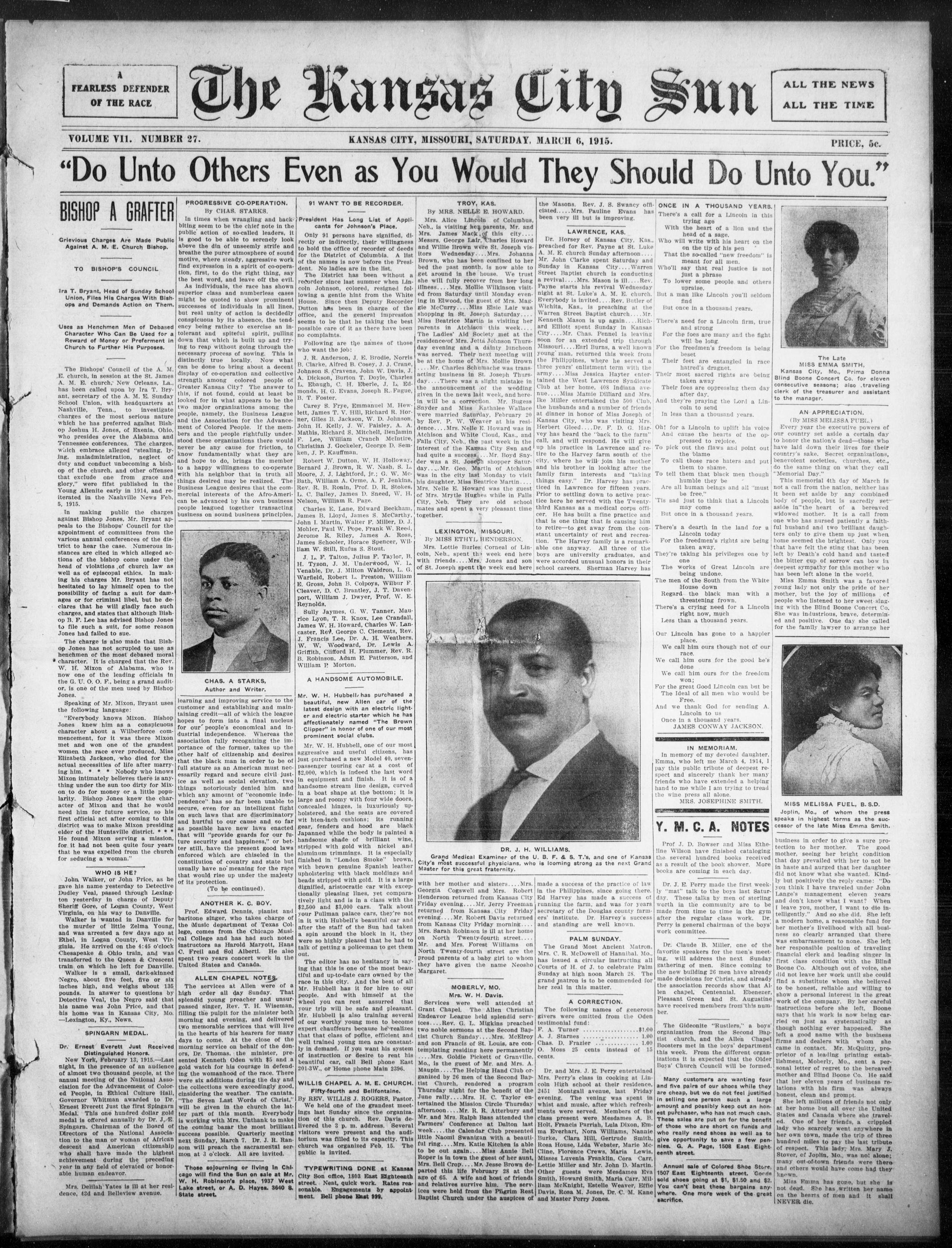
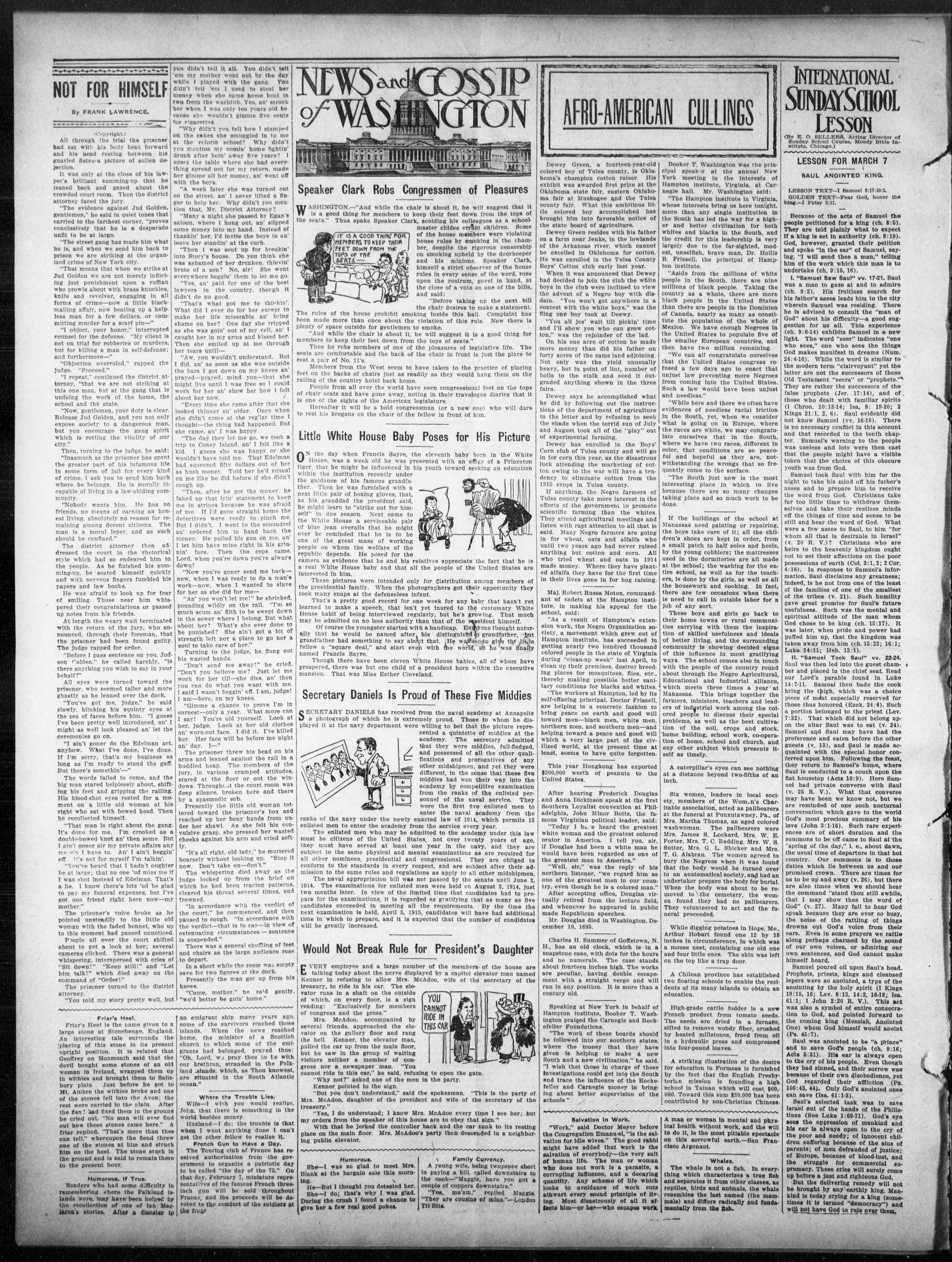
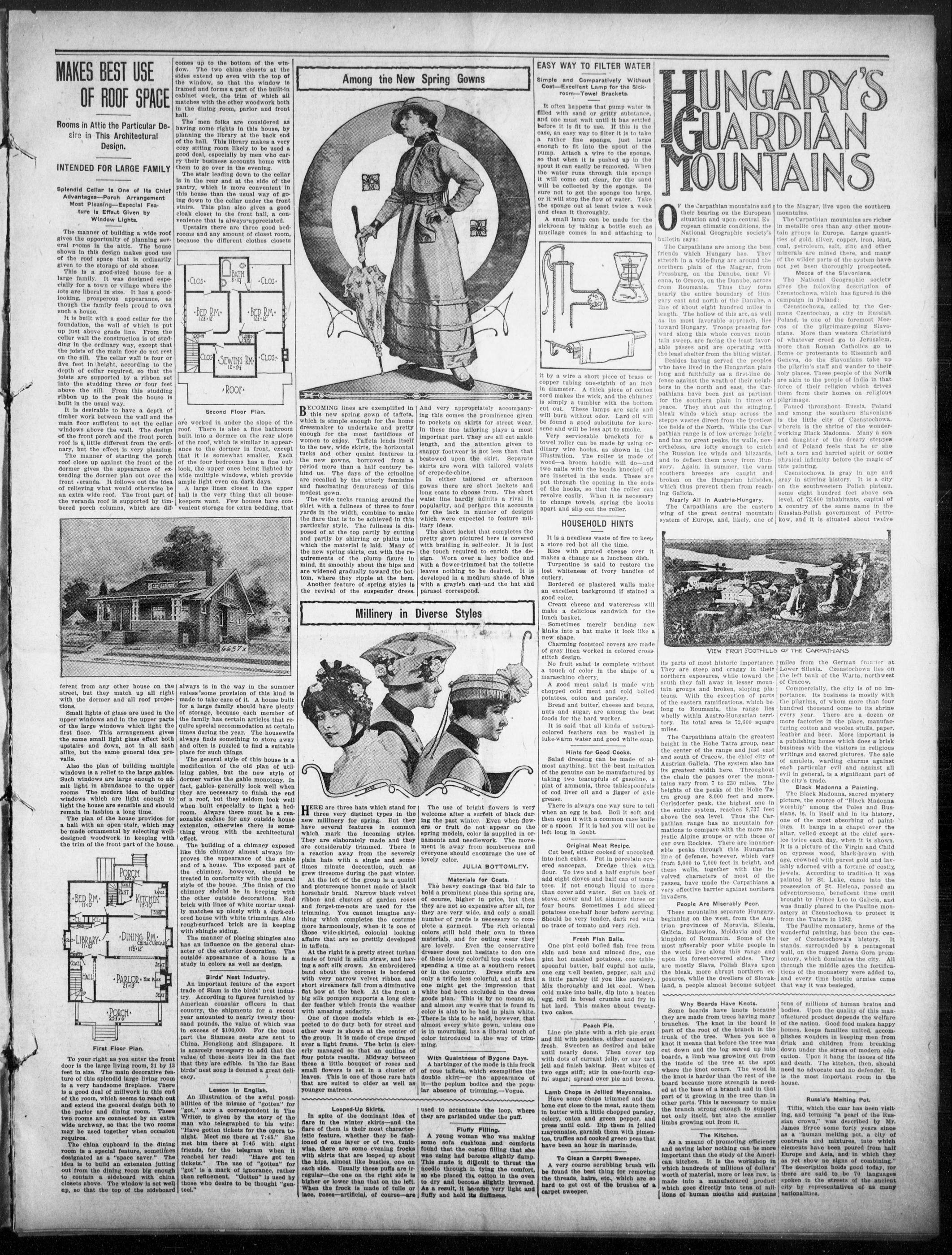
Page text (machine-generated)
"Do Unto Others Even as You Would They Should Do Unto You."
"Do Unto C
---
A FEARLESS DEFENDER OF THE RACE
BISHOP A GRAFTER
Grievious Charges Are Made Public Against A. M. E. Church Bishop.
TO BISHOP'S COUNCIL
Ira T. Bryant, Head of Sunday School Union, Files His Charges With Bishops and Demands Action On Them.
Uses as Henchmen Men of Debased Character Who Can Be Used for a Reward of Money or Preferment in Church to Further His Purposes.
The Bishops' Council of the A. M. E. church, in session at the St. James A. M. E. church; New Orleans, La. has been called upon by Ira T. Bryant, secretary of the A. M. E. Sunday School Union, with headquarters at Nashville, Tenn., to investigate charges of the most serious nature which he has preferred against Bishop Joshua H. Jones, of Exenla, Ohio who presides over the Alabama and Tennessee conferences. The charges which embrace alleged "stealing, lying, maladministration, neglect of duty and conduct unbecoming a bishop op of the church, and other offenses that exclude one from grace and glory," were first published in the Young Allenite early in 1914, and reiterated in the Nashville News Feb 5, 1915.
In making public the charges against Bishop Jones, Mr. Bryant appeals to the Bishop's Council for the appointment of committees from the various annual conferences of the district to hear the case. Numerous instances are cited in which alleged actions of the bishop come under the head of violations of church law as well as of episcopal ethics. In making his charges Mr. Bryant has not hesitated to lay himself open to the possibility of facing a suit for damages or for criminal libel, but he declares that he will gladly face such charges, and states that although Bishop B. F. Lee has advised Bishop Jones to file such a suit, for some reason Jones had failed to sue.
The charge is also made that Bishop Jones has not scrupled to use as hechmen of the most debased moral character. It is charged that the Rev. W. H. Mixon of Alabama, who is now one of the leading officials in the G. U. O. O. F., being a grand auditor, is one of the men used by Bishop Jones.
Speaking of Mr. Mixon, Bryant uses the following language:
"Everybody knows Mixon. Bishop Jones knew him as a conspicuous character about a Wilberforce commencement, for it was there Mixon met and won one of the greatest women the race ever produced, Miss Elizabeth Jackson, who died for the actual necessities of life after marrying him. * * * Nobody who knows Mixon intimately believes there is any thing under the sun too dirty for Mixon on to do for money or a little popularity. Bishop Jones knew the character of Mixon and that he would need him for future service, so his first official act after coming to this district was to make Mixon presiding elder of the Huntsville district. * * * He found Mixon serving a mission for it had not been quite four years that he was expelled from the church for seducing a woman."
WHO IS HE?
John Walker, or John Price, as he gave his name yesterday to Detective Dudley Veal, passed through Lexington yesterday in charge of Deputy Sheriff Gore, of Logan County, West Virginia, on his way to Danville.
Walker is wanted in Danville for the murder of little Zelma Young, and was arrested a few days ago at Ethel, in Logan County, West Virginia. He arrived on the 4:45 o'clock Chesapeake & Ohio train, and was transferred to the Queen & Crescent train on which he left for Danville.
Walker is a small, dark-skinned Negro, about five feet, five or six inches high, and weighs about 135 pounds. In answer to questions by Detective Veal, the Negro said that his name was John Price, and that his home was in Kansas City, Mo.
—Lexington, Ky., News.
SPINGARN MEDAL
Dr. Ernest Everett Just Received Distinguished Honors.
New York, February 13, 1915—Last night, in the presence of an audience of almost two thousand people, at the annual meeting of the National Association for the Advancement of Color People, in Ethical Culture Hall Governor Whitman awarded to Dr. Ernest Everett Just the first Spingarng Medal. This one hundred dollar gold medal is offered annually by Dr. J. E Spingarng, Chairman of the Board of Directors of the National Association to the man or woman of African descent and American citizenship who shall have made the highest achievement during the preceding year in any field of elevated or honorable human endeavor.
Mrs. Deillah Yates is ill at her residence. 43d and Belleview view.
The Kansas City Sun
PROGRESSIVE CO-OPERATION.
By CHAS. STARKS.
In times when wrangling and backbiting seem to be the chief note in the public action of so-called leaders, it is good to be able to serenely look above the din of unseemly strife and breathe the purer atmosphere of sound motive, where steady, aggressive work find expression in a spirit of co-operation, first, to do the right thing, say the best word, and leave off the evil
As individuals, the race has shown superior class and numberless cases might be quoted to show prominent successes of individuals in all lines, but real unity of action is decidedly conspicuous by its absence, the tendency being rather to exercise an intolerant and spiteful spirit, pulling down that which is built up and trying to reap without going through the necessary process of sowing. This is distinctly true locally. Now what can be done to bring about a decent display of co-operation and collective strength among colored people of Greater Kansas City? The answer to this, if not found, could at least be looked for in what appears to be the two major organizations among the people, namely, the Business League and the Association for the Advancement of Colored People. If the members and the people rightfully understood these organizations there would never be any cause for friction, to know fundamentally what they are and hope to do, brings the member to a happy willingness to co-operate with his neighbor that in truth all things desired may be realized. The Business League desires that the commercial interests of the Afro-American be advanced by his own business people leagued together transacting business on sound business principles,
A. E.
CHAS. A STARKS, Author and Writer
learning and improving service to the customer and establishing and maintaining credit—all of which the league hopes to form into a final nucleus for our people's economical and industrial independence. Whereas the association fully recognizing the importance of the former, takes up the other half of citizenship and desires that the black man in order to be of full stature as an American must necessarily regard and secure civil justice as well as social elevation, two things notoriously denied him and which any amount of "economic independence" has so far been unable to secure, even for an intelligent fight on such laws that are discriminatory and hurtful to our cause and so far as possible have new laws enacted that will "provide guards for our future security and happiness," or better still, have the present good laws enforced which are chiseled in the constitution of country and state but usually have no meaning for the race that would rise up under the majesty of its protection.
(To be continued.)
ANOTHER K. C. BOY
Prof. Edward Dennis, pianist and baritone singer, who takes charge of the Music department of Texas College, comes from the Chicago Musical College and has had such noted instructors as Harold Maryott, Hans C. Freil and Sol Alberti. He also spent two years concert work in the United States and Canada.
ALLEN CHAPEL NOTES.
The services at Allen were of a high order all day Sunday. That splendid young preacher and unsurpassed singer, Rev. T. H. Wiseman, filling the pulpit for the minister both morning and evening, and delivered two memorable services that will live in the hearts of his hearers for many days to come. At the close of the morning service on behalf of the donors, Dr. Thomas, the minister, presented Kenneth Oden with $5 and a gold watch for his courage in defending the womanhood of the race. There were six additions during the day and the collections were exceedingly good, considering the weather. The canata, "The Seven Last Words of Christ," will be given in the church the latter part of this month. Everybody is working with Mrs. Unthank to make the coming bazar the most brilliant success possible. Quarterly meeting next Sunday, March 7. Dr. J. R. Ransom will preach the sacramental semen at 3 o'clock. All are invited.
Those sojourning or living In Chicago will find the Sun on sale at Mr. W. H. Robinson's place, 1937 West Lake street, or A. D. Hayes. 3640 S. State street.
KANSAS CITY, MISSOURI, SATURDAY, MARCH 6, 1915.
91 WANT TO BE RECORDER.
President Has Long List of Applicants for Johnson's Place.
Only 91 persons have signified, directly or indirectly, their willingness to hold the office of recorder of deeds for the District of Columbia. A list of the names is now before the President. No ladies are in the list.
The District has been without a recorder since last summer when Lincoln Johnson, colored, resigned following a gentle hint from the White House. Since then Deputy Recorder Dutton has been in charge of the office, and the general impression seems to be that he taking the best possible care of it as there have been no complaints.
Following are the names of those who want the job:
J. R. Anderson, J. E. Brodle, Norris B. Clarke, Alfred B. Cosey, J. J. Crane, Johnson S. Cravens, John W. Davis, J. A. Dickson, Burton T. Doyle, Charles L. Ebaugh, C. H. Eberle, J. L. Edmonds, H. G. Evans, Joseph R. Fague, B. T. Foster.
Carey S. Frye, Emmanuel M. Hewlett, James T. V. Hill, Richard R. Horner, Giles B. Jackson, W. D. Johnson, John H. Kelly, J. W. Paisley, A. A. Mathis, Richard S. Mitchell, Benjamin F. Lee, William Cranch McIntire, Christian J. Gockeler, George D. Semken, J. P. Kauffman.
Robert W. Dutton, W. H. Holloway, Bernard J. Brown, R. W. Nash, S. L. Moore, J. J. Lightford, jr.; G. W. McBath, William A. Orme, A. F. Jenkins, Rev. R. B. Ronin, Prof. D. R. Stokes, L. C. Bailey, James D. Sneed, W. H. Nelson, William R. Page.
Charles E. Lane, Edward Beckham, James B. Lloyd, James S. McCarthy, John I. Martin, Walter F. Miller, D. J. Mohler, Paul W. Pope, Frank W. Reed, Jerome R. Riley, James A. Ross, James Schooler, Horace Spencer, William W. Still, Rufus S. Stout.
J. L. F. Talton, Julius F. Taylor, B. H. Tyson, J. M. Underwood, W. L. Vanable, Dr. J. Milton Waldron, L. G. Warfield, Robert L. Preston, William E. Gross, John B. Colpoys, Wilbur F. Cleaver, D. C. Brantley, J. T. Davenport, William J. Dwyer, Prof. W. E. Reynolds.
Sully Jaymes, G. W. Tanner, Maurice Lyon, T. R. Knox, Lee Crandall, James W. H. Underwood, Charles W. Lancaster, Rev. George C. Clements, Rev. J. Francis Lee, Dr. A. H. Weathers, W. W. Woodward, Dr. Lewis A. Griffith, Clifford H. Plummer, Rev. R. B. Robinson, Adam E. Patterson, and William P. Morton.
A HANDSOME AUTOMOBILE.
Mr. W. H. Hubbell has purchased a beautiful, new Allen car of the latest design with an electric lighter and electric starter which he has affectionately named "The Brown Clipper" in honor of one of our most prominent social clubs.
Mr. W. H. Hubbell, one of our most aggressive and useful citizens, has just purchased a new Model 40, seven passenger touring car at a cost of $2,000, which is indeed the last word in equipment and finish. It is of a handsome stream line design, curved in a boat shape at the bottom; it is large and roomy with four wide doors, concealed hinges, is luxuriously upholstered, and the seats are covered witten-inch cushions; its running gear, fenders and hood are black Japanmed while the body is painted a handsome shade of brilliant wine, stripped with gold with nickel and aluminum trimmings. It is especially finished in "London Smoke" brown, with brown genuine Spanish leather upholstered with black moldings and beads stripped with gold. It is a large dignified, aristocratic car with exceptionally pleasing lines, yet comparatively light and is in a class with the $2,500 and $3,000 cars. Talk about your Pullman palace cars, they're not in it with Hubbell's beautiful car and after the staff of the Sun had taken a spin around the block in it, they were so highly pleased that he had to talk of getting a policeman to get them out.
The editor has no hesitancy in saying that this is one of the most beautiful and up-to-date cars owned by the race in this city. And the best of all Mr. Hubbell has it for hire to our people. And with himself at the wheel you can rest assured that your trip will be safe and pleasant. Mr. Hubbell is also training several of our worthy young men to become expert chauffeurs because he realizes that that class of polite, efficient and well trained young men are constantly in demand. If you want his system of instruction or desire to rent his beautiful car, call Bell phone East 201-3W., or Home phone Main 2396.
WILLIS CHAPEL A. M. E. CHURCH
Fifty-fourth and Bellfortaine.
Fifty-fourth and Belfontaine.
By REV. WILLIIS J. ROGERS, Pastor
We held one of the grandest meetings last Sunday since the organization of this church. Rev. Davis delivered the 3 p. m. address. Several visitors were present and the auditorium was filled to its capacity. This church was organized Feb. 15. The public is invited.
TYPEWRITING DONE at Kansas City Son office, 1803 East Eighteenth street. Neat, quick work. Rates reasonable. Engagements by appointment. Bell phone E999.
BY MRS. NELLE E. HOWARD.
Mrs. Alice Lincoln of Columbus
Neb., is visiting her parents, Mr. and
Mrs. James Mack of this city....
Messrs. George Lair, Charles Howard
and Wille Brown were St. Joseph visi
tors Wednesday...Mrs. Johanns
Brown, who has been confined to her
bed the past month, is now able to
get around in the house. We trust
she will fully recover from her long
illness...Mrs. Mollie Wilkinson visit
ed from Saturday until Monday evening
in Elwood, the guest of Mrs. Mag
gie McCurry...Miss Elsie Lair was
shopping in St. Joseph Saturday.....
Miss Beatrice Martin is visiting her
parents in Atchison this week.
The Ladies' Aid Society met at the
residence of Mrs. Jetta Johnson Thursday
evening and a dainty luncheon
was served. Their next meeting will
be at the home of Mrs. Mollie Brown
...Mr. Charles Schmachem was transacting
business in St. Joseph Thursday....There was a slight mistake in the announcement of the wedding
given in the news last week, and here
in will be a correction. Mr. Bugess
Snyder and Miss Kathalee Wallace
were married Saturday, February 20
by Rev. P. W. Weaver at his residence
in Atchison and White Cloud, Kas,
and Falls City, Neb., the past week in the
interest of the Kansas City Sun and
had quite a success....Mr. Boyd Snyder was a St. Joseph shopper Saturday....Mr. Geo. Martin of Atchison was in the city last Monday to visit his daughter, Miss Beatrice Martin....Mrs. Nelle E. Howard was the guest
of Mrs. Mrytle Hughes while in Falls
City, Neb. They are old school
mates and spent a very pleasant time
together.
LEXINGTON, MISSOURI.
BY MISS ETHYL HENDERSON.
Mrs. Lottie Burles Corneal of Lin
coln, Neb. spent the week end here
with friends.....Mrs. Jones and son
of St. Joseph spent the week end here
DR. J. H.
Grand Medical Examiner of the City's most successful physicians, where Master for this great fraternity.
A.
DR. J. H. WILLIAMS.
Grand Medical Examiner of the U. B. F. & S. T.'s, and one of Kansas City's most successful physicians, who is looming strong as the next Grand Master for this great fraternity.
with her mother and sisters...Mrs. Georgia Cogswell and Mrs. Robert Henderson returned from Kansas City Friday evening...M. Jerry Freeman returned from Kansas City Friday evening...Mr. Robert Davis returned from Kansas City Friday morning...Mrs. Sarah Robinson is ill at her home on North Twenty-fourth street...Mr. and Mrs. Forest Williams on North Twenty-fourth street are the proud parents of a baby girl to whom they have given the name Neosho Margaret.
made a success of the practice of law in the Philippines, since going there Ed Harvey has made a success of running the farm, and was for years secretary of the Douglas county farmers' institute. Dr. Harvey's success and standing are well known.
PALM SUNDAY.
The Grand Most Ancient Matron Mrs. C. R. McDowell of Hannibal, Mo. has issued a circular instructing at Courts of H. of J. to celebrate Palm Sunday at high noon, March 28.
Services were well attended at Grant Chapel. The Allen Christian Endeavor League held splendid services...Rev. G. L. Migkins preached two noble sermons at the Second Baptist Church Sunday...Mrs. McEliroy and son Francis of St. Louis, are contemplating residing here permanently...Mrs. Goldie Pickett of Granville, Mo, is the guest of Mr. and Mrs. A. Maupin...The Helping Hand Club organized by 26 men of the Second Baptist Church, rendered a program Thursday night for the benefit of the June rally...Mrs. H. C. Taylor entertained the Mission Circle Thursday afternoon...Mrs. R. R. Atterbury and Mr. and Mrs. Ralph Battened the Farmers' Conference at Dalton last week...the Calendar Club presented little Naomi Swanian with a beautiful ring...Mrs. Katie Kitchen is able to be out again...Miss Annie Bell Roper is in the town of the guest of her aunt, Mrs. Bell Crop...Mr. Jesse Brown departed this life February 28 at the age of 65. A wife and host of friends and relatives survive him. The services were held from the Phigrim Rest Baptist church under the auspices of
TROY. KAS.
MOBERLY MO
Mrs. W. H. Davis
the Masons. Rev. J. S. Swancy offi
clated.....Mrs. Pauline Evans has
been very ill but is improving.
Dr. Horsey of Kansas City, Kas. preached for Rev. Payne at St. Luke A. M. E. church Sunday afternoon.... Mr. John Clarke spent Saturday and Sunday in Kansas City....Warren Street Baptist church is conducting a revival....Mrs. Mason is ill....Rev Payne starts his revival Wednesday night at St. Luke's A. M. E. church Everybody is invited....Rev. Butler of Wichita, Kas., is preaching at the Warren Street Baptist church....Mr. Kenneth Mason is up again....Richard Elliott spent Sunday in Kansas City....Mr. Chas. Pennel is leaving soon for an extended trip through Missouri....Earl Burns, a well known young man, returned this week from the Philippines, where he served a three years' enlistment term with the army....Miss Jessica Hayter entertained the West Lawrence Syndicate Club at her home, 408 Indiana avenue....Miss Mamie Dilliam Ike Miller entertained the 500 Club, the husbands and a number of friends at dinner in honor of Miss Joseph of Kansas City, who was visiting Mrs. Herbert Gleed....Dr. F. D. G. Harvey has heard the "back to the farm" call, and will respond. He will give up his practice in Lawrence and retire to the Harvey farm south of the city, where he will join his mother and his brother in looking after the family farm interests and "taking things easy." Dr. Harvey has practiced in Lawrence for fifteen years. Prior to settling down to active practice here he served with the Twenty-third Kansas as a medical corps officer. He has built a fine practice and that is one thing that is causing him to retire—to get away from the constant uncertainty of rest and recreation. The Harvey family is a remarkable one anyway. All three of the boys are university graduates, and were accorded unusual honors in their school careers. Sherman Harvey has
WILLIAMS.
J. B. F. & S. T.'s, and one of Kansas
is looming strong as the next Grand
made a success of the practice of law in the Philippines, since going there. Ed Harvey has made a success of running the farm, and was for years secretary of the Douglas county farmers' institute. Dr. Harvey's success and standing are well known.
The Grand Most Ancient Matron,
Mrs. C. R. McDowell of Hannibal. Mo.
has issued a circular instructing all
Courts of H. of J. to celebrate Palm
Sunday at high noon March 28. The
grand matron is to be commended for
her zeal in this matter.
The following names of generous givers were omitted from the Oden testimonial fund:
F. A. Turner ... $1.00
A. J. Starnes ... 1.00
Chas. D. Frazier ... 1.00
O. Moss 25 cents instead of 15 cents.
Dr. and Mrs. J. E. Perry entertained Mrs. Perry's class in cooking at Lincoln High school at their residence, 2451 Montgall avenue, last Friday evening. The vening was spent in whist and music, after which refreshments were served. Members of the class present were Mesdames A. B. Holt, Francis Parrish, Lula Dixon, Emma Everhart, Nora Williams, Nannie Burke, Clara Hill, Gertrude Smith, Rosa House, Lida Webster, Marie McCline, Florence Crews, Maria Lewis, Misses Luvenia Franklin, Cora Carr, Lettie Miller and Mr. John D. Martin. Other guests were Mesdames Eva Smith, Howard Smith, Maria Carr, Milliam McKnight, Estelle Weaver, Effie Davis, Rosa M. Jones, Dr. C. M. Kane and Master Perry Jones.
LAWRENCE, KAS
PALM SUNDAY
A CORRECTION.
ONCE IN A THOUSAND YEARS.
There's a call for a Lincoln in this trying age
With the heart of a lion and the head of a sage.
Who will write with his heart on the on the tip of his pen
That the so-called "new freedom" is meant for all men.
Who'll say that real justice is not just a phrase
To lower some people and others upraise.
But a man like Lincoln you'll seldom find
But once in a thousand years.
There's need for a Lincoln firm, true and strong
For the foes are many and the fight will be long.
For the freedmen's freedom is being beset
Their feet are entangled in race hatred's dragnet.
Their most sacred rights are being taken away
Their foes are oppressing them day after day.
And they're praying the Lord a Lincoln to send
In less than a thousand years.
Oh! for a Lincoln to uplift his voice
And cause the hearts of the oppressed to rejoice.
To pick out the flaws and point out the blame
To call those race haters and put them to shame.
To tell them that black men though humble they be
Are all human beings and all "must be free."
Tis sad just to think that a Lincoln may come
But once in a thousand years.
There's a dearth in the land for a Lincoln today
For the freedmen's rights are being taken away.
They're taking his privileges one by one
The works of Great Lincoln are being undone.
The men of the South from the White House down
Regard the black man with a threatening frown.
There's a crying need for a Lincoln right now, much
Less than a thousand years.
Our Lincoln has gone to a happier place.
We call him ours though not of our race.
We call him ours for the good he's done
We call him ours for the freedom won;
For the great Good Lincoln can but be
The ideal of all men who would be Free.
And we thank God for sending A. Lincoln to us
Once in a thousand years.
JAMES CONWAY JACKSON.
IN MEMORIAM
In memory of my devoted daughter, Emma, who left me March 4, 1914, I pay this public tribute of deepest respect and sincerely thank her many friends who have extended a helping hand to me while I am trying to tread the wine press all alone.
MRS. JOSEPHINE SMITH.
Y. M. C. A. NOTES
Prof J. D. Bowser and Miss Etheline Wilson have finished cataloging the several hundred books received as a result of the book shower. More books are coming in each day.
Dr. J. E. Perry made the first weekly "mat" talk to the boys last Saturday. These talks by men of sterling worth in the community are to be made from time to time in the gym after the regular class work. Dr. Perry is general chairman of the boys work committee.
Dr. Claude B. Miller, one of the favorite speakers for the men's meeting, will address the next Sunday gathering of men. Since coming to the new building 26 men have already made decisions for Christ, and already the association records show that Allen chapel, Centennial, Ebenezer Pleasant Green and St. Augustine have received members from this number.
The Gideonite "Rustlers," a boys organization from the Second Baptist church, and the Allen Boosters met in the boys' department this week. From the different organizations it is expected that the Older Boys' Church Council will be formed
Many customers are wanting four and five pairs of our shoes while they are cheap, but we do not feel justified in selling one person such a large amount and possibly keep out an honest purchaser, who has not much cash. These sales are put on for the benefit of those who are short on funds and who really need shoes as well as to give opportunity to save a few pennies. G. A. Page, 1508 East Eighteenth street.
Annual sale of Colored Shoe Store, 1507 East Eighteenth street. Cords sold shoes going at $1, $1.50 and $2. You can't beat those bargains anywhere. One more week of the great sacrifice.
ALL THE NEWS
ALL THE TIME
PRICE. 5c.
M.
Kansas City, Mo., Prima Donna Blind Boone Concert Co. for eleven consecutive seasons; also, traveling clerk of the treasurer and assistant to the manager.
AN APPRECIATION.
Every year the executive powers of our country set aside a certain day to honor the nation's dead—those who have laid down their lives for their country's sake. Secret organizations, benevolent societies, churches, etc., do the same thing on what they call "Memorial Day."
This memorial 4th day of March is not a call from the nation, neither has it been set aside by any combined body of people, but is sacredly set aside in the heart of a bereaved widowed mother. It is a call from one who has nursed patiently a faithful husband and two brilliant daughters only to give them up just when home seemed the brightest. Only you that have felt the sting that has been left by Death's cold hand and tasted the bitter cup of sorrow can bow in deepest sympathy for this mother who has been left alone in the world.
Miss Emma Smith was a favored young lady not only the pride of her mother, but the joy of millions of people who listened to her sweet-singing with the Blind Boone Concert Co. She was industrious, brave, determined and positive. One day she called for the family lawyer to arrange her
MISS MELISSA FUEL, B.S.D.
Joplin, Mo., of whom the press
speaks in highest terms as the suc-
cessor of the late Miss Emma Smith.
business in order to give a sure protection to her mother. The good mother, seeing her bright condition that day prevailed with her to not be in haste and aurged that her daughter did not know what she wanted. Kindly but positively the reply came: "Do you think I have traveled under John Lange's management eleven years and don't know what I want? When I leave you, mother, I want to die intelligently." And so she did. She left a modern home, a reasonable fund for her mother's livelihood with all business so clearly arranged that there was embarrassment to none. She left her responsible position of traveling financial clerk and leading singer in first class condition with the Blind Boone Co. Although out of voice, she did not leave her work until she could find a substitute whom she believed to be honest, reliable and willing to show a personal interest in the great work of the company. By her careful instructions before she left, Boone says that his work is now being carried on just as systematically as though nothing ever happened. She left a good name with the business firms and dealers with whom she came in contact. Mr. McQuilty, proprietor of a leading printing establishment, Moberly, Mo., sent a personal letter of regret to the bereaved mother and Blind Boone Co. He said that her eleven years of business relations with his firm was always honest, clean and prompt.
She left millions of friends not only at her home but all over the United States and Canada where she travelled. One of her friends, a crippled lady who scarcely went anywhere in her own town, made the trip of three hundred miles to pay the last tribute of respect. This lady; Mrs. Mary J. Stover, of Joplin, Mo., was not alone; many out-of-town friends were there and others would have come had they known.
Miss Emma has gone, but she is not dead. She has written her name on the hearts of men and it shall NEVER die.
NOT FOR HIMSELF
By FRANK LAWRENCE.
(Copyright.)
All through the trial the prisoner had sat with his body bent forward and his head resting between his gnarled fists—a picture of sullen dejection.
It was only at the close of his lawyer's brilliant summing-up that he leaned back and gazed about the crowded court room. Then the district attorney faced the jury.
"The evidence against Jud Golden, gentlemen," he said in quiet tones that carried to the farthest corner, "proves conclusively that he is a desperado unfit to be at large.
"The street gang has made him what he is, and when we send him back to prison we are striking at the organized crime of New York city.
"That means that when we strike at Jud Golden we are not merely inflicting just punishment upon a ruffian who prowls about with brass knuckles, knife and revolver, engaging in all forms of crime—now a little blackmailing affair, now beating up a helpless man for a few dollars, or committing murder for a scarf pin—"
"I object, your honor," interrupted counsel for the defense. "My client is not on trial for robberies or murders, but for killing a man in self-defense; and furthermore—"
"Objection overruled," rapped the judge. "Proceed."
"I repeat," continued the district attorney, "that we are not striking at this one man, but at the gang that is undoing the work of the home, the school and the state."
"Now, gentlemen, your duty is clear. Release Jud Golden, and you not only expose society to a dangerous man, but you encourage the gang spirit which is rotting the vitality of our city."
Then, turning to the judge, he said:
"Inasmuch as the prisoner has spent the greater part of his infamous life in some form of jail for every kind of crime, I ask you to send him back where he belongs. He is morally incapable of living in a law-abiding community.
"Nobody wants him. He has no friends, no means of earning an honest living, absolutely no reason for remaining among decent citizens. The man is a moral leaper, and as such should be confined."
The district attorney then addressed the court in the rhetorical style which had so endeared him to the people. As he finished his summing-up, he seated himself quickly and with nervous fingers fumbled his papers and law books.
He was afraid to look up for fear of smiling. Those near him whispered their congratulations or passed up notes from his friends.
At length the weary wait terminated with the return of the jury, who announced, through their foreman, that the prisoner had been found guilty. The judge rapped for order.
"Before I pass sentence on you, Judson 'olden,' he called harshly, 'is there anything you wish to say in your behalf?"
All eyes were turned toward the prisoner, who seemed taller and more ghastly as he leaned over the dock.
"You've got me, judge," he said slowly, blinking his squinty eyes at the sea of faces before him. "I guess I've been pretty well introduced, an' I might as well look pleased an' let the ceremonies go on.
"I ain't goner do the Edelman act, anyhow. What I've done, I've done. If I'm sorry, that's my business as long as I'm ready to stand the gaff. But there's somethin'—"
The words failed to come, and the big man stared helplessly about, shifting his feet and gripping the railing. His blood-shot eyes rested for a moment on a little old woman at his right who sat with bowed head. Then he recollected himself.
"That man is right about the gang. It's done for me. I'm crooked as a double-bowed knot an' then some. But I ain't goner air my private affairs any more. I have to. An' ain't beging off, it's not for my 'I'm talkin'.
"You've heard that I hadn't oughther he at large; that no one 'ud miss me if I was shot instead of Edelman. That's a lie. I know there's lots 'ud be glad to pay my funeral expenses, but I've got one friend right here now—my mother."
The prisoner's voice broke as he pointed unsteadily to the little old woman with the faded bonnet, who up to this moment had passed unnoticed.
People all over the court shifted about to get a look at her; several cameras clicked. There was a general whispering, interspersed with cries of "Sit down!" "Keep still!" and "Let him talk!" which died away on the command of "Order!"
The prisoner turned to the district attorney.
Friar's Heel.
Friar's Heel is the name given to a large stone at Stonehenge, England. An interesting tale surrounds the placing of this stone in its present upright position. It is related that Geoffrey on Monmouth said that the devil bought some stones of an old woman in Ireland, wrapped them up in withies and brought them to Salisbury plain. Just before he got to Mt. Ambre the withies broke and one of the stones fell into the Avon; the rest were carried to the plain. After the fen', had fixed them in the ground he cried out. "No man will ever find out how these stones came here." A friar replied. "That's more than the can tell," whereupon the flend threw one of the stones at him and struck him on the heel. The stone stuck in the ground and is said to remain there to the present hour.
Humorous. If True
Readers who had some difficulty in remembering where the Falkland islands were, may have been helped by the recollection of one of Ian Maclaren's stories. After a disaster to
you didn't tell it all. You didn't tell 'em my mother went out by the day while I played with the gang. You didn't tell 'em I used to steal her money when she came home bent in two from the washstub. Yes, an' struck her when I was only ten years old because she wouldn't gimme five cents for cigarettes.
"Why didn't you tell how I stamped on the cakes she smuggled in to me at the reform school? Why didn't you mention my comin' home sightin' drunk after bein' away five years? I upset the table where she had everything spread out for my return, made her gimme all her money, an' went off with the boys.
"A week later she was turned out on the street, an' I never lifted a finger to help her. Why didn't you mention that, Mr. District Attorney?
"Many a night she passed by Egan's saloon, where I hung out, an' slipped some money into my hand. Instead of thankin' her, I'd invite the boys in an' leave her standin' at the curb
"Then I was sent up for breakin' into Story's house. Do you think she was ashamed of her drunken, thevien' brute of a son? No, sir! She went everywhere beggin' them to let me go. "Yes, an' paid for one of the best lawyers in the country, though it didn't do no good. "That's what got me to think': What did I ever do for her except to make her life miserable an' bring shame on her? One day she tripped as she was goin' out of my cell, an' I caught her in my arms and kissed her. Then she smiled up at me through her tears until— "Aw, you wouldn't understand. But I did, an' as soon as she was outside the bars I got down on my knees an' prayed—prayed, mind you—that she might live until I was free so I could work for her an' show her how I felt about her now.
"Every time she came after that she looked thinner an' older. Once when she didn't come at the reg'lar time I thought—the thing had happened. But she came, an' I was happy.
"The day they let me go, we took a trip to Coney Island, an' I felt like a kid. I guess she was happy or she wouldn't have told me. That Edelman had squeezed fifty dollars out of her as hush money. Told her he'd squeal on me like he did before if she didn't cough up.
"Then, after he got the money, he faked up that lyn' statement to keep me in stripes because he was afraid of me. If I'd gone straight home the detectives were ready to pinch me, But I didn't. I went to the scoundrel an' ordered him to hand back the money. He pulled his gun on me, an' I let him have mine right in his grin'n' face. Then the cops came Lord, when you're down you're always down!
"Now you're goner send me back—now, when I was ready to do a man's work—now, when I wanted to slave for her as she did for me—
"An you won't let me!" he shrieked, pounding wildly on the rail. "I'm so much scum an flить to be swept down in the sewer where I belong. But what about her? What's she ever done to be punished? She aln't got a bit of strength left nor a place to go nor a soul to take care of her."
Turning to the judge, he flung out his wasted hands.
"Don't send me away!" he cried. "Don't you believe me? Just let me work for her till—she dies, an' then you can do what you want with me. I said I wasn't beginn' off. I am, judge! I am—here on my knees.
"Gimme a chance to prove I'm in earnest—only a year. What more can I say! You're old yourself. Look at her, judge. Look at her old clothes an' worn-out face. I did it. I've killed her. Her face will be before me night an' day. I—"
The prisoner threw his head on his arms and leaned against the rail in a huddled heap. The members of the jury, in various cramped attitudes, stared at the floor or out the windows. Throughout the court room was deep silence, broken here and there by a spasmodic sob.
Presently the little old woman totered toward the prisoner's box and reached up her bony hands from under her shawl. As she felt his convulsive grasp, she pressed her wasted cheeks against his arm and cried softly.
"It's all right, old lady," he muttered hoarsely without looking up. "Stop it now. Don't take on—don't."
The whispering died away as the judge looked up from the brief on which he had been tracing patterns, cleared his throat several times, and frowned.
"In accordance with the verdict of the court," he commenced, and then paused to cough. "In accordance with the verdict—that is to say—in view of extinguish circumstances — sentence is suspended."
There was a general shuffling of feet and chairs as the large audience rose to depart.
In a short while the room was empty save for two figures at the dock.
Presently the man got up from his knees.
"Come, mother," he said gently, "we'd better be coin' home."
an emigrant ship many years ago, some of the survivors reached those islands. When the news reached home, the minister of a Scottish church to which some of the emigrants had belonged, prayed thus: "Oh, Lord, we pray thee to be with our brethren, stranded in the Falkland islands, which, as Thou knowest, are situated in the South Atlantic ocean."
Where the Trouble Lies.
Wife—I wish you would realize, John, that there is something in the world besides money.
Husband—I do; the trouble is that when I want anything done I can't get the other fellow to realize it.
The Touring club of France has received authorization from the government to organize a patriotic day to be called "the day of the 75." On that day, February 7, miniature representatives of the famous French three-inch gun will be sold throughout France, and the proceeds will be devoted to the comfort of the soldiers at the front.
NEWS and GOSSIP of WASHINGTON
Speaker Clark Robs Congressmen of Pleasures
WASHINGTON.—"And while the chair is about it, he will suggest that it is a good thing for members to keep their feet down from the tops of the seats." Thus spake Speaker Clark, scolding his colleagues as a school-
The rules of the house prohibit smoking inside this hall. Complaint has been made more than once about the violation of this rule. Now there is plenty of space outside for gentlemen to smoke.
"And while the chair is about it, he will suggest it is a good thing for members to keep their feet down from the tops of seats."
Thus he robs members of one of the pleasures of legislative life. The seats are comfortable and the back of the chair in front is just the place to rest a pair of No. 11's.
Members from the West seem to have taken to the practice of placing feet on the backs of chairs just as readily as they would hang them on the railing of the country hotel back home.
People from all over the world have seen congressional feet on the tops of chair seats and have gone away, noting in their travelogue diaries that it is one of the sights of the American legislature.
Hereafter it will be a bold congressman (or a new one) who will dare to rest his brogans on the chair of the fellow in front of him.
Little White House Baby Poses for His Picture
ON the day when Francis Sayre, the eleventh baby born in the White House, was a week old he was presented with an effigy of a Princeton tiger, that he might be influenced in his youth toward seeking an education
camera as evidence that he and his relatives appreciate the fact that he is a real White House baby and that all the people of the United States are interested in him.
These pictures were intended only for distribution among members of the presidential family. When the photographers got their opportunity they took many snaps at the defenseless infant.
That's a pretty good record for one week for any baby that hasn't yet learned to make a speech, that isn't yet inured to the customary White House habit of being interviewed regularly, but he's growing. That much may be admitted on no less authority than that of the president himself.
Of course the youngster started with a handicap. Everyone thought naturally that he would be named after his distinguished grandfather, but grandfather had something to say about that. He was soootic give the little fellow a "square deal," and start even with the world, so he was finally named Francis Sayre.
Though there have been eleven White House babies, all of whom have prospered, there was but one child of a president born within the executive mansion. That was Miss Esther Cleveland.
Secretary Daniels Is Proud of These Five Middies
SECRETARY DANIELS has received from the naval academy at Aunapolis a photograph of which he is extremely proud. Those to whom he displayed it at the navy department were willing to bet that the picture repre
ranks of the navy under the newly enacted law of 1914, which permits 15 enlisted men to enter the academy from the service every year.
The enlisted men who may be admitted to the academy under this law must be citizens of the United States, not over twenty years of age, they must have served at least one year in the navy, and they are subject to the same physical and mental examinations as are required for all other nominees, presidential and congressional. They are obliged to conform to the standards in every respect, and are subject after their admission to the same rules and regulations as apply to all other midshipmen.
The naval appropriation bill was not passed by the senate until June 2, 1914. The examinations for enlisted men were held on August 3, 1914, just two months later. In view of the limited time that candidates had to prepare for the examinations, it is regarded as gratifying that as many as five candidates succeeded in meeting all the requirements. By the time the next examination is held, April 5, 1915, candidates will have had additional time in which to prepare, and it is expected that the number of candidates will be greatly increased.
Would Not Break Rule for President's Daughter
EVERY employee and a large number of the members of the house are talking today about the nerve displayed by a capitol elevator man named Kenner in refusing to allow Mrs. McAdoo, wife of the secretary of the
"But you don't understand," said the spokesman. "This is the party of Mrs. McAdoo, daughter of the president and wife of the secretary of the treasury."
"Yes, I do understand; I know Mrs. McAdoo every time I see her; but my orders from the speaker of this house are to obey that sign."
With that he jerked the controller back and the car sank to its resting place on the main floor. Mrs. McAdoo's party then descended in a neighboring public elevator.
IT IS A GOOD THING FOR MEMBERS TO KEEP THEIR FEET DOWN FROM THE TUPS OF THE GEATS
The rules of the house prohibit smoke been made more than once about the plenty of space outside for gentlemen to "And while the chair is about it, it members to keep their feet down from. Thus he robs members of one of its seats are comfortable and the back of rest a pair of No. 11's. Members from the West seem to be feet on the backs of chairs just as rearailing of the country hotel back home. People from all over the world have of chair seats and have gone away, now is one of the sights of the American l. Hereafter it will be a bold congre to rest his brogans on the chair of the
Little White House Baby
ON the day when Francis Sayre, the House, was a week old he was priger, that he might be influenced in h
within the institution recently under the guidance of his famous grandfather. Then he was furnished with a neat little pair of boxing gloves, that, as his granddad the president said, he might learn to "strike out for himself" in due season. Next came to the White House a serviceable pair of blue jean overalls that he might ever be reminded that he is to be one of the great mass of working people on whom the welfare of the republic depends. He posed for the
camera as evidence that he and his rea real White House baby and that all interested in him.
These pictures were intended only the presidential family. When the pho took many snaps at the defenseless in.
That's a pretty good record for our learned to make a speech, that isn't House habit of being interviewed reg may be admitted on no less authority y.
Of course the youngster started wily that he would be named after grandfather had something to say abe fellow a "square deal," and start even named Francis Sayre.
Though there have been eleven prospered, there was but one child of mansion. That was Miss Esther Cleve
Secretary Daniels Is Pro
SECRETARY DANIELS has received a photograph of which he is extre played it at the navy department were
A man showing a picture of five people.
ranks of the navy under the newly enlisted men to enter the academy free. The enlisted men who may be adm. must be citizens of the United States they must have served at least one subject to the same physical and medical all other nominees, presidential and conform to the standards in every mission to the same rules and regular. The naval appropriation bill was 1914. The examinations for enlisted two months later. In view of the first pare for the examinations, it is regular candidates succeeded in meeting all next examination is held, April 5, 1914 time in which to prepare, and it is en will be greatly increased.
Would Not Break Rule
EVERY employee and a large number talking today about the nerve disp. Kenner in refusing to allow Mrs. M.
treasury, to ride in his car. The elevator runs in a shaft on the outside of which, on every floor, is a sign reading: "Exclusively for members of congress and the press."
Mrs. McAdoo, accompanied by several friends, approached the elevator on the gallery floor and rang the bell. Kenner, the elevator man, pulled the car up from the main floor, but he saw in the group of waiting visitors neither a member of congress nor a newspaper man. "You cannot ride in this car," he said, refu "Why not?" asked one of the men Kenner pointed to the sign.
"But you don't understand," said Mrs. McAdoo, daughter of the presi treasury.
"Yes, I do understand; I know My orders from the speaker of this he With that he jerked the controlle place on the main floor. Mrs. McAdoo ing public elevator.
Humorous.
She—I was so glad to meet Mrs. Blank at the bargain sale this morning.
He—But I thought you detested her. She—I do; that's why I was glad. During the crush I found a chance to give her a few real good pokes.
master childs errant children. Some of the house members were violating house rules by smoking in the chamber, despite the rigorous censorship on smoking upheld by the doorkeeper and his minions. Speaker Clark, himself a strict observer of the house rules in every sense of the word, rose upon the rostrum, gavel in hand, at the close of a vote on one of the bills, and said:
"Before taking up the next bill the chair desires to make a statement.
kling inside this hall. Complaint has
violation of this rule. Now there is
to smoke.
he will suggest it is a good thing for
the tops of seata."
the pleasures of legislative life. The
the chair in front is just the place to
have taken to the practice of placing
adliy as they would hang them on the
have seen congressional feet on the tops
tating in their travelogue diaries that it
legislature.
lessman (or a new one) who will dare
fellow in front of him.
Poses for His Picture
the eleventh baby born in the White
presented with an engy of a Princeton
his youth toward seeking an education
A man is taking a picture of a baby sitting on a chair.
relatives appreciate the fact that he is all the people of the United States are only for distribution among members of photographers got their opportunity they infant. One week for any baby that hasn't yet ity inured to the customary White regularly, but he's growing. That much than that of the resident himself. With a handicap. Each one thought natur- his distinguished grandfather, but out that. He was soo sotto give the little even with the world, so he was finally White House babies, all of whom have of a president born within the executive level.
Proud of These Five Middies
d from the naval academy at Annapolis merely proud. Those to whom he dis- willing to bet that the picture repre-
sented a quintette of middies at the academy. The secretary admitted that they were middies, full-fledged, and possessed of all the other qualifications and prerogatives of any other midshipmen, and yet they were different. In the sense that these five middies had won their way into the academy by competitive examination from the ranks of the enlisted personnel of the naval service. They were the first five enlisted men to enter the naval academy from the
enacted law of 1914, which permits 15
from the service every year.
admitted to the academy under this law
ates, not over twenty years of age,
one year in the navy, and they are
mental examinations as are required for
d congressional. They are obliged to
respect, and are subject after their ad-
tions as apply to all other midshipmen.
not passed by the senate until June 2,
men were held on August 3, 1914, just
limited time that candidates had to pre-
dered as gratifying that as many as five
the requirements. By the time the
1915, candidates will have had additional
expected that the number of candidates
for President's Daughter
number of the members of the house are
played by a capitol elevator man named
McAdoo, wife of the secretary of the
YOU CANNOT RIDE IN THIS CAR
using to open the gate.
en in the party.
and the spokesman. "This is the party of
ident and wife of the secretary of the
Mrs. McAdoo every time I see her; but
ouse are to obey that sign."
her back and the car sank to its resting
oo's party then descended in a neighbor-
A young wife, being twopence short in paying a bill, called downstairs to the cook—"Maggie, have you got a couple of coppers downstairs."
"Yes, ma'am," replied Maggie.
"They are cousins of mine."—London Tit-Bits.
AFRO-AMERICAN CULLINGS
Dewey Green, a fourteen-year-old colored boy of Tulsa county, is Oklahoma's champion cotton raiser. His exhibit was awarded first prize at the Oklahoma state fair, eastern Oklahoma fair at Muskogee and the Tulsa county fair. What this ambitious little colored boy accomplished has brought him into favorable notice of the state board of agriculture. Dewey Green resides with his father on a farm near Jenks, in the lowlands of the Arkansas river, which cannot be excelled in Oklahoma for cotton. He was enrolled in the Tulsa County Boys' Cotton club early last year. When it was announced that Dewey had decided to join the club the white boys in the club were inclined to view the advent of a Negro boy with disdain. "You won't get anywhere in a contest with the white boys," was the fling one boy took at Deewey. "You all jes' wait till pickin' time and I'll show you who can grow cotton," was the rejoinder of the lad.
On his one acre of cotton he made more money than did his father on forty acres of the same land adjoining. Not only was the yield unusually heavy, but in point of lint, number of bolls to the stalk and seed it outgraded anything shown in the three fairs.
Dewey says he accomplished what he did by following out the instructions of the department of agriculture to the letter and by refusing to seek the shade when the torrid sun of July and August took all of the "play" out of experimental farming.
Dewey has enrolled in the Boys' Corn club of Tulsa county and will go in for corn this year, as the disastrous luck attending the marketing of cotton owing to the war will have a tendency to eliminate cotton from the 1915 crops in Tulsa county.
If anything, the Negro farmers of Tulsa county take more interest in the efforts of the government to promote scientific farming than the whites. They attend agricultural meetings and listen with rapt attention to all that is said. Many Negro farmers are going in for wheat, oats and alfalfa who until two years ago had never raised anything but cotton and corn. All who tried wheat and oats in 1914 made money. Where they have planted alfalfa they have for the first time in their lives gone in for hog raising.
Maj. Robert Russa Moton, commandant of cadets at the Hampton institute, in making his appeal for the school, said:
"As a result of Hampton's extension work, the Negro Organization society, a movement which grew out of Hampton institute, has succeeded in getting nearly two hundred thousand colored people in the state of Virginia during "clean-up week" last April, to clean up their premises, destroy breeding places for mosquitoes, flies, etc., thereby making possible better sanitary conditions for blacks and whites. "The workers at Hampton, led by its self-effacing principal, Doctor Fissell, are helping in a concrete fashion to bring peace on earth and good will toward men—black men, white men, northern men, and southern men—and helping toward a peace and good will which a very large part of the civilized world, at the present time at least, seems to have quite forgotten.
This year Hongkong has exported $200,000 worth of peanuts to the United States.
After hearing Frederick Douglas and Anna Dickinson speak at the first Southern Loyalist convention at Philadelphia, John Minor Botts, the famous Virginian political leader, said: "Today I have heard the greatest white woman and the greatest colored orator in America. I tell you, sir, if Douglas had been a white man he would have been regarded as one of the greatest men in America." "Well, sir," was the reply of his northern listener, "we regard him as one of the greatest men in our country, even though he is a colored man." After accepting office, Douglas virtually retired from the lecture field, and whenever he appeared in public made Republican speeches. Mr. Douglas died in Washington, December 10, 1895.
Charles H. Summer of Goffstown, N. H., has an old clock, which is in a soapstone case, with dots for the hours and no numerals. The case stands about fourteen inches high. The works are peculiar, having double escapement with a straight verge and will run in any position. It is more than a century old.
Speaking at New York in behalf of Hampton institute, Booker T. Washington prailed the Carnegie and Rockefeller Foundations.
"The work of these boards should be followed into our southern states, where the money that they have given is helping to make a new South and a new civilization," he said.
"I wish that those in charge of these investigations could get into the South and trace the influence of the Rockefeller and Carnegie money in bringing about better supervision of the schools."
Salvation In Work.
"Work," said Doctor Meyer before the Congregation曼euanul, "is the salvation for idle wives." The good rabbi might have added that work is the salvation of everybody—the very salt of human life. The man or woman who does not work is a parasite, a corrupting influence, and a decaying quantity. Any scheme of life which looks to avoidance of work cuts athewart every sound principle of living. Most disastrously of all it affects him or—her—who escapes work.
Booker T. Washington was the principal speaker at the annual New York meeting in the interests of Hampton institute, Virginia, at Carnegie hall. Mr. Washington said: "The Hampton institute in Virginia, whose interests bring us here tonight, more than any single institution in the South has led the way for a higher and better civilization for both whites and blacks in the South, and the credit for this leadership is very largely due to the far-sighted, modest, unselfish, brave man, Dr. Hollis B. Frissell, the principal of Hampton institute.
"Aside from the millions of white people in the South, there are nine millions of black people. Taking the country as a whole, there are more black people in the United States than there are people in the Dominion of Canada, nearly as many as constitute the population of the whole of Mexico. We have enough Negroes in the United States to populate five of the smaller European countries, and then have two million remaining.
"We can all congratulate ourselves that the United States congress refused a few days ago to enact that unjust law preventing more Negroes from coming into the United States. Such a law would have been unjust and needless."
"While here and there we often have evidences of needless racial friction in the South, yet, when we consider what is going on in Europe, where the races are white, we may congratulate ourselves that in the South, where we have two races, different in color, that conditions are so peaceful and hopeful as they are, notwithstanding the wrongs that so frequently come to the surface.
"The South just now is the most interesting place in which to live because there are so many changes taking place and so much work to be done.
If the buildings of the school at Manassas need painting or repairing, the boys take care of it; all the children's shoes are kept in order, from a small patch to half soles and heels, by the young cobbiers; the mattresses used in the dormitories are all made at the school; the washing for the entire school, as well as for the teachers, is done by the girls, as well as all the housework and cooking. In fact, there are few occasions when there is need to call in outside labor for a job of any sort.
These boys and girls go back to their home towns or rural communities carrying with them the inspiration of skilled usefulness and ideals of better living, and the surrounding community is showing decided signs of this influence in most gratifying ways. The school comes also in touch with the people of the country round about through the Negro Agricultural, Educational and Industrial alliance, which meets three times a year at Manassas. This brings together the farmers, ministers, teachers and leaders of industrial work among the colored people to discuss their special problems, as well as the best cultivation of the soil, crops and stock, home building, school work, co-operation of home, school and church, and any other subject which presents itself as timely.
A caterpillar's eyes can see nothing at a distance beyond two-fifths of an inch.
Six women, leaders in local society, members of the Wom. u's Charitable association, acted as palebearers at the funeral at Punxutawney, Pa., of Mrs. Martha Thomas, an aged colored washwoman. The palebearers were Mrs. James S. Lockard, Mrs. W. E. Porter, Mrs. T. C. Redding, Mrs. W. S. Sutter, Mrs. G. L. Shicker and Mrs. T. G. Alabran. The women agreed to bury the Negress when it was found that the body would be turned over to an anatomical society, and had an undertaker prepare the body for burial. When the body was about to be removed to the cemetery, the women found they had no palebearers. They volunteered to act and the funeral proceeded.
While digging potatoes in Hope, Me., Arthur Hobart found one 12 by 15 inches in circumference, in which was a mouse nest, containing one old one and four little ones. The skin was left on the top like a trap door.
A Chilean province has established two floating schools to enable the residents of its many islands to obtain an education.
High-grade cattle fodder is a new French product from tomato seeds. The seeds are dried in a furnace, sifted to remove wobody fiber, crushed by heated millstones, freed from oil in a hydraulic press and compressed into four-pound loaves.
A striking illustration of the desire for education in Formosa is furnished by the fact that the English Presbyterian mission is founding a high school in Tainan which will cost $60,000. Toward this sum $30,000 has been contributed by non-Christian Chinese.
A man or woman in mental and physical health without work, and the will to do it, is the most pitiful spectacle on this sorrowful earth—San Francisco Argonaut.
Whales.
The whale is not a fish. In everything which characterizes a true fish and separates it from other classes, as reptiles, birds and animals, the whale resembles the last named (the mammals) and differs radically and fundamentally from the fish.
INTERNATIONAL
SUNDAY SCHOOL
LESSON
(By E. O. SELLERI, Acting Director of
courses. Moody Bible Institute,
Chicago).
SAUL ANOINTED KING.
LESSON TEXT—I Samuel 9:17-10:1.
GOLDEN TEXT—Fear God, honor the king.—I Peter 2:17.
Because of the acts of Samuel the people petitioned for a king (ch. 8:5).
They are told plainly what to expect if a king is set in authority (ch. 8:19).
God, however, granted their petition and spoke "in the ear" of Samuel, saying, "I will send thee a man," telling him of the work which this man is to undertake (ch. 9:15, 16).
I. "Samuel Saw Saul" vv. 17:21. Saul was a man to gaze at and to admire (ch. 9:2). His fruitless search for his father's asses leads him to the city wherein Samuel was residing. There he is advised to consult the "man of God" about his difficulty—a good suggestion for us all. This experience (ch. 9:6-14) exhibits Samuel in a new light. The word "seer" indicates "one who sees," one who sees the things God makes manifest in dreams (Num. 24:4-16). While the word is similar to the modern term "clairvoyant" yet the latter are not the successors of these Old Testament "seers" or "prophets." They are rather the successors of the false prophets (Jer. 17:14), and of those who dealt with familiar spirits (I Chron. 10:13:14; Isa. 8: 19:20; 2 Kings 21:1, 2, 6). Saul evidently did not know Samuel (vv. 16:18). There is no necessary conflict in this account and that recorded in the tenth chapter. Samuel's warning to the people was useless and lots were then cast that the people might have a visible token that the choice of this obscure youth was from God.
Samuel took Saul with him for the night to take his mind off his father's asses and to prepare him to receive the word from God. Christians take far too little time to withdraw themselves and take their restless minds off the things of time and sense to be still and hear the word of God. What were a few asses to Saul, to him "for whom all that is desirable in Israel" (v. 20 R. V.)? Christians who are heirs to the heavenly kingdom ought not to set their affections on the poor possessions of earth (Col. 3:1; 2; 2 Cor. 4:18). In response to Samuel's information, Saul disclaims any greatness; indeed, is he not from one of the least of the families of one of the smallest of the tribes (v. 21). Such humility gave great promise for Saul's future usefulness. Such was the mental and spiritual attitude of the man whom God chose to be king (ch. 15:17). It was later, when pride and power had puffed him up, that the kingdom was taken away from him (ch. 15:23; 16:1; Luke 14:11; Heb. 13:1).
H. "Samuel Took Saul" vv. 22-24. Saul was then led into the guest chamber and placed in the chief seat. Read our Lord's parable found in Luke 14:7-11. Samuel then bade the cook bring the thigh, which was a choice piece of maat especially reserved for those thus honored (Ezek. 24:4). Such a portion belonged to the priest (Lev. 7:32). That which did not belong upon the altar Saul was to eat (v. 24). Samuel and Saul may have had the preference and eaten before the other guests (v. 13), and Saul is made acquainted with the special honor conferred upon him. Following the feast, they return to Samuel's home, where Saul is conducted to a couch upon the flat housetop (Acts 10:9). Here Samuel had private converse with Saul (v. 25 R. V.). What that converse may have been we know not, but we are reminded of one such nocturnal conversation which gave to the world God's most precious summary of his love (John 3:1-16). Such rare experiences are of short duration and the summons to be off came to Saul at the "spring of the day," i.e. about dawn, the usual time of departure in that hot country. Our summons is to those duties which lie between us and our promised crown. There are times for us to be up and away (v. 26), but there are also times when we should hear the command "stand thou still awhile, that I may show the word of God" (v. 27). Many fail to hear God speak because they are ever so busy, the noise of the rattling of things drowns out God's voice from their ears. Even in some prayers we rattle along perhaps charmed by the sound of our own voices, or admiring our own sentences, and God cannot make himself heard.
Samuel poured oil upon Saul's head. Prophets, priests, kings and cleansed lepers were so anointed, a type of the anointing by the holy spirit (I Kings 19:15, 16; Lev. 8:12, 14:2, 16:18; Isa. 61:1; I John 2:20 R. V.). This act was also a symbol of entire consecration to God, and pointed forward to the coming king (Messiah, Anointed One) whom God himself would anoint (Ps. 45:7).
Saul was anointed to be "a prince" and to save God's people (ch. 9:16; Acts 5:31). His ear is always open to the cry of his people. Even though they had sinned, and their sorrow was because of their own disobedience, yet God regarded their affliction (Ps. 106:43, 44). Only God anointed ones can save (Isa. 61:13).
Saul's selected task was to save Israel out of the hands of the Philistines (See Luke 1:69-71). God's eye sees the oppression of mankind and his ear is always open to the cry of the poor and needy; of innocent children suffering because of the sins of parents; of men defrauded of justice; of Europe, because of blood-lust, and the struggle for commercial supremacy. These cries will surely come up before a just and righteous God. But the delivering remedy will not be brought by any earthly king. Mankind is today crying for a king (sometimes it is termed "democracy") and will not have God to rule over them.
6657x
MAKES BEST USE OF ROOF SPACE
Rooms in Attic the Particular Desire in This Architectural Design.
INTENDED FOR LARGE FAMILY
Splendid Cellar Is One of Its Chief Advantages—Porch Arrangement Most Pleasing—Especial Feature is Effect Given by Window Lights.
The manner of building a wide roof gives the opportunity of planning several rooms in the attic. The house shown in this design makes good use of the roof space that is ordinarily given to the storage of old shoes.
This is a good-sized house for a large family. It was designed especially for a town or village where the iots are liberal in size. It has a good-looking, prosperous appearance, as though the family feels proud to own such a house.
It is built with a good cellar for the foundation, the wall of which is put up just above grade line. From the cellar wall the construction is of studding in the ordinary way, except that the joists of the main floor do not rest on the sill. The cellar wall is four or five feet in height, according to the depth of cellar required, so that the joists are supported by a ribbon set into the studding three or four feet above the sill. From this studding ribbon up to the peak the house is built in the usual way.
It is desirable to have a depth of timber work between the wall and the main floor sufficient to set the cellar windows above the wall. The design of the front porch and the front porch roof is a little different from the ordinary, but the effect is very pleasing.
The manner of starting the porch roof close up against the front of the dormer gives the appearance of extending the dormer plan out over the front veranda. It follows out the idea of relieving what would otherwise be an extra wide roof. The front part of the veranda roof is supported by timbered porch columns, which are dif
THE HOME OF THE HERITAGE CENTER
ferent from any other house on the street, but they match up all right with the dormer and all roof projections.
Small lights of glass are used in the upper windows and in the upper parts of the large windows which light the first floor. This arrangement gives the same small light glass effect both upstairs and down, not in all sash allie, but the same general idea prevails.
Also the plan of building multiple windows is a relief to the large gables. Such windows are large enough to admit light in abundance to the upper rooms. The modern idea of building windows which are light enough to light the house are sensible and should remain in fashion a long time.
The plan of the house provides for a hall with an open stair, which may be made ornamental by selecting well-designed woodwork in keeping with the trim of the front part of the house.
PORCH
10X2
BED RM.
11X10
KITCHEN
13X10
CL
CL
DINING RM.
CHINA CUPBOARD
17X12
LIBRARY
11X10
COAT
HALL
PARLOR.
THE PLAZA
21X13
PORCH.
25X6
First Floor Plan.
To your right as you enter the front door is the large living room, 21 by 13 feet in size. The main decorative feature of this splendid large living room is a very handsome fireplace. There is a good deal of millwork in this end of the room, which seems to reach out and extend the general design both to the parlor and dining room. These two rooms are connected by an extra wide archway, so that the two rooms may be used together when occasion requires.
The china cupboard in the dining room is a special feature, sometimes designated as a "space saver." The idea is to build an extension jutting out from the dining room big enough to contain a sideboard with china closets above. The window is set well up, so that the top of the sideboard
---
comes up to the bottom of the window. The two china closets at the sides extend up even with the top of the window, so that the window is framed and forms a part of the built-in cabinet work, the trim of which all matches with the other woodwork both in the dining room, parlor and front hall.
The men folks are considered as having some rights in this house, by planning the library at the back end of the hall. This library makes a very cozy sitting room likely to be used a good deal, especially by men who carry their business accounts home with them to go over in the evening.
The stair leading down to the cellar is in the rear and at the side of the pantry, which is more convenient in this house than the usual way of going down to the cellar under the front stairs. This plan also gives a good cloak closet in the front hall, a convenience that is always appreciated.
Upstairs there are three good bedrooms and any amount of closet room, because the different clothes closets
BATH
8 x 10
CLOS.
CLOS.
BED RM.
12 x 12
BED RM.
12 x 12
SHOWN
LAUNDRY
CLOS.
SEWING RM.
12 x 9.5
CLOS.
ROOF
Second Floor Plan.
are worked in under the slope of the roof. There is also a fine bathroom built into a dormer on the rear slope of the roof, which is similar in appearance to the dormer in front, except that it is somewhat smaller. Each of the four bedrooms has a fine outlook, the upper ones being lighted by wide multiple windows, which provide ample light even on dark days. A large linen closet in the upper hall is the very thing that all housekeepers want. Few houses have convenient storage for extra bedding, that
6657x
always is in the way in the summer unless"some provision of this kind is made to take care of it. A house built for a large family should have plenty of storage, because each member of the family has certain articles that require special accommodation at certain times during the year. The housewife always finds something to store away and often is puzzled to find a suitable place for such things. The general style of this house is a modification of the old plan of utilizing gables, but the new style of dormer varies the gable monotony. In fact, gables generally look well when they are necessary to finish the end of a roof, but they seldom look well when built especially to light a bedroom. Always there must be a reasonable excuse for any outside house extension, otherwise there is something wrong with the architectural effect.
The building of a chimney exposed like this chimney almost always improves the appearance of the gable end of a house. The exposed part of the chimney, however, should be treated in conformity with the general style of the house. The finish of the chimney should be in keeping with the other outside decorations. Red brick with lines of white mortar usually matches up nicely with a dark-colored house with white trimmings. Also rough-surfaced brick are in keeping with shingle siding. The manner of placing shingles also has an influence on the general character of the exterior decoration. The outside appearance of a house is a study in colors as well as design.
Birds' Nest Industry
An important feature of the export trade of Slam is the birds' nest industry. According to figures furnished by American consular officers in that country, the shipments for a recent year amounted to nearly twenty thousand pounds, the value of which was in excess of $100,000. For the most part the Siamese nests are sent to China, Hongkong and Singapore. It is scarcely necessary to add that the value of these nests lies in the fact that they are edible. In 'the far East birds' nest soup is deemed a great delicacy.
Lesson in English:
An illustration of the awful possibilities of the misuse of "gotten" for "got," says a correspondent in The Writer, is given by the story of the man who telegraphed to his wife: "Have gotten tickets for the opera tonight. Meet me there at 7:45." She met him there at 7:45 with eight friends, for the telegram when it reached her read: "Have got ten tickets." The use of "gotten" for "got" is a mark of ignorance, rather than refinement. "Gotten" is used by those who desire to be thought "genteel."
A
Millinery in Diverse Styles
---
BECOMING lines are exemplified in this new spring gown of taffeta, which is simple enough for the home dressmaker to undertake and pretty enough for the most fastidious of women to enjoy. Taffeta lends itself to the new, wide skirts, the horizontal tucks and other quaint features in the new gowns, borrowed from a period more than a half century behind us. The days of the crinoline are recalled by the utterly feminine and fascinating demureness of this modest gown.
The wide tucks running around the skirt with a fullness of three to four yards in the width combine to make the flare that is to be achieved in this particular style. The fullness is disposed of at the top partly by cutting and partly by shirring or plats into which the material is laid. Many of the new spring skirts, cut with the requirements of the plump figure in mind, fit smoothly about the hips and are widened gradually toward the bottom, where they ripple at the hem. Another feature of spring styles is the revival of the suspender dress.
Millinery in
HERE are three hats which stand for three very distinct types in the new millinery for spring. But they have several features in common which mark the incoming styles. They are elaborately made and they are considerably trimmed. There is a reaction away from the severely plain hats with a single and sometimes minute decoration, such as grew tiresome during the past winter. At the left of the group is a qualit and picturesque bonnet made of black horsehair braid. Narrow black velvet ribbon and clusters of garden roses and forget-me-nots are used for the trimming. You cannot imagine anything which completes the costume more harmoniously, when it is one of those wide-skirted, colonial looking affairs that are so prettily developed in taffeta.
At the right is a pretty street turban made of braid in satin straw, and having a soft silk crown. An embroidered band about the coronet is bordered with very narrow velvet ribbon and short streamers fall from a diminutive flat bow at the back. At the front a big silk pompon supports a long slender feather which fronts the weather with amazing audacity.
One of those models which is expected to do duty both for street and other wear is shown at the center of the group. It is made of crepe draped over a light frame. The brim is cleverly managed so that an outline of four points results. Midway between these a little bouquet of roses and small flowers is set in a cluster of leaves. This is one of those rare hats that are suited to older as well as younger matrons.
Looped-Up Skirts
In spite of the dominant idea of flare in the winter skirts—and the flare of them is the most characteristic feature, whether they be fashioned of one layer or of two, tunic-wise, there are some evening frocks with skirts that are looped up about the hips, almost like bustles, one on each side. Usually these puffs are irregular—the one on the right side is higher or lower than that on the left. When the frock is made of tulle or lace, roses—artificial, of course—are
And very appropriately accompanying this comes the prominence given to pockets on skirts for street wear. In these fine tailoring plays a most important part. They are all cut ankle length, and the attention given to snappy footwear is not less than that bestowed upon the skirt. Separate skirts are worn with tailored waists of crepe-de-chine. In either tailored or afternoon gowns there are short jackets and long coats to choose from. The short waist line hardly admits a rival in popularity, and perhaps this accounts for the lack in number of designs which were expected to feature military ideas.
The short jacket that completes the pretty gown pictured here is covered with braiding in self-color. It is just the touch required to enrich the design. Worn over a lacy bodice and with a flower-trimmed hat the toilette leaves nothing to be desired. It is developed in a medium shade of blue with a grayish cast—and the hat and parasol correspond.
Diverse Styles
The use of bright flowers is very welcome after a surfeit of black during the past winter. Even when flowers or fruit do not appear on the spring models, color is supplied in ornaments and needlework. The movement is away from somberness and everyone should encourage the use of lovely color.
JULIA BOTTOMLEY.
Materials for Coats
The heavy coatings that bid fair to hold a prominent place this spring are, of course, higher in price, but then they are not so expensive after all, for they are very wide, and only a small number of yards is necessary to complete a garment. The rich oriental colors still hold their own in these materials, and for outing wear they are lovely. Even the conservative dresser does not hesitate to don one of these lovely colorful top coats when spending a time at a southern resort or in the country. Dress stuffs are only a trifle less colorful, and at first one might get the impression that white had been excluded in the dress goods plan. This is by no means so, and almost any weave that is found in color is also to be had in plain white. There is this to be said, however, that almost every white gown, unless one is in mourning, has a liberal touch of color introduced in the way of trimming.
With Quaintness of Bygone Days.
A harbinger of the mode is this frock of rose taffeta, which exemplifies the double skirt—or the appearance of it—the peplum bodice and the popular absence of trimming.—Vogue.
used to accentuate the loop, where they are garlanded under the puff.
Fluffy Filling.
A young woman who was making some sofa cushions and comforts found that the cotton filling that she was using had become slightly damp. This made it difficult to thrust the needle through it by tying the comfort, so she placed the cotton in the oven to dry and become slightly browned. As a result, it became very light and fluffy and held its fluffiness.
EASY WAY TO FILTER WATER
Simple and Comparatively Without Cost—Excellent Lamp for the Sickroom—Towel Brackets.
It often happens that pump water is filled with sand or gritty substance, and one must wait until it has settled before it is fit to use. If this is the case, an easy way to filter it is to take a rather fine sponge, just large enough to fit into the spout of the pump. Attach a wire to the sponge, so that when it is pushed up in the spout it can easily be removed. When the water runs through this sponge it will come out clear, for the sand will be collected by the sponge. Be sure not to get the sponge too large, or it will stop the flow of water. Take the sponge out at least twice a week and clean it thoroughly.
A small lamp can be made for the sickroom by taking a bottle such as mucilage comes in and attaching to
A water pump
A water clock
A toilet paper roll
it by a wire a short piece of brass or a copper tubing one-eighth of an inch in diameter. A thick piece of cotton cord makes the wick, and the chimney is simply a tumbler with the bottom cut out. These lamps are safe and will burn without odor. Lard oil will be found a good substitute for kerosene and will be less apt to smoke. Very serviceable brackets for a towel roller can be made by using ordinary wire hooks, as shown in the illustration. The roller is made of wood—a broom handle will do—and two nails with the heads knocked off are inserted in the ends. These are put through the opening in the ends of the hooks, so that the roller can revolve easily. When it is necessary to change towels, spring the hooks apart and slip out the roller.
HOUSEHOLD HINTS
It is a needless waste of fire to keep a stove red hot all the time.
Rice with grated cheese over it makes a change as a luncheon dish.
Turpentine is said to restore the lost whiteness of ivory handles of cutery.
Bordered or plastered walls make an excellent background if stained a good color.
Cream cheese and watercress will make a delicious sandwich for the lunch basket.
Sometimes merely bending new kninks into a hat make it look like a new shape.
Charming footstool covers are made of gray linen worked in colored cross-stitch design.
No fruit salad is complete without a touch of color in the shape of a maraschino cherry.
A good meat salad is made with chopped cold meat and cold boiled potatoes, onion and parsley.
Bread and butter, cheese and beans, nuts and sugar, are among the best foods for the hard worker. It is said that all kinds of natural-colored feathers can be washed in lukewarm water and good white soap
Hints for Good Cooks:
Salad dressing can be made of almost anything, but the best imitation of the genuine can be manufactured by taking two teacupfuls of gasoline, a pint of ammonia, three tablespoonfuls of cod liver oil and a jigger of axle grease.
There is always one way sure to tell when an egg is bad. Boll it soft and then open it with a common case knife or a spoon. If it is bad you will not be left long in doubt.
Original Meat Recipe
Cut beef, either cooked of uncooked, into inch cubes. Put in porcelain covered saucepan. Dredge thick with flour. To two and a half cupful beef add eight cloves and half can of tomatoes. If not enough liquid to more than cover add water. Set on back of stove, cover and let simmer three or four hours. Sometimes I add sliced potatoes one-half hour before serving. Should be very tender, dark red with no trace of tomato and very rich.
Fresh Fish Balls.
One pint cold boiled fish free from skin and bone and minced fine, one pint hot mashed potatoes, one tablespoonful butter, half cupful hot milk, one egg vell beaten, pepper, salt and a little parsley (if you like parsley). Mix thoroughly and let cool. When cold make into balls, dip into a beaten egg, roll in bread crumbs and fry in hot lard. This makes about twenty-two cakes.
Peach Ple.
Line pie plate with a rich pie crust and fill with peaches, either canned or fresh. Sweeten as desired and bake until nearly done. Then cover top with dots of currant jelly, or any tart jell and finish baking. Beat whites of two eggs stiff; stir in one-fourth cupu' sugar; spread over pie and brown.
Lamb Chops in Jellied Mayonnaise. Have some chops trimmed and the bone cut close to the meat, saute them in butter with a little chopped parsley, celery, onion and green pepper, and press until cold. Dip them in jellied mayonnaise, garnish them with pimentos, truffles and cooked green peas that have been an hour in marinade.
To Clean a Carpet Sweeper
A very coarse scrubbing brush will be found the best thing for removing the threads, hairs, etc., which are so hard to get out of the brushes of a carpet sweeper.
HUNGARY'S GUARDIAN MOUNTAINS
OF the Carpathian mountains and their bearing on the European situation and upon central European climatic conditions, the National Geographic society's bulletin says: to the Magyar, live upon the southern mountains. The Carpathian mountains are riche in metallic ores than any other mountain groups in Europe. Large quantities of gold, silver, copper, iron, lead
The Carpathians are among the best friends which Hungary has. They stretch in a wide-flung arc around the northern plain of the Magyar, from Pressburg, on the Danube, near Vienna, to Orsova, on the Danube, across from Roumania. Thus they form nearly the entire boundary of Hungary east and north of the Danube, a line of about eight hundred miles in length. The hollow of this arc, as well as its most favorable approach, lies toward Hungary. Troops pressing forward along this whole convex mountain sweep, are facing the least favorable passes and are operating with the least shelter from the biting winter.
Besides having served the peoples who have lived in the Hungarian plain long and faithfully as a first-line defense against the wrath of their neighbors in the north and east, the Carpathians have been just as partisan for the southern plain in times of peace. They shut out the stinging, bleak winds which snap across the steppe wastes direct from the frostiest ice fields of the North. While the Carpathian range is of low average height and has no great peaks, its walls, nevertheless, are lofty enough to catch the Russian ice winds and blizzards, and to deflect them away from Hungary. Again, in summer, the warm southern breezes are caught and broken on the Hungarian hillsides, which thus prevent them from reaching Gallicia.
Nearly All in Austria-Hungary.
The Carpathians are the eastern wing of the great central mountain system of Europe, and, likely, one of
...
VIEW FROM FOOTHILLS OF THE CARPATHIANS
its parts of most historic importance. They are steep and craggy in their northern exposures, while toward the south they fall away in lesser mountain groups and broken, sloping plateaus. With the exception of parts of the eastern ramifications, which belong to Roumania, this range lies wholly within Austro-Hungarian territory. Its total area is 72,600 square miles.
The Carpathians attain the greatest height in the Hohe Tatra group, near the center of the range and just east and south of Cracow, the chief city of Austrian Galicia. The system also has its greatest width here. Throughout the chain the passes over the mountains vary from 7 to 230 miles. The heights of the peaks of the Hohe Tatra group are 8,000 feet and more. Gerlsdorfer peak, the highest one in the entire system, reaches 8,737 feet above the sea level. Thus the Carpathian range has no mountain formations to compare with the more majestic Alpine groups or with those of our own Rockies. There are innumerable peaks through this Hungarian line of defense, however, which vary from 5,000 to 7,000 feet in height, and these walls, together with the involved characters of most of the passes, have made the Carpathians a very effective barrier against northern invaders.
People Are Miserably Poor.
These mountains separate Hungary, beginning on the west, from the Austrian provinces of Moravia, Silesia, Galicia, Bukowina, Moldavia and the kingdom of Roumania. Some of the most miserably poor white people in the world live along this range and upon its forest-covered sides. They are mostly Slavs, Polish Slavs upon the bleak, more abrupt northern exposures, while the dwellers of Slovakland, a people almost become subject astery at Czenstochowa to protect it from the Tatars in 1382.
The Pauline monastery, home of the wonderful painting, has been the center of Czenstochowa's history. It stands, surrounded by a pentagonal wall, on the rugged Jasna Gora promontory, which dominates the city. All through the middle ages the fortifications of the monastery were added to, and every time hostile armies came that way it was besieged.
Why Boards Have Knots.
Why Boards Have Knots.
Some boards have knots because they are made from trees having many branches. The knot in the board is part of the root of the branch in the trunk of the tree. When you see a knot it means that before the tree was cut down and the log sawed up into boards, a limb was growing out from the inside of the tree at the spot where the knot occurs. The wood in the knot is harder than the rest of the board because more strength is needed at the base of a branch and in that part of it growing in the tree than in other parts. This is necessary to make the branch strong enough to support not only itself, but also the smaller limbs growing out from it.
The Kitchen.
As a means of promoting efficiency and saving labor nothing can be more important than the study of the American kitchen. It is the workshop in which hundreds of millions of dollars' worth of material, more or less raw, is made into a manufactured product which goes directly into tens of millions of human mouths and sustains
to the Magyar, live upon the southern mountains.
The Carpathian mountains are richer in metallic ores than any other mountain groups in Europe. Large quantities of gold, silver, copper, iron, lead, coal, petroleum, salt, zinc and other minerals are mined there, and many of the wilder parts of the system have not yet been thoroughly prospected.
Mecca of the Slavonians.
The National Geographic society gives the following description of Czestochowa, which has figured in the campaign in Poland:
Czenstochowa, called by the Germans Zenctochau, a city in Russian Poland, is one of the foremost Meccas of the pilgrimage-going Shavonians. More than western Christians of whatever creed go to Jerusalem, more than Roman Catholics go to Rome or protestants to Eisenach and Geneva, do the Slavonians take up the pilgrim's staff and wander to their holy places. These people of the North are akin to the people of India in that force of their religion which drives them from their homes on religious pilgrimage.
Famed throughout Russia, Poland and among the southern Slavonians is the little city of Czenstochowa, wherein is the shrine of the wonderworking Black Madonna. Many a son and daughter of the dreary steppes and of Poland feels that he or she left a torn and harried spirit or some physical infirmity before the magic of this painting.
Czenstochowa is gray in age and gray in stirring history. It is a city on the southwestern Polish plateau, some eight hundred feet above sea level, of 72,600 inhabitants, capital of a country of the same name in the Russian-Polish government of Petrokow, and it is situated about twelve
miles from the German frontier at Lower Silesia. Czenstochowa lies on the left bank of the Warta, northwest of Cracow. Commercially, the city is of no importance. Its business is mostly with the pilgrims, of whom more than four hundred thousand come to its shrine every year. There are a dozen or more factories in the place, manufacturing cotton and woolen stuffs, paper, leather and beer. More important is a publishing house which does a brisk business with the visitors in religious writings and sacred pictures. The sale of amulets, warding charms against each particular evil and against all evil in general, is a significant part of the city's trade.
Black Madonna a Painting
Black Madonna a Painting.
The Black Madonna, sacred mystery picture, the source of "Black Madonna worship" among the Poles and Russians, is, in itself and in its history, one of the most absorbing of paintings. It hangs in a chapel over the altar, velled except at the chief service twice each day, when it is shown. It is a picture of the Virgin and Child on cypress wood, black-brown with age, crowned with purest gold and lavishly adorned with a fortune of costly jewels. According to tradition it was painted by St. Luke, came into the possession of St. Helena, passed an adventuresome, beneficent time until brought by Prince Leo to Galicia, and was finally placed in the Pauline monastery at Czestochowa to protect it from the Tatars in 1382.
The Pauline monastery, home of the wonderful painting, has been the center of Czenstochowa's history. It stands, surrounded by a pentagonal wall, on the rugged Jasna Gora promontory, which dominates the city. All through the middle ages the fortifications of the monastery were added to, and every time hostile armies came that way it was besieged.
tens of millions of human brains and bodies. Upon the quality of this manufactured product depends the welfare of the nation. Good food makes happy homes, keeps families united, accomplishes wonders in keeping men from drink and children from breaking down under the stress of modern education. Upon it hang the issues of life and death. The kitchen, then, should need no advocate and no defender. It is the most important room in the house.
Russia's Melting Pot.
Tiffis, which the czar has been visiting, and terming "a pearl of the Russian crown," was described by Mr. James Bryce some forty years since as a "human melting pot, a city of contrasts and mixtures, into which elements have been poured from half Europe and Asia, and in which they as yet show no signs of combining." The description holds good today, for there are said to be 70 languages spoken in the streets of the ancient city by representatives of as many nationalities.
THE KANSAS CITY SUN PUBLISHED WEEKLY.
All communications should be addressed to The Kansas City Sun, 1803 East 18th Street, Kansas City, KS 66103.
Bell Phone East 999.
Entered as second-class matter, August 12, 1968, at the postoffice at Kansas City, Mo., under the act of March 3, 1987. Nelson C. Crews. *Editor and Owner* William C. Penn. *General Manager* J. TYLEK. *Advent Agent* Eva P. Washington, Traveling Repre-
SUBSCRIPTION RATES:
One Year . . . $1.50
Six Months . . . 75
Three Months . . . 50
ADVERTISING RATE, 50 CENTS PER INCH.
CHURCH DIRECTORY.
Bethel A. M. E. Church, 24th and Flora.
Stephen's Baptist Church, 604 Charlotte St.
Centennial M. E. Church, 19th and Woodland.
Second Baptist Church, 10th and Charlotte.
Allen Chapel A. M. E. Church, 10th and Christie.
Kansas Ave. Baptist Church, 46th and Kansas.
Ebenzer A. M. E. Church, 17th and Trecy.
St Augustine's P. E. Church, 11th and Troost.
St. St. Baptist Church, 125 Vine St.
Ward Chapel A. M. E. Church, 11th and Woodland.
Blue Valley Baptist church, 1120 Crystal Avenue.
St. John's A. M. E. Church, 1743 Belleview.
Seventh Day Adventist, 23rd and Woodland.
St. Monica's Catholic, 17th and Lydia.
Morning Star Baptist Church, 2311 Vine.
Highland Avenue Baptist Church, 1111
Centropolis A. M. E. Church, Centropolis, Mo.
Moses A. M. E. Z. Church, 1823 Woodland Ave.
Third Baptist Church, Roundtown People's Mission, 30th and Genesee St. Mission, Baptist Church, 19th and Highland.
Friendship Baptist Church, 19th and
Trace Avenue.
Brighton Bay Baptist Church, 14th
Charlotte
Tracy Avenue.
Pilgrim Baptist Church, 614 Charlotte
st
Pleasant Green Baptist Church, Independence Avenue and Tracy. Calvary Baptist Church, 19th and Away. Biglow A. M. E. Mission, 5th and Progressive Baptist Church, 29th and Summit. E. Church, 3137 Flora Ave. St. James' Baptist Church, 4098 Mill St. Luke's A. M. E. Church, 43rd and Prospect A. M. E. Mission, 565 Grand Ave. KANSAS CITY, KAN. CHURCHES. First A. M. E. Church, 8th and Neb. Progressive Green Baptist Church, 1st and Epilogue.
Eighth St. Baptist Church, 5th and Oakland. Baptist Church, 5th and
First Baptist Church, 5th and Neb,
Solomon Baptist Church, 3rd and
Salt
Quindarand A. M. E. Church, Quindarand
Pleasant Valley Baptist Church, Rosedale,
M. E. Church, 9th and Oakland.
A. M. E. Church, 4th and Oakland.
Salter Mission, A. M. E. Church, South Park, Kan.
Protestant Episcopal, 3rd and Stewart.
Second Baptist Church, 24th and Ruby.
Wesley Chapel M. E., 106 Shawnee.
Paul A. M. A. E. Zion Church, 4000
Bettel A. M. E. Church, Roseale, Kan.
Mt. Zion Baptist Church, 4th and Vir-
tual. Ebenerse A. M. E. Church, Sanford and
Tremont.
Mt. Zion Primitive Baptist Church,
Western avenue and Tangent street,
Rosedale.
EDITORIALS.
Supposing it is the best show in town, can you sacrifice your self-respect by going through a jimcrow alley entrance to see it? Can't you live just as well without it and feel better for the assertion of your manhood?
The supreme court of Minnesota has decided that it is no violation of the state civil rights bill for a church to jimcrow its colored members, perhaps upon the theory that said members will also be jimcrowed in heaven. No decent Negro would attend such a church, anyhow.
It should be said to the credit of the Shubert theater that the very best accommodations were given to colored patrons during the Follies engagement. We do not object to separate seats. We prefer them. But we draw the line on back alley entrances. The "back door" days are over.
Now that Kentucky has apprehended and convicted one of its worst gang of roughneck "Night Riders," Missouri should get busy and break up the poor white mob which are terrorizing the inoffensive colored farmers of New Madrid county or there will soon be no Negro farmers to spend that $10,000 upon.
The prospect of the oratorio, "The Last Seven Words of Jesus," to be offered by nearly a hundred voices under the direction of Prof. R. G. Jackson, assisted by Capt. N. Clark Smith, should offer more than a musical treat. It offers a rare opportunity for the music loving people of the city to manifest their approval of strictly high class social affairs and should attract the support of every appreciative citizen regardless of creed.
We have not heard much of the Lincoln High orchestra lately, but we suppose they are practicing to beat the band—the white dance hall band which usually furnishes the music for the graduating exercises. Naturally the music department of the school, with all the fine material which comes up from the grade schools each year, will be able to produce something pleasing to the patrons this year. Such is the tangible result reasonably expected from the time and money expended.
The excellent record made by Mr. Leon H. Herriford in the Ninth cavalry service, in spite of his years, is to be highly commended and is extremely gratifying to his many friends at home. Besides being made a corporal he has just been appointed principal of the regiment night school with four assistant teachers and an enrollment o fover 100. In addition to this he has held an important clerical position for more than a year and is one of the most valuable members of both band and orchestra. He is to be married this month and will later join the Twenty-fifth infantry band now stationed at Honolulu.
A weekly discussion of Hygiene and Sanitation, First Aid Measures and Preventive Medicine. Questions will be answered but no diagnoses nor prescriptions will be given in this column.
11
A. B.
ON ALCOHOL.
We shall not attempt in this article to decide whether the sale of alcohol to beverages should be prohibited. However much we may be concerned in the social aspects of the alcohol problem, we shall maintain a strict neutrality in order that we may pre sent an unbiased scientific discussion
Persons in everyday life, exposed to fatigue, worry and disappointment frequently feel an inclination to "take something" to cheer them up and to incite them to further exertations; thus they take stimulants such as alcohol tea, coffee, tobacco, etc. These stimulants may be compared to a whip that urges on the horse. Sane reflection would teach us that rest would be the best stimulant for the tired horse, but such a procedure is often neither the easiest nor the most convenient way. Hence, the whip is used, and likewise, the aforesaid stimulants. So we shall concern ourselves with things as they are, and consider the physiological effects of small and large quantities of alcohol upon the human system.
We do not deny the fact that there are many persons who can not drink even the smallest quantity of alcohol without unpleasant results; but the probabilities are that such persons do not possess normal health. The truth is, as shown by the best physiologists, such as Atwater and Benedict, that alcohol may be regarded, but in mall doeses only, as a nutritious food element. It is, likewise in small doeses, unquestionably an excellent stimulant for the nervous and circulatory systems.
The most beneficial form of alcohol is a light wine, and as a medical stimulant, the older vintages of French wines are best. Beer is more nourishing than wine, but has a more sluggish effect upon the system. It may also, to some extent, assist digestion, owing to its bitter properties. Of all alcoholic beverages, beer contains the least percentage of alcohol, but it has the disadvantage of being taken in larger quantities, and thus more alcohol is introduced into the system in the larger amount of liquid. Whisky, in small doses, is much less harmful than brandy, which is the most dangerous form of the alcoholic beverages. The Romans had a proverb: "Everything in excess becomes a
ROSEDALE, KANSAS.
By MISS ROSA MORTON
Mr. Sencer Slater is convalescing from his recent illness....Mrs. Walter Henderson entertained Rev. S. A. Anderson, Messrs. Jesse Anderson and Thomas Willis at dinner Sunday.... The services at the Pleasant Valley Baptist church were well attended Sunday. The pastor preached a soul stirring sermon in the afternoon. New
50 New Cars For the Street Railway Service
Contracts have been closed for 50 new cars, first 25 to be delivered for use in May. The others will follow as soon as the car builders can produce them.
The new cars are of the most modern design now in America. The comfort of the passenger, convenience in entering and leaving the car, heat and ventilating, safety, and provisions for sanitation have been applied in the construction.
The steps are low and fold up. It will not be necessary for the conductor to signal the motorman to proceed; as the doors close and the steps fold, a light is flashed automatically before the motorman and he knows it is safe to start. It is also possible for the conductor to stop the car instantly without signaling the motorman—another precaution for safety.
The rear platform will be practically level and larger than the one now in use. Passengers will be enabled to enter by both rear doors, thereby avoiding much delay.
The ceiling will be of light color and with projections permitting thorough cleaning. Perfect ventilation given on the vacuum principle will provide fresh air. The hand straps will be in white bathtub enamel, and in the entire finish of the car, projections or corners or places for lodgement for dust will be avoided so far as possible to insure complete sanitation.
R. J. DUNHAM and FORD F. HARVEY, Receivers.
vice." This is most especially true of alcohol, for while many things are indulged in as excessively as alcohol, few things are attended with such direful results. Numerous and exhaustive investigations have shown that the average duration of life is greater among total abstainers and very moderate drinkers, and that but few addicted to much alcohol are among the long lived; those in the latter condition, therefore, can expect nothing more than a shortening of life, which proves conclusively that alcohol, in excess, is very deleterious to the human body.
All the organs of the body suffer degeneration after coming in contact with large quantities of alcohol. It would be impossible in this article to describe all of these different changes. We will mention, therefore, only the effects upon the important organs. Its injurious effects on the brain are particularly marked and if taken only once but in large quantity, it is sufficient to cause intoxication, with changes in the mental faculty. Taken habitually, as by chronic alcoholics, it will cause permanent mental changes which may be followed by insanity.
Alcohol, if taken in large measure, degenerates the heart muscle and also produces hardening of the arteries, both of which are very serious conditions. It affects the liver and kidneys in the same way, the result of which is hardening of the liver and Bright's disease.
Tuberculosis occurs with great frequency among alcoholics and pneumonia is often fatal in such persons. They are unable to withstand the high fever and can not combat the infection because the heart soon fails; also, as a general rule, in all cases of infectious diseases their chances are much worse than are those of other people. Recent discoveries have shown that certain glands of the body, called the ductless glands, pulay an important part in heredity. These glands degenerate in persons who take alcohol excessively. Hence, the descendants of alcoholics are heavily handicapped, and are especially liable to nervous diseases, such as idiocy, epilepsy, etc. From the foregoing facts it is clear that large quantities of falcohol are most injurious, but there is no scientific evidence to prove with exactitude that small does are harmful.
members are being added, and the church is progressing nicely...Mrs. Amanda Golden died at the home of her sister, Mrs. Ruth Denny, of Argen tine, Kan. Sunday. She was the daughter of Mr. and Mrs. Caleb Ander son. Besides her parents she is sur vived by a husband, an infant, a sister and three brothers. The remains were brought to South Park for interment The funeral services were held Tues day from the Shiloh Baptist church of which she was a faithful member.
LITTLE CORNER
THEY SAY
—That its an ill wind that blows nobody good—blow ye. March winds, blow.
—That a certain lady on Highland avenue goes so much that they call her a jitney.
—That there is great complaint that our Negro undertakers' rates are too high. How's that, boys?
—That the reception given by Centennial Choir for Miss Elsa Nix was the prettiest and most elaborate ever given.
—That "De President ob de Bo'hd, Mr. Adolph Griffin," is to be the next recorder of deeds at Washington. Hurrah for A. D.!
—That an "eight rock" blacker than the editor, said boastfully: "Yes, I've got blue veins and I'm proud of it." Help! ye gods and little fishes!
—That when the average woman walks down the street with something new on she thinks everybody is looking at her. Oh, 'have yo'self, George.
—That the bazar to be given under the management of Mrs. Unthank already gives indications of being the biggest success of the year. Get in line, folks.
—That a well known young lady said to her sweetheart: "I want to sing you my new song, entitled, 'Would You Care?'" and asked him would he care to hear it, and after philosophising for a moment, he said: 'I'll tell you, mah deah, I mout an den again I moutn't.' Now, what do you think of that?
HOLDEN, MO.
Miss Mable Sims finished her term of school in Blackwater and reports a most successful term... Miss Hazel Porter of Kansas City wa the guest of Mrs. George Harden last week... Miss Katherine Jacobs has come home for a few days... All of the indisposed are up again.
FOREST GREEN MO
A big revival is now going on. Rev. W. H. Davis preached to a large audience. .Rev. F. H. Rhodes, pastor of
Negro Business League of Kansas City
Negro Business League of Kansas City
Meets First and Third Thursday in Each Month, 1803 E. 18th Street.
F. J. Weaver, President.
E. A. Robinson, Secretary.
Members will please report any mistake or change of address to the Secretary or Editor of The Sun.
AUTHOR AND WRITER.
C. A. Starks, 1521 E. 18th street—Bell
phone East 1521.
CLEANERS AND TAILORS.
R. Bennett, 1610 E. 18th street—Bell
phone East 4746.
Rev. O. T. Redd, 2642 Highland, Secretary Baptist Ministers' Alliance.
CONTRACTORS AND CARPENTERS
A. E. Estes, 2460 Waldrond—Bell phone East 4394Y.
Weaver Floral Co., 1510 E. 18 street.
Bell phone East 4798.
GROCERS.
J. H. Clayborne, 954 Washington Blvd.
Kansas City, Kas., Bell Phone West
2682.
J. A. Wilson, 1616 W. 9th street—Bell Phone Main 6248R.
MILLINERY.
Miss Eva P. Washington, 849 Freeman avenue, Kansas City, Kas., Millinery and Hair Work—Bell phone 2306 West.
MUSICIANS.
Winston Holmes, Plano Tuner, 2221 Michigan, Home Phone 5314 Main.
the first Baptist Church at Parksville Mo., preached an excellent sermon. B. Y. P. U. was called on time and a large number were present.
SALISBURY, MO.
Rev. J. H. Downy of Sedalia has just closed a successful revival here after which a surprise was given him at the residence of Mr. and Mrs. Dameron. Mrs. Downy was presented $2.50 in coin as a token of appreciation. Rev. Davis lectured...Miss Alena Price returned to her home in Keyesville, where she was the guest of Miss Margaret Cason...Rev. A. W. Leach of Fulton is the guest of Mrs. Leach this week...Mrs. Jane Black is on the sick lst...Mr. Joseph Haeldoson of Clifton Hill. Mo. got 33 dozen eggs in one day. He is a very successful farmer and worth $20.000.
FARMINGTON, MO.
By V. E WILLIAMS
Mr. A. A. Sims of St. Louis visited with his wife last week...Mrs. Frankie Maul of Bonne Terre was a business visitor in the city Friday....Mr. Benj. Chappelle of Avon spent the latter part of the week in the city....Mr. Wayman Chappelle of Avon spent the week end in the city with relatives...Miss Edith Cayce, who has charge of the public school at Mineral Point, spent the week end with her mother. She returned to her school Sunday afternoon accompanied by Miss Melview Kennedy, who will visit
HENRY HORN
1802-1807
HENRY HORN
1802-1807
ANNA M.
1807-1809
ANNA M.
1807-1809
ELEN WILKINS
1809-1809
BASSETT
1809-1809
LAWYERS
W. C. Hueston, 601 Delaware.
C. H. Calloway, 601 Delaware—Phone
Home 58 Main.
NEWSPAPERS.
Kansas City Sun, N. C. Crews, Editor,
1803 E. 18th street—Bell East 999.
PAINTERS AND PAPER HANGERS.
T. H. Bailey, 911 McGee street—Bell
phone, Main 751.
C. A. Franklin, 1008 E. 18th street.
REAL ESTATE.
Colored Peoples Investment Co., 2427
Vine street—Phones, Bell 1011
East; Home 9203 Main. Solomon Smith, president.
J. Dallas Bowser, 2400 Paseo—BeBell
Grand 3795W.
Afro-American Investment Co., F. J.
Weaver, President, 911 McGee street—Bell phone Main 751;
Home phone Main 7555.
Temple Snoe Store, G. A. Page, Prop.
1507 E. 18th street.
A. B. Hunn, 7th and May streets—Phones Home Main 7261
UNDERTAKERS.
E. C. Jones, 1211 E. 18 street, Bell Grand 1565.
with Miss Cayce a few days....Mr. Wilson Chappelle of Coffman visited in the city Sunday....Lewis Murphy and George Meyers arrived from Crystal City Saturday and spent Sunday in Bonne Terre with friends....Mr. and Mrs. George Villars of Castor visited in the city Sunday with Mrs. Louisa Anthony.
PALMYRA, MISSOURI.
BY Mrs. KATIE A. SMILEY.
A Martha Washington party was held at Park Chapel Baptist Church Monday night, February 22nd under the leadership of Mrs. Annie Cook and the Choir....Flower Royal House No. 30 entertained at the U. B. F. Hall Friday night; Mrs. K. A. Smiley, M.E.Q.…Rev. R. L. Beal, Presiding Elder held quarterly meeting at the M. E. M. Church Sunday, Feb. 21 and preached three impressive sermons....Mrs. R. F. Noland is indisposed....Prof. W. H. Dixon was in the city last week....The Willing Workers met at the residence of Mrs. Mary Johnson Friday....The debate at the Methodist Church last Friday night, subject: "Resolved that if mother and wife were in peril mother should receive the first help."
The affirmative was represented by Mr. Theo, Lewis, W. Grant and Prof Richard Willis and won the debate the negatives by C. Britton, Albert Orange and Charley Taylor....The Willing Workers of the A. M. E. Church will give an entertainment March 5.
HOLDEN, MO.
The Y. M. C. A. met last Friday evening at the residence of Mrs. Chas. Pratt. Refreshments were served. Games were indulged in...Mr. and Mrs. Washington have returned and will live on a farm...Mrs. Miles Smith was called to the bedside of her daughter and granddaughter in Kansas City...Miss Maud Ewing is very ill...Mrs. Ira Lee's two children are better...Mrs. Maggie Dodd and Mrs. Mattie Smith were visitors in Chillicothe last week...Mr. Miles Smith and Mr. James Ewing made a trip to Lathrop after a sick brother Mr. B. B. Tully, who is very ill. They were accompanied by Mrs. Tully, who remains at his bedside. Mrs. Taylor Washington is reported the same...Mrs. Emma Dodd is doing nicely with her canvassing...Mr. Alex Jacobs is improving...Miss Maud Ewing substituted in the school for Mrs. Tully and received much praise.
ANNA M.
Rooms For Rent
For Rent—Nearly furnished room;
steam heat; Bell phone E. 4063. Mrs.
L. P. Mitchell, 1024 Woodland.
2010 Bales Ave.—Three rooms for
rent to man and wife; unfurnished;
gas and city water; first floor. For
information apply upstairs.
MADAME MARTIN'S SANITARY HAIR GROWER—TEMPLE GROWER—SHAM: POO AND SANITARY GLOSSINE is wonderful. Try it and you will get re-
Sanitary Hair Grower Guaranteed to Grow Hair.
2220 Michigan Ave., Kansas City, Mo.
Hair Grower .....50 cents
Shampoo.....50 cents
Glossine.....35 cents
Temple Grower .....35 cents
Agents Wanted—Good Profits.
Bell phone East 3936W.
TESTIMONIALS.
To Whom It May Concern:
Madame K. Martin has treated my scalp for seven months with much success. I was suffering from a germ dandruff and my hair was rough and would not grow. I being a barber myself knew a number of remedies for scalp diseases and tried several without avail. I also tried several hair dressers, and failing to get favorable results, I consulted Madame Martin. My scalp began at once to get better and is now in fine condition; my hair has grown several inches. After trying the various hair dressers I will honestly say that I have found Madame Martin's method of treating the scalp the best I have known. For further information concerning the resists of the treatment of my hair and scalp you may call to see me at 22094 Vinetreet.
MRS. S. PLUMMER.
In April, 1914, my scaph was being treated by Mrs. Kate Martin, 2202 Michigan, away, without the possibility of being contradicted, that my hair, which at the commencement, is inch in length, now measures six inches and more. I heartily recommend hair treatment and hair treated and anyone who wishes to see my hair growth as result of her treatment, can see me at 1415 Lydia, rear. MRS. EMMA JACKSON.
407 Cleveland Ave.
Kansas City, Kansas.
To Whom It May Concern
To Whom It May Concern I have taken scalp and hair treatment under Mme. Katie Martin and can truthfully say that she first began the treatment in October my hair was scarcely two inches long, but now it measures 4 inches and is steadily growing. Her hair tonics and pomades, but have found that, to equip The Sammy Hair Grower, Very
I feel it my duty to write this as it may do someone some good. I began to do it in the summer of 1914. In May 1914, my scalp was a very bad condition. I had Eczema and my hair was less than half the inches long. My hair was thin and it was in but now my scalp is in a healthy cation and my hair is soft and duffy, and is Madame Martin's work is wonderful and will do just what she says. I cannot give information of the treatment you may see me Her Sanitary Hail Obl is great. She has F. BELLE THOMAS.
See Wm. Hopkins For Bargains.
If you are going to buy real estate counsel given free. I have plenty of money to loan on improved real estate in Kansas City, Mo.
Bell Phone East 3851.
VISIT SMITH'S DRUG STORE.
Mrs. Virginia L. Price is ill and has been confirmed to her bed since February 25.
The 1015 Dancing. Club dances every Tuesday night and Thursday afternoon at the Lyric hall.
Mrs. A. V. Barton, 3410 East Twenty-first street, spent the past four days in Topeka the guest of friends.
For Sale—An elegant almost new $200 cash register and a Smith Premier typwriter, at a bargain. Call the Sun office for information.
Mr. and Mrs. A. B. Barnett, who have resided at 1230 Forest for a number of years, have moved to their new home at 2738 Woodland avenue.
The editor and wife were the recipients of a pair of handsome birds from their old friend, Mr. Ernest Boone of Louisiana, Mo. The madame says send some more, Boone, when you get ready.
R. H. Spears, attorney at law, wishes to announce for the information of his clientele that he is now located at 1031 Independence avenue. Bell phone Main 3398W. Home phone Main 3341.
...We desire to announce one more week for the shea sale at the Colored Shoe Store...Go in and pick out a pair of shoes at $1 and $2, men, women and children...G. A. Page, 1507 East Eighteenth street.
Would like to know the whereabouts of my sister, Mrs. Amanda Davis, last heard of at 1432 East Thirteen, Kansas City, Mo. Any information would be gladly received by Mrs. H. T. Motin, formerly Miss Lula Duncan, Orleans, Neb.
Information wanted regarding little Sydney Davis, who was last heard of about three years ago at 88 Silver street, San Francisco. Any reply will be gladly received by his aunt, Mrs. Margaret Davis Rogers, 2203 North 59th street, Seattle, Wash.
The Counsellors' Council, Order of Calanthe, will meet Tuesday afternoon, March 9, with Mrs. E. D. Bennett, 818 East Tenth street, flat B, at 2:30 o'clock. We expect a large attendance. Business of importance.
—Florence Birch, president; V. L. Price, Secretary.
Mr. Charles Pullam, one of the old citizens of Kansas City, passed away last Tuesday and was buried from his residence, 2427 Grove street, Thursday afternoon. He leaves a wife and one son, Arthur W. Pullam, the well known mail carrier and ball player. The Sun extends its sympathy.
Mrs. C. L. Davis, the W. C. of Damon Court No. 3, K. of F., E. and W. Hemis, received a beautiful cake plate as a prize for presenting the largest number of past counsellors to Past Counsellors' Council. Mrs. Davis is a successful presider and is admired by the members of the Courts of Calanthe.
NOTICE
RALPH WORTHAM, the expert cleaner and presser, will be located in his new quarters, 1831 Paseo, across the street from the Y. M. C. A., after March 8, where old acquaintances will be gladly received and new ones likewise. Excellent bargains in uncalled for garments are now on sale. Bell phone East 701.
KANSAS CITY CONSISTORY.
THE Kansas City Consistory No. 7 will confer Scottish Rite degrees March 30 and 31, 1015, ending as usual with the Maunday Thursday feast. Allah Temple No. 6 will confer degrees (A. E. A. O. N. M. S.) in connection with the Scottish Rite work. All blue lodge Masons are eligible to these degrees.
CARNATION ART CLUB.
The Carnation Art Club gave a mid-winter picnic at the residence of Mrs. Carter, 2408 Highland avenue, which was largely attended and considered quite a success. The club thanks its members and many friends for their hearty co-operation.
IN MEMORIAM
In sad and loving remembrance of our husband, son and father, Thomas L. Gaines, who passed away one years ago, March 8, 1914.
And wounds that can not be healed.
And sorrows so deep in the heart that
are half revealed.
Each day and night seems longer
And all earth seems lonesome
Listening for your voice for hear it
not.
Sadly missed by—
MRS. MOLLIE RALSTON, Mother
MRS. THOS, GAINES, Wife.
MATTIE FITZGERALD, Daughter.
* Drop in at C. A. Franklin's Print
* shop and see how his work is
* counted. Then you will know
* one reason why he can do your
* printing satisfactory. 1008 East
* 18th street, near Troost. Bell
* phone, Grand 2988.
---
ALL WORK
CUSTOMIZED
NO
DELAY
PHINLESS
EXPRESSION
BY
VITALIZED
AIR
CROWN
BRIDGE
&
PLATE
WORK
A
PRESENTED
PRICES
DR.
CHAPMAN
DENTIST
CANDWELL & CHAPMAN
1802
HAIR DRESSING & HILLCINERY
WILLIAMS PHOTO CO.
The handsome store of Caldwell & Chapman, Millinery, Hair Goods and Ladies' Furnishings.
Women's Club Notes
Women's Club Notes
THE/PROGRESSIVE ART CLUB.
The Progressive Art Club met at the residence of Mrs. Hattie Richardson, 1417 E. 22d street, Wednesday March 3. An enjoyable time was had by all. An instructive lecture was delivered. The Club meets Wednesday March 10, with Mrs. Mayme Jenkins 939 Nebraska.
The 1915 Dancing Club dances every Tuesday night and Thursday after noon at the Lyric hall.
PROF. W. C. CLARK,
Instructor.
THE CLIPPERS
There will be an exhibit of the articles made for the children of St Simon's mission by the Clippers and their friends March 12 at the Y. M. C. A. Miss Effie Grant entertained the Clippers and other friends at the Garrison Square Tuesday in honor of the accomplished pianist, Miss Helen Hagan of New Haven, Conn.
OAK LEAF ART CLUB
The Oak Leaf Art club met with Mrs. May Belle Tony, 2308 Michigan Feb. 26 and a large number were present. Dalty repast was served. The next meeting will be with Mrs. Maggie Ward, 2325 Michigan, March 5 and the following week with Miss Mattie Davis, 1502 East Nineteenth March 12. MRS. J. C. RAY, Secretary.
The members of the Old Folks and Orphans' Home Association desire to thank the following friends for their donations in February:
Green Pasture lodge, $5; Ezelai
lodge No. 18, $2.50; Miss Mary Davis
$2; Mrs. S. C. Rogers, $1; Miss Maude
C. Olden, $1; Miss Victoria E. Over
all, $10; Dr. M. L. Flinn, $1; Rev
Long, $1; Bolden Stewart, 50 cents
Lige Hendricks, $1; Miss Maude Mason,
25 cents; clothing, Mrs. Perry,
three pairs curtains, two rugs, Athen
eum Art club; one basket food sup
plies, Mrs. Flora Jones; one basket
groceries, Mesdames M. J. Wagg;
$5.40 provisions, Mr, and Mrs. Oliver
T. Jordan; printing, Kansas City Sun
ALL WORK
EXPEDITION
NO
DELAY
PAINLESS
EXPEDITION
BY
VITALIZED
AIR
CALDWELL
HAIR DRESS
The handsome store of Caldwell &
Ladies' Fu
WEIR, KAS.
BY HELEN HOODS
The Pittsburg band gave a concert the 16th at Baker's hall. ..Prof. Keynola of Columbus was here on the 15th to visit Prof. W. F. King. ..Mrs. Lewis Stewart has returned home after several months' stay in Colorado for his health. ..Mr. Johnnie Shaw, who recently buried his wife here, left for his home at Hastings, Col., Sunday morning. ..Miss Viola Mae Jackson went to Baxter on the 19th and returned the 21st. ..Miss Ollie Hamilton of Radley spent Tuesday and Wednesday with Mrs. Emma Hunter. ..Mrs. Lawia Banks went to Radley Friday to visit her husband. ..Rev. Walker of Pittsburgh filled the stand at St. John Baptist church, as Rev. Prentice was called to Sedan Kas. ..Mrs. A. R. Phillips entertained the Home Mission Circle Monday night and at a late hour a delicious luncheon was served. ..Mrs. Carrie Bluett's mother is here on a visit from the South.
CORSO, MO.
Ruby, the daughter of Mr. and Mrs. Wm. McGinnis, died at her home Saturday morning. A mother, father, two sisters and fuor brothers survive her. Interment at Fairview....Mr. and Mrs. Noah F. Parsons are the proud parents of a big boy to whom they have given the name of Kermit.... Mrs. Tom Wyatt of Bellflower is visiting her daughter in Bowling Green last week, having dental work done ....Little Mildred Parsons is on the sick list....Mrs. John T. McGinnis and daughter Ollie were visiting at
KANSAS CITY, KAS.
Mrs. Thos. White, 516 Nebraska, is ill.
Mrs. May Ellen Jenkins, 908 Freeman, is ill.
Mrs. Fred Douglass, 128 Garfield, is much improved.
Mrs. Frank Duncan, 1016 Oakland avenue, is improving.
Mrs. W. H. Lambright is ill at her home, 2015 North Third.
Mrs. J. R. Rutledge, 1602 N Tenth street, is convalescing after several days' illness.
Mr. and Mrs. L. M. Armstrong, 346 Valley, sold their beautiful six-room residence to a white neighbor.
Mrs. Mayme Watkins, 332 Greely entertained the Flerean Literary Club last week. Mrs. Fred Gleed, president.
Our Night School closes with a fine program Tuesday night, March 9, which will be rendered at the White High School Auditorium, Ninth and Minnesota avenue.
The Band of Hope Sewing Circle of the Eighth Street Baptist Church, met at the residence of Mr. and Mrs. Elmer Wilson, 939 Everett avenue. Visitors 7; and February 25 with Mr. and Mrs. Love, 945 Walker avenue. Refreshments were served at both homes and many instructive remarks made.
MRS. E. J. THOMPSON, Pres.
MRS. N. M. GANSON, Sec'y.
Mrs. J. C. Ray, 235 Troupe avenue, left for Lexington, Mo., Saturday, to spend a week's visit with her mother-in-law, Mrs. Flora Ray. She was joined there Sunday by her husband and a family reunion birthday dinner was given. Six of Mrs. Flora Ray's children were present who were J. C. Ray of Kansas City, Kas.; Mrs. J. B. Jones of St. Joseph, Mo.; Mrs. Etta Cross of Macon, Mo.; Mrs. Josie Bates, Mrs. Flora Jackson and Wm. Ray of Lexington, Mo.
GROWN BRIDGE
& PLATE WORK
At
Professional
PRICES
OF CHAPMAN
DENTIST
WILL & CHAPMAN
150
HOURS MILLSHOP
William's Plot Co.
Chapman, Millinery, Hair Goods and
urnishings.
Frank Clare's Thursday...Oddie McGinnis of St. Louis is visiting his parents...Mrs. James Clare, Mrs. Chas. Parsons and Master Ferrill Parsons visited in Bellflower Sunday...Mrs. Bertha Forte and son left for Mammie, Ill., Saturday...Mrs. John McPike of Ashley is visiting her daughter, Mrs. Everett Parsons...Mrs. A. B. Wyatt, of Bellflower and little daughters, Opal and Mary Ethyan, are visiting her parents, Mr. and Mrs. James Clare...Mrs. Mary Crutcher is on the sick list...Little Ernest Hollow has been on the sick list...Mrs. Frank Grimmett and children were called to Curryville Friday to her niece's funeral, Mrs. Carter...Mrs. Alverna Grimmett is on the sick list.
DRESSMAKING CLASS.
* Mrs. Birdie Jackson
* the fashionable dressmaker, located with the Bennett Tailoring
* Company, is now opening a class
* of ladies tailoring, drafting and cutting, using the Keister system.
* Anyone desiring such a course,
* call
* Bell Phone East 4746
* Terms reasonable, 1610 E 18th St.
A Distinction.
Husband—Did you have luncheon downtown after your shopping this morning?
Wife—No, dear, only lunch. I'd spent all I had except 15 cents.
Among the Churches
Among the Churches
SECOND BAPTIST CHURCH.
During the monthly meeting of the City Conquest Union, which was held at Pleasant Green Baptist church at Independence and Tracy last Sunday afternoon, the Second Baptist B. Y. P. U. not only furnished the program but again won the attendance banner by having 62 present, which was twice as many as the number present from all the other unions in the city combined. The trio sung at the evening services by Misses Bertha Sanders, Marguerite Logan and Master Ell Logan, accompanied by Mr. E. W. Thompson, who presided at the piano, was so well received that they responded to a hearty encore. Dr. Bacote as usual delivered two excellent sermons last Sunday to large and appreciative congregations. The Leisure Hour Club which meets every Tuesday night requests your attendance....The relief workers are doing much good....The Bacote Literary Society, which meets the first and third Thursday, are doing nicely....Next Sunday, March 7, is baptismal service day.
A GREAT REVIVAL MEETING.
There is a great ingathering of souls at the Greenwood Baptist church, Eighteenth and Terrace. More than 60 souls have been added to the church. Baptizing will be held at the church the second Sunday at 2 p. m. Rev. S. A. Anderson is conducting the meeting. REV. G. T. MOSBY, Pastor.
VINE STREET BAPSTIST CHURCH
BY GEORGE TAYLOR
Brother Thomas Glenn has been very ill but is somewhat improved.... A large audience attended the baptising Tuesday night. We trust they will continue in the faith.... The Sunday school was well attended. Miss Lena Chaddock of Sanford, Fla., visited the Sunday school and made a short address which was much appreciated....Mrs. Gertrude Tibbs entertained the B. Y. P. U. with a very interesting paper on "Parents' Duty to Children." The paper was full of good instruction and was worth its weight in gold....Miss Clara Fremore recited that famous recitation, "The Song of the Shirt." Her voice rang out like tones of thunder and she held her audience spell bound. We hope to be favored by such entertaining often. The B. Y. P. U. thanks these two ladies for the royal manner in which they were entertained....The funeral of Brother Albert Roberts was preached by our pastor, D. T. H. Ewing last Sunday. We extend to the bereaved family our heartfelt thanks.
PARENTS' DUTY TO THEIR CHILDREN.
There are three duties we owe to our children, and to the world at large.
First—To give them a spotless character. For instance, we are forbidden to sell tainted meats, impure food or poisonous ingredients of any kind. These laws are passed for the protection of society, therefore would it not be just as beneficial to society to pass a law prohibiting children of impure character from associating with children of good mornals and good character?
Character is the greatest asset in the world. It is the only thing upon which we can depend absolutely. It is more beneficial to society physically, mentally, morally, commercially and politically, than any other one thing we can give to the world. We pretend to be careful about the health of our children, yet we allow our boys with diseased characters to marry our girls and multiply, and increase the suffering, mourning, sorrow and death in our homes. A boy has no right to mingle with our girls when his character is not pure. He certainly has no right to be a factor in business, a leader in politics, or a director in society, or the head of a family. There are more germs emanating from an impure character than from all the beds of diseases in the world. The boy with an impure character would not be allowed to associate with boys of high morals. But as in times of old, be forced like the leper to live apart from the world, so that our boys with clean thoughts and undiseased minds will not be forced to be brought in contact with them. It is our duty to give to the world children with pure minds and pure hearts, for in such children is to be found spotless character, business confidence, political integrity, social righteousness and domestic peace and happiness.
Second—We should teach our children industry, for idleness is the forerunner of evil and leads to all manner of crimes. In dustry is essential to the health. Every boy should be compelled to work whether it is necessary to sustain himself or not. Idle hands, idle brains, idle feet, and idle bodies is the fuel out of which the devil is building the fires of hell.
Third—We should give to our girls a life of honesty in little things. There is a large percentage of girls who are not honest either with themselves or with their neighbors and the girl who is not honest with God can not be honest in this world nor can she lead her sisters in the paths of honesty. Honesty in conversation, sincerity in friendship, square and upright dealing should be the purpose and intent of every good girl. It is our duty to cover the graves of our dear ones with flowers, but it is not a greater duty to strew the pathway of our children with flowers of honesty, roses of true friendship, lillies of immaculate character and morning glories of industry, frugality, sobriety and personal righteousness?
MRS. GERTIE TIBBS,
1513 East Twenty-third Street.
Everything fresh in the complete stock of drugs, toilet needs, sundries, candies and cigars at the Ideal Pharmacy, 18th and Woodland. Free phones, telegrams, want ads and long distance.
TRADE
PORO
MARK
Mr A. m. Poro Turubo
TO THE PUBLIC:
We want you to come to us for everything carried by a Drug Store.
DRUGS, MEDICINES, TOILET ARTICLES, RUBBER GOODS, COMBS,
BRUSHES, MADAM WALKER HAIR-GROWER-DRYING COMBS,
STRAIGHTENING COMBS, ETC.
We recommend and guarantee everything offered for sale to be
exactly as represented. WE DO NOT "SUBSTITUTE" nor ask you to
take other brands than you ask for. You "want what you want" and
we want you to have it.
---
The Moses Dickson Regalia and Supplies Co.
LODGE ROOM FURNITURE MADE TO ORDER
Souvenir Badges for All Conventions
Use both phones free at Ideal Pharmacy. Phone us for ice cream, toilet articles and sundries.
THE JUDGE
REV. MRS. PEARL.
The Famous Evangelist.
Rev. Sister Dee Pearl, 3101 East 16 has reopened her Church Grant Chapel at 333 Harrison street. It is a beautiful Church room easily seating 100 persons. To add to its comfort Sister Pearl is master in her profession of and altogether it is a very comfortable and cozy Church room. Sister Pearl it master in her profession of divine healing coupled also with the gift of wisdom to preach the infallible doctrine of truth makes her a tower of strength in advancing the cause of Christ, unfortunate and fallen humanity and giving God the praise. Sister Pearl will also open a spiritual study at her church for the acceptance of members and all those who are spiritually inclined that they may gain strength and knowledge in the study of the scripture in this great work with faith in Jesus Christ. For information consult Sister Pearl at her residence, 3101 E. 16th. Bell Phone, East 2387.
Read The Sun
It's Up to You
to patronize a man who has been for lo these many years striving to help himself and also build up the business prestige of his race.
or will help you to buy the same from any leading wholesale house.
You will receive courteous treatment and square dealing. This store is at 1616 West 9th street, Kansas City, Mo., one half block west from Wyoming street or station.
Telephone, Bell Main 6248R. Visit or call up.
MOON'S
MOON'S
"ANYTHING WORTH HAVING IS WORTH DOING WELL."
Come in and study or examine into the various produce products; POST YOURSELF.
Learn to improve your judgment, which when applied will cause the satisfaction of knowing that you are doing well.
Moon has the best of LIVE and DRESSED Poultry. Quality provides the means. It's up to you to see and apply the knowledge gained.
For all kinds of poultry call Grand
1746W. 1335 E. 18th St.
HAIR
REAL HUMAN CREOLE HAIR
HAND
BEAUTIFULLY
ILLUSTRATED
MADE
CATALOGUE
FREE
COLORED WOMENS HAIR
LAMP CAP FREE
This comes in six sizes
This comes in six sizes
SOLD FOR FREE IN BACK
Showing all the latest styles of creole Hair
goods straightening Combs toilet articles
Hair by the lb we show the largest variety
and sell more Hair goods than any other
manufactures in the United States send two
cent stamp to-day for Catalogue
HUMANIA HAIR G 100
23 DUANE ST
NEW YORK
Mme. Benton Dean, the popular milliner, is now at 1010 Troost avenue, where she is elegantly located and will be extremely pleased to meet her many friends and customers at that number. Belle phone Main 2102J.
HEALTH, HAPPINESS ANND PROS
PERITY.
What a Blessed condition. I want every colored person in America to realize this great truth. I teach you how. I also give treatments for all undesirable conditions. Out of town patients cared for through telepathy and correspondence.
H. J. HOWELL,
Metaphysical Practitioner,
1533 Baltimore avenue,
Kansas City, Mo.
QUINOLEUM IS QUEEN.
The most exacting tests have proved Quinoleum Hair and Face Preparations to be superior to others. Only the very best ingredients are used in making these products.
Quinoleum Hair Grower.....50
Quinoleum Hair Tonic.....50
Quinoleum Hair Shampoo.....25
Quinoleum Face Cream.....25
Quinoleum Freckle cream and face bleach.....25
ach 26
RELIABLE AGENTS WANTED.
Quinoleum Mfg. Co.
26th & Parkway,
Bell phone West 175
N. C. Crews, Kansas City, Grand Master.
Deputy Grand Master, Richard Young, Lincoln, Neb.
F. J. Brown, St. Louis, Grand Sen-
lor Warden.
Wm. Green, Plattsburg, Grand Jun-
lor Warden.
H. H. Walker, St. Joseph, Grand
Treasurer.
Geo. W. K. Love, Grand Secretary,
Kansas City, Mo.
W. W. Fields, Secretary of Masonio
Relief, Cameron, Mo.
P. L. Pratt, Kansas City, Mo., Grand
Lecturer.
Grand Commandery Officers.
W. G. Mosely, Kansas City, Mo.
R. E. G. C.
J. H. Sherwood, St. Paul, Minn.
G. E. G.
P. C. Kincald, Kansas City, Mo.
V. E. G. C.
J. W. Beard, St. Louis, Mo., E. G.
C. G.
Wm. Roberts, Hannibal, Mo., Grand
Secretary.
T. P. Mahammitt, Grand Treasurer,
Omaha, Neb.
Grand Chapter Officers.
Geo. Broomfield, G. H. P., St. Louis,
Mo.
T. G. McCampbell, D. G. H. P., Kansas City.
A. L. Thomas, G. K., Jefferson City,
Mo.
J. P. Moffitte, G. S., Sedalia, Mo.
Chas. Griggsby, G. Treas, Liberty,
Mo.
E. S. Baker, G. Sec'y, Kansas City,
Mo.
MASONIC BUILDING ASSOCIATION
MEMBERS.
R. T. Coles, Chairman.
E. S. Baker, Secretary.
R. W. Foster, Treasurer.
W. C. Mallory, Sandy Meyers,
Wm. Washington, F. P. Porteet,
T. W. H. Williams, W. G. Moseley,
J. E. Herriford, E. G. Lacey,
E. G. Miller, Robt. Wiley.
Lodge Directory
DR. E. C. BUNCH
716 East 12th St. Kansas City, Mo
Mrs. C. A. Smith has opened a branch office of MRS. S. BEDFORD'S
Scalp Treatment
This treatment has proved to be a wonderful success. Mrs. Smith will receive patients for treatment from
From 8:30 a.m. to 6:00 p.m. at her residence. 11th and Highland
Every ingredient used on the hair is perfectly safe and
J.C. WAGNER
The Clean Market Man
Oysters, Fish and Game in Season.
Fancy Groceries and all Table Luxuries.
Courteous Treatment to All.
1819 Howard Ave.
Bell Phone 3596 East
Kansas City. Missouri
een for lo these many years striv
also build up the business prestige
WILSON
Pioneer Negro Jeweler
Clocks, Diamonds
Le Reliable Jewelry
same from any leading wholesale
house.
us treatment and square dealing.
th street, Kansas City, Mo., one-
ing street or station.
Kansas City's Pioneer Negro Jeweler Sells Watches, Clocks, Diamonds and other Staple Reliable Jewelry
A. F. and A. M.
Missouri Jurisdiction
G
LODGE DIRECTORY.
Pritchard Lodge No. 42, A. F. and A. M. meets the 2nd and 4th Monday in each month. All Master Masons in good standing welcome. R. Greer, W. M.; J. H. Stigner, Secy.
Rove Lodge No. 25, A. F. and A. M. meets the 1st and 2nd Monday in each month. All Master Masons in good standing welcome. F. W. Glimcro, W. M.; T. J. McCampbell, Secy.
Mt. Olive Lodge No. 53, A. F. and A. M. meets the 2nd and 4th Friday in every month. Visiting Master Masons are welcome. The Master, W. M. Frank Lowe, Secretary, 1518 Baltimore Ave.
U. B. F.
King of the West Lodge No. 218 meets first and third Mondays in each month at 563 West W. M.; 1718 Euclid; Jas. Harris, Secy. 1729 Woodland Ave.
Office Hours
8 to 12 m. & 1 to 5 p. m.
Sunday by Appointment
Bell Grand 2553W
DENTIST
Gold Crown, Bridges and
Plates A Specialty
Painless Extraction
Guarauteed to Give Satisfaction Bell Phone, East 4975.
WOLF IN THE FOLD
By GERALD MONTAGUE
"You will find no woman willing to stand for a life in a shepherd's but," his friends told Larry Owen, when he announced his intention of getting married and retaining his job.
Larry smiled, and when his friends saw his bride they changed their opinion. Dorothy was a mite of a thing, just like a little gray mouse—Welsh, like Larry, and a girl whom he had been engaged to before he went to Montana to work on the sheep ranges.
Larry did not intend to keep Dorothy in seclusion upon the hills forever. Just as the seaman has thoughts of a quiet farm where he can spend the latter years of his life, so Larry had always dreamed of a snug little country place with an orchard, bees, and chickens, and no sign of a sheep within a hundred miles. He was an expert farmer, besides being a sheeper, and he had twelve hundred dollars stored smugly away—almost enough to start the farm.
There was a certain orange farm in a California county on which he had his eye for some months. How Dorothy would love the life there, the warm companionship of the westerner beyond the ranges, the sun, the case. He had paid a flying trip there six months before. But he said nothing of this to Dorothy.
A man should take his wife into his confidence. As a rule the surprise element does not vork out satisfactorily. Rather it is the man who gets the surprises.
This case was no exception. Dorothy soon began to weary of the eternal hills. They had been married six months when Larry discovered that she was running a bill at the nearest town for clothes, far in excess of what he had planned for her.
"Well, I'm just sick of the motonomy here," she said defiantly. "I can't live here forever, seeing nothing but the sheep. Won't you get another job?"
The Welsh girl was homesick for the old friendly society. She longed for the faces she had known; she felt that she had stepped into a vast, perpetual prison.
It has been said a man and woman cannot live in utter seclusion and retain their love for each other. In spite of their love of a dozen years.
CHRISTIE
Rode Five Miles to His Nearest Neigh bor.
Rode Five Miles to His Nearest Neighbor.
dating back to boy and girl times, they began to drift apart.
Where there are sheep the wolf comes. It was no exception here. Jim Collins was six feet one, flashy and "taking" with women. He had a sinister reputation among the folks of the district. But he was the man for whom Larry was working. He had not often paid a visit to the range, preferring to gamble away his money at Butte, where he had a string of racers and two or three automobiles. He had the patronage of the county, too. Many women had given their love to Collins. They had lived to regret it—but Dorothy only saw in him a big, good-natured man, longing for sympathy and to be understood.
Once Larry, returning from the range sooner than had been expected, found Collins in the hut, bending over Dorothy as she made tea. He looked up brazenly and laughed. Larry said nothing then. Later he taxed his wife with caring for Collins. That was a mistake. A man should hold his peace until the time comes to strike. But all Larry's wounded soul, all the suffering he had endured during those days of estrangement came to his lips in a flood of bitterness.
Next morning he went to work without a word having been spoken. When he was gone Dorothy slipped out of the hut. An hour later she stepped into an automobile that was waiting for her below the hill.
When Larry came home that night, his heart overflowing with contrition, he found the hut empty. A little note was pinned to the dresser.
"I don't love Jim Collins." it read, "but he can give me something better than sheep. We leave Butte for California on the night train and you will never see me again. But you won't want to, as long as you have your sheep."
Larry stood staring at the note for a long time, and into his mind came the picture of Dorothy as he had seen her in Wales, the innocent girl in the big sunbonnet whom he had loved. What had he done? How had this thing come between them?
He saddled his horse and rode five miles to his nearest neighbor.
"Keep charge of my sheep a day or two," he said. "I'm going to Butte."
"Something wrong with the wife?" asked the neighbor sympathetically.
"Yes," answered Larry, riding away. However, he had no intention of going to Butte. He knew that the night
T IS surely an amazing fact that the corn crop of the states should average year after year only about 30 bushels to the acre. The acreage planted is increased by millions from year to year; vast areas of virgin territory are constantly being brought under cultivation; it is a matter of record that many farmers raise 100, 200, some as high as 300 bushels to the acre, yet the average for the entire crop is never increased.
Is it likely that there is anything wrong with the government figures? I do not think so. There is as much care given as is possible to insure accuracy, and I dare say that many farmers, even if they raise more than 30 bushels to the acre, will feel satisfied that the figures are correct from his knowledge of what the average yield is in his district.
Is it likely that there is anything wrong with the government figures? I do not think so. There is as much care given as is possible to insure accuracy, and I dare say that many farmers, even if they raise more than 30 bushels to the acre, will feel satisfied that the figures are correct from his knowledge of what the average yield is in his district.
The farms are tilled by a pretty good type of farmer, on the whole, hard working and intelligent. The best that we have been able to produce of the true American, and for the most part the best of the sturdy sons of the soil from many foreign lands. We have a national department of agriculture that has been the envy and the copy of the world, which is in a sense a farmers' university, and the sole aim and purpose of which has been, and is, to make better farmers. For a generation or more it has striven by study, experiment and printers' ink lavishly disseminated, to educate the farmer and bring him to a higher level as an efficient tiller of the soil. Through the work of its many professors it has presumably told the farmer much about seeds and soils and methods of cultivation, and of protection from insect pests, an infinite variety of details about the vital facts concerning his business, yet the result remains the same, so far as corn is concerned, year after year—30 bushels to the acre.
In almost every state in the Union there is now, and has long been, an agricultural experiment station, working in co-operation with the federal department of agriculture and hand in hand with the farmers of the state, to educate him. The stations are equipped with professors and experts, many of them of the highest authority in the land, vast tracts are under experimental cultivation, they have been planning, working, testing soils and seeds, fertilizers, to aid the farmer in the exercise of economy and the growing of better crops. The net results of their labors they are constantly disseminating by means of lectures, correspondence and bulletins, free, for all who would profit by such—yet the net result after all these years is an average of 30 bushels to the acre for corn.
The agricultural colleges have gone even farther than this. In many instances they have not been content to work and lecture and print the results of their labors for the benefit of progressive farmers; they have been militant in their work, have instituted campaigns of education by sending out some of the professors on special trains, right in the heart of farming districts, and giving the farmer heart to heart talks and object lessons in better farming methods; telling him about soils, methods of cultivation, seed selection, inviting him freely to ask questions, to the end that he may become a more enthusiastic worker and raise better crops. Although this has been going on for years and beyond question many have profited by it, yet the average yield of corn the past year was just the same—30 bushels.
Is it possible that the present type of farmer has reached the limit of his capacity to improve? It may be so. At any rate, besides all this there is an agricultural press, of vast proportions throughout the states, working to educate the farmer and keep him posted on everything that may be help to him in his business. Many farmers take several such publications. Then again, the tools that are available to the farmer for his work are far superior to what they have been in the past, and are improved every year. Is it possible that the farmer is not as a class taking advantage of the best tools for his work?
What is the first thing to be done in the growing of better corn crops? I think, in seed selection. There is nothing startling or original in this, I admit; it is the doctrine that has long been preached, but I would simply add my testimony from the results of my experiments with the hope that it may lead others to try along the same lines. There is nothing difficult about it, there is certainly nothing costly; it amounts to simply a little more thorough and intelligent heart interest in one's labor.
To secure a corn that will yield tenfold what he has been accustomed to getting the farmer must breed for results. He has got to improve the corn in the same way that he would raise the standard of his stock or his flocks. And once he has secured a type of corn that shows increased productivity, he must try to keep it pure, avoid inbreeding and maintain its stamina, with the same watchfulness and care that all breeding demands.
It does not require a scientific education to grow more and better corn, or better crops of any kind. It does require brains. One of the first things to be done is to get out of the slipshod ways of working. Corn, especially, is one of the most abused crops of the farm. Because it will
The farms are tiled by a pretty good type of farmer, on the whole, hard working and intelligent. The best that we have been able to produce of the true American, and for the most part the best of the sturdy sons of the soil from many foreign lands. We have a national department of agriculture that has been the envy and the copy of the world, which is in a sense a farmers' university, and the sole aim and purpose of which has been, and is, to make better farmers. For a generation or more it has striven by study, experiment and printers' ink lavishly disseminated, to educate the farmer and bring him to a higher level as an efficient tiller of the soil. Through the work of its many professors it has presumably told the farmer much about seeds and soils and methods of cultivation, and of protection from insect pests, an infinite variety of details about the vital facts concerning his business, yet the result remains the same, so far as corn is concerned, year after year—30 bushels to the acre.
In almost every state in the Union there is now, and has long been, an agricultural experiment station, working in co-operation with the federal department of agriculture and hand in hand with the farmers of the state, to educate him. The stations are equipped with professors and experts, many of them of the highest authority in the land, vast tracts are under experimental cultivation, they have been planning, working, testing soils and seeds, fertilizers, to aid the farmer in the exercise of economy and the growing of better crops. The net results of their labors they are constantly disseminating by means of lectures, correspondence and bulletins, free, for all who would profit by such—yet the net result after all these years is an average of 30 bushels to the acre for corn.
The agricultural colleges have gone even farther than this. In many instances they have not been content to work and lecture and print the results of their labors for the benefit of progressive farmers; they have been militant in their work, have instituted campaigns of education by sending out some of the professors on special trains, right in the heart of farming districts, and giving the farmer heart to heart talks and object lessons in better farming methods; telling him about soils, methods of cultivation, seed selection, inviting him freely to ask questions, to the end that he may become a more enthusiastic worker and raise better crops. Although this has been going on for years and beyond question many have profited by it, yet the average yield of corn the past year was just the same—30 bushels.
Is it possible that the present type of farmer has reached the limit of his capacity to improve? It may be so. At any rate, besides all this there is an agricultural press, of vast proportions throughout the states, working to educate the farmer and keep him posted on everything that may be of help to him in his business. Many farmers take several such publications. Then again, the tools that are available to the farmer for his work are far superior to what they have been in the past, and are improved every year. Is it possible that the farmer is not as a class taking advantage of the best tools for his work?
What is the first thing to be done in the growing of better corn crops? I think, in seed selection. There is nothing startling or original in this, I admit; it is the doctrine that has long been preached, but I would simply add my testimony from the results of my experiments with the hope that it may lead others to try along the same lines. There is nothing difficult about it, there is certainly nothing costly; it amounts to simply a little more thorough and intelligent heart interest in one's labor.
To secure a corn that will yield tenfold what he has been accustomed to getting the farmer must breed for results. He has got to improve the corn in the same way that he would raise the standard of his stock or his flocks. And once he has secured a type of corn that shows increased productivity, he must try to keep it pure, avoid inbreeding and maintain its stamina, with the same watchfulness and care that all breeding demands. It does not require a scientific education to grow more and better corn, or better crops of any kind. It does require brains. One of the first things to be done is to get out of the slipshod ways of working. Corn, especially, is one of the most abused crops of the farm. Because it will
BADGES TELL OF WAR DEATHS
One Has Been Received In This Country From France—They Are on Varicolored Silk.
Families of soldiers killed on European battlefields have adopted a novel device to notify relatives and friends of their death. It is in the form of a silken badge, which is at once a death announcement and a plea for prayers for the repose of the souls of soldier dead.
train from Butte stopped to take on water at a siding a few miles down the valley. He could catch her if he rode hard. And, once aboard—well, Larry had a revolver in his coat pocket.
Yet his object was less to be revenged upon Collins than to preserve Dorothy's good name, to save her from herself.
He rode hard. The moon came up and lit the mountain way. Time and again he thought he heard the Butte train snorting up the incline in the distance, but always the sound proved imaginary. And now he was nearing the railroad track, which ran, a narrow, edged ribbon, beneath him. He spurred his horse down the mountain way.
At last he dismounted and, turning the beast adrift to graze, waited beside the rails. Terrible thoughts assailed him as he waited there. What if, instead of killing Collins, he were to place one of the huge fallen firs across the rails, dislodging the engine from the metals as it came swinging round the curve? He could destroy Collins and a hundred others, sending them to their death among the bowlers far below the grade, and escape unknown in the confusion.
Was Dorothy worth the sacrifice of his own life in retribution?
The temptation grew stranger, until the man shook with the agony that assailed him. At last he went toward the tallest of the fires, a giant tree as hard as ebony, which lay with its trunk projecting only a few inches from the rails. With the exercise of all his strength he could shift it a few inches down the incline. He knew that just where it lay the curve was the most dangerous. He stopped.
Then, in the distance, he heard the puffing of the engine as she forced her way up to the summit before descending on the grade that lec to the sliding. There was just time.
But the sight of the fiery eyes of the monster above him paralyzed his mind, and he could not turn his muscles to the accomplishment of the task. And now the engine was descending the grade, lumbering and screaming as she made her way toward the sliding. Larry stood still. It was too late now. But it was not too late to carry out his original purpose.
Suddenly the moving mass seemed to stand still. She swered, reared, and then, with a scream of escaping steam, the engine left the metals and toppled upon its side, followed by half the cars, yet clinging almost miraculously to the mountain side.
Flames burst out among the wreckage. The screams of the injured reached Larry's ears plainly. Entirely forgetful of his purpose, the man ran at full speed toward the scene of the accident. Men and women lay half buried beneath the wreckage Larry ran along the side of the overturned cris, searching 'or Dorothy. And he found her. She was uninjured, and, on her knees, she crouched beside a man with a ghasly wound across his breast. Larry knew Collins, though the face had been battered almost out of recognition. He must have been killed instantly. He touched Dorothy upon the arm. "There is nothing to lo," he said. "It is too late." "Yes," she answered, rising to her feet in a mechanical manner and moving away. She seemed stunned by the catastrophe. She hardly realized where she was.
Larry devoted hour after hour to alding the injured, until the hospital train that was rushed out from Butte came up. Then he found Dorothy again. She was standing near the body of her companion, looking uncertainly about her.
"What are you going to do?" asked Larry.
"I don't know," she answered calmly. She seemed to have lost all power of feeling. "Go on to California, I supose. You see, I have my ticket."
"But what will you do there?"
"What does that matter to you? Anything."
"Dorothy, you said you did not love that man," said Larry.
"Well?" she returned.
"Dorothy, in the old days I used to love a little girl in Wales. She was highstrung and willful sometimes, but she was never bad. Nobody could have said that of her. One day, after a quarrel—she didn't know I took it, but I took a vow. It was that I would always protect her, against herself even. And though that was long ago, and she is married now, do you suppose that makes any difference. Dorothy, I am never going back, I am going to California too. Is it to be together?"
And suddenly she was weeping upon his neck in an agony of shame.
India Ink.
In both India and China there are thousands of people who manufacture india ink as a side line to their regular business, working at it in the winter at night and on days when they are not otherwise employed. It is made by burning some kind of oil in a lamp with a very long chimney, usually made in joints which can be taken apart for greater convenience in cleaning out the soot which makes the ink. Almost any kind of vegetable oil will answer, and in districts where petroleum is found even coal oil is used in making the cheaper grades. The best kind is made from sesame oil — Argonaut.
Saving Lives.
The 'light' to save human lives in America has been eminently successful during the last few years and the loss from preventable diseases has been materially reduced. Perhaps the greatest improvement has been in typhoid fever, where sanitation and medical treatment have worked together to good effect. In the field of tuberculosis a great deal has been accomplished, although not as much as was originally hoped for. In this disease it is largely a case of money—to get enough to give the victims of "the white plague" the treatment they need—New Orleans Times-Picayune.
Credit's Drawback.
"What is the trouble with credit?"
asks. financial bank. The collectors it brings around, if you must know.—Detroit Free Press.
T IS surely an amazing fact that the corn crop of the states should average age year after year only about 30 bushels to the acre. The acreage planted is increased by millions from year to year; vast areas of virgin territory are constantly being brought under cultivation; it is a matter of record that many farmers raise 100, 200, some as high as 300
One of the badges was received in this city by Harry Jacques, 2806 North Sixth street, a brother-in-law of a former Philadelphia, who fell in the fighting in France, says the Philadelphia North American. The badge is seven inches long and two inches wide, fringed at both ends and made in varicolored silks. James Doherty, the dead man, was a resident of this city until last July, when he left for England with his wife and six children. When the war began he enlisted in the Irish Guards.
IMPROVING THE CORN CROP BY HORACE MARKLEY
Another interest clearly the tender remote ancestors, that while the tw 12 rows about 75 was of one eight-t this variety of f frequent ears of f may be considered rowed type of corn after throwing th eared stalk, the stamina in all the like the parent. The only to the one-ea rowed type.
This is one of will have to be s fore a highly p type of corn can
grow and give some returns with a lot of neglect
—it gets it.
In no one respect is the average farmer more
careless than, in his choice of seed, and this may
be said to be the prime essential. The farmer is
plowing, manuring, performing all the operations
from planting time to harvest, year after year,
and with some of these he takes considerable
pride; for instance, I know farmers who are per-
fect plowmen; they know it and are proud of their
skill, but these same farmers are hidebound in an
old custom of throwing their corn in their crib
just as it is husked, and when they want seed in
the springtime they go to the crib and pick out
sufficient likely ears from what are left to meet
their needs, and let it go at that.
avera
inbre
makes
be av
over
Suc
sibilis
we h
cious
the t
yields
increa
ment
involu
produ
It is an enigma how a man can be so skilled as a workman in many respects, and yet absolutely insert to one of the most vital phases of securing perfection in that work. It needs no argument, for it has been demonstrated over and over again that the breeding of plants can be followed with as much certainty as to results as the breeding of animals. Then why not do it? The only added equipment which nine out of ten require is the exercise of more intelligent care and precision in some of the details.
It seems strange, but it is nevertheless a fact, that most farmers are aware of what may be done in plant breeding, and know the general principles, but they will not wake up to a practice of them in their own interests.
If we are to increase the corn yield we have got to get it in the breed. It is not in the soil, or fertilizer, or the weather, or in any other factor, important though each may be. The first essential is to breed up corn for points with the same care given to animals or fowls. Type, quality, stamina, productiveness, etc, must be known, must be sought for and improved with each season. It is not enough to pick out perfect ears or such as may be attractive at harvest time. It is necessary that one shall know the plant that produced the ear, and all the conditions of its growth and environment.
There are many mysteries to be solved in this question of seed selection with the view to breeding up a more productive type of corn. My own experiments in this direction will indicate some of the difficulties to be met with. In husking the corn in the fall I came across just one stalk containing two ears. It was the first I had ever met with, though upon inquiry I find that farmers do frequently come across such two-eared stalks, though they never pay any attention to them, but throw them in the crib with the others.
It occurred to me, however, that it would be well to plant from these two ears and endeavor to raise a two-cared crop. One ear was of good size and the other about two-thirds as big. Weighing them, the large one weighed 14 ounces and the small one $9\frac{1}{2}$ ounces. The large ear was an average ear such as every stalk carried. Thus this particular plant gave $9\frac{1}{2}$ ounces more than any other plant. This gain would mean almost a ton more to the acre if the corn could be bred to yield two ears. It would mean even more if the two ears could be made to attain a good size instead of one being large and one small, as in this case.
The corn was of a variety called yellow flint, obtained originally of a nearby farmer. From these two ears I selected 630 kernels, discarding the butts and tips. The field in which this was planted was fallowed and dressed during the winter with a liberal application of a high quality of stable manure, as I keep such in a cement-bottomed pit. The two-cared seed was planted at one end of the main corn field. It should of course have had a separate plot, and it may be that the tendency to revert to one ear was due in part to its contiguity to the ordinary corn.
The 630 kernels made 210 hills. Fourteen failed to come up, probably being eaten by worms or mice. The germination showed very strong vitality. However, of the 616 stalks, all from the two-eared seed, only 136 stalks produced a double ear. About one-fifth.
average yield. It may be due to a weakness of inbreeding.
average yield. It may be due to a weakness of breeding.
Some of the ears weighed over a pound each, making over two pounds to the stalk. If this could be averaged for an entire corn field it would yield over ten tons to the cree.
Such may seem an exaggeration or an impossibility, but it is so only in comparison with what we have been accustomed to. Even if by judicious selection of two-eared seed each year still the type could not be fixed so as to produce even yields of the maximum amount, yet if it gave an increase of 20 per cent, as it did in my experiment, the return would be a big one for what is involved. It does not imply added cost in the production, but only a greater care and interest in one's work.
Another thing to be kept in mind in breeding up a type of corn for higher productiveness is that the number of kernels to the ear and their size as an important bearing on the yield of grain.
A corn expert once figured out that if the productiveness of corn could be increased by only one kernel to each ear, on the entire crop it could mean a gain of 50 tons of grain! Even though the figures are not absolute, there is no naysaying that the increase of yield would be a very big amount in the aggregate. The point is made very clear in the accompanying photographs, which show eight, ten and twelve-rowed ears of corn. Each ear was exactly the same in weight, being 11 ounces each. The eight-rowed ear gave seven ounces of grain, and had a cob weighing four ounces; the ten-rowed ear weighed eight ounces of grain and had a three-ounce cob; the twelve-rowed ear gave eight and one-ounce of grain. A difference of an ounce and a half to the ear of actual grain is an appreciable gain worth striving for. But that does not mean that such is the limit of the gain to be obtained. It would be quite within reason to obtain tenfold that increase.
The chief requisites to substantial progress in the growing of a more productive corn must be the skill and judgment of the worker. The first essential is no doubt seed selection, but this does not merely the picking out of the best looking ears at harvest time or in the husking. It is necessary that the grower shall watch the corn from the first start of the seed and through therowing.
Vigor, productiveness and early ripening should be noted, not merely in the mind, but in a book, and the stalks should be marked so that they can be identified at any time. My method is to snip out little bits of tin; punch a hole through them one side and put a bit of thin wire through and twist this loosely about the stalk when marking it. On the tin I scratch a number with a sharp awl. There is not likely to occur any accident that can destroy this tag or erase the figures.
A LEARNER.
"Is your new cook willing to learn?" asked the visitor.
"Yes," replied the weary housewife. "She has already learned to embroider, and I think if she stays a few months longer she will know how to lay the piano."
Some of the ears weighed over a pound each, making over two pounds to the stalk. If this could be averaged for an entire corn field it would yield over ten tons to the acre.
Such may seem an exaggeration or an impossibility, but it is so only in comparison with what we have been accustomed to. Even if by judicious selection of two-eared seed each year still the type could not be fixed so as to produce even yields of the maximum amount, yet if it gave an increase of 20 per cent, as it did in my experiment, the return would be a big one for what is involved. It does not imply added cost in the production, but only a greater care and interest in one's work.
Another thing to be kept in mind in breeding up a type of corn for higher productiveness is that the number of kernels to the ear and their size has an important bearing on the yield of grain.
A corn expert once figured out that if the productivity of corn could be increased by only one kernel to each ear, on the entire crop it would mean a gain of 50 tons of grain! Even though the figures be not absolute, there is no gainsaying that the increase of yield would be a very big amount in the aggregate. The point is made very clear in the accompanying photographs, which show eight, ten and twelve-rowed ears of corn. Each ear was exactly the same in weight, being 11 ounces each. The eight-rowed ear gave seven ounces of grain, and had a cob weighing four ounces; the ten-rowed ear weighed up eight ounces of grain and had a three-ounce cob; the twelve-rowed ear gave eight and one-half ounces of grain. A difference of an ounce and a half to the ear of actual grain is an appreciable gain worth striving for. But that does not mean that such is the limit of the gain to be obtained. It would be quite within reason to obtain tenfold that increase.
The chief requisites to substantial progress in the growing of a more productive corn must be the skill and judgment of the worker. The first essential is no doubt seed selection, but this does not merely mean the picking out of the best looking ears at harvest time or in the husking. It is necessary that the grower shall watch the corn from the first start of the seed and through the growing.
Vigor, productiveness and early ripening should be noted, not merely in the mind, but in a book, and the stalks should be marked so that they can be identified at any time. My method is to snip out little bits of tin; punch a hole through them at one side and put a bit of thin wire through and twist this loosely about the stalk when marking it. On the tin I scratch a number with a sharp awl. There is not likely to occur any accident that can destroy this tag or erase the figures.
"Is your new cook willing to learn?" asked the visitor.
"Yes," replied the weary housewife. "She has already learned to embroider, and I think if she stays a few months longer she will know how to play the piano."
"Don't say you don't believe in signs any more. there's Marle' gone to Europe, and now she can't get back."
"What have signs to do with that?"
"Well, she would insist on traveling there in maroon suit."
OUT AND OUT.
"Don't say you don't believe in signs any more. There's Marle' gone to Europe, and now she can't get back."
"What have signs to do with that?"
"Well, she would insist on traveling there in a maroon suit."
Bill—How long was the jury out?
Jill—Just two hours.
"And how did you come out?"
"Just forty dollars."
---
The badge was the first notice that his relatives in this city had received of his death on the battlefield of Mons.
Doherty, according to his brother-in-law, fought all through the Boer war, serving there for three years and four months and never getting so much as a scratch.
Hold School for One Family.
It's not every family that can have a school all of its own, but the family of August Bambach of Oakland, Cal., is an exceptional one, and he is en-
Another interesting point, showing clearly the tendency to reversion to remote ancestors, is found in the fact that while the two-car seed were of 12 rows about 75 per cent of the yield was of one eight-rowed cobs. Although this variety of flint corn will show frequent ears of 12 and 14 rows, it may be considered properly an eight-rowed type of corn. Thus we see that after throwing the sport of a two-oared stalk, there is not sufficient stamina in all the seeds to reproduce like the parent. The corn reverted not only to the one-eared but to the eight-rowed type.
This is one of the mysteries that will have to be solved, no doubt, before a highly productive two-eared type of corn can be raised with the qualities of the parent so fixed that it can be relied upon to maintain a big
A LEARNER.
SIGNIFICANT.
titled to a school of his own, if anyone is.
The Lone Tree school, one of the old log school houses of the wheat days, has been closed for some years for lack of pupils. Bambach moved into that particular district and brought along his wife and 11 children. Eight of them are of school age, and the directors immediately began to get busy in their search for a teacher. They found one and opened the school for the benefit of the Bambach family.
HOMETOWN HELPS
American Civic Association Regards
It as Objectionable Form
of Advertising.
From its very institution, the American Civic association has devoted itself to the protection of the public against three great nuisances—smoke, poles and wires, and billboards. At the annual convention of the association in Washington one of the important subjects discussed was billboards, with a principal address, entitled "The Passing of the Signboard," by Jesse Lee Bemett of Baltimore in which he recounted the steps that had been taken for the legal control of the billboard in all parts of the United States.
Concerning the sentiment against the billboard, Mr. Bennett said: "The feeling against the signboard has become nation-wide and in the past few years the agitation of civic organizations has been so successful as to awaken resentment against it so widespread that, from coast to coast and in almost every state and city, there are now, or have been, vigorous movements seeking the abolition or regulation of these unnecessary and disfiguring objects.
"There has been much agitation, and from it there has been distilled one thing—the recognition of the fact that what is called the signboard problem is a question more complex than the mere removal of the signs. The signboard has been found to be inextricably intertwined with two questions of even greater importance—The awakening of civic sentiment and the recognition by legislators and judges of the validity of arguments based upon esthetic considerations."
Commenting on what ought to be the attitude of the law and the courts toward the billboard, he added: "It would take our psychologist but a few minutes to show that it is not a question of car, or nose, or eye, but a question of the brain and of the very consciousness that is life itself. No law should permit any man to intrude or force himself or his business into another man's consciousness to the extent that outdoor advertising has come to permit, an intrusion immeasurably increased by the fact that it is impossible' to avoid seeing signboards."
SERVED A DOUBLE PURPOSE
Scheme of New York Man Improved
Appearance of Garden and Protected Birds.
Bird lovers often find it a most difficult problem to devise means to pre-
vent neighborhood cats from frightening away their feathered pets and robbing the nests of their young. A New York man who makes his garden an aviary, and who at the same time is not a hater of cats, planted climbing-rose vines about the base of the poles supporting his bird houses. While these added greatly to the appearance of the garden, they also served very
BIRD HOUSE
efficiently in keeping cats from crawling up the posts. The birds, understanding their security, were no longer frightened from their nests.-Popular Mechanics.
Combination of Property Owners.
A general maintenance tax of two mills per square foot, which amounts to $4 per year on a lot 20 by 100 feet, besides the regular city tax, must be paid by lot owners in a section of Philadelphia. This special assessment is for the upkeep of the property, and is applied towards the cost of garbage collection, snow cleaning, lighting, maintaining the park and sewerage system, replacing trees and shrubbery, cleaning vacant lots, and repairing streets and sidewalks. The fund is administered by a company and assures the lot owner that all repairs in streets and sidewalks will be promptly made when needed, and will not be subject to the idiosyncrasies of private ownership or the slow methods of municipal departments.
Paint Your Residence.
If your residence needs painting or repairing now is the time to have the work done. In the first place you will get the labor much cheaper and in the next place you will aid those who need work. If it is true that we are bordering on prosperous times it will not be many months until labor will cost much more than now, so there is a double saving—the house will be saved injury and the owner dollars. It will pay you to look into this matter—Abilec(Tex). Reporter.
To Clean Copper
Copper articles that have become discolored can be made to look new again by rubbing them with lemon dipped in salt and afterward rinsing in clear hot water and polishing with a soft cloth.
Miniature Cattle.
The smallest cows in the world are found in the Samoan islands. The average weight does not exceed 150 pounds, while the bulls weigh about 200 pounds. They are about the size of a Merino sheep
---
Dr. Marden's Uplift Talks
BY ORISON SWETT MARDEN.
Copyright by McClure Newspaper Syndicate
THE GREAT SECRET OF ACHIEVEMENT.
A cobbler, when asked how long it
akes to become a good shoemaker, answer-
ed. "Six years—and then you
must travel." That cobbler had the
artist soul. I told a friend the story,
and he asked another cobbler the same
question: "How long does it take to
become a good shoemaker?" "All your
life, sir." That was still better—he
was a Michel Angelo of shoes!
Persistence is characteristic of all men who have accomplished anything great. They may lack in some other particular, have many weaknesses or eccentricities, but the quality of persistence is never absent from a successful man. No matter what position he meets or what discouragements overtake him, he is always persistent. Drudgery cannot disgust him, obstacles cannot discourage him, labor cannot weary him. He will persist, no matter what comes or what goes; it is a part of his nature. He could almost as easily stop breathing.
Money, position, influence—these are no match for energy and perseverance. With what delight we read Hawthorne's "Scarlet Letter," probably the most powerful romance that ever came from an American pen. It seems impossible that such beauty of diction, such facility of expression and delicacy of touch could be elaborated by any amount of drudgery. But the notebooks of this shyest and most bashful of mortals reveal the secret of his genius. Drudgery, drudgery, drudgery, is written all over his efforts. Nothing was too trivial for record in his notes. Everything he saw or heard or touched or felt was imprisoned in his notebook and compelled to pay tribute to his fiction.
Thousands of men have been failures in life because they did not go quite far enough. They did not quite learn a trade to the point of efficiency; in other words, they stopped just this side of success.
The patent office in Washington is full of contrivances which are almost successes; if the inventors had had the persistence to hold on a little longer, they might have achieved the longed-for success and died rich instead of poor.
A poor boy started out, determined to visit every office and place of business until he found a situation, no matter how long it might take. After persisting in this for a time which would have utterly discouraged most boys, he called at an office, where he was told they never took boys who had had no experience, and was asked who sent him there.
The old gentleman was so pleased at the boy's pluck when he told him that he was calling at every office and should continue to do so until he found a situation, that he told him to go home and write him a letter in his best hand, and he would see what he could do for him. Many a boy has loses a situation by bad handwriting, bad spelling, or an unbusinesslike letter. But this boy's letter was neat, concise and intelligent, and he got the situation. He proved valuable and has been with the firm ever since.
Keep at it, whatever your work may be, with a dogged determination. Set your teeth and say, "I will." Let your motto be, "Tenacity of purpose!" When you hear it, it should act on you as the bugle call does on a war horse. Failure is the final test of persistence and of an iron will; it either crushes a life or solidifies it.
If you have not this persistence by nature, you must cultivate it. With it you can succeed, you can make difficult bends, you can make opposition give way, doubt and hesitancy yield to confidence and assurance. Without it the more shining qualities of nature will not insure your success, and will very likely bring nothing but failure. It is lesson after lesson with the scholar, blow after blow with the laborer, crop after crop with the farmer, picture after picture, and mile after mile with the traveler, that secures what all so much desire.
EFFECT OF THE IMAGINATION ON HEALTH.
A medical journal reports the case of a clergyman who was sent to a hospital suffering terribly. He said he had swallowed several false teeth and the plate, and that he felt the horrible grinding and cutting of these in his stomach.
The physician in attendance tried to talk him out of this idea, but to no purpose. A little while later a telegram from his wife informed him that the teeth had been found under the bed. Mortified and chagrined at having made such a fool of himself, the clergyman, free from his imaginary suffering, immediately got up, dressed himself, paid his bill and went home without assistance.
As long as the man was convinced that the false teeth were in his stomach, all the talking in the world could not have made him believe that his suffering was a delusion. This conviction had to be changed first.
Medical history shows that thousands of people have died the victims of their imagination. They were convinced they had diseases which in reality they never had. The trouble
Found Humanity Frail
Found Humanity Frail.
In a town in New York a disagreeable man set a trap for his brethren and sisters. Twenty-five were tempted with dimes slipped into their change and then watched to see what they would do about it. Seven men and one woman pocketed the change uncounted and never knew of the bait. Four men and two women found and returned the coin. Eleven succumbed to greed and, unconscious of the watch upon them, pocketed the illicit gain. Even happier than those who demon-
was not in the body, but in the mind. Few of us realize the almost superhuman power of the imagination in its effect upon the body. Nothing is better known than that many people every year die with imaginary hydrophobia. It is ... very common thing to regard a dog as mad which simply has a fit, or is so frightened at being pursued by those who are afraid of it, and who project their state of mind to its brain that it appears to be mad. Physicians tell us that susceptibility to <i>contagious diseases</i> depends very largely upon the mental condition, that it is possible for a person during great excitement to work with perfect immunity among patients suffering from the most malignant diseases.
I have seen a vigorous, athletic man so completely paralyzed by the shock from an accident that he could scarcely lift a pound weight. He was as weak and nerveless as a child. No material substance had touched him or opposed him—just a terrifying thought, which came like lightning, did the work, made a pygmy of a giant in an instant.
Well-authenticated cases have been recorded by physicians where patients, who had a mortal fear of chloroform, wont into a syncope before a whiff of chloroform had been given. They became perfectly unconscious through the suggestion of their own minds.
I know of a physician who, while away from home on a fishing trip, was summoned to attend a patient who was suffering describable agony. He had no medicine case, no drugs with him; but the tactful physician, knowing the power of suggestion, made small powders out of ordinary flour and gave instructions with the greatest care as to the exact time and manner of taking. They were to be given every few minutes.
The patient was told that he was being treated by a noted physician, and his great faith in the physician and the remedy in a short time wrought a marvelous change in his condition. He said that he felt the effects of the medicine throughout his entire being. Flour and faith did the work.
The sick thought must go before the sick condition will depart. When the diseased thought goes, the body at once bounds and becomes normal.
Not long ago I heard of a young lady who, while at the theater with her flance, complained suddenly of feeling faint. Her flance, a young doctor, took something out of his pocket and, giving it to her, whispered, "Keep this tabloid in your mouth, but don't swallow it." The young woman did as directed, and immediately fell better. Curious to know what the "tabloid" was, which, although it had not dissolved, had given her such relief, she examined it on her return home, and found—a small button!
Use of the Antennae
It is certain that spiders can smell, yet they have no antennae, nor any organs that may be compared to the antennal organs of insects. This is another argument against the antennae being organs of smell. All insects either have antennal organs like those of the bees, or modifications of them, yet no two authors who have studied them have agreed concerning their function. Such chaos can be replaced by facts, only when the behavior of the insects investigated is thoroughly studied and when experiments are performed in ways other than on the antennae alone. Then it will be realized that the antennae can no longer be regarded as a possible seat of the sense of smell in insects.
Why Onion Cures Cold.
To eat a raw onion is an old remedy for curing a cold, and many have found that it works well in practice. But why the onion should possess this curative property few have taken the time to ascertain; in fact, not one in a hundred can give the exact reason or reasons. Some may say that the smell drives the cold away, but that is frivolous.
There is an oil found in the onion, chives, radish and horseradish that plays an important part in curing the cold. This oil and the sulphur which is also contained in these plants have a deadly effect upon the harmful germs that flourish in various parts of the body and are the chief cause of the common cold.
Follow the Worm.
A Harvard professor, experimenting with the intelligence of a worm, has discovered that the wriggling invertebrate knows enough, after three trials, to avoid a path that leads to an electric shock and to take the road that leads to comfort.
But vertebrate man will follow the lane to disaster time after time. He knows that it is the way to ruin. He knows that discomfort and disease he at the end, but with that splendid gift of reason and free will, with which he is endowed, he lets the crawling things of the earth prove their superior wisdom—Philadelphia Public Ledger.
Natural Bedding Material.
Natural Bedding Material.
Natives of British Honduras find that nature has provided them with splendid material for pillows and mattresses in the pollack tree. It is a common soft-wood growth, with a large, pear-shaped fruit, which has a hard shell, changing to almost black when ripe, and contains a short staple brown fluff or silk fiber. The fluff is about a quarter of an inch long, more like the finest of camel's hair than fiber, and is used extensively for filling pillows and mattresses. It will not lump, even after years of service. The natives occasionally expose it to the sun light for a day or two, and put it back again as good as ever.
strated their rectitude are the eight whose indifference to lucre made them winners without blame. Unhappy are the detected pilferers indeed, but probably theorest people in the town are the remaining 2,013 inhabitants who missed the chance to make either a record or ten cents.
Age of the Ostrich
The average age of an ostrich is thirty years, and the annual yield of a bird in captivity is from two to four pounds of plumes.
RUE JEANNE D'ARC! AH, HOW ABOUT IT?
Tragedy in French Town as Overheard in Cafe of the Golden Lion.
SCENE AT APERITIF HOUR
Mme. la Patronne Tells How the Uhlans, in Lordly Fashion, Paid for the Drinks She Served Them.
Paris.—We were sitting in a cafe a the aperitif hour—an hour that survives the war. We were in a city of good size in northern France, famous for both cathedral and cheese. It was then a principal haven for refugees and an evacuation center for wounded. The Germans had been there, as the patronne of the Cafe du Lion d'Or narrated constantly, but now the battle lines were some distance away. If the wind happened from the right direction, when the noise of the city was silenced by military order at nightfall, the haunting boom—boo-o-m of heavy artillery could be heard faintly. No one who has heard that sound ever forgets it. Dynamite blasting sounds just about the same, but in the sound of artillery, when one knows that it is artillery, there seems so much the knell of doom.
The cafe was crowded. The fat face of the patronne was wreathed in smiles. Anyone is mistaken who imagines that all northern France is lost from human view in a dense rolling cloud of smoke. At any rate, in the Cafe du Lion d'Or one looked upon life unchanged. True, there were some new customers in the place of old ones. There were a half dozen soldiers in khaki, and we of the American ambulance column, dressed in the same cloth. In a corner sat a young lieutenant in the gorgeous blue of the Chasseurs d'Afrique, drinking vermouth with a grizzled captain of artillery. Other French uniforms dotted the place. The "honest bourgeois" were all there—the chief supports of the establishment in peace or war. They missed the evening aperitif during the twelve days of German occupation, but now all were in their acustomed places. For the places of old-timers are sacred at the Lion d'Or
Took Husband's Place.
Mme. la Patronne acted in place of her husband, who was now safely serving in the cooking department of the army, some kilometers from the firing line. Madame sat contentedly at the caise superintending the activities of two youthful, inexperienced garcons. The old waiters, Jean and Andre, painted into the "zone of military activity" on the first day of the war. After several post cards Jean had not been heard from. Andre was killed at the battle of the Marne.
We had heard the garrulous tale of the German occupation many times. It was thrillingly revealed both at the Restaurant du Commerce and the Hotel du Soleil. At the Lion d'Or it was madame's absorbing theme when not haranguing the new waiters—or counting change. Madame remained throughout the trouble. "But yes, to be sure." She was not the woman to flee and leave the Lion d'Or to the invaders. Her ample form was firmly ensconced behind the caisse when the first of the uhlans entered. There were officers, and—wonder of wonders—they spoke French. The new waiters were hiding in the cellar, so madame clambered from her chair with dignity and placed glasses and
LEADS "SOIREI ARTISTIQUE"
MARRIS & TWINS
Mrs. Christian D. Hemmick wearing the gown of the French empire as she appeared at the benefit "soiree" in Washington. Mrs. Hemmick wrote and arranged the Greek idyl "Dispute of the Muses" which was the feature of the sollee.
TALCUM POWDER AS WEAPON
Started Girl Hurls it In Face of Assailant, and Makes Her Escape.
Chester, Pa.—Hurling a package of talcum powder that she was carrying in her hand into the face of a man who grabbed her the other night, Miss Sibina Winters was able to break loose from the man and make her escape.
The girl told the police that she
INTERNATIONAL
NEWS SERVICE
Miss Vera Arkwright, granddaughter of the duke of Cambridge, at left, and Mrs. Whitney of New York working in the American hospital in Paris.
drink before them. And then—would wonders never cease?—these Germans had actually paid—even overpaid, ma foi—for one of them flung a golden half 'ouls on the counter and stalked from the place, refusing change.
Of course at the Hotel de Ville the invaders behaved differently. There the mayor was called upon for one million francs—war indemnity. But that was a matter for the city's concern and not the individual. Madame still had that golden half louls and would show it if we cared to see. Gold was scarce and exceedingly precious. The sight of it was good.
tell her—you said the market place. But how about the Rue Jeanne d'Arc—her sister lived there. She remained."
"How about the Rue Jeanne d'Arc? the other repeated. He clucked his tongue sympathetically. "That was all destroyed in the morning."
The second man drew a handkerchief from his pocket and mopped the sweat from his forehead. Then he paid the waiter.
DOG BRINGS DOLLAR HOME
Finds Money Lying in Street and Car
Unanimity of the War.
Now the Germans were gone—forced out, grace a Dieu, so the good citizens no longer lived in the cellars. They were again in their places at the Lion d'Or, slipping vermouth and offering gratitude to the military regime that had the decency to allow cafes open until eight o'clock. Outside the night was cold and a fine drizzle beat against the windows. Several newcomers shivered and remarked that it must be terrible in the trenches. But the electric lights, the clinking glasses on the marble tables, the rattling coins soon brought them into the general line of speculation on how long it would take to drive the Germans from France.
For a hundred years the cafes have been the forum of France. The Lion d'Or had for that entire period been the scene of fierce verbal encounters between members of more political and religious faiths than exist in any other nation of the world. Every Frenchman no matter how humble in position or purse has decided opinions about something. But now the voices in the Lion d'Or arose only in appellations concerning les Boches. There was unanimity of opinion on the absorbing subject of the war.
The members of the American ambulance column sat at a table near the door. Our khaki always brought looks of friendly interest. Almost everyone thought us to be English, and those who learned the truth were always distinctly pleased. We finished the aperitif and consulted about dinner. We were off duty—we might either return for the army mess or buy our own meal at the restaurant. We paid the garcon and decided upon the restaurant—a few doors away. Several of the men were struggling into their rubber coats. I told them that I would follow shortly. I had just caught a sentence that thrilled me. It held a note of mystery—or tragedy. It brought life out of the commonplace normality of the aperitif hour at the Lion d'Or.
Where the Tragedy Comes.
The speakers were two Frenchmen of middle age—fat and bearded. They were dressed in ordinary black, but wore it with ceremonial rather than conventional manner. The atmosphere of the city did not seem upon them. They might rather be the butcher and the grocer of a small town. One of the pair had sat alone for some time before the second arrived. I had noticed him. He seemed to have no acquaintances in the place—which was unusual. He drank two cognaces in rapid succession—which was still more unusual. One drink always satisfies a Frenchman at the aperitif hour—and it is very seldom cognac. When the second man entered the other started from his seat and held out both hands eagerly. "So you got out safe?" were the words I heard, but our crowd was hurrying toward the door, and I lost the actual greeting. I ordered another vermouth and waited.
The two men were seated opposite each other. The first man nervously motioned to the waiter and the newcomer gave his order. It was plain that they were both excited, but the table adjoining was unoccupied, so they caused no attention. The noisy waiter, slapping bottles on the table, drowned out the next few sentences. Then I heard the second man: "So I got out first, but you managed to get here yesterday—a day in advance." The other replied: "I was lucky enough to get a horse. They were shelling the market place when I left." The second man gulped his drink and plucked nervously at the other's sleeve. "My wife is at the hotel," he almost mumbled the words. "I must was passing along West Third street when a tall white man, wearing a long coat and slouch hat, accosted her.
When Miss Winters started to scream the man clasped his hand over her mouth and told her if she didn't shut up he would choke her. Then he released his hold and Miss Winters struck him in the face with the package of talcum powder, which broke, and the powder filled his eyes. He released her, and while he was brushing the powder out of his eyes Miss Winters ran screaming down the street.
tell her—you said the market place. But how about the Rue Jeanne d'Arc?—her sister lived there. She remained." "How about the Rue Jeanne d'Arc?" the other repeated. He clucked his tongue sympathetically. "That was all destroyed in the morning." The second man drew a handkerchief from his pocket and mopped the sweat from his forehead. Then he paid the waiter.
DOG BRINGS DOLLAR HOME
Finds Money Lying in Street and Carries It to His Master's House.
Muncie.—Edward Gottlieb of Muncie has a shepherd dog which for intelligence he believes cannot be surpassed. It is not unusual for the animal to bring home things it finds in the streets, but the other day it surpassed all its previous endeavors by coming home with a brand new one-dollar bill in its mouth. It is said the dog picked up the money in South Walnut street, in the center of the business district. Mr. Gottlieb is now endeavoring to find the person that lost the money.
"Sheep does not mean to be dishonest," said his owner, "but he thinks that everything of value he sees should belong to me."
SHOT TEN TIMES. IS UNHURT
Bullet Holes Were Found in Clothing of Detective Fighting Thieves.
Hammond, ind.-Friends of Frank Wirosaki, head of Erie detective force for the Huntington-Chicago division, says he bears a charmed life. After a thrilling revolver battle with car thieves, he found ten bullet holes in his clothing, but he escaped unhurt. Wirosaki surprised ten men who were stripping an Erie freight car in the Griffith yards. He opened fire on them and in a running battle 30 shots were fired. The thieves escaped.
ACTRESS HELPS OUT
COPYRIGHT
UNDERWARDS
PUBLICATION
Miss Maxine Elliott fitting up a barge with which she is traversing the Yser canal with food and clothing for the destitute.
"Going West."
London.—The British soldiers' slang for death is "going west," and London papers are trying to find out its origin, but antiquarians, philologists and literary men have been unsuccessful in explaining it.
Use Copper Bullets
Petrograd.—The war has made the price of lead so high some of the nations have been compelled to make bullets from copper, particularly Russia.
Boxing Bouts at Front:
Paris.—With the applause punctuated by artillery fire, the Scots Guards held a boxing tournament in a barn along the battle front. Twenty-five b.uts were pulled off in a ring made of biscuit boxes and tarpaulin.
Progress Slowly.
Paris.—A French expert figures that at the rate of progress made since the war started, the French ought to be in Berlin in twenty-eight years and four months.
BLOWGUN IS EASY TO MAKE; BIG GIFT OF APPRECIATION
THE SANDMAN STORY
BY MRS. F.A.
WALKER
"Yes," said Mister Fox, "that was a very good example of the evil of being a glutton. The wolf, if he had been satisfied with enough, would have had a good meal and avoided a sore leg. He hasn't been out of his den for a week, and Mrs. Wolf told me that she thought he would always bame."
Mister Fox and Jack Rabbit were walking along the road together, or rather the fox was walking and the rabbit was running because his legs are so much shorter, while this conversation was going on. Jack Rabbit had arrived at Mister Fox's house just as the latter was going out for a morning's stroll. The rabbit had told the fox the story of the wolf and was patiently waiting for Mister Fox to tell him the bit of wisdom which he had come to learn. "Let us go walking through the wood," said the fox, "and perhaps something that we see will suggest a bit of wisdom and furnish an example at the same time."
At length they came to a pond and sat down to rest for a moment in the shade of some bushes, which shielded them brom the sight of any passer by. They had been sitting there for only a minute or two when, from the other side of the bushes, there came a loud quacking, and as the fox and the rabbit peeked through the leaves they saw a fat old duck standing by the side of a frog which seemed to be in great distress. He lay on his side in the sun, gasping for breath and holding on to his head in a most distressing manner.
The old duck who stood beside him was quacking loudly. "You are a very sick frog," she said, "and except that I am very learned in medicine and a doctor of wide experience, your chances for getting well would be 'very poor.'
"I am going to give you a very careful examination, and when I have decided what is the matter with you and have given you the proper treatment, I may be able to save you. Open your mouth and put out your tongue."
The poor frog did as he was ordered, although he was so weak that he could hardly hold his mouth open long enough for the duck to get a good look. When the duck had seen his tongue she shook her head wisely, as much as to say, "Just as I thought." Then she felt of the frog's legs just above his feet, or what would be just above where his hand is, and counted the frog's pulse or at least pretended to. Then she shook her head again. "Turn over," she said to the frog, and put her head down on the frog's stomach, as if she was listening to his heart.
"A very bad case," said the duck; "a very bad case, indeed. You have
Piece of Bamboo or Curtain-Rod Tubing May Be Used—Dart Travels Accurately for 20 Feet.
Either a 12-inch length of a small curtain-rod tubing or a straight piece of small bamboo pole, cut off between the joints, can be used for the gun part of this simple device, writes C. C. Fraser of Saginaw, Mich., in Popular Mechanics. If bamboo is used, see that it is cleaned out smoothly on the inside.
The dart used in the gun in shown at A in the illustration. It is made by threading the eye of a darning needle full of yarn, clipping all the strands off to a uniform length of about three-fourths inch, and then picking out the fibers into a brushlike mass above the needle's eye. Another needle or pin can be used for fuzzing the threads. The point to observe is that the brush is of somewhat larger diameter than
Blowgun for Indoors.
the bore of the gun, so that when the needle is pushed into the mouth end the brush will be compressed and make an air-tight plug.
After inserting the dart, hold it as shown and give a quick, sharp blast of the breath into the gun. The dart will travel with great speed and accuracy for 20 feet or more, and stick wherever it strikes. The point being so small, it can be used in the house for shooting at a paper target pinned to the wall without injury to the plaster or woodwork.
A Bright Boy.
"Now, boys," said the schoolteacher, "I want you to bear in mind that the word 'stan' at the end of a word means 'the place of.' Thus we have Afghanistan—the place of the Afghan; also Hindustan—the place of the Hindus. Can you give me another example?"
Nobody appeared very anxious to do so until little Johnny Snagge said proudly:
"Yes, sir, I can. Umbrellastan—the place for umbrellas."
Easy to Find.
"Do you know where Johnny Locke lives, my little boy?" asked a gentle-voiced old lady.
"He ain't home, but if you give me a penny I'll find him for you right off," replied the lad.
"All right, you're a nice little boy. Now, where is he?"
"Tanks—I'm him."—Kansas City Times.
atened something that has poisoned you; you have a very high fever and your heart is very weak. I shall have to go to the wood and gather some herbs that I know there and feed them to you," and off she started for the wood, leaving the poor frog in the hot sun on his back.
"That duck is a quack, I believe," said the fox. "I haven't any idea that she knows anything about medicine or what is the matter with the frog. I intend to set matters right by going to the edge of the pond and getting another frog to come and attend to this sick one," and so saying Mister Folex stole down nearer the edge of the pond.
He soon found another frog, and told him of the illness of the frog on the bank, and within a few minutes half a dozen frogs were hopping up from the water to where their sick friend lay.
It was not half a minute before they had decided what was the trouble.
"He has been out of the water too long," said one big friend. "And he has been lying in this hot sun," said another. "All he needs," said another, "is to be helped down to the water and five minutes after he has been in the pond he will be as well as ever." So one frog got on one side and another frog got on the other, and in half a minute they had helped the sick frog down to the edge of the pond and pushed him in, and in a minute more he was swimming about as well as ever.
"What did I tell you?" said the fox, as he came back to Jack Rabbit, "but here comes the duck; let's see what she will do." The duck was waddling alor with her bill full of pine needles, which she had picked up in the wood. When she arrived where she had left the frog she was very much surprised to find him gone, but just at that moment the fox stepped out from the bushes and said, "Good morning, Doctor Duck, are you looking for your patient?" "Yes," said the duck, "I left a very sick frog here only a few moments ago, and have just returned with a medicine for his treatment." "I see," said the fox; "and what alled the frog?" "Oh, he was suffering from a very dangerous disease, and unless he has attention from me very soon he will be dead."
"I scarcely think so," said the fox, "for he is already swimming around in the pond as well as ever. If he had waited here in the hot sun for you to treat him he would never have seen his family alive again. I have always thought you a quack, and now I know it, and since you are no good to your kind and are likely to do much harm, I think I shall be giving a great service to everyone else by eating you," and taking the duck by the neck, he started off for the side of the hill.
"The lesson of this ought to be very plain to you," said the fox to the rabbit, "and perhaps you can tell it to me."
"Well," said the rabbit, "whether it be the lesson or not, it is plain that it does not pay to pretend to be something which you are not."
"You are right," said Mister Fox, as he entered the door of his house.
Helen Always Sees Gleam of Gold Somewhere in Someone That No One Else Ever Detected.
"There is one thing about Helen," says a writer in the Christian Guardian. "She has a genuine gift of appreciation. Whenever you speak of anyone she always seems to bubble over with some kindly appreciation of her. When someone remarked the other day that Miss — was not at all pretty, she broke out with 'Yes, but then some people don't need to be pretty; they're nice enough without it.' It is always that way with her; she has seen the gleam of gold somewhere in someone that no one else ever detected or thought of looking for. Her older sister is a splendid musician and her younger is quite a brilliant locutionist, but I don't know but I'd rather have Helen's talent of appreciating people than to have the gifts of either of the others. I believe she gets more joy out of it and perhaps gives more joy with it."
It is a talent toward the acquiring of which we can do a great deal by practice, even if we seem to be lacking in it by nature.
ATHLETICS AND CIVILIZATION
Games and Exercises of Physical Strength and Endurance Work Wonders in Philippine Islands.
Wonders have been wrought in the Philippines by athletics since American soldiers first taught the Filipinos to play baseball.
Games and exercises of physical strength, agility and endurance, according to Thomas E. Cassidy, at present in this country on a leave of absence from the islands, have helped the development of friendly feeling between many of the different tribes of natives who, not very long ago, were always at loggershell.
They have served also place on an equal footing 'he children of the land, one half of whom were regarded formerly as virtual slaves for the other half.
Sports are used successfully by teachers to foster among the boys an inclination to be educated.
Athletic meets are held in towns, under association aupices, and the local winners of events go to the provincial capitals annually to compete with each other for honors and prizes. The rivalry in baseball is intense.
Expression Misled Him
Mother—Why didn't you run for home when you heard that a shower was coming up?
Willie—Cause I knew I wouldn't get wet unless it came down.
The Medicine of Life.
A faithful friend is the medicine of life.—Ecclesiasticus.
"BUILD UP KANSAS CITY, KANSAS."
IT'S
DR. J. A.
FU
HEADQUARTERS 9
LOU H. C.
Candidate
City Commission
Street
KANSAS C
PRIMARIES MARCH 29.
A Laboring Man, Now Engag
608 Min
VOT
A. T.
Candidate
PARK COM
BORN AND RAISED IN
DR. J. A.
FULTON
FOR
MAYOR
HEADQUARTERS 909 NORTH 6TH STREET
LOU H. CHAPMAN
Candidate for
Commissioner. Waterworks and
Street Lighting
KANSAS CITY, KANSAS
RIES MARCH 29. ELECTION APRIL 6.
Man, Now Engaged in the Real Estate Business.
608 Minnesota Ave.
VOTE FOR
A. T. LONG
Candidate for
PARK COMMISSIONER
IN AND RAISED IN KANSAS CITY, KANSAS.
MAYOR HEADQUARTERS 909 NORTH 6TH STREET
City Commissioner, Waterworks and Street Lighting
A Laboring Man, Now Engaged in the Real Estate Business. 608 Minnesota Ave. VOTE FOR A. T. LONG Candidate for PARK COMMISSIONER BORN AND RAISED IN KANSAS CITY, KANSAS.
THOS. J. WHITE
CANDIDATE FOR COMMISSION REVIEW Recommended by every business years experience in Legal, Mn and Financial
DATE FOR COMMISSIONER OF FINANCE AND REVENUE
led by every business interest in the city. More than 30
experience in Legal, Municipal and Financial Matters
and Financial Accounting
CANDIDATE FOR COMMISSIONER OF FINANCE AND REVENUE
Recommended by every business interest in the city. More than 30 years experience in Legal, Municipal and Financial Matters and Financial Accounting.
PRIMARIES, MARCH 29. ELECTION, APRIL, 6
JAMES L. BEGGS
Candidate for Re-Election
COMMISSIONER OF STREETS AND PUBLIC IMPROVEMENTS
Primaries, Monday, March 29. Election, Tuesday, April 6
Our Motto: "Nothing but The Best"
The Crosthwait Floral Company
Everything in Flowers
and Flower Designs
"WE DELIVER THE GOODS"
The People say we have
made some of the most
beautiful and original de-
signs in flowers ever seen
in Kansas City.
Our Specialty--
"Quick Delivery--Satisfactory Service"
Bell Phone East 272
Home Phone Main 9070
1801 E. 18th St., Kansas City, Mo
Peace Power Plenty
Are you Discouraged, Discontented or Despondent?
Are you Poor, Poverty-stricken or Painful?
Are you Sick, Sad or Sinful?
If so, write now and learn the SECRETS OF PEACE, POWER AND PLENTY.
GEO. W. SPEARS
P. O. Box 21 INDEPENDENCE, MO.
Subscribe Now
cribe Now for The Sun
Subscribe Now for The Sun
THE
NELSON
GIRL
q Are you satisfied with your
hair?
Is it as long as it should be?
Is it soft and glossy and full of life?
Can you comb it out easily or is it full of tangles?
Are you proud of your hair?
The Answer Is:-
ISON'S Write to day,
enclosing two cent stamp to pay
postage on samples.
NELSON'S
HAIR DRESSING
25¢
50¢
---
---
ELECTION, APRIL 6.
Election, Tuesday, April 6
Ladies' Tailoring Dressmaking AND Drafting...
Fancy Gowns a Specialty I am prepared to offer the public the best dressmaking, tailoring, drafting and fitting.
Will also teach Drafting.
Bell Phone East 3413 M
Mrs. Lillie Williams
2914 Woodland Avenue
KANSAS CITY, MISOURI
DIPLOMAT. are.
"Peggy says you are clever," said the girl.
"Why?" asked the man.
"Because you tried to guess her age."
"Oh, I didn't try to guess her age; I only tried to guess the age she'd like to be."
If you knew
Nelson's Hair Dressing as we do you would never use anything else on your hair.
know it personally by actual use,
don't take our word for it, or anyone
else,—test it yourself.
send us your name and address
and we will send you,
a sample box of Nelson's Hair Dressing, also a sample of Nelson's Scalp and Hair Cleaner and a sample cake of Nelson's Skin and Complexion Soap.
in your own home, if they are not what we claim, you are not out anything.
in them and are ready and anxious to prove every claim we make.
NELSON MANUFACTURING CO.,
Richmond, Virginia
The Value of Life Insurance to Colored People.
Is a text from which a little sermon could well be preached in every colored church in America.
There is scarcely a family whose members do not have some sort of Policy in some sort of Company or Society or Order. These are usually for just enough to give a decent burial. The funeral expenses take practically all the proceeds and there is nothing left to meet the obligations which face the widow after she returns from the funeral. The problem of rent, food, clothes, books and school expenses for the children are not theories. When the grocer's boy brings the package he wants the money; and when the landlord calls he wants the rent.
The man who carried $50 to $200 in a weekly benefit society or a secret society on the assessment plan earned enough and could easily have paid the premium on $1,000 to $5,000 in an old line legal reserve life insurance company whose rates are fixedd and subject to no assessment, if he only had known.
He could have made impossible the long hours of bending over a needle or the cook stove or the wash tub that came to his widow, if he had carried the necessary amount of life insurance. He could have assured his beautiful daughter the education she desired, the amusements she wanted, the clothes she craved—and which she got somehow. He could have kept his boy in school and he would have grown up a credit to the memory of his father, a respected citizen of his community, and a successor to his father's business; instead of the wanderer or menial or ne'er-do-well. He could have changed the destiny of every member of his family! He had it in his power to make them bless his memory or bewail his shortsightedness! What a tremendous responsibility!
Are YOU, reading this, preparing for the future of your family or are you leaving them to shift for themselves after you are gone? What will become of your son? Will he leave school and go to work prematurely? Will your daughter give up her training upon which she has just entered? Must your wife go out and hunt work to support herself and the younger children? Will you leave money enough to pay the balance due on the home you have been purchasing? Or will your wife lose the place?
You can secure to those you love future independence, you can protect your obligations, you can save your business if, while you are alive, sound and well—and that is NOW you secure the necessary amount of life insurance.
You can secure this life insurance in a strong, well managed life insurance company which has met every requirement demanded of it, owned, organized and operated by our people, the only one of its kind in the world, at rates within your reach if you act today. No matter where you live we can Protect you. Tear off this coupon and mail it today to
STANDARD LIFE INSURANCE CO.
200 Auburn Avenue, ATLANTA, GEORGIA.
Capital Fully Paid.....$100,000.00
Over One Million and a Quarter Insurance in Force
Issues Policies from $250.00 to $5,000.00
HEMAN E. PERRY.....President
HARRY H. PACE.....Secretary
GEO. F. PORTER.....Agency Director
Bell Phone East 4955
District Office, 1507 E. 18th St. Kansas City, Mo.
Please send me particulars about
Amount $..... Sex.....
Weight .....
Name .....
Address .....
Bell Phone E. 4394Y
THE Modern E.
A. E. ESTES
General C
Repairing a
SATISFACTION
"THE HAITIAN RES
and me particulars about insurance.
Sex. Age.
Occupation
E. 4394Y Office 2460 W
Modern Builder
A. E. ESTES, President
General Contractor
Repairing a Special
TISFACTION GUARANTEE
THE HAITIAN RESOLUTION 1791-180
—Or—
Please send me particulars about insurance
Bell Phone E. 4394Y Office 2460 W Idrond Ave THE Modern Builders Co. A. E. ESTES, President General Contracting Repairing a Specialty
SATISFACTION GUARANTEED
"THE HAITIAN RESOLUTION 1791-1804"
—Or—
Sidelights of the French Revolution by
—By—
T. G. STEWART, RETIRED O.
U. S.
A true and accurate account
chains, made themselves free,
and constructed a state that h
century without help.
PRICE
WM. H. DAWLEY, JR.
FREE! FREE!
The above book to anyone bring
One Dollar Each
NELSON'S
HAIR DRESSING
25¢
DWART, RETIRED CHAPLAIN 25TH I.
U. S. A.
and accurate account of black men who
hide themselves free, expelled their form
structed a state that has stood the twelve
without help.
PRICE, $1.25
M. H. DAWLEY, JR. , 2126 TRAC
FREE! FREE!
book to anyone bringing Six New Su-
One Dollar Each for the Sun.
T. G. STEWART, RETIRED CHAPLAIN 25TH INFANTRY U. S. A.
A true and accurate account of black men who broke their chains, made themselves free, expelled their former masters, and constructed a state that has stood the twelve tests of a century without help.
FREE! FREE! FREE! FREE! The above book to anyone bringing Six New Subscribers of One Dollar Each for the Sun.
q Thousands of men and women have improved the appearance of their hair by using NELSON'S HAIR DRESSING.
q For those who know—it is a toilet necessity.
q Why not try it yourself?
q Ask your druggist. If he cannot supply you, send us his name and address and we will send you a free sample.
NELSON MFG. CO.
RICHMOND, VA.
THE
NELSON
GIRL
---
Has no superior as a hair beautifier
Insurance
Age
Occupation
Office 2460 W Idrond Ave
Builders Co.
S, President
Contracting
a Specialty
GUARANTEED
SOLUTION 1791-1804'
CHAPLAIN 25TH INFANTRY
B. A.
of black men who broke their
expelled their former masters,
has stood the twelve tests of a
, $1.25
2126 TRACY
FREE! FREE!
Singing Six New Subscribers of
both for the Sun.
We would like to see every lodge and society in Kansas City put their cards in The Sun. It is the most popular way to let the world know who you are, when and where you meet and your object and purpose. For the next month we will make special announcements to have you put in your lodge or society list of of officers in this paper.
Your Last Chance To Obtain Dr. Miles' Family Medical Guide FREE
This Book Contains Knowledge that Every One Should Possess.
PART ONE—
Simple Treatment for Common Alliments.
PART TWO—
What To Do In Case of Accident.
PART THREE—
Practical Laws of Health.
If you desire one of These Books, Free of Cost, send your name and address to FAMILY MEDICAL GUIDE, Miles Medical Co., Elkhart Ind., mentioning name of this paper.
Not more than one book can be sent to the same address.
```markdown
```
Kansas City, Mo.
WASHINGTON BIRTHDAY ADDRESS.
We sought in vain to find a subject that, to my mind, is more appropriate for this occasion than are these words: "He being dead yet speaketh."
Truly can this be said of George Washington, the man to whom all the nation is today singing praises to his memory and giving thanks to the God of heaven that our beloved country, "the land of the free and the home of the brave," can rejoice to know that we have had a George Washington, of whom it has been truly said that "He was first in war, first in peace and first in the hearts of his countrymen."
In the hearts of 90,000,000 loyal citizens he lives and speaks words of comfort and cheer; in the preamble of the greatest constitution ever drafted by men, he lives and speaks to all the civilized nations of the world; in every section and article of the constitution of these United States his voice can be heard in thunder tones reverberating down through the ages speaking wisdom's ways to nations yet unborn.
We fancy we can see him in his childish glee with his hatchet, longing with eager anxiety to take a hack at something; watch him as he nears yonder cherry tree; see him forgetful of all else but the joy of using his hatchet; a stroke, and down comes the tender shoot; he stands for a moment and realizes what he has done; he is awakened to the enormity of the crime by his father's call, to which he responds to be chastised; he acknowledges his guilt. Thus he speaks to every boy and girl that has come into the world since that eventful day, telling them to be truthful and the world will honor them well.
He is speaking to the warring nations of Europe, and would they but stop and listen to his voice, peace at ance would be restored; the blood of valor would cease flowing, mad men and boys would return home to gladden the hearts of sad and desolate women and children; the darkest clouds that ever overshadowed human pride and ambition would give way to sunshine and happiness.
He is speaking to the executive heads of our country, telling them that though the Negro is covered with a black skin, he is human and is of the same blood as is the whitest white man that ever lived, no difference between their feelings and sensitiveness.
We imagine we hear him pleading for the Negro burning at the stake; pleading for the boys and girls as they dangle from trees and telegraph poles, serving as targets for infuriated white demons. I say demons, for truly man can not do such diabolical deeds. White man, hear him speaking to you. You say that you are superior to the Negro. What would you think of a Negro mob guilty of some of your crimes?
We implore you to listen to Washington's voice. He is telling you that our heavenly father has said, "Revenge is mine and I will repay." He has also said that the sins of the father will be remembered unto the third and fourth generation. What do you hope for the third and fourth generation of your children?
Washington is speaking to 10,000,000 Negroes in the United States, telling them to be loyal, brave and true; true to the flag that made you free, loyal to every cause of human progression, and brave to battle against the wrong and to fight for the right, the cause of man and God.
Washington does not know that the great American flag has trailed in the dust; but it certainly has, for in many cases when it comes to defending the rights of the Negro it is nothing more than a dirty rag. Nevertheless, it is our flag; it made us free and the same God who first unfurled its banners to the breezes and floated it over the land of the free and the home of the brave is still guiding the destinies of the nations, and at His appointed time will completely save His own.
Washington is speaking to you and me, and all of us, telling us to do our part. Hear him; act well your part; there all the honor lies. We are not saved by resenting the wrongs o fothers. But, says the good book, by doing good unto them that despitefully use you, making the very best use of every talent, the time, the means and every opportunity given you, races, like truth, though crushed to earth will rise again to shine more gloriously unto the perfect day.
He is speaking to all mankind telling them to
So live that when thy summons comes to join
The innumerable caravan that moves
To the pale realms of shade, where each shallake take
His chamber in the silent halls of death,
Thou go not, like the quarry slave at night,
Scourged to his dungeon; but sustained and soothed
By an unfaltering trust, approach thy grave
Like one who wraps the draper of his couch
About him, and lies down to pleasant dreams.
MRS. W. B. COLEMAN,
1040 Forest Ave.
Moberly, Mo.
"I wonder who it was who invented the automobile?" said the man at the gate.
"Well," replied the farmer, who had lost a lot of chickens that month, "I should say the automobile was an invention of the devil."
Sure Enough.
"Have you brought these dresses over for your own use?" asked the customs inspector of the robust blonde. "What a ridiculous question!" replied the blonde. "Why, I'm the leader of the march of the Amazons in a theatrical production."
Home Phone Main 7499
Scalp Treatment a Specialty. Caldweed
Grows Hair. Try it. Save you
and any old hat you
Hair Matched From Samples. Feather
Blocked. Agents for Spirella Corsets.
WORK GUARANTEED. LIT
MANICURING
We teach the wo
Thomas E.
TONSORIAL
2211 1-2 Vine
GOOD SERVICE EL
BARBERS: T. E. Grear, Prop. F.
First Class Shaves, Hair Cuts and Shampoo
Do not take your money down town when
for it at home. You will always find us at
GIVE US A
If You are Pleased Tell Your Friend
Fine Cigars and Tobacco
LACLEDE
STRICTLY M
ELECTRIC LIGHTED
ALL OUTSIDE DAY C
ROOMS BY DAY C
Rates: $2.50 and $3.00
Bell Phone, East 3852
MRS. ANNIE WILLE
Specialty. Caldwell's Poma-
tary. Try it. Save your combi-
dity any old hat you may have.
Samples. Feathers and Hat.
Spirella Corsets. Mall order.
ANTEED. LIVE AGEN-
G. FACIA.
We teach the work we do.
Thomas E. Groen
MERIAL PA
1211 1-2 Vine Street
CE ELECTRIC
ar, Prop. F. J. Walker.
Air Cuts and Shampoos. Bes-
tey down town when you can
always find us at our post.
VE US A CALL.
Tell Your Friends and
bacccs Jackson
EDEE HO
CTLY MOD
AND H
ALL OUTSIDE ROOMS
OMS BY DAY OR WEEK.
$2.50 and $3.00 Per Wee-
2
ANNIE WILLIAMS, Pr
city. Caldwell's Pomade and Tonic really
buy it. Save your combings, cut hair
very old hat you may have.
ides. Feathers and Hats Cleaned, Dyed and
Milla Corsets. Mall orders answered promptly
EED. LIVE AGENTS WANTED
FACIAL MASSAGE
teach the work we do
Thomas E. Grear
SIAL PARLOR
1-2 Vine Street
ELECTRIC LIGHTED
rop. F. J. Walker. Martin Frankl's
ats and Shampoos. Best Shop in the City.
town town when you can get good service
ays find us at our post and ready to serve.
US A CALL
All Your Friends and if not Tell Us.
Access Jackson Laundry Agency
DE HOTEL
PLY MODERN
HEAT AND BATH
OUTSIDE ROOMS
BY DAY OR WEEK
10 and $3.00 Per Week
2200Vine Street
NIE WILLIAMS, Prop.
Scalp Treatment a Specialty. Caldwell's Pomade and Tonic really Grows Hair. Try it. Save your combings, cut hair and any old hat you may have.
Hair Matched From Samples. Feathers and Hats Cleaned, Dyed and Blocked. Agents for Spirella Correts. Mall orders answered promptly
THE BARBER'S CHAIR
First Class Shaves, Hair Cuts and Shampoos. Best Shop in the City. Do not take your money down town when you can get good service for it at home. You will always find us at our post and ready to serve.
GIVE US A CALL
If You are Pleased Tell Your Friends and if not Tell Us.
Fine Cigars and Tobaccos Jackson Laundry Agency
LACLEDE HOTEL
STRICTLY MODERN
ELECTRIC LIGHTED HEAT AND BATH
ALL OUTSIDE ROOMS
ROOMS BY DAY OR WEEK
Rates: $2.50 and $3.00 Per Week
Bell Phone, East 3852 2200Vine Street
MRS. ANNIE WILLIAMS. Prop.
KELLEY'S BEST HIGH PATENT
ESTATE
All Kinds For Sale
s Citys and Topeka
MS TO SUIT
BRADLEY & CO.
askell Ave., Kansas City, Kas.
HONE WEST 644
th Bldg., Sixth and Minnesota Ave.
ka, Kas.: 410 Kansas Ave.
Metal Specialists
SAS CITY.
We have been doing high class guaranteed
work. We have thousands of satisfied patients.
Business 80 Years
opt in repair free of charge.
INATION FREE
guaranteed 30 years
With here has undoubtedly had more experience
list in the city, so you get the most expa
REIDGE WORK
REAL E
Property of All King
In Both Kansas City
TERMS TO S
MISS RUTH BRAN
Main Office: 400 Haskell Ave
BELL PHONE W
Branch Office: Portsmouth Bldg., S
Branch Office, Topeka, Kasa
Expert Dental S
OF KANSAS C
Our work has stood the test. We have bov
Dental Work for the past 26 years. We have
Remember in Business
All work kept in repaid from
SAVE MONEY EXAMINATION PRE
All work guaranteed $30
The doctor who extracts your teeth here has u
in this line than any other dentist in the o
service. Painless Extracting, Kasa
EST
of All Kinds F
Kansas Citys and
TERMS TO SUIT
H BRADLEY
100 Haskell Ave., Kansas
L PHONE WEST 644
Smouth Bldg., Sixth and
Yopeka, Kas.: 41
Dental Special
KANSAS CITY.
We have been doing
8 years. We have thousand
in Business Re
work kept in repair free of charge.
EXAMINATION FREE
work guaranteed 28 years
GE
our teeth here has undoubted
dentist in the city, so you
, 20a.
Property of All Kinds For Sale In Both Kansas Citys and Topeka TERMS TO SUIT
Main Office: 400 Haskell Ave., Kansas City, Kas.
BELL PHONE WEST 644
Expert Dental Specialists
Expert Dental Specialists
Our work has stood the test. We have been doing high class guaranteed Dental Work for the past 28 years. We have thousands of satisfied patients.
Remember, in Business 28 Years
All work kept in repose free of charge.
The doctor who extracts your teeth here has undoubtedly had more experience in this line than any other dentist in the city, so you get the most expenl service. Painless Extracting, 25a.
BRIDGE WORK
Spaces where from one to ten teeth have been lost we replace with bridge work. It looks the same as natural teeth, lasts a lifetime and requires no plato. Broken down teeth we restore to beauty and usefulness with crowns of porcelain and gold.
Gold Crowne $3, $4 and $8
Silver Fillings, 75o. and
White Crowne
FULL SET TEETH
'NEW YORK DE
New Location 1017-19
Over Jaccard's Jewelry store, 1 door non
and $8
rings, 75c. and $1
White Crowne $3, $8
Plaza
SET TEETH $4 TO $4
RK DENTAL
station 1017-19 Walnut
store, 1 door north Emery
$8
, 75e. and $1
te Crewne $3, $4 and $8
Platine Fillings 200
TEETH $4 TO $8
K DENTAL CO
in 1017-19 WaInut St.
1 door north Emery, Bird, Thayer Co
Gold Crowne #3, $4 and $5
Silver Fillings, 75s. and $1
White Crowne #3, $4 and $6
Platine Fillings 20s.
'NEW YORK DENTAL CO
New Location 1017-19 Walnut St.
Over Jaccard's Jewelry store, 1 door north Emery, Bird, Thayer Co
```markdown
```
FLOUR
Kelley's Best Beat all the Rest. Kelley Milling Co. K.C., U.S.A.