Kansas City Sun
Saturday, March 13, 1915
Kansas City, Missouri
Page text (machine-generated)
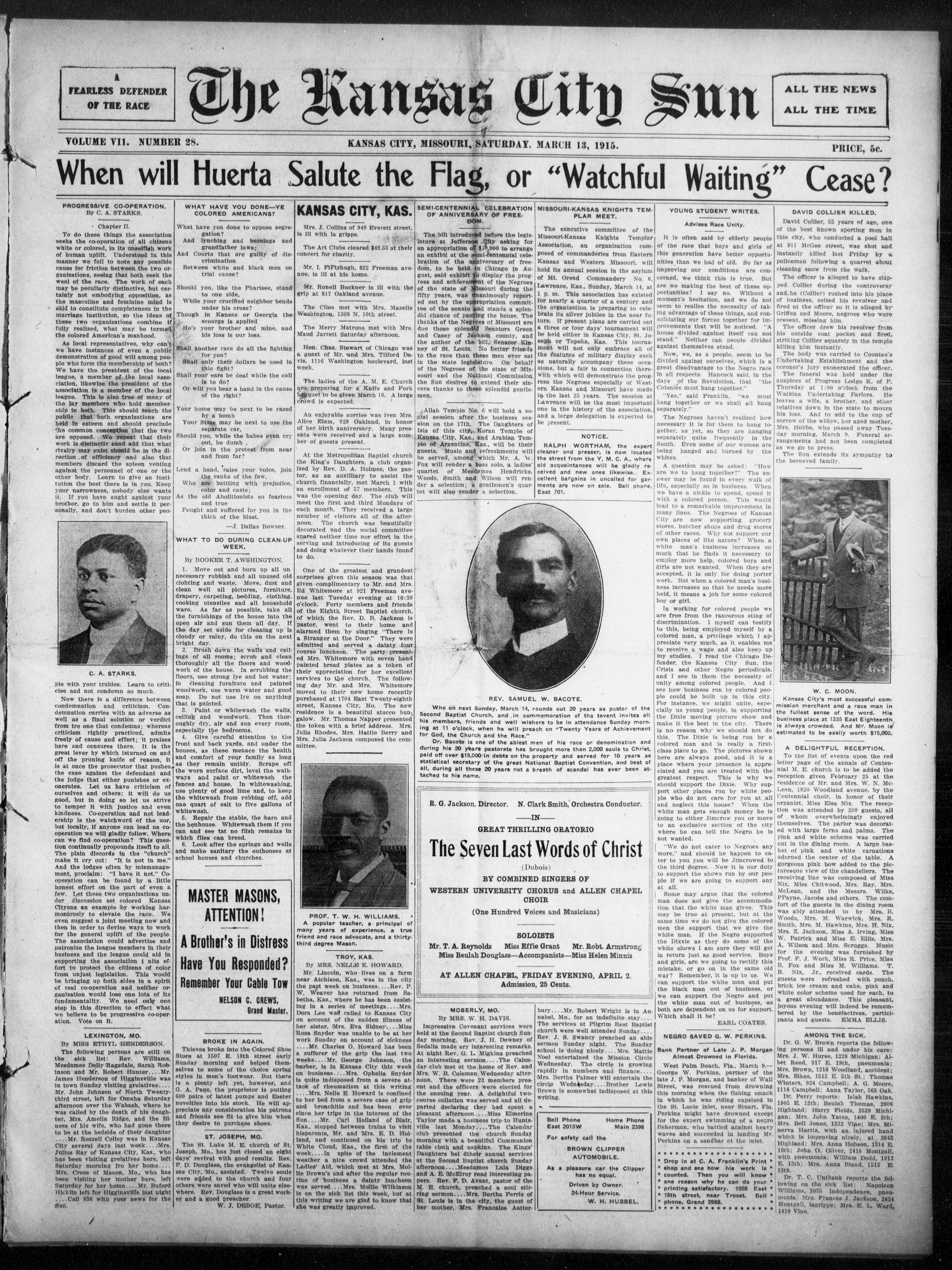
When will Huerta Salute the Flag, or "Watchful Waiting" Cease?
VOLUME VI1. NUMBER 28.
A FEARLESS DEFENDER OF THE RACE
PROGRESSIVE CO-OPERATION.
By C. A. STARKS.
· Chapter II.
To do these things the association seeks the co-operation of all citizens white or colored, in its unselfish work of human uplift. Understood in this manner we fail to note any possible cause for friction between the two organizations, seeing that both seek the weal of the race. The work of each may be peculiarly distinctive, but certainly not embodying opposition, as the masculine and feminine mind is said to constitute completeness in the marriage institution, so the ideas of these two organizations combine if fully realized, what may be termed the colored American's manhood.
As local representatives, why can't we have instances of even a public demonstration of good will among people who form the membership of both? We have the president of the local league, a member of the local association, likewise the president of the association is a member of the local league. This is also true of many of the lay members who hold membership in both. This should teach the public that both organizations are held in esteem and should preclude the common conception that the two are opposed. We repeat that their work is distinctive and add that what rivalry may exist should be in the direction of efficiency and also that members discard the spleen venting against the personnel of one or the other body. Learn to give an institution the best there is in you. Keep your narrowness, nobody else wants it. If you have aught against your brother, go to him and settle it personally, and don't burden other peo-
[Name]
C. A. STARKS.
ple with your trubles. Learn to critic
ise and not condemn so much.
Now there is a difference between condemnation and criticism. Condemnation carries with an adverse as well as a final solution or verdict from tre one that condemns; whereas criticism rightly practiced, admits freely of cause and effect; it praises here and censures there. It is the great lever by which is sturned on and off the pruning knife of reason, it is at once the prosecutor that pushes the case against the defendant and the judge that either punishes or exonerates. Let us have criticism of ourselves and others; it will do us good, but in doing so let us strive to temper it with justice and even kindness. Co-operation and not leadership is the watchword of the uor, but locally, if anyone can lead us cooperation we will gladly follow. Where can we find co-operation? This question continually propounds itself to all. The plain discords in the "church" make it cry out: "It is not in me." And the lodges often by mismanagement, proclaim: "I have it not." Cooperation can be found by a little honest effort on the part of even a few. Let these two organizations under discussion set colored Kansas Cityans an example by working harmoniously to elevate the race. We even suggest a joint meeting now and then in order to devise ways to work for the general uplift of the people. The association could advertise and patronize the league members in their business and the league could aid in supporting the association i nits effort to protect the citizens of color from unjust legislation. This would be bringing up both sides in a spirit of real co-operation and neither organization would lose one iota of its fundamentality. We need only one step in this direction to effect what we believe to be progressive co-operation. Vote on it.
LEXINGTON, MO.
BY MISS ETHYL HENDERSON.
The following persons are still on the sick list: Rev. Williams, Mesdames Dolly Ragdale, Sarah Robinson and Mr. Robert Hunter.....Mr. James Henderson of Higginsville was in town Sunday visiting grelatives....Mr. John Johnson of North Twenty-third street, left for Omaha Saturday afternoon over the Wabash, where he was called by the death of his daughter, Mrs. Amelia Ridge, and the illness of his wife, who had gone there to be at the bedside of their daughter.....Mr. Rozell Colley was in Kansas City several days last week.....Mrs. Julius Ray of Kansas City, Kas, who has been visiting grelatives here, left Saturday morning fro her home....Mrs. Cross of Macon, Mo., who has been visiting her mother here, left Saturday for her home.....Mr. Buford Hicklin left for Higginsville last night....Call $36 with your news for the
The Kansas City Sun
WHAT HAVE YOU DONE—YE
COLORED AMERICANS?
What have you done to oppose segre-
gation?
And lynching and burnings and
grandfather laws;
And Courts that are guilty of dis-
crimination
Between white and black men on
trial cause?
Should you, like the Pharisee, stand
to one side,
While your crucified neighbor bends under his cross?
Though in Kansas or Georgia the scourge is applied
He's your brother and mine, and his loss is our loss.
Shall another race do all the fighting for you?
Shall only their dollars be used in this fight?
Shall your ears be deaf while the call is to do?
Or will you bear a hand in the cause
of the right?
Your home may be next to be razed
by a bomb
Your State may be next to use the
separate car,
Should you, while the babes even cry
out, be dumb,
Or join in the protest from near
and from far?
Lend a hand, raise your voice, join
the ranks of the few.
Who are battling with prejudice
Who are battling with prejudice color and caste;
As the old Abolitionists so fearless and true
Fought and suffered for you in the thick of the blast.
—J. Dallas Bowser.
WHAT TO DO DURING CLEAN-UP
WEEK.
By BOOKER T. AWSHINGTON
1. Move out and burn up all un necessary rubbish and all unused old clofting and waste. Move, dust and clean well all pictures, furniture, drapery, carpeting, bedding, clothing, cooking utensiles and all household ware. As far as possible, take all the furnishings of the house into the open air and sun them all day. If the day set aside for cleaning up is cloudy or rainy, do this on the next bright day.
2. Brush down the walls and cellings of all rooms; scrub and clean thoroughly all the floors and woodwork of the house. In scrubbing the floors, use strong lye and hot water; in cleaning furniture and painted woodwork, use warm water and good soap. Do not use lye on anything that is painted.
3. Paint or whitewash the walls, ceiling and woodwork. Then thoroughly dry, air and sun every room, especially the bedrooms.
4. Give careful attention to the front and back yards, and under the houses, as these menace the health and comfort of your family as long as they remain untidy. Scrape off the worn surface dirt, level the walkways and paint or whitewash the fences and house. In whitewashing, use plenty of good lime and, to keep the whitewash from rubbing and, add one quart of salt to five gallons of whitewash.
5. Repair the stable, the barn and the henhouse. Whitewash them if you can and see tat no filch remains in which files can breed.
6. Look after the springs and wells and make sanitary the outhouses at school houses and churches.
MASTER MASONS,
ATTENTION!
A Brother's in Distress
Have You Responded?
Remember Your Cable Tow
NELSON C. CREWS,
Grand Master.
BROKE IN AGAIN
Thieves broke into the Colored Shoe Store at 1507 E. 18th street early Sunday morning and helped themselves to some of the choice spring styles in men's footwear. But there is a plenty left yet, however, and G. A. Page, the proprietor is putting 600 pairs of latest pumps and Easter novelties into his stock. He will appreciate any consideration his patrons and friends see fit to give him when they desire to purchase shoes.
ST. JOSEPH. MO.
The St. Luke M. E. church of St. Joseph, Mo., has just closed an eight days' revival with good results. Rev F. D. Douglass, the evangelist of Kansas City, Mo., assisted. Twelve souls were added to the church and four others were saved who will unite else where. Rev Douglass is a great worker and a good preacher. W. J. DEBOE, Pastor.
KANSAS CITY, MISSOURI, SATURDAY, MARCH 13. 1915.
KANSAS CITY, KAS.
Mrs. J. Collins of 949 Everett street, is ill with la grippe.
The Art Clubs cleared $49.53 at their concert for charity.
Mr. I. FiFtzhugh, 822 Freeman avenue, is ill at his home.
Mr. Ronell Buckner is ill with the grip at 817 Oakland avenue.
The Clios met with Mrs. Mazelle Washington, 1309 N. 10th street.
The Merry Matrons met with Mrs. Maud Jarrett Saturday afternoon.
Hon. Chas. Stewart of Chicago was a guest of Mr. and Mrs. Tilford Davis, 1116 Washington boulevard, last week.
The ladies of the A. M. E. Church are preparing for a Knife and Fork banquet to be given March 16. A large crowd is expected.
An enjoyable surrise was iven Mrs. Alice Elam, 929 Oakland, in honor of her birth anniversary. Many presents were received and a large number of guests present.
At the Metropolitan Baptist church the King's Daughters, a club organized by Rev. D. A. Holmes, the pastor, as an auxiliary to assist the church financially, met March 1 with an enrollment of 57 members. This was the opening day. The club will meet the first and third Mondays of each month. They received a large number of visitors all of the afternoon. The church was beautifully decorated and the social committee spared neither time nor effort in the serving and introducing of its guests and doing whatever their hands found to do.
One of the greatest and grandest surprises given this season was that given complimentary to Mr. and Mrs. Ed Whitemore at 921 Freeman avenue last Tuesday evening at 10:30 o'clock. Forty members and friends of the Eighth Street Baptist church, of which the Rev. D. B. Jackson is pastor, went to their home and alarmed them by singing "There is a Stranger at the Door." They were admitted and served a dainty four course luncheon. The party presented Mrs. Whitemore with seven hand painted bread plates as a token of their appreciation for her excellent services to the church. The following day Mr. and Mrs. Whitemore moved to their new home recently purchased at 1704 East Twenty-eighth street, Kansas City, Mo. The new residence is a beautiful stucco bun-galow. Mr. Thomas Napper presented the token with a brief address. Mrs. Julia Rhodes, Mrs. Hattie Berry and Mrs. Julia Jackson composed the committee.
PROF. T. W. H. WILLIAMS. A popular teacher, a principal of many years of experience, a true friend and race advocate, and a thirty-third degree Mason.
TROY. KAS.
BY MRS. NELLE E. HOWARD.
Mr. Lincoln, who lives on a farm near Atchison, Kas., was in the city the past week on business.....Rev. P. W. Weaver has returned from Sabetha, Kas., where he has been assisting in a series of meetings.....Mrs. Dora Lee was called to Kansas City on account of the sudden illness of her sister, Mrs. Eva Sidney.....Miss Rosa Snyder was unable to be at her work Sunday on account of sickness.....Mr. Charles O. Howard has been a sufferer of the grip the last two weeks.....Mr. George Johnson, the barber, is in Kansas City this week on business.....Mrs. Ophelia Snyder is quite indisposed from a severe attack of rheumatism at this writing.....Mrs. Nelle E. Howard is confined to her bed from a severe case of grip and bronchitis and has been ever since her trips in the interest of the Sun.....Mr. Carl Holland of Blair, Kas., stopped between trains to visit hisparents, Mr. and Mrs. E. D. Holland, and continued on his trip to White Cloud, Kas., the first of the week.....In spite of the inclement weather a nice crowd attended the Ladies' Ald, which met at Mrs. Molle Brown's and after the regular routine of business a dainty luncheon was served.....Mrs. Mollie Wilkinson is on the sick list this week, but at this writing we are glad to know that she was greatly improved.
SEMI-CENTENNIAL CELEBRATION OF ANNIVERSARY OF FREE-DOM.
The bill introduced before the legislature at Jefferson City asking for an appropriation of $10,000 to arrange an exhibit at the semi-centennial celebration of the anniversary of freedom, to be held in Chicago in August, said exhibit to display the progress and achievement of the Negroes of the state of Missouri during the fifty years, was unanimously reported out by the appropriation committee of the senate and stands a splendid chance of passing the house. The thanks of the Negroes of Missouri are due those splendid Senators Green and Casey of Jackson county, and the author of the bill, Senator Kinney of St. Louis. No better friends to the race than these men ever sat in the state legislature. On behalf of the Negroes of the state of Missouri and the National Commission the Sun desires to extend their sincere thanks to these splendid gentlemen.
Allah Temple No. 6 will hold a social session after the business session on the 17th. The Daughters of Isis of this city, Koran Temple of Kansas City, Kas, and Arabian Temple of Argentine, Kas., will be their guests. Music and refreshments will be served, among which Mr. A. W Fox will render a bass solo, a ladies quartet of Medames Hendricks Woods, Smith and Wilson will render a selection; a gentleman's quartet will also render a selection.
M.
M.
REV. SAMUEL W. BACOTE.
Who on next Sunday, March 14, rounds out 20 y
Second Baptist Church, and in commemoration of
his members, friends and well wishers to be in att
ing at 11 o'clock, when he will preach on "Twenty
for God, the Church and the Race."
Dr. Bacote is one of the ablest men of his race
during his 20 years pastorate has brought more than
paid off over $15,000 in debts on the property and se
statistical secretary of the great National Baptist C
all, during all these 20 years not a breath of scand
tached to his name.
R. G. Jackson, Director. N. Clark Smith, Orc
IN
Who on next Sunday, March 14, rounds out 20 years as pastor of the Second Baptist Church, and in commemoration of the tha'trev invitives all his members, friends and well wishers to be in attendance Sunday morning at 11 o'clock, when he will preach on "Twenty Years of Achievement for God, the Church and the Race." Dr. Bacote is one of the ablest men of his race or denomination and during his 20 years pastorate has brought more than 2,000 souls to Christ, paid off over $15,000 in debts on the property and served for 10 years as statistical secretary of the great National Baptist Convention, and best of all, during all these 20 years not a breath of scandal has ever been attached to his name.
R. G. Jackson, Director. N. Clark Smith. Orchestra Conductor.
GREAT THRILLING ORATORIO
The Seven Last
(Du
BY COMBINED
WESTERN UNIVERSITY CH
The Seven Last Words of Christ
(One Hundred Voices and Musicians)
SOLOISTS
Mr. T. A. Reynolds Miss Effie Grant Mr. Robe
Miss Beulah Douglass—Accompanists—Miss Hel
AT ALLEN CHAPEL, FRIDAY EVENING,
Admission, 25 Cents.
Mr. T. A. Reynolds Miss Effie Grant Mr. Robt. Armstrong Miss Beulah Douglass—Accompanists—Miss Helen Minnis
AT ALLEN CHAPEL, FRIDAY EVENING, APRIL 2.
Admission, 25 Cents.
MOBERLY, MO.
By MRS. W. H. DAVIS.
Impressive Covenant services were held at the Second Baptist church Sunday morning, Rev. J. H. Downey of Sedalia made ery interesting remarks. At night Rev. G. L. Migkins preached an interesting sermon....The Calendar club met at the home of Rev. and Mrs. W. B. Coleman Wednesday afternoon. There were 23 members present and the officers were elected for the ensuing year. A delightful two-course collation was served and all departed declaring they had spent a pleasant afternoon....Miss Elmerine Taylor made a business trip to Huntsville last Monday....The Calendar club presented the church Sunday morning with a beautiful Communion table cloth and napkins. The Kings' Daughters hel dthelr annual services at the Second Baptist church Sunday afternoon....Mesdames Lula Diggs and A. E. McElroy read interesting papers. Rev. F. D. Avant, pastor of the M. E. church, preached a soul stirring sermon....Mrs. Bertha Ferris of St. Louis is in the city, the guest of her mother, Mrs. Francalse Aatter-
MISSOURI-KANAS KNIGHTS TEM-
PLAR MEET.
The executive committee of the Missouri-Kansas Knights Templar Association, an organization composed of commanderies from Eastern Kansas and Western Missouri, will hold its annual session in the asylum of Mt. Oread Commandery No. 6, Lawrence, Kas., Sunday, March 14, at 1 p. m. This association has existed for nearly a quarter of a century and the organization is preparing to celebrate its silver jubilee in the near future. If present plans are carried out a three or four days' tournament will be held either in Kansas City, St. Joseph or Topeka, Kas. This tournament will not only embrace all of the features of military display such as naturally accompany these occasions, but a fair in connection therewith which will demonstrate the progress the Negroes especially of Western Kansas and Missouri have made in the last 25 years. The session at Lawrence will be the most important one in the history of the association, and a large delegation is expected to be present.
RALPH WORTHAM, the expert cleaner and presser, is now located the street from the Y. M. C. A., where old acquaintances will be gladly received and new ones likewise.. Excellent bargains in uncalled for garments are now on sale. Bell phone, East 701.
bounds out 20 years as pastor of the
memoration of the taevent invites all
mers to be in attendance Sunday morn-
ch on "Twenty Years of Achievement
of his race or denomination and
ought more than 2,000 souls to Christ,
property and served for 10 years as
national Baptist Convention, and best of
breath of scandal has ever been at-
Mark Smith, Orchestra Conductor.
N——
LING ORATORIO
Words of Christ
(bois)
D SINGERS OF
MORUS and ALLEN CHAPEL
OIR
DISTS
Le Grant Mr. Robt. Armstrong
ampanists—Miss Helen Minnis
DAY EVENING, APRIL 2.
, 25 Cents.
bury....Mr. Robert Wright is in Annabel, Mo., for an indefinite stay....The services at Pilgrim Rest Baptist church were well attended Sunday....Rev. J. S. Swancy preached an able sermon Sunday night. The Sunday school is doing nicely....Mrs. Mattie Noel entertained the Mission Circle Wednesday. The circle is growing rapidly in numbers and finance....Mrs. Bertha Palmer will entertain the circle Wednesday....Brother Lewis Brown is somewhat indisposed at this writing.
Bell Phone Home Phone
East 2013W Main 2396
For safety call the
BROWN CLIPPER
AUTOMOBILE.
As a pleasure car the Clipper
has no equal.
Driven by Owner.
24-Hour Service.
W. H. HUBBEL.
(Dubois)
NOTICE.
YOUNG STUDENT WRITES
Advises Race Unity.
It is often said by elderly people of the race that boys and girls of this generation have better opportunities than we had of old. So far as improving our conditions are concerned, we think this is true. But are we making the best of these opportunities? I say no. Without a moment's hesitation, and we do not seem to realize the necessity of taking advantage of these things, and consolidating our forces together for improvements that will be noticed. "A house divided against itself can not stand." Neither can people divided against themselves stand. Now, we, as a people, seem to be divided against ourselves, which is a great disadvantage to the Negro race in all respects. Hancock said, in the days of the Revolution, that "the Colonies must hang together." "Yes," said Franklin, "we must hang together or we shall all hang separately." The Negroes haven't realized how necessary it is for them to hang together, as yet, so they are hanging separately quite frequently in the South. Even some of our women are being hanged and burned by the whites.
A question may be asked: "How are we to hang together?" The answer may be found in every walk of life, especially so in business. When we have a nickle to spend, spend it with a colored person. This would lead to a remarkable improvement in many lines. The Negroes of Kansas City are now supporting grocery stores, butcher shops and drug stores of other races. Why not support our own places of like nature? When a white man's business increases so much that he finds it necessary to employ more help, colored boys and girls are not wanted. When they are accepted, it is only for doing porter work. But when a colored man's business increases so that he needs more held, it means a job for some colored boy or girl.
In working for colored people we are free from the rancorous sting of discrimination. I myself can testify to this, being employed myself by a colored man, a privilege which I appreciate very much, as it enables me to receive a wage and also keep up my studies. I read the Chicago Defender, the Kansas City Sun, the Crisis and other Negro periodicals, and I see in them the necessity of unity among colored people. And I see how business run by colored people could be built up in this city. For instance, we might unite, especially us young people, in supporting the Dixie moving picture show and make it the best in the city. There is no reason why we should not do this. The Dixie is being run by a colored man and is really a first-class place to go. The pictures shown here are always good, and it is a place where your presence is appreciated and you are treated with the greatest respect. This is why we should support the Dixie. Why support other places run by white people who do not care for you at all and neglect this house? When the white man gets enough money he is going to either Jimcrow you or move to an exclusive section of the city where he can tell the Negro he is not wanted.
"We do not cater to Negroes any more," and should he happen to cater to you you will be Jimcrowed to the third degree. Now it is our duty to support the shows run by our people if we are going to support any at all.
Some may argue that the colored man does not give the accommodation that the white man gives. This may be true at present, but at the same time we do not give the colored men the support that we give the white man. If the Negro supported the Dixie as they do some of the white shows I am sure they will get in return just as good service. Boys and girls, are we going to rectify this mistake, or go on in the same old way? Remember, it is up to us. We can support the white man and put the black man out of business, or we can support the Negro and put the white man out of business, as both are dependent on us for support. Which shall it be?
EARL COATES.
NEGRO SAVED G. W. PERKINS.
Bank Partner of Late J. P. Morgan Almost Drowned in Florida.
West Palm Beach, Fla., March 9.
George W. Perkins, partner of the late J. P. Morgan, and banker of Wall Street, was rescued from drowning this morning when the fishing smack in which he was riding capsized in the St. Lucie inlet, near Stuart, Fla. Perkins might have drowned except for the expert swimming of a negro fisherman, who battled against heavy waves and succeeded in landing Mr. Perkins on a sandbar at the inlet.
* Drop in at C. A. Franklin's Print *
* shop and see how his work is *
* counted. Then you will know *
* one reason why he can do your *
* printing satisfactory. 1008 East *
* 18th street, near Troost. Bell *
* phone, Grand 2988.
ALL THE NEWS
ALL THE TIME
PRICE, 5c.
DAVID COLLIER KILLED.
David Collier, 55 years of age, one of the best known sporting men in this city, who conducted a pool hall at 911 McGee street, was shot and instantly killed last Friday by a policeman following a quarrel about cleaning snow from the walk.
The officer is alleged to have slapped Collier during the controversy and, he (Collier) rushed into his place of business, selzed his revolver and fired at the officer so it is alleged by Griffen and Moore, negroes who were present, missing him.
The officer drew his revolver from his outside coat pocket and fired, striking Collier squarely in the temple killing him instantly.
The body was carried to Countee's Undertaking Establishment and the coroner's jury exonerated the officer.
The funeral was held under the auspices of Progress Lodge K, of P., Thursday at 1:00 o'clock from the Watkins Undertaking Parlors. He leaves a wife, a brother, and other relatives down in the state to mourn his loss. And to add to the cup of sorrow of the widow, her aged mother, Mrs. Hobbs, who passed away Tuesday morning, March 9. Funeral arrangements had not been completed as we go to press.
The Sun extends its sympathy to the bereaved family.
W. C. MOON.
Kansas City's most successful commission merchant and a race man in the fullest sense of the word. His business place at 1335 East Eighteenth is always crowded. And Mr. Moon is estimated to be easily worth $15,000.
A DELIGHTFUL RECEPTION.
To the list of events upon the red letter page of the annals of Centennial M. E. church is to be added the reception given February 25 at the residence of Mr. and Mrs. W. N. McLean, 1820 Woodland avenue, by the Centennial choir, in honor of their organist, Miss Elsa Nix. The reception was attended by 200 guests, all of whom overwhelmingly enjoyed themselves. The parlor was decorated with large ferns and palms. The pink and white scheme was carried out in the dining room. A large basket of pink bow added to the picturesque view of the chandeliers. The receiving line was composed of Miss Nix, Miss Chitwood, Mrs. Ray, Mrs. McLean, and the Messrs. Wilks, PPayne, Jacobs and others. The comfort of the guests in the dining room was ably attended to by Mrs. B. Woods, Mrs. M. Warwick, Mrs. R. Smith, Mrs. M. Hawkins, Mrs. H. Nix, Mrs. Z. Jackson, Miss A. Irving, Miss W. Patrick and Miss E. Ellis, Mrs. A. Wilson and Mrs. Scruggs. Music for the evening was furnished by Prof. F. J. Work, Miss R. Price, Miss B. Fox and Miss M. Williams. T. B. Nix, Jr., received cards. The guests were refreshed with punch, brick ice cream and cake, pink and white color scheme used for each, to a great abundance. This pleasant, joyous evening will indeed be remembered by the benefactress, participants and guests. EMMA ELLIS.
AMONG THE SICK.
Dr. G. W. Brown reports the following persons ill and under his care; Mrs. J. W. Hurse, 1228 Michigan; Albet Read, 317 E. 19th, pneumonia; Mrs. Brown, 1218 Woodland, accident; Mrs. Sikes, 1515 E. 5th St.; Thomas Winters, 924 Campbell; A. G. Moore, 1116 Campbell; Anna Taylor, 556 Oak D. Dr. Perry reports: Isiah Hawkins, 1905 E. 13th; Beulah Thomas, 2608 Highland; Harry Fields, 2539 Michigan; Mrs. John Yates, 1400 E. 5th; Mrs. Bell Jones, 1232 Vipe; Mrs. Minerva Harris, with an injured hand which is improving nicely, at 2642 Highland; Mrs. Anna Hobson, 1314 E. 16th; John O. Oliver, 2418 Montgall, with pneumonia; William Dodd, 1912 E. 13th; Mrs. Anna Bland, 1513 E. 13th. Dr. T. C. Unthank reports the following on the sick list: Napoleon Williams, 1035 independence, pneumonia; Mrs. Frances J. Jackson, 2434 Montgall, lagripe; Mrs. E. L. Ward, 1410 Vine
AFRO-AMERICAN CULLINGS
The bestowal of the first Springing medal—an admirably planned prize, to be awarded annually to the colored man or woman who has rendered the greatest service to the colored race—upon Prof. Ernest E. Just, a young scientist and professor in the Howard university medical school, attracted widespread attention. The committee, of which Mr. Taft is a member, did not find the choice an easy one, there being a number of possibilities from whom to select. That the recipient should be a scientist rather than an inventor, or a leader in farming or banking, will doubtless surprise many people, as it will put to their trumps those who continue to maintain' that the Negro is incapable of the higher education. Professor Just, be it noted, is but thirty-one years of age; yet he has already attracted the attention of scientists of repute, no less a one than Prof. Jacques Loeb endorsing his original work in physiology, biology and zoology in these terms;
"His knowledge of biology and his critical ability are of an unusually high and lofty order. In the work that he devotes to Howard university he is actuated by very high motives, since the remuneration he receives is only a fraction of his nominal salary. He could easily increase his income by giving up his position. Professor Just has sacrificed a good deal for the advancement of medical schools for colored people, and he will do a good deal more if he is given a chance, as I hope he may be."
Plainly, this is just the type of man the Spingarn medal ought to distinguish—a colored man who is proving the capability of the race, and is also ready to make sacrifices for the benefit of his people. It has been a distinct weakness of the race in its struggle upward from slavery that it has often lacked solidarity and a readiness to contribute to the welfare of the whole. That this is now a rapidly passing condition there are plenty of instances besides this one of Professor Just to prove. Indeed, the support given to the National Association for the Advancement of Colored People, in whose hands Professor Spingarn has placed the award of the medal, is a remarkable case in point. That organization has taken radical and unpopular ground; timeservers in both races have shunned it as if it were something unworthy, instead of a manly and straightforward effort to preserve to the colored people their civil and political rights as guaranteed by the constatton. Yet the association has flourished, spread over the country, and made a reputation for itself as a guardian of the colored people's liberties, largely as a result of the efforts and financial sacrifices of the Negroes themselves.
Commercially, elephants in India come under two classes—the one of pageantry, the other of utility. Every native prince of nobleman of distinction in India keeps elephants to swell his retinue, while, on the other hand, government officials and private persons, such as timber contractors, etc., require them for work.
The quaint city of Berne has been the capital of the Swiss republic since 1848. It is one of the most interesting towns of Zahringen, and by 1288 it was strong enough to ward off two sieges by Rudolph of Hapsburg, the ancestor of the present emperor of Austria.
With Julius Rosenwald of Chicago at its head, a party of business man, philanthropists and social workers from that city visited the various schools of the Tuskegee, Ala., institute operated by Booker T. Washington and took part in a meeting of the board of trustees. Several rural schools which Mr. Rosenwald has aided in Montgomery were visited.
Near Basel-Augst, in Switzerland, is the site of the old Roman colony of Augusta Rauracorum, with remains of a theater, and at the nearby town of Rheinfelden are wall and towers partly preserved, for this was one of the outposts of the Holy Roman empire. It has only belonged to Switzerland since 1802, and is picturesque, like the majority of the towns on the Rhine.
More than four hundred patents have been issued by the United States for devices intended to harness the power of sea waves.
It has been computed that at the time of the arrival of Columbus there were 25,000,000 Indians in North and South America.
Schemes for the construction of a 3,000-mile railway through Central Africa, at a cost roughly estimated at $50,000,000, have been revived by the termination of the war between Italy and Turkey.
The post office in England intends to try the motorcycle for rural service. Orders have been placed for experimental machines.
The life of the domestic horse is about twenty-eight years, while that of the wild one is thirty-eight years.
Just Why We Sneeze.
Sneezing may be due to one of a number of causes. A bright light will cause many people to sneeze, as also the pollen of certain plants, while there are few people but will sneeze in the presence of dust. When you have a cold the sneezing is due to an attempt by nature to cure you. She is trying to make you sneeze for the same purpose that she wants you to shiver—to generate heat for warming the blood and preventing you from taking more cold—to help relieve the
Manassas is the only school of its kind in the entire five surrounding counties, the only place where any sort of an industrial training is given. The children come principally from this section of Virginia, where they have often gone no further than the fourth grade in the rural schools. In nearly all cases this means the scariest possible training—the bare bunnings of the three R's. However, there are things more fundamental than even these which must be taught many of these pupils, who come from homes where the use of water for cleansing purposes has never been known, and where the simple everyday care of their bodies is another new lesson to learn. It is remarkable how quickly they come to realize the value of this lesson, and the pride with which daily soap-scrubbed faces shine once they know the added feeling of self-respect gained by the simple medium of soap and water.
The pupil must be fourteen to enter the school—and may be forty. There are usually about an equal number of boys and girls in attendance. Most of these children are too poor to pay for their tuition and board, for which a very nominal price is asked, but this difficulty is arranged for by a system of crediting the child for daily jobs done in connection with the trade he is pursuing, or any necessary work to be done about the building, in the kitchen, laundry, or about the grounds. The trades offered the boys are carpentry, cobbling, wheelwrighting, blacksmithing, upholstering, and, most important of all for boys of that section, farming. The girls have cooking, sewing, laundering, dairying, and light farming.
As early as 1798 a night school for Negroes was started in Philadelphia. In 1844 an industrial school was proposed, and in 1856 the first Near-university in the new world was started, named Wilberforce university, and now one of the largest Near-gram institutions of higher learning in the country. There are operated under the auspices of this church the following institutions, each one named for one of its deceased bishops: Allen university, Columbia, S. C.; Morris Brown university, Atlanta, Ga.; Payne college, Cuthbert, Ga.; Edward Waters college, Jacksonville, Fla.; Payne university, Selma, Ala.; Campbell college, Jackson, Miss.; Lampton college, Waco, Tex.; Wayman institute, Harrodsburg, Ky.; Payne Theological seminary, Wilberforce, O. There are also the Shaffer High school in Liberia, West Africa; Turner seminary, Shelbyville, Tenn., and Kittrell college in North Carolina, and institutions in Capetown, South Africa, and Georgetown, South America.
The members of this church have raised more than $3,000,000 to support their schools, and their graduates are scattered all over the world—where Negroes are. Some are teaching the Filipinos; some are organizing and training the militia of Liberia, the Negro republic of West Africa, and they are in every state in the Union in almost every honorable occupation of labor. A hundred African students have been trained in these schools for the purpose of going back to their homes to help raise their people. The watchword of the church is "self-spect and selfhelp."
Corks stepped in vaseline make excellent substitutes for glass stoppers.
Buffalo is to purify its drinking water with chlorine gas, and hopes that the unpleasant taste caused by the more common method of using hypochloride will not appear. The process will kill germs, but not clarify the water. If Buffalo wants its water to sparkle it will have to install a filtration system as in Cleveland, where the plant cost $2,000,000.
More than 99 per cent of the timber in the Philippines is owned by the government and is worked through concessioning and licenses, as no land more valuable for timber than for agriculture can be bought. The valuable trees of the same species are often scattered through the forests instead of being grouped, and this makes lumbering more expensive.
A camera operated by electricity has been invented for lowering into wells to photograph the conditions surrounding broken tools.
A gum has been discovered in large quantities in the Malay Peninsula that yields from 10 to 20 per cent pure rubber.
To drain Lake Marlotis, in the Nile delta ten pumps have been installed each with a capacity of 100,000,000 gallons daily, and it is believed that eight more will be required.
The Pacific Steam Navigation company has decided to extend its Straits mall service from Callao to Panama, in view of the opening of the Panama canal.
In the Alps there is a letter box 10,000 feet above the sea level, from which daily collections are made.
cold you have. For one does not sneeze with his nose, but with the entire body. During the act every muscle of the body gives a jump, as it were; it goes into sort of a spasm that warms the entire system.
"California Diamonds."
"California diamonds" are made from crystals of quartz, the most abundant of all minerals. Sometimes they are cut and sold as "white topaz," but more often as California diamonds.
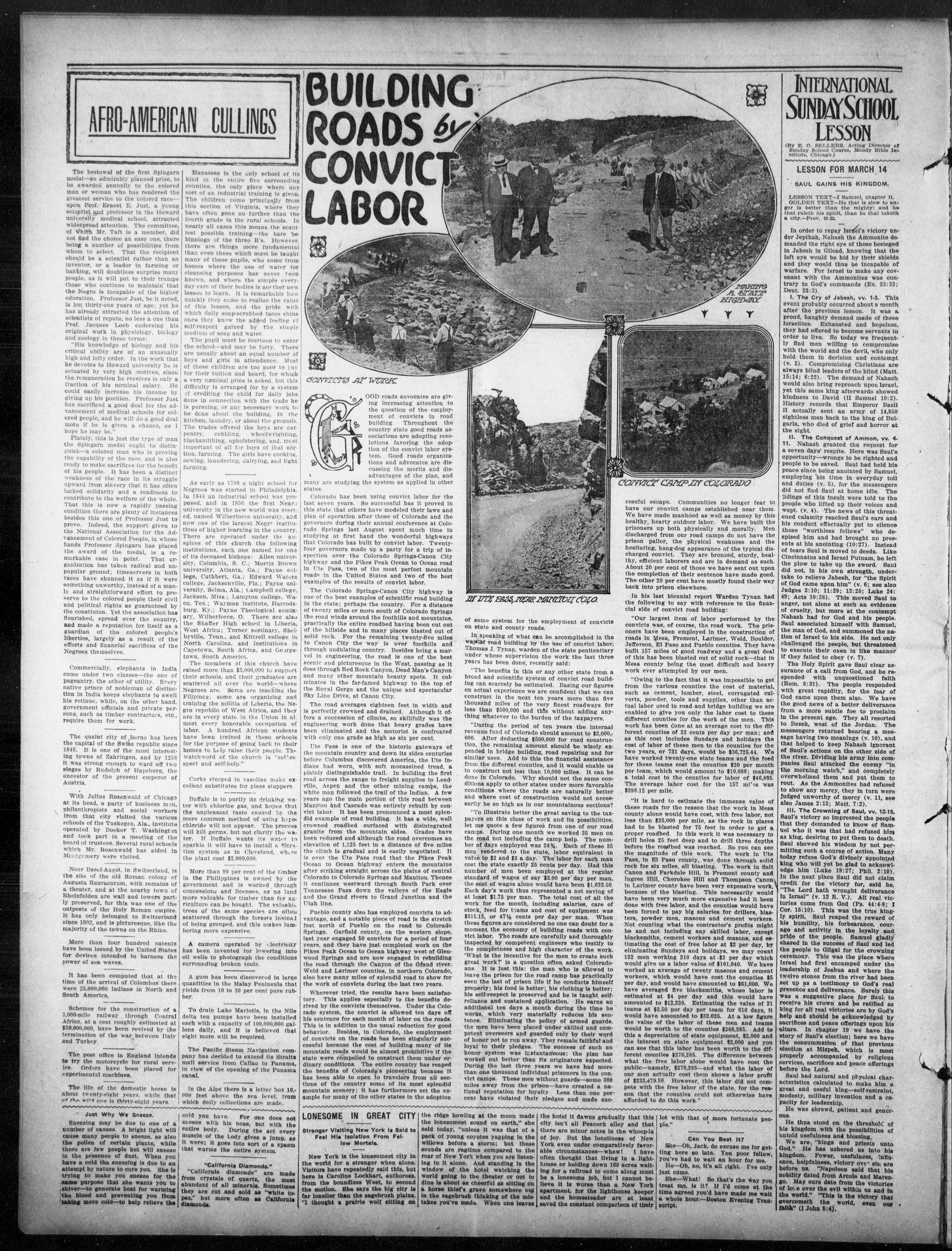
BUILDING ROADS by CONVICT LABOR
OOD roads advocates are giving increasing attention to the question of the employment of convicts in road building. Throughout the country state good roads associations are adopting resolutions favoring the adoption of the convict labor system. Good roads organizations and advocates are discussing the merits and disadvantages of the plan, and
many are studying the system as applied in other states. Colorado has been using convict labor for the last seven years. So successful has it proved in this state that others have modeled their laws and plan of operation after those of Colorado and the governors during their annual conference at Colorado Springs last August spent much time in studying at first hand the wonderful highways that Colorado has built by convict labor. Twenty-four governors made up a party for a trip of inspection over the Colorado Springs-Canon City highway and the Pikes Peak Ocean to Ocean road in Ute Pass, two of the most perfect mountain roads in the United States and two of the best examples of the results of convict labor.
The Colorado Springs-Canon City highway is one of the best examples of scientific road building in the state; perhaps the country. For a distance of twenty miles or more south of Colorado Springs the road winds around the foothills and mountains, practically the entire roadbed having been cut out of the hillside and in many places blasted out of solid rock. For the remaining twenty-five miles to Canon City the way is over foothills and through undulating country. Besides being a marvel in engineering, the road is one of the best scenic and picturesque in the West, passing as it does through Red Rock Canyon, Dead Man's Canyon and many other mountain beauty spots. It culminates in the far-famed highway to the top of the Royal Gorge and the unique and spectacular Sky Line Drive, at Canon City.
a distance of Springa mountains, been cut out of five-mileooths and being a marvel of the best passing as it man's Canyon uts. It cut the top of the spectacular width and though it only was the trades have confronted cent gateways of its centuries the Ute Ind tread, a long the first to Leadcamps, the man. A few and between built by con- splen wide, well integrated trades have permeates an five miles omitated. It Pikes Peak is mountain of central town. Thence Park over the Eagle and the victives to ad- to the stretch to Colorado n slope, slod of four work on the best of Glen- rebuilding and river. in Colorado, to show for two years.
men satisfac- benefits derer the Colon- days off the roads. for good employment similarly succ- cument of its native if the men under or has reaped because it from all sec- splendid set the ex- e adoption of some system for the on state and county roads. In speaking of what way of road building by Thomas J. Tynan, warded under whose supervision years has been done, re- "The benefits in this broad and scientific sys- ting can scarcely be beating on actual experience we construct in the next thousand miles of the less than $500 and thing whatever to the bus.
"During the period of revenue fund of Colorado 000. After deducting $150, the remaining am- pended in bridge building similar uses. Add to the from the different coun- tries to construct not less the done in Colorado. Why ditions apply to other conditions where the r- and where cost of cons- sarily be so high as in co- "To illustrate better the payers on this class of the payer me quote a few figu- camps. During one month the road not including the bar of days employed widen rendered to the value to $2 and a value to $2 the state exactly 20 number of men been standard of wages of sa- the cost of wages alone. Each day's work thus re- at each day's work just as $1.75 per man. work for the month, in stock, feed for teams and $515.15, or 47½ cents of these figures are consider- moment the economy of victor labor. The roads are inspected by competent the completeness and high 'What is the incentive for great work?' is a quest- ans. It is just this: the leave the prison for the seen the last of prison properly; his food is best his self-respect is present reliance and sustained additional ten days a work, which very man- tence. Eliminating the men have been place peters oversees and gu- of honor not to run away loyal to their pledges. honor system was last worked out better than During the last three y- one thousand individual vict camps. These men miles away from the prional reputation for lon- cent have violated their
The road averages eighteen feet in width and is perfectly crowned and drained. Although it offers a succession of climbs, so skillfully was the engineering work done that heavy grades have been eliminated and the motorist is confronted with only one grade as high as six per cent.
Ute Pass is one of the historic gateways of the mountain country and down its sides centuries before Columbus discovered America, the Ute Indians had worn, with soft massacred tread, a plainly distinguishable trail. In building the first road across the range to freight supplies to Leadville, Aspen and the other mining camps, the white man followed the trail of the Indian. A few years ago the main portion of this road between Manitou and Cascade was entirely rebuilt by convict labor. It has been pronounced a most splendid example of road building. It has a wide, well crowned roadbed surfaced with disintegrated granite from the mountain sides. Grades have been reduced and although the road overcomes an elevation of 1,125 feet in a distance of five miles the climb is gradual and is easily negotiated. It is over the Ute Pass road that the Pikes Peak Ocean to Ocean highway enters the mountains after striking straight across the plains of central Colorado to Colorado Springs and Manitou. Thence it continues westward through South Park over Tennessee Pass down the valleys of the Eagle and the Grand rivers to Grand Junction and the Utah line.
Pueblo county also has employed convicts to advantage, and a notable piece of road is the stretch just north of Pueblo on the road to Colorado Springs. Garfield county, on the western slope, last year engaged 50 convicts for a period of four years, and they have just completed work on the Pikes Peak Ocean to Ocean highway west of Glenwood Springs and are now engaged in rebuilding the road through the Canyon of the Gfand river. Weld and Larimer counties, in northern Colorado, also have many miles of splendid road to show for the work of convicts during the last two years.
Wherever tried, the results have been satisfactory. This applies especially to the benefits derived by the convicts themselves. Under the Colorado system, the convict is allowed ten days off his sentence for each month of labor on the roads. This is in addition to the usual reduction for good behavior. Besides, in Colorado, the employment of convicts on the roads has been singularly successful because the cost of building many of its mountain roads would be almost prohibitive if the state were compelled to construct them under ordinary conditions. The entire country has reaped the benefits of Colorado's pioneering because it has been able to open to travelers from all sections of the country some of its most splendid mountain scenery; it has furthermore set the example for many of the other states in the adoption
the ridge howling at the moon made the lonesome sound on earth," she said today, "unless it was that of a pack of young coyotes yapping in the willows before a storm; but these sounds are ragtime compared to the roar of New York when you are listening to it alone. And standing in the window of the hotel watching the world going to the theater or out to dine is about as cheerful as sitting on a horse thief's grave somewhere out in the sagebrush thinking of the mistakes you've made. When one leaves
CONVICIUS AT WORK
OOD roads
ing incre
ment of
building
country s
sociations
lutions f
tion of the
tem. Go
tions and
cussing t
Stranger Visiting New York Is Said to Feel His Isolation From Fellow Mortals.
New York is the lonesomest city in the world for a stranger when alone. Visitors have repeatedly said this, but here is Caroline Lockhart, authoress, from the boundless West, to second the motion. She says the big city is far lonelier than the sagebrush plains.
"I thought a prairie wolf sitting on
THE CREEK
IN ITE PASS NEAR MANITOU COLO
of some system for the employment of convicts on state and county roads.
In speaking of what can be accomplished in the way of road building by the use of convict labor, Thomas J. Tynan, warden of the state penitentiary under whose supervision the work the last three years has been done, recently said:
"The benefits in this or any other state from a broad and scientific system of convict road building can scarcely be estimated. Basing our figures on actual experience we are confident that we can construct in the next ten years more than five thousand miles of the very finest roadways for less than $500,000 and this without adding anything whatever to the burden of the taxayers.
"During the period of ten years the internal revenue fund of Colorado should amount to $2,000,-000. After deducting $500,000 for road construction, the remaining amount should be wisely expended in bridge building, road repairing and for similar uses. Add to this the financial assistance from the different counties, and it would enable us to construct not less than 10,000 miles. It can be done in Colorado. Why should not the same conditions apply to other states under more favorable conditions where the roads are naturally better and where cost of construction would not necessarily be so high as in our mountainous sections?
"To illustrate better the great saving to the taxpayers on this class of work and its possibilities, let me quote a few figures from one of our road camps. During one month we worked 35 men on the road not including the camp help. The number of days employed was $24\%$. Each of these 35 men rendered to the state, labor equivalent in value to $2 and $3 a day. The labor for each man cost the state exactly 25 cents per day. Had this number of men been employed at the regular standard of wages of say $2.00 per day per man, the cost of wages alone would have been $1.632.50. Each day's work thus represented a net saving of at least $1.75 per man. The total cost of all the work for the month, including salaries, care of stock, feed for teams and cost of equipment was $515.15, or $47\% cents per day per man. When these figures are considered no one can doubt for a moment the economy of building roads with convict labor. The roads are carefully and thoroughly inspected by competent engineers who testify to the completeness and high character of the work. What is the incentive for the men to create such great work? is a question often asked Coloradoans. It is just this: the man who is allowed to leave the prison for the road camp has practically seen the last of prison life if he conducts himself properly; his food is better; his clothing is better; his self-respect is preserved and he is taught self-reliance and sustained application. He earns an additional ten days a month during the time he works, which very materially reduces his sentence. Eliminating the policy of armed guards, the men have been placed under skilled and competent overseers and guarded only by their word of honor not to run away. They remain faithful and loyal to their pledges. The success of such an honor system was instantaneous: the plan has worked out better than its originators expected. During the last three years we have had more than one thousand individual prisoners in the convict camps. These men without guards—some 300 miles away from the prison—have created a national reputation for loyalty. Less than one per cent have violated their pledges and made suc-
the employment of convicts adds.
can be accomplished in the
use of convict labor,
of the state penitentiary
the work the last three
dently said:
for any other state from a
item of convict road build-
dated. Basing our figures
are confident that we can
enjoy ten years more than five
very finest roadways for
fights without adding any
arden of the taxpayers.
Of ten years the internal
should amount to $2,000,
$000,000 for road construc-
tion should be wixely ex-
g, repairing and for
its the financial assistance
, and it would enable us
in 10,000 miles. It can
be should not the same con-
tents under more favorable
roads are naturally better
reduction would not neces-
rure mountainous sections?
The great saving to the tax-
work and its possibilities
gets from one of our road
we worked 35 men on the camp help. The num-
bers 24%, Each of these 35
state, labor equivalent in
the labor for each man
recents per day. Had this
employed at the regular
pay $2.00 per day per man
would have been $1,632.50.
Presented a net saving of
The total cost of all the
including salaries, care of
cost of equipment was
day per man. When
needed one can doubt for a
building roads with con-
cautely and thoroughly
engineers who testify to
character of the work
for the men to create such
men often asked Colorado-
man who is allowed to
road camp has practically
ife if he conducts himself
his clothing is better;
oved and he is taught self-
application. He earns an
month during the time he
serially reduces his sen-
policy of armed guards,
und under skilled and com-
pared only by their word.
They remain faithful and
The success of such an
antiearous; the plan has
its originators expected.
ears we have had more
dual prisoners in the con-
without guards—some 300
son—have created a na-
tality Less than one per-
pledges and made suc-
Our lax convicts wives have
roads in the Jefferson,
built 157 of this ha-
Mesa county work ever.
"Owing from the
such as this cost of lax
two years have work
for these a total cost
The avera $298.12 per
"It is here these road
county alleys less than
had to be proper roar
drill holes before the
magnus Pass, in Rock
for Canon and Ingree
In Larimene because of
have been done with be-
foreen forces, power
Not count be and new
blacksmith timing to
eliminating 132 men would
give worked and workers,
per day, a have aver
estimated amount
teams at the
would have the value
would be this a depa-
the interest can see the
ferent count what the
public—n our men of
$233.47 pete with
son that afforded to
the hotel it dawns gradually that this city isn't all Peacock alley and that there are minor notes in the whoop-la of joy. But the loneliness of New York even under comparatively favorable circumstances—whew! I have often thought that living in a lighthouse or holding down 160 acres waiting for a railroad to come along must be a lonesome job, but I cannot believe it is worse than a New York apartment, for the lighthouse keeper and the homesteader are at least saved the constant comparison of their
CONVICT CAMP IN COLORADO
cessful escape. Communities no longer fear to have our convict camps established near them. We have made manhood as well as money by this healthy, hearty outdoor labor. We have built the prisoners up both physically and morally. Mer discharged from our road camps do not have the prison pallor, the physical weakness and the hesitating, hang-dog appearance of the typical discharged convict. They are bronzed, sturdy, healthy, efficient laborers and are in demand as such. About 20 per cent of those we have sent out upon the completion of their sentence have made good. The other 20 per cent have mostly found their way back into prison elsewhere.
cessful escape. Communities no longer fear to have our convict camps established near them. We have made manhood as well as money by this healthy, hearty outdoor labor. We have built the prisoners up both physically and morally. Men discharged from our road camps do not have the prison pallor, the physical weakness and the hesitating, hang-dog appearance of the typical discharged convict. They are bronzed, sturdy, healthy, efficient laborers and in demand as such. About 20 per cent of those we have sent out upon the completion of their sentence have made good. The other 20 per cent have mostly found their way back into prison elsewhere.
In his last biennial report Warden Tynan had the following to say with reference to the financial side of convict road building:
"Our largest item of labor performed by the convicts was, of course, the road work. The prisoners have been employed in the construction of roads in Mesa, Fremont, Larimer, Weld, Boulder, Jefferson, El Paso and Pueblo counties. They have built 157 miles of good roadway and a great deal of this has been blasted out of solid rock—that in Mesa county being the most difficult and heavy work ever attempted by our men.
"Owing to the fact that it was impossible to get from the various counties the cost of material, such as cement, lumber, steel, corrugated culverts, powder, tools and supplies, other than actual labor used in road and bridge building we are enabled to give you only the labor cost to these different counties for the work of the men. This work has been done at an average cost to the different counties of 32 cents per day per man; and as this cost includes Sundays and holidays the cost of labor of these men to the counties for the two years, or 731 days, would be $36,725.44. We have worked twenty-one state teams and the feed for these teams cost the counties $20 per month per team, which would amount to $10,088; making a total cost to the counties for labor of $46,805. The average labor cost for the 157 miles was $298.12 per mile.
"It is hard to estimate the immense value of these roads for the reason that the work in Mesa county alone would have cost, with free labor, not less than $25,000 per mile, as the rock in places had to be blasted for 75 feet in order to get a proper roadbed. In this work it was necessary to drill holes 25 feet deep and to drill three depths before the roadbed was reached. So you can see the magnitude of this work. The work in Ute Pass, in El Paso county, was done through solid rock for six miles, all blasting. The work in Salt Canon and Parkdale Hill, in Fremont county and Ingree Hill, Cherokee Hill and Thompson Canon in Larimer county have been very expensive work, because of the blasting. This necessarily would have been very much more expensive had it been done with free labor, and the counties would have been forced to pay big salaries for drillers, blasters, powder men, masons and cement workers. Not counting what the contractor's profits might be and not including any skilled labor, except blacksmiths, cement workers and masons, and estimating the cost of free labor at $2 per day, by eliminating Sundays and holidays, we may count 132 men working 210 days at $2 per day which would give us a labor value of $161,040. We have worked an average of twenty masons and cement workers, which would have cost the counties $5 per day, and would have amounted to $61,000. We have averaged five blacksmiths, whose labor is estimated at $4 per day and this would have amounted to $12,220. Estimating the value of 21 teams at $2.50 per day for team for 610 days, it would have amounted to $32,025. At a low figure the value of the labor of these men and teams would be worth to the counties $266,285. Add to this a depreciation of state equipment, $2,000 and the interest on state equipment, $2,000 and you can see that this labor has been worth to the different counties $270,285. The difference between what the free labor alone would have cost the public—namely, $270,285—and what the labor of our men actually cost them shows a labor profit of $233,479.56. However, this labor did not compete with the free labor of the state, for the reason that the counties could not otherwise have afforded to do this work."
"Our largest item of labor performed by the convicts was, of course, the road work. The prisoners have been employed in the construction of roads in Mesa, Fremont, Larlimer, Weld, Boulder, Jefferson, El Paso and Pueblo counties. They have built 157 miles of good roadway and a great deal of this has been blasted out of solid rock—that in Mesa county being the most difficult and heavy work ever attempted by our men.
"Owing to the fact that it was impossible to get from the various counties the cost of material, such as cement, lumber, steel, corrugated culverts, powder, tools and supplies, other than actual labor used in road and bridge building we are enabled to give you only the labor cost to these different counties for the work of the men. This work has been done at an average cost to the different counties of 32 cents per day per man; and as this cost includes Sundays and holidays the cost of labor of these men to the counties for the two years, or 731 days, would be $36,725.44. We have worked twenty-one state teams and the feed for these teams cost the counties $20 per month per team, which would amount to $10,088; making a total cost to the counties for labor of $46,805. The average labor cost for the 157 miles was $298.12 per mile.
"It is hard to estimate the immense value of these roads for the reason that the work in Meesa county alone would have cost, with free labor, not less than $25,000 per mile, as the rock in places had to be blasted for 75 feet in order to get a proper roadbed. In this work it was necessary to drill holes 25 feet deep and to drill three depths before the roadbed was reached. So you can see the magnitude of this work. The work in Ute Pass, in El Paso county, was done through solid rock for six miles, all blasting. The work in Salt Canon and Parkdale Hill, in Fremont county and Ingrese Hill, Cherokee Hill and Thompson Canon in Larimer county have been very expensive work, because of the blasting. This necessarily would have been very much more expensive had it been done with free labor, and the counties would have been forced to pay big salaries for drillers, blasters, powder men, masons and cement workers. Not counting what the contractor's profits might be and not including any skilled labor, except blacksmiths, cement workers and masons, and estimating the cost of free labor at $2 per day, by eliminating Sundays and holidays, we may count 132 men working 210 days at $2 per day which would give us a labor value of $161,040. We have worked an average of twenty masons and cement workers, which would have cost the counties $5 per day, and would have amounted to $61,000. We have averaged five blacksmiths, whose labor is estimated at $4 per day and this would have amounted to $12,220. Estimating the value of 21 teams at $2.50 per day per team for 610 days, it would have amounted to $32,025. At a low figure the value of the labor of these men and teams would be worth to the counties $266,285. Add to this a depreciation of state equipment, $2,000 and the interest on state equipment $2,000 and you can see that this labor has been worth to the different counties $270,285. The difference between what the free labor alone would have cost the public—namely, $270,285—and what the labor of our men actually cost them shows a labor profit of $233,479.55. However, this labor did not compete with the free labor of the state, for the reason that the counties could not otherwise have afforded to do this work."
lot with that of more fortunate people."
Can You Beat It?
She—Oh, Jack, do excuse me for getting here so late. You poor fellow, you've had to wait an hour for me.
He—Oh, no, it's all right. I've only just come.
She—What! So that's the way you treat me, is it? If I'd come at the time agreed it you'd have made me wait a whole hour.—Boston Evening Transcript.
INTERNATIONAL
SUNDAY SCHOOL
LESSON
(BY E. O. SELLERS, Acting Director of
Science courses, Moody Bible
Institute, Chicago)
SAUL GAINS HIS KINGDOM.
LESSON TEXT-I Samuel, chapter 11.
GOLDEN TEXT-He that is slow to anger is better than the mighty; and he that ruleth his spirit, than he that taketh a city—Prov. 16:32.
In order to repay Israel's victory under Jephthah, Nahash the Ammonite demanded the right eye of those besieged in Jabesh in Gilead, knowing that the left eye would be hid by their shields and they would thus be incapable of warfare. For Israel to make any covenant with the Ammonites was contrary to God's commands (Ex. 23:32; Deut. 23:3)
1. The Cry of Jabesh, vv. 1-3. This event probably occurred about a month after the previous lesson. It was a proud, haughty demand made of these Israelites. Exhausted and hopeless, they had offered to become servants in order to live. So today we frequently find men willing to compromise with the world and the devil, who only hold them in derision and contempt (v. 2). Compromising Christians are always blind leaders of the blind (Matt. 15:14; 6:22). The demand of Nahshw also bring reproach upon Israel, yet this same king afterwards showed kindness to David (II Samuel 10:2). History records that Emperor Basil II actually sent an army of 14,850 sightless men back to the king of Bulgaria, who died of grief and horror at the sight.
II. The Conquest of Ammon, vv. 4. 11. Nahash granted the request for a seven days' respite. Here was Saul's opportunity—wrongs to be righted and people to be saved. Saul had held his peace since being anointed by Samuel, employing his time in everyday toll and duties (v. 5), for the messengers did not find Saul at home idle. The idlings of this insult were told to the people who lifted up their voices and wept. (v. 4). The news of this threatened calamity reached Saul's ears and his conduct effectually put to silence those "worthless fellows" who despised him and had brought no presents at his anointing (10:27). Instead of tears Saul is moved to deeds. Like Cincinnatus and Israel Putnam, he left the plow to take up the sword. Saul did not, in his own strength, undertake to relieve Jabesh, for the " Spirit of God came upon him" (v. 6; see also Judges 3:10; 11:29; 13:25; Luke 24: 49; Acts 10:38). This moved Saul to anger, not alone at such an evidence of cruelty, but more at the contempt Nahash had for God and his people. Saul associated himself with Samuel, the man of God, and summoned the nation of Israel to his side. He not only challenged the people, but threatened to execute their oxen in like manner if they failed to obey (v. 7).
The Holy Spirit gave Saul clear assurance of a call from God, and he responded with unquestioned faith (Rom. 8:31). The people responded with great rapidity, for the fear of God came upon them also. We have the good news of a better deliverance from a more subtle foe to proclaim in the present age. They all resorted to Bezek, west of the Jordan. The messengers returned bearing a message having two meanings (v. 10), and that helped to keep Nahash ignorant of Saul's actions on the other side of the river. Dividing his army into companies Saul attacked the enemy "in the morning watch," and completely overwhelmed them and put them to rout. As the Ammonites had refused to show any mercy, they in turn were judged unworthy of mercy (v. 11, see also James 2:13; Matt. 7:2).
III. The Crowning of Saul, vv. 12-15 Saul's victory so impressed the people that they demanded to know of Samuel who it was that had refused him as king, desiring to put them to death. Saul showed his wisdom by not permitting such a course of action. Many today refuse God's divinely appointed king who will yet be glad to acknowledge him (Luke 19:27, Phil. 2:10). In the next place Saul did not claim credit for the victory for, said he, "The Lord hath wrought deliverance in Israel" (v. 13 R. V.). All real victories come from God (Ps. 44:4:8; I Cor. 15:10). This was the true kingly spirit. Saul reaped the reward of his humility, his forbearance, courage and activity in the loyalty and pride of the people. Samuel gladly shared in the success of Saul and led the people to Gigal for the crowning ceremony. This was the place where Israel had first encamped under the leadership of Joshua and where the twelve stones from the river had been set up as a testimony to God's real presence and deliverance. Surely this was a suggestive place for Saul to receive his crown and be ratified as king for all real victories are by God's help and should be acknowledged by sacrifices and peace offerings upon his altars. In chapter 10 we have the story of Saul's election; here we have the consummation of that previous election at Mizpeh, which is most properly accompanied by religious services, sacrifices and peace offerings before the Lord.
Saul had natural and physical characteristics calculated to make him a great and useful king—self-restraint, modesty, military invention and a capacity for leadership.
He was shrewd, patient and generous.
He thus stood on the threshold of his kingdom with the possibilities of untold usefulness and blessing.
We are “kings and priests unto God.” He has ushered us into his kingdom. Power, usefulness, influence, helpfulness, victory over sin are before us. “Napoleon said that his nobility dated from Arcole and Marengo. May our dates from the victories of love over the evil within us and in the world.” “This is the victory that overcometh the world, even our faith.” (I John 5:4).
THE SANDMAN STORY
by Mrs. F.A. WALKER
COPYRIGHT © 1910 BY CROSS
REBORNER SYNDICATES
THE SQUIRREL FAMILY.
One day a father squirrel 'said to
his wife:
"My dear, I have found the nicest
place you ever saw for our home this
winter. Take the children and follow
me and I will show you where
it is."
There were three little squirrels,
and they ran along the limb of the
tree after their father and mother to
the top of a house over which the tree
hung.
+ "Do you see that hole?" said the
father. "That is where our home is to
be—in the roof of the house. It will
be nice and warm. And now we must
begin gathering nuts for the winter."
In the house the squirrels had selected for their home lived three children—Jack, Dick and Helen—and one day when it was snowing very fast and they could not go out they went to their playroom at the top of the house. There was a rocking horse which looked like a truly horse, and a swing hung from the beams. There were roller skates and a croquet set on a table, and all sorts of things for children to play with. Now the squirrel family had made an opening in this room and the little squirrels—Chick, Gray and Flash—had often wondered about all the strange things they saw there. Today, when they heard voices, Flash darted to the opening and looked into the room. Gray and Chick followed, and they were so inquisitive and eager to see that they pushed poor Flash out of the hole, and down he went into the room.
"Oh! here is a squirrel," said Dick, jumping up. "Let us get the old bird cage and catch him," said Jack. "And you get some nuts," they told Helen. As soon as the children were out of sight, Flash ran up the brick chimney, which was built in the room, and back into the hole, where Gray and Chick sat trembling with their father and mother, who were scolding them. When the children returned they looked everywhere for the squirrel. "He must have run up the chimney through the fireplace," they said, "and we will leave the cage here and put nuts in it." "He will come for the nuts, I am sure," said Dick.
That night when everybody was in bed and father and mother squirrel were dreaming of forests filled with nuts, Flash awakened Chick and Gray and told them to follow him. "We'll have some fun," he told them, as they ran down the chimney to the playground.
"I saw Dick on this horse," said Gray. "I should like to ride horseback."
"But I can't make it rock," he said. "You get on one end of the rocker, Flash, and Chick on the other." "Oh! you are having all the fun," they told him after awhile. "We are going to play croquet." And away they scampered.
They rolled the balls around and ran through the wickets and over them, when all at once they did not see Gray on the horse. He was eating nuts in the cage the children had left. "Oh! you pig," they called to him. "Don't eat all the nuts," but Gray had eaten every one.
"You are a selfish fellow," they told him. "We won't let you play croquet with us." "I don't want to," replied Gray. "I'd rather skate," so he ran and jumped in one of the roller skates, which slied with him across the floor. Flash and Chick ran over to the swing, and up and down the ropes they went until it began to swing. They sat on the seat and called to Gray, but he was having too good a time to stop.
"He is having more fun than we are," said Chick. "There are more skates; let us skate, too." In a few minutes all three were rolling in all directions and making such a racket that they awakened their father and mother, and they looked out of the hole. Mother squirrel almost fell out when she saw her children rolling over the floor on the skates.
"What are you doing?" called the father. "Come back to your beds at once." They did not dare disobey their father, so they went very slowly back to their beds and were soon sleeping soundly.
The next morning when the children came to the playroom, they looked with surprise at the skates, which were scattered around the floor. "Ahd look," said Helen, "the nuts are gone. That squirrel came back and ran all over this room."
"If that bird cage had been a trap," said Jack, "we would have caught him."
"Perhaps he will come again and we can tame him. That will be better than catching him." Dick replied.
Make Your Own Happiness
We wish each other happiness, but we are not Jependent for our happiness on the good wishes of others. Nor are we dependent on circumstances, on having a certain amount of what people call good luck. Our happiness is in in our own hands. The girl who is miserable must not blame her friends nor her environment. She must blame herself. We may wish our neighbors a happy year, but we can make it oursives by putting into it enough of faith and good will."—Selected.
Think About This
Girls who are untidy waste very many more minutes every day in hunting for their hats, coats, rubbers, books and articles that belong to them, then it would take to keep them in place, and yet, so often they say, "I haven't time to put things in order." If you will have a place for everything and then keep everything in place, you will save time and trouble for yourself and other people, too. —Selected.
BOYS FOREORDAINED TO FAIL
Youth Who Is Spared All Work by Indulgent Parents Is on Wrong Road to Success in Life.
We can only wonder at the silly way in which some men waste their lives.
One day it is a man in Cincinnati who enters a bank, shooting this way and that, scoops the money into a bag while the employees hide, leaps into a stolen motor car, enacts the robbery again in another bank, and at last, when cornered, kills a policeman and is himself killed.
Enough of adventure, excitement and tragedy to last a lifetime crowded into a few hours, with murder at the end.
But what for? The chances of the man getting away were so remote that only a fool would have undertaken the job.
The next day it is Kansas City. Two men rob a shopkeeper of diamonds and money and try to escape by running through crowded streets, a silly and futile thing to undertake.
The end of their folly will, be years and years of hard work, hard living, lonesomeness and heartbreaking monotony in prison.
The man who undertakes to live by his wits, to get money without working for it, is foreordained to failure. And yet there are always men starting on that road.
In general they are men who failed in youth to learn the lesson of industry. They got the idea that the end of life was to get on with as little effort as possible. The boys who are spared all work by indulgent parents, who expect everything to be done for them and to do nothing for anybody else, are on the wrong road. They are getting the demoralizing ideas that are responsible for such wrecks as come daily to the criminal court.
MOTOR WHEEL FOR BICYCLE
Power Plant Mounted in Substantial Frame, Which is Carried on Rubber-Tired Wheel.
The application of a gasoline motor to an ordinary bicycle is not new, but it is extremely doubtful if many of the attachments of this nature are of much practical value. As a rule the attachment involves some more or less serious and expensive change in the frame of the bicycle. The motor wheel illustrated herewith, on the other hand, is quite a departure from the conventional attachments of this nature, as it comprises a complete power unit in itself and requires no changes whatever in the frame of the bicycle for its successful attachment
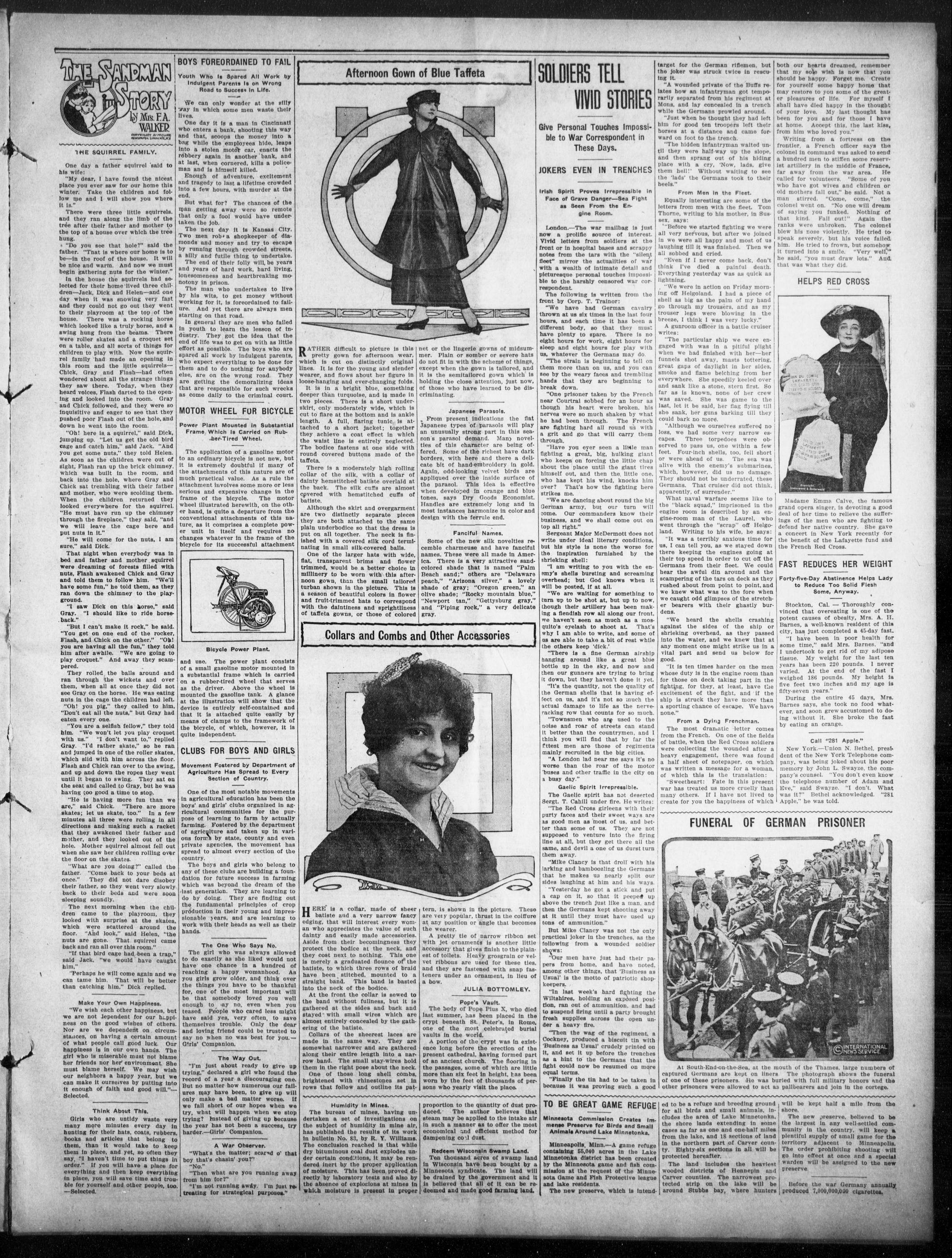
Bicycle Power Plant.
and use. The power plant consists of a small gasoline motor mounted in a substantial frame which is carried on a rubber-tired wheel that serves as the driver. Above the wheel is mounted the gasoline tank. A glance at the illustration will show that the device is entirely self-contained and that it is attached quite easily by means of clamps to the framework of the bicycle, of which, however, it is quite independent.
CLUBS FOR BOYS AND GIRLS
Movement Fostered by Department of Agriculture Has Spread to Every Section of Country.
One of the most notable movements in agricultural education has been the boys' and girls' clubs organized in agricultural communities for the purpose of learning to farm by actually farming. Fostered by the department of agriculture and taken up in various forms by state, county and even private agencies, the movement has spread to almost every section of the country.
The boys and girls who belong to any of these clubs are building a foundation for future success in farming which was beyond the dream of the last generation. They are learning to do by doing. They are finding out the fundamental principles of crop production in their young and impressionable years, and are learning to work with their heads as well as their hands.
The One Who Says No.
The girl who was always allowed to do exactly as she liked would not have one chance in a hundred of reaching a happy womanhood. As you girls grow older, and think over the things you have to be thankful for, one of the most important will be that somebody loved you well enough to say no, even when you teased. People who cared less might have said yes, very often, to save themselves trouble. Only the dear and loving friend could be trusted to say no when no was best for you.—Girl's Companion.
The Way Out.
"I'm just about ready to give up trying," declared a girl who found the record of a year a discouraging one. But no matter how numerous our failures may have been, to give up will only make a bad matter worse. If we fall short of our hopes when we try, what will happen when we stop trying? Instead of giving up because the year has not been a success, try harder—Girl's Companion.
A War Observer.
"What's the matter; scarred o' that boy that's chasin' you?"
"No."
"Then what are you running away from him for?"
"I'm not running away. I'm just re-treating for strategic purpose."
O
Collars and Combs and Other Accessories
A
---
RATHER difficult to picture is this pretty gown for afternoon wear, which is cut on distinctly original lines. It is for the young and slender wearer, and flows about her figure in loose-hanging and ever-changing folds. It is in a bright blue, something deeper than turquoise, and is made in two pieces. There is a short underskirt, only moderately wide, which is cut to flare at the bottom and is ankle length. A full, flaring tunic is attached to a short jacket; together they achieve a coat effect in which the waist line is entirely neglected. The bodice fastens at one side with round covered buttons made of the taffeta. There is a moderately high rolling collar of the silk, with a collar of dainty hemstitched batiste overlaid at the back. The silk cuffs are almost covered with hemstitched cuffs of batiste.
Although the skirt and overgarment are two distinctly separate pieces they are both attached to the same plain underbodice so that the dress is put on all together. The neck is finished with a covered silk cord terminating in small silk-covered balls. One of the larger hats with wide, flat, transparent brims and flower trimmed, would be a better choice in millinery to be worn with this afternoon gown, than the small tailored turban shown in the picture. This is a season of beautiful colors in flower and fruit-trimmed hats to correspond with the daintiness and sprightiness of taffeta gowns, or those of colored
Collars and Combs a
HERE is a collar, made of sheer batiste and a very narrow fancy edging, that will interest every woman who appreciates the value of such dainty and easily made accessories. Aside from their becomingness they protect the bodice at the neck, and they cost next to nothing. This one is merely a graduated flounce of the batiste, to which three rows of braid have been stitched, mounted to a straight band. This band is basted into the neck of the bodice.
At the front the collar is sewed to the band without fullness, but it is gathered at the sides and back and stayed with small wires which are almost entirely concealed by the gathering of the batiste.
Collars of the sheerest laces are made in the same way. They are somewhat narrower and are gathered along their entire length into a narrow band. The small stay-wires hold them in the right pose about the neck. One of those long shell combs, brightened with rhinestones set in rows that follow and outline its pat-
Humidity in Mines.
The bureau of mines, having undertaken a set of investigations on the subject of humidity in mine air, has published the results of its work in bulletin No. 83, by R. Y. Williams.
The conclusion reached is that while dry bituminous coal dust explodes under certain conditions, it may be rendered inert by the proper application of moisture. This has been proved directly by laboratory tests and also by the absence of explosions at mines in which moisture is present in proper
net or the lingerie gowns of midsummer. Plain or somber or severe hats do not fit in with the scheme of things, except when the gown is tailored, and it is the semiltaired gown which is holding the close attention, just now, of those who have learned to be discriminating.
Japanese Parasols.
From present indications the flat Japanese types of parasols will play an unusually strong part in this season's parasol demand. Many novelties of this character are being offered. Some of the richest have dark borders, with here and there a delicate bit of hand-embroidery in gold. Again, odd-looking velvet birds are appliqued over the inside surface of the parasol. This idea is effective when developed in orange and blue tones, says Dry Goods Economist. Handles are extremely long and in most instances harmonize in color and design with the ferrule end.
Fanciful Names.
Some of the new silk novelties resemble chameuse and have fanciful names. These were all made in America. There is a very attractive sand-colored shade that is named "Palm Beach sand," others are "Delaware peach," "Arizona silver," a lovely shade of gray; "Oregon green," an olive shade; "Rocky mountain blue," "Newport tan," "Gettysburg gray," and "Piping rock," a very delicate gray.
nd Other Accessories
tern, is shown in the picture. These are very popular, thrust in the collure at any position or angle that becomes the wearer.
A pretty tie of narrow ribbon set with jet ornaments is another little accessory that gives finish to the plainest of toilets. Heavy grosgrain or velvet ribbons are used for these ties, and they are fastened with snap fasteners under an ornament, in lieu of a bow.
JULIA BOTTOMLEY.
Pope's Vault.
The body of Pope Plus X, who died last summer, has been placed in the crypt beneath St. Peter's, in Rome, one of the most celebrated burial vaults in the world.
A portion of the crypt was in existence long before the erection of the present cathedral, having formed part of an ancient church. The flooring in the passages, some of which are little more than six feet in height, has been worn by the feet of thousands of persons who yearly visit the place.
proportion to the quantity of dust produced.
The author believes that steam may be applied to the intake air in such a manner as to offer the most economical and efficient method for dampening coil dust.
Ten thousand acres of swamp land in Wisconsin have been bought by a Minnesota syndicate. The land will be drained by the government and it is believed that all of it can be redeemed and made good farming land.
SOLDIERS TELL VIVID STORIES
Give Personal Touches Impossible to War Correspondent in These Days.
JOKERS EVEN IN TRENCHES
Irish Spirit Proves Irrepressible in Face of Grave Danger—Sea Fight as Seen From the Engine Room.
London.—The war mailbag is just now a prolific source of interest. Vivid letters from soldiers at the front or in hospital bases and scrapy notes from the tars with the "silent fleet" mirror the actualities of war with a wealth of intimate detail and picturesque personal touches impossible to the harshly censored war correspondent.
The following is written from the front by Corp. T. Trainor: "We have had German cavalry thrown at us six times in the last four hours, and each time it has been a different body, so that they must have plenty to spare. There is no eight hours for work, eight hours for sleep and eight hours for play with us, whatever the Germans may do.
"The strain is beginning to tell on them more than on us, and you can see by the weary faces and trembling hands that they are beginning to break down.
"One prisoner taken by the French near Courtal sobbed for an hour as though his heart were broken, his nerves were so much shaken by what he had been through. The French are fighting hard all round us with a grit and go that will carry them through.
"Have you ever seen a little man fighting a great, big, hulking giant who keeps on forcing the little chap about the place until the giant tires himself out, and then the little one, who has kept his wind, knocks him over? That's how the fighting here strikes me.
"We are dancing about round the big German army, but our turn will come. Our commanders know their business, and we shall come out on top all right."
Sergeant Major McDermott does not write under ideal literary conditions, but his style is none the worse for the inspiration furnished by the shrieking shell: "I am writing to you with the enemy's shells bursting and screaming overhead; but God knows when it will be posted, if at all. "We are waiting for something to turn up to be shot at, but up to now, though their artillery is being made a flendish row all along our front, we haven't seen as much as a mosquito's eyelash to shoot at. That's why I am able to write, and some of us are able to take a bit of rest while the others keen 'dick.'
"There is a fine German airship hanging around like a great blue bottle up in the sky, and now and then our gunners are trying to bring it down, but they haven't done it yet. "It's the quantity, not the quality of the German shells that is having effect on us, and it's not so much the actual damage to life as the nerve racking row that counts for so much. "Townsmen who are used to the noise and roar of streets can stand it better than the countrymen, and I think you will find that by far the fittest men are those of regiments mainly recruited in the big cities. "A London lad near me says it's no worse than the roar of the motor buses and other traffic in the city on a busy day."
Gaelic Spirit Irrepressible.
Sergt. T. Cahill under fire. He writes: "The Red Cross girlsebs with their sweet ways are as good men as most of us, and better than some of us. They are not supposed to venture into the firing line at all, but they get there all the same, and devil a one of us durst turn them away." "Mike Clancy is that droll with his larking and bamboozoiling the Germans that he makes us nearly split our sides laughing at him and his ways." "Yesterday he got a stick and put a cap on it, so that it peeped up above the trench just like a man, and then the Germans kept shooting away at it until they must have used up tons of ammunition." But Mike Clancy was not the only practical joker in the trenches, as the following from a wounded soldier shows:
"Our men have just had their papers from home, and have noted, among other things, that 'Business as Usual' is the motto of patriotic shopkeepers.
"In last week's hard fighting the Wiltshire, holding an exposed position, ran out of ammunition, and had to suspend firing until a party brought fresh supplies across the open under a heavy fire.
"Then the wag of the regiment, a Cockney, produced a biscuit tin with 'Business as Usual' crudely printed on it, and set it up before the trenches as a hint to the Germans that the fight could now be resumed on more equal terms.
"Finally the tin had to be taken in because it was proving such a good
TO BE GREAT GAME REFUGE
Minnesota Commission Creates Immenge Preserve for Birds and Small Animals Around Lake Minnetonka.
Minneapolis, Minn.—A game refuge containing 55,040 acres in the Lake Minnetonka district has been created by the Minnesota game and fish commission at the request of the Minnesota Game and Fish Protective league and lake residents.
The new preserve, which is intend-
FUNERAL OF GERMAN PRISONER
INTERNATIONAL
NEWS SERVICE
At South-End-on-the-Sea, at the mouth of the Thames, large numbers of captured Germans are kept on liners. The photograph shows the funeral of one of these prisoners. He was buried with full military honors and the other prisoners were allowed to act as pallbearers and join in the cortege.
target for the German rifleman, but the joker was struck twice in rescuing it.
"A wounded private of the Buffs relates how an infantryman got temporarily separated from his regiment at Mons, and lay concealed in a trench while the Germans prowled around.
"Just when he thought they had left him for good ten troopers left their horses at a distance and came forward on foot to the trench.
"The hidden infantryman waited until they were half-way up the slope, and then sprang out of his hiding place with a cry, 'Now, lads, give them hell!' Without waiting to see the 'lads' the Germans took to their heels."
From Men in the Fleet.
Equally interesting are some of the letters from men with the fleet. Tom Thorne, writing to his mother, in Sussex, says:
"Before we started fighting we were all very nervous, but after we joined in we were all happy and most of us laughing till it was finished. Then we all sobbed and cried.
"Even if I never come back, don't think I've died a painful death. Everything yesterday was as quick as lightning.
"We were in action on Friday morning off Helgoland. I had a piece of shell as big as the palm of my hand go through my trousers, and as my trouser legs were blowing in the breeze, I think I was very lucky."
A gunroom officer in a battle cruiser writes:
"The particular ship we were engaged with was in a pitiful plight when we had finished with her—her funnels shot away, masts tootering, great gaps of daylight in her sides, smoke and flame belching from her everywhere. She speedily keeled over and sank like a stone, stern first. So far as is known, none of her crew was saved. She was game to the last, let it be said, her flag flying till she sank, her guns barking till they could bark no more.
"Although we ourselves suffered no loss, we had some very narrow escapes. Three torpedoes were observed to pass us, one within a few feet. Four-inch shells, too, fell short or were ahead of us. The sea was alive with the enemy's submarines, which, however, did us no damage. They should not be underdred, these Germans. That cruiser did not think, apparently of surrender."
What naval warfare seems like to the "black squad," imprisoned in the engine room is described by an engine-room man of the Laurel, who went through the "scrap" off Helgo land. Writing to his wife, he says: "It was a terribly anxious time for us, I can tell you, as we stayed down there keeping the engines going at their top speed in order to cut off the Germans from their fleet. We could hear the awful dn around and the scampering of the tars on deck as they rushed about from point to point, and we knew what was to the fore when we caught odd glimpses of the stretcher bearers with their ghastly burdens.
"We heard the shells crashing against the sides of the ship or shrieking overhead, as they passed into the water, and we knew that at any moment one might strike us in a vital part and send us below for good.
"It is ten times harder on the men whose duty is in the engine room than for those on deck taking part in the fighting, for they, at least, have the excitement of the fight, and if the ship is struck they have more than a sporting chance of escape. We have none."
From a Dylria Frenchman.
The most drastic letter comes from the French. On one of the fields of battle, when the Red Cross soldiers were collecting the wounded after a heavy engagement, there was found a half sheet of notepaper, on which was written a message for a woman, of which this is the translation: 'Sweetheart: Fate in this present war has treated us more cruelly than many others. If I have not lived to create for you the happiness of which
FUNERAL OF GE
At South-End-on-the-Sea, at the ncaptured Germans are kept on liner of one of these prisoners. He was but other prisoners were allowed to act a
ed to be a refuge and breeding ground for all birds and small animals, includes the area of Lake Minnetonka, the shore lands extending in some cases as far as one and one-half miles from the lake, and 18 sections of land in the northern part of Carver county. Eighty-six sections in all will be protected hereafter.
The land includes the heaviest wooded districts of Hennepin and Carver counties. The narrowest protected strip on the lake will be around Stubbs bay, where hunters
both our hearts dreamed, remember that my sole wish is now that you should be happy. Forget me. Create for yourself some happy home that may restore to you some of the greater pleasures of life. For myself I shall have died happy in the thought of your love. My last thought has been for you and for those I have at home. Accept this, the last kiss, from him who loved you."
Writing from a fortress on the frontier, a French officer says the colonel in command was asked to send a hundred men to stiffen some reservist artillery in the middle of France, far away from the war area. He called for volunteers. "Some of you who have got wives and children or old mothers fall out," he said. Not a man stirred. "Come, come," the colonel went on. "No one will dream of saying you funked. Nothing of that kind. Fall out!" Again the ranks were unbroken. The colonel blew his nose violently. He tried to speak severely, but his voice failed him. He tried to frown, but somehow it turned into a smile. "Very well," he said, "you must draw lots." And that was what they did.
HELPS RED CROSS
BON DU CAMEL
CARPETTE
BON DU CAMEL
CARPETTE
BON DU CAMEL
CARPETTE
BON DU CAMEL
CARPETTE
Copyright
Ludwig & Johannweide
Madame Emma Calve, the famous grand opera singer, is devoting a good deal of her time to relieve the sufferings of the men who are fighting to defend her native country. She gave a concert in New York recently for the benefit of the Lafayette fund and the French Red Cross.
FAST REDUCES HER WEIGHT
Forty-five-Day Abstinence Helps Lady to Reduce Too Solid Flesh Some, Anyway.
Stockton, Cal. — Thoroughly convinced that overeating is one of the potent causes of obesity, Mrs. A. I. Barnes, a well-known resident of this city, has just completed a 45-day fast. "I have been in poor health for some time," said Mrs. Barnes. "and I undertook to get rid of my adipose tissue. My weight for the last ten years has been 220 pounds. I never varied. At the end of the fast I weighed 186 pounds. My height is five feet two inches and my age is fifty-seven years."
During the entire 45 days, Mrs. Barnes says, she took no food whatever, and soon grew accustomed to doing without it. She broke the fast by eating an orange.
Call "281 Apple."
New York—Union N. Bethel, president of the New York Telephone company, was being joked about his poor memory by John L. Swayze, the company counsel. "You don't even know the telephone number of Adam and Eve," said Swayze. "I don't. What was it?" Bethel acknowledged. "281 Apple," he was told.
ERMAN PRISONER
INTERNATIONAL NEWS SERVICE
mouth of the Thames, large numbers of
ers. The photograph shows the funeral
buried with full military honors and the
as pallbearers and join in the cortege.
will be kept half a mile from the shore.
The new preserve, believed to be the largest in any well-settled community in the country, will keep a plentiful supply of small game for the territory adjacent to Minneapolis. The order prohibiting shooting will go into effect at once and a special warden will be assigned to the new preserve.
Before the war Germany annually produced 7,000,000,000 cigarettes.
THE KANSAS CITY SUN
PUBLISHED WEEKLY.
All communications should be addressed
to The Kansas City Sun, 1803 East 18th
Stre
Bell Phone East 999.
Entered as second-class matter, August
1983, at the postoffice at Kansas City,
Mo., under the act of March 3, 1973.
Nelson C. Crews. ..... Editor and Owner
William C. ..... General Manager
TITLE
Eva P. Washington, Traveling Repre-
One Year ..... $1.50
Six Months ..... 75
Three Months ..... 50
ADVERTISING RATE, 50 CENTS PER
INCH.
CHURCH DIRECTORY.
CHURCH DIRECTORY.
Bathel A. M. E. Church, 24th and Flora.
St. Stephen's Baptist Church, 604 Charlotte St.
Centennial M. E. Church, 19th and Woodland.
Second Baptist Church, 10th and Charlotte.
Allen Chapel A. M. E. Church, 10th and Charlotte.
Kansas Ave. Baptist Church, 46th and Kansas.
Ebenezee A. M. E. Church, 17th and Treey.
St. Augustine's P. E. Church, 11th and Troost.
Vine St. Baptist Church, 1252 Vine St.
Ward Chapel A. M. E. Church, 11th and Wine St.
Blue Valley Baptist church, 1129 Crystal
avenue.
John S. A. M. E. Church, 1743 Belvieu.
Seventh Day Adventist, 23rd and Wood-
view.
St. Monica's Catholic, 17th and Lydia
Morning Star Baptist Church, 231 Vine
Hallway Avenue Baptist Church, 1111
Highland
Centropolis A. M. E. Church, Centropolis
St. James A. M. E. Z. Church, 1823
Woodland Ave.
Philips Church, Boundston,
People's Mission, 30th and Genesee.
St. Paul's Baptist Church, 19th and
Highland.
Friendship Baptist Church, 17th and
Tracy Avenue.
Pilgrim Baptist Church, 614 Charlotte
St.
Pleasant Green Baptist Church, Independence Avenue and Tracy.
Calvary Baptist Church, 19th and
Ashley.
Biglow A. M. E. Mission, 5th and
Lydia.
Progressive Baptist Church, 29th and
Summit.
C. M. E. Church, 1817 Flora Ave.
St. James Baptist Church, 4093 Mill St.
St. M. E. Church, 43rd and
Prospect Place.
A. M. E. Mission, 555 Grand Ave.
KANSAS CITY, KAN. CHURCHES.
Blest A. M. E. Church, 5th and Neb.
Green Green Baptist Church, 1st and
Baptisms
St. Eighth St. Baptist Church, 8th and Oakland.
Metropolitan Baptist Church, 9th and Washington.
Broadway St. M. E. Church, Water and Steward Streets.
St. Paul A. M. E. Church, 21st and Ruy.
First Baptist Church, 5th and Neh.
King Solomon Baptist Church, 3rd and State.
Quindaro A. M. E. Church, Quindaro, Pasient Valley Baptist Church, Rosedeal, Kan.
M. E. Church, 9th and Oakland.
A. M. E. Church, 4th and Oakland.
Sessions, A. M. E. Church, South Park, Kan.
Protestant Episcopal, 3rd and Stewart.
Second Baptist Church, 24th and Ruby.
Wesley Chapel M. E., 106 Shawnee.
St. Paul A. M. E. Zion Church, 4000 Adams.
Bethel A. M. E. Church, Roselale, Kan.
Mt. Zion Baptist Church, 4th and Vir-
lentine
Ebenezer A. M. E. Church, Sanford and
Tremont
Mt. Zion Primitive Baptist Church,
Westport avenue and Tangent street,
Rosedale
EDITORIALS
Notwithstanding the very unsympathetic attitude of the Kansas City Star toward our race, the Negroes join the prayer that Col. William R Nelson, the veteran publisher, may recover from his dangerous illness.
---
The man who wins the reputation of being false to his friends soon occupies that unenviable place in obscurity which is set apart for such persons. The chronic liar and blasphemer is the quintessent wart of the community.
One hardly ever hears Prof. R. G. Jackson talk very much, but he is always busy doing something which tends to elevate the musical taste of the people. One wonders how he manages to accomplish so many things and do them all so well. Perhaps it is merely the industrious application of supreme talent, otherwise known as genius.
Now comes another Anglo-Saxon producer of hate in the form of a movie film under the caption of the "Birth of a Nation," and depicting the Negro in an even more libelous form than that which was lately projected in the "Clansman." It is said that President Wilson and Chief Justice White have approved the film, which is not surprising, but that in many cities the board of censors have rejected it.
While Dr. J. PP. Thompson, a Negro of el Biberton, Ga., was alone with Dr. A. S. Oliver, white, in the office of the latter last week, Dr. Thompson was shot by Dr. Oliver. The press states that no arrests were made and that Oliver simply went home and could not be reached for an interview. The police and other authorities awaited a statement from Dr. Oliver and went on their way, which is a pretty good illustration of the way justice is interpreted in the South.
---
While Banker George W. Perkins of New York, thrown from a fishing smack at West Palm Beach, Fla., was drowning, a Negro rushed to his assistance and saved his life. The Associated Press, which can always give the name of every Negro who commits a crime, leaves off giving the name of this brave colored man just as it would omit the name of a dog which might have performed the same service. The Negro was merely an incident in the near tragedy, yet in the unwritten annals of human affairs he will ever remain a hero just the same.
Would like to know the whereabouts of my sister, Mrs. Amanda Davis, last heard of at 1432 East Thirteen, Kansas City, Mo. Any information would be gladly received by Mrs. H. T. Motin, formerly Miss Lula Duncan, Orleans, Neb.
---
A weekly discussion of Hygiene and Sanitation, First Aid Measures and Preventive Medicine. Questions will be answered but no diagnoses nor prescriptions will be given in this column.
A. S. S.
LA GRIPPE.
La grip is the common or popular name for influenza. This remarkable disease has prevailed from ancient times, the most probable proof of which is from historical allusions to widespread epidemics of a disease which was never definitely understood, although it was known that it differed from other diseases.
It did not command the most serious attention of the medical profession until 1891, when an epidemic of this disease became so widespread as to merit the distinction of being called a pandemic. he following year a germ was found in the discharges of influenza patients which was proved to be the cause of this disease. As no other disease is characterized by such rapid onset in a community it was only natural that, for a long time, it should be regarded as dependent on seasonal and meteorological conditions, but it is now known to be a contagious disease which follows the tracks of commerce and human travel, always proceeding from person to person rather than from place to place. It is a seasonal disease only in this respect, that, like pneumonia, it is more prevalent in winter and spring because, usually, the vitality and general resistance to disease is low at such times.
Among the reasons for this lowered vitality may be mentioned much indoor life in poorly ventilated and overheated rooms, and the failure to properly protect the body by suitable clothing and footwear against the cold and variable weather conditions. To this cause may be ascribed the majority of the cases of influenza in Kansas City at the present time. All persons are liable to the disease. Children under 1 year are least susceptible and, in some epidemics they may escape altogether; it is, however, frequent among children over 2 years. A peculiarity of the disease is that one attack does not insure the patient against subsequent attacks; in fact, it seems to make him more liable. Individuals have been known to suffer from two or more attacks within a period of one month.
There are several types of influenza, each characterized by that particular part of the body which bears the brunt of the attack; thus in the respiratory form the most prominent
First of all, I should give the best attention to my teachers in the Sabbath and public schools, the mightiest political forces, and the largest as sets of patriotism. As attention is the great condition of learning and remembering because it helps our minds to secure an accurate an denduring first impression, I should absorb just that knowledge which most stimulates the imagination and quickens the power of observation, the two faculties to which all great women owe success; and I should strive to know who are the race leaders who have made space in history because of their striving and achievements.
If I were a boy again, I should come evermore into contacet with a living and real world of existence. Happy child the roof whose school room is the blue heaven with its drifting clouds and mellow tints of sunrise, and glories of evening; whose bench is the soft grass, the gray stone, the limb of the apple tree. And it is evident that the very constitution of nature throbs with the desire and purpose of the Father to make himself known to his children. I should avoid little mistakes. It takes very little knowledge to enable one to see that the little mistake here and the little mistake there have through the years brought mischief. I should endeavor to understand and to practice forgiveness. It is as true today as it was when I was a boy that to forgive and forget means to be at peace. I should be more careful about learning the hard lesson of patience, and above all, the beauty of self-control—the control of body, of speech, of temper; a power best learned in youth before the current of habit has deepened the channel of self-will. Suffice it to say: "If I am not in control, I am not the king I should be. Part of my kingdom is in insurrection."
If I were a boy again I should beware of slang and gossip. I should cultivate by study that geniality and facility of expression and learn to dwell upon what is kindly and happy. I should be more ready to express my thanks for services rendered, be quickest with my praise, tardier with my criticism and firmer with my effort to brood over the truth until I had made it not merely the thought but the passion of my life.
Whoever among my readers is thinking of laying aside his or her plans, desires and possessions with the hope of being a boy or a girl, need to be reminded that these things I should do if I were a boy again run away with golden promises like hope's brightest visions. And as I consider my age and experience and opportunity my eyes become open to danger of losing the splendid optimism which should buoy me, and I find myself reaching out toward higher standards of living, not material living alone, but social life, mental and moral strivings and achievements.
"Though the way be long, still memory's song
Tirilla up from the distant past;
And we know through the strife of life
on life
We shall come to our own at last.
symptoms are associated with the nose, throat and bronchial tubes, and are accompanied by nasal discharges and cough; in the gastro-intestinal form, the chief symptoms—nausea and vomiting, diarrhea, abdominal pain and general digestive disturbances—are associated with the stomach and bowels. These two types of the disease are most frequently seen; the others are rare. There are, however, certain general characteristics of influenza in any form which are so well known that the physician frequently finds that patients have made their own diagnosis. These symptoms may be described as follows: Unmistakable conviction on the part of the patient that he is sick, general prostration, aching in the limbs and back, though the patient usually says he "aches all over;" headache, some nausea and fever.
The duration of the disease is usually from two to seven days, occasionally several weeks. It responds readily to treatment, and although it is a disease of which few die, it often prepares the way for more serious diseases. For this reason the services of a competent physician should always be employed in order that the proper precautions may be taken against bronchitis, pneumonia, tuberculosis, diseases of the heart, kidneys and nervous system, which frequently follow in the wake of influenza.
Since this is a contagious disease it may readily spread through contact to other members of the household. The patient, therefore, should be isolated in a separate room in which there is sufficient and constant ventilation; his excreutions should be disinfected with formaldehyde and all articles used in the sick room, such as linens, dishes, etc., should be boiled before being used by other members of the family.
The question naturally arises as to what precautions may be taken by the individual against contracting the disease. The best protection against in fluenza is normal health, that condition in which the natural protective forces of the body are in the highest state of efficiency. To obtain and maintain this, the laws of hygiene pertaining to eating and drinking sleeping, clothing, bathing, ventilation, heating, etc., which we try to explain from time to time in this column, must be religiously and consistently obeyed.
KANSAS CITY CONSISTORY.
The Kansas City Consistory No. 7 will confer Scottish Rite degrees March 30 and 31, 1015, ending as usual with the Maunday Thursday feast. Allah Temple No. 6 will confer degrees (A. E. A. O. N. M. S.) in connection with the Scottish Rite work. All blue lodge Masons are eligible to these degrees.
For Sale—An elegant almost new $200 cash register and a Smith Premier typwriter, at a bargain. Call the Sun office for information.
You Should Use
Madam P. M. Dabne
XXTH CENTURY
HAIR PREPARATION
And Have Good Hair
Mme. P. M. Dabney's XXth Century Hair Grower
Madam P. M. Dabney's XXth Century Hair Grower promotes a beautiful growth of hair, stops falling out and breaking of hair, removes dandruff and relieves itching of scalp. It will make YOUR hair grow. For woman, man or child.
PRICE 50c. PER JAR
Mme. P. M. Dabney's XXth Century Hair Grower
TESTIMONIAL
"This is to certify that the writer suffered for four years with danduff and itching of the scalp until practically bald, trying many remedies but of no avail. About six months ago I began to use Madam P. M. Dabney's XXth Century Hair Grower, the results up to date are pleasing. Dandruff removed, itching stopped, good growth of hair started. The remedy is O. K. Yours for succes, Rev. L. W. Harris, Mod. Mt. Zion Baptist Association, Carrollton, Mo."
Betty& Sam's Little Corner)
A
—That as a man lives so shall he die. Get that?
—That a class leader with a whiskey breath doesn't inspire confidence in his members.
—That the "pen is mightier than the sword" but there are a lot of Negroes who can't use either.
—That when you lend the average Negro a dollar, just prepare to lose both the dollar and a friend.
—That vice, crime, immortality, late hours and "good time" will wreck the strongest race on earth, much less ours.
—That a certain woman said: I had rather go to Heaven barefooted than to stand in the shoes of some jealous Negro women.
—That the preacher is a moral coward who is afraid to say that the man who dies in his sins goes to Hell. "Give us the old time religion."
—That a white "movie" show on 18th street is taking in more money from Negroes than all the Negroe business places on that street. Why?
—That a woman in an easy rocking chair can dispense more gossip in twenty minutes than a woman in a straight back chair can tell in an hour.
—That a certain buffet flat on Tracy is getting a bad name by the noise and hurrah they are keeping up nightly; so say a half dozen letters we have received.
MARYVILLE, MO.
Rev. H. Bolden departed this life February 27th at Boydton, Va., and his body was brought here for burial accompanied by his wife and daughter. Rev. McDonald officiated. Rev. Bolden was well known throughout the county and esteemed by all. The family all left for their homes Monday afternoon.....Rev. McDonald preached a stirring sermon Sunday night and left for home Monday morning at Kansas City, Mo.....Mr. O. R. Vance, who has been confined to his home for sometime, was able to be out Sunday.....Mrs. Jack Fleener of E 3d street, is very ill.....Mrs. Ousley is somewhat improved.
Would Use
M. Dabney's
TURY
PARATIONS
Mme. P. M. Dabney's XXth Century Pressing Oil
Madam P. M. Dabney's XXth Century Pressing Oil is an ideal hair dressing, having properties which protect the hair from wind, weather and disease, make it soft and glossy; improves the quality of the hair and promotes straightening without irons. For woman, man or child.
PRICE 50c. PER BOX
Mme. P. M. Dabney's XXth Century Pressing Oil
Six Weeks' T
Six Weeks' Treatment $1.25
Make a course of treatment which will last six weeks. enclosing P. O. money ord by parcel post prepaid, or mation to
Madam P. M. Dabbe
HAIR PREPA
1806 E. 24th St.
Make a course of treatment for the hair and scalp which will last six weeks. Send us an order today enclosing P. O. money order for $1.25 and receive them by parcel post prepaid, or write for literature and information to Madam P. M. Dabney's XXth Century HAIR PREPARATIONS CO. 1806 E. 24th St. Kansas City, Mo.
---
M. Dabney's
y Pressing Oil
Mme. P. M. Da
XXth Century
Weeks' Treatment
One jar Madam P. M. Dabney's
XXth Century Hair Grower
One box Madam P. M. Dabney's
XXth Century Pressing Oil
And one bottle Madam P. M.
Dabney's
XXth Century Shampoo
Fourth Century Shampoo
course of treatment for the hair a
will last six weeks. Send us an order
P. O. money order for $1.25 and rec
post prepaid, or write for literature a
am P. M. Dabney's XXth Cent
HAIR PREPARATIONS CO.
24th St. Kansas C
The Value of Life Insurance to Colored People.
Is a text from which a little sermon could well be preached in every colored church in America.
There is scarcely a family whose members do not have some sort of Policy in some sort of Company or Society or Order. These are usually for just enough to give a decent burial. The funeral expenses take practically all the proceeds and there is nothing left to meet the obligations which face the widow after she returns from the funeral. The problem of rent, food, clothes, books and school expenses for the children are not theories. When the grocer's boy brings the package he wants the money; and when the landlord calls he wants the rent.
The man who carried $50 to $200 in a weekly benefit society or a secret society on the assessment plan earned enough and could easily have paid the premium on $1,000 to $5,000 in an old line legal reserve life insurance company whose rates are fixedd and subject to no assessment, if he only had known.
He could have made impossible the long hours of bending over a needle or the cook stove or the wash tub that came to his widow, if he had carried the necessary amount of life insurance. He could have assured his beautiful daughter the education she desired, the amusements she wanted, the clothes she craved—and which she got somehow. He could have kept his boy in school and he would have grown up a credit to the memory of his father, a respected citizen of his community, and a successor to his father's business, instead of the wanderer or menial or ne'er-do-well. He could have changed the destiny of every member of his family! He had it in his power to make them bless his memory or bewail his shortsightedness! What a tremendous responsibility!
Are YOU, reading this, preparing for the future of your family or are you leaving them to shift for themselves after you are gone? What will become of your son? Will he he leave school and go to work prematurely? Will your daughter give up her training upon which she has just entered? Must your wife go out and hunt work to support herself and the younger children? Will you leave money enough to pay the balance due on the home you have been purchasing? Or will your wife lose the place?
You can secure to those you love future independence, you can protect your obligations, you can save your business if, while you are alive, sound and well—and that is NOW—you secure the necessary amount of life insurance.
You can secure this life insurance in a strong, well managed life insurance company which has met every requirement demanded of it, owned, organized and operated by our people, the only one of its kind in the world, at rates within your reach if you act today. No matter where you live we can Protect you. Tear off this coupon and mail it today to
Capital Fully Paid.....$100,000.00
Over One Million and a Quarter Insurance in Force
Issues Policies from $250.00 to $5,000.00
Please send me particulars about insurance.
---
A true and accurate account of black men who broke their chains, made themselves free, expelled their former masters, and constructed a state that has stood the twelve tests of a century without help.
FREE! FREE! FREE! FREE! The above book to anyone bringing Six New Subscribers of One Dollar Each for the Sun.
TESTIMONIAL
"With the use of Madam P. M. Dabney's XXth Century Hair Preparations my hair has grown four inches in six months. I would not be without them." Mrs. Henderson, 1721 Forest Ave., Kansas City, Mo.
Mme. P. M. Dabney's XXth Century Shampoo
Madam P. M. Dabney's XXth Century Shampoo is the best cleaner for the washing of the heads of colored people. It contains no astringents or other ingredients harmful to the scalp. It promotes hair health and vigor. For woman, man or child.
PRICE 50c. PER BOTTLE
Mme. P. M. Dabney's
XXth Century Shampoo
Treatment $1.25
treatment for the hair and scalp
seeks. Send us an order today
order for $1.25 and receive them
or write for literature and infor-
dabney's XXth Century
HEMAN E. PERRY.....President
HARRY H. PACE.....Secretary
GEO. F. PORTER.....Agency Director
PRICE, $1.25
WM. H. DAWLEY, JR. . . 2126 TRACY
Those sojourning or living in Chicago will find the Sun on sale at Mr. W. H. Robinson's place, 1937 West Lake street, or A. D. Hayes. 3640 S. State street.
Bell Phone E. 4394Y
THE Modern I
A. E. ESTE
General C
Repairing
SATISFACTION
MARKERS AND
Prices ranging from $15.00 up
you may have them up for
your appoint
GEORGE W
613 Charlotte Street
PRICE. $1.25
LEY, JR. ,
E! R
one bringing
dollar Each for
**+**+**+**+**+**
Modern Builder A.E. ESTES, President General Contractor Repairing a Special SATISFACTION GUARANTEE
Modern Builders Co.
A. E. ESTES, President
General Contracting
Repairing a Specialty
SATISFACTION GUARANTEED
GEORGE W. LITTLE.
We call for you with our 5-passenger car to
to show you our
MARKERS AND MONUMENTS
arranging from $15.00 up. Let us show you
you may have them up for Decoration day. M
your appointment with
GEORGE W. LITTLE
Charlotte Street Bell M.
Collector for Highland Cemetery Co.
Agent for
KANSAS CITY GRANITE & MONUMENT
Directly opposite Elmwood Cemetery Co.
last 15th Street. KANSAS
Strong Enough, Probably.
Patience—I see for teaching young children to walk and otherwise developing their muscles a New York man has invented an attachment for dining tables which holds them up as they move around.
Patrice—Do you suppose the butter has anything to do with it?
Bill—Now, they say sand is good for dyspepsia.
Jill—That's right. Eat plenty of sugar.
MADAME MARTIN'S SANITARY HAIR
GROWER—TEMPLE GROWER—SHAMPOO
AND SANITARY GLOSSINE is
wonderful. Try it and you will get
results.
MME, MARTIN'S
Sanitary Hair Grower Guaranteed to
Grow Hair.
2220 Michigan Ave., Kansas City, Mo.
Hair Grower . . . 50 cents
Shampoo. . . . 50 cents
Oleosane . . . 35 cents
Temple Grower . . . 35 cents
Madame K. Martin has treated my scalp for seven months with much success, was suffering from a germ dandruff and was not grow. I be a barber myself knew a number of remedies for scalp diseases and tried several hair dressers, and fail to get favorable results, I consulted Madame Martin. My scalp began at once to get better and the hair has grown several inches, after trying the various hair dressers I will honestly say that I have found Madame Martin the best I have known. For further information concerning the res: is of the treatment of my hair and scalp you may call to see me at 220-666-6666.
MRS. S. PLUMMER.
In April, 1914, my scalp was being treated by Mrs. Kate Martin, 2202 Mich. He, a hair dresser in this city, I say, with patience, measured six inches and length. I heartily adored her to anyone who need to have scalp and hair treated and anyone who wishes my hair has grown at 1415 Mich. her treatment, and at 1415 Mich. rear.
MRS. EMMA JACKSON.
To Whom It May Concern:
This is to certify that I have taken scalp it and hair treatment under Mme. Kate Martin and can't initially send the she positively grows the hair. When I first began the treatment in October my hair was scarcely two inches long, but it measures 1 inches and is steadily improving. I have been so-called hair tonics and pomades, but have found nothing to equal "The Sanitary Hair Grower." Very respectfully,
MRS. ESTELLA SHARPE
3710 West Prospect Place,
Kansas City, Mo.
I feel it my duty to write this as it may do someone some good I began taking scalp treatment of Madame Martin, May 29, 1914. My scalp was in a very bad condition. I had Eczema and my hair was less than 1½ inches long. My hair was dry and hard and no life in it but now my scalp is in a healthy condition and my hair is soft and fluffy, and is free from germs and measures 6½ inches. Madame Martin's work is wonderful and will do just what she says. I cannot give her too much praise. For any information of the treatment you may see me. Her Sanitary Hair Oil is great.
Sincerely,
F. BELLE THOMAS
Office 2460 W Idrond Ave
Builders Co. S, President Contracting a Specialty GUARANTEED
MONUMENTS
Let us show you early that
r Decoration day. Make
treatment with
W. LITTLE
Bell Main 2967W.
and Cemetery Co.
for
TE & MONUMENT CO.
Bewood Cemetery Co.
KANSAS CITY, MO.
Mixed Medicine
TESTIMONIALS
MRS. S. PLUMMER.
407 Cleveland Ave. Kansas City, Kansas. Conser
3710 West Prospect Place.
F. BELLE THOMAS
Mrs. Lottie Hill is ill at her residence, 2632 Euclid avenue.
Hon. W. C. Hueston was confined to his home two days this week with la gripe.
Rev. Sister Pearl is dangerously ill with pneumonia at her new location, 559 Grand avenue.
Mrs. Bridget, who has been ill for the past two weeks, is much improved at this writing.
Mr. Geo. Fagan of Oakland, Calif., arrived in our city last Sunday and will probably locate here.
Misses Jeanette Green and Ethlene Wilson entertained with a dancing party at Garrison Square Friday evening.
Mrs. Paralee Maxwell of Fort Scott, Kas., arrived Thursday, the guest of Mrs. Eliza Russell, 1903 East Twenty-fourth street.
Mrs. A. E. Jenkins closed a deal for the elegant flats on Vine street near 10th street, valued at $18,000.00. Hurrah for Mrs. Jenkins.
Miss Clara V. Lynden, first assistant at Lincoln School, was called to Fredonia, N. Y., this week on account of the death of a relative.
Mrs. Rosaile Ward of Denver, Colo., formerly of Kansas City, is visiting her father at 12 West Washington street, Oklahoma City, Okla.
Rev. O. T. Redd of 2642 Highland avenue, returned from Armstrong, Mo., where he buried his father, Samuel Richardson, 76 years of age.
Mrs. Blanche Hawkins, 1419 Michigan, left, for Pittsburgh, Pa., on account of the death of her aunt and will be gone several weeks.
Mrs. S. F. Straughther, 1206 Paseo, was called away to attend the funeral of her brother, Wm. McMerty, 5322 Von Version avenue, St. Louis, Mo., who died March 5.
Prof. A. R. Chlinn, C. G. M., of the International Order of Twelve, was in the city this week on business. The annual grand session of the Order will be held in this city during July.
Mr. and Mrs. Samuel McClain announce the marriage of their daughter, Dimple, to Mr. Hudson Emery March 8. Mr. and Mrs. Emery are at home at 1409 Spruce street.
Anderson (Sonny) Brinkley, a well known young man in this city, died suddenly last Monday night and was buried from the home of his mother, 2312 Woodland avenue, Thursday.
R. H. Spears, attorney at law, wishes to announce for the information of his clientele that he is now located at 1031 Independence avenue. Bell phone Main 3398W. Home phone Main 3341.
Rev. Geo. F. Martin of Cow Creek Circuit, joined his wife who has been visiting here for the past three weeks. Rev. Martin will preach at Ebeneszer A. M. E. Church at 11:00 o'clock Sunday morning.
Mr. Edward Dennis instructor of Music at Texas College, Tyler, Tex., recently appeared in recital with Carl Diton who is now teaching at Wiley University. Mr. Dennis rendered Harry T. Burleigh's latest composition the "Saracen Songs."
Miss Lula B. Wells, 51 West 131st street, New York City, was in the city in the capacity of maid for Miss Emma Carus, who played at the Orpheum last week, and while here was the guest of Mr. and Mrs. George H. McPike, 1608 Jefferson street.
Mrs. Leatha Newcomb, of 2641 Vine street, entertained in honor of the thirty-fourth anniversary of their nephew, John Boldridge, March 6. A very elaborate dinner was served. Covers, were laid for eight. Those present were Mr. Hartwell, Mrs. Shellner, Mrs. Olivia Jordan Moore, Mr. Clarence Moore, Miss Emma Brown, Mrs. Fannie Moore, and Mr. John Boldridge.
Mrs. Nellie Hendricks will give a literary and musical entertainment at Centenniel M. E. Church Friday evening, March 19. The admission will be ten cents. This entertainment will be given for the benefit of the Independent party, which is actively engaged in a campaign to elect Mrs. Kate Martin, president; Mrs. Emma Ray, vice-president, at the Rally 4th Sunday in March.
CARD OF THANKS.
To all of our friends, we desire to express our heartfelt thanks for the beautiful floral offerings, the kindness and sympathy extended us in the loss of our dear husband and father, Charles W. Pullam.-Emma Pullam, wife; William and Arthur Pullam, sons; Andrew Pullam, brother; Lula Hayden, sister.
CARD OF THANKS
We wish to thank our many friends and fraternal organizations for kindness shown during the long illness and death of Mr. Jerry Russell and for the beautiful floral offerings.
Y. M. C. A. CAFETERIA?
DO YOU enjoy dining under pleasant conditions?
DO YOU enjoy eating carefully prepared dishes by a real chef?
DO YOU appreciate service—self service?
DO YOU appreciate high grade food?
DO YOU enjoy pure water—double filtered?
HAVE YOU EVER TRIED OUR SUNDAY DINNERS?
One of the Most Complete Equipments in the Country for the Handling of Banquets and Special Dinners is to be Found at the Paseo Y. M. C. A.
HOURS:—Open 6 a. m. to 8 p. m., except from 3 to 5 o'clock each afternoon.
CITY NEWS.
SECOND BAPTIST CHURCH.
The 70 persons who attended the B. Y. P. U. last Sunday evening enjoyed a well rendered program. Master Ephram Brown deserves special mention for the manner in which he rendered a vocal solo...At the Leisure Hour Club which met last Tuesday night at Mrs. Tucker's, 2418 Woodland avenue, Mrs. Kate Price sang a solo which was well received; also Mr. Davis Price and Miss Lella Elmore debated the subject "Resolved that the 'intelligence of man is superior to that of woman." The Bacote Literary Society requests your presence...Miss Bessie Rosen, an excellent contralto singer of Kansas City, Kansas, has joined the church choir...A number of candidates were baptized by the pastor...The Lord's Supper was partaken of by an unusually large membership. Next Sunday Dr. Bacote will celebrate his 20th anniversary as pastor of this church. All invited to attend.
A GREAT MUSICAL EVENT.
CARD OF THANKS.
We wish to thank our many friends and relatives and the members of the Immaculate Lodge for the kindness and sympathy shown us during the short illness and death of our dear son and brother, Lester Hubbard, who wassed away March 5, 1915, also for the beautiful floral offerings.
Mrs. Sarah Hubbard, mother, John Hubbard, grother, Ailleen Hubbard, sister, Agnes Hubbard, sister, Hattie Hubbard, sister.
We would like to see every lodge and society in Kansas City put their cards in The Sun. It is the most popular way to let the world know who you are, when and where you meet and your object and purpose. For the next month we will make special announcements to have you put in your lodge or society list of of officers in this paper.
HAVE YOU EVER
Y. M. C. A. C.
Just a Few
DO YOU enjoy dining under pla-
DO YOU enjoy eating carefully
DO YOU appreciate service—sell
DO YOU appreciate high grade
DO YOU enjoy pure water—dou
HAVE YOU EVER TRIED
One of the Most Complete Equi-
Handling of Banquets and
Found at the Pa
HOURS:—Open 6 a. m. to 8 p.
each af
DRESSMAKING CLASS. Mrs. Birdie Jackson
* Mrs. Birdie Jackson
* the fashionable dressmaker, loc
* located with the Bennett Tailoring
* Company, is now opening a class
* of ladies tailoring, drafting and
* cutting, using the Keister system.
* Anyone desiring such a course,
* call
6 Bell Phone East 4746
* Terms reasonable. 1610 E 18th St.
PLATTSBURG. MO.
Rev. A. L. Lovell, pastor of the A. M. E. Church at Plattsburg, Mo., and Mrs. Ida Byron were married February 7, and were presented a large amount of groceries by the sisters of the Methodist, Second Baptist and Christian Churches and also a beautiful silk quilt.
Women's Club Notes
The Independent Party of the Centennial M. E. Church met Tuesday March 9 in the lecture room.
The 1915 Dancing Club dances every Tuesday night and Thursday after noon at the Lyric hall.
Mrs. Daisy McKnight entertained the D. D.'s at her home last Satur day evening, March 16. The special feature of the evening was a flower guessing contest, which caused a great deal of merriment. A dainty menu was served by the hostess, assisted by Mrs. J. E. Dibble. The next meeting will be Saturday evening, March 20, with Mrs. Edmonia Hubbell Brown
RED CROSS CLUB
The Red Cross Club will meet Wednesday, the 17th, at the residence of Mrs. Hurt, 2102 Woodland avenue All members are requested to be pres ent. MRS. MARY BRADFORD, President.
THE CLIPPERS.
The articles of clothing made by the Clippers and friends for St. Simons Mission can be seen at the Y. M. C. A. all day Saturday and Saturday evening, March 13. You are invited to call and see them.
PHYLLIS WHEATLEY ART CLUB.
The Phyllis Wheaty Art Club met with Miss Inez V. Page with a large attendance. After being served with an elaborate lunch the Club adjourned to meet with Mrs. Devore, March 4 and Mrs. Harden, 3211 Main street, March 11.
Mrs. G. G. Mason, Reporter.
OAK LEAF ART CLUB.
Oak Leaf Club is one of the most interesting clubs in the city. The manner of serving and decorating is to be commended. The last meeting with Mrs. Maggle Ward was well attended. The visitor was apprehended. The ladies act well in business when the president is absent. Amanda E. Wheeler. Reporter.
PROGRESS STUDY CLUB.
The Progress Study Club met at the residence of Mrs. Clay Johnson, 1017 Euclid avenue, Wednesday, March 10. An interesting paper on Frederick Douglass was read by Mrs. Frances J. Jackson. The next meeting will be with Mrs. Jackson at 1405 Vine street, March 17, when a paper on Woman's Suffrage will be read by Mrs. R. E. L. Bailey.
THE XX HISTORY AND ART CLUB.
The XX History and Art Club met with Mrs. A. Caverl. Nine members and two visitors were present. Our membership is small but the members are so spirited and enthused that it is a pleasure to meet with them. The hostess served delightfully. Our next meeting with Mrs. Bert Crane, 1621 Cottage, Thursday, March 11.
The XX History and Art Club met with Mrs. Bert Crane, 1621 Cottage avenue, March 11. The Club was well attended. Mrs. L. V. Baskett, Mrs. T. E. Grear and Mrs. H. S. Thomson of Springfield, Mo., were welcome visit, ors. After the delicious luncheon the Club adjourned to meet with Mrs. J. H. Dixon, 1022 Virginia.
Miss Catherine Washington, President,
Mrs. Rosa Smith,
Secretary.
ER DINED IN THE
CAFETERIA?
How Questions:
pleasant conditions?
prepared dishes by a real chef?
self service?
e food?
double filtered?
O OUR SUNDAY DINNERS?
equipments in the Country for the
and Special Dinners is to be
Paseo Y. M. C. A.
o. m., except from 3 to 5 o'clock
afternoon.
Rooms For Rent
For Rent—Four unfurnished rooms at 1424 Independence ave., rear, Bell phone. Mrs. Ella Watson.
For Rent—Furnished or unfurnished; private entrance. Mrs. H. Bean, 1009 Euclid ave.
For Rent—Neatly furnished room; steam heat; Bell phone E. 4063. Mrs. L. P. Mitchell, 1024 Woodland.
2010 Bales Ave.—Three rooms for rent to man and wife; unfurnished; gas and city water; first floor. For information apply upstairs.
Among the Churches
GREENWOOD BAPTIST CHURCH
The revival is still going on and 70 more souls have been added to the Church. Rev. S. A. Anderson is preaching. Dr. F. K. White from Ridero, Colide, is expected to assist in the meeting Sunday at 2:00 p. m. Baptizing at the Friendship Baptist Church, 17th and Tracy; Dr. G. W. Boyd, the pastor. Come and go with us and we will do you good.
ST. PETER'S A. M. E. CHURCH.
St. Peter's A. M. E. Zion Sunday School is moving along nicely at 1825 Grove street, under the leadership of Rev. Mrs. Leetha-Beard. Sunday School each Sabbath at 2:00 p.m. m. Sunday, March 7 the children raised the following amounts: Edith Brown, age 6, 1.81; Charline Killough, age 7, $1.70; Nova Harris, age 7, $1.14; Charlie Hutohinson, $1.62; Ressa Algetha and Ida Hutchinson, $0.80; Grace Smith, $0.19; Vernon Caldwell, $0.16; Gladys Hutchinson, $0.15; total, $24.33.
ALLEN CHAPEL NOTES
Last Sunday was Quarterly Meeting and the services all day were highly interesting. The minister preached both morning and evening and at 3:00 o'clock Rev. Treadwell of St. Luke's preached the Communion lsonm. Dr. Peck, the presiding elder, was in attendance at another meeting out in the State and Dr. Ransom officiated for him. It was the largest quarterly meeting held in Allen for several years. At 2:00 o'clock the funeral of brother John Cave was solemnized. He was buried under the auspices of the U. B. F.'s. The arrangements for the County Fair under the management of Mrs. Dr. Unthank is progressing nicely. Don't forget the "Last Seven Words of Christ" good Friday evening.
VINE STREET BAPSTIST CHURCH
By GEO W. TAYLOR
Sister Mitchell has been very ill, but is much improved. We hope she will continue to improve. We regret to learn of the death of Soney Brinkley. The funeral was preached by Dr. T. H. Ewing, our pastor, under the auspices of K. of P. E. & W. Hemis. We extend to the bereaved family our heartfelt sympathy.... Mrs. Ella Lawson, on account of the condition of her health left for an indefinite stay in Los Angeles, Calif., February 24. Mrs. Lawson is a very useful woman in our community and we hope she will be able to return home very soon. Sunday was our Covenant day and the services were well attended. Seven were fellowship into the Church.
UNION S. S. ASSOCIATION
One of the most interesting bodies meeting at the Paseo Y. M. C. A. is the Union Methodist Sunday School Association. The association is composed of all the Sunday school teachers and workers of the Methodist churches in this city. The members devote their time to charity work, visitation campaigns and definite Bible study. The enrollment is now more than 75, and classes are held in the three rooms of the educational department of the Y. M. C. A. every Wednesday night at 8 o'clock. Rev. W. H. Peck and his estimable wife were the originators of the movement, and it is the only one of its kind among Negroes in the United States. Letters of inquiry have come from various cities as to the methods and objects of the association. There is little doubt that the movement will spread through the entire A. M. E. church, and that the General Conference next year will take special notice of it.
In study, the members follow the regular course as outlined by the International Sunday School Association, and at the end of the course the students will be examined in questions sent from New York, and will be awarded diplomas by the New York headquarters. The work of instruction is in charge of Prof. T. B. Steward, who is general superintendent, dean of the factuary and professor of methods. He is ably assisted by Prof. Archer Gregg of Western University, who teaches the Bible and its institutions, and by Prof. A. M. Wilson of the Penn school, who teaches Biblical history and geography.
Enrollment and attendance in these classes are without charge, and all Bible students and teachers are welcome. The effect of the Union's work is already felt in the various Sunday schools throughout the city. Better results in teaching and attendance are reported constantly. Through the house to house visits many children have been induced to attend Sunday school, and become acquainted with the world's best system of ethics and Christian living.
A number of special lectures have been provided. The first one, by Dr. J. Frank MacDonald, was a wonderful review of the Book and its books. The second lecture, upon the Adolescent and His Needs, will be given this month by Prof. G. N. Grisham. He will be followed by Dr. Thomas. Rev Peck and others of equal reputation and ability.
The Union has plans for a special charity fund or linen chest, named for Mrs. B. T. Tanner, which will be placed in Allen chapel. Henry O. Tanner is now painting a picture of his mother to hang over the chest. There are several members of the association who will be ready for graduation in June. These persons will be of great service in the religious life of the young people of the city. Rev. Peck deserves great credit for having started this work and it is to be hoped that it will benefit many. The sweet, gentle, helpful influence of Mrs. Peck can not be overestimated in contributing toward the success of the movement.
TYPEWRITING DONE at Kansas City Son office, 1803 East Eighteenth street. Neat, quick work. Rates reasonable. Engagements by appointment. Bell phone East 999.
TRADE PORO MARK
TO THE PUBLIC:
We want you to come to us for every DRUGS, MEDICINES, TOILET ARTICLES BRUSHES, MADAM WALKER HAIR STRAIGHTENING. We recommend and guarantee exactly as represented. WE DO NOT take other brands than you ask for. we want you to have it.
OUR PRICES ARE All down the line. We give careful by courteous and fair treatment to our customers. When you think of Drugs THEO. SMITH'S No demand is too difficult for us to come to our store, phone us your Mail Orders Solicited at Theo. Smith's Bell Phone 4591 Grand. 1301 E. 18th St.
The Moses Dickson Reg.
1217 WOODLAND Kansas City Regallias, Rituals and HEROINES OF JERICHO ORDER EASTERN MAS Badges and Emblems for U. B. F. & S LODGE ROOM FURNITURE Souvenir Badges for
We want you to come to us for everything carried by a Drug Store.
DRUGS, MEDICINES, TOILET ARTICLES, RUBBER GOODS, COMBS,
BRUSHES, MADAM WALKER HAIR-GROWER-DRYING COMBS,
STRAIGHTENING COMBS, ETC.
We recommend and guarantee everything offered for sale to be
exactly as represented. WE DO NOT "SUBSTITUTE" nor ask you to
take other brands than you ask for. You "want what you want" and
we want you to have it.
The Moses Dickson Regalia and Supplies Co.
MOON'S
MOON'S
"ANYTHING WORTH HAVING IS WORTH DOING WELL."
Come in and study or examine into the various produce products; POST YOURSELF.
Learn to improve your judgment, which when applied will cause the satisfaction of knowing that you are doing well.
Moon has the best of LIVE and DRESSED Poultry. Quality provides the means. It's up to you to see and apply the knowledge gained.
For all kinds of poultry call Grand
1746W. 1235 E. 18th St.
HAIR NETS
REAL HUMAN CREOLE HAIR
HAND MADE
BEAUTIFULLY
ILLUSTRATED
CATALOGUE
FREE
COLORED WOMEN'S HAIR
LAMP CAP FREE
THIS COMB IS SOUR BRAZZ
THIS COMB IS SOUR BRAZZ
LAND BETWEEN 100 GENTS'
Showing all the latest styles of creole Hair
goods straightening Combs toilet articles
Hair by the lo to show the largest variety
and sell more Hair goods than any other
manufactures in the United States send two
cent stamp to-day for Catalogue
HUMANIA HAIR G 100 23 DUANE ST
NEW YORK
Mme. Benton Dean, the popular milliner, is now at 1010 Troost avenue, where she is elegantly located and will be extremely pleased to meet her many friends and customers at that number. Belle phone Main 2102J.
HEALTH, HAPPINESS ANND PROSERITY.
What a Blessed condition. I want every colored person in America to realize this great truth. I teach you how. I also give treatments for all undesirable conditions. Out of town patients cared for through telepathy and correspondence.
H. J. HOWELL,
Metaphysical Practitioner,
1533 Baltimore avenue,
Kansas City, Mo.
· QUINOLEUM IS QUEEN.
The most exacting tests have proved Quinoleum Hair and Face Preparations to be superior to others. Only the very best ingredients are fised in making these products.
Quinoleum Hair Grower.....50
Quinoleum Hair Tonic.....50
Quinoleum Hair Shampoo.....25
Quinoleum Face Cream.....25
Quinoleum Freckle cream and face bleach.....25
RELIABLE AGENTS WANTED.
Quinoleum Mfg. Co.
26th & Parkway,
KANSAS CITY, KANSAS.
Bell phone West 1757
The cost is no more
Use both phones free at Ideal Pharmacy. Phone us for ice cream, toilet articles and sundries.
THE JUDGES
Rev. Sister Dee Pearl, 3101 East 16 has reopened her Church Grant Chapel at 533 Harrison street. It is a beautiful Church room easily seating 100 persons. To add to its comfort Sister Pearl is master in her profession of and altogether it is a very comfortable and cozy Church room. Sister Pearl it master in her profession of divine healing coupled also with the gift of wisdom to preach the infallible doctrine of truth makes her a tower of strength in advancing the cause of Christ, unfortunate and fallen humanity and giving God the praise. Sister Pearl will also open a spiritual study at her church for the acceptance of members and all those who are spiritually inclined that they may gain strength and knowledge in the study of the scripture in this great work with faith in Jesus Christ. For information consult Sister Pearl at her residence, 3101 E. 16th. Bell Phone, East 2367.
Read The Sun
It's Up to You
to patronize a man who has been for lo these many years striving to help himself and also build up the business prestige of his race.
Kansas City's Pioneer Neg
Sells Watches, Clocks, D
and other Staple Reliable
or will help you to buy the same from an
house.
You will receive courteous treatment.
This store is at 1616 West 9th street, Ka
or will help you to buy the same from any leading wholesale house.
You will receive courteous treatment and square dealing. This store is at 1616 West 9th street, Kansas City, Mo., one-half block west from Wyoming street or station.
Telephone, Bell Main 6248R. Visit or call up.
N. C. Crews, Kansas City, Grand Master.
Deputy Grand Master, Richard Young, Lincoln, Neb.
F. J. Brown, St. Louis, Grand Senior Warden.
Wm. Green, Plattsburg, Grand Junior Warden.
H. H. Walker, St. Joseph, Grand Treasurer.
Geo. W. K. Love, Grand Secretary, Kansas City, Mo.
W. W. Fields, Secretary of Masonite Relief, Cameron, Mo.
P. L. Pratt, Kansas City, Mo., Grand Lecturer.
Grand Commandery Officers.
W. G. Mosely, Kansas City, Mo.
R. E. G. C.
J. H. Sherwood, St. Paul, Mina.
G. E. G.
P. C. Kincaid, Kansas City, Mo.
V. E. G. C.
J. W. Beard, St. Louis, Mo., E. G.
C. G.
Wm. Roberts, Hannibal, Mo., Grand
Secretary.
T. P. Mahammitt, Grand Treasurer,
Omaha, Neb.
Grand Chapter Officers.
Geo. Broomfield, G. H. P., St. Louis,
Mo.
T. G. McCampbell, D. G. H. P., Kansas
City.
A. L. Thomas, G. K., Jefferson City,
Mo.
J. P. Mofitte, G. S., Sedalla, Mo.
Chas. Griggsby, G. Treas., Liberty,
Mo.
E. S. Baker, G. Sec'y, Kansas City,
Mo.
MASONIC BUILDING ASSOCIATION
MEMBERS.
R. T. Coles, Chairman.
E. S. Baker, Secretary.
R. W. Foster, Treasurer.
W. C. Mallory, Sandy Meyers,
Wm. Washington, F. P. Porteet,
T. W. H. Williams, W. G. Moseley,
J. E. Herriford, E. G. Lacey,
E. G. Miller, Robt. Wiley.
Lodge Directory
716 East 12th St. Kansas City, Mo.
Mrs. C. A. Smith has opened a branch office of MRS. S. BEDFORD'S
Scape Treatment
This treatment has proved to be a wonderful success. Mrs. Smith will receive patients for treatment from From 8:30 a.m. to 6:00 p.m. at her residence. 11th and Highland Every ingredient used on the hair is perfectly safe and
J.C. WAGNER
The Clean Market Man
Oysters, Fish and Game in Season.
Fancy Groceries and all Table Luxuries.
Courteous Treatment to All.
1819 Howard Ave.
Bell Phone 3596 East
Kansas City. Missouri
J. A. WILSON
Kansas City's Pioneer Negro Jeweler
Wells Watches, Clocks, Diamonds
and other Staple Reliable Jewelry
you to buy the same from any leading wholesale
house.
will receive courteous treatment and square dealing.
us at 1616 West 9th street, Kansas City, Mo., one-
west from Wyoming street or station.
Bell Main 6248R. Visit or call up.
Kansas City's Pioneer Negro Jeweler Sells Watches, Clocks, Diamonds and other Staple Reliable Jewelry
A. F. and A. M.
Missouri Jurisdiction
Officers—1914'15.
Pritchard Lodge No. 42, A. F. and A. M., meets the 2nd and 4th Monday in each month. All Master Masons in good standing M. R. Green, W. M.; J. H. Sniginer, Sec'y.
Rone Lodge No. 25, A. F. and A. M., meets the 1st and 2nd Monday in each month. All Master Masons in good standing M. R. Green, W. M.; T. J. McCampbell, Sec'y.
Mt. Olive Lodge No. 53, A. F. and A. M., meets the 1st and 4th Friday in every month. Visiting Master Masons are welcome. Thos. Jackson, W. M. Secretary, 1819 Baltimore Ave.
U. B. F.
King F. the West Lodge No. 218 meets first and third Mondays in each month at 563 Grand avenue. D. M. West R. Green, W. M.; rs. Sec'y, 1732 Woodland Ave.
Office Hours
8 to 12 m. and 1 to 5 p. m.
Sunday by Appointment
Bell Grand 2553W
DENTIST
Gold Crown, Bridges and
Plates A Specialty
Painless Extraction
Guaranteed to Give Satisfaction Bell Phone, East 4975.
G
G
G
Cupid's Test
of Love
By H. M. EGBERT
(Copyright, 1915, by W. G. Chapman.)
When Rev. Aloysius Smith went out of his study and saw the man standing in the hall he could not repress a shudder of disgust. Broad as an ox, with short and rather bowed legs, still his figure was that of an Adonis compared with his face. And the last straw was that his name should be Cupid. "Come in, my friend," he said after an effort. "What can I do for you?"
"I'm looking for a position in Little Falls, sir," answered Cupid respectfully. "I've been working as a porter in town, but my health gave out and I was told to go to the country. So I came here. It was a bit of a walk, sir. I can show you good references, in case you know of a job—"
The pastor looked at the fellow with a repugnance which he could not conceal.
"I know my face is against me, sir," said Cupid with a smile.
And it was astonishing how the smile changed him. Cupid smiling looked almost decent.
The pastor racked his brains. He took a sudden liking to the man, and he was resolved not to be prejudiced against him on account of his looks.
"Miss Cavendish was wanting a handy man to take care of her garden and pony," he said. "I don't know whether that is in your line, my friend?"
"I was bred on a farm," answered Cupid. "I think, sir, I could manage the job if—if you'd see Miss Cavendish first and—and mention my looks, sir."
That softened the parson completely. He called up Miss Cavendish on the telephone and broke the news as considerably as possible. "The man is afraid he doesn't look very prepossess, Miss Cavendish," he explained.
"Well, send him round and I'll judge for myself," answered Miss Cavendish. And a few minutes later Cupid de
A
"For the Last Time, I Warn You to Leave Miss Cavendish Alone."
parted. That night he returned, radiant.
"I've got the position, sir, and I'm ever so grateful," he said to the pastor.
Miss Cavendish was a maiden lady of about forty years.
Sensible, though a little "queer," and very determined—it is a type common in New England. Before a month had passed it was realized that she had got a treasure. Cupid had been almost the round of the town in search of employment before he went to the pastor. Many regretted that they had been prejudiced against the man on account of his appearance.
Miss Cavendish had a benu. Not that she hadn't had heaps during the course of her life; but somehow nobody had proved quite good enough for Miss Cavendish. She was of that fine metal which won't take the rust of life, and sooner or later all her sweethearts had received their discharge. But Mr. Henry Norman was different.
A year or two older than Miss Cavendish, very soft-spoken, he was the sort of a man whose very flawless makes one think there may be more wrong with him than appears on the surface. People sort of distrusted Mr. Norman. But it was easy to see that Miss Cavendish was infatuated with the man. Mr. Norman didn't like Cupid. The two came from the same town, and, though it was not likely that they had ever been closely associated, Cupid seemed to know something to the discredit of Mr. Norman. At least, that was what people surmised. Cupid never spoke—just smiled his way into the heart of Little Falls.
Cupid had been a married man. Joe Rogers was questioning him one day, in the days before we learned to respect Cupid. He asked him if his wife was coming out to Little Falls to live with him. Joe Rogers never had much feeling.
"No, sir," answered Cupid, turning white.
"Dead, hey?" asked Joe Rogers.
"No, sir," said Cupid, looking straight into Rogers's eyes. Somehow Joe Rogers found an excuse to back away. He never questioned Cupid after that.
Joe Rogers was at work in charge of the men who were repairing the big dam above Little Falls. It had been called dangerous; people said
that if ever it burst the flood would sweep away Little Falls as the flood had destroyed Johnstown, and nobody would have time to do anything but pray, and pray fast. Meanwhile the dam was progressing toward completion. With the re-enforced concrete structure no one thought it would break.
We used to hear gossip of the Cavendish household from Emma, the black maid. That was how we learned that Henry Norman didn't like Cupid. In fact, it was said by her that the first time the two men met Mr. Norman looked as though he had seen a ghost, while Cupid drew himself up ver. stiff and looked at Mr. Norman in a way that made her blood run cold. However, Emma, faithful old soul that she was, was fond of romancing. Still, we knew that Mr. Norman had tried to persuade Miss Cavendish to get rid of Cupid. Miss Cavendish refused. She always had a will of her own. They nearly quarreled over it till Mr. Norman saw that it was a case of yielding or losing Miss Cavendish—or her money.
That was the bitter part. Joe Rogers found out that Mr. Norman was a bankrupt. He had hidden away enough of his property to enable him to dress a gentleman, and to bring Miss Cavendish expensive flowers; but he wanted her cool fifty thousand, everybody knew. But nobody is going to meddle in such affairs. Folks are cowardly in small towns. As for Cupid, whatever he knew, he kept quiet than ever. He worshiped Miss Cavendish. That was easy to see. But people said he wouldn't hold his position long after the marriage, which was only four weeks away. Now comes the astonishing part of the story. Emma said she saw Cupid talking to Mr. Norman. The two men were at the gate of Miss Cavendish's house, and Norman was on his way homeward after a call when Cupid confronted him. What Emma was doing there she did not pretend to explain.
"For the last time I warn you to leave Miss Cavendish alone," said Cupid.
"You scoundrel!" hissed Norman. "I'll have you arrested for blackmail. I'll—"
"We know all about that. Mr. Norman," answered Cupid wearily. "You are relying on my not daring to bring my wife's name into court. Maybe you are right up to a certain point, but not when it comes to sacrificing a woman like Miss Cavendish."
What Norman answered Emma could not hear, but she saw Cupid clench his fists and Norman start away. And, as Cupid watched him slink by there was a queer look on the man's ugly face. it almost seemed as though he realized Norman was a coward and was meditating about it.
"If the dam don't burst tomorrow she can't," Joe Rogers had said, and everyone repeated it. The key to the solid wall of masonry was to be swung into position the next day. Some had said that the laying of the great blocks had disturbed the foundations of the old dam, but Joe ridiculed that. After ten at night the following day the dam couldn't burst unless an earthquake struck it, he insisted. People grew a little nervous as the evening wore away. Black Emma had heard Miss Cavendish laughingly tell Mr. Norman, who was visiting her that evening, and she said the man seemed scared wher. Miss Cavendish told him their house stood right in the line the torrent would take.
Only Emma saw what happened at the house that night, and we have to rely on her. It seems that Norman was within half an hour of departing—the two had been reading some book together—when Cupid rushed into the living room without the preliminary of a knock.
"The dam's burst!" he yelled. "There's just two minutes before the flood catches us. Run for the hillside or you'll be buried under a hundred feet of water!"
Emma screamed naturally, but she was not so terrified as Norman. He stared at Cupid with wild eyes for the tenth of a second. Then, with a yell, he was upon his feet, out through the glass of the window, which fell in splinters all about him, and speeding with all his might for the hillside. And just as Emma and Miss Cavendish turned to run Cupid caught them.
"It's a lie!" he cried. There was a look of triumph upon the fellow's face. "The dam—the dam hasn't burst and never will!" Emma said that for a moment Miss Cavendish stood still, watching his face. Then suddenly she put her hands to her own and burst into hysterical tears and laughter. You see, she had been brought to a realization of Cupid's motive at last, and a thousand little traits in Norman which she had passed over, for love's sake, were suddenly made clear. And Cupid had saved her. But he never told her what he knew about Norman. Nobody knew that. Only it did not matter, for Norman as never seen in Little Falls again.
Simple Home Remedies
When baby b mps its head, rub salted butter on the spot. It will stop swelling and keep the place from turning black and blue.
If sweet oil be applied to the skin after a blow or bruise, it will not turn black and blue.
Now that winter is here, the children are constantly bothered with colds on the lungs and croup. A good remedy: Buy five cents' worth of Scotch snuff. Take a cloth' large enough to cover the desired spot. grease it well with fresh lard, next springle with some of the snuff; heat and put on the place; immediate relief.
A mustard plaster will not blister if the part to be plastered is first rubbed with vaseline and a coating left on the skin.
The dark circle around the neck may be removed by nightly rubbing with lemon juice and discarding high, stiff neckwear.
The True Philanthropist:
A true philanthropist is a man who is willing to study harder to give his money away than he did to earn it
INTERNATIONAL NEWS SERVICE
Second battalion of Canadian light infantry of the First brigade leaving Salisbury Plain for the front.
BAD BOYS WIN V. C.
Village Terrors Are Now Acclaimed as Heroes.
Show Remarkable Nerve in the Face of Great Danger and Are Awarded Highest Honor in British Service.
London.—Here's the story of two "bad boys" who made good in the great European war.
Formerly the despair of their parents and teachers, Driver Job Henry Drain, Thirty-seventh battery, Royal Field Artillery, and Lance Corporal William Fuller of the Royal Welish regiment are now popular heroes and the pride of the towns of which they were once considered the disgrace. For the "bad boys" of Barking and Swansea have won the little bronze crosses which enable them to place the letters V, C. after their names, and which put them on the roll of England's greatest heroes for all time. Barking, in Essex, and Swansea, in Wales, are far apart and Drain and Fuller may never meet, but their stories are sufficiently similar to tell together. Drain is the son of a Barking laborer, and as a boy he never made any pretense about wishing to rise in the world. He hated school and played truant so often he was placed in the Walthamstow Trunt school.
Job throw exceedingly on the regular life at the reform farm, and curiously enough took readily to the physical and military drill, a part of the curriculum. He was a clean-built, well-set-up youth of sixteen when three years ago he was told that he must choose a career and leave his place of detention. He elected to join the army and entered the Royal Field Artillery as a "boy." He was eighteen and a half when the great war broke out, and his battery was one of the first in the field, having moved to France with the Irish division. At Mons and during the famous retreat Drain did his duty and looked after his pair of gun horses in fine style, but it was at Le Cateau that he had the opportunity of showing that bad boys at school were not necessarily incorrigible.
There his battery got into a tight corner, and it seemed certain that the guns must be captured by the advancing Germans. Guns are the apple of an artilleryman's eye, and the officers called for volunteers to save them. Most of the gunners had been killed, but with a comrade, Driver Frederick Luke, the "Bad Boy of Barking" dashed through a hall of bullets and hitching up his teams, brought back three guns in succession. Before the two heroes got the third gun away the German infantry were within a hundred yards, but the "worst boy in
FRENCH GUN ON RAILS
OFFICIAL
MILITARY
MACHINE & BATTLEGROUND
One of the huge guns of the French artillery, mounted on a carriage specially constructed for transportation by rail, is seen here being discharged. This gun is trained on some German trenches about two miles away.
PULLET SPORTS FOUR LEGS
This Variety of Fowl Would Furnish
Plenty of Drumsticks for Big
Family Dinner.
Bristol, Pa.—Probably the only
chicken in all the world that can
kick with both hind legs at the same
time that it scratches its ear with the
toes of one of its forefeet is a Plymouth Rock pullet owned by Joseph H.
Vanzant, antiquarian and chicken
champion of this borough. It is a
the school" never finched. With his comrade he galloped back to the battery with the precious field pieces. Both were awarded Victoria crosses. Lance Corporal Fuller's story is almost the same. The "Bad Boy of Swansea" was incorrigible until taken in hand by the Swansea Industrial school. He, too, acquired a respect for discipline and joined the Royal Welsh regiment.
It was at the battle of the Aisne, when near Chivy the regiment suffered fearful losses, that Fuller's chance came. Outnumbered six to one, the Royal Welsh fought desperately to hold their position. Officer after officer went down, among them Captain Haggard, the Swansea "bad boy's" company commander, who fell, shouting, "Stick it, Welsh." Nobly the bad boy and his few remaining comrades "stuck it," and when retirement was inevitable Fuller went back for his officer. He had to run a hundred yards under murderous rifle and machine gun fire before he found his captain. Captain Haggard, knowing himself to be mortally wounded, ordered the plucky "noncom" to go back, but Fuller insisted upon picking him up and carrying him on his shoulders to a place of comparative safety.
CLEFT BY AIR DART
Steel Arrow Goes From Head to Foot, Killing Man Instantly — Dogs Scurry for Shelter When They Hear Cannon.
By A. R. DECKER.
Correspondent of the Chicago News. Pont-a-Mousson, France.—Beautifully clear and crisp winter weather brought out the French and German aviators today. The first to appear was a German air craft from Metz. It was a brand new biplane with broad spreading wings and shining armor.
The big yellow bird flew nearly overhead and dropped something which gleamed white for an instant and then disappeared from view. I waited tensely for the explosion, which failed to come. The aviator departed in the direction of Ste. Genevieve. Afterward I learned that he had dropped a card with a message that the kaiser sent salutations to Ponta-Mousson on his birthday and that later he would endeavor to send more substantial greetings in the form of shells.
The aviator of the kaiser kept his word. This afternoon the German battery in the quarry at Norry bombarded the town and shells fell near the railroad station, on the boulevard and at the gas works.
When the first shell raced in, leaving a trail of high pitched noise, I was standing at the corner of the main cross street where some dogs were prowling about. The first dull boom of the cannon sent them running like mad into a neighboring hallway. Most of the people also sought shelter until the storm of flying steel had passed.
Heavy cannonading was heard in the east, along the Selle river, all the afternoon, and, to follow it more closely, I walked up and down the bank of the Moselle from the sentinel at one end of the town to the sentinel at the other end, who mark the limits of my liberty. Suddenly I heard a puring noise coming from a northerly direction and, looking up, I saw coming swiftly toward me a German aerplane, which might have been the same that came earlier in the day. I watched it with my glasses, and as he had done in the morning the aviator now dropped something which gleamed for an instant in the sunshine before it was lost to view.
Later I learned the object the flyer had dropped was a steel arrow which transfixed a man from head to foot.
genuine quadruped pullet, but with a disposition to stick to the traditions of its biped ancestors—except on occasions that demand the combined kick and ear-tickler.
Joe got this four-legged chicken from his nephew, Frank Vanzant of Walnut street, so that he can vouch for it as being to the manner born, and yet he did want the opinion of science as to its why and wherefore. So he took Miss Pullet to the Jefferson Medical college, Philadelphia, where there was a general agreement that it
CAT CHAPERON FOR CHICKS
Jefferson City, Mo.—A cat that cares for a brood of chickens is the property of Mrs. John P. Gordon, wife of the state auditor.
The cat attracted the attention of neighbors some time ago by its peculiar conduct. At first it was thought it was following the chickens around to kill one for a meal. This idea was soon dissipated when day after day the performance was repeated.
Then it was observed that the cat attached itself to a brood of late "fryers," now about half grown. It watches over this bunch of chickens with apparent motherly solicitude, follows them about all day and never leaves them until they go to roost for the night. Then the cat returns to the Gordon residence and conducts herself, so far as known, during the night, just as any other respectable feline.
This story is vouchered for by all the Gordon neighbors.
Donates Sleeping Quarters to Troops.
Plymouth, England.—Mrs. Waldorf
Astor, who is living at Plymouth, has
given all the men in two Scotch regi-
ments encamped there cottages in
which to sleep.
killing him instantly. The victim was
a civilian. He was the twenty-first
killed in Pont-a-Mousson by German
and French aeroplanes, shells and
stray bullets.
HOT COFFEE FOR SOLDIERS
CITY OF
NORWICH
MERCHANTS & MARKETS
A French housewife has opened a little coffee house along one of the routes of march and serves hot coffee and tea to the soldiers. She has named her little inn "The Hearty Welcome."
SPINSTERS BECKON IN VAIN
Monument of Oregon Bachelor Bears
Unique Expression of His Enduring Aversion to Matrimony.
Myrtle Point, Ore.—"To an independent, good-looking bachelor, who in his younger days preferred to live a single life rather than get married and be ruled by a petticoat boss through this life and perhaps in eternity."
A granite monument bearing this unique epitaph and surmounted by the rather heroic effigy of a bachelor standing on one side of the River Jordan, with three old maids on the other, beckoning him to cross, marks the grave of F. B. Waite, an eccentric resident of Myrtle Point, who died recently at an advanced age.
In his will Waite left explicit directions for the hewing of the monument, and the inscription it should bear.
was older than any four-legged biped that had ever found its way to the operating table in that famous institution.
Four drumsticks on one bird beat anything they had ever heard of, even in the dietary of the boarding house.
Well-Trained Hen
Canton, N. J.—To save herself a walk to the barn, Mrs. Ray S. Turner has taught one of her hens to fly into the kitchen and lay an egg there.
LIVING IN A PLAY
By EMMA LEE WALTON.
Her name was Miss Carberry, and she was young and pretty, in a quiet sort of way. She came in two or three times every month from one of the suburbs to do her shopping, and she was the easiest person to wait on I ever saw.
She wasn't a bit like these women who make you haul out everything in stock, and then walk sniffly away, saying they guess they'll get it somewhere else; or, even when she didn't want to buy, she was that kindly it was a pleasure to do things for her. I always like to remember her, when it seems some days as though women folks were pretty hard to deal with.
She remarked to Minnie once that she was a stranger everywhere, having recently come from the South after travelling all over the world. It was all along of her being friends with our floorman, Mr. Winter, that we first noticed her. They'd met somewhere, and he was always sure to come and talk to her for a good half hour as soon as she appeared on the floor, whether she was buying waists or suits or a kimono. We all noticed it, of course, but by and by we got so used to it we didn't even smile to each other.
Well, everything went all right until one day toward spring they quarreled. We didn't know a thing about it until some one said she hadn't been in for weeks, and then we took to watching. Along in April she came in, in a hurry, for a waist, and that tall Miss Ring waited on her. She wanted the waist charged, and wished to take it with her, so Miss Ring called Mr. Winter.
Mr. Winter signed the check, Miss Carberry bowed freezingly and said "Thank you," and he walked away, for all the world as though she were a complete stranger to him. It was like one of the melodramas where the heroine freezes the hero with a look before she knows he is "a man with a heart of gold, though a rough exterior." Miss Ring said she nearly fell over, she was that surprised and taken back, but of course she didn't say a word to Miss Carberry. After that we didn't see her again for weeks, and were just beginning to wonder if Mr. Winter would ever get over it, when in she came with the strange lady.
The strange lady was quietly dressed, and seemed very nice, but I didn't take to her a bit. We'd had an awfully hard day, anyway, and I was terribly sorry I didn't happen to be off the floor when they came in. I'd got an awful calling down, too, because I lost a "Don't-ticket" off one of the suits being fitted, and I just wanted to cry. But when they came in, and Mr. Sample called me to wait on them, shouting my name as though I were deaf, I had to go and be good.
Miss Carberry and the stranger had met on the train, and seemed already good friends, though Miss Carberry was usually so reserved. They were both looking for blue suits, so I could wait on them together, which made it easier.
I had shown about fifteen suits, when a customer came hurrying back from the elevator and grabbed my arm just as I was going into one of the little stock rooms.
She had lost her purse, she said, and she was all broken up, for it had lots in it. We were all sorry for her, and helped hunt, the stranger being especially nice about it. She spent so much time looking that she said she couldn't stay any longer, as she had to telephone a friend at once. Then the customer who had lost her purse got still more excited and I sent one of the stock boys after Mr. Daly, our detective, because I saw the lady suspected the stranger, who was leaving the department.
When Mr. Daly came to me I told him all about it as fast as I could, and he stood a moment watching the stranger disappear. Something in her manner seemed to bother him, for he walked after her as quick as a flash.
Miss Carberry was nervous and distressed, but didn't realize at any time that the two quiet-looking men standing by the window were two other store detectives, who had been summoned by Mr. Daly, and had their eyes on her. They signed to me to go on showing goods; so I did, though my hands shook with excitement, and I was terribly nervous over the walling of the lady who lost the purse.
We were getting nervous enough to scream, when the manager's office boy came down to speak to the detectives, and they asked us if we would have any objection to going with them to one of the upper floors. They picked up an elevator that was empty, and we went up, scared out of our wits.
When we came in Mr. Daly was standing by the desk answering Mr. Huston's questions and the stranger was crying softly into a lace handkerchief. Miss Carberry was as white as a sheet, but the lady who had lost her purse was real calm.
At a logging camp in lower Mississippi one day a dog commenced squawling vigorously and when the foreman investigated, he found that the porker had been seized by an alligator and was being drawn into water. He called for help and three men seized the hog and pulled. Then began a tug of war. The men would pull the hog and the alligator up the bank, and then the alligator would pull the hog and men back again. This merry game—for all but the hog—went on until a fourth man came running with an ax, and with it he hit the alligator such a rap on the head that it relaxed its grip, and the men saved the hog, or what was left of it.
Compassion.
Hobo—I've eaten nothing but snowballs for three days.
Lady—Poor man! What would you have done had it been summer time?
Optionally through
We must ensure that cherished
schemes to and our failures suc
Mr. Huston had Mr. Daly tell us how he had followed the stranger to a telephone booth, where he had seen her take a purse from her sleeve and pour the money and bills into her stocking, throwing the purse afterward on the floor. He had followed her to the elevator then, and told the conductor to go up, though he was on his way down at the time. When he finished his story, Mr. Huston asked the lady to describe her property as well as she could.
She did easily describe the purse and the money, and Mr. Huston excused her and let her go, after taking her name and address. Then it came my turn to answer questions that came thick and fast, but I had to stay after he finished asking them.
I was glad, because I wanted to hear the rest. I tried to put in a word for Miss Carberry, but only made matters worse for her, perhaps, though she looked at me gratefully out of her white face.
When Mr. Huston cross-examined her, he was as kind as he had been to me, though it was plain to be seen that he was sure she was in the thing somehow. Her not knowing anybody in Chicago looked pretty bad for her, and it was much worse that she had one in Peoria she was willing to refer to.
Mr. Huston kind of smiled crooked when she said the man who had gone surety for her running an account in Meadows' store had died the week before. Things were beginning to be pretty dark for her when I thought of Mr. Winter. I was going to blurt his name right out when I remembered they had quarreled and she might even deny she knew him at all.
I thought I knew him well enough, however, to feel sure he wouldn't think of anything except that she was in trouble and needed him. So I asked Mr. Huston if I might phone to our department. He looked surprised when Mr. Winter came in.
"We are conducting a private investigation, Mr. Winter," he said coldly. "Could your business wait a half hour?" "I beg pardon," Mr. Winter said. "I understod you wished me to come up here at once." "I phoned for Mr. Winter," I said eagerly. "He can help Miss Carberry, if you will let me tell him." I was astonished at my own boldness, but I knew Mr. Huston liked straightforward people, and anyhow—I had to. He smiled. "Go ahead," he said. It took a good many words to tell it all straight, and Mr. Winter's face was a study. He looked angry and hurt and puzzled, and then he burst out before I finished, as sudden as lightning.
"Mr. Huston, Miss Carberry is as honest and straight as you are!" he cried sharply. "If she says she met this woman on the train, you may know it's as true as Gospel. I will stand responsible for her every act and thought. It's an outrage, by Jove, it is! She's as innocent as—" Mr. Huston raised his hand and turned to Miss Carberry. "Do you know Mr. Winter?" he asked severely. Miss Carberry hesitated. When he first came in she had looked very angry to think he had dared; but when she found how it was her face softened a little, and there was a funny little light in her eyes when he became so excited. "Yes," she said softly. "I used to know Mr. Winter." "If all this is true, Mr. Winter," Mr. Huston said slowly. "how can you explain her unwillingness to send for you before?"
"I didn't send for him this time," Miss Carberry protested gently. Please remember that." Mr. Winter grew red and glanced. Miss Carberry, who leaned forward, listening with parted lips and very pnk cheeks. He hesitated a moment, but her eyes seemed to sort of smile, and he answered reluctantly:
"Well, you see," he stammered, "Miss Carberry and I've been friends for a long, long time, but a while ago we—well, we had a falling out, and she said she'd never speak to me again. So, you see—"
Mr. Huston smiled.
"I understand," he said. "It would take a hardened sinner not to believe your faith in her justified. Miss Carberry, I am sorry you have been inconvenienced, but I think you can see our position."
Miss Carberry smiled, but couldn't speak.
"Now, Daly," Mr. Huston went on briskly, "I hand the real prisoner over to you. Find out whether it is her first offense and act accordingly. Madam, I would have been more inclined to let you go had you said the least word to help Miss Carberry out of the pickle you put her in. Remember that next time. You are excused, all of you."
At the doorway I looked back and caught a glimpse of Miss Carberry crying on Mr. Winter's serge coat, and I forgot how tired and nervous and cross I had felt all the whole day long.
I felt for once as though I was living in a novel or a play.
Mystery About Precious Stones. That the diamond and other precious stones were made in the unhathomed and fiery caves of earth and brought to the surface by volcanic or other upheaval, is well established, especially in regard to those of the South African fields; but more mysterious than this is that they have been found in the paths of the ancient glacial drifts of North America. They are held to be very vague related to all crystalline forms which are others of the mysteries.
Came Together.
George and Robert are twins. One day when they were about eight a little playmate neighbor boy of about the same ago came running up to where they were playing in the yard with this startling exclamation: "Oh, say, I got a little brother at my house; he came last night." "Huh, that's nothing," said George. "I brought my brother with me when I came."
Sweden produced nearly $4,500,000 worth of matches in the year 1912.
TO PREPARE AND USE VEGETABLES
AGRICULTURAL DEPARTMENT EXPERTS GIVE RESULTS OF STUDY AND EXPERIMENT.
SOME PLANTS EATEN RAW
Fresh Vegetables an Essential Part of Man's Diet—How Waste Can Be Avoided in the Compounding of Salads.
(Prepared by the United States Department of Agriculture.)
Fresh green vegetables are generally rewritten and form a part of man's diet whenever they can be obtained. Such vegetables may be called salad plants though it is difficult to classify plants according to the uses to which they are put, for almost all are used for many different purposes. Lettuce for example, a vegetable which in this country is most always eaten raw, in Europe is often cooked, and thus it becomes a potherb as well as a salad plant. Water cress, though often used as a salad, is sometimes used simply as a condiment. Peas, beans, potatoes and vegetables such as spinach, which are most commonly served as a "vegetable." are often put into salads.
In spite of these difficulties in the way of classification, we may include under salad plants those whose leaves and stems are usually eaten raw with a sour dressing, and define a salad as a dish consisting in whole or in part of vegetables, either raw or cooked, mixed with a sour dressing. Salad dressing usually contains a fat as well as an acid.
Housekeepers often claim to know and care little about salads, but those who dig wild Jerusalem artichokes in the spring or start the early peppercress or radish to serve as relishes at the table are providing salads for their families; or again, those who prepare the cold vegetables left at noon, such as "greens," with a dressing even of salt and vinegar for super, make salads. Fresh cucumbers with vinegar or other dressing are salads just as much as are the more elaborate dishes.
Salad: A Food To Be Eaten With Salt.
The derivation of the word salad shows it to mean a food to be eaten with salt. It would be better to keep near to this original meaning rather than to go to the extreme of some housekeepers who, in their search for novelties for their tables, build up salads from strange combinations in ornate forms.
The distinctive salad plants are very succulent; that is, they consist mainly of water. Hence, they are especially refreshing in warm weather. As a separate course they are a pleasant contrast to the heavier dishes of a formal meal. They also serve to prevent too great concentration of food, and thus aid in the digestive process. Upon the valuable saline properties of these raw plants we are just beginning to place a definite value, though evidently these were recognized by the instinct of the people of the far past.
Why Dressings Are Used.
Fat is a compact food and, weight for weight, is about two and a quarter times as valuable as protein or carbohydrate for fuel in the human body.
A tablespoonful of oil would go farther toward supplying energy for keeping the human machinery running than a large head of lettuce. Over all the world people have instinctively added a condensed dressing consisting mainly of oil, bacon fat, or cream to the salad plants bulky with cellular tissue and water, and have eaten such salads with meat and bread supplying protein and carbohydrate, and thus have secured a fairly balanced ration.
Modern study of bacteriology indicates that pagan and religious ceremonies of purification by fire and water had definite value for healthful life in this world. Water cleanses to some extent, but only through intense or long-continued heat is complete sterilization and freedom from bacteria and parasites secured. Therefore great care is needed in the selection and preparation of foods which are not to be subjected to heat. Cress, lettuce, and other salad plants, carelessly cultivated and handled in the market and half cleaned in the kitchen, may transmit disease, as may milk, raw oysters and other animal foods.
The fashion of cutting across a head of lettuce or celery, though it may give each person a fair share of the choice and less tender portions, cannot be recommended, because it is practically impossible to cleanse the axes of the leaves, the grooves where they join the stem. All such plants should be separated in their natural divisions and washed in more than one water. Individual attention being given to hollows in stalks or leaves. Sand is unpleasant, but less harmful than other things that may be left behind after washing; its presence, however, justifies the suspicion that the washing was not thorough or carefully done. Vegetables such as spinach, which are difficult to free from grit, should be washed in a number of waters, and lifted out of the pan each time in loose handels before the water has been drained off. In this way the sand and grit has an opportunity to sink to the bottom of the pan, while if the vegetables are left in it, part of the sand at least is again distributed over the washed leaves.
Green vegetables should always be looked over carefully to make sure that any inferior portions, insects, or other things which are undesirable are removed. The quality of vegetables may be greatly injured by insect pests and plant diseases. If the plant suffers very severely from such enemies, it cannot make normal growth, and so all or part of it may be inferior. For instance, green peas or string beans from vines badly attacked by insects or by some fungous disease do not attain full perfection. Obviously, leaves used as greens are of inferior quality if worm-eaten. Insect pests and plant diseases can often be controlled by
the use of insecticides and in similar ways. If such things are used there is all the more reason for washing vegetables thoroughly before preparing them for the table, to remove any hellebore, copper salts, or other substance used in treating the plant, which may adhere to it. Salt in the water will aid in drawing out parasites if they happen to be present. There is distinct advantage in washing all salad plants in running water, especially for the removal of insects from lettuce. After washing several times and removing imperfections, salad plants may be kept in a cool place like a cellar or refrigerator for some hours or even a day before using. After draining off the last water, wrap the leaves or stalks in a cloth or put in a clean paper bag; this is more effective than keeping them in water.
During the cleaning process it is advisable to sort out the coarsest portions to add to soup materials; the next best may not be attractive to serve by themselves, but can be cut or shredded for combination with other materials, while the best of all—the heart of the cabbage, celery, or lettuce—should be served in the least elaborate way with salt or a simple dressing.
Save Waste in Making Salads.
No plan for serving salads should be encouraged which leads to a waste of food material. If it is desired to use the outer portion of a cabbage for a salad bowl, any adhering dressing may afterwards be washed off and the cabbage used for a scallop or soup. The outer leaves may be cooked for greens or soup.
Many materials may be combined with the cabbage, celery, and lettuce—raw apples, radishes, or even canned fruit, such as pears cut in slices or cubes.
Lettuce is generally recognized in this country as the main dependence for salad by itself and in combination with other foods. There are many varieties, adapted to different conditions, but all may be classed under two general heads—the cabbage lettuce, where the heads are solid and compact, and the cos lettuce, where the leaves are long and loose and less delicate than those of the other type.
Romaine is an example of cos lettuce. There are also varieties with blanched centers and curly varieties with dark-tinged leaves.
Chicory may be cultivated for salad, and is more desirable when blanched.
Endive, which is nearly related to chicory, is another useful salad plant.
The corn salad or lamb's lettuce is a small plant often found in city markets.
Sorrel, wild and cultivated, some young and tender seaweeds, and many mild-flavored plants or weeds may be used as raw salads. Others are better for partial cooking, even if served cold as salads.
Celery in its wild state is an unpromising if not harmful vegetable; by cultivation, and especially by blanching its leafstalks, it has been made a pepular salad plant, and has been thought to have certain medicinal virtues. The fibrous outer stalks and larger white leaves of a bunch of celery should be reserved for soup making. Some of the larger stalks too stringy to serve whole, may be used in salads if cut in quarter-inch slices, or if too tough for that, may be cooked after cutting and added to soups or served with white sauce or toast. The tender inner stalks should be served plain to eat with salt. Sometimes the groove in the stalk is filled with prepared cheese. The center of the root is a delicate morsel. Leaves and root may be dried to flavor future soups.
Well Recommended
A young country Scotchman and his sweetheart went to Glasgow for a day's outing. After spending the morning looking round the big shops and the center of the city, the young man suggested that as it was near one o'clock they should look out for a suitable eating-house to get something to eat.
Having spotted a likely place, they entered and took their seats at a small table, and when the waitress came for their order the young man asked for a skippenny meat-pie. This was brought in due course, and he started eating it with evident relish. The girl waited a little time wondering very much where she came in. At last, in sheer desperation, she said to her companion:
"Is the pie good, Jock?"
"Good?" replied Jock, "I should think it is; it's ripping! You should get one."
Looked That Way.
Lord Mersey, head of the Empress of Ireland-Storstad investigation board, said to a New York reporter the other day:
"Much is still left to be desired, but ships are safer than they used to be."
With a smile the veteran jurist added:
"We no longer hear of skippers offering such excuses for slow passages as the one offered by the skipper of the collier who said:
"Well, gentlemen, no wonder we're late. We pumped the whole Atlantic three times through that ship coming across."—Washington Star.
Robins in West Virginia.
Hundreds of thousands of robins have descended upon an old rookery in a dense pine woods near Berkley, W. Va. and have evidently determined to spend the remainder of the winter there. It is unusual for robins to winter as far north as this. Every afternoon near sunward great flocks of the birds arrive at the rookery from all direction. The birds are so closely packed in the roosting trees that many are killed nightly by breaking limbs.
In School Days.
When Walter Scott was a boy his teacher asked him to give the part of speech of the word "with." "It's a noun," said young Scott. "You are very stupid," said the teacher. "How came you to say such a thing?" "I got it from the Bible, sir," said the future novelist, stoutly. "There's a verse that says 'they bound Samson with within.'"
I
MUCH ingenuity is evident in the shaping and covering of new parasols. The skill of the manufacturer must be equal to making up the most fanciful dreams of those who originate sunshades that look like big, brightly colored flowers, with their cups inverted. They have seized upon the Persian designs in silks, upon the broad stripes and checks, and appropriated bold-figured laces to make the most intricate and the most captivating things!
One of the simpler designs is shown in the picture. It is rather large and bowl-shaped. Its first covering is of white silk. Posed over this is a vaguely flowered overcovering finished with a scallop at the edge in each panel of the parasol. The scallops terminate in a small ornament which, with a portion of the edge, hang free from the undercovering.
A pretty parasol, smaller in size and not so deeply curved, is covered with white taffeta. Long diamond-shaped panels of Persian silk in bright colors, with red dominant among them, are shirred so that their edges are narrow ruffles. One of these is mounted over each rib, their upper points disappearing under the tip at the top. The lower point reaches within about five inches of the edge of the white taffeta covering. This is a gay and rich-looking little affair, suited to almost any light summer costume.
Plain white parasols with borders of black and white "checkerboard" silks are novel and immensely smart. They are not expensive, ranking in price with those made of broad stripes. Among the latter a black and white striped covering has a border of bright Persian silk at the edge, about six
A Word or Two About Caps
T
土
WITHOUT any claim to originality to aid them these two boudoir caps unblushingly call attention to themselves as noteworthy. They are examples of what the new laces bring to morning caps in the way of attractiveness and grace. If these laces and nets were less supple, they would not fall in such soft ruffles, and if they were too sheer they would not make such successful plaitings and hair coverings. The cap at the left has a full soft crown of all-over lace and a frill of lace about the face which widens toward the back, where it covers the neck. It is adjusted to the head by the elastic cord that is run in a casing on the under side where the frill joins the crown. A few little roses of chifon, joined by long stems of silk-covered cord, wander almessly over the crown.
The cap at the right is made of fine net, having a broad panel of lace along the center of the crown running from front to back. The frill is of plaited net and the cap is adjusted with a small elastic cord. Narrow satin ribbon is laid in a series of short puffs across the front of the cap, ending at each side in a short, pointed end. These are the simplest
Collie, Saves, Man's Life
O'Connell's left foot was caught between the bumpers of two cars when the train took a siding in West Pana. O'Connell's foot was pinioned and he was unable to extricate himself. His cries attracted the collie. The dog seemed to take in the situation and ran to the Parker home, one block away, where he gave the alarm. Mrs.
inches wide. It is made on the frame that we are all familiar with, and is moderate in design as well as price. Parasols of shopper's check, bordered with bright-colored bands, are not new in designs, but they are, like the all-white ones, always in style. They look especially smart with outing hats and dresses, and will be seen with the Panama hat decorated with a sash in the same color as the band on the sunshade. They are among the least costly of all and stand near the head of the list of desirable accessories for summer toilets.
Finish for Lingerie.
An exquisite finish for lingerie can be achieved by crochet work, says the Modern Priscilla. Instead of buttonholing neck and sleeves, cut smoothly, following the lines of the pattern. Turn from you with forefinger of left hand, following the method known as rolling or whipping. Over this crochet with fine cotton, white or colored, using four single stitches, and plot of four chain. Set all close together. It is substantial, dainty, producing effect similar to tatting, and is rapid work.
Liberty in Sleeves
There is a delightful liberty in the realm of arm covering. To each arm its sleeve is evidently the creed of the designers at the moment. If a woman wishes to let an admiring public see that she has been given the rare gift of a lovely arm she may adopt the Grecian shoulder drapery which serves as a sleeve, but is careful not to hide a fraction of the arm.
土
of caps, innocent of wires. There are any number of others, in all sorts of shapes, all suggesting the hour of golden leisure spent at home. They are only a part of the story of caps, which continue to flourish in the smile of favor which the dancing girl still bestows upon them. But the dancing cap is really another story.
The Hair at Night
When sleeping, the head should always be uncovered and the hair will retain its beauty and luster much longer. Brush the hair thoroughly, then raise it nearly to the crown of the head and braid it in one long braid. It can then be thrown over the pillow and you can sleep on either side or the back without lying on the hair, and the hair is getting a good airing all night.
Lace Flounces.
Several skirts for dancing have old-fashioned lace flouncees, two or three of them, festooned under roses, and individualists are elongating their lace sleeves until they form mitts with thumbs to cover the top of the hands.
Parker followed the dog to the siding and found O'Connell unconscious. Mrs. Parker notified the trainmen and they extricated O'Connell—New York Sun.
Favorite Target.
"You see this shirt," said the general who was campaigning in a small but turbulent country. "It is full of bullet holes!"
"Good heavens! You weren't wearing it at the time!"
"No. We were using it as a flag of truce."
JULIA BOTTOMLEY.
THE KITCHEN CABINET
You put fine dishes on your tables,
Olus, but you always put them on
uncovered. This is ridiculous; in
dinesns you put fine dishes on
my table.-Marital.
ECONOMICAL MEAT DISHES.
Never wash a piece of meat in water. Wipe it off with a damp cloth
with a damp cloth
carefully and it is
ready, for cooking.
For a beef stew,
buy a five-pound
cut from the neck.
After cleansing it
with a damp cloth,
cut it up in two
inch cubes, season
```markdown
```
with salt and pepper and dredge with flour. Try out some of the fat in a hot frying pan and brown a third of the meat until the entire surface is seared. Put into the kettle with the rest of the meat and rinse the frying pan with boiling water, which is added to the stew. Add the bone, well broken, and cover with boiling water. Set on the back part of the range and simmer for three hours. The last hour, add a half cupful each of carrots and turnips, cut in small pieces; one-half onion, and salt and pepper to season. Cook (four cupfuls of potatoes, cut in pieces) in boiling water for five minutes; drain and add to the stew. Remove bone and large pieces of fat and skin. Add a thickening of a half cupful of flour mixed smooth with the broth. Steam the dumplings, if dropped with a teaspoon into the kettle, for ten minutes; if larger, cook fifteen minutes.
Canadian Meat Pie.—Take one and a half pounds of round steak, wipe with a damp cloth and cut in half-inch cubes. Soak and trim three lamb's kidneys and cut in fourth-inch pieces. Try out the fat from the steak or cook a piece of suet; add one and a half peeled onions, sliced, and stir until the onions are brown. Add a tablespoonful of butter, the beef and kidneys, and brown in the frying pan. Add one and a half cupfuls of boiling water, a half teaspoonful of salt, a few dashes of pepper and one and a fourth tablespoonfuls of Worcestershire sauce; cover tightly and let cook until the meat is tender. Strain off the liquor in the pan and thicken with one and a half tablespoonfuls of butter, mixed with two of flour. When the meat is cold place in a dish, in the center of which is an inverted cup, adding half the sauce, the remainder to be served with the pie. Cover with a rich baking powder crust put on in strips.
Ox tails make a most delicious meat dish. Brown them, then cook with vegetables in a casserole.
They say that man is mighty,
Be a seven land and sea.
He wields a mighty scepter.
O'er lesser powers that be;
But a mightier power and stronger,
Man, from his throne has hurled.
For the hand that rocks the cradle
Is the hand that rules the world.
—Wm. Ross Wallace.
SOME SAVORY SOUPS
Soups may be divided into two classes, soups with stock and soups without stock. Stock soups are chiefly valuable for their extractives and are mainly servicable in the menu in getting the stomach ready for heartier foods. Soups without stock are so nutritious that they should be followed by a
without stock. Stock soups are chiefly valuable for their extractives and are mainly servicable in the menu in getting the stomach ready for heartier foods. Soups without stock are so nutritious that they should be followed by a light meal as the soup is
often a meal in itself, especially cream soups, purées and biscuits. As an example of stock soups consomme is a good example, prepared as follows:
Consomme Huntington. — Cut two pounds of meat from the tough portion of the round. Cut in very small pieces, put into a soup kettle with three pound shin of beef, the skin, bones and bits left from a boiled fowl; add a small carrot, cut fine; one onion, a clove of garlic, one stalk of celery, one sprig of parsley, ten peppercorns, five allspice berries, two cloves, one half a bayleaf, one fourth of a teaspoonful of thyme and a quart of cold water. Cover and place on the back of the stove to stand one hour. Bring gradually to the boiling point and let simmer for two hours. Season with salt, pepper and strain through a double cheese cloth.
Veal and Sago Soup.—Take two and a half pounds of finely chopped chveal, cover with three quarts of water, bring slowly to the boiling point and simmer two hours. Soak a half cupful of sago in cold water to cover for a half hour, then add to the hot stock and cook thirty minutes; add two cupfuls of rich milk and pour the soup over the well beaten yolks of three eggs. Season to taste.
Nellie Maxwell
The habit of dissipating every curious thought by a suggestion of agreeable sensations is as fatal to happiness as to virtue; for when amusement is uniformly substituted for objects of moral and mental interest, we lose all that elevates our enjoyments above the scale of childish pleasures.—Anna Maria Porter.
Blague's Awful Death Roll
In six months in the seventeenth century 380,000 persons died in Naples of a plague.
Some Results of Fatigue
Some Results of Fatigue.
It is known that fatigue shows itself by certain chemical changes in the body, all of the sustaining elements being consumed rapidly, and a kind of intoridication of the cells taking place, because they cannot carry off the waste products rapidly enough. The battery has become clogged and does not reverse properly.
Daily Thought.
What a man does for others, not what they do for him, gives him immortality.—Webster.
IT'S A LONG WAY THERE
A TIPPEARY COTTAGE
Copyright:
Underwood &
Underwood
SINCE a ditty with a marching swing to it has put the name of Tipperary into all men's mouths, it is worth while knowing something of that bit of Ireland. In the New York Sun Lawrence Flick writes thus about it: It is related that Cromwell once stood on a hilltop in Erin and surveyed the smiling expanse of fertile plain that unfolded before his eyes. "This is a land worth fighting for;" he exclaimed. He was gazing at the Golden Vale—the heart of Tipperary. Tipperary today is a region as beautiful as its people are hospitable and kindly; a peaceful region quietly prosperous; a people proud of their history and their relics of the golden age of Cashel of the Kings.
A word about the Tipperary of today. There is Tipperary the county and Tipperary the garrison town. Tipperary town is described as a "slow" sort of a place, which never recovered from the "kick up" in the Irish party after Parnell's death. Tipperary county is in the Irish province of Munster and is the sixth largest county in Ireland, having more than a million acres of peat bog, meadow, field and mountain.
Varied and Picturesque.
Varied and Picturesque
It is a varied and picturesque land. Most of it is a great plain. On its southern border are the Knocknell down mountains, and north of them the wild Galtees. The Suir is Tipperary's biggest river. It takes its rise in the Devil's Bit and flows southward and eastward by the historic towns of Templemore, Thurles, Cashel and Clonmel. The River Shannon, the poets' own river, washes the border of the county.
Tipperary of this modern day is one of the best agricultural districts in Ireland. From Cashel to Limerick, right in the midst of Tipperary, stretches the Golden Vale, the most fertile valley in all Erin. Tipperary is given mostly to agriculture and dairying. There are some ancient lead mines, whose ores hold a trace of silver, but they engage only a small port of the populace. Large meal and flour mills are scattered over the country, and the town of Tipperary comes second only to the city of Cork as a butter market.
The town of Tipperary is ancient. King John built a castle there as far back as the thirteenth century, and one of the landmarks of the place is an old gatehouse which belonged to an Augustinian monastery founded by Henry III.
"Tip-rarry," as the townpeople call it, hasn't a large population—6,000 according to the last available census figures. And one reason for this, they say, is that the lads and lasses of Tipperary these many years have been turning their faces toward the United States. There are hundreds of thousands of Irishmen—millions of them, perhaps, would come nearer the true mark—in this country who remember well the original cause of this exodus. It was one of the results of the great boycott on landlords 28 years ago.
Cashel of the Kings.
It is not Tipperary the town, however, that most endears Tipperary the county to Irishmen everywhere. It is Cashel of the Kings and its resplendent memories of a glory that will never die.
Listen to this poetic description of
Before the Days of Horseshoes.
Readers of Homer and early classic authors who speak so frequently of the horse and the part he played, particularly in war, often wonder how he was shod. It certainly was not with metal. Homer's "bronze-hooved" horses must have received that special designation because of the color of the hoof so often resembling bronze. The hoofs of horses in ancient times were frequently wrapped with cloth. The Romans, it is said, used various methods to harden the hoofs of their horses that they might the better stand long marches. So far as we know Nero, the Roman emperor, was the first to have his horses shod. The shoes were of silver and were clamped to the foot. Nails driven into the horn of the foot appear to have been in use in the time of William the Conqueror in the eleventh century.—Our Dumb Animals.
Mountaineering Soldiers.
France has a special body of mountaineering soldiers called the "Chaseurs Alpins," who are wholly at home among the snow-capped crags and
Cashel in William Bulfin's admirable "Rambles in Eirinn." The author glimpses it in the distance from the vantage rock on which Cromwell stood:
"Far away to the northeastward a great gray mass caught the sunlight, and looking more intently I could make out the roofs and walls of a town. It was ancient Cashel. The gray mass which had caught my eye was the famous rock crowned with King Cormac's chapel. The rock of Cashel is a name known to Irish people all the world over. Its greatest day was when it was the seat of the Munster kings, especially during the reign of the illustrious and munificent Cormac.
"And if the court of the prelate king, was splendid and brilliant, the kingdom over which Cormac held sway was worthy of such a capital and such a monarch. It was rich and fertile and beautiful beyond all power of expression. It teemed with plenty—its resources were inexhaustible. From one blue mountain range to another it was a garden and a cornfield and a school all in one. There must have been a great happiness all over the Golden Vale then, for the chronicles tell us that the kingdom was 'filled with divine grace and worldly prosperity. . . . The cattle needed no cowherd and the flocks no shepherd so long as he was king."
Where the Devil Took a Bite.
The Rock of Cashel, whereen Cormac built his chapel, is one of the most startling freaks of nature to be seen in all Ireland. Three hundrec feet of sheer rock jut out of an immense smooth plain. Generations of Irishmen, from away back before Cormac's time, have wondered how it came there. And in their poetic fashion they have explained the natural phenomenon by means of a curious legend. If you stand on the rock you can see off in the distance the Devil's Bit mountains.
The highest of them has a strange appearance of having been bitten off at the summit. The ragged edges seem to have been made by monstrous teeth. So they call them the Devil's Bit mountains. For, according to the legend, the old temper of mankind was once chasing an enemy around the County Tipperary. The fiend was both angry and hungry, and he stopped a moment to take a huge bite out of the hills to the north of Cashel. But the runaway gained on him when he paused for his bit of supper, and the fiend in his anger spat the mouthful of rock after him. And there it lies to this day to prove the truth of the chronicle.
St. Patrick, of course, was before King Cormac's day. The patron saint of Erin was a great figure in Tipperary. But even before St. Patrick's coming Cashel was a military stronghold and the seat of kings. It is related that two swineherds dreamed they saw an angel blessing the rock. They told their dream to the king of Munster, who built a fort there early in the fifth century.
It was in this same century that Patrick came to convert Ireland. It was on the Rock of Cashel that St. Patrick preached to King Agus and his people, and plucked from the grass at his feet the little shamrock that ever since has symbolized the blessed Trinity.
fastnesses of such a region as the Vosges. They are inured to the cold of high altitudes, practiced in the use of skis, and can move from point to point with surprising rapidity. Small arms are not their sole reliance, for they have also light, effective artillery of special design and construction, easily taken down and quickly assembled, which they transport on the backs of mules and which they can take to seemingly inaccessible positions. Ordinary troops could hardly carry out such operations in the treacherous, snow-Nocked, wind-swept mountain passes.—Youth's Companika
Best Household Gode
The man of high descent may love the halls and lands of his inheritance as a part of himself, as trophies of his birth and power; the poor man's attachment to the tenement he holds, which strangers have held before and may tomorrow occupy again, has a worthier root, stuck deep into a purer soil. His household gods are of flesh and blood, with no alloy of silk, gold or precious stones—Charles Dickens.
The Crosthwait Floral Company
Everything in Flowers
and Flower Designs
"WE DELIVER THE GOODS"
The People say we have
made some of the most
beautiful and original de-
signs in flowers ever seen
in Kansas City.
Our Specialty—
"Quick Delivery--Satisfactory Service"
Bell Phone East 273
Home Phone Main 9070
1801 E. 18th St., Kansas City, Mo
Fancy Gowns a Specialty
I am prepared to offer the public the best dressmaking, tailoring, drafting and fitting.
Graduate of one of the best white downtown colleges.
Will also teach Drafting.
Bell Phone East 3413 M
Mrs. Lillie Williams
2914 Woodland Avenue
KANSAS CITY, MISOURI
See Wm. Hopkins For Bargains.
If you are going to buy real estate counsel given free. I have plenty of money to loan on improved real estate in Kansas City, Mo.
Everything fresh in the complete stock of drugs, toilet needs, sundries, candies and cigars at the Ide Pharmacy, 18th and Woodland. Free phones, telegrams, want ads and Jong distance.
Just the Information We Need
WEBSTER'S NEW INTERNATIONAL
- THE MERRIAM WEBSTER
Every day in your talk and reading, on the street car, in the coffee shop, and school some new question is sure to come up. You seek quick, accurate, encyclopedic, up-to-date information.
This NEW CREATION will answer all your questions with final authority. 400,000 Words Defined. 2700 Pages. 6000 Illustrations. Cost $400,000. The only dictionary with the new divided page. A "Stroke of Genius."
Write for specimen pages, illustrated maps, etc.
Mention this publication and receive FREE set of pocket maps.
G. & C. MERRIAM CO.
Springfield, Mass.
U. S. A.
A
Take
One
Pain Pill,
then—
Take it
Easy.
For Neuralgia, nothing is
better than
Dr. Miles'
Anti-Pain Pills
Used by thousands
for a generation.
Those who have suffered from neuralgic pain needs not be told how necessary it is to secure relief. The easiest way out of neuralgia is to use Dr. Miles' Anti-Pain Pills. They have relieved sufferers for so many years that they have become a household necessity. I have taken Dr. Miles' Anti-Pain Pills. They have relieved them are the only thing that does me any good. They have relieved neuralgia in my head in fifteen minutes. I have also taken them for rheumatism, headache, pains in the breast, toothache, muscle pain, limbs. I have found nothing to equal them and they are all that is claimed for them."
J. W. SEDGE, Blue Springs, Mo.
At all drugdispensers-25 doses 25 cm.
Never sold in builk.
MILES MEDICAL CO., Elkhart,印
.
Peace Power Plenty
Are you Discouraged, Discontented or Despondent?
KANSAS CITY, KANSAS. Political Announcements.
MAYOR HEADQUARTERS 909 NORTH 6TH STREET
LOU H. CHAPMAN
Candidate for
City Commissioner. Waterworks and
Street Lighting
KANSAS CITY, KANSAS
PRIMARIES MARCH 29. ELECTION APRIL 6.
A Laboring Man, Now Engaged in the Real Estate Business. 608 Minnesota Ave. VOTE FOR
THOS. J. WHITE
CANDIDATE FOR COMMIS REIT Recommended by every business years experience in Legal, M and Finance
DATE FOR COMMISSIONER OF FINANCE REVENUE
led by every business interest in the city. I
experience in Legal, Municipal and Financial
and Financial Accounting.
CANDIDATE FOR COMMISSIONER OF FINANCE AND REVENUE Recommended by every business interest in the city. More than 30 years experience in Legal, Municipal and Financial Matters and Financial Accounting. PRIMARIES, MARCH 29. ELECTION, APRIL 6.
JAMES L. BEGGS
Candidate for Re-Election
COMMISSIONER OF STREETS AND PUBLIC IMPROVEMENTS
Primaries, Monday, March 29. Election, Tuesday, April 6
EFFICIENCY AND ECONOMY.
J. E. CATON
— FOR —
MAYOR
J. E. CATON
FOR
MAYOR
PRIMARY MARCH 29, 1915.
OTTO ANDERSON
OTTO ANDERSON
FOR
Commissioner of Parks
KANSAS CITY, KANSAS.
PRIMARIES MARCH 29TH.
NAT SINGLETARY
FOR
MAYOR
NEGRO MANHOOD AND EQUAL RIGHTS.
PRIMARY MARCH 29, 1915.
Property of All Kinds For Sale In Both Kansas Citys and Topeka TERMS TO SUIT
Main Office: 400 Haskell Ave., Kansas City, Kas.
BELL PHONE WEST 644
Branch Office: Portsmouth Bldg., Sixth and Minnesota Ave.
Branch Office, Topeka, Kas.: 410 Kansas Ave.
LACLEDE HOTEL
STRICTLY MODERN
ELECTRIC LIGHTED HEAT AND BATH
ALL OUTSIDE ROOMS
ROOMS BY DAY OR WEEK
Rates: $2.50 and $3.00 Per Week
Bell Phone, East 3852 2200Vine Street
MRS. ANNIE WILLIAMS, Prop.
Subscribe Now for The Sun
MISSIONER OF FINANCE AND
VENUE
interest in the city. More than 30
Municipal and Financial Matters
ial Accounting.
ELECTION, APRIL 6.
Election, Tuesday, April 6
EFFICIENCY AND ECONOMY
— FOR —
Y. M. C. A. NOTES
The cafeteria grows in popularity.
Every evening is now a big evening at the association building. The membership in less than four months in the building has passed the 400 mark.
Rhythmic exercises or gymnastic steps are affording a great deal of pleasure as well as exercise to the high school boys who are enrolled in the gymnasium course.
At the rate the men are moving into the dormitories in a short while every room will be taken. Then a waiting list will be made for those desiring accommodations.
"The Avenues of Approach to the Citadel of the Soul," the address given by Dr. C. B. Miller, was so inspiring and helpful that he has been asked to give next Sunday, March 14, the companion address, "The Power of God."
The older high school boys are showing great activity in organizing clubs for self-government and culture. It is hoped that the membership of the boy's department will soon reach 200, which will give to us the largest boys' membership in the country.
Books for the library continue to come in. Mr. Wm. L. Jones, employed by the Jaccard Jewelry Company, sent in more than a score of select books this week. Mrs. J. C. Branche sent in to the association for the boys' department the famous picture, "The First American Flag."
The tournament of expert checker players that has been going on several weeks at the Y. M. C. A. will be concluded Saturday evening, March 13. Mr. A. V. PPepp has a long lead and probably will be the winner, which will give him the title of tournament champion of Kansas City. Mr. Edward Headley will probably be second.
PROF. J. C.
Kansas City's premier dancing man
Tonsorial Parlors, which have been move
Vine streets, to the more suitable local
he has one of the most complete, hand
ute Barber Shops, cigar stands and bill
Kansas City. All of his old friends and
the city are invited to call and make it
PROF. J. C. HOBBS.
Kansas City's premier dancing master and proprietor of the Bon Ton Tonsorial Parlors, which have been moved from his old location, 19th and Vine streets, to the more suitable location at 24th and Vine streets, where he has one of the most complete, handsomely furnished, and up to the minute Barber Shops, cigar stands and billiard parlors to be found in Greater Kansas City. All of his old friends and patrons and strangers passing thru the city are invited to call and make it their headquarters.
Mrs. Charles Johnson has been very ill for several weeks but is recovering....Rev. Chas. Crews continues to regain his health and strength. He is comfortably located at the Crews' residence, where his sister, Mrs. Ann Saunders is house mistress....Mrs. Daniel Monroe, who has been confined to her home for the past three months is recovering from a recent attack of pneumonia....Mr. Oscar Jones, a habitual reader of the Sun was on the sick list. He was able to resume work Monday....Mrs. Nellie Jones was hostess at her home for the Modern Priscilla Club, February 25. Last Thursday the Club was entertained at the residence of Mrs. Robert Anderson. Dellicious hot luncheon was served at both meetings....The Bachelor Girls' Club met with Miss Lossie Jones Feb. 27. Miss Bertha Monroe was hostess last Saturday afternoon. Fancy work occupied the time and refreshments were served at each of the meetings....Mrs. Mary Botts entertained the A. S. M. Club on the afternoon of Feb. 27. The following meeting was held with Mrs. Adpatterson last Saturday afternoon. It is reported that the members were the recipients of a very palatable luncheon....Mr. Pratt, the grand lecturer of the Masonic jurisdiction, visited Golden Rule lodge last Thursday night. Mr. Prtt was delighted with the cordiality of the members, and the members went away satisfied that he prepared himself for an office requiring the most persevering attention and application....The foundation for a monthly magazine is now being laid by Mr. Herbert Beach, one of our progressive and talented men. It is to be hoped that nothing this side of the moon can deter him from reaching the goal of his ambition.... Fortunately for the colored people of this city the fiftney cars are here to serve men, no traces. The only possible solution anywhere is by the growth of different races in individual self-control and self-respect out of which will in time grow equal rights to all and special privileges to none.
---
CHILLICOTHE, MO.
Mrs. Emma Gunter and children visited in Radley...Mrs. Mary King and Laurel Banks went to Radley...The Junior Chior of the Baptist Church gave a Social at Jackson Hall...Miss Bessie Steward and Mrs. Bell Borders went to Pittsburg Tuesday to attend the funeral of John H. Boyd...Prof. W. F. King, Miss Viola Mae Jackson and Miss Ada Williams went to Chetopa, Kansas the 6th to attend the S. E. T. A. ...Prof. J. W. Schulzer of Granby was a welcome visitor of Prof. W. F. King Saturday and Sunday...Miss Marle Keith was the guest of Mrs. Mary King Sunday...The Home Mission Circle rendered are interesting program at the Church Monday night, Mrs. D. A. Ellas of Pittsburg lectured on Missionaries...Rev. F. H. Prentice preached an excellent sermon on Missionaries...Mrs. Marshall Mh. Mh. William Banks, Mr. Lewis Steward are on the sick list...Rev. Walker of Pittsburg was a pleasant visitor at St. John Baptist Church Sunday night.
By REV. CHAS. H. ANDERSON.
The services at Eskew Chapel were well attended last Sunday. Elder J. W. Jacobs held his Second Quarterly Meeting....The Missionary ladies had a very successful play February 25, entitled "Mrs. Peabody's Board."....The Kansas district will hold their S. S. convention and district Conference July 13-17....Bishop M. F. Jamison is expected from Texas and also Rev. J. A. Hamlett of Jackson, Tenn....Revival meetings began this month....The missionary ladies met with Mrs. F. Clark Feb. 27. Next meeting with Mrs. E. Crooms....We are expecting our district president Mrs. W. M. Eagleson of Topeka in the near future.
EXCELSIOR SPRINGS, MO
By CLEO BARNES
The services at the Baptist Church were of a very high order all of last Sunday. Rev. Crusfield preached two good sermons. Prof. Burton, the
. HOBBS.
master and proprietor of the Bon Ton
vived from his old location, 19th and
tion at 24th and Vine streets, where
somely furnished, and up to the mini-
lard parlors to be found in Greater
patrons and strangers passing thru
their headquarters
Choir Instructor is working very hard with the choir..Miss Cleo Barnes has been ill for the past week....Mr. Frank Collins and Mr. Joe Bellamy joined the Elms Crew again....Deacon Fry was called to Carrollton on the account of the death of his mother Wednesday evening....Mr. Robert Breedlove is on the sock list....Bishop C. S. Smith's aunt is visiting her daughters Mrs. Geo. Perkins....Mrs. Daisy McKnight gave a dance March 5. A large crowd attended. Refreshments were served....Mr. W. D. Seals left Monday for Kansas City. Mo....Mrs. Allen Gibson was taken suddenly ill....Mr. and Mrs. McKinsey of Dewit were guests of Mr. and Mrs. Doey.
James Williams died in Kansas City, March 1 and his remains were brought to this city for interment. His wife and Mrs. Pearl Russel accompanied the body. Rev. Duncan officiated. A mother, two sisters, one brother and a wife survive him.....Mr. Albert Williams is spending the winter with his mother on West 2d street.....Mrs. Calvin Jackson is ill.....Mr. Herbert Jacobs spent Sunday in Holden...Jessie Smith has been on the sick list....The A. F. & A. M. had a splendid meeting last Saturday and reported a splendid meeting.....rof. B. B. Tully is somewhat better and will resume his school work again soon.
Mrs. Louisa Anthony lost her home by fire Tuesday night and all of its contents.....Mrs. Fannie Baker is ill at her home.....Messrs. John Franks and Will Cayce spent a few days in Poplar Bluff, Mo.....Master Booker T. Baker was a business visitor at Mineral Point and Potosi' Saturday.... Misses Minnie and Laura Amonette accompanied Mrs. Nancy Bufford to St. Louis Sunday where Mrs. Bufford has gone to enter a hospital for treatment.....Master Aldrew Evans, son of Mr. and Mrs. George Evans, died at 6:30 Sunday from tuberculosis.
WEIR, KANSAS.
LARNED, KANSAS
HOLDEN. MO.
BY CHAS. PRATT.
Ladies' Sample Model Suits
AT 50 PER CENT LESS THAN ANY PLACE IN THE CITY. Also Suits Made to Order at the very Lowest Prices.
EASY TERMS, IF DESIRED. OPEN SUNDAYS
CALDWELL & Hair and Hair
18th and Paseo, Kane
Home Phone Mail
Scalp Treatment a Specialty. Caldwell
Grows Hair. Try it. Save you
and any old hat you
Hair Matched From Samples. Feathers
Blocked. Agents for Spirella Corsets. M
WORK GUARANTEED. LIV
MANICURING
We teach the work
Thomas E.
TONSORIAL
2211 1-2 Vine
GOOD SERVICE EL
BARBERS: T. E. Grear, Prop. F.
First Class Shaves, Hair Cuts and Shampo
Do not take your money down town wh
for it at home. You will always find us at
L & CHAPMAN
and Millinery
Sequo, Kansas City, Mo.
Phone Main 7499
Caldwell's Pomade and Tonic really
t. Save your combings, cut hair
old hat you may have.
Feathers and Hats Cleaned, Dyed and
Corsets. Mail orders answered promptly
D. LIVE AGENTS WANTED
FACIAL MASSAGE
which the work we do
as E. Grear
NAL PARLOR
2 Vine Street
ELECTRIC LIGHTED
op. F. J. Walker. Martin Franklin
and Shampoos. Best Shop In the City.
in town when you can get good service
s find us at our post and ready to serve.
Scalp Treatment a Specialty. Caldwell's Pomade and Tonic really Grows Hair. Try it. Save your combits, cut hair and any old hat you may have.
Hair Matched From Samples. Feathers and Hats Cleaned, Dyed and Blocked. Agents for Spirella Correts. Mail orders answered promptly
2211 1-2 Vine Street
GOOD SERVICE ELECTRIC LIGHTED
First Class Shaves, Hair Cuts and Shampoos. Best Shop in the City. Do not take your money down town when you can get good service for it at home. You will always find us at our post and ready to serve.
GIVE US A CALL
If You are Pleased Tell Your Friend Fine Cigars and Tobaccos Ja
Tobaccos Jackson L
Your Friends and if not Tell Us.
OS Jackson Laundry Agency
FLOUR
Kelley's Best
Beat all the Rest.
Kelley Milling Co.
K.C., U.S.A.
Cards, Church, Society, Book and
Printing of all kinds.
FAIRLEY, Mgr.
Real Printing Co.
The two Kansas Citys. Our Facilities
at class work unexcelled
Lydia Ave. (Hod Carriers' Hall.)
Metal Specialists
KAS CITY.
We have been doing high class guaranteed
work. We have thousands of satisfied patients.
Business 20 Years
up in repair from charge.
NATION FREE
guaranteed 20 years
GET THE BEST
With here has undoubtedly had more experience
list in the city, so you get the most exp
If You are Pleased Tell Your Friends and if not Tell Us.
Fine Cigars and Tobaccos Jackson Laundry Agency
KELLEY'S
BEST
HIGH PATENT
FLOUR
Kelley's Best
Beat all the Rest.
Kelley Milling Co.
K.C., U.S.A.
Calling Cards, Business Cards, Che
Stationery Printing
JNO. R. FAIRLE
Square Deal Pr
The Printing House for the two Kans
for doing first class work
Home 2783 Main
Bell 1647Y Grand 1731 Lydia A
Expert Dental
OF KANSAS
Our work has stood the test. We have b
Dental Work for the past 28 years. We haw
Remember in Music
All work kept in register for
SAVE MONEY EXAMINATION PR
All work guaranteed
The doctor who extracts your tooth here has
in this line than any other dentist in the
service. Painless Extracting, 25a.
Business Cards, Church, Society Stationery Printing of all kinds
JNO. R. FAIRLEY, Mgr.
Share Deal Printing
use for the two Kansas City's doing first class work unexcellent
1731 Lydia Ave. (Hod C
Dental Special
OF KANSAS CITY.
the test. We have been doing it past 26 years. We have thousands
member 26 years. We have thousands
All work kept in repair free of charge.
EXAMINATION FREE GET
All work guaranteed 20 years.
Note your teeth here has undoubtedly other dentist in the city, so you
extracting, 25c.
Calling Cards, Business Cards, Church, Society, Book and Stationery Printing of all kinds.
JNO. R. FAIRLEY, Mgr.
Square Deal Printing Co.
The Printing House for the two Kansas Citys. Our Facilities for doing first class work unexcelled
Expert Dental Specialists
Our work has stood the test. We have been doing high class guarantees!
Dental Work for the past 28 years. We have thousands of satisfied patients.
Remember, in Business 20 Years
All work kept in repair free of charge.
The doctor who extracts your teeth here has undoubtedly had more experience in this line than any other dentist in the city, so you get the most expert service. Painless Extracting, 25a.
BRIDGE WORK
Spaces where from one to ten teeth have been lost we replace with bridge work. It looks the same as natural teeth, lasts a life-time and requires no plaque. Broken down teeth we restore to beauty and usefulness with crowns of porcelain and gold.
Spaces where from one to ten teeth have been lost we replace with bridge work. It looks the same as natural teeth, last time and requires no plate. Broken down teeth we restore to beauty and usefulness with crowns of porcelain and mold.
Gold Crowns $3, $4 and $8
Silver Fillings, 76s. and
White Crowns
FULL SET TEETH
'NEW YORK DE
New Location 1017-19
Over Jaccard's Jewelry store, 1 door ac
3, $4 and $8
For Fillings, 75o. and $1
White Crewne $3, $4
Pia
FULL SET TEETH $4 TO $8
YORK DENTAL
Location 1017-19 Walnut
$8
, 75e. and $1
Crewne $3, $4 and $8
Pistina Fillage 200
TEETH $4 TO $8
K DENTAL CO
in 1017-19 Walnut St.
1 door north Emery, Bird, Thayer Co
New Location 1017-19 Walnut St.
Over Jaccard's Jewelry store, 1 door north Emery, Bird, Thayer Co
1
Home Phone, South 3056.