Kansas City Sun
Saturday, March 20, 1915
Kansas City, Missouri
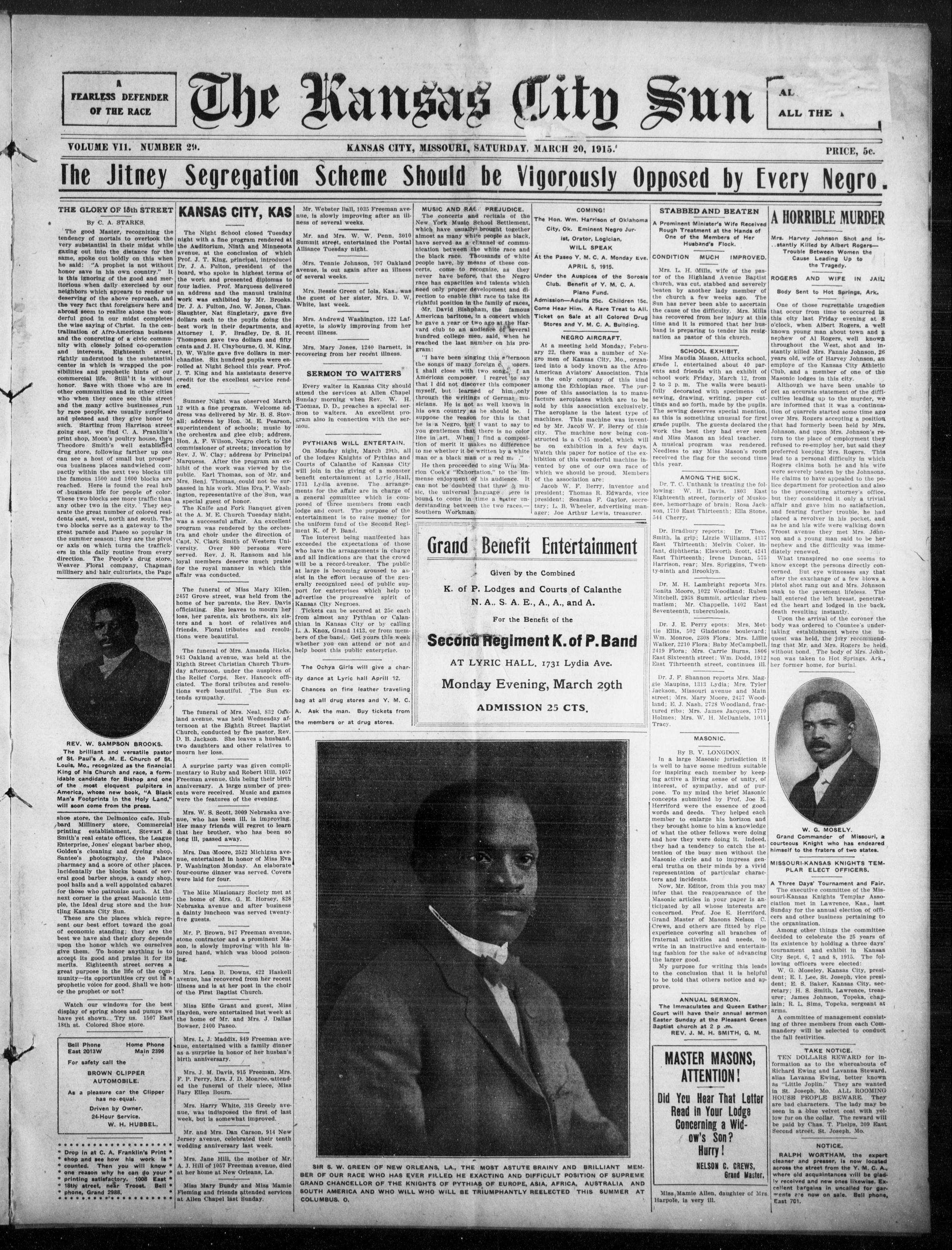
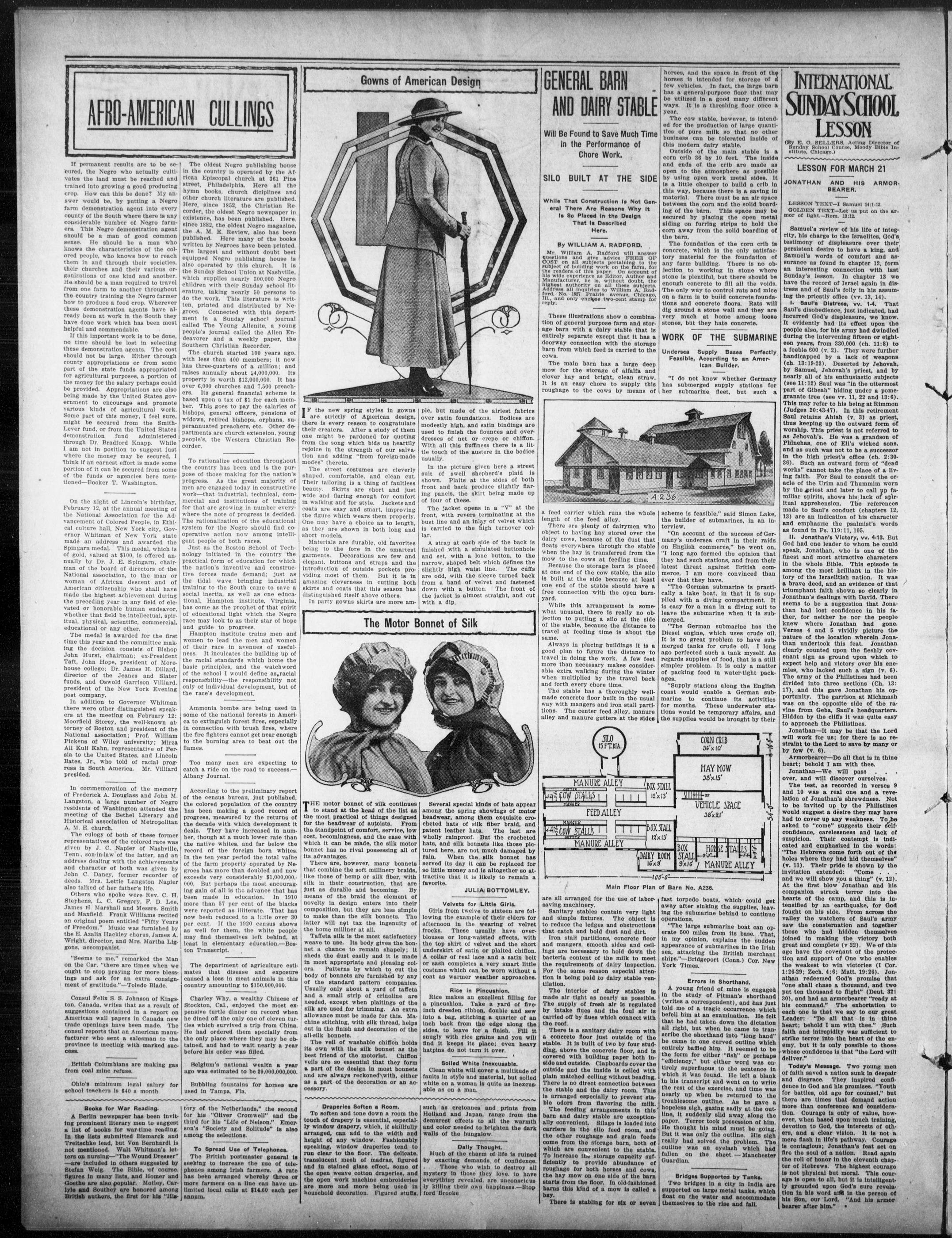
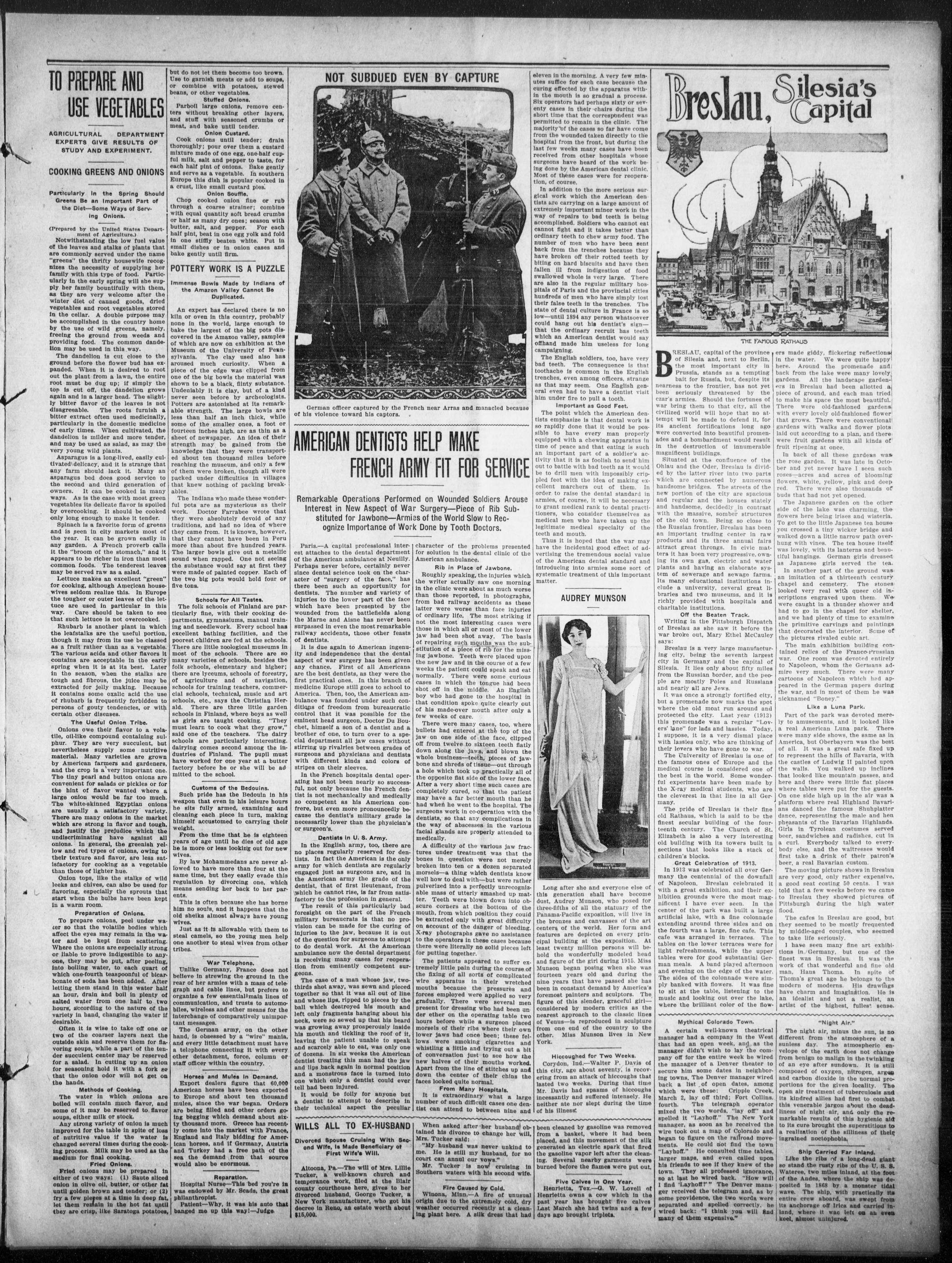
Page text (machine-generated)
The Jitney Segregation Scheme Should be Vigorously Opposed by Every Negro.
VOLUME VI1. NUMBER 29.
A FEARLESS DEFENDER OF THE RACE
THE GLORY OF 18th STREET
By C. A. STARKS.
The good Master, recognizing the tendency of mortals to overlook the very substantial in their midst while gazing out into the distance for the same, spoke out boldly on this when he said: "A prophet is not without honor save in his own country." It is this ignoring of the good and meritorious when daily exercised by our neighbors which appears to render us deserving of the above reproach, and the very fact that foreigners here and abroad seem to realize alone the wonderful good in our midst completes the wise saying of Christ. In the centralization of Afro-American business and the concreting of a civic community with closely joined co-operation and interests, Eighteenth street, rightly understood is the substantial center in which is wrapped the possibilities and prophetic hints of our commercial life. Still' it is without honor. Save it we find C. A. Franklin's print shop, Moon's poultry house, then the Doghouse Smith's well established drug store, following farther up one can see a host of small but prosperous business places sandwiched compactly within the next two blocks till the famous 1500 and 1600 blocks are reached. Here is 1600 the real hub of business life for people of color. These two blocks see more traffic than any other two in the city. They separate the great number of colored residents east, west, north and south. The two blocks serve as a gateway to the great parade and Paseo so popular in the summer season; they are the pivot or axis on which turns the traffickers in this daily routine from every direction. The People's drug store, Weaver Floral company, Chapman millinery and hair culturists, the Page
REV. W. SAMPSON BROOKS.
The brilliant and versatile pastor of St. Paul's A. M. E. Church of St. Louis, Mo., recognized as the financial King of his Church and race, a formidable candidate for Bishop and one of the most eloquent pulpiters in America, whose new book, "A Black Man's Footprints in the Holy Land," will soon come from the press.
shoe store, the Delmonico cafe, Hubbard Millinery store, Commercial printing establishment, Stewart & Smith's real estate offices, the League Enterprise, Jones' elegant barber shop, Golden's cleaning and dyeing shop, Santee's photography, the Palace pharmacy and a score of other places, incidentally the blocks boast of several good barber shops, a candy shop, pool halls and a well appointed cabaret for those who patronize such. At the next corner is the great Masonic temple, the ideal drug store and the hustling Kansas City Sun. These are the places which represent our best effort toward the goal of economic standing; they are the best we have and their glory depends upon the honor which we ourselves give them. To honor anything is to accept its good and praise it for its merits. Eighteenth street serves a great purpose in the life of the community—its opportunities cry out in a prophetic voice for good. Shall we honor or the prophet or not?
Watch our windows for the best display of spring shoes and pumps we have yet shown. Try us. 1507 East 18th st. Colored Shoe store.
.....
The Kansas City Sun
KANSAS CITY, KAS
The Night School closed Tuesday night with a fine program rendered at the Auditorium, Ninth and Minnesota avenue, at the conclusion of which Prof. J. T. King, principal, introduced Dr. J. A. Fulton, president of the board, who spoke in highest terms of the work and presented diplomas to four ladies. Prof. Marquess delivered an address and the manual training work was exhibited by Mr. Brooks. Dr. J. A. Fulton, Jno. W. Jones, Chas. Slaughter, Nat. Singletley, gave five dollars each to the pupils doing the best work in their departments, and Attorney I. F. Bradley, Dr. S. H. Thompson gave two dollars and fifty cents and J. H. Claybury, G. M. King, D. W. White gave five dollars in merchandise. Six hundred five dollars were enrolled at Night School this year. Prof. J. T. King and his assistants deserve credit for the excellent service rendered.
Sumner Night was observed March 12 with a fine program. Welcome address was delivered by Mr. B. S. Stovall; address by Hon. M. E. Pearson superintendent of schools; music by the orchestra and glee club; address Hon. A. F. Wilson, Negro clerk to the commissioner of streets; invocation by Rev. J. W. Clay; address by Principal Marquess. After the program an exhibit of the work was viewed by the public. Earl Thomas, son of Mr. and Mrs. Benj. Thomas, could not be surpassed in his work. Miss Eva P. Washington, representative of the Sun, was a special guest of honor.
The Knife and Fork Banquet given at the A. M. E. Church Tuesday night was a successful affair. An excellent program was rendered by the orchestra and choir under the direction of Capt. N. Clark Smith of Western University. Over 800 persons were served. Rev. J. R. Ransom and his loyal members deserve much praise for the royal manner in which this affair was conducted.
The funeral of Miss Mary Ellen, 2457 Grove street, was held from the home of her parents, the Rev. Davis officiating. She leaves to mourn her loss, her parents, six brothers, six sisters and a host of relatives and friends. Floral tributes and resolutions were beautiful.
The funeral of Mrs. Amanda Hicks,
943 Oakland avenue, was held at the
Eighth Street Christian Church Thursday
afternoon, under the auspices of the
Relief Corps. Rev. Hancock officiated.
The floral tributes and resolutions
were beautiful. The Sun extends sympathy.
The funeral of Mrs. Neal, 832 Oakland
avenue, was held Wednesday afternoon
at the Eighth Street Baptist Church,
conducted by the pastor, Rev.
D. B. Jackson. She leaves a husband,
two daughters and other relatives to
mourn her loss.
A surprise party was given complimentary
to Ruby and Robert Hill, 1057
Freeman avenue, this being their birth
anniversary. A large number of pres-
ents were received. Music and games
were the features of the evening.
Mrs. W. S. Scott, 3009 Nebraska avenue,
who has been ill, is improving.
Her many friends will regret to learn
that her brother, who has been so
long ill, passed away.
Mrs. Dan Moore, 2522 Michigan avenue,
entertained in honor of Miss Eva
P. Washington Monday. An elaborate
四 course dinner was served. Covers
were laid for four.
The Mite Missionary Society met at the home of Mrs. G. E. Horsey, 828 Nebraska avenue and after business a dainty luncheon was served twenty-five guests.
Mr. P. Brown, 947 Freeman avenue, stone contractor and a prominent Mason, is slowly improving with his injured hand, which was blood poisoning.
Mrs. Lena B. Downs, 422 Haskell avenue, has recovered from her recent illness and is at her post in the choir of the First Baptist Church.
Miss Eiffe Grant and guest, Miss Hayden, were entertained last week at the home of Mr. and Mrs. J. Dallas Bowser, 2400 Paseo.
Mrs. L. J. Maddix, 849 Freeman avenue, entertained with a family dinner as a surprise in honor of her husband's birth anniversary.
Mrs. J. M. Davis, 915 Freeman, Mrs. F. P. Perry, Mrs. J. D. Monroe, attended the funeral of their niece, Miss Bary Ellen Bourn.
Mrs. Harry White, 318 Greely avenue, was indisposed the first of last week, but is somewhat improved.
Mr. and Mrs. Dan Carson, 914 New Jersey avenue, celebrated their tenth wedding anniversary last week.
Mrs. Jane Hill, the mother of Mr. A. J. Hill of 1057 Freeman avenue, died at her home at New Orleans, La.
Miss Mary Bundy and Miss Mamie Fleming and friends attended services at Allen Chapel last Sunday.
KANSAS CITY, MISSOURI, SATURDAY, MARCH 20, 1915.
SIR S. W. GREEN OF NEW ORLEANS, LA., THE MOST ASTUTE BRAINY AND BRILLIANT MEMBER OF OUR RACE WHO HAS EVER FILLED HE EXACTING AND DIFFICULT POSITION OF SUPREME GRAND CHANCELLOR OF THE KNIGHTS OF PYTHIAS OF EUROPE, ASIA, AFRICA, AUSTRALIA AND SOUTH AMERICA AND WHO WILL WHO WILL BE TRIUMPHANTLY REELECTED THIS SUMMER AT COLUMBUS, O.
Mr. Webster Ball, 1035 Freeman avenue, is slowly improving after an illness of several weeks.
Mr. and Mrs. W. W. Penn, 3010 Summit street, entertained the Postal Alliance Tuesday night.
Mrs. Tennie Johnson, 707 Oakland avenue, is out again after an illness of several weeks.
Mrs. Bessie Green of Iola, Kas., was the guest of her sister, Mrs. D. W. White, last week.
Mrs. Andrew Washington, 122 Lafayette, is slowly improving from her recent illness.
Mrs. Mary Jones, 1240 Barnett, is recovering from her recent illness.
SERMON TO WAITERS
Every waiter in Kansas City should attend the services at Allen Chapel Sunday morning when Rev. W. H. Thomas, D. D., preaches a special sermon to waiters. An excellent program also in connection with the sermon.
PYTHIANS WILL ENTERTAIN.
On Monday night, March 29th, all of the lodges Knights of Pythias and Courts of Calanthe of Kansas City will join in the giving of a monster benefit entertainment at Lyric Hall, 1731 Lydia avenue. The arrangements for the affair are in charge of a general committee which is composed of three members from each lodge and court. The purpose of the entertainment is to raise money for the uniform fund of the Second Regiment K. of P. Band.
The interest being manifested has exceeded the expectations of those who have the arrangements in charge and all indications are that the crowd will be a record-breaker. The public at large is becoming aroused to assist in the effort because of the generally recognized need of public support for enterprises which help to advertise the progressive spirit of Kansas City Negroes.
Tickets can be secured at 25c each from almost any Pythian or Calanthe in Kansas City or by calling L. A. Knox, Grand 143, or from members of the band. Get your this week whether you can attend or not and help boost this public enterprise.
The Ochya Girls will give a charity dance at Lyric hall April 12. Chances on fine leather traveling bag at all drug stores and Y. M. C. A. Ask the man. Buy tickets from the members or at drug stores.
MUSIC AND RACE: PREJUDICE.
The concerts and recitals of the New York Music School Settlement, which have usually brought together almost as many white people as black have served as a channel of communication between the white race and the black race. Thousands of white people have, by means of these concerts, come to recognize, as they never have before, that the Negro race has capacities and talents which need only proper development and direction to enable that race to take its rightful position in the family of races. Mr. David Bishpham, the famous American baritone, in a concert which he gave a year or two ago at the Harvard club to an audience of several hundred college men, said, when he reached the last number on his program:
"I have been singing this afternoon the songs of many foreign c. osers. I shall close with two songs. I am American composer. I regret to say that I did not discover this composer myself, but learned of him only through the writings of German musicians. He is not as well known in his own country as he should be. I suppose the reason for this is that he is a Negro, but I want to say to you gentlemen that there is no color line in art. When I find a composition of merit it makes no difference to me whether it be written by a white man or a black man or a red m."
He then proceeded to sing Win Marion Cook's "Exhortation," to the immense enjoyment of his audience. It can not be doubted that three music, the universal language here is bound to come in time a bitter understanding between the two races.—Southern Workman.
Grand Benefit
Grand Benefit Entertainment
Given by the Combined
K. of P. Lodges an
N. A., S. A. E.
K. of P. Lodges and Courts of Calanthe
N. A., S. A. E., A., A., and A.
For the Benefit of the
Second Regiment K. of P. B.
AT LYRIC HALL, 1731 Lydia Ave.
Monday Evening, March 29th
ADMISSION 25 CTS.
At the Paseo Y. M. C. A. Monday Eve.
APRIL 5, 1915.
Under the Auspices of the Sorosis
Club. Benefit of Y. M. C. A.
Piano Fund.
Admission—Adulta 25c. Children 15c.
Come Hear Him. A Rare Treat to All.
Ticket on Sale at all Colored Drug
Stores and Y. M. C. A. Building.
NEGRO AIRGRAFT
At a meeting held Monday, February 22, there was a number of Negro men of Kansas City, Mo., organized into a body known as the Afro-American Aviators' Association. This is the only company of this kind among the Ethiopian race. The purpose of this association is to manufacture aeroplanes which are to be sold by this association exclusively. The aeroplane is the latest type of machines. This machine was invented by Mr. Jacob W. F. Berry of this city. The machine now being constructed is a C-15 model, which will be on exhibition in a few days. Watch this paper for notice of the exhibition of this wonderful machine invented by one of our own race of which we should be proud. Members of the association are:
Jacob W. F. Berry, inventor and president; Thomas R. Edwards, vice president; Seaman F. Gaylor, secretary; L. B. Wheeler, advertising manager; Joe Arthur Lewis, treasurer.
Entertainment
benefit of the
ent K. of P. Band
. 1731 Lydia Ave.
ng, March 29th
ON 25 CTS.
COMING!
STABBED AND BEATEN
A Prominent Minister's Wife Receives Rough Treatment at the Hands of One of the Members of Her Husband's Flock.
CONDITION MUCH IMPROVED
Mrs. L. H. Mills, wife of the pastor of the Highland Avenue Baptist church, was cut, stabbed and severely beaten by another lady member of the church a few weeks ago. The Sun has never been able to ascertain the cause of the difficulty. Mrs. Mills has recovered from her injury at this time and it is rumored that her husband is preparing to tender his resignation as pastor of this church.
SCHOOL EXHIBIT
Miss Maudia Mason, Attucks school, grade 1, entertained about 40 parents and friends with an exhibit of school work Friday, March 12, from 2 to 3 p. m. The walls were beautifully decorated with specimens of sewing, drawing, writing, paper cutings and so forth, made by the pupils. The sewing deserves special mention as this is something unusual for first grade pupils. The guests declared the work the best they had ever seen and Miss Mason an ideal teacher. A musical program was rendered. Needless to say Miss Mason's room received the flag for the second time this year.
AMONG THE SICK
Dr. T. C. Unthank is treating the following: W. H. Davis, 1803 East Eighteenth street, formerly of Muskogee, hemorrhage of brain; Rosa Jackson, 1710 East Thirteenth; Ella Stone, 544 Cherry.
Dr. Bradbury reports: Dr. Theo. Smith, la grip; Lizzie Williams, 4137 East Thirteenth; Melvin Coker, infant, diphtheria; Elsworth Scott, 4241 East Thirteenth; Irene Duncan, 575 Harrison, rear; Mrs. Spriggins, Twenty-ninth and Brooklyn.
Dr. M. H. Lambright reports Mrs. Bonita Moore, 1022 Woodland; Ruben Mitchell, 2308 Summit, articular rheumatism; Mr. Chappelle, 1402 East Seventeenth, tuberculosis.
Dr. J. E. Perry epots; Mrs. Metie Ellis, 502 Gladstone boulevard; Wm. Monroe, 2308 Flora; Mrs. Lillie Walker, 2210 Flora; Baby McCampbell, 2419 Flora; Mrs. Carrie Burns, 1806 East Sixteenth street; Wm. Dodd, 1912 East Thirteenth street, continues III.
Dr. J. F. Shannon reports Mrs. Maggie Maupins, 1313 Lydia; Mrs. Tyler Jackson, Missouri avenue and Main street; Mrs. Mary Moore, 2437 Woodland; E. J. Nash, 2728 Woodland, fractured ribs; Mrs. James Jacques, 1710 Holmes; Mrs. W. H. McDaniels, 1011 Tracy.
MASONIC.
In a large Masonic jurisdiction it is well to have some medium suitable for inspiring each member by keeping active a living sense of unity, of interest, of sympathy, and of purpose. To my mind the brief Masonic concepts submitted by Prof. Joe E. Herriford were the essence of good words and deeds. They helped each member to enlarge his horizon and they brought home to him a knowledge of what the other fellows were doing and how they were doing it. Indeed, they had a tendency to catch the attention of the busy men without the Masonic circle and to impress general truths on their minds by a vivid representation of particular characters and incidents.
Now, Mr. Editor, from this you may infer that the reappearance of the Masonic articles in your paper is anticipated by all whose interests are concerned. Prof. Joe E. Herriford, Grand Master of Masons Nelson C. Crews, and others are fitted by ripe experience covering all branches of fraternal activities and needs, to write in an instructive and entertaining fashion for the sake of advancing the larger good.
My purpose for writing this leads to the conclusion that it is helpful to be told that others notice and approve.
ANNUAL SERMON.
The Immaculates and Queen Esther Court will have their annual sermon Easter Sunday at the Pleasant Green Baptist church at 2 p.m.
REV. J. M. H. SMITH, G. M.
MASTER MASONS,
ATTENTION!
Did You Hear That Letter
Read in Your Lodge
Concerning a Wid-
ow's Son?
Hurry!
NELSON C. CREWS,
Grand Master.
Miss, Mamie Allen, daughter of Mrs
Harpole, is very ill.
AL
ALL THE
PRICE, 5c.
A HORRIBLE MURDER
Mrs. Harvey Johnson Shot and In-
stantly Killed by Albert Rogers—
Trouble Between Women the
Cause Leading Up to the Tragedy.
ROGERS AND WIFE IN JAIL
Body Sent to Hot Springs, Ark.
One of those regrettable tragedies
that occur from time to occurred in
this city last Friday evening at 8
o'clock, when Albert Rogers, a well
known young man about town and a
nephew of Al Rogers, well known
throughout the West, shot and in-
stantly killed Mrs. Fannie Johnson, 26
years old, wife of Harvey Johnson, an
employee of the Kansas City Athletic
Club, and a member of one of the
Masonic lodges in this city.
Although we have been unable to get an accurate statement of the difficulties leading up to the murder, we are informed that it was a continuation of quarrels started some time ago over Mrs. Rogers accepting a position that had formerly been held by Mrs. Johnson, and upon Mrs. Johnson's return to the place of employment they refused to re-employ her, but said they preferred keeping Mrs. Rogers. This lead to a personal difficulty in which Rogers claims both he and his wife were severely beaten by the Johnson's. He claims to have appealed to the police department for protection and also to the prosecuting attorney's office, but they considered it only a trivial affair and gave him no satisfaction, and fearing further trouble, he had placed a revolver in his pocket, and as he and his wife were walking down Troost avenue they met Mrs. Johnson and a young man said to be her nephew and the difficulty was immediately renewed.
What transpired no one seems to know except the persons directly concerned. But eye witnesses say that after the exchange of a few blows a pistol shot rang out and Mrs. Johnson sank to the pavement lifeless. The ball entered the left breast, penetrated the heart and lodged in the back, death resulting instantly.
Upon the arrival of the coroner the body was ordered to Countee's undertaking establishment where the inquest was held, the jury recommending that Mr. and Mrs. Rogers be held without bond. The body of Mrs. Johnson was taken to Hot Springs, Ark., her former home, for burial.
W. G. MOSELY.
Grand Commander of Missouri, a courteous Knight who has endeared himself to the fraters of two states.
MISSOURI-KANSAS KNIGHTS TEMPLAR ELECT OFFICERS.
A Three Days' Tournament and Fair.
The executive committee of the Missouri-Kansas Knights Templar Association met in Lawrence, Kas., last Sunday for the annual election of officers and other business pertaining to the organization.
Among other things the committee decided to celebrate the 25 years of its existence by holding a three days' tournament and exhibit in Kansas City Sept. 6, 7 and 8, 1915. The following officers were elected:
W. G. Moseley, Kansas City, president; E. I. Lee, St. Joseph, vice president; E. S. Baker, Kansas City, secretary; H. S. Smith, Lawrence, treasurer; James Johnson, Topeka, chapain; R. L. Sims, Topeka, sergeant at arms.
A committee of management consisting of three members from each Commandery will be selected to conduct the fall festivities.
TAKE NOTICE.
TEN DOLLARS REWARD for information as to the whereabouts of Richard Ewing and Lavanna Steward, alias Lavanna Ewing, better known as "Little Joplin." They are wanted in St. Joseph, Mo. ALL ROOMING HOUSE PEOPLE BEWARE. They are bad characters. The lady may be seen in a blue velvet coat with yellow fur on the collar. The reward will be paid by Chas. T. Phelps, 209 East Second street, St. Joseph, Mo.
NOTICE
RALPH WORTHAM, the expert cleaner and presser, is now located across the street from the Y. M. G. A., where old acquaintances will be gladly received and new ones likewise. Excellent bargains in uncalled for garments are now on sale. Bell phone, East 701.
AFRO-AMERICAN CULLINGS
If permanent results are to be secured, the Negro who actually cultivates the land must be reached and trained into growing a good producing crop. How can this be done? My answer would be, by putting a Negro farm demonstration agent into every county of the South where there is any considerable number of Negro farmers. This Negro demonstration agent should be a man of good common sense. He should be a man who knows the characteristics of the colored people, who knows how to reach them in and through their societies, their churches and their various organizations of one kind and another. He should be a man required to travel from one farm to another throughout the country training the Negro farmer how to produce a food crop. Wherever these demonstration agents have already been at work in the South they have done work which has been most helpful and commendable.
If this important work is to be done, no time should be lost in selecting these demonstration agents. The cost should not be large. Either through county appropriations or from some part of the state funds appropriated for agricultural purposes, a portion of the money for the salary perhaps could be provided. Appropriations are also being made by the United States government to encourage and promote various kinds of agricultural work. Some part of this money, I feel sure, might be secured from the Smith Lever fund, or from the United States demonstration fund administered through Dr. Bradford Knapp. While I am not in position to suggest just where the money may be secured, I think if an earnest effort is made some portion of it can be secured from some of the funds or agencies here mentioned—Booker T. Washington.
---
On the night of Lincoln's birthday, February 12 at the annual meeting of the National Association for the Advancement of Colored People, in Ethical culture hall, New York city, Governor Whitman of New York state made an address and awarded the Spingarn medal. This medal, which is of gold, valued at $100, is offered annually by Dr. J. E. Spingarn, chairman of the board of directors of the National association, to the man or woman of African descent and of American citizenship who shall have made the highest achievement during the preceding year in any field of elevated or honorable human endeavor, whether that field be intellectual, spiritual, physical, scientific, commercial, educational or any other.
The medal is awarded for the first time this year and the committee making the decision consists of Bishop John Hurst, chairman; ex-President Taft, John Hope, president of Morehouse college; Dr. James H. Dillard, director of the Jeanes and Slater funds, and Oswald Garrison Villiard, president of the New York Evening post company.
In addition to Governor Whitman there were other distinguished speakers at the meeting on February 12: Moorfield Storey, the well-known attorney of Boston and president of the National association; Prof. William Pickens of Wiley university; Mirza Ali Kull Kahn, representative of Persia to the United States, and Lincoln Bates, Jr., who told of racial progress in South America. Mr. Villiard presided.
In commemoration of the memory of Frederick A. Douglass and John M. Langston, a large number of Negro residents of Washington attended the meeting of the Bethel Literary and Historical association of Metropolitan A. M. E. church.
The eulogy of all of these former representatives of the colored race was given by J. C. Napier of Nashville, Tenn., son-in-law of the latter, and an address dealing with the achievements and character of both was given by John C. Dancy, former recorder of deeds. Mrs. Lettie Langton Napier also talked of her father's life.
Others who spoke were Rev. C. H. Stephens, L. C. Gregory, D. F. Lee, James H. Marshall and Messrs. Smith and Maxfield. Frank Williams recited an original poem entitled "Fifty Years of Freedom." Music was furnished by the E. Azalia Hackley chorus, James A. Wright, director, and Mrs. Martha Liggons, accompanist.
"Seems to me," remarked the Man on the Car. "there are times when we ought to stop praying for more blessings and ask for an extra consignment of gratitude."—Toledo Blade.
Consul Felix S. S. Johnson of Kingston, Canada, writes that as a result of suggestions contained in a report on American wall papers in Canada new trade openings have been made. The consul reports that an American manufacturer who sent a salesman to the province is meeting with marked success.
British Columbians are making gas from coal mine refuse.
Ohio's minimum legal salary for school teachers is $40 a month.
Books for War Reading.
A Berlin newspaper has been inviting prominent literary men to suggest a list of books for war-time reading. In the lists submitted Bismarck and Treitschke lead, but Von Bernhardi is not mentioned. Walt Whitman's letters on nursing—"The Wound Dresser"—are included in others suggested by Stefan Weig. The Bible, of course, figures in many lists, and Homer and Goethe are also popular. Motley, Carlyle and Southey are honored among British authors, the first for his "His
The oldest Negro publishing house in the country is operated by the African Episcopal church at 361 Pine street, Philadelphia. Here all the hymn books, church diplplains and other church literature are published. Here, since 1852, the Christian Recorder, the oldest Negro newspaper in existence, has been published. Here, since 1852, the oldest Negro magazine, the A. M. E. Review, also has been published. Here many of the books written by Negroes have been printed. The largest and without doubt best equipped Negro publishing house is also operated by this church. It is the Sunday School Union at Nashville, which supplies nearly 300,000 Negro children with their Sunday school literature, taking nearly 50 persons to do the work. This literature is written, printed and distributed by Negroes. Connected with this department is a Sunday school journal called The Young Allenite, a young people's journal called the Allen Endeavorer and a weekly paper, the Southern Christian Recorder.
The church started 100 years ago, with less than 400 members; it now has three-quarters of a million; and raises annually about $4,000,000. Its property is worth $12,000,000. It has over 6,000 churches and 7,500 preachers. Its general financial scheme is based upon a tax of $1 for each member. This goes to pay the salaries of bishops, general officers, pensions of widows, retired bishops, orphans, superannuated preachers, etc. Other departments are church extension, young people's, the Western Christian Recorder.
To rationalize education throughout the country has been and is the purpose of those making for the nation's progress. As the great majority of men are engaged today in constructive work—that industrial, technical, commercial and institutions of training for that are growing in number everywhere the note of progress is decided. The rationalization of the educational system for the Negro should find cooperative action now among intelligent people of both races.
Just as the Boston School of Technology initiated in the country the practical form of education for which the nation's inventive and constructive forces made demand; just as the tidal wave bringing industrial training to the South came to save a social inertia, as well as one educational, Hampton institute, Virginia, has come as the prophet of that spirit of educational light which the Negro race may look to as their star of hope and guide to progress.
Hampton institute trains men and women to lead the men and women of their race in avenues of usefulness. It inculcates the building up of the racial standards which home the basic principles, and the watchword of the school I would define as, racial responsibility—the responsibility not only of individual development, but of the race's development.
Ammonia bombs are being used in some of the national forests in America to extinguish forest fires, especially in connection with brush fires, where the fire fighters cannot get near enough to the burning area to beat out the flames.
Too many men are expecting to catch a ride on the road to success.—Albany Journal.
According to the preliminary report of the census bureau, just published, the colored population of the country has been making a good record of progress, measured by the returns of the decade with which development it deals. They have increased in number, though at a much lower rate than the native whites, and far below the record of the foreign born whites. In the ten year period the total value of the farm property operated by Negroes has more than doubled and now exceeds very considerably $1,000,000,000. But perhaps the most encouraging gain of all is the advance that has been made in education. In 1910 more than 57 per cent of the blacks were reported as illiterate. That has now been reduced to a little over 30 per cent. If the 1920 census shows as well for them, the white people may find themselves left behind, at least in elementary education.—Boston Transcript.
The department of agriculture estimates that disease and exposure caused a loss in meat animals in this country amounting to $150,000,000.
Charley Why, a wealthy Chinese of Stockton, Cal., enjoyed the most expensive turtle dinner on record when he dined off the only one of eleven turtles which survived a trip from China. He had ordered them specially from the only place where they may be obtained, and had to wait nearly a year before his order was filled.
Belglum's national wealth a year ago was estimated to be $9,000,000,000.
Bubbling fountains for horses are used in Tampa, Fla.
tory of the Netherlands," the second for his "Oliver Cromwell" and the third for his "Life of Nelson." Emerson's "Society and Solitude" is also among the selections.
To Spread Use of Telephones
10 Spread Use or Telephones. The British postmaster general is seeking to increase the use of telephones among Irish farmers. A rate has been arranged whereby three or more farmers on a line can have unlimited local calls at $14.60 each per annum.
I
THE FASHION WEEKLY
If the new spring styles in gowns are strictly of American design, there is every reason to congratulate their creators. After a study of them one might be pardoned for quoting from the song which bids us heartily rejoice in the strength of our salvation and adding "from foreign-made modes" thereto.
The street costumes are cleverly shaped, comfortable, and clean cut. Their tailoring is a thing of faultless beauty. Skirts are short and just wide and flaring enough for comfort in walking and for style. Jackets and coats are easy and smart, improving the figure which wears them properly. One may have a choice as to length, as they are shown in both long and short models.
Materials are durable, old favorites being to the fore in the smartest garments. Decorations are few and elegant, buttons and straps and the introduction of outside pockets providing most of them. But it is in amazing cleverness in cutting both skirts and coats that this season has distinguished itself above others. In party gowns skirts are more am-
The Motor E
THE motor bonnet of silk continues to stand at the head of the list as the most practical of things designed for the headwear of autoists. From the standpoint of comfort, service, low cost, becomingness, and the ease with which it can be made, the silk motor bonnet has no rival possessing all of its advantages. There are, however, many bonnets that combine the soft millinery braids, like those of hemp or silk fiber, with silk in their construction, that are just as durable and becoming. By means of the braid the element of novelty in design enters into their composition, but they are less simple to make than the silk bonnets. The latter will not tax the ingenuity of the home milliner at all.
Taffeta silk is the most satisfactory weave to use. Its body gives the bonnet a chance to remain shapely; it sheds the dust easily and it is made in most appropriate and pleasing colors. Patterns by which to cut the body of bonnets are furnished by any of the standard pattern companies. Usually only about a yard of taffeta and a small strip of crinoline are needed, except when plaitings of the silk are used for trimming. An extra allowance must be made for this. Machine stitching, with silk thread, helps out in the finish and decoration of the all-silk bonnets.
The vell of washable chiffon holds its own with the silk bonnet as the best friend of the motorist. Chiffon vells are so essential that they form a part of the design in most bonnets and are always reckoned with, either as a part of the decoration or an accessory.
Drapers Sorted a Room. To soften and tone down a room the touch of drapery is essential, especially window drapery, which, if skillfully arranged, can add to the width and height of any window. Fashionably speaking, window draperies tend to run clear to the floor. The delicate, translucent mesh of madras, figured and in stained glass effect, some of the open weave cotton draperies, and the open work machine embroideries are more and more being used in household decoration. Figured stuffs.
ple, but made of the airiest fabrics over satin foundations. Bodices are modestly high, and satin bindings are used to finish the flouces and overdresses of net or crepe or chiffon. With all this fluffiness there is a little touch of the austere in the bodice usually.
In the picture given here a street suit of swell shepherd's plaid is shown. Plaits at the sides of both front and back produce slightly flaring panels, the skirt being made up of four of these.
The jacket opens in a "V" at the front, with revers terminating at the bust line and an inlay of velvet which is carried to the high turnover collar.
A astrap at each side of the back is finished with a simulated buttonhole and set, with a lone button, to the narrow, shaped belt which defines the slightly high waist line. The cuffs are odd, with the sleeve turned back from a band of velvet and fastened down with a button. The front of the jacket is almost straight, and cut with a dip.
Bonnet of Silk
Several special kinds of hats appear among the spring showings of motor headwear, among them exquisite crocheted hats of silk fiber braid, and patent leather hats. The last are wholly rainproof. But the crocheted hats, and silk bonnets like those pictured here, are not much damaged by rain. When the silk bonnet has served its day it can be replaced for so little money and is altogether so attractive that it is likely to remain a favorite.
JULIA BOTTOMLEY.
Velvetts for Little Girls.
Girls from twelve to sixteen are following the example of their elders for afternoon in the wearing of velvet frocks. These usually have overblouses or long-waisted effects, with the top skirt of velvet and the short underskirt of satin or plaited chiffon. A collar of real lace and a satin belt or sash completes a very smart little costume which can be worn without a coat as warmer weather approaches.
Rice In Pincushion
Rice makes an excellent filling for a pincushion. Take a yard of five inch dresden ribbon, double and sew into a bag, stitching a quarter of an inch back from the edge along the sides, to leave for a finish. Fill it snugly with rice grains and you will find it keeps its place; even heavy hatpins do not turn it over.
Soiled White Inexcusable
Soho White, inexcusable.
Clean white will cover a multitude of faults in style and material, but soiled white on a woman is quite as inexcusable as on a man.
such as cretonnes and prints from Holland and Japan, range from the dumurest effects to all the warmth and color needed to brighten the dark walls of the hungalow.
Much of the charm of life is ruined by exacting demands, of confidence. Those who wish to destroy all mystery in those they love, to have everything revealed, are unconsciously killing their own happiness.—Stop ford Brooke
Will Be Found to Save Much Time in the Performance of Chore Work.
SILO BUILT AT THE SIDE
While That Construction Is Not General There Are Reasons Why It Is So Placed in the Design That Is Described Here
Mr. William A. Radford will answer questions and give advice FREE OF COST on all subjects pertaining to the building work on the farm for the readers of this paper. On account of his wide experience as Editor, Author and Manufacturer, he is, without doubt, the highest authority on all these subjects. The purposes to William A. Radford, No. 1827 Prairie avenue, Chicago Ill., and only enclose two-cent stamp for reply.
These illustrations show a combination of general purpose farm and storage barn with a dairy stable that is entirely separate except that it has a doorway connection with the storage barn from which feed is carried to the cows.
The main barn has a large deep mow for the storage of alfalfa and clover hay and bright, clean straw. It is an easy chore to supply this roughage to the cows by means of
A
a feed carrier which runs the whole length of the feed alley.
There are plenty of dairymen who object to having hay stored over the dairy cows, because of the dust that floats everywhere through the stable when the hay is transferred from the mow to the cows at feeding time scheme is feasible," said Simon Lake the builder of submarines, in an interview.
"On account of the success of Germany's undersea craft in their raids on English commerce," he went on. "I long ago formed the opinion that they had such stations, and from their
Because the storage barn is placed at one end of the cow stable, the silo is built at the side because at least one end of the stable should have a free connection with the open barnyard.
While this arrangement is somewhat unusual, there is really no objection to putting a silo at the side of the stable, because the distance to travel at feeding time is about the same.
Always in placing buildings it is a good plan to figure the distance to travel in doing the work. A few feet more than necessary makes considerable extra walking during the winter when multiplied by the travel back and forth every chore time.
The stable has a thoroughly well-made concrete floor built in the usual way with mangers and iron stall partitions. The center feed alley, manure alley and manure gutters at the sides
SILO
15 FT. DIA.
MANURE ALLEY
BOX
12'
COW STALLS
MANGER
FEED ALLEY
BOX
12'
COW STALLS
MANGER
MANURE ALLEY
DAIRY
16'x
SILO
15 FT. DIA.
CORN CRIB
36'×10'
HAY MOW
38'×15'
VEHICLE SPACE
38'×21'
MANURE ALLEY
BOX STALL
12'×13'
FEED ALLEY
BOX STALL
12'×13'
MANURE ALLEY
DAIRY ROOM
16'×9'
BOX STALL
9'×16'
HORSE STALLS
MANURE ALLEY
Main Floor Plan of Barn No. A236.
are all arranged for the use of labor-saving machinery. Sanitary stables contain very light and simple fixtures. The object is to reduce the ledges and obstructions that catch and hold dust and dirt. Iron stall partitions, concrete floor and mangers, smooth sides and ceilings are necessary to hold down the bacteria content of the milk to meet the requirements of dairy inspection. For the same reason especial attention is being paid to dairy stable ventilation. The interior of dairy stables is made air tight as nearly as possible. The supply of fresh air is regulated by intake flues and the foul air is carried off by flues which connect with the roof.
There is a sanitary dairy room with a concrete floor just outside of the stable. It is built of two by four studding, above the concrete floor, and is covered with building paper both inside and outside. Clapboards cover the outside and the inside is capped with plain matched ceiling without beading. There is no direct connection between the stable and the dairy room. This is arranged especially to prevent stable odors from flavoring the milk. The feeding arrangements in this barn and dairy stable are exceptionally convenient. Silage is loaded into carriers in the silo feed room, and the other roughage and grain feeds come from the storage barn, both of which are convenient to the stable. To increase the storage capacity sufficiently to provide abundance of roughage for both horses and cows, the hay mow on one side of the barn starts from the floor. In old-fashioned barns this kind of a mow is called a bay.
There is stabling for six or seven
horses, and the space in front of the horses is intended for storage of a few vehicles. In fact, the large barn has a general-purpose floor that may be utilized in a good many different ways. It is a threshing floor once a year.
The cow stable, however, is intended for the production of large quantities of pure milk so that no other business can be tolerated inside of this modern dairy stable.
Outside of the main stable is a corn crib 36 by 10 feet. The inside and ends of the crib are made as open to the atmosphere as possible by using open work metal sides. It is a little cheaper to build a crib in this way, because there is a saving in material. There must be an air space between the corn and the solid boarding of the barn. This space may be secured by placing the open metal sliding on furring strips to hold the corn away from the solid boarding of the barn.
The foundation of the corn crib is concrete, which is the only satisfactory material for the foundation of any farm building. There is no objection to working in stone where stone is plentiful, but there should be enough concrete to fill all the voids. The only way to control rats and mice on a farm is to build concrete foundations and concrete floors. Rats will dig around a stone wall and they are very much at home among loose stones, but they hate concrete.
WORK OF THE SUBMARINE
Undersea Supply Bases Perfectly Feasible, According to an American Builder.
"I do not know whether Germany has submerged supply stations for her submarine fleet, but such a
scheme is feasible," said Simon Lake, the builder of submarines, in an interview.
"On account of the success of Germany's undersea craft in their raids on English commerce," he went on, "I long ago formed the opinion that they had such stations, and from their latest threat against British commerce, I am more convinced than ever that they have.
"The German submarine is practically a lake boat, in that it is supplied with a diving compartment. It is easy for a man in a diving suit to leave the submarine when it is submerged.
"The German submarine has the Diesel engine, which uses crude oil. It is no great problem to have submerged tanks for crude oil. I long ago perfected such a tank myself. As regards supplies of food, that is a still simpler problem. It is only a matter of packing food in water-tight packages.
"Supply stations along the English coast would enable a German submarine to continue its activities for months. These underwater stations would be temporary affairs, and the supplies would be brought by their
CORN CRIB
36'×10'
HAY MOW
38'×15'
VEHICLE SPACE
38'×21'
BOX STALL
3×16
HORSE STALLS
3×16
MANURE ALLEY
fast torpedo boats, which could get away after sinking the supplies, leaving the submarine behind to continue operations.
"The large submarine boat can operate 500 miles from its base. That in my opinion, explains the sudden appearance of submarines in the Irish sea, attacking the British merchant ships."—Bridgeport (Conn.) Cor. New York Times.
Errors In Shorthand
A young friend of mine is engaged in the study of Pitman's shorthand (writes a correspondent), and has just told me of a tragic occurrence which befell him at an examination. He felt that he had taken down the dictation all right, but when he came to transcribe the shorthand into "long hand" he came to one curved outline which entirely baffled him. It seemed to be the form for either "fish" or perhaps "efficiency," but either word was entirely superfluous to the sentence in which it was found. He left a blank in his transcript and went on to write the rest of the exercise, and time was nearly up when he returned to the troublesome outline. As he gave a hopeless sigh, gazing sadly at the outline, it suddenly slid away along the paper. Terror took possession of him. He thought his mind must be going. But it was only the outline. His sigh really had solved the problem. The outline was an eyelash which had fallen on the sheet. — Manchester Guardian.
Bridges Supported by Tanks. Two bridges in a city in India are supported on large metal tanks, which float on the water and accommodate themselves to the rise and fall.
INTERNATIONAL SUNDAY SCHOOL LESSON
(By E. O. SELLERS, Acting Director of
Courses, Moody Bible Institute,
Chicago.)
JONATHAN AND HIS ARMOR BEARER.
LESSON TEXT-I Samuel 14:1-13.
GOLDEN TEXT—Let us put on the armor of light. Rom. 13:12.
Samuel's review of his life of integrity, his charge to the Israelites, God's testimony of displeasure over their persistent desire to have a king, and Samuel's words of comfort and assurance as found in chapter 12, form an interesting connection with last Sunday's lesson. In chapter 13 we have the record of Israel again in distress and of Saul's folly in his assuming the priestly office (vy. 13, 14).
1. Saul's Distress, vv. 1-4. That Saul's disobedience, just indicated, had incurred God's displeasure, we know. It evidently had its effect upon the people also, for his army had dwindled during the intervening fifteen or eighteen years, from 330,000 (ch. 11:8) to a feeble 600 (v. 2). They were further handicapped by a lack of weapons (ch. 13:19-23). Deserted by Jehovah, by Samuel, Jehovah's priest, and by nearly all of his enthusiastic subjects (see 11:12) Saul was "in the uttermost part of Gibeah" hiding under a pomegranate tree (see vv. 11, 22 and 13:6). This may refer to his being at Rimmon (Judges 20:43-47). In this retirement Saul retains Ahiah (v. 3) as priest, thus keeping up the outward form of worship. This priest is not referred to as Jehovah's. He was a grandson of Phinehas, one of Ell's wicked sons, and as such was not to be a successor in the high priest's office (ch. 2:30-36). Such an outward form of "dead works" cannot take the place of a living faith. For Saul to consult the oracle of the Urim and Thummim worm by the priest and later to call up familiar spirits, shows his lack of spiritual apprehension. The references made to Saul's conduct (chapters 12, 13) are an indication of his character and emphasize the psalmist's words as found in Ps. 119:11, 105.
II. Jonathan's Victory, vv. 4-13. But God had one leader to whom he could speak, Jonathan, who is one of the finest and most attractive characters in the whole Bible. This episode is among the most brilliant in the history of the Israelitish nation. It was a brave deed, and an evidence of that triumphant faith shown so clearly in Jonathan's dealings with David. There seems to be a suggestion that Jonathan had lost confidence in his father, for neither he nor the people knew where Jonathan had gone. Verses 4 and 5 vividly picture the nature of the location wherein Jonathan undertook this feat. Jonathan clearly counted upon the fleshy covenant sign as ground upon which to expect help and victory over his enemies, who lacked such a sign (v. 6). The army of the Philistines had been divided into three sections (Ch. 13: 17), and this gave Jonathan his opportunity. The garrison at Michmash was on the opposite side of the ravine from Geba, Saul's headquarters. Hidden by the cliffs it was quite easy to approach the Philistines.
Jonathan—It may be that the Lord will work for us; for there is no restraint to the Lord to save by many or by few (v. 6).
Armorbearer—Do all that is in thine heart; behold I am with thee.
Jonathan—We will pass . . . over, and will discover ourselves.
The test, as recorded in verses 9 and 10 was a real one and a revelation of Jonathan's shrewdness. Not to be invited up by the Philistines would suggest a desire they may have had to cover up any weakness. To be asked to "come" suggests their self-confidence, carelessness and lack of suspicion. Their contempt is indicated and emphasized in the words: "The Hebrews come forth out of the holes where they had hid themselves" (v. 11). Their pride is shown by the invitation extended: "Come . . . and we will show you a thing" (v. 12). At the first blow Jonathan and his companion struck terror into the hearts of the camp, and this is intensified by an earthquake, for God fought on his side. From across the valley the watchers of Saul's army saw the consternation and together those who had hidden themselves joined in making the victory both great and complete (v. 22). We of this age have the covenant of the protection and support of One who enables the weakest to win victories (I Cor. 1:26-27; Zech. 4:6; Matt. 19:26). Jonathan redeemed God's promise that "one shall chase a thousand, and two put ten thousand to flight" (Deut. 32:30), and had an armor bearer "ready at his command." The exhortation to each one is that we say to our great Leader: "Do all that is in thine heart; behold I am with thee." Such faith and intrepidity was sufficient to strike terror into the heart of the enemy, but it is only possible to those whose confidence is that "the Lord will deliver."
Today's Message. Two young men of faith saved a nation sunk in despair and disgrace. They inspired confidence in God and his promises. "Youth for battles, old age for counsel," but there are times that demand action more than conference and consideration. Courage is only of value, however, when based upon much training, devotion to God, the interests of others, and a clear vision. It is not a mere flash in life's pathway. Courage is contagious; Jonathan's feat set on fire the soul of a nation. Read again the roll of honor in the eleventh chapter of Hebrews. The highest courage is not physical but moral. This courage is open to all, but it is intelligently grounded upon God's sure revelation in his word and in the person of his Son, our Lord. "And his armor bearer after him."
TO PREPARE AND USE VEGETABLES
AGRICULTURAL DEPARTMENT EXPERTS GIVE RESULTS OF STUDY AND EXPERIMENT.
COOKING GREENS AND ONIONS
Particularly In the Spring Should Greens Be an important Part of the Diet—Some Ways of Serving Onions.
(Prepared by the United States Department of Agriculture.)
Notwithstanding the low fuel value of the leaves and stalks of plants that are commonly served under the name "greens" the thrity housewife recognizes the necessity of supplying her family with this type of food. Particularly in the early spring will she supply her family bountifully with them, as they are very welcome after the winter diet of canned goods, dried vegetables and root vegetables stored in the cellar. A double purpose may be accomplished in the country home by the use of wild greens, namely, freeing the ground from weeds and providing food. The common dandelion may be used in this way.
The dandelion is cut close to the ground before the flower bud has expanded. When it is desired to root out the plant from a lawn, the entire root must be dug up; if simply the top is cut off, the dandelion grows again and in a larger head. The slightly bitter flavor of the leaves is not disagreeable. The roots furnish a bitter extract often used medicinally, particularly in the domestic medicine of early times. When cultivated, the dandelion is milder and more tender, and may be used as salad, as may the very young wild plants. Asparagus is a long-lived, easily cultivated delicacy, and it is strange that any farm should lack it. Many an asparagus bed does good service to the second and third generation of owners. It can be cooked in many ways. As is the case with most green vegetables its delicate flavor is spoiled by overcooking. It should be cooked only long enough to make it tender.
Spinach is a favorite form of greens and is seen in city markets most of the year. It can be grown easily in any garden. A French proverb calls it the "broom of the stomach," and it appears to be richer in iron than most common foods. The tenderest leaves may be served raw as a salad. Lettuce makes an excellent "green" for cooking, although American housewives seldom realize this. In Europe the tougher or outer leaves of the lettuce are used in particular in this way. Care should be taken to see that such lettuce is not overcooked.
Rhubarb is another plant in which the leafstalks are the useful portion, though it may from its use be classed as a fruit rather than as a vegetable. The various acids and other flavors it contains are acceptable in the early spring when it is at its best. Later in the season, when the stalks are tough and fibrous, the juice may be extracted for jelly making. Because it contains some oxalic acid the use of rhubarb is frequently forbidden to persons of gouty tendencies, or with certain other diseases.
The Useful Onion Tribe.
Onions owe their flavor to a volatile, oil-like compound containing sulphur. They are very succulent, but nevertheless supply some nutritive material. Many varieties are grown by American farmers and gardeners, and the crop is a very important one. The tiny pearl and button onions are convenient for salads or pickles or for the hint of flavor wanted where a large onion would be far too much. The white-skinned Egyptian onions are usually a satisfactory variety. There are many onions in the market which are strong in flavor and tough, and justify the prejudice which the undiscriminating have against all onions. In general, the greenish yellow and red types of onions, owing to their texture and flavor, are less satisfactory for cooking as a vegetable than those of lighter hue.
Onion tops, like the stalks of wild leeks and chives, can also be used for flavoring, especially the sprouts that start when the bulbs have been kept in a warm room.
Preparation of Onions.
To prepare onions, peel under water so that the volatile bodies which affect the eyes may remain in the water and be kept from scattering. Where the onions are especially strong or liable to prove indigestible to anyone, they may be put, after peeling, into boiling water, to each quart of which one-fourth teaspoonful of bicarbonate of soda has been added. After letting them stand in this water half an hour, drain and boil in plenty of salted water from one half to two hours, according to the nature of the variety in hand, changing the water if desirable.
Often it is wise to take off one or two of the coarser layers next the outside skin and reserve them for flavoring soups, while a part of the tender succulent center may be reserved for a salad. In cutting up an onion for seasoning hold it with a fork so that the onion odor will not get on the hands.
Methods of Cooking.
The water in which onions are boiled will contain much flavor, and some of it may be reserved to flavor soups, either milk or stock.
Any strong variety of onion is much improved for the table in spite of loss of nutritive value if the water is changed several times during the cooking process. Milk may be used as the medium for final cooking.
Fried Onions.
Fried onions may be prepared in either of two ways: (1) Saute sliced onion in olive oil, butter, or other fat until golden brown and tender; or (2) fry a few pieces at a time in deep fat, let them remain in the hot fat until they are crisp, like Saratoga potatoes.
but do not let them become too brown. to garnish to eat or add to soups, or combine with potatoes, stewed beans, or other vegetables.
Stuffed Onions.
Parboli large onions, remove centers without breaking other layers, and stuff with seasoned crumbs or meat, and bake until tender.
Onion Custard.
Cook onions until tender; drain thoroughly; pour over them a custard mixture made of one egg, one-half cupful milk, salt and pepper to taste, for each half pint of onions. Bake gently and serve as a vegetable. In southern Europe this dish is popular cooked in a crust, like small custard pies.
Onion Souffle
Chop cooked onion fine or rub through a coarse strainer; combine with equal quantity soft bread crumbs or half as many dry ones; season with butter, salt, and pepper. For each half pint, beat in one egg yolk and fold in one stiffly beaten white. Put in small dishes or in onion cases and bake gently until firm.
POTTERY WORK IS A PUZZLE
Immense Bowls Made by Indians of the Amazon Valley Cannot Be Duplicated.
An expert has declared there is no kiln or oven in this country, probably none in the world, large enough to bake the largest of the big pots discovered in the Amazon valley, samples of which are now on exhibition at the Museum of the University of Pennsylvania. The clay used also has aroused much curiosity. When a piece of the edge was clipped from one of the big bowls the material was shown to be a black, flinty substance. Undeniably it is clay, but of a kind never seen before by archeologists. Potters are astonished at its remarkable strength. The large bowls are less than half an inch thick, while some of the smaller ones, a foot or fourteen inches high, are as thin as a sheet of newspaper. An idea of their strength may be gained from the knowledge that they were transported about ten thousand miles before reaching the museum, and only a few of them were broken, though all were packed under difficulties in villages that knew nothing of packing breakables.
The Indians who made these wonderful pots are as mysterious as their work. Doctor Farrabee wrote that they were absolutely devoid of any traditions, and had no idea of where they came from. It is known, however, that they cannot have been in Peru more than about five hundred years. The larger bowls give out a metallic sound when rapped. One not seeing the substance would say at first they were made of painted copper. Each of the two big pots would hold four or five tons.
Schools for All Tastes
The folk schools of Finland are particularly fine, with their cooking departments, gymnasiums, manual training and needlework. Every school has excellent bathing facilities, and the poorest children are fed at the schools. There are little zoological museums in most of the schools. There are so many varieties of schools, besides the folk schools, elementary and higher; there are lye schools, schools of forestry, of agriculture and of navigation, schools for training teachers, commercial schools, technical, music and art schools, etc., says the Christian Herald. There are three little garden schools in Finland, where boys as well as girls are taught cooking. "They must learn to cook what they grow," said one of the teachers. The dairy schools are particularly interesting, dairying comes second among the industries of Finland. The pupil must have worked for one year at a butter factory before he or she will be admitted to the school.
Customs of the Bedouins
Such pride has the Bedouin in his weapon that even in his leisure hours he sits fully armed, examining and cleaning each piece in turn, making himself accustomed to carrying their weight.
From the time that he is eighteen years of age until he dies of old age he is more or less looking out for new wives.
By law Mohammedans are never allowed to have more than four at the same time, but they easily evade this regulation by divorcing one, which means sending her back to her parents.
This is often because she has borne him no souls, and it happens that the old shefts almost always have young wives.
Just as it is allowable with them to steal camels, so the young men help one another to steal wives from other tribes.
War Telephone.
Unlike Germany, France does not believe in strewing the ground in the rear of her armies with a mass of telegraph and cable lines, but prefers to organize a few essential main lines of communication, and trusts to automobiles, wireless and other means for the interchange of comparatively unimportant messages. The German army, on the other hand, is obsessed by a "wire" mania, and every little detachment must have a telephone connecting it with every other detachment, force, column or staff officer within the country.
Horses and Mules In Demand
Horses and mules in Denmark.
Export dealers figure that 60,000 American horses have been exported to Europe and about ten thousand mules, since the war began. Orders are being filled and other orders going begging which demand about sixty thousand more. Greece has recently come into the market with France, England and Italy blinding for American horses, and if Germany, Austria and Turkey had a free path of the sea the demand from that source would also be enormous.
Reparation.
Hospital Nurse—This bed you're in was endowed by Mr. Scads, the great philanthropist.
Patient—Why, it was his auto that banged me up this way!—Judge
German officer captured by the French near Arras and manacled because of his violence toward his captors.
German officer captured by the French near Arras and manacled because of his violence toward his captors.
AMERICAN DENTISTS HELP MAKE FRENCH ARMY FIT FOR SERVICE
Remarkable Operations Performed on Wounded Soldiers Arouse Interest in New Aspect of War Surgery—Piece of Rib Substituted for Jawbone—Armies of the World Slow to Recognize Importance of Work Done by Tooth Doctors.
Paris.—A capital professional interest attaches to the dental department of the American ambulance at Neully. Perhaps never before, certainly never since dental science took on the character of "surgery of the face," has there been such an opportunity for dentists. The number and variety of injuries to the lower part of the face which have been presented by the wounded from the battlefields along the Marne and Aisne has never been surpassed in even the most remarkable railway accidents, those other feasts of dentists.
character of the problems presented for solution in the dental clinic of the American ambulance.
Rib in Place of Jawbone.
Roughly speaking, the injuries which the writer actually saw one mornin in the clinic were about as much wors than those reported, in photographs from bad railway accidents as the latter were worse than face injury of ordinary life. The most striking is not the most interesting cases were those in which all or most of the lower jaw had been shot away. The bas
It is due again to American ingenuity and independence that the dental aspect of war surgery has been given any chance. First of all Americans are the best dentists, as they were the first practical ones. In this branch of medicine Europe still goes to school to America. Then, too, the American ambulance was founded under such conditions of freedom from bureaucracial control that it was possible for the eminent head surgeon, Doctor Du Bouchet, himself a son of a dentist and a brother of one, to turn over to a special department all jaw cases without stirring up rivalries between grades of surgeons and physicians and dentists with different kinds and colors of stripes on their sleeves.
In the French hospitals dental operating has not been nearly so successful, not only because the French dentist is not mechanically and medically so competent as his American confrere, but even more pronounced because the dentist's military grade is necessarily lower than the physician's or surgeon's.
Dentists in U. S. Army.
In the English army, too, there are no places regularly reserved for dentists. In fact the American is the only army for which dentists are regularly engaged just as surgeons are, and in the American army the grade of the dentist, that of first lieutenant, from which he cannot rise, is far from satisfactory to the profession in general. The result of this particularly bad foresight on the part of the French military bureaucrats is that no provision can be made for the curing of injuries to the jaw, because it is out of the question for surgeons to attempt to do dental work. At the American ambulance now the dental department is receiving many cases for reoperation from eminently competent surgeons.
The case of a man whose jaw, two-thirds shot away, was sewn and piece together so that it was all out of line and whose lips, ripped to pieces by the ball which destroyed his mouth and left only fragments hanging about his neck, were so sewed up that his beard was growing away prosperously inside his mouth and tickling the roof of it, leaving the patient unable to speak and scarcely able to eat, was only one of dozens. In six weeks the American dentist treating this man had the jaw and lips back again in normal position and a monstrous face is turned into one which only a dentist could ever tell had been injured.
It would be folly for anyone but a dentist to attempt to describe in their technical aspect the peculiar
WILLS ALL TO EX-HUSBAND
Divorced Spouse Crualing With Second Wife, Is Made Beneficiary of First Wife's Will.
Altoona, Pa.—The will of Mrs. Lille Tucker, a well-known church and temperance work, filed at the Blair county courthouse here, gives to her divorced husband, George Tucker, a New York manufacturer, who got his decree in Reno, an estate worth about $15,000.
character of the problems presented for solution in the dental clinic of the American ambulance.
Rib in Place of Jawbone.
RIB in Place of Jawbone.
Roughly speaking, the injuries which the writer actually saw one morning in the clinic were about as much worse than those reported, in photographs, from bad railway accidents as these latter were worse than face injuries of ordinary life. The most striking if not the most interesting cases were those in which all or most of the lower jaw had been shot away. The basis of repairing such mouths was the substitution of a piece of rib for the missing jawbone. Teeth were placed upon the new jaw and in the course of a few weeks the patient could speak and eat normally. There were some curious cases in which the tongue had been shot off in the middle. An English boy who had gone to the hospital in that condition spoke quite clearly out of his made-over mouth after only a few weeks of care.
There were many cases, too, where bullets had entered at the top of the jaw on one side of the face, clipped off from twelve to sixteen teeth flatly down along the jaws, and blown the whole business—teeth, pieces of jawbone and shreds of tissue—out through a hole which took up practically all of the opposite flat side of the lower face. After a very short time such cases are completely cured, so that the patient may have a far better mouth than he had when he went to the hospital. The surgeons work in co-operation with the dentists, so that any complications in the way of abscesses in the various facial glands are properly attended to medically.
A difficulty of the various jaw fractures under treatment was that the bones in question were not merely broken into ten or a dozen separated morsels—a thing which dentists know well how to deal with—but were rather pulverized into a perfectly unrecognizable mass of utterly smashed up matter. Teeth were blown down into obscure corners at the bottom of the mouth, from which position they could be extracted only with great difficulty on account of the danger of bleeding. X-ray photographs gave no assistance to the operators in these cases because there were literally no solid pieces left for putting together.
The patients appeared to suffer extremely little pain during the course of the fixing of all sorts of complicated wire apparatus in their wretched mouths because the pressures and forces employed were applied so very gradually. There were several men present for dressing who had been under ether on the operating table two hours before while a surgeon placed morsels of their ribs where their own lower jaws had once been; these fellows were smoking cigarettes and whistling a little and trying out a bit of conversation just to see how the new halves of their mouths worked. Apart from the line of stitches up and down the center of their chins the faces looked quite normal.
From Many Hospitals.
It is extraordinary what a large number of such difficult cases one dentist can attend to between nine and
When asked after her husband obtained his divorce to change her will, Mrs. Tucker said: "My husband was never unkind to me. He is still my husband, for no court can annul our vows." Mr. Tucker is now cruising in Southern waters with his second wife.
Fire Caused by Cold.
Winnona, Minn.—A fire of unusual origin due to the extremely cold, dry weather occurred recently at a cleaning plant here. A silk dress that had
eleven in the morning. A very few minutes suffice for each case because the curing effected by the apparatus within in the mouth is so gradual a process. Six operators had perhaps sixty or seventy cases in their chairs during the short time that the correspondent was permitted to remain in the clinic. The majority of the cases so far have come from the wounded taken directly to the hospital from the front, but during the last few weeks many cases have been received from other hospitals whose surgeons have heard of the work being done by the American dental clinic. Most of these cases were for reoperation, of course.
In addition to the more serious surgical work which the American dentists are carrying on a large amount of extremely important minor work in the way of repairs to bad teeth is being accomplished. Soldiers who cannot eat cannot fight and it takes better than ordinary teeth to chew army food. The number of men who have been sent back from the trenches because they have broken off their rotted teeth by biting on hard biscuits and have then fallen ill from indigestion of food swallowed whole is very large. There are also in the regular military hospitals of Paris and the provincial cities hundreds of men who have simply lost their false teeth in the trenches. The state of dental culture in France is so low—until 1894 any person whatsoever could hang out his dentist's sign—that the ordinary recruit has teeth which an American dentist would say offhand made him useless for long campaigning.
The English soldiers, too, have very bad teeth. The consequence is that toothache is common in the English trenches, even among officers, strange as that may seem. One English general even had to have a dentist visit him under fire to pull a tooth.
Important as Good Feet.
The point which the American dentists emphasize is that dental work is so rapidly done that it would be possible to have every man properly equipped with a chewing apparatus in time of peace and that eating is such an important part of a soldier's activity that it is as foolish to send him out to battle with bad teeth as it would be to drill men with impossibly crippled feet with the idea of making excellent marchers out of them. In order to raise the dental standard in armies, of course, it will be necessary to grant medical rank to dental practitioners, who consider themselves as medical men who have taken up the legitimate medical specialty of the teeth and mouth. Thus it is hoped that the war may have the incidental good effect of advertising the tremendous social value of the American dental standard and introducing into armies some sort of systematic treatment of this important matter.
AUDREY MUNSON
Copyright
Foliovest & Lumber
Long after she and everyone else of this generation shall have become dust, Audrey Munson, who posed for three-fifths of all the statuary of the Panama-Pacific exposition, will live in the bronzes and canvases of the art centers of the world. Her form and features are depicted on every principal building at the exposition. At least twenty million persons will behold the wonderfully modeled head and figure of the girl during 1915. Miss Munson began posing when she was fourteen years old and during the nine years that have passed she has been in constant demand by America's foremost painters and sculptors. The figure of this slender, graceful girl—considered by modern critics as the nearest approach to the classic lines of Venus—is reproduced in sculpture from one end of the country to the other. Miss Munson lives in New York.
Hiccoughed for Two Weeks.
Corydon, Ind—Walter P. Davis of this city, age about seventy, is recovering from an attack of hiccoughs that lasted two weeks. During that time Mr. Davis had spasms of hiccoughs incessantly and suffered intensely. He neither ate nor slept during the time of his illness.
been cleaned by gasoline was removed from a basket, where it had been placed, and this movement of the slik generated an electric spark that fired the gasoline vapor left after the cleaning. Several nearby garments were burned before the flames were put out.
Five Calves In One Year.
Henrietta, Tex.—G. W. Lovell of Henrietta owns a cow which in the past year has brought five calves. Last March she had twins and a few days ago brought triplets.
Breslau. Silesia's Capital
WROCLAW
THE FAMOUS RATHAUS
BUESLAU, capital of the province of Silesia and, next to Berlin, the most important city in Prussia, stands as a tempting bait for Russia, but, despite its nearness to the frontier, has not yet been seriously threatened by the czar's armies. Should the fortunes of war bring them to that city, all the civilized world will hope that no attempt will be made to defend it, for its ancient fortifications long ago were converted into beautiful promenades and a bombardment would result in the destruction of innumerable magnificent buildings.
Situated at the confluence of the Ohlau and the Oder, Breslau is divided by the latter river into two parts which are connected by numerous handsome bridges. The streets of the new portion of the city are spacious and regular and the houses stately and handsome, decidedly in contrast with the massive, somber structures of the old town. Being close to the Russian frontier, Breslau has been an important trading center in raw products and its three annual fairs attract great throngs. In civic matters it has been very progressive, owning its own gas, electric and water plants and having an elaborate system of sewerage and sewage farms. Its many educational institutions include a university, several great libraries and two museums, and it is richly provided with hospitals and charitable institutions.
Writing in the Pittsburgh Dispatch of Breslau as she saw it before the war broke out, Mary Ethel McCauley says:
Breslau is a very large manufacturing city, being the seventh largest city in Germany and the capital of Silesia. It lies only about fifty miles from the Russian border, and the people are mostly Poles and Russians and nearly all are Jews.
It was once a strongly fortified city, but a promenade now marks the spot where the old moat run around and protected the city. Last year (1913) this promenade was a regular "Lovers' lane" for lads and lassies. Today, I suppose, it is a very dismal place with lassies only, who are thinking of their lovers who have gone to war.
The University of Breslau is one of the famous ones of Europe and the medical course is considered one of the best in the world. Some wonderful experiments have been made by the X-ray medical students, who are the cleverest in that line in all Germany. The pride of Breslau is their fine old Rathaus, which is said to be the finest secular building of the fourteenth century. The Church of St. Elizabeth is also a very interesting old building with its towers built in sections that looks like a stack of children's blocks.
Great Celebration of 1913.
Great Celebration of 1913.
In 1913 was celebrated all over Germany the centennial of the downfall of Napoleon. Breslau lauced it with a great exhibition, and their exhibition grounds were the most magnificent I have ever seen. In the center of the park was built a large artificial lake, with a fine colonnade extending around three sides and on the fourth was a large, fine cafe. This cafe was arranged in terraces. The tables on the lower terraces were for light refreshments, while the upper tables were for good substantial German meals. A band played afternoon and evening on the edge of the water. The sides of the colonnade were simply banked with flowers. It was fine to sit at the table, listening to the music and looking out over the lake, where the brilliant color of the flow
A certain well-known theatrical manager had a company in the West that had an open week, and as the manager didn't wish to lay the company off for the entire week he wired the manager of a Denver theater to secure him some dates in neighboring towns. The Denver manager wired back a list of open dates, among which were these: Cripple Creek, March 2, lay off third; Fort Collins, fourth. The telegraph operator mixed the two words, "lay off" and spelled it "Layhoff." The New York manager, as soon as he received the wire took out a map of Colorado and began to figure on the railroad movements. He could not find the town "Layhoff." He consulted table tables, larger maps, and even called upon his friends to see if they knew of the town. They all professed ignorance, so at last he wired back. "How will I find 'Layhoff'?" The Denver manager received the telegram and, as by some providence, the two words were separated and spelled correctly, he wired back: "I think you will find many of them expensive."
Off the Beaten Track.
Mythical Colorado Town
ers made giddy, flickering reflections in the water. We were quite happy here. Around the promenade and back from the lake were many lovely gardens. All the landscape gardeners in Breslau had been allotted a piece of ground, and each man tried to make his space the most beautiful. There were old-fashioned gardens with every lovely old-fashioned flower that grows. There were conventional gardens with walks and flower plots laid out according to a plan, and there were fruit gardens with all kinds of fruit ripening at once.
In back of all these gardens was the rose garden. It was late in October and yet never have I seen such roses—acres and acres of blooming flowers, white, yellow, pink and deep red. There were also thousands of buds that had not yet opened.
The Japanese garden on the other side of the lake was charming, the flowers here being irises and wisteria. To get to the little Japanese tea house you crossed a tiny wicker bridge and walked down a little narrow path overhung with vines. The tea house itself was lovely, with its lanterns and beautiful hangings. German girls dressed as Japanese girls served the tea. In another part of the ground was an imitation of a thirteenth century chapel and cemetery. The stones looked very real with queer old inscriptions engraved upon them. We were caught in a thunder shower and had to go in the chapel for shelter, and we had plenty of time to examine the primitive carvings and paintings that decorated the interior. Some of the pictures rivaled cubic art.
The main exhibition building contained relics of the Franco-Prussian war. One room was devoted entirely to Napoleon, whom the Germans admire very much. There were many cartoons of Napoleon which had appeared in the German papers during the war, and in most of them he was nicknamed "Boney."
Part of the park was devoted merely to amusements, and it looked like a real American Luna park. There were many side shows, the same as in America, but Oberbayern was the best of all. It was a great safe fixed up to represent the hills of Bavaria, with the castles of Ludwig II painted upon the walls. You walked up inclines that looked like mountain passes, and here and there were little flat places where tables were put for the guests. On one side high up in the air was a platform where real Highland Bavarians danced the famous Shuplhatter dance, representing the male and hen pheasants of the Bavarian Highlands. Girls in Tyrolean costumes served beer, sandwiches and radishes, cut in a curl. Everybody talked to everybody else, and the waitresses would first take a drink of their patron's beer, a real Bavarian custom.
The moving picture shows in Breslau are very good, only rather expensive, a good seat costing 50 cents. I was told that a few weeks before we came to Breslau they showed pictures of Pittsburgh during the high water flood. The cafes in Breslau are good, but they seemed to be mostly frequented by middle-aged couples, who seemed to take life seriously. I have seen many fine art exhibitions in Germany, but one of the finest was in Breslau. It was the work of that wonderful and fine old man, Hans Thoma. In spite of Thoma's great age he belongs to the modern of moderns. His drawings have charm and imagination. He is an idealist and not a realist, an artist of the highest fullest sense.
The night air, minus the sun, is no different from the atmosphere of a sunless day. The atmospheric envelope of the earth does not change from benign to malign in the twinkling of an eye after sundown. It is still composed of oxygen, nitrogen, argon and carbon dioxide in the normal proportions for the given locality. The open air treatment of tuberculosis and its kindred allies had first to combat this venerable jargon about the deadliness of night air, and only the remarkable results of this hygienic aid to its cure brought the superstitions to a realization of the silliness of their ingrained noctophobia.
Ship Carried Ear Inland.
Like the ribs of a long-dead giant so stand the rusty ribs of the U. S. S. Wateree, two miles inland, at the foot of the Andes, where the ship was deposited in 1868 by a monster tidal wave. The ship, with practically its entire crew aboard, was swept from its anchorage off Irica and carried inland, where it was left on an even keel, almost uninjured.
Like a Luna Park.
THE KANSAS CITY SUN PUBLISHED WEEKLY.
All communications should be addressed to the Kansas City Sun, 1803 East 18th Stree
Bell Phone East 999.
Entered as second-class matter, August
Mo., under the act of March 3, 1875.
△DVERTISING RATE, 50 CENTS PER INCH.
Bethel A. M. E. Church, 24th and Flora St. Stephen's Baptist Church, 604 Charlotte St.
Cornishial M. E. Church, 19th and Woodland.
Second Baptist Church, 10th and Charlotte.
Vien Chapel A. M. E. Church, 10th and Charlotte.
Kansas Ave. Baptist Church, 46th and Kansas.
Nesherer A. M. E. Church, 17th and Tracy.
Augustine P. E. Church, 11th and Tracy.
Vine St. Baptist Church, 1825 Vine St.
Ward Chapel A. M. E. Church, 11th and Slue Valley Baptist Church, 1120 Crystal avenue.
Jahn A. M. E. Church, 1743 Bellevue Seventh Day Adventist, 23rd and Woodland.
Monica's Catholic, 17th and Lydia.
Morning Star Baptist Church, 2311 Vine.
Highland Avenue Baptist Church, 1111 Highland.
Centropolis A. M. E. Church, Centropolis St. James A. M. E. Z. Church, 1823 Wellington Third Baptist Church, Roundtop.
People's Mission, 30th and Genesee.
St. Paul's Baptist Church, 1814 Wilhelmina Friendship Baptist Church, 17th and Tracy Avenue.
Pligrim Baptist Church, 614 Charlotte St.
Pleasant Green Baptist Church, Independence Avenue and Tracy.
Baptist Church, 19th and Akew.
Biglow A. M. E. Mission, 5th and Lily.
Progressive Baptist Church, 29th and Summit.
C. M. E. Church, 1817 Flora Ave.
Sacramento A. M. E. Mill St. Luke A. M. E. Church, 43rd and Prospect Place.
Eighth St. Baptist Church, 8th and Oakland.
Metropolitan Baptist Church, 9th and Wellington.
Bethel A. M. E. Church, Water and Steward Streets.
Paul A. M. E. Church, 21st and Ruby.
First Baptist Church, 5th and Neb.
King Solomon Baptist Church, 3rd and Quindaro A. M. E. Church, Quindaro.
Pleasant Valley Baptist Church, Rosedeale, Kan.
M. E. Church, 9th and Oakland.
A. M. E. Church, 4th and Oakland.
Salter Mission, 4th E. M. E. Church, Southport.
Protestant Episcopal, 3rd and Stewart Second Baptist Church, 24th and Ruby Wesley Chapel M. E., 106 Shawnee.
Paul A. M. E. Zion Church, 4000 Adams.
Bethel A. M. E. Church, Rosedeale, Kan.
M. Zion Baptist Church, 4th and Virgina.
Ebenzer A. M. E. Church, Sanford and Trenton.
M. Zion Primitive Baptist Church Westport avenue and Tangent street Rosedeale.
EDITORIALS.
...egroes who are pointing with pride to the recent act of the Tennessee legislature heavily penalizing Night Riders, should bear in mind the vast difference between making a law and enforcing it.
Among the few bills which will get through the General Assembly of Missouri, the item appropriating ten thousand dollars for the purpose of encouraging agricultural pursuits among Negroes seems certain.
That the pastor of Allen Chapel should devote tomorrow's german to the hotel men of the city is a very appropriate recognition of the character of these citizens. Hotel men are, as a rule, the most progressive and industrious members of any community. If cultivated they will prove an even more valuable asset of the church.
Negro democrats cannot feel any disappointment over the removal of Chas. W. Anderson, collector of internal revenue, and the appointment of a white man to succeed him. President Wilson started in with this policy and it is one of the few manifest policies that he is living up to. Talton, Sosey et al. should prepare for the shock on the recorder of deeds position.
The conscience of Dayton, Ohio, was at last been quickened and a Negro has been appointed to a minor political position. T. W. Wheeler, a graduate of the local high school, has been made stock clerk at the city garage. This may be considered as a sort of atonement for having permitted Paul Lawrence Dunbar, a graduate of the same school, to run a hotel elevator and support himself and widowed mother on a salary of four dollars a week.
In Congressman Martin B. Madden of Illinois, humanity has one of those rare friends seldom to be found in emergencies. Mr. Madden not only has his convictions along the line of equal human rights, but he has the courage to express them. In fact he even goes out of his way to challenge the narrow bigots of caste and prejudice. To him the Negroes of the country owe a debt of gratitude which is only unfortunate, in that it can never be expressed, much less repaid.
It requires no educational expert to point out the evidences of improvement in the Kansas City schools since the appointment of Prof. I. I. Camack to the office of superintendent. Those who lament the passing of the old order of things are simply enrolling themselves upon the side of the unprogressives. That there is a new awakening and a finer inspiration in real school functions, reaching from the home through the children to the class rooms, is too patent to be denied, and the Negro children, through better opportunities and better teachers are coming in for their share of the gain.
A weekly discussion of Hygiene and Sanitation, First Aid Measures and Preventive Medicine. Questions will be answered but no diagnoses nor prescriptions will be given in this column.
New Conveniences in the New Cars
Easier for Passengers to Leave and Enter Cars
THE new cars now building for the street railway service embody all of the approved appliances for safety and sanitation, as well as for the convenience of the passengers.
The platforms, as an instance, will be of a design wholly new to Kansas City. The rear platform will be large enough to permit passengers to enter by two rear doors, so avoiding much of the present cause of delay. The conductor will be stationed behind a rail, where collection of fares will not tend to block passengers. This platform will be practically level, the necessity for a
M.
NATIONAL NEGRO HEALTH WEEK March 21-27.
Burton Rogers says: "It is all right to honor our ancestors and to observe certain days that are set apart" to commemorate their deeds. But in these days of concentration of time and effort, why not let our ancestors rest in peace and set aside a few days for the noble purpose of bettering the conditions in which we live, and those that will surround our descendants."
Such is the expression of one of the agitators in a movement for public health days to be set aside by the President of the United States, together with the governors of states and mayors of cities, for the promotion of hygiene and sanitation and the prevention of disease.
While this movement is still in the embryo with the dominant race, a similar movement, among our people is now pulling its wings from the coon in the first National Negro Health Week, which begins March 21 1915, and which will be observed anually hereafter. The credit for this distinction of priority which we enjoy is due the united efforts of the National Medical Association—a national organization of negro physicians and surgeons—and Dr. Booker T Washington, who has organized the movement with headquarters at Tuskegee.
Society, in all its phases, is rapidly and surely coming into a proper estimate of the value of health. Capitalists have realized that loons and mortgages—all other things being equal—are safest when made to persons in good health. Great corporations have learned that health has a cash value in business and are expending large sums of money in safe guarding the health of their employees, not only at work but at home. In a word, it has been discovered that health is a prerequisite to efficient service in any capacity.
If it is a vital necessity to society in general, it is, then, a vital necessity in the superlative degree to us. Racial health statistics point out that at all seasons of the year too large a percentage of our wage earners are confined to the sick bed, and, consequently, kept from work. They also show that too large a percentage of our people die annually from tuberculosis, pneumonia and organic diseases of the heart and kidneys, and that we have a higher death rate than the other race. These conditions can and must be
By V E WILLIAMS
Miss Mae Baker returned from St. Louis where she visited relatives and friends the past two months...Dr. R. T. Riley was in the city Friday representing the Doctors Riley & Riley, eye specialists, 2835 Market street... Mrs. Thomas Lucas of Belmont street arrived in the city Thursday to attend the sick bed o her sister... Mr. Lindsay Clay of St. Louis spent
bettered, for they are as big and broad as the race problem itself, and will stand as a formidable barrier to racial progress until they are remedied. Out of the full realization of this fact has come the National Negro Health Movement which has set aside a week to be devoted annually to the betterment of health conditions among the people.
Another reason for bettering the health and decreasing the death rate among us is to place the race in a position to demand lower life insurance rates. It is to our credit that we have seen the value of life insurance in the accumulation of wealth, and that we pay millions of dollars annually to this end. The pity is that we are charged a higher rate than other people because statistics show that we have a higher death rate. The same amount of money, paid to the insurance companies at a lower rate, would add millions of dollars to the total value of policies held by us, and would make a like addition to the aggregate wealth of the race.
Let us not forget, also that pressing social conditions, closing in upon us from all sides, demand our best qualities, not only of spirit but of mind and body as well. Grappling, as we are, in a life and death struggle against discrimination and exclusion from the pursuit of honest toil, driven from one occupation to another by the beast of modern industrialism, we must have both health and courage to survive.
One of the first principles of hygiene is cleanliness, not only of one's person but of one's habitation. So it is altogether fitting and proper that the first health week should be designated as "clean up" week, and that the people be instructed and urged to open the doors and windows to let in the air and sunshine, sweep and clean, wash and scrub and boll, varnish and paint and whitewash. Specific instructions have been issued from headquarters and appear elsewhere in this issue of the Sun. There are some who laugh at the idea, but they are of the half that knows not how the other half lives, nor do they appreciate the crying need of such measures among the people in general. It is, therefore, to be hoped that this worthy movement receives the indorsement and active support of those persons and organizations—the press churches, schools, lodges, clubs, etc—best in a position to foster it, and that the good people everywhere will sanction it with their hearts and their hands.
the week-end in the city visiting his mother and friends... Mrs. Ada Murphy. Mr. Henry Hunt. Mr. Frank Sutherland. Jacob Boddie. Hikdra Kennedy. Kossuth Baker, are among the sick of the past week... Miss Amy Busch died Sunday evening, and her funeral was held Monday afternoon from the A. M. F. church, conducted by Rev. T. L. Watson....The eight grade of Douglas will present the play "Thompkin's Hired Man," at the Masonic hall Friday evening, March 19.
CONDUTION
STEP
STEP
REAR PLATFORM
REAR PLATFORM
steep slope or step having been eliminated.
steep slope of step having been eliminated.
On the front platform the motorman will have station within a triangular space formed by a rail and the car front. This will do away with the present form of enclosures, which forms a narrow aisle and obstructs ingress and egress. A long seat for passengers will occupy one side of the front platform.
The new platform will not only be more convenient for passengers, but will obviate much of the delay caused by the present form.
The first of these cars are expected to be in operation in May.
Little Corner
THEY SAY
—That a certain church choir is stirring up trouble by poking fun at others. Don't do it!
—That Rockefeller can write his name on a piece of paper and make it worth money. Can you?
—That a certain school marm said she was going to get married this year if she had to advertise for a husband. Guess who?
—That the family who missed getting the Kansas City Sun misses the biggest thing in this old town. How's that for puffing?
—That a certain woman may have an opportunity "to go to h—l or heaven with her shoes on" if she doesn't keep out of a certain man's office. "Be keerful honey."
—That a certain woman who had decided to divorce her husband, upon investigating and finding that husbands were scarce, reconsidered and wouldn't let him go at any price.
—That if the decent Negroes don't rise up and assert their respectability nearly every block will contain a buffet-flat or "easy going" joint. Do you want them in your block?
—That whatever else the U. B. F.s GIBSON—March 18, '15, and S. M. T.s do this year they should build a hall all their own. What do you say, men and women all together?
—That of all the disgusting people, it is the class which continually talks about buying Mahogany furniture and then licks both sides of their face and goes home to eat chine bones for supper. Some class? Nit!
QUINOLEUM IS QUEEN
The most exacting tests have proved Quinoleum Hair and Face Preparations to be superior to others. Only the very best ingredients are used in making these products,
Quinoleum Hair Grower . . . 50
Quinoleum Hair Tonic . . . 50
Quinoleum Hair Shampoo . . . 25
Quinoleum Face Cream . . . 25
Quinoleum Freckle cream and face bleach . . . 25
RELIABLE AGENTE WANTED
in the New C
SEAT
STEP
SEAT
FRONT PLATFORM
to Leave and Enter C
steep slope or step having been eliminated
On the front platform the motorman have station within a triangular space, ed by a rail and the ear front. This way away with the present form of encloe which forms a narrow aisle and obs ingress and egress. A long seat for p ers will occupy one side of the front form.
The new platform will not ob
And Have Good Hair
Mme. P. M. Dabney's XXth Century Hair Grower
Madam P. M. Dabney's XXth Century Hair Grower promotes a beautiful growth of hair, stops falling out and breaking of hair, removes dandruff and relieves itching of scalp. It will make YOUR hair grow. For woman, man or child.
PRICE 50c. PER JAR
Mme. P. M. Dabney's XXth Century Hair Grower
Mme. P. M. XXth Century
Madam P. M. Dabney's ideal hair dress properties which hair from wind, disease, make glossy; improves of the hair and straightening wilt. For woman, man.
PRICE 50c. I
TESTIMONIAL
"This is to certify that the writer suffered for four years with danduff and itching of the scalp until practically bald, trying many remedies but of no avail. About six months ago I began to use Madam P. M. Dabney's XXth Century Hair Grower, the results up to date are pleasing. Dandruff removed, itching stopped, good growth of hair started. The remedy is O.K. Yours for success, Rev. L. W. Harris, Mod. Mt. Zion Baptist Association, Carrollton, Mo."
MOON'S
"ANYTHING WORTH HAVING
IS WORTH DOING WELL."
Come in and study or examine into
the various produce products; POST
YOURSELF.
Learn to improve your judgment,
which when applied will cause the
satisfaction of knowing that you are
doing well.
Moon has the best of LIVE and
DRESSED Poultry. Quality provides
the means. It's up to you to see and
apply the knowledge gained.
For all kinds of poultry call Grand
1746W. 1335 E. 18th St.
Mme. P. M. Dabney's XXth Century Pressing Oil
Madam P. M. Dabney's XXth Century Pressing Oil is an ideal hair dressing, having properties which protect the hair from wind, weather and disease, make it soft and glossy; improves the quality of the hair and promotes straightening without irons. For woman, man or child.
PRICE 50c. PER BOX
Mme. P. M. Dabney's XXth Century Pressing Oil
Madam P. M. Dabney Century Shampoo is cleaner for the wash heads of colored hair contains no astrin other ingredients he the scalp. It prom health and vigor. For an, man or child.
PRICE 50c. PER BOX
Mme. P. M. Dabney XXth Century
Six ' Weeks' Treatment
Six Weeks' Treatment $1.25
XXth Century Shampoo . . .
Make a course of treatment for the hair a
which will last six weeks. Send us an order
enclosing P. O. money order for $1.25 and rec
by parcel post prepaid, or write for literature a
mation to
Madam P. M. Dabney's XXth Cent
HAIR PREPARATIONS CO.
1806 E. 24th St. Kansas C
Make a course of treatment for the hair and scalp which will last six weeks. Send us an order today enclosing P. O. money order for $1.25 and receive them by parcel post prepaid, or write for literature and information to
It's Up to You
to patronize a man who has been for lo these many y
ing to help himself and also build up the busine
of his race.
J. A. WILSON
Kansas City's Pioneer Jeweler
Sells Watches, Clocks, Diamonds
and other Staple Reliable Je
or will help you to buy the same from any leading
house.
You will receive courteous treatment and squa
This store is at 1616 West 9th street, Kansas City,
half block west from Wyoming street or station.
to patronize a man who has been for lo these many years striving to help himself and also build up the business prestige of his race.
Kansas City's Pioneer Jeweler
Sells Watches, Clocks, Diamonds
and other Staple Reliable Jewelry
or will help you to buy the same from any leading wholesale
house.
You will receive courteous treatment and square dealing.
This store is at 1616 West 9th street, Kansas City, Mo., one-half block west from Wyoming street or station.
Telephone, Bell Main 6248R. Visit or call up.
Bell Phone E. 4394>
THE Modern Builders A.E. ESTES, President General Contracting Repairing a Special SATISFACTION GUARANTEE
SATISFACTION GUARANTEED
We call for you with our 5-passenger car to
to show you our
MARKERS AND MONUMENTS
Prices ranging from $15.00 up. Let us show you e
you may have them up for Decoration day. Make
your appointment with
GEORGE W. LITTLE
613 Charlotte Street Bell Maid
Collector for Highland Cemetery Co.
Agent for
KANSAS CITY GRANITE & MONUMENT CO.
Directly opposite Elmwood Cemetery Co.
4801 East 15th Street. KANSAS C
"With the use of Madam P. M. Dabney's XXth Century Hair Preparations my hair has grown four inches in six months. I would not be without them." Mrs. Henderson, 1721 Forest Ave., Kansas City, Mo.
Dil Mme. P. M. Dabney's XXth Century Shampoo
Madam P. M. Dabney's XXth Century Shampoo is the best cleaner for the washing of the heads of colored people. It contains no astringents or other ingredients harmful to the scalp. It promotes hair health and vigor. For woman, man or child.
PRICE 50c. PER BOTTLE
Mme. P. M. Dabney's XXth Century Shampoo
Treatment $1.25
One jar Madam P. M. Dabney's
XXth Century Hair Grower
One box Madam P. M. Dabney's
XXth Century Pressing Oil
And one bottle Madam P. M.
Dabney's
XXth Century Shampoo ...
course of treatment for the hair and scalp
ll last six weeks. Send us an order today
P. O. money order for $1.25 and receive them
post prepaid, or write for literature and infor-
cam P. M. Dabney's XXth Century
HAIR PREPARATIONS CO.
24th St. Kansas City, Mo.
been for lo these many years striv-
also build up the business prestige
WILSON
Y's Pioneer Jeweler
Rocks, Diamonds
Staple Reliable Jewelry
e same from any leading wholesale
house.
eous treatment and square dealing.
9th street, Kansas City, Mo., one-
ning street or station.
Office 2460 W Idrond AVE
Builders Co
TES, President
Contracting
x.a Specialty
N GUARANTEED
GEORGE W. LITTLE.
AND MONUMENTS
up. Let us show you early that
we for Decoration day. Make
appointment with
E W. LITTLE
Bell Main 2967W.
Highland Cemetery Co.
agent for
UNITE & MONUMENT CO.
Elmwood Cemetery Co.
KANSAS CITY, MO.
Visit or call up.
Y. M. C. A. CAFETERIA?
HAVE YOU EVER TRIED OUR SUNDAY DINNERS?
One of the Most Complete Equipment in the Country for the Handling of Banquets and Special Dinners is to be Found at the Paseo Y. M. C. A.
HOURS:—Open 6 a. m. to 8 p. m., except from 3 to 5 o'clock each afternoon.
Miss Mattie Taylor, 2507 Summit street, has been quite ill during the past ten days.
Use both phones free at Ideal Pharmacy. Phone us for ice cream, toilet articles and sundries.
Mr. and Mrs. H. Abernathy and son left Wednesday morning for Wichita, Kas., to attend the funeral of Mr. Abernathy's mother.
Mrs. Jennie Brown of Denver, Col., is visiting Mrs. Johnson, 1232 Michigan avenue. Mrs. Brown has been the recipient of many social attentions.
Those sojourning or living in Chicago will find the Sun on sale at Mr. W. H. Robinson's place, 1937 West Lake street, or A. D. Hayes. 3640 S. State street.
Mrs. Hudson, the aged mother of
Mesdames Kimbrough, Reed, McEli-
haney and Wadley, is dangerously ill
at the residence of Mrs. Wadley, 2445
Waldron avenue.
H. A. Page, Shoes, SHOES, spring
slippers, misses' patent white tops,
boys' tans, children's baby dolls in
swell grays and white. 1507 East 18th
street. G. A. Page.
Have you seen that white top pat-
ent leather laced baby doll in the window
at the Colored Shoe store, 1507
East Eighteenth street? They say
it's the latest and smartest thing for
well dressed misses and children.
We have the best shoes and fullest
lines that we have ever find. We
try to please. Our prices are lower
and we guarantee satisfaction. Give
us your next call and save money.
G. A. Page, 1507 East 18th st.
Dr. Theon Smith was confined to his room by grip several days this week. Dr. Smith is one of our most valuable citizens and business men, and we can ill afford to lose his services even for a day.
Dr. I. Garland Penn, secretary of the Freedmen's Aid and Church Extension Society of the Methodist Episcopal church, will spend Sunday in Kansas City and will occupy the pulpit at Centennial M. E. church both morning and night. Sunday afternoon he will deliver a lecture, beginning at 3 o'clock.
HAVE YOU EVER
Y. M. C. A. C.
Just a Few
DO YOU enjoy dining under plum
DO YOU enjoy eating carefully p
DO YOU appreciate service—self-
DO YOU appreciate high grade
DO YOU enjoy pure water—dou
HAVE YOU EVER TRIED O
One of the Most Complete Equ
Handling of Banquets and
Found at the Pa
HOURS:—Open 6 a. m. to 8 p.
each aft
Everything fresh in the complete stock of drugs, toilet needs, sundries, candies and cigars at the Ide Pharmacy, 18th and Woodland. Free phones, telegrams, want ads and long distance.
We are not even asking you to call on us because we are a colored business, but because we've got a nice, up-to-date line of Easter footwear. Slippers with beautiful colored vestings and quarters for ladies. They are correct to the minute. 1507 East 18th st.
Miss Ruth Bradley is rapidly learning to drive a motor car under the direction and instruction of Mr. W. H. Hubbel in his famous "Brown Clipper," preparatory to purchasing a new touring car of her own. Hurrah for Miss Ruth. She leads; others may follow.
KANSAS CITY CONSISTORY.
KANSAS CITY CONSISTORY.
The Kansas City Consistory No. 7 will confer Scottish Rite degrees March 30 and 31, 1015, ending as usual with the Maunday Thursday feast. Allah Temple No. 6 will confer degrees (A. E. A. O. N. M. S.) in connection with the Scottish Rite work. All blue lodge Masons are eligible to these degrees.
Mrs. Myrtle Johnson, 2604 Highland avenue, was severely burned by escaping gas last Friday. Fortunately Mrs. T. B. Watkins, the well known nurse, was just leaving her home and upon hearing her screams ran into her house, extinguished the flames and gave her successful emergency treatment. She is getting along nicely at the present time.
R. H. Speare, attorney at law, wishes to announce for the information of his clentele that he is now located at 1031 Independence avenue. Bell phone Main 3398W. Home phone Main 3341.
CITY NEWS.
IN MEMORIAM.
In sad and loving remembrance of our dear brother, Wm. G. Mott, who died in Davenport, la., two years ago today.
May our lives be as useful as was his. And our hearts as true.
We will ever cherish his memory.
Sadly missed by
MRS MILDRED MOTT.
CHAS. H. MOTT.
IN MEMORIAM.
In loving memory of my dear mother, Harriett Reed, who passed away three years ago today, March 18, 1912:
Rest on, dear one, your cares are o'er. Your willing hand can work no more. But when your breathed your last farewell
The blow meant more than words can tell.
But I know you are safe with Jesus On that ever beautiful shore.
MRS. MARY BOYD. Daughter.
IN MEMORIAM
Dedicated in loving memory of Robert Wilson Fitzgerald, our beloved husband, son and brother, who departed this life March 18, 1913:
No earthly clinging, no lingering gaze,
No strife at parting, no sore amaze,
But sweetly, gently, he passed away
From the world's dim twilight to endless day.
'Tis slumber to the weary, 'tis rest to the forlorn.
'Tis shelter to the dreary, 'tis peace amid the storm.
'Tis entrance to our home, 'tis passage to that God
Who bids his children come when their weary course is trod.
Lovingly,
MRS. ROBERT WILSON FITZGERALD, Wife.
MARY FITZGERALD, Mother.
NANNIE WASHINGTON, Sister.
TYPEWRITING DONE at Kansas City Sun office, 1803 East Eighteenth street. Neat, quick work. Rates reasonable. Engagements by appointment. Bell phone East 999.
OR DINED IN THE
CAFETERIA?
Questions:
pleasant conditions?
prepared dishes by a real chef?
self service?
food?
table filtered?
OUR SUNDAY DINNERS?
equipments in the Country for the
and Special Dinners is to be
caseo Y. M. C. A.
m., except from 3 to 5 o'clock
afternoon.
We would like to see every lodge and society in Kansas City put their cards in The Sun. It is the most popular way to let the world know who you are, when and where you meet and your object and purpose. For the next month we will make special announcements to have you put in your lodge or society list of of officers in this paper.
A. CORRECTION.
In our card of thanks last week we forgot to mention Queen Esther Court, the S. M. T.'s Christian Endeavor and Rev. W. H. Thomas, who we desire to sincerely thank for their kindness during the illness and death of our dear son and brother, Lester Hubbard; also for the beautiful floral offerings. MRS. SARAH HUBBARD, Mother.
MOH SURK Ob,Db,Xrb,Db
MOR SURK HUBBARD, Sister
ALEEN HUBBARD, Sister
AGNES HUBBARD, Sister
HATTIE HUBBARD, Sister
Rooms to Rent
For Rent—Four unfurnished rooms
at 1424 Independence ave., rear. Bell
phone. Mrs. Ella Watson.
For Rent—Furnished or unfurnished;
private entrance. Mrs. H. Bean, 1009 Euclid ave.
For Rent—Neatly furnished room;
steam heat; Bell phone E. 4063. Mrs.
L. P. Mitchell, 1024 Woodland.
For Rent—Modern furnished rooms
with heat. 2531 Michigan ave. Bell
phone East 4594. Mrs. Jennie White
and Roscoe White.
For Sale—An elegant almost new
$200 cash register and a Smith Premi-
ter typwriter, at a bargain. Call
the Sun office for information.
```markdown
```
Women's Club Notes
AS TO THE CLUBS.
Some comment has been made that the Sun with its 5,000 readers, publishes the clubs' notes at a rate of $2 for the season of ten months, which is an average of 4 cents a week, while the Club Bulletin, they allege, charges $1 per month for each club. Well, that's your business. If you would rather pay $1 per month than 4 cents a week, you've got a right to, and it's nobody's business.
The Social Pathfinders meet with Mrs. J. E. Dibble at 1729 Michigan avenue, on Wednesday, March 24th. Visitors always welcome.
The 1915 Dancing Club dances every Tuesday night and Thursday afternoon at the Lyric hall.
Dancing every Wednesday night at Armory hall, Cottage and Vine streets. Prof. Roscoe White, dancing master. Class every Saturday night. Mrs Jennie White, teacher. Bell phone East 4594.
The Jolly Matrons' Friday Afternoon Whist club was organized February 2 with Mrs. Frank Thomas as president; Mrs. M. Clemons, vice president; Mrs. Albert Thomas, treasurer; and Mrs. Clark Curry, secretary. The members are as follows: Mesdames Cawthorn, Farley, White, Hill, Robinson, St. Clair, Franklin, Reynolds and Fowler. Visiting members are Mesdames Brown, Hueston and Kline.
THE PROGRESS STUDY CLUB.
The Progress Study club met with Mrs. Frances Jackson, 1405 Vine street. The ladies enjoyed an interesting paper on "Woman Suffrage," by Mrs. R. E. L. Bailey. Also an in interesting talk by Mrs. Lucinda Day. The club adjoined to meet with Mrs. Frances Jackson, 1405 Vine street.
OAK LEAF ART CLUB.
The Oak Leaf Art club had a very delightful meeting with Mrs. Mattie Davis, 1502 East Nineteenth street March 12. The next meeting will be with Mrs. Lizzie Wanzer, 2420 Montgall, March 19. The following week with Miss Hattie Prowl, 1418 East Twenty-fourth street, March 26.
MRS. HELEN McDONALD,
President.
THE PHYLLIS WHEATLEY ART
CLUB.
The Phyllis Wheatley Art club met at 2211 Main street with Mrs. Harden March 11 with a large attendance Misses Isaacs and Mrs. Tucker were visitors. After the routine business a one-course luncheon was served and the club adjourned to meet March 18 with Mrs. Lindsay, 1709 East Thirteenth street.
MRS. BERTHA ESTOL,
Assistant Secretary.
A GREAT MUSICAL EVENT.
Liver Ills in Varnish.
A new liver disease caused by a quick-drying varnish, and to which varnishers and polishers may be subject, was discovered at London, England, by Dr. Bernard Spilsbury and Dr. Wilcox, the eminent pathologists, in an autopsy upon a workman who had been employed at the Hendon aircraft factory.
This varnish is composed of tetrochlorethor, menthylated spirit, benzine and other ingredients. Rats subject to the vapor, said Dr. Wilcox at the inquest, became drowsy and developed an extensive liver disease. The workman's death was due to syncope from disease of the liver caused by the action of tetrochlorethor.
Among the Churches
BETHEL A. M. E. CHURCH.
Bethel is moving along nicely under the pastorate of our beloved pastor, Rev. F. D. Wells. The Sunday school is being rapidly built up and all departments of the church are at work. Next Sunday is quarterly meeting, which is always a red letter day in Bethel. Rev. Warfield of the C. M. E. church will preach the sacramental sermon at 3 o'clock and Rev. McClain, who is beloved by all branches of Methodism and whose praying never fails to stir any congregation from center to circumference will assist. All are welcome. Come
SECOND BAPTIST CHURCH
SECOND BAPTIST CHURCH.
An unusual amount of interest has been displayed by the B. Y. P. U. the last few Sundays. The Bacote Literary society held a very profitable session last Thursday night. At the meeting of the Leisure Hour club, under the supervision of Mrs. Corrine Lester, which met last Tuesday night at the home of Mrs. Tucker, an excellent program was rendered. During Dr. Bacote's twentieth anniversary services last Sunday it was shown that he had not only raised the church from $4,000 indebentness in the basement to a magnificent edifice now valued at $100,000 and all paid, but he has been instrumental in adding nearly 3,000 souls to the church.
VINE STREET BAPSTIST CHURCH
By GEO W. TAYLOR
BY GEO. W. TAYLOR
The services were well attended Sunlay. Three additions to the church. The following persons are on the sick list: Miss Bertha Jones, 2452 Woodland; Mrs. Jennie Tylette, 2020 Bales, and Mrs. Neona Mitchell. We hope they will soon recover from their illness. Mr. George Taylor was a guest at a banquet given by the Richards & Conover Hardware Company last Saturday night at the K. C. A. C. The banquet was given for the 20 employees of the company, Mr. Taylor has been a faithful employee since 1884. The affair was indeed grand. A grand body of gentlemen who for twenty years and more have worked for the best interests of the company met together. They represent the best in the state of Missouri, and the president, Mr. J. F. Richards, made the opening address. He said among other things that the association with this body of gentlemen had been one of pleasure. We only wish that the world was full of such broad minded and big hearted gentlemen as Mr. Richards.
ALLEN CHAPEL NOTES
The services last Sunday were on an unusually high order. The choir was composed of a chorus of fifty ladies, it being girls' day, and the services were conducted by Miss Anna H. Jones, principal of Douglass school, who delivered a thoughtful and eloquent address upon the "Religious Needs of Young Women." She was followed by Miss Edna Cook, secretary of the Yates Y. M. C. A., Kansas City, Kas., who as an orator and thinker is the equal of her distinguished father, Rev. Dr. W. D. Cook, presiding elder of the Chicago district, Mrs. T. H. H. Williams and Mrs. James H. Crews also assisted in the program. At night we were favored with a short sermon by Rev. C. W. Newton, D.D., of Columbia, Mo., and congregational singing, led by that old veteran of the Cross, Rev. D. W. Oaks. Everybody is working for the county fair under the leadership of Mrs. Dr. Unthank, which promises to be one of the biggest events of the year. Tickets are going rapidly for the cantata April 2." The Seven Last Words of Christ." The Sunday school, under Prof. A. M. Wilson, is making remarkable progress. This is indeed the stranger's home. Great numbers attend each Sunday.
Mme. Benton Dean, the popular milliner, is now at 1010 Troost avenue, where she is elegantly located and will be extremely pleased to meet her many friends and customers at that number. Belle phone Main 2102J.
PLATTSBURG, MO.
BY LEONARD THOMPSON.
Mrs. Sarah J. Botts, wife of Rev. H. W. Botts, died Carch 7 after a lingering illness of several weeks. Funeral services consisting of eulogies and messakes of condolences were held at this place March 9. The body of the deceased, accompanied by a large number of friends, was carried to Carrolton, Mo., where the funeral sermon was preached by Rev. L. W. Harris. The deceased was prominent in religious work, being president of the Women's District convention. She was a true type of pure and noble womanhood. Thus endeth a useful life on earth, but the Master of life knoweth all things best. Hence we bow in humble submission to the Divine will. The community deeply sympathizes with the bereaved husband and children.
By CHAS PRATT
Mrs. James Ewing took dangerously ill last Saturday evening and is in bed...Mrs. Beulah Perkins of Gallatin, Mo., and Joseph and Lee Ewing of Kansas City were called to the bedside of their mother, Mrs. James Ewing...Mr. Frank Hunley of Excelsior Springs, Mo., was called to the bedside of his mother, Mrs. James Hunley, who is very sick...Mrs. Nana Simons has gone to Clinton to learn hair dressing...Mr. Frank Kenyon is very sick...Mrs. and Mrs. Lewis is Clay have guests this week from Harrisonville, Mo...Mrs. R. W. W Sims attended his lodge in Warrensburg last Saturday, the 13th, and reported a grand success...Mr. W. O Harden and Mr. Arthur Harden were called to nansas City on account of the death of Mr. Henry Campbell son-in-law of Mr. John Harden of Blackwater...Mr. Jessie Smith is
[Picture of a man in a suit with a mustache and glasses. He is seated in a chair with his hands clasped in front of him.]
PROF. J. C. HOBBS.
Kansas City's premier dancing masst
Tonsorial Parlor, which have been mov
Vine streets, to the more suitable locati
he has one of the most complete, hanse
ute Barber Shops, cigar stands and billi
Kansas City. All of his old friends and
the city are invited to call and make it t
66 TRADE PO
Made on
Mrs. A. A. T.
3100 Pin
ST. LOU
Kansas City's premier dancing master and proprietor of the Bon Ton Tonsorial Parlors, which have been moved from his old location, 19th and Vine streets, to the more suitable location at 24th and Vine streets, where he has one of the most complete, handsomely furnished, and up to the minute Barber Shops, cigar stands and billiard parlors to be found in Greater Kansas City. All of his old friends and patrons and strangers passing thru the city are invited to call and make it their headquarters.
TRADE
PORO
MARK
Made only by
Mr A. M. Porro Turubo
3100 Pine Street
ST. LOUIS, MO.
TO THE PUBLIC:
We want you to come to us for ever DRUGS, MEDICINES, TOILET ARTIFICIAL BRUSHES, MADAM WALKER HAIR STRAIGHTENING We recommend and guarantee exactly as represented. WE DO NOT take other brands than you ask for. we want you to have it. OUR PRICES All down the line. We give careful by courteous and fair treatment to customers. When you think of Drug THEO. SMITH'S No demand is too difficult for us to come to our store, phone us you Mail Orders Acquired Theo. Smith's Bell Phone 4591 Grand. 1301 E. 18th St.
We want you to come to us for everything carried by a Drug Store.
DRUGS, MEDICINES, TOILET ARTICLES, RUBBER GOODS, COMBS,
BRUSHES, MADAM WALKER HAIR-GROWER-DRYING COMBS,
STRAIGHTENING COMBS, ETC.
We recommend and guarantee everything offered for sale to be
exactly as represented. WE DO NOT "SUBSTITUTE" nor ask you to
take other brands than you ask for. You "want what you want" and
we want you to have it.
OUR PRICES ARE RIGHT
All down the line. We give careful attention to all orders, and aim
by courteous and fair treatment to give perfect satisfaction to our
customers. When you think of Drugs think of
THEO. SMITH'S PHARMACY.
No demand is too difficult for us to supply. If you are too busy
to come to our store, phone us your wants and we will do the rest.
Mail Orders Solicited and Promptly Filled.
out again and able to work....Prof. B. B. Tully has returned to his school at Lathrop, Mo....Mr. Tom Lee has moved to the sund part of Holden where his many friends will be glad to see him....Mrs. Clemons has moved in the Anderson Brooks home in South Holden....Mr. Earnest Johnson of Kansas City, who has been visiting his brother-in-law, Chas. Pratt of this city, returned home last Monday....Miss Georgia Jacobs has not been able to work for several days. We hope for her recovery soon.
Sunday afternoon, March 14, from the Zion A. M. E. church, Rev. Brooks officiating. A husband, mother, father, daughter, three sisters and three brothers survive her. The floral of ferings were many and beautiful....Mr. Frank Bluitt passed away at his home on North Tenth street Sunday morning after a short illness....Mr and Mrs. John Warren left Sunday evening for Detroit, Mich., to remain indefinitely....Mrs. Bessie Lindsay and Miss Charlotte Johnson arrived yesterday morning from St. Louis to
LAWRENCE, KAS
Dr. Young is ill at his residence, 812 Main... Mrs. S. Mason is visiting in Salt Lake City, Utah... The Forum will render two programs on "Health" March 21 and March 28... Miss Bertie Ellis, Dr. Rodgers, Dr. Kenner, Dr. Harvey and Dr. Stahl will be on the program "Health" week at the Forum... Dr. Stahl of the Des Moines Dental school will return Wednesday to take up duties there ...Rev. J. W. Hurse of Kansas City, Mo. has been preaching some wonderful sermons at the Warren Street Baptist church. Rev. G. N. Jackson is the pastor...Sunday, March 14 twelve converts were baptized...Rev. Hobbs of Wichita is assisting Rev. Payne of St. Luke's A. M. E. church
...Mrs. Harris is very ill... Mr. Wallace, aged 75 years, passed away Saturday after a long illness. A wife and hosts of friends survive him... Mrs. Hallie Thomas is very ill... Mrs. Georgia Figgins is reported ill... Mrs. G. Williams is sick and will undergo an operation shortly... The Misses Nickel gave a very enjoyable drama Tuesday, March 16, at Armory hall. A large crowd was in evidence and the proceeds went to charity... Richard Elliott, the reporter for the Lawrence news, is quite ill at his home, 1508 Kentucky street. His many friends wish for him a speedy recovery.
LEXINGTON, MO.
Mrs. Amelia Ridge, who passed away away in Omaha March 5, was buried
everything carried by a Drug Store.
BICLES, RUBBER GOODS, COMBS,
AIR-GROWER-DRYING COMBS,
& COMBS, ETC.
everything offered for sale to be
SET "SUBSTITUTE" nor ask you to
You "want what you want" and
ARE RIGHT
all attention to all orders, and aim
to give perfect satisfaction to our
gifts think of
PHARMACY.
as to supply. If you are too busy
wants and we will do the rest.
and Promptly Filled.
Drug Store.
Home Phone 5467 Main.
KANSAS CITY, MO.
Sunday afternoon, March 14, from the Zion A. M. E. church, Rev. Brooks officiating. A husband, mother, father, daughter, three sisters and three brothers survive her. The floral offerings were many and beautiful.... Mr. Frank Bluit passed away at his home on North Tenth street Sunday morning after a short illness.... Mr. and Mrs. John Warren left Sunday evening for Detroit, Mich., to remain indefinitely.... Mrs. Bessie Lindsay and Miss Charlotte Johnson arrived yesterday morning from St. Louis to attend the funeral of their sister.... Mr. Benjamin Johnson went to Kansas City, Kas. Sunday evening after attending the funeral here of his sister.... Mrs. Emma Page returned to her home in Wellington yesterday after visiting relatives here.... Mr. Jas. Henderson returned to Higginsville yesterday evening.... Mr. Isadore Worckuff of Higginsville spent Sunday here visiting friends.... Miss Ethyl Henderson entertained at dinner Sunday Miss Pauline Ball, Messrs. Austin Hancock and Forest Bowens, complimentary to Mr. O. Hickox of Kansas City.... Miss Glover Hawkins is to be back at school after a few days illness.... Miss Flossa Hunter, Twenty-third and Main streets, is ill.... Rev. Williams is still on the sick list.
"I do not think that any of you are ignorant, my friends, that the greatest wars have taken place on account of women—the Trojan war on account of Helen, the plague which took place in it was on account of Chryseis, and the war called the Sacred War on account of Theano. This war lasted ten years. The Crissaean war, which also lasted ten years, was excited on this account, because the Crissaeans carried off Megisto, the daughter of Pelagon, and the daughters of Argives as they were returning from the temple.
"And whole families have been ruined owing to women; for instance, that of Philip, the father of Alexander, was ruined on account of his marriage with Cleopatra, and Hercules was ruined by his marriage with lole."—By Athenaeus (A. D. 300).
---
Sorbrity of War-Makers.
A. F. and A. M.
Missouri Jurisdiction
N. C. Crews, Kansas City, Grand Master.
Deputy Grand Master, Richard Young, Lincoln, Neb.
F. J. Brown, St. Louis, Grand Senior Warden.
Wm. Green, Plattsburg, Grand Junior Warden.
H. H. Walker, St. Joseph, Grand Treasurer.
Geo. W. K. Love, Grand Secretary, Kansas City, Mo.
W. W. Fields, Secretary of Masonic Relief, Cameron, Mo.
P. L. Pratt, Kansas City, Mo., Graku Lecturer.
Grand Commandery Officera.
W. G. Mosely, Kansas City, Mo.,
R. E. G. C.
J. H. Sherwood, St. Paul, Minn.,
G. E. G.
P. C. Kincaid, Kansas City, Mo.,
V. E. G. C.
J. W. Beard, St. Louis, Mo. E. G.
Wm. Roberts, Hannibal, Mo. Grand
Secretary.
Grand Chapter Officers.
Geo. Broomfield, G. H. P., St. Louis,
Mo.
T. G. McCampbell, D. G. H. P., Kansas City.
A. L. Thomas, G. K., Jefferson City,
Mo.
J. P. Mofitte, G. S., Sedalia, Mo.
Chas. Griggsby, G. Treas., Liberty,
Mo.
E. S. Baker, G. Sec'y, Kansas City,
Mo.
MASONIC BUILDING ASSOCIATION
MEMBERS.
R. T. Coles, Chairman.
E. S. Baker, Secretary.
R. W. Foster, Treasurer.
W. C. Mallory, Sandy Meyers,
Wm. Washington, F. P. Porteet,
T. W. H. Williams, W. G. Moseley,
J. E. Herriford, E. G. Lacey,
E. G. Miller, Robt. Wiley.
Lodge Director
DUDGE LODGE
Pritchard Lodge No. 42. A. F. and A. M. meet the first and 4th Monday in each month. All Master Masons in good standing welcome. R. Greer, W. M.; J. H. Shigler, Secy.
Rose Lodge No. 25. A. F. and A. M. meets the 1st and 2nd Monday in each month. All Master Masons in good standing welcome. F. W. Jackson, W. M.; T. J. McCampbell, Secy.
Mt. Olive Lodge No. 53. A. F. and A. M. meets the 4th and 5th Friday in every month. Visiting Master Masons are wel- ting Theo Jackson, W. M. Frank Theo, Secretary, 1518 Baltimore Ave.
U. B. F.
King of the West Lodge No. 218 mason is the third day in each month at 563 Grand avenue. D. M. West Mason is the third day in Secy. 1732 Woodland Ave.
Office Hours
8 to 12 m. & 1 to 5 p. m.
Sunday by Appointment
Bell Grand 2553W
DR. E. C. BUNCH
DENTIST
Gold Crown, Bridges and
Plates A Specialty
Painless Extraction
716 East 12th St. Kansas City, Mo.
Mrs. C. A. Smith
has opened a branch office of
MRS. S. BEDFORD'S
Wonderful Hair Grower & Scalp Treatment
This treatment has proved to be a wonderful success. Mrs. Smith will receive patients for treatment from
From 8:30 a.m. to 6:00 p.m. at her residence. 11th and Highland
Every ingredient used on the hair is perfectly safe and
Gurrauted to Give Satisfaction
Bell Phone, East 4975.
HAIR
REAL HUMAN CREOLE HAIR
HAND
BEAUTIFULER
ILLUSTRATED
MADE
CATALOGUE
FREE
COLORED WOMENS HAIR
LAMP CAP FREE
Showing all the latest styles of creole Hair
goods straightening Combs toilet articles
Hair by the 10 we show the largest variety
and sell more Hair goods than any other
manufactures in the United States send two
cent stamp to-day for Catalogue
HUMANIA HAIR C
100
23 DUANE
NEW YORK
J.C. WAGNER
The Clean Market Man
Oysters, Fish and Game in
Season.
Fancy Groceries and all Table
Luxuries.
Courteous Treatment to All.
1819 Howard Ave.
Bell Phone 3596 East
Kansas City. Missuri
BORROWED PLUMES
By MAY ELMER.
Lucy Erroll, with frightened eyes, unfastened the package which she had laid on the bed in the little room which she shared with her chum, Dorothy. She had brought it home from the shop in which she sat all day, stitching on the gowns which were subsequently to be displayed as Parisian importations in the windows.
"Lucy!" exclaimed Dorothy, as the package, opened, revealed inside a magnificent row of yellow satin, covered with lace. In fact, it was such a gown as could not have been bought, imported or not, for less than a hundred dollars.
"Well, it's that old Mrs. Cramer's!" snapped the girl. "And I'm going to wear it to the church social dance tonight. She'll never know and, anyway, after the trouble she's made me about old gown I feel it's sort of half mine."
Dorothy looked with awe and wonder, first at the gown, and then at Lucy. But she said nothing. Dressing herself, she went out to a friend's apartment, leaving Lucy alone. Lucy put in the gown, and when it was on she looked at herself in the mirror in amusement. A pretty girl, she knew that she looked stunning in the yellow gown. And she began thinking, with blushes, of Tom Martin, her sweetheart. Tom earned twenty dollars a week in a wholesale house, and had prospects of a "raise" at Christmas. They were as good as engaged—not quite. For Tom, fascinated by the girl and sincerely in love with her, was a prudent young man and hesitated proposing marriage on twenty dollars. Lucy knew perfectly well all that was in Tom's mind, and—well, she wanted to get married.
She knew it was a dreadful state of mind, and of course she could not even let Tom know that she cared for him. But the desire for a home owes fiercely in the breast of many a girl who is outwardly indifferent to such
A woman in a long dress stands in a room, her hand resting on her neck. She looks up at the camera with a slight smile. The room is furnished with a desk, a chair, and a mirror. The walls are adorned with framed pictures.
She Knew That She Looked Stunning, dreams. And Lucy knew that, in the gown, she could make Tom propose to her that very night at the dance to be given under the auspices of St. Barnabas'.
It was a very grand affair for working girls, and there was to be an attendance of the lady patrons. Lucy wanted to feel for once that she was as well-dressed as any of these. And so she had taken home the finished gown, with the intention of returning it to the shop on the morrow.
She noted with happiness 'ow everyone in the street car turned to look at the stylishly dressed girl in the yellow satin and dainty dancing slippers. The streets were dry, St. Barnabas' rectory only a few steps from the car line, and presently Lucy found herself standing among a crowd of girls who looked at her with envy.
But she had little thought of their envy when she met Tom, resplendent in his white shirtfront and black evening clothes. She saw Tom look at her in amazement, and when he took her by the hand and put down his name for no fewer than six dances, Lucy knew that her innocent scheme w_s on the highway to success.
It was after the third dance that Lucy became conscious of a pair of basilisk eyes transfixing her from across the room, where, on a raised dais, the lady patronesses of the St. Barnabas' social were watching the dancers with complacent interest Lucy raised her eyes to meet the glare. She saw Mrs. Cramer starling at her through her lorraine.
Ingenious Idea of Chinese Results in Birds Giving Continuous Open-Air Concerts.
One of the most curious expressions of emotional life in China is the application of whistles to a flock of pigeons. These whistles, very light, weighing hardly a few grams, are attached to the tails of young pigeons soon after their birth, by means of a fine copper wire, so that when the birds fly the wind will blow through the whistles and set them vibrating, thus producing an open-air concert, for the instruments in one and the same flock are all tuned differently.
There are two distinct types of whistles — those consisting of bamboo tubes placed side by side, and a type placed on the principle of tubes attached to a gourd body or wind chest. They are laçured in yellow, brown, red and black to protect the material from destructive influences of the atmosphere. The tube-whistles have either two, three or five tubes. In
As she looked up she saw the woman an beckon to her. Lucy went miserably toward her; she had not known that Mrs. Cramer was a patron,
"Young woman, I know you and I know that gown you are wearing!" snapped Mrs. Cramer.
Lucy hung her head. She did not know what to say.
"Ive heard of such things happening," continued Mrs. Cramer, growing more and more indignant as she thought over the insult. "But—upon my word, I never dreamed that such a thing could be possible with Worth's. Do you know what I am going to do, young woman?"
"No, ma'am," stammered Lucy.
No, mahah, sammered Lucy.
"You will tomorrow," said Mrs. Cramer, now red as he the wattles of a turkey gobbler. "I'm going to have you discharged. And now you'll go straight home and take off that gown or you shall be arrested."
Shamed as she was, Lucy felt a spark of resentment within her breast. Did Mrs. Cramer guess, she who spent her money so lavishly upon her clothes, what such a gown as that meant to a working girl? Could she picture the thrill, the happiness, the brief hour's wearing of it had given her?
Before she could answer, however, Tom was at her side, and Lucy was conscious that the band had begun to play again. Tom offered her his arm and the two gilded away. And Lucy tried to forget everything in that short dance, to live her heaven until the denouement. That must come soon, for the look on Mrs. Cramer's face boded no good; even now she seemed to be speaking with the rector.
The dance over, Tom led Lucy to a seat beneath an overhanging palm. "Dear," he said, taking her hand, "my salary is going to be raised to twenty-five beginning with the New Year. And, Lucy—"
There was no possibility of misinterpreting the 'look in her sweetheart's eyes. Only an instant the girl hesitated; then she let her head fall upon her lover's shoulder, and the happy tears blinded her. And Mrs. Cramer was clean forgotten.
Until Lucy, aroused by Tom's hurriedly withdrawing the arm that was around her waist, started up to see Mrs. Cramer and the rector passing them. The look on the rector's face was a mixture of amusement and attention; it was easy to see that Reverend Mr. Harris at least understood something of the tribulations of a working girl's life.
As they passed, the rector turned and spoke to Lucy.
"Miss Erroll," he said, "I believe Mrs. Cramer would like to speak to you in a few moments."
"Yes, I will go to her," murmured the girl mechanically. And after Tom had led her back to the ballroom Lucy went over again to where Mrs. Cramer was seated majestically upon the dais again.
Perhaps Lucy, on her part, erred in her interpretation of a rich woman's heart, for into Mrs. Cramer's there had come a sudden realization of the affair. She had had her own romance once upon a time; she had seen Tom wit. his arm around Lucy's aist, and the few kindly words of the rector, when she told him of the affront, had driven away her ill-humor like mists before a breeze.
"My dear," she said, extending her hand to the girl. "I am sorry for what I said to you. I didn't know. And now I want you to accept that gown as a little weddling present from me, won't you?"
Lucy looked up and tried to answer. But her eyes were so blinded with tears that she did not see Mrs. Cramer until that lady stooped and kissed her. (Copyright, 1915, by W. G. Chapman.)
Willie's Troubles.
Mr. and Mrs. Smith were passing the home of an old lady they knew in an adjoining town. She was the mother of one of their neighbors and so they stopped their car for a moment to chat.
"There is nothing to be alarmed about now," said Mrs. Smith, "but for a while little Willie gave us a great scare."
Little Willie was the old lady's grandson, and she was promptly deeply interested. Mrs. Smith explained that Willie had frightened his parents by swallowing a dime. The doctor was summoned and after a while the wormment was over and Willie was out of danger.
After the Smiths went on, Willie's grandmother called up her daughter on the telephone and said, "I hope Willie is all over his financial difficulties by this time."
The Imaginative Digger
"This is a tough job, Mike. Digging sewers all day long."
"Ah, what's the matter wid yer? Use your imagination a bit. If you were twice as hungry as you are now an' had on a uniform an' were gettin' less pay the papers would be printin' stories every day about the glorious soldiers in the trenches, and you'd be proud of the work you were doing with the pick an' shovel."
some specimens the five tubes are made of ox horn instead of bamboo.
The gourd whistles are furnished with a mouthpiece, and small apertures to the number of two, three, six, ten and even thirteen. Certain among them have besides a number of bamboo tubes, some on the principal mouthpiece, some arranged around it. These varieties are distinguished by different names. Thus a whistle with one mouthpiece and ten tubes is called "the eleven-eyed one."
"Pa's going to be a millionaire some day."
"That so? Has he got much toward it yet?"
"Oh, he hasn't the million, but he's already got the indigestion."
but this house is damp, exclaimed the prospective tenant.
"That is one reason why you will feel secure here," replied the real estate agent. "Just think how slowly it would burn if it should catch fire!"
THE SANDMAN STORY
BY MRS. F.A. WALKER
COPYRIGHT 1913 BY MICHAEL MORRIS
HELEN'S GREAT-GRANDMOTHER.
Helen had a great-grandmother, who lived with her grandmother, and when Helen went to see her grandmother she spent an hour each day in Grandma Great's room. One day, while Helen was sitting with her, she asked;
"How old are you, Grandma?"
"I am eighty years young, my dear," was the reply. "Young?" said Helen. "I thought eighty very old."
"No," answered Grandma Great,
"not if your heart is young?"
"And is your heart young?" inquired
Helen.
"Yes, my heart is young; all these
things keep it so," said Grandma
Great, pointing to the old-fashioned
furniture around the room.
Helen looked her thoughts very
plainly. She did not understand how
all that old furniture could make any
one feel young.
"Then I have many other things,"
Grandma Great continued, "which you
do not see, and when I feel a bit like
growing old I look at them and I am
young again. Would you like to see
them?"
Helen's curiosity was really aroused
and she was eager to see what wonderful things could make Grandma Great feel young.
Grandma opened the drawer of an old-fashioned bureau. There were wonderful boxes. One was called a handkerchief box; it opened in the middle, and two little tapes held it together; then the covers opened on either side. Grandma Great took out a little lace collar. It was fine as a spider's web. "This was one of my wedding collars," she told Helen. Then there was a fine linen handkerchief, yellow with age, with the tiniest flowers embroidered in one corner. There was a chain made of hair, with a gold clasp, and also a ring made of hair, with a little gold buckle, which make it look like a tiny belt.
Grandma great handed her a picture.
"See if you can tell who this is," she said. Helen looked and saw a very pretty girl, with black curls and pink cheeks. Her eyes were black, like her own, and she had on a dress made—oh! so queerly of flowered material.
"I was eighteen when that was taken," said Grandma Great. Helen thought she looked like a beautiful wax doll and wondered if Grandma Great was as young and pretty as that, and then she wondered if some day she would be old like Grandma Great. She had never thought of it before. "Here is a picture of your great grandfather, taken when we were married." Helen saw a handsome young man, with blue eyes and brown, curling hair. He looked very straight and he had on a high collar, and it looked to Helen as though he had yards of black satin wound around it. Then there was a fan, with pearl sticks, and on one of the outside sticks was a tiny mirror. She was told that it would be hers some day.
Then there was a funny pair of kid gloves—pale pink, with little brass hooks. "These were my wedding gloves," said Grandma Great, "and these were my traveling gloves." Helen thought she never had seen anything so funny as the second pair, which were bright green.
Then there were queer little ties with tassels and a pair of stockings the color of the pink gloves. "They were my wedding stockings, and your grandmother wore them when she was married," said Grandma Great, "and I hope they will be yours, some day."
Helen thought that very odd. She did not want to wear old stockings when she was married. There were locks of hair, tied with ribbon, and pictures of people in queer-looking clothes.
"Here is a breastpin your great-grandfather gave me, with his hair in it."
Helen took it in her hand and looked at it. She thought it very odd that anyone should want to wear a pin like that. There was a watch with a gold face, and on the back of the case was a house and trees. "That will be yours, also," Grandma Great told her, but Helen did not think she would ever wear such a big watch. "My wedding dress is in that trunk. Would you like to see it?" Helen told her she would, for she often wondered what was in the trunk covered with hair.
"Oh, my; that is beautiful!" exclaimed Helen, as Grandma Great held up a dress of pale pink silk, with little sprays of green on it. The skirt was very full and long, and the waist looked as though it might fit Helen.
"Your grandmother wore this dress at her silver wedding," said Grandma Great. "I wish you might, but I'm afraid it will not hold together till then. Here is the shawl I wore, also, that you will have and can wear, I think." It was the palest pearl color, with ringe around it and embroidered with big flowers. "And these were my wedding slippers; your grandmother wore these, also, when she was married, and I hope you may be able to." But Helen thought the same as she did about the stockings—she would want new ones.
"Here is something you will like," said Grandma Great, as she handed Helen a box. Helen took off the cover, and there were valentines, yellow with age, but the prettiest she had ever seen. "You can amuse yourself looking at them," Grandma Great told her. There were valentines with lace and pretty colored papers, and one was of satin and perfumed, but the one that pleased Helen the most was a lace one, which had a little mirror in the center, with blue paper around it, and under it, in gilt letters, she read. "My Sweetheart."
"Where is the sweetheart?" she asked. Grandma Great laughed. "Look in the mirror," she told her.
"Oh! that is so funny," said Helen. And in one corner were little Capida with a banner, which read, "With fondest love," and in another a pair of turtle doves with a banner in their bills, which read, "Remember me."
"Here is a package of letters," said Helen, when she came to the bottom of the box, and she handed them to Grandma Great. They had queer-looking stamps on them and were tied with a blue ribbon.
"Those were written to me by my great-grandfather," said Grandma Great, "when he was my lover, or I should say before we were married, for he was always my lover," and she pressed the letters to her lips. Helen went on looking at the valentines. When she had finished she saw that Grandma Great had fallen asleep. The letters were in her lap and she had her sweetheart's picture in one hand.
Helen looked at her. There was a smile upon her face, and somehow Helen understood what she had meant by keeping young, and after that day's visit Helen always felt that Grandma Great was much younger than she had ever thought her.
SLINGSHOT WITH SIGHT LOOP
Open Circle Set on Top of Frame Enables User to Draw Accurate Bead on Object Almed At.
There are people who will feel that in fitting up a slingshot with a sighting loop at the top two Pennsylvania men have stretched their ingenuity unnecessarily. The average small boy can come uncomfortably near his target with the homemade weapon. This glorified affair is made of wire, twisted to form the frame and with wire springs in the ends of the frame to increase the force of the shot. An elastic band holds the missile, as in
Slingshot With Sight.
the old-time "slappy." But here comes the devilment: In the top of the frame the inventors have set an open circle that serves as a sight and enables the user of the weapon to shoot with a great deal more accuracy than otherwise. For target practice this is excusable. In the shootroom it would wreak havoc.
TRUE DIGNITY OF GIRLHOOD
Does Not Mean Stiff, Pompous Manner, But Quiet, Unassuming Atmosphere of Self-Respect.
We are likely to associate the word dignity with men and women of maturity, people who have achieved something, who stand a little above the rank and file. And it is a pity that we should have this idea, for dignity should characterize girlhood as well as maturity and old age. A girl's dignity is not just like that of some statesman or artist. It is a girl's dignity, simple and sweet and unassuming.
There are some girls who are afraid that dignity will interfere with their popularity. They will submit to the most casual treatment, mistakenly imagining that they will be better liked. The girl who allows her boy acquaintances to call her by some nickname, to address her in cavalier fashion, to disregard in her presence the little courtesies which custom demands of his sex toward hers, is sacrificing in vain. She is losing what is her right, and gaining nothing in return.
There are few things the modern girl needs to cultivate as much as dignity. This does not mean a stiff, pompous, keep-at-your-distance manner, but the quiet, unassuming atmosphere of self-respect that compels the respect of others. It is not only a safeguard to the girl who possesses it, but it is a promise of happiness.—Allen Forrest in 'Girl's Companion'
Good Deeds WILL Shine
Live for something. Do good and leave behind you a monument of virtue that the storm of time can never destroy. Write your name in kindness, love and mercy on the hearts of the thousands you come in contact with, year by year, and you will never be forgotten. Your name, your deeds, will be as legible on the hearts you leave behind as the stars on the brow of evening. Good deeds will shine as the stars of heaven.—Chalmers.
The Bright Places
Conscientiousness does not require us to exaggerate our failures and defeats, and bellittle our victories. To get a good momentum for the year ahead we need to give due emphasis to all the bright places in the year that is ending, to temptation conquered, to faults curbed, to self-sufficiency forgotten in the joy of helpfulness—Girls' Companion.
Not Quite Right.
Boy (in bookstore)—Sister asked me to get her, Marn's Darn it, "Great Expectations."
Clerk—Mr. Darn? You mean Dickens.
"That's it. I knew it was some kind of a swear word."
Some Love Lacking.
Helen was playing on the porch, where she spied a white moth and asked her mother to kill it. Her moth er said, "But, Helen, you ought to love the poor little moth." "I do love it, mother, but I don't love it enough."
ECONOMY IN BOILED BEEF
Many and Variable Ways by Which the Meat May Be Used to the Best Advantage.
Since soup bones now cost twenty cents where they used to cost five cents, it is more economical of time and fuel to buy a good boiled piece of beef than the shank. Of the several, cuts that nearest the shank—namely, the heel of the round—is a good one to get. Every scrap of the meat is usable either when hot or when warmed up in sauces, a nice curry sauce perhaps, or one made by cooking a number of vegetables in the same stock. The stock or boilion is not only used for soup but for vegetable dishes nowadays; even boilion potatoes are popular—that is, potatoes boiled in boilion.
Buy two pounds and a half of the heel of the round of beef. This will make three quarts of medium strong soup stock or bouillon. The cooked meat itself is what the French call "bouill." The brisket is a favorite piece for this boiling with them. Wash the meat quickly, and if it is to be sliced when cold it tie up compactly. Cover with the amount of cold water necessary. Three quarts may be used for a medium stock, but three pints will make a very strong stock for gravies. Bring slowly to a boll and add enough salt to bring the scum to the surface quickly. For three quarts of liquid an even tablespoonful of salt will not be too much. This may be simmered over the simmering burner, or heat one stone of a fireless cooker to the point where the already boiling meat will continue to boil when set on it; put in a cooker, set covered vessel containing the meat on it, and leave on for five or six hours.
SERVE APPLES IN THIS WAY
What Is Known as Fire Balls May Be New to Some of the Younger Housewives.
Select bright red apples, cut off the tops and with a penknife remove the meat, leaving only sufficient wall to hold apple in shape. Make a filling of the following:
To six apples allow about twelve tablespoonfuls of very dry cooked rice, six tablespoonfuls cracker crumbs, six tablespoonfuls chopped apples, six tablespoonfuls sugar, six tablespoonfuls seeded raisins, six tablespoonfuls chopped almonds.
Whip one egg thoroughly, place in a cup and fill the cup with milk; stir well and place in a double boiler, adding one-half teaspoonful butter, grated rind and juice of one-half lemon and a dash of nutmeg. Cook until it thickens, cool, then mix it into the filling, being careful not to get it too soft. Mold lightly with the fingers and fill the apples, sprinkle with sugar, add a cupful of water and bake in a moderate oven. Serve with whipped cream or custard sauce—Exchange.
Metropolis Pudding.
One pint of milk, two tablespoons of flour, three eggs, one and a half ounces of butter, the grated rind of a lemon, finger biscuits, preserve. Butter a ple dish, put in a layer of sponge biscuits, then a layer of preserve, then another layer of biscuits; mix the flour and butter to a paste, add the milk boiling, and the lemon-rind, stir over the fire for ten minutes, then add the beaten yolks of the eggs, beat well, pour into the dish and bake 45 minutes, then pile the white of eggs, beaten to a strong froth, on top, sift sugar over, and return to the oven till of a golden color.
Jelly Whip.
Dissolve one package of gelatin in a cupful of cold water. Add to that two cupfuls of sugar and one quart of boiling water. Divide the mixture into three parts, in one of which place marshmallows and white grapes, in the second one put pineapple and oranges and in the third nuts. Fill individual glasses with different mixtures and serve them with whipped cream. Decorate with preserved cherries, candied orange peel and nuts.
Ironing Hint
When it is necessary to iron a rough-dry garment at once, try this method. Damp it, roll tight, wrap in a cloth and then in paper and put it into the oven while the irons are heating. Evaporation will cause it to be thoroughly dampened in a very few minutes; but care must be taken that the oven is not hot enough to scorch the things.
Potatoes a la Golden Rod
Peel three or four boiled potatoes and cut them in fine cubes. Take four hard boiled eggs and separate yolks from the white. Chop the white and force the yolks through a strainer. Add chopped white of eggs and potato cubes to one and a half cupfuls of white sauce and turn into a hot serving dish. Sprinkle with yolks and garnish with parsley.
Celery au Gratin.
Peel and cut up, place in boiling salted water for five minutes (this is termed blanching), drain and then put in a stewpan with salt, pepper and peppercorns. Just cover with stock or water and simmer until tender. Place in a fireproof bowl, and with the water in which the celery was cooked make a white sauce. Pour this over and brown in the oven.
Fish Chowder
Fish chowder can be made from two cupfuls of halibut (left-over fish), one quart of milk, two tablespoonfuls butter, pinch of salt and pepper. Let come to a boil, slice in three cold bolled potatoes and one chopped onion. Cook five minutes. Makes a delicious soup.
Lemon Hard Sauce.
Cream two tablespoonfuls of butter until soft, add one tablespoonful of lemon juice and a little nutmeg, then beat in enough sifted confectioner's sugar to make a light, fluffy mass. Let it harden a little before serving.
PRETTY WORK BASKET
RECEPTACLE WHICH MAY BE
MADE FROM SCRAPS.
Cretonne or Art Ticking Should Be Employed in Its Manufacture— Directions for Neat and Serviceable Sewing Bag. It will not be very long before a work basket suitable for holding sewing materials will be wanted for porch or lawn use, so I am illustrating today a very pretty and practical receptacle that can be made at home from a short remnant of cretonne or articking, writes Helen Howe in the Washington Post. Half a yard will be ample if one must buy goods. In all probability there will be scraps available for the purpose on hand.
The foundation of the sewing basket is a cardboard box about nine inches square and three or four inches high. These can be had for the asking at any small dry goods store. The outside is entirely covered with the chosen material, carefully pasting it down, and then the same is done upon the inside, but not necessarily with the same goods. The basket is fitted upon two sides with pockets drawn up on narrow elastic to hold thread, thimble and other odds and ends, while little bolsterlike pincushions are sewed to the opposite sides. Lastly, a high handle about one and one-half inches wide is cut from strong cardboard and covered with the cretonne. A couple of good paper fasteners will secure the handle to the basket. If the handle is made quite high it will conveniently carry over the arm. The sewing on hand can be folded and placed in the bottom of the basket.
This is a very dainty affair, even though it is homemade, and should add to the attractive picture a pretty girl always makes when occupied in sewing.
More prosaic, but just as useful, is a sewing bag of cretonne. This is just an ordinary bag, made any desired size, but instead of finishing the top with a drawstring, it is hemmed over an oval embroidery loop. This kind of bag is convenient in that it can be rolled up or twisted around without injury. A thick cord makes the best kind of handles, if any at all are thought necessary.
To my thinking this style of bag is good for soiled linen; the mouth be
Work Basket.
ing large makes it much more convenient for use than the drawstring. The bottom of the bag should be left open and one side cut longer than the other, say about six inches or so. This flap is hemmed and worked with four button-holes to correspond with four buttons sewed to the bag. To empty the contents release the buttons.
All children love bright colors, and any one of them will appreciate a school bag of pretty cretonne. This is a suggestion for using up an odd piece on hand. Make the bag in envelope shape, binding all the edges close with button and loop. Instead of sewing handles to the bag, which the weight of the books may pull out, buy a five-cap pair of small leather straps and catch in place at the bottom of the bag through loops, just to keep them from becoming misalid.
BATH AS AID TO BEAUTY
Various Preparations That Add to the Pleasure and Usefulness of "the Tub."
Lives there a woman who does not want a luxurious bath with something in it that leaves the skin soft, smooth, white and scented? If so, she makes a great mistake, for there is nothing more potent for beauty purposes than the all-over warm bath. When it has something sweet in it—something you know is going to improve your looks—it acts like a charm, for both the senses and the imagination count with beautifying tricks.
Common oatmeal, the coarse, cheap sort that is bought in bulk, and bran are materials any home that is not in the wilderness can have and with the use of either one of these a bath that is reviving to both looks and nerves can be had for less than five cents. Either medium is put in a cheesecloth bag four or six inches square, the filling rather loose than packed, and one
EASY TO BANISH WRINKLES
But Perhaps the Best Method is to Take Steps to Avoid Their First Appearance.
How can one get rid of disfiguring wrinkles satisfactorily? The remedy is so simple that few will believe in its efficacy, and yet in many instances it is so difficult to apply that many women after a few trials will give up in despair. But it is the only real remedy, and what is more, anyone can apply it right in their own home. The secret is this: Think pleasant thoughts, drive out of your head all ideas of evil, jealousy, rage or discontent. Simple, isn't it, and yet very difficult, you will admit.
The face reflect: every emotion more faithfully even than a mirror. What you are, what kind of thoughts you entertain can be no secret to the world. All your ideas, whether for good or evil, are written upon your face for all to read who gaze upon you. Don't deceive yourself by supposing that you can dissemble, for you can't. As you think, so is your face molded.
"HIKING" SUIT
Suffrangist's "Hiking" or Cross Country Walking Costume. The coat is of brown velvet, knickers are whipcord hunting cloth, cape skirt; velveten showerproof hat, flannel shirt, golf stockings; hiking boots, partially waterproof. The Rucksack, carried easily on the back; carries night-gown, toilet articles, and few necessities for the pedestrian.
of these, or more as liked, is agitated in the warm water until it looks a little thick and milky.
Oatmeal used in this way makes a specially delightful bath, definitely whitening to the skin after a while and imparting to it a satin softness and the most subtle fragrance. The bran is a shade less useful, but a bath with it leaves the sense of delicious cleanliness.
For whitening and softening the face skin, boil two ounces of pearl barley in a quart of water, strain and after taking off the soil apply this to the flesh with little pattings and sousings as if the skin were being rinsed. Barley water, perfumed with many different scents, was one of the most prized cosmetics of the belles of the long ago, and a many a quaint old letter tells of its use. It is still thought valuable enough to be included in the list of the beautifiers of today.
SOME TIPS THAT ARE TIMELY
To Do Away With Rough Edges in Buttonholing—Easy Way of Making Holes in Whalebone.
It is annoying to have the edges slightly rough when the nice buttonholing on your work is cut out. One good way to remedy this is to dip it in thin raw starch, then dry, sprinkle, iron and cut out carefully along the embroidered edges.
And here's another tip.
Should an embroidered or crocheted edge centerpiece raise in the middle, wash it, and when ironed start directly in the center and iron to the edge. It will, if carefully done, remain perfectly flat.
If you want to bead, cut or even make holes in whalebones it may be easily done if they are soaked for ten or fifteen minutes in hot water. Then they may be twisted into any shape, tied and when dry they will retain the position desired.
Old silk is the nicest thing to dust with; it makes things shine and leaves no lint behind. It is also excellent to use when cleaning windows and mirrors.
Wired Lace Sleevea.
The silhouette of the crinoline is repeated again and again in the costume, and one of its latest phrases is the wired lace sleeve. This is a tiny wired lace ruffle, perhaps three inches wide and very full, stiff and spreading around the lower edge, which is gathered into the armholes above a tiny puff of chiffon or tulle.
. New Handkerchiefs.
A new handkerchief shows a ruffle about an inch wide, of violet tulle, as an edging. The center is of very sheer linen and the ruffle is very soft and full, and the little handkerchief is decidedly fuzzy and dainty.
Much in demand will be the buttons of brass, silver and steel.
Have you ever noticed how, even an ugly face, one that has few redeeming features, is made lovely to look upon by a pleasant expression, by a mouth that tells a tale of kindness, by eyes that look gladly upon the world? The beauty who has a dissatisfied expression cannot equal in attractiveness the girl who has less physiatal attractions but more mental and spiritual beauty. These things are lasting, physical good looks are only temporary.
If you are afflicted with deep lines which spread from nose to mouth you may know they come from discouraged thoughts, from a tendency to look on the black side of life. Pessimism draws down the corners of the mouth, makes the cheek sag dismally and gives the whole face a disagreeable expression. Change your viewpoint, and note the difference in your face. In fact, cultivate optimism for six months or so and then you may laugh at wrinkles, for you will find they have disappeared.
Little puffed sleeves of the old Empire type appear on lots of the new evening gowns.
Dickie Paid
the Debt
By
Alvah Jordan Garth
(Copyright, 1915, by W. G. Chapman)
"I decline to take the responsibility."
It was with decided firmness that Robert Gregory, mine manager, spoke.
It was with resentful lips and a deep scowl that William Dale faced him.
"Don't stand in your own light, Gregory," he uttered, and there was a hidden snarl in his tone.
"I'm not thinking of that," declared the young manager freely. "My mind is with the men. You order the old shaft pierced. It cannot be tapped above the two hundred-foot level. There isn't a man in the gangs you could hire to go down Old Seven. They know that poisoned air, fire damp, save death lie at the bottom of the abandoned shaft."
"Oh, they always say that," retorted Dale irritably. "I don't ask them to go down Seven. I want the wall pierced so we can break through across it to the new lode."
"Why not work around it in the regular way?" challenged Gregory.
"And waste over ten thousand dollars!"
"A dozen lives are worth more than that," suggested Gregory steadily.
Dale lost all patience with hm. He looked ugly and menacing as he asked with an angry catch in his voice:
"Then you refuse to give the order to the men?"
"Positively. Mr. Ransom, the president of the company, may do so—I will not take the responsibility."
"But it is his expectancy to have the work accomplished by this time next week when he returns. He is bringing some capitalists with him. Your duty is clear—to put this work through, I fear," added Dale, as if he was pre-
THE BIRD IS IN THE CAGE.
"What am I Offered?
senting a clinching argument, 'hestitation on your part may lead to the loss of his confidence and—well, that also of his family.'
Gregory bowed with dignity and was silent, but he left the office fully aware of the significance of those last words. They referred to Miss Beatrice Ransom, daughter and heiress of the rich and powerful owner of the Blythesdale coal mines.
The allusion had disturbed Gregory. As he proceeded on his way his brain was hard at work, seeking to devise some method of tapping the new vein without risk. There was a way and he had suggested it, but it involved two months' labor and considerable expense.
On his way to the shaft house the young manager paused in front of one of the numerous wretched shacks that lined the road. A small poor crowd surrounded the place. In the front yard were a score or more of household articles, such as beds, a cupboard, chairs and tables.
A little white-faced crippled child sat on a bench just outside of the door, her crutches by her side. Standing near her was a hollow-eyed man, apparently her father. His eyes were swollen with despair as he viewed the proceedings about him.
"One of our workers, I remember him," soliloquized Gregory, becoming interested. "Oh, I see!"
Tacked to a tree was a legal notice of eviction and the seizure of chattels for delinquent rent. This was a common occurrence at the mines. In this especial case, however, something in the pittable helplessness of the little child and the forlorn bearing of the old man appealed strongly to the mine manager.
"What do you say?" shouted the auctioneer, taking up a bird cage and swinging it within the sight of his audience. "Cage and bird. A canary. Looks like a singer. What am I offered?"
\ The cage was of the commonest, its feathered occupant as neglected-looking and cheerless as its owners.
"Oh, papa!" spoke the little girl in pleading, tearful tones, "don't let them sell poor dear Dickie!"
Robert Gregory moved to the side of the old ruan.
"Don't I know you?" he spoke quickly.
"You put me on watch duty nights, sir," was the response, "but the old rheumatics laid me up. We came from the Dexter coal district when they shut down, and had no money. What you so kindly allowed me to earn here is all gone, and they're taking our poor belongings for rent."
ALASKAN COAST
The GRAVEYARD
of the PACIFIC
HE weather was clear, unusually clear for Alaska. On August 17, 1913, the steamer State of California was steaming-through Gambier bay. She was in the regular steamer course. The chart showed clear water on all sides of her. Suddenly there was a terrific shock. The vessel's bow rose in air. So sudden was her check that men were thrown flat on her decks. In fifteen minutes she had gone down, taking 31 humans and a cargo worth $300,000 with her. She had struck, right in the customary steamship course, an uncharted pinnacle of rock.
were thrown flat on her decks. In fifteen minutes she had gone down, taking 31 humans and a cargo worth $300,000 with her. She had struck, right in the customary steamship course, an uncharted pinnacle of rock.
When word of the fate of the State of California reached Washington it added energy to a movement which Secretary Redfield of the department of commerce and labor had been agitating for some time. This movement was to prevail upon congress to increase the appropriation for the work of the department of geodetic and coast survey, the department that has charge of blazing the ocean traalls.
When word of the fate of the State of California reached Washington it added energy to a movement which Secretary Redfield of the department of commerce and labor had been agitating for some time. This movement was to prevail upon congress to increase the appropriation for the work of the department of geodetic and coast survey, the department that has charge of blazing the ocean trails.
At the present time there are three vessels employed in coast survey work in Alaska. One was a Confederate gunboat during the war. She had a one-cylinder engine. She is capable of eight knots in still weather, six knots against a breeze, and nothing at all in a blow.
The other two were not Confederate gunboats, but in other respects they are fully as antiquated as the first. Secretary Redfield has termed them unseaworthy, dangerous, inefficient old tubs. And to these craft alone is allotted the job of guarding the safety of 43,339 passengers who traveled Alaskan waters last year, in addition to $30,000,000 worth of cargo and ships.
And the government records show that the State of California is but one of many wrecks that occur on uncharted rocks along the Alaskan coast yearly. The peculiar formation of the region is responsible for narrow spires of rock that rise out of the sea floor to within a few feet of the surface in localities where all around them the water is navigable. Soundings of the ordinary sort seldom reveal these instruments of death in the way of ships. To locate them properly the coast survey has designed an apparatus known as a "wire drag." This is a wire sunk below the surface save at both ends, where it is buoyed with floats. The coast survey ships drag this device along, and cover great sweeps of sea at a time, the rock spurs being detected when the wire catches on them. They are then either buoyed or destroyed by dynamite.
"Alaska," the man in the East is apt to say, "why, who ever goes up on the Alaska coast except gold hunters and explorers? What's the use of spending money up there?" There is but one answer to this. The Alaskan coast is equal in extent to the distance between Charleston on the Atlantic coast and San Diego on the Pacific coast. And then, as mentioned before, more than 43,000 persons traversed in ships last year. Have those 43,000 citizens not a right to protection? asks the hydrographic office
The other two were not Confederate gunboats, but in other respects they are fully as antiquated as the first. Secretary Redfield has termed them unseaworthy, dangerous, inefficient old tubs. And to these craft alone is allotted the job of guarding the safety of 43,339 passengers who traveled Alaskan waters last year, in addition to $30,000,000 worth of cargo and ships.
And the government records show that the State of California is but one of many wrecks that occur on uncharted rocks along the Alaskan coast yearly. The peculiar formation of the region is responsible for narrow spires of rock that rise out of the sea floor to within a few feet of the surface in localities where all around them the water is navigable. Soundings of the ordinary sort seldom reveal these instruments of death in the way of ships. To locate them properly the coast survey has designed an apparatus known as a "wire drag." This is a wire sunk below the surface save at both ends, where it is buoyed with floats. The coast survey drag this device along, and cover great sweeps of sea at a time, the rock spurs being detected when the wire catches on them. They are then either buoyed or destroyed by dynamite.
"Alaska," the man in the East is apt to say, "why, who ever goes up on the Alaska coast except gold hunters and explorers? What's the use of spending money up there?" There is but one answer to this. The Alaskan coast is equal in extent to the distance between Charleston on the Atlantic coast and San Diego on the Pacific coast. And then, as mentioned before, more than 43,000 persons traversed it in ships last year. Have those 43,000 citizens not a right to protection? asks the hydrographic office. President Wilson realizes what inefficiency in charting the Alaskan coast means. For on that subject he wrote:
"There is another matter of which I must make special mention, if I am to discharge my conscience, test it should escape your attention. It may seem a very small thing. It affects only a single item of appropriation. But many human lives and many great enterprises hang upon it.
"It is the matter of making adequate provision for the survey and charting of our oceans. It is immediately pressing and exigent in connection with the immense coast line of Alaska, a coast line greater than that of the United States themselves, though it is also very important, indeed, with regard to the older coasts of the continent. We cannot use our great Alaskan domain, ships will not ply thither, if those coasts and their many hidden dangers are not thoroughly surveyed and charted.
"The work is incomplete at almost every point. Ships and lives have been lost in threading what were supposed to be well-known main channels. We have not provided adequate vessels or adequate machinery for the survey and charting. We have used old vessels that were not big enough or strong enough and which were so nearly unseaworthy that our inspectors would not have allowed private owners to send them to sea. This is a matter which, as I have said, seems small, but is in reality very great. Its importance has only to be looked into to be appreciated."
Perhaps those best qualified to know the perils of this great extent of coast are the sailors who plly it. Charles T. Moritz, mate of the steamship Spokane, writes:
"Since I am going to make the business of piloting vessels through the waters of southeastern Alaska my life's work I take more than an ordinary interest in locating hidden dangers.
"The men who have gone before we have pointed out all the dangers on the surface and many that are beneath; the cost of locating some of the latter has been many human lives and many good ships.
"Must I lose the lives of a shiplad of passengers to discover some hidden danger? Others have done so, and until we know just where all the dangers are located more will do the same.
"That such dangers exist, and that there is a very easy means of locating them, I hope to show by the Notice to Mariners, issued by the United
"There is another matter of which I must make special mention, if I am to discharge my conscience, lest it should escape my attention. It may seem a very small thing. It affects only a single item of appropriation. But many human lives and many great enterprises hang upon it.
"It is the matter of making adequate provision for the survey and charting of our oceans. It is immediately pressing and exigent in connection with the immense coast line of Alaska, a coast line greater than that of the United States themselves, though it is also very important, indeed, with regard to the older coasts of the continent. We cannot use our great Alaskan domain, ships will not ply thither, if those coasts and their many hidden dangers are not thoroughly surveyed and charted.
"The work is incomplete at almost every point. Ships and lives have been lost in threading what were supposed to be well-known main channels. We have not provided adequate vessels or adequate machinery for the survey and charting. We have used old vessels that were not big enough or strong enough and which were so nearly unseaworthy that our inspectors would not have allowed owners to send them to sea. This is a matter which, as I have said, seems small, but is in reality very great. Its importance has only to be looked into to be appreciated."
Perhaps those best qualified to know the perils of this great extent of coast are the sailors who plly it. Charles T. Moritz, mate of the steamship Spokane, writes:
"Since I am going to make the business of piloting vessels through the waters of southeastern Alaska my life's work I take more than an ordinary interest in locating hidden dangers.
"The men who have gone before me have pointed out all the dangers on the surface and many that are beneath; the cost of locating some of the latter has been many human lives and many good ships.
"Must I lose the lives of a shipload of passengers to discover some hidden danger? Others have done so, and until we know just where all the dangers are located more will do the same. "That such dangers exist, and that there is a very easy means of locating them, I hope to show by the Notice to Mariners, issued by the United
VARIED STYLES OF WRITING
Authors Employ Different Methods Each of Course Believing Theirs Is the Best.
A literary reviewer notes that the fiction of last summer is largely cast in the form of autobiographical narrative. A few years ago this form was rather unpopular, but the whirligig of time brings its reactions and reversions. The theory is that the novelist who writes like a man setting forth
"I'll stop that," spoke Gregory firmly. "Don't cry, little one. You shan't lose your pet bird."
Robert Gregory was as good as his word. Inside of five minutes the claim upon which the sale was based was paid out of his own pocket, the goods restored to the house, and he was more than embarrassed at the overwhelming gratitude of his poor pensioners.
The little child had the bird out of its cage and was caressing it as if it were a petted child.
"You don't know about Dickie," explained the old man. "He's a hero, he is, and an expert. Down at the Dexter mines twice we sent him into the shafts, and twice he came out, staggered and nearly gone. We knew what that meant slr—fire damp."
A quick idea came to the mind of Gregory. He had read once of these trained mine birds. For some time he plied the old man with questions regarding the capabilities of the feathered pet.
"Can he do it!" exclaimed the old man—"could he tell how things are in the old shaft Seven? Why, sir. I'll be glad to try the experiment."
Two hours later a dozen curious miners watched a proceeding unique and mystifying to their point of view. Old John Dean had not boasted vainly of Dickie and his clever abilities. The little bird stood on his finger, head on one side, watching him as if listening to an understood mandate as a board was pulled away from the shaft top.
Then, with a bright cheep Dickie plunged straight down into the gloom and darkness.
Five minutes, ten minutes—no token of the return of the messenger. Fifteen minutes! John Dean looked grave and anxious.
Then a great wave of excitement passed over the gathered throng as there fluttered into view a wavering splash of yellow—Dickie.
The bird barely got through the aperture. Its head drooped, its wings folded. It sank, a helpless lump, to the ground. Its eyes moved once or twice, it straightened out rigid.
"It's death down there," spoke John Dean in a hoarse suppressed tone. "Poor Dickie—a hero to the last!"
At daybreak the next morning the warning of the expert little pore bruit. Old Shaft Seven was belching out smoke, the fire damp had begun its dread work.
"If we had pierced that wall, where would the new levels be now?" was the pertinent question Robert Gregory gravely put to Mr. Dale.
And the latter bowed his head, put out a trembling hand, and in his heart was a great thankfulness.
In a manner utilitarian, too, the fire damp cleared the way to safe progress in the new work.
Robert Gregory did not lose his prestige with his employer. Nor did he lose the peerless Beatrice.
As to the mine owner, he surpassed even Gregory is providing the Dean family a new home with permanent comforts.
Little Nellie Dean mourned the loss of her beloved pet. There was that which turned her sorrow into proud, peaceful calm, however.
Near the mouth of old shaft Seven a modest granite block of stone was placed, bearing the simple and touching inscription: "Sacred to the Memory of Dickie—a Bird."
MR. BARRIE IN THE CHAIR
How Popular Scotch Author Served as Chairman of a Burns Celebration.
There is only one recorded instance of Sir J. M. Barrie's acting as chairman of a public meeting. In the Century Magazine John D. Williams has recently told the story to the American public. It was on the occasion of a Burns celebration. Barrie took the chair as presiding officer and then kept to it firmly. Throughout the entire proceedings he did not utter a single word, but remained as if glued to the horribly conspicuous chair, loathing his predicature, but inwardly amused at the expressions on the faces of all about him, which made dismally clear the fact that he was a failure as a presiding officer.
When the meeting was almost half finished Barrie took advantage of a talkative group in front of him and quietly stole away before anyone had a chance to miss him. But the next week a well-known Saturday review printed a satirical article called "Mr. Barrie in the Chair." The thing was simply withering in its ironical account of the dumb presiding officer who eventually fled, leaving a meeting to preside over itself. The greatest regret was naturally expressed by those who had persuaded Barrie to come to the Burns celebration, and among his friends tremendous indignation was felt and vented. But some day they will know, if they have not already found out, that the article was written by Barrie himself!
Towel Substitute.
One of the newest devices in electricity is what might be termed the "no towel drier." The apparatus looks very much like a victrola. There is an aperture near the top in which to place the hands and a foot leaver at the bottom which, when pressed, sets small electric fans in motion, circulating the air, which has been warmed and dried by a suitably designed heating plant. While the new drier is naturally impractical for the individual home, it should prove a boon to the hotel, factory, children's homes, schools, etc. It does away with the objection to towels, with the usual vain hunt for a clean corner, and even with the paper towels, which are more or less, unsatisfactory on account of the litter they make. Then, too, it would mean that the towel was always on hand.
Coy Invitation.
Caller—A physician says cold feet are a sign of tight shoes.
Maiden Lady—Well, Ian' sakes, next time you come to see me, wear a pair that's comfortable.
Norwegians are taking to the use of linoleum an floor covering.
HE weather was clear, unusually clear for Alaska. On August 17, 1913, the steamer State of California was steaming-through Gambier bay. She was in the regular steamer course. The chart showed clear water on all sides of her. Suddenly there was a terrific shock. The vessel's bow rose in air. So sudden was her check that men
of California
Gam-
the regular
art showed
her. Sud-
f shock.
R. D. McGillnay, pilot
Seattle, writes:
no traveled $30,000,000
at the State
that occur
akan coast
region is
that rise out
the surface
the water is
sort seldom
the way of
cast survey
is a "wire
the surface
with floats.
device along,
the rock
catches on
destroyed
to say,
a coast ex-
it's the use
The endlessness of the
may be gathered when in
does a shore line or
the same. New sand be
obliterated. Volcanic an
accles of rock under the
Between 1835 and 1908
the westward at the rair
In 73 years Coney island
itself westward fully 1,4
"It is a risky game."
served on one of the th
ships on the Alaskan co
eight months of service
70 miles out of our cours
and this despite the fact
full steam to hold the c
she wouldn't hold; she
have carried 110 pounds
not hold more than 80.
the old type single cyli
times, and in anything m
our limit of speed to w
With favorable winds an
times churn along several
Arling. We big enough early unsease allowed small, but is he only the perils sailors who steamship business of south more than in dangers. we have surface and eating some and many of passen- rer? Others where all the same. there is a pee to show the United
The work of probing in. In ascertaining the de- ing all the under-water a careful record of the while the soundings are it would not suffice to a water if its height abe- w known for the To determine this a re used—a sort of float at which a pen traces the on a roll of paper which under the pen.
Two methods of sound ploying the lead line and in lead-line soundings follows: A party goes on among its members bein tants and a map showing objects whose positions by triangulation; a re record hook; a leadsm officer in charge directs note of the position of mined by the observers his line and calls out the as he draws it up. The this and also of the co
his own adventures and experience is apt to be more truthful, more realistic than the average story teller, but the annals of fiction hardly bear this out. Tolstoi was as realistic—and as autobiographic in the true sense—in "Anna Karenina" as he was in his adolescence. An artist must perforce set forth his own experience; life and imagination are his only resources, and imagination in a vacuum, is, of course, the bane of what is called romantic and artificial fiction.
States coast and geodetic survey, that I will append.
"If some of the persons who have it in their power to vote funds for this work saw this notice, perhaps it would move them to keep the good work going. Could you bring this to their notice?" R. D. McGillInay, pilot of the steamship City of Seattle, writes:
"If some of the persons who have it in their power to vote funds for this work saw this notice, perhaps it would move them to keep the good work going. Could you bring to their notice?" R. D. McGillinay, pilot of the steamship City of Seattle, writes:
"I would like to add that I was pilot of the steamship Cottage City when the party of congressmen and their families, headed by Speaker Cannon, made an excursion to Alaska. Fortunately we had a successful trip. Little did they think of the dangerous waters they were traveling. If we had hit one of these pinnacles then they would have looked out a little better for our protection and the ship owners' interests, as well as the lives of the citizens of the country.
"I must say that I have sailed all over the world, and Alaska has the poorest surveyed waters that I have ever navigated."
And now what of the men who have been laboring for years against tremendous odds to do the charting of these coasts with hopeless equipment in Secretary Redfield's "unseaworthy old tubs." To push into those northern seas with their frogs and gales for long cruises in stanch vessels would be risky enough; but to go into them in single-cylinder, leaky, antiquated little junk heaps of steamers for a work that is far more perilous than the layman conceives requires real grit. And it is this sort of grit which stands out prominently in the makeup of the men of the coast survey, who have for so long been grappling with the fog and ice and gales of Alaskan regions.
The endlessness of the coast surveyors' work may be gathered when it is considered that never does a shore line or a channel remain precisely the same. New sand bars are made; old ones obliterated. Volcanic activity casts up new pinnacles of rock under the sea and lowers old ones. Between 1835 and 1968 Rockaway beach grew to the westward at the rate of eight inches a day. In 73 years Coney island's western end has shoved itself westward fully 1,000 feet.
"It is a risky game," said an officer who had served on one of the three old-fashioned survey ships on the Alaskan coast. "Three times during eight months of service on her we were carried 70 miles out of our course by only moderate gales, and this despite the fact that we did our best with full steam to hold the craft up to the wind. But she wouldn't hold; she was too old. She should have carried 110 pounds of steam, but we could not hold more than 80. The engine was one of the old type single cylinders in use in Civil war times, and in anything more than a full sail breeze our limit of speed to windward was two knots. With favorable winds and no sea we could sometimes churn along seven knots.
The endlessness of the coast surveyors' work may be gathered when it is considered that never does a shore line or a channel remain precisely the same. New sand bars are made; old ones obliterated. Volcanic activity casts up new pinnacles of rock under the sea and lowers old ones. Between 1835 and 1908 Rockaway beach grew to the westward at the rate of eight inches a day. In 73 years Coney island's western end has shoved itself westward fully 1,000 feet.
"It is a risky game," said an officer who had served on one of the three old-fashioned survey ships on the Alaskan coast. "Three times during eight months of service on her we were carried 70 miles out of our course by only moderate gales, and this despite the fact that we did our best with full steam to hold the craft up to the wind. But she wouldn't hold; she was too old. She should have carried 110 pounds of steam, but we could not hold more than 80. The engine was one of the old type single cylinders in use in Civil war times, and in anything more than a full sail breeze our limit of speed to windward was two knots. With favorable winds and no sea we could sometimes churn along seven knots.
"Once we lay to a mile off shore for four days in a gale, expecting every minute to be washed in on a lee shore and ground to pulp, but lacking the power to claw off to clear water.
"Most of the time we had our men at the pumps. For the old thing leaked badly, and we were always having to put back to have her calked. In any sea we were all awash, for we had no free board, and did have open gangways, and the sea just sliced across us as though we were a sunken log.
"And it was mighty uncomfortable. We had an open wardroom—everyone sleate, ate and lived in a single room, and we had no bathroom on that old ark. So you can imagine that we had a tough time of it on an eight-month cruise. It's just as tough for the fellows there now—they have the same boat, and her accommodations aren't any better. But we did the best we could. It was difficult setting correct soundings and first-class work out of a rig such as that, but we did pretty well. When we missed a rock it wasn't our fault. We never knew it, anyway, until some steamer with a few hundred passengers aboard went into it and sank. Then, if we were around, we'd help rescue those, in the water, if we could, and the government would put up a light or a buoy on the rock that the sunken ship had located.
"It's just the same up there now. As Secretary Redfield said, rocks were being located regularly by vessels striking them and going down."
The work of probing ocean tides is interesting. In ascertaining the depth of the water and locating all the under-water obstructions to navigation, a careful record of the fluctuations of the tide while the soundings are being made must be kept. It would not suffice to measure the depth of the water if its height above mean low sea level were unknown for the moment of measurement. To determine this a registering tide gauge is used—a sort of float attached to a mechanism in which a pen traces the rise and fall of the water on a roll of paper which a clock causes to revolve under the pen.
Two methods of sounding are used, the one employing the lead line and the other the wire sweep. In lead-line soundings the process is about as follows: A party goes out in a rowboat or launch, among its members being two observers with sexants and a map showing the shore line and the objects whose positions have been determined by triangulation; a recorder with a clock and record book; a leadman and a steersman. The officer in charge directs the recorder to make a note of the position of the boat, which is determined by the observers, and the leadman casts his line and calls out the depth in feet or fathoms as he draws it up. The recorder makes a note of this and also of the course along which the boat
In ascertaining the depth of the water and locating all the under-water obstructions to navigation, a careful record of the fluctuations of the tide while the soundings are being made must be kept. It would not suffice to measure the depth of the water if its height above mean low sea level were unknown for the moment of measurement. To determine this a registering tide gauge is used—a sort of float attached to a mechanism in which a pen traces the rise and fall of the water on a roll of paper which a clock causes to revolve under the pen.
Two methods of sounding are used, the one employing the lead line and the other the wire sweep. In lead-line soundings the process is about as follows: A party goes out in a rowboat or launch, among its members being two observers with sextants and a map showing the shore line and the objects whose positions have been determined by triangulation; a recorder with a clock and record book; a leadsman and a steersman. The officer in charge directs the recorder to make a note of the position of the boat, which is determined by the observers, and the leadsman casts his line and calls out the depth in feet or fathoms as he draws it up. The recorder makes a note of this and also of the course along which the boat
There are many ways of telling a
story. At one time one method has vogue, at another a different method. Henry James tells us that he tells a story best through the agency of a third person—that is, someone created by him writes as an eyewitness and benevolent observer. Mr. James exaggerates the virtues of this method and thinks it new, whereas many others have practiced it. In the James novels and stories it is employed with remarkable success, but it does not guarantee success by any means. The fiction of our day is not likely to
is headed. At intervals of a minute or more the leadman casts his lead, while every three or four minutes the observers take observations until the end of the course is reached, where a final set of observations locate the end of the line. The boat then runs other lines in the same way until the entire bottom of the surveyed area has been sounded.
The leadline method of sounding suffices to record the lay of the bottom with sufficient accuracy where there are no extraordinary obstructions; but in regions like the coast of Maine and that of Alaska, where there are many isolated pinnacle rocks and ledges under water, or along shores like those of Florida, Porto Rico and the Philippines, where coral reefs abound and coral heads fringe the coast, special investigations have to be made. The lead line might be cast all around a pinnacle rock—might even strike it a glancing blow—and still fall to discover it.
An instance of this kind occurred in Buzzard's bay, Massachusetts, in 1902. Although more than 91,000 soundings had been made, more than 16,000 angles observed and 1,462 miles of sounding lines run, a rock whose head was 18 feet below the surface was run upon by the cruiser Brooklyn during the naval maneuvers of that year.
In order to discover such obstructions in much frequented waters a new instrument, the wire drag, has been devised. It consists of a long wire, sometimes more than a mile long, weighted down at intervals with sinkers and supported at any desired depth by surface buoys. Power boats are hitched to it, usually one at each end and one in the middle, and with these it is drawn around a harbor much as a farmer drives his binder around his field of standing wheat. If it strikes no obstruction the hydrographers know that the harbor bottom is clear to the depth of the drag. Another line of information the mariner must have is about the movement of currents, so that his ship may not be carried around by currents whose presence he does not suspect. Information concerning them is gathered by means of current rods, as a rule. A current rod is an instrument made to float vertically beneath the water, with only its tip showing above the surface, so that it is not disturbed by the wind. Its movement is observed, and the observations give definite information concerning the currents.
HIGH COST OF ARMY FEEDING
Comparisons That Illustrate Germany's Bills for Feeding Her Army.
The question of subsistence is a vital one to an army, and many battles have been lost from the failure of food supplies. The commissary department of armies in all civilized countries is in the hands of men who are in reality dietetic specialists on a large scale. The present war is the supreme test for the quartermaster's department.
"Rations," as the daily food supply of the soldiers is known, vary in each country according to racial tests or climatic conditions. Thus the meat ration of France is quite different from that of Germany. For the purpose of comparison we have taken the daily field ration of the German army, which is as follows:
Seven hundred and fifty grams of fresh bread, or 500 grams of biscuit.
Three hundred and fifty grams of raw meat (fresh or salted), or 200 grams of smoked beef, pork, mutton, bacon or meat sausage.
One hundred and twenty-five grams of rice (groats), or 250 grams of pulse or flour, or 1,500 grams of potatoees.
Twenty-five grams of salt.
Twenty-five grams of coffee (roasted), or 30 grams of coffee (green), or 3 grams of tea and 17 grams of sugar.
This supply for a week compared with the huge mass of Cologne cathedral shows results very surprising, for we have a loaf of bread weighing 60,130,000 pounds and 393 feet high, which bulks well alongside the lofty edifice. Meat is represented by a side of bacon, but in practice this might be varied by sausage, smoked beef, fresh beef, salt meat, or mutton. The bacon is 180 feet long and weigh 16,030,000 pounds. Potatoes are the heaviest item, weighing 120,330,000 pounds. The bag would be two feet less in length, while the sugar bag would measure 38 feet high and would weigh 1,365,000 pounds. Such amounts of food seem almost incredible - Scientific American.
"Wombat used to argue that it cost no more for two to live than one."
"Well?"
"Retribution overtook him all right. The stork brought twins as a starter."
"How did you like the comedian's song without a chorus?" "Why, when I heard it I fancied I would have preferred the chorus without the song."
Reporter—How much of an obituary do you want about the man with a rubber neck?
City Editor—Stretch it to half a column.
method hasnt method.
he tells a agency of a neon creeeyewitness Mr. James this method many other James employed with it does not means. The t likely to
err on the side of polite reticence or conventionality. Realism and remorse less truth are the ruling passion. The trouble is that beauty and that fine, chastened, harnessed imagination which discerns and selects beauty are often lacking. Forms can be acquired and learned, but, alas, beauty and imagination are among the things that "come by nature."
Spain is going ahead with public works that will cost several million dollars.
HOME TOWN HELPS
SYSTEM OF CITY BUILDING
Practically the Same Principles Should Be Applied as in Commercial Development.
An important session of the convention of the American Civic association at Washington was that devoted to city planning, with Mr. John Nolen of Cambridge, Masse., vice-president of the association, presiding. In introducing the subject, Mr. Nolen said:
"The subject allotted for this session is 'City Planning,' which needs in this association very little explanation, because it strikes at the root of so many of our civic problems. I think that it is true that all successful enterprises of magnitude have been planned enterprises; they have not come about by chance. In city planning we recognize that millions of dollars in money and many things more precious than money have been wasted because of a lack of plan. Our streets, our parks, our recreation spaces, our houses and homes, give ample evidence of all of this. The first step, it would seem, toward the solution of our social and industrial problems is a comprehensive plan. We need transportation plans to solve our transportation problems; we need a zone plan to district our cities, to give stability to land values and to protect districts; we need an industrial district plan in order to give efficiency to industry, and we need a plan for homes for the workers because, without a plan, there is not the slightest prospect that they will be properly housed. Commercial efficiency rests upon rapid and cheap transportation of merchandise; upon the proper location of water and rail terminals and facilities; upon distributing routes; and upon contented people in good homes with playgrounds."
NOVEL IDEA IN NEW YORK
"Be a Good Neighbor" Movement Is Plan of Civic Association to Relieve Distress.
After Elbert H. Gary had written letters to President Wilson and Governor Whitman asking their help in accelerating national and state public works the mayor's committee on unemployed announced that it was ready to try out a new plan for re-Meving distress in this city to be called the "Be a Good Neighbor" movement. The movement is described as follows by Charles Stelzle, the committee's director of relief and emergency measures:
"The plan has as its immediate purpose the securing of a considerable number of men and women who will assume responsibility for families or individuals whose need may consist of food, clothing, a doctor's service, medicine or a job. The 'good neighbor' need not necessarily supply all these wants, but he may assist by directing the needy person to the agencies or persons prepared to do so. However, no limit is to be placed upon the friendship and neighborliness which the 'good neighbor' may feel disposed to exercise.
"'Good neighbors' will be given the preference as to the particular agency with which they would like to co-operate. If, for example, a 'good neighbor' prefers to work only through the churches the case will not be referred to any charitable organization. The same principle will be applied to all other groups doing relief work"—New York Times.
Group Building Plan.
A special feature of the building at what is known as "The Gardens," a section of Philadelphia, is the so-called "group building" plan. This plan makes it possible to buy a house of superior construction and enduring value for a lower price because of its being either semidetached or one of a group of three, four, six, eight or ten houses set contiguously in a row. These groups and rows add greatly to the beauty and variety of the building scheme. They have been planned so as to conform to land and road contours and are of different sizes and prices, with varying interior arrangements and architectural treatment. For instance, houses may be sold for less money than a detached house on a larger plot, but the group house purchaser has the same advantages in construction, and a richness and variety in the architectural treatment of the block unit, not possible with the smaller exterior surface of a detached house. That this novel building feature has been appreciated is shown by the fact that the group houses have been eager bought.
Self-Adjusting Piston Ring.
Packing the pistons in an internal combustion engine is not an easy matter, and many are the plans made to cromveum the necessity of continually adjusting and packing loose pistons. A novel type of piston ring has been invented by a Boston manufacturer, in which the use of radial holes serves to equalize the pressure between the outer and inner surfaces. The piston rings have a slightly conical shape, which causes them to be forced tightly against the cylinder walls during the compression stroke, when the tendency of "downward crowding" is at its highest—Scientific American.
Wreaths for the Victors.
In classic times successful warriors, athletes, poets and singers were sometimes crowned with bay. It is sometimes written that they were crowned with myrtle wreaths. These leaves came from a tree which botanists call "faurus nobilis."
"Are you coming when I call you, or is there going to be trouble?" said papa to his four-year-old daughter. "I 'tink dere's goin' to be trouble, papa," replied the to, keeping of reach.
R.G. Jackson, Director, N. Clark Smith, Orchestra Conductor.
aaa
GREAT THRILLING ORATORIO
The Seven Last Words of Christ
(Dubois)
BY COMBINED SINGERS OF
WESTERN UNIVERSITY CHORUS and ALLEN CHAPEL
CHOIR
(One Hundred Voices and Musicians)
SOLOISTS
Mr. T. A. Reynolds Miss Effie Grant Mr. Robt. Armstrong
Miss Beulah Douglass-—Accompanists—Miss Helen Minnis
AT ALLEN CHAPEL, FRIDAY EVENING, APRIL 2.
Admission, 25 Cents.
‘Our Motto: Nothing but The Best”
The Crosthwait
Floral Company
Everything in Flowers
and Flower Designs
“WE DELIVER THE GOODS"
‘The’ People say we have
made some of the most
beautiful and origiual do-
signs tn flowers ever seen
in Kanaas City.
Our Specialty—
“Quick Delivery--Satisfactory Service”
Bell Phone Kast 272
Home Phone Main 9070
(801 E. 18th St., Kansas City, Mo
ae Reg ane rt |
Ladies’ Tailoring
+
Dressmaking
AND
*
Drafting...
Fancy Gowns a Specialty
Tam prepared to of-
fer the public the best
dressmaking, tailoring,
drafting and fitting.
Graduate of one of the best white
downtown colleges
Will also teach Drafting.
Boll Phone Bast 3413 M
Mrs, Lillie Williams
914 Woodland Avenue
KANSAS CITY, MISOURI
A Laboring Man, Now Engaged in the Real Estate Business,
608 Minnesota Ave.
VOTE FOR
A. T. LONG
Candidate for
PARK COMMISSIONER
BORN AND RAISED IN KANSAS CITY, KANSAS.
THOS. J. WHITE
CANDIDATE FOR COMMISSIONER OF FINANCE AND
REVENUE
Recommended by every business interest in the city. More than 30
years experience in Legal, Municipal and Financial Matters
and Financial Accounting.
PRIMARIES, MARCH 29. ELECTION, APRIL 6.
.
See Wm. Hopkins
:
for Bargains.
’ Ifyou are going to buy real es-
tate counsel given free. I have
plenty of money to loan on im-
proved real estate in Kansas City,
Mo.
Bell Phone East 3851,
JAMES L. BEGGS
Candidate for Re-Election
COMMISSIONER OF STREETS AND PUBLIC IMPROVEMENTS
Primaries, Monday, March 29. Election, Tuesday, April 6
=
aa es
a Ss a.
a A ae ioe, '
AL SS as | le ee
SEY oe Nae ae
ht ea Be
an. ci any \¢
ee aah
PA Pee
Ray PS A
ee eign
EFFICIENCY AND ECONOMY.
J. E. CATON
— FOR —
MAYOR
PRIMARY MARCH 239, 1915.
OTTO ANDERSON
—FOR—
Commissioner of Parks
KANSAS CITY, KANSAS.
PRIMARIES MARCH 29TH.
REV. MRS. PEARL.
The Famous Evangelist,
Rey. Sister Dee Pearl, 3101 East 16
has reopened her Church Grant Chapel
at 533 Harison street . It is a beauti-
fut Church room easily seating 100
persons, To add to its comfort Sister
Pearl is master in her profession of
and altogether it is a very comfort:
able and cozy Church room, Sister
Pearl it master in her profession of
divine healing coupled also with the
gitt of wisdom to preach the infallible
doctrine of truth makes her a tower
of strength in advancing the cause of
hrist, unfortunate and fallen human:
ity and giving God the praise. Sister
Pearl will also open a spiritual study
at ter church for the acceptance of
embers and all those who are spirit:
ually Inclined that they may ain
atrength and knowledge in the study
of the scripture in this great work
with faith in Jesus Christ. For infor-
mation consult Sister Pearl at her
residence, 3101 E. 16th. Bell Phone,
Bast 2367.
NAT SINGLETARY
—FOR—
MAYOR
NEGRO MANHOOD AND EQUAL RIGHTS.
PRIMARY MARCH 29, 1915.
852 FREEMAN AVENUE
Meals, Lunches, Home Cooking
PIES, CAKES, CONFECTIONARIES
Everything in First-Class Style
: Mrs, L. E. FITZHUGH and
Give us a call. R. L, JORDON, Props.
A Nervous Woman Finds
Relief From Suffering.
Women who suffer from extreme
mervousness, often endure much
suffering before finding any relief.
Mrs. Joseph Snyder, of Tiffin, O.,
had such an experience, regarding
which she says:
Ste months 1
was Dedfast with
: Nervous prostra
EAR, tion. Thad sink
ew ing spells, a cold,
BD ciaamy tovting—
“if SMB could not tang
AEN” ap the atgncest
WMS £3 noise, At times
\\ ZF \yj 1 woud aimost
N BN) 27 to viecee:
a stomach very
PIZALNAND veo 37 bn
= band insisted om
a
(eh
Py HN
FLOUR
ft
BEST @ Kelley's Best
cs — Beat all the Rest.
1GH PATENT 3 Kelley Miling Co.
Subscribe Now for The Sun
Miles! Nervine, and I began to improve
before I had finished the frst bottle
until I was entirely cured”
MKS. JOSEPH SNYDER,
22 Hudson 8t., Tim, Oblo.
Many remedies are recommended
for diseases of the nervous system
that fail to produce results because
they do not reach the seat of the
trouble. Dr. Miles’ Nervine has
Proven its value in such cases so
many times that it is unnecessary
to make claims for it. You can
Prove its merits for yourself by
getting a bottle of your druggist,
who will return the price if you
receive no benefit. 2
MILES MEDICAL CO., Elkhart, ing.
KANSAS CITY, KANSAS.
Political Announcements.
Y. M. C. A. NOTES
One of the Biggest membership cam-
paigns ever waged {8 being planned.
are living in the building.
“BUILD UP KANSAS CITY, KANSAS."
IT's
DR. J. A.
: FULTON
FOR
MAYOR
HEADQUARTERS 909 NORTH 6TH STREET
__ Hon. Wm. Harrison, of Oklahoma
City, who recently won before the U.
8, Supreme Court a favotable decision
against the iniquitous “Jim Crow” Jaw
of the state of Oklahoma, ts to lec-
ture In the Y. M. C. A. auditorium
Monday, April Sth. The proceeds will
go to pay for the lobby piano given
by the Sorosis Club.
There are now three.gymnasium
classes for men, meeting at noon, 3:15
P. m. and 8 p.m, All of these are
growing in size. The § o'clock class
ts becoming so large that it will soon
be necessary to divide It, The mem-
bers of the physical department are
so enthusiastic over the beneficial re-
sults obtained they are urging their
friends to partake.
_ LOU H, CHAPMAN
Candidate for
City Commissioner, Waterworks and
Street Lighting
KANSAS CITY, KANSAS
PRIMARIES MARCH 29, ELECTION APRIL 6.
Dr. Lovejoy Johnson, of the East.
side Presbyterian Church, will address
next Sunday's meeting on the “Best
‘Things of Life.” Three men made
decisions last Sunday at the close of
Dr. Claude B. Miller's masterly ad-
dress. Practically every Christian
man in the house joined the consecra-
tion line that shook his hand at the
close of the meeting.
| The social afternoon last Friday
‘tendered the High School ‘girls by the
boys of the High School Gymnasium
class, was one filled with wholesome
fun and amusement, After the excit-
ing basket-ball game the swim in the
natatorium, the exhibition in the game
room the boys treated their guests to
fruit punch. The whole program an‘
refreshments were funished by the
boy members of the Association, ,
‘The dig checker tournament was
concluded last Saturday, As predict-
ed, Mr. A. V. Pepp was returned win-
ner with Mr, Headley running a close
second. Mr. Theo Clay nailed down
third place. The other players rank-
ed in the following order: Fisher,
Howard, Malone, Smith, Worw, Wil-
son, Clark, Hawkins, Other big events
will be announced soon,
By MKS. W. H. DAVIS.
Rey. G. L. Migkins preached a very
interesting sermon at the Second Bap:
tist chureh Sunday morning, and Rev.
W. B, Codeman of this city preached
an impressive sermon Sunday night
«..The body of Mrs, Julia Wyatt was
brought from Kansas City Saturday
afternoon and the funreal was held
from the Second Baptist church Sun
day afternoon. Two daughters, one
sister and two grandchildren mourn
her demise, She was 95 years old
and lived a faithful Christian 82 years,
The floral offerings were many and
beautiful. Rev. H. C. Vaughan offi:
ciated. We extend our sympathy to
the bereaved....Rev. E, W. Johnson
left Saturday morning for New Lon:
don to preach Sunday....The young
ladies of the Second Baptist church
have organized a wide awake band to
assist in the rally the second Sunday
in June, ...Sunday services at Grant
chapel was well attended. The col:
lection was $21.30. Rev, Walden of
Iowa was the guest of Rev. J. K.
Ponder and preached an excellent ser-
mon....The Stewardess. served din-
ner Saturday during the day and sup-
Per at night with success. ‘The Chris-
tian Endeavor League was largely at-
tended....Mrs, Frank Robinson is
very ill at this writing.
‘CORSO, MO.
Mildred Parsons, the infant daugh-
ter of Mr, and Mrs, Everett Parsons,
died Feb. 26 at the age of 7 months
..--Georgia Chatman, aged 30, died
March 8....Thursday, March 4, the
children of Mr. and Mrs, James R.
Clare met together in honor of their
father's 77th birthday anniversary.
‘They brought large hampers of every.
thing good to eat. Those present were:
Mr, Charley’ S. Parson and son, Fer-
rel; Mrs. Charley W, Turley and
daughter, Mary Bernice; Frank Clare;
Harry Clare, Mrs, Noah F. Parson,
Mrs. James Thompson and two chil-
dren, Lucille and Alfred Vincent.
Those from a distance were Mrs, A.
B. Wyatt and two children, Mary Bth-
lyn and Opal Arvilla of Bellflower,
Mo.; Miss Dora Wafful of Jackson:
ville, 1... .Charles Turley and Harry
Clare were in Rowling Green Satur-
day....Prank Clare and wife visited
in Bellflower Saturday and Sunday
++..Mrs, Robert Copenhaver was il
last week....Mrs, George Williams
and daughter, Beulah, are both on the
sick lst. res Saal oad of Han-
nibal is visiting her » Mrs. R.
Copenhayer. ‘a
TROY, KAS.
, SPECIAL
qh Ladies’ Sample Model Suits
PR AT 50 PER CENT LESS THAN ANY PLACE IN
| \Wa THE CITY,
|i fi Also Suits Made Soe at the very Lowest
i | ‘ \ EASY TERMS, IF DESIRED. OPEN SUNDAYS
Vi\) S. R. KOVITZ
¥, i 3009 MAIN STREET
ney Home Phone, South 3056,
By MRS, NELL® BE. HOWARD.
Mrs. Mollie Brown and Miss Anna
Taylor spent Sunday evening in St.
Joseph, the guests of Mrs, M. W, Web-
ster and Mrs. Ella Simms, and at-
tended the program of Women's day
that was rendered at the Ebenezer
AO M. EB. church..,.Mr and Mrs,
Aaron Wilkinson were the guests of
Mr. and Mrs. Matthew McCurry of
‘Elwood Sunday....Mrs, Alice Lincoln
sold her residence property in this
city the past week to Mrs, Adéline
Pennel, and from what we learned she
will purchase some property in Atchi-
son, Kas....Mrs. Mary Schumache
was in Troy the past week to visit
friends and seo her daughter, Mra.
Nelle B. Howard, who has been quite
indisposed but is on the mend at this
writing....Mrs, MaMttle Hicks and
daughter Lucille were shopping in St.
Joseph Saturday....Mr. and Mrs, Ira
Wilkinson and their new daughter
Lora Christine are visiting relatives
in Troy this week....Mr. Clarence
Hicks met with a very painful acct-
dent the past week by cutting his foot
when he was cutting wood in the
country. He is now going around on
crutches....Mr. Alfred Taylor, who
has been working in Ames, Ia., for
Several months, has returned to Troy
«...Mrs, Alle Duncan and daughter,
Wilma, of Wathena spent Sunday in
Troy, enroute home from White Cloud
....Mrs, Stillman and daughter, Mrs.
Bva Botts of White Cloud, | were
guests of Mrs. Rosa Harvey a few
days of the past week....Mr. Omar
Pennel of Sunny Brook Farm has fin-
ished his new home and he and his
bride will move as soon as weather
acest
| CALDWELL & CHAPMAN
Hair and Millinery
18th and Paseo, Kansas City, Mo,
: Home Phone Main 7499
Scalp Treatment a Specialty, Caldwell's Pomade and Tonic really
Grows Hair. Try it. Save your combings, cut hair
‘and any oid hat you may haves
Hair Matched From Samples. Feathers and Hata Cleaned, Dyed and
Blocked. Agents for Spirella Corsets, Mail orders answered promptly
WORK GUARANTEED, LIVE AGENTS WANTED
MANICURING FACIAL MASSAGE
We teach the work we do
CHILLICOTHE, MO.
Be ACNE ALAS ESAS ALR AEAR ALLIED,
k
: “THE HAITIAN RESOLUTION 1791-1804” 5
: —0r— :
: Sidelights of the French Revolution by ‘
e —By—
: %
| 7. G. STEWART, RETIRED CHAPLAIN 25TH INFANTRY
. 8. AL 4
.
} __A true and accurate account of black men who broke their §
} chains, made themselves free, expelled their former masters, %
; and constructed a state that has stood the twelve tests of a 3
century without help. 3
; PRICE, $1.25 §
; WM. H.DAWLEY,JR. , 2126 TRACY. :
.
Tae ‘
} FREE! FREE! FREE! FREE! 5
} ‘The above book to anyone bringing Six New Subscribers of
: One Dollar Each for the Sun. ‘
henamarsraneeenearneeertr rit ecole ee
By B, V. LONGDON.
‘The Modern Priscilla club met
‘Thursday afternoon with Mrs. Lottie
Montgomery....The members of the
S. 8, M.-clib were entertained last
Saturday afternoon at the home of
Mrs. Edward Gilbert....Miss Rebec:
ca Sawyer was hostess for the Bache:
lor Girls at the semi-annual reception
to the Bachelor Boys Friday evening
-..The funeral of Mrs. Lenora Hill
man, who died at her home in Des
Moines, Ia., last week, was held from
the A. M. E. church Thursday after-
The Value of Life Insurance to
Colored People.
ts a text from which a little sermon could well be preached in every
colored church in America.
The man who carried $50 to $200 in a weekly benefit society
or a secret society on the assessment plan earned enough and could
easily have paid the premium on $1,000 to $5,000 in an old line
legal reserve life insurance company whose rates are fixexd and
Subject to no assessment, if he only had known. >
He could have made impossible the long hours of bending over a needle or
the cook stove or the wash tub that came to his widow, if he had carried the
hecessary amount of life insurance. He could have ‘assured his beautiful
daughter the education she desired, the amusements she wanted, the clothes
she craved—and which she got, somehow. He could have kept his boy in
school and he would have grown up a credit to the memory of his father, a
Tespected citizen of his community, and a successor to his father's business.
instead of the wanderer or menial or ne'er-do-well. He could have changed
the destiny of every member of his family! He had it in his power to make
them bless his memory or bewail his shortsightedness! What a tremendous
responsibility!
You can secure to those you love future independence, you can
protect your obligations, you can save your business if, while you
are alive, sound and welt—and that is NOW—you secure the neces:
sary amount of life insurance.
‘You can secure this life insurance in a strong;/well managed life insur-
ance company which has met every requirement demanded of it, owned,
organized and operated by our people, the only one of its kind in the world,
at rates within your reach if you act today. No matter where you live we can
Protect you. Tear off this coupon and mail it today to ‘
Capital Fully Paid...................004..004++,$100,000,00
Over One Million and a Quarter Insurance in force
District Office, 1507 E. 18th St. Kansas City, Mo.
noon, with Rey. Burbridge officiating.
Many non-resident relatives and
friends were in attendance... After
4 lingering illness Mrs, Dennis Wolf-
scale entered upon the life immortal
Jast Saturday morning. ‘The funeral
services were held from the Mount
Zion Baptist church Monday afternoon,
‘The funeral sermon delivered by Rev.
Tally was very impressive. Mrs.
Wolfseale was a member of the Bap-
tist church and the Benevolent So-
ciety for many years. She was ab-
solutely true and dependable, and to
know her today was to know her to-
morrow and always. Tender sympa-
thy goes out from many sad hearts
to the bereaved husband and daugh-
ter, Mre, Bettie Clark of St. Joseph,
Mo.
‘The Moses Dickson Regalia and Supplies Co,
f 1217 ‘WOODLAND AVENUE
Kansas City, Mo,
Regalias, Rituals and Ceremonials for
HEROINES OF JERICHO °
ORDER EASTERN STAR
MASONIC BODIES _
ORDER OF TWELVE
Badges and Emblems for U. B. F. & S. M, T.
Special Catalogues for Each
LODGE ROOM FURNITURE MADE TO ORDER
Souvenir Badges for All Conventions.
WHAT TO DO DURING CLEAN-UP
WEEK,
By BOOKER T. AWSHINGTON.
1. Move out and burn up all un:
necessary rubbish and all unused old
clohting and waste, Move, dust and
clean well all pictures, furniture,
drapery, carpeting, bedding, clothing,
cooking utensiles and all household
ware, As far as possible, take all
the furnishings of the house into the
open air and sun them all day, I
the day set aside for cleaning up is
cloudy or rainy, do this on the next
bright day. ‘
* 2. Brush down the walls and cell-
ings of all rooms; scrub and clean
thoroughly all the floprs and wood:
‘work of the house. In scrubbing the
floors, use strong lye and hot water;
fn cleaning furniture and — painted
woodwork, use warm water and good
soap. Do not use lye on anything
that is painted,
3, Paint or whitewash the-walls,
ceiling and woodwork. ‘Then thor
oughly dry, afr and sun every room,
especially the bedrooms.
4, Give careful attention to tae
front and back yards, and under the
houses, as these menace the health
and. comfort of your family as long
as they remain untidy. Scrape off
the worn surface dirt, level the walk-
ways and paint or Whitewash — the
fences and house. In whitewashing,
use plenty of good lime and, to keep
the whitewash from rubbing off, add
one quart of salt to five gallons of
whitewash.
6. Repair the stable, the harn and
the henhouse, Whitewash them if you
can and seo tat no filsh remains in
which files can breed.
6. Look after the Cae and wells
and make sanitary the outhouses at
school houses and churches.
Expert Dental Specialists
Xp
OF KANSAS CITY.
Bosal Work tr the past 'vearg” Wo have tasseekae ot cet arentea®
eens Raanssaee Verve og
BAVE MONEY ,Raxtli@en GET THE BEST
iate’tine tans any‘etbor Stee o'er an Ss Pay Soe ysoeperinoas
worvies Painless Extracting, 154,
@RIDGE woRK
Bpeses where from one te ten tooth have
Deen lost we replace with bridge work. a
Jooks the ame as satura) teoth, lasts « lite
Ume and requires Se Pir ne owe
wih aves of presi Sal eu
Geld Crowns #3, 64 end oa
Sliver Fillings, 760. and BY
White Crowne @3, G4 and oa
Platina Flillage 208,
PULL 88Y TEETH 64 TO ee
'NEW YORK DENTAL Co
New Location 1017-19 Walnut St. %
Over Jaccard’s Jewelry store, 1 door north Emery, Bird, Thayer C@,