Kansas City Sun
Saturday, May 1, 1915
Kansas City, Missouri
Page text (machine-generated)
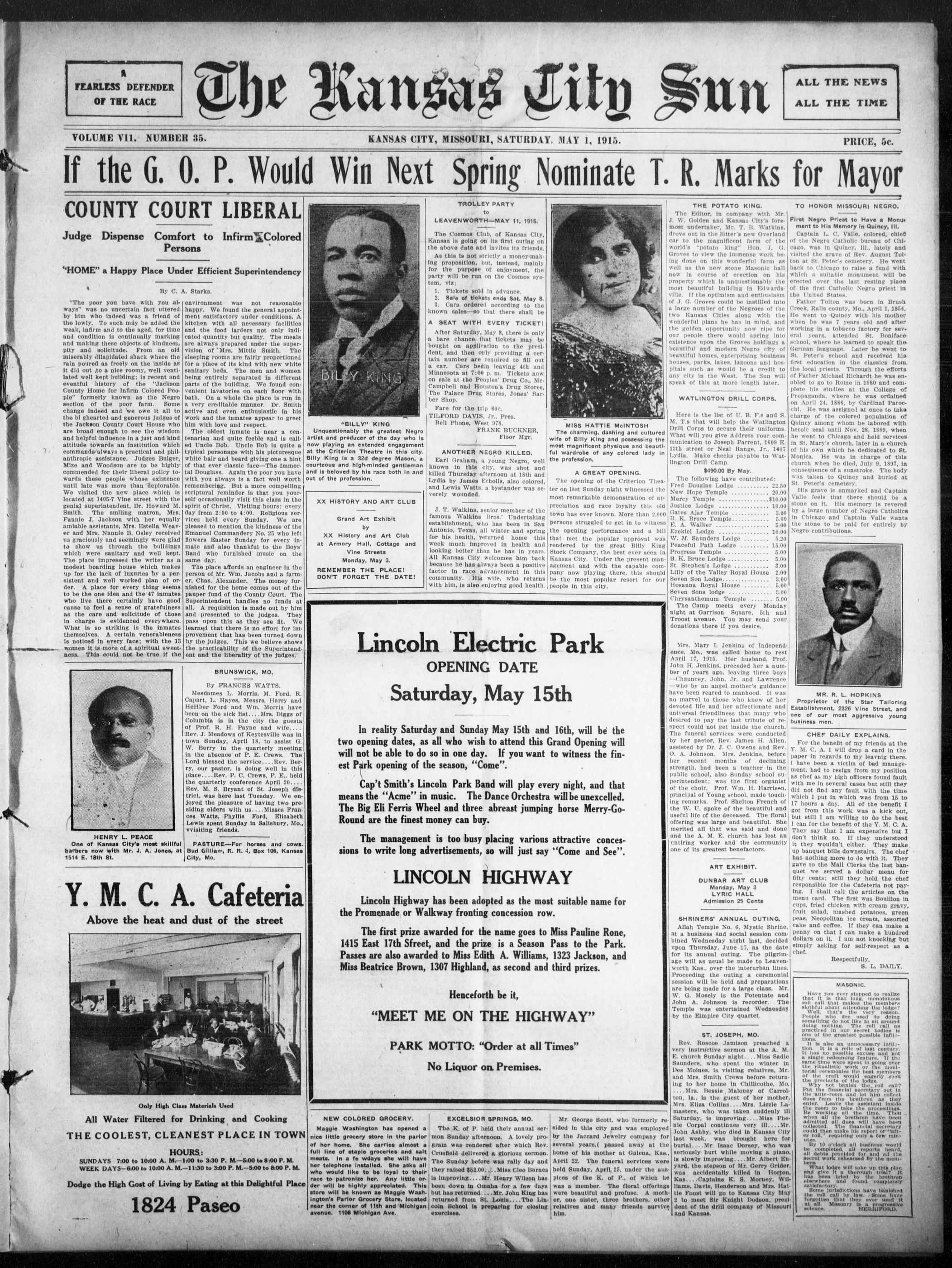
If the G. O. P. Would Win Next Spring Nominate T. R. Marks for Mayor
A FEARLESS DEFENDER OF THE RACE
VOLUME VII. NUMBER 35.
If the G. O.
COUNTY COURT
Judge Dispense Comfort to Persons
"HOME" a Happy Place Under Ef
COUNTY COURT LIBERAL
COUNTY COURT LIBERAL
"HOME" a Happy Place Under Efficient Superintendency
By C. A. Starks
"The poor you have with you always" was no uncertain fact uttered by him who indeed was a friend of the lowly. To such may be added the weak, infirm and to the aged, for time and condition is continually marking and making these objects of kindness, pity and solicitude. From an old miserably dilapidated shack where the rain poured as freely on the inside as it did out, to a nice room, well ventilated well kept building; is recent and eventful history of the "Jackson County Home for Inform Colored People" formerly known as the Negro section of the poor farm. Some change indeed and we owe it all to the bl ghearted and generous judges of the Jackson County Court House who are broad enough to see the wisdom and helpful influence in a just and kind attitude towards an institution which commands/always a practical and philanthropic assistance. Judges Bulger, Mize and Woodson are to be highly commended for their liberal policy towards these people whose existence until late was more than deplorable. We visited the new place which is located at 1405-7 Vine street with the genial superintendent, Dr. Howard M. Smith. The smiling matron, Mrs. Fannie J. Jackson with her equally amiable assistants, Mrs. Estella Weaver and Mrs. Nannle B. Osley received us graciously and seemingly were glad to show us through the buildings which were sanitary and well kept. The place impressed the writer as a modest boarding house which makes up for the lack of luxuries by a persistent and well worked plan of order. A place for every thing seems to be the one idea and the 47 inmates who live there certainly have good cause to feel a sense of gratefulness as the care and solicitude of those in charge is evidenced everywhere. What is so striking is the inmates themselves. A certain venerableness is noticed in every face; with the 13 women it is more of a spiritual sweetness. This could not be true if the
HENRY L. PEACE
One of Kansas City's most skillful
barbers now with Mr. J. A. Jones, at
1514 E. 18th St.
Y. M. C. A.
Above the heat and du
Y. M. C. A. Cafeteria
Above the heat and dust of the street
Only High Class Materials Used
All Water Filtered for Drinking and
THE COOLEST, CLEANEST PLACE
HOURS:
SUNDAYS 7:00 to 10:00 A. M.—1:00 to 3:30 P. M.
WEEK DAYS—6:00 to 10:00 A. M.—11:30 to 3:00 P. M.
Dodge the High Gost of Living by Eating at this
1824 Paseo
The Kansas City Sun
environment was not reasonable happy. We found the general appointment satisfactory under conditions. A kitchen with all necessary facilities and the food larders not only indicated quantity but quality. The meals are always prepared under the supervision of Mrs. Mittle Smith. The sleeping rooms are fairly proportioned for a place of its kind with new white sanitary beds. The men and women being entirely separated in different parts of the building. We found convenient lavatories on each floor with bath. On a whole the place is run in a very creditable manner. Dr. Smith active and even enthusiastic in his work and the inmates appear to greet him with love and respect.
The oldest inmate is near a centenarian and quite feeble and is called Uncle Bob. Uncle Bob is quite a typical personage with his picturesque white hair and beard giving one a hint of that ever classic face—The Immortal Douglass. Again the poor you have with you always is a fact well worth remembering. But a more compelling scriptural reminder is that you yourself occasionally visit this class in the spirit of Christ. Visiting hours: every day from 2:00 to 4:00. Religious services held every Sunday. We are pleased to mention the kindness of the Emanuel Commandery No. 25 who left flowers Easter Sunday for every inmate and also thankful to the Boy's Band who furnished music on the same day.
The place affords an engineer in the person of Mr. Wm. Jacobs and a farmer, Chas. Alexander. The money furnished for the home comes out of the pauper fund of the County Court. The Superintendent handles no funds at all. A requisition is made out by him and presented to the judges. They pass upon this as they see fit. We learned that there is no effort for improvement that has been turned down by the judges. This we believe shows the practicability of the Superintendent and the liberality of the judges.
BRUNSWICK, MO
By FRANCES WATTS
Mesdames L. Morris, M. Ford, R. Capart, L. Hayes, Messrs. Harry and HeHer Ford and Wm. Morris have been on the sick list... Mrs. Diggs of Columbia is in the city the guests of Prof. R. H. Payne and wife... Rev. J. Meadows of Keytesville was in town Sunday, April 18, to assist G. W. Berry in the quarterly meeting in the absence of P. E. Crews. The Lord blessed the service...Rev. Berry, our pastor, is doing well in this place...Rev. P. C. Crews, P. E. held the quarterly conference April 20... Rev. M. S. Bryant of St. Joseph district, was here last Tuesday. We enjoyed the pleasure of having two presiding elders with us...Misses Frances Watts, Phyllis Ford. Elizabeth Lewis spent Sunday in Salisbury, Mo., visting friends.
PASTURE—For horses and cows. Bud Gilliam, R. R. 4, Box 106, Kansas City, Mo.
A. Cafeteria
d dust of the street
Drinking and Cooking
HANEST PLACE IN TOWN
OURS:
11:00 to 3:30 P. M.—5:00 to 8:00 P. M.
—11:30 to 3:00 P. M.—5:00 to 8:00 P. M.
by Eating at this Delightful Place
---
KANSAS CITY, MISSOURI, SATURDAY, MAY 1, 1915.
Lincoln Electric Park OPENING DATE Saturday, May 15th
In reality Saturday and Sunday May 15th and 16th, will be the two opening dates, as all who wish to attend this Grand Opening will will not be able to do so in one day. If you want to witness the finest Park opening of the season, "Come".
Cap't Smith's Lincoln Park Band will play every night, and that means the "Acme" in music. The Dance Orchestra will be unexcelled. The Big Eli Ferris Wheel and three abreast jumping horse Merry-Go-Round are the finest money can buy.
The management is too busy placing various attractive concessions to write long advertisements, so will just say "Come and See".
LINCOLN HIGHWAY
Lincoln Highway has been adopted as the most suitable name for the Promenade or Walkway fronting concession row. The first prize awarded for the name goes to Miss Pauline Rone, 1415 East 17th Sfreet, and the prize is a Season Pass to the Park. Passes are also awarded to Miss Edith A. Williams, 1323 Jackson, and Miss Beatrice Brown, 1307 Highland, as second and third prizes.
PARK MOTTO: "Order at all Times"
BILLY KING
"BILLY" KING
Unquestionably the greatest Negro artist and producer of the day who is now playing an extended engagement at the Criterion Theatre in this city. Billy King is a 32d degree Mason, a courteous and high-minded gentleman and is beloved by his race both in and out of the profession.
XX HISTORY AND ART CLUB
XX History and Art Club
at Armory Hall, Cottage and
Vine Streets
Monday, May 3.
REMEMBER THE PLACE!
DON'T FORGET THE DATE!
Lincoln
Saturday
In reality Saturday two opening dates, as will not be able to do best Park opening of the Cap't Smith's Lin means the "Acme" in The Big Eli Ferris WH Round are the finest
The management sions to write long ad
LINC
Lincoln Highway the Promenade or W
The first prize at 1415 East 17th Sfreet Passes are also awarded Miss Beatrice Brown,
"MEET
PARK
Maggie Washington has opened a nice little grocery store in the parlor of her home. She carries almost a full line of staple groceries and salt meats. In a fe wdays she will have her telephone installed. She asks all who would like to be loyal to their race to patronize her. Any little order will be highly appreciated. This store will be known as Maggie Washington's Parlor Grocery Store, located near the corner of 11th and Michigan avenue. 1106 Michigan Ave.
LEAVENWORTH—MAY 11, 1915.
The Cosmos Club, of Kansas City, Kansas is going on its first outing on the above date and invites its friends. As this is not strictly a money-making proposition, but, instead, mainly for the purpose of enjoyment, the party will be run on the Cosmos system, viz:
1. Tickets sold in advance.
2. Sale of tickets ends Sat. May 8.
3. Cars ordered according to the known sales—so that there shall be
A SEAT WITH EVERY TICKET!
After Saturday, May 8, there is only a bare chance that tickets may be bought on application to the president, and then only providing a certain number are required to fill out a car. Cars begin leaving 4th and Minnesota at 7:00 p. m. Tickets now on sale at the People's Drug Co., McCampbell and Houston's Drug Stores, The Palace Drug Stores, Jones' Barber Shop.
Fare for the trip 60c.
TILFORD DAVIS, Jr. Pres.
Bell Phone, West 978.
FRANK BUCKNER,
Floor Mgr.
ANOTHER NEGRO KILLED
Earl Graham, a young Negro, well known in this city, was shot and killed Thursday afternoon at 18th and Lydia by James Echolls, also colored, and Lewis Watts, a bystander was severely wounded.
J. T. Walkins, senior member of the famous Walkins Bros.' Undertaking establishment, who has been in San Antonio, Texas, all winter and spring for his health, returned home this week much improved in health and looking better than he has in years. All Kansas City welcomes him back because he has always been a positive factor in race advancement in this community. His wife, who returns with him, is also enjoying good health.
In Electric
OPENING DATE
Saturday, May 15
Sunday and Sunday May 15th and
all who wish to attend this
so in one day. If you want
the season, "Come".
Lincoln Park Band will play even
in music. The Dance Orchestra
wheel and three abreast jumping
money can buy.
It is too busy placing various
advertisements, so will just say
COLN HIGHWAY
y has been adopted as the most
walkway fronting concession row
awarded for the name goes to
it, and the prize is a Season
ded to Miss Edith A. Williams,
1307 Highland, as second and
Henceforth be it,
ME ON THE HIGHWAY
MOTTO: "Order at all T
EXCELSIOR SPRINGS, MO.
The K. of P. held their annual sermon Sunday afternoon. A lovely program was rendered after which Rev. Crusfield delivered a glorious sermon. The Sunday before was rally day and they raised $52.00....Miss Cleo Barnes is improving....Mr. Henry Wilson has been down in Omaha for a few days but has returned....Mr. John King has returned from St. Louis....The Lincoln School is preparing for closing exercises.
MISS HATTIE McINTOSH
The charming, dashing and cultured wife of Billy King and possessing the most magnificent physique and beautiful wardrobe of any colored lady in the profession.
A GREAT OPENING.
The opening of the Criterion Theater on last Sunday night witnessed the most remarkable demonstration of apreciation and race loyalty this old town has ever known. More than 2,000 persons struggled to get in to witness the opening performance and a bill that met the popular approval was rendered by the great Billy King Stock Company, the best ever seen in Kansas City. Under the present management and with the capable company now playing there, this should be the most popular resort for our people in this city.
Park
5th
16th, will be the Grand Opening will to witness the fin-
every night, and that a will be unexcelled. g horse Merry-Go-
attractive conces- "Come and See".
WAY
best suitable name for w.
Miss Pauline Rone, Pass to the Park. 1323 Jackson, and third prizes.
WAY"
Times"
Mr. George Scott, who formerly resided in this city and was employed by the Jaccard Jewelry company for several years, passed away at the home of his mother at Galena, Kas., April 22. The funeral services were held Sunday, April 25, under the auspices of the K. of P., of which he was a member. The floral offerings were beautiful and profuse. A mother, one sister, three brothers, other relatives and many friends survive him.
THE POTATO KING.
The Editor, in company with Mr. J. W. Golden and Kansas City's foremost undertaker, Mr. T. B. Watkins, drove out in the latter's new Overland car to the magnificent farm of the world's "potato king" Hon. J. G. Groves to view the immense work being done on this wonderful farm as well as the new stone Masonic hall now in course of erection on his property which is unquestionably the most beautiful building in Edwardsville. If the optimism and enthusiasm of J. G. Groves could be instilled into a large number of the Negroes of the two Kansas Cities along with the wonderful plans he has in mind, and the golden opportunity now ripe for our people there would spring into existence upon the Groves holdings a beautiful and modern Negro city of beautiful homes, enterprising business houses, parks, lakes, lagoons and host pitches such as would be a credit to any city in the West. The Sun will speak of this at more length later.
WATLINGTON DRILL CORPS.
Here is the list of U. B. F.s and S. M. T.s that will help the Watlington Drill Corps to secure their uniforms. What will you give Address your communication to Joseph Parrent, 1609 E 13th street or Neal Range, Jr., 140 Lydia. Make checks payable to Watlington Drill Camp.
$490.00 By May
The following have contributed:
Fred Douglas Lodge 22.50
New Hope Temple 20.00
Mercy Temple $10.00
Justice Lodge 10.00
Gates Ajar Temple 2.00
B. K. Bruce Temple 5.00
E. A. Walker 5.00
Ezekiel Lodge 10.00
W. M. Saunders Lodge 5.20
Peaceful Path Lodge 15.00
Progress Temple 5.00
B. K. Bruce Lodge 5.00
St. Stephen's Lodge 3.00
The Camp meets every Monday night at Garrison Square, 5th and Troost avenue. You may send your donations there if you desire.
Mrs. Mary I. Jenkins of Independence. Mo., was called home to rest April 17, 1915. Her husband, Prof. John H. Jenkins, preceded her a number of years ago, leaving three boys—Chauncey, John, Jr. and Lawrence—who by an angel mother's guidance have been reared to manhood. It was no marvel to those who knew of her devoted life and her affectionate and universal friendliness that many who desired to pay the last tribute of respect could not get inside the church. The funeral services were conducted by her pastor, Rev. James H. Allen, assisted by Dr. J. C. Owens and Rev. O. A. Johnson. Mrs. Jenkins, before her recent months of declining strength, had been a teacher in the public school, also Sunday school superintendent; was the first organist of the choir. Prof. Wm. H. Harrisan, principal of Young school, made touching remarks. Prof. Shelton French of the W. U. spoke of the beautiful and useful life of the deceased. The floral offering was large and beautiful. She merited all that was said and done and the A. M. E. church has lost an untriling worker and the community one of its greatest benefactors.
DUNBAR ART CLUB
Monday, May 3
LYRIC HALL
Admission 25 Cents
SHRINERS' ANNUAL OUTING.
Allah Temple No. 6, Mystic Shrine,
at a business and social session
combined Wednesday night last, decided
upon Thursday, June 17, as the date
for its annual outing. The pilgrimage
will as usual be made to Leavenworth Kas., over the interurban lines.
Proceeding the outing a ceremonial
session will be held and preparations
are being made for a large class. Mr.
W. G. Mosely is the Potentate and
John A. Johnson is recorder. The
Temple was entertained Wednesday
by the Eimire City quartet.
ST. JOSEPH. MO.
Rev. Roscoe Jamison preached a very instructive sermon at the A. M. E. church Sunday night... Miss Sadie Saunders, who spent the winter in Des Moines, is visiting relatives, Mr. and Mrs. Smith Crews before returning to her home in Chillicothe, Mo. ..Mrs. Bessie Maloney of Carrollton, Ia. is the guest of her mother, Mrs. Eliza Collins... Mrs. Lizzie Lamasters, who was taken suddenly ill Saturday, is improving... Miss Phenie Corpal continues very ill... Mr. John Ashby, who died in Kansas City last week, was brought here for burial... Mr. Isaac Dorsey, who was seriously hurt while moving a piano is slowly improving... Mr. Albert Enyard, the stepson of Mr. Gerry Grider, was accidentally killed in Horton, Kas...Captains K. S. Mornery, Williams, Davis, Henderson and Mrs. Hatie Fount will go to Kansas City May 2 to meet Sir Knight Dodson, president of the drill company of Missouri and Kansas.
ALL THE NEWS ALL THE TIME
PRICE. 5c.
TO HONOR MISSOURI NEGRO.
First Negro Priest to Have a Monument to His Memory in Quincy, III.
Captain L. C. Valle, colored, chief of the Negro Catholic bureau of Chicago, was in Quincy, Ill., lately and visited the grave of Rev. August Tolton at St. Peter's cemetery. He went back to Chicago to raise a fund with which a suitable monument will be erected over the last resting place of the first Catholic Negro priest in the United States.
Father Tolton was born in Brush Creek, Ralls county, Mo., April 1, 1854. He went to Quincy with his mother when he was 7 years old and after working in a tobacco factory for several years, attended St. Boniface school, where he learned to speak the German language. Later he went to St. Peter's school and received his first education in the classics from the local priests. Through the efforts of Father Michael Richardt he was enabled to go to Rome in 1880 and complete his studies at the College of Propaganda, where he was ordained on April 24, 1886, by Cardinal Parocchi. He was assigned at once to take charge of the colored population of Quincy among whom he labored with heroic zeal until Nov. 28, 1889, when he went to Chicago and held services in St. Mary's church, later in a church of his own which he dedicated to St. Monica. He was in charge of this church when he died, July 9, 1897, in consequence of a sunstroke. The body was taken to Quincy and buried at St. Peter's cemetery. His grave is unmarked and Captain Valle feels that there should be a stone on it. His memory is revered by a large number of Negro Catholics in Chicago and Captain Valle wants the stone to be paid for entirely by Negro contributions.
MR. R. L. HOPKINS
Proprietor of the Star Tailoring
Establishment, 2326 Vine Street, and
one of our most aggressive young
business men.
CHEF DAILY EXPLAINS
For the benefit of my friends at the Y. M. C. A. I will drop a card in the paper in regards to my leavig there. I have been a victim of bad management, had to resign from my position as chef as my high officers found fault with me in several cases but still they did not find any fault with the time which I put in which was from 15 to 17 hours a day. All of the benefit I got from this work was a kick out, but still I am willing to do the best I can for the benefit of the Y. M. C. A. They say that I am expensive but I don't think so. If they understood it they wouldn't either. They make up banquet bills downstairs. The chef has nothing more to do with it. They gave to the Mail Clerks the last banquet we served a dollar menu for fifty cents; still they hold the chef responsible for the Cafeteria not paying. I shall call the articles on the menu card. The first was Boulton in cups, fried chicken with cream gravy, fruit salad, mashed potatoes, green peas, Neopolitan ice cream, assorted cake and coffee. If they can make a penny on that I can make a hundred dollars on it. I am not knocking but simply asking for self-respect as a chef.
Respectfully,
S. L. DAILY.
MASONIC.
Have you ever stopped to realize that it is that long, monotonous punishable slobful about attending the lodge? Well, that's the very reason. It is the most difficult thing to do, something do not like to sit and doing nothing. The roll call as practiced in our secret bodies is one of the greatest possible infiltrations. It is also an unnecessary infiltration of the last century. It has no possible value. The ceremonial ceremonies the best members of the craft would eagerly ask to attend. Why not banish the roll call? Put the financial secretary out in the kitchen-room, and coerce the dues from the brethren as they enter. Leave the assistant inside the room to take the proceedings. When all the brethren have been admitted all dues will have been collected. The secretary then make his report, or roll, requiring only a few minutes. By 10 o'clock a business would be completed, all reports heard, all debts provided for and all the secret work rehearsed by the memoir. What lodge will take up this plan? It has been tried by the brethren elsewhere and found completely satisfactory. All precautions have banished the roll call by law. Some have forgotten that they ever used it. Masonry or HERPEN science. HERPEN
Youth's Victorious Hour
By ALICE BEVAN HURLBUT
(Copyright, 1915, by W. G. Chapman).
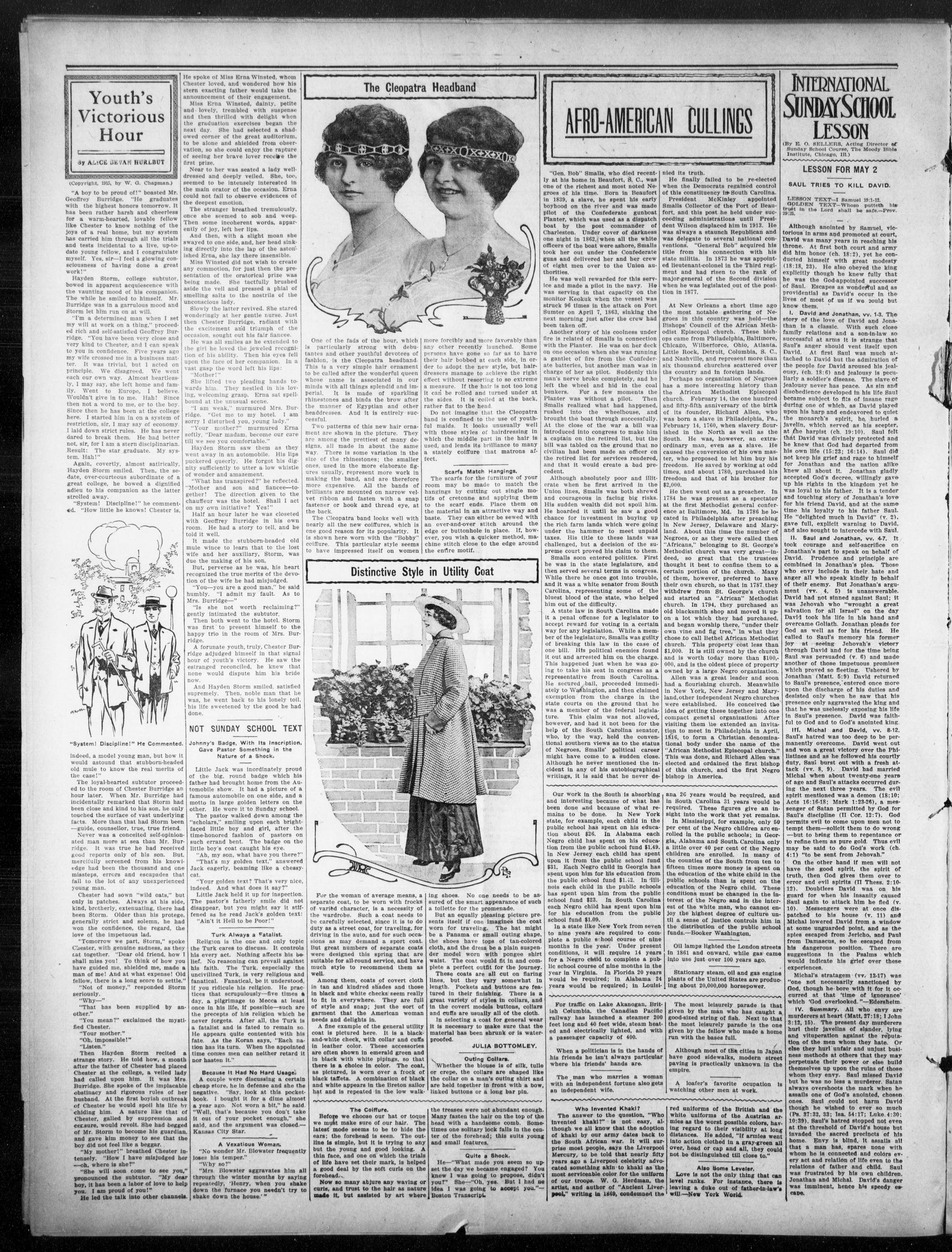
"A boy to be proud of!" boasted Mr. Geoffrey Burridge. "He graduates with the highest honors tomorrow. It has been rather harsh and cheerless for a warm-hearted, lovable fellow like Chester to know nothing of the joys of a real home, but my system has carried him through all the trials and tests incidental to a live, up-to-date young fellow, and I congratulate myself. Yes, sir—I feel a glowing consciousness of having done a great work!"
Hayden Storm, college subtutor, bowed in apparent acquiescence with the vaunting mood of his companion. The while he smiled to himself. Mr. Burridge was in a garrulous mood and Storm let him run on at will.
"I'm a determined man when I set my will at work on a thing," proceeded rich and self-satisfied Geoffrey Burridge. "You have been very close and very kind to Chester, and I can speak to you in confidence. Five years ago my wife crossed me in a business matter. It was trivial, but I acted on principle. We disagreed. We went each our own way. Almost heartless, I may say, she left home and family. Went to Europe. I believe Wouldn't give in to me. Hah! Since then not a word to me, or to the boy. Since then he has been at the college here. I started him in on a system of restriction, sir, I may say of economy I laid down strict rules. He has never dared to break them. He had better not, sir, for I am a stern disciplinarian Result: The star graduate. My system. Hah!"
Again, coverty, almost satirically, Hayden Storm smiled. Then, the sedate, over-courteous subordinate of a great college, he bowed a dignified adieu to his companion as the latter strolled away.
"System! Discipline!" he comments, "How little he knows! Chester is
M. M.
"System! Discipline!" He Commented.
indeed, a model young man, but how it would astound that stubborn-headed old mule to know the real merits of the case!
The loyal-hearted subtutor proceeded to the room of Chester Burridge an hour later. When Mr. Burridge had incidentally remarked that Storm had been close and kind to his son, he only touched the surface of vast underlying facts. More than that had Storm been—guide, counsellor, true, true friend.
Never was a conceived self-opinionated man more at sea than Mr. Burridge. It was true he had received good reports only of his son. But, mercifully screened from his knowledge had been the thousand and one missteps, errors and escapades that fall to the lot of any unexperienced young man.
Chester had sown "wild oats," but only in patches. Always at his side, kind, brotherly, extenuating, there had been Storm. Older than his protege, generally strict and solemn, he had won the confidence, the regard, the love of the impetuous lad.
"Tomorrow we part, Storm," spoke Chester, with genuine sadness, as they eat together. "Dear old friend, how I shall miss you! To think of how you have guided me, shielded me, made a man of me! And at what expense! Old fellow, there is a long score to settle."
"Not of money," responded Storm seriously.
"Why—"
"That has been supplied by another."
"You mean?" exclaimed the mystified Chester.
"Your mother."
"Oh, impossible!"
"Listen."
Then Hayden Storm recited a strange story. He told how, a month after the father of Chester had placed Chester at the college, a veiled lady had called upon him. It was Mrs. Burridge. She spoke of the implacable obstinacy and rigorous rules of her husband. At the first boyish outbreak of Chester he would spoil his life by chiding him. A nature like that of Chester, gallied by suppression and censure, would revolt. She had begged of Mr. Storm to become his guardian, and gave him money to see that the boy did not feel like a beggar.
"My mother!" breathed Chester intensely. "How I have misjudged her—oh, where is she?"
"She will soon come to see you," pronounced the subtutor. "My dear boy, it has been a labor of love to help you. I am proud of you!"
He led the talk into other channels.
He spoke of Miss Erna Winsted, whom Chester loved, and wondered how his stern exacting father would take the announcement of their engagement.
Miss Erna Winsted, dainty, petite and lovely, trembled with suspense and then thrilled with delight when the graduation exercises began the next day. She had selected a shadowed corner of the great auditorium, to be alone and shielded from observation, so she could enjoy the rapture of seeing her brave lover receive the first prize.
Near to her was seated a lady well-dressed and deeply veiled. She, too, seemed to be intensely interested in the main orator of the occasion. Erna could not fail to observe evidences of the deepest emotion.
The stranger breathed tremulously, once she seemed to sob and weep. Then some incoherent words, apparently of joy, left her lips.
And then, with a slight moan she swayed to one side, and, her head sinking directly into the lap of the astonished Erna, she lay there insensible.
Miss Winsted did not wish to create any commotion, for just then the presentation of the oratorical prize was being made. She tactfully brushed aside the veil and pressed a phial of smelling salts to the nostrils of the unconscious lady.
Slowly the latter revived. She stared wonderingly at her gentle nurse. Just then Chester Burridge, radiant with the excitement and triumph of the occasion, sought out his fair fancee.
He was all smiles as he extended to the girl he loved the jeweled recognition of his ability. Then his eyes fell upon the face of her companion. In a vast gasp the word left his lips:
"Mother!"
She lifted two pleading hands towards him. They nestled in his loving, welcoming grasp. Erna sat spellbound at the unusual scene.
"I am weak," murmured Mrs. Burridge. "Get me to my hotel. I am sorry I disturbed you, young lady." "Your mother?" murmured Erna softly. "Dear madam, become our care till we see you comforted." Hayden Storm saw them as they went away in an automobile. His lips puckered querely. He forgot his dignity sufficiently to utter a low whistle of wonder and amazement. "What has transpired?" he reflected. "Mother and son and hancee—together! The direction given to the chauffeur was the hotel. Shall I act on my own initiative? Yes!" Half an hour later he was closeted with Geoffrey Burridge in his own room. He had a story to tell, and he told it well. It made the stubborn-headed old mule wince to learn that to the lost wife and her auxiliary, Storm, was due the making of his son. But, perverse as he was, his heart recognized the true merits of the devotion of the wife he had misjudged.
"You—you are a good man," he said humbly. "I admit my fault. As to Mrs. Burridge—"
"Is she not worth reclaiming?" gently intimated the subtutor. Then both went to the hotel. Storm was first to present himself to the happy trio in the room of Mrs. Burridge. A forunate youth, truly, Chester Burridge adjudged himself in that signal hour of youth's victory. He saw the estranged reconciled, he knew that none would dispute him his bride now. And Hayden Storm smiled, satisfied supremely. Then, noble man that he was, he went back to his lonely toll, his life sweetened by the good he had done.
NOT SUNDAY SCHOOL TEXT
Johnny's Badge, With Its Inscription,
Gave Pastor Something in the
Nature of a Shock.
Little Jack was inordinately proud of the big, round badge which his father had brought home from the Automobile show. It had a picture of a famous automobile on one side, and a motto in large golden letters on the other. He wore it to Sunday school.
The pastor walked down among the "scholars," smiling upon each bright-faced little boy and girl, after the time-honored fashion of pastors on such errand bent. The badge on the little boy's coat caught his eye.
"Ah, my son, what have you there?"
"That's my golden text," answered Jack eagerly, beaming like a cheesy cat.
"Your golden text? That's very nice, indeed. And what does it say?"
Little Jack held it up for inspection.
The pastor's fatherly smile did not disappear, but you might say it stiffened as he read Jack's golden text: "Aln't it Hell to be Poor!"
Turk Always a Fatalist.
Religion is the one and only topic the Turk cares to discuss. It controls his every act. Nothing affects his belief. No reasoning can prevail against his faith. The Turk, especially the uncivilized Turk, is very religious and fanatical. Fanatical, be it understood, if you ridicule his religion. He practices that scrupulously—five times a day, a pilgrimage to Mecca at least once in his life, if possible—such are the precepts of his religion which he never forgets. After all, the Turk is a fatalist and is fated to remain so. He appears quite contented with his fate. As the Koran says, "Each nation has its turn. When the appointed time comes men can neither retard it nor hasten it."
Because It Had No Hard Usage
A couple were discussing a certain cheap store, he in defense and she the negative. "Say, look at this pocket-book. I bought it for a dime almost a year ago. Not worn a bit," he said. "Well, that's because you don't take it out of your pocket enough," she said, and the argument was closed.—Kansas City Star.
A Vexatious Woman.
"No wonder Mr. Blowster frequently loses his temper."
"Why so?"
"Mrs. Blowster aggravates him all through the winter months by saying repeatedly, 'Henry, when you shake down the furnace you needn't try to shake down the house.'"
XX
P
One of the fads of the hour, which is particularly strong with debuantes and other youthful devotees of fashion, is the Cleopatra headband. This is a very simple hair ornament to be called after the wonderful queen whose name is associated in our minds with all things splendid and imperial. It is made of sparkling rhinestones and binds the brow after the manner of Egyptian and other headdresses. And it is entirely successful.
Two patterns of this new hair ornament are shown in the picture. They are among the prettiest of many designs, all made in about the same way. There is some variation in the size of the rhinestones; the smaller ones, used in the more elaborate figures usually, represent more work in making the band, and are therefore more expensive. All the bands of brilliants are mounted on narrow velvet ribbon and fasten with a snap fastener or hook and thread eye, at the back.
The Cleopatra band looks well with nearly all the new coifes, which is one good reason for its popularity. It is shown here worn with the "Bobby" coife. This particular style seems to have impressed itself on women
Distinctive Style
For the woman of average means, a separate coat, to be worn with frocks of varied character, is a necessity of the wardrobe. Such a coat needs to be carefully selected, since it is to do duty as a street coat, for traveling, for driving in the auto, and for such occasions as may demand a sport coat. But great numbers of separate coats were designed this spring that are suitable for all-round service, and have much style to recommend them as well.
Among them, coats of covert cloth in tan and kindred shades and those in black and white checks seem really to fit in everywhere. They are full of style and snap; just the sort of garment that the American woman needs and delights in.
A fine example of the general utility coat is pictured here. It is a black-and-white cheek, with collar and cuffs in leather color. These accessories are often shown in emerald green and in black with white pipings, so that there is a choice in color. The coat, as pictured, is worn over a frock of black taffeta. A combination of black and white appears in the Breton sailor hat and is repeated in the low walk
The Coiffure
Before we choose our hat or toque we must make sure of our hair. The latest mode seems to be to hide the ears; the forehead is seen. The outline is simple, but it is trying to any but the young and good looking. A thin face, and one on which the trials of life have set their mark, is helped a good deal by the soft curls on the forehead.
Now so many abjure any waving or curls, and trust to the hair as nature made it, but assisted by art where
more forcibly and more favorably than any other recently launched. Some persons have gone so far as to have their hair bobbed at each side, in order to adopt the new style, but hair-dressers manage to achieve the right effect without resorting to so extreme a measure. If the hair is not too long it can be rolled and turned under at the sides. It is coiled at the back, rather flat to the head. Do not imagine that the Cleopatra band is confined to the use of youthful mala. It looks unusually well with those styles of hairdressing in which the middle part in the hair is used, and lends its brilliance to many a stately coiffure that matrons affect.
Scarfs Match Hangings
The scarfs for the furniture of your room may be made to match the hangings by cutting out single motifs of cretonne and applying them to the scarf ends. Place them on the material in an attractive way and baste. They can either be sewed with an over-and-over stitch around the edge or buttonhole in place. If, however, you wish a quicker method, machine stitch close to the edge around the entire motif.
e in Utility Coat
ing shoes. No one needs to be assured of the smart appearance of such a toilette for the promenade.
But an equally pleasing picture presents itself if one imagines the coat worn for traveling. The hat might be a Panama or small outing shape, the shoes have tops of tan-colored cloth, and the dress be a plain suspender model worn with pongee shirt waist. The coat would fit in and complete a perfect outfit for the journey.
These coats are all cut on flaring lines, but they vary somewhat in length. Pockets and buttons are featured in their finishing. There is a great variety of styles in collars, and in the covert models buttons, collars and cuffs are usually all of the cloth.
In selecting a coat for general wear it is necessary to make sure that the material has been shrunk or is water-proof.
JULIA BOTTOMLEY.
Outing Collars.
Whether the blouse is of silk, tulle or crepe, the collars are shaped like the collar on a man's outing shirt and are held together in front with a bow, linked buttons or a long bar pin.
the tresses were not abundant enough. Many fasten the hair on the top of the head with a handsome comb. Sometimes one solitary lock falls in the center of the forehead; this suits young and small features.
Quite a Shock.
He—"What made you seem so upset the day we became engaged? You knew I was going to propose, didn't you?" She—"Oh, yes. But I had no idea I was going to accept you."—Boston Transcript.
AFRO-AMERICAN CULLINGS
nied its truth.
He finally failed to be re-elected when the Democrat regained control of this constituency in South Carolina.
President McKinley appointed Smalls Collector of the Port of Beaufort, and this post he held under succeeding administrations until President Wilson displaced him in 1913. He was always a staunch Republican and was delegate to several national conventions. "General Bob" acquired his title from his connection with his state militia. In 1873 he was appointed lieutenant-colonel in the Third regiment and had risen to the rank of major-general of the Second division when he was legislated out of the position in 1877.
At New Orleans a short time ago the most notable gathering of Negroes in this country was held—the Bishops' Council of the African Methodist Episcopal church. These bishops came from Philadelphia, Baltimore, Chicago, Wilberford, Ohio, Atlanta, Little Rock, Detroit, Columbia, S. C., and Nashville, and represent more than six thousand churches scattered over the country and in foreign lands.
Perhaps no organization of Negroes has a more interesting history than the African Methodist Episcopal church. February 14, the one hundred and fifty-fifth anniversary of the birth of its founder, Richard Allen, who was born a slave in Philadelphia, Pa., February 14, 1760, when slavery flourished in the North as well as the South. He was, however, an extraordinary man, even as a slave. He caused the conversion of his own master, who proposed to let him buy his freedom. He saved by working at odd times, and about 1780, purchased his freedom and about 1780, his brother for $2,000.
He then went out as a preacher. In 1784 he was present as a spectator at the first Methodist general conference at Baltimore, Md. In 1786 he located in Philadelphia after preaching in New Jersey, Delaware and Maryland. About this time the number of Negroes, or as they were called then "Africans," belonging to St. George's Methodist church was very great—indeed, so great that the trustees thought it best to confine them to a certain portion of the church. Many of them, however, preferred to have their own church, so that in 1787 they withdrew from St. George's church and started an "African" Methodist church. In 1794, they purchased an old blacksmith shop and moved it upon a lot which they had purchased, and began worship there, "under their own vine and fig tree," in what they chose to call Bethel African Methodist church. This property cost less than $1,000. It is still owned by the church and is worth today more than $100,000, and is the oldest piece of property owned by a large Negro organization.
Allen was a great leader and soon had a flourishing church. Meanwhile in New York, New Jersey and Maryland, other independent Negro churches were established. He conceived the idea of getting these together into one compact genetal organization. After visiting them he extended an invitation to meet in Philadelphia in April, 1816, to form a Christian denominational body under the name of the "African Methodist Episcopal church." This was done, and Richard Allen was elected and ordained the first bishop of this church, and the first Negro bishop in America.
ana 26 years would be required, and in South Carolina 31 years would be required. These figures give an insight into the work that yet remains
In Mississippi, for example, only 50 per cent of the Negro children are enrolled in the public schools; in Georgia, Alabama and South Carolina only a little over 40 per cent of the Negro children are enrolled. In many of the counties of the South from ten to fifteen times more money is spent on the education of the white child in the public schools than is spent on the education of the Negro child. These conditions must be changed in the interest of the Negro and in the interest of the white man, who cannot enjoy the highest degree of culture until a sense of justice controls him in the distribution of the public school funds.—Booker Washington.
Oil lamps lighted the London streets in 1861 and onward, while gas came into use just over 100 years ago.
Stationary steam, oil and gas engine plants of the United States are producing about 20,000,000 horsepower.
For traffic on Lake Akanogan, British Columbia, the Canadian Pacific railway has launched a steamer 200 feet long and 40 feet wide, steam heated and electrically lighted, and with a passenger capacity of 400.
When a politician is in the hands of his friends he isn't always particular where his friends' hands are.
The man who marries a woman with an independent fortune also gets an independent wife.
Who Invented Khaki? The answer to the question, "Who Invented khaki?" is not easy, although we all know that the adoption of khaki by our army dates back to the South African war. It will surprise most people, says the Liverpool Mercury, to be told that nearly fifty
The most leisurely parade is that given by the man who has caught a good-sized string of fish. Next to that the most leisurely parade is the one given by the fellow who made a home run with the bases full.
Although most of the cities in Japan have good sidewalks, modern street paving is practically unknown in the empire.
A loafer's favorite occupation is watching other men at work.
red uniforms of the British and the white uniforms of the Austrian armies as the worst possible colors, having regard to their visibility at long distances. He added, "If armies went into action clothed in a gray-green all over, head or cap and all, they could not be distinguished till close to."
Also Some Leveller.
Love is not the only thing that can level rain, instance, there is leaving a duke out in law-in-law's will—New York World.
"Gen. Bob" Smalls, who died recently at his home in Beaufort, B. C., was one of the richest and most noted Negroes of his time. Born in Beaufort in 1839, a slave, he spent his early boyhood on the river and was made pilot of the Confederate gunboat Planter, which was used as a dispatch boat by the post commander of Charleston. Under cover of darkness one night in 1862,[when all the white officers of the boat were ashore, Smalls took her out under the Confederate guns and delivered her and her crew of eight men over to the Union authorities.
He was well rewarded for this service and made a pilot in the navy. He was serving in that capacity on the monitor Keokuk when the vessel was struck 96 times in the attack on Fort Sumter on April 7, 1863, sinking the next morning just after the crew had been taken off.
Another story of his coolness under fire is related to Smalls in connection with the Planter. He was on her deck on one occasion when she was running a gantlet of fire from the Confederate batteries, but another man was in charge of her as pilot. Suddenly this man's nerve broke completely, and he left the wheel and hid in the coal bunkers. For a few moments the Planter was without a pilot. Then Smalls realized what had happened, rushed into the wheelhouse, and brought the boat through successfully. At the close of the war a bill was introduced into congress to make him a captain on the retired list, but the bill was tabled on the ground that no civilian had been made an officer on the retired list for services rendered, and that it would create a bad precedent.
Although absolutely poor and illiterate when he first arrived in the Union lines, Smalls was both shrewd and courageous in facing big risks. His sudden wealth did not spoil him. He hoarded it until he saw a good chance for investment in buying up the rich farm lands which were going under the hammer to meet unpaid taxes. His title to these lands was challenged, but a decision of the supreme court proved his claim to them. Smalls soon entered politics. First he was in the state legislature, and then served several terms in congress. While there he once got into trouble, and it was a white senator from South Carolina, representing some of the bluest blood of the state, who helped him out of the difficulty.
A state law in South Carolina made it a penal offense for a legislator to accept reward for voting in a certain way for any legislation. While a member of the legislature, Smalls was guilty of breaking this law in the case of one bill. His political enemies found it out and arrested him on the charge. This happened just when he was going to take his seat in congress as a representative from South Carolina. He secured bail, proceeded immediately to Washington, and then claimed exemption from the charge in the state courts on the ground that he was a member of the federal legislature. This claim was not allowed, however, and had it not been for the help of the South Carolina senator, who, by the way, held the conventional southern views as to the status of Negroes, Smalls' political career might have come to a sudden close. Although he never mentioned the incident in any of his autobiographical writings, it is said that he never de-
In a state like New York from seven to nine years are required to complete a public school course of nine months in the year. Under present conditions, it will require 14 years for a Negro child to complete a public school course of nine months in the year in Virginia. In Florida 20 years would be required; in Alabama 24 years would be required; in Louisi-
For traffic on Lake Akanogan, British Columbia, the Canadian Pacific railway has launched a steamer 200 feet long and 40 feet wide, steam heated and electrically lighted, and with a passenger capacity of 400.
When a politician is in the hands of his friends he isn't always particular where his friends' hands are.
The man who marries a woman with an independent fortune also gets an independent wife.
---
Who Invented Khakl?
The answer to the question, "Who invented khaki?" is not easy, although we all know that the adoption of khaki by our army dates back to the South African war. It will surprise most people, says the Liverpool Mercury, to be told that nearly fifty years ago a Liverpool celebrity advocated something akin to khaki as the most serviceable color for the uniform of our troops. W. G. Herdman, the artist, and author of "Ancient Liverpool," writing in 1869, condemned the
INTERNATIONAL
SUNDAY SCHOOL
LESSON
(By E. O. SELLER, Acting Director of
The Moody Bible
Institute, Chicago, IL)
SAUL TRIES TO KILL DAVID.
LESSON TEXT-I Samuel 1:12-12
GOLDEN TEXT-Whoso putteth his trust in the Lord shall be safe.—Prov. 29:25.
Although anointed by Samuel, victorious in arms and promoted at court, David was many years in reaching his throne. At first both court and army did him honor (ch. 18:2), yet he conducted himself with great modesty (18:18, 23). He also obeyed the king explicitly though he knew fully that he was the God-appointed successor of Saul. Escapes as wonderful and as providential as David's occur in the lives of most of us if we could but know them.
1. David and Jonathan, vv. 1.3. The story of the love of David and Jonathan is a classic. With such close family relations and a son-in-law so successful at arms it is strange that Saul's anger should vent itself upon David. At first Saul was much attached to David but the admiration of the people for David aroused his jealousy, (ch. 18:6) and jealousy is peculiarly a soldier's disease. The slave of jealousy never has peace. As sin and disobedience developed in his life Saul became subject to fits of insane rage during one of which, as David played upon his harp and endeavored to quiet the monarch's spirit, he hurled a javelin, which served as his scepter, at the harpist (ch. 19:10). Saul felt that David was divinely protected and he knew that God had departed from his own life (15:23; 16:14). Saul did not keep his grief and rage to himself for Jonathan and the nation alike knew all about it. Jonathan gladly accepted God's decree, willingly gave up his rights in the kingdom yet he was loyal to his father. It is a tender and touching story of Jonathan's love for his friend David, and at the same time his loyalty to his father Saul. He "delighted much in David" (v. 2). gave full, explicit warning to David, and also sought to intercede with Saul.
II. Saul and Jonathan, vv. 4-7. It took courage and self-sacrifice on Jonathan's part to speak on behalf of David. Prudence and principle are combined in Jonathan's plea. Those who envy include in their hate and anger all who speak kindly in behalf of their enemy. But Jonathan's argument (vv. 4. 5) is unanswerable. David had not sinned against Saul; it was Jehovah who "wrought a great salvation for all Israel" on the day David took his life in his hand and overcame Gollath. Jonathan pleads for God as well as for his friend. He called to Saul's memory his former joy at seeing Jehovah's victory through David and for the time being Saul was persuaded (v. 6) and made another of those impetuous promises which proved so fleeting. Ushered by Jonathan (Matt. 5:9) David returned to Saul's presence, entered once more upon the discharge of his duties and desisted only when he saw that his presence only aggravated the king and that he was uselessly exposing his life in Saul's presence. David was faithful to God and to God's anointed king.
III. Michal and David, vv. 8-12. Saul's hatred was too deep to be permanently overcome. David went out and won a great victory over the Philistines and as he followed his courtly duty, Saul burst out with a fresh attack (vv. 8, 9). David had married Michal when about twenty-one years of age and Saul's attacks occurred during the next three years. The evil spirit mentioned was a demon (18:10; Acts 16:16-18; Mark 1:23-26), a messenger of Satan permitted by God for Saul's discipline (II Cor. 12:7). God permits evil to come upon men not to tempt them—solicitize them to do wrong—but to bring them to repentance or to refine them as pure gold. Thus evil may be said to do God's work (ch. 4:1) "to be sent from Jehovah."
On the other hand if men will not have the good spirit, the spirit of truth, then God gives them over to error and evil spirits (II Thess. 2:10-12). Doubtless David was on his guard for when his insanity caused Saul again to attack him he fled (v. 10). Messengers were at once dispatched to his house (v. 11) and Michal lowered David from a window at some unguarded point, and as the spies escaped from Jericho, and Paul from Damascus, so he escaped from his dangerous position. There are suggestions in the Psalms which would indicate his grief over these experiences. Michal's stratagem (vv. 13-17) was "one not necessarily sanctioned by God, though he bore with it for it occurred at that 'time of ignorance' which 'God overlooked."—Edersheim.
IV. Summary. All who envy are murderers at heart (Matt, 27:18; I John 3:12, 15). The present day murderers hurl their javelins of land, lying and vituperation against the reputation of the men whom they hate. Or else hurl unfair and unjust business methods at others that they may perpetuate their power or else build themselves up upon the ruins of those whom they envy. Saul missed David but he was no less a murderer. Satan always overshoots the mark when he assails one of God's anointed, chosen ones. Saul could not harm David though he wished to ever so much (Pa. 37:32, 33; Isa. 54:17; Luke 4:30; 10:39). Saul's hatred stopped not even at the threshold of David's house but invaded the sacred precincts of his home. Envy is blind, it assails all that a man has, spares none with whom he is connected and colors every act and relation of life even to the relations of father and child. Saul was frustrated by his own children. Jonathan and Michal. David's danger was imminent, hence his speedy escape.
DOWN the STORIED RHINE
FIRST among the commercial rivers of civilization, the most important geographical feature of central Europe, a hotly con-
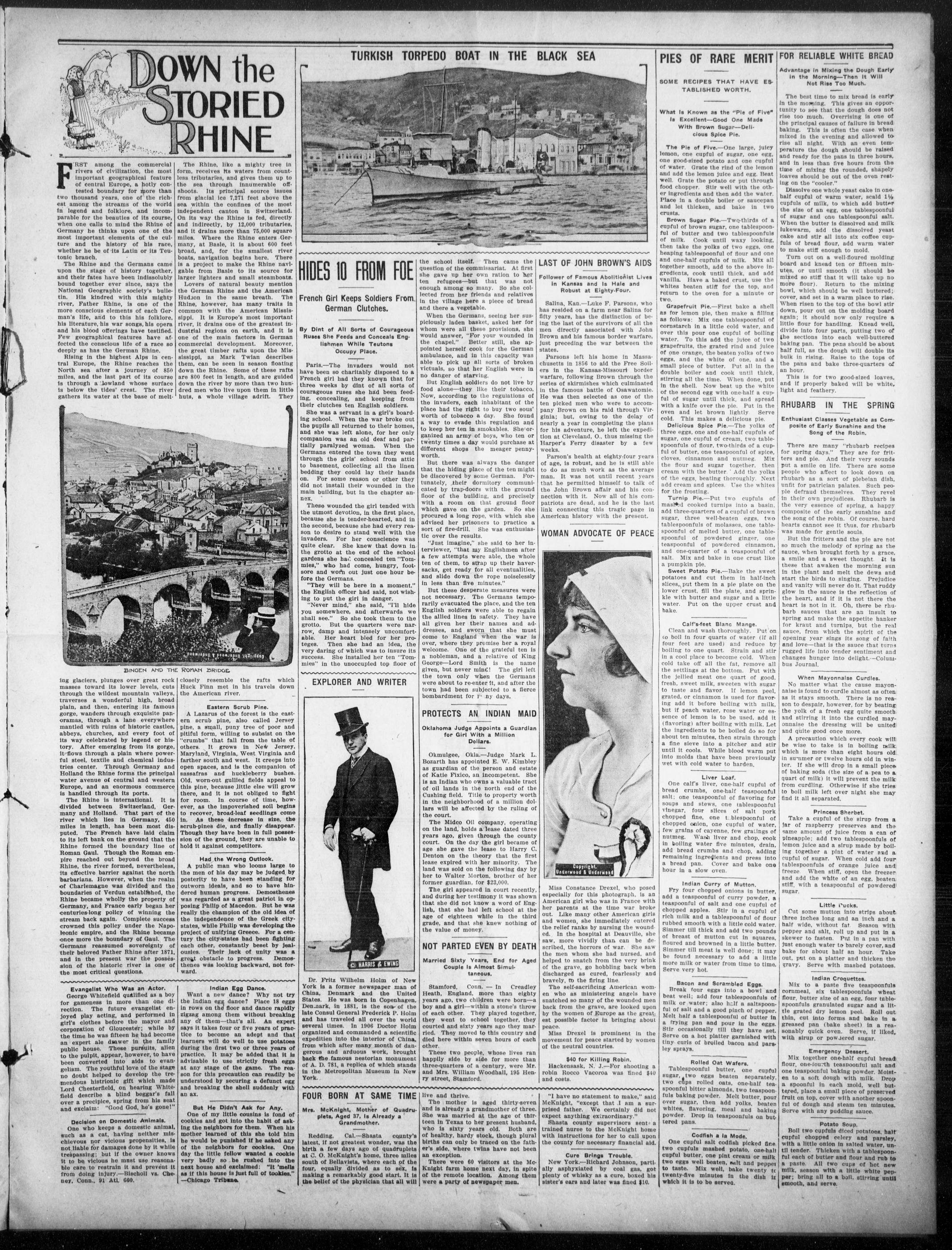
tested boundary for more than two thousand years, one of the richest among the streams of the world in legend and folklore, and incomparable for the beauties of its course, when one calls to mind the Rhine of Germany he thinks upon one of the most important elements of the culture and the history of his race, whether he be of its Latin or its Teutonic branch. The Rhine and the Germans came upon the stage of history together, and their fates have been indissolubly bound together ever since, says the National Geographic society's bulletin. His kindred with this mighty river, Father Rhine, is one of the more conscious elements of each German's life, and to this his folklore, his literature, his war songs, his opera and his blood offerings have testified. Few geographical features have affected the conscious life of a race so deeply as has the German Rhine.
Rising in the highest Alps in central Europe, the Rhine reaches the North sea after a journey of 850 miles, and the last part of its course is through a Lowland whose surface is below the tides' crest. The river gathers its water at the base of melt-
Copyright Underwood & Underwood
BINGEN AND THE ROMAN BRIDGE
ing glaciers, plunges over great rock masses toward its lower levels, cuts through the wildest mountain valleys, traverses a wonderful high, broad plain, and then, entering its famous gorge, wanders through exquisite panoramas, through a lane everywhere mantled with ruins of historic castles, abbeys, churches, and every foot of its way celebrated by legend or history. After emerging from its gorge, it flows through a plain where powerful steel, textile and chemical industries center. Through Germany and Holland the Rhine forms the principal water avenue of central and western Europe, and an enormous commerce is handled through its ports.
The Rhine is international. It is divided between Switzerland, Germany and Holland. That part of the river which lies in Germany, 450 miles in length, has been most disputed. The French have laid claim to its left bank on the ground that the Rhine formed the boundary line of Roman Gaul. Though the Roman empire reached out beyond the broad Rhine, the river formed, nevertheless, its effective barrier against the north barbarians. However, when the realm of Charlemagne was divided and the boundaries of Verdun established, the Rhine became wholly the property of Germany, and France early began her centuries-long policy of winning the stream back again. Complete success crowned this policy under the Napoleonic empire, and the Rhine became once more the boundary of Gaul. The Germans reassumed sovereignty of their beloved Father Rhine after 1871, and in the present war the possession of the historic river is one of the most critical questions.
Evangelist Who Was an Actor.
George Whitefield qualified as a boy for gameness in more than one direction. The future evangelist enjoyed play acting, and performed in girl's clothes before the mayor and corporation of Gloucester; while by the time he was fifteen he had become an expert ale dawner in the family public house. These pursuits, alien to the pulpit, appear, however, to have been converted into aids to evangelism. The youthful love of the stage no doubt helped to develop the tremendous histrionic gift which made Lord Chesterfield, on hearing Whitefield describe a blind beggar's fall over a precipice, spring from his seat and exclaim: "Good God, he's gone!"
Decision on Domestic Animals.
Decision on Domestic Animals.
One who keeps a domestic animal, such as a cat, having neither mischievous nor vicious propenities, is not liable for damages done by it while trespassing; but if the owner knows it to be vicious he must use reasonable care to restrain it and prevent it from doing injury.—Bischoll vs. Cheney, Conn., 91 Atl, 660.
The Rhine, like a mighty tree in form, receives its waters from countless tributaries, and gives them up to the sea through innumerable offshoots. Its principal source issues from glacial ice 7,271 feet above the sea within the confines of the most independent canton in Switzerland. On its way the Rhine is fed, directly and indirectly, by 12,000 tributaries, and it drains more than 75,000 square miles. Where the Rhine enters Germany, at Basle, it is about 600 feet broad, and, for the smallest river boats, navigation begins here. There is a project to make the Rhine navigable from Basle to its source for larger lighters and small steamboats.
Lovers of natural beauty mention the German Rhine and the American Hudson in the same breath. The Rhine, however, has many traits in common with the American Mississippi. It is Europe's most important river, it drains one of the greatest industrial regions on earth, and it is one of the main factors in German commercial development. Moreover, the great timber rafts upon the Mississippi, as Mark Twan describes them, can be seen in season floating down the Rhine. Some of these rafts are 800 feet in length, and are guided down the river by more than two hundred men who live upon them in little huts, a whole village adrift. They
Copyright. Underwood & Underwood.
closely resemble the rafts which Huck Finn met in his travels down the American river.
Eastern Scrub Pine.
A Lazarus of the forest is the eastern scrub pine, also called Jersey pine, a small, piny tree of poor and pitiful form, willing to subsist on the "crumbs" that fall from the table of others. It grows in New Jersey, Maryland, Virginia, West Virginia and farther south and west. It creeps into open spaces, and is the companion of sassafras and huckleberry bushes. Old, worn-out gullible fields appeal to this pine, because jittle else will grow there, and it is not obliged to fight for room. In course of time, however, as the impoverished soil begins to recover, broad-leaf seedlings come in. As these increase in size, the scrub-pines die, and finally disappear. Though they have been in full possession of the ground, they are unable to hold it against competitors.
Had the Wrong Outlook.
A public man who looms large to the men of his day may be judged by posterity to have been standing for outworn ideals, and so to have hindered human progress. Demosthenes was regarded as a great patriot in opposing Philip of Macedon. But he was really the champion of the old idea of the independence of the Greek city-states, while Philip was developing the project of unifying Greece. For a century the city-states had been fighting each other, constantly beset by jealousies. Their lack of unity was a great obstacle to progress. Demosthenes was looking backward, not forward.
Indian Egg Dance.
Want a new dance? Why not try the Indian egg dance? Place 18 eggs in rows on the floor and dance rapidly zigzag among them without breaking any of them—that's all. An expert says it takes four or five years of practice to become an adept and that learners will do well to use potatoes during the first two or three years of practice. It may be added that it is advisable to use strictly fresh eggs at any stage of the game. The reason for this precaution can readily be understood by securing a defunct egg and breaking the shell suddenly with an ax.
But He Didn't Ask for Any
One of my little cousins is fond of cookies and got into the habit of asking the neighbors for them. When his mother learned of this she told him he would be punished if he asked any of the neighbors for cookies. One day the little fellow wanted a cookie very badly so he rushed into the next house and exclaimed: "It 'mells as if this house is just full of tookies." —Chicago Tribune.
---
HIDES 10 FROM FOE
French Girl Keeps Soldiers From German Clutches.
By Dint of All Sorts of Courageous Ruses She Feeds and Conceals Englishmen While Teutons Occupy Place.
Paris.—The invaders would not have been so charitably disposed to a French girl had they known that for three weeks by dint of all sorts of courageous ruses she had been feeding, concealing, and keeping from their clutches ten English soldiers.
She was a servant in a girl's boarding school. When the war broke out the pupils all returned to their homes, and she was left alone, for her only companion was an old deaf and partially paralyzed woman. When the Germans entered the town they went through the girl's school from attic to basement, collecting all the linen bedding they could lay their hands on. For some reason or other they did not install their wounded in the main building, but in the chapter annex.
These wounded the girl tended with the utmost devotion, in the first place, because she is tender-hearted, and in the second, because she had every reason to desire to stand well with the invaders. For her conscience was quite clear. She knew that down in the grotto at the end of the school gardens she had concealed ten "Tommies," who had come, hungry, foot-sore and worn out just one hour before the Germans.
"They will be here in a moment," the English officer had said, not wishing to put the girl in danger.
"Never mind," she said, "I'll hide you somewhere, and afterwards we shall see." So she took them to the grotto. But the quarters were narrow, damp and intensely uncomfortable. Her heart bled for her proteges. Then she had an idea, the very daring of which was to insure its success. She installed her ten "Tommies" in the unoccupied top floor of
© HARRIS & EWING
Dr. Fritz Wilhelm Holm of New York is a former newspaper man of China, Denmark and the United States. He was born in Copenhagen, Denmark, in 1881, is the son of the late Consul General Frederick P. Holm and has traveled all over the world several times. In 1906 Doctor Holm organized and commanded a scientific expedition into the interior of China, from which after many months of dangerous and arduous work, brought back the famous nestorian monument of A. D. 781, a replica of which stands in the Metropolitan Museum in New York.
Mrs. McKnight, Mother of Quadruplets, Aged 37, Is Already a Grandmother.
Redding, Cal.—Shasta county's latest, if not greatest wonder, was the birth a few days ago of quadruplets at C. O. McKnight's home, three miles south of Bellavista, where each of the four, equally divided as to sex, is making a remarkably good start. It is the belief of the physician that all will
the school itself. Then came the question of the commissariat. At first she gave up her own ration to her ten refugees—but that was not enough among so many. So she collected from her friends and relatives in the village here a piece of bread and there a vegetable. When the Germans, seeing her suspiciously laden basket, asked her for whom were all these provisions, she would answer, "For your wounded in the chapel." Better still, she appointed herself cook for the German ambulance, and in this capacity was able to pick up all sorts of broken victuals, so that her English were in no danger of starving.
But English soldiers do not live by food alone—they like their tobacco. Now, according to the regulations of the invaders, each inhabitant of the place had the right to buy two sous' worth of tobacco a day. She found a way to evade this regulation and to keep her ten in smokables. She'organized an army of boys, who ten or twenty times a day would purchase at different shops the meager pennyworth.
But there was always the danger that the hiding place of the ten might be discovered by some German. Fortunately, their dormitory communicated by trap-doors with the ground floor of the building, and precisely with a room on that ground floor which gave on the garden. So she procured a long rope, with which she advised her prisoners to practice a sort of fire-drill. She was enthusiastic over the results.
"Just imagine," she said to her interviewer, "that my Englishmen after a few attempts were able, the whole ten of them, to strap up their haversacks, get ready for all eventualities, and slide down the rope noiselessly in less than five minutes."
But these desperate measures were not necessary. The Germans temporarily evacuated the place, and the ten English soldiers were able to regain the allied lines in safety. They have all given her their names and addresses, and sworn that she must come to England when the war is over, where they promise her a royal welcome. One of the grateful ten is a nobleman, and a relative of King George-Lord Smith is the name given, but never mint! The girl left the town only when the Germans were about to re-enter it, and after the town had been subjected to a fierce bombardment for fifty days.
PROTECTS AN INDIAN MAID
Oklahoma Judge Appoints a Guardian for Girl With a Million Dollars.
Okmulgee, Okla.—Judge Mark L. Bozarth has appointed E. W. Kimbley as guardian of the person and estate of Katie Fixico, an incompetent. She is an Indian who owns a valuable tract of oil lands in the north end of the Cushing field. Title to property worth in the neighborhood of a million dollars will be affected by the ruling of the court.
The Midco Oil company, operating on the land, holds a lease dated three years ago, given through the county court. On the day the girl became of age she gave the lease to Harry C. Denton on the theory that the first lease expired with her minority. The land was sold on the following day by her to Walter Morton, brother of her former guardian, for $23,000.
The girl appeared in court recently, and during her testimony it was shown that she did not know a word of English, that she had left school at the age of eighteen while in the third grade, and that she knew nothing of the value of money.
NOT PARTED EVEN BY DEATH
Married Sixty Years, End for Aged Couple Is Almost Simultaneous.
Stamford, Conn. — In Creadley Heath, England, more than eighty years ago, two children were born—a boy and a girl—within a stone's throw of each other. They played together, they went to school together, they courted and sixty years ago they married. They moved to this country and died within seven hours of each other.
These two people, whose lives ran happily side by side for more than three-quarters of a century, were Mr. and Mrs. William Woodhall, 195 Henry street, Stamford.
The mother is aged thirty-seven and is already a grandmother of three. She was married at the age of thirteen in Texas to her present husband, who is sixty years old. Both are of healthy, hardy stock, though plural births can only be traced on the father's side, where twins have not been an exception.
There were 60 visitors at the McKnight farm home next day, in spite of the remote location. Among them were a party of newspaper men.
LAST OF JOHN BROWN'S AIDS
Follower of Famous Abolitionist Lives In Kansas and Is Hale and Robust at Eighty-Four.
Salina, Kan.—Luke F. Parsons, who has resided on a farm near Salina for fifty years, has the distinction of being the last of the survivors of all the men directly associated with John Brown and his famous border warfare, just preceding the war between the states.
Parsons left his home in Massachusetts in 1856 to aid the Free Sollers in the Kansas-Missouri border warfare, following Brown through the series of skirmishes which culminated in the famous battle of Osawatomie. He was then selected as one of the ten picked men who were to accompany Brown on his raid through Virginia; but, owing to the delay of nearly a year in completing the plans for his adventure, he left the expedition at Cleveland, O. thus missing the Harper's Ferry disaster by a few weeks.
Parson's health at eighty-four years of age, is robust, and he is still able to do as much work as the average man. It was not until recent years that he permitted himself to talk of the John Brown affair and his connection with it. Now all of his compatriots are dead, and he is the last link connecting this tragic page in American history with the present.
WOMAN ADVOCATE OF PEACE
Copyright,
Underwood & Underwood
Miss Constance Drexel, who posed especially for this photograph, is an American girl who was in France with her parents at the time war broke out. Like many other American girls and women, she immediately entered the relief ranks by nursing the wounded. In the hospital at Deauville, she saw, more vividly than can be described, the horrors of war. She saw the men whom she had nursed, and helped to snatch from the very brink of the grave, go hobbling back when discharged as cured, fearlessly and bravely, to the firing line.
The self-sacrificing American women who as ministering angels have snatched so many of the wounded men back from the grave, are looked upon by the women of Europe as the greatest possible factor in bringing about peace.
Miss Drexel is prominent in the movement for peace started by women of the neutral countries.
$40 for Killing Robin.
Hackensask, N. J.—For shooting a robin Rocco Vacoroa was fined $40 and costs.
"I have no statement to make," said McKnight, "except that I am a surprised father. We certainly did not expect anything extraordinary."
Shasta county supervisors sent a trained nurse to the McKnight home with instructions for her to call upon the county for necessary financial aid.
Cure Brings Trouble.
New York—Richard Johnson, partially asphyxiated by coal gas, got plenty of whisky as a cure, boxed his sister's ears and later was fined $10.
SOME RECIPES THAT HAVE ESTABLISHED WORTH.
What Is Known as the "Pie of Five"
Is Excellent—Good One Made
With Brown Sugar—Delicious Spice Pie.
The Pie of Five.—One large, juicy lemon, one cupful of sugar, one egg, one good-sized potato and one cupful of water. Grate the rind of the lemon and add the lemon juice and egg. Beat well. Grate the potato or put through food chopper. Stir well with the other ingredients and then add the water. Place in a double boiler or saucepan and let thicken, and bake in two crusts.
Brown Sugar Pie.—Two-thirds of a cupful of brown sugar, one tablespoonful of butter and two tablespoonfuls of milk. Cook until waxy looking, then take the yolks of two eggs, one heaping tablespoonful of flour and one and one-half cupfuls of milk. Mix all together smooth, add to the above ingredients, cook until thick, and add vanilla. Have a baked crust, use the whites beaten stiff for the top, and return to the oven for a minute or two.
Grapefruit Pie.—First bake a shell as for lemon pie, then make a filling as follows: Mix one tablespoonful of cornstarch in a little cold water, and over this pour one cupful of boiling water. To this add the juice of two grapefruits, the grated rind and juice of one orange, the beaten yolks of two eggs, and the white of one, and a small piece of butter. Put all in the double boiler and cook until thick, stirring all the time. When done, put in the shell. Now beat up the white of the second egg with one-half a cupful of sugar until thick, and spread with a knife over the pie. Put in the oven and let brown lightly. Serve cold. This makes a delicious pie.
Delicious Spice Pie.—The yolks of three eggs, one and one-half cupfuls of sugar, one cupful of cream, two tablespoonfuls of flour, two-thirds of a cupful of butter, one teaspoonful of spice, cloves, cinnamon and nutmeg. Mix the flour and sugar together, then cream with the butter. Add the yolks of the eggs, beating thoroughly. Next add cream and spices. Use the whites for the frosting.
Turnip Pie.—Put two cupfuls of mass cooked turnips into a basin, add three-quarters of a cupful of brown sugar, three well-beaten eggs, two tablespoonfuls of molasses, one tablespoonful of melted butter, one tablespoonful of powdered ginger, one teaspoonful of powdered cinnamon, and one-quarter of a teaspoonful of salt. Mix and bake in one crust like a pumpkin pie.
Sweet Potato Pie.—Bake the sweet potatoes and cut them in half-inch slices, put them in a pie plate on the lower crust, fill the plate, and sprinkle with butter and sugar and a little water. Put on the upper crust and bake.
Calf's-feet Blanc Mange
Can't Street Blanc Mange.
Clean and wash thoroughly. Put on co boil in four quarts of water (if all four feet are used) and reduce by boiling to one quart. Strain and stir in a cool place to become cold. When cold take off all the fat, remove all the settlings at the bottom. Put with the jellied meat one quart of good, fresh, sweet milk, sweeten with sugar to taste and flavor. If lemon peel, grated, or cinnamon is used for flavoring add it before boiling with milk, but if peach water, rose water or essence of lemon is to be used, add it (flavoring) after boiling with milk. Let the ingredients to be boiled do so for about ten minutes, then strain through a fine sieve into a pitcher and stir until it cools. While blood warm put into molds that have been previously wet with cold water to harden.
Liver Loaf.
One calf's liver, one-half cupful of bread crumbs, one-half teaspoonful salt; one teaspoonful of flavoring for soups and stews, one tablespoonful vinegar, four slices of salt pork chopped fine, one tablespoonful of chopped onion, one cupful of water, few grains of cayenne, few graings of nutmeg. Wash liver and chop, cook in boiling water five minutes, drain, add bread crumbs and chop, adding remaining ingredients and press into a bread pan. Cover and bake one hour in a slow oven.
Indian Curry of Mutton
Fry four chopped onions in butter, add a teaspoonful of curry powder, a teaspoonful of salt and one cupful of chopped apples. Stir in a cupful of rich milk and a tablespoonful of four rubbed smooth with a little cold water. Simmer till thick and add two pounds of breast of mutton cut in squares, floured and browned in a little butter. Simmer till meat is well done; it may be found necessary to add a little more milk or water from time to time. Serve very hot.
Bacon and Scrambled Eggs
Break tour eggs into a bowl and beat well; add four tablespoonfuls of milk or water; also half a saltspoonful of salt and a good pinch of pepper. Melt half a tablespoonful of butter in a frying pan and pour in the eggs. Stir occasionally till they have set. Serve on a hot platter garnished with tiny curls of broiled bacon and parsley sprays.
Bolled Oat Wafers
Tablespoonful butter, one cupu-
sugar, two eggs beaten separately
two cups rolled oats, one-half tea
spoonful bitter almonds, two teaspoon
fuls baking powder. Melt butter, pou-
ver sugar, then add yolks, beater
whites, flavoring, meal and baking
powder. Drop in teaspoonfuls on but
ered pans.
Codfish a la Mode
One cupful salt codfish picked fines
two cupfuls mashed potato, one-half
cupful butter, one pint cream or milk
two eggs well beaten, salt and pepper
to taste. Mix well, bake twenty to
twenty-five minutes in the dish in
which it is to be served.
FOR RELIABLE WHITE BREAD
Advantage in Mixing the Dough Early in the Morning—Then It Will Not Rise Too Much.
The best time to mix bread is early in the morning. This gives an opportunity to see that the dough does not rise too much. Overrising is one of the principal causes of failure in bread baking. This is often the case when mixed in the evening and allowed to rise all night. With an even temperature the dough should be raised and ready for the pans in three hours, and in less than five hours from the time of mixing the rounded, shapely loaves should be out of the oven resting on the "cooler."
Dissolve one whole yeast cake in one half cupful of warm water, scald 1½ cupfuls of milk, to which add butter the size of an egg, one tablespoonful of sugar and one tablespoonful salt. When the butter is dissolved and milk lukewarm, add the dissolved yeast cake and stir all into six coffee cupfuls of bread flour, add warm water to make stiff enough to mold.
Turn out on a well-foured molding board and knead ten or fifteen minutes, or until smooth (it should be mixed so stiff that it will take up no more flour). Return to the mixing bowl, which should be well buttered; cover, and set in a warm place to rise. When risen to the top of the bowl stir down, pour out on the molding board again; it should now only require a little flour for handling. Knead well, divide into four parts, putting two of the sections into each well-buttered baking pan. The pans should be about half full, as the dough will double its bulk in rising. Raise to the tops of the pans and bake three-quarters of an hour. This is for two good-sized loaves, and if properly baked will be white, light and feathery.
Enthusiast Classes Vegetable as Composite of Early Sunshine and the Song of the Robin.
There are many "rhubarb recipes for spring days." They are for fritters and pie. And their very sounds put a smile on life. There are some people who affect to look down on rhubarb as a sort of plebian dish, unfit for patrician palates. Such people defraud themselves. They revel in their own prejudices. Rhubarb is the very essence of spring, a happy composite of the early sunshine and the song of the robin. Of course, hard hearts cannot see it thus, for rhubarb was made for gentle souls.
But the fritters and the pie are not so much the melody of spring as the sauce, when brought forth by a grace, a smile and a sweet thought. It is these that awaken the morning sun in the plant and melt the dews and start the birds to singing. Prejudice and vanity will never do it. That ruddy glow in the sauce is the reflection of the heart, and if it is not there the heart is not in it. Oh, there be rhubarb sauces that are an insult to spring and make the appetite hanker for kraut and turnips, but the real sauce, from which the spirit of the opening year sings its song of faith and love—that is the sauce that turns rugged life into tender sentiment and changes hunger into delight.—Columbus Journal.
When Mayonnaise Curdles
No matter what the cause mayonnaise is found to curdle almost as often as it stays smooth. There is no reason to despair, however, for by beating the yolk of a fresh egg quite smooth and stirring it into the curdled mayonnaise the dressing will be united and quite good once more.
A precaution which every cook will be wise to take is in boiling milk which is more than eight hours old in summer or twelve hours old in winter. If she will drop in a small piece of baking soda (the size of a pea to a quart of milk) will prevent the milk from curdling. Otherwise if she tries to boil milk left over night she may find it all separated.
Princess Sherbet
Take a cupful of the sirup from a jar of raspberry preserves and the same amount of juice from a can of pineapple; add two tablespoons of lemon juice and a sirup made by boiling together a plint of water and a cupful of sugar. When cold add four tablespoons of orange juice and freeze. When stiff, open the freezer and add the white of an egg, beaten stiff, with a teaspoonful of powdered sugar.
Little Pucks.
Cut some mutton into strips about three inches long and an inch and a half wide, without fat. Season with pepper and salt, roll up and put in a skewer to fasten. Put in a pan with just enough water to barely cover, and bake for about half an hour. Take out, put on a platter and thicken the gravy. Serve with mashed potatoes.
Indian Croquettes
Mix to a paste five teapoonsfull cornmeal, six tablespoonfuls wheat flour, butter size of an egg, four tablespoonfuls granulated sugar and a little grated dry lemon peel. Roll out thin, cut into forms and bake in a greased pan (bake sheet) in a reasonably quick oven. Serve, if liked, with sirup or powdered sugar.
Emergency Dessert
Mix together one-half cupful bread flour, one-eighth teaspoonful salt and one teaspoonful baking powder. Moisten to a soft dough with milk. Drop a spoonful in each mold, well buttered, place a small piece of preserved fruit on top, cover with another spoonful of dough and steam ten minutes. Serve with any pudding sauce.
Potato Soup.
Boll two cupfuls diced potatoes, half cupful chopped celery and parsley, with a little onion in salted water, until tender. Thicken with a tablespoonful of butter and flour and rub to a paste. All two cups of hot new milk, season with a little white pepper; bring all to a boll, stirring until smooth, and serve.
THE KANSAS CITY SUN PUBLISHED WEEKLY
All communications should be addressed
All communications should be addressed
All communications should be addressed
All communications should be addressed
Bell Phone East 999.
Entered as second-class matter, August
15, 1908, at the postoffice at Kansas City,
Mo., under the act of March 3, 1879.
Nelson C. Crews.....Editor and Owner
Willa B. Glenn.....General Manager
SUBSCRIPTION RATES:
One Year.....$1.50
Six Months.....75
Three Months.....50
ADVERTISING RATE, 50 CENTS PER
INCH.
CHURCH DIRECTORY.
Bethel A. M. E. Church, 344 and Flora
St. Stephen's Baptist Church, 604 Charl
sley
Ebenezer A. M. E. Church, 17th and
tracy
St. Augustine's P. E. Church, 11th and
troest
Vine St. Baptist Church, 1325 Vine St.
Ward Chapel A. M. E. Church, 11th and
woodland
Blue Valley Baptist church, 1120 Crystal
Avenue.
St. Jéph's A. M. E. Church, 1743 Bel-
view
Sventh Day Adventist, 23rd and Wood-
land
St. Monica's Catholic, 17th and Lydia.
Highland Avenue Baptist Church, 1111
Highland Avenue Baptist Church, 1111
Briar Centropolis A. M. E. Church, Centropolis, Mo.
St. James A. M. E. Z. Church, 1823 Weldon Ave.
Third Baptist Church, Roundtown.
People's Mission, 30th and Genessee.
St. Paul's Baptist Church, 19th and Hildale Friendship Baptist Church, 17th and Tracy Avenue.
Pilgrim Baptist Church, 614 Charlotte St.
Pleasant Green Baptist Church, Independence Avenue and Tracy.
Calvary Baptist Church, 19th and Away.
Bigelow A. M. E. Mission, 5th and Lyda.
Impressive Baptist Church, 29th and Summit.
C. M. E. Church, 1817 Flora Ave.
St. James Baptist Church, 4058 Mill St.
St. James A. M. E. Church, 43rd and Prospect Place.
A. M. E. Mission, 555 Grand Ave.
KANSAZ CITY, KAN. CHURCHES.
First A. M. E. Church, 8th and 12th.
Green Green Baptist Church, 1st and
Baptisms.
Eighth St. Baptist Church, 8th and
Metropolitan Baptist Church, 9th and
Metropolitan Baptist Church, 9th and Washington. M. E. Church, Water and Steward Streets. St. Paul A. M. M. E. Church, 21st and Riley. St. Paul A. M. M. E. Church, 21st Baptist Church, 5th and Neb. Ping Solomon Baptist Church, 3rd and St.
Quindarado A. M. E. Church, Quindarado
Pleasant Valley Baptist Church, Rosedale,
M. E. Church, 9th and Oakland.
A. M. E. Church, 4th and Oakland.
Salter Mission, A. M. E. Church, South
Park, Kan.
Protestant Episcopal, 3rd and Stewart.
Second Baptist Church, 24th and Ruby.
Wesley Chapel M. E. and Shawnee.
St. A. M. A. E. Zion Church, 4000 Adams.
Beth A. M. E. Church, Roseale, Kamel. Zion Baptist Church, 4th and Virgina.
Ebenezer A. M. E. Church, Sanford and Tramont.
Tremont
Zion Primitive Baptist Church,
Westport avenue and Avenue tangle, street
EDITORIAL.
Negroes o the eastern cities have successfully protested against a vicious movie, "The Birth of a Nation," which, like the "Nigger" and other blasphemous productions, is intended to increase race contempt and consequent social friction. No doubt the Willis Wood will soon feature this same obnoxious film.
Scandals in the Branch Normal school at Pine Bluff have grown so strong that even the white people have protested and the governor has closed the institution. It is charged that the white superintendent brazenly preyed upon the innocent colored girls sent to the school for his protection, the Negroes knowing this for many years but fearing to protest.
Jess Willard failed to create any sensation here just as he failed in other large cities of the country. As a matter of fact no one considers Willard a champion but the beneficiary of a gigantic "frame-up," the latter part of which will be carried out when Johnson is allowed to roam once more upon State street, fee, smiling and undistubbed.
Editor Harris is quite right in his contention that white people are only invited to address graduating classes by principals who have this emailing means of currying favor. This idea, of course does not include school officials many of whom have a practical message for both pupils and parents. Otherwise we should honor our own speakers as well as our own musical talent.
Some of our ministers should let up on fire and brimstone for a while and preach a few serious sermons upon the cultivation of home life. A casual survey shows the lack of domestic instincts to be one of our greatest present dangers. The fireside circle is becoming a myth, the family tie a humoresque and the family altar a thing quite obsolete. Like a bunch of partridges, the members of the family scatter as soon as the first rays of the sun appear, apparently bound by no common ties.
AS TO THE BONDS.
Although the Negro has been studiously and intentionally ignored in the arrangements and selection of Committees to secure the passage of the bonds to be voted on in June, yet he is sufficiently public spirited to believe—yes to know—that what helps this city will help him also. And though an effort is being made to pledge the giving of all work and labor to union labor if the bonds should be successful yet he is satisfied to do that thing which will render the greatest good to the greatest number and without any of the hypocritical and two-faced political jackals coming around to offer him advice and suggestion as to what to do he can be counted upon to stand up as a unit at all times regardless of criticism, sneers, Jim crow汁neys, Willis Wood abominations, and other humiliating treatment which he receives by virtue of the sanction of an unfair majority to do his whole duty by those men and measures that
are for the advancement of Kansas City. THE NEGRO WILL BE FOR THE BONDS!
KANSAS CITY, KAS.
Little Stella May Nelson is ill at 1600 North Ninth street, with dipheria.
Mrs. Z. Nelson was called to Tonganoxie, Kas., last week to see her father, Mr. A. K. Stewart, who is ill Mr. Stewart is a porter for the Missouri Pacific and has been in the service for thirty years. He will be sent to Topeka for treatment.
LOOK BEAUTIFUL. Have a clear healtinful skin free from liver spiotches and freckles. The skin must be regarded in two lights: Beauty and health; one part of which I have not spoken is papaella, tiny prolongations a horny under layer. The circulation of skin of the face needs stimulation so facial massage is needed. Try our beauty massagist, Miss Cora B. Holmes, an experienced masseuse; Hair and Scalp treatments a specialty. All work guaranteed. 1711 Michigan Ave. Monday—out of town patients. Hours: 8:30 a. m. to 7:00 p. m. Miss Cora B. Holmes.
Y. M. C. A. NOTES
The cafeteria is being screened
Electric fans will be installed shortly
The boys are anxiously looking
forward to the summer camping days
A number have begun a savings acc
count to cover the expense of the
trip.
The changed physical condition of
the men and boys who have consi-
stently attended the gymnasium classes
during the past few months is hardly
believable. One man past 50 years
who was almost a wreck, says that
now his nerves are as steady as when
he was a boy.
April 22 was the end of the fifth month since the association building had been opened. The membership enrollment in that time had passed the 500 mark. Before May 10, when the annual report is made by all associations to the New York office of the international committee, it is expected that the enrollment will have reached 600.
On last Saturday night the Y. M. C. A. was the scene of the greatest checker event that ever happened among the negroes of Kansas City, Mr. Lieberman of Chicago, professional and expert player, gave a double exhibition at simultaneous across board and simultaneous blindfold play. In the cross board seance ten of the local experts faced the master. Not one succeeded in wrestling a game from him. The best score against him was made by Prof. Work, who drew both games. In the blindfold play Mr. Lieberman was faced by Piper Work, Pepp and Bryant. All were defeated except Mr. Piper, who won easily. Mr. Piper is the only player who succeeded in beating Mr. Lieber man a game. Among the distinguished visitors present were M. E. H. Greene, president of the Kansas City Chess and Checker club, and Prof. P. B. Berry, chairman of the executive committee of the same club.
NEGROES IN THE UNITED STATES
A Bulletin Containing the Most Recent Statistics Relative to the Race.
Bulletin 129, entitled "Negroes in the United States," presenting statistics derived from the thirteenth census and from other statistical inquiries conducted by the bureau of the census, department of commerce, has been issued and is now being distributed.
The bulletin, which consists of 207 pages of text and tables, will be followed by a more complete and comprehensive report on the same subject. The director of the census in transmitting the report to the secretary of commerce, states:
"The object in view is to embody in a single publication the principal and most recent census statistis relative to the Negro, arraanged and presented in such a way as to contribute as much information as possible regarding the status and progress of the Negro race in the United States.
"A similar publication was issued in 1904 following the completion of the twelfth census, taken in 1900, and there has been a very general demand for a report covering the same field but based upon the more recent statistics of the thirteenth census.
"The need for a monographic presentation arise from the fact that the census statistics relating to the Negro must otherwise be sought for in many different volumes covering population, agriculture, mortality and other general subjects. The result is that these statistics are not easily accessible to the general public until brought to gather in a single publication."
The bulletin was prepared in the division of revision and results, bureau of the census, under the general supervision of Dr. Joseph A. Hill, expert special agent. The statistical tables were planned and arranged by three Negro employees of the bureau-Chas. E. Hall, William Jennifer and Robert A. Pelham, or under their direction by other Negro clerks. Mr. Hall's assignment covered population and occupations, Mr. Jennifer's agriculture and religious statistics, and Mr. Pelham's mortality and ownership of homes statistics.
As a government document the bulletin is for free distribution and can be obtained by application to the director of the census, Washington, D. C.
Georgele's Reward.
Mrn. Borem Wright—"Gracie, why isn't your brother Georgie at our party, too?" Gracie—"Georgie's been a good boy all week, and mama said he needn't come"—Philadelphia Bulletin.
Health Hints
By Dr. Lloyd E. Bailer
A weekly discussion of Hygiene and Sanitation, First Aid Measures and Preventive Medicine. Questions will be answered but no diagnoses nor prescriptions will be given in this column.
By Dr. Lloyd E. Bailer A weekly discussion of Hygiene and Sanitation, First Aid Measures and Preventive Medicine. Questions will be answered but no diagnoses nor prescriptions will be given in this column.
Among the many kinds of pests to which humanity is subject, vermin are perhaps the most common and all-pervading. Wherever human beings live or congregate, there, as a rule, will be found vermin of some sort or other. Even the homes of the rich are not free from rats and mice that have their runways in the basement and from which they have every access to the rooms above. Cockroaches and water bugs, though not so numerous, are as much at home in the kitchen of the dwellers on the boulevards as they are in the poor homes of tenement dwellers, or in the paste jars of the downtown offices. Then there is the unspeakable bedbug, the terror of housewives, and whose unwelcome presence is often noticed when least expected. These dreaded foes to household peace and comfort, so secretive and elusive in their habits, are a veritable scourge to a household when once they have infested it.
At this season of the year, when there is much moving and changing of living quarters, the problem of vermin becomes a pertinent one. Fortunate, indeed, are those families who find few or no vermin in their new quarters. Those who are less fortunate should immediately begin a war of extermination upon these pests, not only because their mere presence is obnoxious, but because they may be carriers of disease from the family which was their former host.
General cleanliness and eternal vigilance is the best preventive of vermin. Commercial exterminating preparations are many. Some of them are good, more are of doubtful value. Turpentine will kill bedbugs and destroy their eggs, but it leaves a disagreeable odor which remains for days. Suburb fumigation kills the burs but
Negro Business and Pr
Greater K
BARR
R. W. ALEXANDER, 1619 East 18th
delivery.
CLEANERS, DYE
O. K. CLEANERS AND DYERS,
ment they dye. 1113 East 18th
MILL
MME. STELLA HUBBARD, late
ned. 1510 East 18th street.
GROC
COTTAGE GROCERY, 121 Westp
Anderson, proprietor.
PHYSI
DR. R. J. LAMBERT, Theraptics,
523, Rosedale, Kas.
LAW
C. H. CALLOWAY, 601 Delaware,
all courts.
W. C. HUESTON, 601 Delaware,
Practices in all courts.
Bargains =
Commencing Sunday, May 2,
Brown Chipper will go around the
each. Starting points: People's
Drug Store, 18th and Woodland;
McCampbell & Houston, 23d and
Bell phone, East 2013-W. Home,
Mass and Professional Directory of Greater Kansas City
BARBECUE.
MR, 1619 East 18th street. Bell phone 3062W. Free.
MANERS, DYERS AND TAILORS.
AND DYERS, guarantee not to shrink any garment. 1113 East 18th street. Bell phone, Grand 24373.
MILLINERY.
BUBBARD, latest things in hats. Old hats made in 18th street. Bell phone E. 4798.
GROCERIES.
RY, 121 Westport Ave., Rosedale, Kas. Rev. S. A. Prietor.
PHYSICIANS.
T, Therapeutics, P. O. bqx 90A, Bell phone, Rosedale, Kas.
LAWYERS.
L, 601 Delaware, Home phone M523. Practices in 601 Delaware, Home phone M58. Legal advice, arts.
ains == For Sale
Sunday, May 2, 1915, and each day thereafter, the all go around the Cliff Drive, six in party, at 25 cents points: People's Drug Store, 18th and Paseo; Ideal and Woodland; Smith's Drug Store, 18th and Tracy; Boston, 23d and Vine Sts.; 12th and Highland. Call 2013-W. Home, East 4159. W. H. Hubbell.
Negro Business and Professional Directory of Greater Kansas City
R. W. ALEXANDER, 1619 East 18th street. Bell phone 3062W. Free delivery.
CLEANERS, DYERS AND TAILORS.
O. K. CLEANERS AND DYERS, guarantee not to shrink any garment they dye. 1113 East 18th street. Bell phone, Grand 2437.
MILLINERY.
MME. STELLA HUBBARD, latest things in hats. Old hats made ned. 1510 East 18th street. Bell phone E. 4798.
GROCERIES.
COTTAGE GROCERY, 121 Westport Ave., Rosedale, Kas. Rev. S. A. Anderson, proprietor.
PHYSICIANS.
DR. R. J. LAMBERT, Therapties, P. O. bqx 90A, Bell phone, Rosedale 523, Rosedale, Kas.
LAWYERS.
C. H. CALLOWAY, 601 Delaware, Home phone M523. Practices in all courts.
W. C. HUESTON, 601 Delaware, Home phone M58. Legal advice. Practices in all courts.
Bargains For Sale
Commencing Sunday, May 2, 1915, and each day thereafter, the Brown Clipper will go around the Cliff Drive, six in party, at 25 cents each. Starting points: People's Drug Store, 18th and Paseo; Ideal Drug Store, 18th and Woodland; Smith's Drug Store, 18th and Tracy; McCampbell & Houston, 23d and Vine Sts.; 12th and Highland. Call Bell phone, East 2013-W. Home, East 4159. W. H. Hubbell.
WHY NOT BE FAIR WITH THE
NEWSPAPER MAN?
No one has an opportunity of learning the characteristics of individuals more than the publisher of a race paper, and no one has more varied and peculiar experiences. There are those who will pay the subscription as regularly and as promptly as it is due without delay or hesitation, just as they would any other debt. This is the desirable and welcome subscriber. There is another class who subscribes as willingly and will pay the subscription at that time, but it is almost impossible to collect it again, for it is almost impossible to find the individual as they move from place to place so frequently. Then there is the responsible subscriber who feels that he is good for the subscription but never pays unless a personal demand is made upon him for it. This may ease his conscience, but it is almost as difficult to collect his subscription when it is needed most, as it is to collect from the man who is not responsible. Then there is the subscriber who imagines that every one pays his subscriptions except himself and that the publisher is well to do and does not need the money. He keeps the money in his pocket until it is thawed out by first one process and then another. Some subscribers never intend to pay and by first one subterfuge or another avoids payment until the publisher in self-defense must stop the paper and collect the subscription by legal process when this is possible. Really the subscribers to race papers should feel a deeper interest in their success and adopt the habit of paying for them promptly, and in that way may lighten the burdens of the publisher and insure better and more regular publication of the paper.
---
```markdown
```
ON VERMIN.
not the eggs. Gasoline will destroy both the eggs and bugs but it should never be used at night when gas or oil lamps are used for lighting. A small bottle of gasoline will evaporate gas enough to blow up a house. Corrosive sublimate or bichloride of mercury also destroys the bugs and eggs, but it is dangerous to have around where children can get it, as it is a violent poison. Black flag or pyrethrum powder is an effective insecticide for bugs, files, mosquitoes, water bugs and roaches.
Mosquitoes and flies are recognized carriers of certain infectious diseases. For this reason we should seek not only to keep them from the house but also to destroy, as far as possible, the flies where they breed. As is well known, stagnant pools, cesspools, rain barrels and low lying moist grounds are breeding places for mosquitoes. Flies breed mainly in manure piles, garbage cans and dumps. The abolition, then, of the places and conditions under which they are propagated will mean their extermination.
The house fly is one of the most troublesome as well as the most dangerous of insects. He delights in filth of every kind and character. But it is our misfortune that he has also an equal delight for sampling all the good things we eat. This is why he is so dangerous. He will leave his feast on the carcass of a dog to sail into our dining room and help himself to the butter, milk, cake, fruits, or whatever there is on the table that his phate.
The time has not yet come when all the breeding places for the house fly can be exterminated, and until this can be accomplished let us protect our homes by carefully screening all doors and windows. Let us be sure, also that we get screens early before "fly time" arrives.
BARBECUE
LAWYERS
LOOK O LOOK
The K. C. Patriarche, No. 66, G. U. O. of Odd Fellows, with their Annual Field Day Exercise Lincoln Electric Park, Thursday 20th.
All Drill Corps have been invited to take p we promise to make it one of the Gran Military Displays ever witnessed.
Patriarche, No. 66, Corps of Odd Fellows, will hold Annual Field Day Exercises at Electric Park, Thursday, May
have been invited to take part and to make it one of the Grandest Displays ever witnessed.
The K. C. Patriarche, No. 66, Corps G. U. O. of Odd Fellows, will hold their Annual Field Day Exercises at Lincoln Electric Park, Thursday, May 20th.
All Drill Corps have been invited to take part and we promise to make it one of the Grandest Military Displays ever witnessed.
The Park is Filled with all of the Latest Attractions.
ADMISSION 10 cents.
By Committee, E. G. DUGGER, Ch
Capt. T. WHITE, S
E. G. DUGGER, Chairman.
Capt. T. WHITE, Sec'y.
By Committee, E. G. DUGGER, Chairman.
Capt. T. WHITE. Sec'y.
Bell Phone West 3557
The St. Regis Cafe
and Ice Cream Parlor
G. W. BERRY, Prop.
544 State Avenue
Kansas City, - - - Kansas
Randolph Bros. @ Son
New and Artistic Carpenters
h Bros. @ Son
istic Carpenters
and Builders
Paper Hanging and Painting.
Patching and Plastering
General Repairing a Specialty
```markdown
```
PROMPT WORK
REASONABLE PRICES
BELL PHONE East 2526
SHOP 1207 Highland. Res. 1031 Highland
KANSAS CITY, MO.
Superb Wall Papers
Samples Shown at Your Home
No obigation to purchase.
A postal brings us.
It's Up to You
to patronize a man who has been for lo these many y
ing to help himself and also build up the busine
of his race.
J. A. WILSON
Kansas City's Pioneer Negro Jewel
Sells Watches, Clocks, Diamonds
and other Staple Reliable Je
or will help you to buy the same from any leading
house.
You will receive courteous treatment and squa
This store is at 1616 West 9th street, Kansas City
half block west from Wyoming street or station.
who has been for lo these many years strivelf and also build up the business prestige
A. WILSON
city's Pioneer Negro Jeweler
s, Clocks, Diamonds
other Staple Reliable Jewelry
buy the same from any leading wholesale house.
e courteous treatment and square dealing.
6 West 9th street, Kansas City, Mo., one-
n Wyoming street or station.
to patronize a man who has been for lo these many years striving to help himself and also build up the business prestige of his race.
Kansas City's Pioneer Negro Jeweler Sells Watches, Clocks, Diamonds and other Staple Reliable Jewelry or will help you to buy the same from any leading wholesale house.
You will receive courteous treatment and square dealing. This store is at 1616 West 9th street, Kansas City, Mo., one-half block west from Wyoming street or station.
The Allen, "40"
BUILT ON THE SQUARE
WITH POWER TO SPARK
Allen "40"
BUILT ON THE SQUARE
WITH POWER TO SPARE
The Allen "40"
BUILT ON THE SQUARE
WITH POWER TO SPARE
AUTO TRIPS
If you want to make a good investment with a small money payable in installments, easy terms, see these high 35v150, two blocks north of the South Park line. Get off store and walk two blocks north and inquire for Will White, the owner, at 1409 Adams street, Rosedale, Kansas.
Bell Phone E. 4394Y Office 2460 Walk
THE Modern Builders
A. E. ESTES, President
General Contracting
Repairing a Special
SATISFACTION GUARANTEE
make a good investment with a small amount of
millions, easy terms, see these high, level lots,
bith of the South Park line. Get off at Barber's
rocks north and inquire for Will White or Geo.
109 Adams street, Rosedale, Kansas.
BY Office 2460 Waldrond Ave.
Burn Builders Co.
ESTES, President
Real Contracting
Bring a Specialty
CTION GUARANTEED
If you want to make a good investment with a small amount of money payable in installments, easy terms, see these high, level lots, or buy blocks of the South Park line. Get off at Barber's store and wade into the West White or Geo. White, the owner, at 1409 Adams street, Rosedale, Kansas.
SATISFACTION GUARANTEED
Mr. Benton Dean, the popular
mer, is now at 1010 Troost
where she is elegantly lea-
d and will be extremely pleased
and her many friends and cus-
tus at that number. Belle
Main 21023.
We would like to see every lodge
and society in Kansas City put their
cards in The Sun. It is the most popu-
lar way to let the world know who
you are, when and where you meet
and your object and purpose. For the
next month we will make special an-
nouncements to have you put in your
lodge or society list of of officers in
Mme. Benton Dean, the popular milliner, is now at 1010 Troost avenue, where she is elegantly located and will be extremely pleased to meet her many friends and customers at that number. Belle phone Main 2102J. and society in Kansas cards in The Sun. It is aular way to let the w you are, when and w and your object and pu next month we will m nouncements to have a lodge or society list c
---
A. B.
Telephone, Bell Main 6248R.
Visit or call up.
A. F. and A. M.
Missouri Jurisdiction
N. C. Crews, Kansas City, Grand Master.
Deputy Grand Master, Richard Young, Lincoln, Neb.
F. J. Brown, St. Louis, Grand Senior Warden.
Wm. Green, Plattsburg, Grand Junior Warden.
H. H. Walker, St. Joseph, Grand Treasurer.
Geo. W. K. Love, Grand Secretary, Kansas City, Mo.
W. W. Fields, Secretary of Masonic Relief, Cameron, Mo.
P. L. Pratt, Kansas City, Mo., Grand
Lecturer.
Grand Commandery Officers.
W. G. Mosely, Kansas City, Mo,
R. E. G. C.
J. H. Sherwood, St. Paul, Minn,
G. E. G.
P. C. Kincald, Kansas City, Mo,
V. E. G. C.
J. W. Beard, St. Louis, Mo., E. G.
C. G.
Wm. Roberts, Hannibal, Mo., Grand
Secretary.
T. P. Mahammitt, Grand Treasurer,
T. P. Mahammitt, Grand Treasurer,
Omaha, Neb.
Geo. Broomfield, G. H. P., St. Louis,
Mo.
T. G. McCampbell, D. G. H. P., Kansas
City.
A. L. Thomas, G. K., Jefferson City,
Mo.
E. S. Baker, G. Sec'y, Kansas City,
Mo.
MASONIC BUILDING ASSOCIATION
MEMBERS.
R. T. Coles, Chairman.
E. S. Baker, Secretary.
R. W. Foster, Treasurer.
W. C. Mallory, Sandy Meyers,
Wm. Washington, F. P. Pertect,
T. W. H. Williams, W. G. Moseley,
J. E. Herriford, E. G. Lacey,
E. G. Miller, Robt. Wiley.
Lodge Directory
Pritchard Lodge No. 42, A. F. and A. M., meets the 2nd and 4th Monday in each month. All Master Masons in good standing M.A., meets the 1st and 4th Monday in each month. All Master Masons good standing M.A., meets the 2nd and 4th Friday in every month. Visiting Master Masons are welcome. Thos. Jackson, W. M. Frank Lowe, Secretary, 118 Baltimore Ave.
1. O. I.
Queens Court No. 42, A3 Hale from the I. O. I, meets the first and third Mondays in each month at 2:30 p. m., at the hall, City, Mo. Mrs. M. Bettie Davis, M B. Q: Rosa L. Jones, Chron. N4th St. 3d, Kansas City, KS.
U. B. F.
King of the West Lodge No.
218 meets in each third
days in each month at
30 and avenue at M. W.
W. M., 1718 Euclid; Jas. Har-
s, 1723 Woodland Ave.
See Wm. Hopkins For Bargains.
If you are going to buy real estate counsel given free. I have plenty of money to loan on improved real estate in Kansas City, Bell Phone East 3851.
J.C.WAGNER
The Clean Market Man
Oysters, Fish and Game in Season.
Fancy Groceries and all Table Luxuries.
Courteous Treatment to All.
1819 Howard Ave.
Bell Phone 3596 East
Kansas City. Missouri
Woman Finally Recovers From Nervous Breakdown
Impoverished nerves destroy many people before their time. Often before a sufferer realizes what the trouble is, he is on the verge of a complete nervous breakdown. It is of the utmost importance to keep your nervous system in good condition as the nerves are the source of all ill health. Mrs. Rosa Bonner, B25 N. 18th St., Birmingham, Ala., says:
"I have been suffering with nervous prostration for nine or ten years. Have tried many of the best doctors in Birmingham, but they failed to reach me so feel as if I was smothering; finally I went into convulsions. My little girl saw
Dr. Miles' Nervine
advertised in the papers and I at once began to take it. I continued to take it for some time and now I am well."
If you are troubled with loss of appetite, poor digestion, weakness, inability to sleep; if you are in a general run down condition and unable to bear your part of the daily grind of life, you need something to strengthen your nerves. You may not realize what is the matter with you, but that is no reason why you should delay treatment.
Dr. Miles' Nervine has proven its value in nervous disorders for thirty years, and merits a trial, no matter how many other remedies have failed to help you. If first bottle fails to benefit your money is returned.
MILES MEDICAL CO., Elkhart, Ind.
The Ladies' Coterie will give their first exhibit Monday evening, May 17, at Lyric Hall. Dancing from 8:00 to 12:00.
Mr. William Smith writes that he reached Chiloocco, Ok., the 26th en route walking to Galveston, Tex.
NOTICE.
"Songs of the Seasons" a fairly tale by Chas. A. Sparks will appear in our next issue. The postponement was unavoidable.
Mr. A. G. Marshall, the famous Chef of the Chicago & Northwestern, who has been spending his vacation at Omaha after a pleasant visit with friends and relatives at Chillicothe, Mo., has returned to Orin, Wyo. for the season. Mr. Marshall is one of the substantial men of the race and a loyal friend of the Sun.
At the Harris flats, Excelsior Springs, Mo., the following were guests last week: Mrs. Brown and Miss Lulu M. Smith of this city; Colonel Jackson of Oklahoma City and Mr. Bailey of Kansas City, Kas.
Miss Florine Jenkins of Rosedale, Kas., is improving.
Mr. R. Bibbs of Rosedale, Kas., was fatally shot last Wednesday morning on his way to get the morning papers to distribute, by John Cunningham, also of that city. It is reported that they had had some trouble before, Mr. Cunningham escaped. Mr. Bibbs was a police officer of Rosedale.
The Lincoln School Annual Patrons' Day and May Festival will be held at the school May 6, beginning at 11:00 o'clock and continuing throughout the afternoon. The program will consist of kindergarten exercises, calisthenics, drills and folk dances. The public is invited.
To Hamptonians:
There are a number of the Hampton
Alumni in and near Kansas City that
are not known to our local Chapter.
Will you kindly communicate with me
giving your residence and telephone
if any?
Mrs. K. Cummings, the well known and popular restauranter has opened the New HOTEL CUMMINGS right in the heart of Kansas City at 1711 walnut street, only $3½ blocks from the Union Station. She has 20 commodious rooms and will open her dining room service next Saturday evening to which the public is invited. Lunch cream, sodas and so forth will be served in abundance.
HOTTENTOT.
The great 20th Century New Discovery, a remedy that stops pain at once. No rubbing, no taking, no inhaling. The only remedy in the world today that cures Rheumatism, female complaints, cramp, colic acute indigestion, reduces swellings. Price 50 cents! See J. S. Kirby, travelling salesman, 721 Charlotte Street, Kansas City, Mo. Bell Phone Main 2078W.
Second Regiment U. R. Knights of Pythians under the auspices of Sojourner Truth Court No. 35 to purchase Flag regimental colors Monday evening, May 10, 1915 at LYRIC HALL, 1731 Lydia Ave. Everybody invited to attend and trip the light fantastic, too. Music furnished by Second Regiment Band. 25c --- ADMISSION --- 25c All persons selling tickets please turn them in that night.
Mr. Van Johnson, son of Mrs. Susie Johnson, a member of Allen Chapel Choir, died last Monday after a lingering illness, and was buried from the residence, 24th and Flora avenue, Thursday afternoon. He was a member of Allen Chapel and also a musician of much note and had many friends among the younger people of this city. The funeral services were conducted by Rev. W. H. Thomas, D. D. and the floral offerings were both beautiful and profuse. The Sun extends its sincere sympathy.
A LOYAL ALLENITE.
Mr. Chas. D. Frazier of Grand Canyon, Ariz, the faithful an denergetic member of Allen Chapel of this city writes the Editor extending sympathy on the recent death of his eldest brother and also thanks for the publication of the Easter sermon of Rev. Thomas and also enclosing five dollars as his contribution to the rally to be held the first Sunday in June He is fighting under the banner of the White Roses, General J. H. Crews, Commander, and says if more is need ed to win, let him know.
CORRECTION.
I wish to say to Golden Leaf Court No. 6 H. of J. and R. W. Foster Chapter that because I am not a member of the Church, I did not desire to have my cousin, Mrs. Hattie Brown Palmer's funeral at the church. It was because I had intended having her funeral preached at the church in Warensburg, her former home. You have misrepresented the family. My sister and daughter are members of the church and to the pastor who preached her funeral, she was not cast aside.
MRS. M. HARDEN,
MRS. STELLA JONES,
MRS. BESSIE TORY.
To The Kansas City Sun: Sometimes ago having heard of a certain person making an uncomplimentary remark concerning me as many have done during the past two or three years, I called him in question and he not only denied the remark but swore that he did not know me and struck me. This occurred near a place where I did not wish to create a scene. I do not wish to speak so much about the blow but the conversation, which went on between four men at a certain place. I can say to these persons that they may rejoice that something happened to me as I know they are evil as they all have thought evil of me. But perhaps God might mean it for the best. Who knows? I can say that none dare show their hand. I have avoided trouble, for a man without money or friends should do so. I am very glad to know that these gentlemen were so rejoiced over my misfortune; as such people are only happy when such things occur. I suppose they would know what real happiness was should I die. Well be of good cheer and do everything you can to keep me from succeeding. This is a hundred to one, that is a hundred men against one little black man. What a glorious world we are living in.
A. B.
DORSEY B. BROWN
The presenter of public utilities offers to you the products of the Fulton Polish Company of New York, a colored company, makers of paste, liquid cleaners and dryers for the cleaning, preservation and shining of all shoe leather. The products of this company are prize winners at the Paris exposition, 1903; Jameson, 1907; San Antionton, 1909. They also furnish the polish for the United States army. We will be in your neighborhood soon to show you our goods. Wholesale price to stores and bootblack parlorers. Address all mail orders to Dorsey B. BrBown. Town orders will be filled at Taylor Holmes.
IN MEMORIAM
In memory of her two daughters
Gertrude and Myrtle Page and her
husband Thos. Page.
A Lonely Mother.
I am drifting down life's lonely stream
Tossed by the waves from shore to
shore.
But on some still night I will take my
flight
Where all is serene and pure delight.
There I will meet my loved ones gone
before
There we will meet and reunite away
over on the other shore
Where we will sing and give God the
praise forevermore.
MRS. LYDIA PAGE.
2808 Genesse.
The Ladies' Coterie will meet with
Mrs Johnson, 2442 Euclid avenue,
Wednesday afternoon, May 5.
There are many persons who never stop to think o their obligation to the newspaper man. They seem to be of the opinion that he can live easily without collecting from his subscribers, and yet be able to give them a newspaper that is full of news, back and front and all up and down the sides. There is no question about it, it is be damned if he do, and be damned if he do not. Then why not be fair with the fellow who at the best he can do is always between the devil and the deep blue sea?
Just the Information We Need
WEBSTER'S
NEW INTERNATIONAL
—THE MERRIAM WEBSTER
Every day in your talk and reading, on the street car, in the office, shop, and school new question is sure to come up. You seek quick, accurate, encyclopedic, up-to-date information.
This NEW CREATION will answer all your questions with final authority. 400,000 Pages Defined. 2700 Pages. 6000 Illustrations. Cost $4,000,000 only dictionary with the new divided page. A "Stroke of Genius."
Write for spec. matter pages in illustrations, etc.
Mention this publication and receive FREE a set of pocket maps.
G. & C.
MERRIAM
CO.,
Springfield,
Mass.
U. S. A.
Women's Club Notes
Women's Club Notes
THE CLIPPERS
The names of Miss Bessie Hawkins and Miss Edna Schweich have been added to the membership of the Clipper Club.
OAK LEAF ART CLUB
The Oak Leaf Art Club will meet with Mrs. Helen McDonald, 2452 Euclid avenue. Visitors are invited. Doors open for new members. The next meeting will be with Mrs. Nannie Brooks, 310 Greely, May 7.
The Progress Study Club will meet with Mrs. John Lane, 912 Park avenue, Wednesday, May 5. Mrs. E. R. Vaughan will prepare the discussion. All members of the club are urged to be present.
MRS. R. E. L. BAILEY, Pres.
MRS. JESSIE NOVEL, Secy.
The Phyllis Wheatley Art Club met at the residence of Mrs. Young, 2936 Summit street with a large attendance. The ladies worked steadily for three hours getting ready for our exhibit May 19. We sincerely desire the patronage of our friends and their friends. After a delicious three-course luncheon we adjourned to meet with Mrs. Briggs, 2932 Summit, May 6.
MRS. G. G. MASON,
Reporter.
CARNATION ART CLUB
The Carnation Art Club met with Mrs. Cooper, 2640 Woodland avenue, April 23. After business, luncheon was served by the hostess. The club adjourned to meet with Mrs. Robt. Waldron, 100 West Armour Blvd., April 30.
MRS. FREEMAN,
Reporter.
The Lyceum Art Club met Thursday, April 29, with Miss Ada Ashby 2301 Vine street. The ladies worked steadily for two hours, after which business was transacted. A two-course luncheon was served and the club adjourned to meet with Mrs. Richard Allen, the president, 2324 Highland avenue, Thursday, May 6. Miss Harris was a visitor.
MABLE C. SMITH, Secretary.
The XX History and Art Club met with Mrs. Wm. McNaid, 1904 E 25th street. A very enthusiastic meeting was held. Members reported themselves ready for their exhibit. A special meeting for discussion will be held Sunday afternoon at 4 o'clock at the residence of the president. Our next regular meeting will be with Mrs. J. C. Reeves, 2319 Woodland ave. nue. Members take notice. The hostess served us elegant refreshments. MISS CATHERINE WASHINGTON
MRS. R. SMITH. Secretary.
THE POBO CLUB
The Poro Club met with Mrs. Thompson, 1622 Virginia street, Friday, April 25. Business of importance was attended to and a dainty lunch was served by the hostess. The next meeting will be with Mrs. L. Smith, 1152 South Clinton street, Kansas City, Kansas. The members present were:
Mrs C. Williams,
Mrs. A. Jacobs,
Mrs. L. Smith,
Mrs. Burns,
Mrs. Thompson,
Mrs. Williams, visitor,
Mrs. Thomas, President,
Mrs. L. Mosby, Secretary.
IN MEMORIAM.
In memory of my dear husband, Charles H. Lewis, who departed this year April 26, 1914.
**Silence.**
I often sit and think of thee, dear.
And when of you, my love, appears so clear.
I miss you, dear. I must confess.
Blessed be the land in the rest of the rest.
To remember you from me leaving ways
To remember you on our happy days
Past recollections cling to me.
My poor heart aches for consolation and sympathy.
This world is lonely without thee it seems.
I know what silence means.
It is to live alone from day to day.
To listen, too, for a long loved voice al-
To strain the hearing for a single word,
To learn the anguish of hope long de-
ferre.
This is what silence is.
I might have music each day in the year,
Might hear voices sweet and clear,
Flinging soft laughter on the summer air,
But since the voice believed would not be
there.
I know what silence means.
To sit in crowds and of them take no part,
To feel the sick pain gnawing at my heart;
To hope, no wishes, no desires,
Light up the embers of long dead fires—
This is what silence is.
May God bless thee and your Masonic
brothers. Bless the Eastern Star, the Ail-
en chapel church and others.
Among the Churches
Among the Churches
VINE STREET BAPTIST CHURCH.
Mrs. Geneva Saunders is much better.
Mrs. E. J. Hines is also improved.
Services Sunday were well attended. The Senior Choir will give a musical at the Christian Church, 24th and Woodland avenue, Thursday the 29th. All are invited to attend.
The B. Y. P. U. is doing fine under the leadership of Herbert Johnson.
Miss Edith Thompson will leave Thursday for her home in Marshall, Mo., where she will visit her relatives and friends. She will be gone for thirty days. We wish her a pleasant trip.
Memorial services were held at the Centennial M. E. church, Nineteenth and Woodland avenue, Wednesday afternoon at 2:30 o'clock for Mrs. Sallie Guyer, who died January 15 at Phoenix, Ariz. Rev. Richard Davls officiated and paid a high and glorious tribute to the loyalty, faithfulness and devotion as a Christian. Fitting resolution were read from class No. 7, of which she had been a valued member. Mrs. Guyer formerly lived in this city, but has resided in Phoenix, Ariz. for the past two years. Her sister, Mrs. C. H. Ward, accompanied the body to this city, and after spending a few days with her friends, left April 26 for her home in Phoenix. While here she was the guest of Mrs. Nancy Marshall, 2620 Woodland avenue.
SECOND BAPTIST CHURCH
During the meeting of the City Conquest Union last Sunday at Mt. Calvary Baptist church, Nineethree street and Askew avenue, this church for the fourth time won the beautiful attendance banner.... The following persons received grades of efficiency in the Bible class: Grace Woodson, Willene Webb, Ethel Holliday, Cleora Moore and Knave Marshall.... The Leisure Hour club entertained the Bacote Literary Society at the Garrison Field House last Wednesday evening.... The Bacote Literary Society is planning to give a grand entertainment for the benefit of the church about the last of May.... Myrtle Everett of the B. Y. P. U. deserves special mention for the excellent paper she read on "How the Idea of Immorality Developed"....Sister Jameson 2309 Highland avenue, is quite ill.... Dr. Bacote's sermon last Sunday on "The Development of the Unknown Man," was very interesting and instructive. Mr. Robinson's baritone solo was excellent. There were two additions to the church last Sunday.
ALLEN CHAPEL NOTES
In spite of the threatening weather a representative audience attended services last Sunday. The pastor delivered a very able discourse. There were three additions to the church at morning service. The County Fair Committee, Mrs. Dr. Unthank, Chairman and Mrs. Susie Peeler Johnson, Secretary and Mrs. Laura Glmore, Treasurer made one of the fullest, most comprehensive and satisfactory reports ever made by a committee in Allen and the entire committee received many compliments on their splendid methods for transacting business. Their receipts were four hundred and sixteen dollars and fifty cents with a total expense of only fifty dollars turning over to the trustees the handsome sum of more than $360. This should be an inspiration to every member of historic Allen. The War of the Roses with General G. W. Teeters commanding the Red Roses and General Jas. H. Crews the White Roses is in full tilt an da supreme struggle will be made by each side to become the victors. If you haven't enlisted, enlist now. Don't wait to be drafted.
The following ladies representing clubs in the City Federation of Women's Clubs distributed flowers to the patients at the Old City Hospital last Sunday. From the Cloi Art Club: Mesdames Crawford and Woods; Charity Girls Round Table: Misses Shelby, Greer and Collier; Clippers: Misses Grand, French, Bradley, Jacobs, G. White, E. N. White, V. Newsone and D. Newsome, Mrs. D. N. Crosthwait, President of City Federation, has been kind enough to visit with the different committees each Sunday and lend the benign influence of her presence that is always manifest in civic affairs. The Superintendent wishes the members of this organization to know how much their efforts to brighten the lives of these unfortunates is appreciated by them and by the management for them, and how proud he is to show those of the other race who visit the institution these evidences of interest in us by our own people. Although individuals occasionally give fruit, flowers, baby clothes, etc. for the patients they are usually friends of the certinal们 and this concerted movement by the City Federation during this month is the first of the sort that has been made by our people at least under the press management. On the other hand we have been bountifully favored with fruit and flowers fro mwhite friends from time to time particularly through Mrs. Keith and the Flower Mission of the Y. W. C. A. But for those lives even if only temporarily are so dark there cannot be too much brightness. We would not lose sight however, of one of the most highly appreciated things that has been done for us and to which recognition has already been given. The music furnished by Prof. R. G. Jackson and the Allen Chapel Choir on Christmas morning and his Jubilee Club of Western University later during the holidays. Those sweet strains will never be forgotten; but even if they should the effect could not be lost.
Mrs. W. W. Bailey, 2122 Woodland
avenue, entertained Miss Annis Palmer
at luncheon. Covers were laid
for three.
L. A. Knox, Esq., Attorney at Law
practices in all Courts, wills and legal
papers drawn. Office: 1419 E. 18th
Street. Bell 'phone Grand 1413.
A
—That greens have caught h—Ill during the past two weeks. Oh! you greens.
—That it is rumored the School Board is sharpening up its ax. Have mercy Mistah bohd.
—That many a Negro is wearing slik hose who has not got a whole suit of underwear. Is that so?
—That the professional man who will not pay his debts need not complain if others refuse to pay him. Selah!
—That if the Board of Police Commissioners are not going to close up the tough saloons then they ought to stop bluffing.
—That a certain professional man who collected a sum of money for another party claimed to have been robbed before he could pay it over to them. Ugh. Huh.
—That if barber shop proprietors would stop obscene conversations and profanity in their places of business it would keep some customers they are losing every day.
—That those Negroes who take the Sun and then when the collector comes to collect say "I Never Ordered It" will sure get a chance to look Belzebub in the face some day.
—That a bunch of jack-legged preachers have a rendezous where they "can beer" from morning to evening. They must be trying to keep the sinners from getting it.
—That while they're moving back a lot of buildings on 18th street there are a lot of grimy, dirty and germinal shacks that should be torn down. What say you, Mr. Building Inspector?
```markdown
```
—That a certain young woman returned home recently after an extended absence from the city bringing a beautiful little heir and a changed name but she can't find her marriage certificate. Hunt it child, hunt it!
We buy every shoe we wear from Page's Shoe Store. We like the goods just fine—Mrs. Olivia Wilson and Daughter. All shoes that are good look alike to me. I wear shoes furnished by G. A. Page, and intend to continue doing so.
shoes. -Fireman Simpson.
Some of the very best shoes my boys have ever worn come from Page's store store-Edward Thompson, Lincoln High School.
Page furnishes my family shoes at a reasonable price and we are with him.-Dr. Drew I not only buy every shoe I wear from Page, but send my friends, and I expect to continue doing so.-Slias Johnson I come three miles to buy my shoes from Page, but I expect to find them. Business ethics force me to buy all my goods from G. A. Page, and I have absolutely no fault to find with the goods.-Dr. Drew I have four in my family and they all boast of wearing Page's shoes. They are good enough for a horseman. They are good enough for a foot, but Page, fitting it to a fine point.-Frank Harris. There are many others who have purchased shoes from us. Please send us the information for publication as the above named have done.
We have even kind of tennis shoe
cheap. Come and bring the children. Bel
phone East 1234. Sincerely. St 18th st.
G. A. PAGE SHOE STORE.
PLEASANT HILL, MO.
Mrs. Smith of Kansas City is visiting her mother, Mrs. Lucy Scott.....Mrs. E. W. Turner returned Sunday with her daughter from a visit with Mrs. David Haskins in Moberly.....Mr. Samuel Wilkerson an aged and respected citizen died Friday, April 16 after an illness of several years. He was a pioneer in these parts and as an operative Mason of great skill he located here in his youth, keeping away from the labor unions of the large cities where he was barred from his trade because of his color and accumulated a competent living. His five sons were brought us as apprentices in his trade and today do a great part of the stone and concrete work in this part of Cass County. The funeral was held at his residence before a large audience of his friends. A widow, five sons and three daughters survive him.....Mrs. Robt. Sheed returned Sunday after a visit in Kansas City.....Revival services are being conducted at Wayman Chapel A. M. E. Church by Rev. R. Rozzell.
* Drop in at C. A. Franklin's Print
* shop and see how his work is
* counted. Then you will know
* one reason why he can do your
* printing satisfactory. 1008 East
* 18th street, near Troost. Bell
* phone, Grand 2988.
[Name]
PORI
A. M. Pope
ST. LOUIS, MO
PROF.
Kansas City's premier dancer, Tonsorial Parlors, which have been Vine streets, to the more suitable he has one of the most complete, ute Barber Shops, cigar stands and Kansas City. All of his old friend the city are invited to call and mar
TRADE PORO MARK
Mr A. M. Pope Turubo
ST. LOUIS, MO.
M. B. H.
is premier dancing master and proprietor, which have been moved from his old house the more suitable location at 24th and 25th the most complete, handsomely furnished, cigar stands and billiard parlors to be one of his old friends and patrons and stranded to call and make it their headquarter.
Kansas City's premier dancing master and proprietor of the Bon Ton Tonsorial Parlors, which have been moved from his old location, 19th and Vine streets, to the more suitable location at 24th and Vine streets, where he has one of the most complete, handsomely furnished, and up to the minute Barber Shops, cigar stands and billiard parlors to be found in Greater Kansas City. All of his old friends and patrons and strangers passing thru the city are invited to call and make it their headquarters.
TO THE PUBLIC:
TO THE PUBLIC:
We want you to come to us for everything carried by a Drug Store. DRUGS, MEDICINES, TOILET ARTICLES, RUBBER GOODS, COMBS, BRUSHES, MADAM WALKER HAIR-GROWER-DRYING COMBS, STRAIGHTENING COMBS, ETC.
We recommend and guarantee everything offered for sale to be exactly as represented. WE DO NOT "SUBSTITUTE" nor ask you to take other brands than you ask for. You "want what you want" and we want you to have it.
OUR PRICES ARE RIGHT
All down the line. We give careful attention to all orders, and aim by courteous and fair treatment to give perfect satisfaction to our customers. When you think of Drugs think of THEO. SMITH'S PHARMACY.
No demand is too difficult for us to supply. If you are too busy to come to our store, phone us your wants and we will do the rest.
Mail Orders Solicited and Promptly Filled.
Theo. Smith's Drug Store.
Bell Phone 4591 Grand. Home Phone 5467 Main.
1301 E. 18th St. KANSAS CITY, MO.
We want you to come to us for DRUGS, MEDICINES, TOILETTE BRUSHES, MADAM WALKER STRAIGHTHIT We recommend and guard exactly as represented. WE D take other brands than you as we want you to have it. OUR PR All down the line. We give by courteous and fair treatment customers. When you think u THEO. SM No demand is too difficult to come to our store, phone u Mall Orders Soli Theo. Sm. Bell Phone 4591 Gran 1301 E. 18th St. Expert Den
to come to us for everything carried
CINES, TOILET ARTICLES, RUBBER,
MADAM WALKER HAIR-GROWER-DR
STRAIGHTENING COMBS, ETC.
mand and guarantee everything offer
presented. WE DO NOT "SUBSTITUTE
ands than you ask for. You "want what
to have it.
OUR PRICES ARE RIGHT
line. We give careful attention to all
and fair treatment to give perfect sa
When you think of Drugs think of
THEO. SMITH'S PHARMACY.
and is too difficult for us to supply. If
our store, phone us your wants and we
Mail Orders Solicited and Promptly F
Theo. Smith's Drug Sto
Phone 4591 Grand. Home Phone 5
St. KA
Expert Dental Specialists
OF KANSAS CITY.
Our work has stood the test.
Dental Work for the past 26 years.
Remember, I
All work here
SAVE MONEY EXAM
All work
The doctor who extracts your teeth
in this line than any other dental
service. Painless Extracting, 25c
stood the test. We have been doing it
for the past 26 years. We have thousands
a member, in Business 26.
All work kept in repair free of charge.
DONEY EXAMINATION FREE
All work guaranteed 20 years
extracts your tooth here has undoubtedly
in any other dentist in the city, so you
as Extracting, 25a.
Our work has stood the test. We have been doing high dose guaranteed Dental Work for the past 26 years. We have thousands of satisfied patients.
Remember in Business 20 Years
All work kept in repairs free of charge.
SAVE MONEY EXAMINATION FREE GET THE BEST
All work guaranteed 20 years
The doctor who extracts your teeth here has undoubtedly had more experience in this line than any other dentist in the city, so you get the most expensive service. Painless Extracting, 25s.
BRIDGE WORK
Spaces where from one to ten teeth have been lost we replace with bridge work. It looks the same as natural teeth, lasts a lifetime and requires no plaster. Broken down teeth we restore to beauty and usability with crowns of porcelain and gold.
Gold Crowns $3, $4 and
Silver Filling
White
FULL REV
'NEW YORK
New Location
Over Jacqard's Jewelry store
New Location 1017-19 Walnut Jewelry store, 1 Deer north Emerald
Gold Crowne $3, $4 and $8
Silver Fillings, 75e. and $1
White Crowne $3, $4 and $8
Platine Fillings $80
'NEW YORK DENTAL CO
New Location 1017-19 Walnut St.
Over Jaccard's Jewelry store, 1 Door north Emery, Bird, Thayer Co
Greater Kansas City
AFRO-AMERICAN
MALE CHORUS---50 VOICES
AND
Symphony Orchestra
(25 Musicians—Professionals)
Send your name and address to—Bell W, 4481
Maj. N. Clark Smith, Western University
ORO MARK
n. P. peturubo
LOUIS, MO.
PROF. J. C. HOBBS.
adancing master and proprietor of the Bon Ton
we have moved from his old location, 19th and
unitable location at 24th and Vine streets, where
complete, handsomely furnished, and up to the min-
ands and billiard parlors to be found in Greater
friends and patrons and strangers passing thru
and make it their headquarters.
to us for everything carried by a Drug Store.
OILLET ARTICLES, RUBBER GOODS, COMBB,
WALKER HAIR-GROWER-DRYING COMBS,
IGHTENING COMBS, ETC.
and guarantee everything offered for sale to be
WE DO NOT "SUBSTITUTE" nor ask you to
you ask for. You "want what you want" and
OUR PRICES ARE RIGHT
give careful attention to all orders, and aim
treatment to give perfect satisfaction to our
think of Drugs think of
JO. SMITH'S PHARMACY.
difficult for us to supply. If you are too busy
phone us your wants and we will do the rest.
rs Solicited and Promptly Filled.
Smith's Drug Store.
1 Grand. Home Phone 5467 Main.
KANSAS CITY, MO.
Dental Specialists
test. We have been doing high time guaranteed
28 years. We have thousands of satisfied patients.
er in Business 28 Years
work kept in repair free of charge.
EXAMINATION FREE
all work guaranteed 28 years
our teeth here has undoubtedly had more experience
or dentist in the city, so you get the most expen
ing, 250.
BRIDGE WORK
Species where from one to ten teeth have been lost we replace with bridge work. It looks the same as natural teeth, lasts a lifetime and requires no plaster. Broken down teeth we restore to beauty and usefulness with crowns of porcelain and gold.
4 and 8$
Fillings, 75e. and $1
White Crowne $3, $4 and 8$
Platina Fillings $200
LET TEETH $4 TO $8
ORK DENTAL CO
location 1017-19 Walnut St.
store, 1 door north Emery, Bird, Thayer Gg
When the Dreamer Waked
By H. M. EGBERT
(Copyright, 1915, by W. G. Chapman).
"I'm glad you are going to marry Norma, Harry," said Norma's father to her fiance. "She is the best and sweetest girl in the world, and I have always hoped that she would marry a good man. I think you are the best suited to Norma of any man I know."
And Harry Macintyre had gone away from the dreaded interview feeling as if he were treading on air.
He counted the months that lay between him and the goal of his desires. Norma, with her sweetness, her radiant goodness, her simplicity of heart was always in his thoughts.
And Norma was not "temperamental."
Like many, perhaps most literary men, Harry was "temperamental." A rising writer, already earning a comfortable income, Harry had created heroines innumerable, blondes and brunettes, piquet heroes, stately ones, demure and dainty ones. Sometimes he had wished that he could turn some of these ideals into flesh and blood. But alas! the ideal heroine is a figment of the brain, an airy nothing.
And Norma was not Harry's ideal. She was simply a sweet girl, admirably suited to him. Harry felt a refreshment of the spirit when, turning away from his latest creation, he encountered the blue eyes of Norma, sane, healthy and always bringing him back to his proper appreciation of life.
There was only one flaw in their happiness. May Arbuckle, Norma's best friend, was "temperamental." And she did not like Harry.
Harry was conscious of this unspoken hostility. He knew that if ever the dreadful day dawned when misunderstanding arose between him and his fliance, he would have to reckon with the implacable hostility of Miss Arbuckle. He sensed that through all the frigid courtesy of their meetings.
Harry had gone into the country for a brief vacation. He did not want to leave Norma, but circumstances made
A
They Walked Together.
It necessary. Norma was going to Baltimore, to spend a week with an aunt there, and Harry, growing anemic in the hot city, decided to run up to the mountains for a brief rest. And there he met Miriam Bendish. And the moment he saw her he realized that his latest heroine had come into incarnation. She stood before him, bronze-haired, demure and pliquant by turns; he knew every turn and twist of her complex soul. Even at the first interchange of glances he knew that Miriam understood.
He watched her through the dinner like a man in a dream. They were introduced that evening. They danced together, talked together on the porch. Their conversation, perfectly proper and platonic, was unmistakably one of understanding.
All that night Harry lay awake, thinking of Miriam and again of Norma. He remembered how he had come into Norma's life, six months before. He recalled how the serenity of her nature had appealed to him. There had been a sweetheart of Norma—a young man named Willis. They had been comrades since childhood, and, though nothing had been said of love, most people had believed that Willis would marry Norma. After Harry had made his appearance Willis had left the town. Harry had suspected that Miss Arbuckle resented his having supplanted Willis, and that that had been the cause of her hostility.
Harry became conscious, with amazement and distress, that he was wishing Willis had stayed. He found himself questioning his fitness to marry Norma. Would their natures blend, any more than light and darkness? He knew his weakness, his constant searching for that ideal whom Norma did not represent and never could represent.
Then the bronze hair and glorious eyes of Miriam blotted out poor Norma's picture from his mind.
He stayed three days at the hotel instead of a week, and Miriam occupied all his thoughts. They walked together, danced and drove together. Yet, with a mighty effort of will Harry, conscious as he was of Miriam's power over him, refrained from any love-making. Only, at the moment of parting, he asked permission to call on her in the city. And he saw an answering light leap into Miriam's eyes as she gave him her address.
"Good-by, Mr. MacIntyre."
That was all, but there was a world of meaning in the flutter of the little hand in his.
No, that was not quite all, for, at the very end, as he leaned from the buggy:
"Au revoir, Mr. MacIntyre."
Then Harry was gone to spend three miserable days at another hotel, a little place miles distant, where his days and nights were haunted by visions of Mirlam.
And at the end he came to the conclusion that he must offer Norma her freedom.
And yet the thought of her grief maddened him with remorse. He did not know what to do.
In this undeclared frame of mind he approached the house where she lived. He had gone there in the evening; it was dark except for a single light that shone in the parlor. As he approached the door he was arrested by hearing the sound of voices. Norma and May Arbuckle were talking.
"You say you never loved Willis, and yet you think of him," said May. "Norma, dear, consider your heart's promptings before it is too late."
"I have considered them, May," answered Norma. "And they tell me that I have not erased in my choice."
"But at least Willis was more of your ideal than Harry," suggested May.
"In a way—yes. May. Willis was my oldest friend, you see. We shared all our tastes in common. And Harry is comparatively a stranger. We do not know each other yet."
"Norma, dear," said May Arbuckle, "do you know the fate of a woman who marries a man like that? At best, even if their marriage is to be a happy one, she must be the slave of his moods."
"I have thought of that," said Norma miserably.
Harry started. Had Norma thought of that? Why, that had been in his own mind from the beginning; but he had never credited Norma with having the ability to analyze these obscure fashionings of psychic thought. He did not know Norma had seen what he had seen.
"You are running a grave danger, Norma," continued May Arbuckle. "One man you know—the other you do not know. And Willis loves you still. He told me that he could never be happy without you. It is not too late, dear."
"Yes, it is too late," Norma answered. "Harry loves me, and a woman is as much bound by honor as any man. I am engaged to Harry, I am his afflianced wife, and nothing can come between us."
"But suppose Harry does not love you?" "Then he must tell me so."
Then he most ten the so.
"And you would let him go gladly, then? Consider your heart carefully, Norma. Search into its depths. Confess that you would be glad to let Harry go and to have Willis back."
"No."
"Why not?"
"Because, May, when a woman gives her love, in my opinion, at least, she gives it for eternity. What do differences of mood matter so long as beneath them there is the spirit, with its resolutions of fidelity, and its real love?"
Harry listened in awe. He had not meant to play the eavesdropper. But this was a new Norma whom he had not known or suspected, and suddenly it occurred to him that Norma's nature would unfold for him, developing in unexpected ways, if only he was faithful to her.
"That's not a real reason," said May Arbuckle scornfully.
"Well, then, I'll give you another," answered Norma, rising. "Because I love him, more than a thousand Willis all put together. Because I intend to love him, with all my heart, so long as I live. There, May!"
There was a new sound in Norma's voice that Harry had never heard there before. And, remembering his position, he crept quietly away and down the street.
Suddenly the memory of Miriam became very faint and dim. He realized that this new love of his was nothing but an image, drawn from the depths of an unstable heart and projected upon the mirror of his mind. Why, Miriam was nothing to him, and never could be anything. Once more he had enwrapped himself in phantasies when the one woman of his heart was waiting for him, with a love that would never change.
He felt very humble and small. And, in the train that night, he repeated this prayer over and over.
"God, give me constancy and faith that I may be true to Norma in all my thoughts as long as I live." And when, returning the next day he held her in his arms, he knew that his prayer would be answered.
Good Reason for Being Woman.
By nature man belongs to the hunt in the open, and woman to the fire indoors, and just here lies one of the best reasons for being a woman rather than a man, because a woman can get along without a man's out-of-doors much better than a man can get along without a woman's indoors, which proves woman of the two the better bachelor, as being more self-contained and self-contented. Every real man when abroad on the hunt is always dreaming of a hearth and a hob and a wife, whereas no real woman, if she has the hearth and the hob, is longing for man's hunting spear or quarry. If she is indeed a real woman she is very likely longing he will not stay too long at a stretch but get out long enough to give her time to brush up his hearth and rinse his teapot satisfactorily to herself.—Atlantic Monthly.
Co-Operation.
"What I want to do." said the thoughtful business man, "is to keep politics out of business."
"That's all right," replied Mr. Dustin Stax. "And I'm going to help. I'll never write a check for another campaign."
Naturally So.
"My dealer has given me short weights in this order of salmon."
"He can't help it, probably. Naturally, there is something fishy about his scales."
SEEING LIFE with JOHN HENRY BY George V. Hobart John Henry on Turkey Trotting
(Copyright, 1915, by the McClure Newspaper Syndicate.)
COARDS
Meantime the War Dance of the Manhattan Indians Went Bravely On.
SAY! did you ever get ready and go to a Turkey Trot party?
Scold me—I deserve it, Paw!
You wouldn't think it, but here in New York the Pet of Fortune who makes it his life's work to Burn Money is sometimes hard put for an excuse to Light the Match.
When a Palofoa with nothing in his attic but shredded wheat falls heir to a hatful of Mazuma he quickly realizes that the money has to be ignited—but how to do it!
The awning that hangs between his pompadour and his eyebrows becomes Care-furrowed from trying to figure out just how to set fire to the coin Dad left him without attracting the attention of the police.
The Poor Thing soon discovers that it's awfully hard to invent a new style in Financial Bonfires, so he falls back on the flint-and-steel method of ignition—and Gives a Party.
He knows that his bundle of green and yellow pathfinders will burn with a brighter flame if he can induce a lot of Night Riders to tarry by his hearthstone during the ceremony.
And joy in abundance is his when they begin to kick the ashes around his $5,000 apartment with their slippered feet.
Having heard Peaches breathe a desire to be Among Those Present at a Turkey Toddle, our friend Hep Hardy got busy with his favorite paying teller and gave one.
I tried to explain to friend wife that she'd find herself in a blush-producing atmosphere where she'd hear them discussing White Slave dramas, hot from the Grand Jury room, but she merely stung with a dimpled smile and said, "Tush; come on; let's tease a taxi!"
Hep lives in one of those expensive shacks where the entrance is made up to look like the room Louis the Fifteenth used to get shaved in.
When you step in the front door you think you've suddenly arrived at a forced sale of art objects and bricabrac.
The attendant who greets you with a grin like a comatose catfish must have been at one time a Captain in
Meantime the War Dance of the
the Imperial German Army, for he still wears his Uhlan uniform with the hand-painted sleeves and the Murillo panels inserted in the silk stockings. Some class, take it from Uncle Jasper!
There is such an air of subdued elegance and concentrated luxury about the lay-out that you want to rush to a telephone, call up your office and tell them there that you're never going to work again as long as you live.
The elevator doors swing open disclosing a picture post card of a Turkish seraglio—whatever that is. Then a West Indian chauffeur, all dotted like Sir Walter Raleigh on his way to see Queen Elizabeth, gives you the high sign and shoots Heavenward while you sink to your waist in the Persian rug on the floor of the glided cage.
Hep's parade grounds are on the Twelfth floor. His apartment consists of eleven rooms and nine baths. Through an oversight the dining room and the butler's pantry have no bath attached, but Hep says that defect will be remedied if he has to drop another $3,000 a year into the Kitty.
The Party was in full bliss when we reached the scene of the Conflagration.
A string orchestra concealed behind a lot of aristocratic rubber plants scattered enough ragtime for everybody to dip in and help themselves, so up and down through Hep's library into the drawing room, through the living-room, across the hall, and through the card room, around the foyer, back through the sitting room, down the hall again and back into the drawing-room the various couples pranced and galloped and wriggled and squirmed and joshed each other into the belief that this was Life.
Hep met us at the door of the Fun Factory and introduced us to all the celebrities present, with the exception of those who were busy stepping on each other's feet in the joyous dance.
Peaches and I sat down to watch the mad revels, but as we did so a music box concealed in our little tete-a-tete sofa began to play "Snookey Ookums," so we arose hurriedly and decided to stand during the rest of the carnival.
When we hurriedly arose to the occasion a Literary Gnat whose name is Georgie Nathun got the laugh of his life.
"Pardon me!" he said, giggling, "but to a man with my keen sense of humor the episode of the concealed mu-
sic box was intensely ludicrous. Now that my maughter has subsided would you mind doing it over again that I may study the situation from a psychological point of view!" What are you going to do with a fried smelt like that? I wanted to coax him into one of the bath rooms and turn the shower on him, but Peaches begged me not to dampen his youthful ardor, so I told him what particular ingredient of a cheese sandwich he resembled and passed him up. Georgie is fearfully erudite. With his thumb and forefinger he picks words out of his bulging forehead and assembles them into neat little paragraphs. These he carries on a tray to a magazine where kind-hearted men pay him money and beg him not to come back until he has spent it all. Georgie was getting along very nicely until one day somebody told him he was clever—then he fell apart.
Now he makes up his pieces in front of a mirror and when he thinks of something devilishly cute he and his reflection exchange loving glances. Then he pins a medal on his breast and quits work for the day.
Somebody should take off Georgie's watch and slap his wrist real hard. In the meantime the war dance of the Manhattan Indians went bravely on. It was catch-as-catch-can all over the place.
They swayed and toddled and wobbled and bobbled, each and all of them trying hard to conceal the fact that they were human beings.
They danced the Lame Duck and Simpering Cinnamon Bear; the Lingering Drag and the Jack Rabbit Jump; the Boston Antelope, and the Philadelphia Scramble. Every once in a while they'd stop, take a long breath and then off again into the Buzzard Bend and Walrus Wiggle.
Each individual tried to act as a special agent for the Zoo?
"How do you like it?" I asked Peaches.
"It's awful," she gasped. "Look at that girl over there. Why does she try to act like a penknife?"
"Come out of the hardware store."
Manhattan Indians Went Bravely On.
I answered. "She's doing the Armadillo Bendback!"
Just then Hep came up and asked Peaches if she wouldn't glide out and dodge the furniture with him, where-upon the Queen of my Bungalow shuddered from hairpins to shoe buckles, murmured, "I don't know how," and hid her head in my shoulder.
"I'll fix that," squeaked Hep, and two minutes later we were confronted by a thick-set individual who talked in chunks.
His name was Manuel Hochstein and he had a map on him like a cross-section of the McAdoo tunnel.
"Why don't you get out and hit the hurdles with the hoppers?" he inquired.
"My wife wasn't brought up in a circus," I went back at him; "and I'm a shine acrobat."
"Aw, say, it's a clutch, this bunk Turkey Trotting." Mr. Hochstein informed us. "Why, in ten minutes I can learn anybody that isn't a war veteran with two wooden legs. I got a Studio where I learn everybody—ten dollars a lesson. Why, I've learned some of the swellest Society dames in this burg. You know I used to be a bookmaker, but there's more money in this game. It's a ten to one shot and I bring the bacon every time the flag drops. It's a pipe—I can learn anybody. I learned Hep Hardy, didn't I—and his feet are like a couple of nervous ferry-boats.
"All the Turkey Trot needs is two arms, two legs and a sunny disposition.
"Here's my card—anything you like I'll learn you," the tango, the dip, the trot, the glide, the lope, the squat, the squirm, the slide, the spiral, the fore and aft, and the side-wheel. Say! if your wife will come out on the fire escape where it's quiet I'll learn her the Texas Spider in eight minutes by a stop-watch—get me?
"I get you," I said, "but I don't need you."
Then we permitted Manuel to fade abruptly out of our lives while Peaches gurgled, "Why should any sane person want to learn those awful dances!"
"True for you, little bright-lamps," I chortled; "but they tell me there's a wigly bit of a germ that gets in the blood and then your temperature rises and you break out in a Bunny Hug."
"Nonsense!" she sniffed and left me flat as Hep busted up arain
---
to inquire if we were having a good time.
"Great!" I anniiassied; "but, say, Hep! you've been getting some new statuary, haven't you? What's that over in the corner there, with the bright lights around it—A Venus de Milo with the arms restored?
"Let go!" Hep snickered. "That's Claribel Swift of the Frivolity Theater."
"Oh!!" I said; "what's the matter—did the dressmaker disappoint her?" "Why, no." Hep assured me; "she's wearing the latest in French creations—the cobweb gown."
"Well, why not get the poor girl a screen; she'll catch 'cold.' I suggested just as Lord Rumbo of Merry England hawawhened his way over to us, whereupon Hep whispered something to me about being kind to the nobility and moseyed away.
"Ripping, isn't it?" said His Lordship.
"Which one?" I queried, "that makes seven I've counted in half an hour." "What are you referring to, I mean to say?" monocled the son of a Belted Earl. "The skirts," I answered; "they've been ripping ever since the music started. Some of these ginks do the Turkey trot like a hungry man going up an apple tree for a midday meal." "Quite so," piccadilled the last of his race; "but I was referring to the affair—the party! Ripping! I didn't
There Was Peaches With Hep Hardy Hoofing It Down the Room.
think I was going to like America. I mean to say, but these Turkey Trot parties have won me over—quite. I attend them constantly. I was broken-hearted when they closed the cabarets at one o'clock. Disgusting, really! What is life without the turkey trot—nothing! What is one's existence without the tango—nothing, I mean to say. Take away my Bunny Hug and what have I left—nothing! Separate me from my Boston Dip and life becomes a drear expanse. What's the use of going to restaurants any more? One can't eat one's soup without turkey trot music. I've tried it—and it splashes." You know when the bug bites as deep as that it does no good to yell for peroxide.
"She doesn't dance," I said. "One foot is a Presbyterian; the other a Methodist—nothing doing."
"I think she does splendidly," the truant from the House of Lords came back at me. "Ah, there she is now with my friend, Hardy; doing the Cincinnati Cling, aren't they?" I looked and, suffering rag-time! his blue-blooded Nibs was right. There was Peaches with Hep Harp hoofing it down the room and making the occasion a jubilee of joy.
Gasping, I fell back on the trick sofa and let "Snoopy Ookums" play to the bitter end.
"Bind up his wounds, Doctor; with proper nursing we may pull him through."
Wrong Conception.
It is indeed amusing the wrong conception foreigners have of the distances of principal cities in this country from the metropolis. The other day a rich Spaniard arrived at a New York hotel from Barcelona. After duly registering he phoned some woman relatives, making a dinner engagement for 7 p. m. at the hotel. Then he disappeared. The women waited three hours, but no丹 appeared. They went home greatly alarmed and reappeared early next day and remained at the hotel all day, every few minutes making anxious inquiries for the missing Spaniard. About five o'clock in the afternoon, just as the women were about ready to notify the police, their relative stare in, covered with dust. With cries of joy they ran toward him, and all asked where he had been. "Why," he said, "I got into a car and told the chauffeur to drive me to Boston, which I thought, was only a suburb of New York. But after three hours' ride I found out differently and sent a telegram to you at the hotel." Of course, the women never got it because they were not registered. Whereupon the don, pained beyond expression, began to buy wine for them all in an effort to square himself.
War-Time Boom in Bags
A boom in rags is the latest evidence of war-time activity. They are wanted for the textile trade, and, as continental supplies have fallen off, old home stocks are fetching high prices. At Dewsbury, Eng, and other textile centers the rags sales have been marked by exciting scenes. Prices have advanced by $30 a ton, and by $35 and $40 for the better sorts.
His Outlook.
"Life seems all upside down!" moaned the baby, when they reversed him because he had swallowed a button.
"At any rate, you're well heeled," responded the parents, each of whom held one.
Little Pitchers.
"Grandma, are you with the circus?"
"Of course not, child. What makes you ask such a thing?"
"I heard pa say that when you came to visit us, we'd have an elephant on our hands."
The HOME BEAUTIFUL Flowers and Shrubbery Their Care and Cultivation
THE GARDEN
Showing the Effective Use of Bamboo Poles as a Support for Climbing Roses, Iris Filled in the Spaces Between the Roses Making a Beautiful Contrast.
When the Tops of Cannas Have Been Killed by Frost, Cut Off the Tops and Dry In Sun for Several Days—A Luxurlant Bed of Cannas, the Result of Good Care and Right Treatment.
ABOUT THE PERENNIALS
The perennial is essentially the busy woman's favorite class of plants. These hardy plants are propagated by cutting and division which may be done now.
When dividing such plants as perennial phlox, golden glow, feverfew, daisy, peony, see that a crown, shoot or bud is allowed each new plant. Plant in rich soil that has been deeply spaded.
If you have a choice perennial phlox of which you wish to increase your stock take a shoot, pinch out the terminal bud, cut off the first pair of leaves, and the second pair wholly, and stick the cutting in wet sand. Place in the window with the house plants.
For the sunless window provide a few plants such as ferns, palms, ivies, tradacanties, araucarias, dragon trees and the like.
By all means make a compost heap. Gather into a sheltered corner or shed, sods, weeds, refuse from the kitchen and garden, wood ashes, bones, rough manure, rotting chips, sawdust and the like.
If it has to be made outside throw boards over it to avoid leaching. Stir frequently and pour soapsuds over it. Do not neglect to pot a clump or two of sweet allysum. Cut the tops back within two or three inches of the roots; give sun and water, and you will soon be rewarded with a lot of honey-scented blooms.
Do not be impatient with your geraniums if they seem lazy. As soon as they become pot bound they will flower; then they should have a weekly dose of liquid manure.
Sweet peas may be planted in the fall in a well-drained spot. Plant a little deeper than in spring, and mulch.
Sow three or four seeds of the large flowering mignonette in a pot, and thin to one. This plant has a long tap root, and does not take kindly to transplanting. It makes a delightful window plant.
Cuttings of roses—hardy and tender—may be made now. Cut slips four to eight inches long, with a strong bud near the tip, bury it to within an inch of the top bud in a sheltered and well-drained spot, firming the soil well about it.
Then turn an old glass can, tumble or broken bottle over it. When the ground freezes bury it with straw or leaves.
In the spring you will find that the cutting has rooted, and you may dispense with the glass covering.
Now is the time to plant for next year's garden. This is done by procuring slips, seeds and roots; by preparing the beds and borders for early spring planting, and by planning to avoid the mistakes made this and former years.
A novel and interesting addition to the window garden is a pot of growing strawberries.
Select a vigorous, perfect flowering
strawberry plant, and pot in fine, rich earth. See that there is ample drainage. It will bloom in a few weeks, and be followed by beautiful fruit.
Keep it in the sunniest spot you have, and it will prove as ornamental as any of its brilliant neighbors.
When the tops of cannas, dahilas and gladioluses have been killed by frost lift their roots, cut off the tops, and dry in the sun for several days. House at night and when it rains. Store in a cool, dry cellar.
Do not neglect to bury all green weeds or stalks, or put them on the compost heap. Burn every weed that has gone to seed.
CARE OF COSMOS
By taking a little trouble in the summer Cosmos can be kept blooming until Thanksgiving.
In planting the late blooming sorts—Lady Lenox is a fine variety—but a few more plants than are needed into as small pots as they will go, or if you prefer, buy seeds and sow them in April or early May.
As the plants grow, pinch out the ends of the growth when they become two or three inches long, and repot as they need it.
The Cosmos is a gross feeder and a rapid grower, requiring a rich, well-drained soil composed of garden loam, horse manure and one part sand.
Grow the plants out of doors in summer, keep the pots in soil or fine coal ashes. Lift the pots around occasionally, so the plants cannot root into the ground. Water abundantly. Upon the approach of frosty weather, the plants must be taken indoors or in the cellar, where they cannot freeze. By picking off the fading flowers the plants will continue to bloom until Thanksgiving.
OLD-FASHIONED FLOWERS
There should be a corner in the home garden for the old-fashioned flowers of our grandmothers and mothers. The fragrant pink and sweet-william, the sun-warmed marigold, the scented mignonette and the dainty sweet-alyssum that so often encircles all the others with its white border. How they each and every one flash into our hearts, memories of other days and of lovely faces now gone, and how they inspire us to a higher and better life which must be begun here to reach into the beyond.
A. T. S.
PHLOX DRUMMONDI
The queen of bedding plants is the Phlox Drummondi. Sow where they are to grow, in fine rich soil, and thin the tall ones so that they stand about ten inches apart, and the dwarfs six inches apart. Give them rich soil, plenty of water, and watch results.
A home without books means discontented boys and girls.
SI Seer meena an PR i ae RG eA IR RE a Nc a a cat pres aaa vee Epon wi ace me men eosin
NEW MILLINERY ee
OUTLINE OF HATS FOLLOWS
OUTLINES OF SKIRTS.
Smart Toques of Last Season Are No
Longer Seen—Latest Ideas Seen
in Paris Are in the Smart-
‘est of Styles.
Everyone has been wondering what
Kind of hats or toques we are going
to wear with the new dresses with the
full skirts which measure from six
to eight yards round the hem and the
Pleturesque coatees which recall the
styles of olden times, writes Idalia
de Villers in the Boston Globe.
It was of course evident that the
ultra-smart toques of last season
‘would be quite out of place in these
altered circumstances. The outline of
Jast summer, and indeed of last au:
tumn too, was distinctly saucy. The
underdresses were so short, and nar-
Tow and the tunics so long and wide.
With these costumes velvet forage
caps, and high toques which looked
rather Ike inverted jam pots, looked
quite tho right thing. We have to
look for a change of outline where
our hats are concerned since the out:
line of our skirts has been changed
80 completely.
Some of the new millinery models
are very charming. I visited Caroline
Reboux’ beautiful show-rooms in the
Rue de la Paix and I was delighted
with the models exhibited there. Re-
boux has always been noted for her
elegant styles, She has never gone in
for eccentricities, or toques which look
like the birettas worn by priests, only
that they are very low. These quaint
models are trimmed with very long
pheasant or vulture feathers which
stick out at the back in an ageres:
sive way. When these toques ate cor-
rectly worn, pressed down over the
halr, they are immensely smart; they
look particularly well with the new
shorts full skirts and sack coatecs.
‘The Reboux toque sketched wa:
composed of raven's wing-blue velvet
and trimmed with a trail of mixed
flowers. Some of the blossoms were
in petunia and dull blue silk; others
were in oxidized silver and gold
gauze.
A little later on we shall find float
ing ribbons in velvet and satin ap
plied to Tuscan and Leghorn hats
-
av oye.
Veta
(ey =|
[or BN)
Se WEA
oa
: oo" |
a J
f
Wing-Blue Velvet With a Spray of
Oxidized Sliver, Gold, Petunia and
Dull Blue Flowers.
Many of the new sailor shapes are
finished off with similar ribbons, for
merely sensational fashions, A “Re-
boux hat" has always a cachet of its
own, It is distinetly Parisian in out-
line as well as detail, Many of the
medels which I saw were intended
for the Riviera season. The; were
expressed in black velvet, raven’s-
Wing-blue faille, satin straw in many
rich colors and in many other mate-
rials.
‘The small hat relgns supreme chez
Reboux; the small hat in preference
to the smart toque, One model, com-
posed of tvory white faille, was of an
old-world shape; the brim was flat
and it dipped at the front and back.
It was not a large hat and the soft
silk crown was circled by a wreath
of dull pink carnations and maiden-
hair fern. Here and there some feath-
ery grasses, quite black, gave a note
of somber color.
Smart Linen Waiste.
Very smart, indeed, are the semt-
tailored models of fine quality linen,
says the Dry Goods Economist. While
these waists follow the lines of the
tailored styles they are often made in
designs which are a compromise be-
tween the tailored and the dressy
styles. In most cases the sleeves. of
the linen models are long, while the
collars are semihigh and slightly up-
standing in the back and low in front,
Popular Gray.
Gray 1s one of the most popular
shades of the spring. It is cool and
when it 1s becoming is really charm:
ing. But there are many types of
face and color that cannot stand
gray; and it should be worn, espe-
cially in the paler shades, only after
careful thought,
TO PRESERVE ROSE LEAVES
Method That Will Result in the Al-
most Perfect Preservation of
‘Their Fragrance.
Separate the petals and rub them
in an equal weight of common salt,
‘The water from the rose leaves is thus
absorbed and the pasty, briny mass
thus formed may be kept indefinitely
with almost perfect wreservation of
the fragrance.
Sweet sachet bags are made of thin
material, such as figured organdie, end
filled with the dried leaves of rose
geranium, Jemon verbena, mignonette
and sweeibrier, If the material ts not
closely woven it is better to put the
ried Teayes in bags of cheesecloth or
batiste before putting on the outer
cover, A nen cover is also pretty.
Sweetsmelling rose beads may be
tunde trom rote petals. Grind the rose
petals in the meat chopper. Put the
juice and pulp into a clean kettle and
dot! until a thick mass. An fron ket-
tle 1s best to use, in order that the
beads may turn black. When cool,
IN WHITE AND GREEN
a. _—
ila
vy. 4%
ie \ =>
Byot
awe NS
we xi. ‘
: BY RS i
Mee
te OF
faa! & |
Yip ie,
| Nee cases
This Charming Toilette of White Taf-
fetas Glace Has a Loosely-Fitting
+ Skirt With an Applied Flounce of
Graceful $Lines Forming a Deep
Point in Front—The Simple Corsage
Has a Wide Medici Collar of Lace—
Two Large Medallions Embroidered
in Shades of Green Decorate the
Waist, Giving a Delightful Touch of
Color Which Is Repeated on the
Hat.
SHAMPOO FOR SMALL CHILD
Proper Materials and Efficient Meth:
‘od Are the Vital Points to
be Considered.
Many an overburdened mother has
gladly turned over the task of sham-
pooing the youngsters to the elder
sister, who really deserves the title of
the family beauty doctor. Not only is
this a relief to the mother, but it is
‘an excellent thing for the children, as
few mothers have either the knowl
edge or the time properly to shampoo
two or three bobbing little heads.
Great harm is done the nair by sloy-
enly or too strenuous shampooing. In
the one case, harsh alkalis or unclean-
ly soaps remain in the hair, and in
the other too drastic substances are
employed for cleansing the hair of
oll and dust.
‘The beauty doctor takes the rebel-
Hous Uttle patient to the bathroom,
tlrows a combing cape of Turkish
toweling over, the bare shoulders, and
‘folds another’ small Turkish towel on
‘the edge of the stationary washstand
for the patient to rest her chin on
"In a bowl close at hand she has
ready the yolk of one egg, beaten thor-
oughly, with one pint of warm rain
water and an ounce of rosemary spir-
its. ‘The egg will remove dandruff and
cut the excessive oil in the hair.
Rosemary leaves behind a pleasant
perfume. Dipping both hands into the
shampoo mixture, she works it into
the scalp, rubbing thoroughly with the
finger tips. When the scalp fs satur-
ated and the dandruft {s loosened,
she has the patient rest her chin on
the folded towel, and the rinsing be-
gins. ‘The hair is not washed {ts ful
length, but the shampoo, as it is
washed down, cleanses the hair.
‘A rubber tube, which can be ad:
fusted to any pipe, and which has a
perforated spray nozzle, is useful for
rinsing, and warm, not hot nor cold,
water should be used. The right hand
directs the flow of the water, and tho
left is held at the base of the brain
or on the forehead to prevent the wa:
ter from running down the back or
into the eyes.
Soft, warm towels are used for pat-
ting the hair dry. It should never be
rubbed violently, Then it 1s fanned.
Drying in the sun makes the hair
lighter in tint, but this often induces
headache.
The beauty doctor understands
scalp massage, and knows that the
mere rotary movement of the finger
tips over the scalp 1s not sumcient,
but the scalp must be loosened from
the skull, because if the scalp fits too
tightly to the skull the hair cannot
grow.
roll little lumpe of the pulp into round
or oval shapes, sticking a pin through
each one while ft is soft, thereby pro-
viding a hole for threading. To dry,
stand the pins upright with their
points in a cardboard mat.
Why Women Look Dowdy,
In the Woman's Home Companion
Grace Margaret Gould, fashion editor,
explains how fashions have to be ap.
plied differently to different individ.
uals. A woman may be fashionably
dressed and still look like a trump.
Following 1s an extract from what she
has to say:
“he new fashions, generally speak-
ing, each season attempt to give graco
and beauty to women as a whole; but
for each individual Me there must be
@ discrimination,
“Fashion favors a style for every-
body and everybody in style; but yet
one woman's style Is another wom-
an’s dowdiness; just as one man's
meal is another man's poleon, ‘There
ie danger, therefore, in following
blindly “the dictates of fashion, for
what {s attractive for one Woman may
be ridiculous for another.”
NEW DEVICE ENDS |
PERILS OF THERAIL @ Se¥
HE introduction of steel pas-
genger cars on the railroads
having been the means of sav-
ing hundreds of lives, the in-
terstate commerce commission
now proposes to find some de-
vice’ that will make derall-
ment, collisions and wrecks
impossible. A nation-wide
order, and to Anatol Gollos, a Chicagoan, has
fallen the honot of being the first inventor In
the country to procure an official investigation,
the reward coming after three years of work on
an automatic train control and recorder, Tests
are made by the government only after the pre-
Uminary inquiry has shown that the device is
practical.
‘The tests of Mr. Gollos’ invention will be made
on the main branch of the Chicago, Burlington &
Quincy railroad, a stretch of six miles of track
having been equipped for the purpose. ‘They
will be held under the personal direction of H. J.
Lyon, inspector of safety appliances for the com-
mission, who has reached Chicago prepared for
six months’ study of the subject,
‘The Gollos automatic train stop device con-
sists of a charged third rail, about one hundred
feet long, placed at every block. The energized
track comes into contact with a shoe fastened on
the tender of the engine which ts susceptible to
the slightest influence. If there is another train
within a radius of one mile and a half, if there is
@ break in the track, or anything wrong at all,
warning is given to the engineer by a shrill
whistle placed near his seat. If he does not slow
down his train at this warning, the air brakes
automatically set. This air is applied quickly,
but in a way that stops the train gradually, At
private tests given by Mr. Gollos recently trains
of all weights and speed were stopped in 150 to
300 feet,
Aside from the fact that the demonstrations
already given have proved the practicability of
the devices, the inventor claims that they are
se wate te ieee athe ae
tomatic installations
made according to pres:
ent practice, In addition,
they have the advantages
of, first, train control;
second, visible and audible
signals; third, automatic
record to check engineers,
thereby holding them to a
close observation of sig-
nals,
An important feature
of the system is that it is
80 constructed, on a
closed circuit principle,
‘that any break, failure or
disarrangement of any
part of the main track or
contact rail connections,
or the failure of the elec:
trie current, or any disar-
rangement of the locomo-
tive attachments, will
cause the most restrictive
indication, when the train
will be brought to a stop,
pike a teat ele Role
A Ree rrr eee
am fy —
Bs eee a
, Ma
1 ee |.
Sco aR te \ ea
Bee 4 ae a)
sf ey ¥ = i
lw bs, Tews tenant
y : ER
e ies | : ;
| a a
[i |
GOVERNOR WHICH CONTROLS PM SHOWING SHOF WHICH 1S
SPEED OF THE TRAIN IN IRS ATTACHED TO THE SIDE
CALITION TERRITORY SY) OF LOCOMOTIVE:
pairs are made, when it can proceed, but u
outro! and at a predetermined speed ents, THe
wiring 1s specially constructed so that any
crosses or grounds will cause a danger condition,
If repairs cannot be made immediately by the en-
gineer, he may cut out the instruments, when
the train can proceed, but if this is done a record
is made,
Another feature of the device is its elasticity
and adaptability to the moventent of any and all
Kinds of trains, irrespective of their motive pow-
er or frequency. The system will work equally
well on trains operated by steam, electricity, gas:
oline, or compressed air, and whether such ap-
plication is direct or by means of the trolley,
third rail or storage battery methods.
The initial purpore 18 to promote the safety of
railway operatioh and to eliminate all danger
from lapses of memory on the part of the en-
gineers or others connected with the operation
of railways, and to make such a record as will
provide an exhibit of proper ar improper opera-
tion and observance of signals and orders.
The control of the movement of trains is in the
hands of the engineers just as long as they ob-
serve the restricting signals provided for their
guidance, but any failure to do so immediately
and automatically relieves them of said con-
trol. As soon as the conditions permit of safely
doing so, the céntrol is again and automatically
restored to the engineer.
‘The system Is of the intermittent contact rail
type, with the engine apparatus clear or inopera-
tive while running between points of indication.
When the engine shoe makes contact with the
contact rail, the engine apparatus is still held
clear or inoperative, provided the contact rail is
energized. If it is desired to make the control
of the speed of the train continuous, instead of
intermittent, particularly in congested terminals,
the desired object is accomplished by making the
contact rail continuous. Both the contact rail
fand the shoe on the engine are so constructed as
to keep them within the limits of the safety
clearance requirements, and personal contact
with the contact rail is not injurious.
The manner in which the purpose of the sys-
tem is carried out is as follows:
‘When a train is standing at a terminal, or at’
any other point, the automatic apparatus is in
such condition that the train can only proceed
at a predetermined reduced speed. When the
engineer opens the throttle to proceed, it auto-
matically starts a whistle in the cab, This
‘whistle continues to sound and the reduced speed
regulation continues until the train contact shoe
engages with a clear contact rail. This rail be-
ing fully energized supplies a current whieh sets
the control in position to permit the train to
proceed at {ull speed, and also stops the whistle,
‘The contact with this shoe is recorded by a re-
cording apparatus and the contact also causes
the lighting of a signal lamp in the cab. The
passage of this rail {s acknowledged by the en-
gineer, who presses a button which puts out the
LOST HIS STRING OF FISH
Successful Angler Willingly Sacrificed
Gatch When Confronted With
Savage Bear.
‘An Easterner was spending his first
| summer in Montana, where he had
| plenty of opportunity to indulge in his
| favorite sport of trout fishing. One
| afternoon be had been unusually suc-
| cessful, but just as he was setting out
| for camp with a heavy string of fish
he caught sight of a great pine which
,
wT
end JH
Wier Ve
had blown down and was lying with
its top in the water—just the place
for hooking a monster trout.
He had been fishing up a deep and
rapid mountain stream, the banks of
which were thickly grown with bram-
bles and serviceberry bushes, among
which he had to thread his way with
‘his rod in one hand and his heavy
string of fish in the other.
Pushing along to the fallen pine, he
elimbed upon it by dint of hard scram-
dling, holding on as best he could with
both bands full The tree was close
a <
Poy We
ou aa ib a tule is
vs :. ve 4
En Men ee Sy
a RES
ee _ Be
(Tae, ae a |
ae i, bs) | |
1 | rEg
oS ler. Cy 7
a an od yi ' Ly em .
Be Leena CS 4h)
= Se Stn Lie)
— Boe PB ORY bry
OPEW CABINET OF AUTOVYIATIC TRAIN CONTRO:
Jamp and this acknowledgment {s also recorded
by the recording apparatus.
‘The next action which may be described, 18
when the contact shoe engages with a partially
energized contact rail, which indicates a caution
cofidition. When this occurs, the engine appa-
ratus is again set for reduced speed as when
starting out, and the whistle blows continuously.
If, in the meantime, the train in the advance
block has moved on, or any other obstruction’ has
been removed, so that the next contact rail is
in “clear” condition, the cab system will be auto-
matically returned to normal, full speed condl-
tion when it passes such contact rail, and the
whistle will stop,
On the other hand, if the danger condition con-
tinues and the contact rail 1s de-energized, de-
noting danger, the train will be automatically
stopped when its contact shoe comes in contact
with this deenergized rail, This stopping will
also be recorded, and at the same time a chime
‘of two whistles will be sounded to warn the en-
gineer that this 1s a stop application.
It the engineer desires to proceed, he must
press a button on the cabinet door, which resets
the automatic apparatus to caution or slow speed
condition, Having reset the instruments he may
now proceed as in the first instance, at con-
trolled reduced speed.
If the engineer has observed a danger signal
and stops his train before the contact shoe comes
in contaet with the de-energized rail, he may, if
necessary, in an emergency, pass the de-ener-
gized rail. In order to pass the de-energized rail
a separate and distinctive switch 1s provided,
which must be held down continuously while
passing the rail. The pressing of this switch 1s
also recorded. However, if he should attempt to
pass a rail by pressing on this switch betore the
train has stopped, he would cause a stop appli-
cation. After passing the de-energized rail, a9
before described, the train may proceed under
caution operation at a predetermined, controlled,
reduced speed.
‘While an automatic control system has many
advantages, some of these advantages would be
lost, if the system could be freely manipulated,
unless such irregularity is automatically detected
and recorded. In order to insure the proper
operation of this system, and to record the ac-
tion thereof, as well as to record whether the
engineer is properly observing his signals, cer-
tain portions of the system are inclosed in @ box
or cabinet. This box or cabinet is made to con-
tain the valves, magnets, relays, clock and record-
ing mechanism, and ‘s provided with a lock and
a special door. The cabinet is about eighteen
Inches square and six inches deep and may be
mounted in any convenient place in the cab, °
‘This system is intended to actuate or co-oper-
ate with any suitable form of mechanism on the
ear or locomotive which is used for stopping the
‘same, such as brake actuating mechanism, and
it Is particularly adapted to actuate or co-operate
with the air brakes which are now commonly
the new Northwestern passenger oN
Chicago and other important works.
Life Saved by the Hook of a British Officer's
Helmet Chain.
It has been truly said that, once you fire a bul-
let from a modern rifle, none can forecast what
it will do or where it will ultimately come to
rest. Even when a bullet has an uninterrupted
course, says Frank Scudamore in the London
Globe, it {s capable of upsetting all known cal-
culations of its flight and range. Before the bat-
tle of Omdirman a sick officer was taken across
the Nile and placed under an awning at least
5,500 yards from the nearest point of possible
fire. ‘This should have insured him an ample
margin of safety, but none the less a stray bullet
ate up the intervening three miles of desert,
struck him in the head, and killed him.
Shortly before the battle of Giniss, in the
Sudan, Gen, Sir Archibald Hunter, Colonel Hack-
et-Thompson, C. B., and another officer whose
name escapes me, were reconnoltering through
‘an opening in the wall of a disused sakeeyeh, or
waterwheel, The hole in the wall was so small
that the officers had to stand one behind the oth-
er to see anything. The officer whose name I
forget was in front using a pair of binoculars,
while Sir Archibald Hunter was in the rear. The
glint caused by the setting sun shining on the
glass of the binoculars attracted the attention of
a dervish who, together with others, was retiring
along the Nile. He stopped, took aim, and fired.
It was a very good shot, for it sped through one
lens of the binoculars, through the brain of the
officer holding them, killing him on the spot,
through the shoulder of Colonel Hacket-Thomp-
son, and finally lodged in the breast of Sir Arch-
ibald Hunter, where, I believe, it remains to this
day.
‘The vagaries of a bullet when it touches the
human frame are almost beyond belief. During
another Sudan battle I saw an officer, a friend
of mine, go down apparently shot through the
head. To my surprise and relief I met him
walking about after the battle apparently none
the worse, save that his head was bandaged.
‘Then he showed me how a bullet, striking and
deflected by one of the hooks of his helmet chain,
had run right round his forehead, cutting a
groove under the skin, and had then glanced off
the helmet hook on the other side.
How Two Californians Released Themselves
From a Critical Situation.
FE. §, Collins, postmaster at Knight's Ferry,
Cal, and Samuel Baugh, a blacksmith, have just
escaped from an encounter with a bull and a
bear which they will not soon forget, the New
York Sun states
Collins bought a bull and had him in a corral
Just above Knight's Ferry. He and Baugh went
‘out to inspect the purchase when the angry ani-
mal started after them and gave chase, Collins
reached a nearby tree in safety, but Baugh was
not so lucky, and crawled instead into a near-
by cave, just in time to escape the charge of the
bull.
He emerged hastily, however, and again the
bull charged him, and he sought refuge in the
hole a second time. Finally Collins warned the
blacksmith to stay in the cave, saying that the
bull would tree them both and keep them in the
field all night. For answer, Baugh again jumped
in and out of the cave and a moment later, a8
the bull charged past, grabbed the animal's tail
and threw him,
‘As both men climbed the fence, Baugh ex-
plained why he didn’t remain in the cave. ‘There
was @ bear Inside which disputed his ownership.
‘The two men returned later and succeeded in
dispatching the bear and two cubs,
a a se
E. 8, Collins, postmaster at Knight's Ferry,
Cal, and Samuel Baugh, a blacksmith, have just
escaped from an encounter with a bull and a
bear which they will not soon forget, the New
York Sun states,
Collins bought a bull and had him in a corral
just above Knight's Ferry. He and Baugh went
out to inspect the purchase when the angry ani-
mal started after them and gave chase. Collins
reached a nearby tree in safety, but Baugh was
not so lucky, and crawled instead into a near-
‘by cave, just in time to escape the charge of the
bull.
He emerged hastily, however, and again the
bull charged him, and he sought refuge in the
hole a second time. Finally Collins warned the
blacksmith to stay in the cave, saying that the
bull would tree them both and keep them in the
field all night. For answer, Baugh again jumped
in and out of the cave and a moment later, as
the bull charged past, grabbed the animal's tail
and threw him.
As both men climbed the fence, Baugh ex-
plained why he didn't remain in the cave. There
was a bear Inside which disputed his ownership.
‘The two men returned later and succeeded in
dispatching the bear and two cubs,
to the bank, and the stream was boll-
ing. He was in the midst of the
branches, crowding onward, when
suddenly, just over the roaring tor-
rent, something on the other side of
the tree rose up close beside him—an
immense bear, with her cubs beside
her.
‘There was no time to hésitate. To
run was {mpossible, and the bear was
coming toward him, growling savage-
ly. On the impulse of the moment the
man dashed his string of trout full
in her face, In doing so he lost his
employed for this .purpose
‘The inventor, Anatol _Gol-
Jos, was born in 1877. Early
in life he showed a marked
interest in mechanical sub:
jects, and after a general
education was gent to 8
manual training —_ school
There he studied for six
years. Electricity, though
then in its Infancy, bad at.
tracted much attention and
Gollos dropped all other sub
Jects for a special course tt
electrical engineering.
‘After serving @ rigid ap
prenticeship, Gollos went tc
Germany. There he stayed
for four years, during whlch
time he superintended sev
eral big government jobs.
In 1903 he came to Amer
fea, and the following yeat
found him in charge of tht
main switchboard at the
Louisiana exposition in St
Louis.
Opportunities in Mexic
attracted him and, after th
close of the exposition, bi
went to Mexico City, Ther
he remamed for a year
serving as superintendent 0
various electrical installa
tions. He was in charge 0
the electrical installation i
Se ee aaa |
TRICKS THAT BULLETS PLAY
*TWIXT BULL AND BEAR
balance, and the next instant there
was a tremendous splash and he dis-
appeared in the boiling water.
He emerged some distance farther
down the stream. He scrambled to the
bank and looked back. There on the
pine sat the bear, intently watching
the hole where the man had disap-
peared. He did not go back to inform
her that he was not there, but made
for camp at a good speed.
‘The world’s commerce in 1918
‘amounted to $39,570,000,000,000,
a
GIVES VIEW OF COMMUNITY
ne of Chicago City Club Is to De
Tn the small city or village nothing
in particular {8 done ordinarily to
stimulate the neighborhood spirit.
‘That force grows and develops natur-
ally in a small community. People
come to know one another without ef-
fort and easily retain their friendships
and acquaintanceships. Thus ts pro-
vided a substantial foundation for
community Interest, which is another
name for neighborhood spirit,
In a city of large proportions the
community interest, the neighborhood
spirit, 1s less apparent and less co-
hesive, There is such an excess of
humanity all about that unnatural
barriers are anxiously thrown up
against the making of friends too
readily. Even neighbors living In the
same apartment building remain
strangers for months on end.
Yet a city Ike Chicago, if It 1s to es-
tablish the cohesive Interest that fin-
ally produces community interest,
must develop somewhat tn terms of
the neighborhood spirit. Out of this
comes the broader Interest that em-
braces the affairs of the whole city.
‘This situation gives special value to
the neighborhood center competition
that is about to be featured at the
| chicago City. club. ‘The purpose, as
announced, 1s “to bring before the
public, in graphfe form, the practical
possibilities of enhancing neighbor
hood life in our cities by better, and
especially better grouped, buildings
and grounds for neighborhood activ!
thes.”
‘This object ts a particularly worths
one. It fits In well with the publi
properties exhibition at the City club
By this means an opportunity is giver
Chicago citizens to obtain a clear ide:
of what they own as a community-
their echools, lbrarfes, museums
streets, bridges, parks, playgrounds
baths, police and fire stations, and so or
‘The wellinformed citizen shoul
have definite knowledge of this “grea
community estate” in which he is
| stockholder. ‘The exhibition and th
competition, with thelr Incidenta
meetings and discussions, should 4
| much to establish a broader concer
|| of these essential matters—Chicag
ieee
, ATTRACTIVE PORCH
Zw ae
2 (ie i
ig
ie Tee
eS
sears =~ —|
arn Fa an Tr:
peresil | Tr -
Ae) ee
en ge ce
io # ee | ue
. al aN
— Ee
hae - atts ee
As aleve su 6 quaker boncet ine
pare ser hill aid Suk or staS
ieee hala: unearewinel vee
Maceo
Se ae
Public opinion is setting strongly
against the contamination of the air
we breathe with coal smoke. A gen-
‘eral use of low-temperature coke would
render the atmosphere of our cities as
free from pollution as that of New
York, where it is obligatory upon all
inhabitants to burn anthracite or some
other form of smokeless fuel. Through
wantonly wasting the valuable con-
stituents of coal by burning it raw in
the domestic fireplace we suffer a dou-
ble penalty, Not only do we pay di-
rectly for the fuel that is discharged
unconsumed up the chimney, but we
pay indirectly @ second time in the la-
bor spent in removing it when it comes
back to us through the windows in the
form of smuts and dust. We pay, too,
in deterioriated health and obscured
sunshine,
‘The whole subject affords an inter-
esting illustration of the solidarity of
sclentific progress, and demonstrates
forcibly the fact that one advance in-
‘evitably brings another in its train,
‘The growth of twentieth century en-
‘gineering science, which demands oi
in evergrowing volumes, is thus tend-
ing to promote a sanitary reform which
ts bes overdue,
Pi ac a a a a
# significant indication of the
growth of the public betterment move-
ment in the South 1s furnished by the
news item that “the people of a thou-
sand North Carolina communities got
together December 3 to improve and
beautify their roads and church and
school buildings and grounds.”
On the Matrimonial Sea,
It is said of Nathaniel Bowditch,
the distinguished mathematician and
navigator, that he made it a rule of
bis life never to allow his wife to
come into his presence without his ex-
pressing in some way his pleasure in
her being there, And that, as another
has eaid, was @ very good rule of nave
lgatoas— Denes
Lightning Danger.
‘The chancos of being. struck "by,
lightning are four times greater in’
‘the country than in the city,
Our Motto: "Nothing but The Best"
The Crosthwait Floral Company
The Crosthwait Floral Company
Everything in Flowers
and Flower Designs
"WE DELIVER THE GOODS"
The People say we have
made some of the most
beautiful and original
designs in flowers ever seen
in Kansas City.
Our Specialty—
"Quick Delivery--Satisfactory Service"
Bell Phone East 273
Home Phone Main 9070
1801 E. 18th St., Kansas City, Mo
The Handy Colored Store 2409 Vine St.
Ladies' and Gents' Furnishing
Goods and Notions
SPECIAL VALUE
In Gray Enamel Ware and
Hardware
BARGAINS
Special Bargains in our No-
tion Department and
Hair Goods
Help Make Our Store Your Store, Our
Customers Your Friends
Special Values in Furnishings for
Men Women and Children
GIVE US A CALL
Taylor Holmes & Co.
Mrs. Annie Holmes, Manager
2409 Vine St. K. C. Mo.
Mrs. C. A. Smith
has opened a branch office of
MRS. S. BEDFORD'S
Wonderful Hair Grower &
Scalp Treatment
This treatment has proved to be a
wonderful success. Mrs. Smith will
receive patients for treatment from
From 8:30 a.m. to 6:00 p.m. at
her residence, 11th and Highland
Every ingredient used on the hair
is perfectly safe and
Guaranteed to Give Satisfaction
Bell Phone, East 4975.
Office Hours
8 to 12 m. & 1 to 5 p. m.
Sunday by Appointment
Bell Grand 2558W
DR. E. C. BUNCH
DENTIST
Gold Crown, Bridges and
Plates A Specialty
Painless Extraction
716 East 12th St. Kansas City, Mo
YOU DO YOURSELF INJUSTICE
When you fail to buy Quinoleum Hair and Face Preparations. The best on the market, and fully guaranteed. Used by people who want the best and who have found that
QUINOLEUM IS QUEEN.
The most exacting tests have proved Quinoleum Hair and Face Preparations to be superior to others. Only the very best ingredients are used in making these products.
Quinoleum Hair Grower .50
Quinoleum Hair Tonic .50
Quinoleum Hair Shampoo .25
Quinoleum Face Cream .25
Quinoleum Freckle cream and face bleach .25
Bell Phone West 1757.
Send for our free booklet on hair culture and the use of face creams.
HENRY H. SCOTT
INTERIOR DECORATING, PAINTING and PAPER HANGING
Hardwood Finishing
Bell East 1/62W 2103 Bellefountain
PLEASANT HILL, MO.
Mr. Samuel P. Wilkerson was born in Jefferson City, Cole County, Mo. in the year of 1846 and died April 16, 1915. He was married to Miss Eliza Evans Nov. 28, 1872 to which union twelve children were born, seven of whom are living. The life of Mr. Wilkerson was that of a Christian gentleman, although he had not lived in the church all of his life and he felt willing to die. He had been in poor health for about three years and bore his illness patiently and cheerfully until the day of his death. He has always been a kind and loving husband and father. He leaves a devoted wife, two daughters and five sons, grand children, and other relatives and many friends to mourn his loss. The writer has said: "Ho wlbsessed are ye whose toils are ended who through death have unto God ascended. Sweet as the tender fragrance that survives when charred flowers breathe out their little lives. Sweet as a song that once consoled but never will be sung to us again, is thy remembrance;*now the hour of rest hath come to thee, sleep darling it is best; sleep in your palace of gold where the membership is composed of holy angels where the wicked do not trouble, where sorrow and trials shall be no more.
CARD OF THANKS
We wish to extend our sincere thanks an dgratitude to our neighbors and friends for the many deeds of kindness and courtesies extended to us during the illness and the hours rendered so sad in the death of our husband and father.
MRS. ELIZA WILKERSON,
MAE WILKERSON,
RACHEL WILKERSON,
HERNDON WILKERSON,
HAMILTON WILKERSON,
WHEELER WILKERSON,
GILLISPIA WILKERSON,
SAMUEL W. WILKERSON.
WANTED—Canvassers, men or women, to sell the famous Peerless furniture polish. Liberal commission.
A splendid opportunity for the right parties. For information see J. H. Malone, 1318 Michigan.
G. C. COLE
Painter and Paper Hanger. Genera
Repairing.
1710 EUCLID.
FOR RENT
FOR SALE.
1423 Michigan—4-room cottage; $1,800;
$150 down, $14 month.
1315 Michigan—7-room modern 2-story
frame; $2,700; $200 down; $20 month.
2430 Garfield—room cottage; water and toilet and electric lights in house; corner lot. Price $1,350; $150 down; $125 up.
2004 East 11th—7-room strictly modern, pressed brick, slate roof, hardwood floors.
Price $4,500 down.
Persons renting or buying from us will be required to employ in our employment department.
911 McGee St.
Main 7555 Home. Main 751 Bell.
Rooms to Rent
For Rent—Neatly furnished front room; modern. 2316 Highland. Bell phone East 2972. Mrs. T. A. Wheeler.
For Rent—Nicely furnished front room; modern. 1419 Lydia ave.
For Rent—Furnished room; modern. 1306 Michigan.
FOR RENT—Nicely furnished rooms,
613 Charlotte, upstairs. Bell phone
Main 2967W.
FOR RENT—Furnished rooms; 3 upstairs unfurnished and one downstairs furnished.
For Sale—An elegant almost new $200 cash register and a Smith Premier typwriter, at a bargain. Call the Sun office for information.
LEXINGTON, MO.
Miss Rosa Carter still remains ill at her home on Bluff street...Mr. Samuel Booker spent Saturday and Sunday in Kansas City with friends...Miss Ethel Henderson spent the week-end in Kansas City with relatives and friends...Mrs. Anna Harris of Kansas City arrived here Sunday morning to be with her niece who is ill...Mr. Guy Workcuff and wife spent Sunday in Higginsville with friends...Mrs. Tamar Walker is quite ill at her home on N. 16th street.
CHILLICOTHE, MO.
Mr. Hal Baille of St. Lou Is,Mo arrived last week to spend the summer in this city....Mrs. Margaret Hicks is seriously ill....Mrs. Harriet Hutchinson has been confined to her bed for several weeks....The Bachelor Girls Club was entertained by Miss Odessa Hillman Saturday afternoon. A dainty luncheon was served....The Modern Priscilla Club met at the residence of Mrs. Herbert Beach Thursday after noon. Dellicious refreshments were served by the hostess....A "Tea Shower" was given at the Baptist Church Monday night for the benefit of the Baptist College at Macon, Mo.
...Mr. Oscar Jones prubeshed a fine horse and buggy recently. We fancy that he is of the opinion that a buggy ride is a sweet release from a dashing ride in a jitney car...Mr. Abbington an energetic missionary worker and talker gave a very instructive lecture at the Mt. Zion Baptist Church Sunday night... The recital given at the High School auditorium last Friday night by Miss Maze Woodson and Miss Helen Minnis of Western University, Quindaro, Kansas, who have learned most exquisitely the art of development was appreciated by a large and intelligent audience. We were reminded that music like all our gifts is given us in the germ. It is for us to unfold and develop it by instruction and cultivation.
MARYVILLE, MO.
Mr. Oliver Vance gave a fish fry at his home, 716 E. 3rd St., for the benefit of the Stewardess Board. Everybody enjoyed the evening the receipts were $1.10. Rev. L. W. Harris of Carolton, Mo. baptized Miss Dorothy Palmer and Mrs. Ruth Carter last Tuesday evening at the Market Street Baptist Church. They were converted at the recent revival...Mr. Theo La-Master is on the sick list...Helen R. Vance, youngest daughter of Mr. and Mrs. O. R. Vance united with the A. M. E. Church Sunday. Rev. J. D. Wells is pastor...Messrs. Aaron William and Charles Martin spent Sunday in St. Joseph, Mo....The Ladies' Embroidery Club was entertained last Thursday by Mrs. Gertie Wells at her sister's home. Mrs. James Malcolm, 618 E. 2d Street. A delightful and beneficial afternoon was spent...Mrs. Henry Wilson is on the sick list....Mr. C. C. Baker was called to Omaha Saturday night on account of the illness of his mother....The Busy Art Club met Saturday at Mrs. C. C. Baker's. The children have finished one quilt which is for sale and are now taking their first lessons in embroidering....Mrs. B. F. Start is to be out again after two weeks' illness....The Home Missionary Society met last Wednesday evening at Mr and Mrs. B. F. Smarts residence. All enjoyed themselves. Mrs. Mattle Williams was called to Omaha on account of the serious illness of Mrs. Baker.
Mr. and Mrs. Franklin Welsh left Monday morning for Topeka, Kansas where they will reside. We hate to lose these persons who during their
You Should Use
Madam P. M. Dabn
XXTH CENTURY
HAIR PREPARATION
And Have Good Hair
Mme. P. M. Dabney's XXth Century Hair Grower
Madam P. M. Dabney's XXth Century Hair Grower promotes a beautiful growth of hair, stops falling out and breaking of hair, removes dandruff and relieves itching of scalp. It will make YOUR hair grow. For woman, man or child.
PRICE 50c. PER JAR
Mme. P. M. Dabney's XXth Century Hair Grower
TESTIMONIAL
"This is to certify that the writer suffered for four years with danduff and itching of the scalp until practically bald, trying many remedies but of no avail. About six months ago I began to use Madam P. M. Dabney's XXth Century Hair Grower, the results up to date are pleasing. Dandruff removed, itching stopped, good growth of hair started. The remedy is O. K. Yours for succes, Rev. L. W. Harris, Mod. Mt. Zlon Baptist Association, Carrollton, Mo."
lives here made many friends., Mr. B. F. Smart was called away Monday on business. If you are looking for joy and bliss. And willing to ald the work begun The progress of the race don't miss But subscribe now for the progressive K. C. Sun.
Miss Kazie Colter who has been sick for some time is recovering now and able to be around the house.....Miss Orlene Williams was married to Mr. J. M. Jordan last Tuesday. The happy couple left for Fort Smith.....Mr. Rice has returned from Muskogee where he visited his family.....Miss Letha Miller returned from Cherryvale, Kansas visiting friends.....Rev. DuBois preached an excellent sermon at the Trinity Chapel. Baptist B. Y. P. U. will render a program Sunday. Rev. A. J. Jones is putting forth every effort to make the Baptist Church the best in this city. Don't forget the Sun at Bunn and Howard barber shop, 111 E. 2d St., or see Joe Washington.
LAWRENCE, KAS.
The Reo Omega club of the colored K. U. students gave their third annual spring party Friday night, April 23 at 8:30. The grand march was lead by Mr. Jackson, the president and his company, followed by the officers of the club in their order, and then the members. The hall was decorated with the club's colors and electric lights... Miss Bertie Eliss entertained a few friends at her home, 1226 New Jersey street, with a four-course luncheon and a whist party...Mr. Leon H. Jordan of Kansas City and a party of friends attended the dance Friday night... Miss Neosha Venerable of Lincoln High school, Kansas City, visited here a few days and attended the dance... Miss C. Barker of Topeka attended the party at Lawrence Friday... Mr. Ed Hawkins went to Kansas City Sunday afternoon... Miss Emoto Jones and Mr. Cornellus Baker, Mr. Evota Jones and Mrs. Myrtle Rice spent Sunday in Eudora... The colored band boys gave a very nice gracifona dance Thursday night... Dr. Harvey returned home Sunday after spending a few days here in town... Mr. Jack Giles is ill... The Reo Omega club was autoing Sunday... Mr. and Mrs. Lee Mason's house was burned Sunday morning with a loss of about $200... Mrs. Fannie Hoyt of Los Angeles, Cal., is here visiting her daughter, Mrs. B. Rodges... Mr. Mason Barker is very sick... The Warren Street Baptist church will give their farewell entertainment to the old basement Friday night... Last Wednesday, at the residence of the bride's mother, Mrs. Ethel Johnson and Mr. Milton Moore were united in marriage.
HOLDEN, MO.
Mrs. Beulah Perkins, who has been
Madam P. M. Dabney's XXth Century Pressing Oil is an ideal hair dressing, having properties which protect the hair from wind, weather and disease, make it soft and glossy; improves the quality of the hair and promotes straightening without irons. For woman, man or child.
PRICE 50c. PER BOX
Mme. P. M. Dabney's XXth Century Pressing Oil
Six 'Weeks' Treatment $1.25
Make a course of treatment for the hair and scalp which will last six weeks. Send us an order today enclosing P. O. money order for $1.25 and receive them by parcel post prepaid, or write for literature and information to
Madam P. M. Dabney's XXth Century
HAIR PREPARATIONS CO.
1806 E. 24th St. Kansas City, Mo.
with her mother for sometime, returned home last Thursday....The supper given last Saturday night at Mrs. Tom Lace's residence was a success....Miss Eva Honley and her brother Gedie of Warrensburg was the guests of Mrs. Susie Honley Sunday....Mr. J. C. Cobb, a business man of St. Louis, is the guest of Miss Maud Ewing this week....Miller Harden and wife of Kansas City was the guest of Mr. George Harden, his brother, last Sunday....Mr. R. W. Sims and Walter Honley, who went fishing Saturday, were quite successful in bringing home a fine string....Mr. W. M. Dodd, wife and cousin, were out in the forest last Sunday and killed a rattle snake 13 years old, and brought home the rattles....Mrs. Clarcy Smith, who was called to Knobnoster to attend her sick aunt, returned Monday bringing her aunt home....Miss Anne Edwards of Warrensburg was the guest of Mrs. C. C. Berry last Sunday....The Sunday school was largely attended last Sunday.
Sunday at Grand chapel the services were of a very high order. Rev. P. C. Crews, the presiding elder, was present and held the quarterly meeting. Rev. M. S. Bryant, presiding elder of the St. Joseph district, paid a pleasant visit. Two additions. The Alliance was attended by Rev. Gilliam, presiding elder of the M. E. church, and Rev. M. S. Bryant, both of whom made interesting remarks. The collection for the day was $45.... Rev. G. L. Migkins, pastor of the Second Baptist church, preached two very instructive sermons Sunday.... Mrs. Nannie Williams is very sick.... Miss Pearl College of Macon, Mo., attended services at the Second Baptist church Sunday morning.... Tabernacles continue. The attendance to date is $8,100. The collections are $2,770.43; confessions, 1,103.
FOREST GREEN, MO.
Sunday was a great day in Zion. Opening the day with sunrise prayer meeting, our pastor, Rev. W. H. Davis, was at his best. At 10:30, praise meeting; 11:30, baptizing of eight candidates. About 400 visitors witnessed the ordinance. Rev. Davis is indeed a gospel preacher and has aroused an interest throughout the county. The collection for the day was $53.06....Pro. Silas Burch closed a successful term of eight months' school Friday, April 23. Several visitors were present. Rev. W. H. Davis was invited to deliver the closing address, which was indeed timely and full of inspiration. All went away filled with enthusiasm.
Money to loan on approved security. We sell homes on easy terms. See me or my clerk at my office, $521½ Virginia. Phone 1259. J. N. Brownlee, Joplin, Mo.
Sale
Saturday and Sunday
2c; Ducks--20c; Geese--15c;
free. Dressed Buffalo Fish 9c;
c; fresh Country Eggs--20e.
MISSION COMPANY
st 18th Street
TESTIMONIAL
"With the use of Madam P. M. Dabney's XXth Century Hair Preparations my hair has grown four inches in six months. I would not be without them." Mrs. Henderson, 1721 Forest Ave., Kansas City, Mo.
Mme. P. M. Dabney's XXth Century Shampoo
Madam P. M. Dabney's XXth Century Shampoo is the best cleaner for the washing of the heads of colored people. It contains no astringents or other ingredients harmful to the scalp. It promotes hair health and vigor. For woman, man or child.
PRICE 50c. PER BOTTLE
Mme. P. M. Dabney's
XXth Century Shampoo
Weeks' Treatment $1.25
One jar Madam P. M. Dabney's
XXth Century Hair Grower
One box Madam P. M. Dabney's
XXth Century Pressing Oil
And one bottle Madam P. M.
Dabney's
tury Shampoo . .
treatment for the hair and scalp
kees. Send us an order today
or order for $1.25 and receive them
or write for literature and infor-
Dabney's XXth Century
EPARATIONS CO.
Kansas City, Mo.
"BOONE."
JOPLIN, MO.
MOBERLY, MO.
Hair and Millinery
ment a Specialty. Caldwell's Pomade and Tonic really
mows Hair. Try it. Save your combits, cut hair
and any old hat you may have.
d From Samples. Feathers and Hats Cleaned, Dyed and
agents for Spirella Corvets. Mail orders answered promptly.
K GUARANTEED. LIVE AGENTS WANTED
URING FACIAL MASSAGE
Scalp Treatment a Specialty. Caldwell's Pomade and Tonic really Grows Hair. Try it. Save your combings, cut hair and any old hat you may have.
Hair Matched From Samples. Feathers and Hats Cleaned, Dyed and Blocked. Agents for Spirella Corretts. Mail orders answered promptly
THE HAITIAN RESOLUTION 1791-1804"
"THE HAITIAN RESOLUTION 1791-1804"
—Or—
Sidelights of the French Revolution by
—By—
T. G. STEWART, RETIRED CHAPLAIN 25TH INFANTRY
U. S. A.
A true and accurate account of black men who broke their chains, made themselves free, expelled their former masters, and constructed a state that has stood the twelve tests of a century without help.
PRICE, $1.25
WM. H. DAWLEY, JR. , 2126 TRACY
FREE! FREE! FREE! FREE!
The above book to anyone bringing Six New Subscribers of One Dollar Each for the Sun.
The Value of Life Insurance to Colored People.
Is a text from which a little sermon could well be preached in every colored church in America.
The man who carried $50 to $200 in a weekly benefit society or a secret society on the assessment plan earned enough and could easily have paid the premium on $1,000 to $5,000 in an old line legal reserve life insurance company whose rates are fixed and subject to no assessment, if he only had known.
He could have made impossible the long hours of bending over a needle or the cook stove or the wash tub that came to his widow, if he had carried the necessary amount of life insurance. He could have assumed his beautiful daughter the education she desired, the amusements she wanted, the clothes she craved—and which she got, somehow. He could have kept his boy in school and he would have grown up a credit to the memory of his father, in respected citizen of his community, and a successor to his father's business, instead of the wanderer or mental or ne'er-do-well. He could have changed the destiny of every member of his family! He had it in his power to make them bless his memory or bewail his shortsightedness! What a tremendous responsibility!
You can secure to those you love future independence, you can protect your obligations, you can save your business if, while you are alive, sound and well—and that is NOW—you secure the necessary amount of life insurance.
You can secure this life insurance in a strong, well managed life insurance company which has met every requirement demanded of it, owned, organized and operated by our people, the only one of its kind in the world, and which is located where you live we can protect you. Tear off this coupon and mail it today to:
STANDARD LIFE INSURANCE CO.
Capital Fully Paid.....$100,000.00
Over One Million and a Quarter Insurance in Force
GEO. F. PORTER.....Agency Director
Bell Phone, East 4955.
District Office, 1507 E. 18th St. Kansas City, Mo.
The Moses Dickson Regalia and Supplies Co.
KELLEY'S FLOUR
BEST
HIGH PATENT
Kelley's Best
Beat all the Rest.
Kelley Milling Co.
K.C., U.S.A.
Subscribe Now for The Sun
```markdown
```
CALDWY
Hair
18th a
Scalp Treatment a S
Grows Hair
Hair Matched From
Blocked. Agents for
WORK GUAR
MANICURING
T. G. STEWART,
A true and ac-
chains, made them
and constructed a
century without he
THE STAR HAIR GROWER
A WONDERFUL HAIR DRESSER AND GROWER
One thousand agents wanted. Good money made.
We want agents in every city and village to sell
THE STAR HAIR GROWER. This is wonderful
preparation. Can be used with or without straight-
ening irons.
Sells for 25c per box—one 25c box will prove its
value. Any person that will use a 25c box will be
convinced. No matter what has failed to grow
your hair just give THE STAR HAIR GROWER a
trial and be convinced. Send 25c for full size box.
If you wish to be an agent send $1.00 and we will
send you a full supply that you can begin work with
at once; also agents' terms. Send all money by
Money Order to
THE STAR HAIR GROWER MFGR.
1113 Clark Street.
Evaston, III.
Home Phone Main 7499
We teach the work we do