Kansas City Sun
Saturday, May 8, 1915
Kansas City, Missouri
Page text (machine-generated)
Shall Jitneys be Allowed to Refuse Us Without a Legal Battle?
A FEARLESS DEFENDER OF THE RACE
VOLUME VII. NUMBER 36.
Shall Jitney
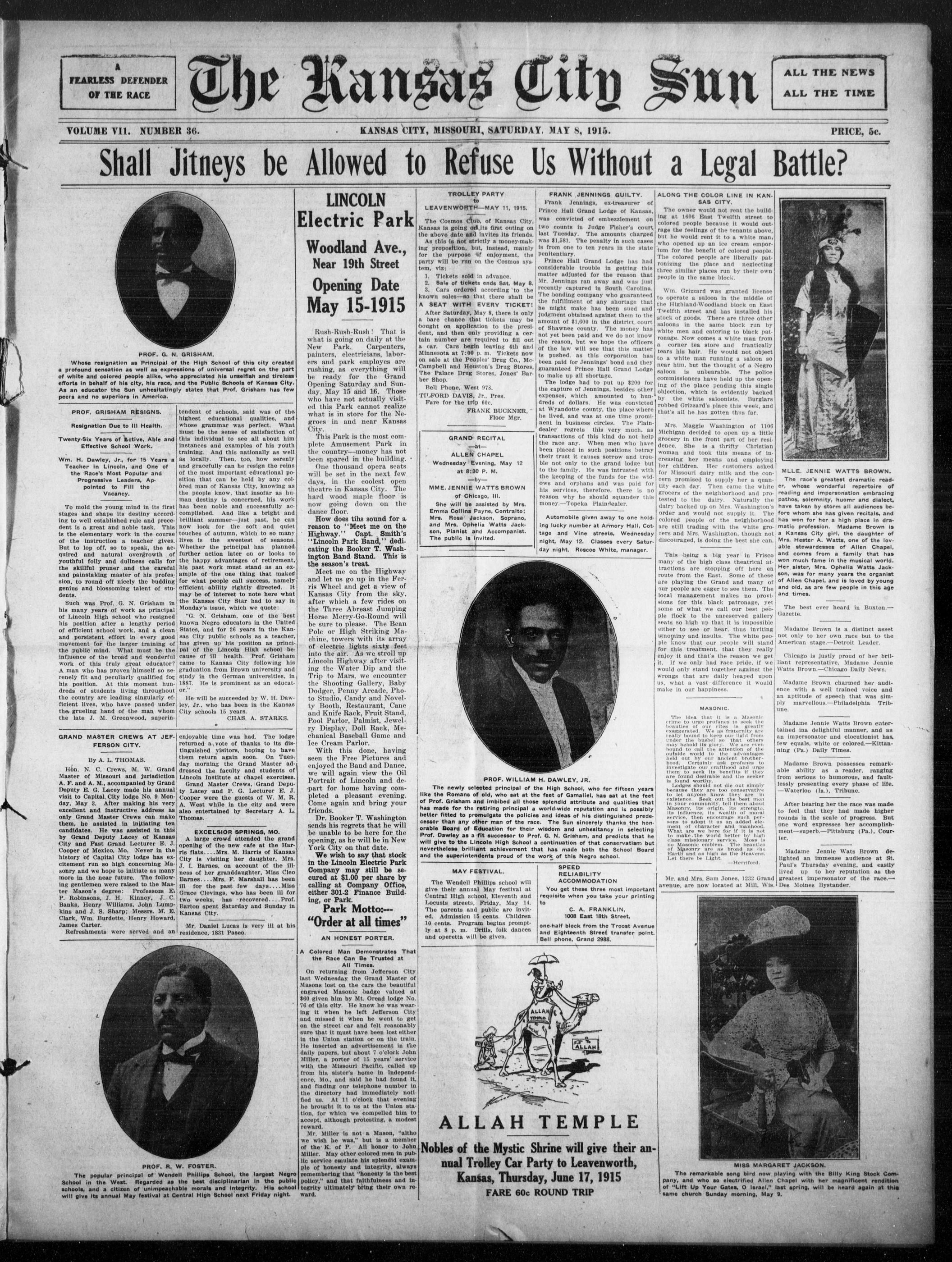
PROF. G. N. GRISHAM.
Whose resignation as Principal of the HI a profound sensation as well as expressions of of white and colored people alike, who apprec efforts in behalf of his city, his race, and the As an educator the Sun unhesitatingly state peers and no superiors in America.
PROF. GRISHAM RESIGNS.
Resignation Due to Ill Health.
tendent highest whose must b
Whose resignation as Principal of the High School of this city created a profound sensation as well as expressions of universal regret on the part of white and colored people alike, who appreciated his unselfish and tireless efforts in behalf of his city, his race, and the Public Schools of Kansas City. As an educator the Sun unhesitatingly states that Prof. Grisham has few peers and no superiors in America.
Twenty-Six Years of Active, Able and Effective School Work.
Wm. H. Dawley, Jr., for 15 Years a Teacher in Lincoln, and One of the Race's Most Popular and Progressive Leaders, Appointed to Fill the Vacancy.
To mold the young mind in its first stages and shape its destiny according to well established rule and precedent is a great and noble task. This is the elementary work in the course of the instruction a teacher gives. But to lop off, so to speak, the acquired and natural overgrowth of youthful folly and dullness calls for the skillful pruner and the careful and painstaking master of his profession, to round off nicely the budding genius and blossoming talent of students.
Such was Prof. G. N. Grisham in his many years of work as principal of Lincoln High school who resigned his position after a lengthy period of efficient school work, and a clean and persistent effort in every good movement for the larger training of the public mind. What must be the influence of the broad and wonderful work of this truly great educator? A man who has proven himself so serenely fit and peculiarly qualified for his position. At this moment hundreds of students living throughout the country are leading singularly efficient lives, who have passed under the grueling hand of the man whom the late J. M. Greenwood, superin-
GRAND MASTER CREWS AT JEF
FERSON CITY.
By A. L. THOMAS.
Hon. N. C. Crews, M. W. Grand Master of Missouri and jurisdiction A. F. and A. M., accompanied by Grand Deputy E. G. Lacey made his annual visit to Capital, City lodge No. 9 Monday, May 3. After making his very excellent and instructive address as only Grand Master Crews can make them, he assisted in initiating ten candidates. He was assisted in this by Grand Deputy Lacey of Kansas City and Past Grand Lecturer E. J. Cooper of Mexico, Mo. Never in the history of Capital City lodge has excitement run so high concerning Masonry and we hope to initiate as many more in the near future. The following gentlemen were raised to the Master Mason's degree: Professors P. Robinsons, J. H. Kinney, J. C. Banks, Henry Williams, John Lumpkins and J. S. Sharp; Messrs. M. E. Clark, Wm. Burdette, Henry Howard, James Carter.
Refreshments were served and an
RESIDENT
M. C. W. B.
PROF. R. W. FOSTER.
The popular principal of Wendell Phillips & School in the West. Regarded as the best di schools, and a citizen of unimpeachable morals will give its annual May festival at Central High
The popular principal of Wendell Phillips School, the largest Negro School in the West. Regarded as the best disciplinarian in the public schools, and a citizen of unimpeachable morals and integrity. His school will give its annual May festival at Central High School next Friday night.
The Kansas City Sun
the High School of this city created sessions of universal regret on the part appreciated his unselfish and tireless and the Public Schools of Kansas City. state that Prof. Grisham has few tendent of schools, said was of the highest educational qualities, and whose grammar was perfect. What must be the sense of satisfaction of this individual to see all about him instances and examples of his youth training. And this nationally as well as locally. Then, too, how serenely and gracefully can he resign the reins of the most important educational position that can be held by any colred man of Kansas City, knowing as the people know, that insofar as human destiny is concerned, his work has been noble and successfully accomplished. And like a bright and brilliant summer—just past, he can now look for the soft and quiet touches of autumn, which to so many lives is the sweetest of seasons. Whether the principal has planned further action later on or looks to the happy advantages of retirement, his past work must stand as an example of the one thing that makes for what people call success, namely efficient ability rightly directed. It may be of interest to note here what the Kansas City Star had to say in Monday's issue, which we quote:
"G. N. Grisham, one of the best known Negro educators in the United States, and for 26 years in the Kansas City public schools as a teacher, has given up his position as principal of the Lincoln High school because of ill health. Prof. Grisham came to Kansas City following his graduation from Brown university and study in the German universities, in 1887. He is prominent as an educator."
He will be succeeded by W. H. Dawley, Jr., who has been in the Kansas City schools 15 years.
enjoyable time was had. The lodge returned a vote of thanks to its distinguished visitors, hoping to have them return again soon. On Tuesday morning the Grand Master addressed the faculty and students of Lincoln Institute at chapel exercises. Grand Master Crews, Grand Deputy Lacey and P. G. Lecturer E. J. Cooper were the guests of W. M. R. A. West while in the city and were also entertained by Secretary A. L. Thomas.
EXCELSIOR SPRINGS, MO.
A large crowd attended the grand opening of the new cafe at the Harris flats...Mrs. M. Harris of Kansas City is visiting her daughter, Mrs. J. I. Barnes, on account of the illness of her granddaughter, Miss Cleo Barnes...Mrs. F. Marshall has been ill for the past few days...Miss Grace Clevings, who has been ill for two weeks, has recovered...Prof. Barton spent Saturday and Sunday in Kansas City.
Mr. Daniel Lucas is very ill at his residence, 1831 Paseo.
[Image of a man in a suit with a bow tie].
Bell Phillips School, the largest Negro
the best disciplinarian in the public
able morals and integrity. His school
central High School next Friday night.
CHAS. A. STARKS.
KANSAS CITY, MISSOURI, SATURDAY, MAY 8, 1915.
LINCOLN
Electric Park
Woodland Ave.,
Near 19th Street
Opening Date
May 15-1915
Rush-Rush-Rush! That is what is going on daily at the New Park. Carpenters, painters, electricians, laborers and park employees are rushing, as everything will be ready for the Grand Opening Saturday and Sunday, May 15 and 16. Those who have not actually visited this Park cannot realize what is in store for the Negroes in and near Kansas City.
This Park is the most complete Amusement Park in the country—money has not been spared in the building. One thousand opera seats will be set in the next few days, in the coolest open theatre in Kansas City. The hard wood maple floor is now going down on the dance floor.
How does this sound for a reason to "Meet me on the Highway." Capt. Smith's "Lincoln Park Band," dedicating the Booker T. Washington Band Stand. This is the season's treat.
Meet me on the Highway and let us go up in the Ferris Wheel and get a view of Kansas City from the sky, after which a few rides on the Three Abreast Jumping Horse Merry-Go-Round will be sure to please. The Bean Pole or High Striking Machine, towers with its array of electric lights sixty feet into the air. As we stroll up Lincoln Highway after visiting the Water Dip and the Trip to Mars, we encounter the Shooting Gallery, Baby Dodger, Penny Arcade, Photo Studio, Candy and Novelty Booth, Restaurant, Cane and Knife Rack, Fruit Stand, Pool Parlor, Palmist, Jewelry Display, Doll Rack, Mechanical Baseball Game and Ice Cream Parlor.
With this done, having seen the Free Pictures and enjoyed the Band and Dance, we will again view the Oil Portrait of Lincoln and depart for home having completed a pleasant evening. Come again and bring your friends.
Dr. Booker T. Washington sends his regrets that he will be unable to be here for the opening, as he will be in New York City on that date. We wish to say that stock in the Lincoln Electric Park Company may still be secured at $1.00 per share by calling at Company Office, either 301-2. Finance Building, or Park.
Park Motto:--- "Order at all times"
AN HONEST PORTER.
A Colored Man Demonstrates That the Race Can Be Trusted at All Times.
On returning from Jefferson City last Wednesday the Grand Master of Masons lost on the cars the beautiful engraved Masonic badge valued at $60 given him by Mt. Oread lodge No. 76 of this city. He knew he was wearing it when he left Jefferson City and missed it when he went to get on the street car and felt reasonably sure that it must have been lost either in the Union station or on the train. He inserted an advertisement in the daily papers, but about 7 o'clock John Miller, a porter of 15 years' service with the Missouri Pacific, called up from his sister's home in Independence, Mo., and said he had found it, and finding our telephone number in the directory had immediately notified us. At 11 o'clock that evening he brought it to us at the Union station, for which we compelled him to accept, although protesting, a modest reward.
Mr. Miller is not a Mason, "altho we wish he was," but is a member of the K. of P. All honor to John Miller. May other colored men in public service emulate his splendid example of honesty and integrity, always remembering that "honesty is the best policy," and that faithfulness and integrity ultimately bring their own reward.
The Cosmos Club, of Kansas City, Kansas is going on its first outing on the above date and invites its friends. As this is not strictly a money-making proposition, but, instead, mainly for the purpose of enjoyment, the party will be run on the Cosmos system, viz.
1. Tickets sold in advance.
2. Sale of tickets ends Sat. May 8.
3. Cars ordered according to the known sales—so that there shall be A SEAT WITH EVERY TICKET!
After Saturday, May 8, there is only a bare chance that tickets may be bought on application to the president, and then only providing a certain number are required to fill out a car. Cars begin leaving 4th and Minnesota at 7:00 p. m. Tickets now on sale at the Peoples' Drug Co., McCampbell and Houston's Drug Stores, The Palace Drug Stores, Jones' Barber Shop.
Bell Phone, West 978.
TULFORD DAVIS, Jr., Pres.
Fare for the trlp 60c.
FRANK BUCKNER,
Floor Mgr.
GRAND RECITAL
—at—
ALLEN CHAPEL
Wednesday Evening, May 12
at 8:30 P. M.
—by—
MME. JENNIE WATTS BROWN
of Chicago, Ill.
She will be assisted by Mrs.
Emma Collins Payne, Contralto;
Mrs. Rosa Jackson, Soprano,
and Mrs. Ophilia Watts Jackson,
Pianist and Accompanist.
The public is invited.
[Name]
PROF. WILLIAM H. DAVENPORT
PROF. WILLIAM H. DAWLEY. JR.
The newly selected principal of the like the Romans of old, who sat at the of Prof. Grisham and imbibed all those has made for the retiring principal a better fitted to promulgate the policicexer than any other man of the raroable Board of Education for their Prof. Dawley as a fit successor to Pr will give to the Lincoln High School nevertheless brilliant achievement t and the superintendents proud of the
The newly selected principal of the High School, who for fifteen years like the Romans of old, who sat at the feet of Gamelai, has sat at the feet of Prof. Grisham and imbibed all those splendid attribute and qualities that has made for the retiring principal a world-wide reputation and is possibly better fitted to promulgate the policies and ideas of his distinguished predecessor than any other man of the race. The Sun sincerely thanks the honorable Board of Education for their wisdom and unhesitancy in selecting Prof. Dawley as a fit successor to Prof. G. N. Grisham, and predicts that he will give to the Lincoln High School a continuation of that conservatism but nevertheless brilliant achievement that has made both the School Board and the superintendents proud of the work of this Negro school.
MAY FESTIVAL.
The Wendell Phillips school will give their annual May festival at Central High school, Eleventh and Locusts streets, Friday, May 14. The parents and public are invited. Admission 15 cents. Children 10 cents. Program begins promptly at 8 p. m. Drills, folk dances and operetta will be given.
ACCOMMODATE
You get these three requisite when you take to
C. A. FRAN
1008 East 18th
one-half block from the and Eighteenth Street Bell phone, Grand 298
ALLAH
Nobles of the Mystic S
nual Trolley Car P
Kansas, Thursd
FARE 60c
FRANK JENNINGS GUILTY.
Frank Jennings, ex-treasurer of Prince Hall Grand Lodge of Kansas, was convicted of embezzlement on two counts in Judge Fisher's court last Tuesday. The amounts charged was $1,581. The penalty in such cases is from one to ten years in the state penitentiary.
Prince Hall Grand Lodge has had considerable trouble in getting this matter adjusted for the reason that Mr. Jennings ran away and was just recently captured in South Carolina. The bonding company who guaranteed the fulfillment of any shortage that he might make has been sued and judgment obtained against them to the amount of $1,600 in the district court of Shawnee county. The money has not yet been paid and we do not know the reason, but we hope the officers of the law will see that this matter is pushed, as this corporation has been paid for Jennings' bond and they guaranteed Prince Hall Grand Lodge to make up all shortage.
The lodge had to put up $200 for the capture of Jennings, besides other expenses, which amounted to hundreds of dollars. He was convicted at Wyandotte county, the place where he lived, and was at one time prominent in business circles. The Plain-dealer regrets this very much, as transactions of this kind do not help the race any. When men who have been placed in such positions betray their trust it causes sorrow and trouble not only to the grand lodge but to the family. He was intrusted with the keeping of the funds for the widows and orphans and was paid for his services, therefore, there is no reason why he should squander this money. -Topeka Plain-dealer.
Automobile given away to one holding lucky number at Armory Hall, Cottage and Vine streets, Wednesday night, May 12. Classes every Saturday night. Roscoe White, manager.
[Image of a man in formal attire with a white shirt and black bow tie].
the High School, who for fifteen years
he feet of Gamailie, has sat at the feet
he splendid attribute and qualities that
world-wide reputation and is possibly
s and ideas of his distinguished prede-
cise. The Sun sincerely thanks the hon-
wisdom and unhesitance in selecting
of. G. N. Grisham, and predicts that he
a continuation of that conservatism but
that has made both the School Board
work of this Negro school.
SPEED
RELIABILITY
ACCOMMODATION
You get these three most important
requisite when you take your printing
one-half block from the Troost Avenue and Eighteenth Street transfer point. Bell phone, Grand 2988.
TEMPLE
Thrine will give their an-
narty to Leavenworth,
May, June 17, 1915
ROUND TRIP
ALONG THE COLOR LINE IN KANSAS CITY.
The owner would not rent the building at 1606 East Twelfth street to colored people because it would outrage the feelings of the tenants above, but he would rent it to a white man, who opened up an ice cream emporium for the benefit of colored people. The colored people are liberally patronizing the place and neglecting three similar places run by their own people in the same block.
Wm. Grissard was granted license to operate a saloon in the middle of the Highland-Woodland block on East Twelfth street and has installed his stock of goods. There are three other saloons in the same block run by white men and catering to black patronage. Now comes a white man from a corner tea store and frantically tears his hair. He would not object to a white man running a saloon so near him, but the thought of a Negro saloon is unbearable. The police commissioners have held up the opening of the place pending this single objection, which is evidently backed by the white saloonists. Burglarrs robbed Grissard's place this week, and that's all he has gotten thus far.
Mrs. Maggie Washington of 1106 Michigan decided to open up a little grocery in the front part of her residence. She is a thrifty Christian woman and took this means of increasing her means and employing her children. Her customers asked for Missouri dairy milk and the concern promised to supply her a quantity each day. Then came the white grocers of the neighborhood and protested to the dairy. Naturally the dairy backed up on Mrs. Washington's order and would not supply it. The colored people of the neighborhood are still trading with the white grocers and Mrs. Washington, though not discouraged, is doing the best she can.
This being a big year in Frisco many of the high class theatrical attractions are stopping off here en route from the East. Some of these are playing the Grand and many of our people are eager to see them. The local management makes no provisions for this black patronage, yet some of what we call our best people flock to the unreserved gallery seats so high up that it is impossible either to see or hear, thus inviting uninjoyment and insults. The white people know that our people will stand for this treatment, that they really enjoy it and that's the reason we get it. If we only had race pride, if we would only stand together against the wrongs that are daily heaped upon us, what a vast difference it would make in our happiness.
The idea that it is a Masonic crime to urge profanes to seek the earth's exalted place. We are fraternity really bound to keep our light from under the bushel so that others may see it its glory. We are even bound to call attention outside world to the advantages held out by our ancient brotherhood, to ask profanes to investigate our cruelness, to them to seek its benefits if they are found desirable and the seeker is found worthy. We do not die out simply because they are too conservative to let anyone know they are in danger in your community, tell them about Masonry, its origin, its strength, its influence, its wealth of moral service, then encourage such perseverance, the development of character and manhood. What are we here for if it is not a class missionary service. Mose 1 no Masonic emblem. The beauties of Masonry are as broad as the Earth and as high as the Heavens.
Mr. and Mrs. Sam Jones, 1232 Grand avenue, are now located at Mill, Wis.
THE NEW YORK TIMES
K.
MISS MARGARET JACKSON.
The remarkable song bird now pany, and who so electrified Allen of "Lift Up Your Gates, O Israel," same church Sunday morning, May
The remarkable song bird now playing with the Billy King Stock Company, and who so electrified Allen Chapel with her magnificent rendition of "Lift Up Your Gates, O Israel," last spring, will be heard again at this same church Sunday morning, May 9.
The remarkable song bird now playing with the Billy King Stock Company, and who so electrified Allen Chapel with her magnificent rendition of "Lift Up Your Gates, O Israel," last spring, will be heard again at this same church Sunday morning, May 9.
MASONIC
ALL THE NEWS ALL THE TIME
Battle?
THE WESTERN WOMAN
MLLE. JENNIE WATTS BROWN.
The race's greatest dramatic reader, whose wonderful repertoire of reading and impersonation embracing pathos, solemnity, huonr and dialect, have taken by storm all audiences before whom she has given recitals, and has won for her a high place in dramatic profession. Madame Brown is a Kansas City girl, the daughter of Mrs. Hester A. Watts, one of the lovable stewardesses of Allen Chapel, and comes from a family that has won much fame in the musical world. Her sister, Mrs. Ophelia Watts Jackson, was for many years the organist of Allen Chapel, and is loved by young and old, as are few people in this age and times.
The best ever heard in Buxton.—Gazette.
Madame Brown is a distinct asset not only to her own race but to the American stage.—Detroit Leader.
Chicago is justly proud of her brilliant representative, Madame Jennie Watts Brown.—Chicago Daily News.
Madame Brown charmed her audience with a well trained voice and an aptitude of speech that was simply marvellous.—Philadelphia Tribune.
Madame Jennie Watts Brown entertained ina delightful manner, and as an impersonator and elocutionist has few equals, white or colored.—Kittanning (Pa.) Daily Times.
Madame Brown possesses remarkable ability as a reader, ranging from serious to humorous, and faultlessly presenting every phase of life.—Waterloo (In.), Tribune.
After hearing her the race was made to feel that they had made higher rounds in the scale of progress. But one word expresses her accomplishment—superb.—Pittsburg (Pa.), Courier.
Madame Jennie Wats Brown delighted an immense audience at St. Paul's Thursday evening, and easily lived up to her reputation as the greatest impersonator of the race.—Des Moines Bystander.
1
playing with the Billy King Stock Con Chapel with her magnificent rendition last spring, will be heard again at th 9.
PRICE. 5c.
CONSTANTINOPLE PICTURE CITY of the WORLD-
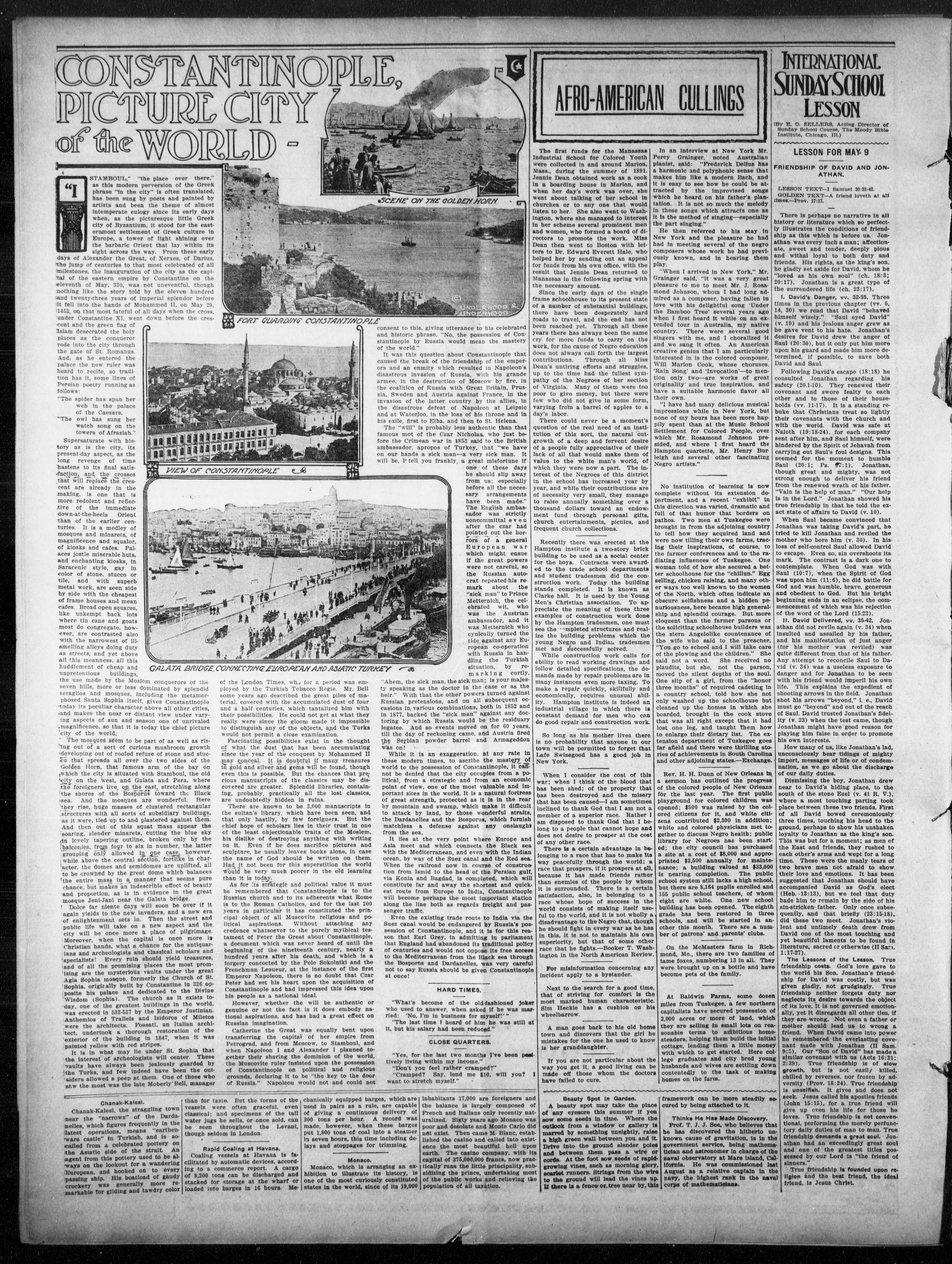
STAMBOUL," "the place over there," as this modern perversion of the Greek phrase "in the city" is often translated, has been sung by poets and painted by artists and been the theme of almost intemperate eulogy since its early days when, as the picturesque little Greek city of Byzantium, it stood for the easternmost settlement of Greek culture in Europe, a tower of light shining over the barbaric Orient that lay within its sight across the way. From these early days of Alexander the Great, of Xerxes, of Darius, the jump of centuries to that most celebrated of all milestones, the inauguration of the city as the capital of the eastern empire by Constantine on the eleventh of May, 330, was not uneventful, though nothing like the story told by the eleven hundred and twenty-three years of imperial splendor before it fell into the hands of Mohammed II, on May 29, 1453, on that most fateful of all days when the cross, under Constantine XI, went down before the cres-
days of Alexander the Great, of Xerxes, of Darius, the jump of centuries to that most celebrated of all milestones, the inauguration of the city as the capital of the eastern empire by Constantine on the eleventh of May, 330, was not uneventful, though nothing like the story told by the eleven hundred and twenty-three years of imperial splendor before it fell into the hands of Mohammed II, on May 29, 1453, on that most fateful of all days when the cross, under Constantine XI, went down before the cress.
HILLOF CONSTANTINOLE
VIEW OF CONSTANTINOPLE
GALATA BRIDGE CONNECTING EUROPEAN AND ASIATIC TURKEY
the use made by the Moslem conquerors of the seven hills, more or less dominated by splendid seraglios and mosques, including the metamorphosed Santa Sophia itself, gives Constantinople today its peculiar character above all other cities, and makes the near or distant view under varying aspects of sun and season one of unrivaled magnificence, so that it is today the chief picture city of the world.
the use made by the Moslem conquerors of the seven hills, more or less dominated by splendid seraglios and mosques, including the metamorphosed Santa Sophia itself, gives Constantinople today its peculiar character above all other cities, and makes the near or distant view under varying aspects of sun and season one of unrivaled magnificence, so that it is today the chief picture city of the world.
The mosques seem to be part of as well as rising out of a sort of curious mushroom growth developing out of roofed refuse of stone and stucco that spreads all over the two sides of the Golden Horn, that famous arm of the bay on which the city is situated with Stamboul, the old city on the west, and Galata and Perca, where the foreigners live, on the east, stretching along the shores of the Bosporus toward the Black Sea. And the mosques are wonderful. Here they rise, huge masses of clustered rectangular structures with all sorts of subsidiary buildings, as it were, tied up to and plastered against them. And then out of this squat mass appear the soaring, slender minarets, cutting the blue sky in lively tapering outline, broken only by the balconies, from four to six in number, the latter grouping only allowed in one case, however, while above the central section, fortell in character, the domes and semidomes are uplifted, all to be crowned by the great dome which balances the entire mass in a manner that seems pure chance, but makes an indescribable effect of beauty and proportion, as is in evidence in the great mosque Jen-Jeni near the Galata bridge.
Dolce far niente days will soon be over if it again yields to the new invaders, and a new era of enlightenment sets in. Then the street and public life will take on a new aspect and the city will be once more a place of pilgrimage. Moreover, when the capital is once more in Christian hands, what a chance for the antiquarians and archeologists and classical scholars and specialists! Every ruin should yield treasures, and of all the promising places the most promising are the mysterious vaults under the great Agla Sophia mosque, formerly the Church of St. Sophia, originally built by Constantine in 226 opposite his palace and dedicated to the Divine Wisdom (Sophia). The church as it exists today, one of the greatest buildings in the world, was erected in 532-537 by the Emperor Justinian. Anthemios of Trailleus and Isidoros of Milletos were the architects. Fossati, an Italian architect, undertook a thorough restoration of the exterior of the building in 1847, when it was painted yellow with red stripes.
It is in what may lie under St. Sophia that the interest of archeologists will center. These vaults have always been jealously guarded by the Turks, and few indeed have been the outsiders allowed a peep at them. One of those who saw the most was the late Moberly Bell, manager
The mosques seem to be part of as well as rising out of a sort of curious mushroom growth developing out of rooftop refuse of stone and stucco that spreads all over the two sides of the Golden Horn, that famous arm of the bay on which the city is situated with Stamboul, the old city on the west, and Galata and Pera, where the foreigners live, on the east, stretching along the shores of the Bosporus toward the Black sea. And the mosques are wonderful. Here they rise, huge masses of clustered rectangular structures with all sorts of subsidiary buildings, as it were, tied up to and plastered against them. And then out of this squat mass appear the soaring, slender minarets, cutting the blue sky on level tapering outline, broken only by the balconies, from four to six in number, the latter grouping only allowed in one case, however while above the central section, fortlike in character, the domes and semidomes are uplifted, all to be crowded by the great dome which balances the entire mass in a manner that seems pure chance, but makes an indescribable effect of beauty and proportion, as is in evidence in the great mosque Jent-lant near the Galata bridge.
Dolce far niente days will soon be over if it again yields to the new invaders, and a new era of enlightenment sets in. Then the street and public life will take on a new aspect and the city will be once more a place of pilgrimage. Moreover, when the capital is once more is Christian hands, what a chance for the antiquarians and archeologists and classical scholars and specialists! Every ruin should yield treasures, and of all the promising places the most promising are the mysterious vaults under the great Agia Sophia mosque, formerly the Church of St. Sophia, originally built by Constantine in 326 opposite his palace and dedicated to the Divine Wisdom (Sophia). The church as it exists today, one of the greatest buildings in the world, was erected in 532-537 by the Emperor Justinian. Anthemios of Trailleis and Isidorus of Miletos were the architects. Fossati, an Italian architect, undertook a thorough restoration of the exterior of the building in 1847, when it was painted yellow with red stripes.
It is in what may lie under St. Sophia that the interest of archeologists will center. These vaults have always been jealously guarded by the Turks, and few indeed have been the outsiders allowed a peep at them. One of those who saw the most was the late Moberly 'Bell, manager
---
I“
cent and the green flag of Islam desacred the holy places as the conqueror rode into the city through the gate of St. Romanus. And, as he entered the palace the new ruler was heard to recite, so tradition has it, some lines of Persian poetry running as follows:
"The spider has spun her web in the palace of the Caesars,
powers of Arraslan.
Supersaturate with history as is the city, its present-day aspect, as the long revenge of time hastens to its final satisfaction, and the crosses that will replace the crescent are already in the making, is one that is more redolent and reflective of the immediate down-at-the-heels. Orient than of the earlier centuries. It is a medley of mosques and minarets, of magnificence and squalor of kiosks and cafes. Palaces jostle miserable huts, and enchanting kiosks, in Saracenic style, gay in color of stone, stucco or tile, and with superb metal work, are seen side by side with the cheapest of frame houses and mean cafes. Broad open squares, like unkempt back lots where tin cans and goats most do congregate, however, are contrasted also with the narrowest of ill smelling alleys doing duty as streets, and yet above all this meanness, all this huddlement of cheap and unpretentious buildings
Chanak-Kalesi.
Chanak-Kalesi, the straggling town near the "narrows" of the Dardamelles, which figures frequently in the latest operations, means "earthnerven ware castle" in Turkish, and is so-called from a celebrated pottery on the Asiatic side of the strait. An agent from this pottery used to be always on the lookout for a wandering European, and hooked on to every passing ship. His boatload of gaudy crockery was generally more remarkable for gliding and tawdry color
SCENE ON THE GOLDEN HORN
UNDERWOOD & UNDERWOOD
FORT GUARDING CONSTANTINOPLE
of the London Times, wh. for a period was employed by the Turkish Tobacco Regie. Mr. Bell some years ago described the great piles of material, covered with the accumulated dust of four and a half centuries, which tantalized him with their possibilities. He could not get at what they really were since the gloom made it impossible to distinguish any of the objects, and the Turks would not permit a close examination.
Fascinating possibilities exist in the thought of what the dust that has been accumulating since the year of the conquest by Mohammed II may conceal. It is doubtful if many treasures in gold and silver and gems will be found, though even this is possible. But the chances that precious manuscripts of the classics may be discovered are greater. Splendid libraries, containing, probably, practically all the lost classics, are undoubtedly hidden in ruins.
There are known to be 2,000 manuscripts in the sultan's library, which have been seen, and that only hastily, by few foreigners. But the chief hope of scholars lies in their trust in one of the least objectionable traits of the Moslem, his dislike of destroying anything with writing on it. Even if he does sacrifice pictures and sculpture, he usually leaves books alone, in case the name of God should be written on them. Had it not been for this superstition the world would be very much poorer in the old learning than it is today.
As for its strategic and political value it must be remembered that Constantinople is to the Russian church and to its adherents what Rome is to the Roman Catholics, and for the last 200 years in particular it has constituted the principal object of all Muscovite religious and political aspirations. Without attaching any credence whatsoever to the purely mythical testament of Peter the Great about Constantinople, a document which was never heard of until the beginning of the nineteenth century, nearly a hundred years after his death, and which is a forgery concocted by the Pole Sokolniki and the Frenchman Lesueur, at the instance of the first Emperor Napoleon, there is no doubt that Czar Peter had set his heart upon the acquisition of Constantinople and had impressed this idea upon his people as a national ideal.
However, whether the will be authentic or genuine or not the fact is it does embody national aspirations, and has had a great effect on Russian imagination.
ton of the
when it was
ophia that
after. These
guarded by
in the out-
those who
will, manager
Catherine the Great was equally bent upon
transferring the capital of her empire from
Petrograd, and from Moscow, to Stamboul, and
when Napoleon I and Alexander I planned to
together their sharing the dominion of the world,
the Muscovite ruler instilled upon the possession
of Constantinople on political and religious
grounds, declaring it to be "the key to the door
of Russia." Napoleon would not and could not
than for taste. But the forms of the
vessels were often graceful, even
classical; and specimens of the tall
water jugs he sells, or once sold, can
be seen throughout the Levant,
though seldom in London.
Rapid Coaling at Havana.
Coaling vessels at Havana is
facilitated by automatic devices, according
to a commerce report. A cargo of
8,200 tons can be discharged and
stacked for storage at the wharf or
loaded into barges in 16 hours. Me-
chanically equipped bars
used in pairs as a rule
of giving a continuous
300 tons per hour. A
made, however, when
put 1,800 tons of coal it
in seven hours, this
time lays and stoppages for
Monaco.
Monaco, which is arr
hibition to illustrate
one of the most curious
states in the world, since
OPLE,
chanically equipped barges, which are used in pairs as a rule, are capable of giving a continuous delivery of 300 tons per hour. A record was made, however, when these barges put 1,800 tons of coal into a steamer in seven hours, this time including delays and stoppages for trimming.
Monaco.
Monaco, which is arranging an exhibition to illustrate its history, is one of the most curiously constituted states in the world, since of its 19,000
SCENE ON THE GOLDEN HORN
consent to this, giving utterance to his celebrated and historic phrase. "No, the possession of Constantinople by Russia would mean the mastery of the world."
It was this question about Constantinople that caused the break of the friendship of the emperors and an emmity which resulted in Napoleon's disastrous invasion of Russia, with his grande armee, in the destruction of Moscow by fire, in the coalition of Russia with Great Britain, Prussia, Sweden and Austria against France, in the invasion of the latter country by the allies, in the disastrous defeat of Napoleon at Leipsc and at Waterloo, in the loss of his throne and in his exile, first to Elba, and then to St. Helena. The "will" is probably less authentic than that famous mot of the Czar Nicholas, who just before the Crimean war in 1853 said to the British ambassador, apropos of Turkey, that "we have on our hands a sick man—a very sick man. It will be. I tell you frankly a great misfortune if
"Ahem, the sick man, the sick man; is your majesty speaking as the doctor in the case or as the heir." With that the other powers turned against Russian pretensions, and on all subsequent occasions in various combinations, both in 1852 and in 1877, backed the "sick man" against any doctoring by which Russia would be the residuary legatee. And so events moved on for 60 years, till the day of reckoning came, and Austria fired the Serbian powder barrel and Armageddon was on!
While it is an exaggeration, at any rate in these modern times, to ascribe the mastery of world to the possession of Constantinople, it cannot be denied that the city occupies from a political, from a strategic and from an economic point of view, one of the most valuable and important sites in the world. It is a natural fortress of great strength, protected as it is in the rear by mountain and swamp, which make it difficult to attack by land, by those wonderful straits, the Dardanelles and the Bosporus, which furnish matchless a defense against any onslaught from the sea.
It lies at the very point where Europe and Asia meet and which connects the Black sea with the Mediterranean, and even with the Indian ocean, by the way of the Suez canal and the Red sea. When the railroad now in course of construction from Ismail to the head of the Persian gulf, via Konia and Bagdad, is completed, which will constitute far and away the shortest and quickest route from Europe to India, Constantinople will become perhaps the most important station along the line both as regards freight and passenger traffic.
Even the existing trade route to India via the Suez canal would be endangered by Russia's possession of Constantinople, and it is for this reason that Earl Grey, in admitting in parliament that England had abandoned its traditional policy of centuries and would not oppose its free access to the Mediterranean from the Black sea through the Bosportes and Dardanelles, was very careful not to say Russia should be given Constantinople at once!
"What's become of the old-fashioned joker who used to answer, when asked if he was married: 'No, I'm in business for myself!'"
"The last time I heard of him he was still at it, but his salary had been reduced."
"Yes, for the last two months I've been post-
tively living within my income."
"Don't you feel rather cramped?"
"Cramped? Say, lend me $10, will you? I
want to stretch myself."
```markdown
```
one of these days he should slip away from us; especially before all the necessary arrangements have been made." The English ambassador was stricly noncommittal even after the czar had pointed out the horrors of a general European war which might ensue if the great powers were not careful, so the Russian autocrat repeated his remark about the "sick man" to Prince Metternich, the celebrated wit, who was the Austrian ambassador, and it was Metternich who cynically turned the tide against any European co-operation with Russia in hand dling the Turkish situation, by re marking curly
HARD TIMES.
CLOSE QUARTERS
inhabitants 17,000 are foreigners and the balance is largely composed of French and Italians only recently naturalized. Sixty years ago Monaco was poor and desolate and Monte Carlo did not exist. Then came M. Blanc, established the casino and called into existence the most beautiful hell upon earth. The casino company, with its capital of 375,000,000 franc, now practically runs the little principality, subsidizing the prince, undertaking most of the public works and relieving the population of all taxation.
AFRO-AMERICAN CULLINGS
The first funds for the Manassas Industrial School for Colored Youth were collected in and around Marion, Mass., during the summer of 1891. Jennie Dean obtained work as a cook in a boarding house in Marion, and when her day's work was over, she went about talking of her school in churches or to any one that would listen to her. She also went to Washington, where she managed to interest in her scheme several prominent men and women, who formed a board of directors to promote the work. Miss Dean then went to Boston with letters to Dr. Edward Everett Hale, who helped her by sending out an appeal for funds from his own office, with the result that Jennie Dean returned to Manassas in the following spring with the necessary amount.
Since the early days of the single frame schoolhouse to its present state of a number of substantial buildings, there have been desperately hard roads to travel, and the end has not been reached yet. Through all these years there has always been the same cry for more funds to carry on the work, for the cause of Negro education does not always call forth the largest contributions. Through all Miss Dean's uniting efforts and struggles, up to the time had the fullest sympathy of the Negroes of her section of Virginia. Many of them were too poor to give money, but there were few who did not give in some form, varying from a barrel of apples to a day's labor.
There could never be a moment's question of the real need of an institution of this sort, the natural outgrowth of a deep and fervent desire of a people fully appreciative of their lack of all that would make them of value to the white man's world, of which they were now a part. The interest of the Negroes of this district in the school has increased year by year, and while their contributions are of necessity very small, they manage to raise annually something over a thousand dollars toward an endowment fund through personal gifts, church entertainments, picnics, and frequent church collections.
Recently there was erected at the Hampton institute a two-story brick building to be used as a social center for the boys. Contracts were awarded to the trade school departments and student tradesmen did the construction work. Today the building stands completed. It is known as Clarke hall. It is used by the Young Men's Christian association. To appreciate the meaning of these three examples of construction work done by the Hampton tradesmen, one must see the completed structures and realize the building problems which the young Negro and Indian tradesmen met and successfully solved.
While construction work calls for ability to read working drawings and follow detailed specifications, the demands made by repair problems are in many instances even more taxing. To make a repair quickly, skillfully and economically, requires unusual ability. Hampton institute is indeed an industrial village in which there is constant demand for men who can do good repair and construction work.
So long as his mother lives there is no probability that anyone in our town will be permitted to forget that Lafe Swisweog has a good job in New York.
When I consider the cost of this war; when I think of the blood that has been shed; of the property that has been destroyed and the misery that has been caused—I am sometimes inclined to thank God that I am not a member of a superior race. Rather I am disposed to thank God that I belong to a people that cannot hope and does not desire to prosper at the cost of any other race.
There is a certain advantage in belonging to a race that has to make its way peacefully through the world; a race that prosperps, if it prosperms at all, because it has made friends rather than enemies of the people by whom it is surrounded. There is a certain satisfaction, also, in belonging to a race whose hope of success in the world consists of making itself useful to the world, and it is not wholly a disadvantage to the Negro that, though he should fight in every war as he has in this, it is not to maintain his own superiority, but that of some other race that he fights.—Booker T. Washington in the North American Review.
For misinformation concerning any incident apply to a bystander.
Next to the search for a good time, that of striving for comfort is the most marked human characteristic. Sim Heckle has a cushion on his wheelbarrow.
A man goes back to his old home town and discovers that the girl he mistakes for the one he used to know is her granddaughter.
If you are not particular about the way you get it, a good living can be made off those whom the doctors have failed to cure.
Beauty Spot in Garden.
A beauty spot may take the place of any eyesore this summer if you sow some seeds in time. Where the outlook from a window or gallery is marred by something unsightly, raise a high green wall between you and it. Drive into the ground slender poles and between them pass a wire or cords. At the foot sow seeds of rapid-growing vines, such as morning glory, scarlet runners. Strings from the wire to the ground will lead the vines up. If there is a fence or tree near by, this
In an interview at New York Mr. Percy Grainger, noted Australian pianist, said: "Frederick Dellus has a harmonic and polyphonic sense that makes him like a modern Bach, and it is easy to see how he could be attracted by the improvised songs which he heard on his father's plantation. It is not so much the melody in these songs which attracts one as it is the method of singing—especially the part singing."
He then referred to his stay in New York and the pleasure he had had in meeting several of the negro composers whose work he had previously known, and in hearing them play.
"When I arrived in New York," Mr. Grainger said, "it was a very great pleasure to me to meet Mr. J. Rosamond Johnson, whom I had long admired as a composer, having fallen in love with his delightful song 'Under the Bamboo Tree' several years ago when I first heard it while on an extended tour in Australia, my native country. There were several good singers with me, and I choralized it and we sang it often. An American creative genius that I am particularly interested in is the colored composer, Will Marion Cook, whose choruses, 'Rain Song' and 'Invocation'—to mention only two—are works of great originality and true inspiration, and have a suitable harmonic flavor all their own.
"I have had many delicious musical impressions while in New York, but none of my hours has been more happily spent than at the Music School Settlement for Colored People, over which Mr. Rosamond Johnson presided, and where I first heard the Hampton quartette, Mr. Henry Burleigh and several other fascinating Negro artists."
No institution of learning is now complete without its extension department, and a recent "exhibit" in this direction was varied, dramatic and full of that humor that borders on pathos. Two men at Tuskegee were brought in from the adjoining country to tell how they acquired land and were now tillering their own farms, tracing their inspirations, of course, to the farmer conferences and to the radiating influences of Tuskegee. One woman told of how she secured a better schoolhouse for the "chillun." Egg selling, chicken raising, and many other ways too well known to the women of the North, which often indicate an obscure selfishness and a hidden pennuriousness, here became high generalship and splendid courage. But more eloquent than the farmer parsons or the solitizing schoolhouse builders was the stern Angelolike countenance of the wife who said to the preacher, "You go to school and I will take care of the plowing and the children." She said not a word. She received no plaudits, but she, not the parson, moved the silent depths of the soul. One slip of a girl, from the "honor three months" of required cadeting in a country school, told how she not only washed up the schoolhouse but cleaned up the homes in which she boarded, brought in the cook stove that was all right except that it had lost one leg, and taught them how to enlarge their dietary list. The extension department of Tuskegee goes far afield and there were thrilling stories of achievements in South Carolina and other adjoining states—Exchange
Rev. H. H. Dunn of New Orleans in a sermon has outlined the progress of the colored people of New Orleans for the last year. The first public playground for colored children was opened; $500 was raised by the colored citizens for it, and white citizens contributed $2,300 in addition; white and colored physicians met together to discuss Negro health; public library for Negroes has been started; the city council has purchased a site at a cost of $8,000 and appropriated $2,500 annually for maintenance; a building valued at $33,000 is nearing completion. The public school system still lacks a high school, but there are $1,844 pupils enrolled and 155 public school teachers, of whom eight are white. One new school building has been opened. The eighth grade has been restored in three schools, and will be started in another this month. There are a number of patrons' and parents' clubs.
On the McMasters farm in Richmond, Me., there are two families of tame foxes, numbering 13 in all. They were brought up on a bottle and have become pets of the family.
At Baldwin Farms, some dozen miles from Tuskegee, a few northern capitalists have secured possession of 2,000 acres or more of land, which they are selling in small lots on reasonable terms to ambitious home-steaders, helping them build the initial cottage, lending them a little money with which to get started. Here college graduates and city bed young husbands and wives are settling down contentedly to the task of making homes on the farm.
framework can be more steadily secured by being attached to it.
Thinkhe Hae Has Made Discovery.
Prof. T. J. J. See, who believes that he has discovered the hitherto unknown cause of gravitation, is in the government service, being mathematician and astronomer in charge of the naval observatory at Mare island, California. He was commissioned last August as a relative captain in the navy, the highest rank in the naval corps of mathematicians.
INTERNATIONAL
SUNDAY SCHOOL
LESSON
(By E. O. SELLERS, Acting Director of
the Moody Bible
Institute, Chicago, IL)
FRIENDSHIP OF DAVID AND JON-
ATHAN.
LESSON TEXT-I Samuel 20:32-42.
GOLDEN TEXT-A friend loveth at all times.—Prov. 17:17.
There is perhaps no narrative in all history or literature which so perfectly illustrates the conditions of friendship as this which is before us. Jonathan was every inch a man; affectionate, sweet and tender, deeply pious and withal loyal to both duty and friends. His rights, as the king's son, he gladly set aside for David, whom he "loved as his own soul" (ch. 18:3; 20:17). Jonathan is a great type of the surrendered life (ch. 23:17).
1. David's Danger, vv. 32-35. Three times in the previous chapter (vv. 5, 14, 30) we read that David "behaved himself wisely." "Sauel eyed David" (v. 19) and his jealous anger grew as he gave vent to his hate. Jonathan's desires for David drew the anger of Saul (20:30), but it only put him more upon his guard and made him more determined, if possible, to save both David and Saul.
Following David's escape (18:18) he consulted Jonathan regarding his safety (20:1-10). They renewed their covenant and swore fealty to each other and to those of their households (vv. 11-17). It is a standing rebuke that Christians treat so lightly their covenants with the church and with the world. David was safe at Naioth (19:18-24), for each company sent after him, and Saul himself, were hindered by the Spirit of Jehavah from carrying out Saul's foul designs. This seemed for the moment to humble Saul (20:1; Ps. 7:1). Jonathan, though great and mighty, was not strong enough to deliver his friend from the renewed wrath of his father. "Vain is the help of man." "Our help is in the Lord." Jonathan showed his true friendship in that he told the exact state of affairs to David (v. 10).
When Saul became convinced that Jonathan was taking David's part, he tried to kill Jonathan and revived the mother who bore him (v. 30). In his loss of self-control Saul allowed David to escape. Even so, sin overshoots its mark. The contrast is a dark one to contemplate. When God was with Saul (10:7), when the Spirit of God was upon him (11:6), he did battle for God and was humble, brave, generous and obedient to God. But his bright beginning ends in an eclipse, the commencement of which was his rejection of the word of the Lord (15.23).
II. David Delivered, vv. 35-42. Jonathan did not revile against (v. 34) when insulted and assailed by his father, and his manifestation of just anger (for his mother was reviled) was quite different from that of his father. Any attempt to reconcile Saul to David (v. 34) was a useless exposure to danger and for Jonathan to be seen with his friend would imperil his own life. This explains the expedient of shooting arrows in the field. Jonathan shot his arrows "beyond," l. e. David must go "beyond" and out of the reach of Saul. David trusted Jonathan's fidelity (v. 23) when the test came, though Jonathan might have good reason for playing him false in order to promote his own interests.
How many of us, like Jonathan's lad, unconsciously bear tidings of mighty import, messages of life or of condemnation, as we go about the discharge of our daily duties.
Dismiss the boy, Jonathan drew near to David's hiding place, to the south of the stone Ezel (v. 41 R. V.), where a most touching part took place between these two friends. First of all David bowed ceremoniously three times, touching his head to the ground, perhaps to show his unshaken loyalty to Jonathan as the king's son. This was but for a moment; as men of the East and friends, they rushed to each other's arms and wept for a long time. These were the manly tears of two brave men not afraid to show their love and emotions. It has been suggested that Jonathan should have accompanied David as God's elect (Heb. -13:13), but we feel that duty bade him to remain by the side of his sin-striken-father. Only once subsequently, and that briefly (23:15-18), did these two meet. Jonathan's violent and untimely death drew from David one of the most touching and yet beautiful lamentes to be found in literature, sacred or otherwise (II Sari 1:17-27).
The Lessons of the Lesson. True friendship costs. God's love gave to the world his Son. Jonathan's friendship for David was costly, but was given gladly, not grudgingly. True friendship neither forgets duty nor neglects its desire towards the object of its love. it is not governed emotionally, yet it disregards all other ties, if they are wrong. Not even a father or mother should lead us to wrong a friend. When David came into power he remembered the everlasting covenant made with Jonathan (II Sam. 9:5). Our "Son of David" has made a similar covenant with us (Acts 16:31; 2:39). True friendship is of slow growth, but is not easily killed, chilled by reverses, nor frozen by adversity (Prov. 18:24). True friendship is unselfish. It gives and does not seek. Jesus called his apostles friends (John 15:15), for a true friend will give up even his life for those he loves. True friendship is not conventional, performing the merely perfunctory daily duties of man to man. True friendship demands a great soul. Jonathan had an exceedingly great soul and one of the greatest titles posessed by our Lord is "the friend of sinners."
True friendship is founded upon religion and the best friend, the ideal friend, is Jesus Christ.
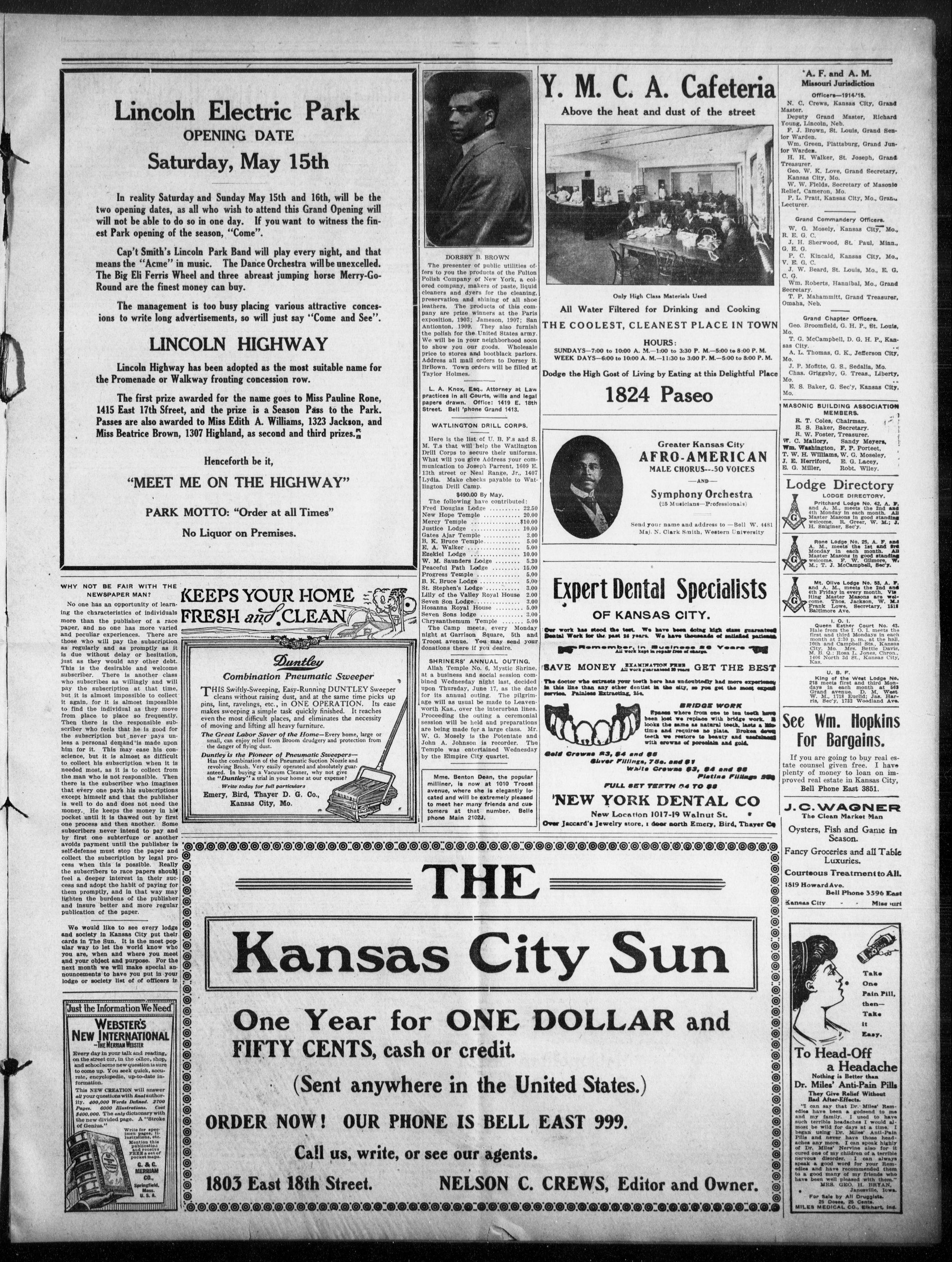
In reality Saturday and Sunday May 15th and 16th, will be the two opening dates, as all who wish to attend this Grand Opening will will not be able to do so in one day. If you want to witness the finest Park opening of the season, "Come".
Cap't Smith's Lincoln Park Band will play every night, and that means the "Acme" in music. The Dance Orchestra will be unexcelled. The Big Eli Ferris Wheel and three abreast jumping horse Merry-Go-Round are the finest money can buy.
The management is too busy placing various attractive concessions to write long advertisements, so will just say "Come and See".
LINCOLN HIGHWAY
Lincoln Highway has been adopted as the most suitable name for the Promenade or Walkway fronting concession row. The first prize awarded for the name goes to Miss Pauline Rone, 1415 East 17th Sfreet, and the prize is a Season Pass to the Park. Passes are also awarded to Miss Edith A. Williams, 1323 Jackson, and Miss Beatrice Brown, 1307 Highland, as second and third prizes.
PARK MOTTO: "Order at all Times"
WHY NOT BE FAIR WITH THE
NEWSPAPER MAN?
No one has an opportunity of learning the characteristics of individuals more than the publisher of a race paper, and no one has more varied and peculiar experiences. There are those who will pay the subscription as regularly and as promptly as it is due without delay or hesitation, just as they would any other debt. This is the desirable and welcome subscriber. There is another class who subscribes as willingly and will pay the subscription at that time, but it is almost impossible to collect it again, for it is almost impossible to find the individual as they move from place to place so frequently. Then there is the responsible subscriber who feels that he is good for the subscription but never pays unless a personal demand is made upon him for it. This may ease his conscience, but it is almost as difficult to collect his subscription when it is needed most, as it is to collect from the man who is not responsible. Then there is the subscriber who imagines that every one pays his subscriptions except himself and that the publisher is well to do and does not need the money. He keeps the money in his pocket until it is thawed out by first one process and then another. Some subscribers never intend to pay and by first one subterfuge or another avoids payment until the publisher in self-defense must stop the paper and collect the subscription by legal process when this is possible. Really the subscribers to race papers should feel a deeper interest in their success and adopt the habit of paying for them promptly, and in that way may lighten the burdens of the publisher and insure better and more regular publication of the paper.
We would like to see every lodge and society in Kansas City put their cards in The Sun. It is the most popular way to let the world know who you are, when and where you meet and your object and purpose. For the next month we will make special announcements to have you put in your lodge or society list of of officers in
Just the Information We Need
WEBSTER'S
NEW INTERNATIONAL
THE MERRIAM WEBSTER
Every day in your talk and reading,
on the street car, in the office, shop,
and school some new questions are sure
to come up. You can quite
rate, encyclopedic, up-to-date in-
formation.
This NEW CREATION will answer
all your questions with final author-
ity. 400,000 Words Defined. 2700
Pages. 6000 Illustrations. Cost
$400,000. The only dictionary with
the new divided page. A "Stroke
of Genius."
Write for ap-
pomen pages, il-
lustrations, etc.
Memorize this
greatly, and receive
EXTRA YEAR of pocket maps.
C. & C.
MERRIAM
CO.,
Springfield,
Mass.
U. S. A.
THIS Swiftly-Sweeping, Easy-Running DUNTLEY Sweeper cleans without raising dust, and at the same time picks up pins, lint, ravelings, etc., in ONE OPERATION. Its ease makes sweeping a simple task quickly finished. It reaches even the most difficult places, and eliminates the necessity of moving and lifting all heavy furniture. The Great Labor Saver of the Home-Every home, large or small, can enjoy relief from Broom drudgery and protection from the danger of flying dust.
Kansas City Sun
(Sent anywhere in the United States.)
Call us, write, or see our agents.
No Liquor on Premises.
KEEPS YOUR HO
FRESH and CLEA
Duntley
Combination Pneumatic
THIS Swiftly-Sweeping, Easy-Running
cleans without raising dust, and at
pins, lint, ravelings, etc., in ONE O
makes sweeping a simple task quickly
even the most difficult places, and elim
of moving and lifting all heavy furniture
The Great Labor Saver of the Home
small, can enjoy relief from Broom drudge
the danger of flying dust.
Duntley is the Pioneer of Pneumatic
Has the combination of the Pneumatic Succ
revolving Brush. Very easily operated and
anted. In buying a Vacuum Cleaner, wha
the "Duntley" a trial in your home at our
KEEPS YOUR HOME FRESH and CLEAN
Emery, Bird, Thayer D. G. Co. Kansas City, Mo.
# 农业景观
NELSON C. CREWS, Editor and Owner.
The presenter of public utilities offers to you the products of the Fulton Polish Company of New York, a colored company, makers of paste, liquid cleaners and dryers for the cleaning, preservation and shining of all shoe leather. The products of this company are prize winners at the Paris exposition, 1903; Jameson, 1907; San Antionton, 1909. They also furnish the polish for the United States army. We will be in your neighborhood soon to show you our goods. Wholesale price to stores and bootland parlors. Address all mail orders to Dorsey B. BrBown. Town orders will be filled at Taylor Holmes.
L. A. Knox, Esq., Attorney at Law practices in all Courts, wills and legal papers drawn. Office: 1419 E. 18th Street. Bell 'phone Grand 1413.
WATLINGTON DRILL CORPS.
Here is the list of U. B. F.s and S. M. T.s that will help the Wattlington Drill Corps to secure their uniforms. What will you give Address your communication to Joseph Parrent, 1609 E. 13th street or Neal Drill, Jr., 1407 Lydia. Make checks payable to Wattlington Drill Camp.
$490.00 By May.
The following have contributed:
Fred Douglas Lodge 22.50
New Hope Temple 20.00
Mercy Temple $10.00
Justice Lodge 10.00
Gates Ajar Temple 3.00
B. K. Bruce Temple 5.00
E. A. Walker 5.00
Ezekiel Lodge 10.00
W. M. Saunders Lodge 5.20
Peaceful Path Lodge 15.00
Progress Temple 5.00
B. K. Bruce Lodge 5.00
St. Stephen's Lodge 3.00
Lilly of the Valley Royal House 2.00
Seven Son Lodge 3.00
Hosanna Royal House 5.00
Seven Sons lodge 3.00
Chrysanthemum Temple 5.00
The Camp meets, every Monday night at Garrison Square, 5th and Troost avenue. You may send your donations there if you desire.
SHRINERS' ANNUAL OUTING.
Allah Temple No. 6, Mystic Shrine,
at a business and social session combined
Wednesday night last, decided
upon Thursday, June 17, as the date
for its annual outing. The pilgrimage
was as usual be made to Leavenworth Kas, over the interurban lines.
Proceeding the outing a ceremonial session will be held and preparations are being made for a large class. Mr. W. G. Mosely is the Potentate and John A. Johnson is recorder. The Temple was entertained Wednesday by the Eimpire City quartet.
Mme. Benton Dean, the popular milliner, is now at 1010 Troost avenue, where she is elegantly located and will be extremely pleased to meet her many friends and customers at that number. Belle phone Main 2102J.
Y. M. C. A. Cafeteria
Only High Class Materials Used
All Water Filtered
THE COOLEST, CL
SUNDAYS—7:00 to 10:00 A.
WEEK DAYS—6:00 to 10:00 A.
Dodge the High Gost of Liv
Filtered for Drinking and
CLEANEST, CLEANEST PLACE
HOURS:
0 to 10:00 A. M.—1:00 to 3:30 P. M.—5
6:00 to 10:00 A. M.—11:30 to 3:00 P. M.
Gost of Living by Eating at this
THE COOLEST, CLEANEST PLACE IN TOWN
SUNDAYS—7:00 to 10:00 A. M.—1:00 to 3:30 P. M.—5:00 to 8:00 P. M.
WEEK DAYS—6:00 to 10:00 A. M.—11:30 to 3:00 P. M.—5:00 to 8:00 P. M.
Dodge the High Gost of Living by Eating at this Delightful Place
1824 Paseo
---
At Dental Special
OF KANSAS CITY.
and the test. We have been doing high
past 28 years. We have thousands o
member in Business 20
All work kept in repairs free of charge.
KEY EXAMINATION FREE GET
All work guaranteed 28 years
tects your tooth here has undoubtedly
may other dentist in the city, so you g
extracting, 26a.
Expert Den
OF KAN
Our work has stood the test
Dental Work for the past 26 year
Remember
All work is
SAVE MONEY EXAM
All work
The doctor who extracts your teeth
in this line than any other dent
service. Painless Extracting, 264
Expert Dental Specialists
Our work has stood the test. We have been doing high class guaranteed Dental Work for the past 28 years. We have thousands of satisfied patients.
Remember in Business 28 Years
All work keeps in repair free of charge.
SAVE MONEY EXAMINATION FREE
All work guaranteed 28 years
The doctor who extracts your tooth here has undoubtedly had more experience in this line than any other dentist in the city, so you get the most expensive service. Painless Extracting, 364.
BRIDGE WORK
Spaces where from one to ten teeth have been lost we replace with bridge work. It looks the same as natural teeth, lasts a little time and requires no plaster. Broken down teeth we restore to beauty and usefulness with crowns of porcelain and gold.
Gold Crowns $3, $4 and $6
Silver Fillings, 75s. and $1
White Crowns $3, $4 and $6
Platine Fillings $20
FULL SET TEETH $4 TO $8
'NEW YORK
New Location
Over Jaccard's Jewelry store
NEW YORK DENTAL
New Location 1017-19 Walnut St
jewelry store, 1 door north Emery.
New Location 1017-19 Walnut St. *
Over Jaccard's Jewelry store, i door north Emery, Bird, Thayer Co
A. M. B.
Fed for Drinking and Cooking
CLEANEST PLACE IN TOWN
HOURS:
0 A. M.-1:00 to 3:30 P. M.-5:00 to 8:00 P. M.
0:00 A. M.-11:30 to 3:00 P. M.-5:00 to 8:00 P. M.
Living by Eating at this Delightful Place
Greater Kansas City
AFRO-AMERICAN
MALE CHORUS---50 VOICES
AND
Symphony Orchestra
(25 Musicians—Professionals)
Send your name and address to—Bell W. 4481
Maj. N. Clark Smith, Western University
Cental Specialists
KANSAS CITY.
We have been doing high class guaranteed
years. We have thousands of satisfied patients
in Business 20 Years
WORK kept in repair free of charge.
EXAMINATION FREE
GET THE BEST
work guaranteed 20 years
Tooth here has undoubtedly had more experience
dentist in the city, so you get the most expen
25q.
BRIDGE WORK
Spaces where from one to ten teeth have been lost we replace with bridge work. It looks the same as natural teeth, lasts a little time and requires no plato. Broken down teeth we restore to beauty and usefulness with crowns of porcelain and gold.
and $6
Sings, 75s. and $1
White Crowns $3, $4 and $8
Platina Fillings $60
SET TEETH $4 TO $8
ARK DENTAL CO
Station 1017-19 Walnut St.
Store, 1 door north Emery, Bird, Thayer Co
'A. F. and A. M.
Missouri Jurisdiction
'A. F. and A. M.
Missouri Jurisdiction
Officers—1914'15.
N. C. Crews, Kansas City, Grand Master.
Deputy Grand Master, Richard Young, Lincoln, Neb.
F. J. Brown, St. Louis, Grand Senior Warden.
Wm. Green, Plattsburg, Grand Junior Warden.
H. H. Walker, St. Joseph, Grand Treasurer.
Geo. W. K. Love, Grand Secretary,
Kansas City, Mo.
W. W. Fields, Secretary of Masonite
Relief, Cameron, Mo.
Grand Commandery Officers.
W. G. Mosely, Kansas City, Mo.
R. E. G. C.
J. H. Sherwood, St. Paul, Minn.
G. E. G.
P. C. Kincald, Kansas City, Mo.
V. E. G. C.
J. W. Beard, St. Louis, Mo., E. G.
C. G.
Wm. Roberts, Hannibal, Mo., Grand
Secretary.
T. P. Mahammitt, Grand Treasurer,
Omaha, Neb.
Geo. Broomfield, G. H. P., St. Louis,
Mo.
T. G. McCampbell, D. G. H. P., Kansas
City.
A. L. Thomas, G. K., Jefferson City,
Mo.
J. P. Mofitte, G. S., Sedalia, Mo.
Chas. Griggsby, G. Treas., Liberty,
Mo.
E. S. Baker, G. Sec'y, Kansas City,
Mo.
MASONIC BUILDING ASSOCIATION
MEMBERS.
R. T. Coles, Chairman.
E. S. Baker, Secretary.
R. W. Foster, Treasurer.
W. C. Mallory, Sandy Meyers,
Wm. Washington, F. P. Porteet,
T. W. H. Williams, W. G. Moseley,
J. E. Herriford, E. G. Lacey,
E. G. Miller, Robt. Wiley.
Lodge Directory
Pritchard Mason No. 42, A. F.
and A. M. meets the 2nd and
3rd Masons in good standing.
Master Masons in good standing
welcome. R. Greer, W. M.; J.
H. Snigner, Sec'y.
Rone Mason No. 25, A. F. and
A. M. meets the 2nd and
Monday in each month. All
Master Masons in good standing
welcome. C. Gilmore, W.
McCampbell, McCampbell
G
MASTER OF THE
SACRED CITY
Mt. Olive Lodge No. 53, A. F.
and A. M., meets the 2nd and
makes it every month, is
waiting宅 for M. W.
come. Thos. Jackson, W. M.
Frank Lowe, Secretary, 1518
Baltimore Ave.
I. O. I.
Queen Ether Court No. 43.
Hale from the I. O. I. meets the
fairly large M. W. at the
month at 2:30 p. m., at the
10th and Campbell Sis. Kansas
City. Mo. Mrs. Bettie Davis,
M. B. Road 2 L. Jones, Chron.
1406 North St. Kansas City,
Kas.
U. B. F.
King of the W-Lodge No.
218 meets first and third
Mondays in each month at 563
W. M. 1718 Euclid, Jas. Har-
ves, See'y, 1723 Woodland
See Wm. Hopkins For Bargains.
If you are going to buy real estate counsel given free. I have plenty of money to loan on improved real estate in Kansas City,
Bell Phone East 3851.
J.C.WAGNER
The Clean Market Man
Oysters, Fish and Game in Season.
Fancy Groceries and all Table Luxuries.
Courteous Treatment to All.
1819 HowardAve.
Bell Phone 3596 East
Kansas City Miss urt
Take
One
Pain Pill,
then—
Take
it
Easy.
To Head-Off
a Headache
Nothing is Better than
Dr. Miles' Anti-Pain Pills
They Give Relief Without
Bad After-Effects.
Take
One
Pain Pill,
then—
Take
it
Easy.
"I can say that Dr. Miles' Remedies have been a godsend to me and my family. I used to have such terrible headaches I would almost be wild for days at a time. I began using Dr. Miles' Anti-Pain Pills and never have those headaches any more. I can speak highly of Dr. Miles' Nervine also for it cured one of my children of a terrible nervous disorder. I also speak a good word for your Remedies and have recommended them to a good many of my friends who have been well pleased with them."
MRS. GEO. H. BRYAN, Jameeville, Iowa
For Sale by All Doggiets.
25 Does, 25 Cents
MILES MEDICAL CO., Elkhart, Ind.
THEKANSASCITYSUN[Y. M. C. A. NOTES
Bell Phone East 999.
Entered as second-class matter, August
12, 1968, at the postoffice at Kansas City,
Mo., under the act of March 3, 1879.
Nelson C. Crews.....Editor and Owner
Willa B. Glenn.....General Manager
ADVERTISING RATE, 50 CENTS PER INCH.
CHURCH DIRECTORY.
Bethel A. M. E. Church, 24th and Flora.
St. Stephen's Baptist Church, 604 Charlotte St.
Annual M. E. Church, 19th and Woodland.
Second Baptist Church, 10th and Charlotte.
Allen Chapel A. M. E. Church, 10th and Charlotte.
Kansas Ave. Baptist Church, 46th and Jackson.
Ebenezer A. M. E. Church, 17th and Tracy.
St. Augustine's P. E. Church, 11th and Front.
Vine St. Baptist Church, 1825 Vine St.
Ward Chapel A. M. E. Church, 11th and Blue Valley Baptist Church, 1120 Crystal avenue.
St. Jebu's A. M. E. Church, 1743 Belleville.
Saventh Day Adventist, 23rd and Woodland.
St. Monica's Catholic, 17th and Lydia.
Morning Star Baptist Church, 2311 Vine.
Highland Avenue Baptist Church, 1111 Highland.
Centropolis A. M. E. Church, Centropolis
People's Mission, 30th and Genesee.
St. Paul's Baptist Church, 19th and
Highland.
Friendship Baptist Church, 17th and
Tracy Avenue.
Pilgrim Baptist Church, 614 Charlotte
St.
Pleasant Green Baptist Church, Independence Avenue and Tracy.
Calvary Baptist Church, 19th and
Anderson.
Bigelow A. M. E. Mission, 5th and
Lydia.
Progressive Baptist Church, 29th and
Bristol.
C. M. E. Church, 1817 Flora Ave.
St. James Baptist Church, 4038 Mill St.
Fountain. M. E. Church, 43rd and
Prospect Place.
A. M. E. Mission, 565 Grand Ave.
KANSAS CITY, KAN. CHURCHES.
Fountain. M. E. Church, 8th and No.
Pleasant Green Baptist Church, 1st and
Splitit.
Eighth St. Baptist Church, 8th and
Oakland.
Metropolitan Baptist Church, 9th and
Washington.
Bethlehem. M. E. Church, Water and
St. Mary Streets.
St. Paul A. M. E. Church, 21st and
Ruby.
First Baptist Church, 5th and Neb.
State. Kelsoon Baptist Church, 3rd and
Quindaro A. M. E. Church, Quindaro,
Pleasant Valley Baptist Church, Rosedale,
Kan.
M. E. Church, 9th and Oakland.
A. M. E. Church, 4th and Oakland.
Salter Mission, A. M. E. Church, South
Kan.
Protestant Episcopal, 3rd and Stewart.
Second Baptist Church, 24th and Ruby.
Wesley Chapel M. E. 106 Shawnee.
St. Paul A. M. E. Zion Church, 4000
Adams.
Bethel A. M. E. Church, Roseleale, Kan.
M. Zion Baptist Church, 4th and Vir-
ginia.
Ebenezer A. M. E. Church, Sanford and
Tremont.
WestportPrimitive Baptist Church,
Westport avenue and Tangent street,
Rosedale.
EDITORIAL.
Chief Sam has made good. After many mishaps and daring adventures he has landed his colony of emigrants in Sierraleon, Africa.
In spite of derogatory reports circulated by the Negro-hating Associated Press, it is stated upon reliable authority that the little republic of Liberia is in a most prosperous condition.
To judge by the conduct of many of our boys and girls one would think most of the children of this city were orphans. They seem to be governed neither by a time limit nor a speed limit.
The local W. C. T. U., by its system of race discrimination, has finally eliminated the colored children from the school temperance essay contests. They were probably afraid of "social equality."
Every year about this time rumors of wholesale changes in the local teachers' corps are set afloat, which rumors carry no alarm except to those teachers who realize their own weakness and incompetency.
After all, is the theater bug much better off for having seen the passing shows from the far corner of the dirty gallery? What particular element of ethical or spiritual culture has been made more acute by this self-sought humiliation?
Notice—We as Negroes should help each other in business by trading with each other. Don't ask for credit; pay cash. You are then on the safe side. It helps the business man to keep his shelf full and it keeps the collector from your door.—E. W. Williams, 2721 East Fifth-fifth.
The concert by the Buckner Jubilee Singer at the Second Baptist church last Friday night was unquestionably the most enjoyable and pretentious affair of its kind ever given in this city, and the Sun has no hesitancy in saying that this celebrated company stands at the head of the profession in its field of endeavor. This company is made up of cultured and refined ladies and gentlemen and under the leadership of that Chesterfield and prince of good fellows, Mr. W. C. Buckner, could be nothing else but the best.
Every friend of education regrets the retirement of Prof. G. N. Grisham from active service in the Kansas City schools. Prof. Grisham, besides being a man of the highest moral and social worth in the community, is a scholar of nation-wide reputation and one of the foremost school men of the country and one of the most persistent students in all of which he has set an example to be followed not only by teachers but by all the boys and girls who have come under his direction. The Sun earnestly hopes that Prof. Grisham will soon regain his health and be able to resume the work in which he is in every way so thoroughly qualified.
The membership enrollment is nearing the 600 mark, although the building has been open less than six months.
Mr. R. M. Wisdom, secretary of the boys' department, has been called to his former home, Clarksville, Tenn., on account of the serious illness of his grandmother.
The men's evangelical services, under the direction of the religious work committee, have been unusually interesting. The following pastors have addressed the meetings: Dr. W. T. Richardson, Rev. D. A. Holmes, Rev. J. M. Booker, Rev. R. Davis, Rev. S. W. Bacote and Rev. W. C. Williams.
Many claims of improvement are being made by the members of the physical classes. One man, a minister says that an alliment that had cost him over $1,200 for medicine, had been completely eradicated and he feels like a new man.
Eight games in the Pepp-Jackson match for the title of champion of Greater Kansas City have been played. These fine players are giving the checker fans a masterly exhibition of checker strategy. Score: Jackson 4; Pepp 3. One draw.
Y. W. C. A. NOTES
The campaign committee of the Yates Y. W. C. A. is elated with the way the citizens rallied to the support of their campaign. Next week the association will sign the lease for the large two-story house at Ninth street and Nebraska avenue. Instead of the regular vesper service the association will hold a public service at the Christian church, Eighth and Everett. Mrs. Tood of Kansas City, Mo., will be the principal speaker. The program begins at 3 p. m. EDNA H. COOK, Secretary.
TROY, KAS.
Miss Elsie Lair was visiting in Hiawatha, K., the guest of Mrs. Effie McLendon and the Hunn family.... Mr. Abe Corneal of Lincoln, Neb. was in the city visiting friends.... Rev. Wm. Enyard of Kansas City, Kas., and ex-pastor of the A. M. E. church of Troy, was visiting friends in Troy Thursday after having attened his brother's funeral in Horton, Kas.... Rev. and Mrs. H. H. Dent of Elwood, Kas., were Troy visitors Friday evening.... Mr. Robert Swinney of Hiawatha was transacting business in Troy.... Mrs. Allie Duncan, teacher of the Wathena colored school, and her daughter, Wilma, Misses Esie Davis, Messrs. Leonard Johnson, Grant Butcher and Leon Henderson.... High school student of Wathena attended the field and athletic program Saturday.... Mr. Leon Johnson won first and second prize in the contests and Mr. Leon Henderson won fourth in one of the contests.... Mrs. Mary Schumache of St. Jo seph was a visitor at home this week
...Messrs. Albert Walker of Elwood,
Kas., and Milton Webster of St. Joseph.
Mo., were transacting business
Health Hints
Dr. Lloyd E. Bailer weekly discussion of Hygiene and Sanitation, First Aid Measures and Preventive Medicine. Questions will be answered but no diagnoses nor prescriptions will be given in this column.
A weekly discussion of Hygiene and Sanitation, First Aid Measures and Preventive Medicine. Questions will be answered but no diagnoses nor prescriptions will be given in this column.
---
Blocking the Street Car Tracks---
Many of the delays in street car service are caused by teamsters driving on the tracks without regard for the rights of passengers in cars behind them. While such action in some cases is due to malicious disregard of the rights of others, in most instances it is caused by thoughtlessness. Wherever the employers of the teamsters have been consulted the company has found immediate response, but notification does not serve to give relief on the immediate occasion.
Employers and teamsters are requested to consider the rights of the street railway passengers, and the desire of the street railway company to furnish rapid transit when using the rights of way. This consideration will prevent possible losses to employees through collisions. It will be appreciated by the patrons and by the company.
A. B.
It is written that the breath of life was breathed into man's nostrils, not his mouth. The nose is the proper avenue of ventilation for the lungs. We have noted the paramount importance of lung ventilation, or in other words, of deep and proper breathing. We have observed that deep breathing is a preventive of tuberculosis, that it is a stimulant to the heart and circulatory system, that it aids digestion, that it keeps the mind clear and drives away the "blues." Hence it follows that it is imperative to keep nature's aerial highway, the nose, cleared and in good condition that the breathing process may go on without impediment or interruption at all times.
Disease of the nose, throat and ear are very nearly akin, and because of this k鼻hip any diseased condition which affects one is likely to affect the other two. The reason for this is that the nose, throat and ear are practically continuous chambers and lined with a common mucous membrane. Hence it is that a common "cold in the head" frequently begins in the nose, passes thence to the throat and finally results in an earache. Of these three organs the nose should receive our most serious attention, for the proper care of the nose is, likewise, the proper care of the throat and ear.
There are few things in childhood that demand more careful attention than the nose. Most of the chronic nasal catarrh of adults is the direct result of minor diseases of the nose during childhood that could then have been cured without difficulty, but which now can be cured, if a cure is possible, only by long and tedious courses o f treatment. nO the other hand, many children never reach their full mental and physical development because or nasal diseases that a competent physician could have cured in fifteen minutes. This takes us to the important subject of "adenoids" and the necessity for their removal. Mouth breathing in children should always be viewed with the most serious concern on the part of parents, as it signifies a diseased condition that should be remedied at once. The usual cause of mouth breathing in
in Troy Sunday...Mr. E. D. Holland and Mr. Bert Wakefield were St. Joseph visitors last Friday...Mrs. Ada Wakefield and daughter, Dorothy, are visiting Mrs. Harriet Coleman of St. Joseph this week...Mr. Clifford Lair was visiting his parents, Mr. and Mrs. George Lair. Sunday... Miss Mable Gaskin spent Sunday and Monday in Elwood, the guest of her sister, Mrs. Maggie McCurry...The Ladies' Aid was entertained last Thursday evening at the home of
children is the presence of a growth in the upper and back part of the nose. This growth is very similar to an enlarged tonsil and, indeed, is often called the third tonsil. The name "adenoids" is given to this growth because it consists of adenoid tissue and because it usually has a number of protuberances which give it the appearance of plurality.
The presence of adenoids in the child's nose is attended with many dangers, as the mouth breathing which results permits not only dust but germs to enter directly into the bronchial tubes and lungs. Germs of tuberculosis, pneumonia, bronchitis, etc., enter very readily through the mouth, whereas they would be filtered out while passing through the hairlike processes within the nose. More than this, mouth breathing in children prevents the development of the nose, and further mars the facial appearance by causing the upper jaw to become narrow, thereby producing an ugly protrusion of the front teeth, and a characteristic stupid expression. Mouth breathing tends to arrest the whole physical development of the child, frequently causing deformities of the spine, rounded shoulders and the narrow pigeon breast. It causes constipation and digestive disturbances, headache, a weak circulation and impoverished blood in the growing child. It also causes sluggishness, loss of memory and incapacity for mental concentration. Many a child is "dull" in school simply because he has adenoids. Many a child has been denied the right and proper enjoyment of his physical and mental heritage because of these small growths that blocked his air passages and thwarted his subsequent development.
Parents should stand ready at all times to prevent mouth breathing in their children. Adenoids is the usual cause. This growth may easily be removed by a competent physician without the slightest danger to the child. The operation clears the nasal passages and restores the natural breathing through the nose. It is always to be advised for persistent mouth breathing in children. Nasal diseases properly treated in childhood seldom persist in adult life.
Miss Elsie Lair. This week the Aid met with Mrs. Nelle E. Howard.... A program is being rendered at the A. M. E. church Sunday for Mothers' day. Everyone is expected to observe it. White flowers for deceased mothers and red for those living.
Money to loan on approved security. We sell homes on easy terms. See me or my clerk at my office, 5211/2 Virginia. Phone 1259. J. N. Brownlee, Joplin, Mo.
LITTLE CORNER
—That would-be June brides had better begin to hustle.
—That justice is blindfolded. The Negro thinks she sometimes peeps.
—That many of the dudes regret the passing of the tight skirt. Why?
—That a certain popular young miss is compelled to have her silk hose made to order. O me! O my!
—That a certain lady who contemplates leaving home, has already selected a second husband. Safety first.
—That the A. W. Harris Commercial printers are turning out some of the finest and most artistic work ever seen in this city. Hurrah!
—That Kansas City must have struck a great moral wave. The buffet flats are complaining that business is bad.
—That the Willis Wood management was very much disappointed that the colored people did not protest and thereby create them patronage when they exhibited the screen play, "The Nigger."
—That the following poem was occasioned by an actual happening among certain well known young people in this city:
—That there are strained relations between the basket ball teams of ladies of the Kansas Cities because one of the partisans of the defeated team called up one of the opposing players and sneeringly said: "I didn't know we had to play suds busters." And now society is rent asunder by this indiscreet utterance, and it is even said that some "never speak as they pass by." Oh you basket ball.
PASTURE—For horses and cows. Bud Gilliam, R. R. 4, Box 106, Kansas City, Mo.
---
LOOK O LOOK
LOOK O LOOK
The K. C. Patriarche, No. 66, G. U. O. of Odd Fellows, will their Annual Field Day Exercise Lincoln Electric Park, Thursday 20th.
All Drill Corps have been invited to take p we promise to make it one of the Gran Military Displays ever witnessed.
Patriarche, No. 66, Corps of Odd Fellows, will hold equal Field Day Exercises at Electric Park, Thursday, May have been invited to take part and make it one of the Grandest Displays ever witnessed.
The K. C. Patriarche, No. 66, Corps G. U. O. of Odd Fellows, will hold their Annual Field Day Exercises at Lincoln Electric Park, Thursday, May 20th.
All Drill Corps have been invited to take part and we promise to make it one of the Grandest Military Displays ever witnessed.
The Park is Filled with all of the Latest Attractions.
ADMISSION 10 cents.
By Committee, E. G. DUGGER, Ch
Capt. T. WHITE, S
E. G. DUGGER, Chairman.
Capt. T. WHITE, Sec'y.
Bell Phone West 3557
The St. Regis Cafe
and Ice Cream Parlor
G. W. BERRY, Prop.
544 State Avenue
By Committee, E. G. DUGGER, Chairman. Capt. T. WHITE, Sec'y.
Kansas City, - - - Kansas
THE NEW STYLES ARE IN THIS BOOK
FREE TO COLORED WOMEN
This beautiful book shows styles of the very best quality creole hair, that is guaranteed to stand combing and washing the same as your own. We are the largest manufacturers and importers of this hair and can sell you the best creole hair obtainable at pricest lower than you pay elsewhere for cheap and inferior hair.
We fully guarantee every article sold, and if you are not fully satisfied your money will be refunded.
This straightening comb is made of solid brass with an extra heavy back and is the best and most serviceable made. Sent postpaid for 89c.
We also sell hair by the pound, hair nets, brushes, combs, and other toilet articles at extraordinary low prices.
Send two cent stamp for booklet, mentioning name of this paper.
AGENTS WAIT
HUMANIA-HAIR CO. Department 100
23 Duane Street, N
The Allen "40"
BUILT ON THE SQUARE WITH POWER TO SPARK
guarantee every article sold, and if you are satisfied your money will be refunded.
made of solid brass and is the best and at postpaid for 89c.
all hair by the pound, hair nets, brushes, combs, toilet articles at extraordinary low prices.
mentioning AGENTS WANTED
AIR CO. Department 100
23 Duane Street, NEW YORK
Allen "40"
BUILT ON THE SQUARE WITH POWER TO SPARK
The Allen "40"
BUILT ON THE SQUARE
WITH POWER TO SPARE
AUTO TRIPS
Commencing Sunday, May 2, 1915, and each day thereafter, the Brown Clipper will go around the Cliff Drive, six in party, at 25 cents each. Starting points: People's Drug Store, 18th and Paseo; Ideal Drug Store, 18th and Woodland; Smith's Drug Store, 18th and Tracy; McCampbell & Houston, 23rd and Vine Sts.; 12th and Highland. Call Bell phone, East 2013-W, Home, East 4159, W. H. Hubbell.
Commencing Sunday, May 2, 1915, and each day they Brown Clipper will go around the Cliff Drive, six in party, each. Starting points: People's Drug Store, 18th and P Drug Store, 18th and Woodland; Smith's Drug Store, 18th McCampbell & Houston, 23d and Vine Sts.; 12th and High Bell phone, East 2013-W. Home, East 4159. W. H. Hubbells
Randolph Bros. @ New and Artistic Carpenter
ay, May 2, 1915, and each day thereafter, the around the Cliff Drive, six in party, at 25 cents People's Drug Store, 18th and Paseo; Ideal Woodland; Smith's Drug Store, 18th and Tracy; 23d and Vine Sts.; 12th and Highland. Call 7. Home, East 4159. W. H. Hubbell.
and Builders
Paper Hanging and Painting,
Patching and Plastering
General Repairing a Specialty
PROMPT WORK
REASONABLE PRICES
BELL PHONE East 2526
SHOP 1207 Highland. Res. 1031 Highland
KANSAS CITY, MO.
Superb Wall Papers
Samples Shown at Your Home
No obligation to purchase.
A postal brings us.
to You
who has been for lo these many years striv-
elf and also build up the business prestige
A. WILSON
y's Pioneer Negro Jeweler
s, Clocks, Diamonds
other Staple Reliable Jewelry
It's Up to You to patronize a man who has been for lo these many yea ing to help himself and also build up the business of his race.
J. A. WILSON
Kansas City's Pioneer Negro Jewel Sells Watches, Clocks, Diamonds and other Staple Reliable Jewel
M. B.
```markdown
```
Have you visited the Colored Handy store at 2409 Vine street? Go there for bargains.
Have you read Hubbell's interesting ad, concerning the "Brown Clipper?" If not, read it.
For notions of all kinds visit the Colored Handy store at 2409 Vine street. They have just what you want at the price you want to pay.
Mrs. Frank Harris and Mrs. J. E Perry are visiting in Parsons, Kas. and are the house guests of Mrs. Morton, the aunt of Mr. Frank Harris.
Mrs. Lillian Savington Lewis of Prince Rupert, British Columbia, arrived Thursday evening to visit her sister, Mrs. Harry J. Brown, 1639 Cottage avenue.
When you want work done up-to-date, call up the COLORED ACME HOUSE CLEANING CO. Prices reasonable. Bell phone Main 7511; Home Main 7555. Residence phone Home Main 6438. M. C. SPICER, Manager.
0
Wanted—Leading soprano, contral to and bass singers; also good pianist. Chrirmaints preferred. Apply to B. J. Knox, business manager, Imperial Concert Company, 1513 Woodland avenue;
WANTED—Canvassers, men or women, to sell the famous Peerless furniture polish. Liberal commission. A splendid opportunity for the right parties. For information see J. H. Malone, 1318 Michigan.
Mr. Chas. A. Starks and Miss Beu lah M. Thomas, both of this city were quietly married at Independence, Mo., and are now enjoying a brief honeymoon out of the city. They will be temporarily at home to friends at Mrs. America Compton's residence 1510 East Eighteenth street, Monday evening. May 10, at 8 p. m.
Mr. and Mrs. J. O. Kingsberry wish to thank Allen chapel, the Household of Ruth No. 160, C. G. R. Tt girls, the Jolly Bachelor Maids and especially the Sunday school of Allen chapel and the many friends and relatives for the beautiful flowers, fruits, kind attention and faithful prayers during the illness of their daughter, Miss Cozetta Kingsberry. We are glad to say that she is able to walk about a little and is much improved.
CARD OF THANKS
We wish to thank our many friends of the two Kansas Cities for the many beautiful offerings and the kindness and sympathy shown us during the ill and death of our beloved husband, George W. Motley.
MRS. JENNIE L. MOTLEY.
BIG CUT PRICE SALE OF NEW AND USED CARDS ON TERMS.
USED CARS ON TERMS.
Over 200 cars to select from; two
5 and 7-passenger automobiles. Prices
from $125 to $3,000.
F. W. STONE,
1515 East 18th st.
Phones Home East 4042; Bell East
4893. All cars guaranteed as represented.
Second Regiment U. R. Knights of Pythians under the auspices of Sojourner Truth Court No. 35 to purchase Flag regimental colors Monday evening, May 10, 1915 at LYRIC HALL, 1731 Lydia Ave. Everybody invited to attend and trip the light fantastic, too. Music furnished by Second Regiment Band.
25c — — ADMISSION — — — 25c All persons selling tickets please turn them in that night.
CARD OF THANKS.
I desire to thank my dear sisters of New Hope Temple No. 138, S. M. M., the pastors and members of the Second Baptist church for kindness during my recent and serious illness white in Wheatley-Provident hospital. I wish especially to thank Mr. and Mrs. F. J. Weaver, Mr. and Mrs. Frank White for the beautiful flowers sent to cheer my sick chamber.
EMMA MERRILL,
2239 Highland.
NEW COLORED GROCERY.
Maggie Washington has opened a nice little grocery store in the parlor of her home. She carries almost a full line of staple groceries and salt meats. In a fe wdays she will have her telephone installed. She asks all who would like to be loyal to their race to patronize her. Any little order will be highly appreciated. This store will be known as Maggie Washington's Parlor Grocery Store, located near the corner of 11th and Michigan avenue. 1106 Michigan Ave.
IN MEMORIAM
In loving memory of Thomas Ellsworth Lucas, who passed away one year ago May 7, 1914. Gone but not forgotten. Lovingly, Wife, father, mother, sisters and brother.
LOOK BEAUTIFUL. Have a clear, healthful skin free from liver splotches and freckles. The skin must be regarded in two lights: Beauty and health; one part of which I have not spoken is papillae, tiny prolongations, a horny under layer. The circulation of skin of the face needs stimulation so facial massage is needed. Try our beauty massagist, Miss Cora B. Holmes, an experienced masseuse;
CITY NEWS.
Hair and Scalp treatments a speciality. All work guaranteed. 1711 Michigan Ave. Monday-out of town patients. Hours: 8:30 a. m. to 7:00 p. m. Miss Cora B. Holmes.
BARGAINS WORTH WHILE.
The nature of my business causes me to come in contact with a good many wealthy people who have put in my possession the following articles to dispose of. Investigate and you will find them to be real bargains that you don't get often:
1 mahogany library table, $25 when new ..... $11.50
Gas Lamp, $6 when new ..... $2.00
Tailored suit, $15 when new ..... $6.00
Embroidered voile dress made with a long tunic trimmed in $2 a yard size, 36 bust, 26 waist; $35 when new ..... $5.50
And many other things, all of which I will show you and explain everything. Bell phone Grand 885. Home Main 2026. Ask for Preston Powers.
* * Drop in at C. A. Franklin's Print *
* shop and see how his work is *
* counted. Then you will know *
* one reason why he can do your *
* printing satisfactory. 1008 East *
* 18th street, near Troost. Bell *
* phone, Grand 2988.
.....
To the Public: Mr. R. F. Green, a progressive, industrious and ideal young man of our city has purchased a half interest in the People's undertaking establishment at 1211 East Eighteenth street. He is prepared to give the very best service as could be found elsewhere. Mr. Green is a member of the C. M. E. church. Congratulations with the best wishes were extended to him from his church. He is a Mason and U. B. F. and holds a diploma from the St. Louis School of Embalming and funeral directing; also a Missouri state license. He is proficient and will give and guarantee everything promised. Autos and carriages furnished for all occasions. Watch the Kansas City Sun for the new location where one of the finest and most complete parlor in the city.
A. FRANK
The popular head waiter of the H to visit his old town and multitude of who makes Salt Lake City a veritable friends, Masonic and otherwise, who Far West.
Real Mean.
A. FRANK NRAK
A. FRANK NEAL.
The popular head waiter of the Hotel Utah, Salt Lake City, who hopes to visit his old town and multitude of friends sometime this summer, and who makes Salt Lake City a veritable oasis in the desert for all his many friends, Masonic and otherwise, who pass through his city enroute to the Far West.
I came to town at half-past six,
"Twas this so early brought me—
I wished those tarnal tags to miss,
But a sharp tag girl caught me.
Other Side of the Proposition.
"A man ought to kiss his wife every day."
"Yes," replied Mr. Meekton; "but suppose she's busy writing speeches and doesn't want to be disturbed?"
Mean Hint.
"My theory is that men are what they eat, so we should be careful to select appropriate diet."
"I'm so glad to hear that, Mr. Softy. We have calf's brains for dinner."
"Yes, I think they cut out about everything they could get hold of except the bill."
Inartistic.
"The color of that couple's lives does not form an artistic contrast."
"Why not?"
"She has a rosy future and he has a purple past."
A Query.
"Pop, tell me something."
"What is it, my boy?"
"Do the cowboys use the sand of the western deserts when they scour the plains?"
Time Files.
Wife—John, what has become of the alarm clock? It's gone.
Husband—I put it on the mantel last night and I heard it go off this morning.
its Kind.
"If my dog could get a job, I wonder what kind he would select?"
"He is like yourself; he would want something of a snap."
Real Mean.
The Ladies' Coterie will give their first exhibit Monday evening, May 17, at Lyric Hall. Dancing from 8:00 to 12:00.
Home day has been changed from the first Sunday in June to the last Sunday in May, by request of the ministers.
The Progress Study club will meet Wednesday, May 12, with Mrs. Burt Hill, 1020 Euclid avenue. Lesson subject, "Crime Among Negroes."
There will be no meeting of the Social Pathfinders next Wednesday evening. The following week the club will have a house party at the home of Mrs. Wilson, 1017 Virginia.
The Clippers voted to give a year's subscription of the Crisis to the Yates branch of the Y. W. C. A. There will be a meeting of the Clippers at 4 o'clock Sunday afternoon with Miss Victoria Newsom.
The Phyllis Wheatley Art club meet with Mrs. Birch with a large attendance. After the routine of business a dainty luncheon was served and the club adjourned to meet with Mrs. A. E. Estes, 2460 Waldron Ave., May 13
The Federation of Colored Charities will meet May 8 at 1 p. m. at the office of board of public welfare, fourth floor Water Works building, Sixth and Walnut streets. Business of importance—O. J. Hill, president; L. V. DeFrantz, secretary.
The Lyceum Art club held its final meeting Thursday, May 6, with the president, Mrs. Richard Allen, 2324 Highland avenue. After work was over and the business transacted the club was served a dainty two-course luncheon. One visitor, Miss Lena Price of Keytesville, Mo., was present. The club will meet with Miss Edith Evans the opening of next season.
HOTEL Utah, Salt Lake City, who hopes of friends sometime this summer, and the oasis in the desert for all his many pass through his city enroute to the
The XX History and Art Club met May 6 with Mrs. J. C. Reeves. A large number of members were present. A report of the exhibit was made and we desire to thank our patrons for their hearty support. We realized $27.80 above all expenses. We also want to express our thanks to those who helped make it such a grand success. Next meeting with Mrs. H. Saunders. 1022 Virginia avenue.
Prof. A. A. Hughes of Olathe, Kas,
gave a fine lecture here at the Baptist
church last Saturday evening.....
The ladies have organized a cemetery
association for the purpose of bequatifying the grounds of those who sleep the silent sleep....Rev. Boatman, the new pastor of the Second Baptist church, is domiciled....Mr. and Mrs. Henderson and Mrs. London of Kansas City attended the carnival....Mr. Earl Crouch has headquarters for all picnics and basket dinners wanting friers....Rev. T. A. D. Wright is rehearsing for school, closing May 19....Mrs. C. R. McDowell, Grand Matron of H. of J., made her visit here....Mrs. Angeline Gustin is improving....The A. M. E. church held its third quarterly meeting Sunday, May 2.
Rev. Elias Winston preached at the Second Baptist church Sunday morning and at night Rev. Migkins officiated....The services at the Pilgrim Baptist church were well attended....Sunday services at Grant chapel were of a very high order....Mesdames Nannie Smith and Polly White are on the sick list....Mr. Jefferson Fort is reported ill and also Mrs. Bess Mitchell.
MRS. R. SMITH, Secretary.
BUTLER, MO.
MOBERLY, MO.
Among the Churches
Among the Churches
EBENEZER CHURCH.
Sunday, May 9, is Woman's day. A special program has been arranged by the committee. The ladies are to have full charge of the church that day. The men will not be permitted to take part in anything except to give in the collection. Rev. Mrs. Wilson the noted evangelist, will preach at 11 a. m. and 8 b. p. It will be a great day. Sixteenth and Lydia. REV. W. C. WILLIAMS, Pastor.
VINE STREET BAPTIST CHURCH.
ALLEN CHAPEL NOTES
The services at Allen chapel were of the usual high order, and a large and representative audience was in attendance. An interesting and instructive sermon was delivered by the minister and there were three additions to the church. Delightful musical numbers were rendered by members of the Buckner Jubilee singers and a standing indorsement of Prof W. H. Dawley, Jr., was given by the congregation at the request of the minister to fill the vacancy occasioned by the regrettable resignation of Prof. G. N. Grisham, principal of the high school. On next Sunday morning the congregation will be favored with vocal selections by that queen of song, the most remarkable and brilliant soprano that has ever appeared before an Allen chapel congregation, Miss Margaret Jackson, who is filling an engagement with the W. H. King, players in this city.
SECOND BAPTIST CHURCH.
The Imperial Jubilee Concert Company will appear May 20 under the auspices of the B. Y. P. U....The Buckner's Jubilee Cooncert Company rendered an excellent program to an unusually large audience last Friday night. Too much can not be said for the relief workers of this church who help the sick and those needing assistance....The Bacote Literary Society which meets the first and Thursday night, is progressing rapidly. Come out and hear a good program....The Leisure Hour club, which meets every Tuesday night, is holding interesting sessions. All are invited to attend....The services last Sunday were as usual up to the standard. Mr. James Anderson sang an excellent bartone solo. Dr. Bacote's sermon on "God Is Our Sword and Shield," was interesting and logical. The evening service was devoted to covenant meeting and the Lord's Super was partaken of by a large number.
The members of the Old Folks and Orphans' Association desire to thank the friends who so kindly donated to their institution during the month of April: Messrs. A. J. Nash $2; Chas. Jones $1; Raymond Knox $2; Amos Johnson lodge $2; Chas. Champman, three sacks of corn meal, 66 pounds; Rev. Long, three dozen doughnuts; Graeco Art club, large supply of groceries; Chas. Jackson, one bushel of potatoes; Mrs. Wade Smith, supplied home with new spoons; Mrs. Stella Davis, clothing; Miss Sadie Thornton Easter breakfast; ladies of Second Baptist church, Easter dinner; Pilgrim Baptist church, several dozen colored eggs; flowers, Commanderies; Kansas City Sun, printing.
The Twln City Baptist Ministerial Alliance of the two Kansas Cities will conduct a week's service at the Highland Avenue Baptist church, 1113 Highland avenue, commencing Monday night, May 10, 1915.
Order of Services.
11:00 a. m.—Preaching by Rev. J W. R. Fagan.
1:00 p. m.-Sunday school.
3:00 p. m.-Platform meeting by ministers and others; devotion conducted by deacons of various churches.
3:15 p. m.-Address by Prof. G. A. Page. Solo, Miss Magnolia Lewis.
3:45 p. m.-Address by Madame Beck; address by Atty W. C. Hueston; short addresses by all ministers; short sermon by Dr. S. W. Bacote; music by Morning Star Baptist choir. Dr. J. M. Booker, master of ceremonies.
8:00 p. m.-Preambling by Rev. Haden.
Rev. J. W. Clay, vice president, and Rev. O. T. Reed, secretary of the Twin City Baptist Ministers' Alliance.
The ministers of Greater Kansas City appeal to their many friends and all who are in sympathy with the cause of Christ to attend these services as this is a special effort to assist a struggling church to raise $250. Let the Baptists rally as they never did before.
Deacons—F. H. Lee, M. Boswell, G.
Starks, I. S. Kanion.
Committee—Rev. J. W. Horse, Chairman;
Rev. Geo. McNeal, Rev. G. W.
Boyd, secretary.
NOTICE.
Again "Songs of the Seasons" is postponed another week.
Mr. Jas. Wilson, 1322 North Eighth street, is ill.
Mrs. J. C. Tucker, 1310 North Eighth street, is indisposed this week.
A pleasant surprise was tendered Mrs. J. M. Marquess at her home Tuesday night.
Mrs. Ella Cline of St. Louis, Mo., is the guest of her niece, Mrs. I. F. Bradley, 400 Haskell.
Miss E. Z. Pendleton gave a whist and dance for Miss Pinyon of New York City Friday night, April 30.
Mrs. Birdie Haynes of Quindaro, Kas., was the guest of Mrs. G. N. Fulbright, 2109 North Third street, last week.
Mr. Clarence Jenkins was suddenly called to Hot Springs, Ark., last Friday on account of the serious illness of his father.
The funeral of Mr. George W. Motley, 730 Nebraska avenue, was held at the A. M. E. church May 2 under the auspices of the Masons.
The funeral of Mr. Harry Cogron, who died in Kansas City, was shipped to the old home May 5. Interment in Pleasant Hill, Mo.
Mr. A. S. Martin, 360 Rowland avenue, spent a few days with relatives and friends and went to his birthplace at Batesville, Miss., and former home, Little Rock, Ark.
Mrs. James Edmond, 443 Freeman avenue, left the 4th for Chicago to recuperate after undergoing a serious operation. She will be the house guest of her sister, Mrs. Joe Carter and Mr. Carter, and also her brother and wife, Mr. and Mrs. Wm. Taylor.
Mr. Thomas Hayes, 247 Poplar avenue, nea r Fourth street, Memphis, Tenn., undertaker and embalmer, who has been in business there for thirty years, writes that the body and casket of Mrs. Florence Martin was in the finest condition of any body that has ever been shipped to him.
The City Federation of Art clubs met at the Y. W. C. A. April 22 and held the election of officers, as follows: Mrs. Mayme Jenkins, president; Mrs. Maud Brooks, first vice president; Mrs. Davies, second vice president; Mrs. Ursa Perkins, secretary; Mrs. Crump, treasurer.
The funeral of Mrs. Florence Martin. 360 Rowland avenue, was held at the home, the Rev. G. E. Horsey officiating. He paid a high tribute to her memory. The services were held under the auspices of Primrose Tabernacle, Kansas City, Mo., and Pearly Gate Temple, S. M. T., Kansas City, Kas. The resolutions from the church by Rev. G. E. Horsey, from class No. 12, by Mrs. M. E. Glover and the lodges and resolutions were all very fine. Floral offerings were beautiful. The body was shipped to Memphis, Tenn., accompanied by the husband, where they were met by her sisters and hosts of friends. The funeral was at the A. M. E. church. Rev. C. C. Thomas officiated. Interment was in Zion cemetery.
CONTINENTAL MARBLE AND
GRANITE COMPANY
At Canton, Ga., the home of quality. Marble and granite markers, memorials and monuments. Have opened a branch office here and Mr. Simon Wyatt, manager of the Wyatt & Randolph Undertaking Company, is representative for Kansas. All the latest colors and styles. Reasonable prices. Phones: Res. West 2529; office West 3008. 920 North Third st., Kansas City, Kas.
SOME TESTIMONIALS FOR PAGE'S
SHOES
We buy every shoe we wear from Page's Shoe Store. We like the goods just fine.—Mrs. Olivia Wilson and Daughters.
All shoes that are good look alike to me. I wear shoes furnished by G. A. Page and I will continue doing so—Jon H. Jordan. My wife says we better look than any shoe she ever wore. Look for my any shoes I buy in the way of shoes I buy in the way of shoes from Page, and the goods are getting better—H. O. Cook. The shoes are my and my family with shoes—Fireman Simpson. Some of the very best shoes my boys have ever worn come from Page's shore store—Edward Thompson, Lincoln High
Page furnishes my family shoes at a reasonable price and we are with him—Draper.
Business ethics force me to buy all my goods from G. A. Page, and I have absolutely no fault to find with the goods. — I have four in my family and they all boast of wearing Page's shoes. They are wearing Page's shoes. We got a funny foot, but Page is fitting it to a fine point—Frank Harris. There are many owners who have purchased shoes. Please use a statement for publication as the above named have done. There is a kind of tennis shoe; cheap. Come and bring the children. Bell phone East 1328. 1507 East 18th st. Sincerely, G. A. PAGE SHOE STORE.
IN MEMORIAM
In memory of her two daughters Gertrude and Myrtle Page and her husband, Willis B. Page.
A Lonely Mother.
I am drifting down life's lonely stream
Tossed by the waves from shore to shore.
But on some still night I will take my flight
Where all is serene and pure delight.
There I will meet my loved ones gone before
Where we will meet and reunite away over on the other shore
Where we will sing and give God the praise forevermore.
MRS. LYDIA PAGE.
2808 Genesse.
(Your name, business, address and telephone carried in this directory at 25 cents per month, $5.00 a year; less than one cent a day. Can you heat it?) To secure space call 800-777-7777.
BARBECUE
R, 1619 East 18th street. Bell
MANERS, DYERS AND TAIL
AND DYERS, guarantee not
1113 East 18th street. Bell
FLORISTS.
L CO., Flowers for all occasion
es and halls decorated. 1510
t. Home phone 7555M.
R. W. ALEXANDER, 1619 East 18th street. Bell phone 3062W. Free delivery.
CLEANERS, DYERS AND TAILORS.
O. K. CLEANERS AND DYERS, guarantee not to shrink any garment they dye. 1113 East 18th street. Bell phone, Grand 2437.
FLORISTS.
WEAVER FLORAL CO., Flowers for all occasions. Funeral designs. Homes, churches and halls decorated. 1510 E. 18th street. Bell phone 4798 East. Home phone 7555M.
GROCERIES.
ERY, 121 Westport Ave., Rosed
rictor.
LAWYERS.
601 Delaware, Home phone
601 Delaware, Home phone
its.
PHYSICIANS.
T, Therapeutics, P. O. box 90A,
Las.
L ESTATE and EMPLOYMEN
REAL ESTATE & INVESTMEN
Gee street.
Main. Home
MILLINERY.
UBBARD, latest things in ha
18th street. Bell phone E. 4.
COTTAGE GROCERY, 121 Westport Ave., Rosedale, Kas. Rev. S. A.
Anderson, proprietor.
LAWYERS.
C. H. CALLOWAY, 601 Delaware, Home phone M58. Practices in
all courts.
W. C. HUESTON, 601 Delaware, Home phone M58. Legal advice.
Practices in all courts.
PHYSICIANS.
DR. R. J. LAMBERT, Theraptics, P. O. box 90A, Bell phone, Rosedale
523, Rosedale, Kas.
REAL ESTATE and EMPLOYMENT.
AFRO-AMERICAN REAL ESTATE & INVESTMENT CO., Help furnished.
911 McGee street.
Bell Phone 751 Main. Home Phone 7555 Main.
MILLINERY.
MME. STELLA HUBBARD, latest things in hats. Old hats made
ned. 1510 East 18th street. Bell phone E. 4798.
TO THE PUBLIC:
HOME to us for everything carried
SES, TOILET ARTICLES, RUBBES,
RAM WALKER HAIR.GROWER.R
STRAIGHTENING COMBS, ETC.
and guarantee everything offe-
ted. WE DO NOT "SUBSTITUTE
than you ask for. You "want wh
live it.
OUR PRICES ARE RIGHT
We give careful attention to a
fair treatment to give perfect
you think of Drugs think of
THEO. SMITH'S PHARMACY.
too difficult for us to supply. I
re, phone us your wants and w
Orders Solicited and Promptly
eo. Smith's Drug Store
4591 Grand. Home Phone
K.
Made only by
100 Pine Street
ST. LOUIS, MO
We want you to come to us for everything carried by a Drug Store. DRUGS, MEDICINES, TOILET ARTICLES, RUBBER GOODS, COMBS, BRUSHES, MADAM WALKER HAIR-GROWER-DRYING COMBS, STRAIGHTENING COMBS, ETC.
We recommend and guarantee everything offered for sale to be exactly as represented. WE DO NOT "SUBSTITUTE" nor ask you to take other brands than you ask for. You "want what you want" and we want you to have it.
OUR PRIES ARE RIGHT
All down the line. We give careful attention to all orders, and aim by courteous and fair treatment to give perfect satisfaction to our customers. When you think of Drugs think of THEO. SMITH'S PHARMACY.
No demand is too difficult for us to supply. If you are too busy to come to our store, phone us your wants and we will do the rest.
Mail Orders Solicited and Promptly Filled.
Theo. Smith's Drug Store.
Bell Phone 4591 Grand. Home Phone 5467 Main.
1301 E. 18th St. KANSAS CITY, MO.
66 TRADE PORO MARK 99
Made only by
Mrs A. M. Pope Turubo
3100 Pine Street
ST. LOUIS, MO.
[Image of a man in a suit with a mustache, looking slightly to the right. The background is plain and light-colored. There are no visible texts or markings.]]
PROF. J. C. HOBBS.
Premier dancing master and proprietor which have been moved from his more suitable location at 24th and 25st complete, handsomely furnish, ear stands and billiard parlors to his old friends and patrons and call and make it their headquarter.
ains = For
to make a good investment with installments, easy terms, see the north of the South Park line.
Kansas City's premier dancing master and proprietor of the Bon Ton Tonsorial Parlors, which have been moved from his old location, 19th and Vine streets, to the more suitable location at 24th and Vine streets, where he has one of the most complete, handsomely furnished, and up to the minute Barber Shops, cigar stands and billiard parlors to be found in Greater Kansas City. All of his old friends and patrons and strangers passing thru the city are invited to call and make it their headquarters.
Bargains -- For Sale
If you want to make a good investment with a small amount of money payable in installments, easy terms, see these high, level lots, 35v150, two blocks north of the South Park line. Get off at Barber's store and walk two blocks north and inquire for Will White or Geo. White, the owner, at 1409 Adams street, Rosedale, Kansas.
POOR VINCENT LIND
By EDNA DALE WILKERSON.
(Copyright, 1915, by W. G. Chapman.
"Three lovers!"
"Yes," calmly nodded easy-going,
comfortable-minded Mrs. Noyes.
"One too many," declared her married sister, sharply. "What are you thinking of, Mary?"
"Of Eugenie—first, last and all of the time. As you see and acknowledge she is a frank, open, loving-hearted girl. We have let her have her own way. With all her attractiveness, of course it is no wonder that she has suitors. There have been a dozen of them. They have narrowed down to three."
"And she encourages—?" ventured Mrs. Eunice Ward.
"None of them. There is Ray Blackburn—substantial, practical and clear headed. Eugenie thinks he is the smartest business man in the village. Then there is Vernon Morse. If Eugenie had her way, he would be elected circuit judge toorrow. And finally—Vincent Lind. Poor Vincent!"
Mrs. Ward looked interested. "Why do you say that, sister?" she challenged, keenly inquisitive.
"Oh, he is a dreamer—artist and poet. Oh! he is so soulful. I favor him most, but Levi, my husband, considers him shiftless, and actually pities him and likes him because he is."
"Um-m. It must be interesting to see the young men," observed Mrs. Ward, who had arrived at the Morse home for a two weeks' stay.
She was awarded a full opportunity during the next few days. Blackburn, the young manufacturer, called upon Eugenie the next evening. He was brisk, all business, constantly talking of his big iron factory, full of himself
albert faerus
He Would Wander in the Woods for Days.
He Would Wander in the Woods for Days.
and the same. He had made and was making money and fancied that meant the acme of success.
"A model young man," commented Aunt Eunice after he had gone. "Intensely practical, but he will be a good provider, you can count on that that."
The following evening Morse strolled along. He was witty, hand-some and bright.
"My very idea of a rising young lawyer," was Aunt Eunice's commendation. "He is ambitious and you can read force, determination and success in his very face."
To both these young men Eugenie was friendly and charming. No girl could have acted more discreetly and impartial. Keen eyed Aunt Eunice very readily traced that the heart's desire of her gracious niece rested with neither of them, however.
One afternoon as Eugenie and her aunt sat engaged at some fancy work under the shade of a lawn tree, there was a click at the gate. Mrs. Ward knew at once that the tall, graceful young man who entered the garden must be Vincent Lind. She noted a quick brightness in the eyes of Eugenie, a conscious flush as she felt the penetrating questioning glance of her aunt.
"Well, aunty, what do you think of our young poet?" challenged Eugenie, brightly, an hour later, as Vincent departed.
"He is fairly enchanting," replied Mrs. Ward, with enthusiasm. "Such beautiful thoughts!"
"Which don't answer for the bread and butter, though," put in Mr. Noyes, who had drifted up to the spot.
"He is a dear, good fellow," championed Eugenie with more than usual animation. "Just look at this lovely bunch of the first wild violets he
About Manners.
"Society is more conventional than it is good mannered at times," remarked a man of manners, "and I know persons of both kins. Particularly I know a lady who is conventional and bad manned and I know a business man who is unconventional and, if not exactly good manned, better manned than the lady.
"Not long ago he was at an evening affair—he went because his wife wanted him to go—and he wore a shop-tied tie, a gaucherie a man of conventional habits could not possibly be guilty of. The lady in question noticed it and in her naive way she asked him why he wore that kind of a tie.
"Well, madam," he replied, "I do it for two reasons. One is to give stupid people a subject of conversation and the other is to show that unconventional taste isn't much worse than conventional bad manners."
"Of course he had no right to say it, nor, on the other hand, did the lady have any right to comment on his dress, so it may be called a standoff, though the man still wears a tied tie
brought me. Mr. Blackburn wouldn't do that. It would take time and he counts the minutes as though they were gold dollars. As to Mr. Morse, he would buy half-suffocated flowers at the florist's and consider his duty done."
Dreamer and poet as Vincent was, there was quite a practical phase to his temperental idiosyncracies. He did quite some profitable work as a magazine artist. His occasional writings, too, were acceptable at several sources. The trouble was, however, that he would wander in the woods for days, idly dreaming, worshiping nature, waiting for an inspiration to draw his thoughts to some definite focus that would enable him to produce something marketable.
At Bridgeton there was just then a theme which filled the public mind with interest. A pioneer of the district named Burton had died, leaving an immense fortune. His only heir was a nephew who resided in Chicago and who was himself substantially rich.
This nephew had decided to show his appreciation of the magnificent legacy by designing the erection of a costly statue in the market place of the town that his uncle had founded. A prize of ten thousand dollars was offered for the best design of the prospective work of art.
The Noyes family, Aunt Eunice and Blackburn, Morse and Vincent were gathered in the garden one afternoon engaged in animated conversation. Mr. Blackburn was in high fettle.
"I have made a very pretty penny in the sale of the property for the site of the monument," he vaunted. "Got just about six prices."
"This Burton statue business has been quite a windfall to me as well," boasted Morse.
"How is that?" inquired Mrs. Ward, with curiosity.
"I am appointed trustee for the project and will have charge of all construction details," explained the young lawyer.
Eugenie glanced at Vincent. He sat silent, modest, abstracted as usual. She pitied him in her innest heart. While Vincent evinced no envy as to the good fortune of the two young men, she felt that he must experience a natural depression at not figuring smartly as they in the current good fortune of a local interprise.
"Don't go," she murmured in passing him, as the others arose from the rustic benches. "I want to hear that new poem of yours."
His face, suddenly shining, his eyes, illuminated with grateful recognition of her kindness, rewarded Eugenie for a free condescension she would have considered unmaidenly if bestowed on others of course mental mold.
"I can't help it," whispered Eugenie to her aunt, as the latter gave her a quizzical look as she walked away to a sheltering garden nook with Vincent. "My heart just goes out to him. He seems so lonely, so unused to worldly ways."
What an hour it was for the poet and dreamer! And for Eugenie, too! She realized that she was giving encouragement to her enraptured companion. Within her secret soul she realized, too, that she was glad of it. Suddenly he took her hand. He looked pleadingly into her gentle, winning eyes.
"I must say it now," he said, "and go away, perhaps. It is in my thoughts day and night—my love for you. Should I have told you, or, too presumptuous, let me crave your forgiveness for daring to lift my eyes—"
"Dear eyes—sweet, honest soul!" spoke Eugenie, unable to prevent the utterance. "I did not know it before, but I have loved you all along. Oh, dear!"
She started up in confusion. A tattered town boy had invaded the precious spot unnoticed. He started, but was all business.
"Your brother said you would want this important letter," he explained, and handed an unsealed missive to Vincent.
He drew out the enclosure. At a glance he fushed, then paled. He gave a quick gasp and clutched at the top of a garden seat for support, as though overcome by some vast intelligence.
"What is it—no trouble, I hope!" murmured Eugenie, solicitously. "Only—they have awarded me the ten thousand dollar prize for my monument design," replied Vincent. "Only!" cried Eugenie, but joyfully. "Yes," said Vincent, stanchly. "After gaining your love, what else is precious in all the wide world."
As Explained.
The Wife—I trust my husband implicitly.
The Maid—Why, before you were married you said you wouldn't trust the best man on earth.
The Wife—Oh, well, he isn't the best.
Artificial Eyes
Artificial eyes were invented in Paris in the sixteenth century.
and the lady does not make any comments."
Peculiar Chinese Customs.
Among the many extraordinary customs of the Chinese is that of banding years together in groups of twelve, called "cycles," and naming each year of the series after some animal. Thus, the first year of a new cycle is the year of the rat, the second the year of the ox, the third the year of the tiger. Every Chinese born in the year of the rat belongs to the order of the rat, and so on. The animal class of every Chinese man and woman is thus recorded, and is held to be of great importance in foretelling the future. Another curious fact about the Chinese reckoning of time is that in the celestial empire a child is held to be one year old as soon as it is born. With the absurd superstition so dear to the oriental mind, a baby boy frequently gets a girl's name in order to deceive the evil spirits who, apparently, have an objectionable habit of making it as hard as possible to rear a male child successfully.
SEEING LIFE with JOHN HENRY by George V. Hobart John Henry On the Rubes of New York
A man in a top hat and a woman in a cape are running away from a man holding a dog. A child is running alongside them.
"We Turned and Ran Like a Couple of Jack Rabbits on the Way Home to Dinner."
SAY! did you ever put on your things and go out hunting for an apartment on little old Manhattan Isle?
It's a Gentle Pastime—take it from Uncle Hank!
It's an exercise that brings into play all the historic unused muscles of the pocketbook.
As you grow more familiar with the Mysteries of the Game you see what a fatal mistake you made in not being born rich, and as your faltering feet take you from one Palatial Bungalow to another you berate the Destiny which failed to make you a hotel clerk in Sharon, Pa., or a soda water operator in Dawson, W. Va.
Peaches, having tired of hotel life, began to murmur incoherently from time to time about "a sweet little nest of our own."
A nest, indeed! I had a friend once who built a nest in an upstown apartment house and three months later a strange bird flew in and eloped with his wife. So nix on the nest.
Friend wife was insistent, however, so finally we set forth in quest of a haven of rest where we should no longer be at the mercy of tip-sodden waiters and money-mad bell hops.
Letting go of the life line, we swam out into the upper reaches of Broadway in search of a Renting Agency and were soon beyond hope of rescue.
Over there on our port bow loomed largely and fascinating entrance to Webb & Spider's, and like a million other flies we fell for it.
Assuming that air of languid indifference which is popularly supposed to indicate excessive moneyed interests, we gave the high sign to a gold-braided functionary at the entrance and eased ourselves into the silver-plated cavern where they take your measure for an apartment.
The Renting Agency of Webb & Spider was the velvet goods—take it from an eagle-eyed onlooker! Adorning the walls were paintings the likeness of which Rembrandt or Corot would have been proud of—if sufficiently intoxicated. Mahogany and plate glass did team work all over the shop and the soft murmur of thrush-throated typewriters gave an atmosphere of refinement befitting a place where money is painlessly extracted.
We were wading through a carpet with plush up to our ankles when suddenly appeared in our pathway one Sydney D'Brie, the lad with a map like a cow—the original, Brother of the Ox.
No doubt you know lots of people who always smile and look conscious when accused of having Bovine Eyes, but did you ever catch the fellow with a whole face like a cow?
Sydney D'Brie is the answer. Every time Syd looked at me I thought of the Beef Trust and shuddered.
"We Turned and Ran Like a Couple of Din
Syd was one of the ushers at our wedding and to this day I don't know why I ever let that human Hamburger steak be an usher. He couldn't ush for sour pickles. All he could do was to put his face where I could see it and let tired Nature do the rest.
And here he was again, dancing gleefully back into our lives and gibbering like a gink with an unbuttoned brain.
"Well, well!" Syd chortled. "Isn't this a surprise, though! John Henry and Peaches! HERE! Looking for an apartment, eh?"
"No, Syd," I came back, after shaking a limp mitt; "no, we were playing golf up Broadway and I happened to slice a ball through the ventilator; so we came in after it!"
Syd bellowed joyously: "Ha, ha! Same old John Henry! Gee I'm glad to see you. Want an apartment, don't you? How high you want to go?"
"Not above the sixth floor," I answered.
"Oh, I don't mean that—how high?" Syd asked.
"Well, not above 110th Street," I ventured.
"You don't get me," Syd complained. "I mean the price—how high you want to go in prices?"
"Oh!!" I said; "something reasonable."
"How would $6,000 strike you?" Syd inquired.
"It would strike me below the belt," I told him. "I said we wanted something reasonable.
"Well," Syd chuckled, "six thousand a year is reasonable nowadays. We have apartments ranging all the way from $5,000 up to $30,000 a year."
"You may keep all with my compliments. Syd," I informed him. "What I'm looking for is a place to live in, not a hand-painted cabaret in which
---
to entertain the Sheriff. I don't wish to pry loose any trade secrets, but tell me, Syd, how do you manage to rent an apartment when the formula is the same as buying an issue of City Bonds?
"Clich!" Syd gurgled brothily.
"You can sell anything to the Rubes in New York."
"Rubes in New York!" Peaches and I echoed.
"Surest thing you know." Syd beefed on; "there are more Rubs in New York than in all the rural districts tied together. Who is it rides up town on the Subway in the evening with a strange man standing on each one of his insteps—the Rube! Who is it pays eight dollars for a pair of seats and enables the ticket speculator to pick up bargains in real estate—the Rube! Who is it pays sixty cents a dozen for cold storage eggs so the Grocer can send his family to a Sprudel Spa—the Rube! And who has boosted the price on apartments so high that only those with a private Mint can squeeze through the gilded portals—the Rube with the coin!" Syd looked around cautiously to see if the Flat Wheel of the Concern was listening.
"Take it from me, John," he went on, "the Rube with a Bundle of Dough is the answer to a lot of questions right here in this price-laden burg. The High Cost of Living is due to the prevalence of Rubes who have the wherewithal to Live High at any old Cost."
Then Syd took a long breath and whispered: "We cater only to Rubes with the cush. There's enough of them cutting off coupons around New York to make $18,000 apartments possible. And what do they get for it—ha, hat—silver-plated plumbing, gold buttons on the elevator boy and a lot of concealed laughter from the man who built the house. Do you honestly think, John, you could drape yourself around an apartment with sufficient energy to get $18,000 worth of enjoyment out of it in a year? Nix, old squills. You may be slightly bucolic in temperament, but you're no Rube; so take my tip and beat it from this district where every lighted window is a sign that money is burning furiously within."
I take back all I said about Syd D'Brie. He's a busy boy with the gab, but there's something in what he says. And if his face is like a cow it's an Ayrshire.
Bidding Syd an affectionate farewell we tip-toed out of the Rube's Retreat and went forth into the jungle alone.
Peaches soon discovered an assortment of sandstone and mortar which wagged its tail when you called Gladiolus Court; so we went in to take a look around.
"Gladiolus Court" was very select,
"Jack Rabbits on the Way Home to
mer."
the janitor told us. Then he showed us through a collection of five horse stalls on the sixth floor. When I asked him if he knew any place around there large enough to hold a table and two chairs he had a blowout in a perfectly good tire.
The janitor told us there were only three dark rooms and when I told him that three out of five took the record away from England, I thought he'd bite me.
Our next guess was a tall, blonde building with a fricassee of iron around the front of it.
It was called The Gushworth Arms by those who cared to mount.
by those who cared to mention it at all. The janitor was made up to look like a sea lion, but he had the softest voice I ever heard. It sounded like the rattle of pulverized sugar falling in a bowl of oatmeal.
He offered us seven rooms and a bath on the fifth floor, but when we got up there somebody had mislaid three of the rooms and the bath, after hearing the janitor say so many times what he charged for the apartment, had shrunk to a foot tub; so we went sadly away from there.
Then with bowed heads and hearts from which hope was preparing to flee, we entered a conning tower through a stained glass porthole.
It was called The Belladonna—because it was good for sore eyes.
An abrupt person with a drooping mustache met us abaft the quarter-deck and began to mention large sums of money commencing with $4,000 a year and going on up till he bit his tongue.
We merely swallowed our palates and fell back two paces to the rear.
When the abrupt person paused for a moment at "a duplex for $14,000 a year" we turned and ran like a couple of jack rabbits on the way home to dinner.
Two blocks away we fell under the spell of a shack called the Ipsydooza. A Cuban refugee met us at the door and dared us to come in.
We were offered an apartment on the eleventh floor which had never been occupied. The reason was obvious. The walls were too close together. It might be a success as a place to press autumn leaves, but not as a place to live in unless the tenants went through life standing up. We therefore declined with thanks and walked out backward, having little faith in Cuban refugees.
Presently Peaches found a pippin. It was a gingerbread rookery with seven rooms and four landlords.
It was called The Pepsinetta and it looked the part.
There were sliding doors; hot and cold gas in every room, and the janitor had self-folding arms.
The outlook provided a superb view of the uncompleted Palisades, with blasting from 6 to 8 a. m. and malaria at all hours.
Peaches went dip about the dug-out, and to prove that her love was reciprocated the janitor pinched my gloves.
"How is the plumbing?" I asked.
"Better," answered the janitor; "in fact, it's almost convalescent."
I suppose he thought I was talking about his Aunt Jane and let it go at that.
Peaches took me by the arm and led me through the condensed cata-
THE BAR
"The Lad With a Map Like a Cow."
combs, pointing out the scenery to me along the route.
"This room," she said, trying to step into a dent in the wall, "we'll fix up as your den."
"It might make a good den for a squirrel," I squeaked. "Why, I couldn't growl in a den like that."
"Oh! there's plenty of room," she cooed.
"That's only because it hasn't been papered," I remarked, and just then the janitor came bubbling to the surface and led us to the dining room.
"How cute!" Peaches gurgled.
"It is cute!" I agreed; "but it looks more like a mousetrap."
Anyway, the place pleased Peaches, so I was game to hang up my hat there if she was.
"How much?" I said to Charles Peperface, the janitor.
"Three thousand," he answered without a tremor.
"What for?" I inquired blandly.
"For this apartment," he cross-countered.
"Three thousand dollars a year—each month in advance—no dogs—no children—no tango parties—no piano playing after 11 p. m.—you must deal with the grocer, butcher, laundry and haberdasher that I suggest, and no—" I turned to look at Beachs.
I looked at Peaches. She was in the elevator, gasping for breath. I joined her in the elevator and in the gasping. We gasped all the way back to the hotel. Maybe Syd D'Brie was right about that Rube proposition. Peaches and I sat down by the window and with the roar of Broadway in our ears we closed our eyes and pictured a cozy cottage with its green shutters and ivy climbing up the porch; a bit of lawn where roses struggled with the honeysuckle for our admiration. "Tush! the real Rube has all the best of it." Surest thing you know!
Troublesome Cargo.
"An elephant's shoulder is never still" is a Hindu saying with reference to the restlessness of the animal. An Englishman tells how the elephant's passion for moving about once came near wrecking a ship. A number of elephants were taken on board a vessel at Calcutta and the steamer went down the Hooghly river. At night it anchored off Sangor point. The sea was as still as oil, but the ship rolled so much that she was in danger of going over. The elephants had found that by swaying to and fro all together they could produce a pleasant rocking motion. As the ship had no other cargo and rode light the captain was much frightened. The mahouts, or keepers, were hurried down into hold, and each one, seated on his own beast, made him "break step," but they had to stay there for a long time.
Storing Coal in Water
The advantage of storing coal under water where deterioration is much less than in the air, are appealing more and more strongly to engineers. It has been generally recognized that the gases concealed in the pores of the coal -oxygen in particular - are responsible for both heating and deterioration, and their escape should be prevented as far as possible. Coal immersed in water is practically sealed, and little oxidization takes place. Experiments have shown that coal kept under water for the space of three years lost less than 3 per cent in efficiency, while supplies stacked in the open often show a decrease in value of from 5 to 8 per cent in a single year. In tropical countries the decline is greater than in the temperate zones.
A
That very graceful garment, the long tunic, which appeared and took the world of fashion by storm late last summer, is with us again. Sometimes it is an overdress as long as the underskirt, but often it hardly differs at all from the tunic of last season. The skirt under it has grown wider, although it is often considerably narrower than the tunic. But it may be equally wide, and in either case is good style.
One need only to examine the gown of embroidered veil shown here to appreciate the charming outlines of the tunic skirt and to realize that a gown put together on such good lines is something more than merely fashionable. The style is so pleasing that it has lasting qualities. The bodice is cut on simple and graceful lines also. This is a model that might be safely chosen for a gown of handsome lace, with the expectation that little change need be made in it from season to season.
But the model as pictured is made of plain and machine-embroidered volle, not at all expensive. It is washable, durable, and a beautiful fabric. It can
The Up-to-Dat
The best values that have been shown in shopping bags within the memory of the oldest shopper are to be found in the leather goods departments just now. These bags are shown in many shapes, (most of them practical) and in medium sizes. Pin seal and morocco are the most popular leather, although there are other varieties to choose from. Black continues to be the favorite color, with tans and browns next in importance, and a few dark blues, greens, purples and reds for those who wish a bag to match a suit or some dress accessory in color.
Four bags of pin seal are shown here in black. Two of them are supplied with very complete fittings. They are soft, and the leather in three of them is gathered on to the frame, so that they are more roomy than their size would indicate.
The bag at the upper left-hand corner is to be recommended to the tourist. It contains a good sized flat hand mirror fastened to the frame by a bit of strong ribbon, and a small coin purse. In little pockets made in the lining there are a small face powder box (with tiny puff), a scent bottle, a case with nail file, and a tube which may carry a day's supply of cleansing cream. Even this ample fitting is exceeded in some bags that carry a card case and very small pair of scissors besides. The bag shown at the lower right-
Watch Her Shoes.
As all the dresses, no matter whether for walking, the house, or for evening, are quite short in the skirt, it is easy to imagine the fanatic things that appear in shoes. A slim ankle will be more to be desired than a pretty face this year, and what women will save in their dresses they will expend on their shoes and stockings. For the house, the dressmakers are making a specialty of very simple little satin frocks with long sleeves and hip sashes falling just where the wearer
be bought in narrow or wide widths, and with embroidery in colors, as well as white, on a white ground. Volle is manufactured in an endless variety of embroidered patterns.
The underskirt, in the dress pictured, is fitted about the hips and cut with a moderate flare. It is finished with a three-inch hem. The tunic is fitted to the figure by means of tucks, graduated in length and extending below the hips. They are shorter at the front. The tunic dips a trifle at the front, and this slight dip is repeated in the bodice.
The bodice is cut like a plain blouse, with the fullness gathered in at the bottom and confined under a girdle made of the embroidered scallops. It fits the figure vaguely like a short jacket. The neck is finished with a turnover collar of lace, and the same lace is used for the puffs and frills about the sleeves.
A silk scarf tie finishes the dressing of the neck. This design is one that seems as well suited to the matron as to the maid, and nothing prettier can be found for graduation gowns or for the useful white dress for midsummer.
Shopping Bag
hand corner will commend itself to the shopper or the traveler; who wishes to take a few notes by the way. It has an oval mirror, set in the flap, a change purse, powder box, scent bottle and notebook, with pencil attached, each slipping into its own particular pocket and easy to get at.
Instead of these fittings the remaining two bags are provided with only a mirror and coin purse. But a separate compartment assures a place for such fittings as the wearer may choose to provide for herself.
Linings are made of strong moire silk usually, but gayly flowered silks and satins, in durable weaves, add a charm to these already charming shopping bags.
JULIA BOTTOMLEY.
Simplicity in Skirts
Simplicity in Skirts.
According to the Dry Goods Economist in the simple tailored suits the skirts are made very plain, with more or less flare around the hem. This is introduced both in the gored and in the semicircular models. A few skirts, however, are shirred on at the waist line. Some plaited skirts are also included in the orders.
In the dressy suits the skirts are usually made on similar lines, the plaited effects particularly being popular. In some instances these dressy skirts are finished off at the bottom with cordings, tucks, bias folds of the material, silk braid or velvet ribbon.
pleases. Some have high necks, some are cut low with just a throat band put on separately.
"Father, where did they first observe April Fool's day." "In the Scilly Islands. Run along now."—Buffalo Express.
Wood Made From Straw.
Artificial wood for matches is being made from straw by an inventive Frenchman.
(Copyright, 1915, by W. G. Chapman.)
"Of my brother Philippe, my dear father, I have heard nothing, though family unhappiness cut him off from our circle so many years, I am sure that he is fighting on the side of France."
Captain Jean Janvier laid down his pen and stared out into the gathering darkness. It was his eight hours off duty, but, exhausted though he was, and longing for the repose of his straw bed in the excavation under the hill, he was writing a letter home.
It was odd that he was thinking so insistently of Philippe, his wayward brother. The family came from Alsace. After the war of 1870, when the Germans annexed that province, they migrated to France, always hoping to return when the despoiled territory had been regained. Philippe had visited Thann, where their interests were, to carry on the extensive wine business. But, after a bitter quarrel, he had cut himself adrift; for some years nobody knew what had become of him.
Captain Janvier felt very tenderly toward the brother whom he had not seen for so long. His own life had gone hardly. The girl to whom he had become engaged, Celeste Paquin, had broken off a few months earlier, acknowledging that she loved another. Captain Janvier had gone to war in a spirit of elation; having nothing more to live for, he hoped to give his life for his country.
He started; he had almost fallen asleep. The sentries in the trenches were exchanging fitful rifle shots with the enemies. Some instinct, which he could not analyze, impelled the captain to make the tour of the lines once more. It was now dark and one could walk behind the trenches, where the reserves were posted, under canvas or in farm houses, without fear of being fired upon. As the angle which the company held was an exposed one, and always liable to a dangerous assault, Janvier scrambled out of the excavation and began to cross the plowed field which lay between the lines and the road where the supports lay.
The field seemed entirely deserted. No pickets were stationed here, be-
W. K.
The Tall Figure Deliberately Severed the Telephone Line.
cause the telephone lines, which crossed it in all directions, sufficed to call up the reserves when they were needed. As Captain Janvier reached the road, however, a tall figure in a French officer's cloak, came up at a stride. A little distance away Janvier saw the insulated telephone wire cross the white road like a slow worm traversing the interval between field and field.
Stooping down, the tall figure deliberately severed the telephone line.
In an instant Janvier had leaped upon him and held his pistol at his head.
The man, surprised by the sudden attack, threw up his hands. Janvier disarmed him. Then only did he look into his face. The next instant he was staggering under the blow.
"Philippe!" he exclaimed.
"Jean!"
"You! A German spy!"
Philippe bowed his head. Jean hastily pulled the revolvers from his brother's belt.
"Philippe," he said in a broken voice, "you must pay the penalty of your espionage. But spare me the suffering of having to capture you. Walk down the road to where the sentry is posted, and there hand yourself over. Tell a plausible tale which will account for your presence, so that they may understand you are attempting to deceive them. You will be shot—but I shall not be responsible for your death. I shall watch from this field, and if you fail I shall myself hand you over to justice.
"A pretty plan," aneered his brother, Janvier, looking into his face, realized with amazement that the man had grown to be his exact counterpart. A light came to him.
"You were passing yourself off as myself?" he asked.
"Philippe, will you not spare me this shame in our father's name?" Suddenly, with a military salute, Philippe left his brother and started away down the road. Jean Janvier, watching, saw him accosted by the sentry, heard his reply; a moment later he heard the discharge of a ride. He crept stealthily forward, hoping
that the traitor had paid the price without inquiries or the shame of a court-martial. But, as he drew near, he saw Philippe be marched away by the picket.
Half an hour later Captain Janvier walked into the camp where the spy was being held, pending the hasty convening of a court-martial. The officer in charge, who had not interrogated the man, and had only caught a glimpse of his face, was unknown to Janvier. However, the latter, as his senior, issued his commands.
"I wish to interrogate the prisoner," he said, displaying his papers which showed him to be in charge of one of the advanced companies.
The younger officer conducted him to the hut in which the spy was imprisoned. The sentry at the door admitted him and resumed his pacing Janvier entered.
Philippe, seated upon the floor, was writing a last letter by the light of a piece of candle that had been supplied him by the good-hearted sentry. He looked up at his brother.
"So you have come to gloat over me!" he said.
"No, Philippe," answered Jean Janvier wretchedly. "I was writing a letter home an hour ago. I told my father that I was sure you were fighting on the side of France. As an Alsatian I can understand that you might honorably have chosen the German side, perhaps, but—a spy!"
"An honorable profession, brother, for a man who is debarred from more active service by physical disqualification," replied Philippe. "An injury to my arm, brother, makes it impossible for me to wield a rifle or sword."
"But how comes it that you are on the German side?"
"I have no kindly thoughts of France or my family who have discarded me," burst out Philippe impetuously, rising and standing before Jean with folded arms.
And Jean Janvier, looking at him, felt his heart moved with pity. Philippe was still the same loving, erratic brother as of old. Hitherto he had felt grieved for his father's sake only; now it was for Philippe.
"You realize your fate," he said gently. "Come, Philippe, there is some mystery here. Tell me how you came to choose the German side."
He was astonished at the vehemence with which his brother burst out into his story. He listened in astonishment. He had not dreamed that Philippe, too proud to ask assistance from his father, had suffered miserable poverty, that he was desperately in love with a girl, and, seeing no hope of marriage, had chosen to accept the German offer of a sum of money, sufficient to enable them to live comfortably. He had taken a desperate risk, and was prepared to pay the penalty.
"Take this letter and mail it to her," said Philippe, handing him the envelope. "It is my only request of you."
Jean Janvier took the letter mechanically. His eye fell on the superscription. It was addressed to Celeste Paquin.
He did not reel or stager, but stood looking at it gravely. And by degrees it was borne in on him that the supreme chance which he had coveted had arrived. In one way only could he untangle the skein of fate, set Philippe free to marry the girl, pay the penalty for France, and gain that death which he coveted. He explained to Philippe.
The latter grasped his hands impulses.
"No, no, Jean; it is too great a sacrifice," he safe.
"It is only a fair return for what we have made you suffer," answered Jean. "You will exchange clothes with me, walk out of the hut, and make your way to my quarters, which are doubtless known to you. My pass will get you to the Cernay road, where you can doubtless rejoin your friends. One thing I ask of you, you will find an unfinished letter to my father in my quarters. Add a postscript to the effect that you, Philippe Janvier, are returning home to take my place, and say that I died fighting for France." And the thought of Celeste Paquin overcame Philippe's resolution. He flung his arms about his brother's neck and embraced him. Ten minutes later, with a last hand-clasp and words of love Jean Janvier, new dressed in the imitation uniform of his brother, conducted him to the door. He watched him walk past the sentry and then, sinking upon the ground, remained in a stupor for the remainder of the night.
At dawn the court-martial convened. Jean Janvier, very cool and collected, faced his brother officers. He saw the colonel's face turn gray, he heard his cries of incredulity. "Gentlemen, spare your protestations," he said. "I am in the pay of Germany and I glory in dying for my adopted country." The colonel turned his haggard face upon those of his brother officers. "If he confesses, there is no more to say," he said. Jean Janvier, stripped of his insignia, was led out to face the rifles of a firing squad. Before the bullets found lodgment in his breast and brain he saw a vision of the years to come. Philippe at home, with Celeste, his father, mourning for the son gloriously dead, yet happy in the return of the one who had so long been lost to him. He knew Philippe would never tell Celeste, would bear the secret to the grave.
And in that he found the supreme chance he had coveted. They wondered afterward how a traitor could have faced death so calmly. God, who uncovers all secrets in his own good time, made soft the path to death that Jean Janvier trod.
Make-Up.
Dr. Charles H. Parkhurst, at a luncheon in Brooklyn, launched out in one of his witty diatribes against cosmetics.
"Why," said Doctor Parkhurst, "it is reported that a Brooklyn man was pleading with his wife the other day to spend more evenings at home, and he said to her:
"Do make up your mind to stay in!
'No,' she answered, 'I shall make up my face to go out.'
LONDON IS IN CONSTANT FEAR OF ZEPPELINS
Extraordinary Precautions Are Taken to Guard Against Air Attack.
BIG TOWN A SERIOUS PLACE
No Englishman Underestimates the
Task, Ahead of Him—Inequality
By EDWARD B. CLARK.
(Bill Correspondent Western News
London.—When you look drowsily from your pillow out of your bedroom window at the sky over London and see some fleeting cloud suddenly picked out shinily you know that the searchlights which are the sentries of this big city are on duty. London expects a visit from the Zeppelins and vigilance is in no wise relaxed. The old words of the hymn, "Watchman, What of the Night?" constantly recur to one who walks the gloom-shrouded streets. London at night, however, is not wholly dark. Today, or should one say tonight, there is one light where once there were ten, but the one suffices to allow the stroller to pick his way and to avoid the street corner pitfalls. There are guns still pointing skyward from many a London roof. They are harmless looking weapons from the viewpoint of the street, but they are of long range and are said to be of deadly precision.
Thus far, or at any rate up to the time of this writing. London has been immune from the attacks of aircraft. What may befall some night no one knows. The signs of warning are still posted along the streets. The city dwellers are told not only to beware of the bombs of an enemy but of the falling fragments of the shells of the home guns exploding in the pathways of the aeronaut invaders.
Humorous Side of It.
There is a somewhat humorous feature about one type of the displayed poster of warning and instruction. One great sheet has on it in black silhouettes the types of the alien airships and those of the home land. The people are asked to study them and to learn the differences. A man might as well try to commit to memory the whole table of logarithms from minus infinity to plus infinity as to fix in his
Copyright Underwood & Underwood
Copyright Underwood & Underwood
British Soldiers in the Making.
mind the trifling variations in construction and contour of the airship of the enmoy and of the airship of the friend. When night has fallen the task of differentiation would be multiplied until learning the Bible backwards, with Shakespeare, Mollere and the dictionary of all the languages of the world thrown in, would be a job of comparatively easy accomplishment. London is not so full of marching troops as once it was. The volunteers go quickly to the training camps. The enlistment efforts are as energetic as they have been at any time in the past, but, of course, as the material, or at any rate the willing material, is used up, the recruits diminish in number, at least such seems to be the case in this big city where, in certain parts at least, one seldom meets an able-bodied man of soldier age.
English ingenuity has been taxed to get new and striking word allurements to draw men to the recruiting offices. One recruiting poster which was supposed to be a paragon of strength either has been torn down or has been covered up in nearly all instances. It was an appeal in these words: "Give your strong right arm to your country." Above the words was the picture of a strong right arm, but, unhappily, the arm was detached from the shoulder, and the significance of the thing was such that the military authorities had a second thought and withdrew the amputated arm from the service for which it was intended.
London a Serious Place.
This big town is a serious place. No Englishman underestimates apparently the task which is ahead of him. An official said to me that a belittling of the foe or of his strength was the last thing desired by the authorities. It is known here, for constant expres-
PHONE CALL SAVES $50,000
New York Hotel Guest Closes Important Transaction by Across-Continent Talk.
New York—H. Douglas Brown, assistant manager of the Vanderbilt hotel, observed E. S. Edmonson of Philadelphia impatiently pacing the corridor of the hotel. Seeing that he was observed Mr. Edmonson gave this excuse for being bothered:
"It's 28 minutes to 12, and soon
sion is given to it, that whichever side wins in this fight will know that it has been in a fight. The German does not belittle the fighting qualities of the Englishman, nor does the Englishman say one word in depreciation of the prowess of the German. London is a queer place in some ways these days, but no queer probably than New York or Chicago would be in circumstances akin to those existing here. The Englishman is great for freedom of speech and this is why, probably, that men are allowed to speak publicly in Hyde Park and Regent's park against war, and so strongly in favor of immediate peace without much regard to terms that it would seem to the stranger and the pilgrim that the utterances from the point of view of authority would be almost treason.
Side by side in the parks with the peace pleaders are the recruit pleaders, who extol the glories of the empire, the righteousness of the war and the necessity for filling up the ranks at the front as fast as they are depleted.
I attended morning service on Easter day in St. Paul's cathedral. The words of the ante-communion service barely had been intoned before a voice, high pitched, rose from the center of the great edifice interrupting the service and directing the attention of the praying congregation to an anti-war meeting which was to be held in Hyde park that afternoon. The dean had left the altar to go to the pulpit. He paid no attention to the voice that was raised in the midst of the thousands of people in the edifice.
Two soldiers among the worshippers sprang at the man who had interrupted the service, but, quick as they were, two vergers, or sextons as we call them in America, were quicker and had the intruder by the collar and the slack of his trousers and were making him walk in the so-called Spanish fashion toward the nearest entrance. This incident was considered hardly strange or interesting enough for comment by the London newspapers, for they gave it only one line mention, and yet such a thing in the United States would probably have been given a column.
Has Big Home Guard.
England has a big home guard and London has its share of it. The volunteers in its ranks are men still fit for comparatively active service, but unfitted by the advance of years or by some slight physical alliment to undertake the hardships incident to campaigning at the front.
It is interesting to see these men at their work in the field. They go after business hours to the outlying parks, where they are instructed and drilled by veteran regulars who have learned their lessons in foreign fields. The boy of seventeen or eighteen, just under the age for active service, drills side by side with the man of forty-five, at whose time of life the heyday in the soldier blood is supposed to be
THE SERVICE
tame. London, and all England for that matter, has made its preparation for defense from invasion, whether the invader comes through the air or over the sea. Invasion by actual armed bodies of men is not looked upon here as a probability, but I have heard it spoken of as, possible by a man in public speech within twenty-four hours. England is still warthful over the submarine attacks on its merchant marine. The recent sinking of a passenger ship, the Falaba, has maddened men here. To a considerable extent at this time of writing the land operations and the possible shadowing of this town by the wings of a hostile war bird have been forgotten in the excitement and resentment because of the activities in the channel and the Irish sea of the under-the-water boats of the Germans.
It seems to be recognized by Englishmen that the hunting down of the submarines is about the hardest job that was ever given man to accomplish. Someone has said that submarine hunting ought to be no more difficult than whaling, but the man who has the task in hand knows that when a whale comes to the surface it has to stay there a certain length of time in order to spout, while a submarine needs only to poke its periscope above the water long enough to admit of one fleeting look at the surface of the sea and then to go down and to stay there seemingly for keeps.
English Training Camp.
I have been allowed to see one of the big English training camps of volunteers. The camp is at Aldershot, where for years the English government has maintained a military post. The troops at Aldershot, officers and men, are almost entirely composed of
every minute will be costing me something like $2,000 if I don't get a telegram from San Francisco."
He explained that an urgent business matter affecting his associate in the West was at stake in the shape of an option.
"I suggest that you use the telephone and call up San Francisco, and we will see that your call goes through with all possible haste," said Mr. Brown.
In a few minutes Mr. Edmonson was told that his business associate
---
volunteers. They are young men from school, the government departments, the shop, the farm and the factory. Thus far England has maintained its strict standard of military requirements from the standpoint of the stamina and general physique of the men allowed to enter the ranks. So it is that at Aldershot the thousands undergoing training are sturdy youths capable of enduring the hardships of the soldier's life in field and in battle.
Daily one hears discussed the question as to whether or not before this war is over this country must resort to conscription. There are men who are holding back from enlistment who think that the foe can be overcome without their aid. The men who so think apparently are disdainful of the desire of the authorities that nothing shall be said or thought which shall tend to belittle the strength of the enemy. The average Englishman
[Name]
Edward B. Clark.
tells the American willingly that the Germans are a great people and that as yet the Germans have not exhibited their full military strength on either front of battle. The Englishman who goes out to fight or who would go if some physical disqualification or age did not prevent him from going, has little use for his brother man who, able to fight, rests at home on the feather bed, feeling that his services will not be needed.
Making of Officers.
They are training officers at Aldershot as they are training enlisted men. For the most part it seemed to me that the officers had been given some preliminary training either in what we Americans call school brigades or in some of the organizations semimilitary in nature which England, like other countries, has in numbers. The young officers work from reville to taps every day at their task of learning. Anyone of the veteran noncommissioned officers now serving as drill masters knows more of camp campaigning and battle matters than any of the commissioned ones under tutelage. But these youngsters wearing the insignia of rank for the first time seemingly are much in earnest. They have a lot to learn, but they are trying to learn it quickly, for Englishmen seem to know the dire need of trying to combine thoroughness with haste in the present time of danger.
The women of England, like the women of Germany, France and Austria, are working as hard in their own way as are the men. There is no line of endeavor outside that of the actual bearing of firearms which the women of England are not following. The boys work and the girls work, and their aid, it is said here, has bulwarked the general strength of the nation. It always has been inconceivable to an American boy why the average Englishman has looked upon woman as just a little bit his inferior. The American learned long ago that woman was man's superior, certainly in moral courage and very likely, when the pinch comes, in physical courage. I have heard it said in London that this war is bound to change the view that the Englishman for centuries has taken of the Englishwoman and, for that matter, of the woman of every other nation on earth.
FOUND AFTER LONG SEARCH
After Inheritance Went to Sea and Stayed Longer Than Planned.
San Francisco.—George Storah is a man of many travels and adventures and also many troubles. His chief trouble is keeping track of his family. Just twelve years ago he was found in San Francisco, after a nation-wide search, employed as a feeder of pigs by Chester Edwards. The boy had come suddenly into an inheritance and was restored to his family. Then he went to sea in a German tramp and again lost his relatives.
Now he has written from Bridgeport, Conn., asking the Call and Post to help him find his sister, Mrs. Royal Gardner, whom he last heard from in Fruitsale. "I went to sea," he writes, "in a German ship and stayed longer than I had planned, and now I can't find my relatives."
He Never Gave Her "1 Cent"
Vincentnes, ind.-Alleging that her husband never even gave her as much as "one cent" since their marriage in 1907, Mrs. Nannie Hobbs has brought suit in the Knox circuit court for divorce from Peter Hobbs. Mrs. Hobbs is said to be wealthy. Both parties are well known.
was ready to talk to him, and three minutes later Mr. Edmonson was able to leave to close the contract and take advantage of an option, which is said to have saved his firm $50,000.
Convicts Steal Bases
Ossing, N. Y.-Inmates of Sing Sing prison stole many bases in the opening baseball game of the season against the St. Agustine team, made up of villagers. The convicts won by the score of 6 to 5.
Oldest of Intermarine Canals
```markdown
```
WHERE THE CANAL CROSSES THE ORB AT BEZIERS
THE canal in southern France which, with the help of the Garonne river, unites the Atlantic and the Mediterranean is the oldest, longest, and least known of the world's inter-marine canals. Built in the seventeenth century, it has always been known as the Canal du Midi or du Languedoc. Starting at Toulouse, it runs about 150 miles in an easterly direction until it finds the Mediterranean at the port of Cette. It is thus about three times as long as the Panama canal, but in its locks, proportions, boats, and general traffic it is very similar to the Erie canal in its palmy days, writes Frank R. Arnold in the Los Angeles Times.
When you come out of the railway station at Toulouse you have to cross the canal before you can get into the city. The boulevards along by it are named for Riquet and Bonnespoir; for the father, who planned the canal but died six months before it was finished, and the son who completed the work. And a little way up the canal is a statue to Pierre Paul Riquet, the inscriptions of which give the history of the canal in a nutshell. One side tells how the two seas are joined at the divide of Naurouse and how the water comes down there from the mountains to make the commercial highway. From the other sides you learn that the aid for construction went forth from Louis XIV on October 5, 1666, and that navigation began on May 15, 1681, and that the grateful city of Toulouse dedicated this monument to its benefactor in 1853.
Through a Farming Country.
As you leave Toulouse for the Mediterranean, do an analogy to ward off the divide through a fine corn, wheat and alfalfa farm coun-
WHERE THE CANAL CROSS
try. It is a broad, fertile plain shut in on both sides by low hills like the Platte valley in Nebraska. A rare thing in France, where villages abound, it is a country of scattered farms, even the churches with their octagonal brick towers in the Toulouse style having only one or two houses about them. Flocks of geese are in every barnyard, for goose is the mainstay of the local meat supply. White oxen do all the work in the fields, but are too "molasse," the boatmen say, to draw the canal boats. A New Englander would say they are as slow as cold molasses. The canal banks are lined with elm and plane trees, and the views between give a series of moving farm pictures that stand out with a Colorado-like竞赛, for this country is what Henri Martin, the Paris mural painter, calls the land of limpid light.
It takes from one to two days to reach Naurouse, where the divide is. Here one has the best chance to see how admirably Riquet planned his work, for it was there he solved the chief difficulty of the canal, the problem of water supply. Up to the north and east, for twenty-five miles at least, extends the Black mountain, the most southerly ramification of the Cevennes. On the Toulouse side is the River Sor, and on the Mediterranean were many small mountain streams running into tributaries of the Aude, the chief river on that side. Riquet, who lived at Revel, not far from Naurouse, had given twenty-two years of study to the problem before he proved to the king's commissioners that he could tap the Sor on one side and bring the Alzau, the Lampy, and three other mountain streams into a reservoir above Naurouse.
Phosphorus.
The discovery of phosphorus by Brandt in 1668 was first applied commercially as a means of obtaining fire by Godfrey Haulwitz of London, who in 1860, under the direction of Robert Boyle, prepared and sold large quantities. It was used for procuring fire by rubbing small particles between the folds of brown paper, and a sulphur match was ignited from the resulting flame; but as phosphorus was both costly and dangerous this invention was not long employed.
Japanese Cookery.
Japanese cooks seldom use the fingers in the preparation of food. Chopsticks, spoons and many other ingenuous little utensils in white wood do the work, which is of the most elaborate nature, many of the dishes requiring twenty-four hours to prepare.
Not Much to Worry About.
Investigation of the geological survey on the erosion of drainage basis proves that the surface of the country is being worn away at the rate of about an inch in 760 years.
The Toulouse side of the canal Riquet pushed through in about two years, having at one time a force of 7,200 workers, including 600 women, while 1,000 others were busy on the mountain reservoirs and ditches. The first stretch on the east side was as far as Trebes, beyond Carcassonne, and as locks abound, it took more time. The first important town you come to is Castelnaudaira, a dead, provincial town with the usual central square surrounded by sleepy cafes. The harbor is finer than that of Toulouse, and the town rises from it to the octagonal church tower with a certain gray dignity for all the buildings are of stone on that side of Naurouse.
From Castelnaudary on to Beziers the Black mountain is ever on the left, while to the right are distant glimpses of the Pyrenees. The country becomes more and more southern in appearance until you reach Carcassonne, which rises up from the Aude, the most medieval sight in France. From then on the country is wholly given over to the grape, and you can see the peasants dusting the leaves with Bordeaux mixture. At the Cresse river the canal sends an eighteen-kilometer branch down to Narbonne, whose cathedral spires are plainly visible against the southern sky. Then, all the country becomes an ancient lake bed converted into a mammoth plain of vineyards. It is the former marsh country of the old Lake Rubrenis, which calls to mind by its geological history the ancient Lake Bonneville of the state of Utah. Out of it you drop into the Mediterranean marshes by the Malpas tunnel, 120 meters long. This is an extraordinary knot of thoroughfares. Above the hill is the old Roman road from Beziers to Narbonne; through the hill is Riquet's
SES THE ORB AT BEZIERS
tunnel, the first subterranean canal in the world, and below are two other tunnels, one for the railroad and one for an aqueduct—some perforation, a modern would say.
Down to the city of Cette.
In the flat country to which the canal descends by nine locks at Beziers are three volcanic humps, two rivers and a lake. The humps represent first Beziers on the Orb river, then Agde by the Herault, and finally the mountain of Cette close to the Mediterranean. Except for these the canal country is monotonous with vineyards protected by windbreaks of tamarack and reeds. Every available spot has its vine. At Les Onglous the canal proper ends, and canal boats are towed for about twelve kilometers across the Etang de Thau into the city of Cette. The Mountain of Cette stands out in that flat country as Big Blue hill does near Boston. It reminds one vaguely of Gibraltar. The main streets all go uphill, and you have views constantly out on the Mediterranean.
The port of Cette is made up of basins and canals and seems to invade all the lower part of the town. This work is all due to the planning and initiative of Rlquet fully as much as the canal behind it. He had to have a Mediterranean port, and the Mountain of Cette was a secure post to which he might tie it. At its base he made a canal from the Etang de Thau to the sea, filled in land and constructed bassins and breakwaters. The whole harbor is purely artificial, and even today the struggle against nature has to be kept up to keep out the invading sand and to accommodate the ever-increasing commerce from Africa, Spain and Italy.
Those who teach morality, limiting its obligations to duties toward family or country, teach you a more or less narrow egoism and lead you to what is evil for others and for themselves. Country and family are like two circles drawn within a greater circle which contains them both; like two steps of a ladder without which you could not climb any higher, but upon which it is forbidden you to stay your feet—Mazzini.
First Safety Matches.
Safety matches did not come into use until 1852, when a Swede by the name of J. E. Lundstrom started to make these matches at Jonkoping, although his process had been patented eight years previously by another Swede, G. E. Pasch, who, however, never put into practical use his invention.
Optimism Pays Best.
In business the one who assumes that the world is honest will often do better than the man who believes it to be peopled with rogues.