Kansas City Sun
Saturday, May 15, 1915
Kansas City, Missouri
Page text (machine-generated)
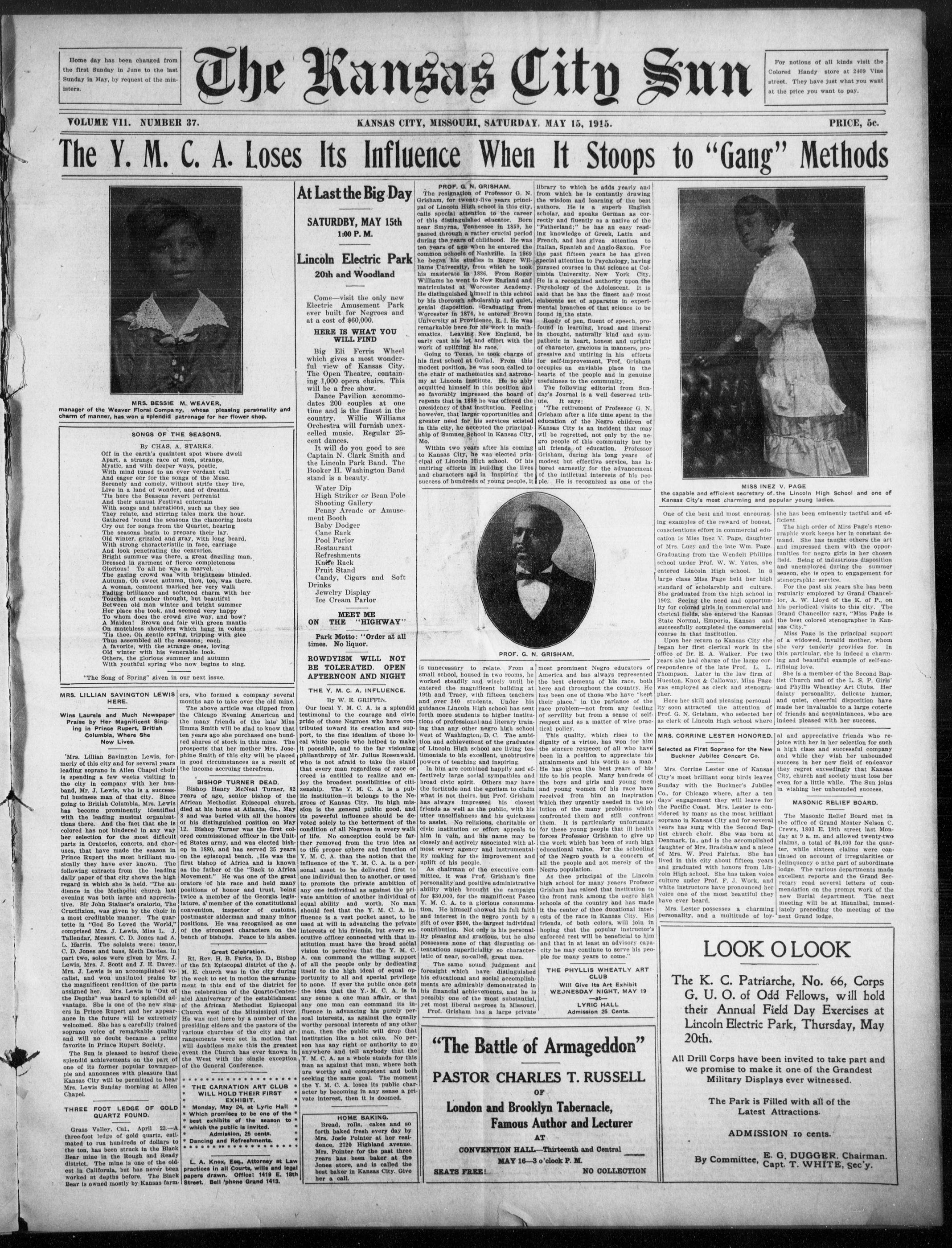
The Kansas City Sun
The Y. M. C. A. Loses Its Influence When It Stoops to "Gang" Methods
MRS. BESSIE M. WEAVER,
manager of the Weaver Floral Company, whose pleasing personality and
charm of manner, has won a splendid patronage for her flower shop.
SONGS OF THE SEASONS.
Off in the earth's quaintest place where dwell
Apart, a strange race of men, strange,
Mystic, and with deeper ways, poetic,
With mind tuned to an ever verdant call
And eager ear for the songs of the Muse.
Serenely and comely, without strife they live,
Live in a land of wonder, and of dreams.
'Tis here the Seasons revert perennial
And their annual Festival entertain
With songs and narrations, such as they see
They relate, and stirring tales mark the hour.
Gathered 'round the seasons the clamoring hosts
Cry out for songs from the Quartet, hearing
The seasons begin to prepare their lay.
Old winter, grizzled and gray, with long beard,
With strong characteristic in face, carriage
And look penetrating the centuries.
Bright summer was there, a great dazzling man,
Dressed in garment of fierce completeness
Glorious! 'To all he was a marvel.
The gazing crowd was with brightness blinded.
Autumn, Oh sweet autumn, thou, too, was there.
A woman, comment marked her very walk
Fading brilliance and softened charm with her
Touches of somber thought, but beautiful
Between old man winter and bright summer
Her place she took, and seemed very happy
To whom does the crowd give way, and bow?
A Maiden! Brown and fair with green mantle
On matchless shoulders which hang in colors
'Tis thee, Oh gentle spring, tripping with glee
Thus assembled all the seasons; each
A favorite, with the strange ones, loving
Old winter with his venerable look.
Others, the glorious summer and autumn
With youthful spring who now begins to sing.
"The Song of Spring" given in our next issue.
LILLIAN SAVINGTON LEWIS
HERE.
ers, who formed a company several
months ago to take over the old mine.
months ago to take over the old mine. The above article was clipped from the Chicago Evening American and the many friends of the late Miss Emma Smith will be glad to know that ten years ago she purchased one hundred shares of stock in this mine. The prospects that her mother Mrs. Josephine Smith of this city will be placed in good circumstances as a result of the income accruing therefrom.
BISHOP TURNER DEAD
BISHOP TURNER DEAD.
Bishop Henry McNeal Turner, 82 years of age, senior bishop of the African Methodist Episcopal church, died at his home at Atlanta, Ga., May 8 and was buried with the all honors of his distinguished position on May 12. Bishop Turner was the first colored commissioned officer in the United States army, and was elected bishop in 1880, and has served 35 years on the episcopal bench. He was the first bishop of Africa and is known as the father of the "Back to Africa Movement." He was one of the great orators of his race and held many positions of honor and trust, being twice a member of the Georgia legislature, a member of the constitutional convention, inspector of customs, postmaster alderman and many minor positions. He was recognized as one of the strongest characters on the bench of bishops. Peace to his ashes.
Great Celebration.
Rt. Rev. H. B. Parks, D. D., Bishop of the 5th Episcopal district of the A. M. E. church was in the city during the week to set in motion the arrangement in this end of the district for the celebration of the Quarto-Centeniel Anniversary of the establishment of the African Methodist Episcopal Church west of the Mississippi river. He was met here by a number of the presiding elders and the pastors of the various churches of the city and arrangements were set in motion that will doubless make this the greatest event the Church has ever known in the West with the single exception of the General Conference.
* THE CARNATION ART CLUB
* WILL HOLD THEIR FIRST
* EXHIBIT.
* Monday, May 24, at Lyric Hall
* Which promises to be one of the best exhibits of the season to
* which the public is invited.
L. A. Knox, Esq, Attorney at Law
practices in all Courts, wills and legal
papers drawn. Office: 1419 E. 18th
Street. Bell 'phone Grand 1413.
Home day has been changed from the first Sunday in June to the last Sunday in May, by request of the ministers.
VOLUME VI1. NUMBER 37.
MRS. LILLIAN SAVINGTON LEWIS
HERE.
Wins Laurels and Much Newspaper Praise by Her Magnificent Singing in Prince Rupert, British Columbia, Where She Now Lives.
Mrs. Lillian Savington Lewis, formerly of this city and for several years leading soprano in Allen Chapel choir is spending a few weeks visiting in the city in company with her husband, Mr. J. Lewis, who is a successful business man of that city. Since going to British Columbia, Mrs. Lewis has become prominently identified with the leading musical organizations there. And the fact that she is colored has not hindered in any way her selection for the most difficult parts in Oratorios, concerts, and choruses, that have made the season in Prince Rupert the most brilliant musically they have ever known. The following extracts from the leading daily paper of that city shows the high regard in which she is held. "The audience in the Methodist church last evening was both large and appreciative. Sir John Stainner's oratorio, The Crucifixion, was given by the choir in a most creditable manner. The quarette in "God So Loved the World," comprised Mrs. J. Lewis, Miss L. J. Tallendar, Messrs. C. D. Jones and A. L. Harris. The solists were: tenor C. D. Jones and bass, Meth Davies. In part two, soles were given by Mrs. J. Lewis, Mrs. J. Scott and J. E. Davey. Mrs. J. Lewis is an accomplished voicist, and won unsulted praise by the magnificent rendition of the parts assigned her. Mrs. Lewis in "Out of the Depths" was heard to splendid ad vantage. She is one of the new singers in Prince Rupert and her appearance in the future will be extremely welcomed. She has a carefully trained soprano voice of remarkable quality and will no doubt became a prime favorite in Prince Rupert Society.
The Sun is pleased to bearof these splendid achievements on the part of one of its former popular townspeople and announces with pleasure that Kansas City will be permitted to hear Mrs. Lewis Sunday morning at Allen Chapel.
Grass Valley, Cal., April 23—Three-foot ledge of gold quartz, estimated to run hundreds of dollars to the ton, has been struck in the Black Bear mine in the Rough and Ready district. The mine is one of the oldest in California, but has never been worked at depths before. The Black Bear is owned mostly by Kansas farm.
KANSAS CITY, MISSOURI, SATURDAY, MAY 15, 1915.
At Last the Big Day
SATURDBY, MAY 15th
1:00 P.M.
Lincoln Electric Park 20th and Woodland
Come—visit the only new Electric Amusement Park ever built for Negroes and at a cost of $60,000.
HERE IS WHAT YOU WILL FIND
Big Eli Ferris Wheel which gives a most wonderful view of Kansas City. The Open Theatre, containing 1,000 opera chairs. This will be a free show. Dance Pavilion accommodates 200 couples at one time and is the finest in the country. Willie Williams Orchestra will furnish unexcelled music. Regular 25-cent dances. It will do you good to see Captain N. Clark Smith and the Lincoln Park Band. The Booker H. Washington Band stand is a beauty. Water Dip High Striker or Bean Pole Shooting Gallery Penny Arcade or Amusement Booth Baby Dodger Cane Rack Pool Parlor Restaurant Refreshments Knife Rack Fruit Stand Candy, Cigars and Soft Drinks Jewelry Display Ice Cream Parlor
MEET ME
ON THE "HIGHWAY"
Park Motto: 'Order at all times. No liquor.
ROWDYISM WILL NOT
BE TOLERATED. OPEN
AFTERNOON AND NIGHT
THE Y. M. C. A. INFLUENCE.
Our local Y. M. C. A. is a splendid testimonial to the courage and civic pride of those Negroes who have contributed toward its creation and support, to the fine idealism of those local white people who helped to make it possible, and to the far visioning philanthropy of Mr. Julius Rosenwald, who is not afraid to take the stand that every man regardless of race or creed is entitled to realize and enjoy the broadest possibilities of citizenship. The Y. M. C. A. is a public institution—it belongs to the Negroes of Kansas City. Its high mission is the general public good, and its powerful influence should be devoted solely to the betterment of the condition of all Negroes in every walk of life. No conception could be farther removed from the true idea as to the proper sphere and function of Y. M. C. A. than the notion that the influence of the Y. M. C. A. is a personal asset to be delivered first to one individual then to another, or used to the private ambition of any one individual as against the private ambition of another individual of equal ability and worth. No man should feel that the Y. M. C. A. influence is a vest pocket asset, to be used at will in advance the private interests of his friends, but every executive officer connected with that institution must have the broad social vision to perceive that the Y. M. C. A. can command the willing support of all the people only by dedicating itself to the high ideal of equal opportunity to all and special privilege to none. If ever the public once gets the idea that the Y.-M. C. A. is in any sense a one man affair, or that any one man can command its influence in advancing his purely personal interests, as against the equally worthy personal interests of any other man, then the public will drop that institution like a hot cake. No person has any right or authority to go anywhere and tell anybody that the Y. M. C. A. as a whole stands for this man as against that man, where both are worthy and competent and both seeking the same goal. The moment the Y. M. C. A. loses its public character by becoming in any sense a private interest, then it is doomed.
HOME BAKING
Bread, rolls, cakes and so forth baked fresh every day by Mrs. Josie Pointer at her residence. 2720 Highland avenue. Mrs. Pointer for the past three years has been baker at the Jones store, and is called the best baker in Kansas City. Give her a call.
PROF. G. N. GRISHAM.
The resignation of Professor G. N. Grisham, for twenty-five years principal of Lincoln High school in this city, calls special attention to the career of this distinguished educator. Born near Smyrna, Tennessee in 1859, he passed through a rather crucial period during the years of childhood. He was ten years of age when he entered the common schools of Nashville. In 1869 he began his studies in Roger Williams University, from which he took his masterate in 1886. From Roger Williams he went to New England and matriculated at Worcester Academy. He distinguished himself in this school by his thorough scholarship and quiet, genial disposition. Graduating from Worcester in 1874, he entered Brown University at Providence, R. I. He was remarkable here for his work in mathematics. Leaving New England, he early cast his lot and effort with the work of uplifting his race.
Going to Texas, he took charge of his first school at Gollad. From this modest position, he was soon called to the chair of mathematics and astronomy at Lincoln Institute. He so ably acquitted himself in this position and so favorably impressed the board of regents that in 1889 he was offered the presidency of that institution. Feeling however, that larger opportunities and greater need for his services existed in this city, he accepted the principal ship of Sumner School in Kansas City Mo.
Within two years after his coming to Kansas City, he was elected principal of Lincoln High school. Of his untiring efforts in building the lives and characters and in inspiring the success of hundreds of young people, it
PROF. S. N. GRISHAM
PROF. G. N. GRISHAM.
is unnecessary to relate. From a small school, housed in two rooms, he worked steadily and wisely until he entered the magnificent building at 19th and Tracy, with fifteen teachers and over 340 students. Under his guidance Lincoln High school has sent forth more students to higher institutions of professional and literary training than any other negro high school west of Washington, D. C. The ambition and achievement of the graduates of Lincoln High school are living testimonials to his excellent, unobtrusive powers of teaching and inspiring. In him are combined happily and effectively large social sympathies and broad civic spirit. Others may have the fortitude and the egotism to claim what is not theirs, but Prof. Grisham has always impressed his closest friends as well as the public, with his utter unselfishness and his quickness to assist. No religious, charitable or civic institution or effort appeals to him in vain, and his name may be closely and actively associated with almost every agency and instrumentality making for the improvement and uplift of his people.
As chairman of the executive committee, it was Prof. Grisham's fine personality and positive administrative ability which brought the campaign for $30,000, for the magnificent Paseo Y. M. C. A. to a glorious consummation. He himself showed his full faith and interest in the negro youth by a gift of over $500, the largest individual contribution. Not only is his personality pleasing and gracious, but he also possesses none of that disgusting ostentatious superficiality so characteristic of near, so-called, great men.
The same sound judgment and foresight which have distinguished his educational and social accomplishments are admirably demonstrated in his financial achievements, and he is possibly one of the most substantial, yet most liberal negroes in Missouri. Prof. Grisham has a large private
"The Battle of
PASTOR CHAR
London and Brook
Famous A
library to which he adds yearly and from which he is contantly drawing the wisdom and learning of the best authors. He is a superb English scholar, and speaks German as correctly and fluently as a native of the "Fatherland;" he has an easy reading knowledge of Greek, Latin and French, and has given attention to Italian, Spanish and Anglo-Saxon. For the past fifteen years he has given special attention to Psychology, having pursued courses in that science at Columbia University. New York City. He is a recognized authority upon the Psychology of the Adolescent. It is said that he has the finest and most elaborate set of apparatus in experimental branches of that science to be found in the state.
Ready of pen, fluent of speech, profound in learning, broad and liberal in thought, naturally kind and sympathetic in heart, honest and upright of character, gracious in manners, progressive and uniting in his efforts for self-improvement, Prof. Grisham occupies an enviable place in the hearts of the people and in genuine usefulness to the community.
The following editorial from Sunday's Journal is a well deserved tribute. It says:
"The retirement of Professor G. N. Grisham after a life time spent in the education of the Negro children of Kansas City is an incident that may will be regretted, not only by the negro people of this community but by all friends of education. Professor Grisham, during his long years of modest but effective service, has labored earnestly for the advancement of the intictual interests of his people. He is recognized as one of the
most prominent Negro educators of America and has always represented the best elements of his race, both here and throughout the country. He has been one of those who have "kept their place," in the parlance of the race problem—not from any feeling of servility but from a sense of self-respect and as a matter of wise practical policy.
This quality, which rises to the dignity of a virtue, has won for him the sincere respect of all who have been in a position to appreciate his attainments and his worth as a man. He has given the best years of his life to his people. Many hundreds of the boys and girls and young men and young women of his race have received from him an inspiration which they urgently needed in the solution of the many problems which confronted them and still confront them. It is particularly unfortunate for these young people that ill health forces Professor Grisham to give up the work which has been of such high educational value. For the schooling of the Negro youth is a concern of all the people and not merely of the Negro population.
As thee principal of the Lincoln high school for many yeaers Professor Grisham has raised that institution to the front rank among the negro high schools of the country and has made it the center of the thee ducational interests of the race in Kansas City. His friends, of both colors, will join in hoping that the popular instructor's enforced rest will be beneficial to him and that in at least an advisory capacity he may continue to serve his people for many years to come."
THE PHYLLIS WHEATLY ART CLUB
Will Give Its Art Exhibit
WEJNESDAY NIGHT, MAY 19
at
LYRIC HALL
Admission 25 Cents.
THE WOMAN WHO WAS THE LADY OF THE WORLD
MISS INEZ V. PAGE the capable and efficient secretary of the Lincoln High School and one of Kansas City's most charming and popular young ladies.
the capable and efficient secretary of. the Lincoln High School and one of Kansas City's most charming and popular young ladies.
One of the best and most encouraging examples of the reward of honest, conscientious effort in commercial education is Miss Inez V. Page, daughter of Mrs. Lucy and the late Wm. Page. Graduating from the Wendell Phillips school under Prof. W. W. Yates, she entered Lincoln High school. In a large class Miss Page held her high standard of scholarship and culture. She graduated from the high school in 1902. Seeing the need and opportunity for colored girls in commercial and clerical fields, she entered the Kansas State Normal, Emporia, Kansas and successfully completed the commercial course in that institution.
Upon her return to Kansas City she began her first clerical work in the office of Dr. E. A. Walker. For two years she had charge of the large correspondence of the late Prof. L. L. Thompson. Later in the law firm of Hueston, Knox & Calloway, Miss Page was employed as clerk and stenographer.
Here her skill and pleasing personality soon attracted the attention of Prof. G. N. Grisham, who selected her as clerk of Lincoln high school where
she has been eminently tactful and efficient.
The high order of Miss Page's stenographic work keeps her in constant demand. She has taught others the art and impressed them with the opportunities for negro girls in her chosen field. Being of industrious disposition and unemployed during the summer season, she is open to engagement for stenographic service.
For the past six years she has been regularly employed by Grand Chancellor, A. W. Lloyd of the K. of P., on his periodical visits to this city. The Grand Chancellor says, "Miss Page is the best colored stenographer in Kansas City."
Miss Page is the principal support of a widowed, invalid mother, whom she very tenderly provides for. In this particular, she is indeed a charming and beautiful example of self-sacrificing love.
She is a member of the Second Baptist Church and of the L. S. P. Girls and Phyllis Wheatley Art Clubs. Her dainty personality, delicate humor, and quiet, cheerful disposition have made her invaluable to a large coterie of friends and acquaintances, who are indeed pleased with her success.
MRS. CORRINE LESTER HONORED.
Selected as First Soprano for the New Buckner Jubilee Concert Co.
Mrs. Corrine Lester one of Kansas City's most brilliant song birds leaves Sunday with the Buckner's Jubilee Co., for Chicago where, after a ten days' engagement they will leave for the Pacific Coast. Mrs. Lester is considered by many as the most brilliant soprano in Kansas City and for several years has sung with the Second Baptist church choir. She was born at Denmark, la., and is the accomplished daughter of Mrs. Bradshaw and a wife of Mrs. W. Fred Fairfax. She has lived in this city about fifteen years and graduated with honors from Lincoln High school. She has taken voice culture under Prof. F. J. Work, and white instructors have pronounced her voice one of the most beautiful they have ever heard.
Mrs. Lester possesses a charming personality, and a multitude of loy-
LOOK O LOOK
The K. C. Patriarche, No. 66, Corps
G. U. O. of Odd Fellows, will hold
their Annual Field Day Exercises at
Lincoln Electric Park, Thursday, May
20th.
All Drill Corps have been invited to take part and
we promise to make it one of the Grandest
Military Displays ever witnessed.
The Park is Filled with all of the
Latest Attractions.
ADMISSION 10 cents.
By Committee, E. G. DUGGER, Chairman.
Capt. T. WHITE, Sec'y.
For notions of all kinds visit the Colored Handy store at 2409 Vine street. They have just what you want at the price you want to pay.
g" Methods
she has been eminently tactful and efficient.
The high order of Miss Page's stenographic work keeps her in constant demand. She has taught others the art and impressed them with the opportunities for negro girls in her chosen field. Being of industrious disposition and unemployed during the summer season, she is open to engagement for stenographic service.
For the past six years she has been regularly employed by Grand Chancellor, A. W. Lloyd of the K. of P., on his periodical visits to this city. The Grand Chancellor says, "Miss Page is the best colored stenographer in Kansas City."
Miss Page is the principal support of a widowed, invalid mother, whom she very tenderly provides for. In this particular, she is indeed a charming and beautiful example of self-sacrificing love.
She is a member of the Second Baptist Church and of the L. S. P. Girls' and Phyllis Wheatley Art Clubs. Her dainty personality, delicate humor, and quiet, cheerful disposition have made her invaluable to a large coterie of friends and acquaintances, who are indeed pleased with her success.
al and appreciative friends who rejoice with her in her selection for such a high class and successful company and while they wish her unbounded success in her new field of endeavor they regret exceedingly that Kansas City, church and society must lose her even for a little while. The Sun joins in wishing her unbounded success.
MASONIC RELIEF BOARD.
The Masonic Relief Board met in the office of Grand Master Nelson C. Crews, 1803 E. 18th street last Monday at 9 a. m. and allowed twenty-two claims, a total of $4,400 for the quarter, while sixteen claims were continued on account of irregularities or delinquency o the part of subordinate lodge. The various departments made excellent reports and the Grand Secretary read several letters of commendation on the prompt work of the new Burial department. The next meeting will be at Hannibal, immediately preceding the meeting of the next Grand lodge.
O LOOK
arche, No. 66, Corps
Odd Fellows, will hold
Field Day Exercises at
Park, Thursday, May
PRICE, 5c.
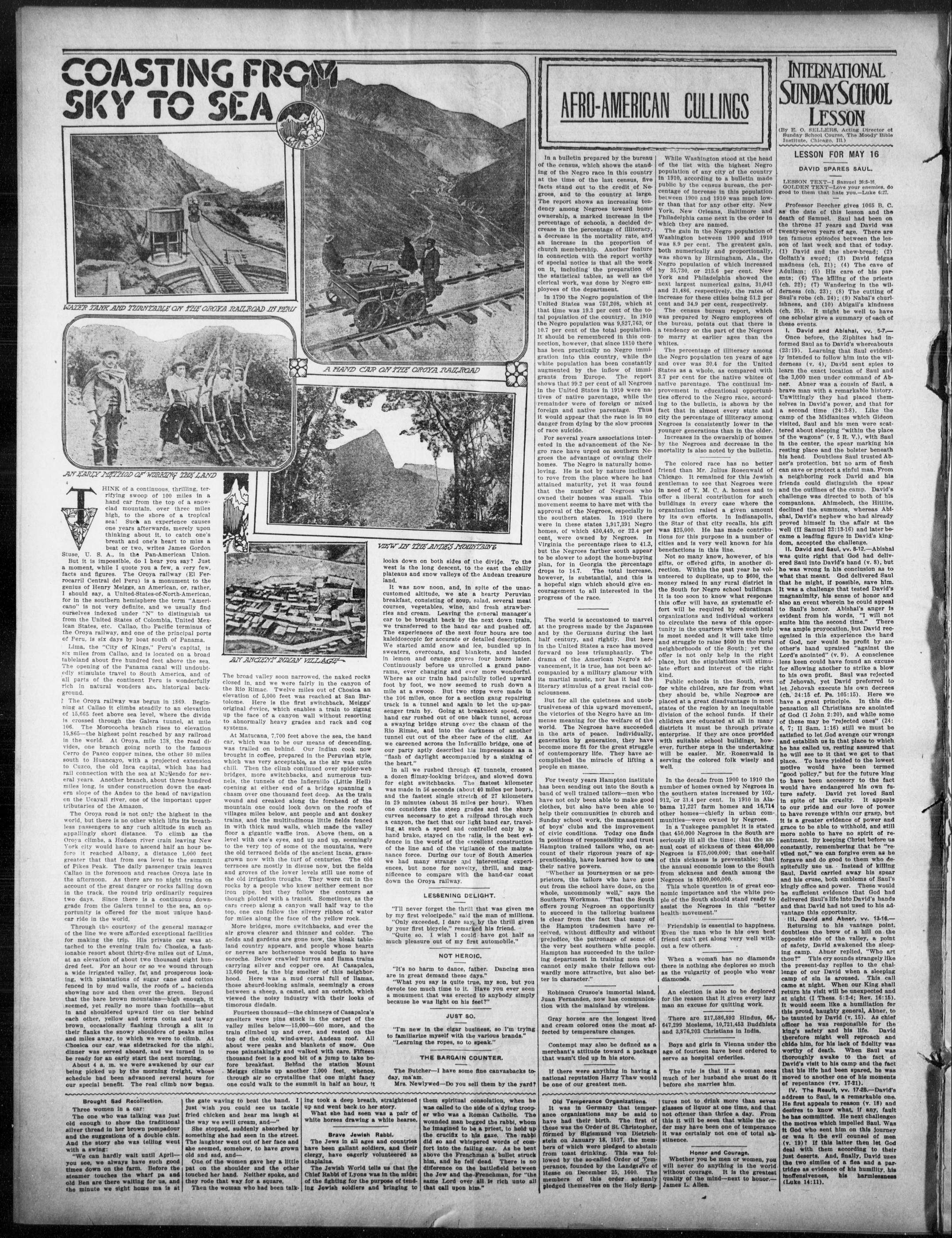
COASTING FROM SKY TO SEA
L
AN EARLY METHOD OF WORKING THE LAND
HINK of a continuous, thrilling, terrifying swoop of 100 miles in a hand car from the top of a snow-clad mountain, over three miles high, to the shore of a tropical sea! Such an experience causes one years afterwards, merely upon thinking about it, to catch one's breath and one's heart to miss a beat or two, writes James Gordon Stuse, U. S. A., in the Pan-American Union. But it is impossible, do I hear you say? Just a moment, while I quote you a few, a very few, facts and figures. The Oroya railway (El Ferrocarril Central del Peru) is a monument to the genius of Henry Meiggs, an American, or, rather, I should say, a United-States-of-North-American, for in the southern hemisphere the term "Americano" is not very definite, and we usually find ourselves indexed under "N" to distinguish us from the United States of Colombia, United Mexican States, etc. Callao, the Pacific terminus of the Oroya railway, and one of the principal ports of Peru, is six days by boat south of Panama.
Lima, the "City of Kings," Peru's capital, is six miles from Callao, and is located on a broad tableland about five hundred feet above the sea. The opening of the Panama canal will undoubtedly stimulate travel to South America, and of all parts of the continent Peru is wonderfully rich in natural wonders and historical background.
The Oroya railway was begun in 1869. Beginning at Callao it climbs steadily to an elevation of 15,665 feet above sea level, where the divide is crossed through the Galera tunnel, at mile 106. The Moroccocha branch rises to elevation 15,865—the highest point reached by any railroad in the world. At Oroya, mile 138, the road divides, one branch going north to the famous Cerro de Pasco copper mines, the other 80 miles south to Huancayo, with a projected extension to Cuzco, the old Inca capital, which has had rail connection with the sea at Mendo for several years. Another branch, about three hundred miles long, is under construction down the eastern slope of the Andes to the head of navigation on the Ucayali river, one of the important upper tributaries of the Amazon.
The Oroya road is not only the highest in the world, but there is no other which lifts its breathless passengers to any such altitude in such an appallingly short distance. To climb as the Oroya climbs, a Hudson river train leaving New York city would have to ascend half an hour before it reached Albany, a distance 1,000 feet greater that from sea level to the summit of Pikes Peak. The daily passenger train leaves Callao in the forenoon and reaches Oroya late in the afternoon. As there are no night trains on account of the great danger or rocks falling down in the track, the round trip ordinarily requires two days. Since there is a continuous downgrade from the Galera tunnel to the sea, an opportunity is offered for the most unique handcar ride in the world.
Through the courtesy of the general manager of the line we were afforded exceptional facilities for making the trip. His private car was attached to the evening train fo: Chosica, a fashionable resort about thirty-five miles out of Lima, at an elevation of about two thousand eight hundred feet. For an hour or so we wound through a wide irrigated valley, fat and prosperous looking, with plantations of sugar cane and cotton fenced in by mud walls, the roofs of hacienda showing now and then over the green. Beyond that the bare brown mountains—high enough, it seemed, yet really no more than foothills—shut in and shouldered upward tier on tier behind each other, yellow and terra cotta and tawny brown, occasionally flashing through a slit in their flanks the snowy shoulders of peaks miles and miles away, to which we were to climb. At Chosica our car was sidetracked for the night; dinner was served aboard, and we turned in to be ready for an early start the next morning.
her behind and tawney a slit in peaks miles climb. At the night, nried in to arring. By our car right, whose hours for now began.
Fourteen thousand—the smelters were smelters valley miles below—15 train climbed up and top of the cold, wind-about were peaks and rose painstakingly and thousand feet is a good breakfast. Beh! Melggs climbs up anet through air so crystall one could walk to the s
About 4 a. m. we were awakened by our car being picked up by the morning freight, whose schedule had been advanced several hours for our special benefit. The real climb now began.
the gate waving to beat the band. I just wish you could see us tackle fried chicken and hear ma laugh at the way we swill cream. and—"
---
T
Three women in a car:
The one who was talking was just old enough to show the traditional silver thread in her brown pompadour and the suggestions of a double chin.
And the story she was telling went with a swing:
"We can hardly wait until April—you see, we always have such good times down on the farm. Before the steamer touches the wharf pa and old Ben are there waiting for us, and the minute we sight home ma is at
AN ANCIENT INDIAN VILLAGE
The broad valley soon narrowed, the naked rocks closed in, and we were fairly in the canyon of the Rio Rimac. Twelve miles out of Canyon an elevation of 5,000 feet was reached at San Bar-tolome. Here is the first switchback, Melgus' original device, which enables a train to zigzag up the face of a canyon wall without resorting to abnormally heavy grades and rack and cog systems.
At Maturcana, 7,700 feet above the sea, the hand car, which was to be our means of descending, was trailed on behind. Our Indian cook now brought in coffee, prepared in the Peruvian style, which was very acceptable, as the air was quite chill. Then the climb continued over spider-web bridges, more switchbacks, and numerous tunnels, the tunnels of the Infernillo (Little Hell) opening at either end of a bridge spanning a chasm over one thousand feet deep. As the train wound and creaked along the forehead of the mountain one could look down on the roofs of villages miles below, ant people and ant donkey trains, and the multitudinous little fields fenced in with thick mud walls, which made the valley floor a gigantic waffle iron. Above them, on a level with one's eyes, and up and up, seemingly to the very top of some of the mountains, were the old terraced fields of the ancient Incas, grass-grown now with the turf of centuries. The old terraces are mostly in disuse now, but the fields and groves of the lower levels still use some of the old irrigation troughs. They were cut in the rocks by a people who knew neither cement nor pipe, but they follow the contours as though plotted with a transit. Sometimes, as the cars creep along a canyon wall half way to the top, one can follow the silvery ribbon of water for miles along the face of the yellow rock.
More bridges, more switchbacks, and ever the air grows clearer and thinner and colder. The fields and gardens are gone now, the bleak tableland country appears, and people whose hearts or nerves are bothersome would begin to have soroche. Below crawled burros and llama trains carrying silver and copper ore. At Casapalca, 13,600 feet, is the big smelter of this neighborhood. Here was a mud corral full of llamas, those absurd-looking animals, seemingly a cross between a sheep, a camel, and an ostrich, which viewed the noisy industry with their looks of timorous disdain.
Fourteen thousand—the chimneys of Casapalca's smelters were pins stuck in the carpet of the valley miles below—15,000—600 more, and the train climbed up and over, and rested on the top of the cold, wind-swept, Andean roof. All about were peaks and blankets of snow. One rose painstakingly and walked with care. Fifteen thousand feet is a good bit of a jump to take before breakfast. Behind the station Mount Meiggs climbs up another 2,000 feet, whence, through air so crystalline that one might fancy one could walk to the summit in half an hour, it
She stopped, suddenly absorbed by something she had seen in the street. The laughter went out of her face and she seemed, somehow, to have grown old and sad, and—
One of the women gave her a little pat on the shoulder and the other touched her hand. Neither spoke, and they rode that way for a square.
Then the woman who had been talk
What she had seen was a pair of white horses drawing a white hearse.
Brave Jewish Rabbi.
The Jews in all ages and countries have been gallant soldiers, and their clergy, have eagerly volunteered as chaplains.
The Jewish World tells us that the Chief Rabbi of Lyons was in the midst of the fighting for the purpose of tending Jewish soldiers and bringing to
VIEW IN THE ANDES MOUNTAINS
looks down on both sides of the divide. To the west is the long descent, to the east the chilly plateaus and snow valleys of the Andean treasure land.
It was now noon, and, in spite of the unacustomed altitude, we ate a hearty Peruvian breakfast, consisting of soup, salad, several meat courses, vegetables, wine, and fresh strawberries and cream. Leaving the general manager's car to be brought back by the next down train, we transferred to the hand car and pushed off. The experiences of the next four hours are too kaledoscopic for accurate or detailed description. We started amid snow and ice, bundled up in sweaters, overcoats, and blankets, and landed in lemon and orange groves four hours later. Continuously before us unrolled a grand panorama, ever changing and ever more wonderful. Where as our train had painfully toiled upward foot by foot, we now seemed to rush down a mile at a swoop. But two stops were made in the 106 miles, once for a section gang repairing track in a tunnel and again to let the uppassenger train by. Going at breakneck speed, our hand car rushed out of one black tunnel, across a swaying bridge strung over the chasm of the Rio Rimac, and into the darkness of another tunnel cut out of the sheer face of the cliff. As we careened across the Infernillo bridge, one of our party aptly described his impressions as a "flash of daylight accompanied by a sinking of the heart."
In all we rushed through 47 tunnels, crossed a dozen filmsy-looking bridges, and slowed down for eight switchbacks. The fastest kilometer was made in 56 seconds (about 40 miles per hour), and the fastest single stretch of 27 kilometers in 29 minutes (about 35 miles per hour). When one considers the steep grades and the sharp curves necessary to get a railroad through such a canyon, the fact that our light hand car, traveling at such a speed and controlled only by a hand brake, stayed on the rails, is the best evidence in the world of the excellent construction of the line and of the vigilance of the maintenance force. During our tour of South America we had many strange and interesting experiences, but none for novelty, thrill, and magnificence to compare with the hand-car coast down the Oroya railway.
"I'll never forget the thrill that was given me by my first velocipe," said the man of millions. "Only exceeded, I dare say, by the thrill given by your first bicycle," remarked his friend. "Quite so. I wish I could have got half as much pleasure out of my first automobile."
"It's no harm to dance, father. Dancing men are in great demand these days."
"What you say is quite true, my son, but you devote too much time to it. Have you ever seen a monument that was erected to anybody simply because he was light on his feet?"
"I'm new in the cigar business, so I'm trying to familiarize myself with the various brands." "Learning the ropes, so to speak."
The Butcher—I have some fine canvasbacks today, ma'am.
Mra. Newlywed—Do you sell them by the yard?
LESSENING DELIGHT.
NOT HEROIC
JUST SO.
THE BARGAIN COUNTER
them spiritual consolation, when he was called to the side of a dying trooper who was a Roman Catholic. The wounded man begged the rabbi, whom he imagined to be a priest, to hold up the crucifix to his gaze. The rabbi did so and whispered words of comfort into the falling ear. As he bent above the Frenchman a bullet struck him, and he fell dead. There is no difference on the battlefield between the Jew and the Frenchman, for "the same Lord over all is rich unto all that call upon him."
AFRO-AMERICAN CULLINGS
In a bulletin prepared by the bureau of the census, which shows the standing of the Negro race in this country at the time of the last census, five facts stand out to the credit of Negroes, and to the country at large. The report shows an increasing tendency among Negroes toward home ownership, a marked increase in the percentage of schools, a decided decrease in the percentage of illiteracy, a decrease in the mortality rate, and an increase in the proportion of church membership. Another feature in connection with the report worthy of special notice is that all the work on it, including the preparation of the statistical tables, as well as the clerical work, was done by Negro employees of the department.
In 1790 the Negro population of the United States was 757,208, which at that time was 19.3 per cent of the total population of the country. In 1910 the Negro population was 9,827,763, or 10.7 per cent of the total population. It should be remembered in this connection, however, that since 1810 there has been practically no Negro immigration into this country, while the white population has been constantly augmented by the inflow of immigrants from Europe. The report shows that 99.2 per cent of all Negroes in the United States in 1910 were natives of native parentage, while the remainder were of foreign or mixed foreign and native parentage. Thus it would appear that the race is in no danger from dying by the slow process of race suicide.
For several years associations interested in the advancement of the Negro race have urged on southern Negroes the advantage of owning their homes. The Negro is naturally home-loving. He is not by nature inclined to rove from the place where he has attained maturity, yet it was found that the number of Negroes who owned their homes was small. This movement seems to have met with the approval of the Negroes, especially in the southern states. In 1910 there were in these states 1,917,391 Negro homes, of which 430,449, or 22.4 per cent, were owned by Negroes. In Virginia the percentage rises to 41.3, but the Negroes farther south appear to be slower to adopt the home-buying plan, for in Georgia the percentage drops to 14.7. The total increase, however, is substantial, and this is a hopeful sign which should give encouragement to all interested in the progress of the race.
The world is accustomed to marvel at the progress made by the Japanese and by the Germans during the last half century, and rightly. But here in the United States a race has moved forward no less triumphantly. The drama of the American Negro's advancement, it is true, has not been accompanied by a military glamour with its martial music, nor has it had the literary stimulus of a great racial consciousness.
But for all the quietness and unobtrusiveness of this upward movement, the victories of the Negro have an immense meaning for the welfare of the world. The Negroes have succeeded in the arts of peace. Individually, generation by generation, they have become more fit for the great struggle of contemporary life. They have accomplished the miracle of lifting a people en masse.
For twenty years Hampton institute has been sending out into the South a band of well trained tailors—men who have not only been able to make good clothes, but also have been able to help their communities in church and Sunday school work, the management of boys' clubs and the improvement of civic conditions. Today one finds in positions of responsibility and trust Hampton trained tailors who, on account of their rigorous years of apprenticeship, have learned how to use their native powers.
"Whether as journeymen or as proprietors, the tailors who have gone out from the school have done, on the whole, uncommonly well," says the Southern Workman. "That the South offers young Negroes an opportunity to succeed in the tailoring business is clear from the fact that many of the Hampton tradesmen have received, without difficulty and without prejudice, the patronage of some of the very best southern white people. Hampton has succeeded in the tailoring department in training men who cannot only make their fellows outwardly more attractive, but also better in character."
Robinson Crusoe's immortal island, Juan Fernandez, now has communication with the mainland by wireless.
Gray horses are the longest lived and cream colored ones the most affected by temperature changes.
Contempt may also be defined as a merchant's attitude toward a package that wasn't tied up in his store.
If there were anything in having a national reputation Harry Thaw would be one of our greatest men.
Old Temperance Organizations.
It was in Germany that temperance organizations may be said to have had their birth. The first of these was the Order of St. Christopher, formed by Sigismund of Dietrichstein on January 18, 1517, the members of which were pledged to abstain from toast drinking. This was followed by the so-called Order of Temperance, founded by the Landgrave of Hesse on December 25, 1600. The members of this order solemnly pledged themselves on the Holy Scrip-
While Washington stood at the head of the list with the highest Negro population of any city of the country in 1910, according to a bulletin made public by the census bureau, the percentage of increase in this population between 1900 and 1910 was much lower than that for any other city. New York, New Orleans, Baltimore and Philadelphia came next in the order in which they are named.
The gain in the Negro population of Washington between 1900 and 1910 was 8.9 per cent. The greatest gain, both numerically and proportionally, was shown by Birmingham, Ala., the Negro population of which increased by 35,730, or 215.6 per cent. New York and Philadelphia showed the next largest numerical gains, 31,043 and 21,486, respectively, the rates of increase for these cities being 51.2 per cent and 34.9 per cent, respectively.
The census bureau report, which was prepared by Negro employees of the bureau, points out that there is a tendency on the part of the Negroes to marry at earlier ages than the whites.
The percentage of illiteracy among the Negro population ten years of age and over was 30.4 for the United States as a whole, as compared with 3.7 per cent for the native whites of native parentage. The continual improvement in educational opportunities offered to the Negro race, according to the bulletin, is shown by the fact that in almost every state and city the percentage of illiteracy among Negroes is consistently lower in the younger generations than in the older.
Increases in the ownership of homes by the Negroes and decrease in the mortality is also noted by the bulletin.
The colored race has no better friend than Mr. Julius Rosenwald of Chicago. It remained for this Jewish gentleman to see that Negroes were in need of Y. M. C. A. homes and to offer a liberal contribution for such buildings in every case where the organization raised a given amount by its own efforts. In Indianapolis, the Star of that city recalls, his gift was $25,000. He has made contributions for this purpose in a number of cities and is very well known for his benefactions in this line.
Not so many know, however, of his gifts, or offered gifts, in another direction. Within the past year he volunteered to duplicate, up to $600, the money raised in any rural district in the South for Negro school buildings. It is too soon to know what response this offer will have, as systematic effort will be required by educational organizations and individual workers to circulate the news of this opportunity in the quarters where such help is most needed and it will take time and struggle to raise $600 in the rural neighborhoods of the South; yet the offer is not only help in the right place, but the stipulations will stimulate effort and interest of the right kind.
Public schools in the South, even for white children, are far from what they should be, while Negroes are placed at a great disadvantage in most states of the region by an inequitable division of the school funds. If their children are educated at all in many districts it must be through private enterprise. If they are once provided with suitable school buildings, however, further steps in the undertaking will be easier. Mr. Rosenwald is serving the colored folk wisely and well.
In the decade from 1900 to 1910 the number of homes owned by Negroes in the southern states increased by 102, 912, or 31.4 per cent. In 1910 in Alabama 17,227 farm homes and 16,714 other homes—chiefly in urban communities—were owned by Negroes.
In a Tuskegee pamphlet it is stated that 450,000 Negroes in the South are seriously ill all the time; that the annual cost of sickness of these 450,000 Negroes is $75,000,000; that one-half of this sickness is preventable; that the annual economic loss to the South from sickness and death among the Negroes is $300,000,000.
This whole question is of great economic importance and the white people of the South should stand ready to assist the Negroes in this "better health movement."
Friendship is essential to happiness. Even the man who is his own best friend can't get along very well without a few others.
When a woman has no diamonds there is nothing she deplores so much as the vulgarity of people who wear diamonds.
An election is also to be deplored for the reason that it gives every lazy man an excuse for quitting work.
There are 217,586,892 Hindus, 66,647,299 Moslems, 10,721,453 Buddhists and 3,876,203 Christians in India.
Boys and girls in Vienna under the age of fourteen have been ordered to serve as hospital orderles.
The rule is that if a woman sees much of her husband she must do it before she marries him.
tures not to drink more than seven glasses of liquor at one time, and that not offender than a thrice a day. From this it will be seen that while the order may have been one of temperance it was certainly not one of total abstinence.
Honor and Courage
Whether you be men or women, you will never do anything in the world without courage. It is the greatest quality of the mind—next to honor.—James L. Allen.
INTERNATIONAL
SUNDAY SCHOOL
LESSON
(By E. O. SELLERS, Acting Director of Sunday School Course, The Moody Bible Institute, Chicago, Ill.)
LESSON FOR MAY 16
DAVID SPARES SAUL.
LESSON TEXT - I Samuel 35:15-15
GOLDEN TEXT - Love your enemies, do good to them that hate you - Luke 6:27
Professor Beecher gives 1065 B. C. as the date of this lesson and the death of Samuel. Saul had been on the throne 37 years and David was twenty-seven years of age. There are ten famous episodes between the lesson of last week and that of today.
(1) David and the shew-bread: (2) Gollath's sword: (3) David feigns madness (ch. 21): (4) The cave of Adulam: (5) His care of his parents: (6) The killing of the priests (ch. 22): (7) Wandering in the wilderness (ch. 23): (8) The cutting of Saul's robe (ch. 24): (9) Nabal's churlishness, and (10) Abigail's kindness (ch. 25). It might be well to have one scholar give a summary of each of these events.
1. David and Abshal, vv. 5-7—Once before, the Ziphites had informed Saul as to David's whereabouts (23:19). Learning that Saul evidently intended to follow him into the wilderness (v. 4), David sent spies to learn the exact location of Saul and the 3,000 men under command of Abner. Abner was a cousin of Saul, a brave man with a remarkable history. Unwittingly they had placed themselves in David's power, and that for a second time (24:3-8). Like the camp of the Midianites which Gideon visited, Saul and his men were scattered about sleeping "within the place of the wagons" (v. 5 R. V.), with Saul in the center, the spear marking his resting place and the bolster beneath his head. Doubtless Saul trusted Abner's protection, but no arm of flesh can save or protect a sinful man. From a neighboring rock David and his friends could distinguish the spear and the outlines of the camp. David's challenge was directed to both of his companions. Ahmilech, the Hittite, declined the summons, whereas Abshal, David's nephew who had already proved himself in the affair at the well (II Samuel 23:13-16) and later became a leading figure in David's kingdom, accepted the challenge.
II. David and Saul, vv. 8-12—Abisalah was quite right that David had delivered Saul into David's hand (v. 8), but he was wrong in his conclusion as to what meant. God delivered Saul that he might, if possible, save him. It was a challenge that tested David's magnanimity, his sense of honor and also an event wherein he could appeal to Saul's honor. Abisalah's anger is evident from his words, "I will not smite him the second time." There was ample provocation, but David recognized in this experience the hand of God, nor would he profit by another's hand upraised "against the Lord's anointed" (v. 9). A conscience less keen could have found an excuse for allowing another to strike a blow to his own profit. Saul was rejected of Jehovah, yet David preferred to let Jehovah execute his own decree (ch. 24:15 cf. Ps. 105:15). Here we have a great principle. In this dispensation all Christians are anointed of God (I John 2:20), and while some of these may be "rejected ones" (24:6, 7; II Sam. 1:15) we still must be satisfied to let God averse our wrongs and establish us in that place to which he has called us, resting assured that he will see to it that we get to that place. To have yielded to the lowest motive would have been termed "good policy," but for the future king to have been accessory to the fact would have endangered his own future safety. David yet loved Saul in spite of his cruelty. It appeals to our pride and our love of power to have revenge within our grasp, but it is a greater evidence of power and grace to be able to withhold, and still more noble to have no spirit of resentment. By keeping Christ before us constantly, remembering that he "reviled not," we can forgive even as he forgave and do good to them who spitefully use us. Instead of killing Saul, David carried away his spear and his cruse, both emblems of Saul's kingly office and power. These would be sufficient evidence that God had delivered Saul's life into David's hands and that David had not used to his advantage this opportunity.
III. David and Abner, vv. 13-16.—Returning to his vantage point, doubtless the brow of a hill on the opposite side of the valley, a point of safety, David awakened the sleeping camp. Abner replied, "Who art thou?" This cry sounds strangely like the present-day replies to the challenge of our David when a sleeping camp of sin is aroused. This call came at night. When our King shall return his visit will be unexpected and at night (I Thess. 5:2-4; Rev. 16:15). It would seem like a humiliation for this proud, haughty general, Abner, to be taunted by David (v. 15). As chief officer he was responsible for the king's safety and his life. David therefore might well reproach and chide him, for his lack of fidelity was worthy of death. When Saul was thoroughly awake to the fact of David's visit to his camp and the fact that his life had been spared, he was moved to another one of his moments of repentance (vv. 17-21).
IV. The Result, vv. 17-25. -David's address to Saul, is a remarkable one. He first appeals to reason (v. 18) and desires to know what, if any, fault he has committed. He next challenges the motives which impelled Saul. Was it God who sent him on this journey or was it the evil counsel of men (v. 19)? If this latter then let God deal with them according to their just deserts. And, finally, David uses the two similes of a flea and a partridge as evidence of his humility, his inoffensiveness, his harmlessness (Luke 14:11).
THE LIGHTNING
SHOE PASTES
HOWARD'S
LIGHTNING
SHOE POLISHES
BOX CALF
Sold by Dorsey B. Brown.
[Picture of a man in a suit].
DORSEY B. BROWN
The presenter of public utilities offers to you the products of the Fulton Polish Company of New York, a colored company, makers of paste, liquid cleaners and dyers for the cleaning, preservation and shining of all shoe leathers. The products of this company are prize winners at the Paris exposition, 1903; Jameson, 1907; San Antionton, 1909. They also furnish the polish for the United States army. We will be in your neighborhood soon to show you our goods. Wholesale price to stores and bootblack parlors. Address all mail orders to Dorsey B. BrBown. Town orders will be filled at Taylor Holmes.
NO ACID OR TURPENTINE
LET BLACK AND EASY
WITHOUT LIQUID
NEW
COMBINATION
USSIN
BEST MOTEL
SHOE
PASTE
OUT SHINES
THEM ALL
CONTAINS
Out-of-town stores and bootblack
parlors state quantities want-
ed and write for prices.
Ask for it in the stores.
Address all mail orders to
DORSEY B. BROWN
3507 Lydia Ave., Kansas City,
Mme, Benton Dean, the popular milliner, is now at 1010 Troost avenue, where she is elegantly located and will be extremely pleased to meet her many friends and customers at that number. Belle phone Main 2102J.
WATLINGTON DRILL CORPS.
Here is the list of U. B. Fs and S. M. Ts that will help the Wattlington Drill Corps to secure their uniforms. What will you give Address your communication to Joseph Parrent, 1609 E 13th street or Neal Range, Jr., 1407 Lydia. Make checks payable to Wattlington Drill Camp.
$490.00 By May.
The following have contributed:
Fred Douglas Lodge 22.50
New Hope Temple 20.00
Mercy Temple $10.00
Justice Lodge 10.00
Gates Ajar Temple 3.00
B. K. Bruce Temple 5.00
E. A. Walker 5.00
Ezekiel Lodge 10.00
W. M. Saunders Lodge 5.20
Peaceful Path Lodge 15.00
Progress Temple 5.00
B. K. Bruce Lodge 5.00
St. Stephen's Lodge 0.00
Lilly of the Valley Royal House 2.00
Seven Son Lodge 3.00
Hosanna Royal House 5.00
Seven Sons lodge 3.00
Chrysanthemum Temple 5.00
The Camp meets every Monday
night at Garrison Square, 5th and
Troost avenue. You may send your
donations there if you desire.
SHRINERS' ANNUAL OUTING.
Allah Temple No. 6, Mystic Shrine, at a business and social session combined Wednesday night last, decided upon Thursday, June 17, as the date for its annual outing. The pilgrimage will as usual be made to Leavenworth Kas, over the interurban lines. Proceeding the outing a ceremonial session will be held and preparations are being made for a large class. Mr. W. G. Mosely is the Potentate and John A. Johnson is recorder. The Temple was entertained Wednesday by the Eimpire City quartet.
We would like to see every lodge and society in Kansas City put their cards in The Sun. It is the most popular way to let the world know who you are, when and where you meet and your object and purpose. For the next month we will make special announcements to have you put in your lodge or society list of of officers in
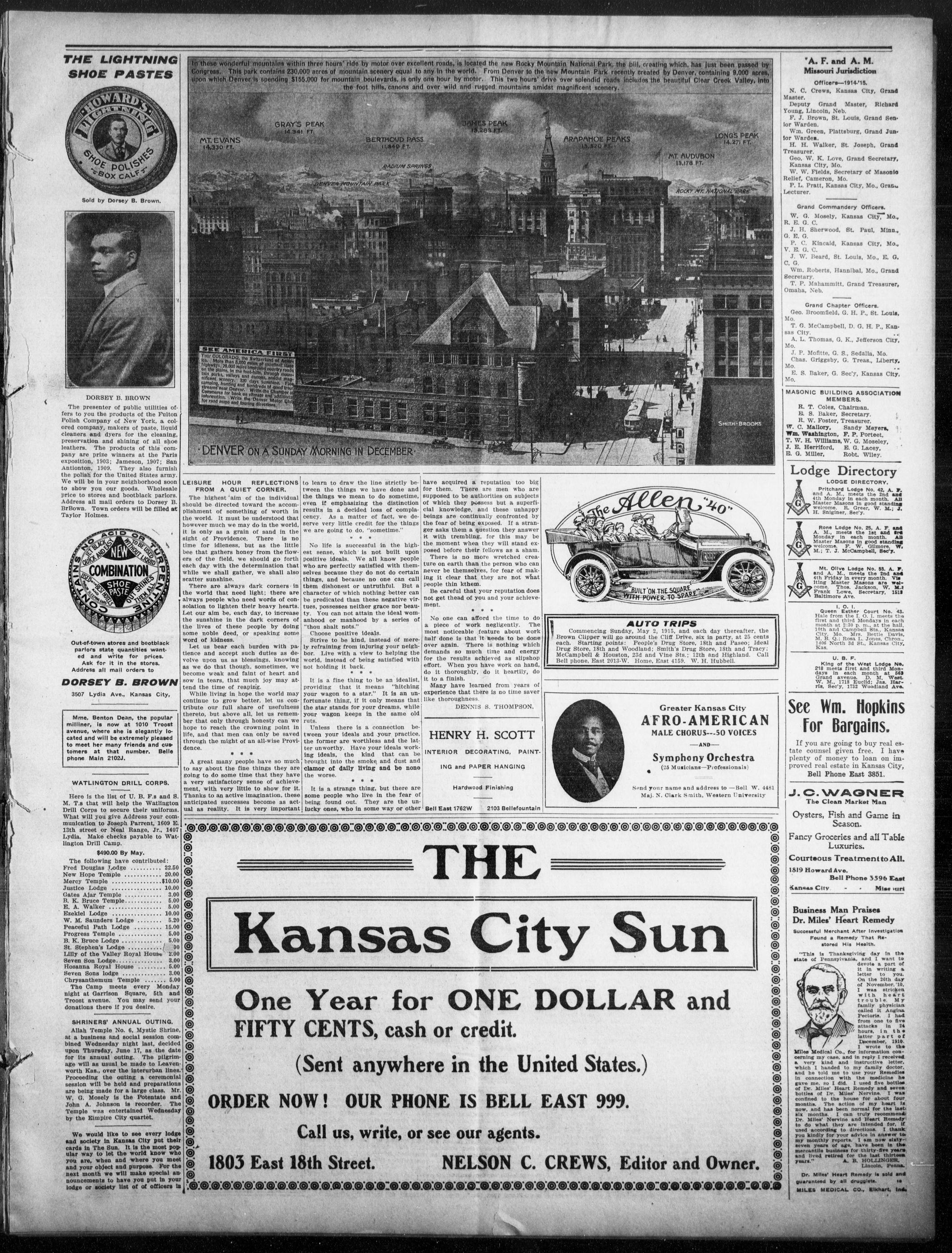
In these wonderful mountains within three hours' ride by motor over excellent roads, is located the new Rocky Mountain National Park, the bill, creating which, has just been passed by Congress. This park contains 230,000 acres of mountain scenery equal to any in the world. From Denver to the new Mountain Park recently created by Denver, containing 9,000 acres, upon which Denver is spending $155,000 for mountain boulevards, is only one hour by motor. This two hours' drive over splendid roads includes the beautiful Clear Creek Valley, into the foot hills, canons and over wild and rugged mountains amidst magnificent scenery.
GRAY'S PEAK
14,341 FT.
MT. EVANS
14,330 FT.
BERTHOUD PASS
11,349 FT.
JAMES PEAK
13,283 FT.
ARAPAHOE PEAKS
13,520 FT.
LONGS PEAK
14,271 FT.
MT. AUDUBON
13,178 FT.
ROCKY MT. NATIONAL PARK
SEE AMERICA FIRST
Your COLORADO, the Switzerland of Angola. More than 5,000 miles of excellent state highways; 20,000 miles employed country roads on the plains. In the rock-hills, through mountain parks, valleys and canons, amidst many different scenery, 20 days sunshine. Clear camping, hunting and fishing, days of good trout streams near Denver. Write the Manager of Commerce for book on climate and additional information. Write the 'Denver Motor Quit' for road maps and touring directions.
DENVER ON A SUNDAY MORNING IN DECEMBER
Kansas City Sun
One Year for ONE DOLLAR and FIFTY CENTS, cash or credit.
1803 East 18th Street.
LEISURE HOUR REFLECTIONS FROM A QUIET CORNER.
The highest aim of the individual should be directed toward the accomplishment of something of worth in the world. It must be understood that however much we may do in the world, it is only as a grain of sand in the sight of Providence. There is no time for idleness, but as the little bee that gathers honey from the flowers of the field, we should go forth each day with the determination that while we shall gather, we shall also scatter sunshine.
There are always dark corners in the world that need light; there are always people who need words of consolation to lighten their heavy hearts. Let our aim be, each day, to increase the sunshine in the dark corners of the lives of these people by doing some noble deed, or speaking some word of kidness.
Let us bear each burden with patience and accept such duties as devolve upon us as blessings, knowing as we do that though, sometimes, we become weak and faint of heart and sow in tears, that much joy may attend the time of reaping.
While living in hope the world may continue to grow better, let us contribute our full share of usefulness thereto, but above all, let us remember that only through honesty can we hope to reach the crowning point in life, and that men can only be saved through the might of an all-wise Providence.
---
A great many people have so much to say about the fine things they are going to do some time that they have a very satisfactory sense of achievement, with very little to show for it. Thanks to an active imagination, these anticipated successes become as actual as reality. It is very important
Call us, write, or see our agents.
to learn to draw the line strictly by
between the things we have done and
the things we mean to do sometime
even if emphasizing the distinction
results in a decided loss of complacency.
As a matter of fact, we deserve very little credit for the things
we are going to do. "sometime."
```markdown
```
No life is successful in the highest sense, which is not built upon positive ideals. We all know people who are perfectly satisfied with them selves because they do not do certain things, and because no one can call them dishonest or untruthful. But a character of which nothing better can be predicated than these negative virtues, possesses neither grace nor beauty. You can not attain the ideal wom anhood or manhood by a series of "thou shalt not." Choose positive ideals.
Strive to be kind, instead of merely refraining from injuring your neighbor. Live with a view to helping the world, instead of being satisfied with not holding it back.
* * * *
It is a fine thing to be an idealist, providing that it means "hitching your wagon to a star." It is an unfortunate thing, if it only means that the star stands for your dreams, while your wagon keeps in the same old ruts.
Unless there is a connection between your ideals and your practice, the former are worthless and the latter unworthy. Have your ideals working ideals, the kind that can be brought into the smoke and dust and clamor of daily living and be none the worse.
* * * *
It is a strange thing, but there are some people who live in the fear of being found out. They are the unlucky ones, who in some way or other
NELSON C. CREWS, Editor and Owner.
have acquired a reputation too big for them. There are men who are supposed to be authorities on subjects of which they possess but a superficial knowledge, and these unhappy beings are continually confronted by the fear of being exposed. If a stranger asks them a question they answer it with trembling, for this may be the moment when they will stand exposed before their fellows as a sham. There is no more wretched creature on earth than the person who can never be themselves, for fear of making it clear that they are not what people thin khem. Be careful that your reputation does not get thead of you and your achievement.
No one can afford the time to do a piece of work negligently. The most noticeable feature about work half done is that it needs to be done over again. There is nothing which demands so much time and energy for the results achieved as slipshop effort. When you have work on hand, do it thoroughly, do it heartily, do it to a finish.
Many have learned from years of experience that there is no time saver like thoroughness.
DENNIS S. THOMPSON.
HENRY H. SCOTT
INTERIOR DECORATING, PAINTING and PAPER HANGING
Hardwood Finishing
Bell East 1762W 2103 Bellefountain
The Allen "40"
BUILT ON THE SQUARE
WITH POWER TO SPARE
Commencing Sunday, May 2, 1915, and each day thereafter, the Brown Clipper will go around the Cliff Drive, six in party, at 25 cents each. Starting points: People's Drug Store, 18th and Paseo; Ideal Drug Store, 18th and Woodland; Smith's Drug Store, 18th and Tracy; McCampbell & Houston, 23rd and Vine Sts.; 12th and Highland. Call Bell phone, East 2013-W, Home, East 4159, W. H. Hubbell.
[Name]
AUTO TRIPS
May, May 2, 1915, and en-
earround the Cliff Drive, s.
: People's Drug Store,
Woodland; Smith's Drug
n, 23d and Vine Sts.; 13
V. Home, East 4159. W
May 2, 1915, and each day thereafter, the sound the Cliff Drive, six in party, at 25 cents People's Drug Store, 18th and Paseo; Idealoodland; Smith's Drug Store, 18th and Tracy; 23d and Vine Sts.; 12th and Highland. Call Home, East 4159, W. H. Hubbell.
Greater Kansas City
AFRO-AMERICAN
MALE CHORUS---50 VOICES
AND
Symphony Orchestra
(25 Musicians—Professionals)
Send your name and address to—Bell W. 448
Maj. N. Clark Smith, Western University
A. F. and A. M. Missouri Jurisdiction
N. C. Crews, Kansas City, Grand Master.
Deputy Grand Master, Richard Young, Lincoln, Neb.
F. J. Brown, St. Louis, Grand Senior Warden.
Wm. Green, Plattsburg, Grand Junior Warden.
H. H. Walker, St. Joseph, Grand Treasurer.
Geo. W. K. Love, Grand Secretary, Kansas City, Mo.
W. W. Fields, Secretary of Masonic Relief, Cameron, Mo.
P. L. Pratt, Kansas City, Mo., Grand Lecturer.
W. G. Mosely, Kansas City, Mo.
R. E. G. C.
J. H. Sherwood, St. Paul, Minn.
G. E. G.
P. C. Kincaid, Kansas City, Mo.
V. E. G. C.
J. W. Beard, St. Louis, Mo., E. G.
C. G.
Wm. Roberts, Hannibal, Mo., Grand
Secretary.
T. P. Mahammitt, Grand Treasurer,
Omaha, Neb.
Grand Chapter Officers.
Geo. Broomfield, G. H. P., St. Louis,
Mo.
T. G. McCampbell, D. G. H. P., Kansas
City.
A. L. Thomas, G. K., Jefferson City,
Mo.
J. P. Mofitte, G. S., Sedalla, Mo.
Chas. Griggsby, G. Treas., Liberty,
Mo.
E. S. Baker, G. Sec'y, Kansas City,
Mo.
MASONIC BUILDING ASSOCIATION
MEMBERS.
R. T. Coles, Chairman.
E. S. Baker, Secretary.
R. W. Foster, Treasurer.
W. C. Mallory, Sandy Meyers,
Wm. Washington, F. P. Porteet,
T. W. H. Williams, W. G. Moseley,
J. E. Herriford, E. G. Lacey,
E. G. Miller, Robt. Wiley.
Lodge Directory
Pritchard Lodge No. 42, A. F. and A. M. Lodge the 2nd and 4th Monday in each month. All Master Masons in good standing welcome F. Reter, W. M.; J. H. Sniginer, Secy.
Rons Lodge No. 25, A. F. and A. M. Lodge the 1st and 4th Monday in each month. All Master Masons in good standing welcome F. W. Gilmore, W. M.; T. J. McCampbell, Secy.
Rone Lodge No. 25, A. F. and
Monday in each month. All
Master Maasons in good standing
welcome.
Mr. McCumbell, Sec. 7.
G
Mt. Olive Lodge No. 53. A. F.
and A. M., meets the 2nd and
third months, the month
taking Mason Hall's w-
elcome. Thos. Jackson, W. M.
Frank Lowe, Secretary, 1518
Baltimore Ave.
I. O. I.
Queen Esther Court No. 43.
Hale from the I. O. I. meets the
first and third months in the hall,
12:30 p. m., at hall,
10th and Campbell Sts., Kansas
City, Mo. Mrs. Mrs. Bettie Davis,
J. O. Rosa L. Jones, Chron.
1406 North 3d, Kansas City,
Kas.
U. B. F.
King of the West Lodge No.
218 meets first and third Mondays in each month at 563
Grand avenue. D. M. West
Secy., 1732 Woodland Ave.
See Wm. Hopkins For Bargains.
See Wm. Hopkins For Bargains.
If you are going to buy real estate counsel given free. I have plenty of money to loan on improved real estate in Kansas City, Bell Phone East 3851
J.C. WAGNER
The Clean Market Man
Oysters, Fish and Game in Season.
Fancy Groceries and all Table Luxuries.
Courteous Treatment to All.
1819 Howard Ave.
Bell Phone 3596 East
Kansas City. Missouri
Business Man Praises Dr. Miles' Heart Remedy
Successful Merchant After Investigation
Found a Remedy That Restored His Health.
"This is Thanksgiving day in the
state of Pennsylvania, and I want to
devote a part of it in writing a letter to you, in the mail with of November 10, I was stricken with heart trouble. My family physician Pectoris, I had from one to five attacks in 24 hours, in the latter part of 1910. I wrote to this
A. B.
Miles Medical Co., for information concerning my case, and in reply I received a kind and instructive letter, I addressed to my doctor, which I addressed to my use your Remedies in connection with the medicine he gave me, so I did. I used five bottles of Dr. Miles' Nervine, and bottles of Dr. Miles' Nervine. I was confined to the house for about four months. The action of my heart is now, and has been normal for the last seven years. Dr. Miles' Nervine and Dr. Miles' Nervine to do what they are intended for, if used according to directions. I thank you kindly for your advice in answer to my request. In seven years of age, have been in the mercantile business for thirty-five years, and lived retired for the last thirteen years." A. B. HOLLINGER, Lincoln, Penn. Dr. Miles' Nervine is sold and guaranteed by all druggists. **MILES MEDICAL CO., Elkhard, Ind.**
THE KANSAS CITY SUN
PUBLISHED WEEKLY.
All communications should be addressed
to The Kansas City Sun, 1803 East 18th
Street.
Bell Phone East 999.
Entered as second-class matter, August
11, 1968, at the postoffice at Kansas City,
Mo., under the date of March 3, 1879.
Nelson C. Crews.....Editor and Owner
Willa B. Glenn.....General Manager
SUBSCRIPTION RATES:
One Year.....$1.50
Six Months.....75
Three Months.....50
ADVERTISING RATE, 50 CENTS PER
INCH.
CHURCH DIRECTORY.
Bethel A. M. E. Church, 24th and Flora
St. Stephen's Baptist Church, 604 Char-
lotte
Centennial M. E. Church, 19th and
Woodland.
Second Baptist Church, 10th and Char-
lotte
Alen Chapel A. M. E. Church, 10th and
Charlotte
Kansas Ave. Baptist Church, 46th and
Kansas
Ebeneser A. M. E. Church, 17th and
Troy.
St. Augustine's P. E. Church, 11th and
Troost.
Nine St. Baptist Church, 1325 Vine St.
Wind Chapel A. M. E. Church, 11th and
Woodland.
Slue Valley Baptist Church, 1120 Crystal
St. Junction A. M. E. Church, 1743 Belle-
view.
Saventh Day Adventist, 23rd and Wood-
land.
St Monica's Catholic, 17th and Lydia.
Morning Star Baptist Church, 2313 Vine.
Hilary Avenue Baptist Church, 1111
Highland.
Church, Roundtown,
People's Baptist Church,
People's Baptist Church, 19th and
Highland
Friendship Baptist Church, 17th and
Tracy Avenue.
Brighton, NJ 07001. Charles
Pilgrim Baptist Church, 614 Charlotte
St.
Bigelow A. M. E. Mission, 5th and Lydia. Preserve Baptist Church, 29th and Summit. C. M. E. Church, 1817 Flora Ave. St. James Baptist Church, 4038 Mill St. St. James Church, M. E. Church, 43rd and Prospect Place. A. M. E. Mission, 555 Grand Ave. KANSAS CITY, KAN. CHURCHES. M. E. Church, 9th and Neb. Pleasant Green Baptist Church, 1st and Splitlog. Eighth St. Baptist Church, 8th and Oval. Metropolitan Baptist Church, 9th and Washington. Bethel A. M. E. Church, Water and Street Streets. Paul A. M. E. Church, 21st and Ruby. First Baptist Church, 5th and Neb. King Solomon Baptist Church, 3rd and state.
Quindarco A. M. E. Church, Quindarco
Pleasant Valley Baptist Church, Rosedale,
Kan.
A. M. E. Church, 9th and Oakland.
A. M. E. Church, 4th and Oakland.
Salter Mission, A. M. E. Church, South
South Dakota.
Protestant Episcopal, 3rd and Stewart.
Second Baptist Church, 24th and Ruby.
Wesley Chapel M. E., 106 Shawnee.
S. Paul A. M. E. Zion Church, 4000
Adams.
Bethel A. M. E. Church, Roselale, Kan.
Mt. Zion Baptist Church, 4th and Vir-
lion.
Ebenezer A. M. E. Church, Sanford and
Tremont.
Zion Primitive Baptist Church,
Westport avenue and Tangent street,
Rosedale.
EDITORIAL
If a colored man wants to receive favorable notice in the columns of the Star just let him say that higher education is not suited to black people and that he favors purely manual pursuits for his people.
Let everybody keep perfectly cool. More citizens of the United States are maimed, bruised, lynched and burned to death by each other every year than were killed by the Germans on the ill-fated Lusitania.
Upon purely circumstantial evidence three white men down in Arkansas are reported to have been sentenced to life imprisonment for the murder of a Negro. Even at this, however, do not take too many chances in Arkansas.
Negroes in the United States is the title of a quarto size bulletin of over two hundred pages now being sent out from the census bureau. Although it is a deduction from the census taken five years ago it is intensely interesting. Ask for Bulletin No. 129, Census Department, Washington.
Now that the local branch of the National Association for the Advancement of Colored People has prevented jim-crow street cars in Kansas City, saved Garrison Square to the race and prevented anti-intermarriage legislation in Missouri why not tackle the alley entrances to the theaters, the discrimination practiced toward Negro travelers in the cafe at the Union Station and the colorphobia of the taxicab owners. This organization should not feel that its work is accomplished simply because it has done so many wonderful things. Let's get through with this race problem.
To The Kansas City Sun:
Dear Mr. Crews: We take this means of expressing our appreciation of the advertisements run in the Kansas City Sun. We feel that our success was through your hearty cooperation with us. Thanking you again, we beg to remain.
Sincerely your patrons,
The XX History & Art Club.
MUST PAY FOR NEWSPAPER.
Judge George Thomas, of Columbus, Ohio, recently decided that if a man accepts a paper that is sent to him he must pay for it. The decision was rendered in the case brought by the Columbus Telegram against a man for $2.35. The Telegram had been sent to the man's home, and he had accepted the paper. When called upon to pay for it he refused, and suit was brought. When Judge Thomas heard the evidence he instructed the jury to bring in a verdict for the Telegram.
Judge Thomas rules that the old common law principal that what a man received and used he was bound to pay for applied in this instance."
We can cite hundreds of such cases in every state. Supreme Courts have also passed on such contentions and it certainly seems that only the most ignorant would attempt to evade payment when the only defense they have is that of having ordered the paper
---
or of not agreeing to take same after subscription had expired. Also going still further into the law we wish to state that the subscriber must pay all back subscription due, before he can legally refuse to take the paper from the postoffice. The courts have also held that removing and notifying publisher to change the address and then refusing to pay for the papers not received is prima facie evidence of intention to defraud.
We have heard complaints of subscribers who state that it is impossible under the present laws to stop a publication. There is absolutely no ground for such complaints, because if a subscriber will only pay up and then refuse to take the paper from the postoffice or the postman, the postmaster must notify the publisher that the paper has been refused and the publisher must cease to send the same. It's now up to publishers to use these facts to correct this existing evil and above all else stop issuing the misleading statements that you cannot send your paper after the term paid for has expired.
TRI-QUARTO CELEBRATION
Fifth Episcopal District St. Louis, Mo.
July 5-9, Inclusive, 1915.
To the Fifth Episcopal District
Dear Brethren: Seventy-five years ago, William Paul Quinn came to the shores of the Father of Waters (the Mississippi River) and stood upon its eastern bank and preached across its waters to the Negroes in St. Louis, who hungered and thirsted for the bread of life. As soon as he was permitted to do so, he crossed over into St. Louis and organized the A. M. E. Church, the first Methodist among Negroes in Missouri and the West. As the years passed by, Thomas D. Ward went to the Pacific coast and John M. Brown, to New Orleans and the south west. These fathers of the church, although they suffered bonds and afflictions, yet with unfaltering trust in God, they stood as the beaten anvil to the strike. They passed on to the heaven of peace and rest by the quiet waters of life in the everlasting city of God. Their names and memory, rich with the holy spoils of peaceful triumph, come to us as a glorious heritage and as an inspiration to carry on to a final consummation the work by them so well and wisely beum
African Methodism, the one flame of Negro religious freedom and manhood, is the gift of these men of the west and to the generations of to-day. Seventy-five years ago, a few trembling slaves stood upon the murky bank of the sullen Mississippi and listened to the message of peace from this grave ambassador of God, but today, a mighty host of loyal sons and daughters of Allen with banners outflung, join in one voice to sing: "Glorious things to thee are spoken, He whose word cannot be broken, Formed thee for his own abode On the Rock of Ages founded, What can shake thy sure repose With salvation's walls surrounded Thou may stmile at all thy foes."
Seventy-five years! Two generations of men have come and passed into the silent vista of yesterday. Those of the second that remain, with the mighty host of the third that has entered Zion's gates, will meet in St. Louis, July 4, 1915, to celebrate the triumphs of the seventy-five years of our religious existence west of the Father of Waters. Our sons and daughters fro m the shores of the pacific, from the International line of British America, from the arid wastes of Arizona and New Mexico, from beneath the shadow of the stately and framing Rockies, will come back to our Mecca of Western Methodism, back to the shrine of the mother of this Western Religious Empire, beautiful in her robes of righteousness, we gather July 4th, to bow at her sacred altars and sing together, the praise of God.
Back to the altars of St. Paul, the Queen of our empire! What honors shall we bring in memory of the illustrious fathers of the past? We believe that every loyal son and daughter of African Methodism in all this vast territory—the twenty-five thousand children of Father Quinn, will each make an offering according to their ability. We are trying to raise means to carry on our Mission work in this territory and ask all who can possibly do so, give us One Dollar. If you cannot give One Dollar give Fifty cents; give twenty-five, give ten cents, give five, give as God has prospered you in life. Those who give fifty cents or more will have their names printed in the records of the celebration.
Report to the pastor or to whom he may designate to receive it to be sent to Rev. A. A. Gilbert, 4729 Ferdinand street, St. Louis, by July 4, 1915. With faith in your love and loyalty for African Methodism.
H. B. PARKS, Bishop.
J. D. BARKSDALE, Gen. Sec.
LEXXINGTON, MO
Miss Bertha Webb went to Kansas City Sunday morning for an indefinite stay.....Mr. Victor Collins returned to Jefferson City last Thursday evening after attending the funeral of his sister, Mrs. Bettie Osborne.....Miss Allie Freeman pianist for the Buckner Company is at home now for a few weeks.....Mr. and Mrs. Forest Smith returned to their home in Kansas City Mo., Wednesday evening after attending the funeral of their sister Mrs. Bettie Osborne.....Cards are out announcing the approaching marriage of Miss Hattie M. Smith, a teacher at George G. Smith College to Professor J. W. Jackson also a teacher at Geo R. Smith College, which will occur Wednesday afternoon, May 19, 1915, at 4:30 o'clock at the residence in Estil Helgues.....Mr. Jonah Mady passed away this morning at his home on Oelda street, after a short illness.....Mrs Tamar Walker still remains quite ill at her home on North 17th street.....Miss Rosa Carter who has been quite ill at her home on Bluff street for the last eight weeks is speedily recovering.....Sunday was Mothers Day and the Mothers Club rendered an excellent program at the Forum which was held at Zion A. M. E. church Sunday afternoon at 4 o'clock.
Health Hints By Dr. Lloyd E. Bailer
A weekly discussion of Hygiene and Sanitation, First Aid Measures and Preventive Medicine. Questions will be answered but no diagnoses nor prescriptions will be given in this column.
M.
It is written that the breath of life was breathed into man's nostrils, not his mouth. The nose is the proper avenue of ventilation for the lungs. We have noted the paramount importance of lung ventilation, or in other words, of deep and proper breathing. We have observed that deep breathing is a preventive of tuberculosis, that it is a stimulant to the heart and circulatory system, that it aids digestion, that it keeps the mind clear and drives away the "blues." Hence it follows that it is imperative to keep nature's aerial highway, the nose, cleared and in good condition that the breathing process may go on without impediment or interruption at all times.
Disease of the nose, throat and ear are very nearly akin, and because of this kinship any diseased condition which affects one is likely to affect the other two. The reason for this is that the nose, throat and ear are practically continuous chambers and lined with a common mucous membrane. Hence it is that a common "cold in the head" frequently begins in the nose, passes thence to the throat and finally results in an earache. Of these three organs the nose should receive our most serious attention, for the proper care of the nose is, likewise, the proper care of the throat and ear.
There are few things in childhood that demand more careful attention than the nose. Most of the chronic nasal catarrh of adults is the direct result of minor diseases of the nose during childhood that could then have been cured without difficulty, but which now can be cured, if a cure is possible, only by long and tedious courses o f treatment. nO the other hand, many children never reach their full mental and physical development because or nasal diseases that a competent physician could have cured in fifteen minutes. This takes us to the important subject of "adenoids" and the necessity for their removal. Mouth breathing in children should always be viewed with the most serious concern on the part of parents, as it signifies a diseased condition that should be remedied at once. The usual cause of mouth breathing in
JOPLIN, MO.
The Wayside Inn will open for business June 1st at 711 1:2 Broadway, Mr Lon Woolard, proprietor.....Mr. Napoleon Whitefield champion wrestler of Joplin met with an accident last week when he was defeated by Mr. O all of the churches. The Unity Ptist church was crowded all day Sun Wright known as Sampson the wrestler.... Mothers Day was observed at day. Rev. A. J. Jones preached an able sermon. The program was one of the best that we have heard. Prof. E. R. Johnson recited an original poem.... Mr. J. M. McCracken amateur pugilist was victor in a 6-round bout Monday night, over Joe Brown. The fight lasted 4 rounds.... Mr. Jim Askew left for Kansas City Tuesday....Mrs Montgomery, 310 N. Sargeant, entertained friends from Galena, Kansas. Sunday....Services at the Handy chapel are extra good. Rev. Robinson will preach the Odd Fellow sermon next Sunday. Last Sunday Rev. Curtis will preach at night.
TROY, KANSAS.
(By Mrs. Nelle E. Howard.)
Mothers Day was carried out by a special program at the A. M. E. church Sunday....Mrs. Geo. Gater was called to St. Joseph, Mo., on account of the illness of her mother, Mrs. Duncan....Mrs. Maggie McCurry of El wood was the guest of her arents, Mr. and Mrs. Alex Wilkinson Monday....Miss Elsie Lair was the guest of Mrs. and Mrs. Sam Davis o f Wathena Saturoy on Sunday....Mr. and Mrs. M. W. Webster and children and Mrs. Mary Schumache spent Sunday in Troy and took part in the Mothers Day program....Mrs. Florence Lain is indisposed....Mrs. Belle E. Howard transacted business in White Cloud....Mr. Harrison Wilkinson met with a very serious accident Sunday when he was kicked by a horse. It will be some time before he can leave his home....Miss Lizzie Lightle was a St. Joseph visit Sunday....Little Lillian Webster was given a birthday party Saturday, May 8, at the residence of her aunt's, Mrs. Nelle E. Howard, is being her ninth birthday. Sixteen little guests were invited and the evening was very pleasantly spent in playing games on the lawn, after which a dainty repast was served. She was also presented with several gifts from her little friends and each one expressed their thoughts of the pleasure they had and left wishing Lillian many more such happy birthdays.
PLATTSBURG, MO
(By Lenard Thompson)
Rev. Shipp preached Sunday at the Second Baptist church. The entertainments at the Second Baptist and Second Christian churches were very successful Saturday evening. Mr. Elmer Clark joined the Masonic lodge Satursday evening. Mr. Oliver Hunter is out again after several weeks of illness.....Mr. and Mrs. Jas. Clark were in town on business, Saturday evening....An interesting ball game was played here Sunday between Plattsburg and St. Joe. Score 8 to 10 in favor of the latter.
LARNED. KANSAS
The pastors and visitors who con-
template attending the Kansas dis-
children is the presence of a growth in the upper and back part of the nose. This growth is very similar to an enlarged tonsil and, indeed, is often called the third tonsil. The name "adenoids" is given to this growth because it consists of adenoid tissue and because it usually has a number of protuberances which give it the appearance of pinitality.
The presence of adenoids in the child's nose is attended with many dangers, as the mouth breathing which results permits not only dust but germs to enter directly into the bronchial tubes and lungs. Germs of tuberculosis, pneumonia, bronchitis, etc., enter very readily through the mouth, whereas they would be filtered out while passing through the hair-like processes within the nose. More than this, mouth breathing in children prevents the development of the nose, and further mars the facial appearance by causing the upper jaw to become narrow, thereby producing an ugly protrusion of the front teeth, and a characteristic stupid expression. Mouth breathing tends to arrest the whole physical development of the child, frequently causing deformities of the spine, rounded shoulders and the narrow pigeon breast. It causes constipation and digestive disturbances, headache, a weak circulation and impoverished blood in the growing child. It also causes sluggishness, loss of memory and incapacity for mental concentration. Many a child is "dull" in school simply because he has adenoids. Many a child has been denied the right and proper enjoyment of his physical and mental heritage because of these small growths that blocked his air passages and thwarted his subsequent development.
Parents should stand ready at all times to prevent mouth breathing in their children. Adenoids is the usual cause. This growth may easily be removed by a competent physician without the slightest danger to the child. The operation clears the nasal passages and restores the natural breathing through the nose. It is always to be advised for persistent mouth breathing in children. Nasal diseases properly treated in childhood seldom persist in adult life.
trict and Sunday School Convention at Larned, Kan., may drop a card to Rev. C. H. Anderson, 1012 Johnson street, Larned, Kan., and inform me how many you will bring with you. We expect Bishop M. F. Jamison, D. D. and Editor J. A. Hamlett, D. D. with us.
HOLDEN, MO
By CHAS PRATT
Mr. Ed Dodd spent last week in Kansas City.....Mrs. B. B. Tully was called to Kansas City on account of the death of her sister.....Mrs. Stella Combs has returned home again....Mrs. Clarcy Smith reports her aunt no better....Mrs. Norman Little is visiting her mother, Mrs Hannah Jacobs.....Miss Katherine Jacobs, Mrs. Ella Atkins and Miss Georgia Jacobs went to Centerview, Mo., to pay the last respect to Mrs. Vina Morgan....Mr. Forest Berry, accompanied by Mr. Lindsay, visited here a few days....The Ramblers will play at Clinton Sunday....Mr. Jerry E. Cobb of St. Louis spent a week here.....Mrs. M. Fisher spent a few days here.....Miss Bessie Owens of Warrensburg spent Saturday and Sunday visiting Mrs. Nan Simons.....Mrs. Susie Mabery is visiting relatives this week.
WHITE CLOUD, KAS
Quarterly meeting was held last Sunday at the A. M. E. church. The presiding elder was present. Baptising was held at the Riverside Park on the Breckenridge farm. The U. B. F. and S. M. T.'s purchased a two-story building on Main street. Mrs. Minnie Fooreman of Foreman, Ok. spent three weeks visiting her grandmother. Mrs. Louise Marshall and other relatives and friends. Mrs. Marshall has been on the sick list but is improving slowly. Mrs. Ruby Davis of Wathena, Kas., was the guest of Mrs. Stella Breckenridge last week. Mr. Marion True left for St. Paul where he expects to remain all summer. Mrs. Nelle E. Howard was in town last Wednesday on business between trains. Mr. Alex Laver is visiting his family who lives in University Place, Neb. Mr. Mason Todd of Lincoln, Neb., purchased the Breckenridge home and will move there soon. Mrs. Allie Duncan purchased the town property of George Duncan. Mrs. Earl Graves and son Lawrence left Wednesday for an extended visit in Kansas City and Richmond, Mo.
SALISBURY MO
R. W. Grand Lecturer Paris L. Pratt was the guest of Mr. and Mrs. Evans Saturday and Sunday and made his annual visit at night and his lecture was inspiring and full of encouragement, and filled the brethren with much enthusiasm.
FOREST GREEN MO
Rev. Davis preached one of his most able sermons Sunday to a large audience. Mrs. Phoebe McClure, who was shot by her husband, Paul McClure, Monday morning, died May 5 at the age of 23. She was married in November, 1910. A mother, father, sister, brother and a host of relatives and many friends survive her. Rev. A. L. Flounoy officiated.
Money to loan on approved security. We sell homes on easy-terms. See me or my clerk at my office, $521\frac{1}{2} \text{ Virginia}. Phone 1259. J. N. Brownlee,
Little Corner
—That a castle inthe air may be alright but a cottage on earth is better.
—That a certain dude who poses as a business man is only a policy writer.
—That the world never seems so bright to young lovers as it does on a moonlight night.
—That a lady who is suing for a divorce says if the court doesn't hurry and give it to her she's going to Utah. (What does this mean?)
—That a street preacher shouted to another colored man "Brother if the silver chord should break where would you go?" and the brother shouted right back "I'd go to Wilson the Negro jeweler, at 1616 W. 9th St. and get it fixed."
—That a colored minister was once trying to explain to his congregation the meaning of the word phenomenon by means of an illustration. "If you see a cow," he began, "dat ain't no phenomenon, and if you see a tree dat ain't no phenomenon. But if you see a cow sitting in a tree and singing like a bird dat am a phenomenon sure."
—That one day as Judge Latshaw, who is a great horseman, was riding through the country, he stopped at a farm house of an old colored couple down in Bates County and it being a very warm day asked for a drink of water. The old woman who was working industriously in the garden by the side of the roadway called out: "You Derploma, You Derploma, cum heath and git dis gemmen a drink of water." And after the child had brought the judge the water, he said to the old lady: "Auntie, that's a very peculiar name, how did you happen to name that child Diploma; I don't think I ever heard such a name before." And the old lady looked at him and with rising indignation said: "I had a gal dat wanted to go to off one of them big nigger doin's schools and was always saying "Mammy I must go away and get me a derploma and den, I'll be a fine lady!" and that's what she brought back. Without a word the judge rode on.
PAGE 8HOES.
I have bought all my shoes from Mr. Page; I like them fine—Mrs. Youngman.
The Page Shoe Store has been very nice to me and as far as they have been permitted to do so, have been very punctual in attending to my shoe business—V. E. Overall.
I don't know what I would do if Mr. Page didn't help me keep my girls in school by furnishing shoes at a cut rate, for cash—Mary Davis, 21st and Harrison.
I have not bought all of my shoes from Page5 store and found complete satisfaction, but I have sent seven of my lady friends there who purchased the shoes for their families and were highly pleased—Mrs. Childs, Cottage avenue.
My shoes fit me better this time than before. I believe the Page shoe store is furnishing better goods than ever. Oh, yes, my wife will buy her shoes there from now on—Chas. Starks.
I am proud of the progress the shoe store has made since my friend Page has had charge of it. I buy my goods there.—A. W. Harris, the Printer.
I take my wife and two girls down to Page's shoe store and fit them out, pay the cash and come away satisfied.—C. Weddington.
School shoes for my little girls bought in the fall, lasted all winter with repairs.—Mrs. J. S. Harris.
I bought $15.00 worth of shoes from Page at Easter time. They made him happy. He bought a $30 suit of clothes from me and that made me happy. Everybody's happy.—G. V. Golden.
I bought a pair of shoes from Mr. Page two years ago and they've worn until now; I am going over next week and get me a pair of the same kind. They're good enough for me.—Bell Compton.
8T. JOSEPH. MO.
The Mission Circle of the Francis Street Baptist church held their fair Monday. May 10...A song service was given at the A. M. E. church Sunday night by the blind evangelist. David W. Reed...The funeral of Mrs. Malissa Jones was held from the A. M. E. church Sunday afternoon under the auspices of Queen Esther Tabernacle, of which she was a charter member...Men's day will be observed at the Ebenezer A. M. E. church May 16...Women's day will be held at New Hope Baptist church Sunday...Mr. John Johnson is on the sick list...Mrs. Georgia Beshear, who has been visiting her daughter in Kansas City, Kas., has returned home much improved in health...Mrs. Charles Mason is very ill at her home...Mrs. Mary Brown is able to be out again...Queen Eather Tabernacle will hold its installation at the hall, Second and Francis streets. Sir Willis Williams will install the officers.
Negro Business and Professional Directory of Greater Kansas City
(Your name, business, address and telephone carried in this directory at 25 cents per month, $3.00 per year; less than one cent. Can you beat it?) To secure space call 518-252-2522 or see our agents.
BARBECUE
19 East 18th street. Bell phone 3062W. Free
BARBERS.
Twelfth street.
ERS, DYERS AND TAILORS.
D DYERS, guarantee not to shrink any gar
13 East 18th street. Bell phone, Grand 2437
11 Paseo. Bell phone East 701.
E WORKS, 1605 East 18th St. Bell phone
R. W. ALEXANDER, 1619 East 18th street. Bell phone 3062W. Free delivery.
BARBERS
CLEANERS, DYERS AND TAILORS.
O. K. CLEANERS AND DYERS, guarantee not to shrink any garment they dye. 1113 East 18th street. Bell phone, Grand 2437.
WORTHAM BROS., 1731 Paseo. Bell phone East 701.
GOLDEN'S STEAM DYE WORKS, 1605 East 18th St. Bell phone East 539.
DRUG STORES
IDEAL PHARMACY, Prof. R. W. Foster, Prop.,
Bell phone East 2727, Home phone East 4070
FLORISTS.
WEAVER FLORAL CO., Flowers for all occasion
Homes, churches and halls decorated. 1510
phone 4798 East, Home phone 7555M.
GROCERS.
J. L. MATTSON, 14 East 19th St. Bell phone G
COTTAGE GROCERY, 121 Westport Ave., Rosede
Anderson, proprietor.
LAUNDRIES.
THE IMMACULATE LAUNDRY, 1912 East 18
East 4723.
LAWYERS.
C. H. CALLOWAY, 601 Delaware, Home phone
all courts.
W. C. HUESTON, 601 Delaware, Home phone
Practices in all courts.
GEO. T. WASSOM, Attorney at Law, 307 Walnut
PHOTOGRAPHERS.
C. BRUCE SANTEE, Proprietor The Fad, 1607
phone East 1643.
Prof. R. W. Foster, Prop., 18th and Woodland
77, Home phone East 4070.
FLORISTS.
, Flowers for all occasions. Funeral designs
and halls decorated. 1510 E. 18th street. Bell
home phone 7555M.
GROCERS.
Bell 19th St. Bell phone Grand 2309W.
121 Westport Ave., Rosedale, Kas. Rev. S. A.
or.
IDEAL PHARMACY, Prof. R. W. Foster, Prop., 18th and Woodland. Bell phone East 2727, Home phone East 4070.
FLORISTS
WEAVER FLORAL CO., Flowers for all occasions. Funeral designs. Homes, churches and halls decorated. 1510 E. 18th street. Bell phone 4798 East, Home phone 7555M.
GROCERS.
J. L. MATTSON, 14 East 19th St. Bell phone Grand 2309W.
LAUNDRIES
LAUNDRY, 1912 East 18th St. Bell phone
LAWYERS.
Del Delaware, Home phone M58. Practices in
Delaware, Home phone M58. Legal advice
orney at Law, 307 Walnut street.
PHOTOGRAPHERS.
proprietor The Fad, 1607 East 18th St. Bell
THE IMMACULATE LAUNDRY, 1912 East 18th St. Bell phone East 4723.
LAWYERS
C. H. CALLOWAY, 601 Delaware, Home phone M58. Practices in all courts.
W. C. HUESTON, 601 Delaware, Home phone M58. Legal advice. Practices in all courts.
GEO. T. WASSOM, Attorney at Law, 307 Walnut street.
PHOTOGRAPHERS.
C. BRUCE SANTEE, Proprietor The Fad, 1607 East 18th St. Bell phone East 1643.
PHYSICIANS.
DR. R. J. LAMBERT, Theraptics, P. O. box 90A, 1523, Rosedale, Kas.
REAL ESTATE and EMPLOYMENT
AFRO-AMERICAN REAL ESTATE & INVESTMENT
mished. 911 McGee street.
Bell Phone 751 Main.
MRS. A. E. JENKINS, 1324 Vine street, Bell Phone
SECOND-HAND GOODS.
W. G. HOPKINS, 2122 Vine St. Bell phone East
MILLINERY.
MME. STELLA HUBBARD, latest things in ha
new. 1510 East 18th street. Bell phone E.
Nherapties, P. O. box 90A, Bell phone, Rosedale.
ESTATE and EMPLOYMENT.
REAL ESTATE & INVESTMENT CO., Help fund street.
n. Home Phone 7555 Main
324 Vine street, Bell Phone East 4067J.
SECOND-HAND GOODS.
Vine St. Bell phone East 3851W.
MILLINERY.
HARD, latest things in hats. Old hats made with street. Bell phone E. 4798.
DR. R. J. LAMBERT, Theraptics, P. O. box 90A, Bell phone, Rosedale 523, Rosedale, Kas.
REAL ESTATE and EMPLOYMENT.
AFRO-AMERICAN REAL ESTATE & INVESTMENT CO., Help furnished. 911 MeGee street.
Bell Phone 751 Main. Home Phone 7555 Main.
MRS. A. E. JENKINS, 1324 Vine street, Bell Phone East 4067J.
SECOND-HAND GOODS.
W. G. HOPKINS, 2122 Vine St. Bell phone East 3851W.
MILLINERY.
MME. STELLA HUBBARD, latest things in hats. Old hats made
new. 1510 East 18th street. Bell phone E. 4798.
TO THE PUBLIC:
We want you to come to us for everything carried
DRUGS, MEDICINES, TOILET ARTICLES, RUBBES,
BRUSHES, MADAM WALKER HAIR-GROWER,
STRAIGHTENING COMBS, ETC.
We recommend and guarantee everything offered
exactly as represented. WE DO NOT "SUBSTITUTE"
take other brands than you ask for. You "want what
we want you to have it.
OUR PRICES ARE RIGHT
All down the line. We give careful attention to a
by courteous and fair treatment to give perfect
customers. When you think of Drugs think of
THEO. SMITH'S PHARMACY.
No demand is too difficult for us to supply. I
to come to our store, phone us your wants and we
Mall Orders Solicited and Promptly
Theo. Smith's Drug Store
Bell Phone 4591 Grand. Home Phone
1301 E. 18th St.
to us for everything carried by a Drug Store.
OILLET ARTICLES, RUBBER GOODS, COMBB,
WALKER HAIR-GROWER-DRYING COMBB,
AIGHTENING COMBS, ETC.
and guarantee everything offered for sale to be
WE DO NOT "SUBSTITUTE" nor ask you to
you ask for. You "want what you want" and
OUR PRICES ARE RIGHT
give careful attention to all orders, and aim
treatment to give perfect satisfaction to our
think of Drugs think of
CO. SMITH'S PHARMACY.
cifficult for us to supply. If you are too busy
phone us your wants and we will do the rest.
are Solicited and Promptly Filled.
Smith's Drug Store.
Grand. Home Phone 5467 Main.
KANSAS CITY, MO.
We want you to come to us for everything carried by a Drug Store.
DRUGS, MEDICINES, TOILET ARTICLES, RUBBER GOODS, COMB8,
BRUSHES, MADAM WALKER HAIR-GROWER-DRYING COMB8,
STRAIGHTENING COMB8, ETC.
We recommend and guarantee everything offered for sale to be
exactly as represented. WE DO NOT "SUBSTITUTE" nor ask you to
take other brands than you ask for. You "want what you want" and
we want you to have it.
OUR PRICES ARE RIGHT
All down the line. We give careful attention to all orders, and alm
by courteous and fair treatment to give perfect satisfaction to our
customers. When you think of Drugs think of
THEO. SMITH'S PHARMACY.
No demand is too difficult for us to supply. If you are too busy
to come to our store, phone us your wants and we will do the rest.
Mail Orders Solicited and Promptly Filled.
Theo. Smith's Drug Store.
Bell Phone 4591 Grand. Home Phone 5467 Main.
1301 E. 18th St. KANSAS CITY, MO.
Bell Phone West 3557
The St. Regis Cafe
and Ice Cream Parlor
G. W. BERRY, Prop.
544 State Avenue
Kansas City, - - - Kansas
Randolph Bros. @ Son
New and Artistic Carpenters
h Bros. @ Son
tistic Carpenters
Randolph Bros. @ Son New and Artistic Carpenters
```markdown
```
Paper Hanging and Painting,
Patching and Plastering
General Repairing a Specialty
PROMPT WORK
REASONABLE PRICES
BELL PHONE East 2526
SHOP 1207 Highland. Res. 1031 Highland
KANSAS CITY, MO.
Superb Wall Papers
Samples Shown at Your Home
No obligation to purchase.
A postal brings us.
It's Up to You
to patronize a man who has been for lo these m
ing to help himself and also build up the b
of his race.
J. A. WILSO
Kansas City's Pioneer Negro
Sells Watches, Clocks, Diamond
and other Staple Reliab
or will help you to buy the same from any le
house.
You will receive courteous treatment and
who has been for lo these many years striv-
elf and also build up the business prestige
A. WILSON
Y's Pioneer Negro Jeweler
s, Clocks, Diamonds
other Staple Reliable Jewelry
buy the same from any leading wholesale
house.
courteous treatment and square dealing.
West 9th street, Kansas City, Mo., one-
Wyoming street or station.
to patronize a man who has been for lo these many years striving to help himself and also build up the business prestige of his race.
You will receive courteous treatment and square dealing. This store is at 1616 West 9th street, Kansas City, Mo., one half block west from Wyoming street or station.
PETER H. BURGESS
and Builders
CITY NEWS.
O, YOU CRITERION THEATRE!
HAVE YOU VISITED THE CRITERION THEATRE? IT'S GREAT.
PASTURE—For horses and cows.
Bud Gilliam, R. R. 4, Box 106, Kansas City, Mo.
Mrs. Zania Hunter, 2462 Flora avenue, went to Leavenworth, Kas., to visit her mother, who is quite aged.
Mr. Arthur Thomas of International Falls, Minn., is visiting Miss May Smith, 3906 E. 14th street and stopping at the Y. M. C. A.
Mr. Bass Booker, of 1315 Woodland avenue, and Miss Margaret Glover, 1801 E. 18th street were quietly married Monday, the 3d.
Have you visited the Colored Handy store at 2409 Vine street? Go there for bargains.
Mrs. Leana Hines, a most charming young widow of Lawrence, Kas., is visiting Mrs. Pearl Henry, 1708 Michigan, and is the recipient of much social attention.
Mr. Wm. Smith, who is walking to Galveston, Teas, writes that he reached Perry, Okla., the 30th of April and Oklahoma City, May 4th. He left there for Purcell, Okla., the 5th.
When you want work done up-to-date, call up the COLORED ACME HOUSE CLEANING CO. Prices reasonable. Bell phone Main 751; Home Main 7555. Residence phone Home Main 6438. M. C. SPICER, Manager.
Mrs. Lena E. Ingram desires to thank her neighbors, friends and Carnation Court for their kindness and beautiful flowers while she was confined at Wheatley Provident hospital.
The Billy King Stock Company is putting on the most entertaining bills at the Criterion ever given in this city. If you want to spend an evening of real enjoyment, go hear them.
WANTED-Canvassers, men or women, to sell the famous Peerless furniture polish. Liberal commission. A splendid opportunity for the right parties. For information see J. H. Malone, 1318 Michigan.
A new enterprise in the shape of a laundry at 1912 East Eighteenth street, has been opened by three of our enterprising young men, R. W. Atkins, T. T. Payne and L. W. Fitzpatrick. Give them a trial.
The commencement exercise of Western college, Macon, Mo., will be held from Monday, May 17, to 21 inclusive. Sunday, May 16, the baccalaureate sermon will be preached by Dr. B. P. E. Gayles.
The editor is in receipt of an invitation of the Graduation exercises of Washington school at Plattsburg, Mo., from Miss Bernice Green, daughter of Mr. and Mrs. Wm. Green. Miss Green is the salutatorian of her class.
The editor delivered commencement address at Elwood, Kansas last Thursday night. Prof. R. G. Jackson and Western University chorus furnished music for the occasion and a large crowd was in attendance.
M. R. Wilson conducts a splendid grocery at Twenty-seventh and Wood-land. Have you ever traded with him? Give him a trial. You will find that he'll make good in every particular. Help build up race enterprise.
Mrs. Fannie Dotson, who recently moved to Chicago to live, was called to the bedside of her son, Mr. John nie Dotson, 2940 Summit street, who fell fifteen feet through a shaft at the Savoy hotel and fractured his skull.
You get these three most important requisite when you take your printing to
one-half block from the Troost Avenue and Eighteenth Street transfer point. Bell phone, Grand 2988.
Artie Bell, 22 years old, died at his residence, Twenty-fifth and Grove streets, Tuesday, and will be buried at the old home at Weston, Mo. He was married les sthan a year ago and leaves a wife, parents and other relatives to mourn his loss.
Dr. M. O. Picketts, P. G. M., of Masons, St. Joseph, Mo., was in the city Wednesday to meet the committee composed of Prof. Joe E. Herriford, Prof. Wm. H. Dawley and himself, who are revising a ritual of the Masonic fraternity. He was royally entertained while here.
Mr. and Mrs. N. C. Crews were the recipients this week of a handsome souvenir from the race's distinguished and most successful physician, Dr. J. R. A. Crossland of St. Joseph, Mo., and they have not words to express their sincere appreciation of this wholly unexpected gift.
Bishop Parks, the presiding bishop of this district, has been quite ill during the week at the parsonage of Allen chapel, but has received the best possible care at the hands of Rev. Thomas and his estimable wife. The Sun wishes for him a complete restoration to health.
Mr. and Mrs. Floyd Wilson Howard announce the birth of a son, May 6th, to whom they have given the name of William Douglass. Mrs. Howard was formerly Miss Mamie Ellen White.
Dr. Wm. J. Thompkins, superintendent of the Old City Hospital went to Wewoka, Okla., Tuesday to meet the Oklahoma Medical Society and to arrange for a consolidation of the societies of Missouri, Kansas and Oklahoma. Drs. Perry, Brown and Unthank accompanied him.
Dr. L. E. Bailler met with a serious misfortune while down in the shopping district last Tuesday morning. Leaving his car at Tenth and McGee streets, he walked to the bank to transact some business, and on returning found that his car had been stolen. He immediately reported it, but no trace as yet has been found.
Mrs. Tyler Jackson, 2531 Michigan avenue, died after a long illness last Tuesday and was buried Thursday under the auspice of the H. of J. and the Eastern Star from Ebenezer chapel, of which she was a member. Rev. Gilbert preached the funeral sermon, assisted by the pastor, Rev. W. C. Williams.
Mrs. W. T. Garner, 1728 Woodland avenue, returned from a two months' stay in St. Louis, Mo., where she has been in the interest of the Madame P. M. Dabney's XX Century Hair Preparation Company. While there she was the guest of her sister, Mrs. Walter Jackson and Mrs. Crittenden C. Clark.
The boys of No. 5 Kansas City fire department have received their handsome new six cylinder auto fire truck, which is indeed a thing of beauty and a joy forever, not only to the firemen but to the citizens of Kansas City, and the Sun congratulates the members of No. 5 company that they have so demeaned themselves as to win the confidence and high esteem of those in authority.
TO THE GENEROUS PUBLIC.
I take this method to notify my clients, friends and public generally that my office is now located at 307 Walnut street, where I am near the city hall, criminal court and circuit court houses, where I will be pleased to serve those who may need my services. Respectfully.
A very enjoyable entertainment and drill was given at Bethel A. M. E church participated in by Far West Commandery No. 3, Emanuel Commandery No. 25, K. T. Watkington drill corps, U. B. F., and the Odd Fellows' cadets. Short addresses were made by W. G. Mosely, Rt. Eminent Grand Commander, Grand Master N. C. Crews and Rev. F. D. Wells. A large crowd was present.
The graduating exercises of the Wheaty-Provident Nurse Training Association will be held at Allen Chapel next Thursday evening, Dr. Wm. J. Thompkins, superintendent of the City Hospital, has been selected to deliver the annual address and music will be furnished by students from the Lincoln High, the Garrison and the Lincoln. There is to be but one graduate this year but an interesting program will be offered. Admission free.
LOOK BEAUTIFUL. Have a clear, healthful skin free from liver spiotes and freckles. The skin must be regarded in two lights: Beauty and health; one part of which I have not spoken is papaelle, tiny prolongations, a horny under layer. The circulation of skin of the face needs stimulation so facial massage is needed. Try our beauty massagist, Miss Cora B. Holmes, an experienced masseuse; Hair and Scalp treatments a specialty. All work guaranteed. 1711 Michigan Ave. Monday—out of town patients. Hours: 8:30 a. m. to 7:00 p. m. Miss Cora B. Holmes.
At the annual meeting of the Wheatley-Provident Hospital Association, Dr. T. H. Ewing was elected president, Joe E. Herriford, vice-president; G. N. Grisham, treasurer, and Mrs. Glenn, secretary. Among the new members of the directorate are Mrs. Minnie Crosthwait, Prof. H. O. Cook, T. Fortune Weaver, and C. A. Franklin, Prof. Grisham reported over fourteen hundred dollars in the reserve building fund and the house committee accounted for nearly four thousand dollars received and disbursed during the year. At a meeting of the latter committee held later Joe E. Herriford was elected chairman, C. H. Calloway, vice-chairman; Mrs. Frances Jackson, treasurer; Mrs. Hettle Nix, secretary, and Mrs. Minnie Crosthwait was appointed investigator of charity patients applications.
Bell 'Phone 1521 E. 18th
E. 1521 Street
TRY A CRECENT AD.
For Your Business sake
Nothing to equal it for a dull, sick
business—only one penny a day.
CRECENT ADVERTISING
AGENCY.
"The Business Way"
BOB BOSLEY, Manager.
ANNOUNCEMENT.
Mrs. Cora D. Williams wishes to inform her many patrons and friends that she has moved her Poro Hair dressing parlor to 1800 Woodland avenue where she will be pleased to see them. Bell Phone East 3131W.
Women's Club Notes
The Ladies' Coterie will give their first exhibit Monday evening, May 17, at Lyric Hall. Dancing from 8:00 to 12:00.
The Progress Study Club meets on Wednesday, May 19, with Mrs. E. R. Vaughn, 26 and Parkway, Quindaro Kansas. The discussion will be "The Negro as a political factor," by Mrs. Clay Johnson.
The Oak Leaf Art Club wishes to thank the public for the hearty way in which they patronized their exhibit. Though it was a stormy night the entertainment was a success and many came between the showers.
The XX History and Art Club met with Mrs. Holman Saunders at the residence of Mrs. J. H. Dixon, 1022 Virginia. A final settlement of the recent exhibit was made. Visitors were Mesdames Givens and Price. Next meeting at the residence of Mrs. Carvel, 1645 Cottage avenue, entertained by Miss Scholl.
MISS C. WASHINGTON,
The Parent Teachers' Association of the Booker T. Washington school has been holding interesting and successful meetings all year. We have had several able speakers with us, including Prof. Joe E. Herriford and Dr. E. J. Coc Campbell. On Friday, May 21, Prof. J. Dallas Bowser will deliver the principal address. The public is invited. Refreshments will be served.
MRS. B. NEAL, President.
MRS. J. WILLIAMS, Secretary.
The Progress Club, a young people's auxiliary of Pleasant Green Baptist church will meet next Monday, May 17, at 8 p.m. at Garrison Field House. Last Monday evening the club was entertained by Mrs. Estes 1530 Lydia avenue. Sixteen members and two visitors were present. All had a delightful time.
MISS WILMA HAMPTON,
LEE PETERS,
President
CARNATION ART CLUB
The Carnation Art Club met at the home of Mrs. Drew 2308 Vine street with a large attendance. The ladies had the pleasure of a visit from the president of the City Federation of Women's Clubs, Mrs. Minnie Crosth wait, who very ably thanked them for their support through the Club season. After viewing the ladies work which is nearing completion for their exhibit May 24, was very much pleased with the progress this club has made in its nine month's of existence. Mrs. DeFrantz also gave the club a very able talk. The business of the evening was taken up and completed after which the hostess served a very dainty luncheon which the ladies very much enjoyed, declaring Mrs. Drew a charming hostess. Mrs. Robinson, Reporter.
THE CLIO ART CLUB
The members of the Clio Art Club gratefully acknowledge the appreciation shown by the many patrons and friends during their indoor Circus on May 7. The receipts were $117.20; expenses, $31.15. The amount cleared was $86.05. The following distributions were made May 12: Garrison Field House picture, $2. Wheatley-Provident Hospital, $5. Orphan Children's Home, $25. Girls League Home, $25.
Reserved funds for charity, $19.05.
All tickets have not been reported
Again we thank the public for their
patronage.
THE WOMEN'S LEAGUE.
The Women's League, the first club organized among colored women in Kansas City, chartered 22 years ago to establish a home for girls. They bought property several years ago and for the last few years have tried to run the home on a small scale and pay for it at the same time. They feel that the time has come when broader steps must be taken which they hope to do just as soon as the debt of $300 is paid. They have a campaign on now to raise that amount.
The campaign consists of war between England and Germany. Nineteenth street is the dividing line. South of Nineteenth is Germany, under the commandership of Mrs. N. C. Crews, with the following members as field marshals: Mesdames Mary Mitchell, F. B. Peck, Fulcher, Crane, Thompson and Anna Lewis. North of Nineteenth street is England, under the commandership of Mrs. L. A. McCampbell, with the following members as captains: Mesdames Bessies Weaver, Myrtle Todd, Susie Andrews, I. F. Bradley and Boyd.
It is hoped that each captain and field marshal will make an effort to raise $25, or as much as they can by making a special effort. Won't you be a volunteer and help one side on the other, please? Peace will be declared June 1 with appropriate cemony. The place of meeting will be stated later.
MRS. L. A. McCAMPBELL,
President Woman's League.
Mrs. John W. Hubbard, 1712 East Twenty-fourth street, who has been traveling through Canada for the past three years, has returned.
The first public meeting of the federation of the ladies missionary societies was held at Centenniel, M. E. church, Wednesday afternoon, May 5th. A short program was rendered. The Home Missionary Society will meet Thursday, May 13th, with Mrs. Mary Segars, 1417 Woodland avenue.
VINE STREET, BAPTIST CHURCH
VINE STREET BAPSTIST CHURCH
Mr. Albert E. Johnson, 1706 Howard street, is very ill, and we hope for her recovery soon. We were glad to see Mrs. Richard Lemons out to church Sunday after a serious illness.... The services were well attended Sunday and there were two additions.
FIRST A. M. E. CHURCH.
Kansas City, Kan.—There will be a rally May 16. Bishop H. B. Parks will preach morning and evening. Our people are repairing and enlarging the church making an addition of 20x90 on the West side. The public is invited.
The Clippers have given subscriptions for another year to the Crisis for the public libraries of Kansas City, Kas., and Kansas City, Mo. Mrs. Trent and Miss Gladys Trent entertained the Clippers and friends Monday evening in honor of Miss Winifred Morton. Before taking their departure each guest was given a telegram by a special messenger boy. These telegrams announced the engagement of Miss Morton to Mr. Woodie Jacobs, the wedding to take place in June.
ALLEN CHAPEL NOTES.
Services at Allen Chapel were of a very high order. The church was beautifully decorated with flowers and plants in honor of Mothers Day and nearly every one in the vast congregation wore a carnation. Dr. Thomas delivered a beautiful discourse on "The Power and Influence of Mother," and at its conclusion five persons joined the church. The congregation was favored with a rare treat in the matchless and magnificent solo rendered by Miss Margaret Jackson and in spite of the solemnity of the occasion applause broke out in all parts of the auditorium. Next Sunday morning Mrs. Lillian Savington Lewis will sing.
SECOND BAPTIST CHURCH
A large audience is expected to hear the Imperial Jubilee singers at this church May 20....At the meeting of the Leisure Hour club at Mrs. Steel's, 2613 Highland, Mr. E. R. Robinson was elected president, Mrs. Collins vice president and Mrs. Higginbotham see retary....The Bacote Literary Society is making success financially. First and third Thursday nights are the meeting dates....The B. Y. P. U. held an interesting session Sunday...."A Deserving Mother" was under discussion during the observance of Mothers' day last Sunday, and the choir and congregation wore flowers and gave a reverent and tearful response to the impressive sermon by Dr. Bacote and to the pathetic solo of Mrs. Shannon, "My Mother's Prayer."
The Grand Master of Masons accompanied by Secretary Love and Relief Secretary Fields go to Clarksville today to officiate the laying of the corner stone of the new A. M. E. church. Grand Master will visit the lodge at Louisiana Monday night and spend the rest of the week visiting the lodges at St. Louis. He will then attend the Grand Court H. of J. which convenes in Macon, Mo., Tuesday, May 25.
IN MEMORIAM.
Just one year ago the 8th of May
You left us, dear Harry, and went
away.
But returned in spirit the 18th of May
And carried our darling Hazel the
self-same way.
You left two vacant chairs that can
ne'er be filled.
It is hard to bear, but we know it was
God's will.
So onward, sorrowing through life's
sad journey we'll roam
Until the dear Saviour bids us a joy
ous meeting
In our eternal Home.
Loving wife and mother,
MRS, ALLA B. BEAN.
Affectionate daughter and sister,
ALBERTA BEAN.
IN MEMORIAM.
This glorious Mothers' day has come and passed away
And left me here to sigh. I sometimes wonder why
When God has done His will and taken away
Whose place can ne'er be filled.
She lived a Christian life and with her will and might
The battle she would fight through darkness into light.
I ne'er forgot the day when mother passed away
And sorrow fell on me throughout my life to be.
Her voice is hushed in death, no more I hear her say,
My child, be still, and have the will to climb up Zion's hill.
But mother is at rest, for God knew the best.
She sleeps on Jesus' breast forever to be blest.
MRS. JOHN ELLA WILLIAMS,
A Member of the Centennial M. E. Church and Choir, Nineteenti and Woodland Avenue.
Mrs. Lucy Saunders, 1702 E. 8th street is much improved.
Mrs. Fanny Moore, 1311 N. 10th St. is up again after a very serious illness.
Mr. and Mrs. Sam Jones, 1232 Grandview boulevard are now located at Mill, Wis.
Mrs. Jno. W. Jones, 440 State street attended the funeral of Mr. Harry Cohron last week at Pleasant Hill, Mo.
Chorus of W. U. rendered a fine program for the Met. Baptist church at Summer High school Monday night.
The funeral of Mr. Harry Ellison of Rosedale, Kan., was held Tuesday afternoon at the chapel of Wyatt & Randolph.
The banquet at the 8th street Baptist church last Thursday evening was very fine under the auspices of the Sewing Circle.
Miss Effie Richardson of Claremore, Okla., writes that she has just returned home from Muskogee, Okla., and was the guest of Rev. E. A. Wilson and wife.
The remains of Mr. Harry Cohron were shipped to Pleasant Hill, Mo., last week where the funeral was held last Wednesday. He is a nephew of Rev. E. M. Cohron.
Mrs. J. C. Ray, 327 Troupe avenue left for Macon, Mo., last week. While there she was the guest of Mrs. Etta Cross. She will visit Slater and St. Louis, before returning home.
The funeral of Geo. W. Motley, 730 Nere, was held at the First A. M. E. church Sunday afternoon under the auspices of Prudence Lodge. Rev. J. R. Ransom delivered the sermon.
Rev. D. A. Holmes, pastor of the Metropolitan Baptist church preached the Thanksgiving sermon of the G. U. O. of O. F., at the A. M. E. church, Sunday afternoon. D. G. M. Dorsey Green was the master of ceremonies.
The second annual commencement of the General Hospital Training School for nurses will be held Monday evening, May 17th at 8 o'clock at Allen chapel, 10th and Charlotte streets. Mayor H. S. Jost and President Finn of the board will deliver addresses. W. U. Chorus will sing. Admission free.
The Knights of Pythias held their sermon at the Met. Baptist church, May 2d. The Uniform rank and Melfords Band added much to the beauty of the occasion. $55 was raised. Dr. S. H. Thompson and Mrs. Cox of Wichita delivered addresses and Rev. D. A. Molmes preached the sermon. Solos by Mrs. D. A. Holmes and Mrs. Tilford Davis.
Y. M. C. A. NOTES
Although not largely attended, the evangelistic meetings of last week under the auspices of the Religious Work Committee were of great spiritual value to the association. "A Man Wanted," is the subject of the address by Rev. Douglas of the A. M. E. Z. church on Sunday, May 16th, 3:00 p. m.
ANNUAL MEMBERSHIP MEETING
Skeleton Program—Other Numbers to
Be Added Later.
H. O. Cook, Toastmaster.
Music—J. W. Goiens, formerly of
Tuskogee, F. J. Work, instructor of
Music, Lincoln High school.
Toasts—3 Minutes.
Religious—Edward Ross, "The Past Present and Future." J. J. Seals, "The New Life."
Social—W. E. Griffin, "Checkers." W. W. Holder, "Billards—Physical and Recreational." W. W. Godwin, "Hospitality."
Membership—C. H. Calloway, "One Thousand." Jas. H. Crews, "The Flop." A. Young, "In Rebuttal."
Boy's Department—Dr. J. E. Perry, "Our Boys." Wm. H. Dawley, "The Summer Camp."
Physical—Rev. J. M. Booker, "As I See It." F. E. DeFrantz, physical director, Indianapolis, "Swimming." H. E. Perry, president Standard Life Insurance Co., Atlanta, Ga., "Greetings." R. B. DeFrantz, "Remarks."
8:30 Sharp.
Salmon Salad—Crackers
Salted Peanuts Mints
Strawberry Short Cake
Black Coffee
A special rate for five days, beginning May 17th is to be made for the physical privileges. The good to be obtained from this work is incalculable. The swimming and shower baths so tone up the whole system that a person easily withstands the intense heat of the summer months.
In the championship checker match the score now stands, Pepp, 9; Jackson, 5.
BARGAINS WORTH WHILE
The nature of my business causes me to come in contact with a good many wealthy people who have put in my possession the following articles to dispose of. Investigate and you will find them to be real bargains that you don't get often:
1 mahogany library table, $25 when new ..... $11.50
Gas Lamp, $6 when new ..... $2.00
Tailored suit, $15 when new ..... $6.00
Embroidered voile dress made with a ...long tunic trimmed in $2 a yard lace with plain voile skirt (white) size, 36 bust, 26 waist; $35 when new ..... $5.50
And many other things, all of which I will show you and explain everything. Bell phone Grand 885. Home Main 2026. Ask for Preston Powers.
Mr A. M. Pope Turubo
Mr. John W. McRae's Wife Objected
To her husband's taking insurance in August, 1914
Mr. McRae's widow felt differently in April, 1915.
Mr. McRae's was insured with us in August, 1914. On
April 16, 1915, he was apparently perfectly well. On April 17
he called a physician. Tuesday, April 20, he was able to
be around his store, but Saturday, April 24, he was dead. The
following Tuesday, as soon as the death proof papers were
handed to us
We Paid Mrs. McRae One Thousand Dollars
A **wife** sometimes objects to life insurance but a **widow** never does. Is your wife protected? If your husband insured? You don't know when you will be called as suddenly as was Mr. McRae. Suppose he had waited!
Capital fully paid, $100,000.00
Over $1,500,000.00 Insurance in Force
Standard Life Insurance Co
Home Office.
200 Auburn Ave., At
KANSAS CITY OFFICE—1507 East Eightteenth
GEO. F. PORTER, Agency Director
Calling Cards, Business Cards, Church, Society
Stationery Printing of all kinds.
100 Insurance in Force.
Insurance Company
Home Office.
Atlanta, Georgia
CE—1507 East Eighteenth St.
TER, Agency Director.
Cards, Church, Society, Book and
Printing of all kinds.
Standard Life Insurance Company
200 Auburn Ave., Atlanta, Georgia KANSAS CITY OFFICE—1507 East Eighteenth St. GEO. F. PORTER, Agency Director.
Calling Cards, Business Cards, Church, Society, Book and Stationery Printing of all kinds.
JNO. R· FAIRLEY, Mgr.
Square Deal Printing Co.
The Printing House for the two Kansas Citys. Our Facilities for doing first class work unexcelled
Home 2785 Main
Bell 1647Y Grand
1731 Lydia Ave. (Hod Carriers' Hall.)
Rural Printing Co.
the two Kansas Citys. Our Facilities
at class work unexcelled
Lydia Ave. (Hod Carriers' Hall.)
Square Deal Printing Co.
The Printing House for the two Kansas Citys. Our Facilities for doing first class work unexcelled
Home 2783 Main
Bell 1647Y Grand
1731 Lydia Ave. (Hod Carriers' Hall.)
THE NEW STYLES ARE IN THIS BOOK
This beautiful book shows styles of the very best quality creole hair, that is guaranteed to stand combing and washing the same as your own. We are the largest manufacturers and importers of this hair and can sell you the best creole hair obtainable at prices lower than you pay elsewhere for cheap and inferior hair.
We fully guarantee every article sold, and if you are not fully satisfied your money will be refunded.
This straightening comb is made of solid brass with an extra heavy back and is the best and most serviceable made. Sent postpaid for 89c.
We also sell hair by the pound, hair nets, brushes, comb and other toilet articles at extraordinarily low prices.
Send two cent stamp for booklet, mentioning name of this paper.
AGENTS W
HUMANIA-HAIR CO.
Department
23 Duane Street
Expert Dental Spec
solid brass
the best and
aid for 89c.
the pound, hair nets, brushes, combs,
articles at extraordinary low prices.
AGENTS WANTED
CO. Department 100
23 Duane Street, NEW YORK
Expert Dental Specialists
Expert Dental Specialists
OF KANSAS CITY.
Our work has stood the test. We have been doing his Dental Work for the past 28 years. We have thousands of Remember in Business 20 All work kept in repair from of charge.
SAVE MONEY EXAMINATION FREE GET ALL work guaranteed 20 years
The doctor who extracts your teeth here has undoubtedly in this line than any other dentist in the city, so you service. Painless Extracting, 25a.
We have been doing high clime guaranteed
work. We have thousands of satisfied patients.
In Business 20 Years
apt in repair time of charge.
NATION FREE GET THE BEST
guaranteed 20 years
With here has undoubtedly had more experience
last in the city, so you get the most expre
Our work has stood the test. We have been doing high stakes guaranteed. Dental Work for the past 28 years. We have thousands of satisfied patients.
Remember, in Business 28 Years
All work kept in repalce face of charge.
SAVE MONEY EXAMINATION FREE GET THE BEST
All work guaranteed 28 years
The doctor who extracts your teeth here has undoubtedly had more experience in this line than any other dentist in the city, so you get the most expedited service. Painless Extracting, 35a.
BRIDGE WORK
Spaces where from one to ten tooth have been lost we replace with bridge work. It looks the same as natural teeth, lasts a lifetime and requires no plate. Broken down teeth we restore to beauty and usefulness with crowns of porcelain and gold.
1 $6
75c. and $1
Te Crowns $3, $4 and $8
Platine Fillings $20
7 TEETH $4 TO $8
K DENTAL CO
on 1017-19 Walnut St.
door north Emery. Bird. Thaver Co
Gold Crowne $3, $4 and $8
Silver Fillings, 75s. and $1
White Crowne $3, $4
Plates
FULL SET TEETH $4 TO $8
'NEW YORK DENTAL
New Location 1017-19 Walnut
Over Jaccard's Jewelry store, 1 door north Emery
Gold Crowne $3, $4 and $8
Silver Fillings, 75c. and $1
White Crowne $3, $4 and $8
Platine Fillings $20
'NEW YORK DENTAL CO
New Location 1017-19 Walnut St.
Over Jaccard's Jewelry store, i door north Emery, Bird, Thayer Co
If you want to make a good investment with a small amount of money payable in installments, easy terms, see these high, level lots, 35v150, two blocks north of the South Park line. Get off at Barber's store and walk two blocks north and inquire for Will White or Geo. White, the owner, at 1409 Adams street, Rosedale, Kansas.
```markdown
```
```markdown
```
SEEING LIFE with JOHN HENRY by George V. Hobart Going Shopping
cakey
"She Is Nothing But a Manikin Parading a Costume."
SAY! Did you ever take your life in your right hand and go shopping with your wife?
I tried it the other day and I've been hearing voices ever since.
When I say "shopping" I don't mean that simple everyday gag of bursting suddenly in upon the sleepy floorwalker in a delicatessen parlor and with wanguid eloows leaning over the remnants of a once beautiful cheese while he cruelly separates four kippered herring from the bosom of a large and loving family.
Nix—I mean Big League shopping. I mean that kind of shopping that women go in training for two weeks in advance; high-class, expert shopping, where important money changes hands; the kind of shopping that wives look forward to with dreamy eyes and live ever after on the memories; the shopping that sweeps a husband off his feet and makes him long to be a dusky-hued postmaster in No. 8 township, Samoan Islands, where the fashion in fig leaves is permanent and money is a myth.
"John," said Peaches, the other morning. "I want you to go to the stores with me today. I have a lot of shopping to do and you can be such a help to me, because—"
"Wait a minute, friend wife," I broke in. "What have I done that you should wish such a calamity on me? Tell me to go out and get for my personal use an attack of inflammatory rheumatism and I'll do; ask me to try to catch a street car at the corner of Broadway and Fifty-third Street and I'll work hard at the job up to the time a murderous taxicab climbs my front elevation and maims me for life—but don't, Oh! wife, don't ask me to go shopping with you!"
"Nonsense!" she gurgled. "I can't go alone, can I? And, besides, you must help me select two new gowns at the Maison de Splash—I must have at least two, mustn't I? And from there we'll go to Ginkstein and Booheimer's, where I want to get a hat—I must have something chic to take off in the theaters, mustn't I? And then we'll spend an hour in Gorgonzola Brothers, where I can pick out the set of furs you promised me for Christmas, and then we'll go to Camembert's for some gloves I need, and then—"
Help! Throw me anything! Don't you see I'm sinking?
The answer is I went—and live to prattle about it.
You know, this shopping gag brings out more prominently than anything else the fact that the high cost of living is caused by living high at any cost.
The ancient Greeks had a saying,
"He spends his money like a drunken sailor," and that goes for seventy-five out of a hundred today.
The majority of the boobs give
"She Is Nothing But a Mar
daily imitations of the sailor and they don't even wait to get intoxicated. Whatever my neighbor does I want to do—only more so.
If my neighbor saves up eight dollars and twenty cents and buys a red benzine buggy I immediately get together seven dollars and a quarter and get a blue one. In the meantime the automobile people put a white chalk mark on our houses.
If your wife buys a nearly-sealskin my wife has to rush and get an almost-mink with possibly-ermine trimming, and the children fill up the holes in their shoes with putty and exclaim, "Oh, doesn't Mamma look sweet in the fur mackintosh!"
Vanity is a worm that eats the lining out of a pocketbook.
All of which is neither here nor there, as the engineer said when the train left the track.
So it's back to that shopping proposition with friend wife.
Our first port of call was the Maison de Splash, where they trim a piano cover with a lace curtain and call it a "creation."
It certainly was a gorgeous cozy corner, that place! The walls were decorated in soft, harmonious shades and the floor had an Alfalfa carpet so a woman could faint wherever she happened to be standing when told the price of the particular gown she had picked to win.
D'Artagnan's grandfather met us at the front gate and swash-buckled us into the main Torture Room in the Inquisition.
Suffering Savings Banks, such gowns! Never before have I seen so many! good excuses for a woman to leave home.
In the meantime D'Artagnan's grandfather was splashing French idioms in all directions until I turned
---
"Hoops, my dear!" I asinished, not knowing what else to say.
"Le Minaret," continued the friend of Louis the XI, "it would be to Madame's beauty as the rose is to a lovely garden, yes!"
He was there with the salve, that old boy.
Hypnotized by the harmony of colors and carried away by the up-to-dateness of the creation, Peaches breathed in the ear of Voulezvous an eager, "How much?"
"Three hundred and feety dollaire," he breathed back to her.
Sinking for the second time, I didn't breathe at all.
Then, with a forgiving smile, Peaches turned to me and said, "Isn't it lovely? Isn't it wonderful!"
"She is," I answered; "she's a quaint little package of pepper—that's what she is! I thought I liked that blonde, but it was only a passing fancy. This brunet has me limping after her along the Road of Happiness. Did you pipe the smile she saved up for me and me alone? She must burn acetylene in both lamps, because I'm all lit up with excitement. A queen, take it from an expert—a queen!" Exit Le Minaret hurriedly, while Voulezvous stood there expressing astonishment with both shoulders and the small of his back.
"Does Madame prefer something else, yes?" he wigwagged, after noticing how high in the air Peachés was wearing her chin.
"Yes," I butted in quickly; "bring on something nifty in a transparent skirt—"
Curtain.
When I came to I was out on the sidewalk listening to Section VI, Paragraph IV, of the Riot Act.
Then she pointed her nose at the North Star and left me flat. Peaches will probably speak to me again some time before Christmas. She'll have to if she believes in Santa Claus.
HOW ONE MAN GOT HIS START
"I got my start in life," said a wealthy retired hardware dealer, "in a singular manner.
"You might not think it. I having passed the major portion of my life in selling nails, padlocks, stoves and shovels, but in my early youth my great ambition was to be a writer, an author. I had no doubt whatever that was what I was cut out for, and certainly I worked at it good and hard; but none of the publishers seemed to agree with me. As fast as I sent the things in to them they would send them back.
"But that didn't worry me. I knew that sooner or later they would come to like what I wrote and buy it. What got my goat was the expense. I was a very ready writer and I wrote long pieces. The stamps I had to use to send these pieces out and get them back cost me a lot of money."
"When I realized how much I was paying out for stamps I said to myself, 'Hump! I'll save up that money for five years and then I'll go to writing again.' And for the next five years I did put aside regularly the amount that I would otherwise have spent for stamps, and you would be surprised if I should tell you how much it amounted to. But at the end of that time I did not again take up writing.
nikin Parading a Costume."
"Just at in the ha died and h terest in the for a man into a good tal, my ac I bought the store.
"From the busy to w in the ha clearly tr for author.
Office
The Par ture of a on his he like a div ond like a crete, wit protruding French of or rather there is adopting o
"Just at that time the senior partner in the hardware store in our town died and his heirs drew out all his interest in the firm. There was a chance for a man with a little capital to get into a good business. I had the capital, my accumulated stamp money, and I bought that interest in the hardware store.
"From that time on I was always too busy to write; but my great success in the hardware business you can clearly trace to my original ambition for authorship."
The Paris Matin publishes the picture of a gentleman with something on his head that at first sight looks like a diver's helmet, and at the second like a cupola in re-enforced concrete, with a couple of 16-inch guns protruding. What it really is, is a French officer wearing the new iron, or rather steel and nickel, mask, which there is quite serious question of adopting for officers and noncommissioned officers whose duties as observers compel them at times to raise their heads above the protection of the trenches. These "observer protectors" shield the face and neck of their wearers, and by a simple, but very ingenious mechanism, the field glasses which are fixed to the helmet can be focused by cords manipulated from beneath. Thus chance of injuries to the hands—also distressing frequent in this sort of work—are completely obviated.
The record for one-mile walk seems to have been made by G. H. Goulding, a Canadian, on June 4, 1910, in six minutes, twenty-five and four-fifth seconds. H. V. L. Ross, an Englishman, walked fifteen miles in one hour and fifty-nine minutes, and T. Griffith, also an Englishman, walked twenty miles in two hours and forty-seven minutes. C. A. Schofield of England, on May 20, 1911, walked twenty-five miles in three hours and thirty-seven minutes. A few other walking records are 100 miles, 18:53:40, by Dan O'Leary, at Chicago, in 1875; 200 miles in 40:46:30 and 531 miles in 144 hours, by George Littlewood in a six-day race, England, in 1882. In six days, twelve hours per day, Joe Scott of England, 1888, walked 363 miles.
A lady in Los Angeles decided whether she would bring divorce proceedings or not by boiling an egg. Some of the eggs were hard and some soft. If she drew a hard one she was to sue. If her egg was soft she was to remain unhappy and married. She drew the hard egg. Any Rushband who was given an even break like that with an egg and a divorce ought to be glad to shade by the consequences. He would win if he lost—and he did.
---
and gave him the mackerel eye. Then he switched to English—and killed it all except a few vowels.
"Ah! Madame wishes a new gown, n'cest pas? Something chic, Parisian, ravissant, n'cest pas? I have here such wonders, Paquin, quin. Worth, eh! Poiret, yes! Callot Soeurs, eh? Doucet, yes!" Then he nailed me with the glimt holes he used as eyes.
"Is that the correct batting order for today? I inquired politely.
"Batting ordarel!" he humbled, and then Peaches ordered me to the bench.
She turned and whispered a few encouraging words to D'Artagnan's grandfather, whereupon he began to do Pavlowas hither and thither across the room until he finally disappeared.
"He going to show us the latest creations," Peaches explained.
"What is he?" I worried. "A French nobleman over here under cover to pick up a bit of cake money?"
39
"She Pointed Her Nose at the North Star and Left Me Flat."
"Of course not," she pouted. "He is M'siue Voulezvous, the Proprietor of the Maison de Splash—a recognized authority on women's dress."
Enter M'siue Voulezvous, alias D'Artagnan's grandfather, at Left Second, dancing; followed by Clara Panatella, blonde and glad of it.
"Who is the ingeneue?" I whispered.
"Shush!" friend wife came back.
"She is nothing but a manikin parading a costume. Isn't it perfectly lovely?"
"Oul, oul!" chimed in D'Artagnan's grandfather. "You see what it is—yes! Faded gray chiffon cloth figured with ze raspberry and a small lemon-colored flower. You see double fuchsia of ze material edged with deep cream."
colored Bulgarian embroidery draping ze shoulder and crossing in ze front and back—ravissant! Ze skirt is valer full at ze top with ze pannier effect at each side and draped into a panel of raspberry color silk in ze back, which falls down from a girdle of ze same raspberry color silk—ravissant, yes!
"Exquisite!" murmured Peaches. "How much?"
"Two hundred feety dollaire," answered D'Artagnan's grandfather, without a quiver. Some actor, that old boy.
I choked back a couple of sobs and began to think hard. Two hundred and fifty dollars for a dish of raspberries with cream colored trimmings—assistance!
"Low do you like it?" Peaches cooed.
"Lovely!!" I answered as one inspired. "Frettiest hair I've ever seen. And her eyes—blue mirrors of her native Mediterranean! I've been lost in admiration ever since she floated into the room. Did you get that glad gaze she handed out to me when—" By this time the blonde Venus wrapped up in the raspberry trimming was being led hurriedly away from there by the bewildered grandfather of D'Artagnan, and in the short, sharp silence which followed lightning flashed from the eyes of a certain party and storm signals were ordered up from the Capes to Banger. Enter trippingly, from Lett 2nd; Mons. Voulezzous, followed by Carissima Maduro, walking a la Slouch. "Now we have it, yes!" spluttered the ancestor of D'Artagnan, turning the manikin around and around for our inspection. "You see, Le Minaret! it is savannah, n'cest pas! You, M'nieu, I should value your opinion of Le Minaret, yes!"
Curtain.
in the End
Officers Wear Steel Masks.
Famous Walkers.
He Couldn't Loss.
Home Town Helps
Many Intelligent Men Do Not Seem to Understand What Is Meant by the Term.
Mr. J. Horace McFarland, president of the American Civic association, took as the subject of his annual address at the convention of the association in Washington, "Wanted—American City Planning for American Cities." By way of introduction, he said: "It may truthfully be said that to the average intelligent American, be he mechanic or business man, doctor or professor, preacher or politician, the words 'city planning' at once refer themselves as part of a vague propaganda for 'the city beautiful', having to do with permanent or temporary courts of honor, extra illuminations, and other forms of municipal frippery. It is a serious fact that this complete misunderstanding exists to such large extent among the many excellent people who call themselves 'practical' and who really try to be good citizens. This fundamental error of conception prevents these good people, most essentially necessary to the efficient progress of orderly city making, from realizing that city planning which is at all worth while is concerned, first, with means of intercommunication, with transportation, with markets and house sites and factory locations, with water and sewerage, with parks and playgrounds, and all the other factors of prosperity, efficiency and convenience, rather than with appearance or ornament as essentials. When we shall have established in the minds of these unknowing citizens the plain fundamentals of that larger use of architectural and economic principles which have to do with the community efficient, there will be far less trouble in bringing about the use of common sense in those municipal operations concerned in the framework and structural details of our towns and cities."
REAL TRUTH IN THESE LINES
One Might Criticize Them as Poetry,
But They Contain a Lesson
Worth Heeding.
A Quincy traveling salesman, who keeps open a most observant eye in his travels around the country, noticing the influences which affect a city's prosperity, sends to the Herald what he terms a "good piece of poetry". The poetry may be open to question, but the sentiment is one which every Quincyan should have deeply impressed upon his mind, and hence it is worth repeating. It is as follows:
"If you want to live in the kind of a town like the kind of a town you like, you needn't slip your clothes in a grip and start on a long, long hike. You'll only find what you left behind, for there's nothing that's really new. It's a knock at yourself, when you knock your town. It isn't the town —it's you. Real towns are not made by men afraid lest somebody else gets ahead. When everyone works and nobody shirks, you can raise a town from the dead. And if while you make your personal stake, your neighbors can make one, too, your town will be what you want to see. It isn't the town—it's you."
The Quincy man further says in his letter: "It will be a good thing to put in the paper for Quincy people who go to Chicago and St. Louis to buy their goods." For these very persons it is here reprinted.—Quincy Herald.
Making Gardens.
A Chicago man has given $1,000 to buy seed for gardens to be made in the vacant lots of the city. There is help to a noble municipal enterprise. There is nothing that will so enhance the beauty of a city as well-made gardens. A garden is the workshop of the soul. It not only awakens the better natures of men, but it crowns the table with vegetable delights that make good blood where greater spirits dwell. There is nothing that reflects more joy than a well-made garden. It conduces to good citizenship. It drives away selfishness, meanness, grief, disappointment and fills the heart with beautiful impulses. Every vacant lot given over to waste is wasted opportunity, and indicates a lack of true enterprise in the citizenship. There ought to be an organization in every city to make the vacant spots blossom as the rose. Talk about education—here is a chance for the best that can be had.
Plant Snapdragons.
Have a bed of snapdragons for the garden. These old-fashioned weeds, as they are sometimes called, have become very popular. As a table flower they surpass most any other. Sow the seed inside in pots, or outside when weather permits, broadcast. When the plants are five inches tall set them in rows two inches apart each way. Close growth gives the best effect and bloom. All colors and both tall and dwarf are consistent bloomers.
City Gardens.
A movement has been started to make Chicago a city of gardens. That is an example which ought to spread to every city and town in the country.
Woman Judge.
A woman seems particularly fitted to act as a judge of the women who pass through the police court, and it is her juvenile court experience which has enabled Mary M. Bartelme of Chicago to be such an efficient judge, and so well beloved of the offenders who are brought before her.
Correct Location.
"Did the victim of these blackmail threats live in continual trepidation?"
"No, sir. He lived in a tenement house."
DANUBE IN HISTORY
River Has Always Been Great Highway of Commerce.
Dardanelles Has Ever Been Looked Upon as the Real Mouth of the Great Waterway of Eastern
Probably most Americans know more about the Danube as the subject of a popular walts than as a historic highway of commerce and a strategic frontier. Perhaps some of our readers were astonished to learn that the allied fleets are "opening the mouth of the Danube" by forcing the Dardanelles. They know that the Danube empties into the Black sea and cannot understand the statement. Technically, they are correct, but, the Philadelphia Inquirer says, from time immemorial the Dardanelles has been looked upon as the real mouth of the great river of eastern Europe, and for the best of reasons.
In his will Caesar Augustus expressed a wish that Roman conquests should never proceed north of the Danube. He had succeeded in making that river a strategic frontier by adding a chain of forts which extended to the Swiss Alps. Behind this barrier were unknown hordes of savages and barbarians who were certain at some time by economic pressure or by a restless spirit to assault the integrity of the empire, and Augustus foresaw that any extension beyond this frontier would be dangerous. Unhappily, his advice was not accepted, although the reasons for a forward movement seemed excellent at the time. The imperial legions crossed the Danube, and the name Roumania remains as a relic of their forward movement. It proved a fatal mistake, for pretty soon the Danube became the danger spot of the empire and the seat of the government was transferred to Byzantium, the modern Constantinople. Gradually the Roman empire divided and fell under the oncoming rush of Goths, but the struggle along the Danube has continued to this day. Hun and Turk entered Europe along this great highway and were with difficulty turned back at Vienna. Since that time the Balkan question, with its control of the great river, has been dominant in European politics, and never was more important than today.
TO FOIL THE PICKPOCKET
Barbed Guard Is an Old Device, but It Is Guaranteed to Hold the Watch Secure.
Though patented so long ago that the patent has run out, the device for holding a watch secure from pickpockets, which is illustrated herewith, is so ingenious and so little known that it deserves to have attention called to it. It consists of a little acorn-shaped bulb between the hasp and the ring to which the chain is attached, and in this bulb three slender, sharp spikes that protrude the instant the chain is pulled. The spikes stick into the lining of the pocket, from which the watch cannot possibly be pulled. As soon as the pull is released the
A, the Watch as it Rests in the Pocket. B, the Same When the Chain Is Pulled. spikes drop back into tiny holes. The owner of the watch has to take hold of its ring and not of its chain when he wants to take it out.
Would Leave Bullet in Body.
"The mere presence of a bullet inside the body will of itself do no harm at all. The old idea that it will cause infection died long ago . . . We now know that, provided they are clean, we can introduce steel plates, silver wires, silver nets, into the body without causing any trouble at all, and a bullet is no worse than any of these. It is a matter in which the public are very largely to blame, for they consider that unless the bullet has been removed the surgeon has not done his job. Unless he has some specific reason for it, I know that the surgeon who removes a bullet does not know his work.
"It may be the mark of a Scottish ancestry, but if ever I get a bullet in my own anatomy, I shall keep it."—A Surgeon in Belgium, by H. S. Souttar, F. R. C. S.
Dribble—Hello, old boy! What are you doing now?
Scribble—Writing for the magazines.
Dribble—Don't you find it rather thankless sort of work?
Scribble—On the contrary, nearly everything I write is returned with thanks.
"What makes you think that sensational orator is such a smart man?"
"The fact," replied Mr. Cumrox,
"that he won't undertake to reform our city unless he gets paid in advance."
An Easy One for Paw.
Little Lemuel—Say, paw, what is meant by a "breathing spell."
Paw—That's what I had, son, when I went to the station the other day to meet your mother's mother, and the train was half an hour late.
Up-to-Date Tailored Gown of Serge
THE FASHION
---
A street suit, cut on conservative lines, which manages to be up to the minute in its style, deserves more than a passing glance. The attractive suit shown here accomplishes these things and compels attention because of its excellence. There is every reason for buying good material in suits that must stand much wear, and every reason to expect them to outlast a single season and come in handy for "knockabout" wear a second season.
In the suit pictured, made of serge, the skirt is moderately wide with the fullness laid in broad plaits at each side. It is a little longer than ankle length and finished with a three-inch hem. It is cut with a high waist line, to be worn without a belt, and is fitted about the hips.
The jacket is cut with straight lines like a box coat and is confined in a high waist line by a narrow belt of the material. The front shows a small cutaway with a little "V"-shaped vest set in, having its point at the bust line. There are no reverses, but the neck is finished with a collar of silk, wired to roll gracefully. The belt fastens with a plain metal buckle and is cut at the front to sim-
Bonnetlike Hats Po
Although so great a variety of shapes has been designed for children, those that suggest the bonnet have outdistanced all others in point of popularity. But little variations in shape, and clever new ideas in trimming, save these pretty and childish bits of headwear from becoming monotonous.
Two of the best ideas in trimming are shown in the picture given here. In the bonnet at the left, the crown is sloping, higher at the front, and the brim curves up both at the back and front, suggesting the poke bonnet of blessed memory. It is trimmed with white ribbon having a pictor edge in color and buds made of satin, with long stems trimmed in a wreath effect about the hat. A bow of the ribbon is posed at the front and tucked flat to the crown.
The shape at the right in a familiar "mushroom" model of hemp braid pressed with ridges over the crown, extending from front to back and from side to side. These are placed in the shape by way of variety and add nothing to its attraction. Daisies, June roses and forget-me-nots form a wreath for trimming, and behind each daisy a length of ribbon in brown or some other dark color is folded and sewed to the hat, resting both on the crown and brim.
Enter the Full Skirt
Foreign fashion experts say that the prompt acceptance of the full skirt by American women has made its success certain. Paris had such models ready just before the outbreak of the war, but the best London dressmakers did not think the women of England were ready for so novel and radical a change. From the tight skirts of the last few seasons to a skirt six yards around is about as revolutionary a change as is possible. Why couldn't the fashion makers have
ulate two little pockets with flap fastening. These are finished with a small metal button. Three of the same kind of buttons finish the narrow turned-back cuffs that are outlined with a piping of the serge.
When the material for a suit of this kind is bought it is a good idea to buy an extra yard, so that when the time for altering or remodeling comes this will be available for changes in style and the replacing of cuffs, collar or sleeves.
Worn with this comfortable street suit are equally comfortable and smart low shoes over which tan-colored spats appear. In summer weather these are left off. The strictly tailored sailor hat with black crown and sand-colored brim is trimmed with cabochon of barnyard straw set over flat loops of ribbon.
Useful Hint
When a tie or ribbon becomes wrinkled or creased it may in a minute be made as smooth and as fresh as new by slightly dampening the wrinkled spot and then wrapping the tie or ribbon around a clean, lighted electric bulb.
popular for Children
These shapes come in all colors and are held to the head with elastic cord which is concealed by the hair.
Many of the prettiest hats for mid-summer wear have been made of point d'esprit or plain net shirred over wire frames. Others are of net draped over light-colored silk, and fine swiss embroidery is used in the same way. Frills of lace or net made of finer side plaitings form the brims and fall prettily about the face.
JULIA BOTTOMLEY.
Grapes Are Chlc.
As usual in the spring of the year, the fruit of the vine appeals to fashion. Grapes are immensely chic, not only on spring millinery, but in the form of corsage ornaments on evening gowns. A lovely little dance frock of white tulle over silver green pussy willow silk has bunches of pale, translucent grapes on the shoulders and at the girdle. Very smart, on the other hand, is a spring turban of black milan trimmed with black and green grapes and black velvet leaves. With this hat is worn an entirely new veil of sheer black mesh appliqued with green and bronze velvet leaves. The pattern is so delicately applied, and so soft in color that the effect is very beautiful.
stopped about half way? The change will be acceptable to manufacturer and merchant, but, as a London costumer points out, it will fall hard upon many women who, because of the financial stress of the war, hoped to make last year's dresses serve for this spring and summer. Why not do so anyway?—Leslie's.
Reason for Existence.
What do we live for if not to make life less difficult to each other?—George Elliot.
NEWS and GOSSIP of WASHINGTON
How Sleepy Senate Page Lost an Important Bill
WASHINGTON.—Senator Ollie James of Kentucky has been trying ever since the adjournment of congress, on March 4, to find out what became of a certain bill that was passed by both houses and never reached the presi-
mediately thereafter disappeared as mysteriously as some ships, men and other things. The bill provided for a reorganization of the force in the patent office.
The boy was told to take the bill across the corridor to the enrolling clerk, who has his desk in the office of the secretary of the senate. The boy started with the bill. It never reached the desk of the enrolling clerk. For this fact the youngster was later wholly unable to account, nor has the text of the measure ever been found. Nobody blames the boy because he was dead tired and probably not half awake when he started on his errand. But the fact that a sleepy child was able to throw a monkey wrench into the machinery of congress, without the least intention to do so, shows that the legislative engine of the greatest republic in the world is occasionally subject to as many freak fills as an automobile.
School That Gives Children Training for Life
School That Gives Children Training for Life
WASHINGTON has a unique new school, the first one of its kind to form part of the public school system of the city. It is a school where deks have given place to household furniture, sewing machines, work benches, tool
extends a fragrant welcome. Books, papers, maps, charts and all of the stereotyped paraphernalia of the conventional schoolroom are missing.
The blackboards are empty of history outlines, columns of spelling words, tongue-twisting geographical names and brain-fagging mathematical problems of percentage and discount, portraying instead working drawings for the young carpenter, day's menus and the cost per article thereof for a family of six, names of cuts of meat and various terms in the lingo of cookery and marketing. Across the hall in the sewing classroom may be seen blackboard pictures of fashion's extremes.
It is not until the startled gaze adjusts itself somewhat to the novelty of the scene and the different classes are studied individually that the real spirit of this place makes itself felt, for it is a school to dignify labor and to give to boys and girls some idea of the demands of life.
Though all signs of academic instruction are absent from the shops and housekeeping department, the pupils are faithfully taught the traditional "Rs" and all else prescribed in the usual curriculum for the grades to which they belong. Music, physical culture and drawing are curtailed, but not entirely omitted.
In addition, the plan is to equip the pupils so that they may step out into the commercial world, and by making use of the instruction they have received here be able readily to secure employment in a familiar line of work, and also be spared many weary hours of apprenticeship, should they conclude to use what they have learned as the foundation upon which to build their life work.
President May Sell Newspapers in Baltimore
President May Sell Newspapers in Baltimore
BECAUSE President Wilson wrote a mighty interesting and helpful letter to Baltimore newspaper boys, in which he told them, besides other things, that "the right road is the straight road and is the only road that will carry
boys that if he ever got hard up he would use the permit to make some money. Harrison is better known among the Baltimore "newsies" as "Germany," while McQuinn is universally called "Giggles." It was a great embarrassment to "Germany" when he undertook to tell the president how much the Baltimore "newsies" appreciated his letter and the sentiments he had shown therein.
The president in his letter to the newsboys said:
"I am very glad to hear about the way in which you youngsters are beginning to take care of yourselves and stop the things that you are sure to be sorry for afterward, and I want to send you this message of hearty good will and express the hope that the things you are learning now will make you not only more successful men, but happier men."
Girl Drives Congressional Library Jitney Bus
THE first jitney bus to be operated in the capital is driven by a young woman, Miss Elizabeth Cushman, who utilizes her care to take fellow clerks at the congressional library to and from their homes in Cleveland Park.
line was launched. "The jitney bus pays." Miss Cushman said. "I believe it would pay to install a regular schedule between Cleveland Park and downtown, even though it is a 'long haul.'" It is about four miles from the Cleveland Park neighborhood to the library. Miss Cushman does not believe a line from Chevy Chase to the downtown section would be a paying venture, owing to the distance, but she is surprised that jitney bus lines have not been inaugurated in cross-town streets and from districts that are not served by car lines.
THE BILL
mediately thereafter disappeared as my other things. The bill provided for a patent office.
The boy was told to take the bill clerk, who has his desk in the office o boy started with the bill. It never read. For this fact the youngster was later text of the measure ever been found. was dead tired and probably not half a. But the fact that a sleepy child was able machinery of congress, without the lea legislative engine of the greatest republic to as many freak fills as an automobile.
School That Gives Child
WASHINGTON has a unique new sch part of the public school system of have given place to household furniture.
cases and the shoemaker's bench and last. From its class rooms issue constantly the noise of hammer and saw, the hum of the busy sewing machines, the rattle of pans and dishes and the swish of broom and brush.
Through the open door come the rasp of file and plane, the rhythmic thump of the shoemaker's pegging. The energetic hound sounds of housekeeping float out to meet the visitor, while the appetizing aroma of stewing fruit and delicious baking custards
extends a fragrant welcome. Books, stereotyped paraphernalia of the convex The blackboards are empty of histo tongue-twisting geographical names and of percentage and discount, portraying young carpenter, day's menus and the six, names of cuts of meat and varic marketing. Across the hall in the s board pictures of fashion's extremes. It is not until the startled gaze adi the scene and the different classes a spirit of this place makes itself felt, t to give to boys and girls some idea of Though all signs of academic inst housekeeping department, the pupils "R's" and all else prescribed in the use they belong. Music, physical culture entirely omitted. In addition, the plan is to equip the commercial world, and by making ceived here be able readily to secure e and also be spared many weary hour clude to use what they have learned their life work.
President May Sell N
BECAUSE President Wilson wrote a to Baltimore newspaper boys, in wh that "the right road is the straight ro
ER·UM-
A-A-A—
I WILL USE
THIS BADGE
IF I EVER
GET HARD
UP
boys that if he ever got hard up he money. Harrison is better known and many," while McQuinn is universally barrassment to "Germany" when he much the Baltimore "newsies" apprehad shown therein.
The president in his letter to the t"I am very glad to hear about the ginning to take care of yourselves and be sorry for afterward, and I want to will and express the hope that the t you not only more successful men, but
Girl Drives Congression
THE first jitney bus to be operated in an, Miss Elizabeth Cushman, who at the congressional library to and Miss Cushman says she is not running a "regular" jitney line. It is just an accommodation line, run at the request of girl friends in Cleveland Park, who are associated with her at the library.
Miss Cushman says she was in the habit of picking up her friends in the morning to take them to the library, and then would drive them home with her at night. Her friends insisted on paying for the ride, and the congressional library jitney bus line was launched. "The jitney bus it would pay to install a regular sched town, even though it is a 'long haul.'" It is about four miles from the library.
Miss Cushman does not believe a town section would be a paying vent surprised that jitney bus lines have streets and from districts that are not
Bound to Be Seen.
Little Mr. Einstein, a traveling salesman, found himself far away from home, and naturally very lonesome. He knew not a soul in the hotel at which he was staying and he decided that he must attract some attention at any cost. Presently a bellhop came through the lobby paging a Mr. Murphy. "Mr. Murphy!" he shouted. At this point Mr. Einstein jumped up and hollered: "Say, boy, vat initials?"—Everybody's.
dent for his signature, thereby failing to become a law. Not only Senator James but the clerks of both houses and other officials are on the hunt for the missing bill, although its discovery is of no importance, because it died at noon on March 4, when it failed to carry the signature of Woodrow Wilson. All that congress knows concerning the fate of the bill is that it was turned over to a sleepy little page boy of the senate at two o'clock in the morning of March 4 and im-
mysteriously as some ships, men and a reorganization of the force in the all across the corridor to the enrolling of the secretary of the senate. The reached the desk of the enrolling clerk, wholly unable to account, nor has the. Nobody blames the boy because he awake when he started on his errand. able to throw a monkey wrench into the least intention to do so, shows that the bible in the world is occasionally subject
Children Training for Life
school, the first one of its kind to form of the city. It is a school where desks are, sewing machines, work benches, tool
1
papers, maps, charts and all of the conventional schoolroom are missing. history outlines, columns of spelling words, and brain-fagging mathematical problems ing instead working drawings for the cost per article thereof for a family serious terms in the lingo of cookery and sewing classroom may be seen black-adjusts itself somewhat to the novelty of are studied individually that the real for it is a school to dignify labor and of the demands of life. destruction are absent from the shops and is are faithfully taught the traditional visual curriculum for the grades to which are and drawing are curtailed, but not the pupils so that they may step out into use of the instruction they have re-employment in a familiar line of work, cours of apprenticeship, should they con- as the foundation upon which to build
Newspapers in Baltimore
a mighty interesting and helpful letter which he told them, besides other things, road and is the only road that will carry
any man where he would care to go," and "that it isn't worth while to go anywhere if you cannot go with honor and self-respect," he was heartily thanked by a committee of the boys, consisting of Samuel Friedel, seventeen; George Harrison, fifteen; William G. McQuinn, fifteen, and Jesse Rosenstein, fourteen. Harrison handed the president a badge of the child labor bureau of Baltimore, entitling him to sell newspapers in that city. He assured the
he would use the permit to make some among the Baltimore "newsies" as "Gerly called "Giggles." It was a great eme undertook to tell the president how associated his letter and the sentiments he the newsboys said: the way in which you youngsters are beand stop the things that you are sure to send you this message of hearty good things you are learning now will make but happler men." National Library Jitney Bus in the capital is driven by a young womoh utilizes her care to take fellow clerks from their homes in Cleveland Park.
s pays," Miss Cushman said. "I believe
medule between Cleveland Park and down-
the Cleveland Park neighborhood to the
a line from Chevy Chase to the down-
nature, owing to the distance, but she is
we not been inaugurated in cross-town
not served by car lines.
Discordant Thoughts
In wandering through your mental pleasure-grounds, whenever you come upon an ugly intruder of a thought which might bloom into some polsonous emotion such as fear, envy, hate, worry, remorse, anger, and the like, there is only one right way to treat it. Pull it up like a weed; drop it upon the rubblah-heap as promptly as if it were a stinging nettle; and let some harmonious thought grow in its place.—Robert H. Schauffler
TRIAL OF STAMINA
Endurance, Not Showy Battles
Will Decide This War.
Case of One of Czar's Troopers Cited to Show Endurance of Russians—Perforated, Anxious to Return to Front.
Warsaw—There can be no doubt now that this war is going to be decided, not by a series of brilliant, showy victories in grand battles, but by a trial of stamina and power of endurance between the allies and their Teutonic enemies.
Nowhere do the conditions of war demand of the allies so much patient endurance and indifference to great sufferings as on the eastern front, where the Russian army is laboring under most cruel disadvantages owing to scarcity of railways and almost total absence of good roads, while the Germans have in their rear the most perfect system of strategic railways in the world, built entirely for the purposes of an aggressive war against Russia.
For this trial of endurance and stamina the Russian army is eminently suited, both collectively and individually. There is no other soldier in the world who can stand so much physical pain and privation as the Russian.
In this connection one may recall a characteristic scene described in the Russkoye Slovo of Moscow, by its correspondent at the front.
The scene took place at a field hospital. In front of a large tent a crowd of wounded soldiers, straight from the trenches, were waiting medical aid. A kindly Russian priest was handing round mugs of tea, which he poured from a large samovar. The soldiers drank their tea with frank expressions of enjoyment on their faces—all except one. He first silently brushed aside the proffered hand of the priest, and when the latter pressed upon him a mug of tea mumbled dully:
"Can't. The tooth aches. Please, can I see the doctor?"
The priest could not refrain from reproaching the big fellow for troubling the doctor with a toothache.
"Why," he said, "fancy a strong, healthy fellow like you coming here with a toothache, just after the battle, when the doctors are so busy with really important cases. Couldn't you wait?
"It itches something awful," mumbled the soldier.
"Then, why didn't you come earlier, before the battle?"
"It didn't ache then. It started aching only when the bullet got in my mouth. It stuck there."
The soldier touched his cheek with his finger.
"Only then did the priest realize how unjust he was in reproaching the soldier with malingering. He hurried for a surgeon, who hastily examined the
CHILD DANCER A SENSATION
A
Virginia Myers, daughter of Jerome Myers of New York, made her first public appearance as a dancer when she was four years old. Her dances are original, unrehearsed and spontaneous. Virginia is now nine years old.
PIED PIPER ENDS CAREER
Galveston, Tex.—Charles Bertolina, the Galveston Pied Piper, has turned in his badge and will not be seen catching rats along the water front and the beach for some time. Charles is the champion rat catcher of Galveston. For the past several months
soldier's mouth. The bullet could not be seen from the inside, but he could feel it through the cheek.
"Now, hold tight, little brother," he said, arming himself with pincers, "and don't you move."
"Ready to obey, your honor," replied the soldier, quite briskly, forgetting the pain.
A most painful operation ensued. The surgeon made one pull, then another, and yet another, and all proved unsuccessful, and only the fourth pull brought out the bullet. With his mouth bleeding profusely, he asked the surgeon to let him have his bullet as a souvenir. Smiling and happy, he sat down to tea.
"Ah, it is good to drink hot tea now. I got quite cold. My back is wet and cold—all sticky."
"What is the matter with it?" inquired the priest.
"Oh, it must be a bullet—grazed my back," answered the soldier, quite in differently.
The priest again called the surgeon. The soldier was quite upset to trouble "his honor" when he was so busy.
"A through wound," anxiously remarked the surgeon, after a quick examination.
"Well, there you are," quite cheerfully retorted the soldier; "she went in and out. So why waste your time over her? No harm done. If your honor would only bandage it, I shall be all right."
The surgeon had to bring down the whole weight of his authority to prevent him from scooting back to the trenches with a fresh "through" wound in his chest.
This sturdy, simple-hearted soldier, so indifferent to pain and privation, is but a type of Russia's peasant warriors. Against an army of such warriors all the impetuous German on slaughters will break like sea waves against a granite rock.
HAS TRADE SCHOOL FOR MEN
Great Britain Fits Grown-Ups for Jobs Which Require Skilled Labor.
London.—One of the most interesting employment experiments in England is a trade training school for men, enabling them to shift from a trade temporarily stagnant owing to the war, into one where skilled labor is urgently needed. The experiment is being carried out by the Prince of Wales Relief fund, and if successful may be indefinitely extended.
Furniture trade was one of those adversely affected by the war, and a large number of skilled furniture workers have since become skilled leather workers, on military equipment.
The school was opened December 7, last. In the first five weeks of its existence it enrolled 139 men, 64 of whom already have "graduated" and obtained employment as leather stitchers.
More than half of the men placed have been more than forty years old, and the report of the first five weeks' work in the school says men more than forty, "and indeed over fifty," are as quick and adaptable as the younger men.
DODGED SCHOOL, MADE 'PILE'
Country Boy Returns Home After Few Weeks' Absence Driving a Racing Car.
Hutchinson, Kan—Henry Koehn, a country boy from Galva, McPherson county, was sent to Hutchinson a few weeks ago by his father to get an education in a business college. His father gave him $250 and good advice. "Now, Henry, be careful," his father advised. "This will be enough money. You can't have extras." Henry came back home, driving a 1915 model racing roadster. He wore a tailor-made suit and a diamond ring. Also he had in his pocket a bank book showing that he had $2,500 or more on deposit in a bank.
A few days after his arrival in Hutchinson with his $250, he fell in with a friend of his father, a grain man. Henry was tempted. He invested his $250 in wheat. Usually it pans out the other way. In Henry's case it didn't. Some say he cleaned up as much as $7,000. Henry is not going to school.
he has been taking the rodents at the rate of 2,000 per month.
For this service he received the regular price paid for rats, and in addition was given a bonus of $10 provided he caught as many as 1,000 in thirty days.
When Charles began his career as rat catcher he said he would quit when he had made enough money to buy a boat and a gasoline engine. Recently he made the purchase, and then appeared at the health office and laid down his commission.
Scientists Explain Frequent Reports of Cannonading Heard in the North Sea.
Paris.—The frequent reports, which subsequently were not confirmed, that heavy cannonading had been heard in the North sea, have led to an investigation by scientists. It was thus disclosed that the reports of detonations were authentic, although no firing took place.
Scientists who were on the lookout for a repetition of this phenomenon were rewarded by hearing loud detonations off the coast on a day when it was known that no naval action whatever was in progress. This phenomenon was noted along the French coast, off the Department of Pas-de-Calais. Abbe Moreux of the observatory at Bourges came to the conclusion that these loud reports were simply what the Belgians call "mistpoeffers", or explosions of fog. They are called "hic coughs of the sea" in Holland, and sometimes are referred to as marine bombs. The same phenomenon has been observed on the banks of the great lakes and on the great plains of the Delta of the Ganges.
After the theory that these detonations were produced by artillery had been discarded, it was thought possible that they were the result of electrical discharges. Finally Abbe Moreux noticed that the appearance of this phenomenon was generally simultaneous with reports of explosions of firedamp in mines.
The electrical action of the sun upon the surface of the earth, the abbe says, provokes movements favorable to the expansion of imprisoned gases wherever there are fissures in the crust.
These gases, liberated from their prisons, explode and cause at the same time explosions of firedamp and earthquakes. The abbe pointed out that earthquakes are always preceded by noises resembling distant detonations of artillery. Vibrating shocks originating in the interior of the crust of the earth may produce sonorous waves which are quite perceptible if the atmosphere is in repose.
Abbe Moreux says that meteorological conditions do not, as has been supposed, cause the phenomenon, although they may favor its production.
"Young Turk" Homesick.
East Lansing, Mich—Homesickness,
stronger even than the fear of the allied
feeties battering at the Dardanelles,
caused M. A. Mehmedoff, a sophomore agricultural student at M.
A. C., to pack up his belongings and
start for his home in Constantinople
Mehmedoff was one of the "young
Turks" and a good student.
COLLEGE GETS $10,000,000
Copyright Underwood & Sons
Miss Mary Carey Thomas, president of Bryn Mawr college, will receive the bulk of the $10,000,000 estate left by her friend, Miss Mary Elizabeth Garrett, daughter of the late John W. Garrett, president of the Baltimore & Ohio railroad. Miss Thomas is named executrix and residuary legatee under the will which has just been probated. Bryn Mawr receives no specific bequest, but the terms of the will indicate that Miss Thomas and Miss Garrett, who had been close friends for years, had an understanding that the college was to receive substantial benefits. The picture shows Miss Thomas and Baron Russell Briggs of Radcliffe college at recent college exercises.
The latest record made by Charles was 1,028 rats in 16 days. For these he was paid at the rate of eight and ten cents each and given a bonus of $10.
Found Watch Lost In 1860
Redondo Beach, Cal.-Jerome Newberry, a young farmer, while plowing a patch of ground which had been allowed to grow weeds for many years, unearthed a large gold watch which had been lost by his grandfather in 1860.
In Historic York
WITH the breaking out of the great war the city of York. England, true to its ancient traditions, once more became an armed camp, for many of Great Britain's soldiers were sent there for training, and modern troops have drilled and marched where Cartismandua ruled over an ancient British camp in the time of the Drulds, where the Romans held sway and where Danes and Saxons fought Writing of York in Country Life, Col B. S. Mervy Thompson says:
Despite the never-ending destruction of old buildings—frequently made away with by those who ought to know better, but, having no reverence themselves for ancient associations or any love for the beautiful, who cannot be made to understand what an invaluable asset York possesses in her ancient picturesque gables and quaint buildings so in keeping with her past—the city is still rich in many glorious antiquities. The Minster, of course, stands easily first (it is absolutely true that when a very distinguished German general was being shown round York not many months before the war began, the only enthusiastic remark he made was "that the Minster would afford such a splendid mark for artillery from anywhere around") both from its perfect design and workmanship and from the wealth of treasures it possesses, especially in the beautiful glass in its windows. It is, however well supported by numerous examples
THE GATE
THE GATE
MICKELGATE, BAR PHOTO BY E.W. PICKAND
any one of which would make most towns famous, and attract visitors from far and near. City Walls and Their Bars.
City Walls and Their Bars.
There are the city walls, for instance, with their famous bars. All of the bars formerly had barbicans and portcullis, but the exigencies of "trade" have demanded the abolition of all of the former except the one at Walggate, and there are even supervandals who have essayed to have this one removed also! Monk bar still retains its portcullis, and when last year it was lowered for the first time for many years for cleaning purposes, it proved such an attraction that hopes were entertained that it might be frequently lowered when the requirements of traffic permitted.
Mickelgate bar has the weird notoriety that belongs of necessity to the spot commonly selected for the display of the gory heads of the flower of the nobility, which had been cut off by the headman to allay the fears of a king, or to appease the rancour of rivals. Hard by the Minster is the renowned treasurer's house, once the abode of the chosen representative of the king to govern the North. To the skill and enterprise of Mr. Frank Green England owes a debt for having rescued this splendid specimen of medieval architecture from the degraded state into which it had fallen, and for restoring it again to a near approach to its former glory. To the same gentleman's patriotism also we must render most citizen. According to Drake, King Richard took his sword from his side and gave it to be worn before William de Selby, as first lord mayor, on the occasion of his visit in 1388. And in 1396 the king confirmed to the citizens and their successors forever that "the mayor of the said city and his successors for the time being may have carried, or may cause to be carried, before them their sword which we gave them, or any other sword they please, out of the presence of us and our heirs, with the point erect, both in the presence of other magnates and lords of our kingdom of England." That sword is, unfortunately, no longer among the city treasures, having disappeared towards the close of the eighteenth century.
Most men find a bowler hat best for rough weather, and the president of the Royal Institute of Painters in Water Colors declares it to be artistic as well as serviceable. "The bowler was worn by the Greeks," says Sir James Linton. "What was good enough for Athens ought to do for London. Why, even Mercury wore a bowler hat—if the Greek vases are to be believed—and if he put wings into it, it was only by way of trimming." The Americans, with whom this is a favorite hat, prefer to call it a derby—it is difficult to say why. Even the Century dictionary, though stating that the hat itself was adopted in the United States as a fashionable novelty in the year 1874, gives no clue to the origin of this term—London Chronicle.
The accredited inventor of the telephone is Alexander Graham Bell. It is inevitable that in practically every great scientific invention various persons have had various kinds of "first ideas," some of them never carried out
Bowler or Derby?
The Telephone
grateful thanks for having rescued St. William's college from the fate which threatened it, and saved to posterity one of the most interesting and picturesque buildings in the city. Some of the Ancientities.
Clifford's tower is a charm in itself, despite the sinister memories which cling to it regarding the massacre of the Jews. The ancient royal palace, now occupied as a school for the blind, takes one back with its courts and alleys to the stormy period of the Tudors and Stuarts. Inside the museum grounds can be studied the splendid ruins of St. Mary's abbey, while the patched up state of the round tower at the top of Marygate tells eloquently of the siege when it was blown up with gunpowder.
There is more than one pair of stocks still to be seen in York, notably in the churchyard of Holy Trinity church. Mickelgate; and at either end of the city, at the end of Burton lane and opposite the infantry barracks at Fulford, are two "plague stones," which recall to mind those terrible visitations of the Middle Ages. At the stones the country people used to deposit their wares, and then retire a short distance until the townfolk had advanced and, taking up their purchases, had deposited the money for the same in water, when, in their turn, the vendors advanced and picked out the coins. In this manner the two parties never came in contact with each other.
In the infantry barracks a grand old
tree keeps alive the memory of Dick Turp, having been planted. it is said, over the grave of Black Bess. Mention must finally be made of the racecourse on Knavesmire, now handed over for the notice to the training and housing of the troops, but where the famous little Gimcorck once ran, also Blacklock, the founder of a mighty family; and where, above all, was run the famous race between the Flying Dutchman and Voltigeur, a struggle whose fame will last as long as racing exists.
Honored by Kings.
In the old days royal visits were frequent to York. King Richard II was an especially gracious patron of the old city, and it was he who bestowed the title of lord mayor upon its chief citizen. According to Drake. King Richard took his sword from his side and gave it to be worn before William de Selby, as first lord mayor, on the occasion of his visit in 1388. And in 1396 the king confirmed to the citizens and their successors forever that "the mayor of the said city and his successors for the time being may have carried, or may cause to be carried, before them their sword which we gave them, or any other sword they please, out of the presence of us and our heirs, with the point erect, both in the presence of other magnates and lords of our kingdom of England." That sword is, unfortunately, no longer among the city treasures, having disappeared towards the close of the eighteenth century.
at all, others contributory to the working out of the invention in some way or another. Science follows the invariable custom, however, of crediting and accepting as the inventor the man who has really succeeded in making the invention practicable and bringing it to an actual achievement. It is of course impossible to tell how many men may have had ideas more or less similar to Bell's or to those of any men who have succeeded in great inventions.
Better Have Left It Alone
Better Have Left It Alone.
Duncan's wife had the reputation of being a first-class shrew. When Duncan died his neighbors put a tombstone over his grave, with the epitaph, "Asleep in Peace." Widow Duncan was wild. It was meant as a slam at her and she knew it was. It meant that she did not let him sleep in peace when alive. The neighbors assured her that it not was not meant that way. "Then it ought to say so." To please her they got a stone cutter to add. "We all believe that he did have peace here, when he slept," much to the merriment of the neighbors.
Bell 'Phone 1912 East
E. 4723 18th St.
Our Motto: "Nothing but The Best"
The Crosthwait Floral Company
Everything in Flowers
and Flower Designs
"WE DELIVER THE GOODS"
The People say we have
made some of the most
beautiful and original
designs in flowers ever seen
in Kansas City.
Our Specialty—
"Quick Delivery--Satisfactory Service"
Bell Phone East 273
Home Phone Main 9070
1801 E. 18th St., Kansas City, Mo
The Handy Colored Store 2409 Vine St.
Ladies' and Gents' Furnishing Goods and Notions
SPECIAL VALUE
In Gray Enamel Ware and
Hardware
BARGAINS
Special Bargains in our No-
tion Department and
Hair Goods
Help Make Our Store Your Store, Our
Customers Your Friends
Special Values in Furnishings for
Men Women and Children
GIVE US A CALL
Taylor Holmes & Co.
Mrs. Annie Holmes, Manager
2409 Vine St. K. C. Mo.
Mrs. C. A. Smith has opened a branch office of MRS. S. BEDFORD'S Wonderful Hair Grower & Scalp Treatment
Scalp Treatment
This treatment has proved to be a wonderful success. Mrs. Smith will receive patients for treatment from
From 8:30 a.m. m. to 6:00 p. m. at her residence. 11th and Highland
Every ingredient used on the hair is perfectly safe and
Guaranteed to Give Satisfaction
Bell Phone, East 4975.
Office Hours
8 to 12 m. and 1 to 5 p. m.
Sunday by Appointment
Bell Grand 2553W
DR. E. C. BUNCH
DENTIST
Gold Crown, Bridges and
Plates A Specialty
Painless Extraction
716 East 12th St. Kansas City, Mo.
YOU DO YOURSELF INJUSTICE
When you fail to buy Quinoleum Hair and Face Preparations. The best on the market, and fully guaranteed. Used by people who want the best and who have found that
QUINOLEUM IS QUEEN.
The most exacting tests have proved Quinoleum Hair and Face Preparations to be superior to others. Only the very best ingredients are used in making these products.
Quinoleum Hair Grower.....50
Quinoleum Hair Tonic.....50
Quinoleum Hair Shampoo.....25
Quinoleum Face Cream.....25
Quinoleum Freckle cream and face bleach.....25
KANSAS CITY, KANSAS.
Bell Phone West 1757.
Send for our free booklet on hair
culture and the use of face creams.
A
BROWN AND DEMONT
the popular and entertaining team
with the Billy King Stock Company
taking a half dozen encores nightly.
Criterion Theatre
Mid-Week May 13-14-15-16
Smart Set at the Beach
A spectacular play full of dazzling scenic effects, gorgeous costumes and tuneful music.
Beginning
MONDAY, MAY 17.
A Screaming Farce.
"A Family Mix Up"
Change of bill Thursday, May 20
The classiest colored show of them all. Greatest serial picture released; the most interesting story ever published.—"Exploits of Elaine" beginning on Tuesday, May 18th.
Wanted—Leading soprano, contral to and bass singers; also good pianist. Chirm仕曼 preferred. Apply to B. J. Knox, business manager, Imperial Concert Company, 1513 Woodland avenue.
G. C. COLE
Painter and Paper Hanger. General
Repairing.
1710 EUCLID.
FOR RENT
710 E. 6th – r lower floor $14.00
712 Woodland – sr. water and gas $20.00
714 Bainton – modern mod. 12.00
716 18 E. 14th – r each $20.00
2067 Olive – 6r. water and gas $20.00
2078 Olive – 9r. water and gas $20.00
2123 Leost – 9 rooms 15.00
223 E. 6th – 9 rooms 20.00
226 E. 6th – water and gas 20.00
234 Euclid – 6 rooms, partly mod. 15.00
243 E. 17th – 6 rooms 15.00
2189 Highland – 6 rooms 15.00
2189 W. Prospect – 6 rms; water and gas 15.00
1820 East 18th – 6 rooms; 2d floor;
1824 Woodland – 6 rms; partly mod. 20.00
1826 Haskell – 6 rms, mod. Kansas
11th and Michigan – 6 rms, modern;
apart; two weeks free rent $16 and
1191 Tracy – 5 rms, strictly modern;
1245-7 Bellefontaine – 5 rooms, partly
modern $15 and
1261 Michigan – 5 rooms, 2d floor;
modern;
1028 Freeman, K. C. K – 5 rooms;
water and gas 12.00
2119 Highland – 5 rooms; water and
gas 12.00
1291 Tracy – 5 rooms strictly modern;
1270 E. 18th – 5 rooms; upstairs;
1279 N. 7th, K. C. K – 5 room bun-
galow
1276 Virginia – 5 rooms; water and
gas 15.00
128 E. 5th – 4 rooms; upstairs;
1296 and Main – 5 rooms of ground;
3 room cottage 12.00
2108 6th – 5th – rooms; brt;
brt; apart $10 and
1282 Vine – 3 rooms; modern;
1284 Highland – 2 room cottage 8.00
2407 Woodland – 2 room cottage 4.50
1423 Michigan—4-room cottage; $1,800;
$150 down, $14 month.
1315 Michigan—7-room modern 2-story
frame; $2,700; $200 down; $20 month.
2430 Garfield—4-room cottage; water
and toilet and electric lights in house;
corner room. Price $1,350; $150 down; $12
month.
2044 East 11th—7-room strictly modern,
pressed brick, slate roof hardwood floors.
Price $4,252; $500 down.
Persons renting or buying from us will
be paid protection on our employment in
our employment department.
AFRO-AMERICAN
INVESTMENT & EMPLOYMENT CO
Main 7555 Home. Main 751 Bell.
Rooms to Rent
For Rent—Neatly furnished front
room; modern. 2316 Highland. Bell
phone East 3972. Mrs. T. A. Wheeler.
For Rent—Nicely furnished front
romm; modern. 1419 Lydia ave.
For Rent—Furnished room; modern.
1306 Michigan.
FOR RENT—Two nicely furnished
rooms, modern. Young men pre-
ferred. Mrs. Ellen Payne, 1712
Troost avenue.
For Rent—Large, cool front bedroom in modern home ;suitable for two gentlemen.—J. M. Forney, 2746 Woodland ave.
ON THE JOB.
Perhaps the best answer to those who have questioned the stability of the Rumely business is the mammoth shipment of Rumely machinery which will pass through here Thursday, May 20th, via. Chicago and Alton R. R., about 2:00 p. m. o'clock on its way to Oklahoma and Texas.
It clearly shows the healthy condition of the Rumely Company and proves the faith that the American farmer has in the reliability of its time-tried lines, Rumely, Advance and Caar-Scott. Further, it is very tangible evidence of the splendid prospects for a bumper crop.
This special trainload of over fifty cars was assembled at Chicago—the factories of the Rumely Company at La Porte, Battle Creek, Richmond and Stillwater, contributing. The average value of each car is over $2,000.00, so $100,000.00 is a conservative estimate of the value of this single shipment.
Most important of all, however, is the fact that it is an all-sold shipment. Every machine in the trainload is already sold and on its way to the buyer—a sign on each car gives the name and address of the purchaser of each machine.
A daylight run will be made in order to give farmers and others an opportunity to see the "Special" when it stops at each station. Interesting literature and souvenirs will be distributed.
This train will be well worth seeing and a cordial invitation is extended by the representatives of the Rumely Company for everyone to be at the station to see the biggest thing in machinery shipments that ever passed through town.
This special trainload, by the way, is but one of three such trainloads leaving the Rumely factories this month—100 more carloads of all-sold Rumely Power Farming Machinery are being made up in Chicago for the Kansas City and Wichita territories. Another will follow early in June for the northwest. All of which makes it look as though the Rumely Company was very much on the job.
LAWRENCE, KAN.
(By Richard Elliott.)
Misses Carries Davis, Cordella Baker, Catherine Grant awarded a ball in Topeka, Friday night.....Mr. Bruce Copeland who is working in Kansas City was home Sunday.....Mr. and Mrs. Jno. F. Giles, Jr., have moved into their new bungalow on York street.....Mr. Percy Young and Mr. White Thompson gave excellent talks Sunday at the Forum.....Last Tuesday night the Tennis Club consisting of girls will give a party at Armory hall. The Steward Board of St. Lukes A. M. E. church met at Mrs. Phillips.....Mr. C. B. Venerable has been appointed as the assistant principal and teacher at one of the new schools being built in Lawrence.....Mr. Brynion Wilson died Saturday and was laid to rest Tuesday at Oak Hill Cemetery. A widow, two daughters and one son mourn his demise.
BIG CUT PRICE SALE OF NEW AND USED CARS ON TERMS
Over 200 cars to select from; two
5 and 7-passenger automobiles. Prices
from $125 to $3,000.
Phones Home East 4042; Bell East 4893. All cars guaranteed as represented.
You Should
Madam P. M.
XXTH CENTURY
HAIR PREPA
XXTH CENTURY HAIR PREPARATIONS
And Have Good Hair
Mme. P. M. Dabney's XXth Century Hair Grower
Madam P. M. Dabney's XXth Century Hair Grower promotes a beautiful growth of hair, stops falling out and breaking of hair, removes dandruff and relieves itching of scalp. It will make YOUR hair grow. For woman, man or child.
PRICE 50c. PER JAR
Mme. P. M. Dabney's XXth Century Hair Grower
TESTIMONIAL
"This is to certify that the writer suffered for four years with danduff and itching of the scalp until practically bald, trying many remedies but of no avail. About six months ago I began to use Madam P. M. Dabney's XXth Century Hair Grower, the results up to date are pleasing. Dandruff removed, itching stopped, good growth of hair started. The remedy is O. K. Yours for success, Rev. L. W. Harris, Mod. Mt. Zion Baptist Association, Carrollton, Mo."
*
LINCOLN ALUMNI NIGHT SUCCESSFUL.
St. Paul and St. Louis were most highly entertained on Thursday night, April 29, by President B. F. Allen, with some members of the faculty, and a large number of students of Lincoln Institute. St. Paul was filled to overflowing with one of St. Louis's most intelligent and appreciative audiences. The occasion of their coming was under the auspices of the local Alumni Association of Lincoln, of which Mr. C. S. Hunter is at the head. After prayer by Dr. W. Sampson Brooks, Mr. Hunter presented Prof. F. L. Williams, who in most felicitous terms, introduced President Allen. President Allen spoke of the work that Lincoln Institute is doing in its many and varied departments. The program rendered was one of especial merit, and made a most wholesome and lasting impression on those present.
To speak of any number on the program that was deserving of special mention, would be to speak of each number that was well rendered. Those of the most artistic skill were the violin solo by the instructor in violin music, and the solos by the instructor in voice culture.
The Glee Club takes its place among the best work of that kind, produced by the colleges of the country. The large and well trained orchestra is one of the best that it has ever been our pleasure to listen to. Dr. B. F. Allen, the president, is a man of splendid ability and of dignified bearing and would hold a place of command in any assembly. He is a great man and is doing a real work for Lincoln, for Missouri, and for the race. -Argus.
At Canton, Ga., the home of quality. Marble and granite markers, memorials and monuments. Have opened a branch office here and Mr. Simon Wyatt, manager of the Wyatt & Randolph Undertaking Company, is representative for Kansas. All the latest colors and styles. Reasonable prices. Phones: Res. West 2529; office West 3098. 920 North Third st., Kansas City, Kas.
New York Com
for Candies
Low Prices to I
Special Fruit and I
To O
Phone us your order and
H. G. H.
1518 EAST 18TH STREET.
ALLAH
Nobles of the Mystic S
nual Trolley Car Pa
Kansas, Thursda
ALLAH TEMPLE
Nobles of the Mystic Shrine will give their annual Trolley Car Party to Leavenworth Kansas, Thursday, June 17, 1915
Could Use
M. Dabney's
TURY
PARATIONS
Mme. P. M. Dabney's XXth Century Pressing Oil
Madam P. M. Dabney's XXth Century Pressing Oil is an ideal hair dressing, having properties which protect the hair from wind, weather and disease, make it, soft and glossy; improves the quality of the hair and promotes straightening without irons. For woman, man or child.
PRICE 50c. PER BOX
Mme. P. M. Dabney's XXth Century Pressing Oil
Six 'Weeks'
Six 'Weeks' Treatment $1.25
XXth Centu
Make a course of treatm
which will last six weeks
enclosing P. O. money or
by parcel post prepaid, or v
mation to
Madam P. M. Dal
HAIR PREP
1806 E. 24th St.
Make a course of treatment for the hair and scalp which will last six weeks. Send us an order today enclosing P. O. money order for $1.25 and receive them by parcel post prepaid, or write for literature and information to Madam P. M. Dabney's XXth Century HAIR PREPARATIONS CO. 1806 E. 24th St. Kansas City, Mo.
FARE 60c ROUND TRIP
One jar Madam P. M. Dabney's XXth Century Hair Grower One box Madam P. M. Dabney's XXth Century Pressing Oil And one bottle Madam P. M. Dabney's
The services at Grant chapel were well attended.... Pilgrim Rest Baptist church held two good services Sunday. Collection was $19,00.... Rev. J. Miles preached an inspiring sermon at the Second Baptist church Sunday morning and at night Rev. G. L. Miggins preached an interesting sermon ....Mr. W. A. Taylor has had his home repainted....Mr. Jefferson Fort departed this life at his home on Dorser street April 7. His funeral was held from the Second Baptist church under the auspices of No. 34, A. F. and A. M....The infant son of Mr. and Mrs. Mose Wilson was buried last Tuesday morning fro mthe residence ....Mr. Frank Toles departed this life April 7 at the age of 56. The funeral was held from the residence. Rev. J. S. Swancy officiated.
CHILLICOTHE, MO.
Within the past few years we have suffered a number of losses by death from among our highly respected pioneer citizens of influence. Mr. Henry Alex, who died at his home last Tuesday night after a lingering illness, belonged to that group. The funeral services were held at the Mt. Zion Baptist church Thursday afternoon with Rev. D. A. Sawyers officiating. Brief remarks were made by Rev. Taley. Messrs. John and Jessie Alex of Chicago, Ill., Mrs. Jane Rhinehart of Ottuma, Ia.; Mrs. Bruce of Marceline, Mo., and Mr. Cooper of Brunswick, Mo., were the out of town relatives who attended the funeral. The deceased is survived by a diwu, dabhter, sons and other relatives, and we them extend sympathy....The annual thanksgiving service of the Odd Fellows and Household of Ruth was held at the A. M. E. church Sunday afternoon. Responsive readings and a paper by Mrs. Grace Troser preceded the annual sermon, which was delivered by Rev. Burbridge....Last week the members of the Bachelor Girls and the Modern Priscilla clubs and their host of friends were entertained by the Con T. Kennedy Carnival Company with the promise that if they were dissatisfied with the entertainment their money would be refunded.
Confectionery
s and Ice Cream
to Ice Cream Parties.
Red Ice Cream
Our Sunday Patrons
and we will deliver promptly.
G. HARRIS,
Bell Phone East 1521
TEMPLE
Shrine will give their an
Party to Leavenworth,
day, June 17, 1915
c ROUND TRIP
TESTIMONIAL
"With the use of Madam P. M. Dabney's XXth Century Hair Preparations my hair has grown four inches in six months. I would not be without them." Mrs. Henderson, 1721 Forest Ave., Kansas City, Mo.
Mme. P. M. Dabney's XXth Century Shampoo
Madam P. M. Dabney's XXth Century Shampoo is the best cleaner for the washing of the heads of colored people. It contains no astringents or other ingredients harmful to the scalp. It promotes hair health and vigor. For woman, man or child. PRICE 50c. PER BOTTLE
Mme. P. M. Dabney's XXth Century Shampoo
Treatment $1.25
treatment for the hair and scalp
weeks. Send us an order today
order for $1.25 and receive them
or write for literature and infor-
Dabney's XXth Century
DEPARATIONS CO.
Kansas City, Mo.
```markdown
```
CALDWELL
Hair and
18th and I
Home
Scalp Treatment a Special
Grows Hair. Tra
and an
Hair Matched From Samp
Blocked. Agents for Spire
WORK GUARANTY
CALDWELL & CHAPMAN Hair and Millinery
Scalp Treatment a Specialty. Caldwell's Pomade and Tonic really Grows Hair. Try it. Save your combings, out hair and any old hat you may have.
Hair Matched From Samples. Feathers and Hats Cleaned, Dyed and Blocked. Agents for Spirella Corsets. Mail orders answered promptly
WORK GUARANTEED. LIVE AGENTS WANTED
MANICURING FACIAL MASSAGE
We teach the work we do
"THE HAITIAN RESOLUTION 1791-1804"
—Or—
THE HAITIAN RESOLUTION 1791-1801 Or—
"THE HAITIAN RESOLUTION 1791-1804"
—Or—
Sidelights of the French Revolution by
T. G. STEWART, RETIRE
A true and accurate chains, made themselves and constructed a state century without help.
WM. H. DAWN
FREE! FREE!
The above book to any One Do
PRINTING
IF YOU WANT PRESS ABSOLUTELY CORRESPONDING PER FORM IN BUSINESS AND SOCIAL ENTERTAINMENT KANSAS CITY'S FOR PRESERVATIVE.
THE COMPANY
A.
1515 East Eighteenth St
Bell
Wyatt
FUN
And Oldest Licensee
Best service, prompt-swered anywhere, day or kets. Chapel in connection
Phones: Bell, West
920 NO.
BY—
HWART, RETIRED CHAPLAIN 25TH ST.
U. S. A.
and accurate account of black men who
de themselves free, expelled their form,
nucted a state that has stood the twelve
thougth help.
PRICE, $1.25
M. H. DAWLEY, JR. , 2126 TRAC
FREE! FREE!
book to anyone bringing Six New Su-
One Dollar Each for the Sun.
PRINTING THAT'S RIGHT
YOU WANT PRINTING THAT IS ARTIFICIALLY CORRECT TO THE SMALLEST IN SUGGESTION AND ADVICE AS TO MEMBERS IN BUSINESS, PROFESSIONAL, BETAL ENTERTAINMENT AND AFFAIRS. CITY'S FOREMOST EXPONENT OF REATIVE.
THE COMMERCIAL PRINTER
A. W. HARRIS, Mgr.
Eighteenth St., Kansas
Bell Phone East 2782.
yatt & Rando
T. G. STEWART, RETIRED CHAPLAIN 25TH INFANTRY
U. S. A.
A true and accurate account of black men who broke their chains, made themselves free, expelled their former masters, and constructed a state that has stood the twelve tests of a century without help.
PRICE, $1.25
WM. H. DAWLEY, JR. , 2126 TRACY
FREE! FREE! FREE! FREE!
The above book to anyone bringing Six New Subscribers of One Dollar Each for the Sun.
PRINTING THAT'S RIGHT
IF YOU WANT PRINTING THAT IS ARTISTIC AND ABSOLUTELY CORRECT TO THE SMALLEST DETAIL AS WELL AS SUGGESTION AND ADVICE AS TO THE PROPER FORM IN BUSINESS, PROFESSIONAL, RELIGIOUS AND SOCIAL ENTERTAINMENT AND AFFAIRS SEE KANSAS CITY'S FOREMOST EXPONENT OF THE ART PRESERVATIVE.
Wyatt & Randolph
Wyatt & Randolph
Least Licensed Embalmers in the State of
office, prompt and courteous treatment to
here, day or night. Lowest figures on b
in connection.
Bell, West 2529, Office; West 3098, R
920 NORTH THIRD STREET
And Oldest Licensed Embalmers in the State of Kansas.
Best service, prompt and courteous treatment to all. Calls answered anywhere, day or night. Lowest figures on high priced caskets. Chapel in connection.
Phones: Bell, West 2529, Office; West 3098, Residence.
920 NORTH THIRD STREET
Bell Phone E. 4394Y
THE Modern A.E.B Genera Repairi SATISFACT
Modern Builders A.E. ESTES, President General Contracting Repairing a Specialty SATISFACTION GUARANTEED
The Moses Dickson Regalia and Supplies Co.
KELLEY'S
BEST
HIGH PATENT
FLOUR
Kelley's Best
Beat all the Rest.
Kelley Milling Co.
K.C., U.S.A.
THE STAR HAIR GROWER
A WONDERFUL HAIR DRESSER AND GROWER.
One thousand agents wanted. Good money made. We want agents in every city and village to sell THE STAR HAIR GROWER. This is wonderful preparation. Can be used with or without straightening irons.
Sells for 25c per box—one 25c box will prove its value. Any person that will use a 25c box will be convinced. No matter what has failed to grow your hair just give THE STAR HAIR GROWER a trial and be convinced. Send 25c for full size box. If you wish to be an agent send $1.00 and we will send you a full supply that you can begin work with at once; also agents' terms. Send all money by Money Order to
THE STAR HAIR GROWER MFGR.
1113 Clark Street.
Evaston, III.
We teach the work we do
FUNERAL DIRECTORS
Kansas City, Mo.