Kansas City Sun
Saturday, June 26, 1915
Kansas City, Missouri
Page text (machine-generated)
Hear Mme. Jennie Watts Brown at St. Stephen's Baptist Church, Thursday, July 1st
VOLUME VI1. NUMBER 43. Hear Mme. Jer
J. M. McCLAIN,
Pastor C. M. E. Church.
REV. F. D. DOUGLAS, P. E.
Missouri District, A. M. E. Zion.
REV. J. C. OWENS, P. E.
Omaha District, A. M. E. Church.
REV. P. W. POWELL.
Pastor A. M. E. Zion, St. James, City.
---
Say, have you a furnished or unfurnished room for rent? Advertise it in The Sun and let it be bringing you in something.
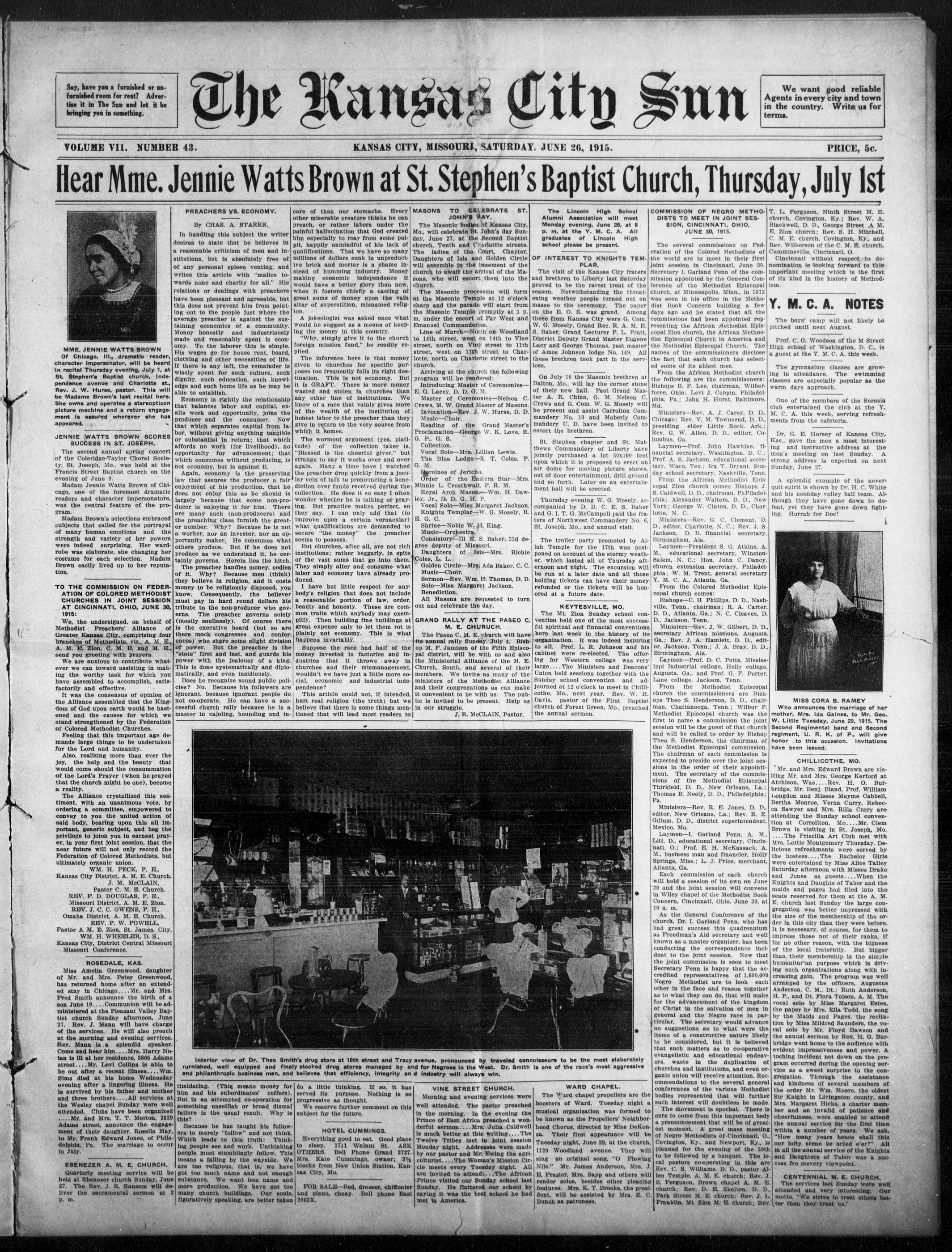
MME. JENNIE WATTS BROWN
Of Chicago, Ill., dramatic reader,
character impersonator, will be heard
in recital Thursday evening, July 1, at
St. Stephen's Baptist church, Independence avenue and Charlotte st.
Rev. J. W. Hurse, pastor. This will be Madame Brown's last recital here.
She owns and operates a stereoption picture machine and a return engagement is assured wherever she has appeared.
JENNIE WATTS BROWN SCORES
SUCCESS IN ST. JOSEPH.
The second annual spring concert of the Coleridge-Taylor Choral Society, St. Joseph, Mo., was held at the Francis Street Baptist church on the evening of June 9.
Madam Jennie Watts Brown of Chicago, one of the foremost dramatic readers and character impersonators, was the central feature of the program.
Madam Brown's selections embraced subjects that called for the portrayal of many human emotions and the strength and variety of her powers were indeed surprising. Her wardrobe was elaborate, she changing her costume for each selection. Madam Brown easily lived up to her reputation.
TO THE COMMISSION ON FEDERATION OF COLORED METHODIST CHURCHES IN JOINT SESSION AT CINCINNATI, OHIO, JUNE 30, 1915:
We, the undersigned, on behalf of Methodist Preachers' Alliance of Greater Kansas City, comprising four branches of Methodists, viz. A. M. E., A. M. E. Zion, C. M. E, and M. E., send you greeting with prayers.
We are anxious to contribute whatever we can toward assisting in making the worthy task for which you have assembled to accomplish, satisfactorily and effective.
It was the consensus of opinion of the Alliance assembled that the Kingdom of God upon earth would be hastened and the causes for which we stand strengthened by the Federation of Colored Methodist Churches.
Feeling that this important age demands large things to be undertaken for the Lord and humanity.
Also, realizing more than ever the joy, the help and the beauty that would come should the consummation of the Lord's Prayer (when he prayed that the church might be one), become a reality.
The Alliance crystallized this sentiment, with an unanimous vote, by ordering a committee, empowered to convey to you the united action of said body, bearing upon this all important, generic subject, and beg the privilege to join you in earnest prayer, in your first joint session, that the near future will not only record the Federation of Colored Methodists, but ultimately organic union.
WM. H. PECK, P. E., Kansas City District, A. M. E. Church.
WM. H. WHEELER, D. S. Kansas City, District Central Missouri Missouri Conference.
ROSEDALE, KAS.
Miss Amelia Greenwood, daughter of Mr. and Mrs. Peter Greenwood, has returned home after an extended stay in Chicago...Mr. and Mrs. Fred Smith announce the birth of a son June 19...Communion will be administered at the Pleasant Valley Baptist church Sunday afternoon, June 27. Rev. J. Mann will have charge of the services. He will also preach at the morning and evening services. Rev. Mann is a splendid speaker. Come and hear him...Mrs. Harry Nolan is ill at her residence, 3805 Adams street...Mr. Levi Collins is able to be out after a recent illness...Wm. Sims died at his home Wednesday evening after a lingering illness. He is survived by his father and mother and three brothers...All services at the Wesley chapel Sunday were well attended. Clubs have been organized...Mr. and Mrs. T. T. Morton, 3829 Adams street, announce the engagement of their daughter, Rosella May, to Mr. Frank Edward Jones, of Philadelphia, Pa. The marriage to occur in July.
EBENEZER A. M. E. CHURCH.
Quarterly meeting service will be held at Ebenezer church Sunday, June 27. The Rev. J. R. Ransom will deliver the sacramental sermon at 3 p. m.
The Kansas City Sun
THE COFFEE SHOP
Interior view of Dr. Theo Smith's drug store at 18th street and Tracy avenue, pronounced by traveled connoisseurs to be the most elaborately furnished, well equipped and finely stocked drug stores managed by and for Negroes in the West. Dr. Smith is one of the race's most aggressive and philanthropic business men, and believes that efficiency, integrity and industry will always win.
PREACHERS VS. ECONOMY.
By CHAS. A. STARKS.
In handling this subject the writer desires to state that he believes in a reasonable criticism of men and institutions, but is absolutely free of any personal spleen venting, and writes this article with "malice towards none and charity for all." His relations or dealings with preachers have been pleasant and agreeable, but this does not prevent him from pointing out to the people just where the average preacher is against the sustaining economics of a community. Money honestly and industriously made and reasonably spent is economy. To the laborer this is simple. His wages go for house rent, board, clothing and other necessities of life. If there is any left, the remainder is wisely spent for such culture, such dignity, such education, such knowledge and such home life as he may be able to establish. Economy is rightly the relationship that balances labor and capital, exerts work and opportunity, joins the producer and the consumer. Now that which separates capital from labor, without giving anything tangible or substantial in return; that which affords no work (for livelihood), no opportunity for advancement; that which consumes without producing, is not economy, but is against it.
Again, economy is the preserving law that assures the producer a fair enjoyment of his production, that he does not enjoy this as he should is largely because that some non-producer is enjoying it for him. There are many such (non-producers) and the preaching class furnish the greater number. Why? Because he is not a worker, nor an investor, nor an opportunity maker. He consumes what others produce. But if he does not produce as we understand it, he certainly governs. Herein lies the hitch. The preacher handles money, oodles of it. Why? Because men (think) they believe in religion, and it costs money to be religiously disposed, you know. Consequently, the believer must pay in hard round dollars his tribute to the non-producer who governs. The preacher governs solely (mostly soullessly). Of course there is the executive board (but so are there mock congresses and conferences) who share some slight division of power. But the preacher is the "state" first and last, and guards his power with the jealousy of a king. This is done systematically and diplomatically, and even insidiously. Does he recognize sound public policies? No. Because his followers are ignorant, because ignorant people do not co-operate. He can have a successful church rally because he is a master in cajoling, hounding and in-
Interior view of Dr. Theo Smith
rurnished, well equipped and finel
and philanthropic business men, and
timidating. (This means money for him and his subordinates' coffers). But in an attempted co-operation for something unselfish or broad dismal failure is the usual result. Why is this?
Because he has taught his followers to merely "follow" and not think. Which leads to this truth: Thinking people must stumblingly follow. This means a falling by the wayside. We are too religious, that is, we have got too much name and not enough substance. We want less name and more production. We have got too many church buildings. Our souls, figuratively speaking, are better taken
KANSAS CITY, MISSOURI, SATURDAY, JUNE 26, 1915.
care of than our stomachs. Every other miserable creature thinks he can preach, or rather labors under the painful hallucination that God created him especially to roar from some pulpit, happily unmindful of his lack of qualifications. That we have so many millions of dollars sunk in unproductive brick and mortar is a shame instead of humming industry. Money making economic independence it would have a better glory than now, when it fosters chiefly a casting of great sums of money upon the vain altar of superstition, misnamed religion.
A jokeologist was asked once what would he suggest as a means of keeping the money in this country.
"Why, simply give it to the church foreign mission fund," he readily replied.
The inference here is that money given to churches for specific purposes too frequently fails its right destination. This is not economy. But it is GRAFT. There is more money wasted and stolen in churches than any other line of institutions. We know of a race that vainly gives more of the wealth of the institution of honest labor to the preacher than they give in return to the very source from which it comes.
The wormout argument (yea, plaitude) of the collection taker is, "Blessed is the cheerful giver," but strange to say it works over and over again. Many a time have I watched the preacher drop quickly from a jocular vein of talk to pronouncing a benediction over funds received during the collection. He does it so easy I often wonder whether he is talking or praying. But practice makes perfect, so they say. I can only add that (to improve upon a certain vernacular) what qualifications are demanded to secure "the money" the preacher seems to possess.
But churches, after all, are not rich institutions; rather beggarly, in spite of the vast sums that go into them. They simply alter and consume what labor and economy have already produced.
I have but little respect for anybody's religion that does not include a reasonable portion of law, order, beauty and honesty. These are common traits which anybody may exemplify. Then building fine buildings at great expense only to let them rot is plainly not economy. This is what happens invariably.
Suppose the race had half of the money invested in factories and industries that it throws away in churches and their mismanagement, wouldn't we have just a little more social, economic and industrial independence?
This article could not, if intended, hurt real religion (the truth) but we believe that there is some things mentioned that will lead most readers to
ith's drug store at 18th street and Tracy
ly stocked drug stores managed by a
d believes that efficiency, integrity and
do a little thinking. If so, it has served its purpose. Nothing is so progressive as thought. We reserve further comment on this subject for the future.
HOTEL CUMMINGS
Everything good to eat. Good place to sleep. 1711 Walnut St. ASK OTHERS. Bell Phone Grand 3727. Mrs. Kate Cummings, owner; 3% blocks from New Union Station, Kansas City, Mo.
FOR SALE—Bed, dresser, chiffonier and plano, cheap. Bell phone East 2063X.
MASONS TO CELIBRATE ST. JOHN'S DAY.
The Masonic bodies of Kansas City, Mo., will celebrate St. John's day Sunday, June 27, at the Second Baptist church, Tenth and Charlotte streets. The ladies of the Court, Chapter, Daughters of Ials and Golden Circle will assemble in the basement of the church to await the arrival of the Masons, who will escort them into the church.
The Masonic procession will form at the Masonic Temple at 12 o'clock sharp and the parade will start from the Masonic Temple promptly at 1 p.m. under the escort of Far West and Emanuel Commanderies.
Line of March—North on Woodland to 14th street, west on 14th to Vine street, north on Vine street to 11th street, west on 11th street to Charlotte, north on Charlotte street to the church.
Arriving at the church the following program will be rendered:
Introducing Master of Ceremonies—E. G. Lacey, D. D. G. M.
Master of Ceremonies—Nelson C Crews, M. W. Grand Master of Masons Invocation—Rev. J. W. Hurse, D. D Music—Choir.
Reading of the Grand Master's Proclamation—George W. K. Love, R. G. P, G. S.
Collection.
Vocal Solo—Mrs. Lillian Lewis.
The Blue Lodge—R. T. Coles, P. G. M.
Heroines of Jericho.
Order of the Eastern Star—Mrs
Munie L. Crosthwait. P. R. M.
Vocal Solo—Miss Margaret Jackson,
Knights Templar—W. G. Mosely, R.
E. G. C.
Shrine—Noble W. H. King.
Music—Orchestra.
Consistency—Ill E. S. Baker, 33d degree deputy of Missouri.
Daughters of Isis—Mrs. Richie Coles, L. L.
Golden Circle—Mrs. Ada Baker, C. C.
Music—Choir.
Sermon—Rev, Wm, H. Thomas, D. D Solo—Miss Margaret Jackson. Benediction. All Masons are requested to turn out and celebrate the day.
GRAND RALLY AT THE PASEO C
M. E. CHURCH.
The Paseo C. M. E. church will have its annual rally Sunday, July 4. Bishop M. F. Jamison of the Fifth Episcopal district, will be with us and also the Ministerial Alliance of the M. E. Church, South, and several of their members. We invite as many of the ministers of the Methodist Alliance and their congregations as can make it convenient to be with us. The public is invited to be present. Help us in our struggle. J. R. McCLAIN, Pastor.
avenue, pronounced by traveled conn
and for Negroes in the West. Dr. Smith
and industry will always win.
VINE STREET CHURCH.
Morning and evening services were well attended. The pastor preached in the morning. In the evening the Prince of East Africa preached a wonderful sermon...Mrs. Julia Caldwell is much better at this writing...The Twelve Tribes met in joint session Monday night. Addresses were made by our pastor and Mr. Ewing the agriculturist...The Woman's Mission Circle meets every Tuesday night. All are invited to attend...The African Prince visited our Sunday school last Sunday. He flattered our school by saying it was the best school he had met in America.
The Lincoln High School Alumni Association will meet Monday evening, 28, at 8 p. m. at the Y. M. C. A. All graduates of Lincoln High school please be present.
OF INTEREST TO KNIGHTS TEM
PLAB
The visit of the Kansas City fraters and brethren to Liberty last Saturday proved to be the rarest treat of the season. Notwithstanding the threatening weather people turned out enmase to the ceremony. The paper on the E. O. S. was grand. Among those from Kansas City were G. Com. W. G. Mosely, Grand Rec. R. A. M. E. S. Baker, Grand Lecturer P. L. Pratt, District Deputy Grand Master Eugene Lacy and George Thomas, past master of Amos Johnson lodge No. 149. All these brethren took part in the services.
On July 10 the Masonic brethren at Dalton, Mo., will lay the corner stone of their new hall. Past Grand Master A. R. Chinn, G. M. Nelson C. Crews and G. Com. W. G. Mosely will be present and assist Carrollton Commandery No. 10 and Moberly Commandery U. D. have been invited to escort the brethren.
St. Stephen chapter and St. Matthews Commandery of Liberty have jointly purchased a lot 50x100 feet upon which it is proposed to erect an air dome for moving picture shows, out of door entertainment, drill ground and so forth. Later on an entertainment hall will be erected.
Thursday evening W. G. Mosely, accompanied by D. D. C. E. S. Baker and G. I. T. G. McCampell paid the fraits of Northwest Commandery No. 6. St. Joseph, Mo., and annual visit.
The trolley party promoted by Allah Temple for the 17th was postponed on account of the stormy weather, which lasted all of Thursday afternoon and night. The excursion will be run at a later date and all those holding tickets can have their money refunded or the tickets will be honored at a future date.
KEYTESVILLE, MO.
The Mt. Zion Sunday school convention held one of the most successful spiritual and financial conventions here last week in the history of its organization. It was indeed inspiring to all. Prof. L. R. Johnson and his cabinet were re-elected. The offering for Western college was very large....The Ministers and Deacons Union held sessions together with the Sunday school convention and adjourned at 12 o'clock to meet in Chillicothe, Mo., next year. Rev. W. H. Davis, pastor of the First Baptist church of Forest Green, Mo., preached the annual sermon.
noisseurs to be the most elaborately
is one of the race's most aggressive
WARD CHAPEL.
The Ward chapel propellers are the boosters of Ward. Tuesday night a musical organization was formed to be known as the Propellers' Neighborhood Chorus, directed by Miss DeKonza. Their first appearance will be Tuesday night, June 29, at the church, 1120 Woodland avenue. They will sing an original song, "O Flowing Nile." Mr. James Anderson, Mrs. J. E. Frazier, Mrs. Sapp and others will render solos, besides other pleasing features. Mrs. K. T. Brooks, the president, will be assisted by Mrs. E. C. Bunch as patroness.
COMMISSION OF NEGRO METHODISTS TO MEET IN JOINT SESSION, CINCINNATI, OHIO, JUNE 30, 1915.
The several commissions on Federation of the Colored Methodists of the world are to meet in their first joint session in Cincinnati, June 30. Secretary I. Garland Penn of the commission appointed by the General Conference of the Methodist Episcopal church, at Minneapolis, Minn., in 1912 was seen in his office in the Methodist Book Concern building a few days ago and he stated that all the commissions had been appointed representing the African Methodist Episcopal Zion church, the African Methodist Episcopal Church in America and the Methodist Episcopal Church. The names of the commissioners disclose the fact that each church has selected some of its ablest men.
From the African Methodist church the following are the commissioners: Bishops B. F. Lee, chairman, Wilber force, Ohio; Levi J. Coppin, Philadelphia, Pa.; John H. Hurst, Baltimore, Md.
Ministers—Rev. A. J. Carey, D. D. Chicago; Rev. V. M. Townsend, D. D. presiding elder Little Rock, Ark. Rev. G. W. Allen, D. D., editor, Columbia, Ga.
Laymen—Prof. John Hawkins, financial secretary, Washington, D. C.; Prof. A. S. Jackson, educational secretary, Waco, Tex; Ira T. Bryant, Sunday school secretary, Nashville, Penn. From the African Methodist Episcopal Zion church comes Bishops J. S. Caldwell, D. D., chairman, Philadelphia; Alexander Walters, D. D., New York; George W. Clinton, D. D., Charlotte, N. C.
Ministers—Rev. G. C. Clement, D. D., editor, Charlotte, N. C.; Rev. J. S. Jackson, D. D., financial secretary, Birmingham, D. A.
Laymen—President S. G. Atkins, A. M., educational secretary, Winston-Salem, N. C.; Hon. John C. Dancy, church extension secretary, Philadelphia; W. M. Trent, general secretary Y. M. C. A., Atlanta, Ga.
From the Colored Methodist Episcopal church comes:
Bishops—C. H Phillips, D. D., Nashville, Tenn.; chairman R. A. Carter, D. D., Atlanta, Ga.; N. C. Cleaves, D. D., Jackson, Tenn.
Ministers—Rev. J. W. Gilbert, D. D., secretary African missions, Augusta Ga.; Rev. J. A. Hamlett, D. D., editor, Jackson, Tenn.; J. A. Bray, D. D., Birmingham, Ala.
Laymen—Prof. D. C. Potts, Mississippi Industrial college, Holly college, Augusta Ga., and Prof. G. F. Porter, Lane college, Jackson, Tenn.
From the Methodist Episcopal church the commissioners are Bishops Theo S. Henderson, D. D., chairman, Chattanooga, Tenn.; Wilbur P. Methodist Episcopal church was the first to name a commission the joint session will be the guest of that church and will be called to order by Bishop Theo S. Henderson, the chairman of the Methodist Episcopal commission. The chairman of each commission is expected to preside over the joint sessions in the order of their appointment. The secretary of the commissions of the Methodist Episcopal Thirkield, D. D., New Orleans, La.; Thomas B. Neely, D. D., Philadelphia; Pa.
Ministers—Rev. R. E. Jones, D. D., editor, New Orleans, La.; Rev. R. E. Gillum, D. D., district superintendent, Mexico, Mo.
Laymen—I. Garland Penn, A. M., Litt. D., educational secretary, Cincinnati, O.; Prof. E. H. McKassack, A. M., business man and financier, Holly Springs, Miss.; L. J. Price, merchant, Atlanta, Ga.
Each commission of each church will hold a session of its own on June 29 and the joint session will convene in Wiley chapel of the Methodist Book Concern, Cincinnati, Ohio, June 30, at 10 a. m.
As the General Conference of the church, Dr. I. Garland Penn, who has had great success this quadrennium as Freedman's Aid secretary and well known as a master organizer, has been conducting the correspondence incident to the joint session. Now that the joint commission is soon to meet Secretary Penn is happy that the accredited representatives of 1,600,000 Negro Methodist are to look each other in the face and reason together as to what they can do, that will make for the advancement of the kingdom of Christ in the salvation of men in general and the Negro race in particular. The secretary would advance no suggestions as to what were the items of a constructive nature likely to be considered, but it is believed that such matters as to co-operative evangelistic and educational endeavors, waste in the duplication of churches and institutions, and even organic union will receive attention. Recommendations to the several general conferences of the various Methodist bodies represented that will further such interest will doubtless be made. The movement is epocal. There is sure to come from this important body a pronouncement that will be of greatest moment. A great mass meeting of Negro Methodists of Cincinnati, O. Covington, KY., and Newport, KY., is planned for the evening of the 29th to be followed by a banquet. The local pastors co-operating in this are Rev. C. S. Williams, D. D., pastor Allen Temple, A. M. E. church; Rev. J. S. Ferguson, Brown chapel A. M. E. church; Rev. D. E. Skeleton, D. E. Park Street M. E. church; Rev. J. L. Franklin, Mt. Zion M. E. church; Rev L
We want good reliable Agents in every city and town in the country. Write us for terms.
PRICE, 5c.
T. L. Ferguson, Ninth Street M. E. church, Covington, Ky.; Rev. W. A. Blackwell, D. D., George Street A. M. E. Zion church; Rev. S. H. Mitchell, C. M. E. church, Covington, Ky., and Rev. Wilkerson of the C. M. E. church, Cumminsville, Cincinnati, I. Cincinnati without respect to denomination is looking forward to this important meeting which is the first of its kind in the history of Methodism.
Y. M. C. A. NOTES
The boys' camp will not likely be pitched until next August.
Prof. C. G. Woodson of the M Street High school of Washington. D. C., is a guest at the Y. M. C. A. this week.
The gymnasium classes are growing in attendance. The swimming classes are especially popular as the warm days approach.
One of the members of the Sorosis club entertained the club at the Y. M. C. A. this week, serving refreshments from the cafeteria.
Dr. G. E. Horse of Kansas City, Kas., gave the men a most interesting and instructive address at the men's meeting on last Sunday. A strong address is expected on next Sunday, June 27.
A splendid example of the neverquit spirit is shown by Dr. H. C. White and his noonday volley ball team. Although they have gone down to defeat, yet they have gone down fighting. Hurrah for Doc!
MISS CORA B. RAMEY
Who announces the marriage of her mother, Mrs. Ida Gaines, to Mr. Geo. W. Little Tuesday, June 29, 1915. The Second Regimental band and Second regiment, U. R. K. of P., will give honor to this occasion. Invitations have been issued.
CHILLICOTHE. MO.
Mr. and Mrs. Edward Brown are visiting Mr. and Mrs. George Kerkard at Atchison, Was...Rev. H. O. Burbridge, Mr. Benj. Bland, Prof. William Longdon and Misses Mayne Cabbell, Bertha Monroe, Verna Curry, Rebecca Sawyer and Mrs. Rilla Curry are attending the Sunday school convention at Corrallton, Mo...Mr. Clem Brown is visiting in St. Joseph, Mo.
...The Priscilla Art Club met with Mrs. Lottie Montgomery Thursday. Delicious refreshments were served by the hostess....The Bachelor Girls were entertained by Miss Alice Talley Saturday afternoon with Misses Drake and Jones as guests....When the Knights and Daughters of Tabor and the maids and pages had filed into the seats reserved for them at the A. M. E. church last Sunday the large congregation was better impressed with the size of the membership of the order in this city than they were before. It is necessary, of course, for them to impress those not of their ranks, if for no other reason, with the bigness of the local fraternity. But bigger than their membership is the simple humanitar'an purpose which is driving such organizations along with increase gain. The program was well arranged by the officers, Augustus H. Anderson, C. M., Dt. Tolus, Augustus H. P., and Dt. Flora Tolson, A. M. The vocal solo by Miss Margaret Estes, the paper by Mrs. Ella Todd, the song by the Maids and Pages, the recitation by Miss Mildred Saunders, the vocal solo by Mr. Floyd Dawson and the annual sermon by Rev. H. O. Burbridge went home to the audience with evident impressiveness and power. A toching incident not down on the program occurred during the opening service as a sweet surprise to the congregation. Through the assistance and kindness of several members of the order Mr. Wm. Moore, the oldest Sir Knight in Livingston county, and Mrs. Margaret Hicks, a charter member and an invalid of patience and cheerfulness, were enabled to attend the annual service for the first time within a number of years. We ask, "How many years hence shall this our lofty scene be acted o'er?" All in all the annual service of the Knights and Daughters of Tabor was a success fro mevery viewpoint.
CENTENNIAL M. E. CHURCH.
The services last Sunday were well attended and very interesting. Our motto, "We strive to treat others better than they treat us."
AFRO-AMERICAN CULLINGS
---
Giles R. Jackson among the wealthiest Negroes in Richmond, Va., and known throughout the state, was born a slave in Goochland county about sixty-five years ago. He has been chosen president of the exposition which is to be held in that city in July in commemoration of the fiftieth anniversary of the emancipation and of the achievements of the Negroes in this country. He has secured a federal appropriation of $55,000, an appropriation from the New York legislature of $7,500, a Councilmanic appropriation from the city of Richmond of $5,000 and several lesser donations.
Jackson is the leading Negro lawyer in Virginia, and at one time was prominently identified with the political life of President McKinley, who commissioned him as a colonel to take part in the inaugural parade in 1801. In 1905 Jackson was placed in command of the third civic division in the Roosevelt inaugural parade at Washington, and Mr. Roosevelt, when he visited Richmond, in 1806, called at Jackson's office, and from in front of it addressed a crowd of several thousand Negroes, who cheered him lustfully.
Jackson's law offices are decorated with bronze busts of Presidents McKinley and Roosevelt, a large picture of Gen. U. S. Grant and staff, and a portrait of Abraham Lincoln, besides pictures of all the other presidents from Washington down.
Jackson has a vivid recollection of General Grant, whom he saw three times, twice as a prisoner of war. During the war Jackson followed his master, Col. Charles W. Dickinson of Fitz Lee's cavalry, as body servant. When he was captured by the Union troops in Caroline county he asked to be taken before General Grant. There he begged to be allowed to return through the lines to his master, whom, he said, he had left wounded upon the battlefield, General Grant granted him permission and gave him a pass.
Jackson says he asked to be allowed to leave the Federal lines at night so that he could guide himself on his journey by the stars. This was allowed, General Grant cautioned him, however, that he might be shot by a picket, and told him if he was halted to stop at once and give the password, which was "Friend of the Union."
He started out in the darkness and soon experienced some nervousness, whereupon he recalled the advice of the Union commander. At once he began repeating the password at every step, and finally began shouting "Friend of the Union" so loudly that he was surrounded by eight or ten patrols, who demanded to know if he believed he was the only friend the Union possessed. Jackson showed his pass and was allowed to proceed.
Jackson again fell into the hands of the Federals at City Point, Va., not far from Petersburg. Here he told his captors that he knew General Grant, who had once allowed him to return to the Confederate lines, and he wished to be taken before him again. He showed his pass, whereupon they took him to Grant's headquarters, about five miles away, and to his delight the general recognized him.
"Well, my boy," said General Grant, "we seem to have you again. Do you still want to go back to your master, or have we caught him also?" Jackson replied that his master was still living and not yet captured. He begged to be allowed to return to "his people," and Grant consented.
In New York recently Booker Washington gave this sound suggestion to his people:
"Settle down and get identified with some one place. Then build up there reputations for sobriety and industry. If you can't find the right place in the city, go to a small town near by, or get back to the soil. At any rate, settle down and get hold of some property and start a bank account. You will soon find, that your savings are growing and that you are growing faster and bigger than the bank account."
We have evidence from a number of sources that Negroes in the rural South are more careful about educating their children than white neighbors. Child labor is not so serious a problem among the Negroes as among the whites. It would not be at all surprising if thus indirectly the solution of the racial problem be obtained. Educated, well-to-do Negroes will produce artists and professional people. Such a group is more powerful than laws Their wishes are the laws of the future.—Chicago Herald.
The aniline dye trade, it is interesting to recall, was made possible by an Englishman's discovery. The Germans came to monopolize the trade, and now an attempt is being made to build up an aniline dye industry in England. Professor Perkins first produced colors from coal tar.
In a motion picture theater in a Maryland town patrons are admitted at a lower price to a room behind the screen, where they can see the pictures as well, although the reading matter is reversed.
Education consists not alone in stuffing the heads of the youngsters with facts about geography and fractions. Real education involves a training of the body, as well as the mind. It involves an opportunity for such wholesome and natural recreation that there is no time nor temptation for ugly mischief. The summer playgrounds are good things for the city. They are, or will be, a big factor in the making of useful citizens.
Shortly after nightfall of a pleasant evening our little steamer sailed out of the harbor of Colombo, bound for the "pearly shores," for an anchorage a few miles off the port of Arippu, near which place the pearl-fishing fleet was to begin operations at the rising of the sun. In Ceylon the oyster beds are under government supervision, and about March of each year a great pearl-fishing expedition hovers over the waters of the Gulf of Mannar. The personnel of the fleet is made up of Malays, Arabs, Indians, Singalese, and those from various other branches of India's teeming millions.
The experience of the stranger with the unique fleet is not disappointing. The sight of thousands of divers from hundreds of little boats, plunging into the water or riding downward astride heavy weights, rising with their treasures, others returning to the watery depths, the babel of strange voices combine to paint a picturesque and lasting impression upon the mind of the visitor.
The waters around Ceylon and those of the Gulf of California have the richest pearl-producing oyster beds in existence. Situated on opposite sides of the earth, it is interesting to compare the work of the pearl hunters or divers, so far separated, yet pursuing many methods in common in the search for precious gems beneath the waters. In Ceylon upon a given signal the diving begins; the boats are small and hold comfortably eight or twelve persons. The men wear few clothes, and each man takes a turn at diving, for all of them appear to be experts. A rope with weight attached is thrown over the side of the boat, the diver attaches himself to the rope, and his assistant lowers him into the water. Other divers plunge downward unassisted. Around the diver hangs a bag, within which he places the oysters as rapidly as he can pick them from the sea bottom.
On the Mexican coast, of which La Paz is the general rendezvous, the method of pearling is much the same as in Ceylon. Many of the vessels used are larger, and the modern diving suit is more in evidence. There is usually a large sailboat called the "mother," and probably half a dozen smaller ones termed "uggers." The latter are manned by a crew of six or eight men, one or two of whom are divers. The small boats transfer their catches at frequent intervals to the larger vessel standing by, where the shells are opened and carefully examined for pearls.
It was after the war, when Richmond was under a military government and Grant was in the White House, that a great dispute broke out at Richmond over the boundary lines of the wards. The two factions, one of which was represented by Jackson, appealed to the military governor, who sided against Jackson and his followers. But Jackson remembered General Grant and appealed to him, and representatives of each side appeared before the president.
After listening to the wrangle for some moments the president said to them that he knew only one of their number, and knew him to be honest, because he had twice held him a prisoner of war and each time he had begged to be sent back to his master.
Then asking Jackson to present to him the map of the plan which he advocated, President Grant took from his pocket a lead penil and wrote across the ward proposed by Jackson the two words, "Jackson's Ward."
And "Jackson's Ward" it remains to this day.
E. L. Blackshear, president of the Prairie View (Tex.) State Normal and Industrial college for Negroes, answered those critics of education for the Negro who say that education of the black man only makes him have less regard for law and order. In opening the commencement exercises proper Professor Blackshear gave a short history of the institution.
"Some white people express the belief that education of the Negro makes him less honest and less upright," said Professor Blackshear. "This institution was established as an agricultural college in 1878, and the next year was made a normal institution. In her history she has graduated 1,111 students and has given certificates to teach to more than twice that number. Figures show that not one of our graduates has committed a capital offense against the peace and dignity of the state; less than 1 per cent of our graduates have committed the least misdemeanor, and not one of them has committed an act of violence against the white people of Texas.
O
"It is another particularly encouraging fact that since this school's establishment there has never been the slightest tinge of friction or hard feeling between the white people of this county and community and the students, faculty and officers of the Prairie View Institute. In view of these statements, which are indisputable facts, I do not think that any one can consistently say that the proper kind of education does anything except encourage the Negro in his attempt to live a better and more useful life."
Commencement exercises at Prairie View came to an end with the presentation of diplomas to the graduates by Judge John L. Gulon, president of the board of directors of the Agricultural and Mechanical college, and the Prairie View normal. The presence of a large number of white people at the commencement exercises at Prairie View during the entire week has been the source of much pleasure to the members of the board of directors. Leading citizens of Hempstead, Wailer and counties surrounding the Prairie View normal are enthusiastic in their praise of the institution and the work it is accomplishing—Houston Post.
In the Falkland islands there are five times as many men as women.
Professor Arlong of Lyons, France, proved by experiment that human perspiration is an irritant because it is actually poisonous. It actually burns away the epidermis of sensitive skins and leaves them almost raw. It is important that perspiration be not checked; it is equally important in hot weather to change one's underclothing every day.
The Texas agricultural station has issued a pamphlet, in view of the great number of houses which have been recently carried away in the floods of the rivers of that state, containing valuable suggestions for anchoring houses exposed to this danger.
The first European nation to adopt the metric system of weights and measures was France. This was in 1790, and was followed by Holland in 1816, by Belgium in 1820 and by Sweden in 1889.
In every 100 music devotees only one is bald headed, while in every other profession the percentage is 11.
Princess Mary of England, only a child of seventeen, has been developed into a keen, practical, as well as sympathetic woman of affairs. She spends almost all her time every day in directing end taking part in relief work for the wounded soldiers of her country and the allies.
Mistletoe thrives on the western coasts of America to an extent not approached in the East. In many places this parasite growth is responsible, directly or indirectly, for a considerable loss of timber.
GREEN Corn in England.
About 1890 an Englishman in Essex with greater wisdom than the rest of the people of England began raising green maize for the London market, and some growers in the Isle of Jersey followed, so that today green corn may be bought from a few firms in Covent garden and in the Brxton neighborhood, where reside many the atrical people who acquired the green corn habit while touring this country, green maize is sold and understood.
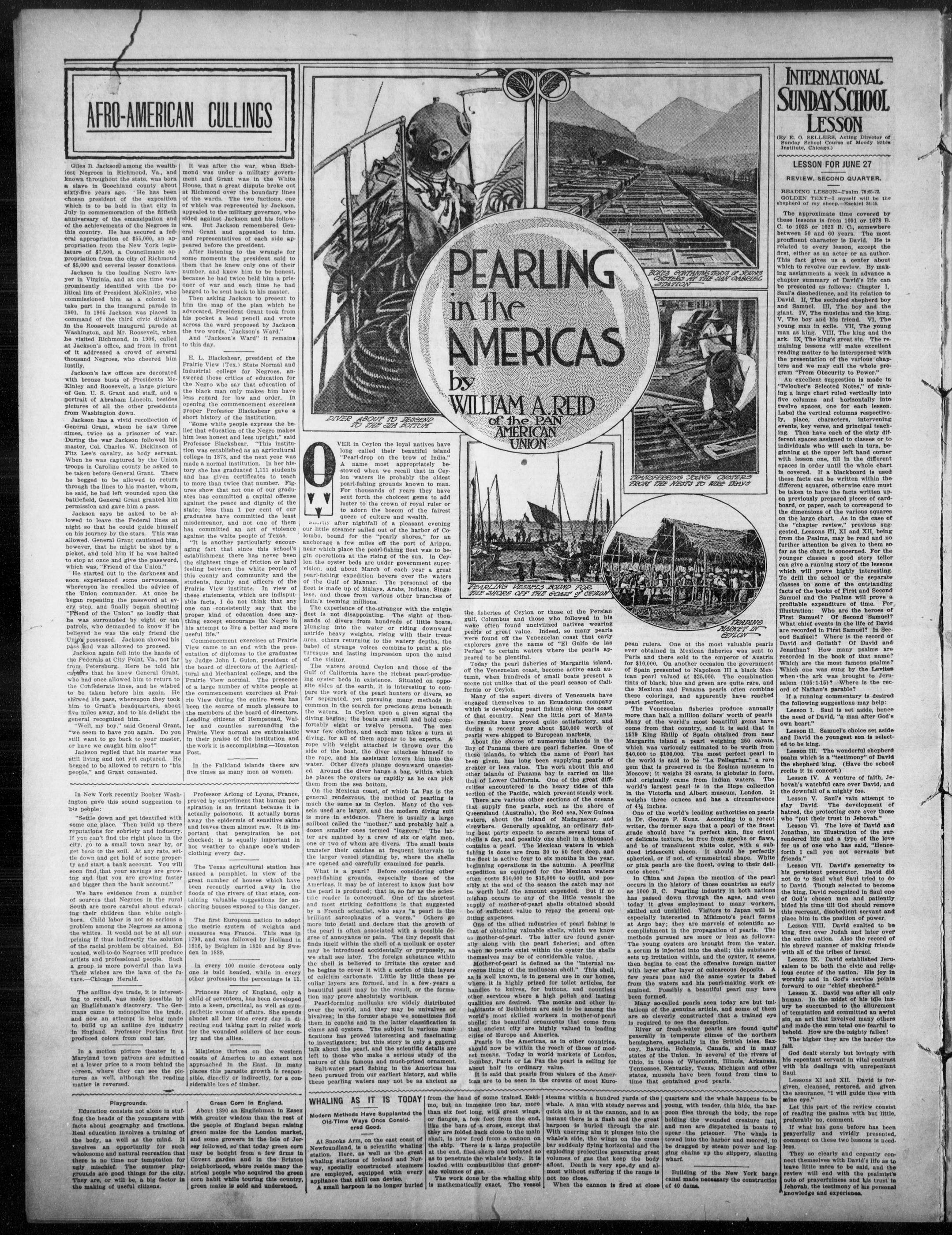
VER in Ceylon the loyal natives have long called their beautiful island "Pearl-drop on the brow of India." A name most aptly bestowed when we recall that in Ceylon waters lie probably the oldest pearl-fishing grounds known to man. For thousands of years they have sent forth the choicest gems to add luster to the crown of royal ruler or to adorn the bosom of the fairest queen of culture and wealth.
Shortly after nightfall of a pleasant evening, our little steamer sailed out of the harbor of Combo, bound for the "pearly shores," for an anchorage a few miles off the port of Arippu, near which place the pearl-fishing fleet was to be in operations at the rising of the sun. In Ceylon the oyster beds are under government supervision, and about March of each year a great pearl-fishing expedition hovers over the waters of the Gulf of Mannar. The personnel of the fleet is made up of Malays, Arabs, Indians, Singapore, and those from various other branches of India's teeming millions.
The experience of the stranger with the unique feet is not disappointing. The sight of thousands of divers from hundreds of little boats, slung into the water or riding downward stride heavy weights, rising with their tresses, others returning to the watery depths, the label of strange voices combine to paint a picture and lasting impression upon the mind of the visitor.
The waters around Ceylon and those of the Gulf of California have the richest pearl-producing oyster beds in existence. Situated on opposite sides of the earth, it is interesting to compare the work of the pearl hunters or divers, or separated, yet pursuing many methods in common in the search for precious gems beneath the waters. In Ceylon upon a given signal the living begins; the boats are small and hold comfortably eight or twelve persons. The men wear few clothes, and each man takes a turn at living, for all of them appear to be experts. Aope with weight attached is thrown over the side of the boat, the diver attaches himself to the rope, and his assistant lowers him into the water. Other divers plunge downward unassisted. Around the divers hangs a bag, within which the places the oysters as rapidly as he can pick them from the sea bottom.
On the Mexican coast, of which La Paz is the general rendezvous, the method of pearling is much the same as in Ceylon. Many of the vexed uses are larger, and the modern diving suit is more in evidence. There is usually a large sailboat called the "mother," and probably half a dozen smaller ones termed "luggers." The latter are manned by a crew of six or eight men or two of whom are divers. The small boat transfers their catches at frequent intervals to the larger vessel standing by, where the shell are opened and carefully examined for pearls.
What is a pearl? Before considering other pearl-fishing grounds, especially those of the Americas, it may be of interest to know just how the pearl is produced; that is, so far as the scientific reader is concerned. The of the shorter and most striking definitions is that suggester by a French scientist, who says "a pearl is the brilliant sarcophagus of a worm." Others go more into detail and declare that the growth of the pearl is often associated with a possible degree of annoyance or pain. The tiny deposit finds itself within the shell of a mollusk or oyster may be introduced accidentally or purposely, as we shall see later. The foreign substance within the shell is believed to irritate the oyster and begins to cover it with a series of thin layers of calcium carbonate. Little by little these peculiar layers are formed, and in a few years beautiful pearl may be the result, or the formation may prove absolutely worthless.
Pearl-forming mollusks are widely distributed over the world, and they may be univalves or bivalves; in the former shape we sometimes find them in conchs and in the latter classification of clams and oysters. The subject in various ramifications has proved interesting and fascinating to investigators; but this story is only a general talk about the pearl, and the scientific details are left to those who make a serious study of the nature of this famous and much-prized ornament. Salt-water pearl fishing in the Americas has been pursued from our earliest history, and while these pearling waters may not be as ancient.
WHALING AS IT IS TODAY from the mo, but
What is a pearl? Before considering other pearl-fishing grounds, especially those of the Americas, it may be of interest to know just how the pearl is produced; that is, so far as the scientific reader is concerned. One of the shortest and most striking definitions is that suggested by a French scientist, who says "a pearl is the brilliant sarcophagus of a worm." Others go more into detail and declare that the growth of the pearl is often associated with a possible degree of annoyance or pain. The tiny deposit that finds itself within the shell of a mollusk or oyster may be introduced accidentally or purposely, as we shall see later. The foreign substance within the shell is believed to irritate the oyster and he begins to cover it with a series of thin layers of calcium carbonate. Little by little these peculiar layers are formed, and in a few years a beautiful pearl may be the result, or the formation may prove absolutely worthless.
Pearl-forming mollusks are widely distributed over the world, and they may be unvalves or bivalves; in the former shape we sometimes find them in conchs and in the latter classification in clams and oysters. The subject in various ramifications has proved interesting and fascinating to investigators; but this story is only a general talk about the pearl, and the scientific details are left to those who make a serious study of the nature of this famous and much-prized ornament. Salt-water pearl fishing in the Americas has been pursued from our earliest history, and while these pearling waters may not be as ancient as
---
DIVER ABOUT ID BESPOKE
TO THE CIRC BOTTOM
Modern Methods Have Supplanted the Old-Time Ways Once Considered Good.
At Snooks Arm, on the east coast of Newfoundland, is a scientific whaling station. Here, as well as the great whaling stations of Iceland and Norway, specially constructed steamers are employed, equipped with every appliance that skill can devise.
A small harpoon is no longer hurled
the fisheries of Ceylon or those of the Persian gulf, Columbus and those who followed in his wake often found uncivilized natives wearing pearls of great value. Indeed, so many pearls were found off the Venezuelan coast that early explorers gave the name of "El Gulfo de las Perlas" to certain waters where the pearls appeared to be plentiful.
Today the pearl fisheries of Margarita island, off the Venezuelan coast, become active each autumn, when hundreds of small boats present a scene not unlike that of the pearl season of California or Ceylon.
Many of the expert divers of Venezuela have engaged themselves to an Ecuadorian company which is developing pearl fishing along the coast of that country. Near the little port of Manta the results have proved quite satisfactory, and during a recent year about $20,000 worth of pearls were shipped to European markets.
About the shores of numerous islands in the Bay of Panama there are pearl fisheries. One of these islands, to which the name of Pearl has been given, has long been supplying pearls of greater or less value. The work about this and other islands of Panama bay is carried on like that of Lower California. One of the great difficulties encountered is the heavy tides of this section of the Pacific, which prevent steady work.
There are various other sections of the oceans that supply fine pearls, such as the shore of Queensland (Australia), the Red sea, New Guinea waters, about the island of Madagascar, and elsewhere. Generally speaking, an ordinary fishing boat party expects to secure several tons of shells a day, and possibly one shell in a thousand contains a pearl. The Mexican waters in which fishing is done are from 30 to 50 feet deep, and the fleet is active four to six months in the year, beginning operations in the autumn. A pearling expedition as equipped for the Mexican waters often costs $10,000 to $15,000 to outfit, and possibly at the end of the season the catch may not be worth half the amount expended. But if no mishap occurs to any of the little vessels the supply of mother-of-pearl shells obtained should be of sufficient value to repay the general outfitting expenses.
One of the allied industries of pearl fishing is that of obtaining valuable shells, which we know as mother-of-pearl. The latter are found generally along with the pearl fisheries; and often when no pearls exist within the oyster the shells themselves may be of considerable value.
Mother-of-pearl is defined as the "internal narcissus lining of the molluscan shell." This shell, as is well known, is in general use in our homes, where it is highly prized for toilet articles, for handles to knives, for buttons, and countless other services where a high polish and lasting qualities are desired. The monks and other inhabitants of Bethlehem are said to be among the world's most skilled workers in mother-of-pearl shells; the beautiful ornaments that come from that ancient city are highly valued in leading cities of Europe and America.
Pearls in the Americas, as in other countries, should now be within the reach of those of modest means. Today in world markets of London, Bombay, Paris or La Paz the Pearl is selling for about half its ordinary value.
It is said that pearls from waters of the Americas are to be seen in the crowns of most Euro-
from the hand of some trained Eskimo, but an immense iron bar, more than six feet long, with great wings, or flanges, a few feet from the end, like the bars of a cross, except that they are folded back close to the main shaft, is now fired from a cannon on the ship. There is a large projectile at the end, filed sharp and pointed so as to penetrate the whale's body. It is loaded with combustibles that generate volumes of gas. The work done by the whaling ship is mathematically exact. The vessel
pean rulers. One of the most valuable pearls ever obtained in Mexican fisheries was sent to Paris and there sold to the emperor of Austria for $10,000. On another occasion the government of Spain presented to Napoleon III a black Mexican pearl valued at $25,000. The combination tints of black, blue and green are quite rare, and the Mexican and Panama pearls often combine these colorings, and apparently have reached pearl perfection.
The Venezuelan fisheries produce annually more than half a million dollars' worth of pearls. Many of the world's most beautiful gems have come from that country, and it is said that in 1759 King Phillip of Spain obtained from near Margarita island a pearl weighing 250 carats, which was variously estimated to be worth from $40,000 to $100,000. The most perfect pearl in the world is said to be "La Pellegrina," a rare gem that is preserved in the Zosima museum in Moscow; it weighs 28 carats, is globular in form, and originally came from Indian waters. The world's largest pearl is in the Hope collection in the Victoria and Albert museum, London. It weighs three ounces and has a circumference of 43% inches.
One of the world's leading authorities on pearls is Dr. George F. Kunz. According to a recent writer, the former says that a pearl of the finest grade should have "a perfect skin, fine orient or delicate texture, be free from specks or flaws, and be of translucent white color, with a subdued iridescent sheen. It should be perfectly spherical, or if not, of symmetrical shape. White or pink pearls are the finest, owing to their delicate sheen."
In China and Japan the mention of the pearl occurs in the history of those countries as early as 1000 B. C. Pearling industry in both nations has passed down through the ages, and even today it gives employment to many workers, skilled and unskilled. Visitors to Japan will be especially interested in Mikimoto's pearl farms at Argo Bay; they are marvels of scientific accomplishment in the propagation of pearls. The methods pursued are more or less as follows: The young oysters are brought from the water, a serum is injected into the shell; this substance sets up irritation within, and the oyster, it seems, then begins to coat the offensive foreign matter with layer after layer of calcareous deposits. A few years pass and the same oyster is fished from the waters and his pearl-making work examined. Possibly a beautiful pearl may have been formed.
Many so-called pearls seen today are but imitations of the genuine article, and some of them are so cleverly constructed that a trained eye is required to see the deception.
River or fresh-water pearls are found quite generally in temperate climes of the northern hemisphere, especially in the British isles, Saxony, Bavaria, Bohemia, Canada, and in many states of the Union. In several of the rivers of Ohio, in those of Wisconsin, Illinois, Arkansas, Tennessee, Kentucky, Texas, Michigan and other states, mussels have been found from time to time that contained good pearls.
steams within a hundred yards of the whale. A man with steady nerves and quick aim is at the cannon, and in an instant there is a flash and the great harpoon is hurled through the air. With unerring arm it plunges into the whale's side, the wings on the cross bar suddenly flying horizontal and the exploding projects generating great volumes of gas that keep the body afloat. Death is very speedy and almost without suffering if the range is not too close.
When the cannon is fired at close
quarters and the whale happens to be young, with tender, thin hide, the harpoon flies through the body, the rope holding the wounded creature fast, and men are dispatched in boats to spear the prisoner. The whale is towed into the harbor and moored, to be dragged by steam power and logging chains up the slippery, slanting wharf.
Building of the New York barge canal made necessary the construction of 40 dama.
INTERNATIONAL
SUNDAY SCHOOL
LESSON
(Hy E. O. SELLERS, Acting Director of
School Course of Moody Bible
Institute)
REVIEW, SECOND QUARTER.
READING LESSON-Psalm 78:65-72.
GOLDEN TEXT-I myself will be the shepherd of my sheep.-Ezekiel 34:16.
The approximate time covered by these lessons is from 1091 or 1078 B. C. to 1035 or 1023 B. C., somewhere between 50 and 60 years. The most prominent character is David. He is related to every lesson, except the first, either as an actor or an author. This fact gives us a center about which to revolve our review. By making assignments a week in advance a chapter summary of David's life can be presented as follows: Chapter I, Saul's disobedience, and its relation to David, II. The secluded shepherd boy and Samucl. III. The boy and the giant. IV. The musician and the king. V. The boy and his friend. VI. The young man in exile. VII. The young man as king. VIII. The king and the ark. IX. The king's great sin. The remaining lessons will make excellent reading matter to be interspersed with the presentation of the various chapters and we may call the whole pro
gram "From Obscurity to Power."
An excellent suggestion is made in "Peloubet's Selected Notes," of making a large chart ruled vertically into five columns and horizontally into twelve spaces, one for each lesson. Label the vertical columns respectively, place, characters, intervening events, key verse, and principal teaching. Then have each of the sixty different spaces assigned to classes or to individuals who will each in turn, beginning at the upper left hand corner with lesson one, fill in the different spaces in order until the whole chart is covered. If a blackboard is used these facts can be written within the different squares, otherwise care must be taken to have the facts written upon previously prepared pieces of cardboard, or paper, each to correspond to the dimensions of the various squares on the large chart. As in the case of the "chapter review." previous suggested, Lessons III, XI and XII, being from the Psalms, may be read and no further attention be given to them so far as the chart is concerned. For the younger classes a good story teller can give a running story of the lessons which will prove highly interesting. To drill the school or the separate classes on some of the outstanding facts of the books of First and Second Samuel and the Psalms will prove a profitable expenditure of time. For illustration: Who are the heroes of First Samuel? Of Second Samuel? What chief events in the life of David are recorded in First Samuel? In Second Samuel? Where is the record of David and Goliath? Of David and Jonathan? How many psalms are recorded in the book of that name? Which are the most famous psalms? Which one was sung by the Levites when the ark was brought to Jerusalem (105:1-15)? Where is the record of Nathan's parable?
If a running commentary is desired the following suggestions may help:
Lesson I. Saul is set aside, hence the need of David, "a man after God's own heart."
Lesson II. Samuel's choice set aside and David the youngest son is selected to be king.
Lesson III. The wonderful shepherd psalm which is a "testimony" of David the shepherd king. (Have the school recite it in concert.)
Lesson IV. A venture of faith, Jehovah's watchful care over David, and the downfall of a mighty foe.
Lesson V. Saul's vain attempt to slay David. The development of hatred, the protecting care over those who "put their trust in Jehovah."
Lesson VI. The love of David and Jonathan, an illustration of the surrendered life and a type of the love for us of one who has said, "Henceforth I call you not servants but friends."
Lesson VII. David's generosity to his persistent persecutor. David did not do to 'saul what Saul tried to do to David. Though selected to become the king, David recognized in Saul one of God's chosen men and patiently bided his time till God should remove this recruit, disobedient servant and place him in the position of power.
Lesson VIII. David exalted to be king, first over Judah and later over the entire nation. Also the record of his shrewd manner of making friends with all of the tribes of Israel.
Lesson IX. David established Jerusalem to be both the civic and religious center of the nation. His joy in worship and in God's service points forward to our "chief shepherd."
Lesson X. David was after all only human. In the midst of his idle luxury he succumbed to the allurement of temptation and committed an awful sin, an act that involved many others and made the sum total one fearful to behold. How are the mighty fallen!
The higher they are the harder the fall.
God dealt sternly but lovingly with his repentant servant in vital contrast with his dealings with unrepentant Saul.
Lessons XI and XII. David is forgiven, cleansed, restored, and given the assurance, "I will guide thee with mine eye."
Let this part of the review consist of reading the psalms with but little, preferably no, comment.
If what has gone before has been prayerfully and vividly presented, comment on these two lessons is needless.
They so clearly and cogently connect themselves with David's life as to leave little more to be said, and the review will end with the psalmist's note of prayerfulness and his trust in Jehovah, the testimony of his personal knowledge and experience.
In the Pit He Had Digged
By JOHN DARROUGH
Stepan had never feared Tozan, not even after he won Sophie Katlak from him. Tozan had come to the mine two years before, a tramp, and Stepan, who pitched him, had given him a job. Afterward Tozan fell in love with Sophie, old Katlak's daughter, and Stepan won her away. Still, a girl has the right to change her mind, and Sophie's decision seemed to Stepan no reason why his protege and friend should cast black looks at him.
Therefore when Tozan came to Stepan's bedside at night and told him old Katlak wanted him, in his house at the bottom of Long Shaft, half a mile deep or more, Stepan accompanied Tozan without hesitation. The lead in Long Shaft had been cleaned out, the shaft had been abandoned, and old Katlak's house was to be dismantled. The old Bohemian, who had lived there with Sophie for half a year, emerging into the upper air only on Saturday nights, was glad of the change.
But the four of them-Katlak, Sophie and the two boarders, Stephan and Tozan, had lived in too close intimacy down in the mine. That was why Tozan lost his sense of proportion, why he had been brooding over Stepan's theft, as he termed it.
Stepan and Tozan had still a few days' work to do at the bottom of Long Shaft, cleaning up the debris, oiling the machinery, collecting harness, etc.; but already the boarding house had been broken up. Stepan and Tozan had each found other quarters, though Katlak hoped to secure the two men again when his new house was erected.
Stepan accompanied Tozan without hesitation, but he stopped at the mine head and looked at him inquiringly.
"I thought Katlak had left the house," he said.
"No, he is there," replied Tozan, "with Sophie."
They entered the cage and descended. It was many minutes later when they emerged at the bottom of Long Shaft, beside Katlak's house. All round them radiated the galleries which had been flung forward from
A man stands in front of two children, one kneeling on the ground and the other sitting on a bench. The man is wearing a suit and a hat, and the children are wearing shirts. The background is a large wooden barn with a high roof.
"You Will Hear the Dynamite Shoot Down."
this center. Infinitely high above them was a tiny star—the great arc light at the mine's head.
"He is in here," said Tozan, turning toward the house. Stepan turned too, and immediately Tozan's loaded cane descended with calculated force upon the back of his head, flinging him to the ground, stunned.
When he opened his eyes, Stepan was lying upon the ground in front of Katolk's house, securely bound with ropes. His head ached and throbbed madly from the blow. Over him stood Tozan. He was watching him intently.
"Where is Sophie?" groaned Stepan. Tozan laughed and pointed behind him. As Stepan turned his head a muffed, choking cry reached his ears. He managed to twist far enough to see Sophie, a gag over her mouth, strapped to a chair against the shaft of the elevator.
"Now, Stepan, listen," said Tozan, smacking his lips. "You stole Sophie from me, and you are going to die, you know. At first I thought that I would spare you and kill the girl, because you got me my job. But that would be inconvenient, and so you are both going to die together.
"At the top of the mine shaft, right in the middle of the shaft, are a dozen sticks of dynamite, suspended from a cord, connecting with a time-fuse. In fifteen minutes more the fire eats through the time-fuse to the cord and eats through the cord. The dynamite falls half a mile, vertically. It falls on you, Stepan—just between you and Sophie Katlock—"
"You murderous snake!" yelled Stepan, trying to make for him.
And suddenly he stopped dead, for this time he had actually loosened a loop of rope in his struggle, and it was necessary not to let Tozan know this. He stopped still and waited.
"I shall watch from that rock, two hundred feet above the bottom of the shaft," continued Tozan. "The little cave will protect me from any results of the explosion. But I shall be high enough to be out of danger, Stepan. You will hear the dynamite shoot down, and you will look up and see it falling, and then it will drop—bang—between you (two, and—" "Devil!" muttered Stepan, as Tozan took himself off. He watched him scrambling like a goat on the craggy
stides, and, as soon as he was out of immediate hearing, struggled furiously with his bonds. Sophie eyed him dumbly. Stephan knew that she had heard everything, but she was unable to move or cry out. What would it have sufficed, in any event? Stephan could not get free. The loop of rope was slacker, but his legs and arms were still bound. As he struggled he saw Tozan mount the rock and stand there; he fancied his watch was in his hand, but it was impossible to discern anything clearly. Cut off above, the glare of the electric lights beneath, the man looked like a monstrous phantom. It was easy to hear, however.
"Five minutes more, Stepan," cried Tozan's mocking voice. "In five minutes the rope burns through, and the dynamite will fall plump down the shaft between you and Sophie there in four minutes. That will be a lesson to both of you, my friends. In three minutes more you will be blown to fine powder. There is no escape, unless a miracle saves you. In two minutes, Stepan—"
His voice rang out through the column of air imprisoned in the shaft, and the sonorous echoes beat in a hundred little waves among the rocks. "In two minutes—in one minute, Stepan!"
And the last word was drowned in the explosion of the dynamite. Stepan, hearing the discharge, covered, his hands over his head. The motion was an instinctive one, for he did not doubt that he would be blown into the tiniest fragments. And the volume of the exploding dynamite seemed to fill the shaft. Above it rang out Sophie's screams.
Stepan was coming back to consciousness. Somebody—a woman—was screaming. Sophie had got her gag free from her mouth, and with her cries there stole into Stepan's mind the realization that neither of them was dead.
"Sophie!" he gasped.
Slowly the dust settled down. Stepan saw the girl peering through the thick cloud; she looked toward the rock where Tozan had stood and stood no longer.
That was the moment when the rescue party descended the shaft in the alternate cage. But it was not for several days that Stepan understood what had happened.
They told him that day, when Sophie and he were married—quietly, not as is the Galician custom, with dance and drinking. Sophie insisted it was a miracle, but Stepan understood readily.
"You see," said the mine engineer, "Tozan's theory was well enough. He knew it jibed with gravitation, but he didn't stop to realize that the earth is moving all the while. If you drop anything down a half-mile shaft, Stepan, it'll hit the east wall en route, instead of the bottom. That's where Tozan got his."
Proved He Was the Boss
A blasting powder salesman, approaching a quarry, asked the first man he met where he could find the boss.
"O'm ut," sententiously replied a disreputable looking individual in earth overalls.
"Oh, I want the owner of the quarry," replied the dapper little salesman, in some disgust. "I've a new blasting powder I want to show him."
The man addressed raised his voice in a loud call:
"Hey, Kelly, Kelly!" he roared. A head appeared above the ground. "Hey, Kelly, you're foiled!"
The man climbed painfully out of the pit, walked over to his coat and lunch pal, picked them up and started down the road without a word.
"Hold on, there!" said the salesman, in some amazement. "I guess you are the man I want to see, after all!"
The other man cupped his hands around his mouth and loudly halled the retreating figure.
Kelly stopped and turned round in his tracks.
"You're hoired!" yelled the boss.
"Get back on the job."
Disposed of the Plans.
While preparations were being made for the attack on New Orleans, the navy department came into possession of a complete set of plans of the defenses of that city. Not only were the positions of the forts laid down, but, also, the submarine mines, as well as the system of torpedoes, and the reserve of war vessels which were to cooperate with the land batteries. No time was lost in sending it to Admiral Farragut, but no acknowledgment ever reached the navy department. Meanwhile, the passage of the forts was effected. New Orleans captured, Admiral Farragut, in due time, went North. Proceeding to Washington, he at once called at the navy department, where he received hearty congratulations upon his brilliant successes. While he was in the department a prominent official referred to the plans of the defenses of New Orleans, and asked the admiral if he had ever received them. "Yes," he replied, "I received the plans, but on examination I found out that, according to them, New Orleans could never be taken; so I tore them up and threw them into the waste basket."
Ethics of the Oath.
Constantly from the times of earliest intelligent antiquity swearing has been known to man. Throughout the ages the supernatural has been called upon by the invocations and imprecations of the oath.
The practice of swearing is now so common in all civilized communities, that the probable volume of daily oaths must be incalculably large.
Prodigious as is the multiplicity of documentary oaths, the more serious oaths taken in the carrying on of judicial proceedings, and the official oaths, are quite as innumerable.
The oath is defiled, declares Charles J. Marrell, in the May Case and Comment: First, when it is carelessly taken or taken upon an occasion of unjustifiable insignificance; second, when a person sworn contravenes the truth by perjury; and, third, whenever an officeholder under oath commits a reprehensible official act or omits to perform that which his duty imposes.
INTERNATIONAL
NEWS SERVICE
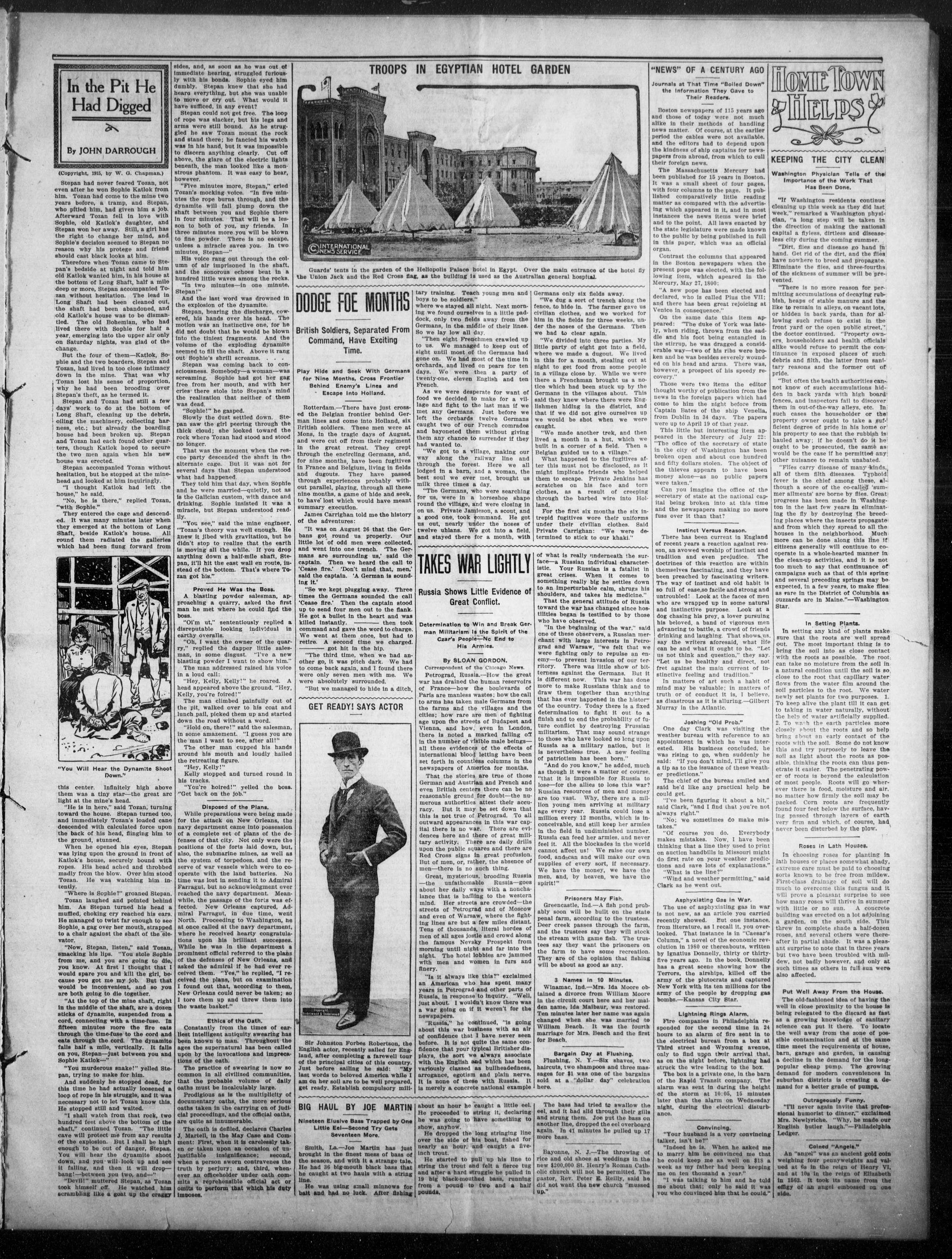
Guards' tents in the garden of the Heliopolis Palace hotel in Egypt. Over the main entrance of the hotel fly the Union Jack and the Red Cross flag, as the building is used as the Australian general hospital.
DODGE FOE MONTHS
tary training. Teach young men and boys to be soldiers." where we stayed all night. Next morning we were called in. Germans only six fields away. "We dug a sort of trench along the fence, to hide in. The farmer gave us
British Soldiers, Separated From Command, Have Exciting Time.
Play Hide and Seek With Germans for Nine Months, Cross Frontier Behind Enemy's Lines and Escape Into Holland.
Rotterdam.—There have just crossed the Belgian frontier behind German lines and come into Holland, six British soldiers. These men were at Mons, in the tragic days of August, and were cut off from their regiment in the great retreat. They crept through the encircling Germans, and, for nine months, have been fugitives in France and Belgium, living in fields and dugouts. They have passed through experiences probably without parallel, playing, through all these nine months, a game of hide and seek, to have lost which would have meant summary execution.
James Carrighan told me the history of the adventures:
"It was on August 26 that the Germans got round us properly. Our little lot of odd men were collected, and went into one trench. 'The Germans are surrounding us,' said the captain. Then we heard the call to 'Cease fire.' 'Don't mind that, men,' said the captain. 'A German is sounding it.'
"We we kept plugging away. Three times the Germans sounded the call 'Cease fire.' Then the captain stood up to send four men out to the flank. He got a bullet in the heart and was killed instantly. _____ then took command and gave the word to charge. We went at them once, but had to retire. A second time we charged. _____ got hit in the hip.
"The third time, when we had another go, it was pitch dark. We had to come back again, and I found there were only seven men with me. We were absolutely surrounded.
"But we managed to hide in a ditch,
Dupage M.
Sidderwood & Sidderwood
Sir Johnston Forbes Robertson, the English actor, recently called for England, after completing a farewell tour of the principal cities of this country. Just before sailing he said: "My last words to beloved America while I am on her soil are to be well prepared, get ready. Establish compulsory mili-
BIG HAUL BY JOE MARTIN
Nineteen Elusive Bass Trapped by One
Little Eel—Second Try Gets
Seventeen More.
Smith, La.—Joe Martin has just
brought in the finest mess of bass of
the season, and with it a strange tale.
He had 36 big-mouth black bass that
he caught at two hauls with a string
line.
He was using small minnows for
bait and had no luck. After fishing
---
tary training. Teach young men and boys to be soldiers." where we stayed all night. Next morning we found ourselves in a little paddock, only two fields away from the Germans, in the middle of their lines. So we lay low all day. "Then eight Frenchmen crawled up to us. We managed to keep out of sight until most of the Germans had gone on. We had most of the time in orchards, and lived on pears for ten days. We were then a party of twenty-one, eleven English and ten French. As we were desperate for want of food we decided to make for a village and fight to the last man if we met any Germans. Just before we left the orchards twelve Germans caught two of our French comrades and bayoneted them without giving them any chance to surrender if they had wanted to.
"We got to a village, making our way along the railway line and through the forest. Here we all lodged in a barn, and a woman, the best soul we ever met, brought us milk three times a day.
"The Germans, who were searching for us, were in a horseshoe shape round the village, and were closing in on us. Private Jamieson, a scout, and a good one, took command. He got us out, nearly under the noses of twelve uhlans. We got into a field, and stayed there for a month, with
TAKES WAR LIGHTLY
Russia Shows Little Evidence of Great Conflict.
Determination to Win and Break Ger man Militarism Is the Spirit of the Czar's People—No End to His Arms.
By SLOAN GORDON.
Correspondent of the Chicago News.
Petroglad, Russia.—How the great war has drained the human reservoirs of France—how the boulevards of Paris are manless wastes; how the call to arms has taken male Germans from the farms and the villages and the cities; how rare are men of fighting age upon the streets of Budapest and Vienna, and how, even in London, there is noted a marked falling off in the number of visible male beings—all these evidences of the effects of international blood letting have been set forth in countless columns in the newspapers of America for months.
That the stories are true of those German and Austrian and French and even British centers there can be no reasonable ground for doubt—the numerous authorities attest their accuracy. But it may be set down that this is not true of Petrograd. To all outward appearances in this war capital there is no war. There are evidences here and there of great military activity. There are daily drills upon the public squares and there are Red Cross signs in great profusion. But of men, or, rather, the absence of men—there is no such thing.
Great, mysterious, brooding Russia—the unfathomable Russia—goes about her daily ways with a nonchance that is baffling to the western mind. Her streets are crowded—the streets of Petrograd and of Moscow and even of Warsaw, where the fight lines are but a few miles distant. Tens of thousands, literal hordes of men of all ages jostle and crowd along the famous Nevsky Prospekt from morning until night and far into the night. The hotel lobbies are jammed with men and women in furs and finery.
"Is it always like this?" exclaimed an American who has spent many years in Petrograd and other parts of Russia, in response to inquiry. "Well, just about. I wouldn't know there was a war going on if it weren't for the newspapers.
"Russia," he continued, "is going about this war business with an air of confidence that I have never seen before. It is not quite the same confidence that your typical British displays, the sort we always associate with the English and which has been variously classed as bulleheadness, arrogance, egotism and plain nerve. It is none of these with Russia. It is merely a concrete national example
about an hour he caught a little eel. He proceeded to string it, declaring he was going to have something to show, anyhow.
He dropped the long stringing line over the side of his boat, fished for nearly an hour, and caught a five-inch trout.
He started to pull up his line to string the trout and felt a fierce tug and after a hard struggle he pulled in 19 big black-mouthed bass, running from a pound to two and a half pounds.
"We dug a sort of trench along the fence, to hide in. The farmer gave us civilian clothes, and we worked for him in the fields for three weeks, under the noses of the Germans. Then we had to clear again.
"We divided into three parties. My little party of eight got into a field, where we made a dugout. We lived in this for a month, stealing out at night to get food from some people in a village close by. While we were there a Frenchman brought us a notice which had been stuck up by the Germans in the villages about. This said they knew where there were Englishmen hiding in the district, and that if we did not give ourselves up we would be shot when we were caught.
"We made another trek, and then lived a month in a hut, which we built in a corner of a field. Then a Belgian guided us to a village."
What happened to the fugitives after this must not be disclosed, as it might implicate friends who helped them to escape. Private Jenkins has scratches on his face and torn clothes, as a result of creeping through the barbed wire into Holland.
For the first six months the six intrepid fugitives wore their uniforms under their civilian clothes. Said Private Carrighan: "We were determined to stick to our khaki."
of what is really underneath the surface—a Russian individual characteristic. Your Russian is a fatalist in great crises. When it comes to something really big he settles down to an imperturbable calm, shrugs his shoulders, and takes his medicine.
That the general attitude of Russia toward the war has changed since hostilities began is testified to by those who have observed.
"In the beginning of the war," said one of these observers, a Russian merchant with large interests in Petrograd and Warsaw, "we felt that we were fighting only to repulse an enemy—to prevent invasion of our territory. There was little show of bitterness against the Germans. But it is different now. This war has done more to make Russians think and to draw them together than anything that has ever happened in the history of the country. Today there is a fixed determination to fight it out to a finish and to end the probability of future conflict by destroying Prussian militarism. That may sound strange to those who have looked so long upon Russia as a military nation, but it is nevertheless true. A new feeling of patriotism has been born."
"And do you know," he added, much as though it were a matter of course, "that it is impossible for Russia to lose—for the allies to lose this war? Russian resources of men and money are too vast. Why, there are a million young men arriving at military age every year. Russia could lose a million every 12 months, which is inconceivable, and still keep her armies in the field in undiminished number. Russia can feed her armies, and never feel it. All the blockades in the world cannot affect us! We raise our own food, and scan and will make our own supplies of every sort, if necessary. We have the money, we have the men, and, by heaven, we have the spirit!"
Prisoners May Fish
Greencastle, Ind.—A fish pond probably will be built on the state penal farm, according to the trustees. Deer creek passes through the farm, and the trustees say they will stock the stream with game fish. The trustees say they want the prisoners on the farm to have some recreation. They are of the opinion that fishing will be about as good as any.
3 Names In 10 Minutes.
Wlnamac, Ind.—Mrs. Ida Moore obtained a divorce from William Moore in the circuit court here and her malden name, Ida Malbaur, was restored. Ten minutes later her name was again changed when she was married to William Beach. It was the fourth marriage for Mrs. Beach and the first for Beach.
Bargain Day at Flushing
Flushing, N. Y.-Six shaves, two haircuts, two shampoos and three massages for $1 was one of the bargains sold at a "dollar day" celebration here.
The bass had tried to swallow the eel, and it had slid through their gills and strung them. Joe put the bass on another line, dropped the eel overboard again. In 41 minutes he pulled up 17 more bass.
Bayonne, N. J.-The throwing of rice and old shoes at weddings in the new $200,000 St. Henry's Roman Catholic church will not be permitted. The pastor, Rev. Peter E. Reilly, said he did not want the new church "mussed up."
---
"NEWS" OF A CENTURY AGO
Journalals at That Time "Boiled Down" the information They Gave to Their Readers.
Boston newspapers of 115 years ago and those of today were not much alike in their methods of handling news matter. Of course, at the earlier period the cables were not available, and the editors had to depend upon the kindness of ship captains for newspapers from abroad, from which to cull their foreign news.
The Massachusetts Mercury had been published for 15 years in Boston. It was a small sheet of four pages, with four columns to the page. It published comparatively little reading matter as compared with the advertising which appeared in it, and in most instances the news items were brief and to the point. All laws enacted by the state legislature were made known to the public by being published in full in this paper, which was an official organ.
Contrast the columns that appeared in the Boston newspapers when the present pope was elected, with the following item, which appeared in the Mercury, May 27, 1800:
"A new pope has been elected and declared, who is called Plus the VII; and there has been great rejoicing at Venice in consequence."
On the same date this item appeared:
"The duke of York was late, when riding, thrown from the saddle and his foot being entangled in the stirrup, he was dragged a considerable way—two of his ribs were broken and he was besides severely wounded on his head and arms. There was, however, a prospect of his speedy recovery."
Those were two items the editor thought worthy of publication from the news in the foreign papers which had come to him the night before from Captain Bates of the ship Venella, from Dublin in 34 days. The papers were up to April 19 of that year.
This little but interesting item appeared in the Mercury of July 22: "The office of the secretary of state in the city of Washington has been broken open and about one hundred and fifty dollars stolen. The object of the thieves appears to have been money alone—as no public papers were taken." Can you imagine the public of the secretary of state at the national capital being broken into at this time and the newspapers making no more fuss over it than that?
Instinct Versus Reason:
There has been current in England of recent years a reaction against reason, an avowed worship of instinct and tradition and even prejudice. The doctrines of this reaction are within themselves fascinating, and they have been preached by fascinating writers. The way of instinct and old habit is so full of ease, so facile and strong and untroubled. Look at the faces of men who are wrapped up in some natural and instinctive purpose. Look at a dog chasing his prey, a lover pursuing his beloved, a band of vigorous men advancing to battle, a crowd of friends drinking and laughing. That shows us say the writers aforesaid, what life can be and what it ought to be. "Let us not think and question," they say. "Let us be healthy and direct, not fret against the main current of instinctive feeling and tradition."
In matters of art such a habit of mind may be valuable; in matters of truth or of conduct it is, I believe, as disastrous as it is alluring.—Gilbert Murray in the Atlantic.
Joshing "Old Prob."
One day Clark was visiting the weather bureau with reference to an appointment in which he was interested. His business concluded, he was rising to go, when suddenly he said: "If you don't mind, I will give you a tip as to the issuance of these weather predictions."
The chief of the bureau smiled and said he'd like any practical help he could get.
"I've been figuring it about a bit," said Clark, "and I find that you're not always right."
"No; we sometimes do make mistakes."
"Of course you do. Everybody makes mistakes. Now, I have been thinking that a line they used to print on auction handbills in Missouri might do first rate on your weather predictions and save lots of explanations."
"What is the line?"
"Wind and weather permitting," said Clark as he went out.
Asphyxiating Gas in War.
The use of asphyxiating gas in war is not new, as an article you carried recently showed. But one instance, from literature, as I recall it, you overlooked. That instance is in "Caesar's Column," a novel of the economic revolution in 1980 or thereabouts, written by Ignatius Donnelly, thirty or thirty-five years ago. In the book, Donnelly has a great scene showing how the Terrors, the airships, killed off the army of the plutocrats and captured New York with its ten millions for the army of the people by dropping gas bombs—Kansas City Star.
Lightning Rings Alarm.
Fire companies in Philadelphia responded for the second time in 24 hours to an alarm of fire sent in to the electrical bureau from a box at Third street and Wyoming avenue, only to find upon their arrival that, as on the night before, lightning had struck the wire leading to the box. The box is a private one, in the barn of the Rapid Transit company. The alarm was sent in during the height of the storm at 10:05, 15 minutes later than the alarm on Wednesday night, during the electrical disturbance.
Convincing.
"Your husband is a very convincing talker, isn't he?"
"Indeed he is. When he asked me to marry him he convinced me that he could keep me as well on $18 a week as my father had been keeping me on ten thousand a year."
"I was talking to him and he told me about that; only he said it was you who convinced him that he could."
HOME TOWN HELPS
Washington Physician Tella of the Importance of the Work That Has Been Done.
"If Washington residents continue cleaning up this week as they did last week," remarked a Washington physician, "a long step will be taken in the direction of making the national capital a fylless, dirtless and diseaseless city during the coming summer.
"Dirt, files and disease go hand in hand. Get rid of the dirt, and the files have nowhere to breed and propagate. Eliminate the files, and three-fourths of the sickness of summer will be prevented.
"There is no more reason for permitting accumulations of decaying rubbish, heaps of stable manure and the like to remain in alleys, on vacant lots, or hidden in back yards, than for allowing such refuse to exist in the front yard or the open public street," the doctor continued. "Property owners, householders and health officials alike would refuse to permit the continuance in exposed places of such debris and flth, the latter from sanitary reasons and the former out of pride.
"But often the health authorities cannot know of such accumulations hidden in back yards with high board fences, and inspectors fail to discover them in out-of-the-way alleys, etc. In such cases the householder or the property owner ought to take a sufficient degree of pride in his home or his property to see that the rubbish is hauled away; if he doesn't do it he ought to be prosecuted, the same as would be the case if he permitted any other nuisance to remain unabated.
"Files carry disease of many kinds, all of them filth diseases. Typhoid fever is the chief among these, although a score of the co-called 'summer allments' are borne by flies. Great progress has been made in Washington in the last few years in eliminating the fly by destroying the breeding places where the insects propagate and from which they spread to all the houses in the neighborhood. Much more can be done along this line if citizens generally will continue to cooperate in a whole-hearted manner in the clean-up activities, and it is not too much to say that continuance of campaigns such as that of this spring and several preceding springs may be expected, in a few years, to make flies as rare in the District of Columbia as ouzards are in Maine."—Washington Star.
In Setting Plants.
In setting any kind of plants make sure that the roots are well spread out. The most important thing is to bring the soil into as close contact with the roots as possible. The root can take no moisture from the soil in a natural condition until the soil is close to the root that capillary water flows from the water film around the soil particles to the root. We water newly set plants for two purposes. 1. To keep alive the plant till it can get to taking in water naturally, without the help of water artificially supplied. 2. To wash the earth particles more closely about the roots and so help bring about an early contact of the roots with the soil. Some do not know this and try purposely to leave the soil as light about the roots as possible, thinking the roots can thus penetrate it easier. The penetrating power of roots is beyond the calculation of most people. Roots will go wherever there is food, moisture and air, no matter how firmly the soil may be packed. Corn roots are frequently found four feet below the surface, having passed through layers of earth very firm and which, of course, had never been disturbed by the plow.
Roses in Lath Houses.
In choosing roses for planting in lath houses or places somewhat shady, extreme care must be paid to choosing sorts known to be free from mildew. First-class drainage of soil will do much to overcome this fungus and it will prove a pleasant surprise to see how many roses will thrive in summer with little or no sun. A concrete building was erected on a lot adjoining a garden, on the south side. This threw in complete shade a half-dozen roses, and several others were thereafter in partial shade. It was a pleasant surprise to note that in three years but two have been troubled with mildew, not badly however, and only at such times as others in full sun were also affected.
Put Well Away From the House.
The old-fashioned idea of having the well in close proximity to the house is being relegated to the discard as fast as a growing knowledge of sanitary science can put it there. To locate the well away from the zone of possible contamination and at the same time meet the requirements of house, barn, garage and garden, is causing a decline in the demand for the long-popular cheap pump. The growing demand for modern conveniences in suburban districts is creating a demand for a better grade of pumps.
Outrageously Funny.
"I'll never again invite that professional humorist to dinner," exclaimed Mrs. Newlyriche. "Why, he made our English butler laugh."—Philadelphia Ledger.
Colned "Angels."
An "angel" was an ancient gold coin weighing four pennyweights and valued at 8s in the reign of Henry VI, and at 10s in the reign of Elizabeth in 1563. It took its name from the effigy of an angel embossed on one side.
THE KANSAS CITY SUN
PUBLISHED WEEKLY.
All communications should be addressed
to the Kansas City Sun, 1803 East 18th
Street
Bell Phone East 999.
Entered as second-class matter, August
LA, 1908, at the postoffice at Kansas City,
Mo., under the act of March 8, 1879.
Nelson C. Crews.....Editor and Owner
Willa B. Glenn.....General Manager
SUBSCRIPTION RATES:
One Year.....$1.50
Six Months.....75
Three Months.....50
ADVERTISING RATE, $0 CENTS PER
INCH.
CHURCH DIRECTORY
Bethel A. M. E. Church, 24th and Flora.
St. Stephen's Baptist Church, 604 Charlotte St.
St. Stephen's M. E. Church, 19th and Woodland.
Second Baptist Church, 10th and Charlotte.
Allen Chapel A. M. E. Church, 10th and Charlotte.
Kansas Ave. Baptist Church, 46th and Kansas.
Ebenzer A. M. E. Church, 17th and Troost.
St. Augustine's P. E. Church, 11th and Troost.
Vine St. Baptist Church, 1825 Vine St.
Woodland Chapel A. M. E. Church, 11th and Woodland.
St. Monica's Catholic, 17th and Lydia.
Morning Star Baptist Church, 2311 Vine.
Highland Avenue Baptist Church, 1111
Highland
Centropolis A. M. E. Church, Centropolis, Mo.
St. James A. M. E. Church, 1823
Woodland Ave.
Third Baptist Church, Roundtop.
People's Mission, 30th and Genesee.
St. John's Baptist Church, 19th and
Highland.
Friendship Baptist Church, 17th and
Tracy Avenue.
Pilgrim Baptist Church, 614 Charlotte
St.
Pleasant Green Baptist Church, Independence Avenue and Tracy.
Calvary Baptist Church, 19th and
Arlington.
Biglow A. M. E. Mission, 5th and
Lydia.
Progressive Baptist Church, 29th and
Summit.
C. M. E. Church, 1817 Flora Ave.
St. James Baptist Church, 4039 St
St. James Baptist Church, M. E. Church, 43rd and
Prospect Place.
A. M. E. Mission, 565 Grand Ave.
KANSAS CITY, KAN. CHURCHES.
First A. M. E. Church, 8th and Neb.
Pleasant Green Baptist Church, 1st and
Eighth St. Baptist Church, 8th and Oakland.
Mississippi Baptist Church, 9th and Washington.
Bethel A. M. E. Church, Water and Steward Streets.
St. Paul A. M. E. Church, 21st and Ruby.
First Baptist Church, 5th and Neb.
King Solomon Baptist Church, 3rd and
B. Quindaro A. M. E. Church, Quindaro,
Pleasant Valley Baptist Church, Rosedale,
Kan.
M. E. Church, 9th and Oakland,
A. E. Church, 4th and Oakland.
Salter Mission, A. M. E. Church, South
Park, Kan.
Protestant Episcopal, 3rd and Stewart.
Second Baptist Church, and Ruby.
Westborough M. E. 106 Shamee.
St. Paul, A. M. E. Zion Church, 4000
Adams.
Bethel A. M. E. Church, Roselale, Kan.
Zion Baptist Church, 4th and Virginia.
Ebenezer A. M. E. Church, Sanford and
Tremont.
St. John Primitive Baptist Church,
Westport avenue and Tangent street,
Rosedale.
EDITORIALS.
Those who failed to hear Miss Eva Marshall Shontz not only missed a rare treat but an opportunity of showing appreciation for a real friend.
Six white men of Philadelphia acted as pallbearers to a dead Negro bootblack. Shine 'em up. The white man loves the black man who polishes his shoes and hates the one who would stand in them.
Following a lynching in South Carolina three white men have been indicted for thus transgressing the majesty of the law. Do not try to follow up this item. There'll be no more to it.
Following some caustic criticism of his bishop, the Rev. P. G. Simmons of Georgia has been disciplined by his brother preachers. Dr. Simmons says he would rather be right than bishop, and it is easy to guess what he will get.
The few Negroes in Arizona have secured legislation preventing such vicious plays as "The Nigger," which goes to show with emphasis how great is the need for some visible organization in our section tending toward that end.
At last the United States supreme court has been brought face to face with the race question in such a way as to permit of no sidesteping. The so-called "Grandfather laws" of Oklahoma and Maryland have been pressed before that body and a decision this week declares both to be unconstitutional and void. This decision is by far the most important political dictum ever issued by that body so far as the Negro is concerned, and it will be difficult for the race haters to find any other tricks by which the honest black citizen may be robbed of his suffrage. Of course tricks will be tried but the federal decision is so far reaching that their chances for success are slim. It may even be found necessary hereafter to resort to the "shotgun" methods of the deep South in order to keep the colored voters from the poles, there being no law against the many forms of intimidation which the victims will not be allowed to prove and which the culprits will steadfastly deny.
The Physician's Life
The study of medicine is an entrancing subject; its practice requires an array of virtues whose mere contemplation staggers the mind. One must meet violence with gentleness, ingratitude with equanimity, insult with fortitude, slander with silence. The physician's life is a daily exemplification of the Golden Rule. The very sensitiveness that inspires sympathy with pain and misery is a weapon in the hands of ignorance and malice wherewith they deal dreadful wounds, wounds which must be endured silently. Resentment can have no place in the physician's mind. Equanimity must be maintained in the face of misapprehension and abuse—From "Recreations of a Physician," by A. Stuart M, Chisholm, M. D.
A. F. and A. M.
Missouri Jurisdiction
A. F. and A. M.
Missouri Jurisdiction
N. C. Crews, Kansas City, Grand Master.
Deputy Grand Master, Richard Young, Lincoln, Neb.
F. J. Brown, St. Louis, Grand Senior Warden.
Wm. Green, Plattsburg, Grand Junior Warden.
H. H. Walker, St. Joseph, Grand Treasurer.
Geo. W. K. Love, Grand Secretary, Kansas City, Mo.
W. W. Fields, Secretary of Masonite Relief, Cameron, Mo.
P. L. Pratt, Kansas City, Mo., Grand Lecturer.
J. H. Sherwood, St. Paul, Minn.
G. E. G.
P. C. Kincald, Kansas City, Mo.
V. E. G. C.
J. W. Beard, St. Louis, Mo., E. G. C. G.
Wm. Roberts, Hannibal, Mo., Grand Secretary.
T. P. Mahammitt, Grand Treasurer, Omaha, Neb.
Grand Chapter Officers.
Geo. Broomfield, G. H. P., St. Louis, Mo.
T. G. McCampbell, D. G. H. P., Kansas City.
A. L. Thomas, G. K., Jefferson City, Mo.
E. S. Baker, G. Sec'y, Kansas City
Mo.
MASONIC BUILDING ASSOCIATION
MEMBERS.
R. T. Coles, Chairman.
E. S. Baker, Secretary.
R. W. Foster, Treasurer.
W. C. Mallory, Sandy Meyers.
Wm. Washington, F. P. Porteet.
T. W. H. Williams, W. G. Moseley.
J. E. Herriford, E. G. Lacey,
E. G. Miller, Robt. Wiley.
Lodge Directory
G
Pritchard Lodge No. 42. A. B and A. B, meet the 2nd A. B and 3rd M. Monday. Master Masons in good standing Master Masons in good standing Master Masons in good standing W. M.; J. H. Snigher, Sep. X
G
Rene Lodge No. 25. A. F. and
M. F. in each month.
Monday in each month. All
Master Maons in good standing.
Welcome. J. McCaddell, Gecey.
J. McCaddell, Gecey.
G
WESTMINSTER
Mt. Olive Lodge No. 53, A. F
and A. M. meets the 2nd and
4th Friday, the 2nd month,
liking Mason Manors are wel-
come. Thos. Jackson, W. M.
Frank Lowe, Secretary, 1511
Baltimore Ave.
I. O. I.
Queen Eleanor Court No. 43
Hale from the I. O. I. meets the
first and third Mondays in each
month at 2:30 p. m., at the hall
10th and Garden Kansas
Cly. M., Mrs. Bettie Davis,
M. B. Q.; Rosa L. Jones, Chron.
1406 North 3d St., Kansas City,
Kas.
U. B. F.
King of the West Lodge No.
219 meets and acts on days
days in each month at 869
Grand avenue. D. M. West
W. M., 1718 Euclid; Jas. Harris,
Sec'y 1732 Woodland Ave
Money to loan on approved security.
We sell homes on easy terms. See me
or my orchist at my office, 521½ Virginia.
Phone 1259. J. N. Brownlee
* Bell Phone * 1521 E. 18th *
We would like to see every lodge and society in Kansas City put their cards in The Sun. It is the most popular way to let the world know who you are, when and where you meet and your object and purpose. For the next month we will make special announcements to have you put in your lodge or society list of of officers in
SHAVES WITHOUT RAZOR,
Midland Park, S. C., March 10, 1914,
Southern Specialty Co.,
Savannah, Ga.
Dear Sirs: Before I began using SHAVINE my face was a mass of blackheads and bumps and in a couple of weeks all the razor bumps and blackheads had disappeared. Now my face is just as smooth as it ever was. It worked like magic for me. It is one of the most wonderful preparations ever made.
Respectfully yours.
(Signed) JOSEPH HAMILTON.
Half pound box 25 cents in stamps
Agents wanted. Write today.
SOUTHERN SPECIALTY CO.,
Box 208. Savannah, Ga.
HENRY H. SCOTT
INTERIOR DECORATING, PAINTING and PAPER HANGING
Hardwood Finishing
Bell East 1762W 2103 Bellefountain
G. C. COLE
Painter and Paper Hanger. General
Repairing.
1710 EUCLID.
Health Hints By Dr. Lloyd E. Bailer
A weekly discussion of Hygiene and Sanitation, First Aid Measures and Preventive Medicine. Questions will be answered but no diagnoses nor prescriptions will be given in this column.
ON THE PREVENTION OF OLD AGE.
We have not found the elixir of life or the Fountain of Youth. Let not the above title inspire in us any vain hope of rejuvenescence lest we be bitterly disappointed. There is, however, a thoroughly scientific justification for this seemingly extravagant claim within certain limits.
It is a matter of fact that the aver age duration of life is greater today than it was a hundred years ago, in spite of the fact that the struggle for existence, with its associated worry and depression of mind, has every where become more keen. This is due entirely to our better knowledge of hygiene, and to our practical application of this knowledge even in a small measure. Since this is true, is it not reasonable to suppose that we who are living today can prolong our life by a more rigid observance of the laws of health and hygiene? It is, indeed, altogether possible, and although the chances of each individual for longevity are governed by the degree in which his present health is compromised by inherited deficiencies or pre-existing diseased conditions, it is within the province of everyone to add years to his life.
Dr. Lorand, an international authority on hygiene and preventive medicine and a resident physician at Carisbad, Austria, Europe's most famous health resort, has given us "Twelve Commandments for a Green Old Age" which we will quote for the benefit of our readers.
"Most of the evils that befall us in this world, including premature old age and early death, are, in our opinion, as we have often repeated, solely due to our own negligence, and to avoid such a fate we recommend the following precepts:
1. To be as much as possible in the open air, and especially in the sunshine; and to take plenty of exercise, taking especial care to breathe deeply and regularly.
ANCHOR
Opens Under N
ON OR ABO
FIRST CLASS
GUARANTEE
OF W
Responsible for Damage
and
1720 EAST 18
BELL PHON
BEN O. CAVE, Pres. & Mgr.
T. B. WAT
Four Swell
in a Fine
ANCHOR LAUNDRY
Responsible for Damages Done by Machinery and Loss.
BEN O. CAVE, Pres. & Mgr. A. F. JOHNSTON, Sec. T. B. WATKINS, Treas.
Four Swell Bungalows
Six rooms each, modern, gas, electric lights bath, mantel, beautiful decorations These elegant homes will be sold on EASY TERMS. $250 cash, balance like rent. Stewart & Sn
These elegant homes will be sold on EASY TERMS. Price $2,500; $250 cash, balance like rent. Stewart & Smith
1515 EAST 18TH ST
Home phone, East 4042
NERVE IMPULSES IN PLANTS
Experiments Made by Great Naturalist Brought to Light Some Interesting Facts.
Darwin it was who noted that a root placed horizontally receives the stimulus of gravity in the root cap, while the bending which causes the root to turn downward occurs at some distance from the cap. It is evident that this spatial separation of point of stimulus and point of response indicates the existence of something similar to nerve impulses, and, indeed, most students of the subject freely admit that plants exhibit certain physiological processes analogous to the so-called conduction of impulses by nerves. In some plants this conduction is pretty obviously a purely mechanical process. This is the case in the well-known sensitive plant, mimosa pudica, wherein responsiveness to stimuli or sensitivity was first observed and is today most widely known. The pressure of fluid in a peculiar system of tubes conveys the effect of a touch or pat to distant parts of the sensitive plant, and these in turn so act as to occasion movement. Thus a light touch at one point causes a very pronounced movement of the leaves of mimosa. And by striking a group of these plants with a stick one may cause a wave of response which
---
A. B.
"2. To live on a diet consisting of: Meat once a day, eggs, cereals, green vegetables, fruit and raw milk of healthy cows, and to masticate properly.
"3. To take a bath daily, and in addition, once a week or once every two weeks, to take a sweat bath (if the heart can stand it).
"4. To have daily action of the bowels; and in addition to take a purgative once a week if there is any tendency to constipation.
"5. To wear very porous underwear, preferably cotton; porous clothing, loose collars, light hat and low shoes as much as possible.
"6. To go to bed early and to rise early.
"7. To sleep in in a very dark and quiet room, and with the windows open, and not to sleep less than six to six and one-half hours, or more than seven and one-half, and for women eight and one-half hours.
"8. To have one complete day's rest in each week, without even reading or writing.
"9. To avoid mental emotions and also worries about things that have happened and can not be altered, as well as about things that may happen. Never to say unpleasant things and to avoid listening to such, if possible.
"10. To get married and stay married.
"1. To be temperate in the use of alcohol and tobacco, and also in the use of coffee or tea.
"12. To avoid places that are overheated and badly ventilated."
All of those who seek health and a long life should keep these commandments. Rich is the reward of obedience to the laws of health, greater freedom from disease, increased physical, mental and moral capacity, a richer bodily inheritance to bestow upon our offspring and finally, a longer life in which to witness the consummation of long cherished hopes and ambitions for our children.
LAUNDRY
New Management
OUT JUNE 15
SS SERVICE
THE QUALITY
WORK
ages Done by Machinery
Loss.
TH STREET.
NE EAST 297
A. F. JOHNSTON, Sec.
KINS, Treas.
Bungalows
Locality
on EASY TERMS. Price $2,500;ance like rent. & Smith
Bell phone, East 4893
resembles the effect of a strong wind on a field of grain. For the majority of plants, however, it has been discovered that conduction occurs in the living substance of the cell, in which delicate threads of protoplasm extending through the boundary walls of the cell form continuous paths suggestive of the form of nerve fibers in animals.—Ada Watterson Yerkes, in Atlantic Magazine.
In these days no prisoner of war is likely to be so well treated as King John I of France, who after his capture at Polliers, was lodged first at the palace of the Savoy and subsequently at Somerton castle, in Lincolnshire, the London Chronicle observes. Before being removed to Somerton, John had to dismiss 42 members of his suite; but even then there remained about forty persons in attendance on him. Among these were two chaplains, a secretary, a clerk of the chapel, a physician, a matrief d'hotel, three pages, four valets, three wardrobe men, three furriers, six groomes, two cooks, a fruitier, a spiceman, a jester, a barber and a person entitled "le roy des menestereux," who appeared to have been a maker of musical instruments and clocks, as well as a minaret. He was also allowed to keep game cocks, falcons and greyhounds and to go out hawking and coursing.
---
LITTLE COUNTRY
THEY SAY
—That the Masons are preparing to build a new $50,000 hall. Hurrah.
—That it's hard to tell which is a certain prominent man's home. Get me?
—That a certain lady in the South part of town finds it very profitable to join Social Clubs. Graft everywhere, eh?
—That it does not pay to dig a ditch for the other fellow. He may be able to jump across it and leave you on the other side.
—That when Prof. R. T Coles gets his 12-room vocational annex he will have the greatest Negro school in America.
—That there are two preachers here who can be found lined up at the bar in a saloon most any day. Ain't that awful?
—That a certain married woman would get along better with her husband if she restrained from exhibiting her ugly disposition.
—That when a certain colored man went to a white man's office down town looking for his wife, he was thrown down two flights of stairs
—That a colored man here in Kansas City is spending every spare dime he gets for "Po'k Chops," salting them down and getting ready for winter.
—That if the Democrats continue treating Negroes as well as they are now in Kansas City, there won't be many Republicans among Negroes left.
—That a woman who tried for the past five years to get married here, went to Oregon last month and now writes back that she is happily married. Going some, ain't it?
Now before you get hurt or sick another time,
There is something I want to impress upon
your mind:
That your employer immediately stops
his gold
And we want you to get on our pay roll;
When your grocer, landlord and doctor
you must pay.
CLOVER LEAF PAY ROLL will keep
bills out of your way.
Insure Now. Our Pay Roll Policy is
a Winner.
CLOVER LEAF CASUALTY CO.,
1503 E. 18th St.
KANSAS CITY, MO.
Bell Phone, East 1514
Home Phone East 1196
—AGENTS WANTED—
J. J. ALLEN, District Manager.
MADAM KATIE MARTIN'S SANITARY HAIR PREPARATIONS
Madam Katie Martin, the cultured
scalp and shampoo specialist, is having a great success with her "Sanitary Hair Preparation," and her chosen vocation is becoming widely known.
She has in her employ a valuable assistant, Mrs. Estella Sharp, also Miss Gertrude M. B. Wheeler as secretary.
It has been demonstrated that Mme. Martin's "Sanitary Hair Preparation" will produce hair on bald heads. This statement can be verified by testimonials from persons in this city. Watch! The testimonials will appear in this paper at an early date.
Agents are putting the goods on the market in large quantities and making a good profit.
Sanitary hair preparations consist of "Sanitary Shampoo," 50c; "Sanitary hair Grower," 50c; "Sanitary Temple Grower," 35c; "Sanitary Glossine," 35c.
Ten good agents wanted in the city and also a number out of the city.
Consultation free. For information call Bell phone East 3383W.
Residence 2220 Michigan ave., Kansas City, Mo.
For the Sleepless.
To overcome sleeplessness one should perform intense mental work during the first part of the day. The evenings should be devoted to a uniform occupation in a uniform environment, and one should be careful to take a sufficient amount of muscular exercise. If the lungs are cramped by improper posture they fail to get the proper amount of oxygen and do not throw off the waste and poisonous matters they should. A warm bath will often draw the blood to the surface of the body and thus bring about sleep. Those who persist in going over in their minds the affairs of the day should slip a cup of warm water slowly or a glass of warm milk.
Removing Stains From Negatives.
To remove stains from negatives, especially when some time has been allowed to lapse since development, involves a certain amount of risk. If the stains have resulted from using a fixing bath that has become contaminated from the developer, after soaking the negatives thoroughly, try the following: A sulphate of iron, three ounces; sulphuric acid, one ounce; alum, one ounce; water, three ounces. Dissolve in the order named, and apply with cotton wool, or immerse the negative in the solution, parefully watching the effect.
Negro Business and Professional Directory of Greater Kansas City
(Your name, business, address and telephone carried in this directory at 25 cents per month, $2.00 a year; less than one cent a day. Can you beat it?) To secure space call 1-800-555-1234.
INDER, 1619 East 18th street. Bell phone.
CAFES.
CAFE, 1512 East 18th St. Bell phone, L.
E, Mrs. S. E. Owens, Prop., 1907 East 18
NCH ROOM, Mrs. A. R. Harris, Prop.,
E, East 4390.
CARPET CLEANERS.
CARPET CLEANING CO., 1718-20 Euclid A.
Home, East 4169.
R. W. ALEXANDER, 1619 East 18th street. Bell phone 3062W. Free delivery.
DELMONICA CAFE, 1512 East 18th St. Bell phone, East 618.
TOPEKA CAFE, Mrs. S. E. Owens, Prop., 1907 East 18th St.
THE OWL LUNCH ROOM, Mrs. A. R. Harris, Prop., 2208 Vine St.
Bell phone, East 4390.
CARPET CLEANERS.
EUREKA CARPET CLEANING CO., 1718-20 Euclid Ave. Bell phone,
East 3555: Home, East 4169.
CLEANERS, DYERS AND TAILORS
O. K. CLEANERS AND DYERS,
ment they dye. 1113 East 189
WORTHAM BROS., 1731 Paseo. I.
GOLDEN'S STEAM DYE WORK,
East 539.
R. L. HOPKINS, 2326 Vine St. B.
TAYLOR'S GILT EDGE TAILOR.
COOK S
BESSIE EVANS, 2428 Vine St. B.
DRUG S
IDEAL PHARMACY, Prof. R. W.
Bell phone East 272, Home ph
FLOR
WEAVER FLORAL CO., Flowers
Homes, churches and halls de
phone 4798 East, Home phone
CROSTHWAIT FLORAL CO., 189
272. Home phone, East 4070.
GROC
J. L. MATSON, 1418 East 19t
COTTAGE GROCERY, 121 Westpe
Anderson, proprietor.
W. M. SPRANGLES, 2224 Vine St.
LAUNI
THE ELECTRIC LAUNDRY CO.,
Home phone 3160.
THE IMMACULATE LAUNDRY,
East 4723.
LAW
C. H. CALLOWAY, 601 Delaware,
448. Practices in all courts.
W. C. HUESTON, 601 Delaware, I
448. Legal advice. Practices
GEO. T. WASSOM, Attorney at La
Bell phone East 2727, Home p
ERS AND DYERS, guarantee not to st
dye. 1113 East 18th street. Bell phone
ROS., 1731 Paseo. Bell phone East 701.
TEAM DYE WORKS, 1605 East 18th St.
NS, 2326 Vine St. Bell phone, East 1207.
BILT EDGE TAILORS, 1612 East 18th St.
O. K. OLEANERS AND DYERS, guarantee not to shrink any garment they dye. 1113 East 18th street. Bell phone, Grand 2437. WORTHAM BROS., 1731 Paseo. Bell phone East 701.
R. L. HOPKINS, 2326 Vine St. Bell phone, East 1207J.
TAYLOR'S GILT EDGE TAILORS, 1612 East 18th St.
COOK SHOP
BESSIE EVANS. 2428 Vine St. Bell phone East 3637
DRUG STORES
IDEAL PHARMACY, Prof. R. W. Foster, Prop., 18th and Woodland Bell phone East 272, Home phone East 4070.
FLORISTS.
WEAVER FLORAL CO., Flowers for all occasions. Funeral designs Homes, churches and halls decorated. 1510 E. 18th street. Bell phone 4798 East, Home phone 7555M.
CROSTHWAIT FLORAL CO., 1801 East 18th St. Bell phone, East 272. Home phone, East 4070.
GROCERS.
J. L. MATSON, 1418 East 19th St. Bell phone Grand 2309 W.
COTTAGE GROCERY, 121 Westport Ave., Rosedale, Kas. Rev. S. A. Anderson, proprietor.
W. M. SPRANGLES, 2224 Vine St. Bell phone, East 2056 W.
WEAVER FLORAL CO., Flowers for all occasions. Funeral designs. Homes, churches and halls decorated. 1510 E. 18th street. Bell phone 4798 East, Home phone 7555M.
CROSTHAWT FLORAL CO., 1801 East 18th St. Bell phone, East 272. Home phone East 4070
J. L. MATSON, 1418 East 19th St. Bell phone Grand 2309 W. COTTAGE GROCERY, 121 Westport Ave., Rosedale, Kas. Rev. S. A. Anderson, proprietor. W. M. SPRANGLES, 2224 Vine St. Bell phone. East 2056 W.
LAUNDRIES.
RIC LAUNDRY CO., J. C. Hale, Mgr., 29
ne 3160.
CULATE LAUNDRY, 1912 East 18th St.
THE ELECTRIC LAUNDRY CO., J. C. Hale, Mgr., 2928 Summit St. Home phone 3160.
THE IMMACULATE LAUNDRY, 1912 East 18th St. Bell phone East 4723.
LAWYERS.
C. H. CALLOWAY, 601 Delaware, Home phone M58, Bell phone Main 448. Practices in all courts.
W. C. HUESTON, 601 Delaware, Home phone M58, Bell phone Main 448. Legal advice. Practices in all courts.
GEO. T. WASSOM, Attorney at Law, 307 Walnut street. Bell phone East 2727, Home phone East 4070.
C. H. CALLOWAY, 601 Delaware, Home phone M58, Bell phone Main 448. Practices in all courts.
W. C. HUESTON, 601 Delaware, Home phone M58, Bell phone Main 448. Legal advice. Practices in all courts.
EO. T. WASOM, Attorney at Law, 307 Walnut street. Bell phone East 2777. Phone home East 4070
PHOTOGRAPHERS
C. BRUCE SANTEE, Proprietor phone East 1643. PHYSI
DR. R. J. LAMBERT, Theraptics, 523, Rosedale, Kas.
C. BRUCE SANTEE, Proprietor The Fad, 1607 East 18th St. Bell phone East 1643.
PHYSICIANS.
DR. R. J. LAMBERT, Therapeutics, P. O. box 90A, Bell phone, Rosedale 523, Rosedale, Kas.
REAL ESTATE and EMPLOYMENT.
AFRO-AMERICAN REAL ESTATE
nished. 911 McGee street.
Bell Phone 751 Main.
COLORED PEOPLE'S INVESTMENT
East 1011, East Eagle 4011. S
MRS. A. E. JENKINS, 1324 Vine St.
SECOND-HALL
W. G. HOPKINS, 2122 Vine St. R.
SHOE MAKING
NOAH THOMAS, Home phone, East
MILLIE
MME. STELLA HUBBARD, late
new. 1510 East 18th street.
UNDER
C. H. COUNTEE, Licensed Embal-
3336, Madam Walker H
STRAIGHTENING.
We recommend and guarantee
exactly as represented. WE DO NOT
take other brands than you ask for.
we want you to have it.
OUR PRICES.
All down the line. We give caref-
by courteous and fair treatment to
customers. When you think of Dru-
THEO. SMITH'S.
No demand is too difficult for us
to come to our store, phone us you.
Mail Orders Solicited.
Theo. Smith's
Bell Phone 4591 Grand.
1301 E. 18th St.
Randolph B
New and Artistic
MICAN REAL ESTATE & INVESTMENTS
111 McGee street.
Se 751 Main. Home Ph
GOPLE'S INVESTMENT CO., 2427 Vine
St. Home East 4011. Sol Smith, Pres.; C. B.
INKINS, 1324 Vine street, Bell Phone East
SECOND-HAND GOODS.
INS, 2122 Vine St. Bell phone East 3851.
SHOE MAKING AND REPAIRING
AS, Home phone, East 4132.
MILLINERY.
LA HUBBARD, latest things in hats.
110 East 18th street. Bell phone E. 4798
AFRO-AMERICAN REAL ESTATE & INVESTMENT JO., Help furnished. 911 McGee street. Bell Phone 751 Main. Home Phone 7555 Main.
COLORED PEOPLE'S INVESTMENT CO., 2427 Vine St. Bell Phone East 1011, Home East 4011. Sol Smith, Pres.; C. H. Adkins, Tres. MRS. A. E. JENKINS, 1324 Vine street. Bell Phone East 4067J.
SHOE MAKING AND REPAIRING
NOAH THOMAS Home phone: East 4132
MME. STELLA HUBBARD, latest things in hats. Old hats made new. 1510 East 18th street. Bell phone E. 4798.
UNDEERTAKERS
EE, Licensed Embalmer, 2220 Vine St., Bell
East 3341.
BOS., 1729 Lydia Ave. Bell Phone Gr
D. Res., Bell East 3281.
TO THE PUBLIC:
You to come to us for everything carried by a
QUICINES, TOILET ARTICLES, RUBBER GOOD
MADAM WALKER HAIR-GROWER DRYING
STRAIGHTENING COMBS, ETC.
commend and guarantee everything offered for
presented. WE DO NOT "SUBSTITUTE" no
wands than you ask for. You "want what you
to have it.
OUR PRICES ARE RIGHT
Online. We give careful attention to all order
and fair treatment to give perfect satisfaction.
When you think of Drugs think of
THEO. SMITH'S PHARMACY.
And is too difficult for us to supply. If you a
store, phone us your wants and we will
Mail Orders Sollicited and Promptly Filled.
Theo. Smith's Drug Store.
Phone 4591 Grand. Home Phone 5467 M
St. KANSAS
Dolph Bros. @
and Artistic Carpenter
C. H. COUNTEE, Licensed Embalmer, 2220 Vine St., Bell Phone, East 3336, Home East 3341.
WATKINS BROS., 1729 Lydia Ave. Bell Phone Grand 987, Home Main 7989. Res., Bell East 3281.
We want you to come to us for everything carried by a Drug Store,
DRUGS, MEDICINES, TOILET ARTICLES, RUBBER GOODS, COMBS,
BRUSHES, MADAM WALKER HAIR-GROWER-DRYING COMBS,
STRAIGHTENING COMBS, ETC.
We recommend and guarantee everything offered for sale to be
exactly as represented. WE DO NOT "SUBSTITUTE" nor ask you to
take other brands than you ask for. You "want what you want" and
we want you to have it.
OUR PRICES ARE RIGHT
All down the line. We give careful attention to all orders, and aim
by courteous and fair treatment to give perfect satisfaction to our
customers. When you think of Drugs think of
THEO. SMITH'S PHARMACY.
No demand is too difficult for us to supply. You are too busy
to come to our store, phone us your wants and we will do the rest.
Mail Orders Solicited and Promptly Filled.
Randolph Bros. @ Son New and Artistic Carpenters
Superb Wall Papers
Samples Shown at Your Home
No obligation to purchase.
A postal brings us.
---
guarantee not to shrink any gar-
nish street. Bell phone, Grand 2437.
Bell phone East 701.
S, 1605 East 18th St. Bell phone
bell phone, East 1207J.
S, 1612 East 18th St.
SHOP.
Bell phone, East 3637.
TORES.
Foster, Prop., 18th and Woodland.
One East 4070.
LISTS.
For all occasions. Funeral designs.
Decorated. 1510 E. 18th street. Bell
7555M.
Bell East 18th St. Bell phone, East
VERS.
St. Bell phone Grand 2309W.
Port Ave., Rosedale, Kas. Rev. S. A.
Bell phone, East 2056W.
DRIES.
J. C. Hale, Mgr., 2928 Summit St.
1912 East 18th St. Bell phone
VERS.
Home phone M58, Bell phone Main.
Home phone M58, Bell phone Main
in all courts.
W, 307 Walnut street.
Home East 4070.
The Fad, 1607 East 18th St. Bell
CIANS.
P. O. box 90A, Bell phone, Rosedale
HOME & INVESTMENT CO., Help fur-
Home Phone 7555 Main.
MENT CO., 2427 Vine St. Bell Phone
Col Smith, Pres.; C. H. Adkins, Tres-
street, Bell Phone East 4067J.
AND GOODS.
Bell phone East 3851
AND REPAIRING
East 4132.
NERY.
Best things in hats. Old hats made.
Bell phone E. 4798.
TAKERS.
Miner, 2220 Vine St., Bell Phone, East
Lve. Bell Phone Grand 987, Home
881.
PUBLIC:
Everything carried by a Drug Store.
CICLES, RUBBER GOODS, COMB8,
AIR-GROWER-DRYING COMB8,
G COMBS, ETC.
Everything offered for sale to be
"SUBSTITUTE" nor ask you to
You "want what you want" and
ARE RIGHT
A attention to all orders, and aim
give perfect satisfaction to our
usage think of
PHARMACY.
Is to supply. If you are too busy
wants and we will do the rest.
and Promptly Filled.
Drug Store.
Home Phone 5467 Main.
KANSAS CITY, MO.
Pros. @ Son
Carpenters
and Builders
and Builders
Paper Hanging and Painting.
Patching and Plastering
General Repairing a Specialty
PROMPT WORK
REASONABLE PRICES
BELL PHONE East 2526
SHOP 1207 Highland. Res. 1031 Highland
KANSAS CITY, MO.
BARBECUE
CAFES.
FLORISTS
GROCERS.
LAWYERS.
FOR RENT—furnished front room,
modern. Mrs. Eliza Jesse, 1020 Vine
street.
The Crostwait Floral company has
purchased palms which they will
rent for all occasions.
Mr. and Mrs. Wm. Bloss, 2434 Michigan avenue, announce the birth of a
daughter, Elizabeth Ruth.
Mrs. Millie Green, 1314 East 14th
street, has returned from a two weeks'
visit at Excelsior Springs, Mo.
Mrs. Ethel G. Herriford returned
this week from a most pleasant visit
with Mrs. A. R. Chinn of Glasgow.
FOR RENT—Nice large room neatly
furnished, 1301 Michigan. Bell
Phone E. 2825.
Mrs. Ethel Miller Williams and her little daughter Dorothy Lettle left Thursday evening for a month's visit with friends in Topeka.
Mrs. Ophelia Scott, 1214 Michigan, and sisters, Misses Zola and Mary Pigeon, gave a reception in honor of Mr. and Mrs. Dillon Cordice of Chicago.
Prof. A. R. Chinn, C. G. M. of the Order of Twelve, spent several days in the city this week. He reports Tabor to be in a most prosperous condition.
Lost—A solid gold lady's watch Tuesday night at Lincoln Electric park. Return and receive reward to the owner, Mrs. Ella Brown, cashier at Ferris wheel, or 1904 Woodland.
Mrs. J. E. Hobbs of 1222 Michigan avenue, who has been in ill health for a year, leaves Sunday for Marshall, Mo., and from there will go to Colorado Springs, Col., for the remainder of the summer.
Mr. and Mrs. Julius Fox, 1811 How ard avenue, left Thursday for Denver and other points in Colorado where they have relatives. They will go from there to Salt Lake City, Utah to visit relatives.
Mrs. Jennie Jackson died suddenly June 13 at the residence of her son Mr. John Lewis, 2519 Woodland avenue. Another son, Blaine, also survives her. The remains were sent to Kingston for interment.
Mrs. M. Penniston Stone of Atchison, Kas., was in the city the guest of her sister, Mrs. Celia Robertson, and returned home Friday, accompanied by her daughters, Misses Cecil and Effie Penniston.
Mrs. Alice Crouch, G. W. C. of Butler, Mo., and Mrs. Sophie Lyons, G. W. of D.; Mrs. Sarah Davis, W. C. of the Court of Calanthe, E and W. Hemis, K. of P., were royally entertained by Mrs. May Woods, 2314 Woodland avenue, to a three course luncheon June 22.
THE GIRLS' HOME.
The campaign being waged in the interest of the Girls' Home will close Tuesday, June 29, with a rally at the residence of Mrs. Bailey, 100 Agnes avenue, when all reports will be heard. All workers will please be ready to report.
MRS. L. A: McCAMPBELL,
President.
The Sorosis club was tendered a three-course luncheon by Madame Beck at the Y. M. C. A. She being absent, Mrs. Ida Tucker acted as hostess. Greetings from Mr. Beck were read by the president. The ladies were pleasantly surprised by instrumental solos by Miss Mary White and a vocal solo by Mrs. Rosalind Shannon. All left highly pleased, declaring Mrs. Tucker a fine hostess.
Grand Master of Masons N. C. Crews, accompanied by Grand Secretary Love and Fields, Deputy Embene Lacy, Wm. Green, G. J. W. of Plattsburg; F. J. Brown, G. S. W. of St. Louis; Grand Attorney Clark of St. Louis and G. S. D. E. J. Cooper of Mexico paid a visit to Capitol City lodge No. 9, Jefferson City, Mo., last Monday. He returned home Saturday.
Mr. and Mrs. S. F. Straughter and Mrs. Ida May Rogers. 1206 Paseo, have returned from a delightful two weeks' vacation trip to Ottawa, Kas, the guests of the former's brother, Mr. Wm. Straughter. While there they were delightfully entertained at the home of J. H. Wilson. After dinner Mrs. Rogers sang two selections accompanied by Miss Freeda Wilson and Mr. D. E. Johnson. They were also entertained at 7 o'clock dinner at the home of Mr. and Mrs. Alfred Johnson and at the home of Mr. and Mrs. J. C. Campbell. Excellent music was rendered. An elaborate dinner was given Sunday at the home of Mr. and Mrs. Alfred Johnson. The dining room was beautifully decorated with American Beauty roses. They visited the home of Mr. and Mrs. Wm. McBrier, one of the most prosperous colored farmers of Franklin county, whose home is three miles west of Ottawa, where they were entertained at lunch. In the afternoon Miss Martha McBrier and Mrs. Rogers enjoyed a delightful horseback ride. Horse shoe pitching and other amusements were enjoyed. On returning they encountered a severe rain storm but were successfully piloted to town by Mr. Wm. Straughter and Mr. D. E. Johnson. They returned here Saturday evening.
CITY NEWS.
SHRINERS HONOR "BILLY" KING.
Attend the Criterion Theater in a Body.
A signal honor was recently tendered Mr. William King, owner, manager and star player of the Criterion theater, by a noble order of Masons, who visited the place on Friday evening in a large body, fully uniformed and of pleasing appearance. The show was good and many nice things were said. Most of the prominent Masons were there. In a neat little speech Mr. King voiced his appreciation:
"Allah Temple No. 6, nobles of the Mystic Shrine, I wish to state my sincere appreciation of your attendance here this evening. First, on behalf of a united company of players, whom I assume a reasonable responsibility for their success or failure. This is a pleasure indeed and I'm sure that they feel the honor as much as I in seeing you here. I am especially grateful to see you fraternally and personally, as I understand you have flattered me with some honor and distinction by your august presence in the splendid body I see before me. Our fraternity, as you know, in addition to the establishment of Brotherhood throughout the universe, is also devoted to science and art. As a phase of this art we are trying to express over the footlights in different and pleasing ways a message of hope and good cheer. Your presence here indicates some approval of our effort for which I heartily thank you in the name of that fraternialism which our common understanding glorifies. Again I thank you."
Note- Billy King's stock company has been playing successfully "The Undertaker's Daughter" this week. Program changes Monday, the 28th, when they present the stirring drama "Don't Marry a Drunkard to Reform Him." A temperance drama.
School children's matinee from 7:30 to 8:30 every Tuesday to see "The Clutching Hand," every Friday to see Charlie Chaplin. Admission 5c. Pictures only. a treat for the little folks.
* **AGENTS WANTED**
* First class toilet articles. Cold cream, hair straightener, powder, toilet waters and liquid powders. Made by Kellogg Sisters.
* Home Phone East 2788.
* Liberal commission and salary if acceptable. Call at once.
SECOND BAPTIST CHURCH.
SECOND BAPTIST CHURCH
Unusual interest was manifested in the B. Y. P. U. Christian culture course last Sunday by each member trying to excel the other in efficiency in which contest Marian Strong, Beulah Starks, Marguerite Logan, Berenice Black, Madge Nichols and Mary McKeller were placed on the efficiency roll....Last Monday night the African Prince gave an illustrated lecture to an appreciative audience in this church....Last Tuesday night this church choir sang the bridal chorus at Miss Johnson's wedding....The Wednesday evening prayer meeting is progressing nicely under the leadership of Sister Desmond, who conducts the discussion of a topic each evening with a great deal of interest and enthusiasm....Last Thursday night the executive board of his church gave a reception in honor of the choir for the excellent service it has rendered to the church....Last Friday night as usual, the Women's Mission Circle held an interesting session....The African Prince delivered an excellent sermon at the morning services....The Sunday school was well attended and interesting....Dr. Bacote delivered a fine sermon at the evening services....One candidate received baptism.
Mme. Benton Dean, the popular milliner, is now at 1010 Troost avenue, where she is elegantly located and will be extremely pleased to meet her many friends and customers at that number. Belle phone Main 2102J.
LEXINGTON, MO.
Miss Pauline E. Ball will leave Tuesday morning for Phoenix, Ariz....Miss Maud Turner of Kansas City, Kas., is visiting Dr. and Mrs. Hudson on South Eighth street....Mrs. Blanche Jones Workcuff of Higginsville is spending the week here with Mr. and Mrs. Guy Workcuff....Miss Glover Hawkins returned from Kansas City Friday evening where she spent several days....Rev. Wm. Smith preached the annual sermon of the Knigst of Tabor at St. John's church Sunday afternoon at 3 o'clock. Quite a number of persons were present....Rev. Williams is in Red Bird, Ok, this week on business....Mrs. Lucy Williams and daughter Mabel of Kansas City spent several days here last week with relatives and friends....Mr. Arthur Payne returned to Kansas City Tuesday morning after spending several days here in the interest of the Clover Leaf Casualty Insurance company....Mr. Wm. Holmes is still on the sick list.
MOBERLY, MO.
The marriage of Miss Grace Carr and Clyde Kizer, both of this city, was solemnized at the home of the bride's parents Thursday evening, June 17. Rev. G. L. Midgens officiated....Mrs. Daisy Wells and Miss Lee Etta Owens gave a miscellaneous shower in honor of Miss Grace Carr Tuesday afternoon.....Prof. A. E. Bodine of Mexico, assisted by Madame L. E. Reece, and Misses Jennie M.Cracken and Lucille Baker, gave a
high class vocal and instrumental program at the M. E. church Friday night. . . Miss Elsa Nix of Kansas City, Mo. gave a piano forte at Second Baptist church Monday evening, assisted by some of Moberly's best talent.
MOBERLY, MO.
The annual thanksgiving sermon of the Knights and Daughters of Tabor was held at the Pilgrim Rest Baptist church at 2:30 p. m. Sunday, Rev. W. D. Coleman officiating...Mrs. L. B. Quinn and children left Friday for Louisiana to visit her mother and relatives...Mrs. Opal Collins of St. Paul, Minn., is in the city, the guest of her parents, Mr. and Mrs. Hoskins of Forest avenue...Mrs. Annie Brown, who has been confined to her bed for a fe wdays, is convalescing ...Mrs. Wm. Vivian on the sick list....The Military drill corps of Salisbury, Mo., gave an excellent drill at Pilgrim Rest Baptist church the 18th. The house was crowded and every one went away feeling greatly elated. A number of out town visitors were present. Mr. Evans acting drill master.
LAWRENCE, KAS.
Miss N. Venerable, teacher at Lincoln High school, Kansas City, Mo., is in Lawrence...Miss Ora Carter, teacher in Kansas City, Kas., school is home for the summer...Miss T. Smothers, a teacher in Kansas City, Kas., is home for the summer...Mrs. Payne has several friends visiting her...Mrs. Carter, superintendent of St. Luke's Sunday school, returned from Conference and reported a good time...Mrs. Clara Jackson, a teacher in Oklahoma is home for the summer...Richard Ellott spent Thursday in Kansas City, Kas., and Missouri...Mr. Clarence Goodwin is very ill...Miss Myrtle Rice, who is living in Lawrence, spent Sunday
HOLDEN, MO
Mrs. M. Wallis and daughter left for iola, Kas, where they will make their home...Mrs. Edmond Duncan was the guest of her mother-in-law, Mrs. George Duncan...Mrs. Luhi Brown and her house guest from Harrisonville, were the guests of Mrs. Henry Jacob Saturday...Mrs. Eddie Dodd spent a few days in Kansas City, Mo., last week...Mr. F. C. Berry left for a few days in Kansas City, Mo...The Second Baptist church had their Children's day last Sunday and a beautiful program was rendered...Refuge lodge No. 68 had its installation Saturation ynight, also the officers of St. Mary's chapter No. 52 were installed. A large crowd at tended.
HUNTSVILLE, MO.
Finney lodge No. 98, A. F. and A. M., has completed one of the most magnificent temples in the Western district. It is indeed a credit to the race and an honor to the fraternity. The corner stone laying of this building will be Sunday, August 1, at 11 a. m., under the auspices of Worshipful Grand Lodge of Missouri and Royal Arch Chapters, Sir Knights Templar are invited to escort the Grand Lodge procession. Eureka Commandery No. 4 of Hannibal, Gethsemen No. 5 of Macon, Carrollton Commandery No. 10 and the Moberly Commandery will lead the procession. Further notice will be given in the next isue. Write secretary of committee Sir W. H. Davis, Box 57, Moberly, Mo
CARD OF THANKS.
To Finney Lodge No. 98., Huntsville,
Mo.
It is with a feeling of gratitude that
we take this method of expressing our
sincere thanks to the Masons of Huntsville for the kindness extended in the loss of our husband and son, Geirge Mansfield. The beautiful services were indeed consolation to an aching heart.
Accept our gratitude for your faithfulness.
MARTHA MANSFIELD, Wife.
LOU WILLIAMS' MOTHER
JOPLIN, MO.
Quite a change has been made in the Hotel Connor since the opening of the roof garden...Mr. Smith, formerly of Kansas City, is head waiter at the Connor. For the first time in five years a colored head waiter took the place of a white head waiter at the Connor...Mr. Hollowell had a serious accident last Saturday...Miss Golden and Miss Ruth Myers of Riverton, Kas., were in Joplin Monday visiting friends and relatives...Mr. Charley Crawford was the guest of Mrs. Crawford Wright last week...Mrs. Lizzie Davis and Mrs. Elsie Lindsay were guests of Mrs. Lee Wright Friday afternoon...Mrs. Lee Wright and Mrs. Crawford Wright attended a fair in Galena, Kas...Mr. Clem Gibson died Saturday evening at 3 and the funeral services were held at 10 a.m. from the Catholic church...Rev. A. P. Curtis preached the Masonic annual sermon last Sunday to more than 1,500 people at Pittsburg Kas...Mr. James Miller and Mr. R. E. Johnson, both of Joplin, were speakers of the day. Joe Washington has the Sun. Phone him 2393 M...Mrs. Shannon's party last week was a success.
BUTTE, MONT.
Mrs. Georgia E. Reed died Wednesday, May 19, and was buried the following Sunday. She was the wife of Rev. E. B. Reed, pastor of Bethel Baptist church. Music was rendered at the funeral service and the floral of ferings were very beautiful. Interment in Mount Marian cemetery.... Mrs. Henry W. Brown and Mrs. Laura Burke returned from a visit with Mr.
and Mrs. Sam Jones at Bernice, Mont.... Mrs. John Fagan is visiting her daughter at Great Falls, Mont.... Mrs. Harry Pugh will leave soon to visit the exposition.... Revival meetings are being conducted with success at Bethel Baptist church by the Evangelist Billy Nickerson of Pueblo, Cool.... Mrs. John A. White, Mrs. Griley Fenter, Mrs. Louis S. Sheets and Mr. Blue are on the sick list.... The Hampton quartet, enroute to the exposition and singing for the benefit of the Hampton Institute, will appear at the Broadway theater Saturday evening.... The choir of Bethel Baptist church gave a concert to an appreciative audience at the Central Presbyterian church. An excellent program was rendered.
HAPPENINGS of the week IN MISSOURI
A tornado passed over Paris at 7 o'clock the other night, followed by a cloudburst, and did considerable damage. The main amphitheater at the fair grounds was blown over and eight young men and women, members of a picnic party, were caught in the fall. None was hurt. The Dooley Hotel and the Arnold Hotel were badly damaged. Trees were blown down and many buildings unroofed. Bridges are gone and streams in Monroe county have been converted into torrents. No loss of life has been reported. Four freight cars were blown from the track.
Mrs. Cora Miller, the first woman officeholder of Texas county, has assumed the duties of clerk of the circuit court. Mrs. Miller is the widow of Oliver S. Miller, who was circuit clerk at the time of his death a few weeks ago. She was appointed by Governor Major.
The Ryan tract of forty acres, known as the West Side Park addition of California, became a part of the city when more than two thousand persons attended the auction of more than one hundred building lots.
Rev. W. J. Garrett, said to be the oldest Presbyterian minister in southwest Missouri, both in years and service, is dead at the home of a son in Springfield. He was 95 years old and had been an ordained minister for seventy-three years.
Judge Estes Smith, member of the Bates County Court from the northern district, was found dead in his home near Adrian the other morning. Heart disease was the cause of death.
Because his suggestions for the protection of fish and game have not met the approval of his superior, D. J. Holland, deputy game and fish commissioner for the Springfield district, has sent his resignation to Commissioner Jesse B. Jones.
H. R. Deighton, 38 years old, superintendent of the quarry from which the stone for the new Missouri capitold is being taken at Carthage, was electrocuted while working with a motor which had grounded.
---
The 1,000th student has enrolled for the summer session of the University of Missouri. She is Miss Nellie Martin of Odessa, a former student of Vanderbilt university. The total for the session now is 1,034, the largest in its history.
The Gravois bank of St. Louis county outside the St. Louis city limits was robbed of $5,000 after the cashier had been locked in a vault. The robbers put the telephone service of the bank out of commission and escaped.
After being imprisoned for five days in a mine at Neck City, as a result of a cave-in four of the six men entombed were rescued alive only slightly injured. It is believed the other two, which were swept down with the flood of water and mud, perished. However, rescues are hard at work in an effort to save them if alive, or recover their bodies.
Joseph A. Ward, 75 years old, a pioneer resident of Springfield, is dead. Mr. Ward had been night merchant policeman there for many years. He was a Civil war veteran.
A. D. Hatten, vice president of the closed Mineral Belt bank, has become personally responsible for the payment of all funds to depositors by the purchase of all the property of the bank.
The Tahoma lead and zinc mine, six miles south of Cole Camp, Benton county, which has been idle for several years, is to resume operations at once. F. C. Bryant of Joplin is to be the superintendent.
By a vote of 15 to 1 Drexel, a town of 750 inhabitants, signified its willingness to issue bonds for its own electric light plant. The plant will be constructed at once.
The golden wedding anniversary of Judge and Mrs. C. E. Elliott at Oronogo was celebrated recently. Judge Elliott was one of the men who laid out the original townsite of Joplin.
Frank K. Kidd, 74 years old, a widely known farmer and ex-Confederate soldier under Morgan, was found dead at his home near Sedalia, the other morning.
What is said to be the largest United States flag in America was presented to the city of St. Louis during the flag day celebration. The flag is 150x78 feet and weighs 400 pounds. It was given to the city by the Million Population club.
Accused of the embeaslement of more than $100,000 from clients, Oscar Smith, a lawyer of Chillicothe, Mo., was arrested in a Philadelphia hotel by the manager of a detective agency in that city, assisted by local officers.
LEON H. HERRIFORD
Late of Ninth Cavalry Band and
Orchestra.
TEACHER OF VIOLIN
Also instructions on Cello, Clarinet, Oboe and Brass Instruments.
Studio 1217 Woodland Ave.
Bell Phone, East 3797.
How often, O how often you've had friends come to town and go away without knowing where your place of business is. A Crescent ad would prevent that. Only one penny a day.
CRESCENT ADVERTISING
AGENCY.
"The Business Way"
BOB BOSLEY, Manager.
Bell phone East 1521.
1521 E. 18th street.
PETER H. BURGESS
GEORGE V. GOLDEN,
Proprietor Golden's Steam Dye Works
and Tailoring Establishment.
TAILORS AND CLEANERS
1605 E. 18th St., near 18th and Vine
Bell Phone East 539
24-Hour Service
WE COME ANYWHERE FOR YOUR
GARMENTS
THE LIGHTNING SHOE PASTES
HOWARD'S
LIGHTNING
SHOE POLISHES
BOX CALF
[Picture of a man in a suit].
DORSEY B. BROWN
The presenter of public utilities offers to you the products of the Fulton Polish Company of New York, a colored company, makers of paste, liquid cleaners and dyers for the cleaning, preservation and shining of all shoe leathers. The products of this company are prize winners at the Paris exposition, 1903; Jameson, 1907; San Antionton, 1909. They also furnish the polish for the United States army. We will be in your neighborhood soon to show you our goods. Wholesale price to stores and bootbelt parlorers. Address all mail orders to Dorsey B. BrBown. Town orders will be filled at Taylor Holmes.
KIMO
Shoe Polish
Outfit
Clean - Compact
Always Ready
For Use.
No more to leave on the floor than the KIMO company in a COLLAPSIBLE TUB. It is always ready to serve you. Sometimes it does not take the show.
Please back it.
If you need one with KIMO) you must - no matter what you wear - have it on your hand. All this and give you a Ballast Shine.
Each KIMO OUTTfit contains of a ballast shine, a patented upholstery mat and a neat eraser, all securely packed hand-held.
Out-of-town stores and bootblack parlor's state quantities wanted and write for prices.
Ask for it in the stores.
Address all mail orders to
Beautiful Lincoln Electric Park
Beautiful Lincoln Electric Park
FREE VAUDEVILLE PICTURES BAND FREE
THE DANCE PAVILION
Is a feature in itself with the finest floor in the West. The best dance music. Popular price 15c, every afternoon and evening. Dancing clubs solicited.
40-OTHER ATTRACTIONS-40
The McDaniel Stock Company supported by the Lincoln Park Orchestra presenting High Class Vaudeville and Stock Plays. Program changed daily.
You have been ATTRACTED by beautiful, glossy, fluffy, long hair with its natural appearance, due to use of
PORO
TRADE
MARK
donot be content with the life
fading, brittle, split and falling
dition of yours, our scien-
trained graduates have a n
touch.
Poro preparations made on
Mr. Am Bpfelunbo
St Louis Mo.
Mr. John W. McRae's Wife Obj
To her husband's taking insurance in August, 18
Mr. McRae's widow felt differently in April, 19
Mr. McRae was insured with us in August,
April 16, 1915, he was apparently perfectly well. On
he called a physician. Tuesday, April 20, he was
around his store, but Saturday, April 24, he was
following Tuesday, as soon as the death proof p
handed to us
We Paid Mrs. McRae One Thousand
A wife sometimes objects to life insurance but
never does. Is your wife protected? If your husba
You don't know when you will be called as sudd
Mr. McRae. Suppose he had waited!
We pay all our claims promptly. Ask anyboo
company of its kind in the world.
with the lifeless,
split and falling con-
, our scientifically
mes have a magic
ions made only by,
Louis Mo.
McRae's Wife Objected
insurance in August, 1914
d differently in April, 1915.
d with us in August, 1914. On
currently perfectly well. On April 17
sday, April 20, he was able to be
day, April 24, he was dead. The
as the death proof papers were
McRae One Thousand Dollars
acts to life insurance but a widow
protected? If your husband insured?
will be called as suddenly as was
and waited!
promptly. Ask anybody. Largest
world.
donot be content with the lifeless, fading, brittle, split and falling condition of yours, our scientifically trained graduates have a magic touch. Poro preparations made only by,
Mr. John W. McRae's Wife Objected
To her husband's taking insurance in August, 1914
Mr. McRae's widow felt differently in April, 1915.
Mr. McRae was insured with us in August, 1914. On April 16, 1915, he was apparently perfectly well. On April 17 he called a physician. Tuesday, April 20, he was able to be around his store, but Saturday, April 24, he was dead. The following Tuesday, as soon as the death proof papers were handed to us
We Paid Mrs. McRae One Thousand Dollars
A wife sometimes objects to life insurance but a widow never does. Is your wife protected? If your husband insured? You don't know when you will be called as suddenly as was Mr. McRae. Suppose he had waited!
We pay all our claims promptly. Ask anybody. Largest company of its kind in the world.
Capital fully paid, $100,000.00
Over $1,500,000.00 Insurance in Force.
Standard Life Insurance Company
Home Office.
200 Auburn Ave., Atlanta, Georgia
KANSAS CITY OFFICE—1507 East Eighteenth St.
GEO. F. PORTER, Agency Director.
Insurance Company
Home Office.
Atlanta, Georgia
E—1507 East Eighteenth St.
R, Agency Director.
Standard Life Insurance Company
200 Auburn Ave., Atlanta, Georgia KANSAS CITY OFFICE—1507 East Eighteenth St. GEO. F. PORTER, Agency Director.
It's Up to You
to patronize a man who has been for lo these many ing to help himself and also build up the busi of his race.
J. A. WILSON
Kansas City's Pioneer Negro Jew Sells Watches, Clocks, Diamonds and other Staple Reliable or will help you to buy the same from any leadi house.
You will receive courteous treatment and sq This store is at 1616 West 9th street, Kansas Ci half block west from Wyoming street or station.
been for lo these many years striv- also build up the business prestige
WILSON
Pioneer Negro Jeweler
Rocks, Diamonds
or Staple Reliable Jewelry
the same from any leading wholesale house.
secure treatment and square dealing.
at 9th street, Kansas City, Mo., one- ming street or station.
to patronize a man who has been for lo these many years striving to help himself and also build up the business prestige of his race.
Kansas City's Pioneer Negro Jeweler Sells Watches, Clocks, Diamonds and other Staple Reliable Jewelry or will help you to buy the same from any leading wholesale house.
You will receive courteous treatment and square dealing. This store is at 1616 West 9th street, Kansas City, Mo., one-half block west from Wyoming street or station.
Expert Dental Spec
OF KANSAS CITY
Our work has stood the test. We have been doing high cla
tal Work for the past 29 years. We have thousands of sa
REMEMBER, IN BUSINESS 29 YEARS
All work kept in repair free of charge.
SAVE MONEY EXAMINATION FREE GET
All work guaranteed 20 years.
The doctor who extracts your teeth here has undoubtedly ha
in this line than any other dentist in the city, so you get the
ice. Painless Extracting, 25 cents.
BRIDGE W
Metal Specialists
KANSAS CITY
We have been doing high class guaranteed Den-
We have thousands of satisfied patients.
IN BUSINESS 29 YEARS
in repair free of charge.
INATION FREE
guaranteed 20 years.
GET THE BEST
which here has undoubtedly had more experience
in the city, so you get the most expert serv-
BRIDGE WORK
Expert Dental Specialists
Our work has stood the test. We have been doing high class guaranteed Dental Work for the past 29 years. We have thousands of satisfied patients.
REMEMBER, IN BUSINESS 29 YEARS
All work kept in repair free of charge.
SAVE MONEY
EXAMINATION FREE
All work guaranteed 20 years.
GET THE BEST
The doctor who extracts your teeth here has undoubtedly had more experience in this line than any other dentist in the city, so you get the most expert service. Painless Extracting, 25 cents.
BRIDGE WORK
Spaces where from one to ten teeth have been lost we replace with bridge work. It looks the same as natural teeth, lasts a lifetime and requires no plate. Broken down teeth we restore to beauty and usefulness with crowns of porcelain and gold.
GOLD CROWNS, $3, $4 AND $5
SILVER FILLINGS, 75c AND $1.00
WHITE CROWNS, $3, $4 AND $5
PLATIN
SET OF TEETH, UPPER AND LOWER, $5.0
NEW YORK DENTAL
1017-19 WALNUT STREET
Over Jaccard's Jewelry Store, 1 door north Emery, Blu
Subscribe Now for
75c AND $1.00
CROWNS, $3, $4 AND $5
PLATINA FILLINGS, 20C
UPPER AND LOWER, $5.00 AND UP
K DENTAL CO.
WALNUT STREET
re, 1 door north Emery, Bird, Thayer Co.
Now for The Sun
Subscribe Now for The Sun
Telephone. Bell Main 6248R.
```markdown
```
Visit or call up.
MRS.WADHAM'SCURE
Her Failure as a Matchmaker Sent he Blue Book to the Fire.
(Copyright, 1915, by the McClure Newspaper Syndicate.)
The sea flashed in the sunlight and Mrs. James Wadham blinked her eyes and turned them toward the cooling green of the golf links.
Her glance sharpened as she recognized her husband's portly form. His face flamed with heat and his white clothes looked limp. Over one shoulder a bag of clubs sagged heavily.
"I wonder who that man is—he looks like the one who arrived this morning; I wonder if Edith"—Her thoughts became chaotic as her husband came up the steps and sank into a chair beside her.
"Bllistering hot, Meg," he puffed, mopping his brow.
"Who is that man, Jim?" she asked.
"What man?" he stared.
"The one you crossed the links with—the tall man with fair hair."
"Oh—that's Denway."
"One of the Denways?" she demanded, wide-eyed.
"One of the Denway twins, I be
Beve."
"Which one?"
"Search me! I didn't ask him.
Seems to me I heard someone call him
Cecil."
"Cecil Denway!" Meg Wadham
grew pink with excitement. Her black
eyes flashed.
Her husband recognized the signs,
and smiled inwardly.
"They've got all kinds of money," he caged her on.
"I know it—Jim, I've been thinking of Edith—you know she is too good for the best man on earth!"
"Right—for that reason she'll probably marry some good-for-nothing scamp who will expect me to support them both. I'm so sure of it that I'm setting aside a certain sum of money for the purpose."
"Jim, you're too absurd. Fancy a Denway expecting you to support him!"
"A Denway—hey? Say, Meg, how long has Edith been acquainted with Reggie Denway?"
"I thought you said it was 'Cecil,'" she countered.
"Well—Cecil—Reginald—any old names that suits you. How long has she known any of the Denways?"
"Not at all—she has never met them."
"Then why worry about my supporting him? I think women are the most eccentric critters on this foot, stool!" James Wadham beckoned to a hotel servant, and was presently served with two tall, cool glasses of orange juice. One of these he pushed across the table toward his wife. He buried his aggressive nose in the other.
"Of course, James," said Mrs. Wadham imperturbably, "you will arrange for Edith to meet Mr. Denway—it's a chance in a lifetime. Cecil Denway is one of the richest men in the world and above the ordinary in character. The other Denway twin, Reggie, is married; he married one of the Evans girls—Benilah Evans married Count Ienace Sattuio."
Mrs. Wadham rattled off these homes with great complacency. She knew her social blue book from cover to cover. Although not of the social set whose doings she watched from afar and envied, her husband's millions often brought his wife and daughter in touch with the charmed circle. Mrs. Wadham's one object in life was to marry her daughter to someone within the magic circle. Edith's indifference to the project and her husband's open amusement at her repeated failures nettled her into greater action.
"Edith shall marry this Denway," she said between her clenched teeth, and she fell into a brown study, planning, scheming, plotting to bring about the desired end.
With Edith married to Cecil Denway she would be a relative by marriage to the Countess Spattico, a triumph indeed over the old acquaintances who looked askance upon Meg Wadham's social ambitions.
Her husband's voice broke in on her thoughts.
"I saw Dick Ainslee this morning and asked him what he was doing down here. Said he was private secretary to Denham."
Mrs. Wadham shrugged impatiently. "It does seem as though Dick Ainslee was always appearing in the most unexpected places. It will be very disagreeable for him, when Edith marries Mr. Denway to occupy a mental position in her household."
James Wadham grinned broadly. He did not tell his wife that when he had recognized Dick Ainslee on the beach a few hours ago Edith had been with him. The memory of Edith's face as she looked at Dick sealed her father's lips. But he could not help saying with a little sigh:
"Money isn't everything, my dear. We used to be mighty happy before I struck oil."
"We're happy now," insisted Mrs. Wadham, sternly. Not for worlds would she have her husband suspect that she ever yearned for those old days in the middle Western town when their modest cottage was the social center and the Ladies' Aid society her highest form of social aspiration. "Those days you never had time for golf."
"Didn't know what it was," he confessed airily. "I didn't have to work to work off my superfluous flesh. I wasn't fat—I worked too hard."
Mrs. Wadham was silent. She was gazing in rapt delight at the approaching form of Mr. Denway.
There were those at the Harbor hotel who watched Mrs. Wadham's game with ill-concealed amusement. There were others—Edith, and Denway himself—who suffered from her constant supervision—her scheme to thrust Edith upon his notice.
Edith herself was in a state of revolt, but after a whispered conversation with her father the old smile
came back to her face and her eyes shone.
If it was just a game—why, it was time that dear, foolish mother was checkmated.
So Edith danced and rode and golfed and boated with the rich Mr. Denway—it proved to be Cecil—and Mrs. Wadham nodded and smiled and scribbed long lists and even surreptitiously ordered a few articles for Edith's trousseau. James Wadham whistled when he received the bills.
But, as Mrs. Wadham assured her husband, the sister-in-law of a countess must be properly attired.
"But, my dear," he feebly objected, "I don't believe Edith really loves the man!"
"I don't see how any sensible girl could help loving a Denway," she retorted, and was afterward angry at the silly remark.
Just when her hopes were at pinnacle point—they fell with a crash.
It all happened at once.
Edith had been missing all afternoon and Ceci Denway had mooned around the piazzas, reading the papers and yawning in a bored way. He didn't seem a bit interested when Mrs. Wadham cornered him and began to talk about Edith.
It was in the midst of a maternal eulogy of the sweetest daughter in the world that Mr. Denway leaped from his seat with a word of apology and rushed down the steps to meet a large motor car.
From the motor car descended a very pretty woman, who was ardently embraced by Cecil Denway. She was followed by four charming children and a French nurse.
"His sister-in-law, Mrs. Reggie, I presume?" said Mrs. Wadham to her nearest neighbor.
But that dowager only smiled wickedly.
"Oh, no, his wife. She was one of the Evans girls. Reggie isn't married yet, though his engagement has just been announced. He's been spending the summer in Europe, you know."
Mrs. Wadham didn't know—she felt in that instant that she didn't know anything. Never again would she trust that false prophet, the blue book.
Her husband discovered her in their sitting room, the fatal book open on her lap. The page of Denways was blistered with tears.
"My dear," he said, gently, "Edith is outside—with Dick Ainslee. They want to marry each other; I'm going to boost Dick and—I told Edith that of course you wanted her to marry the man she loved."
"Of course I do!" Mrs. Wadham smiled through her tears. "Tell them to come right in—and Jim—just throw this book in the fire!"
And she gave her husband the prized blue book.
Why should she keep it when Edith had flouted the social register and was marrying the man she loved? "I'm very glad after all," she sighed, and she meant it.
Overcoming Opposition.
Keeping sweet in spite of opposition is never a sign of amiable weakness; only the strongest can do it. Therefore such keeping sweet is an irresistible attack on the opposition, and will convert it to friendliness or agreement if anything can. One man who is often right in his convictions, and who is able to express them clearly, wonders why it is that he has difficulty in getting others to agree with him. The whole trouble lies in his over-sensitiveness to the disagreement of those whom he would convince. The instant they show or express a difference of opinion, he "flares up," and his opportunity and power are gone. Another man keeps undisturbed and smiling in the face of disagreement, and wins men to his side in most that he has to say. The difference between the two men is not in the truth that they present, but in the way that they present it. The surer we are that we are right, the more important it is that we should not dishonor our message and lose our case by antagonizing those whom we ought to win.
Growing Spirit of Thrift
There is a growing tendency on the part of the people everywhere to be more thrifty, to save more and to husband their financial resources as they never did before. This quality is being preached from the pulpit, in every schoolhouse and in every well regulated newspaper, the country over. It is developing a characteristic in people for which they will be the better off, more independent, more self-reliant, more sturdy and more resourceful. The tendency is among the best signs of the times. A factor in this education is the newspaper advertisements of various banks appearing in the columns of the press of the country. These are causing the people to think, to save and grow more thrifty than ever. This form of advertisement is a form that is not only helping the banks, but also the people, turning their attention to a subject on which they need to think deeply. The bank ad is responsible for much good —Terrell Transcript.
Come One, Come All.
Persons who have gained the impression that the United States is becoming thickly settled, and that pioneering possibilities are ended, may be surprised to learn that there yet remain in the United States upward of 300,000,000 acres of vacant public lands, to say nothing of an even greater unoccupied area in Alaska, where the government is planning a $35,000,000 railway, 1,000 miles in length, which will do for the big peninsula what the transcontinental railroads have done for our own West—Christian Herald.
Pigeons Caused a Fire.
Catching fire from combustible materials carried by birds, the bell tower of the Chapel of the Intercession at New York was nearly destroyed and 200 pigeons living in it were burned to death.
No Cause for Alarm
Hyker—I overheard Skinner telling a friend that he owed you a grudge. Pkier—Oh, that's all right. Skinner never pays anything he owes.
5
Headwear Made of Cotton Fabrics
To be practical for all the demands of a journey, long or short, to be comfortable, are the ends sought for in this suit of good wear-resisting serge. It is one of the plainest and quietest of models and is presented for the consideration of those who are preparing for a summer outing which may take them over land and sea, in cities or to the wilderness.
An easy adjustment to the figure, a certain masculine severity and simplicity of line in this suit, have resulted in meeting that demand for a combination of the smart and practical.
The skirt is plaited with a straight panel down the front and back having two wide plats at each side. It is cut ankle length and finished with a three-inch hem. There are small pockets at each side and the waist extends three inches above the normal waist line. The short skirt is the only one
Headwear Made
Whether to be worn to gather vegetables or flowers from the garden or to go a-marketing in the morning or for the drive about the country every woman wants becoming headwear. And it seems she is destined to be gratified, for the garden hats and sunbonnets of today are as carefully planned as the dress hats with which fair women fortify themselves to meet the critical eyes of their peers. Crettones, ginghams, chambrays, and new fancy cotton weaves have been brought into unfamiliar service and used in new ways to evolve the homemade headwear that is illustrated in the picture given here. Even the plain little sunbonnet manages to be becoming and prettily frivolous, while it fulfills its mission of shading the eyes and protecting the neck.
Some of the new cotton fabrics, such as cotton gabardine or cotton poplin, are of just the right weight and body for these pretty bonnets. Plain white tape or binding braid makes an attractive finish and adds to the firmness of edges and shapeliness of the capes and brims. There is quite a variety in paper patterns for making them and they are designed to be easily laundered. There are the time-honored ginghams and chambrays, more beautifully colored than ever, to be used, and combinations of plain and figured fabrics where a fanciful bonnet for the
Molasses Tarts.
Make a good short paste and roll out twice to about half an inch in thickness, putting a little butter and lard on it each time. Grease well an oval dish and line with the pastry. Put one-half cupful of molasses in a basin and stir in a few very finely grated bread crumbs. Pour some of this into the dish, then another layer of pastry and continue until the dish is full. Wet the edge of the pastry with milk and pinch. Eake in a moderate oven until brown. This is a de-
really to be considered for a journey ney or for street wear in a city
The coat is a box model with double breast when fastened at the front. It opens with long revers and is furnished with pockets at the sides and an inside pocket for convenience, such as are found in men's coats. The sleeves are long and plain, having cuffs finished with braid and three bone buttons like those used for the fastening at the front of the coat. A plain full blouse of white crepe de chine, open at the throat, has a wide collar of black-and-white wash silk and a small cravat, bow of the silk as a finish. It fastens at the front with square buttons of black jet.
A well-fitting Panama hat, with band of black-and-white ribbon, short white washable gloves with black stitching, and cloth-topped shoes complete the details of a costume in which the traveler will feel at ease wherever her wanderings may carry her.
of Cotton Fabrics
beach or mountain road is required.
A garden hat is shown made of plain chambray for the brim, with a puffed crown made of figured cretonne. One hardly needs a pattern for a hat so simple as this, but the standard pattern companies furnish such patterns.
The brim is a circle of butcher's linen covered with the plain chambray on both sides. It is stiffened with rows of machine stitching. The crown in this hat is made of a small circular piece of the linen covered with cretonne, with a puff of the cretonne gathered into it. The lower edge of the puff is turned up and gathered and sewed to the brim. There is a band of silk braid about the crown, finished with a little bow having double loops. Gayly flowered small figured cretonnes are used with plain goods of the same color as that prevailing in the cretonne.
The black-and-white checked hat is part hat and part bonnet in design.
A stiffened cape at the back may be either turned up or down, and fastens by means of a loop to a button on the visor at the front. Bright red, green, or black braid is used for the binding and the crown is a circle plaited into the hand at its base. Machine stitching and an interlining of butcher's linen provide the requisite stiffness for the brim and cape.
JULIA BOTTOMLEY.
licious molasses tart if carefully made and baked, and the molasses does not run out and burn.
A fad has developed among fastidious women for making their own towels. They buy for the purpose fine French bird-a-eye and French huck for their own personal use and German huck for general family use. Of course, the fancy towels, which are lace trimmed and embroidered, are not honestly practical.
PRETTY LUSTER WORK
EFFECTIVE DECORATION FOR
HOME AND PERSONAL USE.
Few Materials Necessary, and Only a Little Thought Is Required to Accomplish Design That Is Thor
Luster work is being revived as a decoration for the home and for personal adornment. The illustration shows a waistcoat design in this combination of brush and needle which will be found very easy to work out. The materials necessary for luster work are the luster powder, banana oil, a small flat camel's hair brush and embroidery silks. The powder comes in silver, bronze, violet, brown, green and old rose. It is mixed with the oil and applied to the fabric—which may be satin, art serge, poplin, velvet, monk's cloth or other similar material. It is impossible to give here the exact proportions of oil and powder, because some fabrics absorb more moisture than others. Therefore, try the mixture on a small sample of the goods to be decorated. If imperfect add more oil or more powder as may be found necessary.
One can stamp the design on the cloth or trace it with a pencil. This design is to be filled in with the luster to form a background for the stitches. As the powder sinks quickly to the bottom of the mixture, it is necessary to stir the paint each time the brush is put in it in order to keep the color even. As slight imperfections will be concealed under the embroidery stitches, one need not be too particular.
When the paint is dry the whole design is outlined with a silver cord put on with a couching stitch—i: e, a wide buttonhole stitch—or with a chain stitch worked in heavy floss. Chain stitch is also very effective when used to fill in the design. It adds lightness and has the appearance of cut work. If one desires something neavier buttonholing may be tried.
The spider-web effect is very delicate looking and not difficult. Three
A New Waistcoat.
or five threads are run over the space to be filled, crossing one another in the center; then weave in and out at this point to suggest the spider's web. Twisted embroidery silk may be used for these stitches, but medium weight silk is best for button-holing. The material selected for the illustration is dull blue army cloth. The luster powder is silver crossed with silk and outlined with cords in a darker shade of blue. Silver ball buttons are used for the closing. A leading point in favor of luster work is that it can be quickly done; also it is admirably adapted to the decoration of many things. A scrap of silk or velvet "lustered" may become a card case; a strip of satin may be transformed into a handsome belt; a larger piece may be fashioned as a handbag or a pair of slippers. Half a yard of woolen goods becomes a pretty pillow slip after a couple of hours' work with needle and brush.
Finally, there is such a variety of colors in powder and silk to select from that the final result is bound to be harmonious.
Cheap Sink Strainer
An economical and exceedingly useful sink strainer may be made by punching holes with a nail and hammer in the bottom of a lard pail. Stand this in the corner of your sink to receive potato skins and all sorts of debris, which may be put into the stove or garbage pail, as preferred, at the end of each meal. Wash the pail with hot suds when washing the other dishes.
Bloomers for Children
Every nice and serviceable bloomers are made from stocking legs. Cut long enough to allow for hem at top and bottom. Sew a piece from another stocking eight inches square in the center, finish another bloomer, hem top and bottom and put in elastic.
FOR MORNING AND SPORTS
Separate Skirts Are Not as Volumious as Are Those Designed for the Afternoon.
Separate skirts are fashioned not quite so voluminous as are the afternoon and evening frocks. Of pique, cotton corduroy, gabardine, serge, flannel and linen are the fashioned with yokes or belts that reach only part way round the waist certainly much bpocketed and many times with suspenders. One seen recently in a Fifth avenue (New York) shop of oyster white linen, had suspenders that started from a tab in the back and ended in the front with a smart little vest effect. These are usually worn with coats, sports coats of any or several materials usually fashioned on very full lines, quite like men's coats when they are not belted. Some are quite long with uneven hems, while others are smartly short. Corduroy and the velvet surfaced materials will be the most popular, also much worn will be the bright shades
Useful Little Gift That Would Be Appreciated by Man Who Does Much Traveling.
Our sketch shows an acceptable gift for a man who has much traveling to do.
It is carried out in soft wash-leather and bound at the edges with narrow ribbon. It is cut out in three pieces, one of which forms the back of the case and the fold-over lap, and a second piece which forms the front of the pocket into which the razor is slipped, and a third piece sewn on in front of this makes a pocket for the scissors.
Two pieces of tape are sewn on to the edge of the tap in front and when the flap is folded over these tapes can
C
be twisted round the case and tied together in the manner shown in the small sketch on the right of the illustration.
The size of the case in a measure will depend upon the size of the scissors and it is a good plan when possible, prior to cutting out the leather, to arrange the scissors and razor upon the material and mark out a line round them, leaving plenty of room for making up the case.
This case when filled will easily go into a breast-coat rocket and the leather will keep both scissors and razor in a nice and bright condition, an item of no small importance.
HANDGLASS OF GREAT VALUE
Enables Woman to See Complete Effect of Costume-To Be Rid of Hangnails.
The woman who has spent many evenings sitting in the theater must realize how few of her sex apply themselves faithfully to studying the handglass in connection with the mirror.
Many women use the handglass to study their coiffure, and then do not employ it again after completing their toilet. This is a great mistake.
No matter who fastens your dress in the back or adjusts your collar and girdle, study the results carefully by the aid of a handglass.
You always take one final survey of yourself in the mirror. Why not swing around and get a glimpse of your back? Use a large hand mirror, shaving glass, or even a wall mirror for this purpose.
Hangnails are the result of neglect. By applying cold cream to the cuticle about the nail the flesh will become soft and pliable and can be loosened by means of the orangewood stick. When selecting the stick see that you get the genuine orangewood, which is soft, velvety and pliable, and not an ugly copy of a roast beef skewer. Every morning bathe the hands with pure soap, warm water and a nail brush, using the stick when the flesh is soft.
1
Taffeta gown in Belgian blue, with black flouces; and a blue cloth gown trimmed with dark blue and white checked taffeta, with a white plaited underskirt.
of blue, yellow and the varying shades of red from brick to rose. The collars of these coats button tight up to the chin, or stand away from the neck and form a calyx for the head or are of the revers and turned-down collar.
To Color Blouses
When a white silk or crepe de chine blouse becomes yellow after much washing it can be tinted so that it will look like new. Buy a bottle of red or green ink, or any color that is desired, and pour in the rinse water and dip the waist into it. A portion of a bottle of rd ink will keep the color in a flesh-tinted garment or will give a yellowed waist a delicate pink color. Every time the waist in washed it should receive the same treatment. It is such an easy think to do and quite a few new garments may be added to your wardrobe by using the dingy old waists.
Eat Skunks in Argentina.
The Gauchos of the Argentine are in the habit of hunting skunks, not merely for their fur, but also for their flesh.
MAGNET IN SURGERY
Hunting Needle in Body Is Now an Easy Matter.
Scientists Have Devised Scheme by Which Trouble of the Most Serious Character May Be Properly Dealt With.
When a needle has wandered around in the body, as needles so often do, and pain in some spot has aroused suspicion that it is the cause, the surgeon had to cut it out. This is not so easy as it may seem, because he does not want to make an unnecessarily large wound and he cannot find out the precise position of the needle until he reaches it.
Dr. J. H. Monks recently devised a method of finding the needle, which he describes in the Boston Medical and Surgical Journal. A powerful magnet is passed over the suspected spot. This magnetizes the buried needle. Then another, suspended from a fine silk thread, is passed over the same locality, when the poles of the buried needle will attract unlike poles of the examining needle, causing the
Needle imbedded in the flesh is found by magnetizing it and swinging another needle over it.
latter to swing around parallel to the axis of the buried needle, and if one pair of poles is nearer than the other there will be a corresponding dip of the examining needle, somewhat after the manner of the "divining rod."
It is astonishing how a needle that has been swallowed, as needles often are, will wander about in the body and perhaps after many months make its presence known by a sore spot.
Japan and War Prices.
In all other belligerent nations but Japan, said Mr. Wakatsuki, minister of finance, addressing the convention of clearing-house managers at Osaka recently, commodities have greatly increased in price, while just the reverse is the case with this country. Britain and Russia have introduced large increases in taxation, and France and Germany will probably be compelled to follow suit; even the United States, Italy and other countries are faced with the necessity of increasing taxes, but in Japan no addition has been made to the burdens of the populace. Whereas both the belligerents and the majority of nonbelligerents have been compelled to inflate currency by such means as the suspension of conversion, and the unlimited issue of notes, Japan has been favored with the contraction of currency. It will thus be seen that Japan has got rid of the two most important factors in the outflow of specie, that is, the appreciation of commodities and the inflation of currency. It is a duty of the government and the people alike to strive to the utmost for the furtherance of the economic interests of Japan at the present moment by encouraging the development of home industries and the independence of capital.
Modern Sailors.
A survivor from one at the torpedoed ships says: "We had no men in our boat who could row. We very soon learned to row. I had never rowed a boat before, but I can do so now." The smallness of the number of men in our mercantile marine who can handle a rowing boat would surprise the majority of people, and those who can handle a sail are an even smaller hand. They get almost no opportunity of learning. As for swimming, very few are experts, and battalions of them cannot swim a stroke. Just last summer I sailed with a British cargo boat officered by non-swimmers, and having on board only four men in all who believed that, unaided, they could keep themselves afloat—London Chronicle.
Germans' Gas is Made Harmless.
The perils of the deadly gas used by the Germans since the third battle of Ypres was launched the latter part of April have already been minimized by French scientists. At first taken by surprise, the French, English and Canadians were driven back before the terrific charges made by the Germans under cover of the asphyxiating gas.
This gas has been found to be principally bromide chloride, which in extreme cases affects the lungs to the point of suffocation. But now the French spray ammonia when the German gas comes rolling toward them. The ammonia combines with the greenish-hued gas to form the noninjurious ammonium bromide.
Juries Selected by Girls.
A Los Angeles girl was allowed to assist in picking a jury. If the intuition of a woman is to be brought to bear in the selection of trial jurors, a good many different elements will be brought into play with varying Ons. On the whole the process should be satisfactory, if the girls are not too much inclined to exhaust the number of their challenges all in a bunch—Los Angeles Times.
His Next Preferment.
Here's a prominent foreigner who has had the Order of the Bath and the Order of the Garter conferred upon him, and probably he's now nervously waiting for the order of the winter underclothes as the next step in the line of preferment.—Ohio State Journal.
Avalanche of Spring Wheels.
The Scientific American says that since early last year an average of thirty-five patents on spring wheels for motor cars and trucks have been granted each month.
A VISION SPLENDID
By MARY CARTER BLAKE.
(Copyright, 1915, by W. G. Chapman.)
Once Abel Day had a dream that he never forgot. From that hour he was a changed man. He did not tell of his dream to wife, son or neighbors, but he cherished its details until there was a secret chamber in his mind to which he could repair when fancy so inclined, and revel in its idealism as might a poet, or a painter, or a pure, innocent girl in her first rapt love visions.
Abel was a carpenter, earning only a fair living, getting old and only a part of the building contracts going. His son, Alton, he had managed to educate and Alton was cut out for an engineering career. Abel sighed and looked longingly whenever he viewed the spot they called home. Never was there such a site. By rare good fortune he had been able years ago to secure a twenty-acre plat of ground just at the edge of the town. It included a little lake, some timber, a rocky glen, and its highest point overlooked the landscape for ten miles. A more picturesque and commanding spot the whole countryside did not contain. It became the dream of his life to some day erect a house worthy of those magnificent surroundings, a house big enough to take in the poor widowed sister of his wife with her seven little ones, to spend his later years amid the rarest beauties of nature, and this ideal was his promised land.
But the years passed by and the old ramshackle cottage remained as it was. Abel got poorer and poorer. His plans for old age began to fade. To keep going he had to raise a few extra vegetables for sale. He took
A man in a suit and hat stands on a staircase, holding a briefcase.
charge of the town opera house to secure an added stipend. Thence, in fact, came his "splendid vision." Perhaps conditions exactly united to arouse his imagination upon that special evening. As the manager of the country opera house, he had to see that it was opened and closed. An opera was being given. It was a brilliant picturesees composition, well delivered and the star, a Miss Amie Winthrop, was the principal singer. It had been restful and delightful to the old man to listen to her beautiful singing. The company had brought with them some attractive scenery. There was the glamour of vernal beauty combined with palatial magnificence. When the entertainment was over, old Abel sat down on the stage to rest a bit before turning out the last light. The glare and glitter had made Abel dreamy. He slept.
There came a vivid vision. It was of the old homestead, replaced by a roomy mansion. There were broad porches, an observation tower. There was a lovely hedge, swings, a tennis court. He dreamed that he sat in a comfortable hammock, while his little nephews and nieces disported on the lawn. Supreme contentment was his lot. Then, suddenly, shrilly, there rang out the appalling scream of—"Fire!" The shout aroused him. He ran outside to see the hotel with which the theater connected up in smoke. Someone spoke of victims imprisoned on the upper floor. The brave old man breasted the dense smoke to reach the second floor. There he was driven back by belching flame. He staggered, choked, blinded, to stumble over a senseless form lying across the landing. It was that of a woman. He had just sufficient strength to lift her and hear her to the street.
"The singer—Miss Winthrop!" breathed a bystander and she aroused to wince with pain. Her ankle had been broken in a fall down the third-story stairs. She could not walk. The hotel was doomed.
PROBLEMS OF COMMON LAW
Times Have Changed Since the Great Authorities Wrote Learnedly on the Subject.
In the early history of the common law, when recorded precedents were far less numerous than they are today and when learned glosses and commentaries were few, it was more nearly possible for an industrious lawyer to know them all. Just as Dr. Samuel Johnson ventured to write a dictionary of the English language out of his own head, so did William Blackstone and James Kent attempt to state the entire common law. He would be a bold and an ill-advised man who would attempt to do either today.
In their day it was possible to regard the opinion of a judge in a litigated case as the last word upon the subject of his decision. So, also, the opinions of the few learned commentators, like Coke and Blackstone and Kent, were regarded with much greater veneration than are the opinions of their modern successors.
"Get a conveyance of some kind," ordered Abel, still supporting her. "She must have sheiter and she is welcome to my poor home, if it's good enough for her."
So, Highlands had a guest. Mrs. Day tended the stricken singer as would a mother. Alton, home twice a week, saw her and loved, but silently. The delight of old Mr. Day was to sit evenings and hear the patient-singer. She had to cancel her engagement for the season and remained at Highlands for six weeks.
Her bright sympathetic nature won the old man completely. One evening when they two were alone, he told her of his vision. After that, more than once she made him tell it once again.
The day she left, Mrs. Day cried over her as though an own daughter were going away. Alton was there. She looked once into his eyes. She read their secret and lowered her own. Then she fung her arms about the old man's neck.
"Dear, dear friend!" she said fervently, "I shall never forget you."
And then, between kisses, she whispered in his ear:
"The vision splendid—walt, hope! it shall come true!" and was gone, and with her sunshine seemed to depart from the lonely house.
One year went—two years. Alton had secured work with a construction firm, but liberal compensation and a permanent establishment were a long way ahead. He never forgot the beautiful songstress. Mrs. Day dourned for her. The old man recalled her bonny face with love and longing.
One stormy day a great cyclone swept through the district. The Day family chanced to be in town. When they returned home they found the old house a heap of ruins.
Then the old man and his wife sought a temporary home with the widowed sister of Mrs. Day. They were made dearly welcome, though the flour barrel was not always full.
It was four months later when an automobile halted outside the lowly home where the old couple fretted and pined to get once more upon an independent domestic footing. A flashing form leaped from the machine.
"Father Day!" she cried, "dear, dear mother of mine, the only one I can remember, I am back to you! You are to come—come—come! Oh! the joy of this moment!"
Amie Winthrop was so excited she was incoherent. She had won wealth and fame. She had arranged for a new home for her dear old friends, she said, back in their native village. They must come and see it.
As they neared old familiar scenes the eyes of Mr. Day became misty. Then, as they turned past a dense grove, there was Highlands.
"Look, oh, my cherished dear!" cried the exultant Amie.
"The splendid vision!" gasped the old man, spellbound.
Yes, there, upon the old site, was the mansion he had dreamed of—porches, hedges, swings, tennis court—all ready for the children! Money had done wonders in the way of speedy construction.
"It is your home—yours!" spoke Amie, "and enough behind it to make your last years the best years of your life."
He could scarcely comprehend it all. He could not realize the deep love and devotion of this peerless friend, who had devoted her life to reward him for all he had done for her.
The days went by, the children came, then Alton. Amie lingered. She was waiting—waiting for the man she had worshiped for over two years, to tell her that she was to him the one star in his firmament of love!
Cruel Treatment.
Thomas A. Edison smiled when reference was made at a dinner to cruel and barbarous treatment, and said he was reminded of an incident along that line.
Some time since a pretty young wife brought suit against her husband for divorce on the grounds of cruelty, and when the case was called the fair petitioner was put on the witness stand.
"You say in your petition, madam," interrupted the judge at one interval, "that your husband treated you with great cruelty."
"Yes, sir," was the soft and meek rejoinder of the witness, "he was cruel to me very often."
"In what particular way?" asked the judge, "I want to hear some specific cases."
"In many ways," answered the petitioner. "One of the worst things he used to do was to say things to me on the telephone, and then hang up the receiver before I could answer back."-Philadelphia Telegraph.
Couldn't Feaze Her
"Someone played a dirty trick on Widow Jenkins."
"Zasso?"
"Yes. They turned out the lights in the church at her third wedding and then gave her the laugh when she found her way up to the pulpit in the dark."
The modern judges and writers are often compared much to their disadvantage with these venerable masters of the past. But this is far from being wholly due to the superior learning and ability of the ancients; it is due in part to the greater simplicity of their problem, and in part to their lack of competitors on the top rounds of the ladder.
On St George's day, Serbian ladies evoke the aid of charms as a means of improving their looks. The girl who wishes a white face places a bouquet of flowers under a white rose tree and allows it to remain there for a night; whereas those who prefer rosey cheeks place blooms under a red rose tree, and in the morning the flowers thus "charmed" are thrown into their baths.
Can Be Overdone.
"Practice doesn't allus make perfect," said Uclem Eben. "A man daat's continually kickin' gits so he can't make it nowise interestin."
SEEING LIFE with JOHN HENRY by George V. Hobart John Henry Has a Musical
CARRY
Then Glaribel Let Down Her Hair and Proceeded to Give Us a Mad Scene—and It Was.
SAY! DID you ever stray away from home of an evening and go to one of those parlor riots?
Friend wife called it a musicale, but to me it looked more like a session of the Mexican congress in a boiler factory.
They pulled it off at Mrs. Luella Frothingham's, over on the Drive.
I like Luella and I like her husband, Jack Frothingham, so it's no secret conclave of the Anvil Association when I whisper them wise that the next time they give a musical evening my address is Forest Avenue, corner of Follage Street, in the woods.
The Frothinghams are nice people and old friends and they have more money than some folks have hay, but that doesn't give them a license to spoil one of my perfectly good evenings by sprinkling a lot of canned music and fricaseed recitations all over it.
The Frothinghams have a skeleton in their closet. Its name is Uncle Heck and he weighs 237—not bad for a skeleton. Uncle Heck is a Joe Morgan. His sole ambition in life is to become politely pickled and fall asleep draped over a gold chair in the drawing room when there's high-class company present. For that reason the Frothinghams on state occasions put the skids under Uncle Heck and run him off stage till after the final curtain.
On some occasions Uncle Heck breaks through the bars and dashes into the scene of refinement with merry quip and jest to the confusion of his relatives and the ill-concealed amusement of their guests.
This was one of those occasions.
Early in the evening Jack took Uncle Heck to his room, sat him in front of a quart of vintage and left the old geezer there to slosh around in the surf until sleep claimed him for its own.
But before the wine was gone Uncle Heck put on the gloves with Morpheus, got the decision, marched down stairs and into the drawing room.
Then Claribel Let Down Her Hair a
—and
where he immediately insisted upon being the life of the party.
Uncle Heck moved and seconded that he sing the swan song from "Loengrin," but his idea of a swan was so much like a turkey gobble that loving friends slipped him the moocasins and abowed him out of the room.
Then he went out in the butler's panty hoping to do an Omar Khayyam with the grape, but not finding any he began to recite, "Down in the Lehigh Valley me and my people grew; I was a blacksmith, Cap'n; yes, and a good one, too! Let me sit down a minute, a stone's got into my shoe—"
But it wasn't a stone, and it didn't get into his shoe. It was a potato salad and it got into his face when the Irish cook threw it at him for interfering with her work.
"I'm discouraged," murmured Uncle Heck, and presently he was sleeping with magnificent noises on the sofa in the library.
There were present at the battle in the drawing room Uncle Peter Grant and Aunt Martha; Hep Hardy and his diamond shirt studs; Bunch Jefferson and his wife, Alice; Bud Hawley and his second wife; Phil Merton and his third wife; Dave Mason and his stationary wife; Stub Wilson and his wife, Jennie, who is Peaches' sister, and a few others who asked to have their names omitted.
The mad revels were inaugurated by the Pippin brothers, who attempted to drag some grouchy music out of guitars that didn't want to give up. The Pippin brothers part their hair in the middle and always do the march from "The Babes in Toyland" on their mandolins as an encore.
If Victor Herbert ever catches them there'll be a couple of shine chord-chickers away to the bad.
When the Pippin brothers took a bow and backed off into a vase of flowers we were all invited to listen to a soprano solo by Miss Imogene Glass-face.
When Imogene sings she makes faces at herself. When she needs a high note she goes after it like a hen after a ladybug, Imogene sang "Sleep, Sweetly Sleep," and then kept us awake with her voice.
Then we had Rufus Kellar Smith, the parlor prestidigitor. Rufus was a bad boy.
He cooked an omelet in a silk hat and when he handed the hat back to Hep Hardy two poached eggs fell out and cuddled up in Hep's hair.
Rufus apologized and said he'd do the trick over again if someone would lend him a hat, but nothing doing. We all preferred our eggs boiled. Then we had Claribel Montrose in select recitations. She was all the money. Claribel grabbed "The Wreck of the Hesperus" between her pearly teeth and shock it to death. Then she got a half-Nelson on Poe's "Raven" and put it out of business. Next she tried an imitation of the balcony scene from "Romeo and Juliet." If Juliet talked like that dame did no wonder she took poison. Then Claribel let down her back hair and started in to give us a mad scene—and it was. Everybody in the room got mad.
When peace was finally restored, Mrs. Frothingham informed us that the rest of the "paid" talent had disappointed her and she'd have to depend on the volunteers. Then she whispered to Miss Gladiola Hungerschnitz, whereupon that young lady giggled her way over to the piano and began to knock its teeth out.
The way Gladiola went after one of Beethoven's sonatas and slapped its ears was pitiful.
Gladiola learned to injure a piano at a conservatory of music. She can take a Hungarian rhapsody and turn it into a goulash in about 32 bars.
At the finish of the sonata we all applauded Gladiola just as loudly as we could, in the hope that she would faint with surprise and stop playing, but no such luck.
She tied a couple of chords together and swung that piano like a pair of Indian clubs.
First she did "My Old Kentucky Home," with variations, until everybody who had a home began to weep for fear it might get to be like her Kentucky home.
The variations were where she made a mistake and struck the right note.
Then Gladiola moved up to the squeaky end of the piano and gave an imitation of a Swiss music box.
and Proceeded to Give Us a Mad Scene
It Was.
It sounded to me like a Swiss cheese.
Presently Gladiola ran out of raw material and subsided, while we all applauded her with our fingers crossed, and two very thoughtful ladies began to talk fast to Gladiola so as to take her mind off the piano.
This excitement was followed by another catastrophe named Minnehaha Jones, who picked up a couple of soprano songs and screeched them at us.
Minnehaha is one of those fearless singers who vocalize without a safety valve. She always keeps her eyes closed, so she can't tell just when her audience gets up and leaves the room.
The next treat was a mixed dust on the flute and trombone between Clarence Smith and Lancelot Diffenberger, with a violin obligate on the side by Hector Tompkins.
Never before have I seen music so roughly handled.
It looked like a walk-over for Clarence, but in the fifth round he blew a couple of green notes and Lancelot got the decision.
Then, for a consolation prize, Hector led out in the middle of the room, where he assassinated Mascagnail "Cavalleria Rusticana" so thoroughly that it will never be able to enter a fifty-cent table d'hôtel restaurant again.
Almost before the audience had time to recover Peaches' sister, Jennie, was coaxed to sing Tostti's "Good-By!"
I'm very fond of sister Jennie, but I'm afraid if Mr. Tostti ever heard her sing his "Good-by" he would say, "The same to you, and here's your hat."
Before Jennie married and moved West I remember she had a very pretty mezzo-concertina voice, but she's been away help ing Stub Wilson to make Milwaukee famous that nowadays her top notes sound like a cuckoo clock after it's been up all night.
I suppose it's wrong for me to pull this about our own flesh and blood, but when a married woman with six fine children, one of them at Yale, walks sideways up to a piano and begins to squeak. "Good-by, summer! Good-by, summer!" just as if she were calling the dachshund in to dinner. I think it's time she declined the nomination. Then Bud Hawley, after figuring it all out that there was no chance of his getting arrested, sat down on the piano stool and made a few sad re-
marks, which in their original state form the basis of a Scotch ballad called, "Loch Lomond." Bud's system of speaking the English language is to say with his voice as much of a word as he can remember and then finish the rest of it with his hands.
Imagine what Bud would do to a song with an oatmeal foundation like "Loch Lomond."
When Bud barked out the first few bars, which say "By you bonnie bank and by yon bonnie brae," everybody within hearing would have cried with joy if the plano had fallen over on him and flattened his equator.
And when he reached the plot of the piece, where it says, "You take the high road and I'll take the low road." Uncle Peter took a drink, Phil Merton took the same, Stub took an oath and I took a walk.
And all the while Bud's wife sat there, with the glad and winning smile
M. CARAY
He Immediately Insisted Upon Being the Life of the Party.
of a swordfish on her face, listening with a heart full of pride while her crime-laden husband chased that help less song all over the parlor, and finally left it unconscious under the sofa.
At that point Hep Hardy got up and volunteered to tell some funny stories and this gave us all a good excuse to put on our overshoes and say "Good night" to our hostess without offending anybody.
Hep Hardy and his funny stories are always used to close the show.
"John," said Peaches after we got home; "I want to give a musical. May I?
"Certainly, old girl," I answered.
"We'll give one in the nearest moving-picture theater. If we don't like the show all we have to do is close our eyes and thank our lucky stars there's nothing to listen to."
"Oh! aren't you hateful!" she pouted.
Maybe I am, at that.
Didn't Wait to Learn Details.
A gentleman, clad in a plug hat and an 'air of determination, together with sundry other garments not necessary to enumerate, uprose on a dry goods box at the most prominent corner in the village and, holding aloft a vile and wriggling serpent, invited, in stentorian tones, all good people within the sound of his voice to gather around him for profit and entertainment.
"What d'ye s'pse is comin' off?" inquired a citizen, addressing the Old Codger.
"D'know!" snarled the veteran.
"Probly he's some infernal office-seeker who is going to promise, if we elect him, to get rid of the snakes in the county by eating 'em. Anyhow, I'm going home!' G'day, Ellsworth!"—Kansas City Star.
Lost the Point.
Jones, who appreciates a joke, but, like many others, cannot repeat one with any degree of success, heard for the first time the joke about the dog being the most musical of animals, "because he wears a brass band round his neck," and determined to spring it on the first party of friends to which he was invited. The time came, and he electrified his victims with the exclamation, "I say, I've a really good one!" He asked, "Why is a dog the most musical of animals?" They gave it up. "Because," announced Jones, triumphantly, "he wears a brass collar round his neck."
Slightly Mixed.
The ex-bishop of Manchester, the late Doctor Moorhouse, was one of the happiest and wittiest of churchmen, and was never more pleased with himself than when telling a good story. One of his favorites was that of the old lady who startled a missionary on his return from India with a question which showed how dangerous a little knowledge is. "Pray, my lord," said she, "is it true that in India you call the female converts zenanas and the male converts bananas?"
Black Foxes Hard to Raise
Cannibalistic tendencies developed in captivity by that valuable fur-bearer, the black fox, have proved a serious drawback to the fox-raising industry of Prince Edwards island, where 300 farmers are engaged in the business. Pups are frequently eaten by their parents, and there are also instances of females being killed and partially eaten by their mates.
One Explanation.
A reporter on a country paper had visited the court for a number of days in succession without raising a story and he complained: "What's the reason there is no crime stuff around here any more, judge?" "Kaint tell, bub, less'n th' constable is gittin' a leetle bit laxative," answered the justice.
Sensible.
"The greeting 'How are you?' doesn't seem to me to represent any sincerity and sensible inquiry," remarked the man who thinks hard about trifles. "That is true," replied Miss Cayenne. "When I meet several people I know I am always tempted to say 'why' instead of 'how.'"
IN DARK LIBERIA
THE RIVER
AT CAPE PALMAS, LIDERIA
THE very name of Africa has been a subject of much discussion. It is believed that the name is derived from the Latin word "aprica" (meaning sunny), or from the Greek word "aphrika" (without cold). The nickname "Dark Continent" has lost much of its significance. The Bible long ago called Africa "the Land Shadowed with Wings." Mr. Henry M. Stanley stamped it as the Dark Continent. Another man called it the Land of Blinding Sunshine. As I have traversed its jungles and pathways, many times I have called it the Land of Winding Ways, writes James R. Morris in the Christian Herald. When the perspiration has flowed down over my face and body until every thread upon me has been drenched in the warm, moist climate, I have named the country "the Land of Natural Baths."
Africa is a remarkably beautiful country. Its coast lines are picturesque, graceful, fascinating, alluring. Its seaport towns and cities are usually clean, pretty and reasonably healthful. Equatorial Africa has, until the last two decades, been called the White Man's Graveyard, but clean living, quinine, mosquito netting, sobriety and sanitary improvements have made Africa a place where one cannot only exist, but live in as much comfort, take it all in all during the year, as in the city of New York, and
AT CAPE PAL
with some advantages in favor of Africa.
Life is simple, placid, calm, and not so complex. The work life is not strenuous. The people do not rush and drive as they do here at home. If you try to hurry a man who is working for you, he will calmly tell you: "One day be not all de days, daddy!" And you stand rebuked, for you know he is telling you the truth.
Liberia Most Attractive.
Four and a half years ago the New York Colonization society sent me to the west coast of Africa to study the conditions of life in America's little colored child over the sea, Liberia.
Morocco, Algiers, Senegal, Bathurst, Konakry, Sierra Leone, Togoland, Nigeria, Kamerun, East and South Africa are beautiful and attractive, but the little struggling republic of Liberia is to me the most attractive spot in Africa.
Monrovia, the capital city of the republic, is picturesquely situated on Cape Mesurado, and is a city with about 15,000 inhabitants, many of whom live in beautiful homes, some very costly. Liberia has a number of fine settlements, peopled by either colored Americans or their descendants, who have done a remarkable work in planting farms, building homes and establishing a civilized community and a decent government on the west coast of Africa. They have been greatly condemned by both Europeans and some short-sighted Americans, whose actual knowledge of Liberia could cas
It is the hardest thing to live just the right way on this green earth. For instance, here is one of Thomas Davidson's twenty maxims, "Be on earth what good people hope to be in heaven," that is, be without a flaw. But if it were possible, and one saw wherever he himself is good, this old world would change to heaven immediately—to him. So the way for one to be happy, rich, noble, pure, honest, brave, true, calm and all the other virtues is just to start a little heaven on his own account and fill it full of his own beautiful life. People will laugh at this idea, but it is all as practical as picking up a stone or breaking a stick. The great sin of this world is putting off to heaven what can be done on earth—Columbus (O.) Journal.
Had No Faith in Lawyers.
"Do I believe in lawyers?" said the little man, bitterly. "No, sig; I do not." "Why not?" asked his companion. "Because a lawyer never says right out what he means," retorted the
ily be printed on one single sheet of paper.
The rivers of Liberia abound with fish, and were it not for the series of fine falls or rapids, from fifteen to twenty miles back from the sea, the rivers might be navigable for hundreds of miles. The woods abound with game of many varieties—the vicious bush-cow, deer, leopards, elephants, civet cats, golden cats, monkeys in almost endless varieties, and other game. In the far interior lions and other big game abound.
On a recent trip to the hinterland, where I had been invited by King Momah, son of the powerful King Pomoporah, as we sailed up the river in the little boat, with our serious friend, Solomon Hill, the owner and captain, a clerical and solemn-looking little man in a frock coat so long that it reached to the tops of his shoes, and whose collar and garb stamp him as a preacher, came to me and introduced himself as a presiding elder, having a large number of churches under him.
He asks very cordially: "What might your name be?"
"My name is Morris."
"Where you be from?"
"The United States," I answered.
"I live at Louisiana."
"Where is that?" I ask.
"On the St. Paul river." Just the
everybody jumped up at the report of
a zun and a heavy splash was heard
LMAS, LIBERIA
as a large alligator, badly wounded, flopped into the water.
Rev. Presiding Elder borrows my fountain pen and begins to write vigorously. But only for a few moments, when he gets into a theological boxing match with several men, who I learn are "Revs." also. This title has a peculiar fascination for many in Africa. Everybody loves a title, and if one who has "Rev." to his name can raise eight dollars and send to Texas or some other place and get a "D. D," he adds six inches to his coat-tails, and his importance and egotism grow to the proportion of a foot to the inch.
Friends meet me at the headquarters of the river, and an invitation is extended to attend a revival meeting in a little church near by at night. A serious young man was preaching from the text, "Strive to enter in at the strait gate," etc. We were late, and missed part of his eloquent sermon, but we heard him say: "What fo' you dun cum heah? Why lo' gwine cum to dismeet! Is yo' wo' wanderin' feets in de way daft leads to distraction? Is yo' feets on de Rock ob Ages? What is yo' gwine to lh io' feber? In de place what de Good Book say de saints am gwine? Or is yo' gwine to be shut up in de fire an' de flames?
"Yo' must git all combusted togeder and seek git Lawd wif all yo'se hearts, an' bring yo' piccan (children) an' yo'ren foe to de Lawd. Do it one time (at once) befo' it am eberlastin' too late."
small man, viciously. "He twists things about so. Suppose he wanted to tell you that two and two make four, he'd begin: 'If by that particular arithmetical rule known as addition we desire to arrive at the sum of two added to two, we should find—and I say this boldly, without fear of contradiction—I repeat, we should find by that particular arithmetical formula hereinbefore mentioned—and, sir, I take all responsibility for the statement I am about to make—that the sum of the two given added to the other two would be four." No, sir," finished the little man, coldly; "I do not believe in lawyers."
To Make Bandages.
Bandages can be prepared from the good parts of worn sheets or pillow slips if perfectly clean. Rolls six to eight yards in length are most convenient—one inch wide for fingers, two inches for feet, two and one-half to three inches for head and arms and four inches for legs. A good way of keeping them in condition for use is to seal the rolls in a perfectly clean glass fruit jar.
And Have Good Hair
Mme. P. M. Dabney's XXth Century Hair Grower
Madam P. M. Dabney's XXth Century Hair Grower promotes a beautiful growth of hair, stops falling out and breaking of hair, removes dandruff and relieves itching of scalp. It will make YOUR hair grow. For woman, man or child.
PRICE 50c. PER JAR
Mme. P. M. Dabney's XXth Century Hair Grower
Mme. P. M. XXth Century
Madam P. M. Dab Century Pressing ideal hair dress properties which hair from wind, disease, make glossy; improve of the hair and straightening wi For woman, man PRICE 50c.
Mme. P. M. XXth Century
TESTIMONIAL
"This is to certify that the writer suffered for four years with danduff and itching of the scalp until practically bald, trying many remedies but of no avail. About six months ago I began to use Madam P. M. Dabney's XXth Century Hair Grower, the results up to date are pleasing. Dandruff removed, itching stopped, good growth of hair started. The remedy is O. K. Yours for success, Rev. L. W. Harris, Mod. Mt. Zlion Baptist Association, Carrollton, Mo."
The Handy Colored Store 2409 Vine St.
Ladies' and Gents' Furnishing
Goods and Notions
SPECIAL VALUE
In Gray Enamel Ware and
Hardware
BARGAINS
Special Bargains in our No-
tion Department and
Hair Goods
Help Make Our Store Your Store, Our
Customers Your Friends
Special Values in Furnishings for
Men Women and Children
GIVE US A CALL
Taylor Holmes & Co.
Mrs. Annie Holmes, Manager
2409 Vine St. K. C. Mo.
BEDFORD'S HAIR GROWER.
Mrs. C. A. Smith
has opened a branch office of
MRS. S. BEDFORD'S
Wonderful Hair Grower &
Scalp Treatment
This treatment has proved to be a
wonderful success. Mrs. Smith will
receive patients for treatment from
From 8:30 a. m. to 6:00 p. m. at
her residence, 11th and Highland
Every ingredient used on the hair
is perfectly safe and
Guaranteed to Give Satisfaction
Bell Phone, East 4975.
Office Hours
8 to 12 m. & 1 to 5 p. m.
Sunday by Appointment
Bell Grand 2553W
Gold Crown, Bridges and
Plates A Specialty
Painless Extraction
71$ East 12th St. Kansas City, Me.
Mme. P. M. Dabney's XXth Century Pressing Oil
Madam P. M. Dabney's XXth Century Pressing Oil is an ideal hair dressing, having properties which protect the hair from wind, weather and disease, make it soft and glossy; improves the quality of the hair and promotes straightening without irons. For woman, man or child.
PRICE 50c. PER BOX
Mme. P. M. Dabney's
XXth Century Pressing Oil
Six *Weeks'
Six *Weeks' Treatment $1.25
XXth Century
Make a course of treatment
which will last six weeks.
enclosing P. O. money ord
by parcel post prepaid, or wn
mation to
Madam P. M. Dabu
HAIR PREPA
1806 E. 24th St.
Make a course of treatment for the hair and scalp which will last six weeks. Send us an order today enclosing P. O. money order for $1.25 and receive them by parcel post prepaid, or write for literature and information to Madam P. M. Dabney's XXth Century HAIR PREPARATIONS CO. 1806 E. 24th St. Kansas City, Mo.
Houses and Flats
1613 E. 22d - 4 rms 11.00
1910 E. 21th - 23d oor; water and gas 14.00
1911 E. 21th - 23d oor; water and gas 14.00
1212 Vine St. 5 rooms $12.50
1216 E. 5th St. 8r bath $25.00
914 Garfield, 8r modern $12.50
1718-2 E. 18th, store rooms 25.00
1718-2 E. 18th, store rooms 25.00
12 E. 6th 9r. 20.00
1402 East 18th St. 6r, modern 20.00
1402 East 18th St. 6r, modern 10.00
1186 East 16th St. 5r. 12.50
1186 Vine St. rear, 3r 7.00
2588 Euclid, 4r 12.50
2588 Olive - 4r - 4 cash 15.00
2587 Olive - 4r - 4 cash 15.00
2184 Highland - 6 rooms 15.00
2184 Woodland - 6 rms; partly mod. 16.00
2176 N. th. K. C. K - 5 room bun-
2176 N. th. K. C. K - 5 room bun-
10.00 Virginia - 5 rooms; water and
1007 Virginia—5 rooms; water and gas
1214 Highland—2 room cottage..... 8.00
FOR SALE.
1422 Michigan—4-room cottage; $1,700;
$150 down, $14 month.
2430 Garfield—4-room cottage; water and toilet and electric lights in house;
corner lot. Price $1,350; $150 down; $12 month.
Near 14th and Woodland—7-room strictly modern, pressed brick, slate roof, hardwood floors. Price $3,400; $100 down; $20 per month.
24th and Euclid—8-room duplex; now rents for $29.00 per month; $2,400. Easy terms.
Persons renting or buying from us will be given preference on all employment in our employment department.
AFRO-AMERICAN INVESTRO & EMPLOYMENT Co
911 McGee St.
Phones:—Home, 7555 M; Bell, 751 M.
List Your Vacant or Improved Property with Wm. Hopkins Modern Homes for Sale on Easy Terms Bell Phone East 3851
"A Thing of Beauty is a Joy Forever"
That's just what you get when
C. A. FRANKLIN
1008 E. 18th Street
(near 18th and Troost)
DOES YOUR PRINTING
Samples of our work can be seen anywhere in the city
Masonic Celebration
The eleven Masonic lodges, two Commanderies, two chapters; consi
sistory Shrine and thirty-three degr
egree Masons, also the eight courts
H. of J., the eight chapters O. E. S.
Daughters of Isis, Ladies of the Golden Circle and Past Matrons Council will celebrate St. John's Day Sunday. June 27, at Second Baptist church. A great program and the greatest parade ever witnessed in Kansas City will be given. Every Mason is expected to be present.
One jar Madam P. M. Dabney's XXth Century Hair Grower One box Madam P. M. Dabney's XXth Century Pressing Oil And one bottle Madam P. M. Dabney's
FOR RENT
FOR SALE.
TESTIMONIAL
"With the use of Madam P. M. Dabney's XXth Century Hair Preparations my hair has grown four inches in six months. I would not be without them." Mrs. Henderson, 1721 Forest Ave., Kansas City, Mo.
Mme. P. M. Dabney's XXth Century Shampoo
Madam P. M. Dabney's XXth Century Shampoo is the best cleaner for the washing of the heads of colored people. It contains no astringents or other ingredients harmful to the scalp. It promotes hair health and vigor. For woman, man or child. PRICE 50c. PER BOTTLE
Mme. P. M. Dabney's XXth Century Shampoo
Treatment $1.25
Dabney's XXth Century
DEPARATIONS CO.
Kansas City, Mo.
JAPAN NOT WELL UNDERSTOOD
Eastern Empire Has Through the Centuries Retained Keen Sense of Its Individuality.
Japanese history has been the record of a practically uninterrupted racial life. The islands which constitute the empire of Japan have not only never been conquered, they have never been invaded, writes Hamilton W. Mable in the Outlook.
The emperor now reigning is the 122d of his dynasty; the development of the life of the people, whatever its limitations and defects, has been uninterrupted by disturbance from without. It has been deeply influenced by Asiatic ideals and conventions; but the foreign ideals and manners which have found acceptance by the Japanese have made their way by persuasion, not by arms.
Japan differs radically from the other countries of the East in its possession of a sensitive national consciousness and of a thorough and minute social and political organization. In this respect it stands in striking contrast to other oriental countries. So far as the feeling of radical unity and the consciousness of sharply defined national aims and interests are concerned, India and China have been mere geographical terms, conveying no such group of ideas, convictions, and mental habits as the word Italy, France and England convey.
Japan, on the other hand, has as keen a sense of its individuality, so as to speak, as any western nation; and in point of thoroughness of organization stands beside Germany. The immense significance of this fact has not yet been recognized in the West.
SURE OF ONLY ONE THING
Wellington Could Tell Little of Battle Plans, But He Knew Himself and Uxbridge.
Wellington's reticence once drew a protest from Lord Uxbridge, the brilliant cavalry leader who lost a leg at Waterloo. On the eve of the great battle Uxbridge, although next to Wellington in command, knew nothing of his chief's plans for the mourn's battle With trepidation he approached the duke. If Wellington were killed Uxbridge would become commander in chief. What was the plan? The duke listened patiently.
"Tell me, Uxbridge, who will attach the first tomorrow—I or Bonaparte?" "Undoubtedly Bonaparte."
"Well, Bonaparte hasn't given me any idea of his projects, and as my plans depend upon his plans, how can you expect me to tell you mine?"
Uxbridge bowed and was about to retire when the duke added in the friendliest way: "There's one thing certain, Uxbridge, whatever happens you and I will do our duty."
Rooms to Rent
Rooms to Rent
FOR RENT—An elderly lady has one nice furnished room to rent. $1.50, to some elderly or settled woman. Out where it is cool. 3914 E. 14th St. 28
ch. A
ast par-
ty will
expected
For Rent—A lovely five-room cottage,
located high and dry, 2323 High-
land avenue; newly papered, gas and
water; $15.00. J. D. Bowser, 2400
Paseo; Grand 3795W.
Kansas City, Kans.
Rosebud club of the A. M. E. church is doing nice work.
Mr. and Mrs. Fred Fitchue are now at 816 Freeman avenue.
Several of our colored men are in court this week on jury.
The Jolly Matrons gave a party for Mrs. N. G. Fulbright June 25.
Mr. G. M. King, 1208 North Ninth street, sold his grocery last week.
Miss Rosa Bertha of Chicago is the guest of Miss Ruth Bradley, 400 Has.
Mr. Wm. Gunn, 1615 North Third, is much improved from his recent illness.
Mrs. R. C. Cox, 1005 Walker avenue, is much improved from her recent illness.
Prof. and Mrs. G. H. Mombray of 2025 North Sixth street are the proud parents of a daughter.
Mr. and Mrs. J. B. McLindan, 342 Haskell avenue, have remodeled and beautified their home.
Mrs. Gertrude Williams, 1212 Nebraska, is ill at her home under the care of Dr. S. H. Thompson.
Mrs. Williams, 947 Freeman avenue, has returned home after spending several months visiting in Chicago.
Mrs. H. Scott, 2411 North Fourth street, has returned home from the Sunday school convention at Eudora Kas.
Showers were given for Miss Wini fred Morton by Miss Ruth Bradley and also Miss Ora Carter of Law frence.
Mr. Walter Johnson and daughter,
Mrs. L. F. Bradley, and Miss Ruth
Bradley spent a few days in Lawr-
ence.
Mr. Lisbon. 2912 North Tremont st.,
who was ill for several weeks, is able
to resume his duties and be at work
again.
Mr. N. G. Fulbright, 2109 N. Third
street, gave a dinner party at her
home Friday evening in honor of the
Jolly Matrons club.
Mrs. S. A. Pitzhugh, 1514 N. Ninth
street, attended the Sunday school
convention at Eudora, Kas., and
reports a pleasant time.
The funeral of Mr. Will Swannigan
was held Tuesday afternoon at the
home of his sister, Mrs. Sara Hogg,
1031 Freeman avenue.
Mr. and Mrs. G. M. King, 1208 N. Ninth street, are the proud parents of a daughter, to whom they have given the name of Hellen Doris.
Mrs. Chas. Williams, 1309 N. Ninth street, and Mrs. Maggie Merritt of Chicago, were the guests of Mrs. Jennie Gilee for dinner at the Y. M. C. A.
Mr. G. W. Walker gave an auto party to ten friends in honor of Miss M. Andrews of Denver, Col., and Miss Sweich of Columbia, Mo., Friday afternoon.
Mr. and Mrs. D. W. Holman, 2115 North Third, have beautified their home. Mr. Holman is a successful Pullman porter, and has an accomplished wife.
Miss Ruth Bradley recently sold a six-room residence at 406 Haskell avenue to Prof. H. G. Mombray, teacher of manual training at the Sumner High school.
Dr. J. P. Cooper, 1316 Woodland avenue, has returned home after spending four weeks on his farm two miles from McBride, Ok., and reports a pleasant trip.
Mrs. J. B. McLindon, 342 Haskell avenue, and son, J. B. Jr., have returned home after spending two months with parents, Mr. and Mrs. J. W. Hunn at Hiawatha, Kas.
The Knights of Tabor and Daughters of the Tabernacle held their annual sermon at the First A. M. E church, Eighth and Nebraska, Sunday afternoon. Rev. J. R. Ransom officiated.
Mrs. Mazelle Washington, daughter of Mr. and Mrs. Chas. Williams, 1309 North Tenth street, has returned to her home in Salt Lake City, Utah, after spending several months visiting her parents.
Miss Clara Hunn of Hiawatha, Kas., is the guest of her sister, Mrs. J. B. McLindon, 342 Haskell avenue, and Miss Ruby Thornton of Atchison, Kas., and spent two days here en route to Madison, Wis., to attend the institute this summer.
Old Sayings About the Weather.
If it thunders on Sunday, the death of a great man will follow; on Monday, the death of a woman is portended; on Tuesday in early summer, an abundance of grain; on Wednesday, warfare is threatened; on Thursday, an abundance of both sheep and of corn; on Friday, a man of note will be murdered, and on Saturday, there will be a pettlence or some other great disaster.
Truly, thunder is an ill-omened visitor at the best!
If the full moon should rise red, expect wind.
The sharper the blast, the sooner 'tis past.
A light, yellow sky at sunset fore tells a windstorm.
Three foggy mornings in succession mean rain.
NO OUTSIDE MAN NEEDED.
Ever since the regretable and untimely resignation of Prof. G. N. Grisham from the principalship of the Lincoln High school there has been much speculation as to whom is to be his successor. Not only has there been speculation but jockeying and wire pulling and almost innumerable interviews with the members of the Board of Education and other school authorities. The question now seems to have resolved itself into this proposition: Shall the new principal be a home man or an outside man? The town is divided on this question but it is evident that a vast majority of the Negroes of the city prefer a home man. Those who are clamoring for an outside man are greatly hampered by lack of argument, and they have been unable to convince the public that their motives are totally devoid of personal animosities, and that they are looking solely to the good of the educational interests of the Negroes of Kansas City.
No one has had the temerity to suggest that there is no one in Kansas City capable of filling the position. Such an argument would be so palpably absurd as to answer itself. Prof. Grisham, who knows every Negro of conspicuous educational standing in the United States, recently declared publicly that there would be no need to go outside of the city to find a competent man. Those who want an outside man are unable to explain in what way the school would be peculiarly benefitted by having him. Their argument reminds one of the song: "We are here because we are here, that's why we are here." They say in effect: "We want him because we want him, that's why we want him."
Do they expect to find a wonder by going outside of Kansas City? Well, they will not find a wonder, because there isn't any. If an outsider is brought in he will be merely an ordinary though possibly well educated Negro, such as we have right here at home. Moreover, those outsiders whose names have been mentioned so far not wonders. They are no more fit than men we have here, and no one of them has set the intellectual world on fire yet. We say this with all due respect to the gentlemen. It is a constitutional mental habit with some people to feel that which is far away must possess more virtue than anything close at hand. Among the stock criticisms we have been hearing for several years in reference to the high school is that home talent was not sufficiently recognized. Every time the principal would send East or South for a teacher that howl would go up. Some of those who are now clamoring loudest for an outsider were bitterest in their criticism of the former principal for not recognizing home talent. Beautiful consistency. Now that we have an opportunity to give home talent a chance to show what it can do, they yell their heads off for an outsider. Suppose we get this outside man, what chance will home talent have then? What sympathy will he have with the traditions and ideals of this community? Will he not spend the next few years in transporting his friends from back home to Kansas City? Why do we need to invite a foreign colony to come here to educate our children? Are we not capable of educating our own children? Everyone knows that we are. Strange that the same argument is not employed in reference to the other professions that they try to employ in refence to the teaching profession.
Suppose the city government should decide to give a position requiring great legal ability and learning to a Negro lawyer. How would it appear for delegations of Negro teachers, doctors and others to begin immediately bombarding the city officials with arguments against appointing any of our local Negro attorneys and insisting that an outside man must be brought in? That would be manifestly unfair to our local lawyers, who are fully the equal of Negro lawyers anywhere. Sometimes ago a department of the city government decided to place a Negro physician at the head of a department of the city hospital. Was there a howl that no local physician was competent and that an outside man ought to be imported? Such a suggestion would have been regarded as absolute nonsense. And there are other physicians connected with the city health department. Are they efficient? Are they discharging their duties with credit and fidelity? Are they not doing fully as well as an outside man would have done? But why should they be any more capable and worthy of advancement in their line than the local candidates for the principalship of the High school—men who have enjoyed the very best educational advantages, who have taught for years, and who are thorough and profound students of educational theory and practice? The crude joke of the home talent haters were going around smitating that no local man ought to be appointed, a local man, Prof. Wm. H. Dawley, was right then discharging the duties of the position with distinguished success. Why not let him remain there and show what he can do? What real reason can be given for making any further change? Dawley is a man of scholarly attainment and a student by nature. He is a man of the most pronounced culture—a culture which is no mere veneering, but is a part of his very nature. He is well poised, dignified and courteous. He is a student of pedagogy and he thoroughly understands the spirit and scope of high school work. During the last few years he has been connected with every movement for the good of his race. He is a Pythian, an Odd Fellow, a thirty-third degree Mason, a Christian gentleman and a man of affairs. He has had that kind of experience which broadens a man's vision, by being brought into actual contact and sympathy with men. He possesses that highly socialized character which men like Dr. Suzallo of Columbia university are saying is so necessary in an educational leader. In short, he is in every way an ideal young man for the position.
---
The Night Hawk
LEAVE KANSAS CITY - - 11:45 P. M.
ARRIVE St. LOUIS - - 7:40 A. M.
assuring the traveler perfect quiet and undisturbed rest. THE NIGHT HAWK is electric lighted and modern in every detail consisting of smoking car, chair car, club buffet car. Pullman drawing room compartment sleeping cars.
Last Out First In Chicago & Alton
Scalp Treatment a Specialty. Caldwell's Pomade and Tonic really Grows Hair. Try it. Save your combits, cut hair and any old hat you may have.
Hair Matched From Samples. Feathers and Hats Cleaned, Dyed and Blocked. Agents for Spirella Cores. Mail orders answered promptly
THE Modern Builders Co. A.E. ESTES, President
General Contracting Repairing a Specialty
SATISFACTION GUARANTEED
The Moses Dickson Regalia and Supplies Co.
1217 WOODLAND AVENUE
Kansas City, Mo.
Regalias, Rituals and Ceremonials for
HEROINES OF JERICHO
ORDER EASTERN STAR
MASONIC BODIES
ORDER OF TWELVE
Badges and Emblems for U. B. F. & S. M. T.
Special Catalogues for Each
LODGE ROOM FURNITURE MADE TO ORDER
Souvenir Badges for All Conventions
KELLEY'S FLOUR
BEST
HIGH PATENT
Kelley's Best
Beat all the Rest.
Kelley Milling Co.
K.C., U.S.A.
A
CALDWELL
Hair and
18th and 19th
Hour
Scalp Treatment a Special
Grows Hair. Tries
and an
Hair Matched From Sam
Blocked. Agents for Spire
WORK GUARANTY
MANICURING
We
Bell Phone E. 4394Y
THE Moder
A.E.E
THE STAR HAIR GROWER
One thousand agents wanted. Good money made.
We want agents in every city and village to sell
THE STAR HAIR GROWER. This is wonderful
preparation. Can be used with or without straight-
ening irons.
Sells for 25c per box—one 25c box will prove its
value. Any person that will use a 25c box will be
convinced. No matter what has failed to grow
your hair just give THE STAR HAIR GROWER a
trial and be convinced. Send 25c for full size box.
If you wish to be an agent send $1.00 and we will
send you a full supply that you can begin work with
at once; also agents' terms. Send all money by
Money Order to
THE STAR HAIR GROWER MFGR.
1113 Clark Street. Evaston, III.
Office 2460 Waldrond Ave.