Kansas City Sun
Saturday, July 3, 1915
Kansas City, Missouri
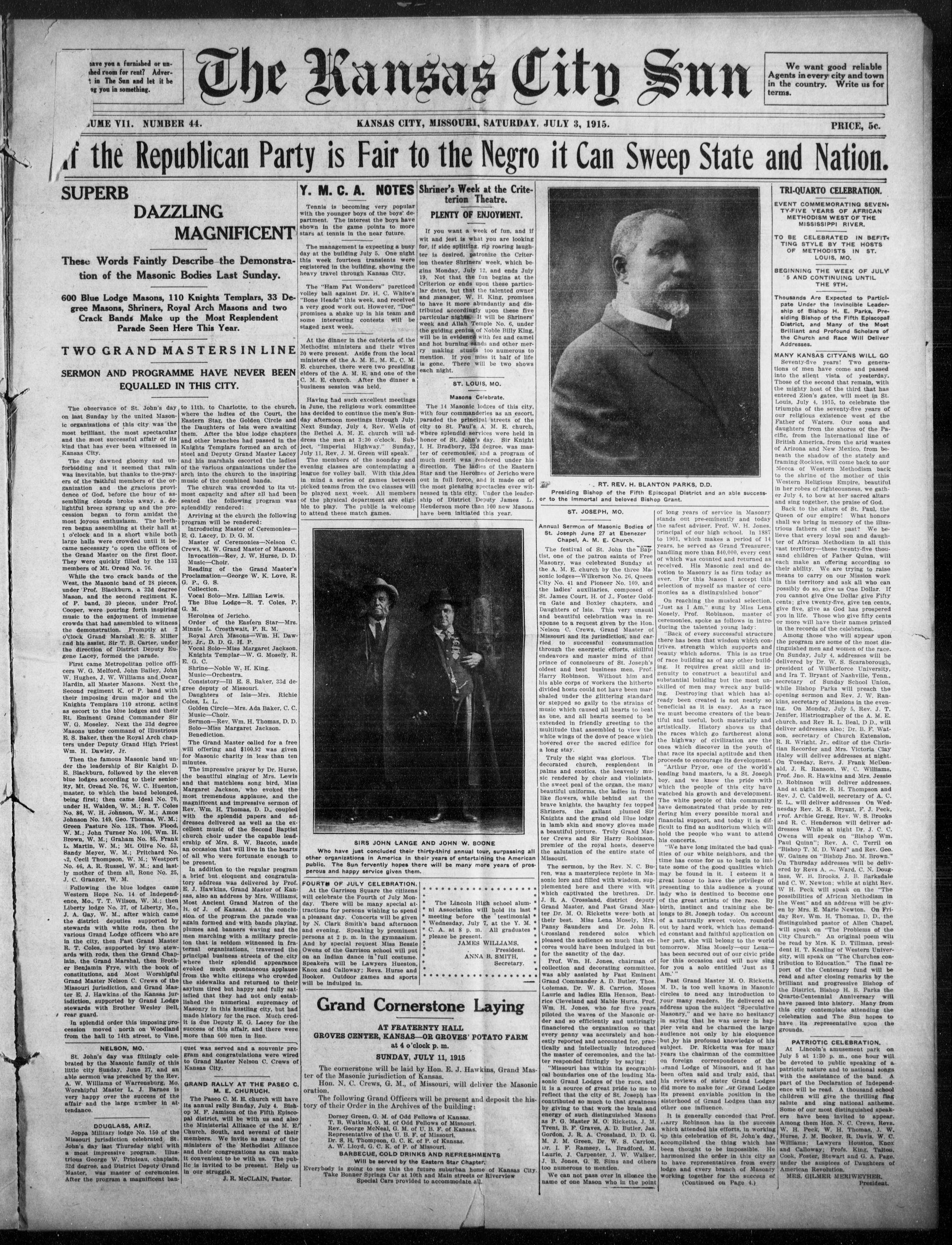
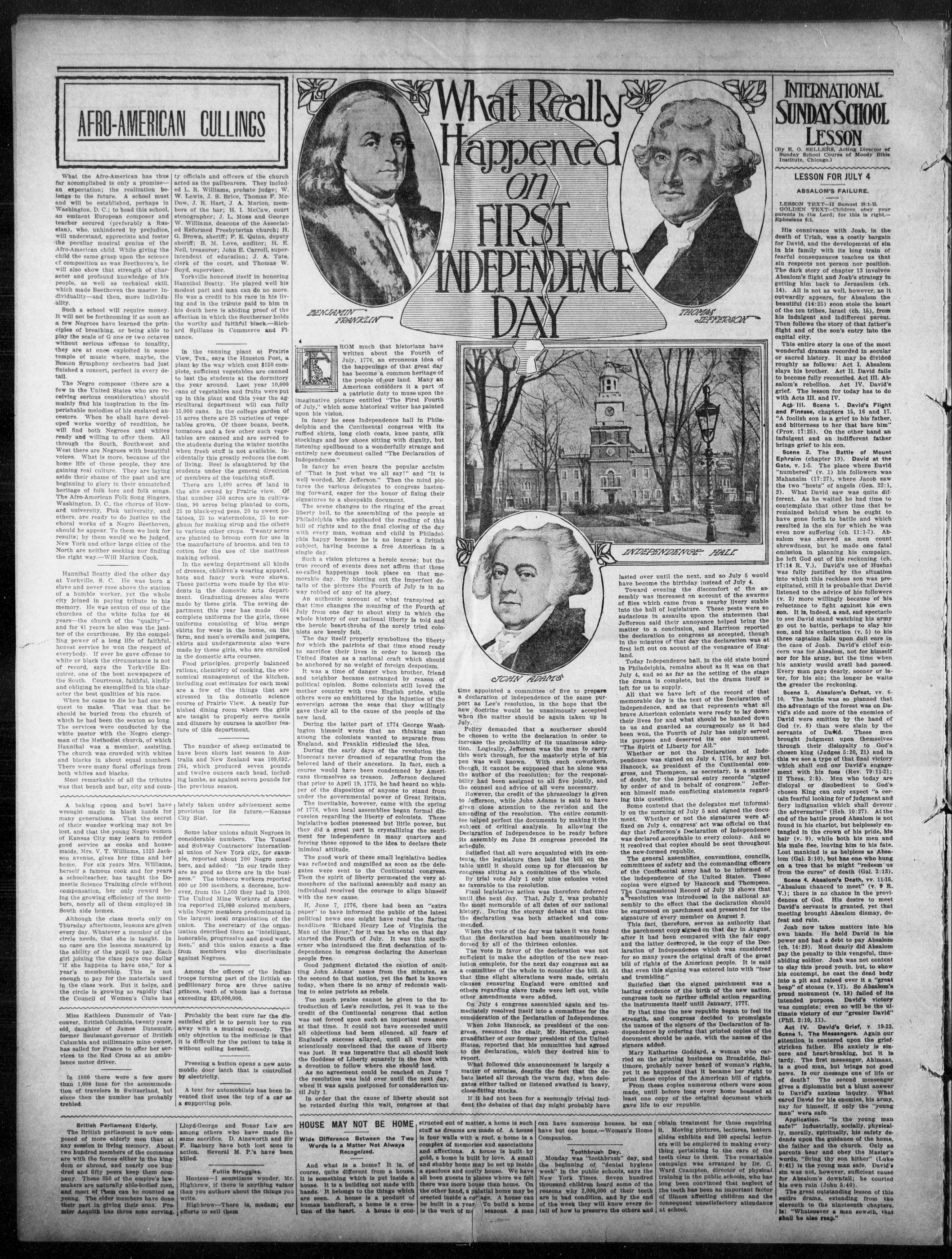
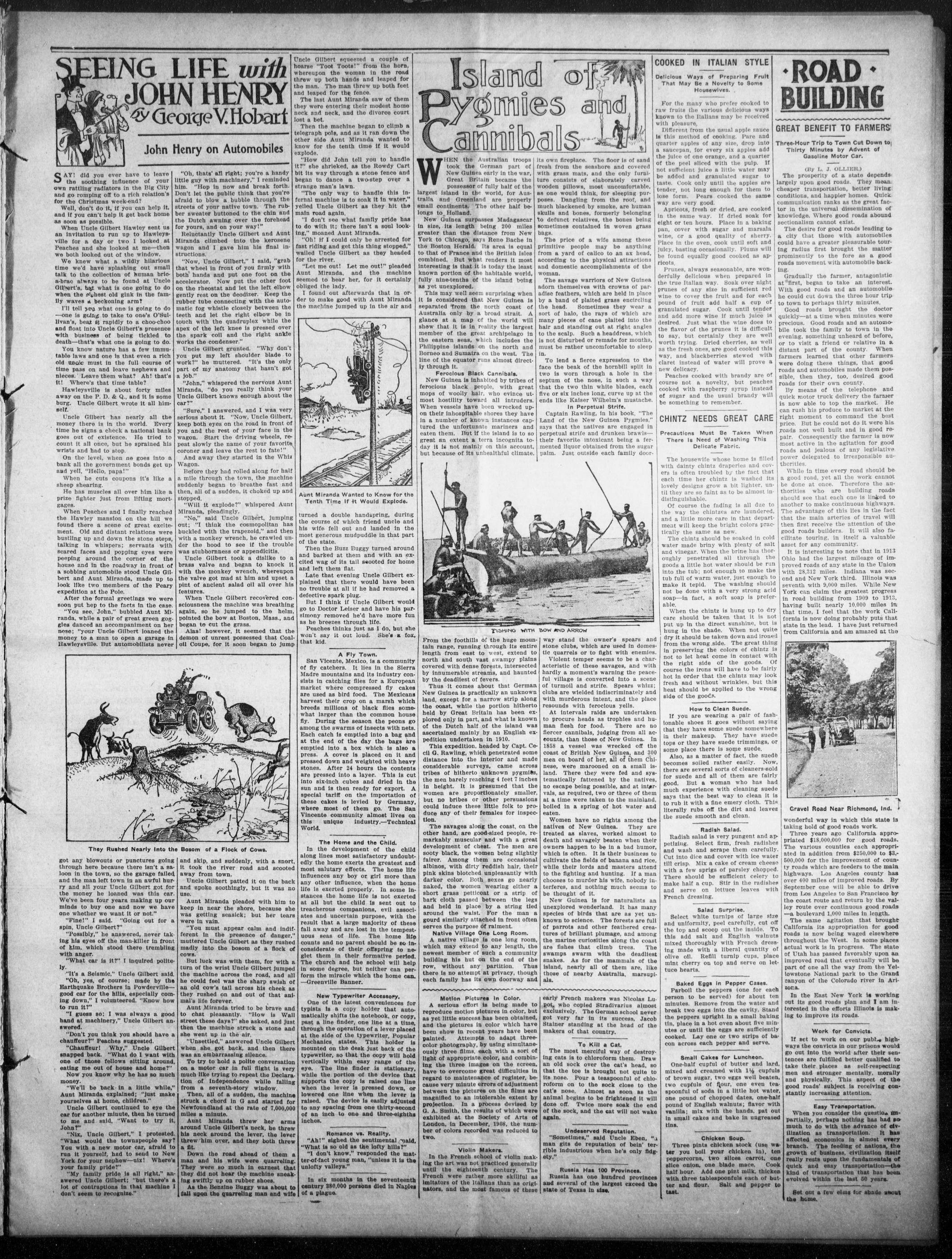
Page text (machine-generated)
if the Republican Party is Fair to the Negro it Can Sweep State and Nation.
These Words Faintly Describe the Demonstraction of the Masonic Bodies Last Sunday.
600 Blue Lodge Masons, 110 Knights Templars, 33 Degree Masons, Shriners, Royal Arch Masons and two Crack Bands Make up the Most Resplendent Parade Seen Here This Year.
TWO GRAND MASTERS IN LINE
SERMON AND PROGRAMME HAVE NEVER BEEN EQUALLED IN THIS CITY.
save you a furnished or un-
shed room for rent? Adver-
t in The Sun and let it be
ug you in something.
f the Republ
SUPERB
DAZZLING MALE
These Words Faintly Description of the Masonic Bodie
600 Blue Lodge Masons, 110 Knightree Masons, Shriners, Royal A Crack Bands Make up the Parade Seen Here T
TWO GRAND MASTER
SERMON AND PROGRAMME EQUALLED IN THE
The observance of St. John's day on last Sunday by the united Masonic organizations of this city was the most brilliant, the most spectacular and the most successful affair of its kind that has ever been witnessed in Kansas City.
The day dawned gloomy and unforsbidding and it seemed that rain was inevitable, but thanks to the prayers of the faithful members of the organization and the gracious providence of God, before the hour of assembling clouds broke away, a delightful breeze sprang up and the procession began to form amidst the most joyous enthusiasm. The brethren began assembling at their hall at 1 o'clock and in a short while both large halls were crowded until it became necessary 'o open the offices of the Grand Master on the first floor. They were quickly filled by the 133 members of Mt. Oread No. 76.
While the two crack bands of the West, the Masonic band of 28 pieces, under Prof. Blackburn, a 32d degree Mason, and the second regiment K. of P. band, 30 pieces, under Prof. Cooper, were pouring forth inspiring music to the enjoyment of immense crowds that had assembled to witness the demonstration. Promptly at 2 o'clock Grand Marshal E. S. Miller and his assist, Sir T. B. Carter, under the direction of District Deputy Eugene Lacey, formed the parade.
First came Metropolitan police officers W. G. Melford, John Bailey, John W. Hughes, J. W. Williams and Oscar Hardin, all Master Masons. Next the Second regiment K. of P. band with their imposing drum major and the Knights Templars 110 strong, acting as escort to the blue lodges and their Rt. Eminent Grand Commander Sir W. G. Moseley. Next the 33d degree Masons under command of illustrious E. S. Baker, then the Royal Arch chapters under Deputy Grand High Priest Wm. H. Dawley, Jr.
Then the famous Masonic band under the leadership of Sir Knight D. E. Blackburn, followed by the eleven blue lodges according to their seniority, Mt. Oreal No. 76, W. C. Hueston, master, to which the band belonged, being first; then came Ideal No. 70, under H. Walden, W. M.; R. T. Coles No. 86, W. H. Johnson, W. M.; Amos Johnson No. 149, Geo. Thomas, W. M.; Green Pasture No. 128, Thos. Flood, W. M.; John Turner No. 106, Wm. H. Brown, W. M.; Graham No. 85, Frank L. Martin, W. M.; M. Olive No. 53, Sandy Meyer, W. M.; Pritchard No. 2, Cecil Thompson, W. M.; Westport No. 46, A. R. Russel, W. M.; and lastly mother of them all, Rone No. 25, J. C. Granger, W. M.
Following the blue lodges came Western Hope No. 14 of Independence, Mo., T. T. Wilson, W. M.; then Liberty lodge No. 37, of Liberty, Mo., J. A. Gay, W. M., after which came the district deputies supported by stewards with white rods, then the various Grand Lodge officers who are in the city, then Past Grand Master R. T. Coles, supported by two stewards with rods, then the Grand Chaplain, the Grand Marshal, then Brother Benjamin Frye, with the book of constitutions, and Most Worshipful Grand Master Nelson C. Crews of the Missouri jurisdiction, and Grand Master E. J. Hawkins of the Kansas jurisdiction, supported by Grand Lodge stewards with Brother Wesley Bell, rear guard.
In splendid order this imposing procession moved north on Woodland from the hall to 14th street, to Vine,
NELSON, MO.
St. John's day was fittingly celebrated by the Masonic family of this little city Sunday, June 27, and an able sermon was preached by the Rev. A. W. Williams of Warrenburg, Mo. Worshipful Master L. J. Barnes is very happy over the success of the affair and the large number in attendance.
DOUGLASS. ARIZ
Joppa Military lodge No. 150 of the Missouri jurisdiction celebrated St. John's day last Thursday night with a most impressive program. Illustrious George W. Prioleau, chaplain, 32d degree, and District Deputy Grand Master, was master of ceremonies. After the program a magnificent ban-
The Kansas City Sun
to 11th, to Charlotte, to the church, where the ladies of the Court, the Eastern Star, the Golden Circle and the Daughters of Isis were awaiting them. After the blue lodge chapters and other branches had passed in the Knights Templars formed an arch of steel and Deputy Grand Master Lacey and his marshals escorted the ladies of the various organizations under the arch into the church to the inspiring music of the combined bands.
The church was crowded to its utmost capacity and after all had been seated the following program was splendidly rendered:
Arriving at the church the following program will be rendered:
Introducing Master of Ceremonies—E. G. Lacey, D. D. G. M.
Master of Ceremonies—Nelson C.
Crews, M. W. Grand Master of Masons.
Invocation—Rev. J. W. Hurse, D. D.
Music—Choir.
Reading of the Grand Master's
Proclamation—George W. K. Love, R.
G. P., G. S.
Collection.
Vocal Solo—Mrs. Lillian Lewis
Vocal Solo—Mrs. Linian Lewis.
The Blue Lodge—R. T. Coles, P.
G. M.
Heroines of Jericho.
Order of the Eastern Star—Mrs.
Minnie L. Crosthwait, P. R. M.
Royal Arch Masons—Wm. H. Dawley, Jr., D. D. G. H. P.
Vocal Solo—Miss Margaret Jackson.
Knights Templar—W. G. Mosely, R.
E. G. C.
Shrine—Noble W. H. King.
Music—Orchestra.
Consistory—Ill E. S. Baker, 33d degree deputy of Missouri.
Daughters of Isls—Mrs. Richie Coles, L. L.
Golden Circle—Mrs. Ada Baker, C. C.
Music—Choir.
Sermon—Rev. Wm. H. Thomas, D. D.
Solo—Miss Margaret Jackson.
Benediction.
The Grand Master called for a free will offering and $100.92 was given for Masonic charity in less than ten minutes.
The impressive prayer by Dr. Hurse, the beautiful singing of Mrs. Lewis and that matchless song bird, Miss Margaret Jackson, who evoked the most tremendous applause, and the magnificent and impressive sermon of Rev. Wm. H. Thomas, D. D., coupled with the splendid papers and addresses delivered as well as the excellent music of the Second Baptist church choir under the capable leadership of Mrs. S. W. Bacote, made an occasion that will live in the hearts of all who were fortunate enough to be present.
In addition to the regular program a brief but eloquent and congratulatory address was delivered by Prof. E. J. Hawkins, Grand Master of Kansas, also an address by Mrs. Williams, Most Ancient Grand Matron of the H. of J. of Kansas. At the conclusion of the program the parade was again formed and with bands playing, plumes and banners waving and the men marching with a military precision that is seldom witnessed in fraternal organizations, traversed the principal business streets of the city where their splendid appearance evoked much spontaneous applause from the white citizens who crowded the sidewalks and returned to their asylum tired but happy and fully satisfied that they had not only established the numerical supremacy of Masonry in this hustling city, but had made history for the race. Much credit it is due Deputy E. G. Lacey for the success of this affair, and there were more than 600 men in line.
quet was served and a souvenir program and congratulations were wired to Grand Master Nelson C. Crews of Kansas City.
GRAND RALLY AT THE PASEO C. M. E. CHURUCH.
The Paseo C. M. E. church will have its annual rally Sunday, July 4. Bishop M. F. Jamison of the Fifth Episcopal district, will be with us and also the Ministerial Alliance of the M. E. Church, South, and several of their members. We invite as many of the ministers of the Methodist Alliance and their congregations as can make it convenient to be with us. The public is invited to be present. Help us in our struggle. J. R. McCLAIN, Pastor.
KANSAS CITY, MISSOURI, SATURDAY, JULY 3, 1915.
Y. M. C. A. NOTES
Tennis is becoming very popular with the younger boys of the boys' department. The interest the boys have shown in the game points to more stars at tennis in the near future.
The management is expecting a busy day at the building July 5. One night this week fourteen transients were registered in the building, showing the heavy travel through Kansas City.
The "Ham Fat Wonders" practiced volley ball against Dr. H. C. White's "Bone Heads" this week, and received a very good work out. However, "Doc" promises a shake up in his team and some interesting contests will be staged next week.
At the dinner in the cafeteria of the Methodist ministers and their wives 20 were present. Aside from the local ministers of the A. M. E., M. E., C. M. E. churches, there were two presiding elders of the A. M. E. and one of the C. M. E. church. After the dinner a business session was held.
Having had such excellent meetings in June, the religious work committee has decided to continue the men's Sunday afternoon meetings through July. Next Sunday, July 4. Rev. Wells of the Bethel A. M. E. church will address the men at 3:30 o'clock. Subject, "Imperial Highway." Sunday, July 11, Rev. J. M. Green will speak. The members of the noonday and evening classes are contemplating a league for volley ball. With this idea in mind a series of games between picked teams from the two classes will be played next week. All members of the physical department are eligible to play. The public is welcome to attend these match games.
[Image of a man in a suit and hat, facing forward.]
1930
SIRS JOHN LANGE AND JOHN W. BOONE
Who have just concluded their thirty-third annual tour, a
other organizations in America in their years of entertaining
public. The Sun fervently hopes there will be many more y
perous and happy service given them.
Who have just concluded their thirty-third annual tour, surpassing all other organizations in America in their years of entertaining the American public. The Sun fervently hopes there will be many more years of prosperous and happy service given them.
FOURTH OF JULY CELEBRATION.
At the Garrison Square the citizens will celebrate the Fourth of July Monday. There will be many special attractions for persons wishing to spend a pleasant day. Concerts will be given by N. Clark Smith's band afternoon and evening. Speaking by prominent persons at 2 p. m. in the gymnasium. And by special request Miss Bessie Owens of the Garrison school will put on an Indian dance in full costume. Speakers will be Lawyers Hueston, Knox and Calloway; Revs. Hurse and Booker. Outdoor games and sports will be indulged in.
The Lincoln High school alumni Association will hold its last meeting before the testimonial Wednesday, July 7, at the Y. M. C. A. at 8 p. m. All graduates please be present.
JAMES WILLIAMS,
President.
ANNA B. SMITH,
Secretary.
Grand Cornerstone Laying
AT FRATERTY HALL
GROVES CENTER, KANSAS-
at 4 o'clock
SUNDAY, J
The cornerstone will be laid
ter of the Masonic jurisdiction of
Hon. N. C. Crews, G. M., of
oration.
The following Grand Officers'
tory of their Order in the Archives
Dorsey Green, G. M. of Odd F.
T. B. Watkins, G. M. of Odd F.
Rev. George McNeal, G. M. of
Representative of the U. B. F.
Dr. S. H. Thompson, G. C. K. o
A. W. Lloyd, G. C. K. of P.
BARBECUE, COLD DRINK
The cornerstone will be laid by Hon. E. J. Hawkins, Grand Master of the Masonic jurisdiction of Kansas.
Hon. N. C. Crews, G. M., of Missouri, will deliver the Masonic oration.
The following Grand Officers will be present and deposit the history of their Order in the Archives of the building:
Dorsey Green, G. M. of Odd Fellows of Kansas.
T. B. Watkins, G. M. of Odd Fellows of Missouri.
Rev. George McNeal, G. M. of U. B. F. of Kansas.
Representative of the U. B. F. of Missouri.
Dr. S. H. Thompson, G. C. K. of P. of Kansas.
A. W. Lloyd, G. C. K. of P. of Missouri.
Everybody is going to see this the future suburban home of Kansas City Take Bonner Springs Car at 10th and Main streets or Riverview Special Cars provided to accommodate all.
Shriner's Week at the Criterion Theatre.
PLENTY OF ENJOYMENT.
If you want a week of fun, and for wit and jest is what you are looking for, if side splitting, rip roaring laughter is desired, patronize the Criterion theater Shriners' week, which begins Monday, July 12, and ends July 19. Not that the fun begins at the Criterion or ends upon these particular dates, but that the talented owner and manager, W. H. King, promises to have it more abundantly and distributed accordingly upon these five particular nights. It will be Shriners' week and Allah Temple No. 6, under the guiding genius of Noble Billy King, will be in evidence with fez and camel and hot burning sands and other mery making stunts too numerous to mention. If you miss it half of life is gone. There will be two shows each night.
ST. LOUIS, MO.
Masons Celebrate
The 14 Masonic lodges of this city, with four commanderies as an escort, paraded the principal streets of the city to St. Paul's A. M. E. church, where splendid services were held in honor of St. John's day. Sir Knight I. H. Bradbury, 32d degree, was master of ceremonies, and a program of much merit was rendered under his direction. The ladies of the Eastern Star and the Heromes of Jericho were out in full force, and it made on of the most pleasing spectacles ever witnessed in this city. Under the leadership of District Deputy James L. Henderson more than 100 new Masons have been initiated this year.
1
The Lincoln High school alum-
ni Association will hold its last
meeting before the testimonial
Wednesday, July 7, at the Y. M.
C. A. at 8 p. m. All graduates
please be present.
JAMES WILLIAMS,
President.
ANNA B. SMITH,
Secretary.
OR GROVES' POTATO FARM
lock p. m.
JULY 11, 1915
by Hon. E. J. Hawkins, Grand Mass.
Kansas.
Missouri, will deliver the Masonic
will be present and deposit the his
s of the building:
Fellows of Kansas.
Fellows of Missouri.
U. B. F. of Kansas.
of Missouri.
of P. of Kansas.
Missouri.
KKS AND REFRESHMENTS
[Name not visible in the image]
ST. JOSEPH, MO.
Annual Sermon of Masonic Bodies of St. Joseph June 27 at Ebenzer Chapel, A. M. E. Church.
The festival of St. John the Baptist, one of the patron saints of Free Masonry, was celebrated Sunday at the A. M. E. church by the three Masonic lodges—Wilkerson No. 26, Queen City No. 41 and Pioneer No. 109, and the ladies' auxiliaries, composed of St. James Court, H. of J. Foster Golden gate and Boxley chapters, and Daughters of Isis. This very unusual and beautiful celebration was in response to a request given by the Hon Nelson C. Crews, Grand Master of Missouri and its jurisdiction, and carried to successful consummation through the energetic efforts, skillful endeavors and master mind of that prince of connoisseurs of St. Joseph's oldest and best business men, Prof Harry Robinson. Without him and his able corps of workers the hitherto divided hosts could not have been marshaled under the glittering standard or stepped so gaily to the strains of music which caused all hearts to beat as one, and all hearts seemed to be extended in friendly greeting to the multitude that assembled to view the white wings of the dove of peace which hovered over the sacred edifice for a long stay.
Truly the sight was glorious. The decorated church, resplendent in palms and exotics, the heavenly music rendered by choir and violinists, the sweet peal of the organ, the many beautiful uniforms, the ladies in front like flowers, while behind sat the brave knights, the haughty fez topped Shriners, the gallant plumed Sir Knights and the grand old blue lodge in lamb skin and snowy gloves made a beautiful picture. Truly Grand Master Crews and Sir Harry Robinson, premier of the royal hosts, deserve the salutation of the entire state of Missouri.
The sermon, by the Rev. N. C. Buren, was a masterpiece replete in Masonic lore and filled with wisdom, supplemented here and there with wit which captivated the brethren. Dr. J. R. A. Crossland, district deputy Grand Master, and Past Grand Master Dr. M. O. Rickettes were both at their best. Miss Lena Moseley, Mrs Pansy Saunders and Dr. John R Crossland rendered solos which pleased the audience so much that encores would have been indulged in but for the sanctity of the day.
Prof. Wm. H. Jones, chairman of and decorating committee, was ably assisted by Past Eminent Grand Commander A. D. Butler, Thos. Coleman, Dr. W. S. Carrion, Moses Laurie and ladies Ella Henson, Beatrice Cleveland and Mable Hurts, Prof. Wm. H. Jones, who for five years piloted the waves of the Masonic order and so efficiently and unintently financed the organization so that every penny was accurately and honestly reported and accounted for, practically and intellectually introduced the master of ceremonies, and the latter responded fittingly by saying: "Missouri has within its geographical boundaries one of the leading Masonic Grand Lodges of the race, and it is a source of great pride to me to reflect that the city of St. Joseph has contributed so much to that greatness by giving to that work the brain and energy of such distinguished Masons as P. G. Master M. O. Rickettes, J. M. Trent, B. F. Graves, A. D. Butter, Jas. Gordon, J. R. A. Crossland, D. D. G. M. J. M. Green, Dr. W. S. Carrion, Dr. I. F. Ramsey, L. Bradford, M. Laurie, J. Carpenter, J. W. Walker, J. B. Jones, G. E. Sims and others too numerous to mention.
We can not pass over in silence the name of one Mason who in the point
of long years of service in Masonry stands out pre-eminently and today the safest adviser, Prof. W. H. Jones, principal of our high school. In 1887 to 1901, which makes a period of 14 years, he served as Grand Treasurer, handling more than $40,000, every cent of which was counted and returned as received. His Masonic zeal and devotion to Masonry is as firm today as ever. For this Mason I accept this selection of myself as master of ceremonies as a distinguished honor"
On reaching the musical selection, "Just as I Am," sung by Miss Lena Mosely, Prof. Robinson, master of ceremonies, spoke as follows in introducing the talented young lady: "Back of every successful structure there has been that wisdom which contrives, strength which supports and beauty which adorns. This is as true of race building as of any other building. It requires great skill and ingenuity to construct a beautiful and substantial building but the most unskilled of men may wreck any building. Destroying that which has already been created is not nearly so beneficial as it is easy. As a race we must become creators of the beautiful and useful, both materially and artistically. History shows us that the races which go fartherest along the highway of civilization are the ones which discover in the youth of that race its special aptitude and then proceeds to encourage its development.
"Arthur Pryor, one of the world's leading band masters, is a St. Joseph boy, and we know the pride with which the people of this city have watched his growth and development. The white people of this community have demonstrated that pride by rendering him every possible moral and financial support, and today it is difficult to find an auditorium which will hold the people who want to attend his concerts.
"We have long imitated the bad qualities of our white neighbors, and the time has come for us to begin to imitate some of the good qualities which may be found in it. I esteem it a great honor to have the privilege of presenting to this audience a young lady who is destined to become one of the great artists of the race. By birth, instinct and training she belongs to St. Joseph today. On account of a naturally sweet voice, rounded out by hard work, which has demanded constant and faithful application on her part, she will belong to the world tomorrow. Miss Mosely—our Lena—has been secured out of our civic pride for this occasion and will now sing for you a solo entitled 'Just as I Am.'"
Past Grand Master M. O. Rickett, M. D. is too well known in Masonic circles to need any introduction to your many readers. He delivered an address upon the subject "Speculative Masonry," and we have no hesitancy in saying that he was never in happier vein and he charmed the large audience not only by his eloquence but by his profound knowledge of his subject. Dr. Rickett was for many years the chairman of the committee on foreign correspondence of the Grand Lodge of Missouri, and it has been often said and truly said, that his reviews of sister Grand Lodges did more to make for our Grand Lodge its present enviable position in the sisterhood of Grand Lodges than any other one influence.
It is generally conceded that Prof Harry Robinson has in the success which attended his efforts, in working up this celebration of St. John's day, accomplished the thing which has been thought to be impossible. He harmonized the order in this city as to have representatives from every lodge and every branch of Masonry working together for the success of (Continued on Page 4.)
We want good reliable Agents in every city and town in the country. Write us for terms.
PRICE. 5c.
TRI-QUARTO CELEBRATION.
EVENT COMMEMORATING SEVEN-
TY-FIVE YEARS OF AFRICAN
METHODISM WEST OF THE
MISSISSIPPI RIVER.
TO BE CELEBRATED IN BEFIT-
TING STYLE BY THE HOSTS
OF METHODISTS IN ST.
LOUIS, MO.
BEGINNING THE WEEK OF JULY
'5 AND CONTINUING UNTIL
THE 9TH.
Thousands Are Expected to Participate Under the Invincible Leadership of Bishop H. E. Parks, Presiding Bishop of the Fifth Episcopal District, and Many of the Most Brilliant and Profound Scholars of the Church and Race Will Deliver Addresses.
MANY KANASAS CITYANS WILL GO
Seventy-five years! Two generations of men have come and passed into the silent vista of yesterday. Those of the second that remain, with the mighty host of the third that has entered Zion's gates, will meet in St. Louis, July 4, 1975, to celebrate the triumphs of the seventy-five years of our religious existence west of the Father of Waters. Our sons and daughters from the shores of the Pacific, from the International line of British America, from the arid wastes of Arizona and New Mexico, from beneath the shadow of the stately and framing Rockies, will come back to our Mecca of Western Methodism back to the shrine of the mother of this Western Religious Empire, beautiful in her robes of righteousness, we gather July 4, to bow at her sacred altars and sing together, the praise of God.
Back to the altars of St. Paul, the Queen of our empire! What honors shall we bring in memory of the illustrious fathers of the past? We believe that every loyal son and daughter of African Methodism in all this vast territory—these twenty-five thousand children of Father Quinn, will each make an offering according to their ability. We are trying to raise means to carry on our Mission work in this territory and ask all who can possibly do so, give us One Dollar. If you cannot give One Dollar give Fifty cents; give twenty-five, give ten cents, give five, give as God has prospered you in life. Those who give fifty cents or more will have their names printed in the records of the celebration.
PATRIOTIC CELEBRATION.
At Lincoln's amusement park on
July 5 at 1:30 p. m., one hour will
be devoted to public speaking of a
patriotic nature and to national songs
with the assistance of the band.
A part of the Declaration of Independence will be read. A thousand school children will give the thrilling flag salute and sing national anthems.
Some of our most distinguished speakers have been invited to appear.
Among them Hon. N. C. Crews, Revs.
W. H. Peck, W. H. Thomas, J. W.
Hurse, J. M. Booker, R. Davis, W. C.
Williams; Lawyers Houston, Knox
and Calloway; Profs. King, Talton,
Cook, Foster, Stewart and A. G. Page,
under the auspices of Daughters of American Revolution.
MRS. GILMER MERIWETHER.
President.
AFRO-AMERICAN CULLINGS
---
What the Afro-American has thus far accomplished is only a promise—an expectation; the realization belongs to the future. A school must and will be established, perhaps in Washington, D. C.; to head this school, an eminent European composer and teacher secured (preferably a Russian), who, unhindered by prejudice, will understand, appreciate and foster the peculiar musical genius of the Afro-American child. While giving the child the same grasp upon the science of composition as was Beethoven's, he will also show that strength of character and profound knowledge of his people, as well as technical skill, which made Beethoven the master. Individuality—and then, more individuality.
Such a school will require money. It will not be forthcoming if as soon as a few Negroes have learned the principles of breathing, or being able to play the scale of G one or two octaves without serious offense to tonality, they are at once exploited in some temple of music where, maybe, the Boston Symphony orchestra had just finished a concert, perfect in every detail.
The Negro composer (there are a few in the United States who are receiving serious consideration) should mainly find his inspiration in the impishable melodies of his enslaved ancestors. When he shall have developed works worthy of rendition, he will find both Negroes and whites ready and willing to offer them. All through the South, Southwest and West there are Negroes with beautiful voices. What is more, because of the home life of these people, they are gaining real culture. They are laying aside their shame of the past and are beginning to glory in their unmatched heritage of folk lore and folk songs. The Afro-American Folk Song Singers, Washington, D.C., the chorus of Howard university, Fisk university, and others, are ready to do justice to the choral works of a Negro Beethoven, should he appear. To them we look for results; by them would we be judged. New York and other large cities of the North are neither seeking nor finding the right way—Will Marion Cook.
---
Hannibal Beatty died the other day at Yorkville, S. C. He was born a slave and never rose above the station of a humble worker, yet the whole city joined in paying tribute to his memory. He was sexton of one of the churches of the white folks for 48 years—the church of the "quality" and for 41 years he also was the jankor of the courthouse. By the compelling power of a long life of faithful honest service he won the respect of everybody. If ever he gave offense to white or black the circumstance is not of record, says the Yorkville Enquirer, one of the best newspapers of the South. Courteous, faithful, kindly and obliging he exemplified in his character the best qualities of his race.
When he came to die he had one request to make. That was that he should be buried from the church of which he had been the sexton so long. The services were conducted by the white pastor with the Negro clergyman of the Methodist church, of which Hannibal was a member, assisting. The church was crowded with whites and blacks in about equal numbers. There were many floral offerings from both whites and blacks. Most remarkable of all the tributes was that bench and bar, city and coun
A baking rpoon and bowl have wrought magic in black hands for many generations. That the secret of their wonder working may not be lost, and that the young Negro women of Kansas City may learn to render good service as cooks and housemaids, Mrs. V. T. Williams, 1325 Jackson avenue, gives her time and her home. For six years Mrs. Williams, herself a famous cook and for years a schoolteacher, has taught the Domestic Science Training circle without compensation, her only reward being the growing efficiency of the members, nearly all of them employed in South side homes.
Although the class meets only on Thursday afternoons, lessons are given every day. Whatever a member of the circle needs, that she is taught. In no case are the lessons measured by the ability of the pupil to pay. Each girl joining the class pays one dollar "if she happens to have one," for a year's membership. This is not enough to pay for the materials used in the class work. But it helps, and the circle is growing so rapidly that the Council of Women's Clubs has
Miss Kathleen Dunsmuir of Vancouver. British Columbia, twenty years old, daughter of James Dunsmuir, former lieutenant-governor of British Columbia and millionaire mine owner, has sailed for France to offer her services to the Red Cross as an ambulance motor driver.
In 1880 there were a few more than 1,000 inns for the accommodation of travelers in Switzerland, but since then the number has probably trebled.
British Parliament Elderly. The British parliament is now composed of more elderly men than at any session in living memory. About two hundred members of the commons are with the forces either in the kingdom or abroad, and nearly one hundred and fifty peers keep them company. These 350 of the empire's lawmakers are naturally able-bodied men, and most of them can be counted as young. The elder members have done their part in giving their sons. Prefer Asquith has three sons serving
ty officials and officers of the church acted as the pallbearers. They included L. R. Williams, probate judge; W. W. Lewis, J. S. Brice, Thomas F. McDow, J. R. Hart, J. A. Marlon, members of the bar; H. I. L. McCaw, court stenographer; J. L. Moss and George W. Williams, deacons of the Associated Reformed Presbyterian church; H. G. Brown, sheriff; F. E. Quin, deputy sheriff; B. M. Love, auditor; H. E. Nell, treasurer; John E. Carroll, superintendent of education; J. A. Tate, clerk of the court, and Thomas W. Boyd, supervisor.
Yorkville honored itself in honoring Hannibal Beatty. He played well his modest part and man can do no more. He was a credit to his race in his living and in the tribute paid to him in his death here is abiding proof of the affection in which the Southerner holds the worthy and faithful black—Richard Spillane in Commerce and Finance.
---
In the canning plant at Prairie View, Tex., says the Houston Post, a plant by the way which cost $150 complete, sufficient vegetables are canned to last the students at the dormitory the year around. Last year 10,000 cans of vegetables and fruits were put in this plant and this year the agricultural department will can fully 15,000 cans. In the college garden of 15 acres there are 25 varieties of vegetables grown. Of these beans, beets, tomatoes and a few other such vegetables are canned and are served to the students during the winter months when fresh stuff is not available. Incidentally this greatly reduces the cost of living. Beef is slaughtered by the students under the general direction of members of the teaching staff.
There are 1,400 acres of land in the site owned by Prairie view. OF that number 350 acres are in cultivation, 90 acres being planted to corn, 25 to black-eyed peas, 20 to sweet potatoes, 25 to watermelons, 25 to sorghum for making sirup and the others to various other crops. Twenty acres are planted to broom corn for use in the manufacture of brooms, and ten to cotton for the use of the mattress making school.
In the sewing department all kinds of dresses, children's wearing apparel, hats and fancy work were shown. These patterns were made by the students in the domestic arts department. Graduating dresses also were made by these girls. The sewing department this year has made 684 complete uniforms for the girls, these uniforms consisting of blue serge skirts for wear in the home, on the farm, and men's overalls and jumpers, skirts and undergarments also were made by these girls, who are enrolled in the domestic arts courses.
Food principles, properly balanced rations, chemistry of cooking, the economical management of the kitchen, including cost estimates for each meal, are a few of the things that are stressed in the domestic science course of Prairie View. A neatly furnished dining room where the girls are taught to properly serve meals and dinners by courses is another feature of this department.
The number of sheep estimated to have been shorn last season in Australia and New Zealand was 109,692, 264, which produced seven pounds and twelve ounces each head, including lambs, as against seven pounds for the previous season.
lately taken under advisement some provision for its future.—Kansas City Star.
Some labor unions admit Negroes in considerable numbers. The Tunnel and Subway Contractors' International union of New York city, for example, reported about 200 Negro members, and added: "In our trade they are as good as there are in the business." The tobacco workers reported 400 or 500 members, a decrease, however, from the 1,500 they had in 1900. The United Mine Workers of America reported 25,000 colored members, while Negro members predominated in the largest local organization of the union. The secretary of the organization described them as "intelligent, honorable, progressive and good workmen," and this union exacts a fine from members who discriminate against Negroes.
Among the officers of the Indian troops forming part of the British expeditionary force are three native princes, each of whom has a fortune exceeding $20,000,000.
Probably the best cure for the dissatisfied girl is to permit her to run away with a musical comedy. The only objection to the medicine is that it is difficult for the patient to take it without soiling herself.
Pressing a button opens a new automobile door latch that is controlled by electricity.
A tent for automobiles has been invented that uses the top of a car as a supporting pole.
Lloyd-George and Bonar Law are among others who have made the same sacrifice. D. Alnsworth and Sir F. Banbury have both lost sons in action. Several M. F.'s have been killed.
Futile Struggles.
Hostess—I sometimes wonder, Mr.
Highbrow, if there is anything vainer
than you authors about the things you
write.
Highbrow—There is, madam; our
efforts to sell them
What Really
Happened
on
FIRST
INDEPENDENCE
DAY
BENJAMIN
FRANKLIN
THOMAS
JEFFERSON
ROM much that historians have written about the Fourth of July, 1776, an erroneous idea of the happenings of that great day has become a common heritage of the people of our land. Many an American considers it a part of a patriotic duty to muse upon the imaginative picture entitled "The First Fourth of July," which some historical writer has painted upon his vision. In fancy he sees Independence hall in Philadelphia and the Continental congress with its ruffled shirts, long cloth coats, knee pants, silk stockings and low shoes sitting with dignity, but listening spellbound to a wonderfully strange and entirely new document called "The Declaration of Independence." In fancy he even hears the popular acclaim of "That is just what we all say!" and "It is well worded, Mr. Jefferson." Then the mind pictures the various delegates to congress hastening forward, eager for the honor of fixing their signatures to a sheepskin document.
The scene changes to the ringing of the great liberty bell, to the assembling of the people at Philadelphia who applauded the reading of this bill of rights and to the final closing of the day with every man, woman and child in Philadelphia happy because he is no longer a British subject, having become a free American in a single day.
Such a vision pictures a heroic scene; but the true record of events does not affirm that these so-called happenings took place on that memorable day. By blotting out the imperfect details of the picture The Fourth of July is in no way robbed of any of its glory.
An authentic account of what transpired at that time changes the meaning of the Fourth of July from one day to about sixty in which the whole history of our national liberty is told and the heroic heart-throbs of the sorely tried colonists are keenly felt.
The day itself properly symbolizes the liberty for which the patriots of that time stood ready to sacrifice their lives in order to launch the United States as a national craft which should be anchored by no weight of foreign despotism.
It was a time of danger when brother, friend and neighbor became estranged by reason of political opinion. Some colonists still loved the mother country with true English pride, while others were so embittered by the injustice of the sovereign across the seas that they willingly gave their all to the cause of the people of the new land.
During the latter part of 1774 George Washington himself wrote that no thinking man among the colonists wanted to separate from England, and Franklin ridiculed the idea.
During the early days of the revolution the bluecoats never dreamed of separating from the beloved land of their ancestors. In fact, such a course would have been condemned by Americans themselves as treason. Jefferson declared that prior to April 19, 1775, he had heard no whisper of the disposition of anyone to stand from under the governmental power of Great Britain.
The inevitable, however, came with the spring of 1776, when local assemblies began formal discussion regarding the liberty of colonists. These legislative bodies possessed but little power, but they did a great part in crystallizing the sentiment for independence in many quarters and forcing those opposed to the idea to declare their inimical attitude. The good work of these small legislative bodies was reflected and magnified as soon as the delegates were sent to the Continental congress. Then the spirit of liberty permeated the very atmosphere of the national assembly and many an individual received the courage to align himself with the new cause.
If, June 7, 1776, there had been an "extra paper" to have informed the public of the latest political news one might have read the flaring headlines "Richard Henry Lee of Virginia the Man of the Hour," for it was he who on that day started the Fourth of July. It was this southerner who introduced the first declaration of independence in congress declaring the American people free.
Good judgment dictated the caution of omitting John Adams' name from the minutes, as the second to that motion, yet the fact is known today, when there is no army of redcoats waiting to seize patrols as rebels.
Too much praise cannot be given to the introduction of Lee's resolution, yet it was to the credit of the Continental congress that action was not forced upon such an important measure at that time. It could not have succeeded until all objections had been silenced, all fears of England's success allayed, until all were conscientiously convinced that the cause of liberty was just. It was imperative that all should look the Goddess of Liberty squarely in the face with a devotion to follow where she should lead.
As no agreement could be reached on June 7 the resolution was laid over until the next day, when it was again postponed for consideration until July 1.
In order that the cause of liberty should not be retarded during this wait, congress at that
lution complete, for the next day congress sat as a committee of the whole to consider the bill. At that time slight alterations were made, certain clauses censuring England were omitted, and others regarding slave trade were left out, while other amendments were added.
On July 4 congress assembled again and immediately resolved itself into a committee for the consideration of the Declaration of Independence.
When John Hancock, as president of the congress, resumed the chair, Mr. Harrison, great-grandfather of our former president of the United States, reported that his committee had agreed to the declaration, which they desired him to report.
What followed this announcement is largely a matter of surmise, despite the fact that the debate lasted all through the warm day, when delegates either talked or listened swathed in heavy, close-fitting stocks.
If it had not been for a seemingly trivial incident the debates of that day might probably have bill of rights of the American people. It is said that even this signing was entered into with "fear and trembling."
Satisfied that the signed parchment was a lasting evidence of the birth of the new nation, congress took no further official action regarding the instruments itself until January, 1777.
By that time the new republic began to feel its strength, and congress decided to promulgate the names of the signers of the Declaration of Independence by ordering that printed copies of the document should be made, with the names of the signers added.
Mary Katharine Goddard, a woman who carried on the printing business on Broadside, Baltimore, probably never heard of woman's rights, yet it so happened that it became her right to print these copies of the American bill of rights.
From these copies numerous others were soon made, until before long every home boasted at least one copy of the original document which gave life to our republic.
structed out of matter, a home is such stuff as dreams are made of. A house is four walls with a roof, a home is a complex of memories and associations and affections. A house is built-by gold, a house is built by love. A small and shabby home may be set up inside a spacious and costly house. We have all been guests in places where we felt there was more house than home. On the other hand, a palatial home may be erected inside a cottage. A house can be built in a year. To build a home is the work of my seasons. A man
BENJAMIN
FRANKLIN
I
Wide Difference Between the Two Words is a Matter Not Always Recognized.
And what is a home? It is, of course, quite different from a house. It is something which is put inside a house. It is a building not made with hands. It belongs to the things which are seen. A house is a product of human handicraft, a home is a creation of the heart. A house is con-
INDEPENDENCE HALL
TOWN ADAMS
time appointed a committee of five to prepare a declaration of independence of the same purport as Lee's resolution, in the hope that the new doctrine would be unanimously accepted when the matter should be again taken up in July. Policy demanded that a southerner should be chosen to write the declaration in order to increase the probability of its unanimous adoption. Logically, Jefferson was the man to carry this work through, for the masterly style of his pen was well known. With such coworkers, though, it cannot be supposed that he alone was the author of the resolution; for the responsibility had been assigned to all five jointly, and the counsel and advice of all were necessary. However, the credit of the phraseology is given to Jefferson, while John Adams is said to have given close attention to the revision and the amending of the resolution. The entire committee helped perfect the documents by making it the subject of critical analysis. In allowing the Declaration of Independence to be ready before its assembly on June 28 congress preceded its schedule.
Satisfied that all were acquainted with its contents, the legislature then laid the bill on the table until it should come up for discussion by congress sitting as a committee of the whole. By trial vote July 1 only nine colonies voted as favorable to the resolution.
Final legislative action was therefore deferred until the next day. That, July 2, was probably the most memorable of all dates of our national history. During the stormy debate at that time the declaration was both attacked and commended.
When the vote of the day was taken it was found that the declaration had been unanimously indorsed by all of the thirteen colonies.
The vote in favor of the declaration was not sufficient to make the adoption of the new resolution complete, for the next day congress sat as a committee of the whole to consider the bill. At that time slight alterations were made, certain clauses censuring England were omitted and others regarding slave trade were left out, while other amendments were added.
On July 4 congress assembled again and immediately resolved itself into a committee for the consideration of the Declaration of Independence.
When John Hancock, as president of the congress, resumed the chair, Mr. Harrison, great-grandfather of our former president of the United States, reported that his committee had agreed to the declaration, which they desired him to report.
What followed this announcement is largely a matter of surmise, despite the fact that the debate lasted all through the warm day, when delegates either talked or listened swathed in heavy, close-fitting stocks.
If it had not been for a seemingly trivial incident the debates of that day might probably have of matter, a home is such mms are made of. A house is with a roof, a home is a
can have numerous houses, he can but but one home.—Woman's Home Companion.
Monday was "toothbrush" day, and the beginning of "dental hygiene week" in the public schools, says the New York Times. Seven hundred thousand children heard some of the reasons why 2,000,000 of their teeth are in bad condition, and by the end of the week they will know every detail of how to preserve the others and
THE LANE
INDEPENDENCE HALL
lasted over until the next, and so July 5 would have become the birthday instead of July 4.
Toward evening the discomfort of the assembly was increased on account of the swarms of files which came from a nearby livery stable into the hall of legislature. These pests were so audacious in assaults upon the statesmen that Jefferson said their annoyance helped bring the matter to a conclusion, and Harrison reported the declaration to congress as accepted, though in the minutes of that day the declaration was at first left out on account of the vengeance of England.
Today Independence hall, in the old state house in Philadelphia, remains about as it was on that July 4, and so as far as the setting of the stage the drama is complete, but the drama itself is left for us to supply.
All that we have left of the record of that memorable day is the text of the Declaration of Independence, and as that represents what all brave American colonists were ready to lay down their lives for and what should be handed down to us and guarded as courageously as it had been won, the Fourth of July has amply served its purpose and deserved its one monument. Seems to be of Liberty for all."
The Spirit of Independence was signed on July 4, 1776, by any but Hancock, as president of the Continental congress, and Thompson, as secretary, is a matter of doubt, for the journal entry records "signed by order of and in behalf of congress." Jefferson himself made conflicting statements regarding this question.
Some contend that the delegates met informally on the morning of July 5 and signed the document. Whether or not the signatures were affixed on July 4, congress' act was official on that day that Jefferson's Declaration of Independence was declared acceptable to every colony. And so it resolved that copies should be sent throughout the new-formed republic.
The general assemblies, conventions, councils, committees of safety and the commanding officers of the Continental army had to be informed of the independence of the United States. These copies were signed by Hancock and Thompson. The Congressional Record of July 19 shows that a resolution was introduced in the national assembly to the effect that the declaration should be engrossed on parchment and presented for the signature of every member on August 2.
This fact, therefore, serves as authority that the parchment copy signed on that day in August, after it had been compared with the fair copy and the latter destroyed, is the copy of the Declaration of Independence which was considered for so many years the original draft of the great bill of rights of the American people. It is said that even this signing was entered into with "fear and trembling."
Satisfied that the signed parchment was a lasting evidence of the birth of the new nation, congress took no further official action regarding the instruments itself until January, 1777.
By that time the new republic began to feel its strength, and congress decided to promulgate the names of the signers of the Declaration of Independence by ordering that printed copies of the document should be made, with the names of the signers added.
Mary Katharine Goddard, a woman who carried on the printing business on Broadside, Baltimore, probably never heard of woman's rights, yet it so happened that it became her right to print these copies of the American bill of rights. From these copies numerous others were soon made, until before long every home boasted at least one copy of the original document which gave life to our republic.
---
THOMAS
JEFFERSON
obtain treatment for those requiring it. Moving pictures, lectures, lantern slides exhibits and 200 special lecturers will be employed in making everything pertaining to the care of the teeth clear to them. The remarkable campaign was arranged by Dr. C. Ward Crampton, director of physical training in the public schools, who has long been convinced that neglect of the teeth has been an important factor of illness affecting children and the consequent unsatisfactory attendance at school.
INTERNATIONAL
SUNDAY SCHOOL
LESSON
(By E. O. SELLERS, Acting Director of
the School Course of Moody Bible
Institute)
LESSON TEXT—H Samuel 18:1:15.
GOLDEN TEXT—Children obey your parents in the Lord; for this is right.—Ephesians 6:1.
His connivance with Joab, in the death of Uriah, was a costly bargain for David, and the development of sin in his family with its long train of fearful consequences teaches us that sin respects not person nor position. The dark story of chapter 13 involves Absalom's flight and Joab's strategy in getting him back to Jerusalem (ch. 14). All is not as well, however, as it outwardly appears, for Absalom the beautiful (14:25) soon stole the heart of the ten tribes, Israel (ch. 16), from his indulgent and indifferent parent. Then follows the story of that father's flight and of the son's entry into the capital city.
This entire story is one of the most wonderful dramas recorded in secular or sacred history. It may be divided roughly as follows: Act I. Absalom slays his brother. Act II. David fails to become fully reconciled. Act III. Absalom's rebellion. Act IV. David's grief. The lesson for today has to do with Acts III. and IV.
Act III. Scene 1. David's Flight and Finesse, chapters 15, 16 and 17 "A foolish son is a grief to his father, and bitterness to her that bare him" (Prov. 17:25). On the other hand an indulgent and an indifferent father brings grief to his son.
Scene 2. The Battle of Mount Ephraim (chapter 19). David at the Gate, v. 15. The place where David "numbered" (v. 1) his followers was Mahanaim (17:27), where Jacob saw the two "hosts" of angels (Gen. 32:1, 2). What David saw was quite different. As he waited he had time to contemplate that other time that he remained behind when he ought to have gone forth to battle and which resulted in the sin for which he was even now suffering (ch. 11:17). Absalom was shrewd as men count shrewdness, but he made one fatal omission in planning his campaign, he left God out of his reckoning (ch. 17:14 R. V). David's use of Hushai was fully justified by the situation into which this reckless son was precipitated, still it is probable that David listened to the advice of his followers (v. 3) more willingly because of his reluctance to fight against his own son. It is, indeed, a sad, sad spectacle to see David stand watching his army go out to battle, perhaps to slay his son, and his exhortation (v. 5) to his three captains falls upon dull ears in the case of Joab. David's chief concern was for Absalom, not for himself nor for his army, but the time when his anxiety would avail had passed. Every man pays dearly, sooner or later, for his sin; the longer he waits the greater the reckoning.
Scene 3. Absalom's Defeat, vv. 6-10. The battle was so planned that the advantage of the forest was on David's side and more of the enemies of David were smitted by the hand of God (v. 8) than were slain by the servants of David. These men brought judgment upon themselves through their disloyalty to God's chosen king (Judges 5:20, 21) and in this we see a type of that final victory which shall end our David's engagement with his foes (Rev. 79:11-21; II Thess. 2:8). Men who today are disloyal or disobedient to God's chosen King can only expect "a certain fearful looking for of judgment and fiery indignation which shall devour the adversaries" (Heb. 10:27). At the end of the battle proud Absalom is not found in his charis, but helpless entangled in the crown of his pride, his hair (v. 9), while both his men and his mule fee, leaving him to his fate. Lost mankind is as helpless as Absalom (Gal. 3:10), but has one who hung on a tree that he might "redeem us from the curse" of death (Gal. 3:13).
Scene 4. Absalom's Death, vv. 11:15.
"Absalom chanced to meet" (v. $ R. V.); there is no chance in the providences of God. His desire to meet David's servants is granted, yet that meeting brought Absalom dismay, defeat and ruin.
Joab now takes matters into his own hands. He held David in his power and had a debt to pay Absalom (ch. 14:29). Most dearly did Absalom pay the penalty to this vegetable, time-abiding soldier. Joab was not content to slay this proud youth, but, to show his contempt, he cast the dead body into a pit and raised over it a "great heap" of stones (v. 17). So Absalom's proud monument (v. 18) failed of its intended purpose. David's victory was complete; even so will be the ultimate victory of our "greater David" (Phill. 2:10, 11).
Act IV. David's Grief, v. 19-23.
Scene 1. The Messengers. Again our attention is centered upon the grief-stricken father. His anxiety is sincere and heart-breaking, but it is tardy. The first messenger, Alhimaaz, is a good man, but brings not good news. Is our message one of life or of death? The second messenger gives a diplomatic but a blunt answer to David's anxious inquiry. What cared David for his enemies, his army, nay for himself, if only the "young man" were safe.
Application. "Is the young man safe?" Industrially, socially, physically, morally, spiritually, his safety defends upon the guidance of the home, the father and the church. Only as parents hear and obey the Master's words, "Bring thy son hither" (Luke 9:41) is the young man safe. David's sin was not, however, sufficient cause for Absalom's downfall; he courted his own ruin (John 5:40).
The great outstanding lesson of this entire drama, extending from the eleventh to the nineteenth chapters, is: "Whatsoever a man soweth, that shall he also reap."
SEEING LIFE with JOHN HENRY BY George V. Hobart John Henry on Automobiles
THE CARTER
They Rushed Nearly Into the Bosom of a Flock of Cows.
SAY! did you ever have to leave the soothing influence of your own rattling radiators in the Big City and go romping off to a rich relation's for the Christmas week-end?
Well, don't do it, if you can help it, and if you can't help it get back home as soon as possible.
When Uncle Gilbert Hawley sent us an invitation to run up to Hawleyville for a day or two I looked at Peaches and she looked at me—then we both looked out of the window.
We knew what a wildly hilarious time we'd have splashing out small talk to the collection of human brie-brac always to be found at Uncle Gilbert's, but what is one going to do when the highest old gink in the family waves a beckoning arm?
I'll tell you what one is going to do—one is going to take to one's O'Sullivan's, beat it rapidly to a choo-choo and float into Uncle Gilbert's presence with business of being tickled to death—that's what one is going to do.
You know nature has a few immutable laws and one is that even a rich old uncle must in the full course of time pass on and leave nephews and nieces. 'Leave them what? Ah! that's it! Where's that time table?'
Hawleysville is about forty miles away on the P. D. & Q., and it is some burg. Uncle Gilbert wrote it all himself.
Uncle Gilbert has nearly all the money there is in the world. Every time he signs a check a national bank goes out of existence. He tried to count it all once, but he sprained his wrists and had to stop.
On the level, when he goes into a bank all the government bonds get up and yell, "Hello, papa!"
When he cuts coupons it's like a sheep shearing.
He has muscles all over him like a prize fighter just from lifting mortgages.
When Peaches and I finally reached the Hawley mansion on the hill we found there a scene of great excitement. Old and distant relations were bustling up and down the stone steps, talking in whispers; servants with scared faces and popping eyes were peeping around the corner of the house and in the roadway in front of a sobbing automobile stood Uncle Gilbert and Aunt Miranda, made up to look like two members of the Peary expedition at the Pole.
After the formal greetings we were soon put hep to the facts in the case. "You see, John," bubbled Aunt Miranda, while a pair of great green goggles danced an accompaniment on her nose; "your Uncle Gilbert loaned the money to a man to open a garage in Hawleysville. But automobilists never
They Rushed Nearly Into the
got any blowouts or punctures going through here because there isn't a saloon in the town, so the garage failed and the man left town in an awful hurry and all your Uncle Gilbert got for the money he loaned was this car. We've been four years making up our minds to buy one and now we have one whether we want it or not."
"Fine!!" I said. "Going out for a spin, Uncle Gilbert?"
"Possibly," he answered, never taking his eyes off the man-killer in front of km, which stood there trembling with anger.
"What car is it?" I inquired politely.
"It's a Seismic." Uncle Gilbert said.
"Oh, yes, of course; made by the Earthquake Brothers in Powderville—good car for the hills, especially coming down," I volunteered. "Know how to run it?"
"I guess so; I was always a good hand at machinery," Uncle Gilbert answered.
"Don't you think you should have a chauffeur?" Peaches suggested. "Chauffeur! Why." Uncle Gilbert snapped back. "What. I do want with one of those fellows sitting around, eating me out of house and home?"
Now you know why he has so much money.
"We'll be back in a little while," Aunt Miranda explained; "just make yourselves at home, children."
Uncle Gilbert continued to eye the car for another minute, then he turned to me and said, "Want to try it, John?"
"Nix, Uncle Gilbert," I protested. "What would the townspeople say? You with a new motor car, afraid to run it yourself, had to send to New York for your nephew—nix! Where's your family pride?"
"My family pride is all right," answered Uncle Gilbert; "but there's a lot of contraptions in that machine I don't seem to recognize."
"Oh, thats' all right; you're a handy little guy with machinery." I reminded him. "Hop in now and break forth. Don't let the public think that you're afraid to blow a bubble through the streets of your native town. The rubber sweater buttoned to the chin and the Dutch awning over the forehead for yours, and on your way!" Reuctantly Uncle Gilbert and Aunt Miranda climbed into the kerosene wagon and I gave him his final instructions.
"Now, Uncle Gilbert." I said, "grab that wheel in front of you firmly with both hands and put one foot on the accelerator. Now put the other foot on the rheostat and let the left elbow gently rest on the deodizer. Keep the rubber tube connecting with the automatic fog whistle closely between the teeth and let the right elbow be in touch with the quadruplex while the apex of the left knee is pressed over the spark coil and the right ankle works the condenser."
Uncle Gilbert grunted. "Why don't you put my left shoulder blade to work?" he muttered. "It's the only part of my anatomy that hasn't got a job."
"John," whispered the nervous Aunt Miranda, "do you really think your Uncle Gilbert knows enough about the car?"
"Sure," I answered, and I was very serious about it. "Now, Uncle Gilbert, keep both eyes on the road in front of you and the rest of your face in the wagon. Start the driving wheels, repeat slowly the name of your favorite coroner and leave the rest to fate!"
And away they started in the Whiz Wagon.
Before they had rolled along for half a mile through the town, the machine suddenly began to breathe fast and then, all of a sudden, it choked up and stopped.
"Will it explode?" whispered Aunt Miranda, pleadingly.
"No," said Uncle Gilbert, jumping out; "I think the cosmopolitan has buckled with the trapezoid, and then with a monkey wrench, he crawled under the hood to see if the trouble was stubbornness or appendicitis.
Uncle Gilbert took a dislike to a brass valve and began to knock it with the monkey wrench, whereupon the valve got mad at him and upset a pint of ancient salad oil all over his features.
When Uncle Gilbert recovered consciousness the machine was breathing again, so he jumped to the helm, pointed the bow at Boston, Mass., and began to cut the grass.
Alas! however, it seemed that the demon of unrest possessed that Coal-Ol Coupe, for it soon began to jump
the Bosom of a Flock of Cows.
and skip, and suddenly, with a snort, it took the river road and scooted away from town.
Ucle Gilbert patted it on the back and spoke soothingly, but it was no use.
Aunt Miranda pleaded with him to keep in near the shore, because she was getting seasick; but he tears were in vain.
"You must appear calm and indifferent in the presence of danger," muttered Uncle Gilbert as they rushed madly into the bosom of a flock of cows.
But luck was with them, for with a turn of the wrist Uncle Gilbert jumped the machine across the road, and all he could feel was the sharp swish of an old cow's tail across his cheek as they rushed on and out of that animal's life forever.
Aunt Miranda tried to be brave and to chat pleasantly. "How is Wall street these days?" she asked, and just then the machine struck a stone and she went up in the air.
"Unsettled," answered Uncle Gilbert when she got back, and then there was an embarrassing silence.
To try to hold a polite conversation on a motor car in full flight is very much like trying to repeat the Declaration of Independence while falling from a seventh-story window.
Then, all of a sudden, the machine struck a chord in G and started for Newfoundland at the rate of 7,000,000 miles a minute.
Aunt Miranda threw her arms around Uncle Gilbert's neck, he threw his neck around the lever, the lever threw him over, and they both threw a fit.
Down the road ahead of them a man and his wife were quarreling. They were so much in earnest that they did not hear the machine sneaking swiftly up on rubber shoes.
1 As the Benzine Buggy was about to fall upon the quarreling man and wife
Uncle Gilbert squeezed a couple of hoarse "Toot Toots!" from the horn, whereupon the woman in the road threw up both hands and leaped for the man. The man throw up both feet and leaped for the fence.
The last Aunt Miranda saw of them they were entering their modest home neck and neck, and the divorce court lost a bet.
Then the machine began to climb a telegraph pole, and as it ran down the other side Aunt Miranda wanted to know for the tenth time if it would explode.
"How did John tell you to handle it?" she shrieked, as the Rowdy Cart bit its way through a stone fence and began to dance a two-step over a strange man's lawn.
"The only way to handle this infernal machine is to soak it in water," yelled Uncle Gilbert as they hit the main road again.
"I don't see what family pride has to do with it; there isn't a soul looking," moaned Aunt Miranda.
"Oh! if I could only be arrested for fast riding and get this thing stopped," wailed Uncle Gilbert as they headed for the river.
"Let me out! Let me out!" pleaded Aunt Miranda, and the machine seemed to hear her, for it certainly obliged the lady.
I found out afterwards that in order to make good with Aunt Miranda the machine jumped up in the air and
A car is falling off a railway track.
Aunt Miranda Wanted to Know for the Tenth Time If It Would Explode.
turned a double handspring, during the course of which friend uncle and his wife fell out and landed in the most generous mudpuddle in that part of the state.
Then the Buzz Buggy turned around and barked at them and with an excited wag of its tail scooted for home and left them flat.
Late that evening Uncle Gilbert explained that there would have been no trouble at all if he had removed a defective spark plug.
But I think if Uncle Gilbert would go to Doctor Leiser and have his parsimony removed he'd have more fun as he breezes through life.
Peaches thinks just as I do, but she won't say it out loud. She's a fox, that kid.
A Fly Town.
San Vicente, Mexico, is a community of fly catchers. It lies in the Sierra Madre mountains and its industry consists in catching files for a European market where compressed fly cakes are used as bird food. The Mexicans harvest their crop on a marsh which breeds millions of black files somewhat larger than the common house fly. During the season the peons go among the swarms of insects with nets. Each catch is emptied into a bag and at the end of the day the bags are emptied into a box which is also a press. A cover is placed on it and pressed down and weighted with heavy stones. After 24 hours the contents are pressed into a layer. This is cut into six-inch cubes and dried in the sun and is then ready for export. A special tariff on the importation of these cakes is leved by Germany, where most of them go. The San Vicente community almost lives on this unique industry.—Technical World.
The Home and the Child.
In the development of the child along lines most satisfactory undoubtedly the home exerts the greatest and most salutary effects. The home life influences any boy or girl more than any other influence, when the home life is exerted properly. In some instances the home life is not exerted at all but the child is sent out to treacherous companions, evil associates and uncertain purpose, with the result that a large majority of these fall away and are lost in the tempestuous seas of life. The home life counts and no parent should be go inconsiderate of their offspring to negiet them in their formative period. The church and the school will help in some degree, but neither can perform the miracle which the home can.—Greenville Banner.
New Typewriter Accessory
One of the latest conveniences for typists is a copy holder that automatically shifts the notebook, or copy, past a line finder, one line at a time, through the operation of a lever placed at the side of the typewriter, Popular Mechanics. states. This holder is mounted on the desk just back of the typewriter, so that the copy will hold vertically within easy range of the eye. The line finder is stationary, while the portion of the device that supports the copy is raised one line when the lever is pressed down, or lowered one line when the lever is raised. The device is easily adjusted to any spacing from one thirty-second of an inch to one and three-seconds of inches.
Romance vs. Reality.
"Ah!" sighed the sentimental vald.
"What is so old as the lofty hills?"
"I don't know," responded the matter-of-fact young man, "unless it is the unlofty valleys."
In six months in the seventeenth century 380,000 persons died in Naples of a plague.
Island of Pygmies and Cannibals
WHEN the Australian troops took the German part of New Guinea early in the war, Great Britain became the possessor of fully half of the largest island in the world, for Australia and Greenland are properly small continents. The other half belongs to Holland.
its own fireplace. The floor is of san fresh from the seashore and cover with grass mats, and the only furniture consists of elaborately carve wooden pillows, most uncomfortable as one would think, for sleeping puoses. Dangling from the roof, an much blackened by smoke, are huma skulls and bones, formerly belonging
New Guinea surpasses Madagascar in size, its length being 200 miles greater than the distance from New York to Chicago, says Rene Bache in the Boston Herald. Its area is equal to that of France and the British isles combined. But what renders it most interesting is that it is today the least known portion of the habitable world, fully nine-tenths of the island being as yet unexplored. This may well seem surprising when it is considered that New Guinea is separated from the north coast of Australia only by a broad strait. A glance at a map of the world will show that it is in reality the largest member of the great archipelago in the eastern seas, which includes the Philippine islands on the north and Borneo and Sumatra on the west. The line of the equator runs almost directly through it.
Ferocious Black Cannibals.
Ferocious Black Cannibals.
New Guinea is inhabited by tribes of ferocious black people, with great mops of woolly hair, who evince utmost hostility toward all intruders. When vessels have been wrecked upon their inhospitable shores they have in a number of known instances captured the unfortunate mariners and eaten them. But if the island is to so great an extent a terra incognita today it is not mainly on this account, but because of its unhealthful climate.
FISHING WITH BOW AND ARROW
From the foothills of the huge mountain range, running through its entire length from east to west, extend to north and south vast swampy plains covered with dense forests, intersected by innumerable streams, and haunted by the deadliest of fevers.
Thus it comes about that German New Guinea is practically an unknown land, except for a narrow strip along the coast, while the portion hitherto held by Great Britain has been explored only in part, and what is known of the Dutch half of the island was ascertained mainly by an English expedition undertaken in 1910.
This expedition, headed by Capt. Cecil C. Rawling, which penetrated some distance into the interior and made considerable surveys, came across tribes of hitherto unknown pygmies, the men barely reaching 4 feet 7 inches in height. It is presumed that the women are proportionately smaller, but no bribes or other persuasions could induce these little folk to produce any of their females for inspection.
The savages along the coast, on the other hand, are good-sized people, remarkably muscular and with a great development of chest. The men are sooty black, the women being slightly fairer. Among them are occasional albinos, with dirty reddish hair, their pink skins blotched unpleasantly with darker color. Both sexes go nearly naked, the women wearing either a short grass petticoat or a strip of bark cloth passed between the legs and held in place by a string tied around the waist. For the man a gourd similarly attached in front often serves the purpose of riment.
Native Village One Long Room. A native village is one long room, which may extend to any length, the newest member of such a community building his hut on the end of the row, without any partition. Thus there is no attempt at privacy, though each family has its own doorway and natives of New Guinea. They are treated as slaves, worked almost to death and savagely beaten when their owners happen to be in a bad humor, which is often. It is their business to cultivate the fields of banana and rice, while their lords and masters attend to the fighting and hunting. If a man chooses to murder his wife, nobody interferes, and nothing much seems to be thought of it.
New Guinea is for naturalists an unexplored wonderland. It has many species of birds that are as yet unknown to science. The forests are full of parrots and other feathered creatures of brilliant plumage, and among the marine curiosities along the coast are fishes that climb trees. The swamps swarm with the deadliest snakes. As for the mammals of the island, nearly all of them are, like those of nearby Australia, marsupials.
Motion Pictures in Color.
A serious effort is being made to reproduce motion pictures in color, but as yet little success has been obtained, and the pictures in color which have been show in recent years have been painted. Attempts to adapt three-color photography, by using simultaneously three films, each with a sort of light of appropriate color, and combining the three images on the screen, have to overcome great difficulties in regard to maintenance of register, because very minute errors of adjustment between the pictures on the films are magnified to an intolerable extent by projection. In a process devised by G. A. Smith, the results of which were exhibited at the Society of Arts of London, in December, 1908, the number of colors recorded was reduced to two.
In the French school of violin making the art was not practiced generally until the eighteenth century. The French were rather more skillful as imitators of the Italians than as originators, and the most famous of these
Violin Makers.
its own fireplace. The floor is of sand fresh from the seashore and covered with grass mats, and the only furniture consists of elaborately carved wooden pillows, most uncomfortable, as one would think, for sleeping purposes. Dangling from the roof, and much blackened by smoke, are human skulls and bones, formerly belonging to defunct relatives, the bones being sometimes contained in woven grass bags.
The price of a wife among these primitive people may be anything from a yard of calico to an ax head, according to the physical attractions and domestic accomplishments of the woman.
The savage warriors of New Guinea adorn themselves with crowns of paradise feathers, which are held in place by a band of plaited grass encircling the head. Sometimes they wear a sort of halo, the rays of which are many pieces of plaited into the hair and standing out at right angles to the scalp. Such a headdress, which is not disturbed or remade for months, must be rather uncomfortable to sleep in.
To lend a fierce expression to the face the beak of the hornbill split in two is worn through a hole in the septum of the nose, in such a way that the two thin white blades, each five or six inches long, curve up at the ends like Kalser Wilhelm's mustache.
Captain Rawling, in his book, "The Land of the New Guinea Pygmies," says that the natives are engaged in perpetual strife and drunken brawls their favorite intoxicant being a fermented liquor obtained from the sugar palm. Just outside each family door
```markdown
```
way stand the owner's spears and stone clubs, which are used in domestic quarrels or to fight with enemies. Violent temper seems to be a characteristic of these savages, and with hardly a moment's warning the peaceful village is converted into a scene of turmoil and spears. Spears whizz; clubs are wielded indiscriminately and with murderous intent, and the place resounds with ferocious yells.
At intervals raids are undertaken to procure heads as trophies and human flesh for food. There are no fiercer cannibals, judging from all accounts, than those of New Guinea. In 1858 a vessel was wrecked off the coast of British New Guinea, and 300 men on board of her, all of them Chinese, were marooned on a small island. There they were fed and systematically fattened by the natives, no escape being possible, and at intervals, as required, two or three of them at a time were taken to the mainland, boiled in a spring of hot water and eaten.
Women have no rights among the natives of New Guinea. They are treated as slaves, worked almost to death and savagely beaten when their owners happen to be in a bad humor, which is often. It is their business to cultivate the fields of banana and rice, while their lords and masters attend to the fighting and hunting. If a man chooses to murder his wife, nobody interferes, and nothing much seems to be thought of it.
New Guinea is for naturalists an unexplored wonderland. It has many species of birds that are as yet unknown to science. The forests are full of parrots and other feathered creatures of brilliant plumage, and among the marine curiosities along the coast are fishes that climb trees. The swamps swarm with the deadliest snakes. As for the mammals of the island, nearly all of them are, like those of nearby Australia, marsupials.
early French makers was Nicolas Lupto, who copied Strativarius almost exclusively. The German school never got very far in its success, Jacob Stalner standing at the head of the makers of that country.
To Kill a Cat.
The most merciful way of destroying cats is to chloroform them. Draw an old sock over the cat's head, so that the toe is brought not quite to its nose. Pour a teaspoonful of chloroform on to the sock close to the cat's nose. Almost as soon as the animal begins to be frightened it will doze off. Twice more soak the end of the sock, and the cat will not wake again.
Undeserved Reputation
"Sometimes," said Uncle Eben, "a man gits de reputation of bein' terrible industrious when he's only fidg- ety."
Russia Has 100 Provinces.
Russia has one hundred provinces and several of the largest exceed the state of Texas in size.
To Kill a Cat.
COOKED IN ITALIAN STYLE
Delicious Ways of Preparing Fruit That May Be a Novelty to Some Housewives.
For the many who prefer cooked to raw fruits the various delicious ways known to the Italianis may be received with pleasure.
Different from the usual apple sauce is this method of cooking. Pare and quarter apples of any size, drop into a saucepan, for every six apples add the juice of one orange, and a quarter of the peel sliced with the pulp. If not sufficient juice a little water may be added and granulated sugar to taste. Cook only until the apples are tender, not long enough for them to lose form. Pears cooked the same way are very good.
Apricots, fresh or dried, are cooked in the same way. If dried soak for eight or ten hours. Place in a baking pan, cover with sugar and marsala wine, or a good quality of sherry. Place in the even, cook until soft and julcy, basting occasionally. Plums will be found equally good cooked as apricots. Prunes, always seasonable, are wonderfully delicious when prepared in the true Italian way. Soak over night prunes of any size in sufficient red wine to cover the fruit and for each pound of fruit add half a cup of granulated sugar. Cook until tender and add more wine if much juice is desired. Just what the wine does to the flavor of the prunes it is difficult to say, but certainly they are well worth trying. Dried cherries, as well as the fresh ones, are good cooked this way, and blackberries stewed with claret instead of water will prove a new delicacy.
Peaches cooked with brandy are of course not a novelty, but peaches cooked with raspberry syrup instead of sugar and the usual brandy will be something to remember.
CHINTZ NEEDS GREAT CARE
Precautions Must Be Taken When There Is Need of Washing This Delicate Fabric.
The housewife whose home is filled with dainty chintz draperies and covers is often troubled by the fact that each time her chintz is washed its lovely designs grow a bit lighter, until they are so faint as to be almost indistinguishable.
Of course the fading is all due to the way the chintzes are laundered, and a little more care in that department will keep the bright colors practically the same as new.
The chintz should be soaked in cold water made briny with plenty of salt and vinegar. When the brine has thoroughly penetrated all through the goods a little hot water should be run into the tub; not enough to make the tub full of warm water, just enough to make it tepid. The washing should not be done with a very strong acid soap—in fact, a soft soap is preferable.
When the chintz is hung up to dry care should be taken that it is not put up in the direct sunshine, but is hung in the shade. When not quite dry it should be taken down and ironed from the wrong side. The great thing in preserving the colors of chintz is not to let heat come in contact with the right side of the goods. Of course the irons will have to be fairly hot in order that the chintz may look fresh and without wrinkles, but this heat should be applied to the wrong side of the goods.
How to Clean Suede
If you are wearing a pair of fashionable shoes it goes without saying that they have some suede somewhere in their makeup. They have suede tops or they have suede trimmings, or some place there is some suede. Also, as a matter of fact, the suede becomes soiled rather easily. Now, there are several sorts of cleaners sold for suede and all of them are fairly good. But a woman who has had much experience with cleaning suede says that the best way to clean it is to rub it with a fine emery cloth. This literally rubs off the dirt and leaves the suede smooth and clean.
Radish Salad
Radish salad is very pungent and appetizing. Select firm, fresh radishes and wash and scrape them carefully. Cut into dice and cover with ice water till crisp. Mix a cake of cream cheese with a few sprigs of parsley chopped. There should be sufficient celery to make half a cup. Stir in the radishes and serve on lettuce leaves with French dressing.
Salad Surprise.
Select white turnips of large size and uniformity, peel carefully, cut off the top and scoop out the inside. To this add salt and English walnuts mixed thoroughly with French dressing made with a liberal quantity of olive oil. Refill turnip cups, place mint cherry on top and serve on lettuce hearts.
Baked Eggs in Pepper Case
Parboll the peppers (one for each person to be served) for about ten minutes. Remove from the water and break two eggs into the cavity. Stand the peppers upright in a small baking tin, place in a hot oven about five minutes or until the eggs are sufficiently cooked. Lay one or two strips of bacon across each pepper and serve.
Small Cakes for Luncheon.
One-half cupful of butter and lard, mixed and creamed with $1\frac{1}{2}$ cupfuls of brown sugar, two eggs well beaten, two cupfuls of flour, one even tea spoonful of soda in a little hot water, one pound of chopped dates, one-half pound of English walnuts; flavor with vanilla; mix with the hands, pat out in small cakes and bake in ungreased tins.
Chicken Soup.
Three pints chicken stock (use water) you boil your chicken in), ten peppercorns, two slices carrot, one slice onion, one blade mace. Cook half hour. Add one pint milk, thicken with three tablespoons each of butter and flour. Salt and pepper to tast.
Three-Hour Trip to Town Cut Down to
Thirty Minutes by Advent of
Gasoline Motor Car.
(By L. J. OLLIER.)
The prosperity of a state depends
largely upon good roads. They mean
cheaper transportation, better living
conditions, and happier homes. Quick
communication ranks as the great factor
in the universal dissemination of
knowledge. Where good roads abound
sectionalism cannot exist.
The desire for good roads leading to
a city that those with automobiles
could have a greater pleasurable tour
radius first brought the matter
prominently to the fore as a good
roads movement with automobile back-
ing.
Gradually the farmer, antagonistic
at first, began to take an interest.
With good roads and an automobile
he could cut down the three hour trip
to town to perhaps thirty minutes.
Good roads brought the doctor quickly—at a time when minutes were precious. Good roads and an automobile took the family to town in the evening, something unheard of before, or to visit a friend or relative in a distant part of the county. When farmers learned that other farmers were doing these things, that good roads and automobiles made them possible, then they, too, desired good roads for their own county.
By means of the telephone and quick motor truck delivery the farmer is now able to top the market. He can rush his produce to market at the right moment to command the best price. But he could not do it were his roads not well built and in good repair. Consequently the farmer is now most active in the agitation for good roads and jealous of any legislative power delegated to irresponsible authorities.
While in time every road should be a good road, yet all the work cannot be done at once. Therefore the authorities who are building roads should see that each one is linked to another to make continuous highways. The advantage of this lies in the fact that the main arteries of travel will then first receive the attention of the good roads builders. It will also facilitate touring, in itself a valuable asset for any community.
It is interesting to note that in 1913 Ohio had the largest mileage of improved roads of any state in the Union with 28,312 miles. Indiana was second and New York third. Illinois was seventh with 9,000 miles. While New York can claim the greatest progress in road building from 1909 to 1913, having built nearly 10,000 miles in that time, I feel that the work California is now doing probably puts that state in the lead. I have just returned from California and am amazed at the
Gravel Road Near Richmond, Ind.
wonderful way in which this state is taking hold of good roads work.
Three years ago California appropriated $18,000,000 for good roads. The various counties each appropriated in addition from $250,000 to $3,500,000 for the improvement of county roads which are feeders to the main highways. Los Angeles county has over 400 miles of improved roads. By September one will be able to drive from Los Angeles to San Francisco by the coast route and return by the valley route over continuous good roads—a boulevard 1,000 miles in length.
The same agitation that brought California its appropriation for good roads is now being waged elsewhere throughout the West. In some places actual work is in progress. The state of Utah has passed favorably upon an improved road that eventually will be part of one all the way from the Yellowstone National park to the Grand canyon of the Colorado river in Arizona.
In the East New York is working out its good roads plan and I am interested in the efforts Illinois is making to improve its roads.
Work for Convicts
If set to work on our pubs, highways the convicts in our prisons would go out into the world after their sentences are fulfilled better qualified to take their places as self-respecting men and stronger mentally, morally and physically. This aspect of the good roads' subject is receiving constantly increasing attention.
Easy Transportation
Easy Transportation.
When you consider the question impartially, perhaps nothing has had so much to do with the advance of civilization as transportation. It has affected economics in almost every branch. The feeding of nations, the growth of business, civilization itself really rests upon the fundamentals of quick and easy transportation—the kind of transportation that has been evolved within the last 50 years.
Set out a few elms for shade about the home.
THE KANSAS CITY SUN
All communications should be addressed to The Kansas City Sun, 1803 East 18th Street.
Bell Phone East 999.
Entered as second-class matter, August 12, 1908, at the postoffice at Kansas City, Mo., under the act of March 3, 1879.
Nelson C. Crews.....Editor and Owner
Willa B. Glenn.....General Manager
ADVERTISING RATES, $0 CENTS PER INCH.
CHURCH DIRECTORY
Bethel A. M. E. Church, 24th and Flora.
St. Stephen's Baptist Church, 604 Charlotte St.
St. Benjamin M. E. Church, 19th and Woodland.
Second Baptist Church, 10th and Charlotte.
Vine Chapel A. M. E. Church, 10th and Charlotte.
Kansas Ave. Baptist Church, 46th and Kansas.
Ebeneser A. M. E. Church, 17th and Trinity.
St. Augustine's P. E. Church, 11th and Troost.
Vine St. Baptist Church, 1825 Vine St.
Vine Chapel A. M. E. Church, 11th and Woodland.
Eile Valley Baptist church, 1120 Crystal
avenue. St. John's A. M. E. Church, 1748 Belleview.
Seventh Day Adventist, 23rd and Wood-
gate.
St. Monica's Catholic, 17th and Lydia
Morning Star Baptist Church, 2311 Vine,
Highland Avenue Baptist Church, 1111
Highland.
Centropolis A. M. E. Church, Centropolis
St. James A. M. E. Z. Church, 1823
Woodland Ave.
Third Baptist Church, Roundtown.
People's Mission, 30th and Genesee.
St. James Baptist Church, 19th and
Highland.
Friendship Baptist Church, 17th and Tracy Avenue.
Pilgrim Baptist Church, 614 Charlotte St.
Pleasant Green Baptist Church, Independence Avenue and Tracy.
York Baptist Church, 19th and Askew.
Bigelow A. M. E. Mission, 5th and Lakeside.
Progressive Baptist Church, 29th and Summit.
C. M. E. Church, 1817 Flora Ave.
514 Baptist Church, 4058 Mill St.
St. Luke Place. M. E. Church, 43rd and Prospect Place.
KANSAS CITY, KAN. CHURCHES
First A. M. E. Church, 8th and Neb.
Pleasant Green Baptist Church, 1st and
2nd.
Eighth St. Baptist Church, 8th and Oakland.
Metropolitan Baptist Church, 9th and Washington.
M. E. Church, Water and
Steve Street
St. Paul A. M. E. Church, 21st and
Broadway
First Baptist Church, 5th and Neb.
King Solomon Baptist Church, 3rd and
Saint Paul
Quindardo A. M. E. Church, Quindardo
Pensant Valley Baptist Church, Rosedale,
Pensant
M. E. Church, 9th and Oakland.
A. M. E. Church, 4th and Oakland.
A. M. E. Session, A. M. E. Church, South
Park, Kan.
Protestant Episcopal, 3rd and Stewart,
Second Baptist Church, 4th and Ruby,
Bury, St. Paul A. M. E. 106 Shirley
St. Paul A. M. E. Zion Church, 4000
Adams
Baptist A. M. E. Church, Roseale, Kan.
Mt. Zion Baptist Church, 4th and Virginia.
Ebeneser A. M. E. Church, Sanford and
Tremont.
770 Mt. Zion Primitive Baptist Church
Mount Zion avenue and Avenue tangle, Rosedale
EDITORIALS.
Complaint is being made that minors are being allowed to visit pool halls, and it is hoped that the evil may be stopped even if some of the places have to be closed.
Eight young colored men were graduated from Yale this year and it is reported that each attained a high degree in class rating. This is bad news to the Negrophobists.
A white man in Tennessee dying left $80,000 to his common law colored wife, who had borne him several children. The courts have upheld the will over the protests of white relatives.
It is claimed that the cheap grade of brandy which is being sold into South Africa and is having such disastrous effect upon the native consumers, is having the direct connivance of the government.
The local Y. M. C. A. is considering the advisability of lowering the prices for billiard games and otherwise improving the service. The members should respond to this spirit and boost the Y. M. C. A. billiard room.
It is a safe bet that if any colored people accept the general invitation to attend the Honey Shuck wedding they will be treated with all proper consideration. Champ Clark is one of the really big Democrats among whom the Negro always fares well.
The magnificent demonstration given by the Masonic fraternity last Sunday was not only creditable to that organization but to the race in this city, and should be an inspiration to every organization in the city to make its public showing so dignified as to command the respect even of the other race.
With the dissensions existing in the Democratic party in city, state and nation and the hard times prevailing throughout the country which can be traced to Democracy's mismanagement of public affairs and the get together spirit prevailing with all classes of Republicans, makes it reasonably certain that the shrewd and competent management that this city, state and nation will be carried by the Republicans by unprecedented majority. Get in the band wagon, boys.
That the jittneys so prevalent in this city that are being shown so much consideration by the Kansas City Star and which are without doubt COMMON carriers in the legal acceptance of the term, should be allowed to discriminate against Negroes is as unreasonable as it is unjust. Negroes should either have them put out of commission or serve the purposes for which they exist—carriers for all the people. Let's try the courts.
Furnished Flat—Five rooms; modern; three blocks from Union station; fine to room and board railroad men; cheap; rent paid to July 16; $125 cash, balanceweekly. 2590 Grand ave.
(St. Joseph, Mo., continued from p. 1.) the occasion. He is the only man in this city who could have done it. 'His zeal for the order and glory sweeps aside every other consideration as mean and puerile. He has proven himself to be an organizer of men of no mean ability, and while little noise is being made about it, his personality and indomitable will is leading the Masons of this city to success in the acquisition of one of the finest properties owned by any of our subordinate lodges in the jurisdiction.
The program was rendered as follows:
Processional—Choir.
Introduction of toastmaster by Prof. W. H. Jones.
Ode, "Bless Be the Tie That Binds"
—Choir.
Prayer—Rev. H. J. Brooks.
Scripture Reading, Ecclesiastes
12:1-7—Rev. O. W. Redd.
Anthem—Choir.
Sermon, Pastor—Rev. N. C. Buren.
Chant, "Lord's Prayer"—Choir.
Solo, "Just as I Am"—Miss Lena L.
Moseley.
Address, "Operative Masonry"—Dr.
J. R. A. Crossland, District Deputy
Grand Master.
Violin Solo, "Largo" (Haendel—
Miss Pansy Saunders.
Address, Speculative Masonry"—
Dr. O. M. Ricketts, Past Grand Master.
"Mazurka de Concert," by Ovid Musin—John R. Crossland.
Offering.
Announcements.
Solo, "O, Lord Be Merciful"—Miss
Lena L. Moseley.
Singing, "God Be With You "Till We
Meet Again"—Choir.
Benediction—Rev. G. L. Prince.
Recessional—Choir.
Prof. Harry Robinson, master of
ceremonies.
Rev. Gregs, former pastor of the Ebenezer A. M. E. church, and his wife are in the e'ty. He preached an interesting sermon Sunday night.... The Knights and Daughters of Tabor held their annual sermon Sunday, June 20, at the M. Hope Baptist church. Rev. Brooks preached the sermon.... Rev. Buren spent last week in Buffalo, N. Y.... Mrs. Buren attended the Sunday school convention in Carrollton, Mo.... Mrs. Roscoe Jamison went to Arizona for an indefinite stay.... Mrs. Woodson's funeral was held from New Hope Baptist church last Thursday.... Rev. and Mrs. Holly are the proud parents of a fine boy, born last Tuesday.... Mrs. Smith Crews is ill at her home on Fourth street.... Mr. John Guthrie is able to be out after a serious illness.... Mrs. Jessie Madison was visiting in Western, Mo., last week.... Mrs. Lizzie Williams has returned from Butte, Mont.... Mrs. Hayden and granddaughter, Miss Burd Gibson, are visiting in Lawrence, Kas.... Miss Sadie Saunders of Chilicothe, Mo., was called to the bedside of her aunt, Mrs. Smith Crews.
THE BOOKER T. WASHINGTON IDEAS—"BACK TO THE FARM."
By T. W. H. WILLIAMS
Dear Editor of the Sun: As you were once commissioned by the President of the United States to investigate farming conditions and the ownership of farms by Negroes of the West, I thought it would still be of interest to your readers to note that the question of the Booker T. Washington slogan "Back to the Farm" is still receiving the attention of our best men and women. What I mean by our best men and women are those persons not only of the Negro race but the white race also. For, be it well understood that there are multiplied thousands of white persons in this country who are aiding in every way possible the advancement and uplift of the Negro. The only hope to reward that they expect to receive is a demonstration of his (Negro's) worth as a man and a citizen. In my article yet to appear in your columns, I have discussed with much feeling the question of segregation and citizenship. When the Negro will have proven himself a man and a citizen segregation and other kindred matters will be destroyed. There can be no special laws made for the Negro of this country. He must see himself as he is, a part of the great common whole. Therefore it is worth while and it is up to him to adjust himself with conditions he must confront in this country, and the best way for him to do so is to go back to the farm.
The following from the Christian Science Monitor, Boston, Mass., June 26, should engage the profoundest attention of every Negro interested in the uplift and welfare of his race. I do most sincerely hope that you can see your way to publish every word as here stated, for it clearly shows that our race, also, has a good per cent towards reclaiming the soil;
NEGROES FINDING
Increasing Movement Toward Country Districts—Farm Ownership Spells Progress.
Students of the negro are calling attention to an increasing tendency among the people of that race to move into the country districts and become farmers. They express the conviction that the country, far more than the city, is adapted to the negro's present needs or—to quote an authority—that it is the "environment most suited to his biologic, social and economic heritage." Facts show that the negro makes greater progress in the country than in the city, especially where he owns instead of renting his farm.
"Stability, thrift, industry and purpose, it may be said," according to S. T. Bitting in the May number of the Southern Workman, "where competition is free, constitute the prerequisites of economic independence. Granted that this is true, it follows that the environment which will best facilitate the development of these qualities in a race still in the plastic stage of social adaptation is the one to be desired. Recognized authority
is of the opinion that the farm offers the best opportunity for the development of the qualities leading to industrial freedom in the race; and it is certainly the lesson of history that the roots of civilization must be struck deep in the soil before the processes of production can be mastered or before the higher social group can be evolved.
"Of no less importance are the laws of consumption—the balancing of maximum of benefit with the products of labor—and these were likewise first learned in the cultivation of the soil."
One obvious advantage that country residence has over city residence is, the writer points out, that country residents are quite likely to find it possible to own their homes. Ownership immediately develops a sense of pride and responsibility. No matter how small the farm which belongs to the negro, because it is his very own, he has some incentive to make it as productive as possible. He is inspired to become industrious and thrifty. Furthermore, through ownership the man begins to feel a sense of social responsibility, to take an interest in the affairs of society and government, to feel that he is a necessary unit of a larger group.
Though the opportunities for academic education may be less in rural districts than in the cities, this is more than compensated for, the writer implies, by the stimulus to racial education that the negro receives in the country. He says further:
"In the growth of any race there must be certain guiding principles thoroughly worked into its actual nature before there can be any real adaptation to the newer ideas."
What is most essential, in other words, is that the negro shall learn economic efficiency and racial sufficiency, and these can be most readily acquired by farm ownership and farm cultivation.
One distinct economic advantage which the negro farmer has over the native American farmer is that he can live at less expense. But this is true, too, of the immigrant farmer who makes his home in the United States; therefore the negro is not without a competitor in this matter and must not only maintain but increase his standard of efficiency if he does not wish the immigrant farmer to take his place.
Having reviewed the advantages which accrue to both race and individual from rural land ownership, the writer turns to conditions in Virginia to discover whether the negro is choosing the wiser course. Figures for the decade between 1900 and 1910 show that there has been a steady increase in the ratio of negro farmers to negro population. In Virginia negroes are moving to the country and becoming independent there. In the entire state over 66 per cent of the negro farmers own the land they cultivate, and these land holdings total more than a million and a third acres, an area nearly twice that of the state of Rhode Island. This means that the total negro acreage in Virginia has doubled since 1892.
EXCELSIOR SPRINGS, MO.
Next Sunday is communion day and Rev. Crutchfield will conduct the services...Miss Cleo Barnes is improving. She has professed religion and joined the Baptist church...The picnic which was to have been given by the K. of P.'s here was a success...Miss Minnie Nichol of Platte City, Mo., is visiting her aunt and uncle, Mr. and Mrs. Wm. King...Miss Mahola King, who has been attending Lincoln Institute, has returned home...Mr. and Mrs. Woods left Thursday for Colorado Springs...Mr. and Mrs. Wm. Jacobs of Atchison, Kas., are here for a few days and stopping at Harris flats...Ms. Glenn Triggs, who has been quite ill, is getting along very nicely...Miss Willie O. Bryan and Mr. George Hannan were married last Wednesday in Kansas City. They will make their home here.
ANCHOR
Opens Under New
ON OR ABOUT
FIRST CLASS
GUARANTY
OF W
Responsible for Damage
and I
1720 EAST 18TH
BELL PHONE
BEN O. CAVE, Pres. & Mgr.
T. B. WATK
Four Swell
in a Fine
ANCHOR LAUNDRY
Six rooms each, modern, gas, electric lights bath, mantel, beautiful decorations These elegant homes will be sold on EASY TERMS. $250 cash, balance like rent. Stewart & Sn
These elegant homes will be sold on EASY TERMS. Price $2,500; $250 cash, balance like rent.
Stewart & Smith
1515 EAST 18TH ST.
Home phone, East 4042
Bell phone, East 4893
LITTLE CORNER
THEY SAY
—That Margaret Jackson is the queen of song. Amen.
—That the Garrison baths are open and free. Don't forget.
—That one June bride has already lost her hubby. Ain't that a shame?
—That there never was a man reformed by marrying him. True, too.
—That the Negroes who are always finding fault never amounts to a great deal anyhow.
—That Dr. Theo Smith's famous sodas and sundaes, as usual, are the talk of the town. He can't be beat.
—That persons passing for white are made uncomfortable sometimes when they approach others of their race.
—That the most beautiful women of the race were in the Masonic demonstration last Sunday. They sure did look sweet.
—That a prominent man said there were more "big to do" Negroes without any visible means of support in this town than any city he ever visited. Gee!
—That it pay; to advertise was proven last week by a lady who advertised for a good husband, and apparently got him. We men come high, girls, but you've got to have us.
—That when a certain married woman walked off with another man and left her husband standing on the sidewalk last Sunday on a certain prominent street, that he blubbered like a baby and screamed after her: "Oh, honey, don't do me dart away!" He ought to be kicked. Don't you think so?
Rooms to Rent
For Rent—One 4-room apartment; modern; near car line; water paid; $17 per month. 1608 Cottage ave. Bell phone East 3852.
FOR RENT—An elderly lady has one nice furnished room to rent, $1.50; to some elderly or settled woman. Out where it is cool. 3914 E. 14th St. 2t
For Rent—A lovely five-room cottage, located high and dry, 2323 Highland avenue; newly papered, gas and water; $15.00. J. D. Bowser, 2400 Paseo; Grand 3795W.
LAUNDRY
New Management
OUT JUNE 15
PRESS SERVICE
THE QUALITY
WORK
ages Done by Machinery
Loss.
WITH STREET.
NE EAST 297
A. F. JOHNSTON, Sec.
BKINS, Treas.
Bungalows
Locality
on EASY TERMS. Price $2,500;
ance like rent.
& Smith
18TH ST.
Bell phone, East 4893
A. F. and A. M.
Missouri Jurisdiction
Officers----1914-15.
N. C. Crews, Kansas City, Grand
Master.
Deputy Grand Master, Richard Young, Lincoln, Neb.
F. J. Brown, St. Louis, Grand Senior Warden.
Wm. Green, Plattsburg, Grand Jun-
tor Warden.
H. H. Walker, St. Joseph, Grand
Treasurer.
Geo. W. K. Love, Grand Secretary, Kansas City, Mo.
W. W. Fields, Secretary of Masonite Relief, Cameron, Mo.
P. L. Pratt, Kansas City, Mo., Grand Lecturer.
Grand Commandery Officers.
W. G. Mosely, Kansas City, Mo.
R. E. G. C.
J. H. Sherwood, St. Paul, Minn.
G. E. G.
P. C. Kincald, Kansas City, Mo.
V. E. G. C.
J. W. Beard, St. Louis, Mo., E. G.
C. G.
Wm. Roberts, Hannibal, Mo., Grand
Secretary.
T. P. Mahammitt, Grand Treasurer,
Omaha, Neb.
Grand Chapter Officers.
Geo. Broomfield, G. H. P., St. Louis,
Mo.
T. G. McCampbell, D. G. H. P., Kansas
City.
A. L. Thomas, G. K., Jefferson City,
Mo.
J. P. Mofitte, G. S., Sedalia, Mo.
Chas. Griggsby, G. Treas, Liberty,
Mo.
E. S. Baker, G. Sec'y, Kansas City,
Mo.
MASONIC BUILDING ASSOCIATION
MEMBERS.
R. T. Coles, Chairman.
E. S. Baker, Secretary.
R. W. Foster, Treasurer.
W. C. Mallory, Sandy Meyers,
Wm. Washington, F. P. Porteet.
T. W. H. Williams, W. G. Moseley,
J. E. Herriford, E. G. Lacey,
E. G. Miller, Robt. Wiley.
Lodge Directory
LODGE DIRECTORY.
G
MASONIC
G
MUSEUM OF
ARCHITECTURE
Fone Lodge No. 25, A. F. and
M. F. and B. F. and
Monday in each month
Master Masons in good standing
Welcome
J. J. McCamball, Geary
J. J. McCamball, Geary
G
Mt. Olive Lodge No. 53, A. B
and A. M., meets the 2nd and
4th Friday in every month. Visiting
Master Mason are
come. Thos. Jackson, W. M.
Frank Lowe, Secretary, 1518
Baltimore Ave.
I. O. I.
Queen Esther Court No. 43
Hale from the I. O. I. meets the
first and third Mondays in each
month of 2:30 p. m., at the hall,
10th and Campbell St., Kansas
City, Mo. Mrs. Bettie Davis,
M. B. Q.; Rosa L. Jones, Chron.
1460 North 3d St., Kansas City,
Kas.
U. B. F.
King of the West Lodge No.
218 meets first and third Mondays
in each month at 588
Glenwood, Warren, M. West
W. M., 1718 Euclid, Jan. Harris,
Sec'y. 1732 Woodland Ave.
Money to loan on approved security.
We sell homes on easy terms. See me
or my clerk at my office, 521½ Virginia.
Phone 1259. J. N. Brownlee,
* Bell 'Phone * 1521 E. 18th *
We would like to see every lodge and society in Kansas City put their cards in The Sun. It is the most popular way to let the world know who you are, when and where you meet and your object and purpose. For the next month we will make special announcements to have you put in your lodge or society list of of officers in
SHAVES WITHOUT RAZOR.
Midland Park, S. C., March 10, 1914.
Southern Specialty Co.
Savannah, Ga.
Dear Sirs: Before I began using SHAVINE my face was a mass of blackheads and bumps and in a couple of weeks all the razor bumps and blackheads had disappeared. Now my face is just as smooth as it ever was. It worked like magic for me. It is one of the most wonderful preparations ever made.
Respectfully yours,
(Signed) JOSEPH HAMILTON.
Half pound box 25 cents in stamps
Agents wanted. Write today.
SOUTHERN SPECIALTY CO.,
Box 208. Savannah, Ga.
HENRY H. SCOTT
INTERIOR DECORATING, PAINT-
ING and PAPER HANGING
Hardwood Finishing
Bell East 1762W 2103 Bellefountain
Poro Hair and
Scalp Treatment
Call or Address
Mrs. Lydia M. Ellis
1939 N. 6th Street
Kansas City, Kansas
Negro Business and Professional Directory of Greater Kansas City
(Your name, business, address and telephone carried in this directory at 25 cents per month, $3.00 a year; less than one cent a day. Can you beat it? To secure space call Sun Office, Bell phone 999 East, or see our agent.)
BARBECUE.
R. W. ALEXANDER, 1619 East 18th street. Bell phone 3062W. Free delivery.
CAFES.
DELMONICA CAFE, 1512 East 18th St. Bell phone, East 618.
TOPEKA CAFE, Mrs. S. E. Owens, Prop., 1907 East 18th St.
THE OWL LUNCH ROOM, Mrs. A. R. Harris, Prop., 2208 Vine St. Bell phone, East 4390.
R. W. ALEXANDER, 1619 East 18th street. Bell phone 3062W. Free delivery.
CAFES.
DELMONICA CAFE, 1512 East 18th St. Bell phone, East 618.
TOPEKA CAFE, Mrs. S. E. Owens, Prop., 1907 East 18th St.
THE OWL LUNCH ROOM, Mrs. A. R. Harris, Prop., 2208 Vine St.
Bell phone, East 4390.
CARPET CLEANERS
EUREKA CARPET CLEANING CO., 1718-20 Euclid Ave. Bell phone,
East 3555; Home, East 4169.
CLEANERS, DYERS AND TAILORS
O. K. CLEANERS AND DYERS, ment they dye. 1113 East 14
WORTHAM BROS., 1731 Paseo.
GOLDEN'S STEAM DYE WORK, East 539.
R. L. HOPKINS, 2326 Vine St. L.
TAYLOR'S GILT TAILOR TAILOR
COOE
BESSIE EVANS, 2428 Vine St.
DRUG
IDEAL PHARMACY, Prof. R. W.
Bell phone East 272, Home phone
FLORE
WEAVER FLORAL CO., Flowers
Homes, churches and halls d
phone 4798 East, Home phone
CROSTHAIT FLORAL CO., 18
272. Home phone, East 4070.
GRO
J. L. MATSON, 1418 East 19
COTTAGE GROCERY, 121 Westp.
Anderson, proprietor.
W. M. SPRANGLES, 2224 Vine St.
LAUN
THE ELECTRIC LAUNDRY CO., Home phone 3160.
THE IMMACULATE LAUNDRY, East 4723.
LAW
C. H. CALLOWAY, 601 Delaware,
448. Practices in all courts.
W. C. HUESTON, 601 Delaware,
448. Legal advice. Practices
GEO. T. WASSOM, Attorney at L.
Bell phone East 2727, Home P.
MILL
MISS EVA P. WASHINGTON, 8
2306, Kansas City, Kas. Also
PHOTOG
C. BRUCE SANTEE, Proprietor
phone East 1643.
PHYSI
DR. R. J. LAMBERT, Therapeutics,
523, Rosedale, Kas.
EERS AND DYERS, guarantee not to s
dye. 1113 East 18th street. Bell phon
EROS., 1731 Paseo. Bell phone East 701.
TEAM DYE WORKS, 1605 East 18th St
IS, 2326 Vine St. Bell phone, East 1207
BILT EDGE TAILORS, 1612 East 18th St
O. K. CLEANERS AND DYERS, guarantee not to shrink any garment they dye. 1113 East 18th street. Bell phone, Grand 2437.
WORTHAM BROS., 1731 Paseo. Bell phone East 701.
GOLDEN'S STEAM DYE WORKS, 1605 East 18th St. Bell phone East 539.
R. L. HOPKINS, 2326 Vine St. Bell phone, East 1207J.
TAYLOR'S GILT EDGE TAILORS, 1612 East 18th St.
COOK SHOP.
BESSIE EVANS, 2428 Vine St. Bell phone, East 3637.
DRUG STORES
IMACY, Prof. R. W. Foster, Prop., 18th
East 272, Home phone East 4070.
FLORISTS.
FLORAL CO., Flowers for all occasions. F
rurches and halls decorated. 1510 E. 18
8 East, Home phone 7555M.
T FLORAL CO., 1801 East 18th St. B
e phone, East 4070.
GROCERS.
JSON, 1418 East 19th St. Bell phone G
GOCERY, 121 Westport Ave., Rosedale, B
proprietor.
GLES, 2224 Vine St. Bell phone, East 2
IDEAL PHARMACY, Prof. R. W. Foster, Prop., 18th and Woodland. Bell phone East 272. Home phone East 4070.
WEAVER FLORAL CO., Flowers for all occasions. Funeral designs.
- Homes, churches and halls decorated. 1510 E. 18th street. Bell phone 4798 East. Home phone 7555M.
CROSTHWAIT FLORAL CO., 1801 East 18th St. Bell phone, East 272. Home phone, East 4070.
GROCERS.
J. L. MATSON, 1418 East 19th St. Bell phone Grand 2309W.
COTTAGE GROCERY, 121 Westport Ave., Rosedale, Kas. Rev. S. A. Anderson, proprietor.
W. M. SPRANGLES, 2224 Vine St. Bell phone, East 2056W.
LAUNDRIES.
THE ELECTRIC LAUNDRY CO., J. C. Hale, Mgr., 2928 Summit St. Home phone 3160.
THE IMMACULATE LAUNDRY, 1912 East 18th St. Bell phone East 4723.
THE ELECTRIC LAUNDRY CO., J. C. Hale, Mgr., 2928 Summit St.
Home phone 3160.
THE IMMACULATE LAUNDRY, 1912 East 18th St. Bell phone East 4723.
LAWYERS.
C. H. CALLOWAY, 601 Delaware, Home phone M58, Bell phone Main 448. Practices in all courts.
W. C. HUESTON, 601 Delaware, Home phone M58, Bell phone Main 448. Legal advice. Practices in all courts.
GEO. T. WASSOM, Attorney at Law, 307 Walnut street. Bell phone East 2727, Home phone East 4070.
C. H. CALLOWAY, 601 Delaware, Home phone M58, Bell phone Main 448. Practices in all courts.
GEO. T. WASSOM, Attorney at Law, 307 Walnut street.
Bell phone East 2727, Home phone East 4070.
MILLINERY.
MISS EVA P. WASHINGTON, 849 Freeman Ave. Bell phone, West
2306, Kansas City, Kas. Also hair work.
PHOTOGRAPHERS
C. BRUCE SANTEE, Proprietor The Fad, 1607 East 18th St. Bell phone East 1643.
PHYSICIANS.
DR. R. J. LAMBERT, Therapeutics, P. O. box 90A, Bell phone, Rosedale 523, Rosedale, Kas.
REAL ESTATE and EMPLOYMENT
AFRO-AMERICAN REAL ESTATE
nished. 911 McGee street.
Bell Phone 751 Main.
COLORED PEOPLE'S INVESTMENT
East 1011, Home East 4011. S.
MRS. A. E. JENKINS, 1324 Vine St.
SECOND HA
W. G. HOPKINS, 2122 Vine St. H.
SHOE MAKING
NOAH THOMAS, Home phone, E.
MILLER
MME. STELLA HUBBARD, late
new. 1510 East 18th street.
UNDER
C. H. COUNTEE, Licensed Embal-
3336, Home East 3341.
WATKINS BROS., 1729 Lydia A.
Main 7989. Res., Bell East 32
ICAN REAL ESTATE & INVESTMENT
11 McGee street.
751 Main. Home Phone
OPEL'S INVESTMENT CO., 2427 Vine
Home East 4011. Sol Smith, Pres.; C. H.
INKINS, 1324 Vine street, Bell Phone East
SECOND-HAND GOODS.
INS, 2122 Vine St. Bell phone East 3851
SHOE MAKING AND REPAIRING
AS, Home phone, East 4132.
AFRO-AMERICAN REAL ESTATE & INVESTMENT CO., Help furnished. 911 McGee street. Bell Phone 751 Main. Home Phone 7555 Main.
COLORED PEOPLE'S INVESTMENT CO., 2427 Vine St. Bell Phone East 1011, Home East 4011. Sol Smith, Pres.; C. H. Adkins, Tres.
MRS. A. E. JENKINS, 1324 Vine street, Bell Phone East 4067J.
SECOND-HAND GOODS.
W. G. HOPKINS, 2122 Vine St. Bell phone East 3851
SHOE MAKING AND REPAIRING
NOAH THOMAS. Home phone. East 4132
MILLINERY
MME. STELLA HUBBARD, latest things in hats. Old hats made new. 1510 East 18th street. Bell phone E. 4798.
UNDERTAKERS.
E, Licensed Embalmer, 2220 Vine St., Bea
e East 3341.
.OS., 1729 Lydia Ave. Bell Phone Gran
Res., Bell East 3281.
C. H. COUNTEE, Licensed Embalmer, 2220 Vine St., Bell Phone, East 3336, Home East 3341.
WATKINS BROS., 1729 Lydia Ave. Bell Phone Grand 987, Home
Main 7989. Res., Bell East 3281.
TO THE PUBLIC:
We want you to come to us for every DRUGS, MEDICINES, TOILET ART, BRUSHES, MADAM WALKER HOME, STRAIGHTENING. We recommend and guarantee exactly as represented. WE DO NOT take other brands than you ask for. we want you to have it. OUR PRICES All down the line. We give careful by courteous and fair treatment to customers. When you think of Dr. SMITH's No demand is too difficult for you to come to our store, phone us on Mail Orders Solicited Theo. Smith's Bell Phone 4591 Grand. 1301 E. 18th St.
Randolph B New and Artistic
to come to us for everything carried by a
CINES, TOILET ARTICLES, RUBBER GOOD
MADAM WALKER HAIR-GROWER-DRYING
STRAIGHTENING COMBS, ETC.
and guarantee everything offered for
presented. WE DO NOT "SUBSTITUTE" nor
ends than you ask for. You "want what you
have it.
OUR PRICES ARE RIGHT
online. We give careful attention to all order
and fair treatment to give perfect satisfaction
when you think of Drugs think of
THEO. SMITH'S PHARMACY.
d is too difficult for us to supply. If you an
r store, phone us your wants and we will d
call Orders Solicited and Promptly Filled.
Theo. Smith's Drug Store.
phone 4591 Grand.
Home Phone 5467 Ma
st.
KANSAS
Solph Bros. @
d Artistic Carpenter
We want you to come to us for everything carried by a Drug Store. DRUGS, MEDICINES, TOILET ARTICLES, RUBBER GOODS, COMBS, BRUSHES, MADAM WALKER HAIR-GROWER-DRYING COMBS, STRAIGHTENING COMBS, ETC.
We recommend and guarantee everything offered for sale to be exactly as represented. WE DO NOT "SUBSTITUTE" nor ask you to take other brands than you ask for. You "want what you want" and we want you to have it.
OUR PRICES ARE RIGHT
All down the line. We give careful attention to all orders, and alm by courteous and fair treatment to give perfect satisfaction to our customers. When you think of Drugs think of THEO. SMITH'S PHARMACY.
No demand is too difficult for us to supply. If you are too busy to come to our store, phone us your wants and we will do the rest.
Mail Orders Solicited and Promptly Filled.
Randolph Bros. @ Son New and Artistic Carpenters
Superb Wall Papers
Samples Shown at Your Home
No obligation to purchase.
A postal brings us.
BARBECUE
guarantee not to shrink any gar-
beth street. Bell phone, Grand 2437.
Bell phone East 701.
KRS, 1605 East 18th St. Bell phone.
Bell phone, East 1207J.
KRS, 1612 East 18th St.
SHOP.
Bell phone, East 3637.
STORES.
Foster, Prop., 18th and Woodland,
one East 4070.
RISTS.
for all occasions. Funeral designa-
tored. 1510 E. 18th street. Belle
7555M.
001 East 18th St. Bell phone, East
CERS.
18th St. Bell phone Grand 2309W.
Port Ave., Rosedale, Kas. Rev. S. A.
st. Bell phone, East 2056W.
DRIES.
J. J. C. Hale, Mgr., 2928 Summit St.
, 1912 East 18th St. Bell phone
YERS.
Home phone M58, Bell phone Main.
Home phone M58, Bell phone Main.
in all courts.
aw, 307 Walnut street.
phone East 4070.
NERY.
199 Freeman Ave. Bell phone, West
hair work.
COOK SHOP.
LAUNDRIES
MILLINERY
The Fad, 1607 East 18th St. Bell
CIANS.
P. O. box 90A, Bell phone, Rosedale
PHYSICIANS.
ATE & INVESTMENT CO., Help fur-
Home Phone 7555 Main
MENT CO., 2427 Vine St. Bell Phone
Col Smith, Pres.; C. H. Adkins, Tres-
street, Bell Phone East 4067J.
AND GOODS.
Bell phone East 3851
AND REPAIRING
East 4132.
ENERY.
Best things in hats. Old hats made.
Bell phone E. 4798.
TAKERS.
Inner, 2220 Vine St., Bell Phone, East
Love. Bell Phone Grand 987, Home
881.
everything carried by a Drug Store.
CICLES, RUBBER GOODS, COMB8,
AIR-GROWER-DRYING COMB8,
G COMB8, ETC.
everything offered for sale to be
LET "SUBSTITUTE" nor ask you to
You "want what you want" and
ARE RIGHT
a attention to all orders, and alm
give perfect satisfaction to our
gigs think of
PHARMACY.
is to supply. If you are too busy
wants and we will do the rest.
and Promptly Filled.
Drug Store.
Home Phone 5467 Main.
KANSAS CITY, MO.
ros. @ Son
Carpenters
and Builders
Paper Hanging and Painting.
Patching and Plastering
General Repairing a Specialty
PROMPT WORK
REASONABLE PRICES
BELL PHONE East 2526
SHOP 1207 Highland. Res. 1031 Highland
KANSAS CITY, MO.
CAFES.
FLORISTS
GROCERS
LAWYERS
B. & B. PRODUCE CO.'S BIG SALE—1208 E. 18TH ST.
FRIDAY, SATURDAY AND SUNDAY
Our poultry comes straight from the country and we give the workman the benefit of the commission man's profit. Come in and see us. Poultry dressed free. Fresh fish, dressed. Vegetables.
For Rent—Furnished rooms; strictly modern. 1316 E. 24th. Bell phone Grand 2592J.
Mrs. Dora Patterson of Ft. Worth, Tex. is the guest of her brother, W. M. Ballard, of this city.
The Federation of Colored Charities will meet at the Old Folks and Orphans' home, 2446 Michigan avenue, Saturday, July 3, at 1 o'clock.
Quarterly meeting at Ebenezer church last Sunday was the usual success. Large crowds, good collections and great religious enthusiasm.
Attorney C. H. Calloway left Sunday night for Hannibal, Mo., to attend the endowment board, U. B. of F's. From there he will visit other cities.
For Rent—One four and one seven room cottage, near 24th and Paseo; $15.00 and $17.00; gas and water.
J. D. BOWSER,
2400 Paseo.
Grand Master Crews, Relief Secretary Fields and Grand Secretary Love of the Masons left for Springfield, Joplin and Carthage Wednesday night. They will return Sunday.
Mrs. Ida Gaines and Mr. G. W. Little were married Tuesday evening at 7 o'clock at the residence of the bride's daughter, Miss Cora Ramsey. Rev. W. H. Thomas officiated.
Mrs. O. V. Watts, 1907 East 17th street, very delightfully entertained Mrs. May Wilkes Bowman of St. Louis and Mrs. Fitzhugh Raines of Kansas City, Kas., at luncheon Friday, June 25.
B. & B. PRODUCE CO.'S BIG FRIDAY, SATURDAY
Our poultry comes straight from the ingman the benefit of the commission. Poultry dressed free. Fresh fin
Poultry of all kinds. Feed
Wanted—Ladies and gentlemen in all localities to solicit for magazines. Good pay to right parties. Call, write or phone. Bell East 4702. The National Pan-Medico Magazine, 1908 E. 24th st., Kansas City, Mo.
The Blind Boone Concert company arrived in the city Tuesday for a brief rest after a most successful eight months' tour. Both Brothers Lange and Boone were looking fine and all the members of the company were well.
Miss Joyce Dorsey, who recently graduated from the Minnesota Conservatory of Music, arrived home last week. She is looking exceedingly well, as is her aunt, Mrs. Clara Walden, who accompanied her. Both are very popular in Kansas City.
The musical concert which was to have been given this week by the Propellers' club of Ward chapel at 1120 woodland, has been postponed until Thursday night, July 8. Besides the musical numbers and readings, before planned to be given by talented persons, there will be held, after refreshments, a nail driving contest for ladies, and a needle threading contest for men, with prizes, free for all. Tickets already bought are good.
The District Conference and Sunday school convention of the North Missouri Conference A. M. E. church, held its sessions at Fulton, Mo., June 22 to 24, inclusive. Rev. P. C. Crews, presiding elder, presided. Many prominent ministers and visitors were in attendance and excellent programs were rendered each day. Among the visitors were: Miss Ida Jones, a teacher of St. Charles, Mo., and Hon. N. C. Crews, editor of the Kansas City Sun.
Mrs. Delia Lewis Mosee leaves today for a visit with her old friend and classmate, Mrs. Mary Fisher Lasley, of the Strand, 1938 Bush street, San Francisco, hence to Los Angeles, to visit her brother and sister, John and Lizzie Mosee. Mrs. Mosee says she will not get lonely because she will get all the Kansas City news. Mrs. Lasley receives the Kansas City Sun every Tuesday and writes that she can hardly wait the day of arrival to come.
Now before you get hurt or sick another There's one thing I want to impress upon your mind: That your employer immediately stops his job. And we want you to get on our pay roll; When your grocer, landlord and doctor you must pay. CLOVER LEAF PAY ROLL will keep bills out of your way.
Insure Now. Our Pay Roll Policy is a Winner.
CLOVER LEAF CASUALTY CO., 1503 E. 18th St., KANSAS CITY, MO.
Bell Phone, East 1514
Home Phone East 1196
—AGENTS WANTED—
J. J. ALLEN, District Manager.
Mrs. C. H. Burton entertained with a very elaborate reception last Saturday afternoon at 2:30 at her residence, 1414 Vine street complimentary to her sister-in-law, Mrs. Eva M. Bracken, who contemplates leaving the city soon to reside in Wellington, Kansas. The house was suitably decorated for the occasion and cut flowers were everywhere in evidence. The hostess served two courses and the guests enjoyed a delightful afternoon expressing their regret at having to lose Mrs. Bracken and declaring Mrs. Burton a charming hostess. The guests were: Mesdames: E. C. Bunch, Katherine
CITY NEWS.
Robinson, A. L. King, Rosa Burton.
Elizabeth Tillman, H. W. Dodson, S.
E. Tatton, J. E. Cavelle, S. E. Johnson, D. S. Snydor, B. B. Francis, E. L. Ward, W. A. Williams.
Misses: Nellie Palmer, Laura Brown, Maud Olden.
INFORMATION WANTED.
I desire to find my brother, Minion Jones, formerly of Pittsburg, Kas., who is supposed to be in one of the Kansas Cities. Any information concerning him or his whereabouts will be greatly appreciated by his sister.
MISS ALMA TATE.
607 East 17th St.
Kansas City, Mo.
VINE STREET BAPTIST CHURCH.
Mrs. Julia Caldwell is still sick.... Mrs. Jennie Talard was out Sunday after a long illness....Rev. Caron, state missionary, preached Sunday morning and the pastor at night.... Rev. R. W. Alexander has enlarged his place of business. The opening Sunday was a success. On account of rain the Mission Circle was not very well attended. The two clubs under the auspices of the circle will make their reports next Tuesday night with out fall.... Rev. F. A. Boaz visited the circle and made a fine address. We hope he will come again.
Mme. Benton Dean, the popular milliner, is now at 1010 Troost avenue, where she is elegantly located and will be extremely pleased to meet her many friends and customers at that number. Belle phone Main 2102J.
G SALE—1208 E. 18TH ST.
DAY AND SUNDAY
the country and we give the workion man's profit. Come in and see fish, dressed. Vegetables.
ed. Guaranteed eggs.
IN MEMORIAM
Albert, our cherished darling
Once thy family's joy and pride,
Taken now by God who lent thee
For awhile here to abide.
Now we know you are in heaven,
Shining brighter than the sun,
Yet our hearts not tuned to utter
Truthfully God's will be done.
Your wife and son,
IN MEMORIAM.
In memory of our dear daughter and
sister, Tillie Flossie Carnell, who departed this life one year ago, June 25.
Gone but not forgotten.
We miss you more and more each day.
How sweet to meet some day to part no more.
The Lord is my shepherd and I shall not want.
JOSSIE RICE, Mother.
LLOYD RICE,
FLOYD RICE, Brothers.
ETTA KENYON, Foster Mother.
IN MEMORIAM
In loving memory of Morris H. Key who departed this life July 3, 1913.
Why mourn you there by the peace ful dead.
O rest, sweet rest, for the quiet dead,
Beneath the grass in their lowly bed.
Not a cringe or pain,
Not a hunger pang.
We weep for those in the place of life
Whose hearts have died of the bitter
strife,
Not the sleeping dead,
Not the happy dead.
HIS WIFE, EMILY, AND SISTER,
MAZIE' KEY, of Baltimore, Md.
IN MEMORIAM.
In loving remembrance of our deceased husband, son, father and brother, who died June 29, 1914.
Quiet our loved one lies
Under a mossy hill,
And the heart that beat with courage high
Forever more is still.
At the fireside sad and lonely,
Often does our bosoms swell
At remembrance of the story
When our noble Henry fell.
Sleep on, on early fallen,
In thy green and narrow bed,
Thou art gone but not forgotten,
Thy soul is resting, not dead.
MRS. JUANITA CHAPMAN,
Wife.
MRS. ELIZABETH CHAPMAN,
Mother.
MR. C. A. CHAPMAN,
Father.
MISS VIOLA B. CHAPMAN,
Sister.
MILTON LEROY AND RODNET
PHILLIP, Children.
DORA F. LEE,
Aunt.
At the B. Y. P. U. last Sunday the following officers were elected: E. W. Thompson, president; Thelma Young, vice president; Mrs. Beuhul Starks, secretary; Mr. Stephen Young, treasurer, and Mrs. Rucker, corresponding secretary....The reception given by the executive board of this church to the choir was a grand social success....All are invited to attend the Wednesday evening prayer meeting....A large attendance is expected at the Woman's Mission Circle Friday night....As usual the services all day last Sunday were grand. Dr. Bacote received an eloquent sermon to an appreciative congregation. At 3 p. m. the united Masonic bodies under supervision of Grand Master Nelson Crews celebrated St. John's day in our auditorium by the rendition of an excellent program for which the Second Baptist church choir furnished the music, also Miss Marguerite Jackson sang two beautiful solos, accompanied by Prof. R. W. G. Jackson, after which Dr. Wm. H. Thomas of Alen chapel delivered a powerful and eloquent sermon. This day will be long remembered by all who were present.
HUNTSVILLE, MO.
Finney lodge No. 98 held its annual thanksgiving service Sunday at 2:30 p. m. to a very large audience. The speaker took for his subject "Strength," and the sermon was full of strength and courage.
MOBERLY, MO.
The inclement weather was the cause of a few in attendance at Sunday evening's service...At 2:30 p.m. at the Second Baptist church the U. B. F. and S. M. T. and juveniles held their annual thanksgiving services. Rev. Coleman officiated...Mr. Otis Johnson of Glasgow, Mo., was in the city a few days last week the guest of Mrs. John Cropp.
MEXICO, MO
Hon. Nelson C. Crews, Grand Master of Masons, made Silver Jewel lodge No. 102 an official visit June 23. Long will live the name of Nelson C. Crews in the hearts of the Masons of Mexico. On June 27 Silver Jewel lodge No. 102, Wisdom chapter No. 36, O. E. S., A. R. Chinn No. 106, H. of J., turned out in full regalia in compliance to a proclamation issued by M. W. G. M. Crews, designating that as a day of thanksgiving. Rev. Smith officiated. His sermon was very masterful and brought us a message that will not soon be forgotten. Sunday was a great day in Mexico for the Masons and each of the adoptive rites. Great is Masonry in Mexico. We are building slowly but surely.
CHILLIGOTHE, MO.
Mr. Quinn of Indiana is visiting Mr. and Mrs. Thomas Quinn... Miss Saunders, who departed for St. Joseph, Mo., last Sunday, informed us of the illness of Mrs. Smith Crews.... The Priscilla Art club was entertained at the residence of Mrs. Flora Tolson with Miss Drake of Carrollton, Mo., and Miss Lossie Jones as guests. A dainty luncheon was served by the hostess.... St. John's day was celebrated by the members of Golden Rule lodge No. 77, A. F and M. A, and O. E. S. Sunday afternoon at Mount Zion Baptist church, with Mr. Thos. Quinn as master of ceremonies. Prof. V. E. Williams and 'Mr. Benjamin V. Longdon spoke clearly and practically of the local fraternity and emphasized the fact that a work of organization and inspiration had lifted the jurisdiction to a level never before attained or attempted. Rev. John Carter of Carrollton preached the sermon with his accustomed pertinence and force. A bass solo was sung by Prof. V. E. Williams. "We may forget the singer but we'll not forget the song." It occurs to us to refer here to the music furnished by the senior choir of the Baptist church uned rhe direction of Mrs. Lottie Montgomery and Mr. James Banks. The anthems contributed much to an influence that was deeply, quietly and sweetly spiritual. To bring the public into touch with Masonry and its Christian patrons is a purpose of the most vital importance. This effort on the part of the Masons in accordance with the Grand Master's proclamation has bee, if not marvelus, at least highly gratifying.
A REGRETABLE INSTANCE
in any family's life 'becomes a reality
family, family feels itself too high
toned or wavy, and it is hard to
and is therefore compelled (?) to rent a
large house or vice versa when a family
house to keep up to purchase a large
house so to keep up to purchase a
compelled (?) to rent a large house.
house and live in a small house and maintain
bank account against the rainy days than
on or because 'apparently regret come
out because 'apparently drop out of sight when earning capacity
drop out of sight when earning capacity
the roll of rent receipts look
then and tomorrow will find some worth, author
done, they now and let your rent help
Here's a list but I have many other
Missouri Residences.
4rs and kitchenette, water, gas and
water, gas, will deliver it
7rs, water, and gas, will deliver it
nicely decorated and painted. $2,200
7rs, modern, except stove. $2,200
7rs, pennant for $20 for mo. $2,700
7rs, 10x130 ft. fr. improv. $3,400
7rs and bath, water $27, newly dec. $3,400
7rs, clister water $1,000
5rs, clister water $1,000
Kansas Residence.
4rs, shed, kitchen, sidewalk, etc. $630
50, 50 ft. stone and stucco mod. $3,700
41, 41 ft. stone and stucco mod. $3,700
6rs, str. impr. in 3 blks Minn. Ave.
6rs, on Blvd. electric lighted. $1,450
50, 50 ft. mod. 2 blks Minn. Av. car. $2,850
Payments from $0.00 to $50.00
DANIEL AUGHAN
26th and Parkway, Kansas City, Kas
Bell phone, West 1757.
The Black Stocking bail team defeated the Centerview Tigers last Saturday. A good game was played... The Ramblers carried a large crowd to Clinton, Mo., last Sunday to see them beat the best team on the circuit, but the score was 11 to 3 in favor of Clinton... Miss Catherine Jacobs has returned home from the Springs... The Masons of Acacia No. 62, Warrensburg, held their installation last Thursday night and a large crowd was present. The services were held last Sunday at the M. E. church. Rev. Summersville preached... Mr. R. W. Slims had good luck fishing last Saturday... Miss Mable Sims and Mrs. Bell Hanley went to Chillowee to visit friends... Little Geo. H. Little is doing nicely.
JOPLIN. MO.
The Harrison club met at Mrs. Stella Wright's Friday. The ladies, nine in number, were served by the hostess. . Mrs. J. C. Gordon is visiting Mrs. Mandy Williams, her mother, in Fort Scott, Kas. . Baseball Sunday, Joplin Night Owls vs. Pittsburgh Blues. The former defeated the latter with a score of 9 to 3. . Go to church Sunday was observed last Sunday when Mr. Smith, our new colored head waiter, turned over a new leaf by persuading all of the boys to go to church. It was gratifying to see the 14 hotel waiters of the Connor and their chieffithe walk into church last Sunday for 11 o'clock service at Handy chapel. Rev. Robinson preached a delightful sermon... Mrs. Williams and Mrs. B. James have opened a swell ice cream parlor at 316 Penn . . . M. J. W. Walker, who has been ill for some time, was sent to the Kaknsas hospital by the Connor boys last week . . . The picnic at Glarid Kas., was a failure. . Rev. A. J. Jones will be ready to move in the new parsonage soon.
ST. JOSEPH, MO., June 27, 1915.
Hon. N. C. Crews, M. W. G. M., Kansas City, Mo.
Dear Sir and Brother: Have just returned from St. John's day observance. It was the grandest turnout of Masons ever witnessed in the city. Every branch, the Shrine, the Commandery, the Royal Arch chapter, the Daughters of Isis, the O. E. S., and the H. of J. were represented.
The program was exceptionally fine and the sermon by Rev. Buren was par excellent. The church was filled to overflowing. I fall to find words to express my enjoyment of the time spent. I regret very much that you were not present to hear the sermon.
I am forced to say that had it not been for your proclamation bidding all Masons to observe that day, our observance of it would have been rather tame, and the far-reaching benefit that will result from this day's meeting would not have been attained. We had arranged to observe the day, but not on such an elaborate scale as we did. The masters of the two other lodges and their members were there, all mingling as brothers should. It only remains to keep alive the smoldering fire of friendliness that has been started until it bursts into flames, consuming everything antagonistic to peace and harmony, then Masonry in this city will be what the word implies.
This day will go down as the red letter day in Masonry.
Fraternally,
A. D. BUTLER.
ROSEDALE, KAS.
Mr. and Mrs. Marion Stapleton entertained Mr. and Mrs. Fitzhugh Raines of Kansas City, Kas.; Mrs. May Bohann, Mrs. B. F. Isaacs and daughter at luncheon Tuesday afternoon at their residence, 4006 Adams street....The attendance at the Pleasant Valley Baptist church last Sunday was good....Rev. George Fagan of Oakland, Cal., delivered two intelligent sermons at the morning and evening services....Mrs. Jessie Novel of Kansas City, Mo., is the guest of Mr. and Mrs. Hayes Long, 4137 Lloyd avenue. Mrs. Long is convalescing from a recent operation. Mrs. Long entertained Mrs. Novel and Mrs. M. W. Wilson at dinner Wednesday....Rev. John Harvey has again been assigned to the pastorate of St. Paul A. M. E. Zion church. Rev. Harvey is a splendid young man and has made many friends both in the church and in the community....The membership has increased from a few to a large number during his three years stay here. We welcome him to our city and hope he will have many more years of success here. On Thursday after his return from conference his friends and members of the church tendered him a reception....Sunday will be rally day at the Wesley chapel in the morning. There will be general class. In the afternoon Rev. T. S. McMorris of Kansas City, Kas., will preach and in the evening Rev. L. E Hayes will preach.
A boat from France to England, according to a recent report, was loaded with buyers from this country who were abroad getting new styles. Not even submarines and cannon can keep the American woman away from the latest in millinery and gowns.
Fears that the woman in politics would forfeit customary chivalrous consideration have been set at rest. The feminine vote in Chicago is in such demand that no man with a grain of political sense will hesitate about giving a seat to a lady in a street car.
It might be worth while to try to reduce automobile accidents by removing all limit to speed. It may have been noted by observing that only slow or moderately-moving vehicles knock down and kill people. The fact is remarkable enough for psychological analysis.
Doctor Rittman, the discoverer of the new chemical processes, insists that in the development of the processes commercially, no private concern shall obtain any monopoly of the discoveries for individual gain, but that they shall be used solely for the benefit of the public. One scientific discoverer with the right idea!
Bell 'Phone 1912 East
E. 4723 18th St.
LEON H. HERRIFORD
Late of Ninth Cavalry Band and
Orchestra.
TEACHER OF VIOLIN
Also instructions on Cello, Clari-
net, Oboe and Brass Instruments.
Studio 1217 Woodland Ave.
Bell Phone, East 3797.
How often, O how often you've had
friends come to town and go away
without knowing where your place of
business is. A Crescent ad would pre-
vent that. Only one penny a day.
CRESCENT ADVERTISING
GEORGE V. GOLDEN,
Proprietor Golden's Steam Dye Works
and Tailoring Establishment.
TAILORS AND CLEANERS
1605 E. 18th St., near 18th and Vine
Bell Phone East 539
24-Hour Service
WE COME ANYWHERE FOR YOUR
GARMENTS
THE LIGHTNING SHOE PASTES
HOWARD'S
LIGHTNING
SHOE POLISHES
BOX CALF
Sold by Dorsey B. Brown.
[Name]
DORSEY B. BROWN
The presenter of public utilities offers to you the products of the Fulton Polish Company of New York, a colored company, makers of paste, liquid cleaners and dyers for the cleaning, preservation and shining of all shoe leathers. The products of this company are prize winners at the Paris exposition, 1903; Jameson, 1907; San Antionton, 1909. They also furnish the polish for the United States army. We will be in your neighborhood soon to show you our goods. Wholesale price to stores and bootblack parlorers. Address all mail orders to Dorsey B. BrBown. Town orders will be filled at Taylor Holmes.
KIMO
Shoe Polish
Outfit
Clean - Compact
Always Ready
For Use.
We move the boxes to break the mails. for KIMO comes to the QUICKER TUBE which permeates the drying up. Sources of the dust with the mails.
No dry break. Grow does not need one with KIMO. KIMO MITT permeates all this and gives you a brilliant Shine.
Each KIMO OUTfit consists of a COMPARE TUBE which permeates the polishing melt and is used in the Metal Case. Complete
Out-of-town stores and bootblack parlor stores state quantities wanted and write for prices. Ask for it in the stores. Address all mail orders to
Beautiful Lincoln Electric Park
Beautiful Lincoln Electric Park
FREE VAUDEVILLE PICTURES BAND FREE
THE DANCE PAVILION
Is a feature in itself with the finest floor in the West. The best
dance music. Popular price 15c, every afternoon and
evening. Dancing clubs solicited
40—OTHER ATTRACTIONS—40
The McDaniel Stock Company supported by the Lin
Orchestra presenting High Class Vaudeville
Stock Plays. Program changed daily.
FREE—MONDAYS AND FRIDAYS LADIES' DAY
FERRIS WHEEL MERRY-GO-ROU
Park Motto: "Order at all times."
You have been ATTRACTED
beautiful, glossy, fluffy, long
with its natural appearance, or
use of
y supported by the Lincoln Park High Class Vaudeville and program changed daily.
RIDAYS LADIES' DAY—FREE MERRY-GO-ROUND Order at all times."
ATTRACTED by
y, fluffy, long hair
appearance, due to
The McDaniel Stock Company supported by the Lincoln Park
Orchestra presenting High Class Vaudeville and
Stock Plays. Program changed daily.
FREE—MONDAYS AND FRIDAYS LADIES' DAY—FREE
FERRIS WHEEL
MERRY-GO-ROUND
Park Motto: "Order at all times."
You have been ATTRACTED by beautiful, glossy, fluffy, long hair with its natural appearance, due to use of
PORO
MARK
donot be content with the life
fading, brittle, split and falling
dition of yours, our scien-
trained graduates have a m
touch.
Poro preparations made on
Mr. AmBpEturnbo
St Louis Mo.
Mr. John W. McRae's Wife Object
To her husband's taking insurance in August, 18
Mr. McRae's widow felt differently in April, 19
Mr. McRae was insured with us in August,
April 16, 1915, he was apparently perfectly well. On
he called a physician. Tuesday, April 20, he was
around his store, but Saturday, April 24, he was
following Tuesday, as soon as the death proof p
handed to us.
We Paid Mrs. McRae One Thousand
A wife sometimes objects to life insurance but
never does. Is your wife protected? If your husband
You don't know when you will be called as sudde
Mr. McRae. Suppose he had waited!
We pay all our claims promptly. Ask anybody
company of its kind in the world.
with the lifeless,
split and falling con-
s, our scientifically
mes have a magic
ions made only by,
Pepiturb
Louis Mo.
McRae's Wife Objected
g insurance in August, 1914
d differently in April, 1915.
d with us in August, 1914. On
currently perfectly well. On April 17
sunday, April 20, he was able to be
day, April 24, he was dead. The
as the death proof papers were
McRae One Thousand Dollars
acts to life insurance but a widow
protected? If your husband insured?
will be called as suddenly as was
waited!
promptly. Ask anybody. Largest
world.
donot be content with the lifeless, fading, brittle, split and falling condition of yours, our scientifically trained graduates have a magic touch. Poro preparations made only by,
Mr. John W. McRae's Wife Objected
To her husband's taking insurance in August, 1914.
Mr. McRae's widow felt differently in April, 1915.
Mr. McRae was insured with us in August, 1914. On April 16, 1915, he was apparently perfectly well. On April 17 he called a physician. Tuesday, April 20, he was able to be around his store, but Saturday, April 24, he was dead. The following Tuesday, as soon as the death proof papers were handed to us
We Paid Mrs. McRae One Thousand Dollars
A wife sometimes objects to life insurance but a widow never does. Is your wife protected? If your husband insured? You don't know when you will be called as suddenly as was Mr. McRae. Suppose he had waited!
We pay all our claims promptly. Ask anybody. Largest company of its kind in the world.
Capital fully paid, $100,000.00
Over $1,500,000.00 Insurance in Force.
Standard Life Insurance Company
Home Office.
200 Auburn Ave., Atlanta, Georgia
KANSAS CITY OFFICE—1507 East Eighteenth St.
GEO. F: PORTER, Agency Director.
Insurance Company
home Office.
Atlanta, Georgia
—1507 East Eighteenth St.
R, Agency Director.
Standard Life Insurance Company
Home Office.
0 Auburn Ave., Atlanta, Georgia
KANSAS CITY OFFICE—1507 East Eighteenth St.
GEO. F. PORTER, Agency Director.
It's Up to You
to patronize a man who has been for lo these many
ing to help himself and also build up the busin
of his race.
J. A. WILSON
Kansas City's Pioneer Negro Jew
Sells Watches, Clocks, Diamonds
and other Staple Reliable J
or will help you to buy the same from any leading
house.
You will receive courteous treatment and squ
This store is at 1616 West 9th street, Kansas City
half block west from Wyoming street or station.
been for lo these many years striv
also build up the business prestige
WILSON
Pioneer Negro Jeweler
Rocks, Diamonds
Staple Reliable Jewelry
e same from any leading wholesale
house.
geous treatment and square dealing.
9th street, Kansas City, Mo., one-
ming street or station.
to patronize a man who has been for lo these many years striving to help himself and also build up the business prestige of his race.
Kansas City's Pioneer Negro Jeweler Sells Watches, Clocks, Diamonds and other Staple Reliable Jewelry or will help you to buy the same from any leading wholesale house.
You will receive courteous treatment and square dealing. This store is at 1616 West 9th street, Kansas City, Mo., one half block west from Wyoming street or station.
Expert Dental Special
OF KANSAS CITY
Our work has stood the test. We have been doing high class
tal Work for the past 29 years. We have thousands of sa
REMEMBER, IN BUSINESS 29 YEARS
All work kept in repair free of charge.
SAVE MONEY EXAMINATION FREE GET
All work guaranteed 20 years.
The doctor who extracts your teeth here has undoubtedly ha
in this line than any other dentist in the city, so you get the
ice. Painless Extracting, 25 cents.
BRIDGE W
Metal Specialists
KANSAS CITY
have been doing high class guaranteed Den-
We have thousands of satisfied patients.
IN BUSINESS 29 YEARS
in repair free of charge.
INATION FREE
guaranteed 20 years.
GET THE BEST
here has undoubtedly had more experience
in the city, so you get the most expert serv-
BRIDGE WORK
Expert Dental Specialists
Our work has stood the test. We have been doing high class guaranteed Dental Work for the past 29 years. We have thousands of satisfied patients.
REMEMBER, IN BUSINESS 29 YEARS
All work kept in repair free of charge.
SAVE MONEY EXAMINATION FREE
All work guaranteed 20 years.
GET THE BEST
The doctor who extracts your teeth here has undoubtedly had more experience in this line than any other dentist in the city, so you get the most expert service. Painless Extracting, 25 cents.
BRIDGE WORK
Spaces where from one to ten teeth have been lost we replace with bridge work. It looks the same as natural teetra, lasts a lifetime and requires no plate. Broken down teeth we restore to beauty and usefulness with crowns of porcelain and gold.
GOLD CROWNS, $3, $4 AND $5
SILVER FILLINGS, 75c AND $1.00
WHITE CROWNS, $3, $4 AND $5
PLATINA FILLINGS, 200
SET OF TEETH, UPPER AND LOWER, $5.00 AND UP
NEW YORK DENTAL CO.
1017-19 WALNUT STREET
Over Jaccard's Jewelry Store, 1 door north Emery, Bird, Thayer Co.
Subscribe Now for The Sun
75c AND $1.00
CROWNS, $3, $4 AND $5
PLATINA FILLINGS, 200
UPPER AND LOWER, $5.00 AND UP
K DENTAL CO.
WALNUT STREET
e, 1 door north Emery, Bird, Thayer Co.
Now for The Sun
NEW YORK DENTAL CO.
Subscribe Now for The Sun
Telephone, Bell Main 6248R.
```markdown
```
Visit or call up.
---
THROUGH THE LINES
By WALTER JACOBS MORSE.
"Whisper!"
Jan Voorst, burgomaster, leaned over, seized my ear—for he was pudgy and short—pulled himself up and myself down and murmured an ominous word.
I thrilled. I started, too, and ten feet distant the beautiful lady who was perforce my prospective companion for a long and dangerous journey, regarded us both with close attention, almost suspiciously.
What Jan Voorst had told me answered a question I had asked. It related to a patient, plodding pack horse, standing beside the one where "Lady Disdain" sat, superb and statusque, in the saddle of a more mettled steed. Why I called her so was, first, because I did not know her real name; next, because when she was not secretly weeping over the great anxiety and surprise that filled her mind she was cold as ice in her manner. She suggested the lofty disdain of a person forced into an unpleasant and disturbing situation and submissive only because circumstances compelled it.
This much only I knew concerning her—she was a lady of high breeding and the daughter of an affluent American family. Separated, they had been caught in the battle zone. It might be that her parents were dead, for she had not heard from them. Stranded in the city where I myself had been halted in my art labors by the progress of the war, an acquaintance, a native college professor, had become interested in getting her past the disputed frontier. I, too, was anxious to leave the war center of peril. I had a good friend in Beirne—the burgomaster, Voorsl. in fact he was a relative by marriage of my brother-in-law. Few and selected were those who were allowed to leave Beirne, and they practically smuggled out. Honest, helpful Jan came to me one day. "My friend," he said, "I have secured a power, or rather a safe conduct through the Belgian home lines for yourself and your wife."
"But I have no wife!" I exclaimed
"You must imagine that you have
then," he returned. "A friend is in
terested in getting a charming and
de serving young lady through the lines
I have a limited influence. I have suc
Gas
"I Have Succeeded in Securing a Pass."
ceeded in securing a pass for 'Walt worth Doty and wife.' It is your last chance. Within forty-eight hours access to the whole frontier will be impossible. The lady and yourself must go on horseback. You will lead a pack horse with a heavy load. It's to be delivered at the end of your journey. The fact that you are to thus act for us is the excuse for your safe con duct. You will follow to the letter the route marked out."
"But the young lady—has she a knowledge of this awkward arrangement?"
"I will confess that she has reluctantly agreed to it," replied Voorst. "She is proud, angered at the treatment she has received in the war zone and half distracted with the fear that her parents have perished. I need not ask you to be courteous. Be more—indulgent. She seems never to have before experienced the rigors of deprivation, nor the horrors of the scenes through which she has been forced to go."
The restriction that I should deliver the pack horse and the heavy burden the animal carried had something mysterious about it. Now that the nature of that burden was made clear to me in one ominous, almost terrifying word, I shrank and thrilled. For a moment it dazed me. Then I said: "Very well. I will carry out your instructions to the letter."
THOSE THAT ARE BORN TIRED
World Has Different Ways of Looking at Them, According to Their Station in Life.
Out of the words of some modern thinkers those who are "born tired" may find consolation. They are the victims of a malady as incurable as birth itself.
Like many other alliments, and like certain crimes, it bears different names in different circles of society. He of low degree is the "incorrigible idler" of the police courts, the "Weary Willy" of the comic papers.
More fortunate lotus eaters escape with an epithet; they pass for "dreamy" or "thoughtful" among their follows—the delicious phrase "temperamental languor," was recently coined anent an eminent specimen—and they acquire actual kudos instead of a "week's hard labor" for their lounging. They are commonly great readers, long sitters in armchairs under the light of green-shaded lamps, when it is assumed that they are revolving mighty matters.
It was dusk when we started. As Voorst bade the lady good-by, she took his hand and expressed her gratitude tearfully but with warmth. As he waved his hand towards me with the words: "This is your guide and my friend. He is brave and a gentleman," she drew up haughtily and gave me simply a cold, formal bow. It rather nettled me, but I said simply: "I will lead the pack horse. You had better follow at, say, twenty feet."
She viewed me with a challenging stare, as though wondering at the arrangement.
"Yes, it is best," spoke the burglaster, and the approving look in his eye told that he appreciated my desire to run all the risk—for risk it was.
There was a clear half-moon, and the road was broad and even the first part of the journey. I noticed my companion shiver as we diverged into more obscure bridle paths.
Twice she urged up her horse and kept close to mine. I saw that the weird loneliness of our environment affronted.
"You must fall back," I spoke definitely, but pleasantly.
"But—but I fear—I am afraid!" she demurred.
"It must be as I say," I insisted.
"It is necessary to your safety. You will appreciate what I say when the journey is completed."
She did not understand, and bridled. She fell back, but with an offended look upon her face. Twice up to midnight we came upon friendly encampments. My credentials passed us on. At the last place the commandant read the safe conduct: "One Walworth Doty and wife. Madam, I salute you." She directed a flashing glance at me, as if arraigning me for an affront. I met her glance steadily. That beautiful face enchanted me, but I tried to act the guide under strict discipline.
It must have been three o'clock in the morning when we reached the most difficult part of the route. Here the road ran along the edge of a cliff. I had been advised by Voorst that the enemy were likely to be prowling about. I thought of that—and of the load the pack horse carried. I increased the space between myself and my convoy. Her angry, yet anxious face resented this. I had to speak sharply to have her maintain the distance. She received it with a pout and a toss of her head. Suddenly, turning a curve in the rock-lined road, there came a quick word: "Halt!" I made out an armed officer. He was of the enemy. Beyond him, 50 feet in a ravine, was a temporary camp. He kept a revolver and leveled at me as he grabbed out to seize the bridle of the pack horse.
The animal swerved, threw up its head, curvetted past him and broke into quite a trot. The officer turned and leveled his weapon, intent on halting the flight with a shot.
"Stop! Stop!" I shouted.
Too late! The well-aimed bullet struck one of the packages on the back of the horse, bored into it and there was a frightful detonation.
I saw the officer, struck by a huge fragment of rock, fall prone and lifeless. I saw the pack horse, blown to atoms, go over the ledge into the midst of the camp below. I heard a shriek and ran back to my charge.
"You are hurt!" I cried solicitously.
"No! No! But you—" and I felt the warm blood trickling from my forehead, where a flying piece of rock had struck me. Then I hurried on her horse and my own past the motionless officer, away from the camp.
"What was it?" she shuddered, as we deviated to a broader road.
"Dynamite."
She started and paled. Then she insisted on binding up my wound with a lace scarf. She kept close beside me.
"And it was to shield me that you took all the risk!" she murmured.
Within the hour we were safe in friendly hands. All her disdain and coldness was gone now. She seemed to look to me for help. I placed her in kindly hands.
Within two days I located her father and mother. She insisted on my taking her to them. Then that I become their guest.
And thus it was that out of a great war I won a bride—no longer, however, my dear Lady Disdain!
(Copyright, 1915, by W. G. Chapman.)
His Reasoning.
"I believe I'll go to the city. The city offers more opportunities than a country town."
"What can the city offer you more than Plunkville? You do nothing but loaf."
"Maybe so. And here I loaf on a fence rail. In the city I can have a park bench."—Louisville Courier-Journal
Making Ends Meet.
"Here's a man who keeps a shoemaker's shop and his wife runs a hairdressing establishment."
"That is what I call going to extremes."
Often, indeed, they experience the exquisite pleasure of being begged to "stop working now" for their eyes' or health's sake, and Melancthon himself, after days and nights of intense study, never rose from his bench more cramped than they, for they are really tired.
The world holds no such hero as he who, thus afflicted, conquers his very nature and works.
As the Lights Dim
Last words are a mirror to life. They reflect all spiritual endeavor, faith, courage, aspiration, greatness of motive, beauty of temperament. When the Lusitania sank, the miracle of heroism was enacted. Charles Prohman's last known words were: "Why fear death? It is the most beautiful adventure that life gives us," and Alfred Vanderbilt, speaking to Denyer, his valet, exhorted him to help "Find all the kiddies." These expressions are typical. They are true to the temper of the race in time of disaster. They are a gleaming screen to that immortality nations aspire to attain.—Corpus Christi Caller
THE TANK
Men of the Royal Scots Fusileers handling a heavy gun in the fiercely contested battle that took place in the ruined village of St. Eloi.
HIDDEN IN BEER CASK, SPY RIDES PAST HIS FOES
French Officer's Conveyance, a Dutchman's Dray, Passes Safe 'Mid Man Hunt.
STOPPED NEAR THE FRONTIER
Purloiner of German Secrets at Namur
Finally Emerges in Holland From
Barrel Refuge—Close to Capture Several Times.
By EDGAR ANSEL MOWRER.
(Correspondent of the Chicago News)
Paris.—This is a story that was told me by a hotelkeeper's wife at Namur, who has traveled considerably about Belgium.
After the Germans destroyed the forts of Namur with their long-range, heavy cannon, the Belgians, for reasons which are not yet quite clear, evacuated the place. The invaders occupied the city, made it one of their centers of operations and settled down as if they intended to stay.
With their usual precision they saw, even in August, that a time might come when a retreat would be necessary. Namur, at the junction of the Meuse and the桑bre, would be one of the plvots for a line of defense. They hastily began to rebuild the forts, enlarging and strengthening them.
Namurrois Go to Work at Last. But this work demanded many hands. The Germans called upon the inhabitants, offering high wages. For a month not a man from the town responded. The Namurrois would die rather than work for the Germans, and said so. So the German military brought a few hundred civilians from Germany, but left the original offer open to the Belgians.
There was no work in Namur; the prices of foodstuffs rose higher and higher. Finally one man, maddened by the pinched faces of his wife and babies, shouldered his shovel and reported ready for work. This was the signal. Not only the Namurrols but idle men from all over Belgium came to toll at the massive fortifications. With them one day arrived a Frenchman, who turned out to be an officer of the engineering corps. He came originally from Glivet, near the Belgian frontier, so his French resembled that of the Belgians. He was dressed like a workingman, even to the insignia of the Belgian I. W. W., which he wore conspicuously. His papers showed his name was Georges Bezon, Belgian, thirty-two years old, born at Neufchateau. The Germans accepted him without question or suspicion.
Notices Hands Are Small.
For three weeks the French officer dug on the fortifications. He did his work well. Then, one day, a German officer, who happened to pause near where the Frenchman was digging, noticed that the latter's hands, despite their coating of dirt, were small and well made. To this German they seemed too small and too well made. He questioned the pseudo-laborer. The latter's replies were satisfactory.
But the German felt that in spite of appearances something was wrong about this Georges Bezon, born in Neufchateau in April, 1882. That night Namur telephoned Neufchateau Search among the municipal records failed to reveal the name of Bezon.
"We'll get him," laughed the German officer who had laid bare the deception, and he gave orders to arrest Bezon the following morning. When morning came it brought the workers to the fortifications, but Georges Bezon was not among them. A search was made. Inquiries at the house where the suspect had been staying showed he had not come in the night before. All of the efforts made by the military failed to reveal how the artful Georges had escaped. Perhaps some of the inhabitants didn't tell all
Head of Hotel Cloak Room Could
Make $2,500 Extra, But
Turn It Down.
Seattle, Wash.—May Steleh, in
charge of the cloak room at the Hotel
Washington here, is unittippable.
If she would take tips she could
make $2,500 a year in addition to her
salary. "But," she says, "I would lose
my self-respect."
The hotel management could, "if it
they knew. The hatred of the Nazi murroirs for the German is extreme. Next Seen in Licee.
the next that the clever German officer saw of Georges Bezon was at Liege. He had gone over to visit a friend, an officer in the artillery. The friend was conducting him about the town one evening. They entered a cafe. At the first table, slipping a glass of bitter wine, dressed as a well-to-do bourgeois, sat the man who had worked on the fortifications in Namur. "Catch that man," the German cried to some soldiers, and he himself rushed upon his enemy. But the well dressed man had seen the German as quickly as he was seen. In a flash he was out of the cafe, around the first corner and had disappeared.
The garrison of Liege was all upset and a hunt was begun in earnest. The inhabitants were disturbed, guards were posted, German cavalry scoured the country, descriptions of Georges Bezon were telephoned broadcast. But when evening came and the cavalry bands returned none of them had the desired prisoner, though they had plenty of others who were magnanimously released as soon as they proved their innocence.
Were Close to Capture.
But the Germans had come closer than they knew to catching their man. From Liege to the Dutch frontier at Esden is about twelve miles. Sentries are posted on the outskirts of the town and again at the frontier. But enterprising Dutchmen drive a flourishing trade by loading drays with beer in Holland and driving to Liege and selling their refreshments. Whether legal or not, the trade seems to be allowed by both nationalities.
On the day of the man hunt a Dutchman was returning from Liege to the frontier with a drayload of empty casks. He was passing through the ruined village of Vise, when from the wreck of a house a man rose and called to him to stop.
"Let me go with you into Holland," said the man, who wore the clothes of a workingman.
"I can't, friend," replied the Dutchman. "My pass is good only for one. Who are you?"
For answer the other made the wide French salute with the palm forward and the fling of the arm as it returns to the side.
"Oh-h-h-h-h!" said the driver.
"Will you help me or not?" went on the other. "Make up your mind quickly. The cavalry are after me. It won't be long before they're here. You know what that means, a spy?"
The sympathies of those Dutch who live along the Belgian border are not doubtful. The carter was risking his life, but he did not stop to think of consequences. "Can you get into that cask?" he asked, pointing to one on top.
WEALTHY NEGRO EXPLAINS
His Man "Friday" Arrested, He Pays Fine Because of Man's Expertness as Driver.
Sacramento, Cal. — Unadulterated selfishness and not pity prompted N. C. Owens of Los Angeles, reputed as being the only negro millionaire in California, to pay a $10 fine for his chauffeur "Friday," arrested recently for violating the state vehicle laws.
In making out the receipt and a short abstract of the proceedings, Justice of the Peace C. P. Carter of Elsinor reported the remarks of the wealthy negro.
"De intention of mah soul guarantees mah putting up dis equilent in order to keep yo' out of the lock-up. "If yo' wasn't de bes' driver I eber had, I wouldn't put up dis equilent to save yo' black skin."
BANKER STARTS HOG BOOM
Gets Texas County Worked Up and His Bank Deposits Increase Amazingly.
Temple, Tex.-During a recent campaign for diversification of crops in this (Bell) county it developed that, notwithstanding its unusual advantages for hog raising the county last year sent away $12,157 for meat.
Forthwith H. C. Poe, president of the Temple State bank, communicated with breeders of fine hogs and then announced in a newspaper advertised, fire Miss Stehle and save her salary and, to boot, sell the cloakroom "privileges" for $150 a month.
But the mere fact that it has an employee who actually spurs tips has proved such an advertisement that the hotel can't afford to let Miss Stehle go if it wanted to—which it doesn't.
The traveling public cannot believe its ears when it hears Miss Siehle refuses tips. "Thank you," she says of gracious smile, but I do not take them.
The Frenchman sprang to the top of the load.
"Yes," he called from the inside. "put on the head and hammer it in well. Hurry."
German cavalry overtook the dray 500 yards from the frontier.
Stop!! ordered the sergeant in command. "What's in that load?"
"Empty casks," answered the Dutchman, pulling up his two horses.
The cavalry surrounded the dray. They inspected the driver's pass, and found it in good order.
"There's nothing in those barrels?" the sergeant asked, as he pounded lautily on the very one where the fugitive was curled.
The barrel boomed a hollow reply. If the sergeant had pounded another barrel he would have noticed a difference in the tone. But he didn't. Instead, he turned his horse and the party galloped back the way they had come.
Ten minutes later the French officer stood on Dutch soil, a free man. In his pocket and in his mind went some sketches of the German defenses of Belgium.
HER FIFTH DIVORCE CASE
Mrs. Woodson is Only Twenty-Three and Has an Unusual Collection of Matrimonial Experiences.
Kansas City, Mo.—A divorce hearing in a suit brought by Henry N. Woodson, an employee in the cashier's office of the Kansas City Gas company, against Lana V. Woodson, twenty-three years old, five times married since 1910 and four times divorced, was begun a few days ago in Judge Guthleys' division of the circuit court.
Woodson charges that Mrs. Woodson went to dances without his consent and that she never had told him of her former matrimonial ventures. All of this, however, Mrs. Woodson denied on the stand. She says she told him everything of her past.
Mrs. Woodson got a divorce from her former husband, she said, one month before she married Woodson. She was married the first time in March, 1910, and divorced the same year. In 1910 married again. In 1911 she had obtained a second divorce and married a third time, and two years later took a fourth husband, having obtained a third divorce. In February, 1914, according to the evidence, she and the man she married in 1913 were divorced and a month later she married.
BURROWING THROUGH WALLS
THE MEN IN THE CAMP
Scene at St. Elol where some of the fiercest fighting of the war was waged. The picture gives an idea of the communication between the trenches. Holes are made through the walls so that the soldiers may pass from house to house.
ment that he would distribute a hundred to the boys of th- county, taking their personal unindired notes, payable out of the net profits from the pigs.
Before the newspaper was off the press the printer's devil made an application for a hog. After that the applications piled in on Mr. Poe until he was fairly swamped.
Mr. Poe says that the deposits in his bank have increased $200,000 within ninety days, or coincident with the hog distribution.
Antique Maine China.
Auburn, Me.-Mrs. Mary B. Emery of Auburn, seventy-nine, has a rare collection of antique china which belonged to her mother. A few plates, a cup, saucer, bowl and pot dish, of a set over seventy years old, of white china, with light green borders and dark brown scenery in the centers, showing figures of men and women, swans, trees, urs, etc. A bowl-like cup and saucer of white china decorated with blue and red, is seventy-five years old, and the oldest piece of china is a tiny yellow teacup made without a handle. This cup belonged to Mrs. Emery's great-aunt and is over one hundred and fifty years old.
Wouldn't Waken Baby.
Scottdale, Pa.-Rather than waken the baby by firing his revolver, Frank Weiss watched a burglar ransack his dining room. Weiss, after four hours' ordeal, had just succeeded in getting the frettful baby to sleep.
Craying for Tobacco Fatal
Kempton, N. Y.-Fred M. Jaeger was killed because he wanted a smoke. He let go of the steering gear of his automobile to light a weed. The car swerved into a ditch, overturned and crushed Jaeger beneath it.
Wanted to Be Sure.
Ramblerville, N. Y.-To make sure of sinking, Mrs. Minnie Lilley filled her shirtwait with pieces of concrete, tied a smoothing iron around each wrist and jumped into Jamaica bay.
NEWS and GOSSIP of WASHINGTON
Florists Present Roses to the United States
WASHINGTON.—The formal presentation to the United States government of more than 400 varieties of roses now growing in the experimental farm of the department of agriculture at Arlington, Va. took place the other
years. They were donated by florists, both amateur and professional, living in all sections of the country. The roses are being grown for the purpose of ascertaining the effect of this climate on the different kinds of plants. Similar testing gardens have been established by the National Rose society at Hartford, Conn.; Minneapolis, Minn.; Ithaca, N. Y., and others are now being established on Long Island and at San Francisco.
Two years ago the department of agriculture set aside about two acres of ground in the experimental farm for rose testing. The rose plants were supplied by various rose growers desiring to have different species tested.
The testing of rose bushes takes three years. They are examined by experts at frequent intervals during this period and an accurate record kept of their growth and performance.
Silkworms and Their Work In National Museum
itself a cocoon composed of a single thread from 300 to 700 yards in length. The time consumed for spinning is usually from two to five days.
A case of preserved specimens shows the cycle of life of this industrious little animal. The egg of the silk moth is about the size of the head of a small pin, and hatches in about ten days into a tiny worm. Its growth from this minute form takes about a month, during which time it develops into a very respectable worm about three and one-half inches long and one-fourth of an inch in thickness. Upon reaching its maturity, the worm stops feeding, and begins to crawl in search of a place in which to spin its cocoon.
Within the finished cocoon the silkworm sheds its skin, and passes into the pupa, or chrysalis, stage. If the cocoon is not put through a storing or stifling process, which kills the chrysalis inside, it will become a grayish-white moth in about two weeks more, and break its way out of one end of the cocoon. Such procedure, however, is allowed only when silk moths are needed for breeding purposes, since in breaking its way out the moth pushes through every layer of the filament, thus making the cocoon useless for reeling, and of value only for spun silk.
In order to reel the cocoons, they are first immersed in boiling water, and brushed, to rid them of the loose outer filaments. The true thread is then unwound almost to the chrysalis, but the inner lining is far too fine to be reeled, and is used with the outer waste in the manufacture of spun silk.
A single cocoon strand is too fine for commercial use, and is, therefore, combined with several others to make a single thread of reeled silk. One pound of six-ply reeled silk will reach a distance of about 180 miles.
Naval Observatory Exposes North Pole's Vagaries
THE naval observatory has erected a very curious and interesting machine, whose purpose is to see just how much the North pole falls from grace. This instrument is in charge of Prof. F. E. Ross, who is making the experi-
The instrument is a small house on the observatory grounds. It resembles a water tank standing on end, but is ornamented with scientific paraphernalia. Contrary to the commonly accepted belief the pole does not keep pointing in the same direction. Its axis is moving about constantly in a spiral and describes a path which varies at least 60 miles from its true station. Its farthest point will gain 30 miles one side and the same rate on the other, but it has not yet been known to make any wider swing out of its standard position. Its variations are in periods extending over seven years. The pole spends about three and one-half years in swinging outwards, then the same time in retracing its steps. At the present the pole is going on its outward voyage and will take more than a year to complete the trip.
One remarkable feature is that these variations of the pole, especially when the variations are erratic in character, are generally characterized by earthquakes. The theory has been advanced that this changing of the pole from its fixed tilt in the heavens is in reality the cause of many seismic upheavals. Be that as it may, there is no chance now that any of the polar eccentricities will ever elude the eagle eye of the star sharps at the naval observatory.
How Army Prisoners Get Back to the Colors
N connection with the system of honorable restoration to the colors now in force at the United States disciplinary barracks at Fort Leavenworth, Kan., and the branches at Alcatraz, Cal., and Fort Jay, N. Y., an interesting
shown—the sandbag, sod, fascine, gabion, hurdle, together with the methods of fastening. All men who desire restoration are put through a regular course on modeling these trenches in sand in a "sand table," as well as instruction in constructing overhead shelter, zigzag apperches, pits, barbed-wire entanglements, etc., in miniature. After the prisoners have become expert at the modeling game they are transferred to the open fields, where they reproduce the work on the normal field scale.
The sand-table work is a very small part of a very thorough three-month course of instruction required to be taken before a man is considered as qualified for restoration to the army. The course includes, also, drills, instruction in target practice, estimating distance and military signaling (flag and seaphore). Many restored men have been promoted to be noncommissioned officers. One of the latter is used to give lectures to the noncommissioned officers in his regiment, while the reports as to character from a large per cent of those restored show "excellent."
A man pouring water on a rose.
years. They were donated by florist in all sections of the country. The aim of ascertaining the effect of this climate testing gardens have been esi at Hartford, Conn.; Minneapolis, Minnebe established on Long Island and two years ago the department of of ground in the experimental farm is supplied by various rose growers de The testing of rose bushes takes experts at frequent intervals during t of their growth and performance.
Silkworms and Their W
A SMALL army of silkworms is bui States National museum, gorging cocoons from which the silk thread an
ing the live silkworms forms the beginning of a series of exhibits showing what silk is, how it is manufactured, and many samples of the various products derived therefrom. This section of the division of textiles takes the visitor on a brief tour of instruction in silk—literally from the worm to the gown. The exhibit includes examples of practically every kind of fabric manufactured from silk in this country and abroad, as well as dyed and printed silk. Each worm winds about
itself a cocoon composed of a single
The time consumed for spinning is u
A case of preserved specimens she
little animal. The egg of the silk m
small pn, and hatches in about ten da
this minute form takes about a month
very respectable worm about three a
of an inch in thickness. Upon reachin
and begins to crawl about in search
Within the finished cocoon the si
the pupa, or chrysalis, stage. If the
stifling process, which kills the chry
white moth in about two weeks more
the cocoon. Such procedure, however
needed for breeding purposes, since in
through every layer of the filament,
reeling, and of value only for spun s
In order to reel the cocons, the
and brushed, to rid them of the loos
then unwound almost to the chrysalis
be reeled, and is used with the outer
A single cocoon strand is too fine
combined with several others to make
pound of six-ply reeled silk will reach
Naval Observatory Expos
THE naval observatory has erected a
whose purpose is to see just how
This instrument is in charge of Prof.
WHY SHOULD I
STAND IN TH SAME
PLACE ALL TH'
TIME?
on the observatory grounds. It resembs is ornamented with scientific paraphera. Contrary to the commonly accepting in the same direction. Its axis is and describes a path which varies at its farthest point will gain 30 miles or but it has not yet been known to make position.
Its variations are in periods expends about three and one-half year time in retracing its steps. At the俯 voyage and will take more than a year. One remarkable feature is that when the variations are erratic in ch earthquakes. The theory has been ad in its fixed tilt in the heavens is upheavals. Be that as it may, there eccentricities will ever elude the eagle observatory.
How Army Prisoners G
N connection with the system of hom force at the United States disclip Kan., and the branches at Alcatraz, C
exhibit of the system of military instruction required at these places previous to returning general prisoners to duty with companies of the regular army is on view in the office of Adjutant General McCain at the war department. It is a representation in sand, on a reduced scale, of an infantry trench, which the members of disciplinary organizations are required to be proficient in constructing. Many of the kinds of news in use are
shown—the sandbag, sod, fascine, gab of fastening. All men who desire a course on modeling these trenches in construction in constructing overhead shire entanglements, etc., in miniature pert at the modeling game they are they reproduce the work on the norm. The sand-table work is a very small course of instruction required to be qualified for restoration to the army, struction in target practice, estimatic and semaphore). Many restored menSIONed officers. One of the latter is missioned officers in his regiment, wh large per cent those restored show
day at a gathering of prominent rossarians from all sections of the country. The roses were accepted on behalf of the government by Dr. W. A. Taylor, director of the bureau of plant industry, who represented the secretary of agriculture at the exercises. The formal presentation was made by Wallace Plerson of Cromwell, Conn., president of the National Rose society. The roses have been growing in the experimental farm for about two
both amateur and professional, living
crosses are being grown for the purpose
onate on the different kinds of plants.
established by the National Rose society
n.; Ithaca, N. Y., and others are now
at San Francisco.
agriculture set aside about two acres
or rose testing. The rose plants were
diring to have different species tested.
three years. They are examined by
this period and an accurate record kept
Work In National Museum
by in the older building of the United
itself on mulberry leaves, and spinning
fabrics are made. The case contain-
SILK WORMS
thread from 300 to 700 yards in length. usually from two to five days. shows the cycle of life of this industrious bird is about the size of the head of a day into a tiny worm. Its growth from d., during which time it develops into a and one half inches long and one fourth its maturity, the worm stops feeding, of a place in which to spin its cocoon. worm sheds its skin, and passes into coocon is not put through a storing or calls inside, it will become a grayshift and break its way out of one end of it, is allowed only when silk moths are breaking its way out the moth pushes thus making the cocoon useless for silk. are first immersed in boiling water, outer filaments. The true thread is but the inner lining is far too fine to waste in the manufacture of spun silk. for commercial use, and is, therefore, a single thread of reeled silk. One a distance of about 180 miles.
mes North Pole's Vagaries
very curious and interesting machine, much the North pole falls from grace. F. E. Ross, who is making the experi-
ments. The object of this new work is to find just what are the variations of the pole. Of course, to a layman it seems strange to hear any reflection cast upon the upright conduct of the North pole, which was supposed to remain always an example of unfinching, steadfast devotion to keeping its position. Yet, as even a Jove may nod, so one must custom one self to the sad realization that the pole actually "wobbles."
The instrument is a small house
poles a water tank standing on end, but
malaria.
and belief the pole does not keep point-
s moving about constantly in a spiral
least 60 miles from its true station.
the side and the same rate on the other,
are any wider swing out of its standard
stending over seven years. The pole
in swinging outwards, then the same
present the pole is going on its outward
or to complete the trip.
these variations of the pole, especially
character, are generally characterized by
advanced that this changing of the pole
in reality the cause of many seismic
is no chance now that any of the polar
eye of the star sharps at the naval
Get Back to the Colors
适佳 restoration to the colors now in
binary barracks at Fort Leavenworth,
al., and Fort Jay, N. Y., an interesting
A man writing on a table.
on, hurdle, together with the methods restoration are put through a regular sand in a "sand table," as well as inlet, zigzag approaches, pits, barbed. After the prisoners have become extranferred to the open fields, where field scale. All part of a very thorough three-month taken before a man is considered as. The course includes, also, drills, in distance and military signaling (flag have been promoted to be noncommissioned to give lectures to the noncomple the reports as to character from a "excellent."
And Have Good Hair
Mme. P. M. Dabney's XXth Century Hair Grower
Madam P. M. Dabney's XXth Century Hair Grower promotes a beautiful growth of hair, stops falling out and breaking of hair, removes dandruff and relieves itching of scalp. It will make YOUR hair grow. For woman, man or child.
PRICE 50c. PER JAR
Mme. P. M. Dabney's XXth Century Hair Grower
TESTIMONIAL
"This is to certify that the writer suffered for four years with danduff and itching of the scalp until practically bald, trying many remedies but of no avail. About six months ago I began to use Madam P. M. Dabney's XXth Century Hair Grower, the results up to date are pleasing. Dandruff removed, itching stopped, good growth of hair started. The remedy is O. K. Yours for success, Rev. L. W. Harris, Mod. Mt. Zion Baptist Association, Carrollton, Mo."
The Handy Colored Store 2409 Vine St.
Ladies' and Gents' Furnishing Goods and Notions
PUBLIC SCHOOL BOOKS FACTORY
SPECIAL VALUE
In Gray Enamel Ware and
Hardware
BARGAINS
Special Bargains in our No-
tion Department and
Hair Goods
Help Make Our Store Your Store, Our
Customers Your Friends
Special Values in Furnishings for
Men Women and Children
GIVE US A CALL
Taylor Holmes & Co.
Mrs. Annie Holmes, Manager
2409 Vine St. K. C. Mo.
Mrs. C. A. Smith
has opened a branch office of
MRS. S. BEDFORD'S
Wonderful Hair Grower & Scalp Treatment
This treatment has proved to be a wonderful success. Mrs. Smith will receive patients for treatment from
From 8:30 a.m. to 6:00 p.m. at her residence, 11th and Highland
Every ingredient used on the hair is perfectly safe and
Guaranteed to Give Satisfaction
Bell Phone, East 4975.
Office Hours
8 to 12 m. & 1 to 5 p.m.
Sunday by Appointment
Bell Grand 2553W
DR. E. C. BUNCH
DENTIST
Gold Crown, Bridges and
Plates A Specialty
Painless Extraction
716 East 12th St. Kansas City, Me.
Mme. P. M. Dabney's XXth Century Pressing Oil
Madam P. M. Dabney's XXth Century Pressing Oil is an ideal hair dressing, having properties which protect the hair from wind, weather and disease, make it soft and glossy; improves the quality of the hair and promotes straightening without irons. For woman, man or child.
PRICE 50c. PER BOX
Mme. P. M. Dabney's
XXth Century Pressing Oil
Six *Weeks' Treatment $1.25
Make a course of treatment which will last six weeks enclosing P. O. money or by parcel post prepaid, or w mation to Madam P. M. Dab HAIR PREPA
Make a course of treatment for the hair and scalp which will last six weeks. Send us an order today enclosing P. O. money order for $1.25 and receive them by parcel post prepaid, or write for literature and information to
Madam P. M. Dabney's XXth Century
HAIR PREPARATIONS CO.
1806 E. 24th St. Kansas City, Mo.
Houses and Flats
FOR RENT
1907 Tracy, 5r mod. $17.00
2229 Highland, 3r. $17.00
513 E. 6th, 9r. mod. $30.00
119 E. 10th, 14r. rm. $10.00
1735 Lydia, 3-rm. cottage. 10.00
2102 Vine St. 5 rooms. $12.50
2116 8th St. 8r bath $25.00
2121 Myrtle, 4r. $10.00
1718 22 E. 18th, store rooms. 25.00
223 E. 8th, 9r. $10.00
309 East 17th St. 6r, modern. 10.00
3609 East 17th St. 6r. $10.00
1907 Vine St. rear, 3r. 7.00
2007 Olive-6 rr. $12.50
2007 Olive-6 water and gas $20.00
2128 Highland-6 rooms 15.00
2126 N. 7th, K. C. K-5 room bun-
gary 10.00
1007 East 18th-5 rooms; water and
gas 15.00
2124 Highland-2 room cottage. 8.00
FOR SALE.
1423 Michigan—room cottage; $1,700;
1516 down, $14 month.
2430 Garfield-4-room cottage; water
and toilet and electric lights in house;
corner lot. Price $1,350; $150 down; $12
month.
Near 14th and Woodland-7-room strictly
pressed brick, slate roof, hard-
wood floors. Price $4,400; $100 down, $90
per month.
Near 14th and Woodland-3-room duplex; new
rents for $29.00 per month. $2,400. Easy
terms.
Persons renting or buying from us will
be given preference on all employment in our
own building.
AFRO-AMERICAN
911 McGee St.
Phones:—Home, 7555 M; Bell, 751 M.
List Your Vacant or Improved Property with
Wm. Hopkins
Modern Homes for Sale on
Easy Terms
Bell Phone East 3851
"A Thing of Beauty
is a Joy Forever"
That's just what you get when
C. A. FRANKLIN
1008 E. 18th Street
(near 18th and Troost)
DOES YOUR PRINTING
Samples of our work can be seen anywhere in the city
SALISBURY, MISSOURI.
The A. F and A. M. lodge celebrated St. John's day June 27. Rev. J. S. Swancy of Moberly, Mo., was the speaker...Rev. Ward was called to Keytesville Sunday to preach the W. B. F. and S. M. T. annual sermon...Mr. Thomas Yancy is on the sick list...Rev. Bryant passed through Saturday en route to Glasgow, Mo...Mrs. Odell Miller of Lathrop was the guest of Rev. Ward and returned home Sunday afternoon accompanied by her neice, Miss Alice Ward, who will spend a few weeks visiting.
M. Dabney's Pressing Oil Mme. P. M. Da XXth Century
Weeks' Treatment
One jar Madam P. M. Dabney's
XXth Century Hair Grower
One box Madam P. M. Dabney's
XXth Century Pressing Oil
And one bottle Madam P. M.
Dabney's
XXth Century Shampoo . . .
course of treatment for the hair a
ll last six weeks. Send us an or
g P. O. money order for $1.25 and re
post prepaid, or write for literature a
o
Madam P. M. Dabney's XXth Cent
HAIR PREPARATIONS CO.
Hopkins
names for Sale on
Terms
East 3851
of Beauty
Forever"
at you get when
RANKLIN
18th Street
(and Troost)
R PRINTING
Arrive St. Louis
The
Mi
ONLY
son Cic
---
FOR SALE.
TESTIMONIAL
"With the use of Madam P. M. Dabney's XXth Century Hair Preparations my hair has grown four inches in six months. I would not be without them." Mrs. Henderson, 1721 Forest Ave., Kansas City, Mo.
Mme. P. M. Dabney's XXth Century Shampoo
Madam P. M. Dabney's XXth Century Shampoo is the best cleaner for the washing of the heads of colored people. It contains no astringents or other ingredients harmful to the scalp. It promotes hair health and vigor. For woman, man or child.
PRICE 50c. PER BOTTLE
Mme. P. M. Dabney's
XXth Century Shampoc
Treatment $1.25
treatment for the hair and scalp
seeks. Send us an order today
or order for $1.25 and receive them
or write for literature and infor-
Dabney's XXth Century
EPARATIONS CO.
Kansas City, Mo.
Kansas City, Kans
Mrs. Willa Dwiggins of 952 Oakland is indisposed this week.
Mrs. Willa Dwiggins, 852 Oakland avenue, is ill at her home.
Mrs. Lula Ish, 852 Freeman, is improving after several weeks' illness.
Masonic lodges A. F. and A. M. held their services at Mt. Pleasant Baptist church, Third and Oakland.
Mr. F. Stewart of Liberty, Mo., is visiting his brother, Mr. George Stewart, 934 Nebraska avenue.
Miss Elsie Rogers of Tonganoxie will spend the summer with Mrs. Lizzie Williams, 1035 Armstrong.
Mrs. Ella Holvay was called from Colorado Springs, Col., to see her sister, Mrs. Monroe Pope, who is ill.
Rev. Chas, Simms, pastor of St. Paul's church, Fifth and Minnesota, Armourdale, was ordained June 20.
Miss Donor Walton of Reno, Kas., is spending a few weeks with her sister, Mrs. Nettie Brown, 1045 Freeman.
Rev. G. C. Chinn of Popar Bluff, Mo., was in the city recently and
Leave Kansas City
11:45
Arrive St. Louis
7:45
Leave Kansas City
11:45 P. M.
Arrive St. Louis
7:45 A. M.
on
The Midnight Flyer
Via
Missouri Pacific
ONLY TWO STOPS—Sedalia and Jefferson City. Spend your evening at home or at the park and be in St. Louis for early breakfast.
6—Trains Daily to St. Louis—6
Lv. Kansas City 7:30 AM., 8:35 AM., 9:45 AM., 12:55 PM., 9:05 PM., 11:45 PM.
Ar. St. Louis ... 7:00 PM., 4:05 PM., 6:20 PM., 10:20 PM., 7:10 AM., 7:45 AM.
City Ticket Office, 901 Main St., Union Station, Kansas City, Mo.
or Mo. Pac. Depot, Kansas City, Kas.
Home Phone Main 6327; Bell Phone Main 6740.
R. T. G. MATTHEWS
Assistant General Passenger Agent.
preached at the Metropolitan Baptist church.
Mrs. J. C. Ray, 325 Troupe avenue, was indisposed this week on account of a sprained ankle by falling from her porch.
The funeral of Mrs. Mary Robinson, 1044 New Jersey avenue, was held Sunday at the A. M. E. church, conducted by Rev. J. R. Ransom.
Mr. W. H. Lambright, 2015 North Third street, our coal dealer, has returned from a business tour in Kansas and Oklahoma and reports a pleasant trip.
The funeral of Mrs. Porter of Argentine was held in that city at the A. M. E. church. She was the stepmother of Mrs. G. E. Horsey, 828 Nebraska avenue.
Metropolitan Baptist church held its rally Sunday and raised nearly $400. Rev. D. A. Holmes, assisted by his members and friends, are rapidly progressing with their work.
Mr. and Mrs. A. R. Ewing( 2737 North Tremont avenue, lost their youngest son. Funeral was held from the home last week. He was one of our leading Negro carpenters in this city.
The Gleaners' club of Jennie N. Moore chapter, O. E. S., met with Mrs. J. W. Jones Monday evening, 2812 North Sixth street. A delightful evening was enjoyed by those present. L. W. Johnson, president.
Rev. E. M. Cohron of St. Joseph, Mo., was in Kansas City, Mo., on state missionary work Sunday and preached for Rev. J. B. Booker of the Pleasant Green Baptist church.
Mr. and Mrs. S. A. Fitzhugh, 1514 North Ninth street, entertained Miss Eva P. Washington for breakfast Sunday morning. Four courses were served. Miss Washington was also entertained by Mr. and Mrs. Ferguson, 1036 Freeman avenue, at 7 o'clock dinner. A delightful time was spent at each place.
Mrs. A. Holder, 202 Stewart avenue, president of the Rosebud club, is doing much good work for the A. M. E. church. They recently turned over $15. The club is composed of little girls 7 to 14 years of age of the A. M. E. church, and do nice sewing and fancy work, aprons, sofa pillows and so forth, which they sell, the proceeds from which go to the church.
GAINES-LITTLE WEDDING
One of the most handsome and beautiful Kansas City's June weddings was that of Mrs. Ida Gaines and Mr. George W. Little, Tuesday, June 29. Promptly at 7 p. m. at the home of the bride's daughter, Miss Cora Ramey, 1013 Michigan avenue, the bride entered the parlor accompanied by Mrs. Patterson, her matron of honor. They were met by the groom and Mr. Patterson. The Rev. W. H. Thomas, pastor of Allen chapel, read the Methodist Episcopal ring ceremony and the bride was given in marriage by Miss Ramey. Mrs. Gaines wore a beautiful gown of white serge trimmed with the Calanthean colors and carried a beautiful bouquet of bride's roses, while the matron of honor wore a gown of blue slik and carried a bouquet of red and white roses. The house was decorated with the Calanthean colors.
At 7:45 the bridal party was carried to the Lyric hall, which was said to be the most beautifully decorated in Kansas City in many days, all being carried out in Pythian colors. They were met at the entrance by Col. L. A. Knox, the Second regiment and Second regimental band. About 200 of Kansas City's representative people were in attendance at the reception. Miss Edna Hammet presided at the piano while Mrs. Sarah Lee Hammet sang "The Rosary." Especially atractive was Miss Ramey and her assistants. Mrs. Sarah Lee Hammet.
Mrs. Rosa Buford Brown and Miss Magnolia Lowis. Miss Ramey wore a gown of pink silk and white lace. Mrs. Hammet blue silk with silver trim.
PIONEER BY
BETTY MIDER
Pronounced the most beautiful and charming bride seen at a recent wedding.
ming; Miss Magnolia Lewis, green satin, silver trimmings, and Miss Buford Brown a white all lace over net dress.
At 11 o'clock Miss Edna Hammet rendered a beautiful solo and all left for their homes, wishing Mr. and Mrs. Little many happy days. They will be at home July 4, at 813 Charlotte street.
MR. GEO. W. LITTLE
Whose recent military wedding is
the talk of the town.
Pearl handle silver tomato ladle—Mr. and Mrs. N. C. Crews.
Silver pie knife—Mrs. T. A. Wheeler, Mrs. L. B. Pryor, Mrs. Kate Powell, Mrs. T. N. White, Mrs. M. E. Bradford.
Hand painted vase—Mr. and Mrs. Patterson.
Cut glass nappie—Sara Lee Hammett, Amanda Jackson, George Jackson, Magnolia Lewis, William Johnson.
Silver salad forks and ice tea spoons—Mr. and Mrs. Chas. T. Lewis.
Bath rug—Mr. and Mrs. Wm. Jones.
Silver ice tea spoons—Mr. and Mrs. Chas. Hall.
Cut glass jelly—Mr. and Mrs. Bert Inman.
Cut glass flower vase—Granville Jones.
Rocking chair—Mrs. R. W. Foster, Mr. and Mrs. Taylor, Mr. and Mrs. Harris, Miss Ada Taylor.
Two bath towels—Mrs. McDonald
Mrs. W. R. Richards.
Almond bowl—Mr. and Mrs. F. J. Weaver.
Hand painted butter plates—Mrs. Emma Gatewood.
Silver bread plate—Mrs. R. A. Mott, Mrs. Harpole, Mrs. Tillie Tutt. Six silver ice teaspoons—Mr. and Mrs. W. H. Hubble. Potted fern—Mr. and Mrs. H. L. Gower.
Half dozen silver spoons—Mrs. E. J. Banks.
Silver bread plate—Second regiment.
Half dozen silver ice teaspoons—Mr. and Mrs. T. B. Watkins, Mr. and Mrs. James H. Crews, Mr. and Mrs. B. F. Williams, Mr. and Mrs. C. Davis.
China vegetable dish—Mr. and Mrs. Sullivan.
Hand painting—Miss Minnie Coenman.
Hand painted chocolate set—Progres
lodge No. 43, K of P.
Half dozen cut glass ice tea glasses—Mrs. White and M. E. Oden.
Set silver ice tea spoons—Mr. and Mrs. A. B. Robinson, Mr. and Mrs. M. L. Ewing.
Nizard triangle polish mops—Balsiiger Bros.
Two towels—Grant Letcher.
Six dollar slippers—Mr. and Mrs. Bert Banta.
Cut glass pitcher and half dozen glasses—Mrs. Josie Steward, Maria Lewis, Helen Lee, Lula Miller, Ida Brown, Rosetta Gipson, Mrs. McKay, Mrs. Mollie Trowser.
Telephone table—Mr. Rothenberg.
Cut glass vase—Baker family and Miss Birdie Baker.
Cakes were home baked by Mrs.
Maria Lewis, Mrs. Jeanette Wheeler and Miss Cora Ramey and mother.
The Sun extends congratulations.
* AGENTS WANTED
* First class agents wanted for
* June Rose toilet articles. Cold
cream, hair straightener, powder,
toilet waters and liquid powders.
* Made by Kellogg Sisters.
* Home Phone East 2788.
* Liberal commission and salary if
acceptable. Call at once..
The Night Hawk
assuring the traveler perfect quiet and undisturbed rest. THE NIGHT HAWK is electric lighted and modern in every detail consisting of smoking car, chair car, club buffet car. Pullman drawing room compartment sleeping cars.
Last Out First In Chicago & Alton
THE STAR HAIR GROWER
A WONDERFUL HAIR DRESSER AND GROWER.
One thousand agents wanted. Good money made.
We want agents in every city and village to sell
THE STAR HAIR GROWER. This is wonderful
preparation. Can be used with or without straightening
irons.
Sells for 25c per box—one 25c box will prove its
value. Any person that will use a 25c box will be
convinced. No matter what has failed to grow
your hair just give THE STAR HAIR GROWER a
trial and be convinced. Send 25c for full size box.
If you wish to be an agent send $1.00 and we will
send you a full supply that you can begin work with
at once; also agents' terms. Send all money by
Money Order to
THE STAR HAIR GROWER MFGR.
1113 Clark Street. Evaston, III.
Scalp Treatment a Specialty. Caldwell's Pomade and Tonic really Grows Hair. Try it. Save your combings, cut hair and any old hat you may have.
Hair Matched From Samples. Feathers and Hats Cleaned, Dyed and Blocked. Agents for Spirella Corsets. Mall orders answered promptly
SATISFACTION GUARANTEED
The Moses Dickson Regalia and Supplies Co.
1217 WOODLAND AVENUE
Kansas City, Mo.
Regallias, Rituals and Ceremonials for
HEROINES OF JERICHO
ORDER EASTERN STAR
MASONIC BODIES
ORDER OF TWELVE
Badges and Emblems for U. B. F. & S. M. T.
Special Catalogues for Each
LODGE ROOM FURNITURE MADE TO ORDER
Souvenir Badges for All Conventions
KELLEY'S FLOUR
BEST
HIGH PATENT
Kelley's Best
Beat all the Rest.
Kelley Milling Co.
K.C., U.S.A.
LEAVE KANSAS CITY ARRIVE St. LOUIS
NO S
bet
Kansas City
and
assuring the traveler perfect
THE NIGHT HAWK is electric
detail consisting of smoking
Pullman drawing room compa
Last Out
Chicago
"THE ON
TICKETS A
CITY TICKET OFF
Phones: Bell Main 6500; H
A
CALDWELL Hair and
11:45 P. M.
7:40 A. M.
TOPS
on
Y
St. Louis
quiet and undisturbed rest.
lighted and modern in every
chair car, club buffet car.
at sleeping cars.
First In
& Alton
WAY"
BERTHS
E, 919 Walnut St.
Main 542 or Union Station
STAR HAIR GROWER
HAIR DRESSER AND GROWER
agents wanted. Good money ma-
nager in every city and village to s-
tair GROWER. This is wonder-
be used with or without straig-
ner box—one 25c box will prove
son that will use a 25c box will
matter what has failed to gree
the STAR HAIR GROWER
advanced. Send 25c for full size b
e an agent send $1.00 and we w
supply that you can begin work w
agents' terms. Send all money
STAR HAIR GROWER MFGR.
t. Evaston,
CHAPMAN
Millinery
Kansas City, Mo.
last 4009
Call's Pomade and Tonic really
your combits, cut hair
you may have.
Hats and Hats Cleaned, Dyed and
Mall orders answered promptly
WE AGENTS WANTED
FACIAL MASSAGE
k we do
Office 2460 Waldrond Ave
builders Co
President