Kansas City Sun
Saturday, July 10, 1915
Kansas City, Missouri
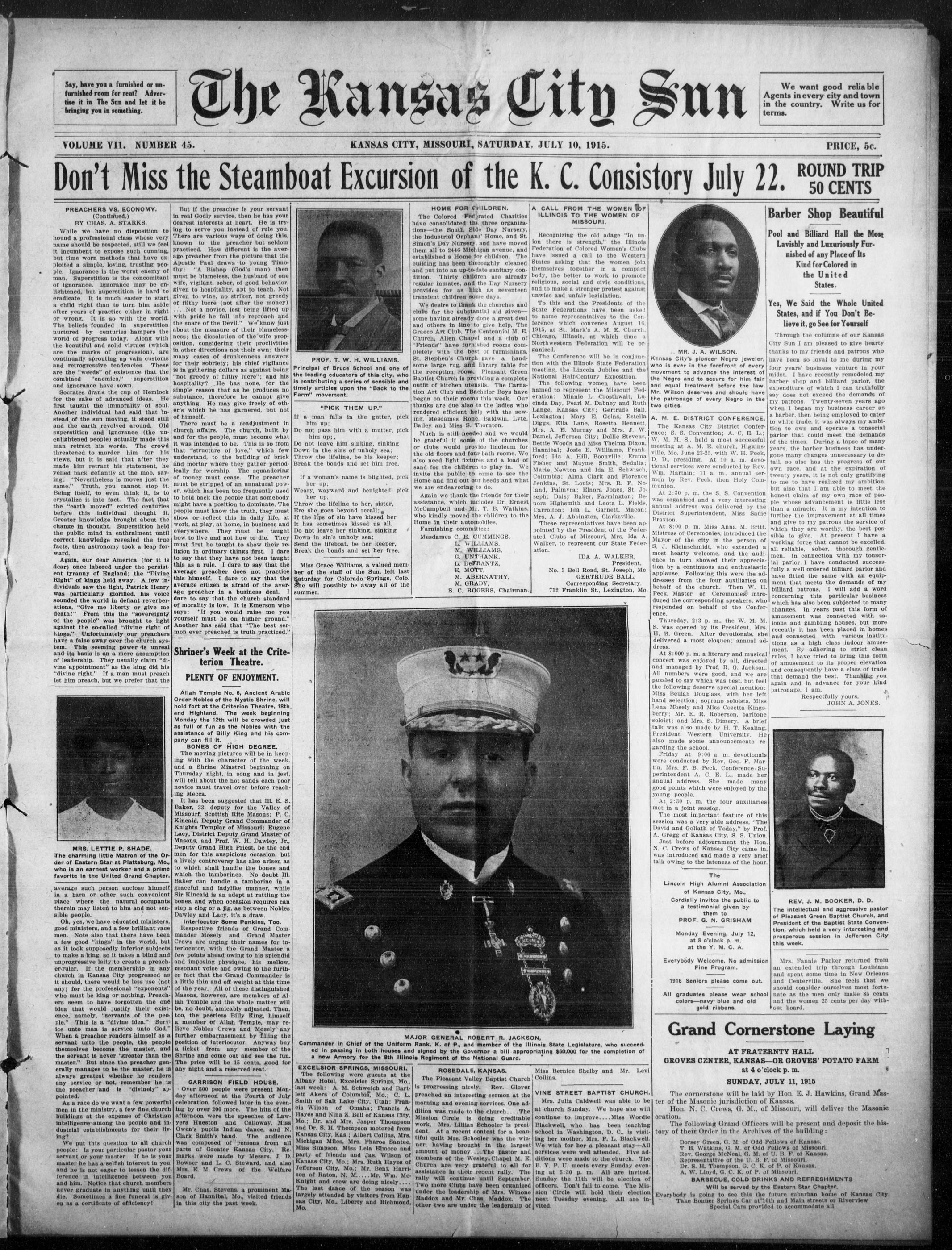
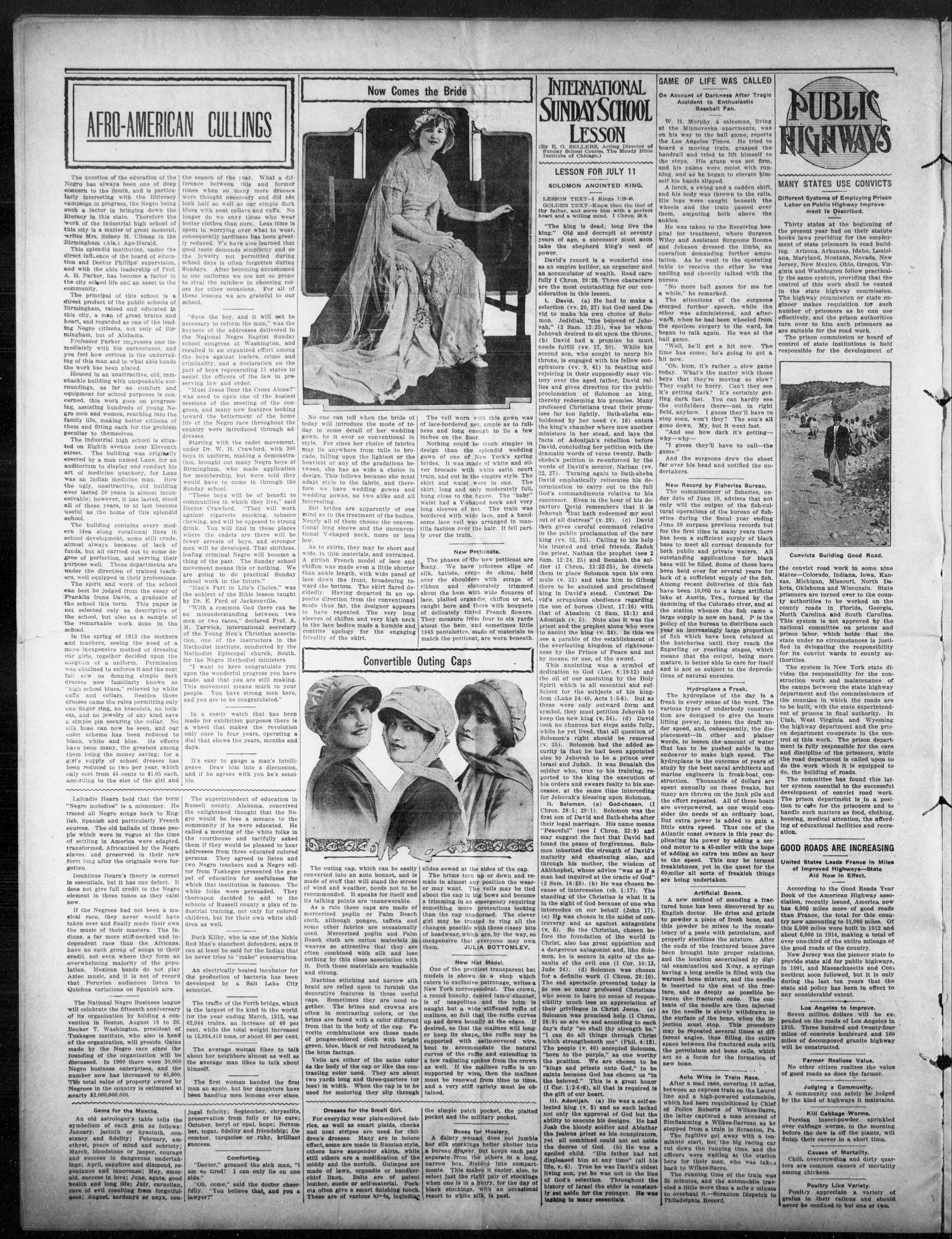
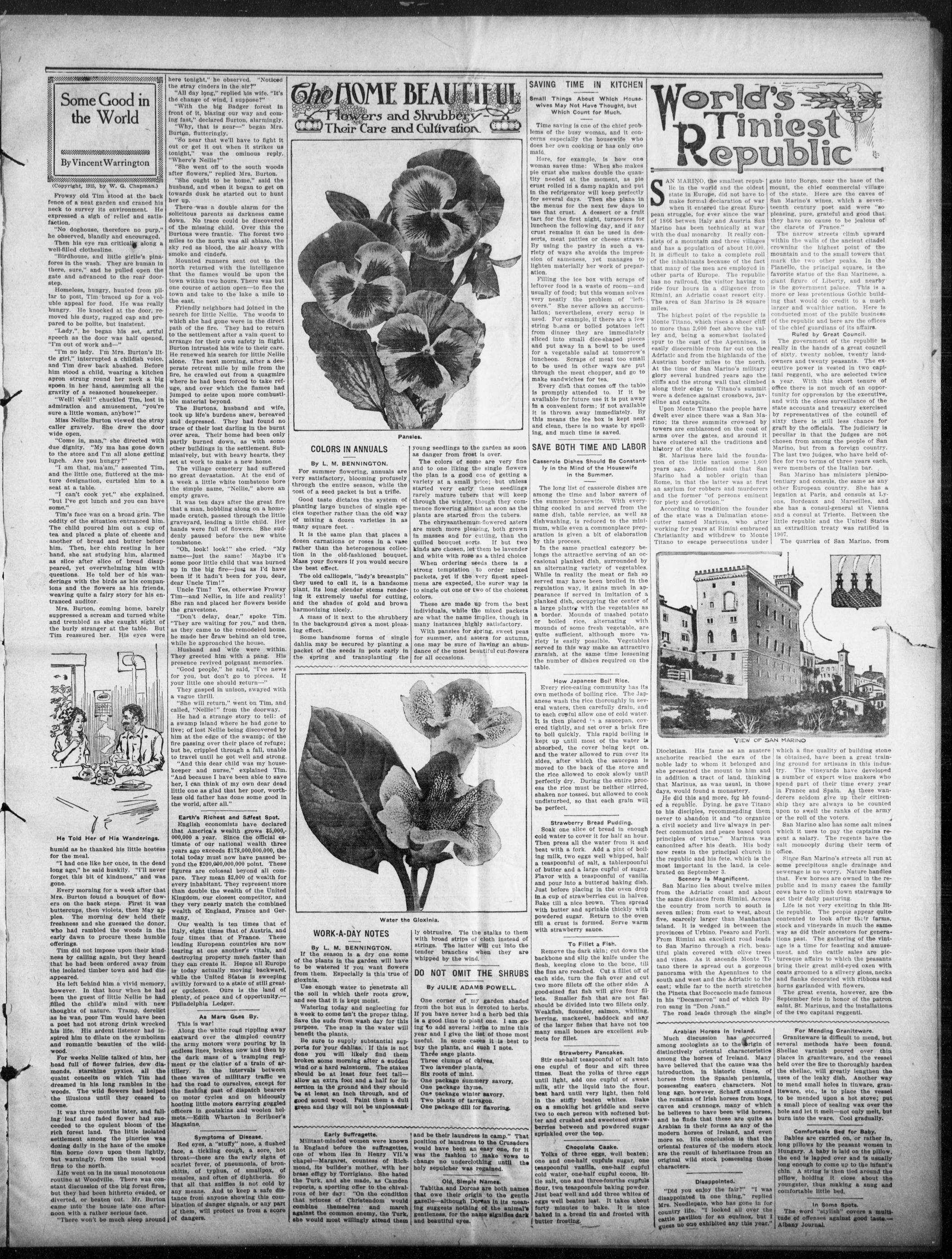
Page text (machine-generated)
Don't Miss the Steamboat Excursion of the K. C. Consistory July 22. ROUND TRIP 50 CENTS
Say, have you a furnished or unfurnished room for rent? Advertise it in The Sun and let it be bringing you in something.
VOLUME VI1. NUMBER 45.
PREACHERS VS. ECONOMY. (Continued.)
BY CHAS. A. STARKS.
While we have no disposition to hound a professional class whose very name should be respected, still we feel it incumbent to expose such cunning, but time worn methods that have explained a simple, loving, trusting people. Ignorance is the worst enemy of man. Superstition is the concomitant of ignorance. Ignorance may be enlightened, but superstition is hard to eradicate. It is much easier to start a child right than to turn him aside after years of practice either in right or wrong. It is so with the world. The beliefs founded in superstition nurtured by centuries hampers the world of progress today. Along with the beautiful and solid virtues (which are the marks of progression), are continually sprouting up vain customs and retrogressive tendencies. These are the "weeds" of existence that the combined "enemies," superstition and ignorance have sown.
Socrates drank the cup of Hemlock for the sake of advanced ideas. He first taught the immorality of soul. Another individual had said that instead of the sun moving, it stood still and the earth revolved around. Old superstition and ignorance (the unenlightened people) actually made this man retract his words. The crowd threatened to murder him for his views, but it is said that after they made him retract his statement, he yelled back defiantly at the mob, saying: "Nevertheless is moves just the same." Truth, you cannot stop it. Being itself, to even think it, is to crystallize it into fact. The fact that the "earth moved" existed centuries before this individual thought it. Greater knowledge brought about the change in thought. Superstition held the public mind in enthralment until correct knowledge revealed the true facts, then astronomy took a leap for ward.
Again, our dear America (or for it is dear) once labored under the persistent tyranny of England; the "Divine Right" of kings held sway. A few individuals saw the light, Patrick Henry was particularly glorified, his voice sounded the world in defiant reverberations, "give me liberty or give me death!" From this the "sovereignty of the people" was brought to light against the so-called "divine right of kings." Unfortunately our preachers have a false sway over the church system. This seeming power is unreal and its basis is on a mere assumption of leadership. They usually claim "divine appointment" as the king did his "divine right." If a man must preach let him preach, but we prefer that the
MRS. LETTIE P. SHADE.
The charming little Matron of the Order of Eastern Star at Plattsburg, Mo., who is an earnest worker and a prime favorite in the United Grand Chapter.
average such person enclose himself in a barn or other such convenient place where the natural occupants therein may listen to him and not sensible people.
Oh, yes, we have educated ministers, good ministers, and a few brilliant race men. Note also that there have been a few good "kings" in the world, but as it took supposedly inferior subjects to make a king, so it takes a blind and unprogressive laity to create a preacher-ruler. If the membership in any church in Kansas City progressed as it should, there would be less use (not any) for the professional "exponents" who must be king or nothing. Preachers seem to have forgotten the one idea that would justify their existence, namely, "servants of the people." This is a "divine idea." Service unto man is service unto God." When a preacher renders himself as a servant unto the people, the people themselves become the master, and the servant is never "greater than the master." But since the preacher generally manages to be the master, he is always greatest whether he renders any service or not, remember he is the preacher and is "divinely" appointed.
As a race do we want a few powerful men in the ministry, a fine few church buildings at the expense of Christian intelligence among the people and in dustrial establishments for their living?
We put this question to all church people: Is your particular pastor your servant or your master. If he is your master he has a selfish interest in you, and he is not eager to lessen the difference in intelligence between you and him. Notice that church members never graduate in anything until they die. Sometimes a fine funeral is given as a certificate of efficiency!
The Kansas City Sun
But if the preacher is your servant in real Godly service, then he has your dearest interests at heart. He is trying to serve you instead of rule you. There are various ways of doing this, known to the preacher but seldom practiced. How different is the average preacher from the picture that the Apostle Paul draws to young Timothy: "A Bishop (God's man) then must be blameless, the husband of one wife, vigilant, of good behavior, given to hospitality, apt to teach. Not given to wine, no striker, not greedy of filthy lucre (not after the money) ...Not a novice, lest be lifted up with pride he fall into reproach and the snare of the Devil." We know just about the measure of their blamelessness; the dissolution of the wife proposition, considering their proclivities in other directions not their own; their many cases of drunkenness answers for their sobriety; his chief vigilance is in gathering dollars as against being "not greedy of filthy lucre"; and his hospitality? He has none, for the simple reason that as he produces no substance, therefore he cannot give anything. He may give freely of other's which he has garnered, but not of himself.
There must be a readjustment in church affairs. The church, built by and for the people, must become what it was intended to be. This is so from that "structure of love," which few understand, to the building of brick and mortar where they gather periodically for worship. The squandering of money must cease. The preacher must be stripped of an unnatural power, which has been too frequently used to hold back the people that somebody might have a position to dominate. The people must know the truth, they must show or reflect this in daily life, at work, at play, at home, in business and everywhere. They must be taught how to live and not how to die. They must first be taught to show their religion in ordinary things first. I dare to say that they have not been taught this as a rule. I dare to say that the average preacher does not practice this himself. I dare to say that the average citizen is afraid of the average preacher in a business deal. I dare to say that the church standard of morality is low. It is Emerson who says: "If you would raise me you yourself must be on higher ground." Another has said that "The best ser mon ever preached is truth practiced."
Shriner's Week at the Criterion Theatre.
PLENTY OF ENJOYMENT.
Allah Temple No. 6, Ancient Arabic Order Nobles of the Mystic Shrine, will hold fort at the Criterion Theatre, 18th and Highland. The week beginning Monday the 12th will be crowded just as full of fun as the Nobles with the assistance of Billy King and his company can fill it.
BONES OF HIGH DEGREE.
The moving pictures will be in keeping with the character of the week, and a Shrine Minstrel beginning on Thursday night, in song and in jest, will tell about the hot sands each poor novice must travel over before reaching Mecca. It has been suggested that Ill. E. S. Baker, 33, deputy for the Valley of Missouri, Scottish Rite Masons; P. C. Kincaid, Deputy Grand Commander of Knights Templar of Missouri; Eugene Lacy, District Deputy Grand Master of Masons, and Prof. W. H. Dawley, Jr., Deputy Grand High Priest, be the end men for this auspicious occasion, but a lively controversy has also arisen as to which shall handle the bones and which the tamborines. No doubt Ill. Baker can handle a tamborine in a graceful and ladylike manner, while Sir Kincaid is an adept at rattling the bones, and when occasion requires can step a clog or a jig, as between Nobles Dawley and Lacy, it's a draw.
Interlocutor Some Punkins, Too.
Respective friends of Grand Commander Mosely and Grand Master Crews are urging their names for interlocutor, with the Grand Master a few points ahead aowing to his splendid and imposing physique, his mellow, resonant voice and owing to the further fact that the Grand Commander is a little thin and off weight at this time of the year. All of these distinguished Masons, however, are members of Allah Temple and the whole matter will be, no doubt, amicably adjusted. Then, too, the peerless Billy King, himself a member of Allah Temple, may relieve Nobles Crews and Mosely any further embarrassment by billing the position of interlocutor. Anyway buy a ticket from any member of the Shrine and come out and see the fun. The price will be 15 cents, good for any night and a reserved seat.
GARRISON FIELD HOUSE
GARNISON FIELD HOUSE.
Over 500 people were present Monday afternoon at the Fourth of July celebration, followed later in the evening by over 200 more. The hits of the afternoon were the speeches of Lawyers Hueston and Calloway, Miss Owen's pupils Indian vance, and N. Clark Smith's band. The audience was composed of persons from all parts of Greater Kansas City. Remarks were made by Messrs. J. D. Bowser and L. C. Steward, and also Mrs. E. M. Crews of the Welfare Board.
Mr. Chas. Stevens, a prominent Mason of Hannibal, Mo., visited friends in this city the past week.
KANSAS CITY, MISSOURI, SATURDAY, JULY 10, 1915.
DEC. 1904
Commander in Chief of the Uniform Rank, K. of P., and member of the Illinois State Legislature, who succeeded in passing in both houses and signed by the Governor a bill appropriating $60,000 for the completion of a new Armory for the 8th Illinois Regiment of the National Guard.
PROF. T. W. H. WILLIAMS.
Principal of Bruce School and one of the leading educators of this city, who is contributing a series of sensible and timely articles upon the "Back to the Farm" movement.
Do not pass him with a mutter, pick him up:
Do not leave him sinking, sinking
Down in the sins of unholy sea;
Throw the lifeline, be his keeper;
Break the bonds and set him free.
If a woman's name is blighted, pick
her up;
Weary, wayward and benighted, pick
her up.
Throw the lifeline to her, sister,
Ere she goes beyond recall;
If the lips of sin have kissed her
It has sometimes kissed us all.
Do not leave her sinking, sinking
Down in sin's unholy sea;
Send the lifeboat, be her keeper,
Break the bonds and set her free.
Miss Grace Williams, a valued member of the staff of the Sun, left last Saturday for Colorado Springs, Colo.
She will possibly be away all of the summer.
Commander in Chief of the Uniformed in passing in both houses and a new Armory for the 8th Illinois
EXCELSIOR SPRINGS, MISSOURI.
The following were guests at the Albany Hotel, Excelsior Springs, Mo., last week: A. M. Schweich and Bartlett Akers of Columbia, Mo.; C. L. Smith of Salt Lake City, Utah; Francis Wilson of Omaha; Francis A. Hayes and Nina Z. B. Bell of Kansas City, Mo.; Dr. and Mrs. Jasper Thompson and Dr. S. H. Thompson motored from Kansas City, Kas.; Albert Collins, Mrs. Michigan Miles, Mrs. Pharoe Santee, Miss Simpson, Miss Lela Elmore and party of friends and Jas. Wilson of Kansas City, Mo.; Mrs. Ruth Hayes of Jefferson City, Mo.; Mr. BenJ. Harrison of Raton, N. M., Mr. Wm. McKnight and crew are doing nicely.... The last dance of the season was largely attended by visitors from Kansas City, Mo.; Liberty and Richmond, Mo.
HOME FOR CHILDREN.
The Colored Federated Charities have consolidated the three organizations—the South Side Day Nursery, the Industrial Orphans' Home, and St. Simon's Day Nursery, and have moved them all to 2446 Michigan avenue, and established a Home for children. The building has been thoroughly cleaned and put into an up-to-date sanitary condition. Thirty children are already regular inmates, and the Day Nursery provides for as high as seventeen transient children some days.
We desire to thank the churches and clubs for the substantial aid given—some having already done a great deal and others in line to give help. The Graeco Art Club, The Contennial M. E. Church, Allen Chapel, and a club of "Friends" have furnished rooms completely with the best of furnishings. St. Stephen's Church gave a handsome large rug, and library table for the reception room. Pleasant Green Baptist Church is providing a complete outfit of kitchen utensils. The Carnation Art Club and Bachelor Boys have begun on their rooms this week. Our thanks are due also to the ladies who rendered efficient help with the sewing, Mesdames Rone, Baldwin, Lyte, Bailey and Miss S. Thornton.
Much is still needed and we would be grateful if some of the churches or clubs would provide linoleum for the old floors and four bath rooms. We also need light fixtures and a load of sand for the children to play in. We invite the public to come to see the Home and find out our heeds and what we are endeavoring to do.
Again we thank the friends for their assistance, which includes Dr. Ernest McCampbell and Mr. T. B. Watkins, who kindly moved the children to the Home in their automobiles.
Furnishing committee:
Mesdames C. E. CUMMINGS,
L. WILLIAMS,
M. WILLIAMS,
G. UNTHANK,
L. DEFRANTZ,
E. MOTT,
M. ABERNATHY,
M. GRADY,
S. C. ROGERS, Chairman.
MAJOR GENERAL ROBERT R. JACKSON
in Rank, K. of P., and member of the Ill.
and signed by the Governor a bill appro-
pies Regiment of the National Guard.
The Pleasant Valley Baptist Church is progressing nicely. Rev. Glover preached an interesting sermon at the morning and evening services. One addition was made to the church.... The Mission Circle is doing creditable work. Mrs. Lillian Schooler is president. At a recent contest for a beautiful quilt Mrs. Schooler was the winner, having brought in the largest amount of money.... The pastor and members of the Wesley, Chapel M. E. Church are very grateful to all for assistance in their recent rally. The rally will continue until September. Two more Clubs have been organized under the leadership of Mrs. Winne Maddox and Mr. Chas. Maddox. The other two are under the leadership of
A CALL FROM THE WOMEN OF ILLINOIS TO THE WOMEN OF MISSOURI.
Recognizing the old adage "In union there is strength," the Illinois Federation of Colored Women's Clubs have issued a call to the Western States asking that the women join themselves together in a compact body, the better to work to promote religious, social and civic conditions, and to make a stronger protest against unwise and unfair legislation.
To this end the Presidents of the State Federations have been asked to name representatives to the Conference which convenes August 16, 1915, at St. Mark's A. M. E. Church, Chicago, Illinois, at which time a Northwestern Federation will be organized.
The Conference will be in conjunction with the Illinois State Federation meeting, the Lincoln Jubilee and the National Half-Century Exposition.
The following women have been named to represent the Missouri Federation: Minnie L. Crosstwalt, Lucinda Day, Pearl M. Dahney and Ruth Lange, Kansas City; Gertrude Ball, Lexington; Mary E. Goin, Estella Diggs, Ella Lane, Rosetta Bennett, Mrs. A. E. Murray and Mrs. J. W. Damel, Jefferson City; Dollie Stevens, Bettie Woods and Miss Thelmia Dixon, Hannibal; Josie E. Williams, Frankford; Ida A. Hill, Boonville; Emma Fisher and Mayne Smith, Sedalia; Marie Newton and Ida E. Schwisch, Columbia; Alma Clark and Florence Jenkins, St. Louis; Mrs. R. F. No land, Palmyra; Elnora Jones, St. Joseph; Daisy Baker, Fayston; Benora Highsma and Lea L. Fields, Carrollton; Ida L. Garnett, Macon; Mrs. A. J. Abington, Clarksville.
These representatives have been appointed by the President of the Federated Clubs of Missouri, Mrs. Ida A. Walker, to represent our State Federation.
IDA A. WALKER, President.
No. 3 Bell Road, St. Joseph, McGERTRUDE BALL,
Corresponding Secretary.
712 Franklin St., Lexington, Mo
ON,
Illinois State Legislature, who succeed-
priating $60,000 for the completion of
Miss Bernice Shelby and Mr. Levi Collins.
VINE STREET BAPTIST CHURCH.
Mrs. Julia Caldwell was able to be at church Sunday. We hope she will continue to improve....Miss Wordie Blackwell, who has been teaching school in Washington, D. C., is visiting her mother, Mrs. P. L. Blackwell.
We wish for her a pleasant stay—All services were well attended. Five additions were made to the church. The B. Y. P. U. meets every Sunday evening at 5:30 p. m. All are invited. Sunday the 11th will be election of officers. Don't fail to come. The Mission Circle will hold their election next Tuesday evening. All are invited
MR. J. A. WILSON.
Kansas City's pioneer Negro jeweler, who is ever in the forefront of every movement to advance the interest of the Negro and to secure for him fair and equal treatment before the law. Mr. Wilson deserves and should have the patronage of every Negro in the two cities.
A. M. E. DISTRICT CONFERENCE.
The Kansas City District Conference; S. S. Convention; A. C. E. L.; W. M. M. S., held a most successful meeting at A. M. E. church, Higginsville, Mo. June 23-25, with W. H. Peck, D. D., presiding. At 10 a. m. devotional services were conducted by Rev. Wm. Martain; 11 a. m., annual sermon by Rev. Peck, then Holy Communion.
At 2:30 p. m. the S. S. Convention was organized and a very interesting annual address was delivered by the District Superintendent, Miss Sadie Braxton.
At 8:00 p. m. Miss Anna M. Britt, Mistress of Ceremonies, introduced the Mayor of the city in the person of S. J. Kleinschmidt, who extended a most hearty welcome, and the audience in turn showed their appreciation by a continuous and enthusiastic applause. Following this were the addresses from the four auxiliaries on behalf of the church. Then W. H. Peck, Master of Ceremonies, introduced the corresponding speakers, who responded on behalf of the Conference.
Thursday, 2:3 p. m., the W. M. M. S. was opened by its President, Mrs H. B. Green. After devotionals, she delivered a most eloquent annual adress.
At 8:00 p. m. a literary and musical concert was enjoyed by all, directed and managed by Prof. R. G. Jackson. All numbers were good, and we are puzzled to say which was best, but feel the following deserve special mention: Miss Beulah Douglass, with her left hand selection; soprano soloists, Miss Lena Mbsely and Miss Cozetta Kingsberry; Mr. E. R. Roberson, baritone soloist; and Mrs. S. Dimery. A brief talk was also made by H. T. Kealing, President Western University. He also made some announcements regarding the school.
Friday at 9:00 a. m. devotionals were conducted by Rev. Geo. F. Martin, Mrs. F. B. Peck, Conference Superintendent A. C. E. L., made her annual address. She made many good points which were enjoyed by the young people.
At 2:30 p. m. the four auxiliaries met in a joint session.
The most important feature of this session was a very able address, "The David and Goliath of Today," by Prof. A. Gregg of Kansas City, S. S. Union. Just before adjournment the Hon. N. C. Crews of Kansas City came in, was introduced and made a very brief talk owing to the lateness of the hour.
The
Lincoln High Alumni Association
of Kansas City, Mo.,
Cordially invites the public to
a testimonial given by
them to
PROF. G. N. GRISHAM
Monday Evening, July 12,
at 8 o'clock p. m.
at the Y. M. C. A.
Everybody Welcome. No admission
Fine Program.
1916 Seniors please come out.
All graduates please wear school
colors—navy blue and old
gold ribbons.
Grand Corner
AT FRATE
GROVES CENTER, KANSAS-
at 4 o'c
Grand Cornerstone Laying
SUNDAY, JULY 11, 1915
The cornerstone will be laid later of the Masonic jurisdiction of Hon. N. C. Crews, G. M., of oration.
The following Grand Officers tory of their Order in the Archive
The cornerstone will be laid by Hon. E. J. Hawkins, Grand Master of the Masonic jurisdiction of Kansas.
Hon. N. C. Crews, G. M., of Missouri, will deliver the Masonic oration.
The following Grand Officers will be present and deposit the history of their Order in the Archives of the building:
Dorsey Green, G. M. of Odd Fellows of Kansas.
T. B. Watkins, G. M. of Odd Fellows of Missouri.
Rev. George McNeal, G. M. of U. B. F. of Kansas.
Representative of the U. B. F. of Missouri.
Dr. S. H. Thompson, G. C. K. of P. of Kansas.
A. W. Lloyd, G. C. K. of P. of Missouri.
BARBECUE, COLD DRINKS AND REFRESHMENTS
Will be served by the Eastern Star Chapter.
Everybody is going to see this the future suburban home of Kansas City
Take Bonner Springs Car at 10th and Main streets or Riverview
Special Cars provided to accommodate all.
Everybody is going to see this the future suburban home of Kansas City. Take Bonne Springs Car at 10th and Main streets or Riverview Take Bonne Springs Car at 10th and Main streets or Riverview
We want good reliable Agents in every city and town in the country. Write us for terms.
22. ROUND TRIP 50 CENTS
Barber Shop Beautiful
Pool and Billiard Hall the Most Lavishly and Luxuriously Furnished of any Place of Its Kind for Colored in the United States.
Yes, We Said the Whole United States, and if You Don't Believe it, go See for Yourself
Through the columns of our Kansas City Sun I am pleased to give hearty thanks to my friends and patrons who have been so loyal to me during my four years' business venture in your midst. I have recently remodeled my barber shop and billiard parlor, the expenditure of which I can truthfully say does not exceed the demands of my patrons. Twenty-seven years ago when I began my business career as a barber, then being employed to cater to white trade, it was always my ambition to own and operate a torsional parlor that could meet the demands of the times. During a lapse of many years, the barber business has undergone many changes unnecessary to detail, so also has the progress of our own race, and at the expiration of twenty years, it is not only gratifying to me to have realized my ambition, but also that I have realized my ambition, the honest claim of my own race of people whose advancement is less little than a miracle. It is my intention to further the improvement at all times and give to my patrons the service best possible to give. At present I have a working force that cannot be excelled, all reliable, sober, thorough gentlemen. In connection with my torsional parlor I have conducted successfully a well ordered billiard parlor and have fitted the same with an equipment that meets the demands of my billiard patrons. I will add a word concerning this particular business which has also been subjected to many changes. In years past this form of amusement was connected with sa乐ons and gambling houses, but more recently it has been placed in homes and connected with various institutions as a high class indoor amusement. By adhering to strict clean rules, I have tried to bring this form of amusement to its proper elevation and consequently have a class of trade that demand the best. Thanking you again and in advance for your kind patronage, I am.
[Name]
The intellectual and aggressive pastor of Pleasant Green Baptist Church, and President of the Baptist State Convention, which held a very interesting and prosperous session in Jefferson City this week.
Mrs. Fannie Parker returned from an extended trip through Louisiana and spent some time in New Orleans and Centerville. She feels that we should consider ourselves most fortunate as the men only make 85 cents and the women 25 cents per day without board.
Overstone Laying
TERNTY HALL
S—OR GROVES' POTATO FARM
'clock p. m.
JULY 11, 1915
ed by Hon. E. J. Hawkins, Grand Mason of Kansas.
of Missouri, will deliver the Masonicers will be present and deposit the hisives of the building:
INKS AND REFRESHMENTS
the Eastern Star Chapter.
the future suburban home of Kansas City
10th and Main streets or Riverview
divided to accommodate all.
PRICE, 5c.
Respectfully yours,
JOHN A. JONES.
AFRO-AMERICAN CULLINGS
The question of the education of the Negro has always been one of deep concern to the South, and is particularly interesting with the illiteracy campaign in progress, the Negro being such a factor in bringing down the literacy in this state. Therefore the work of the Industrial high school of this city is a matter of great moment, writes Mrs. Sidney M. Ullman in the Birmingham (Ala.) Age-Herald. This splendid institution, under the direct influence of the board of education and Doctor Phillips' supervision, and with the able leadership of Prof. A. H. Parker, has become a factor in the city school life and an asset to the community.
The principal of this school is a direct product of the public schools of Birmingham, raised and educated in this city, a man of great brains and heart, and regarded as one of the leading Negro citizens, not only of Birmingham, but of Alabama.
Professor Parker impresses one immediately with his earnestness, and you feel how serious is the undertaking of this man and in what able hands the work has been placed. Housed in an unattractive, old, ramshackle building with unspeakable surroundings, as far as comfort and equipment for school purposes is concerned, this work goes on progressing, assisting hundreds of young Negro men and women, reaching into the family life, making better citizens of them and fitting each for the problem peculiar to themselves.
The Industrial high school is situated on Eighth avenue near Eleventh street. The building was originally erected by a man named Lane, for an auditorium to display and conduct his art of medicine quackery, for Lane was an Indian medicine man. How the ugly, unattractive, old building ever lasted 20 years is almost inconceivable; however, it has lasted, stood all of these years, to at last become useful as the home of this splendid school.
The building contains every modern idea along vocational lines in school development, some still crude, almost always because of lack of funds, but all carried out to some degree of perfection, and serving their purpose well. These departments are under the direction of trained teachers, well equipped in their professions.
The spirit and work of the school can best be judged from the essay of Franklin Irene Davis, a graduate of the school this term. This paper is not selected only as descriptive of the school, but also as a sample of the remarkable work done in the school.
In the spring of 1913 the mothers and teachers, seeing the need of a more inexpensive method of dressing our girls, together decided upon the adoption of a uniform. Permission was obtained to enforce it and the next fall saw us donning simple dark dresses now familiar known as "high school blues," relieved by white cuffs and collars. Besides these dresses came the rules permitting only one finger ring, no bracelets, no lockets, and no jewelry of any kind save a simple pin securing the collar. No silk hose can now be seen, and our color scheme has been reduced to black, white and blue. Its effects have been many, the greatest among them being the money saving; for a girl's supply of school dresses has been reduced to two per year, which only cost from 45 cents to $1.05 each, according to the size of the girl and
Lafcadio Hearn held that the term "Negro melodies" is a misnomer. He traced all Negro songs back to English, Spanish and particularly French sources. The old ballads of these people which were in vogue at the time of settling in America were adapted, transformed, Africanized by the Negro slaves, and preserved in their new form long after the originals were forgotten.
Doubtless Hearn's theory is correct in essentials, but it has one defect. It does not give full credit to the Negro element in these tunes as they exist now.
if the Negroes had not been a musical race, they never would have taken over and finally made their own the music of their masters. The Indians, a far more stiff-necked and independent race than the Africans, have no such group of songs to their credit, not even where they form an overwhelming majority of the population. Mexican bands do not play Aztec music, and it is not of record that Peruvian audiences listen to Quichua variations on Spanish airs.
The National Negro Business league will celebrate the fifteenth anniversary of its organization by holding a convention in Boston, August 18 to 20. Booker T. Washington, president of Tuskegee institute, who also is head of the organization, will preside. Galina made by the Negro race since the founding of the organization will be discussed. In 1900 there were 20,000 Negro business enterprises, and the number now has increased to 45,000. The total value of property owned by Negroes in the country is estimated at nearly $2,000,000,000.
Gems for the Months.
An old astrologer's table tells the symbolism of each gem as follows: January, jacinth or hyacinth, constancy and fidelity; February, amethyst, peace of mind and sobriety; March, bloodstone or Jasper, courage and success in dangerous undertakings; April, sapphire and diamond, repentance and innocence; May, emerald, success in love; June, agate, good health and long life; July, carnelian, sure of evil resulting from forgetfulness; August, sardonyx or onyx, con-
the season of the year. What a difference between this and former times when so many more dresses were thought necessary and did not look half so well as our simple dark blues with neat collars and cuffs. No longer do we envy those who wear better clothes than ours. Less time is spent in worrying over what to wear, consequently tardiness has been greatly reduced. We have also learned that good taste demands simplicity and the jewelry not permitted during school days is often forgotten during Sundays. After becoming accustomed to our uniforms we are not so prone to rival the rainbow in choosing colors for other occasions. For all of these lessons we are grateful to our school.
"Save the boy, and it will not be necessary to reform the man," was the keynote of the addresses delivered in the National Negro Baptist Sunday school congress at Washington, and resulted in an organized effort among the boys against loafers, crime and criminality, and a declaration on the part of boys representing 15 states to assist the officers of the law in preserving law and order.
"Must Jesus Bear the Cross Alone?" was used to open one of the busiest sessions of the meeting of the congress, and many new features looking toward the betterment of the home life of the Negro race throughout the country were introduced through addresses.
Starting with the cadet movement, under Dr. W. H. Crawford, with 300 boys in uniform, making a demonstration, brought out many Negro boys of Birmingham, who made application for membership, but were told they would have to come in through the Sunday school.
"These boys will be of benefit to communities in which they live," said Doctor Crawford. "They will work against cigarette smoking, tobacco chewing, and will be opposed to strong drink. You will find in these places where the cadets are there will be fewer arrests of boys, and stronger men will be developed. That shiftless, loafing criminal Negro will become a thing of the past. The Sunday school movement means this or nothing. We are going to do practical Sunday school work in the future."
"Man's Part in Life's Choice," was the subject of the Bible lesson taught by Dr. E. Ford of Jacksonville.
"With a common God there can be no misunderstanding between two men or two races," declared Prof. A. M. Tarwick, international secretary of the Young Men's Christian association, one of the instructors in the Methodist institute, conducted by the Methodist Episcopal church, South, for the Negro Methodist ministers.
"I want to here congratulate you upon the wonderful progress you have made, and that you are still making. This movement means much to your people. You have strong men here, and you are to be congratulated."
In a costly watch that has been made for exhibition purposes there is a wheel that makes the revolution only once in four years, operating a dial that shows the years, months and days.
It's easy to gauge a man's intelligence. Draw him into a discussion, and if he agrees with you he's sensible.
The superintendent of education in Russell county, Alabama, conceived the enlightened thought that the Negro would be less a menace to the community if he were educated. He called a meeting of the white folks in the courthouse and tactfully asked them if they would be pleased to hear addresses from three educated colored persons. They agreed to listen and two Negro teachers and a Negro editor from Tuskegee presented the gospel of education for usefulness for which that institution is famous. The white folks were persuaded. They thereupon decided to add to the schools of Russell county a plan of industrial training, not only for colored children, but for their own white children as well.
Buck Kilby, who is one of the Noble Red Man's stanchest defenders, says it can at least be said for the Indian that he never tries to "make" conservation.
An electrically heated incubator for the production of bacteria has been developed by a Salt Lake City scientist.
The traffic of the Forth bridge, which is the largest of its kind in the world, for the year ending March, 1913, was 62,944 trains, an increase of 40 per cent, while the total weight increased to 15,984,410 tons, or about 60 per cent.
The average woman likes to talk about her neighbors almost as well as the average man likes to talk about himself.
The first woman handed the first man an apple, but her daughters have been handing men lemons ever since.
jugal felicity; September, chrysolite preservation from folly or its cure; October, beryl or opal, hope; November, topaz, fidelity and friendship; December, turquoise or ruby, brilliant success.
Comforting.
"Doctor," groaned the slick man, "I am so tired!" I can only lie on one side.
"Oh, come," said the doctor cheerfully. "You believe that, and you a lawyer?"
THE FASHION OF THE WEDDING DRESS
Convertible Outing Caps
No one can tell when the bride of today will introduce the mode of today in some detail of her wedding gown, be it ever so conventional in style. For since her choice of fabrics may lie anywhere from tulle to brocade, falling upon the lightest or the heaviest or any of the gradations between, she has as wide a choice in design. This follows because she must adapt style to the fabric, and therefore we have wedding gowns and wedding gowns, no two alike and all interesting.
But brides are apparently of one mind as to the treatment of the bodice. Nearly all of them choose the conventional long sleeve and the unconventional V-shaped neck, more or less low.
As to skirts, they may be short and wide, in thin materials, and untrained. A girlish French model of lace and chiffon was made even a little shorter than ankle length, with wide panel of lace down the front, broadening toward the bottom. The skirt flared decidedly. Having departed in an opposite direction from the conventional mode thus far, the designer appears to have repented. The very long sleeves of chiffon and very high neck in the lace bodice made a humble and contrite apology for the engaging frivolity of the skirt.
Convertible
The outing cap, which can be easily converted into an auto bonnet, and is made of stuff that will stand the stress of wind and weather, needs not to be recommended. It speaks for itself and its talking points are unanswerable.
As a rule these caps are made of mercerized poplin or Palm Beach cloth, although pongee, taffeta and some other fabrics are occasionally used. Mercerized poplin and Palm Beach cloth are cotton materials in weaves so attractive that they are often combined with silk and lose nothing by this close association with it. Both these materials are washable and strong.
Machine stitching and narrow silk braid are relied upon to furnish the decorative features in these useful caps. Sometimes they are used together. The brims and crowns are often in contrasting colors, or the brims are faced with a color different from that in the body of the cap. Favorite combinations are those made of pongee-colored cloth with bright green, blue, black or red introduced in the brim facings. Veils are either of the same color as the body of the cap or like the contrasting color used. They are about two yards long and three-quarters (or less) in width. When the cap is to be used for motoring they slip through
Dresses for the Small Girl.
For everyday wear plain-colored fabrics, as well as smart plaids, checks and neat stripes are used for children's dresses. Many are in bolo effect, some are made in Russian style, others have suspender skirts, while still others are a modification of the mildy and the norfolk. Gumpies are made of lawn, organdie or handkerchief linen. Belts are of patent leather, suede or self-material. Pockets often give a smart finishing touch. These are of various kinds, including
The veil worn with this gown was of lace-bordered net, ample as to fullness and long enough to lie a few inches on the floor.
Nothing could be much simpler in design than the splendid wedding gown of one of New York's spring brides. It was made of white and silver brocade with white satin court train, and cut in the empire style. The skirt and waist were in one. The skirt, long and only moderately full, hung close to the figure. The "baby" waist had a V-shaped neck and very long sleeves of net. The train was bordered with wide lace, and a hand some lace veil was arranged in mantilla fashion over the hair. It fell partly over the train.
New Petticoats.
The phases of the new petticoat are many. We have the princess slips of silk, batiste, crepe de chine, held over the shoulders with straps of ribbon and elaborately trimmed about the hem with wide fountes of lace, plaited organdie, chiffon or net, caught here and there with bouquets of delicately tinted French flowers. They measure from four to six yards about the hem, and sometimes little 1845 pantalettes, made of materials to match the petticoat, are worn beneath
Outing Caps
slides sewed at the sides of the cap. The brims turn up or down and remain in almost any position the wearer may want. The vells may be tied about the cap in big bows and become a trimming in an emergency requiring something more pretentious looking than the cap adorned. The clever girl may be trusted to ring all the changes possible with these classy bits of headwear, which are, by the way, so inexpensive that everyone may own them. JULIA BOTTOMLEY.
New Hat Model
One of the prettiest transparent hat models is shown in a shop which caters to exclusive patronage, writes a New York correspondent. The crown, a round bunchy, dented tam-o'-shanter, is of neapolitan and the brim is naught but a wide stiffened ruffle of malines, so full that the ruffle curves up and down bonnily at the edges. If desired, so that the malines will longer keep its shape, the ruffle may be supported with satin-covered wire, bent to accommodate the natural curves of the ruffle and extending in a few radiating spokes from the crown as well. If the malines ruffle is unsupported by wire, then the malines must be renewed from time to time, and a very stiff variety must be obtained.
the simple patch pocket, the platted pocket and the military pocket.
A dainty woman does not jumble her silk stockings heter skater into a bureau drawer, but keeps each pair separate from the others in a long, narrow box, divided into compartments. This makes it easier, also, to select just the right pair of stockings when one is in a hurry, for the day of black stockings, with an occasional resort to white silk, is past.
INTERNATIONAL
SUNDAY SCHOOL
LESSON
(By E. O. SELLERS, Acting Director of
Sunday School Course, The Moody Bible
Institute of Chicago.)
LESSON FOR JULY 11
SOLOMON ANOINTED KING.
LESSON TEXT-I Kings 1:28-40.
LESSON TEXT I - Kings 1:28-40.
GOLDEN TEXT - Know thou the God of thy father, and serve him with a perfect heart and a willing mind. I Chron. 28:9.
"The king is dead; long live the king." Old and decrepit at seventy years of age, a successor must soon take the shepherd king's seat of power.
David's record is a wonderful one as an empire builder, an organizer and an accumulator of wealth. Read carefully I Chron. 29:28. Three characters are the most outstanding for our consideration in this lesson.
1. David. (a) He had to make a selection (vv. 20, 21) but God used David to make his own choice of Solomon. Jedidiah, "the beloved of Jehovah," (2 Sam. 12:25), was he whom Jehovah desired to sit upon the throne. (b) David had a promise he must needs fulfill (vv. 17, 30). While his second son, who sought to usurp his throne, is engaged with his fellow conspirators (vv. 9, 41) in feasting and rejoicing in their supposedly easy victory over the aged father, David rallies and gives direction for the public proclamation of Solomon as king, thereby redeeming his promise. Many professed Christians treat their promises far too lightly. Bath-sheba emboldened by her need (v. 16) enters the king's chamber where now another ministers in her stead, and lays the facts of Adonijah's rebellion before David, concluding her petition with the dramatic words of verse twenty. Bath-sheba's petition is re-enforced by the words of David's mentor, Nathan (vv. 22, 27). Turning again to Bath-sheba David emphatically reiterates his determination to carry out to the full commandments relative to his successor. Even in the hour of his departure David remembers that it is Jehovah that hath redeemed my soul out of all distress" (vv. 29). (c) David then gives careful command relative to the public proclamation of the new king (vv. 32, 35). Calling to his help his trusted and tried friends, Zadok the priest, Nathan the prophet (see 2 Sam. 12:24, 25) and Benaiah the soldier (I Chron. 11:22-25), he directs them to place Solomon upon his own mule (vv. 33) and take him to Gilon there to be anointed and proclaimed king in David's stead. Contrast David's scrupulous obedience regarding the use of horses (Deut. 17:16) with that of Absalom (2 Sam. 15:1) and Adonijah (v. 5). Note also it was the priest and the prophet alone who were to anoint the king (vv. 34). In this we see a parable of the establishment of the everlasting kingdom of righteousness by the Prince of Peace and not by means, or use, of the sword.
III. Adonijah. (a) He was a self-selected king (v. 5) and as such lacked not only the approval of God but the ability to execute his designs. He had Joab the bloody soldier and Ablathar the jealous priest as his conspirators, yet all combined could not set aside the decree of God. (b) He was a spoiled child. "His father had not displeased him at any time" (all his life, v. 6). True he was David's eldest living son, yet he was not in the line of God's selection. Throughout the history of Israel the elder is constantly set aside for the younger. He was lacking in many essentials.
GAME OF LIFE WAS CALLED
On Account of Darkness After Tragic
Accident at Enthyminic
W. H. Murphy, a salesman, living at the Minneapolis apartments, was on his way to the ball game, reports the Los Angeles Times. He tried to board a moving train, grasped the handrail and tried to lift himself to the steps. His grasp was not firm, and his palms were moist with running, and as he began to elevate himself his hands slipped. A lurch, a swing and a sudden shift, and his body was thrown to the rails. His legs were caught beneath the wheels and the train passed over them, amputing both above the ankles.
He was taken to the Receiving hospital for treatment, where Surgeon Wiley and Assistant Surgeons Roome and Johnson dressed the limbs, an operation demanding further amputation. As he went to the operating table to receive the ether he was smiling and cheerfully talked with the nurses.
"No more ball games for me for a while," he remarked.
The attentions of the surgeons stopped further speech, while the ether was administered, and afterward, when he had been wheeled from the spotless surgery to the ward, he began to talk again. He was at the ball game.
"Well, he'll get a hit now. The time has come; he's going to get a hit now.
"Oh, hum, it's rather a slow game today. What's the matter with those boys that they're moving so slow? They ought to hurry. Can't they see it's getting dark? It's certainly getting dark fast. You can hardly see the outfielders there—not in right field, anyhow. I guess they'll have to stop soon, won't they? The sun's all gone down. My, but it went fast.
"And see how dark it's getting—why—why—
"I guess they'll have to call—the game."
And the surgeons drew the sheet far over his head and notified the undertakers.
New Record by Fisheries Bureau.
The commissioner of fisheries, under date of June 10, advises that not only will the output of the fish-cultural operations of the bureau of fisheries during the fiscal year ending June 30 surpass previous records but for the first time in many years there has been a sufficient supply of black bass to meet all current demands for both public and private waters. All outstanding applications for black bass will be filled. Some of these have been held over for several years for lack of a sufficient supply of the fish. Among recent deliveries of this fish have been 10,000 to a large artificial lake at Austin, Tex., formed by the damming of the Colorado river, and at the station whence the fish came a large supply is now on hand. It is the policy of the bureau to distribute each year an increasingly large proportion of fish which have been retained at the hatcheries until they reach the fingerling or yearling stages, which means that the output, being more mature, is better able to care for itself and is not so subject to the depredations of natural enemies.
Hydroplane a Freak.
The hydroplane of the day is a freak in every sense of the word. The various types of underbody construction are designed to give the boats lifting power, to lessen the draft under speed, and, consequently, the displacement—in other and plainer words, to lessen the amount of water that has to be pushed aside in the endeavor to make high speed. The hydroplane is the outcome of years of study by the best naval architects and marine engineers in freak-boat construction. Thousands of dollars are spent annually on these freaks, but many are thrown on the junk pile and the effort repeated. All of these boats are overpowered, as one would consider the needs of an ordinary boat. But extra power is added to gain a little extra speed. Thus one of the Atlantic coast owners is this year duplicating his power by adding a second motor to a 45-miler with the hope of adding an extra ten miles an hour to the speed. This may be termed freakishness, yet in the quest for the 60-miler all sorts of freakish things are being undertaken.
Artificial Bones.
A new method of mending a fractured bone has been discovered by an English doctor. He dries and grinds to powder a piece of fresh bone, and this powder he mixes to the consistency of a paste with petrolatum, and properly sterilizes the mixture. After the ends of the fractured bones have been brought into proper relations, and the location ascertained by digital examination and X-ray, a syringe having a long needle is filled with the warmed bone mixture, and the needle is inserted to the seat of the fracture, and as deeply as possible between the fractured ends. The contents of the needle are then injected as the needle is slowly withdrawn to the surface of the bone, when the injection must stop. This procedure may be repeated several times at different angles, thus filling the entire space between the fractured ends with the petrolatum and bone cells, which act as a focus for the formation of new bone.
Auto Wins in Train Race.
After a mad race, covering 18 miles, between an express train on the Laurel line and a high-powered automobile, which had been requisitioned by Chief of Police Roberts of Wilkes-Barre, the latter captured a man accused of filmmamming a Wilkes-Barrean as he stepped from a train in Scranton, Pa.
The fugitive gave away with a ten-minute start, but the big racing car cut down the running time, and the officers were waiting at the station here for their man, who was take-back to Wilkes-Barre.
The running time of the train was 35 minutes, and the automobile traveled a little more than a mile a minute to overhaul it.—Scranton Dispatch to Philadelphia Record.
PUBLIC HIGHWAYS MANY STATES USE CONVICTS Different Systems of Employing Prison Labor on Public Highway Improvement Is Described.
Thirty states at the beginning of the present year had on their statute books laws providing for the employment of state prisoners in road building. Arizona, Arkansas, Idaho, Louisiana, Maryland, Montana, Nevada, New Jersey, New Mexico, Ohio, Oregon, Virginia and Washington follow practically the same system, providing that the control of this work shall be vested in the state highway commission. The highway commission or state engineer makes requisition for such number of prisoners as he can use effectively, and the prison authorities turn over to him such prisoners as are suitable for the road work. The prison commission or board of control of state institutions is held responsible for the development of
THE FARMER
Convicts Building Good Road.
the convict road work in some nine states—Colorado, Indiana, Iowa, Kansas, Michigan, Missouri, North Dakota, Oklahoma and Wisconsin. State prisoners are turned over to the county authorities to be worked on the county roads in Florida, Georgia, North Carolina and South Carolina. This system is not approved by the national committee on prisons and prison labor, which holds that the state under no circumstances is justified in delegating the responsibility for its convict wards to county authorities.
The system in New York state divides the responsibility for the construction work and maintenance of the camps between the state highway department and the commissioners of the counties in which the roads are to be built, with the state superintendent of prisons in final authority. In Utah, West Virginia and Wyoming the highway department and the prison department co-operate in the control of this work. The prison department is fully responsible for the care and discipline of the prisoners, while the road department is called upon to do the work which it is equipped to do, the building of roads.
The committee has found this latter system essential to the successful development of convict road work. The prison department is in a position to care for the prisoners and to handle such matters as food, clothing, housing, medical attention, the affording of educational facilities and recreation.
GOOD ROADS ARE INCREASING
United States Leads France in Miles of Improved Highways—State Aid Now in Effect.
According to the Good Roads Year Book of the American Highway association, recently issued, America now has 6,000 miles more of good roads than France, the total for this country now amounting to 31,000 miles. Of this 5,000 miles were built in 1912 and about 6,000 in 1914, making a total of over one-third of the entire mileage of the good roads of the country.
New Jersey was the pioneer state to provide state aid for public highways, in 1891, and Massachusetts and Connecticut soon followed, but it is only during the last ten years that the state aid policy has been in effect to any considerable extent.
Los Angeles to improve.
Seven million dollars will be expended on the roads of Los Angeles in 1915. Three hundred and twenty-four miles of concrete boulevard and 160 miles of decomposed granite highway will be constructed.
Farmer Realizes Value.
No other citizen realizes the value of good roads as does the farmer.
Judging a Community.
A community can safely be judged by the kind of highways it maintains.
Kill Cabbage Worms
Kill Cabbage Worms.
Persian insect-powder sprinkled over cabbage worms, in the morning before the dew is off the plants, will finish their career in a short time.
Causes of Mortality.
Chill, overcrowding and dirty quarters are common causes of mortality among chickens.
Poultry Like Variety.
Poultry appreciate a variety of grains in their rations and should never be confined to but one or two.
Some Good in the World
By Vincent Warrington
(Copyright, 1915, by W. G. Chapman.)
Frowsy old Tim stood at the back fence of a neat garden and craned his neck to survey its environment. He expressed a sigh of relief and satisfaction.
"No doghouse, therefore no purp," he observed, blandly and encouraged.
Then his eye ran critically along a well-filled clothesline.
"Birdhouse, and little girl's pinafores in the wash. They are human in there, sure," and he pulled open the gate and advanced to the rear door-step.
Homeless, hungry, hunted from pillar to post, Tim braced up for a voluble appeal for food. He was really hungry. He knocked at the door, removed his dusty, ragged cap and prepared to be polite, but insistent.
"Lady," he began his set, artful speech as the door was half opened, "I'm out of work and—"
"I no lady, I'm Mrs. Burton's little girl," interrupted a childish voice, and Tim drew back abashed. Before him stood a child, wearing a kitchen apron strung round her neck a big spoon in her hand, assuming all the gravity of a seasoned housekeeper.
"Well! well!" chuckled Tim, lost in admiration and amusement, "you're sure a little woman, anyhow!"
Miss Nellie Burton viewed the stray caller gravely. She drew the door wide open.
"Come in, man," she directed with due dignity. "My ma has gone down to the store and I'm all alone getting lunch. Are you hungry?" "I am that, ma'am," assented Tim, and the little one, fluttered at the mature designation, curtsied him to a seat at a table.
"I can't cook yet," she explained, "but I've got lunch and you can have some."
Tim's face was on a broad grin. The oddity of the situation entranced him. The child poured him out a cup of tea and placed a plate of cheese and another of bread and butter before him. Then, her chin resting in her hand, she sat studying him, alarmed as slice after slice of bread disappeared, yet overwhelming him with questions. He told her of his wanderings with the birds as his companions and the flowers as his friends, weaving quite a fairy story for his entranced auditor.
Mrs. Burton, coming home, barely suppressed a scream and turned white and trembled as she caught sight of the burly stranger at the table. But Tim reassured her. His eyes were
SUNDAY
He Told Her of His Wanderings.
humid as he thanked his little hostess for the meal.
"I had one like her once, in the dead long ago," he said huskily. "I'll never forget this bit of kindness," and was gone.
Every morning for a week after that Mrs. Burton found a bouquet of flowers on the back steps. First it was buttercups, then violets, then May apples. The morning dew held their freshness and she guessed the donor, who had rambled the woods in the early dawn to procure these humble offerings.
Tim did not impose upon their kindness by calling again, but they heard that he had been ordered away from the isolated timber town and had disappeared.
He left behind him a vivid memory, however. In that hour when he had been the guest of little Nellie he had filled the child's mind with new thoughts of nature. Trump, derelict as he was, poor Tim would have been a poet had not strong drink wrecked his life. His ardent listener had inspired him to dilate on the symbolism and romantic beauties of the wildwood.
For weeks Nellie talked of him, her head full of flower fairies, dew diamonds, starshine pyxies, all the quaint conceits on which Tim had dreamed in his long rambles in the woods. The wild flowers had helped the illusions until they ceased to come.
It was three months later, and falling leaf and faded flower had succeeded to the opulent bloom of the rich forest land. The little isolated settlement among the pineries was dozing daily in the haze of the smoke film borne down upon them lightly, but warningly, from the usual wood fires to the north.
Life went on in its usual monotonous routine at Woodville. There was constant discussion of the big forest fires, but they had been hitherto evaded, or diverted, or beaten out. Mr. Burton came into the house late one afternoon with a rather serious face.
"There won't be much sleep around
here tonight," he observed. "Notice the stray cinders in the air?" "All day long," replied his wife. "It's the change of wind, I suppose?" "With the big Badger forest in front of it, blazing our way and coming fast," declared Burton, alarmingly. "Why, that is near—" began Mrs. Burton, flutteringly. "So near that we'll have to fight it out or get it out when it strikes us tonight," was the ominous reply. "Where's Nellie?" "She went off to the south woods after flowers," replied Mrs. Burton. "She ought to be home," said the husband, and when it began to get on towards dusk he started out to hunt her up.
There was a double alarm for the solicitous parents as darkness came down. No trace could be discovered of the missing child. Over this the Burtons were frantic. The forest two miles to the north was all ablaze, the sky red as blood, the air heavy with smoke and cinders.
Mounted runners sent out to the north returned with the intelligence that the flames would be upon the town within two hours. There was but one course of action open—to flee the town and take to the lake a mile to the east.
Friendly neighbors had joined in the search for little Nellie. The woods to which she had gone were in the direct path of the fire. They had to return to the settlement after a vain quest to arrange for their own safety in flight. Burton intrusted his wife to their care. He renewed his search for little Nellie alone. The next morning, after a desperate retreat mile by mile from the fire, he crawled out from a quagmire where he had been forced to take refuge, and over which the flames had jumped to seize upon more combustible material beyond.
The Burtons, husband and wife, took up Life's burdens anew, bereaved and depressed. They had found no trace of their lost darling in the burnt over area. Their home had been only partly burned down, as with some other buildings in the settlement. Submissively, but with heavy hearts, they set at work to make a new home.
The village cemetery had suffered no great devastation. At the end of a week a little white tombstone bore the simple name, "Nellie," above an empty grave.
It was ten days after the great fire that a man, hobbling along on a homemade crutch, passed through the little graveyard, leading a little child. Her hands were full of flowers. She suddenly paused before the new white tombstone.
"Oh, look! look!" she cried. "My name—just the same! Maybe it's some poor little child that was burned up in the big fire—just as I'd have been if it hadn't been for you, dear, dear Uncle Tim!"
Uncle Tim? Yes, otherwise Frowsy Tim—and Nellie, in life and reality! She ran and placed her flowers beside the gravestone.
"Don't delay, dear," spoke Tim. "They are waiting for you," and then, as they came to the remodeled home, he made her draw behind an old tree, while he approached the house.
Husband and wife were within. They greeted him with a pang. His presence revived polignant memories. "Good people," he said. "I've news for you, but don't go to pieces. If your little one should return—" They gasped in unison, swayed with a vague thrill. "She will return," went on Tim, and called, "Nellie!" from the doorway.
He had a strange story to tell: of a swamp island where he had gone to live; of lost Nellie being discovered by him at the edge of the swamp; of the fire passing over their place of refuge; but he, crippled through a fall, unable to travel until he got well and strong. "And this dear child was my housekeeper and nurse," explained Ttm. "And because I have been able to save her, I can think of my own dead little one as glad that her poor, worthless old father has done some good in the world, after all."
Earth's Richest and Safest Spot.
English economists have declared that America's wealth grows $5,000,000,000 a year. Since the official estimate of our national wealth three years ago exceeds $178,000,000,000, the total today must now have passed beyond the $200,000,000 point. These figures are colossal beyond all compare. They mean $2,000 of wealth for every inhabitant. They represent more than double the wealth of the United Kingdom, our closest competitor, and they very nearly match the combined wealth of England, France and Germany.
Our wealth is ten times that of Italy, eight times that of Austria, and four times that of France. These leading European countries are now tearing at one another's vitals, and destroying property much faster than they can create it. Hege all Europe is today actually moving backward, while the United States is sweeping swiftly forward to a state of still greater opulence. Ours is the land of plenty, of peace and of opportunity.—Philadelphia Ledger.
As Mars Goes By.
This is war!
Along the white road rippling away eastward over the dimpled country the army motors were pouring by in endless lines, broken now and then by the dark mass of a tramping regiment or the clatter of a train of artillery. In the intervals between these waves of military traffic we had the road to ourselves, except for the flashing past of dispatch bearers on motor cycles and on hideously hooting little motors carrying goggled officers in goatskins and woolen helmets. -Edith Wharton in Scribner's Magazine.
Symptoma of Disease.
Red eyes, a "stuffy" nose, a flushed face, a tickling cough, a sore, hot throat—these are the early signs of scarlet fever, of pneumonia, of bronchitis, of typhus, of smallpox, of measles, and often of diphtheria. So that all that sniffles is not cold by any means. And to keep a safe distance from anyone showing this combination of danger signals, or any part of them, will protect us from a score of dangers.
The HOME BEAUTIFUL Flowers and Shrubbery Their Care and Cultivation
PANSY
For summer flowering, annuals are very satisfactory, blooming profusely through the entire season, while the cost of a seed packet is but a trifle.
Good taste dictates the system of planting large bunches of single species together rather than the old way of mixing a dozen varieties in as many square feet.
It is the same plan that places a dozen carnations or roses in a vase rather than the heterogenous collection in the old-fashioned bouquet. Mass your flowers if you would secure the best effect.
The old calliposis, "lady's breastpin" they used to call it, is a handsome plant, its long slender stems rendering it extremely useful for cutting, and the shades of gold and brown harmonizing nicely.
A mass of it next to the shrubbery in the background gives a most pleasing effect.
Some handsome forms of single dahila may be secured by planting a packet of the seeds in pots early in the spring and transplanting the
Water the
---
Vaccinium
Water the Gloxinia.
WORK-A-DAY NOTES
By L. M. BENNINGTON.
If the season is a dry one some of the plants in the garden will have to be watered if you want flowers from them. Especially is this true of gloxia.
Use enough water to penetrate all the soil in which their roots grow, and see that it is kept moist.
Watering today and neglecting for a week to come isn't the proper thing. Save the suds from wash day for this purpose. The snap in the water will benefit the plants.
Be sure to supply substantial supports for your dahlias. If this is not done you will likely find them broken some morning after a sudden wind or a hard rainstorm. The stakes should be at least four feet tall—allow an extra foot and a half for insertion in the ground and they should be at least an inch through, and of good sound wood. Paint them a dull green and they will not be unpleasant.
Early Suffragette. Militant-minded women were known in England before the suffragettes, one of whom lies in Henry VII's chapel—Margaret, countess of Richmond, its builder's mother, with her brass effigy by Torrigiano. She hated the Turk, and she made, as Camden reports, a sporting offer to the chivalrous of her day: "On the condition that princes of Christendom would combine themselves and march against the common enemy, the Turk, she would most willingly attend them and be their laundress in camp." That position of laudress to the Crusaders would have been an easy one, for it was the fashion to make vows to change no underclothing until the holy sepulchor was regained.
Old, Simple Names. Tabitha and Dorcas are both names that owe their origin to the gentle garalle—although Dorcas in its meaning suggests nothing of the animal's gentleness, for the name signifies dark and beautiful eyes.
COLORS IN ANNUALS
By L. M. BENNINGTON.
young seedlings to the garden as soon as danger from frost is over.
The colors of some are very fine and to one liking the single flowers the plan is a good one of getting a variety at a small price; but unless started very early these seedlings rarely mature tubers that will keep through the winter, though they commence flowering almost as soon as the plants are started from the tubers.
The chrysanthemum-flowered asters are much more pleasing, both grown in masses and for cutting, than the quilled bouquet sorts. If but two kinds are chosen, let them be lavender and white with rose as a third choice.
When ordering seeds there is a strong temptation to order mixed packets, yet if the very finest specimens are expected, the surer way is to single out one or two of the choicest colors.
These are made up from the best individuals, while the mixed packets are what the name implies, though in many instances highly satisfactory. With pansies for spring, sweet peas for summer, and asters for autumn, one may be sure of having an abundance of the most beautiful cut-flowers for all occasions.
e Gloxinia.
ly obtrusive. The the stalks to them with broad strips of cloth instead of strings. The latter will cut into the tender branches when they are whipped by the wind.
DO NOT OMIT THE SHRUBS
By JULIE ADAMS POWELL.
One corner of my garden shaded from the hot sun is devoted to herbs. If you have never had a herb bed this is a good time to plant one. I am going to add several herbs to mine this year and I give the list of those most useful. In some cases it is best to buy the plants, and such I note.
Three sage plants.
Three clumps of chives.
Two lavender plants.
Six roots of mint.
One package summery savory.
One package thyme.
One package winter savory.
Two plants of tarragon.
One package dill for flavoring.
and be their laudress in camp." That position of laudress to the Crusaders would have been an easy one, for it was the fashion to make vows to change no underclothing until the holy sepulchre was regained.
Old, Simple Names.
Tabitha and Dorcas are both names that owe their origin to the gentle gazelle—although Dorcas in its meaning suggests nothing of the animal's gentleness, for the name signifies dark and beautiful eyes.
Old. Simple Names
SAVING TIME IN KITCHEN
Small Things About Which Housewives May Not Have Thought, but Which Count for Much.
Time saving is one of the chief problems of the busy woman, and it concerns especially the housewife who does her own cooking or has only one maid.
Here, for example, is how one woman saves time: When she makes pie crust she makes double the quantity needed at the moment, as pie crust rolled in a damp napkin and put in the refrigerator will keep perfectly for several days. Then she plans in the menus for the next few days to use that crust. A dessert or a fruit tart for the first night, turnovers for luncheon the following day, and if any crust remains it can be used in desserts, meat patties or cheese straws. By using the pastry in such a variety of ways she avoids the impression of sameness, yet manages to lighten materially her work of preparation.
Filling the ice box with scraps of leftover food is a waste of room—and usually of food; but this woman solves very neatly the problem of "left-overs." She never allows an accumulation; nevertheless, every scrap is used. For example, if there are a few string beans or boiled potatoes left from dinner they are immediately sliced into small dice-shaped pieces and put away in a bowl to be used for a vegetable salad at tomorrow's luncheon. Scraps of meat too small to be used in other ways are put through the meat chopper, and go to make sandwiches for tea.
Every dish that comes off the table is promptly attended to. If it be available for future use it is put away in a convenient form; if not available it is thrown away immediately. By this means the ice box is kept neat and clean, there is no waste by spoiling, and much time is saved.
SAVE BOTH TIME AND LABOR
Casserole Dishes Should Be Constant ly in the Mind of the Housewife in the Summer.
The long list of casserole dishes are among the time and labor savers of the summer housewife. With everything cooked in and served from the same dish, table service, as well as dishwashing, is reduced to the minimum, while even a commonplace preparation is given a bit of elaboration by this process.
In the same practical category belongs the attractive serving of an occasional planked dish, surrounded by an alternating variety of vegetables. While in reality the meat or fish so served may have been broiled in the regulation way, it gains much in appearance if served in imitation of a planked dish, occupying the center of a large platter with the vegetables as a border. Mounds of mashed potato or boiled rice, alternating with mounds of some fresh vegetable, are quite sufficient, although more variety is easily possible. Vegetables served in this way make an attractive garnish, at the same time lessening the number of dishes required on the table.
How Japanese Bolt Rice
Every rice-eating community has its own methods of boiling rice. The Japanese wash the rice thoroughly in several waters, then carefully drain, and to each cupful allow one of cold water. It is then placed in a saucepan, covered tightly, and set over a brisk fire to boil quickly. This rapid boiling is kept up until most of the water is absorbed, the cover being kept on, and the water allowed to run over its sides, after which the saucepan is moved to the back of the stove and the rice allowed to cook slowly until perfectly dry. During the entire process the rice must be neither stirred, shaken nor tossed, but allowed to cook undisturbed, so that each grain will be perfect.
Strawberry Bread Pudding
Strawberry Bread Pudding.
Soak one slice of bread in enough cold water to cover it for half an hour. Then press all the water from it and beat with a fork. Add a pint of boiling milk, two eggs well whipped, half a teaspoonful of salt, a tablespoonful of butter and a large cupful of sugar. Flavor with a teaspoonful of vanilla and pour into a buttered baking dish. Just before placing in the oven drop in a cup of strawberries cut in halves. Bake till a nice brown. Then spread with butter and sprinkle thickly with powdered sugar. Return to the oven till a crust is formed. Serve warm with strawberry sauce.
To Fillet a Fish.
Remove the dark skin; cut down the backbone and slip the knife under the flesh, keeping close to the bone, till the fins are reached. Cut a fillet off of each side, turn the fish over and cut two more fillets off the other side. A good-sized fish will give four fillets. Smaller fish that are not flat should be divided into two fillets only. Weakfish, flounder, salmon, whiting, herring, mackerel, haddock and any of the larger fishes that have not too many small bones are excellent subjects for fillet.
Strawberry Pancakes
Stir one-half teaspoonful of salt into one cupful of flour and sift three times. Beat the yolks of three eggs until light, add one cupful of sweet milk, stir the liquid into the flour, beat hard until very light, then fold in the stiffly beaten whites. Bake on a smoking hot griddle and serve two to each person with softened butter and crushed and sweetened strawberries between and powdered sugar sprinkled over the top.
Chocolate Caake.
Volks of three eggs, well beaten; one and one-half cupful sugar, one teaspoonful vanilla, one-half cupful cold water, one-half cupful cocoa, little salt, one salt and three-fourths cupful flour, two teaspoonfuls baking powder. Just beat well and add three whites of eggs well beaten last. It takes about forty minutes to bake. It is nice baked in a bread tin and frosted with butter frosting.
World's Tiniest Republic SAN MARINO, the smallest republic in the world and the oldest state in Europe, did not have to make formal declaration of war gate into Borgo, near the base of the mount, the chief commercial village of the state. Here are the caves of San Marino's wines, which a seven
pean struggle, for ever since the war of 1866 between Italy and Austria San Marino has been technically at war with the dual monarchy. It really consists of a mountain and three villages and has a population of about 10,000. It is difficult to take a complete roll of the inhabitants because of the fact that many of the men are employed in other parts of Europe. The republic has no railroad, the visitor having to ride four hours in a diligence from Rimini, an Adriatic coast resort city. The area of San Marino is 38 square miles.
The highest point of the republic is Monte Titano, which rises a sheer cliff to more than 2,600 feet above the valley and, being a somewhat isolated spur to the east of the Apennines, is easily discernible from far out on the Adriatic and from the highlands of the Austrian border miles to the north. At the time of San Marino's military glory several hundred years ago the cliffs and the strong wall that climbed along their edge to Titano's summit were a defence against crossbows, javeline and catapults.
Upon Monte Titano the people have dwelt ever since there was a San Marino; its three summits crowned by towers are emblazoned on the coat of arms over the gates, and around it have clustered all the traditions and history of the state.
St. Marinus here laid the foundation of the little nation some 1,600 years ago. Addison said that San Marino had a nobler origin than Rome, in that the latter was at first an asylum for robbers and murderers and the former "of persons eminent for piety and devotion." According to tradition the founder of the state was a Dalmatian stone-cutter named Marinus, who after working for years at Rimini embraced Christianity and withdrew to Monte Titano to escape persecutions under
PALAZZO DI SAN MARCO
CASA DEL CALLE
VIEW OF SAN MARINO
Dioctleian. His fame as an austere anchorite reached the ears of the noble lady to whom it belonged and she presented the mount to him and in addition a tract of land, thinking that Marinus, as was usual, in those days, would found a monastery.
He did this and more, for he founded a republic. Dying, he gave Titano to his disciples, recommending them never to abandon it and "to organize a civil society and live always in perfect communion and peace based upon principles of virtue." Marinus was canonized after his death. His body now rests in the principal church in the republic and his fete, which is the most important in the land, is celebrated on September 3.
which a fli is obtain ing ground try. The a number spend par in France derers se ship they upon to s or the roll San Mar which it gent a salt mall office.
Since S some pre sewerage
Scenery Is Magnificent.
San Marino lies about twelve miles from the Adriatic coast and about the same distance from Rimini. Across the country from north to south is seven miles; from east to west, about five, scarcely larger than Manhattan island. It is wedged in between the provinces of Urbino, Pesaro and Forlì. From Rimini an excellent road leads to San Marino through a rich, beautiful plain covered with olive trees and vines. As it ascends Monte Tiano there is spread out a gorgeous panorama with the Apennines to the south and west and the Adriatic to the east; while far to the north stretches the Pineta that Boccaccio made famous in his "Decameron" and of which Byron sang in "Don Juan." The road leads through the single that. Pew houses are owned in the public and in many cases the family cows have to climb down stairways to get their daily pasturing.
Life is not very exciting in this little republic. The people appear quite contented to look after their farms, stock and vineyards in much the same way as did their ancestors for generations past. The gathering of the vintage is a time for feasting and amusement, and the cattle sales are picturesque affairs to which the peasants bring their great mild-eyed oxen with coats groomed to a silvery gloss, necks and flanks decorated with ribbons and horns garlanded with flowers.
The great events, however, are the September fete in honor of the patron saint, St. Marinus, and the installations of the two capitani reggenti.
Arabian Horses In Ireland.
Much discussion has occurred among zoologists as to the origin of distinctively oriental characteristics among the horses of Ireland. Many have believed that the cause was the introduction, in historic times, of horses from the Spanish peninsula, possessing eastern characters. Not long ago, however, Scharff examined the remains of Irish horses from bogs, caves and crannogs, many of which he believes to have been wild horses, and he finds that these are quite as Arabian in their forms as any of the modern horses of Ireland, and even more so. His conclusion is that the oriental features of the modern stock are the result of inheritance from an original wild stock possessing those characters.
"Did you enjoy the fair?" "I was disappointed in one thing," replied Mrs. Needlepathe, who has gone in for country life. "I looked all over the cattle pavilion for an equinox, but I guess no one exhibited any this year."
Disappointed.
gate into Borgo, near the base of the mount, the chief commercial village of the state. Here are the caves of San Marino's wines, which a seventeenth century poet said were "so pleasing, pure, grateful and good that they have no cause to be jealous of the claetres of France." The narrow streets climb upward within the walls of the ancient citadel crowning the highest point of the mountain and to the small towers that mark the two other peaks. In the Planello, the principal square, is the favorite statue of the San Marinese, a giant figure of Liberty, and nearby is the government palace. This is a more or less pretentious Gothic building that would do credit to a much larger and wealthier nation. Here is conducted most of the public business of the republic and here are the offices of the chief guardians of its affairs.
The government of the republic is really in the hands of a great council of sixty, twenty nobles, twenty landowners and twenty peasants. The executive power is vested in two capitani reggenti, who are selected twice a year. With this short tenure of office there is not much of an opportunity for oppression by the executive, and with the close surveillance of the state accounts and treasury exercised by representatives of the council of sixty there is still less chance for graft by the officials. The judiciary is peculiar in that the judges are not chosen from among the people of San Marino, but from a foreign country. The last two judges, who have held ofice for two terms of three years each, were members of the Italian bar.
San Marino has ministers plenipotentiary and consuls, the same as any other European country. She has a legation at Paris, and consuls at Lyons, Bordeaux and Marseilles, and she has a consul-general at Vienna and a consul at Trieste. Between the little republic and the United States an extradition treaty was ratified in 1907. The quarries of San Marino, from
...
which a fine quality of building stone is obtained, have been a great training ground for artisans in this industry. The vineyards have developed a number of expert winkers who spend part of their time every year in France and Spain. As these wanderers seldom give up their citizenship they are always to be counted upon to swell the ranks of the army or the roll of the voters. San Marino also has some salt mines which it uses to pay the captains regent a salary. The regents have the salt monopoly during their term of office. Since San Marino's streets all run at some precipitous angle drainage and sewerage is no worry. Nature handles that. Few horses are owned in the republic and in many cases the family cows have to climb down stairways to get their daily pasturing.
Life is not very exciting in this little republic. The people appear quite contented to look after their farms, stock and vineyards in much the same way as did their ancestors for generations past. The gathering of the vintage is a time for feasting and amusement, and the cattle sales are pictureque affairs to which the peasants bring their great mild-eyed oxen with coats groomed to a silvery gloss, necks and flanks decorated with ribbons and horns garlanded with flowers. The great events, however, are the September fete in honor of the patron saint, St. Marinus, and the installations of the two capitani regengt.
For mending Graniteware.
Graniteware is difficult to mend, but several methods have been found. Shellac varnish poured over thin places in graniteware, and the vessel held over the fire to thoroughly harden the shellac, will greatly lengthen the uses of the leaky dish. Another way to mend small holes in tinware, graniteware, etc., is to place the vessel to be mended upon a hot stove; put a small piece of sealing wax over the hole and let it melt—not only melt, but burn into the ware. Cool gradually.
Comfortable Bed for Baby.
Comfortable bed for Baby.
Babies are carried on, or rather in, long pillows by the peasant women in Hungary. A baby is laid on the pillow, the end is lapped over and is usually long enough to come up to the infant's chin. A string is then tied around the pillow, holding it close about the youngster, thus making a snug and comfortable little bed.
In Some Spot.
The word "stylish" covers a multitude of offenses against good taste.—Albany Journal.
THEKANSAS CITY SUN
PUBLISHED WEEKLY.
All communications should be addressed to
the Kansas City Sun, 1800 East 18th
Street.
Bell Phone East 999.
Entered as second-class matter, August
15, 1908, at the postoffice at Kansas City,
Mo., under the act of March 5, 1879.
Nelson C. Crews ... Editor and Owner
Willa B. Glenn ... General Manager
SUBSCRIPTION RATES:
One Year ... $1.50
Six Months ... 75
Three Months ... 56
ADVERTISING RATE, 50 CENTS PER
INCH.
CHURCH DIRECTORY.
Bethel A. M. E. Church, 24th and Flora.
St. Stephen's Baptist Church, 604 Charlotte St.
Centennial M. E. Church, 19th and Woodland.
Second Baptist Church, 19th and Charl
Vine St. Baptist Church, 1825 Vine St.
Ward Chapel A. M. E. Church, 11th and
12th St.
Seventh Day Adventist, 23rd and Woodland
St. Monica's Catholic, 17th and Lydia's
Highland Avenue Baptist Church, 1111
Highland Avenue, Baptist Church, 1111
Centropolis A. M. E. Church, Centropolis, Mo.
James A. M. E. Z. Church, 1823 Woodland Ave.
Third Baptist Church, Roundtop.
People's Mission, 30th and Genesee.
St. Luke's Baptist Church, 19th and Highland.
Friendship Baptist Church, 17th and Tracy Avenue.
Pilgrim Baptist Church, 614 Charlotte St.
Pleasant Green Baptist Church, Independence Avenue and Tracy.
Sacrary Baptist Church, 19th and Askew.
Bigelow A. M. E. Mission, 5th and Lakeside.
Progressive Baptist Church, 29th and Summit.
C. M. E. Church, 1817 Flora Ave.
St. Luke's Church, 1830 Mill St.
St. Luke's A. M. E. Church, 43rd and Prospect Place.
A. M. E. Mission, 565 Grand Ave.
KANAS CITY, KAN. CHURCHES.
First A. M. E. Church, 8th and Neb.
Pleasant Green Baptist Church, 1st and
2nd.
Eighth St. Baptist Church, 8th and Oakland.
Solomon Baptist Church, 9th and Washington.
Bethel A. M. E. Church, Water and Steward Streets.
Paul A. M. E. Church, 21st and Ruby.
First Baptist Church, 5th and Neb. King Solomon Baptist Church, 3rd and
Quindarado A. M. E. Church, Quindarado,
Pleasant Valley Baptist Church, Rosedale,
Kan.
M. E. Church, 9th and Oakland.
A. M. E. Church, 4th and Oakland.
Salter Mission, A. M. E. Church, South
Park, Kan.
Protestant Episcopal, 3rd and Stewart.
Second Baptist Church, 24th and Ruby.
Wesley Chapel M. E., 108 Shawnee.
St. Paul A. M. E. Zion Church, 4000 Adams.
Bethel A. M. E. Church, Roselale, Kan.
Mt. Zion Church, 4th and Virgil.
Ebenezer A. M. E. Church, Sanford and Tremont.
Mt. Zion Primitive Baptist Church.
Worcester avenue and Tangent street,
Rosedale.
EDITORIALS.
This being the season of Sunday school conventions the mortality among chickens is alarmingly high.
Careless mothers who allow their blooming daughters to run the streets at night improperly attend have only one thing to expect.
Example is better than precept. If you rush the can and entertain rough people in presence of your children you are damning all your prayers and pious talk.
Governor Willis of Ohio says: "The principle of the Grandfather Clause was un-American, unfair and altogether out of harmony with the spirit of our institutions."
Negroes who like to be jim-crowed and humiliated still patronize the smoky sun seats at Association Park. Why pay two prices, money and pride, to see weird baseball?
Major N. Clark Smith receives a column write-up in the current issue of the New York Age, his ability as a bandmaster being loudly complimented. Lincoln Park patrons are still clamoring for the return of Major Smith's band, too.
Editorial comment upon the recent decision of the United States Supreme Court anent the Oklahoma election laws is very interesting. In the eastern and middle states the decision is almost universally approved while in the rock-ribbed democratic sections it is freely criticised. This simply goes to show that sentiment in the republican party as reflected in republican states is always in sympathy with the rights of our people. This decision should serve as a great lesson and should work as an impetus in our getting together and uniting our loyalty to the party which has ever thrown the mantle of protection around our political and civil rights. In old par lance, let us stand by the bridge that carries us safely over.
SLATER, MISSOURI.
Rev. W. H. Davis of Moberly was in Slater Saturday on business. Rev. Davis was asked by Pastors Fenola and T. H. Lockwood to remain over Sunday and preach. In the afternoon he preached a fine sermon at the M. E. church; at night at the Second Baptist church. Rev. Davis is a fine orator. We hope that he will come again soon... Mrs. Marta Jones is still on the sick list... W. A. Grant, who has been to Excelsior Springs twice this year for treatment, has returned home very ill... Miss Atheleen Walls and Miss Juanita Payne visited relatives in Glasgow Saturday and Sunday... Mr. and Mrs. Alonzo Jones of Glasgow visited friends in Slater Sunday... Mrs. M. B. Neal of Kansas City was in Slater on business Friday and Saturday... Mrs. Alice Ford is on the sick list... Mrs. Guide Holt is visiting home folks at Higbee. Rev. Wills and wife of Arrow Rock were visitors at the M. E. church Sunday. Rev. Billie preached at night... Mrs. Faul-
iine Green is visiting her son and family at St. Louis...Mrs. Bell Miller, Mrs. Belgie Cook and Mrs. Pearl Pryor were callers at the home of Mrs. Josie Walls Sunday...Mrs. Margie Woods is on the sick list...When in Slater call on Mrs. Alice Craigs for a first class stoppage.
MOBERLY ITEMS
There will be given a grand musical entertainment at Pilgrim Rest Baptist church Friday, July 9....The Misses Mary and Martha Renrof of San Diego, Calif., the two noted evangelists, the in the city the guests of Mrs. Nancy Porter....Mrs. M. E. Holt and daughters, Misses Hally and Eva were over from Mexico, Mo., Friday evening, and were the guests of Mrs Belle Cropp....Rev. J. K. Ponder left Sunday night for St. Louis to attend the seventy-fifth anniversary of the organization of A. M. E. church, in session at St. Paul chapel.
LITTLE CORNER
THEY SAY
—That if you put more brains into your business, your success will be greater. Try it.
—That there is much patching and darning preparatory to going to the Fair. Hard times.
—That Masons are preparing to take two special coaches to the Grand Lodge at Hannibal.
—That the best dressed Negro men in town are those who don't work. How do they do it?
—That there is going to be as big a kick to the transparent as there was last year over transparent skirts.
—That watermelons are unusually large this year, but money is also harder to get. Po' cullud man.
—That a certain recent bride was heard to remark that "if I could only get my old job back, I'd never look at another man." Wonder who it was?
—That a lady said after being elected to a certain office: "It was absolutely unsought" and yet she'd been hustling for it for a whole year—so they say.
—That a certain woman waited to escort her husband home after he had called on a lady friend, but upon seeing her, hubby fled in another direction. Do you blame him?
—That those able bodied Negroes who put in the whole day pitching horseshoes ought to be given an opportunity to pitch hay out at Leed's farm for about a month.
—That a certain "cullid" man was heard to remark on a Troost avenue car: "My wife is in assissity 'case she belongs to a whist club." Brother, send your news to the paper because the street cfr patrons don't want to hear them.
—That people who pass for white would find less cause for embarrassment if there were more broad-minded Negroes of the race, those who would look upon "passing for white" as a matter of business and not as an insult to the race.
Y. M. C. A. NOTES
Bridal luncheons have been the order of the day in the Y. M. C. A. during the past few weeks.
The large 8'x12" American flag hoisted on the Association building July 4th was donated by Baker-Lockwood Co.
Prof. Wm. Pickens, a Teneyck-Yale prize-winner, now of Wiley, Texas, was a visitor to our building this week.
True to his word "Doc" White's Boneheads came back strong and administered two decisive defeats to the "Ham Fats." "Doc" says this is only the beginning.
Mr. Green, President of the Kansas City Chess and Checker Club and Mr. Lieberman, a national checker player of the country, spent an evening playing Association players on last Tuesday.
A membership in the Association was the novel and acceptable gift a wife gave to her husband as a birthday surprise. The membership enrollment o the Association has grown to 598.
Last Sunday's discussion by Rev. F. D. Wells of the subject "A Young Man's Imperial Highway" proved of great interest to the men of the Association. Rev. J. M. Green will address the men's meeting Sunday, July 11th.
Mr. R. M. Wisdom, Boys' Work Secretary, will leave for the Association College at Lake Geneva, Wis., this week. He will take special training in boys' work. When he has received this training all the secretaries of the Y. M. C. A. will have received special training in the work they are pursuing.
A weekly discussion of Hygiene and Sanitation, First Aid Measures and Preventive Medicine. Questions will be answered but no diagnoses nor prescriptions will be given in this column.
ON EYE-STRAIN.
The eye is one of the most accommodating organs of the human body, and under favorable conditions will perform an almost unlimited amount of work; in consequence, persons frequently demand of this delicate organ an amount of labor never expected of the larger structures. In fact, it is popularly believed that if the eyes are healthy, reading, sewing embroidery, china painting, and other work are passive acts and that the eye is untiring and never becomes exhausted.
This erroneous conception of the possibilities of the organ of sight is the most prolific cause of eye-strain. The next great cause of eye-strain is improper illumination. This is a large subject which cannot be treated fully here. We will say, however, that the light should be on a level with or above the head of the reader whose back should be turned to the light. The incandescent mantle with a ground glass globe furnishes the best gas light. Electricity is undoubtedly the most satisfactory means of artificial illumination. Indirect illumination, by throwing a part of the light on the ceiling from which it is reflected diffusely over the lower part of the room is the nearest approach to perfection in artificial lighting.
Other causes of eye-strain are reading in cars and trains, reading while lying down, especially when one is tired and exhausted, and the wearing of heavy dotted vells.
The direct symptoms of eye-strain are many and varied. There may be a continual sense of discomfort in the eyes which may increase to pain when the eyes are used for near work. After a few moments of reading the type blurs and the letters run together, and difficulty may be experienced in following the lines. There may be
Four Swell Bungalows
in a Fine Locality
Six rooms each, modern, gas, electric lights
bath, mantel, beautiful decorations
These elegant homes will be sold on EASY TERMS.
$250 cash, balance like rent.
Stewart & Sn
1515 EAST 18TH ST.
These elegant homes will be sold on EASY TERMS. Price $2,500;
$250 cash, balance like rent.
Stewart & Smith
1515 EAST 18TH ST.
Home phone, East 4042 Bell phone, East 4893
Leave Kansas City
7:45 A. M.
The Midn
The Midnight Flyer
Missouri Pacific
ONLY TWO STOPS—Sedalia and Jefferson City. Spend your evening at home or at the park and be in St. Louis for early breakfast.
6—Trains Daily to St. Louis
Lv. Kansas City 7:30 AM., 8:35 AM., 9:45 AM., 12:55 PM., 9:05 P.
Ar. St. Louis ... 7:00 PM., 4:05 PM., 6:20 PM., 10:20 PM., 7:10 A.
6—Trains Daily to St. Louis—6
Lv. Kansas City 7:30 AM., 8:35 AM., 9:45 AM., 12:55 PM., 9:05 PM., 11:45 PM.
Ar. St. Louis ...7:00 PM., 4:05 PM., 6:20 PM., 10:20 PM., 7:10 AM., 7:45 AM.
City Ticket Office, 901 Main St., Union Station,
Kansas City, Mo.
or Mo. Pac. Depot, Kansas City, Kas.
Home Phone Main 6327; Bell Phone Main 6740.
R. T. G. MATTHEWS
Assistant General Passenger Agent.
ANCHOR
Opens Under
ON OR A
FIRST CLA
GUARANTY
OF
ANCHOR LAUNDRY
Opens Under New Management ON OR ABOUT JUNE 15
Responsible for Damages Done by Machinery and Loss.
BEN O. CAVE, Pres. & Mgv. A. F. JOHNSTON, Sec. T. B. WATKINS, Treas.
A. B.
Arrive-St. Louis
MISSOURI
PACIFIC
IRON
MOUNTAIN
twitching of the eye-elids and, in extreme cases, difficulty in keeping the eyes open in continued reading on account of drowsiness. The eyes smart, itch, or burn, and continually water; or they may appear red and congested. There may also be extreme sensitivity to light.
Among the reflex or indirect symptoms of eye-strain headache is the most prominent. This headache is often accompanied by nausea (sick-headache) and is made worse by reading, sewing, riding in the cars, riding backward, shopping, attending the theatre, etc. However, there may be no apparent connection between the headache and excessive use of the eyes. The headache is usually frontal, though it may be at the top of the head or at the base of the skull. Obstinate constipation and indigestion are occasional symptoms of eye-strain, while nervous prostration may result from its influence upon the nervous system. In fact, the general health may be so impaired by the continual nervous drain of eye-strain that the most serious systemic disorders may result.
Relief and recovery from eye-strain often follows prolonged rest of the eyes which may be secured by the use of dark glasses and by refraining from eye work of all kinds. The use of hot towels to the eyes also is beneficial. If these measures do not avail a competent oculist should be consulted at once. The eyes are intimately connected with the whole body and suffer as a consequence of any bodily anomaly or disease; and in the same way visual defects may influence the whole constitution. Consequently those measures and modes of life which are conducive to general health and vigor will be beneficial in maintaining ocular health and vitality.
& Smith
T 18TH ST.
Bell phone, East 4893
P. M.
night Flyer
Via
to St. Louis—6
9:45 AM., 12:55 PM., 9:05 PM., 11:45 PM.
6:20 PM., 10:20 PM., 7:10 AM., 7:45 AM.
Office, 901 Main St., Union Station,
Kansas City, Mo.
Pac. Depot, Kansas City, Kas.
Main 6327; Bell Phone Main 6740.
A. F. and A. M.
Missouri Jurisdiction
N. C. Crews, Kansas City, Grand Master.
Deputy Grand Master, Richard Young, Lincoln, Neb.
F. J. Brown, St. Louis, Grand Sen
lor Warden.
Wm. Green, Plattsburg, Grand Junior Wardea.
H. H. Walker, St. Joseph, Grand Treasurer.
Geo. W. K. Love, Grand Secretary, Kansas City, Mo.
W. W. Fields, Secretary of Masonic Relief, Cameron, Mo.
P. L. Pratt, Kansas City, Mo., Grand Lecturer.
Grand Commandery Officers.
W. G. Mosely, Kansas City, Mo.
R. E. G. C.
J. H. Sherwood, St. Paul, Minn.
G. E. G.
P. C. Kincald, Kansas City, Mo.
V. E. G. C.
J. W. Beard, St. Louis, Mo., E. G. C.
Wm. Roberts, Hannibal, Mo., Grand Secretary.
T. P. Mahammitt, Grand Treasurer, Omaha, Neb.
Grand Chapter Officers.
Geo. Broomfield, G. H. P., St. Louis,
Mo.
T. G. Campbell, D. G. H. P., Kansas City.
A. L. Thomas, G. K., Jefferson City
Mo.
J. P. Moffitte, G. S., Sedalia, Mo.
Chas. Griggsby, G. Treas., Liberty,
Mo.
E. S. Baker, G. Sec'y, Kansas City,
Mo.
MASONIC BUILDING ASSOCIATION
MEMBERS.
R. T. Coles, Chairman.
E. S. Baker, Secretary.
R. W. Foster, Treasurer.
W. C. Mallory, Sandy Meyers,
Wm. Washington, F. P. Porteet,
T. W. H. Williams, W. G. Moseley,
J. E. Herriford, E. G. Lacey,
E. G. Miller, Robt. Wiley.
Lodge Directory
Pritchard Lodge No. 42, A. B
and A. M., meets the 2nd and
4th Monday in each month. Al
Master Masons in good standing
welcome. Cecil Thompson, W.
M.; J. H. Sugliner, Seyd.
Rone Lodge No. 25, A. F and
A. M., meets the 1st and 2nd
Monday in each month. Al
Master Masons in good standing
welcome. Cecil Thompson, W.
M.; T. J. McCambell, Seyd.
M. Olive Lodge No. 53, A. F.
and A. M., meets the 2nd and
4th Friday in every month. Visiting Master Masons are well
come. Sandy Myers. W. M.
Secretary, Secretary, 121
Baltimore Ave.
1. 0. 1.
Queen Ether Court No. 43.
Hale from the I. O. I. meets the
M. O. this Monday, in the
month at 2:30 p.m. at the hall,
10th and Campbell Sts., Kansas
City. Mo. Mrs. Bettle Davis,
M. Mo. Q. Rosa L. Jones, Chron.
1406 North 3d St., Kansas City,
Kas.
U. B. F.
King of the West Lodge No. 298
meets in each and third Mond
days in each month.
Grand avenue. D. M. West
W. M. 1718 Euclid; Jas. Har-
ris, Secy. 1732 Woodland Ave
Money to loan on approved security.
We sell homes on easy terms. See me
or my clerk at my office, 521½ Virginia.
Phone 1259. J. N. Brownlee,
* Bell Phone 1521 E. 18th*
We would like to see every lodge and society in Kansas City put their cards in The Sun. It is the most popular way to let the world know who you are, when and where you meet and your object and purpose. For the next month we will make special announcements to have you put in your lodge or society list of of officers in
SHAVES WITHOUT RAZOR.
Midland Park, S. C., March 10, 1914.
Southern Specialty Co.
Savannah, Ga.
Dear Sirs: Before I began using SHAVINE my face was a mass of blackheads and bumps and in a couple of weeks all the razor bumps and blackheads had disappeared. Now my face is just as smooth as it ever was. It worked like magic for me. It is one of the most wonderful preparations ever made.
Respectfully yours,
(Signed) JOSEPH HAMILTON.
Half pound box 25 cents in stamps.
Agents wanted. Write today.
SOUTHERN SPECIALTY CO..
Box 208. Savannah, Ga.
Poro Hair and
Scalp Treatment
Call or Address
Mrs. Lydia M. Ellis
1939' N. 6th Street
Kansas City, Kansas
HENRY H. SCOTT INTERIOR DECORATING, PAINT ING and PAPER HANGING
Bell East 1762W 2103 Bellefountain
Negro Business and Professional Directory of Greater Kansas City
(Your name, business, address and telephone carried in this directory at 25 cents per month, $3.00 a year; less than one cent a day. Can you beat it? To secure space call Sun Office, Bell phone 999 East, or see our agent.)
DELMONICA CAFE, 1512 East 18th St. Bell phone, East 618.
TOPEKA CAFE, Mrs. S. E. Owens, Prop., 1907 East 18th St.
THE OWL LUNCH ROOM, Mrs. A. R. Harris, Prop., 2208 Vine St.
Bell phone, East 4300
CARPET CLEANERS.
UREKA CARPET CLEANING CO.
East 3555; Home, East 4169.
CLEANERS, DYERS
. K. CLEANERS AND DYERS, g
ment they dye. 1113 East 18th
WORTHAM BROS., 1731 Pasco. Be
. L. HOPKINS, 2326 Vine St. Bell
AYLOR'S GILT EDGE TAILORS,
COOK S
ESSIE EVANS, 2428 Vine St. Be
CLEANING CO., 1718-20 Euc
e, East 4169.
ANERS, DYERS AND TAILO
AND DYERS, guarantee not
1113 East 18th street. Bell
1731 Paseo. Bell phone East
166 Vine St. Bell phone, East
DGE TAILORS, 1612 East 18
EUREKA CARPET CLEANING CO., 1718-20 Euclid Ave. Bell phone,
East 3555; Home, East 4169.
O. K. CLEANERS AND DYERS, guarantee not to shrink any garment they dye. 1113 East 18th street. Bell phone, Grand 2437.
WORTHAM BROS., 1731 Paseo. Bell phone East 701.
R. L. HOPKINS, 2326 Vine St. Bell phone, East 1207J.
TAYLOR'S GILT EDGE TAILORS. 1612 East 18th St.
COOK SHOP.
BESSIE EVANS, 2428 Vine St. Bell phone, East 3637.
DRUG STORES
DEAL PHARMACY, Prof. R. W. F.
Bell phone East 272, Home phone
FLORIDA
WEAVER FLORAL CO., Flowers for
Homes, churches and halls deco
phone 4798 East, Home phone 7
GROSTHWAIT FLORAL CO., 1801
272. Home phone, East 4070.
GROCER
I. R. WILSON, 2644 Woodland Ave.
J. L. MATSON, 1418 East 19th
COTTAGE GROCERY, 121 Westpoor
Anderson, proprietor.
V. M. SPRANGLES, 2224 Vine St.
LAUNDRY
THE ELECTRIC LAUNDRY CO., J.
Home phone 3160.
THE IMMACULATE LAUNDRY,
East 4723.
LAWYER
J. H. CALLOWAY, 601 Delaware, R.
448. Practices in all courts.
V. C. HUESTON, 601 Delaware, R.
448. Legal advice. Practices in
SEO. T. WASSOM, Attorney at Law
Bell phone East 2727, Home ph
MILLIN
MISS EVA P. WASHINGTON, 849
2306, Kansas City, Kas. Also l
IDEAL PHARMACY, Prof. R. W, Foster, Prop., 18th and Woodland. Bell phone East 272. Home phone East 4070.
FLORISTS.
CO., Flowers for all occasion
s and halls decorated. 1510
, Home phone 7555M.
ORAL CO., 1801 East 18th S
Seve, East 4070.
WEAVER FLORAL CO., Flowers for all occasions. Funeral designs. Homes, churches and halls decorated. 1510 E. 18th street. Bell phone 4798 East, Home phone 7555M. CROSTHWAIT FLORAL CO., 1801 East 18th St. Bell phone, East 272. Home phone, East 4070.
GROCERS
4 Woodland Ave. Bell phone,
1418 East 19th St. Bell pho
RY, 121 Westport Ave., Rosede
riester.
S, 2224 Vine St. Bell phone, I
J. L. MATSON, 1418 East 19th St. Bell phone Grand 2309 W. COTTAGE GROCERY, 121 Westport Ave., Rosedale, Kas. Rev. S. A Anderson, proprietor. W. M. SPRANGLES, 2224 Vine St. Bell phone, East 2056 W.
LAUNDRIES
AUNDRY CO., J. C. Hale, Mg
30.
E LAUNDRY, 1912 East 18
THE ELECTRIC LAUNDRY CO., J. C. Hale, Mgr., 2928 Summit St. Home phone 3160.
THE IMMACULATE LAUNDRY, 1912 East 18th St. Bell phone East 4723.
LAWYERS
601 Delaware, Home phone M in all courts.
601 Delaware, Home phone Mice. Practices in all courts.
Attorney at Law, 307 Walnut 2727, Home phone East 4070
C. H. CALLOWAY, 601 Delaware, Home phone M58, Bell phone Main 448. Practices in all courts.
W. C. HUESTON, 601 Delaware, Home phone M58, Bell phone Main 448. Legal advice. Practices in all courts.
GEO. T. WASSOM, Attorney at Law, 307 Walnut street.
Bell phone East 7577, Home phone East 4070
Bell phone East 2727, Home phone East 4070
MILLINERY
MISS EVA P. WASHINGTON, 849 Freeman Ave. Bell phone, West 2306, Kansas City, Kas. Also hair work.
PHOTOGRAPHERS.
S. BRUCE SANTEE, Proprietor T
phone East 1643*
PHYSICI
DR. R. J. LAMBERT, Therapeutics, P
523, Rosedale, Kas.
REAL ESTATE and
AFRO-AMERICAN REAL ESTATE
nished. 911 McGee street.
Bell Phone 751 Main.
COLORED PEOPLE'S INVESTMENT
East 1011, Home East 4011, So
MRS. A. E. JENKINS, 1324 Vine st
C. BRUCE SANTEE, Proprietor The Fad, 1607 East 18th St. Bell phone E 1643*
PHYSICIANS.
T, Theraptics, P. O. box 90A,
Kas.
REAL ESTATE and EMPLOYMENT
REAL ESTATE & INVESTMENT
Gee street.
Main. Hon
E'S INVESTMENT CO., 2427
East 4011. Sol Smith, Press.
INS, 1324 Vine street, Bell Pho
DR. R. J. LAMBERT, Therapties, P. O. box 90A, Bell phone, Rosedale 523, Rosedale, Kas.
AFRO-AMERICAN REAL ESTATE & INVESTMENT CO., Help furnished. 911 McGee street. Bell Phone 751 Main. Home Phone 7555 Main. COLORED PEOPLE'S INVESTMENT CO., 2427 Vine St. Bell Phone East 1011, Home East 4011. Sol Smith, Pres.; C. H. Adkins, Tres. MRS. A. E JENKINS. 1324 Vine Street. Bell Phone East 4067J.
SECOND-HAND GOODS.
W. G. HOPKINS, 2122 Vine St. Bea
SHOE MAKING A
NOAH THOMAS, Home phone, East
MILLIN
MME. STELLA HUBBARD, latest
new. 1510 East 18th street.
UNDERT
J. H. COUNTEE, Licensed Embalm
3336, Home East 3341.
WATKINS BROS., 1729 Lydia Ave
Main 7989. Res., Bell East 328
122 Vine St. Bell phone East
DE MAKING AND REPAIRS
Home phone, East 4132.
MILLINERY.
UBBARD, latest things in h
ast 18th street. Bell phone E
MME. STELLA HUBBARD, latest things in hats. Old hats made new. 1510 East 18th street. Bell phone E. 4798.
UNDERTAKERS
licensed Embalmer, 2220 Vine
St 3341.
1729 Lydia Ave. Bell Phon
s., Bell East 3281.
C. H. COUNTEE, Licensed Embalmer, 2220 Vine St., Bell Phone, East 3336, Home East 3341.
WATKINS BROS., 1729 Lydia Ave. Bell Phone Grand 987, Home Main 7989. Res., Bell East 3281.
---
TO THE PUBLIC:
We want you to come to us for every DRUGS, MEDICINES, TOILET ART, BRUSHES, MADAM WALKER HEN, STRAIGHTENING. We recommend and guarantee exactly as represented. WE DO NOT take other brands than you ask for, we want you to have it.
OUR PRICES
All down the line. We give careful by courteous and fair treatment to customers. When you think of Dru THEO. SMITH'S
No demand is too difficult for us to come to our store, phone us you Mail Orders Solicited
Theo. Smith's
Bell Phone 4591 Grand.
1301 E. 18th St.
Randolph B
New and Artistic
home to us for everything carried
TES, TOILET ARTICLES, RUBBEN
RAM WALKER HAIR-GROWER
STRAIGHTENING COMBS, ETC.
and guarantee everything offered.
WE DO NOT "SUBSTITUTE"
than you ask for. You "want we
ave it.
OUR PRICES ARE RIGHT
We give careful attention to a
fair treatment to give perfect
you think of drugs think of
THEO. SMITH'S PHARMACY.
too difficult for us to supply. I
ore, phone us your wants and w
Orders Solicited and Promptly
eo. Smith's Drug Store
4591 Grand. Home Phone
K.
Ralph Bros.
Artistic Carpe
We want you to come to us for everything carried by a Drug Store. DRUGS, MEDICINES, TOILET TEXT ARTICLES, RUBBER GOODS, COMBS, BRUSHES, MADAM WALKER HAIR-GROWER-DRYING COMBS, STRAIGHTENING COMBS, ETC.
We recommend and guarantee everything offered for sale to be exactly as represented. WE DO NOT "SUBSTITUTE" nor ask you to take other brands than you ask for. You "want what you want" and we want you to have it.
OUR PRICES ARE RIGHT
All down the line. We give careful attention to all orders, and alm by courteous and fair treatment to give perfect satisfaction to our customers. When you think of Drugs think of THEO. SMITH'S PHARMACY.
No demand is too difficult for us to supply. If you are too busy to come to our store, phone us your wants and we will do the rest.
Mail Orders Solicited and Promptly Filled.
Theo. Smith's Drug Store.
Bell Phone 4591 Grand. Home Phone 5467 Main.
1301 E. 18th CITY, MO.
Randolph Bros. @ Son New and Artistic Carpenters
Randolph Bros. @ Son New and Artistic Carpenters
Superb Wall Papers
Samples Shown at Your Home
No obligation to purchase.
A postal brings us.
BELL phone East 3851
BAND REPAIRING
St 4132.
NERY.
It things in hats. Old hats made
Bell phone E. 4798.
TAKERS.
Ber, 2220 Vine St., Bell Phone, East
Ve. Bell Phone Grand 987, Home
81.
everything carried by a Drug Store. NICLES, RUBBER GOODS, COMBS, AIR-GROWER-DRYING COMBS, COMBS, ETC. everything offered for sale to be T "SUBSTITUTE" nor ask you to You "want what you want" and ARE RIGHT attention to all orders, and alm give perfect satisfaction to our gs think of PHARMACY. s to supply. If you are too busy or wants and we will do the rest. and Promptly Filled. Drug Store. Home Phone 5467 Main. KANSAS CITY, MO. ros. @ Son Carpenters
and Builders
Paper Hanging and Painting,
Patching and Plastering
General Repairing a Specialty
PROMPT WORK
REASONABLE PRICES
BELL PHONE East 2526
SHOP 1207 Highland. Res. 1031 Highland
KANSAS CITY. MO.
CAFES
Elegant Apartment For Rent
Mr. C. H. Adkins, Treasurer of the Colored People's Investment Co., has purchased the Duplex at 1014 Woodland Avenue, formerly occupied by white people. He will rent to Colored people these beautiful five-room apartments strictly modern with hardwood floors, disappearing beds, separate furnaces, at $25 per month. Open Sunday afternoon. Call Mr. Adkins. Bell phone, East 1011 or Home East 4011.
Mr. and Mrs. B. O. Crane left for California to visit the Fair.
Mrs. R. F. Cooper, 2640 Woodland avenue, left for Denver, Colo., Thursday, July 1.
Mrs. Florence M. Coles of 1108 High land avenue, is now living in Chicago Ill., at 3030 Wabash avenue.
Mrs. Nora Ford Wheeler of Colum bus, O., is visiting her mother, Mrs I. H. Ward, 2325 Michigan avenue.
Dr. and Mrs. E. C. Bunch returned from St. Joe where they spent the week-end visiting their mother, Mrs Wilson.
Miss Francis Gliss of Los Angeles Calif., is the guest of her aunt and uncle, Mr. and Mrs. Henry Crawford, 2307 Woodland avenue.
Prof. Wm. Pickens, president of Wiley University, noted also as a public speaker, spent Wednesday in the city the guest of J. Dallas Bowser.
Misses Mable B. and Pauline G. Vaughan of Kansas City, Kas., left last Tuesday evening for Chicago, Ill. They will be away about six weeks.
Mr. Chas. R. Heath, a mineralogist in the employ of the Steel Trust Co. of New York and Chicago, paid his third visit to Kansas City this week on business for his firm.
Elegant Apartu
Mr. C. H. Adkins, Treasure
vestment Co., has purchased the
Avenue, formerly occupied by a
Colored people these beautiful
modern with hardwood floors, d
naces, at $25 per month. Open
Adkins, Bell phone, East 1011 o
Mme. Benton Dean, the popular
milliner, is now at 1010 Troost
avenue, where she is elegantly loca
cated and will be extremely pleased
to meet her many friends and cus
tomers at that number. Belle
phone Main 2102J.
Mrs. J. L. Williams of Pueblo, Colo. has been here for the past eight weeks at the bedside of her father, Mr. Jas. Woodland, who passed away last Sunday. She will return home next week.
Mrs. Mollie Wells, 3015 Wyandotte street, gave an eight-course birthday dinner, July 5, in honor of her cousin, Mrs. Callie Diggs, 1710 Oak street. Many of her old friends were present.
Mrs. C. A. Lewis left Monday for Lawrence, Kas., where she will visit her sister, Mrs. I. H. McPike, and her brother, Mr. T. C. Yager and other relatives and friends. She resided with her son and wife, Mr. and Mrs. McPike, 1608 Jefferson street.
The Kansas City Consistory will give a moonlight excursion on the steamer Chester, Thursday evening, July 22. Round trip, 50 cents. Excursion starts at 8:30. See D. N. Crosshwait, 1020 Virginia avenue. Bell phone Main 2715-X or E. S. Baker, 1011 Euclid avenue. Bell phone East 4721-J for further information.
Last Wednesday evening at 9:30 o'clock, June 30, Miss Delina M. Scott was joined in marriage to Mr. Jno. B. Dotry. The occasion was a quiet home wedding at the residence of the bride's aunt, Mrs. C. A. Smith, 1100 Highland avenue. The Rev. Wm. H. Thomas officiated. A number of useful and valuable presents were received.
Grand Master Crews left Wednesday for Brunswick to visit the Masonic Lodge in that city. He went to Columbia Thursday, Moberly on Friday and lays the corner stone of the new Masonic Temple at Dalton, Mo., today.
He will return home this evening to assist Grand Master Hawkins of Kansas in the laying of the corner stone of the new building at Edwardsville, Kansas.
ATTENTION!
All those desiring to accommodate delegates in attendance at the National Grand Lodge of the U. B.'s and S. M. T.'s which convenes at Kansas City, beginning July 26-31 inclusive, will please call Bell phone, Main 4674, Price per day, $1.25.
BIG CELEBRATION AT LINCOLN PARK.
A Tremendous Success.
At 8:15 p. m., G. A. Page, principal of Attucks School, called one hundred and fifty children to the platform, where they sang patriotic songs, after which the preamble of the Declaration of Independence was read. The audience was well prepared for the occasion and entered heartily into the spirit of the exercises. After the preliminaries Prof. G. A. Page, in a well chosen and highly appropriate speech introduced Hon. Nelson C. Crews, the speaker of the evening. Mr. Crews was at his best and he impressed his audience with the big responsibility which they have of being loyalty-citizens and true to the institutions and principals upon which our forefathers founded this government.
CITY NEWS.
SECOND BAPTIST CHURCH.
The B. Y. P. U. is progressing fine under the leadership of its new president, by having the attendance increased to 48.
The Second Baptist Juvenile Choir Club met last Friday at 3 p. m., at the residence of Bertha Sanders, 1705 Forest. All the members and friends who were present reported a delightful time.
The Senior Church Choir held its round table at the residence of Mrs. Corrine Williams, 13th and Woodland, last Friday at 8 p. m. After the rendition of an excellent program and the serving of elegant refreshments, all departed declaring Mrs. Williams an ideal hostess.
The Bacote Literary Society, which meets the first and third Thursday nights in each month, requests your presence.
All are invited to attend the Women's Mission Circle which meets every Friday night in the lecture room under the supervision of Mrs. Susie Lewis.
The services last Sunday were as usual up to the high standard.
Dr. Bacote's sermon on "A Cup of Cold Water," was excellent and full of practical suggestions and advice.
The Sunday School which convenes at 1 p. m., is in a flourishing condition.
The evening services were devoted to covenant meeting and the Lord's Supper, which was partaken of by a representative membership.
Wanted—Ladies and gentlemen in all localities to solicit for magazines. Good pay to right parties. Call, write or phone. Bell East 4702. The National Pan-Medico Magazine, 1908 E. 24th st, Kansas City, Mo.
Now before you get hurt or sick another time, There's one thing I want to impress upon
your mind:
That your employer immediately stops
its gold
And we want you to get on our pay roll.
When your wage, landlord and doctor
you must pay.
CLOVER LEAF ROLL will keep
bills out of your way.
Insure Now. Our Pay Roll Policy is
a Winner.
CLOVER LEAF CASUALTY CO.,
1503 F. 18th St.
Home Phone East 1196
—AGENTS WANTED—
J. J. ALLEN, District Manager.
PIONEER BARBER PASSES AWAY
AT 81
Mr. James W. Woodland, one of Kansas City's best known barbers and oldest citizens passed the high tide of this life Sunday morning at 3:45 o'clock. Mr. Woodland lived in Kansas City forty-four years having come here in 1871. He was a man of rare literary attainments and looked the more astute professor in a college than a barber. He was a scholastic puzzle to most of his patrons and acquaintances as he readily propounded and explained the knotted questions in poetry, art, history and literature; many styling him a literary prodigy. His barber shop, at the corner of Union avenue and Mulberry street, was headquarters for many of Kansas City's distinguished pioneers of that day and time and who afterwards became the leaders for the future great Kansas City. Prominent among his patrons were Colonel Kersey Coats, Colonel Chase, then member of the school board; Major G. N. Blossom, Union Depot hotel, and a Mr. Jarboe, president of Jarboe's foundry, West bottoms; the Kellys, Gafneys and Jones, leading hotel men and leaders in business pursuits. In fact all the leading wholesale men of that day and all of them centered mostly around the union depot. Although a colored man color cut no figure in those pioneer days. "Jim," as Mr. Woodland was familiarly known, is the only man that can shave me. Ranchmen, hotel men and wholesale dealers alike only knew Jim's barber shop. Being the popular idol of all classes of business men, his shop easily led all others in point of success and prosperity. But as these older landmarks passed away Mr. Woodland found his business declining and a few years ago removed his shop to 1413 24th street.
He continued in business there up to his illness and death. Mr. Woodland was born in Washington, D. C., February 22, 1834, near the shadow of the capitol building. He was for four years or more in the office of the Hon. George Mathist, U. S. surveyor, year of 1856. In a testimonial given Mr. Woodland after leaving his office Mr. Mathist says: "I commend young Woodland for his superior intelligence and his faithfulness to duty, his general department and strict honesty." As a race man Mr. Woodland clearly proved himself, whether in politics, the school, the rostrum or the home, he gave masterly advice upon this line Mr. Woodland was beloved by all who knew him. He is survived by a son and a daughter, James W. Woodland, Jr., 809 Brooklyn avenue, this city, and Mrs. J. L. Williams, Pueblo, Colo., and by two grandchildren. Funeral services were held at the home Wednesday at 2 p. m. Buriel at Highland cemetery.
NEW AND AGGRESSIVE POLICY ON PART OF "THE ALTON."
From a letter addressed to agents of The Chicago & Alton Railroad by its chief traffic officials, the Chicago & Alton is not going to be satisfied or contented with simply taking at least its share or more of the business which is now moving, but intends by intensive industrial development to create traffic, securing not only the additional revenue on the new traffic but also materially increasing its revenue by the rent paid by new tenants
Mr. Bennett, an agent of the Chicago & Alton received in his mail recently a letter impressing upon him the importance of helping "return of prosperity" by securing at least one new tenant for Company ground which was now going tenantless, calling his attention to the fact that it is the industrial towns and cities which thrive and grow and the necessary forms and blanks containing full instructions accompanied the letter, so that he would be in a position to handle all the preliminaries promptly on the ground. The idea, however, was not to stop here, but to attempt to secure new industries as well as to get the industries now on the right-of-way to increase their output either by the inertification of former methods or the improvement of old processes.
This action on the part of the Alton Company, indicates that the new management is not going to overlook any opportunity to increase the earnings of the road and feels that by having the full co-operation of the local force at each of its stations, and everybody pulling together that much good can be accomplished, not only for the "Only Way" but for the communities served by its line.
TEACHER OF PIANO
1705 Forest Ave.,
Kansas City, Mo.
Bell Phone. Grand 3319W.
GRAND MASTERS' VISIT.
Grand Master of Masons, in company with Grand Secretaries Love and Fields, paid a visit to the lodges of Springfield last Thursday and were royally entertained during their stay.
The three lodges there own splendid buildings with an incumbrance of only $1,500 and their rental receipts are more than $100 per month. While there they were guests at the home of Miss Ora Ford and in the afternoon were given automobile rides over the city, and were shown many points of interest.
On Friday they left for Carthage where they visited Dupee Lodge No. 100 and were guests at the home of Mr. and Mrs. Tinnon.
On Saturday they visited Joplin, returning home the same evening. At Joplin they met Mr. G. O. Smith, the popular head waiter of this city who is in charge of the Connor Hotel and his crew of sixteen waiters all of whom are Kansas City boys. They are getting along nicely.
LEXINGTON, MISSOURI
Misses Anna Britt, Myrtle Perry and Messrs. Isiadore Workcuff and Leslie Glimore motored to Lexington Sunday from Higginsville and spent a few hours.
Mrs. Guy Workcuff spent a few days in Higginsville last week with friends.
Misses Lillian Cogswell, Helen Booker, Grandelline Wilson, Tempi Wilson and Dallas Booker motored to Higginsville Saturday evening to attend the street fair.
Miss Carrie Bowen and Mr. Wm. Austin of Kansas City, Mo., were quietly married Thursday evening at the Baptist parsonage by Rev. Williams. They will make their home in Kansas City and we wish for them a happy married life.
Mr. Wm. Holmes on North 24th street, is on the mend after an illness of six weeks.
The Union picnic on the 5th at Taubman's Park, was quite a success.
Mrs. Sallie Moore of Mayview, Mo., is visiting her daughter, Mrs. Forest Williams, this week. Mr. Richard McCorkle took suddenly ill at his work on last Saturday and had to be taken home.
A REGRETABLE INSTANCE
in any family's life becomes a reality when that family feels itself too high to manage and is therefore compelled (?) to reheat, large house or vice versa when a family feels itself too poor to purchase a large house and is therefore compelled (?) to reheat, large house or vice versa when a family feels itself too poor to purchase a large house and is therefore compelled (?) to reheat, large house. It is better by far my friends to own a bank account and maintain a bank account against the risk of being later on feel the sting of regret come over you because "appearances" must be paid and your credit ceases. Will the roll of rent receipts look so good then? Act today, that each tomorrow will find some worthy action to take and let your rent help pay the cost.
Here's a list but I have many other bargains.
**Missouri Residences.**
4rs and kiltennette water, gas and $2,000
7rs, water and gas, will deliver nicely decorated and painted ...$2,000
7rs, modern, except furnace ...$2,000
7rs, gas and water, will deliver 20 mln. in
100x130 ft. fr. str. improv ...$3,400
7rs and bath, rent $27, new dec. $2,900
4rs and clstern water ...$7,000
4rs, clstern water ...$1,000
**Kansas Residence.**
4rs, shed, kilten, sidewalk, etc. ...$630
4rs, 41 ft. stone and stucco str. mod. $7,600
6rs, str. impr. in 3 blks Minn. Ave.
4rs, on Bivd, electric lighted ...$1,450
7rs, 50 ft. mod. 2 blks Minn. Av. car ...$2,850
Payments from $0.00 to $600.00
**EUGENE EDWARD VAUGHAN.**
300 sq. ft. in Kansas City, Kas.
Bell phone, West 1767
JOPLIN, MISSOURI.
Mr. and Mrs. W. M. Carter will leave soon for St. Paul, Minn., and then to Buffalo, N. Y., where they will spend the remainder of the summer and fall. Mr. Son Beacham died Sunday morning at 2 o'clock. He is survived by a wife, mother and little son. The funeral services were held from the Handy Chapel, M. E. Church, Tuesday at 2:30. Mr. Nelson C. Crews, editor of the Sun, was in the city Saturday on business. The services were good at Unity Baptist Church. Look out for Lake Side 4-5-6 of Aufst. Excursion from Kansas City. Mrs. Williams and Mrs. James are having quite a success with their ice cream parlor; it is crowded Sundays. World's most wonderful Colored Magician performed Tuesday, Wednesday and Thursday at the churches. He is the only Colored man who is a member of the Federation of Magicians. See Joe Washington for Negro literature. Phone 2393-M.
We again have something new and interesting among our friends and fellow waiters. Mr. G. O. Smith, formerly of Kansas City, Missouri, has extended another one of his most hearty suggestions, he has introduced and has organized a benevolent society, known as The Waiters' Relief Fund Association.
A special meeting was held Thursday morning, July 1st, 1915, and officers for the Association were elected as follows:
President, C. W. Cuther; Treasurer, G. O. Smith; Gen. Sec., W. J. Lamb; Chairman, A. H. Henderson; Corresponding Sec., A. G. Tutt.
There is something else to be credited to Mr. Smith with his experience and good will of the boys he has a regular "Go to Church Sunday Club," and the pastors seem to be very delighted in having us join hands with him.
We wish Mr. Smith well and all of his followers.
A glad hand and a well wish were extended to Mr. and Mrs. William Carter, who have been residents of Joplin more than three years. Mr. and Mrs. Carter will spend a few weeks in Lawrence, Kansas. From there they will journey to Detroit, where they will spend the summer.
Preamble
Inasmuch as the law of self-preservation is the first law of nature, it behooves us mortals in the hour of prosperity to prepare for the day of adversity; and recognizing this fact and as intelligent beings, we have decided to act at once. Hence the reason and cause for the drafting of the following constitution and by-laws which shall govern this organization.
CONSTITUTION.
Name
Article I. This organization shall be known as the Walters Relief Fund Association of the Connor's Hotel.
Object.
Art. II. The object of this organization shall be for the benevolent purposes for the benefit of the dining-room employees of the Connor Hotel, who have subscribed to the rules and by-laws of this Association.
Officers.
Art. III.—(Part I) The officers of this organization shall be a President, Treasurer and a Recording Secretary and a Corresponding Secretary.
(Part II) There shall also be a Board of Directors, which shall consist of the Head Walter, his second, and also the four above mentioned officers, viz: the President, Treasurer, Recording Secretary and Corresponding Secretary.
Time of Election.
Art. IV. The time of election of officers shall be on the fifteenth of each month unless a vacancy in any office should occur before the regular election period, in which case an election shall be made to fill that office at the next meeting.
BY-LAWS
Art I. The dues shall be ten cents per day.
Beneficiaries.
Art II. No one shall, in case of sickness, be entitled to benefits who shall be more than seven days in arrears.
No one who has not been enrolled as a member in this organization for at least thirty days shall be entitled to benefits.
Anyone who has been enrolled for thirty days or longer must upon severing his connection with this Hotel be paid his pro rata (which shall be determined by the Board of Directors) providing he has not hitherto drawn benefits.
Sick Benefits
It is the intention of this organization to pay any sick or injured member, in good financial standing, One Dollar per day, or Physician's fee and furnish medicine as desired by the beneficiary for one week. In addition, in case of death, this organization will contribute to the funeral expense to the amount of Seventy-five Dollars. In case the deceased holds Life Insurance, the aforementioned Seventy-five Dollars shall be paid to his estate.
These By-Laws may be amended by a majority vote at any regular meeting, after seven days notice.
Rooms to Rent
For Rent—Furnished rooms; strictly modern. 1316 E. 24th. Bell phone Grand 25921.
Furnished Flat—Five rooms; modern; three blocks from Union station; fine to room and board railroad men; cheap; rent paid to July 16; $125 cash, balance weekly. 2590 Grand ave.
FOR RENT—A nicely furnished front room either for one or two gentlemen. All modern conveniences. Bell phone free. East 6748-J. Mrs. M. L. Washington. 2720 Highland ave.
FOR RENT—Swell four room cottage near 23d and Lydia avenue. Fine location. Gas, water paid; $15.00. Also 5 rooms, gas and bath at 2502 Michigan; water paid; $12.50. J. Dallas Bowser, 2400 Paseo. Bell Grand 3795-W.
R. V. ATKINS, Gen. Mgr.
T. P. PAYNE, Bus. Mgr.
S. W. FTZTPRICK, Sec'y and Treas
Bell Phone 1912 East
E. 4723 18th St.
LEON H. HERRIFORD
Late of Ninth Cavalry Band and
Orchestra.
TEACHER OF VIOLIN
Also instructions on Cello, Clari-
net, Oboe and Brass Instru-
ments.
Studio 1217 Woodland Ave.
Bell Phone, East 3797.
How often, O how often you've had
friends come to town and go away
without knowing where your place of
business is. A Crescent ad would pre-
vent that. Only one penny a day.
* AGENCY. *
* "The Business Way" *
* BOB BOSLEY, Manager. *
Bell phone East 1521.
* 1521 E. 18th street. *
[Picture of a man in a suit and bow tie].
Proprietor Golden's Steam Dye Works
and Tailoring Establishment.
TAILORS AND CLEANERS
1605 E. 18th St., near 18th and Vine
Bell Phone East 539
24-Hour Service
WE COME ANYWHERE FOR YOUR
GARMENTS
THE LIGHTNING SHOE PASTES
HOWARD'S
LIGHTNING
SHOE POLISHES
BOX CALF
[Name]
DORSEY B. BROWN
The presenter of public utilities offers to you the products of the Fulton Polish Company of New York, a colored company, makers of paste, liquid cleaners and dyers for the cleaning, preservation and shining of all shoe leather. The products of this company are prize winners at the Paris exposition, 1903; Jameson, 1907; San Antionton, 1909. They also furnish the polish for the United States army. We will be in your neighborhood soon to show you our goods. Wholesale price to stores and bootblack parors. Address all mail orders to Dorsey B. BrBown. Town orders will be filled at Taylor Holmes.
KIMO
She Polish
Outfit
Clean - Compact
Always Ready
For Use.
No more to house to look the
awk in KIMO closets to
much in COLLAPSIBLE
HOLIDAYS. You can drive up
directions. Source a
bike not onto the shoe.
KIMO landlord (KIMO)
Can you good one with KIMO) no music. no
music. no music. no music.
Each KIMO OUTFIT consists of a
COLLAPSIBLE HOLIDAYS. Each
all this and give you a Bollard Shoe.
Each KIMO OUTFIT consists of a
COLLAPSIBLE HOLIDAYS. Each
all this and give you a Bollard Shoe.
Out-of-town stores and bootblack
parlors state quantities want-
ed and write for prices.
Ak for it in the stores.
Address all mail orders to
Beautiful Lincoln Electric Park
FREE VAUDEVILLE PICTURES BAND FREE
THE DANCE PAVILION
Is a feature in itself with the finest floor in the West. The best
dance music. Popular price 15c, every afternoon and
evening. Dancing clubs solicited
The McDaniel Stock Company supported by the Lincoln Park
Orehestra presenting High Class Vaudeville and
Stock Plays. Program changed daily.
FREE—MONDAYS AND FRIDAYS LADIES' DAY—FREE
FERRIS WHEEL
MERRY-GO-ROUND
Park Motto: "Order at all times."
You have been ATTRACTED by beautiful, glossy, fluffy, long hair with its natural appearance, due to use of
PORO
TRADE
MARK
donot be content with the life
fading, brittle, split and falling
dition of yours, our scientific
trained graduates have a m
touch.
Poro preparations made only
Mr. Ann Pepinulo
St Louis Mo.
Mr. John W. McRae's Wife Object
To her husband's taking insurance in August, 1915,
Mr. McRae's widow felt differently in April, 1919.
Mr. McRae was insured with us in August,
April 16, 1915, he was apparently perfectly well. O
he called a physician. Tuesday, April 20, he was
around his store, but Saturday, April 24, he was
following Tuesday, as soon as the death proof pa
handed to us
We Paid Mrs. McRae One Thousand
A wife sometimes objects to life insurance but
never does. Is your wife protected? If your husband
You don't know when you will be called as sudde
Mr. McRae. Suppose he had waited!
We pay all our claims promptly. Ask anybody
company of its kind in the world.
ment with the lifeless, split and falling con- tions, our scientifically tates have a magic
tions made only by,
Louis Mo.
McRae's Wife Objected
ing insurance in August, 1914. It differently in April, 1915. And with us in August, 1914. On currently perfectly well. On April 17 Tuesday, April 20, he was able to be day, April 24, he was dead. The as the death proof papers were
McRae One Thousand Dollars
ects to life insurance but a widow protected? If your husband insured? It will be called as suddenly as was had waited! Promptly. Ask anybody. Largest world.
donot be content with the lifeless, fading, brittle, split and falling condition of yours, our scientifically trained graduates have a magic touch. Poro preparations made only by,
Mr. John W. McRae's Wife Objected
To her husband's taking insurance in August, 1914.
Mr. McRae's widow felt differently in April, 1915.
Mr. McRae was insured with us in August, 1914. On April 16, 1915, he was apparently perfectly well. On April 17 he called a physician. Tuesday, April 20, he was able to be around his store, but Saturday, April 24, he was dead. The following Tuesday, as soon as the death proof papers were handed to us
We Paid Mrs. McRae One Thousand Dollars
A wife sometimes objects to life insurance but a widow never does. Is your wife protected? If your husband insured? You don't know when you will be called as suddenly as was Mr. McRae. Suppose he had waited!
We pay all our claims promptly. Ask anybody. Largest company of its kind in the world.
Capital fully paid, $100,000.00
Over $1,500,000.00 Insurance in Force.
Standard Life Insurance Company
Home Office.
200 Auburn Ave., Atlanta, Georgia
KANSAS CITY OFFICE—1507 East Eighteenth St.
GEO. F. PORTER, Agency Director.
Insurance Company
Home Office.
Atlanta, Georgia
E—1507 East Eighteenth St.
R, Agency Director.
Standard Life Insurance Company
400 Auburn Ave., Atlanta, Georgia
KANSAS CITY OFFICE—1507 East Eighteenth St.
GEO. F. PORTER, Agency Director.
It's Up to You
to patronize a man who has been for lo these many years striving to help himself and also build up the business prestige of his race.
J. A. WILSON
Kansas City's Pioneer Negro Jeweler
Sells Watches, Clocks, Diamonds
and other Staple Reliable Jewelry
or will help you to buy the same from any leading wholesale house.
You will receive courteous treatment and square dealing. This store is at 1616 West 9th street, Kansas City, Mo., one half block west from Wyoming street or station.
Pioneer Negro Jeweler
Rocks, Diamonds
or Staple Reliable Jewelry
e same from any leading wholesale
house.
ugeous treatment and square dealing.
at 9th street, Kansas City, Mo., one-
ming street or station.
Kansas City's Pioneer Negro Jeweler Sells Watches, Clocks, Diamonds and other Staple Reliable Jewelry or will help you to buy the same from any leading wholesale house. You will receive courteous treatment and square dealing. This store is at 1616 West 9th street, Kansas City, Mo., one half block west from Wyoming street or station.
Expert Dental Special
OF KANSAS CITY
Our work has stood the test. We have been doing high class
tal Work for the past 29 years. We have thousands of sati
REMEMBER, IN BUSINESS 29 YEARS
All work kept in repair free of charge.
SAVE MONEY
EXAMINATION FREE
All work guaranteed 20 years.
GET
The doctor who extracts your teeth here has undoubtedly had
in this line than any other dentist in the city, so you get the r
ice. Painless Extracting, 25 cents.
BRIDGE WO
Metal Specialists
KANSAS CITY
have been doing high class guaranteed Den-
We have thousands of satisfied patients.
IN BUSINESS 29 YEARS
in repair free of charge.
INATION FREE
guaranteed 20 years.
each here has undoubtedly had more experienc
in the city, so you get the most expert serv-
BRIDGE WORK
Expert Dental Specialists
Our work has stood the test. We have been doing high class guaranteed Dental Work for the past 29 years. We have thousands of satisfied patients.
REMEMBER, IN BUSINESS 29 YEARS
All work kept in repair free of charge.
SAVE MONEY
EXAMINATION FREE
All work guaranteed 20 years.
GET THE BEST
The doctor who extracts your teeth here has undoubtedly had more experience in this line than any other dentist in the city, so you get the most expert service. Painless Extracting, 25 cents.
BRIDGE WORK
Spaces where from one to ten teeth have been lost we replace with bridge work. It looks the same as natural teeth, lasts a lifetime and requires no plate. Broken down teeth we restore to beauty and usefulness with crowns of porcelain and gold.
GOLD CROWNS, $3, $4 AND $5
SILVER FILLINGS, 75c AND $1.00
WHITE CROWNS, $3, $4 AND $5
PLATINA FILLINGS, 200
SET OF TEETH, UPPER AND LOWER, $5.00 AND UP
NEW YORK DENTAL CO.
SILVER FILLINGS, 75c AND $1.00
WHITE CROWNS, $3, $4 AND $5
PLATINA
SET OF TEETH, UPPER AND LOWER, $5.00
NEW YORK DENTAL
NEW YORK DENTAL CO.
1017-19 WALNUT STREET Over Jaccard's Jewelry Store, 1 door north Emery, Bird Subscribe Now for The
Now for The Sun
Over Jaccard's Jewelry Store, 1 door north Emery, Bird, Thayer Co. Subscribe Now for The Sun
Telephone, Bell Main 6248R.
GOLD CROWNS. $3. $4 AND $5
Visit or call up.
EING LIFE with
JOHN HENRY
by George V. Hobart
John Henry Gets a Present
"David Inquired, After a Pause."
A man falls into a stream while a boy runs over him.
"Are You All In?" David Inguired. After a Pause."
SAY! did you ever dream you were going to get a wonderful Christmas gift from a rich relation and wake up in the licehouse?
Friend wife and I are not mercenary, but we did have a hunch that Uncle Peter would slip us an onyx clock with which we could hide the knotholes in our phone mantelpiece, or an amethyst ash tray which we could use as a bathtub for the canary; but nothing doing!
It was a sad blow to us that Christmas morning, because the old boy is unholstered with coin. He owns all the eagles on the gold pieces. He has pet names for them and keeps them cooped up like a flock of chickens.
And all he sent us was a book worth sixty cents net, written by a pretzel pen pusher named Heldenheilen.
I wanted to throw it out the window at a taxi driver engaged in exercising his engine for the benefit of those in the neighborhood who were sleeping late on Christmas morning, but Peaches had her shoes and stockings off and was wading through the first chapter.
The book, she informed me, was a series of essays on reincarnation.
Can you tie that for a Christmas present from a man to whom money comes crying like a child and begs to be put to sleep in his safety-deposit vaults?
Reincarnation is a long, loose-looking word, and to a perfect stranger it has a slightly suspicious sound, but its bark is worse than its bite.
After reading about half a gallon of Helfenbelten's theories, Peaches, began to bite her nails and make faces like a highbrow.
"The idea of a person having been somebody else in a previous existence is interesting, isn't it, John?" she gurgled. "I wonder who I was?" "You appeared first as the Queen of Sheba." I told her; "and after chasing King Solomon up a sycamore tree you disappeared for several centuries and then you slipped into history's moving pictures as Cleopatra, and I've a doge gone good mind to divorce you for the way you carried on with Marc Anthony." "Oh, tush!" giggled Peaches. "Have some sense. Who do you think Hep Hardy was?" "Hep!" I said, "why Hep originally
"Are You All In?" David I
was a katyidy or a tree toad, probably both. Later on he appeared as a dancing dervish and made weekly pilgrimages to Mecca to fill himself and the goatskin with grape. Then he dropped out for several hundred years to get a new set of watertight compartments and finally reappeared as Joe Morgan in "Ten Nights in a Barroom" and he's been playing that ever since.
"I don't see why you can't take this seriously," she pouted. "Herr Helfen-heifen's book is very wonderful."
"So is a Swiss cheese sandwich," I ventured. "Did you ever stop to think how wonderful those holes are in a Swiss cheese? How did they get there? You don't find them in a Camembert, do you?"
Peaches put up the storm signals and burned me with a baleful glance. "It's easy enough to make fun of something you can't do yourself," she spanned.
We were on the verge of our first quarrel and all on account of an old German dope peddler, but it was up to me not to hoist the white flag if we were to live happily ever after.
"Why, little bright eyes," I said; "that's the easiest thing I do. Writting essays on reincarnation is where I live. I can put old Oscar Sauer-kraut to sleep because I have the punch in every paragraph. Where's my fountain pen? I'll show you!"
"Indeed!" was all she said as she flounced out of the room. So it was up to me to make good as an essayist or forever lose the title of Captain.
So I dashed off the following globes of thought, left them on the center table where she'd be sure to find them, and moseyed into the kitchen to see what surprises lay hiding in the fee chest.
First Essay.
David kept his boot heel on the neck of the fallen Goliath and laughed pleasantly.
"Are you all in?" David inquired, after a pause.
"I refuse to speak until you take your spurs out of my face," replied the giant.
David at once showed his obliging mature.
"We shall meet again," Goliath replied hoarsely.
"Not if I see you first!" said David.
"I will take good care that you don't," chuckled the expiring giant. "How?" was David's interrogation. "It will be in the, far, far future," said the giant. "You will then be one of the Common People walking in the streets." "And you?" David asked. "I will be a chauffeur on a smoke wagon, and what I will do to you will be a pitiful shame," responded the giant. Then with a bitter laugh the triumphant Goliath turned over and pushed his mortal coil off the shuffleboard.
Second Essay.
The ghost of Julius Caesar looked threateningly at Brutus, the Stabbist. Brutus sneered. "You," he said; "to the mines!" Not one of Caesar's muscles quivered. Brutus used a short, sharp laugh. "You," he said; "on your way!" Caesar never batted an eyelash. Brutus pointed to the rear. "Go way back," he said, "and use your laziness." Caesar pulled his toga up over his cold shoulder. Brutus laughed again, and it was the saucy, triumphant laugh of the man who dodges in front of a woman and grabs a seat on the elevated railroad. "The next time we meet you will not do me as you did me at the base of Pompey's statue," said the ghost of Caesar, speaking for the first time since we began this essay.
"We will not meet again because I refuse to associate with you," said Brutus.
Caesar smiled, but it was without mirth, and as cold as the notice of suspension on the door of a bank.
"Yes, we will meet again," said Caesar sar.
"Where?" said Brutus.
"In the far, far future," said the ghost of Caesar shriekingly. "You will be born into the world again by that time, and in your new personality you will be one of the Common People, and you will burn gas."
"And you?" inquired Brutus.
"I will be the spirit which puts the wheels in the gas meter, and may heaven have mercy on your pocket book!" shrieked the ghost of Caesar
Brutus took a fit, and used it for many minutes, but the ghost kept on shrieking in the Latin tongue.
Third Essay.
Napoleon stood weeping and wailing and gnashing his eyebrows on the battlefield of Waterloo.
He was waiting for the moving picture man to get his photograph.
The victorious Wellington made his appearance, laughing loudly in his sleeve.
"Back, Nap! Back to the Boulevard des Dago!" commanded Wellington.
Napoleon put his chin on his wishbone and spoke no word.
"You," said Wellington; "you to the Champs Eliza! This is my victory, and you must leave the battlefield—it is time to close up for the night."
"We will meet again, milord," answered Napoleon. "Avec beau temps lsl bong swat!"
"What does that mean?" asked Wellington.
"It means that the next time we meet I will do the swatting," answered Napoleon bitterly.
"And when will that be?" inquired Wellington, laughing loudly.
"In the far, far future," replied the little Corporal. "You will then be one of the Common People."
"And what will you be?" Wellington asked.
"I shall be spirit of the High Cost of Living and I shall gnaw at your pocketbook until your appetite becomes a burden unbearable. Bon soir, mes enfants, du spitzubeben!"
Then the little corporal called a cab and left Wellington flat on the battlefield.
When I came back from the kitchen I found Peaches in the front room hugging Helfenhelen to her heart and laughing her yellow head off.
"Like it?" I asked, swelling up with the pride of authorship.
"Look!!" she spluttered between laughs. "Look, John! Isn't Uncle Peter a dear old fox! He wanted us to read this book and find the real Christmas present. Look here, on page 173 he has neatly attached a thin little check for a thousand dollars! Isn't he a darling?"
"it's worth that to read 173 pages
of Helfenhelfen," I squawked, to cover my confusion.
Some Uncle, that old boy, and I take back anything I may have said about him in those dark moments before Helfenhelfen came across with the cush.
After we sat there for two hours spending the money, I asked Peaches how my homemade essays stacked up with the German importations.
"What essays?" she inquired blankly.
"Why, I left them here on the table," I said.
"Oh, that!" she cooed. "I thought that was a letter of apology so I threw it in the wastebasket without
A
"Look, John! Isn't Uncle Peter a Dear Old Fox?"
"Look, John! Isn't Uncle Peter a Dear Old Fox?"
reading it, because an apology wasn't necessary."
Isn't she the limit in imported chiffon, I ask you?
HER SIDE OF THE CLOTH
Younger Sister Was Anticipating What in Time She Knew Would Be Hers.
How often it is that the younger of two children in a family is at a disadvantage, in the matter of what is done for him, the clothes which he wears and the attention which he receives generally. It is sometimes pathetic, although occurring not so much from any real difference in the feelings of the parents for the two as from thoughtlessness and the natural order of things. The handing down of clothes from older to younger, for example, is almost necessary in many a family, but it is a hardship for the younger one, nevertheless.
One family once had two girls in exactly this situation, the younger being just so much behind her sister in growth and development that it came perfectly natural that the elder's dresses should fall to her lot in the course of time. And so it happened that all the new things were the older's and the younger always had them made over for herself.
One day the elder was told by her mother to go downtown and select some material which she liked for her graduation dress and bring it home for approval. Full of glee, the girl started to go, when the younger spoke up in all seriousness: "Don't you think I ought to go with her, mamma," said she, "to see if I like the other side?"
It set the mother to thinking, and after that the younger got some new things of her very own—Rochester, N. H., Courier.
In Old Porto Bisc
In the vicinity of Mayaguez, Porto Rico, are several historically interesting places. The little village of Rio Guanroba, near Anasco, was the scene of the unique experiment by which the Indians, in 1511, endeavored to discover whether the Spaniards were immortal.
After holding a Spanish nobleman under water six hours they were assured that those intruders were just as subject to death as themselves.
About seven miles from Mayaguez, across a rough mountainous country, is the famous sanctuary of Montserrat, which is visited every year by many pilgrims.
Situated conspicuously among its wild surroundings, its large stone church is visible for many miles. From the mountain top we obtained a delightful view of the beautiful plain through which flow the Boqueron and Guanajoba rivers.
How Shoe Peg Was Invented
To a Massachusetts man, Joseph Walker, is due the credit of inventing the shoe peg. Previous to the year 1818 its use had not been known, and its inventor gave a new start to the manufacture of boots and shoes.
Shortly after the introduction of this invention some unscrubulous parties are said to have tried to swindle the unsuspecting by endeavoring to sell shoe pegs as a new kind of oats.
Up to 1818 boots and shoes had been sewed, and the peg, made first by hand, came in to revolutionize the trade. It was, however, the custom of shoesmakers who lived away from the manufacturing centers to make their own pegs by hand even as late as 1880, but the machine-manufactured peg has now superseded them.
Remark Somewhat Unkind
Lord Cockburn, after a long stroll, sat down on a hillside beside a shepherd and observed that the sheep selected the coolest situation for lying down. "Mac," said he, "I think if I were a sheep, I should certainly have preferred the other side of that hill." The shepherd answered: "Ay, my lord; but if you had been a sheep ye would have had mal sense." And Lord Cockburn was never tired of relating the story and turning the laugh on himself.
Psychological Money,
That every man, woman and child in this country has $1.966 is psychological—very much psychological—Wall Street Journal.
FIGHTING THE DEATH-DEALING FLY
LIFE CYCLE OF A FLY
EGE
3 STAGE
1 DAY
MAGGOT
STAGE
5 DAYS
14 DAYS
LATE
17 AMONDS
TOTAL
3 DAYS
In the effort of Chicago to eliminate the pest-carrying domestic fly the children of the public schools were utilized with most satisfactory results. A class in the Curtis school is here seen receiving instruction, the boys and girls dressed for the fray and armed with fly-swatters and cans of kerosene oil.
IS MADE THE GOAT
Austrian Commander Sent to Prison by Emperor to Prevent Expose of Disaster in Serbia—Blamed
Venice, Italy.—The story of the fall of Gen. Baron Auffenberg from his position as commander of one of the most powerful of the Austro-Hungarian armies to an incommunicado cell in an unnamed prison is one of the most closely guarded secrets in Vienna. Austrian newspapers are not allowed even to mention his name and inquirers in the Hungarian house of deputies have been advised to let the matter drop.
From information which has just reached Venice it appears that the general was summarily arrested as he was about to leave for Switzerland and has not been allowed to communicate even with his family or lawyers. His object in going to Switzerland was the publication of a volume of memoirs, in which he hoped to establish his innocence of mismanaging the Austrian campaign against Serbia by putting the blame upon the shoulders of the commander in chief, the Archduke Frederick.
The following explanation of General Auffenberg's rise and fall comes from personal friends of the general. It is in general agreement with such facts of the case as have been previously established:
"General Auffenberg, as a former minister of war and one of the great soldiers of the empire, was placed in command of the armies which undertook the invasion of Serbia at the beginning of the war. This invasion ended disastrously. The Austrians were defeated with tremendous losses and retired across the frontier in disorder. There was a hasty investigation in Vienna and the investigators reported that General Auffenberg was mainly responsible, owing to his gross mistakes of strategy in planning and carrying out his offense. They reccommended that he be suspended from his command.
'But it seemed unwise to the military powers to draw public attention to the extent of the disaster in Serbia, so it was decided that Auffenberg's retirement be attributed to ill health brought on by the strenuous exertions of the campaign, and that the title of baron should be conferred on him to support the impression that after all nothing really serious had happened to the Austrian forces in Serbia. The new baron was ordered home and placed on the retired list among 'officers at the disposition of the emperor for future military service.'
"The general came home mystified and began a quiet investigation of the situation. As soon as he found out that he was blamed for the failure of the Serbian campaign he demanded that his side of the story should be heard. He received no encouragement in official circles, but it became generally known among military men that he planned to re-establish his own reputation by showing that the blame for the failure must be attributed to the Archduke Frederick.
"In one case, for example, the general declared to a group of military men: 'I will not be made the scapegoat for an archduke who ought never to have been intrusted with the supreme command of the imperial forces, but who ought rather to have been locked up in his palace in Vienna to prevent his meddling in the conduct of the war.'
"This remark, with others of similar nature, reached the ears of the archduke, whose influence was exercised to bring about the downfall of the general. The climax came when Auffenberg asserted that, having
Will Be Used to Improve the Highways in Wayne County, Indiana.
Richmond, Ind.—The elimination of weeds along the public highways is a part of the work of the "road improvement," according to Superintendent Jones of the Wayne County Department of Highways, and accordingly he will begin within the next few weeks to cut weeds all over the
failed to obtain a hearing in official circles, he would prove his own innocence and the archduke's blameworthiness by writing a book on the war and having it published in Switzerland. "To prevent his flight into Switzerland and the publication of the threatened book Emperor Francis Joseph himself stepped in and ordered him arrested and placed in solitary confinement until the end of the war. He was committed to prison by imperial order, without the semblance of a trial or investigation, and was not allowed to communicate with the outside world. Questions addressed to the government in the Hungarian house of deputies were answered with the statement that the government could not at, this time deal with a purely military matter in parliament,"
KEEPS FOLKS AT HOME BUSY
THE WORKSHOP
A scene such as this is not uncommon in the countries stricken by the war. This picture was taken in one of the picturesque hamlets of the Spreewald, one of the outskirts of Berlin. The natives of this part of the country are descendants of a very ancient race, the Wenden. They still speak among themselves the ancient language of their ancestors. The children, at an early age, are trained in household duties. This custom now shows its real value to the country for the young children, together with the older women, knit stockings for the men at the front.
POTATOES FOR THE POOR
Hartford City, Ind.—On the suggestion of M. M. Weller, a prominent business man, the Magazine club of this city will put into operation a plan which, it is believed, will afford welcome relief for many poor families in Hartford City next winter.
The club will obtain permission from the owners of a number of vacant lots in the city to plant potatoes. It is believed that from 600 to 800 bushels can be raised in this manner during the summer. Next winter, when calls for help are received from destitute families, the potatoes will be distributed. Mr. Weller has agreed to donate the services of several teams and men and also to permit the club to use several lots owned by him.
Manhattan's Only Farmer Dead.
New York—Manhattan's only farmer who every day took a truckload of garden produce to market, is dead on his four block farm at Fort George and Aubucon avenues.
Prisoners from the county jail will be used in this work, as they have been during the spring in road repair work. The county now has an automobile truck used for the transportation of prisoners to various parts of the county.
The experiment of working prisoners on the roads was undertaken with some misgivings by citizens, but now, according to county officers, the only objection comes from the prisoners themselves, who prefer, in most cases.
WARSHIPS IN DUEL
British Dreadnaught Drives Turkish Cruiser From Strait.
Salvos of Monster Shells Sweep High Over Ridges of Gallipoli at Dardanelles—Aviator Directs the Fire.
By LOUISE EDGAR BROWNE,
(Correspondent of the Chicago News.)
Mudros, Allies' Near Eastern Base.—The Queen Elizabeth and the Goeben have been engaged in battle with each other. The great British dreadnaught, the most powerful battleship afloat, attacked the Goeben under most extraordinary conditions. Although the Queen Elizabeth fired salvos of gigantic highly explosive projectiles, the Goeben escaped unhit.
Since the allies' forces landed at the Dardanelles late in April the German-Turkish battle cruiser has seriously hampered the advance toward their goal—Constantinople. It has supposedly a base at Chardak, an auxiliary naval port, on Gallipol strait, 25 miles above the narrows. Nearly every day the Goeben has taken a position between Maitos and Cape Nagara just above the Narrows, and has supported with killing fire the Turkish troops facing the Australian-New Zealand line.
Turkish engineers have established a line of communication between posts of observation and signal stations somewhere east of Maitos. Because of these the fire control was made so effective that, although the Goeben was firing over a ridge of mountains, its officers were quickly informed just where each shell hit and what damage it did to the enemy. So constant became the fire of the German battle cruiser and so seriously did it hinder the movements of the allies that it was decided to attempt to destroy it even at considerable cost.
The Queen Elizabeth was selected for the first chance.
A ridge of fairly high mountains runs down the Gallipoli peninsula and a battleship firing across it from the Gulf of Saros to a point above the Narrows would be unable to see its target. The Queen Elizabeth could not see the Goeben. An aeroplane was needed to observe the fall of projectiles and to direct the fire.
It was somewhat after noon when a big naval aeroplane mounted and circled over the mountains. A naval observer occupied a seat beside the pilot.
The observer easily found the Goeben. The aeroplane sailed back to the Australian lines, and communicated the Goeben's position to the Queen Elizabeth.
Suddenly one of the 15-inch guns of the Queen Elizabeth belched forth a great sheet of flame, followed by a roar that could be heard at Mudros, 60 miles away. The spotting officer, leaning far over the combing of the fire control top, picked up the giant projectile with his glasses and kept it in view until it disappeared below the ridge of hills. Like a flash his glance turned to the aeroplane soaring high above the mountains. Some distance below the aeroplane there popped into being three black dots. An instant later three more black dots appeared. These were small smoke bombs dropped by the observer to signal where the shell had struck relatively to the target.
"Up 300—left three!" shouted the officer to a sailor standing at his elbow. The first shot had fallen 300 yards short and 300 yards to the right of the Goeben.
An instant later a salvo from the Queen Elizabeth's entire broadside of eight 15-inch guns crashed out. Eight monster shells, each weighing 2,000 pounds, went careening through space at a speed of 2,500 feet a second. The Goeben took alarm after two or three salvos and fled at top speed northeast to the base at Chardak.
to be permitted to spend their time in idleness at the jail.
Grave Digger's Record.
Brazil, Ind.—William de Brular, who has been a grave digger since 1881, has dug more than 322,500 cubic feet of earth and rock from graves alone. Of the 8,500 graves 171 were for persons who met death by accident, five were victims of murderers, one was a murderer who took his own life and 63 were for persons who had committed suicide.
PURE MILK FOR BABY
RIGHT KIND OF FOOD IS ESSENTI
TAL TO HEALTH.
Thorough Heating Will Kill Germs, If Their Presence Is Suspended—Directions for Home Pasteurization —Care of the Bottle.
(Prepared for this paper by the Children's Bureau, U. S. Department of Labor). Nothing is so important to the health of the baby in summer as the right kind of food. When for any reason breast milk cannot be had a substitute must be found.
Experience in many thousands of cases has shown that cows' milk is the only food that can take the place of mothers' milk with even a fair prospect of having it agree with the baby. Neither condensed milk nor the infant foods sold in the stores are so good as clean cows' milk for the baby who cannot have breast milk.
Germs multiply very rapidly in milk, so rapidly, in fact, that even if it is reasonable clean when drawn it may become dangerous food if left standing in a warm place for some time. These germs may be killed by heating the milk. Bolling it for half an hour is a safe method, and is sometimes advisable in very hot weather; but the method of heating the milk without bolling it called pasteurizing is usually employed. An easy method of home pasteurization is as follows: Put a gallon of water over the fire in a clean pan or kettle. When the water is bolling hard take the kettle from the fire and allow it to stand on a table for ten minutes uncovered. Then put in the filled and corked nursing bottles and leave them for half an hour, covering the kettle meanwhile with a blanket. At the end of the half hour remove the bottles and cool them as quickly as possible to 50 degrees and put them where they will keep cold until needed.
When it is time to feed the baby take out a bottle and set it in a pail of warm water over the fire to heat. The mother may test the warmth of the milk by sprinkling a few drops on her arm. If it feels just slightly warm it will be right for the baby. After the baby has finished, the bottle should be emptied, rinsed, and filled with cold water. At some convenient hour in the day the mother will wash all the used bottles with soap and warm water, using a bottle brush to clean the inside of them. She should then rinse them and boil them in the same pan or kettle in which they were pasteurized. This kettle and all the dishes used in preparing the baby's food should be kept for that purpose alone.
The nipples should be washed carefully. A little salt rubbed on the inside will remove the milk. They should then be rinsed and dropped into boiling water for a few moments. They will dry with their own heat when removed. They should then be put away in a dry glass jar that has also been boiled, covered and kept out of the light.
When handling the sterilized nipples take hold of them by the lower rim. Do not touch the part which is to go into the baby's mouth. Never put the nipple into the mouth to test the milk, as the baby might easily be made sick if the mother happened to have a cold or throat trouble.
It will be found convenient to have enough bottles, nipples and clean bottle corks for the entire twenty-four hours, and it will be a great saving of time if all the feedings are made up at once. This will also insure their being of uniform quality.
Whenever possible the baby's bottles should be kept on ice. A homemade refrigerator which will keep milk sweet for 24 hours is easily and cheaply made at home. For this purpose procure a lard or candy pail, or a galvanized bucket, or even a wooden box with a cover. In the bottom place a layer of sawdust an inch thick. Inside the box or pall place another smaller receptacle, such as a ten-quart pail (tin), with a cover, and fill all the space around it with sawdust. This inner pall holds the ice and the milk. The ice will keep longer if it is broken up and enclosed in a small covered pail. Put the little pail in the bottom of the refrigerator and pack the bottles around it, and put the cover on. Then close the outer cover, which for additional protection may be lined with newspapers, or with a cushion stuffed with hay or straw. Where ice cannot be had, the bottles may stand in a pail, under a stream of running water.
A bottle baby should be fed with the same regularity as a nursing baby. The boiles may be given at 6 and 9 a.m., at 12 noon, and at 3, 6 and 9 p.m. Up to the age of four months the baby will need one more night feeding. After that he should sleep all night.
Beginning at the fifth month the time between feedings should be lengthened a quarter of an hour each week until the interval is four hours, when the baby is six months old. Give no other food than the bottle feedings and drinking water in the first few months of the baby's life.
The baby should nurse slowly, but ought to finish his feeding in about twenty minutes. If he is inclined to take his food too greedily, withdraw the nipple from his mouth several times during the feeding and let him rest a moment.
It is especially important in summer not to overfeed the baby. It is far better to keep him on rather a low diet than to bring on an attack of diarrhea by giving him too much food, or that is unsuitable, or by feeding him at irregular intervals.
Brown Sugar Gingerbread.
One cupful brown sugar, one-half cupful lard, one teaspoonful salt, one teaspoonful soda, two teaspoonfuls cream of tartar, one and one-half teaspoonful ginger, one cupful of milk (diluted condensed milk may be used, or even clear water), flour. Cream sugar and lard together, then add other ingredients, using flour enough to make it rather soft. Bake in biscuit tin about one-half hour.
6648 X
COZY BUNGALOW WITH HIP ROOF
Gives Impression of Real, Genuine Hospitality to All Who Approach It.
PORCH VERANDA A FEATURE
Housewife's Delightful Task to Trans-
form It Into Most Homelike Summer
Mer Parlor—Some Advice
About Pain—Advantage
in the Roof Described.
By WILLIAM A. RADFORD.
Mr. William A. Radford will answer
questions and give advice FREE OF
COST on all subjects pertaining to
the subject of building, for the readers of this
paper. On account of his wide experience
as Editor, Author and Manufacturer, he
is, without doubt, the highest authority
on these subjects, address all inquiries
to William A. Radford, to B. Only pride
avenue, Chicago, Ill., and only enclose
two-cent stamp for reply.
First impressions go a long way toward shaping one's liking for a house. When approaching a bungalow like nis, the visitor's first impression takes the form of a thorough appreciation of its clean, bright appearance. In addition it possesses an atmosphere of hospitality, as though real human beings live there and that they entertain their friends in a friendly, honeymanner. Real, genuine hospitality lurks about such a home and radiates in every direction.
In summer time there is a warm weather invitation to enjoy the lounging furniture on the front porch, that seems to be offered almost as soon as you step from the street to the private cement walk that leads to the front door.
This front porch veranda is 17 by 8 feet in size, planned so that the main front entrance door comes almost opposite the front steps, thereby leaving the wing of the porch free for the outdoor sitting room furniture.
A woman likes to transform such a veranda wing into a cozy summer parlor, furnished with wicker-work chairs, and probably a small reading or sewing table, made of the same material, in such a way as to make a very comfortable outdoor reception room. She selects a rug for the floor that is in keeping with the other furnishings, and there are numerous pillows in suitable colors to carry out the general decorative scheme. White used to be the universal paint for wooden houses in the country and
the smaller houses in the towns or villages, and it still retains its popularity.
Burning coal in cities, and in some of the larger towns, smutted up white paint to such an extent that pigments were mixed with the white lead to add some color. Colors and shades of gray offer a sort of protection against black smudges from nearby chimneys, but discoloration really is more often due to poor paint and to defective workmanship rather than to outside influences.
Pure paints and oils are just as lasting as ever when the mixing and applying is properly done. White is a very substantial paint. It is more lasting than colored paints when the same grade of materials are used, for the reason that white lead and zinc are metallic substances that resist sun and weather better than pigments made from lighter materials.
Quality of materials and workmanship are two important ingredients
PORCH
12'-6"x6'-6"
KITCHEN
10'x10'
PANTRY
6'x10'
BED ROOM
12'x12'
DINING ROOM
16'-6"x12'
BATH
7'x5'-8'
HALL
CLOSE
LIVING ROOM
16'-6"x12'
BED ROOM
12'x12'
PORCH
17'x8'
Floor Plan.
that are absolutely necessary to do a satisfactory job of house painting.
Hip roofs or cottage roofs, as they are commonly called in many sections of the country, look better when the pitch is low. Old houses built in this way are still attractive when they stand plumb and are well painted. Hip roofs are cheaper to build than any other form of roof when the saving in gables is figured in. It is all plain straight work except framing the rafters, and that job is no great puzzle. The roof may be made of light material, because it is easily braced and supported from the house
MERCHANTS
OYSTER SHOP
120 W. 12TH ST.
180 W. 12TH ST.
THE PAUL REVERE HOUSE, NORTH SQUARE
ROBABLY no American city has quite the marked individuality that Boston boasts of. Twentieth century progress and improvement has done but little to obliterate its picturesque aspects, for which antiquarians are duly thankful. One of them, Edward M. Bacon, has written a book about it. He calls it "Rambles Around Old Boston." The publishers are Little, Brown & Co.
We were three—a visiting Englishmen, the Artist, and Antiquary, says Mr. Bacon. The Artist and Antiquary were the gossiping guides; the Englishmen the guided. The Englishman would "do" Old Boston exclusively. He had "done" the blend of the Old and New, and now would hark back to the Old and review it in leisurely strolls among its landmarks. He had asked the Artist and Antiquary to pilot him companionably, and they would meet his wishes, and gladly, for the personal conducting of a stranger so saturated with Old Boston lore as he appeared to be could not be other than agreeable.
Beyond the few measured historic memorials, the landmarks he especially would seek were many of them long ago annihilated in those repeated marches of progress or of improvement common to all growing cities, or effaced in the manifold markings over of the topography of the Old Town, than which none other in Christendom has undergone more. Still, if not the identical things, the sites of a select number of them could be identified for him, and their story or legend rehearsed, while the Artist's pencil would reproduce yet remaining bits of the Old jumbled with the New.
Properly our initial ramble was within the narrow bounds of the beginnings of the Puritan capital, the "metropolis of the wilderness," hanging on the harbor's edge of the little "pear-shaped" beehilled peninsula, for which the founders, those "well-educated, polite persons of good estate," took Old Boston in England for its name and London for its model. The Lincolnshire borough on the Fitham was to be its prototype only in name. The founders would have their capital town be to New England in its humble way what London was to Old England. So Boston was builted, a likeness in miniature to London.
This London look and Old England aspect, we remarked, remained to and through the Revolution; and in a shadowy way remains today, as our guest would see. It was indeed a natural family likeness, for, as the record shows, Boston from the beginning was the central point of the most thoroughly English community in the New World. There was no infusion of a foreign element of consequence until the end of the colony period and the close of the seventeenth century. Then the French Huguenots had begun to appear and mingle with the native Puritans. But while early in the province period this element became sufficient in numbers to set up a church of its own and to bring about some softening of the old austerities of the Puritan town life, it did not impair the English stamp. These French Huguenots easily assimilated in the community, which welcomed them, and in time these competent artisans and merchants, the Bowdolins, the Faneulls, Chardons, Sigourneys, Reveres, Mollneuxes, Greenleaf, became almost as English, or American English, as the rest. Nor was the stamp impaired by the infusion of Scotch and Irish into the colony in increasing numbers during the latter half of the seventeenth and the early eighteenth centuries; nor by the floating population of various nationalities naturally drawn to a port of consequence, as Boston was, the chief in the colonies from the outset. These floaters coming and going merely lent variety and picturesqueness—or brought temporary trouble—to the sober streets. Up to the Revolution the population remained homogeneous, with the dominating influences distinctively of English lineage. When with the Revolution the English yoke was thrown off and the "Bostoneers" to down every emblem of royalty and every sign of a Tory and burned them in a huge bonfire front of the old statehouse and afterward renamed King street "State" and Queen street "Court," they could not blot out its English mark. And well into the nineteenth century, when in 1822 Boston emerged from a town to a city, the population was still "singularly homogeneous;" it came to cityhood slowly and somewhat reluctantly after repeated attempts, the first early in the colony period. Edmund Quincy in his fascinating life of his distinguished father, Josiah Quincy, writing of the municipality in 1823 during Josiah Quincy's first administration as mayor—he was the city's second mayor—observes: "The great Irish and German emigration had not set in. The city was eminently English in its character and appearance, and probably no town of its size in England had a population of such unmixed English descent as the Boston of that day. It was Anglius ipsis Anglior—more English than the English themselves. The inhabitants of New England at that time were descended, with scarcely any admixture of foreign blood, from the Puritan emigration of the seventeenth century."
As the lounders and settlers brought with them all their beloved old home characteristics and would transplant them, as was possible, in their new home, so we find their earliest "crooked little streets" with old London names. So the earlier social life, grim though it was with its Puritanical tinge, is seen to have been old English in a smaller and narrower way.
We were three—a visiting Englishmen, the Artist, and Antiquary, says Mr. Bacon. The Artist and Antiquary were the gossiping guides; the Englishmen the guided. The Englishman would "do" Old Boston exclusively. He had "one" the blend of the Old and New, and now would hark back to the Old and review it in leisurely strolls among its landmarks. He had asked the Artist and Antiquary to pilot him companionably, and they would meet his wishes, and gladly, for the personal conducting of a stranger so saturated with Old Boston lore as he appeared to be could not be other than agreeable. Beyond the few measured historic memorials, the landmarks he especially would seek were many of them long ago annihilated in those repeated marches of progress or of improvement common to all growing cities, or effaced in the manifold markings over of the topography of the Old Town, than which none other in Christendom has undergone more. Still, if not the identical things, the sites of a select number of them could be identified for him, and their story or legend rehearsed, while the Artist's pencil would reproduce yet remaining bits of the Old jumbled with the New.
Properly our initial ramble was within the narrow bounds of the beginnings of the Puritan capital, the "metropolis of the wilderness," hanging on the harbor's edge of the little "pear-shaped," behilled peninsula, for which the founders, those "well-educated, polite persons of good estate," took Old Boston in England for its name and London for its model. The Lincolnshire borough on the Flitham was to be its prototype only in name. The founders would have their capital town be to New England in its humble way what London was to Old England. So Boston was builted, a likeness in miniature to London.
on the ha
behilled po
"well-educu
took Old
London fo
on the Fl
name. The
town be to
London w
built, a
This Lo
remarked,
tion; and
guest wou
likeness, f
the beginn
thoroughly
There was
consequen
and the cl
the French
mingle wif
in the pro
cient in n
This London look and Old England aspect, we remarked, remained to and through the Revolution; and in a shadowy way remains today, as our guest would see. It was indeed a natural family likeness, for, as the record shows, Boston from the beginning was the central point of the most thoroughly English community in the New World. There was no infusion of a foreign element of consequence until the end of the colony period and the close of the seventeenth century. Then the French Huguenots had begun to appear and mingle with the native Puritans. But while early in the province period this element became sufficient in numbers to set up a church of its own and to bring about some softening of the old austerities of the Puritan town life, it did not impair the English stamp. These French Huguenots easily assimilated in the community, which welcomed them, and in time these competent artisans and merchants, the Bowdolins, the Paneuils, Chardons, Sigourneys, Reveres, Mollneuxes, Greenleafs, became almost as English, or American English, as the rest. Nor was the stamp impaired by the infusion of Scotch and Irish into the colony in increasing numbers during the latter half of the seventeenth and the early eighteenth centuries; nor by the floating population of various nationalities drawn to a port of consequence, as Boston was, the chief in the colonies from the outset. These floaters coming and going merely lent variety and picturesqueness—or brought temporary trouble—to the sober streets. Up to the Revolution the population remained homogeneous, with the dominating influences distinctly of English lineage. When with the Revolution the English yoke was thrown off and the "Bostoneers" to down every emblem of royalty and every sign of a Tory and burned them in a huge bonfire in front of the old statehouse and afterward renamed King street "State" and Queen street "Court," they could not blot out its English mark. And well into the nineteenth century, when in 1822 Boston emerged from a town to a city, the population was still "singularly homogeneous;" it came to cityhood slowly and somewhat reluctantly after repeated attempts, the first early in the colony period. Edmund Quincy in his fascinating life of his distinguished father, Josiah Quincy, writing of the municipality in 1823 during Josiah Quincy's first administration as mayor
he was the city's second mayor—observes: "The great Irish and German emigration had not set in. The city was eminently English in its character and appearance, and probably no town of its size in England had a population of such unmixed English descent as the Boston of that day. It was Anglis ipsis Anglior—more English than the English themselves. The inhabitants of New England at that time were descended, with scarcely any admixture of foreign blood, from the Puritan emigration of the seventeenth century."
As the founders and settlers brought with them all their beloved old home characteristics and would transplant them, as was possible, in their new home, so we find their earliest "crooked little streets" with old London names. So the earlier social life, grim though it was with its Puritanical tinge, is seen to have been old English in a smaller and narrower way.
The town was begun round about the Market place, which was at the head of the present State street, where is now the old statehouse. About the Market place the first homes were built and the first highways struck out. Thence meandered the earliest of those legendary "cow paths," the lanes from which evolved the "crooked little streets" leading to the home lots and gardens of settlers. State street and Washington street were the first highways, the one "The Great Street to the Sea," the other "The High Way to Roxberrie," where the peninsula joined the mainland, perhaps along Indian trails. At the outset the "High Way" reached only as far as School first English name of Trimountain, and became Beacon, on the river side; the next in height, on the barbor front, were the north and south promontories of a great cove, which became respectively Copp's hill and Fort hill.
The town was begun round about the Market place, which was at the head of the present State street, where is now the old statehouse. About the Market place the first homes were built and the first highways struck out. Thence meandered the earliest of those legendary "cow paths," the lanes from which evolved the "crooked little streets" leading to the home lots and gardens of settlers. State street and Washington street were the first highways, the one "The Great Street to the Sea," the other "The High Way to Roxberrie," where the peninsula joined the mainland, perhaps along Indian trails. At the outset the "High Way" reached only as far as School first English name of Trimountain, and became Beacon, on the river side; the next in height, on the barbor front, were the north and south promontories of a great cove, which became respectively Copp's hill and Fort hill.
The one landway to the mainland, till after the second decade of the nineteenth century, remained the long, lean Neck to Roxbury. The only waterway, at the beginning of the town, was by means of ships, boats, afterward by scows. No bridge from Boston was built till the Revolution was two years past.
So the "storied town" remained, till the close of the historic chapter, a little one, the built-up territory of which could easily be covered in a stroll of a day or two.
From its establishment as the capital Boston's history was so interwoven with that of the Colony that in England the Colony came early to be designated the "Bostoneers," and the charter which the founders brought with them, and for the retention of which the colonists were in an almost constant struggle, was termed the "Boston Charter."
TOOK DELIGHT IN ARTIFICE
Doctor Johnson's Comment on the Peculiar Characteristics of Alexander Pope.
Some of the cleverest epigrammatic hits against a man lacking in direction of speech, manner and purpose were those made at the expense of Alexander Pope by one of his not unfriendly biographers, the famous Doctor Johnson, without reference to whom it seems almost impossible to
whom it a
---
partitions. Sometimes the studdings are extended to meet the rafters. When this is done a very solid house frame is the result.
There is a big cellar under this little cottage that may be made useful for storage by running partitions across to separate the heating plant from the other rooms. The laundry in the basement of a cottage house or bungalow should amount to more than the laundry in a two-story house, because the extra space should be made to count for as much as possible.
The laundry under this house should be fitted with the usual stationary tubs, but it also needs a laundry stove and a large work table, a mangle and good ironing boards. There should be a good thick rug on the concrete floor to stand on while doing the ironing.
Such a laundry room needs good deep windows that may be easily opened for ventilation when necessary, it then makes a shop where tools and labor-saving conveniences may be permanently installed for use week after week the year round. Too little attention is paid to labor-saving conveniences to help out in house work. The floor plan of this cottage house is laid out for comfort. The two bedrooms and bathroom occupy one side of the house, preferably the side to the north or east. The bedrooms are used less than the living rooms and it is not necessary to have much heat in a bedroom.
The living room and dining room could be easily made into one large living room with a fireplace in the far end. The only change necessary would be to connect the dining room and pantry with a doorway, which would be an improvement over the plan of placing the doorway between the dining room and kitchen. The chimney would be larger and placed in the center of the dining room wall. This one big chimney would answer for the furnace in the basement, the kitchen range and the large fireplace in the living room without adding very much to the expense of the house.
A fireplace at the end of this long sitting room-parlor with a built-in bookcase and buffet to match makes a very pleasant finish and helps to furnish the room. Fireplaces when well built add a great deal of comfort to the home. When artistically arranged, they add greatly to the interior finish.
It is fashionable to leave the chimney brickwork exposed. Very often rough, dark-colored brick are used with colored mortar to match. The chimneys are large and the mantels are heavy, with woodwork extending to the floor on both sides of the chimney.
The woodwork in all parts of the room is made to correspond. The old-fashioned, deep, twisty mouldings and corners are no longer wanted.
The fashion has swung to smooth fin-
ish, plain but heavy, and there are no creases to hold dust, and no deep indentations to require frequent cleaning. Modern woodwork is attractive, because it is sensible and because it is matched together with artistic uniformity.
House interiors are made as light as possible. Large windows and plenty of them, light-colored walls and white cellings, are almost universal in the newer houses. There is a great deal of white enamel finish, which is very hard, smooth, and glossy, so that it is easily kept clean. It is the most sanitary finish ever adopted for the interior of dwellings.
War Causes Flag Changes
Each great war has witnessed a different number of stars in the flag of the United States. There were 13 stars in the banner at the time of the Revolution. In the War of 1812 the number had increased to 15. During the Mexican war 29 stars flashed in the constellation of the national emblem. During the fratricidal strife of the Civil conflict there were 35 stars representing a Union that was being threatened with disruption.
Forty-five stars sparkled on our victorious ensign while the American arms were defending national honor in the Spanish-American war.
Today, during the crucial days of the greatest war in history, the Union has increased to 48 stars representing that number of sovereign states all closely united in the one great national principle of neutrality and zeal for peace.
Polite Estimates
"If some folks," observes Mr. Fadoogus with a meaning expression,
"were equipped physically as they are by disposition, they would have two real faces."
"They would?" queries Mr. Skidwupp, with a vague smile. "They would? Well, if some others were fixed out to suit the way they act they would have four feet and long ears."
At this juncture occurred the only recorded affair of fisticuffs on the boulevard.
Opportunity for Social Study.
"You seem to have a great deal of trouble in keeping a servant girl, Mrs. Doppel."
"Oh, dear, yes! If I were compiling data on the artistic temperament as shown by domestics, my experience would be extremely valuable, but since I merely want somebody to do the housework, they are most annoying."
ROBABLY no American city has quite the marked individuality that Boston boasts of. Twentieth century progress and improvement has done but little to obliterate its picturesque aspects, for which antiquarians are duly thankful. One of them, Edward M. Bacon, has written a book about it. He calls it "Rambles Around Old Boston." The publishers are Little, Brown & Co.
dip into the literary history of the times in which he lived. The character of Pope was not widely different from that of some men who had gone before him, and it is possible that after him came men whose characters resembled his, though, of course, his talents were those that are not duplicated in a century and perhaps not in centuries. Some points in his strange character, a perplexing blend of goodness and badness, as defined by Doctor Johnson, would seem to fit some of the small politicians of the
BOSTON CLINGS TO ITS INDIVID-
THE STREET OF THE CHURCH
CHURCH
And today, as we ramble about the shadow precincts of the Colony Town, we chance detectably here and there upon a twisting street yet holding its first given London name—a London like old court, byway, or alley; a Londonish foot passage making short cut between thoroughfares an arched way through buildings in old London style. So, too, we find yet lingering, though long since in disguise, an old London fashioned underground passage or two between courts or one time habitations suggestive of smuggling days and of romance. Such is that grim, underground passage between old Providence court and Harvard place issuing on Washington street opposite the old South Meeting house, which start in the court near a plumbing shop and runs along side the huge granite foundations of the rea wall of the old Province house, seat of the royal governors, now long gone save its side wall of Holland brick, which still remains intact. This passage must have eluded Hawthorne, else surely it would have figured in one of his incomparable "legends" of this rare place of provincial pomp and elegance. Then there was, until recent years that other and more significant passage, opening from this one, and extending under the Providence house and the highway in front, eastward toward the sea. Gossip tradition has it or some latter day discoverer has fancied that this passage some of Howe's men made their escape to the waterfront at the evacuation. Others call it smuggler's passage. In that day the water came up milk street to the present Library square and southward to old Church Green, which used to be at the junction of Summer and Bedford streets. An explorer of this passage—the engineer of the tavern which now occupies the site of the province house orchard (a genuine antiquary this engineer, who during service with the tavern, from its erection has delved deep into colonial history of this neighborhood)—says that its outlier apparently was somewhere near Church Green. Its was closed up in part in late years by building operations, and further by the construction of the Washington street tunnel.
The peninsula as the colonists found it we recalled from the familiar description of the local historians. It was a neck of land lutting out at the bottom of Massachusetts bay with a fine harbor on its sea side; at its back, the Charles river, uniting at its north end with the Mysti river as it enters the harbor from the north side of Charlestown; its whole territory only about four miles in circuit; its less than eight hundred acres comprising several abrupt elevations, with valleys between. The loftiest elevation was the three-peaked hill in its heart, which gave it its first English name of Trimountain, and became Beacon, on the river side; the next in height, or the harbor front, were the north and south promontories of a great cove, which became respectively Copp's hill and Fort hill.
The town was begun round about the Marke place, which was at the head of the present State street, where is now the old statehouse. About the Market place the first homes were built and the first highways struck out. Thence meandered the earliest of those legendary "cow paths," the lanes from which evolved the "crooked little streets" leading to the home lots and garden of settlers. State street and Washington street were the first highways, the one "The Great Street to the Sea," the other "The High Way to Roxberrie," where the peninsula joined the main land, perhaps along Indian trails. At the outside the "High Way" reached only as far as Schoe
And today, as we ramble about the shadowy precincts of the Colony Town, we chance detectably here and there upon a twisting street yet holding its first given London name—a London-like old court, byway, or alley; a Londonish foot passage making short cut between thoroughfares; an arched way through buildings in old London style. So, too, we find yet lingering, though long since in disguise, an old London fashioned underground passage or two between courts or one time habilitations suggestive of smuggling days and of romance. Such is that grim, underground passage between old Providence court and Harvard place issuing on Washington street opposite the old South Meeting house, which starts in the court near a plumbing shop and runs alongside the huge granite foundations of the rear wall of the old Province house, seat of the royal governors, now long gone save its side wall of Holland brick, which still remains intact. This passage must have eluded Hawthorne, else surely it would have figured in one of his incomparable "legends" of this rare place of provincial pomp and elegance. Then there was, until recent years, that other and more significant passage, opening from this one, and extending under the Province house and the highway in front, eastward toward the sea. Gossip tradition has it or some latter-day discoverer has fancied that by this passage some of Howe's men made their escape to the waterfront at the evacuation. Others call it smuggler's passage. In that day the water came up Milk street to the present Library square and southward to old Church Green, which used to be at the junction of Summer and Bedford streets. An explorer of this passage—the engineer of the tavern which now occupies the site of the Province house orchard (a genuine antiquary this engineer, who during service with the tavern from its erection has delved deep into colonial history of this neighborhood)—says that its outlet apparently was somewhere near Church Green. Its was closed up in part in late years by building operations, and further by the construction of the Washington street tunnel.
The peninsula as the colonists found it we recalled from the familiar description of the local historians. It was a neck of land lutting out at the bottom of Massachusetts bay with a fine harbor on its sea side; at its back, the Charles river, uniting at its north end with the Mystic river as it enters the harbor from the north side of Charlestown; its whole territory only about four miles in circuit; its less than eight hundred acres comprising several abrupt elevations, with valleys between. The loftiest elevation was the three-peaked hill in its heart, which gave it its first English name of Trimountain, and became Beacon, on the river side; the next in height, on the harbor front, were the north and south promontories of a great cove, which became respectively Copp's hill and Fort hill.
The town was begun round about the Market place, which was at the head of the present State street, where is now the old statehouse. About the Market place the first homes were built and the first highways struck out. Thence meandered the earliest of those legendary "cow paths," the lanes from which evolved the "crooked little streets" leading to the home lots and gardens of settlers. State street and Washington street were the first highways, the one "The Great Street to the Sea," the other "The High Way to Roxberry," where the peninsula joined the mainland, perhaps along Indian trails. At the outset the "High Way" reached only as far as School
---
table about the shadowy Town, we chance depon a twisting street yet London name—a London valley; a Londonish foot between thoroughfares; buildings in old London litering, though long London fashioned under between courts or one active of smuggling days that grim, underground evidence court and Har-Washington street opposing house, which starts shop and runs along foundations of the rear house, seat of the royal save its side wall of all remains intact. This Old Hawthorne, else surely one of his incomparable place of provincial pomp he was, until recent years, significant passage, opening under the Province front, eastward toward in has it or some lattered that by this passage made their escape to the oath. Others call it that day the water came Instant Library square and Green, which used to be and Bedford streets. age—the engineer of the site the Progeneal antiquary this service with the tavern selved deep into colonial good)—says that its outlet near Church Green. It in late years by builder by the construction tunnel. colonists found it we re-description of the local land lutting out at auctions bay with a fine at its back, the Charles with end with the Mystic corb from the north side territory only about less than eight hundred abrupt elevations, with inflict elevation was the heart, which gave it its prismatic, and became the next in height, on north and south promon-which became respectively all.
round about the Market head of the present State of old statehouse. About host homes were built and out. Thence meandered secondary "cow paths," the ved the "crooked little home lots and gardens and Washington streets, the one "The Great mother "The High Way to insula joined the main trails. At the outset only as far as School
Green, or street was the first beach road. South cove tending the Fort hill. Frog land pellation swampy wide side of Worl—the back to a pebble and to the Here, in the in front backed by establish the first ribitory bour side by S Great around to westery Worl southerly street against the present Kilby, was however, to Summer and Boys' front at a northwest the North mills about Beacon at its most market insula's of gentility.
No furth through the slight duration except its in its a place of and the bour. The food gobbling B till after a century, flowed up feet above southern Neck on a bury (call or Orange) The one second deep the long, way, at the ships, from Bostone years past So the of the his territory stroll of a. From its history war that in Emended the found retention almost con Charte
present day, if not also some of the men and even women in social life.
present day. It not also some of the men and even women in social life.
Doctor Johnson, while discussing the person and habits of the bard of Twickenham, to which place Pope removed from Chiswick after the literary and pecuniary success of his "illiad" and "Odyssey," wrote:
"In all his intercourse with mankind he had, great delight in artifice and endeavored to attain all his purposes by indirect and unsuspected methods. He hardly drank tea without a stratagem. He practiced his
[Illustration of a narrow street with buildings on either side, a canal in the foreground, and several boats moored in the water].
A BIT OF OLD LONG WHATEF?
and Milk streets, where is now the old South Meeting house, and this was early called Cornhill. Soon, however, a further advance was made to Summer, this extension later being called Mariborough street, in commemoration of the victory of Blenheim. In a few years a third street was added, toward Essex and Boylston streets, named Newbury. The "sea" then came up in the Great cove from the harbor fairly close to the present square of State street, for high-water mark was at the present Kilby street on the South side and Merchants row on the North side. The Great cove swept inside of these streets. Merchants row followed the shore northward to a smaller cove, stretching from where is now North Market street and the Quincy market (the first Mayor Quincy's monument) and over the line of Faneuil hall to Dock square, which became the Town dock. Other pioneer highways were the nucleus of the present Tremont street, originally running along the northeastern spurs of the then broad-spreading Beacon hill and passing through the Common; Hanover street, at first a narrow lane, from what is now Scolley square, and Ann, afterward North street, from Dock square, both leading to the ferries by Copp's hill. where tradition says the Indians had their ferry. Court street was first Prison lane, from the Market place to the prison, a gruesome dungeon, early set up, where now stands the modern City hall annex. In its day it harbored pirates and Quakers, and Hawthorne fancied it for the opening scenes of its knee. Milk street, first "Fort lane," was the first way to fort hill on the harbor front. Summer street, first "Mylne lane," led to "Widow Tuthill's Windmill," near where was Church Green, up to which the water came. "Cow lane," now high street, led from Church Green, or Mill lane, to the fort of Fort hill. Essex street was originally at its eastern end part of the first cartway to the Neck and Roxbury, a beach road that ran along the south shore of the South cove, another expansive indentation, extending from the harbor on the south side of Fort hill to the Neck. Boylston street, originally "Frog lane," and holding fast to this bucolic appellation into the nineteenth century was a swampy way running westward along the south side of Boston Common toward the open Back bay—the back basin of the Charles—then flowing up to a pebbly beach at the Common's western edge and to the present Park square.
Here, then, on the levels about the Great cove, in the form of a crescent, facing the sea and backed by the three-packed hill, the town was established.
The first occupation was within the scant territory bounded, generally speaking, on the east side by State street at the high-water line of the Great cove; northerly by Merchants row around to near the site of Faneuil hall; north-westly by Dock square and Hanover street; westly by the great hill and Tremont street; southerly by School and Milk streets; and Milk street again to the water, then working up toward the present Liberty square at the junction of Kilby, water and Batterymarch streets. Soon, however, the limits expanded, reaching southward to Summer street, and not long after to Essex and Boylston streets; eastward, to the harbor front at and around Fort hill; westward and northwestward, about another broad cove—this the North cove, later the "Mill cove" with busy mills about it, an indentation on the fort of Beacon hill by the widening of the Charles river at its mouth, and covering the space now Haymarket square; and northward, over the peninsula's north end, which early became the seat of gentility.
No further expansion of moment was made through the colony period, and the extension was slight during the Province period. Beacon hill, except its slopes, remained till after the Revolution in its primitive state, its long western reach at its mouth, and covering the space now Haymarket square; and northward, over the peninsula's north end, which early became the seat of gentility.
The foot of the Common on the margin of the glinting Back bay was the town's west boundary till after the Revolution and into the nineteenth century. Till then the tide of the Back bay flowed up the present Beacon street, some 200 feet above the present Charles street. The town's southern limit, except a few houses toward the Neck on the fourth link of the highway to Roxbury (called Orange street in honor of the house or Orange), was still Essex and Boylston streets. The one landway to the mainland, till after the second decade of the nineteenth century, remained the long, lean Neck to Roxbury. The only waterway, at the beginning of the town, was by means of ships, boats, afterward by scows. No bridge from Boston was built till the Revolution was two years past.
So the "storied town" remained, till the close of the historic chapter, a little one, the built-up territory of which could easily be covered in a stroll of a day or two.
From its establishment as the capital Boston's history was so interwoven with that of the Colony that in England the Colony came early to be designated the "Bostoneers," and the charter which the founders brought with them, and for the retention of which the colonists were in an almost constant struggle, was termed the "Boston Charter."
the back basin of the Charles—then flowing up to a pebbly beach at the Common's western edge and to the present Park square. Here, then, on the levels about the Great cove, in the form of a crescent, facing the sea and backed by the three-peaked hill, the town was established.
The first occupation was within the scant territory bounded, generally speaking, on the east side by State street at the high-water line of the Great cove; northerly by Merchants row around to near the site of Faneuil hall; northwesterly by Dock square and Hanover street; westerly by the great hill and Tremont street; southerly by School and Milk streets; and Milk street again to the water, then working up toward the present Liberty square at the junction of Kilby, water and Batterymarch streets. Soon, however, the limits expanded, reaching southward to Summer street, and not long after to Essex and Boyleston streets; eastward, to the harbor front at and around Fort hill; westward and northwestward, about another broad cove—this the North cave, later the "Mill cove" with busy mills about it, an indentation on the north of Beacon hill by the widening of the Charles river at its mouth, and covering the space now Haymarket square; and northward, over the peninsula's north end, which early became the seat of gentility.
No further expansion of moment was made through the colony period, and the extension was slight during the Province period. Beacon hill, except its slopes, remained till after the Revolution in its primitive state, its long western reach a place of pastures over which the cows roamed, and the barberry and the wild rose grew.
The foot of the Common on the margin of the glinting Back bay was the town's west boundary till after the Revolution and into the nineteenth century. Till then the tide of the Back bay flowed up the present Beacon street, some 200 feet above the present Charles street. The town's southern limit, except a few houses toward the Neck on the fourth link of the highway to Roxbury (called Orange street in honor of the house or Orange), was still Essex and Boylston streets. The one landway to the mainland, till after the second decade of the nineteenth century, remained the long, lean Neck to Roxbury. The only waterway, at the beginning of the town, was by means of ships, boats, afterward by scows. No bridge from Boston was built till the Revolution was two years past.
So the "stored town" remained, till the close of the historic chapter, a little one, the built-up territory of which could easily be covered in a stroll of a day or two. From its establishment as the capital Boston's history was so interwoven with that of the Colony that in England the Colony came early to be designated the "Bostoners," and the charter which the founders brought with them, and for the retention of which the colonists were in an almost constant struggle, was termed the "Boston Charter."
---
arts on such small occasions that Lady Bolingbroke used to say he played the politician about cabbages and turnips."
"He is some white hope, isn't he?" "Indeed he is, but he doesn't deserve any special credit for being such a fighter." "Why not?" "His mother named him Montmorency and kept his hair in ringlets until he was fourteen. He had to fight."
Home Town Helps
No Reason Why Certain Difficulties Shroud Not Easily Be Overcome, With Proper Thought.
There are a few things that must be provided if Omaha is to become famous for its gardens, and it is to be hoped that the agricultural expert who is coming here will attend' to them, says the Omaha World-Herald. There would be many more gardens if there were some central agency established where men too busy to attend to all the work could call by telephone and get a reliable man when one is needed. The charity organizations have been relied upon, but the men who seek work through them are often inefficient and unreliable. One business man said: "I have quite a large bit of ground in my back yard that I would like to put in a garden, but I cannot take a day off to spade it up and prepare the ground for the seed. I would be glad to plant the seed and care for the ground afterward. Last year I tried getting a man and after much worry got one. He was unreliable and the work that he did was hardly worth the time looking after him, so this year I have concluded to seed it down and avoid that sort of worry."
The plan for children is good and should be boosted by every one, but a large number of gardens would be planted where there are no children if there were a place where the right kind of help could be secured. Lawns would be kept in better condition if a man could be called by telephone when a mower was out of order or needed sharpening and when bulbs and shrubbery were to be planted. Omaha gardens and beautiful lawns would add very much to the city in the satisfaction of citizens and visitors and to the value of property. It might be a good policy for some of the civic organizations to undertake to supply this want by establishing such a central agency. There is no doubt that it would be a paying enterprise.
FLOWERS IN CONCRETE WALLS
Monotony of Driveway Relieved by Device of Designer Who Gave Thought to Subject.
In designing a residence driveway which was to be cut through a terrace, a builder avoided the monotony of having two long concrete retaining walls flanking either side by breaking them at intervals with semicircular niches in which plants could be placed. These spaces were made so that they broke what otherwise would have been the straight line of the two copings. Each was made about 3 feet in depth and 2 feet wide and given the same finish as the exterior walls. Concrete jardinieres were made for the plants which were set in the spaces—Popular Mechanics.
Making the Town Worth Living In
The following, from the pen of Judge Nelson Case of Oswego, applies to any Kansas town: "Taxes paid for good roads, for libraries and schools, for any improvement which adds to the comfort, the enlightenment, the happiness of a people, are among the most valuable investments a person can make, even though he cannot see that he has any direct interest in them. The most prosperous cities are those whose inhabitants have the most advantages for education, religious culture, recreation and such amusements and diversions as are elevating in their tendencies, and are free from demoralizing influences. Kansas City is a fine example of this spirit and policy. It is what her citizens have done to make the city beautiful and a desirable place in which to live, fully as much as her direct efforts to secure trade, that has given her the prestige she enjoys."—Kansas City Star.
Manuring the Soil
In garden making the first essential is a heavy layer of barnyard manure placed on the surface and then turned under as deeply as it is possible to get it. If a lot has to be filled three or four feet in depth, it should first be covered with two feet of barnyard manure, on top of which should be placed two feet of good soil. When all has been settled by the rains of one winter we will have a garden "as is a garden." This illustration is used merely to show where manure should be placed if it be possible to get it there. A garden so filled in would grow roses and other flowering shrubs that would prove little short of marvelous.
Cut the Weeds and Grass.
Whether you are a renter or an owner, you should not permit grass and weeds to "take" the sidewalk. Flies and mosquitoes bred in the tangled grass of a home owner are just as annoying and poisonous as those that are brought to life on the rented premises. And the blow to civic beauty is as severe in the one instance as in the other. Don't be a drawback to comfort, health and civic beauty, which is to say, don't let weeds and grass encumber the sidewalk of the place that you call home—Corsicana Sun.
All Have Three Forms
All things in the world have three forms; these are gaseous, liquid and solid. Everything is moving from one of these forms into another. For instance, the sputum is a liquid. Dried in the open air, it soon becomes a solid. Then, pulverized, it is taken up by the air and circulates in minute dust particles, some of which are too small to be seen.
Island of Hongkong.
Hongkong is an island of 30 square miles.
Mme. P. M. Dabney's XXth Century Hair Grower
Madam P. M. Dabney's XXth Century Hair Grower promotes a beautiful growth of hair, stops falling out and breaking of hair, removes dandruff and relieves itching of scalp. It will make YOUR hair grow. For woman, man or child.
PRICE 50c. PER JAR
Mme. P. M. Dabney's XXth Century Hair Grower
Madam P. M. Dabney's ideal hair dress properties which hair from wind, disease, make glossy; improve of the hair and straightening wi For woman, man PRICE 50c.
Mme. P. M. XXth Century
TESTIMONIAL
"This is to certify that the writer suffered for four years with danduff and itching of the scalp until practically bald, trying many remedies but of no avail. About six months ago I began to use Madam P. M. Dabney's XXth Century Hair Grower, the results up to date are pleasing. Dandruff removed, itching stopped, good growth of hair started. The remedy is O. K. Yours for success, Rev. L. W. Harris, Mod. Mt. Zion Baptist Association, Carrollton, Mo."
The Handy Colored Store 2409 Vine St.
Ladies' and Gents' Furnishing
Goods and Notions
SPECIAL VALUE
In Gray Enamel Ware and
Hardware
BARGAINS
Special Bargains in our No-
tion Department and
Hair Goods
Help Make Our Store Your Store, Our
Customers Your Friends
Special Values in Furnishings for
Men Women and Children
GIVE US A CALL
Taylor Holmes & Co.
Mrs. Annie Holmas, Manager
2409 Vine St.
K. C. Mo.
Mrs. C. A. Smith
has opened a branch office of
MRS. S. BEDFORD'S
Wonderful Hair Grower & Scalp Treatment
This treatment has proved to be a wonderful success. Mrs. Smith will receive patients for treatment from
From 6:30 a.m. to 6:00 p.m. at her residence. 11th and Highland
Every ingredient used on the hair is perfectly safe and
Guaranteed to Give Satisfaction
Bell Phone, East 4975.
Office Hours
8 to 12 m. & 1 to 5 p.m.
Sunday by Appointment
Bell Grand 2553W
DR. E. C. BUNCH
DENTIST
Gold Crown, Bridges and
Plates A Specialty
Painless Extraction
716 East 12th St. Kansas City, Me.
Mme. P. M. Dabney's XXth Century Pressing Oil
Madam P. M. Dabney's XXth Century Pressing Oil is an ideal hair dressing, having properties which protect the hair from wind, weather and disease, make it soft and glossy; improves the quality of the hair and promotes straightening without irons.
For woman, man or child.
PRICE 50c. PER BOX
Mme. P. M. Dabney's
XXth Century Pressing Oil
Six *Weeks'
Six •Weeks' Treatment $1.25
Make a course of treatment which will last six weeks. enclosing P. O. money order by parcel post prepaid, or written to Madam P. M. Dabn HAIR PREPA 1806 E. 24th St.
Make a course of treatment for the hair and scalp which will last six weeks. Send us an order today enclosing P. O. money order for $1.25 and receive them by parcel post prepaid, or write for literature and information to
Madam P. M. Dabney's XXth Century
HAIR PREPARATIONS CO.
1806 E. 24th St. Kansas City, Mo.
Houses and Flats
1737 Lydia, 3r. $10.00
2415 Woodland, 5r. $12.50
653 Cambell, 10r. $35.00
160 1st floor. $10.00
1907 Tracy, 3r. $17.00
2193 Highland, 3r. $7.00
511 E. 6th, 9r. mod. $30.00
1904 Ironton, 10r. $10.00
2102 Vine St. 5 rooms. $12.50
1216 E. 5th St. 8r bath $25.00
1216 E. 5th St. 8r bath $25.00
1718-2 E. 18th. 9store rooms. $25.00
222 E. 6th, 9r. $10.00
1402 East 18th St. 6r, modern $20.00
1104 Vine St. rear, 3r. $7.00
2528 Euclid, 4r. $12.50
1218 Highland. 6water and gas $15.00
2176 N. 7th, K. C. K-5 room bun-
galow $10.00
1014 Virginia-5 rooms; water and
gas $15.00
1218 Highland-2 room cottage $15.00
1423 Michigan—4-room cottage; $1,700;
$150 down; $14 month.
2430 Garfield—4-room cottage; water
and toilet and electric lights in house;
corner lot. Price $1,350; $150 down; $12
month.
Near 14th and Woodland—7-room strictly
modern, pressed brick, slate roof, hard-
wood floors. Price $3,400; $100 down; $20
per month.
24th and Euclid—S-room duplex; now
rents for $29.00 per month; $2,400; Easy
terms.
Persons renting or buying from us will
be given preference on all employment in
our employment department.
AFRO-AMERICAN
INVESTMENT & EMPLOYMENT Co
911 McGee St.
Phones:—Home, 7555 M; Bell, 751 M.
List Your Vacant or Improved
Property with
Wm. Hopkins
Modern Homes for Sale on
Easy Terms
Bell Phone East 3851
"A Thing of Beauty
is a Joy Forever"
That's just what you get when
C. A. FRANKLIN
1008 E. 18th Street
(near 18th and Troost)
DOES YOUR PRINTING
Samples of our work can be
seen anywhere in the city
"WE DELIVER THE GOODS"
* AGENTS WANTED
* First class agents wanted for
* June Rose toilet articles. Cold
cream, hair straightener, powder,
* toilet waters and liquid powders.
* Made by Kellogg Sisters.
* Home Phone East 2788.
* Liberal commission and salary if acceptable. Call at once..
M. Dabney's Pressing Oil Mme. P. M. Dab XXth Century
course of treatment for the hair a
will last six weeks. Send us an orde
g P. O. money order for $1.25 and rec
post prepaid, or write for literature a
Nam P. M. Dabney's XXth Cent
HAIR PREPARATIONS CO.
. 24th St. Kansas C
Hopkins
comes for Sale on
any Terms
the East 3851
what you get when
FRANKLIN
18th Street
th and Troost)
OUR PRINTING
---
FOR SALE.
TESTIMONIAL
"With the use of Madam P. M. Dabney's XXth Century Hair Preparations my hair has grown four inches in six months. I would not be without them." Mrs. Henderson, 1721 Forest Ave., Kansas City, Mo.
Mme. P. M. Dabney's XXth Century Shampoo
Madam P. M. Dabney's XXth Century Shampoo is the best cleaner for the washing of the heads of colored people. It contains no astringents or other ingredients harmful to the scalp. It promotes hair health and vigor. For woman, man or child. PRICE 50c. PER BOTTLE
Mme. P. M. Dabney's XXth Century Shampoo
Treatment $1.25
treatment for the hair and scalp
seeks. Send us an order today
order for $1.25 and receive them
or write for literature and infor-
Dabney's XXth Century
DEPARATIONS CO.
Kansas City, Mo.
THE OTHER FELLOW.
One does not live very long before he begins to realize the power of an atmosphere, an attitude toward the other fellow. It speaks without speaking. What we think of the other fellow, our unselfish kindness to him or our selfish calculation about him, all express itself sooner or later, to his nature, and conditions his response. It goes without saying that humor is an humble influence, softening with mirth the ragged inequalities of existence and prompting tolerant views of life. A humorist has recently observed that if we ourselvesare set in served that if we ourselves are set in the other fellow it is stubbornness. When the other fellow spends a lot he is a "spendthrift." When we do it it is because we are "generous." When the other fellow says what he thinks, re is "spiteful." When we do it, we are "frank." When the other fellow takes time to do things he is the "dead slow." When we do it we are "deliberate." When the other fellow carries a concealed weapon, he is on the "offensive." When we do likewise, we are on the "defensive"—
hard-
vn, $20
now
Easy
us will
ment in
NT Co
751 M.
Metropolitan's New Cars Now in Operation
It's not necessary for the conductor to signal the motorman to proceed; the steps fold up as the doors close and a light is flashed automatically before the motorman. This will be his signal that it is safe to start. Also it is possible for the conductor to stop the car instantly without signaling the motorman—another precaution for safety.
An almost level and much larger platform is another feature, and passengers are enabled to enter by both rear doors, thereby avoiding much delay.
Perfect ventilation controlled by a vacuum system, narrow brass sashes providing more light area, white enameled handstraps, aluminum rails and stanchions, a light ceiling and woodwork from which all dust collecting projections are eliminated are other advantages that the new cars possess.
and so on without end. It is hard, apparently, for many to proclaim the good in the other fellow. We are going the wrong way when we judge the other fellow more harshly than we judge ourselves. And, then, "all things are literally better, lovier and more beloved for the imperfections which have been divinely appointed, that the law of human life may be effort and law of human judgment mercy," says Ruskin. It is well for us to be considerate and to remember that one of the sanest ways to defeat the worst that is in men is to praise them when they do well. The good and encouraging way of looking at the faults and mistakes, and the mental make-up of the other fellow strikes an absolutely sure chord, answering to its own full notes. Come, here is the path to joyful days and countless friends, high or low.
TROY, KANS.
The two-octet drama, entitled "Our Awful Aunt," given in Leland's opera house last Friday night was indeed a success. It was for the benefit of the A. M. E. church...Misses Emma Starr and Sallie Hathaway of Highland, Kans., have returned home after having attended the institute here the past three weeks...Mrs. William Anthony and twins, Pearl and Merle, are visiting her mother-in-law, Mrs. Francis Pennel...Misses Geraldine Williams and LaRue Fleming of Horton, Kans., are the guests of Miss Elsie Lair the past week and also visited in St. Joseph, Mo., while...Mr. Johnson, father of Mr. George Johnson of Tennessee, is visiting in the city...Mrs. and Mrs. Morris Snoddy, Mrs. Ohnella Snoddy, Mrs. Ada Wakefield and daughter Dorothy, Mrs. Mattie Robinson and Miss Lizzie Lighthearted the Sells-Floto circus in St. Joseph, Tuesday...Mrs. and Mrs. Burgess Snoddy were shopping in St. Joseph, Saturday...Rev. J. C. Owens held his fourth quarterly conference at the A. M. E. church Sunday evening...Mrs. Mary Schumacha was opened up her "Maple Park" again this summer and refreshments of all kinds are served each evening...Mr. Robert Swinney, the stockman of Hiawatha, Kans., is buying stock in this part of the county this week...Miss Elsie Lair left last Tuesday to attend the exposition in San Diego and Los Angeles, Calif., and will be the guest of her aunt, Mrs. Addie Hooker while in the former city...Mrs. Ern est McCurry, who has been spending a few months in Hastings, Neb., returned to Troy, Sunday evening...Rev. P. W. Weaver, Messrs. Lee Schumache, Robinson and Mr. and Mrs Charles Howard motored to Wathena Kans., the past Sunday to attend the annual sermon of the U. B. F. and I. M. T.
HOLDEN, MO.
Mrs. George Duncan left for Kansas City to spend a few days with relatives...Mrs. Edd Dodd of Kansas City spent Sunday with her mother-in-law and little daughter here...Mr. Matteson Carmichael returned from Kansas City where he was called to the bedside of his brother who was very ill...The Black Stockings played Nobnoster last Saturday and defeated them...Mrs. Earl Taylor went to Kansas City Wednesday to spend a few days with friends...Mr. Ed Kenyon and family of Centerview spent Saturday and Sunday with his mother-in-law, Mrs. Clara Jackson...Mrs. Nannie Simmons and Mr. and Mrs. Sherman Brown spent Saturday night in Odessa, Mo., and reported a nice time...Mrs. Jack Taylor and Mrs. Wm. Anderson and Mrs. Tom Lee in company with their husbands of Nobnoster spent a pleasant afternoon here...Willie Welchum departed this life last Wednesday morning. Rev. Dun
can officiated. He leaves a host of
mourners to mourn his loss.....Miss
Kathrine Jacobs left for Warrenburg
where she will remain for some time.
.....Miss May Gleen of Centerview is
visiting friends in Holden this week.
.....Mrs. Anna Hammond left for Jefferson City to spend a few days with
her husband.....Miss Mabel Simms
spent a few days in Chilhouwe and
Tebo last week with friends.
OF INTEREST TO KNIGHTS TEM-
PLAR.
Sir T. P. Mahammett, Grand Treasurer, writes from Hollywood, Cal.: W. G. Mosely, G. C.—I was glad to hear from you. Indeed you are making a wonderful effort to put our Grand Commandery ahead of all the Grand Jurisdictions in this country. I do hope that the Fraters will respond. I wish you much success. If I were at home I know I could help you a little.
I will be pleased to serve you in any way. I can. You are going to have a great administration and a great meeting at Hannibal—at least that is indicated by the signs.
J. W. Adams, District Deputy of Milan, writes:
Was in Brookfield and Kirkville recently. Many seem ready to take the degrees of Knighthood. Expect to do some work soon. Gethsemane Commandery will send a delegation of 12 to the Hannibal meeting.
J. T. Ferrill, District Deputy, Sedalia, writes:
Queen City Commandery is still intact and while we will not be able to come to Hannibal in a body, we are praying for your success and the success of this great movement. Sir Mofit and myself will be there ready to assist you in this, your laudable undertaking.
My Dear Commander: Pilgrim Commandery will send three delegates to the Hannibal meet and we are praying for the success of this effort. It ought to prove a wonderful stimulus to Knighthood.
Sir J. H. Kenner of St. Aldemar Commandery, Marshall, Mo., has been selected to act as Grand Treasurer pending the absence of Grand Treasurer T. P. Mahammitt, who is on a business trip in California, which will detain him until the sitting of the Grand Commandery. This is out of recognition to the long and distinguished service which Sir Kenner has rendered the cause of Masonry, at the same time a compliment to St. Aldemar for its splendid work this year.
The drill teams of Far West Commandery No. 3 and Emanual Commandery No. 25 are fast rounding to shape. The drill meetings are being well attended and both teams will carry its full strength to Hannibal.
A new Chapter of Royal Arch Masons was organized in Kansas City Saturday with W. C. Hueston, Most Excellent High Priest; F. W. Dabney, King; Dan Houston, Scribe; F. J. Weaver, Treasurer.
On next Sunday afternoon this Chapter will complete its work by conferring degrees upon 25 or 30 more candidates, which belong to this Club. Degrees were conferred upon 28 last Saturday night. On Saturday night, July 17, the degrees of Knighthood will be conferred and out of this Chapter will come a new Commandery of Knights Templar, and with it a Knights Templar band.
The Night Hawk
assuring the traveler perfect quiet and undisturbed rest. THE NIGHT HAWK is electric lighted and modern in every detail consisting of smoking car, chair car, club buffet car. Pullman drawing room compartment sleeping cars.
THE STAR HAIR GROWER
A WONDERFUL HAIR DRESSER AND GROWER.
One thousand agents wanted. Good money made.
We want agents in every city and village to sell
THE STAR HAIR GROWER. This is wonderful
preparation. Can be used with or without straight-
ening irons.
Sells for 25c per box—one 25c box will prove its
value. Any person that will use a 25c box will be
convinced. No matter what has failed to grow
your hair just give THE STAR HAIR GROWER a
trial and be convinced. Send 25c for full size box.
If you wish to be an agent send $1.00 and we
will send you a full supply that you can begin work with
at once; also agents' terms. Send all money by
Money Order to
THE STAR HAIR GROWER MFGR.
1113 Clark Street. Evaston, III.
Scalp Treatment a Specialty. Caldwell's Pomade and Tonic really Grows Hair. Try it. Save your combins, cut hair and any old hat you may have.
Hair Matched From Samples. Feathers and Hats Cleaned, Dyed and, Blocked. Agents for Spirella Corsets. Mail orders answered promptly
WORK GUARANTEED LIVE AGENTS WANTED
THE Modern Builders Co.
A. E. ESTES, President
General .Contracting
Repairing a Specialty
SATISFACTION GUARANTEED
KELLEY'S BEST HIGH PATENT FLOUR Kelley's Best Beat all the Rest. Kelley Milling Co. K.C., U.S.A.
LEAVE KANSAS CITY
ARRIVE St. LOUIS
NO S
bet
Kansas City
and
assuring the traveler perfect
THE NIGHT HAWK is elect
detail consisting of smoking
Pullman drawing room compa
Last Out
Chicago
"THE O
TICKETS
CITY TICKET OFF
Phones: Bell Main 6500;
A
CALDWELL
Hair and
18th and Pased
Home Ph
Scalp Treatment a Specialty. G
Grows Hair. Try it. and any old
Hair Matched From Samples.
Blocked. Agents for Spirella Co
WORK GUARANTEED.
MANICURING
We teach
Bell Phone E. 4394Y
THE Modern A.E.EST General Repairing
Office 2460 Waldrond Ave.