Kansas City Sun
Saturday, July 17, 1915
Kansas City, Missouri
Page text (machine-generated)
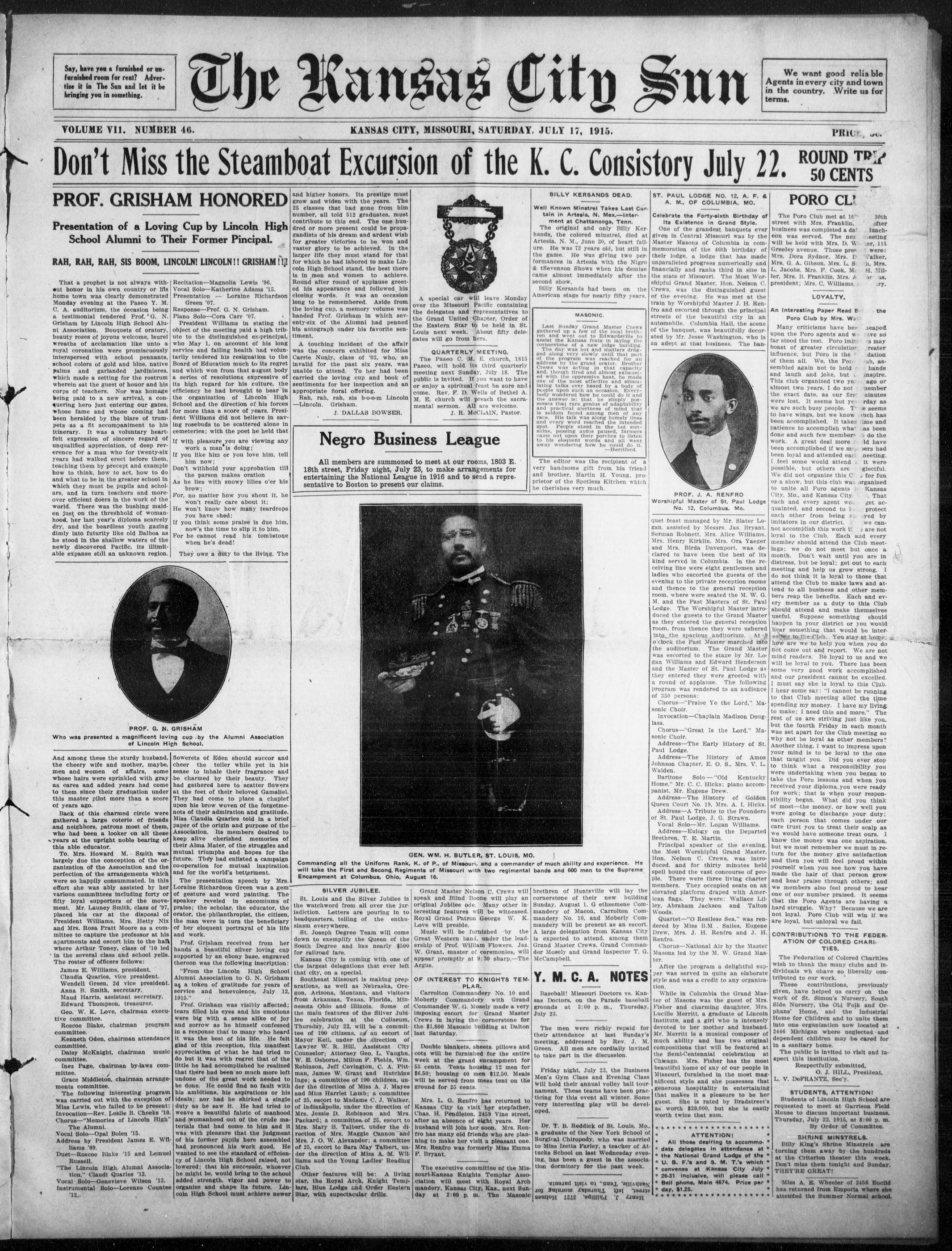
Don't Miss the Steamboat Excursion of the K. C. Consistory July 22. ROUND TRIP 50 CENTS
Say, have you a furnished or unfurnished room for rent? Advertise it in The Sun and let it be bringing you in something.
VOLUME VII. NUMBER 46.
Don't Miss th
PROF. GRISHAM
Presentation of a Loving C
School Alumni to Their L
RAH, RAH, RAH, SIS BOOM, LINCOLN
Presentation of a Loving Cup by Lincoln High School Alumni to Their Former Pincipal.
RAH, RAH, RAH, SIS BOOM, LINCOLN! LINCOLN!! GRISHAM!!
That a prophet is not always without honor in his own country or his home town was clearly demonstrated Monday evening at the Paseo Y. M. C. A. auditorium, the occasion being a testimonial tendered Prof. G. G. Nishram by Lincoln High School Alumni Association. Bouquets of oratory, beauty roses of joyous welcome, laurel wreaths of acclamation like unto a royal coronation were promiscuously interspersed with school pennants, school colors of gold and blue, native palms and garlanded jardines, which made a setting for the rostrum wherein sat the guest of honor and his corps of teachers. Nor was homage being paid to a new arrival, a conquering hero just entering our gates, whose fame and whose coming had been heralded by the blare of trumpets as a fit accompaniment to his itinerary. It was a voluntary heartfelt expression of sincere regard of unqualified appreciation, of deep reverence for a man who for twenty-six years had walked erect before them, teaching them by precept and example how to think, how to act, how to do and what to be in the greater school in which they must be pupils and scholars, and in turn teachers and moreover efficient doers in the work of the world. There was the bushing maiden just on the threshold of womanhood, her last year's diploma scarcely dry, and the beardless youth gazing dimly into futurity like old Balboa as he stood in the shallow waters of the newly discovered Pacific, its illimitable expanse still an unknown region.
[Image of a man in formal attire, wearing a suit and bow tie, with a mustache.]
PROF. G. N. GRISHAM
And among these the sturdy husband, the cheery wife and mother, maybe, men and women of affairs, some whose hairs were sprinkled with gray as cares and added years had come to them since their graduation under this master pilot more than a score of years ago.
Back of this charmed circle were gathered a large coterie of friends and neighbors, patrons most of them, who had been a looker on all these years at the upright noble bearing of this able educator.
To. Mrs. Howard M. Smith was largely due the conception of the organization of the Association and the perfection of the arrangements which were so happily consummated. In this effort she was ably assisted by her various committees including forty or fifty loyal supporters of the movement. Mr. Launey Smith, class of '97, placed his car at the disposal of President Williams, Mrs. Hetty Nix and Mrs. Rosa Pratt Moore as a committee to capture the professor at his apartments and escort him to the hall where Arthur Toney, class of '10 led in the several class and school yells.
The roster of officers follows:
flowerets of Eden should succor and cheer the toiler while yet in his sense to inhale their fragrance and be charmed by their beauty. They had gathered here to scatter flower at the feet of their beloved Gamaliel. They had come to place a chapel upon his brow woven of the forgetmenots of their admiration and gratitude. Miss Claudia Quarles told in a brief paper of the origin and purpose of the Association. Its members desired to keep alive cherished memories of their Alma Mater, of the struggles and mutual triumphs and hopes for the future. They had enlisted a campaign co-operation for mutual inspiration and for the world's betterment.
The presentation speech by Mrs. Loraine Richardson Green was a gest of gesture and word painting. The speaker revealed in encomiums a praise; the scholar, the educator, the orator, the philanthropist, the citizen, the man were in turn the beneficiary of her eloquent portrayal of his life and work.
Prof. Grisham received from him hands a beautiful silver loving cup supported by an ebony base, engraved thereon as the following inscription:
Maud Harris, assistant secretary.
Edward Thompson, treasurer.
Greg W. K. Love, chairman, exec
Geo. W. K. Love, chairman executive committee.
Roscoe Blake, chairman program committee.
Kenneth Oden, chairman attendance committee.
Daisy McKnight, chairman music committee
Inez Page, chairman by-laws committee.
Grace Middleton, chairman arrangements committee.
The following interesting program was carried out with the exception of Miss Lewis, who failed to be present: Invocation—Rev. Leslie B. Cheeks '10.
Chorus—"Memories of Lincoln High"
The Alumni.
Vocal Solo—Opal Bolen '15.
Address by President James E. Williams '09.
Duet—Roscoe Blake '15 and Lemuel Russell.
"The Lincoln High Alumni Associa-
tion," Claudi Quarles '12. Vocal Solo—Genevieve Wilson '13. Instrumental Solo—Lorenzo Countee '13.
The Kansas City Sun
Recitation—Magnolia Lewis '96.
Vocal Solo—Katherine Adams '15.
Presentation — Loraine Richardson
Green '07.
Response—Prof. G. N. Grisham.
Piano Solo—Cora Carr '07.
President Williams in stating the object of the meeting paid a high tribute to the distinguished ex-principal, who May 1, on account of his long service and failing health had voluntarily tendered his resignation to the Board of Education much to its regret and which won from that august body a series of resolutions expressive of its high regard for his culture, the efficiency he had brought to bear in the organization of Lincoln High School and the direction of his forces for more than a score of years. President Williams did not believe in saving rosebuds to be scattered alone in cemeteries; with the poet he held that If with pleasure you are viewing any work a man is doing; If you like him or you love him, tell him now;
Don't withhold your approbation till the parson makes oration
As he lies with snowy lilies o'er his brow;
For, no matter how you shout it, he won't really care about it;
He won't know how many teardrops you have shed:
They owe a duty to the living. The
GRISHAM
ing cup by the Alumni Association
high School.
flowerets of Eden should succor and cheer the toiler while yet in his sense to inhale their fragrance and be charmed by their beauty. They had gathered here to scatter flowers at the feet of their beloved Gamaliel. They had come to place a chaplet upon his brow woven of the forgetmenots of their admiration and gratitude. Miss Claudia Quarles told in a brief paper of the origin and purpose of the Association. Its members desired to keep alive cherished memories of their Alma Mater, of the struggles and mutual triumphs and hopes for the future. They had enlisted a campaign co-operation for mutual inspiration and for the world's betterment.
The presentation speech by Mrs. Loraine Richardson Green was a gem of gesture and word painting. The speaker revealed in encomiums of praise; the scholar, the educator, the orator, the philanthropist, the citizen, the man were in turn the beneficiary of her eloquent portrayal of his life and work.
Prof. Grisham received from her hands a beautiful silver loving cup supported by an ebony base, engraved thereon was the following inscription: "From the Lincoln High School Alumni Association to G. N. Grisham ag a token of gratitude for years of service and benevolence, July 12, 1915."
Prof. Grisham was visibly affected; tears filled his eyes and his emotions were big with a sense alike of joy and sorrow as he himself confessed in a response that to many who heard it was the best of his life. He felt glad of this reception, this manifest appreciation of what he had tried to do but it was with regret that of the little he had accomplished he realized that there had been so much more left undone of the great work needed to be done. He could find no fault with his ambitions, his aspirations or his ideals; nor had he shirked a single duty as he saw it. He had tried to weave a beautiful fabric of manhood and womanhood out of the crude materials that had come to him and it was with pleasure that the judgment of his former pupils here assembled had pronounced his work good. He wanted to see the standard of efficiency of Lincoln High School raised, not lowered; that his successor, whoever he might be, would bring to the school added strength, vigor and power to organize and shape its future. Lincoln High School must achieve newer
KANSAS CITY, MISSOURI, SATURDAY, JULY 17, 1915.
Negro Business League
All members are summoned to meet at our rooms, 1803 E. 18th street, Friday night, July 23, to make arrangements for entertaining the National League in 1916 and to send a representative to Boston to present our claims.
Commanding all the Uniform Rank, K. of P., of Missouri, and a commander of much ability and experience. He will take the First and Second Regiments of Missouri with two regimental bands and 600 men to the Supreme Encampment at Columbus, Ohio, August 16.
Commanding all the Uniform Rank, K. of P., of Missouri, and a commander of much ability and experience. He will take the First and Second Regiments of Missouri with two regimental bands and 600 men to the Supreme Encampment at Columbus, Ohio, August 16.
and higher honors. Its prestige must grow and widen with the years. The 25 classes that had gone from him number, all told 512 graduates, must contribute to this end. The one hundred or more present could be propagandists of his dream and ardent wish for greater victories to be won and vaster glory to be achieved. In the larger life they must stand for that for which he had labored to make Lincoln High School stand, the best there is in men and women to achieve. Round after round of applause greeted his appearance and followed his closing words. It was an occasion long to be remembered. Aside from the loving cup, a memory volume was handed Prof. Grisham in which seventy-six of the Alumni had penned his autograph under his favorite sentiment.
A touching incident of the affair was the concern exhibited for Miss Carrie Nunly, class of '02, who, an invalid for the past six years, was unable to attend. To her had been carried the loving cup and book of sentiments for her inspection and an appropriate floral offering.
Rah, rah, rah, sis b-o-o-m Lincoln —Lincoln. Grisham.
J. DALLAS BOWSER.
Negro Business
All members are summoned on 18th street, Friday night, July 11, entertaining the National League sentative to Boston to present a
Commanding all the Uniform Rank will take the First and Second Regiment Encampment at Columbus, Ohio, A
St. Louis and the Silver Jubilee is the watchword from all over the jurisdiction. Letters are pouring in to headquarters, telling of the enthusiasm everywhere. St. Joseph Degree Team will come down to exemplify the Queen of the South Degree and has nearly $500 for railroad fare. Kansas City is coming with one of the largest delegations that ever left that city, on a special.
A special car will leave Monday over the Missouri Pacific containing the delegates and representatives to the Grand United Chapter, Order of the Eastern Star to be held in St. Louis next week. About fifty delegates will go from here.
QUARTERLY MEETING
The Paseo C. M. E. church, 1815
Paseo, will hold its third quarterly
meeting next Sunday, July 18. The
public is invited. If you want to have
or enjoy a spiritual feast be sure and
come. Rev. F. D. Wells of Bethel A.
M. E. church will preach the sacram-
mental sermon. All are welcome.
J. R. McCLAIN, Pastor.
ness League
ed to meet at our rooms, 1803 E.
y 23, to make arrangements for
lague in 1916 and to send a repre-
our claims.
GEN. WM. H. BUTLER. ST. LOUIS. MO.
Grand Master Nelson C. Crews will speak and Blind Boone will play an original Jubilee ode. Many other interesting features will be witnessed, Royal Grand Patron George W. K Love will preside. Music will be furnished by the Great Western band, under the leadership of Prof. William Flowers. Jas W. Grant, master of ceremonies, will appear promptly at 9:30 sharp.—The Argus.
OF INTEREST TO KNIGHTS TEM PLAR.
Carrollton Commandery No. 10 and Moberly Commandery with Grand Commander W. G. Mosely made a very imposing escort for Grand Master Crews in laying the cornerstone for the $1,800 Masonic building at Dalton last Saturday.
Double blankets, sheets, pillows and cots will be furnished for the entire week at the grand encampment for 55 cents. Tents housing 12 men for $6.50; housing 40 men $12.50. Meals will be served from mess tent on the ground for 25 cents.
Mrs. L. G. Renfro has returned to Kansas City to visit her stepfather, Chas. H. Pendleton, 2459 Vine street, after an absence of eight years. Her husband will join her soon. Mrs. Renfro has many old friends who are planning to make her visit a pleasant one. Mrs. Renfro was formerly Miss Emma F. Bryant.
The executive committee of the Missouri-Kansas Knights Templar Association will meet with Royal Arch mendery, Pendleton City, Kas., next Sunday at 2:00 p. m. The Masonic
BILLY KERSANDS DEAD.
Well Known Minstrel Takes Last Curtain in Artesia, N. Mex.-Inter-
ment at Chattanooga, Tenn.
The original and only Billy Kers hands, the colored minstrel, died at Artesia, N. M., June 30, of heart failure. He was 73 years old, but still in the game. He was giving two performances in Artesia with the Nigro & tSevenson Shows when his demise came almost immediately after the second show.
Billy Kersands had been on the American stage for nearly fifty years.
MASONIC.
Last Sunday Grand Master Crews gathered up a few of the local brethren and went out to wardrobe the sashs and fratries, lynched the cornerstone of a new lodge building. The day hot and matters dragged the day very far, the program was reached for an address by the grand orator. Brother Curtis Crews said in that capacity, and though tired and tired, and with the oppressive heat, he made one of the most effective and most successful sessions by body of people upon such an occasion. Everybody wondered how he could do it and the reason for it. He said these sessions that rare genius of adaptability and practical alertness of mind that is seldom found among men of any race had all along reached the intended spine, passing stubs paused, farmers came out upon their porches to listen to his eloquent words and all went away wondering how he could do it. — Herford
The editor was the recipient of a very handsome gift from his friend and brother, Martin H. Young, proprietor of the Spotless Kitchen which he cherishes very much.
er of much ability and experience. He
bands and 600 men to the Supreme
brethren of Huntsville will lay the cornerstone of their new building Sunday, August 1. G ethsemene Commandery of Macon, Carrollton Commandery No. 10, and Moberly Commandery will be present as an escort A large delegation from Kansas City is expected to attend, among them Grand Master Crews, Grand Command der Mosely and Grand Inspector T. G McCampbell.
Y. M. C. A. NOTES
Baseball! Missouri Doctors vs. Kansas Doctors, on the Parade baseball grounds at 3:00 p. m., Thursday, July 23.
The men were richly repaid for their attendance at last Sunday's meeting, addressed by Rev. J. M. Green. All men are cordially invited to take part in the discussion.
Friday night, July 23, the Business Men's Gym Class and Evening Class will hold their annual volley ball tournament. These teams have been practicing for this event all winter. Some very interesting play will be developed.
Dr. T. B. Reddick of St. Louis, Mo., a graduate of the New York School of Surgical Chropody, who was married to Miss Izetta Farley, a teacher of Attucks School on last Wednesday evening, has been a guest in the association dormitory for the past week.
ST. PAUL LODGE NO. 12, A. F. &
A. M., OF COLUMBIA, MO.
Celebrate the Forty-sixth Birthday of
One of the grandest banquets ever given in Central Missouri was by the Master Masons of Columbia in commemoration of the 46th birthday of their lodge, a lodge that has made unparalleled progress numerically and financially and ranks third in size in the state of Missouri. The Most Worshipful Grand Master, Hon. Nelson C. Crews, was the distinguished guest of the evening. He was met at the train by Worshipful Master J. H. Renfro and escorted through the principal streets of the beautiful city in an automobile. Columbia Hell, the scene of the banquet, was beautifully decorated by Mr. Jesse Washington, who is an adept at that business. The ban-
PROF. J. A. RENFRO
Worshipful Master of St. Paul Lodge
No. 12, Columbus, Mo.
quiet feast managed by Mr. Slater Logan, assisted by Messrs. Jas. Bryant, Serman Robnett, Mrs. Alice Williams, Mrs. Henry Kirklin, Mrs. Ora Yaeger and Mrs. Birda Davenport, was declared to have been the best of its kind served in Columbia. In the receiving line were eight gentlemen and ladies who escorted the guests of the evening to the private reception rooms and thence to the general reception room, where were seated the M. W. G. M. and the Past Masters of St. Paul Lodge. The Worshipful Master introduced the guests to the Grand Master as they entered the general reception room, from thence they were ushered into the spacious auditorium. At o'clock the Past Master marched into the auditorium. The Grand Master was escorted to the stage by Mr. Logan Williams and Edward Henderson and the Master of St. Paul Lodge as they entered they were greeted with a round of applause. The following program was rendered to an audience of 350 persons:
Chorus—"Praise Ye the Lord," Masonic Choir.
Invocation—Chaplain Madison Douglass.
Chorus—"Great Is the Lord." Masonic Choir.
Address—The Early History of St. Paul Lodge.
Address—The History of Amos Johnson Chapter, E. O. S., Mrs. V. L. Walden.
Baritone Solo—"Old Kentucky Home," Mr. C. C. Hicks; piano accompanist, Mr. Eugene Drew.
Address—The History of Golden Queen Court No. 19, Mrs. A. I. Hicks.
Address—A Tribute to the Founders of St. Paul Lodge, J. G. Strawn.
Vocal Solo—Mr. Logan Williams.
Address—Eulogy on the Departed Brethren, T. E. Martin.
Principal speaker of the evening, the Most Worshipful Grand Master, Hon. Nelson C. Crews, was introduced, and for thirty minutes held spell bound the vast concourse of people. There were three living charter members. They occupied seats on an elevated platform draped with American flags. They were: Wallace Lilley, Abraham Jackson and Talton Woods.
Quartet—"O Restless Sea," was rendered by Miss B.M. Sailes, Eugene Drew, Mrs. J. H. Renfro and J. H. Renfro.
Chorus—National Air by the Master Masons led by the M. W. Grand Master.
After the program a delightful supper was served in quite an elaborate style and was a credit to any organization.
While in Columbia the Grand Master of Masons was the guest of Mrs. Fisher and charming daughter, Mrs. Lucille Merritt, a graduate of Lincoln Institute, and a girl who is intensely devoted to her mother and husband. Mr. Merritt is a musical composer of much ability and has two original compositions that will be featured at the Semi-Centennial celebration at Chicago. Mrs. Fisher has the most beautiful home of any of our people in Missouri, furnished in the most magnificent style and she possesses that generous hospitality in entertaining that makes it a pleasure to be her guest. She is rated by Bradstreet's as worth $20,000, but she is easily worth twice that sum.
ATTENTION!
All those desiring to accommodate delegates in attendance at the National Grand Lodge of the U. B. F.'s and S. M. T.'s which convenes at Kansas City July 26-31 inclusive, will please call Bell phone, Main 4674. Price per day, $125.
.....
We want good reliable Agents in every city and town in the country. Write us for terms.
PRICE. JC.
PORO CLI
The Poro Club met at 16° street with Mrs. Franklin, business was completed a daton was served. The nex will be held with Mrs. D. W. Greeley avenue. Those pres Mrs. Dora Sydnor, Mrs. D. Mrs. G. A. Gibson, Mrs. L. S. Jacobs, Mrs. F. Cook, Mler, Mrs. B. Franklin, Mrs. A president; Mrs. C. Williams
30th after lunch-
meeting
her, 111
were:
Walker,
h Mrs.
H, Mill,
ocas,
ary.
LOYALTY.
An interesting Paper Read By the
Poro Club by Mrs. Walt
Many criticisms have been leaped upon the Poro agents and we have so far stood the test. Poro limits its may boast of greater circulation greater influence, but Poro is the foundation of them all. We, the Poro club, assembled again not to hold hands and laugh and joke, but to inspire. This club organized two years ago or almost two years, I do not member the exact date, as our first minutes were lost. It seems but yesterday as we are such busy people. The seems to have wings, but we know such has been accomplished. It takes time and patience to accomplish what has been done and such few members do the work. A great deal more could have been accomplished if we members had been loyal and attended each meeting. I feel some would attend it. It were possible, but others are forgetful. We do not organize this Club for fun or a show, but this club was organized to unite all Poro agents in Kansas City, Mo, and Kansas City. That each and every agent would get acquainted, and second to be protect each other from being involved byimitators in our district. We cannot accomplish this work if we are not loyal to the Club. Each and every member should attend the Club meetings; we do not meet but once a month. Don't wait until you are in distress, but be loyal; get out to each meeting and help us grow strong. I do not think it is loyal to those that attend the Club to make laws and attend to all business and other members reap the benefits. Each and every member as a duty to this Club should attend and make themselves useful. Suppose something should happen in your district or you would hear something that would be interested in the Club. You stay at home; how are we to help you when you do not come out and report. We are not mind readers. Be loyal to us and we will be loyal to you. There has been some very good work accomplished and our president cannot be excelled. I must say she is loyal to this Club. I hear some say: "I cannot be running to that Club meeting allof the time spending my money. I have my living to make; I need this and more." The rest of us are striving just like you, but the fourth Friday in each month was set apart for the Club meeting so why not be loyal as other members? Another thing, I want to impress upon your mind is to be loyal to the one that taught you. Did you ever stop to think what a responsibility you were undertaking when you began to take the Poro lessons and when you received your diploma, you were ready for work; that is when your responsibility that. What did you think of most—the money, or how well you were going to discharge your duty; each person that comes under our care trust you to treat their scalp as we would have someone treat ours. I know the money was one aspiration, but we must remember we must in return for the money give satisfaction and then you will feel proud within yourself when you see how you have made the hair of that person grow and hear praise through others; and we members also feel proud to hear one of our number praised. It seems that the Poro Agents are having a hard struggle. Why? Because we are not loyal. Poro Club will win if we are loyal, but unloyal we fail.
CONTRIBUTIONS TO THE FEDERATION OF COLORED CHARITIES.
The Federation of Colored Charities wish to thank the many clubs and individuals whahe so liberally contributed to our work.
These contributions, previously given, have helped us carry on the work of St. Simon's Nursery, South Side Nursery, the Old Folk and Orphans' Home, and the Industrial Home for Children and to unite them into one organization now located at 2446 Michigan where neglected and dependent children may be cared for in a sanitary home.
The public is invited to visit and inspect this institution.
Respectfully submitted,
O. J. HILL, President.
L. V. DEFRANTZ, Sec'y.
STUDENTS. ATTENTION!
STUDENTS, ATTENTION!
Students of Lincoln High School are requested to meet at Garrison Field Mouse to discuss important business.
Thursday, July 22, 1915, at 8:00 p. m.
By Order of Committee.
SHRINE MINSTRELS.
Billy King's Shrine Minstrels are turning them away by the hundreds at the Criterion theater this week.
Don't miss them tonight and Sunday.
THEY'RE GREAT!
Miss A. E. Wheeler of 2456 Euclid has returned from Emporia where she attended the Summer Normal school.
AFRO-AMERICAN CULLINGS
Booker T. Washington, to whom both races in America are indebted for an activity in public affairs altogether helpful to both, is on one of his tours delivering addresses on subjects in which his race is very much interested. Speaking to large meetings of his own people in New York and Brooklyn the other day, he said: "If you expect to hold your own in the keen competition of the North when the war in Europe is over and immigrants come in again by the hundreds of thousands and millions, you have got to take advantage of every opportunity for better training offered by the public school system, and by such organizations as the Urban League, the Young Men's Christian association and the Young Woman's Christian association."
This advice is all gold, and every colored man and woman in the North should follow it. Everything indicates heavy immigration from Europe at the close of the war; and it will be composed of the poorer classes—unskilled laborers escaping the impoverishment that has fallen on their old homes. America will invite more strongly than ever.
The colored man in the North is as a rule an unskilled laborer, and restricted even in that field. Not many avenues of employment are open to him. As competition grows, therefore, he must meet it by greater industry and higher competency, or go to the wall.
The colored man in the South will not feel this pressure. The tide of this new immigration will not set in that direction. Where he is a field hand, conditions for him will remain about as they have been. Where he is an unskilled laborer, in town or city, competition will not be much greater than before.
But, North and South, the colored man should bestir himself. The new times coming will mean much to him. He is in the land of opportunity. The great majority of the white people sympathize with every worthy effort he makes to better himself as man and citizen. They view with approval and satisfaction the progress he has made in his half century of freedom, and they will help him further along the road as often as he merits their assistance.
Professor Washington's constant adduction to his people is to live good lives, acquire property, cultivate the friendship of their white neighbors, and identify themselves as far as may be with things of the best report where they reside. The criminal, the drone, the shiftless, the incompetent are a reproach to their race, and a drag on the community. And in the whirl and bustle of business expected to follow the close of the war now raging, the unworthy of either race in this country will be more unworthy, because more in the way, than ever.
Constitutionality of the Louisville segregation ordinance, designed to prevent whites and Negroes occupying for a home or as a place of public assemblage a building located in a block, a majority of the residents of which are of the other race, was upheld in a decision by the Kentucky court of appeals. The ordinance was passed by the Louisville common council in May, 1914.
A novel English slot machine prints the fact that postage has been paid upon letters instead of affixing stamps.
To live to the advanced age of one hundred and five years and to be acquitted of two serious charges is the interesting experience of Lemon Shaw, who lives at Garner, N. C. Lemon is an active old Negro. He lives in a small house which he built for himself in a few years ago. His two sons fought in the Civil war and well remember those stirring times. Five years ago Lemon was tried for the murder of a friend. David Hall, but was acquitted. He was again brought before the judge for trial when he was arrested for selling liquor unlawfully. Several witnesses were brought to testify against him, but none of them were able to swear that he was guilty. He was again acquitted and went home. His constant companion is a cat which he loves dearly, and his old time musket. He makes his living weaving baskets and is quite an expert at that trade.
A rich deposit of gold has been discovered on the Binabal river in the Province of Mindoro, Philippine islands. The deposit is said to be extensive and the nuggets of unusually fine quality.
From the Christian era till the present time, as statistists and historians tell us, there have been less than 240 warless years. Up to the middle of the nineteenth century it was roughly computed that nearly 7,000,000,000 men had died in battle since the beginning of recorded history, a number equal to almost five times the present estimated population of the globe.
By telling it something everybody already knows an orator can nearly always inspire his audience with enthusiasm.
When a Dog Drinks.
"A dog drinking is the emblem of alertness," says an observing writer. "Watch him! If a leaf rustles he sees it and starts. Sights and sounds which elude your powers of observation arrest his. The most conspicuous distinction between the dog and the ox at water is this: The ox never heeds h' master until his thirst is quenched; the dog never heeds his thirst till his master is obeyed. I have seen a hound panting with heat, his black lips baked, his tongue cracked, dart toward the
FLOWERS AND
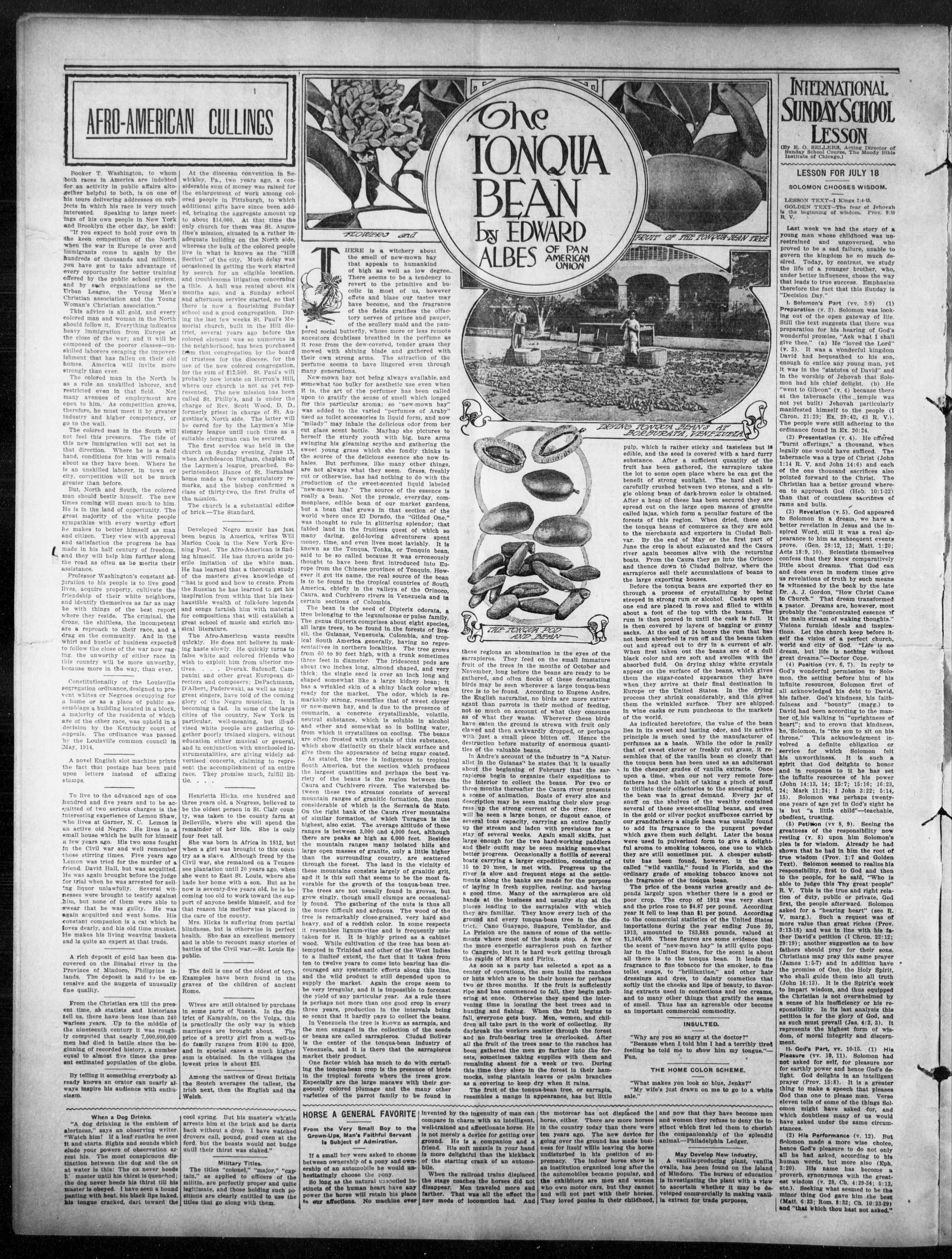
HERE is a witchery about the smell of new-mown hay that appeals to humankind of high as well as low degree. There seems to be a tendency to revert to the primitive and bucolic in most of us, however effete and blaze our tastes may have become, and the fragrance of the fields gratifies the olfactory nerves of prince and pauper, of the scullery maid and the pampered social butterfly, whose more or less remote ancestors doubtless breathed in the perfume as it rose from the dew-covered, tender grass they mowed with shining blade and gathered with their own strong arms. The attraction of the perfume seems to have lingered even through many generations.
New-mown hay not being always available, and somewhat too bulky for aesthetic use even when it is, the art of the perfumer has been called upon to gratify the sense of smell which longed for this particular aroma; so "new-mown hay" was added to the varied "perfumes of Araby" used as toilet accessories in liquid form, and now "milady" may inhale the delicious odor from her cut glass scent bottle. Mayhap she pictures to herself the sturdy youth with big, bare arms swinging his gleaming scythe and gathering the sweet young grass which she fondly thinks is the source of the delicious essence she now inhales. But perfumes, like many other things, are not always what they seem. Grass, freshly cut or otherwise, has had nothing to do with the production of the sweet-scented liquid labeled "new-mown hay." The source of the essence is really a bean. Not the prosalic, everyday, commonplace, edible bean of our market gardens, but a bean that grows in that section of the world where once El Dorado, the "Gilded One," was thought to rule in glittering splendor; that fabled land in the fruitless quest of which so many daring, gold-loving adventurers spent money, time, and even lives most lavishly. It is known as the Tonqua, Tonka, or tonquin bean, said to be so called because it was erroneously thought to have been first introduced into Europe from the Chinese province of Tonquin. However it got its name, the real source of the bean is to be found in the tropical countries of South America, chiefly in the valleys of the Orinoco, Caura, and Cuchivero rivers in Venezuela and in certain sections of Colombia.
The bean is the seed of Dipterix odorata, a tree belonging to the leguminous or pulse family. The genus dipterix comprises about eight species, all large trees, to be found in the forests of Brazil, the Guianas, Venezuela, Colombia, and tropical South America generally, having no representatives in northern localities. The tree grows from 60 to 10 feet high, with a trunk sometimes three feet in diameter. The fridescent pods are about two inches long, almond shaped, and very thick; the single seed is over an inch long and shaped somewhat like a large kidney bean; it has a wrinkled skin of a shiny black color when ready for the market. The odor, which is remarkably strong, resembles that of sweet clover or new-mown hay, and is due to the presence of coumarin, a concrete crystallizable, volatile, neutral substance, which is soluble in alcohol and ether and somewhat so in boiling water, from which it crystallizes on cooling. The beans are often frosted with crystals of this substance, which show distinctly on their black surface and give them the appearance of being sugar coated.
As stated, the tree is indigenous to tropical South America, but the section which produces the largest quantities and perhaps the best variety of the beans is the region between the Caura and Cuchivero rivers. The watershed between these two streams consists of several mountain ranges of granitic formation, the most considerable of which is the Serrania de Mato. On the right bank of the Caura river mountains of similar formation, of which Turagua is the highest, also exist. The average altitude of these ranges is between 3,000 and 4,000 feet, although there are peaks as high as 6,000 feet. Besides the mountain ranges many isolated hills and large open masses of granite, only a little higher than the surrounding country, are scattered through the forest. The land in the vicinity of these mountains consists largely of granitic grit, and it is this soil that seems to be the most favorable for the growth of the tonqua-bean tree. The trees are not usually found in groves, but grow singly, though small clumps are occasionally found. The gathering of the nuts is thus all the more difficult and arduous. The wood of the tree is remarkably close-grained, very hard and heavy, and of a reddish color. In some respects it resembles lignum-vitae and is frequently mistaken for it. It is highly prized as a cabinet wood. While cultivation of the tree has been attempted in Trinidad and other of the West Indies to a limited extent, the fact that it takes from ten to twelve years to come into bearing has discouraged any systematic efforts along this line, and the wild product is still depended upon to supply the market. Again the crops seem to be very irregular, and it is impossible to forecast the yield of any particular year. As a rule there is perhaps not more than one good crop in every three years, production in the intervals being so scant that it hardly pays to collect the beans.
In Venezuela the tree is known as sarrapia, and the men engaged in the collection of the seeds or beans are called sarrapieros. Ciudad Bolivar is the center of the tonqua-bean industry of Venezuela, and it is there that the sarrapieros market their product.
In Venezuela the tree is known as sarrapia, and the men engaged in the collection of the seeds or beans are called sarrapieros. Cludad Bolivar is the center of the tonqua-bean industry of Venezuela, and it is there that the sarrapieros market their product.
One factor which has much to do with curtailing the tonqua-bean crop is the presence of birds in the tropical forests where the trees grow. Especially are the large macaws with their gorgeously colored plumage and the many other varieties of the parrot family to be found in
HORSE A GENERAL FAVORITE Invented it compare it
One factor which has much to do with curtailing the tonqua-bean crop is the presence of birds in the tropical forests where the trees grow. Especially are the large macaws with their gorgeously colored plumage and the many other varieties of the parrot family to be found in
From the Very Small Boy to the Grown-Ups, Man's Faithful Servant Is Subject of Admiration.
If a small boy were asked to choose between ownership of a pony and ownership of an automobile he would unhesitatingly choose the pony.
So long as the natural unspoiled instincts of the human heart have any power the horse will retain his place in our affections. No machine ever well-trained is not men's ground. Friend. He is more de of the stabile.
When to the stage disappear. farther. to new mode.
At the diocesan convention in Sewickle, Pa., two years ago, a considerable sum of money was raised for the enlargement of work among colored people in Pittsburgh, to which additional gifts have since been added, bringing the aggregate amount up to about $14,000. At that time the only church for them was St. Augustine's mission, situated in a rather inadequate building on the North side, whereas the bulk of the colored people live in what is known as the "Hill Section" of the city. Much delay was occasioned in getting the work started by search for an eligible location, and troublesome litigation concerning a title. A hall was rented about six months ago, and a Sunday school and afternoon service started, so that there is now a flourishing Sunday school and a good congregation. During the last few weeks St. Paul's Memorial church, built in the Hill district, several years ago before the colored element was so numerous in the neighborhood, has been purchased from that congregation by the board of trustees for the diocese, for the use of the new colored congregation, for the sum of $12,500. St. Paul's will probably now locate on Herron's Hill, where our church is not as yet represented. The new mission has been called St. Philip's, and is under the charge of Rev. Scott Wood, D. D., formerly priest in charge of St. Augustine's, North side. The latter will be cared for by the Laymen's Missionary league until time as a suitable clergyman can be secured.
The first service was held in the church on Sunday evening, June 13, when Archdeacon Bigham, chaplain of the Laymen's league, preached. Superintendent Hance of St. Barnabas home made a few congratulatory remarks, and the bishop confirmed a class of thirty-two, the first fruits of the mission. The church is a substantial edifice of brick—The Standard.
Developed Negro music has just been begun in America, writes Will Marlon Cook in the New York Evening Post. The Afro-American is finding himself. He has thrown aside pupie imitation of the white man. He has learned that a thorough study of the masters gives knowledge of that is good and how to create. From the Russian he has learned to get his inspiration from within that his inexhaustible wealth of folk-lore legends and songs furnish him with material for compositions that will establish a great school of music and enrich musical literature.
The Afro-American wants results quickly. He does not believe in making haste slowly. He quickly turns to false white and colored friends who wish to exploit him from ulterior motives. . . Dvorak, Safonoff, Campanini and other great European directors and composers; DePachmann, D'Albert, Paderewski, as well as many great singers, have told of the coming glory of the Negro musician. It is becoming a fad. In some of the large cities of the country, New York in particular, well-meaning, but ill-advised white people are gathering together poorly trained singers, without education either musical or general, and in conjunction with unschooled instrumentalities, are giving widely advertised concerts, claiming to represent the accomplishment of an entire race. They promise much, fulfill little. . .
Henrietta Hicks, one hundred and three years old, a Negress, believed to be the oldest person in St. Clair county, was taken to the county farm at Belleville, where she will spend the remainder of her life. She is only four feet tall.
She was born in Africa in 1812, but when a girl was brought to this country as a slave. Although freed by the Civil war, she remained on a Tennessee plantation until 20 years ago, when she went to East St. Louis, where she hade her home with a son. But as he now is seventy-five years old, he is becoming too old to work toward the support of anyone beside himself, and for that reason his mother was placed in the care of the county.
Mrs. Hicks is suffering from partial blindness, but is otherwise in perfect health. She has an excellent memory and is able to recount many stories of battles of the Civil war.—St. Louis Republic.
The doll is one of the oldest of toys. Examples have been found in the graves of the children of ancient Rome.
Wives are still obtained by purchase in some parts of Russia. In the district of Kamyshin, on the Volga, this is practically the only way in which marriages are brought about. The price of a pretty girl from a well-to-do family ranges from $100 to $200, and in special cases a much higher sum is obtained. In the villages the lowest price is about $25.
Among the natives of Great Britain the Scotch averages the tallest, the Irish next, then the English and the Welsh.
cool spring. But his master's whistle arrests him at the brink and he darts back without a drop. I have watched drovers call, pound, good oxen at the ford, but the beasts would not budge until their thirst was slaked."
Military Titles.
The titles "colonel" "major" "captain," as applied to officers of the militia, are perfectly proper and quite legitimate, and those holding such positions are clearly entitled to use the titles that go along with them.
HERE is a witchery about the smell of new-mown hay that appeals to humankind of high as well as low degree. There seems to be a tendency to revert to the primitive and bucolic in most of us, however effete and blase our tastes may have become, and the fragrance of the fields gratifies the olfactory nerves of prince and pauper, of the scullery maid and the pam-
these regions an abomina
sarrapieros. They feed on
fruit of the trees in the
November, long before the
gathered, and often floor
birds may be seen where
tree is to be found. Acco
cant than parrots in the
not so much on account
as of what they waste.
have eaten the ground in
clawed and then awkward
with just a small piece
destruction before matri-
ties of the valuable bean.
In Andre's account of ha
alist in the Guianas" he
about the beginning of
rapieros begin to organ
the interior to collect
three months thereafter
a scene of animation.
description may be seen
up the strong cur
will be seen a large bov
several tons capacity,
up the stream and ladder
stay of several weeks.
large enough for the two
and their outfit may be
better progress. Occasio
boats carrying a larger
15 to 20 men, is met
river is slow and mea-
ments along the banks of
laying in fresh supply
a good time. Many of
hands at the business
places leading to the
they are familiar. They
ground and every tong
trict. Cano Guayapo,
La Prision are the namen
ments where most of the
the more energetic sar-
Cangrejo, but it is ha
the rapids of Mura and
As soon as a party be
center of operations, the
or huts which are to be
two or three months. Hipe
ripe and has commenced
ing at once. Otherwise
wening time in locating
hunting and fishing. W
fall, everyone gets busy
dren all take part in the
daybreak the workers s
and no fruit-bearing tree
all the fruit of the trees
been gathered the men-
ests, sometimes taking
remaining absent for a
this time they sleep in
mocks, using plantain
as a covering to keep
The fruit of the tongue
resembles a mango in a
Invented by the ingenuity of man can compare in charm with an intelligent, well-trained and affectionate horse. He is not merely a device for getting over ground. He is a companion and a friend. His soft muzzle in your hand is more delightful than the kickback of the starting crank of an automobile.
When the railroad trains displaced the stage coaches the horses did not disappear. Men traveled more and farther. That was all the effect the new mode of locomotion had. And
flowers and
The
TONQUA
BEAN
by EDWARD
ALBES OF PAN
AMERICAN
UNION
ALBES OF PAN AMERICAN UNION
DRYING TONQUIA BEANS AT BORBURATA, VENEZUELA
these regions an abomination in the eyes of the sarrapieros. They feed on the small immature fruit of the trees in the months of October and November, long before the beans are ready to be gathered, and often flocks of these devastating birds may be seen wherever a large tonqua-bean tree is to be found. According to Eugene Andre, the English naturalist, no birds are more extravagant than parrots in their method of feeding, not so much on account of what they consume of what they waste. Wherever these birds have eaten the ground is strewn with fruit only, sawed and then awkwardly dropped, or perhaps with just a small piece bitten off. Hence the construction before maturity of enormous quantities of the valuable beans.
In Andre's account of the industry in "A Naturalist in the Gulianas" he states that it is usually about the beginning of February that the sarrapieros begin to organize their expeditions to the interior to collect the beans. For two or three months thereafter the Caura river presents a scene of animation. Boats of every size and description may be seen making their slow progress up the strong current of the river. Here it will be seen a large bongo, or dugout canoe, of several tons capacity, carrying an entire family and their outfit may be seen making somewhat better progress. Occasionally a flotilla of several boats carrying a larger expedition, consisting of 5 to 20 men, is met with. Progress up the river is slow and frequent stops at the settlements along the banks are made for the purpose of laying in fresh supplies, resting, and having good time. Many of the sarrapieros are old boats at the business and usually stop at the places leading to the sarrapiales with which they are familiar. They know every inch of the ground and every tonqua-bean tree in the district. Cano Guayapo, Suapure, Templador, and a Prison are the names of some of the settlements where most of the boats stop. A few of the more energetic sarrapieros push on farther Cangrejo, but it is hard work getting through the rapids of Mura and Piritu.
As soon as a party has selected a spot as a center of operations, the men build the ranchor huts which are to be their homes for perhaps two or three months. If the fruit is sufficiently ripe and has commenced to fall, they begin gathing at once. Otherwise they spend the interning time in locating the best trees and in hunting and fishing. When the fruit begins to fall, everyone gets busy. Men, women, and children all take part in the work of collecting. By daybreak the workers scatter through the forest and no fruit-bearing tree is overlooked. After all the fruit of the trees near to the ranchos has been gathered the men go farther into the forests, sometimes taking supplies with them and remaining absent for a week or two. During this time they sleep in the forest in their hammocks, using plantain leaves or palm branches as a covering to keep dry when it rains.
The fruit of the tonqua-bean tree, or sarrapia resembles a mango in appearance, has but little
THE TONGA POD
AND BEAN
these regions an abmination in the eyes of the sarrapieros. They feed on the small immature fruit of the trees in the months of October and November, long before the beans are ready to be gathered, and often flocks of these devastating birds may be seen wherever a large tonqua-bean tree is to be found. According to Eugene Andre, the English naturalist, no birds are more extravagant than parrots in their method of feeding, not so much on account of what they consume as of what they waste. Wherever these birds have eaten the ground is strewn with fruit only clawed and then awkwardly dropped, or perhaps with just a small piece bitten off. Hence the destruction before maturity of enormous quantities of the valuable beans.
In Andre's account of the industry in "A Naturalist in the Guanas" he states that it is usually about the beginning of February that the sarapieros begin to organize their expeditions to the interior to collect the beans. For two or three months thereafter the Caura river presents a scene of animation. Boats of every size and description may be seen making their slow progress up the strong current of the river. Here will be seen a large bongo, or dugout canoe, of several tons capacity, carrying an entire family up the stream and laden with provisions for a stay of several weeks. Again small skiffs, just large enough for the two hard-working paddlers and their outfit may be seen making somewhat better progress. Occasionally a floatia of several boats carrying a larger expedition, consisting of 15 to 20 men, is met with. Progress up the river is slow and frequent stops at the settlements along the banks are made for the purpose of laying in fresh supplies, resting, and having a good time. Many of the sarapieros are old hands at the business and usually stop at the places leading to the sarapiales with which they are familiar. They know every inch of the ground and every tonua-bean tree in the district. Cano Guayapo, Suapure, Temblador, and La Prison are the names of some of the settlements where most of the boats stop. A few of the more energetic sarapieros push on farther to Cangrejo, but it is hard work getting through the rapids of Mura and Piritu.
As soon as a party has selected a spot as a center of operations, the men build the ranchos or huts which are to be their homes for perhaps two or three months. If the fruit is sufficiently ripe and has commenced to fall, they begin gathering at once. Otherwise they spend the intervening time in locating the best trees and in hunting and fishing. When the fruit begins to fall, everyone gets busy. Men, women, and children all take part in the work of collecting. By daybreak the workers scatter through the forest and no fruit-bearing tree is overlooked. After all the fruit of the trees near to the ranchos has been gathered the men go farther into the forests, sometimes taking supplies with them and remaining absent for a week or two. During this time they sleep in the forest in their hammocks, using plantain leaves or palm branches as a covering to keep dry when it rains. The fruit of the tonqua-bean tree, or sarrapita, resembles a mango in appearance, has but little
---
station in the eyes of the on the small immature months of October and the beans are ready to be of these devastating over a large tonqua-bean ordering to Eugene Andre, birds are more extravagant method of feeding, of what they consume. Wherever these birds strewn with fruit only easily dropped, or perhaps bitten off. Hence the utility of enormous quanti-
the industry in "A Natur- states that it is usually February that the sarze their expeditions to the beans. For two or the Caura river presents boats of every size and making their slow progen- of the river. Here ago, or dugout canoe, oferrying an entire family with provisions for a Again small skiffs, just to hard-working paddlers seen making somewhat nally a flotilla of several expedition, consisting of with. Progress up the sent stops at the settle- reme made for the purposes, resting, and having the sarrapieros are old and usually stop at the sarrapiales with which know every inch of the ma-bean tree in the disu-quence, Templador, and as of some of the settle- boats stop. A few of sapieros push on farther and work getting through Piritu.
as selected a spot as a men build the ranchos their homes for perhaps the fruit is sufficiently to fall, they begin gath- e they spend the inter- the best trees and in when the fruit begins to Men, women, and child- work of collecting. By latter through the forest he is overlooked. After near to the ranchos has go farther into the for-supplies with them and week or two. During the forest in their hamm- caves or palm branches cry when it rains. ma-bean tree, or sarrapia, appearance, has but little pulp, which edible, and substance, fruit has in the lot to the benefit of carefully o- gle oblong. After a he spread out called laja forests of the tongue to the mer- var. By June the river agate boats. Freed and then sarrapieros the large.
Before through a steeped in one end and about a f rum is the then cacks. At not been s out and s out. When first black color absorbed appear on them the when they Europe or process them the in wine cac of the work.
As indicies in its principle perfumes that of sw symbles the tongue in the chee upon a the fathers had to titillate the bean snuff on several of in the gold our grandt to add it which gave were used aroma they are sute has called "whi ordinary for the fragrant.
The prince pends large poor crop and the year it fell to the com- importation 1913, ame $1,140,409. the scent lar in the all there fragrance toilet soap dressings softly tint extract and to make of smell. an import-
"Why are "Because feeling he Fun.
"What n "My wife sale."
the motorcar has not displaced the horse, either. There are more horses in the country today than there were ten years ago. The new device for going over the ground has made business for itself while leaving the horse undisturbed in his position of supremacy. The indoor horse show is an institution organized long after the automobiles became popular, and the exhibitors are men and women who own motor cars, but they cannot and will not part with their horses. They loved ponies in their childhood,
FRUIT OF THE TONQUA-SEAN TREE
pulp, which is rather sticky and tasteless but 18 edible, and the seed is covered with a hard furry substance. After a sufficient quantity of the fruit has been gathered, the sarrapiero takes the lot to some open place where he can get the benefit of strong sunlight. The hard shell is carefully crushed between two stones, and a single oblong bean of dark-brown color is obtained. After a heap of these has been secured they are spread out on the large open masses of granite called lajas, which form a peculiar feature of the forests of this region. When dried, these are the tonqua beans of commerce as they are sold to the merchants and exporters in Ciudad Bolivar. By the end of May or the first part of June the crop is about exhausted and the Caura river again becomes alive with the returning boats. From the Caura they go into the Orinoco and thence down to Ciudad Bolivar, where the sarrapieren sell their accumulations of beans to the large exporting houses.
Before the tonqua beans are exported they go through a process of crystallizing by being steeped in strong rum or alcohol. Casks open at one end are placed in rows and filled to within about a foot of the top with the beans. The rum is then poured in until the cask is full. It is then covered by layers of bagging or gunny sacks. At the end of 24 hours the rum that has not been absorbed is run off and the beans taken out and spread out to dry in a current of air. When first taken out the beans are of a dull black color and are soft and swollen with the absorbed fluid. On drying shiny white crystals appear on the surface of the beans, which gives them the sugar-coated appearance they have when they arrive at their final destination in Europe or the United States. In the drying process they shrink considerably, and this gives them the wrinkled surface. They are shipped in wine casks or rum puncheons to the markets of the world.
As indicated heretofore, the value of the bean lies in its sweet and lasting odor, and its active principle is much used by the manufacturer of perfumes as a basis. While the odor is really that of sweet clover or freshly cut grass, it resembles that of the vanilla bean so closely that the tonqua bean has been used as an adulterant in the cheaper grades of vanilla extracts. Once upon a time, when our not very remote forefathers had the habit of taking a pinch of snuff to titillate their olfactory to the sneezing point, the bean was in great demand. Every jar of snuff on the shelves of the wealthy contained several of these sweet-smelling beans, and even in the gold or silver pocket snuffboxes carried by our grandfathers a single bean was usually found to add its fragrance to the pungent powder which gave them such delight. Later the beans were used in pulverized form to give a delightful aroma to smoking tobacco, one use to which they are still sometimes put. A cheaper substitute has been found, however, in the so-called "wild vanilla," found in Florida, and the ordinary grade of smoking tobacco knows not the fragrance of the tonqua bean.
The price of the beans varies greatly and depends largely upon whether there is a good or poor crop. The crop of 1912 was very short and the price rose to $4.87 per pound. According year it fell to less than $1 per pound. According to the commercial statistics of the United States importations during the year ending June 20, 1913, amounted to 753,888 pounds, valued at $1,140,409. These figures are some evidence that the scent of "new-mown hay" is still quite popular in the United States, for the scent is about all there is to the tonqua bean. It lends its fragrance to fine tobacco for the smoker, to fine toilet soaps, to "brilliantine", and other hair dressings and dyes, to daityn cosmetics that softly tint the cheeks and lips of beauty, to flavoring extracts used in confections and ice creams, and to many other things that gratify the sense of smell. Thus has an agreeable odor become an important commercial commodity.
"Why are you so angry at the doctor?"
"Because when I told him I had a terribly tired feeling he told me to show him my tongue."—Fun.
"What makes you look so blue, Jenks?"
"My wife's just drawn on me to go to a white sale."
INSULTED.
g you so angry at, the doctor?"
when I told him I had a terribly tired
told me to show him my tongue."—
THE HOME COLOR SCHEME.
makes you look so blue, Jenks?"
it's just drawn on me to go to a white
and now that they have become men
and women they refuse to deny the
instinct which first led them to cherish
the companionship of the splendid
animal—Philadelphia Ledger.
May Develop New Industry
A vanilla-producing plant, vanilla ovalis, has been found on the island of Mindoro. The bureau of education is investigating the plant with a view to ascertain whether it may be developed commercially in making vanilla extract for trade purposes.
INTERNATIONAL
SUNDAY SCHOOL
LESSON
(By E. O. SELLER, Acting Director of
the Moody Bible
Institute of Chicago).
LESSON FOR JULY 18
SOLOMON CHOOSES WISDOM.
LESSON TEXT—J Kings 2:4-15.
GOLDEN TEXT-The fear of Jehovah is the beginning of wisdom. Prov. 9:10 R. V.
Last week we had the story of a young man whose childhood was unrestrained and ungoverned, who proved to be a sad failure, unable to govern the kingdom he so much desired. Today, by contrast, we study the life of a younger brother, who, under better influences, chose the way that leads to true success. Emphasize therefore the fact that this Sunday is "Decision Day."
1. Solomon's Part (vv. 3:9) (1) Preparation (v. 3) Solomon was looking out of the open gateway of life. Still the text suggests that there was preparation for his hearing of God's wonderful promise, "Ask what I shall give thee," (a) He "loved the Lord" (v. 3). It was a wonderful kingdom David had bequeathed to his son, enough to entice any young man, yet it was in the "statutes of David" and in the worship of Jehovah that Solomon had his chief delight. (b) He "went to Gibeon" (v. 4) because there at the tabernacle the _temple_ was not yet built) Jehovah particularly manifested himself to the people (I Chron. 21:29; Ex. 29:42, 43 R. V). The people were still adhering to the ordinance found in Ex. 20:24.
(2) Presentation (v. 4). He offered "burnt offerings," a thousand, when legally one would have sufficed. The tabernacle was a type of Christ (John 1:14 R. V. and John 14:6) and each of the one thousand sacrifices also pointed forward to the Christ. The Christian has a better ground whereon to approach God (Heb. 10:1:22) than that of countless sacrifices of rams and bulls.
(3) Revelation (v. 5). God appeared to Solomon in a dream, we have a better revelation in Jesus and the inspired Word, still it was a real appearance to him as subsequent events prove. (Gen. 28:12, 13; Matt. 1:20; Acts 18:9, 10). Scientists themselves confess that they know comparatively little about dreams. That God can and does even in modern times give us revelations of truth by such means it witnessed by the book by the late Dr. A. J. Gordon, "How Christ Came to Church." That dream transformed a pastor. Dreams are, however, most probably the "concentrated essence of the main stream of waking thoughts." Visions furnish ideals and inspirations. Let the church keep before itself the vision of a perfect church, world and city of God. "Life is no dream, but life is nothing without great dreams."—Doctor Cone.
(4) Position (vv. 6, 7). In reply to God's wonderful permission to Solomon, the setting before him of his infinite resources, Solomon first of all acknowledged his debt to David, his father. God's kindness, his faithfulness and "bounty" (marg.) to David had been according to the manner of his walking in "uprightness of heart"; and to crown that kindness, he, Solomon, is "the son to sit on his throne." This acknowledgment involved a definite obligation or service for which Solomon felt his unworthiness. It is such a spirit that God delights to honor and in response to it he has set the infinite resources of his power (John 14:13, 14:15; 15:16, 16:23; 24: Mark 11:24; I John 3:22; 5:14; 15). Solomon was perhaps twenty-one years of age yet in God's sight he is but "a little child"—teachable, obedient, trusting.
(5) Petition (vv 8, 9). Seeing the greatness of the responsibility now resting (v. 8) upon him Solomon's plea is for wisdom. Already he had shown that he had in him the root of true wisdom (Prov. 1:7 and Golden Text). Solomon seemed to realize his responsibility, first to God and then to the people, for he said, "Who is able to judge this Thy great people" R. V. This is the true and right relation of duty, public or private, God first, the people afterward. Solomon asked for a "hearing heart" (see R. V. marg.). Such a request was of more value than great riches (Prov. 3:13-18) and was in line with his father David's petition (I Chron. 22:12; 29:19); another suggestion as to how fathers should pray for their sons. Christians may pray this same prayer (James 1:5-7) and in addition have the promise of One, the Holy Spirit, who shall guide them into all truth (John 16:13). It is the Spirit's work to impart wisdom, and thus equipped the Christian is not overwhelmed by a sense of his inefficiency or his responsibility. In its last analysis this petition is for the glory of God, and as such must prevail (Jas. 4:2, 3). It represents the highest form of wisdom, of moral integrity and discernment.
11. God's Part, vv. 10:15. (1) His Pleasure (vv. 10, 11). Solomon had not asked for self, for pleasure nor for earthly power and hence God's delight. God delights in an intelligent prayer (Prov. 15:8). It is a greater thing to make a speech that pleases God than one to please man. Verse eleven tells of some of the things Solomon might have asked for, and which doubtless many of us would have asked under the same circumstances.
(2) His Performance (v. 12). But Solomon made a more wise choice, hence God's pleasure to do not only all he had asked, according to his human words, but more also (Eph. 3:20). His name has become a prover, synonymous with the greatest wisdom (v. 28, Ch. 4:23-34; 5:12, etc.). Seeking what seemed to be the minor thing God gave him the best (Matt. 6:23; Rom. 8:32; Ch. 10:23-29) and that "which thou hast not asked."
FREE YET CAPTIVE
By CLARISSA MACKIE.
It had been a miserable dinner—the fricassee had been overpeppered, the sweet potatoes had been burned in the baking and the dessert had been a grotesque assemblage of half-stewed fruits.
Mr. Amory pushed aside his plate in disgust and touched his lips to the coffee.
"Mud!" he muttered, tragically.
"I am afraid that Marta is obsessed by the general uneasiness," fluttered his gentle little wife. "When Pedro brought the mail he announced that a company of rebels was on the way to attack the mines, and the woman is terrified."
"Well, for my part, I'd rather take good advice and leave San Vados while there is time to do it gracefully. Mr. Ritch says when the critical moment comes we must drop everything and fly in the motor that he will send from town. How I hate this Mexico!" Mrs. Amory arose and clumsy-footed Marta came in to remove the cloth.
In the veranda of the adobe house the three sat and watched the stars pricking out in the deep blue sky. They were very silent; perhaps each one was weighing the gravity of the situation that confronted them after many months of false alarms.
Suddenly out of the silence there came the distant purr of a motor coming over the Ledra bridge.
Amory tossed his cigar over the railing and rose to his tall height.
"I rather think that's Ritch's automobile," he said.
"You won't go, Uncle Dan?" asked Barbara eagerly.
"Of course, we will go, Bobs," interrupted her aunt's voice sharply.
"You should be thankful that Mr. Ritch has provided a means for us to reach the coast and take a ship to San Diego. I'm going to get my things—I've had them packed for three weeks—and you had better get together anything you especially treasure. We shall never see Mexico again, if I have my way!"
"Are you really going, Uncle Dan?" urged Barbara. "Of course, I know that you've had everything closed up at the mines and—oh, here he comes!" she sighed impatiently. "His lights are out, too."
Something black loomed out of the darkness of the drive and a large motor car halted at the steps. A man alighted and came onto the veranda.
"Mr. Amory?" he asked in a crisp, authoritative tone.
"Mr. Ritch asked me to take your people to the coast. The Ritchs have barely escaped with their lives and Mr. Ritch is slightly wounded. They're half-way to the coast now. I think we can overtake them if we hurry."
"We had about decided to stay and fight it out," hesitated Mr. Amory.
"Flight it out with what?" demanded the other. "How many men can you depend on? Ritch thought he could depend on 200 and even blamed greaser joined the rebel forces and chased him off his own plantation. I believe in going while the going's good."
"That's excellent advice, Mr. —— By Jove, I ought to know you, your voice is familiar." anologized Amory.
"My name is Campbell. You may remember me as your nearest neighbor on the south—owner of the Cactus mine—and sort of foe, I suppose," he laughed ruefully.
"Campbell—Campbell, of the Cactus mine—why, we can’t be under obligations to you!" chortled Amory with his customary hot temper.
"You don’t mean to say that you’d let the mere matter of a lost lawsuit stand between you and the lives of your family?" asked the other incredulously.
"Perhaps Mr. Amory’s family would prefer to lose their lives than to hold them under obligation to Mr. Gordon Campbell!" interpolated Barbara warmly. "I would rather remain here, Uncle Dan," she said firmly.
Mrs. Amory fluttered onto the veranda, her arms full of bundles. "I'm just in time," she gasped. "Oh, is it Mr. Ritch’s chauffeur—no?" As the young man took the bags from her grasp.
"It is Mr. Gordon Campbell, of the Cactus mine," said Armory grimly. "He has come to convey us to the coast, my dear. Bobs and I prefer to remain here. How about you, Sally?" Mrs. Armory, recollecting the bitterness that had followed Campbell's winning of the long contested lawsuit, stifled her fears and leaned against her husband's protecting arm. "Of course my place is by your side. Daniel," she whimmed.
Daniel," she whimpered,
Campbell broke the silence that
followed Mrs. Amory's words.
"Do you people mean to say that
you'd stay here and be shot up rather
than permit me to drive you to
safety just because you don't like me?"
"It seems to be a unanimous de-
Her Safety Not His Business.
"This safety movement is a great thing, but what good does it do to try to be a missionary to some of these women?" commented a Columbus (Ohio) citizen on a High street car. His pessimistic view was the result of a rebuff he had just received from an elderly woman, who, alighting from the car in the usual feminine way, with her face to the rear of the car, was informed by the "missionary" that she should have faced the other way in order to avoid an accident. "I'm attending to my business. You attend to your own," retorted the woman. "Thanks for 'safety first,'" said the man sadly.
Sensitive Soul.
A minister must be very careful in choosing his words if he is to give no offense to any of his flock. In a certain congregation there was a dear old lady who loved flowers and who had a beautiful garden. Each Sunday it was her bouquet that adorned the pulpit. She was especially fond of sweet peas, and she once brought them for several Sundays in
clision," retorted Amory grimly.
"Are you aware that a band of 75 Mexicans is encamped five miles below here and that it is their boast that the Amory house will be a ruin by morning and the Amorys—" he paused uncertainly.
"The Amorys will fight their own battles!" finished Amory obstinately.
"Very likely the flight would have proved more attractive to us," sneered Mr. Amory.
Barbara had joined her uncle and aunt and the three stood in a little group at the edge of the veranda. A dim light from the hall showed them standing in stiff opposition to the burly young mine owner who had been their enemy.
Suddenly something flashed in the lamplight and the Amorys winced to find themselves staring into a pair of long, blue-nosed guns held in the muscular hands of Mr. Gordon Campbell.
"Hands up," he ordered sharply,
"and, believe me, I mean every word
of it!" he snapped. When they had
obeyed dazedly, Amory muttering
threats of vengeance, Campbell
continued: "Mrs. Amory and Miss Dare,
you will please walk down and get
into the car. You, Mr. Amory, will
hand over any guns you may have-
thanks. Now, Amory, just hustle
those bundles into the tonneau and
take your seat beside me. Got any
cats and dogs you want along—no?
Well, here's hoping you come back
again some day." The machine trembled
and then shot forward into the
night, Daniel Amory grumbling at the
bonds Campbell had knotted about his
wrists.
As they swept into the highway there came a rush of hoofs from the east and the moonshine glittered on the meager accoutrements of the attacking cavalry. There was a roar of anger from the Mexicans as the machine and its occupants disappeared around a bend in the road, and there followed a clatter of hoofs and rattling volleys of musketry. "Just in time," admitted Daniel Amory sheepish.
Campbell said nothing.
Campbell snapping.
Barbara, holding her frightened aunt in her strong, young arms, felt that she hated Gordon Campbell for the high-handed manner in which he had saved their lives.
Campbell stopped the car and got out and lighted the big searchlight at the front. Then in a broad, triangular path of white light they went down the hill.
There they could see the bridge still stretching its wooden spans across the black gorge.
"Thank God!" Campbell muttered, and his three captives, knowing that a grave danger had been averted, felt a sudden revulsion of feeling toward Gordon Campbell. As they rounded the shoulder of a hill a glare of light from above showed them that their home was in flames and their departure had been none too soon.
Just as dawn was breaking behind them Campbell turned in his seat and with a flash of his penknife severed Amory's bonds.
"I'm sorry that it was necessary, Amory," he said brusquely. "Now, perhaps the ladies would like refreshments; you will find food in the lunch hamper on the left side—and hot and cold drinks in the thermos bottles." Amory opened the lunch hamper and supplied the wants of his wife and niece. He passed several sandwiches and a cup of coffee to his captor, but took nothing himself. He was feeling mightily ashamed of himself and the part he had played. When they reached a rise of ground that showed the blue ocean sparkling in the sunshine, while the white walls of a peaceful town slumbered at its edge, Gordon turned his gray eyes on Daniel Amory. "Below us is a little town of Santa Ana. You will see three ships in the harbor flying the Star and Stripes. We will be safe aboard in half an hour." "You are going, too?"
Campbell shook his head. "I'm going back for a few days to finish up my affaas." He threw in the clutch and the car started on its final lap of the journey.
At last came the moment to say farewell to Campbell. The two Amorys were loud in their gratitude. "I am ashamed," murmured Barbara Dare, looking adorable in her humility. "If you can ever forgive our stupidity, I hope you will come and see us and let us thank you again."
"You are very good," said Campbell gravely. "I'll come with pleasure. There's something I shall ask of you, Miss Dare."
Barbara hung her head under the masterful look in his eyes and her heart was beating multitumultously. She knew very well when that time arrived she would go forth with him the happiest and most dooile captive in the world.
(Copyright, 1915, by the McClure Newspaper Syndicate.)
succession. Suddenly other flowers appeared. The minister noticed the change, and after the service asked the old lady why she brought no more sweet peas. She smiled sadly and answered: "You don't like them. Last Sunday you pointed right at my sweet peas and said: 'God loves even the meanest flower that blows.'"—Youth's Companion.
Know the Flow of Rivers
No one starts to build a house without knowing how much room is wanted or how many people are expected to occupy the house. The same thing should be true of power plants, water supply systems, sewage disposal plants, levees, flood control works, irrigation works, and land drainage systems. If such construction work is to be done economically and successfully a knowledge of the amount of water involved is essential.
Where Are Yesterday's Dreams?
Do you remember where you were ten years ago today? And how many of the ambitions that you had then have been fulfilled?
I
New Millinery Under the Summer Sun
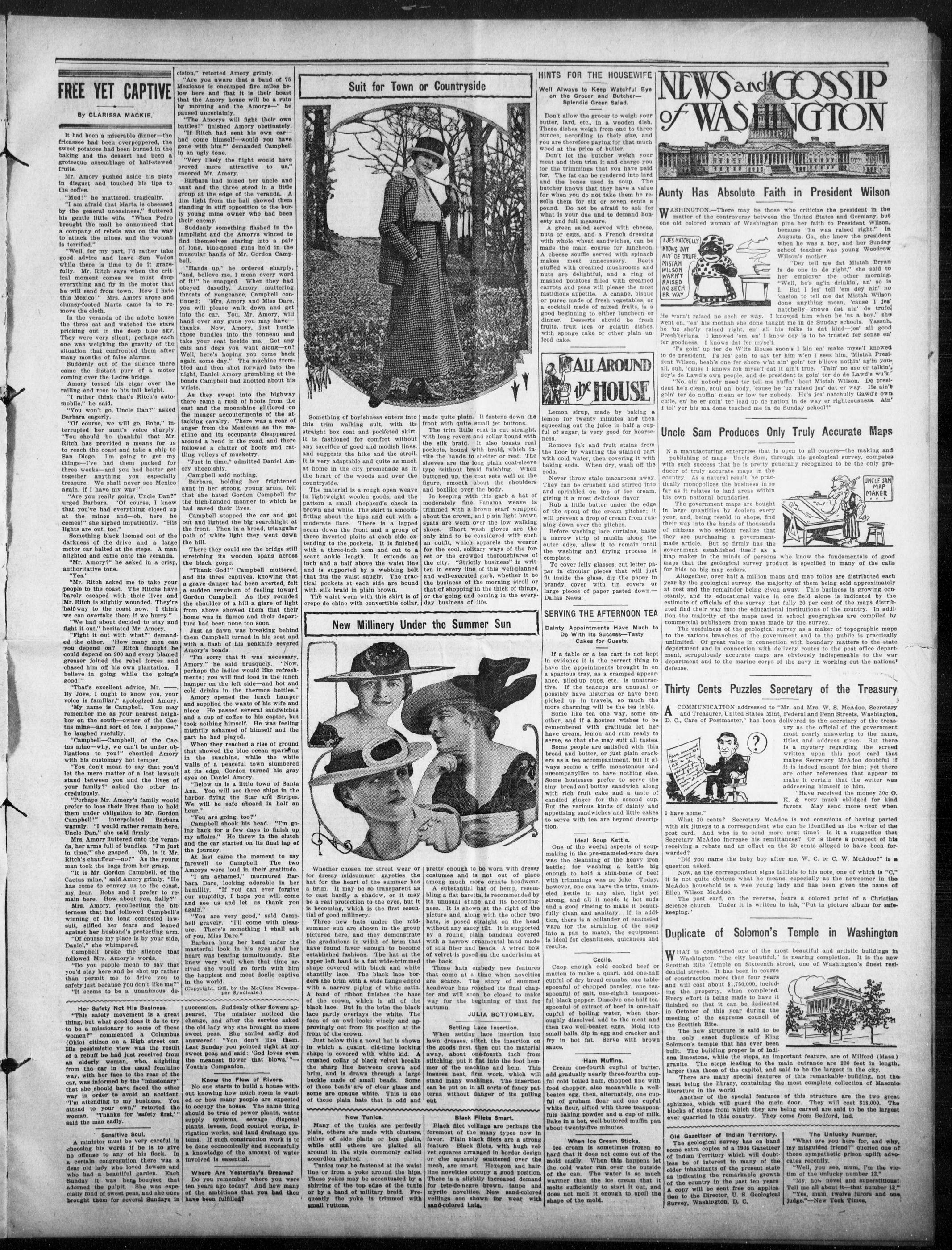
Something of boyishness enters into this trim walking suit, with its straight box coat and pocketed skirt. It is fashioned for comfort without any sacrifice of good and modish lines, and suggests the hike and the stroll. It is very adaptable and quite as much at home in the city promenade as in the heart of the woods and over the countryside. The material is a rough open weave in lightweight woolen goods, and the pattern a small shepherd's check in brown and white. The skirt is smooth-fitting about the hips and cut with a moderate flare. There is a lapped seam down the front and a group of three inverted plats at each side extending to the pockets. It is finished with a three-inch hem and cut to a scant ankle length. It extends an inch and a half above the waist line and is supported by a webbing belt that fits the waist snugly. The practical pockets at each side are bound with silk braid in plain brown.
The waist worn with this skirt is of crepe de chine with convertible collar.
New Millinery Under
Whether chosen for street wear or for dressy midsummer gayeties the hat for the heart of the summer has a brim. It may be so transparent as to cast hardly a shadow, or it may be a real protection to the eyes, but it is becoming, which is the first essential of good millinery.
Three new hats under the midsummer sun are shown in the group pictured here, and they demonstrate the gradations in width of brim that have found favor enough to become established fashions. The hat at the upper left hand is a flat wide-brimmed shape covered with black and white chantilly lace. The black lace borders the brim with a wide flange edged with a narrow piping of white satin. A band of ribbon finishes the base of the crown, which is all of the black lace. But in the brim the black lace partly overlays the white. The face of an owl looks wisely and approvingly out from its position at the front of the crown.
Just below this a novel hat is shown in which a quaint, old-time looking shape is covered with white kid. A crushed collar of black velvet breaks the sharp line between crown and brim, and is drawn through a large buckle made of small beads. Some of these beads are of clear glass and some are opaque white. This is one of those plain hats that is odd and
Many of the tunics are perfectly plain, others are made with clusters, either of side plaits or box plaits, while still others are plaited all around in the style commonly called accordion plaited.
Tunics may be fastened at the waist line or from a yoke around the hips. These yokes may be accentuated by a shirring of the top edge of the tunic or by a band of military braid. Frequently the yoke is trimmed with small ruttons.
made quite plain. It fastens down the front with quite small jet buttons. The trim little coat is cut straight, with long revers and collar bound with the silk braid. It also boasts real pockets, bound with braid, which invite the hands to shelter or rest. The sleeves are the long plain coat-sleeve type without braid finishing. When buttoned up, the coat sets well on the figure, smooth about the shoulders and boxlike over the body.
In keeping with this garb a hat of moderately fine Panama weave is trimmed with a brown scarf wrapped about the crown, and plain light brown spats are worn over the low walking shoes. Short wash gloves are the only kind to be considered with such an outfit, which apparels the wearer for the cool, solitary ways of the forest or the crowded thoroughfares of the city. "Strictly business" is written in every line of this well-planned and well-executed garb, whether it be the business of the morning stroll or that of shopping in the thick of things or the going and coming in the every day business of life.
er the Summer Sun
pretty enough to be worn with dressy costumes and is not out of place among much more ornate headwear. A substantial hat of hemp, resembling a flat baretta, is recommended by its unusual shape and its becomingness. It is shown at the right of the picture and, along with the other two hats, is posed straight on the head without any sauce tilt. It is supported by a round, plain bandeau covered with a narrow ornamental band made of silk fiber and beads. A wired bow of velvet is posed on the underbrim at the back. These hats embody new features that come at a time when novelties are scarce. The story of summer headwear has reached its final chapter and will soon be closed to make way for the beginning of that for autumn.
JULIA BOTTOMLEY.
Setting Lace Insertion
When setting lace insertion into lawn dresses, stitch the insertion on the goods first, then cut the material away, about one-fourth inch from stitching, put it flat into the foot hemmer of the machine and hem. This insures neat, firm work, which will stand many washings. The insertion can be put on in all sorts of fancy patterns without danger of its pulling out.
Black Files Smart.
Black filet vellings are perhaps the foremost of the many types now in favor. Plain black filets are a strong feature. Black filets, with hugh velvet squares arranged in border design or else sparsely scattered over the mesh, are smart. Hexagon and hairline novelties occupy a good position. There is a slightly increased demand for tete-de-negre brown, taupe and myrtle novelties. New sand-colored vellings are shown for wear with sand-colored hats.
HINTS FOR THE HOUSEWIFE
Well Always to Keep Watchful Eye on the Grocer and Butcher—Splendid Green Salad.
Don't allow the grocer to weigh your butter, lard, etc., in a wooden dish. These dishes weigh from one to three ounces, according to their size, and you are therefore paying for that much wood at the price of butter.
Don't let the butcher weigh your meat and then trim it and charge you for the trimmings that you have paid for. The fat can be rendered into lard and the bones used in soup. The butcher knows that they have a value for when you do not take them he re-sells them for six or seven cents a pound. Do not be afraid to ask for what is your due and to demand honesty and full measure.
A green salad served with cheese, nuts or eggs, and a French dressing with whole wheat sandwiches, can be made the main course for luncheon. A cheese souffle served with spinach makes meat unnecessary. Beets stuffed with creamed mushrooms and nuts are delightful, and a ring of mashed potatoes filled with creamed carrots and peas will please the most fastidious appetite. A canape, bisque or purée made of fresh vegetables, or a cocktail made of mixed fruits, is a good beginning to either luncheon or dinner. Desserts should be fresh fruits, fruit ices or gelatin dishes, with sponge cake or other plain uniced cake.
ALL AROUND
the HOUSE
Lemon sirup, made by baking a lemon for twenty minutes and then squeezing out the juice in half a cupful of sugar, is very good for hoarseness.
Remove ink and fruit stains from the floor by washing the stained part with cold water, then covering it with baking soda. When dry, wash off the soda.
Never throw stale macaroons away. They can be crushed and stirred into and sprinkled on top of ice cream, giving it a most delicious flavor.
Rub a little butter under the edge of the spout of the cream pitcher; it will prevent a drop of cream from running down over the pitcher.
Before washing lace curtains, baste a narrow strip of muslin along the outer edge, allow it to remain until the washing and drying process is complete.
To cover jelly glasses, cut letter paper in circular pieces that will just fit inside the glass, dip the paper in brandy, cover with tin covers or large pieces of paper pasted down.—Dallas News.
SERVING THE AFTERNOON TEA
Dainty Appointments Have Much to Do With Its Success—Tasty Cakes for Guests.
If a table or a tea cart is not kept in evidence it is the correct thing to have the appointments brought in on a spacious tray, as a cramped appearance, piled-up cups, etc., is unattractive. If the teacups are unusual or possibly have histories or have been picked up in travels, so much the more charming will be the tea table.
Some like tea one way, some another, and if a hostess wishes to be remembered with gratitude let her have cream, lemon and rum ready to serve, so that she may suit all tastes.
Some people are satisfied with thin bread and butter, or just plain crackers as a tea accompaniment, but it always seems a trifle monotonous and uncompanylike to have nothing else. Some hostesses prefer to serve the tiny bread-and-butter sandwich along with rich fruit cake and a taste of candied ginger for the second cup. But the various kinds of dainty and appetizing sandwiches and little cakes to serve with tea are beyond description.
Ideal Soup Kettle.
One of the woeful aspects of soup-making in the pre-enameled-ware days was the cleansing of the heavy iron kettle; for washing a kettle big enough to hold a shin-bone of beef with trimmings was no joke. Today, however, one can have the trim, enameled kettle in any size, light yet strong, and all it needs is hot suds and a good rinsing to make it beautifully clean and sanitary. If, in addition, there is a collander of enameled ware for the straining of the soup into a pan to match, the equipment is ideal for cleanliness, quickness and results.
Cecils
Chop enough cold cooked beef or mutton to make a quart, add one-half cupful of dry bread crumbs, one tablespoonful of chopped parsley, one teaspoonful of salt, one-eighth teaspoonful black pepper. Dissolve one-half teaspoonful of extract of beef in one-half cupful of boiling water, when thoroughly dissolved add to the meat and then two well-beaten eggs. Mold into small balls, dip in egg and cracker and fry in hot fat. Serve with brown sauce.
Ham Muffins.
Cream one-fourth cupful of butter, add gradually nearly three-fourths cupful cold boiled ham, chopped fine with food chopper, also meanwhile a well-beaten egg, then, alternately, one cupful of graham flour and one cupful white flour, sifted with three teaspoonfuls baking powder and a cup of milk. Bake in a hot, well-buttered muffin pan about twenty-five minutes.
When Ice Cream Sticks
Ice cream is sometimes frozen so hard that it does not come out of the mold easily. When this happens let the cold water run over the outside of the can. The water is so much warmer than the ice cream that it melts sufficiently to start it out, and does not melt it enough to spoil the shape of the mold.
NEWS and GOSSIP of WASHINGTON
Aunty Has Absolute Faith in President Wilson
WASHINGTON.—There may be those who criticize the president in the matter of the controversy between the United States and Germany, but one old colored woman of Washington pins her faith to President Wilson,
He warned raised no sech er way. I knew him when he 'uz a boy,' she went on, 'en his mothah she done taught me in de Sunday schools. Yassuh, he 'uz sholly raised right, en' all his folks is dat kind—jes all good Presb'terians. I knew em, en' I know dey is to be trusted for sense en' fer goodness. I knows dat fer myse f.
"I goin' up ter de Wite House soon's I kin en' make myse f known to de president. Ijes' goin' to say ter him w'en I sees him, 'Mistah President Wilson, heah's one fer shore wat ain' goin' bri blie nothin' ag in youall, suh, 'cause I knows fohms myse d it dit itn' true. 'Tain' no use ag talkin', deys' de Lawd's own people, and de president is goin' de do Lawd's wuk'.
"No, ain' nobody need ter tell me nuffin' 'bout Mistah Wilson. De president he's clean, soul an' body, 'cause he 'uz raised jes' dat er way. He ain't giner' ter do nuffin' mean er low ter nobody. He 'jes' natchully Gawd's own chile, en' he er goin' ter lead up de nation in de way er righteousness. Ain' I to' ver his ma done teaching me in de Sunday school?"
Uncle Sam Produces Only Truly Accurate Maps
N a manufacturing enterprise that is open to all comers—the making and publishing of maps—Uncle Sam, through his geological survey, competes with such success that he is pretty generally recognized to be the only pro-
map maker in the minds of persons who know the fundamentals of good maps that the geological survey product is specified in many of the calls for bids on big map orders. Altogether, over half a million maps and map folios are distributed each year by the geological survey, the majority of them being sold approximately at cost and the remainder being given away. This business is growing constantly, and its educational value in one field alone is indicated by the estimate of officials of the survey that fully 20 per cent of the maps distributed find their way into the educational institutions of the country. In addition the majority of the maps used in school geographies are compiled by commercial publishers from maps made by the survey. The usefulness of the geological survey as a maker of topographic maps to the various branches of the government and to the public is practically unlimited. Of great value in connection with boundary matters to the state department and in connection with delivery routes to the post office department, scrupulously accurate maps are obviously indispensable to the war department and to the marine corps of the navy in working out the national defense.
Thirty Cents Puzzles Secretary of the Treasury
A COMMUNICATION addressed to "Mr. and Mrs. W. S. McAdoo, Secretary and Treasurer, United States Mint, Federal and Penn Streets, Washington, D. C. Care of Postmaster," has been delivered to the secretary of the treas-
What 30 cents? Secretary McAdoo is not conscious of having parted with six jitneys to a correspondent who can be identified as the writer of the post card. And who is to send more next time? Is it a suggestion that Secretary McAdoo increase his remittances? Or is it a prospect of his receiving a rebate and an offset on the 30 cents alleged to have been forwarded?
"Did you name the baby boy after me, W. C. or C. W. McAdoo?" is a question asked.
Now, as the correspondent signs initials to his note, one of which is "C," it is not quite obvious what he means, especially as the newcomer in the McAdoo household is a wee young lady and has been given the name of Ellen Wilson McAdoo.
The post card, on the reverse, bears a colored print of a Christian Science church. Under it is written in ink, "Put in picture album for safe-keeping."
Duplicate of Solomon's Temple in Washington
WHAT is considered one of the most beautiful and artistic buildings in Washington, "the city beautiful," is nearing completion. It is the new Scottish Rite Temple on Sixteenth street, one of Washington's finest resi-
ana limestone, while the steps, an important feature, are of Milford (Mass.) granite. The steps leading to the main entrance are 200 feet in length, larger than those of the capitol, and said to be the largest in the city. There are many special features of this remarkable building, not the least being the library, containing the most complete collection of Masonio literature in the world. Another of the special features of this structure are the two great sphinxes, which will guard the main door. They will cost $18,000. The blocks of stone from which they are being carved are said to be the largest ever quarried in this country. They come from Bedford, Ind.
I JES MATCHELLY
KNOWS DAT
AIN'D TRUFE
MISTAH
WILSON
WARN'T
RAISED
NO SECH
ER WAY
He warnt raised no sech er way. I knowse went on, "en' his mothah she done taught me he 'uz sho'ly raised right, en' all his folk Presbterians. I knowed 'em, en' I know dey for goodness. I knows dat fer mysef.
'I's goin' up ter de Wite House soon's to de president. Isjes' goin' to say ter him dent Wilson, heah's one far shore w'at ain' go all, suh, 'cause I knows foh mysef d'at it ain' dey's de Lawd's own people, and de president
'No, ain' nobody need ter tell me nuffin' dent he's clean, soul an' body, 'cause he 'uz goin' ter do nuffin' mean er low ter nobody, chile, en' he er hegin' ter lead up de nation in I tol' yer his ma done teached me in de Sund
Uncle Sam Produces Only 1
N a manufacturing enterprise that is open
N a manufacturing enterprise that is open publishing of maps—Uncle Sam, through with such success that he is pretty generally ducer of truly accurate maps in the country. As a natural result, he practically monopolizes the business in so far as it relates to land areas within his own national boundaries.
The government maps are bought in large quantities by dealers every year, and, being resold in shops, find their way into the hands of thousands of citizens who seldom realize that they are purchasing a government-made article. But so firmly has the government established itself as a
map maker in the minds of persons who maps that the geological survey product is for bids on big map orders.
Altogether, over half a million maps and year by the geological survey, the majority at cost and the remainder being given away stantly, and its educational value in one estimate of officials of the survey that fully uted find their way into the educational institution the majority of the maps used in sch commercial publishers from maps made by.
The usefulness of the geological survey to the various branches of the government unlimited. Of great value in connection with department and in connection with delivery ment, scrupulously accurate maps are oby department and to the marine corps of the defense.
Thirty Cents Puzzles Secret
A COMMUNICATION addressed to "Mr. a and Treasurer, United States Mint, Fede D. C., Care of Postmaster," has been delivered
Have recalled the amount to
UK to be paid
they gave me
how much they
want to pay
I have some."
What 30 cents? Secretary McAdoo is with six jitneys to a correspondent who can post card. And who is to send more next Secretary McAdoo increase his remittance receiving a rebate and an offset on the 30 warded?
"Did you name the baby boy after me question asked.
Now, as the correspondent signs initials it is not quite obvious what he means, es McAdoo household is a wee young lady a Ellen Wilson McAdoo.
The post card, on the reverse, bears Science church. Under it is written in ink keeping."
Duplicate of Solomon's Te
WHAT is considered one of the most beautiful, "the city beautiful," is no Scottish Rite Temple on Sixteenth street,
dental streets. It has been in course of construction more than four years and will cost about $1,750,000, including the property, when completed. Every effort is being made to have it finished so that it can be dedicated in October of this year during the meeting of the supreme council of the Scottish Rite.
The new structure is said to be the only exact duplicate of King Solomon's temple that has ever been built. The building proper is of Indiana limestone, while the steps, an important granite. The steps leading to the main larger than those of the capitol, and said to
There are many special features of the least being the library, containing the most literature in the world.
Another of the special features of the sphinxes, which will guard the main blocks of stone from which they are being ever quarried in this country. They come
Old Gazetteer of Indian Territory.
The geological survey has on hand some extra copies of a 1905 Gazetteer of Indian Territory which will doubtless be of interest to many of the older inhabitants of the present state as indicating the remarkable growth of the country in the past ten years. A copy will be sent free on application to the Director, U. S. Geological Survey, Washington, D. C.
because "he was raised right." In Augusta, Ga., she knew the president when he was a boy, and her Sunday school teacher was young Woodrow Wilson's mother.
"Dey tell me dat Mistah Bryan is de one in de right," she said to her employer the other morning.
"Well, he's ag'in drinkin', an' so is I. But I jes' tell 'em dy ain' no 'cassion to tell me dat Mistah Wilson done anything mean, 'cause I jes' matchchely knows dat ain' de trufe.
knowed him when he 'uz a boy,' she right me in de Sunday schools. Yassuh, his folks is dat kind—jes' all good now de isy is to be trusted for sense en'
soon's I kin en' make mysef' knowed her him w'en I sees him, 'Mistah Presi-ain' goin' ter b'lieve nothin' agin' you' it it ain't true. 'Tain' no use use talkin' resident is goin' ter do de Lawd's wu'k' nuffin' 'bout Mistah Wilson. De presi-he 'uz raised jees' dat er way. He ain' nobody. He's jees' natchully Gawd's ownation in de way er righteousness. Ain' de Sunday school?'
Only Truly Accurate Maps
is open to all comers—the making and thorough his geological survey, competes generally recognized to be the only pro-
UNCLE SAM
MAP
MAKER
who know the fundamentals of good product is specified in many of the calls
maps and map folios are distributed each majority of them being sold approximately en away. This business is growing coni one field alone is indicated by the fatly 20 per cent of the maps distribu- nal institutions of the country. In addi- in school geographies are compiled by ade by the survey.
survey as a maker of topographic maps instrument and to the public is practically tion with boundary matters to the state delivery routes to the post office depart- ariously indispensable to the war of the navy in working out the nations*
Secretary of the Treasury
"Mr. and Mrs. W. S. McAdoo, Secretary nt, Federal and Penn Streets, Washington, d delivered to the secretary of the treas-
ury as the official of the government most nearly answering to the name, titles and address given. But there is a mystery regarding the screed written upon this post card that makes Secretary McAdoo doubtful if it is indeed meant for him; yet there are other references that appear to make it certain that the writer was addressing himself to him.
"Have received the money 30c O. K. & very much oblided for kind favors. May send more next when
Adoo is not conscious of having parted who can be identified as the writer of the more next time? Is it a suggestion thatittances? Or is there a prospect of his the 30 cents alleged to have been for after me, W. C. or C. W. McAdoo?" is a initials to his note, one of which is "C,"ans, especially as the newcomer in the lady and has been given the name of bears a colored print of a Christian in ink, "Put in picture album for safe
is Temple in Washington
most beautiful and artistic buildings in" is nearing completion. It is the new street, one of Washington's finest resi-
important feature, are of Milford (Mass.) main entrance are 200 feet in length, is said to be the largest in the city. Besides of this remarkable building, not the most complete collection of Masonite of this structure are the two great main door. They will cost $18,000. The being carved are said to be the largest come from Bedford, Ind.
"What are you here for, and why, my misguided friend?" quarried one of those sympathetic prison uplift advocates recently.
"Well, you see, mum, I'm the victim of the unlucky number 13."
"My, how novel and superstitious! Tell me all about it—that number 13."
"Yes, mum, twelve jurors and one judge."—New York Times.
THE KANSAS CITY SUN PUBLISHED WEEKLY.
All communications should be addressed
to the Kansas City Sun. 1803 East 18th
Stre
Bell Phone East 999.
Entered as second-class matter, August
$ 19, 1987, at the postoffice at Kansas City,
Mo., under the date of March 3, 1878.
Neison C. Crews.....Editor and Owner
Willa B. Glenn.....General Manager
SUBSCRIPTION RATES:
One Year.....$1.50
Six Months.....75
Three Months.....50
ADVERTISING RATE, 50 CENTS PER
INCH.
CHURCH DIRECTORY
Bethel A. M. E. Church, 24th and Flora.
St. Stephen's Baptist Church, 604 Charl-
sellia.
Centennial M. E. Church, 19th and
Woodland.
Second Baptist Church, 10th and Charl-
sellia.
Allen Chapel A. M. E. Church, 10th and
Karolina.
Ave. Baptist Church, 46th and
Kansas.
Ebenezer A. M. E. Church, 17th and
Troost.
Augustine's P. E. Church, 11th and
Troost.
St. Baptist Church, 1825 Vine St.
Ward Chapel A. M. E. Church, 11th and
Woodland.
Sue Valley Baptist Church, 1120 Crystal
St. Jobn's A. M. E. Church, 1743 Beile-
view.
Seventh Day Adventist, 23rd and Wood-
land.
St. Monica's Catholic, 17th and Lydia.
Mangrove Star Baptist Church, 2311 Vine.
Highland. Avenue Baptist Church, 1111
Highland.
Centropolis A. M. E. Church, Centropolis St. James A. M. E. Z. Church, 1823 St. James
Third Baptist Church, Roundtop.
People's Mission, 30th and Genesee.
St. Paul's Baptist Church, 19th and Highland.
Friendship Baptist Church, 17th and Trace Avenue.
Pilgrim Baptist Church, 614 Charlotte St.
Pleasant Green Baptist Church, Independence Avenue and Tracy.
Calvary Baptist Church, 19th and Auburn.
Bigelow A. M. E. Mission, 5th and Lydia.
Progressive Baptist Church, 29th and Summit.
C. M. E. Church, 1817 Flora Ave.
S. Paul's Baptist Church, 4039 Mill St.
St. Luke's A. M. Church, 43rd and Prospect Place.
A. M. E. Mission, 565 Grand Ave.
KANAS CITY, KAN. CHURCHES.
First A. M. E. Church, 8th and Neb.
First Green Baptist Church, 1st and
Baptist.
Eighth St. Baptist Church, 8th and Oakland.
Missoula Catholic Baptist Church, 9th and Washington.
Bethel A. M. E. Church, Water and Edward Streets.
Paul A. M. E. Church, 21st and Ruby.
First Baptist Church, 5th and Neb.
King Soolaman Baptist Church, 3rd and An
Quindardo A. M. E. Church, Quindardo
Pleasant Valley Baptist Church, Rosedale,
M. E. Church, 9th and Oakland.
A. M. E. Church, 4th and Oakland.
Salter Mission, A. M. E. Church, South
Park, Kan.
Bethel A. M. E. Church, Roseale, Kan.
M. Zion Baptist Church, 4th and Vir-
lion.
Ebenzer A. M. E. Church, Sanford and
Tremont.
M. Zion Primitive Baptist Church,
Westport avenue and Tangent street,
Roseale,
EDITORIALS
While the "Goats" and the "Rabits" are squabbling down at the city hall, the heavy rains are bringing on a new crop of republicans for the spring elections.
Mrs. A. J. Abington is being urged to make the race for Grand Princess of the S. M. T. Order and it will be hard to find a lady better fitter in every essential respect for that reasonable position.
---
The Grand Chapter, O. E. S., which meets in St. Louis next week, will bring together a characteristic group of the most intelligent and capable women of our race through whom much good should be accomplished.
If the local guild of the N. A. A. C. P. has succeeded in breaking down all the harrassing race barriers in the community there still remains a great deal to do in the way of constructive service for our people.
The city and county officials are fighting over spoils, the police department is patting itself on the back and in the meantime crime of all sorts goes on unchecked with the manifest approval of those whose blindness or indifference gave the offices into the hands of the present holders.
---
The appointment of Rev. J. W. Hurse and Rev. W. H. Thomas as the colored chaplains at the city hospital meets the unanimous approval of the Colored people of this city and again demonstrates the genius and wisdom of President Finn and Dr. W. J. Thompkins. Both are able ministers and leaders in their church.
Let us not worry about the "Jitneys." They are created by and for the "poor white" class of people and are serving their purpose well. The Met. employs large numbers of Negroes and the service of the company will satisfy all our needs for many years to come. Let us stick to our friends and thus win greater consideration.
VINE STREET BAPSTIST CHURCH.
Mr. Henry Brintley is sick at 2563 Woodland and we hope he will soon recover.....St. John Club met at Mr. and Mrs. S. L. Vaughan, July 9. A general good time is reported.....Rev. H. C. Johnson discussed education. H. J. Spigener discussed church etiquette. Those present were Mrs. J. B. Wright, Mrs. Hellen Smith, Mrs. Callie Diggs, Mrs. A. E Johnson.....
The funeral of Mrs. Annie Hyde was preached Sunday by our pastor. The occasion was indeed sad. The Household of Ruth and Ladies' C. had charge of the remains. No pains were spared in putting the remains away with the highest honors. Sister Hyde was a member of the Vine street church and Sunday school for many years and we mourn her loss. We extend to the bereaved family our heartfelt sympathy and say to them strive to meet her in heaven where there is no sickness or death.
Little Corner
—That some people quarrel so much their faces have grown crooked.
—That it’s easier for some young dudes to raise a row than a moustache.
—That love that will survive newly married cooking will endure forever.
—That ready money is not always ready when you want to borrow a little.
—That you will find it doesn’t pay to talk about your enemies ‘to your “friends.”
—That there’s many a chap who talks like a wise man and yet acts like a fool.
—That cheerfulness and contentment are great beautifiers and will preserve youthful looks for years.
—That there is not a shop in the United States as elegant or as beautiful as that of John A. Jones, 1514 East 18th street. You're right, brother.
—That if a man disputes a claim made by a preacher the members of the preacher's church usually consider him an infidel and a scoundrel.
—That the Negro who boasts "I have taken the Star for ten years" and yet will not pay for a Negro paper, is "a very small potato." Don't you think so?
—That a certain man who boasts of four figures on his bank book upon having the same balanced found a decimal point between the second and third figures.
—That there is so much bad in the best of us and so much good in the worst of us, that it illly becomes any of us to continually find fault with the rest of us. Selah.
—That the saying "the naked truth" originated from an old fable as follows: That truth and falsehood went in bathing together; falsehood came out of the water first and dressed herself in truth's garments. Truth, unwilling to put on falsehood's clothes, thereafter went naked. That sounds fine, but if truth lived in Kansas City she'd sure be arrested for indecent exposure.
ALLEN CHAPEL NOTES
Memorial services in honor of Bishop Henry McNeal Turner were held last Sunday. A large audience was in attendance and an able and interesting address was delivered by Bishop H. B. aPrks with special music by the choir and very enjoyable solos by Miss Genevieve Wilson and Mas Margaret Jackson. The evening services were also very interesting and the pastor spoke very highly of the TriQuarto Centennial Celebration recently held at St. Louis. On next Sunday Allen is to be avowed with a sermon by that prince of pulpit orators. Bishop Evans Tyre and it is needless to say that the church will be crowded to its capacity. Bishop Tyre is one of the great preachers of the race and has brought many souls to Christ. An unusually fine musical program is being arranged by Professor Jackson.
SECOND BAPTIST CHURCH
Mr. E. W. Thompson, the new president, has introduced a half hour song service which is very popular and is drawing large numbers to the B. Y. P. U. All lovers of gospel singing are invited to attend this service which begins promptly at 6 p. m.... This B. Y. P. U. choir of 35 voices is one of the best children's choirs not only in the city but also in the state of Missouri.... Mr. Edward Ross was elected instructor in the Christian Culture Course of the B. Y. P. U. Mr. Ross needs no introduction as a bibliical scholar.... The Wednesday evening prayer meeting was fairly well attended last week. The Bacote Literary society held an interesting session last Thursday night.... The Women's Mission Circle, which meets every Friday evening, is in a flourishing condition under the administration of Mrs. Susie Lewis.... The Relief Board is a great help in taking the responsibility from the church at large to look after the sick and needy.... Dr. Bacote's sermon last Sunday on "Sell Not the Truth," was excellent. Over one hundred persons attended Sunday school last Sunday.... Rev. Johnson delivered an able sermon at the evening services. One candidate received baptism last Sunday.
* How often, O how often you’ve had
friends come to town and go away
without knowing where your place of
business is. A Crescent ad would pre-
vent that. Only one penny a day.
* CRESENT ADVERTISING
A weekly discussion of Hygiene and Sanitation, First Aid Measures and Preventive Medicine. Questions will be answered but no diagnoses nor prescriptions will be given in this column.
A. B.
ON EYE-STRAIN.
The eye is one of the most accomodating organs of the human body, and under favorable conditions will perform an almost unlimited amount of work; in consequence, persons frequently demand of this delicate organ an amount of labor never expected of the larger structures. In fact, it is popularly believed that if the eyes are healthy, reading, sewing embroidery, china painting, and other work are passive acts and that the eye is untiring and never becomes exhausted.
this erroneous conception of the possibilities of the organ of sight is the most prolific cause of eye-strain. The next great cause of eye-strain is improper illumination. This is a large subject which cannot be treated fully here. We will say, however, that the light should be on a level with or above the head of the reader whose back should be turned to the light. The incandescent mantle with a ground glass globe furnishes the best gas light. Electricity is undoubtedly the most satisfactory means of artificial illumination. Indirect illumination, by throwing a part of the light on the ceiling from which it is reflected diffusely over the lower part of the room is the nearest approach to perfection in artificial lighting.
Other causes of eye-strain are reading in cars and trains, reading while lying down, especially when one is tired and exhausted, and the wearing of heavy dotted vells.
The direct symptoms of eye-strain are many and varied. There may be a continual sense of discomfort in the eyes which may increase to pain when the eyes are used for near work. After a few moments of reading the type blurs and the letters run together, and difficulty may be experienced in following the lines. There may be
Mr. and Mrs. Geo. W. Little have received the following presents since the list was published: One-half dozen silver oyster forks, an employer; one-half dozen cut glass ice tea glasses and silver coasters, Dr. and Mrs. Unthank and Mr. and Mrs. H. B. Moore; two initialed linen embroidered hand towels, Mr. and Mrs. J. A. Taylor; one lady's night robe and gentleman's night shirt, Mr. and Mrs. Huff; one cut glass ice tea pitcher, Mrs. M. L. Crosthwait, Mrs. Elvira Foster, Mrs. Ella Thurman, Mrs. Bettle Officer, Mrs. Francis J. Dawley and Mr. Adolph Thurman.
Pat Goose, Mr. W. C. Moon.
Mrs. Geo. W. Little, 813 Charlotte street, had a serious accident last Tuesday evening. In missing a step she fell down a flight of stairs at 555 Grand avenue. She was assisted home after gaining consciousness, by her Calanthean sisters and is attended by Drs. Williams and Webb, Marshall, Mo. She is recovering nicely.
The following is a letter received by Mr. and Mrs. Little from one of the most prominent white families in the city: "Mr. and Mrs. G. W. Little, accept our congratulations and best wishes for a long and happy and prosperous life together. May you each day realize more and more that God is the author and giver of all things whatsoever that are good and may His blessings rest upon each one of you through this life.
YOUR FRIENDS.
DALTON, MISSOURI
The cornerstone laying of Mt. Ararat Lodge No. 57, A. F & A. M, last Saturday, was the grandest affair that ever happened in our little city. Large delegations attended from neighboring cities and farmers came from miles around. Grand Master Crews and Grand Commander Mosely of Kansas City were both present; also the Commandery at Carrollton. Mo. and the Commandery of Moberly. Mo. They made a magnificent picture in their beautiful uniform. More than $200 was realized for the benefit of the hall. The lodge will go in a body to assist Huntsville in its cornerstone laying August 1.
FOREST GREEN, MO.
Mr. Robert Herriford, who departed his life July 8, was laid to rest Sunday and the funeral was held at the Baptist church, Rev. W. H. Davis officiating.
ST. JOSEPH, MISSOURI
A large and appreciative audience witnessed the play 'Folk Festival,' by direction of Mrs. Mattie L. Buren, assisted by Mrs. John Gordon under the auspices of Ebenezer A. M. E. Church at the Lyceum Theatre, Friday, July 9. The play was a success from every point of view; especially interesting were the little tots who played their parts with an exactness that could only be obtained by thorough training. The different costumes of the young girls were beautiful and the matrons elicited much praise for the splendid rendition of their parts. The orchestra, consisting of violins, violincello, drum and piano, played excellent music throughout the evening. The proceeds have reached over two hundred dollars with all reports not yet in. We learn the play is to be repat at the Lake for the benefit of the Orphans' Home. Mrs. Buren is to be congratulated on the splendid success of her endeavor...Mrs. Ella Harris won first prize for selling largest number of tickets to Folk Festival...Rev. N. C. Buren is out of the city for a few days...The Bartlett High School Juniors vs. Messanie St. Rounders at 27th and Messanie, played before an audience of 100 with a score of 14 to 9 in favor of the former. The batteries were: Fields, Phoenix; Smith and Jones...Mr. Theo. Baughman, traveling agent for the Plaidealer was here last week.
Health Hints
twitching of the eye-elids and, in extreme cases, difficulty in keeping the eyes open in continued reading on account of drowsiness. The eyes smart, itch, or burn, and continually water; or they may appear red and congested. There may also be extreme sensitivity to light.
Among the reflex or indirect symptoms of eye-strain headache is the most prominent. This headache is often accompanied by nausea (sick headache) and is made worse by reading, sewing, riding in the cars, riding backward, shopping, attending the theatre, etc. However, there may be no apparent connection between the headache and excessive use of the eyes. The headache is usually frontal, though it may be at the top of the head or at the base of the skull. Obstinate constipation and indigestion are occasional symptoms of eye-strain, while nervous prostration may result from its influence upon the nervous system. In fact, the general health may be so impaired by the continual nervous drain of eye-strain that the most serious systemic disorders may result.
Relief and recovery from eye-strain often follows prolonged rest of the eyes which may be secured by the use of dark glasses and by refraining from eye work of all kinds. The use of hot towels to the eyes also is beneficial. If these measures do not avail a competent oculist should be consulted at once. The eyes are intimately connected with the whole body and suffer as a consequence of any bodily anomaly or disease; and in the same way visual defects may influence the whole constitution. Consequently those measures and modes of life which are conducive to general health and vigor will be beneficial in maintaining ocular health and vitality.
BOONE-BYRD NUPTIALS
On June 30 at Grant Chapel A. M. E. Church, Moberly, Mo., one of the most charming weddings in recent years took place when Miss Ella E. Boone became the wife of Mr. Kindred Byrd of Liberty, Mo.
Promptly at 7:45 Mrs. Bernice Davis Eaton of Des Moines, la., sang in a pleasing manner, "Because I Love You," accompanied by Prof. L. B. Quinn. At 8 o'clock the bridal party entered. Mrs. Lillian Booker, the accomplished daughter of Rev. M. S. Bryant, presided at the piano.
The procession entered by the Hughes entered as cupids carrying Cupids darts. From the east door entered the groom Mr. Kindred Byrd and Mr. David Jackson best man, then came Miss Sophia B. Althouse bridesmaid and Mr. Wm. Jefferson followed by Mrs. Mari Hughes of Liberty, matron of honor. Little Miss Eutha Hughes was flower girl who entered before the bride. Then came the bride on the arm of her brother, Mr. Wm. E. Boone, who led her to the altar and gave here away. The ceremony was performed by Rev. M. S. Bryant, who always does things well. During the ceremony Mrs. Booker played "Traumeree." When Rev. Bryant pronounced them man and wife the party left the altar by the famous Mendelsohn wedding march, led by Rev. M. S. Bryant. The party and many friends then went to the home of Mr. and Mrs. Allen Graves, where a dainty two-course supper fas served. Misses Louise Shelton and Viola Bratcheer presided at the punch bowl. The church was very beautifully and artistically decorated in pink and white, the decorating being done by Mr. Jas Carr. The color scheme was carried out throughout the entire occasion. The bride wore a beautiful gown of white vole trimmed in silk braid and shadow lace with a long veil hanging to the bottom of her dress.
She carried a beautiful bouquet of pink and white American beauty roses and carnations. Miss Sophia Althouse wore a beautiful gown of pink silk mulk trimmed with white shadow lace. She also carried a bouquet of pink and white American beauty roses and carnations. Mrs. Maria Hughes wore a beautiful gown of white mull with a pink girdle, she too, carrying a large bouquet of flowers. The bride is an only daughter of Mr. and Mrs. Joseph Boone of Sharon Springs, Kas. She is amiable, kind and devoted and has a large circle of friends. She is a successful teacher and has taught for the past five years in Liberty, where she has won lifelong friends. The groom is of one of the best families of Liberty and a Christian young man having many sterling qualities. He is both a successful barber and cook by trade, and a poet by nature. Many valuable and useful presents were received. The happy couple left July 1 for Colorado Springs where they will spend their honeymoon. They will be at home to friends after August 20, at 700 North Prairie street, Liberty, Mo. Their many friends wish them a long, prosperous and happy wedded life.
Now before you get hurt or sick another time.
There are a thing I want to impress upon your mind.
That your employer immediately stops his gold
And we want you to get on our pay roll.
When your grocer, landlord and doctor you must pay.
CLOVER LEAF PAY ROLL will keep bills out of your way.
Insure Now, Our Pay Roll Policy is a Winner.
CLOVER LEAF CASUALTY CO.,
1503 E. 18th St.,
KANSAS CITY, MO.
Sell Phone, East 1514
Home Phone East 1196
—AGENTS WANTED—
J. J. ALL, District Manager.
A. F. and A. M.
Missouri Jurisdiction
N. C. Crews, Kansas City, Grand Master.
Master.
Deputy Grand Master, Richard Young, Lincoln, Neb.
F. J. Brown, St. Louis, Grand Seni
lor Warden.
W. Green, Plattsburg, Grand Jun
lor Warden.
H. H. Walker, St. Joseph, Grand
Treasurer.
Geo. W. K. Love, Grand Secretary,
Kansas City, Mo.
W. W. Fields, Secretary of Masonic
Relief, Cameron, Mo.
P. L. Pratt, Kansas City, Mo., Grand
Lecturer.
Grand Commandery Officers.
W. G. Mosely, Kansas City, Mo.
R. E. G. C.
J. H. Sherwood, St. Paul, Minn.
G. E. G.
P. C. Kincald, Kansas City, Mo.
V. E. G. C.
J. W. Beard, St. Louis, Mo., E. G.
C. G.
Wm. Roberts, Hannibal, Mo., Grand
Secretary.
T. P. Mahammitt, Grand Treasurer,
Omaha, Neb.
Grand Chapter Officers.
Geo. Broomfield, G. H. P., St. Louis
Mo.
T. G. McCampbell, D: G. H. P., Kansas
sas City.
A. L. Thomas, G. K., Jefferson City
Mo.
J. P. Moffitte, G. S., Sedalia, Mo.
Chas. Griggsby, G. Treas., Liberty,
Mo.
E. S. Baker, G. Sec'y, Kansas City,
Mo.
MASONIC BUILDING ASSOCIATION
MEMBERS.
R. T. Coles, Chairman.
E. S. Baker, Chairman.
R. W. Foster, Treasurer.
W. C. Mallory, Sandy Meyers,
Wm. Washington, F. P. Porteet,
T. W. H. Williams, W. G. Moseley,
J. E. Herriford, E. G. Lacey,
E. G. Miller, Robt. Wiley.
Lodge Directory
G
MASONRY
Pritchard Lodge No. 42, A. B
and A. M, meet the 2nd and
4th Monday in April
Master Masons in good standing
welcome. Cecil Thompson,
W. M.; J. H. Sniginer, Sec'y.
G
None Lodge No. 25. A. F. aune
Monday in each month.
Monday in each month.
All Master Masons in good standing.
M. T.; T. J. McCambell, Seey.
M. T.; T. J. McCambell, Seey.
G
M. Olive Lodge No. 53, A. M. and A. M., meets the 2nd and 4th Friday in every month. Visiting Master Masons are welcome. Sandy Myers. W. M. Baltimore. Secretary, 121 Baltimore Ave.
I. O. I.
Queen Esther Court No. 43
Hale from the I. O. I. meets each
month at 2:30 p. m. at the hall
10th and Campbell St. Kansas City
10th and Campbell St. Kansas City
Kas.
U. B. F.
King of the West Lodge No.
21 meetings each on third Mon-
days in each month
Grand avenue. D. M. West
W. M. 1718 Euclid; Jas. Har-
lis, Sec. y. 1732 Woodland Ave
Money to loan an approved security.
We sell homes on easy terms. See me
or my clerk at my office, 521½ Virgina.
Phone 1259. J. N. Brownle,
* Bell 'Phone 1521 E. 18th *
We would like to see every lodge and society in Kansas City put their cards in The Sun. It is the most popular way to let the world know who you are, when and where you meet and your object and purpose. For the next month we will make special announcements to have you put in your lodge or society list of officers in
SHAVES WITHOUT RAZOR.
Midland Park, S. C., March 10, 1914.
Southern Specialty Co.
Savannah, Ga.
Dear Sirs: Before I began using SHAVINE my face was a mass of blackheads and bumps and in a couple of weeks all the razor bumps and blackheads had disappeared. Now my face is just as smooth as it ever was. It worked like magic for me. It is one of the most wonderful preparations ever made.
Respectfully yours,
(Signed) JOSEPH HAMILTON.
Half pound box 25 cents in stamps
Agents wanted. Write today.
SOUTHERN SPECIALTY CO.,
Box 208. Savannah, Ga.
Poro Hair and
Scalp Treatment
Call or Address
Mrs. Lydia M. Ellis
1939 N. 6th Street
Kansas City, Kansas
Negro Business and Professional Directory of Greater Kansas City
(Your name, business, address and telephone carried in this directory at 25 cents per month, $3.00 a year; less than one cent a day. Can you beat it? To secure space call Sun Office, Bell phone 999 East, or see our agent.)
DELMONICA CAFE, 1512 East 18th St. Bell phone, East 618.
TOPEKA CAFE, Mrs. S. E. Owens, Prop., 1907 East 18th St.
THE OWL LUNCH ROOM, Mrs..A. R. Harris, Prop., 2208 Vine St.
Bell phone, East 4390.
CARPET CLEANERS
EUREKA CARPET CLEANING CO., 1718-20 Euclid Ave. Bell phone,
East 3555; Home, East 4169.
CLEANERS, DYERS AND TAILORS
O. K. CLEANERS AND DYEER
ment they dye. 1113 East
WORTHAM BROS., 1731 Paseco
R. L. HOPKINS, 2326 Vine St.
TAYLOR'S GILT EDGE TAIL.
COO
BESSIE EVANS, 2428 Vine St.
DRUCK
IDEAL PHARMACY, Prof. R. W.
Bell phone East 272, Home
FLU
WEAVER FLORAL CO., Flower
Homes, churches and halls
phone 4798 East, Home pho
CROSTHWAIT FLORAL CO.,
272. Home phone, East 407
GR
M. R. WILSON, 2644 Woodland
J. L. MATSON, 1418 East 1
COTTAGE GROCERY, 121 West
Anderson, proprietor.
W. M. SPRANGLES, 2224 Vine.
LAU
THE ELECTRIC LAUNDRY CO.
Home phone 3160.
THE IMMACULATE LAUNDRY
East 4723.
LAW
C. H. CALLOWAY, 601 Delaware
448. Practices in all courts.
W. C. HUESTON, 601 Delaware
448. Legal advice. Practices
GEO. T. WASSOM, Attorney at
Bell phone East 2727, Home
E. A. SHACKLEFORD, Attorney
sas City, Kas. Bell phone.
MILL
MISS EVA P. WASHINGTON,
2306, Kansas City, Kas. Alk.
PHOTO
C. BRUCE SANTEE, Proprietor
phone East 1643.
PHYS
DR. R. J. LAMBERT, Therapeutics
523, Rosedale, Kas.
NERS AND DYERS, guarantee not to s
dy dye. 1113 East 18th street. Bell pho
BROS., 1731 Paseo. Bell phone East 701
NS., 2326 Vine St. Bell phone, East 1207
GILT EDGE TAILORS, 1612 East 18th St
O. K. CLEANERS AND DYERS, guarantee not to shrink any gar-
ment they dye. 1113 East 18th street. Bell phone, Grand 2437J.
WORTHAM BROS., 1731 Paseo. Bell phone East 701.
R. L. HOPKINS, 2326 Vine St. Bell phone, East 1207J.
TAYLOR'S GILT EDGE TAILORS, 1613 East 18th St.
BESSIE EVANS, 2428 Vine St. Bell phone, East 3637.
DRUG STORES.
IDEAL PHARMACY, Prof. R. W. Foster, Prop., 18th and Bell phone East 272, Home phone East 4070.
FLORISTS.
WEAVER FLORAL CO., Flowers for all occasions. Full Homes, churches and halls decorated. 1510 E. 18th phone 4798 East, Home phone 7555M.
CROSTHWAIT FLORAL CO., 1801 East 18th St. Bell 272. Home phone, East 4070.
GROCERS.
M. R. WILSON, 2644 Woodland Ave. Bell phone, East 1 J. L. MATSON, 1418 East 19th St. Bell phone Gra COTTAGE GROCERY, 121 Westport Ave., Rosedale, Kai Anderson, proprietor.
W. M. SPRANGLES, 2224 Vine St. Bell phone, East 205
IDEAL PHARMACY, Prof. R. W. Foster, Prop., 18th and Woodland. Bell phone East 272, Home phone East 4070.
WEAVER FLORAL CO. Flowers for all occasions. Funeral designs. Homes, churches and halls decorated. 1510 E. 18th street. Bell phone 4798 East, Home phone 7555M. CROSTHWAIT FLORAL CO. 1011 E. 18th street.
GROSTHWAIT FLORAL CO. 1801 East 18th St. Bell phone, East 272. Home phone, East 4070.
GROCERS.
M. R. WILSON, 2644 Woodland Ave. Bell phone, East 1493.
J. L. MATSON, 1418 East 19th St. Bell phone Grand 2309 W.
COTTAGE GROCERY, 121 Westport Ave., Rosedale, Kas. Rev. S. A. Anderson, proprietor.
RIC LAUNDRY CO., J. C. Hale, Mgr., 29
phone 3160.
SULATE LAUNDRY, 1912 East 18th St.
LAWYERS.
WAY, 601 Delaware, Home phone M58, Be
tices in all courts.
CON, 601 Delaware, Home phone M58, Be
tal advice. Practices in all courts.
SOM, Attorney at Law, 307 Walnut street
e East 2727, Home phone East 4070.
LEFORD, Attorney at Law, 576 Minnes
Kas. Bell phone.
THE ELECTRIC LAUNDRY CO., J. C. Hale, Mgr., 2928 Summit St. Home phone 3160.
THE IMMACULATE LAUNDRY, 1912 East 18th St. Bell phone East 4723.
C. H. CALLOWAY, 601 Delaware, Home phone M58, Bell phone Main 448. Practices in all courts.
W. C. HUESTON, 601 Delaware, Home phone M58, Bell phone Main 448. Legal advice. Practices in all courts.
CEO T. HASSON
E. A. SHAKLEFORD, Attorney at Law, 576 Minnesota Ave., Kansas City, Kas. Bell phone.
MILLINERY.
MISS EVA P. WASHINGTON, 849 Freeman Ave. Bell phone, West 2306, Kansas City, Kas. Also hair work.
PHOTOGRAPHERS.
J. BRUCE SANTEE, Proprietor The Fad, 1607 East 18th St. Bell phone East 1643.
MISS EVA P. WASHINGTON, 849 Freeman Ave. Bell phone, West 2306, Kansas City, Kas. Also hair work.
PHOTOGRAPHERS.
C. BRUCE SANTEE, Proprietor The Fad, 1607 East 18th St. Bell phone East 1643.
PHYSICIANS.
DR. R. J. LAMBERT, Theraptics, P. O. box 90A, Bell phone, Rosedale 523, Rosedale, Kas.
REAL ESTATE and EMPLOYMENT
AFRO-AMERICAN REAL ESTATE
nished. 911 McGee street.
Bell Phone 751 Main.
COLORED PEOPLE'S INVESTI
East 1011, Home East 4011.
ICAN REAL ESTATE & INVESTMENT
11 McGee street.
2 751 Main. Home Pho
OPLE'S INVESTMENT CO., 2427 Vine S
Home East 4011. Sol Smith, Pres.; C. H.
COLORED PEOPLE'S INVESTMENT CO., 2427 Vine St. Bell Phone East 1011, Home East 4011. Sol Smith, Pres.; C. H. Adkins, Tres.
SECOND-HAND GOODS
W. G. HOPKINS, 2122 Vine St. Bell phone East 3851
SHOE MAKING AND REPAIRING
NOAH THOMAS. Home phone. East 4132
W. G. HOPKINS, 2122 Vine St.
SHOE MAKING
NOAH THOMAS, Home phone, I
MILL
MME. STELLA HUBBARD, late
new. 1510 East 18th street
UNDER
C. H. COUNTEE, Licensed Embal-
3336, Home East 3341.
WATKINS BROS., 1729 Lydia A
Main 7989. Res., Bell East 3
W. G. HOPKINS, 2122 Vine St. Bell phone East 3851
SHOE MAKING AND REPAIRING
NOAH THOMAS, Home phone, East 4132.
MILLINERY.
MME. STELLA HUBBARD, latest things in hats. Old hats made
new. 1510 East 18th street. Bell phone E. 4798.
UNDERTAKERS
C. H. COUNTEE, Licensed Embalmer, 2220 Vine St., Bell Phone, East 3336, Home East 3341.
E, Licensed Embalmer, 2220 Vine St., Belle
East 3341.
OS., 1729 Lydia Ave. Bell Phone Gran
Res., Bell East 3281.
TO THE PUBLIC:
TO THE PUBLIC:
We want you to come to us for everything carried by a Drug Store. DRUGS, MEDICINES, TOILET ARTICLES, RUBBER GOODS, COMBS, BRUSHES, MADAM, WALKER HAIR-GROWER-DRYING COMBS, STRAIGHTENING COMBS, ETC.
We recommend and guarantee everything offered for sale to be exactly as represented. WE DO NOT "SUBSTITUTE" nor ask you to take other brands than you ask for. You "want what you want" and we want you to have it.
OUR PRICES ARE RIGHT
All down the line. We give careful attention to all orders, and aim by courteous and fair treatment to give perfect satisfaction to our customers. When you think of Drugs think of THEO. SMITH'S PHARMACY.
No demand is too difficult for us to supply. If you are too busy to come to our store, phone us your wants and we will do the rest.
Mail Orders Solicited and Promptly Filled.
Theo. Smith's Drug Store.
Bell Phone 4591 Grand. Home Phone 5467 Main.
1301 E. 18th St. KANSAS CITY, MO.
We want you to come to us for our DRUGS, MEDICINES, TOILET ARMOR, BRUSHES, MADAM WALKER & STRAIGHTENING. We recommend and guarantee exactly as represented. WE DO NOT take other brands than you ask for we want you to have it.
OUR PRICES
All down the line. We give care by courteous and fair treatment to customers. When you think of Dr THEO. SMITH.
No demand is too difficult for to come to our store, phone us you Mail Orders Solicited
Theo. Smith'
Bell Phone 4591 Grand.
1301 E. 18th St.
Randolph B
New and Artistic
to come to us for everything carried by a D. CINCINES, TOILET ARTICLES, RUBBER GOODS, MADAM WALKER HAIR.GROWER.DRYING, STRAIGHTENING COMBS, ETC. and guarantee everything offered for you presented. WE DO NOT "SUBSTITUTE" nor send than you ask for. You "want what you want to have it.
OUR PRICES ARE RIGHT online. We give careful attention to all orders and fair treatment to give perfect satisfaction when you think of Drugs think of THEO. SMITH'S PHARMACY. It is too difficult for us to supply. If you are in store, phone us your wants and we will do mail Orders Solicited and Promptly Filled.
Theo. Smith's Drug Store.
Phone 4591 Grand. Home Phone 5467 Mail
St. KANSAS CITY
olph Bros. @
Artistic Carpenter
Randolph Bros. @ Son New and Artistic Carpenters
Randolph Bros. @ Son New and Artistic Carpenters
Superb Wall Papers
Samples Shown at Your Home
No obligation to purchase.
A postal brings us.
guarantee not to shrink any gar-
street. Bell phone, Grand 2437.
Bell phone East 701.
Bell phone, East 1207J.
Bell phone, East 1612 East 18th St.
SHOP.
Bell phone, East 3637.
HORES.
Foster, Prop., 18th and Woodland.
East 4070.
ETS.
All occasions. Funeral designs.
Created. 1510 E. 18th street. Bell
55M.
East 18th St. Bell phone, East
ERS.
Bell phone, East 1493.
St. Bell phone Grand 2309W.
Ave., Rosedale, Kas. Rev. S. A.
Bell phone, East 2056W.
HIES.
C. Hale, Mgr., 2928 Summit St.
912 East 18th St. Bell phone
ERS.
Home phone M58, Bell phone Main
Home phone M58, Bell phone Main
all courts.
307 Walnut street.
East 4070.
Law, 576 Minnesota Ave., Kan-
RY.
Greeman Ave. Bell phone, West
or work.
HERS.
Fad, 1607 East 18th St. Bell
NS.
Box 90A, Bell phone, Rosedale
INVESTMENT CO., Help fur-
Home Phone 7555 Main.
CO., 2427 Vine St. Bell Phone
Smith, Pres.; C. H. Adkins, Tres.
GOODS.
Phone East 3851
REPAIRING
132.
RY.
Sings in hats. Old hats made
Bell phone E. 4798.
ERS.
2220 Vine St., Bell Phone, East
Bell Phone Grand 987, Home
PUBLIC:
Being carried by a Drug Store.
BLS, RUBBER GOODS, COMBS,
BROWER-DRYING COMBS,
COMBS, ETC.
Anything offered for sale to be
"SUBSTITUTE" nor ask you to
u "want what you want" and
RIGHT
ention to all orders, and aim
the perfect satisfaction to our
think of
ARMACY.
Supply. If you are too busy
ants and we will do the rest.
Promptly Filled.
Drug Store.
Home Phone 5467 Main.
KANSAS CITY, MO.
os. @ Son
carpenters
and Builders
Paper Hanging and Painting,
Patching and Plastering
General Repairing a Specialty
PROMPT WORK
REASONABLE PRICES
ALL PHONE East 2526
1207 Highland. Res. 1031 Highland
KANSAS CITY, MO.
CAFES
COOK SHOP.
DRUG STORES
FLORISTS
GROCERS
LAUNDRIES
LAWYERS
MILLINERY
PHYSICIANS.
MILLINERY
```markdown
```
Hear Bishop Tyrese Sunday at Allen Chapel.
Mrs. Sallie Jackson is now collecting for The Sun. The patrons may pay her their accounts.
Mrs. Mamie Jenkins of Kansas City, Kas., is visiting friends in Chicago and will be gone about four weeks more.
Mr. Thos. A. Holland, formerly of this city, is spending a few weeks in Oklahoma with hopes of regaining his health.
Many Masons are going to Liberty Sunday, to assist Grand Master Crews in the laying of the cornerstone of the new Baptist church.
Mrs. Blanche Brown, 1026 Woodland avenue, entertained the Carnation club at her home, Friday, July 9. A dainty luncheon was served.
Mr. Charles Shumache and daughter, Mrs. Nelle Howard, of Troy, Kas, made a flying trip to this city last Wednesday to visit his sick sister.
Mrs. Eva M. Smith of 1714 Michigan avenue, who has been quite ill for the past ten days, is convalescing under the efficient care of Dr. J. E. Perry.
Mr. J. H. Kenner of Marshall, Mo., writes from Colorado Springs, Mo., that he is enjoying himself immensely but will be home in town for the Grand Lodge.
Mrs. Agnes Johnson, 1222 Woodland avenue, accompanied by her little nephew, Bennie Webster, left today for the coast. She will stop at many places to visit friends.
Bishop Evans Tyree of the First Episcopal District, is in the city the guest of Prof. and Mrs. R. W. Foster, 1217 Paseo. He will preach at Allen Chapel Sunday morning.
Mrs. Lillian Lewis after nine weeks visit with redatives and friends, left for St. Paul and Chicago where she will visit several weeks and then go to her home at Prince Rupert, B. C.
The Sedalia District Conference and Sunday School Convention of the Central Missouri Conference M. E. church will convene at Clinton, Mo., July 28. Rev. J. M. Harris is district superintendent.
Mrs. Millie Brown of 2445 Highland avenue, entertained with a four-course luncheon Sunday, July 11, in honor of Mrs. Nora Ford Wheeler of Columbus, O. A delightful time was spent by all.
Rev. Frank L. Lewis, who preached each Sunday at the county pall, died suddenly last Thursday morning after a very brief illness. He leaves a wife here and a mother in Nashville, Tenn. Funeral Sunday.
Miss Brunetta Saunders and Miss Ruby M. Saunders of Marshall, Tex. are visiting their mother, Mrs. Ida B. Saunders, 1707 E 14th street, during their vacation.
Mrs. Tucker, proprietor of the Criterion Restaurant, has been dangerously ill for the past two weeks, but is gradually improving to the pleasure of her many friends.
Mr. Lewis Woods, who has been ill for several months, was able to be out in Mr. Hubbel's automobile during the week. His many friends hope for him ultimate and rapid recovery.
Wanted—Ladies and gentlemen in all localities to solicit for magazines. Good pay to right parties. Call, write or phone. Bell East 4702. The National Pan-Medico Magazine, 1908 E. 24th st., Kansas City, Mo.
The Sun is in receipt of a letter from Mrs. G, G. Mason of this city, who is now visiting in Omaha, Neb. From there she will visit Lincoln, Neb. Her stay so far has been very enjoyable.
An interesting program will be rendered Thursday evening, July 22, by Germany for the benefit of the Women's League. Mrs. George Bettis Smith will recite; Miss Golden Trimble and Miss Desdemona West will furnish music.
WANTED: SEVERAL WIDE AWAKE
Colored Agents. Liberal commission.
A postal .brings information.
The Patrick-Lee Realty Co., 2743 Welton
St., Dencer, Colo. Dept. K.
Mrs. Mary Frances Woods, a teacher
in the Attuck school, of Kansas
City, Mo., and Past Royal Grand
Matron of the O. E. S. of Missouri juridiction, is in the city attending the
University of Chicago. While here
she is the guest of Mrs. Walter L.
Martin. 3524 Calumet avenue.-Defender.
The remarkable singing of little Miss Edna Hammett at Allen Chapel Sunday before last is still the topic of conversation. Her rendition of "The Penitent," a very difficult and ambitious selection, fairly dumfounded her hearers as it requires the finest expression and absolute control of the vocal organs to do justice to this very difficult selection, and yet this young Miss though a mere girl, measured up to the fullest requirements with a voice as full of power, strength and delicate shading as has been heard in Allen Chapel this year. With proper training she has a splendid future before her in the musical world.
CITY NEWS.
The cornerstone laying at Edwardstone ville last Sunday was a grand success and many Masons from both Kansas Citys participated in the exercises. Grand Master Hawkins of Kansas, who had charge, was assisted by Grand Master Crews of Missouri. Hon. J. G. Groves deserves all the praise he has been receiving for the successful completion of his plans.
Wanted—Elither sex, Colored ladies or gentlemen. Become independent. Have a manufactory of your own. Make Face Creams, Powders, Pomades and Hair Tonic. Some Beauty Secrets worth a fortune to every woman. Price. $2.00. Limited number sold. Address C. A. T. Formula Department, 135 E. Market St., Indianapolis, Ind.
Mrs. Emmett Spruell was called to the bedside of her mother, Mrs. Whitting, at her sister's in Chicago, Ill. July 10. The end came at 1 p. m. the same day at her daughter's home in Chicago. She leaves two daughters. Mrs. Spruell of this city, Mrs. Walker of 3625 Dearborn street, Chicago, and Willis Smith of Hot Springs, Ark Burial will be in Hot Springs.
Mrs. Francis J. Wilson, 913 Woodland avenue, is recovering after several weeks' illness and wishes to thank the members of the Second Baptist church, New Hope Temple, the S. A. Haworth Past and Present Council Western Queen Court, Royal House Golden Circle and her many friends for the kindness shown during her illness. Her prayers to the Lord are for the blessings of each.
The Kansas City City Consistory will give a moonlight excursion on the steamer Chester, Thursday evening; July 22. Round trip, 50 cents. Excursion starts at 8:30. See D. N. Crosshwait, 1020 Virginia avenue. Bell phone Main 2715-X or E. S. Baker, 1011 Euclid avenue, Bell phone East 4721-J for further information.
COOLEST PLACE IN TOWN ARMORY HALL
Cottage and Vine Streets
Dancing every Wednesday Night
PROF. ROSCOE WHITE, Mgr.
Class Night every Saturday Night
Mrs. Janie White, Lady Teacher
SEE OR CALL
G. W. Little for Decorations. Up-to-date decorations for the National Order of United Brothers of Friendship and S. M. Ts. Business places and those expecting to care for the delegates should decorate. I also have a novelty way of advertising for the big week, July 26-August 1.
G. W. LITTLE,
Bell phone Main 2967.
ATTENTION!
All those desiring to accommodate delegates in attendance at the National Grand Lodge of the U.B.'s and S.M. T.'s which convenes at Kansas City, beginning July 26-31 inclusive will please call Bell phone, Main 4674 Price per day, $1.25.
DRESSMAKING
taught in shortest possible time
Terms Reasonable
Open July 21, 1915
MRS. MATTIE MAE BODINE
1121 Woodland Avenue
KANSAS CITY, MISSOURI
NOTICE!
The Cooks and Walters Club will give their annual PICNIC and DANCING CONTEST Wednesday afternoon and evening, July 21, at Lincoln Electric Park, 20th and Woodland avenue. Seven dancing clubs will compete for prizes. Waltz, Fox Trot and Tango. Everyone is invited to attend as this will be the biggest picnic of the season. There will be a special excursion from Leavenworth, Kas, on that date. ED HUDSON, President, CHAS, L. RENDER, Sec'y', FRANK BUCKNER, Gen. Mgr.
MEETINGS AND ENTERAINMENTS
SPACIOUS AND COOL.
10th and Charlotte Sts.
Vacant afternoons: Monday 2d and
4th; Friday, 1st and 3d. Vacant
nights: Monday, 2d and 4th; Tuesday,
1st and 3d; Wednesday, 1st and
3d; Thursday, 1st, 2d and 4th; Friday,
1st, 2d, 3d and 4th; Saturday, 1st,
2d, 3d and 4th. See
GEORGE WILLIAMS,
2200 Vine St, Bell phone East 3852
SAY! — OH — SAY!
HAVE YOU SEEN THE
MAGNIFICENT WORK
-TURNED OUT BY-
C. A. FRANKLIN
???
THE FINEST PRINTING EVER
DONE IN KANSAS CITY
That's What You Hear
on Every Hand.
IF YOU WANT PRINT:
ING THAT'S RIGHT
SEE HIM
"He delivers the goods"
Bell Phone, Grand 2988
A CALL FROM THE WOMEN OF ILLINOIS TO THE WOMEN OF MISSOURI.
Recognizing the old adage "In union there is strength," the Illinois Federation of Colored Women's Clubs have issued a call to the Western States asking that the women join themselves together in a compact body, the better to work to promote religious, social and civic conditions, and to make a stronger protest against unwise and unfair legislation.
To this end the Presidents of the State Federations have been asked to name representatives to the Conference which convenes August 16, 1915, at St. Mark's A. M. E. Church, Chicago, Illinois, at which time a Northwestern Federation will be organized.
The Conference will be in conjunction with the Illinois State Federation meeting, the Lincoln Jubilee and the National Half-Century Exposition.
The following women have been named to represent the Missouri Federation: Minnie L. Crosstwalt, Lucinda Day, Pearl M. Dabney and Ruth Lange, Kansas City; Gertrude Ball Lexington; Mary E. Golins, Estella Diggs, Ella Lane, Rosetta Bennett, Mrs. A. E. Murray and Mrs. J. W. Damel, Jefferson City; Dollie Stevens, Bettie Woods and Miss Thelma Dixon, Hannibal; Josie E. Williams, Frankford; Ida A. Hill, Boonville; Emma Fisher and Mayne Smith, Sedalia; Marie Newton and Ida E. Swisch Columbia; Alma Clark and Florence Jenkins, St. Louis; Mrs. R. F. Noland, Palmyra; Elnora Jones, St. Joseph; Daisy Baker, Farmington; Benora Highsmith and Leota L. Fields, Carrollton; Ida L. Garnett, Macon; Mrs. A. J. Abbington, Clarksville.
These representatives have been appointed by the President of the Federated Clubs of Missouri, Mrs. Ida A. Walker, to represent our State Federation.
IDA A. WALKER.
President.
No. 3 Bell Road, St. Joseph, Mo
GERTRUDE BALL,
Corresponding Secretary.
712 Franklin St., Lexington, Mo
NEW AND AGGRESSIVE POLICY ON PART OF "THE ALTON."
From a letter addressed to agents of the Chicago & Alton Railroad by its chief traffic officials, the Chicago & Alton is not going to be satisfied or contented with simply taking at least its share or more of the business which is now moving, but intends by intensive industrial development to create traffic, securing not only the additional revenue on the new traffic but also materially increasing its revenue by the rent paid by new tenant
Mr. Bennett, an agent of the Calcago & Alton received in his mail recently a letter impressing upon him the importance of helping "return of prosperity" by securing at least one new tenant for Company ground which was now going tenantless, calling his attention to the fact that it is the industrial towns and cities which thrive and grow and the necessary forms and blanks containing full instructions accompanied the letter, so that he would be in a position to handle all the preliminaries promptly on the ground. The idea, however, was not to stop here, but to attempt to secure new industries as well as to get the industries now on the right-of-way to increase their output either by the intensification of former methods or the improvement of old processes.
This action on the part of the Alton Company, indicates that the new management is not going to overlook any opportunity to increase the earnings of the road and feels that by having the full co-operation of the local force at each of its stations, and everybody pulling together that much good can be accomplished, not only for the "Only Way" but for the communities served by its line.
1705 Forest Ave.,
Kansas City, Mo.
Bell Phone, Grand 3319W
A REGRETABLE INSTANCE
In any family's life becomes a reality when that family feels itself too light-toned or well to do to own a small home, and is therefore compelled (?) to rent a large house or vice versa when a family feels itself too poor to purchase a large house so to keep up appearance is compelled (?) to rent a large house.
It is better by far my friends to own and live in a small house and maintain a bank account against the rainy days than later on feel the sting of regret come over you because "appearances" must drop out of sight when earning capacity ceases. Will the roll of rent receipts look so good then? Act today, that each tomorrow will find some worthy action done. Buy now and let your rent help pay the cost.
Here's a list but I have many other
Here's a list but I have many other bargains.
Missouri Residences.
4rs and kitchenette, water, gas and
$2,000
7rs, water and gas, will deliver
nicely decorated and painted. $2,200
7rs, modern, except furnace. $2,000
7rs, kitchenette, water, gas improv. no.
$100x130 ft. frg. improv. $3,400
7rs and bath, rent $27, new decy. $3,400
7rs, clistern water. $750
7rs, clistern water. $1,000
Kansas Residences.
4rs. shed, kitchen, sidewalk, etc., $230
4rs. 60 ft. fr. stucco, $1,000
4rs. stucco and stucco stucco, $1,000
4rs. str. impr. in 3 blks Minn. Ave.
car, $2,000
Bldv. electric lighted, $2,000
7rs. 60 ft. mod. 2 blks Minn. Av. car, $2,800
Payments from $0.00 to $500.00.
SUGENE EDWARD VAUGHAN,
28th St., Kansas City, Kas.
Bell phone, West 1757.
MORTON-JONES WEDDING.
The marriage of Miss Rosella May Morton, the only daughter of Mr. and Mrs. Tandy Thomas Morton, and Mr. Frank Edward Jones of Philadelphia, Pa. was solemnized Wednesday evening, July 14, at the residence of the bride's parents, 3829 Adams street, Rosedale, Kas. The Rev. J. R. Williams, pastor of St. James Baptist church, officiated; the ring service was used. Little Florene Henderson bore the ring on a silver tray. To the strains of Mendelsohn's wedding march played by Mrs. A. T. Moore, the bridal party entered. Miss Rosena Dangerfield, maid of honor, wore a beautiful dress of pink satin with chiffon and lace drapery, pink satin slippers, and carried a bouquet of pink Killarney roses; Mrs. Thos. Henderson, matron of honor, wore a beautiful white lace dress and carried pink roses; little Florene Henderson, the brider beware, wore a white embroidered dress with pink sash. The bride was elaborately gowned in ivory duchess satin overdraped with embroidered net, the bodice of which matched the drapery with bands of fillet and pearl trimming. She carried a bouquet of brides' roses and lilies of the valley and wore a vell of tulle, a band of pearls, caught up with white roses. She also wore a pearl necklace, the gift of the groom, and white satin slippers. The groom and his best man, Mr. Drennion Seals, wore the conventional black, and the bride's mother wore a beautiful blue gown.
Mr. and Mrs. Morton were assisted at the reception by Mesdames J. H. Thornton, Joseph Collins, G. V. Schooler, Geo. Turner, Walter Henderson, A. V. Ridley, A. D. Woolridge, P. C. Crutchfield, John Bates, Misses Belle Thomas, Margaret Collins and Sophia Bates. The punch table was presided over by Mrs. Lee Morris. The colors pink and white were carried throughout. The ceremony was performed in the living room. Pink carnations and pink roses were much in evidence. The bride's cake was artistically designed with roses and bells. The out-of-town guests were Mr. and Mrs. Wesley Tolbert and little son Gilbert.
The entire force of the Sun join in extending to Mr. and Mrs. Jones their best wishes for a happy and long wedded life. Mrs. Jones, formerly Miss Morton, was the popular collector for the Sun for many years.
The following very beautiful presents were received:
Japanese tea cups and saucers, Mrs and Mrs. Tom Willis, South Park Kas. Cut glass sugar and creamer, Miss Willa M. Glenn.
Chocolate pot, Miss Rosena Dangerfield.
Large cut glass nappie, Mr. J. L. Harris.
Cut glass berry bowl, Mr. Levi Collins.
Beautiful china berry bowl, Mr. and Mrs. R. E. Strickland.
Silver sugar shell, Mr. and Mrs. L. Boyce.
Ice tea spoons, Mr. and Mrs. Chas. Maddox.
Silver cake basket, Mr. and Mrs. R. L. Peterson, Mr. Drennon Seals and Miss Ella McMillan.
Silver pie knife, Miss Belle Thomas and Mr. Arthur Lee.
Silver cold meat fork and beautiful night dress, Mr. and Mrs. Ed. Gilbert, Chillicothe, Mo.
Beautiful large silver fruit basket, Mr. and Mrs. Nelson C. Crews.
Half dozen teaspoons, Mr. and Mrs.
L. Earl Phillips.
Percolator, Miss Sophia Bates, Mr.
Thurman Jennings.
Beautiful comforter, Mr. and Mrs.
H. Hooks, Mr. Hayes Hooks, Miss Matte
Berry and Prof. E. W. Thompson.
Six wine glasses, Mr. and Mrs. John
Ralls.
Cut glass creamer and sugar, Mr.
and Mrs. J. M. Ferguson.
Six Japanese tea cups and saucers,
Mrs. Levi Collins.
Silver salt and pepper and mustard stand, Mr. and Mrs. Jno. Bates.
Fruit dish, Mr. and Mrs. G. W. Schooler.
China dinner plates, Mr. and Mrs. Samuel Higbee.
Silver coffee service, Mr. and Mrs. J. H. Thornton, Mr. and Mrs. Joseph Collins, Mr. and Mrs. A. V. Ridley, Mrs. Lee Morris and Miss Marie Everett.
Silver casserole, Mr. and Mrs. L. H. Williams.
Linen table cloth, Busy Bee H. H. of Ruth.
Linen table cloth, Mr. and Mrs. Chas. Young.
Swiss kimona, Mr. and Mrs. Ell Tup pence.
Beautiful linen centerpiece, Mr. and Mrs. W. B. Nickles.
Beautiful linen scalloped sheet, Mr. and Mrs. J. T. Haskell.
Embroidered pillow cases, Mr. and Mrs. W. B. Shelby.
Embroidered linen pillow cases, Mrs. Cordella Bibbs.
Embroidered linen pillow cases, Rev. and Mrs. J. R. Williams.
Linen table cloth, Mr. and Mrs. Geo. Turner.
Drawn work centerpiece, Mrs. Ida May Brown.
Linen crocheted towels, Miss Ogden Higbee.
Beautiful counterpane, Mr. and Mrs. A. D. Woolridge.
Turkish towel and initial, Mrs. Annie Smith.
Embroidered pillow cases, Mr. and Mrs. Hezekiah Parker. Six bath towels, Mr. and Mrs. Walter Henderson. Two crocheted dollies, Mrs. Wm. Jackson and Mise Wise Jackson.
Embroidered dresser scarf, Miss Benice Shelby.
Two large turkish towels, Mr. and Mrs. L. B. Dangerfield.
Large Turkish towel, Mr. and Mrs. Forest Smith.
Linen table cloth, Mr. and Mrs. T. L. Henderson, South Park, Kas.
Punch bowl, silver bread tray and cut glass and silver perfume bottle, Mr. and Mrs. T. T. Morton, parents of the bride.
China vegetable dish, Mr. and Mrs. Jas. Pitts.
Pair pillow cases, Mrs. Eliza Byers.
* AGENTS WANTED
* AGENTS WANTED
* First class agents wanted for
* June Rose toilet articles. Cold
* cream, hair straightener, powder.
* toilet waters and liquid powders.
* Made by Kellogg Sisters.
Mme. Benton Dean, the popular milliner, is now at 1010 Troost avenue, where she is elegantly located and will be extremely pleased to meet her many friends and customers at that number. Belle phone Main 2102J.
List Your Vacant or Improved Property with Wm. Hopkins Modern Homes for Sale on Easy Terms Bell Phone East 3851
PETER H. BURKE
GEORGE V. GOLDEN,
Proprietor Golden's Steam Dye Works
and Tailoring Establishment.
TAILORS AND CLEANERS
1605 E. 18th St., near 18th and Vine
Bell Phone East 539
24-Hour Service
WE COME ANYWHERE FOR YOUR
GARMENTS
THE LIGHTNING SHOE PASTES
HOWARD'S
LIGHTNING
SHOE POLISHES
BOX CALF
Sold by Dorsey B. Brown.
[Name]
DORSEY B. BROWN
The presenter of public utilities offers to you the products of the Fulton Polish Company of New York, a colored company, makers of paste, liquid cleaners and dyers for the cleaning, preservation and shining of all shoe leathers. The products of this company are prize winners at the Paris exposition, 1903; Jameson, 1907; San Antionton, 1909. They also furnish the polish for the United States army. We will be in your neighborhood soon to show you our goods. Wholesale price to stores and bootlack parlors. Address all mail orders to Dorssey B. BrBown. Town orders will be filled at Taylor Holmes.
KIMO
Shoe Polish
Outfit
Clean - Compact
Always Ready
For Use.
No more home to brake the nail. by KIMO, comes to
COLLAPISIBLE
TUBE, with water-resistant
drying up. Secures a
bathroom mat.
No dirt brush - you
don't need one with KIMO) you house - no
dust collection. by KIMO, comes to
patented polishing mat and a seal
scrape, all security packed in hard-
cover. by KIMO, comes to
Molda, your choice of Polish. Black. Two or White. 42 x P. Path.
Out-of-town stores and bootblack
parlors state quantities wanted
and write for prices.
Ask for it in the stores.
Address all mail orders to
DORSEY B. BROWN
3507 Lydia Ave., Kansas City,
Beautiful Lincoln Electric Park
Beautiful Lincoln Electric Park
FREE VAUDEVILLE PICTURES BAND FREE
THE DANCE PAVILION
Is a feature in itself with the finest floor in the West. The best
dance music. Popular price 15c, every afternoon and
evening. Dancing clubs solicited
40—OTHER ATTRACTIONS—40
You have been beautiful, glow with its natural use of
donot be confused, brittle dition of your trained graduate touch.
Poro prepare
St
Daniel Stock Company supported by the Lincoln Park
Orchestra presenting High Class Vandeville and
Stock Plays. Program changed daily.
MONDAYS AND FRIDAYS LADIES' DAY—FREE
MERRIS WHEEL MERRY-GO-ROUND
Park Motto: "Order at all times."
The McDaniel Stock Company supported by the Lincoln Park Orchestra presenting High Class Vaudeville and Stock Plays. Program changed daily.
FREE—MONDAYS AND FRIDAYS LADIES' DAY—FREE
FERRIS WHEEL MERRY-GO-ROUND
Park Motto: "Order at all times."
You have been ATTRACTED by beautiful, glossy, fluffy, long hair with its natural appearance, due to use of
not be content with the lifeless,
ing, brittle, split and falling con-
m of yours, our scientifically
used graduates have a magic
th.
no preparations made only by,
Mur Am Bpfeturubo
St Louis Mo.
Kansas City
11:45 P. M.
St. Louis
7:45 A. M.
on
e Midnight Flyer
Via
donot be content with the lifeless, fading, brittle, split and falling condition of yours, our scientifically trained graduates have a magic touch. Poro preparations made only by,
7:45 The Mi
The Midnight Flyer
Missouri Pacific
ONLY TWO STOPS—Sedalia and Jefferson City. Spend your evening at home or at the park and be in St. Louis for early breakfast.
6—Trains Daily to St. Louis
Lv. Kansas City 7:30 AM., 8:35 AM., 9:45 AM., 12:55 PM., 9:05 PM.
Ar. St. Louis ... 7:00 PM., 4:05 PM., 6:20 PM., 10:20 PM., 7:10 AM.
rains Daily to St. Louis-6
City 7:30 AM., 8:35 AM., 9:45 AM., 12:55 PM., 9:05 PM., 11:45 PM.
s ... 7:00 PM., 4:05 PM., 6:20 PM., 10:20 PM., 7:10 AM., 7:45 AM.
6—Trains Daily to St. Louis—6
Lv. Kansas City 7:30 AM . 8:35 AM . 9:45 AM . 12:55 PM . 9:05 PM . 11:45 PM
Ar. St. Louis 7:00 AM . 4:06 PM . 6:20 PM . 10:20 PM . 7:10 AM . 7:45 AM.
City Ticket Office, 901 Main St., Union Station, Kansas City, Mo.
Plant Apartment For Rent
M. H. Adkins, Treasurer of the Colored People's In-
Co., has purchased the Duplex at 1014 Woodland
formerly occupied by white people. He will rent to
people these beautiful five-room apartments strictly
with hardwood floors, disappearing beds, separate fur-
$25 per month. Open Sunday afternoon. Call Mr.
Call phone, East 1011 or Home East 4011.
Art Dental Specialists
OF KANSAS CITY
stood the test. We have been doing high class guaranteed Den-
t the past 29 years. We have thousands of satisfied patients.
REMEMBER, IN BUSINESS 29 YEARS
All work kept in repair free of charge.
HONEY
EXAMINATION FREE
All work guaranteed 20 years.
GET THE BEST
extracts your teeth here has undoubtedly had more experi-
ence in any other dentist in the city, so you get the most expert serv-
extracting, 25 cents.
BRIDGE WORK
Elegant Apat
Mr. C. H. Adkins, The investment Co., has purchased Avenue, formerly occupied Colored people these bea modern with hardwood flnaces, at $25 per month. Adkins, Bell phone, East
Expert Den
OF KA
Our work has stood the test. Wntal Work for the past 29 years
REMEMBER,
All work kept
SAVE MONEY EXA
All work
The doctor who extracts your teeth in this line than any other dentice. Painless Extracting, 25 cent
Elegant Apartment For Rent
Mr. C. H. Adkins, Treasurer of the Colored People's Investment Co., has purchased the Duplex at 1014 Woodland Avenue, formerly occupied by white people. He will rent to Colored people these beautiful five-room apartments strictly modern with hardwood floors, disappearing beds, separate furnaces, at $25 per month. Open Sunday afternoon. Call Mr. Adkins, Bell phone, East 1011 or Home East 4011.
Expert Dental Specialists
Our work has stood the test. We have been doing high class guaranteed Dental Work for the past 29 years. We have thousands of satisfied patients.
REMEMBER, IN BUSINESS 29 YEARS
All work kept in repair free of charge.
The doctor who extracts your teeth here has undoubtedly had more experience in this line than any other dentist in the city, so you get the most expert service. Painless Extracting, 25 cents.
BRIDGE WORK
Spaces where from one to ten teeth have been lost we replace with bridge work. It looks the same as natural teeth, lasts a lifetime and requires no plate. Broken down teeth we restore to beauty and usefulness with crowns of porcelain and gold.
GOLD CROWNS, $3, $4 AND $5
SILVER FILLINGS,
WHITE
SET OF TEETH,
NEW YORK
1017-19
Over Jaccard's Jewelry Store
Subscribe N
$3, $3, $4 AND $5
LVER FILLINGS, 75c AND $1.00
WHITE CROWNS, $3, $4 AND $5
PLATINA FILLINGS, 20C
SET OF TEETH, UPPER AND LOWER, $5.00 AND UP
YORK DENTAL CO.
NEW YORK DENTAL CO.
1017-19 WALNUT STREET
ard's Jewelry Store, 1 door north Emery, Bird, Thayer Co.
cribe Now for The Sun
Subscribe Now for The Sun
Leave Kansas City
Arrive St. Louis
MISSOURI
PACIFIC
IRON
MOUNTAIN
PORO
TRADE
HARV
Via
R. T. G. MATTHEWS
Assistant General Passenger Agent.
Spaces where from one to ten teeth have been lost we replace with bridge work. It looks the same as natural teeth, lasts a lifetime and requires no plate. Broken down teeth we restore to beauty and usefulness with crowns of porcelain and gold.
No Problem to Solve
By H. M. EGBERT
(Copyright, 1915, by W. G. Chapman.)
Some men at the club had brought up the old problem of wife versus mother. Which should a man save, if he were struggling with them in the water? Then it was that Merrill told this story:
"Sotheby had been out boating with his fancee, Evelyn, and her little crippled sister, Mollie," he said.
"I think that problem was still harder. Ordinarily, of course, his duty would have been to save his fancee, but Mollie was lame—had been so from birth. She could walk, after a fashion, but she couldn't have swam, and she was far too trail and delicate to swim for her life in such a tide as Eight Mile race.
"He knew Evelyn could swim like a fish, too. The girls were staying at North Cliff when he went to see them. He had met Evelyn a few weeks before, in town. He knew she and her sister were orphans. They had hardly a relative in the world. Sotheby had become engaged a week or two before, and he was madly in love with Evelyn, and the envy of all the other men who admired her dashing beauty. "I think his predicament was worse. It was about half a mile to the land, and Evelyn could probably have made it. Mollie was helpless. Sotheby did not know what to do. He acted on impulse. He saved Mollie. "He never knew how the boat had overturned. He was trying to bring the tiller around and let the boom go when they found themselves in the water, and clinging to the overturned boat, which was drifting rapidly out to sea.
"He saw Evelyn struggling beside him, and Mollie sinking. Quick as a flash Sotheby grabbed Mollie by the hair. He list sight of Evelyn. He knew he could not save both girls, and he could not let Mollie go. Alternately swimming and treading water, he managed, in utter exhaustion, to get Mollie ashore. Then he fainted.
"He awakened in a fisherman's cottage. Mollie was upstairs and doing well. The next day he saw her. He
THE BOAT IS SINKING.
He Lost Sight of Evelyn.
had not dared to ask about his fliance; everybody knew she was drowned. To his astonishment Mollie seemed almost unconcerned.
"It was a tiny fishing village, and the tragedy, though it stirred the place, was not widely reported. After Mollie and he had recovered the girl gave up the little cottage and went home.
"You must let me come an see you, for Evelyn's sake," said Sotheby.
"He was rather astonished when Mollie resolutely refused. I bear you no ill will, Jack, and I owe you my life," she said. "But I feel that it would be impossible after—what has happened."
"The girl's uncanny calmness shocked John. However, there was nothing to do but acquiesce. It was a year before he saw Mollie again. They met on Fifth avenue, and the recognition was mutual. Mollie told Jack Sotheby that she was living with an old aunt in an apartment uptown.
"That had been a hard period for Sotheby. He knew that the shadow over his life would deepen rather than disappear, as the years went on. And yet, strangely enough, he began to realize that he had not truly loved Evelyn. Their meeting and engagement had been rapid, and there had been no communion of tastes between them. It had been infatuation, and, in spite of the tragedy, Jack thought of Evelyn as an episode in his life, rather than his lost love.
"When he looked at Mollie he was conscious of a sudden awakening of interest in the frail girl, whose beauty had developed until she seemed a replica of Evelyn—less dashing, less vivacious, but the Evelyn whom he would have loved rather than the one he had known.
"I am coming to see you, Mollie he said. And this time the girl did not refuse.
"Weeks passed. Their intimacy deepened. The girl was becoming very dear to Sotheby. At last the day arrived when he felt that the shadow which hung over them ought to be lifted.
"Mollie," he said, taking the girl's hands in his. I want to tell you, dear, that I love you. I want to ask you to be my wife. I feel that you and I have something inseparable, something that makes our lives one. It is Evelyn, and yet I never cared for Evelyn as I love you."
"The girl looked at him, and then, to
Sotheby's amazement, she burst into passionate weeping.
"I can never marry you, Jack," she cried: "You do not know—Oh, you do not know, and I cannot bring myself to tell you."
"But you love me, Molly?" he cried.
"He took her in his arms, and for an instant her head lay on his shoulder.
"Yes, I love you," she said. But I cannot marry you. She raised her head and looked him frankly in the eyes.
"Listen, Jack," she said. "I have loved you since I first saw you, and I have never loved anyone else. That is why I mus, send you away. It is because of Evelyn."
"He could find no answer to make. He bowed his head and went away. It was another year before he saw Mollie again. Then he was at Atlantic City.
"He was seated in a secluded corner by the Boardwalk when he saw Mollie coming toward him. At first he thought, so striking was the resemblance, that she was Evelyn herself. Then, as he watched her, he saw Evelyn in the flesh, at her side, and, beside Evelyn a man.
"The trio were advancing toward him, and Evelyn and the man were engaged in animated conversation. Evelyn had grown stouter and flesher; she was still the dashing beauty of old times, but the dashingness could not carry itself so well under that accumulated load of flesh. It was overdone, and the woman was obviously too artificial. The hair was too light, the eyes too dark. Sotheby stared. He could not be mistaken. It was Evelyn.
"Sotheby was not superstitious. He knew that Evelyn was at Mollie's side, and he rose and followed them to their hotel. He watched them enter, and all that day he waited until he was rewarded at last by seeing Mollie come out alone. She walked, with her limping gait, along the Boardwalk until she came to the same place where Sotheby had sat that morning. There she sat down, and there he accosted her.
"The terror in the girl's eyes almost unnerved him. She glanced at him fearfully, and saw that he knew all.
"You have seen her!" she cried, with a quick intake of breath.
"Sotheby nodded. 'Tell me the truth, Mollie,' he said, taking her hand in his. And he knew then that, although it was not the same Evelyn whom he had loved, it was just the same Mollie who had been so dear to him, who had always been in his thoughts, night and day, since he had learned to love her.
"She is not dead," said Sotheby. 'But—Mollie, tell me the truth, and trust me.' "Yes, I will tell you the truth,' answered the girl. 'When you became Engaged to Evelyn you looked on it as a serious matter. But to Evelyn it was just a joke, a summer flirtation. She gets engaged at least two or three times every summer. When you looked on it as something lasting Evelyn was—well, just plain scared. She liked you well enough to become engaged to you, but she never loved you, Jack. Why, Evelyn couldn't love anybody. The man she is engaged to now is rich, and she will probably marry him; but she never intended to marry him.
"You frightened her, Jack, and because she really did care for you in a way, she was afraid that she might not be able to help marry you. And you were not a rich man, not rich enough for Evelyn. I didn't know what she was going to do, but I knew that she was planning to do something, because she was mad with fear when you came down to North Cliff. "You know she can swim. She told me afterwards—she sent me a letter while I was in the fisherman's house, before you came up to see me. She had upset the boat, knowing that you would take care of me, because I could not swim. When the boat upset Evelyn dived and climbed out and hid behind the rocks. She waited there until she saw that we were safe, and then she ran home and changed her dress, packed up and ran away. That was to prevent your knowing that she was alive. She wanted you to think her dead, so as to escape marrying you.'
"And you knew all that, Mollie? And that was why you forade me to see you?"
"Yes, 'cried the girl.' 'And when I was living with my aunt I could see you, because Evelyn had gone West. But I dared not let you love me.'
"But I have always loved you, Mollie,' said Jack. 'I love you now, dear.'
"He took her in his arms and kissed her. And this time they knew that there was no obstacle to their happiness."
"Jack, dear,' said Mollie presently, 'if Evelyn marries that man they will go West to live. You won't want to see her again. Can you wait two weeks longer until I send for you to come to me?"
"He laughed. 'I have waited two years, Mollie,' he answered. 'I think I can wait two weeks longer—for you, not Evelyn.'"
Growth of Judgment
Nobody's judgment is good without development. One who forms the habit of accepting the opinions of others, who allows his path to be marked out for him by interested friends, cannot expect that his judgment will be anything but feeble, like an unused muscle. Only by thinking does one learn to think. Only by deciding does one master the power of wise decision. Judgment must have regular exercise to become worthy of dependence.
Truly a Remarkable "Bull"
Humor expresses itself in action as well as words. The Irish rebels of 1798 enacted a "bull" of a remarkable kind. They wished to annoy John Beresford, a banker. So, forgetting that every bank note that is lost relieves a bank of liability, they collected at great expense a pile of Beresford paper money and burned it with great sound and fury.
Uncle Eben.
"Sometimes," said Uncle EbEN, "de man dat talks about standin' by a leader ain' lookin' to do much 'eep' git hisset' a com'fie place to stan' still an' watch de percession go past."
INTERNATIONAL
NEWS SERVICE
The sinking British battleship Majestic photographed in the Dardanelles three minutes after she was struck by a German torpedo. Her torpedo nets are out and the crew are scrambling down the sides. "As soon as she was torpedoed," wrote a French officer, "she heeled over in an alarming fashion until she had a list of about 45 degrees. Everything on deck fell or slid with a tremendous din. But there was not a single instant of panic. Four minutes after the explosion the Majestic turned completely over and went down."
BAND WIPED OUT LEADING CHARGE
WROTE MARCH IN TRENCHES
Carnille Decreus, French Composer,
Describes Death of Colligion—
Tells of Life in Trenches
With French Soldiers.
New York.—Having served as a
volunteer in the army until incapac-
tation through rheumatism brought
about his honorable discharge, Carnille
Decreus, a well-known French com-
poser and pianist, who two years ago
made a tour of this country with
Ysaye, the violinist, has just arrived
here, and is a guest of ex-Senator
William A. Clark at the latter's coun-
try place near Greenwich, Conn.
M. Decreus was a member of the same regiment with Colligon, former prefect, general secretary to the president of the republic, and councilor of the state, who at the age of fifty-eight enlisted, insisted upon remaining a private, and whose memory is now perpetuated at every roll call of the gallant Forty-sixth Regiment of infantry, as is that of La Tour d'Auvergne, first grandadier of the republic.
M. Decreus knew Colligonon, and after the latter's death, in the intervals of duty, he composed the funeral march which was a feature of the memorial service held at Fontainebleau recently, and which M. Decreus had arranged.
"I was at Juvisy with my friend Tourret when the war broke out, and we had been when the governor Clark at his chateau of Ivry, at Petitbourg, near by," said M. Decreus. "I had never been in the army. When my class was first called to the colors I was rejected because of failure to pass the physical examination. But when our country was threatened, my friend Tourret and I, unlike many French artists and musicians who flocked to this country, and who have, I fear created an impression in America that a Frenchman following such a profession places it above patriotism and military service, felt we owed something to France, and volunteered. They rejected Tourret, but they took me.
Describes Life in Trenches.
"In two days we were at Soissons, and immediately we were sent to the trenches. That was in August. Now at that point I must confess that life in the trenches was not very exciting. Since September both sides have held about the same positions, with the exception of the incident in January, when the river rose, carried off a bridge and left part of our force on its farther side. The Germans immediately attacked and forced the French back over to the main body.
"It should be explained that one reason for the apparent inactivity at Soissons was the fact that in their march on Paris German engineers had taken the precaution to prepare trenches in the quarries, situated on a high plateau. Granite trenches are something whose taking would require the sacrifice of a tremendous number of men. The French generals, following Joffre's policy of saving his soldiers and wearing out the enemy by nibbling, think that in time they will be able to surround the plateau.
"Most of the while in the trenches in those days it was a case of making the time pass. We played cards to the accompaniment of shells screaming overhead or tearing up the earth in the trench. Whenever the explosion would bury some of our soldiers we would dig them out again and resume our occupations, the effort being always to keep in good humor. We became hardened to the visits of the shells and used to crack jokes and make wagers about where they would land. In fact, at one point we were so near the German trenches that we used to crack jokes with the Germans
California Young Man Shoots His Hat Full of Holes for Love of Girl.
Willits, Cal.-Riva Lawrenson, a young man employed on the Silveria ranch near Sherwood, confessed to Deputy Sherli Ed Brown that he had shot a hole in his hat and mutilated himself with the idea of spreading a story that would attach suspicion to a rival for the hand of a young girl of
A feeling of human solidarity grew up,
"One day I got lost in a 'boyau,' or
communicating trench, and came
near not being here. I had been sent
back to the third line to bring food,
and the first thing I knew I found
myself in the open country. Immediately
shells began to burst about me.
Now, when I was first drilled, I was
instructed that the important thing
about screening oneself was to be
able to take advantage of any acdi-
dental shelter afforded by a rock. It
seems incredible, but a stone six times
as big as one's fist will absolutely hide
your body if you lie behind it, and at
300 meters an observer cannot detect
you. I threw myself flat and began to
cast about for a stone that large. It
was remarkable how few rocks were
on the surface at that point. Finally
I discovered one and dragged myself
behind it.
Safe Behind a Stone.
"I cannot tell you how long I lay there, but when I discovered I was still alive I began to drag myself away by the elbows, and finally found myself in a trench again. My comrades did not recognize me. Exhaustion and rheumatism, the latter acquired through lying there wallowing my way back in the mud, invalided me back to the depot for a fortnight's rest.
"Then they gave me a job as distributor of munitions, food, clothing and other things meant for the men in the front line. These things were unloaded at a certain distance back. In that capacity I went to the Argenne, and was at the battle of Vauquois, at the end of February. I had come to know Colligon very well. I know that Colligon was repeatedly offered a commission, but he wanted to carry the colors of the regiment. He was a splendid figure, with his white beard, and the rosette of the Legion of Honor on his breast. He could not wear the military shoes and most of the time he went barefoot. Later he wore sandals. It was at Vauquois that he was killed. Our men had sought shelter in the cellars of ruined houses in the village. In a heavy rain of bullets from machine guns, Colligon rushed out from such a shelter to rescue a comrade who had fallen wounded. A shell burst near him and killed him.
"He was buried at the front, and it was not until after my 'reformation,' or honorable discharge, that the memorial service took place at Fontaine-bleau. I had composed my 'March Funebre' between trips from the depot to the front trenches.
"It was at Vaquois that happened an incident that I suppose stands alone in this war, the charge of a regimental band at the head of troops. Nowadays the bands are usually kept at the rear. But a critical moment came. Our men had three times attacked the Germans, and thrice had been repulsed. The colonel felt that a time for supreme effort had arrived. He summoned the leader of the band.
"Put your men at the head of the regiment, strike up the "Marseillise," and lead them to victory,' he commanded.
"The bandmaster saluted. He called his musicians and told them what was expected. Then the forty of them took their positions. Our line was reformed. The bandmaster waved his baton. "Allons, enfants de la Patrie!" rang out, and the men took up the song. France was calling upon them to do or die. The band started out on the double-quick, as if on rapid parade. The Germans must have rubbed their eyes. No musician carried a weapon. But they were carrying the 'Marsellise' against the foe. Then came the continuousattle of the machine guns. The band marched on, their ranks thinning at every step. The leader went down. The cornetists followed him. The drummers and their instruments collapsed in the same volley. In less than five minutes every man of the forty was lying upon the ground, killed or wounded, that is, with one exception. That was a trombone player.
Instrument Shot Away.
"His whole instrument was shot away except the mouthpiece and the slide, to which his fingers were fastened. He did not know it. He still blew, and worked the slide. It was only a ghostly 'Marsellelaise' he was playing, but the spirits of his dead comrades played with him, and with that fragment of a trombone he led the way to victory. The trench
The inhabitants of the section have been mystified for the past week by vague rumors of assaults and hold-ups, and the confession of Lawrenson clears the mystery.
In the meantime his hated rival is calling on the girl and the sympathy sought by Lawrenson has turned to ridicule. He was given a severe lecture and allowed to go under promise $\wedge$ behave in the future.
Success comes to the man who does not fear failure.
was taken. Half of the band had died on the field of honor.
"You have perhaps read statements that the Germans were lashed to cannon. Of that I have no proof, but with my own eyes I have seen German soldiers bound to machine guns with chains. We took several of these prisoners at the battle of Vauquois, and we found several dead lashed to their guns. Their officers had lashed them there, with instructions to keep turning the crank.
"Not a Red Cross flag came near our front but what the Germans fired at it. This cannot be disproved. We found the German prisoners we took in absolute ignorance of where they were. They had been told invariably that they were within a few miles of Paris.
"I finally had a breakdown, due to rheumatism, and the doctors sent me back to Fontainebleau, where, after a thorough examination, I was honorably discharged on May 4."
M. Decreus worn a diamond horseshoe scarppin to him by his regiment. Indicative of the spirit of comradeship prevailing between officers and men is a note he carried from his colonel. M. Decreus sent the commander a card of congratulation when the latter was made an officer of the Legion of Honor, and the colonel wrote an appreciative reply with his own hand. He also had a latter from General Sasset-Schneider, commander of the first and second subdivisions of the Fifth corps, commending him as a "good patron who had discharged his duties to his country until his strength had given way," to all representatives of France abroad
CAUSED GREAT WORLD WAR
INTERNATIONAL
POLICE SERVICE
This is the first photograph received in this country of Wogo Tankositsch, the man who hatched the plot for the assassination of the crown prince of Austria and his wife, the denouement of which precipitated the present world war in Europe. Austria named Tankositsch in her ultimatum to Serbia, and peremptorily demanded his extradition to face a trial on the charge of murder—it was this ultimatum that Serbia acceded to in all its clauses except the trial of Serbian officers in Austria, among whom Tankositsch was the most prominent, a point of national sovereignty which Serbia asked to have settled at The Hague. Austria refused this proffer and declared war. Tankositsch is now a major in the Serbian army.
FOUND AFTER FOUR YEARS
Missing Japanese Stowaway Is Discovered as Cook on an American Barkentine.
Fort Townsend-Genjiro Suzuki, a Japanese stowaway, who arrived at Smith Cove on the Sado Maru four years ago and escaped from that vessel by jumping overboard and swimming ashore, was taken into custody a few days ago by United States Immigration Inspector H. A. Myers and will be deported.
After escaping Suzuki worked in logging camps and shingle mills. Last August he signed as cook in the American barkentine Koko Head at Port Angeles. Upon the arrival of the Koko Head here and while checking the crew he was recognized by Inspector Myers.
Another Freak Abroad.
Another Freak Abroad.
Lyerty, Ga.—Mrs. W. H. Napier of Harrisburg has a week-old white Indian Runner ducking that is a freak of new order, having three feet perfectly developed. This oddity is livey and hearty, growing right along with its two-footed kn.
Redding, Cal.—For the fifth time the lumbering town of Lamoine has lost its postmistress by matrimony. It is a position that has always been filled by a woman.
MAYONNAISE EASY TO MAKE
Popular Dressing Has Wrongly Been Considered Too Difficult for the Busy Cook.
The making of mayonnaise dressing was formerly regarded as a very troublesome affair. Exceptional cooks or housewives, it is true, would assert that it was no trouble, once the knack was acquired; but as a rule it was not a popular dressing with busy cooks.
The reason was not far to seek. In the first place, tradition held that if mayonnaise dressing curdled it must be thrown out and a new mixture started; and, as it often curdles, this was not a cheerful prospect to face when time was short. In the second place, tradition asserted that good mayonnaise could be made only by adding the oil drop by drop—a lengthy and troublesome process.
Tradition in both instances was wrong. If the mayonnaise curdles, an egg yolk should be broken into a clean bowl and beaten thoroughly and the curdled mixture added to this drop. In this way the mayonnaise will be recovered.
The three-minute mixture that saves the tedious drop-by-drop process is made as follows:
Measure out the salt and mustard into a bowl and add a whole egg, beth yolk and white. Beat this mixture thoroughly and then add one-third of a cupful of oil, all at once. Beat this until it begins to thicken, then add another third of a cupful of oil. This makes a fairly thin mayonnaise. If a thicker one is desired more oil must be added, making a cupful of oil in all; beat until very stiff, then set the bowl on ice until the dressing is wanted.
Mayonnaise made by this process is less likely to curdle than that made in the old way, and the mixture is quite as good. A bowl or jar of mayonnaise will keep for some time if put in the refrigerator, and it is very useful to have on hand. It is well to remember, too, that a mayonnaise can be transformed into a tartare sauce by the addition of chopped gherkins and capers. Therefore it is economy in time so to plan your menus that a fish dish served with a tartare sauce is followed the next day by a salad requiring a mayonnaise dressing, or vice versa.
FOR USE IN THE LAUNDRY
Best Soap Is That Made of Fat and an Alkali—Excellent for Disinfecting Clothing.
The best laundry soap (made of fat and an alkali) is, during the process of making, kneaded like dough. This admits air into the soap and causes it to float when hardened. A soap that floats dissolves easily in water and is excellent for disinfecting purposes. The alkali and the salts of the fat acids combine with the water and this solution readily penetrates porous substances and adheres to solid surfaces, killing any fully developed bacteria, that it touches.
Such a soap solution combined with boiling water is invaluable for disinfecting clothing from the sick room, where there has been an infectious disease. Pour the boiling water and soap solution down the pipes of the kitchen sink and the bathroom connections. Use it once a week at least for cleansing the garbage receptacle. The solution may be used for disinfecting floors. Have one pail of the soap and water and another of clean hot water. Scrub the floor and baseboard with a stiff brush dipped in the soap and water, rinsing the brush carefully in the hot water after each application—Today's Magazine.
Strawberries In Jelly.
Make some lemon jelly with one pint of water, six small or four large lemons, ten ounces of sugar, about an ounce of gelatin and one wineglass of sherry wine. Squeeze the juice from the lemons on the sugar, adding the water, and, when dissolved, strain it and add the gelatin which has been dissolved. Pour this into small folds or cups and set on ice to harden. When ready to serve, turn them carefully from the cups and cut out the center, which is to be filled with choice berries and whipped cream.
Rice Meringue
Cook half a cupful of rice in one quart of milk until tender, and the yolks of four eggs beaten until light and mixed with half a teaspoonful of salt and half a cupful of sugar; cook two minutes longer, then remove from the fire, flavor with two teaspoonfuls of vanilla and turn into a baking dish. Beat the whites of the eggs until stiff, fold in three tablespoonfuls of powdered sugar, flavor with a few drops of lemon. Spread this over the pudding and brown lightly.
Strawberry Float.
Crush one-half pint of fresh strawberries with one-half cupful of sugar. Beat the whites of four eggs to stiff froth, add gradually, a gill of sugar, then the strained juice of the berries and beat till it will stand in peaks. Then make a custard with the yolks of the eggs, one pint of milk and one-half cupful of sugar. Pour custard into a fancy dish. Let it cool and put a layer of strawberries on top of this. Then arrange the frosting on top in peaks.
Pineapple Tapioca
Soak one cupful of tiploca overnight. In the morning pour off the water and add one-half cupful hot water, juice of one can shredded pineapple and one large lemon. Cook until clear. Then add one and one-half cupful of sugar and let come to boiling point. Add pineapple and the well-beaten whites of three eggs. Serve with a custard sauce made from the yolks of the eggs.
Roast Beef, Stew
Cut cold roast beef in good-sized slices and put them in a stewpan, add three, sliced and parboiled potatoes, one teaspoonful of salt and sufficient water to cover. Cover closely, let simmer for three quarters of an hour, put the vegetables and meat in a hot dish, thicken the stock and add a seasoning if necessary.
HOME TOWN HELPS TREES PLANTED TOO THICKLY Mistake Made by Many People Who Set Out the Desirable Shade for the Summer Days.
A week ago the writer saw a street where trees had just been planted but twenty-five feet apart. There is no tree large enough for street use that should be planted so thickly. Could every other one be taken out at the end of ten years from planting, no fault could be found with the scheme.
At a score of years after planting, pepper trees are close enough at 60 feet apart. For the first ten years they could well be maintained at 30 feet apart; but who will cut away the offending alternates when the time is ripe? Unfortunately, all are left, to form a solid wall of green on each side of the street so that no glimpse of anything may be seen outside this narrow and uninteresting channel dubbed, usually, "a beautiful avenue of living green," a serious misnomer. Each tree should be silhouetted against the sky so that its individuality may be seen, its beauty of outline, grace of carriage, form and color of foliage and flower, and also that a clear view may be had of both the near and the distant landscape. Let in the glorious sunshine and air; also let them out, and have landscape views as free. Neither fence in anything or fence out anything. The trees may with propriety be made to appropriate their just share of the territory and the view, but no more. There should be other rights and other places for other objects—Los Angeles Times.
FOR THE GOOD OF THE TOWN
Ten Commandments That Are Worth Heeding by the Citizens of Any Community.
These Ten Commandments for the spring clean-up are just as good in this town as they were in Winfield, Kan., where the Courier printed them:
Thou shalt honor thy neighborhood and keep it clean.
Remember thy cleaning day and keep it wholly.
Thou shalt take care of thy rubbish heap else thy neighbor will bear witness against thee.
Thou shalt keep in order thy alley, thy back yard, thy hall and thy stairway.
Thou shalt not let the wicked fly breed on thy premises.
Thou shalt not kill thy neighbor by ignoring fire menaces or by poisoning the air with foul odors.
Thou shalt not keep the windows closed day and night.
Thou shalt support the city, county and state health officers in their work and obey their instructions.
Thou shalt eat less, breathe deeper, rise earlier and bathe oftener.
These things do that thy days may be long and healthy upon the earth.
Setting Out Trees and Shrubs.
Setting Out Trees and shrubs. Now is the time to set out trees and shrubs. In setting any plant of this kind in a new location it is necessary for the hole to be large enough to allow the roots to be spread out. The soil should be worked around the roots, as every space under them will mean just that amount of idle root. Too many empty spaces under the roots mean a dead tree or shrub. When the earth is filled in it should be tramped in as firmly as possible. It is sometimes desirable to wet down the soil to make it pack more firmly. The soil particles must be forced against the roots to enable the soil water to be carried to them through the action of capillary attraction. Many of the failures in transplanting come from permitting the soil to lie too lightly over the roots.
School Children Make Bird Houses.
The boys and girls of the Columbus public school, under the direction of one of the teachers, are making bird houses. They have already made twenty, of sizes ranging from one to nine rooms. These are intended for the martins, especially, since they consume such numbers of destructive insects. The old idea that the only use a boy has for a bird is as a target for stones and airgun is surely dying out in progressive communities. Intelligent people, old and young, recognize birds as invaluable friends to the farmer, the fruit grower and the gardener and protect them as such. We are glad to note that several Brookville boys are providing houses for wrens and bluebirds and are thus doing their part in this good work—Brookville American.
Against Billboards.
Several hundred women in Firwood, Pa., have started a crusade to place under the ban every store, theater and other business that uses billboards as an advertising medium.
Pride In the Home
Many men are determined to beautify their home grounds this summer even if they have to make their wives do the work—South Bend News- Times.
To Appreciate Colors.
Only a few of the great painters have been great "colorists," for the regrettable reason that they could not divinely see color, and to such painters the master colorist has been called crude and garish. The fine thing for everyone is to cultivate the eye to a close and ever observation of all hues and shades in nature, for in that way only one can have the pleasure of the highest appreciation of nature, splendid as the wondrous revelations of the spectrum is in its divination of the composition of rays of light.
SEEING LIFE with JOHN HENRY by George V. Hobart John Henry Goes Sleighriding
SAY! isn't it great to get all wrapped up in fur robes in a fine old sleigh and let a fine old horse drag you over the fine old snow on a fine old country road?
Answer: It is.
It's great if all the ingredients are properly proportioned, but nine times out of ten something goes wrong with the horse or the sleigh or the snow or the road and you find yourself four miles from nowhere, sitting on an ice hummock and screaming for transportation, while the harsh winds of winter are biting their initials on your southern exposure.
Peaches and I went to visit Uncle Peter and Aunt Martha upstate, and when friend wife found the ground covered with snow, right away she began to sit up and beg a sleigh ride.
She said that the sweet jingle-jangle of the bells would bring rest to her nerves after a season of trying to cross the streets in New York without being struck by a taxicab, so Uncle Peter told me where to find a livery stable and off I hiked.
Anyone who has never lived in a semi-rural town will doubtless recall what handsome specimens of equine perfection may be found in the local livery stable—not.
The livyerman in the town where Uncle Peter lives is named Henlopen Lafenwell, and he looks the part.
I judged from the excited manner in which he grabbed my deposit money that he had a note falling due next day.
Then Henlopen shut his eyes, counted six, turned around twice, multiplied the day of the week by 19, subtracted 7, and the answer was a cream-colored horse with four pink feet and a frightened face.
The gargoyle gazed at me sadly, sighed deeply and then backed up into the shafts of a sleigh that looked something like a barber's chair and something like the tumbril Marie Antoinette used the afternoon she went to the guillotine.
The liveryman said that the name of the horse was Lohengrin, because it seemed to go better in German.
I drove Lohengrin up to Uncle Peter's residence and all the way there we ran neck to neck with a coal cart. Lohengrin used to be a fast horse, but quite some time ago he stopped eating his wild oats and now leads a slower life.
When I reached the gate I whistled for Peaches, because I was afraid to get out and leave Lohengrin alone. He might go to sleep and fall down.
Friend wife came out, looked at the rig and then went back in the house and bade everybody an affecting farewell.
There were tears in her eyes when she came out and climbed into the sleigh. She said she was crying because Aunt Martha wasn't there to see us driving away and have the laugh of her life.
We started off and we were rushing along the road, passing a fence and
CARRY
"Tippy-Toed to Cover and Left Us Flat."
overtaking a telegraph pole every once in a while, when suddenly we heard behind us a very insistent choof-choof-choof!
"It's one of those Careless Wagons," I whispered to Peaches, and then we both looked at Lohengrin to see if there was a mental struggle going on in his forehead, but he was rushing onward with his head down, watching his feet to make sure they didn't step on each other.
Choof-choof-choof came the Torpedo Destroyer behind us, and I wrapped the reins around my wrist, in case Lohengrin should get uneasy and want to print horseshoes all over the automobile.
The next minute the machine passed us, going at the rate of 14 constables an hour, and as it did so Lohengrin stopped still and seemed to be biting his lips with suppressed emotion.
I coaxed him to proceed in English, in Spanish and Italian, and then in a pale blue language of my own, but he just stood there and bit his lips. I believe if he had possessed finger nails he would have bitten them too. I gave the reins to friend wife with instructions how to act if the horse started, and I jumped out to argue with him.
Just when I had picked out a good sized hunk of ice which was to be my argument, Lohengrin came out of his trance and started off, but Peaches forgot her instructions and spoke above a whisper and he stopped again.
Then I took the reins, cracked the whip, shouted a few paragraphs of the language General Villa uses in Mexico when he captures a Federal soldier, and away we rushed like the wind—when it wasn't blowing hard.
The hours flew by and we must have gone at least half a mile, when another Kerosene Wagon came bouncing toward us from the opposite direction.
Answer: It is.
In it was a happy party of ladies and gentlemen, who were laughing and chatting about some people they had just run over.
Lohengrin saw them coming and stopped still in the middle of the road. Then he hung his head as low as he could, and I believe if that horse had been supplied with hands he would have put them over his ears.
The people in the Bubble began to shout at us, and I began to shout at the horse, and friend wife began to shout at me, while Lohengrin stood there and scratched his left ankle with his right heel.
Then the machine made a sudden jump to the right and hiked by us at the rate of about a $100 fine, while the lady passengers in the cabin de luxe stood up and began to hand out medals to each other because they didn't run us down.
Ten minutes later Lohengrin came to and looked over his shoulder at us with a smile as serene as the morning and once more resumed his mad career onward, ever onward.
We were now about two miles from home, and suddenly we came across a big red touring car which stood in front of a roadhouse, sneezing inwardly and sobbing with all its corrugated heart.
Lohengrin saw the machine before we did.
He knew there must be an automobile somewhere near, because he stopped still and quietly passed away.
I jumped out and tried to lead him by the Coroner's Delight, but he planted his four feet in the middle of the road and refused to be coaxed.
I took the horse by the ear and whispered therein just what I thought about him, but he wouldn't talk back.
I told him my wife's honor was at stake, but he looked my wife over and his lips curled with an expression which seemed to say, "Impossible."
It was all off with us.
Lohengrin simply wouldn't move until that sobbing Choo Choo Wagon had left the neighborhood, so I went inside the roadhouse to find the owner.
I found him. He consisted of a German chauffeur and eight bottles of beer.
When I explained the pitiful situation to him the chauffeur swallowed two bottles of beer and began to cry.
Then he told the waiter to call him at 7:30, and he put his head down on the table and went to sleep with his face in a cute little nest of hard-bolled cigarettes.
I rushed to the telephone and called up the liverman, but before I could think of a word strong enough to fit the occasion he whispered over the wire: "I know your voice, Mr. Henry, I suppose Lohengrin is waiting for you outside."
Forthwith I tried to tell that livery man just what I thought about him and Lohengrin, but the telephone girl short-circuited my remarks and they came back and set fire to the wood work.
A man and a child walk down a street in winter. The man is wearing a top hat and a long coat, while the child is wearing a fur coat. The street is covered in snow, and there are trees and buildings in the background.
"My, my!" I could hear the liveryman saying. "Lohengrin's hesitation must be the result of the epidemic of automobiles which is now raging over our country roads. The automobile has a strange effect on Lohengrin. It seems to cover him with a pause and gives him inflammation of the speed." I thought of poor Peaches shivering out there in that comedy sleigh staring at a dreaming horse, while in front of her a Red Devil Wagon complained internally and shock its tonneau at her, and once more I jolted that liveryman with a few verbal twisters.
"Don't get excited," he whispered back over the phone. "Lohengrin is a new idea in horses. Whenever he meets an automobile he goes to sleep and tries to forget it. Isn't that better than running away and dragging you to a hospital? There must be something about an automobile that affects Lohengrin's heart. I think it is the gasoline. The odor from the gasoline seems to penetrate his mind to the region of his memory and he forgets to move. Lohengrin is a fine horse, with a most lovable disposition, but when the air becomes charged with gasoline he forgets his duty and falls asleep at the switch."
I went out and explained to my wife that Lohengrin was a victim of the gasoline habit, and that he would never leave that spot until the Bubble went away, and that the Bubble couldn't go away until the chauffeur woke up, and that the chauffeur couldn't wake up until his mind had digested a lot of wood alcohol, so she jumped out of the trick sleigh for the purpose of telling Lohengrin just what she thought about him.
At that moment somebody opened the folding doors in the barn just ahead of us, and Lohengrin, with a withering glance at friend wife and a shrug of his shoulders in my direction, tippy-toed to cover and left us flat.
Ostler Joe, the charge d'affaires of the barn, tried to stop Lohengrin and ask for his credentials, but the equine onion brushed right by and planted himself and the droskhy in the middle of the barn floor, where he promptly went to sleep again.
Just as we hurried away to flag an approaching trolley car I heard Ostler Joe say to the slumbering Lohengrin: "Wake up, you doggone o'r rabbit, wake up and git out'n our barn. I know you, dag gone you, even if you be disguised by hidin' behind that thar fourposter bed on runners. Wake up, you o'l jit! You be Henlopen Laffeuwell's accomplice in crime, been't ye? Waal, you git right out'n our barn an' do your sleepin' where you belong. Dag gone if you kin use our barn to give
The Gargoyle Gazed at Me!
your imitations of Rip Van Winkle.
Come on now, git!"
When we finally reached home Aunt Martha asked us how we enjoyed the sleighride.
"The scenery was perfectly lovely—it was so stationary," Peaches answered, with chattering teeth.
"One of the best walks I ever had," I said as I put both feet in the fireplace to warm up.
Lohengrin, eh? To make him go Mr. Wagner would have to set him to ragtime.
Don't Dodge.
Do not dodge. Whatever the difficulties to be met, they are not made easier by trying to dodge them. In trying to dodge a missile from one direction you may come in line with one from a different direction. When we dodge trouble we are more than likely to -get into other trouble no less easy to endure. Look with courage on what must be met. Faced with courage difficulties are half conquered. Better to meet and conquer difficulties than to dodge them. Do not dodge duties that devolve on you. Duties performed add strength and dignity to character. It matters little what these duties are; though they may be of the simplest and humble, well and truly done, they acquire dignity. Stand up bravely and squerely to meet the difficulties of life. With courage you will conquer. You will come through life with fewer scars than by trying to dodge duty or difficulty. Trying to evade begets in a man a cringing spirit. He gets a habit of truckling, and upright, self-respecting manhood is gone. Don't dodge if you would hold yourself above meanness.-Milwaukee Journal.
First Head of Policewomen.
Mrs. Alice Stebhuis Wells, the policewoman of Los Angeles, was elected president of the National Congress of Policewomen at their recent meeting in Baltimore during the National Conference of Charities and Correction. In forming the new organization of policewomen Mrs. Wells outlined a new system of police work. She urged that policewomen be mutually exchanged between cities so that going about incognito they might be better able to discover in strange cities conditions hitherto unexpected. The other officers elected were Miss Mary Steele Harvey, policewoman of Baltimore, vice-president; Mrs. Georgia Sherrot, policewoman at Minneapolis, secretary, and Miss Anna McCully, the policewoman at Dayton, O., as treasurer.
But He Understood
The artist was painting—sunset, red, with blue streaks and green dots. The old rustic, at a respectful distance, was watching.
"Ah," said the artist, looking up suddenly, "perhaps to you, too, nature has opened her sky-pictures page by page? Have you seen the lambent flame of dawn leaping across the livid east; the red-stained, sulphurous islets floating in the lake of fire in the west; the ragged clouds at midnight, black as a raven's wing, blotting out the shuddering moon?" "No," replied the rustic, shortly; "not since I signed the pledge."—Tit-Bits.
South American Oil.
According to a recent government report the production of petroleum at Comodoro Rivadavia, Argentina, in 1814 averaged more than 5,000 tons per month, the total output during that year amounting to 70,000 tons. It is estimated that in 1915 the production of these oil fields will exceed 120,000 tons. The petroleum deposits of Bahia Blanca and Rio Negro also give promise of increased production during the present year. The Argentine government is taking active steps in developing these deposits on a larger scale than heretofore.
Idle Metaphors
"What is the title of that book you are reading?"
"The Sea of Matrimony."
"Hum! Any submarines about?"
"Oh, yes, but the particular ship whose fortunes I am following is in no danger. It is conveyed by a dreadnaught."
George Washington Outdone.
"Pop," said little Rollo, "why are parlor ornaments called ornaments?"
"My son," replied Rollo, Sr., "I cannot lt; I don't know."—Philsdelphie Ledger.
NEW PARISIAN MODELS
NEW PARISIAN MODELS
UMBRELLA OUTLINE NOTICED ON THE LATEST SKIRTS.
May Signify Change In Forthcoming Styles—Lemon-Yellow Linen Promises to Be Popular—Smart Lit.
Redfern is making some practical and attractive white serge suits for seaside wear. He has always been in favor of platted skirts, but on some of these white suits I noticed the umbrella outline, and I found it admirable, writes idalia de Villiers, Paris correspondent of the London Globe.
One model which pleased me especially had an umbrella skirt which buttoned up the front and which had large side pockets. The coat was half-length, with a shaped basque and a waist belt which buttoned on at the side seams. There was a plain rollover collar and wide turn-back cuffs. Both collar and cuffs were caught down by ivory buttons and the coat was lined with chintz silk which showed pale blue and pink flowers on a white background.
Some of the more elaborate Redfern suits have pipings and buttons made of glove kid. This idea was successfully carried out on a large suit in hedgesparrow-egg blue, which was accompanied by a shirtwait made of fine white organdie muslin. All the pipings on the coat and skirt were
A
Summer Frock of Lemon-Yellow Linen and Large Pearl Buttons.
done in hedgesparrow-blue glove kid and there were rows of tiny blue kid buttons on the front of the high-necked blouse.
Redfern seems fond of lemon-yellow lines, one of the most popular novelties of the present season. The Parisiennes are charmed with lemon-yellow linen and muslin and they have the costumes made of these materials finished with sashes in ivory-white or Belgian blue taffeta.
Lemon-yellow may be said to be the color of the season, for dresses and for hats. It is specially in demand for dinner gowns and for picturesque wraps which are thrown on over old-world muslin frocks. Cherry-red linen braided in fine black silk braid is another summer novelty.
I have illustrated a particularly smart coat made of this material which was to accompany a skirt of white linen embroidered a L'Anglaise. The coat was rather short and semi-tight, with a raised waistband covered with very fine black braidings. The coat opened over a white linen waistcoat which was fastened with ball buttons made of cherry-red enamel and there was an effective touch of dull blue in the lining.
Colored linen coates are the rage of the hour. They are worn over linen, serge, cloth and silk skirts, and in all circumstances they are decorative and novel. Pansy-purple linen, lined with black and white striped silk, makes a beautiful coat for wearing with white skirts. The same may be said for loose garments made of Joffre-blue or rose Dubarry-pink linen.
HOLDS THE BATHING DRESS
Bag for Conveyance of Costume Necessary for the Open-Air Abductions of the Season.
With the warm weather, open-air bathing once again becomes possible, and in anticipation of holidays it is well to prepare a bag for carrying a bathing dress. It should, if possible, be made of some waterproof fabric. It is cut out in two pieces which are sewed together at the base and half-way up the sides; above this the ma-
VEILS AS WORN IN PARIS
VEILS AS WORN IN PARIS
Way Frenchwoman Adjusts and Wears
These Accessories is Worth
Copying.
A close-fitting little hat on windy or
rainy days is completely covered with
a veil drawn up into the center of the
crown like a filet with which we go
marketing. A nautical person
described these young women as "neat
little craft," and they really look so
workmanlike and tidy that they would
certainly brave the weather by sea or
land and never fear to look untidy, for
there is no vulnerable spot in the hat
and veil, in the coat, or in the tight
skirt or high-laced boots.
It is the veil in this picture which is interesting, for the fine weather must do away with the weather coat and the high boots; but the veil will merely change its movements. Apparently this feminine necessity or adornment is to play quite an important part in woman's dress this spring and summer. To know just what to do with a veil and when to do it
terial is bound at the edges with braid.
The opening of the bag is stiffened on either side with pieces of cane, the material being turned over and hemmed down and the cane run through.
The handles of the bag are made of cord securely tied to the pieces of cane and it will be noticed that there is one long handle and one short handle. The long handle is slipped through the short handle in the man
Useful Bag for Bathing Dress.
ner shown in diagram A at the top of the illustration, and when the bag is so closed, it can be carried by the long handle and cannot possibly come open.
Initials of the owner or the words "Bathing Dress" can be roughly embroidered upon one side of the bag.
CNLY A HINT OF MILITARISM
American Women Have Refused to Go to Extremes in Styles—New Turban Models.
Though there was, before the Paris openings, much talk of the military influence in hats and clothes, it has been accepted, especially in suits, only in a conservative way. Today, the smartest tailored suit is much plainer than it has been for many seasons, for it has borrowed line rather than trimming of the military coats. The pocket and the belt have been adopted, to be sure, but in their simplest form.
Among the first spring offerings in millinery were small dark turbans trimmed with white wings in a rather daring manner and turbans with a light or white top, accented by a bow. The well-gowned woman has chosen these two models in preference to the more somber ones. Flowers are certainly worn and so are cockades of all kinds, but the bow on a dark hat is usually white or beige and the wings are almost invariably white — Vogue.
AFTERNOON DRESS
Underwood & Bedawood
Afternoon dress of white net with a hand-embroidered border. Long sleeves of plain white net. Novel sash of knitted silk and different colored beads set off the dress.
Sewing With Two Needles at Once. It will facilitate sewing to use two needles at the same time. In shirring two rows can be run in almost the same time as one, and in sewing a braid flat on the bottom of a skirt a saving both of the skirt (which is handled less) and of time will be accomplished by the use of two needles.
means self-possession and a sense of beauty. A Frenchwoman rarely turns up her veil unless it be one of the very heavy mourning ones; she takes it off, knowing that a veil turned up leaves an ugly line either across the brow or on the nose. Neither does she twist it into a funny little knot under her chin, because she is conscious that it looks untidy and is bad for the veil. She adjusts it on her hat so that it can be quickly and easily taken off, and she pins it over her hair precisely so that she knows where to find the pins when the taking off moment arrives. It sounds such a little thing and is, in fact, a trifle light as air, but it is one of the details that may just as well be mastered.
Some of the vells now are of the finest lace, very filmy and becoming; others are in almost invisible net, and a few women wear the strongly patterned vell. So much depends upon which kind of a vell suits a woman beat. Some women lose all distinction in a heavy vell; others seem to gain their distinction from it. A safe vell is the fine meshed one in black for it keeps errant hairs within bounds
SMYRNA, PRIZE IN MANY WARS
Copyright
Underwood
Underwood
SMYRNA AND ITS HARBOR
ALONG with the bombardment of the forts of the Dardanelles there has been going on another attack on Turkey, although the world has heard little about it. A French fleet has been bombarding Smyrna, with what result the latest dispatches must be examined to discover.
Ten times has Smyrna fallen and each time risen from ruins to renewed splendor and prosperity as the foremost city of Asia Minor. By virtue of its commanding situation at the head of a sheltered 30-mile gulf, the gateway to the interior and a terminal for caravan and railroad routes of Asia Minor, the little city clustered around the base of Mount Pagus has been a gem sought for the crown of each succeeding ruler dominating the Orient from the dawn of history.
Today—or rather six months ago—it would not be described as an Oriental city, but as a modern metropolis. With a population of 200,000, a little larger than Providence, it has become a commercial center as cosmopolitan as an American city.
Cosmopolitan City.
More than half of its people are Greeks; the rest are Turks, Jews, Americans and people from western Europe living in outlying sections, Burnabat and Bula. The English and French colonies have played a large part in its recent commercial history.
Smyrna's export trade, in the neighborhood of $1,500,000 yearly, has been largely with Great Britain. Seven thousand steamships in a year come into the narrow roadstead off the modern quays and take on cargoes of tobacco, figs, raisins, silks, tanning and dyeing materials. Smyrna rugs and carpets, so-called, come from the interior through Smyrna.
The imports at Smyrna, cotton and linens and woolens from England and Germany chiefly, average $1,000,000 annually. Two hundred miles southwest of Constantinople, it is one of the logical way stations for traffic through the Mediterranean to the Black sea ports.
In all but its government, Smyrna is now a predominantly Christian city. A new government building and a new railroad are signs of its recent progress. The fine quays are backed by a line of good buildings. The streets are narrow, but well kept and adequate. The city boasts good schools, of which the International college is the best known, and missions of all denominations have headquarters there.
Impresses Visitors at Once
The first view of the city that a traveler gets coming up the Gulf of Smyrna, encompassed by high hills rising from the water's edge, is one that is not forgotten. Passing numerous headlands and islands, which were in Greek times resorts for philosophers and later of pirates, the extensive cemeteries on Mount Pagus come into view and the few remains of ancient Smyrna and its citadel.
Then the mosques, minarets, cupolas, baths and little brown-roofed wooden houses rising on the terraces of the hill show up above the city itself spread along the gulf for two
wrote her that the card had saved his life. One day while in the trenches he took out his notebook, and her card fell to the ground. When he bent to pick it up, shrapnel fell over the trench. He would have surely been killed had he not been in a reclining position.
Its Source.
Woodles—Did you ever know anybody with as much savoir-faire as Mrs. Jones?
Toodles—Faith, I never did; and they say her husband made it all in pickles, too—Harvard Lampoon.
Writer Who Appreciates the Delicacy Objects to Its Being Classed Among the Nuisances.
The decision of the supreme court of West Virginia that "the wanton and needless cooking of cabbage and sauerkraut for the purpose of annoying a neighbor is a nuisance," is very poor law so far as the cabbage is concerned, because there can be no such thing as the wanton and needless cooking of cabbage; nor would it be possible to annoy any sane person in that way. The redolence that issues from a kitchen and permeates the household during the boiling of cabbage is a great delight. The people who say mean things about it do so because cabbage is a modest vegetable and has too much self-respect to insinuate itself on the boards of the aristocrats.
We common people, whom God made so many of, and which might not be beware it not so, love boiled cabbage, not only for its noble self, but
Cosmopolitan City.
miles. Like many Turkish cities it is "beautiful at a distance"—more so than at close range, perhaps. Smyrna is one of the cities which claim to be the birthplace of Homer, which is not evidence of particular distinction in the eastern Mediterranean, but it indicates the age of the city and something of its proud position. A rivulet north of the city is pointed out as the true Meles. Anaxagoras, born on an island in the outer gulf, is one of its philosophical heroes.
Tradition of City's Founding.
Poetic tradition says that Smyrna was founded by an Amazon of that name who had previously conquered Ephesus. The city, whatever its origin, has from the beginnings of recorded history preserved an unbroken identity of name.
It came early into the possession of the Aeolians and continued in their confederacy down to 688 B. C., when it fell by an act of treachery, as cities in those days usually fell, according to their historians—into the hands of the Iomians and became the thirteenth city of the Ionic league.
Miletus, and later Ephesus, were trade rivals, but Smyrna with a superior harbor and on the direct path of commerce from Lydia, outdistanced these cities.
City Under Many Rulers
The founder of the Lydian empire, Alyattia III, conquered Smyrna in the sixth century, B. C, and for 300 years it lost its place in the list of Greek cities. Alexander the Great, the romantic dreamer who accomplished things as king of Macedon, succeeded in restoring the city. The idea was supposed to have been given him in a dream by Nemesis, one of the gods worshiped in the temple at Smyrna. The city fell and flourished under the sieges and vicissitudes of Greek, Roman, Byzantine and Turkish rulers. In the Roman period it vied again with Epheus and Pergamum for the title of the first city of Asia.
When Constantinople became the seat of the government, directing the destinies of the Asia Minor cities, Smyrna declined, trade routes changed and the city was ravaged several times.
Antiquarians have been surprised to find the few relics of antiquity that are still to be seen in Smyrna.
Card Saved Soldier's Life.
A German lady sent a box of cigars to a soldier recently, accompanied by her calling card. The lieutenant later wrote her that the card had saved his life. One day while in the trenches he took out his notebook, and her card fell to the ground. When he bent to pick it up, shrapnel fell over the trench. He would have been killed had he not been in a reclining position.
Woodies—Did you ever know anybody with as much savoir-faire as Mrs. Jones?
Toodles—Faith, I never did; and they say her husband made it all in pickles, too.—Harvard Lampoon.
for its tender memories. There is no happier reminiscence than those days when the aroma of boiled cabbage floated through the old household rubbing up against one's tender sensibilities, almost like a divine spirit, and telling one's appetite to get ready for the grand feast a-coming. People who don't have such memories as that have lived in vain.
Confederate Submarine
Confederate Submarine.
Imagine a cigar 20 feet long and 8 feet thick and you have a fair photograph of a Confederate submarine that sank a big Union warship in Charleston harbor. This curious craft was built in Mobile, and Captain Hundley, who helped construct her, perished while making an experimental trip.
Poor Father!
A Scottdale (Pa.) man got the baby to sleep easily for the first time in four years and refused to shoot at a burglar for fear of awakening the child. Few men have been so hard put, and proper resolutions of indorsement will doubtless be passed by the Father's club—Buffalo News.
Its Source.
Poor Father!
And Have Good Hair
Mme. P. M. Dabney's XXth Century Hair Growe
Madam P. M. Dabney's XXth Century Hair Grower promotes a beautiful growth of hair, stops falling out and breaking of hair, removes dandruff and relieves itching of scalp. It will make YOUR hair grow. For woman, man or child.
PRICE 50c. PER JAR
Mme. P. M. Dabney's
XXth Century Hair Grower
TESTIMONIAL
"This is to certify that the writer suffered for four years with dandruff and itching of the scalp until practically bald, trying many remedies but of no avail. About six months ago I began to use Madam P. M. Dabney's XXth Century Hair Grower, the results up to date are pleasing. Dandruff removed, itching stopped, good growth of hair started. The remedy is O. K. Yours for success, Rev. L. W. Harris, Mod. Mt. Zion Baptist Association, Carrollton, Mo."
The Handy Colored Store 2409 Vine St.
Ladies' and Gents' Furnishing
Goods and Notions
SPECIAL VALUE
In Gray Enamel Ware and
Hardware
BARGAINS
Special Bargains in our No-
tion Department and
Hair Goods
Help Make Our Store Your Store, Our
Customers Your Friends
Special Values in Furnishings for
Men Women and Children
GIVE US A CALL
Taylor Holmes & Co.
Mrs. Annie Holmes, Manager
2409 Vine St. K. C. Mo.
Mrs. C. A. Smith has opened a branch office of MRS. S. BEDFORD'S Wonderful Hair Grower & Scalp Treatment
This treatment has proved to be a wonderful success. Mrs. Smith will receive patients for treatment from From 6:30 a.m. to 6:00 p.m. at her residence. 11th and Highland Every ingredient used on the hair is perfectly safe and
Guaranteed to Give Satisfaction
Bell Phone, East 4975.
Office Hours
8 to 12 m. & 1 to 5 p. m.
Sunday by Appointment
Bell Grand 2553W
Gold Crown, Bridges and
Plates A Specialty
Painless Extraction
716 East 12th St. Kansas City, Mo.
Mme. P. M. Dabney's XXth Century Pressing Oil
Madam P. M. Dabney's XXth Century Pressing Oil is an ideal hair dressing, having properties which protect the hair from wind, weather and disease, make it soft and glossy; improves the quality of the hair and promotes straightening without irons. For woman, man or child.
PRICE 50c. PER BOX
Mme. P. M. Dabney's XXth Century Pressing Oil
Six *Weeks' T
Six *Weeks'* Treatment $1.25
Make a course of treatment
which will last six weeks.
enclosing P. O. money ord
by parcel post prepaid, or w
mation to
Madam P. M. Dab
HAIR PREPA
1806 E. 24th St.
Make a course of treatment for the hair and scalp which will last six weeks. Send us an order today enclosing P. O. money order for $1.25 and receive them by parcel post prepaid, or write for literature and information to
Madam P. M. Dabney's XXth Century
HAIR PREPARATIONS CO.
1806 E. 24th St. Kansas City, Mo.
Rooms to Rent
FOR RENT — Neatly furnished rooms with bath at 2302 Lydia ave.
FOR RENT—Furnished rooms. All conveniences. $2.50 per week. John Morton. 2124 Tracy. Bell phone Grand 1165.
WANTED—A quiet, respectable lady to share my cottage already furnished. Cheap rent. Mrs. Hill, 1410 Highland avenue.
For Rent—Furnished rooms; strictly modern. 1316 E. 24th. Bell phone Grand 25923.
Furnished Flat—Five rooms; modern; three blocks from Union station; fine to room and board railroad men; cheap; rent paid to July 16; $125 cash, balance weekly. 2590 Grand ave.
FOR RENT—A nicely furnished front room either for one or two gentlemen. All modern conveniences. Bell phone free. East 648 J. Mrs. M. L. Washington. 2720 Highland ave.
FOR RENT—Swell four room cottage near 22d and Lydia avenue. Fine location. Gas, water paid; $15.00. Also 5 rooms, gas and bath at 2502 Michigan; water paid; $12.50. J. Dallas Bowser, 2400 Paseo. Bell Grand 3795-W.
FOR RENT
2444 Flora, 4r., 2nd fl. $10.00
2607-9 Warming, Prof. 4r & 5r $11.00
2732 Madison, 7r. $18.00
2911 Tracy, 5r strickly modern $20.00
3141 Campbell, 10r. $20.00
563 Campbell, 10r. $20.00
1910 E. 24th, 4r, 1st floor $15.00
1907 Tracy, 5r mod. $17.00
1901 Campbell, 10r. $20.00
1631 E. 22d-4 rms $11.00
1216 E. 5th St, 8r bath $25.00
1291 Myrtle, 4r. $10.00
1291 Myrtle, store rooms. $10.00
1423 E. 6th, 9r. $10.00
1402 East 18th St, 6r modern $20.00
3099 East 17th St, 5r. $10.00
423 E. 6th, 9r. $10.00
1402 Olive-6r, water and gas $20.00
2189 Highland-6 rooms $15.00
2176 N. 7th, K. C. K-5 room bun-10.00
1007 Virginia-5 rooms; water and gas $15.00
2124 Highland-2 room cottage $8.00
**FOR SALE.**
1423 Michigan-4r cottage $1800. $200 down; $11.00 monthly and interest.
1910 E. 24th Street-8r duplex rented for $29.00 monthly $2500. $500 down and $20.00 month.
24th and Euclid-8-room duplex; now rents for $29.00 per month. $2,400. Easy terms.
2430 Garfield—room cottage; water and toilet and electric lights in house; lot. Price $1,350; $150 down; $12 month.
Persons renting or buying from us will be given preference on all employment in our employment department.
911 McGee St.
Phones:—Home, 7555 M; Bell, 751 M.
Are you Discouraged, Discontented or Despondent?
Are you Poor, Poverty-stricken or Painful?
Are you Sick, Sad or Sinful?
If so, write now and learn the SECRETS OF PEACE, POWER AND PLENTY.
GEO. W. SPEARS
P. O. Box 21 INDEPENDENCE, MO.
One jar Madam P. M. Dabney's
XXth Century Hair Grower
One box Madam P. M. Dabney's
XXth Century Pressing Oil
And one bottle Madam P. M.
Dabney's . . . . . . .
XXth Century Shampoo . .
TESTIMONIAL
"With the use of Madam P. M. Dabney's XXth Century Hair Preparations my hair has grown four inches in six months. I would not be without them." Mrs. Henderson, 1721 Forest Ave., Kansas City, Mo.
Madam P. M. Dabney's XXth Century Shampoo is the best cleaner for the washing of the heads of colored people. It contains no astringents or other ingredients harmful to the scalp. It promotes hair health and vigor. For woman, man or child.
PRICE 50c. PER BOTTLE
Mme. P. M. Dabney's XXth Century Shampoo
Treatment $1.25
OFFICIAL
Cancelling Previous Announce
KNIGHTS OF PYTHIAS TO T
Of the Supreme Lodge and Supre-
tional Encampment Military B
of N. A., S. A., Europe, A
Which Will
COLUMBUS, OHIO, A
A splendidly equipped Spec-
tached will leave Union Station, S.
ust 14th, via the BALTIMORE & C
official route of the Missouri Brigade
from St. Louis, Mo., $15.40. Ticket
From Columbus side trips may
dusky, Put-in-Bay, Cedar Point a
low cost.
The First Regiment Band of S
of Kansas City will accompany us.
For complete information see
Wm. H. Butler, chairman, 3510 C
Knox, 1419 East 18th street, Kans
Cancelling Previous Announcement of Route of Missouri KNIGHTS OF PYTHIAS TO THE 18TH BIENNIAL SESSION Of the Supreme Lodge and Supreme Court of Calanthe and 8th National Encampment Military Department, Knights of Pythias of N. A., S. A., Europe, Asia, Africa and Australia.
Which Will be Held at COLUMBUS, OHIO, AUGUST 16 TO 21, 1915
A splendidly equipped Special Train with Commissary Car attached will leave Union Station, St. Louis, at 11 p. m. Saturday, August 14th, via the BALTIMORE & OHIO SOUTHWESTERN R. R., the official route of the Missouri Brigade Uniform Rank. Round trip fare from St. Louis, Mo., $15.40. Tickets good returning August 24. From Columbus side trips may be made to Detroit, Cleveland, Sandusky, Put-in-Bay, Cedar Point and other Lake Erie resorts at very low cost.
The First Regiment Band of St. Louis and Second Regiment Band of Kansas City will accompany us and furnish music enroute.
For complete information see Transportation Committee: Gen. Wm. H. Butler, chairman, 3510 Cozens Ave., St. Louis, or Col. L. A. Knox. 1419 East 18th street, Kansas City, Mo.
Well, well, a "nigger" is just about as amusing as he is annoying. He is like a monkey in his evil way, doing his little dirty tricks and sayings. No wonder the women of the race don't do anything but gossip about some one whom they know (personally) nothing about. I'll bet that I am "the most noted alleged stealer," in fact a menace to the community and should be run out of town," so some have said. I don't work (and I am not having very much success doing it), it too big a thief. "What did you say that he was doing?" Walking around stealing. You don't need to wait to have something stolen in reality, just say that you had something stolen, that will be alright and will know who the thief was. If I had the aid of the public that my enemies I would have won some years ago. There is a late one out, in fact I saw it coming when it started. Keep it up. You have got plenty of help. Be careful boys, don't then the leader, that sly old fox, but then to be able to show everybody how and when to do. Well, who will be the next to have something stolen from him? I expected this but not so soon. Some have just enough sense to say and do any kind of a low dirty underminding sayings: "Who is he? Where did he come from? They won't let him live in his own home." Who do they mean by they? "They ought to run hm mout of town." I wouldn't let him live in my house." "They haven't got rid of the Nigger yet." All of this and more, too, the little birds told me. The best one of all was "They ought to make him move back where he came from. Now if this committee will get together and decide what they want me to do, signing their names, I would be pleased to hear from them. The slogan concerning me is "Watch him." He stole from me and will from you. What will tomorrow bring forth?
MO. JAS. ROBERT RHODES.
OFFICIAL NOTICE!
The meeting of the Walters' Relief Fund Association of the Connor hotel waiters was held at 10:30 Thursday morning, July 8. Mr. C. W. Cuthner called the house to order, then he was presented by Mr. G. O. Smith, our head waiter, and also the treasurer of the association, a long sealed envelope which contained $25 in bright gold currency. It was a gift from Mr. W. R. Baker, manager of the Connor hotel, to the Walters' Relief Fund Association.
The Baptist church realized $12.65 from their parcel post social Saturday night....Mrs. Ed Armstead is improving....Rev. and Mrs. Robert Jackson were surprised Monday night with friends with a big tub of groceries. Those present were: Mr. R. Stewart, Mrs. Katie Davis, Mrs. Alice Baker, Mr. and Mrs. Robert Noland, Mr. and Mrs. L. W. Wilkerson, Mr. and Mrs. Ed Armstead, Mrs. Ceila Miles, Miss Julia Wilkerson, Mrs. Maggie Hall, Mr. Leonard Wilkerson, Mr. and Mrs. James Tolbert, issail Parker, Mr. and Mrs. E. J. Brooks....Rev. E. E. Treadwell of Kansas City will hold quarterly meeting July 18 at A. M. E. church for Rev. R. Jackson.
Services at the Unity Baptist church were good. Rev. A. J. Jones preached one of his most able sermons to a crowded house.....Mrs. Crawford Wright's two children have been very ill but are improving...Regular services at the Trinity chapel this week....Handy chapel the services were well attended....The West India magician caused quite a sensation here with his performances. His two greater successes were calling down fire and the floating woman. A different subject each night. All Joplin girls are in the performances. Wednesday night at Handy chapel little Miss Milred Young was his subject; Thursday night at the Unity Baptist church little Miss Williams.....Mr. G. O. Smith and Mr. A. H. Henderson are having quite a success with the Connor Relief Association. Mr. Smith is not slow on managing. He organized the Go-to-Church movement and the Relief Association.....The Joplin Night Owls baseball team defeated the Pittsburg Blues, 5 to 2, last Sunday.....Mr. and Mrs. P. W. Kennedy, formerly of Kansas City after disposing of their country home have come to Joplin where they will make their home. Mr. Kennedy is a waiter at
Enforcement of Route of Missouri
THE 18TH BIENNIAL SESSION
Game Court of Calanthe and 8th Na-
Department, Knights of Pythias
Asia, Africa and Australia.
Will be Held at
AUGUST 16 TO 21, 1915
Real Train with Commissary Car at-
t. Louis, at 11 p. m. Saturday, Aug-
hio SOUTHWESTERN R. R., the
ade Uniform Rank. Round trip fare
is good returning August 24.
Be made to Detroit, Cleveland, San-
and other Lake Erie resorts at very
St. Louis and Second Regiment Band
and furnish music enroute.
Transportation Committee: Gen.
Oozens Ave., St. Louis, or Col. L. A.
Las City, Mo.
the Connor....Don't forget the Sun
phone, 2333M—Joe Washington.
Miss Hortense Iceans of Kansas City is spending a few days with friends here.....Mrs. Norman Little left for Cecota last week where she will spend the remainder of the summer with Brown's Tennessee Minstrel.....Miss Della Carney of Warensburg is visiting folks in Holden.....Mr. Lewis Jackson is spending a few days with parents.....Miss Anna Edwards of Warensburg is spending a short visit with Miss Georgia Jacobs of this city.....Mrs. Clarcy Smith entertained the young folks last Saturday night. A pleasant evening was spent.....Mrs. Nannie Simmons entertained last Thursday with a large crowd of young people. They spent the evening pleasantly with Miss Iceans.....Miss Edna Simpson of Warensburg, who has been ill for a week or so, is improving.....Mr. F. R. Perkins is in Jefferson City this week on business.
CHILLICOTHE, MISSOURI
Miss Victoria Jackson of Ottumwa, Ia., was the guest of Mrs. Chas. Woods last week...Mrs. Rowland and grandson, Mr. Arthur Wright arrived from Des Molnes, Ia., last Monday to spend the summer...Miss Emma Rector of Kansas City, Mo., is visiting at the home of Mrs. Ann Clayton...Mrs. Lulu Shaughter and son Mrs. Pearl Green are visiting in Atchison, Kas, where they saw the famous Liberty Bell. We trust they "found it all that it is "cracked up" to be"...An enjoyable entertainment and a mock wedding was given at the Mt. Zion Baptist Church, Thursday evening under the supervision of Mrs. Talley. "And all went merry as a marriage bell"...The Bazaar given by the members of the sewing circle of the A. M. E. Church last Wednesday and Thursday was very successful. Two prizes were given away. A beautiful table set was won by Mrs. Tina Montgomery, who solicited the largest sum of money and a handsome duilt was won by Mr. Wallace Row
---
JOPLIN, MO.
WAVERLY, MO.
JOPLIN, MO.
land, who held the lucky number. The first annual service of the Benevolent Society was held at the Mt. Zion Baptist Church Sunday afternoon. An instructive sermon was delivered by Rev. Talley. Many of the members of this order are elderly men and women, energetic and enthusiastic. With time ahead of it and the experience of many years behind it the Benevolent Society is not only striving to keep up its present pace, but to hit a brisker step....The final meeting of the Priscilla Art Club for the season was given in the form of a grand reception at the residence of Mrs. Nellie Jones....The steady increase of the Negro population in this city is due in a large measure to the demand for laborers and the very friendly relation between the two races. Since law and order is the paramount issue with the leaders we hope nothing will occur to arrest the good feeling that prevails.
MOBERLY, MO.
The musical concert given by Miss Bessie Brown, July 9, at Pilgrim's Baptist church, was quite a success. A number of beautiful vocal and instrumental collections were rendered. Prof. L. B. Quinn presided at the piano.... The out-of-doors meetings, held by the Misses Martha and Mary Renrof, is meeting with a great success. A large number were in attendance each evening....Mr. Ernest Robinson of St. Louis, Mo., passed through the city enroute to Fayette, Mo.... The basket dinner given by the M. E. church met with success. All delicacies of the season were served in abundance....P. of J. S. Swancy and wife attended the cornerstone laying of the new Masonic Temple at Dalton, Mo., July 10.... When in Moberly visit West View Cafe, 514 W. Coates street., J. E. Gorham, proprietor....Mrs. Adeline Brown, who was stricken with a paralytic stroke last week, is but slightly improved at this writing....Mrs. Marie Evans is reported quite ill at this writing....Lorene, the small daughter of Mr. and David Tymony, Jr., who died in Des Molines, was brought to this city for burial. Funeral was held from the Pilgrim Baptist church....Mr. James Head, who departed this life July 7, was buried Friday at 2:30 p. m. F. medical services held at the Pilgrim Rest Baptist church....Nelson C. Crews was in the city Friday visiting No. 34, A. F. & A. M.
Mrs. George McPike, 1608 Jefferson street, spent the Fourth in Independence, Mo., with her father, Mr. J. S. Merical, and sister, Miss Rose, After dinner was served they exhibited fire works. Mr. Sentril Edwards of DeSoto, Mo., was also a guest and all spent a delightful time.
COLUMBIA, MISSOURI.
Quite a number of Columbians attended the meeting and rally at the Sugar Grove church Sunday. They report a delightful time.....Hon. Nelson C. Crews, of Kansas City, was in Columbia last week, on business.....Mr. I. H. Jackson, who recently opened an auto repair shop in his building on West Walnut street, this city, reports he is doing a good business and is receiving the patronage of both races, also he is thinking very seriously of handling a full and complete line of cars in the near future. Go to it like, we are for you and wish you much success.....The 48th anniversary of St. Paul lodge, No. 12, A. F. & A. M., which was celebrated last Thursday night, proved a howling success in every way. One of the largest crowds that has ever gathered at the Columbia hall was present to hear the program that had been arranged for the occasion. Most Worshipful Grand Master Hon. Nelson C. Crews of Kansas City was received by all who a most hearty applause, and held the vast audience spellbound during his entire address, also all persons on program are worthy much praise.....Mrs. Lizzie Scott and sister, Mrs. Nellie Maxwell, arrived last Wednesday from a week's stay in Kansas City, Mo. Their sister-in-law, Mrs. Grace Harris and son, John, accompanied them home. Mrs. Harris will spend several weeks here recuperating before returning to her home.....Wilmer Scott and little sister, Hazel, arrived here last week from Kansas City, to spend several weeks visiting relatives.....Mr. Russel Foster, janitor at the University of Missouri, was run down and injured by an automobile Sunday. It was reported at first that he was very seriously injured but after a thorough examination it was found that his injuries were not as serious as reported. His many friends hope to see him able to be about in a few days, and no worse by the experience.....Mr. W. Smith of Marshall, Mo., and Mrs. Cora Patt of Mt. Hope, were the guests of Mrs. Susie Richardson here last week.....The members of the Mission Circle met and were entertained at the home of Mrs. Ella Moore last Friday, the purpose of the meeting being to elect officers for the convention that convenes here the first week in the August list of officers for the coming convention is as follows: Mrs. Albert Hensley, president; Mrs. Bess Washington, vice president; Mrs. Marjorie Samuels, secretary; Mrs. A. M. Schweich, treasurer. The circle is expecting more than 500 delegates at the convention.....Mr. J. H. Pazaar was on the sick list the latter part of last week.....Mr. Jesse Washington and your correspondent spent a most delightful outing the latter part of last week at Brushfood Lake. Jesse is some fisherman, alright.....Mrs. Minnie Foster was reported on the sick list last week.....Between the devil and the deep blue sea, a woman usually chooses the devil.....If you have news of interest telephone it to E. Robert, and it will receive prompt attention. Call 558 Black.....Sometimes the man who takes a woman at face value lives to regret that he did not first inquire as to her ability to prepare a meals victuals.....Places where you will find the Sun on sale every Saturday and Sunday: Jackson's Cafe, corner Walnut and 5th streets, Columbia, Mo., E. R. Douglas, agent.
The Night Hawk
LEAVE KANSAS CITY - - 11:45 P. M.
ARRIVE St. LOUIS - - 7:40 A. M.
assuring the traveler perfect quiet and undisturbed rest. THE NIGHT HAWK is electric lighted and modern in every detail consisting of smoking car, chair car, club buffet car. Pullman drawing room compartment sleeping cars.
Last Out First In Chicago & Alton
```markdown
```
THE STAR HAIR GROWER
A WONDERFUL HAIR DRESSER AND GROWER.
One thousand agents wanted. Good money made.
We want agents in every city and village to sell
THE STAR HAIR GROWER. This is wonderful
preparation. Can be used with or without straight-
ening irons.
Sells for 25c per box—one 25c box will prove its
value. Any person that will use a 25c box will be
convinced. No matter what has failed to grow
your hair just give THE STAR HAIR GROWER a
trial and be convinced. Send 25c for full size box.
If you wish to be an agent send $1.00 and we will
send you a full supply that you can begin work with
at once; also agents' terms. Send all money by
Money Order to
THE STAR HAIR GROWER MFGR.
1113 Clark Street. Evaston, III.
CALDWELL
Hair and
18th and 19th
Hair
Scalp Treatment a Special
Grows Hair. Ties
and an
Hair Matched From Sam
Blocked. Agents for Spir
WORK GUARANTY
MANICURING
Scalp Treatment a Specialty. Caldwell's Pomade and Tonic really Grows Hair. Try it. Save your combings, cut hair and any old hat you may have.
Hair Matched From Samples. Feathers and Hats Cleaned, Dyed and Blocked. Agents for Spirella Cornets. Mail orders answered promptly
WORK GUARANTEED. LIVE AGENTS WANTED
Bell Phone E. 4394Y
THE Moder
A. E. E
THE Modern Builders Co. A.E. ESTES, President
General Contracting Repairing a Specialty
SATISFACTION GUARANTEED
KELLEY'S FLOUR
BEST
HIGH PATENT
Kelley's Best
Beat all the Rest.
Kelley Milling Co.
K.C., U.S.A.