Kansas City Sun
Saturday, July 24, 1915
Kansas City, Missouri
Page text (machine-generated)
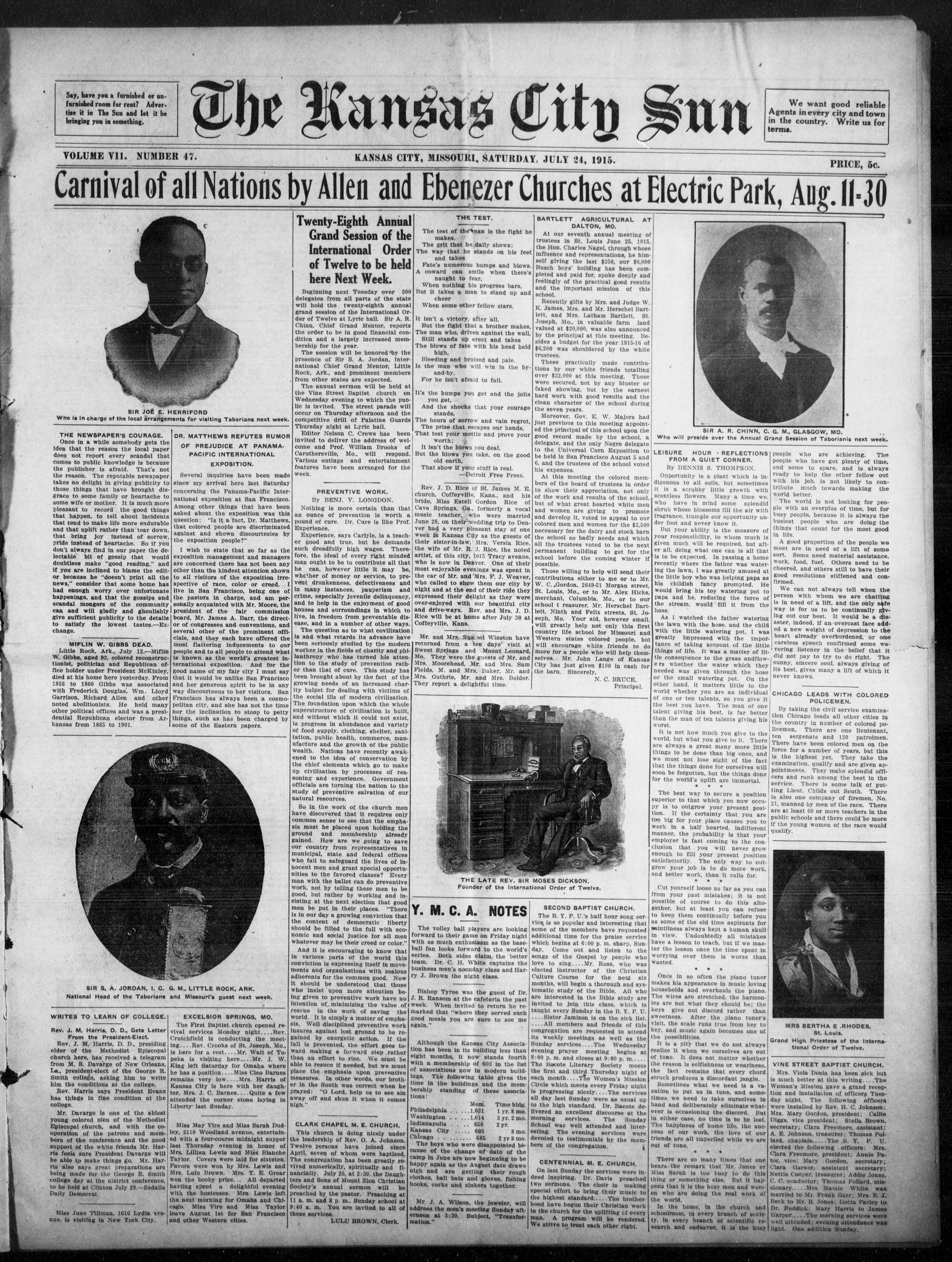
Carnival of all Nations by Allen and Ebenezer Churches at Electric Park, Aug.11-30
Say, have you a furnished or unfurnished room for rent? Advertise it in the Sun and let it be bringing you in something.
VOLUME VIII. NUMBER 47.
Carnival of all Nati
SIR JOE E. HERRIFORD
Who is in charge of the local arrangements for visiting Taborians next week?
THE NEWSPAPER'S COURAGE.
Once in a while somebody gets the idea that the reason the local paper does not report every scandal that comes to public knowledge is because the publisher is afraid. That's not the reason. The reputable newspaper takes no delight in giving publicity to those things that have brought disgrace to some family or heartache to some wife or mother. It is much more pleasant to record the good things that happen, to tell about incidents that tend to make life more edurable and that uplift rather than tear down, that bring joy instead of sorrow, pride instead of heartache. So if you don't always find in our paper the delectable bit of gossip that would doubtless make "good reading," and if you are inclined to blame the editor or because he "doesn't print all the news," consider that some home has had enough worry over unfortunate happenings, and that the gossips and scandal mongers of the community can and will gladly and ghoulishly give sufficient publicity to the details to satisfy the lowest tastes.—Exchange.
DR. MATTHEWS REFUTES RUMOR OF PREJUDICE AT PANAMA-PACIFIC INTERNATIONAL EXPOSITION.
Several inquiries have been made since my arrival here last Saturday concerning the Panama-Pacific International exposition at San Francisco. Among other things that have been asked about the exposition was this question: "Is it a fact, Dr. Matthews that colored people are discriminated against and shown discourtesies by the exposition people?"
I wish to state that so far as the exposition management and managers are concerned there has not been any other than the kindest attention shown to all visitors of the exposition irrespective of race, color or creed.
I live in San Francisco, being one of the pastors in charge, and am personally acquainted with Mr. Moore, the president of the fair commission board, Mr. James A. Barr, the direct or of congresses and conventions, and several other of the prominent offi
MIELIN W. GIBBS DEAD.
Little Rock, Ark., July 12—Miflin W. Gibbs, aged 92, colored reconstructionist, politician and Republican office holder under President McKinley, died at his home here yesterday. From 1855 to 1860 Gibbs was associated with Frederick Douglas, Wm. Lloyd Garrison, Richard Allen and other noted abolitionists. He held many other political offices and was a presidential Republican elector from Arkansas from 1865 to 1901.
SIR S. A. JORDAN, I. C. G. M., LIT
National Head of the Taborians and Miss
SIR S. A. JORDAN, I. C. G. M., LITTLE ROCK, ARK.
National Head of the Taborians and Missouri's guest next week.
WRITES TO LEARN OF COLLEGE.
Rev. J. M. Harris, D. D., Gets Letter From, the President-Elect.
FROM the PresidemElect
Rev. J. M. Mahr, D. D., presiding elder of the Methodist Episcopal church here, has received a telegram from M. S. Davargue of New Orleans, La., president-elect of the George R. Smith college, asking him to write him the conditions at the college.
Rev. Harris says President Evans has things in fine condition at the college.
Mr. Davargue is one of the ablest young colored men of the Methodist Episcopal church, and with the cooperation of the patrons and members of the conference and the good support of the white friends Mr. Harris feels sure President Davargue will be able to make things go. Mr. Harris also says great preparations are being made for the George R. Smith college day at the district conference, to be held at Clinton July 28.-Sedalla Daily Democrat.
Miss June Tillman, 1616 Lydia avenue, is visiting in New York City.
The Kansas City Sun
HERRIFORD
ments for visiting Taborians next week.
DR. MATTHEWS REFUTES RUMOR
OF PREJUDICE AT PANAMA-
PACIFIC INTERNATIONAL
EXPOSITION.
Several inquiries have been made
since my arrival here last Saturday
concerning the Panama-Pacific Interna-
tional exposition at San Francisco.
Among other things that have been
asked about the exposition was this
question: "Is it a fact, Dr. Matthews,
that colored people are discriminated
against and shown discourtesies by
the exposition people?"
I wish to state that so far as the exposition management and managers are concerned there has not been any other than the kindest attention shown to all visitors of the exposition irrespective of race, color or creed. I live in San Francisco, being one of the pastors in charge, and am personally acquainted with Mr. Moore, the president of the fair commission board, Mr. James A. Barr, the director of congresses and conventions, and several other of the prominent officials, and they each have offered the most flattering inducements to our people and to all people to attend what is known as the world's greatest international exposition. And for the good name of my fair city I must say that it would be unlike San Francisco and her generous spirit to be in any way discourteous to her visitors. San Francisco has always been a cosmopolitan city, and she has not the time nor the inclination to stoop to petty things, such as has been charged by some of the Eastern papers.
G. M., LITTLE ROCK, ARK.
and Missouri's guest next week.
The First Baptist church opened revival services Monday night....Rev Crutchfield is conducting the meeting....Rev Crooks of St. Joseph, Mo. is here for a rest....Mr. Wait of Topeka is visiting here....Mr. J. W. King left Saturday for Omaha where he has a position....Miss Cleo Barnes remains very low....Mrs. Harris of Kansas City is here with her daughter, Mrs. J. C. Barnes....Quite a few attended the corner stone laying in Liberty last Sunday.
Miss May Vire and Miss Sarah Dudley, 2110 Woodland avenue, entertained with a four-course midnight supper last. Thursday evening in honor of Mrs. Lillian Lewis and Miss Blanche Taylor. Covers were laid for sixteens. Favors were won by Mrs. Lewis and Mrs. Lulu Brown. Mrs. T. E. Grear won the booze prize. All departed having spent a delightful evening with the hostesses. Mrs. Lewis left the next morning for Omaha and Chicago. Miss Vire and Miss Taylor leave August 1st for San Francisco and other Western cities.
KANSAS CITY, MISSOURI, SATURDAY, JULY 24, 1915.
Twenty-Eighth Annual Grand Session of the International Order of Twelve to be held here Next Week.
Beginning next Tuesday over 300 delegates from all parts of the state will hold the twenty-eighth annual grand session of the International Order of Twelve at Lyric hall. Sir A. R. Chinn, Chief Grand Mentor, reports the order to be in good financial condition and a largely increased membership for the year. The session will be honored by the presence of Sir S. A. Jordan, International Chief Grand Mentor, Little Rock, Ark., and prominent members from other states are expected. The annual sermon will be held at the Vine Street Baptist church on Wednesday evening to which the public is invited. The street parade will occur on Thursday afternoon and the competitive drill of Palatine Guards Thursday night at Lyric hall. Editor Nelson C. Crews has been invited to deliver the address of welcome and Prof. William Brooks of Caruthersville, Mo., will respond. Various outings and entertainment features have been arranged for the week.
PREVENTIVE WORK.
By BENJ. V. LONGDON
Nothing is more certain than that an ounce of prevention is worth a pound of cure. Dr. Cure is like Prof. Experience.
Experience, says Carlyle, is a teacher good and true, but he demands such dreadfully high wages. Therefore, the ideal of every right minded man ought to be to contribute all that he can, however little it may be, whether of money or service, to prevent drunkenness, defectiveness and in many instances, pauperism and crime, especially juvenile delinquency, and to help in the enjoyment of good houses and surroundings in which to live, in freedom from preventable disease, and in a number of other ways.
The question as to what civilization is and what retards its advance have been seriously studied by the modern worker in the fields of charity and philanthropy who has turned his attention to the study of prevention rather than that of cure. This study has been brought about by the fact of the growing needs of an increased charity budget for dealing with victims of the social ills of modern civilization. The foundation upon which the whole superstructure of civilization is built, and without which it could not exist, is progress in abundance and variety of food supply, clothing, shelter, sanitation, public health, commerce, manufacture and the growth of the public wealth. Nations have recently awakened to the idea of conservation by the chief elements which go to make up civilization by processes of reasoning and experience. Government officials are turning the nation to the study of preventive salvation of our natural resources.
So in the work of the church men have discovered that it requires only common sense to see that the emphasis must be placed upon holding the ground and membership already gained. How are we going to save our country from representatives in municipal, state and federal offices who fail to safeguard the lives of innocent men and grant special opportunities to the favored classes? Every man with the ballot can do preventive work, not by telling these men to be good, but rather by working and insisting at the next election that good men be put in their places. "There is in our day a growing conviction that the content of democratic liberty should be filled to the full with economic and social justice for all men whatever may be their creed or color."
And it is encouraging to know that in various parts of the world this conviction is expressing itself in movements and organizations with zealous adherents for the common good. Now it should be understood that those who insist upon more attention being given to preventive work have no intention of minimizing the value of rescue in the work of saving the world. It is simply a matter of emphasis. Well disciplined preventive work insures against lost ground to be regained by energetic action. If the fall is prevented, the effort goes toward making a forward step rather than an effort to rise. We must be able to rescue if needed, but we must place the emphasis upon preventive measures. In other words, our brother in the South was correct when he prayed: "O Lord, help us to see sin away off and shun it when it comes nigh."
CLARK CHAPEL M. E. CHURCH.
DEARK CHAPEL M. E. CHURCH.
This church is doing nicely under the leadership of Rev. O. A. Johnson. Twelve persons have joined since April, seven of whom were baptized. The congregation has been greatly received numerically, spiritually and financially. July 25, at 2:30, the Daughters and Sons of Mount Zion Christian Society's annual sermon will be preached by the pastor. Preaching at 11 a. m. and 8 p. m., Sunday school at 9:40 a. m. You are invited to all of these services.
LULU BROWN, Clerk.
The test of the man is the fight he makes.
makes.
The grit that he daily shows;
The way that he stands on his feet
and takes
Fate's numerous bumps and blows.
A coward can smile when there's
naught to fear.
When nothing his progress bars.
But it takes a man to stand up and
cheer
When some other fellow stars.
It isn't a victory, after all.
But the fight that a brother makes.
The man who, driven against the wall,
Still stands up erect and takes
The blows of fate with his head held
high.
Bleeding and bruised and pale.
Is the man who will win in the by-
and-by.
For he isn't afraid to fail.
It's the bumps you get and the jolts
you get.
And the shocks that your courage
stands.
The hours of sorrow and vain regret
The prize that escapes our hands,
That test your mettle and prove you
But the blows you take, on the good old earth.
old earth,
That show if your stuff is real.
—Detroit Free Press.
Rev. J. D. Rice of St. James M. E. church, Coffeyville, Kans., and his bride, Miss Estell Gordon Rice of Cave Springs, Ga., formerly a vocal music teacher, who were married June 28, on their wedding trip to Denver had a very pleasant stay of one week in Kansas City as the guests of their sister-in-law, Mrs. Versia Rice, the wife of Mr. R. J. Rice, the noted artist, of this city, 1015 Tracy avenue, who is now in Denver. One of their most enjoyable evenings was spent in the car of Mr. and Mrs. F. J. Weaver, who called to show them our city by night and at the end of their ride they expressed their delight as they were over-enjoyed with our beautiful city and drive-ways. Rev. and Mrs. J. D. Rice will be at home after July 30 at Coffeyville, Kans.
Mr. and Mrs. Sarah Winston have returned from a ten days' visit at Sweet Springs and Mount Leonard, Mo. They were the guests of Mr. and Mrs. Moorehead, Mr. and Mrs. Sam Fields, M. and Mrs. Baker, Mr. and Mrs. Guthrie, Mr. and Mrs. Bolder. They report a delightful time.
THE LATE REV. SIR MOSES DICKSON.
Founder of the International Order of Twelve.
Y. M. C. A. NOTES
The volley ball players are looking forward to their game on Friday night with as much enthusiasm as the baseball fan looks forward to the world's series. Both sides claim, the better team. Dr. C. H. White captains the business men's noonday class and Harry J. Brown the night class.
Bishop Tyre was the guest of Dr. J. R. Ransom at the cafeteria the past week. When invited to return he remarked that "where they served such good meals you are sure to see me again."
Although the Kansas City Association has been in its building less than eight months, it now stands fourth with a membership of 603 in the list of associations now in modern buildings. The following table gives the time in the buildings and the membership standing of these associations:
Mem. Time bldg.
Philadelphia . . . 1,031 1 yr 8 mo.
Washington . . . 1,014 3 yr 2 mo.
Indianapolis . . . 550 2 yr.
Kansas City . . . 603 8 mo.
Chicago . . . 585 2 yr 8 mo.
The boys who were disappointed because of the change of date of the camp in June are now beginning to be happy again as the August date draws nigh and are getting their rough clothes, ball bats and gloves, fishing hooks, corks and sinkers together.
Mr. J. A. Wilson, the jeweler, will address the men's meeting Sunday afternoon at 3:30. Subject, "Transformation."
BARTLETT AGRICULTURAL AT DALTON, MO.
At our seventh annual meeting of trustees in St. Louis June 25, 1915, the Hon. Charles Nagel, through whose influence and representations, he himself giving the last $250, our $6,000 Busch boys' building has been completed and paid for, spoke deeply and feelingly of the practical good results and the important mission of this school.
Recently gifts by Mrs. and Judge W. K. James, Mrs. and Mr. Herschel Bartlett, and Mrs. Latham Bartlett, St. Joseph, Mo., in valuable farm land valued at $20,000, was also announced by the principal at this meeting. Besides a budget for the year 1915-16 of $6,200 was shouldered by the white trustees.
These practically made contributions by our white friends totalling over $32,000 at this meeting. These were secured, not by any bluster or faked showing, but by the earnest hard work with good results and the clean character of the school during the seven years.
Moreover, Gov. E. W. Majors had just previous to this meeting appointed the principal of this school upon the good record made by the school, a delegate, and the only Negro delegate to the Universal Corn Exposition to be held in San Francisco August 5 and 6, and the trustees of the school voted his expenses.
At this meeting the colored members of the board of the trustees in order to show their appreciation, not only of the work and results of the school, but of what great hearted white men and women are giving to promote and develop it, voted to appeal to our colored men and women for the $2,500 necessary for the dairy and stock barn the school so badly needs and which all the trustees voted to be the next permanent building to get for the school before the coming winter if possible.
Those willing to help will send their contributions either to me or to Mr. W. C., Gordon, 2649-51 Morgan street, St. Louis, Mo., or to Mr. Alex Hicks, merchant, Columbia, Mo., or to our school t reassurer, M. Herschel Bartlett, Ninth and Felix streets, St. Joseph, Mo. Your aid, however small, will greatly help not only this first country life school for Missouri and Western states colored people, but will encourage white friends to do more for a people who will help themselves. Mr. John Lange of Kansas City has just given $100 in cash for the barn. Sincerely.
THE WORLD'S FIRST EMPEROR
SECOND BAPTIST CHURCH.
The B. Y. P. U.'s half hour song service is so popular and interesting that some of the members have requested additional time for the praise service which begins at 6:00 p. m. sharp. Sunday. Come out and listen to the songs of the Gospel by people who love to sing.....Mr. Ross, who was elected instructor of the Christian Culture Course for the next six months, will begin a thorough and systematic study of the Bible. All who are interested in the Bible study are invited to join this class, which is taught every Sunday in the B. Y. P. U. ..Sister Jamison is on the sick list....All members and friends of this congregation are requested to attend its weekly meetings as well as the Sunday services....The Wednesday evening prayer meeting begins at 8:00 p. m. and closes at 9:00 p. m....The Bacote Literary Society meets the first and third Thursday night of each month....The Women's Mission Circle which meets every Friday night is progressing nicely....The services all day last Sunday were as usual up to the high standard. Dr. Bacote delivered an excellent discourse at the morning services. The Sunday School was well attended and interesting. The evening services were devoted to testimonials by the members of the congregation.
CENTENNIAL M. E. CHURCH
On last Sunday the services were indeed inspiring. Dr. Davis preached two sermons. The choir is making special effort to bring their music to the highest standard.....The brotherhood have begun their Christian work in the church for the uplifting of every man. A program will be rendered. We strive to treat each other right.
N. C. BRUCE. Principal.
SIR A. R. CHINN, C. G. M., GLASGOW, MO.
Who will preside over the Annual Grand Session of Taborianis next week.
By DENNIS S. THOMPSON.
A plant is which opportunity is indigenous to all soils, but sometimes it is a scrubby little growth with scentless flowers. Many a time we, who have in mind some splendid shrub whose blossoms fill the air with fragrance, trample our opportunity under foot and never know it.
But your ability is the measure of your responsibility, to whom much is given much will be required, but after all, doing what one can is all that is to be expected. In passing a home recently where the father was watering the lawn, I was greatly amused at the little boy who was helping papa as his childish fancy prompted. He would bring his toy watering pot to papa and he, reducing the force of the stream, would fill it from the hose.
As I watched the father watering the lawn with the hose, and the child with the little watering pot, I was greatly impressed with the importance of taking account of the little things of life. It was a matter of little consequence to the grass and flowers whether the water which they needed was given through the hose or the small watering pot. On the other hand, it matters little to the world whether you are an individual of one or ten talents, so you give it the best you have. The man of one talent giving his best, is far better than the man of ten talents giving his worst.
It is not how much you give to the world, but what you give to it. There are always a great many more little things to be done than big ones, and we must not lose sight of the fact that the things done for ourselves will soon be forgotten, but the things done for the world's uplift are immortal.
The best way to secure a position superior to that which you now occupy is to outgrow your present position. If the certainty that you are too big for your place causes you to work in a half hearted, indifferent manner, the probability is that your employer is fast coming to the conclusion that you will never grow enough to fill your present position satisfactorily. The only way to outgrow your job is to do more work, and better work, than it calls for.
Cut yourself loose as far as you can from your past mistakes; it is not possible of course to do this altogether, but at least you can refuse to keep them continually before you as some of the old time aspirants for saintliness always kept a human skull in view. Undoubtedly all mistakes have a lesson to teach, but if we master the lesson once the time spent in worrying over them is worse than wasted.
Once in so often the piano tuner makes his appearance in music loving households and overhauls the piano. The wires are stretched, the harmonies are not what they should be; the keys give out discord rather than sweetness. After the piano tuner's visit, the scale runs true from key to key, and music again becomes one of the possibilities.
It is a pity that we do not always realize it when we ourselves are out of tune. It does not matter whether the reason is selfishness or weariness, the fact remains that every chord struck produces a discordant jangle.
Sometimes what we need is a vacation to put us in tune, and sometimes we need to take ourselves in hand and deliberately eliminate whatever is occasioning the discord. But in either case, no time is to be lost. The happiness of home life, the success of our work, the love of our friends are all imperiled while we are out of tune.
There are so many times that one hears the remark that Mr. Jones or Miss Sarah is too busy to do this thing or something else. But it happens that it is the busy men and women who are doing the real work of the world.
In the home, in the church and schoolroom, in every branch of society, in every branch of scientific research and endeavor, it is the busy
We want good reliable Agents in every city and town in the country. Write us for terms.
PRICE, 5c.
k, Aug. 11-30
C. G. M., GLASGOW, MO.
Grand Session of Taborianis next week.
people who are achieving. The people who have got plenty of time, and some to spare, and is always ready to help the other fellow out with his job, is not likely to contribute much towards making the world better.
The world is not looking for people with an overplus of time, but for busy people, because it is always the busiest people who are doing the things that count for the most good in life.
A good proportion of the people we meet are in need of a lift of some sort. Some need material assistance, work, food, fuel. Others need to be cheered, and others still to have their good resolutions stiffened and confirmed.
We can not always tell when the person with whom we are chatting is in need of a lift, and the only safe way is for us to be continually giving out our best. It would be a disaster, indeed, if an overcast face added a new weight of depression to the heart already overburdened, or one careless speech confirmed some wavering listener in the belief that it did not pay to try to do right. The sunny, sincere soul, always giving of its best, gives many a lift of which it never knows.
CHICAGO LEADS WITH COLORED POLICEMEN.
By taking the civil service examination Chicago leads all other cities in the country in number of colored policemen. There are one lieutenant, ten sergeants and 120 patrolmen. There have been colored men on the force for a number of years, but this is the highest yet. They take the examination, qualify and are given appointments. They make splendid officers and rank among the best in the service. There is some talk of putting Lieut. Childs out South. There is also one company of firemen. No. 21, manned by men of the race. There are at least 60 or more teachers in the public schools and there could be more if the young women of the race would qualify.
MRS BERTHA E. RHODES,
St. Louis.
Grand High Priestess of the Interna-
tional Order of Twelve.
VINE STREET BAPTIST CHURCH.
Mrs. Viola Dosia has been sick but is much better at this writing....The Woman's Mission gave a grand reception and installation of officers Tuesday night. The following officers were installed by Rev. H. C. Johnson: Mrs. Mary Gordon, president; Callie Diggs, vice president; Stella Brown, secretary; Clara Freemore, assistant; A. E. Johnson, treasurer; Thomas Pollar, chapleman....The B. Y. P. U. elected the following officers: Mrs. Clara Freemore, president; Annie Pator, vice; Mary Gordon, secretary; Clara Garner, assistant secretary; Nettie Cooper, treasurer; Addie Jones, C. C. conductor; Thomas Pollard, missionary....Mrs. Manie White was married to Mr. Frank Garr; Mrs. E. J. Beck to Mr. R. Jones; Iketta Farley to Dr. Reddick; Mary Harris to James Harper....The morning services were well attended; evening attendance was light. One addition Sunday.
INTERNATIONAL
SUNDAY SCHOOL
LESSON
(By E. O. SELLERS, Acting Director of
School Course, The Moody Bible
Institute)
LESSON FOR JULY 25
SOLOMON DEDICATES THE TEMPLE.
LESSON TEXT-I Kings 8:22-30.
GOLDEN TEXT-My house shall be called a house of prayer for all people.
Isa. 56:7.
To teach this lesson properly reference must be made to the building of the temple (ch. 6), to the building of Solomon's palace and that for his Egyptian wife (ch. 7), and also to the renewal of the ark from the "tent of meeting," in Zion, to its new dwelling place in the temple. The time consumed in erecting the temple (seven years, I Kings 6:38), the number of men employed (approximately 150,000), and the skill and magnificence of the building (I Kings 6:7) will serve as an interesting introduction to the dedication ceremonies proper. Those present on this occasion are suggested in verses two and three; the time consumed was seven days (v. 66) and the condition of Solomon's heart (v. 5) is seen in the multitude of his sacrifices. The temple marks the beginning of a new era in Hebrew history, one of great outward glory, though it was not one of inward strength as the speedy breaking up of the kingdom and the final captivities give evidence. Professor Beecher sets the date of this event as being "about the twelfth year of Solomon's reign—say 1012 B. C." There has probably not been in all time a sacred building its equal for magnificence or situation. Read any good Bible dictionary for its description. It is a type of the Christian (I Cor. 3:10-16).
1. Solomon's Veneration, vv. 22:24. Solomon's temple was a place of sacrifice but more than all it was a house of prayer (Matt. 21:13) and his dedicatory prayer is the longest prayer recorded in the Scriptures. In it to be found no mention of the temple as a place of sacrifice, yet no prayer is heard apart from sacrifice. Each article of the temple furniture had its special teaching but the greatest teaching of all was that of God's proximity and his readiness to hear the petitions of his servants. Solomon personally brought his thanks and his petition before the altar whereon lay the sacrifice (see Heb. 9:22; 10:19; 20; John 14:6), and even there he "spread forth his hands" in token of supplication, adoration and worship. We can "come bodily to a throne of grace" and need not priest or sacrament, for we have one who "lived liveth to intercede for us" "Christ Jesus."
Solomon's words of adoration are deeply significant. There is reverent boldness and pious confidence in his words. It is a great blessing when the leader of any people sets them a pattern of acupuncture and prayer (Prov. 14:34). This in Solomon is a type of "great David's greater son." (Heb. 7:25). This prayer is twice recorded (see 2 Chron. 6:13:42) and it begins with an acknowledgement of God's new plea. In verse 23 two titles are given God (see Ex. 24:10; I Sam. 1:17; Ps. 4:18; Isa. 41:17; 45:3). God is so great that there is none other with whom to compare him.
II. God's Word Verified, vv. 25, 26 Solomon repeatedly referred to the fact that he has fulfilled God's promise to his father David in building the temple. God is a covenant-keeping God. Upon this fact Solomon voices his plea for future blessings. Every part of this prayer is worthy of careful study. Solomon's "therefore" (v. 25) reveals his acceptance of God's words to David (ch. 2:4). This word of Jehovah is sure and steadfast (Jer. 33:17-26) and Solomon's use of God's promise (2 Sam. 7:12-16) is an exhortation to us that we base our petitions upon one of God's promises. Praying thus we can rest assured that our prayer is in the will of God and therefore that it will be heard (J John 5:14, 15).
III. God's Vision, vv. 27:30. See also 2 Chron. 7:1-13; 12:22; I Kings 9:1-9. As the king concluded his prayer the cloud resting over the holy of holies grew bright and dazzling and fire fell upon and consumed the sacrifices; the priests stood without in awe and amazement; the whole people fell upon their faces, and worshiped and praised Jehovah. Even with all of this special manifestation Solomon did not conceive of Jehovah a "local, tribal deity." Earth could not contain him, nor the heaven and the heaven of heavens (v. 27). God fills the whole universe (Ps. 12:9-7) yet he did and does give us special local manifestations of himself. It is this vast God who dwelt fully in Jesus Christ (John 1:14; Col. 2:9). "Will (such a) God indeed dwell on the earth?" He who created the universe? Yet this God turned this vision towards the temple "day and night." Solomon could such scrutiny for in that temple God had said: "My name shall be there" (v. 29) and his name is "Love" (I John 4:8; see also 2 Chron. 6:20, 40). This prayer is for us granted in him whom the temple typifies, our Lord Jesus (John 14:13, 14). The eyes of God are ever towards him and ready to answer the petition made in his name. There is a great lesson for the Christian and for the Christians special places of worship, our churches, in this wonderful promise of Jehovah regarding his name.
Accompanying this ceremony was the "Feast of Tabernacles" (vv. 62, 63; 2 Chron. 7:4-11) which usually lasted seven days but on this occasion continued for fourteen days. It was a time of great joy and gladness of heart for all the goodness and mercy of the Lord (see I Kings 8: 65; 6; 2 Chron. 7:9, 10). Solomon assumed that Israel would constantly be sinning (vv. 34, 36, 39, 43, 49). This proved to be true but no matter how frequently they sinned forgiveness was at hand if they truly repented and turned to Jehovah.
M
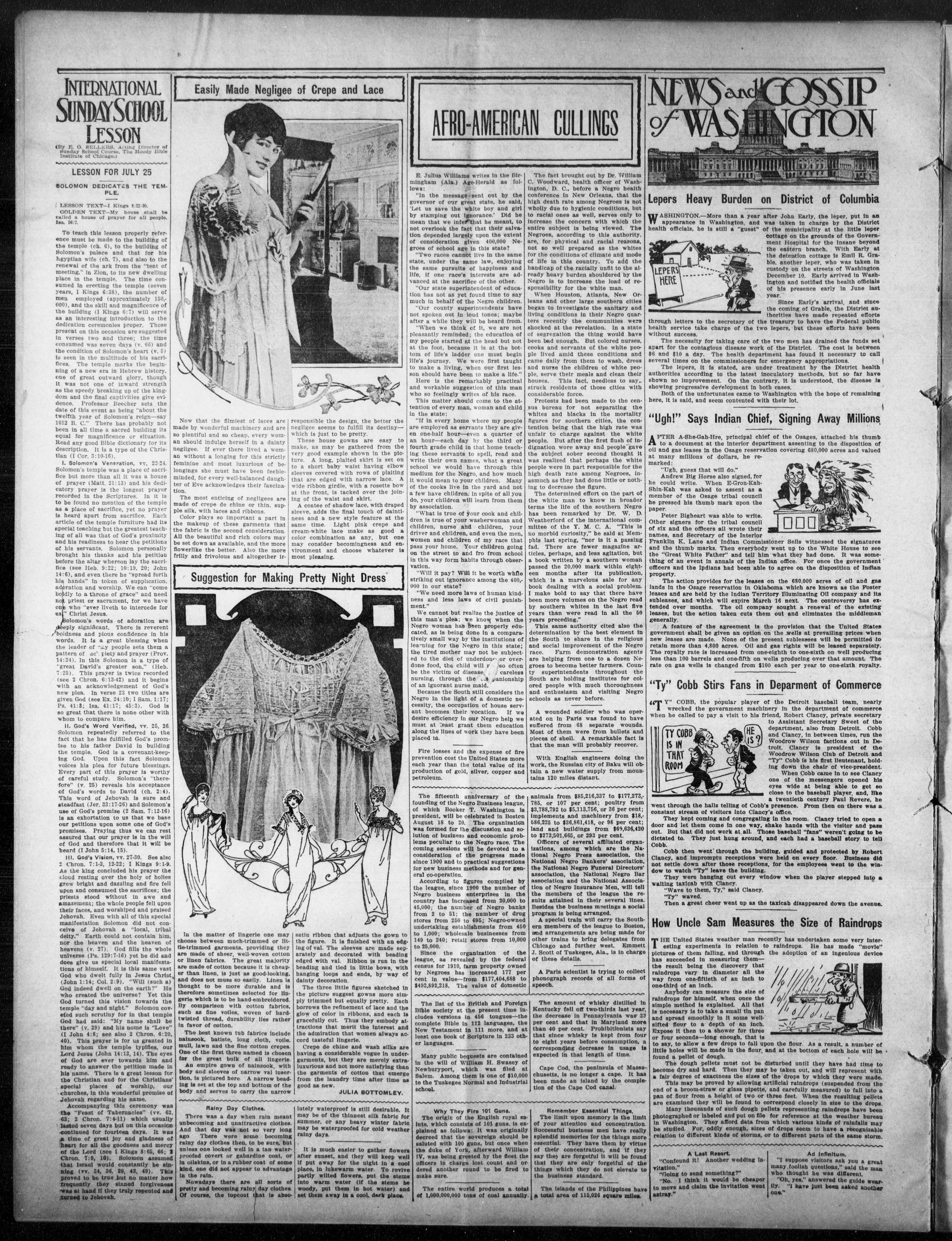
Suggestion for Making Pretty Night Dress
I
Now that the filiemist of laces are made by wonderful machinery and are so plentiful and so cheap, every woman should indulge herself in a dainty negligee. If ever there lived a woman without a longing for this strictly feminine and most luxurious of belongings she must have been feeble-minded, for every well-balanced daughter of Eve acknowledges their fascination.
The most enticing of negligees are made of crepe de chine or thin, supply silk, with laces and ribbons.
Color plays so important a part in the makeup of these garments that the fabric is the second consideration. All the beautiful and rich colors may be set down as available, and the more flowerlike the better. Also the more frilly and frivolous and altogether lr
Suggestion for Making
In the matter of lingerie one may choose between much-trimmed or little-trimmed garments, providing they are made of sheer, well-woven cotton or linen fabrics. The great majority are made of cotton because it is cheaper than linen, is just as good-looking, and does not muss so easily. Linen is thought to be more durable and is therefore sometimes selected for lingerie which is to be hand-embroidered. By comparison with cotton fabrics, such as fine veils, woven of hard-wisted thread, durability lies rather in favor of cotton.
The best known tub fabrics include nainsook, batiste, long cloth, voile, mull, lawn and the fine cotton crepes. One of the first three named is chosen for the great bulk of all lingerie. An empire gown of nainsook, with body and sleeves of narrow val insertion, is pictured here. A narrow heading is set at the top and bottom of the body and serves to carry the narrow
There was a day when rain meant unbecoming and unattractive clothes. And that day was not so very long ago. There were some becoming rainy day clothes then, to be sure, but unless one looked well in a tan waterproof covert or garbardine coat, or in olakins, or in a rubber coat of some kind, one did not appear to advantage in the rain.
Nowadays there are all sorts of pretty and becoming rainy day clothes. Of course, the topeat that is abso-
responsible the design, the better the negligee seems to fulfill its destiny—which is just to be pretty.
These house gowns are easy to make, as may be gathered from the very good example shown in the picture. A long, plaited skirt is set on to a short baby waist having elbow sleeves covered with rows of plating that are edged with narrow lace. A wide ribbon girdle, with a rosette bow at the front, is tacked over the joining of the waist and skirt.
A coattee of shadow lace, with draped sleeve, adds the final touch of daintiness and a new style feature at the same time. Light pink crepe and cream-white lace make as good a color combination as any, but one may consider becomingness and environment and choose whatever is most pleasing.
g Pretty Night Dress
satin ribbon that adjusts the gown to the figure. It is finished with an edging of val. The sleeves are made separately and decorated with beading edged with val. Ribbon is run in the beading and tied in little bows, with hanging loops and ends, by way of dainty decoration.
The three little figures sketched in the picture suggest gowns more simply trimmed but equally pretty. Each borrows the refinement of lace and the glow of color in ribbons, and each is gracefully cut. Thus they embody attractions that merit the interest and the admiration that women always accord tasteful lingerie.
Crepe de chine and wash silks are having a considerable vogue in undergarments, but they are merely extra-luxurious and not more satisfying than the garments of cotton that emerge from the laundry time after time as good as new.
JULIA BOTTOMLEY
lately waterproof is still desirable. It may be of the thinnest silk fabric for summer, or any heavy winter fabric may be waterproofed for cold weather rainy days.
It is much easier to gather flowers after sunset, and they will keep well if put away for the night in a cool place, in lukewarm water. To revive partly wilted flowers, put the stems into warm water (if the stems be woody, put them in hot water) and set them away in a cool, dark place.
AFRO-AMERICAN CULLINGS
---
---
E Julius Williams writes in the Birmingham (Ala.) Age-Herald as follows:
"In the message sent out by the governor of our great state, he said, 'Let us save the white boy and girl by stamping out ignorance.' Did he mean that we infer that he meant, to not overlook the fact that their salvation depended largely upon the extent of consideration given 400,000 Negroes of school age in this state?"
"Two races cannot live in the same state, under the same law, enjoying the same pursuits of happiness and life, if one race's interests are advanced at the sacrifice of the other.
"Our state superintendent of education has not as yet found time to say much in behalf of the Negro children."
"When we think of it, we are not pleasantly reminded; the education of my people started at the head but not at the foot, because it is at the bottom of life's ladder one must begin life's journey. We were first taught to make a living, when our first lesson should have been to make a life." Here is the remarkably practical and workable suggestion of this man who so feelingly writes of his race. This matter should come to the attention of every man, woman and child in the state:
"If in every home where my people are employed as servants they are given one half hour—even a quarter of an hour—each day by the third or fourth grade child in that home teaching these servants to spell, read and write their own names, what a great school we would have through this medium for the Negro, and how much it would mean to your children. Many of the cooks live in the yard and not a few have children. In spite of all you do, your children will learn from them by association.
"What is true of your cook and children is true of your washerwoman and children, nurse and children, your driver and children, and even the men, women and children of my race that pass your home. Your children going on the street to and fro from school in this way form habits through observation.
"Will it pay? Will it be worth while striking out ignorance among the 400,000 in our state?"
"We need more laws of human kindness and less laws of civil punishment."
We cannot but realize the justice of this man's plea; we know when the Negro woman has been properly educated, as is being done in a comparatively small way by the institutions of learning for the Negro in this state; the tired mother may not be subjected to the diet of underdone or overdone food, the child will r' so often be the victim of disease, careless nursing, through the partnership of an ignorant nurse maid.
Because the South still considers the Negro in the light of a domestic necessity, the occupation of house servant becomes their vocation. If we desire efficiency in our Negro help we must at least grant them education along the lines of work they have been placed in.
Fire losses and the expense of fire prevention cost the United States more each year than the total value of its production of gold, silver, copper and petroleum.
The fifteenth anniversary of the founding of the Negro Business league, of which Booker T. Washington is president, will be celebrated in Boston August 18 to 20. The organization was formed for the discussion and solution of business and economic problems peculiar to the Negro race. The coming sessions will be devoted to a consideration of the progress made since 1900 and to practical suggestions for new business methods and for general co-operation.
According to figures compiled by the league, since 1900 the number of Negro business enterprises in the country has increased from 20,000 to 45,000; the number of Negro banks from 2 to 51; the number of drug stores from 250 to 695; Negro-owned undertaking establishments from 450 to 1,000; wholesale businesses from 149 to 240; retail stores from 10,000 to 25,000.
Since the organization of the league, as revealed by the federal census for 1910, farm property owned by Negroes has increased 177 per cent in value—from $177,404,688 to $492,892,218. The value of domestic
The list of the British and Foreign Bible society at the present time includes versions in 456 tongues—the complete Bible in 112 languages, the New Testament in 111 more, and at least one book of Scripture in 233 other languages.
Many public bequests are contained in the will of William H. Swasey of Newburyport, which was filed at Salem. Among them is one of $10,000 to the Tuskegee Normal and Industrial school.
The origin of the English royal salute, which consists of 101 guns, is explained as follows: It was originally decreed that the sovereign should be saluted with 100 guns, but once when the duke of York, afterward William IV, was being greeted by the fleet the officers in charge lost count and ordered another round to be fired to make sure.
The entire world produces a total of 1,000,000,000 tons of coal annually.
The fact brought out by Dr. William C. Woodward, health officer of Washington, D. C., before a Negro health conference in New Orleans, that the high death rate among Negroes is not wholly due to hygienic conditions, but to racial ones as well, serves only to increase the concern with which the entire subject is being viewed. The Negroes, according to this authority, are, for physical and racial reasons, not so well prepared as the whites for the conditions of climate and mode of life in this country. To add the handicap of the racially unfit to the already heavy burden shouldered by the Negro is to increase the load of responsibility for the white man.
When Houston, Atlanta, New Orleans and other large southern cities began to investigate the sanitary and living conditions in their Negro quarters recently the communities were shocked at the revelation. In a state of segregation the thing would have been bad enough. But colored nurses, cooks and servants of the white people lived amid these conditions and came daily from them to wash, dress and nurse the children of white people, serve their meals and clean their houses. This fact, needless to say, struck residents of those cities with considerable force.
Protests had been made to the census bureau for not separating the whites and blacks in the mortality figures for southern cities, the contention being that the high rate was unfair to charge against the white people. But after the first flush of indignation wore away and people gave the subject sober second thought it was realized that perhaps the white people were in part responsible for the high death rate among Negroes, inasmuch as they had done little or nothing to decrease the figure.
The determined effort on the part of the white man to know in broader terms the life of the southern Negro has been remarked by Dr. W. D. Weatherford of the international committee of the Y. M. C. A. "This is no morbid curiosity," he said at Memphis last spring, "nor is it a passing fad. There are fewer magazine articles, perhaps, and less agitation, but a book written by a southern woman passed the 20,000 mark within eighteen months after its publication, which is a marvelous sale for any book dealing with a social problem. I make bold to say that there have been more volumes on the Negro read by southern whites in the last five years than were read in all the 50 years preceding."
This same authority cited also the determination by the best element in the South to share in the religious and social improvement of the Negro race. Farm demonstration agents are helping from one to a dozen Negroes to become better farmers. County superintendents throughout the South are holding institutes for colored people with much thoroughness and enthusiasm and visiting Negro schools as never before.
A wounded soldier who was operated on in Paris was found to have suffered from 68 separate wounds. Most of them were from bullets and pieces of shell. A remarkable fact is that the man will probably recover.
With English engineers doing the work, the Russian city of Baku will obtain a new water supply from mountains 120 miles distant.
animals from $5,216,337 to $177,727-785, or 107 per cent; poultry from $3,788,792 to $5,113,756, or 36 per cent; implements and machinery from $18,586,225 to $36,861,418, or 98 per cent; land and buildings from $69,636,420 to $723,501,665, or 293 per cent.
Officers of several affiliated organizations, among which are the National Negro Press association, the National Negro Bankers' association, the National Negro Funeral Directors' association, the National Negro Bar association and the National Association of Negro Insurance Men, will tell the members of the league the results attained in their several lines. Besides the business meetings a social program is being arranged.
A special train will carry the Southern members of the league to Boston, and arrangements are being made for other trains to bring delegates from Chicago and further west. Emmett J. Scott of Tuskegee, Ala., is in charge of these details.
A Paris scientist is trying to collect phonograph records of all forms of speech.
The amount of whisky distilled in Kentucky fell of two-thirds last year, the decrease in Pennsylvania was 33 per cent and that in Maryland more than 40 per cent. Prohibitionists say that since whisky is kept from four to eight years before consumption, a corresponding decrease in usage is expected in that length of time.
Cape Cod, the peninsula of Massachusetts, is no longer a cape. It has been made an island by the completion of the Cape Cod canal.
Remember Essential Things.
The limit upon memory is the limit of your attention and concentration. Successful business men have really splendid memories for the things more essential. They have them by virtue of their concentration, and if they say they are forgetful it will be found that they are only forgetful of the things which they do not elevate to the business standard.
The islands of the Philippines have a total area of 115,025 square miles.
NEWS and GOSSIP of WASHINGTON
Lepers Heavy Burden on District of Columbia
WASHINGTON.—More than a year after John Early, the leper, put in an appearance in Washington, and was taken in charge by the District health officials, he is still a "guest" of the municipality at the little leper
through letters to the secretary of the treasury to have the Federal public health service take charge of the two lepers, but these efforts have been without success.
The necessity for taking care of the two men has drained the funds set apart for the contagious disease work of the District. The cost is between $6 and $10 a day. The health department has found it necessary to call several times on the commissioners for emergency appropriations.
The lepers, it is stated, are under treatment by the District health authorities according to the latest inoculatory methods, but so far have shown no improvement. On the contrary, it is understood, the disease is showing progressive development in both cases.
Both of the unfortunate came to Washington with the hope of remaining here, it is said, and seem contented with their lot.
"Ugh!" Says Indian Chief, Signing Away Millions
"Ugh!" Says Indian Chief, Signing Away Millions
AFTER A-She-Gah-Hre, principal chief of the Osages, attached his thumb to a document at the interior department assenting to the disposition of oil and gas leases in the Osage reservation covering 680,000 acres and valued at many millions of dollars, he re-
Franklin K. Lane and Indian Commissioner Sells witnessed the signatures and the thumb marks. Then everybody went up to the White House to see the "Great White Father" and tell him what they had done. It was something of an event in annals of the Indian office. For once the government officers and the Ipdians had been able to agree on the disposition of Indian property.
The action provides for the leases on the 680,000 acres of oil and gas lands in the Osage reservation in Oklahoma which are known as the Foster leases and are held by the Indian Territory Illuminating Oil company and its subleases, and which will expire March 16 next. The controversy has extended over months. The oil company sought a renewal of the existing leases, but the action taken cuts them out and eliminates the middleman generally.
A feature of the agreement is the provision that the United States government shall be given an option on the wells at prevailing prices when new leases are made. None of the present sublessees will be permitted to retain more than 4,800 acres. Oil and gas rights will be leased separately. The royalty rate is increased from one-eighth to one-sixth on well producing less than 100 barrels and one-fifth on wells producing over that amount. The rate on gas wells is changed from $100 each per year to one-sixth royalty.
"Ty" Cobb Stirs Fans in Department of Commerce
"T Y" COBB, the popular player of the Detroit baseball team, nearly wrecked the government machinery in the department of commerce when he called to pay a visit to his friend. Robert Clancy, private secretary
went through the halls telling of Cobb's presence. From then on there was a constant stream of visitors into Clancy's office.
They kept coming and congregating in the room. Clancy tried to open a door and let them come in one way, shake hands with the visitor and pass out. But that did not work at all. Those baseball "fans" weren't going to be dictated to. They just hung around, and each had a baseball story to tell Cobb.
Cobb then went through the building, guided and protected by Robert Clancy, and impromptu receptions were held on every floor. Business did not settle down after those receptions, for the employees went to the window to watch "Ty" leave the building.
They were hanging out every window when the player stepped into a waiting taxicab with Clancy.
"Wave to them, Ty," said Clancy.
"Ty" waved.
Then a great cheer went up as the taxicab disappeared down the avenue.
How Uncle Sam Measures the Size of Raindrops
THE United States weather man recently has undertaken some very interesting experiments in relation to raindrops. He has made "movie" pictures of them falling, and through the adoption of an ingenious device
to say, to allow a few drops to fall upon the flour. As a result, a number of little holes will be made in the flour, and at the bottom of each hole will be found a pellet of dough.
The dough pellets must not be disturbed until they have had time to become dry and hard. Then they may be taken out, and will represent with a fair degree of exactness the sizes of the drops by which they were made.
This may be proved by allowing artificial raindrops (suspended from the end of a broom-straw or glass pipette, and carefully measured) to fall into a pan of flour from a height of two or three feet. When the resulting pellets are examined they will be found to correspond closely in size to the drops.
Many thousands of such dough pellets representing raindrops have been photographed or labeled and put on file for reference at the weather bureau in Washington. They afford data from which various kinds of rainfalls may be studied. For, oddly enough, sizes of drops seem to have a recognizable relation to different kinds of storms, or to different parts of the same storm.
LEPERS
HERE
through letters to the secretary of the health service take charge of the two without success.
The necessity for taking care of the apart for the contagious disease work $6 and $10 a day. The health department several times on the commissioners for.
The lepers, it is stated, are unequivocal authorities according to the latest in shown no improvement. On the cont showing progressive development in be. Both of the unfortunates came to V here, it is said, and seem contented with
"Ugh!" Says Indian Chie
AFTER A-She-Gah-Hre, principal chi to a document at the interior depa oil and gas leases in the Osage reservoir at many millions of dollars, he remarked:
"Ugh guess that will do."
Andrew Big Horse also signed, for he could write. When E-Gron-Kah-Shin-Kah was asked to assent as a member of the Osage tribal council he pressed his thumb mark upon the paper. Peter Bigheart was able to write. Other signers for the tribal council of six and the officers all wrote their names, and Secretary of the Interior
Franklin K. Lane and Indian Commissi
and the thumb marks. Then everybody
the "Great White Father" and tell his
thing of an event in annals of the In-
officers and the Ipdians had been able
property.
The action provides for the leases,
lands in the Osage reservation in Okla
leases and are held by the Indian Terr
subleases, and which will expire Mar-
tended over months. The oil compa-
leases, but the action taken cuts the
generally.
A feature of the agreement is a
government shall be given an option
new leases are made. None of the p
retain more than 4,800 acres. Oil and
The royalty rate is increased from one
less than 100 barrels and one-fifth on
rate on gas wells is changed from $1
"Ty" Cobb Stirs Fans in
"TY" COBB, the popular player o
wrecked the government machi-
when he called to pay a visit to his f
TY COBB IS IN THAT ROOM HE IS?
went through the halls telling of Cobb constant stream of visitors into Clancy. They kept coming and congregating door and let them come in one way, out. But that did not work at all. They dictated to. They just hung around, Cobb.
Cobb then went through the bulk Clancy, and impromptu receptions we not settle down after those reception dow to watch "Ty" leave the buildings. They were hanging out every wi waiting taxicab with Clancy.
"Wave to them, Ty," said Clancy. "Ty" waved.
Then a great cheer went up as the
How Uncle Sam Measures
THE United States weather man resting experiments in relation to pictures of them falling, and through has succeeded in measuring them—the result being the discovery that raindrops vary in diameter all the way from one-fifth of an inch to one-third of an inch.
Anybody can measure the size of raindrops for himself, when once the simple method is explained. All that is necessary is to take a small tin pan and spread smoothly in it some well-sifted flour to a depth of an inch. Expose it then to a shower for three or four seconds—long enough, that is to say, to allow a few drops to fall up little holes will be made in the flour, found a pellet of dough.
The dough pellets must not be become dry and hard. Then they may a fair degree of exactness the size of this may be proved by allowing end of a broom-straw or glass pipette pan of flour from a height of two or are examined they will be found to be Many thousands of such dough p photographed or labeled and put on file in Washington. They afford data fro be studied. For, oddly enough, sizes relation to different kinds of storms.
"Confound it! Another wedding invitation."
"To go to send something?"
"No. I think it would be cheaper to move and claim the invitation went astray."
after John Early, the leaper, put in an was taken in charge by the District of the municipality at the little leeper cottage on the grounds of the Government Hospital for the Insane beyond the eastern branch. With Early at the detention cottage is Emil R. Grable, another leeper, who was taken in custody on the streets of Washington December 10. Early arrived in Washington and notified the health officials of his presence early in June last year. Since Early's arrival, and since the coming of Grable, the District authorities have made repeated efforts
the treasury to have the Federal public two lepers, but these efforts have been
the two men has drained the funds set out of the District. The cost is between institution has found it necessary to call or emergency appropriations.
under treatment by the District healthnoculatory methods, but so far have trary, it is understood, the disease is both cases.
Washington with the hope of remaining with their lot.
def, Signing Away Millions
def of the Osages, attached his thumb department assenting to the disposition ofation covering 680,000 acres and valued
A man signing a document while a man in a Native American headdress looks on.
missioner Sells witnessed the signatures they went up to the White House to see him what they had done. It was some-ardian office. For once the government was to agree on the disposition of Indian lands on the 680,000 acres of oil and gas abaiona which are known as the Fosteritory Illuminating Oil company and its 16 next. The controversy has ex-amy sought a renewal of the existing mem out and eliminates the middleman.
the provision that the United States on the wells at prevailing prices when present sublessees will be permitted to and gas rights will be leased separately. one-eighth to one-sixth on well producing wells producing over that amount. The 400 each per year to one-sixth royalty.
Department of Commerce
of the Detroit baseball team, nearly inery in the department of commerce friend, Robert Clancy, private secretary
to Assistant Secretary Sweet of the department, also from Detroit. Cobb and Clancy, in between times, run the Woodrow Wilson factions in In Detroit. Clancy is president of the Woodrow Wilson Club of Detroit and "Ty" Cobb is his first lieutenant, holding down the chair of vice-president. When Cobb came in to see Claney one of the messengers opened his eyes wide at being able to get so close to the baseball player, and, like a twentieth century Paul Revere, he
o's presence. From then on there was a boy's office. In shake hands with the visitor and pass those baseball "fans" weren't going to be and each had a baseball story to tell. Building, guarded and protected by Robert were held on every floor. Business did us, for the employees went to the window when the player stepped into a taxicab disappeared down the avenue. Res the Size of Raindrops recently has undertaken some very inter-raindrops. He has made "movie" in the adoption of an ingenious device
SOUR
upon the flour. As a result, a number of and at the bottom of each hole will be disturbed until they have had time to be taken out, and will represent with of the drops by which they were made. artificial raindrops (suspended from the, and carefully measured) to fall into a three feet. When the resulting pellets correspond closely in size to the drops, pellets representing raindrops have been for reference at the weather bureau on which various kinds of rainfalls may of drops seem to have a recognizable or to different parts of the same storm.
Ad Infinitum.
"I suppose visitors ask you a great many, foolish questions," said the man who thought he was different.
"Oh, yes," answered the guide wearily. "I have just been asked another one."
---
6689x
BUNGALOW HAS COME TO STAY
Type of Building in Greater Demand Than Ever, and With Good Reason.
PLANS FOR IDEAL RESIDENCE
Arrangement of Building and Grounds
Makes Use of Every Foot Avail-
able—Excellent Cellar Base-
ment Provided For—Splen-
did Light in Kitchen.
BY WILLIAM A. RADFORD.
Mr. William A. Radford will answer
questions and give advice FREE OF
COST. All submissions pertaining to
the subject of building, for the readers of this
paper. On account of his wide experience
as Editor, Author and Manufacturer, he
is, without doubt, the highest authority
on all the matters. AMAZING Inquiries
to William A. Radford, No. 1827 Prairie
avenue, Chicago, Ill. and only enclose
two-cent stamp for reply.
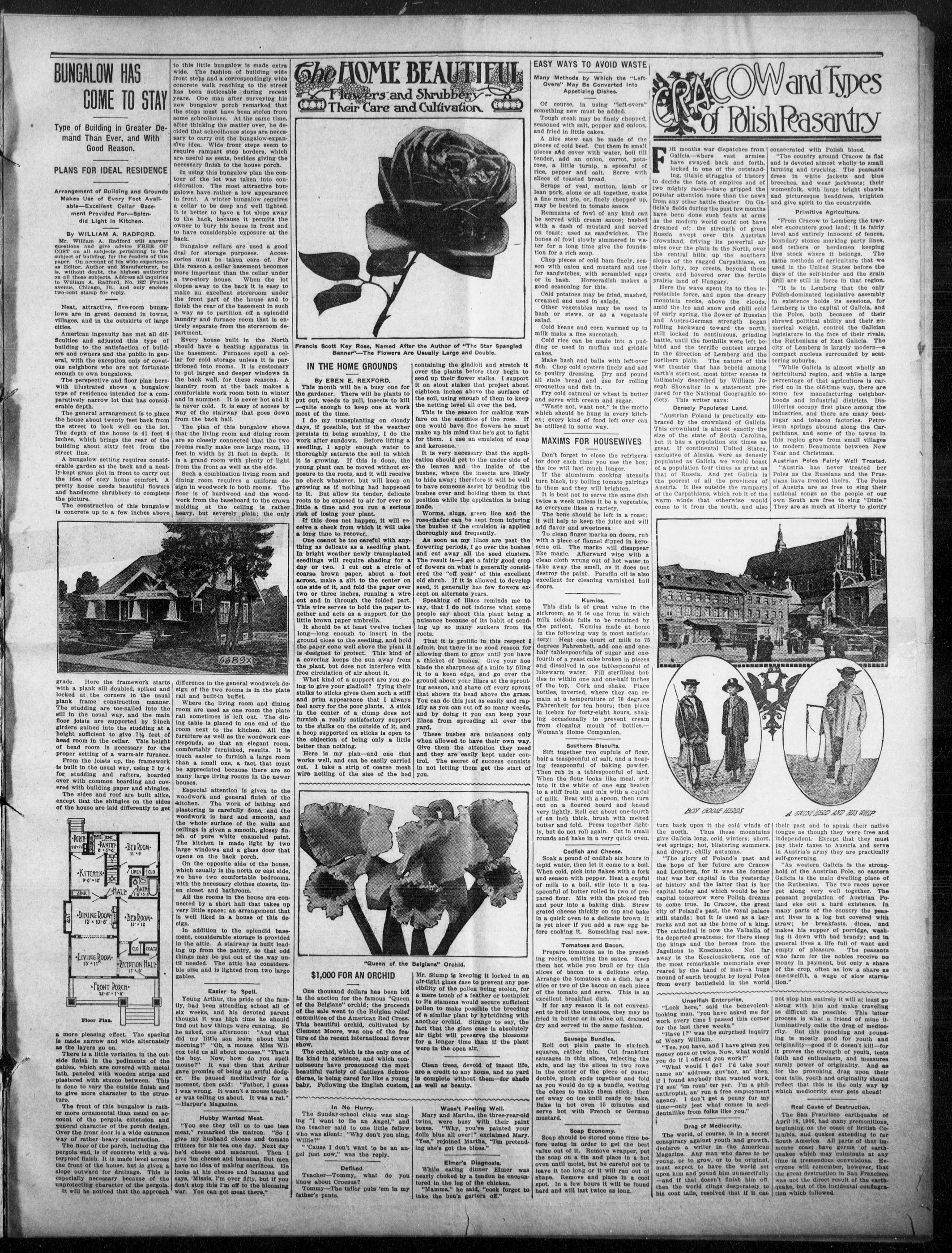
Neat, attractive, five-room bungalows are in great demand in towns,
villages, and in the outskirts of large cities.
American ingenuity has met all difficulties and adjusted this type of building to the satisfaction of builders and owners and the public in general, with the exception only of covetous neighbors who are not fortunate enough to own bungalows.
The perspective and floor plan here with illustrated shows a bungalow type of residence intended for a comparatively narrow lot that has considerable depth.
The general arrangement is to place the house about twenty feet back from the street to look well on the lot. The depth of the house is 41 feet 6 inches, which brings the rear of the building about sixty feet from the street line.
A bungalow setting requires considerable garden at the back and a neatly-kept grass plot in front to carry out the idea of cozy home comfort.
A pretty house needs beautiful flowers and handsome shrubbery to complete the picture.
The construction of this bungalow is concrete up to a few inches above
grade. Here the framework starts with a plank sill doubled, spiked and locked at the corners in the usual plank frame construction manner. The studding are toe-nailed into the sill in the usual way, and the main floor joists are supported by 2-inch girders gained into the studding at a height sufficient to give $7\frac{1}{2}$ feet of head room in the cellar. This height of head room is necessary for the proper setting of a warm-air furnace. From the joists up, the framework is built in the usual way, using 2 by 4 for studding and rafters, boarded over with common boarding and covered with building paper and shingles. The sides and roof are built alike, except that the shingles on the sides of the house are laid differently to get
PORCH
6'-5"
PANTRY
6'-5'-6"
BED ROOM
11'-9"
KITCHEN
9'-6"×12"
LINER
CLO
BATH
7'-6"×5"
SINK
HALL
BATH
7'-6"×5"
BAY
DINING ROOM
13'×10'-6"
BED ROOM
11'×12"
LIVING ROOM
13'×11"
COATES
RECEPTION HALL
11'-6"
FRONT PORCH
25'-6"×7'-6"
Floor Plan.
a more pleasing effect. The spacing is made narrow and wide alternately as the layers go on.
There is a little variation in the outside finish in the pediments of the gables, which are covered with metal lath, paneled with wooden strips and plastered with stucco between. This is done to vary the outside finish and to give more character to the structure.
The front of this bungalow is rather more ornamental than usual on account of the pergola extension and general character of the porch design. Over the front door is a wide entrance way of rather heavy construction.
The floor of the porch, including the pergola end, is of concrete with a waterproof finish. It is made level across the front of the house, but is given a slope outward for drainage. This is especially necessary because of the unprotecting character of the pergola.
It will be noticed that the approach
---
to this little bungalow is made extra wide. The fashion of building wide front steps and a correspondingly wide concrete walk reaching to the street has been noticeable during recent years. One man after surveying his new bungalow porch remarked that the steps must have been stolen from some schoolhouse. At the same time, after thinking the matter over, he decided that schoolhouse steps are necessary to carry out the bungalow-expansive idea. Wide front steps seem to require rampart step borders, which are useful as seats, besides giving the necessary finish to the house porch.
In using this bungalow plan the contour of the lot was taken into consideration. The most attractive bungalows have rather a low appearance in front. A winter bungalow requires a cellar to be deep and well lighted. It is better to have a lot slope away to the back, because it permits the owner to bury his house in front and to have considerable exposure at the back.
Bungalow cellars are used a good deal for storage purposes. Accessories must be taken care of. For this reason a cellar basement becomes more important than the cellar under a two-story house. When the lot slopes away to the back it is easy to make an excellent storeroom under the front part of the house and to finish the rear of the basement in such a way as to partition off a splendid laundry and furnace room that is entirely separate from the storeroom department.
Every house built in the North should have a heating apparatus in the basement. Furnaces spoil a cellar for cold storage unless it is partitioned into rooms. It is customary to put larger and deeper windows in the back wall, for these reasons. A laundry room at the back makes a comfortable work room both in winter and in summer. It is never hot and it is never cold. It is easy of access by way of the stairway that goes down from the back hall.
The plan of this bungalow shows that the living room and dining room are so closely connected that the two rooms really make one large room, 13 feet in width by 21 feet in depth. It is a grand room with plenty of light from the front as well as the side.
Such a combination living room and dining room requires a uniform design in woodwork in both rooms. The floor is of hardwood and the woodwork from the baseboard to the crown molding at the ceiling is rather heavy, but severely plain; the only
6689x
difference in the general woodwork design of the two rooms is in the plate rail and built-in buffet. Where the living room and dining room are used as one room the plate rail sometimes is left out. The dining table is placed in one end of the room next to the kitchen. All the furniture as well as the woodwork corresponds, so that an elegant room, comfortably furnished, results. It is much easier to furnish a large room than a small one, a fact that must be appreciated because there are so many large living rooms in the newer houses.
Especial attention is given to the woodwork and general finish of the kitchen. The work of lathing and plastering is carefully done, and the woodwork is hard and smooth, and the whole surface of the walls and ceilings is given a smooth, glossy finish of pure white enameled paint. The kitchen is made light by two large windows and a glass door that opens on the back porch.
On the opposite side of the house, which usually is the north or east side, we have two comfortable bedrooms, with the necessary clothes closets, linen closet and bathroom.
All the rooms in the house are connected by a short hall that takes up very little space; an arrangement that is well liked in a house of this design.
In addition to the splendid basement, considerable storage is provided in the attic. A stairway is built leading up from the pantry, so that odd things may be put out of the way until needed. The attic has considerable size and is lighted from two large gables.
Easier to Spell
Young Arthur, the pride of the family, had been attending school all of six weeks, and his devoted parent thought it was high time he should find out how things were running. So he asked, one afternoon: "And what did my little son learn about this morning?" "Oh, a mouse. Miss Willcox told us all about mouses." "That's the boy. Now, how do you spell mouse?" It was then that Arthur gave promise of being an artful dogger. He paused meditative for a moment, then said: "Father, I guess I was wrong. It wasn't a mouse teacher was telling us about. It was a rat." -Harper's Magazine.
Hubby Wanted Meat.
"You see they tell us to use less meat," remarked the matron. "So I give my husband cheese and tomato fritters for his tea one day. Next day he'd cheese and macaroni. Then I give 'im cheese and bananas. But men have no idea of making sacrifices. He looks at his cheese and bananas and says, 'Missis, I'm over fifty, but if you don't stop this I'm off to the blooming war. You can get meat there."
The HOME BEAUTIFUL
Flowers and Shrubbery
Their Care and Cultivation
```markdown
```
Francis Scott Key Rose, Named After the Author of "The Star Spangled Banner"—The Flowers Are Usually Large and Double.
IN THE HOME GROUNDS
By EBEN E. BEXFORD
This month will be a busy one for the gardener. There will be plants to put out, weeds to pull, insects to kill—quite enough to keep one at work most of the time.
I do my transplanting on cloudy days, if possible, but if the weather persists in being sunshine, I do the work after sundown. Before lifting a seedling, I apply enough water to thoroughly saturate the soil in which it is growing. If this is done, the young plant can be moved without exposure to the roots, and it will receive no check whatever, but will keep on growing as if nothing had happened to it. But allow its tender, delicate roots to be exposed to air for ever so little a time and you run a serious risk of losing your plant.
If this does not happen, it will receive a check from which it will take a long time to recover.
One cannot be too careful with anything as delicate as a seedling plant. In bright weather newly transplanted seedlings will require shading for a day or two. I cut out a circle of coarse brown paper, about a foot across, make a slit to the center on one side of it, and fold the paper over two or three inches, running a wire out and in through the folded part. This wire serves to hold the paper together and acts as a support for the little brown paper umbrella. It should be at least twelve inches long—long enough to insert in the ground close to the seedling, and hold the paper cone well above the plant it is designed to protect. This kind of a covering keeps the sun away from the plant, but does not interfere with free circulation of air about it.
What kind of a support are you going to give your gladioli? Tying their stalks to sticks gives them such a stiff and prim appearance that I always feel sorry for the poor plants. A stick in the center of a clump does not furnish a really satisfactory support to the stalks on the outside of it, and a hoop supported on sticks is open to the objection of being only a little better than nothing.
Here is my plan—and one that works well, and can be easily carried out. I take a strip of coarse mesh wire netting of the size of the bed
---
Iris
"Queen of the Belgians" Orchid.
One thousand dollars has been bid in the auction for the famous "Queen of the Belgians" orchid; the proceeds of the sale went to the Belgian relief committee of the American Red Cross. This beautiful orchid, cultivated by Clement Moore, was one of the feature of the recent international flower show.
The orchid, which is the only one of its kind in existence, and which connoisseurs have pronounced the most beautiful variety of Cattleya Schroederia, is being cared for like a young baby. Following the English custom,
In No Hurry.
The Sunday-school class was singing "I want to Be an Angel," and the teacher said to one little fellow who was silent: "Why don't you sing, Willie?"
"Cause I don't want 'to be an angel just now,'" was the reply.
Wasn't Feeling Well.
Mary and Martha, the three-year-old twins, were busy with their paint boxes. "Why, you've painted your dolls blue all over!" exclaimed Mary. "Yes," rejoined Martha. "I'm pretending she's got the blues."
Teacher—Tommy, what do you know about Croesus?
Tommy—The tailor puts 'em in my father's pants.
containing the gladioli and stretch it over the plants before they begin to send up their flower stalks. I support it on stout stakes that project about eighteen inches above the surface of the soil, using enough of them to keep the netting level all over the bed.
This is the season for making warfare on the enemies of the rose. If one would have fine flowers he must make up his mind that he's got to fight for them. I use an emulsion of soap and kerosene.
It is very necessary that the application should get to the under side of the leaves and the inside of the bushes, where the insects are likely to hide away; therefore it will be well to have someone assist by bending the bushes over and holding them in that position while the application is being made.
Worms, slugs, green lice and the rose-chafer can be kept from injuring the bushes if the emulsion is applied thoroughly and frequently.
As soon as my lilacs are past the flowering periods, I go over the bushes and cut away all the seed clusters. The result is—I get a fairly good crop of flowers on what is generally considered the "off year" of this excellent old shrub. If it is allowed to develop seed, it generally has few flowers except on alternate years.
Speaking of lilacs reminds me to say, that I do not indorse what some people say about this plant being a nuisance because of its habit of sending up so many suckers from its roots.
That it is profile in this respect I admit, but there is no good reason for allowing them to grow until you have a thicket of bushes. Give your hoe blade the sharpness of a knife by filing it to a keen edge, and go over the ground about your iliacs at the sprouting season, and shave off every sprout that shows its head above the grass. You can do this just as easily and rapidly as you can cut off so many weeds, and by doing it you can keep your iliacs from spreading all over the yard.
These bushes are nulsances only when allowed to have their own way. Give them the attention they need and they are easily kept under control. The secret of success consists in not letting them get the start of you.
```markdown
```
Mr. Stump is keeping it locked in an air-tight glass case to prevent any possibility of the pollen being stolen, for a mere touch of a feather or toothpick to its stamens would secure sufficient pollen to make possible the breeding of a similar plant by hybridizing with another orchid. Strange to say, the fact that the glass case is absolutely air tight will preserve the blossoms for a longer time than if the plant were in the open air.
Clean trees, devoid of insect life, are a credit to any home, and no yard is complete without them—for shade as well as beauty.
Mary and Martha, the three-year-old twins, were busy with their paint boxes. "Why, you've painted your dolls blue all over!" exclaimed Mary. "Yes," rejoined Martha. "I'm pretending she's got the blues."
Elmer's Diagnosis
While eating dinner Elmer was nearly choked by a tendon he encountered in the leg of the chicken. "Mamma," he said, "cook forgot to take the hen's garters off."
EASY WAYS TO AVOID WASTE
Many Methods by Which the "Left-Overs" May Be Converted Into Appetizing Dishes.
Of course, in using "left-overs" something new must be added.
Tough steak may be finely chopped, seasoned with salt, pepper and onions, and fried in little cakes.
A nice stew can be made of the pieces of cold beef. Cut them in small pieces and cover with water, boil till tender, add an onion, carrot, potatoes, a little turnip, a spoonful of rice, pepper and salt. Serve with slices of toasted bread.
Scraps of veal, mutton, lamb or lean pork, alone or all together, make a fine meat pie, or, finely chopped up, may be heated in tomato sauce
Remnants of fowl of any kind can be served with cream sauce; hashed with a dash of mustard and served on toast; used as sandwiches. The bones of fowl slowly simmered in water for a long time give the foundation for a rich soup.
Chop pieces of cold ham finely, season with onion and mustard and use for sandwiches, with scrambled eggs or in hash. Horseradish makes a good seasoning for this.
Cold potatoes may be fried, mashed, creamed and used in salads.
Other vegetables may be used in hash or stews, or as a vegetable salad.
Cold beans and corn warmed up in milk make a fine succotash.
Cold rice can be made into a pudding or used in muffins and griddle cakes.
Make hash and balls with left-over fish. Chop cold oysters finely and add to poultry dressing. Dry and pound all stale bread and use for rolling croquettes and fish in. Fry cold oatmeal or wheat in butter and serve with cream and sugar. "Waste not, not not," is the motto which should be hung in every kitchen; every kind of food left over can be utilized in some way.
MAXIMS FOR HOUSEWIVES
Don't forget to close the refrigerator door each time you use the box; the ice will last much longer. If the aluminum cooking utensils turn black, try bolling tomato pairings in them and they will brighten. It is best not to serve the same dish twice a week unless it be a vegetable, as everyone likes a variety. The bone should be left in a roast; it will help to keep the juice and will add flavor and sweetness. To clean finger marks on doors, rub with a cloth of flannel dipped in kerosene oil. The marks will disappear like magic. Afterward wipe with a clean cloth wrung out of hot water to take away the smell, as it does not destroy the paint. Paraffin oil is also excellent for cleaning varnished hall doors.
Kumiss.
This dish is of great value in the sickroom, as it is one form in which milk seldom fails to be retained by the patient. Kumiss made at home in the following way is most satisfactory: Heat one quart of milk to 75 degrees Fahrenheit, add one and one-half tablespoonfuls of sugar and one-fourth of a yeast cake broken in pieces and dissolved in one tablespoonful of lukewarm water. Fill sterilized bottles to within one and one-half inches of the top. Cork and shake. Place bottles, inverted, where they can remain at a temperature of 70 degrees Fahrenheit for ten hours; then place in icebox for forty-eight hours, shaking occasionally to prevent cream from clogging mouth of bottles.—Woman's Home Companion.
Southern Biscuits.
Sift together two cupfuls of flour, half a teaspoonful of salt, and a heaping teaspoonful of baking powder. Then rub in a tablespoonful of lard. When the flour looks like meal, stir into it the white of one egg beaten to a stiff froth, and mix with a cupful of milk. Beat with a spoon, then turn out on a floured board and knead very lightly. Roll out about one-fourth of an inch thick, brush with melted butter and fold. Press together lightly, but do not roll again. Cut in small rounds and bake in a very quick oven.
Codfish and Cheese.
Soak a pound of codfish six hours in tepid water, then let it come to a boil. When cold, pick into flakes with a fork and season with pepper. Heat a cupful of milk to a boil, stir into it a teapoonful of butter rolled in two of prepared flour. Mix with the picked fish and pour into a baking dish. Strew grated cheese thickly on top and bake in a quick oven to a delicate brown. It is yet nicer if you add a raw egg before cooking it. Something real new.
Tomatoes and Bacon.
Prepare tomatoes as in the preceding recipe, omitting the sauce. Keep them hot while you broil or fry thin slices of bacon to a delicate crisp. Arrange the tomatoes on a dish, lay a slice or two of the bacon on each piece of the tomato and serve. This is an excellent breakfast dish. If for any reason it is not convenient to broil the tomatoes, they may be fried in butter or in olive oil, drained dry and served in the same fashion.
Sausage Bundles.
Roll out plain paste in six-inch squares, rather thin. Cut frankfurt sausages in thin slices, reflecting the skin, and lay the slices in two rows in the center of the piece of paste; double, pinch ends together and fold as you would do up a bundle, wetting the edges to make them stick; then set away on ice until ready to bake. Bake in hot oven 15 minutes and serve hot with French or German mustard.
Soap Economy.
Soap should be stored some time before using in order to get the best value out of it. Remove wrapper, put the soap on a tin and place in a hot oven until moist, but be careful not to leave it too long or it will run out of shape. Remove and place in a cool spot. In a few hours it will be found hard and will last twice as long.
CRACOW and Types of Polish Peasantry
POV. GOOSE HERD
FOR months war dispatches from Galicia—where vast armies have swayed back and forth, locked in one of the outstanding, titanic struggles of history to decide the fate of empires and of two mighty races—have gripped the popular attention more than the news from any other battle theater. On Galicia's fields during the past few months have been done such feats at arms as the modern world could not have dreamed of; the strength of great Russia swept over this Austrian crownland, driving its powerful armies over the plain in the North, over the central hills, up the southern slopes of the ragged Carpathians, on their lofty, ice crests, beyond these crests, and hovered over the fertile prairie land of Hungary.
Here the wave spent its to then irresistible force, and upon the dreary mountain rocks, above the clouds, amid the ice and snow and chill cold of early spring, the flower of Russian and Austro-German strength began rolling backward toward the north, still locked in continuous, grinding battle, until the foothills were left behind and the terrific contest surged in the direction of Lemberg and the northern plain. The nature of this war theater that has beheld among earth's sternest, most bitter scenes is intimately described by William Joseph Showalter in a statement prepared for the National Geographic society. This writer says:
Densely Populated Land.
"Austrian Poland is practically embraced by the crownland of Galicia. This crownland is almost exactly the size of the state of South Carolina, but it has a population six times as great. If continental United States, exclusive of Alaska, were as densely populated as Galicia we would boast of a population four times as great as that of Russia. And yet Galicia is the poorest of all the provinces of Austria. It lies outside the ramparts of the Carpathians, which rob it of the warm winds that otherwise would come to it from the south, and also
Bernstein
BOY GOOSE HERDS
turn back upon it the cold winds of the north. Thus these mountains give Galicia long, cold winters; short, wet springs; hot, blistering summers, and dreary, chilly autumns.
"The glory of Poland's past and the hope of her future are Cracow and Lemberg, for it was the former that was her capital in the yesterday of history and the latter that is her capital today and which would be her capital tomorrow were Polish dreams to come true. In Cracow, the great city of Poland's past, the royal palace still stands; but it is used as a barracks and not as the home of a king. The cathedral is now the Vallahia of its departed greatness; for there sleep the kings and the heroes from the Jagellons to Kosciuszko. Not far away is the Kosciuszko, one of the most remarkable memorials ever reared by the hand of man—a huge mound of earth brought by loyal Poles from every battlefield in the world
"Look here," said the benevolent looking man, "you have asked me for work every time I passed this corner for the last three weeks."
"Have I?" was the surprised inquiry of Weary William.
"Yes, you have, and I have given you money once or twice. Now, what would you do if I offered you work?"
"What would I do? I'd take your name an' address, guv'nor, an' then, If I found anybody that wanted work, I'd sen' 'im router ter' yet. I a philantropist, an' run a free employment agency. I don't get a penny fur my time—only jest what comes in accidentallike from folks like you."
Drag of Mediocrity
The world, of course, is in a secret conspiracy against youth and growth, declares a writer in the American Magazine. Any man who dares to be young, or to grow, or to be original, must expect to have the world set upon him and pound him unmercifully—and if that doesn't finish him off, then the world clings desperately to his coat tails, resolved that if it can
consecrated with Polish blood.
"The country around Cracow is flat
and is devoted almost wholly to small
farming and trucking. The peasants
dress in white jackets and blue
breeches, and wear jackboots; their
womenfolk, with large bright shawls
and pictureque headdress, brighten
and give spirit to the countryside.
Primitive Agriculture.
"From Cracow to Lemberg the traveler encounters good land; it is fairly level and entirely innocent of fences, boundary stones marking party lines, and tethers or herdsmen keeping live stock where it belongs. The same methods of agriculture that we used in the United States before the days of the self-binder and the grain drill are still in force in that region. "It is in Lemberg that the only Polish-dominated legislative assembly in existence holds its sessions, for Lemberg is the capital of Galicia, and the Poles, both because of their shrewd political ability and their numerical weight, control the Galician legislature in the face of their rivals, the Ruthenians of East Galicia. The city of Lemberg is largely modern—a compact nucleus surrounded by scattering suburbs.
"While Galicia is almost wholly an agricultural region, and while a large percentage of that agriculture is carried on in the old-time way, there are some few manufacturing neighborhoods and industrial districts. Distilleries occupy first place among the industries, and there are many beet sugar and tobacco factories. Petroleum springs abound along the Carpathians, and some of the towns in this region grow from small villages to modern Beaumonts between New Year and Christmas.
Austrian Poles Fairly Well Treated.
"Austria has never treated her Poles as the Russians and the Prussians have treated theirs. The Poles of Austria are as free to sing their national songs as the people of our own South are free to sing "Dixie." They are as much at liberty to glorify
PRAXUS
A SWING HEAD AND THIS WHIP
their past and to speak their native tongue as though they were free and independent. Except that they must pay their taxes to Austria and serve in Austria's army they are practically self-governing.
"As western Galicia is the stronghold of the Austrian Pole, so eastern Galicia is the main dwelling place of the Ruthenian. The two races never get along very well together. The peasant population of Austrian Poland eke out a hard existence. In many parts of the country the peasant lives in a log hut covered with straw; he breakfasts, dines, and makes his supper of porridge, washing it down with bad brandy; and in general lives a life full of want and empty of pleasure. The peasants who farm for the nobles receive no money in payment, but only a share of the crop, often as low a share as one-twelfth, a wage of slow starvation."
not stop him entirely it will at least go along with him and make travelling as difficult as possible. This latter process is what a friend of mine illuminatively calls the drag of mediocrity. But this punching and pounding is mostly good for youth and originality—good if it doesn't kill—for it proves the strength of youth, tests faith and enthusiasm, and measures surely power of originality. And as for the provoking drag upon their coat tails, youth and originality should reflect that this is the only way by which mediocrity ever gets ahead!
Real Cause of Destruction.
The San Francisco earthquake of April 18, 1906, had many premonitions, beginning on the coast of British Columbia, and quakes extending to far South America. All parts of that immense coast have germs of earthquakes which may culminate at any time in tremendous convulsions. Everyone will remember, however, that the great destruction in San Francisco was not the direct result of the earthquake, but of the incidental conflagration which followed.
THEKANSAS CITY SUN
PUBLISHED WEEKLY.
‘Ail communications should be addreamea
jpigee Ramana City’ Son, ies Beat ase
Bell Phone East 969.
Batered as, econdvciass master, August
AB IMME Taye bomtcfice’ of Kanan City,
fo, wader the act of March 8, 1879.
Nelson ©. Crews........Ealtor and Owner
Wie B. Giennes0.02.General Manager
SUBSCRIPTION RATES:
Ror ta
APRA sasicocaicessceses ae
OOM uctisscseceastenesnes 008
Drees acti sas
ADVERTISING RATE, 60 CENTS PER
INCH.
CHORCH DIRECTORY.
Bethel A. M. E. Church, 24th and Fiore.
st Besley Haptat ‘church, 04 Char
ecmiennial| M. Church, 19ta and
‘Second Church, 10th and Char
Slien chanht A. tm. Church, 10th and
riots.
‘Kansas’ Avé, Baptist Church, 46th and
iGoenerer A.M. B. Church, 17th and
waa“
Be” Auguatibe's P. H. Church, 11th and
"Vite, St, Bapat church 1888 Vine Bt
. wre ine Bt.
Wara Chapdl A-'M. i Ghuret, ith and
woodians.
‘Bile Valley’ Baptist church, 1120 Crys-
tal avenue,
mgt dete A.-M. B Church, 1748 elle.
vse
aventh Day Adventist, 28nd and Wood-
WBE Monica's Cathoite, 17th, and Lydia
Moraing Star Baptist Chursn, a1 Vine.
ppiiftiana Avenue Bapiat Charen, iii
and.
Gentropolls A. M. H, Caurch, Centrop-
ola Bo
Bi vJames A. AL E, % Church, 1829
woogiknd Aver
‘Third Baptist Church, Roundtop.
People's Alssion, 30th’ and Geneseo,
Be Yaurs Baptist Church: isth’ and
lgiiand
fendehip Baptist Church, 17th and
acy Aven.
piri Baptint Churen, 614 Charlotte
Pleasant, Green Baptist, Church, Inde-
pendence Avenue and Tacs.
SiGaivary "Baptist “church, 19im and
Bicclow A. M. B. Mission, Sth and
Lysis.
Progressive Baptist Church, 29th and
sunmic
G M_E, Church, 1817 Flora Ave,
Se Names Sanitie Chur 400g Ann st
Bt Luke's “Ar ME Churn, 43rd and
Prospect Place”
RUM er Ditkton. $85 Crand Ave
CLARK CHAPEL M. E. CHURCH,
feet Madieon Ave.
KANSAS CITY, KAN. CHURCHES,
First A. M. E. Church, sth and Ned.
Pleasant Greet, Baptist Church, tat ad
SPrignth St Baptist Churca, sth and
if are an
onidand: D es
Metropolltan Baptist Churca, oth and
Washington.
Bethel A’ MB, Church, Water and
Steward atzeets,
mae, Pail A BL = Chorch, at an
sub.
Hirst Baptist Church, 6th and Neb,
eakine Solomon Baptist Chir, Sri anc
GQuindaro A.M. E. Church, Quindaro,
glemant Vailey Baptist Church, Rovedale
$F. chorh, fh ana onkana,
at &Ghutch, sth and Oakland,
Saitez Mission, ‘A. MM. 1. Chueh, Bouth
Park, ‘Kan.
Protestait Pplacopal, 3rd_and stewart
Becond ‘Baptist Church, 24th and. Huby.
Wesley Chapel ME, 106 Shawnee.
Be Paul An Me "zion Church, 400
adnioa,
Bethel A.M. B. Church, Roseiaie, Kan
sift: So Baptlse Church, hana Vir
Bbeneser A. M. B. Church, Sanford is
Tremont, See ee
waite dion, Primitiry, Rantlec | Church,
WWertport "avenuo asd Bingent ree
~ EDITORIALS.
The Ivanhoe ¢lub danced at City
park pavilion, Kansas City, Kas,, last
night. !
Rtg ott SEE er ae wc
New York parties are to present as
prizes in a nation wide contest among
the finest Negro babies will go to the
baby dolls who occupy the park
benches after sundown each day.
Republicans should not build their
hopes too high over the probable re-
sults of the Tom and Joe fight. Demo-
rats always have an incomprehensi-
ble way of getting together just be-
fore election time.
Those teachers who are away
strengthening themselves for their
work by doing summer normal work
are laying the best possible founda-
tion for future success. The others
will soon feel the difference.
Disinterested persons will watch
the actions of the delegates to the
two big secret society conventions to
be held here next week just to see
whether it 1s serious business or idle
pleasure for which the money is being
spent,
THE MOCK IN DEMOCRACY.
it has remained for an ex-Confeder-
ate soldier, as chief justice of the
United States, to hand down a unani-
mous decision of the supreme court
which places the brand of lawlessness
upon the attempt of a Southern state
to nullify the fifteenth amendment of
the United States constitution.
‘The so-called Democratic party in
the state of Oklahoma, under the
leadership of such self-styled apostles
of the people's rule as Senators Owen
and Gore, incorporated in @ so-called
Progressive state constitution an
amendment which attempted to base
‘the right of suffrage upon ancestry;
not upon intelligence, education or
even property, but upon the social and
economic status of the voter's parents
or grandparents in 1866. This, indeed
is putting the “mock” in Democracy.
‘Yet politicians of the Gore-Owen
stamp have the supreme gall to per-
petrate legislation of this kind and
then undertake to instruct the rest of
‘the country in the principles of “dem-
ocracy”—God save the mark!
‘The ‘attempt made was to apply a
literarey test to blacks alone, permit
ting the illiterate to vote provided only
that the ignoramus was descended
from some o ne who in 1866 occupied
the status of citizenphip. The pro
vision reads: i
“No person shall be registered as
an elector in this state, or be allowed
to vote in any election here, unless
he be able to read and write any see
Me ce sa Comsticsion of he tate
Oklahoma, but no who was,
on Jan. 1, 1860, or at any time pric
thereto, entitled to vote under any
form of government, or who at that
e resided in any foreign nation
4 no lineal descendant of such per
be the ma regis
ie ones pi geeterne of
ass
‘The Oklahoma Democrats, in incor
porating sch a provision In thelr con:
‘stitution, were of course only imitat
ing their associates in the leadership
of the Democratic party in that. sec:
ton in which it is chronically domi-
Hant, and from which comes the sec-
‘tional leadership that controls the
Democratic party today, This kind of
skulduggery was intended only to ac-
complisn legally what had heretofore
deen done by open force and fraud,
by Politicians who treat the country
‘to a heap of talk about their interest
in human freedom, individual liberty
and social justice, all of which is mere
mummery in their mouths in view of
‘their habitual attitude at home not
only toward the black man, but toward
the poor white of the South,
‘There never was a more impudent
mockery than the affectation by Dem:
oeratic leadership of interest in de-
mocracy. That leadership has been
principally occupied for a generation
in the attempt to suppress majority
rule in the South. As demonstrated
in the articles which have been print-
ed in the National Republican concern-
ing the government of Virginia, their
cry of negro supremacy has been a
mere cloak for the manipulations of
an office holding oligarchy which is
hot entitled to the name of aristoc-
racy. It is well to keep in mind that
with all his professions of interest in
the rule of the people in Mexico and
the Philippines, President Wilson is
cheek by jowl with the politicians
who make a mockery of representative
government in the states they domi-
nate, and that his official course jus-
tifies the assumption that he is com-
pletely in sympathy with the system
Which produces one vote in every 20
of population in the South, as against
‘one vote in every four and a half pop-
ulation north of the Ohio river. The
Democratic majority which sustains
the present administration in. the
house of representatives is based on
the votes of men whose citizenship is
denied at the polls, but claimed vigor-
ously in congress and the electoral col-
lege as a basis of representation. —
National Republican.
UBF -and— SMT.
MEET ME AT
MY CANDY SHOP
| FREE REST ROOM
12TH AND VINE STS.
Both Phones
Bell East 4866
Home East 4213
Fine Cifocolates, Watermelon on
ice. We specialize in Tee Cream
Sodas, Sundaes, Cigars, Tobaceos
and News. Have your friend
meet you here while in our city
J. L, PATTON, Prop.
H. PATTON, Mgr.
Betty@ Sam's
Little Corme=)
an &
es vet
ponte Ry
UMA
6
ey oe . y
Lt: AWE
ad Oe
Y WA NY an
me
vat | 2
THEY SAY
‘That it's best not to go,to the
back door and flirt with the lady of
the house when the man of the house
fat withing on (he! sont pore
—That it's best not to stir about too
much on the plank that supports you
when you know that plank is surely
split,
—That the trouble with the guy you
always hear boasting, “I would divide
my last dollar with John Doe,” never
has a dollar to divide with anybody.
—That anybody can kid themselves
into believing they've got a chance.
But they haven't,
7~That when a feller begins to dye
his whiskers, it shows he is either a
widower or hopes to be and wants to
stand in right with the girls.
—That the women are alright. God
bless them. But when you have
Tooms to rent, you'd rather rent them
to men,
How often, O how often you've had
friends come to town and go away
without knowing where your place of
business is. A Crescent ad would pre
vent that. Only one penny a day
* CRESCENT ADVERTISING = *
* AGENCY. :
cs “The Business Way" b
* BOB BOSLEY, Manager, = *
Bell phone Hast 1521,
* 1521 B. 18th street. ’
eoneeseeceeeeeeceeee
s
Health Hints
By Dr. Lloyd E. Bailer
A weekly discussion of Hygiene and Sani-
tation, First Aid Measures and Preven-
tive Medicine. Questions will be ans-
wered but no diagnoses nor prescrip
tions will be given in this column.
| By!
7 » | A we
4 tati
tive
we
_ tior
de kein Sei een:
One of the most alarming things
that ever happens in a home that has
been blessed with children is the sud
den and frequently unannounced on
set of a spasm in a child, Nothing so
completely disconcerts the » entire
household—the mother is often fright
ened into helplessness and the fath
er, if he be at home, is usually dis
patched for the nearest doctor, while
valuable time is lost before the doc
tor’s arrival, For these reasons and
especially since this is one of the most
frequent and dangerous diseases of
infancy and early childhood, every
mother should possess some knowl:
edge of spasms and their manage
ment. Such knowledge will insure the
mother presence of mind and decisive
ness of action, both of which are in-
@ispensable in such exigencies.
Among the various causes of spasms
are the onset of some severe illness
—such as pneumonia or scarlet fever,
indigestion, constipation, intestinal
worms, high fever from whatever
source, disordered dentition, diseases
‘of the brain, very hot weather, fright,
severe pain, rickets, whooping cough,
ete. The frequency of convulsions is
much greater in infancy, and rapidly
diminishes after the first year.
Ina typical spasm or convulsion the
child often makes a choking sound,
ceases to breathe for a moment, and
‘becomes unconscious, stitt and some-
what arched backward. ‘The eyes are
staring, rolling, or squited, the hands
clenched and the mouth firmly shut.
In a few seconds the face becomes
‘bluish from lack of air in the lungs,
‘and then the “working” begins. In
this stage the breathing is irregular
and noisy; the arms, legs and trunk
are jerked about in all directions, but
‘TROY. KAS.
| Mr, Alex Wilkinson visited his son,
|Mr, Walter Wilkinson of Fairbury,
Neb. from Saturday until Wednes-
day, and his grandson, Mr, Vernon
Wilkinson, accompanied him home to
‘visit a few days....Mr. Isase ‘Turner
Was visiting relatives in St, Joseph
Sunday....Mrs, Bertha Eubanks and
children Kenneth and Helen, of Chi-
casv, are visiting here for the sum.
mer, the guests of Mrs, Mattle Eu:
banks....Mrs. I. H. Holly and daugh-
ter, Miss Adeline Holly, of Oberlin,
©., are visiting in the city the guests
of Mrs, Sallie Turner and Mr. Isaac
Turner, who are a sister and brother
to Mrs. Holly....Mr. Charles Schuma:
cher and Mrs, Nelle E. Howard were
in Kansas City Thursday to visit Mrs.
Georgia Lee, who is quite ill at the
general hospital. She is a sister of
Mr. Schumache's....Rev. P, W. Wea:
ver was a St. Joseph visitor Monday
‘The following persons motored to
St. Joseph Friday evening to attend
the Folk festival at the Lyceum thea
ter: Mrs. Mollie Brown, Mrs. Chas.
Schumache, Mrs, Hannah Martin, Mr.
John Shaw, Misses A. D. Taylor and
Maurine Weaver, and Mr. and Mrs.
Chas, 0. Howard....Mrs. Dora Lee
was the guest of Mr. and Mrs, Hiram
Hughes at Lake Contrary of St. Jo-
seph from Friday until Sunday even-
ing and also attended the Folk festi-
val....Mrs, Mary Schumache was in
St. Joe to the dentist the past week,
and the guest of her daughter, Mrs.
M, W. Webster....Mr, David Wendell
Reed, the blind evangelistic singer of
Chicago, was in our city from Friday
until Sunday and rendered such a
touching song service at the A. M. B
church Sunday evening....Mr, Glen
Hughes of Falls City, Neb., who has
been visiting relatives here for some
time, returned home Saturday accom
panied by his cousin, little Miss Made-
line Butler,.,.Mrs. Tolliver of St. Jo.
seph was the guest of Mr, and Mrs
William Gaskin Sunday....The fol
lowing persons went to St. Joseph
Thursday to attend the Hagenbach
Wallace show, but on account of
washouts the show did not put in its
appearance, therefore they contented
themselves by shopping and visiting
friends: Mr. and Mrs. Aaron Wilkin:
son, Mrs, Mabel Gaskin, Mr. Will and
Mr, Vernon Wilkinson....Rev. P. W.
Weaver, Mrs. Mollie Brown, Mrs, Mary
Schumache, Mrs, Mattie Robinson and
Mrs, Nelle E. Howard motored to the
country Monday night to be at the
bedside of Mrs. Mary Pennel Johnson,
who is quite indisposed. She is a
sister of the S. M. T. of this city...
Miss Lizzie Lightle visited relatives in
St. Joseph Sunday....Mr. and Mrs
Matthew McCurry was the guest o
their parents, Mr. and Mrs. Alex Wil
kinson, Saturday and Sunday.....Mis
Rosa Snyder was the guest of Misi
Mabel Stiliman of White Cloud fron
‘Tuesday until Sunday evening.
LOUISIANA, MO.
Dr. John Berkeley Goins passed
away at his home in this city July
1, 1915. He was born in Tuscaloo-
sa, Ala, Oct. 22, 1861, and was 63
years, § months and 22 days of age
at the time of his death.
He graduated from Meharry Meal
cal college, Nashville, Tenn., in 1896
and immediately removed to this city
and entered upon the practice of his
profession, which grew to be quite ex
tensive among the people of his race
His quiet unassuming manner and
gentlemanly bearing of all o ccasions
won for him ‘the respect and esteem of
the white physicians of this city as
well as the community at large.
He was a devout and active mem
ber of the A. M. B, church and was
interested in every movement for the
betterment of the race, religiously,
morally and socially.
On July 29, 1895, he petitioned
Hughes lodge No. 28, A. F. and A.
M,, was elected to membership, aft
erwards serving his lodge faithfully
Qs secretary and junior warden, He
Principally with rapid alternate bend:
ing and straightening movements; the
eyes are rolled; there is frothing al
the mouth and the teeth, if there are
any, are ground together and may bite
the tongue, In a few minutds the
movements grow less violent and then
cease, and the child begins to ery
or goes into a heavy Iseep with ite
body rather stiffer than usual, Some
times before consciousness Is re
gained or the rigidity disappears,
another spasm occurs, and #0 the
child may go on from fit to fit un
Ul it dies. ‘The whole attack lasts
from one of two minutes to hours,
‘Treatment must be very prompt
‘The child should at once have a hot
bath which should cover it to the
neck, while cold clothes, frequently
renewed, are kept on its head. It
must be left in the water for ten min-
utes, and then be wrapped in a blan-
ket without drying. Since the attack
may be due to irritating food in the
stomach, the child should be made to
vomit by giving ft a teaspoonful of
syrup of ipecac or other emetic just
as soon as it is able to swallow. It
the spasm still continues and the doc-
tor has not come, the bowel should be
washed out with-a large injection of
warm water. Fortunately, the hot
bath and the emetic answer every pur-
pose in most cases and relieve the
attack, sparing the mother the re-
‘sponsibility of using the injection,
‘The physician should be called in
all cases as the spasm may be the
beginning of a serious disease which
should have immediate treatment.
Spasms from indigestion are fre:
queut in the summer season, For this
reason parents should guard against
the over indulgenee of their children
i fruit, especially unripe fruit, candy,
meat, ete.
was also a member of the United
Brothers of Friendship and Knights
of Pythias,
‘There remains to mourn his pass
ing. a devoted wife, @ son Howell
Berkeley, and a daughter, Helen Lu-
cia,
‘The funeral service Was conducted
July 18, at Wesley chapel, this city,
by Rev, Miller of Hannibal, Mo, his
regular pastor, Rev. L. R. Grant, be
ing confined to his home by illness,
A large number of sorrowing friends
from the neighboring cities attended
the service.
At the conclusion of the service al
the church the body was taken in
charge by the brethren of Hughes
lodge A. F. and A. M., who conduct
ed the services at the cemetery. ‘The
following brethren were pallbearers:
Robert Ross, J. H. Franklin, Prof. J
A. Cocktield, Ernest Boone, Prof. G
Sappington and Lewis Levells. 4
large number of brethren from Clarks:
ville and Bowling Green were in at
tendance, The U. B. F. and K. of P.
lodges also attended in a body.
JOPLIN. MO.
Mr, W. M. Meeks of Nashville,
‘Tenn,, is in the city visiting relatives.
Mr. George Meeks and Mr. Tom Meeks
will remain all summer. Mrs, Lucy
Meeks and little daughter will leave
for Kansas City this week. Miss Gol-
die Mires will accompany her.......
Mr. J. W. Walker, who has been very
ill in the General hospital in Kansas
City, has improved wonderfully and is
able to be at work at the Connor. He
is a member of the Connor Relief
Club and the first to be benefitted.
He praises the club highly and ad-
vises all waiters to join it.......Mrs.
Emnia Talley of Batesville, Ark, is in
the city visiting her granddaughter,
Mrs. Ruth May, 329 N. Sargeant St.
She will spend the summer.....Mr. J.
F. Manuel of Horning, Okla, died here
Monday after an illness of only a few
days.....Rev. Jones of the Zion Bap-
‘tist church, was in Baxter Sunday...
Mr. Alex Engram of Parsons, Kans, is
in the city visiting Mr, R. H. Johnson,
109 West ist St.....Mrs, Lizzie Davis
of Joplin is visiting friends in Coffey:
ville, Kans.....Misses Nettie Sarah
Kelsaw and Mable Young buried their
mother, Mrs, Alta Kelsaw, in Joplin
last Thursday.....Mrs, Kelsaw was
formerly of Kansas City.
At a regular meeting of tke Wait
er's Relief Fund Association, held last
‘Thursday morning, July 16:
| The house was called to order by
‘Mr. ©, W, Cuther, president of the
association, Much’ new business was
transacted, The relief fund had just
\recelved a letter from Dr. Wm. J.
|Thompkins of the general hospital,
‘Kansas City, Mo, stating Mr. J. W.
Walker's improvement. Mr, Walker
Was one of us before his illness and
"We sincerely hope to see his face with
(us again soon, The relief fund mailed
‘Dr. Thompkins a check tor $20, not
knowing the balance of the bill. Will
expect to hear from Dr, ‘Thompkins
soon,
Mr, Walter J. Sullivan, waiter, has
been confined to his bed with typhoid
malaria fever. Mr, Sullivan is report
ed to be improving.”
Miss Melissa Fuell, who has just
finished a year’s tour through Nebras
ka, Jowa and Missouri, with the Blind
Boone company, has returned to Jop
Min on her vacation, “Misa Fuell wil
spend two weeks here with her many
friends then journey to Kansas City
and then to St. Louls on business
‘Miss Fuel is publishing a book enti
tled “The Life of Blind Boone,” whieh
‘now in the hands of the press a
Philadelphia, Pa. Miss Fuell expects
to have her book on hand early in the
fall. After Miss Fuell leaves St. Louis
‘she will Jon a Chautauqua at Albany
‘Mo., August 8, ‘-. he
ton, Prof. DuBois and
int day. ‘We wih Mae Pus
day, We wish Miss ‘con:
success. a
A. F. and A. M.
Missouri Jurisdiction
Officere—191415.
N. C. Crews, Kansas City, Grand
Master,
Deputy Grand Master, Richaré
Young, Lincoln, Neb.
F, J. Brown, St, Louls, Grand Sen
tor Warden.
Wm. Green, Plattsburg, Grand Jun
for Warden.
H. H. Walker, St. Joseph, Grand
‘Treasurer.
Geo, W. K. Love, Grand Secretary,
Kansas City, Mo.
W. W, Fields, Secretary of Masonk
Relief, Cameron, Mo.
P, L, Pratt, Kansas City, Mo., Grane
Lecturer,
Grand Commandery Officers.
W. G. Mosely, Kansas City, Mo.
REGO,
J. H. Sherwood, St. Paul, Minn.
@. BG. =
B.C, Kincaid, Kansas City, Mo,
Vv. BG. C.
J, W. Beard, St. Louis, Mo, B. @.
ca.
Wm. Roberts, Hannfbal, Mo., Grand
Secretary.
T. P, Mahammitt, Grand Treasurer,
Omaha, Neb.
Grand Chapter Officers,
Geo. Broomfteld, @. H. P., St. Louts,
Mo.
T. G. McCampbell, D. G. H. P,, Kan
sas City. 2
A. L. Thomas, G. K., Jefferson City
Mo.
J, P, Mofitte, G. S., Sedalia, Mo,
Chas. Griggsby, G. Treas., Liberty,
Mo. s
B. 8, Baker, G. Sec'y, Kansas City,
Mo,
MASONIC BUILDING ASSOCIATION
MEMBERS.
R. T. Coles, Chairman,
B. 8. Baker, Secretary.
R, W. Foster, Treasurer.
W. C. Mallory, Sandy Meyers,
‘Wm. Washington, F. P. Porteet,
‘T. W. H. Williams, W. G. Moseley,
J. B, Herriford, HB. G. Lacey,
B. G. Miller, Robt, Wiley.
ee
L odge Directory
Lopae binecrory.
britehagd Ledge Ne. 4. A,»
snatches! tadae Mee Bed,
Tit stonday Ewen toate at
tsae hredoes ta potd attots
wean a eeat one
rN. Hi. SPIGENER, secrecy.
Rone Lodge No. 26, A. ¥, am
Baars ates NS tala
PR octiy nace’ tates
fe\ Master Masons in good iors,
aL Gop watess atsegme G2 ed, eth
RR i"t'S. siccampbell, See'y.
Mt. Olive Lodge No. 53, A.B
enact Logas We, ead,
Sie rtiaay iat sade oa
fhe Mek ees Le
done, Mitty Mayern, SW. St
Sasic Lowe, Mesreiary th
eC
TCG ey
‘queen Esther Court No. 48
uate Trtit’e Sure ds
Fae draiNPs aSt dave Setar
meat tat Sah
1300 toa Garg Bll, ieanane
Sty “Roc Me" pattie “Baris
Si, MO nomn't. Janie chet
Moe Noval Qa si, Muniae Cy
xu,
UBF.
King ‘ot the Wet Lodge. No
218 meots first and. third ‘Mon:
Saget Go Bate ea,
Ga Mavens “She Shes
SPM, Tie Evatt: Be, Hare
Yi, Mz Ae, Hella Jes, Har.
Money. to loan on approved security.
We sell homes on easy terms. See me
or my clerk at my office, 521% Vin
ginia, Phone 1259, J. N. Brownlee,
* Bell "Phone 1521 B. isth ¢
We would like to see every lodge
‘and society in Kansas City put thelr
cards in The Sun. It {s the most pop-
ular way to let the world know who
you are, when and where you meet
and your object and purpose. For the
next month we will make special an:
nouncements to have you put in your
lodge or society list of of officers in
SHAVES WITHOUT RAZOR,
Midland Park, $, C., March 10, 1914.
Southern Specialty Co.,
Savannah, Ga.
Dear Sire: Before I began using
SHAVINE my face was a mass of
blackheads and bumps and in a cov-
ple of weeks all the razor bumps and
blackheads had disappeared. Now my
face is just as smooth as it ever was.
It worked like magic for me. It is
one of the most wonderful prepara-
tions ever made.
Respectfully yours,
(Signed) JOSEPH HAMILTON,
Half pound box 25 cents in stamps.
Agents wanted. Write today.
| SOUTHERN SPECIALTY CO.,
Box 208, Savannah, Ga.
}
Poro Hair and
Scalp Treatment
Call or Address
Mrs. Lydia M. Ellis
1939 N. 6th Street
Kansas City, Kansas
HENRY H. SCOTT
INTERIOR DECORATING, PAINT.
ING and PAPER HANGING
| ‘scrape aoe
ee
Negro Business and Professional Direc:
tory of Greater Kansas City
(Tour name, business, addrons and telephone carried in this directory at 25 cents
per month, $3.00 a year; loan than one cent a day. ‘Can you beat It?” o necure apace
call Sun Office, Bell phone 999 Bast, or see our agent.)
CAFES.
DELMONIOA CAFE, 1512 East 18th St. Bell phone, Hast 618.
THE OWL LUNOH ROOM, Mrs. A. R. Harris, Prop., 2208 Vine St.
Bell phone, East 4390.
CARPET CLEANERS.
EUREKA CARPET CLEANING 00,, 1718-20 Euclid Ave. Bell phone,
East 3555 ; Home, Bast 4169.
OLEANERS, DYERS AND TAILORS.
0, K. CLEANERS AND DYERS, guarantee not to shrink any gar-
ment they dye. 1113 East 18th-street.. Bell phone, Grand 2437.
WORTHAM BROS,, 1731 Paseo, Bell phone Fast 701.
R, L. HOPKINS, 2326 Vine St. Bell phone, East 1207J.
TAYLOR'S GILT EDGE TAILORS, 1612 East 18th St.
COOK sHOP.
BESSIE EVANS, 2428 Vine St. Bell phone, East 3637.
DRUG STORES.
IDEAL PHARMACY, Prof. R. W. Foster, Prop., 18th and Woodland.
Bell phone East 272, Home phone East 4070.
| FLORISTS.
WEAVER FLORAL CO,, Flowers for all occasions. Funeral designs,
Homes, churches and halls decorated. 1510 E. 18th street. Bell
phone 4798 East, Home phone 7555M.
OROSTHWAIT FLORAL CO., 1801 East 18th St. Bell phone, East
272. Home phone, East 4070,
GROCERS.
M. R, WILSON, 2644 Woodland Ave, Bell phone, East 1493.
J. L. MATSON, 1418 East 19th St. Bell phone Grand 2309W.
COTTAGE GROCERY, 121 Westport Ave., Rosedale, Kas. Rev. S. A.
Anderson, proprietor.
W. M. SPRANGLES, 2224 Vine St. Bell phone, East 2056W.
LAUNDRIES.
THE ELECTRIC LAUNDRY CO,, J. C. Hale, Mgy,, 2928 Summit St
Home phone 3160.
THE IMMACULATE LAUNDRY, 1912 East 18th St. Bell phone
East 4723, .
LAWYERS.
C. H, CALLOWAY, 601 Delaware, Home phone M58, Bell phone Main
448. Practices in all courts.
W. C. HUESTON, 601 Delaware, Home phone M58, Bell phone Main
448. Legal advice. Practices in ail courts.
GEO. T. WASSOM; Attorney at Law, 307 Walnut street.
Bell phone East 2727, Home phone East 4070.
E. A. SHACKLEFORD, Attorney at Law, 516 Minnesota Ave., Kan-
sas City, Kas. Bell phone, West 3866.
MILLINERY,
MISS EVA P. WASHINGTON, 849 Freeman Ave. Bell phone, West
2306, Kansas City, Kas. Also hair work.
PHOTOGRAPHERS.
0. BRUCE SANTEE, Proprictor The Fad, 1607 Hast 18th St. Bell
phone East 1643. Sie
PHYSICIANS.
DR. R. J. LAMBERT, Theraptics, P. O. box 90A, Bell phone, Rosedale
523, Rosedale, Kas.
REAL ESTATE and EMPLOYMENT.
AFRO-AMERICAN REAL ESTATE & INVESTMENT 00., Help fur-
nished. 911 MeGee street. .
Bell Phone 751 Main, Home Phone 7555 Main.
COLORED PEOPLE'S INVESTMENT 0O., 2427 Vine St. Bell Phone
East 1011, Home Hast 4011. Sol Smith, Pres.; C. H. Adkins, Tres.
SECOND-HAND GOODS.
W. G. HOPKINS, 2122 Vine St. Bell phone Hast 3851'
SHOE MAKING AND REPAIRING
NOAH THOMAS, Home phone, East 4132.
MILLINERY,
MME. STELLA HUBBARD, latest things in hats. Old hats made
new. 1510 East 18th street, Bell phone E. 4798,
UNDERTAKERS. s
0. H. COUNTEE, Licensed Embalmer, 2220 Vine St., Bell Phone, East
3336, Home East 3341.
WATKINS BROS,, 1729 Lydia Ave. Bell Phone Grand 987, Home
Main 7989. Res., Bell East 3281.
eee pete
blasted dager ohitelethns dutta: shehchehgin dr 9
3 TO THE PUBLIC: z *
$ We want you to come to us for everything carried by a Drug Store. &
e DRUGS, MEDICINES, TOILET ARTICLES, RUBBER GOODS, COMBS, -
3 BRUSHES, MADAM WALKER HAIR-GROWER-DRYING COMBS, Ss
- STRAIGHTENING COMBS, ETC. >
% We recommend and guarantee everything offered for sale to be &
Randolph Bros. @ Son
ene
New and Artistic Carpenters
paste §6=6and Builders
ee eae Paper Hanging and Painting.
" oH Patching and Plastering
cs os | General Repairing a Specialty
he j PROMPT WORK |
Le REASONABLE PRICES
= BELL PHONE East 2526
Superb Wall Papers SHO? 1207 Highland, Res, 1031 Highland
Samples Shown st Your Home
No gbtanton to purse, KANSAS CITY, MO,
and Builders
Paper Hanging and Painting.
Patching and Plastering
General Repairing a Specialty
PROMPT WORK |
REASONABLE PRICES
BELL PHONE East 2526
SHOP 1207 Highland, Res, 1031 Highland
KANSAS CITY, Mo,
The Domestic Science Circle will have their outing Thursday, July 29, at Budd's Park.
For Rent—5-room cottage, 2803 Norton avenue. Key at 1113 East 18th. Water paid; $9.50 per month.
Prof. J. H. Kenner of Marshall, Mo., returned from Colorado Springs, Colo., after a four weeks' stay sightseeing.
Mrs. J. J. Allen is spending several weeks in St. Louis visiting relatives. She will remain about three weeks.
Mrs. A. C. Tolson of 2129 Highland avenue, who has been visiting Warensburg for ten days, returned home last week.
Major N. Clark Smith's famous concert band has been engaged for the big August celebration at Leavenworth.
Miss Scottie A. Herriford of Boley, Ok., is the guest of her brother, Prof. Joe E. Herriford, 1217 Woodland avenue.
Mrs. M. E. Glover, 817 Washington boulevard, announces the engagement of her daughter, Maud Elizabeth, to Mr. Earl Wayne Beck of Topeka, Kas.
WANTED: SEVERAL WIDE AWAKE Colored Agents. Liberal commission. A postal .brings information. The Patrick-Lee Realty Co., 2743 Welton St., Dencer, Colo. Dept. K.
Mrs. Jennie Cotton of Hannibal, the Grand Scribe of the Grand Royal House, is the guest of Mrs. M. E Walker of Michigan avenue.
Mr. and Mrs. John Lange had the following guests autoring last Monday morning: Bishop Evans Tyree, Rev J. R. Ransom, Rev W. H. Thomas.
Wanted—Ladies and gentlemen in all localities to solicit for magazines. Good pay to right parties. Call, write or phone. Bell East 4702. The National Pan-Medico Magazine, 1908 E. 24th st., Kansas City, Mo.
Mrs. J. D. Brown, 1017 Tracy, left the other evening for St. Louis, New York, Washington, D. C., Niagara Falls, Detroit and other Eastern places. Mrs. Brown expects to remain about four weeks.
Mr. J. J. Allen, District Manager Clover Leaf Casualty Co., for Kansas City, is spending several days in Independence, Excelsior Springs, Sedalia, St. Joseph and other places in Missouri, appointing agents.
Mrs. J. A. Fingers of Los Angeles, Cal., is in the city visiting. She is the Past Noble Gov. H. H. R., a member of the Court of Calanthe, S. M. T.'s and Tabernacle. She will be pleased to see friends at 1411 Lydia avenue.
Mrs. Anna M. Harris of Vine Street Baptist Church, was secretly married to Mr. James Harper, July 3. Dr. T. H. Ewing officiated. They were showered with everything good to eat by the Oddfellows and Ruth's Choir, of which she is a member.
Miss Nora Malone, 2120 Vine street, wishes to thank her many friends for their extreme kindness, attention and the sweet messages that the flowers gave during her illness. She is delighted to inform them of her rapid improvement.
Norton Edward Dennis spent five days in Chicago the guest of Mr. and Mrs. W. C. Buckner. Mr. Dennis, who is now appearing on the Pacific coast for his second season with the Ellison White Lyeum Co., intends making a short Southern tour before resuming his school work.
ATTENTION!
All those desiring to accommodate delegates in attendance at the National Grand Lodge of the U. B.'s and S. M. T.'s which convenes at Kansas City, beginning July 26-31 inclusive, will please call Bell phone, Main 4674. Price per day, $1.25.
Mr. W. H. Hubbel entertained last Saturday afternoon with a Japanese party in the Brown Clipper, the following little Misses: Ruby Tensley, Hermenia Clay, Willa Pullam, Jessie Mae Harris, Margaret Thomas, Josephine Harris, Alma Pullam and Master Robert O'Neal.
WANTED—To pay cash for a Mon arch steam iron outfit for clothes pressing. Persons giving information will receive reward at once. Addresses must reach postoffice by 9 a. m. July 26.
S. M. KNIGHT,
General Delivery, Huntington, Ind
Mr. and Mrs. J. A. Hopkins and their two daughters, Misses Emma and Minnie of Spring Hill, Kas., have returned home from a three weeks' visit sightseeing in Detroit, St. Joseph and Chicago. En route home they spent Sunday with the former's brother, Mr. Wm. Hopkins, 2122 Vine street.
SEE OR CALL
G. W. Little for Decorations. Up-to-date decorations for the National Order of United Brothers of Friendship and S. M. T's. Business places and those expecting to care for the delegates should decorate. I also have a novelty way of advertising for the big week, July 26-August 1.
G. W. LITTLE,
Bell phone Main 2967.
CITY NEWS.
Mrs. Flossie Patterson of Indianapolis, Ind., niece of of Mrs. Jas, Bryant, 2407 Highland avenue, was called home on account of the illness of her mother. She was royally entertained by friends while here.
Mr. W. H. Fields, National Grand Master A. U. K. D. of A., is here anticipating the reorganizing of some of the Councils and will return about August 5 to institute this Order in the state of Kansas. While here he appointed Mrs. Amanda Harper of 1201 E. 17th street, Grand Queen of Kansas.
Mr. Wade H. Hammond, Bandmaster of the Ninth Cavalry, paid a visit to friends here after a pleasant visit in the East and returned to his company Thursday. Mr. Hammond was accompanied by his wife and daughter. He was looking exceedingly well and they were the recipients of many social attentions while here.
Mrs. Nettie Henderson died at the residence of her daughter, Mrs. Josephine Finney, 1511 Lydia avenue, Thursday morning, July 22, at 7 o'clock, after a lingering illness of several months. She leaves to mourn her loss, a father, stepmother, three daughters and seven brothers, other relatives and a host of friends. Funeral will be held under the auspices of Prudence Court No. 166, O. O. C., of which she was a member, at Centennial church, 19th and Woodland avenue, Sunday afternoon at 2 p. m. Rev. Davis officiating.
---
Mme. Katie Martin, grand worthy orator, is leaving the city Friday evening to attend the Grand Court session O. O. C. She leaves in her parlor Mrs. Estelle Sharpe, her very able assistant, who will take charge of all customers and gladly consult any new ones. Miss Gertrude M. B. Wheler, secretary, will have charge of all business matters. Mme. Martin will stop in Columbia and other towns on her way home and demonstrate her method of growing the hair with her sanitary preparations.
Mrs. Anna Hyde departed this earth July 7. We wish to thank the many friends for floral offerings and the many kind and sympathizing acts. We are especially grateful to the Household of Ruth, Pritchard Court, and Ladies Covenant No. 20, Ladies Antique and Business Clubs, also the Vandyke Fur Co., and the Askew Saddery Co.
F. C. MALONE,
PHILLIP TAYLOR,
Sons.
MRS. F. C. MALONE,
MRS. PHILLIP TAYLOR,
Daughters-in-law.
LARNED, KANSAS
The Sunday School Convention and
District Conference held here were exe
cellent. The collection for the Sab
bath was as follows: $11.06 in the
morning; $4 afternoon and $43.10
making a grand total for the week of
$169.90.
**************************************************************
* ATTENTION! *
* All those desiring to accomo-
* date delegates in attendance at
* the National Grand Lodge of the
* U. B. F.'s and S. M. T.'s which
* convenes at Kansas City July
* 26-31 inclusive, will please call
* Bell phone, Main 4674. Price per
* day, $1.25.
Now before you get hurt or sick another time,
There's one thing I want to impress upon
your mind:
That your employer immediately stops
his gold
And we want you to get on our pay roll.
When your grocer, landlord and doctor
you must pay.
CLOVER LEAF PAY ROLL will keep
bills out of your way.
Insure Now. Our Pay Roll Policy in
a Winner.
CLOVER LEAF CASUALTY CO.,
1503 E. 18th St.,
KANSAS CITY, MO.
Bell Phone, East 1514
Home Phone East 1190
—AGENTS WANTED—
J. J. ALLEN, District Manager.
DRESSMAKING
IF YOU WANT PRINT.
ING THAT'S RIGHT
SEE HIM
"He delivers the goods"
Bell Phone, Grand 2988
A CALL FROM THE WOMEN OF ILLINOIS TO THE WOMEN OF MISSOURI.
Recognizing the old adage "In union there is strength," the Illinois Federation of Colored Women's Clubs have issued a call to the Western States asking that the women join themselves together in a compact body, the better to work to promote religious, social and civic conditions, and to make a stronger protest against unwise and unfair legislation.
To this end the Presidents of the State Federations have been asked to name representatives to the Conference which convenes August 16, 1915, at St. Mark's A. M. E. Church, Chicago, Illinois, at which time a Northwestern Federation will be organized.
The Conference will be in conjunction with the Illinois State Federation meeting, the Lincoln Jubilee and the National Half-Century Exposition.
The following women have been named to represent the Missouri Federation: Minnie L. Crosstwait, Lucinda Day, Pearl M. Dahney and Ruth Lange, Kansas City: Gertrude Ball, Lexington; Mary E. Goin, Estella Diggs, Ella Lane, Rosetta Bennett, Mrs. A. E. Murray and Mrs. J. W Damel, Jefferson City; Dollie Stevens, Bettie Woods and Miss Thelma Dixon Hannibal; Josie E. Williams, Frankford; Ida A. Hill, Boonville; Emma Fisher and Mayne Smith, Sedalia; Marie Newton and Ida E. Schwisch Columbia; Alma Clark and Florence Jenkins, St. Louis; Mrs. R. F. No land, Palmyra; Elnora Jones, St. Jo seph; Daisy Baker, Farmington; Benora Highsmith and Lea L. Fields Carrolton; Ida L. Garnett, Macon; Mrs. A. J. Abbington, Clarksville.
These representatives have been appointed by the President of the Federated Clubs of Missouri, Mrs. Ida A. Walker, to represent our State Federation.
IDA A. WALKER,
President.
No. 3 Bell Road, St. Joseph, Mo
GERTRUDE BALL,
Corresponding Secretary.
712 Franklin St., Lexington, Mo
COLORED MAN SCIENTIFIC.
Shows Advanced Methods in Dyeing O. K. Cleaners Now in 1500 Block on 18th.
O. K. cleaners have a meaning above the ordinary. It practically means that every garment placed with the firm passes through the best scientific process known in cleaning, dyeing and repairing, finally to come out to the pleased customer for his undeniable O. K. approval. Mr. F. S. Phillips, the thoughtful and progressive sponsor of these new ideas in clothes preservation, has proven a wizard in using various dyes. Persons of his cult have sought vainly for a dye that would leave a garment in the same even texture as it was before dyeing. Some said it it was impossible. Others said it couldn't be done. Mr. Phillips said: "It can be done." Result: "Phillips' none-shrinking compound." What's more, Mr. Phillips has a real U. S. patent on this invention which is guaranteed to protect the natural fabric while its color is being changed. Good! Did you say? Yes, and many of the well known cleaners and dyers of the city think this also, as many of them come to Mr. Phillips for this non-shrinking compound.
The O. K. Cleaners have the exclusive merit of doing absolutely all of their actual cleaning and dyeing right within their own establishment. They have always done this, but in their new place, which affords more space, they are installing a real, up-to-date plant with ample machinery for carrying on every department of service. This means that you can place your garments here in the morning and receive them back the same day with renewed, rich and young finish.
Mr. Phillips has an original and effective stationary of pressing machines with a new and improved iron. This iron is a colossal affair but so constructed as to be handled with ease and dexterity even by a child. The iron is heated both by steam and gas and hangs over the pressing pad on a stout rod which may be placed in any position. The old sponge method is eliminated by having a lever on the iron. When touched it moistens the garment evenly and beautifully. As deeply in the business as her stalwart husband, Mrs. Phillips excels in the handling of silks and extra fine garments. Mr. Phillips unhesitatingly gives her first place in this line. Her ability to overcome spotting and other delicate difficulties in silks is well known.
Visitors will be asked to examine the plant and see everything worked out in detail. The place is now centrally located right in the heart of the business district, at 1518 East 18th street, between the Paseo and Vine streets. Bell phone East 2431. F. S. PHILLIPS. Proprietor.
EMANCIPATION TO BE HELD AT
BONNER SPRINGS AUG. 4
AND BARBECUE.
The citizens of Bonner Springs, Kas, are making large preparations for an old fashioned emancipation celebration on August 4. It will be given under the auspices of the A. M. E. church of that city. Rev. Nichols, pastor of the church, with his large and energetic committee, have things well on the way for one o'f the most entertaining affairs that has ever been held in this part of the west.
KANSAS CITY, KAS.
Mrs. Fred Douglass, 128 Garfield avenue, continues ill.
Dr. H. T. Kealing is out again after several weeks' illness.
The funeral of Mrs. Ible Pagne of Leavenworth, Kas., was held at the
A large delegation left Monday for the Oddfellows and H. H. Ruth Grand Lodge at Salina, Kas.
The Eighth Street Baptist Church held their anniversary this week. The programs each evening were excellent.
Mrs. Sam Cole, 4th and Freeman, attended the funeral of Mrs. Ible Pagne at Leavenworth, Kas., last week.
Mr. L. J. Maddux and son Phillip made a flying trip to Excelsior Springs, Mo., Sunday, to see her niece, Mrs. Willa Hagan.
home Tuesday last week. She was 86
years of age. Rev. Hayes officiated.
She was the grandmother of Mrs. H.
L. Nettles, 410 Freeman avenue.
Mr. and Mrs. Harry White, 318
Greely avenue, entertained at dinner
Monday, Mr. and Mrs. S. Guest and
Dr. Foster, of Oklahoma City, Okla.
Mrs. Odelia Keele, daughter of Mr.
and Mrs. J. J. Lewis, arrived in Kansas
City, Kas., last Saturday, July 17,
and spent some time with parents.
Rev. J. W. Clay and Miss Lula
Smith of this city were married last
week. The Rev. Parker officiated.
They are at home at 201 Garfield.
The funeral of Mr. Lewis Watson
2d and New Jersey avenue, was held
at the home Thursday afternoon, July
15. Rev. J. R. Richardson officiated.
Miss Myrtle Bell of St. Joe, Mo., after spending a month visiting her aunt, Mrs. Horace Dwiggins and other friends in the twin cities, returned home.
Mrs. Mary Roberts, 1615 North 9th street, died suddenly Saturday morning, July 17. She leaves an infant daughter and two small boys. The remains were shipped to her old home, Beaumont, Texas, for interment.
Juanita Hogg, 1031 Freeman avenue, entertained 50 guests at her home last week in honor of her seventh birthday anniversary. Dainty refreshments were served and a delightful time was had by all present.
Mr. W. T. Tucker of Oklahoma City, brother-in-law of Mrs. J. L. Lewis, 817 Oakland avenue, passed through the city on his way to San Francisco and spent a few pleasant hours with his sister-in-law and family.
Mrs. R. C. Hayden and a number of other delegates, attended the Grand Lodge of Knights of Tabor and Daughters of the Tabernacle held at Salina, Kas., last week.
Mr. A. F. Wilson and Mr. James Downs, 422 Haskell, attended the Grand Lodge at Salina, Kas.
The funeral of Miss Willa Shinall, 1832 North 9th street, was held Monday afternoon at the residence of her mother. Rev. G. McNeal officiated. She leaves a mother, father and other relatives and friends to mourn her loss.
The funeral of Mr. Benjamin Payne of Leavenworth was held Sunday afternoon, July 18, at the residence. He was the grandfather of Mrs. H. L. Nettles and the grief of the death of wife is said to have caused his demise. The services were conducted by Rev. Hayes.
PALMYRA. MISSOURI
On last Sunday, July 11, Macedonia Lodge No. 4, St. Paul Temple No. 4, and Magdalene Juvenile Temple No. 20 held their annual Thanksgiving sermon at Park Chapel Baptist church. Rev. Howard of Monroe, delivered a very eloquent and impressive Thanksgiving message full of good and wholesome instruction. The collection was $22.30....Mrs. Venetta Jackson and children, and Mary Alice Taylor of St. Charles, are the guests of Mrs. Susan Young....Mrs. R. F. Nola is attending the Grand Chapter in St. Louis....Mrs. E. D. Green and Mrs. Almedia Diwiddie and daughter, Miss Bertha, were Hannibal visitors last week....Mr. and Mrs. Harry Baines, Mr. W. H. Dixon and Miss Thelma Dixon of Hannibal attended the annual sermon of the U. B. F's and M. S. T.'s last Sunday....Prof. and Mrs. C. M. Yeager of Baxter Springs, Kas, are the guests of Mr. and Mrs. J. W. Smiley....The Stewardesses of the A. M. E. Church gave a lawn social last Friday evening....Mr. Marion Sparks, who has been visiting his parents, Mr. and Mrs. Gabe Sparks, returned to St. Paul Thursday....Miss Alice L. Smiley, who has been attending high school in Baxter Springs, Kas., is spending her vacation with her parents, Mr. and Mrs. J. W. Lumly....Bethel A. M. E. Church observed memorial services for Bishop H. M. Turner Sunday. There were some excellent prayers read.
TEBBETTS, MO.
The picnic given by the officers for the pastor, Rev. Hamilton of the A. M. E. church, was quite a success.... Rev. G. W. Berry of Brunswick, Mo. preached the annual sermon of the U. B. F. and S. M. T. Sunday. Dinner was served on the church grounds. Barbecued mutton and everything free. Everyone reported a nice time. The collection was $30.20... Mrs. Josephine Horton of Jefferson City spent last week with her mother.... Miss Zola Bartley of Mokane spent Saturday with her mother and father.... Mrs. George Kemp entertained Miss M. Satrigh and Miss Pearl
Expert Dental Specialists
Our work has stood the test. We have been doing high class guaranteed Dental Work for the past 29 years. We have thousands of satisfied patients.
REMEMBER, IN BUSINESS 29 YEARS
All work kept in repair free of charge.
The doctor who extracts your teeth here has undoubtedly had more experience in this line than any other dentist in the city, so you get the most expert service. Painless Extracting, 25 cents.
Farmer Sunday afternoon...Henry Keyton spent Sunday and Monday in Jefferson City...The Missouri river did much damage with the farmers. This is the third time it has been out of banks...Miss Gertrude Bell of Fulton was the guest of her sister, Mrs. Addle Farmer, the past week, and also vistited Mrs. Bertha Gathrigh...Mrs. Gertrude Roots of Jefferson City returned home after spending a week with her mother, Mrs. Julia Ferguson...Mrs. Ethel Keyton went to Jefferson City Saturday to visit Miss Nannie T厚ton...Tittle Arthur Bell of Fulton is visiting his cousin, Master Hesley Helm...Mr. Herbert Roots and Miss Mary Williams are visiting here.
Rooms to Rent
FOR RENT — Neatly furnished rooms with bath at 2302 Lydia ave.
FOR RENT—Furnished rooms. All conveniences, $2.50 per week. John Morton, 2124 Tracy. Bell phone Grand 1165.
WANTED—A quiet, respectable lady to share my cottage already furnished. Cheap rent. Mrs. Hill, 1410 Highland avenue.
For Rent—Furnished rooms; strictly modern. 1316 E. 24th. Bell phone Grand 25923.
Furnished Flat—Five rooms; modern; three blocks from Union station; fine to room and board railroad men; cheap; rent paid to July 16; $125 cash, balance weekly. 2590 Grand ave.
FOR RENT—A nicely furnished front room either for one or two gentlemen. All modern conveniences. Bell phone free, East 648-J. Mrs. M. L. Washington, 2720 Highland ave.
FOR RENT—Swell four room cottage near 23d and Lydia avenue. Fine location. Gas, water paid; $15.00. Also 5 rooms, gas and bath at 2502 Michigan; water paid; $12.50. D. Dallas Bowser, 2400 Paseo. B. Grand 3795-W.
Mme. Benton Dean, the popular milliner, is now at 1010 Troost avenue, where she is elegantly located and will be extremely pleased to meet her many friends and customers at that number. Belle phone Main 2102J.
FOR RENT
FOR SALE.
1423 Michigan—4r cottage $1800. $200 down; $11.00 month and interest.
1910 E. 24th Street—8r duplex rented for $29.00 monthly $2500. $500 down and $20.00 month.
24th and Euclid—8-room duplex; now rents for $29.00 per month. $24.00 easy terms.
2400 Garfield—4-room cottage; water and toilet and electric lights in house; corner lot. Price $1,350; $150 down; $12 month.
Persons renting or buying from us will be given preference on all employment in our employment department.
AFRO-AMERICAN
INVESTMENT & EMPLOYMENT Co
911 McGee St.
Phones:—Home, 7555 M; Bell, 751 M.
Expert Dental
OF KANSAS
Our work has stood the test. We have
tal Work for the past 29 years. We
REMEMBER, IN B
All work kept in r
SAVE MONEY EXAMINATE
All work guaran
The doctor who extracts your teeth he
in this line than any other dentist in t
ice. Painless Extracting, 25 cents.
GOLD CROWNS, $3, $4 AND $5
SILVER FILLINGS,
SET OF TEETH, UPPE
NEW YORK
1017-19 WAL
Over Jaccard's Jewelry Store, 1
Subscribe Now
You have been ATTRACTED by beautiful, glossy, fluffy, long hair with its natural appearance, due to use of
PORO
TRADE
MARK
content with the lifeless, tle, split and falling con- ours, our scientifically graduates have a magic
parations made only by,
St Louis Mo.
THE LIGHTNING
SHOE PASTES
donot be content with the lifeless, fading, brittle, split and falling condition of yours, our scientifically trained graduates have a magic touch. Poro preparations made only by,
* First class agents wanted for *
* June Rose toilet articles. Cold *
* cream, hair straightener, powder *
* toilet waters and liquid powders. *
* Made by Kellogg Sisters. *
* Home Phone East 2788. *
* Liberal commission and salary if *
* acceptable. Call at once..
in any family's life becomes a reality when that family feels itself too high toned or well to do to own a small home, a large house or vice versa when a family feels itself too poor to purchase a large house so to keep up appearance is common.
It is better by far my friends to own
and live in a small house and maintain a
bank account against the rainy days than
to live in a large house with the sling of ragtags
over you because "appearances" must
drop out of sight when earning capacity
is the roll of rent receipts look
so good then you can borrow morrow will find some worthy action
done. Buy now and let your rent help
pay the cost.
Here's a lst but I have many other
bargains.
Missouri Residences.
4rs and Jennette, water, gas and
electricity. $2 000
7rs. water and gas, will deliver it nicely decorated and painted. $2,200
str. modern pants for $20 mo. $2,750
7rs. johnson t. fr. str. improv. $3,400
4rs. clistern water $7, newly dec. $750
4rs. clistern water $1,000
KIMO
Shoe Polish
Outfit
Clean - Compact
Always Ready
For Use.
BAS City, Kas.
47s, shed, kitchen, sidewalk, etc. $630
50 sft. fr. $1,000
50 stucco and stucco str. $1,000
str. impr. in 3 blks Minn. Ave.
car $2,000
Bivd, electric lighted $2,000
75 sft. 60 ft. 2 blks Minn. Av. car $2,850
Payments from $50.00 to $500.00.
EUGENE EDWARD VAUGHAN,
Kansas City, Kas.
Bell phone, West 1757
MEETINGS AND ENTERTAINMENTS
SPACIOUS AND COOL,
10th and Charlotte Sts.
Vacant afternoons: Monday 2d and
4th; Friday, 1st and 3d. Vacant
nights: Monday, 2d and 4th; Tuesday,
1st and 3d; Wednesday, 1st and
3d; Thursday, 1st, 2d and 4th; Friday,
1st, 2d, 3d and 4th; Saturday, 1st,
2d, 3d and 4th. See
GEORGE WILLIAMS,
2200 Vine St. Bell phone East 3852
Metal Specialists
KANSAS CITY
have been doing high class guaranteed Den-
We have thousands of satisfied patients.
IN BUSINESS 29 YEARS
in repair free of charge.
INATION FREE
guaranteed 20 years.
GET THE BEST
ch here has undoubtedly had more experience
in the city, so you get the most expert serv-
BRIDGE WORK
Spaces where from one to ten teeth have
been lost we replace with bridge work. It
looks the same as natural teeta, lasts a life-
time and requires no plate. Broken down
teeth we restore to beauty and usefulness
with crowns of porcelain and gold.
75c AND $1.00
CROWNS, $3, $4 AND $5
PLATINA FILLINGS, 200
UPPER AND LOWER, $5.00 AND UP
K DENTAL CO.
WALNUT STREET
e, 1 door north Emery, Bird, Thayer Co.
---
MME. A. MOORE
(Formerly Mme. C. McGinnis)
TEACHER OF PLANO
1705 Forest Ave.,
Kansas City, Mo.
Bell Phone. Grand 3319W
HALL FOR RENT
FOR
BRIDGE WORK
HOWARD'S
LIGHTWEIGHT
SHOE POLISHES
BOX CALF'S
Sold by Dorsey B. Brown.
THE BOSTON EDITOR
DORSEY B. BROWN
The presenter of public utilities of fers to you the products of the Fulton Polish Company of New York, a colored company, makers of paste, liquid cleaners and dyers for the cleaning, preservation and shining of all shoe leather. The products of this company are prize winners at the Paris exposition, 1903; Jameson, 1907; San Antionton, 1909. They also furnish the polish for the United States army. We will be in your neighborhood soon to show you our goods. Wholesale price to stores and bootblack parlorals. Address all mail orders to Dorsey B. BrBown. Town orders will be filled at Taylor Holmes.
Shoe Polish
Outfit
Clean • Compact
Always Ready
For Use.
No more in boxes to break the mail. for KIMO, come to
COLLAPSIBLE TUBE, which prevents its
drying up onto the floor.
No dirty brushes. go on
day 1 and wash the KIMO; wash on no
weekends.
Each KIMO OUTTUF contains a COLLAPSIBLE TUBE of thickness
1 inch; all security panels of hand-
made Mind Cane.
Quilt, your choice of Foiled, Black, Tan or White, 424 P Park
Out-of-town stores and bootblack
parlors state quantities want-
ed and write for prices.
Ask for it in the stores.
Address all mail orders to
DORSEY B. BROWN
3507 Lydia Ave., Kansas City,
[Picture of a man in a suit and bow tie].
GEORGE V. GOLDEN,
Proprietor Golden's Steam Dye Works
and Tailoring Establishment,
TAILORS AND CLEANERS
1605 E. 18th St., near 18th and Vine
Bell Phone East 539
24-Hour Service
WE COME ANYWHERE FOR YOUR
GARMENTS
Lee's Reform Campaign
By Thomas Clancy
(Copyright, 1915, by W. G. Chapman.)
Saunders, the boss of Pathways, stood beside the desk of the young editor of the Finder and scowled. "You misunderstand me, Mr. Lee," he said. "I'm not asking you to support me or my policy. All I ask is that you'll stop fighting me. Come, young man," he continued, laying a heavy hand upon the young fellow's shoulder, "you know you're up against a losing game. What's in it for you?" "Good government," answered Philip
"Good government," answered Philip Lee, and the boss laughed.
"That's just like you reformers," he said. "You come out of the East and think you're going to overturn the universe. You're like the frog in the puddle; you make a big splash and then it's all over."
He left with an injunction to Philip to think it over, if he saw any future for himself in Pathways.
Philip Lee knew well the power that he was bucking against. Twelve months before, threatened with tuberculosis, he had come West and invested his little capital in the purchase of the weekly paper. For a time things had smiled on him. Then he had taken up the cause of good citizenship against the corrupt boss, and immediately the paper had begun going downhill.
It was not that the circulation had dropped off. On the contrary, it had gone higher than ever before. The
6 7
15 16
20 21
27 28
"You're Like the Frog in the Puddle."
city was alive to the vigorous and strong personality of the young man. But a paper cannot live on circulation alone, and his advertisers had left him, not one by one, in a cluster. The elections were only three months away. Johnson, a creature of Saunders, occupied the mayor's chair and was to run for re-election. Simpson, another creature of the boss, was opposing him in the interests of good government, ostensibly. Actually he was merely a blind for the reforming element. Lee had shown up the double game that Saunders was playing, and thus aroused the wrath of the boss.
Perhaps he would not have nerved himself to risk his whole future on this desperate game but for pretty Elsie Sinclair, the daughter of one of the old settlers. In his day Sinclair had been a power in Pathways, but Saunders had ruined him and fung him aside, as he had many another man.
The day had come when Lee had told Elsie of his love for her. To his surprise, knowing, as he did, that she loved him, the girl became very serious.
"Philip, dear, I will give you your answer later," she said.
"When, dear?" he asked.
"When, dear?" he asked.
"On the day when you come to me and tell me that you have beaten Saunders."
And she revealed the story of the man's villainy, his robbery of her aged, and now paralyzed, father in the business deal which had established Saunders' supremacy.
From that time on Lee thundered in his paper, which he brought out three times a week. He showed that Johnson and Simpson were both creatures of the boss, and called at meeting of citizens, at which a man named Spiers was nominated for mayor.
Nobody knew anything about Spiers, except that he had lately come to Pathways, and appeared to have plenty of money. A vigorous campaign was started to elect him, and it was at this juncture that Saunders came into the office and admonished Lee that he had better cease his opposition.
Saunders showed his hand in many ways. First, there was the matter of the advertisers. Lee saw that it would take all his capital to hold out until election day. Then the dailies of the town were dead against him, one for Johnson and the other for Simpson, derling Lee and Spiers. And the campaign was only half-hearted, for the multitude of candidates bewildered the voters. Finally, Lee was called from his bed one night to find his office a mass of flames. The fire, which was undoubtedly of incendiary origin, completely gutted the place. The newspaper was a thing of the past, and there was no capital with which to start it again. There was still a greater shock, however. The fire occurred ten days before election. Three days later Spiers, in a pompous manifesto, withdrew from the race, and it was all over the
city by the afternoon that he, too, had been a creature of Saunders. He had been spending the boss' money, while Lee boomed him, and had from the first intended to withdraw.
Lee went to Elsie in despair and told her. "The game's up," he said. "I can't fight this universal treachery, and I have no weapon left to fight with."
"Yes, you have, dear," she answered. "You haven't used your strongest weapon at all."
"What is that?" he asked.
"Your personality, dear. You haven't realized that people follow a man more gladly than a principle. You have appealed with your ink, not with words. You must be the people's candidate for mayor."
Elsie outlined her plan. He was to visit every one of the thirty thousand houses in Pathways before election day. He was to be nominated for mayor. Her father would back him with the little money he had remaining. And she herself, and all the faithful members of the organization would canvass for him.
It was a wild scheme, but it hit Lee's desperate mood. On the following day he was already nominated the people's candidate. What had been done by the printed word was now done by word of mouth. Soapbox orators began to appear at all the street corners. And everywhere the news of the new campaign began to stir people's hearts.
The plucky fight that Lee had put up began to tell. Those who had hung back, or derided him, or doubted, were converted at the burning words that flowed from his lips. Every hour of the day, and far into the night, Lee worked. He went into the factories, he spoke in front of the clubs, he made personal appeals to all the leading citizens.
A feature of the campaign was the appearance of old Thomas Sinclair, in his wheeled chair. The old man reminded the people of the days when he was a power in the city. Rumors of the old treachery of the boss began to spread. Saunders found his power shaken. It seemed a winning cause at last, but the time was so short that only a miracle could effect the political revolution that was hoped for. And the evening of election day arrived, and the announcement, expected momentarily, gave little cause for hope. Elsle, at Lee's side, pressed his hand. "Philip, dear," she whispered, "I—I want to give you my answer now, before the declaration. It is—"
But her intention was frustrated.
For the town clerk appeared to read
the figures. In the intense hush he
announced that Philip had beaten
Johnson by fifteen votes, and Simpson,
the figurehead, by five hundred
and five. Lee was the new mayor of
Pathways.
A howling, roaring mob found Philip
and, hoisting him upon their shoulders,
snatched him from Elsie's side.
And, after all, he read her answer in
lip language, because the noise was
too great for any sounds to be heard.
Antiquity of the Hog.
Antiquity of the Hog.
The two most important and most intimately associated products of Indiana are corn and hogs. A French statistician with a newly-sharpened pencil and sufficient leisure once figured out that the product of a single sow with only six young at a time will amount in ten generations to about 6,500,000. Of course, he left hog cholera and other diseases out of the calculation. The Chinese claim to have bred and domesticated the pig 4,000 years before the Christian era. The ancient Egyptians knew the hog and this animal is depicted on their monuments. The use of the meat of the hog was prohibited by the Jews as it was considered that in hot countries it produced skin diseases. The Moslems under Mohammed law are also prohibited from using pork. The hog was unknown in America until introduced from Europe by the early navigators. In the South American forests are great droves of wild hogs the descendants of hogs brought over by the Spanials. When it is taken into account that the ordinary female swine will produce twice every year and usually eight to twelve at a birth one cannot help but wonder that the market price of pork should be as great as it is.
Slang Word Dazzles British
American slang is sometimes incisive and pliquent, but we do not all open our arms quite so wide to it as does the New Statesman:
Miss Dell is indubitably some story teller. (It would be affectation to insist on the inverted commas any longer in the English use of that adjective, which is America's most dazzling addition to the language of Shakespeare.)
The word certainly fills a gap, for it is difficult to convey its precise shade of meaning in conventional words. Unlike some Americanisms, it looks like being a new and original one, and not a revival of an ancient use.—London Observer.
American Trout Eggs for Japan.
American Trout Eggs for Japan.
In response to a request received from the Japanese government the United States bureau of fisheries forwarded to Kobe, Japan, a shipment of 100,000 eggs of the rainbow trout from its hatchery in California. The eggs arrived in excellent condition, with a loss of only three per cent, which is considered a very good result in view of the long journey and the different conditions under which the eggs were handled. When hatched the resulting fry will be used in stocking waters in the province of Hyogo, of which Kobe is the principal city.
Big Task for Edison
"By gorry," said old Farmer Appilliss, scratching his head thoughtfully, "let this here Mister Edison would only plan out a scheme under which we could get a hired man to scratch around a garden patch elviesly es a hen, and a hen es would set es firm and es permanent es a hired man, b'gosh, things 'd begin to perk up some!"
11,000,000 SEE THE "MOVIES" DAILY
WITH one of every ten persons in the United States now daily attending motion picture theaters, this form of entertainment can truly be termed the universal amusement. The films constitute the programs of more than twenty thousand theaters in this country attended by 11,000,000 people daily, and this great army of pleasure-seekers does not represent any one, but every class of American citizens—old and young, rich and poor, the highbrows and the untutored. The gigantic amusement purveying organizations require the investment of more than a billion dollars in studios and factories in this country alone, and fully one-third of that amount is expended annually for the making of films. More than 65 per cent of the motion pictures of the world are produced in United States, and of these 80 per cent are made in and about Los Angeles, now known as the photoplay stage of the world.
not represent any one, but every class of American citizens—old and young, rich and poor, the highbrows and the untutored. The gigantic amusement purveying organizations require the investment of more than a billion dollars in studios and factories in this country alone, and fully one-third of that amount is expended annually for the making of films. More than 65 per cent of the motion pictures of the world are produced in United States, and of these 80 per cent are made in and about Los Angeles, now known as the photoplay stage of the world
THE STORE
ing motion pictures exclusively could almost be counted on your fingers.
Invention of motion pictures can partially be attributed to a California incident. Two race horse men argued as to whether a horse, while running had more than two feet on the ground at any time. To prove this, 24 threads were stretched across the track, and the end of each attached to a separate camera. A horse ran down the stretch breaking each thread separately and exposing 24 photographic plates. One of the men took copies of the photographs to Europe where they caused numerous experiments. Finally the task of making motion pictures was given up because no flexible substitute for glass could be found.
Years later a New Jersey minister, trying to discover a way of making nonbreakable stereo-tonic slides for use in his Sunday school, made the discovery that celluloid was suitable. The substitute was immediately employed by a photograph supply manufacturer, which enabled Thomas Edison to perfect his kinetoscope, or peep-hole machine, first shown at Columbian exhibition, Chicago, in 1893. Forty feet of ribbon film, with continuity of action rolled past the lens in a hole in a cabinet with an intermittent movement that retained each picture before the peep-hole twice as long as it required to move the picture to this spot. Back of the film was an electric light, and directly in front of the lens a small hole through which the people could peep for the sum of five cents. The film had sprocket holes in the margin on one side and a corresponding sprocket was placed on the rollers.
This device served as an idea for Robert W. Paul of London, the firm of Lumiere & Sons of Paris and a man named Grey of New York city, Simultaneously these men thought of attaching the film to a stereopticon lamp and projecting the picture on to a screen, and began working out machines which would do this properly. The first projected motion picture in America was that of Grey's eldoscope in a basement storeroom in New York city in 1895. Paul perfected his projecting machine in March, 1896, and Lumiere in 1897. At a later date, William Kennedy Laurie Dixon, formerly with Paul, now employed by Thomas Edison, perfected the Edison kinetoscope. This device was a combination of the "peep-hole" invention, with sprockets on each side of the film introduced by Lumiere, a more accurate intermittent movement for the film carriage, and a powerful lamp perfected by Thomas Edison. Other machines appeared in America about the same time, but later patent rights were all merged with that of the Edison. The projection machines were crude and it has required much time and mechanical ingenuity to bring them to the state of perfection.
With machines made, a still greater problem of securing new interesting subjects confronted the showmen who took up the novelty. There being no completed motion pictures for sale, it was necessary for each exhibitor to make all his own subjects. No one thought of making pictures of plays. Instead, they caught finishes of races, scenes in prize fights, and topical events of a sensational nature.
About this time a Kansas City operator of these machines, learning of the projecting machine, made plans for a concession at the Buffalo Pan-American exposition, which consisted of a railway illumination made possible by rocking the coach while pictures were projected on a screen in one end of the car. Later this was exhibited throughout the country in a specially constructed railroad coach, and the name, "Hale's Tour of the World," became famous.
The greatest step of the industry following the perfection of projectors, films and cameras was made simultaneously by Miles Brothers of New York and Eugene Kleine of Chicago. They established film markets or exchanges, where negatives were bought and prints sold or rented. This system served to solve the problem of distribution, by renting films to exhibitors, for this method is successfully used today throughout the world.
ing motion pictures exclusively could almost be counted on your fingers. Invention of motion pictures can partially be attributed to a California incident. Two race horse men argued as to whether a horse, while running had more than two feet on the ground at any time. To prove this, 24 threads were stretched across the track, and the end of each attached to a separate camera. A horse ran down the stretch breaking each thread separately and exposing 24 photographic plates. One of the men took copies of the photographs to Europe where they caused numerous experiments. Finally the task of making motion pictures was given up because no flexible, substitute for glass could be found.
trying to take stereo-photo, made table. The by a photoh enabled oscope, or umbian exo of ribbon the lens the intent movee the peepie the pictures an elecens a small keep for the pocket holes responding Robert W. Sons of
Years later a New Jersey minister, trying to discover a way of making nonbreakable stereotopic slides for use in his Sunday school, made the discovery that celluloid was suitable. The substitute was immediately employed by a photograph supply manufacturer, which enabled Thomas Edison to perfect his kinetoscope, or peep-hole machine, first shown at Columbian exhibition, Chicago, in 1893. Forty feet of ribbon film, with continuity of action rolled past the lens in a hole in a cabinet with an intermittent movement that retained each picture before the peep-hole twice as long as it required to move the picture to this spot. Back of the film was an electric light, and directly in front of the lens a small hole through which the people could peep for the sum of five cents. The film had sprocket holes in the margin on one side and a corresponding sprocket was placed on the rollers.
This device served as an idea for Robert W. Paul of London, the firm of Lumiere & Sons of Paris and a man named Grey of New York city. Simultaneously these men thought of attaching the film to a stereopticon lamp and projecting the picture on to a screen, and began working out machines which would do this properly. The first projected motion picture in America was that of Grey's eldoscope in a basement storeroom in New York city in 1895. Paul perfected his projecting machine in March, 1896, and Lumiere in 1897. At a later date, William Kennedy Laurie Dixon, formerly with Paul, now employed by Thomas Edison, perfected the Edison kinetoscope. This device was a combination of the "peep-hole" invention, with sprockets on each side of the film introduced by Lumiere, a more accurate intermittent movement for the film carriage, and a powerful lamp perfected by Thomas Edison. Other machines appeared in America about the same time, but later patent rights were all merged with that of the Edison. The projection machines were crude and it has required much time and mechanical ingenuity to bring them to the state of perfection.
With machines made, a still greater problem of securing new interesting subjects confronted the showman who took up the novelty. There being no completed motion pictures for sale, it was necessary for each exhibitor to make all his own subjects. No one thought of making pictures of plays. Instead, they caught finishes of races, scenes in prize fights, and topical events of a seminal nature.
of these
machine,
Buffalo Pan,
of a rail-
lead the coach
screen in
is exhibited
constructed
Four of the
a following
and cameras
brothers of
ago. They
gives,
where,
or rented.
dem of dis-
rors, for this
throughout
the
manent film
The making of motion
ing, and all studios are
At a few visitors are p
priority a "No Admittance
entrance and no amount
get the stranger past t
reality consists of an o
closed entirely by glass
with movable electric li-
as will make it light as
In all producing plan-
photoplay is first written
the scenario, which bri-
des describes the settings a
When it is considered a
requires from fifty to
many of the photoplay-
many as five, six and
larger ones, such as "T
nine reels, "Les Misera
twelve, and the largest )
About this time a Kansas City operator of these machines, learning of the projecting machine, made plans for a concession at the Buffalo Pan-American exposition, which consisted of a railway illusion made possible by rocking the coach while pictures were projected on a screen in one end of the car. Later this was exhibited throughout the country in a specially constructed railroad coach, and the name, "Hale's Tour of the World," became famous.
The greatest step of the industry following the perfection of projectors, films and cameras was made simultaneously by Miles Brothers of New York and Eugene Kleine of Chicago. They established film markets or exchanges, where negatives were bought and prints sold or rented. This system served to solve the problem of distribution, by renting films to exhibitors, for this method is successfully used today throughout the world.
The exchange system assured a permanent film
lar or systematic in the occurrence of the profitable nitrate-bearing material, so that each small area must be examined and worked with little relation to other deposits. Contracts are let to the miners, who have to blast the ground and sort and cord up the ore. Other contractors load and transport the material. Thus it is, since all are paid on a basis of the value of the material, that a contractor may run into lean ground and abandon that particular working. Before the mining of any particular area can be de-
---
W
But of matters connected with the motion picture industry none is more sensational than the fact that the present-day system of making, distributing and showing the films has been established and developed to a state of near perfection in a period of less than ten years. Up to 1905 the film entertainment was but a novelty, there were but a few places where subjects could be rented, and the number of theaters show
HAVE TO SAMPLE THE BEDS
Nitrate Industry in Chile Would Seem to Be Something Resembling Game of Chance.
Great as the nitrate industry of Chile is, the ore beds themselves are seldom of vast size, though they spread over large areas. Occasionally the ore is found within a foot or two of the surface, and at other times it is 20 feet deep. There is nothing regu-
SCENE IN A PROPERTY ROOM
almost be supply to exhibitors and storerooms were converted into theaters in all parts of the country. In less than two years more than ten thousand picture theaters were opened in the United States. The number in New York city alone totaled more than 1,200 January 1, 1907, and in Chicago there were 800 of a mushroom growth. Many motion picture producing plants were established in many cities, and the film supply proved abundant for the rapidly increasing number of the theaters. But there was no system to the production, the making of prints, preparing advertising matter for exhibitors, or giving heed to what is today considered the most important phase of the business—that of arranging a well-balanced program.
ings in and "The Rose dwellings, sizes of card and for all erected. In much as $15 one or two. The seen sequence, at the st. companies subjects all stage and largest pro- twenty-four.
Manufacturers saw the necessity of not only making the subjects, but also maintaining their own system of exchanges for the purpose of safeguarding their own interests by controlling the films, and merged their interests in releasing companies. Now there are no less than ten corporations composed of owners of producing companies that have national release systems, with exchanges in all principal cities. These are capitalized in the millions and one is reputed to have made 1,600 per cent profit, while on the other hand others have operated continuously at a loss.
Manufacturers saw the necessity of not only making the subjects, but also maintaining their own system of exchanges for the purpose of safe guarding their own interests by controlling the films, and merged their interests in releasing companies. Now there are no less than ten corporations composed of owners of producing companies that have national releasing systems, with exchanges in all principal cities. These are capitalized in the millions and one is reputed to have made 1,600 per cent profit, while on the other hand others have operated continuously at a loss. With the formation of big releasing companies and the general improvement of conditions of the industry, with regard to all phases, the most important to the ten millions of people of the United States who daily witness the showing of motion pictures is the great change for the betterment of production, and the realization by the manufacturers of the possibilities of photoplays.
With the formation of big releasing companies and the general improvement of conditions of the industry, with regard to all phases, the most important to the ten millions of people of the United States who daily witness the showing of motion pictures is the great change for the betterment of production, and the realization by the manufacturers of the possibilities of photolays.
In the standardization of the film the celluloid strip was gradually reduced in size from one having a picture two inches wide and one and one half inches deep, to uniform size of picture, three-fourths of an inch deep by one inch in width. There are sixteen separate pictures to each lineal foot of film, or 16,000 to a reel of 1,000 feet, which, when properly projected, is "run off" in eighteen minutes. Few motion picture lovers know that every minute approximately one thousand separate pictures are projected on the screen, each one separated from the adjoining one by a black line of the thickness of an average calling card.
Still stranger, it may seem, is the fact that about one-fourth of the time the pictures are hidden from view of the audience and the screen is black. This is caused by a revolving fan wheel or shutter passing in front of the projecting lens each time the film is advanced from one picture to another by the intermittent sprocket movement. A thousand feet of film which passes through the projecting machine is stationary three-fourths of the eighteen minutes required in projecting it, and in action but approximately four and a half minutes. This prevents blurring of the pictures and makes each individual picture or "frame" sharp from point of focus. The pictures are magnified from two to four hundred times their actual size by the projection, according to the size of the screen, distance from the lens and the lens itself.
The making of motion pictures is most interesting, and all studios are visited daily by hundreds. At a few visitors are permitted, but at the majority a "No Admittance" sign hangs over the entrance and no amount of talk or money will get the stranger past the gates. The studio in reality consists of an open-air platform, one inclosed entirely by glass, or a hall-like building with movable electric lights of such candle power as will make it light as day.
In all producing plants now the story for the photoplay is first written. From this is prepared the scenario, which briefly outlines every scene, describes the settings and action of the players. When it is considered that each reel of pictures requires from fifty to seventy-five scenes, and many of the photoplays of today consist of as many as five, six and seven reels, while the larger ones, such as "The Spoilers," consisted of nine reels, "Les Miserables" eight, "Cabria" of twelve, and the largest photoplay yet made, "The
The making of motion pictures is most interesting, and all studios are visited daily by hundreds. At a few visitors are permitted, but at the majority a "No Admittance" sign hangs over the entrance and no amount of talk or money will get the stranger past the gates. The studio in reality consists of an open-air platform, one enclosed entirely by glass, or a hall-like building with movable electric lights of such candle power as will make it light as day.
In all producing plants now the story for the photoplay is first written. From this is prepared the scenario, which briefly outlines every scene, describes the settings and action of the players. When it is considered that each reel of pictures requires from fifty to seventy-five scenes, and many of the photoplays of today consist of as many as five, six and seven reels, while the larger ones, such as "The Spoilers," consisted of nine reels, "Les Miserables" eight, "Cabiria" of twelve, and the largest photoplay yet made. "The
---
11
cided upon it is necessary to sample it thoroughly, and the question always arises as to how thoroughly the sampling is to be done—that is, how close together the sample pits shall be dug. As these holes are dug by hand the cost is rather high, so that the success of the sampling depends largely on the good judgment of the man in charge of the field work. Of late air drills have been tried for the sampling and also for the breaking of the ground in mining. When the work is done by hand, the holes are made
ings in ancient Syracuse were constructed; for "The Rosary" an entire Irish village, with dwellings, churches, public and business buildings of early nineteenth century type were built; and for almost every play special buildings are erected. In some instances these have cost as much as $5,000 or more, and were used only in one or two hundred feet of film.
ings in ancient Syracuse were constructed; for "The Rosary" an entire Irish village, with dwellings, churches, public and business buildings of early nineteenth century type were built; and for almost every play special buildings are erected. In some instances these have cost as much as $5,000 or more, and were used only in one or two hundred feet of film.
The scenes of a photoplay are not taken in sequence, but according to convenience.
At the studios from one to ten, or even fifteen, companies may be making scenes for different subjects all at one time, according to size of the stage and the size of settings in use. At the largest producing plant in the world, twenty to twenty-four companies of players are constantly at work.
The raw film is made in strips four hundred feet in length, wound on spools. After being exposed they are sent to laboratories, where they are developed.
The negative film is next threaded into a printing machine and an unexposed positive film is placed next to it but on the opposite side from an electric lamp. This machine operates automatically and "prints" the positive from the negative at the rate of several thousand feet per hour.
The negative film is next threaded into a printing machine and an unexposed positive film is placed next to it but on the opposite side from an electric lamp. This machine operates automatically and "prints" the positive from the negative at the rate of several thousand feet per hour.
A motion picture studio is a veritable curiosity shop. In the wardrobe are to be found costumes of all ages and sizes, representing a great investment.
The "property" room contains almost anything that can be thought of.
The pay rolls of the manufacturing companies range from $1,000 to $25,000 weekly where twenty or more companies are busy, the amounts varying according to number of producing companies, the class of professionals employed and quality of subjects made. In addition to this great expenditure totaling more than a quarter of a billion dollars a year for all companies in the United States, must be added cost of film, studio equipment and a hundred and one little items of expense that come up in the making of every picture. This vast amount constitutes the lion's share of production costs for motion pictures of the world, or 65 per cent.
The industry of the United States is centered at Los Angeles. Producers have found there are more sunshine picture-making days in this vicinity than in any other part of the world, and furthermore, any kind of scenery can be found within a radius of fifty miles of this southern California city. Mountains, sea, desert, tropical and frigid zones, metropolitan, village or country scenes are to be had by a short automobile ride.
In addition to the pictures made at studios there are hundreds of camera men employed or working independently traveling in all parts of the world securing travelogues or scenic pictures, and topical scenes of incidents that are used to make up what are termed "Weekkies." It is estimated that there are more than one hundred now with the various armies of the nations at war in Europe and scarcely a week passes that some traveling film makers do not market pictures depicting life and conditions in some remote part of the globe.
The pay rolls of the manufacturing companies range from $1,000 to $25,000 weekly where twenty or more companies are busy, the amounts varying according to number of producing companies, the class of professionals employed and quality of subjects made. In addition to this great expenditure totaling more than a quarter of a billion dollars a year for all companies in the United States, must be added cost of film, studio equipment and a hundred and one little items of expense that come up in the making of every picture. This vast amount constitutes the lion's share of production costs for motion pictures of the world, or 65 per cent.
The industry of the United States is centered at Los Angeles. Producers have found there are more sunshine picture-making days in this vicinity than in any other part of the world, and, furthermore, any kind of scenery can be found within a radius of fifty miles of this southern California city. Mountains, sea, desert, tropical and frigid zones, metropolitan, village or country scenes are to be had by a short automobile ride.
In addition to the pictures made at studios there are hundreds of camera men employed or working independently traveling in all parts of the world securing travelogues or scenic pictures, and topical scenes of incidents that are used to make up what are termed "Weeklies." It is estimated that there are more than one hundred now with the various armies of the nations at war in Europe and scarcely a week passes that some travelling film makers do not market pictures depicting life and conditions in some remote part of the globe.
The principal educators of today have come to realize the importance of the motion picture for use in schools and colleges, and the time is not far distant when a projecting machine will be an important part of the equipment of our schools, the universities and many schools of the larger cities now having adopted this means of teaching.
Motion pictures, fifteen years ago a novelty, ten years ago a feature added to vaudeville programs and termed "chasers" by the theater managers because they constituted the last number of the entertainment, usually causing people to leave, now serve as amusement to the greatest number of people. They have replaced, and the better subjects now command as high admission prices as comedy, drama and musical shows of the speaking stage in a majority of the best theaters of the large cities, and by their universal popularity have become known as the American amusement.
---
Birth of a Nation," adapted from the historical novel, "The Clansman," of thirteen and one-half reels, one realizes the thousands of details that must be considered in writing the scenario, arrangement of sets or scenes, and in the making of the picture.
Receiving the scenario, the director and players read the story and rehearsals of all scenes are held to give the players a keen insight into their reactive parts.
There are two kinds of scenes in all photoplays; one is termed "interiors," comprising those that can be made at the studio and represent indoor scenes, and the other "exteriors," those that represent out-of-door sittings. In practically all plays of present days the exteriors are made at rented homes, public buildings, beaches, in mountains, or at industrial plants, as the story may demand. When it is impossible to find such scenes as are needed they are designed and built to fit the requirements of the photoplay. In the case of filming "Damon and Pythias" amphitheaters and replicas of build-
large enough to contain a good charge of black, homemade powder near the bottom of the hole. When air drills are used, it is necessary to spring the holes first, after which the ground is loosened with powder or low-power dynamite. The idea is merely to break the ground enough so that the nitrate ore can be dug out by the workmen, but not enough to pulverize the material. As the ore is easily broken with hammers, the larger the pieces resulting from the blast, the less the loss in mining.
Home Town Helps
Points to Be Remembered by Those Who Are Fond of the Fragrant Flower.
All roses are heavy feeders and require rich, moist soil. A clay soil, if well enriched and having perfect drainage, is ideal. Pruning should be carefully done, preferably in the spring. All weak growth should be cut out and the balance well cut back. The flowers of almost all roses being borne on the new wood, the bushes should be cut back half or more of their growth.
In the majority of cases, roses on their owns roots will prove more satisfactory than budded stock. On own-rooted stock, the suckers or shoots from below the surface of the soil will be of the same kind, whereas with budded roses there is danger of the stock starting into growth and, not being discovered, and finally killing out the weaker growth. Still, if the plants are set deep enough to prevent adventitious buds of the stock from starting, there is no question that finer roses may be grown than from plants on their own roots.
In setting out the rooted bushes, do not crowd the roots into a small space, but have the roots well spread out and the ground well firmed around them.
GARDENS FOR THE WINTER
Specially Designed Boxes Will Always Be Found to Secure the Best Possible Results.
If it is possible, the boxes should be made to order. When one realizes that these boxes will last for many seasons, this does not seem extravagant. Good wood can then be selected, and the boxes made to fit the exact space one wishes to devote to them. Whatever the length desired, do not have the boxes less than one foot wide and one foot deep.
Excellent boxes may be purchased ready made at the various florist shops and department stores in the city if one does not care to go to the trouble of having them made. Never set the boxes flat on the porch or window sill, but support the ends by pieces of "two-by-four." In the bottom of each box bore quarter-inch holes at a distance of six to eight inches apart, to insure drainage.
Paint Up!
Says the Ablene Reporter: "A gallon of paint costs less than two dollars and will go a long way toward covering your house. It not only improves the beauty of the structure but preserves the wood from decay. It is cheaper to paint up than not to do so." This advice is particularly applicable to conditions now existing in our own city. There is a large amount of unemployed labor here that could be profitably used in such work and with a great number of vacant houses needing the application of the paint brush, the owners of such houses could find no more opportune time for enhancing the value of their own property and at the same time giving employment to a deserving class of citizens now forced into idleness.
Community Builders.
To be a community builder is a great thing, an invaluable thing, of the utmost importance. There are many men who can make money who are in no way community builders. They have nothing of the ability to help their neighbors along as they progress themselves, that is accumulate for their own pocket. The builder does more. He encourages, enthuses his neighbors, leads them into better methods of doing what they are pursuing, leads them into more profitable and hopeful employment of their faculties. The builder is worthy wherever he is found. He is especially a great factor in the farming community—Greenville (Tex.) Banner.
The Small Town.
Now, living is the most important business that a man has to do. He picks out a place for it with the same care that he picks out a location for a factory, a store or an office; and, whenever it is possible for him to pick out the place that he likes the best, he picks out a small town, unless he is one of those foolish persons who think that joy is to be found in a cabinet, pleasure in a crowd. If the normal man cannot take up his residence in a small community, that is his dream of the future—Bloomington Journal.
Home and School Gardens.
The federal bureau of education announces it will investigate and promote home and school gardens. Ethel Gowans, a graduate of the New York State College of Agriculture, is temporarily in charge.
Progressive Minneapolis.
Minneapolis is cutclassing all other American cities in utilizing flowers to ornament the business streets. Window boxes and hanging gardens have been introduced in all the shopping thoroughfares.
Safety First in the Ministry. Ten-
Safety First in the Ministry, Too.
"And—ah—what salary would you expect?" asked Deacon Klutchpenny of the church at Hardscrable. "Seven hundred dollars a year, without donation parties," replied the applicant for the pastorate. "Eight hundred and fifty, with!"
No Use to Him.
The prisoner threw the magazine across his cell in disgust, and cursed eloquently. "Nothin' but continued storles," he growled, "an' I'm to be hung next Tuesday."—Chicago Herald