Kansas City Sun
Saturday, July 31, 1915
Kansas City, Missouri
Page text (machine-generated)
Carnival of all Nations by Allen and Ebenezer Churches at Electric Park, Aug.11-30
Say, have you a furnished or unfurnished room for rent? Advertise it in the Sun and let it be bringing you in something.
VOLUME VII. NUMBER 48.
Carnival of all
A GREAT GAT
The National Grand Loo
& S.M.T.Brings more
and Delegates to
MANY PROMINENT MEN AND WOMEN
ATTENDANCE
The Largest Gathering in This City Since
the A. M. E. Church, i
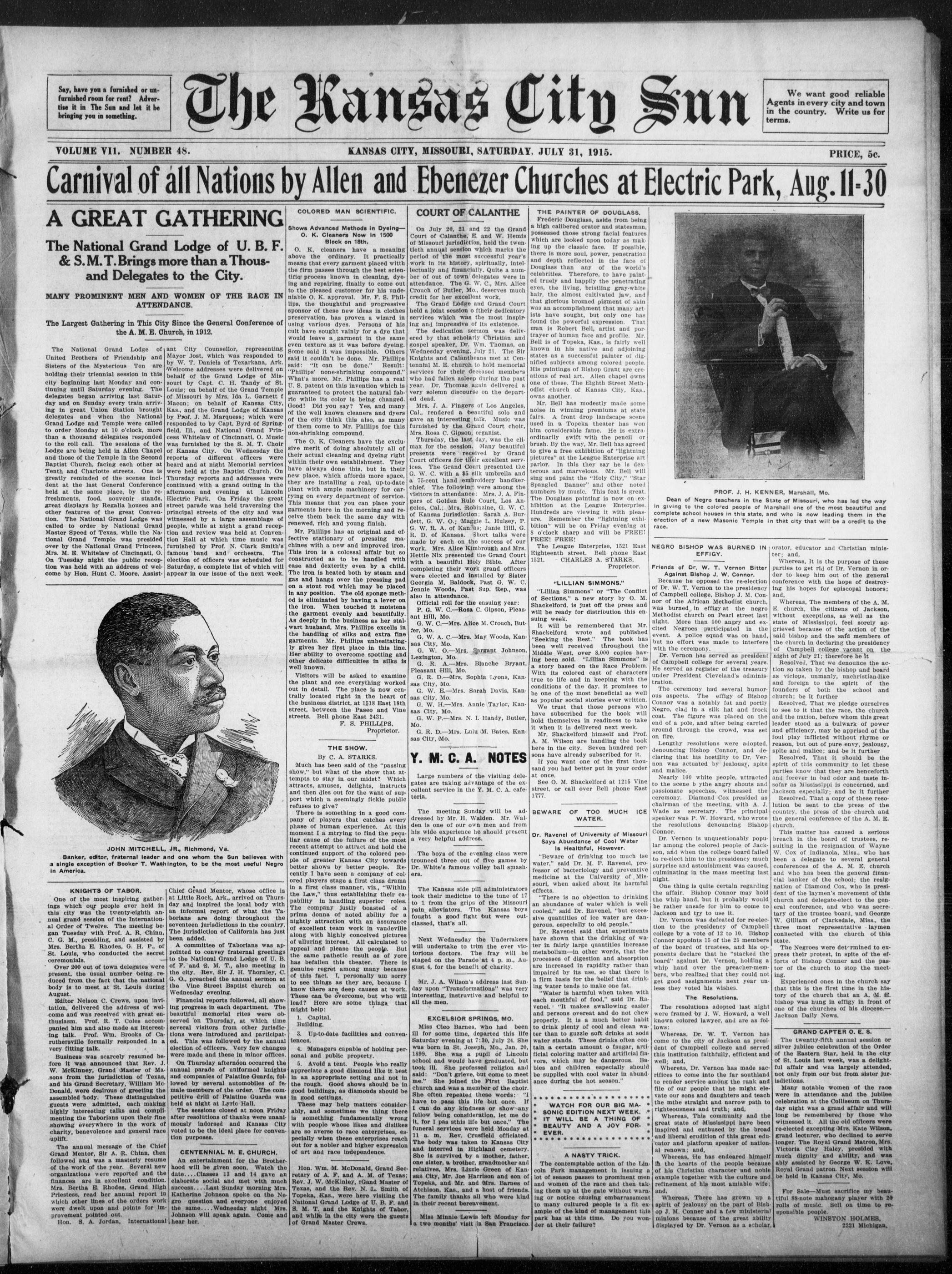
A GREAT GATHERING
The National Grand Lodge of U. B. F. & S.M. T. Brings more than a Thousand Delegates to the City.
MANY PROMINENT MEN AND WOMEN OF THE RACE IN ATTENDANCE.
The Largest Gathering in This City Since the General Conference of the A. M. E. Church, in 1912.
The National Grand Lodge of United Brothers of Friendship and Sisters of the Mysterious Ten are holding their triennial session in this city beginning last Monday and continuing until Saturday evening. The delegates began arriving last Saturday and on Sunday every train arriving in great Union Station brought delegates and when the National Grand Lodge and Temple were called to order Monday at 10 o'clock, more than a thousand delegates responded to the roll call. The sessions of the Lodge are being held in Allen Chapel and those of the Temple in the Second Baptist Church, facing each other at Tenth and Charlotte streets. One is greatly reminded of the scenes incident at the last General Conference held at the same place, by the refreshments, food, souvenir stands, great displays by Regalia houses and other features of the great Convention. The National Grand Lodge was called to order by National Grand Master Speed of Texas, while the National Grand Temple was presided over by the National Grand Princess, Mrs. M. E. Whitelaw of Cincinnati, O. On Tuesday night the public reception was held with an address of welcome by Hunt. Hunt C. Moore, Assist
J. W.
JOHN MITCHELL, JR., Richmond, Va.
Banker, editor, fraternal leader and one whom the Sun believes with a single exception of Booker T. Washington, to be the most useful Negro in America.
KNIGHT9 OF TABOR.
One of the most inspiring gatherings which our people ever held in this city was the twenty-eighth annual grand session of the International Order of Twelve. The meeting began Tuesday with Prof. A. R. Chinn, C. G. M., presiding, and assisted by Mrs. Bertha E. Rhodes, G. H. P., of St. Louis, who conducted the secret ceremonials. Over 200 out of town delegates were present, the usual number being reduced from the fact that the national body is to meet at St. Louis during August.
Editor Nelson C. Crews, upon invitation, delivered the address of welcome and was received with great enthusiasm. Prof. R. T. Coles accompanied him and also made an interesting talk. Prof. Wm. Brooks of Carruthersville formally responded in a very fitting talk.
Business was scarcely resumed before it was announced that Rev. J. W. McKinney, Grand Master of Masons from the jurisdiction of Texas, and his Grand Secretary, William McDonald, were desirous of greeting the assembled body. These distinguished guests were admitted, each making highly interesting talks and complimenting the Taborians upon their fine showing everywhere in the work of charity, benevolence and general race uplift.
The annual message of the Chief Grand Mentor, Sir A. R. Chinn, then followed and was a masterly resume of the work of the year. Several new organizations were reported and the finances are in excellent condition. Mrs. Bertha E. Rhodes, Grand High Priestess, read her annual report in which other lines of the orders work were dwelt upon and points for improvement pointed out. Hon. S. A. Jordan, International
CE
An hood of date. elabor success Katha gro on the se Johns hear
The Kansas City Sun
ant. City Counsellor, representing Mayor Jost, which was responded to by W. T. Daniels of Texarkana, Ark. Welcome addresses were delivered on behalf of the Grand Lodge of Missouri by Capt. C. H. Tandy of St. Louis; on behalf of the Grand Temple of Missouri by Mrs. Ida L. Garnett of Macon; on behalf of Kansas City Kas., and the Grand Lodge of Kansas by Prof. J. M. Marquess; which were responded to by Capt. Byrd of Spring field, Ill., and National Grand Princess Whitelaw of Cincinnati. O. Music was furnished by the S. M. T. Choir of Kansas City. On Wednesday the reports of different officers were heard and at night Memorial services were held at the Baptist Church. On Thursday reports and addresses were continued with a grand outing in the afternoon and evening at Lincoln Electric Park. On Friday the great street parade was held traversing the principal streets of the city and was witnessed by a large assemblage of people, while at night a grand reception and review was held at Convention Hall at which time music was furnished by Prof. N. Clark Smith's famous band and orchestra. The election of officers was scheduled for Saturday, a complete list of which will appear in our issue of the next week
gas and have on a stout in any position od is elimin the iron. W the garment As deeply in wart husband the handling garments. ly gives her Her ability other delicacy well known Visitors to the plant out in detail trally locate the business street, between streets. By Much has show," but tempts to s attracts, and then d port which refuses to o There is pany of phase of h moment I liar cause
Chief Grand Mentor, whose office is at Little Rock, Ark, arrived on Thursday and inspired the local body with an informal report of what the Taborians are doing throughout the seventeen jurisdictions in the country. The jurisdiction of California has just been added. A committee of Taborians was appointed to convey fraternal greetings to the National Grand Lodge of U. B. of F. and S. M. T., also meeting in the city. Rev. Srl J. H. Thornley, C. G. O., preached the annual sermon at the Vine Street Baptist church on Wednesday evening.
Financial reports followed, all showing progress in each department. The beautiful memorial rites were observed on Thursday, at which time several visitors from other jurisdictions were introduced and participated. This was followed by the annual election of officers. Very few changes were made and these in minor offices.
On Thursday afternoon occurred the annual parade of uniformed knights and companies of Palatine Guards, followed by several automobiles of female members of the order. The competitive drill of Palatine Guards was held at night at Lyric Hall.
The sessions closed at noon Friday after resolutions of thanks were unanimously indorsed and Kansas City voted to be the ideal place for convention purposes.
CENTENNIAL M. E. CHURCH
An entertainment for the Brotherhood will be given soon. Watch the date....Classes 13 and 14 gave an elaborate social and met with much success....Last Sunday morning Mrs. Katherine Johnson spoke on the Negro question and everyone enjoyed the same....Wednesday night Mrs. Johnson will speak again. Come and hear her.
Hon. Wren retary of Rev. J. W. Texas, and Topeka, K. National G. S. M. T. and while of Grand I.
COLORED MAN SCIENTIFIC.
Shows Advanced Methods in Dyeing-
O. K. Cleaners Now in 1500
Years
O. K. cleaners have a meaning above the ordinary. It practically means that every garment placed within the firm passes through the best scientific process known in cleaning, dyeing and repairing, finally to come out to the pleased customer for his undeniable O. K. approval. Mr. F. S. Phillips, the thoughtful and progressive sponsor of these new ideas in clothes preservation, has proven a wizard in using various dyes. Persons of his cult have sought vainly for a dye that would leave a garment in the same even texture as it was before dyeing. Some said it could not be done. Mr. Phillips said: "it can be done." Result: "Phillips' none-shrinking compound." What's more, Mr. Phillips has a real U. S. patent on this invention which is guaranteed to protect the natural fabric while its color is being changed. Did you say? Yes, and many of the well known cleaners and dyers of the city think this also, as many of them come to Mr. Phillips for this non-shrinking compound.
The O. K. Cleaners have the exclusive merit of doing absolutely all of their actual cleaning and dyeing right within their own establishment. They have always done this, but in their new place, which affords more space, they are installing a real, up-to-date plant with ample machinery for carrying on every department of service. This means that you can place your garments here in the morning and receive them back the same day with renewed, rich and young finish.
Mr. Phillips has an original and effective stationary of pressing machines with a new and improved iron. This iron is a colossal affair but so constructed as to be handled with ease and dexterity even by a child. The iron is heated both by steam and gas and hangs over the pressing pad on a stout rod which may be placed in any position. The old sponge meth od is eliminated by having a lever on the iron. When touched it moistens the garment evenly and beautifully. As deep in the business as her stalwart husband, Mrs. Phillips excels in the handling of silks and extra fine garments. Mr. Phillips unhesitatingly gives her first place in this line. Her ability to overcome spotting and other delicate difficulties in silks is well known.
Visitors will be asked to examine the plant and see everything worked out in detail. The place is now centrally located right in the heart of the business district, at 1518 East 18th street, between the Paseo and Vine streets. Bell phone East 2431.
Much has been said of the "passing show," but what of the show that attempts to stay in our midst? Which attracts, amuses, delights, instructs and then dies out for the want of support which a seemingly fickle public refuses to give?
There is something in a good company of players that catches every phase of human experience. At this moment I a mtrying to find the peculiar cause of the failure of the most recent attempt to attract and hold the continued support of the colored people of greater Kansas City towards better shows by better people. Recently I have seen a company of colored players stage a first class drama in a first class manner, viz., "Within the Law," thus establishing their capability in handling superior roles. The company justly boasted of a prima donna of noted ability for a nightly attraction with an assurance of excellent team work in vaudeville along with highly conceived pictures of alluring interest. All calculated to appeal and please the people. But the same pathetic result as of yore has befallen this theater. There is genuine regret among many because of this fact. I, personally am sorry to see things as they are, because I know there are deep causes at work. These can be overcome, but who will lead? Here are some things that might help:
3. Up-to-date facilities and conveniences.
4. Managers capable of holding personal and public property.
5. Avoid a tent. People who really appreciate a good diamond like it best in an appropriate setting and not in the rough. Good shows should be in good buildings, as diamonds should be in good settings.
These may help matters considerably, and sometimes we thing there is something fundamentally wrong with people whose likes and dislikes are so averse to race enterprises, especially when these enterprises reach out for a nobler and higher expression of art and race independence.
Hon. Wm. M. McDonald, Grand Secretary of A. F. and A. M. of Texas; Rev. J. W. McKinley, rGand Master of Texas, and the Rev. N. L. Smith of Topeka, Kas., were here visiting the National Grand Lodge of U. B. F. and S. M. T. and the Knights of Tabor, and while in the city were the guests of Grand Master Crews.
KANSAS CITY, MISSOURI, SATURDAY, JULY 31, 1915.
F. S. PHILLIPS. Proprietor.
By C. A. STARKS.
Building.
COURT OF CALANTHE
On July 20, 21 and 22 the Grand Court of Calanthe, E. and W. Hemis of Missouri jurisdiction, held the twentieth annual session which marks the period of the most successful year's work in its history, spiritually, intellectually and financially. Quite a number of out of town delegates were in attendance. The G. W. C., Mrs. Alice Crouch of Butler, Mo., deserves much credit for her excellent work.
The Grand Lodge and Grand Court held a joint session o their dedicatory services which was the most inspiring and impressive of its existence.
The dedication sermon was delivered by that scholarly Christian and gospel speaker, Dr. Wm. Thomas, on Wednesday evening, July 21. The Sir Knights and Calantheans met at Centennial M. E. church to hold memorial services for their deceased members who had fallen asleep during the past year. Dr. Thomas again delivered a very solemn discourse on the departed dead.
Mrs. J. A. Fingers of Los Angeles, Cal., rendered a beautiful solo and gave an interesting talk. Music was furnished by the Grand Court choir, Mrs. Rosa C. Gibson organist.
Thursday, the last day, was the climax for the session. Many beautiful presents were received by Grand Court officers for their excellent services. The Grand Court presented the G. W. C. with a $5 silk umbrella and a 75-cent hand embroidery handkerchief. The following were among the visitors in attendance: Mrs. J. A. Fingers of Golden Rule Court, Los Angeles, Cal.; Mrs. Robinize, G. W. C. of Kansas jurisdiction: Sarah A. Burdett, G. W. O.; Maggie L. Hulsey, P. G. W. R. A. of Kansas; Janie Hill, G. R. D. of Kansas. Short talks were made by each on the success of our work. Mrs. Alice Kimbrough and Mrs. Hettie Nix presented the Grand Court with a beautiful Holy Bible. After completing their work grand officers were elected and installed by Sister Georgia M. Baldock, Past G. W. C. Jennie Woods, Past Sup. Rep., was also in attendance.
Official roll for the ensuing year:
P. G. W. C.—Rosa C. Glipson, Please ant Hill, Mo.
G. W. C.—Mrs. Alice M. Crouch, Butter, Mo.
G. W. A. C.—Mrs. May Woods, Kansas City, Mo.
G. W. O.-Mrs. Sargant Johnson Lexington, Mo.
G. R. A.—Mrs. Blanche Bryant
Pleasant Hill, Mo.
G. R. D.—Mrs. Sophia Lyons, Kan
sas City, Mo.
G. W. E.—Mrs. Sarah Davis, Kan
sas City, Mo.
G. W. H.—Mrs. Annie Taylor, Kan
sas City, Mo.
G. W. P.—Mrs. N. I. Handy, Butler,
Mo.
G. R. D.—Mrs. Lulu M. Bates, Kansas City, Mo.
Y. M. C. A. NOTES
Large numbers of the visiting delegates are taking advantage of the excellent service in the Y. M. C. A. cafeteria.
The meeting Sunday will be addressed by Mr. H. Walden. Mr. Walden is one of our own men and from his wide experience he should present a very helpful address.
The boys of the evening class were trounced three out of five games by Dr. White's famous volley ball smashers.
The Kansas side pill administrators took their medicine to the tune of 17 to 1 from the grips of the Missouri pain alleviators. The Kansas boys fought a good fight but were out classed, that's all.
Next Wednesday the Undertakers will undertake to trim the ever victorious doctors. The fray will be staged on the Parade at 4 p. m., August 4, for the benefit of charity.
Mr. J. A. Wilson's address last Sunday upon "Transformations" was very interesting, instruvtive and helpful to all the men.
EXCELSIOR SPRINGS, MO.
Miss Cleo Barnes, who had been ill for some time, departed this life Saturday evening at 7:30, July 24. She was born in St. Joseph, Mo., Jan. 20, 1899. She was a pupil of Lincoln school and would have graduated, but took ill. She professed religion and said: "Don't grieve, but come to meet me." She joined the First Baptist church and was a member of the choir. She often repeated these words: "I have to pass this life but once. If I can do any kindness or show any fellow being consideration, let me do it, for I pas sthis life but once." The funeral services were held Monday at 11 a.m. Rev. Crustfield officiated. The body was taken to Kansas City and interred in Highland cemetery. She is survived by a mother, father, one sister, a brother, grandmother and relatives, Mrs. Lizzie Green of Kansas City, Mr. Joe Harrison and son of Topeka, and Mr. and Mrs. Barnes of Atchison, Kas., and a host of friends. The family thanks all who were kind in their recent bereavement.
Miss Minnie Lewis left Monday for a two months' visit in San Francisco
THE PAINTER OF DOUGLASS.
Frederic Douglass, aside from being a high calibrated orator and statesman, possessed those strong facial features which are looked upon today as making up the classic face. If possible, there is more soul, power, penetration and depth reflected in the face of Douglass than any of the world's celebrities. Therefore, to have painted truly and happily the penetrating eyes, the living, bristling gray-white hair, the almost cultivated jaw, and that glorious browzed pigment of skin was an accomplishment that many artists have sought, but only one has found the powerful expression. That man is Robert Bell, artist and portrayer of human face and profile. Mr. Bell is of Topeka, Kas., is fairly well known in his native and adjoining states as a successful painter of dignified subjects among colored people. His paintings of Bishop Grant are creations of real art. Allen chapel owns one of these. The Eighth Street Methodist church of Kansas City, Kas., owns another.
Mr. Bell has modestly made some noise in winning premiums at state fairs. A front drop landscape scene used in a Topoka theater has won him considerable fame. He is extraordinarily swift with the pencil or brush. By the way, Mr. Bell has agreed to give a free exhibition of "lightning pictures" at the League Enterprise art parlor. In this say he is dexterous and marvelous. Mr. Bell will sing and paint the "Holy City," "Star Spangled Banner" and other noted numbers by music. This feat is great. The Douglass painting is now on exhibition at the League Enterprise. Hundreds are viewing it with pleasure. Remember the "lightning exhibition" will be on Friday evening at 8 o'clock sharp and will be FREE! FREE! FREE!
The League Enterprise, 1521 East Eighteenth street. Bell phone East 1521. CHARLES A. STARKS,
"LILLIAN SIMMONS."
"Lillian Simmons" or "The Conflict of Sections," a new story by O. M. Shackelford, is just off the press and will be ready for distribution this ensuing week.
It will be remembered that Mr. Shackelford wrote and published "Seeking the Best." The book has been well received throughout the Middle West, over 8,000 copies having been sold. "Lillian Simmons" is a story based on the Race Problem. With its colored cast of characters true to life and in keeping with the conditions of the day, it promises to be one of the most beneficial as well as popular social stories ever written.
We trust that those persons who have subscribed for the book will hold themselves in readiness to take it when it is delivered next week.
Mr. Shackelford himself and Prof. A. M. Wilson are handling the book here in the city. Seven hundred persons have already subscribed for it.
If you want one of the first thousand you had better put in your order at once.
See O. M. Shackelford at 1215 Vine street, or call over Bell phone East 1777.
BEWARE OF TOO MUCH ICE WATER.
Dr. Ravenel of University of Missouri Says Abundance of Cool Water Is Healthful, However.
"Beware of drinking too much ice water," said Dr. M. P. Ravenel, professor of bacteriology and preventive medicine at the University of Missouri, when asked about its harmful effects.
"There is no objection to drinking an abundance of water which is well cooled," said Dr. Ravenel, "but excessive quantities of ice water are dangerous, especially to old people."
Dr. Ravenel said that experiments have shown that the drinking of water in fairly large quantities increase metabolism—in other words, that the processes of digestion and absorption are increased in rapidity rather than impaired by its use, so that there is a firm basis for the belief that drinking water tends to make one fat.
"Water is harmful when taken with each mouthful of food," said Dr. Ravenel. "It makes swallowing easier and persons overheat and do not chew properly. It is a much better habit to drink plenty of cool and clean water than to guzzle soft drinks at soda water stands. These drinks often contain a certain amount of fosugar, artificial coloring matter and artificial flavors, which may be dangerous. Babies and children especially should be supplied with cool water in abundance during the hot season."
* WATCH FOR OUR BIG MA-
* SONIC EDITION NEXT WEEK.
* IT WILL BE A THING OF
* BEAUTY AND A JOY FOR-
* EVER.
.....
A NASTY TRICK.
The contemptable action of the Lincoln Park management in issuing a lot of season passes to prominent men and women of the race and then taking them up at the gate without warning or notice causing embarrassment to many cultured people is a fit example of the kind of management this park has at this time. Do you wonder at their failure?
J. H.
PROF. J. H. KENNER, Marshall, Mo.
Dean of Negro teachers in the State of Missouri, who has led the way in giving to the colored people of Marshall one of the most beautiful and complete school houses in this state, and who is now leading them in the erection of a new Masonic Temple in that city that will be a credit to the race.
NEGRO BISHOP WAS BURNED IN EFFIGY.
orator, educator and Christian minister; and.
Whereas, It is the purpose of these parties to get rid of Dr. Vernon In or der to hear him out of the house.
Against Bishop J. W. Connor.
He joked he was the re-election of Dr. W. T. Vernon to the presidency of Campbell college, Bishop J. M. Connor of the African Methodist church, was burned in effigy at the negro Methodist church on Pearl street last night. More than 500 angry and excited Negroes participated in the event. A police squad was on hand, but no effort was made to interfere with the ceremony.
Dr. Vernon has served as president of Campbell college for several years. He served as register of the treasury under President Cleveland's administration.
The ceremony had several humorous aspects. The effigy of Bishop Connor was a notably fat and portly Negro, clad in a silk hat and frock coat. The figure was placed on the end of a pole, and after being carried around through the crowd, was set on fire.
Lengthy resolutions were adopted, denouncing Bishop Connor, and declaring that his hostility to Dr. Vernon was actuated by jealousy, spite and malice.
Nearly 100 white people, attracted to the scene b y the angry shouts and passionate speeches, witnessed the ceremony. Diamond Cox presided as chairman of the meeting, with A. J. Wade as secretary. The principal speaker was P. W. Howard, who wrote the resolutions denouncing Bishop Connor.
Dr. Vernon is unquestionably popular among the colored people of Jackson, and when the college board failed to re-elect him to the presidency much surprise and astonishment was caused, culminating in the mass meeting last night.
One thing is quite certain regarding the affair. Bishop Connor may hold the whip hand, but it probably would be rather unsafe for him to come to Jackson and try to use it.
Dr. Vernon was defeated for re-election to the presidency of Campbell college by a vote of 12 to 10. Bishop Connor appoints 15 of the 25 members of the board of trustees, and his opponents declare that he "stacked the board" against Dr. Vernon, holding a whip hand over the preacher-members, who realized that they could not get good assignments next year unless they voted his wishes.
The Resolutions.
The resolutions adopted last night were framed by J. W. Howard, a well known colored lawyer, and are as follows:
Whereas, Dr. W. T. Vernon has come to the city of Jackson as president of Campbell college and served this institution faithfully, efficient and well; and,
Whereas, Dr. Vernon has made sacrifices to come into the far southland to render service among the rank and file of our people that he might elevate our sons and daughters and teach the mthe straight and narrow path to righteousness and truth; and,
Whereas, This community and the great state of Mississippi have been inspired and enthused by the broad and liberal erudition of this great educator and platform speaker of national renown; and,
Whereas, He has endeared himself in the hearts of the people because of his Christian character and noble example together with the culture and refinement of his most amiable wife; and,
Whereas, There has grown up a spirit of jealousy on the part of Bishop J. M. Conner and a few ministerial minions because of the great ability displayed by Dr. Vernon as a scholar,
We want good reliable Agents in every city and town in the country. Write us for terms.
k, Aug. 11-30
State of Missouri, who has led the way Marshall one of the most beautiful and and who is now leading them in the in that city that will be a credit to the orator, educator and Christian minister; and,
Whereas, It is the purpose of these parties to get rid of Dr. Vernon in order to keep him out of the general conference with the hope of destroying his hopes for episcopal honors; and,
Whereas, The members of the A. M. E. church, the citizens of Jackson, without exceptions, as well as the state of Mississippi, feel sorely aggrieved because of the action of the said bishop and the saff members of the church in declaring the presidency of Campbell college vacant on the night of July 21; therefore be it
Resolved, That we denounce the action so taken by the bishop and board as vicious, unmanly, unchristian-like and foreign to the spirit of the founders of both the school and church; be it further
Resolved, That we pledge ourselves to see to it that the race, the church and the nation, before whom this great leader stood as a bulwark of power and efficiency, may be apprised of the foul play inflicted without rhyme or reason, but out of pure envy, jealous, spite and malice; and be it further
Resolved. That it should be the spirit of this community to let these parties know that they are henceforth and forever in bad odor and taste insofar as Mississippi is concerned, and Jackson especially; and it be further Resolved. That a copy of these resolution be sent to the press of the country, the press of the church and the general conference of the A. M. E. church.
This matter has caused a serious breach in the board of trustees, resulting in the resignation of Wayne W. Cox of Indianola, Miss., who has been a delegate to several general conferences of the A. M. E. church and who has been the general financial banker of the school; the resignation of Diamond Cox, who is president of the laymen's movement of this church and delegate-elect to the general conference, and who was secretary of the trustee board, and George W. Gilliam of Clarksdale, Miss., the three most representative laymen connected with the church of this state.
The Negroes were determined to express their protest, in spite of the efforts of Bishop Conner and the pastor of the church to stop the meeting.
Experienced ones in the church say that this is the first time in the history of the church that an A. M. E. bishop was hung in effigy in front of one of the churches of his diocese.—Jackson Daily News.
GRAND CAPTER O. E. S.
The twenty-fifth annual session or silver jubilee celebration of the Order of the Eastern Star, held in the city of St. Louis last week, was a delightful affair and was largely attended, not only from our but from sister jurisdictions.
Many notable women of the race were in attendance and the jubilee celebration at the Colliseum on Thursday night was a grand affair and will long be remembered by those who witnessed it. All the old officers were re-elected excepting Mrs. Kate Wilson, grand lecturer, who declined to serve longer. The Royal Grand Matron, Mrs. Victoria Clay Haley, presided with much dignity and ability, and was ably assisted by George W. K. Love, Royal Grand patron. Next session will be held in Kansas City, Mo.
For Sale—Must sacrifice my beautiful $8-note mahogany player with 20 rolls of music. Sell on time to responsible people.
WINSTON HOLMES,
2221 Michigan.
PRICE. 5c.
ORGANDIE A FAVORITE MATERIAL OF THE SEASON.
Trimmings May Be As Elaborate as One Desires — Point d'Esprit Much Used for Lingerie Proceeds— Hand-Painted Goods.
Organdie is a favorite of the season, and an ideal material for petticoats. Quantities of little ruffles edged with lace or footing, sometimes picoted, or bound with very narrow ribbon, are placed one above the other to give fullness at the hem. Often old-fashioned puffing is employed between insets of valenciennes or flat lace, with a ruff at the hem only. Deep Spanish flowers of net, striped vertically with lace, make attractive petticoats, which leave the hips plain. A new idea for a net petticoat is to stripe the whole thing horizontally with casings and run pink ribbons in them, about $1\frac{1}{2}$ inches wide. The casings open at one side, and the ribbons emerge and are tied in a knot and two ends, which hang down one above the other for the whole length of the skirt. The hem is a deep, plain one. The same idea was carried out in pale pink batiste with white satin ribbons.
Another new material, or old one revived for lingerie skirts, is point d'esprit. Some frocks with gathered, unruffled skirts would be prettier with unruffled petticoats under them, and this has been provided for by the makers. A charming combination was white handkerchief linen and white point d'esprit in graduated, alternate bands. The linen was hand scalloped at each edge and embroidered with flat dots.
An inexpensive and practical idea was the use of fine white sateen, as a shadowproof petticoat under separate skirts of semilapoagel materials. One is safe in corduroy or golf cord, but white serge, contrary to expectation, proves to be disconcertingly transparent. Pique is used for these modesty-savers also, but pique has such an annoying habit of continuous shrinking with each successive trip to the laundry that sateen is a welcome substitute. White georgette crepe and white chiffon make adorable petticoats and require little trimming. A white chiffon one was plainly gathered from a hip yoke, at the edge of which there was a casing run with a three-inch pink ribbon tied in a soft dropping bow in the back. Another of crepe was pale yellow, in three tiers of knife-plaited ruffles, each one beaded by a yellow ribbon run in a casing and tied at the side. A very luxurious third was a flounced accent of flowered net that looked as if it had been painted by hand.
Hand-painted materials are not neglected. We have had many of them in soft taffeta, and they appear new in chiffon. It is a matter of consider
M
Yellow Taffeta Frock, Trimmed With Marabou, as Are the Hat and Parasol.
able difficulty to paint the latter successfully, so this material is naturally rather an expensive one. Hand-painted hats are common, not only for garden wear in brilliant colors on coarse straw, but for afternoon gowns also in grosgrain and taffeta, decorated in pastel shades, which trim the Lat without concealing any of its lines—a fashion of the season.
(Copyright, 1915, by the McClure Newspaper Syndicate.)
Gingham Hats.
For small children there are charming little hats of blue and white and pink and white checked gingham. They are made with slightly stiffened brims, round crowns and a band of white kid or stuff watered ribbon about the brim.
Swiss Afternoon Frocks.
Dotted swiss makes charming little frocks for the small girl's dress on hot summer afternoons.
SIMPLICITY IS THE KEYNOTE
At the Same Time There Is Complete
Absence of Arbitrary Rules Re-
garding Present Fashions.
The adjuncts of the toilet partake,
as does our whole scheme of dress,
of studied simplicity—the oddest of
collars, the quantest of sleeves,
pockets in all sorts of queer shapes
and places, the most out-of-way re-
vers, waist belts and buttons. Every
gown may be said to have its own
particular and exclusive sleeve, and
as to collars, their name is legion.
They must make some pretense to
being high, at any rate at the back,
but in front you may have the throats
as decollete as you please, or you
may have a V-shaped opening at the
back of your neck. There is a complete absence of arbitrary rule about
the present fashions that constitutes
one of their chief charms.
Plaited frills of muslin or lawn stand stiffly up round the neckbands of some of the newest frocks, while others have cupilce collars of plain cambric, buttoning severely up so as
USEFUL FOR KEEPING SCRAPS
Latest Model is Octagon, With Any Kind of Covering That May Suit the Fancy.
There are fashions, even in scrap baskets. Last year the linen-covered stovepipe shape was favored. This season the favorite is the octagon model, showing a variety of coverings. One of the prettiest, and certainly the daintest, for bedroom use is the covering of white cotton filet over a delicate color.
A cardboard foundation can be bought for ten cents, or the sections may be cut from cardboard at home. Eight sections are necessary, each about fifteen inches long and from four to five inches wide—according to
the size of the basket planned or the width of the lace to be used.
The dainty basket illustrated is made from sections of cardboard, measuring 15 by $ 4 \frac{1}{4} $ inches each, and covered on both sides with pale pink percaline. The bottom of the basket is similarly covered. The outer covering is of cotton fillet lace banding $ 4 \frac{1}{2} $ inches wide.
SMART CLOTHES FOR CAMP
Designers Have Given Us Costumes Eminently Suitable for Pleasures of "the Wilds."
Though many people believe that "old clothes" are the proper thing to wear in the wilds, there is no reason why any woman should make a fright of herself just because she is roughing it 400 miles from civilization. Some of the tailored camp costumes shown in the shops are as smart as formal street attire, though they allow for more picturesqueness of detail than would be in good taste on the avenue. If the camp is not pitched too far north, select a coat and skirt of brown khaki with tan leather belt and low-waisted coat having snappy patch pockets. For a colder latitude a similar suit of brown corduroy will be comfortable and attractive also.
Under the coat will be worn a manish shirt of thin flannel and tub silk; pussy-willow shirting in narrow-striped patterns or in white is a favorite for such outing blouses, which in all cases have collars that may be thrown open and decorated with the loosely knotted scarf or kerchief affected by amateur campers. Petticoats should be dispensed with and replaced with bloomers of some light but sturdy material like pongee or mohair. Khakikool, which is all-silk in weave and has strength combined with lightness, is the ideal fabric for such bloomers. The smart buttoned boot of town must be replaced by stout-soled trumping footwear. Such boots are laced and should be supplemented by leather puttees when a long hike through brambles and over rocks is in prospect.
The camping hat is preferably of felt, with a supple brim that can be dragged over the eyes to protect from the sun and over the neck to protect from trickling raindrops. A woman who detests mosquitoes and the deadly midge of Adirondack camps is taking along one of the big mantilla veils which may be thrown over the head and hat, falling below the shoulders all around. This smart adjunct of town she intends to make use of in camp and undoubtedly the big square veil will serve to keep the insects at safe distance from her complexion, as well as adding something of chic to her smart camping costume.
Black Silk Bags.
There are many tempting bargains in black silk handbags. Some of the bags sell for as little as a dollar each. They are usually lined with gayly figured silk and fitted with little pockets on the inside to hold powder puff, mirror and coin purse. The coin purse is sometimes of black silk, sometimes of the material of the lining. Sometimes it closes with a metal clasp, sometimes it is made in envelope shape and snaps shut with a ball and socket of diminutive proportions. Usually they are fitted with straps of silk for handles, sometimes with cords. Some of the bags are fitted into gate tops of metal.
A New Effect
Black and white striped linen trimmed with black lace is one of the newest effects.
partly to conceal the chin. There is yet another genus that bristles with points which dart out aggressively all round, and so on ad infinitum. As pretty a neck finish as any is the medial collar of white muslin, kept in place and fashioned in front with a narrow band of black velvet ribbon.
Brilliant Bath Mats.
Bath mats have taken on all the colors of the rainbow. For a dollar one can buy a mat in one's favorite shade—deep red, pink, brown, blue, green, yellow and violet. These mats can very well be used to repeat the color scheme of the bedroom or hall the bathroom adjoins. Some of them are made in squares, like tiles. Some have a thick, indistinct design that covers the entire mat. Some are made with borders of color and white contrasting.
New Use of Tassels
Tassels are used to trim various parts of the gown, but the most interesting use of them is to hang them on a net petitcoint and allow them to dangle below the skirt.
INTERNATIONAL
SUNDAY SCHOOL
LESSON
(By E. O. SELLERS, Acting Director of
the Moody Bible
Institute of Chicago).
QUEEN OF SHEBA VISITS SOLO
MON.
LESSON TEXT-I Kliags 10:1-10, 13.
GOLDEN TEXT—Wisdom is better than rubles. Prov. 8:11.
The visit of this wealthy queen from the region of southern Arabia has always appealed to the imaginations of men. Solomon's kingdom was at the apex of its glory. There were no wars, Israel's borders were extended and the temple and those other wonderful buildings had all been completed.
The chief value of this lesson is not in Solomon's wisdom nor in what this queen saw and heard, but rather it is in what has, is being, and will be done by Christ, of whom Solomon is a type and who seized upon all of this glory to teach us a great lesson (see Matt. 6:25-34). Caesar's famous phrase, slightly altered, is in this connection quite applicable—"I came, I saw, I (was) conquered."
I. "Hard Questions," vv. 1:3. Solomon is here a great type of Christ: (a) His greatness could not be hid (Mark 7:24). Solomon's fame filled the known world (I Kings, 4:34). The fame of Solomon's wisdom, philosophy, proverbs, poems and knowledge of God (v.1) drew to his court this queen, and we must recall that it was probably a 1,500-mile tolsose camel-back journey for her to come to his court. (b) She brought a "very great store" (v.10) of gifts, which, according to oriental custom, she presented to Solomon. Our best gift to our King is ourselves (2 Cor. 8:5). (c) She came to learn of "the name of the Lord" who had done so much for Solomon and his people; to learn wisdom for the guidance of herself and her people. We come to a King who possesses all wisdom (Mitt. 12:42). Solomon had a wonderful missionary opportunity. God is today missionary hungry people to this land from the most remote parts of the earth. Are we using our privilege to point them to the true God and to Jesus his son? This queen did not believe what she had heard (v.7) and resolved to find out for herself. In this she is a rebuke to those more favorably situated who, though constantly beholding the work of God in human hearts and lives, still say, "I do not believe." The queen of Sheba will rise up in judgment against all who refuse to "come and see" (John 1:39, 45:51; Matt. 12:42). (d) This visit is a prophecy of that day when the kings of Sheba and Seba will come with their gifts for the greater son of David (Psalm 72:10 15; Isa. 60:69). The wisdom which our king bestows is eternal life, "to know him" (Prov. 2:26; John 17:3) (e) Our king is ready to answer "hard questions" provided they are honest and sincere (John 4:29; 7:17). He courts investigation. In exchange for her gifts the queen carried away much treasure (v.13; Isa. 55:1; Luke 4:18). In like manner her servants were profited. Even so men today are profited in basket and store by their associations with those who pay court to our lord and king. She also "communed" with Solomon "all that was in her heart." Such communion with Chris our king is the privilege of every seeking, trustful heart.
11. "Had Seen All," vv. 4-7. When she had listened to Solomon's wisdom and heard the answers to her questions, the solutions to her problems, and had witnessed the wonders of his temple, court and ministers, "there was no more spirit (breath) in her." (Cf. Josh. 5:1). And similar experience came to those three who went to the Mount of Transfiguration with Jesus. Solomon's wisdom is fulfilled in Christ (Col. 2:3). "The house that he built" is a type of that temple he is building of living stones (I Peter 2:4, 5; Matt. 16:18). "The meat of his table" is excelled by the food on our king's table, the word of life (Jer. 15:16; Ps. 119:103), his own body (John 6:55). Our king, too, has his servants (Eph. 2:6; Rev. 3:21). Their "appeal" is not to be compared with the "robe of his righteousness" and our "standing" (2 Cor. 5:21) is more exalted than that of any1 at Solomon's, or other earthly courts. We are not servants but "friends," yet we are "his ministers" (Rev. 5:10; I Pet. 2:9). Various translations suggest (v. 5), "and his burnt offering which he offered in the house of the lord." We have one whose offering of himself was far more comprehensive (Heb. 9:11-14; 10:10-14). The queen was compelled to admit that the evidence of her eyes of the glories were even more incredible than the fame which had reached her far off court for said she, "the half has not been told me." All who really come to know Christ make these words their testimony. It was a true report and she nobly知 knowledge the same without env Such testimony is pleasing to our king.
111. Praises, vv. 8: 19, 13. (1) By testimony, vv. 8, 9. "Happy are thy men" who listen to such wisdom, who dwell in the midst of such achievements. One of the greatest joys is to converse with the wise and the good. Our happiness is in our privilege of standing before Christ and to hear his wisdom (Luke 10: 39: 42; Prov. 12: 20; 3: 13, 14); no servant is debarred (John 12: 26). The queen glorified the source of Solomon's glory, which was all the gift of Jehovah's grace (see 2 Sam. 12: 24, 2b R. v. marg. Marg. 12: 25; Isa. 1a. 26). She did not see the oppression of the people, the temptation to luxury and the decline in religious life which so soon led to decay after Solomon's death. When our king shall reign he will "do judgment and justice." Jehovah still loves his Israel and will one day make the returning Christ their king (Rom. 11: 16). (2) By gifts (vv. 10, 13).
AFRO-AMERICAN CULLINGS
The president's proclamation bespelling interest in the exposition at Richmond organized under the auspices of the Negro Historical and Industrial association is an evidence in itself of the extraordinary progress of that race in America since the door of opportunity was opened. It is the voice of all the people, white and black, and will bear good fruit. Only a thoroughly worthy object could have brought from the chief executive such a deliverance.
The display at Richmond represented less than half a century of building along the lines of intelligent system and study. For not until a few years after the war closed did the Negro get fairly started on the road to individual effort and thrift. He was for a time in the clutches of the politicians, some pulling this way and some that, but none pulling for him. It was in the early 70s that he finally got his proper bearings and began to show under friendly leadership his capacity for good work and good citizenship. Since then he has done much; and all true men appreciate the performance, and wish him success in his further like course.
The Negro is in America to stay. All the shallow outgivings of futile dreamers and selfish schemers about deportation have ceased. Neither the intelligent Negro nor the intelligent white man was missed. Both could appraise the real situation, and did appraise it at its right value. America, never more so than now, is opportunity for the man who wants to make himself useful, qualifies to that end and applies what he learns and saves what he earns. The Negro should be not only industrious but patient. Half a century is scarcely more than a day in reckoning the advancement and achievements of a race. But it is the first steps that count; and since his feet were set in the right path the Negro's steps have been steady and assuring.
Reference, of course, is to the Negro who respects himself and solicits by his conduct the respect of his white neighbors. When he does that he prospers. When he does his duty by himself he does it by others; and here he sees himself able to command the sympathy and recognition of the highest official of the government, speaking for all who live under the government and know the benefits of its protection.
Some idea of the abounding good will of the people of Alabama toward the Tuskegee Normal and Industrial institute, located in the Black belt of Alabama, is found in the fact that each year finds large crowds of prominent white visitors from surrounding villages and the larger cities of the state attending the annual commencement exercises. This year, in addition to other visitors, the Automobile club of the chamber of commerce of Montgomery, Ala., came in a body to the school.
There were more than a hundred of these important business and professional men, with their families, and it was probably the first time in the history of the South that two such important white organizations have paid honor to a Negro institution by attending the commencement exercises in a body.
As has been often pointed out, every man has his little distinction. John Klopfer hasn't had the back of his neck shaved in 30 years.
A record of Negro progress is given in the new Negro Year Book for 1914-15, a volume of over 400 pages. We learn here on the basis of the figures of Dr. H. K. Carroll of the Federal Council of Churches and of the census bureau, that there are 38,300 Negro churches in the United States, with 4,250,000 members, and 1,740,099 Sunday school scholars. The property held by these churches reaches a total of near $57,000,000, while they contribute $100,000 to foreign and $200,000 to home missionary work. While Negro Christians are chiefly Protestant, there are four colored Roman Catholic priests in the United States, and one Greek Catholic. Northwestern Christian Advocate.
The census bureau is about to issue a bulletin on Negroes. We are told it indicates that there has been an increased tendency among them toward home ownership, a marked increase in the percentage of school attendance, a pronounced decrease in the percentage of illiteracy, a decrease in the mortality rate, and an increase in the proportion of church attendance. —The Living Church.
A boycott of French, English and Belgian goods is being proposed in the Vienna papers, and most of the foreign signs in front of the shops are being replaced by German inscriptions. A permanent purification of the language in this respect is being urged.
Arthur Wardwell of Skohegan, Me., is said to have the largest elm tree in the country. It measures 18 feet in circumference, more than 75 feet in height and the branches spread nearly 50 feet.
Chancellor's Salaries.
Sir Stanley Duckmaster as lord chancellor in the British coalition cabinet will be better paid for his services than his predecessors under the Plattagenets, when, according to J. B. Carter's "History of English Legal Institutions," the chancellor "ranked as a humble personage. He apparently resided in the palace and had a daily allowance of five shillings, a simnel, two seasoned simmels, one sextary of clear wine, one sextary of household wine, one large wax candle and 40
The White House issued the following proclamation, signed by President Wilson, heartily commending the Negro National exposition held in Richmond. It follows:
By the President of the United States of America.
A national exposition in commemoration of the achievements of the Negro race during the last fifty years will be held in Richmond, Va., July 5 to 25, 1915. The occasion has been recognized as of national importance by congress through an appropriation of $55,000 to aid in its promotion and consummation. This sum is being expended by the terms of the appropriation under the direction of the governor of Virginia. The exposition is under the auspices of the Negro Historical and Industrial association. The action of congress in this matter indicates very happily the desire of the nation, as well as of the people of Virginia, to encourage the Negro in his efforts to solve his industrial problem. The national Negro exposition is designed to demonstrate his progress in the last fifty years and to emphasize his opportunities. As president of the United States I bespeak the active interest of the nation in the exposition and trust that every facility will be extended to the leaders, whose earnest work has made the undertaking possible.
In witness whereof, I have hereunto set my hand and caused the seal of the United States to be affixed.
Done at the city of Washington this 1st day of July, in the year of our Lord one thousand nine hundred and fifteen, and of the independence of the United States of America the one hundred and thirty-ninth.
WOODROW WILSON.
By the president.
(Seal) ROBERT LANSING
A clinic for colored mothers was organized at the Children's Homeopathic hospital, Franklin and Thompson streets, Philadelphia, and the initial lecture was delivered by Mrs. Margaret Simon, the superintendent of social work at the hospital. So great has been the attendance at the weekly lectures for mothers on Friday afternoons that the hospital was obliged to establish two additional clinics—one on Wednesday for the mothers of sick babies and the third for colored mothers and babies.
The attendance was larger than the nurses had provided for. Colored women from all parts of the city, and even from Chester, Camden, Haddonfield and other places, came and all had at least one baby; some of them as many as three. There was probably never a brighter lot of babies at the clinic, according to the attendant nurses, and certainly never a better-dressed set of infants. The interest of the mothers was so intent that the physicians regard this clinic as one of the most promising in the city.
Mrs. Simon gave the mothers an informal talk, telling them of the purposes of the clinic and the advantage to be derived from attending it regularly and following the instruction given for the care of the babies. She explained the fundamental care of the babies, giving them plenty of food, easily digested food, proper exercises and allowing them plenty of water, and warned the mothers against "dope" remedies.
Emancipation day was celebrated by the Negroes of Houston and Harris county Saturday, June 19, with a street parade of decorated floats and exercises and entertainment at Emancipation park. The celebration this year, in the ojinion of those in charge, ellipsed those of former years. At a meeting 'Friday night a number of additional decorated floats were entered for the parade. A resolution indorsing Hubert, Miller, Martimer, Sweatt, Crawford and Glimore was read at the meeting. The celebration lasted three days. A number of orations were delivered at the park and the Emancipation proclamation was read.
The Los Angeles municipal markets, established last year, are said to have met the approval of householders to such an extent that 25,000 people on market days come with their own baskets to carry their purchases home.
Eph Wiley, who has followed the incidents of the war closely, says an ignorant man is one who gets his information from the news sent out of Petrograd.
When writing, Confucius used a small brush, like a camel's-hair brush, for a pen, and so did his ancestors for centuries before his time. The reed came into use for writing in the marshy countries of the Orient. It was hollow and cut in short lengths.
Greece is practically without home industries, says a consular report, and because of the outbreak of the war any first-class article of American manufacture could be sold there now if properly brought to the attention of the buyers.
pieces of candle. The money allowance was made only if he dined out; if he dined at home he got three and sixpence, with a slight variation in the other commodities. . . . He kept the king's soul and the king's seal."—London Chronicle.
Beneficial Fog.
A remarkable fog on the Peruvian coast is known as the "garua." It occurs in a region where rain is unknown, and supplies sufficient moisture to support vegetation.
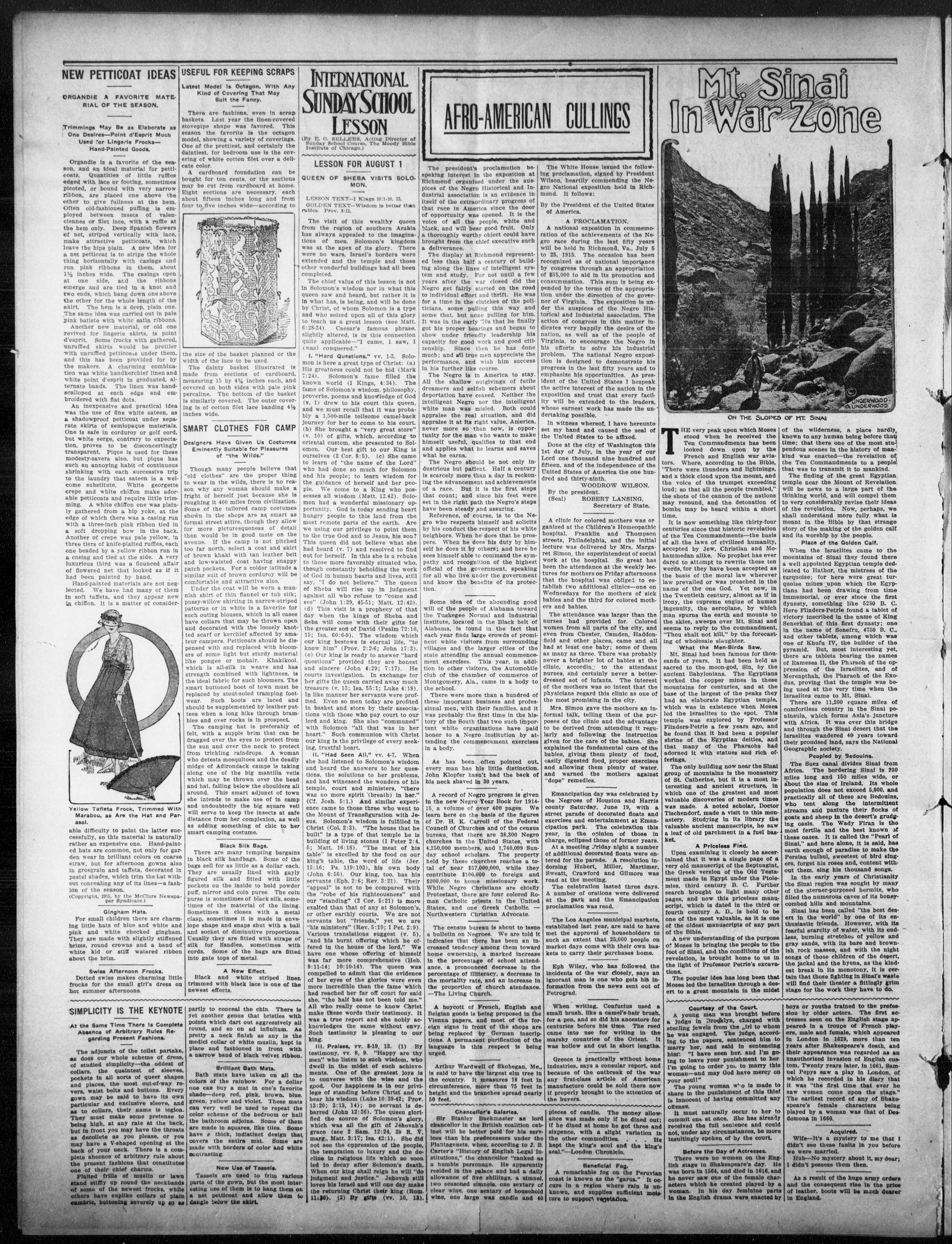
Mt. Sinai In War Zone
UNDERWOOD
UNDERWOOD
ON THE SLOPES OF MT. SINAI
THE very peak upon which Moses stood when he received the Ten Commandments has been looked down upon by the French and English war aviators. Where, according to the Bible, "There were thunders and lightnings, and a thick cloud upon the mount, and the voice of the trumpet exceeding loud; so that all the people trembled," the shots of the cannon of the nations may resound, and the detonation of bombs may be heard within a short time.
of the wilder known to any h time; that that pendous scenes kind was ena the Ten Comm that was to tra The finding temple near th will be news thinking world, to very consider of the revelati shall understa
It is now something like thirty-four centuries since that historic revelation of the Ten Commandments—the basis of all the laws of civilized humanity, accepted by Jew, Christian and Mohammed allike. No prophet has ever dared to attempt to rewrite these ten words, for they have been accepted as the basis of the moral law wherever law prevailed or was preached in the name of the one God. Yet now, in the Twentieth century, almost as if in irony, the supreme engine of human ingenuity, the aeroplane, by which man spurs the earth and mounts to the skies, sweeps over Mt. Sinai and seems to reply to the commandment, "Thou shalt not kill," by the forecasting of wholesale slaughter.
What the Men-Birds Saw.
Mt. Sinai had been famous for thousands of years. It had been held as sacred to the moon-god, Sin, by the ancient Babylonians. The Egyptians worked the copper mines in these mountains for centuries, and at the base of the largest of the peaks they had an elaborate Egyptian temple, which was in existence when Moses led the Israelites to the spot. This temple was explored by Professor Flinders-Petrie a few years ago, and he found that it had been a popular shrine of the Egyptian deities, and that many of the Pharaohs had adorned it with status and rich offerings.
The only building now near the Sinai group of mountains is the monastery of St. Catherine, but it is a most interesting and ancient structure, in which one of the greatest and most valuable discoveries of modern times was made. A noted scholar, Doctor Tischendorf, made a visit to this monastery. Studying in its library the valuable ancient manuscripts, he saw a leaf of old parchment in a fuel basket.
A. Priceless Find.
A PRIESTESS FIRST.
Upon examining it closely he ascertained that it was a single page of a very old manuscript of the Septuagint, the Greek version of the Old Testament made in Egypt under the Ptolemies, third century B. C. Further search brought to light many other pages, and now this priceless manuscript, which is dated in the third or fourth century A. D., is held to be one of the most valuable, as it is one of the oldest manuscripts of any part of the Bible.
A new understanding of the purpose of Moses in bringing the people to the foot of Sinai, and the conditions of the revelation, is brought home to us in the light of Professor Petrie's excavations.
The popular idea has long been that Moses led the Israelites through a desert to a great mountain in the midst
Courtesy of the Court
Courtesy of the court
A young man was brought before a judge in Brooklyn, charged with stealing jewels from the girl to whom he was engaged. The judge, according to the papers, sentenced him to marry her, and said in sentencing him: "I have seen her, and I'm going to leave your punishment to her. I'm going to order you, to marry this woman—and may God have merely on your soul"
The young woman who is made to share in the punishment of this theft is innocent of having committed any offense.
It must naturally occur to her to commit one at once. She has already received the full sentence and could not, under any circumstances, be more insultingly spoken of by the court.
Before the Day of Actresses.
There were no women on the English stage in Shakespeare's day. He was born in 1564, and died in 1616, and he never saw one of the female characters which he created played by a woman. In his day feminine parts in the English drama were enacted by
of the wilderness, a place hardly known to any human being before that time; that there one of the most stupendous scenes in the history of mankind was enacted—the revelation of the Ten Commandments to a people that was to transmit it to mankind.
The finding of the great Egyptian temple near the Mount of Revelation will be news to a large part of the thinking world, and will compel them to very considerably revise their ideas of the revelation. Now, perhaps, we shall understand more fully, what is meant in the Bible by that strange story of the making of the golden calf and its worship by the people.
Place of the Golden Calf.
Place of the Golden Cannon.
When the Israelites came to the mountains of Sinai they found there a well appointed Egyptian temple dedicated to Hathor, the mistress of the turquoise; for here were great turquoise mines upon which the Egyptians had been drawing from time immemorial, or ever since the first dynasty, something like 5280 B. C. Here Flinders-Petrie found a tablet of victory inscribed in the name of King Senerkhat of this first dynasty; one in the name of Sonerfu, 4750 B. C., and other tablets, among which was one of Khufu IV, the builder of the pyramid. But, most interesting yet, there are tablets bearing the names of Ramesses II, the Pharaoh of the oppression of the Israelites, and of Merenthap, the Pharaoh of the Exodus, proving that the temple was being used at the very time when the Israelites came to Mt. Sinai.
There are 11,200 square miles of comfortless country in the Sinai peninsula, which forms Asia's juncture with Africa. It was over this bridge and through the Sinai desert that the Israelites wandered 40 years toward their promised land, says the National Geographic society.
Peopled by Sedouins.
Peopled by Sedgems.
The Suez canal divides Sinal from Africa. The bordering Sinal is 230 miles long and 150 miles wide, or about the size of Ireland. Its whole population does not exceed 5,000, and practically all of these are Bedouins, who tent along the intermittent streams and pasture their flocks of goats and sheep in the desert's grudging oasis. The Wady Firan is the most fertile and the best known of these oases. It is called the "Pearl of Sinal," and here alone, it is said, has earth enough of paradise to make the Persian bulbul, sweetest of bird singers, forget his roses and, content without them, sing his thousand songs.
In the early years of Christianity the Sinal region was sought by many of the sterner-purposed hermits, who filled the numerous caves of its honey-combed hills and mountains.
Sinali has been called "the best deart in the world" by one of its enthusiastic friends. However, with its fearful scarcity of water, with its endless, burning stretches of yellow and gray sands, with its bare and brownish rock masses, and with the night songs of those children of the desert, the jackal and the hyena, as the kindest break in its monotony, it is certain that those fighting in Sinali's waste will find their theater a fittingly grim stage for the work they have to do.
boys or youths trained to the profession by older actors. The first actresses seen on the English stage appeared in a troupe of French players, male and female, which appeared in London in 1629, more than ten years after Shakespeare's death, and their appearance was regarded as an unauthorised invasion of English custom. Twenty years later, in 1661, Samuel Pepys saw a play in London, of which he recorded in his diary that it was "the first time that ever he saw women come upon the stage." The earliest record of any Shakespeare's female characters being played by a woman was that of Desdomona in 1660.
Acquired.
Wife—It's a mystery to me that I didn't see these faults in you before we were married.
Hub—No mystery about it, my dear; I didn't possess them.
As a result of the huge army orders and the consequent rise in the price of leather, boots will be much dearer in England.
Acquired.
NEWS and GOSSIP of WASHINGTON
Why the Wives of Consuls Are Important Now
WASHINGTON.—Nowadays, before sending anybody out in the diplomatic and consular service, the state department takes special care to inquire into the antecedents of the wife of the apothecary, if he has one. It does not
thought of the man's wife, for to all appearances she seemed as good an American as he. The English government, however, was not so careless and no sooner had the consul and his wife appeared on English soil than the American government was informed that they were persona non grata on account of the German extraction of the consul's wife. There was nothing else to do but to recall them. They were on British soil just one week.
As the compensation for travelling in the consular service is only five cents a mile, the journey of this couple has proved quite expensive, to say nothing of the humiliation the incident imposed. Meantime the state department has provided a place for the consul in the service in Washington until an opening shall occur at a post not involved in the war. And these are not now many.
Crows Fight Fiercely in White House Grounds
Crows Fight Fiercely in White House Grounds
A VICIOUS fight between two crows in the White House grounds attracted such a large crowd that Policeman Gus Schraeder had to interpose and almost club the two birds before he could induce them to break away. One
they enjoy there. According to Schraeder, who is not stuck on crowns, either, a big male crow from some other reservation ventured into the White House grounds and was promptly tackled. He was game, too, and the fight started.
Persons passing along began to stop to watch the battle, and the crowd grew to large proportions. Teamsters and automobile drivers stopped their vehicles and joined the throng. Schraeder was some distance away and did not notice what was going on until the crowd grew into large proportions. Then he hustled down to the scene and went for the birds, which paid no attention to him until he actually stood over them and flourished his arms in a menacing manner.
Oldest employees of the White House grounds, where birds of all kinds make their home, never saw or heard of such a bloody scrap among feathered fighters. Crows are generally credited with being the most cowardly and cautious of all birds, and are easily whipped by a small bee marten, from which they will flee for miles if pursued. Schraeder has been much perverted over the affair, fearing that it is a bad omen of some kind.
Moon Myths Shattered by Houston's Department
Moon Myths Shattered by Houston's Department
THE department of agriculture has smashed another tradition by declaring that from a scientific standpoint the moon has no more to do with the growing of crops than it has upon the temperature, the amount of rain, the
The moon gives no virility to soil, neither does it affect the composition of atmosphere, hence the only remaining way by which it could influence plant growth is by its light. Experiments have shown that a full daylight is about 600,000 times brighter than full moonlight, yet when a plant gets one-one-hundredth part of normal daylight it thrives little better than in total darkness. If one-one-hundredth part of normal daylight is too little to stimulate a plant, the department says that it is certain that one-six-hundredth part would impart no benefit at all.
It is added that it is a waste of time to think about the moon in this connection with the planting of crops, since it has no more to do with this than it has with the building of fences, the time for killing hogs, or any other of the innumerable things over which it was once supposed to have strong influence.
Music in Canoes Charms Potomac River Fishes
MUSIC hath charms for fish, according to an expert of the bureau of fisheries, and that if it is true fishing should be good in the Upper Potomac this summer. However, the bureau of fisheries has not installed brass bands or player pianos at points along the
The first news of Dan Cupid's latest innovation on the water alarmed the hundreds of worm diggers, who have passed the sentimental age and care not for the needs of the "spooners." They began to say one to another: "These pesky talking machines will frighten the fish to other waters and our fishing days will be over."
But the official of the bureau of fisheries disagreed with them when he heard of their pitiful wall, and reassured them, saying: "We have found that soft strains of music on the water do not frighten the fish, but on the contrary, may charm and draw them nearer." He would not promise that the fishermen's nets would be filled to the breaking point, as told in the Bible, but he at least dispelled their fears.
WHAT NATIONALITY
WAS YOUR
WIFE'S
GREAT
GROUND FATHER?
thought of the man's wife, for to all American as he. The English governmen no sooner had the consul and his wif American government was informed a account of the German extraction of else to do but to recall them. They w As the compensation for travelin cents a mile, the journey of this coul nothing of the humiliation the incident has provided a place for the con an opening shall occur at a post not not now many.
Crows Fight Fiercely in
A VICIOUS fight between two crows f such a large crowd that Policemen almost club the two birds before he c
had the other by the neck and was trying to pull his head off when Schraeder stood over the two and flourished his arms and club in such a threatening way that the grip was released and the two flew off to trees close by, making a terrible clatter about the affair.
Several families of crows have for years flourished in the White House grounds, but they seem to have formed a combination to keep other birds out of the good things they enjoy there. According to Scither, a big male crow from some otl House grounds and was promptly tac started
Persons passing along began to s grew to large proportions. Teamsters vehicles and joined the throng. Schr not notice what was going on until Then he husted down to the scene of attention to him until he actually stod in a menacing manner.
Oldest employees of the White H make their home, never saw or heard ered fighters. Crows are generally o and cautious of all birds, and are easl which they will flee for miles if pu turbed over the affair, fearing that it
Moon Myths Shattered
THE department of agriculture has that from a scientific standpoint growing of crops than it has upon th
THAT'S ALL BUNK
ABOUT THE
MOON, MYRA.
The moon gives no virility to soil, no atmosphere, hence the only remaining growth is by its light. Experiments at 600,000 times brighter than full moon hundredth part of normal daylight itness. If one-one-hundredth part of no a plant, the department says that it would impart no benefit at all.
It is added that it is a waste of connection with the planting of crops than it has with the building of fences of the innumerable things over which influence.
Music in Canoes Charm
MUSIC hath charms for fish,acco fisheries, and if that is true fishing this summer. However, the bureau of or player pianos at points along the shore for the benefit of Washington's anglers.
If the fish bite better during the summer the fishermen should thank the sentimental young folk, who have discovered a summer substitute for the tango dance hall. They have placed graphophones in their canoes, and one strolling along the banks of the river above the Aqueduct bridge these evenings hears soft strains rising here and there on the black surface.
The first news of Dan Cupid's later hundreds of worm diggers, who have not for the needs of the "spooners" "These pesky talking machines will our fishing days will be over."
But the official of the bureau of f heard of their pitiful wall, and reas that soft strains of music on the watt contrary, may charm and draw them the fishermen's nets would be filled a Bible, but he at least dispelled their f
Peculiar Power of the Iris.
The proof that the iris is a color-mirror is to be found in the fact that if a girl with pale blue eyes wishes to make them deep or ultra-marine blue, all she needs do is to wear dark blue dresses, neck ribbons, hat and other blue raiment. On the other hand, if she wishes to lighten the colors of her eyes, she should wear all white or pale yellow. Similarly black clothes and dark garments make gray and hazel or light brown eyes very dark. In fine, not only do the eyes fade and change color physiologically and intrinsically, but they can be made to alter the native tints by all sorts of human artifice.
do for an American in the service, even if his own blood be American beyond question, to have a wife who is of foreign extraction or once or twice removed. The European war will not tolerate such. The state department was recently taught the lesson through the selection of an American who had passed a splendid examination and who was assigned to an English post in the consular service. The selection seemed impracticable, but no one
appearances she seemed as good an
ment, however, was not so carcled and
life appeared on English soil than the
that they were persona non grata on
the consul's wife. There was nothing
here on British soil just one week.
g in the consular service is only five
people has proved quite expensive, to say
it imposed. Meantime the state depart-
asul in the service in Washington until
in involved in the war. And these are
In White House Grounds
In the White House grounds attracted
an Gus Schraeder had to interpose and
should induce them to break away. One
A man running away from a building.
shraeder, who is not stuck on crowns, her reservation ventured into the White skled. He was game, too, and the fight to to watch the battle, and the crowds and automobile drivers stopped their shraeder was some distance away and did the crowd grew into large proportions, and went for the birds, which paid no good over them and flourished his arms. house grounds, where birds of all kinds of such a bloody scrap among feath-credited with being the most cowardly whipped by a small bee marten, from resued. Schraeder has been much peri- by Houston's Department smashed another tradition by declaring the moon has no more to do with the e temperature, the amount of rain, the
wind, or any other element of weather. This will be a severe blow to those who have believed that potatoes in order to be a successful crop, should be planted during certain phases of the moon, or that garden truck flourishes more readily under moon influence when planted right. The department points out that growth of plants depends upon the amount of food in the soil and in the air that is available for them, and upon temperature, light and moisture.
either does it affect the composition of a way by which it could influence plant have shown that full daylight is about night, yet when a plant gets one-one-thrives little better than in total dark-ormal daylight is too little to stimulate is certain that one-six-hundredth part time to think about the moon in this, since it has no more to do with this, the time for killing hogs, or any other it was once supposed to have strong Potomac River Fishesording to an expert of the bureau of should be good in the Upper Potomac fisheries has not installed brass bands
first innovation on the water alarmed the passed the sentimental age and care They began to say one to another: Frighten the fish to other waters and fisheries disagreed with them when heured them, saying: "We have founder do not frighten the fish, but on the nearer." He would not promise that to the breaking point, as told in the cars.
Real Highbrow:
The head of a big New York business concern is exceptionally tall and his height is further accentuated by his exceeding slimness. The other day a visitor from the South called to see him and was duly asked to sit down. After they had concluded their business the visitor rose to go and his host rose also, and seemed to rise and rise. The Southerner, letting his glance travel upward, as though inspecting a new species of skyscraper, and with an expression of awed admiration, elaculated: "Great Scott, old man, your parents must have trained you on a trellis!"—Pittsburgh Chronicle-Telegraph.
RECIPE FOR DUTCH CHEESE
One of the Best Methods of Disposing of Sour Milk—Kept Dry, It Will Improve With Age.
Dutch cheese can be made from sour milk. When solid and thick the milk should be put in an agate basin or pan over a slow, gentle heat, and allowed to become scalding hot but never to boll; boiling turns the curd to a tough leathery consistence and renders it indigestible. A clean finger is the best thermometer; as the curd forms in the center of the pan and the water recedes to the edges seperate the curd carefully with the finger so that the heat will be evenly distributed through it, but do not break it up too much.
When the water or whey becomes scalding hot remove the pan from the fire, pour the contents into a cheese-cloth bag and hang it up to drain. When it has stopped dripping turn the cheese into a bowl, add salt, a generous dash, of cayenne pepper, and enough sour cream to thin it so that it may be made into balls. Keep it in a dry place where it will not mold and it will improve with age. When it becomes dry moisten it again with sour cream or the sour cream dressing. Skim all the cream off the milk before putting it in the pan, as the cream melts in the hot whey and is lost. Cayenne pepper adds largely to the tastiness as well as the digestibility of all dishes made from cream or milk and is a good stomach tonic in hot weather.
BROTHS TO START A MEAL
Preparations Are Valuable Chiefly for the Stimulating Effect They Have on the Stomach.
Broths are not particularly valuable from a nutritive standpoint, but they have a decided stimulating effect. In this way the extractives from the meat, contained in the broth, stimulate the gastric juice in the stomach and prepare it for the food which follows.
On the contrary the cheaper, inferior parts of meat yield more nutritent. The chief object in making broth is, of course, to obtain the largest possible amount of nutritent, and this is best accomplished by observing the following rules:
Cut meat in small pieces. Soak it in cold water before heating. Make a careful selection and proportion of meat, bone and water. Usually one pint of water to one pound of meat. Judicious seasoning. Long, slow cooking. Simmer (not boil) in a steam-tight kettle. Make the day before using, so that fat may be removed more easily.
Various nourishments may be added to broth—rice, barley, vermicellia, noodles and the white or whole of egg, etc. Cream soups have a greater food value.
Just one caution—when I advise broth before meats I mean not a soup platelike, but a small cupful to start the gastric juices.—Kansas City Star.
Prevents Lumpiness.
Possibly those who have kept house for a long time know, but there are many others who have difficulty in making custards, cornstarch puddings and gravies smooth if there are eggs in them.
A simple way is to remove the milk, sugar and other ingredients, supposing it is cornstarch pudding one is making, from the stove to cool enough to stop the boiling.
Dip a few spoonfuls of the hot milk into the bowl in which there are the well beaten eggs, stirring as each spoonful is added.
This heats them gradually, not allowing them to cook before they are thoroughly mixed with the milk.
Then they may be added to the larger quantity on the stove, stirred in quickly and the pudding placed over the fire to finish cooking.
Scotch Stew.
Three pounds of mutton neck cut into convenient pieces. Put two tablespoonfuls of suet into a stewpan and shake over fire until nearly melted. Remove "cracklings" and sear the mutton, stirring so all sides are browned. Push to side of pan. Blend two tablespoonfuls flour into fat, then add a quart of strained tomatoes. Stir until boiling, add one sliced onion, one bay leaf and one tablespoonful mushroom or other table sauce. Cover pan. Simmer very gently an hour and a half. Serve in a border of boiled rice. The remainder, including bones, will make an excellent soup.
Breast of Lamb.
About two and one-half pounds of breast of lamb, boiled tender in salted water; takes about two hours or a little longer to cook. Have what vegetables you like and thicken the broth for gravy. If there should be enough meat left chop and season and mold in a small, deep dish and put a weight on it. It will cut in nice thin slices for tea.
Cocoanut Buns
One pint flour, rub one-half cupul
butter into it, add one teaspoonful
of baking powder, one-half cupul of
sugar, one-fourth teaspoonful salt, one-
half cupul of shredded coconut, one
well-beaten egg and milk enough to
make a batter. Place in small pieces
on greased tin, brush over with milk,
sprinkle with cocoanut and bake in
hot oven 15 minutes.
How to Cook Asparagus
Apparagus.
Cut off the tough stalks, wash the tender parts and tie in bunches again; place in a saucepan and cover with boiling water. It will take from 20 to 30 minutes to cook it. Ten minutes before taking it up add a teaspoonful of salt for each bunch. When done serve on toast with butter sauce, or just spread with plain butter.
Strawberry Cream Pudding
Buy a package of ice cream powder, mix one-half package with one applesauce tablespoonful of cornstarch, and dissolve it in one pint of boiling milk, letting it boil until sufficiently thick and stir constantly. Serve with whipped cream. It is a pretty pink oudding.
John Henry on Goat Getting
John Henry on Goat Getting
"Why, what's the mater, Hep?" I inquired after the waiter had vamped.
"Oh, I'm wise to these guys with the Gorgonzola titles all wrapped up in pink tissue paper and only $8 in the jeans." Hep rumbled, with a glare in the direction of the Count Cheese von Cheese.
"Pop Goober certainly does make both ends meet in the lemon industry," he continued. "That old gink is the original Onion collector and he spends his waking hours falling for dead ones."
Hep paused to bite the froth off a Bronx. His goat was at the post.
"That dribbler is over here to pick out an heiress and fall in love with her because he needs the money," Hep growled as his goat got away in the lead. "Every steamer brings them over, John, some in incognito, some in dress suits, and some in hoc signo vincex, but all of them able to pick out a lady with a bank account as far as the naked eye can see.
"It's getting so now, John, that an open-face, stem-windling American has to kick four Dukes, eight Earls, seven Counts and a couple of Princes off the front steps every time he goes to call on his sweetheart—if she has money.
"When I go down into Wall street, John, I find rich men with the tears streaming down their faces while they are calling up on the telephone to see if their daughter, Gladys, is still safe at home, where they left her before they came down to business.
"Walk through a peachy palace of the rich on Fifth avenue, and what will you find?
"Answer: You will find a proud mother bowed with a great grief, and
ussian Nobleman, the Count Cheese von Cheese.
Turned Out to Be a Prussian Nobleman, the Count Cheese von Cheese. holding on to a rope which is tied to her daughter's ankle to prevent the latter from running out on the front plaza and throwing kisses at the titled foreigners.
prominent newspapers. Get this John:
"Long Island City, Now.
"Pinchem Shortface, the millionaire who made a fortune by inventing
---
HEP HARDY'S goat belongs to the chamois branch of that famous family. When it gets out it wants to leap from crag to crag. Hep's chamois got loose recently and, believe me, I never saw a goat perform to better advantage. For a long time Hep has been in love with Clarissa Goober, the daughter of Pop Goober, who made millions out of the Flowerpot Trust. Of late, however, Hep's course of true love has been running for Sweeney, and my old pal has been staring at the furniture and conversing with himself a great deal. On our way home night before last Hep and I dropped into the Saint Astormore for a cocktail, and at a table near us sat Pop Goober and something else, which afterward turned out to be a Prussian nobleman — the Count Cheese von Cheese.
When Hep got a flash of these two his goat kicked down the door of its box stall and began cavorting all over the Western Homisphere.
"Pipe!" he whispered hoarsely, "pipe Pop Goober and the human germ with him! It's a titled foreigner — honest it is! It can walk and say 'papa!' And it is trained to pick out a millionaire father-in-law at fifty paces!"
"You will find these cheap skates everywhere, John, rushing hither and thither, and sniffing the air for the odor of burning money."
Hep's goat at the quarter and going strong.
"They're all over the place, John," he rushed on. "The street cars are full of Earls and Baronets, traveling on transfers. There they are, John, sitting in the best seats and reading the newspapers until an heiress jumps aboard and hands them her address, with a memorandum of her papa's bank account.
"Then they arise with the true nobility of motion and ask that a day be set for the wedding.
"Why should it be thus, John? We have laws in this country to protect the birds and the trees, the squirrels and all animals except those that can be reached by an automobile, but why don't we have a law to protect the heiresses?
"Why are these tilted zimboes permitted to borrow car fare, and come over here and give this fair land a fit of indigestion?
"Why are they permitted to set their proud and large feet on the soil for which our forefathers fought and bled for their country and for which some of us are still fighting and bleeding the country? Why? Why do these fathats come over here with a silver cigarette case and a society directory and make every rich man in the country fasten a burglar alarm to his checkbook?"
Hep's goat at the half by a length.
"A few days ago, John, one of these mutts with an Edam title jumped off an ocean liner, and immediately the price of padlocks rose to the highest point ever known on the Stock Exchange.
"All over the country rich men with romantic daughters rushed to and fro and then rushed back again. They were up against a crisis. If you could
get near enough to the long distance telephone, John, you could hear one rich old American guy shrieking the battle cry to another captain of industry out in Indianapolis: 'To arms! The foe! The foe! He comes with nothing but his full dress suit and a blank marriage license! To arms! To arms!'
Hep's goat at the three-quarters by two lengths.
"Why, John," he exploded again, "every telegraph wire in the country is sizzling with excitement. Dispatches which would make your blood curdle with anguish and sorrow for the rich are flying all over the country. Something like this:
"Boston, Today.
"At ten thirty morning Rudolph Oscar Grabbaithe, the millionaire stone-breaker, read the startling news that a foreign Count had just landed in New York. His suffering was pathetic. His daughter, Gasoline Panatella, who will inherit $19,000,000, mostly in
"Every Time He Goes to Call on His Sweetheart."
bonds, stocks and newspaper talk, was in the dental parlor five blocks away from home when the blow fell. Calling his household about him, Mr. Grabbitall rushed into the dental parlor, beat the dentist down with his bill, dragged Gasolene Panatella home and locked her up in the rear cupboard of the spare room on the second floor of the mansion. Her teeth suffered somewhat, but, thank Heaven! her money will remain in this country. The community breathes easier, but all the incoming trains are being watched.
"Are you wise, John, to what the panhandling nobility of Europe are doing to our dear United States?
"They are putting all our millionaires on the fritz, that's what they're doing."
Hep's goat in the stretch, under wraps.
"Le'me tell you something, John: It will soon come to pass that the heiress will have to be locked up in the safe deposit vaults with papa's bank book. Here is an item from one of the most
prominent newspapers. Get this.
John:
"Long Island City, Now.
"Pinchin Shortface, the millionaire who made a fortune by inventing a way to open clams by steam, has determined that no foreign count will marry his daughter, Sudsetta. She will inherit about $192,000,000, about $18 of which is loose enough to spend.
The unhappy father is building a spite fence around his mansion which will be twenty-two feet high, and all the unmarried millionaires without daughters, to speak of, will contribute broken champagne bottles to put on the top of the fence. If the count gets Sudsetta he is more of a sparrow than her father thinks he is."
"It's pitiful, John, that's what it is, pitiful! All over the rich city rich are dropping their beloved daughters in the cyclone cells and hiding mamma's stocking with the money in it out in the hay loft.
"I am glad, John, that I am not a rich man with a daughter who is eating her heart out for a moth-covered title and a castle on the Rhinewine.
"You can bet, John, that no daughter of mine can ever marry a tall gent with a nose like the rear end of an observation car and a knowledge of the English language which doesn't get beyond I O U—do you get me?"
Hep's goats win in a walk.
"Are you all through, Hep?" I inquired feebly.
"I'm not through—but I'll take a recess," he snapped back at me.
"By the way," I said, offhand like, "Is Miss Clarissa Goober in town?"
"Yes, but she sails for Europe tomorrow on the Imperator," he answered, sullenly. "Oh." I said. "Who's going with her?"
"The Count Cheese von Cheese."
"Oh!"
Long pause.
"Let's have another Bronx," I sug-
gested.
Hep took six—one for himself and
five for the goat.
Can you blame him?
MEMORIES OF QUILTING TIME
One of Life's Simpler Pleasures That May Be Classed With Things of the Past.
Probably we don't have much of it in the cities any more, perhaps there never was much of it done in the cities, but out in the country and in the hamlets and villages and towns quilting time used to be an occasion of merriment combined with utility; it was in the early home what the log-rolling was outside; it had its place and prestige along with the sugar-making, with the husking bees and the apple cuttings, the comfort knittings and a lot of other happy functions of an earlier day.
Today we buy our comforts and our quilts and our sugar and practically everything we use; we have our corn husked in the fields either by hired hands or machinery; we live in a hurrying, labor-saving age, and maybe we have sacrificed much of quality for quantity, value for something esteemed more pleasing to our esthetic senses.
But the old-fashioned quilt, which would withstand the kicking of lusty young savages in the attic bedroom for at least a year, was some quilt. Mother and aunts, sisters and nieces, neighbors and friends came in to help make it; the home became a social center, where quilts were made and perhaps where some little gossip at the expense of absent ladies was indulged in. Usually, at such times, there was something good to eat, rather better than the ordinary bill of fare, prepared—and that's where the kids came in for a good time, though often they had to wait, like Lazarus, at the gate, or door, until their superiors had feasted, when they fell to and left not even crumbs.
Quilting time was always a fine time; perhaps the snowflakes were flying, but usually the work was done along about the time the bees were buzzing and the flowers were in bloom, with the sunbeams flashing from the flying needles.—Evanville Courier.
Land of Sickle and Sheaf.
The people in our country each need about five and a half bushels of wheat to tide them over a year. Our promised crop, approaching a billion bushels, means ten bushels for every inhabitant. This surplus is so enormous that, taken in the aggregate, it is difficult to comprehend. No other country in the world ever produced such a vast quantity of white bread material in a single year. None ever had such a huge amount to sell to foreign peoples.
During the current crop year the United States has exported about a million bushels of wheat every day, thus setting a record beyond all precedent. Moreover, the price received for it, due to the war, is far greater than the average price during the past decade. Viewed in a purely selfish light, the American farmer is doubly blessed with an unparalleled crop at the very time when wheat is dearest. Our exports of wheat have powerfully aided in building up in our favor the greatest trade balance ever accumulated in a twelve-month by any nation. If our country were a corporation and needed a trade mark, the hapiest selection would be a sickle and sheaf.-Philadelphia Leader.
Planting Sugar Can
In a recent article in the Bulletin of the Pan-American Union on cane sugar in the Americas it is stated that sugar cane is planted, not sown. A small piece of the cane, long enough to include two or three of the rings, or nodes, is laid lengthwise, or stuck in a slanting direction, along a furrow which runs the length of the field. In some sections the primitive fashion of planting in holes is still employed. When the trench is planted the pieces of cane are lightly covered with earth. In a few weeks they show growth above the ground, the germ buds at the rings having begun to shoot out in the form of young cane, the ring having at the same time thrown out outroots into the soil. The parallel trenches are made far enough apart, say at least three feet, to enable the workers, when the wide-spreading canes are getting ripe, to go between the rows and remove the dying leaves which burden the ripening cane, thereby enabling the naked cane to mature faster.
Valuable Misinformation
In the large dining room of the Hotel Marseilles halls a large equestrian painting representing Gen. Robert E. Lee. It is the mascot of the Hungry club, which has its dinners at monthly intervals at this hotel, and was painted by a member of the club. Recently a lady on the West side gave a bridge party at the hotel in aid of her pet charity. Among the players was a modern Mrs. Malaprop, a typical "climber" with considerably less education than cash. Consequently she was never backward with misinformation on most any subject that came up. During a cessation in the play one of the ladies expressed admiration of the picture and a desire to know whom it represented. It was Mrs. Malaprop's opportunity. "That, my dear," she assertively explained. "is General Marseilles, a noted Frenchman, for whom the hotel is named."—New York Times.
Safe Knife.
Customer—This penknife you sold me is so soft that the blade is dull before I get through sharpening a pencil.
Street Vender—Yah. Dat is zo ven you gomes to sharpening de point against your thumb you won't cut yourself.
Grave Possibilities
"Do you think a man' ought to appoint his relations to office?"
"No," replied Senator Sorghum. "There's no sense in complicating the destinies of a nation with the possibilities of a family quarrel."
Unexpected Happens
"All the neighbor; are laughing over what happened to Alr; Seresum."
"And what was that?"
"There was a panic at a sale of autiques she attended and she was knocked down."
HOME TOWN HELPS
DECRY THE WOODEN FENCE
Many Cities Are Working for the Abolition of What Is Generally Called a Nuisance.
War is being declared upon the wooden, tight-boarded fences which disguise the back yards and alleys of so many cities. Such fences are declared to be "time-honored breeders of fires, crime and disease," and officials of the health, police and fire departments everywhere are urging that they be prohibited by law. The wooden fence probably came into use when lumber was cheap and privacy seemed attainable by this sort of screen. But with the building of rows of two and three-story and even higher dwellings, privacy is invaded by the eye of the neighbor in the upper story and is no longer a valid excuse for the evils promoted by the wooden fence. Statistics show an unusually high percentage of serious fires in localities where the wooden fences abound. A fire starting in one block may easily be carried through a whole block by the fences.
These fences also are a great hindrance to the police. They prevent the proper inspection of a neighborhood, serve as screens behind which crimes can be committed in safety and supply hiding places for burglar and sneak thieves while waiting their opportunity to break into houses. Other charges in the indictment of the wooden fence are that it is unlucky, that it encourages the accumulation of disease-breeding rubbish and that it shuts off the light and air from what would otherwise be attractive playgrounds for children.
WOMEN WANT A CLUBHOUSE
Efforts in Tacoma Are Worth Imitation in Every Town and City in the Country.
The clubwomen of Tacoma, Wash., are making a quiet but consistent effort to have a clubhouse. Their association has already more than $1,000 in its treasury, and is constantly adding to the fund by means of entertainments, sales, subscriptions, etc.
Tacoma has a larger number of women affiliated in clubs than any other city in the state in proportion to its population, yet it has no clubhouse. In Seattle the clubwomen have a fine structure that fills many wants as a place for lectures, concerts, regular club meetings and a central gathering point, uniting the interests and efforts of women. Bellingham has two woman's clubhouses, and Olympia has a woman's clubhouse that serves many needs in the capital city.
The Tacoma women feel certain that their activities and their usefulness in civic life would be increased had they a meeting place of their own. The experience of other cities has taught them that, outside the initial expense of purchase or erection of a building, the revenues from rentals make such a clubhouse self-supporting after it is once completely paid for.
Wild Flowers in Your Garden
Wild Flowers in Your Garden.
Wild flowers, always so attractive in the spring, should be taken up later when the weather becomes warmer, with roots attached, and planted on the north side of the house, where they will bloom for years to come. If not planted on the north side they must be sheltered in some manner. Take up a considerable amount of earth with each plant and not disturb the roots any more than can be helped, and plant as soon as possible in deep trenches partially filled with fertilizer and rich garden soil, for they demand rich soil. Violets will flourish in almost any part of a garden, but the spring beauties and other fragile blossoms demand mixed shadow and sunshine. All wool ferns should be planted on the north side of the house. Maidenhair fern does best when planted in a crock and kept on the porch.
Ornamental Flower Boxes
Ornamental flower boxes placed in conspicuous places on the roof form a feature that is fast coming into favor among bungalow owners in southern California. In shape and finish these boxes are made to harmonize with the architectural treatment of the building, and when filled with plants produce a striking effect. The general use of these boxes is made possible through the fact that most of the bungalows in this section of California have flat roofs—Popular Mechanic
Muffler Should Be Used.
In several American cities societies have been formed for the prevention of unnecessary noises. It is a good idea, and should be encouraged. It is remarkable how many of our city noises are avoidable. They tend to increase nervousness, and to mar the enjoyment of life by those whose sensibilities have not been blunted.
The Contentious Kind
"Doppel seems to take a great interest in government statistics." "So I've noticed." "But I fear he's, prompted less by patriotic motives than by a desire to get a basis for an argument."
Poor Diagnosis.
"What you need," said the eminent medical man, "is more bodily activity. You should exercise your back and limbs and feet. What's your business?" "I am the leading tango expert on the champagne floor of the elite lobster palace," replied the unhappy patient—Cleveland Plain Dealer.
How It Sounded.
Bason—"What is your daughter doing at the piano?" Ephert—"Sounds as if she was setting her class yell to music."
CITY NEWS.
Mr. H. W. Twine of 3236 Wabash Ave., has returned home after a very pleasant trip.
Mrs. B. Lewis of Chicago is the guest of her aunt, Mrs. Sallie Payne, 1721 Michigan.
Miss Reberta Warring of Washing-ton, D. C., is the guest of Mrs. Lloyd E Baller, 919 Woodland.
Mrs. Mamie Shackleford of Lexing-ton, Ky., is the guest of her aunt, Mrs. Josephine Smith, 915 Woodland.
Mr. J. C. Barnes of Chicago, Ill., son of Mrs. Pryor Williams, 1308 Highland avenue, is very ill.
Miss Lucy Lee, Lee Hudspeth, G. M., and wife, of Little Rock, Ark., are guests of Mrs. Pearl Riley, 2300 Vine
Among the distinguished visitors of the week is Mrs. J. H. Kenner of Marshall, and Prof. and Mrs. A. R. Chinn of Glasgow.
Wanted—Ladies and gentlemen in all localities to solicit for magazines. Good pay to right parties. Call, write or phone. Bell East 4702. The National Pan-Medico Magazine, 1908 E. 24th st., Kansas City, Mo.
The Federation of Colored Charities will meet Saturday, July 31, at 1:00 p. m. at the office of the Board of Public Welfare, Sixth and Walnut streets.
CHOIR SUNDAY AT ALLEN CHAPEL
Sunday, August 1st, will be o Chapel, corner Tenth and Charlot under the leadership of Prof. R. G sisic at both the morning and even duets, quartettes, choruses with p minister will preach at both serv versis Force." Evening subject, " and get a good seat. Strangers w
Sunday, August 1st, will be observed as Choir Sunday at Allen Chapel, corner Tenth and Charlotte streets. Allen's famous choir under the leadership of Prof. R. G. Jackson will render special music at both the morning and evening services, consisting of solos, duets, quartettes, chorus with processionals and recessionals, minister will preach at both services. Morning subject, "Faith versis Force." Evening subject, "The Man Who Runs." Come early and set a good seat. Strangers welcomed.
Mrs. Cora Boone of 317 Trinity St.
Mexico, Mo., is making a week's visit
with her cousin, Mrs. Mary Straughter,
of 1206 Paseo.
Burrel T. Lewis of Chicago, formerly
of this city, is in the city quite ill
at the residence of his sister, Mrs.
Janie Goins, 1622 Virginia.
Rev. J. M. Brownlee of Joplin, Mo., was in the city last Sunday the guest of his cousin, Mrs. Jennie Lewis, of Chicago, Ill. They worshipped at Alen Chapel and spent a pleasant day together.
Prof. M. M. Rodgers of La Grange
Texas, is in the city attending the National Grand Lodge of U. B. F. He is one of the leading educators of his state.
Mesdames Flora Tolson and Ruth Anderson, two of Chillicothe's most popular matrons, are visiting relatives in the city this week and attending the grand session of K. of T.
Mrs. Nelle E. Howard, a representative of the Sun in Troy, Kas., was in the city attending the National Grand Lodge U. B. F. and S. M. T. While here she was the guest of her relatives, Mr. and Mrs. N. C. Crews.
WANTED: SEVERAL WIDE AWAKE Colored Agents. Liberal commission. A postal .brings information. The Patrick-Lee Realty Co., 2743 Welton St., Dencer, Colo. Dept. K.
Prof. N. C. Bruce and family of Dalton, Mo., were in the city en route to San Francisco. Mr. Bruce was appointed by the governor to represent Missouri in the Corn Growers' Congress at the Panama-Pacific Exposition.
WANTED—To pay cash for a Monarch steam iron outfit for clothes pressing. Persona giving information will receive reward at once. Address must reach postoffice by 9 a.m., July 26.
S. M. KNIGHT.
General Delivery, Huntington, Ind.
Mrs. Mary Seeright and little nephew, Sylvester William Lewis, returned Thursday evening after a delightful ten days' visit in Windsor, Mo., with mother and grandmother. August 1 Mrs. Seeright will leave for New York City to join her husband, where they will live permanently.
Mrs. George Trumbo, 1912 Tracy, has returned from Marshall, Mo., paying her auntie and daughter, Mrs. Dowson and Mrs. Hobbs, a visit. We are glad to note that Mrs. J. E. Hobbs is much improved since going back to the farm.
Dr. J. R. A. Crossland of St. Joseph, Mo., District Deputy Grand Master of Masons, ex-Minister to Liberia and one of the race's foremost physicians and business men is attending the National Grand Lodge of U. B. F. and the Grand Lodge K. to T. this week.
Rev. J. M. Harris, D. D., district superintendent of the Sedalla District, Central, Mo., Conference, Methodist Episcopal church, will spend his vacation in August, at Chicago, Ill., during which time he will visit the St. Mark M. E. church of that city. Rev. Dr. Harris is a former pastor of the Centennial M. E. church of this city. It was under his administration the property was purchased, corner 19th and Woodland.
Tango Club, Friday night, September 3. All members are asked to send name and address to Armory Hall, Cottage and Vine streets.
Mr. Chas, F. Chambers and Mrs. Mollie Wells wish to announce their marriage in the early spring. They are now at home at 2914 Lynn street.
Brown Skin—Big dance at Armory Hall, Cottage and Vine streets, Wednesday night, August 4. Class every Saturday night.
Mrs. Janie White, lady dancing teacher of Armory Hall, Cottage and Vine streets, every Saturday night will have charge of the dancing at Clinton, Mo., August 4.
The following persons of St. Mathews' class No. 1, of Vine Street Baptist Cunday school, were awarded a beautiful gold pin by their teacher, Mr. H. Woods, for their regular attendance in Sunday school and attending 52 Sundays without missing. They were: Mesdames Gertrude Elliot, Hattie Davis, Hattie Watkins, Katie Whitney; Mr. William H. Marshall and Mrs. Stella Brown.
Grand Master Crews, Grand Commander Mosely, Grand Secretary Love and Inspector General McCampbell leave for Huntsville this evening to assist in the laying of the cornerstone of a new Masonic Temple for Finney Lodge No. 98, of which Brother Edward Manuel is Worshipful Master. This is one of the best Masonic lodges in the state and the brethren deserve much credit for the beautiful building they have erected in that city.
observed as Choir Sunday at Allen
atte streets. Allen's famous choir
3. Jackson will render special mu-
ning services, consisting of solos,
processionals and recessionals.
vices. Morning subject. "Faith
"The Man Who Runs." Come early
welcomed.
Mrs. Effe Adams and Miss Francis Payne, with the assistance of others, gave a reception Thursday evening, July 22, in honor of Mrs. Maggie Johnson, President of the Greenwood Baptist Mission Society. The evening was delightful and every one of the 94 guests enjoyed themselves immensely. Music was rendered by the Greenwood Choir and the following talks were made on the life and works of Mrs. Johnson. Her faithfulness as a leader—Mr. Chas. Jones; As a general church worker—Mr. R. White; Her integrity as a neighbor—Mrs. Sofa Fuggett, Mrs. Frances Reed and Rev. J. A. Field. Knowing Mrs. Johnson as we do and after listening to the commendable things said concerning her conventional worth by Mrs. A. J. Abington, the State Missionary and Mrs. and Rev. J. M. Booker, pastor of Pleasant Green Baptist church, and Moderator of the New Era District Association, every heart was infused with greater love for this dear woman, and we deem her worthy of all honor shown—F. P. E. A.
DRESSMAKING
taught in shortest possible time
Terms Reasonable
Open July 21, 1915
MRS. MATTIE MAE BODINE
1121 Woodland Avenue
KANSAS CITY, MISSOURI
SECOND BAPTIST CHURCH.
The B. Y. P. U.'s half hour song service last Sunday was grand. Quite a number were on time at 6 p. m. sharp, to enjoy those beautiful new songs of the gospel by that excellent choir and the congregation. After the B. Y. P. U. choir of 35 voices had finished singing that beautiful anthem, "Heart and Voice," they were given the Chautauqua salute by the congregation. The attendance last Sunday was 51. All should come out early. The service begins on time at 6 p. m. Owing to the national meeting of the U. B. F. Grand Lodge at the church this week the weekly services were suspended. Last Sunday Dr. Bacote delivered a fine sermon. Next Sunday his subject will be——??
DIDN'T WANT THE CURRENCY
Holders of Oil Company's Checks Sat
isfled They Were as Good as
Uncle Sam's Money.
"Speaking of hoarding gold," remarked the head of a large oil company, according to the Wall Street Journal, "there is a list that will perhaps interest you. There are several thousand checks still outstanding against my company which have been issued at various dates since 1891 in payment for oil we have bought from little oil producers. These checks have not been cashed, and apparently the holders are in no hurry to cash them. Once we tried to get in touch with some of these old fellows so that we could clean up the very ancient checks, the object being, of course, to reduce the amount of bookkeeping necessary to keep our balance straight. We had got tired of holding that cash against these checks. Do you think the old fellows would give up? Not much. They said that they had been selling oil to us for many, many years and would as soon have our checks as Uncle Sam's money: that they did not need the cash, and that they guessed we would be good for it when they did. So they are still holding them. Of course, every corporation has its trouble in these lines, but we believe we hold the record."
---
A CALL FROM THE WOMEN OF
ILLINOIS TO THE WOMEN OF
MISSOURI.
Recognizing the old adage "In union there is strength," the Illinois Federation of Colored Women's Clubs have issued a call to the Western States asking that the women join themselves together in a compact body, the better to work to promote religious, social and civic conditions, and to make a stronger protest against unwise and unfair legislation.
To this end the Presidents of the State Federations have been asked to name representatives to the Conference which convenes August 16, 1915, at St. Mark's A. M. E. Church, Chicago, Illinois, at which time a Northwestern Federation will be organized.
The Conference will be in conjunction with the Illinois State Federation meeting, the Lincoln Jubilee and the National Half-Century Exposition.
The following women have been named to represent the Missouri Federation: Minnie L. Crosstwait, Lucinda Day, Pearl M. Dabney and Ruth Lange, Kansas City; Gertrude Ball, Lexington; Mary E. Goins, Estella Diggs, Ella Lane, Rosetta Bennett, Mrs. A. E. Murray and Mrs. J. W. Damel, Jefferson City; Dollie Stevens, Bettie Woods and Miss Thelma Dixon Hannibal; Josie E. Williams, Frankford; Ida A. Hall, Boonville; Emma Fisher and Mayne Sedma, Marie Newton and Ida E. Schwisch Columbia; Alma Clark and Florence Jenkins, St. Louis; Mrs. R. F. Noland, Palmyra; Elnora Jones, St. Joseph; Daisy Baker, Farmington; Benora Highsmith and Leota L. Fields Carrolton; Ida L. Garnett, Macon; Mrs. A. J. Abbington, Clarksville.
These representatives have been appointed by the President of the Federated Clubs of Missouri, Mrs. Ida A Walker, to represent our State Federation.
JOPLIN, MO.
The services at the Unity Baptist church were largely attended. The B. Y. P. U. rendered an excellent program with his band of faithful workers organized in what s known as a Biblical literary.....The young men of this city, assisted by Mr. Joe Washington and Mr. Napoleon Whitfield, will render a young men's program. It will be a three nights affair at all of the churches beginning August 6.....Services were good at Handy Chapel this week.....Burglaries entered the home of Mr. Marlow last week stealing groceries amounting to $5.00.....The Joplin Night Owls baseball team was defeated Sunday by Cherokee Flashlights of Cherokee, Kans. The game was called at 3:30; scare, 8-4 favor of Flashlight.....M. J. J. Glover entertained the Ladies' Home Mission Club Sunday from 3:30 to 5:30.....Joe Washington was in Galena Sunday and Monday on business.
...Mrs. Ida Stone has opened an up-to-date rooming house at 310 N. Joplin street....Mr. Auto Walker was seriously hurt last week at the Connor hotel while cutting ice by machinery. His leg was caught by an ice hook and forced into the wheel of the machine which made an ugly wound just above the knee. Mr. Walker was rushed to the St. John's hospital for treatment....Quite a number of Joplin people attended the two days picnic at Galena last week....Rev. Edward Eatman of Galena M. E. church is preparing to render one of his famous programs August 3. Elder J. T. Smith will be speaker of the day....Prof. J. E. Patterson of Western University was in the city last week and delivered an excellent lecture and again in Galena that night. Rev. Edw. Eatman is pastor of the church at Galena....Everybody is preparing for the 4th of August at Lake Side. See Joe Washington for the leading Negro literature. Call phone 2395M....Bunn & Howard only first class barber and in city at 109 East 2d street. Messrs. W. H. Howard and H. Bunn proprietors....The Walters' Relief Fund Association of Joplin, Mo, met in the main dining room, on the hotel, at 10 o'clock. Thursday morning, July 22. Mr. C. W. Cutter, president of the association, called the house to order in good spirits. The resignation of Mr. W. O. Smith, our former head waiter, also treasurer o the association, was very much regretted by many of his friends, and the association. Mr. Smith is well known and is one of the most popular head waiters in the whole of America. Mr. Smith will go back to Kansas City where he will take charge of the Edward hotel, August 1. Mr. Crawford, a bright young man who comes from Kansas City here, succeeded Mr. Smith on the Roof Garden. Mr. A. H. Henderson, whom everybody in Joplin knows well, and many traveling men, has charge of the main dining room. Mr. Henderson was also elected treasurer of the association. Then comes Mr. Augustus G. Tutt, a brawny young lad who has been correspon-ing secretary since the organization of the association, was elected recording secretary. We wish Mr. Tutt most wonderful success. Mr. J. Sullivan, waiter, has regained his health and gone back to work. Mr. J. W. Walker, waiter, is still on the sick list but reported improving.
Opportunity is a plant which is indigenous to all soils, but sometimes it is a scrubby little growth with scentless flowers. Many a time we, who have in mind some splendid shrub whose blossoms fill the air with fragrance, trample our opportunity under foot and never know it.
But your ability is the measure of your responsibility, to whom much is given much will be required, but after all, doing what one can is all that is to be expected. In passing a home recently where the father was watering the lawn, I was greatly amused at the little boy who was helping papa as his childish fancy prompted. He would bring his toy watering pot to papa and he, reducing the force of the stream, would fill it from the hose.
As I watched the father watering the lawn with the hose, and the child with the little watering pot, I was greatly impressed with the importance of taking account of the little things of life. It was a matter of little consequence to the grass and flowers whether the water which they needed was given through the hose or the small watering pot. On the other hand, it matters little to the world whether you are an individual of one or ten talents, so you give it the best you have. The man of one talent giving his best, is far better than the man of ten talents giving his worst.
It is not how much you give to the world, but what you give to it. There are always a great many more little things to be done than big ones, and we must not lose sight of the fact that the things done for ourselves will soon be forgotten, but the things done for the world's uplift are immortal.
The best way to secure a position superior to that which you now occupy is to outgrow your present position. If the certainty that you are too big for your place causes you to work in a half hearted, indifferent manner, the probability is that your employer is fast coming to the conclusion that you will never grow enough to fill your present position satisfactorily. The only way to outgrow your job is to do more work, and better work, than it calls for.
Cut yourself loose as far as you can from your past mistakes; it is not possible of course to do this altogether, but at least you can refuse to keep them continually before you as some of the old time aspirants for saintliness always kept a human skull in view. Undoubtedly all mistakes have a lesson to teach, but if we master the lesson once the time spent in worrying over them is worse than wasted.
---
Once in so often the piano tuner makes his appearance in music loving households and overhauls the piano. The wires are stretched, the harmonies are not what they should be; the keys give out discord rather than sweetness. After the piano tuner's visit, the scale runs true from key to key, and music again becomes one of the possibilities.
It is a pity that we do not always realize it when we ourselves are out of tune. It does not matter whether the reason is selfishness or weariness, the fact remains that every chord struck produces a discordant jangle.
Sometimes what we need is a vacation to put us in tune, and sometimes we need to take ourselves in hand and deliberately eliminate whatever is occasioning the discord. But in either case, no time is to be lost. The happiness of home life, the success of our work, the love of our friends are all imperiled while we are out of tune.
There are so many times that one hears the remark that Mr. Jones or Miss Sarah is too busy to do this thing or something else. But it happens that it is the busy men and women who are doing the real work of the world.
In the home, in the church and schoolroom, in every branch of society, in every branch of scientific research and endeavor, it is the busy people who are achieving. The people who have got plenty of time, and some to spare, and is always ready to help the other fellow out with his job, is not likely to contribute much towards making the world better.
The world is not looking for people with an overplus of time, but for busy people, because it is always the busiest people who are doing the things that count for the most good in life.
A good proportion of the people we meet are in need of a lift of some sort. Some need material assistance, work, food, fuel. Others need to be cheered, and others still to have their good resolutions stiffened and confirmed.
We can not always tell when the person with whom we are chatting is in need of a lift, and the only safe way is for us to be continually giving out our best. It would be a disaster, indeed. if an overcast face added a new weight of depression to the heart already overburdened, or one careless speech confirmed some wavering listener in the belief that it did not pay to try to do right. The sunny, sincere soul, always giving of its best, gives many a lift of which it never knows.
Home Phone East 1190
—AGENTS WANTED—
J. J. ALLEN, District Manager.
For Rent—Front room for two gentlemen, or light housekeeping. 1009 Euclid ave.
FOR RENT—A nicely furnished front room either for one or two gentlemen. All modern conveniences. Bell phone free, East 648-J. Mrs. M. L. Washington, 2720 Highland ave.
For Rent—Furnished room; no objection to one child. Convenient to two car lines. Reasonable terms. Call Bell phone East 4932R.
FOR RENT—5 room cottage, 2803 Norton ave. Key at 1113 E. 18th St. Water paid. 8.50 per month.
How often, O how often you've had friends come to town and go away without knowing where your place of business is. A Crescent ad would prevent that. One only penny a day.
CRESCENT ADVERTISING
AGENCY.
"The Business Way"
BOB BOSLEY, Manager.
Bell phone East 1521.
1521 E. 18th street.
Bell Phone West 455W
All Work Guaranteed.
Sumner Cleaners
OLD HATS MADE NEW
GLOVES AND TIES CLEANED FREE
Goods Called For and Delivered
WM. ROUTTLEDGE and
S. R. WILSON, Props.
1319 N. 9th St., Kansas City, Kas.
Mme. Benton Dean, the popular milliner, is now at 1010 Troost avenue, where she is elegantly located and will be extremely pleased to meet her many friends and customers at that number. Belle phone Main 2102J.
Houses and Flats FOR RENT
2803 Norton, 4r. $ 8.00
2804 Mich, 4r. $ 8.00
2829 Mich, 4r. $ 8.00
2829 National, 5r. $ 10.00
1503 Cottage, 5r. $ 12.00
3026 East 10th, 6r. $ 15.00
3026 East 10th, 5r. $ 15.00
2034 Homes, 5r without barn. $ 15.00
With barn. $ 12.00
563 Campbell. $ 32.50
563 Campbell. $ 32.50
594 Grand, 25r, mod, newly papered $ 60.00
594 Grand, storroom $ 35.00
2406 Highland, 3 gas and water. $12.00
2406 Highland, 3 gas and water. $12.00
594 Mich, 4r. $ 14.00
2528 Mich, 4r. $ 14.00
1418 Mich, 4r. mod, upsts. $ 15.00
1418 Mich, W.C. K., 4r. mod. $ 15.00
2038 Holmes, 7r mod. $ 18.00
2038 Holmes, 8r mod. $ 18.00
2038 Holmes, 9r mod. $ 18.00
E. Mo. Ave, gas and water. $ 10.00
920 Central, 24r mod heat steam. $10.00
1516 E. lin, 11th, 4r. $ 15.00
1516 E. lin, 4r. $ 15.00
2067 W. Prospect, 4r & 5r. $10.00
2067 W. Prospect, 4r & 5r. $10.00
1519 Tracy, 4r strically modern. $20.00
2515 Woodland, 5r. $12.50
2515 Campbell, 10r. $15.00
2515 Campbell, 10r. $15.00
1613 E. 22d-4 rms. $12.00
1613 E. 22d-4 rms. $12.00
2521 5th St, 8r bath $25.00
2521 Myrtle, 4r. $10.00
2521 Myrtle, store rooms. $10.00
423 E. 6th, 9r. $10.00
423 E. 6th, 9r. $10.00
2049 East 18th, 6r, modern. $20.00
2049 East 17th, 5r. $10.00
2049 Eldred, 5r. $10.00
2070 Olive-6, water and gas. $20.00
2070 Eldred, 6 rooms. $15.00
2070 Eldred, K. C. K.-6 room bun-
galew. $10.00
2148 Highland-2 room cottage. $10.00
1423 Michigan—4r cottage $1800. $200
down; $11.00 monthly and interest.
1910 E. 24th Street—8r duplex rented for
$29.00 monthly $2500. $500 down and
$20.00 month.
24th and Euclid—8-room duplex; now
rents for $29.00 per month. $2,400. Easy
terms.
2430 Garfield—4-room cottage; water
and toilet and electric lights in house;
corner lot. Price $1,350; $150 down; $12
month.
Persons renting or buying from us will
be given preference on all employment in
our employment department.
AFRO-AMERICAN
INVESTMENT & EMPLOYMENT Co
Phones:—Home, 7555 M; Bell, 751 M.
Expert Dental
OF KANSAS
Our work has stood the test. We have
tal Work for the past 29 years. We
REMEMBER, IN B
All work kept in re
SAVE MONEY EXAMINATE
All work guaran
The doctor who extracts your teeth he
in this line than any other dentist in
ice. Painless Extracting, 25 cents.
Expert Dental Specialists
Our work has stood the test. We have been doing high class guaranteed Dental Work for the past 29 years. We have thousands of satisfied patients.
REMEMBER, IN BUSINESS 29 YEARS
All work kept in repair free of charge.
The doctor who extracts your teeth here has undoubtedly had more experience in this line than any other dentist in the city, so you get the most expert service. Painless Extracting, 25 cents.
BRIDGE WORK
Spaces where from one to ten teeth have been lost we replace with bridge work. It looks the same as natural teet, lasts a lifetime and requires no plate. Broken down teeth we restore to beauty and usefulness with crowns of porcelain and gold.
GOLD CROWNS, $3, $4 AND $5
SILVER FILLINGS, 75c AND $1.00
WHITE CROWNS, $3, $4 AND $5
PLATINA FILLINGS, 200
SET OF TEETH, UPPER AND LOWER, $5.00 AND UP
NEW YORK DENTAL CO.
1017-19 WALNUT STREET
Over Jaccard's Jewelry Store, 1
Subscribe Now
You have been ATTRACTED by beautiful, glossy, fluffy, long hair with its natural appearance, due to use of
donot be content with the lifeless, fading, brittle, split and falling condition of yours, our scientifically trained graduates have a magic touch. Poro preparations made only by,
List Your Vacant or Improved
Property with
Wm. Hopkins
Modern Homes for Sale on
Easy Terms
Bell Phone East 3851
AGENTS WANTED
First class agents wanted for
June Rose toilet articles. Cold
cream, hair straightener, powder,
toilet waters and liquid powders.
Made by Kellogg Sisters.
Home Phone East 2788.
Liberal commission and salary if
acceptable. Call at once..
MME. A. MOORE
(Formerly Mme. C. McGinnis)
TEACHER OF PIANO
1705 Forest Ave.,
Kansas City, Mo.
Bell Phone. Grand 3319W
A REGRETABLE INSTANCE
in any family's life becomes a reality
when you are toned or well to do own a small home,
and is therefore compelled (?) to rent a
house or porch or versa when a family
fares less than $10,000 to house so to keep up appearance is compelled (?) to rent a large house,
a house so to own and live in a small house and maintain a bank account against the rainy days than
you can afford, and regret come
over you because "appearances" drop out of sight when earning capacity ceases. Will the roll of rent receipts look
so good you act? Act only when each
will finish your worthiest cuttle
done. Buy now and let your rent put
here's a list but I have many other
bargains.
Missouri Residences.
erts and pennette, water, gas and
electricity. $ 7,000
7rs. water and gas, will deliver $2,000
nicely decorated and painted. $2,000
7rs. modern, except furnace $2,000
7rs. for 45 mo. $2,000
10s.180£130 ft. fr. str. improv. $2,000
7rs. and bath. rent $27, newly dec. $2,000
7rs. clistern water $750
5rs. clistern water $1,000
5rs. clistern water Residence $1,000
5rs. shed, kitchen, sidewalk, etc. $630
5rs. 50 ft. fr. $1,000
4rs. 4ft. stone and stucco str. mod. $3,750
6rs. impr. in $ bks Minn. Av. car. $2,000
6rs. on Bliv. electric lighted $1,450
7rs. 50 ft. mod. 2 bks Minn. Av. car. $2,500
7rs. on Parkway, Kansas City, Kas.
EUGENE EDWARD VAUGHAN,
26th and Parkway, Kansas City, Kas.
Bell phone, West 1757.
HALL FOR RENT
FOR
MEETINGS AND ENTERTAINMENTS
SPACIOUS AND COOL.
10th and Charlotte St.
Vacant afternoons: Monday 2d and
4th; Friday, 1st and 3d. Vacant
nights: Monday, 2d and 4th; Tuesday,
1st and 3d; Wednesday, 1st and
3d; Thursday, 1st, 2d and 4th; Friday,
1st, 2d, 3d and 4th; Saturday, 1st,
2d, 3d and 4th. See
GEORGE WILLIAMS,
2200 Vine St. Bell phone East 3852
tal Specialists
KANSAS CITY
have been doing high class guaranteed Den.
We have thousands of satisfied patients.
IN BUSINESS 29 YEARS
in repair free of charge.
INATION FREE
guaranteed 20 years.
GET THE BEST
here has undoubtedly had more experience
in the city, so you get the most expert serv-
BRIDGE WORK
Spaces where from one to ten teeth have
been lost we replace with bridge work. It
looks the same as natural teeth, lasts a lifetime
and requires no plate. Broken down
teeth we restore to beauty and usefulness
with crowns of porcelain and gold.
75c AND $1.00
CROWNS, $3, $4 AND $5
PLATINA FILLINGS, 200
UPPER AND LOWER, $5.00 AND UP
K DENTAL CO.
WALNUT STREET
e, 1 door north Emery, Bird, Thayer Co.
Now for The Sun
TRADE
PORO
MARK
St Louis Mo.
THE LIGHTNING SHOE PASTES
HOWARD'S
NIGHTINGE
SHOE POLISHERS
BOX CALF
[Picture of a man in a suit].
The presenter of public utilities of fers to you the products of the Fulton Polish Company of New York, a colored company, makers of paste, liquid cleaners and dyers for the cleaning, preservation and shining of all shoe leathers. The products of this company are prize winners at the Paris exposition, 1903; Jameson, 1907; San Antionton, 1909. They also furnish the polish for the United States army. We will be in your neighborhood soon to show you our goods. Wholesale price to stores and bootjack parlor. Address all mail orders to Dorsey R. BrBown. Town orders will be filled at Taylor Holmes.
KIMO
Shoe Polish
Outfit
Clean - Compact
Always Ready
For Use.
No more six braces to break the
mask. let KIMO come to you.
CORNELIA TUBE
TUBE which permeates
drying up. Source a
dust cover for the
No dirty break. (you
don't need one with KIMO)巾套: no
fits tightly. KIMO MOTIF
all this and give you a brilliant Shoe.
Each KIMO OUTFIT consists of a
CORNELIA TUBE which permeates
painted upholstery cloth and a
scraper all security packed in hand.
Outfit your choice of Polish. Black. Tan or White. 42" P. Peak.
Out-of-town stores and bootblack
parlors state quantities wanted
and write for prices.
Ask for it in the stores.
Address all mail orders to
DORSEY B. BROWN
3507 Lydia Ave. Kansas City.
PETER H. BURKE
GEORGE V. GOLDEN,
Proprietor Golden's Steam Dye Works
and Tailoring Establishment.
TAILORS AND CLEANERS
1605 E. 18th St., near 18th and Vine
Bell Phone East 539
24-Hour Service
WE COME ANYWHERE FOR YOUR
GARMENTS
DORSEY B. BROWN
Joel Randall's "Gift"
By George Elmer Cobb
(Copyright, 1916, by W. G. Chapman.)
"Be content, Joel. Who could be happier than ourselves?"
"But 'budding genius,' 'marvelous scope of voice,' 'grand delivery, oratorical effect.' Tell you, Nancy, that show fellow said I was a mixture of Caruso and Patrick Henry."
"Well, even so, Joel," admitted his wife, with a barely suppressed smile, "isn't leading the choir, being grand master of your lodge and calling home the cows till the welkin rings enough exercise for your rare gifts?"
"Cows!" spurted Joel disdainfully, "Say, Nancy, you degrade me. All right! Wait and see. I'm an orator, and I'm going to develop my gift!"
"He's bewitched with his own vanity," soliloquized Mrs. Randall regretfully, and surely Joel acted out the part. Various neighbors told of discovering him in the midst of some thick spouting away like a mad actor. Others reported coming across him behind this and that haystack, practicing the gestures that are supposed to emphasize the effectiveness of inborn eloquence.
"He's got the bug," said old Mr. Morse, his father-in-law, philosophically, "and it'll have to work out of his system."
"Well, Nancy," announced Joel one morning a few days later, "I'm going away for a day or two."
Nancy was sorrowful, but silent, awaiting her husband's further words, suspecting that it had something to do with his newest whim.
"You see, ever since that day that the crier at the circus got a cold and I relieved him at the megaphone, I've remembered his words. He said he never heard such a grand vocality, I think he called it. He said I'd be a wonder on the stage or rostrum. I've been practicing since at odd times. That circus fellow gave me the ad-
A man raises his fist in a gesture of defiance or protest. He is dressed in a dark suit with a white shirt and a black vest. In the background, there is a man in a cowboy hat standing behind a wooden fence, looking on. The setting appears to be an outdoor area with trees and foliage.
Spouted Away Like a Mad Actor.
Dress of a theatrical agent in Plymouth. I'm going there to see them."
"Alone, Joel?" ventured gentle and politic Nancy.
"No, Ned Wallace is going with me to sort of keep me company."
Nancy's eyes brightened. The allusion to Ned gave her a hopeful idea. While Joel was down town arranging for his trip she sent for Ned.
"Young man," she said with mock severity, "do you know that I hold your fate in my hands?"
"If you're referring to my liking for your pretty sister, Winnie, I guess you're right," admitted Ned meekly.
"I am. Now then, you are going to the city with Joel. If you bring him back cured of his folly, I shall welcome you as a brother-in-law. If you don't—"
"Yes, Mrs. Randall?"
"I shall put off the engagement for two years."
"I'll -Tl try," said Ned humbly, "but Joel has got it bad."
From that moment Ned set his wits at work to accomplish the design in view. On their journey to the city he did not try to discourage Joel. He knew that it would be of no use. Joel's mind was mightly set upon his mission.
The morning after their arrival in Plymouth Joel and Ned started out to call upon the theatrical agent, whose card the circus man had given to Joel.
They located him in an office, the walls of which were covered with portraits of stage celebrities, from leading tragedians down to vaudeville song and dance favorites. Joel stated his mission.
"Ah, I see," bowed the agent, with a witching smile at the corner of his lips. "All right -ten dollars, please." "For -?" hesitated Joel.
"My advice -usual fee. Take ten minutes. I'm a busy man."
"All right," said Joel. "I'll give you The Roman Gladiator, tragic, and sing The Miner, deep bass."
"Fire away" directed the agent, throwing himself into a chair, looking bored.
Now, Ned had never before witnessed one of the specialties of the gifted Joel. He had heard him sing in the choir and spout election times, but this was a star rendition.
Joel had some voice—in fact, too much of it. The Gladiator" he represented made Ned smile. He must have been born with a cold. The funny part of it, however, was the most excruciatingly funny spectacle Ned had ever come across. Even the agent was stimulated. He sat up his face aglow with amusement. Ned hid
behind a screen and hold his sides to keep from yelling outright.
It was the gestures of Joel that were appallingly ridiculous. "In the far east a glow—" and he flung his hands to the south. "Up among those holy stars—" and his finger pointed through to China. "I am rock-rooted—" and he stood limp and awkward. "My tender, gentle love—" and he scowled and struck the attitude of a prize fighter. His arms continually swung about like windmills, he glided where he should have lingered, he winced, he grimaced, he went bouncing about like a jumping jack. "There!" he shouted, breathlessly triumphant at the last, "what do you think of that?"
"My friend," said the agent, arising, suppressing a smile, "your force is pantomime. You are a wonder as a facial contortionist. Show in the next client," he ordered to his office boy. "Good day, sir."
Joel Randall was scandalized. He turned he rays to his companion.
"Why, the arrogant nonentity!" he stormed. "Does he take me for a Humpty Dumpty clown? He's jealous of my voice. Ned, you're a friend?" "Do you doubt it, Joel?" "No, and I hope you will do something for me."
"And what's that, Ned?" I want you to find me an unprejudiced audience. All strangers, and unprejudiced. Let me come upon them unexpectedly. Their verdict shall decide and establish or doom my forensic ability.
"Ah, my chance!" chuckled Ned Wallace jubilantly to himself. "Dear Winnie, I'm going to win her, sure," and two days later Ned advised his friend.
"Joel, I've arranged it all. At 8:30 this evening you are to go with me to deliver your two special voice features before an audience of 100 people."
"Where are they?" questioned Joel. "No, no, Joel." chided Ned playfully. "You wanted a strange audience, you said. Keep it strange to yourself as well. I'll guarantee a most strange and attentive audience."
And that evening the two friends entered a large building and were shown behind the stage. A few minutes later Joel faced a good sized audience. He was encouraged as he noted the eager and attentive expression in the bright, cheerful faces before him.
He sang his favorite song first. There was some applause, not much. It was when he began his oration about "The Gladiator" that many of the audience began to write. They uttered no words. They simply smiled, smiled, smiled. Then they writhed. Two of them fell over in their seats.
"Did you see!" cried Joel, as he came back to Ned behind the scenes. "You could have heard a pin drop. They were actually hypnotized into attention and appreciation."
Ned nodded and smiled. Then, as they reached their hotel, he let the cat out of the bag.
"Joel," he said, "that was the only audience I could arrange for. They are inmates of an asylum."
"What kind of an asylum?" questioned Joel.
"Deaf and 'dumb,' replied Ned. "Those who couldn't hear, were so amused with your pantomime that they nearly had fits. Those who could hear, weren't much impressed with the big voice, so—"
Joel fushed. Then he got mad. Then he said something about "an unappreciative world," and vowed he would let it go to pot!
As to Ned, he took his friend home, cured, of his "rare gift," and won a rarer one—Winnie!
Keep a Bridle on the Tongue
Keep a Brute on the Tongue.
Talking too much seems to be a disease. With one it takes the form of reminiscence. This harmless old soul takes great pleasure in telling about the "ole swimmer' hole," the last "loggin' bee," and other events in which he featured. Another takes it out on the neighbors. He tells you a line of conduct and then tries to get you to declare that it is shameful. It's all the neighbors, of course. Or it's some invention the fellow has. It's going to revolutionize things some day. He's never tired detailing its merits. The only thing wrong with it is that it's not possible of anything good outside the inventor's mind. Perhaps its politics. The great national problems are settled daily by wise ones all over the land. Sometimes it's love talk. The fellow gets enamored easily, and makes love to every maiden that will listen to him. The result is he says too much and gets into trouble. "Take counsel and beware of your line of talk.
History of the Postage Stamp.
The postage stamp came into use in the United States in 1847, seven years after Great Britain had adopted it. Five and ten-cent stamps were the first American postage stamps, and they carried the heads of Franklin and Washington. Four years later the letter rate was lowered to three cents, and in 1883 to two cents. Before the postage stamp was adopted, the postal charges were more moderate in the United States than in England. Our rates were six cents for 30 miles or less; 12½ cents up to 150 miles; 18½ cents up to 400 miles, and 25 cents for every distance over that. Hill, the discoverer of postage stamps, was knighted and received a gift of $45,000, raised by public subscription.
What's Blue Blood?
"She never tires of telling how her ancestors came over in the Mayflower."
"Still, that sort of story doesn't make much impression on her rich neighbors, who know that the present generation of the family can't afford to go back to Europe as first-cabin passengers aboard an ocean liner."
His Handicap.
"One of the penalties of approaching age is clumsiness," confessed Merton Morose, on whose head the frosts of time have been sifting down for quite a spell. "When I move carelessly about a room I knock over five things, on an average, and when I am especially careful I knock over ten."—Judge.
T
Hats in Keeping With Formal Occasions
Leaving out the flowers of the field we must pass on to those of the palm garden and conservatory to find parallels for the splendors of new ribbons. These latest blossoms of the looms, especially the lovely monotone ribbons, leave us marveling at their color and texture and amazed at the results of intricate weaving. It is no wonder that they inspire the artists of apparel to think out such happy coquetries of dress as pictured here. The ribbons used for these pieces are shell-pink in color with a satin surface broken by figures woven in, which play hide and seek as the light strikes them. One catches a wavering water line which is lost, while a rose leaps into notice or dots spring out like stars. It is all the trickery of light. Truly mankind has gone very far in the weaving of silk.
The girdle and buoyant hair bow shown are made for a half-grown girl, and the slippers to add one more charm to lead to the story of the boudoir. They are of pink brocaded satin ribbon trimmed with narrow satin ribbon of the same color. The girdle requires ribbon six inches wide, or about that. There are many patterns in the monotone ribbons to choose from, but those showing small dots scattered over the surface are beautifully suited to young girls. A girdle like that shown in the picture fastens at the back with two short standing loops, and one longer hanging loop over two ends. These are trimmed in a curve instead of the usual diagonal. A buckle is made of buckram and
Hats in Keeping Wit
These hats are types which one sees repeated in transparent tulle or lace, or in the most open and unsubstantial of basket weaves. They bespeak occasions that require more than simple dress. They are gay with flowers or the shapes themselves are indulgencies in color, which may be anything under the sun their wearers like and can get hold of. For it is a colorful summer and the devotees of fashion have developed a fad for daring. Certainly much white and black and even more all-white is to be seen in millinery worn with afternoon gowns and in street and outing hats. But fashion swings away and strikes the other extreme with colors more varied than the rainbow dreams of, when it suits the fancy of those who love color to indulge in it.
At the right of the picture a hat of crepe georgette in white is edged with a black lace of hair braid. Malden hair fern of velvet, large daisies, roses and velvet pansies are posed against a dazzling background; the roses in pink and pansies in their natural colors, but the daisies and ferns in black
Runabout Frock.
An excellent way to make up the new striped taffeta runabout frock for summer is with a plaited skirt and jaun little eton or bolero coat falling over a wide leather belt. There is a natty tailored suggestion about these suits, and they are also delightfully cool and comfortable on warm days. A particularly fetching model of blue and white striped pussy-willow taffeta has a skirt five yards around at the foot—or rather at the boot top, for all such skirts reveal the daisy buttoned
wound with narrow satin ribbon, and the hanging loop is slipped through it. The hair bow is mounted on an elastic band covered with plain satin ribbon shirred over it. It is merely a group of four loops very tightly bound at the base, where they are sewed to the band.
For the slippers tufted soles are bought and covered with ribbon sewed over the tufted side. The uppers are lined with plain, thin silk and finished with a shirred band of narrow satin ribbon. This is formed into a little rosette centered with a small button made by covering a mold with the ribbon.
Short Skirts.
Girls in rather short skirts, slightly fuller but not really wide, are wearing short, loose backed coats with turned back collars and cuffs of fine lingerie. A small toque of straw and silk trimmed with closely set flowers looks very well with a costume of this kind, and high laceed boots of patent leather and light cloth, or neat brown boots look equally well. The foolishly high heel is no longer in favor.
Attractive Coats.
The little coats and jackets designed in many shapes are very attractive above the full short skirt. Very often these coatees are cut in loose sack shape, hanging away from the waistline in graceful effect. At other times they are cut with ridiculously short basques, sticking out round the waistline, and they open wide in front to display the daintiest of blouses.
th Formal Occasions
A long end of black velvet ribbon sets off a very gorgeous pansy which faunts its royal purple and gold—sure of admiration.
Hats like that at the right appear in soft blues, purple, pale gray or sand, and in black or white. This one is in sand color with gray-blue velvet ribbon and satin daisies in several light colors. They have dark centers and are set in bits of their foliage and a few small blossoms. The arangement of the ribbon velvet is original and effective.
A flowerless model in light blue takes unto itself a butterfly with blue crepe wings and velvet body, which is bound to the shepherdess shape, for better or worse, by a broad sash of velvet ribbon with hanging end at the back. The brim is faced with crepe and a band of it encircles the crown. The big butterfly is featured on the becoming shape and is likely to be found somewhere near the center of the stage among an assembly of flowered millinery—as beesma a butterfly
JULIA BOTTOMLEY.
galter boot to within one inch of its upper edge. The plaited skirt has a crosswise band of the silk, eight inches deep, at the bottom, and the short striped eton jacket is edged with a crosswise four-inch band of the silk. Such a suit, worn with a fluffy white blouse, a tailored hat and floating veil of fladera or trellis mesh, is exactly the right thing for all-round summer wear.
Happy the man unshaken in prosperous or adverse fortune.
MUCH DEPENDS ON COOKING
Use Quantities of Water In Preparing Strong-Flavored Vegetables for the Table.
The many people who believe they cannot eat cabbage, cauliflower, onions and turrelus without suffering from indigestion, and the many others who do not like these strong-flavored vegetables, which are very valuable in the diet, should change their method of cooking them, suggests Miss Oberlin of Colorado Agricultural college.
Use a large quantity of water in proportion to the quantity of vegetable to be cooked. To prepare creamed cabbage cut the cabbage, not too fine, with a knife. Have two quartes of slightly salted water boiling rapidly, add one quart of coarsely cut cabbage. Boil, uncovered, until the cabbage is tender when tried with a fork. Drain at once and add one cupful of medium white sauce. The mixture may then be placed in a well buttered baking dish, covered with buttered crumbs, and browned in a moderate oven.
Onions, cauliflower and turnips may be prepared in the same way. Small onions should be boiled whole, larger ones cut in quarters; cauliflower may be left in the head or broken into smaller pieces; and turnips should be cut in cubes.
The advantage of this method of cooking are: The vegetable stays white or pale green in color, the odor in the house is not disagreeable, the flavor is much better, and the food more easily digested when a covered kettle or fireless cooker is used.
ECONOMY IN SIRUP MAKING
That Made From Cider and Ginger
Is Pure and Simple—Imitation
Maple Sirup.
The greatest of sugar economies is
the making of sirups pure and simple.
Cider sirup, for example, is an
excellent relish for any meal, also a
more than fair sauce for puddings,
rolpolys and so on.
To make it, bruise well three full
races of ginger, taking care the root is
not worm-eaten. Boil the ginger
ten minutes in half a gallon of cider
and let stand overnight—or twelve
hours at least. Strain. Add five pounds
of sugar—more if you like a very rich
sirup. Simmer gently, skimming clean,
for half an hour. Cool and keep in
glass or clean stoneware.
Water, instead of cider, makes an excellent sirup. Use six pounds of sugar to the half gallon. Skim clean and cook as thick as desired. Soft sugar, the coffee grade, so called, makes excellent sirup. If the almost black Porto Rico sugar is to be had, it makes a sirup that furnishes a close approach to maple sirup—so close as to warrant the suspicion that it is the first cause of a good deal that passes for maple.
Tuna Loaf.
To one can of tuna fish add two well-beaten eggs, one teaspoonful of lemon juice, one teaspoonful of chopped parsley, one teaspoonful of chopped green peppers, one-quarter teaspoonful of salt and one-eighth teaspoonful of pepper. Mold into loaf and bake in moderate oven one-half hour. Garnish with parsley and sliced stuffed olives. Serve lot with the following sauce: Melt two teaspoonfuls of butter and add two teaspoonfuls of flour, one-quarter teaspoonful of salt, one-eighth teaspoonful of paprika. When smooth add gradually one cupful of hot water. When thoroughly cooked add two tablespoonfuls of butter, a little at a time. Beat until thoroughly mixed and add two hard-cooked eggs chopped fine. Serve this very hot on the tuna loaf.
Apple Tea Cake.
One pint flour, one-half teaspoonful salt, three teaspoonful baking powder, few grains cinnamon, two tablespoonfuls sugar. one tablespoonful butter, one egg, scant cupful of milk, five apples; mix and sift dry ingredients, in butter, add milk gradually and egg (well beaten); spread in well-buttered baking pan; cut apples in eighths or sixteenths and stick in dough, sprinkle sugar and cinnamon over top, serve with butter.
Convenient Clothernin Bac
Convenient Clothespin Bag.
This bag is made from a square bag just wide enough to have a clothes hanger sewed to the top. A slit is made down the middle to within four inches of each end, so that the pins may be put in and taken out easily. The advantage of this bag is that it can be hbooked on the line and slid along as the clothes are hung up.
Lemon Pie With Raisins
One cupful sugar, one heaping tablespoonful four, one and one-half cupfuls molasses, one cupful water, juice and grated rind of two lemons, one cupful seeded raisins. Stir the flour into the sugar; then add the other ingredients in the order named. Bake between two crusts, slashing the upper one.
Dainty Dessert.
Add one-half cupul chopped walnuts, one-half cupul maraschino cherries cut fine, one-half cupul marshmallows cut fine, one-half cupul sliced pineapple cut fine, to one pint of stiffly beaten cream. Do not sweeten cream and be sure to have cream very stiff. Enough to serve eight persons, with sponge or angel cake.
Blueberry Shortcake.
Two-thirds cupful of sugar, one-quarter cupful butter creamed, one beaten egg, one cupful milk, two cupfuls flour, sifted with two teaspoonfuls baking powder and pinch of salt, and one one-half cupful blueberries. Bake in a very not oven. To be eaten hot' with butter.
Ginger Puffs.
Beat one egg, add one-half cupful sugar, one-half cupful molasses, four tablespoonfuls butter and one-half cupful of warm water. Add two cupfuls of flour mixed and sifted with one teaspoonful each of cinnamon, ginger and soda. Bake in small buttered pans.
The HOME BEAUTIFUL Flowers and Shrubbery Their Care and Cultivation
THE ROSE
Some Rose Plants Cannot Stand Being Disleaved and Must Be Sponged With Soap-Suds, Leaf by Leaf.
FIGHT THE INSECT PESTS
For the little white fly, use sulpho tobacco soap according to directions on the package. For rose bugs, in the evening place two or three ounces of quassia-chips (to be had of the drug gist) in a pail, and fill with boiling water—two or three gallons according to size of pail.
Let stand until next morning, then apply the liquid to the plant with a garden syringe, getting the tea or
If You Want Fine Roses Do Not Neglect to Fight the Insects.
If You Want Fine Roses Do Not Neglect to Fight the Insects.
all sides of the foliage and stems. If the tea is applied hand hot it will be more effective.
A strong soap suds made of any good white soap, if applied quite warm, is discouraging to the bug population, and is especially "good" for the green louse or aphis.
*Red spiders affect the outdoor as well as indoor plants in droughty weather, and are usually found on the under side of the foliage, causing the leaves to turn brown and to curl
THE JAPANESE GARDEN
If you object to anything diminutive and that needs attention, then you will not care for a Japanese garden. But if you like things Japanese, if you delight in tiny things that have all the charm of their huge prototypes, if you like to have something growing under your eyes then you
SADI
Miniature Japanese Garden.
will soon become a devotee of the miniature Japanese garden or landscape.
After you have selected something to hold it—a dish can be bought for a few cents—plan the garden. There
Good Disposition on Asset
Good Disposition an Asset
It is a pity that children are not taught the value of a good disposition. Perhaps the reason for the neglect is that so much insistence is placed on the qualities that, taken together, make up disposition. But there is something in disposition itself, in attitude, that ought to be made clear. If we have the wrong attitude, no matter how hard we may strive to cultivate this good quality or that, it is almost impossible for us to go through the day harmoniously and happily.
at the edges. If badly affected, strip the leaves from the plants and burn them.
Rose plants will take no hurt from this method, but some plants cannot stand being disleaved, and must be sponged with soap-suds, leaf by leaf, hand hot.
Frequent syringing of the whole plant with clear water will keep down many pests.
Asters suffer from root-lice, which invariably kill them in a short time, if undisturbed. These lice also affect chrysanthemums, clematis and like plants. Where these pests are at work there will be ants also.
To destroy the lice draw the soil away from the roots and soak the earth with a solution of good soap and quite warm—almost water or tobacco tea. The ants will leave, then the anphis are killed.
Hand-picking seems the only remedy for the blister bug and it must be attended to several times a day. Sometimes a sprinkling with Persian Dalmatian powder will rout them, but only temporarily, as it soon loses its strength, and they will return.
The insect powder must be showered on the plant with the powder gun which comes with the powder, and fresh powder used every time; this will kill every bug it touches, but it must touch the bug.
Jarring the plant or vine will cause the beetles to drop instantly to the ground, and they must be stamped or beaten to death at once, or they will make off rapidly, only to return in an hour or so.
Their season is July, August and the first half of September, and they are voracious eaters, soon stripping the plant. In appearance they are long, slim, grayish black, the grown ones being about an inch in length.
They soon ruin clematis, goldenglow and many other plants.
may be an island of moss—the moss can be bought in the florist's shop or in a Japanese shop, or you can get it in the woods. Seeds can be bought for little plants that grow in a week or so, and tiny dwarfed trees can be bought. There are little帖 posts and garden lantens and there are bird houses set on wicket gates, and there are tiny Japanese figures made of clay or porcelain, fishes, birds, deer, fitted with wires to thrust into the ground to hold them upright and all have a remarkable lifelike look. For a dollar you can buy enough fittings to make a simple garden but having spent one you will become fascinated with the miniature thing and spend more.
TIMELY SUGGESTIONS
Watch the tender greenhouse plants that are in the open and take them up before the last days of summer have passed.
Have the pots ready for the bulbs, which must be taken up soon.
Insects will now begin to attack the scarlet runner and other flowers of that nature, and they must be carefully watched.
The dahillas, giadioli, viburnum and other rank-growing plants are likely to be blown down by the wind and should be staked.
Unless the chrysanthemums are shaded during the hot months they will be injured by the sun.
Drench the ground around the tea roses, but do not surray the bush.
MIDSUMMER HELPS
Keep the seed-pods picked off, if you want flowers.
Myosols will succeed in hottest sunshine if seeds are picked off.
Look over the grounds and gather up the mistakes for reference.
Treat the illac shoots as weeds. Cut off all seed-pods if you want flowers next year.
The secret of good memory is attention, and attention to a subject depends upon our interest in it. We rarely forget that which has made a deep impression on our minds.—Tryon Edwards.
Which of the Evils?
Touch 'Em—"Thanks, sir, for the dime; you see, I've been driven to these circumstances by a woman." Bertie—"Ah, did she reject or marry you?"
Barbed wire entanglements have no terror for French military autos. The French war office equipped many of the cars with sharp steel rails, which are able to cut through any wire obstructions that the enemy may place along the road.
Barbed wire entanglements have no terror for French military autos, The French war office equipped many of the cars with sharp steel rails, which are able to cut through any wire obstructions that the enemy may place along the road.
AMERICAN BOY IN FOREIGN LEGION WRITES OF WAR
Takes Part in Terrific Fighting at La Targette, Near Souchez.
HIS COMPANY BADLY CUT UP
Walks 18 Miles Every Night to Dig
Trenches Only 250 Yards From
the German Lines—Says War
Is Asinine Waste.
New York.—When Russell Kelly,
twenty-two years old, son of a New
York attorney and for a while a student
at Virginia Military institute, got
the war (ever last fall he took a job
on a cattle boat, worked his way to
Bordeaux and enlisted in the famous
French Foreign Legion.
In recent letters home he tells of
taking part in terrific fighting at La
Targette, near Souchez and not far
from the celebrated labyrinth. His
company was badly cut up, but he
escaped with a bad bruise on the forehead caused by the vacuum of a great
shell which passed a few inches from
his head. Under date of May 29, he
"After our attack of May 9-10 we went to the rear, about ten miles from the front, and were reorganized. We needed it, as I understand more than half of the regiment were either killed or wounded. The general reviewed us and distributed five military medals.
Captain Was Killed.
Captain Was Killed.
"The recruits came up from Valbonne and Lyon, so we are ready to go back. We have a new captain in place of the one who was killed. The one we lost was a very game man; he led us without a sword or any sidearms, using only his swagger stick. Our new captain is a Swede. Many German prisoners have passed us later; one day as many as 800 went by; they looked well. By a strange coincidence the same Bavarian troops who faced us in Champagne are against us here, and yesterday we recognized among the prisoners a man who deserted from us in Champagne. I guess it is all over with him; it should be.
"You remember in my letter from Lyon I spoke about three brothers from Argentine, and how inseparable they were? Well, they are inseparable in death, as they were killed side by side.
No Convulsions.
"After leaving our trenches and crossing the Germans", which were battered, to pieces by the bombardment, our first stop was in the shelter of a road. Here the good-looking Italian, the fellow who hit me with the brick in the scrap I wrote about, became reckless and tried to survey the landscape. He was killed instantly by a bullet through the heart. No convulsive tossing of the arms one reads about or sees in the movies; he just sank down and it was all over. Soon after we left this position, his chum, the other Italian, was shot through the leg. There was absolutely no ill-feeling between us on account of our scran.
Regular Ty Cobb Slide.
"We advance by sections. When the order comes we jump up and, carrying the sack as a shield, run about 100 feet, and talk about Ty Cobb eliding into second base, it isn't a circumstance to the way I hit the grit, and what a strain to the nerves, waiting for our turn to advance again, fellows all around being hit. In a couple of cases I have seen men lifted from the ground, so hard were they hit. One fellow very near me got hit and began to squeal. Almost immediately a second bullet hit him and he made for the rear on all fours, crying like a baby.
"Field was full of such sights; but compared to the shells the bullets are nothing; give me most anything but an artillery bombardment. Shortly after we gained the crest of the hill their artillery came up and began firing on us; it was terrible. The way those shells would tear by and dig a hole five feet deep was enough for the most solid nerves. At nightfall we in-
GERMANY'S MACHINE GUNS
Kaiser's Army Had a stock of Fifty
Thousand of Thim When the
War Began.
British Headquarters, France.—It is
almost impossible to exaggerate the
importance of the German strength in
machine guns, which they use with
the greatest skill and courage.
They had a stock of 50,000 on hand
at the beginning of the war, and have
been keeping this supply replenished
trenched, but were on the watch all night.
"The next day their artillery opened on us and their infantry started an attack, but we stood firm and smeared them."
German Trenches Well Built.
In a letter dated June 10 he says:
"The German trenches are built much better than ours. Some of the huts in which the men lived were 20 feet underground. They used a great number of dirt sacks. There must be a shortage of material in Germany as these sacks were made from everything, mostly from cheap, light calico, hardly strong enough to hold the earth.
"They had an extensive system of mines and we made the attack (May 9) just in time, as Pavekla and I investigated the saps with the aid of a candle. They were all loaded and wired ready to be set off. One had been exploded; the Germans, in digging, must have lost their bearings, because the hole was actually nearer their own line than ours. They used a tremendous charge and the explosion must have been terrific, for the result reminded me of the crater of a volcano. It was easily thirty feet deep.
Stench Was Horrible.
"Our bombardment of May 9 played havoc with the German trenches; a great number of the roofs on the huts had fallen during the cannonading, burying alive all the occupants. Around these places the stench was horrible. "All through these trenches was evidence of heavy losses on the part of the Germans; at intervals arms and legs protruded from the walls and floors, and all in it was a gruesome journey. As a result of May 9 our line is advanced about two miles, but the Germans hold a dangerous position on the side of a large hill and it will be hard work chasing them off. "We have been out to dig trenches and, believe me, you sure do work. Imagine getting up and working on the ground about 250 yards from the German line, with them shooting all the time. Work! You bet the men work with a will, and it does not take them very long to get a good trench dug.
Walk Nine Miles to Work.
"We walk about nine miles from this town to the first line, dig a trench and walk back. We leave at 6 p. m. and get back at 5 a. m. The idea of walking nine miles to work.
"There is not much left of this regiment since May 9; the Italians have just been liberated to return to their own army. Our company at present has 55 men out of a full company of 150, but we expect to be filled up with men from Ballbonne and Lyon.
"Well, this war is a great game. The next person who mentions the glories of war to you jump on him with both feet. Picture the charge with the band playing and the men singing—what tommyroyt. In the first place the instruments never get near the actual fighting, and in the second place, the men don't care a hang for a song.
Want War to End.
"We have some fun with the boxing gloves, and it is surprising to know how many good boxers there are here. The other day two zouaves turned up; they weighed about 180 pounds each and were very good. One had boxed for the amateur championship of Tunis. They would give many professional fighters a run for the money. "We are all in the best of health and getting plenty to eat. We are unanimous in wishing for the war to end soon. Take it from me, those who clamor for war the most in the States are those who know nothing about it. War is an asinine waste and I take my hat off to Wilson and his level-headedness."
NEW YORK'S OLDEST TWINS
Two Women Will Be Rocked in Cradle of Their Babyhood on Their Birthday.
Middletown, N. Y.—Mrs. J. C. Barrett of Edmonston and Mrs. Nathan V. Brand of Leonardsville, who claim the distinction of being the oldest twins in the state, expect soon to celebrate their eighty-sixth birthday together with some unusual features.
The cradle in which they slept as children has been preserved, and it is planned that the twins shall be rocked in it in the presence of the guests.
Raises Her Kittens in a Tree.
Rich Hill, Mo.—Frank Brown, who lives eight miles southwest of here, has an old mother cat who is raising a litter of kittens in the forks of a tree 15 feet from the ground
constantly from their arms factories. A favorite trick is to leave a machine gun or two hidden in a ciliar or similar place of concealment until the enemy's advance has swept by and then open fire on the rear. The post of the men serving the gun is, of course, hopeless, but they are fairly certain to sell their lives dearly, continuing to fire their gun to the last. As an instance of the deadly swiftness of machine-gun fire, it is stated that a man coming under the fire of one of these weapons and shot
ART GERMAN PRISON LUXURY
Captured Soldiers Allowed to Sketch,
Says Embassy Report—Canadians
in Modern Barracks.
London.—The official press bureau
issues a report of the visits of Doctor
Ohnesborg and H. Rivington Pyne of
the American embassy at Berlin to
the German prison camps for officers
at Heidelberg, Villingen and Igolstadt
and to the camps for other prisoners
at Stuttgart, Ulm, Nuernberg and
Wuerzburg.
The report states that Lieut. Ernest McLurg and the Second Canadians at Heldberg are confined to modern barracks not previously occupied by Germans. The rooms are large and the food good. The German command at Villingen has inaugurated daily excursions of the imprisoned officers. Bodies of fifteen or twenty at a time walk through the surrounding country in charge of a noncommissioned officer and three or four guards. Those who are able to do sketching or painting are permitted to go alone or in smaller groups with a single guard.
The report emphasizes the fact that the men are all badly in need of uniforms.
FINDS BURGLARS UNDER BED
Policeman Makes Rich Haul After Jumping Through Skylight—Shot Fired at Officer.
New York—How Patrolman Thomas Weber, while off duty at night, came to pull five young men from under a bed on the top floor of the four-story white stone residence of Charles Muller, a stockbroker, at 474 West One Hundred and Forty-first street, is a simply told tale.
Weber was in his home, 476 One Hundred and Forty-first street, when a neighbor told him another neighbor had seen a youth disappear through the coal hole in the sidewalk in front of the Muller home, the Mullers being in Asbury Park for the summer.
Weber went to the roof of the apartment house he lived in, and thence to the roof of the Muller home, in time not only to see the last of four young men drop through the Muller skylight, but also in time to be mistaken for a burglar by another neighbor. This neighbor fired one shot at Weber.
Weber burst through the locked skylight and yanked five young men from beneath a bed. They were locked up charged with burglary.
'WANT AD' ROMANCE SMASHED
Couple Unable to Agree Upon Place of Residence and Divorce Follows,
Chadron, O.—The echo of a want "ad" for a husband placed in a Cleveland paper early in 1911 was heard in common pleas court a few days ago, when Judge Terrence Reynolds granted Catherine Wilkes a divorce from William G. Wilkes.
Wilkes answered the "ad," and nine days after their first meeting the couple were married in Cleveland, where he was a wire worker.
Mrs. Wilkes claimed her husband liked the city and wouldn't stay with her on their Middlefield farm. Wilkes said he had $4,100 when he married, that his wife took charge of his finances, and he hasn't anything but the interest in the farm.
THEATRE
HARVARD
HARVARD
HARVARD
"We work by day and weep at night," was the heroic remark of a German woman in a hospital in Berlin to Miss Angela Morgan, the poet, delegate to the recent Woman's Peace conference at The Hague, who arrived home recently. "At one of the American Red Cross hospitals in Munich," said Miss Morgan, "we saw scores of poor men who had been blinded in battle. They were making pitiful efforts to learn to read and write under the new conditions. One poor fellow had his face so mangled that he will have to wear a mask over it the rest of his life. He had been engaged to marry when the war started, but his romance was at an end."
through the head can be struck yet ten times more in the second or two that he takes to fall to the ground.
"Sprained Eye" Epidemic
Malden, Mass.—Opticians are doing a rushing business among Malden women, young and old, as a result of an epidemic of "sprained eye." A mischievous youngster threw a very slippery eel on the flor of an open trotlley car among a score or more of women passengers.
STARVE OUT THE HESSIAN FLY!
HE loss in this year's wheat crop from the ravages of the Hessian fly will amount to millions of bushels in an area extending from northwestern Oklahoma and northern Arkansas, northward through Nebraska, northward through Iowa, and eastward, including principally the states of Illinois, Indiana, Ohio and Pennsylvania. It is now so late that nothing can be done by the farmer to lessen the devastations of the Hessian fly to this year's crop, but it is nearly time to commence the fight against the fly to reduce the toll which it will assuredly take in 1916, if the fly is allowed to lay its eggs by millions on early sown wheat or volunteer wheat this fall. Millions of acres will again be sown to wheat this fall in the area in which the Hessian fly is now working so much damage.
In order to understand the situation fully, it is necessary to know what the fly is like, how it is capable of causing such enormous losses, and how it transforms from the egg to the fully developed insect. Comparatively few farmers are able to recognize this pest, except in what is known as the "flaxseed" stage, which, even then, is often mistaken for the egg.
In order to understand the situation fully, it is necessary to know what the fly is like, how it is capable of causing such enormous losses, and how it transforms from the egg to the fully developed insect. Comparatively few farmers are able to recognize this pest, except in what is known as the "flaxseed" stage, which, even then, is often mistaken for the egg.
There are two generations of the Hesstian fly each year, one in the fall and one in the following spring, the latter being the children of the former. Therefore, if there were no files to lay eggs in the fall, it stands to reason that there could be none to lay eggs in spring.
In the course of its development the insect passes through four different stages. The adult is a small, long-legged, dark-colored fly, very much resembling a small mosquito. The egg is very small, long, slender, and of a shining, reddish color, and is placed by the female fly in the grooves on the upper surface of the wheat leaves, both in spring and fall. The maggot hatches from the egg, makes its way down the leaf, and wedges itself between the leaf sheath and the stalk of the plant, where in some cases a dozen or more may be found partly overlapping one another. When it becomes full grown its skin hardens, changing to brown, and from its form and color it is then commonly known as the "flaxseed," which is the pupal or resting stage of the insect.
Beginning about April 1, flies emerge from the "flaxseed" that have passed the winter in the fall wheat, whether early sown or volunteer. These flies deposit their eggs on the leaves of the uninfested plants, the eggs hatch into maggots in from four to eight days, and the maggots become grown in about twenty to thirty days and then change to "flaxseed." This constitutes the spring generation. After harvest the "flaxseeds" of this generation can be found in the stubble just above the ground, or often higher up where the straw has broken over.
While, as stated, the Hessian fly emerges from the "flaxseed" stage throughout an extended period of time within the entire area of its distribution, in any given locality this emergence of the adults in destructive abundance occupies but a few days. The life of the female after she makes her way forth from the "flaxseed" probably does not extend beyond a period of five or six days. Thus it is that a delay in wheat sowing in the fall until after the flies have appeared and largely disappeared becomes of such vital importance.
ergers from extended if its distr1- ergence of occupies but after she seed" prob- of five or wheat sow- e appeared such vital generation Much of the delay in plants in the fall can be close attention to the pre- to the quality of the se in fertility or has been attack, that vigorous pl because of the badly no plant itself. The best abi to begin the preparation precisely as though it w very early date, but in disk harrow and the roll to be a waste of labor to
While, as stated, the Hessian fly emerges from the "flaxseed" stage throughout an extended period of time within the entire area of its distribution, in any given locality this emergence of the adults in destructive abundance occupies but a few days. The life of the female after she makes her way forth from the "flaxseed" probably does not extend beyond a period of five or six days. Thus it is that a delay in wheat sowing in the fall until after the flies have appeared and largely disappeared becomes of such vital importance.
The first flies of the second or fall generation begin to issue from the "flaxseeds" about the middle of August and continue to issue till about
found absolutely impossible to have trained medical assistance anywhere near hardy. Many men have to lie wounded for hours without attention, and many others are compelled to suffer with the different trench diseases without relief.
When a trench is hotly contested, or even under attack, it is impossible to remove the sick and wounded by day and often an entire night will pass without the able men being able to take their disabled comrades back of the lines. Sometimes the fighting is
---
---
PREPARED BY THE UNITED STATES DEPARTMENT OF AGRICULTURE
ORGANIZE TO FIGHT THE FLY
The county demonstration agents in northern Oklahoma, together with a number of entomologists and other agricultural experts recently held a meeting at Claremore, Okla., and formulated a campaign to starve out the Hessian fly in their locality. This is an excellent method of starting the work or organizing the farmers to eliminate the fly, according to the department's specialists, and by all means should be followed throughout the fly-infested territory. These Oklahoma agents and farmers have already adopted a specific campaign, which, in short, is the same as recommended by the United States department of agriculture, as follows:
STARVE OUT THE HESSIAN FLY
The Hessian fly, being in the "flaxseed" stage in wheat stubble and in unharvested wheat from June till September, or even October in the South, can be destroyed by carrying out the following methods of control:
1. Burn, where possible and safe, all stubble and ruined wheat.
2. Disk all stubble and ruined wheat immediately after harvest, where burning is impracticable.
3. Plow under deeply all stubble and ruined wheatfields before August 15; harrow the ground, and roll if necessary.
4. Harrow, disk, pasture, or otherwise effectually destroy all volunteer wheat.
5. As a measure preparatory to sowing, plow as early and deeply as existing conditions will permit; disk, harrow, and roll until a thoroughly pulverized, compact seed bed is obtained.
6. Do not sow wheat until after fly-free date.
7. Rotate your crops if possible.
T
Soldiers in the Trenches Carry Medicines That Will Give Them Temporary Relief From Suffering.
Trench warfare has opened new problems to medical science, especially in the first-aid work. With a physician in the trench or soon available, conditions are no different from those presented by other forms of warfare, but in the long miles of trenches stretching throughout Europe, it has been
APRIL MAY JUNE JULY AUGUST SEPTEMBER
OCTOBER NOVEMBER DECEMBER JANUARY FEBRUARY MARCH
SEPT. 15
SEPT. 20
SEPT. 25
OCT. 1
SEPT. 25
OCT. 5
OCT. 10
OCT. 15
OCT. 20
OCT. 25
NOV. 1
SEPT. 15
SEPT. 20
SEPT. 25
OCT. 10
39°
36°
37°
36°
36°
35°
34°
39°
PLANT WHEAT AFTER DATES SHOWN ON THE MAP
Map showing approximate dates in the fall, in various parts of the country, after which, under normal meteorological conditions, wheat may be sown without exposing it to serious attacks of the Hessian fly. The dotted line indicates the southern and western boundaries of Hessian fly distribution in India. In the north, the dotted line indicates the southern and western boundaries of Hessian fly distribution in India. On the time of appearance of the adults in the fall, the dates after which wheat can be sown with safety vary as between the semiarid West, the region of the Great Lakes and Middle West, and the Appalachian Mountain region.
the last of October, according to latitude, the maximum emergence occurring during the last two weeks of September or the first week in October, depending on the locality. This second generation infests volunteer wheat and all wheat sown before the fly-free date. The "flaxseeds" of the second generation remain on the plants of fall-sown wheat till April of the next year, when adults issue from them and begin another season.
No farmer need be in the least uncertain as to the extent to which his wheat is infested in the fall. An infested plant stands straight upward in the drill row, with broader leaves of a darker green color, does not tiller, and therefore does not spread out and cover the ground between the rows. The Hessian fly attacks wheat, rye and barley, but not oats.
Hessian fly attack the pest originate
It must always possible for a cains upon soin have appeared at fall a brood lair "flaxseeds" stage to spread out ow and destroy their bors may not the of the flies to cau
There are some going information infested district farmers should, milliar with the
Last year during the period from late May until October, the department of agriculture issued repeated warnings and advisory statements to the public press in its weekly news letters, telling farmers that there was impending danger of a serious outbreak of the Hessian fly during the year 1915. These warnings, based on observations made from field stations throughout the entire area of the threatened outbreak, were not for the purpose of creating undue alarm, but were fully justified, in view of the great abundance of the Hessian fly at that time and the almost entire absence of the particular species of parasite or natural enemy that is most influential in holding the pest in check. It is to be hoped that farmers generally will profit by last year's experience, and in no case plant wheat during August, but wait until the date indicated on the accompanying map as to the proper time for planting in their locality.
Nowhere, either in the East or West, should wheat be sown on wheat stubble if this course can possibly be avoided. However, in the East, as well as in some portions of Iowa and Missouri, the wheat stubble is universally seeded to timothy and clover, and, therefore, any kind of cultivation of these stubble fields is rendered impractical, though in most cases it would be far better to sacrifice all except the very best seeding. Neither can the fields be burned over without destroying the young seeding, and where these conditions prevail the only practical method that the farmer can use is that of delaying his wheat sowing until the flies have made their way from the stubble to the fields and died there without being able to find any plants upon which to deposit their eggs.
It should be borne in mind that the most practical and effective methods of controlling the Hessian fly are identical with the best methods of producing the maximum yields of wheat. It is entirely possible for the farmer to fight the Hessian flay by the process of good farming, involving thorough cultivation, good seed, and a rotation of crops. The most serious objection to most practical and effective method that can be employed to control this pest in the field—namely, late sowing—is that there is danger of so delaying the growth of the plants that they do not become sufficiently advanced to enable them to withstand the winter.
Much of the delay in the growth of late-sown plants in the fall can be eliminated by paying close attention to the preparation of the soil and to the quality of the seed; but if the soil lacks in fertility or has been poorly prepared, a slight attack, that vigorous plants overcome, is fatal, because of the badly nourished condition of the plant itself. The best advice that can be given is to begin the preparation of the field in the fall precisely as though it was expected to sow at a very early date, but instead of sowing use the disk harrow and the roller, even after it appears to be a waste of labor to till the field further.
When a finely pulverized, compact seed bed has been secured, the seed should be selected.
utely impossible to have ical assistance anywhere Many men have to lie hours without attention, hers are compelled to suf-different trench diseases so hot that the men would not have time to render more than the most simple first-aid attention. Even time taken for the injection of a hypodermic may imperil the safety of the trench section when attacks and counter-attacks are incessant.
Of course all in her sweet home pay the r wifehood, be spared, gotten, no happiness much for will subsist. But the must be o looks out that she l Cleveland.
So a very simple first-aid method was sought and found in various medicines, narcotics, anesthetics and fever, malaria and dysentery drugs being put up in a semisolid aromatic base and inclosed in a collapsible tube of uniform size. The amount of the
Hessian fly attacks, and even more rarely does the pest originate in their own fields. It must always be borne in mind that it is possible for a careless farmer, or one who insists upon sowing his wheat before the flies have appeared and disappeared, to raise in the fall a brood large enough—wintering in the "flaxseed" stage and emerging in the spring—to spread out over the fields of his neighbors and destroy their crop, even though these neighbors may not themselves have produced enough of the flies to cause them any damage whatever. There are some points with regard to the foregoing information that all farmers within the fly-infested district must take into account. These farmers should, above all others, be most familiar with the conditions of their own localities as to weather, soil and latitude. They should also of all others be the most familiar with their own fields. No one can lay down an exact date upon which each and every farmer may sow his wheat and be assured of absolute immunity from Hessian fly attack.
It must always be borne in mind that it is possible for a careless farmer, or one who insists upon sowing his wheat before the 'flies have appeared and disappeared, to raise in the fall a brood large enough—wintering in the "flaxseed" stage and emerging in the spring—to spread out over the fields of his neighbors and destroy their crop, even though these neighbors may not themselves have produced enough of the flies to cause them any damage whatever. There are some points with regard to the foregoing information that all farmers within the fly-infested district must take into account. These farmers should, above all others, be most familiar with the conditions of their own localities as to weather, soil and latitude. They should also of all others be the most familiar with their own fields. No one can lay down an exact date upon which each and every farmer may sow his wheat and be assured of absolute immunity from Hessian fly attack.
How far the American wife can safely kow-tow to her lord and master without "spoiling" him is a question which depends more or less upon the man's personality, but there are some points which are of almost universal application.
The husband who works all day, works for the home and the dear ones in that home, is entitled to quite a large amount of fond wifely indulgence—in fact, up to a certain point he may be and should be "spoilt."
But beyond that certain point a very gentle, but very firm, line may be drawn, because the best man ever born will become selfish and exacting if a woman voluntarily constitutes herself his slave.
And there are some wives who almost unconsciously put themselves in this unsuitable and degrading position, who fetch and carry and pet and pamper until the master of the house becomes a dictatorial as an eastern potentate.
Take the case of a couple who married only recently and who may be referred to as Mr. Mrs. North.
Every morning now, before Mr. North gets up, his wife spreads out socks and undergarments in exactly the most convenient and adjustable position; she takes the razor out of the case; she fills the bath and she puts out a selection of the most likely ties.
When she then in anxious humility until Harry opens the bathroom door and shouts "Ready!"—which means that she may now brush and part and brilliantine his hair, fasten his collar, put in his links, his boots, pull his socks, turn up his trousers, fillet his fish, butter his toast, pour out his coffee, fill his tobacco pouch, find his ticket, brush his hat, roll up his umbrella, collect his money, polish his eyeglasses, unfold his handkerchief, look for his watch and finally open the gate and watch him down the road.
These or similar slavish attentions are repeated in the evening.
Of course, the wife who refrains from doing all in her power to make home truly a "home, sweet home," for the man who works hard to pay the rent and taxes is not worthy of her wifehood. No affectionate consideration should be spared, no wish overlooked, no request forgiven, no loving service withheld—it is her happiness to do all she can for him who does so much for her—her supreme pleasure to make her will subservient to his.
But there are times and cases when a line must be drawn, and the wise wife is she who looks out for danger signals which tend to show that she is giving way just a little too much.—Cleveland Plain Dealer.
How far the American wife can safely kow-tow to her lord and master without "spoiling" him is a question which depends more or less upon the man's personality, but there are some polite which are of almost universal application.
The husband who works all day, works for the home and the dear ones in that home, is entitled to quite a large amount of fond wifely indulgence—in fact, up to a certain point he may be and should be "spoilt."
But beyond that certain point a very gentle, but very firm, line may be drawn, because the best man ever born will become selfish and exacting if a woman voluntarily constitutes herself his slave.
And there are some wives who almost unconsciously put themselves in this unsuitable and degrading position, who fetch and carry and pet and pamper until the master of the house becomes as dictatorial as an eastern potentate.
Take the case of a couple who married only recently and who may be referred to as Mr. and Mrs. North.
Every morning now, before Mr. North gets up, his wife spreads out socks and undergarments in exactly the most convenient and adjustable position; she takes the razor out of the case; she fills the bath and she puts out a selection of the most likely ties.
Then she waits in anxious humility until Harry opens the bathroom door and shouts "Ready!"—which means that she may now brush and part and brilliantine his hair, fasten his collar, put in his links, lace his boots, pull up his socks, turn up his trousers, fillet his fish, butter his toast, pour out his coffee, fill his tobacco pouch, find his ticket, brush his hat, roll up his umbrella, collect his money, polish his eyeglasses, unfold his handkerchief, look for his watch and finally open the gate and watch him down the road.
These or similar slavish attentions are repeated in the evening.
Of course, the wife who refrains from doing all in her power to make home truly a "home, sweet home," for the man who works hard to pay the rent and taxes is not worthy of her wifehood. No affectionate consideration should be spared, no wish overlooked, no request forgotten, no loving service withheld—it is her happiness to do all she can for him who does so much for her—her supreme pleasure to make her will subservient to his.
But there are times and cases when a line must be drawn, and the wise wife is she who looks out for danger signals which tend to show that she is giving way just a little too much.—Cleveland Plain Dealer.
---
and this should be done with the point in view that naturally shriveled or otherwise imperfect kernels cannot produce healthy wheat plants. When the kernel sprouts it at once sends fibrous roots down into the soil from which to draw nourishment for the young plant, and if little or no nourishment is secured the wheat plants are put into somewhat the condition of stunted calves, pigs, or other farm animals which are underfed.
Wheat plants cannot secure prompt and ample nourishment if the roots must make their way about among clods due to poor preparation of the soil, or in soil that lacks in fertility. The farmer, then, should begin the preparation of his soil with the object of delaying the sowing of the wheat and afterwards of pushing the growth of the plant to the utmost until the beginning of the cold weather. There are farmers who grow wheat continuously year after year but who rarely lose a crop on account of and even more rarely does their own fields.
OUR SPOILED HUSBANDS
dose, for either internal of external application, can thus be measured easily, standard doses made to conform to one inch of the tube. This method of application is quick, sanitary and efficacious.
More War Talk.
Mr. Crimsonbeak—I want to go to the club tonight.
Mrs. Crimsonbeak—Well, you can't go.
"That means I must be interned on fight."
You Should Use
Madam P. M. Dabn
XXTH CENTURY
HAIR PREPARATION
And Have Good Hair
Mme. P. M. Dabney's XXth Century Hair Grower
Madam P. M. Dabney's XXth Century Hair Grower promotes a beautiful growth of hair, stops falling out and breaking of hair, removes dandruff and relieves itching of scalp. It will make YOUR hair grow. For woman, man or child.
PRICE 50c. PER JAR
Mme. P. M. Dabney's
XXth Century Hair Grower
TESTIMONIAL
"This is to certify that the writer suffered for four years with danduff and itching of the scalp until practically bald, trying many remedies but of no avail. About six months ago I began to use Madam P. M. Dabney's XXth Century Hair Grower, the results up to date are pleasing. Dandruff removed, itching stopped, good growth of hair started. The remedy is O. K. Yours for succes, Rev. L. W. Harris, Mod. Mt. Zion Baptist Association, Carrollton, Mo."
The Handy
Colored Store
2409 Vine St.
Ladies' and Gents' Furnishing
Goods and Notions
FURNISHING GOODS & MATERIALS
SPECIAL VALUE
In Gray Enamel Ware and
Hardware
BARGAINS
Special Bargains in our No-
tion Department and
Hair Goods
Help Make Our Store Your Store, Our
Customers Your Friends
Special Values in Furnishings for
Men Women and Children
GIVE US A CALL
Taylor Holmes & Co.
Mrs. Annie Holmes, Manager
2409 Vine St. K. C. Mo.
BEDFORD'S HAIR GROWER.
Mrs. C. A. Smith
has opened a branch office of
MRS. S. BEDFORD'S
Wonderful Hair Grower &
Scalp Treatment
This treatment has proved to be a
wonderful success. Mrs. Smith will
receive patients for treatment from
From 6:30 a.m. to 6:00 p.m. at
her residence, 11th and Highland
Every ingredient used on the hair
is perfectly safe and
Guaranteed to Give Satisfaction
Bell Phone, East 4975.
Office Hours
8 to 12 m. and 1 to 5 p. m.
Sunday by Appointment
Bell Grand 2553W
Gold Crown, Bridges and
Plates A Specialty
Painless Extraction
716 East 12th St. Kansas City, Me.
M. Dabney's
TURY
PARATIONS
Good Hair
Mme. P. M. Dabney's
XXth Century Pressing Oil
Madam P. M. Dabney's XXth Century Pressing Oil is an ideal hair dressing, having properties which protect the hair from wind, weather and disease, make it soft and glossy; improves the quality of the hair and promotes straightening without irons. For woman, man or child.
PRICE 50c. PER BOX
Mme. P. M. Dabney's XXth Century Pressing Oil
Six *Weeks'
Six *Weeks' Treatment $1.25
Make a course of treatment which will last six weeks enclosing P. O. money only by parcel post prepaid, or mation to
Madam P. M. Dal
HAIR PREP
1806 E. 24th St.
THE BARTLETT AGRICULTURE
SCI
(The First and Only Country
West Colo
School Begins September
Normal, High School and devotion to Practical and SCIENCE and Domestic Arts Educat
New Buildings, New Equ
years of age and over.
Board, Lodging, Fuel,
with opportunities to work out further information, address
N. C. BR
Make a course of treatment for the hair and scalp which will last six weeks. Send us an order today enclosing P. O. money order for $1.25 and receive them by parcel post prepaid, or write for literature and information to
Madam P. M. Dabney's XXth Century
HAIR PREPARATIONS CO.
1806 E. 24th St. Kansas City, Mo.
THE BARTLETT AGRIGULTURAL AND INDUSTRIAL SCHOOL
(The First and Only Country Life School for Missouri Mid West Colored People.)
School Begins September 21, 1915, for Eight Months.
Normal, High School and College Classes, with Special Devotion to Practical and SCIENTIFIC Farming, Dairying, Poultry and Domestic Arts Education.
New Buildings, New Equipment for Girls and Boys 14 years of age and over.
with opportunities to work out a part of these expenses. For further information, address
ROSEDALE. KANSAS.
HOSEDALE, KANSAS.
Mrs. J. H. North and Mrs. Ida Stewart of Topeka, Kas., are the guests of Rev. and Mrs. J. E. Williams, 108 Shawnee...Mrs. Amanda Bond of St Paul, Minn., is visiting her parents Mr. and Mrs. J. E. Haskell, in Brym Mawr, Mrs. Bond is the widow of A Bond, who died three weeks ago...Mr. and Mrs. Alfred Davis of Quinardo announces the birth of their son George, July 27...Mrs. Sophia Reed, her son, Elmer, and sister, Thelma, were the guests of their sisters last week, Mesdames Louis Williams and Richard Bell...The three services of the Pleasant Valley Baptist church Sunday were successful both spiritually and financially. The sermons delivered by Rev. Mann, pastor of Shiloh Baptist church, South Park, Kas. were one of good thought. Rev. J. W. Hurse spoke at the afternoon services. One addition was made to the church...Mr. and Mrs. F. E. Jones have returned from Salina, Kas., where they attended the Grand Lodge of Odd Fellows. They were delegates from Rosedale Bee lodge No. 7457 and Busy Bee H. H| or R. No. 3541. Their stay was very pleasant while in Saline. They were the guests of Mr. and Mrs. A. Young...Mr. and Mrs. Jones are the recipients of the following presents since the publication of the list: One pair of lavender and one pair of green hose, Mrs. Evaline Frext; pair of linen embroidered pillow cases with initial. Misses Sophia and Delia Boa, Chicago; Battenburg table cover, Mr. and Mrs. Amos Edwards, Philadelphia, Pa.; two Battenburg scars, Miss Emma Jones, Philadelphia, Pa.; pair of embroidered pillow cases, Mr. and Mrs. J. A. Irving; a beautiful quiet, Mr. and Mrs. Wesley Tilbert, Leavenworth, Kas.; six beautiful sherbet glasses, Mr. and Mrs. B. B. Officer.
CHILLICOTHE, MO.
Mr. Thos. Scott is on the sick list ...Mrs. Katie Merrit of Chicago is visiting relatives ...Miss Estella Gales of Linneus, Mo., is the guest of Miss Effie Alex ...Miss Grace Slaughter of Kansas City, Mo., is visiting Mrs. Patterson, who has been seriously ill ...Rev H. O. Burbridge arrived Saturday after three weeks' vacation at Paynesville ...Mr. Theo Baughman, traveling agent of the Plaindealer, arrived Tuesday ...Mrs. Fannie William, who represented the local O. E. S. at the grand session in St. Louis, Mo., last week, returned Tuesday. Mrs. William was entertained at the residence of Mr. Wm. V. William. She reports that the session ran smoothly, orderly and with cumulative interest to its triumphant close ...Dr. Harri-
---
One jar Madam P. M. Dabney's
XXth Century Hair Grower
One box Madam P. M. Dabney's
XXth Century Pressing Oil
And one bottle Madam P. M.
Dabney's . . . . . . .
XXth Century Shampoo . .
N. C. BRUCE, Principal, Dalton, Mo.
TESTIMONIAL
"With the use of Madam P. M. Dabney's XXth Century Hair Preparations my hair has grown four inches in six months. I would not be without them." Mrs. Henderson, 1721 Forest Ave., Kansas City, Mo.
Madam P. M. Dabney's XXth Century Shampoo is the best cleaner for the washing of the heads of colored people. It contains no astringents or other ingredients harmful to the scalp. It promotes hair health and vigor. For woman, man or child.
PRICE 50c. PER BOTTLE
Mme. P. M. Dabney's XXth Century Shampoo
son A. Longdon of Lincoln, Neb., is visiting his parents, Rev. and, Mrs. R. H. Longdon. We learned that he has decided to practice in his state at Moberly, Mo., without the approval of his staunch friends throughout Nebraska....The lawn entertainment given by the Sir Knights at the residence of Mr. Oscar Jones several weeks ago was such a success that a similar entertainment was given by the Daughters last Friday night. It seems as if all delight and joy were encamped around the home, so well are the out of door games, music and refreshments arranged for the pleasure seeking crowds....Mrs. Cornelia Midget, widow of Elijah Midget and a former resident of this city, died at her home in Des Moines, la., last Friday. Funeral services were held from the Melneshagen undertaking parlors Monday afternoon. Mrs. Midget is survived by three sons, a daughter and two sisters. Her many friends are loath to mourn because the goodness or the greatness of man forbids that the grave ends all.
TONGANOXIE, KANSAS
Mrs. Eliza Reynolds of Kansas City, Mo., is visiting her sister, Miss Kate Woods. . . Miss Marie Lee has been visiting friends in Tonganoxie the past week. . . Miss Florence Hicks is very sick at her home on Fourth street. . . Mrs. Eugene Jarrett and sister, Miss Edith Carper, spent Wednesday in Lawrence. . . Mr. Arthur Woods, who was called to attend the Mutual Aid Board of the U. B. F. and S. M. T. in Kansas City, returned home Monday evening. . . There will be a union picnic given by the First Baptist church and A. M. E. church of Tonganoxie August 7. . . Miss Mable Carler of Lawrence is visiting her mother. . . Rev. Thomas of Highland, Kas, was in town Wednesday and spoke at the A. M. E. church. . . Mrs. Martha Woods was called to Chicago on account of the illness of her sister, Mrs. Josephine James. . . Mrs. Mattie Caldwell and sons, Leo and Homer, who have been visiting their mother and grandmother in Leavenworth, have returned.
COLUMBIA, MO
Mrs. Jesse Washington was on the sick list last week, but is able to be about at this writing...Mr. George Schott and Mr. Virgil Schwechatt attended the ball game at Higbee last Sunday. They report a delightful time...Prof. and Mrs. J. H. Renfro returned last Tuesday from a visit to Chicago...Mrs. Grace Harris and son, John, returned to their home in Kansas City, Mo. Monday evening
Cancelling Previous Announcement of Route of Missouri KNIGHTS OF PYTHIAIS TO THE 18TH BIENNIAL SESSION Of the Supreme Lodge and Supreme Court of Calanthe and 8th National Encampment Military Department, Knights of Pythias of N. A., S. A., Europe, Asia, Africa and Australia.
Which Will be Held at COLUMBUS, OHIO, AUGUST 16 TO 21, 1915
A splendidly equipped Special Train with Commissary Car attached will leave Union Station, St. Louis, at 11 p. m., Saturday, August 14th, via the BALTIMORE & OHIO SOUTHWESTERN R. R., the official route of the Missouri Brigade Uniform Rank. Round trip fare from St. Louis, Mo., $15.40. Tickets good returning August 24.
From Columbus side trips may be made to Detroit, Cleveland, Sandusky, Put-in-Bay, Cedar Point and other Lake Erie resorts at very low cost.
The First Regiment Band of St. Louis and Second Regiment Band of Kansas City will accompany us and furnish music enroute.
For complete information see Transportation Committee: Gen. Wm. H. Butler, chairman, 3510 Cozens Ave., St. Louis, or Col. L. A. Knox, 1419 East 18th street, Kansas City, Mo.
Men Admire
Women
with
Beautiful
Hair!
NELSON'S
HAIR DRESSING
will make you proud of your hair
It is unsurpassed for making harsh, kinky and
stubborn hair—soft, glossy and luxurious.
It not only beautifies the hair—but also keeps it
in good condition.
Price, 25 and 50 Cents Everywhere
NELSON MFG. CO., RICHMOND, VA.
CAMPBELL COLLEGE JACKSON, MISS.
Departments--Theological, Collegiate, College Preparatory, Scientific, Normal, Sub-Normal, Musical, Commercial Industrial
Advantages--Trained Teachers, Thorough Discipline, Good Buildings and Christian Influences
For further information, write to the President Campbell College, Jackson, Miss.
Bishop J. M. CONNOR, D. D., Ph. D. LL.D., Chancellor.
WILLIAM T. VERNON, A. M., D. D., LL. D., President.
Mr. Wm. Burton is attending the U.B. F. grand lodge in Kansas City, Mo. this week. .Mr. Paul Smith and several others motored to Moberly last Tuesday. They report a good time. .Mr. J. H. Pazaar and Miss Susie Gregory spent Wednesday outing at McBlaine, last week. .Mr. George T. Coates says he would gladly miss a meal in order that he might read the Sun. Now that speaks mighty well for the Sun, since we all know what a hearty eater eGorge T. is. .Mr. I. H. Jackson, Mr. eorge Campbell, Mr. George Scott, Mr. John Williams and correspondent motored to Moberly last Friday night. It was indeed an enjoyable trip, but I am unable to express in these columns the hardships we endured returning to Columbia. Mrs. Emma Smith returned to her home in Carrolton, Mo., last Saturday, after spending several days here visiting homefolks.
HOLDEN, MO
The Pan-American Trans Beautonia directed by Prof. F. R. Perkins of Holden, Mo., for Rev. J. R. Golns of the Second Baptist church, Jefferson City, Mo., was quite a success. The art work of Prof. Perkins' floats was highly complimented...Mrs. Carrie B. Tully went to Kansas City Monday morning on a short visit...Mr. Eldie Dodd is spending a few days in Kansas City...A large crowd from here attended the grand picnic at Kingsville, Mo. Saturday and reported a nice time...Miss Georgia Jacob and Miss Lillian Adkins spent Saturday and Sunday in Warensburg...Mr. Elroy Anderson and wife of Topeka spent Saturday and Sunday with relatives of Holden, Mo...Rev. Sumerville of Sedalia preached two remarkable sermons at the C. M. E. Church Sunday...The lesson at the Baptist Sunday school Sunday evening was very instructive. "Solomon dedicated the Temple," 1 Kings 1:53, and it was largely attended...Mrs. Kate Butler and little Leo Burton and Mervin Carmichael are visiting in Kansas Mo. The Holden Ramblers played the Centercider team Saturday at Kingsville. Score 4 to 1 in favor of Holden...Mr. A. King and wife spent Sunday week in Centerville, Mo...Mrs. Miles Smith entertained Mr. and Mrs. Sherman Brown Sunday to a delicious dinner...Mr. and Mrs. Pratt entertained Miss Maude Ewing and Mr. Forrest Berry to a delicious dinner last Sunday evening...Mr. and Mrs. Fremond of Kansas City spent last Saturday and Sunday with relatives of Holden...Mr. Lewis Jackson and Georgia Little are visiting in Kansas City Mo.
SLATER, MO.
Rev. W. H. Davis was in Slater Saturday on business...Mrs. Alice Ford is quite ill...Miss Juanita Payne is on the sick list...Mrs. Caroline Green and little granddaughter, Georgia May Green, are at home from St. Louis...The young baby of Mr. and Mrs. Anderson Payne was burned to death Saturday...Rev. W. H. Wheeler preached three excellent sermons at the M. E. church Sunday, it being quarterly meeting...Rev. and Mrs. T. H. Lockhart were visitors at Armstrong last Sunday...Mrs. Martha Jones is improving...No time during the past has the Grim Reaper death claimed more of Slater's renowned colored citizens in so short a time as in the past few weeks. Wesley Grant departed this life at his home Wednesday from dropage which he had been for sometime. Rev. W. L. Smith of Lexington conducted the services at the M. E. church under the auspices of the Masonic lodge of which he was a member. Mrs. Pardenia Brooks also of this city died very suddenly Saturday. Her grandson left her doing her usual duties and upon returning found her lying upon the floor. She had been a resident of this place for 18 years. The funeral was held Tuesday from the Baptist church, the pastor, Rev. A. L. Flournoy, officiating...Mrs. Lulu Mosby died at her home last Saturday. Three children are left to mourn. Rev. Lockwood officiated...Mr. and Mrs. Brooks entertained Rev. W. H. Wheeler Saturday and Sunday...Sunday services at the Baptist church were well attended...Rev. and Mrs. Flouyn were at their post of duty. The pastor says the church as a whole is in a prosperous condition...Mrs. Gertle Holt is at home again...Mr. Wm. Holt is all smiles.
MOBERLY, MO.
Mrs. L. B. Quinn and little son and daughter, Wendell R. and Nellie Francis, who have been out o the city several weeks, returned home Sunday, reporting a delightful visit...Vlvian the 2-year-old son of Mr. and Mrs. Roscoe Jewel, who was taken very ill Saturday, is better at this writing... Mrs. Jewel of Paris, Mo., is in the city, called by the illness of her grandson, Vlvian. While here she is the guest of Mr. and Mrs. William Vlvian ...Mrs. Adeline Brown is reported quite ill at this writing...Mrs. Marie Evans remains very ill.
MOON BROS.
Commission Co.
1838 E 16th St. Bell Phase Grand 1746 W
The Night Hawk
LEAVE KANSAS CITY
ARRIVE St. LOUIS
NO S
bet
Kansas C
and
assuring the traveler perfect
THE NIGHT HAWK is elective
detail consisting of smoking
Pullman drawing room company
Last Out
Chicago
"THE ON
TICKETS A
CITY TICKET OFF
Phones: Bell Main 6500;
O STOP
between
Kansas City
and St. Louis
using the traveler perfect quiet and undisturbed.
EHT HAWK is electric lighted and modern
insisting of smoking car, chair car, club
drawing room compartment sleeping cars.
First Out First
Chicago & Alt
“THE ONLY WAY”
TICKETS AND BERTHS
TICKET OFFICE, 919 Waln
Bell Main 6500; Home Main 542 or Un
NO STOPS
assuring the traveler perfect quiet and undisturbed rest. THE NIGHT HAWK is electric lighted and modern in every detail consisting of smoking car, chair car, club buffet car. Pullman drawing room compartment sleeping cars.
"THE ONLY WAY"
TICKETS AND BERTHS
CITY TICKET OFFICE, 919 Walnut St.
Phones: Bell Main 6500; Home Main 542 or Union Staton
THE NOBLES OF THE MYSTIC SHRINE
AND DAUGHTERS OF ISIS
Will Give a
TROLLEY PARTY TO LEAVENWORTH, KA
ON THE EVENING OF AUGUST 4.
First car leaves Tenth and Main Streets at 6 o'clock, oth
vals of half hour. Last car leaves Leavenwor
at 12 o'clock.
Will Give a
ALEY PARTY TO LEAVENWORTH, KALE
ON THE EVENING OF AUGUST 4.
leaves Tenth and Main Streets at 6 o'clock, ot
als of half hour. Last car leaves Leavenwor
at 12 o'clock.
First car leaves Tenth and Main Streets at 6 o'clock, others at inter vals of half hour. Last car leaves Leavenworth at 12 o'clock.
ROUND TRIP, 60 CENTS.
CALDWELL
Hair and
18th and Paseo,
Home Pho
Scalp Treatment a Specialty. Ca
Grows Hair. Try it. S
and any old h
Hair Matched From Samples. Fe
Blocked. Agents for Spirella Core
WORK GUARANTEED.
CALDWELL & CHAPMAN
Hair and Milline
18th and Paseo, Kansas City, Mo.
Home Phone East 4009
Treatment a Specialty. Caldwell's Pomade and To
rrows Hair. Try it. Save your combings, cut hs
and any old hat you may have.
Used From Samples. Feathers and Hats Cleaned.
Agents for Spirella Correts. Mall orders answered.
ARK GUARANTEED. LIVE AGENTS WANT
CURING FACIAL MAS
CALDWELL & CHAPMAN
Hair and Millinery
18th and Paseo, Kansas City, Mo.
Home Phone East 4009
Scalp Treatment a Specialty. Caldwell's Pomade and Tonic really
Grows Hair. Try it. Save your combings, cut hair
and any old hat you may have.
Hair Matched From Samples. Feathers and Hats Cleaned, Dyed and
Blocked. Agents for Spirella Correts. Mail orders answered promptly
WORK GUARANTEED. LIVE AGENTS WANTED
MANICURING FACIAL MASSAGE
We teach the work we do
THE Modern
A. E. ESTE
General
Repairing
Modern Builders A.E. ESTES, President General Contracting Repairing a Special
THE Modern Builders Co.
A. E. ESTES, President
General Contracting
Repairing a Specialty
SATISFACTION GUARANTEED
The Moses Dickson Regalia and Supplies Co
1217 WOODLAND AVENUE
Kansas City, Mo.
Regallias, Rituals and Ceremonials for
HEROINES OF JERICHO
ORDER EASTERN STAR
MASONIC BODIES
ORDER OF TWELVE
Badges and Emblems for U. B. F. & S. M. T.
Special Catalogues for Each
LODGE ROOM FURNITURE MADE TO ORDER
Souvenir Badges for All Conventions
KELLEY'S FLOUR
BEST
HIGH PATENT
Kelley's Best
Beat all the Rest.
Kelley Milling Co.
K.C., U.S.A.
STOPS
between
City
and St. Louis
act quiet and undisturbed rest.
nic lighted and modern in every
car, chair car, club buffet car.
iment sleeping cars.
First In
& Alton
ONLY WAY"
AND BERTHS
ICE, 919 Walnut St.
home Main 542 or Union Staton
Give a LEAVENWORTH, KANSAS,
NG OF AUGUST 4.
Streets at 6 o'clock, others at inter-
car leaves Leavenworth
o'clock.
& CHAPMAN
Millinery
Kansas City, Mo.
e East 4009
Dudwell's Pomade and Tonic really
love your combings, cut hair
but you may have.
Lathers and Hats Cleaned, Dyed and
Bats. Mail orders answered promptly
LIVE AGENTS WANTED
FACIAL MASSAGE
Office 2460 Waldrond Ave. Builders Co. S, President Contracting a Specialty
Will Give a
11:45 P. M.
7:40 A. M.