Kansas City Sun
Saturday, August 28, 1915
Kansas City, Missouri
Page text (machine-generated)
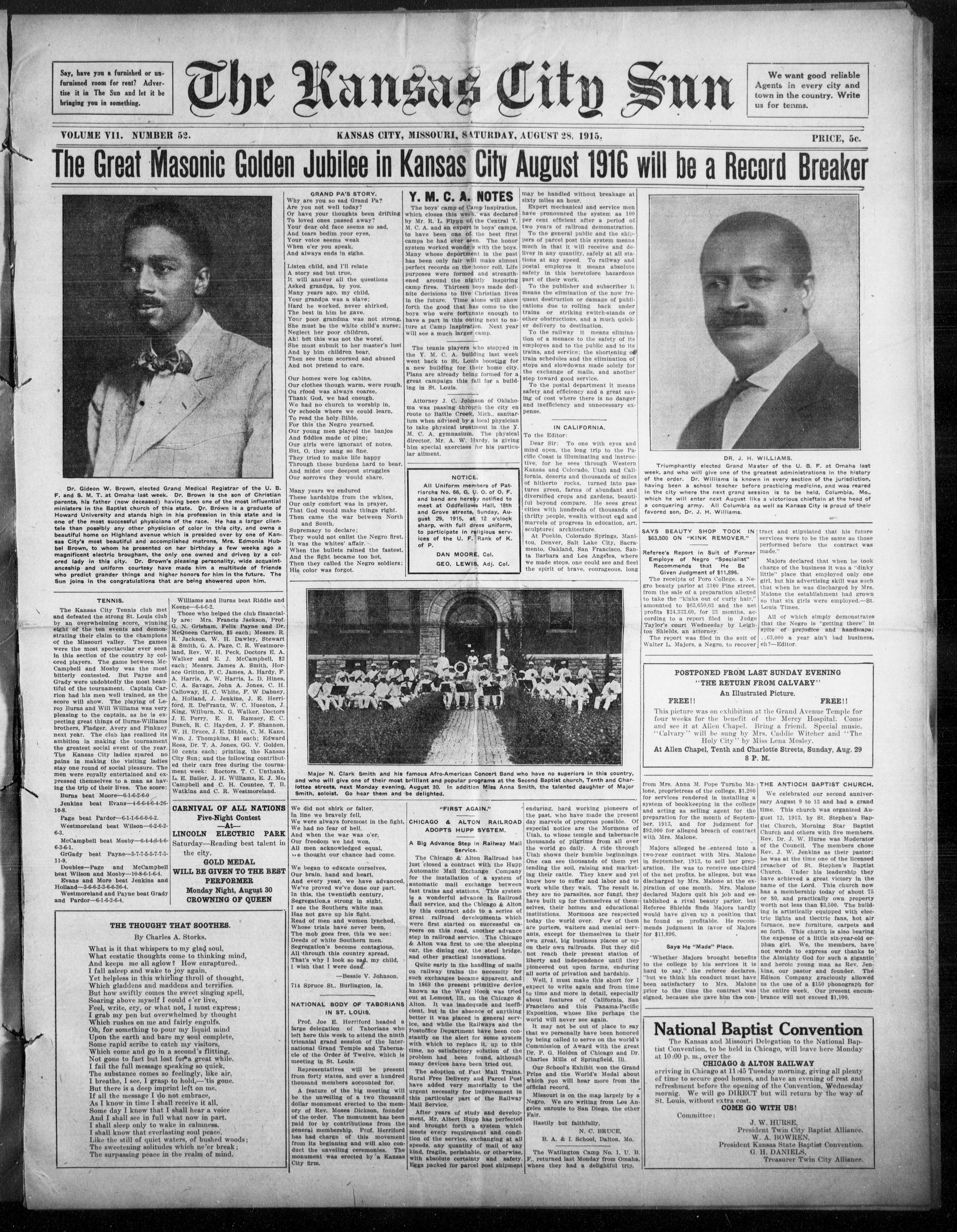
The Great Masonic Golden Jubilee in Kansas City August 1916 will be a Record Breaker
Say, have you a furnished or unfurnished room for rent? Advertise it in The Sun and let it be bringing you in something.
VOLUME VI1. NUMBER 52.
Dr. Gideon W. Brown, elected Grand M. F. and S. M. T. at Omaha last week. Dr. B. parents, his father (now deceased) having been ministers in the Baptist church of this state. Howard University and stands high in his one of the most successful physicians of the tele than possibly any other physician of a beautiful home on Highland avenue which is ssa City's most beautiful and accomplished bel Brown, to whom he presented on her magnificent electric brougham, the only one ored lady in this city. Dr. Brown's please anceship and uniform courtesy have made who predict grander things and higher hon Sun joins in the congratulations that are b
7. Brown, elected Grand Medical Registrar Omaha last week. Dr. Brown is the first (now deceased) having been one of the Baptist church of this state. Dr. Brown is very and stands high in his profession in successful physicians of the race. He has any other physician of color in this Highland avenue which is presided over beautiful and accomplished matrons, Mr. Knox he presented on her birthday a fine brougham, the only one owned and is city. Dr. Brown's pleasing personaliform courtesy have made him a mulrder things and higher honors for him in congratulations that are being showere
A. E.
Dr. Gideon W. Brown, elected Grand Medical Registrar of the U. B. F. and S. M. T. at Omaha last week. Dr. Brown is the son of Christian parents, his father (now deceased) having been one of the most influential ministers in the Baptist church of this state. Dr. Brown is a graduate of Howard University and stands high in his profession in this state and is one of the most successful physicians of the race. He has a larger clientele than possibly any other physician of color in this city, and owns a beautiful home on Highland avenue which is presided over by one of Kansas City's most beautiful and accomplished matrons, Mrs. Edmonia Hubbel Brown, to whom he presented on her birthday a few weeks ago a magnificent electric broughtam, the only one owned and driven by a colored lady in this city. Dr. Brown's pleasing personality, wide acquaintance and uniform courtesy have made him a multitude of friends who predict grander things and higher honors for him in the future. The Sun joins in the congratulations that are being showered upon him.
The Kansas City Tennis club met and defeated the strong St. Louis club by an overwhelming score, winning eight of the ten events and demonstrating their claim to the champions of the Missouri valley. The games were the most spectacular ever seen in this section of the country by colored players. The game between McCampbell and Mosby was the most bitterly contested. But Payne and Grady were undoubtedly the most beautiful of the tournament. Captain Carrion had his men well trained, as the score will show. The playing of Leroy Burns and Will Williams was very expecting great things of Burns-Williams brothers, Fladger, Avery and Pinkney next year. The club has realized its ambition in making the tournament the greatest social event of the year. The Kansas City ladies spared no pains in making the visiting ladies stay one round of social pleasure. The men were royally entertained and expressed themselves to a man as having the trip of their lives. The score:
Burns beat Moore—6-1-6-2-6-0
Jenkins beat Evans—4-6-4-6-4-2-6
10-8.
Page beat Pardor—6-1-1-6-6-0-6-2.
Westmoreland beat Wilson—6-2-6-2-6-3.
McCampbell beat Mosby—6-4-4-6-4-6-3-6-1.
Grgady beat Payne—5-7-7-5-7-7-5
11-9.
Doubles—Page and McCampbell beat Wilson and Mosby—10-8-1-6-1-4. Evans and More beat Jenkins and Holland—3-6-6-2-3-6-6-3-64. Westmoreland and Payne beat Grady and Pardor—6-1-6-2-6-4.
THE THOUGHT THAT SOOTHES
By Charles A. St.
What is it that whispers to my
What ecstatic thoughts come to
And keeps me all aglow? How
I fall asleep and wake to joy a
Yet helpless in this whirling th
Which gladdens and maddens s
But how swiftly comes the sw
Soaring above myself I could e
Feel, write, cry, or what not, l
I grab my pen but overwhelme
Which rushes on me and fairly
Oh, for something to pour my
Upon the earth and bare my s
Some rapid scribe to catch my
Which come and go in a secon
By Charles A. Storks.
Is it that whispers to my glad soul,
ecstatic thoughts come to thinking a
keeps me all aglow? How enrapture
asleep and wake to joy again,
helpless in this whirling throll of thou
n gladdens and maddens and terrifi
now swiftly comes the sweet singing s
glove above myself I could e'er live,
write, cry, or what not, I must expre
my pen but overwhelmed by though
rushes on me and fairly engulfs.
or something to pour my liquid mind
the earth and bare my soul complete
rapid scribe to catch my visitors,
come and go in a second's flitting,
What is it that whispers to my glad soul,
What ecstatic thoughts come to thinking mind,
And keeps me all aglow? How enraptured.
I fall asleep and wake to joy again,
Yet helpless in this whirling throll of thought,
Which gladdens and maddens and terrifies.
But how swiftly comes the sweet singing spell,
Soaring above myself I could e'er live,
Feel, write, cry, or what not, I must express;
I grab my pen but overwhelmed by thought
Which rushes on me and fairly engulfs.
Oh, for something to pour my liquid mind
Upon the earth and bare my soul complete,
Some rapid scribe to catch my visitors,
Which come and go in a second's flitting,
Not gone to fact but lost for a great while.
I fail the full message speaking so quick,
The substance comes so feelingly, like air,
I breathe, I see, I grasp to hold,—'tis gone.
But there is a deep imprint left on me.
If all the message I do not embrace,
As I know in time I shall receive it all,
Some day I know that I shall hear a voice
And I shall see in full what now in part.
I shall sleep only to wake in calmness.
I shall know that everlasting soul peace.
Like the still of quiet waters, of bushed woods;
The sweetening solitudes which ne 'er break;
The surpassing peace in the realm of mind.
TENNIS
The Kansas City Sun
Williams and Burns beat Riddle and Keene—6-4-6-2.
Those who helped the club financially are: Mrs. Francis Jackson, Prof. G. N. Grisham, Felix Payne and Dr. McQueen Carrion, $5 each; Messrs. R. R. Jackson, W. H. Dawley, Stewart & Smith, G. A. Page, C. R. Westmoreland, Rev. W. H. Peck, Doctors E. A Walker and E. J. McCampbell, $2 each; Messrs. James A. Smith, Horse Gritton, P. C. James, A. Hardy, F. A Harris, A. W. Harris, D. L. Dines, C. A. Savage, John A. Jones, C. H. Calloway, H. C. White, F. W. Dabney, A. Holland, J. Jenkins, J. E. Herriford, R. DeFrantz, W. C. Hueston, J. King, Wilburn, N. G. Walker, Doctors J. E. Perry, E. B. Ramsey, E. C. Bunch, R. C. Hayden, J. F. Shannon, W. H. Bruce, J. E. Dibble, C. M. Kane, Wm. J. Thompkins, $1 each; Edward Ross, Dr. T. A. Jones, GG.V. Golden, 50 cents each; printing, the Kansas City Sun; and the following contributed their cars free during the tournament week: Roctors, T. C. Unthank, L. E. Baller, J. H. Williams, E. J. McCampbell and C. H. Countee, T. B. Watkins and C. R. Westmoreland.
CARNIVAL OF ALL NATIONS Five-Night Contest
LINCOLN ELECTRIC PARK
Saturday—Reading best talent in
the city.
GOLD MEDAL
WILL BE GIVEN TO THE BEST
PERFORMER
Monday Night, August 30
CROWNING OF QUEEN
KANSAS CITY, MISSOURI, SATURDAY, AUGUST 28, 1915.
Major N. Clark Smith and his famous Afro-American Concert Band who have no superiors in this country, and who will give one of their most brilliant and popular programs at the Second Baptist church, Tenth and Charlottee streets, next Monday evening, August 30. In addition Miss Anna Smith, the talented daughter of Major Smith, soloist. Go hear them and be delighted.
Major N. Clark Smith and his famous Afro-American Concert Band who have no superiors in this country, and who will give one of their most brilliant and popular programs at the Second Baptist church, Tenth and Charlotte streets, next Monday evening, August 30. In addition Miss Anna Smith, the talented daughter of Major Smith, soloist. Go hear them and be delighted.
GRAND PA'S STORY.
Why are you so sad Grand Pa?
Are you not well today?
Or have your thoughts been drifting
To loved ones passed away?
Your dear old face seems so sad,
And tears bedim your eyes,
Your voice seems weak
When e'er you speak,
And always ends in sighs.
Listen child, and I'll relate
A story sad but true.
It will answer all the questions
Asked grandpa, by you.
Many years ago, my child,
Your grandpa was a slave;
Hard he worked, never shirked,
The best in him he gave.
Your poor grandma was not strong
She must be the white child's nurse;
Neglect her poor children,
Ah! but this was not the worst.
She must submit to her master's lus
And by him children bear,
Then see them scorned and abused
And not pretend to care.
Our homes were log cabins,
Our clothes though warm, were rough,
Ou rflood was always coarse,
Thank God, we had wead.
We had no church to worship in,
Or schools where we could learn,
To read the holy Bible.
For this the Negro yearned.
Our young men played the banjos
And fiddles made of pine;
Our girls were ignorant of notes,
But, O, they sang so fine.
They tried to make life happy
Through these burdens hard to bear,
And midst our deepest struggles
Our sorrows they would share.
Many years we endured
These hardships from the whites,
Our only comfort was in prayer,
That God would make things right,
Then came the war between North
and South,
Supremacy to declare;
They would not enlist the Negro first,
It was the whites' affair.
When the bullets rained the fastest,
And the fight became too hot,
Then they called the Negro soldiers;
His color was forgot.
Major N. Clark Smith and his and who will give one of their most lottee streets, next Monday evening Smith, soloist. Go hear them and
We did not shirk or falter,
In line we bravely fell,
We were always foremost in the fight
We had no fear of hell.
And when the war was o'er,
Our freedom we had won,
All men acknowledged equal,
we thought our chance had come.
We began to educate ourselves,
Our brain, hand and heart,
And every year, we have advanced
We've proved we've done our part.
In this, the twentieth century,
Segregation's strong in sight,
I see the Southern white man
Has not gave up his fight.
Read of men and women lynched,
Whose trials have never been,
The mob goes free, this we see:
Deeds of white Southern men.
Segregation's become contagious,
All through this country spread,
That's why I look so sad, my child,
I wish that I were dead.
—Bessie V. Johnson,
714 Spruce St., Burlington, la.
NATIONAL BODY OF TABORIANS IN ST. LOUIS.
Prof. Joe E. Herriford headed a large delegation of Taborians who left here this week to attend the ninth triennial grand session of the International Grand Temple and Tabernacle of the Order of Twelve, which is meeting in St. Louis.
Representatives will be present from forty states, and over a hundred thousand members accounted for.
A feature of the big meeting will be the unwelling of a two thousand dollar monument erected to the memory of Rev. Moses Dickson, founder of the order. The monument has been paid for by contributions from the general membership. Prof. Herriford has had charge of this movement from its beginning and will also conduct the unveiling ceremonies. The monument was erected by a Kansas City firm.
Y. M. C. A. NOTES
The boys' camp of Camp Inspiration, which closes this week, was declared by Mr. R. L. Flynn of the Central Y. M. C. A. and an expert in boys' camps, to have been one of the best first camps he had ever seen. The honor system worked wonders with the boys. Many whose deportment in the past has been only fair will make almost perfect records on the honor roll. Life purposes were formed and strengthened around the nightly inspiring camp fires. Thirteen boys made definite decisions to live Christian lives in the future. Time alone will show forth the good that has come to the boys who were fortunate enough to have a part in this outing next to nature at Camp Inspiration. Next year will see a much larger camp.
The tennis players who stopped in the Y. M. C. A. building last week went back to St. Louis boosting for a new building for their home city. Plans are already being formed for a great campaign this fall for a building in St. Louis.
Attorney J. C. Johnson of Oklahoma was passing through the city en route to Battle Creek, Mich., sanitaryum when advised by a local physician to take physical treatment in the Y. M. C. A. gymnasium. The physical director, Mr. A. W. Hardy, is giving him special exercises for his particul aliment.
NOTICE
All Uniform members of Patriarchs No. 66, G. U. O. of O. F. and band are hereby notified to meet at Oddfellows Hall, 18th and Grove streets, Sunday, August 29, 1915, at 12 o'clock sharp, with full dress uniform, to participate in religious services of the U. F. Rank of K. of P.
DAN MOORE, Col.
GEO. LEWIS, Adj. Col.
famous Afro-American Concert Band with brilliant and popular programs at the S. August 30. In addition Miss Anna S. be delighted.
"FIRST AGAIN."
CHICAGO & ALTON RAILROAD
ADOPT5 HUPP SYSTEM.
A Big Advance Step in Railway Mail Service.
The Chicago & Alton Railroad has just closed a contract with the Hupp Automatic Mail Exchange Company for the installation of a system of automatic mail exchange between fast trains and stations. This system is a wonderful advance in Railroad mail service, and the Chicago & Alton by this contract adds to a series of great railroad developments which were first started on successful careers on this road, another advance step in railroad service. The Chicago & Alton was first to use the sleeping car, the dining car, the steel bridge, and other practical innovations.
Quite early in the handling of mails on railway trains the necessity for such exchanges became apparent, and in 1868 the present primitive device known as the Ward Hook was tried out at Lemont, Ill., on the Chicago & Alton. It was inadequate and inefficient, but in the absence of anything better it was placed in general service, and while the Railways and the Postoffice Department have been constantly on the alert for some system with which to replace it, up to this time, no satisfactory solution of the problem had been found, although many devices have been tried out.
The adoption of Fast Mail Trains, Rural Free Delivery and Parcel Post have added very materially to the urgent necessity for improvement in this particular part of the Railway Mail Service.
After years of study and development, Mr. Albert Hupp has perfected and brought forth a system which meets every requirement and condition of the service, exchanging at all speeds, any quantity of mail of any kind, fragile, perishable, or otherwise, with absolute certainty and safety. Eggs packed for parcel post shipment
may be handled without breakage at sixty miles an hour.
Expert mechanical and service men have pronounced the system as 100 per cent efficient after a period of two years of railroad demonstration.
To the general public and the shippers of parcel post this system means much in that it will receive and deliver in any quantity, safely at all stations at any speed. To railway and postal employees it means absolute safety in this heretofore hazardous part of their work.
To the publisher and subscriber it means the elimination of the now frequent destruction or damage of publications due to rolling back under trains or striking switch-stands or other obstructions, and a much quicker delivery to destination.
To the railway it means elimination of a menace to the safety of its employees and to the public and to its trains, and service; the shortening of train schedules and the elimination of stops and slowdowns made solely for the exchange of mails, and another step toward good service.
To the postal department it means safety and efficiency and a great saving of cost where there is no danger and inefficiency and unnecessary expense.
IN CALIFORNIA.
To the Editor:
Dear Sir: To one with eyes and mind open, the long trip to the Pacific Coast is illuminating and instructive, for he sees through Western Kansas and Colorado, Utah and California, deserts and thousands of miles of hitherto rocks, turned into pastures green, farms of abundant and diversified crops and gardens, beautiful beyond compare. He sees great cities with hundreds of thousands of thrifty people, wealth without ead and marvels of progress in education, art, sculpture (architecture).
At Pueblo, Colorado Springs, Manitou, Denver, Salt Lake City, Sacramento, Oakland, San Francisco, Santa Barbara and Los Angeles, where we made stops, one could see and feel the spirit of brave, courageous, long
who have no superiors in this country,
Second Baptist church, Tenth and Char-
smith, the talented daughter of Major
enduring, hard working pioneers of the past, who have made the present day marvels of progress possible. Of especial notice are the Mormons of Utah, to whose temple and tabernacle thousands of pilgrims from all over the world go daily. A ride through Utah shows their humble beginnings. One can see thousands of them yet tending the soil, raising and marketing their cattle. They knew and yet know how to suffer and labor and to work while they wait. The result is, they are no parasites, nor fungi, they have built up for themselves of themselves, their homes and educational institutions. Mormons are respected today the world over. Few of them are porters, waiters and menial servants, except for themselves in their own great, big business places or upon their own railroads. But they did not reach their present station of liberty and independence until they pioneered out upon farms, enduring all sorts of privation and hardship. Well, I must make this short for I expect to write again and from time to time and more in detail, especially about features of California, San Francisco and this Panama-Pacific Exposition, whose like perhaps the world will never see again. It may not be out of place to say that we personally have been honored by being called to serve on the world's Commission of Award with the great Dr. P. G. Holden of Chicago and Dr. Charles Mills of Springfield, Ill.
Our School's Exhibit won the Grand Prize and the World's Medal about which you will hear more from the official record.
Missouri is on the map largely by a Negro. We are writing from Los Angeles enroute to San Diego, the other Fair.
The Wattington Camp No. 1, U. B.
F., returned last Monday from Omaha,
where they had a delightful trip.
Record Breaker
M. B.
DR. J. H. WILLIAMS.
Triumphantly elected Grand Master of the week, and who will give one of the greatest adm of the order. Dr. Williams is known in every having been a school teacher before practicing in the city where the next grand session is to which he will enter next August like a victoria a conquering army. All Columbia as well as Ka favored son, Dr. J. H. Williams.
and Grand Master of the U. B. F. at Omaha last one of the greatest administrations in the history iiams is known in every section of the jurisdiction, teacher before practicing medicine, and was reared ext grand session is to be held, Columbia, Mo., ext August like a victorious chieftain at the head of Columbia as well as Kansas City is proud of their Williams.
Triumphantly elected Grand Master of the U. B. F. at Omaha last week, and who will give one of the greatest administrations in the history of the order. Dr. Williams is known in every section of the jurisdiction, having been a school teacher before practicing medicine, and was reared in the city where the next grand session is to be held, Columbia, Mo., which he will enter next August like a victorious chieftain at the head of a conquering army. All Columbia as well as Kansas City is proud of their favored son, Dr. J. H. Williams.
SAYS BEAUTY SHOP TOOK IN $63,500 ON "KINK REMOVER."
Referee's Report in Suit of Former Employee of Negro "Specialist" Recommends that He Be Given Judgment of $11,896.
The receipts of Poro College, a Negro beauty parlor at 3100 Pine street, from the sale of a preparation alleged to take the "kinks out of curly hair," amounted to $63,650.03 and the net profits $24,333.60, for 33 months, according to a report filed in Judge Taylor's court Wednesday by Leighton Shields, an attorney.
The report was filed in the suit of Walter L. Majors, a Negro, to recover
tract and stipulated that his future services were to be the same as those performed before the contract was made."
Majors declared that when he took charge of the business it was a "dinky little" place that employed only one girl, but his advertising skill was such that when he was discharged by Mrs Malone the establishment had grown so that six girls were employed—Sir Louis Times.
All of which simply demonstrate that the Negro is "getting there" in spite of prejudice and handicaps. .63,000 a year ain't bad business eh?—Editor.
POSTPONED FROM LAST
"THE RETURN FI
An Illustra
FREE!!
This picture was on exhibition a
four weeks for the benefit of
and see it at Allen Chapel. I
"Calvary" will be sung by M
Holy City" by M
At Allen Chapel, Tenth and Chap
8 P
FROM LAST SUNDAY EVENING
RETURN FROM CALVARY"
An Illustrated Picture.
FREE!!
a exhibition at the Grand Avenue Temple for the benefit of the Mercy Hospital. Come on Chapel. Bring a friend. Special music. The sung by Mrs. Caddie Witcher and "The City" by Miss Lena Mosley.
Seventh and Charlotte Streets, Sunday, Aug. 29
8 P. M.
This picture was on exhibition at the Grand Avenue Temple for four weeks for the benefit of the Mercy Hospital. Come and see it at Allen Chapel. Bring a friend. Special music. "Calvary" will be sung by Mrs. Caddie Witcher and "The Holy City" by Miss Lena Mosley.
At Allen Chapel, Tenth and Charlotte Streets, Sunday, Aug. 29 8 P. M.
from Mrs. Anna M. Pope Turnbo Malone, proprietress of the college. $1,200 for services rendered in installing a system of bookkeeping in the college and acting as selling agent for the preparation for the month of September, 1913, and for judgment for $92,000 for alleged breach of contract with Mrs. Malone.
Majors alleged he entered into a two-year contract with Mrs. Malone in September, 1913, to sell her preparation. He was to receive one-third of the net profits, he alleges, but was discharged by Mrs. Malone at the expiration of one month. Mrs. Malone declared Majors quit his job and established a rival beauty parlor, but Referee Shields finds Majors hardly would have given up a position that he found so profitable. He recommends judgment in favor of Majors for $11,896.
"Whether Majors brought benefits to the college by his services it is hard to say," the referee declares, "but we think his conduct must have been satisfactory to Mrs. Malone prior to the time the contract was signed, because she gave him the con-
National Bapti
The Kansas and Missouri Bristist Convention, to be held in C at 10:00 p. m., over the CHICAGO & AIR arriving in Chicago at 11:45 Tu of time to secure good homes, a refreshment before the opening morning. We will go DIRECT St. Louis, without extra cost.
Baptist Convention
and Missouri Delegation to the National Bap-
be held in Chicago, will leave here Monday
at the
CAGO & ALTON RAILWAY
go at 11:45 Tuesday morning, giving all plenty
good homes, and have an evening of rest and
the opening of the Convention. Wednesday
GO DIRECT but will return by the way of
extra cost.
National Baptist Convention
National Baptist Convention
The Kansas and Missouri Delegation to the National Baptist Convention, to be held in Chicago, will leave here Monday at 10:00 p. m., over the CHICAGO & ALTON RAILWAY arriving in Chicago at 11:45 Tuesday morning, giving all plenty of time to secure good homes, and have an evening of rest and refreshment before the opening of the Convention, Wednesday morning. We will go DIRECT but will return by the way of St. Louis, without extra cost.
COME GO WITH US!
J. W. HURSE,
President Twin City Baptist Alliance.
W. A. BOWREN,
President Kansas State Baptist Convention.
G. H. DANIELS,
Treasurer Twin City Alliance.
---
---
Says He "Made" Place.
We want good reliable Agents in every city and town in the country. Write us for tenms.
PRICE. 5c.
tract and stipulated that his future services were to be the same as those performed before the contract was made."
Majors declared that when he took charge of the business it was a "dinky little" place that employed only one girl, but his advertising skill was such that when he was discharged by Mrs. Malone the establishment had grown so that six girls were employed.—St. Louis Times.
All of which simply demonstrates that the Negro is "getting there" in spite of prejudice and handicaps; .63,000 a year ain't bad business, eh?—Editor.
FREE!!
THE ANTICHO BAPTIST CHURCH.
We celebrated our second anniversary August 9 to 13 and had a grand time. This church was organized August 12, 1913, by St. Stephen's Baptist Church, Morning Star Baptist Church and others with five members. Rev. Dr. J. W. Hurse was Moderator of the Council. The members chose Rev. J. W. Jenkins as their pastor; he was at the time one of the licensed preacher of St. Stephen's Baptist Church. Under his leadership they have achieved a great victory in the name of the Lord. This church now has a membership today of about 75 or 80, and practically own property worth not less than $3,500. The building is artistically equipped with electric lights and electric fans, hot air furnace, new furniture, carpets and so forth. This church is also bearing the expense of a little six-year-old orphan girl. We, the members, have not words to express our thanks to the Almighty God for such a gigantic and heroic young man as Rev. Jenkins, our pastor and founder. The Edison Company graciously allowed us the use of a $150 phonograph for the entire week. Our present encumbrance will not exceed $1,100.
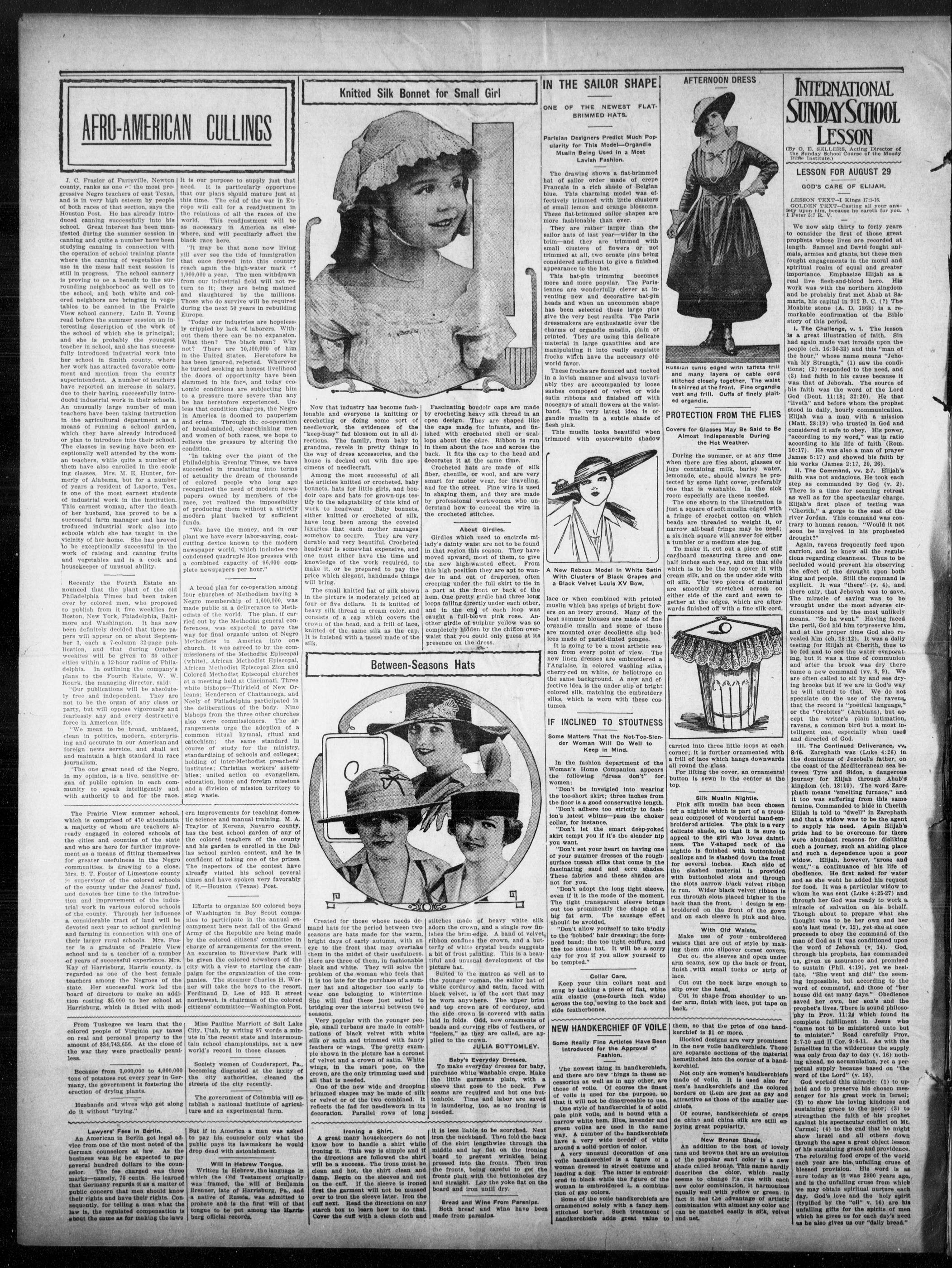
AFRO-AMERICAN CULLINGS
---
Recently the Fourth Estate announced that the plant of the old Philadelphia Times had been taken over by colored men, who proposed to publish from it five weeklies for Boston, New York, Philadelphia, Baltimore and Washington. It has now been definitely decided that these papers will appear on or about September 3, each a 7-column 32-page publication, and that during October weeklies will be given to 30 other cities within a 12-hour radius of Philadelphia. In outlining the company's plans to the Fourth Estate, W. W. Rourk, the managing director, said: "Our publications will be absolutely free and independent. They are not to be the organ of any class or party, but will oppose vigorously and fearlessly all and every destructive force in American life.
"We mean to be broad, unbiased, clean in politics, modern, enterprising and accurate in our American and foreign news service, and shall set and maintain a high standard in race journalism.
"The one great need of the Negro, in my opinion, is a live, sensitive organ of public opinion in each community to speak intelligently and with authority to and for the race.
The Prairie View summer school, which is comprised of 470 attendants, a majority of whom are teachers already engaged in colored schools of the cities and counties of the state and who are here for further improvement as a means of fitting themselves for greater usefulness in the Negro communities, is drawing to a close. Mrs. B. T. Foster of Limestone county is supervisor of the colored schools of the county under the Jeanes' fund, and devotes her time to the introduction and improvement of the industrial work in various colored schools of the county. Through her influence a considerable tract of land will be devoted next year to school gardening and farming in connection with one of their larger rural schools. Mrs. Foster is a graduate of Prairie View school and is a teacher of a number of years of successful experience. Mrs. Kay of Harrisburg, Harris county, is regarded as one of the best female teachers among the Negroes of the state. Her successful work led the board of directors to make an addition costing $5,000 to her school at Harrisburg, which is fitted with mod
From Tuskegee we learn that the colored people of Virginia pay taxes on real and personal property to the amount of $34,743,656. At the close of the war they were practically penitless.
Because from 3,000,000 to 4,000,000 tons of potatoes rot every year in Germany, the government is fostering the erection of drying plants.
Husbands and wives get along do it without "trying."
Lawyers' Fees in Berlin.
An American in Berlin got legal advice from one of the most noted of the German counselors at law. As the business was big he expected to pay several hundred dollars to the counselor. The fee charged was three marks—namely, 75 cents. He learned that Germany regards it as a matter of public concern that men should know their rights and have their rights. Consequently, for telling a man what the law is, the regulated compensation is about the same as for making the laws
It is our purpose to supply just that need. It is particularly opportune that our plans should mature just at this time. The end of the war in Europe will call for a readjustment in the relations of all the races of the world. This readjustment will be as necessary in America as elsewhere, and will peculiarly affect the black race here.
"It may be that none now living will ever see the tide of immigration that once flowed into this country reach again the high-water mark ¢ 1,000,000 a year. The men withdrawn from our industrial field will not return to it; they are being maimed and slaughtered by the millions. Those who do survive will be required during the next 50 years in rebuilding Europe.
"Today our industries are hopelessly crippled by lack of laborers. Without them there can be no expansion. What then? The black man? Why not? There are 10,000,000 of him in the United States. Heretofore he has been ignored, rejected. Wherever he turned seeking an honest livelihood the doors of opportunity have been slammed in his face, and today economic conditions are subjecting him to a pressure more severe than any he has heretofore experienced. Unless that condition charges, the Negro in America is doomed to pauperism and crime. Through the co-operation of broad-minded, clear-thinking men and women of both races, we hope to relieve the pressure by altering the condition.
"In taking over the plant of the Philadelphia evening Times, we have succeeded in translating into terms of actuality the dream of thousands of colored people who long ago recognized the need of modern newspapers owned by members of the race, yet realized the impossibility of producing them without a strictly modern plant backed by sufficient funds.
"We have the money, and in our plant we have every labor-saving, cost-cutting device known to the modern newspaper world, which includes two condensed quadruple Hoe presses with a combined capacity of 96,000 complete newspapers per hour."
---
A broad plan for co-operation among four churches of Methodism having a Negro membership of 1,600,000, was made public in a delivery to Methodists of the world. The plan, if carried out by the Methodist general conferences, was expected to pave the way for final organic union of Negro Methodists in America into one church. It was agreed to by the commissioners of the Methodist Episcopal (white), African Methodist Episcopal, African Methodist Episcopal Zion and Colored Methodist Episcopal churches at a meeting held at Cincinnati. Three white bishops—Thirkeld of New Orleans; Henderson of Chattanooga, and Neely of Philadelphia participated in the deliberations of the body. Nine bishops from the three other churches also were commissioners. The arangements urge the adoption of a common ritual hymnal, ritual and catechism; the same standard in course of study for the ministry standardizing of schools and colleges; holding of inter-Methodist preachers institutes; Christian workers' assemblies; united action on evangelism education, home and foreign missions and a division of mission territory to stop waste.
ern improvements for teaching domestic science and manual training. M. A. Traylor of Kerens, Navarro county, has the best school garden of any of the colored teachers of the county and his garden is enrolled in the Dallas school garden contest, and he is confident of taking one of the prizes. The inspectors of the contest have already visited his school several times and have spoken very favorably of it.—Houston (Texas) Post.
Efforts to organize 500 colored boys of Washington in Boy Scout companies to participate in the annual encampment here next fall of the Grand Army of the Republic are being made by the colored citizens' committee in charge of arrangements for the event. An excursion to Riverview Park will be given the colored newsboys of the city with a view to starting the campaign for the organization of the companies. The steamer Charles H. Werner will take the boys to the resort. Ferdinand D. Lee of 923 R street northwest, is chairman of the colored citizens' committee—Washington Post.
Miss Pauline Marriott of Salt Lake City, Utah, by writing 87 words a minute in the recent state and intermountain school championships, set a new world's record in those classes.
Society women of Coudersport, Pa.,
becoming disgusted at the laxity of
the city authorities, cleaned the
streets of the city recently.
The government of Columbia will
establish a national institute of agriculture
and an experimental farm.
But if in America a man was asked
to pay his counselor only what the
public pays its lawmakers he would
drop dead with astonishment.
WILL In Hebrew Tongue.
Written in Hebrew, the language in which the Old Testament originally was framed, the will of Benjamin Brenner, late of Harrisburg, Pa., and a native of Russia, was admitted to probate and is the first will of that tongue to be put among the Harrisburg official records.
1
Between-Seasons Hats
Now that industry has become fashionable and everyone is knitting or crocheting or doing some sort of needlework, the evidences of the "keep-busy" bad blossom out in all directions. The family, from baby to grandma, revels in pretty things in the way of dress accessories, and the house is decked out with fine specimens of needlecraft.
Among the most successful of all the articles knitted or crocheted, baby bonnets, hats for little girls, and boudoir caps and hats for grown-ups testify to the adaptability of this kind of work to headwear. Baby bonnets, either knitted or crocheted of silk, have long been among the coveted luxuries that each mother manages somehow to secure. They are very durable and very beautiful. Crocheted headwear is somewhat expensive, and one must either have the time and knowledge of the work required, to make it, or be prepared to pay the price which elegant, handmade things will bring.
The small knitted hat of silk shown in the picture is moderately priced at four or five dollars. It is knitted of heavy silk thread in cream color, and consists of a cap which covers the crown of the head, and a frill of lace, knitted of the same silk as the cap. It is finished with a tassel made of the silk.
Between-Sea
Created for those whose needs demand hats for the period between two seasons are hats made for the warm, bright days of early autumn, with an eye to the frost that may overtake them in the midst of their usefulness. Here are three of them, in fashionable black and white. They will solve the problem of the woman who feels that it is too late for the purchase of a summer hat and altogether too early to wear one belonging to wintertime. She will find these just suited to bridging over the interval between two seasons.
Very popular with the younger people, small turbans are made in combinations of black velvet with white silk or satin and trimmed with fancy feathers or wings. The pretty example shown in the picture has a coronet of velvet and a crown of satin. White wings, in the smart pose, on the crown, are the only trimming used and all that is needed.
One of the new wide and drooping brimmed shapes may be made of silk or velvet or of the two combined. It reflects the fad for needlework in its decoration. Parallel rows of long
Ironing a Shirt.
A great many housekeepers do not know how to handle a shirt while ironing it. This way is simple and if the directions are followed the shirt will be a success. The irons must be clean and hot, the shirt clean and damp. Begin on the sleeves and not on the cuff. If the sleeve is ironed first the garment will not be mussed over to iron the sleeve later. Iron the cuff next. Read the directions on any starch box to learn how to do that. Cover the cuff with a clean cloth and
Fascinating bouidou caps are made by crocheting heavy silk thread in an open design. They are shaped like the caps made for infants, and finished with crocheted shell or scallops about the edge. Ribbon is run in them about the face and across the back. It fits the cap to the head and decorates it at the same time.
Crocheted hats are made of silk fiber, chenille, or wool, and are very smart for motor wear, for traveling, and for the street. Fine wire is used in shaping them, and they are made by professional workmen who understand how to conceal the wire in the crocheted stitches.
About Girdles.
Girdles which used to encircle miliady's dainty waist are not to be found in that region this season. They have moved upward, most of them, to give the new high-waisted effect. From this high position they are apt to wander in and out of draperies, often creeping under the full skirt to tie in a part at the front or back of the hem. One pretty girldle had three long loops falling directly under each other, and in the end of each loop was caught a full-blown pink rose. Another girldle of sulphur yellow was so completely hidden by the chiffon overwaist that you could only guess at its presence on the dress.
asons Hats
stitches made of heavy white silk adorn the crown, and a single row finishes the brim-edge. A band of velvet ribbon confines the crown, and a butterfly of white crystal beads suggests a bit of frost painting. This is a beautiful and unusual development of the picture hat.
Suited to the matron as well as to the younger woman, the sailor hat of white corduroy and satin, faced with black velvet, of the sort that may be worn anywhere. The upper brim and top crown are of corduroy, and the side crown is covered with satin laid in folds. Odd, new ornaments of beads and curving ribs of feathers, or "feelers," as they are called, are applied to the crown.
JULIA BOTTOMLEY.
Baby's Everyday Dresses
To make everyday dresses for baby, purchase white washable crepe. Make the little garments plain, with a sleeve that goes to the neck. Few seams are required and but one buttonhole. Time and labor are saved in laundering, too, as no ironing is needed.
it is less liable to be scorched. Next iron the neckband. Then fold the back of the shirt lengthwise through the middle and lay flat on the ironing board to prevent wrinkles being pressed into the fronts. Then iron the fronts, being careful to get the fronts plait with the buttonholes dry and straight. Lay the yoke flat on the board and iron until dry.
Bread and Wine From Parsnips. Both bread and wine have been made from parsnips.
---
THE SAILOR SHAPE
ONE OF THE NEWEST FLAT
BRIMMED HATS.
Parisian Designers Predict Much Popularity for This Model—Organdle Mualin Being Used in a Most Lavish Fashion.
The drawing shows a flat-brimmed hat of sailor order made of crepe Francais in a rich shade of Belgian blue. This charming model was effectively trimmed with little clusters of small lemon and orange blossoms. These flat-brimmed sailor shapes are more fashionable than ever.
They are rather larger than the sailor hats of last year—wider in the brim—and they are trimmed with small clusters of flowers or not trimmed at all, two ornament pins being considered sufficient to give a finished appearance to the hat.
This hat-pin trimming becomes more and more popular. The Parisiennes are wonderfully clever clerat in inventing new and decorative hat-pins and when an uncommon shape has been selected these large pins give the very best results. The Paris dressmakers are enthusiastic over the charms of organdle muslin, plain or printed. They are using this delicate material in large quantities and are manipulating it into really exquisite frocks which have the necessary old-world favor.
These frocks are flounced and tucked in a lavish manner and always invariably they are accompanied by loose sashes composed of velvet or wide satin ribbons and finished off with nosegays of small flowers at the waistband. The very latest idea is organdle muslin in a subtle shade of flesh pink.
This muslin looks beautiful when trimmed with oyster-white shadow
A New Reboux Model In White Satin With Clusters of Black Grapes and a Black Velvet Louis XV Bow.
A New Reboux Model in White Satin With Clusters of Black Grapes and a Black Velvet Louis XV Bow.
lace or when combined with printed muslin which has spits of bright flowers on an ivory ground. Many of the best summer blouses are made of fine organdle muslin and some of these are mounted over decollette slip bodices made of pastel-tinted pongee.
It is going to be a most artistic season from every point of view. The new linen dresses are embroidered a l'Anglaise, in colored washing silks, cherry-red on white, or hellotrope on the same background. A new and effective idea is the under slip of bright colored silk, matching the embroidery silks, which is worn with these costumes.
IF INCLINED TO STOUTNESS
Some Matters That the Not-Too-Slender Woman Will Do Well to Keep in Mind.
In the fashion department of the Woman's Home Companion appears the following "dress don't" for women:
"Don't be inveigled into wearing the too-short skirt; three inches from the floor is a good conservative length.
"Don't adhere too stricly to fashion's latest whims—pass the choker collar, for instance.
"Don't let the smart deep-yoked skirt temp you if it's the slender nip you want.
"Don't set your heart on having one of your summer dresses of the rough-surface tussah silkls that come in the fascinating sand and scru shades. These fabrics and these shades are not for you.
"Don't adopt the long tight sleeve, even if it is the mode of the moment. The tight transparent sleeve brings out too prominently the shape of a big fat arm. The sausage effect should be avoided.
"Don't allow yourself to take k'ndly to the 'bobbed' hair dressing; the forehead band; the too tight collar, and the too small hat. It will be a sorry day for you if you allow yourself to be tempted."
Collar Care.
Keep your thin collars neat and snug by tacking a piece of flat, white silk elastic (one-fourth inch wide) across the top, sewing to the back and side featherbones.
NEW HANDKERCHIEF OF VOILE
Some Really Fine Articles Have Been Introduced for the Approval of Fashion.
The newest thing in handkerchiefs, and there are new 'hings in these accessories as well as in any other, are those of vole. Of course the thirst of vole is used for the purpose, so that it will not be disagreeable to use. One style of handkerchief is of solid pale pink vole, and is bound with a narrow white hem. Blue, lavender and green voles are used in the same way. A number of the handkerchiefs have a very wide border of white around a solid portion of color.
A very unusual decoration of one vole handkerchief is a figure of a woman dressed in street costume and leading a dog. The latter is embroidered in black while the figure of the woman is embroidered in a combination of gay colors.
Some of the voile handkerchiefs are ornamented solely with a fancy hem-stitched border. Such treatment of handkerchiefs adds great value to
AFTERNOON DRESS
IN FEMINIST CIRCUS
Russian tunic edged with tatella trill and many layers of cable cord stitched closely together. The waist is shirred at the front. Fine organelle vest and frill. Cuffs of finely plaited organelle.
PROTECTION FROM THE FLIES
Covers for Glasses May Be Said to Be Almost Indispensable During the Hot Weather.
During the summer, or at any time when there are flies about, glasses or jugs containing milk, barley water, lemonade, etc., should always be protected by some light cover, preferably one that is washable. In the sick room especially are these needed.
The one shown in the illustration is just a square of soft muslin edged with a fringe of crochet cotton on which beads are threaded to weight it, or narrow all-bead fringe may be used; a six-inch square will answer for either a tumbler or a medium size jug.
To make it, cut out a piece of stuff cardboard measuring three and one-half inches each way, and on that side which is to be the top cover it with cream silk, and on the under side with oil silk. The two pieces of material are smoothly stretched across on either side of the card and sewn together at the edges, which are afterwards finished off with a fine silk cord.
carried into three little loops at each corner; it is further ornamented with a frill of lace which hangs downwards all round the glass. For lifting the cover, an ornamental button is sewn in the center at the top.
Silk Muslin Nightie.
Pink silk muslin has been chosen for a nightie which is part of a trousseau composed of wonderful hand-embroidered articles. The pink is a very delicate shade, so that it is sure to appeal to the girl who loves daintiness. The V-shaped neck of the nightie is finished with buttonholed scallops and is slashed down the front for several inches. Each side of the slashed material is provided with buttonholed slots and through the slots narrow black velvet ribbon is run. Wider black velvet ribbon is run through slots placed higher in the back than the front. Design is embroidered on the front of the gown and on each sleeve in pink and blue
With Old Waists
Make use of your embroidered waists that are out of style by making them into slipover corset covers. Out cut. the sleeves and open under arm seams, sew up the back or front, finish, with small tucks or strip of lace.
Cut out the neck large enough to slip over the head.
Cut in shape from shoulder to under arm, finish with lace, put tape on back.
them, so that the price of one handkerchief is $1 or more.
Blocked designs are very prominent in the new volle handkerchiefs. These are separate sections of the material hemstitched into the corner of a handkerchief.
Not only are women's handkerchiefs made of volle. It is used also for men's handkerchiefs and the colored borders on them are just as gay and attractive as those of the smaller kerchiefs.
Of course, handkerchiefs of crepa de china and china silk are still enjoying great popularity.
New Bronze Shade
An addition to the host of lovely tans and browns that are an evolution of the popular sand color is a new shade called bronze. This name hardly describes the color, which really seems to change it's rue with each new color combination. it harmonizes equally well with yellow or green, in fact it has the advantage of artistic combination with almost any color and can be matched easily in silt, velvet and net.
INTERNATIONAL
SUNDAY SCHOOL
LESSON
(By O. E. SILLEHER, Acting Director of
the College Course of the Moody
Bell Institute).
LESSON FOR AUGUST 29
GOD'S CARE OF ELIJAH.
LESSON TEXT I- Kings 17:1-16.
GOLDEN TEXT I-Casting all your anxiety upon him, because he careth for you. I Peter 5:7 R. V.
We now skip thirty to forty years to consider the first of those great prophets whose lives are recorded at length. Samuel and David fought animals, armies and giants, but these men fought engagements in the moral and spiritual realm of equal and greater importance. Emphasize Elijah as a real live flesh-and-blood hero. His work was with the northern kingdom and he probably first met Ahab at Samaria, his capital in 912 B. C. (? The Mobite stone (A. D. 1868) is a remarkable confirmation of the Bible story of this period.
1. The Challenge, v. 1. The lesson is a great illustration of faith. Sin had again made vast inroads upon the people (ch. 16: 30-33) and this "man of the hour," whose name means "Jehovah My Strength," (1) saw the conditions; (2) responded to the need, and (3) had faith in his cause because it was that of Jehovah. The source of his faith was the word of the Lord God (Deut. 11: 18; 32: 20). He that "liveth" and before whom the prophet stood in daily, hourly communication. Elljah was a man with a mission (Matt. 28: 19) who trusted in God and considered it safe to obey. His power, "according to my word," was in ratio according to his life of faith (Rom. 10: 17). He was also a man of prayer James 5: 17) and showed his faith by his works (James 2: 17, 20, 26).
II. The Command, vv. 2-7. Elijah's faith was not audacious. He took each step as commanded by God (v. 2). There is a time for seeming retreat as well as for the spectacular charge. Elijah's first place of testing was "Cherith," a gorge to the east of the river Jordan. This command was contrary to human reason. "Would it not soon be involved in his prophesied drought?"
Again, ravens frequently feed upon carrion, and he knew all the regulations regarding cleanness. Thus to be secluded would prevent his observing the effect of the drought upon both king and people. Still the command is explicit. It was "there" (v. 4), and there only, that Jehovah was to save. The miracle of saving was to be wrought under the most adverse circumstances and by the most unlikely means. "So he went." Having faced the peril, God hid him to preserve him, and at the proper time God also revealed him (ch. 18:12). It was a daily testing for Elijah at Cherith, thus to be fed and to see the water evaporating, but it was a time of communion and after the brook was dry there came a new command (vv. 8, 9). We are often called to sit by and see drying brooks but if we are in God's way he will attend to that. We do not speculate on the use of the ravens, that the record is "poetical language," or the "Orebites" (Arabians), but accept the writer's plain intimation, ravens, a common bird but a most intelligent one, especially when used and directed of God.
III. The Continued Deliverance, vv. 8-16. Zarephath was (Luke 4:26) in the dominions of Jebebel's father, on the coast of the Mediterranean sea between Tyre and Sidon, a dangerous journey for Elijah through Ahab's kingdom (ch. 18:10). The word Zarephath means "smelling furnace," and it too was suffering from this same famine. Commanded to hide in Cherith Elijah is told to "dwell" in Zarephath and that a widow was to be the agent to supply his need. Again Elijah's pride had to be overcome for there were abundant reasons for disliking such a journey, such an abiding place and such a dependence upon a poor widow. Elijah, however, "arose and went," a continuance of his life of obedience. He first asked for water and as he went he added his request for food. It was a particular widow to whom he was sent (Luke 4:25-27) and through her was ready to work a miracle of salvation on his behalf. Though about to prepare what she thought was to be her own and her son's last meal (v. 12), yet she at once proceeds to obey the command of the man of God as it was conditioned upon the word of Jehovah (v. 14). God, through his prophets, has commanded us, given us assurance and promised to sustain (Phil. 4:19), yet we hesitate. "She went and did" the seeming impossible, but according to the word of command, and those of "her house did eat many days." Obedience saved her own, her son's and the prophet's lives. There is sound philosopher in Prov. 11:24 which found its complete fulfillment in Jesus who "came not to be ministered unto but to minister." Read carefully Prov. 3:7-10 and II Cor. 9:6-11. As with the Israelites in the wilderness the supply was only from day to day (v. 16) not ingaged ahead, no accumulation, yet a per petual supply because based on "the word of the Lord" (v. 16).
God worked this miracle: (1) to uphold and to preserve his chosen messenger for his great work in Israel; (2) to show his loving kindness and sustaining grace to the poor; (3) to strengthen the faith of his prophet against his spectacular conflict on Mt. Carmel; (4) to the end that he might show Israel and all others down through the ages a great object lesson of his sustaining grace and providence. The returning food crops of the world each year are his, unfalling crusade of blessed provision. His word is as sure today as it was 2800 years ago, and is the unfalling crusade from which we may obtain spiritual nurture each day. God's love and the holy spirit (typified by the "oil" v. 16) are his unfalling gifts for the spirits of men which he gives us for each day's need as he also gives us our "daily bread."
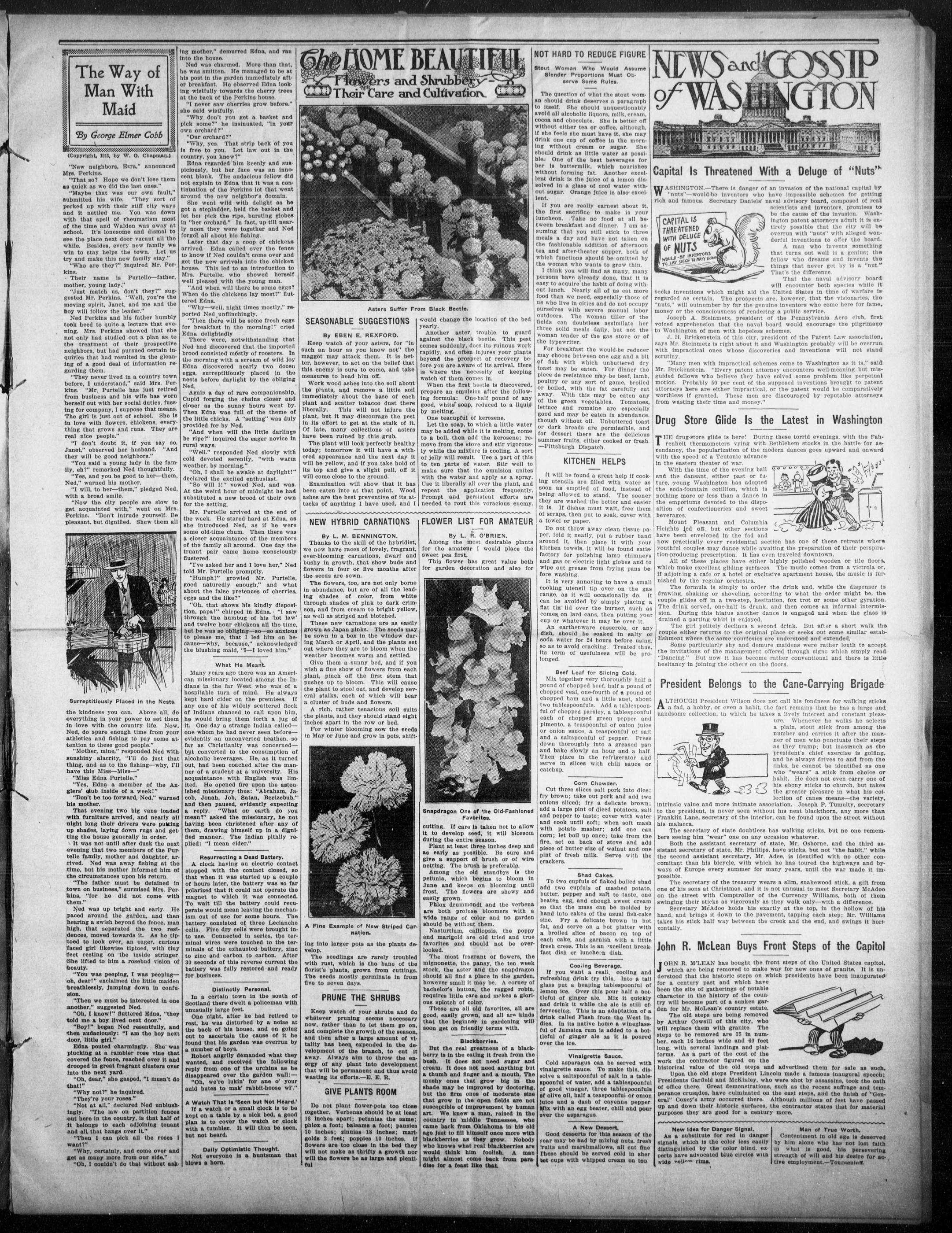
(Copyright, 1915, by W. G. Chapman.)
"New neighbors, Ezra," announced Mrs. Perking.
"That so? Hope we don't lose them as quick as we did the last ones."
"Maybe that was our own fault," submitted his wife. "They sort of perked up with their stuff city ways and it nettled me. You was down with that spell of rheumatism most of the time and Walden was away at school. It's lonesome and dismal to see the place next door vacant all the while. Besides, every new family we win to stay helps the town. Let us try and make this new family stay."
"Who are they?" inquired Mr. Perkins.
Their name is Purtelle—father, mother, young lady.
"Just match us, don't they?" suggested Mr. Perkins. "Well, you're the moving spirit, Janet, and me and the boy will follow the leader."
Ned Perkins and his father humbly took heed to quite a lecture that evening. Mrs. Perkins showed that she not only had studied out a plan as to the treatment of their prospective neighbors, but had pursued certain inquiries that had resulted in the gleaning of a good deal of information regarding them.
"They never lived in a country town before, I understand," said Mrs. Perkins.
"Mr. Purtele has just retired from business and his wife has worn herself out with her social duties, fussing for company, I suppose that means. The girl is just out of school. She is in love with flowers, chickens, everything that grows and runs. They are real nice people."
"I don't doubt it, if you say so, Janet," observed her husband. "And they will be good neighbors."
"You said a young lady in the family, eh?" remarked Ned thoughtfully.
"Yes, and you be good to her—them, Ned." warned his mother.
"I will, to her—them," pledged Ned, with a broad smile.
"Now the city people are slow to get acquainted with," went on Mrs. Perkins. "Don't intrude yourself. Be pleasant, but dignified. Show them all
Surreptitiously Placed In the Nests.
the kindness you can. Above all, do everything in your power to set them in love with the country life. Now, Ned, do spare enough time from your athletics and fishing to pay some attention to these good people."
"Mother, mine," responded Ned with sunshiny alacrity. "I'll do just that, and as to the fishing—why, I'll have this Miss—Miss—"
"Miss Edna Purttele."
"Yes, Edna a member of the Anglers' club inside of a week!"
"Don't be too forward, Ned," warned his mother.
That evening two big vans loaded with furniture arrived, and nearly all night long their drivers were putting up shades, laying down rugs and getting the house generally in order.
It was not until after dusk the next evening that two members of the Purtele family, mother and daughter, arrived. Ned was away fishing at the time, but his mother informed him of the circumstances upon his return.
"The father must be detained in town on business," surmised Mrs. Perkins, "for he did not come with them."
Ned was up bright and early. He paced around the garden, and then hearing a swish beyond the fence, man high, that separated the two restences, moved towards it. As he tiptoed to look over, an eager, curious faced girl likewise tiptoed, with tiny feet resting on the inside stringer. She lifted to him a rosebud vision of beauty.
"You was peeping, I was peeping—oh, dear!" exclaimed the little maiden breathlessly, jumping down in confusion.
"Then we must be interested in one another," suggested Ned.
"Oh, I know!" fluttered Edna, "they told me a boy lived next door."
"Boy!" began Ned resentfully, and then audaciously: "I am the boy next door, little girl."
Edna pouted charmingly. She was plucking at a rambler rose vine that covered the fence, reached over it and drooped in great fragrant clusters over into the next yard.
"Oh, dear," she gasped. "I mustn't do that!"
"Why not?" he inquired.
"They're your roses."
"Not at all." declared Ned unblushingly. "The law on partition fences out here in the country, is that half of it belongs to each adjoining tenant and all that hangs over it."
"Then I can pick all the roses I want!"
"Why, certainly, and come over and get as many more from our side."
"Oh. I couldn't do that without ask."
ing mother," demurred Edna, and ran into the house.
Ned was charmed. More than that, he was smitten. He managed to be at his post in the garden immediately after breakfast. He observed Edna looking wistfully towards the cherry trees at the back of the Perkins house.
"I never saw cherries grow before." she said wistfully.
"Why don't you get a basket and pick some?" he insinuated, "in your own orchard?"
"Our orchard?"
"Why, yes. That strip back of you is free to you. Lot law out in the country, you know?"
Edna regarded him keenly and suspiciously, but her face was an innocent blank. The audacious fellow did not explain to Edna that it was a continuation of the Perkins lot that went around the new neighbor's domain.
She went wild with delight as he got a stepladder, held the basket and let her pick the ripe, bursting globes in "her orchard." In fact, up till nearly noon they were together and Ned forgot all about his fishing.
Later that day a coop of chickens arrived. Edna called over the fence to know if Ned couldn't come over and get the new arrivals into the chicken house. This led to an introduction to Mrs. Purlette, who showed herself well pleased with the young man.
"And when will there be some eggs? When do the chickens lay most?" futtered Edna.
"Why—well, night times mostly," reported Ned unflinchingly.
"Then there will be some fresh eggs for breakfast in the morning!" cried Edna. delightedly.
There were, notwithstanding that Ned had discovered that the imported brood consisted mostly of roosters. In the morning with a scream of wild joy Edna discovered nearly two dozen eggs, surreptiously placed in the nests before daylight by the obliging Ned.
Again a day of rare companionship, Cupid forging the chains closer and closer as the sunny hours went by. Then Edna was full of the theme of the little chicks. A "setting" was duly provided for by Ned.
"And when will the little darlings be ripe?" inquired the eager novice in rural ways.
"Well." responded Ned slowly with cold devoted serenity, "with warm weather, by morning."
"Oh, I shall be awake at daylight!" declared the excited enthusiast.
"So will I!" vowed Ned, and was. At the weird hour of midnight he had substituted a new brood of their own for the setting.
Mr. Purtelle arrived at the end of the week. He stared hard at Edna, as she introduced Ned, as if he were some old-time chum. Then there was a closer acquaintance of the members of the family all around. One day the truant pair came home consciously flustered.
"I've asked her and I love her," Ned told Mr. Purtelle promptly.
"Humph!" growled Mr. Purtelle, good naturedly enough," and what about the false pretences of cherries, eggs and the like?
"Oh, that shows his kindly disposition, papa!" chirped in Edna. "I saw through the humbug of his 'lot law' and twelve hour chickens all the time, but he was so obliging—so—so anxious to please me, that I led him on because—why, because," acknowledged the blushing maid. "I—I loved him."
What He Meant.
Many years ago there was an American missionary located among the Indians in the far West who was of a hospitable turn of mind. He always kept hard cider on the premises. If any one of his widely scattered flock of Indians chanced to call upon him, he would bring them forth a jug of it. One day a strange Indian called—
one whom he had never seen before—evidently an unconverted heathen, so far as Christianity was concerned—but converted to the consumption of alcoholic beverages. He, as it turned out, had been coached after the manner of a student at a university. His acquaintance with English was limited. He opened fire upon the astonished missionary thus: "Abraham, Jacob, Jonah, Job, Satan, Beelzebub," and then paused, evidently expecting a reply. "What on earth do you mean?" asked the missionary, he not having been christened after any of them, drawing himself up in a dignified manner. The Indian ipithily replied: "I mean cider."
Resurrecting a Dead Battery.
Resurrecting a Dead Battery.
A clock having an electric contact stopped with the contact closed, so that when it was started up a couple of hours later, the battery was so far polarized that it could not operate the magnet to which it was connected.
To wait till the battery could recuperate would mean leaving the mechanism out of use for some hours. The battery consisted of three Lecianche cells. Five dry cells were brought into use. Connected in series, the terminal wires were touched to the terminals of the exhausted battery, zinc to zinc and carbon to carbon. After 30 seconds of this reverse current the battery was fully restored and ready for business.
Distinctly Personal
In a certain town in the south of Scotland there dwelt a policeman with unusually large feet. One night, after he had retired to rest, he was disturbed by a noise at the back of his house, and on going out to ascertain the cause of it he found that his garden was overrun by a number of boys. Robert angrily demanded what they wanted, and received the following reply from one of the archons as he disappeared over the garden wall:—
Oh, we're lukin' for ane o' your auld butes to mak' rabbit-hoose wi'.
A Watch That is 'Seen but Not Heard.'
If a watch or a small clock is to be kept on a table by a sick bed, a good plan is to cover the watch or clock with a tumbler. It will then be seen, but not heard.
Daily Optimistic Thought.
Not everyone is a huntsman that blows a horn.
The HOME BEAUTIFUL Flowers and Shrubbery Their Care and Cultivation
100
Asters Suffer From Black Beetle.
By EBEN E. REXFORD.
Keep watch of your asters, for "in such an hour as you know not" the maggot may attack them. It is better, however, to act on the belief that this enemy is sure to come, and take measures to head him off.
Work wood ashes into the soil about the plants, and remove a little soil immediately about the base of each plant and scatter tobacco dust there liberally. This will not injure the plant, but it may discourage the pest in its effort to get at the stalk of it. Of late, many collections of asters have been ruined by this grub.
The plant will look perfectly healthy today; tomorrow it will have a withered appearance and the next day it will be yellow, and if you take hold of its top and give a slight pull, off it will come close to the ground.
Examination will show that it has been eaten into at that point. Wood ashes are the best preventive of its attacks of anything I have used, and I
By L. M. BENNINGTON.
Thanks to the skill of the hybridist, we now have races of carnations, dwarf and bushy in growth, that show buds and flowers in four or five months after the seeds are sown.
The flowers, too, are not only borne in abundance, but are of all the leading shades of color, from white through shades of pink to dark crimson, and from cream to bright yellow, as well as striped and blotched.
These new carnations are as easily grown as Japan pinks. The seeds may be sown in a box in the window during March or April, and the plants set out where they are to bloom when the weather becomes warm and settled.
Give them a sunny bed, and if you wish a fine show of flowers from each plant, pinch off the first stem that pushes up to bloom. This will cause the plant to stool out, and develop several stalks, each of which will bear a cluster of buds and flowers.
A rich, rather tenacious soil suits the plants, and they should stand eight inches apart in the row or bed. For winter blooming sow the seeds in May or June and grow in pots, shift
Poppy
A Fine Example of New Striped Car nation.
A Fine Example of New Striped Carrion.
ing into larger pots as the plants develop.
The seedlings are rarely troubled with rust, which is the bane of the florist's plants, grown from cuttings. The seeds mostly germinate in from five to seven days.
PRUNE THE SHRUBS
Keep watch of your shrubs and do whatever pruning seems necessary now, rather than to let them go on, and complete the growth of the season, and then after a large amount of vitality has been expended in the development of the branch, to cut it away. Always aim to throw the energy of any plant into development that will be permanent and thus avoid wasting its efforts.—E. E. R.
GIVE PLANTS ROOM
Do not plant flower-pots too close together. Verbenas should be at least 18 inches apart; petunias the same; phlox a foot; balsam a foot; pansies 10 inches; zinnia 18 inches; marigolds 2 feet; poppies 10 inches. If flowers are too close in the bed they will not make as thrifty a growth nor will the flowers be as large and plentiful.
would change the location of the bed yearly.
Another aster trouble to guard against the black beetle. This pest comes suddenly, does its ruinous work rapidly, and often injures your plants beyond the prospect of recovery before you are aware of its arrival. Here is where the necessity of keeping watch of them comes in.
When the first beetle is discovered, prepare an emulsion after the following formula: One-half pound of any good, white soap, reduced to a liquid by melting.
One teacupful of kerosene.
Let the soap, to which a little water may be added while it is melting, come to a boll, then add the kerosene; remove from the stove and stir vigorously while the mixture is cooling. A sort of jelly will result. Use a part of this to ten parts of water. Stir well to make sure that the emulsion unites with the water and apply as a spray. Use it liberally all over the plant, and repeat the application frequently. Prompt and persistent efforts are needed to rout this voracious enemy
By L. R. O'BRIEN.
Among the most desirable plants for the amateur I would place the sweet pea first.
This flower has great value both for garden decoration and also for
```markdown
```
Snapdragon One of the Old-Fashioned Favorites.
cutting. If care is taken not to allow it to develop seed, it will blossom during the entire season.
Plant at least three inches deep and as early as possible. Be sure and give a support of brush or of wire netting. The brush is preferable.
Among the old standbys is the petunia, which begins to bloom in June and keeps on blooming until frost. The flowers are showy and easily grown.
Phlox drummondii and the verbena are both profuse bloomers with a wide range of color and no garden should be without them.
Nasturtium, calliopsis, the poppy and marigold are old tried and true favorites and should not be overlooked.
The most fragrant of flowers, the mignonette, the pansy, the ten week stock, the aster and the snapdragon should all find a place in the garden, however small it may be. A corner of bachelor's button, the ragged robin, requires little care and makes a glorious sploch of color. These are all old favorites, all are good, easily grown, and all are kinds that the beginner in gardening will soon get on friendly terms with.
Blackberries.
But the real greatness of a blackberry is in the eating it fresh from the bush. It does not need sugar and cream. It does not need anything but a thumb and finger and a mouth. The mushy ones that grow big in the shade may be improved by doctoring, but the firm ones of moderate size that grow in the open fields are not susceptible of improvement by human art. We knew a man, raised in the country in middle Tennessee, who came back from Oklahoma in his old age just to fill himself once more with blackberries as they grow. Nobody who knows what real blackberries are would think him foolish. A man might almost come back from paradise for a feast like that.
NOT HARD TO REDUCE FIGURE
Stout Woman Who Would Assume Slender Proportions Must Observe Some Rules.
The question of what the stout woman should drink deserves a paragraph to itself. She should unquestionably avoid all alcoholic liquors, milk, cream, cocoa and chocolate. She is better off without either tea or coffee, although, if she feels she must have it, she may drink one cup of coffee in the morning without cream or sugar. She should drink as little water as possible. One of the best beverages for her is buttermilk, which nourishes without forming fat. Another excellent drink is the juice of a lemon dissolved in a glass of cool water with out sugar. Orange juice is also excellent.
If you are really earnest about it, the first sacrifice to make is your luncheon. Take no food at all between breakfast and dinner. I am assuming that you still stick to three meals a day and have not taken on the fashionable addition of afternoon tea and after-theater supper, both of which functions should be omitted by the woman who wants to grow thin. I think you will find as many, many persons have already done, that it is easy to acquire the habit of doing without lunch. Nearly all of us eat more food than we need, especially those of us who live in cities and do not occupy ourselves with severe manual labor outdoors. The woman tiller of the fields can doubtless assimilate her three solid meals daily, but not the woman tender of the gas stove or of the typewriter.
For breakfast the would-be reducer may choose between one egg and a bit of fish with which unbuttered dry toast may be eaten. For dinner the piece de resistance may be beef, lamb, poultry or any sort of game, broiled or boiled, with the fat carefully cut away. With this may be eaten any of the green vegetables, Tomatoes, lettuce and romaine are especially good and may be eaten in abundance, though without oil. Unbuttered toast or dark breads are permissible, and for dessert there are the delicious summer fruits, either cooked or fresh —Pittsburgh Dispatch.
KITCHEN HELPS
It will be found a great help if cooking utensils are filled with water as soon as emptied of food, instead of being allowed to stand. The sooner they are washed the better and easier it is. If dishes must wait, free them of scraps, then put to soak, cover with a towel or paper. Do not throw away clean tissue paper, fold it neatly, put a rubber band around it, then place it with your kitchen towels, it will be found satisfactory for polishing lamp chimneys and gas or electric light globes and to wipe out grease from frying pans before washing. It is very annoying to have a small cooking utensil tip over on the gas range, as it will occasionally do. It can be avoided by simply placing a flat tin lid over the burner, such as comes on lard cans, then putting you cup or whatever it may be over it.
An earthware casserole, or any dish, should be soaked in salty or soda water for 24 hours before using, so as to avoid cracking. Treated thus, its term of usefulness will be prolonged.
Beef Loaf for Slicing Cold
Mix together very thoroughly half a pound of chopped beef, half a pound of chopped veal, one-fourth of a pound of chopped ham and a little sut, about two tablespoonfuls. Add a tablespoonful of chopped parsley, a tablespoonful each of chopped green pepper and pimento, a teaspoonful of onion juice or onion sauce, a teaspoonful of salt and a saltspoonful of pepper. Press down thoroughly into a greased pan and bake slowly an hour and a half. Then place in the refrigerator and serve in slices with chili sauce or catchup.
Corn Chowder
Cut three slices salt pork into dice; fry brown; take out pork and add two onions sliced; fry a delicate brown; add a large pint of diced potatoes, salt and pepper to taste; cover with water and cook until soft; when soft mash with potato masher; add one corn; let boll up once; take from the fire, set on back of stove and add piece of butter size of walnut and one pint of fresh milk. Serve with the crackers.
Shad Cakes.
To two cupfuls of faked boiled shadd add two cupfuls of mashed potato, butter, pepper and salt to taste, one beaten egg, and enough sweet cream so that the mass can be molded by hand into cakes of the usual fish-cake size. Fry a delicate brown in hot fat, and serve on a hot platter with a broiled slice of bacon on top of each cake, and garnish with a little fresh cress. This is an *excellent breakfast dish* or luncheon dish.
Cooling Beverage.
If you want a real, cooling and refreshing drink try this. In a tail glass put a heaping tablespoonful of lemon ice. Over this pour half a bottleful of ginger ale. Mix it quickly and drink it while the ale is still effervescing. This is an adaptation of a drink called Flash from the West Indies. In its native home a wineglassful of Jamaica rum is added to a bottleful of ginger ale as it is poured over the ice.
Vinalgrette Sauce.
Cold asparagus can be served with vinigrette sauce. To make this, dissolve a saltspoonful of salt in a table spoonful of water, add a tablespoonful of good vinegar, three tablespoonfuls of olive oil, half a teaspoonful or onion juice and a dash of cayenne pepper. Mix with an egg beater, chill and pour over the asparagus.
A New Dessert.
Good desserts for this season of the year may be had by mixing nuts, fresh fruits and marshmallows, all cut fine. These should be served cold in sheer bet cups with whipped cream on top
NEWS and GOSSIP of WASHINGTON
Capital Is Threatened With a Deluge of "Nuts"
WASHINGTON.—There is danger of an invasion of the national capital by "nuts"—would-be inventors who have impossible schemes for getting rich and famous. Secretary Daniels' naval advisory board, composed of real
seeks inventions which might aid the United States in time of warfare is regarded as certain. The prospects are, however, that the visionaries, the "nuts," will outnumber by far the genuine inventors who come here for fame, money or the consciousness of rendering a public service.
Joseph A. Steinmetz, president of the Pennsylvania Aero club, first voiced apprehension that the naval board would encourage the pilgrimage to Washington of men with hopeless schemes.
J. H. Brickenstein of this city, president of the Patent Law association, says Mr. Steinmetz is right about it and Washington probably will be overrun with impractical ones whose discoveries and inventions will not stand scrutiny.
"Many men with impractical schemes come to Washington as it is," said Mr. Brickenstein. "Every patent attorney encounters well-meaning but misguided fellows who believe they have solved some problem like perpetual motion. Probably 50 per cent of the supposed inventions brought to patent attorneys here are either impractical, or the patent would be comparatively worthless if granted. These men are discouraged by reputable attorneys from wasting their time and money."
Drug Store Glide Is the Latest in Washington
THE drugstore glide is here! During these torrid evenings, with the Fahrenheit thermometers vying with Bethlehem stocks in the battle for ascendancy, the popularization of the modern dances goes upward and onward with the speed of a Teutonic advance
now practically every residential section has one of these retreats where youthful couples may dance while awaiting the preparation of their perspiration-producing prescription. It has even traveled downtown. All of these places have either highly polished wooden or tile floors, which make excellent gliding surfaces. The music comes from a victrola or, if adjoining a cafe or a hotel or exclusive apartment house, the music is furnished by the regular orchestra.
The formula is simply to order the drink and, while the dispenser is drawing, shaking or shoveling, according to what the order might be, the couple glides off in a two-step, hesitation, fox trot or some other gyration. The drink served, one-half is drunk, and then comes an informal intermission. During this hiatus another dance is engaged and when the glass is drained a parting whirl is enjoyed.
The girl politely declines a second drink. But after a short walk the couple either returns to the original place or seeks out some similar establishment where the same courtesies are understood and extended.
Some particularly shy and demure maidens were rather loath to accept the invitations of the management offered through signs which simply read "Dancing." But now it has become rather conventional and there is little hesitancy in joining the others on the floors.
President Belongs to the Cane-Carrying Brigade
ALTHOUGH President Wilson does not call his fondness for walking sticks a fad, a hobby, or even a habit, the fact remains that he has a large and handsome collection, in which he takes a lively interest and constant pleas-
intrinsic value and more intimate association. Joseph P. Tumulty, secretary to the president, is never seen without his neat blackthorn, any more than Franklin Lane, secretary of the interior, can be found upon the street without his malacca.
The secretary of state doubtless has walking sticks, but no one remembers seeing him "wear" one on any occasion whatever.
Both the assistant secretary of state, Mr. Osborne, and the third assistant secretary of state, Mr. Phillips, have sticks, but not "the habit," while the second assistant secretary, Mr. Adee, is identified with no other concomitant than his bicycle, with which he has toured the highways and byways of Europe every summer for many years, until the war made it impossible.
The secretary of the treasury wears a slim, snakewood stick, a gift from one of his sons at Christmas, and it is not unusual to meet Secretary McAdoo on the street with Comptroller of the Currency Williams, both of them swinging their sticks as vigorously as they walk only—with a difference.
Secretary McAdoo holds his exactly at the top, in the hollow of his hand, and brings it down to the pavement, tapping each step; Mr. Williams takes his stick half way between the crook and the end, and swings it horizontally.
John R. McLean Buys Front Steps of the Capitol
JOHN R. M'LEAN has bought the front steps of the United States capitol, which are being removed to make way for new ones of granite. It is understood that the historic steps on which presidents have been inaugurated
historical value of the old steps and advertised them for sale as such. Upon the old steps President Lincoln made a famous inaugural speech; Presidents Garfield and McKinley, who were shot by assassins, took the oath of office there. Great demonstrations, such as the recent suffrage and temperance crusades, have culminated on the east steps, and the finish of "General" Coxey's army occurred there. Although millions of feet have passed up and down their historic surfaces, the contractor states that for material purposes they are good for a century more.
CAPITAL IS
THREATENED
WITH DELUGE
OF NUTS
WOULD BE INVENTORS
TO LAY SIEGE TO MANY GROWN
seeks inventions which might aid the regarded as certain. The prospects are "nuts," will outnumber by far the genuine money or the consciousness of rendering Joseph A. Steinmetz, president of voiced apprehension that the naval be to Washington of men with hopeless se J. H. Brickenstein of this city, pres says Mr. Steinmetz is right about it and with impractical ones whose discover scrutiny. "Many men with impractical scheme Mr. Brickenstein. "Every patent attorney guided fellows who believe they have motion. Probably 50 per cent of the attorneys here are either impractical, worthless if granted. These men are from wasting their time and money."
Drug Store Glide Is the THE drug-store glide is here! During renheit thermometers vying with cendancy, the popularization of the me with the speed of a Teutonic advance in the eastern theater of war.
With the time of the evening ball and the dansant, either past or future, young Washington has adopted the soda-fountain cotillion, which is nothing more or less than a dance in the emporiums devoted to the disposition of confectioneries and sweet beverages.
Mount Pleasant and Columbia Heights led off, but other sections have been enveloped in the fad and
now practically every residential seco youthful couples may dance while awaition-producing prescription. It has ever All of these places have either which make excellent gliding surfaces if adjoining a cafe or a hotel or exclu nished by the regular orchestra. The formula is simply to order drawing, shaking or shovelling, accor couple glides off in a two-step, hesit The drink served, one-half is drunk, sion. During this hiatus another da drained a parting whirl is enjoyed. The girl politely declines a seco couple either returns to the original lishment where the same courtesies are Some particularly shir and demu the invitations of the management of "Dancing." But now it has become hesitancy in joining the others on the
President Belongs to the
ALTHOUGH President Wilson does a a fad, a hobby, or even a habit, the handsome collection, in which he tak
33
intrinsic value and more intimate asses to the president, is never seen without Franklin Lane, secretary of the interior his malacca.
The secretary of state doubtless bers seeing him "wear" one on any ooc Both the assistant secretary of the assistant secretary of state, Mr. Phillips, the second assistant secretary, Mr. comitant than his bicycle, with which ways of Europe every summer for moss possible.
The secretary of the treasury was one of his sons at Christmas, and it is on the street with Comptroller of a swinging their sticks as vigorously as Secretary McAdoo holds his exa hand, and brings it down to the pave takes his stick half way between the contally.
John R. McLean Buys F
JOHN R. M'LEAN has bought the fr which are being removed to make derstood that the historic steps on w
for a century past and which have been the site of gatherings of notable character in the history of the country will become part of a sunken garden for Mr. McLean's country estate. The old steps are being removed by Arthur Cowsill of this city, who will replace them with granite. The steps to be removed are 35 in number, each 16 inches wide and 60 feet long, with several landings and platforms. As a part of the cost of the work the contractor figured on the historical value of the old steps are Upon the old steps President Lin Presidents Garfield and McKinley, who of office there. Great demonstrations perance crusades, have culminated on their coxe' Coxe's army occurred there. up and down their historic surfaces, purposes they are good for a centur
New Idea for Danger Signal.
As a substitute for red in danger signals, which is the color less easily distinguished by the color blind, experts have advocated blue circles with wide yellow rims.
scientists and inventors, promises to be the cause of the invasion. Washington patent attorneys admit it is entirely possible that the city will be overrun with "nuts" with alleged wonderful inventions to offer the board. A man who invents something that turns out well is a genius; the fellow who dreams and invents the things that never get by is a "nut." That's the difference. That the naval advisory board will encounter both species while it
The United States in time of warfare is rare, however, that the visionaries, the nine inventors who come here for fame, bring a public service. Of the Pennsylvania Aero club, first board would encourage the pilgrimage schemes. President of the Patent Law association, and Washington probably will be overrunaries and inventions will not stand.omes come to Washington as it is," said arney encounters well-meaning but mis-solved some problem like perpetual supposed inventions brought to patent or the patent would be comparatively discouraged by reputable attorneys.
The Latest in Washington
ing these torrid evenings, with the Fah-Bethlehem stocks in the battle for as-modern dances goes upward and onward
TANGO
action has one of these retreats where
waiting the preparation of their perspira-
en traveled downtown.
highly polished wooden or tile floors,
s. The music comes from a victrola or
active apartment house, the music is fur-
tured the drink and, while the dispenser is
riding to what the order might be, the
station, fox trot or some other gyration,
and then comes an informal interm-
ance is engaged and when the glass is
ond drink. But after a short walk the
place or seeks out some similar estab-
ure understood and extended.
are maidens were rather loath to accept
offered through signs which simply read
rather conventional and there is little
floors.
The Cane-Carrying Brigade
not call his fondness for walking sticks
the fact remains that he has a large and
oes a lively interest and constant pleas-
ure. Whenever he walks he selects a plain, stout stick from among the number and carries it after the manner of men who punctuate their steps as they tramp; but inasmuch as the president's chief exercise is golfing, and he always drives to and from the links, he cannot be identified as one who "wears" a stick from choice or habit. He does not even carry one of his ebony sticks to church, but takes the greater pleasure in what his collection of canes means—the variety.
ociation. Joseph P. Tumulty, secretary but his neat blackhair, any more than or, can be found upon the street without has walking sticks, but no one remem- occasion whatever. state, Mr. Osborne, and the third as- have sticks, but not "the habit." while Adee, is identified with no other conch he has toured the highways and by many years, until the war made it im- ears a slim, snakewood stick, a gift from not unusual to meet Secretary McAdoo the Currency Williams, both of them they walk only—with a difference. actly at the top, in the hollow of his ment, tapping each step; Mr. Williams crook and the end, and swings it hori-
Front Steps of the Capitol
front steps of the United States capitol, way for new ones of granite. It is unh which presidents have been inaugurated
and advertised them for sale as such. Lincoln made a famous inaugural speech; no were shot by assassins, took the oath, such as the recent suffrage and tem- the east steps, and the finish of "Gen- Although millions of feet have passed the contractor states that for materialry more.
Contentment in old age is deserved by him alone who has not lost faith in what is good, his persevering strength of will and his desire for active employment.—Toursenief.
THE KANSAS CITY SUN PUBLISHED WEEKLY
PUBLISHED WEEKLY.
All communications should be addressed
to the Kansas City Sun, 1803 East 18th
Stre.
Bell Phone East 990.
Entered as second-class matter, August
15, 1908, at the postoffice at Kansas City,
Mo., under the act of March 3, 1879.
Nelson C. Crews.....Editor and Owner
Willa B. Glenn.....General Manager
SUBSCRIPTION RATES:
One Year.....$1.50
Six Months.....75
Three Months.....50
ADVERTISING RATE, 50 CENTS PER
INCH.
CHURCH DIRECTORY.
Bathel A. M. E. Church, 244 and Flora.
Stephen's Baptist Church, 644 Charlotte
blue Valley Baptist church, 1120 Crystal avenue.
St. John's A. M. E. Church, 1743 Beile-
view
Seventh Day Adventist, 23rd and Wood-
land.
St. Monica's Catholic, 17th and Lydia.
Morning Star Baptist Church, 2311 Vine,
Highland Avenue Baptist Church, 1111
Highland.
Centropolis A. M. E. Church, Centropolis, Mo.
St. James A. M. E. Z. Church, 1823 Woodland Ave.
Third Baptist Church, Roundtop.
People's Mission, 30th and Genesee.
St. Paul's Baptist Church, 19th and Highland.
Friendship Baptist Church, 17th and Tracy Avenue.
Pilgrim Baptist Church, 614 Charlotte
St.
Pleasant Green Baptist Church, Independence Avenue and Tracy.
Calvary Baptist Church, 19th and
Andrew.
Biglow A. M. E. Mission, 5th and
Lydia.
Progressive Baptist Church, 29th and
Summit.
C. M. E. Church, 1817 Flora Ave.
54th Baptist Church, 4069 Mill St.
St. Luke's M. E. Church, 49rd and
Prospect Place.
EDITORIALS.
A report from a recent religious meeting concludes with "peace and harmony prevails among the brethren." And why shouldn't it? If there is any body of men among whom peace and harmony should prevail it is the clergy. Yet such is not always the case. In late years a meeting of churchmen is usually the occasion for more discord and contention than is to be found in the most partisan secular assemblages. Bitter politics rather than pious esteem is the means by which ends are sought and won, and factional strife continues from one meeting to another. Ministers can no more rely upon each other's word than can ward politicians and double dealings is a fine clerical art. If peace and harmonyp prevailed among the brethren of this particular meeting it is indeed worthy of mention.
In the lynching of Leo Frank the state of Georgia has added no deeper stain upon her name than she has erstwhile borne. The offense stands out in the public print simply because Frank was a white man. Georgia has been lynching her citizens for fifty years, and for crimes far less revolting than that charged against Frank. In fact, many of her citizens have been lynched almost yearly for no offense at all. Many have been lynched simply because they were good, prosperous citizens. Many have been lynched apparently, just for pastime, some trivial charge being conjured up just to add dignity to the mob. For Southern mobs are actually dignified institutions in the eyes of their supporters. No law of the South can reach them and they are supported by pulpit, press and by the free utterances of those who are officially sworn to preserve the peace and quiet of the state.
It was only a few years ago that Atlanta, Ga., placed herself in the limelight by a spasm of rioting such as has never been witnessed in any commonwealth of this country. It all arose over unproved charges of a bad white woman against a bad Negro. In the frenzy which followed many innocent persons were killed and maimed. Some of the best black citizens were driven from their homes and places of business and compelled to flee for their lives. Churches were forbidden to open, schools were attacked and the students driven away. In the Frank case the accused was found guilty after he had vainly attempted to fasten the guilt upon an ignorant Negro who was compelled in a way to act as an accessory. In the riot of a few years ago it was simply a rage of color hatred, a fiennish jealousy toward a class of citizens who in spite of social and business proscriptions were making good, quiet, religious, prosperous citizens. Then has Georgia ever had a fair name?
A local minister has been freely criticised because he goes out of his way to welcome to his services persons whose lives have not always been up to the standard prescribed by some of the critics. It is said that he even gives a welcome handshake to misguided women who perchance sit among his congregation, and that he invites them to return. Well, what is the church for, and what is the minister for if not to influence and redeem just such people as these? Is the minister simply to cater to the so-called elect, many of whom have been reclaimed from the very same source? Would it not be more in keeping with the teachings of Jesus if these same critics would join with the minister and welcome those to the church who aave through weakness wandered away from the paths of right, a wandering away that is made all the easier by the snobblishness of the so-called elect?
Betty & Sam
Little Corner
A
—That the entertainment of the Grand Lodge U. B. F. & S. M. T. was the finest ever experienced by any Negro organization in this state. And that's no lie.
—That another woman "fell down the steps" and got an awful black eye which necessitated her staying indoors for a week. So they say.
—That Dr. Theodore Smith's popular drug store seems to be the mecca for all distinguished visitors passing through the city. Well he deserves it.
—That there's a certain sweet girl drooping and pining for a worthless dude who isn't worth the price of a ham hock.
—That those dudes who expect to get through the fall comfortably had better begin to line their pa'm beaches. You better hurry.
—That if Lincoln park is to be disgraced with a beer garden the same punishment should be visited on Electric and rairmount parks. What's good for the goose is good for the gander.
—That it's going to be a walk away for Hon. W. S. Dickey for United States senator. Well, he's the man.
—That a whole lot of people were "deeply pained" when Mrs. Etta Bolden was elected Grand Princess. Why?
—That Kansas City has the proud distinction of having three Grand Masters—Masons, Odd Fellows and U. B. F.'s—and will have four when the K. of P.'s hold their next election.
—That the churches of this city must take on new life, and many of them new leadership if they are to successfully compete with the world; the flesh and the devil. Amen and amen!
—That a certain railroad man, finding a strange suit of pajamas hanging in his closet naturally asked his wife what they were doing there, and she blandly replied: "Why. I just browed them from a neighbor to wear to a pajama party us girls were giving." Ye gods and little fishes. Help!
TO RESTRICT NEGRO SCHOOLS
A Betterment League Holds They Should Be Beaten to Schools. A committee of ten last night by the Central Civic Betterment League to go before the upper house of an ordinance providing favorable action on schools cannot be established in the same neighborhood with white schools not in schools with black schools. Such an ordinance was passed by the council and then vetoed by the mayor. It was introduced into the upper house the second time and is now in a committee. In the discussion which preceded the appointment of the committee, Alderman Marking charged Gallaigler, president of the Negroes with voting Negroes at the Democratic primaries. That angered Mr. Galligler, who had just told of his share in the fight to keep the Negroes off the Massie property.
I don't want a Negro vote, exclaimed
the teacher. I don't want a Negro
to vote for me and I never will.
"Just remember that, next spring,"
"back back Alderman Manning, "Wednesday,
Who is A. E. Gallagher and what was his "share in the fight to keep the Negroes off the Massie property?" Did he have any part in trying to keep the Negroes off of Montgall and does he have any knowledge of whom the miscreants were who blew up the homes of respectable, hard working people and injured helpless women and children? Or does he know who dynamited homes that were advertised for rent to Negroes on Highland avenue? Is this the same Andy Gallagher who is president of the Board of Public works and who precipitated the factional row in the Democratic party by charging Presiding Judge Miles Bulger, who is also speaker of the lower house, with certain violations of the charter which if proven would have removed him from office, but which Bulger compelled him to retract? Is this the same Andy Gallagher who has been a hanger on in the camp of that gallant leader of Democracy, Joseph B. Shannon, who has lost more prestige and loyal followers by trying to take care of Andy Gallagher than from any other cause in his career? Is this the same Andy Gallagher who is trying to drive away from Judge Latshaw, Judge Guinotnill Mayor Jost, Joseph B. Shannon, Floyd Jacobs and Judge Casmir Welch the thousands of Negro voters who be involved in them and who have proudly without apologies voted for them in the past because they were MEN—so, then the sooner these stalwart leaders of the party that has been supplying Andy Gallagher with a job all these years muzzle him or banish him, the better will be their chances for success.
Andy Gallagher has no more contempt for the Negroes of this city than the Negroes have for him and the Sun voices the sentiment of the manly—courageous—tax paying and law abiding citizens of this community when it says:
"VALE" ANDY GALLAGHER.
M.
The Peoples Dancing Academy will reopen for the season at Armory Hall, Cottage and Vine streets, Thursday night, September 2, 1915. This is a very desirable hall, centrally located. Prof. Hobbs is prepared to make this the greatest dancing season of his career. On the opening evening Prof. F. F. Conway of Dallas, Tex.; Prof. Johnson of St. Louis and Prof. Hobbs will demonstrate the modern dances of 1915-16. Prof. Hobbs appeals to his many friends for their support in this effort, and thanks them for their past favors. For season tickets call at 2330 Vine street.
A WONDERFUL HAIR DRESSER AND GROWER
One thousand agents wanted. Good money made.
We want agents in every city and village to sell
THE STAR HAIR GROWER. This is a wonderful
preparation. Can be used with or without straight-
ening irons.
Sells for 25c per box—one 25c box will prove its
value. Any person that will use a 25c box will be
convinced. No matter what has failed to grow
your hair just give THE STAR HAIR GROWER a
trial and be convinced. Send 25c for full size box.
If you wish to be an agent send $1.00 and we will
send you a full supply that you can begin work with
at once; also agents' terms. Send all money by
Money Order to
THE STAR HAIR GROWER MFGR.
1113 Clark Street.
Evanston, Ill.
A
EXCELSIOR SPRINGS, MISSOURI.
The attendance of the Main Street Baptist Church was excellent. The pastor resigned to take a charge in Fiatville and some good christian minister will meet soon. Fridays's social was lavender.
Truay's social was largely attended ..Rev. Wm. Paxton of Wichita, Kas. preached.....Mrs. W. A. Doxey, president of the Mission Circle, is doing excellent work.....This church has an excellent Sunday School.....Mr. and Mrs. W. A. Doxey were at home August 22 to their friends in honor of Mrs. Maggie Jordan of Kansas City, Kas.....Misses Bertha Harris, Katherine Tarwater and Dessie Johnson gave a dinner party for Mr. M. E. Whitlock of Springfield, Mo., at the Albany Hotel, August 19. The following were guests: M. E. Whitlock, Wm. McKnight, C. L. Smith, M. Miles, G. Desmond, Miss Eddie Washington, Miss Maud Morehead, Mrs. Myrtle Moore, Minnie Tarwater and Dessie Johnson.....We are pleased to know that our people are educating themselves to race enterprise, especially where the best service is obtained. Excelior has opened her gates to many visitors this season who are seeking quality as well as quantity which is always found at the Harris Hotel.
TROY. KAS.
Mrs. Dora Lee, Mrs. Pearl Sportsman and Mr. John Ward have returned from Topeka, where they attended the Grand Lodge of the Eastern Star and report a grand and glorious time...Mrs. Alice Samuels of Kansas City, Mo., was the guest of her mother and daughter, Mrs. Cella Sportsman and Mrs. Ada Lightle, the past week, and left for Falls City, Neb., to spend a few days with her daughter, Mrs. Henry Hughes, before returning home...Quite a number of Trop people attended Ringling Bros. circus in St. Joseph...Mr. Henry Davis of Wathena, Kas, was in our city Friday...Mr. James Butler is quite indisposed at this writing. We hope for him a speedy recovery. His daughter, Mrs. Harriet Coleman of St. Joseph, Mo., was called to his bedside and is administering to his wants. Mr. Butler is one of the very few old colored settlers that remains in our city and is quite historical...Mrs. Wm. H Hill and children of St. Joseph are the guests of her and uncle, Mrs. Sallie Truner and Br. Isaac Turner of this city...Mrs. Anna Harvey of Kansas City, Mo., is visiting her brother, Mr. George Johnson this week...Mrs. Maggie McCurry of Elwood, Kas, was in the city Monday, the guest of her parents, Mr. and Mrs. Aler Withkens
M. and Mrs. Alex Winkinson.
. Prof. C. W. Black of Plattsburg.
Mo. was in our city the past week in
the interest of the U. B. F. and S.
M. T. Mrs. Hattie Hughes went to
Hastings, Neb. last Sunday evening to
visit her son, Arthur.. Mrs. Francis
Pennel accompanied her daughter-in-
law and children, Mrs. Eula Anthony,
as far as Kansas City Saturday. They
are enroute to Denver for a visit be-
fore returning to their home in Salt
Lake, Utah.. Mrs. Ada Butcher
returned home Tuesday after having
visited several weeks with her' parents,
Mr. and MrMs. Wilson of Jefferson City, Mo.. Miss Lucy Taylor
and sister Ethelyn, are visiting their
aunt, Mrs. Hattie Brown of Kansas
City.. Mrs. Maud Butcher and daugh-
er Amanda have been visiting friends
in St. Joseph the past week.. Miss
Snyder was shopping in St. Joseph
Monday.. Mr. Robert Swinney
of Hiawanda, Kas. was buying stock
in our city Thursday.. Several per-
sons attended the White Cloud street
fair and Sparks picnic this week and reported a pleasant time...Mrs. Katie Lightle and little Louise Snoddy are on the sick list this week...Mr. Charlie Walker of St. Joseph was in our city Sunday visiting his uncle, Mr. James Butler...Rev. John Gorman and daughter Beatrice of Elwood, Kas., was in our city Sunday, and the Rev. preached an interesting sermon at the A. M. E. church.
ROSEDALE KAS
Mrs. Peter Greenwood entertained a large number of guests at her residence, 3909 Adams street, Wednesday in honor of her husband's birth anniversary. Mr. Greenwood was very pleasantly surprised. A program will be rendered at the St. Paul A. M. E. Zion church Thursday evening, September 2. The public is invited. The Pleasant Valley Mission Circle will have a program and sermon Sunday afternoon, August 29, at the church. Rev. Glover will deliver the sermon, Rev. J. E. Williams, pastor of Wesley chapel, will deliver the address of welcome and other prominent people will take part on the program. There will also be special music by the choir. Everyone is invited. At Wesley chapel M. E. church the second quarterly meeting was held Sunday, August 22, Rev. G. Wooten of Bonner Springs preaching at 11 a.m. One person was baptized and at 3 p.m. services were well attended. Rev. Bailey of the A. M. E. church, who preached the sacramental sermon and a number of his members were present. Mrs. J. E. Williams returned home Saturday from Topeka where she had been attending the Grand Lodge of the O. E. S. She reports a good attendance and a grand session. Mrs. Jackson on Adams street, a member of Wesley chapel M. E. church, is very ill. Labor day the members of Wesley chapel will give a picnic. We are glad to see the young men taking such an active part. The Pleasant Valley Mission Circle met at the home of Mrs. T. T. Morton Monday afternoon. Mrs. Thomas Henderson has returned to her home in South Park, Kas, after attending the Grand Lodge U. B. F. and S. M. T. in Omaha. She reports a pleasant stay.
HOLDEN, MO.
Mrs. Beckie Welchum returned home from Warrensburg last Friday....Mr. Alonzo Wales of Chilhowee had a serious accident last week in getting a rib broken while hauling hay. His many friends wish for him speedy recovery....Mr. Carl Sipes and family were in the city last week on their way to Centerview to visit his brother-in-law, Robert Johnson....Johnnie Drake of Chilhowee and a large crowd were in Warrensburg Saturday to see the Wild West show....Mrs. Ward Carmichael and daughter of Knobnobee is spending a few days in Holden after being a guest of her husband, who is in Sedalia....Mrs. Hider of Warrensburg was visiting here Sunday....Rev. Gardner of Warrensburg had a lovely crowd attend his basket dinner at the Second Baptist church last Sunday....Mrs. Bell Taylor of Warrensburg was the guest of Mrs. C. Smith last Sunday....Mr. Ben Simpson of Warrensburg and family spent Sunday with Miss Georgia Jacobs....Mr. Perkins is out of town transacting business....W. O. Hardin returned from a visit in Kansas City with friends....Mr. Henry Jacobs and John Hanley left Saturday to join Brown's show in Albert, Iowa....Little Wilbert Lee has returned home from a visit in Kansas City with his broth-
and sister.....Mrs. Nannie Simmons was called to St. Joseph to pay the last respects to a girl whom she had partly reared.....Mr. and Mrs. Sherman Brown visited Mrs. Henry Jacogs last Sunday.
A. F. and A. M.
Officers—1915-16.
N. C. Crews, Kansas City, Grand
Master.
Deputy Grand Master, Richard
Young, Lincoln, Neb.
Wm. Green, Plattsburg, Mo., Grand
Senior Warden.
Crittenden C. Clark, St. Louis Grand Junior Warden.
H. H. Walker, St. Joseph, Grand Treasurer.
Geo. W. K. Love, Grand Secretary Kansas City, Mo.
W. W. Fields, Secretary of Masonic Relief, Cameron, Mo.
P. L. Pratt, Kansas City, Mo., Grand Lecturer.
Royal Arch Masons:
Grand High Priest—Geo. Bloomfield, St. Louis.
Deputy Grand High Priest—T. G. McCampbell, Kansas City.
Grand King—A. L. Thomas, Jefferson City.
Grand Scribe—J. P. Moffett, Sedalia.
Grand Treasurer—Chas. Griggsby, Liberty.
Grand Secretary—E. S. Baker, Kansas City.
Grand Lecturer—W. H. McAdams, Springfield.
Grand Chaplain—Rev. R. Barber.
Knights Templars:
Right Eminent Grand Commander—Willis M. Goseley, Kansas City.
Deputy R. E. . C. Peter Kincade, Kansas City.
Grand Generalissmo—Joseph H. Cherwood, St. Paul, Minn.
Grand Captain General—James W. Beard, St. Louis.
Grand Senior Warden—Geo A. Johnson, Kansas City.
Grand Junior Warden—B. F. Gray, St. Joseph.
Grand Prelate—Henry Roan, St. Louis.
Grand Recorder—James T. Cannon, St. Louis.
Grand Inspector—T. G. McCampbell,
Grand Inspector—T. G. McCampbell
Kansas City.
MASONIC BUILDING ASSOCIATION
MEMBERS.
W. G. Mosely, Chairman.
E. S. Baker, Secretary.
R. W. Foster, Treasurer.
W. C. Mallory, Sandy Meyers,
Wm. Washington, F. P. Porteet,
T. W. H. Williams, R. T. Coles,
J. E. Herriford, E. G. Lacey,
E. G. Miller, Robt. Wiley.
Lodge Directory
G
M. J.
Pritchard Lodge No. 42. A. B. and A. M.rien with the Zinn 4th Monday in each month. A. M. Master Masons in good standing welcome. Cecil Thompson, W. H. SPIGENER, Secretary.
G
MASONRY
Rone Lodge No. 25. A. F. and A. M., meets the 1st and 2nd Monday in good standing. A Master Masons in good standing welcome. J. C. Granger. W. M.; T. J. McCampbell, Secy.
Mt. Olive Lodge No. 53. A. F. and A. M., meets the 2nd and 4th Friday in every month. Visiting Master Masons are welcome. Sandy Myers. W. M.; Frank Love, Secretary, 1815 Baltimore Ave.
G
CHAPEL
1. 0. 1.
Queen Esther Court No. 43
Hire from the I. O. I. meets
the first and third Mondays in each
month and Campbell St., Kansas
City, Mo. Mrs. Bettie Davis
M. Q.; Rosa L. Jones, Chron.
1466 North 3d St., Kansas City
Kas.
U. B. F.
King of the West Lodge No.
218 meets and third Mondays
in each month at 563
Grand avenue. D. M. West
Risch See'y. 1732 Woodland Ave
★★★★★★★★★★★★★+
SAY! — OH — SAY!
HAVE YOU SEEN THE
MAGNIFICENT WORK
—TURNED OUT BY—
C. A. FRANKLIN
???
1008 E. 18TH STREET
(Near 18th and Troost)
THE FINEST PRINTING EVER
DONE IN KANSAS CITY
That's What You Hear
on Every Hand.
IF YOU WANT PRINT-
ING THAT'S RIGHT
SEE HIM —
"He delivers the goods"
BROWN CLIPPER
7-Pasenger Automobile. As a pleasure car the Clipper has no equal. Driven by owner. 24-hour service. Stick this near your telephone.
W. H. HUBBELL,
Bell phone East 2013W.
Home phone East 4159.
A. Franklin Radford
M. D.
Call Temporary Phones
West 2223W West 634
---
Negro Business and Professional Directory of Greater Kansas City
(Your name, business, address and telephone carried in this directory at 25 cents per minute, $2.00 per minute less than one cent a day. Can you best it?) To secure space call Sun. 518-525-2222.
CAFES
DELMONICA CAFE, 1512 East 18th St. Bell phone, East 618.
THE OWL LUNCH ROOM, Mrs. A. R. Harris, Prop., 2208 Vine St.
Bell phone, East 4390.
CARPET CLEANERS
EUREKA CARET CLEANING CO., 1718-20 Euclid Ave. Bell phone,
East 3555; Home, East 4169.
CLEANERS, DYERS AND TAILORS
O. K. OLEANERS AND DYERS, guarantee not to shrink any garment they dye. 1113 East 18th street. Bell phone, Grand 2437 WORTHAM BROS., 1831 Paseo. Bell Phone East 701.
DRUG STORES
IDEAL PHARMACY, Prof. R. W. Foster, Prop., 18th and Woodland. Bell phone East 272, Home phone East 4070.
FLORISTS
FLORAL CO., Flowers for all occasions. F
churches and halls decorated. 1510 E. 18
1988 East, Home phone 7555M.
FT FLORAL CO., 1801 East 18th St. B
hone phone, East 4070.
GROCERS.
N, 2644 Woodland Ave. Bell phone, East
TSON, 1418 East 19th St. Bell phone G
ROCERY, 121 Westport Ave., Rosedale, E
proprietor.
NGLES, 2224 Vine St. Bell phone, East 2
WEAVER FLORAL CO., Flowers for all occasions. Funeral designs. Homes, churches and halls decorated. 1510 E. 18th street. Bell phone 4798 East, Home phone 7555M.
CROSTHWAIT FLORAL CO., 1801 East 18th St. Bell phone, East 272. Home phone, East 4070.
GROCERS
J. L. MATSON, 1418 East 19th St. Bell phone Grand 2309W. COTTAGE GROCERY, 121 Westport Ave., Rosedale, Kas. Rev. S. A. Anderson, proprietor. W. M. SPRANGLES, 2224 Vine St. Bell phone, East 2056W
LAUNDRIES.
RIC LAUNDRY CO., J. C. Hale, Mgr., 29
one 3160.
CULATE LAUNDRY, 1912 East 18th St.
THE ELECTRIC LAUNDRY CO., J. C. Hale, Mgr., 2928 Summit St. Home phone 3160.
THE IMMACULATE LAUNDRY, 1912 East 18th St. Bell phone East 4723.
LAWYERS.
WAY, 601 Delaware, Home phone M58, Be
bractices in all courts.
SON, 601 Delaware, Home phone M58, Be
al advice. Practices in all courts.
SOM, Attorney at Law, 307 Walnut street
e East 2727, Home phone East 4070.
LEFORD, Attorney at Law, 516 Minnes
Kas. Bell phone, West 3866.
C. H. CALLOWAY, 601 Delaware, Home phone M58, Bell phone Main 448. Practices in all courts.
W. C. HUESTON, 601 Delaware, Home phone M58, Bell phone Main 448. Legal advice. Practices in all courts.
GEO. T. WASSOM, Attorney at Law, 307 Walnut street. Bell phone East 2727, Home phone East 4070.
E. A. SHACKLEFORD, Attorney at Law, 516 Minnesota Ave., Kansas City, Kas. Bell phone, West 3866.
MILLINERY.
WASHINGTON, 849 Freeman Ave. Bea
kes City, Kas. Also hair work.
A HUBBARD, latest things in hats. C
510 East 18th street. Bell phone E. 479
E WITCHER, 1708 Michigan Ave. Mac
Scalp Treatment. Bell phone, East 4167
MISS EVA P. WASHINGTON, 849 Freeman Ave. Bell phone, West 2306, Kansas City, Kas. Also hair work.
MME. STELLA HUBBARD, latest things in hats. Old hats made new. 1510 East 18th street. Bell phone E. 4798.
MRS. CADDIE WITCHER, 1708 Michigan Ave. Madame Walker's Hair and Scalp Treatment. Bell phone. East 4167X.
PHOTOGRAPHERS
C. BRUCE SANTEE, Proprietor The Fad, 1607 East 18th St. Bell phone East 1643.
PHYSICIANS
DR. R. J. LAMBERT, Theraptics, P. O. box 90A, Bell phone, Rosedale 523, Rosedale, Kas.
REAL ESTATE and EMPLOYMENT
ICAN REAL ESTATE & INVESTMENT
11 McGee street.
751 Main. Home Pho
OPLE'S INVESTMENT CO., 2427 Vine C
Home East 4011. Sol Smith, Pres.; C. H.
SECOND-HAND GOODS.
NS, 2122 Vine St. Bell phone East 3851.
SHOE MAKING AND REPAIRING
AS, Home phone, East 4132.
AFRO-AMERICAN REAL ESTATE & INVESTMENT CO., Help furnished. 911 McGee street. Bell Phone 751 Main. Home Phone 7555 Main. COLORED PEOPLE'S INVESTMENT CO., 2427 Vine St. Bell Phone East 1011, Home East 4011. Sol Smith, Pres.: C. H. Adkins, Tres.
SHOE MAKING AND REPAIRING
NOAH THOMAS, Home phone, East 4132.
UNDERTAKERS
C. H. COUNTEE, Licensed Embalmer, 2220 Vine St., Bell Phone, East 3336, Home East 3341.
BE, Licensed Embalmer, 2220 Vine St., Belle
East 3341.
ZOS., 1729 Lydia Ave. Bell Phone Gra-
. Res., Bell East 3281.
WATKINS BROS., 1729 Lydia Ave. Bell Phone Grand 987, Home
Main 7989. Res. Bell East 3281.
TO THE PUBLIC:
to come to us for everything carried by a
GOCIRES, TOILET ARTICLES, RUBBER GOOD
MADAM WALKER HAIR-GROWER-DRYING
STRAIGHTENING COMBS, ETC.
and guarantee everything offered for
presented. WE DO NOT "SUBSTITUTE" nor
bands than you ask for. You "want what you
have to it.
OUR PRICES ARE RIGHT
line. We give careful attention to all orders
and fair treatment to give perfect satisfaction
when you think of Drugs think of
THEO. SMITH'S PHARMACY.
And is too difficult for us to supply. If you a
store, phone us your wants and we will
Mail Orders Solicited and Promptly Filled.
Theo. Smith's Drug Store.
Phone 4591 Grand. Home Phone 5467 Ma
St. KANSAS
OLDWELL & CHAPM
er and Millin
18th and Paseo, Kansas City, Mo.
We want you to come to us for everything carried by a Drug Store. DRUGS, MEDICINES, TOILET ARTICLES, RUBBER GOODS, COMBS, BRUSHES, MADAM WALKER HAIR-GROWER-DRYING COMBS, STRAIGHTENING COMBES, ETC.
We recommend and guarantee everything offered for sale-to be exactly as represented. WE DO NOT "SUBSTITUTE" nor ask you to take other brands than you ask for. You "want what you want" and we want you to have it.
OUR PRICES ARE RIGHT
All down the line. We give careful attention to all orders, and alm by courteous and fair treatment to give perfect satisfaction to our customers. When you think of Drugs think of THEO. SMITH'S PHARMACY.
No demand is too difficult for us to supply. If you are too busy to come to our store, phone us your wants and we will do the rest.
Mall Orders Sollicited and Promptly Filled.
Home Phone East 4009
ment a Speciality. Caldwell's Pomade and T
news Hair. Try it. Save your combits, cut it
and any old hat you may have.
I From Samples. Feathers and Hats Cleaner
agents for Spirella Corsets. Mail orders answers
GUARANTEED. LIVE AGENTS WANT
URING FACIAL MA
We teach the work we do
ribe Now for The
Scalp Treatment a Specialty. Caldwell's Pomade and Tonic really Grows Hair. Try it. Save your combits, cut hair and any old hat you may have.
Hair Matched From Samples. Feathers and Hats Cleaned, Dyed and Blocked. Agents for Spirea Crests. Mail orders answered promptly
Mr. Wm. Smith writes that he is in Boley, Okla.
Mrs. Paul Wells of Glasgow, Mo., is visiting Rev. F. D. Wells this week.
Dr. and Mrs. E. C. Bunch have returned from a short visit to St. Jo-
Mr. Neal Range, Jr., and Scott Brown of this city, were in Omaha last week.
Mr. and Mrs. Rube Miller announce the birth of their daughter, Lulu Bell Beatrice, August 17.
Miss Georgia Scott of Galena, Kas., is the guest of relatives and friends in the city.
Mrs. C. A. Lewis, 1608 Jefferson street, left Sunday morning for Bowl Green, to attend the Pike County Fair and to visit friends.
Miss Hazel Miller of this city will be the guest of Miss Nan Whitfield of Chicago for two weeks.
Mr. Harry W. Miller, 1621 Norton avenue, returned after a two weeks' visit to an aunt, Mrs. Ella Whettsof, St. Louis, Mo.
Mr. and Mrs. H. B. White of Excelsior Springs, Mo., writes from San Diego, Cal., that they are having a delightful time visiting the fair.
Mrs. N. C. Crews was treated to a delightful auto ride by Mr. and Mrs. John Lange last Wednesday, and visited many points of interest about the city.
Miss laa B. Jones, who has been in Los Angeles, Cal., for the past three months, will leave the 16th for San Francisco for a week or ten days be fore returning to Kansas City.
Madame Katie Martin, after attending the Supreme Lodge, K. of P., at Columbus, O., has returned and reports a very pleasant trip and one of the best Supreme Sessions she has attended.
Mrs. J. H. Mosby returned from a short visit with her husband, who is head porter for the famous Robinson's Circus. Mr. Moseby will return about November 28 at the close of the season.
Mr. and Mrs. Samuel Hyter of St. Louis, spent the past week in Kaneas City visiting the latter's brother, Mr. Dean Tutt and wife. They were tendered a reception Friday evening, August 20, by Miss Luvenia Franklin.
Mr. F. J. Weaver writes that the Business League had an elegant session in Boston, but that this city cannot equal this city in the number of businesses owned by Colored people. He is accompanied by Mrs. Weaver.
Mrs. Hattie V. Allen entertained very beautifully with a six course tea last Saturday evening, August 21, at her residence, 1015 Highland avenue, complimentary to Mrs. Linay Smith of Jefferson City, Mo. The decorations were sweet peas and roses.
Mr. and Mrs. Osborne Crews of Chicago are the proud parents of a nine-pound boy born August 20. Both mother and son are doing nicely. Mrs. Crews was formerly Miss Olga Overall and Mr. Crews is the son of Mr. Jas. H. Crews of this city.
The entertainment given by the CampFire Girls last Friday evening was a success in every way. Many compliments were passed on the beautiful scene. Misses Jefferson, King and Saunders charmed the house with their sweet voices. Ae report of funds will be given out next week.
Mrs. Carrie White of this city and Mr. L. C. Clark of Wichita, Kas., were united in marriage July 22 in Wichita. Mrs. Clark spent a week here and was the recipient of much social attention. Mr. and Mrs. Clark will reside in Wichita.
Mrs. E. W. Fields entertained at whist Saturday evening complimentary to Mrs. W. H. Birney of Des Moines, Ia. Luncheon was servel. American Beauty roses and hydranium were the decorations. Mrs. Birney returned home Tuesday evening.
Mrs. Adela Langley of Henderson, Ky., who visited her mother and father, Mr. and Mrs. B. P. Ball, 1745 Bellview avenue, was the honored guest of Rev. and Mrs. T. A. Wilson, accompanied by her parents at an elaborate dinner. She left Thursday for her home, leaving behind many newly acquired friends.
Cards have been received announcing the marriage of Miss Erma Blanche Bruce, only daughter of Prof. and Mrs. B. K. Bruce of Leavenworth, to Mr. Carrington L. Davis of Baltimore. The ceremony will be a St. Paul's Episcopal church, Leavenworth, Wednesday, September 8, at 6:30 p. m.
CARD OF THANKS.
We wish to thank our friends, especially St. Paul Baptist church, also the Antioch Baptist church for their kindness shown us at the death of our dear mother and grandmother, Mrs. Amanda Grant. Also for the floral of ferings.
MRS. REDIA WILLIS,
Daughter.
CHRISTINIA and MILDRED WILLIS,
Granddaughters.
Big Slaughter In Ladies' Shoes
We have just received a new line of the snappiest, smartest ladies' shoes and slippers in town. They are in all styles, sizes and widths—patent, gun metal, dull kids, satin, velvet, and colored tops.
These shoes ordinarily sell for $3.50 to $6.00 per pair but in order to move them quickly we have put the ridicuously low price of
$1.50 PER PAIR FOR ANY LADIES' SHOE OR
SLIPPER IN THE HOUSE
while they last. Come right now and make your selection. Don't wait! Remember the price; $1.50 per pair. Remember the location,
CITY NEWS.
Miss Ida B. Wright, instructor of English in the Douglass High school, Oklahoma City, and Mrs. A. T. Johnson, wife of an oil promoter of Wewoka, Ok., were visiting Mrs. P. M. Hoffman, 2626 Highland avenue, for a fe wdays the past week.
Mrs. George McPike, 1608 Jefferson street, and Mrs. John Hall gave a five course luncheon at the latter's residence, 2724 Woodland avenue, on the afternoon of August 18 in honor of Mrs. Ernest Shackleford of Lexington, Ky., and Mrs. Hicks of Hot Springs. Ark. After the luncheon the guests were given an auto ride over the boulevards in the Brown Clipper.
IN MEMORIAM.
In memory of Daisy Jackson Cook,
my beloved daughter, who departed
this life one year ago August 24, 1914.
Thou art gone from my gaze,
Like a beautiful dream,
Yet I will not repine.
Ere long we shall meet
In the home that is now nine.
I feel thou art near,
And where e'er I may be
That the spirit of God
Knew that God knew them and me
Keeps a watch between thee and me.
SUSIE JACKSON ANDREWS.
Mother.
Miss Beulah Glass was in our city for a week's visit and received considerable attention from relatives, and friends in the way of entertainment. Mrs. Beulah M. Starks served a brilliant breakfast to twelve in her cox apartments at the League Enterprise. It was chiefly a family affair, but savory chicken seemed to be the paramount feature. Miss Glass was also entertained by her club members, the Uniquers, an exclusive social set. She was at home with her uncle and aunt, Mr. and Mrs. Henry Compton, 1425 Michigan avenue. Mrs. Compton summed up the delightful week's stay of her niece with one of her celebrat ed dinners. A number of girl friends were present at this affair. Miss Glass left for Chicago Monday evening. Her splendid health was noted by all.
Big Slaughter H
We have just received a new
best ladies' shoes and slippers in
sizes and widths—patent, gum
and colored tops.
These shoes ordinarily sell
in order to move them quickly
price of
$1.50 PER PAIR FOR A
SLIPPER IN
while they last. Come right
Don't wait! Remember the p
the location,
1730 TROOST
SECOND BAPTIST CHURCH. Miss Judith Syms and Mr. Edw. Ross deserve much credit for the grand program which they arranged and rendered last Sunday at 6:30 in the B. Y. P. U. The program was greatly appreciated by the congregation, which after every number gave a hearty salute Mrs. K. D. Price conducted the meeting and Miss Bertha Sanders led the song service....The Women's Mission Circle held an interesting session last Friday evening ....Church services Sunday morning were well attended. At the evening services the Texas Orphan's Jubilee Singer gave a sacred concert which was greatly enjoyed.
VINE STREET BAPISTER CHURCH
Sunday morning the attendance was good but on account of the rain the evening services were poor....The entertainment given by the sewing circle is a grand success. Mrs. Susie Montgomery was the winner of the quilt, having turned in $5.39....Mrs. Irvin Johnson entertained at dinner on the 16th at 4045 Adams street, Rosedale. Covers were laid for six and the guests were: Mr. and Mrs. Harper, Mrs. Bond of St. Paul, Minn. Messrs. Hackwell and Terpin. The occasion was enjoyed by all. Miss Beatrice Harry of Springfield is the guest of Miss Wertle Blackwell. They will visit friends in St. Joseph and other places in the state....The Tex. as Jubilee singers entertained a good audience Tuesda evening from the first song to the last. The audience cheered the singers. We welcome them to our church, to our city and our home, and hope they will come again.
THE Junior Stewardess Board under the leadership of Mrs. Anna Fox, president, gave the pastor, Rev. F. D. Wells, a very pleasant donation party Tuesday evening after prayer service. The pastor and wife are grateful indeed to the many friends who made up the merry party....The Boy Souts and Junior Steward Board gave a successful entertainment on Wednesday evening. The boys gave an exhibition drill under the management of Capt. Thos. Eaton. A splendid crowd greeted the boys. We are looking forward to the day when the real interest will be given the boys by the thinking Negroes of Kansas City.
* You are invited to attend the *
* opening Thursday evening dance *
* at Lyric Hall, September 2. Prof. *
* M. D. Clark, Manager. Music fur-
nished by the Southwestern Or-
chestra. Admission 25 cents. *
**************************************************************
STRAIGHTENING COMBS
J. E. Laing, Manufacturer of Human Hair Dye, Wigs, Toilet preparations for the face and hair. Hair Dressing School. Hair Dresser's Supplies; wishes to inform the public that his Patent Straightening Combs are out again on the market. Purchasers can get them from the Main Store, 1715 East 18th street, Kansas City, Mo.; Branch Store, 1616 North 18th street, Kansas City, Kas.; also Caldwell & Chapman and Poro Hair Dressing Shop, Nelle Adams, proprietor, 2114 Vine street, Bell phone 4573W; at People's Drug Store, 18th and Paseo; Smith's Drug Store, 18th and Tracy; Vandeman's Hair Store, 1302 Main street. These combs are a wonder because the people who have left orders for combs like them so much. Please call. All combs guaranteed.
JOPLIN. MO.
Miss Blanche E. De Bole leaves next Thursday for Kansas City where she will visit her sister for a few days. She will then got to St. Joseph to take up school work. She has taught there for the past three years.... There will be a tent meeting next week between the three churches—Trinity, Handy chapels and Unity Baptist church. Some good evangelist would do well to apply....The quarterly meeting at Trinity chapel was a success. Four members united....The revival is still going on at Unity Baptist church. Baptizing last Sunday....August 26-29 will be the reopening of Trinity chapel. The church has been under repairs. Both white and colored are cordially invited, August 26 at 8 o'clock. Music by M. E. choir, addresses by Rev. G. H. Gasper and Rev. PeFyte; a paper, Ellis Bland; August 27 music by Trinity choir; address by Rev. R. J. Robinson; lecture by A. D. Ball; paper by Mrs. D. B. Green; address by W. F. Jones;
In Ladies' Shoes
new line of the snappiest, smart-
town. They are in all styles,
metal, dull kids, satin, velvet,
for $3.50 to $6.00 per pair but
we have put the ridicuously low
ANY LADIES' SHOE OR
THE HOUSE
now and make your selection.
price, $1.50 per pair. Remember
OPEN NIGHTS
paper, Mrs. Letha Bland. .Rev. A. J. Jones and his people are expected to take part Sunday, August 29. .Rev. W. D. Boatman will preach 11 o'clock sermon; at 3 Rev. D. M. Page will preach. .The ball game last Sunday, Fats vs. Leans, ended in a score of 15 to 5 in favor of the Fats. .Mrs. Mildred Lindsay of 314 Sargent street is suing her husband for a divorce. .Mrs. Sallie Ewing and Vinia Raltier will leave for Kansas City Monday for a two months visit with friends. .Mr. John L. Sullivan has disposed of his household and will spend a few months traveling for his health. .Mr. and Mrs. P. W. Kennedy has opened a dancing academy Wednesday at the Masonic Temple. .Mrs. Carter of 1429 West tent街, who is in Kansas City visiting friends, will return home soon. .Mrs. Jane Farris was in Oswego Sunday and Monday. .See Joe Washington for all kinds of literature. Phone 2293M.
The Walters' Relief Fund Association called a special meeting Monday August 16, for their election of officers. Mr. C. W. Cuther was re-elected president; Mr. Augustus G. Tutt re-elected corresponding secretary the new officers are; Mr. A. H. Walton, recording secretary; Mr. Ernest Vertrets. Before the adjournment much new business was transacted; Mr. Cuther presented a long letter from J. W. Walker, stating that he was improving rapidly. He also said in a few weeks this association would be much benefitted for the kindness which they have shown him.
CHILLICOTHE MO
Mrs. M. E. Oaks is the guest of Mrs. Kate Nance. ... Misses Bessie and Anabel Banks visits relatives in Salisbury and Triplett, Mo. last week. ... Miss Murray of Emporia, Kas, is visiting with Miss Alice Talley. ... Rev. and Mrs. I. L. Talley returned from an extended visit in Kansas last Thursday. ... Mr. and Mrs. Noland Ballew and family of St. Louis arrived last week. We were gratified to learn they are locating here. ... Mr. Thomas Scott, who has been confined at his home for several weeks is regaining health. ... Miss Minnie Payne, Bertha Monroe and Effie Alex were the recipients of a 10 o'clock breakfast last Thursday with Mrs. Edward Gilbert as hostess. Miss Emma Rector of Kansas City, in whose honor it was given, departed for a visit in Mexico Saturday. ... A very successful quarterly meeting was held at the A. M. E. church last Sunday. Presiding Elder Bryant was present.
Dr. R. J. Lambert was called to Ottawa last Friday to attend patients ....Mrs. R. J. Lambert and son, Richard Jackson, are visiting Mrs. Emma Kelly of Holliday, Kas., also an uncle Jackarah Kanard.
PROGRESSIVE MILLINER
In—
KANSAS CITY, KAS.
Has Large Assortment of
HATS
Sells Shirt Waists and Skirts at
Extremely Low Prices.
JAMES TUCKER.
The hustling proprietor of a Millinery Store.
Would you think it? Right on Fifth street, too. Just where all patrons are bound to pass. Yes, the Quindaro or the Chelsea cars will put you off right in front of the door, 1421 North 5th street, you couldn't miss it if you tried. Mr. James Tucker is responsible for the place, and a hustling, bustling gentleman he is. It may be said truly, that he knows the business in its various phases.
The most striking thing about the store, aside from its cleanliness and fine appointment, is the exceptionally large stock carried. Positively hundreds of designs in hats (all up to date paterns), skirts, shirt waists and gowns. Missouri people will do well to take advantage of the following sale which starts this morning. Remember, you can save, not only your car fare, but 50 per cent on the dollar. Think of it!
White wash suits all go at 69c;
worth $2.50.
Another line goes at $1.25; worth
$5.00.
Any trimmed hat in the house only 69c.
Also a fine selection of new fall sailors at $1.49 and up.
You wonder how we can do it, don't you? Come and see. Remember we are located in Kansas City, Kass., and are easy to reach by either the popular Quindaro or Chelsea lines.
JAMES TUCKER, Prop.
1421 N. 5th St.
Dr. J. Edgar Dibble has moved his offices to Southeast Corner of 18th and Paseo. The phone numbers have also been changed to Bell East 1514, Home East 1196. Residence phone East 791.
Wanted—Ten men with $500.00 each to finance a plant for new household product. Write or call Wm. H. Fry, 821 Oakland, Kansas City, Kas.
```markdown
```
Rooms to Rent
FOR RENT - Nicely furnished room,
strictly modern, light and airy,
furnace heat, electric lights. Inquire at
1012 Highland avenue. 3d floor.
FOR RENT—A nicely furnished front room either for one or two gentlemen. All modern conveniences. Bell phone free, East 648-J. Mrs. M. L. Washington, 2720 Highland ave.
For Rent—A nice modern room for a teacher and board. Mrs. S. H. Davidson, 1219 Michigan ave. Bell phone East 3631J.
BELL HALL—The neatest, cleanest and cheapest place in the city, 21st and Flora avenue, for entertainments and parties. .Anna Bell Spalding, Manager. .Bell phone Grand
FOR RENT—5 room cottage, 2803 Norton ave. Key at 1113 E. 18th St. Water paid. 8.50 per month.
For Rent—One room with bath, 813 Charlotte. First class rooms for light housekeeping, 708 E. 6th, between Holmes and Charlotte. Mr. and Mrs. Geo. W. Little. Bell 2697 Main.
For Rent- Furnished house or rooms. Mrs. HI Bean, 1003 Euclid.
LISTEN!
WE SELL FOR CASH ONLY
PARLOR GROCERY
Come and give us a call. It will be appreciated.
Prices are right. No Fresh Meats
O. H. Raines
1208 N. 9th St. Kansas City, Kas.
Don't forget the place.
Give this a thought.
PORO FOR SALE
HAIR TREATMENTS
Mrs. Bettie Carson
914 New Jersey Avenue
Kansas City, Kans.
A COMING SENSATION!
"THE BLACK JESUS."
A Wonderful Painting by Robert Bell.
At the
LEAGUE ENTERPRISE SOON.
Watch for Big Announcement.
FOR RENT
1713 Agnes, water and gas, 5r. $16.00
1718 Belmont, 1st fl, 4r. $10.00
1828 East 19th, 5r. $15.00
1829 East 17th, 5r. $14.00
2027 Norton, 4r. $10.00
619 Locust, 4r. $10.00
2028 Norton, 4r. $10.00
2322 Highland, 3r. $20.00
2323 Sloane, K, C, K, 3r. $10.00
1906 E, 24th, 4r. $10.50
1904 Clinton, Rosedale, 5r. $6.00
1904 d floor, 3r. $10.00
1902 Highland, 3r. $20.00
1902 Highland, 3r. mod. $20.00
511 E, 6th, 11r, partly mod. $20.00
1906 Tracy, 5r strictly mod. $20.00
1730 Brooklyn, 5r water and gas. $18.00
1730 Norton, 4r. $8.00
1828 Milton, 4r. $10.00
2818 Norton, 5r $11.00
2818 Bottage, 5r $11.00
3027 East 19th, 6r $15.00
3027 Wyandotte, 10r mod. $25.00
3059 Grand, 25r, mod, newly papered 60.00
359 Grand, stoveroom $25.00
359 Grand, 3r gas and water $18.00
710 E, 6th, 4r. $14.00
2528 Mich., 4r. $10.00
1918 Central, W, C, K, 3r mod. $10.00
229 W, 10th, 8r mod. $10.00
229 W, 10th, 8r mod. and water $10.00
229 Central, 24r mod steam heat $100.00
1108 Vine, rear 4r. $11.00
2444 Flora, 4r, 2nd fl. $11.00
2444 Flora, 3r, slightly modern $11.00
511 E, 6th, 9r, mod. $11.00
1613 E, 22d -4 rms $11.00
1718-2 E, 18th, store rooms $20.00
423 E, 6th, 9r. $20.00
1602 East 18th St, 6r, modern $20.00
2528 E, 6th, 5r. $12.00
2528 Euclid, 4r. $12.50
2018 Olive -6r water and gas $15.00
2018 Highland -6 rooms $10.00
1909 E. 17th St.—5-room, partly modern
cottage, $1,500; $100 down, $12 per month.
1515 E. 17th St.—5-room cottage, newly
decorated and painted. Price, $1,300;
$100 down and $12 per month.
Near end of 31st St. car line—6-room
cottage, half-acre of ground. Price,
$150 down and $10 per month.
Vacant lot—2459 Belfontain, 20x130 ft.
Price, $400; $150 down, balance easy.
24th and Euclid—8-room duplex; now
rents for $29.00 per month, $2,400. Easy
terms.
2430 Garfield—4-room cottage; water
and toilet and electric lights in house;
houseterm. lot. Price, $1,300; $150 down; $13
month.
Persons renting or buying from us will
be given preference on all employment in
our employment department.
AFRO-AMERICAN
INVESTMENT & EMPLOYMENT Co
911 McGee St.
Phones:—Home, 7555 M; Bell, 751 M
THE LIGHTNING SHOE PASTES
HOWARD'S
LIGHTNING
SHOE POLISHES
BOX CALF
Sold by Dorsey B. Brown.
A. B.
DORSEY B. BROWN
The presenter of public utilities offers to you the products of the Fulton Polish Company of New York, a colored company, makers of paste, liquid cleaners and dyers for the cleaning, preservation and shining of all shoe leathers. The products of this company are prize winners at the Paris exposition, 1903; Jameson, 1907; San Antionton, 1909. They also furnish the polish for the United States army. We will be in your neighborhood soon to show you our goods. Wholesale price to stores and bootlack parors. Address all mail orders to Dorsey B. BrBown. Town orders will be filled at Taylor Holmes.
KIMO
Shoe Polish
Outfit
Clean - Compact
Always Ready
For Use.
No more to brace to break the nail. for KIMO comes to
COLLASIBLE
TUBE in which great dips up. Succes on a
dip out onto the shoe.
No need to knot. for KIMO comes to
don't need one with KIMO) in house. no
need to tie a shoe. for KIMO comes to
all that and gives you a Ballast Shine.
Each KIMO OUTTIT contain of a
COLLASIBLE TUBE of Jacking
painted creak and a swirl
across, all security packed in hand-
made Mord Care.
Out-of-town stores and bootblack
parlors state quantities wanted
and write for prices.
Ask for it in the stores.
Address all mail orders to
THE ONE THING
To Complete You
mplete Your T
To Complete Your Toilet
The Ideal of Sanitation
of Sanitation and
The Ideal of Sanitation and Beauty
MADE ONLY BY
3100 PINE STR
ST.LOUIS, M
DENTAL SPECIALIST
3100 PINE STREET ST.LOUIS,MO.
Expert Dental Specialists
OF KANSAS CITY
Our work has stood the test. We have
tal Work for the past 29 years. We l
REMEMBER, IN BU
All work kept in re
SAVE MONEY
EXAMINATE
All work guarant
The doctor who extracts your teeth here
in this line than any other dentist in the
ice.
the test. We have been doing high class
last 29 years. We have thousands of s
MEMBER, IN BUSINESS 29 YEARS
all work kept in repair free of charge.
EXAMINATION FREE
All work guaranteed 20 years.
GETs your teeth here has undoubtedly
hither dentist in the city, so you get the
* BRIDGE W
Our work has stood the test. We have been doing high class guaranteed Dental Work for the past 29 years. We have thousands of satisfied patients.
REMEMBER, IN BUSINESS 29 YEARS
All work kept in repair free of charge.
SAVE MONEY EXAMINATION FREE All work guaranteed 20 years. GET THE BEST
The doctor who extracts your teeth here has undoubtedly had more experience in this line than any other dentist in the city, so you get the most expert service.
* BRIDGE WORK
Spaces where from one to ten teeth have been lost we replace with bridge work. It looks the same as natural teeth, lasts a lifetime and requires no plate. Broken down teeth we restore to beauty and usefulness with crowns of porcelain and gold.
GOLD CROWNS, $3, $4 AND $5
WHITE CROWNS, $3, $4 AND $5
SET OF TEETH, UPPE
NEW YORK
1017-19 Wa
Over Jaccard's Jewelry Store, 1 d
OF TEETH, UPPER AND LOWER, $5
YORK DENTAL
17-19 Walnut St
Jewelry Store, 1 door north Emery, B
SET OF TEETH, UPPER AND LOWER, $5.00 AND UP
Over Jaccard's Jewelry Store, 1 door north Emery, Bird, Thayer Co.
* DRESSMAKING
* taught in shortest possible time
* Terms Reasonable
* Open July 21, 1915
* MRS. MATTIE MAE BODINE
* 1121 Woodland Avenue
* KANSAS CITY, MISSOURI
MME. A. MOORE
(Formerly Mme. C. McGinnis)
TEACHER OF PIANO
1705 Forest Ave.,
Kansas City, Mo.
Bell Phone. Grand 3319W.
List Your Vacant or Improved Property with Wm. Hopkins Modern Homes for Sale on Easy Trems Bell Phone East 3851
WANTED: SEVERAL WIDE AWAKE
Colored Agents. Liberal commission.
A postal .brings information. The
Patrick-Lee Realty Co., 2743 Welton
St., Dencer, Colo. Dept. K.
Bell Phone West 455W
All Work Guaranteed.
Sumner Cleaners
OLD HATS MADE NEW
GLOVES AND TIES CLEANED FREE
Goods Called For and Delivered
WM. ROUTTLEDGE and
S. R. WILSON, Props.
1319 N. 9th St., Kansas City, Kas.
Office Hours
8 to 12 m. & 1 to 5 p. m.
Sunday by Appointment
Bell Grand 2553W
DR. E. C. BUNCH
Gold Crown, Bridges and
Plates A Specialty
Painless Extraction
716 East 12th St. Kansas City, Mo
---
ete Your Toilet
anitation and Beauty
NE STREET OUIS, MO.
we have been doing high class guaranteed Dem-
. We have thousands of satisfied patients.
IN BUSINESS 29 YEARS
not in repair free of charge.
MINIMATION FREE
guaranteed 20 years.
GET THE BEST
with here has undoubtedly had more experience
it in the city, so you get the most expert serv-
* BRIDGE WORK
Spaces where from one to ten teeth have
been lost we replace with bridge work. It
looks the same as natural teeth., lasts a life-
time and requires no plate. Broken down
teeth we restore to beauty and usefulness
with crowns of porcelain and gold.
UPPER AND LOWER, $5.00 AND UP
K DENTAL CO.
Walnut Street
re, 1 door north Emery, Bird, Thayer Co.
The Handy
Colored Store
2409 Vine St.
Ladies' and Gents' Furnishing
Goods and Notions
THE BROOKLYN BREWERY
SPECIAL VALUE
In Gray Enamel Ware and
Hardware
BARGAINS
Special Bargains in our No-
tion Department and
Hair Goods
Help Make Our Store Your Store, Our
Customers Your Friends
Special Values in Furnishings for
Men Women and Children
GIVE US A CALL
Taylor Holmes & Co.
Mrs. Annie Holmes, Manager
2409 Vine St. K. C. Me.
BEDFORD'S HAIR GROWER.
Mrs. C. A. Smith
has opened a branch office of
MRS. S. BEDFORD'S
Wonderful Hair Grower &
Scalp Treatment
This treatment has proved to be a
wonderful success. Mrs. Smith will
receive patients for treatment from
From 8:30 a.m. to 6:00 p.m. at
her residence. 11th and Highland
Every ingredient used on the hax
is perfectly safe and
Guaranteed to Give Satisfaction
Bell Phone, East 4975.
[Blank space]
GOING WRONG and GETTING RIGHT BY ROBERT H.MOULTON
E glanced up from his ledger and caught the invitation of the treasurer's index finger. Once before that same signal had meant a raise of $25 a month—or, as he and his wife had put it, a balance in a savings bank.
He laid down his pen and walked into the treasurer's office with an expression as nearly radiant as his inscrutably set face ever wore.
When he came out, a change had come over him. His face was pallid and his lips were set. Yet he again had been offered a raise—not merely $300 a year more, but double the salary he had been getting. And instantly he had refused it. There never was a man more dumb-founded than the treasurer by that refusal. The tender of his own position, which he was soon to resign, had been curtly refused. And as though it had been notice of discharge, the man whom he had promoted to the confidential set of books had served notice that he would leave within the week. "Time to quit," the man muttered to himself as he finished his posting, put the books away in the private office and prepared to go home.
Once before, as he vividly recalled, it had become time for him to make a sudden, iron resolution to quit. When the last bar had yielded to his saw he had heard the turnkey in the corridor and abruptly he threw himself upon his bed. "Here's a paper," the turnkey had said, and went on. The prison was just waking up; summer dawn was creeping through the grated windows. He left the bunk and took the paper to the light. Soon his eye caught the dispatch from Albany that announced that the New York legislature had passed the habitual criminal act. He shuddered slightly and glanced toward the nearly severed bars, knowing that if he escaped and was rearrested he would be likely never to walk the streets again a free man. It would be "life"
When he came out, a change had come over him. His face was pallid and his lips were set. Yet he again had been offered a raise—not merely $300 a year more, but double the salary he had been getting. And instantly he had refused it. There never was a man more dumb-founded than the treasurer by that refusal. The lender of his own position, which he was soon to resign, had been curtly refused. And as though it had been notice of discharge, the man whom he had promoted to the confidential set of books had served notice that he would leave within the week. "Time to quit," the man muttered to himself as he finished his posting, put the books away in the private office and prepared to go home.
Once before, as he vividly recalled, it had become time for him to make a sudden, iron resolution to quit. When the last bar had yielded to his saw he had heard the turnkey in the corridor and abruptly he threw himself upon his bed. "Here's a paper," the turnkey had said, and went on. The prison was just waking up; summer dawn was creeping through the grated windows. He left the bunk and took the paper to the light. Soon his eye caught the dispatch from Albany that announced that the New York legislature had passed the habitual criminal act. He shuddered slightly and glanced toward the nearly severed bars, knowing that if he escaped and was rearrested he would be likely never to walk the streets again a free man. It would be "life" for him.
YOUNG CONTACT STARTED ON THE SUCCESS
naided, a
the under-
one so belie-
him as a
He was
counting for
down cold
convicts.
dads others,
he met a
bit in the
stence was
st-graduate
the tricks
and bur-
crime an
him to con-
gang, and
dusted liquor
one became
bussed in
capture.
dave went
landed in
the peni-
time" en-
nion life and
past would
bond, as
the position
to him.
It flash that
home. He of
the Cen-
ing a name
—his own
b is book-
charged from
and applied
face, but he
up that its
a convict
two later
action to re-
stand in six
Then he
received an offer from
accepted his record in
without questioning his
is now drawing $4,000 a
he is a new man, his al-
turned to new use.
In the fifteen years of
Howard association has
emerged from prison, to
acting as the mediator b
the rebuffs of "ourage
the secured employm-
business men who were
an opportunity.
Eighty per cent of all
to the association during
activity have made good
are now established as u
the country. By their c
could scarcely have won,
cases without money, ex-
itative.
In 1914 the association
an average cost of $5,44
were paroled to the sup-
sions of these men for the
the association's record
amounted to $5,441.
The estimated earning
of the 2,200 discharged
proximately $880,000.
earnings the $330,000 to
have cost society to kee
and we have a net gain
the public of maintaini-
association.
The nation-wide respon-
sion for the proper can-
bled by its records in
each applicant. From
some 350 prisoners, for
we have assumed the owl
justice. Every state in
or more of these men wi-
tion for aid. Inasmuch
fourth of these men bel-
either by reason of nati-
is apparent that the pro-
is interstate and nation-
its obligation alone, since
YOUNG CONVICT STARTED ON ROAD TO BUSINESS SUCCESS
charged prisoners must swallow, if unaided, a potion which turns many of them to the underworld, in desperation. He had not done so he felt a thing that mankind should shun him as a loathsome, dangerous, hunted thing. He was "broke" and hungry, but he went on hunting for a job until another man turned him down cold and added some stinging words about convicts.
charged prisoners must swallow, if unaided, a potion which turns many of them to the underworld, in desperation. He had not done so heinous a thing that mankind should shun him as a loathsome, dangerous, hunted thing. He was "broke" and hungry, but he went on hunting for a job until another man turned him down cold and added some stinging words about convicts.
That is what goaded him, as it goads others, into following a desperate game, when he met a young fellow who also had served a bit in the perform school.
They went in deep and the next sentence was to Columbus. That gave him a post-graduate course in the ways of the underworld, the tricks of the cleverest of the confidence men and burglars. With the ruses and wiles of crime an open book, his active mind soon set him to contriving burglars as the leader of a gang, and the disposing of the loot. He never tasted liquor and was equal to any emergency. Crime became an absorbing business with him, outlawed business filled with the ever-preserved dread of capture. He saved money, but all that he had saved went in the effort to save himself when he landed in a burly officer's arms. He was sent to the penitentiary in Kansas and there he "did time," endured the grinding monotony of prison life and prison fare, as a prisoner.
It was certain that all that buried past would be revealed if he applied for fidelity bond, as would be necessary, if he accepted the position of treasurer that had been offered to him. It was that which made him decide in a flash that he could not be treasurer.
That night he did not go directly home. He telegraphed to Superintendent Lyon of the Central Howard association in Chicago, using a name he never before had used in that town—his own. The association had found him the job as book keeper when he was about to be discharged from the Kansas prison. In that case he had applied without expecting anything but advice, but he discovered when his case was taken up that its affiliations and its system could help a convict when he needed it most. A day or two later he received a reply, crisp in its instruction to report at once for another position.
He got the new job, began again, and in six years he was receiving $1,800 a year. Then he
That is what goaded him, as it goads others, into following a desperate game, when he met a young fellow who also had served a bit in the reform school.
They went in deep and the next sentence was to Columbus. That gave him a post-graduate course in the ways of the underworld, the tricks of the cleverest of the confidence men and burglars. With the ruses and wiles of crime an open book, his active mind soon set him to contriving burglaries as the leader of a gang, and the disposing of the loot. He never tasted liquor and was equal to any emergency. Crime became an absorbing business with him, outlawed business filled with the ever-present dread of capture. He saved money, but all that he had saved went in the effort to save himself when he landed in a burly officer's arms. He was sent to the penitentiary in Kansas and there he "did time," endured the grinding monotony of prison life and prison fare, as a prisoner.
It was certain that all that buried past would be revealed if he applied for fidelity bond, as would be necessary, if he accepted the position of treasurer that had been offered to him. It was that which made him decide in a flash that he could not be treasurer.
That night he did not go directly home. He telegraphed to Superintendent Lyon of the Central Howard association in Chicago, using a name he never before had used in that town—his own. The association had found him the job as bookkeeper when he was about to be discharged from the Kansas prison. In that case he had applied without expecting anything but advice, but he discovered when his case was taken up that its affiliations and its system could help a convict when he needed it most. A day or two later he received a reply, crisp in its instruction to report at once for another position.
He got the new job, began again, and in six years he was receiving $1,800 a year. Then he
Bacteria are the connecting links between life and death, sustaining life by producing death.
---
---
H
for him. He would spend the rest of his young life like a fly in a bottle. "Time to quit," he had muttered.
Better discipline at home when he was a boy would have kept him out of trouble, but he was sent up to the reform school from Cincinnati. It was only a short term, but when he went back home he was branded as a discharged prisoner of the state, one of the fraternity against which most police officers feel that they are pitted in implacable strife. When he followed his determination to be decent and get work, the first man had said: "Come around a little later." It was not only the reply, but the quizzical smile that accompanied it which had made him feel the gall and wormwood which most dis-
For the Maintenance of the Latter the Former Is Declared to Be Indispensable.
Paradoxical as it may seem, death is necessary to sustain life. The complete dissolution and destruction of every living thing, both animal and vegetable, is required to produce and maintain life. If it were not for this system of an all-wise Creator the earth would lose its fertility, becoming exhausted and sterile.
Everything now finds its way back
Pacific Coast's Beds Said to Contain
Two Million Tons, Valued at
$90,000,000.
The extent and value of the north
Pacific kelp beds formed the basis of
a lecture at the University of Washington
by Prof. C. D. Rigg recently. The
Bulletin of that university quotes Professor Rigg as saying that it is estimated there are two million tons of potash worth $4.5 a ton in the seaweed
RONG
NG
TON
SUPERINTENDENT
LYON INTERVIEWING
AN APPLICANT
THE MOVIE
MILITARY PRISONER WHO MADE GOOD
received an offer from another company which accepted his record in the two recent positions without questioning his past. He made good, and is now drawing $4,000 a year as sales manager. He has nothing now to fear from the police for he is a new man, his alertness, his decisiveness turned to new use.
In the fifteen years of its existence the Central Howard association has assisted 12,557 men, just emerged from prison, to begin life over again acting as the mediator between the prisoner and the rebuffs of "outrageous fortune." Most of them secured employment with broad-minded business men who were willing to give the man an opportunity.
Eighty per cent of all the men who have come to the association during the fifteen years of its activity have made good, and thousands of them are now established as useful citizens throughout the country. By their own unaided efforts the could scarcely have won, since they came in most cases without money, experience or adequate initiative.
In 1914 the association assisted 2,200 men at an average cost of $5.49. Of this number, 14 were paroled to the superintendent, and the earnings of these men for themselves, as given upon the association's records, of monthly reports amounted to $58,441.
The estimated earnings, upon the same basis of the 2,200 discharged men brings a total of approximately $880,000. Add to this amount of earnings the $330,000 that it might otherwise have cost society to keep these men in prison and we have a net gain of 90 times the cost to the public of maintaining the Central Howard association.
The nation-wide responsibility of the association for the proper care of the ex-prisoner is shown by its records indicating the nativity of each applicant. From fourteen countries came some 350 prisoners, for whom as a foster country we have assumed the obligation of freedom and justice. Every state in the Union furnished one or more of these men who applied to the association for aid. Inasmuch as not more than one fourth of these men belonged to any one state, either by reason of nativity or incarceration, it is apparent that the problem of caring for them is interstate and national. No state can assume its obligation alone, since other states are need
received an offer from another company which accepted his record in the two recent positions without questioning his past. He made good, and is now drawing $4,000 a year as sales manager. He has nothing now to fear from the police for he is a new man, his alertness, his decisiveness turned to new use.
In the fifteen years of its existence the Central Howard association has assisted 12,557 men, just emerged from prison, to begin life over again, acting as the mediator between the prisoner and the rebuffs of "outrageous fortune." Most of them secured employment with broad-minded business men who were willing to give the man an opportunity.
Eighty per cent of all the men who have come to the association during the fifteen years of its activity have made good, and thousands of them are now established as useful citizens throughout the country. By their own unaided efforts they could scarcely have won, since they came in most cases without money, experience or adequate initiative.
In 1914 the association assisted 2,200 men at an average cost of $5.49. Of this number, 147 were paroled to the superintendent, and the earnings of these men for themselves, as given upon the association's records, of monthly reports, amounted to $58,441.
The estimated earnings, upon the same basis, of the 2,200 discharged men brings a total of approximately $880,000. Add to this amount of earnings the $330,000 that it might otherwise have cost society to keep these men in prison, and we have a net gain of 90 times the cost to the public of maintaining the Central Howard association.
The nation-wide responsibility of the association for the proper care of the ex-prisoner is shown by its records indicating the nativity of each applicant. From fourteen countries came some 350 prisoners, for whom as a foster country we have assumed the obligation of freedom and justice. Every state in the Union furnished one or more of these men who applied to the association for aid. Inasmuch as not more than one-fourth of these men belonged to any one state, either by reason of nativity or incarceration, it is apparent that the problem of caring for them is interstate and national. No state can assume its obligation alone, since other states are neces-
to the earth, and is broken down by bacteria, causing decay and conditions that make the material available again for the production of crops.
B. P. Smoot, a lecturer for the Missouri state board of agriculture, summarizes the works of King, Hopkins, Hall and others on this subject: "A plant grows, dies and falls back to earth. It has taken food from the air and soil. This plant food is locked up in the cells of the plant. Before it can be used again in the cycle of life
In his lecture Mr. Rigg credited Bosch of California with the discovery four years ago of the fact that kelp contained 25 per cent potash. Since then the federal bureau of soils has investigated the possibilities of potash production from this source and surveyed the beds. Germany has furnished most of the potash used in the United States, but that supply, of course, has been cut off since last August. Potash is used in the manufacture of explosives and of fertilizer.
A prominent New man, who declines the for reasons most objectionable this one on his wife: from a long tour of the ness man's wife was the delightful times she was away.
"One night I was in her party at a smart and one of the guest lish ambassador. He woke on every subject, and
another company which the two recent positions last. He made good, and year as sales manager, dear from the police for tortness, his decisiveness exists the Central assisted 12,557 men, just begin life over again, between the prisoner and his fortune." Most of men with broad-minded willing to give the man the men who have come to the fifteen years of its and thousands of them useful citizens throughout unnaided efforts they since they came in most experience or adequate in assisted 2,200 men at 0. Of this number, 147 intendent, and the earn-selfs, as given upon, of monthly reports, upon the same basis, men brings a total of ap-add to this amount of that it might otherwise opp these men in prison, of 90 times the cost toug the Central Howard insibility of the associ-ate of the ex-prisoner is indicating the nativity of fourteen countries came whom as a foster country obligation of freedom and the Union furnished one so applied to the associ-ate as not more than one-onged to any one state, activity or incarceration, it problem of care for them. No state can assume the other states are neces-
"My best unsuccessful York, with the broken res-square."
"Last Ocash box res-zag chase days over the fa-m and lodging homeless, joe.
"In castle material will to get some association.
A search dress of the linger there an ex-conviv writing man no facilities haps find b Howard as invited me to failure there.
On the in the heart ard association.
"It was no offices I w sought or fled to hope.
"On expla table was provided; no write for tared to lea-Office. You a job? He eat?" The me money he and told me he would it might get w I left the beating high solute to stait.
"No word of relief doled out, n the square standing.
"The next and directive for work at the job so signed recointendent of the Eur depressed, I went there a job. Every same unfair every night lodging. E the same he.
"Chicago prison asses and his ass- generally cation, both he, self, and w is that the Howard as
it must be set free, or changed to another form.
"The bacteria bring about this change. They attack the remains of the plant and break them down into their elemental parts so the plant food there may be used again to grow more corn, wheat, oats or other plants. They link the world of the dead to the world of the living. Without them continued life on earth would soon be impossible.
"Soon dead animals and plants would accumulate on the face of the earth. Soon all the available plant food would be locked up in their dead bodies. These bacteria are the scav
A prominent New York business man, who declines the use of his name for reasons most obvious, is telling this one on his wife: On his return from a long tour of the West this business man's wife was narrating to him the delightful times she had while he was away.
"One night I was invited to a dinner party at a smart cafe," she said, "and one of the guests was the Turkish ambassador. He was well informed on every subject, and was one of the
sarily already caring for some of its delinquent citizens.
The important thing for these men, and for any community into which they happen to come, is not what they have been, but what they will become if given an opportunity. The question as to where they were born, and why, when and where they were imprisoned, fades in the face of the pressing need for work and a chance to prove their worth. This need the Central Howard association is seeking to supply. The fruit of its endeavors is shown not only in the number of men it has encouraged, advised and aided in a material way, but in the continued and rapid changes taking place in public sentiment toward the offender and in the new freedom given to those in bondage everywhere.
One of the finest tributes ever paid the Central Howard association is contained in the following which came unsolicited from a discharged prisoner whom the association had once be-friended:
"A little more than a year ago I was discharged from a prison in New York state, where I had just finished serving a term for highway robbery committed in New York city. There I was born and there I had for a number of years pursued a criminal career.
"Before obtaining my freedom I had resolved to reform, to get work, and lead an honest life.
"My best efforts to get a job of any sort were unsuccessful, so about a month later I left New York, with five dollars in my pocket and an unbroken resolution to stick to living on the 'square.'
"Last October I arrived in Chicago on a Wabash box car—ragged and friendless—after a zig-zag chase of that will-o-the-wisp, a job, covering over two thousand miles. In a couple of days the few dimes I had were for food and lodging. So that I presently found myself homeless, jobless and broke.
"In casting about for means of obtaining the material with which to write East in an endeavor to get some money, I decided to ask a prison association to oblige me in this regard.
A search of the city directory yielded the address of the Salvation Army Prison bureau. Going there I told the officer in charge that I was an ex-convict and would appreciate the favor of writing materials, etc. He said that there were no facilities there for writing. That I would perhaps find better accommodations at the Central Howard association. He very courteously invited me to return to his office if I met with failure there.
"On the twelfth floor of a large office building in the heart of Chicago I found the Central Howard association.
"It was my lucky day—in that small suite of offices I was to find more than I consciously sought or from my previous experience had been led to hope for.
"On explaining my errand briefly, a littered table was cleared for me. Pen, ink and paper provided; no questions asked, and I proceeded to write for two hours. When I finished and prepared to leave I was called into a small private office. "You are a stranger here? Looking for a job? Have you a place to sleep tonight, to ent?" The men who asked these questions gave me money for my supper, lodging and breakfast, and told me to come there in the morning. That he would then send me to some places where I might get work.
"I left there that late afternoon with a heart beating high with hope, with a new grip on my resolve to stay straight.
"No word had been spoken of reform, no mention of religion made, no machine-made charity doled out, no maudlin pretense there, but instead the square dealing of practical help and understanding.
"The next morning I was given several cards and directions. Each card bore an application for work addressed to an employer specifying the job sought and my name. Each bore the signed recommendation of F. Emory Lyon, superintendent of the Central Howard association.
"The European war was on, business unusually depressed, and jobs more than scarce. Every day I went there for these cards until I finally secured a job. Every day for two weeks I found the same unfalling willingness to help me get work. Every night I was given money for food and lodging. Every day many others were receiving the same help and encouragement.
"Chicago may well be proud of the work of this prison association; of the work of Doctor Lyon and his assistants. The reform of a criminal is generally considered a rather hopeless proposition, both by the public and by the criminal himself, and with good reason. That good reason is that the spirit and efficiency of the Central Howard association is rare indeed."
---
engers of the world and upon them depends our welfare."
Some Sarcasm.
Several Ohio lawyers once gathered in Judge Wilson's room after adjournment of court, and were discussing the retirement of a member of the bar. Among them was one whose practice was worth $25,000 a year. He said, "I have been practicing several years, and am well fixed. I have thought I would like to retire and devote my remaining years to studies I have neglected." "Study law," put in Judge Wilson.
most entertaining dinner companions I ever knew."
"Did he wear a fez?" asked the husband.
"No, indeed!" she replied. "He was clean-shaven." — Saturday Evening Post.
The Proof.
"I can prove that like does not always produce like."
"Then do it."
"Are not loose methods generally sure to result in tight places?"
John Henry and the Troupers
"Remember Those Nice White Doorknobs We Ate for Breakfast Next Morning?"
IF YOULL look real close you'll find Splashburg on a map of the middle West.
It's a railroad junction where careless travelers change cars and wait for the other train, which is always late.
A week ago I happened to be one of those careless travelers, marooned in Splashburg, and having a wicked hour or two to kill I strolled over to the Commercial House.
Steb Stephens is the name of the head clerk at the Commercial House in Splashburg. Steb has been throwing keys at the wall for a long time and he knows how to burn the beeters.
He played the Big Time once. Yes, years ago he was a bell hop at the old Willard in Washington and after that he jumped to Chicago as night porter at the old Sherman House; so what Step doesn't know about the hotel business isn't worth whimpering over.
Steb gave me a brief outline of his life's history and was just starting in to tell me about the battle of the Civil War in which his father was shot and who shot him when a feverish old party with Persan rug trimmings on the end of his chin squeezed up and began to let a peep out of him about the pie he had eaten for dinner.
"Calm yourself," said Smiling Steb, "and tell me where it bit you."
"Bit me! Bit me!" enlaired the Old Party with the tapestry chinpiece. "Nothing of the kind, sir! I want you to know, sir, that your pie wasn't fit to eat, sir!"
"Cut it out!" suggested Steb.
"Cut it out, sir! How can I cut it out when I've eaten it, sir? It's an outrage, and I shall leave this hotel tomorrow," said Omar Khayyam.
"With the exception of $31.72, balance due, that will be about all from you," said Steb.
"I'll see the proprietor," said the Old Party, moving away with a face on him like four dollars in bad money. "We get it good and plenty every day," said Steb, and just then something about six feet tall, wearing a slouch hat and a gilt mustache, fell against the counter, grabbed the register and buried a stub in its pages. After looking over the result, I decided the stranger's first name must be Spider, because it loked like one on the register. "Bath?" queried Steb.
"Only during a hot wave," said Spider.
"Going to be with us long?" inquired Steb.
"Say, Bub, you're wearing medals
"Remember Those Nice White Doorkn
for asking questions, now ain't you?" answered Spider. "You just push me into a stall and lock the gate. I'm tired."
"Front! Show this gentleman to 49!" said Steb, sidestepping to avoid punishment.
Then Sweet William, the Boy Drummer, hopped into the ring for the next round.
Willie peddles pickles for the drum he gets out of it.
It is Willie's joy and delight to get a ginger-ale bun on and recite "Ostler Joe."
When trained down to 95 flat, Willie can get up and beat the clapper off "Curfew Shall Not Ring To-night."
"Any mail!" inquired Willie.
All the mail that Willie ever gets is a postal card from the pickle factory two weeks asking him if the people along his route have all lost their appetites.
"No literature for you," Steb answered.
"Strange," said Willie, "my lady friends are very remiss, aren't they?" "Yes; it looks like they were out to drop you behind the piano," said Steb. Willie tore off a short rabbit laugh, and then inquired what time the next train left for New York. The pickle factory expects Willie to make Pocomoke City, Squashtown Junction and Nibbinsville before next Sunday, so he tossed the train gag out just to show Steb that he knows there's a place called New York. "At 7:45 over the D. L. & Q," said Steb.
"Which gets there first?" Willie asked.
"The engineer," sighed Seb. "Oh, you droll chap," said the pickle man. "I don't do nothing."
"Oh, you droll chap," said the pickle-pusher; "give me some toothpicks." Then Sweet William went over to the big window, burrowed into a chair, stuck his feet up on the brass rail, ate toothpicks and thought he was IT.
When I got back to Steb he was
dealing out the cards to a lady from Reading, Pa.
Her husband had been up in the air with a bum automobile, and when he came down he was several sections shy.
She was traveling for his health.
"My room is immediately over the kitchen," she informed Steb.
"The cook hasn't made a kick up to now." Steb went back at her.
She started a get-back, but her indignation choked her so she gave Steb the Society sting with both eyes and flounced out.
Steb bit the end off a penholder and said the rest internally.
Just then a couple of troupers trailed in.
They were with the "Bandit's Bride Co." and the way had been long and weary.
"What have you got—double?" asked the villain of the piece.
"Two dollars and up!" said Steb.
"We dollars and up! said Steb.
"Nothing better?" inquired Low Comedy. He was making a crack, but nobody caught him.
"Four dollars, with bath." Steb suggested.
"Board?" asked the villain.
"Nothing but the sleeps and a fresh cake of soap," said Steb.
"Ring down!" Low Comedy put in.
"Why, we lived a whole week in Pittsburg for less than that."
"You can turn the same trick here if you carry your own cake and sleep in the Park," said Steb.
"What's the name of this mint?" asked the villain.
Steb told him.
"To the towpath!" said Barrett Macready. "We're outside the life lines. We thought it was the Liverwurst Hotel, where they throw water at your appetite for $1 a day, double. To the left, wheel! Forward, march!"
I followed the two troups out to the dinky barroom, because it looked about eight to one they'd pull a few wheezes and I'd get a few guffs.
"The woods for ours! Isn't this a bird of a place for a show to stranded?" groaned the Low Comic, as he gave the Reub bartender the high sign, and the latter pushed forward two glasses and a black bottle.
"It wouldn't have been so bad if the show had gone to pieces in some burg where the people have insomnia in the daytime," the Juvenile growled.
"But here, Mike, the men go to work in their pajamas, and the town hasn't any street cars because the conductor's bell sounds too much like an alarm clock, and it might wake the Mayor."
"I tell you, Mike," the Juvenile went on. "I'm too delicate for this one-night
nobs We Ate for Breakfast Next Morning?"
stand gag. I'm going to New York to build a theater."
"What with?" sneered Low Comedy.
"With a reporter I know on one of the papers," the Juvenile chuckled.
"Say, what was the name of that town we played night before last?"
"Murphy's landing, wasn't it?" Mike answered.
"I guess that's right, because Murphy landed on me good and hard," the Juvenile said.
"Remember those nice white doorknobs we ate for breakfast next morning? The waitress said they were hot biscuits, but I had to eat mine with a nut cracker. I've got it in my pantry yet, and every time I walk around the knob turns, and I can hear a door open somewhere."
Mike's double chin showed signs of aritation.
"Stranded here in this jay town!"
"The Juvenile grabbed the black bottle and upset it again." "Say, Mike, what we need is a guardian. And while we're at it let's pick out one with money so we can wire him for a little price to help us out on occasions like this. The next manager that wins me away from the stockyards will have to wear a gold-plated overcoat and stand in the wings every night where he can throw ten-dollar bills at me when I make my exit. No more slob impresaries for mine, with nothing in their inside pockets but a date book and a hearty appetite."
"Same here!" Low Comedy nodded.
"The next manager that picks me out will have to drag me down to his bank and let me pick his coupons off the shelf before I'll sign."
"Bumped good and hard, here in the tall grass," the Juvenile complained again, "and not a cookie in the lunch-basket. Say! It has me winging, all right, and that's no idle hoot! This is the third troupe that blew its mainspring for us this season, and I'm beginning to believe we ought to get vaccinated. How am I going to do Hamlet in New York this winter, I'd like to know? Eight weeks since we left Chicago, three shows to the bad,
and still a thousand miles from the Great White Way. Say, Mike, at this rate it'll take about 629 shows to get us to Jersey City. Are you hep?" Mike laughed. "It's the old story, my boy; we're a sad bunch of plowboys on this old farm of a world when we haven't a lattie mazuma in the vest pocket. I've got a new bit of recitation spiel I cooked up last night when I couldn't sleep. It's called "Knock and the World Knocks With You," and I'll put you jerry to it right now before it gets cold:
Knock, and the world knocks with you. Boost and you boost alone! When you roost good and loud You will find that the crowd Has a hammer as big as your own!
Buy, and the gang is with you; Reneg, and the game's all off; For the lad with the thirst Will see you first If you don't proceed to cough!
Be rich and the push will praise you,
Be poor and they'll pass the ice,
You're a warm young guy
When you start to buy-
You're a slob when you lose the price!
Be flush and your friends are many,
Go broke and they'll say ta, ta!
While your bank account burns
You will get returns,
When it's out you will get the ha!
Be gay and the mob will cheer you,
They'll shout while your wealth enures;
Show a scarful lamp
And you'll see them tramp-
And it's back to the woods for yours!
There's always a bunch to boost you
While at your money they glance;
You'll find them all gone
On those cold gray days
When the fringe arrives on your pants!
"You've got the game of life sized to a showdown," was the Juvenile's comment.
At this point Jabe, the Reub bartender, pointed a freckled finger at
"Let a Peep Out of Him About the Pie He Had for Dinner."
Mike and butted in with: "Say, you be the fat cuss that cut up with that troupe at the Op'ry House last night, been't you?"
"No, I'm the skeleton man with a circus," Mike answered, and the bartender roared with delight.
"You don't look as how you took much exercise," snickered Jabe.
"But I take exercise. Oh, me for that exercise thing, good and strong!" protested Mike.
"What kind of exercise do you take?" Jabe inquired.
"Well," Mike answered, "every morning I swing the clubs for fifteen minutes, then the dumbbells for ten minutes, then I run about three miles—and then I get up and eat my breakfast."
Jabe guffawed loudly over this bit of facetiousness.
"I was at the Op'ry House last night," Jabe informed them, "and I most laughed myself sick to the stomach at this yere fatt cuss takin' off that Dutch policeman—ha, ha, ha!" Jabe looked at the Juvenile. "You was putty good, too," he admitted, "takin' off that newspaper reporter and rescuin' the girl from the burnin' structyure, but you didn't do no funny fall and bust your galluses like this fat cuss—ha, ha, ha, ha!"
"Get him to unhook the laugh; he's a good steady listener," whispered the Juvenile, and Mike started in.
"Fine town this," Mike began. "All the modern improvements, eh? Cows wear nickel-plated bells, streets paved with grass, and the river has running water."
"Ha, ha, ha, ha!" Jabe roared.
"Ha, ha, ha, ha!" Jabe roared. "Reminds me of a place we struck out in Missouri last winter," Mike went on. "Same style of public architecture, especially the town pump. But the hotel there was the hit with us. It was called the Declaration of Independence because the proprietor had married an Englishwoman and wanted to be revenged. At supper time I ordered a steak, and they brought me a leather hinge covered with gravy, so I got up to add an amendment to the Declaration of Independence. The head waiter was an ex-pugilist, so he put the boots to me and covered my amendment with bruises. Then he made me eat the leather hinge, and for two weeks I felt like a garden gate and I used to slam every time the wind blew." Jabe's laugh shook the building.
Jabe's laugh shook the building.
"The proprietor of that hotel was so patriotic," Mike continued, "that he wouldn't number the rooms like an ordinary hotel. Every room was named in honor of a President of the United States. That evening there happened to be a rush while I was standing near the desk, and I heard the clerk say: 'Front, show these gentlemen up to John Quincy Adams and tell the porter to take that trunk out of the alcove in Thomas Jefferson. Front, go and put down that window in Rutherford B. Hayes, and, here, take this whisky up to Abraham Lincoln. Front, what's all that racket in James Buchanan? Here, take these cigars to U. S. Grant, and turn off the gas in Teddy Roosevelt.' But I nearly fainted when he said, 'Front, run a sofa into James A. Garfield, and turn this lady up to George Washington.'
"Mortal Caesar! Ha, ha, ha, ha!" roared Jabe. "Dagggone, if that ain't funny, you fat cuss!"
When I quit them to take my train Mike had worn finger marks on the side of the black bottle and Jabe had signed a verbal contract to go on the stage as the Juvenile's dresser. All of which goes to prove that Splashburg isn't so bad provided you don't have to wait very long for a train out.
CITY OF THE SISAL KINGS
RESIDENCE OF SISAL, MILLIONAIRE
T IS from the state of Yucatan, Mexico, that the sisal fiber is obtained for the manufacture of what is now southeastern Mexico binder twine for the American once powerful and highly civilized race of people that inhabited ages ago. The ruins of the former civilization
farmers. That far southern state of the war-ridden republic also supplies most of the raw chicle for the manufacture of chewing gum, writes W. D. Hornaday in Grit. These are the two principal reasons why the recent blockading of the port of Progreso by a Carranza war vessel created such a stir in certain industrial circles of the United States. During the last twenty-five years the growing and exportation of sisal fiber, which is obtained from the leaves of the henequen plant, have brought enormous wealth to Yucatan. It is said that Merida is the home of more multimillionaires than any city of its size in the world. These men of wealth all made their fortunes out of the sisal industry.
Up to the beginning of the present revolutionary period in Mexico and dating back more than a decade Merida was the real money center of Mexico. A veritable stream of gold constantly flowed out of the local banks through the channels of trade to other parts of country and even into the larger financial centers of the United States and Europe. The annual revenue which the Yucatan planters obtained from their sisal plant rangeed from $20,000,000 to $40,000,000. These men have continued to reap large profits from the industry all through the war disturbances as the exportation of the fiber was not interfered with by the different contending political elements until recently. There is at present an unusually large stock of fiber on hand awaiting export. Most of it has been already purchased by an American company that manufactures binder twine on an extensive scale. The outgoing shipments of the product will now be made as rapidly as ships can take it out of Progreso, which is the deepwater port of Yucatan.
Most Progressive Part of Mexico. The henequin planters have been made to contribute several million dollars to the different revolutionary
PENITENTIARY AT MERIDA
factions during the last few years, but the levying of this tribute has been no burden to them. On the whole, the state has probably been more prosperous in the face of the revolutions than any other part of Mexico. This was due in part to its isolation from the remainder of the republic. It has no railroad connections with the other states, with the exception of Campeche. The United Railways of Yucatan has a line that runs to the town of Campeche. Just before Diaz resigned from the presidency the federal government granted a concession to a foreign syndicate for the construction of a railroad from Campeche to a connection with the National Tehuatepec railroad, a distance of about 450 miles. The surveys for the proposed line were being made when the Madero revolt caused a stop to the work.
What is now the territory of Quintana Roo was formerly a part of Yucatan. It was created about fifteen years ago and placed under military rule in order to better cope with the rebellious Maya Indians. These Indians are degenerated remnants of a
Gambling With Ellies.
Gambling With Horses
We question whether the fly is a nuisance. During one of his mountaineering expeditions in Switzerland, Sir Leslie Stephens discovered that the fly could be made to play an unconscious part in a gambling game. "Last night," he says in a letter written to his wife from Zermatt on September 18, 1870, "six of us got to playing fly-loo. This means that everyone puts down a lump of sugar and a ten-centime piece in front of him; and the one on whose sugar the first fly settles gets the money."—London Chronicle.
The Unappreciated Drummer,
"There are traveling Americans who have never seen the inside of the hotel that depends upon commercial men to keep it going. They may know the large houses of Florida, the huge structures along the northern beaches, the caravansaries in New York, but they pass through life without experiencing the soggy "comforters" of the middle West, the short sheets of the South, or anywhere the overpowering odor of an abandoned
once powerful and highly civilized race of people that inhabited ages ago what is now southeastern Mexico. The ruins of the former civilization are scattered through the dense tropical forests of Quintana Roo, Yucatan and Campeche. They consist of large cities, monuments, temples and a variety of other interesting works of a race that is now almost extinct. The Mayas have never submitted to Spanish or Mexican rule. Their warriors are still carrying on a guerrilla fight against the Mexican settlers who have encroached upon their inhabited domain.
Besides the sisal fiber and chicle gum that are obtained in Yucatan and Quintana Roo, the tropical forests are the source of a large supply of mahogany timber that is exported to the United States and Europe. On account of the unsettled condition of affairs most of the mahogany logging camps have been temporarily abandoned and very little of that timber has been exported for several months.
Always Friendly to Americans.
The people of Yucatan have always been friendly to Americans. They have a great admiration for the United States. In fact, this liking was so great that the government authorities there about 1848 during the war between Mexico and the United States, made a formal offer that Yucatan be taken over by the latter country. This offer was refused by the government at Washington. Bordering the then state of Yucatan on the south was British Honduras. When the proposed annexation to the United States was refused a proposition was made to the British government that it take over the state and add it to British Honduras. This plan also met with failure.
Politically speaking, the people of Yucatan have never been in sympathy with that part of Mexico which lies to the north of the Isthmus of Tehuantepec. Even during the long reign of President Díaz there was at all times a strong undercurrent of ill-feeling towards the federal administration on the part of the people there. It was the existence of the opposition that
Y AT MERIDA
caused Diaz to adopt conciliatory tactics in his appointments to office and general administration.
Soak a -cupful of dried peas overnight. They then can be easily pierced. At the same time provide a box of wooden toothpicks. By combining the two your children will find amusement by the hour in making playthings of every description.
Kindergarten cards to amuse children may be fashioned from the colored pictures found in vegetable and floral catalogues. Put a piece of heavy white paper under the colored picture and prick with a pin all around it. You will find an outline of the same thing on the white paper, and the design may be sewed from hole to hole with a bright-colored yarn or embroidery cotton.
A sand pile is a capital place for the youngest children to play, and it will hold their interest longer if some colored marbles, shells, pebbles, even bright bits of broken dishes, are mixed through it, on the sly, for them to discover as they dig.
cigar stub that cannot be found. It is a pity, for the traveler never fully knows the world.
"In every mill town where there is power you find your room blazing with light, and every year you will find added private bathrooms, a decorous array of towels, and an inclination on the part of the chambermaid to let one sleep in the morning without rattling the doorknob every five minutes.
"It is the drummer, supposed to be composed entirely of jokes, who is as vigorous in his demands for long sheets as is the motorist for good roads." - Century.
A Very Good Suggestion
A Young Men's Christian association suggests that the man who must drink have his wife buy a supply and retail the stuff to him. It adds: "Should you live ten years and continue to buy booze from her and then die with snakes in your boots, she will have money enough to bury you decently, educate your children, buy a house and lot, marry a decent man and quit thinking about you entirely."
CRETONNES IN THE SUMMER
By Careful Selection, the Housewife May Make Her Rooms Things of Beauty.
It seems ages since the serviceable and smart cretonnes were introduced for hangings, coverings for furniture and cushions, etc., yet it still holds its place among the newest of goods shown for these purposes. Porch furniture, comfortable cushions and cane chairs for use on the summer plazas are covered and, going further, large armchairs and low rockers for the living room are to be upholstered in this same good-wearing fabric.
But, of course, designs have changed somewhat; colors are brilliant, as usual, but among the newest are those with birds of gorgeous plumage on a background of black. Indeed, brilliant applies to most of the new cretonnes; they are vivid and still launder perfectly, making them an excellent choice for the hot suns of summer days.
The frill or flounce across the top of windows is still liked, only now it should be cut narrow and lifted a little directly in the center, with side draperies of the goods. The sides of these frills are a little longer than last year, and a variation liked is to catch the fullness in cluster of three or four tiny tucks or folds about three or four inches apart, not pressing them flat, but allowing them to stand out. Also the bottom of the frill, where caught up in the center, must be finished with a braid; as it should be cut in a curve, not in a straight line to be puckered shorter in the center, but cut curved. Still another variation shows the bottom of this frill cut in deep scallops and bound with braid.
Small tables covered with cretonne, over which the useful glass is placed, will be sought for porch and living room for various uses. One that should appeal to the housewife who just "loves a pretty bedroom" is to change ordinary furnishings into things of beauty by covering chests, tables and so on with cretonne; the table with the glass top bringing an almost elegant air into the atmosphere. If woodwork and furniture are hopelessly faded and worn a coat of light enamel with a slight tracery of blue or pink or delicate green and cretonne hangings, etc., to match will make a charming room of one that might be termed dismal and depressing, as some rooms have a habit of being.
A caution is to use plain paper or paper with small figures where a room is to be fitted out in gay cretonne; huge or starting designs will only cause discord.
FITTING UP THE BATHROOM
Some of the Requisites That Must Find a Place in the Modern Establishment.
In the days of the old tin tub almost anything in the way of a towel was good enough, so long as it was free from holes. The advent of sanitary plumbing, the white enamel tub and basin, the tile or tile-effect walls and the nickel and glass fixtures have made the up-to-date bathroom a different proposition. For instance, utility is no longer the sole standard by which the bathroom linens are judged. They must also harmonize with the enamel and glass fittings. As a result housewives now buy their towels in sets in white, with an initial or monogram in color. Many towel sets are bought in plain or fancy material without a monogram, which is worked by the housewife herself.
Bathroom sets of terry cloth are composed of two bath towels, a bath mat, and two face cloths, all with a plain or fancy border and an initial or monogram.
Jacquard figured bath towels are new and attractive. They have a deep pink or blue border and the hem is daintily embroidered in color. The edge is finished with a deep border or crochet of white and color. Turkish and huck towels are almost always embroidered in color and finished with a scalloped or crocheted edge.
Making Cocoa.
When making cocoa, you can greatly improve the flavor, obviating the "flat" taste, by adding a pinch of salt and a few drops of extract of vanilla. Boiling several minutes makes cocoa richer in taste and more digestible, while it stands to reason that milk and not water makes much the richer beverage, although milk and water may be mixed. Condensed or evaporated milk makes delicious cocoa. Beat the cocoa for a few minutes before serving it.
Berry Roll.
To one quart of flour use one table-spoonful of butter, mix this together with a silver knife, add three table-spoonfuls of baking powder and enough milk to make a dough that will roll. Flour one quart of berries, sugar them to taste, put them in a layer on top of dough. Roll from one end. Cream for one hour. This should be served with hard sauce.
Handy Fuel.
You'll find solid alcohol an ideal fuel in every way, for it is non-explosive, clean and cheap, and way ahead of gas for hurry-up cooking. There are special little stoves on the market now in which this fuel is to be used, and the entire outfit of pan, burner and alcohol is cheap.
How to Cook Beets.
Fill a pail as large as will hold as many as you wait to cook. Don't cut them as that makes them bleed. Cover with cold water, cover up tight, put in hot oven and let bake. This time of the year I put them in early so as to have them done for dinner. They are no more trouble till done.—Exchange.
Juicy Pies.
Pub crust with white of egg before putting material in, then the juice won't soak through and make piecrust soggy.
Sauce.
Take one and one-half cupuits sweet milk, half cupful sugar, yolks of two eggs; flavor with vanilla; cook like custard.
ALL ROMANCE OF THE WAR BELONGS TO THE AIRCRAFT
The Thrills and the Danger of Scouting All Theirs, Says Frederick Palmer.
ARCHIBALD IS ON THE JOB
Exciting Work of the British Antiaircraft Gun Described—Sight of Aeroplane Under Shell Fire Never Loses Its Thrill.
By FREDERICK PALMER.
International News Service Correspondent.
British Headquarters, France.—A crack and a whish through the air! No sound is more familiar at the front where the artillery is never silent—the sound of a shell breaking from a gun muzzle and its shrill flight toward the enemy's line to pay the Germans back for some shell they have sent.
Only this one did not pass out over the landscape in a long parabola or toward the German lines. It went right up into the heavens at about the angle of a skyrocket—for it was Archibald who was on the job
Six or seven thousand feet over the British trenches there was something as big as your hand against the light blue of the summer sky. This was the target, a German aeroplane. By the cut of his wings you knew it was a Taube, just as you know a meadow lark from a swallow.
So high was it that it seemed almost stationary. But it was going somewhere between fifty and ninety miles an hour. It seemed to have all the heavens to itself; and to the British it was a sinister, prying eye. It wanted to see if they were building any new trenches. If they were moving bodies of troops or of transport in some new direction, and where their batteries were in hiding. That aviator, three miles above the earth, had many waiting guns at his command. A few signals from his wireless and they would let loose on the target he indicated.
Never Loses Its Thrill.
Other features of life at the front may grow commonplace, but never the work of the planes—the wings of the army's intelligence. In the hide-and-seek digging and dodging and countering of siege warfare the sight of a plane under shell fire never loses its thrill.
A couple of seconds after that crack a tiny puff of smoke breaks about a hundred yards behind the Taube. A soft thistle blow against the blue, it seems at that altitude; but it wouldn't if it were about your ears. Then it would sound like a bit of dynamite on an anvil struck by a hammer, and you would hear the whizz of scores of bullets and fragments about your ears.
The smoking brass shell case is out of Archibald's throat, and another shell case with its charge slipped in its place and started on its way before the first puff breaks. The aviator knows what is coming. He knows that one means many, once he is in range.
Archibald rushed the fighting; it is the business of the Taube to side-step. The aviator cannot hit back except through its allies, the German batteries, on the earth. They would take care of Archibald if they knew where he was. But all that the aviator can see is mottled landscape. From his side Archibald flies no goal flags. He is one of ten thousand tiny objects under the aviator's eye.
All the Romance Theirs.
Why he was named Archibald nobody knows. As his full name is Archibald the archer, possibly it comes from some association with the idea of archery. If there were ten thousand antialternative guns in the British army, every one would be known as Archibald. When the British expeditionary force went to France it had none. All the British could do was to bang away at Taubes with thousands of rounds of rifle bullets, which might fall in their own lines, and with the field guns.
It was pie in those days for the Taubes. It was easy to keep out of range of both rifles and guns and observe well. If the Germans did not know the progress of the British retreat from on high, it was their own fault. Now the business of firing at Taubes is left entirely to Archibald. When you see how hard it is for Archibald, after all his practice, to get a Taube, you understand how foolish it was for the field guns to try to get one.
Archibald, who is quite the sweetest thing in the army, has his own private car built especially for him. While the cavalry horses back of the lines grow sleek from inaction, the aeroplanes have taken their places. All the romance and risk of scouting are theirs. They get most of the fun there is in this kind of warfare. If a British aviator gets a day's leave, he does not take a train or steamer. He rises from the aviation grounds about halt-past four and is at home in England for dinner and returns after lunch the next day. All the action the cavalry see is when they go into the trenches as infantry.
Important Work is Archibald's.
Such of the calvary's former part as the planes do not play, Archibald
FINDS WILL IN HIS SLIPPER
Grandchild Discover. Much-Sought Document of Michigan Man Quite by Accident.
Hudsonville, Mich.—When Thomas H. Sestel, pioneer resident of Filmore township, died on May 30 there began a search for a will disposing of his estate, which is valued at upward of $30,000.
A justice who drew up the will and the men who signed as witnesses testified to the existence of such a docu-
BURNED ZEPPELIN HANGAR IN GERMANY
As one of the results of a raid by British aeroplanes this Zeppelin hangar was set afire by inflammable bombs and not only the shed, but also an airship within it, destroyed by fire.
plays. He keeps off the enemy's scouts. Do you seek team-work, spirit of corps and smartness in this theater of France, where all the old glamour of war is lacking? You will find it in the attendants of Archibald. They have pride, alertness, pepper and all the other appetizers and condiments. They are as neat as a private yacht's crew and as lively as an infield of a major league team. The Archibaldians are naturally bound to think well of themselves. Watch them there, every man knowing his part, as they send their shells after the Taube! There isn't enough waste motion among the lot to tip over the range-finder or the telescope or the score board or any of the other paraphernalia assisting the man who is looking through the sight in knowing where to aim next as a screw answers softly to his touch.
Is the sport of war dead? Not for Archibald. Here you see your target, which is so rare these days when British infantrymen have stormed and taken trenches without ever seeing a German—and the target is a bird, a bird-man. Puffs of smoke with bursting hearts of death are clustered around the Taube. They hang where they broke in the still air. One follows another in quick succession, for more than one Archibald is firing, before your entranced eyes.
An Artful Dodger.
You are staring like the crowd at a country fair at a parachute act. For the next puff may get him. Who knows this better than the aviator? He is likely an old hand at the game; or, if he isn't, he has all the experience of other veterans to go by. His sense is the same as that of the escaped prisoner who runs from the fire of a guard in a zigzag course, and more than that. If a puff comes near on the right, he turns to the left; if one comes near on the left he turns to the right; if one comes under he rises, or he dips. This means that the next shell fired at the same point will be wide of the target.
Looking through the sight, it seems easy to hit a plane. But here's the difficulty: It takes two seconds, say, for the shell to travel to the range of the plane. The gunner must wait for its burst before he can spot his shot. Ninety minutes an hour is a mile and a half a minute. Divide that by thirty, and you have about a hundred yards the plane has traveled from the time the shell left the gun muzzle till it burst. It becomes a matter
BURNED ZEPPELIN H
As one of the results of a raid by
was set afire by inflammable bombs a
within it, destroyed by fire.
SCORNS SPECTACLES AT 105
Aged Indiana Weman Also Spends Much Time Working in Her Garden.
Terre Haute, Ind.-Mrs. David R. Hayden of Worthington is one hundred and five years old. In a radius of comparatively few miles two other women live who are more than one hundred years old. Mrs. Hayden never has used eyeglasses, her hearing is good, and until this year she spent much of her time in her garden.
Across the county line of Sullivan county lives Mrs. Eleanor Combs, who was one hundred and last last October. She has 57 grandchildren, 147 great-grandchildren and 17 great-great-grandchildren.
Mrs. Nancy Tincher, at Linton, was one hundred last December. She has lived in the Linton neighborhood since birth.
SOME STORM AND SOME TALE
Louisiana Man Has Some Hard Luck During a Recent Gale in That Section.
Oakhurst, La.—J. B. Hopson of Oakhurst, La., in speaking to several friends of a recent storm, said that he had suffered a little bad luck and knew how to sympathize with the good people of Friars Point, "al though," said Mr. Hopson, "my case is rather laughable. Yesterday after the storm had passed my yardman approached and said: 'Boss, we done suffered some damage, too, one of dew's horns has been knocked off.' "Soon the animal was brought forward, and, sure enough, the horn was gone. The yardman thinks the wind blew off the horn, and still sticks to his belief."
EGGS AND NEST PETRIFIED
Washington Miner's Find in 1869 to Be Curiosity at Panama Exposition.
Seattle, Wash.—J. S. Hilley of Kirkland has in his possession a petrified bird's nest containing four petrified eggs. The nest and eggs are said to be a perfect petrified specimen.
ment, but a search failed to reveal the missing testament.
The estate was taken into probate court to be divided among the heirs according to their rights by birth.
As a probate judge was about to take this stop one of the dead man's great-granddaughters was busy aiding in giving the home of Mr. Sestel a thorough cleaning. She found an old pair of carpet slippers, frayed and torn. As she threw the slippers away a piece of paper fell out. It proved to be the missing will.
of discounting the aviator's speed and guessing from experience which way he will turn next. That ought to have got him, the burst was right under him! No! He rises. Surely that one got him, anyway. The puff is right in front of the Taube, partly hiding it from view. You see the plane tremble, as if struck by a violent gust of wind.
Must Hit Vital Spot.
"Close!" Within thirty or forty yards, the telescope says. But at that range the naked eye is easily deceived about distances. Probably some of the bullets have cut his plane. But you must hit the man or the machine in a vital spot in order to bring down your bird. A British aviator the other day had a piece of shrapnel jacket hit his coat, its force spent, and rolled into his lap. The explosions must be very close to count. It is amazing how much shell fire an aeroplane can stand. Aviators are accustomed to the whiz of shell fragments and bullets and to have their planes punctured and ripped. Though their engines are put out of commission, and frequently wounded, they are able to volplane back to the cover of their own lines.
To make a proper story we ought to have brought down this particular bird. But it had the luck which most planes, British or German, have in escaping antaircraft gunfire. It had begun edging away after the first shot, and soon was out of range. Archibald had served the purpose of his existence. He had sent the prying aerial eye home.
Eights in the Air Bare.
A fight between planes in the air very rarely happens, except in the imagination. Planes do not go up to fight other planes, but for observation. Their business is to see and learn, and bring home their news. The other day, in the communicating trench between the frontal and support trenches, British shells were screaming overhead into the German trenches. Four or five thousand feet up were two British planes, with a swarm of puffs from German shells around them. Two or three thousand feet higher was a German plane. They maintained their relative altitudes and kept on with their work, each spotting the bursts of the shells fired by its side and correcting the gunners' aim by wireless. The British aviators always fly lower than the German; they are much oftener in the range of antialcraft gunfire.
HANGAR IN GERMANY
INTERNATIONAL
NEWS SERVICE
by British aeroplanes this Zeppelin hangar
and not only the shed, but also an airship
in the lower end of the Grand Canyon of Colorado. Mr. Hilley obtained them 15 years ago and has since exhibited them in many parts of the country. He expects to take them to the Panama-Pacific exposition next month.
MISS ELIZABETH BURKE
HARRIS & EWING
Miss Elizabeth Burke, daughter of former Gov. John Burke of North Dakota, now treasurer of the United States, has just returned to her home in Washington after an extended trip through the West.
Horse Travels 44,000 Miles.
Beloit, Wis.—The last lap on a 44, 000-mile course, which it took him nine years to run, was finished by Harry, the horse of Edwin Bailey, city mail carrier. The animal actually died in the harness while making the round it made for nine years.
Lightning spared Baby.
Pensahola, Fla.-Thomas Fillinghim, a white farmer residing at Beaulah, 16 miles from here, was struck by a bolt of lightning and instantly killed.
His baby, though in its father's arms at the time, was unharmed by the shock.
Idea Comparatively Old
That a patent for a screw-propelled steam vessel had been issued as far back as 1803 recently was discovered in the French patent office.
HOME TOWN HELPS
Municipal Oversight Imperative Is Conclusion Arrived At by Student of the Subject.
After many years' study of the street-tree problem, digesting reports from the principal cities in this country, viewing such work done in California, one can form but one opinion as to how the work may be properly instituted and prosecuted. No satisfactory permanent improvement in street planting may be done except under direct and strict municipal control. But very few property owners are competent to choose the right tree for a specific street, and not one such may live in your block or in your street. It is all a question of fitness, of which its natural ability to thrive under the hard conditions prevailing in city streets is by far the most important point. Then comes longevity, for a tree should stand for centuries.
Even after the right tree is planted it must have intelligent care bestowed, and all trees on one street should be watered and pruned alike, set at the same distance apart and given the same general care, the latter consisting of numberless little things that make an important factor as a whole. Even the control of insect and other pests becomes a serious matter early in the life of any tree. Individual property owners are possessed of too great a variety of tastes, interests, ideas of responsibility and degrees of hanging on to the purse strings ever to make unorganized effort more than a failure or even organized effort much of a success.—Los Angeles Times.
PAYS TO SAVE THE TREES
They Add to Attractiveness and Comfort of Home, Is Declaration of Writer.
It is a rare case when we cannot give the following admonition, says a writer in the Minneapolis Journal. Save all the trees possible on your land. If a tree insists on standing in the way when you are building a road, let your road take a way around. Even a tree left standing at the side of a road or in the sidewalk may add picturesqueness to the land, which in itself in an attraction to buyers.
If the land bordering the road in a residential tract is thickly wooded, trees may not be needed in the planting strip. Indeed, leaving all planting out of the street tends materially to widening its appearance. It is unusually, however, a good idea to plan for street trees. Their presence makes for coolness and comfort and the general attractiveness of the region.
Forty feet apart is the best distance for street trees and a safe one to follow. Planting at closer distance gives the trees scant room for mature development. It is also more expensive for the real estate man. Trees may be planted opposite each other, if the distance between trees on opposite sides of the street is forty feet. Should the distance be less, the trees had best be "staggered"—that is, placed alternately.
Small Town's Beauty.
Austin, Minn., with a population of about 8,500, has the usual activities of a little western town. Five divisions of the C., M. & St. P. railroad center there for repair shop facilities. It has a large packing house, its own electric light and water works, worth $300,000; a good-sized cement plant, brick and tile works, etc. But this prosperous community is especially notable for its "city beautiful" idea. Not content with its parks of forty-five, fifteen and five acres, it has established a floral decorative scheme. The well-paved streets are arranged on a floral plan. The wide parkings of one street are beautiful at one season with a profusion of the wild crab tree's bloom; another presents a ribbon of color from geraniums; another street presents a line of catalpa, snowy with blossoms, and so on. The workmen at the shops and railroad station at their own expense annually employ a landscape gardener, and the bare, dusty patches of waste ground thereabouts have been transformed. Splures, phlox, lilies of all kinds and flowering shrubbery, as well as annuals, are used.
An Original Scheme.
A trump who drifted into Elkhart and "registered" as Pat Mahoney put over a clever deal in a crowded street in the business district, until the police got wise and locked him up for public intoxication.
Pat noticed a woman in modest attire and timid dameanor as she stood holding her baby in front of a barber shop, waiting till her husband got shaved. Pat took up his station about thirty feet away from her.
"Say, pardner," Pat would whimper, "that's me woman an' kid over there. I'm broke and I'm tryin' to get them down to her folks' place. I wanna git 'em there so's I kin git out alone an' find some work. Couldn't you help us wid a little piece o' coin."
It is said he raked in many nickels and dimes—and spent them in a nearby saloon.-Indianapapolis News.
Joys of Apartment Life.
Newlywed—Gues I'll make some lemonade, dear.
Mrs. N.—I'm afraid you'll have to wait till morning, darling. My bread is beginning to rise, and you won't be able to get into the kitchen.
He Was Covered All Right.
As he crawled out of the wreck of his auto a solicitous friend asked:
“Are you covered?”
“Yes,” he said sadly. “With mud, blood, chagrin and insurance. Is that enough?”—Detroit Free Press.
U. B. F. AND S. M. T.
GRAND LODGE
The Right Worthy Grand Temple of the state of Missouri and jurisdiction opened its 32d annual session in the city of Omaha, Neb. The session was largely attended and there being more than 600 delegates present. The most interesting feature of the morning session was the splendid scholarly annual message of the Grand Princess, Sister Ida L. Garnett, to the officers and members of the Grand Temple. Each year since the administration of this able woman began the delegates of this Grand Body have looked forward, with happy anticipation, to the reading of this message; but upon this occasion the Grand Princess excelled herself in the production of this splendid address. Not only was it a masterpiece in oratory, but it was pregnant with good wholesome advice by which every delegate who heard it might profit if properly digested.
The Grand Princess also made her report of the work done at the National Grand Temple. In this she was assisted by the Grand Secretary and the Grand Vice Princess, second and third delegates to the National Grand Temple. The records were very accurate and pleasing in every respect, showing that the delegates had been present at every session and had paid strict attention to every item of the work. Echoes from the National Grand Temple were heard from Sisters Williams, Coleman, Cliff and Nikitry Berry. After the hall had been dedicated to the use of the Grand Temple and the committee on rules had made a partial report, the meeting adjourned for the morning.
Tuesday Afternoon.
The Forty-fifth Annual Grand Session of the United Brothers of Friendship and the Thirty-second Annual Grand Session of the Sisters of the Mysterious Ten of Missouri and Jurisdiction opened in the courthouse yesterday morning at 10 o'clock. The Brothers are holding their session in the court room and are being presided over by Dr. J. T. Caston of St. Louis, Mo. Grand Master, and the Sisters are being presided over by Mrs. Ida L. Garnett, of Macon, Mo., Grand Princess, in the court room on the same floor with the brothers, but across the hall. Over 1,000 delegates from Missouri, Kansas and Nebraska are in attendance. At 2 o'clock p. m., a public joint session was held, at which time welcome addresses were delivered to an audience that filled the room to overflowing and hundreds were turned away. The delegates are being housed and entertained in the homes of the Negroes of Omaha and their every need is being looked after by a local committee composed of the members of the local subordinate organizations of the Order. The delegates pay $1,000 per day for board. The sessions will last until Saturday and it is estimated that they will spend not less than $10,000 while here.
The mayor's address of welcome by Mayor Dahlman had the right ring and there were times that the audience went wild with applause. He said in part:
Ladies and Gentlemen: A month ago the local committee called on me to see if they could get this auditorium to hold this convention in. I said: You want to remember, the auditorium holds a great many people and if you are not able to fill it you will be disappointed. One of the ladies of that committee said, "We expect a thousand delegates." When she made this statement I backed up a little bit; but permit me to say that it has been my privilege to welcome many conventions but I have never welcomed one whose attendance equalled yours. It shows not only to me but to the people I represent that this organization is built on a solid foundation that will grow because its motives are good. This great organization must stand for good or it would fall.
I am proud of the city of Omaha situated on the banks of the great Missouri river, which is destined to be one of the greatest cities of the world, built by the best people you have ever seen. The schools, colleges, churches, homes and business establishments, everything were built by Christian people. Omaha, the great gateway to the West opens into a territory estimated by experts to have room to accommodate a million people and I extend an invitation to the young men and women of your race to come and take their part in the raising of civilization a little bit higher. Some day the words which fall from my lips will come true. Right by our door the Missouri river laced by the natural hand—the hand of God—flows in its majestic way. He placed it there for the benefit of the masses and with the artificial hand or the handiwork of man, this great river will develop into the cheapest transportation in the world.
When I was given the opportunity to bid you welcome I was expected to do so with the warmest words I could command coming from the heart. In all my political campaigns, your people have come nearer standing like a stone wall behind my election than even the people of my own race. When I took the oath of office I promised that every boy and girl regardless of race or color, should have the same opportunity under my administration
A few years ago your people were about to hold a convention in our city and the local committee came to me and asked me for the welcome arch. I promised them that it should be lighted. As the time grew nearer it was rumored that the arch would not be lighted. The committee grew uneasy and came to me and asked, if I was going to keep my promise. "What was that," said I. They said, "It is rumored that you will not light the Welcome Arch." Wait until the time comes and see if it isn't lighted. When the time came it was lighted. At that time I had the honor of being the only
mayor in the nation who had the courage to do such a thing. That same arch will be lighted tonight to welcome you. (Applause.) So long as I have breath, energy and life I shall defend those persons who abide by the principles of right. I am proud to be honored by your presence here in such great numbers.
In conclusion I present to you the keys of the great city of Omaha, spotlessly white and clean, for I believe the men and women who constitute this great organization are honest, law-abiding citizens and will return the key when their sessions are over as fair and free from stain as when I gave it into their keeping. In the name of the great city of Omaha, I bid you welcome.
This splendid address of welcome was responded to by the able and erudite Hon. W. C. Hueston of Kansas City, Mo. He said in part:
Master of Ceremonies, Most Worthy Grand Master, Most Worthy Grand Princess and Mr. Mayor, Ladies and Gentlemen:
For the past four weeks I have had the pleasure of responding to the wellcome addresses of mayors of different cities. I come to say to you at this time that this is one of the proudest moments of my life. I thank you for permitting me to come to the Middle West to hear this young white man with all his eloquence hold out this light of hope to an oppressed people. He says for the past ten years he has been the mayor of this city. When I picked up the papers and saw where James C. Hahman had again been elected mayor of the city of Omaha, Neb. I asked myself the question, Why? But when I come here to this temple of justice and hear this son of the Anglo-Saxon race present this magnificent welcome to my people, that query is answered. The time has come when race-prejudice does not reign supreme, but God-fearing men are being elevated and kept there. Christian ideas are sweeping the country.
Your excellency suggested that you had had the support of my people in your political campaigns. In every step along the lines of advancement the Anglo-Saxons are backed up by just such representatives of my people as are found in this grand old organization here today. It matters not whether at San Juan Hill or in the peaceful quiet of our own country, my people are found side by side with the brave and true of your race.
You have said that your welcome to my people who constitute this organization came from your heart and I believe it ha smeached the heart again, so much so that long after they have returned to their various homes your warm words of welcome will be found burning on the main altar of their hearts. I am a stand-pat Republican, but I want to say, Mr. Mayor, that when I grow creeping home to gather inspiration from the most beautiful woman God ever made and to receive the loving embrace of Marguerite and Billy, Jr. I shal feel that I don't care what party you belong to so long as you give Marguerite and Billy, Jr., a fair chance along the upper walks of life.
Mr. Mayor, you have left a lasting impression on the hearts and minds of my people; one that will never be forgotten and long after you are sleeping beneath the sod, the children of the representatives here assembled will be taught to say, "Blessed, blessed Dahman." Other addresses were made by Rev. Botts, Father Rhodes, Osborne and Charles Dickenson of this city. The responses to the addresses were made by Hon. C. H. Calloway of Kansas City, Mrs. A. J. Abington of Clarksville, Rev. Botts, Grand Chapain, and the Hon. N. C. Crews of Kansas City, Mo.
Wednesday Morning Session.
Though the weather was inclement the delegates were prompt in their attendance at the morning session. When the session was opened the Grand Princess appointed her committees. The new Princesses in the jurisdiction were brought forward and introduced and given Grand Honors. They were 36 in number. Captain C. H. Tandy of St. Louis, Mo., Past Grand Master Noble King, was admitted and given Grand honors. The Grand Princess styled him the Chesterfield of the Order and his courtly manner proved the term had not been misapplied. He asked the Grand Temple for a donation for Brother Steven Bell of St. Louis one of the oldest members of the Order and who is now in strained circumstances on account of his old age and inability to earn a livelihood. When Captain Tandy had left the room a motion prevailed to not only remember the brother from St. Louis but all the infirm, decrepit and needy of the fraternity.
At about ten minutes till 12 the Grand Princess called forth a couple of sisters who lifted a collection for the purpose above mentioned.
Hon. W. C. Hueston and Dr. M. H. Lambright of Kansas City sought admission and were 'admitted and introduced and given Grand honors The Grand Princess told the gentlemen that the price of their admission was a speech. The request of the Grand Princess in this was granted. Thus ended the morning session.
Wednesday Afternoon Session.
This joint session opened at 2:30 p. m. The session was opened with an anthem, "Praise ye the Father," sung by the U. B. F. & S. M. t. choir of Kansas City. The Grand Master, with fitting words, turned the gavel over to Past Grand Master Captain C. H. Tandy of St. Louis, Mo., who presided as master of ceremonies. Prayer was offered by Rev. O. T. Redd. The choir then sang, "O Lord, I'm hungry and I want to be fed." The Grand Master was introduced and made his fourth and last annual report as Grand Master of the United Brothers of Friendship and Sisters of the Mysterious Ten. Words are inadequate to express the forcefulness, eloquence and precision of this most excellent address. No phase of the great work of this splendid organization was overlooked by our Grand Master; showing that he was ever
vigilant ever active. He had no heali-
tancy in giving credit to whom credit is due, displaying to the fraternity his broadness of soul, fairness of purpose and goodness of heart. In his statesmanlike address the Grand Master portrayed every feature of the work of the fraternity and sought to enlighten his hearers, concerning every phase of the work of this grand old organization.
The State Grand Princess, Mrs. Ida L. Garnett, was next introduced and in her own pleasing way made her annual report. Although the state Grand Princess does not make annual visits officially, she has found a plan by which she has been able to find out the status of the various local temples. She had ascertained the numerical growth of each temple and also the amount of finance in their treasuries. Upon her careful investigation she found that Mayflower Temple of St. Louis had made the greatest general advancement and Marshall Juvenile Temple of Marshall, Mo., had done the same, and by way of encouragement, she presented each with a beautiful banner. The report was a splendid report of the year's work showing the activity of the Chief Executive of the Women's Department of the fraternity and giving us an idea of the great good that would have been done had she been allowed to make annual official visits to the local temples.
The Grand Secretary of the Grand Lodge, Prof. S. T. Pettigrew made his annual report. It was short but pointed. He reported that the total receipts for the year from the Grand Lodge and Grand Temple jointly were $57,267.57.
Mrs. M. Etta Bolden, Grand Secretary of the Grand Temple, made a very pleasing report, showing the careful and painstaking way in which she has handled this part of our fraternal work. It showed that there had been no negligence, no shirking of duty on her part, but that she has been ever active in the discharge of her duty. Her collections for the year from the Grand Temple and juveniles alone were $2,135.32.
A most excellent report was given by the organization's financier and State Grand Treasurer of the Grand Lodge, Prof. B. K, Bruce, of Leavenworth, Kan. By his report were able to see our weakest points financially. He made it clear to us, the things that must be done in order that we might continue on our upward march financially. From his report it was shown that the total receipts for the year were $72,274.46, and the total amount paid out was $66,865.14; balance on hand, $15,409.32.
The Grand Temple Treasurer, Mrs. Anna S. Toley, gave to her hearers a clear, interesting and accurate account of the Grand Temple's financial report, showing every penny that the Grand Secretary had received was turned over to and accounted for by the Grand Treasurer.
Other reports were made by Dr. J. H. Williams, Grand Medical Registrar, Dr. O. C. Queen, chairman of the Home.
Thursday Morning's Sessions.
This session was opened at 8:30, the Grand Temple singing "I Am Thine, O Lord." After the regular form of opening the Grand Princess began appointing the committees that had not been appointed. A new committee was originated, known as the courtesy committee. The duty of this committee was to make presentation speeches for those members of the Grand Temple who desired to make presents to other members of the Grand Temple.
Mrs. Katie Moore Fields, Grand Vice Princess, called the attention of the Grand Princess and stated that as she sat thinking of the past and looking over the sea of familiar faces, she missed a face that had been seen in the Grand Temple for many years, but today was missing. For what reason she knew not, but she missed the face and she missed the 'voice, and felt that the Grand Temple as a whole also missed this great and good woman. She referred to the Past Grand Princess, Mrs. Arlivia C. Watson McKinzie. A few moments were given to expressions regarding the absence of Mrs. McKinzie, and the love bore her by the Grand Temple. Mrs. A. D. Graves of St. Louis arose and stated that she knew the Past Grand Princess was well but knew not why she was absent, and while she was on her feet moved that a telegram bearing greetings from the Right Worthy Grand Temple be sent to Past Grand Princess. The motion was seconded by Miss Magnolia Yewis and others. The telegram was sent. Thus ended the morning session.
Thursday Afternoon Session.
This session was called to order by the Grand. Princess at. &. p. m.
the Grand Princess at 8 p. m.
Before the business of the Grand Temple was entered into the courtesy committee came forward and made its first report, and made the following persons happy by presenting them valuable presents, the gifts of their friends and co-workers: Grand Princess Mrs. Ida L. Garnett received bath towels, shirtwaist, $5.60 in money, cutglass nappe, card receiver and flowers; Grand Secretary Mrs. Etta Bolden received bath towels, ivory toilet set and bath rug; First Grand Trustee Mrs. L. Leota Caston a beautiful embroidered lunch cloth; Mrs. Leona K. Burton of Omaha a golden crown and Mrs. Katie Moore Fields, Vice Grand Princess of the Grand Temple, a fraternal pin. Each recipient made a pretty little speech of acceptance.
The committee on resolutions made its partial report, presenting some very excellent resolutions, some of which were immediately adopted, and still others were referred to the Grand Lodge, while others were stricken out.
After the report of this committee the Grand Master was admitted mid a storm of applause and escorted to the throne, where he was given grand honors by the Grand Temple. The Grand Princess stated that the Grand Master had come to explain some things that were puzzling the Grand Temple concerning the election of officers. The Grand Master arose, and after answering the various minor
questions put to him, stated that the Grand Temple needed only three trustees, and as only three were provided for by the constitution only three must be elected. He said further that the first fourteen officers were to be elected and that the others were to be appointed. When the Grand Master had gone, the Grand Princess declared all stations in the Grand Temple vacant and nominations were in order. This part of the work was noted for its quietness and order. Never in the history of the Grand Temple was a more orderly nomination held. When the nominations closed the Grand Temple adjourned until Friday morning when the ballots were to be cast.
Friday Morning's Session.
The session opened at $40 a. m. The Grand Temple sang "Take the Name of Jesus With You." After the ritualistic form of opening the Grand Secretary of the Grand Lodge was introduced. He addressed the Grand Temple and suggested that we petition the Grand Lodge to allow the Grand Temple two members on the board of management. The Grand Secretary felt, as did the Grand Temple, that Mrs. Garnett had had four years' experience on the board, and for that reason should be retained as well as the sister who would succeed her as Grand Princess.
The Grand Secretary, Sister M. Etta Bolden, read the journals of Wednesday and Thursday's meetings. These journals were masterpieces in their production, and showed how painstaking the secretary had been in securing every time of these sessions, omitting nothing.
Prof. C. G. Williams was admitted, having been sent by the Grand Lodge to assist the Grand Temple in handling the ballot. The following tellers were appointed and proceeded to pass the ballot: Mesdames Kenner, Fulbright, Smith, Williams and Evans. Prof. Williams called the name of each delegate and the number of votes to which she was entitled as she came forward and cast her ballot. The one and only displeasing thing about the voting was the taking away of the mother matron's vote, as the delegation had not understood previously that the mother matron had no vote. At 12 o'clock the session adjourned for the parade.
The Parade.
The parade formed at the court house and was about four blocks long. It was headed by the Omaha band followed by the camp from Kansas City, Mo. The camp was followed by the members of the Grand Lodge and Grand Temple, the grand officers of Grand Lodge, Grand Temple and Grand Royal House bringing up the rear escorted by a full uniformed ladies' band. The parade ended at the city ball park where a picnic was held.
Friday Afternoon's Session
Grand Temple was called to order by the Grand Princess, singing, "I'll Be Present When the Roll Is Called." After devotional exercises the courty committee came forward and presented presents to the following: M. Etta Bolden, Minnie Foster and Katie Moore Fields. Committee on resolutions made its final report. Committee on unfinished business made its final report, reporting several Temples that were indebted to the Grand Lodge.
A motion prevailed to give these Temples 30 days to report or send their receipts to the Grand Secretary of the Grand Lodge. The courtesy committee then presented to Mrs. Abington a present solicited from the members of the Grand Temple. The Grand Princess gave the officers and members of the Grand Temple a splendid lecture on "How Members Should Treat Their Princesses and the Duty of the Secretary to the Princess." This lecture was pregnant with good and profitable ideas, which if put into effect will produce a most surprising benefit to the Temples as a whole. The lecture was received with a round of applause. A motion prevailed that we extend a vote of thanks to our retiring Grand Princess for this parting injunction. The tellers were still out and unready to report. Prof. Williams came and announced that we had better adjourn as the tellers would not be ready to report before 8 o'clock p. m. He further advised that the delegation attend the installation of the Grand Lodge and Grand Royal Houses officers, even though the Grand Temple would not be ready to install. The session adjourned.
The Public Installation.
Omaha's spacious Aditorium was beautifully lighted and at 8:30 the splendid orchestra was filling the room with sweetest music. On the stage of the Auditorium was seated Hon. N. C. Crews, Grand Master of Masons; Past Grand Master of the U. B. F., Dr. J. T. Caston; Capt. C. H. Tandy, P. M. N. K.; Mrs. Ida L. Garnett, Past Grand Princess, and Mrs. Mary Monroe, Past Grand Most Excellent Queen, together with the newly elected grand officers of the Grand Royal House and Grand Lodge. Capt. C. H. Tandy of St. Louis was the installing officer, ably assisted by Rev. J. W. Horse, third member of the board of management. Each officer was installed mid a storm of applause and sincere wishes for a successful year. After all officers had been installed, Hon. C. H. Calloway, Grand Attorney for the U. B. F., arose and with fitting for the U. B. F., presented to P. G. M. Caston, who was the newly elected Grand Treasurer of the Grand Lodge, a magnificent traveling bag. Dr. Caston gracefully accepted the bag. Dr. Caston gracefully turned the gavel over to the newly elected and now installed Grand Master, Dr. J. H. Williams, who after a few remarks, introduced the athems of the race, Hon. N. C. Crews, Grand Master of Masons. So great was the applause that Mr. Crews was forced to wait fully five minutes before he was able to make himself heard. With his usual eloquence he addressed his hearers, filling them with new zeal and inspiration to give to the world the best that is in them. Mrs. Ida L. Garnett, Grand Princess, was next introduced and with that
sweetness so characteristic of her, addressed this magnificent audience. As she smilingly closed her remarks a storm of applause shook the building. And then Grand Master Williams closed this part of the evening's work and announced that he was ready to turn the Auditorium over to terpsichorean part of the program. Before this began, however, Kansas City was made extremely proud of its camp or drill company under the splendid leadership of Mr. Neal Range. The company did credit to itself and to Kansas City, for the exhibition drill was indeed great.
Saturday Morning's Session.
This was an extra session and opened at 8:30. After the usual form of opening the tellers were announced. They were admitted and read the result of the ballots. It was found that a second ballot must be cast. The members proceeded to vote again, and when it had finished the ballots were again given into the hands of the tellers and they departed once more to count the ballots. The business of the right Worthy Grand Temple was resumed.
Mrs. Missouri Ford, Princess of Queen Beatrice Temple, Kansas City, Mo. came forward and presented to Mrs. L. B. Burton, district deputy and chairman of the local committee of Omaha, a token on behalf of her own temple in Kansas City, showing their appreciation *though feebly for the work done by her in this state.
Mrs. Abbington gave to the Grand Princess, on behalf of friends unknown, a beautiful jewel, a star. A motion was made to give to the Grand Princess from the Grand Temple treasury a trip to the exposition in California. Touched by the love and loyalty of the members of the Grand Temple, the Grand Princess was moved to tears, and tearfully declined to accept this beautiful demonstration of their love for her, stating as her reason for so doing that she did not feel that she could take the money from the treasury, but hitanked Sister Floyd, who made the motion and the members who supported it, for their kindness to her. Mme. Sara Hammett then sang "Leaning On His Everlasting Arm."
Miss Magnolia Lewis, reporter for the Grand Temple, and princess of the largest temple in the jurisdiction, was then brought in and pr esented with a magnificent box of silk hose, the gift of the Kansas City delegation, as a token of their appreciation for her. Miss Lewis found w ords inadequate to express her gratitude to her home delegation, but assured them if she had done anything in the past to merit any consideration from them she would try to surpass what she had done in the future.
The tellers were again announced and reported the following grand officers elected:
Grand Princess—M. Etta Bolden.
Grand Vice Princess—Katie Fields.
Grand Secretary—L. Leota Caston.
Assistant Grand Secretary—Estella Diggs.
Grand Treasurer—Annie S. Toley.
Grand Chaplain—Susan Mott.
Senior Grand Marshall—Fannie C. West.
Junior Grand Marshall—Fannie F. West.
Grand Joshua—L. B. Burton.
First Grand Trustee—Rosa Gipson.
Second Grand Trustee—Annie E. Floyd.
Third Grand Trustee—Alice Cannon.
Grand Pilot—Dora Black.
Grand Zilla—Mollie Anderson.
The tellers were dismissed with a standing vote of thanks.
After the installation of the above named grand officers of the right Worthy Grand Temple by the Grand Past Princess, the Grand Temple closed mid touching expressions for the success of this grand old order of ours.
Secretary, S. T. Pettigrew.
Assistant Secretary, A. J. Abington.
Treasurer, J. T. Caston.
Chaplain, H. W. Botts.
1st Member Board, B. K. Bruce.
2d Member Board, P. C. Givens.
3d Member Board, J. W. Hurse.
4th Member Board, P. G. Agee.
Grand Attorney, C. H. Calloway.
Editor Searchlight, C. G. Williams.
Thus ended the thirty-second annual session of the Sisters of the Mysterious Ten of Missouri.
CARD OF THANKS.
We wish to thank the neighbors and friends for their kindness and beautiful floral offerings during the illness and death of our daughter and sister, Louise Bradshaw. We also thank the New Hope Club of St. Stephen's Church and XX History and Art Club for their beautiful floral offerings.
Gratefully yours,
COURTNEY BRADSHAW,
LIZZIE LOCKE,
JENNIE BRADSHAW,
NETTIE BRADSHAW,
GEORGIA LOGAN.
HAIR
REAL HUMAN CREOLE HAIR
NETS
HAND
BEAUTIFULLY
ILLUSTRATED
MADE
CATALOGUE
FREE
COLORED WOMENS HAIR
LAMP CAP FREE
TAL COLORED WOMENS HAIR
TAL COLORED WOMENS HAIR
Showing all the latest styles of creole hair
goods straightening Combs Tail articles
Hair by the lb we show the largest variety
and sell more hair goods than any other
manufactures in the United States, send two
cent stamp to day for Catalogue
HUMANIA HAIR G Dept. 100 23 DUANE ST
NEW YORK
The Moses Dickson Regalia and Supplies Co
Western College will open its doors for the reception of Students
MONDAY, SEPTEMBER 27, 1915
AT MACON, MO.
ADVANTAGES
as will find at Western College a pleasant and
eough instruction by competent teachers, go
on Culture.
COURSE OF STUDY
English Preparatory Academic
Logical Industrial Musical Agriet
Business
other particulars, address the President,
Students will find at Western College a pleasant and comfortable home, thorough instruction by competent teachers, good discipline and Christian Culture.
COURSE OF STUDY
Elementary English Preparatory Academic College
Theological Industrial Musical Agricultural
Business
J. H. GARNETT,
Western College, Macon, Mo.
Modern Builders Co.
A. E. ESTES, President
general Contracting
repairing a Specialty
TISFACTION GUARANTEED
US FOR GARMENT CLEANING
Builders Co.
S, President
Contracting
a Specialty
GUARANTEED
MENT CLEANING
ated at
BELL PHONE, EAST 2431
RS & DYERS
Your O. K. Approval.
F. S. PHILLIPS
SATISFACTION GUARANTEED
SEE US FOR GARMENT CLEANING
Now located at
ST EIGHTEENTH ST. BELL PHONE, E
CLEANERS & DYE
Our Work Compels Your O. K. Approval.
DRINKING DYEING F. S. P.
1518 EAST EIGHTEENTH ST. BELL PHONE, EAST 2431
O.K. CLEANERS & DYERS
Our Work Compels Your O. K. Approval.
NON-SHRINKING DYEING F. S. PHILLIPS
Ho! For Chicago
SEMI-CENTENNIAL CELEBRATION OF NEGRO FREEDOM
NIAL CELEBRATION
THE SEMI-CENTENNIAL CELEBRATION OF NEGRO FREEDOM Will be held in Chicago, August 23d to Sept. 21st. For This Important Occasion
The Chicago & Alton Railroad
has arranged to provide special accommodations in high class equipment and to sell round trip tickets at reduced rates going either direct or via. St. Louis in each direction, available for return until October 31st TAKE ADVANTAGE OF THIS OPPORTUNITY to visit the great city of Chicago, with its many interesting summer diversions.
For further information, inquire
ALTON TICKET OFFICE,
915 WALNUT STREET
Phones: Bell Main 6500; Home Main 542
KELLEY'S FLOUR
BEST
HIGH PATENT
Kelley's Best
Beat all the Rest.
Kelley Milling Co.
K.C., U.S.A.