Kansas City Sun
Saturday, September 4, 1915
Kansas City, Missouri
Page text (machine-generated)
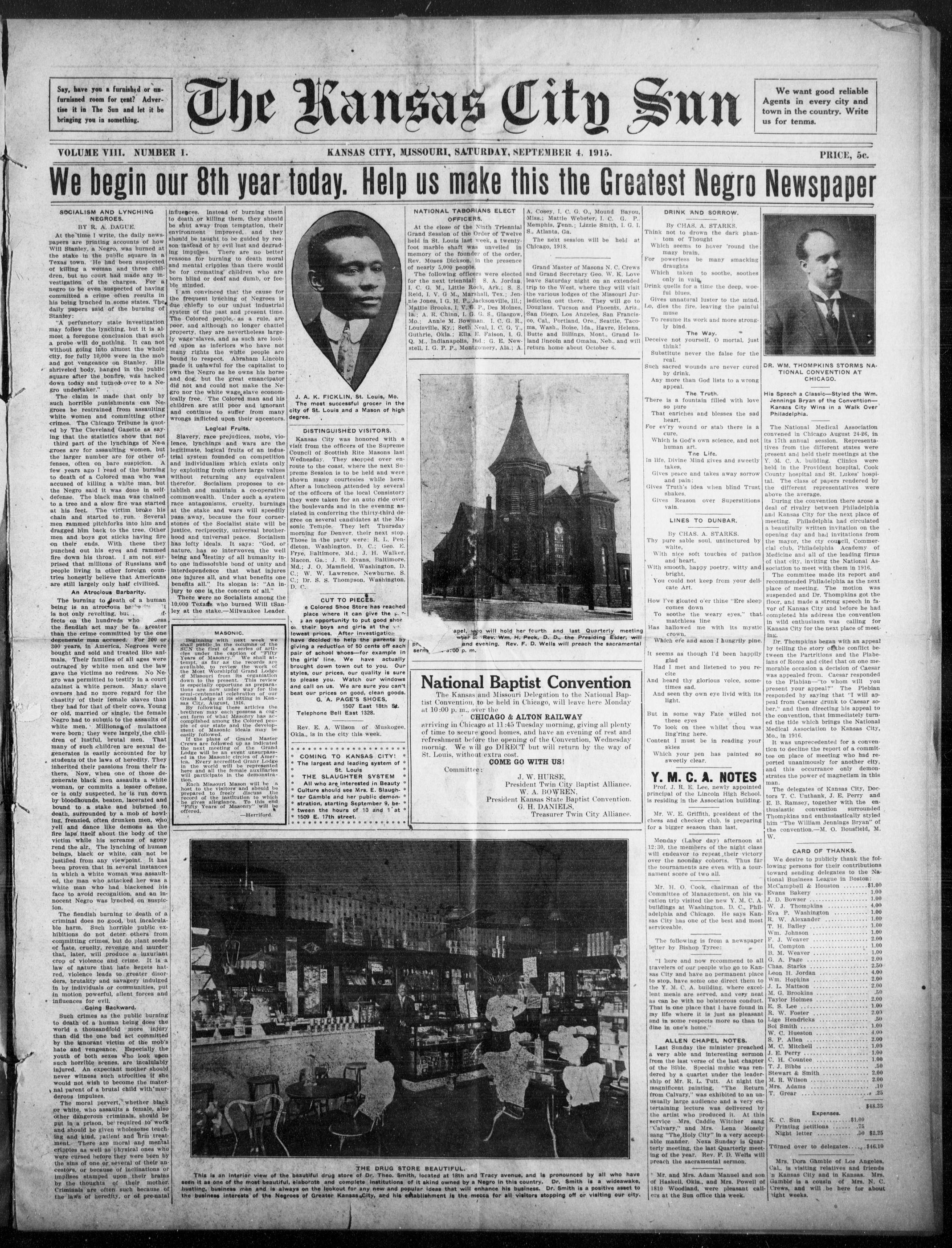
We begin our 8th year today. Help us make this the Greatest Negro Newspaper
Say, have you a furnished or unfurnished room for rent? Advertise it in The Sun and let it be bringing you in something.
VOLUME VIII. NUMBER 1.
BY R. A. DAGUE.
At the time I write, the daily newspapers are printing accounts of how Will Stanley, a Negro, was burned at the stake in the public square in a Texas town. He had been suspected of killing a woman and three children, but no court had made any investigation of the charges. For a negro to be even suspected of having committed a crime often results in his being lynched in some states. The daily papers said of the burning of Stanley:
"A perfunctory state investigation may follow the lynching, but it is almost a foregone conclusion that such a probe will do nothing. It can not without going into almost the whole city, for fully 10,000 were in the mob and got vengeance on Stanley. His shriveted body, hanged in the public square after the bonfire, was hacked down today and turned over to a Negro undertaker."
The claim is made that only by such horrible punishments can Negroes be restrained from assaulting white women and committing other crimes. The Chicago Tribune is quoted by The Cleveland Gazette as saying that the statistics show that not
third part of the lynchings of Neagroes are for assaulting women, but the larger number are for other offenses, often on bare suspicion. A few years ago I read of the burning to death of a Colored man who was accused of killing a white man, but the Negro said it was done in self-defense. The black man was chained to a tree and a slow fire was started at his feet. The victim broke his chain and started to run. Several men rammed pitchforks into him and dragged him back to the tree. Other men and boys got sticks having fire on their ends. With these they punched out his eyes and rammed fire down his throat. I am not surprised that millions of Russians and people living in other foreign countries honestly believe that Americans are still largely only half civilized.
An Atrocious Barbarity.
The burning to death of a human being is an atrocious beating, it is not only revolting, but affects on the hundreds who less the friendish act may be far greater than the crime committed by the one degenerate man accused. For 300 or 300 years, in America, Negroes were bought and sold and treated like animals. Their families of all ages were outraged by white men and the law gave the victims no redress. No Negro was permitted to testify in a court against a white person. Many slave owners had no more regard for the chastity of their female slaves than they had for that of their cows. Young or old, married or single, the female Negro had to submit to the assaults of white men. Millions of mulattoes were born; they were largely, the children of lustful, brutal men. That many of such children are sexual degenerates is easily accounted for by students of the laws of heredity. They inherited their passions from their fathers. Now, when one of those degenerate black men assaults a white woman, or commits a lesser offense, or is only suspected, he is run down by bloodhounds, beaten, lacerated and bound to a stake and bubbled to death, surrounded by a mob of howling, frenzied, often drunken men, who yell and dance like demons as the fire laps itself about the body of the victim while his screams of agony rend the air. The lynching of human belongs, black or white, can not be justified from any viewpoint. It has been proven that in several instances in which a white woman was assaulted, the man who attacked her was a white man who had blackened his face to avoid recognition, and an innocent Negro was lynched on suspicion.
The flendish burning to death of a criminal does no good, but incalculable harm. Such horrible public exhibitions do not deter others from committing crimes, but do plant seeds of hate, cruelty, revenge and murder that, later, will produce a luxuriant crop of violence and crime. It is a law of nature that hate begets hatred, violence leads to greater disorders, brutality and savagery indulged in by individuals or communities, put in motion powerful, silent forces and influences for evil.
Going Backward.
Such crimes as the public burning to death of a human being does the world a thousandfold more injury than did the one bad act committed by the ignorant victim of the mob's hate and vengeance. Especially the youth of both sexes who look upon such horrible scenes, are incabulably injured. An expectant mother should never witness such atrocities if she would not wish to become the maternal parent of a brutal child with murderous impulses. The moral pervert, whether black or white, who assaults a female, also other dangerous criminals, should be put in a prison, be required to work and should be given wholesome teaching and kind, patient and firm treatment. There are moral and mental cripples as well as physical ones who were cursed before they were born by the sins of one or several of their ancestors, or because of inclinations or impulses stamped upon their brains by the thoughts of their mother. Criminals are often such because of the laws of heredity, or of pre-natal
The Kansas City Sun
Caffeine
This is an interior view of the beautiful drug store of Dr. Theo. Smith, located at 18th and Tracy avenue, and is pronounced by all who have seen it as one of the most beautiful, elaborate and complete institutions of its skind owned by a Negro in this country. Dr. Smith is a wideawake, hustling, business man and is always on the lookout for any new and popular ideas that will enhance his business. Dr. Smith is a positive asset to the business interests of the Negroes of Greater Kansas city, and his establishment is the mecca for all visitors stopping off or visiting our city.
influences. Instead of burning them to death or killing them, they should be shut away from temptation, their environment improved, and they should be taught to be guided by reason instead of by evil lust and degrading impulses. There are no better reasons for burning to death moral and mental cripples than there would be for cremating children who are born blind or deaf and dumb, or feeble minded.
I am convinced that the cause for the frequent lynching of Negroes is due chiefly to our unjust industrial system of the past and present time. The Colored people, as a rule, are poor, and although no longer chattel property, they are nevertheless largely wage-slaves, and as such are looked upon as inferiors who have not many rights the white people are bound to respect. Abraham Lincoln made it unlawful for the capitalist to own the Negro as he owns his horse and dog, but the great emancipator did not and could not make the Negro nor the white wage slave economically free. The Colored man and his children are still poor and ignorant and continue to suffer from many wrongs inflicted upon their ancestors.
Logical Fruits.
Slavery, race prejudices, mobs, violence, lynchings and wars are the legitimate, logical fruits of an industrial system founded on competition and individualism which exists only by exploiting from others large values without returning any equivalent therefor. Socialism proposes to establish and maintain a cooperative commonwealth. Under such a system race antagonism, cruelty, burnings at the stake and wars will speedily pass away, because the four cornerstones of the Socialist state will be justice, reciprocity, universal brotherhood and universal peace. Socialism has lofty ideals. It says: "God, or nature, has so interwoven the well being and destiny of all humanity into one indissoluble bond of unity and interdependence that what injures one injures all, and what benefits one benefits all." Its slogan is: "An injury to one is the concern of all."
There were no Socialists among the 10,000 Texans who burned Will Sainley at the stake - Milwaukee Leader
MASONIC.
Beginning with next week we shall public in the columns of the Missouri State Journal the articles under the caption of "Fifty Years of Masonry." We shall attempt, as far as the records available, to mark the work of the Most Worshipful Grand Lodge of Missouri at the sitting in Kansas City, August, 1916. This review is especially opportune as preparations are now under way for the semi-centennial of the meeting at the sitting in Kansas City, August, 1916. The brethren may each possess a coherent form of what Masonry has accomplished among the Colored people of Missouri, and the ment of Masonic ideals may be easily followed. The form of Grand Master Crews are followed up as indicated the next meeting of the Grand Lodge and its members in the Masonic circles of America. Every accredited Grand Lodge in the world will be represented in each meeting will participate in the demonstration. Each Missouri Mason will be a touch to the visitors and should be prepared to freely discuss the record of the institution to the visiting guests. Each end "Fifty Years of Masonry" will be offered. Herrick
KANSAS CITY, MISSOURI, SATURDAY, SEPTEMBER 4. 1915.
J. A. K. FICKLIN, St. Louis, Mo.
The most successful grocer in the city of St. Louis and a Mason of high degree.
DISTINGUISHED VISITORS
Kansas City was honored with a visit from the officers of the Supreme Council of Scottish Rite Masons last Wednesday. They stopped over enroute to the coast, where the next Supreme Session is to be held and were shown many courtesies while here. After a luncheon attended by several of the officers of the local Consistory they were taken for an auto ride over the boulevards and in the evening assisted in conferring the thirty-third degree on several candidates at the Masonic Temple. They left Thursday morning for Denver, their next stop. Those in the party were: R. L. Pendleton, Washington, D. C.; Geo. E. Frye, Baltimore, Md.; J. H. Walker, Macon, Ga.; J. B. Evans, Baltimore, Md.; J. O. Mamfield, Washington, D. C.; W. W. Lawrence, Newburne, S. C.; Dr. S. S. Thompson, Washington, D. C.
CUT TO PIECES.
Colored Shoe Store has reached place where it can give the 1st and 2nd an opportunity to put good shoes on their boys and girls at the lowest prices. After investigation have decided to help the parents by giving a reduction of 50 cents off each pair of school shoes—for example in the girls' line. We have actually brought down town out to you. Our styles, our prices, our quality is sure to please you. Watch our windows and call on us. We are sure you can't beat our prices on good, clean goods.
G. A. PAGE'S SHOES,
1507 East 18th St.
Telephone Bell East 1328.
Rev. E. A. Wilson of Muskogee,
Okla., is in the city this week.
COMING TO KANSAS CITY!
The largest and leading system of St. Louis
THE SLAUGHTER SYSTEM
All who are interested in Beauty Culture should see Mrs. E. Slaughter Gamble and her public demonstration, starting September 9, between the hours of 10 and 1 at 1509 E. 17th street.
---
NATIONAL TABORIANS ELECT OFFICERS
At the close of the Ninth Triennial Grand Session of the Order of Twelve held in St. Louis last week, a twenty-foot marble shaft was unveiled in memory of the founder of the order, Rev. Moses Dickson, in the presence of nearly 5,000 people.
The following officers were elected for the next triennial: S. A. Jordan, I. C. G. M., Little Rock, Ark; S. S. Reid, I. V. G. M., Marshall, Tex.; Jenne Jones, I. G. H. P., Jacksonville, Ill.; Mattie Brooks, I. V. G. P., Des Moines, la; A. R. Chinn, I. G. G. S., Glasgow; M. Anne M. Bowman, I. C. G. R., Louisville, KY; Seti Neal, I. C. G. T., Guthrie, Okla; E. E. Failon, I. G. Q. M., Indianapolis, Ind; G. E. Newstell, I. G. P., Montgomery, Ala; A.
will hold her fourth and last Quarterly meeting
Rev. Wm. H. Peck, D. D., the Presiding Elder, will
ning. Rev. F. D. Wells will preach the sacramenta
Baptist Convention
and Missouri Delegation to the National Bap-
be held in Chicago, will leave here Monday
the
CAGO & ALTON RAILWAY
at 11:45 Tuesday morning, giving all plenty
good homes, and have an evening of rest and
the opening of the Convention, Wednesday
GO DIRECT but will return by the way of
extra cost.
COME GO WITH US!
apel, who will hold her
member to Rev. Wm. H.
pr. and evening. Rev. I
serma. 8:00 p. m.
National Bapt
The Kansas and Missouri
ist Convention, to be held in
at 10:00 p. m., over the
CHICAGO & A
arriving in Chicago at 11:45 T
of time to secure good homes,
refreshment before the openin
mornig. We will go DIRECT
St. Louis, without extra cost.
COME GO
THE CHURCH OF THE LORD'S PRAYER
apel, who will hold her fourth and last Quarterly meeting
oper & Rev. Wm. H. Peck, D. D., the Presiding Elder, will
p. and evening. Rev. F. D. Wells will preach the sacramental
serms 5:00 p. m.
National Baptist Convention
The Kansas and Missouri Delegation to the National Baptist Convention, to be held in Chicago, will leave here Monday at 10:00 p. m., over the CHICAGO & ALTON RAILWAY arriving in Chicago at 11:45 Tuesday morning, giving all plenty of time to secure good homes, and have an evening of rest and refreshment before the opening of the Convention, Wednesday morning. We will go DIRECT but will return by the way of St. Louis, without extra cost.
J. W. HURSE,
President Twin City Baptist Alliance.
W. A. BOWREN,
President Kansas State Baptist Convention.
G. H. DANIELS,
Treasurer Twin City Alliance.
```markdown
```
---
A. Cosey, I. C. G. O., Mound Bayou, Miss.; Mattie Webster, I. C. G. P., Memphis, Tenn.; Lizzie Smith, I. G. I. S., Atlanta, Ga.
The next session will be held at Chicago, 1918.
Grand Master of Masons N. C. Crews and Grand Secretary Geo. W. K. Love leave Saturday night on an extended trip to the West, where they will visit the various lodges of the Missouri Jurisdiction out there. They will go to Douglass, Tucson and Phoenix, Ariz. San Diego, Los Angeles, San Francisco, Cal, Portland, Ore, Seattle, Tacoma, Wash., Boise, Id., Havre, Helena, Butte and Billings, Mont., Grand Island Lincoln and Omaha, Neb., and will return home about October 6.
DRINK 'AND SORROW.
By CHAS. A. STARKS.
Think not to drown the dark phantom of Thought
Which seems to hover 'round the mazy brain.
For powerless be many smacking draughts
Drink quells for a time the deep, woe ful blues.
Gives unnatural luster to the mind
Lo, dies the fire, leaving the painful muse
Deceive not yourself, O mortal, just think!
Substitute never the false for the real.
Such sacred wounds are never cured by drink.
Any more than God lists to a wrong appeal.
The Truth.
There is a fountain filled with love so pure
That enriches and blesses the sad heart.
For every wound or stab there is a cure.
In life, Divine Mind gives and sweetly takes,
Gives Reason over Superstitions
vain.
LINES TO DUNBAR
S. STARKS.
Thy pure sable soul, unintended by
white.
You could not keep from your deli- cate Art.
How I've gloated o'er thine "Ere sleep comes down
To soothe the weary eyes," that matchless line
Has hallowed me with its mystic crown,
Which ere and anon I hungrily pine.
It seems as though I'd been happily glad
Had I met and listened to you re- cite
And heard thy glorious voice, some- times sad.
And seen thy own eye livid with its light.
But in some way Fate willed not these eyes
To look on thee whilst thou was ling'ring here.
Content I must be in reading your skies
Which your pen has painted so sweetly clear
Y. M. C. A. NOTES
Prof. J. R. E. Lee, newly appointed principal of the Lincoln High School, is residing in the Association building.
Mr. W. E. Griffith, president of the chess and chequer club, is preparing for a bigger season than last.
Monday (Labor day) afternoon at 12:30, the members of the night class will endeavor to repeat, their victory over the noonday cohorts. Thus far the tournaments are even with a tournament score of two all.
Mr. H. O. Cook, chairman of the Committee of Management, on his vacation trip visited the new Y. M. C. A. buildings at Washington, D. C., Philadelphia and Chicago. He says Kansas City has one of the best and most serviceable.
The following is from a newspaper letter by Bishop Tyree:
"I here and now recommend to all travelers of our people who go to Kansas City and have no permanent place to stop, have some one direct them to the Y. M. C. A. building, where excellent meals are served, and very neat as can be with no bolsterous conduct. That is one place that I have found in my life where it is just as pleasant and in some respects more so than to dine in one's home."
ALLEN CHAPEL NOTES.
Last Sunday the minister preached a very able and interesting sermon from the last verse of the last chapter of the Bible. Special music was rendered by a quartet under the leadership of Mr. R. L. Tutt. At night the magnificent painting, "The Return from Calvary," was exhibited to an unusually large audience and a very entertaining lecture was delivered by the artist who produced it. At this service Mrs. Caddie Witcher sang "Calvary," and Mrs. Lena Mosely sang "The Holy City" in a very acceptable manner. Nexa Sunday is Quarterly meeting, the last Quarterly meeting of the year. Rev. F. D. Wells will preach the sacramental sermon.
Mr. and Mrs. Adam Manuel and son of Haskell, Okla., and Mrs. Powell of 1810 Woodland, were pleasant callers at the Sun office this week.
We want good reliable Agents in every city and town in the country. Write us for tenms.
PRICE, 5c.
DR. WM. THOMPKINS STORMS NATIONAL CONVENTION AT CHICAGO.
His Speech a Classic—Styled the Wm. Jennings Bryan of the Convention—Kansas City Wins in a Walk Over Philadelphia.
The National Medical Association convened in Chicago August 24-86, in its 17th annual session. Representatives from the different states were present and held their meetings at the Y. M. C. A. building. Clinics were held in the Provident hospital, Cook County hospital and St. Luke's hospital. The class of papers rendered by the different representatives were above the average.
During the convention there arose a deal of rivalry between Philadelphia and Kansas City for the next place of meeting. Philadelphia had circulated a beautifully written invitation on the opening day and had invitations from the mayor, the city council, Commercial club, Philadelphia Academy of Medicine and all of the leading firms of that city, inviting the National Association to meet with them in 1916.
The committee made its report and recommended Philadelphia as the next place of meeting. The motion was suspended and Dr. Thompkins got the floor, and made a strong speech in favor of Kansas City and before he had completed his address the convention in wild enthusiasm was calling for Kansas City for the next place of meeting.
Dr. Thompkins began with an appeal by telling the story of the conflict between the Partritions and the Plabeians of Rome and cited that on one memorable occasion a decision of Caesar was appealed from. Caesar responded to the Plabian—"to whom will you present your appeal?" The Plebian responded by saying that "I will appeal from Caesar drunk to Caesar sore," and then directing his appeal to the convention, that immediately turned the tide which brings the National Medical Association to Kansas City, Mo., in 1916.
It was unprecedented for a convention to decline the report of a committee on place of meeting who had reported unanimously for another city, and this occurrence only demonstrates the power of magnetism in this man.
The delegates of Kansas City, Doctors T. C. Unthank, J. E. Perry and E. B. Ramsey, together with the enthusiastic convention surrounded Thompkins and enthusiastically styled him "The William Jennings Bryan" of the convention.—M. O. Bousfield, M. W.
CARD OF THANKS.
lowing persons for their contributions toward sending delegates to the National Business League in Boston: McCampbell & Houston $1.00
Evans Bakery 1.00
J. D. Bowser 1.00
W. J. Thompkins 4.00
Eva P. Washington 1.00
R. W. Alexander 1.00
T. H. Balley 1.00
Wm. Johnson 1.00
F. J. Weaver 2.00
H. Compton 1.00
B. M. Weaver 1.00
G. A. Page 2.00
Chas. Starks 2.50
Leon H. Jordan 4.00
Wm. Hopkins 2.00
J. L. Mattson 2.00
M. G. Brookins 5.0
Taylor Holmes 2.00
E. S. Lee 1.00
R. W. Foster 2.00
Lige Hendricks 5.0
Sol Smith 1.00
W. C. Hueston 4.00
S. P. Allen 2.00
M. C. Mitchell 1.00
J. E. Perry 1.00
C. H. Countee 1.00
T. J. Bibbs 5.0
Stewart & Smith 2.00
M. R. Wilson 2.00
Mrs. Adams 10
T. Grear 25
Expenses.
K. C. Sun ..... $1.00
Printing petitions ..... .75
Night letter ..... .50 $2.25
Turned over to delegates..... $46.10
Mrs. Dora Gamble of Los Angeles,
Cal. is visiting relatives and friends
in Kansas City and in Kansas. Mrs.
Gamble is a cousin of Mrs. N. C.
Crews, and will be here for about
night weeks.
(Copyright, 1915, by W. G. Chapman.)
Miss Victoria Dallemand, handsome, but haughty because purse-proud and intolerant, turned from the driver of the big van that contained a part of the furniture of the house of Dallemand.
She noted that a pair of clear, intelligent eyes showed from under the soiled and creased sombrero worn by the driver and his manner was that of a cultured gentleman. Still, his vacation was humble, his clothing rough, his present position on a par with the family coachman.
"Will you kindly tell the men with the second van to take the hill road when the conveyance arrives?" he had asked courteously.
Miss Dallemand bestowed upon him a chilling stare. A slight smile passed over the face of the young man. It was so enigmatical, and withal so susceptible of fine gradations of analysis that the companion of the exclusive Miss Dallemand was influenced to pay attention to him. She was only Lucia Parr, poor and an orphan, but a favorite with Victoria. She deprecated the autocratic action of her friend. It was so simple and natural a task to answer civilly, and she said impulsively:
"I will deliver your message, sir."
"Thank you," and the keen, mirthful eyes of the driver, whom his present companions called "Wharton." flashed her a signal of appreciation, and of admiration, too, that caused Lucia to flush deeply.
"Why, Lucia," observed Miss Dallemand in tones of open reproach.
VAMB
At Least a Dozen Times the Van Nearly Upset.
"These underlings are too familiar as it is, without encouraging them."
The Dallemands were about to take up summer quarters at Haven Cove, where they had a sumptuous home near Clear: Water lake. It was their custom each year to do this. In the absence of her father and mother, Miss Dallemand had assumed charge of affairs. She had sent to the town, as was usual, to secure a moving crew, and the first van, carrying the plano, some book cases and other special furnishings, was now jogging along down the road, driven by Wharton.
The young man was an accomplished driver, he showed that in the way he managed the team, but his two helpers were unruly comrades. Armed with several bottles, they threw themselves upon a heap of mattresses piled in one corner of the great wagon and ordered Wharton to give them the word when they reached destination.
"If we ever do!" solloquized Wharton, just after dark.
It had begun to rain, as it had rained every day for over a week. The roads were in a frightful condition. At the best mere struggling wagon trails, at places they were now a series of ruts and quagmires.
At least a dozen times the van nearly upset. Once it became mired and they had to secure the services of two farmers with their teams to haul them onto a solid roadway further on.
They reached the point of land at the extreme end of which the Dallemand summer home was located late in the evening. Wharton had planned to reach the place by four o'clock in the afternoon. The horses were well high exhausted. Across a narrow neck of ground that was swampy and flooded they just managed to plod along, and drew up in front of the dark and lonely looking mansion, all hands wet, chilled and exhausted.
"That second van will never get through tonight," remarked one of the men.
"No, nor 'or some days to come," answered Wharton. "I wonder what arrangements the family have made as to getting into the house and unloading?" He took the lighted lantern from the wagon and went up the gravel path leading to the porch. A rustle fixed his attention, and as he focused the rays of light up the steps Wharton drew back in some surprise. The radiance showed a damp and shivering group huddled back upon some porch benches—Miss Dallemand, her friend Miss Parr, and two woman servants. Regal as ever, stony-faced and disdainful, the haughty Miss Dallemand looked grieved, indignant and
"We expected you here hours ago," pronounced the proud beauty in icy tones.
In a hurried, but clear manner Wharton explained the difficulties of the journey. Miss Dallemand simply shrugged her shoulders. Miss Parr arose and regarded Wharton in an apologetic way.
"We came in the automobile," she said, "which got through more easily than the heavily loaded van. Would it be possible to make us a little more comfortable?"
"Yes, indeed!" brisked up Wharton.
"Have you a key to the home?"
"It seems to have been lost in the bustle and discomfort of our journey," replied Miss Parr.
"We will soon adjust all that!" pledged Wharton cheerly.
He was as good as his word. A window was forced, some lamps found in the house filled with oil from the can in the wagon, and the helpers urged up to get the furniture out of the van into the house. Once inside, Miss Dallemand sat at a distance in an arm chair brought in for her especial comfort. Miss Parr kept in touch with the movements of Wharton, suggesting, and seeming to stir about and busy herself.
Under her directions two rooms were quite comfortably fixed up, fires started in the grates, and Wharton even went so far as to bring in a coarse but wholesome lunch from their own provisions in the van.
"You have done so nicely!" commended Miss Parr brightly, as Wharton went back down stairs, bowing with the grace of a cavalier, and assuring her that as soon as the other van arrived they would have the place in complete order.
But the other van did not arrive the next day and the rain kept up. Wharbon sent his men and the van back to hunt up and assist if necessary the delayed transport.
He worked like a beaver for the comfort of the refugees. A mile away at the village he secured eatables, including dainties, installed one of the servants as cook, and even Miss Dallemand assented to the sentiment of her friend that things were beginning to look actually homelike.
"That common person who drives the van has been really useful to us," she acknowledged languidly.
"He isn't very common," declared Lucia. "Why, I heard him at the piano today playing softly one your most difficult concert pieces. He is a true gentleman, that is sure."
The other van arrived next morning. Then came Mr. and Mrs. Dallemand. Mr. Dallemand, hearing of the active services of the "common person," pleaded with him to remain a week and get things in order about the place.
"My old friend, General Taylor, is coming to visit us tomorrow," announced Mr. Dallemand to his wife and daughter one day. "His nephew will be a millionaire some day, Victoria," added Mr. Dallemand, with a quiet smile, and the next day the general arrived. His host was showing him about the garden when the general started, halted and stared.
"My nephew here!" cried the old man and his glance was fixed on Wharton, who, assisted by Lucia, was training a vine up a trellis, their faces temptingly near together.
"That—why, that is Wharton, a jewel of a manager I have employed—" began Mr. Dallemand.
"Yes, Eric Wharton Taylor," added the general. "Hey, sir, what is the meaning of this masquerade?" he halted, and Lucia, with blushing face retreated, and Wharton advanced. "I put you on probation—" "Well, I've started in to make a man of myself by seeking honest work haven't I?" smiled Wharton.
"My afflianced wife, if you approve it," announced Wharton.
Miss Victoria was agast when she heard the news. The unknown Eric Wharton Taylor had been on her list of prospective suitors. However, she bit her lip and smiled on Lucia, and really approved the match with that "common person!"
Gave It to the Neighbors.
Two esteemed citizens were walking along the streets of a western town when one of the pair remarked that he was temporarily a bachelor owing to the fact that his wife had gone on a vacation.
"I suppose," smilingly remarked the other, "that you write to her and tell her everything that you do while she is gone?"
"Oh, no," was the rather surprising response of the first; "I don't have to."
"Don't have to!" returned the other wonderingly. "Do you mean to save—"
"I mean to say," replied the first,
"that the neighbors kindly attend to it
for me."
Zeppelin Engines
The latest Zeppelins are said to be equipped with three six-cylinder Diesel engines, with a combined horse power of 450. The speed of these air monsters is normally 50 miles an hour, but 60 can be attained under favorable weather conditions. In case one of the three engines should be disabled, the remaining two have been proven to be sufficient to make headway against a 27-mile wind, which means that under normal conditions 35 to 40 miles could be made.
Inevitable Difference.
"My husband's ideas and mine are so different," sighed the young woman. "Well," replied her mother thoughtfully, "the ideas of men and women are bound to differ. A woman can't see the sense in a box of cigars that nobody can wear, and a man has no respect for a new hat that you can't smoke."
In the Light.
Colonel—So you lost half your force by a trick of the enemy.
Captain—Yes, sir. They rigged up a cannon to look like a moving picture machine and the boys just fought for a chance to get in front of it.—Boston Transcript.
A
THE FASHION WEEK
No outfit is quite complete in these days without a sweater of some sort. And there is a wide and varied choice in sweaters, for they are claiming more attention than ever before in their history.
There are finely woven sweaters of silk, in gay colors, which one sees at the afternoon concert, at the country club, on the beaches and the golf links, and in any other outdoor meetings of fashionables. There are sweaters considerably like them, made of artificial silk, usually in more vivid colorings than the all-silk variety. Then there are the practical wool sweaters, similar to that shown in the picture, and belonging to the same class.
The new models are carefully designed to the end that they may embody the right style. In the example pictured here, for instance, it will be noticed that the sleeves are well shaped and finished with a cuff
Three New M
Of all things, millinery requires careful choosing, and, after it is bought, the hat requires careful placing on the head, if it is to fulfill its destiny. According to an old millinery maxim that destiny is to improve the appearance of the wearer. "You must look better with your hat than without it"—that is the exacting test to which each new mode is to be subjected.
The three new models for fall, which appear here, are types that will repay a little study on the part of those who consider things before buying them. They include a small turban, a turban with extension crown which forms a halo brim, and one of the graceful wide-brimmed hats to which fashion is extending welcoming hands.
Quite a number of these widebrimmed hats are shaped with brims turning upward at the back. This has brought in the underbrim trimming again and it is not confined to widebrimmed shapes. Short, curling estrich plumes fit into the trimming of the underbrim in the most graceful way. The small turban is made of corded
Market for Handkerchiefs
The immediate surroundings of the great pier where St. Paul landed are as filthy as any other part of Pozzuoli. Indescribable old hags leer at us from the doorways; ragged and dirty children, wholly unacquainted with the use of a pocket handkerchief, swarm around us. Several small fishing boats are drawn up on the shore and a little church, called St. Paul's Chapel, stands immediately behind the ancient mole.
The modern pier, built over the an-
and button. The patch pockets leave a turnover flap, and the new order of things in belts is recognized. The collar may be turned up close about the neck if required. Because this is a sweater for real comfort in cool days it is rather heavy. Its usefulness begins with fall, and continues to the coming of another summer, for it reinterests the too light wrap in the depths of winter. It is an excellent model to choose for the young girl to wear to school during the autumn months, and nothing could be better designed or arranged for sports wear. Sweaters of wool stand the rough handling which they are likely to get from young people, and continue to look none the worse for it. Now that they are made in beautiful colors and with so much attention to style, the field of their usefulness is wonderfully increased.
odels for Fall
silk, and would be equally effective in panne velvet. The material is covered with corded tucks and serves for the covering of the hat and for its trimming. The edges are finished with a silver tinsel braid which has the effect of needlework. It looks like close-set overcast stitches, and needlework decoration is a feature of the new fall millinery. The turban with extension crown is made of black velvet and white chiffon. A bead work ornament trims the front and is made entirely of white beads.
The soft and graceful brim of the third hat bespeaks for it, and for many others of the same character, first place in the favor of young women. It is made of velvet in black or one of the dark shades of fashionable colors. The trimming is of white fancy ostrich and looks like a bit of fireworks, done in frost. It throws its sprays in front of the left eye of the wearer with an abandon unknown to ornaments hitherto. But it is strong in the knowledge that it is less in the way of vision than many a veil.
client mole, is a truly magnificent one of solid cut stone, which runs far out into the sweet, clean water, and by going out to the end we get beyond the reach of the importunate touts. If one can forget the approaches to the pier, he can he enjoy the enchanting scenery of the sea and shore, while his mind is stimulated by memories of the mighty past.
Puts Savor Into Life.
Work is the best thing to make us love life—Ernest Renan.
AFRO-AMERICAN CULLINGS
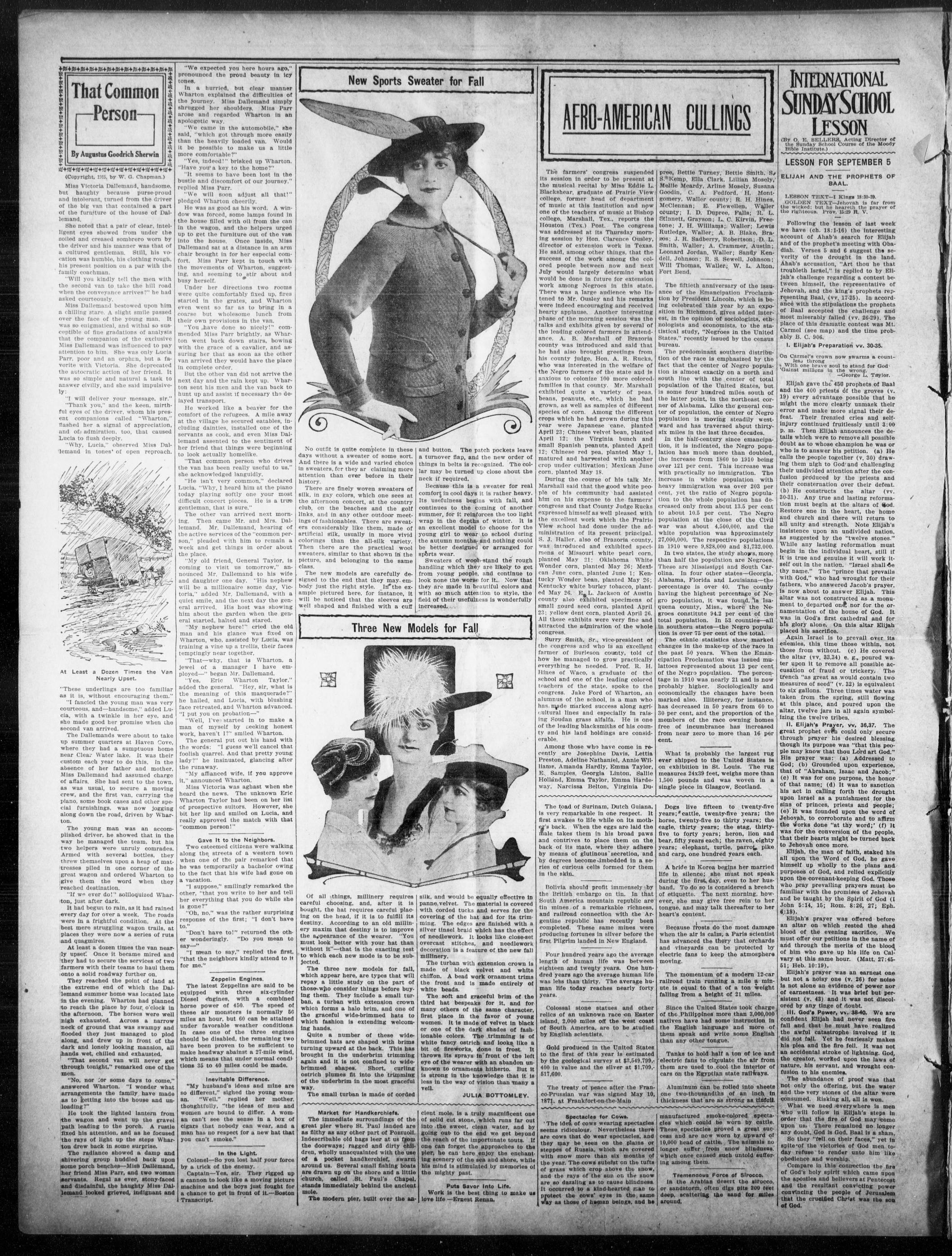
The farmers' congress suspended its session in order to be present at the musical recital by Miss Eddie L. Blackshear, graduate of Prairie View college, former head of department of music at this institution and now one of the teachers of music at Bishop college, Marshall, Tex., reports the Houston (Tex.) Post. The congress was addressed at its Thursday morning session by Hon. Clarence Ouseley, director of extension work in Texas. He said, among other things, that the success of the work among the colored people between now and next July would largely determine what would be done in future for extension work among Negroes in this state. There was a large audience who listened to Mr. Ouseley and his remarks were indeed encouraging and received hearty applause. Another interesting phase of the morning session was the talks and exhibits given by several of the leading colored farmers in attendance. A. B. Marshall of Brazoria county was introduced and said that he had also brought greetings from his county judge, Hon. A. R. Rucks, who was interested in the welfare of the Negro farmers of the state and is anxious to colonize 100 more colored families in that county. Mr. Marshall exhibited quite a variety of peas, beans, peanuts, etc., which he had grown, as well as samples of different species of corn. Among the different crops which he had grown during this year were Japanese cane, planted April 23; Chinese velvet bean, planted April 12; the Virginia bunch and small Spanish peanuts, planted April 12; Chinese red pea, planted May 1, matured and harvested with another crop under cultivation; Mexican June corn, planted May 18.
During the course of his talk Mr Marshall said that the good white people of his community had assisted him on his expense to the farmers congress and that County Judge Rucks expressed himself as well pleased with the excellent work which the Prairie View school had done under the administration of its present principal. S. J. Haller, also of Brazoria county, was introduced and exhibited spects of Missouri white pearl corn planted May 21; Oklahoma White Wonder corn, planted May 26; Mexican June corn, planted June 1; Kentucky Wonder bean, planted May 26; Kentucky white burley tobacco, planted May 26. E. L. Jackson of Austin county also exhibited specimens of small gourd seed corn, planted April 23; yellow dent corn, planted April 26. All these exhibits were very fine and attracted the admiration of the whole congress.
Surry Smith, Sr., vice-president of the congress and who is an excellent farmer of Burleson county, told of how he managed to grow practically everything he needed. Prof. R. H. Hines of Waco, a graduate of the school and one of the leading colored teachers of the state, spoke to the congress. Jake Ford of Wharton, an alumnus of the school, is a man who has made marked success along agricultural lines and especially in raising Soudan grass alfalfa. He is one of the leading blacksmiths of his county and his land holdings are considerable.
Among those who have come in recently are Josephine Davis, Lettta Preston, Adeline Nathaniel, Annie Williams, Amanda Hardy, Emma Taylor, E. Samples, Georgia Linton, Sallie Holland, Emma Taylor, Emma Hardy, Narcissa Belton, Virginia Du
The toad of Surinam, Dutch Guiana, is very remarkable in one respect. It first awakes to life while on its mother's back. When the eggs are laid the male takes them in his broad paws and contrives to place them on the back of its mate, where they adhere by means of glutinous secretion, and by degrees become-imbedded in a series of curious cells formed for them in the skin.
Bolivia should profit immensely by the British embargo on tin. In that South America mountain republic are tin mines of a remarkable richness, and railroad connection with the Argentine republic has recently been completed. These same mines were producing fortunes in silver before the first Pilgrim landed in New England.
Four hundred years ago the average length of human life was between eighteen and twenty years. One hundred years ago the average human life was less than thirty. The average human life today reaches nearly forty years.
Colossal stone statues and other relics of an unknown race on Easter island, 2,000 miles off the west coast of South America, are to be studied by English scientists.
Gold produced in the United States to the first of this year is estimated by the geological survey at $3,549,799,400 in value and the silver at $1,709,517,600.
The treaty of peace after the Franco-Prussian war was signed May 10, 1871, at Frankfurt-on-the-Main
Spectacles for Cows.
The idea of cows wearing spectacles seems ridiculous. Nevertheless there are cows that do wear spectacles, and they may be seen on the plains or steppes of Russia, which are covered with snow more than six months of the year. The cows subsist on the turtles of grass which crop above the snow, and the rays of the sun on the snow are so dazzling as to cause blindness. It occurred to a kind-hearted man to protect the cows' eyes in the same way as those of human beings, and he
prec, Bettie Turney, Bettie Smith, S. S. Kemp, Ella Clark, Lillian Moseley, Mellie Meardy, Arline Moseley, Susana Goodin, C. A. Fedford, H. Montgomery, Waller county; R. H. Hines, McCleennan; E. Flewellen, Waller county; I. D. Dupree, Falls; R. L. Stinnett, Gravson; L. C. Kirlin, Freetone; J. H. Williams; Waller, Lewis Rutledge, Waller; A. B. Blake, Brass; J. R. Sadberry, Robertson; D. L. Smith, Waller; A. Crammer, Austin; Leonard Jordan, Waller; Sandy Kendell, Johnson; R. S. Sewell, Johnson; Will Thomas, Waller; W. L. Alton, Fort Bend.
The fifthth anniversary of the issuance of the Emancipation Proclamation by President Lincoln, which is being celebrated this year by an exposition in Richmond, gives added interest, in the opinion of sociologists, ethnologists and economists, to the statistical study, "Negroes in the United States," recently issued by the census bureau.
The predominant southern distribution of the race is emphasized by the fact that the center of Negro population is almost exactly on a north and south line with the center of total population of the United States, but is some four hundred miles south of the latter point, in the northeast corner of Alabama. Like the general center of population, the center of Negro population is moving steadily westward and has traversed about thirty-six miles in the last three decades.
In the half-century since emancipation, it is indicated, the Negro population has much more than doubled, the increase from 1860 to 1910 being over 121 per cent. This increase was with practically no immigration. The increase in white population with heavy immigration was over 203 per cent, yet the ratio of Negro population to the whole population has decreased only from about 13.5 per cent to about 10.5 per cent. The Negro population at the close of the Civil war was about 4,500,000, and the white population was approximately 27,000,000. The respective populations in 1910 were 9,828,000 and 81,722,000.
In two states, the study shows, more than half the population are Negroes. These are Mississippi and South Carolina. In four other states—Georgia, Alabama, Florida and Louisiana—the percentage is over 40. The county having the highest percentage of Negro population, it was found, is Isaquena county, Miss., where the Negroes constitute 94.2 per cent of the total population. In 53 counties—all in southern states—the Negro population is over 75 per cent of the total.
The ethnic statistics show marked changes in the make-up of the race in the past 50 years. When the Emancipation Proclamation was issued mulattoes represented about 13 per cent of the Negro population. The percentage in 1910 was nearly 21 and is now probably higher. Sociologically and economically the changes have been marked also. Illiteracy, for instance, has decreased in 50 years from 60 to 30 per cent, and the proportion of the members of the race owning homes free of incumbrance has increased from near zero to more than 16 per cent.
What is probably the largest rug ever shipped to the United States is on exhibition in St. Louis. The rug measures 24x39 feet, weighs more than 1,500 pounds and was woven in a single piece in Glasgow, Scotland.
Dogs live fifteen to twenty-five years; cattle, twenty-five years; the horse, twenty-five to thirty years; the eagle, thirty years; the stag, thirty-five to forty years; heron, lion and bear, fifty years each; the raven, eighty years; elephant, turtle, parrot, pike and carp, one hundred years each.
A bride in Korea begins her married life in silence; she must not speak during the first day, even to her husband. To do so is considered a breach of etiquette. The next morning, however, she may give free rein to her tongue, and may talk thereafter to her heart's content.
Because frosts do the most damage when the air is calm, a Paris scientist has advanced the theory that orchards and vineyards can be protected by electric fans to keep the atmosphere moving.
The momentum of a modern 12-car
railroad train running a mile a minute
is equal to that of a ton weight
falling from a height of 21 miles.
Since the United States took charge of
the Philippines more than 3,000,000
natives have had some instruction in
the English language and more of
them speak and write some English
than any other tongue.
Tanks to hold half a ton of ice and
electric fans to circulate the air from
them are used to cool the interior of
cars on the Egyptian state railways.
Aluminum can be rolled into sheets
one two-thousandths of an inch in
thickness that are as strong as tinfoll
manufactured smoke-colored spectacles which could be worn by cattle. These spectacles proved a great success and are now worn by upward of 10,000 head of cattle. The animals no longer suffer from snow blindness, which once caused such untold suffering among them.
Tremendous Force of Slippoco,
In the Arabian desert the sirocco,
or sandstorm, often digs pits 200 feet deep, scattering the sand for miles around.
INTERNATIONAL
SUNDAY SCHOOL
LESSON
(By O. E. SELLERB, Acting Director of
Course of the Moody
Bible Institute).
ELIJAH AND THE PROPHETS OF BAAL.
LESSON TEXT-I Kings 18:30-32.
GOLDEN TEXT-Jehovah is far from the wicked; but he heareth the prayer of the righteous. Prov. 15:29 R. V.
Following the lesson of last week we have (ch. 18:1-16) the interesting account of Ahab's search for Elijah and of the prophet's meeting with Obadiah. Verses 5 and 6 suggest the severity of the drought in the land. Ahab's accusation, "Art thou he that troublebeth Israel," is replied to by Elijah's challenge regarding a contest between himself, the representative of Jehovah, and the king's prophets representing Baal, (vv. 17-25). In accordance with the stipulations the prophets of Baal accepted the challenge and most miserably failed (vv. 26-29). The place of this dramatic contest was Mt. Carmel (see map) and the time probably B. C. 906.
I. Elijah's Preparation vv. 30-35.
On Carmel's crown now swarms a count-
les, throng
With one brave soul to stand for God.
'Gainst millions in the strong.'
Gewurf, Taylor.
Elijah gave the 450 prophets of Baal and the 400 priests of the groves (v. 19) every advantage possible that he might the more clearly unmask their error and make more signal their defeat. Their frenzied cries and self-injury continued fruitlessly until 3:00 p. m. Then Elijah announces the details which were to remove all possible doubt as to whose champion he was or who is to answer his petition. (a) He calls the people together (v. 30) drawing them nigh to God and challenging their undivided attention after the confusion produced by the priests and their consternation over their defeat. (b) He constructs the altar (vv. 30-31). Any true and lasting reformation must begin at the altars of God. Restore one in the heart, the home and church and there will return to all unity and strength. Note Elijah's insistence upon an undivided nation, as suggested by the "twelve stones." While any lasting reformation must begin in the individual heart, still if it is true and genuine it will work itself out in the nation. "Israel shall cease my name." The "prince that prevails with God," who had wrought for their fathers, who answered Jacob's prayer, is now about to answer Elijah. This altar was not constructed as a monument to departed one nor for the ornamentation of the house of God. It was in God's first cathedral and for his glory alone. On this altar Elijah placed his sacrifice.
Again Israel is to prevail over its enemies, this time those within, not those from without. (c) He covered the altar (vv. 33.34) e. g., poured water upon it to remove all possible accusation of fraud or trickery. The trench "as great as would contain two measures of seed" (v. 32) is equivalent to six gallons. Three times water was taken from the spring, still flowing at this place, and poured upon the altar, twelve jars in all again symbolizing the twelve tribes.
II. Ellijah's Prayer, vv, 36,37. The great prophet even could only secure through prayer his desired blessing though its purpose was "that this people may know that thou Lord art God." His prayer was: (a) Addressed to God; (b) Grounded upon experience, that of "Abraham, Isaac and Jacob." (c) It was for one purpose, the honor of that name; (d) It was to sanction his act in calling forth the drought upon Israel as a punishment for the sins of princes, priests and people; (e) It was founded upon the word of Jehovah, to corroborate and to affirm the works done "at thy word"; (f) It was for the conversion of the people, that their hearts might be turned back to Jehovah once more.
Elijah, the man of faith, staked his all upon the Word of God, he gave himself up wholly to the plans and purposes of God, and relied explicitly upon the covenant-keeping God. Those who pray prevailing prayers must be familiar with the promises of Jehovah and be taught by the Spirit of God (I John 5:14, 15; Rom. 8:26, 27; Eph. 6:18).
Elijah's prayer was offered before an altar on which rested the shed blood of the evening sacrifice. We must offer our petitions in the name of and through the merits of the blood of him who gave up his life on Calvary at this same hour. (Matt. 27:45-51; Heb. 10:19).
Elijah's prayer was an earnest one but not a noisy one (v. 26) for noise is not alone an evidence of power nor of earnestness. It was brief but persistent (v. 43) and it was not discolored by any tinge of doubt.
III. God's Power, vv. 38-40. We are confident Elijah had never seen fire fall and that he must have realized the awful catastrophe involved if it did not fall. Yet he fearlessly makes his plea and the fire fell. It was not an accidental stroke of lightning, God, the creator, worked upon the laws of nature, his servant, and wrought confusion to his enemies.
The abundance of proof was that not only the offering, but the water and the very stones of the altar were consumed. Risking all, all is won.
What we need everywhere is men who will follow in Elijah's steps in order that the fire of God may come upon us. There remained no longer any doubt, God is God, Baal is a sham. So they "fell on their faces," yet in spite of the victories of God men today refuse to render unto him like obedience and worship.
Compare in this connection the first of God's holy spirit which came upon the apostles and believers at Pentecost and the resultant convicting power convicting the people of Jerusalem that the crucified Christ was the son of God.
---
FOR THE GUEST ROOM
PRETTY THINGS MAKE THE WEL
COME SEEM REAL
First Consideration for a Guest is Comfort—Annoyance of Delayed Baggage Can Be Overcome by Little Foresight.
It is a good idea to prepare pretty things for fitting up the guest room.
things for fitting up the guest room.
The first consideration for a guest is comfort. She may be delighted with the vase of flowers that greets her from the table, but she will be sure to appreciate a pretty negligee hanging in the closet. One's luggage seldom arrives at its destination with oneself, and a negligee to slip into is often a comfort indeed. Feet are apt to be tired, and until slippers arrive the feet would be glad to rest in a pair of simple bedroom slippers. These are really no trouble at all to make. You just take a pair of lamb's wool soies and a strip of ribbon long enough to go around the sole and four inches wide. One edge is sewed to the edge of the sole and the other is turned down to make a hem through which is run a narrow elastic. This draws the ribbon up, shaping it into a shoe.
Supposing one chooses blue ribbon and works a few rosebuds on the toes in embroidery silk and makes a simple kimono of pale blue cotton棉 trimmed with a frill of white lace and finished with a loose belt of pink ribbon. This would be a very dainty outfit and cost but little. Four yards of crepe at 15 cents a yard, plain or flowered in blue, with two yards of lace at ten cents a yard, and two yards of ribbon at 12½ cents a yard, will be ample. In fact if one looked around for bargains one dollar would probably cover the entire cost.
Curtains can be made before they are needed, and one gets such a choice of dainty inexpensive materials in the early spring. The printed lawns in the dress goods section make the prettiest curtains if one cannot find what she wants in the scrim and curtain muslins. White cotton voile can be used for the sash curtains, edged with lace. The colored curtains should be made with a valance and if made as follows one can save on material: Cut two lengths, each measuring $2\frac{1}{2}$ yards, and hem one end. Cut a strip the entire width of the goods
Guest Slippers.
and 12 inches wide. Hem one raw edge and sew the selvedge eges to the top of the two curtains (coming between them) and making one long straight edge. Hem this and pass the rod through, then hang.
The bedspread edged with a frill might be of the same material as the curtains, but I should like the bureau
Dainty Device Which Ads to the Beauty of the Household Chest.
One of the dainty devices to add to the beauty of the bride's household chest is the band of ribbon to hold piles of sheets, pillow slips, towels, tablecloths and napkins in order.
The band is made of pink, lavender, blue, green or yellow satin ribbon an inch and a half or two inches wide. It is fastened with a small bone clasp and the ribbon is adjusted to different lengths by means of bone slides that move back and forth along the ribbon. A big satin rose covers the clasp. Two of these straps are fastened about each pile of linen.
When the packages of linen are piled one on top of the other on closet shelves or in a chest the roses are pulled to the front of each package; and so the packages can be unfastened and a towel pulled from one, a pair of sheets from another, without disturbing the whole pile.
New Parasol.
There is something new in vanity fair—a parasol of the name. it has the effect of an eight-petaled flower, and the semblance is carried out by the outline of each of the eight sections being carried to the center by a series of little gathers. it takes two pieces of material to make each section, therefore, 16 in all. The parasol is so unique and attractive that the makers have protected the design by patent rights. Variations of fete parasols of Japanese origin are seen. Never was there such a wide variety in this particularly feminine article.
FASHIONS AND FADS
The newest petticoats are made of tulle.
Summer fashion favors the transparent sleeve.
White skirts for tennis favor the wide pocket effects.
Rose pink is a good shade for a lawn country frock.
The all-black hat of velvet is fashion's latest caprice.
There are huge taffeta roses placed at the waist line.
Knitted silk sport coats in stripes are very effective.
Even 'bathing suits have skirts formed or a series of ruffles.
Boned crassieres are now being made expressly for bathing.
Beaded gate-tops bags are made of black or navy blue moire.
Circular skirts are finished with bias bands of plaid material.
Carry a parasol of gorgeous hue and a small bandbag of brilliant taffeta.
Tiny hand-painted pearl buttons and dyed pearl buttons in odd shapes are to appear on autumn waists.
AFTERNOON GOWN
The Model of This Afternoon Gown is of Black Taffeta. The Skirt is Medium Width and Gathered at the Waist. On Each Side There is a Plain Gore, the Front and Back Gore Being Gathered More Fully Than the Gore at the Sides. There Are Two Deep Folds at the Bottom of the Back and Front Gore. These Are Beaded With a Frill About Two Inches Deep. The Waist and Sleeves Are in One and is Open in a "V" at the Neck. The High Standing Collar Gives It a Gic Touch. A Black Velvet Touche Completes the Costume.
scarf of the voile lace trimmed, laid over the prevailing color, with a pin cushion (filled with pins) to match. Slips for cushions could be simple white material over a color or decorated in a color.
The Season's Parasols
Smart parasols which look like miniature awnings are to be had in awning stripes of black and white. These "awning" parasols also appear in other colors. A parasol of very rich effect is the new Japanese parasol. The framework is so adjusted as to make this sun umbrella very flat and Japanese in line. The silk covering is plain, but the shade may be as rich as you wish. The border of the parasol is hemistitched, and upon the double fold are worked tiny Japanese characters in gold thread two to a gore.
UNDERWOOD
UNDERWOOD
Black Velvet Hat, Sailor Shaped With a Large Puff of Velvet in the Front and a String of Silver Beads Around It. The New Style Bangs Are Curled Instead of Being Straight.
Cords and Tassels.
Cords and tassels are a trimming feature worth noting. Satin cords with silk tassels attached are used on some of the new hats. Metallic cords and tassels are also used on hats. Cords and tassels are used at the girdle, sometimes, and often about the neck. When used at the neck, the cord is usually substituted by a ribbon, and the tassel is in the form of a beaded or jeweled pendant.
A cleaning mixture made especially for ribbons consists of gin, one-half pint; honey, one-half pound; soft soap, one-half pound; water, one-eighth pint. Mix together. Scrub the soiled portions of the ribbon with this mixture. Afterward rinse in three clean waters by dipping the ribbon up and down in them to remove all trace of the cleanser. Allow the water to drip away from the ribbons and iron with a fairly hot iron under a clean muslin cloth until it is dry. If it seems too wet for ironing, wipe with a cloth before ironing dry.
Soutache and Embroidery
Embroidery of one sort or another continues in high favor. Embroidered net frocks for summer afternoons and evenings are a wise choice for the woman who wishes to have a serviceable and yet a sufficiently elaborate frock. Soutache braiding is much used, too, applied in all the intricacies of embroidered scroll design.
Some dresses have the elongated waist line, suggesting the moyen-age.
Trebizond the Ancient
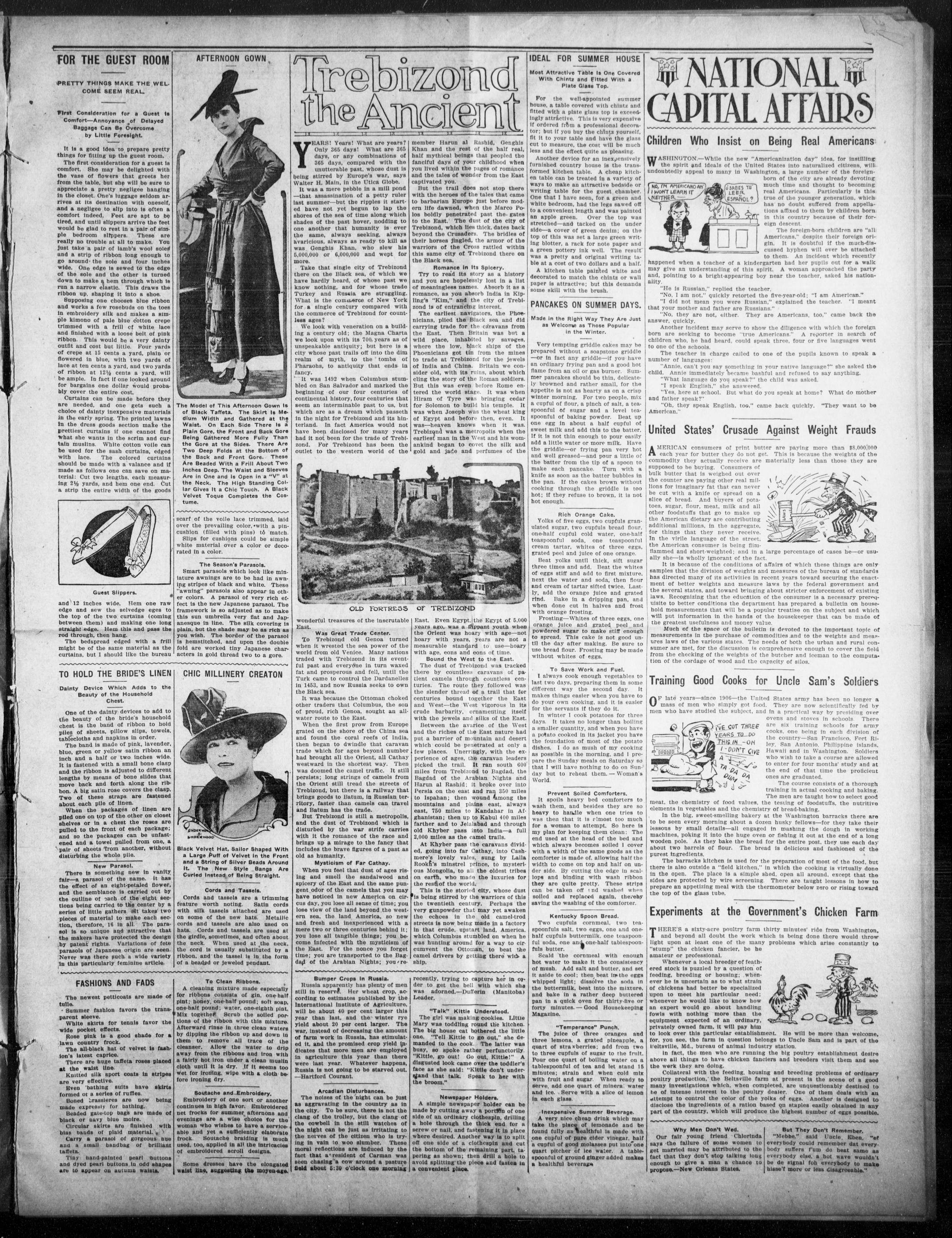
YEARS! Years! What are years? Only 365 days! What are 365 days, or any combinations of 365 days, compared with the unutterable past, whose dust is being stirred by Europe's war, says member Harun al Rashid, Genghis Khan and the rest of the half real half mythical beings that people the fanciful days of your childhood when you lived within the pages of romance and the tales of wonder from the East
Walter H. Main, in the Uttica Globe.
It was a mere pebble in a mill pond—that assassination of a petty ruler last summer—but the ripples it started have not yet begun to lap the shores of the sea of time along which shades of the past hover, nodding to one another that humanity is ever the same, always seeking, always avaricious, always as ready to kill as was Genghis Khan, who slew his 5,000,000 or 6,000,000 and wept for more.
Take that single city of Trebizond there on the Black sea, of which we have hardly heard, of whose past we know nothing, and for whose trade Turkey and Russia are struggling. What is the commerce of New York for a single century compared with the commerce of Trebizond for countless ages?
We look with veneration on a building a century old; the Magna Charta we look upon with its 700, years as of unspeakable antiquity; but here is a city whose past trails into the dim realm of myth, to the tombs of Pharaohs, to antiquity that ends in fancy.
It was 1492 when Columbus stumbled on San Salvador and marked the beginning of our four centuries of continental history, four centuries that seem an interminal past to us, but which are as a dream which passeth in the night for Trebizond and its hinterland. In fact America would not have been disclosed for many years had it not been for the trade of Trebizond. For Trebizond has been the outlet to the western world of the
```markdown
```
OLD FORTRESS OF TREBIZOND
wonderful treasures of the inscrutable East. Even Egypt, the Egypt of 5,00 East.
Was Great Trade Center.
To Trebizond old Genoa turned when it wrested the sea power of the world from old Venice. Many nations traded with Trebizond in its eventful past and everyone in turn waxed fat and prosperous and fell, until the Turk came to control the Dardanelles in 1453, and now Russia seeks to own the Black sea.
It was because the Ottoman choked other traders that Columbus, the son of proud, rich Genoa, sought an all-water route to the East.
When the first prow from Europe grated on the shore of the China sea and found the coral reefs of India, then began to dwindle that caravan trade which for ages beyond number had brought all the Orient, all Cathay westward in the shortest way. Then was doomed the camel traffic. It still persists; long strings of camels from the Orient still tread the streets of Trebizond, but there is a railway that brings goods to Batum, in Russian territory, faster than camels can travel and Batum has the trade.
But Trebizond is still a metropolis, and the dust of Trebizond which is disturbed by the war strife carries with it the romance of the race and brings up a mirage to the fancy that includes the brave figures of a past as old as humanity.
Mysticism of Far Cathay.
Mystery of Pal Gauley.
When you feel that dust of ages rising and smell the sandalwood and spicery of the East and the same pungent odor of the camels that you may have noticed in new America on circus day, you lose all sense of time; you lose view of the land beyond the western sea, the land America, so new and fresh and inexperienced with a mere two or three centuries behind it; you lose all tangible things; you become infected with the mysticism of the East. For the nonce you forget time; you are transported to the Bagdad of the Arabian Nights; you re-
Bumper Crops In Russia.
Bumper Crops in Russia. Russia apparently has plenty of men still in reserve. Her wheat crop, according to estimates published by the International Institute of Agriculture, will be about 40 per cent larger this year than last, and the winter rye yield about 20 per cent larger. The war, instead of decreasing the amount of farm work in Russia, has stimulated it, and the promised crop yield indicates that more men are employed in agriculture this year than there were last year. Whatever happens, Russia is not going to be starved out.—Hartford Courant.
Arcadian Disturbances
The noises of the night can be just as aggravating in the country as in the city. To be sure, there is not the clang of the trolley, but the clang of the cowbell in the still watches of the night can be just as irritating to the nerves of the citizen who is trying in vain to woo slumber. These moral reflections are induced by the fact that a resident of Carman was seen chasing a cow around a pasture field about 5:30 o'clock one morning
member Harun al Rashid, Genghis Khan and the rest of the half real, half mythical beings that peopled the fanciful days of your childhood when you lived within the pages of romance and the tales of wonder from the East captivated you.
But the trail does not stop there with the heroes of the tales that came to barbarian Europe just before modern life dawned, when the Marco Polos boldly penetrated past the gates to the East. The dust of the city of Trebizond, which lies thick, dates back beyond the Crusaders. The bridles of their horses jingled, the armor of the warriors of the Cross rattled within this same city of Trebizond there on the Black sea.
Romance In Its Spicery.
Try to read its story as a history and you are hopelessly lost in a list of meaningless names. Absorb it as a romance, as you absorb India in Kipling's "Kim," and the city of Trebzond is of entrancing interest.
The earliest navigators, the Phoenicians, plied the Black sea and did carrying trade for the caravans from the East. Then Britain was but a wild place, inhabited by savages, where the low, black ships of the Phoenicians got tin from the mines to trade at Trebizond for the jewels of India and China. Britain we consider old, with its ruins, about which cling the story of the Roman soldiers. But this was even before Rome entered the world stage. It was when Hiram of Tyre was bringing cedar for Solomon to build his temple. It was when Joseph was the wheat king of Egypt and before then, even. It was—heaven knows when it was. Trebizond was a metropolis when the earliest man in the West and his womankind began to covet the silk and gold and jade and perfumes of the
```markdown
```
East. Even Egypt, the Egypt of 5,000 years ago, was a fippant youth when the Orient was hoary with age—not hoary with years, years are not a measurable standard to use—hoary with age, eons and eons of time.
Bound the West to the East.
The dust of Trebizond was tracked there by countless caravans of patient camels through countless centuries. The route they followed was the slender thread of a trail that for centuries bound together the East and West—the West vigorous in its crude barbary, ornamenting itself with the jewels and silks of the East.
Between the avarice of the West and the riches of the East nature had put a barrier of mountain and desert which could be penetrated at only a few places. Unerringly, with the experience of ages, the caravan leaders picked the trail. It ran south 600 miles from Trebizond to Bagdad, the Bagdad of the Arabian Nights and Harun al Rashid; it broke over into Persia on the east and ran 350 miles to Ispahan; then wound among the mountains and plains east, always east, 750 miles to Kandahar in Afghanistan; then up to Kabul 400 miles farther and to Jelalabad and through old Khyber pass into India—a full 2,000 miles as the camel trails. At Khyber pass the caravans divided, going into far Cathay, into Cashmere's lovely vales, sung by Laila Rookh's minstrel prince, to mysterious Mongolia, to all the oldest tribes on earth, who made the luxuries for the rest of the world.
This is the storied city, whose dust is being stirred by the warriors of this the twentieth century. Perhaps the very gunpowder that may yet awaken the echoes in the old camel-trot streets is now being made in a factory in that crude, upstart land, America, which Columbus stumbled on when he was hunting around for a way to circumvent the Ottoman, to beat the camel drivers by getting there with a ship.
recently, trying to capture her in order to get the bell with which she was adorned.—Dufferin (Manitoba) Leader.
"Talk" Kittle Understood
The girl was making cookies. Little Mary was toddling cat the kitchen. The big house cat bothered the little one. "Tell Kittle to go out," she demanded to the cook. The latter was busy, so spoke rather perfunctory. "Kittle, go out! Go out, Kittle!" A disusted look came over the toddler's face as she said: "Kittle don't understand that talk. Speak to her with the broom."
Newspaper Holders
A simple newspaper holder can be made by cutting away a portion of one side of an ordinary clothespin, drilling a hole through the thick end for a screw or nail, and fastening it in place where desired. Another way is to split off one side of a clothespin and cut the bottom of the remaining part, tapering as shown; then drill a hole to avoid splitting the piece and fasten in a convenient place.
IDEAL FOR SUMMER HOUSE
Most Attractive Table Is One Covered With Chintz and Fitted With a Plate Glass Top.
For the well-appointed summer house, a table covered with chintz and fitted with a plate glass top is exceedingly attractive. This is very expensive if ordered from a professional decorator; but if you buy the chintz yourself, fit it to your table and have the glass cut to measure, the cost will be much less and the effect quite as pleasing. Another device for an inexpensively furnished country house is the transformed kitchen table. A cheap kitchen table can be treated in a variety of ways to make an attractive bedside or writing table for the guest chamber. One that I have seen, for a green and white bedroom, had the legs sawed off to a convenient length and was painted an apple green. Over the top was stretched—and tacked on the under side—a cover of green denim; on the top of this was a large green writing blotter, a rack for note paper and a green pottery ink well. The result was a pretty and original writing table at a cost of two dollars and a half.
A kitchen table painted white and decorated to match the chintz or wall paper is attractive; but this demands some skill with the brush.
PANCAKES ON SUMMER DAYS.
Made in the Right Way They Are Just as Welcome as Those Popular in the Winter.
Very tempting griddle cakes may be prepared without a soapstone griddle—or in fact any griddle—if you have an ordinary frying pan and a good hot flame from an oil or gas burner. Summer pancakes should be thin, delicately browned and rather small, for the appetite is not as hearty as on a crisp winter morning. For two people, mix a cupful of flour, a pinch of salt, a teaspoonful of sugar and a level teaspoonful of baking powder. Beat up one egg in about a half cupful of sweet milk and add this to the batter, if it is not thin enough to pour easily add a little water or more milk. Have the griddle—or frying pan very hot and well greased—and pour a little of the batter from the tip of a spoon to make each pancake. Turn with a knife as soon as the batter bubbles in the pan. If the cakes brown without cooking through the griddle is too hot; if they refuse to brown, it is not hot enough.
Rich Orange Cake.
Yolks of five eggs, two cupupls granulated sugar, two cupupls bread flour, one-half cupupl cold water, one-half teaspoonful soda, one teaspoonful cream tartar, whites of three eggs, grated peel and juice of one orange.
Beat yolks until thick, sift sugar three times and add. Beat the whites of eggs stiff and add to first mixture, next the water and soda, then flour and cream of tartified twice. Lastly, add the orange juice and grated rind. Bake in a dripping pan, and when done cut in halves and frost with orange frosting.
Frosting—Whites of three eggs, one orange juice and grated peel and powdered sugar to make stiff enough to spread. This cake is not good until the day after making. Be sure to use bread flour. Frosting may be made without whites of eggs.
To Save Work and Fuel
I always cook enough vegetables to last two days, preparing them in some different way the second day. It makes things easier when you have to do your own cooking, and it is easier for the servants if they do it.
In winter I cook potatoes for three days. It takes no longer than boiling a smaller quantity, and when you have a potato cooked in its jacket you have the foundation of most of the potato dishes. I do as mush of my cooking as possible in the morning, and I prepare the Sunday meals on Saturday so that I will have nothing to do on Sunday but to reheat them. — Woman's World.
Prevent Soiled Comforters.
It spoils heavy bed comforters to wash them, and besides they are so heavy to handle when one tries to was then that it is almost too much for a woman to attempt. So here is my plan for keeping them clean: The end used at the head of the bed and which always becomes solled 1 cover with a width of the same goods as the comforter is made of, allowing half the width to come on top and half on under side. By cutting the edge in scallops and binding with wash ribbon they are quite pretty. These strips can be taken off and washed when solled and replaced again, thereby saving the washing of the comforter.
Kentucky Spoon Bread
Two cupfuls cornmeal, two teaspoonfuls salt, two eggs, one and one-half cupfuls buttermilk, one teaspoonful soda, one and one-half tablespoonfuls butter.
Scald the cornmeal with enough hot water to make it the consistency of mush. Add salt and butter, and set it aside to cool; then beat in the eggs whipped light; dissolve the soda in the buttermilk, beat into the mixture, and bake in a rather deep buttered pan in a quick oven for thirty-five or forty minutes. — Good Housekeeping Magazine.
"Temperance" Punch
The juice of three oranges and three lemons, a grated pineapple, a quart of strab'berries; add from two to three cupfuls of sugar to the fruit. Pour one quart of boiling water on a tablespoonful of tea and let stand 15 minutes; strain and when cold mix with fruit and sugar. When ready to serve, add one quart of minera' water and ice. Serve with a slice of lemon in each glass.
Inexpensive Summer Beverage
inexpensive summer beverage.
A very nice mime drink which may take a little lemonade and be found really as healthful is made with one cupful of pure cider vinegar, half a cupful of good molasses put into one quart pitcher of ice water. A table-spoonful of ground sugar added makes a healthful beverage.
NATIONAL CAPITAL AFFAIRS
Children Who Insist on Being Real Americans
WASHINGTON—While the new "Americanization day" idea, for instilling the spirit and ideals of the United States into naturalized citizens, will undoubtedly appeal to many in Washington, a large number of the foreign-
happened when a teacher of a kindergarten had her pupils out for a walk may give an understanding of this spirit. A woman approached the party and, pointing to a bright-appearing boy near the teacher, asked his nationality.
"He is Russian," replied the teacher.
"No. I am not," quickly retorted the five-year-old; "I am American."
"I did not mean you were Russian," explained the teacher. "I meant that your mother and father are Russians."
"No, they are not, either. They are Americans, too," came back the answer, quickly.
Another incident may serve to show the diligence with which the foreign born are seeking to become "true Americans." A reporter in search of children who, he had heard, could speak three, four or five languages went to one of the schools.
The teacher in charge called to one of the pupils known to speak a number of languages:
"Annie, can't you say something in your native language?" she asked the child. Annie immediately became bashful and refused to say anything.
"What language do you speak?" the child was asked.
"I speak English," she answered.
"Yes, here at school. But what do you speak at home? What do mother and father speak?"
"Oh, they speak English, too," came back quickly. "They want to be American."
United States' Crusade Against Weight Frauds
United States' Crusade Against Weight Frauds
AMERICAN consumers of print butter are paying more than $8,000,000 each year for butter they do not get. This is because the weights of the commodity they actually receive are materially less than those they are
flammed and short-weighted; and in a large percentage of cases he—or usually she—is wholly ignorant of the fact.
It is because of the conditions of affairs of which these things are only samples that the division of weights and measures of the bureau of standards has directed many of its activities in recent years toward securing the enactment of better weights and measure laws by the federal government and the several states, and toward bringing about stricter enforcement of existing laws. Recognizing that the education of the consumer is a necessary prerequisite to better conditions the department has prepared a bulletin on household measurements that will be a popular treatise on the subject and which will put information in the hands of the housekeeper that can be made of the greatest usefulness and money value.
Much of the space of the bulletin is devoted to the important topic of measurements in the purchase of commodities and to the weights and measures laws of the various states. The needs of both the urban and rural consumer are met, for the discussion is comprehensive enough to cover the field from the checking of the weights of the butcher and iceman to the computation of the cordage of wood and the capacity of silos.
Training Good Cooks for Uncle Sam's Soldiers
OF late years—since 1906—the United States army has been no longer a mass of men who simply got food. They are now scientifically fed by men who have studied the subject, and in a practical way by presiding over
meat, the chemistry of food values, the testing of foodstuffs, the nutritive elements in vegetables and the chemistry of bread-baking.
In the big, sweet-smelling bakery at the Washington barracks there are to be seen every morning about a dozen husky fellows—for they take their lessons by small details—all engaged in mashing the dough in working machines, poking it into the huge oven or fishing it out at the end of a long wooden pole. As they bake the bread for the entire post, they use each day about two barrels of flour. The bread is delicious and fashioned of the purest ingredients.
The barracks kitchen is used for the preparation of most of the food, but there is also outside a "field kitchen," in which the cooking is virtually done in the open. The place is a simple shed, open all around, except that the sides are protected by wire screening. There are taught lessons in how to prepare an appetizing meal with the thermometer below zero or rising toward the top of the glass tube.
Experiments at the Government's Chicken Farm
THERE's a sixty-acre poultry farm thirty minutes' ride from Washington, and beyond all doubt the work which is being done there would throw light upon at least one of the many problems which arise constantly to "stump" the chicken fancier, be he
to look over this particular establishment. He will be more than welcome, for, you see, the farm in question belongs to Uncle Sam and is part of the Beltsville, Md., bureau of animal industry station.
In fact, the men who are running the big poultry establishment desire above all things to have chicken fanciers and breeders visit them and see the work they are doing.
Collateral with the feeding, housing and breeding problems of ordinary poultry production, the Beltsville farm at present is the scene of a good many investigations which, when completed, are unquestionably destined to be of intense interest to the poultry dealer. One of them deals with an attempt to control the color of the yolks of eggs. Another is designed to disclose the ingredients of a ration based on staples easily obtained in any part of the country, which will produce the highest number of eggs possible.
NO, I'M AMERICANO ANY
I WON'T LEARN IT
NEITHER
SABES TU
LEER
ESPAÑOL?
"He is Russian," replied the teacher, "No, I am not," quickly retorted the ear. "I did not mean you were Russian," that your mother and father are Russians. "No, they are not, either. They are answer, quickly. Another incident may serve to show to born are seeking to become 'true Ame children who, he had heard, could speak to one of the schools. The teacher in charge called to one number of languages: "Annie, can't you say something in you child. Annie immediately became bashful. "What language do you speak?" the I speak English," she answered. "Yes, here at school. But what do you and father speak?" "Oh, they speak English, too." came American."
United States' Crusade A
AMERICAN consumers of print butter each year for butter they do not get.
commodity they actually receive are supposed to be buying. Consumers of bulk butter that is weighed out over the counter are paying other real millions for imaginary fat that can never be cut with a knife or spread on a slice of bread. And buyers of potatoes, sugar, flour, meat, milk and all other foodstuffs that go to make up the American dietary are contributing additional millions. In the aggregate, for things that they never receive. In the virile language of the street, the American consumer is being film-flammed and short-weighted; and in.
ally she—is wholly ignorant of the fact.
It is because of the conditions of all samples that the division of weights and it has directed many of its activities in receipt of better weights and measure laws the several states, and toward bringing all laws. Recognizing that the education of usite to better conditions the department hold measurements that will be a popular will put information in the hands of the greatest usefulness and money value.
Much of the space of the bulletin is measurements in the purchase of common laws of the various states. The need sumer are met, for the discussion is come from the checking of the weights of the tion of the cordage of wood and the caps
Training Good Cooks for
OF late years—since 1906—the United mass of men who simply got food. men who have studied the subject, and f
I'VE GOT THREE
YEARS TO DO
THIS IN - ON
I-DON'T GIVE
A
TA DA DA
DUM
meat, the chemistry of food values, the elements in vegetables and the chemistry. In the big, sweet-smelling baking at to be seen every morning about a dozen lessons by small details—all engaged machines, poking it into the huge oven of wooden pole. As they bake the bread for about two barrels of flour. The bread purest ingredients.
The barracks kitchen is used for the there is also outside a "field kitchen," in the open. The place is a simple she sides are protected by wire screening. prepare an appetizing meal with the thern the top of the glass tube.
Experiments at the Gover
THERE'S a sixty-acre poultry farm this and beyond all doubt the work which light upon at least one of the many p "stump" the chicken fancier, be he amateur or professional.
Whenever a local breeder of feathered stock is puzzled by a question of feeding, breeding or housing; whenever he is uncertain as to what strain of chickens had better be specialized upon to meet his particular need; whenever he would like to know how an expert would go about handling fowls with nothing more than the equipment expected of an ordinary, privately owned farm, it will pay him to look over this particular establishment for, you see, the farm in question belong Beltsville, Md., bureau of animal industry. In fact, the men who are running to above all things to have chicken fancier the work they are doing.
Collateral with the feeding, housing poultry production; the Beltsville farm, many investigations which, when complete be of intense interest to the poultry斗 attempt to control the color of the yolk disclose the ingredients of a ration based part of the country, which will produce t
Our fair young friend Chlorinda says the failure of some women to get married may be attributed to the fact that they don't stop talking long enough to give a man a chance to propose.—New Orleans States.
born of the city are already devoting much time and thought to becoming real Americans. Particularly is this true of the younger generation, which has no doubt suffered from appellations affixed to them by children born in this country because of their foreign descent.
The foreign-born children are "all Americans," despite their foreign origin. It is doubtful if the much-discussed hyphen will ever be attached to them. An incident which recently
garten had her pupils out for a walk
pirit. A woman approached the party
by near the teacher, asked his nation-
her.
the five-year-old; "I am American."
man," explained the teacher. "I meant
ans."
are Americans, too," came back the
new the diligence with which the foreign
americans." A reporter in search of
speak three, four or five languages went
one of the pupils known to speak a
your native language?" she asked the
fulfilled and refused to say anything.
the child was asked.
do you speak at home? What do mother
come back quickly. "They want to be
Against Weight Frauds
letter are paying more than $8,000,000
met. This is because the weights of the
materially less than those they are
ANYS
a large percentage of cases he—or usu-
t. affairs of which these things are only
and measures of the bureau of standards
recent years toward securing the enact-
laws by the federal government and
about stricter enforcement of existing
of the consumer is a necessary prerequ-
ement has prepared a bulletin on house-
pular treatise on the subject and which
the housekeeper that can be made of
value.
in is devoted to the important topic of
amodities and to the weights and mea-
needs of both the urban and rural com-
prehensive enough to cover the field
the butcher and iceman to the computa-
capacity of silos.
For Uncle Sam's Soldiers
United States army has been no longer a
died. They are now scientifically fed by
and in a practical way by presiding over
ovens and stoves in schools. There are six training schools for army cooks, one being in each division of the country—San Francisco, Fort Riley, San Antonio, Philippine islands, Hawaii and in Washington. Soldiers who wish to take a course are allowed to enter for four months' study and at the end of that time the proficient ones are graduated.
The course consists of a thorough training in actual cooking and baking. The men are taught how to select good
the testing of foodstuffs, the nutritive
nutry of bread-baking.
at the Washington barracks there are
ozen husky fellows—for they take their
head in mashing the dough in working
en or fishing it out at the end of a long
i for the entire post, they use each day
head is delicious and fashioned of the
the preparation of most of the food, but
in which the cooking is virtually done
shaded, open all around, except that the
ing. There are taught lessons in how to
thermometer below zero or rising toward
Government's Chicken Farm
thirty minutes' ride from Washington,
which is being done there would throw
y problems which arise constantly to
ment. He will be more than welcome, belongs to Uncle Sam and is part of the dairy station. Big the big poultry establishment desire breeders and breeders visit them and see and breeding problems of ordinary farm at present is the scene of a good completed, are unquestionably destined to my dealer. One of them deals with an yolks of eggs. Another is designed to based on staples easily obtained in any case the highest number of eggs possible.
But They Don't Remember. "Mebbe," said Uncle, Eben, "of everybody could remember dat everybody suffers fum do heat same as everybody else, a hot wave wouldn't be de signal foh everybody to make hissef more or less disagreeable."
THEKANSAS CITYSUN
PUBLISHED WEEKLY.
All communications should be addressed
to The Kansas City Sun, 1803 East 18th
Bell Phone East 999.
Entered as second-class matter, August
12, 1908, at the postoffice at Kansas City,
Mo., under the act of March 3, 1879.
Nelson C. Crews. Editor and Owner
Willa B. Glenn. General Manager
SUBSCRIPTION RATES:
One Year $1.50
Six Months .75
Three Months .50
ADVERTISING RATE, 50 CENTS PER
INCH.
CHURCH DIRECTORY.
Bethel A. M. E. Church, 244 and Flora.
Stephen's Baptist Church, 648 Charlotte
St. Augustine's P. E. Church, 11th and Troost.
Vine St. Baptist Church, 1825 Vine St. Ward Chapel A. M. E. Church, 11th and Woodland. Blue Valley Baptist church, 1120 Crystal Avenue. John's A. M. E. Church, 1743 Belleview. Seventh Day Adventist, 23rd and Woodland. St. Monica's Catholic, 17th and Lydia. Morning Star Baptist Church, 2311 Vine. Highland Avenue Baptist Church, 1111 Highland.
Centropolis A. M. E. Church, Centropolis, Mo.
Jameses A. M. E. Z. Church, 1823 Woodland Ave.
Third Baptist Church, Roundtop.
Friendship Baptist Church, 17th and Tracy Avenue.
Pilgrim Baptist Church, 614 Charlotte St.
Pleasant Green Baptist Church, Independence Avenue and Tracy.
Calvary Baptist Church, 19th and
Akew.
Bigelow A. M. E. Mission, 5th and
Lydia.
Progressive Baptist Church, 29th and
Summit.
C. M. E. Church, 1817 Flora Ave.
St. James, Baptist Church, 1693 Mill St.
St. Luke's A. M. E. Church, 43rd and
Prospect Place.
A. M. E. Mission, 565 Grand Ave.
CLARK CHAPEL M. E. CHURCH,
1664 Madison Ave.
KANSAS CITY, KAN. CHURCHES.
First A. M. E. Church, 8th and Nob.
First Green Baptist Church, 1st and
Epilogue.
Eighth St. Baptist Church, 8th and
Ocean Metropolitan Baptist Church, 9th and
Washington.
Bethel A. M. E. Church, Water and
Steward's Meets.
Paul A. M. E. Church, 21st and
Ruby.
Past Baptist Church, 5th and Neb.
King Solomon Baptist Church, 3rd and
State.
Quindaro A. M. E. Church, Quindaro,
Pasant Valley Baptist Church, Rosedale, Kane.
Kan. M. E. Church, 9th and Oakland.
Buchanan, Jr., and Oakland,
A. M. E., Mission, A. M. E., Church,
South Park, Kane
Protestant Episcopal, 3rd and Stewart,
Second Baptist Church, 2nd and Ruby,
Weasley Chapel M. E., 106 Shawnee,
St. Paul A. M. E. Zion Church, 4000
Adams
Bethel A. M. E. Church, Roseale, Kan.
Zion Baptist Church, 4th and Virginia.
Ebenezer A. M. E. Church, Sanford and
Tremont.
Mission Primitive Baptist Church
Westport avenue and Tangent street,
Rosedale.
EDITORIALS
The public schools open next Tuesday. Parents who are really interested in the education of their children should start them in the first day and keep them in school all the year. There should be no delay or trivial excuses. Free text books are supplied in all the grade sand the school anthorities will introduce a new course of study this year. Let us all pull for a record year of education by being prompt in beginning and faithfu in following up our resolutions.
In his address to the Supreme Lodge of Knights of Pythias Governor Willis declared that his state would never be Alabamized or Mississippiized but would forever remain free ground for all races. This is the real note of American patriotism and is the underlying principle of the Republican party. Yet there are still a few misguided black men, some of them in this state, who proudly boast of casting their votes with Alabama, Texas Georgia and Mississippi.
The United States not only offers its friendly offices in straightening out the tangled affairs of the little republic of Haiti but insists that these offices he immediately accepted. Uncle Sam offers, or rather declares, his intention to exercise supervisory power over Haitian finances and government for a period of ten years and to thus straighten out all the kinks. This would look very well were it, not for the fear that a horde of southern colonies may be sent as agents to the unfortunate island republic and the black citizens treated even worse than they are treated in our own country.
The Montgomery, Alabama, Chamber of Commerce sent a strong delegation to the state legislature last week and succeeded in defeating a bill aimed to prevent white teachers from teaching in Negro schools. The bill was aimed directly against those private institutions financed by northern philanthropy and conducted by northern teachers who believe in Christianizing and refining the youth of our race. That such instruction should deeply grieve the southern gentry is not to be wondered at. The southern gentry would not have the Negro rise any higher intellectually than the ox and it is particularly galling to see white men and women devoting their lives freely to the gigantic task of elevating the sons and daughters of their former slaves.
VINE STREET BAPSTIST CHURCH
The services were good all day Sunday.
Two additions to the church
The Woman's Mission Circle brought
the banner back from the Association,
having turned in more money than any circle in the jurisdiction.
Over $75 was turned in by our Circle,
which was grand indeed. The Circle is doing fine under the leadership of Mrs. Wm. Gordon.
Little Corner
—That two heads are better than one. Well, they are if they don't bump.
—That Page's school shoes are dandies and the best in town for the money. Go and be shown. 1507 E 18th street.
—That all that glitters is not gold; sometimes not even brass.
—That some of those Negroes who boast of their "pulls" with "de white folks" got an awful setback recently.
—That somebody is waiting to see what startling things the new High School management is going to do.
—That it is whispered that Kansas City Masons were a little too swift for the representatives of the Imperial Council. (Hush child).
—That when Editor Crews returns from the West he is going to set in motion a movement to buy a suitable hall for the U. B. F. and S. M. T. Go to it boy.
—That if Lincoln Park is to be turned into a beer garden the patriotic citizens should institute a suit to restrain them from using that sacred name. Shame on a city that would prostitute a great name like that!
—That Kansas City needs more hustling, enterprising men like Theo. Smith, Jno. A. Jones, Leon Jordan and M. H. Lambright. Hurrah for the great white way on Eighteenth street.
—That if the Negroes are to successfully combat the hydra-headed monster of segregation, ostracism and racial prejudice it is high time they were putting behind them all differences and uniting in one solid phalanx to combat the combat the common enemy. Are you ready, brother?
NEGRO BASEBALL TOURNEY TO BE HELD IN KANSAS CITY.
THE management of the Negro baseball tournament announces that all teams for the big baseball carnival to be pulled off at Association Park Sunday, September 5 and 6, which includes Labor day, have signed up and are getting their players whipped into fine condition for the final battles.
Word from Iola, Kas., where the fast Go Devils make their home, is to the effect they are coming with the intention of winning the bacon. Brooks Lane, the manager of the Iola club, is scouring southern Kansas and northern Oklahoma for talent and says he wants to win so he can make the trip to Chicago for the final Negro world series.
Bud Phillips, who handles the reins of the fast St. Joseph Giants, is leaving nothing undone to bring a fast bunch to represent the upriver town. Mr. Phillips is arranging to bring along a large number of St. Joseph fans. A special car on the electric line will be chartered. The Atchison Nationals say they will be the big surprise of the series. It has been whispered about that Big John Donaldson, with the All Nations, is the dark horse. Every Colored fan of both Kansas City, Kas, and Kansas City, Mo. know what to expect of the Topeka Giants, as their manager, Jack Johnson, always has a good bunch.
The Lexington Tigers, managed by "Speed Boy" Lindsay, will not be overlooked. The Tigers know what it means to get to make that Chicago trip this fall.
The Royal Americans and Kansas City, Kas., Giants, are hustling to strengthen their teams. Several Texas leaguers have been added to their ranks during the past few days, and in all, the tournament looks like the real thing for the Colored fans—something new and something to stimulate interest and at the same time develop professional Colored ball players. If the people turn out to this high grade semi-pro ball, there is no doubt but what the Kansas City Colored folk will see a brand of league ball in Kansas City before many moons. Excursions will be run from Iola, Topeka, St. Joseph and Lexington, Mo.
SECOND BAPTIST CHURCH.
SECOND BAPTIST CHURCH.
President Thompson called the B. Y. P. U. to order and appointed Miss Judith Symms to conduct the meeting during which Mr. L. B. Cheeks led the topic discussion; also Mrs. Tooley, a returned missionary from Africa, made a fine talk on some of her experiences among the heathens.... Next Sunday at 6:30 Miss Simms has arranged a fine program.... The concert by N. Clark Smith's band Monday evening was a success.... The Women's Mission Circle meets every Friday evening.... The Annual Thanksgiving sermon by Dr. Bacote to the Uniform Rank K. of P.'s assisted by Uniform Rank U. B. F.'s and other orders, was preached at 3:00 p. m.
Health Hints
By Dr. Lloyd E.
A weekly discussion of Hygitation, First Aid Measure tive Medicine. Questions wered but no diagnoses tions will be given in th
Dr. Lloyd E. Bailer
weekly discussion of Hygiene and Sanitation, First Aid Measures and Preventive Medicine. Questions will be answered but no diagnoses nor prescriptions will be given in this column.
A weekly discussion of Hygiene and Sanitation, First Aid Measures and Preventive Medicine. Questions will be answered but no diagnoses nor prescriptions will be given in this column.
CARE OF THE BABY IN SUMMER.
Minor Alliments.
A baby may be made uncomfortable and restless by various causes which are readily removed. Attention has already been called to the fact that babies and young children frequently suffer from thirst. They should be offered a drink of water several times a day, and particularly in hot weather. When a baby cries in the night, a drink will often quiet him, and send him to sleep.
Irritating clothing is at times responsible for the baby's frettfulness. Woolen socks, or shirts, or stiff cap strings are quite enough to spoil his comfort, even if he is well, and, in hot weather especially, a superbundance of clothing is frequently responsible for much real suffering.
Dress the baby in the lightest cotton garments and keep him as cool as possible. Do not be afraid to let him have nothing on but his diaper and one other thin garment on the very hot days.
Prickly Heat.
One of the troubles from which a baby often suffers in summer is prickly heat. This ailment appears as a fine red rash usually on the neck and shoulders and gradually spreads to the head, face and arms. It is caused by overheating, due either to the hot weather or to the fact that the baby is too warmly dressed. The rash
The progressive grocery of J. L. continues to get better and increase son is a real business man of few
A WONDERFUL HAIR DRESSER
One thousand agents wanted. We want agents in every city and THE STAR HAIR GROWER. The preparation. Can be used with or ening irons.*
Sells for 25c per box—one 25c value. Any person that will use convinced. No matter what hairstyle just give THE STAR HAIR trial and be convinced. Send 25c If you wish to be an agent send send you a full supply that you can at once; also agents' terms. Send Money Order to
THE STAR HAIR GROWER
1113 Clark Street.
Slaughter In Ladies' Shop
We just received a new line of the snap shoes and slippers in town. They are widths—patent, gun metal, dull kids, socks.
Shoes ordinarily sell for $3.50 to $6.00 move them quickly we have put the rid.
PER PAIR FOR ANY LADIES' SHOP
SLIPPER IN THE HOUSE
Last. Come right now and make you Remember the price, $1.50 per pair.
OST OPEN
TO THE PUBLIC:
to come to us for everything carried by a CINEMAS, TOILET ARTICLES, RUBBER GOOD MADAM WALKER HAIR-GROWER-DRYING STRAIGHTENING COMBS, ETC.
append and fair treatment to give perfect satisfaction. WE DO NOT "SUBSTITUTE" none than you ask for. You "want what you have it.
OUR PRICES ARE RIGHT
line. We give careful attention to all orders and fair treatment to give perfect satisfaction when you think of Drugs think of THEO. SMITH'S PHARMACY.
It is too difficult for us to supply. If you order store, phone us your wants and we will Mail Orders Solicited and Promptly Filled.
Theo. Smith's Drug Store.
Phone 4591 Grand. Home Phone 5467 St. KANSA
of J. L. Mattson, 1418 East 19th street, which increase its list of customers daily. Mr. Matt- of few words but splendid results.
WONDERFUL HAIR DRESSER AND GROWER.
One thousand agents wanted. Good money made. We want agents in every city and village to sell THE STAR HAIR GROWER. This is a wonderful preparation. Can be used with or without straight-ing irons.
Sells for 25c per box—one 25c box will prove its value. Any person that will use a 25c box will be convinced. No matter what has failed to grow hair just give THE STAR HAIR GROWER a trial and be convinced. Send 25c for full size box. You wish to be an agent send $1.00 and we will send you a full supply that you can begin work with once; also agents' terms. Send all money by money Order to
THE STAR HAIR GROWER MFGR.
3 Clark Street. Evanston, Ill.
Inter In Ladies' Shoes
Provided a new line of the snappiest, smart-slippers in town. They are in all styles, dent, gun metal, dull kids, satin, velvet, and similarly sell for $3.50 to $6.00 per pair but quickly we have put the ridienously low.
FOR ANY LADIES' SHOE OR SUPER IN THE HOUSE
We right now and make your selection. For the price, $1.50 per pair. Remember
KFC
The progressive grocery of J. L. Mattson, 1418 East 19th street, which continues to get better and increase its list of customers daily. Mr. Mattson is a real business man of few words but splendid results.
A WONDERFUL HAIR DRESSER AND GROWER.
One thousand agents wanted. Good money made.
We want agents in every city and village to sell THE STAR HAIR GROWER. This is a wonderful preparation. Can be used with or without straightening irons."
Sells for 25c per box—one 25c box will prove its value. Any person that will use a 25c box will be convinced. No matter what has failed to grow your hair just give THE STAR HAIR GROWER a trial and be convinced. Send 25c for full size box. If you wish to be an agent send $1.00 and we will send you a full supply that you can begin work with at once; also agents' terms. Send all money by Money Order to
THE STAR HAIR GROWER MFGR.
1113 Clark Street.
Evanston, Ill.
Big Slaughter B
We have just received a new
best ladies' shoes and slippers in
sizes and widths—patent, gum-
and colored tops.
These shoes ordinarily sell
in order to move them quickly
price of
$1.50 PER PAIR FOR A
SLIPPER IN
while they last. Come right
Don't wait! Remember the pr
the location,
1730 TROOST
TO THE
We want you to come to us for evl
DRUGS, MEDICINES, TOILET ART
BRUSHES, MADAM WALKER H
STRAIGHTENING
We recommend and guarantee
exactly as represented. WE DO NOT
take other brands than you ask for
we want you to have it.
OUR PRICES
All down the line. We give careful
by courteous-and fair treatment to
customers. When you think of Dr
THEO. SMITH?
No demand is too difficult for
to come to our store, phone us you
Mail Orders Solicited
Theo. Smith's
Bell Phone 4591 Grand.
1301 E. 18th St.
Big Slaughter In Ladies' Shoes
We have just received a new line of the snappiest, smartest ladies' shoes and slippers in town. They are in all styles, sizes and widths—patent, gun metal, dull kids, satin, velvet, and colored tops.
These shoes ordinarily sell for $3.50 to $6.00 per pair but in order to move them quickly we have put the ridicuously low price of
while they last. Come right now and make your selection. Don't wait! Remember the price, $1.50 per pair. Remember the location.
THE PUBLIC:
due for everything carried by a Drug Store.
LET ARTICLES, RUBBER GOODS, COMBS,
ALKER HAIR-GROWER-DRYING COMBS,
HTENING COMBS, ETC.
guarantee everything offered for sale to be
WE DO NOT "SUBSTITUTE" nor ask you to
u ask for. You "want what you want" and
PRICES ARE RIGHT
we careful attention to all orders, and aim
treatment to give perfect satisfaction to our
ink of Drugs think of
SMITH'S PHARMACY.
result for us to supply. If you are too busy
me your wants and we will do the rest.
Solicited and Promptly Filled.
Smith's Drug Store.
Brand. Home Phone 5467 Main.
KANSAS CITY, MO.
We want you to come to us for everything carried by a Drug Store.
DRUGS, MEDICINES, TOILET ARTICLES, RUBBER BOOBS, COMB8,
BRUSHES, MADAM WALKER HAIR-GROWER-DRYING COMB8,
STRAIGHTENING COMB8, ETC.
We recommend and guarantee everything offered for sale to be
exactly as represented. WE DO NOT "SUBSTITUTE" nor ask you to
take other brands than you ask for. You "want what you want" and
we want you to have it.
OUR PRICES ARE RIGHT
All down the line. We give careful attention to all orders, and alm
by courteous and fair treatment to give perfect satisfaction to our
customers. When you think of Drugs think of
THEO. SMITH'S PHARMACY.
No demand is too difficult for us to supply. If you are too busy
to come to our store, phone us your wants and we will do the rest.
Mail Orders Solicited and Promptly Filled.
Home Phone Main 7646.
COHN'S BUFFET
All Bonded Whiskeys with Soda 10c.
800 East 12th St. Kansas City, Mo.
HN'S BUF
d Whiskeys with Soda 10c.
2th St. Kansas
S BUFFET A. F keys with Soda 10c.
COHN'S BUFFET
All Bonded Whiskeys with Soda 10c.
---
A. B.
Prickly Heat.
```markdown
```
comes and goes with the heat, and causes intense itching. The remedy for it is to take off all the clothing and give the baby a sponge bath in tepid water in which common baking soda has been dissolved. Use I tablespoonful of soda to two quarts of water. Use no soap, and do not rub the skin, but pat it dry with a soft towel. After the skin is thoroughly dry, dust the infamed surfaces with a plain talcum powder.
This aliment, like all others, is more readily prevented than cured. Frequent cool baths, very little clothing, simple food and living in cool rooms, or in the open air will probably save the summer baby from much of the annoyance of prickly heat and other more serious ills.
Fat babies are very apt to suffer from chafink, especially in hot weather. It appears as a redness of the skin in the buttocks or in the armpits, or wherever two skin surfaces persistently rub together.
Much the same treatment is required as in prickly heat. Never use soap on an inflamed skin. Instead use a soda, bran or starch bath. Directions for these baths are given in a publication called Infant Care, which may be had, free of charge, by addressing a request to the Chief of the Children's Bureau, U. S. Department of Labor, Washington, D. C.
Kansas City, Mo.
OPEN NIGHTS
A. F. and A. M.
N. C. Crews, Kansas City, Grand Master.
Deputy Grand Master, Richard Young, Lincoln, Neb.
Wm. Green, Plattsburg, Mo., Grand Senior Warden.
Crittenden C. Clark, St. Louis.
Grand Junior Warden.
H. H. Walker, St. Joseph, Grand Treasurer.
Geo. W. K. Love, Grand Secretary.
Kansas City, Mo.
W. W. Fields, Secretary of Masonk Relief, Cameron, Mo.
P. L. Pratt, Kansas City, Mo., Grand Lecturer.
Royal Arch Masons:
Grand High Priest—Geo. Bloomfield, St. Louis.
Deputy Grand High Priest—T. G. McCampbell, Kansas City.
Grand King—A. L. Thomas, Jefferson City.
Grand Scribe—J. P. Moffett, Sedalia.
Grand Treasurer—Chas. Griggsby, Liberty.
Grand Secretary—E. S. Baker, Kansas City.
Grand Lecturer—W. H. McAdams, Springfield.
Grand Chaplain—Rev R. Barber:
*Knights Templars:*
Deputy R. E. . C.-Peter Kincade,
Kansas 'City.
Grand Generalissmo-Joseph H.
Cherwood, St. Paul, Minn.
Grand Senior Warden—Geo A. Johnson, Kansas City.
Grand Junior Warden—B. F. Gray, St. Joseph.
Grand Prelate—Henry Roan, St Louis.
Grand Recorder—James T. Cannon, St. Louis.
MASONIC BUILDING ASSOCIATION
MEMBERS.
W. G. Mosely, Chairman.
E. S. Baker, Secretary.
R. W. Foster, Treasurer.
W. C. Mallory, Sandy Meyers,
Wm. Washington, F. P. Porteet,
T. W. H. Williams, R. T. Coles,
J. E. Herriford, E. G. Lacey,
E. G. Miller, Robt. Wiley.
Lodge Directory
Lodge Directory
G
M. J.
Pritchard Lodge No. 42, A. B
and A. M., Meet the 2nd
and 4th Monday in each month. Al
Master Masons in good standing
welcome. Cecil Thompson, W.
H. SPIGENER, Secretary.
G
MASONRY
Rone Lodge No. 25, A. F. and
A. M., meets the 1st and 2nd
Master Mason in good standing
welcome. J. C. Granger, W.
M.; T. J. McCampbell, Secy.
Mt. Olive Lodge No. 53, A. F.
and A. M., meets the 2nd and
3rd Master Mason in good standing
welcome. Sandy Lowe, W. M.
Frank Lowe, Secretary, 518
Baltimore Ave.
I. O. I.
Queen Ether Court No. 43
Hale from O. I. meets the
first and third Mondays in each
month at 2:30 p.m. at the
Kansas City, Mo. Mrs. Bettie Davis
M. B. Q.; Rosa L. Jones, Chron.
1406 North 3d St, Kansas City,
Kas.
U. B. F.
U. B. F. for the West Lodge No.
218 meets first and third Mondays
in each month at 563
Grand avenue. D. M. West
M. West. Secy. 132, Woodland Ave.
HAIR NETS
REAL HUMAN CREOLE HAIR
HAND MADE
BEAUTIFULLY ILLUSTRATED
CATALOGUE FREE
COLORED WOMENS HAIR
LAMP CAP FREE
THIS COMES IN SILVER BRASS
Showing all the latest styles of creole Hair
goods straightening Combs Toilet articles
Hair by the lb we show the largest variety
and sell more hair goods than any other
manufactures in the United States, send two
cent stamp to-day for Catalogue
HUMANIA HAIR Dept. 100 25 QUARTER
NEW YORK
SAY! — OH — SAY!
HAVE YOU SEEN THE MAGNIFICENT WORK —TURNED OUT BY—
C. A. FRANKLIN
???
1008 E. 18TH STREET (Near 18th and Troost)
THE FINEST PRINTING EVER
DONE IN KANSAS CITY That's What You Hear on Every Hand.
IF YOU WANT PRINTING THAT'S RIGHT SEE HIM—
“He delivers the goods”
Bell Phone, Grand 2988
A. Franklin Radford
M.D.
Call Temporary Phones
West 2223W West 634
Negro Business and Professional Directory of Greater Kansas City
(Your name, business, address and telephone carried in this directory at 25 cents per month, $3.00 a year; less than one cent a day. Can you beat it? To secure space call Sun Office, Bell phone 999 East, or see our agent.)
DELMONICA CAFE, 1512 East 18th St. Bell plone, East 618.
THE OWL LUNCH ROOM, Mrs. A. R. Harris, Prop., 2208 Vine St.
CARPET CLEANERS.
EUREKA CARPET CLEANING CO., 1718-20 Euclid Ave. Bell phone,
East 3555; Home, East 4169
COAL AND FEED.
W. W. PAYNE, 1902 1-2 Vine St. Bell phone, East 559; Home phone, East 4132.
CLEANERS. DYERS AND TAILORS
O. K. CLEANERS AND DYERS, guarantee not to shrink any garment they dye. 1113 East 8th street. Bell phone, Grand 2437. WORTHAM BROS., 1831 Paseo. Bell Phone East 701.
DRUG STORES.
IDEAL PHARMACY, Prof. R. W. Foster, Prop., 18th and Woodland Bell phone East 273. Home phone East 4070. $
FLORISTS.
ET FLORAL CO., 1801 East 18th St. B
ane phone, East 4070.
GROCERS.
N, 2644 Woodland Ave. Bell phone, East
CROSTHWAIT FLORAL CO., 1801 East 18th St. Bell phone, East 272. Home phone, East 4070.
GROCERS.
M. R. WILSON, 2644 Woodland Ave. Bell phone. East 1493.
LAUNDRIES.
ERIC LAUNDRY CO., J. C. Hale, Mgr., 22
phone 3160.
SULATE LAUNDRY, 1912 East 18th St.
LAWYERS.
WAY, 601 Delaware, Home phone M58, B
actices in all courts.
CON, 601 Delaware, Home phone M58, B
al advice. Practices in all courts.
SOM, Attorney at Law, 307 Walnut street
e East 2727, Home phone East 4070.
LEFORD, Attorney at Law, 516 Minnes
Kas. Bell phone, West 3866.
THE ELECTRIC LAUNDRY CO., J. C. Hale, Mgr., 2928 Summit St. Home phone 3160.
THE IMMACULATE LAUNDRY, 1912 East 18th St. Bell phone East 4723.
LAWYERS.
C. H. CALLOWAY, 601 Delaware, Home phone M58, Bell phone Main 448. Practices in all courts.
W. C. HUESTON, 601 Delaware, Home phone M58, Bell phone Main 448. Legal advice. Practices in all courts.
E. A. SHACKLEFORD, Attorney at Law, 516 Minnesota Ave., Kansas City, Kas. Bell phone. West 3866.
MILLINERY
A. WASHINGTON, 849 Freeman Ave. Be
asas City, Kas. Also hair work.
LA HUBBARD, latest things in hats.
1510 East 18th street. Bell phone E. 475
E WITCHER, 1708 Michigan Ave. Ma.
Scalp Treatment. Bell phone, East 416
MISS EVA. P. WASHINGTON, 849 Freeman Ave. Bell phone, West 2306, Kansas City, Kas. Also hair work.
MME. STELLA HUBBARD, latest things in hats. Old hats made new. 1510 East 18th street. Bell phone E. 4798.
MRS. CADDIE WITCHER, 1708 Michigan Ave. Madame Walker's Hair and Scalp Treatment. Bell phone, East 4167X.
PHOTOGRAPHERS:
C. BRUCE SANTEE, Proprietor The Fad, 1607 East 18th St. Bell phone Eight 1643.
PHYSICIANS.
DR. R. J. LAMBERT, Theraptics, P. O. box 90A, Bell phone, Rosedale 523, Rosedale, Kas.
REAL ESTATE and EMPLOYMENT.
AFRO-AMERICAN REAL ESTATE & INVESTMENT CO., Help furnished. 911 McGee street.
Bell Phone 751 Main. Home Phone 7555 Main.
COLORED PEOPLE'S INVESTMENT CO., 2427 Vine St. Bell Phone East 1011, Home East 4011. Sol Smith, Pres.; C. H. Adkins, Tres.
AFRO-AMERICAN REAL ESTATE & INVESTMENT CO., Help furnished.
911 McGee street.
Bell Phone 751 Main.
Home Phone 7555 Main.
COLORED PEOPLE'S INVESTMENT CO., 2427 Vine St. Bell Phone
East 1011, Home East 4011, Sol Smith, Pres. C. H. Adams, Trees
SECOND-HAND GOODS
W. G. HOPKINS, 2122 Vine St. Bell phone East 3851
UNDERTAKERS
EE, Licensed Embalmer, 2220 Vine St., B
ne East 3341.
ROS., 1729 Lydia Ave. Bell Phone Gr
9. Res., Bell East 3281.
C. H. COUNTEE, Licensed Embalmer, 2220 Vine St., Bell Phone, East 3336, Home East 3341.
WATKINS BROS., 1729 Lydia Ave. Bell Phone Grand 987, Home Main 7989. Res., Bell East 3281.
ALL WORK
EXPRESSION
NO DELAY
PANLESS
EXPRESSION
BY
VITALIZED
AIR
GROWN
BRIDGE
AT
PLATE
WORK
IN
MODERN
PRICES
DR.
CHAPMAN
DENTIST
CARDWELL & CHAPMAN
ISON
HAT DRESSING & HICLINERY
WILLIAMS PRT. C. N.
Scalp Treatment a Specialty. Caldwell's Pomade and Tonic really Grows Hair. Try it. Save your combings, cut hair and any old hat you may have.
Mr. Will Wright and Mr. Budd Holman were guests at Armory Hall last Wednesday night.
The Watlington Camp of the U. B. F. brought home from Omaha first prize and $150.
Mr. A. R. Merritt will return to Kansas City next week. For some time Mr. and Mrs. Merritt have resided in Chicago.
Miss Lucile Smith and Mrs. M. D. Young of Fort Worth, Texas, are visiting in the city and stopping at the Paseo Hotel.
Mrs. Lulu Banks Warner, formerly of this city, died suddenly last Monday in St. Louis, Mo. Her mother Mrs. E. J. Banks, was at her bedside
Charity Ball, Labor day, Monday,
September 6, for benefit of Orphan's
Home funds. Armory Hall, Cottage
and Vine streets.
Miss Joyce Dorsey left last Tuesday
for San Antonio, Texas, to take
charge of the music department of
St. Phillip's Normal and Industrial
School for girls.
Misses Mable and Pauline Vaughan
of Kansas City, Kas., have returned
from several weeks' visit in Chicago.
They were the recipients of much social
attention.
The Phyllis Wheatley Art Club will
meet with Mrs. G. G. Mason Thursday,
September 9, at 1514 McGee street.
All members are requested to be present.
Judge I. F. Bradley and daughter,
Miss Ruth, are attending the Semi-
Centennial Celebration at Chicago. He
is the representative of the N. A. A.
C. P. of Kansas.
Mr. Daniel Lucas, 1831 Paseo, has been seriously ill for more than three weeks from a stroke of paralysis. He is a member of all the branches of Masonry and is being well cared for by his brethren.
Mr. and Mrs. Taylor Holmes, proprietor and manager of the Handy Colored Store, 2409 Vine street, will leave Thursday, September 2, on a fifteen day trip to Chicago, Ill., St. Paul, Minneapolis and Duluth, Minn.
Mrs. Mattie Watley of Boomington, Okla., is the guest of Mrs. M. W. Hill, 2938 Madison avenue. Also Mrs. Lulu Ezell of Jonesboro, Ark., a sister of Mrs. M. V. Hill, will be the latter's house guest for a month.
The Progress Study Club will hold its opening meeting with its president, Mrs. R. E. L. Bailey, 2620 Euclid avenue, Wednesday afternoon, September 8. All members are urged to be present.
Mrs. Sylvester Robinson of Hanubal, Mo., on her return from Omaha, Neb., where she attended the Grand Lodge U. B. F. and S. M. T., spent a pleasant week with Mrs. Geo. McPike, 1608 Jefferson street.
Miss Naomi Thomas and David Knox are pianists at Armory Hall, Cottage and Vine streets. Prof. Roscoe White, manager. Mrs. Janis White, instructress.
Mrs. C. F. Graves, Mrs. M. L. Gottuschk and W. B. Rich, C. G. M. of Los Angeles, Cal., who have been visiting the International Grand Lodge, Knights of Tabor at St. Louis, Mo., accompanied by Prof. Joe E. Herriford of this city, were pleasant callers at the Sun office.
The Sons and Daughters of Jerusalem under the leadership of H. R. Graham, S. G. K. and T. B. J. Robinson, S. G. S. will lay the cornerstone of the Morning Star Baptist church next Sunday at 2 o'clock at Kansas City, Kas. The public is invited.
Miss Ann Crosthwait returned to St. Louis to resume teaching at Summer High School after spending two weeks here with parents enroute from California, where she took a six weeks' course at the University of California and visited the Fair.
Have you $500 as first payment on a twelve-room, solid brick, slate roof house; steam heated with polished oak floors, full cemented basement on a 50 foot lot in a swell neighborhood? See J. Dallas Bowser, 2400 Paseo. Bell phone Grand 3795X. He has other houses for sale and room to rent.
Mrs. Ella Hackey of 2028 Harrison street, has returned from St. Louis, Mo. where she visited friends for several weeks. She reports having had a delightful time and was the recipient of many social attentions during her stay.
Miss Bessie Bradley returned from an extended trip to Louisville, Washington, Atlantic City, Boston, Chicago, Philadelphia and New York City. While in the latter city she studied art. Miss Bradley expects to return each summer and resume her studies of this line.
CARD OF THANKS.
We wish to extend our thanks to the many friends who were so kind during the illness and death of our little friend, Jessie Katherine Phillips and for the floral offerings.
MRS. ALBERTA ADAMS,
MISS ELEANOR WATSON.
CITY NEWS.
HOME FOR HIGH SCHOOL GIRL
Wanted—High School girl to work extra hours for good home and other assistance. Out-of-town girl preferred and-only one who is in earnest desired. Information at Sun office.
Mrs. M. C. Mitchell, 2608 Highland avenue, gave a 6' o'clock dinner party last. Saturday at the Y. M. C. A. Cafeteria in honor of Mrs. A. T. Johnson, wife of Mr. Johnson, an oil promoter of Wewoka, Okla., and Mrs. Ida B. Wright, instructress of English at the Douglass High School, Oklahoma City. Covers were laid for twelve and all enjoyed themselves immensely.
CENTENNIAL M. E. CHURCH
CENTENNIAL M. E. CHURCH.
Services Sunday morning were largely attended and Rev. Davis preached an excellent sermon. An earnest effort is being made to enlarge our choir so that it will be well represented at every service. The Brotherhood is doing splendid work in every department of the church. God bless them in their efforts. Mrs. Horace Conway was hostess at a reception given by the Ladies' Aid of our church to the Misses Martin of Sedalia, who are the house guests of Rev. and Mrs. R. Davis of 2438 Highland avenue. Mrs. Conway's home was beautifully decorated with ferns, cut flowers and palms and a delightful luncheon was served. The Misses Martin were also entertained by Mrs. Lottie Lewis at a 5 o'clock dinner. Covers were laid for tne. Misses Ruby and Estelle Martin left for their home Friday.
GRAND O
HOTEL PASEO
SATURDAY NIGHT,
PASEO NEAR
This hotel and cafe has been
vated throughout and surpasses
any other place in this great c
dining room and an excellent
central and popular location m
place to stop in the city. Tran
dations of home. Give us a c
Under the successful managemen
ber the location.
1737 PASEO
This hotel and cafe has been entirely remodeled and renovated throughout and surpasses in beauty and accommodations any other place in this great city. Large airy rooms, spacious dining room and an excellent bill of fare combined with its central and popular location makes it easily the most desirable place to stop in the city. Transients.can find all the accommodations of home. Give us a call. Cafe open all night long. Under the successful management of Mrs. Mary King. Remember the location.
DON'T MISS THE GRAND OPENING
Billy King, the race's greatest comedian, now playing at the Grand in Chicago, spent two days in the city this week taking the 33d and last degree in Masonry. Others who took the degree were Rev. J. W. Hurse, Ernest Boone of Louisiana, Mo., and Dr. Gatlin of Carrollton, Mo.
FOR SALE.
100 by 150 feet on 21st street, Byrn Mawr, Rosedale, Kans. J. T. Haskell.
(Take Lawrence-Topeka car get off at Barben's station.)
One of the handsomest bars for Colored men in the West was opened by the Autumn Leaf Club at 18th and Vine streets last week. In appointment, fixtures, stock and experienced mfxologists is it is not surpassed in the country. Of this Club Mr. Homen Roberts is president, Mr. Harry St. Clair secretary, Capt. Leon H. J.ordan treasurer, Dr. Howard M. Smith medical examiner, and Mr. R. B. Wells sergeant-at-arms.
CARD OF THANKS
I wish to extend my thanks to the many friends and neighbors for the kindness shown during the illness and death of my son, William R. Williams, also for the many beautiful floral offerings.
MRS. ANNIE CLEVELAND and Family.
STRAIGHTENING COMBS
J. E. Laing, Manufacturer of Human Hair Dye, Wigs, Toilet preparations for the face and hair. Hair Dressing School. Hair Dresser's Supplies; wishes to inform the public that his Patent Straightening Combs are out again on the market. Purchasers can get them from the Main Store, 1715 East 18th street, Kansas City, Mo.; Branch Store, 1616 North 10th street, Kansas City, Kas.; also Caldwell & Chapman and Poro Hair Dressing Shop, Nellie Adams, proprietor, 2114 Vine street, Bell phone 4573W; at People's Drug Store, 18th and Pasee; Smith's Drug Store, 18th and Tracy; Vandeman's Hair Store, 1302 Main street. These combs are a wonder because the people who have left orders for combs like them so much. Please call. All combs guaranteed.
PALMYRA, MISSOURI.
Sunday was a glorious day at Bethel A. M. E. Church. Rev. Dr. Beal, P. E., preached three impressive sermons. The rally was very successful ...Mrs. K. K. A. Smiley, president of the Willing Workers, raised $29.55. Mrs. Mary B. Johnson, president Trustee Helpers, raised $15. Mrs. S. L. Brooks, president California Club, raised $21.50. Mrs. Pearl Harris of Hannibal spent a few days with Mrs. Gabriel Sparks last week. ...Mesdames Sarah Holmes and Almedia Dinwiddie are on the sick list. ...Mr. Virgil Williams has returned from the Grand Lodge U. B. F., which convened at Omaha...Master Geo. Rose, who
FOR SALE.
has been the guest of his grandfather this summer, returned to St. Louis.....Miss Maggie Lee, a student of Lincoln Institute at Jefferson City, gave a piano recital Wednesday evening at Park Chapel Baptist Church.....Mrs. Gertle Dant of Springfield, Ill., is visiting relatives of this vicinity.....Mr. and Mrs. G. H. Smith entertained Thursday evening complimentary to Prof. and Mrs. C. M. Yeager and Miss Alice Smiley. The evening was spent in conversation and music. At a late hour luncheon was served and the guests left declaring Mrs. Smith an ideal hostess. Those present were Mr. and Mrs. J. W. Smiley, Prof. and Mrs. C. M. Yeager, Mrs. Geo. Sandridge, Misses Bertha Sandridge and Alice Smiley.....Mr. Wesley Badley of Shelbyville, Tenn., is the guest of his mother.....Mr. Wm. Johnson is convalescent.....Prof. and Mrs. C. M. Yeager and Miss Alice Smiley, who have been spending the vacation with Mr. and Mrs. J. W. Smiley, will return to Baxter Springs, Kas., Sunday.....Mrs. R. F. Noland is visiting in St. Louis.
COLUMBIA, MISSOURI.
(By E. R. Douglass.)
Miss Willie Lee Brown of Steven's store, spent several days here last week visiting Mr. and Mrs. I. H. Jackson...Miss Eda Schweich arrived here last Thursday from an extended visit to the Pacific Coast...Prof. and Mrs. Oscar Boone and little son left Monday for Marysville, Mo., where the professor will resume his duties as
OPENING
SEO AND CAFE
SEPTEMBER 4, 1915
18TH STREET
open entirely remodeled and reno-
s in beauty and accommodations
ity. Large airy rooms, spacious
bill of fare combined with its
makes it easily the most desirable
residents.can find all the accomo-
call. Cafe open all night long.
ment of Mrs. Mary King. Remem-
BELL PHONE. EAST 3744
principal of the school at that place....Mrs. Luceil Merritt arrived last Saturday from Chicago to purchase another lot of country hams to be sold at her mother's. Mrs. Annie Fisher's booth in Chicago during the Lincoln celebration....Mr. Henry Scott, wife and baby of Moberly are Columbia visitors this week....Mrs. Brooksie Smith of Moore's boulevard, entertained last Thursday at dinner in honor of Misses Mary and Odessa Payne, and Mrs. Lizzie Pipes of St. Louis....Mrs. James Bryant entertained a number of ladies Sunday at a seven-course dinner party; the table being most beautifully decorated with nasturtiums and electric roses. Those invited were: Mrs. A. M. Schweich, Mrs. Nora Taylor, Mrs. Chas. Granderson, Mrs. Pres Carter, Mrs. Harvey Renfro and Mrs. Oscar Marshall....Mrs. John Moore entertained at 7 o'clock dinner last Tuesday evening. Those present were Revs. and Mesdames Newton and Redd, Mr. and Mrs. I. H. Jackson, and Mrs. Schweich....Mrs. Flynn of Steven's Store entertained at dinner last Thursday in honor of Mr. and Mrs. I. H. Jackson. Invitations were issued to Mr. and Mrs. Thos. Hall, Miss Amanda Estes, Mrs. Lizzie Bramham, Mrs. Eliza Christian, Mr. and Mrs. I. H. Jackson, Sr....Mr. Wm. Burton has been appointed by the Democratic committee to organize a Democratic Club among the Negroes here; those who are up on politics will see at once the need of such an organization here in Columbia since the Colored voters have had no opportunity of voicing their sentiments in the Democratic elections at no time, no doubt they will assist Mr. Burton in making the organization a success.
LEXINGTON, MISSOURI
Mrs. Nellie Hendricks of Kansas City, Mo., is visiting Mrs. John Walker on North 16th street. .Mrs. Ousley of Kansas City, Kas., is visiting Mrs. Estelle Graham in Estill Heights. .Miss Mazie Woodson of Kansas City is at home with her mother now, who is quite ill at her residence on N. 17th street. .Mrs. Auline Brown is visiting friends in Omaha, Neb. .Miss Pauline Ball returned from San Francisco and other points in California and reports a pleasant trip. .Mrs. Maggle McKinney \ and children returned home Monday afternoon from Bloomington, Ill., where they spent the summer with her daughter, Mrs. Slaughter. .Miss Ethyl Henderson returned home Saturday evening from Kansas City. .The Happy Club entertained at Mrs. Ball's residence Monday evening in honor of the visiting ladies.
Cable Strength Record Broken.
Cable Strength Record Broken.
All records for cable strength are said to have been surpassed when a three-inch steel cable withstood a pulling test of 751,600 pounds, or practically 376 tons. This cable is to form part of the longest and strongest hoisting cable in the world, and is to be used in a mine in Cuba. It weighs 15.7 pounds to the foot and is made in lengths of 8,000 feet. This cable has a hemp center around which are wound six strands consisting of 19 steel wires each.
KANSAS CITY, KAS.
Mrs. Nannie Phillus, 827 Freeman, is indisposed this week.
Mrs. W. N. Brown, 609½ Charlotte street, has been ill at her home for two weeks.
Miss Sallie Brown, 1016 Walker, returned home last week from Memphis, Tenn.
Mrs. A. C. Penn has returned to her home after spending several weeks in St. Louis, Mo.
Miss Inez Johnson of Hutchinson, Kas., was the guest of Mr. and Mrs. J. M. Davis, 915 Freeman, last week.
Mrs. J. B. Scott, 1214 Nebraska, and daughter returned last week from a delightful visit in Chicago, Ill.
Mrs. Charity Chinn, 740 New Jersey, entertained at her home in honor of Mrs. Carrie Taylor of Chicago, Ill.
Mrs. D. A. Holmes, 1033 Freemen, left last week for a visit with friends at Fayette, Mo.
Mrs. Bell Smith gave a reception at her home in honor of her sister, Mrs. Carrie Taylor, of Chicago, Ill.
Mr. and Mrs. Vincent of Chicago, Ill., were here to attend the wedding of her sister, Miss Lydia Lockridge.
Messrs. Press Younger, I. B. Blackburn and Prof. J. M. Marquess attended the Masonic Grand Lodge at Wichita, Kas., last week.
Mrs. Carrie Taylor of Chicago Ill. has returned to her home after a very pleasant stay of several weeks with her mother, Mrs. Josle Bush, 924 Freeman. Quite a number of social functions were given complimentary to Mrs. Taylor during her stay in the city.
One of the prettiest weddings of the season was that of Miss Lydia Lockridge and Prof. John Rouse of Watona, Okla., at her home on Wednesday evening. Rev. W. A. Bowren officiated. A reception followed at the home and they received many valuable and useful presents.
The funeral services for Mr. S. A. Rutherford, a real estate deal of this city, were held from the First M. E. church Monday afternoon under the auspices of the Widow's Son's Lodge, A. F. and A. M. the pastor, Rev. J. R. Ransom, officited. Prof. J. M. Paterson and others paid a high tribute of respect to the deceased. He is survived by a wife, children, sister mother and other relatives.
BROWN CLIPPER
7-Pasenger Automobile. As a pleasure car the Clipper has no equal. Driven by owner. 24-hour service. Stick this near your telephone. W. H. HUBBELL. Bell Phone East 2013W. Home phone East 4159.
KANSAS CITY, KAS.
Has Large Assortment of
HATS
Sells Shirt Waists and Skirts at
Extremely Low Prices.
Rooms to Rent
For Rent—A nice modern room for
a teacher and board. Mrs. S. H. Davidson, '1219. Michigan ave. Bell phone East 3631J.
BELL HALL—The neatest, cleanest and cheapest place in the city, 21st and Flora avenue, for entertainments and parties. Anna Bell Spalding, Manager. Bell phone Grand
FOR RENT — Furnished rooms, strictly modern, furnace heat. 1608 Cottage avenue.
FOR RENT—Nicely furnished modern rooms. Telephone. Mrs. Venerable, 1914 E. 13th street.
FOR RENT—Large front room in modern house. Will rent to lady or gentleman or will board teachers at reasonable rates. Miss Hale, 3414 E. 21st street. Home phone East 2393.
FOR RENT—5 room cottage, 2803 Norton ave. Key at 1113 E. 18th St. Water paid. 8.50 per month.
For Rent—One room with bath, 813
Charlotte. First class rooms for light
housekeeping, 708 E. 6th, between
Holmes and Charlotte. Mr. and Mrs.
Geo W. Little. Bell 297 Main.
LISTEN!
WE SELL FOR CASH ONLY
PARLOR GROCERY
We have Notions, Meats, Pickles, Oils, etc.
Come and give us a call. It will be appreciated.
Prices are right. No Fresh Meats
O. H. Raines
1208 N. 9th St. Kansas City, Kas.
Don't forget the place.
Give this a thought.
ANNOUNCEMENT
ANNOUNCEMENT
Dr. J. Edgar Dibble has moved *
his offices to Southeast Corner of
18th and Paseco. The phone num-
bers have also been changed to
Bell East 1514, Home East 1196.
Residence phone East 791.
PORO FOR SALE
HAIR TREATMENTS
Mrs. Bettie Carson
914 New Jersey Avenue
Kansas City, Kans.
LEAGUE ENTERPRISE SOON
Watch for Bali Announcement
FOR RENT
1904 E, 19th, 9r mod. 22.50
3015 Wyandotte, 10r mod. 30.00
624 Tracy, 4r 1st floor. 16.00
1907 E, 12th, 4r apts, str. mod. 20.00
120 Garfield, 8r. 14.00
2634 Euclid, 5r. 17.50
2123 Vine, 5r. 16.00
3908 East 19th, 1r. 10.00
1713 Agnes, water and gas, 6r. $16.00
508 Belmont, 1st fl., 4r. 10.00
2406 Mers, mod. 20.00
2829 Sloane, K. C., K., 3r. $10.00
1414 Pacific, 4r. $6.00
54 Clinton, Rosedale, 5r. $10.00
2d 18th, 2d 18th, 6r. $6.00
1730 Brooklyn, 5r water and gas. 16.00
2863 Norton, 4r. $8.00
2429 Mich., 4r. 10.00
2818 Norton, 5r. 11.00
2406 Highland, 3r gas and water. $12.00
170 E., 18th, 4r. 14.00
2526 Mich., 4r. 14.00
220 W. 10th, 8r mod. 35.00
1108 Vine, rear 4r. 11.00
2444 Flora, 4r, 2nd fl. $10.00
1613 E, 22nd fl. 4r. 11.00
2222 Myrtle, 4r. $12.00
1718-22 E, 18th, store rooms. 25.00
1402 East 18th St., 6r, modern. 20.00
2528 Euclid, 4r. 12.50
2108 Highland—6 rooms 15.00
FOR SALE.
Vacant lot, 1618 Agnes, 25x125—$600.00; $50.00 down, $10.00 per month.
14th and Woodland—Big bargain, 7-
room strictly modern, pressed brick,
$3,250; $500 down and $20 per month.
1969 E. 17th St. 5–room, partly modern
cottage, $1,500; $100 down, $12 per month.
1515 E. 17th St. 5–room cottage, newly
decorated and painted. Price, $1,300;
$100 down and $12 per month.
Near end of 31st St. car line–6 room
cottage, half-acre of ground. Price,
$150 down and $10 per month.
2420 Garfield–4 room cottage; water
and toilet and electric lights in houses
corner lot. Price $1,350; $150 down; $12
month.
Persons renting or buying from us will
be given preference on all employment in
our employment department.
AFRO-AMERICAN
INVESTMENT & EMPLOYMENT Co
911 McGee St.
Phones:—Home, 7555 M; Bell, 751 M.
THE LIGHTNING SHOE PASTES
HOWARD'S
LIGHTNING
SHOE POLISHES
BOX CALF
DORSEY B. BROWN
The presenter of public utilities offers to you the products of the Fulton Polish Company of New York, a colored company, makers of paste, liquid cleaners and dyers for the cleaning, preservation and shining of all shoe leathers. The products of this company are prize winners at the Paris exposition, 1903; Jameson, 1907; San Antionton, 1909. They also furnish the polish for the United States army. We will be in your neighborhood soon to show you our goods. Wholesale price to stores and bootblack parlors. Address all mall orders to Dorsey B. BrBown. Town orders will be filled at Taylor Holmes.
KIMO Shoe Polish Outfit
Clean · Compact
Always Ready
For Use.
No more tin box to break the
scale. for KIMO comes to
you in a COLLAPSIBLE
TUBS which prevents
drying up. Suffer a
little not to the show
No dirty brush - (you
deep is used from the KIMO) no brus - no
walled hands. The KIMO MITI correlative
all this and given you a Brilliant Size.
Each KIMO OUTLET consists of a
COLLAPSIBLE TUBE of blacking
patented polishing unit and a mud
expense, all properly packed with hand.
Out-of-town stores and bootblack
parlors state quantities want-
ed and write for prices.
Ask for It in the stores.
Address all mail orders to
THE ONE THING
To Complete You
mplete Your T
To Complete Your Toilet
The Ideal of Sanitation
of Sanitation and
The Ideal of Sanitation and Beauty
MADE ONLY BY
3100 PINE STR
ST. LOUIS, M
D PINE STRE
T. LOUIS, MO
Dental Spec
3100 PINE STREET ST.LOUIS,MO.
Expert Dental Specialists
OF KANSAS CITY
Our work has stood the test. We have
tal Work for the past 29 years. We l
REMEMBER, IN BU
All work kept in re
SAVE MONEY
EXAMINATION
All work guarant
The doctor who extracts your teeth here
in this line than any other dentist in the
ice.
the test. We have been doing high class
last 29 years. We have thousands of so-
MEMBER, IN BUSINESS 29 YEARS
All work kept in repair free of charge.
EXAMINATION FREE
All work guaranteed 20 years.
GET
acts your teeth here has undoubtedly
other dentist in the city, so you get the
BRIDGE W
Our work has stood the test. We have been doing high class guaranteed Dental Work for the past 29 years. We have thousands of satisfied patients.
REMEMBER, IN BUSINESS 29 YEARS
All work kept in repair free of charge.
The doctor who extracts your teeth here has undoubtedly had more experience in this line than any other dentist in the city, so you get the most expert service.
BRIDGE WORK
Spaces where from one to ten teeth have been lost we replace with bridge work. It looks the same as natural teeth, lasts a lifetime and requires no plate. Broken down teeth we restore to beauty and usefulness with crowns of porcelain and gold.
GOLD CROWNS, $3, $4 AND $5
WHITE CROWNS, $3, $4 AND $5
SET OF TEETH, UPPER AND LOWER, $5.00 AND UP
NEW YORK DENTAL CO.
1017-19 Walnut Street
Over Jaccard's Jewelry Store, 1 door north Emery, Bird, Thayer Co.
OF TEETH, UPPER AND LOWER, $55
YORK DENTAL
17-19 Walnut St
Jewelry Store, 1 door north Emery, B
SET OF TEETH, UPPER AND LOWER, $5.00 AND UP
Over Jaccard's Jewelry Store, 1 door north Emery, Bird, Thayer Co.
DRESSMAKING
taught in shortest possible time
Terms Reasonable
Open July 21, 1915
MRS. MATTIE MAE BODINE
1121 Woodland Avenue
KANSAS CITY, MISSOURI
MME. A. MOORE
(Formerly Mme. C. McGinnis)
TEACHER OF PIANO
1705 Forest Ave.,
Kansas City, Mo.
Bell Phone, Grand 3319W.
List Your Vacant or Improved Property with Wm. Hopkins Modern Homes for Sale on Easy Trems Bell Phone East 3851
WANTED: SEVERAL WIDE AWAKE
Colored Agents. Liberal commission.
A postal .brings information. The
Patrick-Lee Realty Co., 2743 Welton
St., Dencer, Colo. Dept. K.
Bell Phone West 455W
All Work Guaranteed.
Sumner Cleaners
OLD HATS MADE NEW
GLOVES AND TIES CLEANED FREE
Goods Called For and Delivered
WM. ROUTTLEGE and
S. R. WILSON, Props
1319 N. 9th St., Kansas City, Kas
Office Hours
8 to 12 m. & 1 to 5 p. m.
Sunday by Appointment
Bell Grand 2553W
DR. E. C. BUNCH
DENTIST
Gold Crown, Bridges and
Plates A Specialty
Painless Extraction
716 East 12th St. Kansas City, Me.
---
te Your Toilet
nitation and Beauty
NE STREET DUIS, MO.
have been doing high class guaranteed De-
We have thousands of satisfied patients.
IN BUSINESS 29 YEARS
in repair free of charge.
INATION FREE
guaranteed 29 years.
GET THE BEST
here has undoubtedly had more experience
in the city, so you get the most expert serv-
BRIDGE WORK
Spaces where from one to ten teeth have
been lost we replace with bridge work. It
looks the same as natural teeth, lasts a life-
time and requires no plate. Broken down
teeth we restore to beauty and usefulness
with crowns of porcelain and gold.
UPPER AND LOWER, $5.00 AND UP
K DENTAL CO.
Walnut Street
e, 1 door north Emery, Bird, Thayer Co.
The Handy
Colored Store
2409 Vine St.
Ladies' and Gents' Furnishing
Goods and Notions
FURNISHING GOODS ENTERPRISE
We have in stock for your inspection a complete line of Supplies for School Children.
WE HANDLE HOSIERY—
The Tiger Brand Hose for Boys, and fine Ribbed Hose for Girls.
BARGAINS
Special Bargains in our Notice Department and Hair Goods
Help Make Our Store Your Store, Our Customers Your Friends
Special Values in Furnishings for Men Women and Children
GIVE US A CALL
Taylor Holmes & Co.
Mrs. Annie Holmes, Manager
2409 Vine St. K. C. Me.
BEDFORD'S HAIR GROWER.
Mrs. C. A. Smith
has opened a branch office of
MRS. S. BEDFORD'S
Wonderful Hair Grower & Scalp Treatment
This treatment has proved to be a wonderful success. Mrs. Smith will receive patients for treatment from
From 8:30 a.m. to 6:00 p.m. at her residence. 11th and Highland Every ingredient used on the hair is perfectly safe and
Guaranteed to Give Satisfaction
Bell Phone, East 4976.
.
SEEING LIFE with JOHN HENRY by George V. Hobart John Henry on the Street Car
"Nobody Could Get in Our Section Because the Fat Lady Held Them at Bay."
MY friend, Hep Hardy, presented me with a neat little gold hammer day before yesterday. Why, I don't know.
But now that I have it I might as well use it.
Every time I hop into one of those roomy, comfortable street cars in a city of the second, third or even fourth class I immediately contrast it with the wood boxes we use in New York, and I find myself growing red in the face and biting my nails.
Those Squeezer cars that prowl the streets of New York are surely the breathless limit, aren't they?
The Squeezer car is the best genteel imitation of a rough-house that has ever been invented.
They are called Squeezers because the conductor has to let the passengers out with a can opener.
Brave and strong men climb into a street car, and they are full of health and life and vigor, but a few blocks of the road they fall out backward and inquire feebly for a sanitarium.
To ride on a Broadway street car, for instance, about eight o'clock of an evening brings out all that is in a man, including a lot of loud words he didn't know he had.
The last census shows us that the street cars in the city of New York have more ways of producing nervous prostration and palpitation of the brain to the square inch than the combined population of Amsterdam, Rotterdam, Tinkerdam and Gotterdammerung.
To get in some of the street cars about six o'clock is a problem, and to get out again is an assassination.
One evening recently I rode from Forty-second street to Fifty-ninth street without once touching the floor with my feet.
Some of the New York street cars lead a double life, because they are used all winter to act the part of refrigerators.
It is a cold day when we cannot find it colder in the street cars.
The germs in our street cars are extremely sociable and will follow a stranger all the way home.
Often while riding in the New York street cars I have felt a germ rubbing against my ankle like a kitten. Being a gentleman, at least superficially, I did not reach down and kick it away, because the law says we must not be disrespectful to dumb brutes.
Many of these street cars are built on the same general plan as a can of condensed milk.
When you get out you cannot get in, and when you get in you cannot get out, because you hate to disturb the strange gentleman that is using your knee to lean over.
Between the seats there is a space of two feet, but in that space you
"Nobody Could Get in Our Section Bee will always find four feet, and their owners, unless one of them happens to have a wooden leg.
Under ordinary circumstances four into two won't go, but the Squeezer cars defy the laws of gravitation.
A Squeezer conductor can put twenty-six into nine, and still have four to carry.
For a man with a small dining room the Squeezer car has its advantage, but when a stout man rides in them he finds himself supporting a lot of strangers he never met before.
One morning I jumped on one of those Squeezers feeling just like a two year old, full of health and happiness.
During the first seven blocks three men, fresh from a distillery, grew up in front of me and removed the scenery.
One of them had to get out in a hurry, so he kicked me on the shins to show how sorry he was to leave me.
One of the other two must have been in the distillery a long time, because pretty soon he neglected to use his memory and sat down in my lap.
When I remonstrated with him, he replied that this is a free country, and if he wished to sit down I had no business to stop him.
Then his friend pulled us apart, and I resumed the use of my lap.
During the next twenty blocks I had one of the worst daylight marmas I ever rode behind.
The party who had night been studying the exhibits of the distillery became obsessed with the idea that my foot was the loud pedal on a piano and he started to play the "Blue Danube Waltzes."
That man was such a hard drinker that he gave me the gout just from standing on my feet.
Then I jumped off and swore off and swore at and walked home.
If the man who invented the idea of standing up between seats in a Squeezer is alive he should have a monument.
My idea would be to catch him alive and place a monument on him, and have the conductor come around every ten minutes for his fare.
I've been up and down and over and across in the surface cars and, my experience is ornamented by ripped trousers and discolored shins, but my intellect blows out a fuse every time I try to dope out the real way not to be an End-Seat Hog.
Last Monday I jumped at an early-bird open-face car and it seemed that all the world was filled with joy and good wishes.
I was smoking one of those Bad Boy cigars. I call it a Bad Boy cigar because as soon as it goes out it gets awful noisy.
The car was empty with the exception of a couple of benches.
Two blocks farther on the car stopped and a stout lady looked over the situation.
I think she must have been color blind, because she didn't see the empty seats and decided to cast her lot with me.
It was a terrific moment.
"John," I said to myself, "don't be a Hog—move over!" And virtue triumphed. I moved over, and the stout lady settled squashfully into the end seat. Her displacement was about fifteen cents' worth of bench. After we had gone about ten blocks more every seat in the car in front and behind us was crowded, but nobody could get in our section because the fat lady held them at bay like Horatius held the bridge in the brave days of old. People would rush up to the car when it stopped, balance carelessly fore and aft until their eyes rested on the vacant seat in our direction, and then they would see the stout lady sitting there, as gracefully as a concrete Sphinx. The people would look at the stout lady with no hope in their eyes, and then, with a sigh, they would retire and wait for the next car.
No one was brave enough to climb the mountain which grew up between him and the promised land.
After a while I began to get a toothache in my conscience.
"John," I said to myself in a hoarse whisper, "perhaps after all you were the Hog because you moved over.
After the lady had climbed over you she would have kept on to the other end of the bench where now there is nothing but a sullen space."
I began to insult myself.
"John," I exclaimed inwardly, "what do you know about the etiquette of the street car? According to the newspapers it is only a Man who can be a Hog on the street cars, and since you are the original cause of blockading the port when you moved over, you must be the Hog!"
Then I got so mad at myself that I
cause the Fat Lady Held Them at Bay."
refused to talk to myself any fur-ther.
The next day I was riding downtown on the end seat with my mind made up to stay there and keep the harbor open for commerce.
"Never," I said to myself, "never will anyone become a human Merrimac to bottle up the seating capacity of this particular bench while the blood flows through these veins and the flag of freedom waves above me."
At the next corner a very thin little gentleman squeezed by me with a look of reproach on his face, the like of which I hope never to see again, but I was Charles J. Glue and firm in the end seat.
Then a couple of Italy's sunny sons of the name of Microbeini and Germicide crawled over me and kicked their initials on my kneecap and then sat down to enjoy a smoke of domestic rope, which fell across my nostrils and remained there in bitterness.
After I had been stepped on, sat on, clawed at and scowled at for twenty minutes, I began to discuss myself to myself.
"John," I whispered, "do you really think that the general public appreciates your effort to keep the Harbor open?"
And then myself replied to myself with a sigh of exhaustion, "I don't think!"
"John," I said to myself, "no matter what your motives may be the other fellow will always believe you are trying to get the best of it. If you move over and give the end seat to another gentleman, he will consider it only as his right. If you don't move over he will think you are a Hog for keeping that which is as much yours as it is his."
I began to grow confidential with myself.
"Civilization is a fine idea, but Human Nature can give it cards and spades and then beat it out!" I told myself. "The Human Hog was invented long before the openface street car began to stop for him, and there isn't anybody living who should stop to throw stones at him, because selfishness is like the measles—it breaks out in unexpected places. All
of us may not be Hogs, but there is a moment in the life of every man when he gets near enough to it to be called a Ham Sandwich."
Just then the Disinfecti brothers. Microbeimi and Germicide, walked over me and I had a short but exciting visit to the slums.
Since that eventful day I have moved over thirty-six times, and out of the thirty-six people I gave the end seat to all but three of them belonged to the Mucilage family, and stayed there.
Therefore I made myself a severe promise not to worry any more about my Hog qualifications when movable or immovable on an openface car.
I will do as my conscience dictates, and walk downtown as much as possible.
And, speaking of street cars, I was in one of those cities recently where some of the cars stop on the near side of some of the streets and some stop on the far side of some of the streets.
Honestly, they had me in the air.
I left the hotel to attend to some business downtown and went over to the near side of the street to wait for a car.
When the car came along I held my thumb up in the atmosphere warningly, but the motorman kept on to the far side and stopped.
By the time I ran over to the far side he was gone again, and another car had stopped at the near side.
When I rushed back to the near side the car passed me going to the far
"Have the Conductor Come Around Every Ten Minutes for His Fare."
side, and now the near side looked so much like the far side that I went back to the other side, which should have been the near side, but how could it be the near side when the car was on the far side, and I could not get near the side in time to catch the car before it was far away on the far side?
Just as I rushed back again to the far side the near side became the nearer side to catch the car, and when I rushed over again from the far side to the near side the nearer I got to the near side the clearer I could see that while the far side was far away it was nearer than the near side, which was always on the far side when I hoped to take a car on the near side.
Then I began to grit my teeth and made up my mind to anticipate the action of the next car by standing half way between the near side and the far side, so that I could run to either side the emergency called for.
I was standing there about a minute, much pleased with the idea, because the near side was about as far away as the far side, when just then an automobile sneaked up behind me and one of the forward turrets struck me on my personal far side and hoisted me over to the near side just as a car left for the far side.
I reached out my hand to grasp the far side step, but I missed it and caught the near side, and by this time the car was on the far side and the motorman grabbed the near side of the electric controller and pushed it over to the far side, whereupon the car started for El Paso, Tex., at a speed of about 3,000 miles a minute, and there I was with the near side of four fingers holding on to the far side of the step and the rest of my body sticking straight out in space like a pair of trousers on a clothesline in a gale of wind.
New Idea in Gymnastics
Cliff-climbing has become tame sport for the students of the Philadelphia College of Pharmacy. Sighing for a new method of testing the condition of the nerves, the physical instructor, W. Ward Beam, hit upon a decided novelty—crossing a river on a rope bridge.
The idea possessed one charm: the outfit was cheap and easily portable, for it consisted of two stout ropes and nothing more. One rope, according to the plan broached to the eager students and co-eds by the physical instructor, was to serve as a support for the foot, the other to balance the one who essayed to cross a river on this precarious foothold.
According to Mr. Beam, the object of the rope-walking is simply to harden the nerves of the students. We lack nerve, he says, chiefly because we never do anything to cultivate strength in that direction.
This novel form of gymnastics is now a part of the college curriculum and the women students are as expert at it as the men.
What He Meant.
The Sultan—I want to speak to you about the light of the harem.
Grand Vizier—The beautiful Fatima?
The Sultan—No, the gas bills. They're getting too high. —Boston Globe.
"Don't you think, my son, you need a tutor?"
"No, indeed, dad. That new auto horn of mine is a tooter that beats the road."
KEEPING BABY WELL
KEEPING BABY WELL
MATTERS OF GREATEST INTEREST TO EVERY MOTHER.
Care of Infant in City Much Greatest Than in Smaller Places - Welfare
(Prepared by the Children's Bureau, U. S. Department of Labor.)
There is no doubt that the problems which arise in taking care of a baby in summer are more difficult for the city mother than for the one who lives in a village or in the country.
Overcrowded houses, lack of fresh air, of sunshine, and of open spaces for play and out-of-door life make very hard conditions under which to try to fear healthy children.
During the summer months in most of the larger cities there is an enormous increase in the number of sick babies, many of whom fall to survive this period. These well-known facts have led to the establishment all over the country of what are known as infant welfare and milk stations.
These stations are rooms in charge of trained nurses and physicians, to which any mother who desires may bring her baby for help and advice in his care.
The object of these welfare stations is to keep the babies well, and to prevent illness by watching the babies closely and by teaching the mothers how to take care of them. If a baby is found to be sick the mother is referred to her own physician if she has one. If not, she is usually sent to a dispensary. The principal factor in keeping the baby well is to have him properly fed. Accordingly the physician who cares for the baby should direct this ver, carefully. If the mother has no physician, the station doctor will examine the baby and order a diet for him. The nurse will be glad to assist the mother in following out his directions, and will visit her in her home for this purpose. These stations are sometimes maintained by the city and sometimes by a private society. The mother can find out the location of the station nearest her home from the papers, or by inquiring of the health officer.
The baby is weighed at each visit, and examined to see if he needs any special care. If so, the doctor explains this to the mother. The baby should be brought back to the station at regular intervals in order that the doctor and nurse can watch him. In this way much of the illness from which babies suffer can be prevented and mothers and babies spared a great deal of suffering. The mother who is expecting the birth of a baby should go to the station about once a month during her pregnancy for advice about herself. The doctor and nurse will tell her what food is best for her to eat, how to take care of the breasts and nipples, and help her to prepare for the baby's coming in the best way.
If she is suffering from any ailment, such as vomiting, varicose veins, headache or swollen feet, she may learn what to do for these troubles, and if she desires, go to a hospital for the birth; the station doctor will probably be able to arrange the matter for her.
After the baby is born and the mother is up again, she may, if she chooses, send word to the station nurse, who will come to see her, now and then, until the mother is able to take the baby to the station again.
Mothers who are ill or worn out with the burdens of home, may find in a visit with the baby to such a station unexpected help in their problems. Some effort is made to teach mothers the rudiments of domestic science in the home, when this is needed.
Mothers especially who go out to work by the day, should try to send the baby to the station by a caretaker, for such babies need the welfare station's help even more than others.
If some member of the family is sick other than the baby and the baby is registered at the station, the nurses and doctors there will usually be able to advise her where and how to seek assistance. These infant welfare stations are intended for the use of all mothers in the neighborhood who need help in the care of their babies, and no one needing it, should fail to avail herself of this opportunity.
Oil Cloth Table Mats
Oil cloth table mats for the children will save many soiled table cloths. They can be made by taking either a square or an oblong of white linen, drawing threads and hemstitching all around. Sew on a back, making the finished article look very much like a pillow cover with one end open for the pillow. Into this slip a piece of oil cloth the size of the mat, and you will have a useful and attractive means of keeping the table neat. The child's initial embroidered in the center would add much to the beauty of the article.
Apricot Dainty
Apricot dainty is one of the nicest apricot dishes I know. Pare and cut in halves a dozen ripe apricots. Arrange them on the bottom of a glass dish and sprinkle thickly with sugar. Let them stand for several hours, then sprinkle with chopped walnuts and rolled macaroons. Pour a rich boiled custard over them, and top with a meringue of the whites of eggs. Flavor with almond. Stand in crushed ice and salt till very cold.—Exchange.
Dates and Cream for Breakfast
Dates and cream for breakfast.
Take about one half pound of dates,
cover with tboiling water, stir and separate them in the water with a silver fork, then pour them from the water to an agate pan and pour them in the oven for three or four minutes to dry off.
Cut each date in halves and remove stone. Serve with cream.
To Keep Pies From Burning
To prevent cakes, pies and other pastry from burning on the bottom, sprinkle the bottom of the oven with fine, dry salt, and your cake or pies will bake perfectly.
INTERNATIONAL
NEWS SERVICE
Grave of Dr. Ernest Magruder of the American Red Cross, who succumbed to typhus in Serbia. Standing at the grave are Dr. Samuel Hodge his comrade, and his Serbian orderly.
RICH IN RESOURCES
Russia Faces Indefinite Future of Warfare Undismayed.
"The Most Powerful Country of the Future" Was Just Finding Itself When War Broke Out—Wealth Untouched.
Washington, D. C.—With the greatest wholesale destruction of treasure in all history taking place, with war-wrought economic losses piling up in such stupendous aggregates as no panic ever caused, the question as to how long each of the belligerents can stand the fearful strain upon its resources is becoming as important and fully as interesting as are any of those more stirring questions growing out of the purely military phase of the world-war. In a bulletin just issued, the National Geographic society sketches the pre-war economic condition of Russia, which, having expended $3,500,000,000, having lost hundreds of millions of dollars in foreign trade, and cities and provinces worth hundreds of millions more, is facing an indefinite future of warfare undismayed, confident. The bulletin reads:
"Commercial and industrial revolution were stirring in Russia before the war; the work of opening its magnit- cent domain was being rapidly carried forward; plans for developing its almost unlimited resources were in process of confident organization; modern cities were springing up like mushrooms in rich Siberia; textile, metal and other industries were laying firm foundations, and foreign trade had been brought up to about $1,500,000,000. What has been called 'the most powerful country in the future was finding itself, and was preparing to enter upon the centuries of expansion that it will need to exhaust the possibilities of its boundless natural wealth.
"About two and one-half times larger than the United States, with an area of 8,650,000 square miles and a population of 170,000,000, which is increasing at the rate of 3,000,000 a year. Russia's natural resources resemble those of this country, and are proportionate. It has nearly 900,000,000 acres of forest—compared with the 544,400,000 acres of the United States—much of which, even now, is carefully administered, and which, one day, will be the world's first source of timber. It has 250,000,000 acres of land under cultivation, while this country has a cultivated area of about twice as great; but Russia can expand her farm lands twenty-fold and still leave virgin land to the future. It can become the granary and the stock farm of the world.
"Scarcely two score years have passed since Russia began with serious purpose the task of her internal development. Progress, during the first thirty years of this period was hesitant. In the last decade, however, it has doubled its foreign trade, of which 56 per cent is exports; still this foreign commerce is less than half that of the United States. But Russia before the war had scarcely begun to gather steam for the prosecution of her tasks. There remain hundreds of millions of acres of fat lands to be brought under the plow; tens of thousands of factory plants to build; rich mines to be opened; great railway and canal systems to be built; millions of home-builders to be moved into Siberia, the silver East of the czar's empire, and many millions of illiterates to be educated to a higher standard of life and efficiency.
"Russia is a vast storehouse of raw materials, and must for many years remain a purchaser of machinery and manufactured goods in increasing quantities. Yet the mills of Russia consume $130,000,000 worth of raw cotton annually, and Russian iron and steel rails have already found their way into competition in the markets of the world. Germany bought more from Russia than any other three countries, and sold to the Russians about half of all their imports. These two empires did a tremendous, thriving business with one another before the war, and a great stream of German capital flowed into the northern
COPPER AS HARD AS STEEL
Maine Blacksmith Claims to Have Discovered Centuries' Lost Art of Tempering Copper.
Milbridge, Me.-James Walter Foss, the village blacksmith, sixty-seven years old, says he has discovered the centuries' lost art of tempering copper. He shows copper knives that will whittle long shavings from a hickory wagon spoke, and a copper draw shave that slices the knots in the
empire for investment. England, Holland, Austria-Hungary and Italy, in the order named, followed Germany in business with the Russians. German trade promotion was thoroughly organized throughout the land, and in Petra, Rigetmor andGCrown names of thousands of German firms could be seen.
"Russia, as are but few other great nations, is self-sustaining in the matter of raw materials; but the Muscovite empire is dependent upon the factories of other lands for every step that it may take in the upward scale; it is even dependent upon foreign manufactures to maintain standards in its wide-sweeping territory as high as they are today. There is fabulous riches awaiting transmutation by Russian industry, but Russian industry has hardly passed the birth."
GLAD TO GET BACK
UNDERWOOD
UNDERWOOD
Maj. J. George W. Goethals, governor of the Canal zone, arrived in New York recently on board the S. S. Pastores. He said he would offer his resignation to take effect in November. Colonel Goethals is accompanied by his wife and son Thomas, and is here on a leave of absence to visit the Panama-Pacific exposition. The colonel expects to be put on the active army list, and if this is not possible, he will ask for his retirement with the rank of brigadier-general. He told newspaper men that he intended to visit the exposition as a private individual, and desired that no fuss be made about him by any of the officials. That Mrs. Goethals is anxious to leave the Canal zone permanently was shown by a remark she made shortly after the ship left quarantine and started for the pier: "I hope never to go back," she said.
STAND ON ANCIENT RIGHTS
Northwestern Indians insist on Fishing Without Licenses According to Old Treaty.
Bellingham, Wash. — Attorney-General W. V. Tanner came here to confer with County Attorney W. P. Brown relative to issuing informations for the arrest of Indians for alleged illegal fishing, County Attorney Brown having declined to issue informations recently for the arrest of five Lummis who had been picked up by a deputy State fish commissioner. Mr. Tanner was advised that until cases now in the courts are settled one way or the other no more informations will be filed.
The Indians are defending their stand under the treaty of Territorial days, giving them the right to fish when and how they please on ancient and accustomed fishing grounds. The fish commissioner is attempting to compel the Indians to take out licenses.
"She twists her husband around her little finger." "Why, I thought you said she had him under her thumb."—Baltimore American.
toughest ash hook pole. He cuts a mortise in an oak heart plank with a copper chisel and he has a copper razor which the village barber says is about the slickest tool he ever handled.
These tools were forged of discarded soldering copperes from the sardine cannery, bits of copper wire and an old copper kettle. They may be ground, whetted or honed like steel. Foss says he can make a copper file, or a copper hand saw, or anything with a cutting edge and of any degree
NEW ARMY IS FIT
Bring a New Element Into Life at the Front in France—They Sing and Whistle as They March, Say the Peasants.
By FREDERICK PALMER.
British Headquarters, France.—The "Keecheenahres," as the French peasants call the new army, have joined "Tommee Akeens," the regular, and the "Tereeoreeals" at the front. Tommee begins to feel like the oldest inhabitant. By the way, he does not like to be called "Tommy," though the world persists in a word which is as objectionable to him as "Jacky" is to the American bluejacket.
The British regular did all the fighting for the first five months of the war. He had his jokes at the expense of the Territorials, who are about the same as our National Guard, when they arrived. The Territorials thought that they were made soldiers when the war broke out; but they were drilled some more and set to digging reserve trenches behind the line. In the spring they had their turn, and the Canadians, too.
"Don't be downhearted! There are still some Boches left!" the Territorials join the regulars in saying to the new army. Beside the new army the Territorials feel like G. A. R. men.
"It's kind of you! We knew that you could have killed them all off, if you had wanted to," the Kitcheners reply.
"Don't charge too fast! Wait for us to catch up!" call the regulars.
"We'll wait on the Rhine!" answer the new army.
Well named is the new army. It has brought a new element into life at the front. When I heard the tramp of a company past my window the other morning I guessed they were new army men by the peculiar vigor and precision of their tread on the pavement. They bore the stamp of long route marches over English roads and of the merciless formal training of the drill ground.
If the average old-timer of the trenches had to run five miles against the average new army man he would be blown half away and the new army man would trot past the goal an easy winner.
The other night when one heard some soldiers billeted in a barn singing one was certain without asking that they were new army men.
The British regular rarely sings in camp or on the march. Neither elated or depressed he plugs along doing his day's work. As the new army flows in he will be outnumbered but unchanged.
Those new army men were singing "God Save the King" before they lay down in the straw for the night in the land of France which was all so new and strange to them and so commonplace to the veterans. Their fresh young voices were pleasant to the ear.
"It is good. The Keecheenaires sing and whistle as they march," say
Everyone hopes they will keep on singing.
If there is any ornament which is obsolete at the front it is the sword. The sword is the officer's symbol of authority; the sign that he is on duty. In place of it the officer at the front wears his sword belt. His sword along with countless other swords has been checked outside the cloakroom of war along with his umbrella which no one thinks of carrying at the front. You cannot tell him from the other officers except by his eagerness and his battalion insignia.
For ten months the new army had waited for its Mecca. Its soldiers have read all about the effects of modern shell fire. They know what they are in for. Learners, they came among experts expecting to be maged a great deal as novices by the old hands, and except for the veteran regular's little jokes at their expense they have found everybody very kind.
"We need you—and there can't be too many of you," say the old-timers. "It's you who must finish the job which we have begun."
There are men in this new army who have incomes of ten thousand a year digging trenches beside a man who had not a shilling when he enlisted, university graduates taking their baptism of shell fire as privates who "pal up" with men who can hardly read and write.
"We like the Keecheenaires," said a Frenchman. "They are all classes shoulder to shoulder the same as in our army. Rich or poor, a man is nothing except the life he can give for his country.
THIS DOG CATCHES FISH
THIS DOG CATCHES FISH
Water Spaniel Supplies the Needs of Owner and Neighbors in Indiana.
Aurora, Ind.—James C. Duggens, a farmer, who lives on the Laughery Creek, has a water spaniel that is noted along the stream for its method of catching fish. The dog has caught several hundred pounds during the last few months for its owner and his neighbors.
The dog dives into the water and soon appears with a fish in its mouth, and will repeat its diving for several hour at a time.
He says that he hopes to get enough out of his discovery to spend his last days without work and then the world is welcome to it. He is sixty-seven years old and thinks he has worked long enough, but until he made his discovery it looked like years more of labor for him.
Lacrosse an Indian Game.
The game of lacrosse is of American origin and was introduced by Canadian Indians.
By ALISON MIER WORTHINGTON.
"If you please, sir," remarked Ezra Bartlett, bookkeeper for the Vulcanite Rubber works at Springville," it has been the custom for many years for the plant to recognize the graduation exercises of the town high school."
Witten Dacre looked up hurriedly and somewhat irritably from an analysis of a large war order for army bicycle tires. He had been summoned from initial legal duties into the city six months since to assume charge of the plant business when his father had died. He had found the enterprise a vast paying one, but methods and workers in slovenly ruts. He had been arbitrarily exacting in introducing a new system and it was hard to beat his progressive ideas into the brains of others. However, he was liberal and humane and hoped that time would successfully establish his model and modern ideas.
"To recognize the high school graduation exercises?" repeated Dacre. "I don't understand you."
"Why, sir," old Ezra hastened to volubly explain, "your father for years sought to encourage local advancement by donating fifty dollars in gold each year as a prize for the best essay produced by a member of the graduating class, and—"
"Make it one hundred, this time," directed Dacre in his crisp business way.
"Telephone, Mr. Dacre," spoke the office boy just here, and the parted lips of the bookkeeper closed, about to add something to what he had already said.
"It will keep. I'd better not spring too much on the boss at one time. Then he chuckled as he made out a check for a hundred dollars and wrote a letter to accompany it to the town school board, stating its purpose.
The town paper expatiated duly and in a commendatory way on "the marked liberality of our Mr. Dacre." The school exercises took place; Dacre was invited, but was too busy
A man and a woman are standing in a room. The man is wearing a suit and holding a hat, while the woman is wearing a dress and a hat. They are facing each other, and the man is looking at the woman.
"Just Wait a Moment, Miss Morris, Please."
to attend. He had forgotten all about the incident when, the day after the exercise, old Ezra introduced once again upon his office privacy.
"If you please, sir," he observed temporarily, "the high school business."
"Why, I thought that was over and done with?" returned Dacre.
"Yes, sir; surely, sir, but—"
"You made the donation?"
"Sure!," but—"
"Well, what next?"
"The winner of the prize, Mr. Dacre, You set, in addition to giving that, the custom of the works has been to honor the winner with a starting position in life, at the works here. An honored, cherished custom, sir. My junior assistant was the prize winner three years ago. Young Mr. Brown in the shipping department was the winner two years ago. Last year young Watson, the checker, was the favored one."
"Is there room for the present graduate?" inquired Dacre quickly, anxious to get to work to his business papers.
"Why, yes, sir. Your stenographer, Mr. Timms, leaves next week."
"All right. Bring your new boy around and I'll look him over."
"But, sir—" began Ezra, in a great state of perturbation, "it's not—" "Telephone," announced the office boy just here, and Mr. Dacre became immediately absorbed, and Ezra, his face distressed and anxious, backed out of the room, with the unsteady words: "How am I goin; to tell him!" Whatever was on his mind, however, of the unsolved problem indicated, Ezra grasped the dilemma by the horns. When Wilton Dacre came down to the office the next morning
STILL REMAINS A PUZZLE
Lovers of Dickens Long Have Pondered Over His Creation of "Harold Skimpole."
Was Harold Skimpole, in "Bleak House," a caricature of Leigh Hunt? The old literary enigma received attention again by the discovery of a hitherto unpublished letter of Charles Dickens by "C. K. S.," reproduced in his literary columns in the London Sphere.
This new letter is probably an answer to the last appeal Leigh Hunt made to the novelist to give assurance, in a public manner that the wretched creature Skimpole was not a portrait of himself. Zealous Dickens have done their utmost to clear the novelist's name in respect of this charge of cruelly caricaturing a noble man, but they receive little if any support from Dickens' own words.
And the new letter is only one more evasion. "My dear Leigh Hunt," he writes from Gad's Hill in June, 1859, "I am not a man of the world; matter nor; will I forget it. To alter
Ezra met him in the main office and pointed to his private room.
"In there, sir," he observed timorously.
"Who? What do you mean?"
"The prize-winning graduate, sir," responded Ezra, and halted.
Dacre entered his private office, tossed his hat on top of his desk and turned around, intent on making short work of his visitor. Then he drew back after an embarrassing stare. Seated beside his desk, smiling, pretty and blushing like a fresh June rose, was a young girl. He was the respectful, considerate gentleman at once.
"I hope I will do," she spoke; "and oh, sir! I want to thank you so much. The money means a great deal to me, for you know I am an orphan and Aunt Letty is poor. But the position! If only my shorthand is quick enough for you."
The hard business lines softened down in the face of the master of the plant. He did not reply at once. A flashing memory of a woman who had won his regard and deceived him four years agone opened the gates to dreams of a new ideal of truth and loveliness, closed rigidly after the one bitter disappointment of his life.
Then all that was yearning and tender in his soul went out to the eager-faced, innocent girl before him, too artless to conceal her joy at being placed in business life.
"I—I shall have to speak with my bookkeeper. Miss—" began Dacre, blundering and off his balance like some bashful schoolboy.
"Eva, sir—Eva Morris."
"Just wait a moment, Miss Morris, please. What the thunder!" he burst forth upon the shrimking Ezra in the outer room. "Not a female in the place! I thought it was a boy—"
"Yes, sir; but, you see, a girl beat them all to first place this year. You wouldn't give me time to tell you about it. She's a little model of industry, Mr. Dacre. "Till you for her there. As to having a girl around—why, sir, it will make it more cheerful," and then the old rascal chuckled as Dacre went off, reading in his employer's face a decided leaning towards an innovation in the system of the place.
Eva did finely. There was not a great deal of stenographic work to do. She was bright, smart, an excellent correspondent. She liked her employer, she was the pet of the workmen.
Dacre was called away for a month on important business. He was surprised and pleased when he returned. Somehow, things looked brightened up. In the outer office the clerical force now had their hats and coats hung up in an orderly way on hooks, where before they had been flung carelessly about. The private office was neat as a pin. The old ragged shades had been reversed and turned. A vase filled with flowers ornamented his desk.
For the first time in its history the washroom of the working hands contained clean roll towels. The sight of brush and comb in a homemade cardboard case, trimmed with a bit of blue ribbon, made Dacre smile at the incongruity, and yet somehow thrilled his heart with pleasure.
And from these minor invasions of the grim rules of the works, Eva began to advance along more material lines. Dacre was amazed at many a practical suggestion she made in consonance with his material business interests.
More than ever he felt the vast void in his being, craving for sympathy and interested companionship. The sweet, pretty girl at his side, always smiling, accommodating and grateful, seemed to have woven an irresistible charm about his heart.
"Dictation," he said one day, coming into the office, a mighty resolve in his mind, and the ready hand of his stenographer touched the keyboard.
"Miss Eva Morris," dictated Dacre tersely, "I love you—will you, be my wife?"
The fair head dropped, the wildrose blush on the beautiful face deepened. He watched her trembling hand breathlessly as a slender, shapey finger delivered three radiant notes, clicking rapidly into his longing soul: "YES."
(Copyright, 1915, by W. G. Chapman,)
Oriental immigration. When two peoples find that their standards repel like oil and water they do not care to associate. Naturally, then, the oriental immigrants tend to huddle in colonies in which they may live in the old way, keep their pride and spare themselves the pains of adjustment to American ideals. Not only do such colonies check the assimilation of those who must need it, but they are apt to be nests of congestion, disease and deprivacy, as well as hotbeds for the propagation of false and impractical ideas of political and social freedom.
In His Business.
"That policeman is too conscientious to be a gardener."
"What do you mean?"
"He arrested the growth of a vine on his house when he found it climbing through a window."
the book itself would be to revive a forgotten absurdity, and to establish the very association that is to be denied and discarded . . . . "But, as "C. K. S." points out in his commentary on this literary find, there is ample evidence that Dickens was sorry for the portrait and vowed "never to do so any more."
Who Spoils the Children?
There was a discussion held recently among a crowd of men about the spoiling of children. Some of the men said it was the father's fault: "They give the boys about the same amount of time every day that it takes them to shave. If they took, the job of father seriously and really put some time and thought on it, there would be a different story." But most of the fellows seemed to blame the mothers.
Oldest and Best.
Is not old wine wholesomest, old pippins tooshestom, old wood fire brightest, old linen wash whitest? Old soldiers, sweetheart, are surest and old lovers are soundest—John Webster.
EUROPEAN CAVES and EARLY MAN By N. C. NELSON FROM THE AMERICAN MUSEUM JOURNAL
THE ROCKS
INDENTATION IN LIMESTONE CLIFF TO
SHELTER EARLY MAN
INDENTATION IN LIMESTONE CLIFF TO SHELTER EARLY MAN
HERE are recorded at the present time for the southern two-thirds of Europe, including Mediterranean Asia and Africa, no less than four hundred paleolithic stations, that is, places where remains of one kind or another have been left behind by early man. This man was primarily a hunter and his chief center of activity appears to have been
what is now southwestern France and northeastern Spain, although Germany, Austria, Italy, Belgium, England, and to a lesser degree other countries, came within his range. This apparent distribution may be deceptive, however. Many of the stations are out in the open, as for example on the valley terraces of the Thames and the Somme; but the majority of the sites, especially those of later times, are sheltered in some way. The shelter may consist merely of an overhanging cliff, it may be a grotto yawning on the mountain side and it may be the far interior of a cave. This latter type of site it is relatively easy to find by making a deliberate search while the location of an ancient camp or workshop in the open country is the result only of chance. It is conceivable of course that these roaming, migratory hunters returned seasonally to the natural shelters, but on the other hand, it is possible that many of them built huts—some of the geometric cave paintings suggest that they did—and unless these huts stood in very close proximity to some sheltering cliffs, all traces of the spot and its relics would be lost. Hence, we may properly take for granted that hundreds of archeological stations will remain undiscovered, in consequence of which our notion of the actual strength of the population at any given place during these early millenniums or human existence must continue imperfect, if not inadequate.
As need hardly be stated the presence of natural habitations depends ordinarily on a high relief or a more or less mountainous topography. Caves are most abundant in volcanic regions as in the western United States, or in limestone areas such as Kentucky and adjacent common wealths. Shelters are notable features of steep walled valleys or box-canyons and our own cliff dweller region affords the best example of them and their utilization. In Europe the most famous cave groups are located in the lower French Pyrenees and their Cantabrian extension in north Spain, while the equally famous shelter region includes short sections of the Vezere and Beunvalleys at Les Eyzies, in the French department of Dordogne. Both regions are wonderfully picturesque and impressive, and barring some alterations in the flora they have not changed much in general appearance since the arrival of paleolithic man. These caves and shelters are all in limestone formations and are the results chiefly of mechanical erosion. Some of the caves, especially those of the lower altitudes, are still in process of making, while others, well up on the mountain sides, are very ancient—in fact, were their old age when man first entered them.
Roughly speaking, the shelters proper, that for the overhanging cliffs and the wide open grottoes were the homes of paleolithic man and therefore naturally furnish us with important data concerning his physical make-up, his practical ability and the general nature of his everyday life. The caves, on the other hand, served him mainly as galleries for a remarkable series of paintings, ergravings and carvings, which in a measure reveal to us his mental attitude toward life. The caves it must be understood, were exceedingly dark and damp, ordinarily unfit for habitation, except possibly as temporary, retreat during the hard winter, and contrariwise, the shelter walls, having been exposed for thousands of years to the weathering elements, could not have preserved for us either paintings or delicate engravings that may have been made upon them. There are several somewhat qualifying exceptions to these sweeping statements however. For instance, the Garga cavern, near Montrejeau, France, and likewise the Altamira cave, near Santander, Spain, appear to have been occupied for protracted periods, although in both cases only very close to the entrance. On the other hand, some of the shelters such as Cap Blanc, near Les Eyzies, France have preserved, mainly through accident, a fine series of high relief sculptures. But as a general thing the camp sites are in large half-open shelters, usually facing the sun, while the entrance to the painted caves face in any direction, and for the most part are very small and inconspicuous. At Castillo only there is the perfect combination—a large, sunny grotto, which was occupied periodically throughout most of paleolithic time and which served besides as the vestibule to a considerable cave, famous for its mural art.
An examination of the various Dordogne shelters, coupled with a study of the changing type found in them, is most instructive. Nearly all of the stations here are at the base of the high cliffs that hedge the narrow valleys on one or both sides; but in a few instances the relic-bearing debris lies on an eroded ledge some distance up the face of the protecting wall. Almost within
what is now southwestern France and northeastern Spain, although Germany, Austria, Italy, Belgium, England, and to a lesser degree other countries, came within his range. This apparent distribution may be deceptive, however. Many of the stations are out in the open, as for example on the valley terraces of the Thames* and the Somme; but the majority of the sites, especially those of later times, are sheltered in some way. The shelter may consist merely of an overhanging cliff, it may be a grotto yawning on the mountain side and it may be the far interior of a cave. This latter type of site it is relatively easy to find by making a deliberate search while the location of an ancient camp or workshop in the open country is the result only of chance. It is conceivable of course that these roaming, migratory hunters returned seasonally to the natural shelters, but on the other hand, it is possible that many of them built huts—some of the geometric cave paintings suggest that they did—and unless these huts stood in very close proximity to some sheltering cliff, all traces of the spot and its relics would be lost. Hence, we may properly take for granted that hundreds of archeological stations will remain undiscovered, in consequence of which our notion of the actual strength of the population at any given place during these early millenniums of human existence must continue imperfect, if not inadequate.
As need hardly be stated the presence of natural habitations depends ordinarily on a high relief or a more or less mountainous topography. Caves are most abundant in volcanic regions as in the western United States, or in limestone areas such as Kentucky and adjacent commonwealths. Shelters are notable features of steep-walled valleys or box-canyons and our own cliff-weller region affords the best example of them and their utilization. In Europe the most famous cave groups are located in the lower French Pyrenees and their Cantabrian extension in northern Spain, while the equally famous shelter region includes short sections of the Vezere and Beune valleys at Les Eyzies, in the French department of Dordogne. Both regions are wonderfully picturesque and impressive, and barring some alterations in the flora they have not changed much in general appearance since the arrival of paleolithic man. These caves and shelters are all in limestone formations and are the results chiefly of mechanical erosion. Some of the caves, especially those of the lower altitudes, are still in process of making, while others, well up on the mountain sides, are very ancient—in fact, were in their old age when man first entered them.
Roughly speaking, the shelters proper, that is the overhanging cliffs and the wide open grottoes were the homes of paleolithic man and therefore naturally furnish us with important data concerning his physical make-up, his practical ability, and the general nature of his everyday life. The caves, on the other hand, served him mainly as galleries for a remarkable series of paintings, engravings and carvings, which in a measure reveal to us his mental attitude toward life. The caves, it must be understood, were exceedingly dark and damp, ordinarily unit for habitation, except possibly as temporary, retreat during the hard winters, and contrariwise, the shelter walls, having been exposed for thousands of years to the weathering elements, could not have preserved for us either paintings or delicate engravings that may have been made upon them. There are several somewhat qualifying exceptions to these sweeping statements however. For instance, the Gargas cavern, near Montrejeau, France, and likewise the Altamira cave, near Santander, Spain, appear to have been occupied for protracted periods, although in both cases only very close to the entrance. On the other hand, some of the shelters such as Cap Blanc, near Les Eyzies, France have preserved, mainly through accident, a fine series of high relief sculptures. But as a general thing the camp sites are in large half-open shelters, usually facing the sun, while the entrances to the painted caves face in any direction, and for the most part are very small and inconspicuous. At Castillo only there is the perfect combination—a large, sunny grotto, which was occupied periodically throughout most of paleolithic times and which served besides as the vestibule to a considerable cave, famous for its mural art.
An examination of the various Dordogne shelters, coupled with a study of the changing types found in them, is most instructive. Nearly all of the stations here are at the base of the high cliffs that hedge the narrow valleys on one or both sides; but in a few instances the rello-bearing debris lies on an eroded ledge some distance up the face of the protecting wall. Almost within
FLIGHTS OF HOMING PIGEONS
Remarkable Records Have Been Made by Birds Trained to Do Their Utmost.
The present world champion is Bullet D-1872, owned by Mr. O. W. Anderson of Fort Wayne, Ind. The bird was hatched in 1909. When four and a half months of age, training was begun. She was taken first two, then five, eight, fifteen, twenty-four, fifty, and then seventy-five miles away
ENTRO
MAS
VEZERE RIVER, ITS FLOODPLAIN AND CLIFF WALL.
earshot of Les Eyzies are a series of stations which taken together furnish data on human history practically from Acheuilian times to the present day. These stations begin with the old obscured shelter of La Micoque, include the partially ruined shelters of Upper and Lower Laugerie; another ledge-shelter that served old-time brigands as a rendezvous and also as a fortress to defy the English in 1410; still another ledge marked by ruins of what looks like some old baronial chateau; and end up finally with the more or less well-knew houses of the modern peasant. These houses often stand on several meters of ancient relic-bearing debris and seem to cling in an infantile sort of way to the over-hanging cliff in spite of its cold, damp nature. Some distance up the Vezere, at the Rock of St Christopher, where the last houses have been removed, there are over four meters of debris dating from neolithic to present time, and the adjacent cliff is marked by several series of parallel holes, cut for the insertion of ceiling beams, precisely as we find them in our own Southwest. Some of these holes are high up the cliff, but others are below the surface of the accumulated debris, which is itself the high-water mark of the river. With all this evidence suggestive of continuous occupation, it is not to be wondered at that some students profess to see among the local inhabitants a number of individuals that resemble the physical type of paleolithic man.
A visit to the painted caves is the experience of a lifetime; but while it is an adventure bound to excite more enthusiasm than the examination of the shelters, it is less instructive and certainly less convincing. It is also an undertaking fraught with some difficulty and disappointment, except perhaps in such cases as Altamira, Niaux and Font-de-Gaume. The painted and Incised representations on the cave walls are seldom so plain and striking as one might infer from the superb reproductions in the published reports, and to make them out the visitor must take time. In this effort to decipher, he is most ably assisted by Prof. Emile Cartallahc of Toulouse, who has given a good part of his life to the study of paleolithic art and who as present guards nearly all the Pyrenean caverns. In Spain and in the Dordogne country, however, local guides must be taken, and as these are not always competent, the student who would profit by his opportunity must prepare himself beforehand in regard to what is to be seen and then insist on being shown, or he may not see much.
The last cave to be discovered, and also the most beautiful, is the Tue d'Audoubert, located on the estate of Count Begouen, near Sant-Girons, France. It is perhaps the most difficult cavern to explore. But to risk passage in the improvised boat that the visitor must sail in order to reach the interior, and to crawl on his stomach along muddy passages that are really too small for a full-grown man, and finally to receive innumerable bumps on his head from pending stalactites is not too much to pay for the privilege—which, as it happened, was accorded the Museum's representative as the first American—to see the wonders inside. Ordinarily, the natural wonders of the caverns are more or less discolored with mud, but here is gallery after gallery of bewildering forests of pillars and pendants and posts—all a pure white and glittering as if studded with myrlands of diamonds. Here and there the stalactites hang in large sheets like folded draperies and by placing a light behind them the translucent substance flashes up in colors of green and rose too beautiful to be described. No fairy palace was ever more adorned! You are led along devious passages, stepping again and again in lakelets of invisibly clear water, and when on dry footing you are warned to move circumspectly for fear of obliterating some ancient human footprints that are faintly visible under the thin coat of stalagmite which covers the clay floor. Bones and skulls of the giant cave bear and other animals lie all about, cemented in place. Finally, near the extreme inner end of the cavern, comes the real object of the la
and allowed to return. (This training was distributed, of course, over several weeks.) She was then entered in the 100-mile and 200-mile races. In 1910 she was again given the above preliminary training races, and allowed to compete in the 200, 300, 400 and 500-mile races. In 1911 and 1912 she was given the same amount of training. In 1913, after the preliminary flights, she won the 200 and the 500-mile races, flying the 500-hundred-mile race in about seven hours. Shortly after this flight the
S
twenty-five feet away in a low side chamber is to be seen the place where the modeler scraped together the clay off the floor and kneaded it. Two or three worked rolls of his material still lie there. The whole thing looks as if done a week ago, and yet the bison has been absent from the locality probably for thousands of years.
twenty-five feet away in a low side chamber is to be seen the place where the modeler scraped together the clay off the floor and kneaded it. Two or three worked rolls of his material still lie there. The whole thing looks as if done a week ago, and yet the bison has been absent from the locality probably for thousands of years.
The least suggestion of skepticism is in keeping with the general impression that the visitor retains from the painted caves. It is a most baffling experience. When the investigation is confined to the stratified deposits everything is beautifully simple. Art objects have a definitely ascertainable place in the series and go back to Aurignacian times. The cave proper is of the same general style as that of the stratified refuse and must of course be of the same date; moreover, the animals represented are in nearly all cases either extinct or absent from the region. And yet almost all the mural figures in the caves are within reach of the hand. In other words, the caves have undergone no particular changes since the artist did his work. Not a few of the paintings, and especially the finer engravings seem as fresh as if done yesterday. In the Pindal cave is the representation of a fish incised on the wall and the visitor who examines it closely would swear that he could make a line exactly like it with a lead pencil, but with Professors Breul and Obermaier standing behind him he says nothing. And how did paleolithic man manage to get about in these caves? It is unsafe to move ten steps in them without a light. It is true that a very few stone basins have been found that may have served purposes similar to the Eskimo lamp, or the artist's right-hand man may have carried a torch; but there are no signs of such torches or of carbonization on the walls in the vicinity of the paintings, although smoke spots made by modern lamps and candles held too close are abundant enough. The conviction that this cave art is not so old as some would have us believe seems irresistible.
The least suggestion of skepticism is in keeping with the general impression that the visitor retains from the painted caves. It is a most baffling experience. When the investigation is confined to the stratified deposits everything is beautifully simple. Art objects have a definitely ascertainable place in the series and go back to Aurignacian times. The cave proper is of the same general style as that of the stratified refuse and must of course be of the same date; moreover, the animals represented are in nearly all cases either extinct or absent from the region. And yet almost all the mural figures in the caves are within reach of the hand. In other words, the caves have undergone no particular changes since the artist did his work. Not a few of the paintings, and especially the finer engravings seem as fresh as if done yesterday. In the Pindal cave is the representation of a fish incised on the wall and the visitor who examines it closely would swear that he could make a line exactly like it with a lead pencil, but with Professors Breuil and Obermaier standing behind him he says nothing. And how did paleolithic man manage to get about in these caves? It is unsafe to move ten steps in them without a light. It is true that a very few stone basins have been found that may have served purposes similar to the Eskimo lamp, or the artist's right-hand man may have carried a torch; but there are no signs of such torches or of carbonization on the walls in the vicinity of the paintings, although smoke spots made by modern lamps and candles held too close are abundant enough. The conviction that this cave art is not so old as some would have us believe seems irresistible.
Said She—After all you must admit that women are better than men.
rides must be taken, and
competent, the student
opportunity must prepare
regard to what is to be
being shown, or he may
Discovered, and also the
duc d'Audoubert, located
gouen, near Sant-Girons,
the most difficult cavern
message in the improvised
tat sail in order to reach
on his stomach along
he really too small for
nally to receive innum-
and from pending stalac-
pay for the privilege—
it accorded the Museum's
best American—to see the
only, the natural wonders
or less discolored with
y after gallery of be-
ears and pendant and
glittering as if stud-
monds. Here and there
large sheets like folded
a light behind them the
ashes up in colors of
fautiful to be described.
more adorned. You are
faces, stepping again and
disibly clear water, and
you are warned to move
of obliterating some an-
t that are faintly visible
algalmite which covers
and skulls of the giant
sails lie all about, cement-
or the extreme inner end
the real object of the la-
Said He-
doesn't say cast out of
Said Sheet of them yet.
Mrs. Gras
the housewife
I could make.
Graspit—
it go so far
glimpse of it.
TW
"Oh, don
Indianapolis and you'll
"But, put
"it is a p
tain a stri
FEI
"You sa-
changed the
That's
"Shockin
No. 'Ca
"I love
rooster, 't
"Oh, we
was proba-
was a cold
Said He—Oh. I don't know. The good book doesn't say anything about seven devils being cast out of a man.
Said She—No, of course not; he has every one of them yet. ____
Said He—Oh, I don't know. The good book doesn't say anything about seven devils being cast out of a man.
Said She—No, of course not; he has every one of them vet.
Mrs. Graspit—You are always growling about the household expenses, yet you used to say that I could make a dollar go twice as far as you could.
Graspit—And so you can, my dear. You make it go so blamed far that I never even get a glimpse of it again. _____
Mrs. Graspit—You are always growling about the household expenses, yet you used to say that I could make a dollar go twice as far as you could.
Graspit—And so you can, my dear. You make it go so blamed far that I never even get a glimpse of it again.
"Oh, don't worry about such trifles," said the Indianapolis girl. "Just keep a stiff upper lip and you'll come out all right." "But," protested her fair cousin from Boston, "it is a physical impossibility for me to maintain a strict labial rigidity."
"Oh, don't worry about such trifles," said the Indianapolis girl. "Just keep a stiff upper lip and you'll come out all right." "But," protested her fair cousin from Boston. "it is a physical impossibility for me to maintain a strict labial rigidity."
"You say Mrs. Gadders and Mrs. Plimly ex-
changed the short and ugly word?"
"That's what they did."
"Shocking! Was it 'liar?'"
"No. 'Cat.'"
"You say Mrs. Gadders and Mrs. Plimly ex
changed the short and ugly word?"
"That's what they did."
"Shocking! Was it 'liar'?"
"No. 'Cat.'"
"I love that chicken," said the young red rooster, "but she gave me the frigid claw." "Oh, well," repiled the old brown hen, "that was probably the best she could do. Her mother was a cold storage egg."
"I love that chicken," said the young red rooster, "but she gave me the frigid claw." "Oh, well," replied the old brown hen, "that was probably the best she could do. Her mother was a cold storage egg."
bird was sent to Abilene, Tex., 1,010 miles (air-line measure) from Fort Wayne. The bird was liberated at 4:30 a. m., July 11, 1913, and homed at 4 p. m., July 12, the flying time being 'one day, eleven hours, thirty minutes, and six seconds. In this same race a bird belonging to Mr. John Schilling homed at 11:30 a. m. the following day (July 13), and a third bird, belonging to Mr. F. Nahrwald, a half hour later. All of the above races were flown under the rules of the American Racing Pigeon
borous journey, viz. the representations of two bison (male and female) modeled in clay. The figures, which are about two feet in length, are propped against the sloping side of a rock which rises from the floor, and in front of the animals on the floor there are some tracings as if the artist had here sketched and improvised before beginning his real work. About
HE WAS SILENCED
SIMILAR. BUT DIFFERENT.
TWO WAYS OF EXPRESSING IT.
FEMININE "SHORT AND UGLY."
IN POULTRYVILLE.
union. The best previous record for one thousand miles was made by a pigeon belonging to H. Beech of Fort Wayne, in 1912, the time being two days, nine hours, and some odd minutes. And this record lowered the time made in 1910 by a bird belonging to Mr. L. Gebert of the same city, this time being three days, eleven hours and some odd minutes. Such records will probably never be beaten except by happy combinations of strong favorable wind and clear warm weather—Harpens Magazine.
HOME TOWN
HELPS
CLEAN MINDS; CLEAN CITIES
People Must Be Educated to the
Necessity of Proper Appearance
of Municipality.
"I'm as good as you are," said the
dirty man to the well-dressed gentle-
man in the street car who had drawn
away from him a bit.
"You may be right," answered the clean one, "but you certainly don't smell as good."
"Lord!" exclaimed a visitor to one of the most populous sections of Boston. "What smells there are here."
"Yes," agreed the social worker of the party, "we've got to clean out a lot of minds before we'll get rid of this dirt."
"You have to clean minds!"
"Surely. Dirty minds make dirty people, and dirty people make a dirty town. The idea of cleanliness must be put in the minds of those present standards of cleanliness are elemental.
"The woman who will tolerate cobwebs in the corner of her ceiling has cobwebs in the corners of her mind. Disorder in a home is evidence of the presence of minds that are disorderly. Our surroundings always reflect what we are within. To make these streets clean we must create in the people who live here a desire for clean streets."
"Do you mean to say that the people here are content with all this dirt around them?" the visitor asked with surprise.
"The majority of them are. What the majority really and truly wants, the majority can have." The speaker was silent for a few moments. When they reached the next corner, he said, "If there was on this street one man or woman who wanted more than anything else to have this street cleaned and made sweet-smelling, the work would be done."
"The old story of Sodom and Gomorrah, eh!" observed the cynic—Ford Hall Folks.
ADDS TO CITY'S APPEARANCE
Form of Street Lamp That Is Coming
Into General Use Throughout
the Country.
Besides forming a very attractive
support for a street lamp, this re-en-
forced concrete post also offers a convenient place for displaying street signs. At the top of the pole is a 12 inch frosted-glass globe in which there is a high-candlepower electric lamp. Surrounding the globe is a square framework in which four strips of blue glass, carrying the street names in white letters, are held. During either the day or night, the name of the street and its intersecting thoroughfare are thus plainly visible when the pole is placed at a Mechanics.
forced coo
also offer
venient
displaying
signs. A
of the po
in ch fr
globe in w
is a high-
er elec
Surroundi
globe is a
framework
four strii
glass, car
street n
white le
held. Dui
the day
the nam
street and
secting
fare are t
visible pole is p
corner.—Popular Mechanics
Making the Rock Garden
The rock garden, to be successful, must be along the lines approved by nature. It must not, in any point, resemble a piece of masonry or other formal construction, says a writer in the Minneapolis Journal. The most satisfactory location for it is at the foot of a gentle slope, where it can climb the decivility and the rocks be given the appearance of jutting out from the hillside. But very excellent results may be achieved on flat surfaces if it is remembered to let the rocks appear to crop out on the surface rather than appear to be placed there for a purpose. The rock garden should have its highest point or beginning at some natural or artificial boundary—a wall, or better still, a clump of trees and shrubbery which will serve to mask its origin. From this vantage point it may extend in a natural way to the limits marked out for it; here an isolated bowler, here a group of less pretentious stones and again a group of large stones may find room in their pockets for a small tree. The extent may be two or three rods in width at one end and gradually narrow until at the other it becomes an occasional rock on the lawn.
Many Factors Affect Cost.
Certain preliminary estimates given in connection with this series of house plans are necessarily subject to change. For instance, digging a cellar in rocky, hilly ground would cost more than the same job might cost elsewhere. Materials vary in cost as individual tastes differ. Most of the houses shown in this series have been built about Boston. The estimates given, therefore, are of actual costs. Do not neglect, however, to allow for the inevitable "extras" that crop up in the course of any building operation.
An Ancient Frizee.
"These Egyptian frizes tell a story if we could but read them. Now, look at the driver of this chariot. He is holding up five fingers. I wonder what that signifies."
"I judge he was operating a jitney chariot."—Kansas City Journal.
What is it?
A man man arrested for uttering
forged notes."
XXTH CENTURY
HAIR PREPARATIONS
And Have Good Hair
Mme. P. M. Dabney's
XXth Century Hair Grower
Mme. P. M. Da
XXth Century Pre
Mme. P. M. Dabney's XXth Century Pressing Oil
Madam P. M. Dabney's XXth Century Pressing Oil is an ideal hair dressing, having properties which protect the hair from wind, weather and disease, make it soft and glossy; improves the quality of the hair and promotes straightening without irons. For woman, man or child.
PRICE 50c. PER BOX
Mme. P. M. Dabney's XXth Century Pressing Oil
Six Weeks' T
One jar Madam
XXth Century
One box Madam
XXth Century
And one bottle
Dabney's
XXth Century
Make a course of treatm
which will last six weeks
enclosing P. O. money on
by parcel post prepaid, or w
mation to
Madam P. M. Dal
HAIR PREP
1806 E. 24th St.
Six Weeks' Treatment $1.25
Make a course of treatment for the hair and scalp which will last six weeks. Send us an order today enclosing P. O. money order for $1.25 and receive them by parcel post prepaid, or write for literature and information to
Madam P. M. Dabney's XXth Century
HAIR PREPARATIONS CO.
1806 E. 24th St. Kansas City, Mo.
Rev. Robinson's sermons were good all day Sunday... Rev. Deboe had a grand time with his opening at Trinity Chapel last week... The Y. P. A. C. is having successful meetings and are preparing their fall campaign... Mr. Elmer F. Lindley, formerly of Kansas City now a resident of Oakland, Calif., is visiting her brothers in this city... Mr. C. H. Hatcher of Kansas City, Mo., is in the city visiting friends. Mr. Hatcher is an employee of J. B. Lester 552 Grand Ave....Mrs. P. Black of Parsons, Kans., has opened a swell hair dressing at 106 Joplin, Mo... Mr. Arthur Jones and Mrs. Hattie
Causes of Street
From Saturday,
Saturday, August 21, 1915
Indiana Ave. Lines
Minnesota Avenue
8:47 A. M. delayed 10 minutes by wagon breaking down on track.
Wyandotte Line
9:30 A. M. delayed 10 minutes at 5th and Reynolds by wagon breaking down on track.
Swope Park Line
12:50 P. M. delayed 10 minutes at 50th and Swope Parkway by broken trolley wire.
Independence City Line
10:34 A. M. delayed 2 hours and 30 minutes at South Main and Allen by wagon loaded with asphalt breaking down on track.
Argentine Jackson Ave. Lines
10:40 P. M. delayed 20 minutes at 9th and Delaware by fire hose across the track.
Jackson Vine
Sunset
of Street Car
Saturday, August 2
1915 Monday, August 2
Delayed 10 min-
on breaking
12th Street Line
Delayed 10 min-
s on Reynolds by
g down on
Indiana Avenue
5th Street Lines
Delayed 10 min-
s on Swope Park-
trolley wire
Central Avenue
Fairmount Park Lines
Independence, Mo.
Delayed 2 hours
s at South
by wagon
Causes of Street Car Delays in Kansas City From Saturday, August 21, to Saturday, August 28
played 20 min-
hour Delaware by
the track.
1915
played 20 min-
hour on the track
West boule-
forming Sub-
way heavy rain.
time line was
operated on the
winter.
played 25 min-
hour Brooklyn
track, caused by
played 40 min-
hour Prospect by
uine car derail-
ing and rock
track during
played 20 min-
hour car and Troost
track, caused by
1915
played 20 min-
hour on this
played 20 minutes
Independence
Jackson Avenue
Vine Street Lines
Sunset Hill
Country Club
Independence Ave.
Rockhill Lines
Union Station
Woodland Ave.
Chelsea-University
Sunset Hill ... Line
Northeast Line
Independence Ave.
Rockhill Lines
Sunset Hill Line
Rosedale
Troost Avenue
Woodland Ave. Lines
Indiana Avenue
Quindaro Blvd.
Rosedale Line
7:00 P. M. delayed 30 minutes by water on the track at 28th and Southwest boulevard and Terminal Subway, caused by heavy rain. During this time line was cut in two and operated on either side of the water.
Brooklyn Ave. Line
7:00 P. M. delayed 25 minutes at 28th and Brooklyn by water on track, caused by heavy rain.
Prospect Ave. Line
7:35 P. M. delayed 40 minutes at 40th and Prospect by Prospect Avenue car derailed, caused by dirt and rock washing on track during heavy rain.
Troost Ave. Line
7:30 P. M. delayed 30 minutes at Armour and Troost by water on track, caused by heavy rain.
Union Wood Chelse
Sunset
North
Indep Rocky
Sunset
Rose
Monday, August 23, 1915
Northeast Line
2:15 P. M. Owl car on this line was delayed 20 minutes eastbound at Independence and Harrison on account of fire hose across the track
31st Street Sunset Hill Lines
7:15 A. M. delayed 10 minutes westbound at Hunter and Broadway by broken trolley wire.
Independence City Line
4:10 P. M. delayed 10 minutes at Liberty and Maple by auto breaking down on track.
Patrons desiring any information reg
Railway Cor
delayed 10 min-
dury at Hunter
by broken
Holmes Street Line
delayed 10 min-
dury and Maple
parking down on
12th Street
Stock Yards
Wyandotte
10th Street
Argentine-Minnesota
information regarding the se-
Railway Company, Grand
OPOLITAN ST
Patrons desiring any information regarding the service are requested to address the Metropolitan Street Railway Company, Grand Avenue and Fifteenth Street.
METROPOLITAN STREET RAILWAY CO. R. J. DUNHAM, FORD F. HARVEY, Receivers
Madam P. M. Dabney's XXth Century Hair Grower promotes a beautiful growth of hair, stops falling out and breaking of hair, removes dandruff and relieves itching of scalp. It will make YOUR hair grow. For woman, man or child.
PRICE 50c. PER JAR
Mme. P. M. Dabney's XXth Century Hair Grower
TESTIMONIAL
"This is to certify that the writer suffered for four years with danduff and itching of the scalp until practically bald, trying many remedies but of no avail. About six months ago I began to use Madam P. M. Dabney's XXth Century Hair Grower, the results up to date are pleasing. Dandruff removed, itching stopped, good growth of hair started. The remedy is O. K. Yours for success, Rev. L. W. Harris, Mod. Mt. Zion Baptist Association, Carrollton, Mo."
JOPLIN, MO.
The revival continues at the Unity Baptist church... Services were good, Baptizing Sunday... The Ladies Home and Foreign Mission Club conducted a successful rally Sunday... Rev. W. Tesson preached an able semion Monday night to a crowded house... Sunday, September 6, covener will be read. The revival will continue. Rev. J. Jones, pastor, has excelled all in doing great work for the church. Regular services at Trinity chapel. Rev. Debeo preached a decidedly good sermon last Sunday...
Regular services at Handy Chapel.
Sunday, August 22, 1915
Dabney's Pressing Oil Mme. P. M. D XXth Century
Weeks' Treatment
one jar Madam P. M. Dabney's
XXth Century Hair Grower
one box Madam P. M. Dabney's
XXth Century Pressing Oil
and one bottle Madam P. M.
Dabney's.
XXth Century Shampoo ...
curse of treatment for the hair
last six weeks. Send us an on
' O. money order for $1.25 and re-
st prepaid, or write for literature
P. M. M. Dabney's XXth Cent
HAIR PREPARATIONS CO.
24th St. Kansas C
At Car Delays 2
August 21, to Saturday
Monday, August 23, 1915 (Continued)
Street Line
4:15 P. M. delayed 15 min.
utes at 12th and Wyomil
by wagon breaking down on
track.
A Avenue
Street Lines
5:40 P. M. delayed 10 min.
utes at 7th and Minnesota
wagon breaking down on
track.
Al Avenue
Mount Park Lines
Indence, Mo.
5:30 P. M. delayed 10 min.
utes at Kansas City Southe
crossing in Sheffield
freight train blocking trac
Tuesday, August 24, 1915
An Avenue Street Lines
7:15 A. M. delayed 10 mls utes eastbound at 19th a. Tracy by broken trolley wifi
Hill My Club
Indendence Ave.
Ill Lines
Station
Avenue
A-University
8:20 A. M. delayed 15 mls utes at 24th and Grand disabled car. It was not easy for a follow-up to put disabled car into the barn.
Hill ... Line
11:30 A. M. delayed 15 mls utes northbound at 45th a. Belleview by wagon break down on track
Beast Line*
11:48 A. M. delayed 10 mls utes westbound at Independence and Highland by hour movers moving house across the track
Indendence Ave.
Ill Lines
2:05 P. M. delayed 25 mls utes at Independence and Olive by house movers moving house across track
St Hill Line
2:25 P. M. delayed 15 mls utes at 46th and Belleview by wagon breaking down on track
Palo Ave.
Ill Lines
Grand Ave.
Lines
A Avenue
Maro Blvd.
4:05 P. M. delayed 10 mls utes at 9th and Wyndam southbound, by wagon breaking down on track
Wednesday, August 25, 1915
Lies Street Line 6:30 A. M. delayed 10 m
utes northbound at 22d st
Charlotte by disabled car.
Street Yards Lines
Street Minneapolis 12:50 P. M. delayed 10
minutes by auto truck brent
ting down on track at 10
and Genesee.
warding the service are requested
company, Grand Avenue and Fifte
MAN STREET R
NHAM, FORD F. HARVEY, R
TESTIMONIAL
"With the use of Madam P. M. Dabney's XXth Century Hair Preparations my hair has grown four inches in six months. I would not be without them." Mrs. Henderson, 1721 Forest Ave., Kansas City, Mo.
Mme. P. M. Dabney's XXth Century Shampoo
Madam P. M. Dabney's XXth Century Shampoo is the best cleaner for the washing of the heads of colored people. It contains no astringents or other ingredients harmful to the scalp. It promotes hair health and vigor. For woman, man or child.
Mme. P. M. Dabney's
XXth Century Shampoo
Treatment $1.25
Madam P. M. Dabney's
Century Hair Grower
Madam P. M. Dabney's
Century Pressing Oil
bottle Madam P. M.
Century Shampoo ...
Treatment for the hair and scalp
weeks. Send us an order today
by order for $1.25 and receive them
or write for literature and infor-
Dabney's XXth Century
DEPARATIONS CO.
Kansas City, Mo.
Jones of 108 Joplin street, has just returned from a short visit to Kansas City.....Mr. J. N. Brownlee, our prosperous real estate ma nleft for Chicago where he will be one of the speakers at the Afro-American expoition which opened August 23, continuing to September 21. Mr. Brownlee's subject will be "Fair Play".... For Negro literature see Joe Washington, phone 22393M.
CHILLICOTHE, MO.
CHELLEY, M.S.
Mrs. Harper of Chicago, Ill., is the guest of Mr. and Mrs. Thomas Quinn.
...Mrs. Renyard of Kansas City
or Delays in Kansas
at 21, to Saturday, Aug
ust 23, 1915 (Continued)
4:15 P. M. delayed 15 minutes at 12th and Wyoming by wagon breaking down on track.
5:40 P. M. delayed 10 minutes at 7th and Minnesota by wagon breaking down on track.
8:30 P. M. delayed 10 minutes at Kansas City Southern crossing in Sheffield by freight train blocking track.
5th Street
Argentine-M
Independence
P-Respect AX
Holmes Street
Vine Street
7:15 A. M. delayed 10 minutes eastbound at 19th and Tracy by broken trolley wire.
8:20 A. M. delayed 15 minutes at 24th and Grand by discarc. It was necessary for a follow-up to push disabled car into the barn.
11:30 A. M. delayed 15 minutes northbound at 45th and Belleview by wagon breaking down on track.
11:48 A. M. delayed 10 minutes westbound at Independence and Highland by house movers moving house across the track.
2:05 P. M. delayed 25 minutes at Independence and Olive by house movers moving house across track.
2:25 P. M. delayed 15 minutes at 46th and Belleview by wagon breaking down on track.
4:05 P. M. delayed 10 minutes at 9th and Wyndotte southbound, by wagon breaking down on track.
Northeast L
Rockhill Independence
Central Ave. Chelsea-Uni. Guindaro B Indiana Ave. Fairmount A Woodland A Minnesota A
Rosedale Ll
Fr
Rockhill Inde. Ave. Country Club
Union Statist. Country Club Sunset Hill
6:30 A. M. delayed 10 minutes northbound at 22d and Charlotte by disabled car.
12:50 P. M. delayed 15 minutes by auto truck breaking down on track at 16th and Genesee.
e service are requested to address and Avenue and Fifteenth Street.
STREET RAILWAY
ORD F. HARVEY, Receivers
Kans, who was with Rev. and Mrs. Thomas Scott during their illness, departed for her home last Friday.... Mrs. Franklin of Carrollton, Mo., is the guest of Mr. and Mrs. Ward.... Mr. and Mrs. Clem Brown are visiting relatives in St. Joseph, Mo....Mrs. Almyra Jones of Elreno, Okla., arrived Sunday on a brief visit with Rev. and Mrs. R. H. Longdon....Mr. and Mrs. Williams left Saturday on an extended trip....Mr. Fred Slaughter, one of our intelligent and progressive young men, met with a painful accident last Friday. A bicycle he was riding struck an obstruction throwing him to the pavement. Mr. Slaughter has been a special delivery clerk at the local postoffice for a number of years. His physician declares he will be able to resume his work next Saturday....The baseball game played at the South End park Monday afternoon was enjoyed by the expectant onlookers. Amateugs and Tyros were mobilized for this game of the season. And all things being equal it was folly to endeavor to name the winner. Yet good hitting and excellent plays finally decided the game, 13 to 10 in favor of the Northerners....Rev. and Mrs. L. L. Talley were remembered and much loved. And right here is a good place to say that Rev. Talley and wife are numbered with the men and women who are loving lost men and women who for whom He died and acting, from a spontaneous impulse, are giving their time and themselves to tue rescue of the perishing wherever they go.
ROSEDALE, KANSAS.
The musical and literary program rendered Friday evening at the Pleasant Valley Baptist Church by the Eighth Street Baptist Tabernacle, Kansas City, Kas., was very good and a large number of persons were present and enjoyed their renditions very much. A neat sum was realized... Mrs. Addle Whittsett and daughter, Miss Genevieve, of Lathrop, Mo., are the guests of Mr. and Mrs. Newton Sayers... Rev. and Mrs. Glover were the guests of Mr. and Mrs. F. E. Jones Sunday... Mrs. Lillian Schoolen entertained the Pleasant Valley Mission Circle Monday at luncheon. The affair was the celebration of her birth anniversary... Mr. and Mrs. Dan Allen entertained a few guests at whist Thursday evening. Refreshments were also served... The services at the Pleasant Valley Baptist Church were well attended last Sunday. In the afternoon a splendid program was rendered under the auspices of the Mission Circle. Rev. J. E. Williams delivered a very fine address. Mrs. Williams read a paper on Mission work which was full of good thought and all the rest of the program was equally as good. The circle presented ten dollars to the church.
MOBERLY, MISSOURI.
Mrs. Belle Cropp and son John Jr. are visiting in St. Louis this week the guests of the former's sister. We wish them a pleasant visit....Mrs. Clara Jewel and sons Vivian and Leroy, are visiting relatives in Paris Mo....Mrs. White is slightly improved at this writing....Mrs. Adeline Brown is slowly improving.
Friday, August 27, 1915
Ave. Club Lines {7:30 A. M. delayed 7 min-
utes at 25th and Main, north-
bound, by broken trolley wire.
Station Club Hill Lines {9:52 A. M. delayed 7 min-
utes at 18th and Grand,
northbound, by disabled car.
Avenue Line {11:12 A. M. delayed 10 min-
utes on 10th street between
Main and Walnut by disabled
Troost car.
Street Line {6:45 P. M. delayed 6 min-
utes at 15th and Belt Line
crossing, train blocking track.
First Street Ave. Lines {7:44 P. M. delayed 7 min-
utes at 31st and Indiana by
disabled 31st street car.
HAPPENINGS of the week IN MISSOURI
The last of the "tax dodging" cases were disposed of at a special term of the Clay county circuit court recently. One case against Gilbert Barr of Kearney, charged with failing to make proper returns to the assessor, was tried before a jury, which gave a verdict of acquittal. A case of the same nature against A. E. King of Excelsior Springs was dismissed by Prosecuting Attorney Simrall.
. . .
The mayor and board of aldermen of Bevier, together with a joint committee from the Commercial Club, are figuring on a bond proposition to increase the street lighting facilities and for other street improvements. It is estimated that it will take $10,000 or $15,000 to meet the improvements and properly finance them.
The state reunion of the United Confederate Veterans will be held at Springfield September 22 and 23, giving an opportunity for all who so desire to visit the Qak Hill battle ground September 24.
A. C. Hudson, 84 years old, pioneer farmer and capitalist of Northeast Missouri, is dead at his home in Montgomery after an illness of one year. A widow and five children are living. Hudson spent his entire life in Warren and Montgomery counties.
The St. Louis mayor's commission on river terminals has voted to recommend to the board of aldermen the appropriation of $250,000 for the construction of a municipal river dock.
F. L. Waterfield, a car repairer for the Wabash railroad, died at Mobery from injuries received when he fell from the top of a box car in the railroad yards.
The body of A. H. Schneck, 65 years old, a farmer, was found in a hog pen on his farm near Hannibal. It is believed he died from heart trouble while he was climbing into the pen.
Charles McKinney, one of the oldest men in Clay county, is dead at the home of his son, W./N. McKinney, in Excelsior Springs. He was 86 years old and had lived in Missouri since 1850, with the exception of a trip to California in 1852, when the gold rush was on.
Ray McAllister, 20, of Carthage, was killed at a mine there by a falling slab. He had just entered the ground for the first time to substitute for his father, who was taking a vacation. John Smith, another miner, was badly injured. W. E. Brinkerhoff, 83, who organized the First National bank of Carthage in 1883 and was its president thirty years, is dead. He retired two years ago. He was an extensive property holder in the city and in Jasper country.
. . .
The building occupied by the Brookfield fire department burned the other night. The flames spread so rapidly that members of the department had difficulty in saving the horses and equipment.
John Gibbs Berry, 78 years old, a native of Callaway county, is dead in Fulton of typhoid pneumonia. He was the father of fourteen children, eleven of whom are living. His wife, died three years ago.
The postoffice at New Franklin was entered by burglars the other night, the safe blown and all stamps and money taken. The loss will not exceed $100.
Because of the birth of a son recently to Mr. and Mrs. Frank L. Crawford in Springfield, three children of the family will celebrate their birthday anniversaries the same day. The three youngest children were born on the same date. There is four years' difference in the ages of each, the eldest having been born eight years ago. There are two other children in the family whose birthdays fall within a day of each other.
John D. O'Rear, the American minister to Bolivia arrived in Mexico recently to spend a month's vacation with his family.
The fifteenth annual convention of the Missouri Retail Merchants' Association was held in Macon recently. There were about 100 delegates present. Special cars were there from St. Louis, Kansas City and St. Joseph.
The sampling of grain in the St. Louis market will be taken over by the state grain inspection bureau September 1. Orders to this effect were given by the state warehouse commissioner.
Special elections held in Seymour and Mansfield for bond issues for road improvement carried by substantial majorities in both cities. A bond is sue-of $30,000 was authorized in Seymour and one of $15,000 in Mansfield. As a result of the election the plans for the construction of the St. Louis Springfield motor car highway were given a big boost.
Two days' rain in the Ozarks has recently raised the White River six feet above the highest record in many years
Please Pass the Pomelo.
Don't say "grapefruit." What has long been known by that name is henceforth to be called "pomelo." The United States department of agriculture has decided that the fruit should be rechristened because its former name has become so misleading. The cultivated fruit no longer grows in clusters, like gigante buncheg of grapes, as it did in its uncultivated state. The fruit grows in groups of *wo* or three, but generally singly.
19
Kansas City's Premier Dancing Mas
The Peoples Dancing Academy Hall, Cottage and Vine street is a very desirable hall, can make this the greatest dancing Prof. F. F. Conway of D. Prof. Hobbs will demonstrate peals to his many friends for their past favors. For s
The Moses Dickson
1217 V
Regallias, D.
HEROINES OF JERICHO ORDER E
Badges and Emblems for U
LODGE ROOM
Souvenir
Western College will open
MONDAY
Students will find at W home, thorough instruction and Christian Culture.
CO
Elementary English
Theological India
For further particular
Dickson Regalia and Supplies
1217 WOODLAND AVENUE
Kansas City, Mo.
Regallas, Rituals and Ceremonials for
ERICHO
ORDER EASTERN STAR
MASONIC BODIES
ORDER
Items for U. B. F. & S. M. T.
Special Catalog
THE ROOM FURNITURE MADE TO ORDER
Souvenir Badges for All Conventions
Eastern College Bulletin
FOR 1915-1916
We will open its doors for the reception
MONDAY, SEPTEMBER 27, 1915
AT MACON, MO.
The Peoples Dancing Academy will reopen for the season at Armory Hall, Cottage and Vine streets, Thursday night, September 2, 1915. This is a very desirable hall, centrally located. Prof. Hobbs is prepared to make this the greatest dance season of his career. On the opening evening Prof. F. F. Conway of Dallas, Tex.; Prof. Johnson of St. Louis and Prof. Hobbs will demonstrate the modern dances of 1915-16. Prof. Hobbs appeals to his many friends for their support in this effort, and thanks them for their past favors. For season tickets call at 2330 Vine street.
The Moses Dickson Regalia and Supplies Co
Western College will open its doors for the reception of Students
MONDAY, SEPTEMBER 27, 1915
AT MACON, MO.
find at Western College a pleasant instruction by competent teachers, ture. COURSE OF STUDY English Preparatory. Academy
Students will find at Western College a pleasant and comfortable home, thorough instruction by competent teachers, good discipline and Christian Culture.
Bell Phone E. 4394Y
THE Moder A.E.
Repairing a Specialty
SATISFACTION GUARANTEED
1518 EAST EIGHTEENTH ST. BELL PHONE, EAST 2431
KELLEY'S
BEST
HIGH PATENT
FLOUR
Kelley's Best
Beat all the Rest.
Kelley Milling Co.
K.C., U.S.A.
PROF. J. C. HOBBS.
ADVANTAGES