Kansas City Sun
Saturday, September 11, 1915
Kansas City, Missouri
Page text (machine-generated)
Are You On Our List? Help Us Make This The Greatest Negro Newspaper
Say, have you a furnished or unfurnished room for rent? Advertise it in The Sun and let it be bringing you in something.
VOLUME VIII. NUMBER 2. Are You On C
SUPREME LODGE OFFICIALS CITED TO APPEAR
SUPREME LODGE OFFICIALS CITED TO APPEAR
MUST SHOW CAUSE WHY THEY SHOULD NOT BE FINED AND IMPRISONED FOR DISOBEYING AN INJUNCTION—REFUSED TO RECOGNIZE GRAND LODGE, KNIGHTS OF PYTHIAS OF VIRGINIA.
WASHINGTON, D. C.—The Supreme Court of the District of Columbia, Mr. Justice Siddons presiding, upon motion of counsel for the Grand Lodge, K. of P., of Virginia, issued a rule against the Supreme Lodge officials, who were in session at Columbus, Ohio, requiring S. W. Green, Supreme Chancellor, of New Orleans, La. E. Underwood, Superintendent of Records and Seal, Frentfort, Ky. S. A. T. Watkins, Supreme Attorney, Chicago, Ill., and R. R. Jackson, Major General, Chicago, Ill., to appear before the court, Friday, October 8, 1915, to show cause why they should not be fined and imprisoned for disobeying an injunction issued by the Supreme Court.
Supreme Chancellor S. W. Green and his associates refused to admit the supreme representatives of the Grand Lodge to the sessions of the Supreme Lodge at Columbus, Ohio, and also declined to recognize them as members of the order in any way although the order of the Supreme Court had been served upon them and printed copies had been distributed to members of the Supreme Lodge. The Virginia lodge remained in Columbus until Friday evening, August 21, 1915, after which time they left for home. They first notified the Supreme Lodge through counsel that they would take this course. Grand Chancellor John Mitchell, Jr. and the Virginia representatives stopped here last Saturday.
On Saturday the Supreme Lodge voted again to revoke the charter of Virginia after a stormy debate led by Supreme Representative William Hairison, of Oklahoma. The Grand Lodge or Virginia was not represented at the meeting to its representatives as to when the case would be taken up. The specific part of the injunction which affects the contempt proceedings is as folows:
"Adjudged, ordered and decreed that the defendants and each of them and their officers, agents and attorneys and all others on their behalf, be and they are hereby restrained, during the pendency of this suit, or until the further order of the Court from declaring or treating the lodges sub ordinate to the plaintiff in the state of Virginia and the members attached to the same as not entitled to the rights and privileges of members of the order of the defendant corporation."
ROSEDALE, KANSAS.
The entertainment given by the Rosedale Bee Lodge No. 7457 G. U. O. of O. F. Labor Day was a financial success and they are grateful to all who assisted. The lodge is striving to secure money to erect a hall, the lot has been paid for and entertainments will be given Saturday nights semi-monthly. We hope all will help us... Mr. and Mrs. Geo. Williams are at home to friends, 3918 Lloyd Ave. They were married recently, Mrs. Williams was formerly Miss Jennie Tucker....The services at the Pleasant Valley Baptist Church Sunday were very good. Sunday evening September 12, the B. Y. P. U. will be started again. A young people's club will soon be organized of which we will say more later.
ST. JOSEPH. MO.
Mr. Albert Lawson of Walton, Kas, was a St. Joseph visitor Sunday.... Capt. K. S. Marney is very ill....Mrs. Annie Reynolds is on the sick list.... Mr. G. Smith is ill....The funeral services for Mrs. Emma Mason were held from the A. M. E. church under the auspices of Queen Esther Tabernacle....The Tennis Club gave an outing and had a glorious time.... Rev. N. C. Buren and the trustees are getting the church in splendid order for the Conference that convenes on September 29.
Mrs. Fanny Brown, 1106 Oak Street, returned home last Monday from a two months' visit with relatives and friends in Denver, Pueblo, Dodge City, Hutchinson and Fratt, Kas, and is visiting her home. We hope her recovery. Her son, Alfred Gossett, and daughter, Thea Ranson arrived Saturday morning from Bristow and Sapulpa, Okla, where they have been visiting their grandparents and friends for the past few weeks.
THE BIGGEST COMPLIMENT
"That can be paid a man is to have someone say, 'That fellow knows his business.'"
KNOW YOUR BUSINESS!
That's the difference between
Most verbal appeals fall down because
them. Inattention becomes a habit, "in
The very existence of the phrase proves
get there and stick.
MOON—With Live and Dressed Po
can give you the impressions through th
for your self you are sure to become a
more.
Most verbal appeals fall down because people are indifferent to them. Inattention becomes a habit, "in one ear and out the other." The very existence of the phrase proves the point. Visual impressions get there and stick.
MOON—With Live and Dressed Poultry fresh from the country, can give you the impressions through the eye that stick. If you see for your self you are sure to become a customer, and the cost is no more.
SPECIALS FOR SATURDAY
Dressed Spring Chickens
Fresh Dressed Young Hens
FOR PROMPT DELIVERY,
MOON PRODUCE
1335 East 13th Street,
Dressed Spring Chickens ..... 17 1-2 Cts.
Fresh Dressed Young Hens ..... 14 1-2 Cts.
FOR PROMPT DELIVERY, GRAND 1746W.
The Kansas City Sun
A. B.
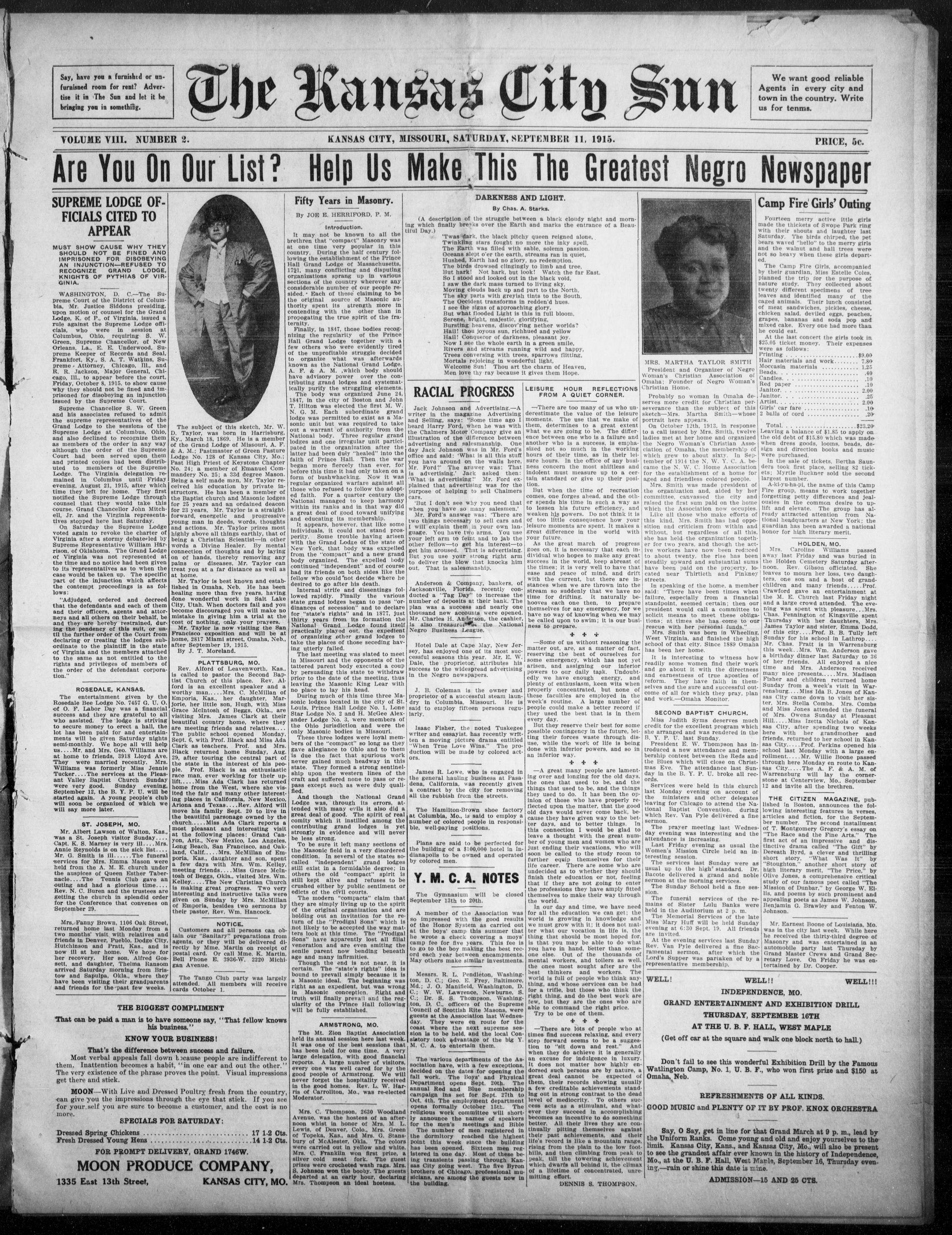
The subject of this sketch, Mr. W. D. Taylor, was born in Harrisburg, Ky., March 18, 1869. He is a member of the Grand Lodge of Missouri, A. F. & A. M.; Pastmaster of Green Pasture Lodge No. 128 of Kansas City, Mo.; Past High Priest of Keystone Chapter No. 24; a member of Emanuel Commandery No. 25; a 32d degree Mason. Being a self made man, Mr. Taylor received his education by private instructors. He has been a member of the Grand Lodge of Missouri, a Massacre lodge for 25 years and an ordained deacon for 23 years. Mr. Taylor is a straightforward, energetic and progressive young man in deeds, words, thoughts and actions. Mr. Taylor prizes most highly above all things earthly, that of being a Christian Scientist—in other words a Divine Healer. By mental connection of thoughts and by laying on of hands, thereby removing any pains or diseases, Mr. Taylor can treat you at a far distance as well as at home. Mr. Taylor is best known and established in Omaha, Neb. He has been healing more than five years, having done wonderful work in Salt Lake City, Utah. When doctors fail and you become discouraged you will make no mistake in giving him a trial at the cost of nothing, only your prayers. Mr. Taylor is now visiting the San Francisco exposition and will be at home, 2817 Miami street, Omaha, Neb., after September 19, 1915.
PLATTSBURG, MO.
Rev. Alford of Leavenworth, Kas. is called to pastor the Second Baptist Church of this place. Rev. Alford is an excellent speaker and a worthy man...Mrs. C. McMillan of Emporia, Kas., her daughter, Marjorie, her little son, Hugh, with Miss Grace McIntosh of Beggs, Okla., are visiting Mrs. James Clark at their beautiful country home, where they are meeting friends and relatives... The public school opened Monday, Sept. 6, with Prof. Black and Miss Ada Clark as teachers. Prof. and Mrs. Black returned home Sunday, Aug. 29, after touring the central part of the state in the interest of his peo Prof. Black is an enthusiastic race manager... Miss Ada Clark lift... Miss Ada Clark has returned home from the West, where she visited the fair and many other interesting places in California, New Mexico, Ariona and Texas...Rev. Alford will move his family Sept. 20 to live in the beautiful parsonage owned by the church...Miss Ada Clark reports a most pleasant and interesting visit at the following places: Grand Canyon, Ariz. New Mexico, Los Angeles, Long Beach, San Francisco, and Oakland, Calif...Mrs. McMillan of Emporia, Kas., daughter and son, spent time with Miss Grace McIntosh meeting friends... Miss Grace McIntosh of Beggs, Okla., visited Mrs. Wm. Kelley...The New Christian Church is making great progress. Two very interesting and instructive talks were given on Sunday by Mrs. McMillan of Emporia, besides two sermons by their pastor, Rev. Wm. Hancock.
Customers and all persons can obtain our "Sanitary" preparations from agents, or they will be delivered directly by Mme. Martin on receipt of postal card. Or call Mme. K. Martin. Bell Phone 8. 3936-W. 2220 Michigan Avenue.
The Tango Club party was largely attended. All members will receive cards. October 1
NOTICE.
KANSAS CITY, MISSOURI, SATURDAY, SEPTEMBER 11, 1915.
Fifty Years in Masonry.
By JOE E. HERRIFORD, P. M.
Introduction.
It may not be known to all the brethren that "compact" Masonry was at one time very popular in this country. During the half century following the establishment of the Prince Hall Grand Lodge of Massachusetts, 1721, many conflicting and disputing organizations sprang up in various sections of the country wherever any considerable number of our people resided. Each of these claiming to be the original source of Masonic authority spent its strength more in contending with the other than in propagating the true spirit of the fraternity. Finally, in 1847, those bodies recognizing the regularity of the Prince Hall Grand Lodge together with a few others who were evidently tired of the unprofitable struggle decided to organize what was afterwards known as the National Grand Lodge, A. F. & A. M., which body should have advisory power over the contributing grand lodges and systematically purify the struggling elements. The body was organized June 24.
1847, in the city of Boston and John T. Hilton was elected the first M. W. N. G. M. Each subordinate grand lodge was permitted to exist as a Masonic unit but was required to take part in the National body. Three regular grand lodges and one irregular unit participated in the organization after the latter had been duly "healed" into the faith of Prince Hall. Then the war began more fiercely than ever, for before this time it had only taken on a form of bushwacking. Now it was regular organized warfare against all those who refused to follow the adopted faith. For a quarter century the National managed to keep harmony within its ranks and in that way did a great deal of good toward unifying and educating its membership. It appears, however, that like some other lodges did not stand prosperity. Some trouble having arisen with the Grand Lodge of the state of New York, that body was expelled from the "compact" and a new grand body organized. The expelled body continued "independent" and of course had its friends on both sides like the fellow who could not decide where he desired to go after his death. Internal strife and dissentings followed rapidly. Finally the various state grand lodges began to pass "ordinances of secession" and to declare "for state's rights" and in 1877, just thirty years from its formation the National Grand Lodge found, particularly on account of the expedient of organizing other grand lodges to take the places of those seceding having utterly failed.
The last meeting was slated to meet in Missouri and the opponents of the tattered parent body executed a coup by persuading this state to withdraw prior to the date of the meeting, thus leaving the Masonic King Lear with no place to lay his head.
During much of this time three Masonic lodges located in the city of St. Louis, Prince Hall Lodge No. 1, Lone Star Lodge No. 2 and H. McGee Alexander Lodge No. 3, were members of the Ohio jurisdiction and were the only Masonic bodies in Missouri.
These three lodges were loyal members of the "compact" so long as they gave allegiance to Ohio and to them is due the fact that spurious work never gained much headway in this state. They formed a strong sentinel ship upon the western lines of the craft and suffered none to pass or repass except such as were duly qualified.
And though the National Grand Lodge was, through its errors, attended with many evil it also did a great deal of good. The spirit of real comity which it instilled among the contributing grand lodges is yet strongly evidence and will never be strong.
To be sure it left many sections of the Masonic field in a very disordered condition. In several of the states so called "independent" grand lodges still exist in a formidable degree; in others the old "compact" spirit is still kept alive and refuses to be crushed either by public sentiment or edicts of the civil courts.
The modern "compacts" claim that they are simply living up to the spirit of the original organization and are holding out an invitation for the return of the "Prodigal Sons" which is not likely to be accepted the way matters look at this time. The "Prodigal Sons" have apparently lost all filial veneration and are even smitting the senile parent now bending beneath age and many infirmities. Though the end is not near, it is certain. The "state's rights" idea is bound to prevail simply because it is a Masonic ideal. The beginning was right as an expedient, but was wrong in Masonic conception. Right and truth will finally prevail and the regularity of the Prince Hall following will be fully established.
ARMSTRONG, MO.
The Mt. Zion Baptist Association held its annual session here last week. It was one of the best sessions that has been held for one time. A very large delegation, with good financial reports. A large number of visitors, every one was well cared for by the good people of Armstrong. We will never forget the hospitality received in the good homes. Rev. L. W. Harris of Carrollton, Mo., was re-elected Moderator.
Mrs. C. Thompson, 2630 Woodland Avenue, was the hostess of an afternoon whist in honor of Mrs. M. L. Lewis, of Denver, Colo., Mrs. Green of Topeka, Kas., and Mrs. G. Stansbury of McAleren, Okla. The colors were carried out in yellow and white. Mrs. C. Franklin won first prize, a silver cold meat fork. The guest prizes were crocheted wash rags. Mrs. S. Johnson won the boboy. The guests departed at an early hour, declaring Mrs. Thompson an ideal hostess.
DARKNESS AND LIGHT.
By Chas. A.
(A description of the struggle between which finally breaks over the Earthful Day.)
'Twas dark, the black pitch
Twinkling stars fought no.
The Earth was filled with the
Oceans slept o'er the earth,
Hushed, Earth had no glory
The birds drowsed clinging
But hark! Not hark, but I
So I stood and looked out in
I saw the dark mass turned
Moving clouds back up and
The sky parts with greyish
The Occident transforms in
I see the signs of approach
But what flooded Light is t
Serene, bright, majestic, gl
Bursting heavens, discov'ri
Hall! thou joyous sun, rich
Hall! Conqueror of darken
Now I see the whole earth
Rivers and streams runnil
Trees conversing with tree
Mortals rejoicing in wonde
Welcome Sun! Thou art t
Men love thy ray because f
By Chas. A. Starks.
(A description of the struggle between a black cloudy night and morning which finally breaks over the Earth and marks the entrance of a Beautiful Day.)
Twas dark, the black pitchy queen reigned alone,
Twinkling stars fought no more the inky spell,
The Earth was filled with sable, solemn passion.
Oceans slept o'er the earth, streams ran in quiet,
Hushed, Earth had no glory, no redemption.
The birds drowsed clingingly to limb and tree,
But hark! Not hark, but look! Watch the far East.
So I stood and looked out in the black void,
I saw the dark mass turned to living sky.
Moving clouds back up and part to the North.
The sky parts with greyish tints to the South.
The Occident transforms in redden'd hues.
I see the signs of approaching glory.
But what flooded Light is this in full bloom.
Serene, bright, majestic, glorifying,
Bursting heavens, discovring nether worlds?
Hall! thou joyous sun, richhued and yellow
Hall! Conqueror of darkness, pleasant joy.
Now I see the whole earth in a green smile,
Rivers and streams running wild and happy,
Trees conversing with trees, sparrows flitting,
Mortals rejoicing in wonderful light,
Welcome Sun! Thou art the charm of Heaven,
Men love thy ray because it gives them Hope.
RACIAL PROGRESS
Jack Johnson and Advertising—A writer in the magazine Advertising and Selling, says: "Some time ago I heard Harry Ford, when he was with the Chalmers Motor Company give an illustration of the difference between advertising and salesmanship. One day Jack Johnson was in Mr. Ford's office and said: 'What is all this stuff you have around on the walls here, Mr. Ford?' The answer was: That is advertising.' Jack asked then: 'What is advertising?' Mr. Ford explained that advertising was for the purpose of helping to sell Chalmers cars.
'But I don't see why you need that when you have so many salesmen.' Mr. Ford's answer was: 'There are two things necessary to sell cars and I will explain them in your own language. You have two arms. You use your left arm to teint and to jab the other fellow—to get his interest—to get him aroused. That is advertising. But you use your strong right arm to deliver the blow that knocks him out. That is salesmanship.
Anderson & Company, bankers, of Jacksonville, Florida, recently conducted a "Tag Day" to increase the number of deposits at their bank. The plan was a success and nearly one thousand new accounts were opened. Mr. Charles H. Anderson, the cashier, is also treasured to the National Negro Business League.
Hotel Dale at Cape May, New Jersey, has enjoyed one of its most successful seasons this year. Mr. E. W. Dale, the proprietor, attributes his success to the widespread advertising in the Negro newspapers.
J. B. Coleman is the owner and proprietor of a successful steam laundry in Columbia, Missouri. He is said to employ fifteen persons regularly.
Isaac Fisher, the noted Tuskegee writer and essayist, has recently written a moving picture drama entitled "When True Love Wins." The production will be made by colored actors.
James R. Lowe, who is engaged in the general hauling business at Pasadena, California, was recently a contract by the city for removing all the rubbish from the streets.
The Hamilton-Brown shoe factory at Columbia, Mo., is said to employ a number of colored people in responsible, well-paying positions.
Plans are said to be perfected for the building of a $100,000 hotel in Indianapolis to be owned and operated by colored men.
Y. M. C. A. NOTES
The Gymnasium will be closed September 13th to 20th.
A member of the Association was so impressed with the good results of the Honor System as carried out at the boys' camp this summer that he wrote a check covering a moys' camp fee for five years. This fee is to go to the boy making the best record each year between encampments. May others make similar investments.
Messrs. R. L. Pendleton, Washington, D. C.; Geo. E. Frey, Baltimore, Md.; J. O. Manfield, Washington, D. C.; W. W. Lawrence, Newburn, S. C.; Dr. S. K. Thompson, Washington, D. C., officers of the Supreme Council of Scottish Rite Masons, were guests at the Association last Wednesday. They were en route for the coast where the next supreme session is to be held, and the local Consulatory took advantage of the big Y. M. C. A. to entertain them.
The various departments of the Association have, with a few exceptions, decided on the dates for opening the fall work. The Boys' and Physical Department opens Sept. 20th. The annual Red and Blue membership campaign ins set for Sept. 27th to Oct. 4th. The employment department opens formally October 15th. The religious work committee will shortly announce the names of speakers for the men's meetings and Bible The number of men registered in the dormitory reached the highest point this week since the building has been opened. Sixteen men registered in one day. Most of these being transients passing through Kansas City going west. The five Byron brothers of Chicago, professional musicians, are among the guests now in the building.
between a black cloudy night and morn-
h and marks the entrance of a Beau-
ly queen reigned alone,
more the inky spell,
susable, solemn passion,
streams ran in quiet,
no redemption,
ly to limb and tree,
book! Watch the far East.
in the black void,
to living sky,
part to the North,
tints to the South,
redden'd hues.
ing glory,
this in full bloom,
orifying,
ng nether worlds?
hued and yellow
ss, pleasant joy.
in a green smile,
ng wild and happy,
ss, sparrows flitting,
errful light,
the charm of Heaven,
t gives them Hope.
LEISURE HOUR REFLECTIONS
FROM A QUIET CORNER.
—There are too many of us who underestimate the value of the leisure moments. The use that we make of them, determines to a great extent what we are going to be. The difference between one who is a failure and another who is a success, is emphasized not so much in the working hours of their time, as in their leisure hours. In the office of any business concern the most shiftless and indolent must measure up to a certain standard or give up their position. But when the time of recreation comes, one forges ahead, and the other spends his time in such a way as to lessen his future efficiency, and weaken his powers. Do not think it is of too little consequence how your leisure moments are spent. It makes a great difference in the world with your future.
As the great march of progress goes on, it is necessary that each individual who hopes to make any great success in the world, keep abreast of the times; it is very well to have that ease and peace of mind, and drift with the current, but there are instances when we are thrown into the stream so suddenly that we have no time to relax, and when naturally hooves each one then, to prepare themselves for any emergency, for we have no way of knowing when we may be called upon to swim; it is our busi ness to prepare.
—Some of us without reasoning the matter out, are, as a matter of fact, reserving the best of ourselves for some emergency, which has not yet arisen, and assigning our inferior powers to our daily task. Undoubtedly we have enough energy, and plenty of enthusiasm, keen wits when properly concentrated, but none of these faculties are employed in the week's routine. A large number of people could make a better record if they used the best that is in them every day.
But they reserve their best for some possible contingency in the future, letting their forces waste through disuse, while the work of life is being done with inferior powers, and so in an inferior way.
—A great many people are lamenting over and longing for the old days, the ones that used to be, and the things that used to be, and the things they used to do. It has been the opinion of those who have properly reflected upon the matter, that the good old days would never come back, because they have given way to the better days, and to better things. In this connection I would be glad to leave a thought with the great num ber of young men and women who are just ending their vacations, who will soon be called to the study room to further equip themselves for their life career. There are some who are ready to be whether they should finish their education or not, feeling that if they are not going to enter the professions they have amply fitted themselves to make their way through the world.
In our day and time, we have need for all the education we can get; the world is growing in knowledge and we must grow with it; it does not matter what our vocation in life is, the thing that should be most hoped for, is that you may be able to do what you have in hand, better than some one else. Out of the thousands of mental workers, and toilers as well, the ones most sought after are the best thinkers and workers. The world is full of people who think anything, and whose services can be had for a trifle, but those who think the right thing, and do the best work are few, but they are the ones who are able to command the right price.
—There are lots of people who at times find success relaxing, and every step forward seems to be a suggestion to "sit down and rest." And when they do achieve it is generally an excuse for indulgence in luxury. It does not matter how highly endorsed such persons are by nature, a great deal cannot be expected of them, their records showing usually a few creditable achievements standing out in strong contrast to the dead level of mediocrity. To achieve success acts as a stimulant, and what ever they succeed in accomplishing becomes an incentive to do something better. All their lives they are continually pitting themselves against their past achievements, and their life's record is like a mountain range, rising from the plain to the low foothills, and then climbing from peak to peak, till the towering achievement which dwarfs all behind it, the climax of a lifetime of concentrated, unre mirting effort.
DENNIS S. THOMPSON.
```markdown
```
* * *
+ + +
DENNIS S. THOMPSON.
MRS. MARTHA TAYLOR SMITH
President and Organizer of Negro Woman's Christian Association of Omaha; Founder of Negro Woman's Christian Home.
Probably no woman in Omaha deserves more credit for Christian perseverance than the subject of this sketch—Mrs. Martha Smith—whose portrait here annears.
On October 12th, 1913, in response to a call issued by Mrs. Smith, twelve ladies met at her home and organized the Negro Woman's Christian Association of Omaha, the membership of which grew to about sixty. In September of 1914 the N. W. Y. C. A. became the N. W. C. Home Association for the establishment of a home for aged and friendless colored people. Mrs. Smith was made president of the organization and, aided by her committee, canvassed the city and raised the first sum paid on the home which the Association now occupies. Like all those who make efforts of this kind, Mrs. Smith has had opposition and criticism from within and without, but regardless of all this, she has held the organization together for two years, and though the active workers have now been reduced to about twenty, the rise has been steadily upward and substantial sums have been paid on the property, located near Thirtieth and Pinkney streets.
In speaking of the home, a member said: "There have been times when failure, especially from a financial standpoint, seemed certain; then our president would call a committee to solicit means to meet these obligations; at times she has come to our rescue with her personal funds."
Mrs. Smith was born in Wheeling West Virginia, and finished the high school of that city. Since 1889 Omaha has been her home.
It is interesting to witness how readily some women find their work and go about it with the directness and earnestness of true apostles of reform. They have faith in themselves and the sure and successful outcome of all for which they pray, plan and work.-Omaha Monitor.
SECOND BAPTIST CHURCH
Miss Judith Syms deserves much credit for the excellent program which she arranged and was rendered in the B. Y. P. U. last Sunday.
President E. W. Thompson has introduced a new attendance and membership contest between the Reds and the Blues which will close on Christmas Eve. The attendance last Sunday in the B. Y. P. U. broke all records.
Services were held in this church last Monday evening on account of the ministers and other delegates leaving Chicago to attend the National Baptist Convention, during which Rev. Van Pyle delivered a fine sermon.
The prayer meeting last Wednesday evening was interesting and the attendance is increasing.
Last Friday evening as usual the Women's Mission Circle held an interesting session.
The services last Sunday were as usual up to the high standard. Dr. Bacote delivered a grand and noble sermon at the morning services.
The Sunday School held a fine session.
The funeral services of the remains of Sister Lulu Banks were held in the Auditorium at 2 p. m.
The Memorial Services of the late Miss Mary Huff will be held Sunday evening at 6:30 Sept. 19. All friends are invited.
At the evening services last Sunday Rev. Van Pyle delivered a fine sacramental sermon, after which the Lord's Supper was partaken of by a representative membership.
WELL! WELL
INDEPENDENT
GRAND ENTERTAINMENT
THURSDAY, SE
AT THE U. B. F. H.
(Get off car at the square and
Don't fail to see this wonder
Watlington Camp, No. 1, U. B. F.
Omaha, Neb.
REFRESHMENT
GOOD MUSIC and PLENTY OF F
Say, O Say, get in line for th
the Uniform Ranks. Come young
limit. Kansas City, Kans., and K
to see the grandest affair ever kn
Mo., at the U. B. F. Hall, West M
ing,—rain or shine this date is mi
Don't fail to see this wonderful Exhibition Drill by the Famous Watlington Camp, No. 1, U. B. F., who won first prize and $150 at Omaha, Neb.
GOOD MUSIC and PLENTY OF IT BY PROF. KNOX ORCHESTRA
Say, O Say, get in line for that Grand March at 9 p. m., lead by the Uniform Ranks. Come young and old and enjoy yourselves to the limit. Kansas City, Kans., and Kansas City, Mo., will also be present to see the grandest affair ever known in the history of Independence, Mo., at the U. B. F. Hall, West Maple, September 16, Thursday evening,—rain or shine this date is mine.
ADMISSION—15 AND 25 CTS.
We want good reliable Agents in every city and town in the country. Write us for tenms.
Newspaper
Camp Fire Girls' Outing
Fourteen merry active little girls made the thickets of Swope Park ring with their shouts and laughter last Saturday. The birds chirped, the pet bears waved "hello" to the merry girls and the walnut and hall trees were not so heavy when these girls departed.
The Camp Fire Girls, accompanied by their guardian, Miss Estelle Coles, planned the trip for the purpose of nature study. They collected about twenty different specimens of tree leaves and identified many of the caged animals. Their lunch consisted of meat sandwiches, pickles, cheese, chicken salad, deviled eggs, peaches, grapes, bananas and soda pop and mixed cake. Every one had more than he could eat.
At the last concert the girls took in $25.05 ticket money. Their expenses were as follows:
Printing . . . $9.00
Hair materials and work . . . 7.80
Moecasin materials . . . 1.25
Beads. . . . 40
Candles. . . . 10
Red paper . . . . 10
Janiton . . . 2.00
Janitor . . . . 25
Artist. . . . 2.00
Girls' car fare . . . 10
2 balls of cord . . . 20
Total. . . . $23.20
Leaving a balance of $1.85 to apply on the old debt of $15.80 which was made when dress goods, looms, beads, design and direction books and music were purchased.
In the sale of tickets, Bertha Saunders took first place, selling 82 tickets; Myrtle Buckner sold the second largest number. Aki-ku-ha-pi, the name of this Camp Fire group, means to work together getting petty differences and jealousies in the common desire to uplift and increase group has already attracted attention from New York national headquarters at New York; the guardian has been awarded a national honor for high literary merit.
HOLDEN, MO.
Mrs. Caroline Williams passed away last Friday and was buried in the Holden Cemetery Saturday afternoon. Rev. Gibbons officiated. She leaves to mourn her loss, two daughters, one son and a host of grandchildren and many friends.....Prof. Crawford gave an entertainment at the M. E. Church last Friday night and a large crowd attended. The evening was spent with pleasure.....Mrs. Chas. Pennington of Kingsville spent Thursday with her daughters, Mrs James Taylor and sister, Emma Dodd of this city.....Prof. B. B. Tully left Sunday for his school in Lathrop....Mr. Chas. Pratt is in Warrensburg this week.....Mrs. Wm. Anderson gave a dinner last Saturday to 36 of her friends. All enjoyed a nice time and Mrs. Anderson received many nice presents.....Mrs. Madison Fisher and children returned home Sunday from a week's return in Warrensburg. Miss Ida B. Jones of Kansas City came down to visit her. Mrs. Stella Combs. Mrs. Combs and Mrs Jones attended the funeral of Mrs. Owens Sunday at Pleasant Hill.....Miss Izetta Nichols of Kansas City, after spending two weeks here with her grandmother and friends, returned to her school in Kansas City.....Prof. Perkins opened his school last Monday with a large enrollment.....Mr. Willie Boone passed through here Monday en route to Kansas City.....The A. F. & A. M. of Warrensburg will lay the cornerstone at Centerview, Mo. September 12 and invite all the brethren.
THE CITIZEN MAGAZINE, published in Boston, announces the following interesting features in verses, articles and fiction, for the September number. The second installment of T. Montgomery Gregory's essay on "The Race and the Fine Arts." The first act of an impressive and distinctive drama called "The Gift" by Dereth Byrd, a clever and thrilling short story, "What Was It" by "Stonghton," another short story of high literary merit, "The Price," by Olive Jones, a comprehensive critical study of our famous poet called "The Mission of Dunbar," by George W. Ellis, and poems by such prominent and appealing poets as James W. Johnson, Benjamin G. Brawley and Fenton W. Johnson.
Mr. Earnest Boone of Louisiana, Mo. was in the city last week. While here he received the thirty-third degree of Masonry and was entertained in an automobile party last Thursday by Grand Master Crews and Grand Secretary Love. On Friday he was entertained by Dr. Cooper.
WELL!! WELL!!!
INDENCE, MO.
INT AND EXHIBITION DRILL
SEPTEMBER 16TH
HALL, WEST MAPLE
and walk one block north to hall.)
Perful Exhibition Drill by the Famous
F., who won first prize and $150 at
ITS OF ALL KINDS.
IT BY PROF. KNOX ORCHESTRA.
Chat Grand March at 9 p. m., lead by
g and old and enjoy yourselves to the
Kansas City, Mo., will also be present
known in the history of Independence
Maple, September 16, Thursday even
ine.
—15 AND 25 CTS.
PRICE. 5c.
WELL!!!
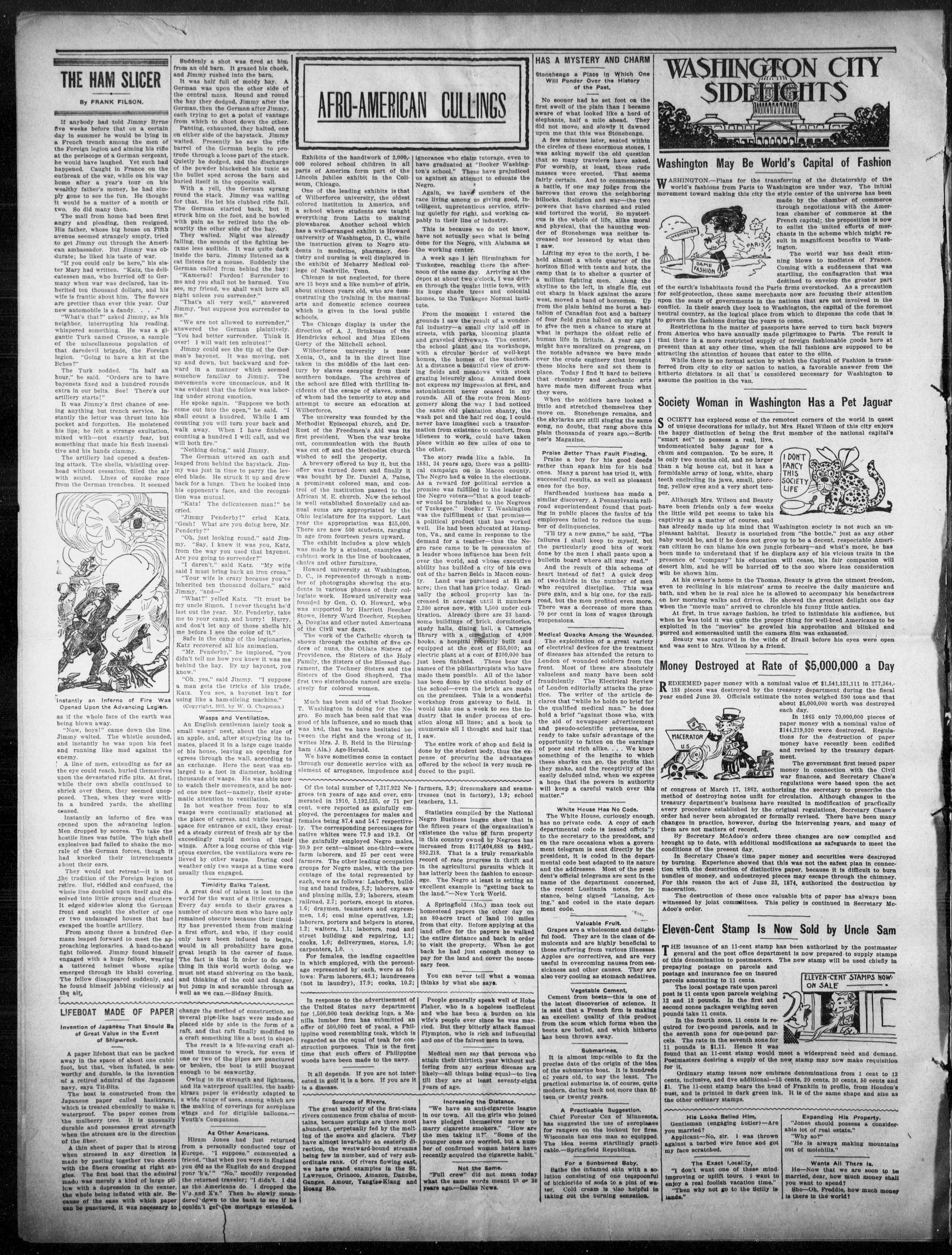
THE HAM SLICER
By FRANK FILSON.
If anybody had told Jimmy Byrne five weeks before that on a certain day in summer he would be lying in a French trench among the men of the Foreign legion and aiming his rifle at the periscope of a German sergeant, he would have laughed. Yet such had happened. Caught in France on the outbreak of the war, while on his way home after a year's tour on his wealthy father's money, he had simply gone to see the fun. He thought it would be a matter of a month or two. So did many then.
The mail from home had been first angry and pleading, then resigned. His father, whose big house on Fifth avenue seemed strangely empty, tried to get Jimmy out through the American ambassador. But Jimmy was obdurate: he liked his taste of war.
"If you could only be here," his sister Mary had written. "Katz, the delcattessen man, who hurried off to Germany when war was declared, has inherited ten thousand dollars, and his wife is frantic about him. The flowers are prettier than ever this year. Our new automobile is a dandy. . . ."
"What's that?" asked Jimmy, as his neighbor, interrupting his reading, whispered something. He was a gigantic Turk named Crusoe, a sample of the miscellaneous population of that daredevil brigade, the Foreign legion. "Going to have a hit at the Biches?"
The Turk nodded. "In half an hour," he said. "Orders are to have bayonets fixed and a hundred rounds extra in our belts. See! There's our artillery starts!"
It was Jimmy's first chance of seeing anything but trench service. Instantly the letter was thrust into his pocket and forgotten. He moistened his lips; he felt a strange exultation, mixed with—not exactly fear, but something that made his flesh insensitive and his hands clammy. The artillery had opened a deafening attack. The shells, whistling over head without cessation, filled the air with sound. Lines of smoke rose from the German trenches. It seemed
A
as if the whole face of the earth was being blown away.
"Now, boys!" came down the line. Jimmy waited. The whistle sounded, and instantly he was upon his feet and running like mad against the enemy.
A line of men, extending as far as the eye could reach, hurled themselves upon the devastated rifle pits. At first, while their own shells continued to shriek over them, they seemed unopposed. Then, when they were within a hundred yards, the shelling ceased.
Instantly an inferno of fire was opened upon the advancing legion. Men dropped by scores. To take the hostile lines was futile. The high shell explosives had failed to shake the morale of the German forces, though it had knocked their intrenchments about their ears.
They would not retreat—it is not the tradition of the Foreign legion to retire. But, riddled and confused, the whole line doubled upon itself and dissolved into little groups and clusters. It edged sidewise along the German front and sought the shelter of one or two undamaged houses that had escaped the hostile artillery. From among these a hundred Germans leaped forward to meet the approaching legionaries. A hand-to-hand fight followed. Jimmy found himself engaged with a huge fellow, wearing a tattered helmet whose spike emerged through its khaki covering. The fellow disappeared suddenly, and he found himself jabbing viciously at the air.
Invention of Japanese That Should Be of Great Value in the Event of Shipwreck.
A paper lifeboat that can be packed away in the space of about one cubic foot, but that, when inflated, is seaworthy and durable, is the invention of a retired admiral of the Japanese navy, says Tit-Bits.
The boat is constructed from the Japanese paper called hasikirazu, which is treated chemically to make it waterproof. The paper comes from the mulberry tree. It is unusually durable and possesses great strength when the stresses are in the direction of the fiber.
A thin sheet of paper that is strong when stressed in any direction is made by passing together two sheets with the fibers crossing at right angles. The first boat that the admiral made was merely a kind of large pullow with a depression in the center, the whole being inflated with air. Because of the ease with which paper can be punctured, it was necessary to
Suddenly a shot was fired at him from an old barn. It grazed his chuck and Jimmy rushed into the barn.
It was half full of moldy hay. A German was upon the other side of the central mass. Round and round the hay they dodged, Jimmy after the German, then the German after Jimmy, each trying to get a point of vantage from which to shoot down the other. Panting, exhausted, they halted, one on either side of the haystack. Jimmy waited. Presently he saw the rifle barrel of the German begin to protrude through a loose part of the stack. Quietly he dodged, and the discharge of the powder blackened his tunic as the bullet sped across the barn and buried itself in the opposite wall. With a yell, the German sprang round the stack. Jimmy was waiting for that. He let his clubbed rifle fall. The German started back, but it struck him on the foot, and he howled with palm as he retired into the obscurity the other side of the hay.
They waited. Night was already falling, the sounds of the fighting became less audible. It was quite dark inside the barn. Jimmy listened as a cat listens for a mouse. Suddenly the German called from behind the hay: "Kamerad! Pardon! Surrender to me and you shall not be harmed. You see, my friend, we shall wait here all night unless you surrender." "That's all very well," answered Jimmy, "but suppose you surrender to me." "We are not allowed to surrender," answered the German plaintively. "You had better surrender. Think it over! I will wait ten minutes!" Jimmy could see the tip of the German's bayonet. It was moving, not up and down, but backward and forward in a manner which seemed somehow familiar to Jimmy. The movements were unconscious, and it was evident that the fellow was laboring under strong emotion.
He spoke again. "Suppose we both come out into the open," he said. "I shall count a hundred. While I am counting you will turn your back and walk away. When I have finished counting a hundred I will call, and we will both fire."
"Nothing doing," said Jimmy. The German uttered an oath and leaped from behind the haystack. Jimmy was just in time to parry the leveled blade. He struck it up and drew back for a lunge. Then he looked into his opponent's face, and the recognition was mutual.
"Katz! The delicatessen man!" he cried.
"Jimmy Penderby!" cried Katz. "Gosh! What are you doing here, Mr. Penderby."
"Oh, just looking round." said Jimmy. "Say, I knew it was you, Katz, from the way you used that bayonet. Are you going to surrender?"
"I darent," said Katz. "My wife said I must bring back an iron cross." "Your wife is crazy because you've inherited ten thousand dollars," said Jimmy, "and—" "What?" yelled Katz. "It must be my uncle Simon. I never thought he'd last out the year. Mr. Penderby, take me to your camp, and hurry! Hurry, and don't let any of those shells hit me before I see the color of it." Safe in the camp of the legionaries, Katz recovered all his animation.
"Mr. Penderby," he implored, "you didn't tell me how you knew it was me behind the hay. By my bayonet, you know."
"Oh. yes," said Jimmy. "I suppose a man gets the tricks of his trade, Katz. You see, a bayonet isn't for using like a ham-slicing machine."
Wasps and Ventilation.
An English gentleman lately took a small wasps' nest, about the size of an apple, and, after stupefying its inmates, placed it in a large cage inside of his house, leaving an opening for egress through the wall, according to an exchange. Here the nest was enlarged to a foot in diameter, holding thousands of wasps. He was able now to watch their movements, and he noted one new fact—namely, their systematic attention to ventilation. In hot weather from four to six wasps were continually stationed at the place of egress, and while leaving space for entrance or exit, they created a steady current of fresh air by the exceedingly rapid motion of their wings. After a long course of this vigorous exercise, the ventilators were relieved by other wasps. During cool weather only two wasps at a time were usually thus engaged.
Timidity Balks Talent
A great deal of talent is lost to the world for the want of a little courage. Every day sends to their graves a number of obscure men who have only remained obscure because their timidity has prevented them from making a first effort, and who, if they could only have been induced to begin, would in all probability have gone great length in the career of fame. The fact is that in order to do anything in this world worth doing, we must not stand shivering on the bank and thinking of the cold and danger, but jump in and scramble through as well as we can—Sidney Smith.
change the method of construction, so several pipe-like bags were made and placed side by side in the form of a raft, and that raft finally modified to a craft something like a boat in shape. The result is a life-saving craft almost immune to wreck, for even if one or two of the pipes are punctured or broken, the boat is still buoyant enough to be seaworthy. Owing to its strength and lightness, and its waterproof qualities, the hashi-kirazu paper is evidently adapted to a wide range of uses, among which are the making of coverings for aerplane wings and for dirigible balloons. Youth's Companion.
As Other Americans.
Hiram Jones had just returned from a personally conducted tour of Europe. "I suppose," commented a friend, "that when you were in England you did as the English do and dropped your 'h's.'" "No," moodily responded the traveler; "I didn't. I did as the Americans do. I dropped the Vs. and Xs." Then he slowly meandered down to the bank to see if he couldn't get the mortgage extended.
AFRO-AMERICAN CULLINGS
Exhibits of the handwork of 2,000,000 colored school children in all parts of America form part of the Lincoln jubilee exhibit in the Coliseum, Chicago. One of the leading exhibits is that of Wilberforce university, the oldest colored institution in America, and a school where students are taught everything from Latin to making plowshares. Another school which has a well-arranged exhibit is Howard university of Washington, D.C., while the instruction given to Negro students in medicine, pharmacy, dentistry and nursing is well displayed in the exhibit of Meharry medical college of Nashville, Penn. Chicago is not neglected, for there are 15 boys and a like number of girls, about sixteen years old, who are demonstrating the training in the manual arts and domestic science courses which is given in the local public schools.
The Chicago display is under the direction of A. J. Brinkman of the Hendricks school and Miss Eileen Gerty of the Mitchell school. Wilberforce university is near Xenia, O., and is in the direct line taken in the middle of the last century by slaves escaping from their southern bondage. The archives of the school are filled with thrilling incidents of the escape of slaves, some of whom had the temerity to stop and attempt to secure an education at Wilberforce.
The university was founded by the Methodist Episcopal church, and Dr. Rust of the Freedmen's Aid was its first president. When the war broke out, communication with the South was cut off and the Methodist church wished to sell the property.
A brewery offered to buy it, but the offer was turned down and finally it was bought by Dr. Daniel A. Paine, a prominent colored man, and control of the institution passed to the African M. E. Church. Now the school is well established financially and annual sums are appropriated by the Ohio legislature for its support. Last year the appropriation was $55,000. There are now 500 students, ranging in age from fourteen years upward. The exhibit includes a plow which was made by a student, examples of cabinet work in the line of bookcases, chairs and other furniture. Howard university at Washington, D. C., is represented through a number of photographs showing the students in various phases of their collegiate work. Howard university was founded by Gen. O. O. Howard, who was supported by Harriett Beecher Stowe, Henry Ward Beecher, Stephen A. Douglas and other noted Americans of the Civil war days.
The work of the Catholic church is shown through the exhibit of five orders of nuns, the Oblate Sisters of Providence, the Sisters of the Holy Family, the Sisters of the Blessed Sacrament, the Techney Sisters and the Sisters of the Good Shepherd. The first two sisterhoods named are exclusively for colored women.
Much has been said of what Booker T. Washington is doing for the Negro. So much has been said that was good of his influence, and so much that was bad, that we have hesitated between the right and the wrong of it, writes Mrs. J. B. Reid in the Birmingham (Ala.) Age-Herald.
We have sometimes come in contact through our domestic service with an element of arrogance, impudence and
Of the total number of 7,317,922 Negroes ten years of age and over, enumerated in 1910, 1,921,525, or 71 per cent, were reported as gainfully employed, the percentages for males and females being 87.4 and 54.7 respectively. The corresponding percentages for native whites were 77.9 and 19.2. Of the gainfully employed Negro males, 30.9 per cent—almost one-third—were farm laborers, and 25 per cent were farmers. The other leading occupation groups for Negro males, with the percentage of the total represented by each, were as follows: Laborers, building and hand trades, 5.2; laborers, saw and planing mills, 2.9; laborers, steam railroad, 2.7; porters, except in stores, 1.6; draymen, teamsters and expressmen, 1.6; coal mine operatives, 1.2; laborers, porters and helpers in stores, 1.2; waiters, 1.1; laborers, road and street building and repairing, 1.1; cooks, 1.0; deliverymen, stores, 1.0; carrenters, 1.0.
For females, the leading capacities in which employed, with the percentage represented by each, were as follows: Farm laborers, 48.1; laundresses (not in laundry), 17.9; cooks, 10.2.
In response to the advertisement of the United States navy department for 1,500,000 teak decking logs, a Manilla lumber firm has submitted an offer of 500,000 feet of yacal, a Philippine wood resembling teak, which is regarded as the equal of teak for construction purposes. This is the first time that such offers of Philippine woods have been made to the navy.
It all depends. If you are not interested in golf it is a bore. If you are it is a disease.
Sources of Rivers.
The great majority of the first-class rivers commence from chains of mountains, because springs are there most abundant, perpetually fed by the melting of the snows and glaciers. They have almost invariably an easterly direction, the westward-bound streams being few in number, and of very subordinate rank. Of rivers flowing east, we have grand examples in the St. Lawrence, Orinoco, Amazon, Danube, Ganges, Amour, Yangtse-Kiang and Hoang Ho.
ignorance who claim tutorage, even have graduated at "Booker Washington's school." These have prejudiced us against an attempt to educate the Negro.
Again, we have members of the race living among us giving good, intelligent, unpretentious service, striving quietly for right, and working capably in their line of industry.
This is because we do not know, have not actually seen what is being done for the Negro, with Alabama as the working center.
A week ago I left Birmingham for Tuskegee, reaching there the afternoon of the same day. Arriving at the depot at about two o'clock, I was driven through the quaint little town, with its huge shade trees and colonial homes, to the Tuskegee Normal institute.
From the moment I entered the grounds I saw the result of a wonderful industry—a small city laid off in streets, with parks, blooming plants and graveled driveways. The center, the school plant and its workshops, with a circular border of well-knew homes, the homes of the teachers. At a distance a beautiful view of growing fields and meadows with stock grazing leisurely along. Amazed does not express my impression at first, and astonishment never ceased in my rounds. All of the route from Montgomery along the way I had noticed the same old plantation shanty, the wash pot and the half red dog. I could never have imagined such a transformation from existence to comfort, from idleness to work, could have taken place within so few miles of one to the other.
The story reads like a fable. In 1881, 34 years ago, there was a political campaign on in Macon county. The Negro had a voice in the elections. As a reward for political service a promise was fulfilled to the leader of the Negro voters—"that a good teacher would be furnished to the Negroes of Tuskegee." Booker T. Washington was the fulfillment of that promise—a political product that has worked well. He had been educated at Hampton, Va., and came in response to the demand for a teacher—thus the Negro race came to be in possession of a leader whose influence has been felt over the world, and whose executive ability has built a city of his own out of the barren fields in Macon county. Land was purchased at $1 an acre; then that has价钱 today. Gradually the school property has increased in acreage until it numbers 2,300 acres now, with 1,500 under cultivation. Already there are 33 handsome buildings of brick, dormitories, study halls, dining hall, a Carnegie library with a circulation of 4,000 books, a hospital recently built and equipped at the cost of $55,000; an electric plant at a cost of $300,000 has just been finished. These bear the names of the philanthropists who have made them possible. All of the labor has been done by the student body of the school—even the brick are made on the premises. This is a wonderful workshop from gateway to field. It would take one a week to see the industry that is under process of creation along all lines; and a book to enumerate all I thought and half that I saw.
The entire work of shop and field is done by the student body, thus the expense of procuring the advantages offered by the school is very much reduced to the pupil.
farmers, 3.9; dressmakers and seamstresses (not in factory), 1.9; school teachers, 1.1.
Statistics compiled by the National Negro Business league show that in the fifteen years of the organization's existence the value of farm property in this country owned by Negroes has increased from $177,404,688 to $492,892,218. That is a truly remarkable record of race progress in thrift and in the agricultural pursuits which it has latterly been the fashion to encourage. The Negro at least is setting an excellent example in "getting back to the land."—New York World.
A Springfield (Mo.) man took out homestead papers the other day on an 80-acre tract of land 100 miles from that city. Before applying at the land office for the papers he walked the entire distance and back in order to visit the property. When he got back he had just enough money to pay for the land and cover the necessary fees.
You can never tell what a woman thinks by what she says.
People generally speak well of Hobe Fisher, who is a hopeless inefficient and who has been a burden on his wife's people ever since he was married. But they bitterly attack Samuel Plympton, who is rich and influential and one of the fairest men in town.
Medical men say that persons who attain their thirtieth year without suffering from any serious disease are likely—all things being equal—to live till they are at least seventy-eight years of age.
Increasing the Distance.
"We have an anti-cigarette league in our town. All the girls who joined have pledged themselves never to marry cigarette smokers." "How are the men taking it?" "Some of the younger ones are worried, but a number of confirmed women haters have recently acquired the cigarette habit."
Not the Same.
"Full crew" did not mean today what the same words meant 25 or 20 years ago—Dallas News.
HAS A MYSTERY AND CHARM
Stonehenge a Place in Which One Will Ponder Over the History of the Past.
No sooner had he set foot on the first swell of the plain than I became aware of what looked like a herd of elephants, half a mile ahead. They did not move, and slowly it dawned upon me that this was Stonehenge.
A few minutes later, seated within the circles of these enormous stones, I was asking myself the old question that so many travelers have asked. For worship, at least, these rude masses were erected. That seems fairly certain. And to commemorate a battle, if one may judge from the barrows that crown the neighboring hillocks. Religion and war—the two powers that have charmed and ruled and tortured the world. So mysterious is the whole of life, alike moral and physical, that the haunting wonder of Stonehenge was neither increased nor lessened by what then I saw.
Lifting my eyes to the north, I beheld almost a whole quarter of the horizon filled with tents and huts, the camp that is to shelter a quarter of a million fighting men. Along the skyline to the left, in single file, cut out sharp in black against the azure west, moved a band of horsemen. Up from the plain behind me burst a battalion of Canadian foot and a battery of four field guns halted on my right to give the men a chance to stare at what is perhaps the oldest relic of human life in Britain. A year ago I might have moralized on progress, on the notable advance we have made over the crude enginery that brought these blocks here and set them in place. Today I find it hard to believe that chemistry and mechanic arts have made men different from what they were.
When the soldiers have looked a little and stretched themselves they move on. Stonehenge remains, and the skylaries are still singing the same song, no doubt, that rang above this plain thousands of years ago.-Scribner's Magazine.
Praise Better Than Fault Finding.
Praise a boy for his good deeds rather than spank him for his bad ones. Many a parent has tried it, with successful results, as well as pleasant ones for the boy.
Hardheaded business has made a similar discovery. A Pennsylvania railroad superintendent found that posting in public places the faults of his employees failed to reduce the number of delinquencies.
"I'll try a new game," he said. "The failures I shall keep to myself, but the particularly good bits of work done by the men I shall paste upon a bulletin board where all may read."
And the result of this scheme of heart instead of fist? A quick drop of two-thirds in the number of men who required discipline. This was pure gain, and a big one, for the railroad, but the men profited even more. There was a decrease of more than 70 per cent in loss of wages through suspensions.
Medical Quacks Among the Wounded.
The exploitation of a great variety of electrical devices for the treatment of diseases has attended the return to London of wounded soldiers from the front. Most of these are absolutely valueless and many have been sold fraudulently. The Electrical Review of London editorially attacks the practice. The writer of the article declares that "while he holds no brief for the qualified medical man." he does hold a brief "against those who, with the aid of newspaper advertisement and pseudo-scientific pretenses, are ready to take unfair advantage of the opportunity to fatten on the earnings of poor and rich alike. . . We know something of the lengths to which these sharks can go, the profits that they make, and the receptivity of the easily deluded mind, when we express a hope that the powers in authority will keep a careful watch over this matter."
White House Has No Code
The White House, curiously enough, has no private code. A copy of each departmental code is issued officially to the secretary to the president, and on the rare occasions when a government telegram is sent directly by the president, it is coded in the departmental code best adapted to its nature and the addresssee. Most of the president's official telegrams are sent in the name of the department concerned, the recent Lusitania notes, for instance, being signed "Lansing, Acting," and coded in the state department code.
Valuable Fruit.
Grapes are a wholesome and delightful food. They are in the class of demulcents and are highly beneficial to those suffering from various illnesses. Apples are correctives, and are very useful in overcoming nausea from seasickness and other causes. They are also very cooling as stomach sedatives.
Vegetable Cement.
Cement from beets—this is one of the latest discoveries of science. It is said that a French firm is making an excellent quality of this product from the scum which forms when the beets are boiled, and which hitherto has been thrown away.
Submarines.
It is almost impossible to fix the precise date of the origin of the idea of the submarine boat. It is hundreds of years old, to say the least. The practical submarine is, of course, quite modern, dating back not more than fifteen or twenty years.
A. Practicable Suggestion
Chief Forester Cox of Minnesota, has suggested the use of aeroplanes for rangers on the lookout for fires. Wisconsin has one man so equipped. The idea seems startlingly practicable.—Springfield Republican.
For a Sunburned Baby. Batte the inflamed skin with a solution consisting of one teaspoonful of bichloride of soda to a pint of water. Cold cream is also helpful in taking out the burning sensation.
WASHINGTON CITY
SIDELIGHTS
Washington May Be World's Capital of Fashion
WASHINGTON.—Plans for the transferring of the dictatorship of the world's fashions from Paris to Washington are under way. The initial movement toward making this city the style center of the universe has been
of the earth's inhabitants found the Paris firms overstocked. As a precaution for self-protection, these same merchants now are focusing their attention upon the seats of governments in the nations that are not involved in the conflict. In their search they look to Washington, the capital of the foremost neutral country, as the logical place from which to dispense the code that is to govern the fashions during the years to come.
Restrictions in the matter of passports have served to turn back buyers from America who have annually made pilgrimages to Paris. The result is that there is a more restricted supply of foreign fashionable goods here at present than at any other time, when the fall fashions are supposed to be attracting the attention of houses that cater to the elite.
While there is no formal action by which the Capital of Fashion is transferred from city to city or nation to nation, a favorable answer from the hitherto dictators is all that is considered necessary for Washington to assume the position in the van.
Society Woman in Washington Has a Pet Jaguar
Society Woman in Washington Has a Pet Jaguar
S OCIETY has explored some of the remotest corners of the world in quest of unique decorations for milady, but Mrs Hazel Wilson of this city enjoys the happy distinction of being the first member of the national capital's "smart set" to possess a real like.
has already made up his mind that Washington society is not such an unpleasant habitat. Beauty is nourished from "the bottle," just as any other baby would be, and if he does not grow up to be a decent, respectable American citizen he can blame his own jungle forbears—and what's more, he has been made to understand that if he displays any of his vicious traits in the presence of "company" his education will cease, his fair companion will desert him, and he will be hurried off to the zoo where less consideration will be shown him.
At his owner's home in the Thomas, Beauty is given the utmost freedom, even to reclining in his mistress' arms to receive the daily manicure and bath, and when he is real nice he is allowed to accompany his benefactress on her morning walks and drives. He showed the greatest delight one day when the "movie man" arrived to chronicle his funny little antics.
At first, in true savage fashion, he tried to intimidate his audience, but when he was told it was quite the proper thing for well-bred Americans to be exploited in the "movies" he growled his approbation and blinked and purred and somersaulted until the camera film was exhausted.
Beauty was captured in the wilds of Brazil before his eyes were open and was sent to Mrs. Wilson by a friend.
Money Destroyed at Rate of $5,000,000 a Day
REDEEMED paper money with a nominal value of $1,541,131,111 in 377,364,188 pieces was destroyed by the treasury department during the fiscal year ended June 30. Officials estimate the notes weighed 590 tons and that
of congress of March 17, 1862, authorizing the secretary to prescribe the method of destroying notes unfit for circulation. Although changes in the treasury department's business have resulted in modification of practically every procedure established by the original regulations, Secretary Chase's order had never been abrogated or formally revised. There have been many changes in practice, however, during the intervening years, and many of them are not matters of record.
By Secretary McAdoo's orders these changes are now compiled and brought up to date, with additional modifications as safeguards to meet the conditions of the present day.
In Secretary Chase's time paper money and securities were destroyed by burning. Experience showed that this was not the safest plan in connection with the destruction of distinctive paper, because it is difficult to burn bundles of money, and undestroyed pieces may escape through the chimney. For this reason the act of June 23, 1874, authorized the destruction by maceration.
The destruction of these once valuable bits of paper has always been witnessed by joint committees. This policy is continued in Secretary McAdoo's order.
Eleven-Cent Stamp Is Now Sold by Uncle Sam
THE issuance of an 11-cent stamp has been authorized by the postmaster general and the post office department is now prepared to supply stamps of this denomination to postmasters. The new stamp will be used chiefly in prepaying postage on parcels and postage and insurance fee on insured parcels amounting to 11 cents. ELEVEN-CENT STAMPS NOW
found that an 11-cent stamp would meet a widespread need and demand. Postmasters desiring a supply of the new stamp may now make requisition for it.
Ordinary stamp issues now embrace denominations from 1 cent to 12 cents, inclusive, and five additional—15 cents, 20 cents, 30 cents, 50 cents and $1. The 11-cent stamp bears the head of Franklin in profile, from Houdon's bust, and is printed in dark green ink. It is of the same shape and size as the other ordinary stamps.
WASHINGTON PARIS
DAME FASHION
of the earth's inhabitants found the Park for self-protection, these same merchant upon the seats of governments in the conflict. In their search they look to W. neutral country, as the logical place from to govern the fashions during the years. Restrictions in the matter of passage from America who have annually made that there is a more restricted supply present than at any other time, when attracting the attention of houses that. While there is no formal action by ferred from city to city or nation to hitherto dictators is all that is consi assume the position in the van.
Society Woman in Washin
SOCIETY has explored some of the re of unique decorations for milady, but the happy distinction of being the fir
"smart set" to possess a real, live, undomesticated baby jaguar for a chum and companion. To be sure, it is only two months old, and no larger than a big house cat, but it has a formidable array of long, white, sharp teeth encircling its jaws, small, piercing, yellow eyes and a very short temper.
Although Mrs. Wilson and Beauty have been friends only a few weeks the little wild pet seems to take his captivity as a matter of course, and
has already made up his mind that W
pleasant habitat. Beauty is nourished,
baby would be, and if he does not grow,
can citizen he can blame his own jungle
been made to understand that if he dis
presence of "company" his education
desert him, and he will be hurried off
will be shown him.
At his owner's home in the Thomas
even to reclining in his mistress' arm
bath, and when he is real nice he is a
on her morning walks and drives. He
when the "movie man" arrived to chore
At first, in true savage fashion, he
when he was told it was quite the prope
exploited in the "movies" he growler
purred and somersaulted until the came
Beauty was captured in the wilds,
and was sent to Mrs. Wilson by a friend
Money Destroyed at Rate
REDEEMED paper money with a nom
188 pieces was destroyed by the t
year ended June 30. Officials estimate
MACERATOR
U.S.
of congress of March 17, 1862, author
method of destroying notes unfit for the
treasury department's business have
every procedure established by the or
order had never been abrogated or form
changes in practice, however, during
them are not matters of record.
By Secretary McAdoo's orders the
brought up to date, with additional ma-
conditions of the present day.
In Secretary Chase's time paper
by burning. Experience showed that t
tion with the destruction of distinctive
bundles of money, and undestroyed pie.
For this reason the act of June 23,
maceration.
The destruction of these once va-
witnessed by joint committees. This
Adoo's order.
Eleven-Cent Stamp Is N
THE issuance of an 11-cent stamp b
general and the post office departing
of this denomination to postmasters.
prepaying postage on parcels and
postage and insurance fee on insured
parcels amounting to 11 cents.
The local postage rate upon parcel post is 11 cents upon parcels weighing 12 and 13 pounds. In the first and second zones packages weighing seven pounds take 11 cents.
In the fourth zone, 11 cents is required for two-pound parcels, and in the seventh zone for one-pound parcels. The rate in the seventh zone for 11 pounds is $1.11. Hence it was found that an 11-cent stamp would Postmasters desiring a supply of the for it.
Ordinary stamp issues now emb cents, inclusive, and five additional—1 $1. The 11-cent stamp bears the head bust, and is printed in dark green in the other ordinary stamps.
His Looks Beilied Him.
Gentleman (engaging butler)—Are you married?
Applicant—No, sir. I was thrown against a barbed wire fence and got my face scratched.
The Exact Locality.
"I don't want one of these mind-
improving or uplift tours. I want to
enjoy a real foolish vacation time."
"Then why not go to the Scilly is-
landa."
made by the chamber of commerce through negotiations with the American chamber of commerce at the French capital; the proposition is now to enlist the united efforts of merchants in the scheme which might result in magnificent benefits to Washington.
The world war has dealt stunning blows to modiates of France. Coming with a suddenness that was startling, the confagration that was destined to envelop the greater part
Paris firms overstocked. As a precaution
ants now are focusing their attention
to nations that are not involved in the
Washington, the capital of the foremost
from which to dispense the code that is
is to come.
imports have served to turn back buyers
like pilgrimages to Paris. The result is
of foreign fashionable goods here at
the fall fashions are supposed to be
t cater to the elite.
which the Capital of Fashion is trans-
nation, a favorable answer from the
considered necessary for Washington to
ington Has a Pet Jaguar
remotest corners of the world in quest
but Mrs. Hazel Wilson of this city enjoys
first member of the national capital's
I DON'T FANCY THIS SOCIETY LIFE
Washington society is not such an un- und from "the bottle," just as any other up to be a decent, respectable Ameri- gle forbears—and what's more, he has displays any of his vicious traits in the man will cease, his fair companion will off to the zoo where less consideration has. Beauty is given the utmost freedom, ams to receive the daily manicure and allowed to accompany his benefactress he showed the greatest delight one day onicle his funny little antics. he tried to intimidate his audience, but super thing for well-bred Americans to be led his approbation and blinked andamera film was exhausted. Is of Brazil before his eyes were open end.
Date of $5,000,000 a Day
nominal value $1,541,131,111 in 377,364. treasury department during the fiscal date the notes weighed 590 tons and that
about $5,000,000 worth was destroyed each day.
In 1865 only 70,000,000 pieces of paper money with a nominal value of $144,219,920 were destroyed. Regulations for the destruction of paper money have recently been codified and revised by the treasury department.
The government first issued paper money in connection with the Civil war finances, and Secretary Chase's regulations were based upon the act
orizing the secretary to prescribe the or circulation. Although changes in the results in modification of practically original regulations, Secretary Chase's formally revised. There have been many using the intervening years, and many of these changes are now compiled and modifications as safeguards to meet the money and securities were destroyed this was not the safest plan in connective paper, because it is difficult to burn pieces may escape through the chimney, 13, 1874, authorized the destruction by valuable bits of paper has always been is policy is continued in Secretary Mc.
Now Sold by Uncle Sam
It has been authorized by the postmasterment is now prepared to supply stamps The new stamp will be used chiefly in
ELEVEN-CENT STAMPS NOW
ON SALE
meet a widespread need and demand.
the new stamp may now make requisition
brace denominations from 1 cent to 12
-15 cents, 20 cents, 30 cents, 50 cents and
ad of Franklin in profile, from Houdon's
bank. It is of the same shape and size as
Expanding His Property.
"Jones should possess a consider-
able lot of real estate."
"Why so?"
"He is always making mountains out of molehills."
Wants All There is.
He—Now that we are soon to be married, dear, how much money shall you want to spend?
Sho—Oh, Freddie, how much money is there in the world?
THE KANSAS CITY SUN PUBLISHED WEEKLY
All communications should be addressed to the Kansas City Sun. 1803 East 18th Street.
Bell Phone East 999.
Entered as second-class matter, August
12, 1908, at the postoffice at Kansas City,
Mo., under the act of March 3, 1879.
Nelson C. Crews. Editor and Owner
Willa B. Glenn. General Manager
SUBSCRIPTION RATES:
One Year ..... $1.50
Six Months ..... .75
Three Months ..... .50
ADVERTISING RATE, 50 CENTS PER
INCH.
CHURCH DIRECTORY.
Bethel A. M. E. Church, 24th and Flora.
St. Stephen's Baptist Church, 604 Charlotte St.
Cornishman M. E. Church, 19th and Woodland.
Second Baptist Church, 10th and Charlotte.
Allen Chapel A. M. E. Church, 10th and Charlotte.
Kansas Ave. Baptist Church, 46th and Kansas.
Ebenezer A. M. E. Church, 17th and Troost.
St. Augustine's P. E. Church, 11th and Troost.
Villen St. Baptist Church, 1825 Vine St.
Ward Chapel A. M. E. Church, 11th and Woodland.
Blue Valley Baptist church, 1120 Crystal avenue.
St. John's A. M. E. Church, 1743 Bellview
Sventh Day Adventist, 23rd and Woodland.
St. Monica's Catholic, 17th and Lydia.
Morning Star Baptist Church, 2311 Vine.
Highland Avenue Baptist Church, 1111 Highland.
Centropolis A. M. E. Church, Centropolis
St. James A. M. E. Z. Church, 1823
Woodland Ave.
Third Baptist Church, Roundtown.
People's Mission, 30th and Genesee.
St. Paul's Baptist Church, 19th and
Hall.
Friendship Baptist Church, 17th and
Tracy Avenue.
Pilgrim Baptist Church, 614 Charlotte
St.
Pleasant Green Baptist Church, Independence Avenue and Tracy.
Calvary Baptist Church, 19th and Askew.
Bigelow A. M. E. Mission, 5th and Lyda.
Progressive Baptist Church, 29th and Summit.
C. M. E. Church, 1817 Flora Ave.
545 W. 10th St, 4033 Mill St.
St. Luke's A. M. E. Church, 43rd and Prospect Place.
A. M. E. Mission, 555 Grand Ave.
KANSAS CITY, KAN, CHURCHES.
First A. M. E. Church, 1st and Neh.
First A. M. E. Baptist Church, 1st and
Epiphany.
St. Streets
St. Paul A. M. E. Church, 21st and
Ruby.
First Baptist Church, 5th and Neb.
King Solomon Baptist Church, 3rd and
St.
Quindardo A. M. E. Church, Quindardo,
Pleasant Valley Baptist Church, Rosedale,
M. E. Church, 9th and Oakland.
A. M. E. Church, 4th and Oakland.
Sessions, A. M. E. Church, South Park, Kan.
Bethel A. M. E. Church, Roseale, Kan.
M. Zion Baptist Church, 4th and VIRGINIA
Ebenezer A. M. E. Church, Sanford and
Tremont.
Mt. Zion Primitive Baptist Church,
the avenue and Tangent street,
Rosedale
EDITORIALS
Those ankle watches will naturally result in a closer watch being kept on ankles.
The newspapers do not give the name of the New Jersey Negro youth who saved a white girl from drowning last week but it is gratifying to report that the boy has not been lynched.
Judging from the amount of squabbling indulged in by the participants of the recent baseball elimination contest between Negro clubs the prospects for a first-class religious organization are better than for a league of such clubs of the national pastime.
Some professional men of the community seem more anxious to shine as park seat leading citizens. It is not only difficult to find them ever engaged in any sort of professional research but equally as difficult to find them in their offices at all. The few exceptions to this rule are the ones who are making good.
The city council has finally passed the anti-Negro school ordinance and the residents near the Massey property are now sleeping soundly at night. The religious songs and the student prayers of the Baptist College will not disturb the peace and quiet of the neighborhood and no ambitious Negro youth will be seen wandering through the restricted thoroughfares. May the good Lord bless us all! Amen.
—Popularity based on pretense is short-lived, and if people like you because you seem to be candid, and friendly and full of kindness, their liking will continue until they find you out and no longer. Popularity, bullied on pretense, has an unstable foundation, and is bound to topple over when least expected. Instead of trying to appear what others admire, be the real thing.
The shaking up which the school authorities gave to some of the Negro elementary teachers in the recent assignments is doubtless meant as a warning to those who fail to appreciate the necessity of systematic and harmonious work or who place too much stress upon their individual merit as a co-operating force. The new ideals and new order of things in modern education call for the submerging of self into the great process of working toward cogent, tangible ends and those who fail to appreciate this purpose will naturally be eliminated as factors of the process.
ANNOUNCEMENT
* Dr. J. Edgar Dibble has moved *
* his offices to Southeast Corner of *
* 18th and Paseo. The phone num-
* bers have also been changed to *
* Bell East 1514, Home East 1196.
* Residence phone East 791.
PORO FOR SALE
HAIR TREATMENTS
Mrs. Bettie Carson
914 New Jersey Avenue
Kansas City, Kans.
LAWRENCE
—That one advantage in being good is that you avoid crowds.
—That for a good time many a dude is the cause of a girl losing a good husband.
—That "policy" writers are so prevalent that almost every person with a pencil or piece of paper is mistaken for one.
—That it is a dangerous thing for some people to be in love; their first thought is of killing.
—That some of the principals were surprised when they discovered that some of their best teachers were transferred to other schools.
—That by the time all the announcements, etc., are made at the churches, the desired effect of the minister's sermon has been lost by his audience.
—That a certain man who was deeply enamored with a young woman decided that she needed a vacation and sent her away to another sweetheart. While away the lady and the sweetheart in the distant city were married. Now the lovesick man is unable to do his work.
—That a certain man went to church last Sunday night, leaving his wife at home "ill." When he returned he found the "star" roomer had also become ill and had to retire. Hubby turned physician and prescribed fresh air immediately. One blow landed him where he got plenty of air. Too bad, isn't it?
THE TWENTY-THIRD PSALM
(Scientifically Explained. By CHAS. A. STARKS.
The Lord is my Shepherd; I shall not want.
This consciousness of a Divine Supply assures me that I shall not stand in need of all that soothes and sustains.
2
He maketh me to lie down in green pastures: he leadeth me beside the still waters.
The pleasantness of pure thought compels a restful confidence in TRUTH. We are led by the peaceful condition of SOUL SPIRIT, LOVE.
3
He restoreth my soul: He leadeth me in the paths of righteousness for His name's sake.
The sense of vacancy is filled by the fullness of God's mind. God leads us rightly for the sake of Right which is His own. God leads right because His Name is Right. He could not do otherwise.
4
Yea, though I walk through the valley of the shadow of death, I will fear no evil: for thou art with me; thy rod and thy staff they comfort me.
"Perfect Love Casteth Out Fear," therefore, though I come in contact with evil which is false and unreal, I will remember that Truth is real and the only power: That this real power is the Lord, and that the Lord is my shepherd, Hence Evil and Death cannot hurt or make me fear though I walk through its valley. Divine Mind is the strength and protection of Man. God is ever-present with Man His Child.
5
Thou preparest a table before me in the presence of mine enemies; thou anointest my head with oil; my runneth over.
God keeps before me the Truth of His Goodness, even before mine enemies (bad thoughts, evil suggestions) who would deny the fulness of the Lord. God Blesses me with assurance and satisfies every pure desire by giving me More Good than I can absorb or embrace at once. He pours his joy upon me in over-running measure.
6
Surely goodness and mercy shall follow me all the days of my life: and I will dwell in the house of the Lord forever.
If God is my Shepherd, I am of his flock. WATCHFULNESS and CARE are qualities of the common shepherd, but GOODNESS and Mercy are attributes of the Divine Shepherd; these shall follow me as one of His flock; thus I shall be in His presence forever. God is my Good Shepherd. A Good Shepherd and his flock are inseparable, hence I shall ever dwell near Him, Selah!
TAKE FISH BY WHOLESALE
Natives of South Pacific Island Have Their Own Method of Gathering Food From Sea.
The natives of Rarotonga, one of the islands in the South Pacific ocean, have a singular method of catching fish in which the whole community takes part. On the shore of the island there are many long, narrow lagoons, each lying between a beach and an outer reef of coral, that usually swarm with fish. The natives choose one of these stretches of shallow water for the fish drive, and close all breaks in the reef by laying nets across them or building up rough barriers with pieces of coral.
When they have done that, six or seven hundred men, women and children wade into one end of the lagoon carrying little, plaited fiber bags filled with utu nut. In most cases the water is about three feet deep, and nowhere more than four feet; so the natives march slowly up the lagoon, trailing behind them the bags of utu nut. As this substance is wet it forms a peculiar narcotic, which it diffuses through the water. The process is called "poisoning the lagoon."
Half an hour is allowed for the "poison" to spread, and at the end of that time all the fish are under the influence of the drug, and are swimming about in a confused and almess manner. The natives, armed with long, pronged spears, form a line that reaches from side to side of the lagoon, and march along shouting, splishing, and driving the intoxicated fish before them. When the fish are all collected at the farther end of the lagoon, the natives begin to cry, "Ehhu-hu-u!" and the barbed spears飞 in all directions. The natives are very dexterous with the spears, and the fish are so sluggish, owing to the effects of the utu nut, that very few of them escape.
Many of the "poisoned" fish seek the shelter of the coral reef and hide in the crevices; and so some of the natives "fish" the reef. They put on glass goggles and sink beneath the water, where they remain submerged for one or two minutes. They feel about among the coral for the listless fish, which they get with a short, thrusting spear. These methodical fishermen usually make the biggest catches; but the merry men in the open water enjoy the best sport. Numerous varieties of fish are obtained, but all have the brilliant and beautiful coloring peculiar to the fish of the tropics.—Youth's Companion.
HOUSE OF PECULIAR DESIGN
Architect of Ancient Abode in Britain Intended Structure to Typify the Trinity.
The most peculiar house in the United Kingdom is probably the triangular one at Rushton, in Northamptonshire. Its design is supposed to typify the Trinity. It has three stories, and each story has three windows on each of the three sides, while each of the windows in two of the three stories is in the shape of a trefoil—the three-leaved shamrock. In each of the other windows there are twelve panes, arranged in three fours, and the panes throughout are triangular.
Three gables rise on each side, and from the center, where their roofs meet, a three-sided chimney surmounted by a triangular pyramid terminates in a large trefoil. The smoke issues from three round holes on each of the three sides of the chimney. Three Latin inscriptions, one on each side of the house, have each thirty letters, while over the door there is another Latin inscription of three words, the English of which is, "There are three that bear record," and on each side are the carved figures of three angels bearing shields. Inside the house each floor contains three three-sided apartments; the length of each of the walls, by outside measurements, is 33 ft. 4 in.—that is exactly 33 1-3 ft.
N. C. Crews, Kansas City, Grand Master.
Deputy Grand Master, Richard Young, Lincoln, Neb.
Wm. Green, Plattsburg, Mo., Grand Senior Warden.
H. H. Walker, St. Joseph, Grand Treasurer.
Geo. W. K. Love, Grand Secretary,
Kansas City, Mo.
W. W. Fields, Secretary of Masontic
Relief, Cameron, Mo.
P. L. Pratt, Kansas City, Mo., Gran-
Lecturer.
Royal Arch Masons:
Grand High Priest—Geo. Bloom-
field, St. Louis.
Deputy Grand High Priest—T. G.
McCampbell, Kansas City.
Grand King—A. L. Thomas, Jefferson City.
Grand Scribe—J. P. Moffett, Sedalia.
Grand Treasurer—Chas. Griggsby
Liberty.
Grand Lecturer—W. H. McAdams,
Springfield.
Grand Chaplain—Rev. R. Barber.
Knights Templars:
Right Eminent Grand Commander
—Willis G. Moseley, Kansas City.
Deputy R. E. . C—Peter Kincade,
Kansas City.
Grand Generalissmo—Joseph H
Cherwold, St. Paul, Minn.
Grand Captain General—James W.
Beard, St. Louis.
Grand Senior Warden—Geo A.
Johnson, Kansas City.
Grand Junior Warden—B. F. Gray.
St. Joseph.
Grand Prelate—Henry Roan, St.
Louis.
Grand Recorder—James T. Cannon,
St. Louis.
Grand Inspector—T. G. McCampbell,
Kansas City.
A weekly discussion of Hygiene and Sanitation, First Aid Measures and Preventive Medicine. Questions will be answered but no diagnoses nor prescriptions will be given in this column.
Hay fever has ever been a fruitful subject for discussion and experimentation in the medical profession. It is a disease characterized by a severe irritation of the mucous membrane of the nose and eyes. It begins with itching of the nose, which extends to the eyes and often to the ears. Periodic sneezing fits occur followed by a profuse watery discharge. The symptoms fluctuate, be coming more severe at different times during the day and on different days. They are usually made worse by hot, dry weather, and moderated by rains and cooler weather. The eyes become suffused with tears and blood shot. The throat feels irritated and more or less coughing may occur. The most distressing symptom is difficult breathing, which increases to periodic spells of asthma, especially at night
In our climate hay fever usually begins late in August or early in September, and often occurs on the same day of each succeeding year. The affection stops, at the latest, with the first frost and often the beginning of cool weather, after which the patient has no further symptoms until the following summer. The disease returns annually with occasional exceptions. If it is not cured it may stop spontaneously after many seasons. Most patients, however, do not lose their annual affection unless a cure has been affected. The peculiar seasonal and geographical distribution of hay fever has led to the view that it is caused by the
A WONDERFUL HAIR DRESS
One thousand agents want
We want agents in every col
THE STAR HAIR GROWER
preparation. Can be used wi
ening irons.
Sells for 25c per box—one
value. Any person that will
convinced. No matter what
your hair just give THE ST
trial and be convinced. Send
If you wish to be an agent, you
send you a full supply that you
at once; also agents' terms.
Money Order to
THE STAR HAIR G
1113 Clark Street.
SOLD AT COOPER & CAM
Eighteenth and Paseo. Phones
East 48.
GRAND OPENING
HOTEL PASEO AND CAFE
DAY NIGHT, SEPTEMBER
PASEO NEAR 18TH STREET
and cafe has been entirely rem
at and surpasses in beauty and
in this great city. Large air
and an excellent bill of fare c
ular location makes it easily to
the city. Transients can find
Give us a call. Cafe open
successful management of Mrs. Mar
BELL PHONE
N'T MISS THE GRAND OPEN
A WONDERFUL HAIR DRESSER AND GROWER.
One thousand agents wanted. Good money made.
We want agents in every city and village to sell
THE STAR HAIR GROWER. This is a wonderful
preparation. Can be used with or without straight-
ening tools.
Sells for 25c per box—one 25c box will prove its
value. Any person that will use a 25c box will be
convinced. No matter what has failed to grow
your hair just give THE STAR HAIR GROWER a
trial and be convinced. Send 25c for full size box.
If you wish to be an agent send $1.00 and we
will send you a full supply that you can begin work with
at once; also agents' terms. Send all money by
Money Order to
THE STAR HAIR GROWER MFGR.
1113 Clark Street.
Evanson, III.
SOLD AT COOPER & CAMPBELL'S DRUG STORE.
Eighteenth and Paseo. Phones: Home, Main 7344; Bell
E48.
GRAND O
HOTEL PASEO
SATURDAY NIGHT, S
PASEO NEAR H
This hotel and cafe has been
evated throughout and surpasses
any other place in this great city
dining room and an excellent t
central and popular location ma-
place to stop in the city. Trans-
dations of home. Give us a c
Under the successful managemen
ber the location.
1737 PASEO
DON'T MISS THE
This hotel and cafe has been entirely remodeled and renovated throughout and surpasses in beauty and accommodations any other place in this great city. Large airy rooms, spacious dining room and an excellent bill of fare combined with its central and popular location makes it easily the most desirable place to stop in the city. Transients can find all the accommodations of home. Give us a call. Cafe open all night long. Under the successful management of Mrs. Mary King. Remember the location.
1737 PASEO BELL PHONE, EAST 3744
DON'T MISS THE GRAND OPENING
TO THE PUBLIC:
We want you to come to us for evi
DRUGS, MEDICINES, TOILET ART
BRUSHES, MADAM WALKER H
STRAIGHTENING
We recommend and guarantee
exactly as represented. WE DO NOT
take other brands than you ask for.
we want you to have it.
OUR PRICES
All down the line. We give careful
by courteous and fair treatment to
customers. When you think of Dru
THEO. SMITH'S
No demand is too difficult for r
to come to our store, phone us you
Mail Orders Solicited
Theo. Smith's
Bell Phone 4591 Grand.
1301 E. 18th St.
Home to us for everything carried
TOILET LETTERTABLES, RUBBEN
RAM WALKER HAIR-GROWER &
STRAIGHTENING COMBS, ETC.
and guarantee everything offered.
WE DO NOT "SUBSTITUTE"
than you ask for. You "want we
love it.
OUR PRICES ARE RIGHT.
We give careful attention to
a fair treatment to give perfect
you think of Drugs think of
THEO. SMITH'S PHARMACY.
too difficult for us to supply.
More, phone us your wants and wi
Orders Solicited and Promptly
Neo. Smith's Drug Store
4591 Grand. Home Phone
K
We want you to come to us for everything carried by a Drug Store.
DRUGS, MEDICINES, TOILET ARTICLES, RUBBER GOODS, COMB8,
BRUSHES, MADAM WALKER HAIR-GROWER-DRYING COMB8,
STRAIGHTENING COMB8, ETC.
We recommend and guarantee everything offered for sale to be
exactly as represented. WE DO NOT "SUBSTITUTE" nor ask you to
take other brands than you ask for. You "want what you want" and
we want you to have it.
OUR PRICES ARE RIGHT
All down the line. We give careful attention to all orders, and aim
by courteous and fair treatment to give perfect satisfaction to our
customers. When you think of Drugs think of
THEO. SMITH'S PHARMACY.
No demand is too difficult for us to supply. If you are too busy
to come to our store, phone us your wants and we will do the rest.
Mail Orders Solicited and Promptly Filled.
---
MASONIC BUILDING ASSOCIATION
MEMBERS.
W. G. Mosely, Chairman.
E. S. Baker, Secretary.
R. W. Foster, Treasurer.
W. C. Mallory, Sandy Meyers,
Wm. Washington, F. P. Porteet,
T. W. H. Williams, R. T. Coles,
J. E. Herriford, E. G. Lacey,
E. G. Miller, Robt. Wiley.
ERS.
Airman.
Secretary.
Measurer.
Handy Meyers,
P. Porteet,
T. Coles,
G. Lacey,
obt. Wiley.
King
218 m.
days
Grand
W. M.
ris, S.
* * * * * *
*
* SAY! *
HAVE
MAGNI
TURT
Lodge Directory
Pritchard Lodge No. 42, A. B and A. M. meet the 2nd A. B and Master Masons in good standing Master Masons in good standing welcome. Cecil Thompson, W.
Rone Lodge No. 25, A. F. A.
Monday in each month.
Monday in each month.
A Master Masons in good standing
welcome.
J. J. McCadden, 6079.
J. J. McCadden, 6079.
Mt. Olive Lodge No. 53, A. P
and A. M., meets the 3rd and
6th Friday in every month. We
writing Master Masons are wel-
come. Sandy Myers. W. M.:
Frank Lowe, Secretary, 1515
Baltimore Ave.
I. O. I.
Queen Esther Court No. 43.
Hale from the I. O. I. meets the
Hale and three Mondays in each
month at 2:30 p. m., at the hall,
10th and Campbell Sts., Kansas
City. Boo, Mary Bette Davis,
M. B. Q.; Rosa I. Jones, Chron.
1406 North 3d St., Kansas City,
Kas.
---
HAY FEVER
A
M. J.
inhalation of the pollen of certain weeds and grasses. This pollen is taken up in the air and distributed over large areas. In our climate the pollen of the universally distributed ragweed is especially suspected. It also has been shown that the prevalence of hay fever coincides with the prevalence of ragweed pollen in the air. Yet, with the disease shows certain peculiarities. It is rare in young children but often begins after the tenth year. It seldom begins after the fortieth year, but old age is not entirely exempt. It is more common in men than in women. Many investigators claim that it is a disease of the more refined classes, and that the very poor and uneducated are practically proof against the disease. Many of these peculiarities point towards the possibility of certain nervous factors in the causation of hay fever. Hence, hay fever is now usually considered a neurosis due to an irritation of the mucous membrane of the nose, caused by the inhalation of the pollen of certain plants.
Many cases of hay fever have doubtless been cured by various methods in the hands of physicians. At the same time many cases have baffled every method of treatment. The most recent methods of treatment are called specifics and fall into two classes—those made from pollenis and those made from bacteria. The most recent methods will not be known until they have had a full and fair trial. In the meantime local treatments prove effective in most cases.
FARFUL HAIR DRESSER AND GROWER.
and agents wanted. Good money made.
agents in every city and village to sell
HAIR GROWER. This is a wonderful
Can be used with or without straight-
25c per box—one 25c box will prove its
person that will use a 25c box will be
No matter what has failed to grow
just give THE STAR HAIR GROWER a
convinced. Send 25c for full size box
to be an agent send $1.00 and we will
full supply that you can begin work with
so agents' terms. Send all money by
or to
STAR HAIR GROWER MFGR.
Street. Evanston, III.
COOPER & CAMPBELL'S DRUG STORE,
and Paseo. Phones: Home, Main 7344; Bell.
OPENING
CEO AND CAFE
SEPTEMBER 4, 1915
18TH STREET
seen entirely remodeled and reno-
s in beauty and accommodations
ity. Large airy rooms, spacious
bill of fare combined with its
makes it easily the most desirable
asients can find all the accommo-
call. Cafe open all night long.
agent of Mrs. Mary King. Remem-
BELL PHONE, EAST 3744
GRAND OPENING
everything carried by a Drug Store.
ANTICLES, RUBBER GOODS, COMB8,
CHAIR-GROWER-DRYING COMB8,
ING COMB8, ETC.
are everything offered for sale to be
NOT "SUBSTITUTE" nor ask you to
or. You "want what you want" and
ARE RIGHT
ful attention to all orders, and aim
to give perfect satisfaction to our
drugs think of
'S PHARMACY.
us to supply. If you are too busy
your wants and we will do the rest.
i and Promptly Filled.
's Drug Store.
Home Phone 5467 Main.
KANSAS CITY, MO.
SAY! — OH — SAY!
HAVE YOU SEEN THE
MAGNIFICENT WORK
—TURNED OUT BY—
C. A. FRANKLIN
???
1008 E. 18TH STREET
(Near 18th and Troost)
THE FINEST PRINTING EVER
DONE IN KANSAS CITY
That's What You Hear
on Every Hand.
IF YOU WANT PRINT-
ING THAT'S RIGHT
SEE HIM——
"He delivers the goods"
Bell Phone, Grand 2988
As He Saw the Scheme.
"Do you understand this building loan scheme?" asked the prospective investor. "Sure! They build you a house and you pay so much a month. By the time you are thoroughly dissatisfied with the place, it's yours," replied the knowing one.—New York Globe.
King of the West Lodge No. 16 meets first and third Monk of the Grand avenue. D. M. West Lodge No. 16 meets Sec. Y. 1732 Wooldane Ave.
Negro Business and Professional Directory of Greater Kansas City
(Your name, business, address and telephone carried in this directory at 25 cents per month, $3.00 a year; less than one cent a day. Can you beat it? To secure space call Sun Office, Bell phone 999 East, or see our agent.)
CAFES.
DELMONICA CAFE, 1512 East 18th St. Bell phone, East 618.
THE OWL LUNCH ROOM, Mrs. A. R. Harris, Prop., 2208 Vine St.
Bell phone, East 4390
CARPET CLEANERS.
EUREKA CARPET CLEANING CO., 1718-20 Euclid Ave. Bell phone,
East 3555: Home, East 4169.
COAL AND FEED.
W. W. PAYNE, 1902 1-2 Vine St. Bell phone, East 559; Home phone, East 4132.
CLEANERS. DYERS AND TAILORS.
O. K. CLEANERS AND DYERS, guarantee not to shrink any garment they dye. 1113 East 18th street. Bell phone, Grand 2437. WORTHAM BROS., 1831 Paseo. Bell Phone East 701.
DRUG STORES
IDEAL PHARMACY, Prof. R. W. Foster, Prop., 18th and Woodland. Bell phone East 272. Home phone East 4070.
FLORISTS.
T FLORAL CO., 1801 East 18th St. B
e phone, East 4070.
GROCERS.
N, 2644 Woodland Ave. Bell phone, East
CROSTHWAIT FLORAL CO., 1801 East 18th St. Bell phone, East 272. Home phone, East 4070.
GROCERS.
M. R. WILSON, 2644 Woodland Ave. Bell phone, East 1493.
LAUNDRIES.
THE ELECTRIC LAUNDRY CO., J. C. Hale, Mgr., 2928 Su
Home phone 3160.
THE IMMACULATE LAUNDRY, 1912 East 18th St. Be
East 4723.
THE ELECTRIC LAUNDRY CO., J. C. Hale, Mgr., 2928 Summit St. Home phone 3160.
THE IMMACULATE LAUNDRY, 1912 East 18th St. Bell phone East 4723.
LAWYERS.
WAY, 601 Delaware, Home phone M58, I
lectices in all courts.
CON, 601 Delaware, Home phone M58, I
real advice. Practices in all courts.
SOM, Attorney at Law, 307 Walnut stre
e East 2727, Home phone East 4070.
LEFORD, Attorney at Law, 516 Minne
Kas. Bell phone, West 3866.
C. H. CALLOWAY, 601 Delaware, Home phone M58, Bell phone Main 448. Practices in all courts.
W. C. HUESTON, 601 Delaware, Home phone M58, Bell phone Main 448. Legal advice. Practices in all courts.
GEO. T. WASSOM, Attorney at Law, 307 Walnut street.
Bell phone East 2727, Home phone East 4070.
E. A. SHACKLEFORD, Attorney at Law, 516 Minnesota Ave., Kansas City, Kas. Bell phone, West 3866.
MILLINERY.
R. WASHINGTON, 849 Freeman Ave. B
lous City, Kas. Also hair work.
LA HUBBARD, latest things in hats.
1510 East 18th street. Bell phone E. 47
WITCHER, 1708 Michigan Ave. Ma
Scalp Treatment. Bell phone, East 41
MISS EVA P. WASHINGTON, 849 Freeman Ave. Bell phone, West 2306, Kansas City, Kas. Also hair work.
MME. STELLA HUBBARD, latest things in hats. Old hats made new. 1510 East 18th street. Bell phone E. 4798.
MRS. CADDIE WITCHER, 1708 Michigan Ave. Madame Walker's Hair and Scalp Treatment. Bell phone. East 4167X.
PHOTOGRAPHERS.
C. BRUCE SANTEE, Proprictor The Fad, 1607 East 18th St. Bell phone East 1643.
PHYSICIANS
MBERT, Theraptics, P. O. box 90A, Bell
dale, Kas.
REAL ESTATE & EMPLOYMENT
MICAN REAL ESTATE & INVESTMENT
911 McGee street.
ne 751 Main. Home P
PEOPLE'S INVESTMENT CO., 2427 Vin
, Home East 4011. Sol Smith, Pres.; C.
DR. R. J. LAMBERT, Theraptics, P. O. box 90A, Bell phone, Rosedale 523, Rosedale, Kas.
REAL ESTATE and EMPLOYMENT.
AFRO-AMERICAN REAL ESTATE & INVESTMENT CO., Help furnished. 911 McGee street.
Bell Phone 751 Main. Home Phone 7555 Main.
COLORED PEOPLE'S INVESTMENT CO., 2427 Vine St. Bell Phone East 1011, Home East 4011. Sol Smith, Pres.; C. H. Adkins, Tres.
SECOND-HAND GOODS
W. G. HOPKINS. 2122 Vine St. Bell phone East 3851
UNDERTAKERS
TEE, Licensed Embalmer, 2220 Vine St., Home East 3341.
BROS., 1729 Lydia Ave. Bell Phone G
89. Res., Bell East 3281.
C. H. COUNTEE, Licensed Embalmer, 2220 Vine St., Bell Phone, East 3336, Home East 3341.
WATKINS BROS., 1729 Lydia Ave. Bell Phone Grand 987, Home Main 7989. Res., Bell East 3281.
ALL WORK
WELCOME
NO DELAY
PANKERS
EXPANSION &
WITALIAN
AIR
GROWN
BRIDGE
PLATE WORK
&
PROFESSIONAL
PRICES
NO
CHAPHER
DENTIST
CARCHELL & CHAPMAN
ISOL
HAIR OREBING & WILLIAMS
WILLIAMS PHOTOGRAPHY
CALDWELL & CHAPMAN
Hair and Millinery
18th and Paseo, Kansas City, Mo.
Home Phone East 4009
Scalp Treatment a Specialty. Caldwell's Pomade and Tonic really Grows Hair. Try it. Save your combings, cut hair and any old hat you may have.
Hair Matched From Samples. Feathers and Hats Cleaned, Dyed and Blocked. Agents for Spirea Corretts. Mail orders answered promptly.
Mrs. Mamie Hill, hair dressing,
1621 E. 16th; third floor. Phone.
Mr. Geo. Mosby and little daughter,
Imogene, made a visit to Spring-
field, Ill., the guest of a brother, J. M.
Mosby.
Miss Desdemona West left Thursday
to take charge of the music de-
partment of the State Institute of
Taft, Okla.
Mrs. Dora Salsbury, 2204 Scott
Avenue, spent two weeks, the guest
of Miss Mamie Salsbury, 1824 Madi-
son Avenue.
FOR RENT—Two or three down-
stairs room, furnished, or partly furnished. Use of kitchen, water and gas. 1009 Euclid.
The Dunbar Art Club had its open-
meeting Thursday, September 2.
The club met September 9 with Mrs.
Lulu Bell, 2115 Highland.
Mrs. Josephine Abernathy left last Wednesday for Los Angeles, Calif.
She was accompanied by her mother Mrs. Elliston, who will spend the winter there.
Mrs. Louise McClure entertained her daughter, Mrs. Douglass and Rev Douglass, Rev. and Mrs. Matthews, at lunch Friday at her residence, 533 Lydia Avenue.
Miss Armeda Jarrett of 1519 Virginia Avenue, is at home after a visit of three months with her sister, Mrs. D. A. Loving of Chicago. Miss Jarrett studied music in Chicago.
Miss Mayne Smith left last Monday for her home in Rocheston, Mo. after having a delightful stay of five weeks in the city with her sister, Mrs. J: T. Black. 2220 Michigan Ave.
A. BURDETTE FINE TAILORING
207 EAST SIXTH STREET
HOW ABOUT YOU
Our Fall Line is in for in
LADIES' AND GENTS'
Cleaning and Pre
Cleaning and Pressing called for and delivered.
The Fox Trot was introduced last spring by Mrs. Janie White and Prof. Beard at Armory Hall Cottage and Vine Streets. They introduce all new dances.
Mrs. J. E. Williams, 2028 Harrison gave a surprise smoker complimentary to her husband, Mr. G. H. Williams. All the guests reported a delightful time.
The Carnation Art Club will have a business meeting for members only at the residence of Mrs. J. Cooper, 2730 Woodland, Friday, September 17.
FANNIE WHITE, President, TISHA FREEMAN, Reporter.
Mrs. Taby Jackson of Kirkwood, the grandmother of Mrs. Minnie James of Rosedale, Kas., departed this life September 4, at the age of 94. The remains were taken to Kirkwood, Mother her home, for interment.
Mr. and Mrs. Jesse Thrower of Denver, Colo., visited the latter's sister, Miss Mattie Good, this week. Mr. Thrower then left for Little Rock, Ark., and Mrs. Thrower, Richmond, Mo.
Mrs. Harpole attended the Supreme Grand Lodge at Columbus, Ohio and while there was given a "storm party by her Temple, receiving many beautiful gifts. Rosebud Court presented her with a beautiful jewel.
Madam Ida M. Beck and Mr. H. W. Beck accompanied by Miss Stahl, a teacher from the University of Chicago of Mr. and Mrs. W. J. Dixon, 2828 Cleveland Avenue, Sunday afternoon. Miss Stahl returned Tuesday.
Armory Hall, Cottage and Vine Streets. Dancing Wednesday nights, classes at saturday nights. All dances taught in private classes. Prof. Roscoe White, dancing master; Mrs. Janie White, lady teacher. Secure your season tickets.
VINE STREET BAPTIST CHURCH.
Mrs. Julia Taylor, 1923 E. 18th Street, is very ill and we hope for her recovery. The attendance was good all of last Sunday. One addition was made to the church. The Woman's Mission Circle is doing fine under the leadership of Mrs. Wm. Gordon. The B. Y. P. U. is also growing and doing fine under the leadership of Miss C. S. Freeman. . . Rev. Jesse Harris of Independence, Mo., preached Friday night; subject, "Dry Bones in the Valley." Every person enjoyed the sermon and house the Rev. will come again.
Miss Nannie C. Burden, soprano, will appear in recital Friday evening, September 17, at Ebenezer A. M. E. Church, 16th and Lydia Streets. The charming personality, pleasing stage presence and beautiful voice of this accomplished singer need no introduction to Kansas Citians. Miss Burden traveled for three years with the great Williams and Walker company. This company sang in Buckingham Palace before the King and Queen of England. Miss Burden has studied under Braun, Broadbeck and Farrell. Among the numbers on her program will be an aria from "La Tosca," a group of modern songs and several interesting folk-songs.
V
CITY NEWS.
* COMING TO KANSAS CITY!
* The largest and leading system of
* St. Louis
* THE SLAUGHTER SYSTEM
* All who are interested in Beauty
* Culture should see Mrs. E. Slaughter
* Gamble and her public demon-
stration, starting September 9, be-
tween the hours of 10 and 1 at
1509 E. 17th street.
************************************************************
In memory of my beloved husband,
Moses Edward Vaughn, who died three
years ago today, Sept. 10, 1912.
The time is long and dreary dear,
Since you went away,
Theo' but a short while since you
left me
For the skies above.
I loved you while here, dear,
Your memory still lives,
My heart is lonely, dear,
Your place no one can fill.
The Methodist Sunday School Union of Kansas City announces its opening for the second season at the Paseo Y. M. C. A. in the Educational department Wednesday night, Sept. 16 at 8: p. m., at which time Rev J. R. Ransom will deliver an address. The Union's regular course in Bible instruction is open to all. The International diploma will be awarded anyone finishing the course. Prof Stewart, Prof. Gregg and Prof. Wilson are instructors in this department. Plans for a great Sunday School course will be formulated. We solicit prior presence. Instruction free to all. F. B. PECK, President, ANNA B. ROBERTS, Secretary.
PHONE, BELL MAIN 253
OUR CLOTHES?
Inspection.
'S' SUITS TO ORDER
pressing called for and delivered.
THE PORO CLUB.
The Poro Club met with Mrs. Sydnor, 3100 Woodland Avenue. After a very interesting meeting the club was entertained with a dainty luncheon. The next meeting will be at the Garrison Field House, 4th and Forest. All members are requested to be present. The following members were press
Mrs. Williams
Mrs. Nauden
Mrs. Wiley
Mrs. Clara Hill
Mrs. Walker
Mrs. D. Baldwin
Mrs. Smith
Mrs. Mims
Mrs. Peterson
Mrs. Lucy Benford
Mrs. E. Howard
Mrs. Urith Thompson
Mrs. Betts
Mrs. Rollins
Mrs. F. A. Cook
Mrs. Taylor
Mrs. Ellis
Mrs. Jacobs
Mrs. G. A. Gibson
Mrs. Thomas
Mrs. Collins
Mrs. Sydnor
Mrs. McGee
Mrs. Wiggins
STRAIGHTENING COMBS
J. E. Laing, Manufacturer of Human Hair Dye, Wigs, Toilet preparations for the face and hair. Hair Dressing School. Hair Dresser's Supplies; wishes to inform the public that his Patent Straightening Combs are out again on the market. Purchasers can get them from the Main Store, 1715 East 18th street, Kansas City, Mo.; Branch Store, 1616 North 10th street, Kansas City, Kas; also Caldwell & Chapman and J. E. Vincent's Hair Store, 1325 Main St., at People's Drug Store, 18th and Paseo; Smith's Drug Store, 18th and Tracy; Tracy and Vandeman's Hair Store, 1302 Main St. These combs are a wonder because the people who have left orders for combs like them so much. Please call. Price. $1.00. All combs guaranteed.
Mrs. Birch Barnes and Mrs. Robert Hopkins have returned home from a visit with relatives in Kansas and Oklahoma and report a pleasant time.... Mrs. John Cropp has returned home from St. Louis, where she spent a delightful time visiting relatives and friends.... The Star of Hope Commandry No. 11 will hold its public installation Thursday, Sept. 9 at Second Baptist Church. Dr. H. A. Longdon a physician and an engineer practising in our city Office 523 Winchester.... Quite a number attended the Mt. Zilon Association, which convened this week at Armstrong, Mo. All report a delightful time.... Mr. and Mrs. Horace Graham have moved to Kansas City, Mo
LEAGUE ENTERPRISE SOON.
Watch for Big Announcement.
IN MEMORIAM.
MRS. M. E. VAUGHAN.
MOBERLY MO.
FOR RENT
1826 Highland, 5r, mod 25.0
1826 East 19th, 6r. 15.0
1722 Lydia, 6r. 14.0
1812 Water, 5r, water and gas. 20.0
1811 East 6th, 6r. 15.0
1693 Campbell, 10r. 22.0
1901 Tracy, 2r, mod 20.0
1791 C, G, K, r. 7.0
1414 East 6th, 3r, part mod 10.0
1735 Lynda, 3r. 11.0
1249 Highland, 4r. 8.0
1249 East 4th, 4r. 15.0
1828 East 19th, 4r. 15.0
1213 Vine, 5r. 15.0
1213 Vine, 5r. 15.0
1404 East 18th, 5r, mod 20.0
1844 Wyandotte, 10r mod 20.0
3015 Tracy, 4r 1st floor 16.0
1815 Apta, str, mod 20.0
120 Garfield, 8r. 15.0
1634 Euclid, 5r. 17.0
1213 Vine, 5r. 15.0
1815 Water and gas, 6r. 14.0
608 Belmont, 1st fl, 4r. 10.0
2466 Mers, mod. 20.0
2506 Sloane, K, C, K, 3r. $10.0
1414 East 19th, 4r. 15.0
54 Clinton, Rosedale, 5r. $10.0
2d floor, 3r. $6.0
1730 Brooklyn, 5r water and gas. $8.0
2829 Norwalk, 4r. $8.0
3829 Mich, 4r. $10.0
2818 Norton, 5r $11.0
2816 Highland, 3r gas and water. $12.0
2816 Mich, 4r. $14.0
220 W, 10th, 8r mod 35.0
220 W, 10th, 8r mod 35.0
2444 Flora, 4r, 2nd fl. $10.0
1613 E, 22d -4 rms. $11.0
2921 Myrtle, 4r. $10.0
2921 Myrtle, 4r. store rooms. $20.0
1402 East 18th St, 6r, modern $20.0
2528 Euclid, 4r. $12.0
2528 Highland -6 rooms $15.0
Vacant lot, 1618 Agnes, 251x125—$600.000,
$50.00 down, $10.00 per month.
14th and Woodland—Big bargain, 7-room
strictly modern, pressed brick
$2,250; $500 down and $20 per month.
1909 E. 17th St.-5-room, partly modern
cottage, $1,600; $100 down, $12 per month.
1615 E. 17th St.-5-room, cottage, newly
decorated and painted. Price, $1,300;
$100 down and $12 per month.
Near end of 21st St. car line-6-room
cottage, half-acre of ground. Price,
$150 down and $10 per month.
2430 Garfield—4-room cottage; water
and toilet and electric lights in house;
corner lot. Price $1,350; $150 down; $13
month.
Persons renting or buying from us will
be given preference on all employment in
our employment department.
INVESTMENT & EMPLOYMENT Co
(N.Y.C.)
Phones:—Home, 7555 M; Bell, 751 M.
7-Passenger Automobile. As a pleas ure car the Clipper has no equal Driven by owner. 24-hour service Stick this near your telephone. W. H. HUBBELL. Bell Phone East 2013W. Home phone East 4159.
Rooms to Rent
FOR RENT—5 room cottage, 2803 Norton ave. Key at 1113 E. 18th St Water paid. 8.50 per month.
---
For Rent—One room with bath, 813
Charlotte. First class rooms for light
housekeeping, 708 E. 6th, between
Holmes and Charlotte. Mr. and Mrs.
Geo. W. Little. Bell 2957 Main.
COLUMBIA, MO.
By E. B. Douglass
With the help of the Fred Douglass School just one week off the teachers and school staff, rushing things into readiness. Principal H. L. Cox is busy with plans for the organization of the school. He has announced that September 8, 9 and 10 will be registration days, at the high school; and all pupils, who expect to enter, must enroll on one of these days. September 13, is the opening date, and the principal hopes that he will have things so arranged that the teachers and pupils may get down to business at once. All indications point to a prosperous school year, with a record-breaking attendance, and unprecedented growth along all lines of the school's life and work. The principal is a believer in system, and is so strong to reduce the work of his teachers and systematic autonism. He has some success in introducing this year, and from what we know Principal Cox as an educator we are not afraid of his innovations. A high school of his innovations will be issued this year and will give the public an opportunity to hear from the teachers and pupils, through its pages, and to keep in touch with the life and activities of the Fred Douglass School. We hope for this publication, a happy advent, a large circulation and a long life. It will furnish a medium through which the student body may express itself. Principal Cox tells us that the publication will be a high-class monthly, and will be free from the mudling, so characteristic of so many of the Negro papers. Only clean, unprotected papers will be accepted. Principal Cox tells he will personally manage the publication of the paper, but the editorial staff will be composed of high school students. Any student or teacher may contribute matter for publication.
Another feature to be worked out, this year, is the establishment of an athletic field. Negotiations are under way for a large tract of land, which will be enclosed within a high wall, and worked into condition suitable for a first-class athletic ground. All students of the requisite age and physical fitness, will be encouraged toicipitate in a foot ball and such other activities as may be prescribed, provided that no one whose school work is unsatisfactory, shall play football. The Fred Douglass High School football team expects to play a number of games this season, and is now open to engagements from any school in this state. The team this year is somewhat lighter than ever before, yet with the expert work of Coach J. Z. Moseley, it is hoped that a winning squad will be developed. Any school with a game of foot ball will be offered the high school should communicate with Prof H. L. Cox, or Prof J. Z. Moseley, at Columbia, Mo.
KANSAS CITY, KAS
Mrs. H. R. Dandridge, 252 Mill St., is ill.
mrs. Marie Wilson, 945 Everett is convalescing.
Rev. D. A. Holmes returned from a week's visit with his mother.
mrs. C. H. Brown, 1027 Freeman, spent last week with parents at Reno, Kansas.
Rev. T. S. McMorris visited Bishop South in Topeka last Tuesday and Wednesday.
Mrs. Willis Allen, 1001 Walker Avenue, is much improved from her recent illness.
Mrs. Estella Fulbright, 2109 North Third Street, is indisposed this week at her home.
Mr. and Mrs. Addison and family, 848 Freeman, have moved to 1000 Freeman Avenue.
Mr. Samuel Diggs, 1012 North 3rd Street, is ill at his home and has been for several weeks.
Mrs. Joe Collins, 949 Everet is able to be out again after injuries sustained on a car.
A large delegation left here Monday night for the National Convention at Chicago.
Mrs. W. L. Jones, 1240 Barnett Avenue, is spending several weeks at Excelsior Springs, Mo.
Miss Elisie Taylor of Chicago. Ill. was the guest of Mrs. Nadie Green 316 Greely Avenue, last week.
The Excelsior Club of the Metro politan Baptist Church will meet with Mrs. Z. Nelson, 1600 N. 9th Street.
Mrs. S. E. Smith returned Sunday after visiting three weeks with Mrs. Hattie Williams of St. Louis, Mo.
Messrs. Leon Walton and Geo. Fowler of Tonganoxie, Kass., spent Saturday and Sunday with Mr. and Mrs. C. H. Brown.
Mrs. Bell Hall, 1001 Walker, entertained Saturday at dinner. Mrs. Lizzie E. Richardson of Denver, Colo., and Mrs. Ed Jones of this city.
Mr. and Mrs. Johnson, 1025 Walker Avenue, have as their guests, Mrs. Minnie Graves and baby of Moberly, Mo., who will spend several weeks here.
Mrs. L. Flowers, 536 Rowland, has returned home after spending several weeks in Des Moines, Ia. Duluth, and Minneapolis, Minn., and reports a delightful time.
Mrs. Lizzie E. Richardson of Denver, Colo., left Sunday evening after a delightful visit in our city, the guest of Mr. and Mrs. Ed Jones, 947 Walker Avenue.
Mrs. Ed Bruce, 839 Freeman, after spending five weeks at Fontana, Wis. Chicago, Ill., and other Eastern cities returned home Sunday and reports a delightful trip.
Mr. and Mrs. Wm. Lewis, 2518 N 7th, are the proud parents of a daughter born August 29. Mother and daughter are doing nicely under the care of Dr. Montgomery.
The Juvenile Drill given at Ninth Street A. M. E. Church by twenty boys and girls. August 24 was a success and the girls won first prize. Mrs. J. H. Dickerson, directoress.
Mr. W. Ashbie Hawkins, a noted Negro lawyer, of Baltimore, Md., will deliver a lecture in the Auditorium of the Summer High School, Kansas City, Kas. Monday night, Sept. 20. Subject, "The Price of Liberty." Mr. Hawkins is Supreme Chancellor of the Knights of Pythias E. & W. H. He is en route to the Panama-Pacific exposition. While in the city he will be the guest of T. S. Hulsey, 1116 Armstrong Avenue.
TROY, KANSAS.
Mrs. Annie Pennel of Sabetha, Kas, is visiting her mother-in-law, of this city. Mrs. Mary Pennel, .Mr. Clarence Henry and Mr. Zenna Hughes have returned to Troy to begin their school work again this year in the Troy high school. They have been visiting their parents, Mr. and Mrs. John Henry of Hiawatha, Kas, and Mr. and Mrs. Henry Hughes of Palls City, Nebraska, respectively.... Prof. C. W. Black of Plattsburg, Mo. passed through our city Saturday, after having been to White Cloud, Kas, in the interest of the U. B. F. and G. M. T.... Mrs. Adda Wakefield and daughter, Dorothy, accompanied by Miss Gladys Brooks of Horton. Kas are visiting Mr. and Mrs. George Brooks and family of Mrs. Kas city, Kas, for a couple of weeks.... Master Milton Spriggs came home Thursday, after having spent his vacation with his wife, Mrs. Ada Birch at St Joseph, Mo.... Mrs. Mary Schumache came home Friday, after spending a few days with her daughter, Mrs. M. W. Webster of St. Joe.... Mr. Henry Davis of Wathena, Kas, was transacting business in Troy, Friday.... Mr. Edward Pennel returned Saturday evening from Des Moines, where he attended the state fair.... Mrs. Mae Powell of St. Joseph, Mo., was in Troy one day the past week interest of the Pennel-Lamaster estate. She is a sister of the late James Lamaster. Lois Lair arrived Sunday evening, after spending two months' vacation in California, and attending the exposition. She is again the teacher for the colored school of this city this year, and resumed her duties Monday morning in the school room.... Master Clyde Taylor visited from Wednesday until Sunday evening in Holton, Kas, visiting his grandparents, Mr. and Mrs. Brown.
It was indeed quite a shock to the community of this city Tuesday when Mr. Gene Holland was stricken with paralysis and died Wednesday night. He had been a cripple for years from the dreadful malady, but was able to work at small jobs toward assisting himself and was at work at the time he was stricken in his right side and was unable to speak another word. He was consciouscientious Christian and was always curious about the world on Sunday night prayed such an excellent prayer at services and sang his favorite song, "Saviour, Draw Me to Thee." We feel that his prayers have been answered and the Lord has
drawn him to the Great Beyond. He leaves two brothers and eight sisters to mourn his demise. At his death, he was 47 years, 4 months and 16 days old. He was buried in Mt. Olive Cemetery, Friday, September 3, and funeral services were held at the A.M. E. church, of which he was a member, Rev. P. W. Weaver officiating. We feel our loss is Heaven's gain. Mr. and Mrs. Carl Holland of Wathena, Kas., Mr. Floy Holland of White Cloud, Kas., and Mrs. Adda Birch and birch of St. Joseph, Mo., attended their uncle's, Mr. Gene Holland's funeral. Friday.
...Mr. and Mrs. Albert Walker, Mr. Shane, Mr. and Mrs. Frank Brown, Mr. and Mrs. Clarence Lamaters, Mr. John Lamaters, Mr. Ed Walker were attending Probate Court in TroyB Saturday....Mr. and Mrs. Roy Robinson and Mr. and Mrs. Charles Howard felt like hiking across the country the past Sunday and walked to Blair, Kas and rode home on the evening train. Some of them weigh less, some more; but all were afraid to complain of their trip, because they insisted on going. Ha! Ha!....Mr. E. D. Holland was called to the bedside of his wife, Mrs. Louisa Holland, who is visiting in Jefferson City, Mo. Mrs. Holland was stricken with paralysis in her left side, Wednesday. He was accompanied by his son, Mr. Carl Holland of Wathena, Kas. Mrs. Holland has been in very poor health for several months and thought if she could go away on a visit, the change would do her good. We wish for her a speedy recovery.
JOPLIN, MO
The Negro Emancipation Day will be held September 22 to 25 at Lakeside Park. Three big days. Barbecue and picnic. The competitive Prize Drill Uniform Rank K. of P. Toussaint Co. No. 8 U. R. K. of P. Baseball called at 2:00. Night Owl vs oswego Blues. Program: Overture, orchestra; reading, Lincoln's Proclamation; address, Hon. Hugh Mc Indoe, mayor of Joplin; response, Rev. De Boe; address, Hon. Frank Lee, member of legislature of Missouri; address, F. L. Yale, secretary of Commercial Club; piano recital by Miss May White; Fifty Years of Freedom, Mr. J. E. Jones; vocal solo, Mrs. Florence Gee. Roy Smith Comedy Co. opens at 7:30 and 1:30 p.m. Dancing the latest steps led by Joplin champion, Mr. Geo. Edwards every afternoon and evening. Tent to let on grounds. Excursion points in Oklaahoma, Arkansas, Kansas and Missouri. Cake walk for championship
...The Unity Baptist Church revival still going on with quite a success. Rev. T. Wesson preached Sunday. Rev. A. J. Jones, Monday. Regular services at Handy and Trinity Chapels... Mr. C. H. Hatcher left for Kansas City to be married... Mr. Joe Bland was quietly married at the home of his sister, 310 N. Sargeant Street last week... Mrs. Ida Stone has returned from a visit to Humansville. Mo... Miss Lyra Zerran of Neosho visited friends in Joplin last Thursday and Friday... Miss Myrland Smith served a two course luncheon Tuesday evening complimentary to the Bruce Bruce and Lillian Rhodes of Shreveport. A case present were: Halary Halfway Fleming, Rob C. Walker, Clarence Hagerman, Misses Blanche Deboe, Ruth and Goldie Myers... Mrs. Sallie Ewing and Mrs. Vince Rattif have returned from Kansas City... Mrs. Green, Mrs. Madison and Mrs. Ruby Brown of Tulsa Okla, were visitors of Mrs. Hoops 315 Joplin Street, Saturday and Sunday... Mrs. S. W. McMurray and little daughter made a flying trip to Pittsburgh Sunday, visiting friends... Miss Wynetta Powell of Baxter is engaged to Mr. Randolph Hartman of Joplin.
ST. JOHN'S CHURCH
The fourth quarterly meeting will be held September 12. All persons are invited to come and help us. 10.00 a.m., Sunday School; 11:00 a.m., Love Feast; Rev. H. H. Jones will preach at 3:00 p.m. m. Rev. T. A. Wilson, the pastor, will preach at night. Come and help us make a high day in Zion. All persons holding tickets for the grand piano recital by Miss Frances Galloway for S. A. Wilson, 16:16 this month will please take notice that she will appear on Wednesday, the 15th, at 8:00 p.m. Rev. T. A. Wilson, pastor.
One on His Dad.
Earlie—Why is a free show like a counterfeit coin, pa?
His Pa—Give it up.
Earlie—Cause you can't pass it.
Hee-hee!
The Hero.
Stern Mother—Did you tell George to see me after he had proposed?
Flippant Daughter—Yes, and he said he loved me, even after seeing you.
ALL IN THE NAME.
"How did you persuade your daugh-
ter to learn kitchen work?"
"By calling it domestic science."
The Exception.
Men may fret and men may fume
And cry the trusts must go!
But the trusts must long for
the grocer's, when funds are low.
Useful Improvement.
Useful improvement.
"I see nothing unusual about the typewriter."
"Don't you notice the mirror at tachment? You have no idea how much time it saves a girl."
The Object.
"Why do you write articles on how cheaply people can live if they try?"
"In the hope of getting enough money to avoid having to live that way."
TAILORING AND CLEANING
Improper cleaning and pressing ruins the construction and the shape of your clothes.
Garments of today are made by the most skilled designers of the 20th Century. The art of making a suit or a dress is done by experts; the iron being one of the Principal Factors in shaping a garment. The inner construction of your coat, is the foundation upon which it is built. Time and patience, the proper kind of canvas padding, hair cloth, wadding, etc., is carefully selected to get the desired results.
If such patience and skill are required to build your suit it is only reasonable that it requires the same to keep its shape; therefore, the inner construction and shape are at stake in the hands of the inexperienced.
It is very easy for your garment to lose its Gracefulness and Body Lines if not Properly Pressed.
We are showing and selling suits from $18.00 and up. If you have a misfitting overcoat or suit that needs remodeling, send them to us. We specialize, for we look after the small things.
It requires a thorough knowledge of the business in taking a garment apart and altering it, giving the same article a fit to your figure and still retaining its life and satisfaction to the wearer. Ladies' suits, furs, winter coats relined, altered to the different styles, are successfully handled by us. A trial will convince.
THE OLD WAY OF PRESSING.
OUR CLEANING DEPARTMENT
Everyone knows there are only two kinds of success and STEAM CLEANING. Steam Cleaning is the use of naturalized soaps, borax, ammonia, the use of chemicals thought and reasoning on account of the great variety of the same. Articles steam cleaned require shaping by the presser.
kinds of successful cleaning—DRY
ing is the use of distilled water, neu-
se of chemicals and a great deal of
the great variety of materials and the
n cleaned require patience and re
THE NOFF-MAN
Everyone knows there are only two kinds of successful cleaning—DRY and STEAM CLEANING. Steam Cleaning is the use of distilled water, neutralized soaps, borax, ammonia, the use of chemicals and a great deal of thought and reasoning on account of the great variety of materials and the condition of the same. Articles steam cleaned require patience and reshaping by the presser.
THE NEW WAY OF PRESSING.
OUR MACHINE IS A GERM EXTERMINATOR. THE PRESSURE KILTS THE EGG LIFE.
DRY or FRENCH CLEANING is the process of clean or other textile fabrics by means of benzine, gasoline orvents, which extracts the greasy matter, thereby remove.
It is indicated for goods which would be spilled with water, by losing the shape or original finish, or which not be sufficiently fast for steam cleaning. Dry cleaning article perfectly, because benzine loosens the dirt held by but has no influence on water, so matter like instance, if you get wine, ice cream, or water spots on will not remove the spot. You cannot treat the spot that for wool or cotton goods—silks of today are mostly artifice finished with glucose and other sizing properties.
The colors in silk are not deep dyed. To prove the rub a spot on silk, it removes the color.
Organized cleaners of today are fighting the artifice as many of the best shops do not guarantee silks.
MINATOR. THE HIGH STEAM
THE EGG LIFE.
The process of cleaning soiled garments
azine, gasoline or similar volatile sol-
er, thereby removing the dirt.
Should be spolied by in contact
final finish, or where the colors would
g. Dry cleaning does not clean every
s the dirt held by greasy matter only,
e. Water like sugar and glue. For
matter water on a silk dress, beige
great the spot the same as you would
are mostly artificial, tin-weighted and
properties.
d. To prove the same, if you slightly
enting the artificial silk manufacturers
annee silks.
OUR MACHINE IS A GERM EXTERMINATOR. THE HIGH STEAM PRESSURE KILLS THE EGG LIFE.
DRY or FRENCH CLEANING is the process of cleaning soiled garments or other textile fabrics by means of benzine, gasoline or similar volatile solvents, which extracts the greasy matter, thereby removing the dirt.
It is indicated for goods which would be spilled by coming in contact with water, by losing the shape or original finish, or where the colors would not be sufficiently fast for steam cleaning. Dry cleaning does not clean every article perfectly, because benzine loosens the dirt held by greasy matter only, but has no influence on water, soluble matter like sugar and glue. For instance, if you get wine, ice cream, or water spots on a silk dress, benzine will not remove the spot. You cannot treat the spot the same as you would for wool or cotton goods—silks of today are mostly artificial, tin-weighted and finished with glucose and other sizing properties.
The colors in silk are not deep dyed. To prove the same, if you slightly rub a spot on silk, it removes the color.
Organized cleaners of today are fighting the artificial silk manufacturers as many of the best shops do not guarantee silks.
PRESSING DEPARTMENT.
Our HOFFMAN STEAM PRESS is a germ extermini egg life. One cannot be too careful as clothes worn by of life, reach some Tailor shop. GOLDEN TAILORING AND CLEANING SHOP East Eighteenth Street near Eighteenth and Vine, an East 539.
a germ exterminator, even killing the clothes worn by people in every walk CLEANING SHOP is located at 1608 and Vine, and our Bell Phone is appreciated.
Our HOFFMAN STEAM PRESS is a germ exterminator, even killing the egg life. One cannot be too careful as clothes worn by people in every walk of life, reach some Tailor shop.
The GOLDEN TAILORING AND CLEANING SHOP is located at 1605 East Eighteenth Street near Eighteenth and Vine, and our Bell Phone is East 339.
A share of your business will be appreciated.
HAIR
REAL HUMAN CREOLE HAIR
NETS
HAND
BEAUTIFULLY
ILLUSTRATED
MADE
CATALOGUE
FREE
COLORED WOMEN'S HAIR
LAMP CAP FREE
THIS CONSULTANT SALES BROKEN
THIS CONSULTANT SALES BROKEN
SEND FIRM FIRM BILLS
SEND FIRM FIRM BILLS
Showing all the latest styles of creole Hair
goods straightening Combs Toilet articles
Hair by the tol we show the largest variety
and sell more Hair goods than any other
manufactures in the United States and two
cent stamp to-day for Catalogue
HUMANIA HAIR G Dept. 100
25 DUANE 17
NEW YORK
BEDFORD'S HAIR GROWER
Mrs. C. A. Smith
has opened a branch office of
MRS. S. BEDFORD'S
Wonderful Hair Grower & Scalp Treatment
This treatment has proved to be a wonderful success. Mrs. Smith will receive patients for treatment from
From 8:30 a.m. to 6:00 p.m. at her residence, fifth and Highland
Every ingredient used on the hair is perfectly safe and
---
---
MANY ARE DEAF TO MELODY
Numerous Instances of Persons Who Were Denied One of Life's Chief Pleasures.
It has been said of the late Dean Stanley that "he had not a note of music in his head," and could scarcely distinguish one tune from another, a fact which caused his biographer, Rowland E. Prothero, to express surprise that "one so destitute of musical feeling" as Stanley should have been the first person to introduce Bach's Passion music into the religious services of the church.
It is not easy, perhaps, for the average person to understand tone deafness. But just as some people are color blind, so there are others who are melody deaf. Empress Catherine of Russia used to say that she would have given the world to be able to appreciate and love music, declaring that for her "music was noise, and nothing but noise." President Grant is said to have been able to distinguish only two tunes: "Yankee Doodle" and "Hall to the Chief," which were recognizable, probably, because he heard them so often.
Doctors seem to have some difficulty in explaining the cause from which tune deafness arises, although it is generally agreed that nerves have much to do with it. Musical application depends to a great extent upon the exercise of mental and physical faculties, and the delight in music calls for an alert sympathy between the nerves and the cerebral faculties, without which connection there is a definite musical lack, although the nerves perform their ordinary function of communicating sounds to the mind.
Guaranteed to Give Satisfaction Bell Phone, East 4975.
HIS LESSON
By GEORGE ELMER COBB.
"Don't do it, Dennis!" pleaded Mrs. Foley.
"I've made up my mind," responded her husband in his usual set and determined way. "It's the call of ambition, woman! I've been humble and lowly too long. It's the chance of my life, and I'm going to take it."
"Aren't we well enough off, Dennis, dear?" objected Mrs. Foley. "You've got a steady job. It's in a line you understand. Better to be foreman of the ward sewer and paving gang than some hifalutin position you may not be able to hold a year."
"I know my powers, woman; I know my powers. The new reform candidate is going to win, and if I stump for him he's promised me a better position."
Mrs. Foley sighed. They were humble folk. Dennis was uneducated, their little home was located in a poor section. *But it was all their own and Dennis was a good husband and a kind father.
Their daughter Nora was earning a fair salary as a stenographer. She was engaged to an estimable young man, a budding architect and engineer. They were all looked up to in their own social sphere, humble as it was, because they were respectable. Once, in the far past, Dennis had been a drinking man, but that was long gone by.
And now came the break that worried and grieved the good housewife. Dennis was bent on breaking into politics. In vain Mrs. Foley pictured the downfall of Mr. Herndon, whose son, Sidney, was engaged to Nora. Politics had ruined the elder Herndon and he had died of broken fortunes and a broken heart.
Dennis went his own way. For two months he was away from home often until midnight. More than once he had come under the influence of liquor. He had mortgaged the little home to the full limit to secure campaign funds.
"It will all come back, Mary," he declared ten times over. "My candidate is sure to win."
And the day after the election, when his candidate had, indeed, won
A man and a woman in a cafe. The man is holding his hand over his chest, while the woman is standing behind him, wearing a white shirt and a black apron.
"What Did I Tell You!" He Crowded, the cherished goal, he came into the house in a great state of drink and glee.
"What did I tell you!" he crowed. "I'm appointed superintendent of the ward water department district at just double what I was earning before."
Then, to the silent gnawing sorrow of Mrs. Foley, he was gone for two days. He did not come home at all during that period. Mrs. Foley learned that he was "celebrating" his accession to supposed power of winning and dining his faithful adherents. Her cup of misery seemed full to the brim when they brought him home on a stretcher one night. In a fight with his irritated political opponents Dennis had got the worst of it. They had beaten him up terribly. For a week he lay in bed mending up, in discomfort and pain, but by no means penitent or forgiving.
"I'm just waiting to get back my strength to pay off the gang that downed me," he told his wife. "I'll show them!"
Dennis came home the next night, uproarous. A disorderly crowd composed of his adherents followed him to the door. They cheered him and made a great hurrah. Dennis made a maudlin speech in reply to their noisy congratulations.
Mrs. Foley, peering timorously from behind a curtain, discerned that the occasion memorized some signal action against his enemies on the part of her husband.
She gathered from the exultant remarks of the crowd that the new water department superintendent had
British Soldier Saved by Bible That Was Pierced Through to Corinthians.
Charles M. Alexander, singing evangelist and partner of Rev. Dr. J. Wilbur Chapman, who passed through this city yesterday on his way to North field, said thousands of British soldiers were carrying pocket Bibles as they went to the front. The evangelist believed that the Pocket Testament league, which distributed the Scriptures, "would evangelize the British army, both at the front and at home." The league was organized in Philadelphia in the course of the Chapman campaign.
Bodies as well as souls are being saved by the pocket Testaments, in proof of which Mr Alexander shows a New Testament pierced by a German bullet. This book was hit while reposing in the pocket of a British soldier in a trench in Flanders. The steel pellet plowed through 400 pages, stopping at First Corinthians. This Testament saved its owner's life.
"put it over" on his adversaries. They chuckled, they gloated, and left their political leader to stagger into the house with the braggadocio of some triumphant war hero.
He was too muddled to give a coherent explanation to his wife of the doings of the night. Early the next morning, however, a neighbor came over with the morning paper.
There it was all in type—the mad frolic of her helpmeet. It appeared that he had braced himself up with drinks innumerable. Then he and his cohorts had started out on a wild campaign of retribution against their political foes.
What Dennis had done was to fully assume the authority of the city water department. He had supplied himself with the official water shut-off rod. One after the other, whether delinquent in the payment of their water tax or not, he had proceeded to turn off the hydrant supply from the street.
So drastic had been his action that one entire end of the ward had no water for twelve hours. The parched, indignant victims of this official frolic had at once sent a committee of protest to the mayor. It was after midnight when they reached that functionary. His action was summary. The newspaper announced the dismissal of the new water department superintendent from his official duties and Dennis was out of a job. Then Dennis Foley went to pieces. He became an idler, spending his time pestering his former political sponsors, haranguing crowds in his favorite saloon on the ingratiate of an unappreciative municipality. He neglected his family. A shrewd, tricky crowd involved him in a flagrant political conspiracy and all hands were sent to the house of correction for a year.
Mary visited him there weekly, but she had little to tell him that was comforting. Their little property had been foreclosed on. Sidney had married Nora and they had removed to a bustling little interior town where Sidney had secured a position. Too proud to live on them, Mrs. Foley was sustaining herself by working as jantrress in an office building. The day that Dennis was released from prison, he was amazed and embarrassed to have his son-in-law appear as the first one to greet him at the steps of the reformatory. "Well, father," he said in a friendly way, "I hope you've seen the folly of politics." "When you see me back at pickaxe and shovel," observed Dennis, "believe me that I have!"
"Oh, I fancy you won't have to go way back to those rudimentals," smiled Sidney, slapping his contrite relative briskly on the shoulder. "If there's to be no more drinking—"
"Try me and see!" muttered Dennis between his set teeth.
"Then Nora and I have blocked out a fine future for you. They have appointed me business agent of the town where we live. They are going to put in water and gas and pave the streets. See here, you're an expert in those lines. How would you like to be my superintendent."
There were tears in the eyes of Dennis Foley. All his wretched mistakes seemed fading away like a bad dream as he and Mary reached the train with Sidney. The old woman broke down utterly when their daughter welcomed them to her neat hospitable home and Sidney pointed from the window to a lonely little cottage.
"See that house, father?" he inquired. "Well, it's furnished, a cow in the shed and a coop full of chickens, two years' improvements ordered for the town and all you've got to do is to work."
"And forget," murmured the grateful Mary softly.
(Copyright, 1915, by W. G. Chapman).
**Poisons and Disinfectants.**
The poisons and disagreeable odors are always associated in our minds with the disinfectants. We know germs are routed and destroyed by the liberal use of ill-smelling drugs. Fragrance and sweetness, too, play an active part in disposing of unwelcome germs. The odor of cloves has been known to destroy microbes in 35 minutes; cinnamon kills some species in 12 minutes, and thyme in 35 minutes. The common wild verbena is found to be an effective destroyer of microbes in 45 minutes. The odor of some geranium flowers has destroyed various forms of microbes in 50 minutes.
Which Makes a Difference
"The only thing I can find to say against you, Jane," said her mistress, "is that your washing bill is far too much. Last week you had six waists in the wash. Why, my own daughter never needs more than three." Jane—"Ah, that may be, mum, but I have to. Your daughter's sweetheart is a bank clerk, while my young man is a chimney sweep. It makes a difference, mum!"
Its Sort.
"Here's a story of a woman who bravely killed a rattlesnake that was trying to climb into her basket."
"That's a rattling good tale."
Since the war began Mr. Alexander has devoted considerable attention to distributing Testaments among Kitchen's soldiers. The plan is to have every recipient sign a pledge card signifying his willingness to carry the Testament always and read a chapter each day. Mr. Alexander spent two months in the training camps on Salisbury plain, in which time 9,708 soldiers joined the league—Philadelphia Public Ledger.
Oh, So Sweetly
The young women present were discussing their ages. And one of the girls said: "I don't know what it is about my appearance. but everybody always guesses me a lot younger than I really am." And another of the girls answered, oh, so sweetly: "Oh, that's after they have heard you talk, isn't it, dear?"
Early Attachment.
"Didn't you ever hide a dime novel behind your geography and read it in school?" "No" "I suppose you plume yourself on that." "Not at all." I was love them and couldn't read."
TOOLS, THE TEAM AND THE MAN DETERMINE GOOD OR BAD PLOWING By S. M. CLINTON
LTHOUGH the plow is the first implement used by man in field farming, real progress in its development has come only within the last fifty years. First mention of the plow in the Old Testament is by Job where he says: "The oxen plowing and the asses feeding beside them." In Job's time the plow was probably a crooked by oxen, with a straight stick or horns to which a grass rope was
stick drawn by oxen, with a straight stick bound to their horns to which a grass rope was attached.
This kind of implement was in use for thousands of years afterward, and even now in Old Mexico, within a hundred miles of the borderland of America, the crooked stick is still used.
About a hundred and fifty years ago a plow with a wooden mold board was devised, and this held sway for fifty years, when some genius of a blacksmith put an iron edge on it, and it was then thought that the perfection of plow making had been reached. Then came the plow with the iron mold board and wooden frame. This was followed by the all-steel plow, which now reigns supreme.
The aristocratic offspring of the all-steel plow is the disk, and this implement, in connection with the plow itself, is doing such good work that it does not seem possible that we shall see any decided improvement in this instrument for some time.
Good plowing depends as much upon the kind of plow used as upon the man who directs it. A great many farmers have yet to learn that one plow will not do satisfactory work in all kinds of soil and under all conditions.
Perhaps the best plow to use is the one with the chilled share and point. I think it is a mistake to use a plow point that has to be constantly renewed; for every time a blacksmith tinkers with it he turns out a different kind of plow, and this is one reason why there is so much poor plowing done in this country. When a man gets a plow which does the work to his entire satisfaction he should stick to it, and never permit its shape to be changed, if possible. With a soft point that has to be constantly renewed this is not possible, and that is why I prefer the chilled point.
Daniel Webster once essayed to be a plow-maker. After years of deep thinking and experimenting, he turned out a most wonderful implement. It was over twelve feet long, built of wood, with an iron point, and required four yokes of oxen to pull it. It turned a furrow eighteen inches wide, twelve inches deep, which resembled the irrigation ditches of today. This did not last long, however, and was never used outside of Massachusetts.
To do good work the plow must scour well;
This kind of implement was in use for thousands of years afterward, and even now in Old Mexico, within a hundred miles of the borderland of America, the crooked stick is still used.
About a hundred and fifty years ago a plow with a wooden mold board was devised, and this held sway for fifty years, when some genius of a blacksmith put an iron edge on it, and it was then thought that the perfection of plow making had been reached. Then came the plow with the iron mold board and wooden frame. This was followed by the all-steel plow, which now reigns supreme.
The aristocratic offspring of the all-steel plow is the disk, and this implement, in connection with the plow itself, is doing such good work that it does not seem possible that we shall see any decided improvement in this instrument for some time.
Good plowing depends as much upon the kind of plow used as upon the man who directs it. A great many farmers have yet to learn that one plow will not do satisfactory work in all kinds of soil and under all conditions.
Perhaps the best plow to use is the one with the chilled share and point. I think it is a mistake to use a plow point that has to be constantly renewed; for every time a blacksmith tinkers with it he turns out a different kind of plow, and this is one reason why there is so much poor plowing done in this country. When a man gets a plow which does the work to his entire satisfaction he should stick to it, and never permit its shape to be changed, if possible. With a soft point that has to be constantly renewed this is not possible, and that is why I prefer the chilled point.
there is so
worry. When
work to his
it, and
sed, if pos-
be to be
and that is
be a plow
and experi-
ful imple-
built of
four yokes
w eighteen
ich resem-
this did
or used out-
scour well;
To test a good mold
By running the fingers
the bottom to the top on
the plow has the right
surface is perfect. A plow
edge and point—the ha-
upon the wearing qual-
success or failure to a
For breaking new slo-
ping share and mold
for stubble or well-tilt-
short, steep mold board
plow turns the sod ove-
growth so that it rots
soil.
Upon the shape of the
draft. A plow unsuited
used will cause a mu-
necessary, wearing out.
Daniel Webster once essayed to be a plow-maker. After years of deep thinking and experimenting, he turned out a most wonderful implement. It was over twelve feet long, built of wood, with an iron point, and required four yokes of oxen to pull it. It turned a furrow eighteen inches wide, twelve inches deep, which resembled the irrigation ditches of today. This did not last long, however, and was never used outside of Massachusetts.
To do good work the plow must scour well:
while to develop her mental faculties or to take advantage of opportunities within reach to fit herself for a superior position. Thousands of girls unexpectedly thrown on their own resources have been held down all their lives because of neglected tasks in youth, which at the time were dismissed with a careless "I don't think it worth while." They did not think it would pay to go to the bottom of any study at school, to learn to keep accounts accurately, or to fit themselves to do anything in such a way as to be able to make a living by it. They expected to marry, and never prepared for being dependent on themselves—a contingency against which marriage, in many instances, is no safeguard.
The number of perpetual clerks is constantly being recruited by those who did not think it worth while as boys to learn to write a good hand or to master the fundamental branches of knowledge requisite in a business career. The ignorance common among young men and young women in factories, stores and offices, everywhere, in fact, in this land of opportunity where youth should be
U. S. BATTLESHIP
INTERNATIONAL
NEW SERVICE
been transformed into a crowd puts them in possession of a sort of collective mind which makes them feel. think and act in a manner quite different from that in which each individual of them would feel, think and act were he in a state of isolation. There are certain ideas and feelings which do not come into being or do not transform themselves into acts except in the case of individuals forming a crowd. The psychological crowd is a provisional being formed of heterogene-
---
---
G
CHATS WITH THE AMBITIOUS FOLK
CHATS WITH THE AMBITIOUS FOLK
BY ORISON SWETT MARDEN.
NEVER TOO LATE FOR SELF-IMPROVEMENT.
A New York millionaire—a prince among merchants—took me over his palatial residence on Fifth avenue, every room of which was a triumph of the architect's, of the decorator's, and of the upholsterer's art. I was told that the decorations of a single sleeping room had cost $10,000. On the walls were paintings which cost fabulous prices, and about the rooms were pieces of massive and costly furniture and draperies representing a small fortune, and covering the floors were carpets on which it seemed almost sacrilege to tread. He had expended a fortune for physical pleasure, comfort, luxury and display, but there was scarcely a book in the house.
It was pitiful to think of the physical surfeit and mental starvation of the children of such a home as that. He told me that he came to the city a poor boy, with all his worldly possessions done up in a little red bandana. "I am a millionaire," he said, "but I want to tell you that I would give half I have today for a decent education."
One of the sad things about the neglected opportunities for self-improvement is that they put people of great natural ability at a disadvantage among those who are their mental inferiors.
I know a pititable case of a born naturalist whose education was so neglected in youth that later, when he came to know more about natural history than almost any man of his day, he could not write a grammatical sentence, and could never make his ideas live in words, perpetuate them in books, because of his ignorance of even the rudiments of an education.
Think of the suffering of this splendid man, who was conscious of possessing colossal scientific knowledge, and yet was absolutely unable to express himself grammatically! It is difficult to conceive of a greater misfortune than always to be embarrassed and handicapped just because of the neglect of early years. Many a girl of good natural ability spends her most productive years as a cheap clerk or in a mediocre position because she never thought it worth
Few Members of Big Gatherings Act and Think as They Would Do as Individuals.
The most striking peculiarity presented by a psychological crowd, according to Gustaf Le Bon, is the following: Whoever be the individuals that compose it, however like or unlike be their mode of life, their occupations, their character or their intelligence, the fact that they have
THE FARMER'S WORK
that is, the soil must slip from the mold board evenly, leaving the surface bright and clean. Poor scouring is due to many causes. The mold board may be too soft to take a good polish, or it may be imperfectly ground, or slight imperfections may have been left in the surface.
To test a good mold board is an easy matter. By running the fingers over the surface from the bottom to the top one can easily tell whether the plow has the right shape, and whether its surface is perfect. A plow should have a hardened edge and point—the harder the better—because upon the wearing qualities of the plow depend success or failure to a very large degree.
For breaking new sod, a plow with a long, sloping share and mold board should be used, but for stubble or well-tilled ground the plow with short, steep mold board is better. The breaking plow turns the sod over evenly, and covers all growth so that it rots and forms humus in the soil.
Upon the shape of the plow also depends the draft. A plow unsuited to the soil on which it is used will cause a much greater draft than is necessary, wearing out the strength of the team
U. S. BATTLESHIP READY FOR SEA
A man driving a horse-drawn plow in a field.
board is an easy matter. over the surface from the can easily tell whether its shape, and whether its row should have a hardened order the better—because the ties of the plow depend every large degree. and a plow with a long, board should be used, but and ground the plow with is better. The breaking or evenly, and covers all and forms humus in the plow also depends the to the soil on which it is the greater draft than is the strength of the team the width is set to over prop covered, should be enters, and it should No man all a good he plows extent the his crop. The que which must adapted to Deeply affords be plant food ways to b
well educated, is a pitiable thing. How often stenographers are mortified by the use of some unfamiliar word or term, or quotation, because of the shallowness of their preparation! It is not enough to be able to take dictation when ordinary letters are given, not enough to do the ordinary routine of office work. The ambitious stenographer must be prepared for the unusual word or expression, must have good reserves of knowledge to draw from in case of emergency. If she is constantly slipping up on her grammar, or is all at sea the moment she steps out of her ordinary routine, her employer knows that her preparation is shallow, that her education is limited, and her prospects will be limited, also.
Everywhere we go we see men and women, especially from twenty-five to forty years of age, who are cramped and seriously handicapped by the lack of early training. I often receive letters from such people, asking if it is possible for them to educate themselves so late in life. Of course it is. There are so many good correspondence schools today, and institutions like Chauaqua, so many evening
P READY FOR SEA
INTERNATIONAL INDIA SERVICE
ous elements which for a moment are combined exactly as the cells which constitute a living body form by their reunion a new being which displays characteristics very different from those possessed by each of the cells singly.
What really takes place is a combination followed by the creation of new characteristics, just as in chemistry certain elements, when brought into contact—bases and acids, for example—combine to form a new body possessing properties quite different from
and the patience of the plowman. The more abrupt the curvature of the mold board the more pulverizing the action upon the furrow slice. The use of a colter reduces the draft materially, particularly on tough soils, clover sod and the like. Some farmers claim that the only first-class plowing that can be done is with the walking plow, but I have seen some of the best plowing done with a sulky plow. There is not much difference in the draft. A sulky plow carrying a man will be about as easy on a team as walking, because the friction of the mold board of the walking plow is eliminated to some extent.
The draft of the walking plow depends largely upon the way in which it is set. If property adjusted with a steady pull so that the heel or wing does not press too heavily against the soil, the plow will run easily, smoothly, and with very little attention from the plowman. I have seen the men follow the plow round after round without even touching the handle, except at the turning point.
Another important thing in plowing is to have the width of the furrow just right. If the plow is set to take a larger land than it can turn over properly, it will leave much vegetation uncovered, and the field will be ridgy. The plow should be set to exactly cut and cover all that it enters, and no more. When a plow runs properly it should set exactly level.
No man is a good farmer unless he is first of all a good plowman. Upon the skill with which he plows his fields depends to a considerable extent the facility with which he can cultivate his crop, and, in fact, its yield.
The question of deep or shallow plowing is one which must be studied by every man, and adapted to the needs of his soil and his crop.
Deeply plowed soil contains moisture longer, affords better home for fertilizer and all kinds of plant food, is more easily cultivated, and is always to be desired.
le thing. schools, lectures, books, libraries and periodicals, that men and women who are determined to improve themselves are morti-unfamiliar in, because
One trouble with people who are smarting under the consciousness of deficient education is that they do not realize the immense value of utilizing spare minutes. Like many boys who will not save their pennies and small change because they cannot see how a fortune could ever grow by the saving, they cannot see how a little studying here and there each day will ever amount to a good substitute for a college education.
People who feel their lack of education, and who can afford the outlay, can make wonderful strides in a year by putting themselves under good tutors, who will direct their reading and study along different lines.
There is one special advantage in self-education—you can adapt the studies to your own particular needs better than you could in school or college. Everyone who reaches middle life without an education should first read and study along the line of his own vocation, and then broaden himself as much as possible by reading on other lines.
Every well-ordered household ought to protect the time of those who desire to study at home. At a fixed hour every evening during the long winter there should be by common consent a quiet period for mental concentration, for what is worth while in mental discipline, a quiet hour uninterrupted by the thief callers. There is a divine hunger in every normal being for self-expansion, a yearning for growth or enlargement. Beware of selling this craving of nature for self-unfoldment. There is untold wealth locked up in the long winter evenings and odd moments ahead of you. A great opportunity confronts you. What will you do with it? (Copyright, 1915, by the McCrae Newsba
No Longer Room at the Top.
Prof. Scott Nearning says the motto,
"there is plenty of room at the top"
is no longer true in this country on
account of one fact that in every great
industry only three of every one thousand
employees have a chance to rise
to the top. The professor's statement
is no doubt literally correct, but he
will probably not deny that the motto
still applies to those spheres of activity
which cannot be considered under
the head of industry.—Washington
Herald.
those of the bodies that have served
to form it.
Theatrical Manager—Hi, there! What are you doing with that pistol? Discouraged Lover—Going to kill myself
Theatrical Manager—Hold on a minute. If you're bound to do it, won't you be good enough to leave a note saying you did it for love of Miss Star, our leading lady? It's a dull season, and every little helps.
INTERNATIONAL
SUNDAY SCHOOL
LESSON
(By O. E. SELLER, Acting Director of
School Course of the Moody
Bible, ISELER.
ELJAH'S FLIGHT AND RETURN.
LESSON TEXT-I Kings 12:8-18. (Read entire chapter).
GOLDEN TEXT Be still and know that I am God. Ps. 46:10.
Elijah's great victory over the prophets of Baal which resulted in their extermination is followed by a most notable prayer service on the top of Mount Carmel (18:42-45). So confident was the prophet that at the arising of "a little cloud," he hastily summoned the feasting king and urges his departure to his home, "that the rain stop the not." The God whom Elijah had honored so signally that day laid his hand upon the prophet (18:46) so that he was able to outrun the king's horses to the entrance of Jezreel. There he is met by a messenger of the wicked queen (19:2) who had been the protector and provider of the slain prophets. Getting his eyes off of God and seeing only a vile and wicked woman Elijah not only ran for his life out of Ahab's domains but also "went a day's journey into the wilderness" to the protecting shade of a junner tree (v. 4).
1. The Discouraged Prophet, vv. 48- Old and young, great and small, we all have our periods of discouragement and frequently despair. Christian's encounter with Giant Despair appeals to us all for it is so true to life. At Carmel, Elijah controlled the king; in his palace at Jezreel, Jezebel soon shattered his good resolutions, if he had any. We must recall that it was her prophets Elijah had destroyed. There is a suggestion in the fact that Elijah did not enter her presence (18:46). Yonder in the wilderness, his Gethsemane, Elijah prayed a vastly different sort of prayer than upon Mount Carmel. Jezebel is still in power. Heathenism is not overthrown, his efforts had been but trying to "dam Niagara with bulrushes."
No one who has ever heard the oratorio "Elijah" sung will ever forget the bitter agony of "It is enough." The prophet who alone had been exalted to the heights was alone capable to sounding such a depth of human despair. The sources of his disjouragement were his physical condition, his loneliness, inactivity, mental reaction and a feeling that his cause was lost.
History is lined with similar experiences in the lives of the leaders of men. Elijah's experience under the juniper tree came chiefly from representing feelings as though they were facts.
God's first remedy was to feed his fainting servant and then give him a task to perform, viz., a journey to Mount Horeb (Mount of God), for God loved him just as truly now as previously at Carmel. In this new strength Elijah went "forty days" (v. 8; I Pet. 2:2).
II. The Encouraging God, vv. 9-13. God's second remedy was to give Elijah his word though this time it suggested reproof. "What does thou here?" Elijah is out of place. In reply he begins to rehearse his loyalty to God, and how bad the others were and then in seeming putulence he adds, "and they seek my life." "I only," are the words of the selfish man and when Elijah used them he too was a backslidden servant. It is true that there was great apostasy in Israel but the prophet was far from being the only true servant remaining. (See 18:4; 20:13; 22:35, 41; 22:8). This is a favorite way the Evil One has for paralyzing our efforts. There is no evidence but that the 7,000 were as brave, certainly at that moment more so, than Elijah. God then continued his treatment by giving the prophet a vision of himself and of his methods for advancing his kingdom. A series of symbols made the truth plainer and more impressive than words alone could possibly have done. Leaving the protecting cave Elijah first met a wind which "rent the mountains," a type of Elijah's past activity. This was not God's chief power nor method. The mighty wind which destroys is as nothing compared to the silent forces which create.
It is not always the cyclonic fire and earthquake men and women who wield the greatest power and influence. We are told that man never feels so abjectly helpless as in an earthquake, "but the Lord was not in the earthquake" (v. 11). "After the earthquake a fire" (v. 12), and that had been God's symbol on Mount Carmel. Men who crave such visible evidences of power frequently ignore those more silent but none the less effective forms of ministry as suggested by the "still small voice," or literally, "a sound of gentle stillness" (v. 12). Stirring revivals are necessary, even as Ahab needed rain upon his parched land, but the silent progress of a religious life is not soon passed over for it goes on in the power of an endless life. After these symbols God again asks his searching question: "What doesst thou here, Elijah?" He had his lesson; now it is time for him to do something.
III. The Result, vv 14-18. As a sovereign remedy God now sets before Elijah three definite tasks to perform. Elijah still speaks of his faithfulness as though the success of The Cause depended upon him. The man who assumes that attitude in the work of God's kingdom will, like Elijah, soon be set aside. Elijah's first task was to avoid Israel and go to Damascus and "anon't"—set apart for special service—Hazael (v. 17), who was to be the instrument of punishing Israel. His next task was to find Jehu, the commander in chief of Ahab's army, and set him aside to be the king, not immediately but to be in training for that office.
KWLB AZIONE RADIOTELEGRAFICA
INTERNATIONAL NEWS SERVICE
Motor car of the italian army equipped to carry a set of wireless appliances for quick work in the field. With this apparatus a wireless station is set up within twelve minutes.
GO ABOUT THEIR DAILY TASKS UNDER CONTINUAL ROAR OF BURSTING SHELLS
Several Towns in France That Are Continually Bombarded by Great German Guns—People Grow Accustomed to the Unceasing Fire and Eat, Drink and Sleep as Usual—The Case of Arras Is Typical of Many French Towns.
(International News Service.)
Paris.—There are several towns in France where the inhabitants have grown so accustomed to being bombarded that they eat, drink, sleep, and go about their daily tasks under a continual roar of cannon and bursting shells. There are Reims, Pont-a-Mousson and Arras, for example, whose populations have had but few days' respite for months past. To take the latter town as a very typical instance of what the French have to bear at the present time, a correspondent of the Journal gives an account of the sufferings of the people, which excites astonishment and admiration; and from stories I have personally heard, it is not in any whit exaggerated.
"The last time I passed Arras in the train on the journey to Boulogne," says the correspondent, "shells could be seen and heard bursting close by, and though this was some time ago the German interest in this unfortunate town does not seem to have abated a jot. To understand the whole atmosphere of danger and sudden death that hangs over Arras, it has to be realized that the German lines are just half a mile away. And for eight months they have never been further off, and have showered shells of every caliber upon the town, until whole quarters have been reduced to piles of ruins.
Scarcely a House Intact,
"The massively built cathedral is hardly recognizable, and the railway station is a pile of nondescript materials. There is scarcely a house intact in the place. it was on October 5 of last year that the Germans began a bombardment that continued for three days, and was taken up again towards the end of the month. After that it became intermittent and fanci-
Copyright.
Underwood & Underwood
This interesting snapshot of William H. Vanderbilt was taken at the tennis tournament at Newport. He is the oldest son of the late Alfred G. Vanderbilt, who lost his life in the sinking of the Lusitania, and inherits the major part of his father's millions. This is the first picture taken of the youth at any public function since his father's death. At present he lives with his mother, Mrs. Elsie French Vanderbilt, at Newport, who was Mr. Vanderbilt's first wife.
STILL ARE HONEST PEOPLE
Missouri Grocer Convinced of It
When Debtor Pays Bill 35
Years Old.
St. Louis.—William Eckhardt,
a Belleville grocer, is convinced that
there are honest people in this world.
An aged woman went to Eckhardt's
store recently and told him she wanted
to pay a balance of $9.50 which she
owed on a debt of $19.50 contracted in
1880.
ful, without any apparent cause or motive, as Arras has no strategic importance and is not garrisoned in force. Towards the end of April, however the tactics changed, and every day since then at least a hundred shells have been sent into Arras. Latterly the heaviest 'marmites', or 'Jack Johnsons' have begun to fall together with incendiary bombs.
"One would have thought that the inhabitants would have long since quitted the inferno, and preferred to put more than half a mile between themselves and their relentless foes. When the bombardment began there were perhaps 25,000 inhabitants, and in the first fight at least half of these fled. As time went on others thought life was scarcely worth living under the existing conditions, but 2,000 have stoutly stuck to their native place, and refused to quit what is left of, or represents, their homes. These are mostly small tradesmen and the working classes, the majority of whom lead a troglodytic life in cellars and underground shelters, but still at home." They know well the habits and customs of the enemy, and when they are sure that the firing is going to cease for a while, they venture out and do their shopping and meeting with each other.
GO ON WITH THEIR WORK.
"With that love of order that distinguishes French official life, the prefectual service has never stopped working, and though the walls of the prefecture have long since been blown down, and little but the skeletons is left of the town hall, the staff continue to carry on their duties as calmly as if in time of peace. One of the most curious and touching features of the life of Arras is the school, where eighty little boys and girls regularly attend, and where ten male and three woman teachers daily give their lessons in a spacious cave. The hours are not very regular, and the bombardment often makes some of the children late, both in coming and going home in the evening. The midday meal is prepared and taken in the underground school room and though several of the children have fallen victims of the shell fire this has not deterred a single one from continuing the lessons.
"Another strange and admirable institution is the 'Coffin league.' When the bombardments began the victims were so numerous that it was not possible to give each a separate burial. For instance, in the almshouse one shell alone killed thirty-two women and wounded forty-three more. The cemeteries as usual being outside the town, and fully exposed to the enemy's fire, arrangements had to be made for inhumation in gardens or courtyards, and on one occasion one hundred and fifty bodies had to be incinerated at a street corner. This tragic spectacle so impressed the people that a Coffin league was started, and its members work almost all day and night in cellars making coffins. And now all the civilians who are killed and all the soldiers who die in Arras are decently buried in a coffin, so that their friends will be able to find their last resting place later on.
Distinguished Fire Fighters.
Distinguished Fire Fighters.
"Of course fires are frequent, especially lately, since the Germans have taken to delivering incendiary shells upon Arras. There were only two old hand fire pumps in the town hall after the steam engine had been smashed to pieces by a shell. These were put into such order as was possible, and twelve ancient firemen took the places of the mobilized fire brigade men. There is never any lack of volunteers, though the job is doubly dangerous when the bombardment is in full blast. Men and women issue out of their retreats, and a story is told of how on one occasion the prefect, the mayor, the bishop's vicar, and the vice-president of the prefectural council, together with the bishop himself, were all seen together working the pumps under a heavy fire, for natural-
Eckhardt did not know the woman and said he had no knowledge of the debt. She insisted and Eckhardt went into his cellar and got out his books for 1880. He found the item and the woman paid.
TO MAKE 'EM STOP CROWING
Build Roosts Near Roof So Roosters
Cannot Ralse Their Heads.
They Are Not Roosting.
Los Angeles—has automatic anticrowding device is under consideration
ly, the Germans, who can quite easily see what is going on, as soon as they notice any attempt to put out a conflagration immediately concentrate their guns on the crowd."
At any rate Arras presents an extraordinary instance of coolness and love of the native soil. The inhabitants evidently prefer to be buried beneath the ruins of their birthplace to giving way to the brutal and senseless terrorism of the futile bombardment.
I have given these details of the life in Arras because it is perhaps the nearest to the German trenches, but as far as the danger goes and the persistence of the bombardment there is nothing to choose between the conditions of life there and in the other towns already mentioned.
HE GETS HIS JUST REVENGE
Indiana Farmer Catches a Neighbor Playing Poker and Has Him Arrested.
Hartford City, Ind.—When Henry Philabaua, a well-known farmer near here, was arrested a few days ago charged with cruelty to animals on a warrant sworn out by his neighbor, Noah Slentz, Philabaua vowed he would have revenge. He was fined on the charge, it being proved that he tied a tin can to the tail of a horse which invaded his garden.
Philabaua found his opportunity for revenge. He saw Slentz, with several other farmers, enter an icehouse to while away a few hours during the heat of the day. Philabaua acted as sleuth and found that a game of poker was in progress. As soon as he saw Slentz "edge" a nickel, Philabaua swore out affidavits against the party. Including Slentz there were six men, each of whom paid a fine of $16 after pleading guilty.
TWO ROYAL BEAUTIES
Dorothy
Lancaster & Baldwin
These two children have the distinction of being the handsomest of the younger generation of the royalty of Europe. They are Princess Izana and Prince Mircia, whose father is King Ferdinand of Roumania. It is probable that the kingdom of their father may be involved in the great European war, arraying itself with the allies against the Teutons. Should Roumania take up arms against the Germans, it is believed in Europe that the fall of Constantinople will be but a matter of time, inasmuch as Roumania and the Balkan states are the keystone to Turkey.
MISSING YOUTH FOUND IN JAIL
Country-Wide Search for Young Man
In Settlement of Estate Is
Ended.
Denver, Colo.—After a country
wide search, Lyon E. Allen, a Denver
youth wanted by the county court to
straighten out an estate matter, has
been located in the county jail in this
city. He is a federal prisoner, serving
out a sentence for violation of the drug
act.
Some time ago young Allen inherited
$400 from a relative in the East. His
father, Edward H. Allen, was appointed
guardian for him, collected the money
and then filed a claim for it,
asserting that the young man owed
him more than $400 on account of
money advanced. In order that the
father might collect the money it was
necessary that the young man be
found.
HUSBAND IS ON PROBATION
Wife Will Not Press Suit If He Can Curb Liking for Intoxicants for One Year.
San Francisco.—At the suggestion of Judge Graham Mrs. Bridget Brennan placed her husband, Owen Brennan, on probation for one year. If he can curb his liking for intoxicants for that period she will dismiss her suit for divorce.
In the meantime Mrs. Brennan will go to Philadelphia to live with relatives and will take with her their thirteen-year-old son Joseph. If Brennan does not drink for a year he will go to Philadelphia for his wife and son.
"Be sure and come and get us, dad," called back the son as he and his mother left the courtroom.
"Don't worry, Joey," said the father, "I'll be there when the time comes."
by the city trustees of South Pasadena and may be prescribed by law in order to prevent the roosters of that city from indulging in vocal exercises until daylight.
It is a well-known fact that to crow successfully the rooster is obliged to elevate his head.
The South Pasadena trustees propose to compel people who have chickens to build their roosts so near the top of the coop that roosters won't have any room for raising their head and voices.
ISLAND of
MISERY
INTERNATIONAL
SERVICE
HAITI and Santo Domingo share jointly an island comprising roughly about 28,000 square miles, and having a total population of nearly 2,000,000. Haiti has nearly the population of Santo Domingo, but only a little more than half its area.
For 100 years Haiti and for half that period Santo Domingo have been a cause of continual anxiety to the United States. Since gaining their independence both have been in a state of constant upheaval and blood-shed as a result of a practically unbroken succession of revolutions.
The story of Haiti is a story of misery. The characters are childish negroes, who play at dignity, spill blood and do no work. In natural advantages, Haiti is a land of fertile opulence, but what is human there is debased and wretched.
Their enlure there is of it. It is instance, an elec tribal war cry, a violence. Negro cent plantations their French man a poor accounti ship. They ha subsistence in cury of sluggish and there camps ing on coffee that the fruits on e growing a few y aspire to what he would have to serve, or perh ravaging hordes. Consequently, sources of the ploited. The is the richest of
A race of simple children pretend there at being kings and emperors and pridents. All to themselves, they possess a part of a wonderful island, where once they were slaves. They had the entire island at first, but their quarreling gashed an ugly frontier across, marking off Santo Domingo, and now the sets of warring factions are multiplied.
The fairy country of richly wooded hills, where these children play at government, is a land of palms, a land of dreams and indolence. The people of the island own lazy Africa for a mother. They are the creatures of dalliance, they are good-natured, and quick to laugh, showing their white teeth and the whites of their eyes.
But they also have the thoughtless cruelty of children. In spite of their natural slothfulness they rage under their tropic sun with the energy of bloodthirsty beasts, wrecking their flowery paradise. They suspect the white man, fearing a return to slavery, and they carry on constant political feuds with each other. On all sides
THE MARKET
INTERNATIONAL
NEWS SERVICE
are evidences of suspicion and hatred.
The island is a land of decay. The boards of the houses are cracked and rotting. There are negroes in rags everywhere, lazily shuffling about, doing nothing. What is picturesque is of dirt. There is no national dress, no distinctive local color. The impression one gets is of a "coon hollow," such as the slums of our southern cities might offer. But the lightheartedness of our own darkies is missing. One feels that the spirit has been taken out of these Haitians. The sun glares bright and hot, yet there is a heavy cloud that depresses. When voices are raised, they are rarely mirtful, but high strung, quarrelsome, in a peevish strain.
Not Far From Savagery.
Without the white man, the blacks have been sinking gradually to their original savagery of the African jun-
their black bodies glisten as they tumble over one another in their barges, fighting and scratching, trying to get at a bone. Their screeching is hideous, and when one of them clutches the prize and tears the flesh with his teeth, until another snatches it away, one thinks with disgust of unclean beasts.
Perhaps one Haitian in twenty can read and write. The educational system is a farce. Yet, the inhabitants are usually devout. If a village is on fire (one of the pleasing pastimes of warring factions), the negroes will leave their huts to burn and toil frantically to save the church.
The lack of public works is pitiful. Naked children, and grown ones, too, loll like swine in the ditch water of the public streets. The only electric lighting in the country is that in the president's palace. In all Haiti there is not an illuminated street.
"Great Man" of England.
The great, fat man of England, Daniel Lambert, was born in St. Margaret, Leicester, on March 13, 1770, and died in Stamford, on June 21, 1809. He was 5 feet 11 inches in height, and at the age of twenty-three weighed 448 pounds. He constantly increased in flesh until the time of his last illness, when he weighed 739 pounds. Around the thigh he measured 37 inches, and 9 feet 4 inches around the body. His coffin was 6 feet 4 inches in length, with the extraordinary width of 4 feet 4 inches, and 2 feet 4 inches in depth. A window and part of the wall of the house had to be taken out to allow its exit. A gradual slope was made in the earth leading to the grave, so that the coffin could be permitted to descend on rollers to its final resting place.
Fish Statistics.
Some interesting fishery statistics relating to the seas west of Norway were presented in a lecture by Dr. John Hjort, the well-known Norwegian fishery expert. The work of tagging
gle. Their enlightenment, such as there is of it, is only imitative. For instance, an election is but the old tribal war cry, attended by scenes of violence. Negroes fell heir to magnificent plantations after the expulsion of their French masters. But they show a poor accounting for their stewardship. They have squandered their subsistence in civil war and the luxury of sluggish case. A family here and there camps in the wilderness, living on coffee that grows wild, picking the fruits on every side, and perhaps growing a few yams. Should a man aspire to what he could call a farm, he would have to leave it for military service, or perhaps it was ruined by ravaging hordes of armed politicians.
Consequently, the vast natural resources of the country are not exploited. The island has been called the richest of all the West Indies. Anything that is planted will grow and yield crop after crop the same year. The hills are covered with forests of fine wood, practically untouched. Cotton might one day mean great wealth for Haiti, but its annual export now does not exceed a few thousand tons.
White Man's Influence Resented.
But should a foreigner attempt anything for the development or uplifting of Haliit, he is fretted by obstacles at every turn. The negroes have wanted nothing of the white man. They are absurdly jealous, absurdly suspicious. The cost of the white man's absence is misery, but Haliit chooses to pay it. A fair-sized transport, circling the coast, could take away every foreigner in the country. They number scarcely 500, mostly Germans. The negroes number about a million and a half. At every turn, the traveler is reminded of primeval savagery. One need only see the stevedores, at Port au Prince, pounce upon the bones that are thrown down to them by sailors. They are naked to the waist, and
INTERNATIONAL
NEWS SERVICE
their black bodies glisten as they tumble over one another in their barges, fighting and scratching, trying to get at a bone. Their screeching is hideous, and when one of them clutches the prize and tears the flesh with his teeth, until another snatches it away, one thinks with disgust of unclean beasts.
Perhaps one Haitian in twenty can read and write. The educational system is a farce. Yet, the inhabitants are usually devout. If a village is on fire (one of the pleasing pastimes of warring factions), the negroes will leave their huts to burn and toll frantically to save the church.
The lack of public works is pitable. Naked children, and grown ones, too, loll like swine in the ditch water of the public streets. The only electric lighting in the country is that in the president's palace. In all Haiti there is not an illuminated street.
fish, setting them free, and recording the time and place of subsequent capture has now been in progress for a number of years and has given most valuable information as to the migration of fish and as to the ratio of the catch of any given year to the total number of fish available. This ratio is about 1 to 10 in the case of the common food fishes. Attention has also been paid to the age and growth of fishes, as indicated by annual rings on their scales, and it has been learned, among other things, that fish make faster growth in some years than in others, regardless of their individual ages.
Just What She Wanted.
The much-travelled young man had just returned from foreign climes, and of course he must entertain his rich old aunt (with whom he was in favor) with stories of the wonderful sights he had seen. "Yes," he said, in the course of his remarks, "there are some spectacles that can never be forgotten." "Dear me," exclaimed the absent-minded old lady; "I do wish you would get me a pair of them, John."
AILMENTS OF BABIES
AILMENTS OF BABIES
MANY OF THEM ARE EASILY PREVENTABLE.
Mother, by W'se Management, May Do
Away With a Great Deal of the
Troubles Which So Frequently
Affect the Littic Ones.
(Prepared by the Children's Bureau, U. S.
Department of Labor.)
It is no doubt true, many times, that a fretful, unhappy baby is made so quite unnecessarily, and instead of rocking or patting him, or walking up and down with him in her arms, or possibly giving him a dose of medicine to quiet him, the mother should seek the cause of his discomfort and remove it.
It may be that the baby is thirsty. There is no doubt that babies frequently suffer from thirst. It is necessary, particularly in summer, to give plenty of drinking water to all children who are too young to get it for themselves. A drink of water will often satisfy a fretful baby and sometimes it is all that is needed to send a restless one off into quiet sleep.
One of the most frequent sources of misery for the baby is found in his clothing, especially in hot weather, when any clothing is a burden to him to wear. So many babies are overdressed that it is no wonder they fret. Compelled to wear woolen underwear, knitted socks, stiffly starched caps and dresses it is only natural that they should protest vigorously. Neither wool nor starch has any place in the clothing of the baby in hot weather.
One of the troubles from which a baby often suffers is prickly heat. This aliment appears as a fine red rash usually on the neck and shoulders and gradually spreads to the head, face and arms. It is caused by overheating, due either to hot weather or to the fact that the baby is too warmly dressed. The rash comes and goes with the heat, and causes intense itching. The remedy for it is to take off all the clothing and give the baby a sponge bath in tepid water in which common baking soda has been dissolved. Use one tablespoonful of soda to two quarts of water. Use no soap, and do not rub the skin, but pat it dry with a soft towel. After the skin is thoroughly dry, dust the inflamed surfaces with a plain talcum powder.
This alliment, like all others, is more readily prevented than cured. Frequent cool baths, very little clothing, simple food and living in cool room s, or in the open air will probably save the summer baby from much of the annoyance of prickly heat and other more serious ills.
Fat babies are very apt to suffer from chafing, especially in hot weather. It appears as a redness of the skin in the buttocks or in the armpits, or wherever two skin surfaces persistently rub together.
Much the same treatment is required as in prickly heat. Never use soap on an inflamed skin. Instead use a soda, bran or starch bath, as advised in a former direction. Directions for these baths are given in a publication called "Infant Care," which can be had, free of charge, by addressing a request to the Chief of the Children's bureau, U. S. Department of Labor, Washington, D. C.
Great care should be taken not to let the baby scratch the skin, when it is irritated. Sift together two parts powered cornstarch and one part boric acid, and use it freely on the chafed parts. Remove wet or solled diapers at once. Wash and dry the flesh thoroughly, then dust the powder freely between the legs.
Milk Biscuits.
Required, one gill (one-fourth pin*) of milk, one ounce of butter, one-half pound of flour, one teaspoonful of baking powder. Put the milk in a saucepan, add butter, and put it on the fire to warm. Put one-half pound of flour into a basin, with one teaspoonful of baking powder. When the milk is hot pour in the flour, and stir into a smooth paste; roll out very thin, and cut out with a tumbler floured at the top. Grease a tin and place biscuits in the oven to bake for 20 minutes.
Rice Croquettes.
One-half cupul well washed rice cooked in one pint milk in double boiler till absorbed; add two tablespoonful sugar, one tablespoonful butter, a bit of grated lemon and two well-beaten eggs; mix thoroughly and spread on a plate to cool; shape with a knife, dip in beaten eggs, then crumbs, and fry in deep hot fat.
Spice Cake.
One cupful of sugar, one tablespoonful of butter or lard, one cupful of sour milk, one cupful of raisins, one tablespoonful of soda, two cupfuls flour, a pinch of salt if you use lard, one teaspoonful of cinnamon and one-half teaspoonful of cloves; mix in the order given and this cake will keep moist for a long time.
Raspberry Sirup
This is a very refreshing drink, and is especially recommended for the invalid to whom a cooling drink with tart flavor is appetizing. Boil the raspberries and strain, and to one pint of the strained juice add one pound of granulated sugar. Let it stand over night. In the morning boil it again for about ten minutes and then bottle. When serving, put two tablespoonfuls in a glass of cold water.
Berry Tartlets.
Berry tartlets are very popular. They are made by lining patty pans with pastry, which is then baked. The berries are cooked with sufficient sugar to sweeten them well and then poured into the pastry shells. When cool whipped cream is sometimes used to garnish them.
Fried Pineapple.
Slice a ripe but firm pineapple. Core and dip the slices in a batter made by beating together one egg, a pinch of salt, tablespoonful of sugar, half a cupful of milk and two heaping tablespoonfuls of flour. Fry in butter on a pancake griddle. Dust with powdered sugar and serve.
Home Town Helps
Four-Inch Slab Is Recommended by Expert as Giving Best Possible Results.
Over the entire floor area of the basement a four-inch slab of concrete should be laid after the earth has been firmly tamped down. This slab of concrete should be insisted upon, whether the finished floor is to be of cement, brick, tile, or wood; and it is well to re-enforce it against shrinkage, stresses, and to bridge any soft places in the ground, by imbbedding in the concrete some form of coarse wire mesh or expanded metal, says Ernest I. Freese in the House Beautiful. Where cement finish is desired, this should be not less than three-quarters of an inch in thickness, and it should be applied before the concrete has become "set"—otherwise the cement finish will not properly unite with the concrete base.
In rooms having a cement floor, the cement can be carried up on the walls to a height of six or eight inches above the floor, thus forming a waterproof and sanitary base. Then, if the floor is slightly graded to a sump connected with the underground drainage system, the floor can easily be kept clean by turning the hose on it occasionally. All cement floor finish should be jointed at regular intervals, not exceeding three feet, so as to concentrate at these jointings any probable shrinkage cracks. Here again, a simple, inexpensive wire mesh imbedded in the cement finish will react against the shrinkage strains and lessen the liability of cracking. For this re-enforcement, common chicken-wire mesh answers admirably.
LOOKING TO CIVIC BEAUTY
Builders Have Come to Recognize Value of Good Appearance of Buildings and Streets.
Gradually all phases of commercial industry are coming under the influence of the city-beautiful movement, comments the San Francisco Call, Factories erected today secure sufficient ground area to have some landscape gardening round-about the building or buildings. Even railroads, those supposed "soulless corporations," are now quite generally embellishing station grounds and rights of way. The schoolhouses, both rural and city, are being much improved in surrounds, being much helped by the school gardens, and the whole land is becoming, each year, more deeply engrossed in making a more beautiful America, and California is well in the list. Let us not grow faint-hearted in the work.
IMPROVING NEIGHBORHOOD
There's much talk of conservation
Of the trees and rivers grand.
For we know their preservation
Helps to beautify the land.
We admit that talk like this will
Benefit the public good.
But at present your first job is
To improve your neighborhood.
Small beginnings have big endings.
And if you will make the start,
You will see how quick your neighbor
Pitches in and does his part.
Then you'll find that it's contagious;
Every house upon your street
Will be vying with each other
To keep looking clean and neat.
Paint and varnish are conserving.
You can prove beyond a doubt.
They're the best for the preserving
Of the house, inside and out.
New School Architecture
A one-story schoolhouse, built in the form of a square around a courtyard, and so constructed that, by raising a series of sashes, it can be converted into what will be practically an open-air school, is the type of structure that marks a new departure in modern school architecture. It provides healthful surroundings for the children, keeps them near the ground, so that the danger of fire and panic is reduced to a minimum, and at the same time affords exercise.
The open-air sashes face on an inner corridor, which will eventually form a sort of cloister around the courtyard. As the needs of the community require, other wings will be added on the three remaining slides of the central square. It is intended eventually to have a gymnasium and swimming pool in a basement under the courtyard.
Gophers In the Garden.
Gophers still infest gardens except in the central portions of large cities, and are hard to exterminate where many vacant lots are found. Garden owners do not care to keep poison and traps on hand, and how easily to accomplish the death of the gopher becomes a problem. Last week one threw up a little mound in the writer's garden, having burrowed under the fence from an adjoining vacant lot. A messenger was hastily sent to a nearby drug store for a bottle of carbon bisulphid. The hole was opened, a half cupful poured in, the hole closed and firmed with damp soil. The next day the soil was dug out and the hole followed but three feet into the vacant lot, and there his gophership reposed, dead.
Answer Made Him Blue.
"I struck the boss for a raise this morning; I told him I'd grown gray in his service."
"What did he say?"
"He said if I had worked anywhere else I probably would have grown bald."
Heck—Were you nervous when you proposed to your wife?
but I could have foreseen the next few years you bet I would have been.
XXTH CENTURY HAIR PREPARATIONS
And Have Good Hair
Mme. P. M. Dabney's XXth Century Hair Grower
Madam P. M. Dabney's XXth Century Hair Grower promotes a beautiful growth of hair, stops falling out and breaking of hair, removes dandruff and relieves itching of scalp. It will make YOUR hair grow. For woman, man or child.
PRICE 50c. PER JAR
Mme. P. M. Dabney's XXth Century Hair Grower
TESTIMONIAL
"This is to certify that the writer suffered for four years with danduff and itching of the scalp until practically bald, trying many remedies but of no avail. About six months ago I began to use Madam P. M. Dabney's XXth Century Hair Grower, the results up to date are pleasing. Dandruff removed, itching stopped, good growth of hair started. The remedy is O. K. Yours for succes, Rev. L. W. Harris, Mod. Mt. Zion Baptist Association, Carrollton, Mo."
THE ONE
YOUN
To Complete
POF
The Ideal of Sanita
HE ONE TH
YOUNEED
Complete Your T
PORO
Ideal of Sanitation and
THE ONE THING
The Ideal of Sanitation and Beauty
MADE ONLY BY
Mu AmuPepeturubo
3100 PINE
ST. LOU
Expert Dental
OF KANSAS
Our work has stood the test. We have th
tal Work for the past 29 years. We h
REMEMBER, IN BUS
All work kept in rep
SAVE MONEY
EXAMINATION
All work guaranteed
The doctor who extracts your teeth here
in this line than any other dentist in the
ice.
100 PINE STREET
ST. LOUIS, MO
Cert Dental Special
OF KANSAS CITY
has stood the test. We have been doing high claim
for the past 29 years. We have thousands of sa
REMEMBER, IN BUSINESS 29 YEARS
All work kept in repair free of charge.
MONEY EXAMINATION FREE GET
who extracts your teeth here has undoubtedly ha
than any other dentist in the city, so you get the
BRIDGE W
3100 PINE STREET ST.LOUIS,MO.
Expert Dental Specialists
Our work has stood the test. We have been doing high class guaranteed Dental Work for the past 29 years. We have thousands of satisfied patients.
REMEMBER, IN BUSINESS 29 YEARS
All work kept in repair free of charge.
The doctor who extracts your teeth here has undoubtedly had more experience in this line than any other dentist in the city, so you get the most expert service.
BRIDGE WORK
Spaces where from one to ten teeth have been lost we replace with bridge work. It looks the same as natural teeth, lasts a life time and requires no plate. Broken down teeth we restore to beauty and usefulness with crowns of porcelain and gold.
GOLD CROWNS, $3, $4 AND $5
WHITE CROWN
SET OF TEETH, UPPER
NEW YORK B
1017-19 Wash
Over Jaccard's Jewelry Store, 1 do
Bell Phone West 455W
All Work Guaranteed.
Sumner Cleaners
OLD HATS MADE NEW
GLOVES AND TIES CLEANED FREE
WNWS, $3, $4 AND $5
WHITE CROWNS, $3, $4 AND $5
SET OF TEETH, UPPER AND LOWER, $5.0
NEW YORK DENTAL
1017-19 Walnut St
Jaccard's Jewelry Store, 1 door north Emery, Bl
West 455W
Work Guaranteed.
Inner Cleaners
HATS MADE NEW
AND TIES CLEANED FREE
Office
8 to 12 m. &
Sunday by
Bell Gran
DR. E. C.
DEN
Mme. P. M. Dabney's XXth Century Pressing Oil
Madam P. M. Dabney's XXth Century Pressing Oil is an ideal hair dressing, having properties which protect the hair from wind, weather and disease, make it soft and glossy; improves the quality of the hair and promotes straightening without irons. For woman, man or child.
PRICE 50c. PER BOX
Mme. P. M. Dabney's XXth Century Pressing Oil
Six Weeks' Treatment $1.25
Make a course of treatment which will last six weeks. enclosing P. O. money ord by parcel post prepaid, or w mation to
Madam P. M. Dabu HAIR PREPA 1806 E. 24th St.
NE THING
DUNEED
te Your Toilet
ORO
nitation and Beauty
Make a course of treatment for the hair and scalp which will last six weeks. Send us an order today enclosing P. O. money order for $1.25 and receive them by parcel post prepaid, or write for literature and information to Madam P. M. Dabney's XXth Century HAIR PREPARATIONS CO. 1806 E. 24th St. Kansas City, Mo.
ONE STREET
LOUIS, MO.
Specialists
KANSAS CITY
have been doing high class guaranteed Den-
We have thousands of satisfied patients.
IN BUSINESS 29 YEARS
in repair free of charge.
NATIONAL FREE
guaranteed 20 years.
GET THE BEST
which here has undoubtedly had more experience
in the city, so you get the most expert serv-
BRIDGE WORK
Spaces where from one to ten teeth have been lost we replace with bridge work. It looks the same as natural teeth, lasts a lifetime and requires no plate. Broken down teeth we restore to beauty and usefulness with crowns of porcelain and gold.
CROWNS, $3, $4 AND $5
UPPER AND LOWER, $5.00 AND UP
K DENTAL CO.
Walnut Street
e, 1 door north Emery, Bird, Thayer Co.
Office Hours
8 to 12 m. & 1 to 5 p. m.
Sunday by Appointment
Bell Grand 2553W
DR. E. C. BUNCH
DENTIST
Gold Crown, Bridges and
Plates A Specialty
Painless Extraction
716 East 12th St. Kansas City, Me
ir
Weeks' Treatment
One jar Madam P. M. Dabney's
XXth Century Hair Grower
One box Madam P. M. Dabney's
XXth Century Pressing Oil
And one bottle Madam P. M.
Dabney's
XXth Century Shampoo .
course of treatment for the hair is all last six weeks. Send us an order P. O. money order for $1.25 and re post prepaid, or write for literature to Nam P. M. Dabney's XXth Cent. HAIR PREPARATIONS CO. 24th St. Kansas C
SCHOOL SUPPLIES
We have in stock
spection a con
Supplies for So
C. BUNCH
ENTIST
Town, Bridges and
Specialty
Extraction
St. Kansas City, Me.
Modern Homes
Easy T
Bell Phone
TESTIMONIAL
"With the use of Madam P. M. Dabney's XXth Century Hair Preparations my hair has grown four inches in six months. I would not be without them." Mrs. Henderson, 1721 Forest Ave., Kansas City, Mo.
Madam P. M. Dabney's XXth Century Shampoo is the best cleaner for the washing of the heads of colored people. It contains no astringents or other ingredients harmful to the scalp. It promotes hair health and vigor. For woman, man or child. PRICE 50c. PER BOTTLE
Mme. P. M. Dabney's XXth Century Shampoo
Treatment $1.25
treatment for the hair and scalp
weeks. Send us an order today
order for $1.25 and receive them
or write for literature and infor-
Dabney's XXth Century
SEPARATIONS CO.
Kansas City, Mo.
The Handy
Colored Store
2409 Vine St.
Ladies' and Gents' Furnishing
Goods and Notions
SCHOOL SUPPLIES—
We have in stock for your inspection a complete line of Supplies for School Children.
WE HANDLE HOSIERY—
The Tiger Brand Hose for
Boys, and fine Ribbed Hose
for Girls.
BARGAINS
Special Bargains in our No-
tion Department and
Hair Goods
Help Make Our Store Your Store, Our
Customers Your Friends
Special Values in Furnishings for
Men Women and Children
GIVE US A CALL
Taylor Holmes & Co.
Mrs. Annie Holmes, Manager
2409 Vine St. K. C. Mo.
MME. A. MOORE
(Formerly Mme. C. McGinnis)
TEACHER OF PIANO
1705 Forest Ave.,
Kansas City, Mo.
Bell Phone, Grand 3319W.
List Your Vacant or Improved Property with
Wm. Hopkins
Modern Homes for Sale on
Easy Trems
Bell Phone East 3851
SOCIALISM AND LYNCHING NEGROES.
BY R. A. DAGUE.
At the time I write, the daily news papers are printing accounts of how Will Stanley, a Negro, was burned at the stake in the public square in a Texas town. He had been suspected of killing a woman and three children, but no court had made any investigation of the charges. For a negro to be even suspected of having committed a crime often results in his being lynched in some states. The daily papers said of the burning of Stanley:
"A perfunctory state investigation may follow the lynching, but it is almost a foregone conclusion that such a probe will do nothing. It can not without going into almost the whole city, for fully 10,000 were in the mob and got vengeance on Stanley. His shriveled body, hanged in the public square after the bonfire, was hacked down today and turned over to a Negro undertaker."
The claim is made that only by such horrible punishments can Negroes be restrained from assaulting white women and committing other crimes. The Chicago Tribune is quoted by The Cleveland Gazette as saying that the statistics show that not third part of the lynchings of Negroes are for assaulting women, but the larger number are for other offenses, often on bare suspicion. A few years ago I read of the burning to death of a Colored man who was accused of killing a white man, but the Negro said it was done in self-defense. The black man was chained to a tree and a slow fire was started at his feet. The victim broke his chain and started to run. Several men rammed pitchforks into him and dragged him back to the tree. Other men and boys got sticks having fire on their ends. With these they punched out his eyes and rammed fire down his throat. I am not surprised that millions of Russians and people living in other foreign countries honestly believe that Americans are still largely only half civilized.
An Atrocious Barbarity.
The burning to death of a human being is an atrocious barbarity. It is not only revolting, but the evil effects on the hundreds who witness the flendish act may be far greater than the crime committed by the one degenerate man accused. For 200 or 300 years, in America, Negroes were bought and sold and treated like animals. Their families of all ages were outraged by white men and the law gave the victims no redress. No Negro was permitted to testify in a court against a white person. Many slave owners had no more regard for the chastity of their female slaves than they had for that of their cows. Young or old, married or single, the female Negro had to submit to the assaults of white men. Millions of malattos were born; they were largely the children of lustful, brutal men. That many of children are sexual degenerates is easily accounted for by students of the laws of heredity. They inherited their passions from their friends. Now, when one of those degenerate black men assaults a white woman, or commits a lesser offense, or is only suspected, he is run down by bloodhounds, beaten, lacerated and bound to a stake and burned to death, surrounded by a mob of howling, frenzied, often drunken men, who yell and dance like demons as the fire laps itself about the body of the victim while his screams of agony rend the air. The lynching of human beings, black or white, can not be justified from any viewpoint. It has been proven that in several instances in which a white woman was assaulted, the man who attacked her was a white man who had blackened his face to avoid recognition, and an innocent Negro was lynched on suspicion.
The fiendish burning to death of a criminal does no good, but incalculable harm. Such horrible public exhibitions do not deter others from committing crimes, but do plant seeds of hate, cruelty, revenge and murder that, later, will produce a luxuriant crop of violence and crime. It is a law of nature that hate begets hatred, violence leads to greater disorders, brutality and savagery indulged in by individuals or communities, put in motion powerful, silent forces and influences for evil.
Going Backward.
Such crimes as the public burning to death of a human being does the world a thousandfold more injury than did the one bad act committed by the ignorant victim of the mob's hate and vengeance. Especially the youth of both sexes who look upon such horrible scenes, are incalculably injured. An expectant mother should never witness such atrocities if she would not wish to become the maternal parent of a brutal child with murderous impulses.
The moral pervert, whether black or white, who assaults a female, also other dangerous criminals, should be put in a prison, be required to work and should be given wholesome teaching and kind, patient and firm treatment. There are moral and mental cripples as well as physical ones who were cursed before they were born by the sins of one or several of their ancestors, or because of inclinations or impulses stamped upon their brains by the thoughts of their mother. Criminals are often such because of the laws of heredity, or of pre-natal influences. Instead of burning them to death or killing them, they should be shut away from temptation, their environment improved, and they should be taught to be guided by reason instead of by evil lust and degrading impulses. There are no better reasons for burning to death moral and mental cripples than there would be for creating children who are born blind or deaf and dumb, or feeble minded.
I am convinced that the cause for the frequent lynching of Negroes is due chiefly to our unjust industrial system of the past and present time. The Colored people, as a rule, are poor, and although no longer chattel property, they are nevertheless largely wage slaves, and as such are look-
ed upon as inferiores who have not many rights the white people are bound to respect. Abraham Lincoln made it unlawful for the capitalist to own the Negro as he owns his horse and dog, but the great emancipator did not and could not make the Negro nor the white wage slave economically free. The Colored man and his children are still poor and ignorant and continue to suffer from many wrongs inflicted upon their ancestors.
Logical Fruits.
L slavery, race prejudices, mobs, violence, lynchings and wars are the legitimate, logical fruits of an industrial system founded on competition and individualism which exists only by exploiting from others large values without returning any equivalent therefor. Socialism proposes to establish and maintain a co-operative commonwealth. Under such a system race antagonisms, cruelty, burnings at the stake and wars will speedily pass away, because the four cornerstones of the Socialist state will be justice, reciprocity, universal brotherhood and universal peace. Socialism has lofty ideals. It says: "God, or nature, has so interwoven the well being and destiny of all humanity into one indissoluble bond of unity and interdependence that what injures one injures all, and what benefits one benefits all." Its slogan is: "An injury to one is the concern of all." There were no Socialists among the 10,000 Texans who burned Will Tsanley at the stake—Milwaukee Leader.
HAT AND THE HABITATION
Architect Shows How the One Has Always Borne Strong Relation to the Other.
A well-known architect has pointed out that the form of the hat bears a certain relation to buildings of a primitive nature—huts. He has invited attention to the curious resemblance that has existed, and that is still to be found in many countries between headgear and habitations or other buildings. It may be that the same taste, or the lack of it, has given rise to the similarity of style, or in the beginning the designer of the hat may have taken the hut as a model.
In the Hawaiian islands, long before the inhabitants took the trouble to clothe themselves, they built grass houses, and at the present time the characteristic Hawaiian hat is remarkably like the hut.
The turbans of the dignitaries of the Eastern church are still of the shape of those worn by the high priests among the Jews of olden times, and they are extraordinarily like the characteristic domes that surmount mosques. Again, it is pointed out, the high-pointed spires of Gothic churches were contemporaneous with the high horn-like headdress known as the hennin.
It is believed, too, that like results may be found after a comparison of other styles of architecture with the headgear of the period wherein they flourished.
PUBLIC LED BY CONVENTION
Fact Explains Why Reality in Any Form of Art Comes as Something of a Shock.
We are all such creatures of convention that the first impression made by reality in any form of art is sometimes a distinct shock and we close the windows of our intelligence and draw the blinds, that the fresh air and the new light may not enter it. Just as no form of art is so strange as life, so it may be the strangeness of reality in books, in pictures, and in music that makes our attitude one of resistance rather than of welcome.
Virgin snow often looks blue, but it took courage to paint it blue, because people judge not by eyesight, but by convention, and snow conventionally is assuredly white. In reading books of fiction we have become so accustomed to conventions that we hardly notice how often they contradict reality. In many novels I have read I have been introduced to respectable women with scarlet lips, whereas in life I never saw a really good woman with such labial curiosities. Conversations are conventionally unnatural. A trivial illustration will suffice. Someone in a group makes a proposition. "Agreed!" cried they all. Did you ever hear anyone say "Agreed?"—From "Essay on Books," by William Lyon Phelps.
Relieving Monotony on Train.
Relieving Monotony on Train.
As a method of relieving the monotony of a long journey the observation of the distance post has a value. Calculated in this way, the highest speed I have achieved in this country_has been one mile in 46 seconds, or at the rate of 78 miles per hour, on the Midland railway company's system between Chesterfield and Stockport—a most exciting run on a down-grade five miles length of track. The train swung frightfully, but we survived. The next highest speed has been observed on the London and Northwestern railway company's system between Penrith and Carlisle; another down-grade run, when a speed of 70 miles per hour can often be observed. Speeds of between 60 and 70 miles an hour are, however, quite commonly attained by many of the main line express trains in this country, and the amateur observer need not trouble to record any runs in which the quarter-mile takes over 15 seconds to complete.—London Mall.
Not Flattering to Smith.
Poor Smith was dead. In his time he went through the ups and downs of life, and finally departed from this vale of tears leaving Mrs. Smith the sole possessor of an ample fortune. Mrs. Smith tried all likely places for an inscription that would do justice to her departed husband, but none would suit till she came to the grave of the immortal poet Burns. She ordered a similar one, which was duly executed and ran thus: "In memory of John Smith, a manufacturer of fireworks, aged eight-four. He is gone to the only place where his own works are excelled."
The Peoples Dancing Academy will reopen for the season at Armory Hall, Cottage and Vine streets, Thursday night, September 2, 1915. This is a very desirable hall, centrally located. Prof. Hobbs is prepared to make this the greatest dancing season of his career. On the opening evening Prof. F. F. Conway of Dallas, Tex.; Prof. Johnson of St. Louis and Prof. Hobbs will demonstrate the modern dances of 1915-16. Prof. Hobbs appeals to his many friends for their support in this effort, and thanks them for their past favors. For season tickets call at 2330 Vine street.
Western College Bulletin
Western College will open its doors for the reception of Students
MONDAY, SEPTEMBER 27, 1915
AT MACON, MO.
ADVANTAGES
will find at Western College a pleasant and
high instruction by competent teachers, go
Culture.
COURSE OF STUDY
English Preparatory Academic
Logical Industrial Musical Agriet
Business
Other particulars, address the President,
J. H. GARNET
Western College, Ma
Students will find at Western College a pleasant and comfortable home, thorough instruction by competent teachers, good discipline and Christian Culture.
COURSE OF STUDY
Elementary English Preparatory Academic College
Theological Industrial Musical Agricultural
For further particulars, address the President,
J. H. GARNETT,
Western College, Macon, Mo.
Office 2460 Waldrond Ave.
Modern Builders
A. E. ESTES, President
General Contracting
Repairing a Special
TISFACTION GUARANTEE
US FOR GARMENT CLEAN
Builders Co.
US, President
Contracting
a Specialty
GUARANTEED
MENT CLEANING
ocated at
BELL PHONE, EAST 2431
ERS & DYERS
General Contracting Repairing a Specialty
SATISFACTION GUARANTEED
SEE US FOR GARMENT CLEANING Now located at 18 EAST EIGHTEENTH ST. BELL PHONE, EAST 24 D.K. CLEANERS & DYER
1518 EAST EIGHTEENTH ST. BELL PHONE, EAST 2431
Our Work Compels Your O. K. Approval.
RINKING DYEING F. S.
FLOUR
KELLEY'S FLOUR
BEST
HIGH PATENT
Kelley's Best
Beat all the Rest.
Kelley Milling Co.
K.C., U.S.A.
F. S. PHILLIPS