Kansas City Sun
Saturday, September 18, 1915
Kansas City, Missouri
Page text (machine-generated)
Are You On Our List? Help Us Make This The Greatest Negro Newspaper
Say, have you a furnished or unfurnished room for rent? Advertise it in the Sun and let it be bringing you in something.
VOLUME VIII. NUMBER 3.
HUMAN LIFE
By Prof. A. A. Hughes.
Human life is composed of a succession of small events, each of which is seemingly very unimportant and yet the manner in which we deal with them depends our success in life. Success in any line of work does not come by chance. It is the man of a single idea who hammers that idea into the head of the world who wins in the battle of life.
The individual who possesses the power of assembling all his forces at a single point of focusing his energies and of bringing them to bear with all the weight of his entire thought upon the purpose of his life will succeed irrespective of opposition or environment. Examples of this are: Edison, Helen Keller, Booker T. Washington, Frederick Douglass, Martin Luther, Bunyan, Demosthenes, the 300 Spartans at the Pass of Thermophe, It is the ruling passion (ambition) in human life that makes a man remember it after death and to the last syllable of recorded time; our own race as a mass has not yet discovered this one great principle in life. When they do then the men who are leaders among us will bring about forced political changes which will shortly abolish the so-called Negro problem in America. Theory, suppositions and resolutions in no age of either Ancient, Medieval or Modern civilization never eradicated any great work and execution did it. Work is the only key that opens the door to the great palace of success. One may be ever so well prepared by education and physical equipment to accomplish things but if he does not work he will succeed at no undertaking. Why do so many great men and women seek, lonely, country life? Because the isolation gives them a chance to develop and build character. All good impulses are stimulated by judicious solitude and concentration of mind. The fine work of an actor is 'studied out in the quiet of his room and not in the noise of the Actors' club. It was in solitude that Booth and Forest found expression for their great emotion. Bacon cried out once "My spirit hath been much alone" and to his long hours of loneliness we are now indebted for his wonderful philosophical works which is the foundation of all accurate modern science.
In Mark I Ch., 35th verse, I think you will find recorded these words relative to Jesus Christ who was the only ideal of a noble, pure and holy life and the most sublime figure in all history, viz: "And in the morning rising up a great while before day, he went out and departed into a solitary place and prayed."
Mrs. Frank Mosee and Miss Nellie V. Raglain returned home Sunday after more than two months' visit in San Francisco, Los Angeles, San Diego and surrounding points. They report a delightful trip. While in Los Angeles, Mrs. Mosee was matron of honor at the wedding of her sister, Lizzle, to Mr. Isaac Howard Cotton. In San Francisco they were the guests of Mr. and Mrs. Wm. H. Lashley of the "Strand."
Miss Arula Cole, the niece and house guest of Mr. and Mrs. Charles Harris, 2624 Euclid Avenue, soon returns to her home in Denver, Colo., after a two months' visit in the city and in Fulton, Mo. She has spent a most enjoyable time, being highly entertained with afternoon parties, dinners and auto sightseeing trips by her many relatives and friends.
The Kansas City Sun
LILLIAN SIMMONS.
An Appreciation by Chas. A. Starks
The story of Lillian Simmons reaches down in the farthest depths of sociology for its race contrasts and brings to light the exactness of Southern and Northern temperament as exemplified among colored people. The author has probably found his real niche in character portrayal, for his effort in Lillian Simmons is decidedly a happy one. He has pushed the dial a little higher toward the zenith of instructive and ethical fiction for the Black American. The story is the actually lived one, with that consciousness of realism which grips with its facts and elevates with its better-toned romance. Every bit of sane philosophy interspersed throughout the whole narrative is attuned with living demonstrations by the persons and conditions around which the story clings.
Conflicting opinions seem to be justified by different prevailing conditions of the North and of the South. But the moral of the Book seems to say in the characterization of "Charles Christopher" that manhood, industry and noble aspiration will win out every time and in any place for colored people if they will work faithfully.
The author's characters are just what the reading public needs and is bound to delight in, namely: Intelligent, dignified, thoughtful human beings. Lillian Simmons is no ordinary person and is shown to the reader as a beautiful brown skin girl with plenty of soul, a noble heart and with as lovely an aspiration as poet or author could conceive. Copies of "Lillian Simmons" may be bought at the League Enterprise Book Store, 1521 E. 18th Street. Out of town orders promptly filled. Price $1.25, postage added. Solicitors are working in the city industriously to place this volume where it should be—in every colored home and a large portion of the white's. Come, send, or write.
A CALL FOR A STATE CONVENTION.
The Negro Republican State League of Missouri has issued a call for a state convention to be held at Sedalia, Oct. 18. More than three hundred delegates will be in attendance from the following cities: St. Louis, Kansas City, St. Joseph, Springfield, Joplin, Sedalia, Moberly, Jefferson City, Cape Girardeau, Hannibal, Booneville, St. Charles, Independence, Macon, Columbia, Fulton, Warrensburg, Carthage, Neoho, Poplar Bluffs, Chillicothe, Carrollton, Glasgow, Clinton, Palmyra. This promises to be the most important race-meeting of a political nature ever held in Missouri. The following questions will be dis-
The following questions will be discussed:
1. How can we aid in making our state and local schools of greater help to the race.
2. The necessity for a Negro state superintendent of schools, and for Negro school supervisors in the large cities of the state.
3. To what extent is the Negro responsible for the prostitution of the ballot?
4. Why are Negroes prevented from serving on juries?
5. Our part in the nomination and election of public officials.
6. Representation in the party councils and conventions.
7. The liquor question and our position thereon.
8. Segregation. Its cause. The remedy.
9. Shall we put a full Negro State Ticket in the field? Delegates will be selected by the executive committee.
ROSEDALE. KANSAS.
Miss Miranda Petway is quite ill at the home of her grandmother, Mrs. Patterson. . . Miss Mollie Riley was pleasantly surprised by a number of friends Monday evening, the occasion being the celebration of her birth anniversary. . . Mrs. Gus Watson. 4126 Lloyd, was hostess at an elaborate luncheon given Monday for the Pleasant Valley Mission Circle at her residence. . . Mrs. Laura Bradley has returned to her home in Parsons, Kas. after visiting relatives and friends in the city. . . Mr. and Mrs. John Cotten, 4026 Adams street, announce the birth of the thirteen Friday, September 10. . . Mrs. W. G. Pinkard has gone to Topeka to visit relatives and friends. . . Mrs. Mable Kennedy died at her residence, 4028 Adams street, Sunday. She was the wife of Charles Kennedy. She leaves, besides her husband, three small children, mother and other relatives. The funeral services were held Thursday afternoon from St. Augustine's Episcopal church, Kansas City, Mo., of which the deceased was a member. The Sun extends sympathy to the bereaved. . . At Wesley Chapel M. E. Church we are preparing for a great revival. All Christians are invited to come and take part. . . The Woman's Home Missionary Society of Wesley M. E. Church will give a rally for the benefit of the society Sunday afternoon at 3:00 p. m. All neighboring societies are invited. . . Mrs. Net geckwith of Monroe, La., is visiting her aunt and uncle, Mr. and Mrs. Eli Tuppence, 4010 Adams street. She expects to remain several months.
KANSAS CITY, MISSOURI, SATURDAY, SEPTEMBER 18, 1915.
THE EDITOR
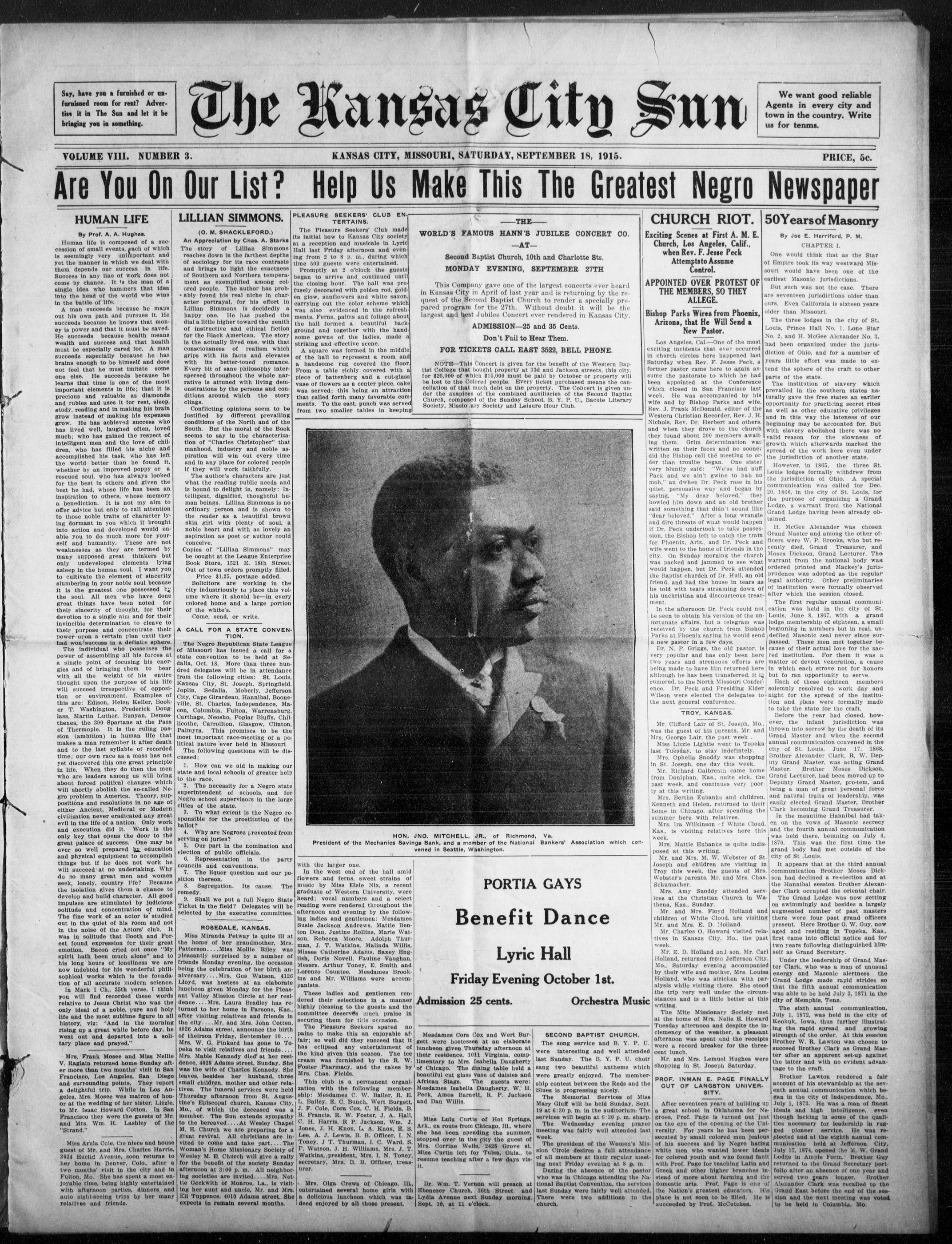
HON. JNO. MITCHELL, JR., of Richmond, Va. President of the Mechanics Savings Bank, and a member of the National Bankers' Association which convened in Seattle, Washington.
PLEASURE SEEKERS' CLUB EN-TERTAINS.
The Pleasure Seekers' Club made its initial bow to Kansas City society at a reception and musicale in Lyric Hall last Friday afternoon and evening from 2 to 8 p. m., during which time 500 guests were entertained. Promptly at 2 o'clock the guests began to arrive and continued until the closing hour. The hall was profusely decorated with golden rod, golden glow, sunflowers and white saxon, carrying out the color scheme which was also evidenced in the refreshments. Ferns, palms and foliage about the hall formed a beautiful background and together with the handsome gowns of the ladies, made a striking and effective scene.
A square was formed in the middle of the hall to represent a room and a handsome rug covered the floor. From a table richly covered with a piece of battenberg and a cut-glass vase of flowers as a center piece, cake was served; this being an attraction that called forth many favorable comments. To the east, punch was served from two smaller tables in keeping
HON.
President of the Mechanics Savin
with the larger one.
In the west end of the hall amid flowers and ferns, sweet strains of music by Miss Elsie Nix, a recent graduate of Western University, were heard; vocal numbers and a select reading were rendered throughout the afternoon and evening by the following ladies and gentlemen: Mesdames Susie Jackson Andrews, Matt Benton Dean, Justine Rollins, Marie Watson, Rebecca Moore, Adolph Thurman, J. T. Watkins, Malinda Willis, Misses Catherine Adams, Saxey English, Doris Novell, Pauline Vaughan, Messrs. Arthur Toney, E. Smith and Lorenzo Countee. Mesdames Brookins and Mr. Williams were accompanists.
These ladies and gentlemen rendered their selections in a manner highly pleasing to the guests and the committee deserves much praise in securing them for this occasion.
The Pleasure Seekers spared no pain to make this an enjoyable affair; so well did they succeed that it has eclipsed any entertainment of the kind given this season. The ice cream was furnished by the R. W. Foster Pharmacy, and the cakes by Mrs. Chas. Fields.
This club is a permanent organization with the following membership: Mesdames C. W. Baller, R. E. L. Balley, E. C. Bunch, W. Wert Burget, J. F. Cole, Cora Cox, C. H. Fields, B. Francis, R. W. Foster, J. A. Hall, C. H. Harris, P. Jackson, Wm. J. Jones, J. H. Knox, L. A. Knox, E. S. Lee, A. J. Lewis, B. E. Officer, I. N. Toney, J. T. Thurman, I. C. Ward, S. P. Watson, J. H. Williams, Mrs. J. T. Watkins, president, Mrs. I. N. Toney, secretary, Mrs. B. B. Officer, treasurer.
Mrs. Olga Crews of Chicago, Ill, entertained several home girls with a delicious luncheon which was indeed enjoyed by all those present.
Second Baptist Church, 10th and Charlotte Sts.
MONDAY EVENING, SEPTEMBER 27TH
This Company gave one of the largest concerts ever heard in Kansas City in April of last year and is returning by the request of the Second Baptist Church to render a specially prepared program for the 27th. Without doubt it will be the largest and best Jubilee Concert ever rendered in Kansas City.
FOR TICKETS CALL EAST 3522, BELL PHONE
NOTE- This Concert is given for the benefit of the Western Baptist College that bought property at 33d and Jackson streets, this city, for $25,000 of which $15,000 must be paid by October or property will be lost to the Colored people. Every ticket purchased means the cancellation of that much debt on the property. The Concert is given under the auspices of the combined auxiliaries of the Second Baptist Church, composed of the Sunday School, B. Y. P. U., Bacote Literary Society, Missionary Society and Leisure School Club.
Admission 25 cents.
Mesdames Cora Cox and Wert Burgett were hostesses at an elaborate luncheon given Thursday afternoon at their residence, 1011 Virginia, complimentary to Mrs. Isabella Daugherty of Chicago. The dining table held a beautiful cut glass vase of daisies and African Stags. The guests were: Mesdames Isabella Daugherty, W. H. Peck, Amos Barnett, R. P. Jackson and Dan Willis.
Miss Lulu Curtis of Hot Springs, Ark., en route from Chicago, Ill., where she has been spending the summer, stopped over in the city the guest of Mrs. Corrine Wells, 2425 Grove st. Miss Curtis left for Tulsa, Okla., to resume teaching after a few days visit.
Dr. Wm. T. Vernon will preach at Ebenezer Church, 10th Street and Lyda Avenue next Sunday morning, Sept. 19, at 11 o'clock.
Orchestra Music
SECOND BAPSTIST CHURCH.
The song service and B. Y. P. U. were interesting and well attended last Sunday. The B. Y. P. U. choir sang two beautiful anthems which were greatly enjoyed. The membership contest between the Reds and the Blues is progressing nicely.
The Memorial Services of Miss Mary Gluff will be held Sunday, Sept. 19 at 6:30 p. m. in the auditorium. The services will begin at 6:30 p. m. sharp.
The Wednesday evening prayer meeting was fairly well attended last week.
The president of the Women's Mission Circle desires a full attendance of all members at their regular meeting next Friday evening at 8 p. m.
During the absence of the pastor who was in Chicago attending the National Baptist Convention, the services last Sunday were fairly well attended. There were two additions to the church.
CHURCH RIOT.
Exciting Scenes at First A. M. E. Church, Los Angeles, Calif., when Rev. F. Jesse Peck Attemptsto Assume Control.
APPOINTED OVER PROTEST OF THE MEMBERS, SO THEY ALLEGE.
Bishop Parks Wires from Phoenix Arizona, that He Will Send a New Pastor.
Los Angeles, Cal.—One of the most exciting incidents that ever occurred in church circles here happened last Saturday when Rev. F. Jesse Peck, a former pastor came here to again assume the pastorate to which he had been appointed at the Conference which closed in San Francisco last week. He was accompanied by his wife and by Bishop Parks and wife. Rev. J. Frank McDonald, editor of the Western Christian Recorder, Rev. J. H. Nichols, Rev. Dr. Herbert and others, and when they drove to the church they found about 300 members awaiting them. Grim determination was written on their faces and no sooner did the Bishop call the meeting to order than trouble began. One sister very bluntly said: "We're had nuff Pack and we ain't gwine to hab no moh." an dwhen Dr. Peck rose in his quiet, persuasive way and began by saying, "My dear beloved," they howled him down and an old brother said something that didn't sound like "dear beloved." After a long wrangle and dire threats of what would happen if Dr. Peck undertook to take possession, the Bishop left to catch the train for Phoenix, Ariz., and Dr. Peck and wife went to the home of friends in the city. On Sunday morning the church was packed and jammed to see what would happen, but Dr. Peck attended the Baptist church of Dr. Hull, an old friend, and had the house in tears as he told with tears streaming down of his unchristian and discourteous treatment.
In the afternoon Dr. Peck could not be seen to obtain his version of the unfortunate affairs, but a (elegram was received by the church from Bishop Parks at Phoenix saying he would send a new pastor in a few days. Dr. N. P. Grigsg, the old pastor, is very popular and has only been here two years and strenuous efforts are being made to have him returned here although he has been transferred, it is rumored, to the North Missouri Conference. Dr. Peck and Presiding Elder Wilson were elected the delegates to the next general conference.
TROY, KANSAS
Mr. Clifford Lair of St. Joseph, Mo. was the guest of his parents, Mr. and Mrs. George Lair, the past week. Miss Lizzie Lightle went to Topeka last Tuesday, to stay indefinitely. Mrs. Ophelia Snoddy was shopping in St. Joseph, one day this week.
Mr. Richard Galbreath came home from Doniphan, Kas., quite sick, the past week, and continues very poorly at this writing.
Mrs. Bertha Eubanks and children, Kenneth and Helen, returned to their home in Chicago, after spending the summer here with relatives.
Mrs. Ira Wilkinson of White Cloud, Kas., is visiting relatives here this week.
Mrs. Mattle Eubanks is quite indisposed at this writing.
Mr. and Mrs. M. W. Webster of St. Joseph and children are visiting in Troy this week, the guests of Mrs. Webster's parents, Mr. and Mrs. Chas. Schumacher.
Mrs. Amy Snoddy attended services at the Christian Church in Wathena, Kas., Sunday.
Mr. and Mrs. Floyd Holland and children of White Cloud, are visiting Mr. and Mrs. E. D. Holland.
Mr. Charles O. Howard visited relatives in Kansas City, Mo., the past week.
Mr. E. D. Holland and son, Mr. Carl Holland, returned from Jefferson City, Mo., Saturday evening accompanied by their wife and mother, Mrs. Louisa Holland, who was stricken with paralysis while visiting there. She stood the trip very well under the circumstances and is a little better at this writing.
The Mite Missionary Society met at the home of Mrs. Nelle E. Howard Tuesday afternoon and despite the inclementy of the weather, a pleasant afternoon was spent and the receipts were a record breaker for the three-cent lunch. Mr. and Mrs. Lemuel Hughes were shopping in St. Joseph Saturday.
PROF. INMAN E. PAGE FINALLY OUT OF LANGSTON UNIVERSITY.
After seventeen years of building up a great school in Oklahoma for Negroes, Prof. Page is turned out just on the eye of the opening of the University. For years he has been persecuted by small colored men jealous of his success and by Negro hating white men who wanted lower ideals for colored youth and who found fault with Prof. Page for teaching Latin and Greek and other higher branches instead of more about farming and the domestic arts. Prof. Page is one of the Nation's greatest educators. His place is not soon to be filled. He is succeeded by Prof. McCutchen.
We want good reliable Agents in every city and town in the country. Write us for tenms.
PRICE. 5c.
50 Years of Masonry
One would think that as the Star of Empire took its way westward Missouri would have been one of the earliest Masonic jurisdictions.
But such was not the case. There are seventeen jurisdictions older than ours. Even California is sixteen years older than Missouri.
The three lodges in the city of St. Louis, Prince Hall No. 1, Lone Star No. 2, and H. McGee Alexander No. 3, had been organized under the jurisdiction of Ohio, and for a number of years little effort was made to extend the sphere of the craft to other parts of the state.
The institution of slavery which prevailed in the southern states naturally gave the free states an earlier opportunity for practicing secret rites as well as other educative privileges and in this way the lateness of our beginning may be accounted for. But with slavery abolished there was no valid reason for the slowness of growth which afterwards marked the spread of the work here even under the jurisdiction of another state.
However, in 1865, the three St. Louis lodges formally withdrew from the jurisdiction of Ohio. A special communication was called for Dec. 20, 1866, in the city of St. Louis, for the purpose of organizing a Grand Lodge, a warrant from the National Grand Lodge having been already obtained.
H. McGee Alexander was chosen Grand Master and among the other officers were W. P. Brooks, who but recently died, Grand Treasurer, and Moses Dickson, Grand Lecturer. The warrant from the national body was ordered printed and Mackey's jurisprudence was adopted as the regular legal authority. Other preliminaries of institution were formally observed after which the session closed.
The first regular annual communication was held in the city of St. Louis, June 8, 1867, with a grand lodge membership of eighteen, a small beginning in numbers but in real, undefiled Masonic zeal never since surpassed. These men met together because of their actual love for the sacred institution. For them it was a matter of devout veneration, a cause in which each strove not for honors but to ran opportunity to serve.
Each of these eighteen members solemnly resolved to work day and night for the spread of the institution and plans were formally made to take the state for the craft.
Before the year had closed, however, the infant jurisdiction was thrown into sorrow by the death of its Grand Master and when the second annual communication convened in the city of St. Louis, June 17, 1868, Brother Alexander Clark, R. W. Deputy Grand Master, was acting Grand Master, Brother Moses Dickson, Grand Lecturer, had been moved up to Deputy Grand Master, pro-tem, and being a man of great personal force and natural traits of leadership, was easily elected Grand Master, Brother Clark becoming Grand Treasurer.
In the meantime Hannibal had taken on the vows of Masonic secrecy and the fourth annual communication was held there, beinning on July 4, 1870. This was the first time the grand body had met outside of the city of St. Louis.
It appears that at the third annual communication Brother Moses Dickson had declined a re-election and at the Hannibal session Brother Alexander Clark occupied the oriental chair.
The Grand Lodge was now getting on swimmingly and besides a largely augmented number of past masters there were four past grand officers present. Here Brother G. W. Guy, now aged and residing in Topeka, Kas., first came into official notice and for two years following distinguished himself as Grand Secretary.
Under the leadership of Grand Master Clark, who was a man of unusual energy and Masonic alertness, the Grand Lodge made rapid strides so that the fifth annual communication was able to be held July 3, 1871 in the city of Memphis, Tenn.
The sixth annual communication, July 1, 1872, was held in the city of Keokuk, Iowa, thus further illustrating the rapid spread and growing strength of the order. At this session Brother W. R. Lawton was chosen to succeed Brother Clark as Grand Master after an apparent set-up against the latter and with no evident advantage to the craft.
Brother Lawton rendered a fair account of his stewardship at the seventh annual communication which began in the city of Independence, Mo., July 1, 1873. He was a man of finest ideals and high intelligence, even though lacking in some of the qualities necessary for leadership in rugged pioneer service. He was reelected and at the eighth annual communication held at Jefferson City, July 17, 1874, opened the M. W. Grand Lodge in Ample Form. Brother Guy returned to the Grand Secretary portfolio after an absence of one year and served two years longer. Brother Alexander Clark was recalled to the Grand East before the end of the session and the next meeting was voted to be held in Columbia, Mo.
INTERNATIONAL
SUNDAY SCHOOL
LESSON
(By O. E. SELLERS, Acting Director of
The School Course of the Moody
Bible Institute)
LESSON FOR SEPTEMBER 19
LESSON TEXT I - Kings 20:10-2L
GOLDEN TEXT—Wine and new wine
take away the understanding. Hos. 4:11
R. V.
We feel somewhat like questioning
the title of this lesson. It can be used
as a temperance lesson no doubt, but
to attribute Ben-hadad's defeat entirely
to drunkenness is not quite true to
the facts. Jehovah's jealousy of his
name (v. 13) and the enemies' contem-
tion for Jehovah (vv. 23, 28) are
the fundamental causes of the defeat of
the Syrians though, of course, drunkenness, as an exhibition of self-indulgence and therefore of weakness, was
a natural accompaniment of that contem-
tion for God.
I. Ahab's Predicament, vv. 10-12. The Syrian king's contemptuous treatment of Ahab (vv. 1-7) at last became so great that in sheer desperation the people refused to listen to his demands (v. 8). His forces far overwhelmed the little army of Israel (vv. 1, 10, 27), but one was on Ahab's side who had not yet withdrawn his mercy from Israel and with whom Ben-hadad could not cope (v. 13; Rom. 8:31; Phil. 4:13). Ben-hadad was the most powerful monarch of his time of those nations bordering upon the Mediterranean. The march of his army was like a tempest of hall, an overwhelming scourge" with unrestrained power. The effect was worse than the plagues of Egypt. But Ben-hadad was a drunkard, a habitual one (vv. 12-16). Samaria was rich and this king wanted it even as intemperance always lusts after the wealth of youth and the gold of a nation (vv. 3, 12). Drink always makes a fool of its victim and dooms to ultimate defeat all who yield to its power (ch. 16:9; II Sam. 13:28; Prov. 31:4, 5; Luke 21:34; Eph. 5:18).
Tradition tells of a monk who was offered the alternative of committing one of two crimes or of getting drunk. Choosing drunkenness as the lesser evil he awoke from his debauch to find he had committed both of the crimes.
[ Intemperance becomes too greedy in its demands and its results so terrible that thoughtful people are at last moved with indignation. There is no drinking in moderation. There is no such thing as regulating the liquor traffic. For every $500 received by license $5,945 is the average cost to the taxpayer for each saloon. But that is not all. The saloon takes also the very joys its cup promises and turns its visions into torments.
11. God's Prophet, vv. 13-15. It was indeed dark for Ahab. He saw (v. 13) the host confronting 'm but he also heard the word of Jehovah. As contrasted with Jehovah that multitude was but as a handful of dust. God is on the side of temperance. All of God's laws favor temperance. Our ever-living glorified leader and the energizing power of the holy spirit are the ones who are the source of our victories over all principalities and powers of evil. Ahab's predicament is answered by God's "I will deliver" (v. 13) and so today we have his sure promise of victory (Eph. 6:10-12).
God has today set forth his prophets (1 Cor. 12:28) to proclaim his message of salvation and power to overcome intemperance. This is not a "necessary evil." Experts and scientists have clearly demonstrated its being unnecessary and a drag upon society, and God has taught us how to overcome it. Ahab's unfortunate character appears at its best in this story, but alas he and his successors soon forgot the lesson. To his eager inquiries God made full answer and there is no suggestion of his doubting God's word.
III. Victorious Princes, vv. 16:21. To Ahab's question "by whom" is this deliverance to be wrought. God answers, "by the young men of the princes of the provinces" (v. 14). These choice young fellows are mustered in, 232 of them, as leaders of an army of 7,000, all who could be found in the capital. God delights to work through young men I John 2:13, 14) and the pages of history are strewn with the victorious achievements of youth. "More precious than gold and silver are the youth of the nation," and it is upon the youth the prosperity industrially, morally and spiritually of a nation depends. "It is a holy sight to see a nation saved by its youth; it is a grander sight to Christian students combined to save the world."—Dr. John R. Mott.
Two-thirds of Lincoln's army were under twenty-one years of age at their enlistment; the Union was preserved by an army of boys.
Ahab himself is the leader (v. 14) and they began at once by carrying the battle into the enemies' territory. Ben-hadad and his drinking companions never dreamed of being attacked at that hour. Like Gideon and his army these young men smote the Syrian host in overwhelming defeat. Israel's enemies had incapacitated themselves. A drunken mob is no match for even a handful of organized and sober men. These thirty-three kings courted their own defeat (Prov. 23:29-32; Eccl. 11:10; Hos. 4:11). Ben-hadad's kings "who helped him" (v. 16) proved to be a reed for all the strength and support they rendered him in the moment of his need.
It was the young men who went first, e. g., struck the first blow. Ben-hadad's self-confidence and boasting (v. 18) is but another illustration of that "pride which goeth before destruction" (Prov. 16:18; Luke 18:14).
The army of Israel was small (v. 15) but it did not hesitate to attack the superior force and that sort of faith will always include others which will "follow them" (v. 19).
AFRO-AMERICAN CULLINGS
One of the features of the program at the Lincoln Jubilee exposition at Chicago was a presentation of a portrait of Governor Ferris to him by William Ross Roberts of the Michigan commission. President Oscar Baker was unable to be present. The portrait was made by a Negro. The Michigan exhibit came in for the lion's share of observation and all of the articles shown, from the needlework of an eight-year-old girl to numerous quilts made by eighty-year-old "Aunt Debby" Anderson of Cass county, were made ready for inspection. "Aunt Debby" modestly bears the distinction of having made more than 3,000 quilts during her life. Particular attention was called to the needlework of two blind Negro girls who are students of a Lansing school.
The principal exhibits from Michigan came from Cass county, where the majority of the Negro population, outside of the large cities of the state, is located. The Negro population of Cass county owns an area of about fifteen miles, most of which is devoted to farming, at which industry the Negroes have proved themselves efficient. One or two of the Negro farmers own as much as 2,000 acres of land, and their homes are fitted out with the latest appliances for the comfort of the occupants.
While about 3,000 Negroes live in Cass县, the exhibit was by no means limited to that area. There were exhibits from nearly every important town and city in the state. The exhibits were mostly of needlework and millinery by the women and farm products raised by the men. An old darky named Turney Byrd has a new fangled dump wagon which he devised and which he is using to good advantage in his home town of Lansing. The wagon can be emptied at all once or a quarter or a half load at a time. While not strictly included in the Michigan exhibit, the booth of the United States census bureau was in charge of a Detroit Negro—Robert A Pelham—who has been employed in that federal department for the last 15 years. The booth was given over to the "Story of the Census" from the Negro's standpoint, and tended to show that the Negro clerks in the department exceed in some respects in efficiency the white employees.
The story is told by pamphlets arranged by Mr. Pelham and deals with the growth in favor of the Negro in government employ and shows how he has justified the confidence that Uncle Sam has placed in his ability. Incidentally Mr. Pelham shows two devices which he invented and which are now in use in the census bureau—namely, a paste-supplying device and a tallying machine—the latter working on the principle of an adding machine and used in recording the population.
As far as possible the industrial exhibits at the exposition in Chicago show the Negro actually at work demonstrating his handicraft, wrote Bishop Pallows. Tuskegee and the other great Negro schools will be represented, and Booker T. Washington and other noted Negro educators will come to add their efforts to make the exposition a success.
The Negro's progress, has been wonderful. Fifty years ago, as an army officer and minister, I saw the forbears of the Negro of today walk into camp, ignorant and unlettered. I taught the old folks, leading their children, their first letters that they
Born in 1801 and celebrating her one hundred and fourteenth birthday a few weeks ago, Hannah Owens, a Negress who lives about a quarter of a mile behind Agency Hill, is still young enough and spry enough to preside over a court consisting of five Negro women, the youngest of whom has reached the age of ninety, says the Muskogee Phoenix.
The woman was born in Georgia in 1801. She remembers nothing of her early life, and has no record of her birth, but she knows that she was married in 1829, and she remembers clearly, she says, that her mother told her on her wedding day she was twenty-eight years old. She was a slave before the war to John P. Maddox, she says.
The woman declares that she isn't glad to have her freedom.
"They made me roll logs and hoe cotton and plow," she said, "but they fed me more than I get now and they gave me a better place to sleep, with more covers, and I wish I was back there again."
She did not know of the war in Europe. She didn't know what Europe is
Reports submitted to the annual convention of the National Negro Business league, Boston, showed that, in the 15 years since the organization of the league, the total value of farm property owned by Negroes in the United States has increased from $177,404,698 to $492,892,218.
Coming down town this morning you met a little girl on her way to school. By the time you get home this evening she will be a grown-up young woman dressing for a party.
In the Zoological gardens in London the anthropoid apes have been kept alive by shutting them in behind glass, not to protect the visitors from them, but to protect them from visitors—that is to say, from the microbes that man harbors in his mouth. Man has more or less successfully learned how to disarm the invaders, but they will readily destroy those near relatives of his whose bodies have not learned how to resist them. Markind has no better friends than
might be able to read the New Testament. When I realize what the Negro has done for himself and what has been done for him since, I am astounded.
The object of the exposition is a better understanding of the relation between the white and the Negro population of the United States.
We have from 9,000,000 to 11,000,000 Negroes—about one-tenth of our total population. They have developed with the nation. In every battle, from the Civil war down, the Negro has fought. He is found in every walk of our national life. There can be a true racial and social feeling only when there is an end of needless antagonism.
Our aim is to make this exposition the greatest movement ever created to bring about, a better understanding. The Negro has a capacity to grow, to do things and to be one of us. We aim to show that isolated cases trumpeted all over the country are only the muck thrown off the great wheel of Negro progress.
As a general I helped emancipate the Negro. In my church life we early gave Negro pres'viers the same right on the floor of our general council as whites.
The Confederate officer who fired one of the first shots at Sumter became a bishop in my church and devoted his whole life to the education and development of the Negro. He was Bishop E. F. Stevens.
Before the war he was commander of the South Carolina Military institute, which turned out more Confederate officers than any other institution, save possibly one. After the war he became bishop of all the Negroes of his state. He was my close friend. Indeed, it was on my motion that he became a bishop.
The exposition will include singing by great choruses of the most noted jubilee singers in the country. There will be folk song festivals, historical tableau deicing the advance of the colored people, and other interesting and instructive features.
The work of the Tuskegee institution is extending. Mr. Julius Rosenwald of Chicago has give, this opportunity. He has reserved a fund to be expended in school extension among the Negroes of Alabama. This benefience is to be distributed through Tuskegee institute upon the recommendation of its president. Already schools have been built upon the plan in 12 counties, including Macon, Russell, Lee, Chambers, Tallapoosa, Coosa, Dallas, Perry, Hale, Montgomery and Lowndes. Each county's own people must raise $300 and Mr. Rosenwald will give an equal amount; the property is deeded to the state; the teachers paid by county school funds and the schools are planned to cover just such work as I have above described in the cottage training at Tuskegee.
Can you see anything but help to accrue—civilization, better morals, better service, less need of jails and penitentiaries? When everything is done to build a better man or woman, no matter what the color, it is social service, kindness, uplift. The Negro race today has a leader who is a missionary—the best among them; if they follow his lessons as I saw them at Tuskegee, they are entering a new life, and their white friends, North and South, are glad to see them improve their character and their skill.—Mrs. J. S. Reid in Birmingham Age-Herald.
when she was told about it. Seemingly all she cares for is hearing news of her relatives and getting something to eat each day. The other old women who live near her all have interesting stories, but they admit themselves the inferior of their dean. They are Rose Caesar, one hundred; Emma Durham, ninety-two, and Sarah Davis and Emma Warrn, both ninety.
A Boston correspondent of an eastern paper remarks that scattered throughout the South are thousands of industrious and respected Negroes, who, while they know nothing at all about books, and are, indeed, unable to read or write, nevertheless have accumulated property and given their children the opportunity of going to good schools. This will be widely recognized as good news not only by enterprising colored people the country over, but also by white people who desire to see the colored population in the United States receive fair treatment.
The water in the Panama canal is gradually becoming salty.
The rush of people into Vera Cruz, Mexico, since United States soldiers evacuated it, has raised the population from 35,000 to more than 100,000. It is said that all traces of the cleanup our troops made have long since disappeared, and that the water and sanitation problems are acute.
A luminous paint for automobiles, invented in England is said to be so effective that a car coated with it is visible at night for two miles without the use of lamps.
those who, like Metchnikoff, teach us what to do and what not to do in arming and inuring ourselves against these sleepless and implacable but assuredly doom enemies of our kind.—Youth's Companion.
Usually Geta It.
What the average girl in high society in New York seems to want is husband enough to last about three years and alimony enough to carry her through the rest of her life.—Houston Post.
CANNING SEASON
SECRET OF SUCCESS IN 'PUTTING UP' SUPPLIES.
Absolute Sterilization Must Be Obtained—Best and Easiest Methods of Getting the Best Results From Fruit That Is Used.
If anybody appreciates the kindness of Mother Nature it is the practical housekeeper. This is especially true in summertime when by her bountiful store of fruits and vegetables she increases the housekeeper's store at little cost and contributes much to reduce her labor.
There are several methods of canning, and the secret of success in each is absolute sterilization. The best and easiest methods of canning are cooking the fruits in jars in an oven; cooking the fruits in jars in a steamer or in boiling water, and stewing the fruit before it is put into the jars.
Glass is the most satisfactory jar to use in canning. Glass jars are becoming so universally in favor that they are taking the place of tin cans for everything; even for tomatoes. They are more economical than tin, for although the glass costs more in the beginning, it lasts and can be used over and over again. While there are many kinds of jars, the preference should usually be given to those with wide mouths. In canning fruits or jelly it is important that the fruits or berries should not be over-ripe. Fruit for canning should be fresh, solid and not over-ripe. If over-ripe some of the spores may survive the boiling and fermentation takes place in a short time. In preparing the fruit remove all stems, then peel with a silver knife, core or remove the seeds or pits as the case may be. Peaches, pears or apples may be kept from discoloring if they are dropped as they are pared into cold water to which a little vinegar or lemon juice may be added.
Canned Pears.—Twenty-four Bartlett pears, eight cupfuls water, two cupfuls sugar.
Bartlett pears are the best for canning. Put the water and sugar into a preserving kettle. Let the sirup come to boiling point and skim off the froth if any rises. While the sirup is heating carefully halve, peel and core the pears, being careful not to use those that are over-ripe or imperfectly shaped.
Drop pieces into a basin of cold water until all are pared. Put the halved pears into the boiling sirup, but do not stir. Take a large roasting pan with handles and place in it as many sterilized canning jars as it will hold. Pour some tepid water in the pan to a depth of about two inches, and place the pan on the side of the stove. The water will get hot and keep the jars warm. Sterilize the rubber rings and covers. By this time the fruit will be boiling. When the pears commence to lose their hard whiteness they are ready to take off. Lift out pieces separately with a spoon and put them into the hot jars. Fill jars and cover with the sirup; fill even with the top, put the rings and covers on and screw tight.
For Cream Dressings
All white or cream dressings are made by blending the butter with the flour, then stirring it rapidly into the boiling milk. Use white pepper when making the dressing and boil it in a double boiler. Keep it warm, and thin with cream if too stiff when done, or fold in the white of egg, whipped to a stiff froth.
A teaspoonful of vinegar to a quart of flour if added with the ice water, gives the much-desired flaky appearance to fruit pies.
Tomato Pickle.
Six pounds of green tomatoes, if very large, cut in pieces. Put them into strong brine for 24 hours, drain them very dry. Put them in a stewing pan, cover with vinegar to which has been added one pound of sugar, one-quarter pound long pepper, one-quarter pound allspice, one-quarter pound cloves and one-quarter pound cinnamon. Simmer till tender, but do not let them boil.
German Potato Kloesse
One pint mashed potatoes, mixed in two beaten eggs, one pint of flour, one even tablespoonful of salt. Form into small flat cakes (same as fishballs), cook in boiling water about ten minutes. When first put in kettle, stir around until they rise to the top of water. Very nice with roast of veal or any nice brown gravy. Good warmed over in butter, cut up.
Beef Leaf.
Two pounds round steak chopped, quarter pound pork chops also chopped, one onion, medium size, chopped, one tablespoonful butter, three large slices bread soaked in one pint of milk, two eggs beaten, salt, one scant teaspoonful poultry dressing. Stir all together. Place slices of salt pork in bottom of pan and on top. Bake one hour
Chilled Watermelon
Cut the ripe pink flesh from a good-sized watermelon, put it into a freezing can and pack with salt and ice. Turn the crank slowly until the watermelon is half frozen. Serve in punch-glasses at the close of luncheon or dinner. Those who use wine may add to each glass a tablespoonful of sherry.
Stale Bread Fritters
Cut the bread in slices, about a third in an inch thick, fry in fat, from which a faint blush smoke is rising, and when each piece is fried on one side turn it over and spread the browned side with marmalade or jam. When cooked, lift out and sprinkle with caster sugar mixed with a little cinnamon.
Fruit Fluff.
To every pint of chopped peach, be
bana or pineapple allow one pint of
water, six eggs and one pound of
sugar; beat eggs until light, then add
other ingredients and cook until thick
as custard. Strain, set dish in pan of
cold water and beat until cold. Freeze
and serve with a sirup like a sundae
INTERNATIONAL
NEWS SERVICE
This photograph, taken in the forest of Argonne, shows a German soldier putting the finishing touches to a pit he has prepared in the line of an anticipated attack. These pits are covered with shrubbery and earth and the wires are charged with electricity.
TELLS WAR TRAGEDY
Wounded French Officer Describes Thrilling Escape.
Slips Out of German Prison and Makes Way Back to Own Lines—Peasant Baby Shot in His Arms by German Sentinels.
(International News Service.)
Paris.—A lieutenant in the French Foreign legion has just told the following story here:
"It was on the night of August 23, after the retreat from Luneville. Towards I received a ball in the forehead—see the scar on the right on the front bone. I fell stunned by the blow. One of my men picked me up, and I could hear him confusedly saying: 'Our lieutenant is dead.' My comrades took me behind a wall and left me there.
"Towards seven I came to myself in a fever, and believing I was in the thick of the battle. I shouted 'Forward,' but those to whom I gave the order were German ambulance men. They took me on a stretcher to Luneville and shut me in the barracks of the chasseurs, which had been transformed into a hospital.
"The window bars were old and the fever gave me the strength of ten. I dug at the cement with a knife, and tore out a bar. Slipping through, I fell from the first story into an empty passage leading to the Rue Jollivet. I was bleeding at the knees, but what matter? I crawled a few yards and saw the uhlans defiling past in the main street. Close by was a house where I had seen a light appear and then go out. After knocking gently and getting no answer, I broke down the door with my shoulder and went in, revolver in hand. A whole family was hiding under the staircase, and in a whisper I said I was French and they had nothing to fear.
"A trembling woman's fingers were held out to guide me. 'Give me a cloak, a hat and a pair of trousers,' I said. In a second and two these were forthcoming. 'Which is the first road I come to?' 'The road to Bayou.' A man's toneless voice added: 'Leutenant, you are going—let us go with you!' I lit my pocket-lamp to look at my companions—a lower middle-class family, the man pale, with chattering teeth, the woman also pale, but resolute, and two children, one of seven and the other a baby of nine months. 'All right,' I said, 'we will go—all five of us!'
"Disguised as a civilian, with bowed shoulders like an old man, I led the way, carrying the baby. We ran and crept along the banks of the Moselle where the bridges were occupied by the troops. We had to go on noiselessly, for I had heard the guttural cries of the sentinels on outpost duty. The baby began to wall. The outpost heard us and 'Wer da?' rang out 150 yards away. We did not reply and a shower of bullets swept us, whistling on all sides. 'Run, and run fast!' I cried, and I took the baby again.
"He was crying just now, but was quiet again. Another shower of bullets. My left arm especially hurt me horribly. At last we fell into a dense scrub. God be thanked! we were saved! But the undergrowth was thick. The man had a knife with him and I had still mine. So we went at it cutting a path through. The woman, motherly even in her terror, offered to take the baby to lighten me. 'No, no!' I said, 'he does not weigh much and he is asleep.' "We cut so hard into the wood—I heard afterwards that it was the forest of Parrow—that we came to a clearing and a path. But how heavy the baby was! A grand, fine boy, said the mother, and I did not doubt her in the least. We walked hard, going westward. Suddenly French voices challenged, 'Halt, who goes there?' 'A French officer,' I answered, and advanced to explain who we were and whence we came.
"But you are wounded, lieutenant!" says the sergeant. "Hush! Say nothing for the sake of the others.' I replied, for by the glare of the lantern I had seen blood also on the baby's bonnet. 'Two men to take these good people to the rear,' I ordered with a
JUST FIBS, NOW AND THEN
Atlanta—G. C. Hamrick, deputy internal revenue collector in the Federal building, is back from a Florida vacation trip with a good joke on an Atlanta shoe salesman.
"I have been with the company five years," said the Atlanta shoe man, "and each year has brought good re
sigh of satisfaction, 'and as for me, take me to the first aid station.' "I held out the child to its mother, saying: 'Be careful, no shaking; he is sleeping, do not wake him.' I went off at a jog trot, without turning round for fear of betraying emotion. I had the little finger taken off—see—and two bullets through the shoulder, high up. "But that was nothing to compare with what I was suffering. For I can tell you now, gentlemen, I had known ever since the first shot that I was carrying a dead baby."
FEW LEFT IN SHAKERTOWN
Only Four Elderly Persons Remain In Immensely Wealthy Settlement in Kentucky.
Lexington, Ky.-Four elderly and infirm persons are the only occupants of the immensely valuable Shaker settlement, one of the few remaining colonies of the sect, near here. Sisters Christine Johnson, eighty-four, and Martha Nelson, eighty-seven, died one day recently within the hour. Shakertown, now so sparsely settled, once was a flourishing town, with manufactories and various business enterprises and controlling rich adjacent farm lands. Even now the property is valued at millions. Recently a trustee was appointed to manage the affairs of the colonists.
BEES' STINGS KILL A COW
Valuable Jersey Animal Tries to Fight Insects and Gets the Worst of It.
Monmouth, Ore.-Stung by thousands of Italian bees, a valuable Jersey cow, owned by O. A. Wolverton, ex-pastmaster of Monmouth, died Tuesday afternoon. The animal had been turned into the grass on the southwest corner of the Normal campus. On a small lot adjoining the campus were 75 hives. When Bossie began to fight several of the Italians, hundreds, then thousands, "mobilized" and aid for the distressed cow was impossible.
MARIA AND JOHN
Show Italian Dances.
Agnes and Stefano Macchi di Colleare, the children of the Italian ambassador to the United States, who aided in the Italian war relief fund by performing native dancing in native costume. The Italian festa at which they appeared was under the patronage of Ambassador and Countess Dolerese Macchi di Colleare, the parents of the youngsters, at Lookout Hill, the home of Mr. and Mrs. John Hays Hammond. A program of Italian music, songs and folk dances entertained the most prominent of New England's society members. The proceeds of the entertainment will be used for the relief of the wives and children of the Italian reservists who have gone to the front from New England.
sults. The first year I made $4,000 in commissions, the next $5,000, the next $6,000 and the last two $7,000 each."
The other salesmen gasped, and Mr. Hamrick looked through a book with the name of Atlantans whose incomes are above $3,000, but failed to find the name of the speaker.
"I don't see your name in here," he said, "but I'm mighty glad to get it. By your own figures you owe the government $125."
The shoe salesman moved toward
IS "MAGIC" TO THEM
Everything Russian Cannot Understand Is "Black Art."
Soldiers of the Czar Are Steeped in Superstition — Distrust Officers They See Using One of the General Staff Charts.
By HUGO BETTAUER.
(International News Service.)
Reichenberg, Bohemia — With an officer of the Austrian ambulance service I visited the prison camp that has been established near here. The camp is really a large city of wooden barracks with electric lights, paved streets, sidewalks, waterworks, public baths and a small library. Surrounded on all sides by green hills the barracks and other buildings cover the beautiful valley for miles.
In this primitive town more than forty thousand Russian soldiers are waiting for the time when the war will end and they shall be sent home. Each day the population of the camp grows, as long railroad trains constantly bring more prisoners, and new barracks have to be built. Every race of the cxar's endless empire is represented. The prisoners are a queer lot, and furnish unlimited opportunity for ethnological studies. As they speak a dozen different languages and many do not understand Russian, they have formed clans which keep entirely to themselves. The real Russian, for instance, will have nothing to do with the Cossack, and the German from Courland or Livland considers it below his dignity to associate with the "mujik" from the plains of the Volga.
As a rule, the different clans get along pretty well together, and quarrels and fights seldom occur. The small detachment of landsturm troops, which guards the camp, really has little to do.
For visitors the prisoners have little use, and it is hard to get them to talk. All strangers are "niemtsi" (Germans) to them, and only the more educated have heard of the "austriji" (Austrians).
The Germans they consider the incarnation of all evil, and they firmly believe that every "niemtsi" is the servant and agent of the devil. Their general ignorance is only surpassed by their superstition.
While we walked through the camp we came upon an old Russian first sergeant, who gravely was trying to explain the causes of the war to about fifty of the prisoners.
"The short-jackets brought on this bloody conflict," he said. "The war came as the world is sinful and immoral. God hates the short-jackets; they are indecent. The French, English and Serbians are no better than the 'nieemlsi.' They also wear the hellish jackets and offend the Lord by their frivolity."
Most of the listeners nodded approvingly, and only one, a rather intelligent-looking young fellow, dared to contradict the "argument" of the old man.
"I believe that a man can be moral even in a short jacket," the young soldier said, but he stopped quickly when he saw that nobody shared his tolerant views.
For the defeats of the Russian armies the prisoners blame the "black art" of the German generals. They are firmly convinced that Hindenburg and Mackensen have sold their souls to the devil. Hindenburg they all know, and they consider him the representative of Satan on earth.
Military maps, in their eyes, are the work of hell, and they distrust their own officers if they see one of them with a general staff chart.
A general who does not hide the fact that he uses maps and plans loses all confidence and popularity, and is hated as an imitator of the Germans and an infidol. Seventy per cent of the soldiers of the czar see in the maps nothing but "German swindle" and "black art."
Still more superstitious than their comrades are the Cossacks. To them everything that they cannot understand is "magic." Next to the Germans the Cossack hates nothing more than the real Russians. These he calls murderers, crooks, oppressors, etc., and he will not even talk to them.
Most of the prisoners are good-natured and behave well. They willingly obey all orders of the guards and work without a murmur from morning till night, if they are commanded to do so. Their appetite is enormous. They are always hungry and devour incredible quantities of food. As to quality, they do not care, and they are perfectly contented with a kettle of soup, a piece of bacon or fat mutton and a couple of dozen potatoes.
One of the weaknesses of the prisoners, and of the Russian soldiers in general, is their disrespect for the property of others. To express it more plainly, they steal whatever they can lay their hands on, like all primitive races. Even high officers are not free from this trait.
He Sings "Tipperary."
Barnesville, Ga.—G. C. Hayes of this place has on his premises a mocking bird that would doubtless be highly prized in the British trenches. In whiling the hours away Mr. Hayes has frequently rendered "Tipperary" on his graphophone, and now as the mockingbird woos its lady love its song is interspersed with occasional notes of "Tipperary" clear enough to be understood.
the water cooler and gave the income tax official the high sign. "I'm a noted llar," he said. "I was just trying to kid those fellows."
Bride of a Day Drowned in Lake.
Toledo, O.—Mrs. Charles Ditsch lost her balance and fell overboard while rowing with her husband in the lake near Monroe, Mich. She was rescued by her husband, but died in his arms, presumably from the shock of her mishap. They had been married the previous day.
ECCE HOMO ARCH,
JERUSALEM
6
THE FAMOUS Ecce Homo arch, spanning one of the modern and narrow streets of Jerusalem, is nothing else than the remaining part of an ancient Roman triumphal arch of the well-known type. The room above it is of course modern. In its day it stood across a wide paved street; under it rattled the Roman chariots, while the smaller arches, one on each side, accommodated the pedestrians, writes John D. Whiting in the Christian Herald.
prayer. They slopes of the city to the high priest.
By morning to the public house. Pilate aces to the cr Jesus. The J. Judgment Hab defiled and p from eating to then being be king entering
Adjoining the arch on the north is part of the building belonging to the Sisters of Zion, where, in all probability, in the days of Jesus stood the Pretorium, or "Hall of Judgment," where also the then Roman governor, Pontius Pilate, lived. Almost directly opposite we find a Turkish barracks, being undoubtedly the site of the Castle of Antonia. This latter site was originally a natural rocky spur, jutting out into the northwestern corner of the temple area.
Forty years ago the place where the buildings of the Sisters of Zion now stand, before alluded to, was nothing more than a tumble-down heap of ruins of a late date and great refuse heaps. While preparing for the construction of the present church and schools, and the removal of the debris, the northernmost of the two smaller arches was found intact, adjoining the large one. Several feet below the present street level an extensive pavement made of large thick stone slabs well laid was uncovered. Ten years later, when digging through the street for a sewer, more of this pavement was brought to light.
On the smooth surface of these stone slabs we see cut into them Roman games. Two large stone benches, something the shape of a pedestal, about four feet high, placed on the pavement, were also unearthed.
Was an Important Place
That this spot in Roman times was extremely important there can be no doubt. Nowhere else have there been found paved streets of this description nor has another triumphal arch been known.
Here on one side of the street we find the Roman castle, on the other a large paved court taking the place of a forum. That the Hall of Judgment and home of the governor should be situated by this city square seems quite natural, and the Bible accounts go far to make it clear. Having thus fixed the surroundings in our minds as we stand on this pavement, we can almost see small squads of Roman soldiers, while off duty from the castle, lounging here or passing the time with their games which they themselves have cut into the face of this pavement, or it may be we shall soon see a large crowd congregating here, listening to some orator standing above the audience on one of these stone benches, or "bema," as they were then called, and placed here for the purpose.
We see men hastening along this very street; leading as it did to the "Sheep Gate" (the modern St. Stephen's gate), and join a crowd with torches at Gethsemane, which, with the betraying of Judas, have taken the Nazarene found here absorbed in
Bigamy in India.
A case of bigamy that sounds queer to western cars is reported from India. One Ahad All married Fuljan Bibi about eleven years ago when the latter was only 3 years old. The former lodged a complaint before the subdivisional officer of Bagerhat alleging that one Mojam Dakun had married his lawful wife Fuljan last January. Both Mojam and Fuljan were arrested and committed to the sessions. In the sessions court both the accused were found guilty. Mojam was sentenced to one year's rigorous imprisonment and Fuljan to two months' simple imprisonment.
Flight of Bullet.
The most amazing sight in our experience, says a writer in Popular Mechanics, was the United States service bullet with its speed of 2,700 feet a second. Here we saw the bullet itself, not flying particles. The sun was low over the eastern hills. Its rays came through a break in the ridge bordering the range, lighting up most of the course of the bullet up to the target 200 yards away, but leaving the target
prayer. They lead him up the steep slopes of the Kedron valley into the city to the palace of Calaphas, the high priest.
By morning we see them move on to the public square before Pilate's house. Pilate comes out from the palace to the crowd clamoring against Jesus. The Jews will not enter the Judgment Hall last they be thereby defiled and prevented by their law from eating the passover which was then being kept. Therefore we see Jesus entering alone with Pilate. During the short interview that ensues Pilate asks: "Art thou the king of the Jews?" Jesus answers: "My kingdom is not of this world." Pilate reappears. The square is crowded and we hear Pilate says: "Will ye that I release to you the king of the Jews?" But the clamoring reply is: "Not this man, but Barabas." Pilate now orders Jesus to be scourged. A soldier, possibly running to a pile of thorn bushes such as are still extensively gathered and kept for fuel, plaits a crown, which is placed upon Jesus, as also a purple robe. Thus he is presented to his adversaries outside, and Pilate's voice is heard above the din of outeries, saying "Ecee Homo" (Be hold the man).
The high priests call out "Crucify him." Pilate seeks to release him, but the former, knowing his weak spot, for Pilate was only a procurator or governor under Caesar in Rome, call out: "If thou let this man go thou art not Caesar's friend; whosoever maketh himself a king speaketh against Caesar."
Where Pilate Sat.
Pilate is influenced. We see him now returning to the crowd outside, and taking his seat upon one of these stone benches here preserved, he has Jesus led before him, complies fully with the requests of the Jews, and the crowd disappears with crosses and Roman soldiers. It is about the sixth hour, or noon, for then, as now, in eastern countries time begins with sunset.
Thus in our mind's journey we have followed closely St. John's graphic account given in the eighteenth and nineteenth chapters. The thirteenth verse of the latter chapter is of all important interest to our subject. "Pilate therefore . . . brought Jesus forth, and sat down in the judgment seat in a place called pavement." The words here translated in the authorized version "judgment seat" have been rendered in a more critical translation by J. B. Rotherham "elevated bench." In the original Greek it is "bema," meaning an elevated platform for orators use. Nor does the context go to show that it was anything like an official throne or judgment seat.
Jerusalem has been besieged and destroyed more times than any other city. Nearly 2,000 years have elapsed since the days we have been thinking of. Naturally we cannot, nor should we expect, to find here absolutely certain spots associated with our Lord's life on earth. In fact few of the many now pointed out are capable of being authenticated. Nevertheless, as we turn away from this spot we cannot help but feel we have looked upon the very "pavement" trod by our Lord, and probably have seen the very seat from which Pilate gave sentence.
and the firing point in deep shadow. The first bullet was seen by someone, and not a man present missed the strange sight later on. The appearance was a very brilliant silvery flash, as vivid and quick as a flash of lightning. But two balls are necessary to see bullets fly, a dark background and the sun at right angles to its course. Big gun projectiles are, of course, nearly always visible, and it is not hard to see a charge of shot in flight if one knows what to look for and where to stand.
1,000-Foot Tub of Stone.
The Big Bend country in Texas bordering on the Rio Grande, famous in frontier history as the rendezvous of scores of "bad men," has been mapped by the United States Geological Survey. The survey has made known some striking topographic features. About 10 miles northwest of Terlingua is a circular area seven miles in diameter called Solitarigo. It is formed of huge, curved strata of lime rock standing nearly on edge and slanting inward like the staves of an inverted tub.
Where Pilate Sat.
FLAVOR FOR WINTER MENUS
Few Things Are Better Than the Elderberry—How to Use It to the Best Advantage.
Elderberries are not eaten very widely, but they possess a delightful flavor, and the housekeeper with time—and elderberries—on her hands will do well to preserve them in several different ways, for they will furnish an unusual flavor to her winter menus.
Grape and Elderberry Preserve—This is delicious. To make it allow equal quantities of elderberries and grapes and use a grape with decided, even tart, flavor, for the sweetness of the elderberry makes up for much tartness of grape. The grapes must be opened with a very sharp knife and the seeds must be removed. Allow as much sugar as the elderberries and grapes together weigh. Put the fruit in a preserving kettle and barely cover with cold water. Bring to the boiling point, skim and add a fourth of the sugar. Bring to the boiling point again, add another quarter of the sugar and boil for 20 minutes. Repeat until the sugar is all used and then boil until a little of the sirup jellies on a plate on the ice. Pack into jars. Be careful not to break the grapes more than is absolutely necessary in the cooking.
Elderberry Jelly.—For this use half as much wild green grape juice as elderberry juice. Use a pound of sugar to each of juice and cook, skimming as the sirup simmers, until it jellies when stirred on ice.
Elder Blossom Wine.—Pick from the stems enough blossoms to fill a quart measure when pressed down; add one gallon of cold water and steep 24 hours. Strain and add four pounds of sugar, three sliced lemons and one cup of yeast. Set away for two weeks, then strain carefully, pour into a jug and, after several months, bottle.
Canned Elderberries.—One peck of firm, ripe elderberries and one pint of strong vinegar, three pounds of brown sugar and one quart of molasses. Boll all together for five or ten minutes and bottle. The elderberries should be measured after picking from the stems.
SIMPLE PUDDINGS THE BEST
Housekeepers Are Coming to Appreciate the Merits of Dishes That Are Plain and Inexpensive.
The American housekeeper is learning to appreciate the value of simple puddings. She finds them much less expensive and more wholesome for the daily menu than rich creams and other elaborate desserts.
Puddings of rice and macaroni are easily made and inexpensive. Rice is a valuable item in the daily dietary and a pleasant one if properly cooked. Ordinary rice puddings should never be made with eggs; the addition of eggs turns the pudding into a custard, and as a rice pudding needs such long cooking the custard becomes hardened. Rice needs slow cooking for two and a half to three hours. Adding milk is an improvement and makes the pudding more nourishing.
Skim milk is often used for these puddings, but in this case suet or a good piece of butter should be put in, as when the cream has been taken from the milk it loses in fat and nourishment, though it retains much of its strengthening properties. Smaller grains, such as semolina, fine sage and ground rice will cook in a much shorter time than rice—about 12 minutes will do. Large sage or tapioca takes about 20 minutes.
A good recipe for rice pudding is: Four cupful milk, one-third cupful rice, one-half cupful seeded raisins if desired, one-third cupful sugar, one-half teaspoonful Salt. Mix ingredients in a baking dish and cook in a very slow over for four or five hours. It will be necessary to stir occasionally to prevent rice and raisins from settling to bottom of dish. If raisins are not used some flavoring should be added.
Poor Man's Pudding
Two quarts of sweet milk, two thirds of a cupful of whole rice, one cupful of sugar, butter the size of a walnut, a little salt and grated nutmeg or a section of lemon peel. Put all together in a baking dish and bake until the rice is cooked through. A shorter way to make this pudding is to boil the rice first. The sweet can also be covered with a meringue flavored with lemon juice if the peel is used in the pudding.
Pineapple Peel Juice
Cut the peel of the pineapple into small pieces. Weigh and take same quantity of sugar. Make a stirup of one cupful of water to each pound of sugar, then add pineapple or sirup. Boll 15 minutes, slow, steady boiling. Let stand over night, then strain and squeeze in cheesecloth. Bottle and put on ice, or in a cool place. This makes a fine pudding sauce and is delicious on boiled rice.
Orange Cake.
One-half cupful butter, one cupful sugar, three eggs, one half-cupful milk, one and one-half cupfuls flour, three-fourths teaspoonful baking powder. Stir butter and sugar to a cream, beat the whites of three eggs to a stiff froth and add them to the sifted flour and baking powder, with the milk, alternately, to the creamed butter and sugar. Bake in two equal-sized tins.
Stewrd Penners and Corn
Remove the seeds from two large peppers, and cut them in small pieces. Cut the corn from half a dozen ears and put on to boil with the peppers till both are tender. About fifteen minutes will suffice for this. Drain off the water and add a large tablespoonful of butter and a little milk; also salt to taste. Serve immediately.
Italian Roast.
Take a nice piece of veal, cut around the bone and put in a small piece of garlic, salt and a few allspice. Make incisions in several places, putting in the seasoning; tie a leaf of celery on top of the roast, with a small red pepper. Pour over a little olive oil and cook until tender, according to the size of the roast.
R.
Two of the New High Boots for Street Wear
The most attractive of the new gowns already displayed for the coming winter, are characterized by the long straight lines that belong to the semifitting princess, and by the inspiration of the Russian blouse. Combinations of two materials in the same gown are worked out in one-piece frocks made of cloth and silk, or cloth and velvet. Buttons and braids and sashes of the same fabrics as the gown appear with such frequency that they are assured a place in the coming season's fashions. In suits there are numbers of severely plain and perfectly tailored designs, the coats semifitting, with the skirt portion showing a ripple or full flare. Dark cloths are chosen for these. The skirts, while amply full, are not decidedly flaring but they are decidedly short.
The Russian idea is developed with fine success in the various pile fabrics used for dresser suits. Many novelties in the light weight plushes and fur cloths, as well as plain velvet, promise much for the popularity of this style. One of the handsomest of these
Two of the New High
Two out of many beautiful specimens in footwear for fall are pictured here. They are combinations of cloth and leather in high boots for street wear, and are among the most conservative of the new designs. They are trim, shapely and neat, with everything in style and finish to recommend them. The very short skirts, which, in many instances glimpse the stockings above the boot-tops, make smart dressing of the feet imperative. New footwear embodies many styles in which contrasting colors are used with uppers made of cloth and the remainder of the shoe in dull finish or in patent kid. But the colors used for tops are quiet, with various tan and gray shades predominating. The dark colors which are correct for tailored gowns are used in the uppers for shoes to match. Or for midwinter wear spats like the tailored gown are to be worn with black shoes.
Among the fancier shoes are those without seams made of light tan, black or bronze leathers, that lace on the inside. The leather uppers seem to
Effective Beads
Yellow beads on a black cord, or beads combining green, gold and blue tones on a dull blue cord are very effective, as are amber and jet beads on a yellow cord. Pretty combinations can be made, and as they are not at all expensive and can be made at home, one can possess a number of them. Some are finished with a silk tassel, while others are made from small beads in tassel form, ending at the top with a large head. Quite new are the long braided chains made of flat silk
suits is shown in the picture. The skirt is full and plaited and reaches to the shoe tops. It is made of a plain, light weight, silky plush with an overdrapery of a striped plush of the same color. The stripe is made by a difference in the direction of the pile and not by a difference in color. The coat is the regulation Russian model buttoning to the side. It is worn with a belt of patent leather. In the management of the collar and cuffs the designer has introduced an individual touch. A narrow """ shaped collar is attached to the blouse apparently by high buttons. It supports a wide turnover about the sides and back. The wide turned-back cuffs slope outward and the edges are curved forward. A row of buttons finishes each of them.
The long sash ends of self fabric which appear on many of the new gowns merit much consideration. Besides their pleasing novelty they are graceful and give opportunity for very effective decoration which adds much to the finish of a frock or suit.
Boots for Street Wear
be in one piece stretched to fit the foot. They suggest a close-fitting boot like those worn by men in days gone by.
Even more daringly masculine are the short Cossack boots with their ornamental turnover band at the top. They are fascinating achievements in footwear and are steadily gaining headway, appearing with more frequency on the promenade than at any time since their introduction.
Very light shades in tan are liked for all-leather street boots, to be worn with suits in any dark color. The Cossack boot ought to appear with greater frequency as the season advances and Russian street suits, furtrimmed, come more and more into vogue.
JULIA BOTTOMLEY.
Borax for Colored Linens
Borax for Colored Linens. The delicate shades of the now fashionable colored linens may be kept from fading by using plenty of pure pulverized borax in the water in which they are washed and rinsed.
cord, using two contrasting colors to each strand and braiding as flat as possible. Finish each end with a tassel made by fringing the braid.
Languld Larry's Luck
Gentleman—"What would you do with a nickel if I gave you one?" Tramp (sarcastically)—"Git a new rig, mister, an' some supper an' a night's lodgin' an' breakfast an' dinner tomorrow." Gentleman—"My good fellow, take this quarter and support yourself for the rest of your life."
WASHINGTON GOSSIP
Government Breeds Fine Horses for Army Mounts
WASHINGTON—The result of the government's experimental work in horse breeding, begun in 1913, is interesting. Unlike foreign governments, the United States had made no experiments in the scientific breeding
nounced most serviceable by continental experts and the project was undertaken along the same lines here, though there was a desire to try other light horse types of stallion, and a few trotting, saddle and Morgan sires were included in the original stud.
The war department had received as a donation the thoroughbred sires Octagon by Rayon d'Or, dam Ortegal by Bend Or, and Henry of Navarre by Knight of Ellerslie in of Moss Rose by The Ill Used, from August Belmont, president of the Jockey club, and these were turned over to the department of agriculture.
Other thoroughbreds were purchased and there are now at the station at Front Royal, Va., eighteen sires, of which ten are thoroughbreds, the others being trotters and saddle stallions.
The propensity of the thoroughbred, experts declare, makes him ideal for the work in hand, and, as racing was in its darkest days when the work was inaugurated, the task of securing horses of quality was easy. There was a disposition from the start to render the government every assistance in a work that is regarded as second to none in economic importance.
With Russia's appropriation for horse breeding totaling more than $4,000,000 for 1914, and the car adding more than $1,000,000 in the same period from his private purse, there was cause for faultfinding when the appropriation for the work in the United States during the same period was cut from the original $50,000 to $30,000. Now the department has been notified that it must carry on the work for the coming twelve months for $25,000, and there is certain to be an appeal to congress as soon as the house convenes.
"Snookums" Gets a Government Job at the Zoo
T usually takes a civil service examination to enter the United States government's surveying corps, but such red tape did not trouble "Snookums." He nonchalantly annexed himself to the government surveying party at
ville, discovered "Snookums." His position not only found him, but those who assigned him to it had an interesting time spiriting him away from his mother. He was found while Mr Anderson and his associates were surveying near the Mexican line, in Arizona.
The wildcats are regarded as dangerous animals in that region, and even after "Snookums" was taken to camp, it was feared his mother might track him by night and put up a fight to rescue him. But the rest of the family probably kept her home.
The party became attached to the mascot, and, when the work was done it was decided that "Snookums" ought to remain in the government service. Superintendent Baker of the Zoo here wrote that he would be glad to provide permanently for the animal.
Meantime the cat had become domesticated. He was friendly and intelligent. He did not much like being placed in a box for shipment East, but even at that indignity he did no more than show his teeth and ugly claws.
On his box was placed the inscription, "My name is Snookums. Treat me well. I am from Arizona."
Washington's City Market Proves Big Success
THE effort to make Washington the experimental ground for the development of scientific methods of food distribution is, in less than a year's time, showing practical results that stand as a working model for any city
from the sources of their supplies. Mr Sherman persuaded congress to appropriate $23,000 for steel shelters along Big B and Little B streets, N. W., and then obtained another appropriation—$235,000—for a terminal market, to be erected on the wharves, for the wholesale distribution of fish and produce from the Potomac valley.
Mr. Sherman's enthusiasm in his attempt to reduce the living expenses of the masses in the city of Washington is not to be confined to the District of Columbia, but the plan as outlined and partially materialized will stand as a working model for other cities whose infant death rate and racial suicide are statistically known to increase proportionately with the cost of foodstuffs. Washington feels that there is a splendid purpose back of this experiment, far-reaching in its various individual phases, which extend from the hard-working farmer who jogs into market long before dawn to the worried woman whose household expenses are such that there is no chance to lay aside enough for the education of her children.
Putting Together Bones of Mastodon Is Puzzle
THE preparators and aids in the section of vertebrate paleontology of the United States National museum are busy putting together the bones and fragments of a huge skeleton of a mastodon secured near Winamac. Ind., by the assistant curator of fossil ani-
similar to that employed on a picture puzzle in many ways, for a small piece is first examined carefully, then tried here and there, until presently—cureka!—it fits exactly, or so nearly so that its position is definitely determined, and then the assembler takes up another fragment with renewed interest.
The specimen is believed to be that of a full-grown male, although not an old individual, who lived in the pleistocene age, probably 150,000 years ago. This animal, while it is related to the elephant family, differs in general proportions of the skeleton and through the character of its teeth, which unlike the flat, grinding ones of the elephant, are more of a rugose type with pointed corrugations calculated to have been used in crushing as well as grinding the coarse vegetable food on which it lived. The largest of the teeth measures nearly seven inches in length and is about four inches across, weighing several pounds.
U.S. DOING
GOOD WORK
AS HORSE
BREEDER
PROVIDES
ARMY
MOUNTS
4357A
1557MA
nounced most serviceable by continental
taken along the same lines here, though
horse types of stallion, and a few trout
included in the original stud.
The war department had received a
Octagon by Rayon d'Or, dam Ortegal by
Knight of Ellerlsite out of Moss Rose by
president of the Jockey club, and these
of agriculture.
Other thoroughbreds were purchased
Front Royal, Va., eighteen sires, of whie
beight trotters and saddle stallions.
The propensity of the thoroughbred
the work in hand, and, as racing was in
inaugurated, the task of securing horse
disposition from the start to render the
work that is regarded as second to none.
With Russia's appropriation for horses
000 for 1914, and the car adding more
from his private purse, there was ca-
pitation for the work in the United Stats
from the original $50,000 to $30,000. Now
that it must carry on the work for the c
there is certain to be an appeal to con-
"Snookums" Gets a Gove
It usually takes a civil service examin-
erment's surveying corps, but such
He nonchalantly annexed himself to
Papago reservation, Arizona, and now
he has obtained a permanent appoin-
ment. He even got free transportation
to Washington to take his new job.
Now "snookums" is on duty at the Zoo. He doesn't have much to do—just walk up and down for visitors to look at, but a number of calls already have been paid by government surveyors, for his fame had preceded him.
Edward Anderson, Jr., son of Dr. and Mrs. Edward Anderson of Rock-
ville, discovered "Snookums." His po-
who assigned him to it had an interest
mother. He was found while Mr. And-
ing near the Mexican line, in Arizona.
The wildcats are regarded as da-
even after "Snookums" was taken to a
track him by night and put up a figh-
family probably kept her home.
The party became attached to the
it was decided that "Snookums" ought
Superintendent Baker of the Zoo here
permanently for the animal.
Meantime the cat had become dong-
ent. He did not much like being p-
even at that indignity he did no more t
On his box was placed the inscrip-
me well. I am from Arizona."
Washington's City Mark
THE effort to make Washington the
ment of scientific methods of food
time, showing practical results that s
2.
from the sources of their supplies. appropriate $22,000 for steel shelters and then obtained another appropriate be erected on the wharves, for the wharfs from the Potomac valley.
Mr. Sherman's enthusiasm in his of the masses in the city of Washington of Columbia, but the plan as outlined as a working model for other cities where statistically known to increase pro Washington feels that there is a splear-reaching in its various individual working farmer who joins in mark woman whose household expenses are aside enough for the education of her.
Putting Together Bones
THE preparators and aids in the sea United States National museum and fragments of a huge skeleton of a man the assistant curator of fossil animals. James W. Gridley.
The laboratory where the skeleton is being assembled, with its corps of earnest workers, reminds one of a lot of children working on a cut-up picture puzzle, only the problem before the scientist and his assistants is a more difficult one; it is a three-imention puzzle with some of the pieces missing, and others broken into many small fragments. Nevertheless they are forced to resort to a system similar to that employed on a picture is first examined carefully, then tri curekai—it fits exactly, or so nearly mimed, and then the assembler takes interest.
The specimen is believed to be the old individual, who lived in the pleis. This animal, while it is related to a proportions of the skeleton and three unlike the flat, grinding ones of the el pointed corrugations calculated to h grinding the coarse vegetable food a teeth measures nearly seven inches in weighing several pounds.
"You seem to enjoy the heavy Wagnerian numbers on the program?" "I don't." "Then why do you applaud so strongly?" "I want to hear the pretty little pieces they always play for encores"
of horses for army uses, and it was only as the result of a recommendation to congress by a number of experts who had inspected foreign studs that an appropriation of $50,000 was set aside and the work turned over to the department of agriculture, which in turn delegated it to the bureau of animal husbandry. The object was to produce desirable types of cavalry remounts and artillery horses. Thoroughbred sires had been pro
total experts and the project was under-
h there was a desire to try other light
notting, saddle and Morgan sires were
as a donation the thoroughbred sires
by Bend Or, and Henry of Navarre by
by The Ill Used, from August Belmont,
we turned over to the department
and there are now at the station at
which ten are thoroughbreds, the others
ed, experts declare, makes him ideal for
in its darkest days when the work was
uses of quality was easy. There was a
the government every assistance in a
case in economic importance.
else breeding totaling more than $4,000,
more than $1,000,000 in the same period
cause for faultfinding when the appro-
states during the same period was cut
Now the department has been notified
coming twelve months for $25,000, and
progress as soon as the house convenes.
Government Job at the Zoo
nation to enter the United States gov-
red tape did not trouble "Snookums."
to the government surveying party at
W. A. C.
position not only found him, but those
lasting time spiritizing him away from his
aderson and his associates were surveya-
dangerous animals in that region, and
o camp, it was feared his mother might
ght to rescue him. But the rest of the
the mascot, and, when the work was done
right to remain in the government service,
he wrote that he would be glad to provide
domesticated. He was friendly and intel-
placed in a box for shipment East, but
than show his teeth and ugly claws.
scription, "My name is Snookums. Treat
Market Proves Big Success
The experimental ground for the develop-
d distribution is, in less than a year's
stand as a working model for any city
whose population wants to reduce the
cost of living
This is due largely to the efforts of John H. Sherman, superintendent of the weights, measures and markets department of the District of Columbia, who has taught the housewives how to eliminate the middleman by community buying. A nucleus for the proposed market system already existed. Three municipal retail markets were operating with indifferent success, isolated
Mr. Sherman persuaded congress to allow Big B and Little B streets, N. W. station-$235,000-for a terminal market, to wholesale distribution of fish and produce its attempt to reduce the living expensesington is not to be confined to the District and partially materialized will stand whose infant death rate and racial suicide proportionately with the cost of foodstuffs.lendid purpose back of this experiment, al phases, which extend from the hard- market long before dawn to the worried are such that there is no chance to lay over children.
s of Mastodon Is Puzzle
section of vertebrate paleontology of the are busy putting together the bones and mastodon secured near Winamac, Ind., by
?
m
we puzzle in many ways, for a small piece
arrived here and there, until presently—
by so that its position is definitely deter-
kens up another fragment with renewed
that of a tall-grown male, although not an
histocene age, probably 150,000 years ago.
so the elephant family, differs in general
through the character of its teeth, which
elephant, are more of a rugose type with
have been used in crushing as well as
on which it lived. The largest of the
in length and is about four inches across,
Marriage Rings.
There is no law saying that a wedding ring must necessarily be of gold. Marriages have been celebrated when in the absence of a proper ring, the ring on a church door key has been used.
---
THE KANSAS CITY SUN
All communications should be addressed
to the Kansas City Sun, 1803 East 18th
Stre.
Bell Phone East 999.
Entered as second-class matter, August
12, 1908, at the postoffice at Kansas City,
Mo., under the act of March 3, 1879.
Nelson C. Crews.....Editor and Owner
Willa B. Glenn.....General Manager
SUBSCRIPTION RATES:
One Year
$14 Months
$1.50
Three Months
$60
ADVERTISING RATE, 50 CENTS PER
INCH.
CHURCH DIRECTORY.
Bethel A. M. E. Church, 24th and Flora.
St. Stephen's Baptist Church, 604 Char-
tier.
Centennial M. E. Church, 19th and
Woodland.
Second Baptist Church, 10th and Char-
tier.
Allen Chapel A. M. E. Church, 10th and
Charlotte.
Kansas Ave. Baptist Church, 46th and
Kansas.
Ebeneser A. M. E. Church, 17th and
Troost.
St. Augustine's P. E. Church, 11th and
Troost.
Vine St. Baptist Church, 125 Vina St.
Wind Chapel A. M. E. Church, 11th and
Woodland.
Blue Valley Baptist church, 1120 Crystal avenue.
St. Jebn's A. M. E. Church, 1743 Belleview. Seventh Day Adventist, 23rd and Woodland.
Centropolis A. M. E. Church, Centropolis, Mo.
St. James A. M. E. Z. Church, 1823 Woodland Ave.
Third Baptist Church, Roundtop, People's Mission, 30th and Genesee.
St. Paul's Baptist Church, 19th and Highland.
Friendship Baptist Church, 17th and
Tracy Avenue.
Pilgrim Baptist Church, 614 Charlotte
St.
Pleasant Green Baptist Church, Independence Avenue and Tracy.
Calvary Baptist Church, 19th and
Ashley.
Kearny Baptist Church, 19th and
Akew.
Bigelow A. M. E. Mission, 5th and
Lydia.
Progressive Baptist Church, 29th and
Summit.
C. M. E. Church, 1817 Flora Ave.
51st Street, Baptist Church, 4083 MJI St.
Luke L. A. M. E. Church, 403rd and
Prospect Place.
KANSAS CITY, KAN. CHURCHES.
First A. M. E. Church, 8th and Neb.
First Green Baptist Church, 1st and
Baptist
Eighth St. Baptist Church, 8th and Oakland.
Metropolitan Baptist Church, 9th and Washington.
Bethel A. M. E. Church, Water and
Steward Streets.
Fergus Paul A. M. E. Church, 21st and
Ruby.
First Baptist Church, 5th and Neb.
Solomon Baptist Church, 3rd and
State.
Quindaro A. M. E. Church, Quindaro,
Pleasant Valley Baptist Church, Rosedale,
Kan.
M. E. Church, 9th and Oakland.
A. M. E. Church, 4th and Oakland.
Salter Mission, A. M. E. Church, South
Park.
Protestant Episcopal, 3rd and Stewart.
Second Baptist Church, 24th and Ruby.
Wesley Chapel M. E., 106 Shawnee.
St. Paul A. M. E. Zion Church, 4000
Adams.
Tremont
Mt. Zion Primitive Baptist Church,
Westport avenue and Tangent street,
Westcliffe.
The Methodist Episcopal conference
at Springfield which refused this week
to elect a Negro bishop to preside over
the pastors of colored churches had
probably been reading up on Bishop
Connors.
Governor Moses Alexander of Idaho
who is a former Missouriian is the
first Jew to be elected to be chief
executive of an American state. He
predicts that such honors will now
come faster to his people because they
stand together and support each other.
If the same could be said of the
Negro race, honors and blessings
would also shower upon us.
Ohio colored Republicans who are starving for the offices which Governor Willis has failed to deliver declare that the latter is a second Roosevelt, long on promises but short on fulfillment.
But Governor Willis has done some real service for the race. He has forbidden vicious photo-plays, has removed some odious restrictions upon opportunities for labor and professional service in the state, all of which more than requites the disappointment of the office barons.
The Baptists not to be outdone by their tumultuous *Methodist* brethren have enjoyed a season of riot in their national convention held in Chicago last week. The police had to be called in several times to prevent the scolons of love from rending each other, court injunctions were secured to prevent certain members from talking and the whole thing ended with a division of the body into two rival conventions. Naturally this is doing the cause of religion a great service and is a potent illustration of a grace that surpasses all things. The pace is now set and it will be up to the General Conference of the A. M. E. Church which meets next May to further advance the generous work of unchristian discord.
MOBERLY, MO.
The Lincoln school opened Monday, Sept. 6 with the largest enrollment ever, two hundred and two pupils have registered up to the present and are daily increasing. The teaching force is as follows: Prof. L. B. Quinn, Principal, Room 5; Miss Lillian Schweisch of Columbia, Room 4; Assi. Prin. Miss Edna Tymond, Room 3; Miss Lucie Nichols of Marshall, Mo., Room 2; Miss Esther Galloway of Centralia, Mo., Room 1. All are graduates of Lincoln Institute. From all indications we will have another successful school year. In the high school two literary and musical societies were organized. Ralph Lee Johnson, Mobery's noted trombone player, is president of the "Just It" and Dolly Hayes of the "Busy Bee." Again the messenger of death has invaded our ranks and taken from our midst a precious jewel in the person of Walter F. Patrick Cook, who was
---
born April 25, 1898 and fell asleep Sept. 10, 1915 at 3:15 p. m. at the Woodland Hospital. He leaves a devoted mother, stepfather and a host of relatives and friends to mourn his demise. Obsequies held from Grant Chapel, A. M. E. Church of which he was a faithful member. Rev. J. K. Ponder officiating.
Little Corner
THEY
—That several well known citizens have applied to the school board for position as truant officers.
—That a special detective for the local department of education is the latest rumor.
—That a breach of promise suit, in high life, will occupy the leading place upon the boards for some time to come.
—That automobiles are becoming a burden to some of our local nabobs.
—That a split is threatened in one of our churches. Which is it?
—That some of the many weddings scheduled for last month were called off. Wonder why?
—That a school sensation, now on
the eve of eruption, will put all other
past sensations in the shade. Can
you wait?
—That buffet flats are now being
conducted by several society leaders.
What next?
—That you may fool all the Negroes
of Kansas City a part of the time and
a part of them all of the time, but it
will be a year and a day before an
other scheme like Lincoln Park will
be exploited with the hope to get rich
off their small earnings. Colored people
are cutting their eye teeth—See!
—That loving is better than hating
that is if the former doesn't get too
sloppy.
JOPLIN, MISSOURI
Mr. and Mrs. D. B. James left Tuesday for an extended trip South. They will visit St. Louis, Memphis, Nashville, Chattanooga, Murphysboro and other points in Tennessee. Mr. James is employed as yardmaster for the Frisco and is on a sixteen day vacation
...Mrs. Mildred Keys of 314 North Sargeant, has been somewhat indisposed this week... The infant of Mr. Fred Gibson has not improved... Mrs. Orlean Jordan, who was married here a few months ago, is moving back to Joplin from Fort Scott. Mr. Jordan is a train porter for the Frisco... The Jolly Four Dancing Academy opened Monday, September 20, at Alberta Hall, Third and Virginia. Cupid has been very busy here, eleven couples are engaged, four marriages, fourteen proposals. Beware... The two cousins of Mr. A. Walker, 1210 Valley street, returned to Kansas City and will attend Western University... Unity Baptist Church is still holding revival services—six additions. Rev. T. Wesson preached an able sermon last Sunday... At Trinity Chapel services were well attended. Rev. Debeo had another successful hay riding social Tuesday, September 21...
Handy Chapel's services were largely attended...Misses Ruth and Ruby Walker, who spent their vacation in Joplin with their aunt, Mrs. C. W. Jones, 1210 Valley street, returned Saturday to Western University, where they will complete this year. Several parties were given in their honor. One very swell affair was given at the home of Mrs. O. Pearson, 1128 Valley street. A two-course luncheon was served by the hostess. The guests were: Mr. and Mrs. N. T. Green, Mr. and Mrs. Arthur Young, Mr. and Mrs. W. M. White, Mr. and Mrs. C McCarty, Mr. and Mrs. C. W. ones, Misses Sarah Green, Correne Walker, Josie Breedlove, Messrs. Preston Bland, Boyce Strain, Otto A. Walker
YOUNG MEN ORGANIZE IN SOUTH
WEST MISSORI.
Obtain New Dancing Academy.
Four young men that certainly deserve applause not only by Joplin but the whole vicinity, the .ew Alberta Dancing Academy has been leased, the grand opening will be Monday night, September 20. These young men will certainly show the whole Southwest pleasures when visiting them.
Dances will be given every Monday afternoon and night. This hall is now and large and can be used for public lodge affairs and gatherings of other importance.
The young men have organized a club known as the Jolly Four Social Club. The officials for the club have been elected as follows: Mr. George Edwards, president; Mr. Charles W. Cuther, treasurer; Mr. Augustus G. Tutt, secretary; Mr. Aaron T. Braxton, manager.
Visit the club when in the city. We will show you a nice time.
Quinoleum Is Queen
A.
Just Follow Directions
Ours are the finest made preparations for the hair and face.
What We Manufacture—Face Preparations.
Quinoleum Hair Grower.....50c
Quinoleum Hair Tonic.....50c
Quinoleum Hair Shampoo.....25c
Face Preparations.
Quinoleum Face Bleach.....25c
Quinoleum Face Cream.....25c
Quinoleum Camphor Ice.....25c
A liberal sample of our new preparations, a fragrantly perfumed toilet powder and a velvety face powder in pink and flesh colors (brown) sent free with any order.
Don't Wait Until Too Late!
Your work may overtax and weaken your eyes. Don't wait till Nature warns—protect your eyes with correct glasses.
Your eyes examined without charge by our expert specialist.
We offer you our $4.00 two-year wear gold filled eye glasses $2.00
Hundreds of people are taking advantage of this special offer. Your eyes examined and fitted optician and fitted with proper glasses for two dollars.
Home Phone Main 3306
HAKAN OPTICAL CO.
1203 Grand Ave.
PORO FOR SALE
HAIR TREATMENTS
Mrs. Bettie Carson
914 New Jersey Avenue
Kansas City, Kans.
"A man may, if he knows not how to save, keep his nose forever to the grindstone."—Poor Richard.
SPECIAL MONEY SAVERS
50 feet, improvements all in and cleaned, 1 block from two good car lines. For immediate sale, price $500.
4-room brick; gas and city water, street improvements in. For quick sale, price $1,650.
90x120 feet corner, every improvement in and paid for; near Brooklyn car. First mortgage, $1,400, equity for quick sale. $2,500.
Or will trade for for residence at same figure.
5 rooms and bath; improvements in and paid. owners buying larger house, selling this on payment of $150 or $200 down at same price they bought it for, $2,000.
Last of Riverside Park lots opposite Western University going at "dead easy" payments. Lots from $90 to $275; $5 down 50 cents weekly on some of them.
Call and I'll show any of these properties. They're going to be sold within 10 days. I mean it.
EUGENE EDWARD VAUGHAN
26th and Parkway, K. C., Kas.
Bell West 1757.
A. F. and A. M.
Missouri Jurisdiction
Officer----1915-16
N. C. Crews, Kansas City, Grand Master.
Deputy Grand Master, Richard Young, Lincoln, Neb.
Crittenden C. Clark, St. Louis
Grand Junior Warden.
H. H. Walker, St. Joseph, Grand
Treasurer.
Geo. W. K. Love, Grand Secretary,
Kansas City, Mo.
W. W. Fields, Secretary of Masonk
Relief, Cameron, Mo.
P. L. Pratt, Kansas City, Mo., Grand
Lecturer.
Royal Arch Masons:
Grand King—A. L. Thomas, Jefferson City.
Grand Scribe—J. P. Moffett, Sedalia.
Grand Treasurer—Chas, Griggsby, Liberty.
Grand Secretary—E. S. Baker, Kansas City.
Grand Lecturer—W. H. McAdams, Springfield.
Grand Chaplain—Rev. R. Barber.
Knights Templars:
Right Eminent Grand Commander—Willis G. Moseley, Kansas City.
Deputy R. E. . C.-Peter Kincade, Kansas City.
Grand Generalissmo—Joseph H. Cherwood, St. Paul, Minn.
Grand Captain General—James W. Beard, St. Louis.
Grand Senior Warden—Geo A. Johnson, Kansas City.
Grand Prelate—Henry Roan, St. Louis.
Grand Recorder—James T. Cannon, St. Louis.
Grand Inspector—T. G. McCampbell, Kansas City.
Health Hints
By Dr. Lloyd E.
A weekly discussion of Hygitation, First Aid Measures tive Medicine. Questions wered but no diagnoses tions will be given in th
Dr. Lloyd E. Bailer weekly discussion of Hygiene and Sanitation, First Aid Measures and Prevenive Medicine. Questions will be answered but no diagnoses nor prescrip tions will be given in this column.
By Dr. Lloyd E. Bailer A weekly discussion of Hygiene and Sanitation, First Aid Measures and Preventive Medicine. Questions will be answered but no diagnoses nor prescriptions will be given in this column.
CARE OF THE BABY.
Great care should be taken not to let the baby scratch the skin, when it is irritated. Sift together two parts powdered cornstarch and one part boric acid, and use it freely on the chafed places. Remove wet or soiled diapers at once. Wash dry the flesh thoroughly, then dust the powder freely between the legs.
Milk Crust. This is a skin disease affecting the scalp, in which yellowish, scaly patches appear on the baby's head. These patches should be softened by anointing them with olive oil or vaseline at night, and the head washed with warm water and castile soap in the morning.
If the crust does not readily come away, repeat the process until the scalp is clean. Never use a fine comb nor the finger nails to remove the crusts, as the slightest irritation of the skin will cause the disease to spread further. The scales will usually disappear after a few days of careful treatment. Constipation. If the baby does not have at least one full bowel movement in 24 hours or in 36 at the outside, he is in need of such care as will bring about this result. Breastfed babies often respond to an in-
A WONDERFUL HAIR DRESSER
One thousand agents wanted. Go
We want agents in every city and
THE STAR HAIR GROWER. This
preparation. Can be used with or
ening irons.
Sells for 25c per box—one 25c b
value. Any person that will use a
conduit. Do matter what has
your hair just like THE STAR
trial and be convinced. Send 25c
If you wish to be an agent send
send you a full supply that you can
at once; also agents' terms. Send
Money Order to
WONDERFUL HAIR DRESSER AND GROWER.
One thousand agents wanted. Good money made.
We want agents in every city and village to sell
the STAR HAIR GROWER. This is a wonderful
separation. Can be used with or without straight-
ing irons.
Cells for 25c per box—one 25c box will prove its
use. Any person that will use a 25c box will be
able to make a matter what has failed to grow
hairstirr just give the STAR HAIR GROWER
and be convinced. Send 25c for full size box.
You wish to be an agent send $1.00 and we will
send you a full supply that you can begin work with
once; also agents' terms. Send all money by
the Order to
A WONDERFUL HAIR DRESSER AND GROWER.
One thousand agents wanted. Good money made.
We want agents in every city and village to sell THE STAR HAIR GROWER. This is a wonderful preparation. Can be used with or without straightening irons.
Sells for 25c per box—one 25c box will prove its value. Any person that will use a 25c box will be convinced. No matter what has failed to grow your hair just give THE STAR HAIR GROWER a trial and be convinced. THE STAR HAIR GROWER a trial and be convinced. Send 25c for full size box. If you wish to be an agent send $1.00 and we will send you a full supply that you can begin work with at once; also agents' terms. Send all money by Money Order to
1113 Clark Street.
SOLD AT COOPER & CAMPBELL
Eighteenth and Paseo. Phones: Home
East 43.
GRAND OPENING
HOTEL PASEO AND CAFE
SATURDAY NIGHT, SEPTEMBER 4, 19
PASEO NEAR 18TH STREET
hotel and cafe has been entirely remodeled
highout and surpasses in beauty and acco
place in this great city. Large airy room
and an excellent bill of fare combin
popular location makes it easily the mo
pop in the city. Transients can find all the
home. Give us a call. Cafe open all
successful management of Mrs. Mary Kim
ation.
PASEO BELL PHONE, EAS
GRAND OPENING
BELL PASEO AND CAFE
NIGHT, SEPTEMBER 4, 1915
NEAR 18TH STREET
It has been entirely remodeled and renov-
purpasses in beauty and accommodations
great city. Large airy rooms, spacious
excellent bill of fare combined with its
mation makes it easily the most desirable
r. Transients can find all the accomo-
me us a call. Cafe open all night long.
management of Mrs. Mary King. Remem-
BELL PHONE, EAST 3744
SOLD AT COOPER & CAMPBELL'S DRUG STORE
Eighteenth and Paseo. Phone: Home, Main 7344; Bell
1234567890
GRAND O
HOTEL PASEO
SATURDAY NIGHT,
PASEO NEAR
This hotel and cafe has been
vated throughout and surpasses
any other place in this great city
dining room and an excellent
central and popular location ma-
place to stop in the city. Tran-
dations of home. Give us a c
Under the successful manage-
ber the location.
1737 PASEO
GRAND OPENING
HOTEL PASEO AND CAFE
SATURDAY NIGHT, SEPTEMBER 4, 1915
PASEO NEAR 18TH STREET
This hotel and cafe has been entirely remodeled and renovated throughout and surpasses in beauty and accommodations any other place in this great city. Large airy rooms, spacious dining room and an excellent bill of fare combined with its central and popular location makes it easily the most desirable place to stop in the city. Transients can find all the accommodations of home. Give us a call. Cafe open all night long. Under the successful management of Mrs. Mary King. Remember the location.
DON'T MISS THE GRAND OPENING
---
---
TO THE PUBLIC:
We want you to come to us for ev
DRUGS, MEDICINES, TOILET ART
BRUSHES, MADAM WALKER H
STRAIGHTENING
We recommend and guarantee
exactly as represented. WE DO NOT
take other brands than you ask for.
we want you to have it.
OUR PRICES
All down the line. We give careful
by courteous and fair treatment to
customers. When you think of Dru
THEO. SMITH'S
No demand is too difficult for us
to come to our store, phone us you
Mail Orders Solicited
Theo. Smith's
Bell Phone 4591 Grand.
1301 E. 18th St.
MASONIC BUILDING ASSOCIATION
MEMBERS.
W. G. Mosely, Chairman.
E. S. Baker, Secretary.
R. W. Foster, Treasurer.
W. C. Mallory,
Sandy Meyers,
Wm. Washington,
F. P. Porteet,
T. W. H. Williams, R. T. Coles,
J. E. Herriford,
E. G. Lacey,
E. G. Miller,
Robt. Wiley.
to come to us for everything carried by a
CINCINES, TOLLERT ARTICLES, RUBBER GOOSE,
MADAM WALKER HAIR-GROWER-DRYING
STRAIGHTENING COMBS, ETC.
commend and guarantee everything offered for
presented. WE DO NOT "SUBSTITUTE" not
ands than you ask for. You "want what you
to have it.
OUR PRICES ARE RIGHT
Line. We give careful attention to all order
and fair treatment to give perfect satisfaction.
When you think of Drugs think of
THEO. SMITH'S PHARMACY.
and is too difficult for us to supply. If you a
our store, phone us your wants and we will
Mail Orders Solicited and Promptly Filled.
Theo. Smith's Drug Store.
Phone 4591 Grand. Home Phone 5467 M
St. KANSAS
DING ASSOCIATION
MEMBERS.
us for everything carried by a Drug Store.
LET ARTICLES, RUBBER GOODS, COMB8,
KILLER HAIR-GROWER-DRYING COMB8,
ATTENING COMB8, ETC.
guarantee everything offered for sale to be
WE DO NOT "SUBSTITUTE" nor ask you to
ask for. You "want what you want" and
PRICES ARE RIGHT
we careful attention to all orders, and aim
treatment to give perfect satisfaction to our
kick of Drugs think of
SMITH'S PHARMACY.
result for us to supply. If you are too busy
we us your wants and we will do the rest.
solicited and Promptly Filled.
Smith's Drug Store.
Brand. Home Phone 5467 Main.
KANSAS CITY, MO.
We want you to come to us for everything carried by a Drug Store,
DRUGS, MEDICINES, TOILET ARTICLES, RUBBER GOODS, COMB5,
BRUSHES, MADAM WALKER HAIR-GROWER-DRYING COMB5,
STRAIGHTENING COMB5, ETC.
We recommend and guarantee everything offered for sale to be
exactly as represented. WE DO NOT "SUBSTITUTE" nor ask you to
take other brands than you ask for. You "want what you want" and
we want you to have it.
OUR PRICES ARE RIGHT
All down the line. We give careful attention to all orders, and aim
by courteous and fair treatment to give perfect satisfaction to our
customers. When you think of Drugs think of
THEO. SMITH'S PHARMACY.
No demand is too difficult for us to supply. If you are too busy
to come to our store, phone us your wants and we will do the rest.
Mail Orders Solicited and Promptly Filled.
---
15, R. T. Coles,
E. G. Lacey,
Robt. Wiley.
Lodge Directory
Pritchard Lodge No. 42, A. B.
and A. M. meets the 2nd A.
Master Masons in good standing
Master Masons in good standing
welcome. Cecil Thompson, W.
Rons Lodge No. 25, A. F. A. sons
Monday in each month.
Monday in each month.
Al Master Masons in good standing.
Welcome.
J. J. McCamball, seey.
M. Olive Lodge No. 53, A. 3,
and A. M., meets the 2nd and
4th Friday in every month. Visiting
Master Masons are well
congregated. Secretary W.
Frank Lowe, Secretary, 18th
Baltimore Ave.
Bell Phone, Grand 2988
No. 43.
meets the
in each
the hall
Queen Ether Court No. 43
Hale from the I. O. I. meets the
fairground and the Monarch in each
month at 2:30 p.m., m. at the hall
10th and Campbell St., Kansas City
Ct. I. O. I. meets the Monarch in
Ct. I. O. I. R. Q. Rose St., Jones, Kansas City,
146th North 3d St., Kansas City,
Kas.
U. B. F.
King of the West Lodge No. 211
days in each month at 8:56
Grand avenue. D. M. West
venue. R. C. West venue.
Sec. 1723, Woodland Ave.
and Ave.
---
---
A.
A
G
G
creased supply of laxative food in the mother's diet. If this is not sufficient, a six months old baby may have a tablespoonful of strained orange juice between two of his morning feedings. Bottle-fed babies may have fruit juice in the same way and thin oatmeal grugel may be substituted for barley water in making up the feedings, after the baby is four months old.
Perhaps the best preventive of constipation is to teach the baby to move the bowels at the same hour every day. This training should be begun when the baby is three months old, and should be faithfully continued until the habit is firmly established. Not only does this practice establish in the baby from the beginning of his life a custom which will greatly increase his chances for good health, but results in an enormous saving of work to the mother. She no longer finds herself confronted with a pile of soiled diapers to wash, but instead gives fifteen minutes of careful attention to the baby each morning.
Do not use enemas for the relief of constipation save in emergencies, and do not resort to purgative medicines except with the doctor's advice.
THE STAR HAIR GROWER MFGR.
CANTATA of the BEAUTIFUL
QUEEN ESTHER
QUEEN ESTHER
At Ebenezer A. M. E. Church
in the near future. Watch for
date in this paper.
SAY! — OH — SAY!
HAVE YOU SEEN THE
MAGNIFICENT WORK
—TURNED OUT BY—
C. A. FRANKLIN
???
1008 E. 18TH STREET
(Near 18th and Troost)
THE FINEST PRINTING EVER
DONE IN KANSAS CITY
That's What You Hear
on Every Hand.
IF YOU WANT PRINT-
ING THAT'S RIGHT
SEE HIM
"He delivers the goods"
ANNOUNCEMENT
* Dr. J. Edgar Dibble has moved
* his offices to Southeast Corner of
* 18th and Paseo. The phone num-
* bers have also been changed to
* Bell East 1614, Home East 1196.
* Residence phone East 791.
Negro Business and Professional Directory of Greater Kansas City
(Your name, business, address and telephone carried in this directory at 25 cents per month, $3.00 a year; less than one cent a day. Can you beat it? To secure space call Sun Office, Bell phone 999 East, or see our agent.)
CAFES
DELMONICA CAFE, 1512 East 18th St. Bell phone, East 618.
EUREKA CARPET CLEANING CO., 1718-20 Euclid Ave. Bell phone,
East 3555 ; Home, East 4169.
COAL AND FEED.
W. W. PAYNE, 1902 1-2 Vine St. Bell phone, East 553 ; Home phone,
East 4132.
CLEANERS, DYERS AND TAILORS
O. K. CLEANERS AND DYERS, guarantee not to shrink any garment they dye. 1518 East 18th street. Bell phone, Grand 2437.
WORTHAM BROS., 1831 Paseo. Bell Phone East 701.
DRUG STORES.
IDEAL PHARMACY, Prof. R. W. Foster, Prop., 18th and Woodland. Bell phone East 272. Home phone East 4070.
FLORISTS.
T FLORAL CO., 1801 East 18th St. B
e phone, East 4070.
GROCERS.
N, 2644 Woodland Ave. Bell phone, East
LAUNDRIES.
LIC LAUNDRY CO., J. C. Hale, Mgr., 2
ne 3160.
PULATE LAUNDRY, 1912 East 18th S
CROSTHWAIT FLORAL CO., 1801 East 18th St. Bell phone, East 272. Home phone, East 4070.
GROCERS
M. R. WILSON, 2644 Woodland Ave. Bell phone. East 1493
THE ELECTRIC LAUNDRY CO., J. C. Hale, Mgr., 2928 Summit St. Home phone 3160.
THE IMMACULATE LAUNDRY, 1912 East 18th St. Bell phone East 4723.
LAWYERS.
WAY, 601 Delaware, Home phone M58, B
actices in all courts.
SON, 601 Delaware, Home phone M58, B
al advice. Practices in all courts.
SOM, Attorney at Law, 307 Walnut street
e East 2727, Home phone East 4070.
LEFORD, Attorney at Law, 516 Minne
Kas. Bell phone, West 3866.
C. H. CALLOWAY, 601 Delaware, Home phone M58, Bell phone Main 448. Practices in all courts.
W. C. HUESTON, 601 Delaware, Home phone M58, Bell phone Main 448. Legal advice. Practices in all courts.
GEO. T. WASSOM, Attorney at Law, 307 Walnut street. Bell phone East 2727, Home phone East 4070.
E. A. SHACKLEFORD, Attorney at Law, 516 Minnesota Ave., Kansas City, Kas. Bell phone, West 3866.
MILLINERY.
WASHINGTON, 849 Freeman Ave. B
bssas City, Kas. Also hair work.
A HUBBARD, latest things in hats.
510 East 18th street. Bell phone E. 47
E WITCHER, 1708 Michigan Ave. Ma
Scalp Treatment. Bell phone, East 416
MISS EVA P. WASHINGTON, 849 Freeman Ave. Bell phone, West 2306, Kansas City, Kas. Also hair work.
MME. STELLA HUBBARD, latest things in hats. Old hats made new. 1510 East 18th street. Bell phone E. 4798.
MRS. CADDIE WITCHER, 1708 Michigan Ave. Madame Walker's Hair and Scalp Treatment. Bell phone East 4167X
PHOTOGRAPHERS
C. BRUCE SANTEE, Proprietor The Fad, 1607 East 18th St. Bell phone East 1643.
PHYSICIANS
ABERT, Theraptics, P. O. box 90A, Bell phone
dale, Kas.
REAL ESTATE and EMPLOYMENT.
CAN REAL ESTATE & INVESTMENT
11 McGee street.
751 Main. Home Ph
OPLE'S INVESTMENT CO., 2427 Vine.
Home East 4011. Sol Smith, Pres.; C. B.
SECOND-HAND GOODS.
NS, 2122 Vine St. Bell phone East 3851
DR. R. J. LAMBERT, Theraptics, P. O. box 90A, Bell phone, Rosedale 523, Rosedale, Kas.
REAL ESTATE and EMPLOYMENT.
AFRO-AMERICAN REAL ESTATE & INVESTMENT CO., Help furnished. 911 McGee street.
Bell Phone 751 Main. Home Phone 7555 Main.
COLORED PEOPLE'S INVESTMENT CO., 2427 Vine St. Bell Phone East 1011, Home East 4011. Sol Smith, Pres.; C. H. Adkins, Tres.
SECOND-HAND GOODS.
W. G. HOPKINS, 2122 Vine St. Bell phone East 3851
UNDERTAKERS
EE, Licensed Embalmer, 2220 Vine St., Belle East 3341.
ROS., 1729 Lydia Ave. Bell Phone Gr
. Res., Bell East 3281.
C. H. COUNTEE, Licensed Embalmer, 2220 Vine St., Bell Phone, East 3336, Home East 3341.
WATKINS BROS., 1729 Lydia Ave. Bell Phone Grand 987, Home
Main 7989. Res., Bell East 3281.
ALL WORK
&
NO
DELAY
PAINLESS
EXPRESSION
BY
VITALIZED
AIR
CROWN BRIDGE
ON
PLATE WORK
AT
PROFESSIONAL
PAIGES
BY
CHEFMAN
CENTRE
CALDWELL & CHAPMAN
ISON
HAIR DRESSING & WILLIAMS CENTRE
CALDWELL & CHAPMAN Hair and Millinery 18th and Paseo, Kansas City, Mo.
Scalp Treatment a Specialty. Caldwell's Pomade and Tonic really Grows Hair. Try it. Save your combibits, cut hair and any old hat you may have.
Hair Matched From Samples. Feathers and Hats Cleaned, Dyed and Biocked. Agents for Spirella Corrections. Mail orders answered promptly
Rev. F. J. Peck was transferred to Los Angeles, Calif.
Dr. N. P. Gregg was transferred to the Missouri Conference.
Mr. and Mrs. Dan Allen entertained at whist Thursday evening.
Mrs. Clara Adams and Mrs. Essie Lewis left Saturday night for Chicago for an indefinite stay.
Mrs. H. W. Howard, 2435 Highland, entertained at dinner Miss Eva P. Washington this week.
The B. L. I. P. U. of A. will hold their twenty-eighth convention at 1731 Lydia Avenue, Sept. 21.
The Misses Thomas of Miles City, Mont., are house guests of Mrs. T. A. Holland, 1706 E. 19th st.
Grand Master Crews and Grand Secretary Love write that they are having a fine time in the Golden West.
Miss Effie L. Penniston returned last week and resumed teaching after a visit to California and the West.
Misses Hazel and Goldie Crouch of Wichita, Kas., are the guests of Mrs. Chas. W. Garrett, $310^8$ E. 19th Street.
Prof. Thos. H. Reynolds and bride arrived last week and are at home at the residence of Mr. and Mrs. J. C. Branche, $385$ Nebraska Ave...
This clipping and twenty-five cents good for one private lesson in dancing. Mr. and Mrs. White. Bell phone East 2690.
ASK T
Many of your friends have
They will tell you that they are
any $3.50 to $6.00 shoe on the r
WE WILL SELL A
IN THE HOUSE FOR
ALL STYLES A
We also have
UP-TO-DATE LADIES' A
And to introduce them are selling
Many of your friends have bought and worn our shoes. They will tell you that they are equal in style and quality to any $3.50 to $6.00 shoe on the market. For a few days longer
And to introduce them are selling at less than manufacturer's prices.
1730 Troost Ave. Transfer Point. Open Nights.
Mrs. Anna C. Taylor has returned from a pleasant visit with friends in Baxter Springs, Galena, Neutral, Kas., and Joplin, Mo.
Prof. Roscoe White's famous orchestra welcomes the Caddo orchestra and band of Shrevesport, La., to their hall at Cottage and Vine streets.
Mrs. Yvette Jones left Saturday for Minneapolis to join her parents, Mr. and Mrs. E. G. Evans of this city. Miss Yvette will finish her studies there.
Miss Rhoda Coursey who has been spending six weeks in Chicago will stop en route home to visit her aunt Mrs. G. W. Reynolds at Rock Island, Ill.
You will be surprised to see what improvement the business at the closed Shoe Store has made. Our price are better; our quality superior; knowledge far in advance of what ever has been. We are establish and intend to stay. When you take your children by the hand and them to a shoe store, lead them to We want your trade, we want your sympathy and you need us to make an opening for your boys girls. Just think of a Negro Store handling "King Quality Shoe Men." IT'S WONDERFUL. have the best wearing $2.50 shoe boys in the market. Big boys at the Our girls' lines are fuller and m complete than ever, from $1.50 $2.75. Her grey top patent leaf
Shreveport Ball at Armory Hall, Cottage and Vine streets. Three big nights, Monday, Tuesday and Wednesday, Sept. 20, 21 and 22. Music by the original Caddo band and orchestra of Shreveport, La.
Mrs. Chas. W. Garrett had as dinner guests Monday Mr. Tom Mason, Mehawka, Neb., Miss Hazel Crouch of Wichita and Miss Emma Glover of Kansas City, Kansas.
The Waiters' Relief Fund of the Connor Hotel is holding its own. Mr. J. W. Walker is still being assisted by this fund and is improving very rapidly. We hope to see Mr. Walker with us again soon.
Mr. T. A. Branam of Detroit, Mich. was called here by the death of a brother, F. B. Branam whom funeral services were held Wednesday afternoon at 2 o'clock from the Christian church.
Mr. Blaine Lowe has returned from Chicago where he spent two years. He graduated from Wendell Phillips High School with honors, won in contest of violin music and was the leader of an orchestra. He is the son of Mr. and Mrs. J. H. Lowe.
MONEY TO LOAN.
We have plenty of money to loan on second mortgages of Kansas City real estate. Call C. H. Adkins of the Colored Peoples Investment Co. Phones: Bell, E1011 and Home, E4011
Mrs. Elizabeth Porter, 810 Holmes street and Mr. Wesley Bell were quietly married last Sunday evening at the residence of the bride. Only a few of the most intimate friends were present.
MISS GEORGIA COLEMAN
—DRESSMAKER—
Moved from 1510 E. 18th St.*
to
1810 WOODLAND AVENUE
Bell Phone East 2600
I wish to state through the columns of your widely read paper that the rumor circulated relative to a controversy between Mrs. Millie Jett and myself is untrue in its entirety and without foundation as there has been no misunderstanding whatever between us.
MRS. GEO. W. LITTLE.
1730 Troost Ave.
MONEY TO LOAN.
A STATEMENT
CITY NEWS.
An afternoon of pleasure at Armory Hall, Cottage and Vine streets Saturday, September 25, from 2 to 6 p. m. given by Silver Link Tent. Good music. Everybody invited. Admission 10 cents.
Mr. Geo. W. Little left Kansas City August 31 as a waiter with the Oklahoma Bankers' Association for Vancouver, B. C. Many places of interest were visited. Others from this city who made the trip were Messrs. J. Taylor, H. O. Taylor, Lucky Harris, Chas. Smith, Geo. Wills, Eugene Rector and Gus Braxton.
In sad but loving memory of Flossie A. Harvey, who passed away the twenty first day of September, 1914, age 16 years, 5 months:
Sadly missed by Mother, Father, and Sisters.
VINE STREET BAPTIST CHURCH.
Mrs. Nicy Cult is very ill at this writing....Mr. Tallotte is on the sick list....The Texas Jubilee Singers will repeat their concert Tuesday, September 21. All are invited to hear these great singers. Admission 10 cents....The attendance last Sunday was good. One addition was made to the church....Our pastor, Dr. T. H. Ewing gave a five minute talk on Race Pride which was indeed grand. Among the good things the Doctor said was that we as a race need race pride.
THEM!
We bought and worn our shoes. We are equal in style and quality to market. For a few days longer
ANY LADY'S SHOE
FOR $1.50 PER PAIR
AND ALL SIZES
We a new line of
AND MISSES' CLOAKS
being at less than manufacturer's prices.
ASK THEM!
You will be surprised to see what improvement the business at the Colored Shoe Store has made. Our prices are better; our quality superior; our knowledge far in advance of what it has ever been. We are established and intend to stay. When you take your children by the hand and lead them to a shoe store, lead them to us. We want your trade, we want your sympathy and you need us to help make an opening for your boys and girls. Just think of a Negro Shoe Store handling "King Quality Shoes for Men." ITS WONDERFUL. We have the best wearing $2.50 shoe for boys in the market. Big boys at that. Our girls' lines are fuller and more complete than ever, from $1.50 to $2.75. Girls' grey top patent leather baby dolls doing at $2.00. Please see me before you buy your children's shoes.
Any man or boy wearing size $6½ or
7 may buy a fine pair of $5.00 for $3.00
and $4.00 work shoes for $2.50. Come
at once. These bargains don't last.
Remember we are bringing "Down
town out to you."
Only Colored Shoe Store in 30 states.
G. A. PAGE.
1507 Fort Eightorth
STRAIGHTENING COMBS
J. E. Laing, Manufacturer of Human Hair Dye, Wigs, Toilet preparations for the face and hair. Hair Dressing School. Hair Dresser's Supplies; wishes to inform the public that his Patent Straightening Combs are out again on the market. Purchasers can get them from the Main Store, 1715 East 18th street, Kansas City, Mo.; Branch Store, 1616 North 10th street, Kansas City, Kas; also Caldwell & Chapman and J. E. Vincent's Hair Store, 1325 Main St., at People's Drug Store, 18th and Paseo; Smith's Drug Store, 18th and Tracy; Vandeman's Hair Store, 1302 Main St. These combs are a wonder because the people who have left orders for combs like them so much. Please call. Price. $1.00. All combs guaranteed.
I wish to thank the members of Adah Chapter No. 3 Order of Eastern Star; White Rose Court No. 17, Order of Calanthe; St. Holley's Tabernacle No. 7 Sylvester Temple No. 24, and a host of friends for their kindness and hospitality shown me during the illness and death of my beloved and only daughter, Luhu Banks Warner. The solo, "Blessed One" so beautifully rendered by Mrs. Sarah Hammett will live in my memory always. The floral offerings were many and beautiful and again, I thank you.
Don't visit my grave to deck it With flowers costly and rare.
Don't weep as you stand beside it, For I shall not be there.
Give your flowers to brighten the lives
That must bear their heavy load, Your tears for the reckless and hard ened, Who choose the downward road.
---
IN MEMORIAM:
Open Nights.
Special.
CARD OF THANKS.
This little mound holds only
The worn out house of clay
That sheltered and cared for me,
Through life's long, changeful day.
Tread softly; with reverent touch
Forever close the door,
It hath done well its part,
I shall not need it more.
I know not what awalts me
On that further shore.
But trust the Father's care
To see me safely o'er,
And on, and what e'er may be
Till I reach the mansion prepared for me.
MRS. E. J. BANKS,
1022 Michigan.
Tuscon, the banner city of Arizona, possessing the world's greatest climate, has just experienced the liveliest week of its history, insofar as the Afro-American is concerned. Your correspondent has been so busy attending the numerous delightful affairs that he has been unable to get all events together, but however, we shall endeavor to report a few of the most notable.
The public installation of officers of Good Hope Lodge 152, A. F. & A. M. and Rosebud Chapter 38, O. E. S., Jurisdiction of Missouri, was held in the Mexican Methodist Church, last Thursday evening, September 9, and was attended by an exceedingly large audience. The ceremonies were very impressive and very ably conducted. Mr. R. M. Lawson, D. D. G. M., deserves the highest praise for the manner in which the ceremonies were carried out and the completeness of arrangements. The feature of the evening was the participation of Mr. Nelson C. Crews, noted editor of The Kansas City Sun and Grand Master of the Missouri Jurisdiction of Masons, under whose auspices the Tucson lodges were organized. Mr. Geo. W. K. Love, president of the Love Regalia Co., of Kansas City, also Grand Secretary of the Grand Lodge of Missouri and Grand Patron of the O. E. S., aided in the installation ceremonies. The installation ceremonies were followed by an elaborate banquet at the Odd Fellows hall, at which both Grand Master Crews and Grand Patron Love delivered unity and Community Betterment. The former spoke on "Racial Development and Community Betterment," and the latter spoke on "The Fraternity and Its Relation to the Afro-American." Both Mr. Crews and Mr. Love urged unity within the race. In speaking of Tucson, Grand Master Crews stated that he was very much pleased to find the good feeling and co-operation existing between the two races in Tucson and Southern Arizona, and that he appreciated very much his pleasant visit in Tucson, and "I will be a booster for Tucson from now on. I was certainly more than surprised to see such a thriving, progressive city set away out here in the desert, and my visit has convinced me that Tucson bids fair to become a most important city and one of the greatest commercial centers of the United States. I feel sure that Tucson will receive the benefits of a large immigration to the West this fall and winter. From information that I have obtained, there will be a big movement of homeseekers towards the West this coming season, and I feel sure that Tucson, right in the way of the coming immigrants, will get a good share." "It seems to me that the mining industry should be of great aid in the future upbuilding of Tucson. This, with the splendid climate and agricultural development, will make Tucson the coming city."
Covers were laid for seventy-eight persons at the banquet and the arrangements were carried out on an elaborate scale. It was the most notable event ever carried out by the Afro-Americanes of Tucson. Mr. Crews and Mr. Love remained in the city two days and left for Phoenix on Friday morning. From there they go on to the coast and to visit the expositions there.
Rev. Wells, the noted divine of El Paso, Texas, arrived in the city last Wednesday in company with Mr. Crews and Mr. Love. Rev. Wells held services at the A. M. E. Church for two evenings and those who heard him state that he is indeed an excellent speaker. Rev. Wells left Friday evening for the West.
Residents of the "Old Pueblo" were given quite a surprise last Tuesday evening upon learning of the quiet wedding of Miss Louisa Williams to Mr. Joseph Montierclé of the Consolidated Bank. The bride and groom have moved to the newly acquired ranch of Mr. Montierclé. The local Odd Fellow lodge on last Monday evening gave a delightful entertainment at their hall at which a very large attendance was reported and a very pleasant evening spent. Mrs. R. M. Lawson and Matilda McAlston distinguished themselves as being speakers of more than passing note in the deliveries of their addresses of introduction and welcome at the Masonic installation.
We have as visitors in our city some very pleasant and prominent people in the persons of Mr. and Mrs. A. E. Johnson of Columbus, Ohio, who have planned to spend the winter in Tucson. Mrs. Johnson is an accomplished musician and her renditions at the Masonic installation received much favorable comment.
Mr. Thos. Skinner of Los Angeles is another welcome visitor. Mr. Skinner is athirty-second degree Mason and a Past Master of his lodge at Los Angeles. He is employed in the erection of the Masonic Temple at Tucson.
See Kansas City from the Street Cars!
A dozen interesting routes through both Kansas Citys, and touching the Park and Boulevard system.
A delightful afternoon or evening outing for families and parties. Half fare for children; all under eight free when accompanied by a person paying fare.
The Metropolitan Street Railway Co.
R. J. DUNHAM—Receivers—FORD F. HARVEY
Miss Mary White of Alabama, who has been the guest of her sister, Mrs. B. F. White of East Fifth street, will leave for home in a few days. We are sorry to see her go and shall anxiously await her return, won't we Gus?
Miss Yates of the North Side, has returned from California after spending the summer and has with her a lady friend whose name we have been unable to learn, that will spend the winter with her.
Mrs. A. M. Morrow of North Stone avenue, will leave shortly for Phoenix to make her home.
Rev. Humphrey of the Baptist Church, who delivered the welcome address at the Masonic installation, left for his vacation Saturday morning.
The Literary Society at the A. M. E. Church report very successful sessions and a steady increase in membership and promise an excellent program for next Friday evening.
Mr. R. M. Lawson has been reappointed as District Deputy Grand Master of Western Arizona by Grand Master Crews.
KANSAS CITY, KAS.
Rev. Vahue of Wichita, Kas., was in the City this week.
The public schools opened Monday with a large number enrolled.
Quarterly meeting was observed Sunday at the A. M. E. church.
James Cahill, 246 Franklin Avenue, leaves Sunday for Walletta, Okla., to visit his mother whom he has not seen for nine years. She will accompany him home for an indefinite stay.
Mr. Earl D. Thomas, 17 S. Harrison Street, left the city today accompanied by his mother, Mrs. B. F. Thomas for Chicago, where Mr. Thomas will enter the Chicago University to continue his studies.
The Baptist Carnival closed last week and the contestants for Queen were as follows: Ethel Weeden, first $35; Orpha Scott 8 St. Ch.—$66; Miss Miller, Pleasant Green Baptist church, K. C., Kas., $75. Miss Miller was crowned Queen of the Carnival, Monday night.
Mr. and Mrs. J. C. Branche, $13 Nebraska Avenue, gave one of the swellest receptions of the season at their home last Thursday afternoon in honor of Prof. and Mrs. T. H. Reynolds. The house was beautifully decorated and music and games were indulged in. A dainty lunch was served.
Glowing tributes were paid to the memory of one of Kansas City, Kansas' most beloved citizens, Mrs. Pearl Douglass, the wife of F. K. Douglass, a letter carrier of this city, 128 Garfield Avenue, last Friday morning when the funeral services were held at the residence, under the auspices of Prince Hall Grand Court H. of J. Mary Madeline Court of which Mrs. Mollie Williams is M. A. G. M. and Mrs. Nellie Wilson is M. A. M. respectively. Many beautiful resou
ONLY ONE MOVING PART
USE
NO
OIL
EVER-LASTING
BALL BEARINGS
SIT IN
EASY
ONLY ONE MOVING PART
USE
NO
OIL
EVER-LASTING
BALL BEARINGS
NO WOOD TO SHRINK NOR
FALL TO PIECES.
WEIGHT. 30 POUNDS.
tions were read and addresses delivered, after which the cortege was escorted to the Episcopal Church of which the deceased had been a faithful and active member.
Father R. H. Mize delivered the ecology and the choir rendered select music for the occasion. Hundreds of persons attended to pay their last respect to this highly esteemed personage. She was a member of the choir, a teacher in the Sunday School, president of the Story Hour for Children, president Yates Y. W. C. A. president Mothers Club of Stowe school, Senior Matron Prince Hall Grand Court H. of J., Grand Secretary for two years and M. A. M. of Mary Madeline Court and at the time of her death was vice president, Matrons Council, all of which she filled with pride and success. Left to mourn her demise are a husband, two sons, Frederick, Jr., and Elias, a sister, brother, other relatives and a host of friends. Floral tributes were many and beautiful costing several hundreds of dollars. Nathan Thatcher was funeral director.
FOR RENT
1324 Vine, 7r apts. 26.50
1610 Agnes, 7r mod. 20.00
615 West 5th 9r mod. 25.00
617 West 5th 12r mod. 30.00
1414 East 6th, apt. mod. 10.00 and 11.00
17th and Mich. 3r apts. 10.00 and 11.00
2429 Highland. 10.00
2528 Euclid. 10.00
2101 Belfontaine, mod fl. 10.00
2431 Michigan, 5r. 10.00
1751 Holly, 6r. 13.00
1716 Euclid, 6r. 16.00
1826 Highland, 5r. mod. 24.00
3026 East 19th, 6r. 15.00
1722 Lydia, 6r. 18.00
1601 Forest, 7r water and gas 20.00
511 East 6th, 9r. 30.00
563 Campbell, 10r. 32.50
1901 Tracy, 5r. mod. 20.00
2602 North 6th, K.C., 2r. 7.00
The "SHOW-ME" Washer has shown a great many persons how easy it is to do twice as much, and better washing than can be done by hand, and if you will try it it will show you.
GUARANTEED to PAY for ITSELF in saving in soap and fuel in short time.
NOTHING to WEAR out, no bolts, nuts, etc., to get loose.
If you do bundle washing you can earn twice as much money with the "SHOW-ME" Washer; save in cost of soap and fuel, and send home WHITER and CLEANER CLOTHES, and NOT BE SO TIRED.
SIT IN
EASY
CHAIR
WHILE
GET THE
F
H. A
Mrs. Nannie Fields, 1333 Vine street, has used one of these washers several weeks and says she would not be without it. Her hands, head and back do not ache from washing as before, and can do twice as much work.
Mrs. Georgia Lewis, 1507½ East 12th, said she could not have washed last Monday but for the "SHOW-ME," because her chest was so sore. She said the "SHOW-ME" Washer was good for invalids.
GET THE "SUN" TO ARRANGE A FREE TRIAL FOR YOU.
4961 WORNALL ROAD
Bell Phone, So. 4911. KANCAS CITY, MO.
414 East 3rd, 3r, part mod. 10.0
1745 Lydia, 3r. 11.0
1613 East 22d, 4r. 11.0
1513 East 18th, 4r. 10.0
1404 East 18th, 5r. 10.0
6054 Wyandotte, 10r mod. 16.0
6249 crazy, 4r 1st floor 16.0
1404 E. Lehman, 4r 1st, str, mod. 17.0
120 Garfield, 8r. 14.0
2634 Euclid, 8r. 17.0
1634 Euclid, 8r. 15.0
1713 Agnes, water and gas, 6r. 14.0
508 Belmont, 1st fl, 4r. 10.0
2406 Mers, mod. 16.0
2204 Ouane, K. C. K., 3r. 13.0
1414 Platina, 4r. $ 6.0
54 Clinton, Rosedale, 5r. $ 10.0
1730 Brooklyn, 4r water and gas. $ 6.0
2730 Norton, 4r. $ 8.0
2829 Mich. 4r. 10.0
2429 Mich. 4r. 10.0
2429 Highland, 3r gas and water $ 12.0
2526 Mich. 4r. $ 14.0
220 W. 10th, 8r mod. $ 5.0
1416 Mich. 4r. 10.0
2444 Flora, 4r, 2nd fl. $ 15.0
1613 E. 22d—4 rms. $ 10.0
1713 E. 22d—4 rms. $ 10.0
2128 W. 18th, store rooms. $ 25.0
2102 East 18th St, 6r, modern. $ 20.0
1402 Highland—6 rooms $ 15.0
Rooms to Rent
Vacant lot, 1618 Agnes, 251x125—$600.00; $50.00 down, $10.00 per month.
14th and Woodland—Big bargain, 7-room strictly modern, pressed brick, $3,250; $500 down and $20 per month.
1909 E. 17th St. 5-room, partly modern cottage, $1,500; $100 down, $12 per month.
1515 E. 17th St. 5-room, cottage, newly decorated and painted. Price, $1,300; $100 down and $12 per month.
Near end of 31st St. car line—6-room cottage, half-acre of ground. Price, $150 down and $10 month.
2430 Garfield 4-room cottage; water and toilet and electric lights in house; corner lot. Price $1,350; $150 down; $12 month.
Persons renting or buying from us will be given preference on all employment in our employment department.
AFRO-AMERICAN INVESTMENT & EMPLOYMENT Co. 911 McGee St.
Phones:—Home, 7555 M; Bell, 751 M.
BEN, 701 001
---
SIT IN
EASY
CHAIR
WHILE
YOU WASH
FOR SALE.
7-Pasenger Automobile. As a pleasure car the Clipper has no equal. Driven by owner. 24-hour service. Stick this near your telephone.
W. H. HUBBELL.
Bell Phone East 2013W.
Home phone East 4159.
FOR RENT—5 room cottage, 2803 Norton ave. Key at 1113 E. 18th St. Water paid. 8.50 per month.
For Rent—One room with bath, 813 Charlotte. First class room for light housekeeping, 708 E. 6th, between Holmes and Charlotte. Mr. and Mrs. Geo. W. Little. Bell 2967 Main.
Mrs. C. A. Smith has opened a branch office of MRS. S. BEDFORD'S
Scrap Treatment
This treatment has proved to be a wonderful success. Mrs. Smith will receive patients for treatment from
From 8:30 a.m. to 6:00 p.m. at her residence, 11th and Highland
Every ingredient used on the hair is perfectly safe and
Guaranteed to Give Satisfaction
Bell Phone, East 4975.
SIGNS AND OMENS
By ISADORE BENSHINGHAM.
"Now you've done it, Abner!" exclaimed Mrs. Post.
"Done what?" demanded her husband crossly, giving the hammer in his hand a last vicious bang across a nail head.
"Killed a purple moth—see, with the head of the hammer, and it's a bad sign."
"Sign, nothing!" growled Abner, but wrathfully. "The only sign I'm interested in at the present time is the sign I'm nailing up right here and now, and it says 'No Trespassing,' and the first one who questions it gets a dose of salt and pepper."
"You think you're quite right, Abner?" insinuated Mrs. Post gently.
"I know I'm right!" stormed back her better half. "See here, Maria, no milk-and-water sentiment! This creek was on my land when I bought it, wasn't it."
"Yes, Abner, but it's crooked and cut in on the other side so that neighbor Dodd has near a third of it."
"Let him keep it; let him keep it! that's all right!" shouted Abner. "I've no objection, but when he sets his visitors to fishing all over it, and his cows wading in to muddy it, and intrudes on my land, let him look out I'm going to stake it off and set up a barb-wire fence. Then let him and his crowd enjoy the two or three feet of shallow water to their hearts' content!"
"I think you're wrong, Abner," protested Mrs Post seriously. "It didn't used to be this way, but all neighborly and pleasant. I do hope because Mr. Dodd crowed over you a bit when you insisted about there being no likelihood of a war, and it came, that you won't harbor up a wicked grievance."
"Never mind about that," snapped her husband. "Dodd can't lord it over me. The sign goes up, and the fence later."
"And what about the young people?" voiced Mrs Post, gravely. "Bob
Grabbed Up His Gun and Made Back for the Brook.
Dodd and our Nell are all but engaged. Going to disturb their happiness?"
"Yes, I am!" fairly roared Post. "If I so much as hear of my daughter encouraging the son of an enemy, I'll lock her up in a nunnery!"
Mrs. Post sighed and turned away. When she got home she had a good crying spell. She knew her husband was in the wrong, and lamented the fact and feared for the outcome. A neighborly row, she realized, was a thing to be dreaded where a man of the set ideas of her arbitrary husband was concerned.
Mrs. Post was superstitious. She had imbibed all current old-country lore regarding signs and tokens from her father and mother, and always had a trite and hackneyed saying of a past generation to fit the case of the moment. To kill a purple moth was worse in her estimation than walking under a ladder, or seeing a white horse driven by a girl with a burn hair on a Friday.
Her husband was too wrathy to pay more than passing attention to the killing of an insect.
"Accidental, anyhow," he quieted a certain respect for the predictions of his wife by muttering. "There's no use! Dodd has been setting down on me hard since he got comfortably fixed in a money way, and I'm not going to stand his high and might pride! There's the warning. I pity those who don't heed it!"
But Post's work was worse than his bite. His spell of jealousy and resentment might have passed by, only the very next day in the choice of se
To the east tower the White Cordilera, beyond which molder the miasmatic jungles of the Montana; to the west rise the snowy altitudes we have just traversed, writes Ernest Peixotto, in describing "The Land of the Incas," in Scribner's. Between these two ranges lie a succession of highland valleys some 10,000 to 13,000 feet above the sea, each separated from the other by nudos, or knots, of lesser traverse chains of mountains.
These valleys in our latitudes would be covered with eternal snow. Here under the tropics they blossom with all the products of the temperate zone enjoying a cool, invigorating climate and supporting a large population of Indians.
They constituted the heart of the ancient empire of the Incas, that amazing despotism that stunned the Spanish conquerors with the wisdom of its institutions, the splendor and the size
lectmen for the township his neighbor, Dodd, was chosen and he was retired. It was clearly explained to him that this was done to give the north district of the township a fair representation, but Post would not have it that way.
"Underhand work—mean, sneaking tactics somewhere!" he insisted on believing.
Therewith he no longer spoke to Dodd he met him, and forbade Nell to keep company with "that young sprig of smartness, Bob Dodd."
Once started on a career bolstered up by unworthy prejudices and hatred, the evil elements in the character of the old man began to hold high sway. Dodd always bowed to him when they met, although all he received in return was a cold stare of indifference and contempt.
One day Post ran to the house in a great fuss and worry, grabbed up his gun and made back for the brook. He had discovered a small boat and someone in it, fishing well over on his side of the stream. But when he returned he was ashamed of himself.
The intruder turned out to be a girl visitor at the Dodd home.
He was uneasy and unhappy, although he tried to appear outwardly firm and satisfied, the day a big load of barbed wire and posts arrived. The brook lined the two farms for about a hundred rods. That entire distance Post drove the posts and strung the barbed wire.
"Hope Dodd enjoys his three feet of water front!" he chuckled, coming in to supper. "Where's Nell?" he asked of his wife, tracing some deep worry in her patient, worn face.
"I've got bad news for you, Abner," replied Mr. Post, gravely.
"So? Well, out with it, and be done with it. What is it?"
"Nell is going to leave home."
"H'm!" muttered Post, glaring uncomfortably, but trying to keep up a grim, fierce bearing.
"Yes; she is visiting my brother at Acton for a day or two, and he is going to get her a position there. Nell loves us, Abner," added Mrs. Post, trying hard to keep back the tears, "and she won't disobey you, but she says it will simply break her heart to remain so near the man she loves, and meet him daily, and pass him by as if he were a stranger."
A week went by. In two more days Nell was to leave the home roof. Post did not unbend. He came in one evening looking worn and troubled. The family was absent at the brother of his wife. A heavy rain had set in. They would not be home that night. Post, lonely and full of darker thoughts than ever, recklessly extended the small glass of cordial he sometimes took to half a dozen. Soggy and dozing, he went to sleep on the sofa, forgetting even to drive in the cattle from a lowland pit where they browsed all night when the weather was fair.
It was well on towards morning when a thundering knock at the door aroused Post. He went there, blinking and grumbling, to face his neighbor. Dodd.
"Out with you, quick, Post, and help us!" shouted the excited Dodd. "There has been a perfect deluge, and if we hadn't got in time to your cattle they'd have been all drowned. We have got to look to things, for the stream is twenty feet over the banks." Post forgot his enmity in the arduous exertions of the next few hours. His neighbor certainly saved his cattle. All hands sought rest as the water suddenly subsided, and then, about noon, to the amazement of all the brook ran dry. It was some hours before this mystery was explained. The force of a terrific deluge had broken out a rocky ledge and diverted the water. There would never be a dividing brook on the two farms again. And with "the water that had passed away" went all the enmity of Abner Post for the neighbor he had misjudged, and Nell did not go away to work, and the barbed-wire fence was rooted up and cast to the void. (Copyright, 1915, by W. G. Chapman.)
Could Not Trust Him
A gentleman having engaged a bricklayer to make some repairs in his cellar, ordered the ale to be removed before the bricklayer commenced his work.
"Oh, I'm not afraid of a barrel of ale, sir," said the man.
"It isn't your courage I doubt, but that of the ale," was the reply. "I am positive it would run if you came near it."
It Does So.
"I don't see why women fear old age. Old age is honorable and dignified."
"Yes, and it seems beautiful after inspecting a procession of broilers in the shopping district."—Louisville Courier-Journal.
Poor Business
"Did George talk business, last night, dear?" asked mamma.
"Yes," replied daughter.
"What did he say?"
"That business was rotten!"
of its buildings, the rich produce of its fields, and, above all, with the wealth of its mines of gold and silver and its amassed riches of centuries. When the Spaniard came, Huayana Capac had already extended his dominions as far north as Quito and as far south as the land of the Araucanian Indians of Chile. Even most of the savage tribes of the Montana owed him allegiance, and only the Pacific bounded his territories to the westward. The center of his empire lay in these high plateaus of the Andes—the fair and fertile valleys of Huaylas and Vilcanota, the bare and bleak plains of Cerro de Pasco and Titicaca's basin.
We were now entering the last named, the most southern of the four, and were then to turn northward to visit the Inca capital, Cuzco, the navel of the kingdom, as its name signifies.
Lome Charge.
"Among other things" to entertain my guests I had the Charge of the Light Brigade' recited by a noted dramatic artist.
"A stupendous charge, en?" "Yep; charged me $500."
John Henry Takes a Tango Lesson
"He Had Both Paws Working Overtime, and Such a Knuckle Twisting No Mortal Man Ever Indulged in Before."
THE idea originated with Bunch Jefferson. You can always count on Bunch having a few freak ideas in the belfry where he keeps his butter-lies.
Bunch and his wife, Alice, live out in Westchester county, about half a mile from Uncle Peter's bungalow, where friend wife and I are spending the winter.
The fact that Uncle Peter and Aunt Martha had decided to give us a party was the inspiration for Bunch's brilliant idea.
"Listen, John," he macchiavelled; "not one of this push out here knows a thing about the tango. Most of them have a foolish idea that it's a wicked institution invented by the devil who sold his patent rights to the Evil-Doers association. Now, I'll tell you what we do, John. We'll put them wise. We'll take about two lessons from a good instructor in town and on the night of the party we'll make the hit of our lives teaching them all to tango. Are you James to the possibilities?"
"It listens like a good spiel," I agreed; "but will a couple of lessons be enough for us?"
"Sure," he came back; "we're not a couple of Patys with the pump! We can learn enough in two lessons to make good in this boob community. Why, we'll start a tango craze out here that will put life and ginger in the whole outfit and presently they'll be putting up statues in our honor."
Well, to make a long story lose its cunning, we made arrangements next day with Ikey Schwartz, dancing instructor, to explain the mysteries of this modern home-wrecking proposition known as the tango, and paid him in advance the sum of $100.
It seemed to me that a hundred iron men in advance was a nifty little price for two lessons, but Bunch assured me the price was reasonable on account of the prevalence of rich scholars willing to divide their patrimony with anybody who could teach their feet to behave in time to the music.
We made an appointment to meet Ikey at his "studio" for our first lesson the following afternoon. Then we biked for home on the 4:14 well.
"He Had Both Paws Working Overtime
Mortal Man Ever In
pleased with our investment and its
promise of golden returns.
That night Bunch and Alice were
over to our place for dinner. After
dinner Bunch an. I sat down by the
log fire in the Dutch room, filled our
faces with Havana panatellas and pro-
ceeded to enjoy life in silence.
Into the next room came Alice and
Peaches and sat down for their usual
cackle.
Bunch and I started from our reverence when we heard Alice say to Peaches, "You don't know what a source of comfort it has been to me to realize that Bunch doesn't know a blessed thing about the tango or an, of those hateful; intimate new dances."
"The same with me, Alice," friend wife chirped in. "I believe If John were to suddenly display ability to dance the tango I'd be broken-hearted. Naturally, I'd know that he must have learned it with a vicked companion in some lawless cabaret. And if he frequented cabarres with out my knowledge—oh, Alice, what would I do?"
I looked at Bunch, he looked at me and then we both outed the window.
"For my part," Alice went on; "I trust Bunch so implicitly that I don't even question his motive when he telephones me he has to take dinner in town with a prospective real estate customer."
"And I know enough of human nature." Peaches gurgled, "to be sure that if either one of them could tango he would be crazy to show off at home. I think we're very lucky, both of us, to have such steady-going husbands, don't you, Alice?"
At this point Aunt Martha buzzed into the other room and the cackle took on another complexion.
In the meantime Bunch and I had passed away.
"It's cold turkey!" I whispered.
"I've been in the refrigerator for ten minutes and I'm chilled to the bone," Bunch whispered back.
"Can we get our coin away from Ikey?" I asked.
The next morning we had Ikey Schwartz for luncheon with us at the St. Astorblit. The dean being to dazzle him and get a few of the iron men back.
"Leave everything to me," Bunch growled as we shaved our hats and indianified to a trough.
"A quart of Happyards," Bunch ordered. "How about it, Ikey?"
Ikey flashed a grin and tried to swallow his palate, so it wouldn't interfere with the wet spell suggested by Bunch.
Ikey belonged to the "dls, dose and dem" push. Every long sentence he uttered was full of splintered grammar. Every time Ikey opened his word chest the king's English screamed for help and literature got a kick in the slats. He was short and thin, but it was a deceptive thinness. His capacity for storing away free liquids was awe-inspiring and a sin. I think Ikey must have been hollow from the neck to the ankles, with emergency bulkheads in both feet. His nose was shaped like a quarter to six o'clock. It began in the middle and rushed both ways as hard as it could. One end of it ducked into his forehead and never did come out. His interior was sponge lined, and when the bartenders began to send them in fast, Ikey would lower an asbestos curtain to keep the fumes away from his brain. Nobody ever saw Ikey at high tide. There was surely something wrong with Ikey's switchboard, because he could wrap his system around more Indian laughing juice without getting lit up than any other man in the world. But Ikey was the compliments of the season all right, all right.
Ikey had spent most of his life being a bookmaker, and when the racing game went out of fashion he sat down and tried to think what else he could do. Nothing occurred to him until one day he discovered that he could push his feet around in time to music; so he became a dancing instructor and could clean up $1,000 per day if the bartender didn't beckon too hard. The luncheon had been ordered and Bunch was just about to switch the conversation around to the subject of rebates when suddenly his eyes took on the appearance of saucers and, tapping me on the arm, he gasped, "Look!"
I looked and beheld Peaches, Alice and Aunt Martha sailing over in our direction.
With a whispered admonition to Bunch to keep Ikey still I went forward to meet friend wife, her aunt and Alice.
me, and Such a Knuckle Twisting No endulged in Before."
They were as much surprised as I was.
"It was such a delightful day that Aunt Martha couldn't resist the temptation to do a little shopping." Peaches rattled on; "and then we decided to come here for a bit of luncheon—hello, Bunch! I'm so glad to see you! John, hadn't we better take another table so that your friendly conference may not be interrupted?"
I hastened to assure Peaches that it wasn't a conference at all. We had met Mr. Schwartz quite by accident. Then I introduced Ikey to the ladies. He got up and did something that was supposed to be a bow, but you couldn't tell whether he was tying his shoe or coming down a stepladder. When Ikey tried to bend a society double he looked like one of the pictures that goes with a rubber exerciser, price 75 cents. After they had ordered club sandwiches and coffee I explained to Peaches and the others that Mr. Schwartz was a real estate dealer. Ikey began to swell up at once. "Bunch and I are going in a little deal with Mr. Schwartz." I explained. "He knows the real estate business backward. He, Schwartz, has a bad for collecting apartment houses. He owns the largest assortment of People Coops in the city. All the modern improvements, too. Hot and cold windows, running gas and noiseless janitors. Mr. Schwartz is the inventor of the idea of having two baths in every apartment so that the lesses will have less excuse for not being water broke." Ikey never cracked a smile.
"In Mr. Schwartz's apartment houses," I continued, while Bunch kicked my shins under the table, "you will find self-freezing refrigerators and self-leaving servants. All the rooms are light rooms, when you light the gas. Two of his houses overlook the park and all of them overlook the building laws. The doors are made of concrete, so that if you want to bring a horse in the parlor you can do so without kicking off the plaster in the flat below. Every room has folding doors, and when the water pipes burst the janitor has folding arms."
"Quit your joshing, John! You'll embarrass Mr. Schwartz," laughed Bunch somewhat nervously, but if he's grin never flicked.
"Is Mr. Schwartz deaf and dumb?" Peaches whispered.
"Intermittently so," I whispered back; "sometimes for hours at a time he cannot speak a word and can hear only the loudest tone."
Aunt Martha heard my comment on Ikey's infirmity and was about to become intensely sympathetic and tell him how her brother's wife was cured when Bunch interrupted loudly by asking after Uncle Peter's health.
"Never better," answered Aunt Martha. "He has spent all the morning arranging the program of dancing for our little party. He insists upon having the Virginia Reel, the old-fashioned waltz, the Polka and the Lancers. Uncle Peter has a perfect horror of these modern dances and Peaches and Alice and I share it with him." Then she turned to Ikey. "Don't you think these modern dances are perfectly disgusting?"
Poor Ikey looked reproachfully at the old lady a second, then with gathering astonishment he slid silently off the chair and struck the floor with a bump.
Aunt Martha was so rattled over this unexpected effort on Mr. Schwartz's part that she upset her coffee and Ikey got most of it in the back of the neck.
When peace was finally restored the old lady came to the surface with an envelope which had been lying on the table near her plate.
"Is this your letter, John?" she asked, and then arranging her glasses, read with great deliberation: "Mr. I. Schwartz, Tango Teacher, Care of Kumarem and Staylates' Cabaret, New York."
Peaches and Alice went into the ice business right away quick.
Aunt Martha in pained surprise looked at me and then at Bunch and
"Ikey Trieed to Bend a Society Double." finally focused a steady beam of interrogation upon the countenance of Mr. Schwartz.
Ikey never whimpered.
Then Bunch took the letter from the open-eyed Aunt Martha and leaped to the rescue while I came out of the trance slowly.
"It's too bad Mr. Schwartz forgot his ear trumpet." Bunch said quickly and Ikey was wise to the tip in a minute.
Peaches sniffed suspiciously and I knew she had the gloves on.
"Mr. Schwartz's affliction is terrible," she said with a chill in every word. "How did you converse with him before our arrival?"
"Oh, he understands the lip language and can talk back on his fingers." I hastened to explain, looking hard at Ikey, whose masklike face gave no token that he understood what was going on.
"I thought I understood you to say Mr. Schwartz is a real estate dealer." Peaches continued, while the thermometer went lower and lower.
"So he is." I replied.
"Then why does his correspondent address him as a tango teacher?" friend wife said slowly, and I could hear the icebergs grinding each other all around me.
"I think I can explain that," Bunch put in quietly. Then with the utmost deliberation he looked Ikey in the eye and said, "Mr. Schwartz, it's really none of my business, but would you mind telling me why you, a real estate dealer, should have a letter in your possession which is addressed to you as a tango teacher? Answer me on your fingers."
Ikey received the goods.
In a minute he had both paws working overtime and such knuckle twisting no mortal man ever indulged in before.
"He says," Bunch began to interpret, "that the letter is not his. It is intended for Isadore Schwartz, a wicked cousin of his who is a victim of the cabaret habit. Mr. Schwartz is now complaining bitterly with his fingers because his letters and those intended for his renegade cousin become mixed almost every day. These mistakes are made because the initials are identical. He also says that—he—hopes—the presence—of—this—particular—letter in—his—possession—does—not—offend—the—ladies because—while—it—is—addressed—to—a—tango—teacher—the—contents—are—quite—harmless—being—but—a—small—bill—from—the—dentist.
Ikey's finger. kept on working nervously as though he felt it his duty to wear them out, and the perspiration rolled off poor Bunch's forehead.
"Tell him to cease firing," I said to Bunch; "he'll sprain his fingers and lose his voice."
Ikey doubled up his eight fingers and two thumbs in one final shout and subsided.
"I'm afraid we'll miss the 5:15 train if we don't hurry," said Peaches, and I could see that the storm was over, although she still glanced suspiciously at poor Ikey.
"And, Bunch, you and John can come home with us now, can't you?" Alice asked as they started to float for the door.
Then Ikey cut it as we started to follow the family parade, "I'm hep to the situation. It's a cute, take it from little Ikey. I'll have to charge you $8 for the sudden attack of deafness; then there's $19 for hardships sustained by my finger joints while conversing. The rest of the hundred iron men I'm going to keep as a souvenir of two good-natured naked who wouldn't know what to do with a tango if they had one."
As we pulled out of the Mayonnaise I looked back at Ikey to thank him with a farewell nod.
He was half way under the table, holding both hands to his sides and making funny faces at the carpet.
(Copyright, 1915, by the McClure Newspa-
The HOME BEAUTIFUL Flowers and Shrubbey Their Care and Cultivation
THE ORCHID
PLANTS THAT MURDER
There are plants that are murderers, kidnapers, advertisers, explorers and storekeepers. The moccasin flower is a wanton murderer. Its flowers are so shaped as to lure ants and other wingless insects to them. Once inside they have no chance to escape. There they stay, struggling until they starve to death. Some orchids, while not considered insect eaters, undoubtedly draw a certain amount of nourishment from the decayed bodies of their insect prey. Many other flowers trap insects, which they kill and gradually digest as food. Indian Pipes are robbers and grafts.
S
A
SUMMER BLOOMERS AND PLANTS
By L. M. BENNINGTON.
Take up m tuberoses that have not bloomed. They will bloom indoors.
Keep potting plants that you intend to carry over. Soak the ground well before lifting.
Crinum oranta is not a winter bloomer. The bulbs should be kept in slightly moist sand until February or March.
Let the spotted calla ripe, then take up and keep in dry sand in a frost-proof place until the new year.
Bring the agapanthus indoors when cold weather sets in, and set in a cool cellar. Pot the water hyacinth in soil, keep wet but not sloppy, and set in the sunshine in a warm room. No matter what you try to keep over winter, you cannot know too much about caring for it. Learn all you can. Pull all the old annuals that are done blooming, and either burn or put into the manure heap. Keep things tidy. Get the cold frames ready and fill with plants that are to be kept in them over winter. Have all in order for an emergency. All the irises are beautiful and hardy, and there are many varieties of coloring. Fall is the time to plant them. Rose clumps, and clumps of herbaceous perennials should be divided this fall, if needed, and given new positions. Fuchsia fulgens is a summer bloomer, and should be taken up as cold weather comes on, potted in small pots, watered thoroughly, and stored
14
All the Irises Are Beautiful and Hardy
---
ers as they draw their living from the roots of other plants.
The Jack-in-the-Pulpit is a shameless kidnaper. His beautiful pulpit has a slippery, treacherous lining. When gnats and other small insects enter in search of shelter and food, they easily slide to the bottom, whence escape is impossible. Here at the bottom of the pulpit may be found the corpses of many wanderers, all kidnapped by the Reverend Jack!
The pitcher plant is another kidnapper, but in its case it is the leaves that are guilty.
There are plants that lure rats and small animals into their cup-shaped flowers to the destruction of the rodent.
under the greenhouse bench, or in a warm cellar until March.
Tea roses do their thriftiest growing during the cool, moist days of autumn. Keep the insects down and give good care. Mulch with dead leaves.
Oleanders, lemons, oranges, hydrangeas, abutilons, chrysanthemums, and nearly all tub plants are best wintered in the cellar. Keep growing now.
ASPIDISTRAS
No ornamental plant is more simple of cultivation than the aspidistra, and few plants receive more neglect. The aspidistra is a handsome evergreen foliage plant, unequaled for home decoration. The chief difficulty with them is giving too little water in summer and too much in winter. When the plants become too large for the pots the leaves crack because they have not room to properly develop, and growth becomes poor on account of the exhausted condition of the soil. Too little water in summer starves the plant at the period when it should be making a new growth. Too much water in winter sours the soil, which kills the plant. Good garden soil with sufficient land added to insure good drainage will grow good plants, but for the best results there is nothing better then four parts good loam, one-sixth part fine charcoal, thoroughly mixed. When the plant is to be simply repotted turn the ball of earth from the pot and reduce the soil by carefully picking it off with a pointed stick. Repot in a clean pot of suitable size, placing plenty of broken crock at the bottom for drainage.
14
---
The Blue Weed From Mars
(Copyright, 1915, by W. G. Chapman.) Holland was the first man in the country to notice it. His desk in the office of the great photo film manufacturing company was immediately beneath the blue window. The window was an odd freak of the president's, a matter of sentiment which is unimportant. It looked like a blade of grass, sprung from some seed that had gained lodgment immediately beneath the window. When Holland came back from lunch there were two blades where one had been, and it seemed quite a hardy little plant. Holland was curious to see how long it could grow there in the crevice beneath the window, unobserved. He left it and went home. The next morning he was amazed to see a shrub there, a sort of ornamental grass plant with tall, feathery fringes. Owing to the shadow of the blue window it had apparently escaped no notice.
The impudence of the plant amused Holland. Surreptitiously he lit a cigarette. To be found smoking in the film company's plant meant either immediate dismissal or a drenching from the fire hose. Usually the drenching followed the first infraction of the rule, and dismissal the second. Holland understood this; but he was inspired by the plant's defiance of conventions. Besides, he felt sleepy that morning, after an unusually hot spell culminating in a hundred degrees the afternoon before. And the present day was no cooler. Jefton, the vice-president, was the first man to see the plant. "What's this, Holland?" he demanded angrily, as Holland hid his cigarette under the desk. He plucked it from the crevice, and a shower of fine dust shot from the seed pods. Next morning a dozen plants were growing between the boards of the floor and in the crevices of desks The
A man is standing in front of a window, looking out. He is wearing a suit and has a hand on his hip. There are plants in the background.
Plants Were Growing Between the Boards of the Floor and in the Crevices of Desks.
men thought some practical joke had been played on them. By noon, however, the afternoon papers reported the plants in several places downtown. The next day was Sunday, and the Sunday papers contained no news of the plants. On Monday morning, however, the lower part of New York looked like a botanical garden.
From every window the blue weed was blooming. It draped the business offices, it rioted in the streets; St. Paul's churchyard and Trinity were festooned with it. Small patches were found growing in Central Park and as far up as the Bronx.
Before evening it was seen that a serious menace threatened the city. Professor Smithson of the Smithsonian institution, who was hastily called to New York, was unable to identify the weed, which had now spread throughout the whole of Manhattan. On Tuesday morning men hacked their way to work through miniature jungles.
By Tuesday afternoon all work had to be abandoned. The street cars were held up by the weed. Girls, screaming as the weed barred their exit from factories and business offices, had to be rescued by firemen armed with hatchets. The seed dust filled the air, and everyone was ill with hay fever.
The plant could not be classified according to any known genus. Professor Long of the Boston Observatory advanced the theory that it had come from one of the planets in a shower of meteoric dust. The dry spell did not affect its growth at all. It did not require soil in which to flourish. It was an epiphyte—that is to say, like Spanish moss and the pineapple plant, it nourished itself on air.
On Wednesday morning a singular phenomenon occurred which disquieted the entire nation. Hitherto the plant had simply appeared to be a species of rank, quickly seeding grass. Now it began to put forth flowers. And its huge trumpets, five feet in diameter and lined with a sticky exudation, stiff as cardboard and incredibly prolific, not only caught mice, rats and birds, but sent forth tendrils which, as it animated by some diabolical intelligence, caught at the arms and legs of those who ventured near them. All New York presented the appearance of a speckled, scariet jungle, and the flags of flowers waved triumphantly above the highest buildings.
Everybody was fleeing from the city. Panic was nearly universal
Only one man kept his head. That was Professor Sears of the weather bureau.
"Within seven days the country will be clear of the weed," he prophesied.
"Can you clear it?" he was asked.
"Not personally," he answered. He refused to say more than this. He had once been scolded by the newspapers for predicting a hot spell on the eve of the famous blizzard, and it had got on his nerves. This was his revenge.
Holland, on a salary of $20 a week, was engaged to be married. He knew Sears slightly, as the weather man was a cousin of his fiancee. He went to see Sears.
"Tell me the secret," he urged, "and it'll be worth a fortune to me."
Sears took him by the arm.
"Listen, Will," he said, "I won't tell you the secret, but I will tell you something. Can you scrape together $5,000?"
"Maud has $5,000," answered Holland, "but of course I can touch—" "Certainly you can touch it," answered Sears. "I give you my word that within five days more the weed will have vanished. Professor Long knows why. Don't you see that real estate, which has gone down to almost nothing, will shoot up like a rocket? I can't invest in it myself, out of a sense of propriety, with $5,000 I can tell you of a company that will issue you five shares, and these will go up from a thousand apiece to ten times that sum the first day. There are a lot of people in the deal, buying up real estate."
Holland was convinced. The upshot was that he went to Miss Maud Armstrong and got her to withdraw her investment, which he handed to the president of the new company.
He was just in time, for on the following day all business of any kind was suspended. The weed had spread up the banks of the Hudson and into Long Island. The steady easterly wind dissipated the seeds everywhere. By the end of the first week Chicago had been rendered uninhabitable. Kansas City had already had a taste of it. The whole population was becoming nomadic, seeking refuge from the blue weed. And the more it was cut down the faster it spread. Whole tracts of flourishing country were jungles, above which waved the scarlet, speckled trumpets. Among these were afterward found the skeletons of deer and farm cattle.
On the day before that which the weather man had prophesied as the last the weed had spread as far as the great desert. Cities were obliterated, buried far beneath the growth. The country swarmed with refugees, taking refuge in the woods and fields. And even here blue patches were beginning to spread. It seemed only a question of time before the whole country would have to be abandoned. The fatal seventh day after the prophesy arrived. The hot sun had begun to cool. The weather man, Mr. Sears, was just as firm in his conviction, and he had so impressed the authorities with his belief that a small party, in a captive balloon, waited above what had once been the Singer building, but was now only a weed grown projection above the forest. A cloud appeared in the west and began to grow rapidly. But the authorities, their eyes fixed on the city below, did not perceive it.
"Dear me!" said the secretary of the treasury, at last, looking up, "I believe it's going to rain."
"We've had none for three weeks," said the secretary for agriculture. "It'll do the crops—"
Then he remembered. However, he had only spoken from force of habit. The whole of the sky grew black, and suddenly a drenching downpour sent the captive balloon skipping up and down on its rope. The hammer of the hall was the only thing that could be heard. Nothing was seen but the cloudy recesses of space. Then, as suddenly, the rain ceased, and the sun came out. The weather man wore a smile.
"This time," he said, "I think my prediction of local thunderstorms will be recognized as correct."
"But the weed!" gasped the head of the secret service, who had somehow been included in the party.
They looked down, but where the weed had been were only the buildings of Manhattan. A few dry, drooping, shrivelled stalks attested to what had been the world-conquering plant. The weed had practically disappeared. It was a Martian weed, and there is no rain on Mars. It could grow only in perpetual sunshine, alternating with dry nights. Long had surmised that, Sears had caught a hint of it and had utilized the knowledge to get his revenge. Real estate went booming. The film company reopened its office, Holland, going to draw his back pay, informed Mr. Jefton that he would be leaving at the end of the week. Jefton looked at him dorsionically, "What's this, Holland?" he demanded angrily. And, starting from his nap, Holland opened his eyes to receive the drenching stream of the film company's fire hose.
(Copyright 1915. by W. G. Chapman.)
Tourists In Venice.
The great industry of Venice is that of meeting the demands of tourists. The movements of the foreigner, as they are skillfully guided and directed by a host of competent experts, are not difficult to forecast. It is known that if the foreigner arrives at the railroad station he will take a gondola to his hotel. He may travel in the ferry boat or on foot all the rest of the time, to save money, but when he arrives he will take a gondola, so that he may casually mention in writing home that he stepped directly from the train into a luxurious gondola. Knowing this peculiarity, the municipality of Venice keeps tab on the gondola traffic from the railroad station as a sort of gauge of prosperity.
Philanthropy's Difficulty
"I have made so much money," said Mr. Cumrox, "that I don't know what to do with it."
"Can't you give it away?"
"Yes. But I'm unable to find anybody who knows any more about what to do with it than I do."
FILLIS ISLAND, NEW YORK
N the bureau of naturalization of the department of labor one of the greatest, most extensive and potential pieces of constructive administrative work has been going on for almost a decade without attracting any particular attention on the part of the general public. This work has its founda-
tion in the very vitals of the national fabric and consists in the work of making citizens out of the raw material of the resident foreigner who has been coming to this country from all of the nations of Europe ever since its discovery, and in vast and increasing numbers during the past three generations.
tion in the very vitals of the nation consists in the work of making citizen raw material of the resident foreign been coming to this country from all of Europe ever since its discovery, and increasing numbers during the past tions.
The making of a citizen, in so far as amounts of the law are concerned, is not, but to make a citizen in spirit, loyalty, one imbued with all of the love of country, is a vastly different over a century the nation quietly and slept upon this most important duty mitten anyone, even the most unscruplate the naturalization laws and to a of thousands annually to the enjoyment ileges of the franchise, the holding all of the other rights, held in anbe sacred to the natural-born citizen.
Congress, however, was aroused by of the commissioners of naturalization by the president, and on June 29, 1906, current naturalization law. By this law courts, both state and federal, and the these courts, in their ministerial relation placed under the supervision of the Ungovernment. This administrative auth with the bureau of naturalization of ment of labor.
With the creation of this federal of the lawlessness ceased, except the cases which arise because of the ignis some particular candidate for citizens born fear of the government and the make him the prey of the unprincipio to win a few dollars by quick rather to methods.
Almost two and one-half million forest asked for citizenship during the first three-fourths years of federal supernaturalization law. Almost one and the third million of these have declared their in taken out their first papers. Some three-quarters of a million have ask papers, and of these, about 650,000 havemitted to citizenship during that time.
During the same time, there have been of 85,000 foreigners who have been mission to citizenship. Over one-half have been denied because of mental unfitness. The bureau has kept a cession over this phase of its work and in 1907, through its activities, the public directed to the necessity for provi means to enable these unfortunate from the vast foreign populace not to compilish the act of admission to citizenship to equip them better to carry on the for their livelihood. For it is among the fight for their existence is carrie the most adverse circumstances.
While the above figures indicate a ber among the foreign element of the coming forward for citizenship, the nt appear relatively very large when in 1910 there were nearly 14,000 ers in this country, that of this number were not citizens, and that the foreign been increased nearly 1,000,000 annn then. By far the larger portion of the residents of this country have retained the cent reports in the public press many of these are ready to respond best of these sovereignties. It is well large numbers returned immediately call of the country of their nativity, ties, personal, family, industrial, which have grown up in this count stronger call of allegiance to the feregity. This was the case prior to war of Europe, in the lesser wars among kan states. Many have gone back countries who have declared their interest of these afterwards returned to this of presented themselves before the court ship for admission. Judges of the na courts have held that such absence country in the armies and fighting native allegiance broke the continuance for naturalization purposes, to their applications.
Among the approximately 14,000 alen residents, 1,650,361 are classed as These illiterates are the natural pre-signing and scheming foreigners and well, at every turn. They compel the tribute, both in cash and blood, for even both real and imagined, and in the g of their desires, however unscrupul natural.
For years this conditions has been the bureau of naturalization in its ap
vitalities of the national fabric and work of making citizens out of the resident foreigner who has this country from all of the nations since its discovery, and in vast and durers during the past three genera-
a citizen, in so far as the require-
are concerned, is no difficult mat-
a citizen in spirit, sympathy, and used with all of the essentials of it as a vastly different matter. For the nation quietly and persistently most important duty and per-
ven the most unscrupulous, to vlozation laws and to add hundreds usually to the enjoyment of the privi-
chise, the holding of office, and rights, held in ancient Rome to natural-born citizen.
ever, was aroused by the reporters of naturalization, appointed on June 19, 1906, passed the nation law. By this law, all of the federal and, the officials of their ministerial relationship, were supervision of the United States administrative authority rests of naturalization of the depart-
ation of this federal control, all ceased, except in sporadic case because of the ignorance of the candidate for citizenship, his ingovernment and the law, which bears by quick rather than honest one-half million foreigners have held during the first eight and years of federal supervision of the r. Almost one and three-quarters have declared their intention, or first papers. Something over a million have asked for final cases, about 650,000 have been ad-hip during that time.
There, time have been upwards who have been refused ad-hip. Over one-half of these because of mental and moralureau has kept a close supervi-
cacy of its work and as early as activities, the public mind was necessity for providing some these unfortunate candidates foreign populace not only to ac-
cidion of admission to citizenship, but better to carry on the daily fight. For it is among these that their existence is carried on under circumstances.
These figures indicate a large num-
foreign element of this country for citizenship, the number does very very large when it is known were nearly 14,000,000 foreign, that of this number 9,000,000, and that the foreign body has nearly 1,000,000 annually since the larger portion of the foreign country have retained their al-
sovereignty of their birth. Re-
the public press have shown ready to respond to the be-
reignties. It is well known that returned immediately upon the cry of their nativity, leaving the family, industrial, and others up in this country, for the allegiance to the foreign sov-
was the case prior to the great to the lesser wars among the Balany have gone back to the old have declared their intention. Some returns returned to this country andselves before the courts of citizen-
Judges of the naturalization and that such absence from this armies and fighting under their broke the continuity of resi-
sialization purposes, and denied approximately 14,000,000 foreign are classed as illiterate. are the natural prey of the denying foreigners and natives, as burn. They compel them to pay cash and blood, for every service imagined, and in the gratification, however unscrupulous or un-
conditions has been studied by naturalization in its application to
The making of a citizen, in so far as the requirements of the law are concerned, is no difficult matter, but to make a citizen in spirit, sympathy, and loyalty, one imbued with all of the essentials of love of country, is a vastly different matter. For over a century the nation quietly and persistently slept upon this most important duty and permitted anyone, even the most unscrupulous, to violate the naturalization laws and to add hundreds of thousands annually to the enjoyment of the privileges of the franchise, the holding of office, and all of the other rights, held in ancient Rome to be sacred to the natural-born citizen.
Congress, however, was aroused by the report of the commissioners of naturalization, appointed by the president, and on June 29, 1906, passed the current naturalization law. By this law, all of the courts, both state and federal, and the officials of these courts, in their ministerial relationship, were placed under the supervision of the United States government. This administrative authority rests with the bureau of naturalization of the department of labor.
With the creation of this federal control, all of the lawlessness ceased, except in sporadic cases which arise because of the ignorance of some particular candidate for citizenship, his inborn fear of the government and the law, which make him the prey of the unprincipled, willing to win a few dollars by quick rather than honest methods.
Almost two and one-half million foreigners have asked for citizenship during the first eight and three-fourths years of federal supervision of the naturalization law. Almost one and three-quarters million of these have declared their intention, or taken out their first papers. Something over three-quarters of a million have asked for final papers, and, of these, about 650,000 have been admitted to citizenship during that time.
During the same time, there have been upwards of 85,000 foreigners who have been refused admission to citizenship. Over one-half of these have been denied because of mental and moral unfitness. The bureau has kept a close supervision over this phase of its work and as early as 1907, through its activities, the public mind was directed to the necessity for providing some means to enable these unfortunate candidates from the vast foreign populace not only to accomplish the act of admission to citizenship, but to equip them better to carry on the daily fight for their livelihood. For it is among these that the fight for their existence is carried on under the most adverse circumstances.
While the above figures indicate a large number among the foreign element of this country coming forward for citizenship, the number does not appear relatively very large when it is known that in 1910 there were nearly 14,000,000 foreigners in this country, that of this number 9,000,000 were not citizens, and that the foreign body has been increased nearly 1,000,000 annually since then. By far the larger portion of the foreign residents of this country have retained their allegiance to the sovereignty of their birth. Recent reports in the public press have shown many of these are ready to respond to the behest of these sovereignties. It is well known that large numbers returned immediately upon the call of the country of their nativity, leaving the ties, personal, family, industrial, and others which have grown up in this country, for the stronger call of allegiance to the foreign sovereignty. This was the case prior to the great war of Europe, in the lesser wars among the Balkan states. Many have gone back to the old countries who have declared their intention. Some of these afterwards returned to this country and presented themselves before the courts of citizenship for admission. Judges of the naturalization courts have held that such absence from this country in the armies and fighting under their native allegiance broke the continuity of residence for naturalization purposes, and denied their applications.
Among the approximately 14,000,000 foreign allen residents, 1,650,861 are classed as illiterate. These illiterates are the natural prey of the designing and scheming foreigners and natives, as well, at every turn. They compel them to pay tribute, both in cash and blood, for every service both real and imagined, and in the gratification of their desires, however unscrupulous or unnatural. For years this conditions has been studied by the bureau of naturalization in its application to
HIS MILLION-DOLLAR SALARY
The Story of Charles M. Schwab's Big Pay From Carnegie, as It Really Was.
The report in a western paper that Charles M. Schwab received a million dollars salary as head of the United States Steel corporation needs correction.
Mr. Schwab did receive the largest salary ever paid outside the domain of European kings and emperors, but it
---
L
il fabric and out of the
er who has
of the nations
in vast and
three genera
the require-
difficult mat-
empathy, and
essentials of
matter. For
persistently
y and per-
culious, to vio-
ladd hundreds
of the priv-
of office, and
sent Rome to
the report
appointed
passed the
all of the
officials of
ship, were
United States
city rests
the depart-
control, all
sporadic
orance of
ship, his in-
law, which
willing
man honest
signers have
eight and
ion of the
se-quarters
attention,
thing over
for final
been ad-
upwards
refused ad-
the administration of th
is safe to state that al
have been refused citizen
and moral unfitness, at lo-
admitted to citizenship,
clencies, during the peri-
The courts have been re-
ship to a candidate, even
of our institutions or of
upon him. Especially is
no facilities offered by the
the petitioners live for a
In many places the pu-
the inspiration of the
opened their doors to
taught him the duties
and, in these places, the
sponded to the new ord-
citizenship unless the o
to the higher standard
about by the federal s
the bureau has tried our
courses in various localities
There is scarcely a sta-
that does not now have
rled on either by the pu-
direction of private agen
for 9,000,000 a body has actually since the foreign and their al-abr. Birth. Receive shown to the be known that upon the leaving the foreign and others and others, for the foreign servant the great being the Bal- to the old country. Some country and of citizen- realization from this under their city of res- and denied 000 foreign is illiterate. of the denatives, as them to pay every service gratification us or un- studied byplication to This reception was but the bureau of naturalization of the entire nation of citizenship. In the reception, there was the United States annu- wide movement for the alien body through the a- Heretofore the activity been directed almost with final papers, while the first papers, or who has to become a citizen been largely neglected. nized, however, that the and steady, though silent from the hearts of hund eigners holding first pass assistance to the attain- desires in this country. The law permits an a-ation who is an illiterate he is eligible to pay During that period, while the candidate to be or nothing heretofore to have very meager way. The has been the only gov- has extended to him the now arranged and perfor- ing-hand to be extended lion foreigners who each During the last year declared their intention ofization. This is the hi- eral supervision. The for the United States show
was not paid by the United States Steel corporation.
On the contrary, Mr. Schwab's contract with Mr. Carnegie called for so large a sum as to be a stumbling block in the organization of the United States Steel corporation. Mr. Schwab thereupon promptly cancelled it and headed the United States Steel corporation at a far less salary and just as Mr. Morgan wished. A few days later Mr. Morgan explained to Mr. Carnegie how nicely Mr. Schwab had acted. Mr. Carnegie was astonished.
THE MAKING OF A CITIZEN
HUNG
IM
HELPEW IMPERANT BEING QUESTIONED
AT ELLAS ISLAND.
the administration of the naturalization law. It is safe to state that although 50,000 foreigners have been refused citizenship because of mental and moral unfitness, at least that many have been admitted to citizenship, in spite of these deficiencies, during the period of federal supervision. The courts have been reluctant to refuse citizenship to a candidate, even though he be ignorant of our institutions or of the privileges conferred upon him. Especially is this so where there are no facilities offered by the cities and towns where the petitioners live for overcoming these defects. In many places the public schools have, under the inspiration of the bureau of naturalization, opened their doors to the foreigner and have taught him the duties of American citizenship and, in these places, the courts have readily responded to the new order of things and refused citizenship unless the candidate could come up to the higher standard which has been brought about by the federal supervision. This system the bureau has tried out for years and with success in various localities throughout the country. There is scarcely a state in the whole country that does not now have citizenship classes carried on either by the public schools or under the direction of private agencies.
In many localities where there are hundreds, and indeed thousands, of citizens admitted annually, no cognizance had been given this important proceeding by the general public, municipal officialdom, public school or other authorities until brought to their attention by the representatives of the bureau of naturalization. This was so evident that the bureau, through its officers, brought to the attention of the mayor of the city of Philadelphia, last winter, the fact that about 4,000 petitions for naturalization would be heard during the spring months and, as a result of this, approximately 8,500 new citizens would be made at that time in the persons of the candidates and their wives and children, born abroad. This resulted in the first reception extended by any municipality in the United States to its citizens of foreign birth.
this reception was but one of the activities of the bureau of naturalization to bring to the attention of the entire nation this most vital activity of citizenship. In the press of the day preceding the reception, there was published throughout the United States announcement of the nationwide movement for the education of the resident alien body through the candidates for citizenship. Heretofore the activities of the schools have been directed almost wholly to the candidate for final papers, while the foreigner possessing his first papers, or who has just declared his intention to become a citizen at some future time, has been largely neglected. The bureau has recognized, however, that there has been a constant and steady, though silent, appeal coming annually from the hearts of hundreds of thousands of foreigners holding first papers, for relief, help, and assistance to the attainment of their hopes and desires in this country.
The law permits an alien to declare his intention who is an illiterate. In from two years to five he is eligible to petition for naturalization During that period, while the United States holds the candidate to be on probation, it has done nothing heretofore to help his claim except in a very meager way. The bureau of naturalization has been the only governmental agency which has extended to him the helping hand. It has now arranged and perfected plans for the helping-hand to be extended to the nearly half a million foreigners who each year ask for citizenship. During the last year over 335,000 foreigners declared their intention and petitioned for naturalization. This is the high-water mark since federal supervision. The federal census records for the United States show that the foreign popula
This reception was but one of the activities of the bureau of naturalization to bring to the attention of the entire nation this most vital activity of citizenship. In the press of the day preceding the reception, there was published throughout the United States announcement of the nationwide movement for the education of the resident alien body through the candidates for citizenship. Heretofore the activities of the schools have been directed almost wholly to the candidate for final papers, while the foreigner possessing his first papers, or who has just declared his intention to become a citizen at some future time, has been largely neglected. The bureau has recognized, however, that there has been a constant and steady, though silent, appeal coming annually from the hearts of hundreds of thousands of foreigners holding first papers, for relief, help, and assistance to the attainment of their hopes and desires in this country.
The law permits an alien to declare his intention who is an illiterate. In from two years to five he is eligible to petition for naturalization. During that period, while the United States holds the candidate to be on probation, it has done nothing heretofore to help his claim except in a very meager way. The bureau of naturalization has been the only governmental agency which has extended to him the helping hand. It has now arranged and perfected plans for the helping-hand to be extended to the nearly half a million foreigners who each year ask for citizenship. During the last year over 335,000 foreigners declared their intention and petitioned for naturalization. This is the high-water mark since federal supervision. The federal census records for the United States show that the foreign popu
---
at one of the activities of
tion to bring to the atten-
this most vital activity
access of the day preceding
the published throughout
uncement of the nation-
education of the resident
candidates for citizenship
of the schools have
polly to the candidate for
foreigner possessing his
just declared his inten-
tation at some future time, has
The bureau has recog-
nare has been a constant
appeal coming annually
reeds of thousands of for-
ers, for relief, help, and
dement of their hopes and
allen to declare his inten-
tion. In from two years to
tition for naturalization
in the United States holds
probation. it has done
his claim except in a
bureau of naturalization
permanent agency which
the helping hand. It has
acted plans for the help
to the nearly half a mil-
year ask for citizenship,
over 335,000 foreigners
and petitioned for natural-
water mark since fed-
ederal census records for
that the foreign popula-
chambers
tions and
so as to a
wheels intre
of the new
schools or
have been
teered to g
information
annually to
the appeal
tories to atti-
llerates; lilc
schools
the number
entering u
males; the
ability o
able to re-
write to t
information
graphically
reports of de
department
licity.
Individual
and other
couraging
erate tow
bureau in
T
"Are the
"There
boy. "But
with that
if they ha
He would never consent that Mr. Schwab should not have the full amount Mr. Carnegie had by contract guaranteed him.
The next day Mr. Schwab was equally astonished to receive from Mr. Carnegie a check for several millions in settlement for his full guaranteed salary during the life of his contract.
That contract called for an annual payment in salary and profit-sharing guaranteed to be not less than one million dollars a year.—Wall Street Journal.
been more candidates admitted to citizenship in given localities than is represented by the entire number of registered voters. In many places they represent a majority of those of voting age. A goodly percentage of the candidates for first passers come from the early arriving immigrants. Many who are admitted to citizenship are unable to inscribe their names in the English language but do so in foreign characters unintelligible to the American born. Many who are admitted to citizenship have only the most meager ability to speak our tongue and have but slight ability to comprehend it.
been more candidates admitted to citizenship in seven localities than is represented by the entire number of registered voters. In many places they represent a majority of those of voting age. A good percentage of the candidates for first parishes come from the early arrivals immigrants. Many who are admitted to citizenship are unable to inscribe their names in the English language but do so in foreign characters unintelligible to the American born. Many who are admitted to citizenship have only the most meager ability to speak our tongue and have but slight ability to comprehend it.
Some of the school authorities have agreed to furnish descriptive matter printed in various tongues for further facilitating the foreigner in the selection of a school. Where the conditions justify it, school authorities have signified their willingness not only to open the night schools for foreigners, but special day schools for the foreigners whose vocations require them to work during the night. The bureau expects to prevail upon many of the school authorities to open schools for the education of the foreigners where one have been established.
As illustrative of the enthusiasm with which the co-operation of the school authorities is being offered, one superintendent of schools in one of the great metropolitan centers has stated:
"You will find the board of education and school officials ready to do everything within their power to make this splendid movement, authorized by your bureau, a success in this community, and we assure you in advance that we will be very glad to co-operate with your field officers to the limit of our ability. We are enthusiastic over the plan which you propose and hope that the work that will be done in this city the coming year will be such as to meet with our hearty approval."
Others, expressive of a like interest, have been received. All have agreed to give their heartiest endeavors towards the realization and to the desires of the bureau of naturalization and to the chambers of commerce and other civic organizations and the press behind the movement locally so as to arouse public sentiment and start the wheels into operation to secure the appropriation of the necessary funds for opening the public schools or extending their activities where they have been open to foreigners. Others have volunteered to give to the bureau of naturalization the information it desires so as to enable it to show annually the number of foreigners responding to the appeals of the bureau and the school authorities to attend the public schools: The number ofILTERates; the number who have entered the public schools before taking out their first papers; the number who are naturalized citizens before entering upon the public schools; the number of males; the number of females; those having ability only to speak their native tongue; those able to read in their native language; those able to write their native language; and such other information as will enable the bureau to picture graphically the practical results in the annual reports of the bureau of naturalization and the department of labor and other channels of publicity.
Individuals interested in social work, patriotic and other public activities have also most encouragingly expressed their willingness to co-operate towards the advancement of the work of the bureau in every possible way.
Some of the school authorities have agreed to furnish descriptive matter printed in various tongues for further facilitating the foreigner in the selection of a school. Where the conditions justify it, school authorities have signified their willingness not only to open the night schools for foreigners, but special day schools for the foreigners whose vocations require them to work during the night. The bureau expects to prevail upon many of the school authorities to open schools for the education of the foreigners where none have been established.
As illustrative of the enthusiasm with which the co-operation of the school authorities is being offered, one superintendent of schools in one of the great metropolitan centers has stated:
"You will find the board of education and school officials ready to do everything within their power to make this splendid movement, authorized by your bureau, a success in this community, and we assure you in advance that we will be very glad to co-operate with your field officers to the limit of our ability. We are enthusiastic over the plan which you propose and hope that the work that will be done in this city the coming year will be such as to meet with your hearty approval."
Others, expressive of a like interest, have been received. All have agreed to give their heartiest endeavors towards the realization of the desires of the bureau of naturalization and to get the chambers of commerce and other civic organizations and the press behind the movement locally so as to arouse public sentiment and start the wheels into operation to secure the appropriation of the necessary funds for opening the public schools or extending their activities where they have been open to foreigners. Others have volunteered to give to the bureau of naturalization the information it desires so as to enable it to show annually the number of foreigners responding to the appeals of the bureau and the school authorities to attend the public schools: The number of illiterates; the number who have entered the public schools before taking out their first papers; the number who are naturalized citizens before entering upon the public schools; the number of males; the number of females; those having ability only to speak their native tongue; those able to read in their native language; those able to write their native language; and such other information as will enable the bureau to picture graphically the practical results in the annual reports of the bureau of naturalization and the department of labor and other channels of publicity.
Individuals interested in social work, patriotic and other public activities have also most encouragingly expressed their willingness to co-operate towards the advancement of the work of the bureau in every possible way.
"Are there any fish in this stream?"
"There was yesterday," replied the country boy. "But since you've been walkin' up an' down with that fancy fishin' outfit I should be surprised if they had all jumped tur the river an' hid."
"There was yesterday," replied the country boy. "But since you've been walkin' up an' down with that fancy fishin' outfit I should be surprised if they had all jumped fur the river an' hid."
---
tion is many times greater than the number who come forward for citizenship. In many states the proportion of candidates for citizenship to the entire foreign-born white population is at the lowest possible ebb. In no state does it exceed 50 percent, while in some states it is as low as 2 per cent. This is true of the number of foreigners who take out their first papers and those who become citizens. In some states there are more foreigners living outside of the large cities than in them, and yet the largest number of candidates for citizenship are found among those living in the cities. In many parts of the country there have
TRIBUTE TO A SPORTSMAN.
Growth of Building and Loan Plan.
According to reports by building and loan associations of this country, these institutions increased their assets last year more than $100,000,000, making a growth of nearly 9 per cent over the previous year.
There are in the United States 6,612 building and loan associations, with a membership of 3,103,435 and assets aggregating $1,357,340,036. This is an increase over last year of 183 associations, 267,002 members and $108,860-897 in assets.
HOME TOWN HELPS
There Are Some Survivals of Beautiful Garden Ornaments Still to Be Found.
Time was when the boxwood border was considered the very top notch of frontyard garden ornamentation. And it was thought to be very beautiful when trimmed into fantastic shapes or clipped evenly in rectangular outline. Take almost any of the old time novels, and in them will appear a description of the boxwood borders running a perfectly straight line from the colonial porch to the front gate. Boxwood hall was a favorite name for many an old time home.
The privet hedge has largely usurped the place of the boxwood border, says the Newark (N. J.) News. The latter was such a slow grower. Years after it was out it seemed hardly larger than when first planted. But it didn't send out impudent shoots in every direction; it grew slowly, sedately and in deliberately chosen directions. It was never in a hurry to be big. Boys may cut whips from an untrimmed privet hedge, but no one ever took such liberties with the digrified old boxwood bush. It did not promote corporal punishment.
There were two things about the boxwood border that none who are acquainted with it will ever forget; its dark green foliage, winter and summer, and its persistently unpleasant odor. The latter isn't like that of birch, sassafras, sandalwood, willow, butternut or cedar. It is more like that of the simplicarpus fetidus—the skunk cabbage. But the box bush stands up as stiff and dignified as if it were disseminating the perfumes of Araby the blest.
Now and then some very fine specimens of boxwood are found in this country, and wherever they are they point out a place having a history running back a century or two. These bushes have not been clipped or otherwise mutilated since our grandfather's days, and have grown into great trees—that is, great for boxwood. Just such a bush was recently sighted near Mount Holly by a Long Island millionaire, and he paid a small fortune to have it removed to his estate. It was 12 feet high, more than 15 feet in diameter and with a great clump of clay attached to its ramified roots, weighed ten tons. It may live in its new home, but as a rule, these grand old box bushes resent removals after they are a hundred years old.
A fine group of box bushes adorns the old Elias Boudinot mansion on East Jersey street, Elizabeth, where both Washington and Lafayette were entertained in the old days. Four large bushes are still flourishing on the Stoudering property, 353 Broad street, corner of Clay, in Newark. The house was built in 1832, and the box must have been planted later, but each of the four specimens is at least ten feet high and as many in diameter. Large sums have been offered for them time and again, but have been refused. Doubtless there are many other fine specimens of the old-time favorite box, but a large and shapely tree is still a valuable and cherished heritage.
THE FLOWER GARDEN
A Hedge of Hardy Roses, the Loveliest Fence Imaginable.
Matter Settled.
When the term of the old negro preacher had expired he arose and said:
"Bbreddren, de time am heah fo' de selection ob yo' pastoh for anudder yeah. All dose favorin' me fo' yo' pastoh will please say 'Aye.'"
The old preacher had made himself rather unpopular and there was no response.
"Ha," he said, "silence gibs consent allus. 'I's yo' pastoh fo' anudder yeah."
His Supposition.
"So much good advice is constantly being bestowed upon engaged couples, and so much of it goes unheeded," remarked Professor Pate, "that I am constrained to believe that love also laughs at jawsmiths."—Judge.
Ambitious Youths.
Recruiter—"What's your age?" Bluffer (determined to do the patriotic thing and get to the front)—"Twenty-two." Recruiter—"I said your age—not your chest measurement."—London Sketch.
You Should Use
ee
TESTIMONIAL
’
Madam P. M. Dabney’s cu
“With the use of Madam P. M.
XXTH CENTURY Dabney’s XXth Century Hair Prep-
arations my hair has grown four
HAI R PREPA RATIONS inches in six months. I would not
be without them." Mrs. Henderson,
1721 Forest Ave. Kansas City, Mo.
And Have Good Hair
palace ee
Mme. P. M. Dabney’s Mme. P. M. Dabney’s Mme. P. M. Dabney’s
XXth Century Hair Grower] XXth Century Pressing Oil] XXth Century Shampoo
Madam P. M. Dabney’s XXth cau
motes a beautiful growth of eee ccna neice ie Soataciox (be wasting cia
hair, stops falling out and DrOreeees Yeetons ewcecs toe feoes of cond pox te
breaking of bal, removes | hair from wind, weather and penpattny breath esin- rami
Beet and relieves Wehing | disease, make Ie soft and | Ser ingredients harmful
etre an eee OUR | soesy; improves. the quality | Se" Go ty vomotas Bale
‘sion of the halr and promotes | ‘He scalp. It promotes hair
hair grow. For woman, man : health and vigor. For wom-
ea straightening without irons. ee
For woman, man or child. . _
PRICE 50c. PER JAR PRICE 80c. PER BOX PRICE 0c. PER BOTTLE
Mme. P. M. Dabney’s Mme. P. M. Dabney’s Mme. P. M. Dabney’s
XXth Century Hair Grower] XXth Century Pressing Oil] XXth Century Shampoo
—— YOU -NEED ==
To Complete Your Toilet
PORGS
The Ideal of Sanitation and Beauty
MADE ONLY BY
Iu Citelibckecue
3100 PINE STREET
ST.LOUIS, MO.
E t Dental Specialists
OF KANSAS CITY
Our work has stood the test. We have been doing high class guaranteed Den:
tal Work for the past 29 years, We have thousands of satisfied pationta,
= REMEMBER, IN BUSINESS 29 YEARS “gt
All work kept in repair free of charge.
SAVE MONEY ,, EXAMINATION FREE = GET THE BEST
‘The doctor who extracts your teeth here has undoubtedly had more experience
in this line than any other dentist in the city, so you get the most expert serv:
tee.
BRIDGE WORK
Spaces where from one to ten teeth have
been lost we replace with bridge work. It
hi . looks the same as natural teeta, lasts a life
q time and requires no plate. Broken down
teeth we restore to beauty and usefulness
with crowns of porcelain and gold,
GOLD CROWNS, $3, #4 AND $5
WHITE CROWNS, $3, $4 AND $5
SET OF TEETH, UPPER AND LOWER, $5.00 AND UP
NEW YORK DENTAL Co.
1017-19 Walnut Street
Over Jaccard’s Jewelry Store, 1 door north Emery, Bird, Thayer Co.
TESTIMONIAL
“This is to certify that the writer
suffered for four years with danduff
and itching of the scalp until prac-
tically bald, trying many remedies
but of no avail. About six months
ago 1 began to use Madam P. M.
Dabney’s XXth Century Hair Grow-
er, the results up to date are pleas-
ing. Dandruff removed, itching
stopped, good growth of hair start-
ed. The remedy is 0. K. Yours for
succes, Rev. L. W. Harris, Mod. Mt.
Zion Baptist Association, Carrollton,
Mo.”
Bell Phone West 455W
All Work Guaranteed.
Sumner Cleaners
OLD HATS MADE NEW
GLOVES AND TIES CLEANED FREE
Goods Called For and Delivered
WM, ROUTTLEDGE and
8. R. WILSON, Props.
1319 N. Oth St. Kaneas City, Kas.
Six Weeks’ Treatment_ $1.25
ee
One jar Madam P. M. Dabney’s
XXth Century Hair Grower
One box Madam P. M. Dabney’s
XXth Century Pressing Oil
And one bottle Madam P. M.
Dabney’s . . . . .
XXth Century Shampoo..
Make a course of treatment for the hair and scalp
which will last six weeks. Send us an order today
enclosing P, O. money order for $1.25 and receive them
by parcel post prepaid, or write for literature and infor-
mation to
Madam P. M. Dabney’s XXth Century
HAIR PREPARATIONS CO.
1806 E. 24th St. Kansas City, Mo.
Offics Hours
8 to 12 m. & 1 to6 p.m.
Sunday by Appointment
Bell Grand 2558W
DR. E. C. BUNCH
DENTIST
@old Crown, Bridges and
Plates A Specialty
Painless Extraction
716 East 12th St. Kansas Clty, Me
The Handy
Colored Store
2409 Vine St.
Ladies’ and Gents’ Furnishing
Goods and Notions
‘i , =
SCHOOL SUPPLIES—
We have in stock for your in-
spection a complete line of
Supplies for School Children,
WE HANDLE HOSIERY—
The Tiger Brand Hose for
Boys, and fine Ribbed Hose
for Girls,
BARGAINS
Special Bargainsin our No-
tion Department and
Hair Goods
‘Help Make Our Store Your Store, Our
| Customers Your Friends
|Special Values in Furnishings for
Men Women and Children
GIVE US A CALL
‘Taylor Holmes & Co.
| ‘Mra, Annie Holmes, Manager
|2409 Vine St. K. C. Mo.
MME. A. MOORE
(Formerly Mme, C. McGinnis)
TEACHER OF PIANO
1705 Forest Ave.,
Kansas City, Mo.
Bell Phone, Grand 3319W.
List Your Vacant or Improved
Property with
:
Wm. Hopkins
M odern Homes for Sale on
Easy Trems
Bell Phone East 3851
FINE TAILORING
——<_—_———
207 EAST SIXTH STREET PHONE, BELL MAIN 253
HOW ABOUT YOUR CLOTHES?
Our Fall Line is in for inspection.
LADIES’ AND GENTS’ SUITS TO ORDER
Cleaning and Pressing called for and delivered,
treet and Tracy avenue (undoubtedly
CIVIC a civic bullding of importance) look
RIGHTEOUSNESS. fing east on Nineteenth right in its
——_— swing stands the newly constructed
Some Plain Facts Told About Colored) y. M. C. A. building, with some pre
Kansas. City—Colored People [tensions to the artistic and certainly
‘Are Beautifully Located. has an unquestioned recognition unde
— the term “civic righteousness.” Right
By CHAS. A. STARKS. in the next street running parallel is
ideas which are constantly put to
flagrant uses, or are so frequently
used that they lose their native in-
spiration, ‘Then again these terms
are misunderstood, misapplied, or car-
ry such high idealism that the vulgar
crowd fails to note the strong but
delicate appeal, Such is the term:
Civie Righteousness. in many cases
orators and cheap politicians have de-
graded this concrete term owing to
their own lack of understanding, Civic
righteousness is civic beauty, that is
beauty in a city or civil community.
It means conformity both to the prin-
ciples of clyil law and civic beauty.
Beauty comprises first the Inw of
cleanliness and order, then grace,
style and appointment and the higher
conceptions which art brings to bear.
Nature furnishes the material, the
background for all beauty, Art rounds
off, polishes, cultivates, smoothes and
directs natufe’s course, Then civic
righteousness, so far as beauty is
concerned, ts reflected in what good
natural conditions that may exist in a
city or community with the steady
effort on the part of citizens to {m-
Prove and beautify.
Often the natural and beautiful en.
vironment of a community is unseen,
unappreciated and therefore unim:
proved. Is it not because the people
in that particular comraunity have not
awakened to the pleasant vall of civic
righteousness? Take, for instance, the
people comprising the population with:
in the boundaries of Twelfth street
on the north, Troost avenue, on the
West, Twenty-vighgth street on the
south and Michigan avenue on the
east. Do these people realize the na
tural and cultured beauty of this
splendid settlement. Why there are
advantages liere that make citizens of
other parts of the city sick with envy.
There is no spot in Kansas City so
rich in beauty as that which embraces
Fifteenth to Seventeenth on Paseo
and Woodland. Now when you con:
sider that in closest proximity around
this beautiful breathing spot lives our
very people to drink of it freely, may
we not feel grateful to the very idea
of civic righteousness that made this
possible? True enough we realize
that this was not created especially
for us or even for us at all, but since
Wwe happened around here in this
neighborhood we are going to stay
and enjoy it. But what are we do
ing to improve the aim or idea of civi
beauty? Do we realize that there ar
other things to enjoy and improv
upon? Civile righteousness, lik
charity, starts at home. Unless in ou
business or dwelling places we cat
exemplify the spirit of “civic right
eousness” we are not likely to appre
ciate the same abroad,
Mrs, Housekeeper, how is that fron
and back yard of yours? What et
forts are you making towad beautity
ing the pemises? Are those lace cur
tains at your front windows nicel
laundered and meatly arranged? Ar
your windows clean or dirty? Do yo
decorate your front porch of evening
or mornings gowned (note the word
in a greasy kimona or do you simpl
attire yourself in a clean, appropriat
garment? If you can differentiat
nicely in these things st home, the
you are actually alding the spirit o
civic beauty in your community,
Centering of public institution
architectural grace and fitness, syn
Jmetry of buildings and connectin
these with a general or specific plan «
roadways or walks seems to embod
a high conception of civic beauty.
We ourselves are economically poc
but we can be rich in ideas, (goo
ideas if you please) as ideas hay
built the world. Then we need n
be ashamed in our smal) business e
tablishments to seek to demonstra
the good idea of civie righteousnes
remembering always that cleanline
‘and order are the first essentials, ty
things which are inexpensive a1
therefore, within the reach of all, Si
walks swept; windows washed; floo
Kept clean; fronts painted when pc
sible are steps that the little fellc
‘can take to reach the high pinnacle
civic fitness mentioned above.
In our business places, the vol
‘of civic righteousness has a doub
call for its disciples, it says: “Whe
my order {s kept people love to |
‘and spend their money, thus, Oh, me
I give you profit as well as beauty
Sometimes things happen in prop
fand beautiful order without appare
on sometimes these fyi heal
a, Sere
ibe sera a
times to see these thing
it was so in a writer's case, I
happened to be on top of a nearl
eeee | ons of several of 0
institutions, Starting with t
«ae
ea oe
i. oe
street and Tracy avenue (undoubtedly
a civic building of importance) look-
ing east on Nineteenth right in its
swing stands the newly constructed
Y. M. C. A. building, with some pre-
tensions to the artistic and certainly
has an unquestioned recognition under
the term “civic righteousness.” Right
in the next street running parallel is
the City Fire Department No, 11
whose vety building would suggest
preservation of civic beauty while two
blocks farther east still on Nineteenth
street we have the modernly con-
structed Attucks School. These build-
ings are in a naturally beautiful swing,
important because of their public
utility; and deserving of all of the
beautification that we may see fit to
clothe them with,
Speaking of improvement we may
add that the now highly important
"1500" block has undergone some
wonderful chatiges in the last few
months, the buildings on the north
side were pushed back 15 feet as
quietly and swiftly as a ghost at
night. New concreted sidewalks have
been laid and a set of electric clus-
ters have been attached on each trol-
ley post giving that side of the street
the appearance of the “white way.”
Perhaps the Autumn Leaf Club has
‘made the most extensive alterations
and improvements which are no
doubt appreciated by the public.
As a greater improvement and an-
other step toward public decency we
ask the management to so curtain
the front view that the passerby will
not be compelled to see the drink
serving process. While we are on
Jthis subject we might further observe
that there is an essential difference
in the White and Colored saloonist.
|The Colored saloonist usually makes
some effort at decency and seldom, if
Jever loses his racial consciousness.
| Whilst the White saloonist Is invari-
‘ably an impossible blank when it
comes down to anything decent for
'|those who make him rich. They are
| generally the riffraft of the Anglo-
|| Saxon who are too low-lifed to make a
living with their own people, dump
||themselves upon our communities to
'|corrupt and defile us. But what makes
{it possible for them to succeed? An-
'|swer: The miserable ignorant people
|who haven't either sense, pride, or
s|decency, these, unfortunately, _are
-|but the name is too good for such.
[numbered among “colored” people,
|| After all we haven't strayed far from
'|the subject of “Civic Righteousness,”
in fact we haven't strayed at all as
)|the subject is of that comprehensive
|| scope that it uncovers a multitude of
}| defects as well as pointing out num-
-|erous virtues.
|| “This will be a fine street after it
‘|i finished,” is a general observation
‘|heard every day. The moving back
‘Jor buildings seems to have been the
:|sounding of the gong for interior im-
| provements and decorations for all
‘/business places in the block under
*|discussion. ©. K. Cleaners have a
s|nice stand with entire new front. And
y| Jones’ pool hall and barber shop fair
-|Iy eclipses anything in the west in
e|style and appointment with luxuriant
e|furnishings. The Delmonico Cafe has
e|made some wonderful changes which
e) affords a larger dining room, spacious
rjand rich, ineluding even a private
n|room for exclusive parties. ‘The
:| Weaver Floral Establishment _ ha:
*|been thoroughly renovated whilst th
People’s Drug Store still illuminate:
t|the corner with a well-kept, well-pa
-|tronized place. Thus individually anc
-|collectively the spirit ot elvic right
| eousness goes marching on.
PROF. J. C. HOBBS.
Kansas City’s Premier Dancing Master.
The Peoples Dancing Academy will reopen for the season at Armory
Hall, Cottage and Vine streets, Thursday night, September 2, 1915. Thia
is a very desirable hall, centrally located.. Prof. Hobbs ls prepared to
make this the greatest dancing season of his career. On the opening even-
Ing Prof. F. F. Conway of Dallas, Tex.; Prof. Johnson of St. Louis and
Prof. Hobbs will demonstrate the modern dances of 1915-16. Prof. Hobbs ap-
peals to his many friends for their support in this effort, and thanks them
for their past favors. For season tickets call at 2330 Vine street.
1217 WOODLAND AVENUE
Kansas City, Mo.
Regalias, Rituals and Ceremonials for
HEROINES OF JERICHO
ORDER EASTERN STAR
MASONIC BODIES
ORDER OF TWELVE
Badges and Emblems for U. B. F. & S. M. T.
Special Catalogues for Each
LODGE ROOM FURNITURE MADE TO ORDER
Souvenir Badges for All Conventions
:
Western College Bulletin
FOR 1915-1916
Western College will open its doors for the reception of Students
E MONDAY, SEPTEMBER 27, 1915 x
AT MACON, MO.
ADVANTAGES
Students will find at Western College a pleasant and comfortable
home, thorough instruction by competent teachers, good discipline
and Christian Culture.
COURSE OF STUDY
Elementary English Preparatory ‘Academie College
Theological Industrial Musical Agricultural
Business
For further particulars, address the President,
J. H. GARNETT,
| ‘Western College, Macon, Mo.
‘Bell Phone E. 4394Y Office 2460 Waldrond Ave.
ME Modern Builders Co.
| A. E. ESTES, President
General Contracting
| Repairing a Specialty
| SATISFACTION GUARANTEED
CHILLICOTHE. MISSOURI.
Mrs, Almyra Jones departed for El
Reno, Okla., last Tuesday after a visit
with relatives .and friends... .The
Bachelor Girls entertained at the resi-
dence of Miss Lizzie Jones in honor of
Miss Marguerite Estes and Miss Alice
Talley, and Mr. Carl Talley, who lett
for Topeka, Kas,, Sunday to attend the
Carter Industrial College....Mr. Rob:
ert Green, Miss Norean and Miss Ile
Slaughter enrolled at Lincoln Institute
last week....Mr. Sylvester Quinn de:
parted for Quindaro, Kas., last Sun
day, where he will resume his studies
at Western University... .Garrisor
School opened for the fall term Mon
day. We should urge and compel ow
children to attend school and thus, b)
our actions show that we appreciat
and make good use of the accommoda
tions we have, Indications are tha
Garrison under the leadership of Pro
fessor Virgil Williams and Clen
Brown and Miss Odessa Hillman wil
continue to forge her way to the front
+++ .Not long ago a very high officia
in municipal affairs was heard to ex
press his confidence in the efficienc:
Of @ certain class of our people. Hi
broadly intimated that he didn’t be
Meve he could find a more reliable an
profitable class of workmen anywhere
It fs true, we seldom find mechanic
of the Kingesberry and Reed type
Messrs Alnutt, Bland, Anderson ani
Tood are exceptional masons and cé
ment ccntractors. We have an ev!
dence of the fact that the men whi
give the most profitable labor are cor
dially received and their advice an
aid sought in building up the city
And, remember, the material progres
of the Negro here is gradual, but pet
manent, by reason of the fact the
they have become encouraged in th
matter of home getting. Doubtles
this 1s surprising to those who e:
claim; “Who will show us any good |
‘the, Negro?” wi
SEE US FOR GARMENT CLEANING
Now located at
1518 EAST EIGHTEENTH ST. BELL PHONE, EAST 2431
O.K.CLEANERS & DYERS
Our Work Compels Your 0. K. Approval.
NON-SHRINKING DYEING ¥. 8, PHILLIPS
KELLEY'S) FLOUR
BEST @ Kelley's Best
: = Beat ali the Rest,
GH PATENTS Kelley Miting Co