Kansas City Sun
Saturday, October 2, 1915
Kansas City, Missouri
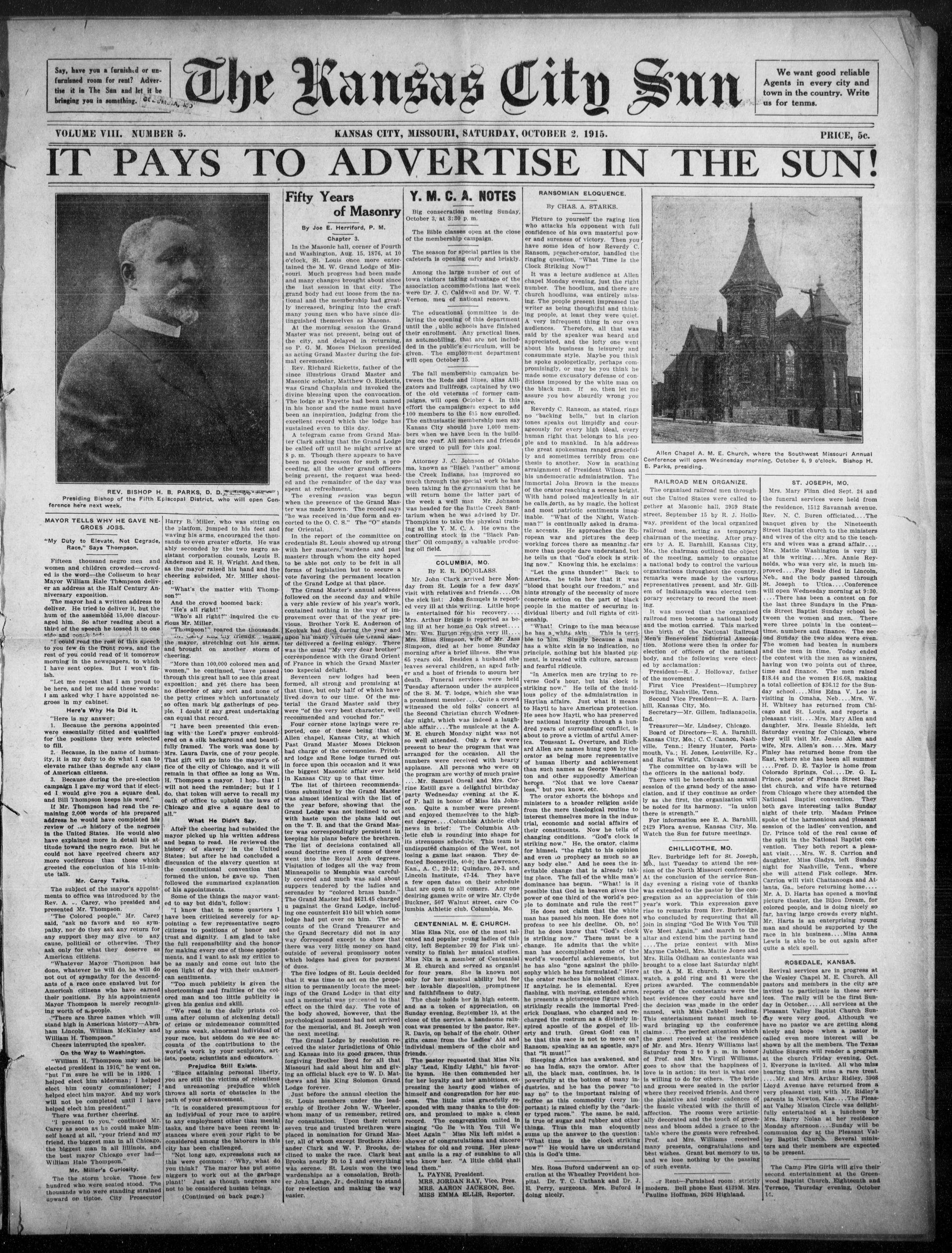
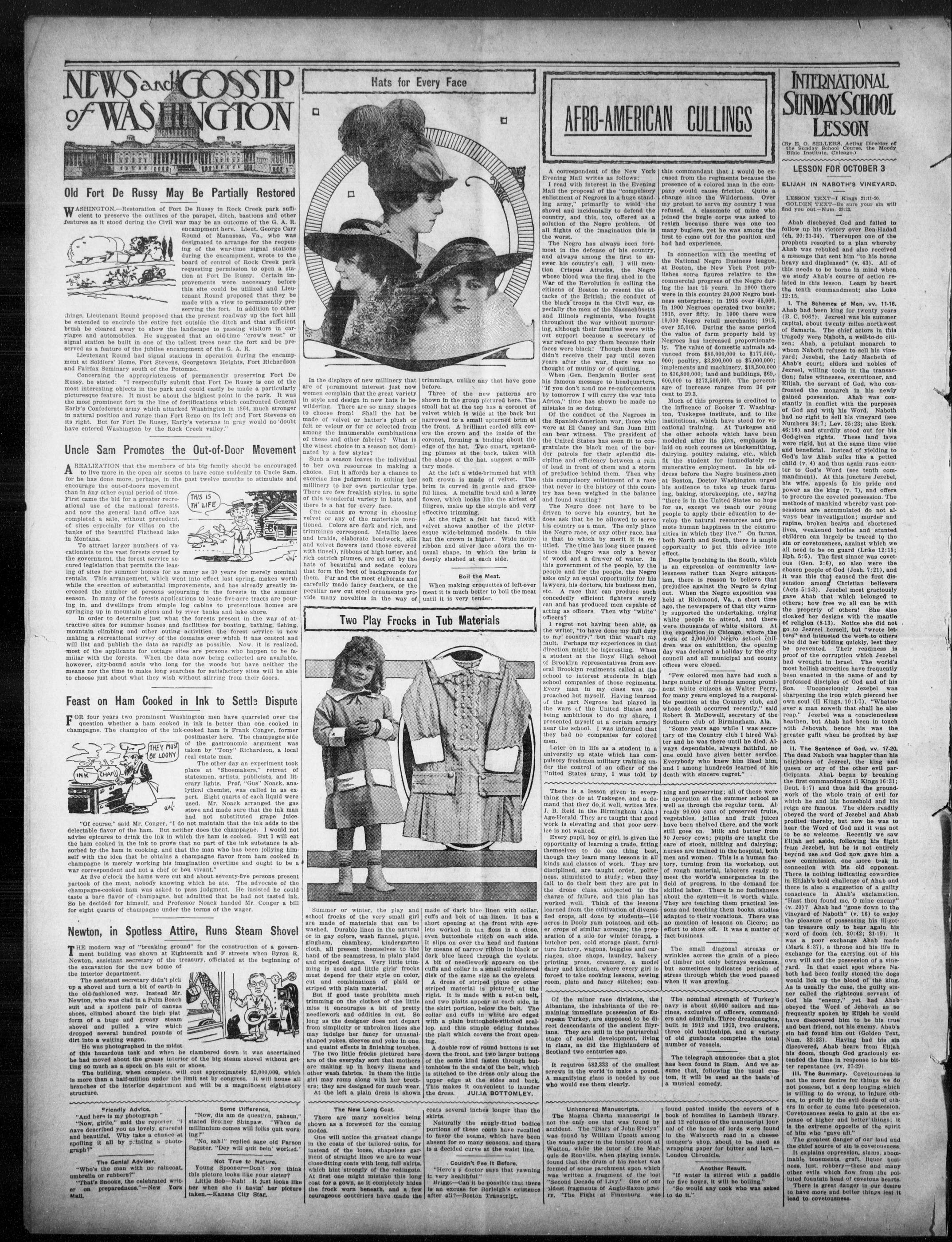
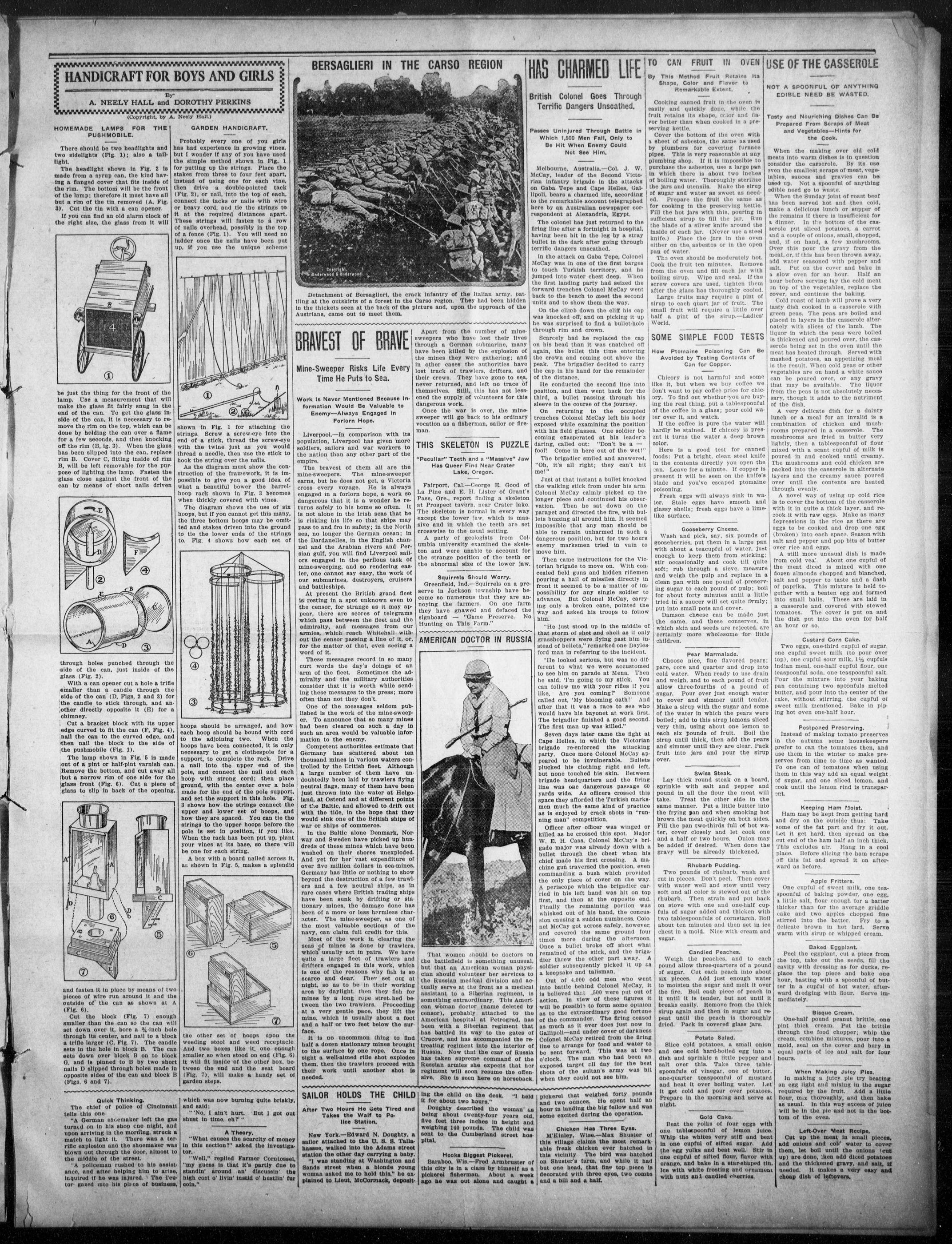
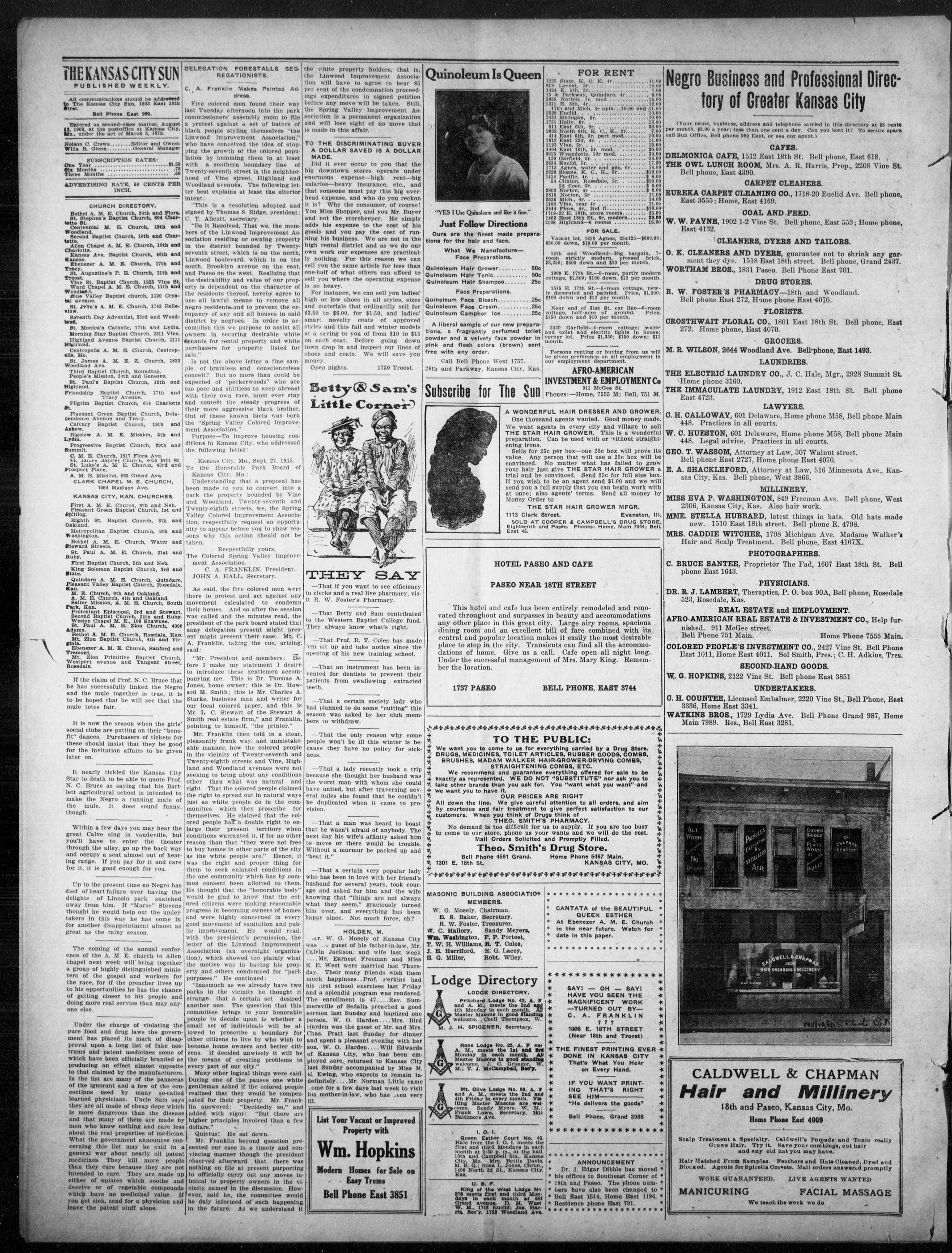
Page text (machine-generated)
IT PAYS TO ADVERTISE IN THE SUN!
VOLUME VIII. NUMBER 5.
REV. BISHOP H. B. PA
Presiding Bishop of the Fifth Episcopal
ference here next week.
[Name not visible in the image]
REV. BISHOP H. B. PARKS, D. D. Presiding Bishop of the Fifth Episcopal District, who will open Conference here next week.
---
Say, have you a furnished or unfurnished room for rent? Advertise it in The Sun and let it be bringing you in something.
MAYOR TELLS WHY HE GAVE NE-GROES JOBS.
"My Duty to Elevate, Not Degrade, Race," Says Thompson.
Fifteen thousand negro men and women and children crowded—crowded is the word—the Coliseum to hear Mayor William Hale Thempson deliver an address at the Half Century Anniversary exposition.
The mayor had a written address to deliver. He tried to deliver it, but the hum of the assembled 15,000 discouraged him. So after reading about a third of the speech he tossed it to one side and couched it.
"I could read the rest of this speech to you few in the front rows, and the rest of you could read of it tomorrow morning in the newspapers, to which I have sent copies. But I won't finish.
"Let me repeat that I am proud to be here, and let me add these words: I am asked why I have appointed negroes in my cabinet.
Here's Why He Did It.
"Here is my answer:
1. Because the persons appointed were essentially fitted and qualified for the positions they were selected to fill.
2. Because, in the name of humanity, it is my duty to do what I can to elevate rather than degrade any class of American citizens.
3. Because during the pre-election campaign I gave my word that if electe I would give you a square deal, and Bill Thompson keeps his word." If Mr. Thompson had read the remaining 2,006 words of his prepared address he would have completed his review of the history of the negroes in the United States. He would also have explained more in detail his attitude toward the negro race. But he could not have received cheers any more vociferous than those which greeted the conclusion of his 15-minute talk.
Mr. Carey Talks.
The subject of the mayor's appointments to office was introduced by the Rev. A. . . Carey, who presided and presented Mr. Thompson.
"The Colored people." Mr. Carey said, "ask no favors and no sympathy, nor do they ask any return for any support they may give to any cause, political or otherwise. They ask only for what they deserve as American citizens.
"Whatever Mayor Thompson has done, whatever he will do, he will not do out of sympathy for the descendants of a race once enslaved but for American citizens who have earned their positions. By his appointments Mayor Thompson is merely recognizing worth of a people.
"There are three names which will stand high in American history—Abraham Lincoln, William McKinley and William H. Thompson."
Cheers interrupted the speaker.
On the Way to Washington.
"William H. Thompson may not be elected president in 1916," he went on,
"but I'm sure he will be in 1920. I helped elect him alderman; I helped elect him county commissioner; I helped elect him mayor. And my work will not be completed until I have helped elect him president."
There was further cheering.
"I present to you," continued Mr. Carey as soon as he could make him self heard at all, "your friend and my friend, the biggest man in all Chicago, the biggest man in all Illinois, and the best mayor Chicago ever had—William Hale Thompson."
Mr. Miller's Curiosity.
The the storm broke. Those few hundred who were seated stood. The thousands who were standing strained upward on tiptoe. City Prosecutor
The Kansas City Sun
Harry B. Miller, who was sitting on the platform, jumped to his feet and waving his arms, encouraged the thousands to even greater efforts. He was ably seconded by the two negro assistant corporation counsels, Louis B. Anderson and E. H. Wright. And then, as the mayor raised his hand and the cheering subsided, Mr. Miller shouted:
"What's the matter with Thompson?"
And the crowd boomed back:
"He's all right!"
"Who's all right?" inquired the curious Mr. Miller.
"Thompson!" roared the thousands.
"Do carry and my friends, begin the mayor, stretching out his arms, and brought on another storm of cheering.
"More than 100,000 colored men and women," he continued, "have passed through this great hall to see this great exposition; and yet there has been no disorder of any sort and none of the petty crimes which unfortunately so often mark big gatherings of people. I doubt if any great undertaking can equal that record.
"I have been presented this evening with the Lord's prayer embroidered on a silk background and beautifully framed. The work was done by Mrs. Laura Davis, one of your people. That gift will go into the mayor's office of the city of Chicago, and it will remain in that office as long as Wm. H. Thompson's mayor. I hop, that I will not need the reminder; but if I do, that token will serve to recall my oath of office to uphold the laws of Chicago and give a square deal to all."
What He Didn't Say.
After the cheering had subsided the mayor picked up his written address and began to read. He reviewed the history of slavery in the United States; but after he had concluded a discussion of the slavery question at the constitutional convention that formed the union, he gave up. Then followed the summarized explanation of his appointments.
Some of the things the mayor wanted to say but didn't, follow:
"I know that in some quarters I have been criticized severely for appointing a few representative negro citizens to positions of honor and trust and dignity. I am glad to take the full responsibility and the honor for making every one of those appointments, and I want to ask my critics to be as manly and come out into the open light of day with their unAmerican sentiments.
"Too much publicity is given the shortcomings and frailties of the colored man and too little publicity is given his genius and skill.
"We read in the daily prints column after column of sickening detail of crime or misdemeanor committed by some weak, abnormal individual of your race, but seldom do we see accounts of the contributions to the world's work by your sculptors, artists, poets, scientists and educators.
Prejudice Still Exists.
Prejudice Still Exists.
"Since attaining personal liberty, you are still the victims of relentless and unreasoning prejudice which throws all sorts of obstacles in the path of your advancement.
"It is considered presumptuous for an individual of your race to aspire to any employment other than mental tasks, and there have been recent instances where even your right to be considered among the laborers in this city has been challenged.
"Not long ago, expressions such as this were common: 'Why, what do you think? The mayor has put some niggers to work out at the garbage plant!' Just as though negroes are not to be considered human beings.
(Continued on back page.)
KANSAS CITY, MISSOURI, SATURDAY, OCTOBER 2. 1915.
Fifty Years of Masonry
In the Masonic hall, corner of Fourth and Washington, Aug. 15, 1876, at 10 o'clock. St. Louis once more entertained the M. W. Grand Lodge of Missouri. Much progress had been made and many changes brought about since the last session in that city. The grand body had cut loose from the national and the membership had greatly increased, bringing into the craft many young men who have since distinguished themselves as Masons. At the morning session the Grand Master was not present, being out of the city, and delayed in returning, so P. G. M. Moses Dickson presided as acting Grand Master during the formal ceremonies. Rev. Richard Ricketts, father of the since illustrious Grand Master and Masonic scholar, Matthew O. Ricketts, was Grand Chaplain and invoked the divine blessing upon the convocation. The lodge at Fayette had been named in his honor and the name must have been an inspiration, judging from the excellent record which the lodge has sustained even to this day. A telegram came from Grand Master Clark asking that the Grand Lodge be called off until he might arrive at 8 p. m. Though there appears to have been no good reason for such a proceeding, all the other grand officers being present, the request was heeded and the remainder of the day was spent at refreshment.
The evening session was begun when the presence of the Grand Master was made known. The record says "he was received in 'due form and escorted to the O. C. S.'" The "O" stands for Oriental.
In the report of the committee on credentials St. Louis showed up strong with her masters, wardens and past masters through whom the city hoped to be able not only to be felt in all forms of legislation but to secure a vote favoring the permanent location of the Grand Lodge at that place.
The Grand Master's annual address followed on the second day and while a very able review of his year's work, contained nothing in the way of improvement over that of the year previous. Brother York E. Anderson of Keokuk had died during the year and upon his many virtues the Grand Master delivered a feeling eulogy. There was the usual "My very dear brother" correspondence with the Grand Orient of France in which the Grand Master too kspecial delight.
Seventeen new lodges had been formed, all strong and promising at that time, but only half of which have lived down to our time. Of the material the Grand Master said they were "of the very best character, well recommended and vouchered for."
Four corner stone layings were reported, one of these being that of Allen chapel, Kansas City, at which Past Grand Master Moses Dickson had charge of the ceremonies. Pritchard lodge and Rone lodge turned out in force upon this occasion and it was the biggest Masonic affair ever held in Kansas City up to that time.
The list of thirteen recommendations submitted by the Grand Master was almost identical with the list of the year before, showing that the Grand Lodge was not inclined to act with haste upon the plans laid out on the T. B. and that the Grand Master was correspondingly persistent in keeping his plans before the brethren. The list of decisions contained all sound doctrine even if some of these went into the Royal Arch degrees. Visitation of lodges all the way from Minneapolis to Memphis was carefully covered and much was said about suppers tendered by the ladies and serenades by "colored brass bands." The Grand Master had $621.45 charged u pagainst the Grand Lodge, including one counterfeit $10 bill which some lodge had put over on him. The accounts of the Grand Treasurer and the Grand Secretary did not in any way correspond except to show that there was very little money on hand outside of several promissory notes which lodges had given for payment of dues.
The five lodges of St. Louis decided that it was time to act on the proposition to permanently locate the meetings of the Grand Lodge in that city and a memorial was presented to that effect on the third day. The vote of the body showed, however, that the psychological moment had not arrived for the memorial, and St. Joseph won the next meeting.
The Grand Lodge by resolution received the sister jurisdictions of Ohio and Kansas into its good grace, thus forgiving Brother Boyd for all that Missouri had said about him and giving an official black eye to W. D. Matthews and his King Solomon Grand Lodge forever.
Just before the annual election the St. Louis members under the leadership of Brother John W. Wheeler, whom many of us remember, retired for consultation. Upon their return seven true and trusted brethren were placed in nomination for Grand Master, all of whom except Brothers Alexander Clark and W. P. Brooks, declined to make the race. Clark beat Brooks nearly 20 to 1 and everything was serene. St. Louis won the two wardenships as a consolation, Brother John Lange, Jr., declining to stand for re-election and making the way easier.
Y. M. C. A. NOTES
Big consecration meeting Sunday, October 3, at 3:30 p. m.
The Bible classes open at the close of the membership campaign.
The season for special parties in the cafeteria is opening early and briskly.
Among the large number of out of town visitors taking advantage of the association accommodations last week were Dr. J. C. Caldwell and Dr. W. T. Vernon, men of national renown.
The educational committee is delaying the opening of this department until the public schools have finished their enrollment. Any practical lines, as automobiling, that are not included in the public's curriculum, will be given. The employment department will open October 15.
The fall membership campaign between the Reds and Blues, alias Alligators and Bullfrogs, captained by two of the old veterans of former campaigns, will open October 4. In this effort the campaigners expect to add 100 members to the 615 now enrolled. The enthusiastic membership men say Kansas City should have 1,000 members when we have been in the building one year. All members and friends are urged to pull for this goal.
Attorney J. C. Johnson of Oklahoma, known as "Black Panther" among the Creek Indians, has improved so much through the special work he has been taking in the gymnasium that he will return home the latter part of the week a well man Mr. Johnson was headed for the Battle Creek Santarium when he was advised by Dr. Thompkins to take the physical training at the Y. M. C. A. He owns the controlling stock in the "Black Panther" Oil company, a valuable producing oil field.
COLUMBIA. MO.
Bv. E. R. DOUGLASS.
Mr. John Clark arrived here Monday day from St. Louis for a few days visit with relatives and friends...On the sick list: John Samuel is reported very ill at this writing. Little hope is entertained for his recovery... Mrs. Arthur Briggs is reported as being ill at her home on Oak street... Mrs. Wm. Burton reveries very ill... Mrs. Eliza Simpson, wife of Mr. Jass Simpson, died at her home Sunday morning after a brief illness. She was 65 years old. Besides a husband she leaves several children, an aged father and a host of friends to mourn her death. Funeral services were held Tuesday afternoon under the auspices of the S. M. T. lodge, which she was a prominent member... Quite a crowd witnessed the old folks' concert at the Second Christian church Wednesday night, which was indeed a laughable affair... The musicale at the A. M. e. church Monday night was not so well attended. Only a few were present to hear the program that was arranged for the occasion. All the numbers were received with hearty applause. All persons who were on the program are worthy of much praise. Mr. Samuel Oneal and Mrs. Corrine Estill gave a delightful birthday party Wednesday evening at the K. of P. hall in honor of Miss Ida Johnson. Quite a number were present and enjoyed themselves to the highest degree... Columbia Athletic club news in brief: The Columbia Athletic club is rounding into shape for its strenuous schedule. This team is undisputed champion of the West, not losing a game last season. They defeated Booneville, 40:0; the Lawrence Kan., A. C., 20-12; Quindaro, 20-3; and Lincoln Institute, 47-14. They have an open dates on their schedule that are open to all comers. Any one desiring games write or wire Mr. Clyde Buckner, 507 Walnut street, care Columbia Athletic club, Columbia, Mo.
CENTENNIAL M. E. CHURCH.
Miss Elsa Nix, one of the most talented and popular young ladies of this city, left September 20 for Fisk university to finish her musical studies. Miss Nix is a member of Centennial M E. church and served as organist for four years. She is known not only for her musical ability but for her lovable disposition, promptness and faithfulness to duty.
The choir holds her in high esteem, and as a token of appreciation, on Sunday evening, September 19, at the close of the service, a handsome raincoat was presented by the pastor, Rev. R. Davis, on behalf of the choir. Other gifts came from the Ladies' Aid and individual members of the choir and friends.
The pastor requested that Miss Nix play Lead, Kindly Light," his favorite hymn. He then commended her for her loyalty and her ambitions, expressing the hearty good wishes of himself and congregation for her success. The little miss gracefully responded with many thanks to the donors, and promised to make a clean record. The congregation united in singing "Go Be with You Till We Meet Again." Miss Nix left midst a shower of congratulations and sincere wishes for old and young. Her please ant smile is a ray of sunshine to all who know her. "A little child shall lead them."
L. PAYNE, President.
LATNEY, Presley.
MRS. JORDAN RAY, Vice. Pres.
MRS. AARON JACKSON, Sec.
MSS. EMMA ELLIS, Reporter.
RANSOMIAN ELOQUENCE.
By CHAS. A. STARKS.
Picture to yourself the raging lion who attacks his opponent with full confidence of his own masterful power and sureness of victory. Then you have some idea of how Reverdy C. Ransom, preacher-orator, handled the ringing question, "What Time is the Clock Striking Now?" It was a lecture audience at Allen chapel Monday evening, just the right number. The hoodlum, and there are church hoodlums, was entirely missing. The people present impressed the writer as being thoughtful and thinking people, at least they were quiet. A very infrequent thing in our own audiences. Therefore, all that was said by the speaker was heard and appreciated, and the lofty one went about his business in leisurely and consummate style. Maybe you think he spoke apologetically, perhaps compromising, or may be you think he made some excusory defense of conditions imposed by the white man on the black man. If so, then let me assure you how absurdly wrong you are.
Reverdy C. Ransom, as stated, rings no "backing bells," but in clarion tones speaks out limpily and courageously for every high ideal, every human right that belongs to his people and to mankind. In his address the great spokesman ranged gracefully and sometimes terribly from one thesis to another. Now in scathing arraignment of President Wilson and his undemocratic administration. The immortal John Brown is the means of the orator reaching a serene height. With hand poised majestically in air he calls forth, as by magic, the holiest and most patriotic sentiments imaginable. "What of the Night, Watchman?" is continually asked in dramatic accents. He approaches the European war and pictures the deep working forces there as meaning far more than people dare understand, but he tells us that "God's clock is striking now." Knowing this, he exclaims: "Let the guns thunder!" Back to America, he tells how that it was "blood that bought our freedom," and hints strongly of the necessity of more concrete action on the part of black people in the matter of securing individual liberty and full rights of citizenship.
"What! Cringe to the man because he has a white skin. This is terrible to him. Simply because a man has a white skin is no indication, no principle, nothing but his blasted pigment, is treated with culture, sarcasm and fearful ridicule.
"In America men are trying to reverse God's hour, but his clock is striking now." He tells of the insidious policy of the administration in Haytian affairs. Just what it means to Haytian to have American protection. He sees how Haytian, who has preserved her national integrity through a hundred years of surrounding conflict, is about to prove a victim of artful America. Toussaint L. Overture, and Richard Allen are names hung upon by the orator as being more representative of human liberty and achievement than such names as George Washington and other supposedly American heroes. "Not that we love Caesar less," but you know, etc.
The orator exhorts the bishops and ministers to a broader religion aside from the mere theological routine to interest themselves more in the industrial, economic and social affairs of their constituents. Now he tells of changing conditions. "God's clock is striking now." He, the orator, claims for himself. "the right to his opinion and even to prophecy as much so as any body else." And he sees the inevitable change that is already taking place. The fall of the white man's dominance has begun. "What! is it possible that God in heaven gives the power of one third of the world's people to dominate and rule the rest?"
He does not claim that the white man has passed his noon. He does not profess to see his decline. Oh, no! But he does know that "God's clock is striking now." There must be a change. He admits that the white man has accomplished some of the world's wonderful achievements, but he has also "gone against the philosophy which he has formulated." The orator reaches his noblest climax. If anything, he is elemental. Eyes flashing, with moving, extended arms, he presents a picturesque figure which strikingly recalls the immortal Frederick Douglass, who charged and recharged the rostrum as a divinely inspired apostle of the gospel of liberty and truth. Great God! can it be that this race is not to move on? Ransom, speaking as an apostle, says that "it must!" Sleeping Africa has awakened, and so has India, says the orator. After all, the black man, continues, he, is powerfully at the bottom of many industries, and he has the power "to say no" to the important raising of coffee as this commodity (very important) is raised chiefly by the "darker typed races." The same, he said, is true of sugar and rubber and other things. Thus this man eloquently sums up the answer to the question: "What time is the clock striking now?" He would have us understand this is God's time.
Mrs. Rosa Buford underwent an operation at the Wheatley Provident hospital. Dr. T. C. Unthank and Dr. J. E. Perry, surgeons. Mrs. Buford is doing nicely.
THE CHURCH OF THE NATIONAL SCHOOL OF CHRISTIANITY
RAILROAD MEN ORGANIZE.
The organized railroad men throughout the United States were called together at Masonic hall, 3859 State street, September 15 by R. J. Holloway, president of the local organized railroad men, acting as temporary chairman of the meeting. After prayers by A. E. Barnhill, Kansas City, Mo., the chairman outlined the object of the meeting, namely to organize a national body to control the various organizations throughout the country, remarks were made by the various representatives present, and Mr. Gilliem of Indianapolis was elected temporary secretary to record the meeting.
It was moved that the organized railroad men become a national body and the motion carried. This marked the birth of the National Railroad Men's Benevolent Industrial Association. Motions were then in order for election of officers of the national body, and the following were elected by acclamation:
President—R. J. Holloway, father of the movement.
First Vice President—Humphrey Bowling, Nashville, Tenn.
ST. JOSEPH, MO.
Mrs. Mary Flinn died Sept. 24 and the funeral services were held from the residence, 1512 Savannah avenue Rev. N. C. Buren officiated....The banquet given by the Nineteenth Street Baptist church to the minister and wives of the city and to the teachers and wives was a grand affair....Mrs. Mattie Washington is very at this writing....Mrs. Annie Reynolds, who was very sic, is much in proved....Fay Beale died in Lincoln Neb., and the body passed through St. Joseph to Utica....Conference will open Wednesday morning at 9:30....There has been a contest on for the last three Sundays in the Francis Street Baptist Sunday school to tween the women and men. Then were three points in the contest-time, numbers and finance. The second Sunday the two sides were ever The women had beaten in number and the men in time. Today end the contest with the men as winners having won two points out of three time and finance. The men raise $18.44 and the women $16.68, makin a total collection of $36.12 for the Sun day school....Miss Edna V. Lee i
Second Vice President—E. A. Barnhill, Kansas City, Mo.
Secretary—Mr. Gillem, Indianapolis, Ind.
Treasurer—Mr. Lindsey, Chicago.
Board of Directors—E. A. Barnhill Kansas City, Mo.; C. C. Cannon, Nashville, Tenn.; Henry Hunter, Portsmouth, Va.; H. Jones, Louisville, Ky, and Rufus Wright, Chicago.
The committee on by-laws will be the officers in the national body.
There will be henceforth an annual session of the grand body of the association, and if they continue as orderly as the first, the organization will be noted for its harmony. "In union there is strength."
For information see E. A. Barnhill 2429 Flora avenue, Kansas City, Mo. Watch the Sun for future meetings.
CHILLICOTHE, MO.
Rev. Burbridge left for St. Joseph, Mo., last Tuesday to attend the session of the North Missouri conference. At the conclusion of the service Sunday evening a rising vote of thanks was extended to the pastor by the congregation as an appreciation of this year's work. This expression gave rise to remarks from Rev. Burbridge, who concluded by requesting that all join in singing "God Be With You Till We Meet Again," and march to the altar and extend him the parting hand
...The prize contest with Miss Mayme Cabbell, Mrs. Mattie Jones and Mrs. Rilla Oldham as contestants was brought to a close last Saturday night at the A. M. E. church. A bracelet watch, a gold ring and $1 were the prizes awarded. The commendable reports of the contestants were the best evidences they could have and the decision was made in the order named, with Miss Cabbell leading. This entertainment meant much toward bringing up the conference claims. ...The perfect attention which the guest received at the residence of Mr. and Mrs. Henry Williams last Saturday from 2 to 9 p. m. in honor of Prof. and Mrs. Virgil Williams, goes to show that the happiness of love is in action; its test is what one is willing to do for others. The bride and groom were seated in the parlor where they received friends. And there the plaintive and tender cadences of the music vibrated with the thrill of affection. The rooms were artistically decorated and the touch of greenness and bloom added a grace to the table where the guests were refreshed. Prof. and Mrs. Williams received many presents, congratulations and best wishes. Grant but memory to us, and we lose nothing by the passing of such events.
or Rent—Furnished room; strictly modern. Bell phone East 4139M. Mrs Pauline Hoffman. 2626 Highland.
We want good reliable Agents in every city and town in the country. Write us for tenms.
PRICE, 5c.
here the Southwest Missouri Annual
ning, October 6, 9 o'clock. Bishop H.
ST. JOSEPH, MO.
Mrs. Mary Flinn died Sept. 24 and the funeral services were held from the residence, 1512 Savannah avenue. Rev. N. C. Buren officiated....The banquet given by the Nineteenth Street Baptist church to the ministers and wives of the city and to the teachers and wives was a grand affair....Mrs. Mattie Washington is very ill at this writing....Mrs. Annie Reynolds, who was very sic, is much improved....Fay Bae died in Lincoln, Neb., and the body passed through St. Joseph to Utica....Conference will open Wednesday morning at 9:30....There has been a contest on for the last three Sundays in the Francis Street Baptist Sunday school between the women and men. There were three points in the contest—time, numbers and finance. The secnd Sunday the two sides were even. The women had beaten in numbers and the men in time. Today ended the contest with the men as winners, having won two points out of three, time and finance. The men raised $18.44 and the women $16.68, making a total collection of $36.12 for the Sunday school....Miss Edna V. Lee is visiting in Omaha, Neb....Mrs. W. Whitsey has returned from Chicago and St. Louis, and reports a pleasant visit....Mrs. Mary Allen and daughter, Mrs. Bessie Shields, left Saturday evening for Chicago, where they will visit Mr. Jessie Allen and wife, Mrs. Allen's son....Mrs. Mary Finley has returned home from the East, where she has been all summer
..Prof. D. E. Taylor is home from Colorado Springs. Col., Dr. G. L. Prince, pastor of Francis Street Baptist church, and wife have returned from Chicago where they attended the National Baptist convention. They both gave interesting talks Sunday night of their trip. Madam Prince spoke of the harmonious and pleasant session of the ladies' convention, and Dr. Prince told of the real cause of the split in the National Baptist convention. They both report a pleasant visit...Mrs. W. S. Carrion and daughter, Miss Gladys, left Sunday night for Nashville, Tenn., where she will attend Fisk college. Mrs. Carrion will visit Chattanooga and Atlanta, Ga., before returning home....Mr. A. D. Harts has opened a moving picture theater, the Bijou Dream, for colored people, and is doing nicely so far, having large crowds every night. Mr. Harts is an enterprising young man and should be supported by the race in his business....Miss Anna Lewis is able to be out again after quite a sick spell.
ROSEDALE. KANSAS.
Revival services are in progress at the Wesley Chapel M. E. Church. All pastors and members in the city are invited to participate in these services. The rally will be the first Sunday in October. All services at the Pleasant Valley Baptist Church Sunday were very good. Although we have no pastor we are getting along nicely and hope when a pastor is called even more interest will be shown by all the members. The Texas Jubilee Singers will render a program at the church Friday evening, Oct. 1. Everyone is invited. All who miss hearing them will miss a rare treat. ..Mr. and Mrs. Arthur Ridley, 3908 Lloyd Avenue have returned from a very pleasant visit with Mr. Ridley's parents in Newton, Kas. ..The Pleasant Valley Mission Circle was delightfully entertained at a luncheon by Mrs. Harry Nolan at her residence Monday afternoon. ..Sunday will be communion day at the Pleasant Valley Baptist Church. Several ministers and their members are expected to be present.
The Camp Fire Girls will give their second entertainment at the Greenwood Baptist Church, Eighteenth and Terrace, Thursday evening, October 14.
---
NEWS and GOSSIP OF WASHINGTON
Old Fort De Russy May Be Partially Restored
WASHINGTON.—Restoration of Fort De Russy in Rock Creek park sufficient to preserve the outlines of the parapet, ditch, bastions and other features as it stood during the Civil war may be an outcome of the G. A. R.
things. Lieutenant Round proposed that the present roadway up the fort hill be extended to encircle the entire fort outside the ditch and that sufficient brush be cleared away to show the landscape to passing visitors in carriages and automobiles. He suggested that an old-time "crow's nest" or signal station be built in one of the tallest trees near the fort and be preserved as a feature of the jubilee encampment of the G. A. R.
Lieutenant Round had signal stations in operation during the encampment at Soldiers' Home, Fort Stevens, Georgetown Heights, Fort Richardson and Fairfax Seminary south of the Potomac.
Concerning the appropriateness of permanently preserving Fort De Russy, he stated: "I respectfully submit that Fort De Russy is one of the most interesting objects in the park and could easily be made a particularly picturesque feature. It must be about the highest point in the park. It was the most prominent fort in the line of fortifications which confronted General Early's Confederate army which attacked Washington in 1864, much stronger in natural position and range than Fort Reno on its left and Fort Stevens on its right. But for Fort De Russy, Early's veterans in gray would no doubt have entered Washington by the Rock Creek valley."
Uncle Sam Promotes the Out-of-Door Movement
Uncle Sam Promotes the Out-of-Door Movement
A REALIZATION that the members of his big family should be encouraged to live more in the open air seems to have come suddenly to Uncle Sam, for he has done more, perhaps, in the past twelve months to stimulate and
ing of sites for summer homes for as many as 30 years for merely nominal rentals. This arrangement, which went into effect last spring, makes worth while the erection of substantial improvements, and has already greatly increased the number of persons sojourning in the forests in the summer season. In many of the forests applications to lease five-acre tracts are pouring in, and dwellings from simple log cabins to pretentious homes are springing up in mountain glens and by river banks and lake shore.
In order to determine just what the forests present in the way of attractive sites for summer homes and facilities for boating, bathing, fishing, mountain climbing and other outing activities, the forest service is now making a recreational survey of the domains over which it has control and will list and publish the data as rapidly as possible. Now, it is realized, most of the applicants for cottage sites are persons who happen to be familiar with the forests. When the data now being collected are available, however, city-bound souls who long for the woods but have neither the means nor the time to make long searches for satisfactory sites will be able to choose just about what they wish without stirring from their doors.
Feast on Ham Cooked in Ink to Settle Dispute
FOR four years two prominent Washington men have quarreled over the question whether a ham cooked in ink is better than one cooked in champagne. The champion of the ink-cooked ham is Frank Conger, former
"Of course," said Mr. Conger, "I do not maintain that the ink adds to the delectable flavor of the ham. But neither does the champagne. I would not advise epicures to drink the ink in which the ham is cooked. But I will eat the ham cooked in the ink to prove that no part of the ink substance is absorbed by the ham in cooking, and that the man who has been jollying himself with the idea that he obtains a champagne flavor from ham cooked in champagne is merely working his imagination overtime and ought to be a war correspondent and not a chef or bon vivant."
At five o'clock the hams were cut and about seventy-five persons present partook of the meat, nobody knowing which he ate. The advocate of the champagne-cooked ham was asked to pass judgment. He insisted he could taste a bare flavor of champagne, but admitted that he had not tasted ink. So he decided for himself, and Professor Noack handed Mr. Conger a bill for eight quarts of champagne under the terms of the wager.
Newton, in Spotless Attire, Runs Steam Shovel
THE modern way of "breaking ground" for the construction of a government building was shown at Eighteenth and F streets when Byron R. Newton, assistant secretary of the treasury, officiated at the beginning of the excavation for the new home of
He was practicing of this hazardous task and when he clambered down it was ascertained he had moved about the greasy interior of the big steam shovel without getting so much as a speck on his suit or shoes.
The building, when complete, will cost approximately $2,000,000, which is more than a half-million under the limit set by congress. It will house all branches of the interior department and will be a magnificent eight-story structure.
Agriculture
chings, Lieutenant Round proposed that he be extended to encircle the entire fort brush be cleared away to show the riages and automobiles. He suggested signal station be built in one of the tars served as a feature of the jubilee encamp Lieutenant Round had signal static at Soldiers' Home, Fort Stevens, C and Fairfax Seminary in the Poto Concerning the appropriateness of Russy, he stated: "I respectfully submit most interesting objects in the park and picturesque feature. It must be about the most prominent fort in the line of Early's Confederate army which attacks in natural position and range than Fort its right. But for Fort De Russy, Earl have entered Washington by the Rock
Uncle Sam Promotes the
A REALIZATION that the members of to live more in the open air seems for he has done more, nerbans, in the
encourage the out-of-doors movement in than in any other equal period of time. First came the bid for a greater recreational use of the national forests, and now the general land office has completed a sale, without precedent, of sites especially for villas on the banks of the beautiful Flathead lake in Montana.
To attract larger numbers of vacationists to the vast forests owned by the government, the forest service secured legislation that permits the leas
ing of sites for summer homes for as we rentals. This arrangement, which went while the erection of substantial improved the number of persons sojourn season. In many of the forests applying in, and dwellings from simple lo springing up in mountain glens and by In order to determine just what tractic sites for summer homes and f mountain climbing and other outing making a recreational survey of the de will list and publish the data as rapid most of the applicants for cottage sites miliar with the forests. When the day however, city-bound souls who long f means nor the time to make long search to choose just about what they wish will
Feast on Ham Cooked in
FOR four years two prominent Wash question whether a ham cooked in champagne. The champion of the ink-
INK CHARU
THEY MUST BE LOONY
wmf
"Of course," said Mr. Conger, "I do delectable flavor of the ham. But neither advise epicures to drink the ink in which the ham cooked in the ink to prove that sorbed by the ham in cooking, and self with the idea that he obtains a champagne is merely working his ima war correspondent and not a chef or be. At five o'clock the hams were cut a partook of the meat, nobody knowing champagne-cooked ham was asked to taste a bare flavor of champagne, but So he decided for himself, and Profes for eight quarts of champagne under the
Newton, in Spotless Attic
THE modern way of "breaking ground building was shown at Eight Newton, assistant secretary of the trie the excavation for the new home of the interior department.
The assistant secretary didn't pick up a shovel and turn a bit of earth in the old-fashioned way. Instead Mr. Newton, who was clad in a Palm Beach suit and a spotless pair of canvas shoes, climbed aboard the high plat form of a huge and greasy steam shovel and pulled a wire which dropped several hundred pounds of dirt into a waiting wagon.
He was photographed in the midst of this hazardous task and when he he had moved about the greasy interi ting so much as a speck on his suit or The building, when complete, will is more than a half-million under the branches of the interior department structure.
Friendly Advice,
"And here is my photograph."
"Now, girlie," said the reporter, "I have described you as lovely, graceful and beautiful. Why take a chance at spoiling it all by printing a photograph?"
"Who's the man with no raincoat, umbrella or rubbers?"
"That's Snooks, the celebrated writer on preparedness."—New York Mail.
encampment here. Lieut. George Carr Round of Manassas, Va., who was designated to arrange for the reopening of the war-time signal stations during the encampment, wrote to the board of control of Rock Creek park requesting permission to open a station at Fort Dre Russy. Certain improvements were necessary before this site could be utilized and Lieutenant Round proposed that they be made with a view to permanently preserving the fort. In addition to other
but the present roadway up the fort hill
outside the ditch and that sufficient
landscape to passing visitors in car-
ped that an old-time "crow's nest" or
tallest trees near the fort and be pre-
mium of the G. A. R.
ations in operation during the encamp-
ment Georgetown Heights, Fort Richardson
tomac.
of permanently preserving Fort De
mit that Fort De Russy is one of the
and could easily be made a particularly
the highest point in the park. It was
fortifications which confronted General
xed Washington in 1864, much stronger
Reno on its left and Fort Stevens on
only's veterans in gray would no doubt
k Creek valley."
The Out-of-Door Movement
of his big family should be encouraged
s to have come suddenly to Uncle Sam.
the past twelve months to stimulate and
THIS IS
TH' LIFE
many as 30 years for merely nominal
ent into effect last spring, makes worth
provements, and has already greatly in-
curring in the forests in the summer
tations to lease five-acre tracts are pour-
log cabins to pretentious homes are
ry river banks and lake shore.
the forests present in the way of at-
facilities for boating, bathing, fishing,
activities, the forest service is now
domains over which it has control and
pily as possible. Now, it is realized,
sites are persons who happen to be fa-
tata now being collected are available,
for the woods but have neither the
roches for satisfactory sites will be able
without stirring from their doors.
In Ink to Settle Dispute
washington men have quarreled over the
in ink is better than one cooked in
k-cooked ham is Frank Conger, former
postmaster here. The champagne side of the gastronomic argument was taken by "Tony" Richardson, a local real estate man.
The other day an experiment took place at "Shoemakers." retreat of statesmen, artists, publicists, and literary lights. Prof. "Gus" Noack, analytical chemist, was called in as expert. Eight quarts of each liquid were used. Mr. Noack arranged the gas stove and made sure that the ink man had not substituted grape juice.
do not maintain that the ink adds to the either does the champagne. I would not which the ham is cooked. But I will eat that no part of the ink substance is about the man who has been jollying him champagne flavor from ham cooked in imagination overtime and ought to be a bou vivant." I and about seventy-five persons present ing which he ate. The advocate of the pass judgment. He insisted he could not admitted that he had not tasted ink. Noack Noack handed Mr. Conger a bill the terms of the wager.
*Uire, Runs Steam Shovel* "ound" for the construction of a govern-eighteenth and F streets when Byron R. treasury, officiated at the beginning of
the clambered down it was ascertained
norior of the big steam shovel without get-
or shoes.
will cost approximately $2,000,000, which
limit set by congress. It will house all
and will be a magnificent eight-story
Some Difference.
"Now, dis am de questicn, pahsun,"
stated Brocher Shinpaw. "When de
millinnium comes will folks quit work-
ing?"
"No, sah!" repiled sage old Parson
Bagster. "Dey will quit bein' worked."
BOB DON'T you think this picture looks like your sister? Little Bob—Nah! It just looks like her when she! i havin' her picture taken.—Kansas City Star.
MORRIS
Two Play Frocks in Tub Materials
In the displays of new millinery that are of paramount interest just now women complain that the great variety in style and design in new hats is bewildering. There are so many shapes to choose from! Shall the hat be made of velvet or hatter's plush or felt or velour or fur or selected from among the innumerable combinations of these and other fabrics? What is the wisest choice in a season not dominated by a few styles?
Such a season leaves the individual to her own resources in making a choice. But it affords her a chance to exercise fine judgment in suiting her millinery to her own particular type. There are few freakish styles, in spite of this wonderful variety in hats, and there is a hat for every face.
One cannot go wrong in choosing velvet or any of the materials mentioned. Colors are dark and rich, and trimmings correspond. Metallic laces and braids, elaborate beadwork, silk and velvet flowers (and those covered with tinsel), ribbons of high luster, and rich ostrich plumes, are set off by the hats of beautiful and sedate colors that form the best of backgrounds for them. Fur and the most elaborate and carefully made fancy feathers, or the peculiar new cut steel ornaments provide many novelties in the way of
Two Play Frocks
Summer or winter, the play and school frocks of the very small girl are made of materials that can be washed. Durable linen in the natural or in gay colors, wash flannel, plique, gingham, chambray, kindergarten cloth, all present themselves to the hand of the seamstress, in plain plaid and striped designs. Very little trimming is used and little girls' frocks must depend for their style on color, cut and combinations of plaid or striped with plain material.
But if good taste prohibits much trimming on the clothes of the little miss it encourages a bit of pretty needlework and oddities in cut. So long as the designer does not depart from simplicity or unbroken lines she may indulge her fancy for unusual-shaped yokes, sleeves and yoke in one, and quaint effects in finishing touches.
The two little frocks pictured here are of the everyday sort that mothers are making up in heavy linens and other wash fabrics. In them the little girl may romp along with her brothers; they are designed for much wear. At the left a plain dress is shown
There are many novelties being shown as a foreword for the coming modes.
One will notice the greatest change in the coats of the tailored suits, for instead of the loose, shapeless garment of straight lines we are to wear close-fitting coats with long, full skirts, which hint strongly of the redingote. At first one might mistake this long coat for a gown, as it completely hides the frock worn beneath, and a few courageous couturiers have made the
trimmings, unlike any that have gone before.
Three of the new patterns are shown in the group pictured here. The small hat at the top has a coronet of velvet which is wide at the back but narrowed to a small upturned brim at the front. A brilliant corded silk covers the crown and the inside of the coronet, forming a binding about the edge of the hat. Two smart, upstanding plumes at the back, taken with the shape of the hat, suggest a military mode.
At the left a wide-brimmed hat with soft crown is made of velvet. The brim is curved in gentle and graceful lines. A metallic braid and a large flower, which looks like the airiest of filgree, make up the simple and very effective trimming.
At the right a felt hat faced with velvet shows another of the picturesque wide-brimmed models. In this hat the crown is higher. Wide more ribbon and silver lace adorn the unusual shape, in which the brim is deeply slashed at each side.
When making croquettes of left-over meat it is much better to boil the meat until it is very tender.
in Tub Materials
made of dark blue linen with collar, cuffs and belt of tann linen. It has a short opening at the front with eyelens worked in tann floss in a close, even buttonhole stitch on each side. It slips on over the head and fastens by means of narrow ribbon in black or dark blue laced through the eyelens. A bit of needlework appears on the cuffs and collar in a small embroidered disk of the same size as the eyelens. A dress of striped pique or other striped material is pictured at the right. It is made with a set-on belt, and two plaits appear at each side, in the skirt portion, below the belt. The collar and cuffs in white are edged with a plain buttonhole-stitched scallop, and this simple edging finishes the plait which covers the front opening.
A double row of round buttons is set down the front, and two larger buttons of the same kind fasten through buttonholes in the ends of the belt, which is stitched to the dress only along the upper edge at the sides and back. This makes it convenient to launder the dress. JULIA BOTTOMLEY.
coats several inches longer than the skirts.
Naturally the snugly-fitted bodice portions of these coats have recalled to favor the seams, which have been absent for so many seasons, and there is a decided curve at the waist line.
Couldn't See It Before.
"Here's a doctor says that yawning is very healthful."
Brigge—Can it be possible that there is an excuse for Borleigh's existence after all?—Boston Transcript.
AFRO-AMERICAN CULLINGS
A correspondent of the New York Evening Mail writes as follows: I read with interest in the Evening Mail the proposal of the "compulsory enlistment of Negroes in a huge standing army," primarily to wield the shovel and incidentally to defend the country, and this, too, offered as a solution of the Negro problem. Of all flights of the imagination this is the worst.
The Negro has always been foremost in the defense of his country, and always among the first to answer his country's call. I will mention Crispus Attucks, the Negro whose blood was the first shed in the War of the Revolution in calling the citizens of Boston to resent the attacks of the British; the conduct of the black troops in the Civil war, especially the men of the Massachusetts and Illinois regiments, who fought throughout the war without murmuring, although their families were without support because a secretary of war refused to pay them because their faces were black! Though these men didn't receive their pay until seven years after the war, there was no thought of mutiny or of quitting. When Gen. Benjamin Butler sent his famous message to headquarters, "If you don't sand me re-enforcements by tomorrow I will carry the war into Africa," time has shown he made no mistake in so doing.
Of the conduct of the Negroes in the Spanish-American war, those who were at El Caney and San Juan Hill can bear witness. The president of the United States has seen fit to congratulate the black men of the border patrols for their splendid discipline and efficiency between a rain of lead in front of them and a storm of prejudice behind them. Then why this compulsory enlistment of a race that never in the history of this country has been weighed in the balance and found wanting?
The Negro does not have to be driven to serve his country, but he does ask that he be allowed to serve his country as a man. The only place the Negro race, or any other race, has is that to which by merit it is entitled. The time has long since passed since the Negro was only a hewer of wood and a drawer of water. In this government of the people, by the people and for the people, the Negro asks only an equal opportunity for his lawyers, his doctors, his business men, etc. A race that can produce such concededly efficient fighters surely can and has produced men capable of acting as officers. Then why "white" officers?
I regret not having been able, as the writer, "to have done my full duty to my country," but that wasn't my fault. Perhaps my experiences in that direction might be interesting. When a student at the Boys' High school of Brooklyn representatives from several Brooklyn regiments called at the school to interest students in high school companies of those regiments. Every man in my class was approached but myself. Having learned of the part Negroes had played in the wars of the United States and being ambitious to do my share, I presented myself at a certain armory near the school. I was informed that they had no companies for colored men.
Later on in life as a student in a university up state which has compulsory freshmen military training under the control of an officer of the United States army, I was told by
There is a lesson given in everything they do at Tuskegee, and a demand that they do,it well, writes Mrs. J. B. Reid in the Birmingham (Ala.) Age-Herald. They are taught that good work is elevating and that poor service is not wanted.
Every pupil, boy or girl, is given the opportunity of learning a trade, fitting themselves to do one thing best, though they learn many lessons in all kinds and classes of work. They are disciplined, are taught order, politeness, stimulated to study; when they fail to do their best they are put in the drone class, subjected to the charge of failure, and this plan has worked well. Think of the lessons learned from the cultivation of diversified crops, all done by students—110 acres in Doody yam potatoes, and other crops of similar acreage; the preparation of a silo for winter forage, a butcher pen, cold storage plant, furniture factory, wagons, buggies and carriages, shoe shops, laundry, bakery printing press, creamy, a model dairy and kitchen, where every girl is forced to take cooking lessons, sewing room, plain and fancy stitches; can-
Of the minor race divisions, the Albanians, the inhabitants of the remaining immediate possession of European Turkey, are supposed to be direct descendants of the ancient Illyrians. They are still in the patriarchal stage of social development, living in clans, as did the Highlanders of Scotland two centuries ago.
It requires 582,333 of the smallest screws in the world to make a pound. A magnifying glass is needed by one who would see them clearly.
Unhonored Manuscripts.
The Magna Charta manuscript is not the only one that was found by accident. The "Diary of John Evelyn" was found by William Upcott among the waste paper in the lumber room at Wotton, while the tutor of the Marquis de Roville, when playing tennis, found that the drum of his racket was formed of some parchment upon which was written a fragment of the lost "Second Decade of Livy." One of our oldest fragments of Anglo-Saxon poetry, "The Fight at Finsburg, was
this commandant that I would be excused from the regiments because the presence of a colored man in the company would cause friction. Quite a change since the Wilderness. Over my protest to serve my country I was refused. A classmate of mine who joined the bugle corps was asked to resign because there was one too many buglers, yet he was among the first to come out for the position and had had experience.
In connection with the meeting of the National Negro Business league, at Boston, the New York Post publishes some figures relative to the commercial progress of the Negro during the last 15 years. In 1900 there were in this country 20,000 Negro business enterprises; in 1915 over 45,000. In 1900 Negroes operated two banks; 1915, over fifty. In 1900 there were 10,000 Negro retail merchants; 1915, over 25,000. During the same period the value of farm property held by Negroes has increased proportionately. The value of domestic animals advanced from $85,000,000 to $177,000,000; poultry, $3,800,000 to $5,000,000; implements and machinery, $18,500,000 to $36,800,000; land and buildings, $69,600,000 to $273,500,000. The percentage of increase ranges from 36 per cent to 29.3.
Much of this progress is credited to the influence of Booker T. Washington, Tuskegee institute, and to like institutions, which have stood for vocational training. At Tuskegee and the other schools which have been modeled after its plan, emphasis is laid on such courses as blacksmithing, dairying, poultry raising, etc., which fit the student for immediately remunerative employment. In his address before the Negro business men at Boston, Doctor Washington urged his audience to take up truck farming, baking, storekeeping, etc., saying "there is in the United States no hope for us, except we teach our young people to apply their education to develop the natural resources and promote human happiness in the communities in which they live." On farms both North and South, there is ample opportunity to put this advice into effect.
Despite lynching in the South, which is an expression of community lawlessness rather than Negro antagonism, there is reason to believe that prejudice against the Negro is dying out. When the Negro exposition was held at Richmond, Va., a short time ago, the newspapers of that city warmly supported the undertaking, urging white people to attend, and there were thousands of white visitors. At the exposition in Chicago, where the work of 2,000,000 Negro school children was on exhibition, the opening day was declared a holiday by the city council and all municipal and county offices were closed.
"Few colored men have had such a large number of friends among prominent white citizens as Walter Perry, for many years employed in a responsible position at the Country club, and whose death occurred recently," said Robert B. McDowell, secretary of the Southern club of Birmingham, Ala.
"Some years ago while I was secretary of the Country club I hired Walter and he was there until he died. Always dependable, always faithful, no one could have given better service. Everybody who knew him liked him, and I among hundreds learned of his death with sincere regret."
ning and preserving; all of these were in operation at the summer school as well as through the regular term. Already 90,000 cans of preserved fruits, vegetables, jellies and fruit juices have been shelved there, and the work still goes on. Milk and butter from 90 Jersey cows; pupils are taught the care of stock, milking and dairying; nurses are trained in the hospital, both men and women. This is a human factory, turning from its workshop, out of rough material, laborers ready to meet the world's emergencies in the field of progress, in the demand for skilled labor. There is no foolishness about the system—it is worth while. They are teaching them practical lessons and teaching them books, studies adapted to their vocations. There was no mention of lessons on Cicero; no effort to show off. It was a matter of fact business.
The small diagonal streaks or wrinkles across the grain of a piece of timber not only betrays weakness, but sometimes indicates periods of stress through which the wood passed when it was growing.
The nominal strength of Turkey's navy is about 40,000 sailors and marines, exclusive of officers, commanders and admirals. Three dreadnaughts, built in 1912 and 1913, two cruisers, three old battleships, and a variety of old gunboats comprise the total number of vessels.
The telegraph announces that a plot has been found in Siam. And we assume that, following the usual custom, it will be used as the basis of a musical comedy.
found pasted inside the covers of a book of homilies in Lambeth library, and 12 volumes of the manuscript journal of the house of lords were found in the Waiworth road in a cheese-monger's shop, about to be used as wrapping paper for butter and lard.—London Chronicle.
Another Result.
"If water is stirred with a paddle for five hours, it will be boiling."
"So would any cook who was asked to do it."
INTERNATIONAL
SUNDAY SCHOOL
LESSON
(By E. O. SELLERS, Acting Director of the Sunday School Course, the Moody Bible Institute, Chicago.)
LESSON FOR OCTOBER 3
ELIJAH IN NABOTH'S VINEYARD.
LESSON TEXT-I Kings 21:11-20.
GOLDEN TEXT—Be sure your sln will find you out—22:23.
Ahab disobeyed God and failed to follow up his victory over Ben-Hadad (ch. 20:31-34). Thereupon one of the prophets resorted to a plan whereby Ahab was rebuked and also received a message that sent him "to his house heavy and displeased" (v. 43). All of this needs to be borne in mind when we study Ahab's course of action related in this lesson. Learn by heart the tenth commandment; also Luke 12:15.
I. The Schemes of Men, vv. 11-16. Ahab had been king for twenty years (B. C. 906?). Jezreel was his summer capital, about twenty miles northwest of Samaria. The chief actors in this tragedy were Naboth, a well-to-do citizen; Ahab, a petulant monarch to whom Naboth refuses to sell his vineyard; Jezebel, the Lady Macbeth of Ahab's court; elders and nobles of Jezreel, willing tools in the transaction; false witnesses, executioner, and Elijah, the servant of God, who confronted the monarch in his newly gained possession. Ahab was constantly in conflict with the purposes of God and with his Word. Naboth had no right to sell his vineyard (see Numbers 36:7; Lev. 25:23; also Ezek. 46:16) and sturdily stood out for his God-given rights. These land laws were rigid, but at the same time wise and beneficial. Instead of yielding to God's law Ahab sulks like a petted child (v. 4) and thus again runs counter to God's Word (see tenth commandment). At this juncture Jezebel, his wife, appeals to his pride and power as the king (v. 7), and offers to procure the coveted possession. The methods of mankind vast possessions are accumulated do not always bear investigation; murder and rapine, broken hearts and shortened children can largely be traced to the sin or covetousness, against which we all need to on guard (Luke 12:15; Eph. 5:5). The first sinner was covetous (Gen. 3:6), so also were the chosen people of God (Josh. 7:21), and it was this that caused the first believers (Acts 5:1:3). Jezebel most graciously gave Ahab that which belonged to others; how free we all can be with the property of others! She also cloaked her designs with the mattle of religion (8-13). Notice she did not go to Jezreel herself, but "wrote letters" and intrusted the work to others who did her bidding quickly, lest they be prevented. Their readiness is proof of the corruption which Jezebel had wrought in Israel. The world's most hellish atrocities have frequently been enacted in the name of and by professed disciples of God and of his Son. Unconsciously Jezebel was sharpening the iron which pierced her own soul (II Kings, 10:1-7). "Whatsoever a man soweth that shall he also reap." Jezebel was a conscienceless heathen, but Ahab had been in touch with Jehovah, hence his was the greater guilt when he profited by her acts.
11. The Sentence of God, vv. 17-20. The dead Naboth was happier than his neighbors of Jezreel, the king and queen or any of the other evil participants. Ahab began by breaking the first commandment (I Kings 16:31; Deut. 5:7) and thus laid the groundwork of the whole train of evil for which he and his household and his reign are famous. The elders readily obeyed the word of Jezebel and Ahab profited thereby, but now he was to hear the Word of God and it was not to be so welcome. Recently we saw Elijah set aside, following his flight from Jezebel, but he is not entirely beyond use and God now gave him a new commission, one more task in connection with his old opponent. There is nothing indicating cowardice in Elijah's bold challenge of Ahab and there is also a suggestion of a guilty conscience in Ahab's exclamation.
"Hast thou found me, O mine enemy" (v. 20?) Ahab had "gone down to the vineyard of Naboth" (v. 16) to enjoy the pleasure of possessing his ill-gotten treasure only to hear again his word of doom (ch. 20:42; 21-19). It was a poor exchange Ahab made (Mark 8:37), a throne and his life in exchange for the carrying out of his own will and the possession of a vineyard. In that exact spot where Naboth had been fully stoned the dogs would lick up the blood of the king. As is usually the case, the guilty sinner called the righteous servant of God his "enemy" yet had Ahab obeyed the Word of Jehovah as so frequently spoken by Elijah he would have discovered him to be his true and best friend, not his enemy. Ahab's sin had found him out (Golden Text, Num. 32:23). Having had his sin discovered, Ahab hears from Elijah his doom, though God graciously extended the time in response to his bitter repentance (vv. 27-29).
III. The Summary. Covetousness is not the mere desire for things we do not possess, but a deep longing which is willing to do wrong, to injure others, to profit by the evil deeds of others in order to come into possession. Covetousness seeks to gain at the expense of higher and better things; it is the extreme opposite of the spirit of him who "gave all."
The greatest danger of our land and the chief source of sin is covetousness. It explains oppression, slums, abominable tenements, graft, liquor business, lust, robbery—these and many other evils which flow from the polluted fountain head of covetous hearts.
There is great danger in our desire to have more and better things lost it lead to covetousness.
HANDICRAFT FOR BOYS AND GIRLS
HOMEMADE LAMPS FOR THE PUSHMOBILE.
There should be two headlights and two sidelights (Fig. 1); also a taillight.
The headlight shown in Fig. 2 is made from a syrup can, the kind having a flanged cover that fits inside of the rim. The bottom will be the front of the lamp; therefore it must have all but a rim of the tin removed (A. Fig. 3). Cut the tin with a can opener.
If you can find an old alarm clock of the right size, the glass from it will
8
14
$\textcircled{1}$
be just the thing for the front of the lamp. Use a measurement that will make the glass fit fairly snug in the end of the can. To get the glass inside of the can, it is necessary to remove the rim on the top, which can be done by holding the can over a flame for a few seconds, and then knocking off the rim (B, fig. 3). When the glass has been slipped into the can, replace rim B. Cover C, fitting inside of rim B, will be left removable for the purpose of lighting the lamp. Fasten the glass close against the front of the can by means of short nails driven
$\textcircled{2}$
$\textcircled{4}$
$\textcircled{3}$
through holes punched through the side of the can, just inside of the glass (Fig. 2).
With a can opener cut a hole a trifle smaller than a candle through the side of the can (D, Figs. 2 and 3) for the candle to stick through, and another directly opposite it (E) for a chimney.
Cut a bracket block with its upper edge curved to fit the can (F, Fig. 4), nail the can to the curved edge, and then nail the block to the side of the pushmobile (Fig. 1).
The lamp shown in Fig. 5 is made out of a pint or half-pint varnish can. Remove the bottom, and cut away all but a narrow rim of one side for the glass front (Fig. 6). Cut a piece of glass to slip in back of the opening.
A
A
D
D
$\textcircled{6}$
C
$\textcircled{7}$
E
$\textcircled{5}$
and fasten it in place by means of two pieces of wire run around it and the outside of the can as shown at A (Fig. 6).
Cut the block (Fig. 7) enough smaller than the can the can will set down over it, bore a $ \frac{3}{4} $ - inch hole through its center, and nail to a block a trifle larger (C, Fig. 7). The candle sets in the hole in block B. The can sets down over block B on to block G, and is pinned to B by two short nails D slipped through holes made in opposite sides of the can and block B (Figs. 6 and 7).
Quick Thinking.
The chief of police of Cincinnati tells this one.
"A German shoemaker left the gas turned on in his shop one night, and upon arriving in the morning, struck a match to light it. There was a terrific explosion and the shoemaker was blown out through the door, almost to the middle of the street.
"A policeman rushed to his assistance, and after helping him to arise, inquired if he was injured. The Teuton gazed into his place of business,
GARDEN HANDICRAFT.
Probably every one of you girls has had experience in growing vines, but I wonder if any of you have used the simple method shown in Fig. 1 for putting up the strings. Place the stakes from three to four feet apart, instead of using one for each vine, then drive a double-pointed tack (Fig. 2), or nail, into the top of each, connect the tacks or nails with wire or heavy cord, and tie the strings to it at the required distances apart. These strings will fasten to a row of nails overhead, possibly in the top of a fence (Fig. 1). You will need no ladder once the nails have been put up, if you use the unique scheme
$\textcircled{1}$
$\textcircled{2}$
$\textcircled{3}$
shown in Fig. 1 for attaching the strings. Screw a screw-eye into the end of a stick, thread the screw-eye with the twine just as you would thread a needle, then use the stick to hook the string over the nails.
As the diagram must show the construction of the framework, it is impossible to give you a good idea of what a beautiful bower the barrelhoop rack shown in Fig. 3 becomes when thickly covered with vines.
The diagram shows the use of six hoops, but if you cannot get this many, the three bottom hoops may be omitted and stakes driven into the ground to tie the lower ends of the strings to. Fig. 4 shows how each set of
$\textcircled{4}$
$\textcircled{3}$
hoops should be arranged, and how each hoop should be bound with cord to the adjoining two. When the hoops have been connected, it is only necessary to get a clothespole for a support, to complete the rack. Drive a nail into the upper end of the pole, and connect the nail and each hoop with strong cord; then place ground, with the center over a hole made for the end of the pole support, and the support in this hole. Fig. 3 shows how the strings connect the upper and lower set of hoops, and how they are spaced. You can tie the strings to the upper hoops before the pole is set in position, if you like. When the rack has been put, plant your vines at its base, so there will be one for each string.
A box with a board nailed across it, as shown in Fig. 5, makes a splendid
$\textcircled{6}$ $\textcircled{5}$
$\textcircled{7}$
the other set of hoops upon the weeding stool and weed receptacle. And two boxes like it, one enough smaller so when stood on end (Fig. 6) it will fit inside of the other box, between the end and the seat board (Fig. 7), will make a handy set of garden steps.
which was now burning quite briskly, and said:
"No, I ain't hurt. But I got out shust in time eh?" ^
A Theory.
"What causes the scarcity of money in this section?" asked the investigator.
"Well," replied Farmer Corntossel, "my guess is that it's partly due to standin' around an' discussin' the high cost o' livin' instil' o' hustlin' fur coin."
Copyright
Underwood & Underwood
Detachment of Bersaglieri, the crack infantry of the Italian army, battling at the outskirts of a forest in the Carso region. They had been hidden in the thickets seen at the back of the picture and, upon the approach of the Austrians, came out to meet them.
BRAVEST OF BRAVE
Mine-Sweeper Risks Life Every Time He Puts to Sea.
Work Is Never Mentioned Because Information Would Be Valuable to Enemy—Always Engaged in Forlorn Hope.
Liverpool.—In comparison with its population, Liverpool has given more soldiers, sailors and war workers to the nation than any other part of the empire.
The bravest of them all are the mine-sweepers. The mine-sweeper earns, but he does not get, a Victoria cross every voyage. He is always engaged in a forlorn hope, a work so dangerous that it is a wonder he returns safely to his home so often. It is not alone in the Irish seas that he is risking his life so that ships may pass to and fro in safety; in the North sea, no longer the German ocean; in the Dardanelles, in the English channel and the Arabian rivers and Persian gulf, you will find Liverpool sailors engaged in the perilous task of mine-sweeping, and so rendering easier, one cannot say easy, the work of our submarines, destroyers, cruisers and battleships.
At present the British grand fleet is resting in a spot unknown even to the censor, for strange as it may appear, there are scores of telegrams which pass between the fleet and the admiralty, and messages from our armies, which reach Whitehall without the censor passing a line of it, or, for the matter of that, even seeing a word of it.
These messages record in so many curt words the day's doings of an arm of the fleet. Sometimes the admiralty and the military authorities consider that it is worth while sending these messages to the press; more often than not they don't.
One of the messages seldom published is the work of the mine-sweeper. To announce that so many mines had been cleared on such a day in such an area would be valuable information to the enemy.
Competent authorities estimate that Germany has scattered about ten thousand mines in various waters controlled by the British fleet. Although a large number of them have undoubtedly been laid by trawlers flying neutral flags, many of them have been just thrown into the water at Helgo land, at Ostend and at different points of the Baltic, and allowed to drift out with the tide, in the hope that they would sink one of the British ships of war or ships of commerce.
In the Baltic alone Denmark, Norway and Sweden have picked up hundreds of these mines which have been washed on their shores unexploded. And yet for her vast expenditure of over five million dollars in sea-mines, Germany has little or nothing to show beyond the destruction of a few trawlers and a few neutral ships, as in rare cases where British trading ships have been sunk by drifting or stationary mines, the damage done has been of a more or less hermitless character. The mine-sweeper, as one of the most valuable sections of the navy, can claim full credit for this.
Most of the work in clearing the seas of mines is done by trawlers, which usually act in pairs. We have quite a large fleet of trawlers and drifters engaged in this work, which is one of the reasons why fish is so scarce and dear. They set out at night, so as to be in their working area by daylight, then they fish for mines by a long rope street, between the two trawlers. Proceeding at a very gentle pace, they lift the mine, which is usually about a foot and a half or two feet below the surface.
It is no uncommon thing to find half a dozen stationary mines brought to the surface by one rope. Once in sight a well-aimed rifle shot explodes them, then the trawlers proceed with their work until another shot is needed.
SAILOR HOLDS THE CHILD
After Two Hours He Gets Tired and Takes the Wail to Police Station.
New York.—Edward N. Doughty, a sailor attached to the U. S. S. Tallahasse, walked into the Adams street station the other day carrying a baby.
"I was standing at Washington and Sands street when a blonde young woman asked me to hold this," he explained to Lieut. McCormack, deposit-
Apart from the number of mine-sweepers who have lost their lives through a German submarine, many have been killed by the explosion of the mines they were gathering; and in other cases the authorities have lost track of trawlers, drifters, and their crews. They have gone to sea, never returned, and left no trace of themselves. Still, this has not lessened the supply of volunteers for this dangerous work.
Once the war is over, the mine sweeper will go back to his ordinary vocation as a fisherman, sailor or fire man.
THIS SKELETON IS PUZZLE
"Peculiar" Teeth and a "Massive" Jaw Has Queer Find Near Crater Lake, Oregon.
Fairport, Cal.-George E. Good of La Pine and E. H. Lister of Grant's Pass, Ore., report finding a skeleton at Prospect tavern, near Crater lake. The skeleton is normal in every way except the lower jaw, which is massive and in which the teeth are set crosswise to the usual setting.
A party of geologists from Columbia university examined the skeleton and were unable to account for the strange position of the teeth or the abnormal size of the lower jaw.
Squirrels Should Worry.
Greenfield, Ind.—Squirrels on a preserve in Jackson township have become so numerous that they are annoying the farmers. On one farm they have gnawed and defaced the signboard — "Game Preserve. No Hunting on This Farm."
A
That women should be doctors on the battlefield is something unusual, but that an American woman physician should volunteer her services to the Russian medical division and actually serve at the front as a medical assistant to a Siberian regiment, is something extraordinary. This American woman doctor (name deleted by censor), probably attached to the American hospital at Petrograd, has been with a Siberian regiment that has battled its way to the gates of Cracow, and has accompanied the retreating regiment into the interior of Russia. Now that the caar of Russia has taken supreme command of the Russian armies she expects that her regiment will soon resume the offensive. She is seen here on horseback.
ing the child on the desk. "I held it for about two hours."
Doughty described the woman as being about twenty-four years old, five feet three inches in height and weighing 140 pounds. The child was sent to the Cumberland street hospital.
Hooke Biggest Pickerer
Baraboo, Wis.—Fred Armbruster of this city is in a class by himself as a picklerer fisherman. About a week ago he was out alone and caught a
British Colonel Goes Through Terrific Dangers Unscathed.
Passes Uninjured Through Battle in Which 1,500 Men Fall, Only to Be Hit When Enemy Could Not See Him.
Melbourne, Australia.—Col. J. W. McCay, leader of the Second Victorian infantry brigade in the attacks on Gaba Tepe and Cape Helles, Gallipoli, bears a charmed life, according to the remarkable account telegraphed here by an Australian newspaper correspondent at Alexandria, Egypt.
The colonel has just returned to the firing line after a fortnight in hospital, having been hit in the leg by a stray bullet in the dark after going through terrific dangers unscathed.
In the attack on Gaba Tepe, Colonel McCay was in one of the first barges to touch Turkish territory, and he jumped into water chest deep. When the first landing party had seized the forward trenches Colonel McCay went back to the beach to meet the second units and to show them the way.
On the climb down the cliff his cap was knocked off, and on picking it up he was surprised to find a bullet-hole through rim and crown.
Scarcely had he replaced the cap on his head than it was snatched off again, the bullet this time entering the crown and coming out above the peak. The brigadier decided to carry the cap in his hand for the remainder of the distance.
He conducted the second line into position, and then went back for the third, a bullet passing through his sleeve in the course of the journey.
On returning to the occupied trenches Colonel McCay left his body exposed while examining the position with his field glasses. One soldier becoming etasperated at his leader's daring, called out: "Don't be a — fool! Come in here out of the wet!" The brigadier smiled and answered, "Oh, it's all right; they can't hit me!" Just at that instant a bullet knocked the walking stick from under his arm. Colonel McCay calmly picked up the longer piece and continued his observation. Then he sat down on the parapet and directed the fire, with bullets buzzing all around him. It seemed impossible that any man should be able to remain unharmed in such a dangerous position, but for two hours enemy marksmens tried in vain to move him.
Then came instructions for the Victorian brigade to move on. With concealed fire guns and hidden riflemen pouring a hail of missiles directly in front it seemed to be a matter of impossibility for any single soldier to advance. But Colonel McCay, carrying only a broken cane, pointed the way and asked his troops to follow him.
"He just stood up in the middle of that storm of shot and shell as if only grasshoppers were flying past him instead of bullets," remarked one Daylesford man in referring to the incident.
"He looked serious, but was no different to what we were accustomed to see him on parade at Mena. Then he said, 'I'm going to my stick. You can follow me with your rifles if you like. Are you coming?' Someone called out, 'My blooming oath!' And after that it was a race to who would have his bayonet at work first. The brigadier finished a good second. The first man up was killed."
Seven days later came the fight at Cape Helles, in which the Victorian brigade re-enforced the attacking party. Once more Colonel McCay appeared to be invulnerable. Bullets plucked his clothing right and left, but none touched his skin. Between brigade headquarters and the firing line was one dangerous passage 60 yards wide. As officers crossed this space they afforded the Turkish marksmen much the same kind of practice as is enjoyed by crack shots in "running man" competition.
Officer after officer was winger or killed as he crossed this spot. Major W. E. H. Cass, Colonel McCay's brigade major was already down with a bullet through the chest when his chief made his first crossing. A machine gun traversed the position, even commanding a bush which provided the only piece of cover on the way. A periscope which the brigadier carried in his left hand was hit on top first, and then at the opposite end. Finally the remaining portion was whisked out of his hand, the concussion causing a sudden numbness. Colonel McCay got across safely, however, and covered the same ground four times more during the afternoon. Once a bullet broke off short what remained of the stick, and the brigadier threw the other part away. A soldier subsequently picked it up as a keepsake and tailsman.
Out of 4,000 odd men who went into battle behind Colonel McCay, it is believed that, 500 were put out of action. In view of these figures it will be possible to form some opinion as to the extraordinary good fortune of the commander. The firing ceased as much as it ever does just now in Gallipoli—and under cover of darkness Colonel McCay retired from the firing line to arrange for food and water to be sent forward. This was at two o'clock. The man who had been an exposed target all day for the best shots of the sultan's army was hit when they could not see him.
pickerel that welched forty pounds and two ounces. He spent half an hour in landing the big fellow and was some excited during the operation.
Chicken Has Three Eyes
M'Kinley, Wise.—Max Shuster of this village claims the most remarkable freak chicken ever hatched in this vicinity. The bird was hatched on Shuster's farm, and while it but one head, that fine top piece is decorated with three eyes, two combs and a bill and a half.
TO CAN FRUIT IN OVEN
By This Method Fruit Retains Its Shape, Color and Flavor to Remarkable Extent.
Cooking canned fruit in the oven is easily and quickly done, while the fruit retains its shape, color and flavor better than when cooked in a preserving kettle.
Cover the bottom of the oven with a sheet of asbestos, the same as used by plumbers for covering furnace pipes. This is very reasonable at any plumbing shop. If it is impossible to purchase the asbestos, use a large pan in which there is about two inches of boiling water. Thoroughly sterilize the jars and utensils. Make the sirup of sugar and water as sweet as needed. Prepare the fruit the same as for cooking in the preserving kettle. Fill the hot jars with this, pouring in sufficient sirup to fill the jar. Run the blade of a silver knife around the inside of each jar. (Never use a steel knife.) Place the jars in the over either on the asbestos or in the open pan of water.
The oven should be moderately hot. Cook the fruit ten minutes. Remove from the oven and fill each jar with boiling sirup. Wipe and seal. If the screw covers are used, tighten them after the glass has thoroughly cooled. Large fruits may require a pint of sirup to each quart jar of fruit. The small fruit will require a little over half a pint of the sirup.—Ladies' World.
SOME SIMPLE FOOD TESTS
How Ptomaine Poisoning Can Be Avoided by Testing Contents of Can for Copper.
Chicory is not harmful and some like it, but when we buy coffee we don't want to pay coffee price for chicory. To find out whether you are buying the real thing, put a tablespoonful of the coffee in a glass; pour cold water over it, and watch.
If the coffee is pure the water will hardly be stained. If chicory is present it turns the water a deep brown color.
Here is a good test for canned foods: Put a bright, clean steel knife in the contents directly you open the can. Leave for a minute. If copper is present it will be seen on the knife's blade and you've escaped ptomaine poisoning.
Fresh eggs will always sink in water. Stale eggs have smooth and glassy shells; fresh eggs have a lime-like surface.
Gooseberry Cheese
Wash and pick, say, six pounds of gooseberries, put them in a large pan with about a teacupful of water, just enough to keep them from sticking; stir occasionally and cook till quite soft; rub through a sieve, measure and weigh the pulp and replace in a clean pan with one pound of preserving sugar to each pound of pulp; boil for about forty minutes until a little tried in a saucer will set quite firmly; put into small pots and cover.
Damson cheese can be made just the same, and these conserves, in which skin and seeds are rejected, are certainly more wholesome for little children.
Pear Marmalade.
Choose nice, fine flavored pears; pare, core and quarter and drop into cold water. When ready to use drain and weigh, and to each pound of fruit allow three-fourths of a pound of sugar. Pour over just enough water to cover and simmer until tender. Make a sirup with the sugar and some of the water in which the pears were boiled; add to this sirup lemons sliced very thin, using about one lemon to each six pounds of fruit. Boil the sirup until thick, then add the pears and simmer until they are clear. Pack fruit into jars and pour the sirup over.
Swiss Steak.
Lay thick round steak on a board, sprinkle with salt and pepper and pound in all the flour the meat will take. Treat the other side in the same manner. Put a little butter into the frying pan and when smoking hot brown the meat quickly on both sides. Fill the pan two-thirds full of hot water, cover closely and let cook one and a half or two hours. Onion may be added if desired. When done the gravy will be already thickened.
Rhubarb Pudding.
Two pounds of rhubarb, wash and cut in pieces. Don't peel. Then cover with water well and stew until very soft and all color is stewed out of the rhubarb. Then strain and put back on stove with one and one-half cupfuls of sugar added and thicken with two tablespoonfuls of cornstarch. Roll about ten minutes and then set in ice chest in a mold. Nice with cream and sugar.
Candied Peaches.
Weigh the peaches, and to each pound allow three-quarters of a pound of sugar. Cut each peach into about six pieces. Add just enough water to moisten the sugar and melt it over the fire. Boll each piece of peach in it until it is tender, but not until it breaks easily. Remove from the thick sirup again and then in sugar and repeat until the peach is thoroughly dried. Pack in covered glass jars.
Potato Salad.
Slice cold potatoes, a small onion and one cold hard-bottled egg into a dish and sprinkle a little pepper and salt over this. Take three tablespoonfuls of vinegar, one of butter, one-quarter teaspoonful of mustard and heat it over boiling water. Let it get cold and pour over potatoes. Prepare in the morning and serve at night.
Gold Cake.
Beat the yolks of four eggs with one tablepoonful of lemon juice. Whip the whites very stiff and beat in one cupful of sifted sugar. Add the egg yolks and beat well. Stir in one cupful of sifted flour, flavor with orange, and bake in a star-shaped tin. Ice with white frosting and ornament with nuts and candied cherries.
USE OF THE CASSEROLE
NOT A SPOONFUL OF ANYTHING
EDIBLE NEED BE WASTED.
Tasty and Nourishing Dishes Can Be
Prepared From Scraps of Meat
and Vegetables—Hints for
the Cook.
When the making over old cold
meats into warm dishes is in question
consider the casserole. By its use
even the smallest, scraps of meat, vegetables, sauces and gravies can be used up. Not a spoonful of anything edible need go to waste.
When the Sunday joint of roast beef has been served hot and then cold, make a delicious lunch or supper of the remains if there is insufficient for a dinner. In the bottom of the casserele put sliced potatoes, a carrot and a couple of onions, small, chopped, and, if on hand, a few mushrooms. Over this pour the gravy from the meat, or, if this has been thrown away, add water seasoned with pepper and salt. Put on the cover and bake in a slow oven for an hour. Half an hour before serving lay the cold meat on top of the vegetables, replace the cover, and continue the baking.
Cold roast of lamb will prove a very tasty dish cooked in a casserole with green peas. The peas are boiled and placed in layers in the casserole alternately with slices of the lamb. The liquor in which the peas were boiled is thickened and poured over, the casserole being set in the oven until the meat has heated through. Served with mashed potatoes, an appetizing meal is the result. When cold peas or other vegetables are on hand a white sauce can be poured over, or any gravy that may be available. The liquor from the peas is not absolutely necessary, though it adds to the nutriment of the dish.
A very delicate dish for a dainty lunch or a meal for an invalid is a combination of chicken and mushrooms prepared in a casserole. The mushrooms are fried in butter very lightly, then a tablespoonful of flour mixed with a scant cupful of milk is poured in and cooked until creamy. The mushrooms and cold chicken are packed into the casserole in alternate layers and the creamy sauce poured over until the contents are heated through evenly.
A novel way of using up cold rice is to cover the bottom of the casserole with it in quite a thick layer, and recoook with raw eggs. Make as many depressions in the rice as there are eggs to be cooked and drop one egg (broken) into each space. Season with salt and pepper and pop bits of butter over rice and eggs.
A still more unusual dish is made from cold vea. About one cupful of the meat diced is mixed with one dozen almonds chopped and blanched, salt and pepper to taste and a dash of paprika. This mixture is held together with a beaten egg and formed into small balls. These are laid in a casserole and covered with stewed tomatoes. The cover is put on and the dish put into the oven for hail an hour or so.
Custard Corn Cake.
Two eggs, one-third cupful of sugar, one cupful sweet milk (to pour over top), one cupful sour milk, $1\frac{1}{2}$ cupfuls Indian meal, one-half cupful flour, one teaspoonful soda, one teaspoonful salt. Pour the mixture into your baking pan containing two spoonfuls melted butter, and pour into the center of the cake, without stirring, the cupful of sweet milk mentioned. Bake in piping hot oven one-half hour.
Postponed Preserving
Instead of making tomato preserves in the autumn some housekeepers prefer to can the tomatoes then, and use them in the winter to make preserves from time to time as wanted. One can of tomatoes when using them in this way add an equal weight of sugar, and one sliced lemon, and cook until the lemon rind is transparent.
Keeping Ham Moist
Ham may be kept from getting hard and dry on the outside thus: Take some of the fat part and fry it out. Let it get hard, then spread on the cut end of the ham half an inch thick. This excludes air. Hang in a cool place. Before slicing the ham scrape off this fat and spread it on afterward as before.
Apple Fritters.
One cupful of sweet milk, one teaspoonful of baking powder, one egg, a little salt, flour enough for a batter thicker than for the average griddle cake and two apples chopped fine stirred into the batter. Fry to a delicate brown in hot lard. Serve warm with sirup or whipped cream.
Baked Eggplant.
Peel the eggplant, cut a piece from the top, take out the seeds, fill the cavity with dressing as for ducks, replace the top piece and bake one hour, basting with a spoonful of butter in a cupful of hot water, afterward dredging with flour. Serve immediately.
Bisque Cream.
One-half pound peanut brittle, one pint thick cream. Put the brittle through the food chopper; whip the cream, combine mixtures, pour into a mold, seal on the cover and bury in equal parts of ice and salt for four hours.
When Making Juicy Pies
In making a juice pie try beating an egg light and mixing in the sugar required by the fruit. Add a little flour, mix thoroughly, and then bake as usual. In this way excess of juice will be in the pie and not in the bottom of the oven.
Left-Over Meat Recipe
Recipe.
Cut up the meat in small pieces, add onions and cold water to cover them, let boll until the onions (cut up) are done, then add diced potatoes and the thickened gravy, and salt, if needed. It makes a very easy and cheap dish of leftovers.
All communications should be addressed
to the Kansas City Sun, 1808 East 18th
Bldr.
Bell Phone East 999.
Entered as second-class matter, August
12, 1908, at the postoffice at Kansas City,
Mo., under the act of March 3, 1879.
Nelson C. Crews, Editor and Owner
Willa B. Glenn, General Manager
SUBSCRIPTION RATES:
One Year ..... $1.50
Six Months ..... 75
Three Months ..... 50
ADVERTISING RATE, 50 CENTS PER
INCH.
CHURCH DIRECTORY
Bethel A. M. E. Church, 34th and Flora
Bishop's Baptist Church, 604 Charlotte
St.
Centennial M. E. Church, 19th and Woodland, Baptist Church, 10th and Charlotte, Chapel A. M. E. Church, 10th and Charlotte.
Kansas Ave. Baptist Church, 46th and
Kentucky Ave. Ebenezer A. M. E. Church, 17th and
Tracy
Augustine's P. E. Church, 11th and
Troost
Vine St. Baptist Church, 1835 Vine St.
Baptist Church, A. M. E. Church, 11th and
Woodside.
Blue Valley Baptist church, 1120 Crystal avenue.
ST. JOHN'S A. M. E. Church, 1743 Belle-
view.
Seventh Day Adventist, 173rd and Wood-
land.
St. Monica's Catholic, 17th and Lydia
Morning Star Baptist Church, 2313 Vine
Highland Avenue Baptist Church, 1111
Centropolis.
M. E. Church, Centropolis,
Mo.
St. James A. M. E. Z. Church, 1823
Woodland Ave.
Third Baptist Church, Roundtown.
People's Mission, 30th and Genesee.
St. Paul's Baptist Church, 19th and
Highland.
Friendship Baptist Church, 17th and Tracy Avenue.
Pilgrim Baptist Church, 614 Charlotte St.
Bigelow A. M. E. Mission, 5th and Lyda.
Progressive Baptist Church, 29th and Summit.
C. M. E. Church, 1817 Flora Ave.
St. Luke's Baptist Church, 1603 Mill St.
St. Luke's A. M. E. Church, 43rd and Prospect Place.
A. M. E. Mission, 565 Grand Ave.
CLARK CHAPEL M. E. CHURCH,
1664 Madison Ave.
KANSAS CITY, KAN, CHURCHES.
First A. M. E. Church, 8th and Neb.
Pleasant Green Baptist Church, 1st and Epitlog.
Eighth St. Baptist Church, 8th and Oakland
Metropolitan Baptist Church, 9th and Washington.
Bethel A. M. E. Church, Water and
Steward Streets.
St. Paul A. M. E. Church, 21st and Ruby.
First Baptist Church, 5th and Neb.
King Solomon Baptist Church, 3rd and State.
Quindaro A. M. E. Church, Quindaro,
Pleasant Valley Baptist Church, Rosedale,
Kan.
M. E. Church, 9th and Oakland.
A. M. E. Church, 4th and Oakland.
Salter Mission, A. M. E. Church, South
Park, Kan.
Protestant Episcopal, 3rd and Stewart.
Second Baptist Church, 3rd and Ruby.
Washington Church, 3rd and St. Paul A. M. E. Zion Church, 4000 Adams
A. M. E. M. E. Church, Roseale, Kan.
Mt. Zion Baptist Church, 4th and Virginia.
Ebenezer A. M. E. Church, Sanford and Trenton.
Mt. Zion Primitive Baptist Church,
Westport avenue and Tangent street,
Rosedale.
If the claim of Prof. N. C. Bruce that
he has successfully linked the Negro
and the mule together is true, it is
to be hoped that he will see that the
mule totes fair.
It is now the season when the girls'
social clubs are putting on their "benefit"
dances. Purchasers of tickets for
these should insist that they be good
for the invitation affairs to be given
later on.
It nearly tickled the Kansas City
Star to death to be able to quote Prof.
N. C. Bruce as saying that his Bartlett
agricultural school is intended to
make the Negro a running mate of
the mule. It does sound funny,
though.
Within a few days you may hear the great Calve sing in vaudeville, but you'll have to enter the theater through the alley, go up the back way and occupy a seat almost out of hearing range. If you pay for it and care for it, it is good enough for you.
Up to the time no Negro has died of heart failure over having the delights of Lincoln park snatched away from him. If "Marse" Stevens thought he would help out the undertakers in this way he has come in for another disappointment almost as great as the rainy season.
The coming of the annual conference of the A. M. E. church to Allen chapel next week will bring together a group of highly distinguished ministers of the gospel and workers for the race, for if the preacher lives up to his opportunities he has the chance of getting closer to his people and doing more real service than may any one else.
Under the charge of violating the pure food and drug laws the government has placed its mark of disapproval upon a long list of fake nostrums and patent medicines some of which have been officially branded as producing an effect almost opposite to that claimed by the manufacturers. In the list are many of the panaceas of the ignorant and a few of the concoctions used by many so-called learned physicians. Uncle Sam says they are all made of cheap dope which is more dangerous than the disease and that many of them are made by men who know nothing and care less about the real properties of medicine. What the government announces concerning this list may be said in a general way about nearly all patent medicines. They kill more people than they cure because they are not intended to cure. They are made up either of opiates which soothe and deceive or of vegetable compounds which have no medicinal value. If you get sick, send for a physician and leave the patent stuff alone.
DELEGATION FORESTALLS SEG
REGIONISTS.
C. A. Franklin Makes Pointed Ad dress.
Five colored men found their way last Tuesday afternoon into the park commissioners' assembly room to file a protest against a set of haters of black people styling themselves "the Linwood Improvement Association," who have conceived the idea of stopping the growth of the colored population by hemming them in at least with a southern boundary line of Twenty-seventh street in the neighborhood of Vine street, Highland and Woodland avenues. The following letter best explains at least the ulteror intent: "This is a resolution adopted and signed by Thomas S. Ridge, president; C. T. Allcutt, secretary.
"Be it Resolved, That we, the members of the Linwood Improvement Association residing or owning property in the district bounded by Twenty seventh street, which is on the north Linwood boulevard, which is on the south, Brooklyn avenue on the east and Paseo on the west. Realizing that the desirability and value of our property is dependent on the character of the residents thereof, hereby agree to use all lawful means to remove all negro residents and to prevent the occupancy of any and all houses in said district by negroes. In order to accomplish this we purpose to assist all owners in securing desirable white tenants for rental property and white purchasers for property listed for sale."
Is not the above letter a fine sample of brainless and conscienceless conceit? But no more than could be expected of "peerwooders" who are too poor and shiftless to keep abreast with their own race, must ever stay and contest the steady progress of their more aggressive black brother, Out of these known facts was born the "Spring Valley Colored Improvement Association."
Purpose—To improve housing conditions in Kansas City, who addressed the following letter:
Kansas City, Mo., Sept. 27, 1915.
To the Honorable Park Board of Kansas City, Mo.
Understanding that a proposal has been made to you to convert into a park the property bounded by Vine and Woodland, Twenty-seventh and Twenty-eighth streets, the Spring Valley Colored Improvement Association, respectfully request an opportunity to appear before you to show reasons why this action should not be taken. Respectfully yours.
The Colored Spring Valley Improvement Association.
C. A. FRANKLIN, President.
JOHN A. HALL, Secretary.
As said, the five colored men were there to protest and act against any movement calculated to condemn their homes. And so after the session was called and the minutes read, the president of the park board stated that any delegation present might presen t might present their case. Mr. C. A. Franklin, taking the cue, arising said:
"Mr. President and members: Before I make my statement I desire to introduce these gentlemen accompanying me. This is Dr. Thomas A. Jones, home owner; this is Dr. Howard M. Smith; this is Mr. Charles A. Starks, business man and writer for our local colored paper, and this is Mr. L. C. Stewart of the Stewart & Smith real estate firm," and Franklin pointing to himself, "the printer."
Mr. Franklin then told in a clear pleasantly frank way, and unmistakable manner, how the colored people in the vicinity of Twenty-seventh and Twenty-eighth streets and Vine, High land and Woodland avenues were not seeking to bring about any conditions other than what was natural and right. That the colored people claimed the right to spread out in natural ways just as white people do in the communities which they proscribe for themselves. He claimed that the colored people had a double right to enlarge their present territory when conditions warranted it, if for no other reason than that "they were not free to buy homes in other parts of the city as the white people are." Hence, it was the right and proper thing for them to seek enlarged conditions in the one community which has by common consent been allotted to them. He thought that the "honorable body" would be glad to know that the colored citizens were making reasonable progress in becoming owners of homes and were highly concerned in every good movement of sanitation and public improvement. He would read, with the president's permission, the letter of the Linwood Improvement Association (an overnight organization), which showed too plainly what the motive was in having his property and others condemned for "park purposes." He continued:
"Inasmuch as we already have two parks in the vicinity he thought it strange that a certain set desired another one. The question that this committee brings to your honorable people to decide upon is whether a small set of individuals will be allowed to proscribe a boundary for other citizens to live by who wish to become home owners and better citizens. If decided unwisely it will be the means of creating problems in every part of our city."
Many other logical things were said. During one of the pauses one white gentleman asked if the colored people realized that they would be compensated for their property. Mr. Franklin answered: "Decidedly so," and added with vigor: "But there are higher principles involved than a few dollars."
Mr. Franklin beyond question presented our case in a timely and convincing manner though the president observed afterward that there was nothing on file at present purporting to officially carry out any moves inimical to property owners in the vicinity named in the discussion. However, said he, the committee would be duly informed of such happening in the future. As we understand it
the white property holders, that is, the Linwood Improvement Association will have to agree to bear 85 per cent of the condemnation proceedings expenditures in signed petition before any move will be taken. Still, the Spring Valley Improvement Association is a permanent organization and will lose sight of no move that is made in this affair.
TO THE DISCRIMINATING BUYER A DOLLAR SAVED IS A DOLLAR MADE.
Did it ever occur to you that the big downtown stores operate under enormous expense—high rent—big salaries—heavy insurance, etc., and that someone must pay this big overhead expense, and who do you reckon it is? Why the consumer, of course! You Miss Shopper, and you Mr. Buyer and not the storekeeper. He simply adds his expense to the cost of his goods and you pay the cost of running his business. We are not in the high rental district and as we do our own work our expenses are practically nothing. For this reason we can sell you the same article for less than one-half of what others can afford to sell you where the operating expense is so heavy.
For instance, we can sell you ladies' high or low shoes in all styles, sizes and materials that ordinarily sell for $3.50 to $6.00, for $1.50, and ladies' smart novelty coats of approved styles and this fall and winter models at a saving to you of from $10 to $15 on each coat. Before going down town drop in and inspect our lines of shoes and coats. We will save you money.
Open nights. 1730 Troost.
Betty & Sam's
Little Corner
THEY
—That if you want to see efficiency in clerks and a real live pharmacy, visit R. W. Foster's Pharmacy.
—That Betty and Sam contributed to the Western Baptist College fund. They always know what's right.
—That Prof. R. T. Coles has made 'em sit up and take notice since the opening of his new training school.
—That an instrument has been invented for dentists to prevent their patients from swallowing extracted teeth.
—That a certain society lady who had planned to do some "cutting" this season was asked by her club members to withdraw.
—That the only reason why some people won't be ill this winter is because they have no policy for sickness.
—That a lady recently took a trip because she thought her husband was the worst man with whom she could have united, but after traversing several miles she found that he couldn't be duplicated when it came to provision.
—That a man was heard to boast that he wasn't afraid of anybody. The next day his wife's affinity asked him to move or there would be trouble. Without a murmur he packed up and "beat it."
—That a certain very popular lady who has been in love with her friend's husband for several years, took courage and asked for him and the wife knowing that "things are not always what they seem," graciously turned him over, and everything has been happy since. Not much force, eh?
HOLDEN. M
Mr. W. G. Mosely of Kansas City was a guest of his father-in-law, Mr. Calvin Jackson, and wife last week ..... Mr. Earnest Freeman and Miss E. E. West were married last Thursday. Their many friends wish them much happiness..Prof. Perkins had his first school exercises last Friday and a splendid program was rendered. The enrollment is 47.....Rev. Summerville of Sedalia preached a good sermon last Sunday and baptized one person, W. O. Harden.....Mrs. Bird Harden was the guest of Mr. and Mrs. Chas. Pratt last Sunday for dinner and spent a pleasant evening with her son, W. O. Harden.....Will Edwards of Kansas City, who has been employed aere, returned to Kansas City last Sunday accompanied by Miss M. E. Ewing, who expects to remain in definitely.....Mr. Norman Little came for a few days last week to visit his mother-in-law, who has seen very ill.
List Your Vacant or Improved Property with
Wm. Hopkins
Modern Homes for Sale on
Easy Trems
Bell Phone East 3851
Quinoleum Is Queen
THE LIFE OF ANNE MAYER
Ours are the finest made preparations for the hair and face.
What We Manufacture—
Face Preparations.
Quinoleum Hair Grower..... 50c
Quinoleum Hair Tonic..... 50c
Quinoleum Hair Shampoo..... 25c
Face Preparations.
Quinoleum Face Bleach..... 25c
Quinoleum Face Cream..... 25c
Quinoleum Camphor Ice..... 25c
A liberal sample of our new preparations, a fragrantly perfumed toilet powder and a velvety face powder in pink and flesh colors (brown) sent free with any order.
Call Bell Phone West 1757.
26th and Parkway, Kansas City, Kas.
Subscribe for The Sun
A WONDERFUL HAIR DRESSER AND GROWER.
One thousand agents wanted. Good money made.
We want agents in every city and village to sell THE STAR HAIR GROWER. This is a wonderful preparation. Can be used with or without straight emits from hair. Any person that will use a 25c box will be convinced. No matter what has failed to grow your hair just give THE STAR HAIR GROWER a trial and be convinced. Send 25c for full size box. If you wish to be an agent send $1.00 and we will send you a full supply that you can begin work with at once; also agents' terms. Send all money by Money Order to
THE STAR HAIR GROWER MFGR.
1113 Clark Street. Evanston, III
SOLD AT COOPER & CAMPBELL'S DRUG STORE Eighteenth and Pasco. Phones: Home, Main 7344; Bell Bldg.
HOTEL PASEO AND CAFE
PASEO NEAR 18TH STREET
This hotel and cafe has been
vated throughout and surpasses
any other place in this great cil-
dining room and an excellent
central and popular location ma-
place to stop in the city. Trans-
dations of home. Give us a c
Under the successful manage-
ber the location.
This hotel and cafe has been entirely remodeled and renovated throughout and surpasses in beauty and accommodations any other place in this great city. Large airy rooms, spacious dining room and an excellent bill of fare combined with its central and popular location makes it easily the most desirable place to stop in the city. Transients can find all the accommodations of home. Give us a call. Cafe open all night long. Under the successful management of Mrs. Mary King. Remember the location.
---
TO THE PUBLIC:
We want you to come to us for every DRUGS, MEDICINES, TOILET ART, BRUSHES, MADAM WALKER HOME STRAIGHTENING
We recommend and guarantee exactly as represented. WE DO NOT take other brands than you ask for, we want you to have it.
OUR PRICES
All down the line. We give careful by courteous and fair treatment to customers. When you think of Dru THEO. SMITH'S
No demand is too difficult for us to come to our store, phone us you Mall Orders Solicited
Theo. Smith's
Bell Phone 4591 Grand.
1301 E. 18th St.
MASONIC BUILDING ASSOCIATION MEMBERS.
We want you to come to us for everything carried by a Drug Store.
DRUGS, MEDICINES, TOILET ARTICLES, RUBBER GOODS, COMB8,
BRUSHES, MADAM WALKER HAIR-GROWER-DRYING COMB8,
STRAIGHTENING COMB8, ETC.
We recommend and guarantee everything offered for sale to be
exactly as represented. WE DO NOT "SUBSTITUTE" nor ask you to
take other brands than you ask for. You "want what you want" and
we want you to have it.
OUR PRICES ARE RIGHT
All down the line. We give careful attention to all orders, and aim
by courteous and fair treatment to give perfect satisfaction to our
customers. When you think of Drugs think of
THEO. SMITH'S PHARMACY.
No demand is too difficult for us to supply. If you are too busy
to come to our store, phone us your wants and we will do the rest.
Mail Orders Solicited and Promptly Filled.
```markdown
```
W. G. Mosely, Chairman.
E. S. Baker, Secretary.
R. W. Foster, Treasurer.
W. C. Mallory, Sandy Meyera,
Wm. Washington, F. P. Porteet,
T. W. H. Williams, R. T. Coles,
J. E. Herriford, E. G. Lacey,
E. G. Miller, Robt. Wiley.
Lodge Directory
Pritchard Lodge No. 42, A. F and A. M. meet the 2nd and 4th Monday in each month. All Master Masons in good standing welcome. Cecil Thompson, W. M. J. H. SPIGENER, Secretary.
Rons Lodge No. 25, A. F and A. M. meet the 1st and 2nd Monday in each month. All Master Masons in good standing welcome. J. C. Granger, W. M.; T. J. McCampbell, Beery.
Mt. Olive Lodge No. 58, A. F and A. M. meet the 2nd and 4th Friday in every month. Visiting Master Masons are welcome. Sandy Myers. W. M. Frank Loyer, Secretary, 161 Baltimore Ave.
Queen Eather Court No. 43.
Hale from the I. O. I. meets the
farm at 2:30 p.m., m. at the hall,
10th and Campbell St., Kansas
month at 2:30 p.m., m. at the hall,
10th and Campbell St., Kansas
month at 2:30 p.m., m. at the hall,
B. M. Q., Rosa L. Jones, Chron,
1406 North 3d St., Kansas City,
Kas.
U. B. F.
King of the West Lock No. 21
days in each month at 565
Grand avenue. D. M. West
days in each month at 565
Sec'y. 1773, Woodland Ave.
Face Preparations.
A
1737 PASEO
G
M. J.
G
MAJOR CITY OF MASSACHUSETTS
1225 State, K. C. K. 4r. 11.00
619 Locust, 3r. 10.00
114 & Fayette, 3r. 10.00
115 & Fayette, Qinandar, 4r. 15.00
2987 Norton, 7r. mod. 18.00
1311 E. 6th, 4r. 15.00
1311 E. and Mich. 3r apts. 10.00 and 11.00
2528 Kindle 8r. 10.00
1251 Michigan, 5r. 13.00
1751 Holly, 6r. 10.00
1751 East 6th, C. K. C. 2r. 7.00
2602 4th East, 6th, 3r. part mod. 10.00
1613 East 22d, 4r. 11.00
1123 Vine, 5r. 15.00
1123 Vine, 6th, 5r. mod. 20.00
3015 Wyandotte, 10r mod. 10.00
120 Garfield, 8r. 14.00
126 Euclid, 5r. 15.00
126 Sheaer, Carter and gas, 6r. 14.00
2634 Shaer, K. C. K., 3r. $10.00
1414 Pacific, 4r. $6.00
54 Clinton, Rosedale, 5r. $10.00
1414 Flora, 4r. $10.00
2603 Norton, 4r. $8.00
2603 Norton, 5r. $11.00
2625 Mich. 4r. $14.00
2625 Mich. 4r. 11.00
2444 Flora, 4r. 2nd f. $10.00
1718-22 E. 18th, store rooms. 25.00
1402 East 18th St. 6r. modern 20.00
2108 Highland—6 rooms. 15.00
**FOR SALE.**
Vacant lot, 1618 Agnes, 25x125—$600.00
$50.00 down, $10.00 per month.
14th and Woodland—Big bargain, 7-room strictly modern, pressed brick $2,250; $500 down and $20 per month.
1909 E 17th St—5-room, partly modern cottage, $1,600; $100 down, $12 per month.
1515 E 17th St—5-room cottage, newly decorated and painted. Price, $1,300; $100 down and $12 per month.
Near end of 31st St. car line—6-room cottage, half-acre of ground. Price, $150 down and $10 per month.
2409 Garfield—4-room cottage; water and collet and electric lights in house corner lot. Price $1,300; $150 down; $12 month.
Persons renting or buying from us will be given preference on all employment in our employment department.
AFRO-AMERICAN
INVESTMENT & EMPLOYMENT Co 911 McGee St. Phones:—Home, 7555 M; Bell, 751 M.
FARFUL HAIR DRESSER AND GROWER.
and agents wanted. Good money made.
agents in every city and village to sell
HAIR GROWER. This is a wonderful
Can be used with or without straight-
25c per box—one 25c box will prove its
person that will use a 25c box will be
No matter what has failed to grow
just give THE STAR HAIR GROWER a
convinced. Send 25c for full size box.
to be an agent send $1.00 and we will
full supply that you can begin work with
so agents' terms. Send all money by
STAR HAIR GROWER MFGR.
Street. Evanston, Ill.
COOPER & CAMPBELL'S DRUG STORE.
and Paseo. Phones: Home, Main 7344; Bell,
en entirely remodeled and reno-
s in beauty and accommodations
ity. Large airy rooms, spacious
bill of fare combined with its
makes it easily the most desirable
asients can find all the accomo-
call. Cafe open all night long.
ent of Mrs. Mary King. Remem-
BELL PHONE, EAST 3744
everything carried by a Drug Store.
TICLES, RUBBER GOODS, COMB8,
HAIR-GROWER-DRYING COMB8,
BIG COMB8, ETC.
are everything offered for sale to be
NOT "SUBSTITUTE" nor ask you to
drive. You "want what you want" and
are RIGHT
ful attention to all orders, and aim
to give perfect satisfaction to our
drugs think of
US PHARMACY.
us to supply. If you are too busy
your wants and we will do the rest.
and Promptly Filled.
s Drug Store.
Home Phone 5467 Main.
KANSAS CITY, MO.
At Ebenezer A. M. E. Church in the near future. Watch for date in this paper.
★★★★★★★★★★★★★
* SAY! — OH — SAY!
* HAVE YOU SEEN THE
* MAGNIFICENT WORK
* —TURNED OUT BY—
* C. A. FRANKLIN
* ???
* 1008 E. 18TH STREET
* (Near 18th and Troost)
* _____
* THE FINEST PRINTING EVER
* DONE IN KANSAS CITY
* That's What You Hear
* on Every Hand.
* _____
* IF YOU WANT PRINT-
ING THAT'S RIGHT
* SEE HIM_____
* "He delivers the goods"
* _____
* Bell Phone, Grand 2988
* _____
ANNOUNCEMENT
ANNOUNCEMENT
* Dr. J. Edgar Dibble has moved
his offices to Southeast Corner of
18th and Paseo. The phone num-
bers have also been changed to
Bell East 1514, Home East 1196.
Residence phone East 791.
FOR RENT
FOR SALE.
Negro Business and Professional Directory of Greater Kansas City
(Your name, business, address and telephone carried in this directory at $25 cents per month, $5.00 a year; less than one cent a day. Can you best lift 17. To secure space call 800-777-7777.)
CAFES.
DELMONICA CAFE, 1512 East 18th St. Bell phone, East 618.
THE OWL LUNCH ROOM, Mrs. A. R. Harris, Prop., 2208 Vine St.
Bell phone, East 4390
CARPET CLEANERS.
EUREKA CARPET CLEANING CO., 1718-20 Euclid Ave. Bell phone,
East 3555; Home, East 4169.
COAL AND FEED.
W. W. PAYNE, 1902 1-2 Vine St. Bell phone, East 559; Home phone, East 4132.
1-2 Vine St. Bell phone,
NERS, DYERS AND TAP
AND DYERS, guarantee
1518 East 18th street. 1
1831 Paseo. Bell Phone 1
CLEANERS, DYERS AND TAILORS.
O. K. CLEANERS AND DYERS, guarantee not to shrink any gar-
ment they dye. 1518 East 18th street. Bell phone, Grand 2437.
WORTHAM BROS., 1831 Paseo. Bell Phone East 701.
DRUG STORES
R. W. FOSTER'S PHARMACY—18th and Woodland
Bell phone East 272 Home phone East 4070
FLORISTS
RAL CO., 1801 East 18th
, East 4070.
GROCERS.
Woodland Ave. Bell-pho
CROSTHWAIT FLORAL CO., 1801 East 18th St. Bell phone, East 272. Home phone, East 4070.
GROCERS.
M. R. WILSON. 2644 Woodland Ave. Bell phone. East 1493.
LAUNDRIES.
UNDRY CO., J. C. Hale,
LAUNDRY, 1912 East
THE ELECTRIC LAUNDRY CO., J. C. Hale, Mgr., 2928 Summit St. Home phone 3160.
THE IMMACULATE LAUNDRY, 1912 East 18th St. Bell phone East.4782
LAWYERS.
01 Delaware, Home phone
all courts.
1 Delaware, Home phone
e. Practices in all court
attorney at Law, 307 Wal
727, Home phone East 4
D, Attorney at Law, 510
cell phone, West 3866.
C. H. CALLOWAY, 601 Delaware, Home phone M58, Bell phone Main 448. Practices in all courts.
W. C. HUESTON, 601 Delaware, Home phone M58, Bell phone Main 448. Legal advice. Practices in all courts.
GEO. T. WASSOM, Attorney at Law, 307 Walnut street.
Bell phone East 2727. Home phone East 4070.
MILLINERY.
HINGTON, 849 Freeman
R., Kas. Also hair work.
BBARD, latest things in
last 18th street. Bell phone.
CHER, 1708 Michigan A
Treatment. Bell phone.
MISS EVA P. WASHINGTON, 849 Freeman Ave. Bell phone, West 2306, Kansas City, Kas. Also hair work.
MME. STELLA HUBBARD, latest in hats. Old hats made new. 1510 East 18th street. Bell phone E. 4798.
MRS. CADDIE WITCHER, 1708 Michigan Ave. Madame Walker's Hair and Scalp Treatment. Bell phone. East 4167X.
PHOTOGRAPHERS.
C. BRUCE SANTEE, Proprietor The Fad, 1607 East 18th St. Bell phone East 1643.
PHYSICIANS
Therapics, P. O. box 90
s.
ESTATE and EMPLOY
REAL ESTATE & INVEST
see street.
Main.
S INVESTMENT CO., 24
East 4011. Sol Smith, Pr
SECOND-HAND GOOD
2 Vine St. Bell phone E
DR. R. J. LAMBERT, Theraptics, P. O. box 90A, Bell phone, Rosedale 523, Rosedale, Kas.
REAL ESTATE and EMPLOYMENT.
AFRO-AMERICAN REAL ESTATE & INVESTMENT CO., Help furnished. 911 McGee street.
Bell Phone 751 Main. Home Phone 7555 Main.
COLORED PEOPLE'S INVESTMENT CO., 2427 Vine St. Bell Phone East 1011, Home East 4011. Sol Smith, Pres.; C. H. Adkins, Tres.
SECOND-HAND GOODS.
W. G. HOPKINS, 2122 Vine St. Bell phone East 3851
UNDERTAKERS.
Lensed Embalmer, 2220 VI
3341.
729 Lydia Ave. Bell P
Bell East 3281.
C. H. COUNTEE, Licensed Embalmer, 2220 Vine St., Bell Phone, East 3336, Home East 3341.
WATKINS BROS., 1729 Lydia Ave. Bell Phone Grand 987, Home Main 7989. Res., Bell East 3281.
ALL WORK
CALLING
NO
DELAY
PHINLESS
EMBRACING
BY
VITALISED
AIR
CROWN BRIDGE
BY
PLATE WORK
BY
PHINLESS
PRICES
BY
CHAPMAN
DENTIST
CANDWELL & CHAPMAN
ISON
HAIR DRESSING & MILCHEY
CALDWELL & CHAPMAN Hair and Millinery 18th and Paseo, Kansas City, Mo.
Scalp Treatment a Specialty. Caldwell's Pomade and Tonic really Grows Hair. Try it. Save your combings, cut hair and any old hat you may have.
Hair Matched From Samples. Feathers and Hats Cleaned, Dyed and Blocked. Agents for Spirella Corsets. Mall orders answered promptly
WORK GUARANTEED. LIVE AGENTS WANTED
MANICURING FACIAL MASSAGE
We teach the work we do
Mr. Wm. Smith writes that he is in Okemah, Ok.
Miss Maude Olden, a teacher at the Attucks school, continues quite ill.
Mr. W. H. King left for St. Louis en route from Excelsior Springs, Mo., last Wednesday.
Miss Cora Williams of Boley, Ok., is visiting her sister, Mrs. Charley Childs, 1112 Michigan.
"What paper do you read," says he. "For all the news I need but one; I read the Kansas City Sun."
Mrs. Mildred Mott, 1421 East Second street, returned this week from a pleasant vacation in Colorado.
Mrs. Minnie White of Butler, Mo., mother of Prof. Roscoe White, will attend the Conference next week.
The remains of Mrs. Lulu Banks
Warner will be buried Sunday afternoon at 2 o'clock at Union cemetery.
Mrs. Caddie Witcher is in Sedalia attending the fair and while there will be the guest of Miss Viola Kinney.
Dancing every Wednesday night; the Saturday night class the town talk. Call Prof. Roscoe White or Mrs. Janie White. Bell phone East 2690. Armory Hall, Cottage and Vine streets.
FOR
Several Strictly Mod Residences.
For particulars, call
STEWART
FOR SALE
Several Strictly Modern Steam Heated Residences. Best locality.
For particulars, call at the office of
1515 E. 18th Street
Bell Phone E. 4893; HOME E. 4024
Mrs. Ida M. Rogers and Mr. E. D. Johnson were quietly married at the residence of Mr. and Mrs. S. F. Straughther Thursday night.
Dr. Andrew H. Stithe of Chicago spent a few hours Thursday the guest of P. J. Hoffman, 2626 Highland avenue.
For Rent—Front room; furnished; for lady or gentleman. Bell phone East 2098. Strictly modern. Mrs. S. F. Price.
For Sale—Mahogany library table almost new; cost $35; will sell for $16. Colonial, 1910, East 24th st, second floor.
Mr. and Mrs. P. Randolph, 124 Westport avenue, entertained Wednesday evening Mr. and Mrs. Bert Balue of Waldo, Mr. and Mrs. James Allen, 1214 the Paseo, Mr. and Mrs. Chas. Randolph, 1711 Forest avenue, in honor of Mr. and Mrs. Henry Lacy, who are visiting from Chicago.
The services at St. John A. M. E. church, 1743 Bellview avenue, were good. Sunday school at 10:30 a.m. Services at 11 a.m. The Grand Jubilee Singers will sing for the people at 8 p.m. The pastor will preach from the subject, "Arise and Get Busy."
BIGELOW CHAPEL.
Mrs. E. C. Bunch returned from St. Joseph where she buried her niece and was called to the bedside of her mother, who was very ill.
The Coterie Art club will meet at the residence of Mrs. Boyd, Wednesday, the 6th. America Compton, president; Cassie Bowman, secretary.
Mrs. Mary C. Morris, enroute from Xenia, O., to her home in Coffeyville, Kas., was the guest of Mrs. Lavicia Laskin of Rosedale, Kas., last Friday.
The fall gymnasium classes for men opens October 4. Many men of the community with lowered vitality and overwrought nerves could take to the advantage of their health this line of work.
Mrs. O, L. Maxwell entertained very beautifully with a six course dinner September 15 complimentary to Mr. W. E. Maxwell's birthday. Covers were laid for eight and a delightful time was had.
The City Federation of Colored Women's Clubs will hold its first meeting Friday, October 8. All representatives and officers are requested to be present. Mrs. Minnie Crosthwait, president.
Madam Birdle Jackson and Madam Lillie Johnson wish to announce the opening of their beautiful dressmaking and beauty parlor, located at 18th and Highland avenue. The public is cordially invited.
The physical work for boys will be placed upon an efficiency basis culminating in a test in the spring. These tests are held in associations all over the country, and from 15,000 to 20,000 boys compete annually.
NOTICE
You are cordially invited to attend the Thursday afternoon dance from 1 to 6, October 7, at Armory hall, Cottage and Vine streets. Good orchestra. Admission 10 cents. Prof. W. C. Clark, manager.
A soiree was given by Mrs. Carr and daughter last Thursday evening complimentary to Mrs. Wm. Henry Fields of Cairo, Ill. The program consisted of vocal solos by Meadames Wendell, Green, R. Shannon and J. L. Bacote. A saxophone solo by Dr. Dibble, a violin solo by Edward Baker and piano solos by Miss Cora Carr and a reading by Mrs. Beck. Other guests were Dr. and Mrs. Perry, Dr. and Mrs. Jones, Mrs. Dibble, Messrs. Beck Green, Dr. C. M. Kane, Misses N. Sexton and C. W. Kane.
NOTICE
CITY NEWS.
In sad and loving memory of our dear husband and tamer, L. A. Tillman, who died one year ago today, October 3, 1914.
MRS. A. L. TILLMAN AND FAMILY.
Miss Cora B. Martin entertained several of her friends at her residence, 2304 Flora avenue, Sunday evening, in honor of Miss Emma Carter, who left today for Texas. Those present were Mrs. Cleav Ransburg, Misses Emma Carter, Mayme Jackson, Agnes Williams, Benora Rather, Messrs. W. L. Williams and Edward Moore.
Mr. and Mrs. T. L. Hulsey, 1116 Armstrong avenue entertained last Saturday evening the following friends complimentary to Lawyer A. Ashleigh Hawkins of Baltimore, Md., and Mr. George E. Gordon of Chelsea, Mass.; Rev. W. A. Bowren, Mr. and Mrs. James H. Weeden, Mrs. E. D. Robinson, Dr. Charles Stewart, Mrs. Tilford Davis, Mrs. Edmond Harvey and Miss Willa Stroud.
The Oak Leaf Art club met with Mrs. I. C. Ward Friday, the 24th, and the election resulted as follows: Mrs. I. N. Toney, president; Mrs. I. C. Ward, vice president; Mrs. J. W. Oden, treasurer; Mrs. M. E. Kenyon and Mrs. Lewis, delegates to the Federation; Mrs. Kenyon, chaplain; Mrs. Clark, sponsor; Mrs. J. Thomas, instructor. The next meeting will be with Mrs. I. ... Toney, 2302 Michigan. MRS. I. N. TONEY, President. MISS E. WENZER, Secretary.
SALE
Modern Steam Heated
Best locality.
all at the office of
T & SMITH
Mr. and Mrs. P. Randolph, 124 Westport avenue, entertained Wednesday evening Mr. and Mrs. Bert Bale of Waldo, Mr. and Mrs. James Allen, 1214 the Paseo, Mr. and Mrs. Chas. Randolph, 1711 Forest avenue, in honor of Mr. and Mrs. Henry Lacy, who are visiting from Chicago.
The services at St. John A. M. E. church, 1743 Bellview avenue, were good. Sunday school at 10:30 a. m. Services at 11 a. m. The Grand Jubilee Singers will sing for the people at 8 p. m. The pastor will preach from the subject, "Arise and Get Busy."
BIGELOW CHAPEL.
Branch of A. M. E. church, Christian faith mission. Services at 11 a. m.; Sunday school 9:30 a. m.; services 2 p. m.; services 7:30 p. m. Tuesday night class meeting. Prayer meeting Wednesday night; Friday night preaching. Mrs. L. B. Aleman, 534 Lydia avenue.
Any one who has invested in property in Gary, Ind., might. do well to see me. I really feel that I can be of some real help to such a person, for I spent almost a day in Gary riding over the town and making investigations about real estate and other matters generally. J. B. Beckham, 118 White Oak street, Independence, Mo. Bell phone 884.
Mrs. America Compton entertained recently select friends from Denver, Col., Mr. and Mrs. Jess Thrower. The affair took place in Mrs. Compton's cottage, 142% Michigan, and the event was another celebrated dinner for which the hostess has become far-famed, insuring anything in this line to be good if it has the Comptonian stamp. Others present who enjoyed a conversational delight along with the well cooked, well served repast, were: Mrs. Charles Williams of Kansas City, Kas; the venerable Mr. Harrison Wiseman of Jefferson City; Mrs. Thos. Boyd of Kansas City, Mo., and Rev Williams, who was a caller. Mr. Henry Compton, Miss Marlon Compton, Lucile Long, Master Harper Glass and Charles A. Starks were family members who were present.
HIGHLAND AVENUE BAPTIST
CHURCH.
This week was anniversary week here. Doors open every night. A delightful program rendered each night with a good attendance and an enjoyable time.... The revival will begin Sunday, October 3, and continue for several weeks. Dr. R. A. Whitaker of Tulsa, Ok. is assisting in the meeting and meeting with great success. Dr. Whitaker is an able preacher and a live wire. Come and hear him. Bring your family and friends.... Preaching every night at 8. C. A. BUCHANAN, Pastor.
VINE STREET BAPTIST CHURCH.
Mrs. Nicy Cubry and Mr. Willie Green are on the sick list and somewhat improved....The memorial services of the International Order of Hod Carriers was preached by our pastor Sunday. About 200 were present....Mr. George W. Taylor, who has been very sick is much improved at this writing....The funerol of Mother Adams and Mr. Tollard were preached Sunday by our pastor. Mother Adams was a member of this church for many years, and lived a
consistent Christian and died in full triumph of her faith...Mr. Tollard was a gentleman of the highest type and we extend to each of the bereaved families our heartleft sympathy.
SECOND BAPTIST CHURCH
SECOND BAPTIST CHURCH.
The B. Y. P. U. is progressing fine Rev. White led the topic discussion, also Rev. J. P. Hubbard of Bedford City, Va., and Rev. Charles Steward made excellent talks last Sunday in the B. Y. P. U. Next Sunday a special musical program will be rendered by some of the best talent in the city. Don't miss it....The entertainment given by the Huns Jubilee Concert company last Monday night was a grand success....The Women's Mission Circle meets every Friday evening at 8 o'clock. The executive board of the B. Y. P. U. meets every Friday evening at 6 o'clock, to which all members and friends are invited....The services last Sunday were as usual up to the standard....The Sunday school was well attended and interesting. Sister Day was presented with a handsome Bible by the teachers and officers of the Sunday school last Sunday in appreciation of her hospitality in entertaining the teachers' meeting.
CARD OF THANKS
We wish to thank the members of E. A. Walker Lodge No. 257, of Queen Beatrice Temple No. 82, U. B. F. Choir, H. R. H. No. 5, Wailers of Blue Goose Cafe, Walters of Hotel Edwards, Mr. Sanderson, M. N. G. K. of Missouri, Crysanthemum Tung, Members of Second Christian church, and Rev Harris for his noble sermon, the friends of Round Top, Bell H. Brown Temple No. 346, Mrs. Sarah Hammet and Magnolia Lewis for their beautiful papers of regrets, Dr. Fletcher, who came to our rescue and was so faithful in his efforts, and a host of other friends for their kindness and faithfulness during the illness and death of our beloved father and husband, Frank Branam. The floral of ferings were many and beautiful and again we thank you.
Mrs. Mary Payne Branam, wife, Ada M. Branam,
Mr. and Mrs. Thos. A. Branam, Detroit, Mich.
PORO CLUB.
The Poro Club met at the Garrison Field House, Friday, the 24th. After business was transacted, luncheon was served. The members present were: Mrs. Howard, Mrs. L. A. Cook, Mrs. G. A. Gibson, Mrs. Abea, a visitor from Little Rock, Ark., and Mrs V. P. Smith, vice president. The next meeting will be at 1725 Michigan, October 22.
MR. AND MRS. FORTUNE J.
WEAVER TOUR THE EAST
Interesting Report of Their Delightful Trip Requested By Their Many Friends.
We arrived at Boston about 7 p. m. Eastern time, which is 6 p. m. Kansas City time. We inquired for the National Negro Business League headquarters and were directed to 121 Kendall street. The streets and buildings in this part of the city were gaily decorated and the streets crowded. After registering and receiving our mail we were escorted to M. Basil Hutchings' apartments at 799 Tremont street, where we engaged rooms for the week, retiring early and getting a good night's rest and were up early Wednesday morning.
The first day of the League meeting and morning session was mostly spent in reviewing old acquaintances and making new acquaintances. In the afternoon as guests of Mr. Geo. Blacknall, a prominent real estate dealer of Cambridge, we visited Cambridge and Harvard university. This institution of learning is great beyond imagination, a city within itself with miles and miles of paved streets, beautiful boulevards and hundreds of fine buildings, all of which are used for the accommodation of the faculty, instructors and students.
We also visited several historic landmarks, one in particular is the old Elm Tree with an iron fence around it, where we found a sign with these words: "Under this tree George Washington took command of the Union Troops. July 3rd, 1775."
It was an honor and a privilege to stand under that old Elm Tree and pluck just a leaf for a souvenir. As our party proceeded a little farther we halted in front of a little old church where George Washington worshipped 150 years ago. It all is being used as a place of worship.
On our return to Boston over the bridge than spans the St. Charles river, we were shown the spot where Longfellow stoon on the bridge at midnight, as the clock was striking the hour, etc. We visited many other places of interest on this trip that we will not take time to mention.
After returning to Tremont street and partaking of one of those famous fish dinners for which Boston is noted, we journeyed over to Symphony Hall, where Dr. Washington delivered his annual address.
Thursday morning early we hired an auto and started out to see Boston Harbor and the greatest fish market in the world. It was a great sight to see hundreds of great ocean-going liners, battleships, fishing smacks and other smaller sea-going vessels, among them were three intered German battleships with their crews being guarded by U. S. torpedo boats. The morning session of the League was largely attended and the people were full of enthusiasm after hearing
Hot and Cold Baths — All Outside Rooms
Luncheon served at night.
Rooms With or Without Board, Hot and Cold Baths, Running Water in Every Room. All Outside Rooms.
422 Brannan St., SAN FRANCISCO, CALIF.
Mrs. V. L. North Hueston, Prop.
HIS EARLY LIFE AND ACHIEVEMENTS
(By Miss Melissa Fuell)
Handsomely bound.....$1.50 In Morocco.....$2.50
ON SALE AT LEAGUE ENTERPRISE BOOK STORE
Big Money to Canvassers.
Mailed Any Place at Net Prices.
Dr. Washington's annual address and eager to hear more about the workings of the Negro Business League.
Many of the old timers and prominent Negroes of Boston took out life membership in the League. The sensation of the morning session was when Dr. Washington called on Hon. William H. Lewis, exassistant United States attorney general, to make a few remarks. He started by saying, "I want to make a confession here this morning. Fifteen years ago when Dr. Washington organized this National Negro Business League right here in Boston, I was one of those who stood on the outside and scoffed, but today I want to confess that I was wrong and Dr. Washington's idea was right. The difference between Dr. Washington and the rest of us is, he looks 25 years ahead, while we only look one year ahead."
Thursday night the delegates were the guests at the Cambridge Business League at a banquet in Cambridge.
Friday morning session was largely attended and the program was very interesting. At 2 p. m. the meeting was adjourned to take a trolley ride over the city. It took about two hours to make the trip. On this trip we passed many historic points of interest, such as Shaws Monument, Royal House, slave quarters, Bunker Hill monument, Longfellow house. The car was stopped on Massachusetts street, where Crispus Attucks fell and shed the first glover for the freedom of the United States. This spot is marked by a big round circle of stone in the pavement. There also stands a monument of Attucks on Boston Commons, facing Tremont street, just opposite Keith Theatre.
Friday evening the delegates were tendered a banquet by the Boston League. This was by far the most brilliant affair of the week. Boston's best citizens were out in all their splendor to do honor to the National Negro Business League and no pains were spared to make it an enjoyable evening for everyone present.
Saturday morning the delegates were the guests of the Mayor of Boston on the palatial steamship City of Boston. For four hours we rode the waves of Boston's famous harbor, inspecting the forts and battleships.
On our return we were tendered a reception by the Unity Social Club at their beautiful club rooms, 228 West Canton street.
Saturday night Mr. Gaston Hill, the popular tailor of Boston, entertained us at a theatre party at Keith theatre.
Sunday morning was spent in visiting the various churches. At 2 p. m. we had lunch with Mr. and Mrs. Johnson, who is a brother of Mr. Sidney Johnson of this city. After lunch Mr. Johnson called the limousine and we spent the evening seeing the parks and boulevards.
Now that we have told you all about historic Boston and how we were entertained, it is only natural for you to want to know how our people are getting along.
In the outstart we find our people enjoying almost equal rights in public places, such as hotels, amusement places, cafes, drug stores, etc. In fact, they have so many privileges and the white people treat them so nicely until it seems that they have lost sight of the fact that there are Negro Business places that should receive some of their patronage.
When we went through the Negro Business District and found only one drug store and only a handful of other business enterprises run by our people it made us feel very proud of old Kansas City and the progress our people are making. Next week will be our trip returning from Boston, stopping off at Montreal, Toronto, Canada, Buffalo, N. Y. Cleveland, O., and St. Louis, Mo.
LEXINGTON, MO.
Mrs. Sallie James of Higginsville, Mo. was in Lexington Tuesday to attend Ringling Bros.' circus.
Miss Anna Britt, who has been visiting Mrs. Guy Workcuff on North 24th street, returned Saturday morning to her home in Higginsville.
Rev. Simon E. Saunders of Independence, Kas., is here at the bedside of his brother, Morocco Saunders, who is quite ill.
Sunday was Quarterly meeting at Zion A. M. E. Church and quite a few were in attendance at the three services.
Rev. Wm. Smith of St. John M. E. Church preached the 'Sacramental Sermon at 3 o'clock.
BROWN CLIPPER
40-Horse Power
7-Pasenger Automobile. As a pleas
ure car the Clipper has no equal
Driven by owner. 24-hour service
Stick this near your telephone.
W. H. HUBBELL.
Bell Phone East 2013W.
Home phone East 4159.
MRS V.L. HUESTON
TEACHERS OF KANSAS CITY
TEACHERS OF KANSAS CITY.
I would like to introduce to you through the columns of the Kansas City Sun, The Clover Leaf Casualty Insurance Co., of Jacksonville, Ill., which is an old line stock insurance company, with a capital stock of $125,000.00 fully paid.
The Clover Leaf is issuing the best health and accident policy for professional and business men and women of any other company. I have been in the employ of the Clover Leaf Casualty Co., as district manager for three years, most of which time has been given to the service of the people of St. Louis. I am in position to say with letters of endorsement from the business and professional people of St. Louis that the Clover Leaf is a strictly reliable company and pays its claims promptly and satisfactorily.
The Clover Leaf, which is a White company, is giving more Colored men and women employment in the nine states in which it is operating than any other company. We are arranging at this time to make a special canvass among the teachers of this city, and we hope when called upon by one of our agents that you will give him an opportunity to go over our contract and rates with you, and compare them with the insurance contract you are now carrying.
Yours for best services in this capacity, J. J. ALLEN, Dist. Mgr. Office 1503 East 18th Street. Phones: Bell East 1514; Home East 1196.
St. Louis, Mo., February 26, 1915. To whom it may concern:
This is to certify that I have known Mr. J. J. Allen for the last three years, as an insurance agent of our city. Have had some business with him.
I have always found him trustworthy, earnest and intelligent in business matters. I believe that he will not abuse any confidence placed in him.
Very respectfully,
FRANK L. WILLIAMS,
Principal Sumner High School.
Kansas City, Mo. Sept. 23, 1915.
To whom it may concern:
I take pleasure in stating that the Clover Leaf Casualty Company writes the best Sick and Accident Policy that I have examined and investigated.
All claims are paid promptly and according to contract.
Mr. J. J. Allen, district manager, is in every way reliable and responsible.
Give him a chance to explain his policy.
R. T. COLES,
Principal Garrison School
Don't Forget This
Don't Forget This
There is not any reason why a specialist, thoroughly qualified and who, by years of study becomes scientifically skilled in his or her specialty should not so inform those in distress and who earnestly seek relief from their sufferings. So if you are suffering from falling hair, dandruff, bald spots, or any scalp disease, you can be scientifically cured by the Slaughter System and Lyda's Hair Beautifier which guarantees to grow hair in six treatments or money refunded.
Treatment and instructions given by MRS. E. SLAUGHTER GAMBLE at 1509 East 17th Street. Special rates on everything.
"A man may, if he knows not how to save, keep his nose forever to the grindstone."—Poor Richard.
SPECIAL MONEY SAVERS
50 feet, improvements all in and cleaned, 1 block from two good car lines. For immediate sale, price $500. 4-room brick; gas and city water, street improvements in. For quick sale, price $1,650. 90x120 feet corner, every improvement in and paid for; near Brooklyn car. First mortgage, $1,400, equity for quick sale. $2,500.
5 rooms and bath; improvements in and paid. owners buying larger house, selling this on payment of $150 or $200 down at same price they bought it for, $2,000.
Last of Riverside Park lots opposite Western University going at "dead easy" payments. Lots from $90 to $275; $5 down 50 cents weekly on some of them.
Call and I'll show any of these properties. They're going to be sold with in 10 days. I mean it.
THE DELUX COZY
FURNISHED ROOMS
TAILORING AND CLEANING G. V. GOLDEN
Improper cleaning and pressing ruins the construction and the shape of your clothes.
Garments of today are made by the most skilled designers of the 20th Century. The art of making a suit or a dress is done by experts; the iron being one of the Principal Factors in shaping a garment. The inner construction of your coat, is the foundation upon which it is built. Time and patience, the proper kind of canvas padding, hair cloth, wadding, etc., is carefully selected to get the desired results.
If such patience and skill are required to build your suit it is only reasonable that it requires the same to keep its shape; therefore, the inner construction and shape are at stake in the hands of the inexperienced.
It is vry easy for your garment to lose the Gracefulness and Body Lines if not Properly Pressed.
We are showing and selling suits from $18.00 and up. If you have a misfitting overcoat or suit that needs remodeling, send them to us. We specialize, for we look after the small things.
It requires a thorough knowledge of the business in taking a garment apart and altering it, giving the same article a fit to your figure and still retaining its life and satisfaction to the wearer. Ladies' suits, furs, winter coats relined, altered to the different styles, are successfully handled by us. A trial will convince.
THE OLD WAY OF PRESSING.
OUR CLEANING DEPARTMENT.
Everyone knows there are only two kinds of successful cleaning—DRY STEAM CLEANING. Steam Cleaning is the use of distilled water, neutralized soaps, borax, ammonia, the use of chemicals and a great deal of light and reasoning on account of the great variety of materials and the intention of the same. Articles steam cleaned require patience and reusing by the presser.
THE NOFF-MAN
Everyone knows there are only two kinds of successful cleaning—DRY and STEAM CLEANING. Steam Cleaning is the use of distilled water, neutralized soaps, borax, ammonia, the use of chemicals and a great deal of thought and reasoning on account of the great variety of materials and the condition of the same. Articles steam cleaned require patience and reshaping by the presser.
THE NEW WAY OF PRESSING.
OUR MACHINE is a GERM EXTERMINATOR. THE HIGH STEAM PRESSURE KILLS THE EGG LIFE.
DRY or FRENCH CLEANING is the process of cleaning soiled garment, other textile fabrics by means of benzine, gasoline or similar volatile solids, which extracts the greasy matter, thereby removing the dirt.
It is indicated for goods which will be spoiled by coming in contact with water, by losing the shape or original finish, or where the colors worn so perfectly, because benzine loosens the dirt held by greasy matter on one has no influence on water, soluble matter like sugar and glue. Ifance, if you get wine on ice cream, or water spotted on a silk dress, benzine not remove the spot. You cannot treat the spot the same as you wow wool or cotton goods—silks of today are mostly artificial, tin-weighted ached with glucose and other sizing properties.
The colors in silk are not deep dyed. To prove the same, if you sligh a spot on silk, it removes the color.
Organized cleaners of today are fighting the artificial silk manufacture many of the best shops do not guarantee, silks.
OUR MACHINE IS A GERM EXTERMINATOR. THE HIGH STEAM PRESSURE KILLS THE EGG LIFE.
DRY or FRENCH CLEANING is the process of cleaning soiled garments or other textile fabrics by means of benzine, gasoline or similar volatile solvents, which extracts the greasy matter, thereby removing the dirt.
It is indicated for goods which would be spolied by coming in contact with water, by losing the shape or original finish, or where the colors would not be sufficiently fast for steam cleaning. Dry cleaning does not clean every article perfectly, because benzine loosens the dirt held by greasy matter only, but has no influence on water, soluble matter like sugar and glue. For instance, if you get wine, ice cream, or water spots on a silk dress, benzine will not remove the spot. You cannot treat the spot the same as you would for wool or cotton goods—silks of today are mostly artificial, tin-weighted and finished with glucose and other sizing properties.
The colors in silk are not deep dyed. To prove the same, if you slightly rub a spot on silk, it removes the color.
Organized cleaners of today are fighting the artificial silk manufacturers as many of the best shops do not guarantee silks.
PRESSING DEPARTMENT.
Our HOFFMAN STEAM PRESS is a germ exterminator, even killing the egg life. One man cannot be too careful as clothes worn by people in every walk of life, reach some Tailor shop.
The GOLDEN TAILORING AND CLEANING SHOP is located at 1605 East Eighteenth Street near Eighteenth and Vine, and our Bell Phone is East 539.
Our HOFFMAN STEAM PRESS is a germ exterminator, even killing the egg life. One cannot be too careful as clothes worn by people in every walk of life, reach some Tailor shop.
The GOLDEN TAILORING AND CLEANING SHOP is located at 1605 East Eighteenth Street near Eighteenth and Vine, and our Bell Phone is East 539.
A share of your business will be appreciated.
PATS. PEND G.
WASH
SEATED
IN COMFY
CHAIR
WE GUARANTEE
NO YELLOW
WASH
WITH THE
"SHOW-ME"
WASH WITH THE "SHOW-ME" H. A. MANUFACTURING CO. IRA C. HUBBELL, Pres. 4961 Wornall Rd., KANSAS CITY, MO.
Home Phone CALL US UP Bell Phone
East 4082 (At Eighteenth & Paseo) East 181
Home Phone
East 4082
PRESSING DEPARTMENT
YOU will never know how easy it is to do the washing until you use the
"SHOW-ME" WASHER
NO Boiling, Soaking, Pounding, Rubbing,
Consequently no Hands in Hot Water
and no Back Ache.
WE GUARANTEE cleaner clothes, and of better COLOR, and that you can do the work in half the time with less soap and fuel—soap and fuel pay for washer.
Mrs. Anna Simms, 1015 Oak St., says the "SHOW-ME" is a fine washer, does first class work in much less time and saves all the hard labor of washing.
New (clean) sixteen pumps with window curtains, four pairs short curtains and two pairs door curtains and had ALL hanging on the line in ONE and HALE hours before washing in the window. 100 feet long to hold this washing. All snow white
ARRANGE WITH THE SUN FOR FREE TRIAL
The Doctor's
Sacrifice
By
GERALD RALPH AMOS
Everybody wondered when middle-aged Doctor Hicks, a widower with a small son, became engaged to the rich Miss Louise Soutar of the Manor. But the story of the breaking off of their engagement was less of a wonder and more of a scandal. Some blamed the Soutars and some the doctor, but all were agreed that he was a fool to let people know so much about his business.
The diphtheria epidemic in the village was not serious, but there were more than a score of cases. Mrs. Soutar's son Leonard, Louise's brother, was one of the first, and the doctor's son Frank one of the last. And there wasn't any antitoxin. The state board, which supplied it, had been held up by some sort of crank injunction. However, antitoxin was not considered necessary at first. The cases were doing very well without it.
All except that of Leonard Soutar and Frank Hicks. The doctor wanted antitoxin badly, and he had just enough for one injection in his tube. People got to know that, and that was the doctor's cardinal error.
Mrs. Soutar and her daughter were panic-streaked over the possibility of Leonard's death. When the doctor announced that he intended to use the remedy only as a last resource, for whichever of the two boys needed it most, the situation became critical. At Leonard's bedside Mrs. Soutar went down on her knees.
"He's dying, doctor. My boy's dying," she sobbed. "You must save his life."
The doctor raised his head. "My son is worse," he answered.
"But you must save Leonard, I tell you. He is all I have—my only son," cried the distracted woman.
"My boy is my only child," answered Hicks. "It is a matter of simple medical duty. I shall give the an
A man sits in a chair, holding a bottle of wine, while a woman lies in bed, wrapped in a blanket.
Then She Told Him Her Story.
dtoxin to the one who is most in need of it."
He went away. At home, his own boy was in the critical stage of the disease. Gossip had it that he was dying. Hardly had he entered his door before the telephones got busy. Mrs. Soutar heard that Frank Hicks was to receive the drug.
She left the nurse at her son's bedside and hurried with her daughter to the doctor's house. The two women entered without ceremony and found Robert Hicks at his son's bedside. The boy was delirious. Upon a table beside him stood a little phial containing some clear, water-like fluid. The doctor had a hypodermic syringe in his hand. Mrs. Soutar grasped him by the wrist.
"Tell him, Louise!" she gasped.
"Tell him!"
"If you dare—if you dare, Robert," sobbed Louise, "our engagement is broken."
"That makes no difference," answered the doctor gravely. "This boy is more in need of it than the other. That is all I can see."
He dipped the hypodermic into his phial, and the mother, darting forward, knocked both phial and hypodermic from the table, sending them rolling into a corner. The phial cracked and emptied its contents upon the floor.
"At least, if you won't save my son, your own shall die," cried Mrs. Soutar in fury. "Come Louise!"
The two women swept out of the room, out of the house, and home, to find that Leonard was better.
By nightfall he was out of danger. At the same hour Frank Hicks lay dead in his father's house.
There was no other doctor in the village. Doctor Hicks continued to attend the Soutar boy until he was convalescent. Then he ceased to come. He sent his bill in the regular way, but he was never seen at the Soutar home again. The gossips said, however, that there had been a painful scene before he left for the last time, and that Hicks had refused the women's pitiful plea for forgiveness. He could forgive the loss of his son better than that of his "case," said the villagers.
For two years Hicks and the women only bowed when they passed. Then Mrs. Soutar fell ill of the incurable disease that was to result in her death. Hicks again became a constant visitor at the home, but stricty in his professional capacity. The Soutars were the last of the old families of the town; their lives were exceedingly lonely and exceedingly quiet. All their old associates were dead, except the doctor, who had come to the place in youth, thirty years before, and even
then the old traditions had largely ceased, and the stories of the lives of the first settlers had been forgotten. His friendship with the Soutars had come about through a sister of Mrs. Soutar, a maiden lady, who had been a constant visitor at his home when his wife lived. But she had died almost at the same time as Mrs. Hicks, and no link remained between the families.
A few nights before her death the old woman called the doctor to her bedside. Brokenly she told him that she had no one else in whom to confide. Then she told him her story.
It concerned her dead sister, Years before, in girlhood, she had suffered a great wrong. She had gone away; her child, a boy, had been born in a remote place and left in the foundling hospital there. Afterward she had him removed to a town nearer, where, in the guise of an interested visitor, she could see him occasionally. But the boy had been adopted, and, in accordance with the rules of the institution, she was refused all information as to his whereabouts.
"I want you to find my sister's boy and care for him, doctor," she said. "There is a little money—a private hoard, devoted to this purpose. And nobody must know. Even in death I shrink from the shame that would follow her."
Hicks promised, and the dying woman closed her eyes in peace. She passed away a few days later, happy in Hicks' assurance that he had already traced the child.
It was the day after the funeral that Louise sent for the doctor and told him the identical story.
"I never knew," she said, "until the night before my mother's death. She was rambling, then, but I picked up enough of the story to understand, and to realize your chivalrous nature in accepting the quest. But, when the child is found, it must be my task to provide for him. He may have grown up an uncouth, illiterate man. That task must be mine."
The doctor laid his hand on her shoulder.
"I want to tell you first," he said, "that I have not faltered in my faith to you. I love you, as I have always loved you. Will you be my wife, Louise?"
She looked at him earnestly. "I love you," she said. "But the shadow of your boy's death must ever lie between us. I cannot marry you."
"I if should show you that this lies at nobody's door but mime—" he asked.
"You cannot. If it had not been for us, Frank would have lived."
The doctor placed his hands upon her arms and held her firmly.
"Listen, Louise," he said. "Frank was that boy—adopted by my wife and me to shield the dead woman from discovery, and to enable her to meet him. I never had a child."
Nature's Reforesting.
The great eruptions of January, 1911, destroyed practically the whole plant cover of the Taal volcano, which lies in the middle of Lake Bombon, Luzon. As residence on the island has since been prohibited by the authorities, the process of revegetation has been controlled by natural agencies alone, and a study of it presents the same interest as that of the like process on Krakatoa, concerning which so much has been written. According to the investigations of F. C. Gates, by April, 1914, 179 species of vascular plants were growing on the island, 138 being dictyledons. Ferns and their allies, mosses, lichens and algae were all poorly represented. Water-borne plants appeared first, fringing the shore; then grasses, of which the seeds were borne by the wind, and when these had attracted bird visitors the seeds of bushes, low trees and climbing plants were imported.
Cost of Living High in Teheran
Cost of Living High in Teheran.
In normal times Teheran, Persia, is one of the most expensive cities in the world in which to live, so states Vice-Consul Ralph H. Bader, Coal sells for $20 per ton; apples, $5.50 per bushel; cheese, 60 cents per pound; ham, 65 cents per pound; butter, 50 cents per pound. These high prices are largely caused by the lack of transportation facilities. Coal is transported to Teheran from the nearest mine (a distance of 50 miles) by donkeys. Goods imported through the Persian gulf are transported from Mohamher or Bushire to Teheran (a distance of 800 miles) by mules and camels, and are usually from six to twelve weeks in transit. Goods imported through Russia are subject to a heavy transit duty and are transported across the mountains from Enzeli to Teheran (a distance of 250 miles) by pack animals and wagons.
Rhode Island's Last Hanging
The last execution in Rhode Island took place in 1845. One John Gordon was hanged for the murder of Amasa Sprague on December 31, 1843. The doubts were so strong that a movement was set on foot to abolish capital punishment. Thomas R. Hazard (Shepherd Tom) was the leader in this movement. His labors and writing were finally successful, and on February 11, 1852, the general assembly passed the act abolishing hanging in this state. On several occasions since, notably a few years ago, unsuccessful attempts have been made to reestablish hanging for the crime of murder. But the sentiment of Rhode Island is strongly against it—Newark Mercury.
Highland Bagpipe.
The Highland bagpipe is louder than any other, probably because it was originally designed to cheer the clammen when they were fighting. In the hands of a skilled performer its strains carry about six miles, and under specially favorable conditions as far as ten miles. The duke of Sutherland owns a bagpipe which figured in the battle of Prestonpans and must therefore be nearly two hundred years old, yet it can be heard a distance of eight miles.
Rare Specimen.
Once there was a small boy who believed that a picnic dinner was fully as appetizing when served on a neatly laid and artistically decorated table as when spread on an ant-hill.
Antwerp's
Glories
© UNDERWOOD
UNDERWOOD
WITH its fifty-mile circle of fortifications the wealthy city of Antwerp is like a bull's-eye of old gold in the midst of a ringed target. The successive and extending arcs of modern and obsolete fortresses (Antwerp is not completely encircled) have almost traced the history of defensive warfare. The Antwerp forts have gradually been pushed outward from the site of the ancient city stormed by the Northmen in the ninth century to the outer line of Lierne, De Kessel, De Ertbrand and many others, held to be impregnable until the autumn of 1914. This line of forts, with the military dikes upon the languid River Scheldt, has guarded for some years the most important arsenal of Belgium, as well as what was considered the chief city of refuge for the Belgian army.
Then, acco statue was a picture torn derfully pat atoms, ever erased, ever however it hurled to the Nearly the quired for monument, on view a tures, of w Rubens' "T" The Eleva Assumption hanging the dral also of Christopher pelled nine establishing in the Plan western qu
But Antwerp is far more than a strategic point. The "plistol aimed at England" is not a weapon alone. Antwerp at the outbreak of the war was one of the most important seaports in Europe. It formed one of the chief outlets for German and Belgian commerce. Not only is it close enough to the British Isles for its possession by an enemy to menace England, but its vast docks, begun by Napoleon, who devoted 2,000,000 francs to the purpose, have an area of more than six hundred acres, and in all of their facilities are the most modern in the world. The shipping of this city, counting export and import bottoms separately, has exceeded 20,000,000 tons a year, while Antwerp's annual imports have run in excess of $500,000,000.
The city has been the home of diamond cutters and lace makers, of gold and silver treerchants, of cigarmakers and carpet manufacturers—whose goods showed so fine a quality that for centuries they were shipped to Persia, the home of rug weaving, as well as to Arabia and India—of commercial magnates and ship owners whose wealth at one time was a byword in all of the civilized world, and of various guilds and trades that are no longer in existence. Above all, it has been the home of artists, and many of the works of the old masters have been treasured in the Royal museum. Van Dyck, Jordaens, Rubens, Quentin Matsys, the Teniers, father and son, Cornelius de Vos and Seghers are among the many names of artists on the roll of Antwerp's residents.
Cathedral and Its Pictures.
The city of Antwerp is one of the most interesting not only in Belgium but in the entire world. It has been reduced by fire and sword on many occasions, but in spite of its various calamities there have been preserved a number of priceless old buildings. The cathedral of Notre Dame is one of the finest examples of Gothic architecture in the Netherlands. Through all the violent scenes that have taken place about its walls it has been spared by the various armies that have desolated the city. The one exception to its immunity came in the violent revolution against the Roman Catholic faith in the sixteenth century.
Made Jack Sweat
While enjoying the new-found bliss of the honeymoon a doting bridegroom hired a tandem bicycle and took his bride for an afternoon's roundabout run. The fair lady knew little or nothing about wheeling. The fond husband got his head down and plugged along as hard as a galleyslave every inch of the 33 miles, and when they got to the journey's end the perspiration was streaming from every pore in his anatomy. But not so his charming wife. She stood by as cool and unconcerned as possible, and when the poor benedict had recovered his breath a little, judge of his feelings when she gingerly touched one of the pedals and sweetly inquired: "Oh, Jack, what are these little twirligigs for?"
Would Retaliate.
It was in a country barber's shop, and a farmer with a week's growth of stubby beard had seated himself in a chair to have his whiskers cropped. "Guess you'll have a time gittin' them off," he remarked, as the barber began rubbing on the lather. "Oh, I
Then, according to Motley, "every statue was hurled from its niche, every picture torn from the wall, every won derfully painted window shivered to atoms, every ancient monument shattered, every sculptural decoration however innocent in appearance hurled to the ground."
Nearly three hundred years were required for the building of this great monument. Within it there have been on view a number of beautiful pictures, of which the most famous is Rubens' "Descent From the Cross." "The Elevation of the Cross" and "The Assumption," also by Rubens, were hanging there last month. The cathedral also contains the tombstone of Christopher Plantin, who was compelled nine times to ransom his printing establishment, that is still intact in the Plantin museum, in the south western quarter of old Antwerp. The stained glass of Notre Dame is comparatively modern, owing to the outrages of the Iconoclasts. Its tower rising to a height of more than four hundred feet, is a prominent feature for miles in a flat country. In the Place Verte, before the cathedral there is a bronze statue of Rubens. The organ of the cathedral is the largest in all Belgium.
So many are the interesting old buildings of Antwerp and the number of treasures contained in them that the barest outline of them can be given here. Besides the cathedral and the Musee Plantin there are the Hotel de Ville, the Royal museum and the churches of St. Paul, St. Jacques, St. Andrew and St. Augustine, erected in the fifteenth, sixteenth and seventeenth centuries. The Royal museum while modern in structure, has been the home of so many art treasures that it has become one of the best known buildings in the world. The collection of old masters numbers more than eight hundred priceless paintings, of which the most noteworthy are the works by Rubens, Titian Van Dyck, Van Eyck, Matsys, De Vos Frans Hals, Van der Weyden and Hans Holbein.
The Hotel de Ville, built toward the end of the sixteenth century by Cornelius de Vriendt, was destroyed in part by the Spaniards during the Spanish Fury of 1756, when more than six thousand citizens were put to the sword, and the Antwerp burghers were hanged by dozens in various parts of the town. The building was restored in 1581, and since then has been unharmed. In it are the burgeonmaster's room, with its beautifully carved chimney piece and various valuable paintings that depict the his toric events of the city.
On the Grand place, where the Hotel de Ville is located, are also the homes of those forerunners of the labor unions, the trade guilds. These organizations built their permanent offices, if they were to be called such, in the sixteenth and seventeenth centuries. The various guilds represented on the square are the coopers, archers, clothiers and carpenters. On the same square there is the birthplace of Van Dyck.
don't know." said the barber, carelessly. "All beards look alike to me." "Wunst I went into a barber' shop to git shaved," resumed the farmer, "and after the barber was done and I was payin' him, he remarked, 'Say, old man, if all beards was like yourn I'd give up the barber business.' I sez to him, I sez, 'Well, you haven't got anything on me, old man. If all barbers was like you I'd let my beard grow.'"
Inlaid linoleum when first laid should be given a coat of good floor polish made of wax and pure oils free from acids of any nature. This should be well rubbed into the linoleum to fill the pores, then the linoleum should be polished. When necessary to clean use a good soap, which must be free from alkalies, and lukewarm water. Do not use soda or any of the strong soaps or cleansing compounds, which are apt to destroy the finish and color. Some prefer that the inlaid should be polished once each month with a good floor wax, but the soap and water method is believed to be the best.
Ancient Hotel de Ville.
Worth Knowing.
HINTS FOR THE COOK
HINTS FOR THE COOK
SOME BETTER WAYS OF DOING
KITCHEN WORK.
Instead of mixing cocoa with boiling water to dissolve it before putting it into the cocoa pot, try mixing the dry cocoa with an equal amount of granulated sugar and then pouring it into the boiling water in the pot, stirring all the while. This does away with the lumps that usually have to be fussed over, and also a muscup. The kettle should be given frequent baths, else lime and other salts will settle on the bottom, which may then be dissolved off into the boiling water, making it "hard."
To heat water very quickly set a broad, flat saucepan over the fire and cover to keep in steam.
A small zinc-covered board, about the size of a rolling board for pastry, is invaluable for setting hot dishes, pots, etc., upon. This preserves the kitchen table top, and leaves room on the stove for other things.
To prevent a roast from becoming fat soaked, set it upon a rack in the roasting pan. But keep the surface of the roasting pan covered with fat to prevent it from burning. Fat is better used here than water, as water utterly changes the character of the meat.
Cold meats may be attractively served by removing first all gristle bones and skin and excess fat and then cutting into thin strips or silvers. Warm indirectly by pouring over the meat any desired hot sauce.
To keep every grain of rice separate and distinct, cook it in a pot of rapidly boiling water with the lid off. Cooked in a double boiler with the lid on makes the rice mushy. Macaroni should be cooked same as rice.
To soften hard tissue of dried vegetables like peas, beans and lentils cook in soft water. Otherwise add baking soda to ordinary water in the proportion of one teaspoonful to two quarts of water.
If string beans are not freshly gathered from the garden, it will improve them to prepare them for cooking, then let them stand for an hour or more in cold water before applying heat.
Dried apples, apricots, prunes, etc., should be soaked overnight in cold water before cooking, so as to "plump" them and soften the dried tissue.
Try "caramel sugar" as a dressing for must, griddle cakes, sauces for puddings, icing for cakes, etc. This is made by cooking the sugar in a pan until it browns nicely or makes caramel. This may be made into a sirup by the addition of water and bottled for future use.
Baked Ham and Sweet Potato
Baked Ham and Sweet Potatoes.
A delicious meat dish can be made by baking ham and sweet potatoes together. Grease the bottom of a round baking dish, and place a slice of ham, about one-half inch thick, in it. Pepper the ham and sprinkle a few cloves over the meat. Then spread mashed sweet potatoes over meat, about an inch and a half in thickness. Put butter, salt and pepper on potatoes, add another slice of ham, another layer of potatoes, and top off with a third slice of ham. Bake in a rather hot oven for half an hour, or until the meat is tender. Serve hot, meat and potatoes together. This is an excellent dish for late summer and fall.—Farm Life.
Delicicus Lemon Pudding.
The juice and grated rind of one lemon, one cupful of sugar, the yolks of two eggs, three well-rounded tablespoonfuls of flour, one pint of milk. Mix the flour and part of the milk to a smooth paste, add the lemon, sugar, yolks of eggs well beaten and rest of milk. Line baking dish with rich pastry rolled about one-quarter inch thick. Bake in good oven. Beat: whites to a stiff froth, add two tablespoonfuls of sugar, spread over the top return to oven to brown. Serve cold.
Grape Pic.
Remove the skins of the grapes,
put the pulp in a stewpan and bring
it to the boiling point; let it simmer
for five minutes; force it through a
strainer to remove the seeds and add
the skins to the pulp. There should
be one and one-half cupfuls. Mix two
cupfuls of sugar, a few grains of salt
and two tablespoonfuls of flour.
When blended thoroughly add two
eggs well beaten and one tablespoonful
of melted butter. Put between
crusts and bake.
Pickled Walnuts.
Wipe 100 walnuts, prick with a large needle and put them in a jar, sprinkling as you lay them in with the following spices, mixed: Cloves, allspice, nutmeg, whole pepper and sliced ginger, of each an ounce; one half pint mustard seed, four cloves of garlic and a stick of horse radish. Then add two tablespoonfuls of salt and sufficient boiling vinegar to cover the whole. Cover the jar and tie closely.—Mother's Magazine.
Frosted Peaches.
Select firm, good peaches. Rub carefully to remove fuzz. Beat the whites of six eggs, with a scant cupful of water. Dip the peaches in this, then roll in powdered sugar, lay on paper in sun to dry. Repeat until there is thick coating of the sugar around the peach. If entirely covered, these will keep for a long time, and this is a favorite English method of preparing peaches.
Mint Leaves in Plum Jelly.
This year when you are making plum jelly, try this plan:
Get some fresh mint, and while the jelly is cooking, add some of the mint leaves to it. Pour the jelly into the glasses so that a few leaves are in each. The mint gives a flavor and point to the jelly that makes it especially delicious with roast lamb or other meat.
PROSPEROUS LITTLE
REPUBLIC
THE MALECON, SANTO DOMINGO HAT the European war has disturbed the economic and commercial situation in practically every civilized country in the Macoris there are acres of land devoted of sugar cane, and mi of American capital
world is a fact well known to everyone at all conversant with international trade conditions. Naturally the republics of the western hemisphere are no exception. Every one of them has felt the disastrous effects, but not in equal nor even in proportionately equal measure. Nearly all of them have experienced a large diminution in their export trade, and consequently a decrease in purchasing power and a resultant diminution in their imports. One remarkable exception is the Dominican Republic, says the Bulletin of the Pan-American union. That little country enjoys the distinction of having sold more of its products, in point of value, to the outside world during the year 1914 than it did during 1913. The increased value of its exports was only $118,840, but that it should have increased its sales at all 17 an astounding fact. Its purchases from other nations during the year were considerably less, but the net result is that the country has made a material financial gain.
The Dominican Republic is one of the smallest of the American republics, with an area of about 19,325 square miles. This is nearly equal to the combined areas of New Hampshire and Vermont. It has a population of between six and seven hundred thousand inhabitants. Haiti is the adjoining republic and the two together comprise the island called by the first Spanish discoverers "Isla Española" and now sometimes called "Santo Domingo" and sometimes "Haiti." Within the limits of what is now the territory of the Dominican Republic was located by Columbus the first settlement of Europeans in the new world. This settlement was called "Isabella," after the queen of Castile, the friend and patroness of Columbus. The first Spanish settlement, like Jamestown, the first English settlement, no longer exists except as a ruin. In fact, "Isabella" disappeared a few years after its foundation. The modern city of Puerto Plata is located near the former site of the old settlement. The oldest existing settlement of Europeans in the western world is likewise located in the Dominican Republic. This is the capital city, Santo Domingo.
One of World's Richest Spots.
Puerto Plata, an important port of the north, is a town of some 10,000 or 12,000 inhabitants, connected by a railway, running south, with the towns of the fertile Caibo region—Santiago de los Caballeros, La Vega, and Moca. These towns are located in the great agricultural regions of the republic, where the famous cacao bean is cultivated. Tobacco also is grown to a considerable extent, and has until recently a ready market in Hamburg. Other ports of importance are Samana and Sanchez, in the beautiful Samana bay. This bay is famous for its size and picturesque scenery. It is about 25 miles long by 8 miles wide, with a depth of water sufficient to float the largest battleships. Our North Atlantic squadron has frequently gone there for maneuvers. At the entrance to the bay is the town of Samana, and at the head is Sanchez, connected with the interior by the Sanchez & Moca railway, a Scotch enterprise, for a distance of 40 miles.
San Pedro de Macoris is the sugar
port of the republic. In and around
Sensitive Measurement.
Sensitive materials
Minute bendings of a steel bar three feet long and three and one-half feet in diameter are accurately measured by a curious but very sensitive device of the United States bureau of standards. The bar, supported at each end, has a small mirror fixed at its center and above this is a frame holding another mirror partially silvered. As the light of a sodium burner is reflected in each mirror the lower mirror shows a series of black and yellow concentric rings. A very small weight, even that of a pin, deflects the bar and causes the circles to expand outward. Each circle indicates a movement of one hundred-thousandth of an inch, the pressure of a finger, forming five or more new circles, showing a bending of one twenty-thousandth of an inch.
Good News for the Wife
A local preacher who was in the habit of taking his wife with him to his preaching appointments, said on arrival at the chapel: "My dear, you go in there; you will be all right. I must go round to the ventry."
Macoris there are thousands of acres of land devoted to the raising of sugar cane, and millions of dollars of American capital are invested in this enterprise. The plantations are all equipped with the most modern machinery, and the cane is cultivated and gathered by colored laborers from the English and Danish West Indies.
Seventy miles from La Romana and 40 miles from Macoris is Santo Domingo City, the capital of the republic. In Santo Domingo we find ourselves in the midst of modern civilization, surrounded by innumerable relics that carry us back to the fifteenth century. Here can be seen the ruins of the first church, San Nicolas, built some time in the early part of 1500, and three or four years ago the mahogany taken from these ruins was in a perfect state of preservation. Here, as claimed by the Dominicans, can be seen the bones of Christopher Columbus, left by mistake by the Spaniards when they evacuated the island, and who removed from the crypt in the cathedral to Havana the remains of a brother of Columbus, thinking they were taking the bones of the great discoverer.
The ruins of the house of Diego Colon, the son of Christopher, are still standing, where, according to history, a court was established whose entertainments rivaled in splendor those we read of in the Arabian Nights. On the bank of the river still stands the massive ceiba tree to which were tied the caravels of Columbus. In Santo Domingo City Columbus was put in chains and sent home to Spain a prisoner in disgrace. The city is built on the west bank of the Ozama river and is under the administration of the department of public works. A magnificent macadam boulevard, bordered on either side with native elms, interspersed with tropical foliage, extends from the center of the city for 20 miles in the direction of Bani, the birthplace of the famous Cuban hero, Maximo Gomez. On this same boulevard can be seen the well-preserved ruins of the Fort San Geronimo, which in early days withstood an attack of the English under Drake. The entrance from the town to this boulevard is through an arch constructed by the government in memory of those who fell fighting for the independence of the country, and the arch bears the inscription "Dulce et Decorum est pro Patria Moll."
Life at the capital, while not as fast and gay as at the larger cities of the South, is still very agreeable. There are two wolf-equipped and conducted clubs, Club Union and Casino de la Juventud, where there are frequent social entertainments. Automobiles are plentiful and the ride from the capital to San Cristobal along the new macadam boulevard is most attractive. Automobiles can be procured for $4 an hour. There are several hotels in the city, of which the Hotel Francis is the best known. There is quite a large foreign colony at the capital and in Macoris and Puerto Plata. The whole trip from New York, including a stop at all ports, is about eight or nine days.
A very erroneous impression prevails that the climate of Santo Domingo is unhealthy. From its geographical position it cannot be unhealthy. The winds have a clean sweep across the island, and there has been no serious epidemic there since the cholera outbreak some time in the early sixties.
Distinctly Northern Bird
The world's migrating champion, according to Prof. Cooke, is the arctic term. It nests at far north as land has been discovered or a bird can find anything stable on which to build its nest. A nest of this bird has been found within seven and one-half degrees of the North pole, and it contained a downy chick surrounded by a wall of new snow that had been scooped out of the nest by one of the parent birds.
In the vestibule the wife was met by a kind-hearted steward, who, after giving her a hearty welcome and a hymn book, conducted her to a comfortable seat. At the close of the services the same kind-hearted steward gave her a hearty shake of the hand, adding how pleased he would be to see her at the services each Sunday. Then, whispering, he said: "But let me tell you, we don't get a duffer like this in the pulpit every Sunday."—New York Journal.
Bed Table for Invalid.
If a bed-table is not available for the invalid, the leaf of the sewing machine will make a good substitute, or a sewing table, two legs resting upon the floor, the other two turned under. A few books placed upon the bed will prop up the other end of the table and prevent it from pressing upon the patient.
Cause Enough, at Times.
A woman loves her home and her housework, but her favorite occupation is that of pitying herself.—Topaka Daily Capital.
The Point
of View
By
FRANK FILSON
(Copyright, 1918, by W. G. Chapman.)
That devil of a German aviator—how I admired him! The little wretch! I could not have found it in my heart to kill him, even if I had been able to do so. Once, indeed, when his Taube lost its balance in the vortex caused by a bursting shrapnel, I could have winged him. But before I had my automatic to my eye he had executed the most graceful maneuver imaginable, dipping sheer for five hundred yards, so that I could not believe but that he had sustained a mortal wound, and then soaring in spirals back to the hostile lines.
We had exchanged salutations, dipping the little French and German flags at our bows. We knew each other intimately—in the air. I had long since resolved to take him prisoner "It were possible not to slay him.
But this girl, this Belgian girl who stood before me—what was I to do? The little devil of a Boches had been making love to her! His exploits terrified her! She wanted him safe, a prisoner in the French camp, if necessary, but where he could return to her after the war.
At first I smiled at her with pity. "Mademoiselle," I said, "do you not know that they are all philanders, those Germans? Undoubtedly the lieutenant has a wife awaiting him at home, perhaps a child—two children—"
I was continuing in that strain when she flew out at me like a wild cat. "It is not so, and I can prove it!" she stormed.
"How, then, can you prove it, mademoiselle?" I demanded.
"I know that he is a single man, because he told me so himself," she answered.
I shrugged my shoulders. What was I to do? Here was this girl, who
A plane is flying through a cloud of smoke.
He Had Opened on Mo With a Quick-Firer.
loved him, and she was pleading at my feet now.
"Ah, monsieur le lieutenant, you must save him," she begged, weeping. "Consider how perilous is the live of an aviator, monsieur. Some day he will fall and be killed. And everybody says that it is you whom he singles out to do battle in the clouds. Help me, monsieur. Make him a prisoner."
She extracted some sort of a promise from me. But it was more easily said than done.
Three days passed before I saw him again. Then one fine morning I perceived him, when I was aloft. He was coming straight as an arrow toward me, and there was no mistaking that unswerving flight. I dashed toward him.
During our months of enmity we had established a sort of code. Thus, when he sighted me, the German would rise vertically, dip, and rise again. For my part, I would describe the arc of a circle. It was much the flourish that duelists make before they thrust. So, seeing the signal, I turned and began to make my swift glide from south through west to north, calculating that this would bring me face to face with him.
How quickly I was undeceived. The German had risen above me, and, from that height, let fall a bomb. I heard it hissing past my wings, and saw the little cloud of white smoke rise underneath where it struck. Enraged by this breach of convention, I covered him with my automatic, and fired.
Naturally, I did not hit him. That one hardly expects to do. However, it struck me as strange, even then, that he did not make his customary reply. What seemed more singular was that the German, instead of endeavoring to rise above me, wheeled as if to retreat, then, returning, came at me as if he meant to collide with me.
An instant later—bang, bang, bang, bang! He had opened on me with a quick-firer. It was, in fact, a Maxim which he had mounted on his machine.
My blood boiled at this unfair, diabolical contrivance. He had given me no warning. Glancing down, I saw a drop of blood splash from my sleeve. The arm of the coat was rent. The wings of my monoplane were riddled with bullets. My escape had been a miraculous one.
The impetus of his attack had carried him past me. I mounted at once. He mounted also. I had slightly the advantage of speed. I flew immediately above him and dropped a bomb. He eluded it almost by a miracle. An instant later we were flying side by side. I firing my automatic, and he endeavoring to escape me.
It was his purpose to your another
FISHES of the DEEP SEA BY L. HUSSAKOF in the AMERICAN MUSEUM JOURNAL
AGANTURA CHUNI
P TO the time of the "Challenger" expedition, very little was known regarding the fish life of the abyssal depths of the sea. Only about 30 species were known. But the wonderful collections brought back by the "Challenger" from her four-year cruise (1873-1876) made known the vast diversity, the strangeness and even weirdness of this fish fauna.
Several hundred kinds of deep-sea fishes had been collected—some of them dredged from a depth of more than a mile—and it required a huge quarto to describe and picture them. From this volume dates our real knowledge of the fishes of the abyssal deep. The "Challenger" expedition was, indeed, a "Columbus voyage" in ichthyology; it opened a new chapter in the history of the science.
Since that time many deep-sea exploring expeditions have been sent out by the various nations, and hosts of other fishes have been brought up from the oceans in all parts of the world. More than a thousand species are now known, and we can appreciate at its full value the richness and strangeness of this fauna. Moreover, not only do we know the fishes themselves, but, as a result of the scientific investigations carried on by the various expeditions, we now know a good deal of the physical conditions under which they live, so that we can, in a measure at least, explain the why and whereof of their extraordinary characteristics.
When we think of life in the deep-sea, there comes to mind, first of all, the enormous pressure which these creatures must withstand. This pressure becomes the greater the deeper we go down, and in the profoundest depths it equals thousands of pounds to the square inch. The result of this pressure is that the tissues of these fishes are tender and loosely knitted together. When they are brought up out of the dark depths, and the great pressure under which they live is removed, the explosion of the gases within them bulges out the eyes, and often blows out the viscera through the mouth, while the muscles collapse, leaving them soft and bly like moist rags. Most deep-sea fishes are very small also, usually only a few inches in length, and it is probable that this reduction in size has come about, to some extent at least, from the great pressure under which they live.
Another important condition is the dimness of light, or even darkness in the profound depths of the sea. If we imagine ourselves descending into the deep ocean, we see the light grow dimmer and dimmer as we go down, until finally a level is reached beyond which no light peneats at all. The entire vast depth below it, is in eternal darkness. Now the fishes living in this dim light, or in total darkness, have been profoundly modified by it. In some forms the eyes have become very small, and in some cases have entirely disappeared. There are even fishes in which the skin and scales of the body have grown over the place where the eyes should be, so that these fishes are, as has been aptly said, "blind beyond redemption." Other forms on the other hand, have been affected in an entirely different way. The eyes, instead of growing smaller, have grown larger, as if in an attempt to catch every fleeting ray of light. In some fishes this has been carried so far that the eyes have become like enormous goggles.
Most deep-sea fishes have luminous organs on one kind or another, so that they carry their own light about with them. In some the entire body glimmers, the coating of slime which exudes from the pores and lateral canals, emitting a silvery glow. In others rows of minute, luminous organs run along the sides of the body, or there are flashing light-spots on the head or face. What a wonderful sight would be to us a small fish fitting through the silence and darkness of the deep with its head lights and row of pores gleaming through the darkness like some small ship passing through the night with its portholes all aglow! Some deep-sea fishes have a luminous organ at the end of a feeler on the head.
A pertinent question may be asked: How do we know these fishes glume and glimmer, since no human eye has ever beheld them in their abyssal home? We know this partly from analogy and partly from actual observation. When one is in a boat in the tropics, on one of those sultry nights when everything is a dead calm, and the black clouds hang so low that sky and sea form one continuous blackness, then one may see the glimmering fishes darting out of the path of the boat, their forms, silvery and ghost-like, outlined for one moment against the blackness of the sea. This effect is chiefly due to the oxidizing of the siliny secretion covering their bodies. Why shall we not believe, then, that in deep-sea fishes a similar phenomenon takes place, particularly as in many of them.
Several hundred kinds of deep-sea fishes had been collected—some of them dredged from a depth of more than a mile—and it required a huge quarto to describe and picture them. From this volume dates our real knowledge of the fishes of the abyssal deep. The "Challenger" expedition was, indeed, a "Columbus voyage" in ichthyology; it opened a new chapter in the history of the science.
Since that time many deep-sea exploring expeditions have been sent out by the various nations, and hosts of other fishes have been brought up from the oceans in all parts of the world. More than a thousand species are now known, and we can appreciate at its full value the richness and strangeness of this fauna. Moreover, not only do we know the fishes themselves, but, as a result of the scientific investigations carried on by the various expeditions, we now know a good deal of the physical conditions under which they live, so that we can, in a measure at least, explain the why and wherefore of their extraordinary characteristics.
When we think of life in the deep-sea, there comes to mind, first of all, the enormous pressure which these creatures must withstand. This pressure becomes the greater the deeper we go down, and in the profoundest depths it equals thousands of pounds to the square inch. The result of this pressure is that the tissues of these fishes are tender and loosely knitted together. When they are brought up out of the dark depths, and the great pressure under which they live is removed, the explosion of the gases within them bulges out the eyes, and often blows out the viscera through the mouth, while the muscles collapse, leaving them soft and bobby like moist rags. Most deep-sea fishes are very small also, usually only a few inches in length, and it is probable that this reduction in size has come about, to some extent at least, from the great pressure under which they live.
Another important condition is the dimness of light, or even darkness in the profound depths of the sea. If we imagine ourselves descending into the deep ocean, we see the light grow dimmer and dimmer as we go down, until finally a level is reached beyond which no light penetrates at all. The entire vast depth below it, is in eternal darkness. Now the fishes living in this dim light, or in total darkness, have been profoundly modified by it. In some forms the eyes have become very small, and in some cases have entirely disappeared. There are even fishes in which the skin and scales of the body have grown over the place where the eyes should be, so that these fishes are, as has been aptly said, "blind beyond redemption." Other forms, on the other hand, have been affected in an entirely different way. The eyes, instead of growing smaller, have grown larger, as if in an attempt to catch every fleeting ray of light. In some fishes this has been carried so far that the eyes have become like enormous goggles.
Most deep-sea fishes have luminous organs of one kind or another, so that they carry their own light about with them. In some the entire body glimmers, the coating of slime which exudes from the pores and lateral canals, emitting a soft silvery glow. In others rows of minute, luminous organs run along the sides of the body, or there are flashing light-spots on the head or face. What a wonderful sight would be to us a small black fish flitting through the silence and darkness of the deep with its headlights and row of pores gleaming through the darkness like some small ship passing through the night with its portholes all aglow! Some deep-sea fishes have a luminous organ at the end of a feeler on the head.
A pertinent question may be asked: How do we know these fishes glow and glimmer, since no human eye has ever beheld them in their abyssal home? We know this partly from analogy and partly from actual observation. When one is in a boat in the tropics, on one of those sultry nights when everything is a dead calm, and the black clouds hang so low that sky and sea form one continuous blackness, then one may see the glimmering fishes darting out of the path of the boat, their forms, slivery and ghost-like, outlined for one moment against the blackness of the sea. This effect is chiefly due to the oxidizing of the slimy secretion covering their bodies. Why shall we not believe, then, that in deep-sea fishes a similar phenomenon takes place, particularly as in many of them
May Be a Lesson in This for Those Who Think Life is Hard for Them.
Apparently it had been a bad day for the big, pompous business man, and he must have dealt in wheat just before the two million bushels contract with the allies was canceled, for he slammed his office door shut with a bang and mumbled something profane concerning the breaks in the
He might us would expected a pleasant with a tru and a fus propose to when I was wrong. Well, we other, so gether, w
broadside from the Maxim, mounted to point forward on the chassis. I saw that, and I realized that his greater speed would enable him to have me at a disadvantage. I rose. We both rose, and now it was clear that my only chance of overcoming him was to get above him. The monoplane would climb faster. Would-it climb higher? That had never been tested.
I rose until the ear curved underneath like the round of a ball. As I ascended the Taube seemed to drop away from me. Soon it was like a little speck far below. I began to circle, waiting the chance to drop a bomb. I meant to make sure of my aim this time. My purpose was forgotten. My antagonist had ceased to have personality for me; he was simply an enemy aviator whom it was my duty to kill. I watched him through my binoculars as he grew larger. He was almost immediately beneath me. I would let the bomb fall when there was no longer danger of missing him.
Suddenly, to my dismay, the deadly rattle of the machine gun began again. I had not suspected that it was capable of being fired vertically upward. The bullets hissed around me like angry bees. One lashed my face. One tore my tunic. A moment, and I was swooping downward. I had him at the disadvantage, but not on the direct line the bomb must traverse. I dived like a hawk. I shot past him with terrific velocity, and at the same time opened fire with my automatic loading. I swooped back on my ellipse, again as I flew. But a spurt of fire from the Taube showed me that I had pierced his tank.
The fire leaped upward in a dozen tongues. In a moment the biplane was fiercely burning. Against the glare of the flames the head and crouching body of the German were silhouetted like a fiend's. I saw him touch his rudder, and the biplane swooped toward earth. As it fell it blazed up more fiercely. The entire hinder part was now a glowing cinder. Each moment I expected to see the Taube buckle and go swooping earthward, to fall, an incinerated mass, beneath.
He had a wonderful head, that German. In spite of the hell of flames that surrounded him and raged above him, he dived like a bird, alighting with only the forepart of the machine, as gently as a bird alights, and sprang gracefully to the ground. There he awaited me with his fists clenched.
You see, he was armed only with a Maxim, for he had never anticipated this calamity, and he could not remove his gun from the burning wreckage at his side.
But he held up his hands reluctantly when I covered him with my pistol.
"Monsieur, there is no man in any army to whom I would sooner surrender than you," he said.
I marched him toward our distant trenches. We had alighted in a barren region between the lines, but nearer our own forces.
"Courage, comrade," I said to him.
"I have sought to make you a prisoner for the sake of one who awaits you."
"Eh?" he inquired, looking at me with sharp scrutiny.
"For the sake of your love, monsieur," I said.
Would you believe it? The girl had watched the entire combat from the half-ruined farmhouse in which she lived. And at this precise moment I saw her coming toward us across the flats. It was impossible to mistake the gait of youth, the lightness and joy that seemed to animate her.
She saw us and broke into a run. In a few moments she was at our side.
"Embrace each other, then, my children," I said softly. "Monsleur le lieutenant, I trust you implicitly. I am well aware that you will not abuse my confidence."
The girl clung to him, to but to my dismay there was no love on her face—only fury.
"Now you will pay me for that pair of chickens you stole!" she screamed at him, shaking him.
"But what does this mean?" I demanded angrily.
"He took two chickens from my yard three weeks ago and promised to come back and pay for them!" cried the girl, a veritable virago. I flung her a piece of silver. "There
I flung her a piece of silver. "There take that!" I said disgustedly.
"How the deuce could I come back when the Frenchmen were in possession?" grumbled the lieutenant, looking at the girl, nevertheless with something of admiration.
"It's all one to me," she answered.
"What I have, I pay for. What anyone has from me, he pays for, too."
The prisoner and I went on in silence. Presently he turned to me with a smile.
"What a wife she would make!" he murmured. "I shall certainly remember this place after the war. One does not often find a hausfrau of such economical virtues."
Cry of the First Born.
And a woman can bear 20 children or again, she may listen to all the cries of all the little children born into the world for as long as her life shall last, but the first cry of her first-born, she will know that little cry from out of them. Sixty years and more that was, and 'tis singing again in my ears. And always it will. And from that first cry my mind went on—every hour of his growth to the last day I had nursed him on the cliff in the sun, he looking up from my breast to, my face and then wisely out over the sea, as if himself, too, was waiting the sight of the brown yawl of his father sailing in from the west.—From "Mother Machree," by James B. Connolly in Scribner's Magazine.
Adapted for the Water
All fishes have air bladders in their bodies, which enable them to rise and fall in the water at will. Near the bottom the weight of the water compresses these bladders and as a consequence the body of the fish shrinks until its bulk is of equal weight with the water it displaces.
P TO the time of the "Challenger" expedition, very little was known regarding the fish life of the abyssal depths of the sea. Only about 20 species were known. But the wonderful collections brought back by the "Challenger" from her four-year cruise (1873-1876) made known the vast diversity, the strangeness and even weirdness of this fish fauna.
age of the challenger" voyage" in the his coloring ex-arious naive have been parts of the sea are now full value its fauna. fishes themic investi- expeditions, physical con- we can, in and where- tics, sea, there nous pres withstand. decipher we as it equals inch. Theses of these and together, the dark which they gases with blows out the mus- fably like every small length, and it has come the great dimness of and depths descend- light grow until finally light pene- below it, is living in have been forms the some cases seven fishes body have eyes should be aptly her forms, cited in an instead of as if in an light. In war the juggles. organs of carry their the entire which animals, emit-ows of middes of the cats on the but would be tough the sius head- through the bug through. Some can at the How do born, since in their from anal- When one of those dead calm, at sky and then one out of the ghost- the black- softly due to a covering lie, then, phenomenon of them the slime pores and can- and must exude large quot- too, on deep sea expre- sions, as for instance, as that have been brought in water were seen to f of the tentacles or the precisely as we should study of these organs, interesting volume, "A Seas," mentions a spe- profound depth which as it lay dead at the bible seawater." So that by actual observation, we call luminous organs light into the darkness of fishes totally blind, compensated for by the mous antennale feel rays, so that these fishes as it were, through the absence of light, important consequence. plant life can exist in de- fore no vegetation of a depths of the sea. The consequence, all carnivores one seizing and devouring is a cold black world of preme. Many have enmidable teeth to insure some forms the teeth are cannot be shut! The temperature of the depths of the sea, is a freezing point. This is at the equator. Undoub- upon the fishes, although what it is. The amount the water also is much of the surface. The brea deep-sea fishes is modi- conditions. The gill filr reduced in size, and in some of the gill arches, all. The fishes are a much smaller oxygen in rivers or in the shall. When we think of these fishes, the question represents of a sin has become specially ad- sea; or do they belong groups? One need he to answer this question ination of the plates it sented. In fact, a gre- included in the deep-sea and rays; salmonoids, and representatives of a can explain this heter- this way. We may ima- different kinds in their the unoccupied corners in these deeper waters from pursuit by their time they migrated far deep, a change in habit, with the changes in sit out with different organ different degrees of var- ferentiated in diverse some developed enor- teeth, or phosphorescent bottom-living and partly eyes. Still others de- groping their way through, and again, however, fi- developed similar struc many striking cases as what the biologist calls lelism. The museum has rec- bition a number of ty- ranged in the form of so of this exhibit involved ties, such as the model- parent or translucent n as glimmering or shim- Considerable experiment.
market as he shambled out into the street.
He might have known that one of us would have to turn out, but he expected me to do it, and I wasn't in a pleasant frame of mind myself, what with a trying headache all afternoon and a fuss with the boss. So I didn't propose to get out of somebody's way when I was on the right side and he was wrong.
Well, we couldn't walk through each other, so we just naturally came together, while the big business man
GIGANTURA CHUNI
SOME DEEP SEA FISH
OPISTHOPROCTUS SOLIFATUS
time pores and canals are greatly developed must exude large quantities of slime? Then deep-sea expeditions, on favorable occasion, as for instance, a dark calm night, fishes have been brought to the surface and placed water were seen to flash light from the ends of the tentacles or the phosphorescent pores, merely as we should have expected from a variety of these organs. Major Alcock, in his investigating volume, "A Naturalist in Indian" mentions a specimen brought up from a shallow depth which "glimmered like a ghost lay dead at the bottom of the pail of turcosewater." So that by inference, as well as actual observation, we must believe that what all luminous organs in deep-sea fishes, emit into the darkness about them. In the case fishes totally blind, the absence of light is sensated for by the development of enorgoniumlike feelers, modified from fin so that these fishes can feel their way, were, through the darkness.
The absence of light, however, entails another important consequence. As is well known, no life can exist in darkness. There is there no vegetation of any kind in the profound areas of the sea. The deep-sea fishes are, in sequence, all carnivorous, the more powerful in seizing and devouring the weaker ones. It cold black world where might reigns supreme. Many have enormous mouths, and forable teeth to insure holding the prey. In forms the teeth are so large that the mouth not be shut!
The temperature of the water in the profound areas of the sea, is always low and near the point. This is true everywhere, even the equator. Undoubtedly this has an effect on the fishes, although it is not yet known it is. The amount of oxygen dissolved in water also is much less than in water nearer surface. The breathing apparatus of the deep-sea fishes is modified to suit their peculiar situations. The gill filaments have become much sized in size, and in a number of instances of the gill arches bear no gill filaments at the fishes are apparently adapted to a smaller oxygen supply than those living in rivers or in the shallow sea.
When we think of the vast diversity among the fishes, the question arises: Are they all presentatives of a single family or group that become specially adapted to life in the deep or do they belong to different families or groups? One need hardly be an ichthyologist to answer this question. Even a cursory examination of the plates in a work on deep-sea fishes will show that different types are repreened in fact, a great many families are included in the deep-sea fauna. There are sharks rays; salmonoids, herrings, perches, eels, representatives of many other families. We explain this heterogeneity among them in away. We may imagine that fishes of many different kinds in their search, so to speak, for unoccupied corners of the sea, found a haven these deeper waters where they were free to pursue by their enemies. In the course of their migration farther and farther into the change in habits taking place pari passu the changes in structure. Having started with different organizations, and possessing different degrees of variability, they became differentiated in diverse directions, so that while they developed enormous mouths, powerful or phosphorescent organs, others became living and partly or completely lost their biologists. Still others developed long feelers for bringing their way through the darkness. Now again, however, fishes of separate groups developed similar structures, so that there are striking cases among deep-sea fishes of the biologist calls "convergence," or paralysis.
The museum has recently prepared for exhibition a number of typical deep-sea fishes armed in the form of a group. The preparation of exhibits involved many technical difficulties such as the modeling of the fishes in transat or translucent media, to represent themimmering or shining with lit-up "portholes." Adderable experimenting was necessary to
the slime pores and canals are greatly developed and must exude large quantities of slime? Then too, on deep-sea expeditions, on favorable occasions, as for instance, a dark calm night, fishes that have been brought to the surface and placed in water were seen to flash light from the ends of the tentacles or the phosphorescent pores, precisely as we should have expected from a study of these organs. Major Alcock, in his interesting volume, "A Naturalist in Indian Seas," mentions a specimen brought up from a profound depth which "glimmered like a ghost as it lay dead at the bottom of the pail of turbid seawater." So that by inference, as well as by actual observation, we must believe that what we call luminous organs in deep-sea fishes, emit light into the darkness about them. In the case of fishes totally blind, the absence of light is compensated for by the development of enormous antennaillike feelers, modified from fin rays, so that these fishes can feel their way as it were, through the darkness.
The absence of light, however, entails another important consequence. As is well known, no plant life can exist in darkness. There is therefore no vegetation of any kind in the profound depths of the sea. The deep-sea fishes are, in consequence, all carnivorous, the more powerful ones seizing and devouring the weaker ones. It is a cold black world where might reigns supreme. Many have enormous mouths, and formidable teeth to insure holding the prey. In some forms the teeth are so large that the mouth cannot be shut!
The temperature of the water in the profound depths of the sea, is always low and near the freezing point. This is true everywhere, even at the equator. Undoubtedly this has an effect upon the fishes, although it is not yet known what it is. The amount of oxygen dissolved in the water also, is much less than in water nearer the surface. The breathing apparatus of the deep-sea fishes is modified to suit their peculiar conditions. The gill filaments have become much reduced in size, and in a number of instances some of the gill arches bear no gill filaments at all. The fishes are apparently adapted to a much smaller oxygen supply than those living in rivers or in the shallow sea.
When we think of the vast diversity among these fishes, the question arises: Are they all representatives of a single family or group that has become specially adapted to life in the deep sea; or do they belong to different families or groups? One need hardly be an ichthyologist to answer this question. Even a cursory examination of the plates in a work on deep-sea fishes will show that different types are represented. In fact, a great many families are included in the deep-sea fauna. There are sharks and rays; salmonoids, herrings, perches, eels, and representatives of many other families. We can explain this heterogeneity among them in this way. We may imagine that fishes of many different kinds in their search, so to speak, for the unoccupied corners of the sea, found a haven in these deeper waters where they were free from pursuit by their enemies. In the course of time they migrated farther and farther into the deep, a change in habits taking place pari passu with the changes in structure. Having started out with different organizations, and possessing different degrees of variability, they became differentiated in diverse directions, so that while some developed enormous mouths, powerful teeth, or phosphorescent organs, others became bottom-living and partly or completely lost their eyes. Still others developed long feelers for groping their way through the darkness. Now and again, however, fishes of separate groups developed similar structures, so that there are many striking cases among deep-sea fishes of what the biologist calls "convergence," or parallelism.
The museum has recently prepared for exhibition a number of typical deep-sea fishes arranged in the form of a group. The preparation of this exhibit involved many technical difficulties, such as the modeling of the fishes in transparent or translucent media, to represent them as glimmering or shining with lit-up "portholes." Considerable experimenting was necessary to
---
```markdown
```
is are greatly developed quantities of slime? Then tons, on favorable occa- dark calm night, fishes the surface and placed ash light from the ends phosphorescent pores, have expected from a Major Alcock, in his Naturalist in Indian men brought up from a glimmered like a ghost bottom of the pail of turby inference, as well as must believe that what in deep-sea fishes, emit about them. In the case the absence of light is the development of enorers, modified from fines can feel their way, darkness.
However, entails another As is well known, no darkness. There is thereby kind in the profound deep-sea fishes are, in cous, the more powerful ing the weaker ones. It where might reigns surmous mouths, and for holding the prey. In so large that the mouth the water in the profound always low and near the true everywhere, even thereby this has an effect it is not yet known of oxygen dissolved in less than in water nearer thing apparatus of the sed to suit their peculiar animals have become much a number of instances bear no gill filaments at apparently adapted to a supply than those living new sea.
The vast diversity among anises: Are they all single family or group that adapted to life in the deep to different families or likely be an ichthyologist Even a cursory exam in a work on deep-sea different types are represent many families are in aqua. There are sharks herrings, perches, eels, many other families. We genetiy among them in argue that fishes of many research, so to speak, for of the sea, found a haven where they were free emblems. In the course of her and farther into the taking place pari passu structure. Having startedizations, and possessing stability, they became diffections, so that while numerous mouths, powerful organs, others became or completely lost their eloped long feelers for high the darkness. Now fishes of separate groups ores, so that there are among deep-sea fishes of "convergence," or paral-
ently prepared for exhical deep-sea fishes argroup. The preparation many technical difficul- ing of the fishes in trans- media, to represent them with lit-up "portholes." ting was necessary to be found if represents nature sca- great height museum pum Each fish phorescent known to them they are themselves that they with a stern has been organs fish installation the fishes in a synonym the light gin the dark only by the Near lives on the dimness living in the hue, but one of the purple which is organs" (O glidaphanus specimen, ocean at a mile. The nature the curious chit. it. men. This fifth of the west natural sea. The two months (tomus beats some of the in several group are museum. ocean, ocean lime a depth of Near the side, is sepores. Thalmus distributes are known in all perched or ranges fro to two tentacles typical of tentacle, tached to lure for it is known found in it and a halal very small times.
"As a n- Is he? a woman comment liecan."
"The new well in the Yes, in about it."
"That r when the I see."
proceeded to cuss me as he had just finished cussing the market, and I tried to make him understand that he couldn't walk over me, regardless of markets.
Then Benny came hobbling along; Benny Paul, who was whistling to beat the band! His small, frail body was bent on crutches and he was lugging a big bundle of papers that seemed almost too much for him, but he was whistling, just the same. Not a worry nor a care, making the best of today and hoping for the best from
be found in so small a space. What the group represents is a number of fishes which are in nature scattered over a vast area and through a great height of water, here brought together for museum purposes into a few square feet of space. Each fish is reproduced accurately with its phosphorescent pores and tentacles as these are known to exist. With one or two exceptions they are enlarged several times, as the fishes themselves are very small. And since it is known that the phosphorescent organs do not glow with a steady light, the illumination of the group has been arranged so as to have these luminous organs flash intermittently. Furthermore, the installation is arranged so that one may view the fishes for a few seconds in full light, as if in a synoptic exhibit, and then see them, when the light goes out, as they are supposed to appear in the darkness of the profound depths, lit up only by their own phosphorescent organs.
be found in so small a space. What the group represents is a number of fishes which are in nature scattered over a vast area and through a great height of water, here brought together for museum purposes into a few square feet of space. Each fish is reproduced accurately with its phosphorescent pores and tentacles as these are known to exist. With one or two exceptions they are enlarged several times, as the fishes themselves are very small. And since it is known that the phosphorescent organs do not glow with a steady light, the illumination of the group has been arranged so as to have these luminous organs flash intermittently. Furthermore, the installation is arranged so that one may view the fishes for a few seconds in full light, as if in a synoptic exhibit, and then see them, when the light goes out, as they are supposed to appear in the darkness of the profound depths, lit up only by their own phosphorescent organs.
Near the top of the group is seen a fish which lives on the border line between the region of dimness and total darkness. Many of the fishes living in this region are not of a uniform somber hue, but are brilliantly colored. Neoscopeus is one of these. The body is "one dazzling sheen of purple and silver and burnished gold, amid which is a sparkling constellation of luminous organs" (Alcock).
The glowing fish in the center is Baratkronus diaphanus, a small fish known from a single specimen, which was dredged in the Indian ocean at a depth of a little over four-fifths of a mile. The model of it is one and one-half times the natural size. The phosphorescent fish with the curious long tail (at the right) is Gigantura chunt. It, also, is known by only a single specimen. This was brought up from a depth of four-fifths of a mile in the Gulf of Guinea, on the west coast of Africa. The model is twice the natural size.
Near the top of the group is seen a fish which lives on the border line between the region of dimness and total darkness. Many of the fishes living in this region are not of a uniform somber hue, but are brilliantly colored. Neoscopulus is one of these. The body is "one dazzling sheen of purple and silver and burnished gold, amid which is a sparkling constellation of luminous organs" (Alcock). The glowing fish in the center is Barathronus diaphanus, a small fish known from a single specimen, which was dredged in the Indian ocean at a depth of a little over four-fifths of a mile. The model of it is one and one-half times the natural size. The phosphorescent fish with the curious long tail (at the right) is Gigantura chunt. It, also, is known by only a single specimen. This was brought up from a depth of four-fifths of a mile in the Gulf of Guinea, on the west coast of Africa. The model is twice the natural size.
The two dark fishes with enormous gaping mouths (near the top, at the right) are Gastromus hairdi. This species is commoner than some of the others, a number of specimens being in several museums. The models of it in the group are copied life-size from a specimen in the museum. The species occurs in the Atlantic ocean, near the American coast, in the path of ocean liners. Specimens have been dredged from a depth of nearly three miles.
Near the bottom of the group at the left-hand side, is seen an eellike fish with a line of lit-up pores. This is an enlarged model of Stylophthalmus paradoxus, a small silvery fish widely distributed in all the oceans, whose young also are known. The generic name it bears was given it in allusion to the fact that the eyes are perched on long slender tentacles. The species ranges from a depth of a little less than a mile to two and one-half miles. Another form with tentacles is Gigantactis vanhooffen, a species typical of many deep-sea fishes which have a tentacle, terminating in a luminous organ, attached to the head. This tentacle serves as a lure for attracting prey. The present species is known by only two specimens which were found in the Indian ocean at a mile and a mile and a half from the surface. The creature is a very small fish, the model being enlarged six times.
HIS STATUS.
Near the bottom of the group at the left-hand side, is seen an eellike fish with a line of lift-up pores. This is an enlarged model of Stylophthalmus paradoxus, a small silvery fish widely distributed in all the oceans, whose young also are known. The generic name it bears was given it in allusion to the fact that the eyes are perched on long slender tentacles. The species ranges from a depth of a little less than a mile to two and one-half miles. Another form with tentacles is Gigantactis vanhoeffenii, a species typical of many deep-sea fishes which have a tentacle, terminating in a luminous organ, attached to the head. This tentacle serves as a lure for attracting prey. The present species is known by only two specimens which were found in the Indian ocean at a mile and a mile and a half from the surface. The creature is a very small fish, the model being enlarged six 'mes.
"As a motrist, is Jinks in the running?"
"Is he? He ran up a bill for repairs, ran down a woman in the street, ran away from a running coward of the crowd, and was run in by a policeman."
"The new idea of fresh-air games is working well in the insane asylum, isn't it"? "Yes, indeed. The inmates are just crazy about it."
"That motorist was developing railroad speed when the cop got him."
---
accomplish this group, but all the difficulties were overcome, thanks to the ingenuity and perseverance of Mr. F. R Horter of the museum's taxidermist staff. The group, as it is now installed, represents ten types of deep-sea fishes. It is not, of course, a group in the sense of the habitat groups displayed in the museum; it is not a section, so to speak, taken from nature and transplanted to the museum. In nature so many deep-sea fishes are not to
HIS STATUS
NATURALLY.
an uncertain tomorrow. He stopped and smiled. "Paper, mister?" he called cheerly. I exchanged a sheepish glance with the big business man, and he dug down in his trousers pocket and said: "Till take .he whole bundle." Then he paid Benny for them and gave them back, and I bought them and did the same thing, and we all whistled!—St. Paul Pioneer Press.
In the Indian army all orders are given in English.
Home Town Helps
RUIN WILL BENEFIT TOWNS
Destruction by Armies Will Make
Necessary the Construction of
Whole Communities Anew.
Every town of importance in East
Prussia that has suffered at the
devastating hand of the Russians has
decided to incorporate a municipal
garden section in its plans for rebuilfing.
Many of the destroyed towns are so completely ruined that it is going to be necessary to raze what little is left and construct the whole community anew. This makes it eminently feasible to apportion of a section that can be devoted to the desirable city garden feature.
Many of the communities also are planning for a series of municipally constructed and owned houses for workmen, single home structures with two, three and four rooms, which ultimately can be purchased by their occupants on the familiar easy-payment plan.
Plans of this character are already well advanced in Gerdaua, Tapiau, Ortelsburg, Lyck and other communities, and additional municipalities are preparing to follow suit.
HOUSING AN OUTDOOR METER
Unique Device for Use in Districts
Where Electricity is Used
for Pumping.
For use in the irrigating districts of
Oregon, where many of the agricultur-
ists employ electric energy for pumping
purposes, a light and power com-
A
Outdoor Meter. pany has designed an inexpensive outdoor housing for its meters. This consists of a wooden box divided into two parts, the upper of which includes the switchboard and fuses, and the lower, the meter. A door gives immediate access to the switches and fuses, while a cover plate securely screwed in place over the second compartment protects the meter, which, however, is visible for reading. The box is supported on a substantial framework several feet from the ground.—Popular Mechanics.
Beautifying the Streets.
Palms lining the downtown sidewalks comprise a unique feature of city beautification in Los Angeles, Cal. The work of installing has just been completed, says the National Real Estate Journal.
Along 50 blocks of the heart of the city have been placed 1,100 splendid specimens of the Chamersops Excelas palms. The work was done by the county at an expense of some $20,000, as part of a general beautification scheme for California expositions this year. The improvement is designed to be permanent.
Delicate trailing trees and nasturtiums have been planted about the roots of the trees and give a green and flower effect against the brown trunks.
The palms are set in wooden tubs, which in turn are placed in cement boxes. The lowest branches are about eight feet above the sidewalk. The watering is done at night by the city street sprinkling department.
Cut the Weeds and Grass.
Whether you are a renter or an owner, you should not permit grass and weeds to "take" the sidewalk. Flies and mosquitoes bred in the tangled grass of a home owner are just as annoying and poisonous as those that are brought to life on the rented premises. And the blow to civic beauty is as severe in the one instance as in the other. Don't be a drawback to comfort, health and civic beauty, which is to say, don't weed and grass encumber the sidewalk of the place that you call home—Corsican (Tex.) Sun.
Value of Street Trees.
"New York would be a far different city," says the Evening Mall, "if a million trees were growing along its 3,500 miles of streets and roads. Manhattan highways also would afford room for 200,000 trees, which would greatly improve property values and the public health."
Ordinary Advice.
"One reason," said uncle Eben,
"why more advice doesn't git took, is dat de man givin' it don't seem so anxious to help as he is to pat his own self on de back an' show off how much he knows."
Barred.
"Love your enemy and embrace him," advises a Louisville pastor. It must be remembered, however, that in embracing an enemy you love, the strangle hold is barred.—Houston Post.
You Should Use
Madam P. M. Dab
XXTH CENTURY
HAIR PREPARATION
dam P. M. Dabney XXTH CENTURY HAIR PREPARATIONS
M. Dabney's
ANTURY
EPARATIONS
Madam P. M. Dabney's
XXTH CENTURY HAIR PREPARATIONS
And Have Good Hair
E. P. M. Dabney's Century Hair Grower Mme. P. M. Dabney's XXth Century Pressing Oil
Mme. P. M. Dabney's XXth Century Hair Grower
Madam P. M. Dabney's XXth Century Hair Grower promotes a beautiful growth of hair, stops falling out and breaking of hair, removes dandruff and relieves itching of scalp. It will make YOUR hair grow. For woman, man or child.
PRICE 50c. PER JAR
Mme. P. M. Dabney's XXth Century Hair Grower
Six Weeks'
TESTIMONIAL
"This is to certify that the writer suffered for four years with danduff and itching of the scalp until practically bald, trying many remedies but of no avail. About six months ago I began to use Madam P. M. Dabney's XXth Century Hair Grower, the results up to date are pleasing. Dandruff removed, itching stopped, good growth of hair started. The remedy is O. K. Yours for success, Rev. L. W. Harris, Mod. Mt. Zion Baptist Association, Carrollton, Mo."
Make a course of treatment which will last six weeks enclosing P. O. money on by parcel post prepaid, or mation to
Madam P. M. Dal
HAIR PREP
1806 E. 24th St.
Has a Demand for a
Hair Food
There is Always a Good Hai
re is Always a Demand Good Hair Food
There is Always a Demand for a Good Hair Food
is acknowledged to be the best, it being the one re healing the scalp, relieving unsanitary cond and promoting growth. Scientifically trained agents in all the leading cities.
owledged to be the best, it being the one reeling the scalp, relieving unsanitary cond and promoting growth. Scientifically trained agents in all the leading cities.
the best, it being the one remedy for relieving unsanitary conditions growth. Scientifically trained all the leading cities.
is acknowledged to be the best, it being the one remedy for healing the scalp, relieving unsanitary conditions and promoting growth. Scientifically trained agents in all the leading cities.
Poro Preparations Made by
Mm AmBpeturubo
ST. LOUIS, MO.
BEWARE OF IMITATIONS
Expert Dental Special
OF KANSAS CITY
Our work has stood the test. We have been doing high class
tal Work for the past 29 years. We have thousands of satisf
REMEMBER, IN BUSINESS 29 YEARS
All work kept in repair free of charge.
SAVE MONEY EXAMINATION FREE GET T
The doctor who extracts your teeth here has undoubtedly had n
in this line than any other dentist in the city, so you get the m
ice.
BRIDGE WOR
Cert Dental Special
OF KANSAS CITY
is stood the test. We have been doing high class gui
for the past 29 years. We have thousands of satisfie
REMEMBER, IN BUSINESS 29 YEARS
All work kept in repair free of charge.
MONEY EXAMINATION FREE
All work guaranteed 20 years. GET THE
who extracts your teeth here has undoubtedly had mo
than any other dentist in the city, so you get the most
Metal Specialists
KANSAS CITY
We have been doing high class guaranteed Den-
We have thousands of satisfied patients.
IN BUSINESS 29 YEARS
in repair free of charge.
INATION FREE
guaranteed 20 years.
GET THE BEST
which here has undoubtedly had more experience
in the city, so you get the most expert serv-
Expert Dental Specialists
Our work has stood the test. We have been doing high class guaranteed Dental Work for the past 29 years. We have thousands of satisfied patients.
REMEMBER, IN BUSINESS 29 YEARS
All work kept in repair free of charge.
SAVE MONEY
EXAMINATION FREE
All work guaranteed 20 years.
GET THE BEST
The doctor who extracts your teeth here has undoubtedly had more experience in this line than any other dentist in the city, so you get the most expert service.
BRIDGE WORK
Spaces where from one to ten teeth have been lost we replace with bridge work. It looks the same as natural teeth., lasts a life time and requires no plate. Broken down teeth we restore to beauty and usefulness with crowns of porcelain and gold.
Spaces where from one to ten teeth have been lost we replace with bridge work. It looks the same as natural teet., lasts a lifetime and requires no plate. Broken down teeth we restore to beauty and usefulness with crowns of porcelain and gold.
GOLD CROWNS, $3, $4 AND $5
WHITE CROWNS
SET OF TEETH, UPPER A
NEW YORK D
1017-19 Wall
Over Jaccard's Jewelry Store, 1 door
Subscribe • for
Bell Phone West 455W
WNS, $3, $4 AND $5
WHITE CROWNS, $3, $4 AND $5
SET OF TEETH, UPPER AND LOWER, $5.00 AND
NEW YORK DENTAL
1017-19 Walnut Street
accard's Jewelry Store, 1 door north Emery, Bird, TH
Subscribe for The Su
CROWNS, $3, $4 AND $5
UPPER AND LOWER, $5.00 AND UP
K DENTAL CO.
Walnut Street
e, 1 door north Emery, Bird, Thayer Co.
for The Sun
St., Kansas City, Kaa. 716 East 12th St. Ka
Kas. 716 East 12th St. Kansas City, Me
Madam P. M. Dabney's XXth Century Pressing Oil is an ideal hair dressing, having properties which protect the hair from wind, weather and disease, make it soft and glossy; improves the quality of the hair and promotes straightening without irons. For woman, man or child. PRICE 50c PER BOX
PRICE 50c. PER BOX
Mme. P. M. Dabney's
XXth Century Pressing Oil
Six Weeks' Treatment $1.25
Make a course of treatment for the hair and scalp which will last six weeks. Send us an order today enclosing P. O. money order for $1.25 and receive them by parcel post prepaid, or write for literature and information to
BRIDGE WORK
Office Hours
8 to 12 m, & 1 to 5 p.m.
Sunday by Appointment
Bell Grand 2553W
DR. E. C. BUNCH
DENTIST
Gold Crown, Bridges and
Plates A Specialty
Paintable Extraction
TESTIMONIAL
"With the use of Madam P. M. Dabney's XXth Century Hair Preparations my hair has grown four inches in six months. I would not be without them." Mrs. Henderson, 1721 Forest Ave., Kansas City, Mo.
Mme. P. M. Dabney's XXth Century Shampoo
Madam P. M. Dabney's XXth Century Shampoo is the best cleaner for the washing of the heads of colored people. It contains no astringents or other ingredients harmful to the scalp. It promotes hair health and vigor. For woman, man or child.
PRICE 50c. PER BOTTLE
Mme. P. M. Dabney's
XXth Century Shampoo
Treatment $1.25
treatment for the hair and scalp
seeks. Send us an order today
by order for $1.25 and receive them
or write for literature and infor-
Dabney's XXth Century
EPARATIONS CO.
Kansas City, Mo.
The Handy Colored Store 2409 Vine St. Ladies' and Gents' Furnishing Goods and Notions
The Handy Colored Store 2409 Vine St. Ladies' and Gents' Furnishing Goods and Notions
FUNK IN THE FUNK SALON
SCHOOL SUPPLIES
We have in stock for your inspection a complete line of Supplies for School Children.
WE HANDLE HOSIERY
The Tiger Brand Hose for Boys, and fine Ribbed Hose for Girls.
BARGAINS
Special Bargains in our Notion Department and Hair Goods
Help Make Our Store Your Store, Our Customers Your Friends
Special Values in Furnishings for Men Women and Children
GIVE US A CALL
Taylor Holmes & Co.
Mrs. Annie Holmes, Manager
2409 Vine St. K. C. Mo.
BEDFORD'S HAIR GROWER.
Mrs. C. A. Smith
has opened a branch office of
MRS. S. BEDFORD'S
Wonderful Hair Grower &
Scalp Treatment
This treatment has proved to be a
wonderful success. Mrs. Smith will
receive patients for treatment from
From 8:30 a.m. to 6:00 p.m. at
her residence. 11th and Highland
Every ingredient used on the hair
is perfectly safe and
Guaranteed to Give Satisfaction
Bell Phone, East 4975.
PORO FOR SALE
HAIR TREATMENTS
Mrs. Bettie Carson
914 New Jersey Avenue
Kansas City, Kans
you can rest assured that, so far as my power and influence go, you will get a square deal.
(Continued from first page.)
Defends Public Holiday.
"In some quarters where it was supposed the criticism would reflect upon me, there has been measureless complaint against the public holiday which was declared in honor of the fifteenth anniversary of freedom in this country, because it was being celebrated by this people.
Not "Vote Catching" Scheme.
"This is new position for me, nor is it advanced a sa vote catching scheme. I had the honor to be president of the Perry's victory centennial commission from Illinois, and, as such a member of the governing board of the ten states which participated in the celebration.
"While it is an honor to have even a small part in such a patriotic movement, I am not entitled to all the creed. The city council of the administration preceding mine provided by ordinance for the holiday, and I was merely carrying out their mandate in issuing the proclamation.
"On investigation it was found that 40 per cent of Perry's sailors were negroes, and thereupon I did myself the honor to introduce a resolution proposing to invite a prominent representative of that race to participate in the exercises commemorating the victory.
"This is not an apology on my part, but rather an expression of regret that I had such a small, part in the proceeding.
"The resolution, although opposed, was adopted, and I was afterward fortunate enough to secure the distinction for my friend, our distinguished chairman, Dr. A. J. Carey, who not only reflected glory on himself but credit on his race and his state."
"If the 200 years' experience of this people in this country don't entitle them to one public holiday, then we let us ab弘ish public holidays as foolish and meaningless because this particular one celebrates the emancipation of 4,000,000 human beings from bondage.
At the close of the program the crowd stood and sang "John Brown's Body lies a-Molderin" in the Grave, and the chorus joined in the chorus that shook the walls of the Coliseum. —Chicago Tribune.
What of His Critics?
"Criticisms such as those enumerated are unAmerican and have no place in this land of freedom and opportunity. If inquiry were made concerning the nativity of these critics it would probably be found that a number of them had come, or their immediate ancestors had come, to this country to escape tyranny and oppression in some foreign land and to find opportunity in this land of the free, and, having found it, would shut the door in the faces of others.
The First Baptist Church of Shannonondale, Mo., held their annual picnic Sunday, September 12, which was quite a success. Sunday was a day of great blessings.
Pastor Reim. Isom Watts preached a soul stirring sermon at 11 a.m. After dinner the congregation went in a body to the water. Rev. W. H. Davis preached a short sermon, and at 3:30 he preached again at the church a most wonderful sermon. At the close of the sermon every sinner in the building rushed to the altar for prayer. He is a great revivalist and a soul winner. Collection for the day was $44.00. Rev. Isom Watts is pastor and is doing a great work for God and humanity in this little burg.
"It is easy to understand the attitude of our own citizens of Southern ancestry, who feel oblited to denounce the negro in order to justify the questionable acts of their forefathers, but such sentiments are entirely inexcusable when spoken by the children of oppression from any place in the wide world.
"To deny equal opportunity to the negro in this land would be out of harmony with American history, untrue to the sacred principles of liberty and equal rights, and would make a mockery of our boasted civilization and justice, and render meaningless the word opportunity. Believing this as I do
PLEASE WRITE.
A. BURDETTE FINE TAILORING
207 EAST SIXTH STREET
EAST SIXTH STREET PHONE, BELL MAIN 253
HOW ABOUT YOUR CLOTHES?
Our Fall Line is in for inspection.
GENTS' SUITS TO ORDER
ing and Pressing called for and delivered.
Patent Incline Straight-
Comb Just Out.
F COMB
LADIES' AND GENTS' SUITS TO ORDER Cleaning and Pressing called for and delivered.
Laing's New Patent Incline Straightening Comb Just Out.
CROSS SECTION OF COMB
E. L. MAYNARD
VIRGINIA
THE KIL
¾-inch
or money
Ret
THE KING OF ALL STRAIGHTENERS
3¼-inch wide, 9½-inches long, guaranteed
or money refunded.
Retail.....$1.00 EACH
mediately straightened while it passes be-
th of the comb from the roots to the ends.
bed both ways, right or left hand, by ex-
ole at each end. The comb will straighten
round the neck and edges. The only re-
on the market.
The hair is immediately straightened while it passes between these wide teeth of the comb from the roots to the ends. The comb can be used both ways, right or left hand, by exchanging handle; a hole at each end. The comb will straighten the shortest hair around the neck and edges. The only reversible comb made on the market.
HAIR DRESSING PARLOR
J. E. LAING
at In All Branches, Manicuring, Facial Mass-
ressers' Supplies, Combings Made Over.
To Cure Different Scalp Diseases by
Different Scientific Treatments.
If instantaneous hair dye in black, brown,
If all kinds of human hair goods, refined,
shade.
If wigs, toupes, doll wigs, French ventilat-
order.
If Shampoo Drier and straightening combs.
Office, Washington, D. C., Serial 798947.
Face and hair toilet articles.
Goods a Specialty—Mail Orders Promptly
Filled.
ICE, 1715 EAST 18TH STREET
KANSAS CITY, MO.
North 10th St. Madam C. O. Smith, Mgr.
Kansas City, Kans.
WANTED EVERYWHERE.
Hair Dressing Taught in All Branches, Manicuring, Facial Massage, also Hair Dressers' Supplies, Combings Made Over. We guarantee to Cure Different Scalp Diseases by Giving Different Scientific Treatments.
Manufacturer of instantaneous hair dye in black, brown, and blonde.
Manufacturer of all kinds of human hair goods, refined, bleach, and dye, any shade.
Manufacturer of wigs, toupes, doll wigs, French ventilating on nets made to order.
Manufacturer of Shampoo Drier and straightening combs. United States Patent Office, Washington, D. C., Serial 798947.
Manufacturer of face and hair toilet articles.
Colored People's Goods a Specialty—Mail Orders Promptly Filled.
MAIN OFFICE, 1715 EAST 18TH STREET
KANSAS CITY, MO.
Branch Office, 1616 North 10th St. Madam C. O. Smith, Mgr.
Kansas City, Kans.
$2
Your work may overtax and
weaken your eyes. Don't wait
your eyes with correct glasses.
Your eyes examined without charge
can be seen at any time.
Hundreds of people are taking advantage of eye exams examined carefully by an expert optician proper glasses for two dollars.
We Guarantee Our Work
ical Co. 1203 Grand Ave.
M.
The Peoples Dancing Academy will reopen for the season at Armory Hall, Cottage and Vine streets, Thursday night, September 2, 1915. This is a very desirable hall, centrally located. Prof. Hobbs is prepared to make this the greatest dancing season of his career. On the opening evening Prof. F. F. Conway of Dallas, Tex.; Prof. Johnson of St. Louis and Prof. Hobbs will demonstrate the modern dances of 1915-16. Prof. Hobbs appeals to his many friends for their support in this effort, and thanks them for their past favors. For season tickets call at 2330 Vine street.
The Moses Dickson Regalia and Supplies Co
Western College Bulletin
Western College will open its doors for the reception of Students
MONDAY, SEPTEMBER 27, 1915
AT MACON, MO.
we will find at Western College a pleasant and
elegant instruction by competent teachers, go
down to Culture.
COURSE OF STUDY
English Preparatory Academic
Logical Industrial Musical Agric
Business
other particulars, address the President,
J. H. GARNET
Western College, M
Students will find at Western College a pleasant and comfortable home, thorough instruction by competent teachers, good discipline and Christian Culture.
For further particulars, address the President,
J. H. GARNETT,
Western College, Macon, Mo.
Bell Phone E. 4394Y
THE Modern
A. E. ESTE
General
Repairing
SATISFACTION
SEE US FOR GAR
Now
1518 EAST EIGHTEENTH ST
O.K. CLEAN
Modern Builders
A. E. ESTES, President
General Contractor
Repairing a Special
TISFACTION GUARANTEE
US FOR GARMENT CLEAN
THE Modern Builders Co. A.E. ESTES, President
Repairing a Specialty
SATISFACTION GUARANTEED
SEE US FOR GARMENT CLEANING
CLEANERS & DY
1518 EAST EIGHTEENTH ST. BELL PHONE, EAST 2431
Our Work Compels Your O. K. Approval.
NON-SHRINKING DYEING F. S.
LEY'S FLO
KELLEY'S FLOUR
BEST
HIGH PATENT
Kelley's Best
Beat all the Rest.
Kelley Milling Co.
K.C. U.S.A.
ADVANTAGES
Office 2460 Waldrond Ave.
Builders Co.
IS, President
Contracting
a Specialty
GUARANTEED
MENT CLEANING
located at
BELL PHONE, EAST 2431
ERS & DYERS
Now located at
FLOUR
F. S. PHILLIPS