Kansas City Sun
Saturday, October 9, 1915
Kansas City, Missouri
Page text (machine-generated)
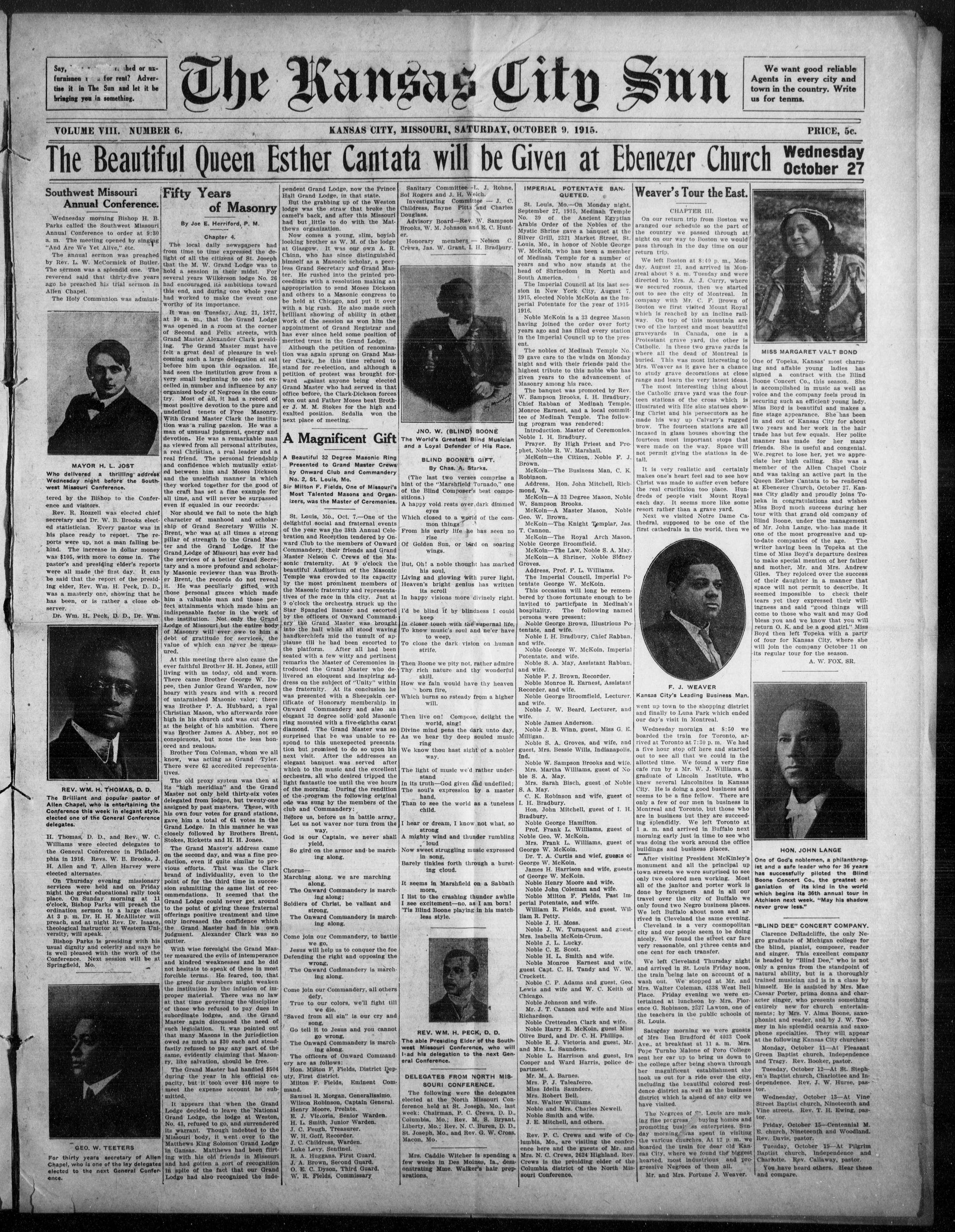
The Beautiful Queen Esther Cantata will be Given at Ebenezer Church Wednesday October 27
Say, I rented or unfurnished it for rent? Advertise it in the Sun and let it be bringing you in something.
VOLUME VIII. NUMBER 6.
Southwest Missouri Annual Conferences
Wednesday morning Bishop H. B. Parks called the Southwest Missouri Annual Conference to order at 9:30 a. m. The meeting opened by singing "And Are We Yet Alive," etc.
The annual sermon was preached by Rev. L. W. McCormick of Butler. The sermon was a splendid one. The reverend said that thirty-five years ago he preached his trial sermon in Allen Chapel.
The Holy Communion was adminis-
MAYOR H. L. JOST
Who delivered a thrilling address Wednesday night before the Southwest Missouri Conference.
tered by the Bishop to the Conference and visitors.
Rev. R. Rozzell was elected chief secretary and Dr. W. B. Brooks elected statistician. Every pastor was in his place ready to report. The reports were up, not a man falling behind. The increase in dollar money was $105, with more to come in. The pastor's and presiding elder's reports were all made the first day. It can be said that the report of the presiding elder, Rev. Wm. H. Peck, D. D., was a masterly one, showing that he has been, or is rather a close observer.
Dr. Wm. H. Peck, D. D., Dr. Wm.
REV. WM. H. THOMAS, D. D.
The Brilliant and popular pastor of Allen Chapel, who is entertaining the Conference this week in elegant style, elected one of the General Conference delegates.
H. Thomas, D. D., and Rev., W. C. Williams were elected delegates to the General Conference in Philadelphia in 1916. Revs. W. B. Brooks, J. H. Allen and T. Allen Harvey were elected alternates.
On Thursday evening missionary services were held and on Friday night the great educational rally took place. On Sunday morning at 11 o'clock, Bishop Parks will preach the ordination sermon to a large class. At 3 p. m. Dr. H. H. McAllister will preach, and at night Rev. Dr. Isaacs, theological instructor at Western University, will speak.
Bishop Parks is presiding with his usual dignity and celerity and says he is well pleased with the work of the Conference. Next session will be at Springfield, Mo.
GEO. W. TEETERS For thirty years secretary of Allen Chapel, who is one of the lay delegates elected to the next General Conference.
The Kansas City Sun
Fifty Years of Masonry
By Joe E. Herriford, P. M.
Chapter 4.
The local daily newspapers had from time to time expressed the delight of all the citizens of St. Joseph that the M. W. Grand Lodge was to hold a session in their midst. For several years Wilkerson lodge No. 26 had encouraged its ambitions toward this end, and during one whole year had worked to make the event one worthy of its importance.
It was on Tuesday, Aug. 21, 1877, at 10 a. m., that the Grand Lodge was opened in a room at the corner of Second and Felix streets, with Grand Master Alexander Clark presiding. The Grand Master must have felt a great deal of pleasure in welcoming such a large delegation at sat before him upon this occasion. He had seen the institution grow from a very small beginning to one not excelled in number and influence by any organized body of Negroes in the country. Most of all, it had a record of most positive devotion to the pure and undefiled tenets of Free Masonry. With Grand Master Clark the institution was a ruling passion. He was a man of unusual judgment, energy and devotion. He was a remarkable man as viewed from all personal attributes, a real Christian, a real leader and a real friend. The personal friendship and confidence which mutually existed between him and Moses Dickson and the unselfish manner in which they worked together for the good of the craft has set a fine example for all time, and will never be surpassed even if equaled in our records.
Nor should we fail to note the high character of manhood and scholarship of Grand Secretary Willis N. Brent, who was at all times a strong pillar of strength to the Grand Master and the Grand Lodge. If the Grand Lodge of Missouri has ever had the services of a better Grand Secretary and a more profound and scholarly Masonic reviewer than was Brother Brent, the records do not reveal it. He was peculiarly gifted with those personal graces which made him a valuable man and those perfect attainments which made him an indispensable factor in the work of the institution. Not only the Grand Lodge of Missouri but the entire body of Masonry will ever owe to him a debt of gratitude for services, the value of which can never be measured.
At this meeting there also came the ever faithful Brother H. H. Jones, still living with us today, old and worn. There came Brother George W. Dupee, then Junior Grand Warden, now hoary with years and with a record of unnished Masonic valor; there was Brother P. A. Hubbard, a real Christian Mason, who afterwards rose high in his church and was cut down at the height of his ambition. There was Brother James A. Abbey, not so conspicuous, but none the less honored and zealous.
Brother Tom Coleman, whom we all know, was acting as Grand Tyler. There were 62 accredited representatives.
The old proxy system was then at its "high meridian" and the Grand Master not only held thirty-six votes delegated from lodges, but twenty-one assigned by past masters. These, with his own four votes for grand stations, gave him a total of 61 votes in the Grand Lodge. In this manner he was closely followed by Brothers Brent, Stokes, Ricketts and H. H. Jones.
The Grand Master's address came on the second day, and was a fine production, even if quite similar to previous efforts. That was the Clark brand of individuality, even to the point of for the third time in succession submitting the same list of recommendations. It seemed that the Grand Lodge could never get around to the point of giving these fraternal offerings positive treatment and time only increased the confidence which the Grand Master had in his own judgment. Alexander Clark was no quitter.
With wise foresight the Grand Master measured the evils of intemperance and kindred weaknesses and he did not hesitate to speak of these in most forcible terms. He feared, too, that the greed for numbers might weaken the institution by the infusion of improper material. There was no law at that time governing the discipline of those who refused to pay dues in subordinate lodges, and the Grand Master again discussed the need of such legislation. It was pointed out that many Masons in the jurisdiction owed as much as $30 each and steadfastly refused to pay any part of the same, evidently claiming that Masonry, like salvation, should be free.
The Grand Master had handled $504 during the year in his official capacity, but it took over $16 more to meet the expense account he submitted.
It appears that when the Grand Lodge decided to leave the National Grand Lodge, the lodge at Weston, No. 43, refused to go, and surrendered its warrant. Though indebted to the Missouri body, it went over to the Matthews King Solomon Grand Lodge in Gansas. Matthews had been flirting with his old friends in Missouri and had gotten a sort of recognition in spite of the fact that our Grand Lodge had also recognized the inde-
pendent Grand Lodge, now the Prince Hall Grand Lodge, in that state. But the grabbing up of the Weston lodge was the straw that broke the camel's back, and after this Missouri had but little to do with the Matthews organization. Now comes a young, slim, boyish looking brother as W. M. of the lodge at Glasgow. It was our own A. R. Chinn, who has since distinguished himself as a Masonic scholar, a peerless Grand Secretary and Grand Master. He rushed into the printed proceedings with a resolution making an appropriation to send Moses Dickson and others to a Masonic congress to be held at Chicago, and put it over with a big rush. He also made such brilliant showing of ability in other work of the session as won him the appointment of Grand Registrar and has ever since held some position of merited trust in the Grand Lodge. Although the petition of renomination was again sprung on Grand Master Clark, he this time refused to stand for re-election, and although a petition of protest was brought forward against anyone being elected Grand Master who had served in that office before, the Clark-Dickson forces won out and Father Moses beat Brother J. M. M. Stokes for the high and exalted position. Sedalia won the next place of meeting.
A Magnificent Gift
A Beautiful 32 Degree Masonic Ring Presented to Grand Master Crews by Onward Club and Commandery No. 2, St. Louis, Mo. Sir Milton F. Fields, One of Missouri's Most Talented Masons and Organizers, was the Master of Ceremonies.
St. Louis, Mo., Oct. 7.—One of the delightful social and fraternal events of the year was the 38th Annual Celebration and Reception tendered by Onward Club to the members of Onward Commandery, their friends and Grand Master Nelson C. Crews of the Masonic fraternity. At 9 o'clock the beautiful Auditorium of the Masonic Temple was crowded to its capacity by the most prominent members of the Masonic fraternity and representatives of the race in this city. Just at 9 o'clock the orchestra struck up the Star Spangled Banner and escorted by the officers of Onward Commandery the Grand Master was brought into the hall while all stood waving handkerchiefs mid the tumult of applause till he had been escorted to the platform. After all had been seated with a few witty and pertinent remarks the Master of Ceremonies introduced the Grand Master who delivered an eloquent and inspiring address on the subject of "Unity" within the fraternity. At its conclusion he was presented with a Sheepskin certificate of Honorary membership in Onward Commandery and also an elegant 32 degree solid gold Masonic ring mounted with a five-eighth carat diamond. The Grand Master was so surprised that he was unable to respond to this unexpected presentation but promised to do so upon his next visit. After the addresses an elegant banquet was served after which to the music and the excellent orchestra, all who desired tripped the light fantastic toe until the wee hours of the morning. During the rendition of the program the following original ode was sung by the members of the club and Commandery:
Before us, before us in battle array,
Let us not waver nor turn from the
way.
God is our Captain, we never shall yield,
So gird on the armor and be marching along.
Chorus—
Marching along, we are marching along,
The Onward Commandery is marching along;
Soldiers of Christ, be valiant and strong,
The Onward Commandery is marching along.
Come join our Commandery, to battle we go,
Jesus will help us to conquer the foe Defending the right and opposing the wrong,
The Onward Commandery is marching along.
Come join our Commandery, all others defy,
True to our colors, we'll fight till we die.
"Saved from all sin" is our cry and song,
Go tell it to Jesus and you cannot go wrong,
The Onward Commandery is marching along.
The officers of Onward Commandery are as follows:
Hon. Milton F. Fields, District Deputy, First district.
Milton F. Fields, Eminent Command.
Samuel R. Morgan, Generalissimo.
Wilson Robinson, Captain General.
Henry Moore, Prelate.
E. J. Vicoria, Senior Warden.
H. L. Smith, Junior Warden.
J. C. Feugh, Treasurer.
W. H. Goff, Recorder.
J. C. Childress, Warden.
Luke Levy, Sentnel.
R. A. Huggans, First Guard.
J. A. Brown, Second Guard.
O. E. C. Dyson, Third Guard.
W. R. Fields, Commissary
Sanitary Committee--L. J. Rohne
Sol Rogers and J. H. Welch.
Sol Rogers and J. H. Weich.
Investigating Committee — J. C. Childress, Bayne Pitts and Charles Douglass.
Advisory Board—Rev. W. Sampson Brooks, W. M. Johnson and E. C. Hunter.
Honorary members—Nelson C. Crews, Jas. W. Grant, I. H. Bradbury.
JNO. W. (BLIND) BOONE
The World's Greatest Blind Musician and a Loyal Defender of His Race.
BLIND BOONE'S GIFT.
By Chas. A. Starks.
(The last two verses comprise a hint of the "Marshfield Tornado," one of the Blind Composer's best compositions.)
A happy void rests over dark dimmed eyes
Which closed to a world of the common things
From his early life he has seen no rise
Of Golden Sun, or bird on soaring wings.
But, Oh! a noble thought has marked his soul.
Living and glowing with purer light,
Heaven's bright genius has written its scroll
In happy visions more divinely right.
I'd be blind if by blindness I could keep
In closer touch with the supernal life,
To know music's soul and ne'er have to weep,
To close the dark vision on human strife.
Then Boone we pity not, rather admire Thy rich nature and thy wonderful skill.
How we fain would have thy heaven born fire,
Which burns so steady from a higher will.
Then live on! Compose, delight the world, sing!
Divine mind pens the dark unto day,
As we hear thy deep souled music ring
We know thou hast sight of a nobler way.
The light of music we'd rather understand
In its truth—God given and undefiled;
The soul's expression by a master hand,
Than to see the world as a tuneless child.
I hear or dream, I know not what, so strong
A mighty wind and thunder rumbling loud
Now sweet struggling music expressed in song,
Barely tinkles forth through a bursting cloud.
It seems in Marshfield on a Sabbath morn.
I list to the crashing thunder awhile
I see excitement—no, as I am born!
'Tis Blind Boone playing in his match-
less style.
REV. WM. H. PECK, D. D.
The able Presiding Elder of the South-
west Missouri Conference, who will
I-ad his delegation to the next General Conference.
DELEGATES FROM NORTH MIS-
SOURI CONFERENCE.
The following were the delegates
elected at the North Missouri Con-
ference held at St. Joseph, Mo., last
week: Chairman, P. C. Crews, D. D.
Columbia, Mo.; Rev. M. S. Bryant,
Liberty, Mo.; Rev. N. C. Buren, D. D.
St. Joseph, Mo., and Rev. G. W. Cross,
Macon, Mo.
Mrs. Caddie Witcher is spending a few weeks in Des Moines, Ia., domestrating Mme. Walker's hair preparations.
IMPERIAL POTENTATE BANQUETED.
St. Louis, Mo.—On Monday night, September 27, 1915, Medinah Temple No. 39 of the Ancient Egyptian Arabs Order of the Nobles of the Mystic Shrine gave a banquet at the Silver Grill, 2321 Market Street, St. Louis, Mo., in honor of Noble George W. McKolin, who has been a member of Medinah Temple for a number of years and who now stands at the head of Shrinedom in North and South America.
The Imperial Council at its last session in New York City, August 7, 1915, elected Noble McKoin as the Imperial Potentate for the year of 1915-1916.
Noble McKoin is a 33 degree Mason having joined the order over forty years ago and has filled every station in the Imperial Council up to the present.
The nobles of Medinah Temple No. 39 gave care to the winds on Monday night and with their friends paid the highest tribute to this noble who has given years to the advancement of Masonry among his race.
The banquet was promoted by Rev W. Sampson Brooks, I. H. Bradbury Chief Rabban of Medinah Temple Monroe Earnest, and a local committee of Medinah Temple. The following program was rendered: Introduction. Master of Ceremonies Noble I. H. Bradbury.
Prayer. By High Priest and Prophet, Noble R. W. Marshall.
McKoin—the Citizen, Noble F. J. Brown.
McKoin—The Business Man, C. K. Robinson.
Address, Hon. John Mitchell, Richmond, Va.
Mckolin—A 33 Degree Mason, Noble W. Sampson Brooks.
Mckoin—A Master Mason, Noble Geo, W. Brown.
McKoin—The Knight Templar, Jas. T. Cannon.
McKoin—The Royal Arch Mason. Noble Groombfield.
McKoin—The Law, Noble S. A. May.
McKoin—A Shriner, Noble Sldney Groves.
Address, Prof. F. L. Williams.
The Imperial Council, Imperial Potentate George W. McKoin.
This occasion will long be remembered by those fortunate enough to be invited to participate in Medinah's hospitality. The following named persons were present:
Noble George Brown, Illustrious Potentate, and wife.
Noble I. H. Bradbury, Chief Rabban, and wife.
Noble George W. McKoin, Imperial Potentate, and wife.
Noble S. A. May, Assistant Rabban, and wife.
Noble F. J. Brown, Recorder.
Noble Monroe R. Earnest, Assistant Recorder, and wife.
Noble George Broomfield, Lecturer and wife.
Noble J. W. Beard, Lecturer, and wife.
Noble James Anderson.
Noble J. B. Winn, guest, Miss G. E. Milligan.
Noble S. A. Groves, and wife, and guest, Mrs. Bessie Wills, Indianapolis, Ind.
Noble W. Sampson Brooks and wife, Mrs. Martha Williams, guest of Noble S. A. May.
Mrs. Sarah Bisch, guest of Noble S. A. May.
C. K. Robinson and wife, guest of I. H. Bradbury.
Hon. John Mitchell, guest of I. H. Bradbury.
Noble George Hamilton.
Prof. Frank L. Williams, guest of Noble Geo. W. McKoin.
Mrs. Frank L. Williams, guest of George W. McKoin.
Dr. T. A. Curtis and wief, guests of George W. McKoin.
James H. Harrison and wife, guests of George W. McKoin.
Noble Henry Moore and wife.
Noble John Coleman and wife.
Noble Milton F. Fields, Past Imperial Potentate, and wife.
William R. Fields, and guest, William R. Petty.
Noble J. H. Moss.
Noble J. W. Turnquest and guest, Mrs. Isabella McKoin-Crum.
Noble J. L. Lucky.
Noble C. E. Scott.
Noble H. L. Smith and wife.
Noble Monroe Earnest and wife, guest Capt. C. H. Tandy and W. W. Crockett.
Noble C. P. Adams and guest, Geo. Lewis and wife and W. C. Keith of Chicago.
Noble Johnson and wife.
Mr. J. T. Cannon and wife and Miss Richardson.
Noble Crettenden Clark and wife.
Noble Harry E. McKolin, guest Miss Olive Burd, and Dr. C. H. Phillips.
Noble E. J. Victoria and guest, Mr. and Mrs. L. Saunders.
Noble L. Harrison and guest, Ira Cooper and Ward Harris, police department.
Rev. P. C. Crews and wife of Columbia, Mo., are visiting the conference here and the guests of Mr. and Mrs. N. C. Crews, 2624 Highland. Rev. Crews is the presiding elder of the Columbia district of the North Missouri Conference.
Weaver's Tour the East.
CHAPTER III.
On our return trip from Boston we aranged our schedule so the part of the country we passed through at night on our way to Boston we would pass through in the day time on our return trip.
We left Boston at 8:40 p. m., Monday, August 23, and arrived in Montreal about 8 a. m. Tuesday and were directed to Mrs. A. J. Curry, where we secured rooms, then we started out to see the city of Montreal. In company with Mr. C. F. Brown of Boston we first visited Mount Royal which is reached by an incline railway. On top of this mountain are two of the largest and most beautiful graveyards in Canada, one is a Protestant grave yard, the other is Catholic. In these two grave yards is where all the dead of Montreal is buried. This was most interesting to Mrs. Weaver as it gave her a chance to study grave decorations at close range and learn the very latest ideas. The most interesting thing about the Catholic grave yard was the fourteen stations of the cross which is illustrated with life size statues showing Christ and his persecutors as he made his way up Calvary's rugged brow. The fourteen stations are all incased in glass houses showing the fourteen most important stops that were made on the way. Space will not permit giving the stations in detail.
It is very realistic and certainly makes one's heart feel sad to see how Christ was made to suffer even before the real crucifixion too place. Hundreds of people visit Mount Royal each day. It seems more like some resort rather than a grave yard.
Next we visited Notre Dame Cathedral, supposed to be one of the first cathedrals in the world, then we
F. J. WEAVER
Kansas City's Leading Business Man.
went up town to the shopping district and finally to Luna Park which ended our day's visit in Montreal.
Wednesday morning at 8:50 we boarded the train for Toronto, arrived at Toronto at 7:30 p. m. We had a five hour stop off here and started out to see all that we could in the allotted time. We found a very fine cafe run by a Mr. W. J. Williams, a graduate of Lincoln Institute, who knew several Lincolnites in Kansas City. He is doing a good business and seems to be a fine fellow. There are only a few of our men in business in Montreal and Toronto, but those who are in business but they are succeeding splendidly. We left Toronto at 1 a. m. and arrived in Buffalo next morning early just in time to see who was doing the work around the office buildings and business places.
After visiting President McKinley's monument and all the principal up town streets we were surprised to see only two colored men working. Most all of the janitor and porter work is done by foreigners and in all our travel over the city of Buffalo we only found two Negro business places. We left Buffalo about noon and arrived in Cleveland the same evening. Cleveland is a very cosmopolitan city and our people seem to be doing nicely. We found the street car fare very reasonable, onl ythree cents and one cent for each transfer.
We left Cleveland Thursday night and arrived in St. Louis Friday noon, the train being late on account of a wash out. We stopped at Mr. and Walter Macher Leane, 4338 West Bell Place. Friday evening we were entertained at luncheon by Mrs. Florence G. Robinson, 2527 Lawton, one of the teachers in the public schools of St. Louis.
Saturday morning we were guests of Mrs Ben Bradford of 4033 Cook Ave. at breakfast at 11 a. m. Mrs. Pope Turnbull Malone of Poro College sent her car up to bring us down to the college after being shown through her magnificent establishment she took us out for a ride over the city, including the beautiful colored residence district as well as the business district which is ahead of any city we have visited.
The Negroes of St. Louis are making fine progress, buying homes and promoting business enterprises. Sunday morning, was spent in visiting the various churches. At 12 p. m. we boarded the train for dear old Kansas City, where we found the biggest hearted, most industrious and progressive Negroes of them all.
Mr. and Mrs. Fortune J. Weaver.
We want good reliable Agents in every city and town in the country. Write us for tenms.
PRICE. 5c.
MISS MARGARET VALT BOND
One of Topeka, Kansas' most charming and affable young ladies has signed a contract with the Blind Boone Concert Co., this season. She is accomplished in music as well as voice and the company feels proud in securing such an efficient young lady. Miss Boyd is beautiful and makes a fine stage appearance. She has been in and out of Kansas City for about two years and her work in the hair trade has but few equals. Her polite manner has made for her many friends. She is useful and congenial. We-regret to lose her, yet we appreciate her high calling. She was a member of the Allen Chapel and was taking an active part in the Queen Esther Cantata to be rendered at Ebenezer Church, October 27. Kansas City gladly and proudly joins Topeka in congratulations and wishes Miss Boyd much success during her tour with that grand old company of Blind Boone, under the management of Mr. John Lange, who has made it one of the most progressive and up-to-date companies of the age. The writer having been in Topeka at the time of Miss Boyd's departure desires to make special mention of her father and mother, Mr. and Mrs. Andrew Giles. They rejoiced over the success of their daughter in a manner that space will not permit to describe. It seemed impossible to check their tears yet they expressed their will ingness and said "good things will come to those who wait and may God bless you and we know that you will return O. K. and be a good girl." Miss Boyd then left Topeka with a party of four for Kansas City, where she will join the company October 11 on its regular tour for the season.
A. W. FOX, SR.
HON. JOHN LANGE
One of God's noblemen, a philanthropist and a safe leader who for 36 years has successfully piloted the Blind Boone Concert Co., the greatest organization of its kind in the world which begins its 36th annual tour in Atchison next week. "May his shadow never grow less."
"BLIND DEE" CONCERT COMPANY.
Clarence DeRadcliffe, the only Negro graduate of Michigan college for the blind, pianist, composer, reader and singer. This excellent company is headed by "Blind Dee," who is not only a genius from the standpoint of natural ability, but is a thoroughly trained musician and is in a class by himself. He is assisted by Mrs. Mae C萨索 Porter, prima donna and character singer, who presents something entirely new for church entertainments; by Mrs. V. Alma Boone, saxophonist and reader, and by J. W. Toomey in his splendid ocarnia and saxophone specialties. They will appear at the following Kansas City churches:
Monday, October 11—At Pleasant Green Baptist church, Independence and Tracy. Rev. Booker, pastor.
Tuesday, October 12—At St. Stephen's Baptist church, Charlottee and Independence. Rev. J. W. Hurse, pastor.
Wednesday, October 13—At Vine Street Baptist church, Nineteenth and Vine streets. Rev. T. H. Ewing, pastor.
Friday, October 15—Centennial M. E. church, Nineteenth and Woodland. Rev. Davis, pastor.
Tuesday, October 19—At Pilgrim Baptist church, Independence and Charlottte. Rev. Callaway, pastor.
You have heard others. Hear these and compare.
AFRO-AMERICAN CULLINGS
One thing that appealed most to me was a little cottage set off in the corner of the grounds—the center of several acres, surrounded by garden, orchard, poultry yard, barn and pig pen, a home of the humble type, just such a home as work will give to any thrifty Negro; or white man, who wants to live, to make a home, relates a visitor to the Tuskegee institute. This is where every girl in the school has to spend a week during the term. She is given a small amount of cash—40 cents a day, and she has to manipulate with the others living with her during the period, having each an equal amount of change. So as to make a comfortable home for themselves, here is their real lesson in household duties, with a teacher to direct. The house consists of two bedrooms, kitchen, dining room, living room, pantry, bath, front and back porches.
The furniture made by the beginners in woodwork, indicating that anybody can make some furniture without much effort, at least with so much wood around have a bed, chairs, tables and a few benches. The windows are draped with cheesecloth, cross-stitched by the girls; the porters are made from croaker sacks or other rough material, dyed by pupils; settees are made the same way; rugs, home made; the students are taught here the care of beds, of closets, of woodwork, disinfecting, dish washing, cooking, setting table and all duties pertaining to housekeeping; they work the garden, gather and prepare the vegetables, care for chickens and the stock, even learn the care of garbage. Connected with the home is a flower garden and a playground. Do our mountain people, do our rural schools have such a chance in life? Why not?
I did not go there to find out what the northern capitalists were doing to educate the Negro. I had been told all of this. I knew what money would do. I went there to find out what Booker T. Washington and his wife were doing for the Negro and how the Negro was making use of the opportunity. I did not leave the grounds from the minute I drove in the Lincoln gate until I left for the depot. I ate and slept there in a home reserved by the school for white friends. I was treated with the same courtesy and attention as I have been accustomed to by the Negroes all of my life, and I profited by the experience and enjoyed every minute of my time.
Booker Washington was not there, but his wife was. She had done as much for the uplift of her race as he has. He has financed and planned and she has executed much of the details. She was born in Macon, Miss, educated at Nashville and taught in this institution before she married.
She is a very intelligent, industrious woman, with a strong purpose, and she is working the details of this problem of the poor and helpless among her people. She hopes to see the day when every Negro is trained to give the best of his sense and energy, when he is certain that work is the only way to attain a great end.
She has a handsome home and she keeps it well. She loves the South and speaks with gratitude of her friends in the North.
This training and environment will in time give to the white people of the South the competent service that was theirs in part; intelligent work is needed in every office. This is a work for the people of both races, as I saw it on my visit.
The movement of southern Negroes toward farm ownership has been one of the marked developments of the past decade. Nevertheless, even with a general knowledge of this movement, it is a surprise to learn that one-fourth of all the Negro farmers of the South own the farms they cultivate, and that their total value is $500,000,000. These are the figures offered by Dr. E. C. Branson of the University of North Carolina, who is one of a committee charged with the expenditure of $3,500,000 for the bettlement of the Negro. He reports that the colored man is solving his own problem, and is solving it in terms of industry and soil ownership. Negro population in the South is dwindling, says Doctor Branson, except in the states of Arkansas and Oklahoma, but it is increasing in the cities and decreasing in the country. The Negroes are rapidly changing from tenants to farm owners—Boston Transcript.
Talk about the intelligence of the people is discounted by the fact that a great many of them believe in madstones.—Exchange.
The Texas sweet potato crop will amount to 10,000,000 bushels this year. But residents of that expansive state are merely irritated by such diminutiveness. They say the figure should be ten times larger.
Many of the largest Japanese war ships have been equipped with wireless telephones which operate successfully for distances up to 100 miles.
Ore found in the Yellow Pine mining district of Nevada contains rich platinum deposits.
Importance of the Corn Crop.
Corn is king of all the crops. More than 20 per cent of all the improved farm land in the United States is annually devoted to the growing of corn. In 1914 105,000,000 acres were planted to corn in this country, producing 2,700,000,000 bushels, which brought the grovers $1,900,000,000. For nearly fifty years the land planted to corn has been equal if not greater than the acreage of all other cereal crops combined.
Corn from a standpoint of acreage
Illinois day exercises brought the Lincoln Jubilee and Negro Emancipation Semi-Centennial exposition to a close at Chicago. During the four weeks the show has been in progress at the Coliseum 100,000 persons have passed through the doors. Adjutant General Frank S. Dickson, representing Governor Dunne, was the chief speaker. During the afternoon of the closing day the commission in charge of the exposition held a conference with Thomas W. Swann, the Negro deposed as secretary two weeks previous. Swann and his attorney wrestled with the problem of straightening out his books and accounting for money handled by him. It developed that John V. Clinion, the attorney originally employed by Swann, had given up the case. It became known that new bills contracted by Swann without the knowledge of members of the commission had been presented for payment.
Total gate receipts during the four weeks of the exposition amounted to about $13,000. The most profitable day was Wednesday, when Mayor Thompson was the speaker. The amount taken in that day was $1,370, representing 5,480 paid admissions at 25 cents each. The cost of the exposition will total approximately $75,000. Of this amount $50,000 was appropriated by the legislature, and the additional amount, exclusive of gate receipts, raised by popular subscription.
Our good brother, President Leftwich, who is doing a unique work of phenomenal proportions among the Indians and Negroes of Oklahoma, was at the Hammond congress. He spoke briefly at both auditoriums, and was received with enthusiastic applause. No one who hears this humble hero for a moment doubts the feasibility of his stupendous undertaking, or his resourcefulness in carrying it through. Friends who heard him voluntarily contributed $205 of the amount needed to complete his buildings.
It is Brother Leftwich's hope that he may be able to extend the helping hand to thousands of young men and women of the Creek Indian and Negro races. President Leftwich is himself an ardent segregationist, and is at work on the problem of lifting up these needy races in a sensible way. His program is similar to that of Booker T. Washington, and so good a judge as P. H. Welshimer declares that he is not second to that great leader in fervor, good rense or eloquence.
President Leftwich needs $200 or $300 to complete his buildings—$500 would enable him to start in fine shape. The students are there ready for work, and the teachers available. Will not Standard readers supply the needed funds to launch this worthy enterprise? Where are the five men who will give $100 apiece? Let "our folks" speak out. -Baptist Standard.
Point Hope, Alaska, which is in darkness during the long arctic winter, will soon have an electric plant. Storms along the coast will be harnessed by windmills to produce the electricity.
Paraffin-wax models are made of every new British battleship laid down, and these models are tested in a tank specially erected for the purpose.
The survey of the results of half a century of Negro emancipation in the United States, presented in connection with the convention in Boston of the National Negro Business league, contains impressive statistics. The progress has been especially marked in the last fifteen years, as is shown by art advance from 20,000 Negro business enterprises in 1900 to 45,000, from two banks to 51, from 149 wholesale establishments to 240, from 10,000 retail concerns to 25,000. In the short period of ten years the value o. farm property owned by Negroes has advanced from $177,404,688 to $492,892,218.
The Glasgow Tramway corporation took in last year 689 tons of copper and 87 tons of silver in fares. The revenue amounted to more than 1,000,000 pounds, the latter figure being in money terms, however, not avoirdupois.
The first Porto Rican to be graduated from West Point received his diploma the other day. His name is Luis Raoul Esteves.
Rabbit fur is said to be supplanting wool in felt hat making in Australia, where 32 factories are in operation. The fur is considered much superior to the finest Merino for this purpose, and millions of rabbit skins are used annually.
For light duty one of the largest locomotive works in the United States is turning out a locomotive that resembles the coal-burning type in outline, but is driven by an internal combustion engine with oil or gasoline fuel.
yield and value exceeds every other crop.
Wherever corn is grown, there you find high-priced land and prosperous people.
No other crop can replace corn, but corn can readily take the place of any other grain crop. Corn is put to a greater number of uses than any other crop that grows. There are greater possibilities for improvement, yield and quality of corn than any other crop.—From a Lecture by P. G. Holden.
A
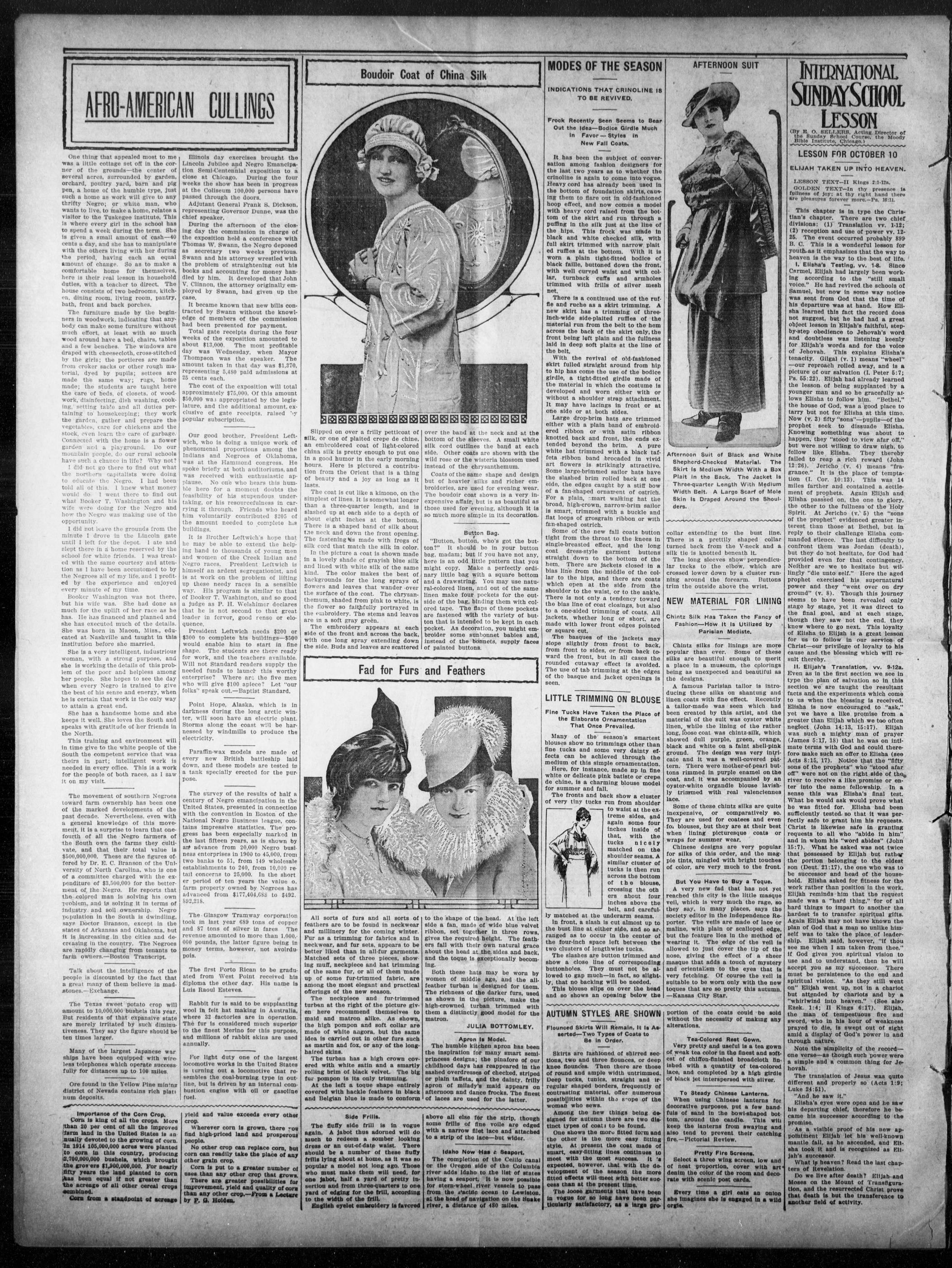
Slipped on over a frilly petticoat of silk, or one of plaited crepe de chine, an embroidered coat of light-colored china silk is pretty enough to put one in a good humor in the early morning hours. Here is pictured a contribution from the Orient that is a thing of beauty and a joy as long as it lasts.
The coat is cut like a kimono, on the simplest of lines. It is somewhat longer than a three-quarter length, and is slashed up at each side to a depth of about eight inches at the bottom. There is a shaped band of silk about the neck and down the front opening. The fastening is made with frogs of silk cord that match the silk in color over the band at the neck and at bottom of the sleeves. A small w silk cord outlines the band at a side. Other coats are shown with wild rose or the wisteria blossom instead of the chrysanthemum.
Coats of the same shape and debut of heavier silks and richer broderies, are used for evening w The boudou coat shown is a very expensive affair, but is as beautiful those used for evening, although so much more simple in its decora.
Button Bag.
"Button, button, who's got the top?" It should be in your
In the picture a coat is shown made in a lovely shade of grayish blue silk and lined with white silk of the same kind. The color makes the best of backgrounds for the long sprays of flowers and leaves that wander over the surface of the coat. The chrysanthemum, shaded from pink to white, is the flower so faithfully portrayed in the embroidery. The stems and leaves are in a soft gray green. The embroidery appears at each side of the front and across the back, with one long spray extending down the side. Buds and leaves are scattered
Fad for Furs and Feathers
THE FASHION WEEK
THE FASHION OF THE TWENTIETH CENTURY
All sorts of furs and all sorts of feathers are to be found in neckwear and millinery for the coming winter. Fur as a trimming for fabrics and in neckwear, and fur sets, appears to be better liked than in all-fur garments. Matched sets of three pieces, showing muff, neckpiece and hat trimming of the same fur, or all of them made up of some fur-trimmed fabric, are among the most elegant and practical offerings of the new season.
The neckpiece and fur-trimmed turban at the right of the picture given here recommend themselves to maid and matron alike. As shown, the high pompon and soft collar are made of white angora, but the same idea is carried out in other furs such as martin and fox, or any of the long-haired skins.
The turban has a high crown covered with white satin and a smartly rolling brim of black velvet. The big fur pompon is its only trimming.
At the left a toque shape entirely covered with hackle feathers in black end.
The fluffy side frill is in vogue again. A jabot thus adorned will do much to redeem a somber looking dress or an out-of-date waist. There should be a number of these fluffy frills lying about at home, as it was so popular a model not long ago. Those who must make them will need, for one jabot, half a yard of pretty insertion and from three-quarters to one yard of edging for the frill, according to the width of the frill.
English eyelet embroidery is favored
Side Frillis.
over the band at the neck and at the bottom of the sleeves. A small white silk cord outlines the band at each side. Other coats are shown with the wild rose or the wisteria blossom used instead of the chrysanthemum. Coats of the same shape and design but of heavier silks and richer embroideries, are used for evening wear. The boudoir coat shown is a very inexpensive affair, but is as beautiful as those used for evening, although it is so much more simple in its decoration.
"Button, button, who's got the button?" It should be in your button bag, madam; but if you have not any, here is an odd little pattern that you might copy. Make a perfectly ordinary little bag with a square bottom and a drawstring. You may use natural-colored linen, and out of the same linen make four pockets for the outside of the bag, binding them with colored tape. The flaps of these pockets are fastened with the variety of button that is intended to be kept in each pocket. As decoration, you might embroider some sunbonnet babies and, instead of the bombets, supply faces of painted buttons.
J
to the shape of the head. At the left side a fan, made of wide blue velvet ribbon, set together in three rows, gives the required height. The feathers fall with their own natural grace about the head at the sides and back, and the toque is exceptionally becoming. Both these hats may be worn by women of middle age, and the all-feather turban is designed for them. The richness of the darker fur, used as shown in the picture, make the high-crowned turban trimmed with them a distinctly good model for the matron.
Apron Is Model.
The humble kitchen apron has been the inspiration for many smart semiprincess designs; the pinafore of our childhood days has reappeared in the saashed overdresses of checked, striped or plain taffeta, and the dainty, frilly apron of milady's maid appears on afternoon and dance frocks. The finest of laces are used for the latter.
above all else for the strip, though some frills of fine volle are edged with a narrow fillet lace and attached to a strip of the lace—but wider.
Idaho Now Has & Seaport
The completion of the Ceilo canal or the Oregon side of the Columbia river adds Idaho to the list of states having a seaport. It is now possible for stern-wheel river vessels to pass from the pacific ocean to Lewiston, at the head of navigation on the Snake river, a distance of 480 miles.
Button Bag.
JULIA BOTTOMLEY.
MODES OF THE SEASON
INDICATIONS THAT CRINOLINE IS TO BE REVIVED.
Frock Recently Seen Seems to Bear Out the Idea—Bodice Girdle Much in Favor—Styles in New Fall Coats.
It has been the subject of conversation among fashion designers for the last two years as to whether the crinoline is again to come into vogue. Heavy cord has already been used in the bottom of foundation skirts, causing them to flare out in old-fashioned hoop effect, and now comes a model with heavy cord raised from the bottom of the skirt and run through a puffing in the silk just at the line of the hips. This frock was made in black and white checked silk, with full skirt trimmed with narrow plaited ruffles at the bottom. With it is worn a plain tight-fitted bodice of black faille, buttoned down the front, with well curved waist and with collar, turnback cuffs and armholes trimmed with frills of silver mesh net.
There is a continued use of the ruffie and ruche as a skirt trimming. A new skirt has a trimming of three-inch-wide side-plaited ruffles of the material run from the belt to the hem across the back of the skirt only, the front being left plain and the fullness laid in deep soft plaits at the line of the belt.
With the revival of old-fashioned skirt filled straight around from hip to hip has come the use of the bodice girdle, a tight-fitted girdle made of the material in which the costume is developed and worn either with or without a shoulder strap attachment. It may have lacings in front or at one side or at both sides.
Large drop-brim hats are trimmed either with a plain band of embroidered ribbon or with satin ribbon knotted back and front, the ends extended beyond the brim. A pure white hat trimmed with a black tafeta ribbon band brocaded in vivid art flowers is strikingly attractive. Some large-brimmed sailor hats have the slashed brim rolled back at one side, the edges caught by a stiff bow of a fan-shaped ornament of ostrich. For a plain, smart walking hat the broad, high-crown, narrow-brim sailor is smart, trimmed with a buckle and flat loops of grosgrain ribbon or with fan-shaped ostrich.
Some of the new fall coats button tight from the throat to the knees in single-breasted effect, and the long coat dress-style garment buttons straight down to the bottom of the hem. There are jackets closed in a bias line from the middle of the collar to the hips, and there are coats which open at the side from the shoulder to the waist, or to the ankle. There is not only a tendency toward the bias line of coat closings, but also to a one-sided trimming of coats. All jackets, whether long or short, are made with lower front edges pointed or square cut.
The basques of the jackets may slope slightly from front to back, from front to sides, or from back toward the front, but in all cases the rounded cutaway effect is avoided. The use of tab trimming at the edges of the basque and jacket openings is seen.
LITTLE TRIMMING ON BLOUSE
Fine Tucks Have Taken the Place of the Elaborate Ornamentation That Once Prevailed.
Many of the season's smartest blouses show no trimmings other than fine tucks and some very dainty effects can be achieved through the medium of this simple ornamentation.
Here, for instance, made up in fine white or delicate pink batist or crepe de chine, is a charming blouse model for summer and fall.
The fronts and back show a cluster of very tiny tucks run from shoulder
1
to waist at the extreme sides, and again some four inches inside of that, with the tucks nicely matched on the shoulder seams. A similar cluster of tucks is then run across the bottom of the blouse, crossing the otherers about four inches above the belt, and carefully matched at the underarm seams. In front, a slash is cut almost up to the bust line at either side, and so arranged as to occur in the center of the four-inch space left between the two clusters of lengthwise tucks. The slashes are button trimmed and show a close line of corresponding buttonholes. They must not be allowed to gap much—in fact, so slightly, that no backing will be needed.
This blouse slips on over the head and so shows an opening below the
Flounced Skirts Will Remain, it is Asserted—Two Types of Coats to Be In Order.
Skirts are fashioned of shirred sections, two and three flounces, or deep knee flounces. Then there are those of round and ample width untrimmed. Deep tucks, tunics, straight and irregular shaped borders, frequently of contrasting material, offer numerous possibilities within the scope of the woman who sews.
Among the new things being designed for autumn there are two distinct types of coats to be found.
One shows the more fitted form and the other is the more easy fitting style. At present the coat made of smart, easy-fitting lines continues to meet with the most success. It is expected, however, that with the development of the season the more fitted effects will meet with better success than at the present time.
The loose garments that have been in vogue for so long have been particularly satisfactory, as a large pro-
AFTERNOON SUIT
Afternoon Suit of Black and White Shepherd-Checked Material. The Skirt is Medium Width with a Box Plait in the Back. The Jacket is Three-quarter Length With Medium Width Belt. A Large Scarf of Mole Skin is Draped Around the Shoulders.
collar extending to the bust line. There is a pretty shaped collar turned back from the V-neck and a silk tie is knotted beneath it. The long sleeves show perpendicular tucks to the elbow, which are crossed lower down by a cluster running around the forearm. Buttons trim the outside above the wrist.
NEW MATERIAL FOR LINING
Chintz Silk Has Taken the Fancy of Fashion—How It Is Utilized by Parisian Modiate.
Chintz silks for linings are more popular than ever. Some of these silks are beautiful enough to perit a place in a museum, the colorings being as unexpected and beautiful as the designs.
A famous Parisian tailor is introducing these silks on shantung and linen coats with fine effect. Recently a tailor-made was seen which had been created by this artist, and the material of the suit was oyster white linen, while the lining of the rather long, loose coat was chintz-silk, which showed dull purple, green, orange, black and white on a faint shell-pink ground. The design was very intricate and it was a well-covered pattern. There were mother-of-pearl buttons rimmed in purple enamel on the coat, and it was accompanied by an oyster-white organdle blouse lavishly trimmed with real valenciennes lace.
Some of these chintz silks are quite inexpensive, or comparatively so. They are used for coattees and even floues, but they are at their best when lining picturesque coats or wraps for summer wear.
Chinese designs are very popular for silks of this order, and the magpie tints, mingled with bright touches of color, are very much to the front.
But You Have to Buy a Toque.
A very new fad that has not yet reached this city is the little masque veil, which is very much the rage, so they say, in many places, says the society editor in the Independence Reporter. The veils are made of lace or malline, with plain or scalloped edge, but the feature lies in the method of wearing it. The edge of the veil is allowed to just cover the tip of the nose, giving the effect of a sheer masque that adds a touch of mystery and orientalism to the eyes that is very fetching. Of course the veil is suitable to be worn only with the new toques that are so pretty this autumn.
—Kansas City Star.
portion of the coats could be sold without the necessity of making any alterations.
Tea-Colored Rest Gown.
Very pretty and useful is a tea gown of weak tea color in the finest and softest of chiffon-finished broadcloth finished with a quantity of tea-colored lace, and completed by a high girdle of black jet interspersed with silver.
To Steady Chinese Lanterns.
When using Chinese lanterns for decorative purposes, put a few handfuls of sand in the bowl-shaped bottom, around the candle. This will keep the lanterns from swaying and also tend to prevent their catching fire.—Pictorial Review.
Pretty Fire Screens
Select a three wing screen, low and of neat proportion, cover with art denim the color of the room and decorate with scenic post cards.
Every time a girl cats an onion she imagines she is engaged in a wild orgie.
INTERNATIONAL
SUNDAY SCHOOL
LESSON
(By B. O. SELLERS. Acting Director of
Bible Institute, Chicago.)
ELIJAH TAKEN UP INTO HEAVEN.
LESSON TEXT-II Kings 2:1-12a.
GOLDEN TEXT-In thy presence is fulness of joy; at thy right hand there are pleasures forever more.-Pa. 16:11.
This chapter is in type the Christian's chapter. There are two chief divisions; (1) Translation vv. 1:12; (2) reception and use of power vv. 12:5. The event occurred probably 899 B. C. This is a wonderful lesson for youth as it emphasizes that the way to heaven is the way to the best of life. I. Elisha's Testing, vv. 1-8. Since Carmel, Elijah had largely been working according to the "still small voice." He had revived the schools of Samuel, but now in some way notice was sent from God that the time of his departure was at hand. How Elisha learned this fact the record does not suggest, but he had had a great object lesson in Elijah's faithful, step-by-step obedience to Jehovah's word and doubtless was listening keenly for Elijah's words and for the voice of Jehovah. This explains Elisha's tenacity. Gilgal (v.1) means "wheel"—our reproach rolled away, and is a picture of our salvation (I. Peter 5:7; Ps. 55:25). Elijah had already learned the lesson of being supplanted by a younger man and so he gracefully allows Elisha to follow him. "Bethel," the house of God, was a good church to tarry but not for Elisha at this time. tarry but 3) not for Elisha at this time. Jericho (v.4) means "fragrance." It is the place of temptation (I. Cor. 10:13). This was 14 miles farther and contained a settlement of prophets. Again Elijah and Elisha passed on, the one to glory, the other to the fullness of the Holy Spirit. At Jericho (v.5) the "sons of the prophet" evidenced greater interest than those at Bethel, but in reply to their challenge Elisha commanded silence. The last difficulty to confront them was Jordan (death), but they do not hesitate, for God had provided even for that contingency. Neither are we to hesitate but willingly "die unto self." Here the aged prophet exercised his supernatural power and they "went over on dry ground" (v.8). Though this journey seems to have been revealed only stage by stage, yet it was direct to the final goal, and at each stage, though they saw not the end, they knew where to go next. This loyalty of Elisha to Elijah is a great lesson for us to follow in our service of Christ—our privilege of loyalty to his cause and the blessing which will result thereby.
II. Elijah's Translation, vv. 9:12a. Even as in the first section we see in type the plan of salvation so in this section we are taught the resultant facts and the experiments which come to us when the blessing is received. Elijah is now encouraged to "ask," yet we have a like promise from a greater than Elijah which we too often neglect (John 14:13, 15:17). Elijah was such a mighty man of prayer (James 5:17, 18) that he was on intimate terms with God and could therefore make such an offer to Elijah (see Acts 8:15, 17). Notice that the "fifty sons of the prophets" who "stood afar off" were not on the right side of the river to receive a like promise or enter into the same fellowship. In a sense this was Elijah's final test. What he would ask would prove what he was fitted for. Elijah had been perfectly tested, so that it was perfectly safe to grant him his requests. Christ is likewise safe in granting requests to all who "abide in him" and in whom his "word abides" (John 15:7). What he asked was not twice that possessed by Elijah but rather the portion belonging to the eldest son (Deut. 21:17), the one who was to be successor and head of the household. Elijah asked for fitness for the work rather than position in the work. Elijah reminds him that the request made was a "hard thing," for of all hard things to impart to another the hardest is to transfer spiritual gifts. Again Elijah may not have known the plan of God that a man so unlike himself was to take the place of leadership. Elijah said, however, "If you see me when I am taken from thee," if God gives you spiritual vision to use and to understand, then he will accept you as my successor. There must be persistence to the end and spiritual vision. "As they still went on" Elijah went up, not in a charlot but attended by chariots and by a "whirlwind into heaven." (See also Ezek. 1:4; II Kings 6:17). Elijah, the man of tempestuous fire and sword, who in his hour of weakness prayed to die, is swept out of sight amid a display of God's power in and through nature.
Note the simplicity of the record—one verse—as though such power were a simple and a common thing for Jehovah.
The translation of Jesus was quite different and properly so (Acts 1:9; Luke 24:51).
“And he saw it.”
Elisha’s eyes were open and he saw his departing chief, therefore he became his successor according to the promise.
As a visible proof of his new appointment Elijah let his well-known mantle fall, as he ascended, and Elijah took it and is recognized as Elijah’s successor.
What is heaven? Read the last chapters of Revelation.
Do we live after death? Elijah and Moses on the Mount of Transfiguration, and the resurrected Christ prove that death is but the transference to another field of activity.
A. F. and A. M.
N. C. Crews, Kansas City, Grand Master.
Deputy Grand Master, Richard Young, Lincoln, Neb.
young, McInnis, Neb.
Winn, McInnis, Plattsburg, Mo., Grand
Senior Warden.
Crittenden C. Clark, St. Louis
Grand Junior Warden.
H. H. Walker, St. Joseph, Grand Treasurer.
Geo. W. K. Love, Grand Secretary Kansas City, Mo.
W. W. Fields, Secretary of Masonic Relief, Cameron, Mo.
P. L. Pratt, Kansas City, Mo., Grand Lecturer.
Royal Arch Masons:
Grand High Priest—Geo. Bloom field, St. Louis.
Deputy Grand High Priest—T. G. McCampbell, Kansas City.
Grand King—A. L. Thomas, Jefferson City.
Grand Scribe—J. P. Moffett, Sedalia
Grand Treasurer—Chas. Griggsby Liberty.
Grand Secretary—E. S. Baker, Kansas City.
Grand Lecturer—W. H. McAdams Springfield.
Right Eminent Grand Commander
—Willis G. Moseley, Kansas City.
Deputy R. E. C.—Peter Kincade
Kansas City.
Grand Generalissmo—Joseph H
Cherwood, St. Paul, Minn.
Grand Inspector—T. G. McCampbell Kansas City.
Grand Captain General—James W
Beard, St. Louis.
Grand Senior Warden—Geo A
Johnson, Kansas City.
Grand Junior Warden—B. F. Gray
St. Joseph.
Grand Prelate—Henry Roan, St Louis.
Grand Recorder—James T. Cannon St. Louis.
W. G. Mosely, Chairman.
E. S. Baker, Secretary.
R. W. Foster, Treasurer.
W. C. Mallory, Sandy Meyera,
Wm. Washington, F. P. Porteet,
T. W. H. Williams, T. R. Coles,
J. E. Herriford, E. G. Lacey,
E. G. Miller, Robt. Wiley.
Lodge Directory
G
M. J.
Pritchard Lodge No. 42, A. A. J.
and Mason 4th Monday in each month.
A Master Masons in good standing
welcome. Ceoll Thompson, W.
H. SPIGENER, Secretary.
G
Rose Lodge No. 25, A. F. A. Men
Monday in each month. A.
Master Masons in good standing
M. T.; T. J. McCampbell, Sec. 7.
G
Mt. Olive Lodge No. 53, A. B
and A. M., meets the 2nd and
3rd Mondays in the master Masons are well
come. Sandy Myers, W. M.
Frank Lowe, Secretary, 181
Baltimore Ave.
I. O. I.
Queen Esther Court No. 43
Hale from the I. O. I. meets the first and third Mondays in each
10th and Campbell St. Kansas
City, Mo. Mrs. Bettie Davis
Q.; Rosa L. Jones, Chron.
1466 3rd St. Kansas City
Kas.
U. B. F.
King of the West Lodge No.
218 meets first and third Mondays in each month at 65W.
W. M., 1718 Euclid; Jas. Haris
Sec. Yce' 1732 Woodland Ave
Quinoleum Is Queen
"YES I Use Quinoleum and like it fine."
Just Follow Directions
Ours are the finest made preparations for the hair and face.
What We Manufacture—
Face Preparations.
Quinoleum Hair Grower..... 50
Quinoleum Hair Tonic..... 50
Quinoleum Hair Shampoo..... 25
A liberal sample of our new preparations, a fragrantly perfumed toilet powder and a velvety face powder in pink and flesh colors (brown) sent free with any order. Call Bell Phone West 1757. 26th and Parkway, Kansas City, Kas
List Your Vacant or Improved Property with
Wm. Hopkins
Modern Homes for Sale on
Easy Trems
Bell Phone East 3851
Kansas City Sun
One Year for ONE DOLLAR and FIFTY CENTS, cash or credit.
LEISURE HOUR REFLECTIONS FROM A QUIET CORNER.
It is commendable to have a long life, but under prescribed conditions, but a broad life, surely, is a good thing always. There are a great many of us who have a goodly number of years to our credit, but with all of these to recommend us, we can see that we have done but very little that really has been helpful to those around us.
This inability of helpfulness is due to many causes, and may be chiefly attributed to illiberality on the part of the individual. Long life can hardly be termed a blessing if it has been hewn to mere existence, if friendship, has lost its flavor, and if one's joy is only physical satisfaction, and if there is no hope to make the unborn day beautiful. The life that has been broad and liberal in thought, and unbiased from every viewpoint may end early in years, but is by no means incomplete, having fulfilled the mission of life.
It has been responsive to what is best in life—beauty, opportunity and to the call of nature, having been helpful, joyful and of use, and a worthy example to those in its sphere. It has loved birds and flowers, duty and song. It has listened to the stars, and to God, and to the voice of earth's need. Such a life whenever it culminates, is complete, in comparison to the one which stretches past the three-score years and more, content with its own narrowness.
Hundreds of thousands of lives are lost to the world's usefulness, because so many people are too narrow in their thought and views to think for the best, and to see things just as they should.
When James Smith came to the city to begin his carrer the thought foremost in his mind was to deal fairly with all whom he came in contact and to conduct himself in such a way as to demand the same treatment of others.
This was a policy he had adopted at his humble abode in the country, and he knew that it was one that must be carried out, go where he may, if he ever wished to be successful. Naturally there were many temptations offered him for wasting time, but he knew that the world was depending on him to contribute his share to its progress, not necessarily in a financial sense, but in the way of honesty, the best thought, proficiency, the doing of good deeds, and James Smith said he would do all of these, to the best of his ability.
There are many persons, old and young, who would do well to emulate the good example of James Smith, but they must first learn that their future success must be paid for by present sacrifice, and by rigid application through years to come, and by long hours and hard labor.
Just now, life offers us a bill for something to be paid for in the future, we may refuse to pay for it, but the years to come may find us bare-handed and with heavy hearts.
If we would be successful in the future we must pay for it now, but as far as doing wrong is concerned, life is always ready to let an account run for years before calling for a settlement. But all our successes must be paid for in advance; they must be paid for by hard work and long hours, constant application to whatever we have in hand, honesty and thrift, together with the determination to improve in our work and keep abreast of the times.
It is as foolish to postpone success to the distant future as it is to imagine you must go to some distant place to find it. The seed of success will germinate in almost any soil, and at almost any season. It all depends on the care given it. The place to succeed is here, and the time to succeed is now, providing, though, you have paid the price in former years.
So often we hear someone remark that someone else ought to have thoughts above their work, or present position. It is very well that we should aspire to higher things, and everyone should endeavor, no matter
what their line of work may chance to be, to improve each day, thereby bringing it to a higher level. Tow few of us though, reason along this line as we go about our daily tasks. So many who are serving others think it well enough to round out the allotted number of hours each day without taking into account the quality of their work.
Those who are fortunate enough to have work to do, whether in the cook's capacity, the school room, or in the position of bank president, will do well to dignify and bring honor to such work. The question should not be one of having thoughts above our work, but lifting our work above the level of our greatest thoughts, should be our highest aim, for the time is come when persons only who are thinking and working along such lines will be chosen to do the world's work.
DENNIS S. THOMJSON.
BLIND BOONE-HIS EARLY LIFE
AND ACHIEVEMENTS
Is the subject of a new book written by Melissa Fuell, B. S. D., an educator, a reader and a former vocalist with the Blind Boone Concert Company.
In the world of music Blind Boone stands in a class to himself. He is recognized by both black and white to be the most wonderful musical prodigy man has ever known.
The history of Blind Boone is as an open book to the masses who feel that they know him, see him and associate with him, but it is not for the present the author writes. She wants to perpetuate the memory of this great man; she wants to hold him up as an example to the youth and to future generations to show them how to rise, in spite of obstacles and adverse circumstances.
The brief history of his manager, John Lange, which is included in the book, will be an inspiration to those who are starting in business with practically nothing and trying to rise to the top round.
This book differs from the ordinary history in that it does not relate simply cold, stubborn facts but clothes the true life of the subject into the form of a beautiful story, simple and interesting to all who will read it.
Already the sales are flattering. The author has something the public wants. In time "Blind Boone, His Life and His Achievements" will be in the hands of every reading person in the United States. Put in your order today. For further information address headquarters, Miss Melissa Fuell, 915 Woodland avenue, City, or Phone Bell E3628J.
Books also on sale at the League Enterprise, 1521 East 18th street.
TROY. KAS.
Mr. James Binghaman of St. Joseph visited relatives in this city the past week....Mrs. Florence Hughes of St. Joseph was visiting friends in the city the past week....Mrs. Mary Schumache is attending the A. M. E. conference in St. Joseph this week, and is the guest of her daughter, Mrs. M. U. Webster....Mr. Bert Bremckenridge and daughter, Miss Hattie, of White Cloud spent Friday evening in the city with friends. They were on their way to the U. B. F. and S. M. T. picnic at Watena, but owing to the inclementity of the weather the picnic was postponed indefinitely, and they returned to their home Saturday....Mr. James Butler was transacting business in White Cloud Saturday....The people of Troy are very busy now working in the apple crop during the day and attending the street fair at night....Mr. and Mrs. Ira Wilkinson of White Cloud are visiting relatives in the city....Mr. Carl Holland of Watena is in the city to visit his mother, Mrs. Louisa Holland, who continues very ill....Katie Lightle and Mrs. Mollie Brown are still on the sick list....Mrs. Ada Lightle was shopping in St. Joseph the latter part of the week....Mrs. Riley Holland and children returned to White Cloud after spending several days in the city....Miss Leona McCurry, formerly a teacher of Elwood,
Mauns Dickey
Kan., passed through the city Sunday,
enroute to Hastings, Neb..Mrs. Amy
Snoddy visited her daughter, Mrs. Lizzie
Clark of St. Joseph Saturday and
enroute..Mrs. James Pennel of Falls
City, Neb., was in the city Saturday,
attending to matters in the court
house in regards to the estate of her
mother, Mrs. Mary Lamasters.
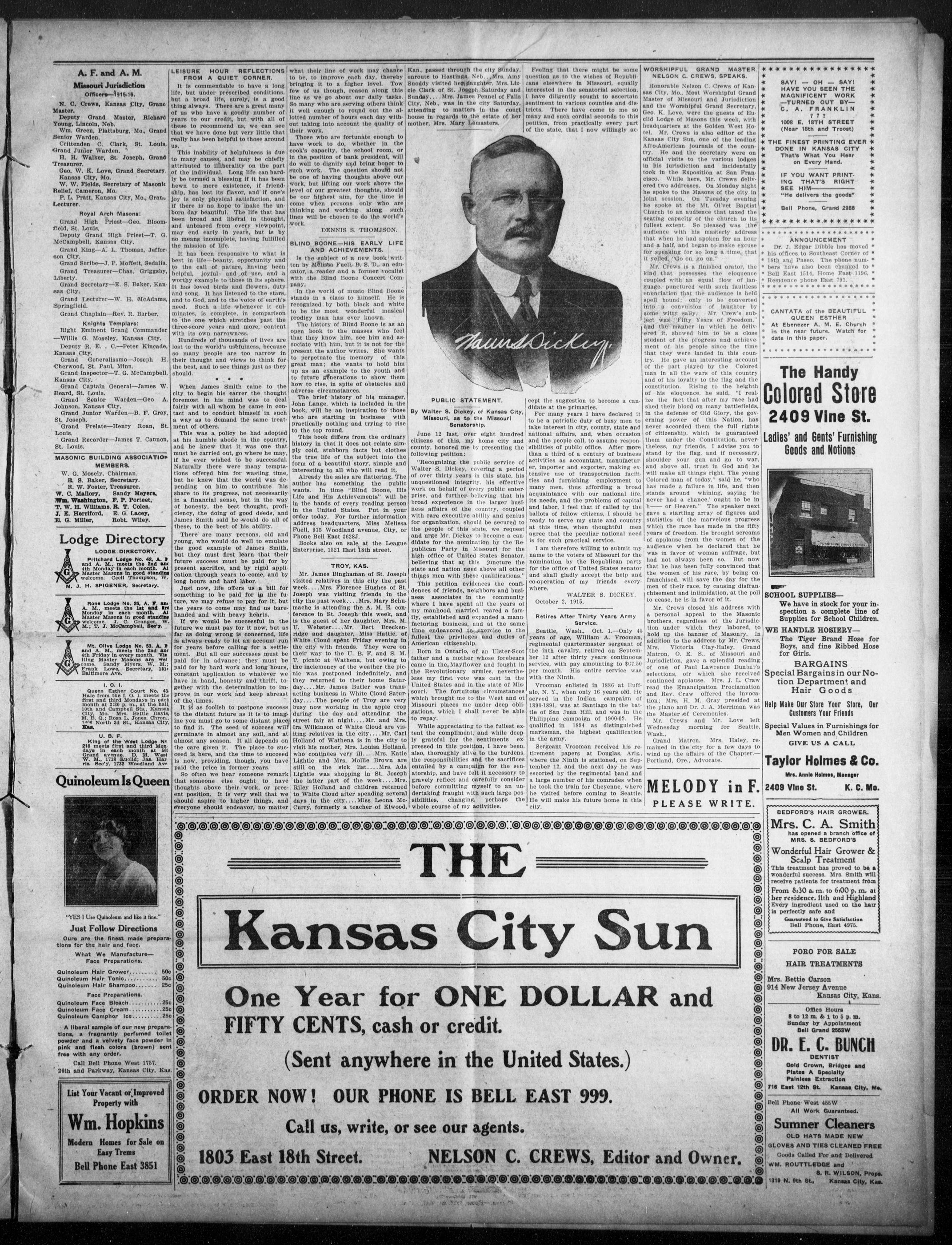
PUBLIC STATEMENT.
By Walter S. Dickey, of Kansas City Missouri, as to the Missouri Senatorship.
June 12 last, over eight hundred citizens of this, my home city and county, honored me by presenting the following petition:
"Recognizing the public service of Walter S. Dickey, covering a period of over thirty years in this state, his unquestioned integrity, his effective work on behalf of every public enterprise, and further believing that his broad experience in the larger business affairs of the country, coupled with rare executive ability and genius for organization, should be secured to the people of this state, we request and urge Mr. Dickey to become a candidate for the nomination by the Republican Party in Missouri for the high office of United States Senator, believing that at this juncture the state and nation need above all other things men with these qualifications."
This petition evidences the confidences of friends, neighbors and business associates in the community where I have spent all the years of my manhood, married, reared a family, established and expanded a manufacturing business, and at the same time endeavored to exercise to the fullest the privileges and duties of American citizenship.
Born in Ontario, of an Ulster-Scot father and a mother whose forebears came in the Mayflower and fought in the Revolutionary armies, nevertheless my first vote was cast in the United States and in the state of Missouri. The fortuitous circumstances which brought me to the West and at Missouri places me under deep obligations, which I shall never be able to repay.
While appreciating to the fullest extent the compliment, and while deeply grateful for the sentiments expressed in this position, I have been, also, thoroughly alive to the burdens, the responsibilities and the sacrifices entailed by a campaign for the senatorship, and have felt it necessary to gravely reflect and carefully consider before committing myself to an undertaking fraught with such large possibilities, changing, perhaps the whole course of my activities.
THE
Feeling that there might be some question as to the wishes of Republicans elsewhere in Missouri, equally interested in the senatorial selection, I have diligently sought to ascertain sentiment in various counties and districts. There have come to me so many and such cordial seconds to this petition, from practically every part of the state, that I now willingly ac
Dickey
cept the suggestion to become a candidate at the primaries.
For many years I have declared it to be a patriotic duty of busy men to take interest in city, county, state and national affairs, and, when occasion and the people call, to assume responsibilities of public office. After more than a third of a century of business activities as accountant, manufacturer, importer and exporter, making extensive use of transporation facilities and furnishing employment to many men, thus affording a broad acquaintance with our national life, its needs, and the problems of capital and labor, I feel that if called by the ballots of fellow citizens, I should be ready to serve my state and country at this time, when thoughtful men agree that the peculiar national need is for such practical service.
I am therefore willing to submit my name to the voters of Missouri for the nomination by the Republican party for the office of United States senator and shall gladly accept the help and co-operation of my friends everywhere.
WALTER S. DICKEY.
October 2, 1915.
Retires After Thirty Years Army Service.
Seattle, Wash., Oct. 1.—Only 44 years of age, William A. Vroman regimental quartermaster sergeant of the inth cavalry, retired on September 12 after thirty years continuous service, with pay amounting to $67.50 per month. His entire service was with the Ninth.
Vroman enlisted in 1886 at Buffalo, N. Y., when only 16 years old. He served in the Indian campaign of 1890-1891, was at Santiago in the batte of the San Juan Hill, and was in the Philippine campaign of 1900-02. He qualified in 1894 as distinguished marksman, the highest qualification in the army.
Sergeant Vrooman received his retirement papers at Douglas, Ariz. where the Ninth is stationed, on September 12, and the next day he was escorted by the regimental band and a large number of his comrades when he took the train for Cheyenne, where he visited before coming to Seattle. He will make his future home in this city.
WORSHIPFUL GRAND MASTER
NELSON C. CREWS. SPEAKS.
Honorable Nelson C. Crews of Kansas City, Mo., Most Worshipful Grand Master of Missouri and Jurisdiction and the Worshipful Grand Secretary, Geo. K. Love, were the guests of Euclid Lodge of Masons this week, with headquarters at the Golden West Hotel. Mr. Crews is also editor of the Kansas City Sun, one of the leading Afro-American journals of the country. He and the secretary were on official visits to the various lodges in his jurisdiction and incidentally took in the Exposition at San Francisco. While here, Mr. Crews delivered two addresses. On Monday night he spoke to the Masons of the city in joint session. On Tuesday evening he spoke to the Mt. Ol'Vet Baptist Church to an audience that taxed the seating capacity of the church to its fullest extent. So pleased was the audience with his masterly address that when he had spoken for an hour and a half, and began to make excuse for speaking for so long a time, that it yelled "Go on, go on."
Mr. Crews closed his address with a personal appeal to the Masonic brothers, regardless of the Jurisdiction under which they labored, to hold up the banner of Masonry. In addition to the address by Mr. Crews Mrs. Victoria Clay-Haley, Grand Matron, O. E. S., of Missouri and Jurisdiction, gave a splendid reading of one of Paul Lawrence Dunba's selections, or which she received continued applause. Mrs. J. L. Craw read the Emancipation Proclamation and Rev. Craw offered the invocation; Mrs. H. M. Gray presided at the piano and Dr. J. A. Merriman was the Master of Ceremonies.
Mr. Crews and Mr. Love left Wednesday morning for Seattle, Wash.,
Grand Matron, Mrs. Haley, remained in the city for a few days to wind up the affairs of the Chapter.—Portland, Ore., Advocate.
MELODY in F.
PLEASE WRITE.
SAY! — OH — SAY!
HAVE YOU SEEN THE
MAGNIFICENT WORK
—TURNED OUT BY—
C. A. FRANKLIN
???
CANTATA of the BEAUTIFUL
QUEEN, ESTHER
QUEEN ESTHER
At Ebenezer A. M. E. Church
in the near future. Watch for
date in this paper.
The Handy
Colored Store
2409 Vine St.
Ladies' and Gents' Furnishing
Goods and Notions
FURNISHING GOODS & FURNITURE
SCHOOL SUPPLIES
We have in stock for your inspection a complete line of Supplies for School Children.
WE HANDLE HOSIERY
The Tiger Brand Hose for Boys, and fine Ribbed Hose for Girls.
BARGAINS
Special Bargains in our Notion Department and Hair Goods
Help Make Our Store Your Store, Our Customers Your Friends
Special Values in Furnishings for Men Women and Children
GIVE US A CALL
Taylor Holmes & Co.
2409 Vine St. K. C. Mo.
Mrs. C. A. Smith
has opened a branch office of
MRS. S. BEDFORD'S
Wonderful Hair Grower & Scalp Treatment
This treatment has proved to be a wonderful success. Mrs. Smith will receive patients for treatment from
From 8:30 a.m. to 6:00 p.m. at her residence. 11th and Highland Every ingredient used on the hair is perfectly safe and
Guaranteed to Give Satisfaction
Bell Phone, East 4975.
PORO FOR SALE
HAIR TREATMENTS
Mrs. Bettie Carson
914 New Jersey Avenue
Kansas City, Kans.
Office Hours
8 to 12 m. & 1 to 5 p. m.
Sunday by Appointment
Bell Grand 2553W
DENTIST
Gold Crown, Bridges and
Plates A Specialty
Painless Extraction
716 East 12th St. Kansas City, Me.
Sumner Cleaners
OLD HATS MADE NEW
GLOVES AND TIES CLEANED FREE
Goods Called For and Delivered
WM. ROUTTLEDGE and
8. R. R. WILSON, Props.
1319 N. 9th St., Kansas City, Kas.
THE KANSAS CITY SUN PUBLISHED WEEKLY.
All communications should be addressed to
the Kansas City Sun, 1808 East 18th
Street
Bell Phone East 999.
Entered as second-class matter, August
12, 1968, at the postoffice at Kansas City,
Mo., under the date of March 5, 1879.
Nelson C. Crews.....Editor and Owner
Willa R Glenn.....General Manager
SUBSCRIPTION RATES:
One Year.....$1.50
Six Months.....75
Three Months.....50
ADVERTISING RATE, 50 CENTS PER
INCH.
CHURCH DIRECTORY.
Bethel A. M. E. Church, 24th and Flora.
St. Stephen's Baptist Church, 604 Charlotte.
Centennial M. E. Church, 19th and Woodland.
Second Baptist Church, 10th and Charlotte.
Allen Chapel A. M. E. Church, 10th and Charlotte.
Kansas Ave. Baptist Church, 46th and Bissau.
Ebebesser A. M. E. Church, 17th and Tracy.
St. Augustine's P. E. Church, 11th and Tracy.
Vine St. Baptist Church, 1235 Vine St.
Ward Chapel A. M. E. Church, 11th and Woodland.
Crystal Valley Baptist church, 1120 Crystal avenue.
St. John's A. M. E. Church, 1743 Beileview.
Seventh Day Adventist, 23rd and Woodland.
St. Monica's Catholic, 17th and Lydia.
Morning Star Baptist Church, 2311 Vine.
Highland Avenue Baptist Church, 1111 Bissau.
Centropolis A. M. E. Church, Centropolis, Mo.
St. James A. M. E. Z. Church, 1833
Woodland Ave.
Tribal Street Church, Roundtop,
People's Mission, 30th and Genesee.
St. Paul's Baptist Church, 19th and
Highland.
Friendship Baptist Church, 17th and
Tracy Avenue.
Pligrim Baptist Church, 614 Charlotte
St.
Pleasant Green Baptist Church, Independence Avenue and Tracy.
Calvary Baptist Church, 19th and
Akew.
Bigelow A. M. E. Mission, 5th and Lyda.
Progressive Baptist Church, 29th and Summit.
C. M. E. Church, 1317 Flora Ave.
St. James Baptist Church, 4058 Mill St.
St. Luke's A. M. E. Church, 43rd and Prospect Place.
A. M. E. Mission, 555 Grand Ave.
CLARK CHAPEL M. E. CHURCH,
1664 Madison Ave.
KANSAS CITY, KAN. CHURCHES.
First A. M. E. Church, 5th and Neb-
Pleasant Green Baptist Church, 1st and
splitit.
Eighth St. Baptist Church, 8th and Oakland.
Metropolitan Baptist Church, 9th and Washington.
M. E. Church, Water and Stewart Streets.
St. Paul A. M. E. Church, 21st and Ruby.
First Baptist Church, 5th and Neb.
King Solomon Baptist Church, 3rd and St. Paul.
Quindaro A. M. E. Church, Quindaro.
Pleasant Valley Baptist Church, Rosedale, Kan.
M. E. Church, 9th and Oakland.
A. M. E. Church, 4th and Oakland.
Salter Mission, A. M. E. Church, South Dakota.
Protestant Episcopal, 3rd and Stewart.
Second Baptist Church, 24th and Ruby.
Wesley Chapel M. E., 106 Shawnee.
M. Paul A. M. E. Zion Church, 4000 Adams.
Bethel A. M. E. Church, Rosedale, Kan.
M. Zion Baptist Church, 4th and Virginia.
Ebneren A. M. E. Church, Sanford and Trinity.
Mt. Zion Primitive Baptist Church, Westport avenue and Tangent street, Rosedale.
It is said now that, the "Bismark Garden" is not proving a howling success, even the white people refusing to go out on rainy, cold nights to drink "Marse Steve's" beer.
Some Negroes deliberately seek discrimination and insult. They seem to enjoy it. Otherwise they would remain away from places where these insults are held out. They have no race dignity whatever.
Again the foolish chauffeur has come forth with his employer's car at night. He has gathered up some foolish women and in the midst of their foolish whirl they collided with another car, injuring several persons and wrecking a car—all for the lack of good, common sense.
If Missouri has any more men like Nelson C. Crews send them to the Northwest we need them" this goes for Mrs. Victoria Clay Haley, the Royal G. M. also—Portland, Ore., Advocate.
Thanks Brother Kennedy, but old "Missou" has many Negro citizens like Crews and Haley. If you don't believe it "We'll show you."
Early in next month the Missouri State Teachers' Association will convene in this city. Everybody likes to visit Kansas City and a large number of visitors is expected. So far as the local colored teachers are concerned there does not appear to be much stir over the coming event. Prof. Grisham who was elected president after a hard campaign by his friends has given the work of preparing for the meeting over to another and up to this time very little has been done in the way of making up a program, aranging exhibits or entertaining the visitors. It's high time for someone to get busy.
Every once in a while a person may be heard complaining against his race newspaper for not publishing more news. Such person is seldom a subscriber or an advertiser. He usually borrows a paper, scans it carelessly, then knocks. He doesn't realize that his support and patronage would make the paper just what he wanted. He forgets that he is a member of a certain guild of Negroes who can see nothing good in their own race and never have time or money for its support. He forgets that on account of this very race weakness he is made the scum of the earth by stronger races, that because he grins and submits, he is ostracised, segregated and disfranchised. He forgets that if he would be a real man, protect his home, defend his women against insult, patronize his black brother in business and be true to his God he would be the most potent factor in American government.
---
M.
RT. REV H. B. PARKS, D. D.
Presiding over the largest district in the African Methodist Episcopal
Church.
NOTES ON RACIAL PROGRESS.
Reported by the National Negro Business League.
Joe Jeanette, famous pugilist, has retired from the ring and established a Jitney Bus Line in Hoboken, New Jersey.
The Extension Department of the Tuskegee Institute has just issued a new pamphlet entitled The Negro Pural School and Its Relation to the Community.
The Royal Circle of Friends, a fraternal organization, has donated $500 to the colored sufferers from the Texas flood. Dr. R. A. Williams of Helena, Arkansas, is the Supreme Ruler.
Charles H. Moore, National Organizer for the National Negro Business League, has been appointed field agent for the North Carolina association which is developing rural school work among the Negroes.
A successful Agricultural Fair has been held by the colored farmers at Tasley, Virginia. The attendance was large and the exhibits creditable. It is said that the directors declared a dividend of 40 per cent.
Frank C. Fane, treasurer of the Pullman Porters' Benevolent Association, has recently launched a movement to establish a home for aged and dependent men of the service. The association has its headquarters in New York City.
"Patterson-Greenfield" is the name of the new automobile made by the famous colored firm of buggy makers, C. R. Patterson & Sons, of Greenfield Ohio. The car is said to embody many distinctive features and to in every way measure up to the Patterson standard of excellence.
A Thought for the Week—Do you know that if 100 additional Negroes would patronize any one of our Negro enterprises, and spend only 25 cents apiece a week with him, in a year he would make $1,300? Suppose 500 Negroes would patronize him, in a short time his or her business would increase so rapidly that they would have to take on more help. Maybe then your son or daughter might be taken out of the field or kitchen to fill the position—Royal Messenger.
ROSEDALE, KANSAS
The services of the Pleasant Valley Baptist Church Sunday were very good. Rev. G. W. Dickerson delivered two very impressive sermons. He will speak at the Church Sunday, October 10. Come and hear him. The Texas Jubilee Singers rendered a splendid program at the church Friday evening to a large and appreciative audience and a neat sum was realized. We hope to have a return engagement.....Mr. F. D. Mallory of Topeka, Kan., is the guest of Mr. and Mrs. W. G. Pinkard. Electric lights have been installed in the St. Paul A. M. E. Zion church of which Rev. Jno. Harvey is the pastor and will be turned on Sunday evening at which time a program will be rendered.....Mrs. J. T. Haskell will leave Saturday for St. Paul, Min., to remain two months with her daughter, Mrs. A. Bond.
STATEMENT
Of the Ownership, Management, Circulation, Etc., of Kansas City Sun, Published Weekly, at Kansas
Editor—Nelson C. Crews, Kansas City, Mo.
Managing Editor—Nelson C. Crews Kansas City, Mo.
Business Manager—Willa M. Glenn
Kansas City, Mo.
Publisher—Nelson C. Crews, Kansas City, Mo.
Owner—Nelson C. Crews.
Known bondholders, mortgages and other security holders, holding 1 per cent or more of total amount of bonds mortgages or other securities—None
NELSON C. CREWS.
Signature of Editor.
Sworn to and subscribed before me this 5th day of October, 1915.
WILLA M. GLENN,
Notary Public, Jackson County, Mo.
My commission expires April 10, 1918.
Y. M. C. A. NOTES
With the coming of the cool weather, the men of the city who have been looking forward to living in the dormitories, are moving in. The steam has been turned on.
Dr. J. C. Caldwell, secretary of the Allen Endeavor League, will address the men's meeting next Sunday at 3:30 p. m. Dr. Caldwell is a great favorite at the men's meetings and has annually addressed the men of the Kansas City Association, for the past several years.
All persons interested in an advance movement for the Sunday School are urged to be present in the educational rooms of the Association on next Wednesday, Oct. 13, when Mr. R. L. Flynn, of the Metropolitan Y. M. C. A. will give an address on "The Boy and the Sunday School." Sunday School workers are urged to be present.
Messrs. Edward Ross and James Crews, leaders o f many campaigns, have been chosen to captain the forces for the Alligator and the Bullfrogs membership contest that is to be waged October 6 to 16, for ten days to get 100 members. Mr. Ross is captain of the Alligators; Mr. Crews of the Bullfrogs. On the opening night the Alligators were one in the lead of the Bullfrogs. All loyal Alligators (Reds) and Bullfrogs (Blues) are called to the colors.
TROY. KANSAS
By Mrs. Nellie E. Howard.
Mrs. Virgil Carter of Kansas City, Mo. is in the city staying with her aunt, Mrs. Louisa Holland, who is quite ill...Miss Lizzie Lightle was called home from Topeka, Kas. Tuesday to be at the bedside of her mother, Mrs. Katie Lightle...Rev. C. A. Woods is the new minister of the A. M. E. Church for the next ensuing Conference year. He comes to us from Lawrence and our expistor, Rev. P. W. Weaver, was sent to Arkansas City, Kansas. We wish each of the a splendid success. Mr. James Butler was taken quite ill again Sunday while upon the streets and is confined to his bed at this writing.....
Miss Mable Stillman of White Cloud, Kansas, was the guest of Miss Rosa Snoddy from Thursday until Saturday evening....Messrs. Henry and Alex Woodson of St. Joseph are visiting their sister, Mrs. Katie Lightle who continues very ill...Rev. E. D. Abbot of Huntsville, Mo. and Rev. Ray Davis of Cherryville, Kansas, stopped off in our city to visit old acquaintances after having attended the Conference in Kansas City, Kansas, and St. Joseph, Mo....Mr. James Binghaman of St. Joseph, Mo., is the guest of his sister, Mrs. Hannah Martin for a few days....Mrs. Ernest McCurry who has been in Kansas City Kas, for several weeks returned to the city Saturday....Mrs. Chas Shumache returned home Monday after attending the Annual A. M. E. Church Conference in St. Joseph, Mo., and being the guest of her daughter, Mrs. M. W. Webster.
JOPLIN, MO.
Services at the Unity Baptist church were good this week. Rev. A. J. Jones praached an excellent sermon to a well crowded house. Sunday Prof. McGirt of Philadelphia, Pa., had quite a success with his famous program. Prof. McGirt is a dramatic critic, a poet, and composer of several successful plays...Cupid is very busy here. Miss Fletta Hamilton was quietly married Monday evening to Mr. Walter Davis. Services at Handy and Trinity Chapel were well attended. Little Mable Jones is some what indisposed. The boys of the Jolly Social Club had much success. Dancing Monday night and Friday afternoon and night...Mrs. Peora Black of 108 Joplin Street has installed a telephone. Mrs. Black is meeting with much success as a hair dresser...Mr. and Mrs. Ernest Bass are at their new home, 417 Kentucky avenue. They are formely of Kansas City and will spend the winter here...Miss Ata Hicks and a party of friends of Neosho, Mo., motored to Joplin Saturday afternoon...Mr. and Mrs. D. B. James returned from an extended trip through the South and report that they found things very different from what they had always heard of the South...Mrs. H. C. Cunningham returned from a pleasant trip in the South.
Little Corner
—That snowballs make mighty poor eating with nothing to go along with it.
—That a woman always sits on the floor to put on her stockings and a man never does. Why?
—That there are some teachers doing things in Kansas City that only a fool would undertake. What?
—That the Negro who has got a job had better hold on awful tight if he wants to connect with the bread wagon this winter.
—That at a recent society event a certain Negro wore a full dress coat, red tie and palm beach pants. That's going some, ain't it?
—That it's a safe bet that Dr. Sampon Brooks of St. Louis will be one of the next Bishops of the A. M. E. Church. The Sun says Hurrah!
—That with gas gone already and coal out of sight picnic and good time Negroes had better hike for the sunny South. Hurry brother, hurry.
—That now that the Baptists have raised all kinds of h'll at their National Convention, its up to the Methodists to lynch some blatant, obstreperous Jackass at the next General Conference.
Beginning with next week's issue the Editor will give an account of his recent travels thru the "GOLDEN WEST," the people he met, the lines of business in which our people are engaged and the various things of interest which came under his observation. Watch for it!
Col. Alex Slater, efficient colored custodian and caretaker in the department of state, has been honored by the election as honorary life member of the Negro National Educational Congress, an organization devoted to the "uplift of the negro."
The notice of his election together with a handsome certificate of membership reached Col. Slater Monday. The document was signed by J. Silas Harris of Kansas City, president, and E. F. Hale, secretary of the educational congress.
He was invited to attend the Sedalia convention of the congress to be held soon and to participate actively in its deliberations.—Daily Capital
IN MEMORIAM
In loving memory of my dear mother, Martha Martin, who passed away just one year ago.
Dear mother you left me
Midst sorrow and tears.
The days have grown dreary and lone some
And it seems you have been gone for years.
In a quiet spot in Highland Cemetery Lies my mother dear.
Gone but not forgotten.
Her daughter, AMANDA SIMPSON
FOR RENT
1916 E, 11th, 6r. 17.50
1918 Michigan, 6r. 18.00
1919 Michigan, K, C, K, 4r. 19.00
1919 Locust, 3r. 10.00
1919 E, 5th, 6r. 7.00
1928 Kirkway, Quindarro, 9r. 10.00
1928 Northland, 6r. 15.00
1928 and Mich. 3rd apts. 10.00 and 11.00
1928 Euclid. 10.00
1928 Michigan, 6r. 10.00
1928 Holly, 6r. 12.00
1928 East 6th, 9r. 10.00
1928 East 6th, K, C, K, 4r. 10.00
1928 East 6th, 4r part. 10.00
1928 Vine, 5r. 15.00
1928 Vine, 5r, mod. 20.00
1928 Wyandotte, 10r. mod. 10.00
1928 Gartford, 8r. 14.00
1928 Euclid, 5r. 17.50
1928 Euclid, 8r. 14.00
1928 Alverde, Air and gas, 6r. 14.00
1928 Stoane, K, C, K, 3r. $10.00
1928 Pacific, 4r. $6.00
1928 Clinton, Rusede, 5r. $4.00
1928 Ford, 4r. $8.00
1928 Norton, 4r. $8.00
1928 Norton, 5r. $11.00
1928 Milton, 4r. $11.00
1928 Vine, rear 4r. $11.00
1928 Vine, 2nd 4r. $11.00
1928 Horst, 10r. $11.00
1928 Highland 18th, 5r, modern $15.00
1928 Highland—6 rooms $15.00
FOR SALE.
2621 Eulci 5r, mod, brick bungalow
Price, $2,500, $2,800; $200; $200
month
Vacant lot on Highland between 2441
and Howard, 75x130. Price, $1,250.
Vacant lot in South Park 25x180. Price.
$150.00; $25 down; $6 month.
Vacant lot, 1618 Agnes, 25x125—$600.00;
$60.00 down, $10.00 per month.
1515 E. 17th St.—5-room cottage, newly
decorated and painted. Price. $1,300;
$10 down and $14 per month.
Persons renting or buying from us will
be employed in our employment department.
Phones:—Home, 7555 M; Bell, 751 M.
TEACHERS OF KANSAS CITY
TEACHERS OF KANSAS CITY.
I would like to introduce to you through the columns of the Kansas City Sun, The Clover Leaf Casualty Insurance Co., of Jacksonville, Ill., which is an old line stock insurance company, with a capital stock of $125,000,00 fully paid.
The Clover Leaf is issuing the best health and accident policy for professional and business men and women of any other company. I have been in the employ of the Clover Leaf Casualty Co., as district manager for three years, most of which time has been given to the service of the people of St. Louis. I am in position to say with letters of endorsement from the business and professional people of St. Louis that the Clover Leaf is a strictly reliable company and pays its claims promptly and satisfactorily.
The Clover Leaf, which is a White company, is giving more Colored men and women employment in the nine states in which it is operating than any other company. We are arranging at this time to make a special canvass among the teachers of this city, and we hope when called upon by one of our agents that you will give him an opportunity to go over our contract and rates with you, and compare them with the insurance contract you are now carrying.
Yours for best services in this capacity, J. J. ALLEN, Dist. Mgr.
Office 1503 East 18th Street.
Phones: Bell East 1514; Home East 1196.
St. Louis, Mo., February 26, 1915.
To whom it may concern;
This is to certify that I have known Mr. J. J. Allen for the last three years, as an insurance agent of our city. Have had some business with him.
I have always found him trustworthy, earnest and intelligent in business matters. I believe that he will not abuse any confidence placed in him.
Kansas City, Mo., Sept. 23, 1915.
To whom it may concern:
I take pleasure in stating that the Clover Leaf Casualty Company writes the best Sick and Accident Policy that I have examined and investigated.
All claims are paid promptly and according to contract.
Mr. J. J. Allen, district manager, is in every way reliable and responsible.
Give him a chance to explain his policy.
R. T. COLES,
Principal Garrison School.
Rooms to Rent
FRONT ROOM, furnished, for rent; downstairs, bath 'and gas; traveling men preferred. 1514 E. 10th st.
FOR RENT—Furnished rooms near car line. 2051 North Third Street. Bell phone West 496.
FOR SALE—A nice golden oak piano by a private party. First class condition. Terms reasonable. Call or write the Sun for information.
WHAT IT TAKES TO BUILD YOUR BUSINESS JUST WE HAVE IT.
BUSINESS UP—WE HAVE IT.
We are offering Kansas City made goods, put up by the largest advertising concern in the West which naturally gives you the lowest possible price and the largest assortment from which to select your Calendars, Fans, Pencils, Changeable Signs, Novelties of all kinds—in fact everything for advertising. Just have our man call on you. No trouble. Crescent Advertising Agency, 1521 E. 18th St. Bell phone E 1521.
Don't Forget This
Don't Forget This
There is not any reason why a specialist, thoroughly qualified and who, by years of study becomes scientifically skilled in his or her specialty should not so inform those in distress and who earnestly seek relief from their sufferings. So if you are suffering from falling hair, dandruff, bald spots, or any scalp disease, you can be scientifically cured by the Slaughter System and Lydia's Hair Beautifier which guarantees to grow hair in six treatments or money refunded.
Treatment and instructions given by MRS. E. SLAUGHTER GAMBLE at 1509 East 17th Street. Special rates on everything.
"A man may, if he knows not how to save, keep his nose forever to the grindstone."—Poor Richard.
SPECIAL MONEY SAVERS
50 feet, improvements all in and cleaned, 1 block from two good car lines. For immediate sale, price $500. 4-room brick; gas and city water, street improvements in. For quick sale, price $1,650. 90x120 feet corner, every improvement in and paid for; near Brooklyn car. First mortgage, $1,400, equity for quick sale. $2,500. Or will trade for for residence at same figure. 5 rooms and bath; improvements in and paid, owners buying larger house, selling this on payment of $150 or $200 down at same price they bought it for, $2,000. Last of Riverside Park lots opposite Western University going at "dead easy" payments. Lots from $90 to $275; $5 down 50 cents weekly on some of them. Call and I'll show any of these properties. They're going to be sold within 10 days. I mean it.
EUGENE EDWARD VAUGHAN 26th and Parkway, K.C., Kas. Bell, West, 1757.
Negro Business and Professional Directory of Greater Kansas City
(Your name, business, address and telephone carried in this directory at 25 cents per month, $3.00 a year; less than one cent a day. Can you beat it? To secure space call Sun Office, Bell phone 999 East, or see our agent.)
CAFES.
DELMONICA CAFE, 1512 East 18th St. Bell phone, East 618.
CARPET CLEANERS.
EUREKA CARPET CLEANING CO., 1718-20 Euclid Ave. Bell phone,
East 3555; Home, East 4169.
COAL AND FEED.
W. W. PAYNE, 1902 1-2 Vine St. Bell phone, East 552; Home phone, East 4132.
E, 1902 1-2 Vine St. Bell phone, East 55
CLEANERS, DYERS AND TAILORS
ERS AND DYERS, guarantee not to a
y dye. 1518 East 18th street. Bell pho
EROS., 1831 Paseo. Bell Phone East 701
CLEANERS, DYERS AND TAILORS.
O. K. CLEANERS AND DYERS, guarantee not to shrink any garment they dye. 1518 East 18th street. Bell phone, Grand 2437.
WORTHAM BROS., 1831 Paseo. Bell Phone East 701.
DRUG STORES
FLORISTS.
T FLORAL CO., 1801 East 18th St. B
e phone, East 4070.
GROCERS.
N, 2644 Woodland Ave. Bell phone, East
CROSTHWAIT FLORAL CO., 1801 East 18th St. Bell phone, East 272. Home phone, East 4070.
GROCERS.
M. R. WILSON, 2644 Woodland Ave. Bell phone, East 1493.
LAUNDRIES.
RIC LAUNDRY CO., J. C. Hale, Mgr., 2
ne 3160.
CULATE LAUNDRY, 1912 East 18th S
THE ELECTRIC LAUNDRY CO., J. C. Hale, Mgr., 2928 Summit St. Home phone 3160.
THE IMMACULATE LAUNDRY, 1912 East 18th St. Bell phone East 4723.
LAWYERS.
WAY, 601 Delaware, Home phone M58, H
practices in all courts.
BON, 601 Delaware, Home phone M58, H
practical advice. Practices in all courts.
SOM, Attorney at Law, 307 Walnut street
East 2727, Home phone East 4070.
LEFORD, Attorney at Law, 516 Minne
Kas. Bell phone, West 3866.
C. H. CALLOWAY, 601 Delaware, Home phone M58, Bell phone Main 448. Practices in all courts.
W. C. HUESTON, 601 Delaware, Home phone M58, Bell phone Main 448. Legal advice. Practices in all courts.
MILLINERY
WASHINGTON, 849 Freeman Ave. B
bas City, Kas. Also hair work.
A HUBBARD, latest things in hats.
510 East 18th street. Bell phone E. 47
E WITCHER, 1708 Michigan Ave. Ma
Scalp Treatment. Bell phone, East 416
MISS EVA P. WASHINGTON, 849 Freeman Ave. Bell phone, West 2306, Kansas City, Kas. Also hair work.
MME. STELLA HUBBARD, latest things in hats. Old hats made new. 1510 East 18th street. Bell phone E. 4798.
MRS. CADDIE WITCHER, 1708 Michigan Ave. Madame Walker's Hair and Scalp Treatment. Bell phone. East 4167X.
PHOTOGRAPHERS
C. BRUCE SANTEE, Proprietor The Fad, 1607 East 18th St. Bell phone East 1643.
PHYSICIANS
DR. R. J. LAMBERT, Therapeutics, P. O. box 90A, Bell phone, Rosedale 523, Rosedale, Kas.
REAL ESTATE and EMPLOYMENT.
ICAN REAL ESTATE & INVESTMENT
11 McGee street.
e 751 Main. Home Ph
OPLE'S INVESTMENT CO., 2427 Vine
Home East 4011. Sol Smith, Pres.; C. I
SECOND-HAND GOODS.
NS, 2122 Vine St. Bell phone East 3851
AFRO-AMERICAN REAL ESTATE & INVESTMENT CO., Help furnished. 911 McGee street. Bell Phone 751 Main. Home Phone 7555 Main.
COLORED PEOPLE'S INVESTMENT CO., 2427 Vine St. Bell Phone East 1011, Home East 4011. Sol Smith, Pres.; C. H. Adkins, Tres.
SECOND-HAND GOODS.
W. G. HOPKINS. 2122 Vine St. Bell phone East 3851.
UNDERTAKERS.
EE, Licensed Embalmer, 2220 Vine St., Belle East 3341.
308., 1729 Lydia Ave. Bell Phone Gr
. Res., Bell East 3281.
C. H. COUNTEE, Licensed Embalmer, 2220 Vine St., Bell Phone, East 3336, Home East 3341.
WATKINS BROS., 1729 Lydia Ave. Bell Phone Grand 987, Home Main 7989. Res., Bell East 3281.
ALL WORK
CUSTOMER
NO DELAY
PRINLESS EXTERIOR
BY
VITALISED
AIR
CROWN BRIDGE
& PLATE WORK
BY
VITALISED
BRIDges
DI CHAPMAN
HERTISTE
CALDWELL & CHAPMAN
ISON
HAIR DRESSING & HILLIERING
WILLIAM SPILLER C.N.
Scalp Treatment a Specialty. Caldwell's Permead and Tonic really Grows Hair. Try it. Save your combings, cut hair and any old hat you may have.
CITY NEWS.
Mr. B. Wilkerson ill on Fourth street.
Mrs. Mamie Hill is still in Chicago looking after business.
Mrs. Fannie Graham is ill at her residence, 1106 Oak street.
Mrs. M. A. Milligan, 1111 North 10th street, Kansas City, Kas, returned.
QUINOLEUM MANUFACTURING COMPANY.
Prof. Roscoe and Mrs. Janie White will spend Monday and Tuesday in St. Louis.
Prof. and Mrs. A. R. Chinn of Glasgow, Mo., were visitors in the city last week.
Mr. Monroe Pope, 1510 North 9th street, Kansas City, Kas., is indisposed this week.
Mrs. W. W. Gross of Keokuk is visiting her sister, Mrs. Margaret Sannes at 2006 North Sixth.
Mr. Ermine White who has been visiting his brother, will leave for San Francisco next week.
FOR RENT—Four-room apartment; water and gas; 2nd floor; $12.00. Wm. H. Bradford, 2517 Mich.
Miss Anna Britt of Higginsville, Mo. was the guest of Miss Beulah Doug lass, 16 North Mill street.
FOR S
Several Strictly Mod
Residences.
For particulars, call
STEWART
1515 E. 18th
Bell Phone E. 489
ANNOUNC
Several Strictly Modern Steam Heated Residences. Best locality. For particulars, call at the office of
Bell Phone E.4893; Home E.4024
Chas. H. Adkins R. V. Adkins ADKINS BROS. & GREEN FUNERAL DIRECTORS AND EMBASSY Have purchased the People's Undertaking Co. give Kansas City the most up-to-date and taking establishment in the city Carriage or Auto Funerals at the San Our service will be unsurpass Chapel Free—Lady Attendants—Calls Answer Watch the Sun for our new local Present Location: 1211 EAST 18TH ST. Be R. F. GREEN, Licensed Embalmer and
FUNERAL DIRECTORS AND EMBALMERS
Have purchased the People's Undertaking Co. and are planning to give Kansas City the most up-to-date and complete Undertaking establishment in the city.
Carriage or Auto Funerals at the Same Price
Our service will be unsurpassed
Chapel Free—Lady Attendants—Calls Answered Night or Day.
Watch the Sun for our new location.
Present Location: 1211 EAST 18TH ST. Bell Phone, Grand 1568
R. F. GREEN, Licensed Embalmer and Manager.
Mrs. G. Gideon, Mr. and Mrs. Jerry Jarett of Tonganoxie were among the visitors here last week.
Mrs. Franeis Balthrop and little daughter will leave for Warensburg, Mo., to spend a few weeks.
Mrs. Z. E. Nelson, 1600 North 9th, Kansas City, Kas., made a business trip to Lawrence last week.
Mr. Walter Nelson of Reno, Kas., visited his grandmother, Mrs. A D. Hunes, 2108 North Third street.
CARDS.
Tango Club will soon be the leading club of Kansas City.
Miss Jessie Ford of Denver, Col. is the guest of Miss Halah Balthrop 1651 South Twentieth, Argentine, Kas
Mr. Rufus Logan, editor of the Professional World, is in the city this week the guest of Mr. and Mrs. John Lange.
Mr. George Scott, in charge cafe car from Chicago, was the guest of an old friend, Mr. G. A. Page, last Tuesday.
Mrs. Virginia Perkins of Odessa, Mo., visited her nice, Mrs. Lizzie Rhodes, 942 Washington street, Kansas City, Kas.
Prof. and Mrs. A. R. Chinn of Glasgow, Mo., and Mrs. M. Fisher were the guests of Mr. and Mrs. David Allen last week.
Mrs. Hackley, formerly of 2809 Myrtle, has now moved to 1210 East 17th street, where she will be pleased to see her friends.
Mr. Hobart, Fulbright returned from Omaha, Neb., and will spend the winter with his parents, Mr. and Mrs. N. G. Fulbright.
Miss Beulah Douglass, 16 N. Mill street, Kansas City, Kas., returned from Marshall, Mo., where she gave a successful recital.
Mrs. Cora Pentz will leave in two weeks to wint r in Denver, Colo.; we hope for her a pleasant stay though she will be greatly missed.
BIGELLOW CHAPEL.
Branch of A. M. E. church, Christian faith mission. Services at 11 a. m.; Sunday school 9:30 a. m.; services 2 p. m.; services 7:30 p. m. Tuesday night class meeting. Prayer meeting Wednesday night; Friday night preaching. Mrs. L. B. Aleman, 534 Lydia avenue.
---
Chas. H. Adkins
Mr. C. H. Brown of 1027 Freeman Avenue has returned home after a few weeks' visit with Mr. and Mrs. H. Walton at Tonganoxie, Kas.
Bishop Sidney Partridge of the Diocese of Missouri will hold communion services Sunday, October 9, at 11:00 o'clock, St. Augustine's Mission.
Mrs. Beatrice Sanders who was visiting in Denver, Colo., was called home to attend the bedside of her sister, Mrs. Magie McClarne Waters.
Mrs. Dollie Stevens, Grand Matron of the Heroines of Jericho, visited the Courts of the city last week and was a pleasant caller at the office of the Sun.
Prof. J. C. Hobbs is the leading dancing master. Prof. Frank Buckner and Walter Clark tie. Mrs. Janie White and Prof. Roscoe White are only holding their own.
The Noon Hour Gymnasium class has started with its usual vim "Doc" White's bunch lost Wednesday, two games out of three, but "Doc" says that it is only a temporary defeat.
The Bachelor Boys' club held their annual election of officers with a smoker at King Hotel cafe Wednesday evening, October 6. The following officers were elected: A. E Toney, president; Frank Vincent, vice president; James Williams, secretary; Clyde Bell, assistant secretary; Jas. A. Smith, treasurer.
SALE
Modern Steam Heated
Best locality.
All at the office of
T & SMITH
North Street
93; H0me E. 4024
CEMENT
ERS AND EMBALMERS
Identaking Co. and are planning to
up-to-date and complete Underr
ment in the city.
erals at the Same Price
I be unsurpassed
—Calls Answered Night or Day.
r our new location.
TH ST. Bell Phone, Grand 1565
Embalmer and Manager.
Mrs. J. W. Adams of Muskogee,
Okla., who was the guest of Mrs. W.
A. Jackson, 640 N. J. Avenue, Kansas
City, Kas., returned home Sunday,
October 3, after bein ghighly entertained by friends.
Mr. and Mrs. W. M. P. Emery of 912 Vine street, returned from a three weeks' visit with their father and mother, Mr. and Mrs. Chas. Childs of Childsville, Okla. They report a delightful time. They also visited in Boley, Okla.
Miss Nellie Palmer has resigned her position as head nurse at the Wheatly-Provident Hospital. The positivity will probably be filled at the regular meeting of the directors to be held at the Y. M. C. A. on next Tuesday evening, Nov. 12.
Mrs. Marie McClarne and Mr. Edw. Waters of Detroit, Mich., were married in Chicago during the former's recent visit returning home on account of illness. During Mrs. McClarne's stay she finished a four months' course in Hair work.
The party given on Mr. Joseph Rhodes Saturday evening, October 6, by his wife, Mrs. Lizzie Rhodes, was a delightful affair. Forty persons were served. A three-course lunch-eon was served. The decorations were yellow and green.
Don't fail to hear Miss M. L. Fitzhugh, the blind dramatic singer of the Fitzhugh Concert Co., at the Paseo Y. M. C. A. Wednesday evening, Oct. 13, 1915, at 8:30 under the management of the Sorosis Club for the bene fit of the Piano Fund. Admission 25 cents; children 10 cents.
Grandmaster N. C. Crows received the following telegram from Will Jackson, Worshipful Master, Sunset lodge No. 35, Ardmore, Okla.; J. Mill turner was caught in a three story building in a gas explosion. Kidneys and bladder injuries and also arm; may not be in immediate dan ger but growing worse.
What It Takes to Satisfy the Dancing
Public—We've Got It.
Dancing Wednesday nights, classes
Saturday nights. Armory Hall, Cottage and Vine Streets. Learn from a teacher that guarantees or money refunded. All dances taught in private classes. Bell phone East 2690. Prof. Roscoe White, dancing master. Mrs. Janie White, lady teacher. Prof. White's famous orchestra, Miss Neoma Thomas and Prof. Dude Knox Secure your season tickets.
R. F. Green
Mr. Luther Gregg, 1644 Cottage avenue, died September 23. A wife, stepmother, father and brother are left to mourn his demise. He was a member of Green Pasture lodge A. F. and A. M., and the Pullman Porters' association. The funeral was held September 26 at Centennial M. E. church, Nineteenth and Woodland avenue, Rev. Davis, the pastor, officiated.
Mrs. Nettle Z. Woods of St. Louis is visiting her relatives, M. and Mrs. N. C. Crews, 2624 Highland avenue, and Mr. and Mrs. James H. Crews, Twenty-eight and Woodland. She is the daughter of Rev. P. C. Crews, presiding elder of the Columbia district of the North Missouri conference, and was for many years one of Missouri's most successful teachers previous to her marriage.
The Federated Alumni of Greater Kansas City will give a benefit dance at Lyric Hall Friday night, October 15. The proceeds of the dance are to be used to assist in furthering the education of some high school graduate. This is a laudable and generous purpose and it is hoped the public will show its approval and appreciation in this effort by attending the dance.
THE BOOSTERS
Fourteen boosters with Rev. Thomas and Mrs. Peck met at the Paseo U. M. C. A. to make plans for a larger and a more wide awake Christian Endeavor.
CARD OF THANKS
We wish to thank our friends and neighbors for their sympathy and kindness shown us during the sickness and death of our beloved husband, son and brother; also the Green Pasture lodge, Pullman Porters' association and Rev. Richard Davis, and for the beautiful floral offerings.
MRS. LETHA GREGG, Wife.
MR. GEO. GREGG, Father.
MR. R. D. GREGG, Brother.
CARD OF THANKS
Miss Georgia Coleman, Miss Myrle McDaniels, Mrs. Nellie V. Hendricks, Mrs. Anna Snell, Mrs. Maud Price, Mrs. Effie Golden, Mrs. Willie Williams, Mrs. Pearl Dahney, Mrs. Stella Hubbard and Mrs. Lola Williams, I can not find words that half express my appreciation of the pleasant surprise tended me on October 5, and for the gifts you brought—the beautiful hand painted vase and book. The gifts I admire, but the thoughts which prompted the gifts I shall ever cherish. Sincerely,
MRS. JOHN A. JONES,
1722 Michigan Ave.
VINE STREET BAPISTH CHURCH.
Mr. Willie White is somewhat better at this writing...Mrs.' Nancy Cuby is at the general hospital....Sunday services were well attended. Two additions were made...Mr. Pleasant is somewhat better....Don't forget the Blind Dee concert October 13, given under the auspices of the Woman's Mission Circle. Don't fail to hear them....Our Sunday school is doing fine. All are invited to attend at 2:30 o'clock....The B. Y. P. U. is doing nicely....Next Sunday will be the election of officers. All are invited; 5:30 p. m. is the hour....Under the leadership of Mrs. Gertrude Tibbs the junior choir is doing fine.
SECOND BAPTIST CHURCH.
At the B. Y. P. U. last Sunday evening Mrs. Ida M. Beck conducted the meeting. Mr. Beck led the topic for discussion. An excellent program was rendered....Next Sunday Mrs. L. J. Bacote will conduct the meeting and Prof. Walden will lead the topic discussion....The Woman's Mission Circle had an interesting session last Friday night....The services last Sunday were fine. Dr. Bacote delivered a great sermon at the morning services. The Sunday School held an interesting and well attended session. The evening services were devotee to covenant meeting and the Lord's supper was partaken by an unusually large number.
The funeral of Sister Melissia Jessie, one of the pioneer members of Allen Chapel, was conducted by Rev. Thomas, Sunday, September 16, at 1 p. m. She was a mother of nine children of which four survive. Mrs. Annie Willings, Poala; Sallie Moore, John Jessie and Eliza Jessie. Eliza, the daughter with whom she lived, was indeed a true and devoted daughter. The nights or days were never too long for her to come to the rescue of a loving mother. She even sacrificed and gave up her domestic service to be at the bedside of that dear old mother she loved so well. Her remains were taken to Poala, Kaa, for burial and Eliza Jessie wishes to thank the many friends for their kindness toward her while in Poala. the many flowers given and the great crowd that met her helped to cheer in the hour of bereavement. I especially thank the Parkview Hotel for their donation and all who showed us kindness.
The stag beetle, a wood-boring insect, is used in some parts of the world, especially in the mountains of Italy, as a food. An Australian species of butterfly, called by the bushmen "buging," is a standard article of food there. They are caught clinging to the trees in the Bugony mountains, and great fires are made literally to cook them off. They are raked from the embers and ground into a pulp or flour for cake baking.
Laing's New Patent Incline Straightening Comb Just Out.
CROSS SECTION OF COMB
THE KING OF ALL STRAIGHTENERS
3¼-inch wide, 9½-inches long, guaranteed or money refunded.
THE KING OF ALL STRAIGHTENERS 3/4-inch wide, 91/2-inches long, guaranteed or money refunded.
Retail.....$1.00 EACH
The hair is immediately straightened while it passes between these wide teeth of the comb from the roots to the ends. The comb can be used both ways, right or left hand, by exchanging handle; a hole at each end. The comb will straighten the shortest hair around the neck and edges. The only reversible comb made on the market.
The hair is immediately straightened while it passes between these wide teeth of the comb from the roots to the ends. The comb can be used both ways, right or left hand, by exchanging handle; a hole at each end. The comb will straighten the shortest hair around the neck and edges. The only reversible comb made on the market.
HAIR DRESSING PARLOR
J. E. LAING
Hair Dressing Taught in All Branches, Manicuring, Facial Massage, also Hair Dressers' Supplies, Combings Made Over. We guarantee to Cure Different Scalp Diseases by Giving Different Scientific Treatments.
Manufacturer of instantaneous hair dye in black, brown, and blonde.
Manufacturer of all kinds of human hair goods, refined, bleach, and dye, any shade.
Manufacturer of wigs, toupes, doll wigs, French ventilating on nets made to order.
Manufacturer of Shampoo Drier and straightening combs. United States Patent Office, Washington, D. C., Serial 798947.
Manufacturer of face and hair toilet articles.
Colored People's Goods a Specialty—Mail Orders Promptly Filled.
MAIN OFFICE, 1715 EAST 18TH STREET
KANSAS CITY, MO.
Branch Office, 1616 North 10th St. Madam C. O. Smith, Mgr.
Kansas City, Kans.
Manufacturer of instantaneous hair dye in black, brown, and blonde.
Manufacturer of all kinds of human hair goods, refined, bleach, and dye, any shade.
Manufacturer of wigs, toupes, doll wigs, French ventilating on nets made to order.
Manufacturer of Shampoo Drier and straightening combs, United States Patent Office, Washington, D. C., Serial 798947.
Manufacturer of face and hair toilet articles.
Colored People's Goods a Specialty—Mail Orders Promptly Filled.
MAIN OFFICE, 1715 EAST 18TH STREET
KANSAS CITY, MO.
Branch Office, 1616 North 10th St. Madam C. O. Smith, Mgr.
Kansas City, Kans.
AGENTS WANTED EVERYWHERE.
A. BURDETTE FINE TAILORING
207 EAST SIXTH STREET
HOW ABOUT YOUR CLOTHES?
Our Fall Line is in for inspection.
LADIES' AND GENTS' SUITS TO ORDER
Cleaning and Pressing called for and delivered.
LADIES' AND GENTS' SUITS TO ORDER Cleaning and Pressing called for and delivered.
TO THE PUBLIC:
We want you to come to us for everything carried by a Drug Store, DRUGS, MEDICINES, TOILET ARTICLES, RUBBER GOODS, COMB5, BRUSHES, MADAM WALKER HAIR-GROWER-DRYING COMB5, STRAIGHTENING COMB5, ETC.
We recommend and guarantee everything offered for sale to be exactly as represented. WE DO NOT "SUBSTITUTE" nor ask you to take other brands than you ask for. You "want what you want" and we want you to have it.
OUR PRICES ARE RIGHT
All down the line. We give careful attention to all orders, and aim by courteous and fair treatment to give perfect satisfaction to our customers. When you think of Drugs think of THEO. SMITH'S PHARMACY.
No demand is too difficult for us to supply. If you are too busy to come to our store, phone us your wants and we will do the rest.
Mail Orders Sollicited and Promptly Filled.
We want you to come to us for everything carried by a Drug Store. DRUGS, MEDICINES, TOILET ARTICLES, RUBBER GOODS, COMBB, BRUSHES, MADAM WALKER HAIR-GROWER-DRYING COMBB, STRAIGHTENING COMBS, ETC.
We recommend and guarantee everything offered for sale to be exactly as represented. WE DO NOT "SUBSTITUTE" nor ask you to take other brands than you ask for. You "want what you want" and we want you to have it.
OUR PRICES ARE RIGHT
All down the line. We give careful attention to all orders, and aim by courteous and fair treatment to give perfect satisfaction to our customers. When you think of Drugs think of THEO. SMITH'S PHARMACY.
No demand is too difficult for us to supply. If you are too busy to come to our store, phone us your wants and we will do the rest. Mall Orders Sollicited and Promptly Filled.
Theo. Smith's Drug Store.
Ball Phone 4591 Grand. Home Phone 5467 Main.
1301 E. 18th St. KANSAS CITY, MO.
Bell Phone 4591 Grand. Home Phone 5467 Main.
1301 E. 18th St. KANSAS CITY, MO.
HOTEL PASEO AND CAFE
PASEO NEAR 18TH STREET
This hotel and cafe has been entirely remodeled and renovated throughout and surpasses in beauty and accommodations any other place in this great city. Large airy rooms, spacious dining room and an excellent bill of fare combined with its central and popular location makes it easily the most desirable place to stop in the city. Transients can find all the accommodations of home. Give us a call. Cafe open all night long. Under the successful management of Mrs. Mary King. Remember the location.
This hotel and cafe has been entirely remodeled and renovated throughout and surpasses in beauty and accommodations any other place in this great city. Large airy rooms, spacious dining room and an excellent bill of fare combined with its central and popular location makes it easily the most desirable place to stop in the city. Transients can find all the accommodations of home. Give us a call. Cafe open all night long. Under the successful management of Mrs. Mary King. Remember the location.
BELL PHONE. EAST 3744
1737 PASEO
A
A WONDERFUL HAIR DRESSER AND GROWER.
One thousand agents wanted. Good money made.
We want agents in every city and village to sell THE STAR HAIR GROWER. This is a wonderful preparation. Can be used with or without straightening irons.
Sells for 25c per box—one 25c box will prove its value. Any person that will use a 25c box will be convinced. No matter what has failed to grow your hair just give THE STAR HAIR GROWER a trial and be convinced. Send 25c for full size box. If you wish to be an agent send $1.00 and we will send you a full supply that you can begin work with at once; also agents' terms. Send all money by Money Order to
THE STAR HAIR GROWER MFGR.
1113 Clark Street.
Evanston, Ill.
SOLD AT COOPER & CAMPBELL'S DRUG STORE, Eighteenth and Paseo. Phones: Home, Main 7344; Bell, East 43.
Blind Boone!
HIS EARLY LIFE AND ACHIEVEMENTS
(By Miss Melissa Fuell)
Handsomely bound.....$1.50 In Morocco.....$2.
ON SALE AT LEAGUE ENTERPRISE BOOK STORE
Big Money to Canvassers.
Mailed Any Place at Net Prices.
CHAS. A. STARKS, GENERAL AGENT
1521 EAST 18TH ST. BELL PHONE E. 15
TAILORING AND CLEANING
1605 East 18th St., Kansas City, Mo., Bell, E. 539.
Improper cleaning and pressing ruins the construction and the shape of your clothes.
Garments of today are made by the most skilled designers of the 20th Century. The art of making a suit or a dress is done by experts; the iron being one of the Principal Factors in shaping a garment. The inner construction of your coat, is the foundation upon which it is built. Time and patience, the proper kind of canvas padding, hair cloth, wadding, etc., is carefully selected to get the desired results.
If such patience and skill are required to build your suit it is only reasonable that it requires the same to keep its shape; therefore, the inner construction and shape are at stake in the hands of the inexperienced.
It is vry easy for your garment to lose the Gracefulness and Body Lines if not Properly Pressed.
We are showing and selling suits from $18.00 and up. If you have a misfitting overcoat or suit that needs remodeling, send them to us. We specialize, for we look after the small things.
It requires a thorough knowledge of the business in taking a garment apart and altering it, giving the same article a fit to your figure and still retaining its life and satisfaction to the wearer. Ladies' suits, furs, winter coats relined, altered to the different styles, are successfully handled by us. A trial will convince.
THE OLD WAY OF PRESSING.
OUR CLEANING DEPARTMENT.
Everyone knows there are only two kinds of successful cleaning—DRY STEAM CLEANING. Steam Cleaning is the use of distilled water, newized soaps, borax, ammonia, the use of chemicals and a great deal of light and reasoning on account of the great variety of materials and the edition of the same. Articles steam cleaned require patience and reeling by the presser.
THE NOFF-MAN
Everyone knows there are only two kinds of successful cleaning—DRY and STEAM CLEANING. Steam Cleaning is the use of distilled water, neutralized soaps, borax, ammonia, the use of chemicals and a great deal of thought and reasoning on account of the great variety of materials and the condition of the same. Articles steam cleaned require patience and reshaping by the presser.
THE NEW WAY OF PRESSING.
OUR MACHINE is A GERM EXTERMINATOR. THE HIGH STEAMING PRESSURE KILLS THE EGG LIFE.
DRY or FRENCH CLEANING is the process of cleaning soiled garment, other textile fabrics by means of benzine, gasoline or similar volatile solids, which extracts the greasy matter, thereby removing the dirt.
It is indicated for goods which would be spilled by coming in contact in water, by losing the shape or original finish, or where the colors would be sufficiently fast for steam cleaning. Dry cleaning does not clean ever cycle perfectly, because benzine loosens the dirt held by greasy matter on a silk dress, has no influence on water, soluble matter like sugar and glue. Fiance, if you get wine, ice cream, or water spouts on a silk dress, benzine not remove the spot. You cannot treat the spot the same as you wool or cotton goods—silks of today are mostly artificial, tin-weighted and shed with glucose and other sizing properties.
The colors in silk are not deep dyed. To prove the same, if you slight a spot on silk, it removes the color.
Organized cleaners of today are fighting the artificial silk manufacture many of the best shops do not guarantee silks.
OUR MACHINE IS A GERM EXTERMINATOR. THE HIGH STEAM PRESSURE KILLS THE EGG LIFE.
DRY or FRENCH CLEANING is the process of cleaning soiled garments or other textile fabrics by means of benzine, gasoline or similar volatile solvents, which extracts the greasy matter, thereby removing the dirt.
It is indicated for goods which would be spoiled by coming in contact with water, by losing the shape or original finish, or where the colors would not be sufficiently fast for steam cleaning. Dry cleaning does not clean every article perfectly, because benzine loosens the dirt held by greasy matter only, but has no influence on water, soluble matter like sugar and glue. For instance, if you get wine, ice cream, or water spots on a silk dress, benzine will not remove the spot. You cannot treat the spot the same as you would for wool or cotton goods—silks of today are mostly artificial, tin-weighted and finished with glucose and other sizing properties.
The colors in silk are not deep dyed. To prove the same, if you slightly rub a spot on silk, it removes the color.
Organized cleaners of today are fighting the artificial silk manufacturers as many of the best shops do not guarantee silks.
Our HOFFMAN STEAM PRESS is a germ exterminator, even killing the life. One cannot be too careful as clothes worn by people in every way to reach some Tailor shop.
The HOLDEN TAILORING AND CLEANING SHOP is located at 16 Eighteenth Street near Eighteenth and Vine, and our Bell Phone at 539.
Our HOFFMAN STEAM PRESS is a germ exterminator, even killing the egg life. One cannot be too careful as clothes worn by people in every walk of life, reach some Tailor shop.
The GOLDEN TAILORING AND CLEANING SHOP is located at 1605 East Eighteenth Street near Eighteenth and Vine, and our Bell Phone is East 539.
A share of your business will be appreciated.
WASH
SEATED
IN COMFY
CHAIR
WE GUARANTEE
NO YELLOW
WASH
WITH THE
"SHOW-ME"
Home Phone East 4082 CALL US UP Bell Phone (At Eighteenth & Paseo) East 181 Toilet Articles Delivered
Home Phone CALL US UP Bell Phone
East 4082 (At Eighteenth & Paseo) East 1814
Toilet Articles Delivered
Prescriptions filled accurately and promptly
by Graduate Registered Pharmacists.
Anything
in
Drug Line
Peoples Drug Store Everything
for the
Toilet
PRESSING DEPARTMENT.
"SHOW-ME" WASHER
to do TWICE as much WASHING in the week EARNING twice as much money and use LESS SOAP and FUEL.
We GUARANTEE cleaner clothes and better COLOR.
Ask Mrs. Nannie Fields, 1333 Vine st., Mrs. Anna Simms, 1915 Oak st., Mrs. Nettle Johnson, 1806 E. Mrs. Emmi Jenkins, 1810 E. Howard st., Mrs. Georgia Lewis, 1501% E. 12th E. all are experienced Launces and have used and are using "SHOW-ME WRENES," and say they can do more work and not be so tired.
SAVE YOUR BACK AND HANDS YOU MAY ARRANGE WITH THE SUN FOR FREE TRIAL
ARRANGE WITH THE SUN FOR FREE TRIAL
H. A. MANUFACTURING CO.,
IRA C. HUBBELL, Pres.
4961 Wornall Rd., KANSAS CITY, MO
PATRIOTISM IS FIRST DUTY OF STURDY SWISS
Many of Them Sympathize With the Allies, but Demand Fair Treatment.
STANDS BETWEEN TWO FIRES
European Republic Declines to Be Overawed by Powerful Neighbors —Refuses to Starve or Be Driven Bankrupt—Would Fight for Rights.
By EDGAR ANSEL MOWRER, (Correspondent of the Chicago News.) Lausanne, Switzerland.—Seignobos, In his "Histoire Politique de l'Europe Contemporaine," begins his chapter on Switzerland as follows:
"The interest of Swiss history must not be measured by the size of the country. This little country holds a very important place in the history of contemporary European institutions. To whoever desires to understand the evolution of our modern democratic society, this history may be recommended as the most instructive selection of examples of the application of the principle of popular sovereignty."
Foreigners who know Switzerland, with or without having visited it, as a country of tourists, hotels, mountains, picturesque chalets, mountain railroads, glaciers, milk chocolate, St. Gall embroideries, cheese and refuges for revolutionists, may be pleased to know that of all the people of Europe the Swiss have, historically, been the most belligerently tenacious of their independence and that they are today the people who have gone farthest in the realm of popular government.
The "initiative" has been general since 1848, and the "referendum," considered a most radical, modernist measure, came in about the same time. Proportional representation was adopted by the Italian canton of Ticino as far back as 1891.
German Element Is Strong.
The Swiss confederation counts today approximately 3,450,000 inhabitants, of whom about 200,000 are Italian by race and language, 750,000 consider themselves French and the remaining 2,500,000 speak German. Thus the German element is by far the strongest numerically and the most important. It can control in federative political matters. The French cantons, with the important centers of Geneva and Lausanne and their excellent newspapers, play intellectually a role somewhat beyond that presumed by their numerical inferiority. The Italian element is relatively insignificant, although one of the most brilliant of the government ministers. Sig. Motta, comes from the Ticino. So much by the way of prelude to a presentation of Switzerland's position during the present great war.
At the beginning of hostilities the French and Italian cantons manifested a sturdy but inoffensive sympathy for the allies. The German cantons, to the contrary, gave vent to a single strong burst of Germanophilia. I have not taken account of the individuals whose sympathies are always with the side uppermost.
Today, though by stages so imperceptible that they cannot be traced, the situation has become different. Here in Romansh Switzerland the population is still overwhelmingly pro allies. There is little German in the streets or in the stores. As soon as Italy entered the war the Ticinese pronounced for Italy. It is not an exaggeration to say that, notwithstanding the German speaking majority, there are now in the country as many open adherents of the allies as of the Austro-Germans. This means that a large number of persons who speak German favor the nations of the quad rulie appellation, particularly France.
Swiss Industry Badly Hurt.
Swiss Industry Baury Hurt.
But a new economic problem has appeared and is forcing people to face it squarely. Switzerland, accustomed in time of peace to derive considerable profit from its fine scenery and its central position, now pays heavily for the latter. A large proportion of the national army has been mobilized at considerable expense and kept under arms since August, 1914. Industry is suffering. The foreigner comes but rarely to the countless hotels, which stand bleak and deserted like so many gigantic mausoleums. Only a few homeless individuals from foreign parts loiter in the streets—few by comparison with former years. Even the exiled revolutionary has quit the little country where he for so many years found sanctuary. A few frontier towns are centers of espionage and intrigue. That is all. The sun rises alone over the glaciers' fair desolation. There are no tourists shirving with or to turn away to hurry down the last slope homeward as he sets behind the purple mountains.
The country suffers from the loss of tourists. But most of all it suffers from the bonds and restrictions with which the warring nations, and chiefly those which command the sea, are endeavoring to correct it. During a year the strings have been drawn ever tighter and tighter. Because she lacks a seaport Switzerland can
Great Demand for Wood Product to Make Guncotton for Use in War.
Kane, Pa.—The enormous demand for acetate of lime, used in the manufacture of guncotton, has resulted in the greatest rush in history for Pennsylvania timber lands. Chemical manufacturers are buying all available timber tracts throughout this section, but have met with much competition from
NARROW ESCAPE OF AN AVIATOR
UNDERWOOD
UNDERWOOD
In this photograph, with his back turned to the cameras, an officer of the Royal Flying squadron is being removed from his aeroplane in a serious condition. While making a reconnoissance flight behind the German lines in Belgium, he was struck by shrapnel and his leg was almost severed. He lost consciousness, but after the machine had made a wild drop he revived sufficiently to check it, and landed safely.
breathe less easily even than Holland. Constant disputes are arising relative to contraband, conditional contraband, imports and their final consumer.
Is Between Two Fires.
is between two fires.
The situation finds adequate expression in the words of a contributor to the Gazette de Lausanne:
"Germany and Austria have said to Switzerland: 'We are perfectly willing to deliver you such raw materials as you lack. But, you must give us in exchange not money but certain products of which the allies' blockade deprives us and which we need.' The allies object to this, saying to Switzerland: 'From the beginning of the war we have placed our ships and our trains at your service, and, unlike our enemies, we have never thought of imposing compensations in goods upon you. In the future, as in the past, we are quite willing to furnish you with raw materials as well as with foodstuffs. Only, desiring that our blockade be effective, we ask you to give your word not to pass on in any form whatever to our enemies that which we procure for you.'
"Switzerland replies to the allies: I am grateful to you for supplying me with foodstuffs and raw materials without demanding compensation. Masters of the ocean, you have been able to do me this service, like good neighbors. Germany and Austria, although blockaded by your fleets, have also done what they could for me. Driven by need, they asked me to pay them in goods, while continuing to pay you in specie; and I have not refused, being myself hard pressed and neutral—that is, equally friendly to all and unwillingly to increase difficulties. In the meantime your fears are groundless, for I have taken care formally to forbid the exportation from my territories of a whole series of goods of urgent necessity. And I am always on the watch for smugglers.
Needs of Swiss Industry.
"On the other hand, my industries must live in spite of your war, on account of which I, though perfectly innocent, suffer more than you, perhaps, believe. And in order that my industries be not ruined they must be permitted to re-export to all countries the articles manufactured from raw materials furnished by no matter what belligerent. I am neutral of my own free will, but with your approbation. That is why, although I have obligations toward you (and I do not deny them), that you also have a few toward me, of which the first and essential is to let me live."
Here is the situation in a nutshell. The result of pressure from both sides, but principally from the side of the allies, has been to make the Swiss conscious of their nationality and to start a wave of patriotism. Negotiations are going on to regulate the matters of difference between the little mountain country and its powerful neighbors by establishing a Swiss control of all foreign trade with a view to doing away with chances for cheating. For the people will not listen to propositions from either side offering "compensation" after the war. They want the difficulty done away with now, immediately.
Would Fight for Rights
The Swiss are aware of their force. The effect of 35,000 sturdy, well-equipped and trained soldiers thrown into the balance today on either side would be considerable—might be decisive.
"We have been much too humble." men tell me here. "From now on we shall cease to supplicate and begin to demand, courteously but firmly."
"Would you fight?"
"Certainly, if forced to it. We refuse to starve or be driven bankrupt. England and France and Italy must be brought to realize this fact or face the consequences."
"But your personal sympathies, as you have just told me, are with the countries you mention."
"That is true. But you must realize that before we are German, French or Italian we are Swiss. We have our own country to look after. In any but an extreme case an attempt by the German-speaking majority to force the zation into wer against the
NARROW ESCAPE
In this photograph, with his back Royal Flying squadron is being removal. While making a reconnoissance glum, he was struck by shrapnel and consciousness, but after the machine clently to check it, and landed safely.
the New York and Pennsylvania company, which has paper mills at Lock Haven and Johnsonburg, the mill at the latter place being the largest in the United States. This company has just closed a deal for 5,000 acres of timber lands near Bradford, over the McKean county line.
During the last two months the paper company has purchased thousands of acres of timber land throughout the country, the most important being located in the states of Washington and Maine.
Copyright,
Ludwigsen & Oeschmann
The lack of ammunition, which the Russians say was the cause of their repeated defeats, has been put up to General Soukhomilnoff, who, until his removal, was the Russian war minister. For his alleged neglect of duty in permitting the Russian forces to run short of ammunition, he is to be tried by a superior court appointed by the czar himself. General Nicolas Petroff has been appointed president of the court.
allies would mean an immediate rupture between us and them and so bring about the ruin of Switzerland. But if the present restrictions, already bad, grow heavier instead of lighter, if the allies cannot be persuaded by our diplomats that although we ask only to live we put our entire strength behind this demand, then, German, French or Italian-speaking though we be, we shall fight side by side like a single man, as we would do tomorrow at the slightest infraction of our territorial rights. And I—well, I should fight too, even against nearly everything in the world I hold dear.
MUST KILL PRAIRIE DOGS
Texas Land Owners Are Compelled by Law to Destroy the Pests.
Austin, Tex.—Prairie dogs are declared to be a public nuisance, according to an act passed at the special session of the Thirty-fourth legislature and which act is now effective. The act also provides for their extermination, but no bounty is given by the state for eliminating the so-called pests; owners of land on which prairie dogs exist are required under the law to kill them and an allowance of two years is given to such owners to rid their lands of the nuisance.
It is also made the duty of the county commissioners of any county in which prairie dogs exist to investigate and determine whether owners of lands in their respective commissioners' precincts have complied with the provisions of the law.
In the event the owner of land on which prairie dogs exist fails to destroy such pests the act empowers the sheriff of the county involved to proceed and destroy the nuisance. For his service the sheriff is allowed five dollars a day for actual service, and this sum is to be paid by the county commissioners, but the amount so paid shall be assessed against the owner of land and the account or claim entered as a lien against the land in case of failure to pay the amount due the county.
Snakes Galore.
Clarkesville, Ga. — The killing of those thirteen rattlesnakes and pilots Rufus Harris killed some time ago was thinning snakes out some, but it is reported that there was the unreasonable number of 450 snakes killed on the farm of Willis Mullinax near here in one season.
OF AN AVIATOR
© UNDERWOOD & UNDERWOOD
turned to the camera, an officer of the
red from his aeroplane in a serious con-
se flight behind the German lines in Be-
d his leg was almost severed. He lost
had made a wild drop he revived suffi-
SWISS MAIDS FOR HIS GOATS
Delaware Man Will Have a Score of Alpine Beauties on His Farm.
Delaware City, Del.—Charles J. Winkler of Washington, who is about to start a goat farm along the Chesapeake canal, says he will employ a score of Swiss milkmaids. The girls are to come from goat farms on the snow-capped Alps. The goats are being shipped from Colorado.
HOW TO MAKE DRIED APPLES
Simple Method Which Will Insure Success If Directions Are Closely Followed.
Peel, core and slice the apples. Place them on clatters, wooden trays, or any other convenient receptacle and place them in the sunshine. Take them in at night and during rains; it is impossible to secure good dried fruit unless they are protected from moisture. Protect them from flies and other insects with netting, and place them out of the dust as far as possible. Continue the drying until the fruit has lost more than half its weight; if necessary, it may be placed in the oven for two or three hours at the end. Tie the dried fruit in paper sacks, using a double thickness if thin skin sacks are used, and suspend them from the ceiling of the dryest room available.
When ready to use the dried fruit, wash it well, soak it for six hours or longer, and throw away the liquid drained off. Then cook the fruit for several hours at a temperature slightly below the boiling point.—Mothers' Magazine.
USE PAPER JARS FOR JELLY
Have Advantage of Being More Easily Packed Without Danger of Breaking.
The paper family, already so helpful to the housewife, has a new member included in its circle—the paper jelly glass. It is of paraffin paper, like the drinking cup, and comes in several sizes, from two ounces to 16 ounces. The eight-ounce size costs about 15 cents a dozen. The advantage of the paper cup is that it can be packed more easily without danger of breaking and with less weight than the heavy glass jars. Again, there are many times when we want to give a glass of jelly to a friend and when we do not like to ask for the return of the glass. Yet the cost of many glasses is quite an item as contrasted with the cost of the paper tumbler. Also we often want to take a glass of jelly to a picnic and then we do not want the weight and bother of a heavy container. Here is where the paper cup has a distinct and permanent place with the housewife.
Chocolate Fig Cream
Scald two cupfuls of rich milk, add two squares of chocolate that have been melted over hot water, two tablespoonfuls of granulated sugar and a tiny pinch of ground cinnamon. Cook until well thickened and remove from the fire, and when cold fold in the stiffly beaten white of one egg and half a pint of cream that has been beaten solid with two tablespoonfuls of powdered sugar. Flavor with vanilla and turn into a two-quart freezer. Turn the crank until a slight resistance is felt, then add one large cupful of finely-chopped figs. Continue freezing until smooth and serve in tall crystal glasses, each portion topped with a tablespoonful of sweetened whipped cream.
Corn Dumplings.
Mix the contents of one pint can of fresh, grated corn with one-half pint of milk, six tablespoonfuls butter, two eggs, one-quarter teaspoonful pepper, one-half teaspoonful salt, one-half pint flour or enough to make a dough that is easily handled, one teaspoonful of baking powder. If corn is fuley, drain, tear off some pieces of the dough the size of a butternut and roll between the palms of hands, drop into smoking hot fat and cook until nicely browned. Serve with tomato or brown sauce.
Date Pudding.
One cafulp sour cream, one teapoonful soda, one cafulp surup, one small spoonful butter, one pound dates, one teapoonful cinnamon, one half teapoonful nutmeg, salt, enough whole wheat flour to form batter. Stone the dates and cut into halves. Mix ingredients with flour enough to make stiff batter and pour into deep greased mold and steam two and a half hours. Serve cold with cream and sugar.—Mother's Magazine.
Rock Cakes.
Rub three cupfuls of sifted flour with three ounces of butter. Add a quarter of a cupful of granulated sugar, three ounces of currants, an ounce of candied peel, cut in shreds, two teaspoonfuls of baking powder, a beaten egg, some grated nutmeg and milk, enough to make a stiff dough. Put on a greased tin in rough little piles, 12 or 15 of them. Bake for 25 minutes.
Dumplings That Never Fall
Two cupfuls of flour, two heaping teaspoonfuls of baking powder, one half teaspoonful of salt and one cupful of sweet milk. Stir and drop in small spoonfuls into plenty of water, in which meat is boiling. Boll with cover off for 15 minutes, then put cover on and boil 10 minutes longer. These are very fine with either beef or chicken.
Creamed Codfish.
Soak the fish three hours; boil in fresh water until tender; pick out all the bones; take one p.i.t. of milk and bring to the boiling point; thicken with a tablespoonful of cornstarch, dissolved in a little water, add a spoonful of butter, then stir in the fish, a good, large cupul or a little more; add two well-beaten eggs, let them cook and serve very hot.
A. Dainty Hint.
The odor of soap that often clings to clothes is not at all desirable. A lump of orris root put in the rinsing water for fine pieces such as handkerchiefs, lingerie and blouses will give a delicate violet perfume more permanent than that of the ordinary sachet.
Fried Beets.
Wash the beets carefully, drop them in boiling water and cook until tender. Drain, cover with cold water, rub off the the skins, cut in one-half inch slices, dredge with seasoned flour and fry on both sides in hot bacon or sausage fat.
CZAR'S
GRANDEST
PALACE
THE WINTER PALACE
THE famed winter palace of the Russian czar probably has seen more romantic history in the making than any other building in Europe. The dramas that have unfolded within its walls would overshadow, if told, the most highly colored imaginings of political fictionists, and the huge building appears worthy of all the fascinating memories which cling to it. For generations Russia has reached out from this home of the empire toward ever more distant frontiers, toward every compass point, building the greatest of states. The winter palace, a symbol of the empire, mayhap endangered by the present Teutonic invasion, is described in the following statement issued by the National Geographic society.
Among the many palaces of Petrograd, a city wherein dukes, grand dukes, diplomats and millionaires dwell in abundance, the czar's winter palace, a structure of truly imperial immensity, stands out unapproachable. It is one of the world's largest and most imposing buildings, and the air of its rooms and corridors is surcharged with the romance of history. During the capital seasons in peace times, the most brilliant court in Europe could be seen here, when the great rooms were ablaze with lights and jewels, and filled with a splendid display of gowns and uniforms.
Completed by Catherine.
The winter palace stands on the left bank of the Neva, on a site bequeathed to Peter the Great by his high admiral, Count Apraxia. The Empress Anne first made her residence in the admiral's house, which was pulled down in 1754 and the foundations of the winter palace laid. The building was first completed in the reign of Catherine the Great.
The whole interior of the palace was destroyed by fire in December, 1837, when valuables estimated at $20,000,000 were consumed. It was restored on an even more elaborate scale in 1839. The structure is four stories high, or about 80 feet, with a frontage of *55 feet and a width of 350 feet. The principal entrance, the "Perron des Ambassadeurs," is from the Neva river. Connected with the winter palace is the heritage of Catherine the Great, where the renowned queen played first Bohemian in a Bohemian throng.
There is a table hung on the walls of the palace, draped with a green curtain, which contains Queen Catherine's by-laws for the Hermitage societies. They were:
1. Leave your rank outside, as well as your hat, and especially your sword.
2. Leave your right of precedence, your pride, and any similar feeling outside the door. 3. Be gay, but do not spoil anything; do not break or gnaw anything. 4. Sit, stand, walk as you will, without reference to anybody. 5. Talk moderately and not very loud, so as not to make the ears and heads of others ache. 6. Argue without anger and without excitement. 7. Neither sigh nor yawn, nor make anybody dull or heavy. 8. In all innocent games, whatever one proposes, let all join. 9. Eat whatever is sweet and savory, but drink with moderation, so that each may find his legs on leaving the room. 10. Tell no tales out of school; whatever goes in at one ear must go out at the other before leaving the room."
Good rules all, but rules difficult for any but a queen to hold before her friends. The penalty for breaking the rules was the drinking of a glass of cold water for every offense. The queen was most severe with those who broke the tenth commandment; they were never again admitted to the hermitage, after being once found guilty or tittle-tattle.
garden, and some dark red palaces. The remarkably diversified life of the remarkable empire flows in a never ending stream along this avenue.
What Did She Care?
Cleopatra dissolved the pearl.
"But," we warned her, "think how many oysters you will have to eat to find another."—Judge.
When the Birds Wake Up.
An enthusiastic ornithologist has amused himself by investigating the question at what hour in summer the commonest small birds wake up and sing. He says: "The greenfinch is the earliest riser, as it pipes as early as half-past one in the morning. At about half-past two the blackcap begins, and the quail apparently wakes up half an hour later. It is nearly four o'clock and the sun is well above the horizon before the real songster appears in the person of the blackbird. He is heard half an hour before the thrush, and the chirp of the robin begins about the same length of time before that of the wren. Finally, the house sparrow and the tomtit occupy the last place on the list."
This investigation has altogether ruined the lark's reputation for early rising. That much-celebrated bird is quite a sluggard, as it does not rise till long after chaffinches, linneta and a number of hedgerow birds have been up and about for some time.
Japan is the only oriental country in which sheet glass is manufactured.
An immense square before the palace gives it the proper dignity of setting. Within, it is said, 3,000 people can dance under the blazing light crystals at one time, while 2,000 people can be seated at the great dinner gatherings. The palace is a treasure house of relics, jewels and paintings. One of the finest collections of pictures in Russia is hung on the palace walls, among them numerous excellent war pictures. Among the jewels stored there there is a scepter with one of the largest diamonds in Europe, 19% carats, the great Orloff diamond, which was originally the eye of a lion that crouched before the throne of the Great Mogul.
When the czar is in the vicinity of his capital, the imperial standard floats from the winter palace flagataX. Petrograd, the city made to the order of Peter the Great to serve as Russia's political capital, now probably at higher tension than any other city on earth, performing, as ever, the work necessary to the administration of church and state over vast distances, from the Gulf of Finland to the Black sea and the far pacific, and, besides, taking care of a great war business, which includes planning for the defense of more than 30,000 miles of frontier. This 30,000 miles of frontier, of course, does not take into account the vaguely known northern boundary of the empire.
Petrograd's High Tension.
Petrograd has always been a high-tension city. It was constructed upon islands and swamps at the behest of a high-tension ruler; built with wide, straight streets upon a perfectly flat country, with no softening natural beauty except that of its dividing Neva, a river that has often been compared to the English Thames. Even the architecture of the city is repressive, almost wholly of sternly chaste classic Roman and Greek. And in this city the primary business has been that of caring for a vast empire, embracing in its far-reaching sweep many peoples, numerous religions, diverse traditions, a confusion of tongues, and widely varying ideals. The responsibilities of government have held the city as tense as when its founder, with 40,000 workmen, drained the Neva swamps and built overnight his capital hard upon the lands of the Finnns.
Petrograd is the greatest importing center of the empire. A great part of the products of Europe which find their way to the bleak northern plain are entered at the mouth of the Neva, and this despite the fact that the port is icebound five months of the year. It has, too, some industry, though its surrounding region is not rich in any of the raw materials of industry. Some 200,000 of its men and women normally are employed in manufacture, in the machine and iron works, in the ship yards, in the cloth factories, shoe factories, and cigarette factories, that stand on the outskirts of the city, around the Finland station.
There is a certain stern beauty in the capital. The broad, arrowlike Newsky Prospect is fully as interesting as any of the world's famous thoroughfares. It is a business street, some three miles long, lined with shops of average appearance, churches representing Greek, Protestant and Catholic religions, bank buildings, the public library, the Imperial theater, a garden, and some dark red palaces. The remarkably diversified life of the remarkable empire flows in a never-ending stream along this avenue.
What Did She Care?
Cleopatra dissolved the pearl.
"But," we warned her, "think how many oysters you will have to eat to find another."—Judge.
You are not really well educated if you do not possess the knowledge which is essential in making a home what it ought to be. The girl who would stand againt if asked to build a fire in the kitchen range, and would be as helpless to prepare a dinner or iron a shirtwait, as if she were called upon to translate from the Hebrew, has serious lacks in her education.—Exchange.
Rings of Saturn.
Recent spectroscopic analysis of Saturn's rings indicates that they are composed of solid matter, probably dust, that is, nebular matter which has passed through its liquid to solid form, and is now furnishing that planet with a dustlike material similar to that of the earth during the quaternary period.
The Reason Wherefore.
"Do you notice that these royal people always have their pictures taken carrying an umbrella?"
"That is probably because they are accustomed to a continued refrain."
Rings of Saturn.
SKIM MILK AS FOOD
ECONOMICAL SOURCE OF NOUR-
RISHMENT MANY OVERLOOK.
Butterfat the Only Nutrient in Whole Milk That is Lacking in Skim Milk—Extremely Valuable in Cooking.
(Prepared by the United States Department of Agriculture.)
ment of Agriculture.)
The possibilities of skim milk as a human food have been rather neglected, according to specialists in the United States department of agriculture. Butterfat is the only nutrient in whole milk that is lacking in skim milk; practically all of the mineral substances, carbohydrates and protein remain in the skim milk.
Because of the large proportion of the protein in it, skim milk, like whole milk, may be classed with such foods as eggs, meat, fish, poultry and cheese. Protein not only serves as fuel for the body—a service performed also by fats, sugars and starches—but also supplies nitrogenous tissue-building material. Two and a half quarts of skim milk contain almost as much protein and yield about as much energy as a pound of round of beef. A quart of skim milk contains more than twice as much nourishment as a quart of oysters which cost several times more. An economical and profitable combination is an oyster stew made with skim milk.
In cooking there is indeed little or no difference in taste between skimmed and unskimmed milk. In the making of cereal mashes, for instance, the use of skim milk in place of water adds greatly to the nutritious value, particularly by raising the amount of tissue-forming materials. In making milk soups, chowders, custards and cakes, also, it can be profitably used. In chowders the lack of fat is made up by the use of salt pork. The following recipe for corn chowder calls for no ingredients that are difficult to secure and will be found attractive and nourishing.
One can of corn or one pint of fresh corn, grated, four cupfuls potatoes, cut into small pieces, two ounces salt pork, one small onion, chopped, four cupfuls skim milk, one tablespoonful salt, four ounces crackers.
Cut the pork into small pieces and fry it with the onion until both are a delicate brown. Add the potatoes and corn; cover with water, and cook until the vegetables are soft. Add the milk and salt, and reheat. It is well to allow the crackers to soak in the milk while the potatoes and corn are being cooked. Some people cook the cobs from which the corn has been removed, in water, and later use this water for cooking the potatoes and corn.
In recommending skim milk as food, the fact should always be kept in mind that it has gone through one more process in the course of its preparation for family use than whole milk has—that of separation or skimming. This, in the case of a food material so liable to become contaminated and to be the carrier of disease, is a very important matter, and the consumer should take even more pains than in buying whole milk, to know that it has been carefully handled, particularly if it is to be used raw.
The provisions of the food and drugs act and common honesty require that skim milk should be sold for what it is, and never for whole milk. It should be plainly labeled as skim milk. To sell it as whole milk would not only be a violation of the federal food and drugs act, in cases where that law applies, but also a violation of the state law in any state where it might be sold.
Blackberry Cordial
Mash the blackberries and cook slowly without water for half an hour. Strain and measure the juice. To each quart add half a pint of sugar, half a teaspoonful of cinnamon, one fourth of a teaspoonful of ground cloves, and half a nutmeg, grated. Boil half an hour, cool and add a gill of brandy. Bottle and keep in a cool place. This is excellent for elderly people or for patients with a tendency to bowel trouble.
Keeping Grapes.
Grapes must be carefully cut, the bunches examined and any faulty grapes removed with a pair of scissors. Put slats across a box about two inches from the top, tying the bunches of grapes to the slats and letting them hang down into the box leaving a space between the bunches. Fill the box up with finely cut tissue paper and keep on a shelf in the cellar.
One-Egg Cake.
Cream one-quarter cupful of butter,
add gradually half a cupful of sugar,
beating thoroughly. Add one egg,
well beaten, one and a half cupfuls
flour, two and a half teaspoonfuls
baking powder, alternately with half
a cupful of milk. Beat until well
mixed only. Bake in a buttered
floured shallow pan, then ice.
Red Peppers Stuffed With Cheese
Red Peppers Stuffed With Cheese
Drain a few canned red peppers and stuff them with nicely seasoned cottage cheese, to which a few chopped nuts have been added; allow to remain in a cool place for half an hour. These red peppers are delicious sliced and served on lettuce leaves.
Lamb Scallop.
One cupful cold lamb, chopped; one cupful stewed tomatoes, one cupful bread crumbs. Arrange in layers in a buttered dish, having crumbs on top, with bits of butter. Season well with salt, pepper and bits of butter between layers. Bake until brown.
Peaches and Oranges.
For a tempting dessert, slice to gether peaches and oranges. Sweeten slightly and serve very cold.
Little to Worry About.
Investigation by the geological survey of the erosion of drainage basis proves that the surface of the country is being worn away at the rate of about an inch in 760 years.
Heirs to the Tontine Fund
By
Walter Joseph Delaney
(Copyright, 1915, by W. G. Chapman.)
Whoever devised the Mutual Tontine found ready soil for planting their policies in and about Ruddendale. At the end of thirty years most of the investors in the scheme were "planted" themselves, as the phrase went, and finally there were only two survivors—Adam Warner and Ezra Moss. Here was the scheme: One hundred subjects were taken at one hundred dollars each. The surviving members of the syndicate, as it might be called, when fifty had died, were to receive six per cent on their investment annually up to their death. The hoirs of the final survivor were to receive the amount in the pool at his demise.
All this figured out a liberal commission for the agent or trustee and for the bank where the funds were deposited. After thirty years all but two members of the original group were dead. It was then estimated that the amount the final survivor would receive would be approximately sixty-five thousand dollars.
But Adam Warner and Ezra Moss seemed to have no disposition to die. It was true that both were now over eighty and were not able to go about much. Warner's heir was a grandson, Cyril Warner, in the navy. All the rest of his relatives had died off. The heir or rather heiresses of Ezra Moss were his widowed daughter, Mrs. Newell, and her only child twenty and charming, Marcia.
Mrs. Newell was sordid. She hoped to receive the opulent fund at stake. Mr. Moss had no income except six dollars a year, nothing but his contingent dependency. Mrs. Newell did sewing and Marcia taught school. The returns barely kept the household wheels moving. Again, in her anxiety to do all that was possible for the health and comfort of her father, Mrs. Newell spared no expense, which was a serious 'drain on their limited revenue.
Old Adam Warner lived alone, except for a faithful man servant almost as aged as himself—David Nack. This man was terribly jealous of his master. As Warner grew old and feeble, he shut out everybody from the house, he devoted all his time and care to Warner.
One morning the neighbors observed Nack come out of the Warner home in a fearful state of excitement. He was wringing his hands and acting altogether perturbed. Bent on his way to town, he paid no attention to anyone until a closer acquaintance than the others hailed him.
"Why, David," spoke this man, "whatever is the matter?"
"It's—I mean—n nothing!" "stammered Nack, like one distracted over some vital matter and seeking to evade any questioning regarding it. "I'm—I'm in a hurry. Master is—that is, I want to get some medicine for him, so I can't delay."
"You can wait long enough to hear some news that will interest both you and Warner, I reckon," submitted his friend.
"Hey! What's that?" demanded Nack, pricking up his ears.
"Ezra Moss."
"What about him?"
"Dead—he passed away early this morning, suddenly, but painlessly."
"Are you sure! Are you sure!' fairly shouted Nack, all a-tremble.
"Miss Newell just told me, and they've sent for the undertaker."
"Then—then!' quavered Nack.
"Your master wins the Mutual Tontine. Sixty-five thousand dollars—whee. That will be great news for his son, Cyril, in the navy."
Nack turned like a shot, homeward bound.
"Hold on!" challenged his friend—"aren't you going after that medicine?"
"Oh, no. This news of his luck will make my master all well again!"
The news soon spread over the town. All due sympathy was expressed for Mrs. Newell and Marcia, for Mr. Warner had some means and they nothing. Mrs. Newell was bitterly disappointed. Marcia said little, but she was saddened for her mother's sake at the struggle and poverty that loomed ahead for them.
At noon that day a messenger from the bank arrived at the Warner home. He knocked for admission at the well-guarded door. A window was raised overhead.
"Well, what is it?" inquired a cracked feeble voice, and looking up the bank messenger recognised a familiar great shock of snowy white hair and whiskers, a pair of blue goggles, the green and white sweater that Adam Warner always wore.
"Oh, it's you, Mr. Warner," cried the clerk. "Well, I've been sent by the bank to officially notify you that, as the last survivor of the Mutual Tontine fund, it is at your order."
"Ye-es, I heard that Moss was dead. Outlived him, eh? and migh two years older! Well, I'll come or send for the money tomorrow or next day."
Two days passed by. The morning of the third saw David Nack rushing out of the Warner home to shout out distractedly to his neighbors that his master had just died. The statement was soon worried. Scores viewed the remains. By a strange coincidence the funerals of the two veterans happened within the same week. It was announced that the will of Adam Warner left everything to his grandson, Cyril, who had been telegraphed to and who arrived in time for the obsequies.
He was a well-looking, intelligent young man and made no parade of his wealth. He passed most of his time in the house with old Nack, but one day walking in the village quite eagerly approached Mrs. Newell, who was a little ahead of him with Marcia.
HOW
COAST
GUNNERS
ARE
TRAINED
On our continental shore a total of 26 coast defense commandes these are located upon the Atlantic Bay even though there are fewer stations cific coast, still those are very form out considering weapons of eight- and under, we already have mount upon our two shores of 372 12-inch l-12-inch rifles, and 132 10-inch heavy strength of the personnel of the coast according to the latest figures, is 758.
17,901 enlisted men. This is a shortiers of 1,420 agreeably to the force by law, and this is an intimation of a heavy work that the men would be in case of hostilities, because we are vitally necessary reserve.
The average layman has but the knowledge of the extremely technical of the Coast Artillery corps, and to these soldiers receive a many-sided Theirs is the task of getting the advantage before the foe can locate the our guns and mortars, and the whole defense is the exact opposite of the which a hostile squadron would appressive task.
From the very beginning of the plan existing seaboard batteries the idea was the first concern. The men designed to be hidden away in place holding four of these weapons, rifles were not to be in plain sight threatening muzzles peering over the parapets. Instead, the disappearing a invented for a mount. These gave the power to crouch while loading or avice, and then, when the moment for rived, to spring up suddenly from the embrasures, to fire directly at the the force of their own recoil to sink and into position for reloading.
How is it possible for weapons of be aimed at their targets? It is common that in naval service the guns are their quarry by means of electrical mechanisms that swing and elevate that the cross hairs of the teles can be kept right on a moving target the sea be rough and the vessel rop pointers are undisturbed by this mono 12,000 yards and more are able to do derful shooting. But the gun pointers in the mortar pits and the empire the big rifles do not, themselves, see Yet despite this seeming handicap able to do some extraordinarily effective.
The army gun pointers near New 10-inch disappearing rifles, have been four shots in a total elapsed time a one minute, and these were concentric target four miles away being towed of something over five miles an hour shots struck the target and actu through a rectangle 24 feet high by At 4,600 yards the same caliber guns Monroe scored six hits out of six shooting target. The total elapsed time it was slightly over two minutes, the bang 1.4 hits per gun per minute.
The science of surveying has made achievements possible, even though, said, the guns and mortars must be elevated by men who cannot see that it is a well-known theorem in plan that the length of the two sides of a be found if the length of the base and of the two angles formed by the sides with this base are known. In the
On our continental shores we have a total of 26 coast defense commands, and 21 of these are located upon the Atlantic littoral. But even though there are fewer stations on the Pacific coast, still those are very formidable. Without considering weapons of eight-inch caliber and under, we already have mounted a total upon our two shores of 372 12-inch mortars, 105 12-inch rifles, and 122 10-inch heavy guns. The strength of the personnel of the coast artillery, according to the latest figures, is 758 officers and
How is it possible for weapons of this sort to be aimed at their targets? It is commonly known that in naval service the guns are held upon their quarry by means of electrically operated mechanisms that swing and elevate the rifles so that the cross hairs of the telescopic sights can be kept right on a moving target even though the sea be rough and the vessel roll. The gun pointers are undisturbed by this motion, and at 12,000 yards and more are able to do some wonderful shooting. But the gun pointers and trainers in the mortar pits and the emplacements of the big rifles do not, themselves, see the enemy. Yet despite this seeming handicap still they are able to do some extraordinarily effective work.
The army gun pointers have New York, with 10-inch disappearing rifles, have been able to fire four shots in a total elapsed time of less than one minute, and these were concentrated upon a target four miles away being towed at the rate of something over five miles an hour. All four shots struck the target and actually passed through a rectangle 24 feet high by $3 feet long. At 4,600 yards the same caller guns at Fortress Monroe scored six hits out of six shots at a moving target. The total elapsed time of the firing was slightly over two minutes, the batteries scoring 1.4 hits per gun per minute.
The science of surveying has made these achievements possible, even though, as has been said, the guns and mortars must be trained and elevated by men who cannot see their targets. It is a well-known theorem in plane geometry that the length of the two sides of a triangle may be found if the length of the base and the degree of the two angles formed by the sides in question with this base are known. In the case of the
The spectacle of an old man, eighty-five years of age, fitting himself out as a prospector and taking his blankets into the hills after sixty years' vacation from the same sort of work, proved interesting to the residents of this old mining camp, says a Forest (Cal.) dispatch. What made the in-
"Madam," he spoke, lifting his cap courteously, "I wish to suggest—" But Mrs. Newell, still bitter over her great money loss, gave him an ley stare that drove him back dismayed. "My mother is not feeling herself, sir," Marcia spoke, and in the accompanying glance of regret the embarrassed young man traced a note of apology that drew him towards this possessor of the fairest face he had ever seen. Village gossip now had it that the Newells were going to remove to the city, where mother and daughter might find more profitable work. It was also rumored that young Cyril Warner was negotiating to buy his release from naval service, preparatory to going into business with the capital he had inherited. There was a knock at the door of the Newell home two evenings later. Mrs. Newell glanced through the open window to make out the visitor.
"The idea!" she crimsoned, confronting her daughter.
"Who is it, mamma?" inquired Marca.
"That audacious Warner! Don't answer."
"But it may be a matter of business. Come, mamma, do not let an unreasonable prejudice influence you against this young man, whom people tell me is a fair-minded person," and she proceeded to the door and quite pleasantly invited the caller into the parlor.
"You will pardon my presumption in calling." Cyril Warner addressed Mrs. Newell, his face very pale, his compressed lips telling of a vast internal struggle, "but I am compelled to come. The other day I wished to suggest to you that we divide the fund money. Today," and he placed a black stout wallet on a table, "it is yours—all of it." "Ours!" cried the astounded lady.
"Yes, madam, by all the rights of justice. Not one penny belongs to me. Good day, madam. You will find sixty-five thousand dollars in that wallet."
He was at the door, down the steps, striding away along the graveled path. Mrs. Newell was too overcome to follow. Not so Marcia. She reached him, placed a detaining hand upon his arm. "You must tell us more," she said
W. A.
"Well, What Is it?"
decisively, "or we shall return the money to you."
Cyril Warner hesitated. Then it seemed as if he allowed Marcia to lead him to a rustic bench. With averted eyes he told her that his grandfather had died twenty-four hours before her own, and David Nack, through mistaken fidelity to the family, had concealed the fact and had impersonated the dead man when the bank messenger came.
The ready, practical mind of Marcia devised a way of keeping this secret. There must be a division of the money. To this Cyril would not consent.
But love untied the knot, separated the confused strands, only to bring those two together in closer bonds, and husband and wife alone knew the real merits of the settlement of the Mutual Tontine fund.
But It Didn't Work
An elderly woman, living on the north side, met with an old mshap yesterday when she tried to get weighed in the terminal station. The woman has been thinking for a long time that she was too heavy and has been doing everything in her power to reduce her weight. It was an everyday occurrence with her to get weighed for every ounce counted with her. She stepped in the station at her usual time and hopped on the scales with a light heart, for she was sure that she had lost some weight. She reached in her purse and seized a small coin that felt like a penny. In her hurry she put the coin in the slot and just as it was going down she noticed that it was a dime. The lady is now preaching about the ingratitude of mechanical devices, for the dime, although almost the same size and weight as a penny, refused to work the machine—Indianapolis News.
Aurora Borealis.
Many people believe that the aurora borealis is a phenomenon peculiar to modern times. But this is not true. The ancients used to call it chasmata, bolides and trabes, names which expressed the different colors of the lights. The scarlet aurora was looked on by the superstitious barbarians as an omen of direful slaughter; so it is not unusual for descriptions of bloody battles to contain allusions to northern lights. In the annals of Cloon-mac-noise it is recorded that in 688 A. D., accompanying a terrible battle between Lelster and Munster, Ireland, a purple aurora lit the northern skies, foretelling the slaughter.
Not a Mourner.
"Dolblay's past is full of graves."
"Why, he doesn't seem to be a sad man."
"Oh, he isn't worrying any. He simply buried his obligations."
T is upon the seaboard guns that the security of the nation will depend should an enemy succeed in crippling our far-flung line, the navy, and drive our dreadnaughts to the cover of the harbors and the protection of the heavy rifles and mortars of the army. The question is, can these seaboard batteries hold a foe at bay?
On our continental shores we have 262 coast defense commands, and 21 of located upon the Atlantic littoral. But there are fewer stations on the Pa-s still those are very formidable. With-der weapons of eight-inch calib-er, we already have mounted a total two shores of 372 12-inch mortars, 105
sides, and 132 10-inch heavy guns. The of the personnel of the coast artillery, to the latest figures, is 758 officers and
listed men. This is a shortage of sol-420 agreeably to the force authorized and this is an intimation of the extremen- work that the men would have to face of hostilities, because we are minus a necessary reserve.
Average layman has but the slightest of the extremely technical character. Best Artillery corps, and to be proficient officers receive a many-sided education. The task of getting the advantage of the fore the foe can locate the position of and mortars, and the whole system of is the exact opposite of the way in hostile squadron would approach its ag-ask.
The very beginning of the planning of our seaboard batteries the idea of conceal-ing the first concern. The mortars were to be hidden away in pits—each of being four of these weapons. The heavy we not to be in plain sight, with their muzzles peering over the crests of Instead, the disappearing carriage was over a mount. These gave the rifles the crocchile while loading or awaiting serv-ien, when the moment for action asleep up suddenly from behind their, to fire directly at the foe, and by of their own recoil to sink from view position for reloading.
It possible for weapons of this sort to their targets? It is commonly known naval service the guns are held upon by means of electrically operated as that swing and elevate the riffles the cross hairs of the telescopic fights not on a moving target even though rough and the vessel roll. The gun are undisturbed by this motion, and at arms and more are able to do some not-owing. But the gun pointers and train-mortar pits and the emplacements of files do not, themselves, see the enemy. This seeming handicap still they are some extraordinarily effective work. Bay gun pointers near New York, with appearing rifles, have been able to fire in a total elapsed time of less than, and these were concentrated upon a miles away being towed at the rate over five miles an hour. All four back the target and actually passed rectangle 24 feet high by 53 feet long.ards the same caliber guns at Fortress saved six hits out of six shots at a mov-
The total elapsed time of the firing over two minutes, the batteries scores per gun per minute.
量 of surveying has made these points possible, even though, as has been guns and mortars must be trained and, by men who cannot see their targets, well-known theorem in plane geometry length of the two sides of a triangle may the length of the base and the degree angles formed by the sides in question base are known. In the case of the
OPENING BREACH OF GREAT
MORTAR AFTER FIREING
17,901 enlisted men. This is a shortage of soldiers of 1,420 agreeably to the force authorized by law, and this is an intimation of the extremely heavy work that the men would have to face in case of hostilities, because we are minus a vitally necessary reserve.
The average layman has but the slightest knowledge of the extremely technical character of the Coast Artillery corps, and to be proficient these soldiers receive a many-sided education. Theirs is the task of getting the advantage of the enemy before the foe can locate the position of our guns and mortars, and the whole system of defense is the exact opposite of the way in which a hostile squadron would approach its aggressive task.
From the very beginning of the planning of our existing seaboard batteries the idea of concealment was the first concern. The mortars were designed to be hidden away in pits—each of them holding four of these weapons. The heavy rifles were not to be in plain sight, with their threatening muzzles peering over the crests of parapets. Instead, the disappearing carriage was invented for a mount. These gave the rifles the power to crouch while loading or awaiting service, and then, when the moment for action arrived, to spring up suddenly from behind their embrasures, to fire directly at the foe, and by the force of their own recoil to sink from view and into position for reloading.
AFTER 60 YEARS' HOLIDAY
J. C. Chase, Eighty-Five, Goes Back to Scenes of Early Success in the Gold Fields.
---
I
cident more interesting was the fact that the prospector is a wealthy man and has no need for any more of this world's goods.
The stranger is James C. Chase, who mined in the headwater of Jim Crow canyon in the early 50s, and who took out enough to enable him to live in comfort among his relatives ever since.
He took his "pile" and later invested in the rich apple district in Washington, and recently came to California to visit the fair. The call
TURRET FOR VINGLE GAMS BIG LAND GUN
WAPPING OUT A WURTEEN- VCH GUN
PHOTOGRAPH
INTERNATIONAL
MILITARY
SERVICE
ELEVATING
GREAT COAST
DEFENSE
MORTAR
coast artillery problem the distant ship of the foe is at the remote tip of the imaginary triangle, and the known base is the span between two observing or range-finding stations. This interval may be a mile or more and, within some limits, the longer the better for accuracy.
Many have seen from afar at our coast defense stations what seemed to be big bird boxes mounted upon towering tubular supports or webwork of steel. There are always two of them, and officially they are known as the primary and secondary range stations. In each of them, in time of service, there are at least two men. One turns by means of a delicately graduated mechanism a powerful telescope from right to left, and his function is to keep the moving target continually at the point of intersection of two cross hairs in the field of his instrument. His companion reads off at prescribed intervals the angle made by the telescope with the permanent base and the far-away foe.
The same thing is being done at the other range station at the opposite end of the base. A time bell rings at each of these stations every 20 seconds, and at the third stroke the man reading the angular scale telephones that measurement to the plotting room located where the enemy cannot see it and itself in telephonic communication with each gun or mortar division. In the plotting room a group of men make use of the information coming to them intermittently from the range-finding towers and by a graphic process determine with great nicety the distance off of the steaming foe. The plotting table or board where the information from the observers is applied is a big semicircular affair—the curved edge being graduated to fractions of a degree, while the straight edge or diameter represents on a definite scale the length of the base line between the two spotter towers. At each end of this base line is a potted ruler. One is called the primary and the other the secondary—corresponding to the range-finding station with which its operator is in touch by telephone. Here is what follows:
The soldiers at the primary and secondary pivoted rulers or arms bring the free ends toward one another in accordance with the separate angles telephoned to them. A third man operates another ruler called the gun arm, which measures the distance or range of the axis of this triangle. At the word of command from the range officer the observers at the two telescopes bring these powerful instruments to bear in unison upon a chosen part of the remote ship. At the order "Take," the scale readers telephone the figures to the operators at the plotting board. In a few seconds the man in charge there has placed on a large sheet of paper a dot at the point where the two straight edges meet and has marked this pencilled point No. 1. Again, 20 seconds later, another dot is made where the shifting straight edges meet, and this is numbered 2. Similarly positions are thus recorded for No. 3 and No. 4, and if the distance between these dots is uniform the plotters know that the target is moving at a steady speed and the path dots gives a visible trace of the direc
of his early life rang in his ears and he could not resist the temptation to cover the ground where he made his fortune in his younger years. Chase was not so successful in his first day's panning as he was in the 50s, but was delighted when he found color in his pan. "I think I could show some of you old miners a trick in this business yet," said Chase to some of the men who have been mining here with indifferent success for years.
The old man does not look more
tion in which the foe is advancing. As yet none of the weapons has been pointed, nor, if mortars are to be used, even been loaded.
The plotters marks upon his paper a fifth point ahead and in line with the four other dots. This is his "predicted point" where the enemy vessel should be a minute later. In this interval of time it is necessary for the men in the plotting room to do a number of things necessary to make it possible for the weapons to score a hit. The mere range is not enough to know. Let us assume that the foe is to be attacked by means of mortars and that the projectiles are to scan thousands of feet into the air upon their long flight that may take the better part of two minutes before plunging upon the vulnerable decks of the hostile dreadnaught.
It is needful to know how long the shells will be in the air at that range; how far the target will move during the flight of the missiles; how much the path of the projectiles will be influenced by drift due to their own rotation and the effect of the prevailing wind; the exact powder charge that will be needed to propel the shells—this being determined by the range and the state of the atmosphere; and finally, how much ahead the mortars must be aimed in order to allow for these factors. These complications are due to the method of indirect fire employed, and in this particular the mortars are not so accurate as the big rifles and, therefore, are more difficult to handle in order to insure good results. The final point set in the plotting room is No. 6 and two minutes further along than No. 5, the "predicted point," the latter being verified by the angles given by the observers at the spotter stations when the vessel is duly reported at the proper moment.
All of this has taken longer to describe than actual performance calls for, because the error factors which have been just mentioned are tabulated and are quickly worked out graphically by means of cunningly devised apparatus. It must be evident that in an interval of four minutes a big ship 12,000 or 16,000 yards off would not get measurably closer, and once the proper range is found and the mortars loaded the shifting range is quickly verified and the guns set accordingly.
The men in the towers and those in the plotting room are at work all the while. At definite intervals the instructions are sent by telephone from the plotting room to each battery or mortar pit, and lest these vocal directions be misunderstood the figures and orders are visibly reproduced. For this work the teletautograph is employed, and thus words and numbers in writing check the telephone calls.
As has been said, there are four mortars in each pit, and as a general thing there are four of these pits at each defense station. In other words, a salvo of 16 high explosive shells can be launched by indirect fire at a afoe. If but two of these hit the enemy she would either be destroyed or gravelly damaged, because none of her decks would be able to withstand such an assault. In practice the performances of such a battery have been splendid. As a matter of record, one mortar company has fired as many as ten shots in 6 minutes 49 seconds, and in that interval made six hits, while another company has scored eight times out of ten shots during a span of 9 minutes 28 seconds. These mortar projectiles weigh from $80 to 1,000 pounds, and are charged with from 30 to 60 pounds of high explosive.
For the disappearing guns the modus operandi differs in some particulars. The time of flight of the shot is far shorter than in the case of the mortar shell, the powder charge is not varied to suit different ranges, and the state of the atmosphere is not a deciding factor. Therefore, corrections are more easily made, for the rifle, when it does fire, is pointed right at its target. The principal concern of the battery commander is to know the range, and this is telephoned and reproduced by the teletautograph at the firing stations.
The battery commander also follows the enemy ship with a telescopic range finder that employs a short vertical instead of a horizontal base. This serves as a check and at each gun there is a telescopic sight which is functioned independent of the weapon—the operator looking over the parapet and following continually the moving quarry. By swinging his telescope horizontally he causes the lateral angle to be indicated at the gun station below, and there the trainer swings the weapon in unison and the elevator raises the muzzle agreeably to instructions from the range-finders.
When the rifles have been loaded and the moment for action arrives these great war dogs rise upon their steel haunches and thrust their muzzles above the heavy parapets of concrete, instantly there is a thunderous boom—the speeding projectiles are on their murderous mission. Before the thin veil of smoke has been swept aside the guns have hunk behind cover, and for the momentary flashing of their muzzles there is nothing to show the spotters on the hostile craft where the attacking guns lie.
It is needful to know how long the shells will be in the air at that range; how far the target will move during the flight of the missiles; how much the path of the projectiles will be influenced by drift due to their own rotation and the effect of the prevailing wind; the exact powder charge that will be needed to propel the shells—this being determined by the range and the state of the atmosphere; and finally, how much ahead the mortars must be aimed in order to allow for these factors. These complications are due to the method of indirect fire employed, and in this particular the mortars are not so accurate as the big rifles and, therefore, are more difficult to handle in order to insure good results. The final point set in the plotting room is No. 6 and two minutes further along than No. 5, the "predicted point," the latter being verified by the angles given by the observers at the spotter stations when the vessel is duly reported at the proper moment.
All of this has taken longer to describe than actual performance calls for, because the error factors which have been just mentioned are tabulated and are quickly worked out graphically by means of cunningly devised apparatus. It must be evident that in an interval of four minutes a big ship 12,000 or 16,000 yards off would not get measurably closer, and once the proper range is found and the mortars loaded the shifting range is quickly verified and the guns set accordingly. The men in the towers and those in the plotting room are at work all the while. At definite intervals the instructions are sent by telephone from the plotting room to each battery or mortar pit, and lest these vocal directions be misunderstood the figures and orders are visibly reproduced. For this work the telautograph is employed, and thus words and numbers in writing check the telephone calls.
As has been said, there are four mortars in each pit, and as a general thing there are four of these pits at each defense station. In other words, a salvo of 16 high explosive shells can be launched by indirect fire at a afoe. If but two of these hit the enemy she would either be destroyed or gravely damaged, because none of her decks would be able to withstand such an assault. In practice the performances of such a battery have been splendid. As a matter of record, one mortar company has fired as many as ten shots in 6 minutes 49 seconds, and in that interval made six hits, while another company has scored eight times out of ten shots during a span of 9 minutes 28 seconds. These mortar projectiles weigh from 800 to 1,000 pounds, and are charged with from 30 to 60 pounds of high explosive.
For the disappearing guns the modus operandi differs in some particulars. The time of flight of the shot is far shorter than in the case of the mortar shell, the powder charge is not varied to suit different ranges, and the state of the atmosphere is not a deciding factor. Therefore, corrections are more easily made, for the rifle, when it does fire, is pointed right at its target. The principal concern of the battery commander is to know the range, and this is telephoned and reproduced by the telautograph at the firing stations.
The battery commander also follows the enemy ship with a telescopic range finder that employs a short vertical instead of a horizontal base. This serves as a check and at each gun there is a telescopic sight which is functioned independent of the weapon—the operator looking over the parapet and following continually the moving quarry. By swinging his telescope horizontally he causes the lateral angle to be indicated at the gun station below, and there the trainer swings the weapon in unison and the elevator raises the muzzle agreeably to instructions from the rangefinders.
When the rifles have been loaded and the moment for action arrives these great war dogs rise upon their steel haunches and thrust their muzzles above the heavy parapets of concrete. Instantly there is a thunderous boom—the speeding projectiles are on their murderous mission. Before the thin veil of smoke has been swept aside the guns have sunk behind cover, and but for the momentary flashing of their muzzles there is nothing to show the spotters on the hostile craft where the attacking guns lie.
"That girl is fishing for a husband."
"Then I suppose she uses a beauline in hopes of a good catch."
---
HER EQUIPMENT.
than sixty and says he can stand camping as well as any man of any age. There are few in this old mining town who really remember the old man as the youngster of twenty-five who made a good "clean-up" and left here in 1855.
Rather Opposed
"Actors have a queer way of handling the language," he says. "How that?" "When a show comes to a good stand they call it a run."
HOME TOWN HELPS
PRUNE TREES IN SUMMER
Farmers Trim in Follage Season in Order to Check Wood Growth.
Summer pruning, as contrasted with the regular practice, is the pruning of trees while in foliage. Its influence upon the tree in many respects is opposite to winter pruning. The latter stimulates wood growth, while the former tends to lessen wood growth.
As a rule, any practice that checks wood growth tends to induce fruitfulness. Growers have taken advantage of this fact for many years. In England the result is attained by root pruning. The method consists in digging a trench around the tree at some considerable distance and severing some of the roots. This interferes with the food supply and necessarily reduces growth.
In the famous Ozark apple region of Missouri and Arkansas the same result is attained by ringing or girding the trunk or main branches of the tree, thus checking the downward flow of sap. The roots in this way are partially starved and are, therefore, unable to induce a strong wood growth the following season. The work is done during the growing season and, as a result, the wound soon heals over. A complete or partial defoliation by insects, disease, or spraying injury during the early summer seems to have the same effect. -Farm and Home.
CITY MANAGER PLAN GROWS
Forward.
Though the so-called commission form of municipal government had its origin in Galveston, Iowa has done much to popularize the idea. The Des Moines plan of commission rule, which is a modification of the Galveston plan, has been much advertised. Several other cities of Iowa have the same system in operation.
The city manager plan, which is simply the commission plan carried a step further, is believed by many to represent the best thought on the subject of city government. Under this plan the commission chooses an executive officer to carry out its policies and holds him responsible for results obtained, whereas under the simple commission plan the commissioners divide the administrative responsibility among themselves, each commissioner taking the headship of a department of municipal service.
Iowa has shown its progressiveness by making it possible for cities of that state to add the city manager feature to the commission plan. An enactment of the legislature at its recent sessions permits cities governed by commissions to adopt the city manager feature by popular vote.
IDEA IN ORNAMENTAL POSTS
To Maintain Proper Alignment Property Owner Builds Them Over the Gutter.
In planning to place a pair of ornamental pillars on opposite sides of a roadway intersecting a thoroughfare in front of his grounds, a property owner found that the posts would be out of proper alignment if erected back of the curb line as had been intended. To overcome this difficulty
THE STATUE OF THE MAYOR OF BROADWAY
Ornamental Post.
he had the stonework constructed over the gutter, the back edges of the two members resting on the curb and the foreparts projecting into the street. In order not to obstruct the drain, the bases of the pillars, each of which are 30 inches square, were built with passages 18 inches broad and 8 inches high, beneath them—Popular Mechanics.
Photographer—Why don't you bring your candidate up here for a photograph?
Manager—He says he won't stand for a sitting.
Photographer—I believe he's lying."
—Farm Life.
Milk for Choice Lace.
It is well when washing a piece of choice yellowed lace to dip it in milk before ironing. Always place a piece of tissue paper directly over the lace so the warm iron will not touch the fabric.
Sure Cure.
"My love, I wish you wouldn't paint." "All the women do, dear." "But it looks like an admission on your part that you are not already perfect, and that pains me." "What could you do but stop?"
And Have Good Hair
Mme. P. M. Dabney's XXth Century Hair Grower
Madam P. M. Dabney's XXth Century Hair Grower promotes a beautiful growth of hair, stops falling out and breaking of hair, removes dandruff and relieves itching of scalp. It will make YOUR hair grow. For woman, man or child.
PRICE 50c. PER JAR
Mme. P. M. Dabney's XXth Century Hair Grower
Six Weeks'
TESTIMONIAL
"This is to certify that the writer suffered for four years with danduft and itching of the scalp until practically bald, trying many remedies but of no avail. About six months ago I began to use Madam P. M. Dabney's XXth Century Hair Grower, the results up to date are pleasing. Dandruff removed, itching stopped, good growth of hair started. The remedy is O. K. Yours for success, Rev. L. W. Harris, Mod. Mt. Zion Baptist Association, Carrollton, Mo."
Make a course of treat which will last six week enclosing P. O. money or by parcel post prepaid, or mation to
Madam P. M. Da HAIR PREP 1806 E. 24th St.
Days a Demand for a Hair Food
There is Always a Good Hai
he is Always a Demand
Good Hair Food
TRADE
PORO
MARK
is acknowledged to be the best, healing the scalp, relieving and promoting growth. S agents in all the Poro Preparation
owledged to be the best, it being the one re-
lating the scalp, relieving unsanitary condi-
tions and promoting growth. Scientifically trainee
agents in all the leading cities.
Poro Preparations Made by
the best, it being the one remedy for relieving unsanitary conditions growth. Scientifically trained all the leading cities.
Parations Made by
is acknowledged to be the best, it being the one remedy for healing the scalp, relieving unsanitary conditions and promoting growth. Scientifically trained agents in all the leading cities.
3100 PINE STR
ST. LOUIS, M
100 PINE STREET ST. LOUIS, MO.
O PINE STREET T. LOUIS, MO. BEWARE OF IMITATIONS
Expert Dental
OF KANSA
Our work has stood the test. We have be-
tal Work for the past 29 years. We have
REMEMBER, IN BUSIN
All work kept in repair
SAVE MONEY EXAMINATION
The doctor who extracts your teeth here ha-
in this line than any other dentist in the cli-
ce.
Art Dental Special
OF KANSAS CITY
stood the test. We have been doing high class guar-
or the past 29 years. We have thousands of satisfied
REMEMBER, IN BUSINESS 29 YEARS
All work kept in repair free of charge.
HONEY
EXAMINATION FREE
All work guaranteed 20 years.
No extracts your teeth here has undoubtedly had most
an any other dentist in the city, so you get the most
Dental Specialists
KANSAS CITY
We have been doing high class guaranteed Den-
We have thousands of satisfied patients.
IN BUSINESS 29 YEARS
not in repair free of charge.
INATION FREE
guaranteed 20 years.
GET THE BEST
which here has undoubtedly had more experience
in the city, so you get the most expert serv-
Expert Dental Specialists
Our work has stood the test. We have been doing high class guaranteed Dental Work for the past 29 years. We have thousands of satisfied patients.
REMEMBER, IN BUSINESS 29 YEARS
All work kept in repair free of charge.
SAVE MONEY
EXAMINATION FREE
All work guaranteed 20 years.
GET THE BEST
The doctor who extracts your teeth here has undoubtedly had more experience in this line than any other dentist in the city, so you get the most expert service.
BRIDGE WORK
Spaces where from one to ten teeth have been lost we replace with bridge work. It looks the same as natural teeth, lasts a lifetime and requires no plate. Broken down teeth we restore to beauty and usefulness with crowns of porcelain and gold.
Spaces where from one to ten teeth have been lost we replace with bridge work. It looks the same as natural teeth, lasts a lifetime and requires no plate. Broken down teeth we restore to beauty and usefulness with crowns of porcelain and gold.
GOLD CROWNS, $3, $4 AND $5
CROWNS, $3, $4 AND $5
UPPER AND LOWER, $5.00 AND UP
K DENTAL CO.
Walnut Street
No. 1 door north Emery, Bird, Thayer Co.
WHITE CROWNS
SET OF TEETH, UPPER A
NEW YORK D
1017-19 Wail
Over Jaccard's Jewelry Store, 1 door
Don't Wait
Until Too Late
Your work may overtax and
weaken your eyes. Don't wait
till Nature warms--protect your
WHITE CROWNS, $3, $4 AND $5
SET OF TEETH, UPPER AND LOWER, $5.00 AND
YORK DENTAL
1017-19 Walnut Street
Hazard's Jewelry Store, 1 door north Emery, Bird, Th
Wait
til Too Late
ork may overtax and
your eyes. Don't wait
warns—protect your
Over Jaccard's Jewelry Store, 1 door north Emery, Bird, Thayer Co.
Don't Wait Until Too Late
Your work may overtax and weaken your eyes. Don't wait till Nature warns—protect your eyes with correct glasses.
Your eyes can be without charge by our expert specialist.
We offer you our $4.00 twenty-year gold filled eyeglasses or spectacles for
Hundreds of people are taking advantage of this special offer. Your eye examined carefully by an expert optician and fitted with proper glasses for two dollars.
Home Phone Main 3306
$2
We Guarantee Our Work
Hakan Optical Co. 1203 Grand Ave.
Mme. P. M. Dabney's XXth Century Pressing O
Madam P. M. Dabney's XXth Century Pressing Oil is an ideal hair dressing, having properties which protect the hair from wind, weather and disease, make it soft and glossy; improves the quality of the hair and promotes straightening without irons. For woman, man or child.
PRICE 50c. PER BOX
Mme. P. M. Dabney's
XXth Century Pressing Oil
Six Weeks' Treatment $1.25
Make a course of treatment for the hair and scalp which will last six weeks. Send us an order today enclosing P. O. money order for $1.25 and receive them by parcel post prepaid, or write for literature and information to
Madam P. M. Dabney's XXth Century
HAIR PREPARATIONS CO.
1806 E. 24th St. Kansas City, Mo.
BRIDGE WORK
One jar Madam P. M. Dabney's
XXth Century Hair Grower
One box Madam P. M. Dabney's
XXth Century Pressing Oil
And one bottle Madam P. M.
Dabney's . . . . . .
XXth Century Shampoo . .
TESTIMONIAL
"With the use of Madam P. M. Dabney's XXth Century Hair Preparations my hair has grown four inches in six months. I would not be without them." Mrs. Henderson, 1721 Forest Ave., Kansas City, Mo.
Mme. P. M. Dabney's XXth Century Shampoo
Madam P. M. Dabney's XXth Century Shampoo is the best cleaner for the washing of the heads of colored people. It contains no astringents or other ingredients harmful to the scalp. It promotes hair health and vigor. For woman, man or child. PRICE 50s. PER BOTTLE
PRICE 50c. PER BOTTLE
Mme. P. M. Dabney's
XXth Century Shampoo
Treatment $1.25
treatment for the hair and scalp
seeks. Send us an order today
o order for $1.25 and receive them
or write for literature and infor-
Dabney's XXth Century
EPARATIONS CO.
Kansas City, Mo.
ST. JOSEPH, MO.
Mr. A. D. Harts, one of St. Joseph's race men, a member of the Negro Business League, has opened up a theatre for Colored people, known as the Bijou Dream with a seating capacity of 418 and is one of the finest in the state. The Hann's Jubilee Singers filled the Bijou Dream Theatre Friday night and everybody is delighted with th esingers. The Shriners and wives turned out in a body of 40 to hear the Hann's Singers.... Friday night was society night at the Bijou Dream Theatre. Mr. Robt. Sweeney gave a party of 18; Mrs. Thomas Hatcher a party of eight; Mrs. Peal Johnson gave a theatre party at the Bijou Dream for Mrs. Davis who is visiting here from Oklahoma.
...Miss Ethel Jackson is in the city the guest of her aunt, Mrs. A. Robinson, 1324 North 8th street. Mrs. Cora Moore also of Atchison is in the city the guest of Mrs. Wilkerson and Mrs. Washington...Miss Dorothy Watkins entertained with a dinner party at her home last Friday night. Covers were laid for sixteen...The Eureka Fine Arts Club met at the home of Miss Elizabeth Wilkerson last Thursday, Sept. 23. Miss Magle Jackson spent Saturday and Sunday at her home in Atchison, Kas...Mrs. Biggerstaff of Plattsburg and sister, Mrs. Nellie Wilkerson of Essex, Iowa, spent a few days in St. Joseph, the guest of and Mrs. Dan Wilkerson...Miss Prudie Powell of Savannah spent Friday in St. Joseph attending Conference which is in session this week at the A. M. E. Church...mrs. and Mrs. DeBell entertained Dr. and Mrs. Crossland, Rev. and Mrs. Buren, Messrs. Russel Crossland and John Simms at dinner Sunday...Mrs. W. S. Carrion accompanied her daughter Gladys to Nashville, Tenn., where she will attend Fisk University...Mrs. Quinn Powell of Savannah spent Wednesday the guest of Miss Myrtle Stone.
COLMBIA, MO., NEWS. By E. R. Douglass.
Dr. J. C. Tymony, our dentist, spent several days in Sedalia last week attending the State Fair. He reports a nice time.....Mrs. Albert Hemsley and children returned Sunday afternoon from Kansas City and Lees Summit, Mo., where they have been for some time visiting relatives and friends. Mr. Albert Hemsley went to Centralla and accompanied them home.....Mr. and Mrs. Victor Bannister of California, Mo., were the guests of his mother, Mrs. Amanda Bannister, and family of North Fifth Street here Sunday.....Mrs. Ada Patton of Fayette, Mo., spent several days here last week visiting her son, Mr. Arthur Dickerson, and family, returning to her home Saturday.....Mr. and Mrs. Steve Harris, left Monday on the 4:30 train for a month's visit to the Panama-Pacific exposition, and other points of interest in the West.....Mrs. Lizzie Wilson of St. Louis, made a flying trip here Sunday to bid her brother, Mr. Steve Harris, and wife good-by before their departure for the West.....Messrs. Wm. Digges, Lewis Brown, and Leon Rummans of the International orchestra, returned Friday from Sedalia where they played several nights during the fair.
...Mrs. Jessie Baskett and mother,
Mrs. Anna Powell of Fayette, attended
the funeral of Mr. John Samuels here
Sunday.....On the sick list: Mr.
Pinkney Kelly, is suffering an attack
of rheumatism. Mrs. Wm. Burton who
has been quite ill is reported better
at this writing. Mrs. Annie Scott was
THE CHURCH OF THE LORD'S PRAYER
on the sick list a few days last week. ...Mr. John Samuel, aged 36 years, died at the home of his parents on South First street, last Thursday after an illness after a lingering illness. Funeral services were held at the residence Sunday afternoon. Besides his mother and father, he leaves several brothers and sisters and a host of friends to mourn his death. ...Mrs. Elisa Bradford, found dead in bed at her home on Sixth and Walnut streets, Monday morning. Those who were first to view the body supposed she had been murdered. Her face was nearly covered with blood, but upon examination by the coroner, it was found that the bloo dwas caused by a hemorrhage of the mouth. A coroners jury was summoned and their verdict was 'death from unknown causes.' The body was removed to the Parker ndertaking Company's. Arrangements for burial had not been made at time of going to press.
Columbia Athletes Crush Boonville
Athletic Club 50 to 0
The Boonville Athletes went down to defeat to the tune of 50 to 0, in the C. A. C.'s initial game at the fair ground gridiron here Sunday. Between 500 and 600 spectators witnessed the game which was a clean one throughout, not a single member of either team was penalized during the entire game for any rough work. Only once did Boonville threaten to score. The line-up and summary; O. Fischer, center; R. Foster, right guard; E. Moore, left guard; J. Foster, right tackle; A. Brown, left tackle; A. Logan, right end; S. Epperson, left end; F. Finney, quarter back; R. Clarkson, right halfback; I. Jackson, left halfback; R. Tibbs, captain, full back. Substitutes—Williams, Porter Bradford, Reeves, Fisher, Williams.
Paterson, C. Scott, Umpire.
HISTORIC AU
Where the Southwest Missouri Ann
DOOM FOR DEER AND HARE
Extermination of Game Animals Planned to Avert the Annual Great Forest Fires.
Extermination of deer and rabbit in New Jersey is planned by the state forestry commission as the only effective means of protecting the state woodlands against forest fires such as destroyed nearly $200,000 worth of property during the first two weeks of the recent gunning season.
The commission decided to seek the co-operation of the state fish and game commission in procuring legislation revoking the closed season for deer and rabbit. In the discussion preceding the adoption of this resolution it was freely admitted that such a course would ultimately result in the extermination of deer and rabbits, which are now to be found in considerable numbers in various parts of the state.
That the action of the forestry commission will stir up the opposition of most of the 70,000 hunters with which New Jersey is credited seems almost certain. On the other hand, farmers who say their crops are destroyed by deer and rabbits may line up on the other side and make the fight interesting. It is scarcely conceivable that the fish and game commission, whose every effort has been directed toward procuring greater restrictions, will join with the forestry board —Trenton (N. J.) Dispatch to New York Sun.
Hibernating Creatures
It is a peculiarity of reptiles that they often die when kept in places artificially heated, which would go to prove that they demand periodic torpidity for recuperation. Most of the walking and crawling and amphibious things live on the fatty accumulations of the season of activity, and this is especially true of the woodchuck, the summer life, of which is amid plenty of its kind of food, and it lazily turns in the moment it finds itself rich in fat, though it may be in the midst of ideal fall weather when berries and roots and all that it delights in are at their best. It is another myth equally as celebrated as that of the groundhog that the beak lives during the winter "by sucking its paws." This arose from the position assumed by the hibernating bear of curling around in its den with all of its paws close to its muzzle.
A naval commander who may find himself inclined to sink a ship should carefully read up on international law before doing so. In the meantime the ship may get away, thus saving trouble for all concerned.
The Ebenezer Baptist Mission gave their first anniversary and rally Sunday, October 3, and it was a grand success. A special program was rendered... Miss C. V. Ford, organist. Those participating were: Miss Ella Anderson, Mrs. H. C. Parsons, Mona Mathis, Mr. S. Groves, R. PaProns and Rev. H. C. Parsons, Holy City was illustrated an dsing by Mrs. M. Mathis... Mrs. Victoria Clay Haley, Royal Grand Matron of the Eastern Star Chapter of Missouri, was the guest of honor at breakfast at the residence of Mrs. S. J. Harrison on Hollins Avenue Wednesday, Sept. 28; Grand Master Nelson Crews and Grand Secretary G. W. K. Love were also present... St. James A. M. E. Church was well attended Sunday. Two grand sermons were preached by the pastor... Unity Lodge No. 101, A. F. & A. M. was visited by Grand Master N. C. Crews of Missouri and jurisdiction, and gave a gran ducture to the officers and members and all present were well pleased. He also asked the brothers quite a number of questions which was answered almost as quickly as he asked them; he also stated that he was pleased to know that the Worshipful Master was a bright young man and that the lodge was doing splendid work out here and the Grand Secretary also made a short address that pleased the brethren. Get the Sun from Mrs. Mattie McGinnis, 914 Cannon St.
BROWN CLIPPER
40-Horse Power
7-Pasenger Automobile. As a pleasure car the Clipper has no equal. Driven by owner, 24-hour service. Stick this near your telephone.
W. H. HUBBELL.
Ellen Phone East 2013W.
Home phone East 4159.
LEN CHAPEL.
ual Conference is now being held.
Sea moss is a term popularly applied to any of the polyzoa, which are compound marine animals, several of which share a common horny skeleton, or polyzoary, which is plantlike in form. According to the bureau of fisheries, several hundred thousand pounds of these skeletons have been imported annually from Europe, chiefly from France and Germany, for decorative and millinery purposes, and the supply has now been practically cut off by the war. It therefore seems opportune to develop a domestic industry, as sea mosses, probably equal in quality to those tohetofore imported, are said to be abundant on our coasts, especially in New England. Those with large bushy fronds are the most valuable.
Eclipses Come in Series
All eclipses occur in series, the first one of which takes place at one of the poles and the last at the opposite pole. The whole number in the series of lunar eclipses is completed in a period of about 870 years while the entire series of solar eclipses covers a period of 1,200 years. Yet the time of the beginning of any of these eclipses, and the path of totality or partial obscuration can be calculated to the moment or the mile. This is a matter difficult to explain to the amateur in language to be easily understood. The statement of the fact is sufficient. To ordinary students or observers the reasons for totality or partial obscuration are much more interesting, simply with the passing of each year.
Amazing Appetites.
If a baby had the appetite of a young potato beetle it would eat from 50 to 100 pounds of food every 24 hours. If a horse ate as much as a caterpillar, in proportion to its size, it would consume a ton of hay every 24 hours. A caterpillar eats twice its weight of leaves every day; but a potato beetle devours every day at least five times its weight of foliage, every bit of which represents just so much money to the farmer.
The most destructive of all insects, however, is the grasshopper, which, when in good health, consumes in a day ten times its weight of vegetation. No wonder that whole districts are devastated by its multitudinous swarms.
Mean Old Thing.
"That follow Tompkins is a pretty slick proposition."
"What he has done?"
"He buys all his cigars at a department store and has them put on his wife's charge account, and then when the first of the month comes around he calls her down for running up such extravagant bills."
Kansas City's Premier Dancing Master.
The Peoples Dancing Acad
Hall, Cottage and Vine strct
is a very desirable hall, cee
make this the greatest daning
ing Prof. F. F. Conway of D
Prof. Hobbs will demonstrate
peals to his many friends f
for their past favors. For s
The Moses Dickson
1217
Regallas, s
HEROINES OF JERICHO
ORDER D
Badges and Emblems for u
LODGE ROOM
Souvenir
Western
Western College will open
MONDAY
Students will find at V
home, thorough instruction
and Christian Culture.
CO
Elementary English
Theological Ind
For further particular
Dancing Academy will reopen for the season and Vine streets, Thursday night, September 11th, hall, centrally located.. Prof. Hobbs is the greatest dancing season of his career. On the tenway Dallas, Tex.; Prof. Johnson will demonstrate the modern dances of 1915-16. My friends for their support in this effort, doors. For season tickets call at 2330 Vine.
Mrs Dickson Regalia and Supplies
1217 WOODLAND AVENUE
Kansas City, Mo.
Regallias, Rituals and Ceremonials for JERICHO
ORDER EASTERN STAR
MASONIC BODIES
ORDER C
blems for U. B. F. & S. M. T.
Special Catalog
GE ROOM FURNITURE MADE TO ORDER
Souvenir Badges for All Conventions
Eastern College Bulletin
FOR 1915-1916
age will open its doors for the reception
MONDAY, SEPTEMBER 27, 1915
AT MACON, MO.
The Peoples Dancing Academy will reopen for the season at Armory Hall, Cottage and Vine streets, Thursday night, September 2, 1915. This is a very desirable hall, centrally located., Prof. Hobbs is prepared to make this the greatest dancing season of his career. On the opening evening Prof. F. F. Conway of Dallas, Tex.; Prof. Johnson of St. Louis and Prof. Hobbs will demonstrate the modern dances of 1915-16. Prof. Hobbs appeals to his many friends for their support in this effort, and thanks them for their past favors. For season tickets call at 2330 Vine street.
The Moses Dickson Regalia and Supplies Co
1217 WOODLAND AVENUE
Kansas City, Mo.
Regallias, Rituals and Ceremonials for
HEROINES OF JERICHO
ORDER EASTERN STAR
MASONIC BODIES
ORDER OF TWELVE
Badges and Emblems for U. B. F. & S. M. T.
Special Catalogues for Each
LODGE ROOM FURNITURE MADE TO ORDER
Souvenir Badges for All Conventions
Western College will open its doors for the reception of Students MONDAY, SEPTEMBER 27, 1915 AT MACON, MO.
I find at Western College a pleasant and instruction by competent teachers, culture.
COURSE OF STUDY
English Preparatory Academic
Industrial Musical Agree-
Business
particulars, address the President,
J. H. GARNE
Western College, M
Students will find at Western College a pleasant and comfortable home, thorough instruction by competent teachers, good discipline and Christian Culture.
Bell Phone E. 4394Y
THE Modern
A. E. B
Genera
Repairi
SATISFACT
dern Builder A.E. ESTES, President
SATISFACTION GUARANTEED
MRS V.L. HUESTON
KELLEY
BES
KELLEY'S FLOUR
BEST
HIGH PATENT
Kelley's Best
Beat all the Rest.
Kelley Milling Co.
K.C., U.S.A.
WILLIAMS
PROF. J. C. HOBBS.
will reopen for the season at Armory
saturday night, September 2, 1915. This
located., Prof. Hobbs is prepared to
exc. of his career. On the opening even-
cx.; Prof. Johnson of St. Louis and
dances of 1915-16. Prof. Hobbs ap-
support in this effort, and thanks them
kickets call at 2330 Vine street.
Regalia and Supplies Co.
BAND AVENUE
City, Mo.
and Ceremonials for
F. STAR
SEASONIC BODIES
ORDER OF TWELVE
S. M. T.
Special Catalogues for Each
FURRE MADE TO ORDER
For All Conventions
College Bulletin
1915-1916
Mors for the reception of Students
SEMBER 27, 1915
BON, MO.
TAGES
College a pleasant and comfortable
competent teachers, good discipline
OF STUDY
History Academic College
Musical Agricultural
Business
Ass the President,
J. H. GARNETT,
Western College, Macon, Mo.
ADVANTAGES
Office 2460 Waldrond Ave. Builders Co. S, President
Hot and Cold Baths — All Outside Rooms. Luncheon served at night.
339 RICH STREET
ALSO
Rooms With or Without Board, Hot and Cold Baths, Running Water in Every Room. All Outside Rooms.