Kansas City Sun
Saturday, October 16, 1915
Kansas City, Missouri
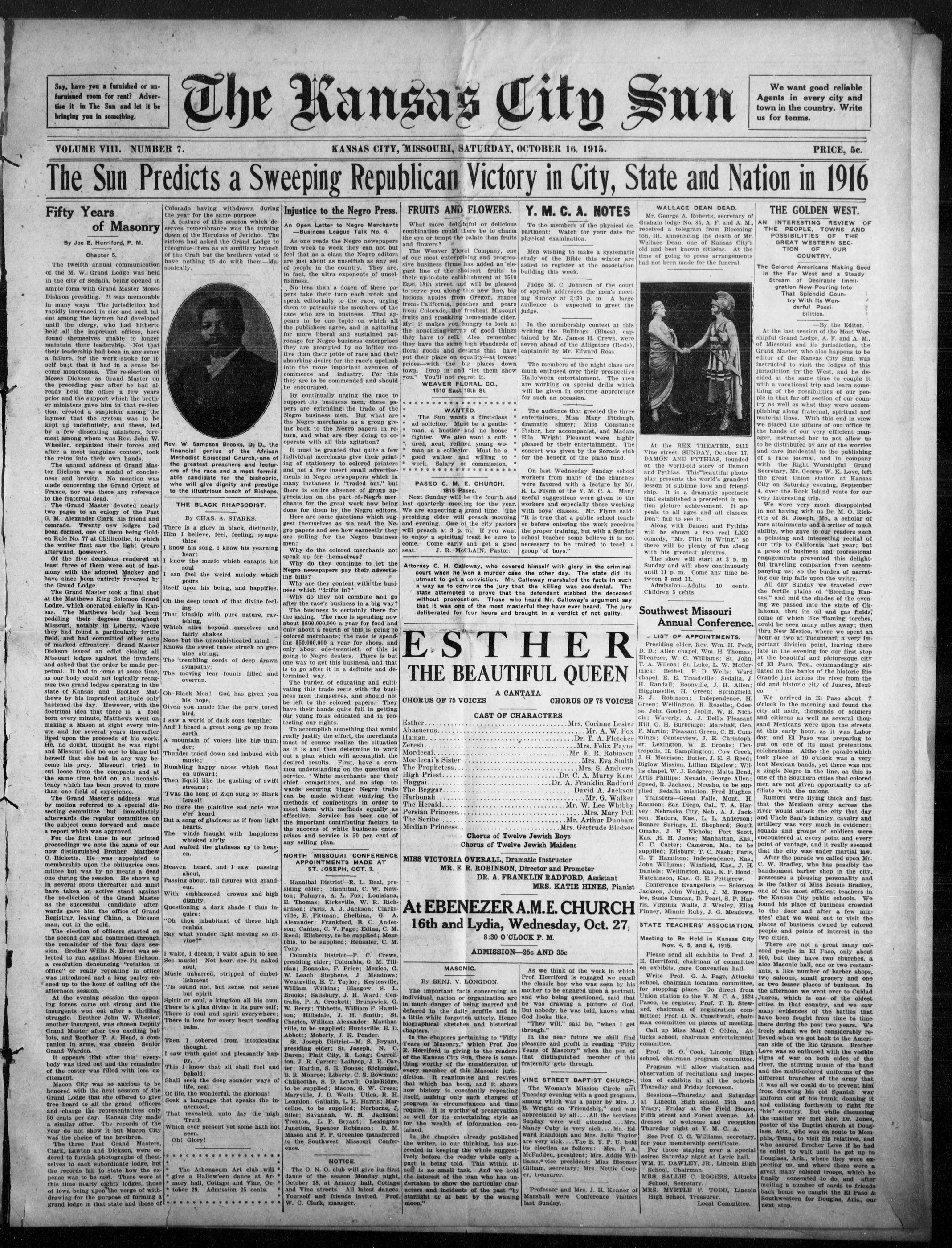
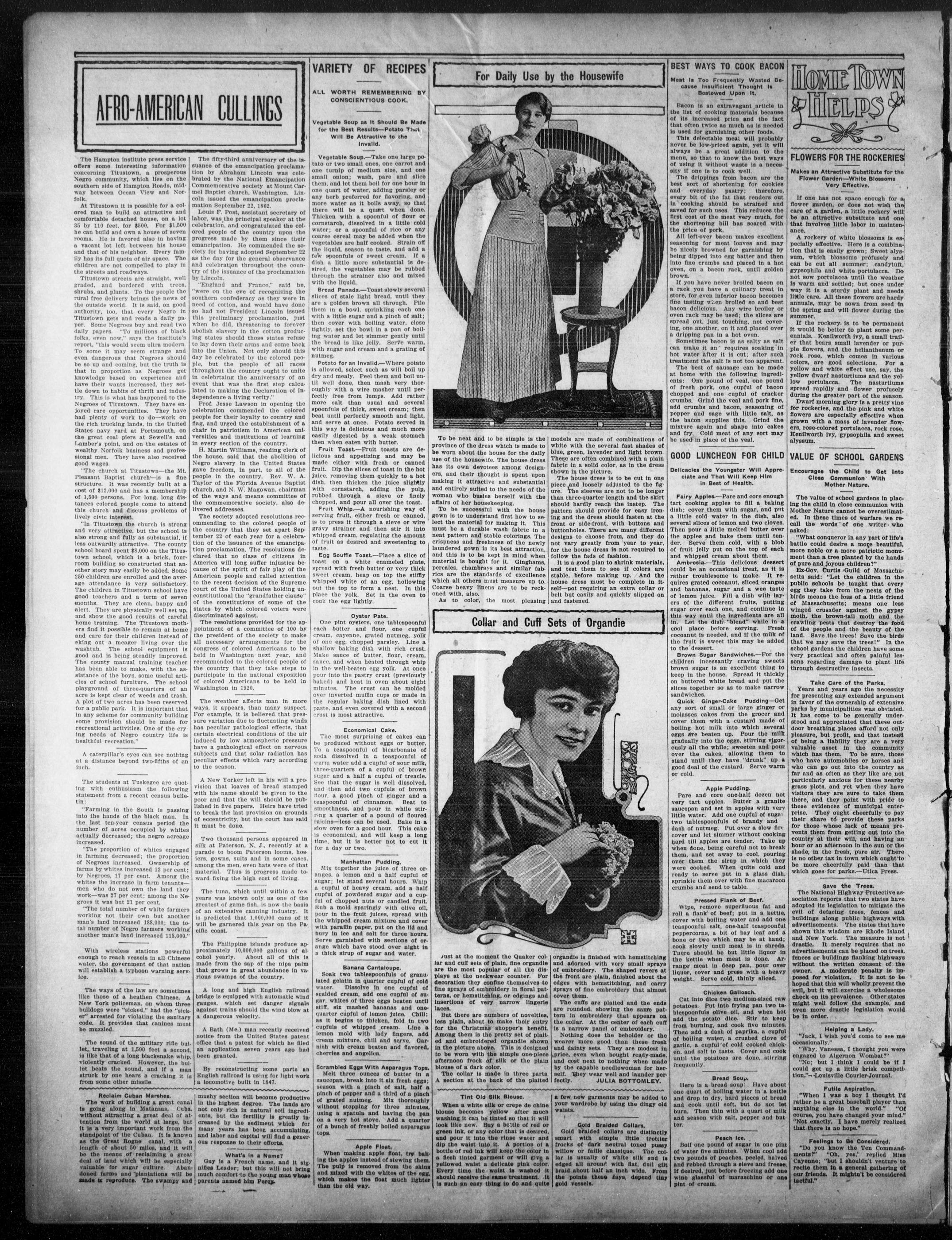
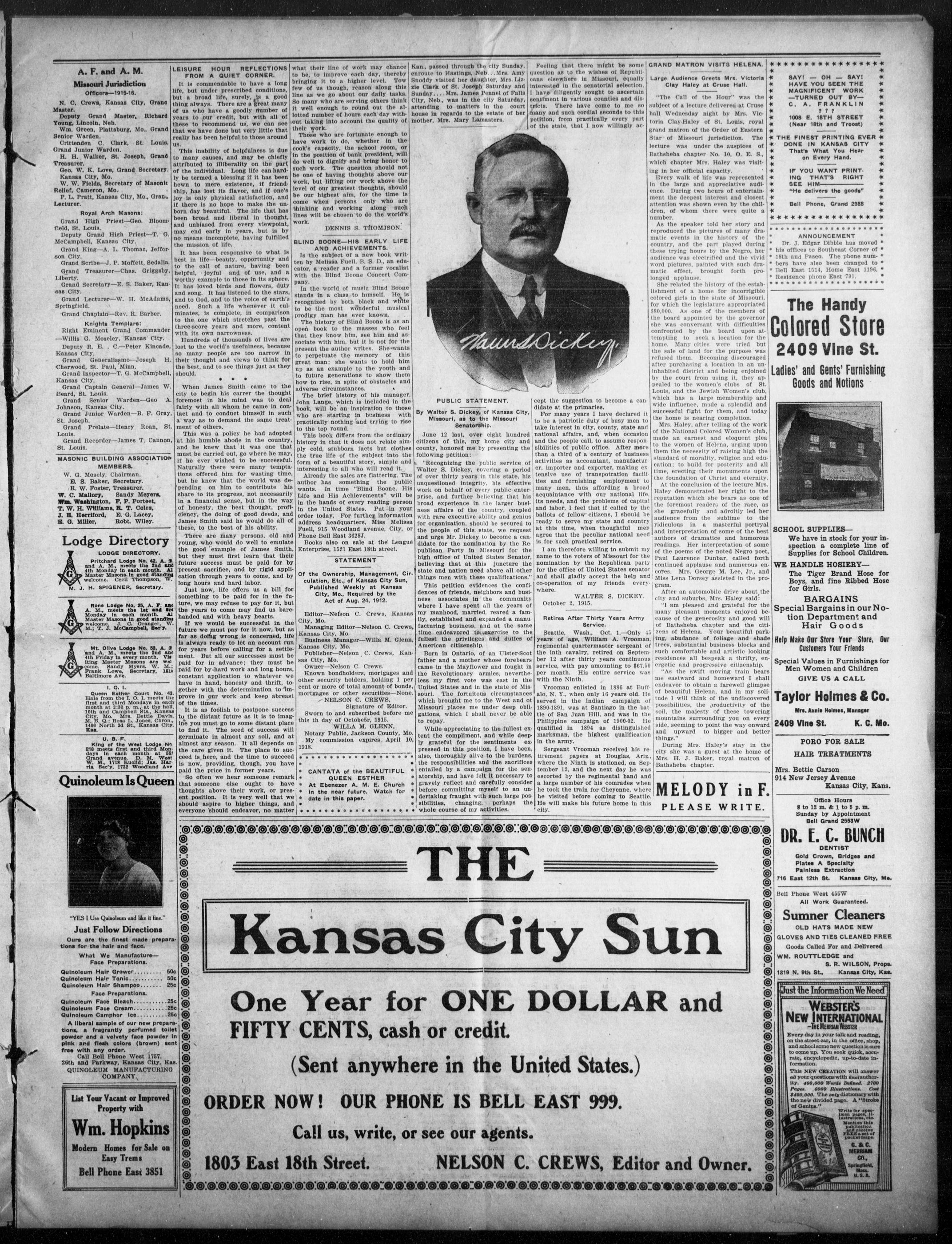
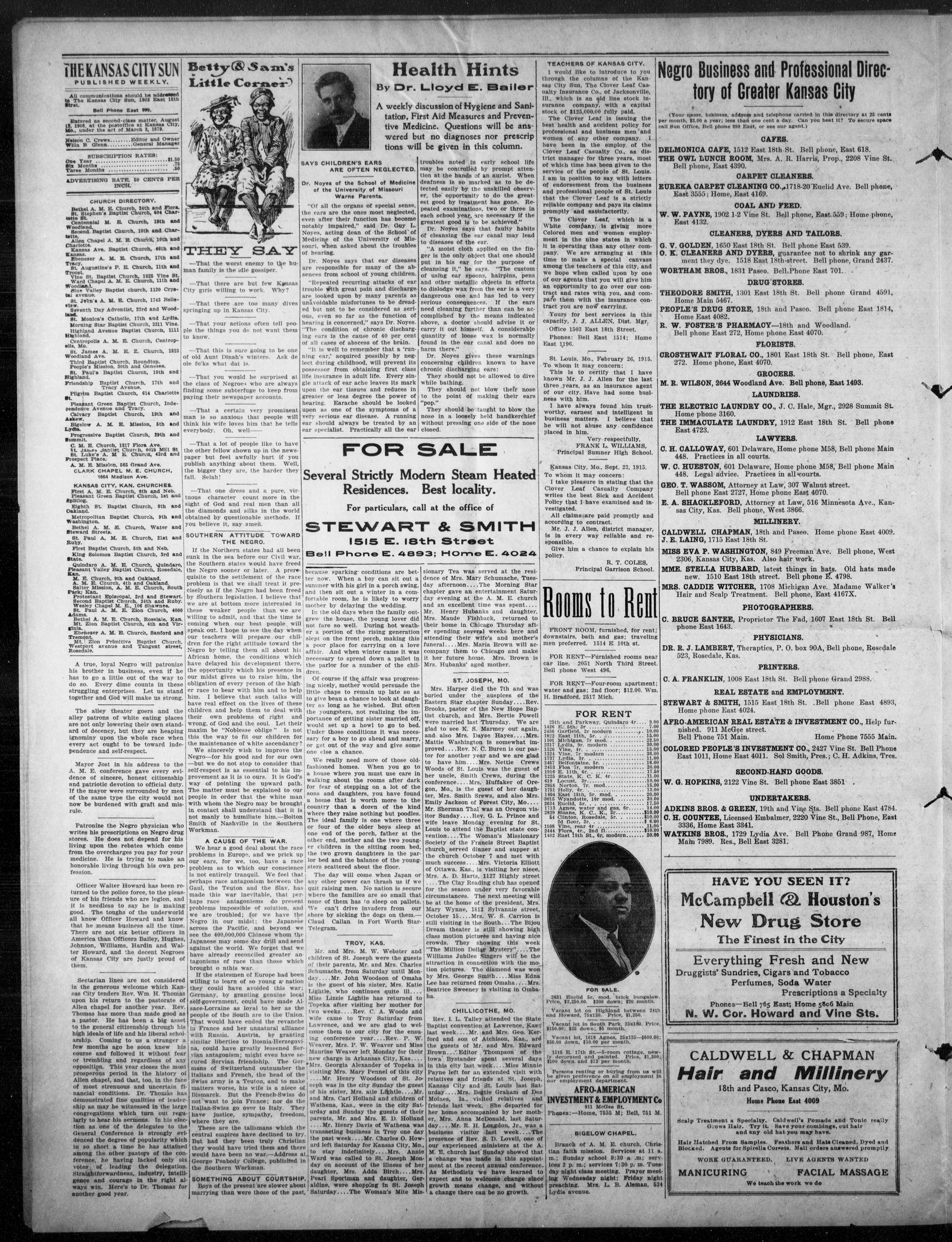
Page text (machine-generated)
The Sun Predicts a Sweeping Republican Victory in City, State and Nation in 1916
Say, have you a furnished or unfurnished room for rent? Advertise it in The Sun and let it be bringing you in something.
VOLUME VIII. NUMBER 7.
of Masonry
By Joe E. Herriford, P. M.
the twelfth annual communication of the M. W. Grand Lodge was held in the city of Sedalia, being opened in ample form with Grand Master Moses Diskson presiding. It was memorable in many ways. The jurisdiction had rapidly increased in size and such talent among the laymen had developed until the clergy, who had hitherto held all the important offices, here found themselves unable to longer maintain their leadership. Not that their leadership had been in any sense a failure, for the work spoke for itself but that it had in a sense become monotonous. The re-election of Moses Dickson as Grand Master on the preceding year after he had already held the office a few years prior and the support which the brother ministers gave him in that re-election, created a suspicion among the laymen that the system was to be kept up indefinitely, and these, led by a few dissenting ministers, foremost among whom was Rev. John W. Wheeler, organized their forces and after a most sanguine context, took the reins into their own hands.
The annual address of Grand Master Dickson was a model of conciseness and brevity. No mention was made concerning the Grand Orient of France, nor was there any reference to the fraternal dead.
The Grand Master devoted nearly two pages to an enology of the Past G. M. Alexander Clark, his friend and comrade. Twenty new lodges had been formed, one of them being Golden Rule No. 77 at Chillicothe, in which the writer first saw the light (years afterward, however). Of the five decisions rendered at least three of them were out of harmony with the adopted Mackey and have since been entirely reversed by the Grand Lodge.
The Grand Master took a final shot at the Matthews King Solomon Grand Lodge, which operated chiefly in Kansas. The Matthews body had been peddling their degrees throughout Missouri, notably in Liberty, where they had found a particularly fertile field, and had committed other acts of marked effrontery. Grand Master Dickson issued an edict closing all Missouri lodges against the invaders and asked that the order be made perpetual. It had to some at some time, as our body could not logically recognize two grand lodges operating in the state of Kansas, and Brother Matthews by his imprudent attitude only hastened the day. However, with the doctrinal idea that there is a fool born every minute, Matthews went on making a Mason at sight every minute and for several years thereafter lived upon the proceeds of his work. He, no doubt, thought he was right and Missouri had no one to blame but herself that she had in any way become his prey. Missouri tried to cut loose from the compacts and at the same time hold on, an inconsistency which has been proved in more than one field of experience.
The Grand Master's address was by motion referred to a special dissecting committee but immediately afterwards the regular committee on the subject came forward and made a report which was approved.
For the first time in our printed proceedings we note the name of our now distinguished Brother Matthew O. Rickett. He was appointed to membership upon the obituaries committee but was by no means a dead one during the session. He shows up in several spots thereafter and must have taken an active stand against the re-election of the Grand Master as the successful candidate afterwards gave him the office of Grand Registrar, leaving Chinn, a Dickson man, out in the cold.
The election of officers started on the second day and continued through the remainder of the four days session. Brother Willis N. Brent was selected to run against Moses Dickson, a resolution denouncing "rotation in office" or really repeating in office was introduced and a long parley ensued up to the hour of calling off the afternoon session.
At the evening session the opposing forces came out strong and the insurgents won out after a thrilling struggle. Brother John W. Wheeler, another insurgent, was chosen Deputy Grand Master after two exciting ballots, and Brother T. A. Head, a companion in arms, was chosen Senior Grand Warden.
It appears that after this everybody was tired out and the remainder of the roster was filled with less excitement.
Macon City was so anxious to be honored with the next session of the Grand Lodge that she offered to give free board to all the grand officers and charge the representatives only 50 cents per day. Kansas City made a similar offer. The records of the year do not show it but Macon City was the choice of the brethren.
The three Past Grand Masters, Clark, Lawton and Dickson, were ordered to furnish photographs of themselves to each subordinate lodge, but the records fall to state how the expense was to be met. There were at this time nearly eighty lodges, those of Iowa being upon the verge of withdrawing for the purpose of forming a grand lodge in that state and those of
The Kansas City Sun
Colorado having withdrawn during the year for the same purpose.
A feature of this session which deserves remembrance was the turning down of the Heroines of Jericho. The sisters had asked the Grand Lodge to recognize them as an auxiliary branch of the Craft but the brethren voted to have nothing to do with them—Masonically.
Rev. W. Sampson Brooks, D. D., the financial genius of the African Methodist Episcopal Church, one of the greatest preachers and lecturers of the race and a most formidable candidate for the bishopric, who will give dignity and prestige to the illustrious bench of Bishops.
THE BLACK RHAPSODIST.
By CHAS. A. STARKS.
There is a glory in black, distinctly,
Him I believe, feel, feeling, sympa-
tize
I know his song, I know his yearning
heart
I know the music which enrapts his
soul
I can feel the weird melody which
pours
Itself upon his being, and happifies.
Oh the deep touch of that divine feeling,
That kinship with pure nature, rav-
ishing,
Which stirs beyond ourselves and
fairly shakes
None but the unsophisticated mind
Knows the sweet tunes struck on genuine string;
The trembling cords of deep drawn
sympathy;
Oh Black Men! God has given you his hope.
Given you music like the pure toned bird.
I saw a world of dark sons together
And I heard a great song go up from earth.
A mountain of voices like big thunder;
Thunder toned down and imbued with music;
Rumbling happy notes which float on upward;
Then liquid like the gushing of swift streams;
'Twas the song of Zion sung by Black Israel!
No more the plaintive sad note was o'er heard
But a song of gladness as if from light hearts.
The winds fraught with happiness whisked airly
And wafted the gladness up to heaven.
Heaven heard, and I saw passing about,
Passing about, tall figures with grandeur.
With emblazoned crowns and high dignity.
Questioning a dark shade I thus inquire:
"Oh thou inhabitant of these high realms
Say what yonder light moving so divine?"
I wake, I dream, I wake again to see,
See music! Not hear, see its naked soul,
Music unbarred, stripped of embellishment
'Tis sound not, but sense, not sense but spirit
Spirit or soul, a kingdom all his own.
There is a plan divine in its pure self;
There is soul and spirit everywhere;
There is love for every heart needing balm.
Then I sobered from intoxicating thought.
I saw truth quiet and pleasantly happy.
This I know that all shall feel and behold;
Shall seek the deep sounder ways of life, real
Of life, the wonderful, the glorious!
Seek a language that speaks the in-ermost,
That revealeth unto day the nigh Truth
Which ever present yet some hath not seen.
Oh! Glory!
The Athenaeum Art club will give a Hallow'een dance at Armory hall, Cottage and Vine, October 29. Admission 25 cents.
Injustice to the Negro Press.
An Open Letter to Negro Merchants — Business League Talk No. 4.
As one reads the Negro newspapers from week to week they can not but feel that as a class the Negro editors are just about as unselfish as any set of people in the country. They are, in fact, the ultra exponents of unselfishness.
No less than a dozen of these papers take their turn each week and speak editorially to the race, urging them to patronize the members of the race who are in business. That appears to be one topic on which all the publishers agree, and in agitating for more liberal and sustained patronage for Negro business enterprises they are prompted by no loftier motive than their pride of race and their absorbing desire for the race's upimble into the more important avenues of commerce and industry. For this they are to be commended and should be encouraged.
By continually urging the race to support its business men, these papers are extending the trade of the Negro business men. But what are the Negro merchants as a group giving back to the Negro papers in return, and what are they doing to cooperate with all this agitation?
It must be granted that quite a few individual merchants give their printing of stationery to colored printers and not a few insert small advertisements in Negro newspapers which in many instances is "traded out," but there is entire absence of group appreciation on the part of Negro merchants for the great work now being done for them by the Negro editors. Here are some questions which suggest themselves as we read the Negro papers and see how earnestly they are pulling for the Negro business men:
Why do the colored merchants not speak up for themselves?
Why do they continue to let the Negro newspapers pay their advertising bills?
Why are they content with the business which "drifts in?"
Why do they not combine and go after the race's business in a big way?
The business is certainly there for the asking. The race is spending now about $600,000,000 a year for food and only about a fourth of this is going to colored merchants; the race is spending $50,000,000 a year for shoes, and only about one-twentieth of this is going to Negro dealers. There is but one way to get this business, and that is to go after it in a definite and determined way.
The burden of educating and cultivating this trade rests with the business men themselves, and should not be left to the colored papers. They have their hands quite full in getting our young folks educated and in protecting our rights.
To accomplish something that would really justify the effort, the merchants must of course realize the situation as it is and then determine to work out a plan which will accomplish the desired results. First, have a common understanding on the question of service. White merchants are their chief competitors, and no step towards securing bigger Negro trade can be made without studying the methods of competitors in order to meet them with methods equally as effective. Service has been one of the important contributing factors to the success of white business enterprises and service is 50 per cent of any selling plan.
NORTH MISSOURI CONFERENCE
APPOINTMENTS MADE AT
Hannibal District—R. L. Beal, presiding elder; Hannibal, C. W. Newton; Palmyra, A. L. Fox, Louisiana. E. Thomas; Kirksville, W. R. Richardson; Paris, A. J. Jackson; Clarksville, E. Pittman; Shelbina, G. A. Alexander; Frankford, B. C. Anderson; Canton, C. V. Page; Edina, C. M. Reed; Ellsberry, to be supplied; Memphis, to be supplied; Rensaler, C. M. Tony.
Columbia District—P. C. Crews, presiding elder; Columbia, G. M. Tillman; Roanoke, F. Price; Mexico, G. W. Leach; Stephens, J. Meadows; Wentzville, E. T. Taylor; Keytesville, William Wilkins; Glasgow, S. L. Brooks; Salisbury, J. H. Ward; Centralia, P. A. Crockett; Brunswick, G. W. Berry; Tibbett, William F. Hamilton; Hillsdale, J. H. Smith; St Charles, William Alexander; Marthasville, to be supplied; Huntsville, E. D. Abbott; Moberly, J. K. Ponder.
St. Joseph District—M. S. Bryant, presiding elder; St. Joseph, N. C. Buren; Platt City, R. Long; Carrollton, J. R. Carter; Lathrop, J. R. Carter; Hardin, S. E. Boone; Richmond, D. R. Monroe; Liberty, C. S. Bowman; Chillicothe, S. D. Lovell; Oak Ridge, to be supplied; Macon, G. W. Cross; Maryville, J. D. Wells; Utica, R. H Longdon; Gallatin, L. H. Harris; Marcelline, to be supplied; Norborne, J. Siler; Savannah, W. M. Jackson; Trenton, L. P. Bryant; Lexington Junction, Spencer Robinson; D. M Mason and F. P. Greenlee transferred to the Southwest Missouri Conference.
NOTICE.
The O. N. O. club will give its first dance of the season Monday night, October 18, at Armory hall, Cottage and Vine streets. All latest dances. Yourself and friends invited. Prof. W. C. Clark, manager.
FRUITS AND FLOWERS.
What more delightful or delicious combination could there be to charm the eye or tempt the palate than fruits and flowers?
The Weaver Floral Company, one of our most enterprising and progressive business firms has added an elegant line of the choicest fruits to their up-to-date establishment at 1510 East 18th street and will be pleased to serve you along this new line, big lucious apples from Oregon, grapes from California, peaches and pears from Colorado, the freshest Missouri fruits and sparkling home-made cider. My! it makes you hungry to look at the appetizing array of good things they have to sell. Also remember they have the same high standards of floral goods and designs that have put their place on equality—at lowest prices—with the big places down town. Drop in and "let them show you." You'll not regret it.
WANTED.
The Sun wants a first-class ad solicitor. Must be a gentleman, a hustler and no booze fighter. We also want a cultured, neat, refined young woman as a collector. Must be a good walker and willing to work. Salary or commission.
PASEO C. M. E. CHURCH.
1815. Paseo.
Next Sunday will be the fourth and last quarterly meeting for the year. We are expecting a grand time. The presiding elder will preach morning and evening. One of the city pastors will preach at 3 p.m. If you want to enjoy a spiritual treat be sure to come. Come early and get a good seat. J. R. McCLAIN. Pastor.
Attorney C. H. Calloway, who covered himself with glory in the criminal court when he won a murder case the other day. The state did its utmost to get a conviction. Mr. Calloway marshaled the facts in such a way as to convince the jury that the killing was accidental. The state attempted to prove that the defendant stabbed the deceased without provocation. Those who heard Mr. Calloway's argument say that it was one of the most masterful they have ever heard. The jury deliberated for four hours and brought in a verdict of not guilty.
ESTHER THE BEAUTIFUL QUEEN
A CANTATA
MISS VICTORIA OVERALL, Dramatic Instructor
MR. E. R. ROBINSON, Director and Promoter
DR. A. FRANKLIN RADFORD, Assistant
MRS. KATIE HINES, Pianist
At EBENEZER A.M.E. CHURCH 16th and Lydia, Wednesday, Oct. 27.
8:30 O'CLOCK P. M.
ADMISSION—25c AND 35c
The important facts concerning an individual, nation or organization are in much danger of being marred and defaced in the daily scuffle and in a little while forgotten utterly. Hence biographical sketches and historical chapters.
In the chapters pertaining to "Fifty Years of Massonry," which Prof. Joe E. Herriford is giving to the readers of the Kansas City Sun, there is something worthy of the consideration of every member of this Masonic jurisdiction. It reanimates and revives that which has been, and it shows how history is constantly repeating itself, making only such changes of program as circumstances and time require. It is worthy of preservation as well for its entertaining style as for the wealth of information contained.
In the chapters already published the writer, to our thinking, has succeeded in keeping the whole successively before the reader while only a part is being told. This within its self is no small task. And we hold the interest of the man who has undertaken to show the particular characters and incidents of the past "by starlight or at best by the waning moon."
MASONIC.
Y. M. C. A. NOTES
To the members of the physical department: Watch for your date for physical examination.
Men wishing to make a systematic study of the Bible this winter are asked to register at the association building this week.
Judge M. C. Johnson of the court of appeals addresses the men's meeting Sunday at 3:30 p. m. A large audience is expected to greet the judge.
In the membership contest at this writing the Bullfrogs (Blues), captained by Mr. James H. Crews, were seven ahead of the Alligators (Reds), captained by Mr. Edward Ross.
The members of the night class are much enthused over their prospective Hallo'ween entertainment. The men are working on special drills which will be given in costume appropriate for such an occasion.
The audience that greeted the three entertainers, Miss Mary Fitzhugh, dramatic singer; Miss Constance Fisher, her accompanist, and Madam Ella Wright Pleasant were highly pleased by their entertainment. The concert was given by the Sorosis club for the benefit of the piano fund.
On last Wednesday Sunday school workers from many of the churches were favored with a lecture by Mr. R. L. Flynn of the Y. M. C. A. Many useful suggestions were given to the workers and especially those working with boys' classes. Mr. Flynn said: "It is true that a public school teacher before entering the work receives the proper training, but with a Sunday school teacher some believe it is not necessary to be trained to teach a group of boys."
ed himself with glory in the criminal e the other day. The state did its Calloway marshaled the facts in such that the killing was accidental. The defendant stabbed the deceased o heard Mr. Calloway's argument sayterful they have ever heard. The juryought in a verdict of not guilty.
HER
FUL QUEEN
TATA
CHORUS OF 75 VOICES
CHARACTERS
Mrs. Corinne Lester
Mr. A. W. Fox
Dr. T. A. Fletcher
Mrs. Felix Payne
Mr. E. R. Robinson
Mrs. Eva Smith
Mrs. S. Andrews
Dr. C. A. Murry Kane
Dr. A. Franklin Radford
David A. Jackson
Mr. G. Walker
Mr. W. Lee Whibby
Mrs. Mary Pell
Mr. Arthur Dunham
Mrs. Gertrude Bledsoe
Live Jewish Boys
Live Jewish Maidens
omatic Instructor
Director and Promoter
BANKLIN RADFORD, Assistant
MRS. KATIE HINES, Pianist
A.M.E. CHURCH
Wednesday, Oct. 27
As we think of the work in which Prof. Herriford is engaged we recall the classic boy who was seen by his mother to be engaged upon a portrait, and who being questioned, said that he was drawing a picture of God. But nobody, he was told, knows what God looks like. "They will," said he, "when I get through."
In the near future we shall find pleasure and profit in reading "Fifty Years of Masonry" when the pen of that distinguished member of this fraternity gets through.
VINE STREET BAPTIST CHURCH
THE STREET BAPTIST CHURCH
The Woman's Mission Circle met Tuesday evening with a good program, among which was a paper by Mrs. J. B. Wright on "Friendship," and was appreciated by all...All the services Sunday were well attended...Mrs. Nancy Cuby is very sick...Mr. Edward Kandolph and Mrs. Julia Taylor are very sick...The B. Y. P. U. held its election as follows: Mrs. P. A. McCadden, president; Mrs. Addie Williams,* vice president; Miss Bloomer Gilham, secretary; Mrs. Nettie Cooper, treasurer.
Professor and Mrs. J. H. Kenner of Marshall were Conference visitors last Sunday.
Mr. George A. Roberts, secretary of Graham lodge No. 85, A. F. and A. M., received a telegram from Bloomington, Ill., announcing the death of Mr. Wallace Dean, one of Kansas City's old and best known citizens. At the time of going to press arrangements had not been made for the funeral.
At the REX THEATER, 2411
Vine street, SUNDAY, October 17,
DAMON AND PYTHIAS, founded on
the world-old story of Damon
and Pythias. This beautiful
photoplay presents the world's grandest
lesson of sublime love and friend-
ship. It is a dramatic spectacle
that established a precedent in motion
picture achievement. It appeals to all ages and all classes.
Don't fail to see it.
Along with Damon and Pythias
will be shown a two reel LKO
comedy, "Mr. Flirt in Wring," so
there will be plenty of fun along
with his greatest pictures.
The show will start at 3 p. m.
Sunday and will show continuously
until 11 p. m. Come any time
between 3 and 11.
Admission—Adults 10 cents.
Children 5 cents.
Southwest Missouri Annual Conference
LIST OF APPOINTMENTS.
Presiding elder, Rev. Wm. H. Peck, D. D.; Allen clerk, Wm. H. Thomas; Ebenezer, W. C. Williams; St. John, T. A. Wilson; St. Luke, L. W. McCormick; Bethel, F. D. Wells; Ward chapel, E. E. Treadville; Sedalia, J. H. Randall; Boonville, J. H. Allen; Higginsville, H. Green; Springfield, R. J. Robinson; Independence, H. Green; Wellington, R. Rozelle; Odessa, John Gooden; Joplin, W. B. Nichols; Waverley, A. J. Bells; Pleasant Hill, O. H. Burbridge; Marshall, Geo. F. Martin; Pleasant Green, C. H. Cummings; Centerview, J. E. Christopher; Lexington, W. B. Brooks; Centropolis, H. Sampling; Cow Creek, J. H. Morrison; Butler, J. E. Seed; Biglow Mission, Lillian Bigelow; Willis chapel, W. J. Rodgers; Malta Bend, Art Phillips, Nevae, George Allen; Speed, R. Jackson; Neoho, to be supplied; Sedalia mission, Fred Hughes.
Transfers—Great Falls, Mont, H. Rosmon; San Diego, Cal, T. A. Harvey; Nebraska City, Neb, A. J. Jackson; Endora, Kas, L. L. Anderson; Bonner Surings, H. Shepherd; South Omaha, J. H. Nichols; Fort Scott, Kas, H. H. Jones; Manhattan, Kas, C. C. Carter; Cameron, Mo, to be supplied; Ellsbury, C. T. Nash; be, G. T. Hamilton; Independence, Kas, John Williams; Winfield, Kas, J. H. Daniels; Wellington, Kas, K. P. Bond; Hutchinson, Kas, G. E. Pettigrew.
Conference Evangelists — Solomon Jackson, John Wright, J. M. Brownlee, Susie Duncan, D. Pearl, S. P. Harris, Virginia Walls, J. Wesley, Eliza Finney, Minnie Ruby, J. G. Meadows.
STATE TEACHERS' ASSOCIATION.
Meeting to Be Hold in Kansas City
Nov. 4, 5, and 6, 1915.
Please send all exhibits to Prof. J. E. Herriford, chairman of committee on exhibits, care Convention hall.
Write Prof. G. A. Page, Attucks school, chairman location committee, for stopping place. Go direct from Union station to the Y. M. C. A., 1824 Paseo, to register, Prof. T. B. Steward, chairman of registration committee; Prof. D. N. Crosthwait, chairman committee on places of meeting.
Call up Miss Maud C. Olden, Attucks school, chairman entertainment committee.
Prof. H. O. Cook, Lincoln High school, chairman program committee.
Program will allow visitation and observation of recitations and inspection of exhibits in all the schools Thursday and Friday forenoon.
Sessions—Thursday and Saturday at Lincoln High school, 19th and Tracy; Friday at the Field House, Fifth street and Forest avenue. Addresses of welcome and reception Thursday night at Y. M. C. A.
See Prof. C. G. Williams, secretary, for your membership certificate.
For those staying over a special soiree Saturday night at Lyric hall. WM. H. DAWLEY, JR., Lincoln High School, Chairman.
MRS. SALLIE C. ROGERS, Attacks
School, Secretary.
We want good reliable Agents in every city and town in the country. Write us for tenms.
PRICE. 5c.
THE GOLDEN WEST.
AN INTERESTING REVIEW OF THE PEOPLE, TOWNS AND POSSIBILITIES OF THE GREAT WESTERN SEC TION OF OUR COUNTRY.
The Colored Americans Making Good in the Far West and a Steady Stream of Desirable Immigration Now Pouring Into That Splendid Country With Its Wonderful Possibilities.
At the last session of the Most Worshipful Grand Lodge, A. F. and A. M. of Missouri and its jurisdiction, the Grand Master, who also happens to be editor of the Kansas City Sun, was instructed to visit the lodges of this jurisdiction in the West, and he decided at the same time to couple it with a vacational trip and learn something of the possibilities of our people in that far off section of our country as well as what they were accomplishing along fraternal, spiritual and material lines. With this end in view we placed the affairs of our office in the hands of our very efficient manager, instructed her to not allow us to be distributed by any of the worries and care incidental to the publishing of a race journal, and in company with the Right Worshipful Grand Secretary, Mr. George W. K. Love, left the great Union station at Kansas City on Saturday evening, September 4, over the Rock Island route for our very interesting trip.
We were very much disappointed in not having with us Dr. M. O. Ricketts of St. Joseph, M., a scholar of rare attainments and a writer of much ability, who gave to our readers such a pelaizing and interesting recital of our trip to California last year; but a press of business and professional engagements prevented this delightful traveling companion from accompanying us; so the burden of narrating our trip falls upon the writer.
All day Sunday we traveled over the fertile plains of "Bleeding Kansas," and mid the shades of the evening we passed into the state of Oklahoma, thru its oil and gas fields; some of which like flaming torches, could be seen many miles away; then thru New Mexico, where we spent an hour or two at Tucumcari, a very important division point, leaving there late in the evening for our first stop at the beautiful and picturesque city of El Paso, Tex., commandingly situated on the banks of the historic Rio Grande just across the river from the old and historic city of Juarez, Mexico.
We arrived in El Paso about 7 o'clock in the morning and found the city all astir, thousands of soldiers and citizens as well as several thousand Mexicans were upon the streets at this early hour, as it was Labor day, and El Paso was preparing to put on one of its most pretentious celebrations. Altho the parade which took place at 10 o'clock was a very lent Mexican bands, yet there was not a single Negro in the line, as this is one of the Southern cities that colored men are not given opportunity to affiliate with the unions.
Rumors were flying thick and fast that the Mexican army across the river would attack the city that day and Uncle Sam's infantry, cavalry and artillery was very much in evidence; squads and groups of soldiers were encountered at every point and every point of vantage, and it really seemed that the city was under martial law. After the parade we called upon Mr. C. W. Bradley, who has possibly the handsomest barber shop in the city, possesses a pleasing personality and is the father of Miss Bessie Bradley, one of the most efficient teachers in the Kansas City public schools. We found his place of business crowded to the door and after a few minutes' chat we went out to visit the places of business owned by colored people and points of interest in the two cities.
There are not a great many colored people in El Paso, only about 800, but they have two churches, a nice Masonic hall, one or two restaurants, a like number of barber shops, two saloons, small grocery and one or two lesser places of business. In the afternoon we went over to Cuidad Juarez, which is one of the oldest cities in that country, and we saw many evidences of the battles that have been fought from time to time there during the past two years. We freely admit we felt considerably relieved when we got back to the American side of the Rio Grande. Brother Love was so enthused with the visible signs of war on both sides of the river, the stirring music of the band and the multi-colored uniforms of the different branches of the army that it was all we could do to prevent him from drawing his old Spanish war uniform out of his trunk, donning it and enlisting forthwith to fight for "his" country. But while discussing the matter we met Rev. Dr. Jones, pastor of the Baptist church at Douglass, Ariz., who was en route to Memphis, Tenn., to visit his relatives, and who assured Brother Love if he had to enlist to wait until he got up to Douglass, Ariz., where they were expecting us, and where there were a great many colored troops, which he finally consented to do, and after mailing a number of cards to friends back home we caught the El Paso & Southwestern for Douglas, Ariz., our next stop.
AFRO-AMERICAN CULLINGS
The Hampton institute press service offers some interesting information concerning Titustown, a prosperous Negro community, which lies on the southern side of Hampton Roads, midway between Ocean View and Norfolk.
At Titustown it is possible for a colored man to build an attractive and comfortable detached house, on a lot 35 by 110 feet, for $500. For $1,500 he can build and own a house of seven rooms. He is favored also in having a vacant lot left between his house and that of his neighbor. Every family has its full quota of air space. The children are not compelled to play in the streets and roadways.
Tituwtown streets are straight, well graded, and bordered with trees, shrubs, and plants. To the people the rural free delivery brings the news of the outside world. It is said, on good authority, too, that every Negro in Tituwtown gets and reads a daily paper. Some Negroes buy and read two daily papers. "To millions of black folks, even now," says the institute's report, "this would seem ultra modern. To some it may seem strange and even dangerous that Negroes should be so up and coming, but the truth is that in proportion as Negroes get knowledge based on experience and have their wants increased, they set down to habits of thrift and industry. This is what has happened to the Negroes of Tituwtown. They have enjoyed rare opportunities. They have had plenty of work to do—work on the rich trucking lands, in the United States navy yard at Portsmouth, on the great coal plains at Sewell's and Lamber's point, and on the estates of wealthy Norfolk business and professional men. They have also received good wages.
"The church at Titustown—the Mt. Pleasant Baptist church—is a fine structure. It was recently built at a cost of $12,000 and has a membership of 1,500 persons. For long, long distances colored people come to attend this church and discuss problems of lively civic interest.
"In Titustown the church is strong and very attractive, but the school is also strong and fully as substantial, if less outwardly attractive. The county school board spent $8,000 on the Titustown school, which is a brick, fourroom building so constructed that another story may easily be added. Some 250 children are enrolled and the average attendance is very satisfactory. The children in Titustown school have good teachers and a term of seven months. They are clean, happy and alert. They are physically well set up and show the good results of careful home training. The Titustown moths find it possible to remain at home and care for their children instead of eking out a meager living over the washtub. The school equipment is good and is being steadily improved. The county manual training teacher has been able to make, with the assistance of the boys, some useful articles of school furniture. The school playground of three-quarters of an acre is kept clear of weeds and trash. A plot of two acres has been reserved for a public park. It is important that in any scheme for community building some provision should be made for recreational activities. One of the crying needs of Negro country life is healthful recreation."
A caterpillar's eyes can see nothing at a distance beyond two-fifths of an inch.
The students at Tuskegee are quoting with enthusiasm the following statement from a recent census bulletin:
"Farming in the South is passing into the hands of the black man. In the last ten-year census period the number of acres occupied by whites actually decreased; the negro acreage increased.
"The proportion of whites engaged in farming decreased; the proportion of Negroes increased. Ownership of farms by whites increased 12 per cent; by Negroes, 17 per cent. Among the whites the increase in farm tenants—men who do not own the land they work—was 27 per cent; among the Negroes it was but 21 per cent.
"The total number of white farmers working not their own but another man's land increased 188,000; the total number of Negro farmers working another man's land increased 118,000."
With wireless stations powerful enough to reach vessels in all Chinese water, the government of that nation will establish a typhoon warning service.
The ways of the law are sometimes like those of a heathen Chinese. A New York policeman, on whom three bulldogs were "sloked," had the "sicker" arrested for violating the sanitary code. It provides that canines must be muzzled.
The sound of the military rifle bullet, traveling at 1,500 feet a second, is like that of a long blacksnake whip, violently cracked. However, the bullet beats the sound, and if a man struck by one hears a cracking it is from some other missile.
Reclaim Cuban marshes.
The work of building a great canal is going along in Matanzas, Cuba, without attracting a great deal of attention from the world at large, but it is a very important work from the standpoint of the Cuban. It is known as the Great Rogue canal, with a length of about 50 miles, and it will be the means of reclaiming a great deal of land which will be especially valuable for sugar culture. Abandoned farms and plantations will be made to reproduce. The swampy and
The fifty-third anniversary of the issuance of the emancipation proclamation by Abraham Lincoln was celebrated by the National Emancipation Commemorative society at Mount Carmel Baptist church, Washington. Lincoln issued the emancipation proclamation September 22, 1862. Louis F. Post, assistant secretary of labor, was the principal speaker at the celebration, and congratulated the colored people of the country upon the progress made by them since their emancipation. He commended the society for having adopted September 22 as the day for the general observance and celebration throughout the country of the issuance of the proclamation by Lincoln.
"England and France," said he, "were on the eve of recognizing the southern confederacy as they were in need of cotton, and would have done so had not President Lincoln issued this preliminary proclamation, just when he did, threatening to forever abolish slavery in the cotton producing states should those states refuse to lay down their arms and come back into the Union. Not only should this day be celebrated by the colored people, but the people of all races throughout the country ought to unite in celebrating the anniversary of an event that was the first step calculated to making the Declaration of Independence a living verity."
Prof. Jesse Lawson in opening the celebration commended the colored people for their loyalty to country and flag, and urged the establishment of a chair in patriotism in American universities and institutions of learning in every section of the country.
H. Martin Williams, reading clerk of the house, said that the abolition of Negro slavery in the United States gave freedom, in part, to all of the people in the country. Rev. W. A. Taylor of the Florida Avenue Baptist church, and N. W. Magowan, chairman of the ways and means committee of the commemorative society, also delivered addresses. The society adopted resolutions recommending to the colored people of the country that they set apart September 22 of each year for a celebration of the issuance of the emancipation proclamation. The resolutions declared that no class of citizens in America will long suffer injustice because of the spirit of fair play of the American people and called attention to the recent decision of the Supreme court of the United States holding unconstitutional the "grandfather clause" of the constitutions of some of the states by which colored voters were discriminated against.
The resolutions provided for the appointment of a committee of 100 by the president of the society to make all necessary arrangements for the congress of colored Americans to be held in Washington next year, and recommended to the colored people of the country that they take steps to participate in the national exposition of colored Americans to be held in Washington in 1920.
---
The weather affects man in more ways, it appears, than many suspect. For example, it is believed that pressure variation due to fluctuating winds has peculiar pathological effects, that certain electrical conditions of the air induced by low atmospheric pressure have a pathological effect on nervous subjects and that solar radiation has peculiar effects which vary according to the season.
A New Yorker left in his will a provision that loaves of bread stamped with his name should be given to the poor and that the will should be published in five papers. Heirs have tried to break the last provision on grounds of eccentricity, but the court has said it must be done.
Two thousand persons appeared in silk at Paterson, N. J., recently at a parade to boom Paterson looms, hosiers, gowns, suits and in some cases, among the men, even hats were of that material. Thus is progress made toward fixing the high cost of living.
The tuna, which until within a few years was known only as one of the greatest of game fish, is now the basis of an extensive canning industry. It is predicted that 1,000,000 cans of it will be garnered this year on the Pacific coast.
The Philippine islands produce approximately 10,000,000 gallons of alcohol yearly. About all of this is made from the sap of the nipa palm that grows in great abundance in various swamps of the country.
A long and high English railroad bridge is equipped with automatic wind gauges, which set danger signals against trains should the wind blow at a dangerous velocity.
A Bath (Me.) man recently received notice from the United States patent office that a patent for which he filed an application seven years ago had been granted.
By reconstructing some parts an English railroad is using for light work a locomotive built in 1847.
mushy section will become productive in the highest degree. The lands are not only rich in natural soil ingredients, but the fertility is greatly increased by the sediment which for many years has been accumulating and labor and capital will find a generous response to their efforts.
What's in a Name?
Guy is a French name, and it signifies Leader; but this will not bring much comfort to the young man whose parents named him Pergus.
VARIETY OF RECIPES
ALL WORTH REMEMBERING BY CONSCIENTIOUS COOK.
Vegetable Soup as It Should Be Made for the Best Results—Potato That Will Be Attractive to the Invalid.
Vegetable Soup.—Take one large potato or two small ones, one carrot and one turnip of medium size, and one small onion; wash, pare and slice them, and let them boll for one hour in one quart of water, adding parsley or any herb preferred for flavoring, and more water as it boils away, so that there will be a quart when done. Thicken with a spoonful of flour or cornstarch, dissolved in a little cold water; or a spoonful of rice or any coarse cereal may be added when the vegetables are half cooked. Strain off the liquid, season to taste, and add a few spoonfuls of sweet cream. If a dish a little more substantial is desired, the vegetables may be rubbed through the strainer also and mixed with the liquid.
Bread Panada.—Toast slowly several slices of stale light bread, until they are a golden brown all through. Pile them in a bowl, sprinkling each one with a little sugar and a pinch of salt; then cover with boiling water, close tightly, set the bowl in a pan of boiling water and let simmer gently until the bread is like jelly. Serve warm, with sugar and cream and a grating of nutmeg.
Potato for an Invalid.—Where potato is allowed, select such as will boil up dry and mealy. Peel them and boil until well done, then mash very thoroughly with a wire masher until perfectly free from lumps. Add rather more salt than usual and several spoonfuls of thick, sweet cream; then beat until perfectly smooth and light, and serve at once. Potato served in this way is delicious and much more easily digested by a weak stomach when eaten with butter.
Fruit Toast.—Fruit toasts are delicious and appetizing and may be made either with fresh or canned fruit. Dip the slices of toast in the hot juice, removing them quickly to a hot dish, then thicken the juice slightly with cornstarch, adding the pulp, rubbed through a sieve or finely chopped, and pour all over the toast.
Fruit Whip.—A nourishing way of serving fruit, either fresh or canned, is to press it through a sieve or wire gravy strainer and then stir it into whipped cream, regulating the amount of fruit as desired and sweetening to taste.
Egg Souffle Toast.—Place a slice of toast on a white enameled plate, spread with fresh butter or very thick sweet cream, heap on top the stiffly whipped white of an egg, hollowing out the top to form a nest. In this place the yolk. Set in the oven to cook the egg lightly.
Oyster Pate.
One pint oysters, one tablespoonful each butter and flour, one cupful cream, cayenne, grated nutmeg, yolk of one egg, chopped parsley. Line a shallow baking dish with rich crust. Make sauce of butter, flour, cream, sauce, and when heated through whip in the well-beaten egg yolk. At once pour into the pastry crust (previously baked) and heat in oven about eight minutes. The crust can be molded over inverted muffin cups or made in the regular baking dish lined with paste, and even covered with a second crust is most attractive.
Economical Cake
The most surprising of cakes can be produced without eggs or butter. To a teaspoonful of bicarbonate of soda dissolved in a teaspoonful of warm water add a cupful of sour milk, three-quarters of a cupful of brown sugar and a half a cupful of treacle. See that the sugar is well dissolved, and then add two cupfuls of brown flour, a good pinch of ginger and a teaspoonful of cinnamon. Beat to smoothness, and pour in while stirring a quarter of a pound of floured raisins—less can be used. Bake in a slow oven for a good hour. This cake is economical, and will keep a long time, but it is better not to cut it for a day or two.
Manhattan Pudding
Mix together the juice of three oranges, a lemon and a half cupful of sugar; let stand several hours. Whip a cupful of heavy cream, add a half cupful of powdered sugar and a cupful of chopped nuts or candied fruit. Rub a mold sparingly with olive oil, pour in the fruit juices, spread with the whipped cream mixture and cover with paraffin paper, put on the lid and bury in ice and salt for three hours. Serve garnished with sections of orange which have stood over night in a thick sip of sugar and water.
Banana Cantaloupe.
Soak two tablespoonfuls of granulated gelatin in quarter cupful of cold water. Dissolve in one cupful of scalded cream, add one cupful of sugar, whites of three eggs beaten until stiff, six mashed bananas and one-quarter cupful of lemon juice. Chill; as it begins to thicken, fold in two cupfuls of whipped cream. Line a lemon mold with lady fingers, add cream mixture, chill and serve. Garnish with cream beaten and flavored, cherries and angelic.
Scrambled Eggs With Asparagus Tops. Melt three ounces of butter in a saucepan, break into it six fresh eggs; season with a pinch of salt, half a pinch of pepper and a third of a pinch of grated nutmeg. Mix thoroughly without stopping for three minutes, using a spatula and having the pan on a very hot stove. Add a quarter of a bunch of freshly baked asparagus tops.
Apple Float.
When making apple float, try baking the apples instead of stewing them. The pulp is removed from the skins and mixed with the whites of the egg, which makes the float much lighter than the old way.
For Daily Use by the Housewife
---
Collar and Cuff Sets of Organdie
To be neat and to be simple is the province of the dress which is made to be worn about the house for the daily use of the housewife. The house dress has its own devotees among designers, and their thought is spent upon making it attractive and substantial and entirely suited to the needs of the woman who bushes herself with the affairs of her housekeeping.
To be successful with the house gown is to understand first how to select the material for making it. This must be a durable wash fabric in a neat pattern and stable colorings. The crispness and freshness of the newly laundered gown is its best attraction, and this is to be kept in mind when material is bought for it. Ginghams, percales, chambrays and similar fabrics are the standards of excellence which all others must measure up to. Coarse heavy colors are to be reckoned with, also.
As to color, the most pleasing
Collar and Cuff
Just at the moment the Quaker collar and cuff sets of plain, fine organdre are the most popular of all the displays at the neckwear counter. For decoration they confine themselves to fine sprays of embroidery in floral patterns, or hemsitching, or edgings and insertions of very narrow lingerie laces.
But there are numbers of novelties, less plain, about to make their entry for the Christmas shopper's benefit. Among them is the pretty set of plaited and embroidered organdre shown in the picture above. This is designed to be worn with the simple one-piece afternoon frock of silk or the plain blouse of a dark color.
The collar is made in three parts. A section at the back of the plaited
Tint Old Silk Blouse.
When a white silk or crepe de chine blouse becomes yellow after much washing it can be tinted so that it will look like new. Buy a bottle of red or green ink, or any color that is desired, and pour it into the rinse water and dip the waist into it. A portion of a bottle of red ink will keep the color in a flesh tinted garment or will give a yellowed waist a delicate pink color. Every time the waist is washed it should receive the same treatment. It is such an easy thing to do and quite
models are made of combinations of white with the several fast shades of blue, green, lavender and light brown. These are often combined with a plain fabric in a solid color, as in the dress shown in the picture.
The house dress is to be cut in one piece and loosely adjusted to the figure. The sleeves are not to be longer than three-quarter length and the skirt should hardly reach the instep. The pattern should provide for easy ironing and the dress should fasten at the front or side-front, with buttons and buttonholes. There are many different designs to choose from, and they do not vary greatly from year to year, for the house dress is not required to follow the fads of fashion.
It is a good plan to shrink materials, and test them to see if colors are stable, before making up. And the house dress must be complete in itself—not requiring an extra collar or belt but easily and quickly slipped on and fastened.
Sets of Organdie
organdie is finished with hemstitching and adorned with very small sprays of embroidery. The shaped revers at the front are plain, finished about the edges with hemstitching, and carry sprays of fine embroidery that almost cover them.
The cuffs are plaited and the ends are rounded, showing the same pattern in embroidery that appears on the collar. At the center of each cuff is a narrow panel of embroidery.
Nothing does the beholder or the wearer more good than these fresh and dainty sets. They are modest in price, even when bought made, and cost next to nothing when made by the capable needlewoman for herself. They wear well and launder perfectly.
JULIA BOTTOMLEY.
a few new garments may be added to your wardrobe by using the dingy old waist.
Gold Braided Collars.
Gold braided collars are distinctly smart with simple little trottier frocks of dark neutral toned pussy willow or faille classique. The collar is usually of white silk and is edged all around with flat, dull gilt braid about half an inch wide. From the points these fays, depend tiny gold vessels.
BEST WAYS TO COOK BACON
Meat Is Too Frequently Wasted Because Insufficient Thought Is Bestowed Upon It.
Bacon is an extravagant article in the list of cooking materials because of its increased price and the fact that often twice as much as is needed is used for garnishing other foods.
This delectable meat will probably never be low-priced again, yet it will always be a great addition to the menu, so that to know the best ways of using it without waste is a necessity if one is to cook well.
The drippings from bacon are the best sort of shortening for cookies and everyday pastry; therefore, every bit of the fat that renders out in cooking should be strained and saved for such uses. This reduces the first cost of the meat very much, for the shortening bill has soared with the price of pork.
All left-over bacon makes excellent seasoning for meat loaves and may be nicely browned for garnishing by being dipped into egg batter and then into fine crumbs and placed in a hot oven, on a bacon rack, until golden brown.
If you have never broiled bacon on a rack you have a culinary treat in store, for even inferior bacon becomes fine tasting when broiled so and best bacon delicious. Any wire broiler or oven rack may be used; the slices are spread out, just touching, not covering, one another, on it and placed over a dripping pan in a hot oven.
Sometimes bacon is as salty as salt can make it an` requires soaking` in hot water after it is cut; after such treatment the salt is not too apparent. The best of sausage can be made at home with the following ingredients: One pound of veal, one pound of fresh pork, one cupful of bacon chopped and one cupful of cracker crumbs. Grind the veal and pork fine, add crumbs and bacon, seasoning of pepper and sage with little salt, as the bacon supplies this. Grind the mixture again and shape into cakes and fry. Cold meat of any sort may be used in place of the veal.
GOOD LUNCHEON FOR CHILD
Delicacies the Youngster Will Appreciate and That Will Keep Him in Best of Health.
Fairy Apples—Pare and core enough tart cooking apples to fill a baking dish; cover them with sugar, and put a little cold water in the dish, also several slices of lemon and two cloves. Then pour a little melted butter over the apples and bake them until tender. Serve them cold, with a blob of fruit jelly put on the top of each and whipped cream about them.
Ambrosia.—This delicious dessert could be an occasional treat, as it is rather troublesome tc make. It requires grated coconut, sliced oranges and bananas, sugar and a wee taste of lemon juice. Fill a dish with layers of the different fruits, putting sugar over each one, and continue in this way until the ingredients are all in. Let the dish "blend" while in a cool place before serving. Fresh cocoanut is needed, and if the milk of the fruit is sweet this may be added to the dessert.
Brown Sugar Sandwiches.—For the children incessantly craving sweets brown sugar is an excellent thing to keep in the house. Spread it thickly on buttered white bread and put the slices together so as to make narrow sandwiches.
Quick Ginger-Cake Pudding-Get any sort of small or large ginger or molasses cakes from the grocer and cover them with a custard made of boiling hot milk into which several eggs are beaten up. Pour the milk gradually into the eggs, stirring vigorously all the while; sweeten and pour over the cakes, allowing them to stand until they have "drunk" up a good deal of the custard. Serve warm or cold.
Apple Pudding.
Pare and core one-half dozen not very tart apples. Butter a granite saucepan and set in apples with very little water. Add one cupful of sugar two tablespoonfuls of brandy and dash of nutmeg. Put over a slow firecover and let simmer without cooking hard till apples are tender. Take up when done, being careful not to break them, and set away to cool, pouring over them the stirup in which they were cooked. When quite cold and ready to serve put in a glass dish, sprinkle them over with fine macaron crumbs and send to table.
Pressed Flank of Beef.
Wipe, remove superfluous fat and roll a flank of 'bent' food; put in a kettle, cover with boiling water and add one teaspoonful salt, one-half teaspoonful peppercorns, a bit of bay leaf and a bone or two which may be at hand; cook slowly until meat is in shreds. There should be but little liquor in the kettle when meat is done. Arrange meat in deep pan, pour over liquor, cover and press with a heavy weight. Serve cold, thinly sliced.
Chicken Gallosch.
Cut into dice two medium-sized raw potatoes. Put into frying pan two tablespoonfuls olive oil, and when hot add the potato dice. Stir to keep from burning, and cook five minutes. Then add a dash of paprika, a cupful of boiling water, a crushed clove of garlic, a cupful of cold cooked chicken, and salt to taste. Cover and cook until the potatoes are done, stirring frequently.
Bread Soup.
Here is a bread soup: Have about one quart of boiling water in a kettle and drop in dry, hard pieces of bread and cook until soft, but do not let burn. Then thin with a quart of milk and season with salt, pepper and butter.
Peach Ice.
Boil one pound of sugar in one pint of water five minutes. When cool add two pounds of peaches, peeled, halved and rubbed through a sieve and freeze. If desired, just before freezing add one wine glassful of maraschino or one pint of cream.
HOMETOWN HELPS
Makes an Attractive Substitute for the Flower Garden—White Blossoms Very Effective.
If one has not space enough for a flower garden, or does not wish the care of a garden, a little rockery will be an attractive substitute and one that involves little labor in maintenance.
A rockery of white blossoms is especially effective. Here is a combination that is easily grown; Sweet alyssum, which blossoms profusely and can be cut all summer; candytuff, gypsophila and white portulacra. Do not sow portulacra until the weather is warm and settled; but once under way it is a sturdy plant and needs little care. All these flowers are hardy annuals, may be sown from seed in the spring and will flower during the summer.
If the rockery. is to be permanent it would be better to plant some perennials. Kenlworth ivy, a small trailer that bears small lavender or purple flowers, and the helianthenum or rock rose, which comes in various colors, are good selections. For a yellow and white effect use, say, the yellow dwarf nasturtiums and the yellow portulacca. The nasturtiums spread rapidly and flower profusely during the greater part of the season. Dwarf morning glory is a pretty vine for rockeries, and the pink and white flowers are especially effective when grown with a mass of lavender flowers, rose-colored portulacca, rock rose, Kenlworth ivy, gypsophila and sweet alysum.
VALUE OF SCHOOL GARDENS
Encourages the Child to Get Into Close Communion With Mother Nature.
The value of school gardens in placing the child in close communion with Mother Nature cannot be overestimated. In these times of warfare we recall the words of one writer who asked:
"What conqueror in any part of life's battle could desire a more beautiful, more noble or a more patriotic monument than a tree planted by the hands of pure and joyous children?"
Ex-Gov. Curtis 'Guild of Massachusetts said: "Let the children in the public schools be taught that every egg they take from the nests of the birds means the loss of a little friend of Massachusetts; means one less winged crusader against the gypsy moth, the brown-tail moth and the crawling pests that destroy the food of the people and the beauty of the land. Save the trees! Save the birds that we may save the trees!" In the school gardens the children have some very practical and often painful lessons regarding damage to plant life through destructive insects.
Take Care of the Parks.
Take Care of the Parks
Years and years ago the necessity for presenting any extended argument in favor of the ownership of extensive parks by municipalities was obviated. It has come to be generally understood and appreciated that these outdoor breathing places afford not only pleasure, but profit, and that instead of being a liability they are a very valuable asset in the community which has them. To be sure, those who have automobiles or horses and who can go out into the country as far and as often as they like are not particularly anxious for these nearby grass plots, and yet when they have visitors they are sure to take them there, and they point with pride to these evidences of municipal enterprise. They ought cheerfully to pay their share to provide these parks for those whose lack of means prevents them from getting out into the country at their will, and having an hour or an afternoon in the sun or the shade, in the fresh, pure air. There is no other tax in town which ought to be more cheerfully paid than that which goes for parks—Utica Press.
Save the Trees.
The National Highway Protective association reports that two states have adopted its legislation to mitigate the evil of defacing trees, fences and buildings along public highways with advertisements. The states that have shown this wisdom are Rhode Island and New York. The measure is not drastic. It merely requires that no advertisements be placed on trees, fences or buildings flanking highways without the written consent of the owner. A moderate penalty is imposed for violation. It is not to be hoped that this will wholly prevent the evil, but it will exercise a wholesome check on its prevalence. Other states might well follow the example, and even more drastic legislation would be in order.
Helping a Lady.
"Jack, I wish you'd come to see me occasionally."
"Why, Vanessa, I thought you were engaged to Algernon Wombat?"
"No; but I think I could be if I could get up a little brisk competition."—Louisville Courier Journal.
Futile Aspiration
"When I was a boy I thought I'd rather be a great baseball player than anything else in the world." "Of course, you have changed your mind." "Not exactly. I have merely realized that there is no hope."
Feelings to Be Considered.
"Do you know the Ten Commandments?" "Oh, yes," replied Miss Cayenne; "but I shouldn't venture to recite them in a general gathering of our friends. It mightn't be considered tactful."
N. C, Crews, Kansas City, Grand Master.
Deputy Grand Master, Richard Young, Lincoln, Neb.
Wm. Green, Plattsburg, Mo., Grand Senior Warden.
Crittenden C. Clark, St. Louis Grand Junior Warden.
H. H. Walker, St. Joseph, Grand Treasurer.
Geo. W. K. Love, Grand Secretary Kansas City, Mo.
W. W. Fields, Secretary of Masonic
Relief, Cameron, Mo.
P. L. Pratt, Kansas City, Mo., Gran-
Lecturer.
Deputy Grand High Priest—T. G. McCampbell, Kansas City.
Grand King—A. L. Thomas, Jefferson City.
Grand Scribe—J. P. Moffett, Sedalia.
Grand Treasurer—Chas. Griggsby, Liberty.
Grand Secretary—E. S. Baker, Kansas City.
Grand Lecturer—W. H. McAdams Springfield.
Right Eminent Grand Commander
—Willis G. Moseley, Kansas City.
Deputy R. E. . C. Pearce Kincade,
Kansas City.
Grand Generalissimo—Joseph H.
Cherwood, St. Paul, Minn.
Grand Inspector—T. G. McCampbell,
Kansas City.
Grand Captain General—James W.
Beard, St. Louis.
Grand Senior Warden—Geo A.
Johnson, Kansas City.
Grand Junior Warden—B. F. Gray
St. Joseph.
Grand Prelate—Henry Roan, St
Louis.
Grand Recorder—James T. Cannon
St. Louis.
MASONIC BUILDING ASSOCIATION
MEMBERS.
W. G. Mosely, Chairman.
E. S. Baker, Secretary.
R. W. Foster, Treasurer.
W. C. Mallory, Sandy Meyers,
Wm. Washington, F. P. Porteet,
T. W. H. Williams, R. T. Coles,
J. E. Herriford, E. G. Lacey,
E. G. Miller, Robt. Wiley.
Lodge Directory
G
M. J
LUDGE DINING
Pritchard Lodge No. 42, A. A. and A. M., meets the 2nd and 3rd floors of the Master Masons. In good standing welcome. Cecil Thompson, W.
Rone Lodge No. 25, A. F. and
M. F. in each month.
Monday in, each month. Al
Master Masons in good standing.
M. T. J., McCambell, 867.
Mt. Olive Lodge No. 53, A. B
and A. M. meets the 2nd and
3rd Mondays in each month.
Mining Masonas are welcome.
Sandy Myers, W. M.
Frank Lowe, Secretary, 1618
Baltimore Ave.
I. O. I.
Queen Eater Court No. 43
Hale from the I. O. I. meets the
first and third Mondays in each
month and Campbell St., Kansas
City, Mo. Mrs. Bettie Davis
M. B. Q.; Rosa L. Jones, Chron.
160 North 3rd St., Kansas City
Kaas.
U. B. F.
King of the West Lodge No.
218 meets first and third Mondays
in each month at 650
Brand avenue, Kansas City.
Eugold, Jas. Harra
Seey, 1729; Woodland Lake
Quinoleum Is Queen
THE CHILDREN'S HOLIDAYS
"YES I Use Quinoleum and like it fine."
Just Follow Directions
Ours are the finest made preparations for the hair and face.
What We Manufacture—
Face Preparations.
Quinoleum Hair Grower.....50c
Quinoleum Hair Tonic.....50c
Quinoleum Hair Shampoo.....25c
Face Preparations.
Quinoleum Face Bleach.....25c
Quinoleum Face Cream.....25c
Quinoleum Camphor Ice.....25c
A liberal sample of our new preparations, a fragrantly perfumed toilet powder and a velvety face powder in pink and flesh colors (brown) sent free with any order.
Call Bell Phone West 1757.
26th and Parkway, Kansas City, Kas.
QUINOLEUM MANUFACTURING COMPANY.
List Your Vacant or Improved Property with
Wm. Hopkins
Modern Homes for Sale on
Easy Trems
Bell Phone East 3851
Kansas City Sun
One Year for ONE DOLLAR and FIFTY CENTS, cash or credit.
LEISURE HOUR REFLECTIONS FROM A QUIET CORNER.
It is commendable to have a long life, but under prescribed conditions, but a broad life, surely, is a good thing always. There are a great many of us who have a goodly number of years to our credit, but with all of these to recommend us, we can see that we have done but very little that really has been helpful to those around us.
This inability of helpfulness is due to many causes, and may be chiefly attributed to illiberality on the part of the individual. Long life can hardly be termed a blessing if it has been hewn to mere existence, if friendship, has lost its flavor, and if one's joy is only physical satisfaction, and if there is no hope to make the unborn day beautiful. The life that has been broad and liberal in thought, and unbiased from every viewpoint, may end early in years, but is by no means incomplete, having fulfilled the mission of life.
It has been responsive to what is best in life—beauty, opportunity and to the call of nature, having been helpful, joyful and of use, and a worthy example to those in its sphere. It has loved birds and flowers, duty and song. It has listened to the stars, and to God, and to the voice of earth's need. Such a life whenever it culminates, is complete, in comparison to the one which stretches past the three-score years and more, content with its own narrowness.
Hundreds of thousands of lives are lost to the world's usefulness, because so many people are too narrow in their thought and views to think for the best, and to see things just as they should.
When James Smith came to the city to begin his carrer the thought foremost in his mind was to deal fairly with all whom he came in contact and to conduct himself in such a way as to demand the same treatment of others. This was a policy he had adopted at his humble abode in the country, and he knew that it was one that must be carried out, go where he may, if he ever wished to be successful. Naturally there were many temptations offered him for wasting time, but he knew that the world was depending on him to contribute his share to its progress, not necessarily in a financial sense, but in the way of honesty, the best thought, profi ciency, the doing of good deeds, and James Smith said he would do all of these, to the best of his ability.
There are many persons, old and young, who would do well to emulate the good 'example of James Smith, but they must first learn that their future success must be paid for by present sacrifice, and by rigid application through years to come, and by long hours and hard labor.
Just now, life offers us a bill for something to be paid for in the future, we may refuse to pay for it, but the years to come may find us berehanded and with heavy hearts.
If we would be successful in the future we must pay for it now, but as far as doing wrong is concerned, life is always ready to let an account run for years before calling for a settlement. But all our successes must be paid for in advance; they must be paid for by hard work and long hours, constant application to whatever we have in hand, honesty and thrift, together with the determination to improve in our work and keep abreast of the times.
It is as foolish to postpone success to the distant future as it is to imagine you must go to some distant place to find it. The seed of success will germinate in almost any soil, and at almost any season. It all depends on the care given it. The place to succeed is here, and the time to succeed is now, providing, though, you have paid the price in former years.
So often we hear someone remark that someone else ought to have thoughts above their work, or present position. It is very well that we should aspire to higher things, and everyone should endeavor, no matter
what their line of work may chance to be, to improve each day, thereby bringing it to a higher level. Tow few of us though, reason along this line as we go about our daily tasks. So many who are serving others think it well enough to round out the allotted number of hours each day without taking into account the quality of their work.
Those who are fortunate enough to have work to do, whether in the cook's capacity, the school room, or in the position of bank president, will do well to dignify and bring honor to such work. The question should not be one of having thoughts above our work, but lifting our work above the level of our greatest thoughts, should be our highest aim, for the time is come when persons only who are thinking and working along such lines will be chosen to do the world's work.
BLIND BOONE—HIS EARLY LIFE AND ACHIEVEMENTS.
Is the subject of a new book written by Melissa Fuell, B. S. D., an educator, a reader and a former vocalist with the Blind Boone Concert Company.
In the world of music Blind Boone stands in a class to himself. He is recognized by both black and white to be the most wonderful musical prodigy man has ever known.
The history of Blind Boone is as an open book to the masses who feel that they know him, see him and associate with him, but it is not for the present the author writes. She wants to perpetuate the memory of this great man; she wants to hold him up as an example to the youth and to future generations to show them how to rise, in spite of obstacles and adverse circumstances.
The brief history of his manager, John Lange, which is included in the book, will be an inspiration to those who are starting in business with practically nothing and trying to rise to the top round.
This book differs from the ordinary history in that it does not relate simply cold, stubborn facts but clothes the true life of the subject into the form of a beautiful story, simple and interesting to all who will read it.
Already the sales are flattering. The author has something the public wants. In time "Blind Boone, His Life and His Achievements" will be in the hands of every reading person in the United States. Put in your order today. For further information address headquarters, Miss Melissa Fuell, 915 Woodland avenue, City, or Phone Bell East 3628J.
Books also on sale at the League Enterprise, 1521 East 18th street.
STATEMENT
Of the Ownership, Management, Circulation, Etc., of Kansas City Sun, Published Weekly at Kansas
Editor—Nelson C. Crews, Kansas City, Mo.
Managing Editor—Nelson C. Crews, Kansas City, Mo.
Business Manager—Willa M. Glenn, Kansas City, Mo.
Publisher—Nelson C. Crews, Kansas City, Mo.
Owner—Nelson C. Crews.
Known bondholders, mortgages and other security holders, holding 1 per cent or more of total amount of bonds, mortgages or other securities—None.
Signature of Editor.
Sworn to and subscribed before me this day of October 1915.
WILLA M. GLENN,
Notary Public, Jackson County, Mo.
My commission expires April 10, 1918.
CANTATA of the BEAUTIFUL QUEEN ESTHER
QUEEN ESTHER
At Ebenezer A. M. E. Church
in the near future. Watch for
date in this paper.
Maurice Dickey.
Kan, passed through the city Sunday,
enroute to Hastings, Neb...Mrs. Amy
Snoddy visited her daughter, Mrs. Lizzie
Clark of St. Joseph Saturday and
Sunday...Mrs. James Pennel of Falls
City, Neb., was in the city Saturday,
attending to matters in the court
house in regards to the estate of her
mother, Mrs. Mary Lamasters.
PUBLIC STATEMENT.
By Walter S. Dickey, of Kansas City Missouri, as to the Missouri Senatorship.
June 12 last, over eight hundred citizens of this, my home city and county, honored me by presenting the following petition:
"Recognizing the public service of Walter S. Dickey, covering a period of over thirty years in this state, his unquestioned integrity, his effective work on behalf of every public enterprise, and further believing that his broad experience in the larger business affairs of the country, coupled with rare executive ability and genius for organization, should be secured to the people of this state, we request and urge Mr. Dickey to become a candidate for the nomination by the Republican Party in Missouri for the high office of United States Senator, believing that at this juncture the state and nation need above all other things men with these qualifications."
This petition evidences the confidences of friends, neighbors and business associates in the community where I have spent all the years of my manhood, married, reared a family, established and expanded a manufacturing business, and at the same time endeavored to exercise to the fullest the privileges and duties of American citizenship.
Born in Ontario, of an Ulster-Scot father and a mother whose forebears came in the Mayflower and fought in the Revolutionary armies, nevertheless my first vote was cast in the United States and in the state of Missouri. The fortuitous circumstances which brought me to the West and at Missouri places me under deep obligations, which I shall never be able to repay.
While appreciating to the fullest extent the compliment, and while deeply grateful for the sentiments expressed in this position, I have been, also, thoroughly alive to the burdens, the responsibilities and the sacrifices entailed by a campaign for the senatorship, and have felt it necessary to gravely reflect and carefully consider before committing myself to an undertaking fraught with such large possibilities, changing, perhaps the whole course of my activities.
THE
Feeling that there might be some question as to the wishes of Republicans elsewhere in Missouri, equally interested in the senatorial selection, I have diligently sought to ascertain sentiment in various counties and districts. There have come to me so many and such cordial seconds to this petition, from practically every part of the state, that I now willingly ac-
Dickey.
cept the suggestion to become a candidate at the primaries.
For many years I have declared it to be a patriotic duty of busy men to take interest in city, county, state and national affairs, and, when occasion and the people call, to assume responsibilities of public office. After more than a third of a century of business activities as accountant, manufacturer, importer and exporter, making extensive use of transportation facilities and furnishing employment to many men, thus affording a broad acquaintance with our national life its needs, and the problems of capital and labor, I feel that if called by the ballots of fellow citizens, I should be ready to serve my state and country at this time, when thoughtful men agree that the peculiar national needs is for such practical service.
I am therefore willing to submit my name to the voters of Missouri for the nomination by the Republican party for the office of United States senator and shall gladly accept the help and co-operation of my friends everywhere.
WALTER S. DICKEY.
October 2, 1915.
Retires After Thirty Years Army Service.
Seattle, Wash., Oct. 1.—Only 42 years of age, William A. Vrooman, regimental quartermaster sergeant of the inth cavalry, retired on September 12 after thirty years continuous service, with pay amounting to $67.50 per month. His entire service was with the Ninth.
Vrooman enlisted in 1886 at Buffalo, N. Y., when only 16 years old. He served in the Indian campaign of 1890-1891, was at Santiago in the bathe of San Juan Hill, and was in the Philippine campaign of 1900-02. He qualified in 1894 as distinguished marksman, the highest qualification in the army.
Sergeant Vroman received his retirement papers at Douglas, Ariz., where the Ninth is stationed, on September 12, and the next day he was escorted by the regimental hand and a large number of his comrades when he took the train for Cheyenne, where he visited before coming to Seattle. He will make his future home in this city.
```markdown
```
GRAND MATRON VISITS HELENA.
Large Audience Greets Mrs. Victoria Clay Haley at Cruse Hall.
"The Call of the Hour" was the subject of a lecture delivered at Cruse hall Wednesday night by Mrs. Victoria Clay-Haley of St. Louis, royal grand matron of the Order of Eastern Star of Missouri jurisdiction. The lecture was under the auspices of Bathsheba chapter No. 10, O. E. S., which chapter Mrs. Haley was visiting in her official capacity.
Every walk of life was represented in the large and appreciative audience. During two hours of entertainment the deepest interest and closest attention was shown even by the children, of whom there were quite a number.
As the speaker told her story and reproduced the pictures of many dramatic events in the history of the country, and the part played during these trying hours by the Negro, her audience was electrified and the vivid word pictures, painted with such dramatic effect, brought forth prolonged anlause.
She related the history of the establishment of a home for incorrigible colored girls in the state of Missouri, for which the legislature appropriated $80,000. As one of the members of the board appointed by the governor she was conversant with difficulties confronted by the board upon attempting to seek a location for the home. Many cities were tried but the sale of land for the purpose was refused them. Becoming discouraged after purchasing a location in an uninhabited district and being enjoined by the court from using it, they appealed to the women's clubs of St. Louis, and the Jewish Women's club which has a large membership and wide influence, made a splendid and successful fight for them, and today the home is nearing completion.
Mrs. Haley, after telling of the work of the National Colored Women's club, made an earnest and eloquent plea to the women of Helena, urging upon them the necessity of raising high the standard of morality, religion and education; to build for posterity and all time, erecting their monuments upon the foundation of Christ and eternity.
At the conclusion of the lecture Mrs. Haley demonstrated her right to the reputation which she bears as one of the foremost readers of the race, as she gracefully and adroitly led her audience from the sublime to the ridiculous in a masterful portrayal and interpretation of some of the best authors of dramaice and humorous readings. Her interpretation of some of the poems of the noted Negro poet, Paul Laurence Dunbar, called forth continued applause and numerous encores. Mrs. George M. Lee, Jr., and Miss Lena Dorsey assisted in the program.
After an automobile drive about the city and suburbs, Mrs. Haley said: "I am pleased and grateful for the many pleasant moments enjoyed because of the generosity and good will of Bathsheba chapter and the citizens of Helena. Your beautiful parking, abundance of foliage and shade trees, substantial business blocks and such comfortable and artistic looking residences all bespeak a thrifty, energetic and progressive citizenship. "As the swift moving train bears me eastward and homeward I shall endeavor to obtain a farewell glimpse of beautiful Helena, and in my solitude I will think of the undiscovered possibilities, the productivity of the soil, the majesty of these towering mountains surrounding you on every side, seeming to point the way onward and upward to bigger and better things."
During Mrs. Haley's stay in the city she was a guest at the home of Mrs. H. J. Baker, royal matron of Bathsheba chapter.
PLEASE WRITE.
SAY! — OH — SAY!
HAVE YOU SEEN THE
MAGNIFICENT WORK
—TURNED OUT BY—
C. A. FRANKLIN
???
1008 E. 18TH STREET
(Near 18th and Troost)
THE FINEST PRINTING EVER
DONE IN KANSAS CITY
That's What You Hear
on Every Hand.
IF YOU WANT PRINTING THAT'S RIGHT
SEE HIM—
"He delivers the goods"
Bell Phone, Grand 2988
ANNOUNCEMENT
* Dr. J. Edgar Dibble has moved *
his offices to Southeast Corner of *
18th and Paseo. The phone num-
bers have also been changed to *
Bell East 1514, Home East 1196.
Residence phone East 791.
The Handy
Colored Store
2409 Vine St.
Ladies' and Gents' Furnishing
Goods and Notions
SCHOOL SUPPLIES
We have in stock for your inspection a complete line of Supplies for School Children.
WE HANDLE HOSIERY—
The Tiger Brand Hose for
Boys, and fine Ribbed Hose
for Girls.
BARGAINS
Special Bargains in our No-
tion Department and
Hair Goods
Help Make Our Store Your Store, Our
Customers Your Friends
Special Values in Furnishings for
Men Women and Children
GIVE US A CALL
Taylor Holmes & Co.
2409 Vine St. K. C. Mo.
PORO FOR SALE
HAIR TREATMENTS
Mrs. Bettie Carson
914 New Jersey Avenue
Kansas City, Kans.
Office Hours
8 to 12 m. & 1 to 5 p. m.
Sunday by Appointment
Bell Grand 2553W
DENTIST
Gold Crown, Bridges and
Plates A Specialty
Painless Extraction
716 East 12th St. Kansas City, Me.
Bell Phone West 455W
All Work Guaranteed.
Sumner Cleaners
OLD HATS MADE NEW
GLOVES AND TIES CLEANED FREE
Goods Called For and Delivered
WM. ROUTTLEDGE and
S. R. WILSON, Props.
1319 N. 9th St. Kansas City, KS.
Just the Information We Need
WEBSTER'S NEW INTERNATIONAL
—THE MERRIAM WEBSTER
Every day in your talk and reading, on the street car, in the office, shop, and school some new question is sure to come up. You seek quick, accurate, encyclopedic, up-to-date information.
This NEW CREATION will answer all your questions with final authority. 400,000 Words Defined. 2700 Pages. 6000 Illustrations. Cost $400,000. The only dictionary with the new divided page. A "Stroke of Genius."
Write for spon-
men pages, il-
lustrations, etc.
Mention this publication and receive ZERMARKS of pocket maps.
C. & C. MERRIAM CO.
Springfield, Mass.
H. S. A.
---
THEKANSAS CITY SUN
All communications should be addressed
to the Kansas City Sun, 1802 East 18th
Stre
Bell Phone East 999.
Entered as second-class matter, August
12, 1908, at the postoffice at Kansas City,
Mo., under the act of March 3, 1879.
Nelson C. Crews.....Editor and Owner
Willa B Glenn.....General Manager
△DVERTISING RATE, 50 CENTS PER INCH.
CHURCH DIRECTORY.
Bethel A. M. E. Church, 24th and Flora
St. Stephen's Baptist Church, 604 Charlotte St.
St. Benjamin M. E. Church, 19th and Woodland.
Second Baptist Church, 10th and Charlotte.
St. Chapel A. M. E. Church, 10th and Charlotte.
Kansas Ave. Baptist Church, 46th and Kansas.
Ebenezer A. M. E. Church, 17th and Tracy.
St. Augustine's P. E. Church, 11th and Troost.
Vine St. Baptist Church, 1835 Vine St.
Hospital A. M. E. Church, 11th and
Woodland.
Sue Valley Baptist church, 1120 Crystal
avenue.
St Jönn's A. M. E. Church, 1743 Belle-
vale
Saveth Day Adventist, 23rd and Woodland.
Monica's Catholic, 17th and Lydia.
Morning Star Baptist Church, 2311 Vine.
Highland Avenue Baptist Church, 1111
Highland.
Centropolis A. M. E. Church, Centropolis, Mo.
St. James A. M. E. Z. Church, 1832
Washington Church, 1832
Third Baptist Church, Roundtop.
Friendship Baptist Church, 17th and Tracy Avenue.
Pilgrim Baptist Church, 614 Charlotte
SL
Pleasant Green Baptist Church, Independence Avenue and Tracy.
Calvary Baptist Church, 19th and
Askew.
Bigelow A. M. E. Mission, 5th and Lyda.
Progressive Baptist Church, 29th and Butler.
C. M. E. Church, 1817 Flora Ave.
St. James Baptist Church, 4038 Mill St.
St. Luke's A. M. E. Church, 43rd and Proposed Fence.
C. M. E. Mission, 565 Grand Ave.
A. CLARK CHAPEL M. E. CHURCH,
1664 Madison Ave.
KANSAS CITY, KAN. CHURCHES.
First A. M. E. Church, 8th and Neb.
Pleasant Green Baptist Church, 1st and Epitol.
Eighth St. Baptist Church, 8th and Orlando.
Mopolitan Baptist Church, 9th and Washington.
Bethel A. M. E. Church, Water and Steward Streets.
St. Paul A. M. E. Church, 21st and
Ruby.
First Baptist Church, 5th and Neb.
Kirk Solomon Baptist Church, 3rd and
State.
Quindardo A. M. E. Church, Quindardo,
Pleasant Valley Baptist Church, Rosedale,
Kan.
M. E. Church, 5th and Oakland.
A. M. E. Church, 3th and Oakland.
Salter Mission, A. M. E. Church, South
Park; Kan.
Protestant Episcopal, 3rd and Stewart.
Second Baptist Church, 24th and Ruby.
Wesley Chapel M. E., 106 Shawnee.
Paul A. M. A. E. Zion Church, 4000
Bethel A. M. E. Church, Rosealea, Kan.
Mt. Zion Baptist Church, 4th and Virgil
Ebebesher A. M. E. Church, Sanford and
Tremont.
Zion Primitive Baptist Church,
Westport avenue and Tangent street,
Rosedale.
A true, loyal Negro will patronize
his brother in business, even if he
has to go a little out of the way to
do so. Every dime counts in these
struggling enterprises. Let us stand
together and God will make us strong.
The alley theater goers and the
alley patrons of white eating places
are not only lowering their own stand-
ard of decency, but they are heaping
ignominy upon the whole race when
every act ought to be toward independence and selfrespect.
Mayor Jost in his address to the A. M. E. conference gave every evidence of sincere, honest citizenship and patriotic devotion to official duty. If the mayor were surrounded by men of the same type the city would not now be burdened with graft and misrule.
Patronize the Negro physician who writes his prescriptions on Negro drug stores. He does not depend for his living upon the rebates which come from the overcharges you pay for your medicine. He is trying to make an honorable living through his own profession.
Officer Walter Howard has been returned to the police force, to the pleasure of his friends who are legion, and it is needless to say he is making good. The toughs of the underworld all know Officer Howard and know that he means business all the time. There are not six better officers in America than Officers Bailey, Hughes Johnson, Williams, Hardin and Walter Howard, and the decent Negroes of Kansas City are justly proud of them.
Sectarian lines are not considered in the generous welcome which Kansas City tenders Rev. Wm. H. Thomas upon his return to the pastorate of Allen chapel for another year. Rev. Thomas has more than made good as a pastor. He has been a big asset to the general citizenship through his high ideals of life and his liberal scholarship. Coming to us a stranger a few months ago he soon knew his course and followed it without fear or trembling and regardless of any opposition. This year closes the most prosperous period in the history of Allen chapel, and that, too, in the face of most strenuous and uncertain financial conditions. Dr. Thomas has demonstrated fine qualities of leader ship as may be witnessed in the large congregations which turn out regularly to hear his sermons. In his election as one of the delegates to the General Conference is strongly evidenced the degree of popularity which in so short a time he has attained among the other pastors of the conference, he having lacked only six votes of leading the delegation Straightforwardness, industry, intelligence and courage in the right all ways. Here's to Dr. Thomas for another good year.
T
—That the worst enemy to the human family is the idle gossiper.
—That there are but few Kansas City girls willing to work. Why?
—That there are too many dives springing up in Kansas City.
—That your actions often tell people the things you do not want them to know.
—That this is sure going to be one of old Aunt Dinah's winters. Ask de ole foks what dat is.
—That you would be surprised at the class of Negroes who are always finding some subterfuge to keep from paying their newspaper accounts.
—That a certain very prominent man is so anxious that people will think his wife loves him that he tells everybody. Oh, well—
—That a lot of people like to have the other fellow shown up in the newspaper but feel awfully hurt if you publish anything about them. Well, the bigger they are, the harder they fall. Selah!
—That one dress and a pure, virtuous character count more in the sight of God and real men than all the diamonds and silks in the world obtained by questionable methods. If you believe it, say amen.
SOUTHERN ATTITUDE TOWARD
THE NEGRO.
If the Northern states had all been sunk in the sea before our Civil war, the Southern states would have freed the Negro sooner or later. A prerequisite to the settlement of the race problem is that we shall trent it precisely as if the Negro had been freed by Southern legislation. I believe that we are at bottom more interested in these weaker people than we are willing to admit, and that the time is coming when our best people will speak out. I hope to see the day when our teachers will prepare our children for the right attitude toward the Negro by telling them all about his African home, the conditions which have delayed his development there, the opportunity which his presence in our midst gives us to raise him, the obligation of every person of the higher race to bear with him and to help him. I believe that such talks will have real effect on the lives of these children and help them to deal with their own problems of right and wrong, of God and the soul. Let their maxim be "Noblesse oblige." Is not this the way to fit our children for the maintenance of white ascendancy?
We sincerely wish to improve the Negro—for his good and for our own—but we do not stop to consider that self-respect is as essential to his improvement as it is to ours. It is God's way of pointing the upward path. The matter must be explained to our people in order that the white man with whom the Negro may be brought in contact shall understand that it is not manly to humiliate him.—Bolton Smith of Nashville in the Southern Workman.
A. CAUSE OF THE WAR
We hear a good deal about the race problems in Europe, and we prick up our ears, for we, too, have a race problem as to which our conscience is not entirely tranquil. We feel that perhaps race antagonism between the Gaul, the Teuton and the Slav, has made this war inevitable, that perhaps race antagonisms do present problems impossible of solution, and we are troubled; for we have the Negro in our midst; the Japanese across the Pacific, and beyond we see the 400,000,000 Chinese whom the Japanese may some day drill and send against the world. We forget that we have already reconciled greater antagonisms of race than those which brought o his war.
If the statesmen of Europe had been willing to learn of so young a nation they could have avoided this war; Germany, by granting genuine local self-government, could have made Alsace-Lorraine as loyal to her as the people of the South are to the Union. That would have ended the revanche in France and her unnatural alliance with Russia. Austria, by granting similar liberties to Bosnia-Herzegovina, could have greatly lessened Servian antagonism; might even have secured Servian friendship. The Germans of Switzerland outnumber the Italians and French, the head of the Swiss army is a Teuton, and to make matters worse, his wife is a niece of Bismarck. But the French-Swiss do not want to join France; nor do the Italian-Swiss go over to Italy. They have justice, sympathy, freedom where they are.
These are the talismans which the central empires have declined to try. But had they been truly Christian they would have tried them and there would have been no war.—Address at George Peabody College, published in the Southern Workman.
SOMETHING ABOUT COURTSHIP. Boys of the present are slower about marrying than were those of the past.
A weekly discussion of Hygiene and Sanitation, First Aid Measures and Preventive Medicine. Questions will be answered but no diagnoses nor prescriptions will be given in this column.
FOR SALE
Several Strictly Modern Steam Heated Residences. Best locality.
For particulars, call at the office of
Bell Phone E.4893; Home E.4024
He
By Dr.
A weekly
tation, H
tive Med
wered B
tions w
SAYS CHILDREN'S EARS
ARE OFTEN NEGLECTED
Dr. Noyes of the School of Medicine
of the University of Missouri
Warns Parents.
"Of all the organs of special sense, the ears are the ones most neglected, even after their function has become notably impaired," said Dr. Guy L. Noyes, acting dean of the School of Medicine of the University of Missouri, when asked about the troubles of hearing.
Dr. Noyes says that ear diseases are responsible for many of the absences from school of young children.
"Repeated recurring attacks of ear trouble with great pain and discharge are looked upon by many parents as unavoidable misfortunes to be dreaded but not to be considered as serious, even so far as the function of hearing is concerned," says Dr. Noyes.
"The condition of chronic discharge ears is the cause of 40 per cent of all cases of abscess of the brain.
"It is well to remember that a 'running ear', acquired possibly by neglect during childhood, will prevent its possessor from obtaining first class life insurance in adult life. Every single attack of ear ache leaves its mark upon the ear tissues and reduces in greater or less degree the power of hearing. Earache should be looked upon as one of the symptoms of a very serious ear disease. A running ear should always be treated by an ear specialist. Practically all the ear
because sparking conditions are better now. When a boy can sit out a summer with his girl in a porch swing, and then sit out a winter in a comfortable room, he is likely to worry mother by delaying the wedding. In the old days when the family outgrew the house, the young lover did not fare so well. During hot weather a portion of the rising generation slept on the front porch, making this a poor place for carrying on a love affair. And when winter came it was necessary to spread down a pallet in the parlor for a number of the children.
Of course if the affair was progressing nicely, mother would persuade the little chaps to remain up late so as to give beau a chance to look at daughter as long as he wished. But often the youngsters, not realizing the importance of getting sister married off would set up a howl to go to bed Under those conditions it was necesary for a boy to go ahead and marry or get out of the way and give some one else a chance.
We really need more of those old-fashioned homes. When you go to a house where you must use care in walking about the rooms after dark for fear of stepping on a lot of the sons and daughters, you have found a home that is worth more to the country than a dozen of the kind where they raise nothing but poodles. The ideal family is one where three or four of the older boys sleep at one end of the porch, father at the other end, mother and the two younger children in the sitting room bed, the two grown daughters in the parlor bed and the balance of the youngsters scattered about the floor.
The day will come when Japan or any other power can thrash us if we quit raising men. No nation is secure where the families are so small that none of them has to sleep on pallets. We can't drive invaders from our shore by sickling the dogs on them.—Claud Callan in Fort Worth Star-Telegram.
TROY. KAS.
Mr. and Mrs. M. W. Webster and children of St. Joseph were the guests of their parents, Mr. and Mrs. Charles Schumache, from Saturday until Monday.... Mr. John Woodson of Omaha is the guest of his sister, Mrs. Katie Lighte, who continues quite ill.... Miss Lizzie Lighte has returned to Topeka after visiting her mother for two weeks.... Rev. C. A. Woods and wife came to Troy Saturday from Lawrence, and we are glad to welcome them to our city for the ensuing conference year.... Rev. P. W. Weaver, Mrs. P. W. Weaver and Miss Maurine Weaver left Monday for their new charge in Arkansas City, Kas.... Mrs Georgia Alexander of Topeka is visiting Mrs. Mary Pennel of this city.... Mr. Henry Woodson of St. Joseph was in the city Sunday the guest of his sister, Mrs. arie Lighte.... Mr. and Mrs. Carl Holland and children of Wathena, Kas., were in the city Saturday and Sunday the guests of their parents, Mr. and Mrs. E. D. Holland.... Mr. Henry Davis of Wathena was transacting business in Troy one day the past week.... Mr. Charles O. How ard left Saturday for Kansas City, Mo. to stay indefinitely.... Mrs. Anne Ward was called to St. Joseph Monday on account of the illness of her daughter, Mrs. Adda Birch.... Mrs Pearl Sportman and daughter, Geraldine, were shopping in St. Joseph Saturday.... The Woman's Mite Mis
troubles noted in early school life may be controlled by prompt attention at the hands of an aurist. When deafness is so marked as to be detected easily by the unskilled observer, the opportunity to do the greatest good by treatment has gone. Repeated examinations, two or three in each school year, are necessary if the greatest good is to be achieved." Dr. Noyes says that faulty habits of cleansing the ear canal may lead to diseases of the ear.
"A moist cloth applied on the finger is the only object that one should put in his ear for the purpose of cleansing it," he says. "The custom of using ear spoons, hairpins, pens and other metallic objects in efforts to dislodge wax from the ear is a very dangerous one and has led to very serious consequences. If the ears need cleaning further than can be accomplished by the means indicated above, a doctor should advise it or carry it out himself. A considerable quantity of loose wax is normally found in the ear canal and does no harm there."
Dr. Noyes gives these warnings concerning children known to have chronic discharging ears:
They should not be allowed to dive while bathing.
They should not blow their nose to the point of making their ears "poor."
They should be taught to blow the nose in a loosely held handkerchief without pressing one side of the nose closed.
SALE
Modern Steam Heated
Best locality.
All at the office of
T & SMITH
4th Street
93; H0me E. 4024
sionary Tea was served at the residence of Mary. Mary Schumache, Tuesday afternoon.... The Morning Star chapter gave an entertainment Saturday evening at the A. M. E. church and an excellent time was spent.... Mr. Henry Hubanks and daughter, Mrs. Maude Fishback, returned to their home in Chicago Thursday after spending several weeks here and attending their wife's and mother's funeral.... Mrs. Maria Brown will accompany them to Chicago and make it her future home. Mrs. Brown is Mrs. Hubanks' aged mother.
ST. JOSEPH. MO.
Mrs. Harper died the 7th and was buried under the auspices of the Eastern Star chapter Sunday...Rev. Brooks, pastor of the New Hope Baptist church, and Mrs. Bertie Powell were married last Thursday. We are glad to see K. S. Marmey out again, and also Mrs. Dayse Hayes...Mrs. Mattie Washington is somewhat improved...Rev. N. C. Buren is our pastor for another year and we are glad to have him...Mrs. Nettie Crews Woods of St. Louis was the guest of her uncle, Smith Crews, during the conference...Mrs. Huffaker of Oregon, Mo., is the guest of her daughter, Mrs. Smith Srews, and also Mrs. Emily Jackson of Forest City, Mo...Mr. Sherman Thal was an Oregon visitor Sunday...Rev. G. L. Prince and wife leave Monday evening for St. Louis to attend the Baptist state convention...The Woman's Missionary Society of the Francis Street Baptist church served dinner and supper at the church October 7 and met with much success...Mrs. Victoria Elliott of Ottawa, Kas., is visiting her niece, Mrs. A. D. Harts, 1127 High street...The Clay Reading club has opened for the season under very favorable circumstances. The next meeting will be at the house of the president, Mrs. Mary Wynne, 1813 Sylvannie street, October 15...Mrs. W. S. Carrion is still visiting in the South...The Bijou Dream theater is still showing high class motion pictures and having nice crowds. They showing this week "The Million Dollar Mystery"...The Williams Jubilee Singers will be the attraction in connection with the motion pictures. The diamond was won by Mrs. George Smith...Miss Edna Lee has returned from Omaha...Mrs. Beatrice Sweeney is visiting in Ombha.
CHILLICOTHE, MO
Rev. I. L. Talley attended the State Baptist convention at Lawrence, Kansas last week....Mr. and Mrs. Geo. Kerrford and son of Atchison, Kas, are the guests of Mr. and Mrs. Edward Brown....Editor Thompson of the Iowa Bystander spent several days in this city last week....Miss Minnie Payne left for an extended visit with relatives and friends at St. Joseph, Kansas City and St. Louis last Saturday....Mrs. Bertie Graham of Des Molnes, Ia., visited relatives and friends last week. She departed for her home accompanied by her mother, Mrs. Anna McDonald, last Saturday....Mr. R. H. Longdon, Jr., was a business visitor last week....The presence of Rev. S. D. Lovell, one of our experienced ministers at the A. M. E. church last Sunday showed that a change was made in this appointment at the recent annual conference. As Methodists we have learned to expect and to welcome change since growth means change, and without a change there can be no growth.
---
TEACHERS OF KANSAS CITY.
I would like to introduce to you through the columns of the Kansas City Sun. The Clover Leaf Casualty Insurance Co., of Jacksonville, Ill., which is an old line stock insurance company, with a capital stock of $125,000,000 fully paid.
The Clover Leaf is issuing the best health and accident policy for professional and business men and women of any other company. I have been in the employ of the Clover Leaf Casualty Co., as district manager for three years, most of which time has been given to the service of the people of St. Louis. I am in position to say with letters of endorsement from the business and professional people of St. Louis that the Clover Leaf is a strictly reliable company and pays its claims promptly and satisfactorily.
The Clover Leaf, which is a White company, is giving more Colored men and women employment in the nine states in which it is operating than any other company. We are arranging at this time to make a special canvass among the teachers of this city, and we hope when called upon by one of our agents that you will give him an opportunity to go over our contract and rates with you, and compare them with the insurance contract you are now carrying.
Yours for best services in this capacity, J. J. ALLEN, Dist. Mgr;
Office 1503 East 18th Street.
Phones: Bell East 1514; Home East 1196.
St. Louis, Mo., February 26, 1915.
To whom it may concern;
This is to certify that I have known Mr. J. J. Allen for the last three years, as an insurance agent of our city. Have had some business with him.
I have always found him trustworthy, earnest and intelligent in business matters. I believe that he will not abuse any confidence placed in him.
Very respectfully,
FRANK L. WILLIAMS,
Principal Sumner High School.
Kansas City, Mo., Sept. 23, 1915.
To whom it may concern:
I take pleasure in stating that the Clover Leaf Casualty Company writes the best Sick and Accident Policy that I have examined and investigated.
All claims are paid promptly and according to contract.
Mr. J. J. Allen, district manager, is in every way reliable and responsible.
Give him a chance to explain his policy.
R. T. COLES,
Principal Garrison School
Rooms to Rent
FRONT ROOM, furnished, for rent; downstairs, bath and gas; traveling men preferred. 1514 E. 10th st.
FOR RENT—Furnished rooms near car line. 2051 North Third Street. Bell phone West 496.
FOR RENT—Four-room apartment; water and gas; 2nd floor; $12.00. Wm. H. Bradford. 2517 Mich.
FOR RENT
25th and Parkway, Quindaro 4r. 9.00
1426 E, 5th, 3r. 7.00
2436 Garfield, 3r modern. 10.00
2436 Michigan, 7r mod. 15.00
2101 Michigan, 7r mod. 22.50
2317 Lydia, 9r modern. 30.00
2317 Vine, 4r. 15.00
2317 Vine, 7r modern. 26.00
2737 Lydia, 3r. 11.00
2537 Belfontaine, 5r. 16.00
2525 Floa, 7r modern. 16.00
2455 State, K, C, K, 4r. 11.00
619 Locust, 3r. 10.00
2558 Norton, 7r mod. 15.00
2558 Hilo, 7r mod. 15.00
2404 East 18th, 5r mod. 20.00
2405 Wyandotte, 10r mod. 20.00
2634 Euclid, 5r. 10.00
2634 Angles, water and gas, 6r. 14.00
2582 Shiloh, K, C, K. $10.00
54 Clinton, Rosedale, 5r. $10.00
2d floor, 3r. $6.00
1186 Nine, rear 3r. $10.00
2444 Flinch, floor and fl. $10.00
2440 East 18th, 5r, 6r. $20.00
.
FOR SALE.
2851 Ensild 5r. mod. brick bungalow.
Price, $2,250.00. $200 down; $20 month.
Vacant lot on Highland between 24th and Howard, 75x130. Price, $1,250.
Vacant lot in South Park, 25x180. Price, $150.00; $25 down; $5 month.
Vacant lot, 1618 Agnes, 25x125—$600.00; $50.00 down, $10.00 per month.
1515 E. 17th St—5-room cottage, newly decorated and painted. Price, $1,300; $100 down and $12 per month.
Persons renting or buying from us will be given preference on all employment in our employment department.
AFRO-AMERICAN INVESTMENT & EMPLOYMENT Co
911 McGee St.
Phones:—Home, 7555 M; Bell, 751 M.
BIGELOW CHAPEL.
Branch of A. M. E. church, Christian faith mission. Services at 11 a. m.; Sunday school 9:30 a. m.; services 2 p. m.; services 7:30 p. m. Tuesday night class meeting. Prayer meeting Wednesday night; Friday night preaching. Mrs. L. B. Aleman, 534 Lydia avenue.
Negro Business and Professional Directory of Greater Kansas City
(Your name, business, address and telephone carried in this directory at 25 cents per month, $3.00 a year; less than one cent a day. Can you beat it? To secure space call Sun Office, Bell phone 999 East, or see our agent.)
CAFES.
CARPET CLEANERS.
EUREKA CARPET CLEANING CO., 1718-20 Euclid Ave. Bell phone,
East 3555; Home, East 4169.
COAL AND FEED
W. W. PAYNE, 1902 1-2 Vine St. Bell phone, East 559; Home phone, East 4132.
CLEANERS. DYERS AND TAILORS.
N, 1650 East 18th St. Bell phone East 5
ERS AND DYERS, guarantee not to so
y dye. 1518 East 18th-street. Bell pho
EROS., 1831 Paseo. Bell,Phone East 701
G. V. GOLDEN, 1650 East 18th St. Bell phone East 539.
G. V. SILVERS, AND DEERS.
O. K. CLEANERS AND DYERS, guarantee not to shrink any garment they dye. 1518 East 18th-street. Bell phone, Grand 2437.
WORTHAM BROS. 1831 Paseo. Bell.Phone East 701.
DRUG STORES.
SMITH, 1301 East 18th St. Bell phone in 5467.
BURG STORE, 18th and Paseo. Bell phone 4082.
ER'S PHARMACY—18th and Woodland East 272, Home phone East 4070.
THEODORE SMITH, 1301 East 18th St. Bell phone Grand 4591,
Home Main 5467.
PEOPLE'S DRUG STORE, 18th and Paseo. Bell phone East 1814, Home East 4082.
R. W. FOSTER'S PHARMACY—18th and Woodland.
Bell phone East 273 Home East 4070
FLORISTS.
T FLORAL CO., 1801 East 18th St. B
e phone, East 4070.
GROCERS.
N, 2644 Woodland Ave. Bell phone, East
CROSTHAWT FLORAL CO., 1801 East 18th St. Bell phone, East 272. Home phone, East 4070.
GROCERS
M. R. WILSON. 2644 Woodland Ave. Bell phone. East 1493.
LAUNDRIES.
RIC LAUNDRY CO., J. C. Hale, Mgr., 2
June 3160.
CULATE LAUNDRY, 1912 East 18th S
THE ELECTRIC LAUNDRY CO., J. C. Hale, Mgr., 2928 Summit St. Home phone 3160.
LAWYERS.
WAY, 601 Delaware, Home phone M58, B
lectures in all courts.
CON, 601 Delaware, Home phone M58, B
al advice. Practices in all courts.
SOM, Attorney at Law, 307 Walnut street
e East 2727, Home phone East 4070.
LEFORD, Attorney at Law, 516 Minne
Kas. Bell phone, West 3866.
C. H. CALLOWAY, 601 Delaware, Home phone M58, Bell phone Main 448. Practices in all courts.
W. C. HUESTON, 601 Delaware, Home phone M58, Bell phone Main 448. Legal advice. Practices in all courts.
GEO. T. WASSOM, Attorney at Law, 307 Walnut street.
Bell phone East 2727, Home phone East 4070.
E. A. SHACKLEFORD, Attorney at Law, 516 Minnesota Ave., Kansas City, Kas, Bell phone, West 3866.
MILLINERY.
A. CHAPMAN, 18th and Paseo. Home p.
1715 East 18th St.
A. WASHINGTON, 849 Freeman Ave. B.
Wasas City, Kas. Also hair work.
A. HUBBARD, latest things in hats.
1510 East 18th street. Bell phone E. 47
E. WITCHER, 1708 Michigan Ave. Ma.
Scalp Treatment. Bell phone, East 410
CALDWELL CHAPMAN, 18th and Paseo. Home phone East 4009. J. E. LAING, 1715 East 18th St. MISS EVA P. WASHINGTON, 849 Freeman Ave. Bell phone, West 2306, Kansas City, Kas. Also hair work.
MRS. CADDIE WITCHER, 1708 Michigan Ave. Madame Walker's Hair and Scalp Treatment. Bell phone 4167X.
PHOTOGRAPHERS
C. BRUCE SANTEE, Proprietor The Fad, 1607 East 18th St. Bell phone East 1643.
PHYSICIANS.
DR. R. J. LAMBERT, Therapeutics, P. O. box 90A, Bell phone, Rosedale 523, Rosedale, Kas.
PRINTERS
KLIN, 1008 East 18th St. Bell phone Gra
REAL ESTATE and EMPLOYMENT
& SMITH, 1515 East 18th St. Bell phone
Home East 4024.
MICAN REAL ESTATE & INVESTMENT
2011 McGee street.
Home 751 Main. Home P
PEOPLE'S INVESTMENT CO., 2427 Vine
St., Home East 4011. Sol Smith, Pres.; C.
C. A. FRANKLIN, 1008 East 18th St. Bell phone Grand 2988.
STEWART & SMITH, 1515 East 18th St. .Bell phone East 4893, Home phone East 4024.
AFRO-AMERICAN REAL ESTATE & INVESTMENT CO., Help furnished. 911 McGee street. Bell Phone 751 Main. Home Phone 7555 Main.
COLORED PEOPLE'S INVESTMENT CO., 2427 Vine St. Bell Phone East 1011, Home East 4011. Sol Smith, Pres.; C. H. Adkins, Tres.
SECOND-HAND GOODS.
W. G. HOPKINS, 2122 Vine St. Bell phone East 3851
UNDERTAKERS
BROS. & GREEN, 19th and Vine Sts. Bell p
REE, Licensed Embalmer, 2220 Vine St., N
ome East 3341.
BROS., 1729 Lydia Ave. Bell Phone G
9. Res., Bell East 3281.
HAVE YOU SEEN IT
ADKINS BROS. & GREEN, 19th and Vine Sts. Bell phone East 4784
C. H. COUNTEE, Licensed Embalmer, 2220 Vine St., Bell Phone, East 3336, Home East 3841.
WATKINS BROS., 1729 Lydia Ave. Bell Phone Grand 987, Home Main 7989. Res., Bell East 3281.
HAVE YOU SEEN IT? McCampbell @ Houston's New Drug Store The Finest in the City
Scalp Treatment a Specialty. Caldwell's Pomade and Tonic really Grows Hair. Try it. Save your combits, cut hair and any old hat you may have.
Hair Matched From Samples. Feathers and Hats Cleaned, Dyed and Blocked. Agents for Spirecorns. Mall orders answered promptly
CITY NEWS.
---
Palace of Fashion and Beauty Parlor
---
Dr. William H. Thomas has gone to St. Louis to attend the Missouri Conference.
Mrs. R. C. Smith of Chicago is spending three weeks, the guest of her sister, Mrs. C. H. Smith, 2305 Highland avenue.
Mrs. T. B. Watkins and Mrs. Susie Jackson Andrews returned from a two weeks' visit in Excelsior Springs and report a pleasant time.
Leon Herriford, son of Prof. J. E. Herriford, left last night for Honolulu where he has again enlisted in the 25th infantry band. Leon is a great musician.
Miss Violet Embers of Webster Grove, Mo., is spending a few days with her cousin, Mrs. S. F. Straughter and also Mr. William Straughter of Ottawa, Kas.
Mr. and Mrs. J. C. Ray, 325 Troupe avenue, Kansas City, Kas., had as guests last week Rev. and Mrs. G. W Cross of Macon, Mo., enroute from the St. Joseph conference.
SMITH'S HAIR GROWER.
Madame C. A. Smith announces to the public that her marvelous hair grower and scalp treatment has been tested out thoroughly and proven to be the
MOST WONDERFUL TREATMENT
FOR THE HAIR
She has ever used or seen used.
Every ingredient safe and harmless.
Patients received from 8:30 a. m. to
6 p. m.
Bell phone East 4975.
1100 Highland Ave.
Palace of Fashion a
MRS. BIRDIE JACKSON
DESIGNER AND DRESSMAKER
We Alter and Repair Clothing
Northwest corner 18th
BELL PHONE
FOR SALE—A nice golden oak
piano by a private party. First class
condition. Terms reasonable. Call
or write the Sun for information.
Tuesday evening last Miss Lucile
Gilham and mother delightfully
entained at their residence, 2614 Euclid
avenue, their many friends, complimentary to Miss Arula Cole of Denver,
Col.
Mrs. James H. Crews of 2738 Woodland, lies dangerously ill following a week of strenuous labor in assisting in the entertaining of the Conference here last week. Her many friends hope for her speedy recovery.
Mrs. Nannie Phillips, 827 Freeman avenue, entertained at dinner Monday the Supreme Grand Chancellor E. and E. Hemis, Mr. Ashby Hawkins of Baltimore, Md.; Supreme Grand Secretary George Gordon of Chelsea, Mass.
Last Thursday afternoon the Linwood Art club was organized at the residence of Mrs. Joseph Roads, 946 Washington blvd. by Mrs. Georgia Oliver. Quite a number were present. Mrs. Merritt was elected president.
Mr. and Mrs. George W. Hurley of Clarksville, Mo., announce the marriage of their cousin, Cora Gertrude Johnson, to Mr. Wallace W. Rowland, October 20. Mr. and Mrs. Rowland will be at home after the wedding at 202 Asher street, Chillicothe, Mo.
Mrs. Roscoe Williams, 2438 Woodland avenue, entertained at her birthday party October 1 twenty guests, to which a five-course luncheon was served. The house was beautifully decorated with ferns and carnations and a number of presents were received.
BROWN CLIPPER
40-Horse Power
7-Pasenger Automobile. As a pleasure car the Clipper has no equal. Driven by owner, 24-hour service. Stick this near your telephone.
W. H. HUBBELL.
Bell Phone East 2013W.
Home phone East 4159.
Dr. Isaces, theological instructor of Western University, will preach at Allen chapel Sunday morning. The doctor made a very favorable impression during the recent conference and doubtless a large audience will hear him tomorrow. He will be assisted by Presiding Elder W. H. Peck.
Mr. A. R. Merritt, 913 Washington boulevard, left for Chicago last week to take his place with the Chicago, Milwaukee & St. Paul railway. Mr. Merritt is polite and refined and has been with this company for eight years. Labor day when he arrived a five courtee dinner was served at his home and the guests were: Mr. and Mrs. Morrison, Mr. and Mrs. Charles Williams, Mr. and Mrs. Oliver and Mr. and Mrs. Ben Thomas.
David A. Doyle, 2732 Highland avenue, one of Kansas City's most highly respected colored citizens, died suddenly Thursday morning at 7 o'clock of acute indigestion. He was a loyal member of Allen chapel, a member of Gate city lodge G. U. O. O. F. and Patriarchie No. 66. For 16 years he was employed by the Southwestern News company and was always prompt and reliable. He leaves a wife, daughter, Mrs. Beulah Anderson, and a mother and brother in Chicago, and a host of friends to mourn his loss. The funeral will be Sunday at 1 p. m. under the auspices of the Odd Fellows from Allen chapel, burial in Highland cemetery. The Sun extends its deepest sympathy.
WHAT IT TAKES TO BUILD YOUR BUSINESS UP—WE HAVE IT.
We are offering Kansas City made goods, put up by the largest advertising concern in the West which naturally gives you the lowest possible price and the largest assortment from which to select your Calendars, Fans, Pencils, Changeable Signs, Novelties of all kinds—in fact everything for advertising. Just have our man call on you. No trouble. Crescent Advertising Agency, 1521 E. 18th St. Bell phone East 1521.
SECOND BAPTIST CHURCH.
PrPresident Thompson's method of appointing different ones to conduct the meeting and lead the topic discussion every Sunday in the B. Y. P. U. is very popular and has aroused much interest. Last Sunday Prof. Walden led the topic discussion. The clarinet solo by Mr. Massy was excellent. Next Sunday Rev. Green will lead the topic discussion and a nice program
and Beauty Parlor
MME LILLIE JOHNSON
HAIR DRESSER AND BEAUTY
SPECIALIST
Scalp Treatment a Specialty
Latest and Most Approved Methods
—in—
Manicuring and Massaging
St. and Highland Ave.
E—EAST 4788
will be rendered.....The president of the Woman's Mission Circle requests all members and friends to attend next Friday evening. The executive board of the B. Y. P. U. meets every Friday evening at 6 o'clock. A large attendance is requested by the president...The services last Sunday were up to the standard. Dr. Bacote delivered noble sermons both morning and evening. There were five additions to the church.
IN MEMORIAM.
In loving memory of our dear daughter Lulu and son, Elmer White, who passed away Sept. 26, 1896, and Oct. 15, 1910, respectively.
A light is from the household gone,
A voice we loved is stillled
Which never can be filled.
Had he us, we know we should have said
Oh, spare this blow, yes with streaming tears
Should pray Lord we love them, let them stay.
Friends may think the wound is healed.
But they little know the sorrows that lie.
MR. and MRS. FRANK WHITE.
"BLIND DEE" CONCERT COMPANY
Clarence DeRadcliffe, the only Negro graduate of Michigan college for the blind, pianist, composer, reader and singer. This excellent company is headed by "Blind Dee," who is not only a genius from the standpoint of natural ability, but is a thoroughly trained musician and is in a class by himself. He is assisted by Mrs. Mae Caesar Porter, prima dofina and character singer, who presents something entirely new for church entertainments; by Mrs. V. Alma Boone, saxophonist and reader, and by J. W. Toomey in his splendid ocarnia and saxophone specialties. They will appear at the following Kansas City churches: Tuesday, October 19—At Pilgrim Baptist church, independence and Charlotte. Rev. Callaway, pastor. You have heard others. Hear these and compare.
Ozone.
The air of mountains possesses a greater amount of ozone than that of the seashore. What particular effect ozone may have upon the health of man has not yet been clearly made out. In some directions it seems to be absolutely injurious. There is good evidence to show that it is often productive of bronchial affections, and especially of influenza. During epidemics of this disease an increased amount of ozone has been found in the atmosphere. On the other hand, there is no doubt that ozone is a great purifier of the atmosphere, and it is perhaps owing to the increased amount of this agent in the air of mountain regions that its salubriity is in a great measure due.
```markdown
```
HAD TO PROVE THE HABIT
Man Who Had Allowed Himself the Practice of Keeping Left Eye Closed, Got in Much Trouble.
Physicians of Birmingham, Ala., recently called attention to the case of Thomas Armstrong, a boy of twelve years, who uses his hands as well as his feet for locomotion instead of walking erect. He has never known any other way of getting about. The juvenile court took the boy in charge in the hope of teaching him normal walking methods.
Charles Appleton of New Orleans was the subject of illustration at a lecture given by a physician in that city not long ago. He had contracted the habit of closing his left eye. He said it rested his sight, he fancied, the left eye being the weaker of the two. The habit grew until he was not using it for reading purposes.
At the lecture it was recited that everything had been done to break him of the habit, but without success, until he met with an adventure on a street car that ruffled him considerably. A woman boarded the car on which he was, a passenger. He had his left eye closed as usual. She casually glanced at Appleton and remarked the closed eye without there seeming to be any cause for an apparent affliction. She looked once or twice again and made such an impression on Appleton that he was startled out of his habit and opened his eye. The woman looked, started, denounced him as a flirter, complained to the conductor, waxed angrier the more she thought of the affair and finally had Appleton arrested. He had to prove his peculiar habit in order to escape a fine.
People of Early Egypt
People of Early Egypt.
Examination of Egyptian skeletons found in a cemetery a short distance to the north of the pyramids of Saqqara, and including the tomb of Hesy, have convinced Prof. Elliot Smith that the people who developed the wonderful and precocious civilization of Egypt were not pure aboriginal Egyptians. The dynastic period reveals skeletons deeply contrasting with those of early Egypt, and showing distinctly western Asiatic features. It was not until the proto-Egyptians came in contact with peoples of diverse origin in lower Egypt that new ideas and new manners of thought served to stimulate and help in the development of the Egyptian civilization. But among the early race Professor Smith finds "a surprising absence of the more obtusive negro features."
Nantucket In History.
One hundred years ago the inhabitants of Nantucket declared themselves neutral in the war between the United States and Great Britain. Nantucket is an island off the south coast of Massachusetts, and has an area of about sixty square miles. In earlier days it was famous for its skilled seamen and large business in whale fishery. It was probably with a view to protecting the last-named that the shrewd Nantucketers declared their neutrality in the war of 1812. During the war the Nantucket whaling fleet was the only one active. But soon after it lost its supremacy to New Bedford, and the year 1869 saw the sailing of the last whaler from Nantucket. Today the picturesque little island is known principally as a summer resort, with its shores dotted with hotels and handsome summer villas.
Great Salt Production
The marketed production of salt in the United States, including Hawaii and Porto Rico, in 1913 reached the record-breaking total of 34,399,298 barrels of 280 pounds each, or 4,815,902 short-tons. The value of the product was $10,123,139. These figures are the greatest yet recorded by the United States geological survey for the salt industry in the United States, and they represent an increase of 3 per cent in quantity produced and of nearly 8 per cent in value compared with 1912.
Kangaroo Become Nuisance.
There is nothing very extraordinary in the fact that kangaroo—wallowy, to be scientifically accurate—have been so numerous on the island of Herm, near Guernsey, as to drive the partridge into the sea. There have been places in England where these picturesque marsupials have bred freely, and not long ago a resident of Dinard, in Brittany, who stocked them on his land, was so overrun with the creatures that he was obliged to organize a series of shoots to keep their number down.
Fortune Teller's Harvest.
"There is nothing new under the sun," says a writer, "in the line of fakeism, since the period of the oracle of Delphos, when the priests of the cult directed the affairs of mankind of their little world. In days of terror and doubt the fake astrologer, the palmist, the crystal gazer, the spiritist, the 'fortune teller' of all kinds have a new lease of life on account of the myriads of men who in their agony are impelled to resort to any source to get information."
Bonaparte's Unlucky Shot.
Bonaparte, the first shell fired at Toulon was by the hand of Bonaparte, and that it fell upon and entirely destroyed the very house where he and his family had resided during the short time they inhabited the town after their removal from Corsica. It was a hotel kept by the foster sister of his mother, the daughter of her nurse. The husband of the unfortunate woman was killed in the explosion.—The Napoleon Anecdots, edited by W. H. Ireland.
Laing's New Patent Incline Straightening Comb Just Out.
CROSS SECTION OF COMB
THE KN
¾-inch
or mone
Re
The hair is immediately
tween these wide teeth of the
The comb can be used both
changing handle; a hole at ear
the shortest hair around the
versible comb made on the m
THE KING OF ALL STRAIGHTENERS
¾-inch wide, 9½-inches long, guaranteed or money refunded.
Retail.....$1.00 EACH
hair is immediately straightened while it passes be-
wide teeth of the comb from the roots to the ends.
can be used both ways, right or left hand, by ex-
tendle; a hole at each end. The comb will straighten
st hair around the neck and edges. The only re-
mb made on the market.
The hair is immediately straightened while it passes between these wide teeth of the comb from the roots to the ends. The comb can be used both ways, right or left hand, by exchanging handle; a hole at each end. The comb will straighten the shortest hair around the neck and edges. The only reversible comb made on the market.
HAIR DRESSING PARLOR
J. E. LAING
Hair Dressing Taught in All
sage, also Hair Dressers' S
We guarantee to Cure
Giving Different
Manufacturer of instanta
and blonde.
Manufacturer of all kin
bleach, and dye, any shade.
Manufacturer of wigs, to
ing on nets made to order.
Manufacturer of Shampo
United States Patent Office,
Manufacturer of face and
Colored People's Goods a S
MAIN OFFICE, 171
KANSAS
Branch Office, 1616 North 10
Kansas
Being Taught in All Branches, Manicuring, Facial Masso Hair Dressers' Supplies, Combings Made Over. Guarantee to Cure Different Scalp Diseases by Giving Different Scientific Treatments.
facturer of instantaneous hair dye in black, brown, e.
facturer of all kinds of human hair goods, refined, d dye, any shade.
facturer of wigs, toupes, doll wigs, French ventilat- s made to order.
facturer of Shampoo Drier and straightening combs.ates Patent Office, Washington, D. C., Serial 798947.
facturer of face and hair toilet articles.
People's Goods a Specialty—Mail Orders Promptly Filled.
MAIN OFFICE, 1715 EAST 18TH STREET
KANSAS CITY, MO.
office, 1616 North 10th St. Madam C. O. Smith, Mgr.
Kansas City, Kans.
Hair Dressing Taught in All Branches, Manicuring, Facial Massage, also Hair Dressers' Supplies, Combings Made Over.
We guarantee to Cure Different Scalp Diseases by Giving Different Scientific Treatments.
Manufacturer of instantaneous hair dye in black, brown, and blonde.
Manufacturer of all kinds of human hair goods, refined, bleach, and dye, any shade.
Manufacturer of wigs, toupes, doll wigs, French ventilating on nets made to order.
Manufacturer of Shampoo Drier and straightening combs. United States Patent Office, Washington, D. C., Serial 798947.
Manufacturer of face and hair toilet articles.
Colored People's Goods a Specialty—Mail Orders Promptly Filled.
MAIN OFFICE, 1715 EAST 18TH STREET
KANSAS CITY, MO.
Branch Office, 1616 North 10th St. Madam C. O. Smith, Mgr.
Kansas City, Kans.
AGENTS WANTED EVERYWHERE.
ANNOUNCEMENT
R. V. Adkins ADKINS BROS. & GREEN
FUNERAL DIRECTOR
Have purchased the People's U
give Kansas City the most
taking establi
Carriage or Auto Fu
Our service w
Chapel Free—Lady Attendan
LOCATION—19th and
R. F. GREEN, License
UNERAL DIRECTORS AND EMBALMERS
used the People's Undertaking Co. and are planning to
Kansas City the most up-to-date and complete Undert-
taking establishment in the city.
Barriage or Auto Funerals at the Same Price
Our service will be unsurpassed
ee—Lady Attendants—Calls Answered Night or Day.
LOCATION—19th and Vine, Bell Phone E4784
F. GREEN, Licensed Embalmer and Manager.
Have purchased the People's Undertaking Co. and are planning to give Kansas City the most up-to-date and complete Undertaking establishment in the city.
Chapel Free—Lady Attendants—Calls Answered Night or Day
LOCATION—19th and Vine, Bell Phone E1784
R. F. GREEN. Licensed Embalmer and Manager.
TO THE PUBLIC:
TO THE PUBLIC:
We want you to come to us for DRUGS, MEDICINES, TOILET A BRUSHES, MADAM WALKER STRAIGHTEN. We recommend and guarantee exactly as represented. WE DO take other brands than you ask we want you to have it.
OUR PRICE All down the line. We give care by courteous and fair treatment customers. When you think of us THEO. SMIT No demand is too difficult to come to our store, phone us a Mail Orders Solicite
Theo. Smith
Bell Phone 4591 Grand.
1301 E. 18th St.
You to come to us for everything carried by a Drug Store. MEDICINES, TOILET ARTICLES, RUBBER GOODS, COMB8, MADAM-WALKER HAIR-GROWER-DRYING COMB8, STRAIGHTENING COMB8, ETC. Commend and guarantee everything offered for sale to be represented. WE DO NOT "SUBSTITUTE" nor ask you to brands than you ask for. You "want what you want" and it to have it.
OUR PRICES ARE RIGHT
We line. We give careful attention to all orders, and alm is and fair treatment to give perfect satisfaction to our When you think of Drugs think of THEO. SMITH'S PHARMACY.
And is too difficult for us to supply. If you are too busy your store, phone us your wants and we will do the rest. Mail Orders Solicited and Promptly Filled.
Theo. Smith's Drug Store.
Phone 4591 Grand. Home Phone 5467 Main. St. KANSAS CITY, MO.
We want you to come to us for everything carried by a Drug Store, DRUGS, MEDICINES, TOILET ARTICLES, RUBBER GOODS, COMBS, BRUSHES, MADAM WALKER HAIR-GROWER-DRYING COMBS, STRAIGHTENING COMBS, ETC.
We recommend and guarantee everything offered for sale to be exactly as represented. WE DO NOT "SUBSTITUTE" nor ask you to take other brands than you ask for. You "want what you want" and we want you to have it.
OUR PRICES ARE RIGHT
All down the line. We give careful attention to all orders, and alm by courteous and fair treatment to give perfect satisfaction to our customers. When you think of Drugs think of THEO. SMITH'S PHARMACY.
No demand is too difficult for us to supply. If you are too busy to come to our store, you phone us your wants and we will do the rest.
Mail Orders Solicited and Promptly Filled.
Theo. Smith's Drug Store.
Bell Phone 4591 Grand. Home Phone 5467 Main.
1301 E. 18th St. KANSAS CITY, MO.
HOTEL PASEO AND CAFE
PASEO NEAR 18TH STREET
This hotel and cafe has vated throughout and surpass any other place in this great dining room and an excellent central and popular location place to stop in the city. Traditions of home. Give us Under the successful manage ber the location.
hotel and cafe has been entirely remodeled and reno- thoroughout and surpasses in beauty and accommodations in place in this great city. Large airy rooms, spacious room and an excellent bill of fare combined with its popular location makes it easily the most desirable top in the city. Transients can find all the accommodation home. Give us a call. Cafe open all night long. The successful management of Mrs. Mary King. Remem- cation.
This hotel and cafe has been entirely remodeled and renovated throughout and surpasses in beauty and accommodations any other place in this great city. Large airy rooms, spacious dining room and an excellent bill of fare combined with its central and popular location makes it easily the most desirable place to stop in the city. Transients can find all the accommodations of home. Give us a call. Cafe open all night long. Under the successful management of Mrs. Mary King. Remember the location.
A WONDERFUL HAIR DRESSER AND GROWER
One thousand agents wanted. Good money made.
We want agents in every city and village to sell
THE STAR HAIR GROWER. This is a wonder
preparation. Can be used with or without straight
ening irons.
Sells for 25c per box—one 25c box will prove
value. Any person that will use a 25c box will
convinced. No matter what has failed to gry
your hair just give THE STAR HAIR GROWER
trial and be convinced. Send 25c for full size b
If you wish to be an agent send $1.00 and we w
send you a full supply that you can begin work w
at once; also agents' terms. Send all money
Money Order to
THE STAR HAIR GROWER MFGR.
1113 Clark Street. Evanston,
SOLD AT COOPER & CAMPBELL'S DRUG STOR
Eighteenth and Paseco. Phones: Home, Main 7344; B
East 43.
lind Boone!
A WONDERFUL HAIR DRESSER AND GROWER.
One thousand agents wanted. Good money made.
We want agents in every city and village to sell
THE STAR HAIR GROWER. This is a wonderful
preparation. Can be used with or without straight-
ening irons.
There are 25c per box—one 25c box will prove its
value. Any person that will use a 25c box will be
convinced. No matter what has failed to grow
your hair just give THE STAR HAIR GROWER a
trial and be convinced. Send 25c for full size box.
If you wish to be an agent send $1.00 and we will
send you a full supply that you can begin work with
at once; also agents' terms. Send all money by
Money Order to
THE STAR HAIR GROWER MFGR.
1113 Clark Street. Evanston, Ill.
SOLD AT COOPER & CAMPBELL'S DRUG STORE,
North and Paseo. Phones: 101-7344; Bell,
East 48.
Blind
Blind Boone!
HIS EARLY LIFE AND ACHIEVEMENTS
(By Miss Melissa Fuell)
Handsomely bound... $1.50 In Morocco.....
ON SALE AT LEAGUE ENTERPRISE BOOK ST.
Big Money to Canvassers.
Mailed Any Place at Net Prices.
CHAS. A. STARKS, GENERAL AGENT
1521 EAST 18TH ST. BELL PH
bound.....$1.50 In Morocco.....$2.00
SALE AT LEAGUE ENTERPRISE BOOK STORE
Big Money to Canvassers.
Mailed Any Place at Net Prices.
CHAS. A. STARKS, GENERAL AGENT
18TH ST. BELL PHONE E. 15
Chas. H. Adkins
1737 PASE0
A
Retail.....$1.00 EACH
R. F. Green
BELL PHONE. EAST 3744
TAILORING AND CLEANING
1605 East 18th St., Kansas City, Mo., Bell, E. 539.
Improper cleaning and pressing ruins the construction and the shape of your clothes.
Garments of today are made by the most skilled designers of the 20th Century. The art of making a suit or a dress is done by experts; the iron being one of the Principal Factors in shaping a garment. The inner construction of your coat, is the foundation upon which it is built. Time and patience, the proper kind of canvas padding, hair cloth, wadding, etc., is carefully selected to get the desired results.
If such patience and skill are required to build your suit it is only reasonable that it requires the same to keep its shape; therefore, the inner construction and shape are at stake in the hands of the inexperienced.
It is vry easy for your garment to lose its Gracefulness and Body Lines if not Properly Pressed.
We are showing and selling suits from $18.00 and up. If you have a misfitting overcoat or suit that needs remodeling, send them to us. We specialize, for we look after the small things.
It requires a thorough knowledge of the business in taking a garment apart and altering it, giving the same article a fit to your figure and still retaining its life and satisfaction to the wearer. Ladies' suits, furs, winter coats relined, altered to the different styles, are successfully handled by us. A trial will convince.
THE OLD WAY OF PRESSING.
OUR CLEANING DEPARTMENT
Everyone knows there are only two kinds of successful cleaning—DRY STEAM CLEANING. Steam Cleaning is the use of distilled water, new dried soaps, borax, ammonia, the use of chemicals and a great deal of light and reasoning on account of the great variety of materials and the intention of the same. Articles steam cleaned require patience and re-inking by the presser.
THE HOFFMAN
Everyone knows there are only two kinds of successful cleaning—DRY and STEAM CLEANING. Steam Cleaning is the use of distilled water, neutralized soaps, borax, ammonia, the use of chemicals and a great deal of thought and reasoning on account of the great variety of materials and the condition of the same. Articles steam cleaned require patience and reshaping by the presser.
THE NEW WAY OF PRESSING.
UR MACHINE is a GERM EXTERMINATOR. THE HIGH STEAM PRESSURE KILLS THE EGG LIFE.
DRY or FRENCH CLEANING is the process of cleaning soiled garment, other textile fabrics by means of benzine, gasoline or similar volatile solids, which extracts the greasy matter, thereby removing the dirt.
It is indicated for goods which would be spoiled by coming in contact with water, by losing the shape or original finish, or where the colors woe the sufficiently fast for steam cleaning. Dry cleaning does not clean ever perfectly, because benzine loosens the dirt held by greasy matter on has no influence on ice or oven, or water spout on a silk dress, benzine if you get wine on it, or cotton wool on cotton goods—silks of today are mostly artificial, tin-weighted ached with glucose and other sizing properties.
The colors in silk are not deep dyed. To prove the same, if you slight a spot on silk, it removes the color.
Organized cleaners of today are fighting the artificial silk manufacture many of the best shops do not guarantee silks.
OUR MACHINE IS A GERM EXTERMINATOR. THE HIGH STEAM
PRESSURE KILLS THE EGG LIFE.
DRY or FRENCH CLEANING is the process of cleaning soiled garments or other textile fabrics by means of benzine, gasoline or similar volatile solvents, which extracts the greasy matter, thereby removing the dirt.
It is indicated for goods which would be spoiled by coming in contact with water, by losing the shape or original finish, or where the colors would not be sufficiently fast for steam cleaning. Dry cleaning does not clean article perfectly, because benzine loosens the dirt held by greasy matter, but has no influence on water, soluble matter like sugar and glue. For instance, if you get wine, ice cream, or water spots on a silk dress, benzine will not remove the spot. You cannot treat the spot the same as you would for wool or cotton goods—silks of today are mostly artificial, tin-weighted and finished with glucose and other sizing properties.
The colors in silk are not deep dyed. To prove the same, if you slightly rub a spot on silk, it removes the color.
Organized cleaners of today are fighting the artificial silk manufacturers as many of the best shops do not guarantee silks.
PRESSING DEPARTMENT.
Our HOFFMAN STEAM PRESS is a germ exterminator, even killing the egg life. One cannot be too careful as clothes worn by people in every walk of life, reach some Tailor shop.
The GOLDEN TAILORING AND CLEANING SHOP is located at 1605 East Eighteenth Street near Eighteenth and Vine, and our Bell Phone is East 539.
Our HOFFMAN STEAM PRESS is a germ exterminator, even killing the egg life. One cannot be too careful as clothes worn by people in every walk of life, reach some Tailor shop.
GOLDEN TAILORING AND CLEANING SHOP is located at 1665 East Eighteenth Street near Eighteenth and Vine, and our Bell Phone is East 539.
A share of your business will be appreciated.
WASH
SEATED
IN COMFY
CHAIR
WE GUARANTEE
NO YELLOW
WASH
WITH THE
"SHOW-ME"
Phone 4082 CALL US UP Bell Phone (At Eighteenth & Paseo) East 181 Toilet Articles Delivered
Hewa Phone
B 1082
CALL US UP
(At Eighteenth & Paseo)
Bell Phone
East 1814
Toilet Articles Delivered
(Prescriptions filled accurately and promptly
by Graduate Registered Pharmacists.
Anything
in
Drug Line
Peoples Drug Store
Everything
for the
Toilet
PRESSING DEPARTMENT.
to do TWICE as much WASHING in the week EARNING twice as much money and use LESS SOAP and FUEL.
We GUARANTEE cleaner clothes and better COLOR.
Ask Mrs. Nannie Fields, 1333 Vine st., Mrs. Anna Simms, 1915 Oak st., Mrs. Nettie Johnson, 1806 E. Howard st., Mrs. Harry Fields, 2539 Michigan ave., Mrs. Emma Jenkins, 1810 E. Howard st., Mrs. Georgia Lewis, 1507 A. E. 12th St. All are experienced Laundresses and have used and are using "SHOW-ME" WASHERS, and say they can do more work and not be so tired.
SAVE YOUR BACK AND HANDS, YOU MAY NEED THEM SOME DAY.
ARRANGE WITH THE SUN FOR FREE TRIAL
H. A. MANUFACTURING CO.,
IRA C. HUBBELL, Pres.
4961 Wornall Rd., KANSAS CITY, MO.
Cynthia's Contract
By HAROLD CARTER
The hotel register had her name Madame Alloni, but the hotel stood two miles from the village, and the moment she had passed the patch of woods that separated its grounds from Meadowdale she became Cynthia Dale again. Insensibly she seemed to shake off the cosmopolitan air that had attracted attention at the hotel the moment she set foot inside it. Her gait grew free, her step assumed the elasticity of a girl's. And, in fact, at thirty the famous opera singer had resolved to become a girl again, "just for one day," as she phrased it.
Nobody in the little village would recognize in her anyone but the Cynthia Dale who had gone to New York and then to Munich to study music ten years before.
But a year later her father had died, a bankrupt; his wife had followed him within three months, and Cynthia had found herself upon the world, helpless.
She had never permitted herself to think of those dreadful days of poverty and temptation. Gradually she had won out. For two years she had been one of the most famous of Muzzii's opera singers. His companies were already famous throughout Europe. Muzzii she had never met, but he had persuaded her to come to America, at a fabulous salary. The contract had been signed abroad, and she was to meet him in New York in two days' time.
Suddenly homesick, the girl had decided to pay a visit to her native town. It had changed little. How every recollection came back to her as she set foot within its limits. Cy Warner, the blacksmith, was still at his forge. He looked up as the stylish dressed woman passed him, hesitated, and then beamed on her as she stopped to shake hands with him. "It's Miss Dale," he roared, grasping her hands-gently in his huge hammer-hardened paws. "Well,
W. M. C.
I am Sigor Muzzini, said Joe. Miss Dale, this is a pleasant surprise. What brings you back? Looking pros perous, ain't you, now?" "Yes, thank you, Papa Warner," answered Cynthia, and the blacksmith roared with delight. "But I guess you're married now," he suggested.
"Not yet," said Cynthia. "Really, now? Well, that's a pity. I'm sorry for someone, Miss Dale." He beamed and smiled after her, and she found the welcome of the little town grateful to her after the hollowness of European cities. "If I could really be a girl again!" she thought. "If I hadn't signed that contract with Muzzini, I'd—I'd settle down here and—and perhaps get married," she ended, with a blush.
Somehow Cy's words had reminded her of her earliest sweetheart, Joe Byrnes. How many times she had promised to marry him when they swung upon the gate together, or, boy and girl, strolled down the lanes, abloom with wild roses. Joe Byrnes, who also hoped to be a singer, and had never succeeded in anything!
Unconsciously her feet were leading her in the direction of Joe's old home. Suddenly she stood still and gasped in amazement. Leaning thoughtfully over the gate, dressed in stylish clothes, was Joe himself!
Their recognition was mutual. Joe lifted his hat, not with the old awkwardness, with a flourish redolent of fashionable society.
And Cynthia, shaking hands with Joe, found herself positively blushing again, like a schoolgirl.
It was odd, too, but after their first embarrassment wore off, they found themselves chatting in much the old style, as they leaned over the gate. Joe had at last succeeded. He was in business, according to the impression he gave Cynthia, and he was in a fair way to become a rich man. He laughingly admitted that he had abandoned his musical hopes forever.
"No, Miss Dale," he said, "I've mixed a good deal with musical people, but I had sense enough to see that I hadn't any talent myself. But how about you?" he added, looking at her keenly.
And somehow Cynthia blurted out the truth. Joe took her statements with surprising calmness, though he shook hands with her again cordially. "It's a shame you should have to use a professional name, Miss Dale—oh, hang it, Cynthia. May I call you that as I used to do?" he added, redening. And their talk drifted into still more intimate things. Somehow the illusion persisted perfectly. Cynthia was conscious of being a little girl again, with her first beau.
THE RETURN OF THE ARMORER
M
prevented, by the use of some kind of metal protection. He does not suggest that its weight and unwieldiness was any drawback, for he recommends a cur尺 made of buff leather, re-enforced with metal strips, weighing in all 30 pounds, as a very useful equipment, and he gives as his opinion that it was only the cost of armor which brought about its disuse. From the middle of the sixteenth century there had been much discussion as to the practical value of armor, and Sir John Smythe, writing in 1590, cites the death of Sir Philip Sidney from a spent bullet as a reason for adhering to the old fashions in military equipment. As early as 1569 armor was proved by musket or pistol shot, and in 1590 Sir Henry Lee, master of the armories, arranged a trial to determine the respective merits of Shropshire iron and "Hungere" or Innsbruck metal, with results disastrous to the homemade product.
In the "Verney Memoirs," under the date of 1667, we find that one Richard Hals proved his armor with "as much powder as will cover the bullet in the palm of the hand." It was this proof by musket shot, combined with the gradual decadence of the craft of the armorer, who had by this time lost the art of tempering his metal, which produced the graceless and cumbersome equipment of the seventeenth century—proof against firearms, it is true, but so heavy and inconvenient as to be entirely unsuited for extended expeditions, and for the new school of military tactics. The last relic of the complete suit of plate was the small crescent-shaped gorget worn by infantry officers up to about the year 1830. Once this had been a practical protection to the throat, but latterly it shrank to a small plaque of brass, larger than a regimental badge. Quilted armor, brigandines, and chain mall were occasionally used after field armor had been given up; but these were solely used against the attack of the assassin. Napoleon III is said to have worn a defense of mail; the cavalry of the Confederate army in the American Civil war favored a vest lined with plates of steel; and Ned Kelly, the bushranger of our own day, wore a helmet and cuirass of bulletproof boiler plate. The thin strips of steel used in the brigandine were only of value against sword cuts, and it was for this purpose that they were employed. In the "secretes" or hat linings, of which there are still large numbers in the Tower, and in the hat of Bradshaw the regicide, in the Ashmolean museum, Oxford. The modern French and German defenses of this nature would seem to be quite useless against long-range rifles. For many years inventors have brought forward contrivances, claimed to be bulletproof, which provided thrilling turns on the music hall stage, but none ever dared to face the service rifle wearing their invention. As has been repeatedly pointed out in recent articles on this subject, the only value of armor at the present day is as a protection from glancing or spent bullets. It has no value whatever against the point-blank impact of a project-
LEAVES JAIL FOR MINISTRY to name the southern pa
prevented, by the use of some kind of metal protection. He does not suggest that its weight and unwieldiness was any drawback, for he recommends a cuirass made of buff leather, re-enforced with metal strips, weighing in all 30 pounds, as a very useful equipment, and he gives as his opinion that it was only the cost of armor which brought about its disuse. From the middle of the sixteenth century there had been much discussion as to the practical value of armor, and Sir John Smythe, writing in 1590, cites the death of Sir Philip Sidney from a spent bullet as a reason for adoring to the old fashions in military equipment. As early as 1569 armor was proved by musket or pistol shot, and in 1590 Sir Henry Lee, master of the armories, arranged a trial to determine the respective merits of Shropshire iron and "Hungere" or Innsbruck metal, with results disastrous to the homemade product.
In the "Verney Memoirs," under the date of 1867, we find that one Richard Hals proved his armor with "as much powder as will cover the bullet in the palm of the hand." It was this proof by musket shot, combined with the gradual decadence of the craft of the armorer, who had by this time lost the art of tempering his metal, which produced the graceless and cumbersome equipment of the seventeenth century—proof against firearms, it is true, but so heavy and inconvenient as to be entirely unsuited for extended expeditions, and for the new school of military tactics. The last relic of the complete suit of plate was the small crescent-shaped gorget worn by infantry officers up to about the year 1830. Once this had been a practical protection to the throat, but latterly it shrank to a small plaque of brass, little larger than a regimental badge. Quilted armor, brigandines, and chain mail were occasionally used after field armor had been given up; but these were solely used against the attack of the assassin. Napoleon III is said to have worn a defense of mall; the cavalry of the Confederate army in the American Civil war favored a vest lined with plates of steel; and Ned Kelly, the bushranger of our own day, wore a helmet and cuirass of bulletproof boiler plate. The thin strips of steel used in the brigandine were only of value against sword cuts, and it was for this purpose that they were employee. In the "secrets" or hat linings, of which there are still large numbers in the Tower, and in the hat of Bradshaw the regicide, in the Ashmolean museum, Oxford. The modern French and German defenses of this nature would seem to be quite useless against long-range rifles. For many years inventors have brought forward contrivances, claimed to be bulletproof, which provided thrilling turns on the music hall stage, but none ever dared to face the service rifle wearing their invention. As has been repeatedly pointed out in recent articles on this subject, the only value of armor at the present day is as a protection from glancing or spent bullets. It has no value whatsoever against the point-blank impact of a proje
Pardoned Murderer Has Become Highly Educated During 20 Years He Spent in Prison.
George Jones, who was serving a life sentence in the state penitentiary for murder, has walked forth a free man, paroled by Governor Hatfield. At once he left for Kentucky, where he will enter a college and prepare himself for the ministry. Anxious that his past should be forgotten, he Refused
The release through the Emmia David Sollicitor Job engaged in years. When penitentiary of twenty, nor write, man of forty, a neighborgment abo
"Cynthia," said Joe, later, "do you know, in spite of the world, and its ups and downs, I've always felt that I'd like to come back to the old place and settle down here again?" "So have I," said Cynthia. "I'll be in a position to do so any time, as soon as I can get rid of my obligations," said Joe. "Listen Cynthia. Suppose I did come back, and found you here, and—oh, Cynthia, dear, you know I haven't changed in all these years." Cynthia let her hand rest in Joe's. "You're dear," she said. "But you're part of the illusion. I've never cared for anybody since I knew you—not seriously. But, Joe, I don't think I should feel that when I got back to the big world. Joe, dear, if I were to meet you then—well, I don't know." "That's hope enough for me," said Joe, as he left her at the end of the village. Somehow Cynthia had felt that Joe would be out of place at the hotel.
On the morrow she returned to New York, firmly resolved to break away from the life she hated, as soon as the dreaded Muzzini contract closed. At thirty dreams of a happy life, with husband and children, had become more real to her than the aplause of the audience and the glamour of the footlights.
But when she was back in her apartment in the great city the glamour once more took possession of her. She hardly slept that night.
"I don't know," she said to herself the next morning, as she dressed to go to the interview with Muzzini.
Muzziini's office was crowded. Even she had to wait, though she was to have the precedence over the crowd of nondescripts that haunted the place. They looked at her with envy, and once again a distaste for this life came over her. She recalled the time when she too, had begged for interviews with impresarios, and she pictured Muzziini as just such a man as these—a pompous, underbred Italian. How she hated her contract!
"Signor Muzziini will see Madam Alloni!" announced the office boy. Cynthia followed him into the little room. She looked into the face of—Joe!
"Joe!" she gasped, and suddenly she understood.
"I am Signor Muzzini," said Joe. "Ah, Cynthia, if I had known it was you before yesterday! I heard you had gone North, and I went after you, in fear that you were going to break your contract. Cynthia — Cynthia, darling, this is going to be your last contract but one. And the last, the very last, will be with me, too!" "The very last," murmured Cynthia, in his arms.
Canalized Emotions
Canalized Emotions.
The world seems to be full of what may be called canalized emotions. One is "supposed" to love one's aunt or one's grandfather in a certain definite way, at the risk of being "unnatural." One gets almost a sense of the quantitative measurement of emotion. Perhaps the greatest tragedy of family life is the useless energy that is expended by the dutiful in keeping these artificial channels open, and the correct amount of current running. It is exactly this that produces most infallibly the rebellion of the younger generation. To hear that one ought to love this or that person; or to hear loyalty spoken of, as the older generation so often speaks of it, as if it consisted in an allegiance to something which one no longer believes in—this is what zoonest liberates those forces of madness and revolt which bewilder spiritual teachers and guides. It is exactly those dry channels of duty and obligation through which no living waters of emotion flow that it is the ideal of the younger generation to break up. They will have no network of emotional canals which are not brimming, no duties which are not equally loves.—Randolph S. Bourne in Atlantic.
The Monkey and the Dolphin.
A Sailor bound on a long voyage, took with him a Monkey to amuse him while on shipboard. As he sailed off the coast of Greece, a violent tempest arose, in which the ship was wrecked, and he, his Monkey, and all the crew were obliged to swim for their lives. A Dolphin saw the Monkey contending with the waves, and supposing him to be a man (whom he is always said to be friend), came and placed himself under him, to convey him on his back to the shore. When the Dolphin arrived with his burden in sight of land not far from Athens, he demanded of the Monkey if he were an Athenian, who replied that he was, and that he was descended from one of the most noble families of that city. He then inquired if he knew the Piraeus (the famous harbor of Athens). The Monkey, supposing that a man was meant, answered that he knew him very well and that he was an intimate friend. The Dolphin, indignant at these falsehoods, dipped the Monkey under the water and drowned him.—From Aesop's Fables.
Took the Hint.
Once when inspecting a sanitary district in the Pacific division of the canal Colonel Gorgas, now general, came to a flume that was to drain a swamp in which malarial mosquitoes were breeding. He turned suddenly to the members of his party and said: "You have all probably heard about a Spaniard at Gatun, who was clearing trash away from the mouth of a big drain pipe during a flood, being caught in the rush of water and carried through. The first thing he said when he was rescued was, "I'll bet no one in the Pacific division can do anything like that and live to tell it," and, "continued the colonel, peering into the flume, "I believe he was right."
The flume was cleaned out the next day.
Did Not Recognize It
"What is that?" asked the visitor in the studio.
1
4
5
6
2
7
3
8
1- Pistol Shield of Henry VII (Obverse and Revers
2- Skull Cap, Late Seventeenth Century.
3- Skull Cap, Middle of Nineteenth Century.
4- Secrette, Late Seventeenth Century.
5- Steel Skull Cap, 1515.
6- Steel Skull Cap, 1518.
7- Chapel d'耳, Filipe, Seventeenth Century.
8- Chapel d'耳, Filipe, Seventeenth Century.
9- Pikeman's Pot, Middle of Seventeenth Century.
like, writing seventeenth century of de-
cause of fires in bat-
served that caused by
e, or pike
sided, if not
metal weight and
the recom-
enforced
pounds, as
his opin-
or which
middle of the
church
corner, and Sir
the death
at as a rea-
ninary military
was proved Sir Henry
a trial Shropshire
milital, with re-
duced.
The date of
proved his
cover the
was this the
gradual
who had
his metal,
numbersome
proof-
survey and
inventory and
extend-
of military
suit of forget worn
year 1830.
Action to the small plaque
badge.
Mail were
had been against the
is said to
sided to the civil war fa-
cies; and Ned
wore a roller plate.
Brigandine and it was
eye' in the
here are still
the hat of
molecule mu-
nd and German
be quite
many years
arrivances,
dided thrill-
none ever
ing their in-
tered out in
high value of
dction from
value what
of a proje-
tile, for, even if the de-
sult result shock is
wound. It is therefore
which should be studied
place in modern warfare
temper and light in weight
It is unthinkable that
officially recognized, for
scale, they would greatly
troops already carrying
did the soldier of the s-
uit of half-armor. If su-
ch chased privately an exh
sisted upon, and proof
some already body, a
Charles I, when the Ar-
don were ordered to ca-
stamp all armor that
with their mark. If
lessly made of indifferent
surely be far more of it
tion.
It is impossible to criti-
tions without seeing the
trenches, but it would
shield with crossed bars
the importance, for here, whi-
it will deliver the full for-
not fly off at a tangent
VIII's pistol shield whit
Trial. The plain steel
required conditions, ex-
provided with a brim chapel de f of the s
French helmet appears
ments for the bullet in
high comp, but again it is
impossible to criticize
a fence is seen in criticism.
Besides the ordinary
seventeenth century in
there are a few interes-
implements which were a
contravances. The chev-
of Wellington are a se-
joined by horizontal rods
they can be stretched acr
in a wall as a protection
ticipation of the present.
The sappers' man
have continued in use for
mans up to today, and
that were used in the m-
century show that even
ly used in the trench wow
seventeenth century muskets
have brass cups fixed to
which grenades were thir-
tion when the fuse use.
Step by step we can训
tary invention, and it,
to find that today, in the
tific knowledge and expe-
forced back to make un-
hundred years ago which
stigmatized as relics of
The facts show that fr
armor never became exe-
worn. At the present de-
less for service than as
guard of royalty. As
and steel headpiece are
park, or in Potadam, o
ARSHAL MAURICE of Saxe, writing in the middle of the eighteenth century, deplored the disuse of defensive armor as being the cause of large number of casualties in battle. He very truly observed that most of the wounds caused by spent bullets, sword, lance, or pike thrusts would be minimized, if not
to name the college, but it is in the southern part of the Bluegrass state. The release of Jones was secured through the intercession of Miss Emma Davis, sister of United States Solicitor John W. Davis, who has been engaged in prison relief work for years. When Jones was received in the penitentiary he was an filiterate boy of twenty, who could neither read nor write. Today he is a well-educated man of forty. He killed Gordon Belcher, a neighbor and playmate, in an argument about money. He has been a
```markdown
```
SAPPER'S HELDEN MIDDLE OF 17TH CENTURY
when if the defense is not penetrated. It shock is as serious as a bullet is therefore this glancing surface be studied if armour is to have any modern warfare, and metal of a high light in weight should be employed. able that such defenses will ever be recognized, for, if issued on a large would greatly impede the mobility of body carrying more dead weight than order of the sixteenth century in his armor. If such contrivances are purtely an exhaustive test should be in and proof should be recorded by visible body, as it was in the days of when the Armorers company of Lonedered to carry out such tests and armor that satisfied the conditions mark. If these defenses are care of indifferent material they will as near more of a danger than a protec-sible to criticize the modern product seeing them in actual use in the it would seem that the pistol crossed bars is in direct opposition by that the "glancing surface" is of here, wherever the bullet strikes, over the full force of its blow and will be a tangent as it would from Henry's shield which is preserved in the plain skull-cap seems to fulfill the conditions, except that it should be with a brim curving outward, like the of the sixteenth century. The net appears to provide some lodg- the bullet in the straight brim and again it should be noted that it is so criticize practically until the deen in action.
The ordinary body armor of the late century in the Tower collection few interesting specimens of siege which were the precursors of modern the chevaux de frise of the days on are a series of sergeants' pikes horizontal rods, and so arranged that stretched across a road or the breach a protection against cavalry—an of the present barbed wire entangle-sappers' mantels of leather and iron used in use from the time of the Ro- today, and the weight trappings used in the middle of the seventeenth war that even then armor was serious the trench work. Several of the eighty muskets in the Tower of London cups fixed to the barrel or butt from sides were thrown, a necessary precau- the fuse used was the slow match. so we can trace the evolution of mil-ion, and it is peculiarly interesting today, in the light of all our scien-idge and experience, we are suddenly to make use of appliances of four years ago which we had but recently as relics of barbarian.
show that from the stone age onward became extinct. It has always been the present day, to be sure, it appears device than as a uniform of the body-oyal. And you recall that corselet sapplepiece are still seen in St James' Potsdam, or indeed in Republican
CHEVAIRE-IX
France, when the emperor of ancient saving man or lance or striking at it is true invention of nevertheless when armor powder was half of the guns and the less arm many cases the wearing of armor was a man woven harness—o lent of ten chasing pot gave him wear common neglect wea-When he him, the "took a chie- it was on before 168 weight—all use. They was for a heroic. En glued off battle only torical peris visor raise Philip Syrd that it is even at the reas unfair advice in a duel it should he duel on a Shields use. It was developed the Russia, esp. and Three in front of times the slung upon against shields. When on unity of afford not it. The des to thousand so one can the country future. If of men it ment to government effective.
BOMBING
tile, for, even if the defense is not penetrated, the resultant shock is as serious as a bullet wound. It is therefore this glancing surface which should be studied if armour is to have any place in modern warfare, and metal of a high temper and light in weight should be employed. It is unthinkable that such defenses will ever be officially recognized, for, if issued on a large scale, they would greatly impede the mobility of troops already carrying more dead weight than did the soldier of the sixteenth century in his suit of halfarmor. If such contrivances are purchased privately an exhaustive test should be insisted upon, and proof should be recorded by some responsible body, as it was in the days of Charles I, when the Armorers company of London were ordered to carry out such tests and stamp all armor that satisfied the conditions with their mark. If these defenses are carelessly made of indifferent material they will assuredly be far more of a danger than a protection.
It is impossible to criticize the modern productions without seeing them in actual use in the trenches, but it would seem that the pistol shield with crossed bars is in direct opposition to the theory that the "glancing surface" is of importance, for here, wherever the bullet strikes, it will deliver the full force of its blow and will not fly off at a tangent as it would from Henry VIII's pistol shield which is preserved in the Tower. The plain skull-cap seems to fulfil the required conditions, except that it should be provided with a brim curving outward, like the chapel de fer of the sixteenth century. The French helmet appears to provide some lodgments for the bullet in the straight brim and high comb, but again it should be noted that it is impossible to criticize practically until the defense is seen in action.
Besides the ordinary body armor of the late seventeenth century in the Tower collection there are a few interesting specimens of siege implements which were the precursors of modern contrivances. The chevaux de frise of the days of Wellington are a series of sergeants' pikes joined by horizontal rods, and so arranged that they can be stretched across a road or the breach in a wall as a protection against cavalry—an anticipation of the present barbed wire entanglement. The sappers' mantels of leather and iron have continued in use from the time of the Romans up to today, and the weighty trappings that were used in the middle of the seventeenth century show that even then armor was seriously used in the trench work. Several of the eighteenth century muskets in the Tower of London have brass cups fixed to the barrel or butt from which grenades were thrown, a necessary precaution when the fuse used was the slow match. Step by step we can trace the evolution of military invention, and it is peculiarly interesting to find that today, in the light of all our scientific knowledge and experience, we are suddenly forced back to make use of appliances of four hundred years ago which we had but recently stigmatized as relics of barbarism.
The facts show that from the stone age onward armor never became extinct. It has always been worn. At the present day, to be sure, it appears less for service than as a uniform of the body-guard of royalty. And you recall that corselet and steel headpiece are still seen in St. James' park, or in Potadam, or indeed in Republican
---
CHEVAUX, DE-FRUSE, 19TH AND 19TH CENTURIES
France, where the tradition of the bodyguard of the emperor still survives. But even these relics of ancient armor are known to be serviceable, saving many a guardman from wounds of saber or lance or even high velocity projectiles when striking at an angle.
It is true that the disuse of armor followed the invention of better grades of powder, but it must, nevertheless, be remembered that, during the time when armor was worn oftenest in Europe, gunpowder was in common use. During the latter half of the sixteenth century not only cannon but guns and pistols were seen everywhere. Nevertheless armor continued to be used. It was in many cases the matter of expense which limited the wearing of armor; for in those days the cost of armor was high, very high. Clearly, therefore, a man would be less apt to wear a really good harness—one which might have cost the equivalent of ten thousand dollars in the present purchasing power of money—when the protection it gave him was not complete; he preferred then to wear common heavy armor, and in the end to neglect wearing armor altogether.
When he found that his enemy kept away from him, the range of firearms increased. Later on he "took a chance" of receiving a wound.
It was only during the Thirty Years war, say before 1650, that cheap armor of very great weight—almost intolerable—came into general use. Then, too, one must remember that there was for a long time a feeling that armor was not heroic. Even in earlier centuries many a distinguished officer thought it chivalrous to appear in battle only partly armed. Thus we read of historical personages going into battle with helmet visor raised, and of such a knight errant as Sir Philip Sydney fighting bareheaded. The feeling that it is discreditable to wear armor is strong even at the present day.
The reasoning runs: It is cowardly to take an unfair advantage of an adversary. Surely a man in a duel would not wear a shirt of mail; so why should he be armored in battle, which is only a duel on a larger scale?
Shields should be and are already in constant use. It may be recalled that the Japanese redeveloped this system effectively in their war with Russia, especially in the capture of "Two Hundred and Three Meter hill," where they moved along in front of the advancing infantrymen. In earlier times the Japanese sometimes wore a flat shield slung upon the breast, but always as a defense against shot.
When one considers the value to the community of even one soldier, surely no nation should afford not to protect him as best it can.
The descendants of an individual may amount to thousands in the course of a couple of centuries, so one can figure out what the human losses to the countries now at war must represent in the future. If armor will save even a few hundreds of men it will certainly pay as a national investment to use it. The time will soon come when governmental commissions will take up this matter effectively.
France, where the tradition of the bodyguard of the emperor still survives. But even these relics of ancient armor are known to be serviceable, saving many a guardman from wounds of saber or lance or even high velocity projectiles when striking at an angle.
It is true that the disuse of armor followed the invention of better grades of powder, but it must, nevertheless, be remembered that, during the time when armor was worn oftenest in Europe, gunpowder was in common use. During the latter half of the sixteenth century not only cannon but guns and pistols were seen everywhere. Nevertheless armor continued to be used. It was in many cases the matter of expense which limited the wearing of armor; for in those days the cost of armor was high, very high. Clearly, therefore, a man would be less apt to wear a really good harness—one which might have cost the equivalent of ten thousand dollars in the present purchasing power of money—when the protection it gave him was not complete; he preferred then to wear common heavy armor, and in the end to neglect wearing armor altogether.
When he found that his enemy kept away from him, the range of firearms increased. Later on he "took a chance" of receiving a wound.
It was only during the Thirty Years war, say before 1650, that cheap armor of very great weight—almost intolerable—came into general use. Then, too, one must remember that there was for a long time a feeling that armor was not heroic. Even in earlier centuries many a distinguished officer thought it chivalrous to appear in battle only partly armed. Thus we read of historical personages going into battle with helmet visor raised, and of such a knight errant as Sir Philip Sydney fighting bareheaded. The feeling that it is discreditable to wear armor is strong even at the present day.
The reasoning runs: It is cowardly to take an unfair advantage of an adversary. Surely a man in a duel would not wear a shirt of mall; so why should he be armored in battle, which is only a duel on a larger scale?
Shields should be and are already in constant use. It may be recalled that the Japanese redeveloped this system effectively in their war with Russia, especially in the capture of "Two Hundred and Three Meter hill," where they moved along in front of the advancing infantrymen. In earlier times the Japanese sometimes wore a flat shield slung upon the breast, but always as a defense against shot.
When one considers the value to the community of even one soldier, surely no nation should afford not to protect him as best it can.
The descendants of an individual may amount to thousands in the course of a couple of centuries, so one can figure out what the human losses to the countries now at war must represent in the future. If armor will save even a few hundreds of men it will certainly pay as a national investment to use it. The time will soon come when governmental commissions will take up this matter effectively.
model prisoner — Moundsville (W. Va.) Dispatch New York World.
Those Poor London Cats!
An urgent appeal in behalf of a cats' home, stating that "this dreadful war will break up unless our kind friends help us to hold on." moves the Times to an editorial protest.
"In the throes of the most frightful war of modern times," remarks the paper, "when millions of human beings are suffering death, mutilation, famine, disease and the added anguish
---
I
FRENCH TRENCH HELMET, 1915
SARDER'S MANILLET OF LEATHER
SAPPERS MANTLE OF LEATHER
EIGHTEENTH CENTURY
that comes of looking before and after, exhortations to bestow alms upon animals seem a little out of season."
One serious phase of the cat situation is the large number left behind by deported or interned Germans.—London dispatch to Philadelphia Record.
If one had a voice which would reach to San Francisco it would take four hours for the sound to carry so far.
INTERNATIONAL
SUNDAY SCHOOL
LESSON
(By E. O. SBLERS. Acting Director of
the Moody
Bible Institute, Chicago.)
ELISHA HEALS NAAMAN THE SYRIAN.
LESSON TEXT-II Kings 5:1-10, 14.
GOLDEN TEXT-I am Jehovah that healeth thee. Ex. 15:26.
Read carefully the intervening Scripture following last Sunday's lesson to get the account of Elijah's activities. There is recorded the story of the poisoned fountain (2:19:22).
The "hoodium" gang (vv. 23, 24) which is a story for boys. Note: Elisha had nothing to do with the bears, nor does the record say that the bears killed the boys. Next the story of the Widow's oil (4:1-7). Finally, the suggestive stories of the Shunamite woman (vv. 8-37), and the feeding of the prophets and the people (vv. 38-44).
Now we come to Elisha's most famous experience, that with Naaman of Damascus. This city is reputed to be the oldest in the world and is situated about 100 miles (air line) northeast of Samaria. This event probably occurred between 904 and 894 B. C.
1. A Ministry in the Home, vv. 1.7. Naaman had all that heart could wish, seemingly. Exalted, rich, a great man, honorable and successful in his undertakings, "but he was a leaper." As such he is a type of the sinner. Leprosy begins practically in secret, is transmissible, may be ameliorated, but cannot be cured by man. In his home was one who knew the Lord, one who observed, who loved as well as served. This maid was a true servant, for she showed her master how to be rid of his malady. For all of his wealth Naaman was not happy. He knew and others would soon know his condition. His wife could not help him, and did not take the maid's message to him. Perhaps she did not rightly value it. But there was cooperation in that household evidently, for "one went in and told his lord" (v. 4). There was also co-operation between the home and the government, for the king of Syria sent a letter to the king of Israel (v. 5). The strength of any nation is in proportion to the strength, unity and loyalty of its homes. It is also in proportion to the care and interest which that government takes in its homes. This maid had probably been taken captive by one of the Syrian "bands" (v. 2), yet it was not an accident that she thus entered into the plan of God. We feel sure she knew and had been taught by Elisha, hence the assurance of her message relative to his power. Her faith was great.
II. A Ministering Prophet (vv. 8:14)
The king of Syria thought he could buy everything, including the desired cure (vv. 5, 6). His letter brought great consternation to Israel's king, probably Jehovah. The value of the gifts presented, perhaps over $100,000, revealed the urgency of the case. But there was one in Israel who was not disturbed, for he knew more fully the power of Jehovah. Elisha is a type of Christ who offers not only to all lepers but to every unfortunate one "rest" (Matt, 11:28-30). Elisha responded to the need of the nation (v. 8), as well as to the need of Naaman the leper, when he volunteered to become the champion of Jehovah (v. 7).
The prince came, however, filled with a sense of his importance and his pride stood in the way of his relief, hence the manner of Ellisha's treatment. Waiting thus before the prophet's door Naaman is a type of the great of this earth who shall yet bow before God's people (isa. 60:1-3) and before his son (Phil. 2:19). By human arguments Naaman was right (v.12) and his rage was justified, but he must learn that as a suppliant he cannot dictate means nor methods. The rich and cultured sinner cannot select his own way of healing, nor be treated any differently than the poor and the ignorant. The river Jordan is a type of the judgment on sin. Sin must be judged by confession (Rom. 15:9, 18). Sin must be renounced before we can be cleansed (I Cor. 11:31; I John 1:9). It was a patient, a public process through which Naaman must pass, but such had been the development of leprosy in his life. God had judged sin on Calvary (Rom. 8:3; II Cor. 5:21; Gal. 3:13) and as Naaman went down in the Jordan he took, in figure, the sinner's place, even as Jesus later took that place for us. (Matt. 3:13-15). Though inclined to act the fool, yet Naaman wisely harkened to his servant (v.13) and obeyed the command of the prophet. He did not relish the idea of the commander in chief of the most powerful army of his day having thus to be humiliated. He "thought" (v.11) differently and in this is suggestive of those who are today rebellying at God's provision for their salvation. The wisdom of his lowly servants was amply demonstrated when after the seventh dip in the river he looked at his hands and, behold, his flesh was "like the flesh of a little child." There was no healing power in the water, it was God who wrought the miracle. Naaman's act was a rest of obedience to the will of God by one who was used to giving commands.
It gave him a part in his healing and it was supremely simple. So we have a part in our salvation, the plan of which is so simple.
His cure came because he obeyed
Jehovah: (a) He heard of one who could cure (v. 3); (b) he believed (v. 4); (c) he forsock his own thoughts (v. 11); (d) he accepted God's thoughts and methods (vv. 13, 14); (e) he took the sinner's place (vv. 10, 14); (f) he became clean after his obedience (vv. 14, 15).
XXTH CENTURY
HAIR PREPARATIONS
And Have Good Hair
Mme. P. M. Dabney's
Century Hair Grower
Mme. P. M. Dabney's
XXth Century Pressing Oil
Mme. P. M. Dabney's XXth Century Hair Grower
Madam P. M. Dabney's XXth Century Hair Grower promotes a beautiful growth of hair, stops falling out and breaking of hair, removes dandruff and relieves itching of scalp. It will make YOUR hair grow. For woman, man or child.
PRICE 50c. PER JAR
Mme. P. M. Dabney's XXth Century Hair Grower
Six Weeks'
TESTIMONIAL
"This is to certify that the writer suffered for four years with danduff and itching of the scalp until practically bald, trying many remedies but of no avail. About six months ago I began to use Madam P. M. Dabney's XXth Century Hair Grower, the results up to date are pleasing. Dandruff removed, itching stopped, good growth of hair started. The remedy is O. K. Yours for success, Rev. L. W. Harris, Mod. Mt. Zion Baptist Association, Carrollton, Mo."
Make a course of treatm
which will last six weeks
enclosing P. O. money or
by parcel post prepaid, or w
mation to
Madam P. M. Dai
HAIR PREP
1806 E. 24th St.
Ys a Demand for a
Hair Food
ORO MARK
The best, it being the one remedy for
relieving unsanitary conditions
growth. Scientifically trained
all the leading cities.
There is Always a
Good Hair
66
TRADE
PO
is acknowledged to be the best, i
healing the scalp, relieving
and promoting growth. S
agents in all the l
he is Always a Demand for
Good Hair Food
TRADE PORO MARK
knowledged to be the best, it being the one
using the scalp, relieving unsanitary co-
nd and promoting growth. Scientifically train-
agents in all the leading cities.
is acknowledged to be the best, it being the one remedy for healing the scalp, relieving unsanitary conditions and promoting growth. Scientifically trained agents in all the leading cities.
Poro Preparations Made by
Mu Am Bpeturubo
3100 PINE STRE
ST. LOUIS, MO.
100 PINE STRE ST. LOUIS, MO.
3100 PINE STREET ST. LOUIS, MO. BEWARE OF IMITATIONS Expert Dental Specialists
rt Dental Special
tal Specialists
Expert Dental Specialists
OF KANSAS CITY
Our work has stood the test. We have been
tal Work for the past 29 years. We have
REMEMBER, IN BUSIN
All work kept in repair
SAVE MONEY EXAMINATION
All work guaranteed
The doctor who extracts your teeth here ha
in this line than any other dentist in the
clice.
stood the test. We have been doing high class job
for the past 29 years. We have thousands of satisfied
REMEMBER, IN BUSINESS 29 YEARS
All work kept in repair free of charge.
ONEY EXAMINATION FREE
All work guaranteed 20 years. GET T
no extracts your teeth here has undoubtedly had
an any other dentist in the city, so you get the m
have been doing high class guaranteed Den-
We have thousands of satisfied patients.
IN BUSINESS 29 YEARS
in repair free of charge.
INATION FREE
guaranteed 20 years.
GET THE BEST
here has undoubtedly had more experience
in the city, so you get the most expert serv-
Our work has stood the test. We have been doing high class guaranteed Dental Work for the past 29 years. We have thousands of satisfied patients.
REMEMBER, IN BUSINESS 29 YEARS
All work kept in repair free of charge.
The doctor who extracts your teeth here has undoubtedly had more experience in this line than any other dentist in the city, so you get the most expert service.
BRIDGE WORK
Spaces where from one to ten teeth have been lost we replace with bridge work. It looks the same as natural teeth, lasts a lifetime and requires no plate. Broken down teeth we restore to beauty and usefulness with crowns of porcelain and gold.
Spaces where from one to ten teeth have been lost we replace with bridge work. It looks the same as natural teeth, lasts a lifetime and requires no plate. Broken down teeth we restore to beauty and usefulness with crowns of porcelain and gold.
CROWNS, $3, $4 AND $5
UPPER AND LOWER, $5.00 AND UP
K DENTAL CO.
Walnut Street
e, 1 door north Emery, Bird, Thayer Co.
GOLD CROWNS, $3, $4 AND $5
WHITE CROWNS
SET OF TEETH, UPPER A
NEW YORK D
1017-19 Walt
Over Jaccard's Jewelry Store, 1 door
Don't Wait
Until Too Late
Your work may overtax and
weaken your eyes. Don't wait
WHITE CROWNS, $3, $4 AND $5
SET OF TEETH, UPPER AND LOWER, $5.00
NEW YORK DENTAL
1017-19 Walnut Street
Baccard's Jewelry Store, 1 door north Emery, Bird,
Wait
Until Too Late
Work may overtax and
your eyes. Don't wait
Over Jaccard's Jewelry Store, 1 door north Emery, Bird, Thayer Co.
Don't Wait Until Too Late
Your work may overtax and weaken your eyes. Don't wait till Nature warns—protect your eyes with correct glasses.
Your eye examiner without charge by one expert specialist.
We offer you our $4.00 twenty-year gold filled eye-glasses or spectacles for
Hundreds of people are taking advantage of this special offer. Your eyes examined carefully by an expert optician and fitted with proper glasses for two dollars.
Home Phone Main 3306
$2
We Guarantee Our Work
Hakan Optical Co. 1203 Grand Ave.
Madam P. M. Dabney's XXth Century Pressing Oil is an ideal hair dressing, having properties which protect the hair from wind, weather and disease, make it soft and glossy; improves the quality of the hair and promotes straightening without irons. For woman, man or child.
PRICE 50c. PER BOX
Mme. P. M. Dabney's
XXth Century Pressing Oil
Six Weeks' Treatment $1.25
Make a course of treatment for the hair and scalp which will last six weeks. Send us an order today enclosing P. O. money order for $1.25 and receive them by parcel post prepaid, or write for literature and information to
Madam P. M. Dabney's XXth Century
HAIR PREPARATIONS CO.
1806 E. 24th St. Kansas City, Mo.
BRIDGE WORK
One jar Madam P.M.Dabney's XXth Century Hair Grower One box Madam P.M.Dabney's XXth Century Pressing Oil And one bottle Madam P.M. Dabney's
TESTIMONIAL
"With the use of Madam P. M. Dabney's XXth Century Hair Preparations my hair has grown four inches in six months. I would not be without them." Mrs. Henderson, 1721 Forest Ave., Kansas City, Mo.
Madam P. M. Dabney's XXth Century Shampoo is the best cleaner for the washing of the heads of colored people. It contains no astringents or other ingredients harmful to the scalp. It promotes hair health and vigor. For woman, man or child.
PRICE 50c. PER BOTTLE
Mme. P. M. Dabney's XXth Century Shampoo
Treatment $1.25
tury Shampoo ..
treatment for the hair and scalp
seeks. Send us an order today
order for $1.25 and receive them
or write for literature and infor-
Dabney's XXth Century
EPARATIONS CO.
Kansas City, Mo.
HAS NOVEL USE FOR RUBBER
Italian Surgeon Has Brought About Perfect Fusion of That Substance and Human Tissue.
Rubber has many uses, even to repairing the human body externally.
The great Italian surgeon Fleschi conceived the idea of using porous rubber in the form of fine sponge counting upon the affinity between it and human tissue to bring about a perfect fusion.
Doctor Fleschi called this "nuova carne," or "new flesh." He experimented with it upon animals before he tried it on his patients. He inserted bits of sterilized rubber sponge in various parts of the bodies of dogs and rabbits and found that in a very short time they were not only enveloped, but thoroughly penetrated by granular tissue without any inflammation, suppuration or other ill effects.
Having thus proved its value, Doctor Fleschi used the porous rubber in healing two large wounds resulting from the reduction of hernias. He inserted it where it would be most efficacious in strengthening the muscular walle that retain the internal organs. The wounds healed without complication.
A year after the operation an X-ray examination revealed the rubber still in place and apparently become an integral part of the tissues.
DOCKS STRETCH FOR MILES
Millions of Tons of Shipping Annually Use the Quays and Wharves of London.
As London is the world's largest market, so, also, is it the world's lead, ing port. Yet few people—least of all Londoners—seem to realize what marvelous lives of industry are the docks of the metropolis.
In the course of a year more than 30,000,000 tons of shipping use the quays and wharves that constitute the port of London; and the value of the foreign trade alone is something like 330,000,000 sterling—about a quarter, that is to say, of the annual exports and imports of the United Kingdom.
It would take a million men a year to produce the amount of tea that passes annually through the port. The figures relating to other imports, such as grain, timber, wool, meat, sugar, wines and tobacco, are on the same enormous scale.
In the wine and spirit vaults at the London docks the gangways where the wine is stored are 28.4½ miles in length. For the wool trade the port of London authority provides a space of 32 acres and it can store at one time more than a million frozen carcasses of mutton and the 120,000 tons of beef that Australia, New Zealand and South America send to London each year.
India Ink.
In both India and China there are thousands of people who manufacture india ink as a side line to their regular business, working at it in the winter at night and on days when they are not otherwise employed. It is made by burning some kind of oil in a lamp with a very long chimney, usually made in joints which can be taken apart for greater convenience in cleaning out the soot which makes the ink. Almost any kind of vegetable oil will answer, and in districts where petroleum is found even coal oil is used in making the cheaper grades. The best kind is made from sesame oil.—Argonaut.
LEXINGTON, MO.
Mr. Merico Saunders passed away at his residence on North 24th street September 28 after a short illness, and was buried Thursday afternoon The funeral services were conducted by Rev. Brooks at the residence. He leaves a wife and daughter and host of relatives and friends to mourn his loss. The floral offerings were many and beautiful....Mr. Pone Gordon passed away at the residence of his son, Frank Gordon, last Thursday morning and was buried Saturday afternoon. The funeral services were conducted by Rev. Williams at the Second Baptist church, of which he was a member....Mr. George Webb spent the week end in Kansas City with friends....Mrs. Robert Henderson and daughter Ethel of North 24th street spent last week end in Kansas City with friends....Miss Allie Freeman and father, Mr. J. M. Freeman, spent a few days last week in Kansas City....Dr. Brackein was in the city a few days last week looking around. He is thinking of locating here soon....Mr. John Walker spent a few days in the city last week.
JOPLIN, MO.
The Jolly Four Social club gave its fourth dance last Monday, October 11. Quite a large number were present. This club is a new organization and has a new hall at 311 Virginia avenue that cannot be excelled in its appointments. The officials of the club are all high class young men and the hall is open Monday night, Friday afternoon and night. October 18 the club will give a dance complimentary to Mr. and Mrs. Jeff Clark, who have just returned from the East and the South, and also Mrs. Anna Lettington, who will come after the Clark-McVey fight Friday, the 15th, from Kansas City.
Mrs. Jessie Garner returned from
LOTS
$65
EACH
an extended trip thru the South and is the guest of her mother, Mrs. Susie Glover, 622 Commercial street, who has been ill for the past two weeks. Mrs. Garner will spend the winter in Joplin.....Mr. Chas. Horn met with an accident last Saturday night and now has an ugly wound over the eye extending to the cheek bone....The White Front cafe has been reopened for colored people at 109 N. Main street.....Mrs. Ida Bunn of Baxter Springs, Kas. died Monday after a week's illness. Her brother, Mr. Henry Bunn of Joplin, attended the funeral services.....Miss Eleta Hamilton and Mr. Walter Davis were quietly married last week and reside at the home of the bride's mother, Mrs. Lizzie Davis, 219 North John street.....Mr. H. J. Pope returned from a short visit in Kansas City.....Mr. Otto Walker is visiting friends in Coffeey, Kas.....Mr. Olen Wright returned from a short visit to his mother in Coffeeyville.....Mr. Walter Sullivan was suddenly called to Fort Smith, Ark., to witness the death of his brother.....Mr. Scott A. Lindley and Will Radiff were in Neoosho Sunday....The Unity Baptist church services were good Sunday.....Rev. Coraming of Oklahoma preached an excellent sermon Sunday to a crowded house. The services were good at Trinity chapel and the entertainment there was a decided success....See Joe Washington for Negro literature. 2393M
HOLDEN, MO.
Mr. and Mrs. Zack Taylor went to Kansas City last Saturday to visit and 'do some trading.' Mr. Norman Little is at home this week from Brown's show....Mr. Rob Atkins and wife returned to the Tevis farm Tuesday....Rév. Harris held quarterly meeting last Sunday and preached a delightful sermon at 11 o'clock Sunday....Miss Lillian Atkins returned home from a visit in Kansas City and reports a pleasant visit with her sister, Mrs. Jackson....Mr. Oliver Harden spent last Saturday in Warrensburg with friends....Mrs. Coercy Smith and Mrs. Bell Honley were the guests of Mr. and Mrs. Ed Kenyon last dweek and report a pleasant visit....Mr. Harry Renix are a flying trip to Warrensburg on business Saturday
to Warrenburg on business Saturday.
Mr. Matt Matt michael is suffering with a very sore eye... Mrs. William Dodd has been sick for a few days and we hope she will improve... Mr. and Mrs. Tom Lee have moved from the Combes property to their mother, Mrs. Bell Lee, in South Holden... Mr. John Combs is improving his property and will soon have a beautiful home on South Pine street... Mr. Chas. Pratt was in Kansas City Sunday on a short visit with Mr. and Mrs. Freemond, 1118 Charlotte street... Mrs. D. Jackson is the guest of her mother this week. Mrs. Tony Atkins... Brown's Tennessee Minstrel will show in Pleasant Hill the 18th and he expects to see many of his old friends from his old home town present that night, after which they will come home for a short visit with his father-in-law, Mr. Henry Jacobs... Mrs. C. Smith and Mrs. B. Honley spent Tuesday evening with Mrs. Chas. Pratt... Mrs. Mattle Harden of Blackwater returned home from Kansas City last week and said she had a lovely visit with friends... Mr. Madison Fisher and family spent Sunday with his brother in Chilhowee Mo.
---
ALL IN REALITY TEUTONS
Great Nations of the Present Got Their Ideals From Germanic Sources.
Teutonic civilization crossed the channel and laid the foundation of England. There it has been preserved in a purer state than in any other part of the globe, except in Scandinavia. The free ideals which England has spread broadcast throughout the world are her heritage from the Saxon free men who-founded a new Germany in Britain, while military despots did violence to German ideals in central Europe.
There is no civilization worthy the name except Teutonic civilization. It fills Europe and America; it dominates Asia and Africa. Its seat is in London and Paris, and Rome and Brussels, and Copenhagen and Stockholm, and New York and Philadelphia, no less than in Berlin and Vienna.
Because we inherit the blood of the Saxons or the Normans or the Franks or the Longobards we are all Germans; but more especially are we Germans because our most priceless heritage is the free ideals of those free men. It is idle, therefore, to talk of prejudice against Germans in this conflict. And it is equally futile to argue that Teutonic civilization is at stake in a war in which the most potent factors on either side are themselves the ripest product of that civilization watered by the most ancient German blood.—Philadelphia North American.
Too Familiar.
"I suppose you are familiar with the works of Bobby Burns?"
"Certainly, and also with the works of Billy Shakespeare, Georgie Byron and Jack Milton."
These beautiful lots are 25x150 feet.
Only $65 each; $25 down, balance $20
in three months, $20 in six months;
possession given when paid in full.
Lots are within three blocks of three
Colored churches and large Colored
public school, opposite Colored colony.
Located four blocks west end of 31st
street car line and three blocks south
of Southwest boulevard. Car line
(Shawnee street), also near to fine
residence district. Lots are level but
below grade. Natural gas at corner,
city water one block distant. You
need not pay for street grading and
paving, cement sidewalk, etc., owing
to location of lots. Persimmon, walnut,
mulberry and plenty of oak trees
for fire wood. Invitation extended to
visit these fine lots. Owner on
premises.
3900 Adams St. ROSEDALE. KAS.
ALL SHOULD LEARN TO SWIM
Accomplishment Easy to Acquire and May at Any Time Be of Vital Importance.
"I was very glad that I took swimming lessons at Havergal," said little Helen HO'ara. Well she might be, for otherwise she wound not have survived the sinking of the Empress of Ireland. When the little girls of eight and ten years survive where strong men drown the moral is not to be escaped. It is art, not strength, which conquers the treacherous element. Giant muscles beat themselves out idly in the water unless there is a knowledge of how to make the water a servant.
No swimmer rears himself above the waves in the impossible manner attempted by the ignorant person in the water whose impulse to lift himself above the level of the waves as though he were pulling himself over a fence. The swimmer knows when it is safe to open his mouth, and that he must not breathe if his nostrils are full of water. Panic, strangling and heart failure cause many deaths in the water. The swimmer has a chance for his life because his accomplishment enables him to keep his wits as well as his wind and strength. He knows better than anybody that he cannot swim ashore, but he knows also that he can get to a deck chair or a plank or a lifeboat, if it is within reasonable distance. The swimmer knows that he can help others to help him, and it is no little thing to be of help to a rescue at a time when economy of time means saving others' lives as well as your own.
Now is just the time to make this lesson profitable to innumerable thousands. It is the outing season. Learning should not be delayed because the prospect of an ocean voyage is small. Lives may be lost or saved in a duck pond as well as the ocean. Those who go down to the sea in ships or rowboats alike should learn both what to do and what not to do on and in the water. The element should be respected rather than feared. No liberties should be taken with it, but it should not be allowed to end your life before your time. Learn to swim, learn this season, and you will be glad as long as you live; even though your life never should be in danger on the water.
Irrigation In Italy.
In Italy irrigation, which dates to the prehistoric days of the Erguscans, has been brought to the greatest perfection. Prof. Luigi Luigiq, president of the Italian Society of Civil Engineers, said last week that without artificial watering the marvelous orange groves, the bountiful orchards and vegetable gardens, which give such valuable products for exportation to central Europe and North America, would yield but scant revenue to their owners. But especially the broad and luxurious meadows of the valley of the Po—which are intensely green all the year round, and give seven or eight crops of fodder a year—could not exist; barely one or two cuttings of grass could be raised, because the land during the five to seven months of the hot season remains generally without a drop of rain from the sky, while during the winter months many regions of Italy would be flooded by the torrential rains.
M. B.
Kansas City's Premier Dancing Master.
The Peoples Dancing Acad. Hall, Cottage and Vine street is a very desirable hall, centrally make this the greatest dancing Ding Prof. F. F. Conway of Ding Prof. Hobbs will demonstrate peals to his many friends for their past favors. For s
The Moses Dickson
1217 W
Regalias, L
HEROINES OF JERICHO
ORDER E
Badges and Emblems for U
LODGE ROOM
Souvenir
Western College will open
MONDAY
A
Students will find at W home, thorough instruction and Christian Culture.
CO
Elementary English
Theological India
For further particular
Dancing Academy will reopen for the s
sial Vine streets, Thursday night, September
mile hall, centrally located.. Prof. Hobbes
greatest dancing season of his career. On
onway of Dallas, Tex.; Prof. Johnson o
demonstrate the modern dances of 1915-16
y friends for their support in this effort.
ors. For season tickets call at 2330 Vir
sus Dickson Regalia and Supp
1217 WOODLAND AVENUE
Kansas City, Mo.
Regalias, Rituals and Ceremonials for
JERICHO
ORDER EASTERN STAR
MASONIC BODIES
ORDER
albums for U. B. F. & S. M. T.
Special Catalog
GE ROOM FURNITURE MADE TO ORI
Souvenir Badges for All Conventions
Eastern College Bul
The People's Dancing Academy will reopen for the season at Armory Hall, Cottage and Vine streets, Thursday night, September 2, 1915. This is a very desirable hall, centrally located. Prof. Hobbs is prepared to make this the greatest dancing season of his career. On the opening evening Prof. F. F. Conway of Dallas, Tex.; Prof. Johnson of St. Louis and Prof. Hobbs will demonstrate the modern dances of 1915-16. Prof. Hobbs appeals to his many friends for their support in this effort, and thanks them for their past favors. For season tickets call at 2330 Vine street.
The Moses Dickson Regalia and Supplies Co
1217 WOODLAND AVENUE
Kansas City, Mo.
Regalias, Rituals and Ceremonials for
HEROINES OF JERICHO
ORDER EASTERN STAR
MASONIC BODIES
ORDER OF TWELVE
Badges and Emblems for U. B. F. & S. M. T.
Special Catalogues for Each
LODGE ROOM FURNITURE MADE TO ORDER
Souvenir Badges for All Conventions
Western College Bulletin
age will open its doors for the receptic MONDAY, SEPTEMBER 27, 1915 AT MACON, MO.
Western College will open its doors for the reception of Students
MONDAY, SEPTEMBER 27, 1915
AT MACON, MO.
all find at Western College a pleasant instruction by competent teachers, culture.
COURSE OF STUDY
English Preparatory Academic Industrial Musical Aged
Business
particulars, address the President,
J. H. GARN
Western College,
Students will find at Western College a pleasant and comfortable home, thorough instruction by competent teachers, good discipline and Christian Culture.
COURSE OF STUDY
Elementary English Preparatory Academic College
Theological Industrial Musical Agricultural
Bell Phone E. 4394Y
dern Builde A. E. ESTES, President
THE Moder
A.E.B
Genera
Repairi
SATISFACT
Repairing a Specialty
SATISFACTION GUARANTEED
PETER H.
KELLEY BES
KELLEY'S FLOUR
BEST
HIGH PATENT
Kelley's Best
Beat all the Rest.
Kelley Milling Co.
K.C., U.S.A.
PROF. J. C. HOBBS.
All reopen for the season at Armory
tuesday night, September 2, 1915. This
located.. Prof. Hobbs is prepared to
con of his career. On the opening even-
ly.. Prof. Johnson of St. Louis and
dances of 1915-16. Prof. Hobbs ap-
port in this effort, and thanks them
kets call at 2330 Vine street.
Regalia and Supplies Co
AND AVENUE
City, Mo.
and Ceremonials for
STAR
SEASONIC BODIES
ORDER OF TWELVE
S. M. T.
Special Catalogues for Each
URE MADE TO ORDER
For All Conventions
College Bulletin
1915-1916
Forors for the reception of Students
SEMBER 27, 1915
TON, MO.
TAGES
College a pleasant and comfortable
competent teachers, good discipline
OF STUDY
History Academic College
Musical Agricultural
ness
Ass the President,
J. H. GARNETT,
Western College, Macon, Mo.
FOR 1915-1916
ADVANTAGES
Office 2460 Waldrond Ave. Builders Co. S, President
Rooms With or Without Board, Hot and Cold Baths, Running Water in Every Room. All Outside Rooms.