Kansas City Sun
Saturday, November 6, 1915
Kansas City, Missouri
Page text (machine-generated)
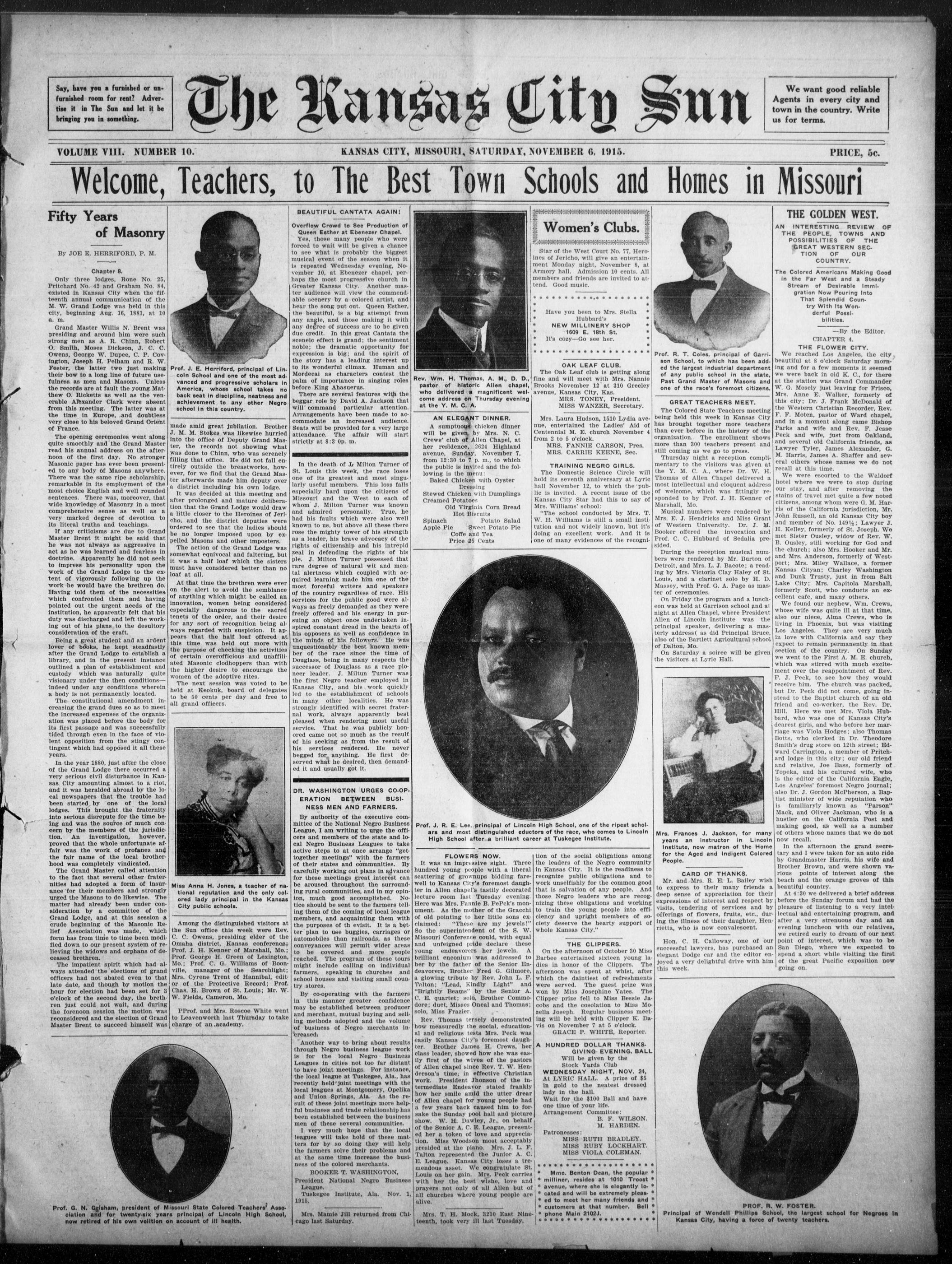
Welcome, Teachers, to The Best Town Schools and Homes in Missouri
Say, have you a furnished or unfurnished room for rent? Advertise it in The Sun and let it be bringing you in something.
VOLUME VIII. NUMBER 10.
By JOE E. HERRIFORD, P. M.
Only three lodges, Rone No. 25, Pritchard No. 42 and Graham No. 84, existed in Kansas City when the fifteenth annual communication of the M. W. Grand Lodge was held in this city, beginning Aug. 16, 1881, at 10 a. m.
Grand Master Willis N. Brent was presiding and around him were such strong men as A. R. Chinn, Robert O. Smith, Moses Dickson, J. C. C. Owens, George W. Dupee, C. P. Covington, Joseph H. Pelham and R. W. Foster, the latter two just making their bow to a long line of future usefulness as men and Masons. Unless the records are at fault the young Matthew O. Rickettis as well as the venerable Alexander Clark were absent from this meeting. The latter was at the time in Europe, and doubtless very close to his beloved Grand Orient of France.
The opening ceremonies went along quite smoothly and the Grand Master read his annual address on the afternoon of the first day. No stronger Masonic paper has ever been presented to any body of Masons anywhere. There was the same ripe scholarship, remarkable in its employment of the most choice English and well rounded sentences. There was, moreover, that wide knowledge of Masonry in a most comprehensive sense as well as a very marked degree of devotion to its literal truths and teachings.
If any criticisms are due to Grand Master Brent it might be said that he was not always as aggressive in act as he was learned and fearless in doctrine. Apparently he did not seek to impress his personality upon the work of the Grand Lodge to the extent of vigorously following up the work he would have the brethren do. Having told them of the necessities which confronted them and having pointed out the urgent needs of the institution, he apparently felt that his duty was discharged and left the working out of his plans, to the desultory consideration of the craft.
Being a great student and an ardent lover of books, he kept steadfastly after the Grand Lodge to establish a library, and in the present instance outlined a plan of establishment and custody which was naturally quite visionary under the then conditions—indeed under any conditions wherein a body is not permanently located.
The constitutional amendment increasing the grand dues so as to meet the increased expenses of the organization was placed before the body for its first passage and was successfully tided through even in the face of violent opposition from the stingy contingent which had opposed it all these years.
In the year 1880, just after the close of the Grand Lodge there occurred a very serious civil disturbance in Kansas City amounting almost to a riot, and it was heralded abroad by the local newspapers that the trouble had been started by one of the local lodges. This brought the fraternity into serious disrepute for the time being and was the source of much concern by the members of the jurisdiction. An investigation, however, proved that the whole unfortunate affair was the work of profanes and the fair name of the local brotherhood was completely vindicated.
The Grand Master called attention to the fact that several other fraternities had adopted a form of insurance for their members and strongly urged the Masons to do likewise. The matter had already been under consideration by a committee of the Grand Lodge, and at this session a crude beginning of the Masonic Relief Association was made, which form has from time to time been modified down to our present system of relieving the widows and orphans of deceased brethren.
The impatient spirit which had always attended the elections of grand officers had not abated even to that late date, and though by motion the hour for election had been set for 3 o'clock of the second day, the brethren just could not wait, and during the forenoon session the motion was reconsidered and the election of Grand Master Brent to succeed himself was
Prof. G. N. Grisham, president of Missouri State Colored Teachers' Association and for twenty-six years principal of Lincoln High School, now retired of his own volition on account of ill health.
The Kansas City Sun
Prof. J. E. Herriford, principal of Lincoln School and one of the most advanced and progressive scholars in America, whose school takes no back seat in discipline, neatness and achievement to any other Negro school in this country.
made amid great jubilation. Brother J. M. M. Stokes was likewise hurried into the office of Deputy Grand Master, the records not showing what was done to Chinn, who was serenely filling that office. He did not fall entirely outside the breastworks, however, for we find that the Grand Master afterwards made him deputy over a district including his own lodge. It was decided at this meeting and after prolonged and mature deliberation that the Grand Lodge would draw a little closer to the Heroines of Jericho, and the district deputies were ordered to see that the ladies should be no longer imposed upon by expelled Masons and other imposters. The action of the Grand Lodge was somewhat equivocal and faltering, but it was a half loaf which the sisters must have considered better than no loaf at all.
At that time the brethren were ever on the alert to avoid the semblance of anything which might be called an innovation, women being considered especially dangerous to the sacred tenets of the order, and their desire for any sort of recognition being always regarded with suspicion. It appears that the half loaf offered at this time was held out more with the purpose of checking the activities of certain overofficious and unaffiliated Masonic clodhoppers than with the higher desire to encourage the women of the adoptive rites.
The next session was voted to be held at Keokuk, board of delegates to be 50 cents per day and free to all grand officers.
Miss Anna H. Jones, a teacher of national reputation and the only colored lady principal in the Kansas City public schools.
Among the distinguished visitors at the Sun office this week were Rev. C. C. Owens, presiding elder of the Omaha district, Kansas conference; Prof. J. H. Kenner of Marshall, Mo.; Prof. George H. Green of Lexington Mo.; Prof. C. G. Williams of Boonville, manager of the Searchlight; Mrs. Cyrene Trent of Hannibal, edit or of the Protective Record; Prof. Chas. H. Brown of St. Louis; Mr. W W. Fields, Cameron, Mo.
PProf. and Mrs. Roscoe White went to Leavenworth last Thursday to take charge of an academy.
KANSAS CITY, MISSOURI, SATURDAY, NOVEMBER 6. 1915.
BEAUTIFUL CANTATA AGAIN!
Overflow Crowd to See Production of Queen Esther at Ebenezer Chapel.
Yes, those many people who were forced to wait will be given a chance to see what is probably the biggest musical event of the season when it is repeated Wednesday evening, November 10, at Ebenezer chapel, perhaps the most progressive church in Greater Kansas City. Another master audience will view the commendable scenery by a colored artist, and hear the song put out. Queen Esther, the beautiful, is a big attempt from any angle, and those making it with any degree of success are to be given due credit. In this great Cantata the scenic effect is grand; the sentiment noble; the dramatic opportunity for expression is big; and the spirit of the story has a leading interest up to its wonderful climax. Human and Mordecai as characters contest the palm of importance in singing roles before King Ahasuerus.
There are several features with the beggar role by David A. Jackson that will command particular attention. Arrangements have been made to accommodate an increased audience. Seats will be provided for a very large attendance. The affair will start strictly at 8:30 p. m.
In the death of *J. Milton Turner of St. Louis this week*, the race loses one of its greatest and most singularly useful members. This loss falls especially hard upon the citizens of Missouri and the West to each of whom J. Milton Turner was known and admired personally. True, he had his faults which were also well known to us, but above all these there rose the mighty tower of his strength as a leader, his brave advocacy of the rights of citizenship and his intrepid zeal in defending the rights of his ple. J. Milton Turner possessed that rare degree of natural wit and mental alertness which coupled with acquired learning made him one of the most forceful writers and speakers of the country regardless of race. His services for the public good were always as freely demanded as they were freely offered and his energy in pursuing an object once undertaken inspired constant dread in the hearts of his opposers as well as confidence in the minds of his followers. He was unquestionably the best known member of the race since the time of Douglass, being in many respects the successor of Douglass as a race pioneer leader. J. Milton Turner was the first Negro teacher employed in Kansas City, and his work quickly led to the establishment of schools in many other localities. He was strongly identified with secret fraternal work, always apparently best pleased when rendering most useful service. That he was publicly honored came not so much as the result of his seeking as from the result of his services rendered. He never begged for anything. He first deserved what he desired, then demanded it and usually got it.
DR. WASHINGTON URGES CO-OP
ERATION BETWEEN BUSINESS MEN AND FARMERS.
By authority of the executive committee of the National Negro Business League, I am writing to urge the officers and members of the state and local Negro Business Leagues to take active steps to at once arrange "get-together meetings" with the farmers of their states and communities. By carefully working out plans in advance for these meetings great interest can be aroused throughout the surrounding rural communities, and in my opinion, much good accomplished. Notice should be sent to the farmers telling them of the coming of local league members, and acquainting them with the purposes of the evist. It is a better plan to use buggies, carriages or automobiles than railroads, as these conveyances will permit wider areas to be covered and more people reached. The program of these tours might include calling on individual farmers, speaking in churches and school houses and visiting small country stores. By co-operating with the farmers in this manner greater confidence may be established between producer and merchant, mutual buying and selling methods adopted and the volume of business of Negro merchants increased.
Another way to bring about results through Negro business league work is for the local Negro Business Leagues in cities not too far distant to have joint meetings. For instance, the local league at Tuskegee, Ala., has recently held joint meetings with the local leagues at Montgomery, Opelika and Union Springs, Ala. As the result of these joint meetings more helpful business and trade relationship has been established between the business men of these several communities.
I very much hope that the local leagues will take hold of these matters for by so doing they will help the farmers solve their problems and at the same time increase the business of the colored merchants.
BOOKER T. WASHINGTON,
President National Negro Business League.
Tuskegee Institute, Ala. Nov. 1, 1915.
Mrs. Mainie Jill returned from Chicago last Saturday.
M. B.
Prof. J. R. E. Lee, principal of Lincoln High School, one of the ripest scholars and most distinguished eductors of the race, who comes to Lincoln High School after a brilliant career at Tuskegee Institute.
Rev. Wm. H. Thomas, A. M., D. D., pastor of historic Allen chapel, who delivered a magnificent welcome address on Thursday evening at the Y. M. C. A.
AN ELEGANT DINNER.
A sumptuous chicken dinner will be given by Mrs. N. C. Crews' club of Allen Chapel, at her residence, 2624 Highland avenue, Sunday, November 7, from 12:30 to 7 p. m., to which the public is invited and the following is the menu:
Baked Chicken with Oyster Dressing
Stewed Chicken with Dumplings
Creamed Potatoes
Old Virginia Corn Bread
Hot Biscuits
Spinach Potato Salad
Apple Pie Sweet Potato Pie
Coffe and Tea
Price 25 Cents
Prof. J. R. E. Lee, principal of Lincoln arts and most distinguished educ
High School after a brilliant car
FLOWERS NOW
It was an impressive sight. Three hundred young people with a liberal scattering of grownups bidding farewell to Kansas City's foremost daughter in Allen chapel's tastily decorated lecture room last Tuesday evening. Here was Mrs. Fannie B. Peck's monument. As the mother of the Gracchi of old pointing to her little sons exclaimed: "These are my jewels!" So the superintendent of the S. W Missouri Conference could, with equal and unfeigned pride declare these young endeavors her jewels. A brilliant enconium was addressed to her by the father of the Senior Endeavors, Brother Fred G. Glimore a glowing tribute by Rev. John L. F Talton; "Lead, Kindly Light" and "Brightly Beams" by the Senior A C. E. quartet; solo, Brother Commore; duet, Misses Oneal and Thomas; solo, Miss Frazier.
Rev. Thomas tersely demonstrated how measuredly the social, educational and religious tests Mrs. Peck was easily Kansas City's foremost daughter. Brother James H. Crews, her class leader, showed how she was easily first of the wives of the pastors of Allen chapel since Rev. T. W. Henderson's time, in effective Christian work. President Jhonson of the intermediate Endeavor stated frankly how her smile amid the utter drear of Allen chapel for young people had a few years back caused him to forsake the Sunday pool hall and picture show. W. H. Dawley, Jr., on behalf of the Senior A. C. E. League, presented her a token of love and appreciation. Miss Woodson most acceptably presided at the piano. Mrs. J. L. F. Talton represented the Junior A. C. E. League. Kansas City loses a tremendous asset. We congratulate St. Louis on her gain. Mrs. Peck carries with her the best wishe, love and prayers not only of all Allen but of all churches where young people are alive.
Mrs. T. H. Mock, 3210 East Nineteenth, took very ill last Tuesday.
Women's Clubs.
Star of the West Court No. 77, Heroines of Jericho, will give an entertainment Monday night, November 8, at Armory hall. Admission 10 cents. All members and friends are invited to attend. Good music.
Have you been to Mrs. Stella
Hubbard's
NEW MILLINERY SHOP
1609 E. 18th St.
It's cozy—Go see her.
OAK LEAF CLUB
The Oak Leaf club is getting along fine and will meet with Mrs. Nannie Brooks November 12 at 310 Greeley avenue, Kansas City, Kas.
MRS. TONEY, President.
MISS WANZER, Secretary.
Mrs. Laura Hudson, 1510 Lydia avenue, entertained the Ladies' Aid of Centennial M. E. church November 4 from 2 to 5 o'clock.
MRS. FANNIE CARSON, Pres.
MRS. CARRIE KEENE, Sec.
TRAINING NEGRO GIRLS
The Domestic Science Circle will hold its seventh anniversary at Lyric hall November 12, to which the public is invited. A recent issue of the Kansas City Star had this to say of Mrs. Williams' school: "The school conducted by Mrs. T. W. H. Williams is still a small institution and not widely known, but it's doing an excellent work. And it is one of many evidences of the recogni-
In High School, one of the ripest scholars of the race, who comes to Lincoln reer at Tuskegee Institute.
tion of the social obligations among the leaders of the Negro community in Kansas City. It is the readiness to recognize public obligations and to work unselfishly for the common good that is salvation of any people. And those Negro leaders who are recognizing these obligations and working to train the young people into efficiency and upright members of so society deserve the hearty support of whole Kansas City."
THE CLIPPERS
On the afternoon of October 30 Miss Barbee entertained sixteen young ladies in honor of the Clippers. The afternoon was spent at whist, after which the daintiest of refreshments were served. The guest prize was won by Miss Josephine Yates. The Clipper prize fell to Miss Bessie Jacobs and the cosolation to Miss Mozella Joseph. Regular business meeting will be held with Clipper K. Davis on November 7 at 5 o'clock.
GRACE P. WHITE, Reporter.
A HUNDRED DOLLAR THANKS-
GIVING EVENING, BALL
Will be given by the
Stock Yards Club
WEDNESDAY NIGHT, NOV. 24,
At LYRIC HALL. A prize of $5
in gold to the neatest dressed
lady in the hall.
Wait for the $100 Ball and have
one time of your life.
Arrangement Committee:
B. F. WILSON.
M. HARDEN.
Patronesses:
MISS RUTH BRADLEY.
MISS RUBY LOCKHART.
MISS VIOLA COLEMAN.
Mme. Benton Dean, the popular
milliner, resides at 1010 Troost
avenue, where she is elegantly loca-
cated and will be extremely pleas-
ed to meet her many friends and
customers at that number. Bell
phone Main 2102J.
.....
PROF. R. W. FOSTER.
Principal of Wendell Phillips School, the largest school for Negroes in Kansas City, having a force of twenty teachers.
Prof. R. T. Coles, principal of Garrison School, to which has been added the largest industrial department of any public school in the state, Past Grand Master of Masons and one of the race's foremost citizens.
GREAT TEACHERS MEET
The Colored State Teachers meeting being held this week in Kansas City has brought together more teachers than ever before in the history of the organization. The enrollment shows more than 300 teachers present and still coming as we go to press.
Thursday night a reception complementary to the visitors was given at the Y. M. C. A., where Dr. W. H. Thomas of Allen Chapel delivered a most intellectual and eloquent address of welcome, which was fittingly responded to by Prof. J. H. Kenner of Marshall, Mo.
Musical numbers were rendered by Mrs. E. J. Hendricks and Miss Grant of Western University. Dr. J. M. Booker offered the invocation and Prof. C. C. Hubbard of Sedalia presided.
During the reception musical numbers were rendered by Mr. Burton of Detroit, and Mrs. L. J. Bacote; a reading by Mrs. Victoria Clay Haley of St Louis, and a clarinet solo by H. D. Massley, with Prof. G. A. Page as master of ceremonies.
On Friday the program and a luncheon was held at Garrison school and at night at Allen Chapel, where President Allen of Lincoln Institute was the principal speaker, delivering a masterly address; as did Principal Bruce also of the Bartlett Agricultural school of Dalton, M.
On Saturday a soiree will be given the visitors at Lyric Hall.
Mrs. Frances J. Jackson, for many years an instructor in Lincoln Institute, now matron of the Home for the Aged and Indigent Colored People.
CARD OF THANKS
Mr. and Mrs. R. E. L. Bailey wish to express to their many friends a deep sense of appreciation for their expressions of interest and respect by visits, tendering of services and by offerings of flowers, fruits, etc., during the illness of their daughter, Henrietta, who is now convalescent.
Hon. C. H. Calloway, one of our successful lawyers, has purchased an elegant Dodge car and the editor enjoyed a very delightful drive with him this week.
We want good reliable Agents in every city and town in the country. Write us for terms.
PRICE. 5c.
THE GOLDEN WEST.
AN INTERESTING REVIEW OF THE PEOPLE, TOWNS AND POSSIBILITIES OF THE GREAT WESTERN SECTION OF OUR COUNTRY.
The Colored Americans Making Good in the Far West and a Steady Stream of Desirable Immigration Now Pouring Into That Splendid Country With Its Wonderful Possibilities.
We reached Los Angeles, the city beautiful at 8 o'clock Saturday morning and for a few moments it seemed we were back in old K. C., for there at the station was Grand Commander W. G. Mosely just leaving for Frisco, Mrs. Anne E. Walker, formerly of this city; Dr. J. Frank McDonald of the Western Christian Recorder, Rev. F. F. Moten, pastor of Ward chapel, and in a moment along came Bishop Parks and wife and Rev. F. Jesse Peck and wife, just from Oakland, and several old California friends, as Lawyer Tyler, James Alexander, G. M. Harris, James A. Shaffer and several whose names we do not recall at this time.
We were escorted to the Waldorf hotel where we were to stop during our stay, and after removing the stains of travel met quite a few noted citizens, among whom were G. M. Harris of the California jurisdiction, Mr. John Russell, an old Kansas City boy and member of No. 1491%; Lawyer J. H. Kelley, formerly of St. Joseph. We met Sister Ousley, widow of Rev. W. B. Ousley, still working for God and the church; also Mrs. Hooker and Mr. and Mrs. Anderson, formerly of Westport; Mrs. Miley Wallace, a former Kansas Cityian; Charley Washington and Dunk Trusty, just in from Salt Lake City; Mrs. Capitola Marshall, formerly Scott, who conducts an excellent cafe, and many others.
We found our nephew, Wm. Crews, whose wife was quite ill at that time, also our niece, Alma Crews, who is living in Phoenix, but was visiting Los Angeles. They are very much in love with California and say they expect to remain permanently in that section of the country. On Sunday we went to the First A. M. E. church, which was stirred with much excitement over the reappointment of Rev. F. J. Peck, to see how they would receive him. The church was packed, but Dr. Peck did not come, going instead to the Baptist church of an old friend and co-worker, the Rev. Dr. Hill. Here we met Mrs. Viola Hubbard, who was one of Kansas City's dearest girls, and who before her marriage was Viola Hodges; also Thomas Botts, who clerked in Dr. Theodore Smith's drug store on 12th street; Edward Carrington, a member of Pritchard lodge in this city; our old friend and relative, Joe Bass, formerly of Topeka, and his cultured wife, who is the editor of the California Eagle, Los Angeles' foremost Negro journal; also Dr. J. Gordon McPherson, a Baptist minister of wide reputation who is familiarly known as "Parson" Mack, and Oliver Jackman, who is a hustler on the California Post and making good, as well as a number of others whose names that we do not now recall.
In the afternoon the grand secretary and I were taken for an auto ride by Grandmaster Harris, his wife and Brother Brown, and were shown various points of interest along the beach and the orange groves of this beautiful country.
At 4:30 we delivered a brief address before the Sunday forum and had the pleasure of listening to a very intellectual and entertaining program, and after a very strenuous day and an evening luncheon with our relatives, we retired early to dream of our next point of interest, which was to be San Diego, where we expected to spend a short while visiting the first of the great Pacific exposition now going on.
AFRO-AMERICAN CULLINGS
In reply to the very interesting letter in the Times, referring to the essay on Southern music, by Prof. Albert Mildenberg, as published in your Sunday Magazine, I venture to add a few words, the result of great interest and much research in my personal acquaintance of many years with the well-known English Negro composer, Coleridge Taylor, and the famous American authority, Harry T. Burleigh, both of these men being grave and earnest musicians, yet each pursuing entirely different paths in the development of their art, writes Albert J. Weber in the New York Times. In the case of Coleridge Taylor it has been a steady advancement of a great talent for composition along serious lines, with no leaning toward development of a race peculiarity or special influence, it being simply the following out of the classical as well as lighter forms of musical compositions following those of all of the modern celebrated European composers.
Regarding Mr. Burleigh, his work has been a development of an idea which has had as its main inception and essential character the bringing out of peculiar and individual Negro qualities, so far a. the themes and rhythm are concerned, of course, seriously treated, but nevertheless with the idea of establishing a splendid and delightful color in his work, and the existence of a characteristic that he attributes solely to the Southern plantation Negro. It is but just and fair to presume that the charming melodies sung by the Southern plantation Negro such as "Swing Low, Sweet Charlot" and "Steal Away to Jesus" and the numerous other spirituals that I have heard unlimited times during my investigations in the South, throughout that glorious "Land of Dixie," are of absolutely pure Negro origin, and this fact no doubt re-enforces the contention of Prof. Albert Mildenberg's argument that we must look to these fundamental principles of melody and rhythm produced by these very Southern Negro singers, and maintained by this to this very day in their original form, for the very essence of the material upon which our American folk-song exists and may be further developed.
The more treatment they will undergo at the hands of the trained and skilled musicians the further away from their intrinsic value they will be drawn, the more will they lose their entire individuality. The natural melodies in their original form, free from harmonic treatment by technical musicians, will of themselves be a potent factor in our future musical development.
Statistics show that 55,000 of the 165,000 people in Birmingham are Negroes. The school census of 1912 showed 21,336 Negro children of school age. The annual report of the Birmingham public schools of 1913 has 7,960 Negro children enrolled in the schools, 5,884 of whom attended regularly. This report shows 5,445 seats for these children, a lacking of 439 seats to accommodate them. Our schools are sadly crowded; many drop out for this reason, and I wonder to what extent are these conditions responsible for the large amount of work left for the juvenile court officers, for the restless, ignorant young Negro who crowds the dives, jails and mines, for the spread of infectious diseases.-Mrs. Sidney M. Ullman, in the Birmingham (Ala.) Age-Herald.
A correspondent of a Washington newspaper suggested that the United States create a Negro army of from 500,000 to 1,000,000 men for carrying on the reclamation work and other industrial undertakings in peace, and our fighting in time of war. This is a most undemocratic and abhorrent suggestion. Mercenary armies and vicarious fighters were in fashion 150 years ago, when despotic kings used them as their tools of oppression. The odium that attaches to the term Hessian, in our own history, is the result of the intense feeling among our own forefathers against hireling soldiers. The revolutionary fighters were willing to risk their fortunes, their energies and their lives in the struggle for liberty, and the English king brought into the field against them hired troops. Unprepared and undisciplined as the Americans were, their superior morale won for them victory.
With the arrival at New York on the steamer Norseman from Liverpool of 18 distressed Americans, forming what was left of the crew of the British steamer Liberia, a dramatic chap.
Mrs. Ella D. Rowland of Zillah. Wash., owns a vast apple orchard upon which it is claimed that she raises the finest apples that are grown in the United States.
Farmers in England are now preparing to pay women the same wages as given to the men called away to war.
In proportion to population, Japan has more suicides than any other civilized nation
ITEMS OF INTEREST
The gray wolf of Montana is the hardest animal to trap. It is destructive to cattle.
The population of Montana on March 1 was 622,815. Silver Bow was the most populous county with 72,500 people.
Among those who have joined the British army during the present war are 30,000 Durham miners, 20,000 South Wales ministers and 15,000 Yorkshire miners.
One of the most significant of the many hopeful tendencies in the South today is the spirit of co-operation being manifested on every hand between the white and colored people. Never in the history of the South, it is safe to say, has there been so keen an interest on the part of the white population in the condition and welfare of the Negro. In almost every large city below the Ohio river, from Galveston and Houston up to New Orleans, Birmingham, Atlanta and even Washington, there has been an awakening in some one or all of the phases of Negro life. In the agricultural districts of southern states there has been a revaluation of the status of the Negro and a new attitude with regard to him is being formed.
Of the many causes to which this awakening is to be attributed two stand out most prominently. First, the publication of census statistics showing the appalling death rate from tuberculosis and other diseases among Negroes and the absence of any well regulated effort looking toward sanitation in Negro quarters. The interest which many people have taken has been, no doubt, the sort of interest one would take if a mad dog were loose in the neighborhood; but, regardless of the motive of self-preservation, the "cleanup" movement has been responsible for great good.
In the second place, the colored people themselves have been so untiring in their efforts to bring to pass a newer and better era in the land of which they are in indispensable economic part that their laborers are now bearing fruit. There is a larger confidence in the future of their race, because they themselves are responding more rapidly and more satisfactorily now than ever before.
The South in the next few decades will become one of the richest sections of the nation and of the world. It is therefore important not only that labor and capital should work in harmony, but it is even more important that there should be an interracial sympathy and co-operation in all economic and civic endeavor. The laborer can be kept skillful and efficient only as his environment is wholesome and strengthening, and not weakening and demoralizing. It is in the spirit of this paragraph, reflected in an address delivered by Maj. R. R. Moton of Hampton institute, that the leading white people of the South are coming to regard the Negro problem. That a large share of their concern in the matter lies on the side of the economic is shown by the interest taken in the efforts of a number of state and city health officials to improve the sanitary conditions in which the Negroes of their respective districts are forced to live.-Chicago Daily News.
For carrying a policeman's club there has been invented a strap to be worn over one shoulder and extend through an opening in the coat, obviating the necessity for a belt.
German scientists have utilized photomicrographs of crystallization forms of various chemical solutions to provide new patterns for various arts and crafts.
If you know a good recipe for making raspberry jam, keep it to yourself. Do not let it be said of you that you held a grudge against the world.
Fortune is the woman who is too busy to have that kind of a tongue.
ter was written into a colonization scheme, headed by Alfred Charles Sam, said to be chief of an African tribe, to transport Negroes from the United States to the west coast of Africa.
The project, as described by Sam, was to enable Negroes to go to West Africa, join a colony, and live in comparative luxury.
The Liberia, financed, it was said, by Negroes, left Portland, Me., in May and, after stopping at Norfolk, Va. proceeded to Galveston, Tex., where it was reported to have taken on 40 Negroes and started on its voyage to the west coast of Africa.
At Anamabu, on the African coast, the Liberia was seized by British authorities, as the owner was a British subject. While there the crew was stricken by fever and removed to a hospital. After their recovery they were discharged. They then went to Liverpool, whence they were sent home as consular passengers.
"Auntie" Mahaley Gibbs, aged ninety-nine years, according to city health statistics, is dead at Memphis, Tenn.
Ezra Meeker wants the Oregon trail appropriately marked. Inasmuch as Mr. Meeker appears to have more idle time than anyone else, why not let him mark it?
In giving little Willie a present you can greatly facilitate matters by also giving him a hammer with which to break it up.
The British Royal Navy reserve was established in 1859; the Royal Fleet reserve in 1907.
Constantinople is a city of mosques and minarets. There are about 800 mosques in it, many of the them being buildings of the most beautiful and picturesque sort.
Physicians of Crane, Mo., are puzzled by an ailment which strikes W. H. Hilton dumb when he attempts to address persons near him, but permits him to speak plainly when addressing persons at a distance, or when talking to animals.
The man who runs along on an even keel never stage-manages a revolution
WARRON COMPS
UNDERWOOD
UNDERWOOD
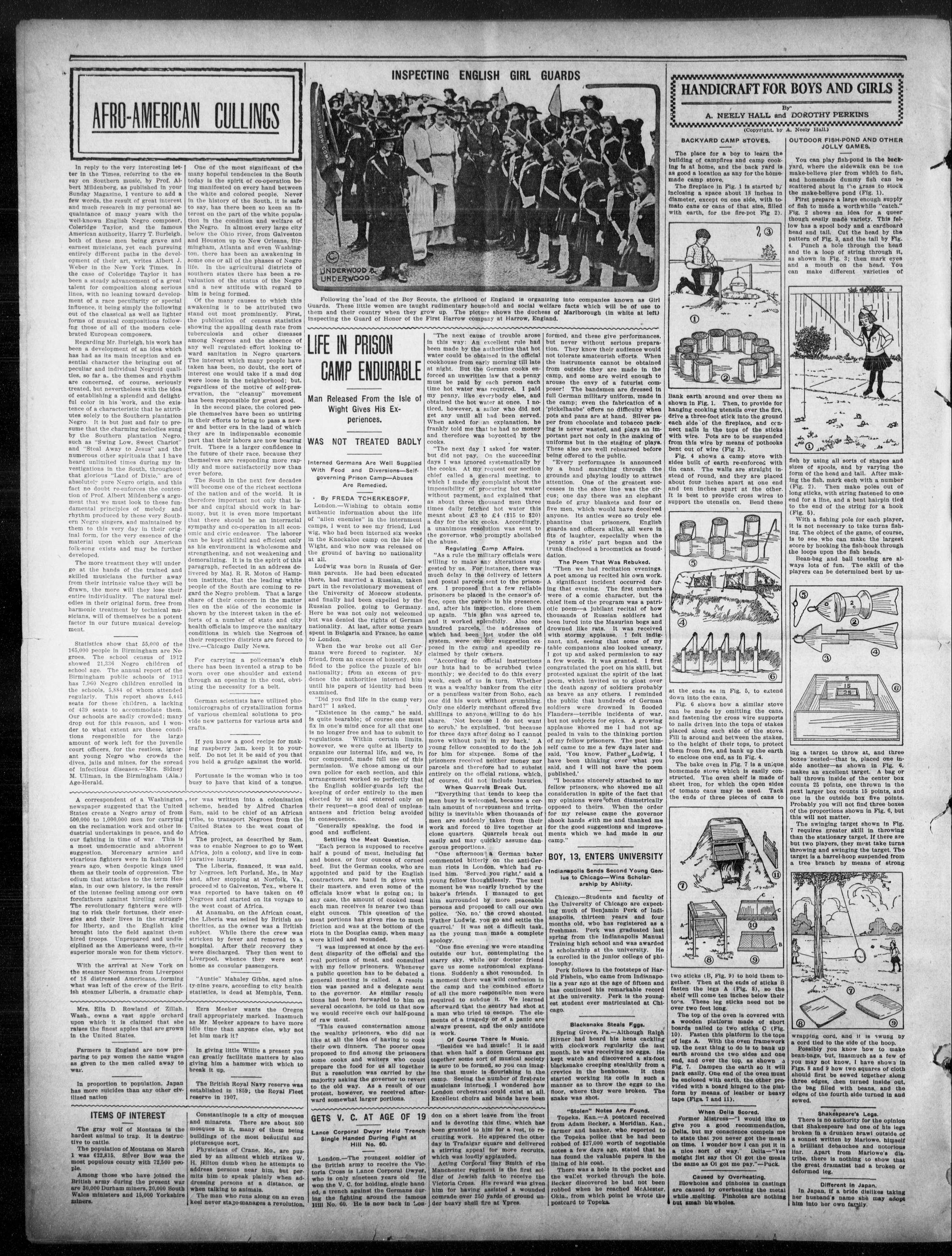
Following the lead of the Boy Scouts, the girlhood of England is organizing into companies known as Girl Guards. These little women are taught rudimentary household and social welfare facts which will be of use to them and their country when they grow up. The picture shows the duchess of Marlborough (in white at left) inspecting the Guard of Honor of the First Harrow company at Harrow, England.
LIFE IN PRISON CAMP ENDURABLE
Interned Germans Are Well Supplied With Food and Diversions—Self-governing Prison Camp—Abuses Are Remedied.
- By FREDA TCHERKESOFF.
London.—Wishing to obtain some authentic information about the life of "alien enemies" in the internment camps, I went to see my friend, Ludwig, who had been interned six weeks in the Knockaloake camp on the Isle of Wight, and who now was released on the ground of having no nationality at all.
Ludwig was born in Russia of German parents. He had been educated there, had married a Russian, taken part in the revolutionary movement of the University of Moscow students, and finally had been expelled by the Russian police, going to Germany. Here he was not only not welcomed but was denied the rights of German nationality. At last, after some years spent in Bulgaria and France, he came to London.
When the war broke out all Germans were forced to register. My friend, from an excess of honesty, considered to the police the puzzle of his nationality; from an excess of prudence the authorities interned him until his papers of identity had been examined.
"Did you find life in the camp very hard?" I asked.
"Existence in the camp," he said, is quite bearable; of course one must fix in one's mind once for all that one is no longer free and has to submit to regulations. Within certain limits, however, we were quite at liberty to organize our internal life, and we, in our compound, made full use of this permission. We chose among our own police for each section, and this arrangement worked so perfectly that the English soldier-guards left the keeping of order entirely to the men elected by us and entered only on their request—a good deal of unpleasantness and friction being avoided in consequence.
"Generally speaking, the food is good and sufficient.
Settling the Meat Question.
"Each person is supposed to receive half a pound of meat, including fat and bones, or four ounces of corned beef. But the German cooks, who are appointed and paid by the English contractors, are hand in glove with their masters, and even some of the officials know what is going on; in any case, the amount of cooked meat each man receives is nearer two than eight ounces. This question of the meat portions has given rise to much friction and was at the bottom of the riots in the Douglas camp, when many were killed and wounded.
"I was impressed at once by the evident disparity of the official and the real portions of meat, and consulted with my fellow prisoners. Whenever a public question has to be debated a general meeting is called. A resolution was passed and a delegate sent to the governor. As similar resolutions had been forwarded to him on several occasions, he told us that now we would receive each our half-pound of raw meat.
"This caused consternation among the wealthy prisoners, who did not like at all the idea of having to cook their own dinners. The poorer ones proposed to find among the prisoners some cooks and waiters who could prepare the food for us all together. But a resolution was carried by the majority asking the governor to revert to the old way. As a result of our protest, however, we received afterward somewhat larger portions.
GETS V. C. AT AGE OF 19
Lance Corporal Dwyer Held Trench Single Handed During Fight at Hill No. 60.
London—The youngest soldier of the British army to receive the Victoria Cross is Lance Corporal Dwyer, who is only nineteen years old. He won the V. C. for holding, single handed, a trench against the Germans during the fighting around the famous Hill No. 60. He is now back in Lon-
"The next cause of trouble arose in this way: An excellent rule had been made by the authorities that hot water could be obtained in the official cookhouse from early morning till late at night. But the German cooks enforced an unwritten law that a penny must be paid by each person each time hot water was required. I paid my penny, like everybody else, and obtained the hot water at once. I noticed, however, a sailor who did not get any until all had been served. When asked for an explanation, he frankly told me that he had no money and therefore was boycotted by the cooks.
"The next day I asked for water, but did not pay. On the succeeding days I was ignored systematically by the cooks. At my request our section chief called a general meeting, to which I made my complaint about the impossibility of procuring hot water without payment, and explained that as about three thousand men three times daily fetched hot water this meant about £3 to £4 ($15 to $20) a day for the six cooks. Accordingly, a unanimous resolution was sent to the governor, who promptly abolished the abuse.
Regulating Camp Affairs.
"According to official instructions our huts had to be scrubbed twice monthly; we decided to do this every week, each of us in turn. Whether it was a wealthy banker from the city or a penniless waiter from Soho, each one did his work without grumbling. Only one elderly merchant offered five shillings to anyone willing to do his share. 'Not because I do not want to scrub;' he explained, 'but because for three days after doing so I cannot move without pain in my back.' A young fellow consented to do the job for him for sixpence. Some of the prisoners received neither money nor parcels and therefore had to subsist entirely on the official rations, which of course, did not include luxuries
When Quarrels Break Out.
"Everything that tends to keep the men busy is welcomed, because a certain amount of nervousness and irritability is inevitable when thousands of men are suddenly taken from their work and forced to live together at close quarters. Quarrels break out easily and may quickly assume dangerous proportions.
"One afternoon a German baker commented bitterly on the anti-German riots in London, which had ruined him. 'Served you right,' said a young fellow thoughtlessly. The next moment he was nearly lynched by the baker's friends. I managed to get him surrounded by more peaceable persons and proposed to call our own police. 'No, no,' the crowd shouted. 'Father Ludwig, you go and settle the quarrel.' It was not a difficult task, as the young man made a complete apology.
"One fine evening we were standing outside our hut, contemplating the starry sky, while our doctor friend gave us some astronomical explanations. Suddenly a shot resounded. In a moment there was wild confusion in the camp and the combined efforts of all the more responsible men were required to subdue it. We learned afterward that the sentry had shot at a man who tried to escape. The elements of a tragedy or of a panic are always present, and the only antidote is work.
Of Course There Is Music.
"Besides we had music! It is said that when half a dozen Germans get together some sort of musical society is sure to be formed, so you can imagine that music is flourishing in the camp. Seeing the number of first-rate musicians interned, I wondered how London orchestras could exist at all. Excellent choirs and bands have been don on a short leave from the front and is devoting this time, which has been granted to him for a rest, to recruiting work. He appeared the other day in Trafalgar square and delivered a stirring appeal for more recruits, which was loudly applauded. Acting Corporal Issy Smith of the Manchester regiment is the first soldier of Jewish faith to receive the Victoria Cross. His reward was given him for having assisted a wounded comrade over 250 yards of ground under heavy shell fire at Ypres.
formed, and these give performances, but never without serious preparation. They know their audience would not tolerate amateurish efforts. When the instruments cannot be obtained from outside they are made in the camp, and some are weird enough to arouse the envy of a futurist composer! The bandmen are dressed in full German military uniform, made in the camp; even the fabrication of a 'pickelhaube' offers no difficulty when pots and pans are at hand. Silver paper from chocolate and tobacco packing is never wasted, and plays an important part not only in the making of uniforms but in the staging of plays. These also are well rehearsed before being offered to the public.
"Every performance is announced by a band marching through the grounds and playing loudly to attract attention. One of the greatest successes in the show line was the circus; one day there was an elephant made of gray blankets and four or five men, which would have deceived anyone. Its antics were so truly elephantine that prisoners, English guards and officers allike, all were in fits of laughter, especially when the 'penny a ride' part began and the trunk disclosed a broomstick as foundation.
The Poem That Was Rebuked.
"Then we had recitation evenings. A poet among us recited his own work. A significant incident occurred during that evening. The first numbers were of a comic character, but the chief item of the program was a patriotic poem—a jubilant recital of how thousands of Russian soldiers had been lured into the Masurian bogs and drowned with like rats. It was received with stormy aplause. I felt indignant, and, seeing that some of my table companions also looked uneasy, I got up and asked permission to say a few words. It was granted. I first congratulated the poet on his skill, but protested against the spirit of the last poem, which invited us to gloat over the death agony of soldiers probably as brave as any others. I reminded the public that hundreds of German soldiers were drowned in flooded Flanders—terrible incidents of war, but not subjects for epics. A growing applause showed me I had not appealed in vain to the thinking portion of my fellow prisoners. The poet himself came to me a few days later and said, "You know, Father Ludwig, I have been thinking over what you said, and I will not have the poem published."
"I became sincerely attached to my fellow prisoners, who showed me all consideration in spite of the fact that my opinions were often diametrically opposed to theirs. When the order for my release came the governor shook hands with me and thanked me for the good suggestions and improvements which we had made in our camp."
BOY, 13, ENTERS UNIVERSITY
Indianapolis Sends Second Young Genius to Chicago—Wins Scholarship by Ability.
Chicago.—Students and faculty of the University of Chicago are expecting much of Benjamin Perk of Indianapolis, thirteen years and four months old, who has registered as a freshman. Perk was graduated last spring from the Indianapolis Manual Training high school and was awarded a scholarship at the university. He is enrolled in the junior college of philosophy.
Perk follows in the footsteps of Harold Fisbein, who came from Indianapolis a year ago at the age of fifteen and has continued his remarkable record at the university. Perk is the youngest student ever matriculated at Chicago.
Blacksnake Steals Eggs.
Spring Grove, Pa.—Although Ralph Hivner had heard his hens cackling with clockwork regularity the last month, he was receiving no eggs. He kept watch and discovered a six-foot blacksnake creeping stealthily from a crevice in the henhouse. It then started working its colls in such a manner as to throw the eggs to the floor, where they were broken. The snake was shot.
"Stolen" Notes Are Found.
Topeka, Kan. — A postcard received from Adam Becker, a Meridian, Kan., farmer and banker, who reported to the Topeka police that he had been robbed of $27,000 worth of negotiable notes a few days ago, stated that he has found the valuable papers in the lining of his coat.
There was a hole in the pocket and the walet worked through the hole. Becker discovered he not had been robbed when he reached McAleron, Okla., from which point he wrote the postcard to Topeka.
HANDICRAFT FOR BOYS AND GIRLS
BACKYARD CAMP STOVES.
The place for a boy to learn the building of campfires and camp cooking is at home, and the back yard is as good a location as any for the homemade camp stove.
The fireplace in Fig. 1 is started by including a space about 18 inches in diameter, except on one side, with tomato cans or cans of that size, filled with earth, for the fire-pot Fig. 2).
2. $ \textcircled{3} $
$\textcircled{1}$
$\textcircled{2}$
Bank earth around and over them as shown in Fig. 1. Then, to provide for hanging cooking utensils over the fire, drive a three-foot stick into the ground each side of the fireplace, and connect nails in the tops of the sticks with wire. Pots are to be suspended from this wire by means of pothooks bent out of wire (Fig 3).
Fig. 4 shows a camp stove with sides built of earth re-enforced with tin cans. The walls are straight instead of round, and they are placed about four inches apart at one end and ten inches apart at the other. It is best to provide cross wires to support the utensils on. Bend these
$\textcircled{5}$
$\textcircled{4}$
$\textcircled{6}$
at the ends as in Fig. 5, to extend down into the cans.
Fig. 6 shows how a similar stove can be made by omitting the cans, and fastening the cross wire supports to nails driven into the tops of stakes placed along each side of the stove. Fill in around and between the stakes, to the height of their tops, to protect them from fire, and bank up the earth to enclose one end, as in Fig. 4.
The bake oven in Fig. 7 is a unique homemade stove which is easily constructed. The oven shelf is made of sheet iron, for which the open sides of tomato cans may be used. Tack the ends of three pieces of cans to
$\textcircled{7}$ $\textcircled{11}$
$\textcircled{10}$
$\textcircled{9}$
two sticks (B, Fig. 9) to hold them together. Then at the ends of sticks B fasten the legs A (Fig. 8), so the shelf will come ten inches below their tops. These leg sticks need not be over two feet long.
The top of the oven is covered with a wooden platform made of short boards nailed to two sticks C (Fig. 10). Fasten this platform to the tops of legs A. With the oven framework up, the next thing to do is to bank up earth around the two sides and one end, and over the top, as shown in Fig. 7. Dampen the earth so it will pack easily. One end of the oven must be enclosed with earth, the other pro- provided with a board hinged to the platform by means of leather or heavy tape (Figa. 7 and 11).
When Delta Scored.
Former Mistress—"I would like to give you a good recommendation, Delia, but my conscience compels me to state that you never got the meals on time. I wonder how I can put it in a nice sort of way." Delia—"Yeer moight list say that Ol got the meals the same as Ol got me pay."—Puck.
Caused by Overheating.
Blowholes and pinholes in castings are caused by overheating the metal while melting. Pinholes are nothing but smash blkwholes.
OUTDOOR FISH-POND AND OTHER JOLLY GAMES.
You can play fish-pond in the backyard, where the sidewalk can be the make-believe pier from which to fish, and homemade dummy fish can be scattered about in the grass to stock the make-believe pond (Fig. 1).
First prepare a large enough supply of fish to make a worthwhile "catch." Fig. 2 shows an idea for a queer though easily made variety. This fellow has a spool body and a cardboard head and tail. Cut the head by the pattern of Fig. 3, and the tail by Fig. 4. Punch a hole through the head and tie a loop of string through it, as shown in Fig. 3; then mark eyes and a mouth on the head. You can make different varieties of
$\textcircled{4}$
fish by using all sorts of shapes and sizes of spools, and by varying the form of the head and tail. After making the fish, mark each with a number (Fig. 2). Then make poles out of long sticks, with string fastened to one end for a line, and a bent hairpin tied to the end of the string for a hook (Fig. 5).
With a fishing pole for each player, it is not necessary to take turns fishing. The object of the game, of course, is to see who can make the largest score by hooking the fish-hook through the loops upon the fish heads.
Bean-bag and ball tossing are always lots of fun. The skill of the players can be determined best by us.
$\textcircled{5}$
$\textcircled{2}$
$\textcircled{3}$
$\textcircled{4}$
5
15
25
$\textcircled{6}$
ing a target to throw at, and three boxes nested—that is, placed one inside another—as shown in Fig. 6, makes an excellent target. A bag or ball thrown inside of the center box counts 25 points, one thrown in the next larger box counts 15 points, and one in the outside box five points. Probably you will not find three boxes of the proportions shown in Fig. 6, but this will not matter.
The swinging target shown in Fig. 7 requires greater skill in throwing than the stationary target. If there are but two players, they must take turns throwing and swinging the target. The target is a barrel-hoop suspended from a tree branch by means of strong
wrapping cord, and it is swung by a cord tied to the side of the hoop.
Possibly you know how to make bean-bags, but, inasmuch as a few of you may not know, I have shows in Figs. 8 and 9 how two squares of cloth should first be sewed together along three edges, then turned inside out, the bag filled with beans, and the edges of the fourth side turned in and sewed.
Shakespeare's Legs.
There is no authority for the opinion that Shakespeare had one of his legs broken in a drunken brawl outside of a sonnet written by Marlowe, himself a brilliant debauchee and notorious liar. Apart from Marlowe's distribe, there is nothing to show that the great dramatist had a broken or deformed leg.
Different in Japan.
In Japan, if a bride dislikes taking her husband's name she may adopt him into her own family.
Madam P. M. Dabney's
XXTH CENTURY HAIR PREPARATIONS
And Have Good Hair
Mme. P. M. Dabney's XXth Century Hair Grower
Madam P. M. Dabney's XXth Century Hair Grower promotes a beautiful growth of hair, stops falling out and breaking of hair, removes dandruff and relieves itching of scalp. It will make YOUR hair grow. For woman, man or child.
PRICE 50c. PER JAR
Mme. P. M. Dabney's XXth Century Hair Grower
Six Weeks'
TESTIMONIAL
"This is to certify that the writer suffered for four years with danduff and itching of the scalp until practically bald, trying many remedies but of no avail. About six months ago I began to use Madam P. M. Dabney's XXth Century Hair Grower, the results up to date are pleasing. Dandruff removed, itching stopped, good growth of hair started. The remedy is O. K. Yours for succes, Rev. L. W. Harris, Mod. Mt. Zion Baptist Association, Carrollton, Mo."
Make a course of treatment which will last six weeks enclosing P. O. money on by parcel post prepaid, or mation to
Madam P. M. Dal
HAIR PREP
1806 E. 24th St.
Yours a Demand for a Hair Food
ORO MARK
The best, it being the one remedy for relieving unsanitary conditions growth. Scientifically trained all the leading cities.
There Is Always a
Good Hair
66 TRADE PO
is acknowledged to be the best, and healing the scalp, relieving and promoting growth. $ agents in all the
He is Always a Demand for Good Hair Food
TRADE PORO MARK
owledged to be the best, it being the one being the scalp, relieving unsanitary conditions and promoting growth. Scientifically trained agents in all the leading cities.
There is Always a Demand for a Good Hair Food
is acknowledged to be the best, it being the one remedy for healing the scalp, relieving unsanitary conditions and promoting growth. Scientifically trained agents in all the leading cities.
Poro Preparations Made by
Mm AmBpeturubo
3100 PINE
ST. LOUIS
BEWARE OF IN
Expert Dental
OF KANSAS
Our work has stood the test. We have be-
tal Work for the past 29 years. We have
REMEMBER, IN BUSI
All work kept in repair
SAVE MONEY EXAMINATION
All work guaranteed
The doctor who extracts your teeth here h
in this line than any other dentist in the c
ice.
100 PINE STREET
ST. LOUIS, MO
BEWARE OF IMITATIONS
Art Dental Special
OF KANSAS CITY
s stood the test. We have been doing high class
for the past 29 years. We have thousands of satis-
REMEMBER, IN BUSINESS 29 YEARS
All work kept in repair free of charge.
MONEY EXAMINATION FREE GET
who extracts your teeth here has undoubtedly had
man any other dentist in the city, so you get the m
BRIDGE WOR
ONE STREET
LOUIS, MO.
E OF IMITATIONS
Dental Specialists
KANSAS CITY
We have been doing high class guaranteed Den-
We have thousands of satisfied patients.
IN BUSINESS 29 YEARS
in repair free of charge.
MINATION FREE
guaranteed 20 years.
GET THE BEST
with here has undoubtedly had more experience
in the city, so you get the most expert serv-
BRIDGE WORK.
3100 PINE STREET ST. LOUIS, MO. BEWARE OF IMITATIONS
Expert Dental Specialists
Our work has stood the test. We have been doing high class guaranteed Dental Work for the past 29 years. We have thousands of satisfied patients.
REMEMBER, IN BUSINESS 29 YEARS
All work kept in repair free of charge.
SAVE MONEY
EXAMINATION FREE
All work guaranteed 20 years.
GET THE BEST
The doctor who extracts your teeth here has undoubtedly had more experience in this line than any other dentist in the city, so you get the most expert service.
BRIDGE WORK.
Spaces where from one to ten teeth have been lost we replace with bridge work. It looks the same as natural teeth, lasts a life time and requires no plate. Broken down teeth we restore to beauty and usefulness with crowns of porcelain and gold.
Spaces where from one to ten teeth have been lost we replace with bridge work. It looks the same as natural teeth, lasts a life time and requires no plate. Broken down teeth we restore to beauty and usefulness with crowns of porcelain and gold.
CROWNS, $3, $4 AND $5
UPPER AND LOWER, $5.00 AND UP
K DENTAL CO.
Walnut Street
e, 1 door north Emery, Bird, Thayer Co.
GOLD CROWNS, $3, $4 AND $5
WHITE CROWNS
SET OF TEETH, UPPER A
NEW YORK D
1017-19 Walt
Over Jaccard'a Jewelry Store, 1 door
Don't Wait
Until Too Late
Your work may overtax and
weaken your eyes. Don't wait
NNS, $3, $4 AND $5
WHITE CROWNS, $3, $4 AND $5
SET OF TEETH, UPPER AND LOWER, $5.00 A
YORK DENTAL
1017-19 Walnut Street
ccard's Jewelry Store, 1 door north Emery, Bird,
an Optical Co. 1203 Gran
Co. 1203 Grand Ave.
Mme. P. M. Dabney's XXth Century Pressing
Madam P. M. Dabney's XXth Century Pressing Oil is an ideal hair dressing, having properties which protect the hair from wind, weather and disease, make it soft and glossy; improves the quality of the hair and promotes straightening without irons. For woman, man or child.
PRICE 50c. PER BOX
Mme. P. M. Dabney's
XXth Century Pressing Oil
Six Weeks' Treatment $1.25
Make a course of treatment for the hair and scalp which will last six weeks. Send us an order today enclosing P. O. money order for $10.25 and receive them by parcel post prepaid, or write for literature and information to
Madam P. M. Dabney's XXth Century
HAIR PREPARATIONS CO.
1806 E. 24th St. Kansas City, Mo.
$2
We Guarantee
Our Work
One jar Madam P. M. Dabney's
XXth Century Hair Grower
One box Madam P. M. Dabney's
XXth Century Pressing Oil
And one bottle Madam P. M.
Dabney's . . . . . .
XXth Century Shampoo . .
TESTIMONIAL
"With the use of Madam P. M. Dabney's XXth Century Hair Preparations my hair has grown four inches in six months. I would not be without them." Mrs. Henderson, 1721 Forest Ave., Kansas City, Mo.
Mme. P. M. Dabney's XXth Century Shampoo
Madam P. M. Dabney's XXth Century Shampoo is the best cleaner for the washing of the heads of colored people. It contains no astringents or other ingredients harmful to the scalp. It promotes hair health and vigor. For woman, man or child.
PRICE 50c. PER BOTTLE
Mme. P. M. Dabney's
XXth Century Shampoo
Treatment $1.25
treatment for the hair and scalp
seeks. Send us an order today
by order for $1.25 and receive them
or write for literature and infor-
Dabney's XXth Century
EPARATIONS CO.
Kansas City, Mo.
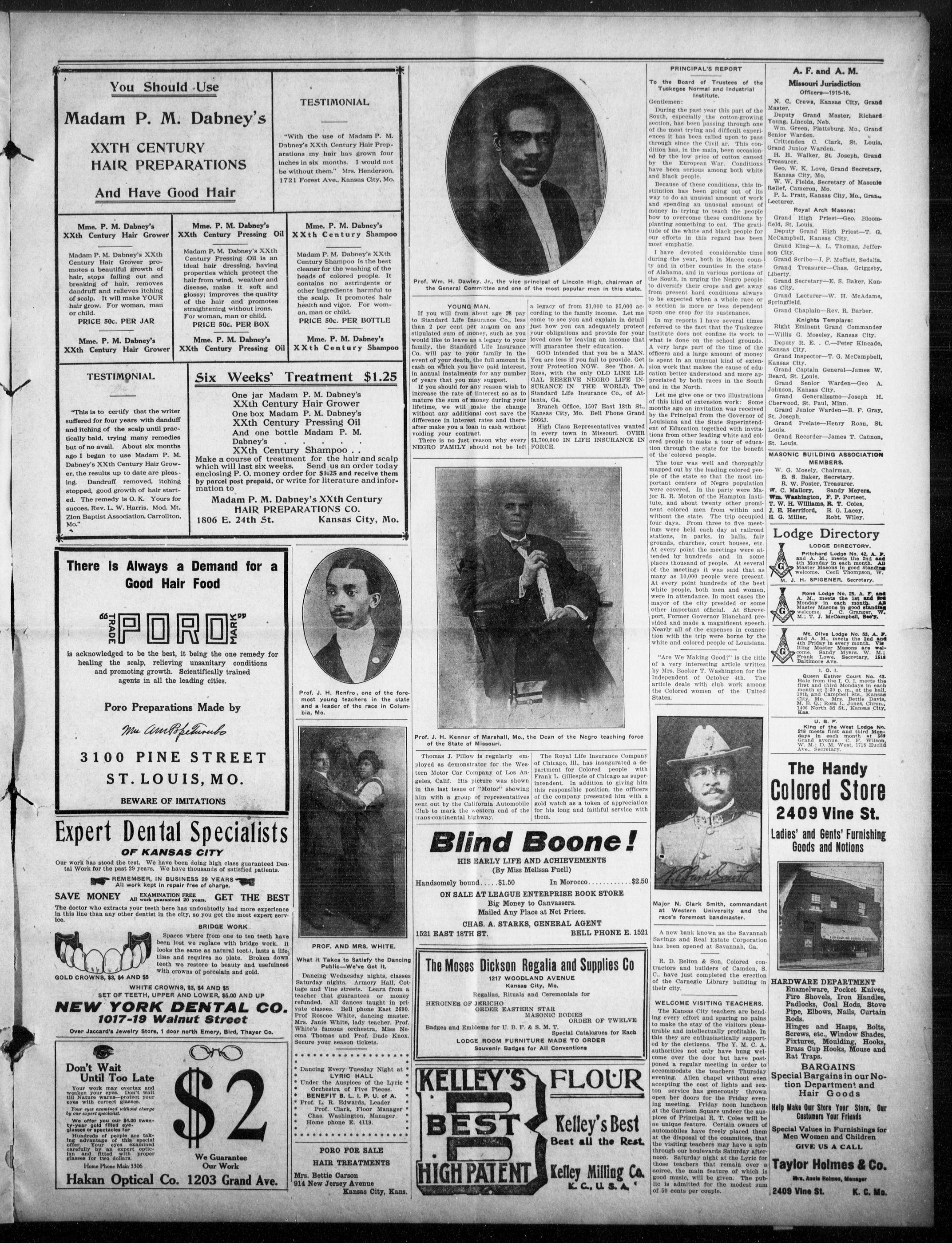
Prof. J. H. Renfro, one of the fore-most young teachers in the state and a leader of the race in Columbia, Mo.
THE FIRST DANCE
What it Takes to Satisfy the Dancing Public—We've Got it.
Dancing Wednesday nights, classes Saturday nights. Armory Hall, Cottage and Vine streets. Learn from a teacher that guarantees or money refunded. All dances taught in private classes. Bell phone East 2690. Prof Roscoe White, dancing master. Mrs. Janie White, lady teacher. Prof. White's famous orchestra, Miss Neoma Thomas and Prof. Dude Knox. Secure your season tickets.
Dancing Every Tuesday Night at
LYRIC HALL
Under the Auspices of the Lyric
Orchestra of Five Pieces.
BENEFIT B. L. I. P. U. of A.
Prof. L. R. Edwards, Leader
Prof. Clark, Floor Manager
Chas. Washington, Manager.
Home phone E. 4119.
PORO FOR SALE
HAIR TREATMENTS
Mrs. Bettie Carson
914 New Jersey Avenue
Kansas City, Kans.
---
[Portrait of a man in formal attire, with a serious expression, set against a plain background. The image is oval-shaped with a black border.]]
Prof. Wm. H. Dawley, Jr., the vice principal of Lincoln High, chairman of the General Committee and one of the most popular men in this state.
THE EDITOR
Prof. J. H. Kenner of Marshall, Mo., the Dean of the Negro teaching force of the State of Missouri.
Blind Boone!
HIS EARLY LIFE AND ACHIEVEMENTS
(By Miss Melissa Fuell)
Handsomely bound..... $1.50 In Morocco..... $2.50
ON SALE AT LEAGUE ENTERPRISE BOOK STORE
Big Money to Canvassers.
Mailed Any Place at Net Prices.
CHAS. A. STARKS, GENERAL AGENT
1521 EAST 18TH ST. BELL PHONE E. 1521
KELLEY'S FLOUR
BEST
HIGH PATENT
Kelley's Best
Beat all the Rest.
Kelley Milling Co.
K.C., U.S.A.
YOUNG MAN.
If you will from about age 28 pay to Standard Life Insurance Co., less than 2 per cent per annum on any stipulated sum of money, such as you would like to leave as a legacy to your family, the Standard Life Insurance Co. will pay to your family in the event of your death, the full amount in cash on which you have paid interest, in annual instalments for any number of years that you may suggest.
If you should for any reason wish to increase the rate of interest so as to mature the sum of money during your lifetime, we will make the change without any additional cost save the difference in interest rates and thereafter make you a loan in cash without voiding your contract.
There is no just reason why every NEGRO FAMILY should not be left
Prof. J. H. Kenner of Marshall, Mo., t
of the State of Missouri.
Thomas J. Pillow is regularly employed as demonstrator for the Western Motor Car Company of Los Angeles, Calif. His picture was shown in the last issue of "Motor" showing him with a group of representatives sent out by the California Automobile Club to mark the western end of the trans-continental highway.
Blind
HIS EARLY LIFE A
(By Miss M
Handsomely bound.....$1.50
ON SALE AT LEAGUE E
To the Board of Trustees of the Tuskegee Normal and Industrial Institute.
Gentlemen:
During the past year this part of the South, especially the cotton-growing section, has been passing through one of the most trying and difficult experiences it has been called upon to pass through since the Civil ar. This condition has, in the main, been occasioned by the low price of cotton caused by the European War. Conditions have been serious among both white and black people.
Because of these conditions, this institution has been going out of its way to do an unusual amount of work and spending an unusual amount of money in trying to teach the people how to overcome these conditions by planting something to eat. The gratitude of the white and black people for our efforts in this regard has been most emphatic.
I have devoted considerable time during the year, both in Macon county and in other counties in the state of Alabama, and in various portions of the South, in urging the Negro people to diversify their crops and get away from present hard conditions always to be expected when a whole race or a section is more or less dependent upon one crop for its sustenance.
In my reports I have several times referred to the fact that the Tuskegee Institute does not confine its work to what is done on the school grounds. A very large part of the time of the officers and a large amount of money is spent in an unusual kind of extension work that makes the cause of education better understood and more appreciated by both races in the South and in the North.
Let me give one or two illustrations of this kind of extension work: Some months ago an invitation was received by the Principal from the Governor of Louisiana and the State Superintendent of Education together with invitations from other leading white and colored people to make a tour of education through the state for the benefit of the colored people.
the Dean of the Negro teaching force
The tour mapped out a ple of the portant center were covered for R. R. M. tute, and a nent coloré without the four days.ings were at stations, in grounds, ch. At every p tended by places thousand of the mee many as I. At every p white people were in att mayor of other import, Form sided and Nearly all tion with white and
“Are We of a very by Mrs. Bok Independent article dea the Colore States.
The tour was well and thoroughly mapped out by the leading colored people of the state so that the most important centers of Negro population were covered. In the party were Major R. R. Moton of the Hampton Institute, and about twenty other prominent colored men from within and without the state. The trip occupied four days. From three to five meetings were held each day at railroad stations, in parks, in halls, fair grounds, churches, court houses, etc. At every point the meetings were attended by hundreds and in some places thousand of people. At several of the meetings it was said that as many as 10,000 people were present. At every point hundreds of the best white people, both men and women were in attendance. In most cases the mayor of the city presided or some other important official. At Shreve port, Former Governor Blanchard presided and made a magnificent speech. Nearly all of the expenses in connection with the trip were borne by the white and colored people of Louisiana
"Are We Making Good?" is the title of a very interesting article written by Mrs. Booker T. Washington for the Independent of October 4th. The article deals with club work among the Colored women of the United States.
Boone!
AND ACHIEVEMENTS
(Ielissa Fuell)
In Morocco.....$2.50
ENTERPRISE BOOK STORE
Major N. Clark Smith, commandant at Western University and the race's foremost bandmaster.
A new bank known as the Savannah Savings and Real Estate Corporation has been opened at Savannah, Ga.
R. D. Belton & Son, Colored contractors and builders of Camden, S. C., have just completed the erection of the Carnegie Library building in their city.
WELCOME VISITING TEACHERS.
The Kansas City teachers are bending every effort and sparing no pains to make the stay of the visitors pleasurable and intellectually profitable. In this they are enthusiastically supported by the citizens. The Y. M. C. A. authorities not only have hung welcome over the door but have postponed a regular meeting in order to accommodate the teachers Thursday evening. Allen chapel without even accepting the cost of lights and sexton service has generously thrown open her doors for the Friday evening meeting. Friday noon luncheon at the Garrison Square under the auspices of Principal R. T. Coles will be a unique feature. Certain owners of automobiles have freely placed them at the disposal of the committee, that the visiting teachers may have a spin through our boulevards Saturday afternoon. Saturday night at the Lyric for those teachers that remain over a soiree, the main feature of which is good music, will be given. The public is admitted for the modest sum of 50 cents per couple.
a legacy of from $1,000 to $5,000 according to the family income. Let me come to see you and explain in detail just how you can adequately protect your obligations and provide for your loved ones by leaving an income that will guarantee their education.
GOD intended that you be a MAN. You are less if you fail to provide. Get your Protection NOW. See Thos. A. Ross, with the only OLD LINE LEGAL RESERVE NEGRO LIFE INSURANCE IN THE WORLD, The Standard Life Insurance Co., of Atlanta, Ga.
Branch Office, 1507 East 18th St., Kansas City, Mo. Bell Phone Grand 2666J.
High Class Representatives wanted in every town in Missouri. OVER $1,700,000 IN LIFE INSURANCE IN FORCE.
The Royal Life Insurance Company of Chicago, Ill., has inaugurated a department for Colored people with Frank L. Gillespie of Chicago as superintendent. In addition to giving him this responsible position, the officers of the company presented him with a gold watch as a token of appreciation for his long and faithful service with them.
P. L. Pratt, Kansas City, Mo., Gran
Lecturer.
Taylor Holmes & Co.
Mrs. Annie Holmes, Manager
2409 Vine St. K. C. Mo.
PRINCIPAL'S REPORT
K. Mark Smith
Officers—1915-16.
N. C. Crews, Kansas City, Grand Master.
Deputy Grand Master, Richard Young, Lincoln, Neb.
Wm. Green, Plattsburg, Mo., Grand Senior Warden.
Crittenden C. Clark, St. Louis,
Grand Junior Warden.
H. H. Walker, St. Joseph, Grand Treasurer.
Geo. W. K. Love, Grand Secretary,
Kansas City, Mo.
W. W. Fields, Secretary of Masonic Relief, Cameron, Mo.
Royal Arch Masons:
Grand High Priest—Geo. Bloomfield, St. Louis.
Deputy Grand High Priest—T. G. McCampbell, Kansas City.
Grand King—A. L. Thomas, Jefferson City.
Grand Scribe—J. P. Moffett, Sedalia.
Grand Treasurer—Chas. Griggsby, Liberty.
Grand Secretary—E. S. Baker, Kansas City.
Grand Lecturer—W. H. McAdams, Springfield.
Right Eminent Grand Commander—Willis G. Moseley, Kansas City. Deputy R. E. . C—Peter Kincade, Kansas City. Grand Inspector—T. G. McCampbell, Kansas City.
Grand Captain General—James W. Beard, St. Louis.
Grand Senior Warden—Geo A. Johnson, Kansas City.
Grand Generalissimo—Joseph H. Cherwood, St. Paul, Minn.
Grand Junior Warden—B. F. Gray,
St. Joseph.
Grand Prelate—Henry Roan, St.
Louis.
Grand Recorder—James T. Cannon,
St. Louis.
W. G. Mosely, Chairman.
E. S. Baker, Secretary.
R. W. Foster, Treasurer.
W. C. Mallory, Sandy Meyers,
Wm. Washington, F. P. Porteet,
T. W. H. Williams, F. T. Coles,
J. E. Herriford, E. G. Lacey,
E. G. Miller, Robt. Wiley.
Lodge Directory
G
M. J.
Pritchard Chuck No. 42, A. P. and A. M. meet the 2nd and 3rd Masters in Master Masons in good standing welcome. Cecil Thompson, W.
G
MASONIC
MUSEUM
Rone Lodge No. 25, A. F. and
Monday in each month. All
Master Masons in good standing
M. M. n. J. J. McCambell, Beevy.
G
MASONRY
Mt. Olive Lodge No. 53, A. F.
and A. M. meets the 2nd and
fourth Mason on the third
fitting Mason Asson are well
come. Sandy Myers, W. M.;
Frank Lowe, Secretary, 1618
Baltimore Ave.
I. O. I.
Queen Esther Court No. 43
Hale from O. I. O. meets the
first and third Masons in each
month at 2:30 p. m., 10:10
and Campbell Sts., Kansas
City. Mo. Mrs. Bettie Davis,
M. Q. Rosa L. Jones, Chron.
1406 3rd St., Kansas City,
Kas. U. B. F.
King of the West Lodge No.
218 meets first and third Monds
in each month at 583
Grand Rapids, C. F. W.
M. D. M. West, 1718 Euclid
Ave., Secretary.
The Handy
Colored Store
2409 Vine St.
Ladies' and Gents' Furnishing
Goods and Notions
FURNISHING GOODS FURNITURE
HARDWARE DEPARTMENT
Enamelware, Pocket Knives,
Fire Shovels, Iron Handles,
Padlocks, Coal Hods, Stove
Pipe, Elbows, Nails, Curtain
Rods.
Hinges and Hasps, Bolts,
Screws, etc., Window Shades,
Fixtures, Moulding, Hooks,
Brass Cup Hooks, Mouse and
Rat Traps.
BARGAINS
Special Bargains in our Notion Department and
Hair Goods
Special Values in Furnishings for Men Women and Children GIVE US A CALL
THE KANSAS CITY SUN
All communications should be addressed
to the Kansas City Sun. 1803 East 18th
Bldr.
Bell Phone East 999.
Entered as second-class matter, August
12, 1908, at the postoffice at Kansas City,
Mo., under the act of March 3, 1879.
Neilson C. Crews.....Editor and Owner
Willa B Glenn.....General Manager
SUBSCRIPTION RATES:
One Year.....$1.50
Six Months.....$75
Three Months.....$50
ADVERTISING RATE, 50 CENTS PER
INCH.
CHURCH DIRECTORY.
Bettel A. M. E. Church, 24th and Flora St. Stephen's Baptist Church, 604 Charlotte St.
Opcional, M. E. F. Church, 19th and
TREV.
St. Augustine's P. E. Church, 11th and
Troost.
Vine St. Baptist Church, 1825 Vine St.
Baptist Chapel A. M. E. Church, 11th and
Woodland.
Slue Valley Baptist church, 1120 Crystal
Avenue.
St Jérôme's A. M. E. Church, 1745 Lelie-
view
Seventh Day Adventist, 23rd and Wood-
view
St. Monica's Catholic, 17th and Lydia
Morning Star Baptist Church, 231 Vine,
Highland Avenue Baptist Church, 1111
Highland.
Centropolis A. M. E. Church, Centropolis,
Mo.
St. James A. M. E. Z. Church, 1823
Woodland Ave.
Third Baptist Church, Roundtop.
People's Mission, 30th and Genesee.
St. Paul's Baptist Church, 19th and
Highland.
Friendship Baptist Church, 17th and Tracy Avenue.
Pilgrim Baptist Church, 614 Charlotte
St.
Pleasant Green Baptist Church, Independence Avenue and Tracy.
Calvary Baptist Church, 19th and
Akew.
Bigelow A. M. E. Mission, 5th and Lydia.
Progressive Baptist Church, 29th and
Bummit.
C. M. E. Church, 1817 Flora Ave.
St. Luke's Baptist Church, 4059 Mill St.
St. Luke's A. M. E. Church, 43rd and
Prospect Place.
A. M. E. Mission, 565 Grand Ave.
CLARK CHAPEL M. E. CHURCH,
1664 Madison Ave.
KANSAS CITY, KAN, CHURCHES.
First A. M. E. Church, 8th and Neb.
Pleasant Green Baptist Church, 1st and
Splitton.
St. St. Baptist Church, 8th and
Oakland.
Metropolitan Baptist Church, 9th and
Washington.
Bethel A. M. E. Church, Water and
Steward Streets.
Paul A. M. E. Church, 21st and
Ruby.
First Baptist Church, 5th and Neb.
King Solomon Baptist Church, 3rd and
State.
Quindaro A. M. E. Church, Quindaro,
Prentice Valley Baptist Church, Rosedale,
Kan.
M. E. Church, 9th and Oakland.
A. M. E. Church, 3rd and Oakland
A. M. E. Mission, A. M. E. Church, South
Park, Kan.
Protestant Episcopal, 3rd and Stewart.
Second Baptist Church, 6th and Ruby.
Bishop, 6th and Ruby.
St. Paul A. M. E. Zion Church, 4000
Adams.
Bethlehem A. M. E. Church, Rescale, Kan.
Bethlehem A. M. Zion Baptist Church, 4th and Virginia.
Ebenezer A. M. E. Church, Sanford and Tremont
Tremont
Boston Primitive Baptist Church
Westport avenue and Tangent street,
EDITORIAL.
Those members of the race who are slipping in to see "The Birth of a Nation" and offering the excuse that they merely wish to see how obnoxious it really is, might as reasonably argue that a man should get drunk just to see how bad he would feel the next day, or that a woman should make a night of it just to see how she would afterwards feel. It is hard to understand just why any normal person should pay out his money just to be insulted, especially when he has been fully warned in advance of that certain end of his patronage. Some people possess remarkably strange reasoning faculties.
The Sun offers a welcome to the Negro teaching fraternity which is just closing its annual meet in this city. To the teachers of the state many of whom are pursuing their tasks under great disadvantages and who have little to encourage them beyond their own natural impulses to advance the cause of education among a struggling people, all society is constantly indebted. It is regrettable, too, that on account of meager wages and other circumstances many of the rural teachers who most need the inspiration which comes through such a meeting is unable to be present at these sessions. To these, also, we extend our greetings, hoping through their patient labors to finally behold better things.
It is not and never has been the disposition of the Sun to lightly esteem the work undertaken by the N. A. A. C. P<sub>4</sub> nor do we fail in appreciating the good that has been accomplished by certain branches of that organization in which many invidious forms of race-phobia have been broken down and the manhood and womanhood of our people vindicated. The contention which we have raised and which we still raise is that under the guise of this society's ideals many Negroes, especially in this section of the country, have attempted to advance their own individual ambition by playing the double role of defending the race and at the same time catering to the very prejudices of which they complain. The Sun simply desires to see these self-styled defenders come out in the open and with out regard to the advancement of their own prominence do something tangible. It is difficult, too, to ap preicate the possibilities of such work from those who have never been able to do anything for themselves ever under the advantages of the best op portunities. Leaders ought to represent something by way of example as well as by precept. When the local branch of the organization really becomes the active force which it ought to be in the community and enlists in its efforts that live intelligence so necessary to its success it shall have the active co-operation of the Sun as well as of all the good people of this community.
HOW'S THIS J. SI.?
The meeting at Sedalia Oct. 15, 1915, styling itself "the State Negro Republican League," we understand was called by Mr. J. Silas Harris of Kansas City. It may or may not be well to look with a little suspicion on a convention called by Mr. Harris, especially when from his own city not a single man responded to his call. There are two ways in which this may be accounted for. First, that Mr. Harris has not been for some time prominent in the councils of the Republican party of the state among Negroes, or it may be that the people of Kansas City having heard nothing of the Negro League for a decade or more were too much surprised at its magical awakening at the call of Mr. Harris, to realize the importance of the meeting. We have no idea that the fact that nearly the whole Republican organization of Kansas City and a very large per cent of the leading Republicans of the state has indorsed the candidacy of Hon. Walter S. Dickey, had anything to do with it.
However that may be, in Kansas City, where Mr. Harris is best known, nobody paid any attention whatever to the call. However, there were at least 25 more or less prominent colored men from this city in the convention. And to these we attribute the good things which was done at the convention. The convention announced as its platform these contitions:
1. That Lincoln school be converted into a great university.
2. That one colored man be elected delegate at large to the national Republican convention.
3. That the congressional districts in which the colored voters are of a sufficient number, that delegate and committeeman of color be elected.
4. That a colored man be placed on the state board of education to look out for the interest of the colored schools.
5. Negro candidates for the legislature.
We indorse these things and then some more. We are not sure of the indorsement of the men for governor or senator either for that matter, will meet the approval of the Republicans of the state, and we are sure that there are reasons well known why colored people do not unqualifiedly indorse Mr. Hadley for senator. We are not sure that the indorsement of the men for governor or senator either will meet the approval of the Republicans of the state.
The Clarion reserves its right to indorse the action of the regular Republican convention on the last named proposition.
We are not going to allow Mr. Harris of Kansas City to lift us off our feet until we know where he intends to set them down. Nor does the Clarion intend to put itself in an attitude of a bolter of the convention on the subject of candidacy for governor and senator. Will the state convention be termed a bolting convention in case it refuses to nominate the men named by Mr. Harris' convention?
In another column it will be seen that the citizens of Kansas City and state have enthusiastically indorsed the candidacy of Walter S. Dickey for United States senator. This may in some measure account for the paucity of Kansas City's delegation to the convention.
Who paid the railroad fares?—St. Louis Clarion.
Little Corner
THEY
—That winter's almost here. How are you fixed, brother?
—That a pious face is oftimes a mask for hypocrisy.
—That some subscribers WON'T PAY. Well, let's see.
—That sunshine and shadow go together in this life.
—That the worst hypocrites can handle the scriptures with the skill of a saint.
—That Henry M. Beardsley would make a mighty good candidate for mayor. You bet!
—That some well known people are constantly looking for something for nothing. Can't get it, brother.
—That the buffet flats should not entertain preachers. Make them respect their flock if not themselves. Get me?
—That a certain married woman in trying to break into "sassity" broke her husband's pocket book. But she now has neither social prestige nor a husband. Sad, isn't it?
—That a certain woman who declared (by her actions) that she didn't want her husband after learning that he had selected a second mate, is doing everything she can to keep him. Too late.
Mrs. Edward Gibbs of 2518 Michigan, who has been quite ill during the past week, is improving at this time.
[Name]
Rev, J. M. Booker, D. D., who conducted the devotional services preliminary to the opening of the session of the State Teachers' Association. Dr. Booker is pastor of the Pleasant Green Baptist Church of this city, and an eloquent divine.
Y. M. C. A. NOTES
The visiting teachers are registering at the association building.
The men's new Bible class opened with a full enrollment on last Friday.
The fall volley ball tournaments are on, with Dr. White's team well in the lead.
The first mixed social, Halloween night proved so successful and delightful that the social committee is planning several for the season.
The boys' basket ball season has started with a rush and vim and some stars will be developed from the High school end employed boys' classes.
One of the largest audiences of the year heard Dr. Kealing last Sunday in a most instructive address. The large number of railroad men present was a feature of the meeting. November 7 the meeting will be addressed by one of the visiting teachers in attendance at the State Teachers' Association.
Following the membership campaign, it was decided by the association management to inaugurate a campaign of education. The first step in this direction was to attempt to get fifty men reading Association Men the official magazine of the Young Men's Christian Association through out the world.
The Y. M. C. A. is the recipient of a very attractive piece of group satury. "The Council of War," given by the widow of the late Gen. H. F. DeVol, capitalist and philanthropist. The group shows President Lincoln, General Grant and Secretary of War Stanton engaged in the intense discussion of a strategic war action recommended by General Grant.
A. B.
Prof. L. F. Payne, Glasgow, Mo., on e of the oldest teachers in the State of Missouri,
MRS. MARSHALL DEAD
Mrs. Ella Gertrude Marshall died at the residence of her sister, Mrs. Smith, 1909 East Thirteenth street, Wednesday morning, October 27. Mrs. Marshall had been ill for many, many months, and for weeks her life had hung by a thread. About two weeks prior to Mrs. Marshall's death God called her youngest sister, little Hattie D. Warren, from labor to rest. Mrs. Marshall, of course, was not able to attend the funeral and insisted that I twould not be long before she, too, would join her little sister in that Celestial city where parting is not known. So, just about two hours before the Sun had registered the noonday on the morning of the 27th the soul of Mrs. Marshall took its flight to the God that gave it. She was a patient sufferer, but as her life neared its close she seemed to be oh so anxious to go, for on Monday she said to her mother:
"I am just waiting on the Lord. I wish he would come today. It will not be long before I'll be sleeping beside my little sister. I am perfectly willing and ready to go."
She was 25 years, 8 months and 2 days old. She left a devoted husband, a kind and loving father and mother, one sister, two brothers and a host of relatives and friends to mourn her loss.
She is not dead, for there is no death. For those who love the Lord, the servant of God just falls asleep
The servant of God just falls asleep
Who is trusting in His word.
And this great change ascribed to death
is but a manifestation of the power of God.
The Georgia Baptist, published at Augusta, Ga., for thirty years by the late William J. White, is soon to be revived with Dr. C. T. Walker as its editor.
Hon. N. C. Crews, Editor of the Kansas City Sun: Your correspondent on the N. A. A. C. P. in last issue regarding the "Birth of a Nation" requires that you name something better or give a better plan. I would suggest that if you would accept such from me, that you inform the writer that practice, not profession, is a better plan. A good, well rounded out, heavily supported newspaper with permanent annual subscribers of not less than 15,000 to 20,000 will do more in one issue to uplift or change conditions than could 100 committees in six months. If Kansas City's population be 20,000 Negroes, then two-thirds, or 20,000, o f them should be subscribers o the Sun. The Sun has demonstrated its fitness as a worthy organ, as spokesman for the race. The editor of the Sun is beyond question or doubt the best representative the race ever had in newspaper work, for the cause. Yes, sir, if the N. A. A. C. P. is sincere in its destruction of race humiliation.
Prof. T. W. H. Williams, principal of Bruce school and a writer and scholar of much ability.
Prof. T. W. H. Williams, principal of Bruce school and a writer and scholar of much ability.
tion, segregation, Jim Crowism and mob violence, let it join in with the real Negro interest and those men whose fidelity and zeal work for the good of the race can not be questioned. The weakest point for any race of people is to be forever peering around about what other races or people are doing to them. The best thing for any race is a good, widely circulated newspaper. Let us all stand up and be counted to make the Sun the best. Let us all prove our profession by duty practicing it. The best way to defend one's self is to keep your own counsel. Telling what others do to you never stops nor keeps them from continuing to do so. Changes seldom if ever come by one complaining and whining. We must make the change.
T. W. H. WILLIAMS.
At the recent El Paso county fair, held at Callahan, Colorado, Mr. and Mrs. A. C. Hopper were awarded first prize for the best oats, hay and pota toes exhibited. They were the only Colored people to enter the contests
IN MEMORIAM.
In loving memory of our darling baby, Macle Kemp, Jr., who departed this life one year ago, Nov. 5, 1914.
He is not dead, this baby of our affection.
But gone into that higher home
Where he no longer needs our protection
And Christ himself doth rule.
But we shall again behold him
Clothed with celestial grace
With all the beauties of his soul expanded
Standing before the Master's face.
MR. and MRS. MACLE KEMP,
MRS. NANNIE KEMP,
Grandmother.
MRS. ANNIE JEFFERSON,
MRS. HETTIE SMITH,
MISS STELLA KEMP,
Aunts.
* ADKINS BROS. & GREEN
* Undertakers and Embalmers
* "SAYS"
* They eliminate all doubt at a
* time when confidence in a
* square deal is most requisite.
* 19th and Vine Streets
* Both Phones East 4349
*
SWEET SPPRINGS. MO.
Mr. Lee Stevenson, one of Saline county's most popular farmers, died October 24. He leaves nine children, a wife, brother and other relatives. He was a member of the M. Efl church and lived a consistent Christian life. He was loved by all who knew him and his loss is deeply felt in this bereavement.
GLASGOW, MO.
By MRS. PAUL WELLS.
BY MRS. PAUL WELLS.
Mrs. Georgia Coleman of Centralia, Mo, who has been visiting Mrs. Brooks, left Monday for Marshall, Mo, to visit relatives...The Left Hand entertainment given last Friday evening at the Masonic hall by the ladies of Progress Court was a very successful affair, Mr. Harrison Adana winning the first prize and Miss Octavia Tataum the second...Rev. Wheeler held quarterly meeting at Lewis chapel M. E. church last Sunday. He preached two soul stirring sermons...The sacramental sermon by Rev Brooks of the A. M. E. church was a real spiritual treat...Miss Luella and Jennie Mansfield returned to St Louis Friday after spending the summer with their sister, Mrs. Orue Jones...Mr. Eldridge Woods, one of Glass gow's prominent young men, was united in marriage to Miss Manie Grant of Armstrong on Wednesday evening...The stork visited the home of Messrs. Fred Walls and Albert Cason last week and left a girl and boy, respectively...Rev. S. L. Brooks left Wednesday for Richmond on business...Mrs. Sadie Marshall has returned from Carrollton where she attended the bedside of her mother.
LEXINGTON, MO.
Tuesday night, October 26, a birthday party was given at the residence of Mr. and Mrs. Perry Millentree, on the Santa Fe trail about two and one-half miles west of Lexington, in honor of her husband. This was his 53d birthday. From 8:30 to 11:30 in the evening an enjoyable time was had. It was a good thing to have his old aged mother with him, and also his sister. Two course luncheon was served. He was presented many nice presents. We hope he may have many happy birthdays like this. Those present were: His mother, Mrs. R. Nash; his sister, Mrs. Maggie Olden; her husband, A. Olden; Miss Maud Olden and brother, Ossie Olden; his wife, two sons, Alfred and Leroy T. Olden, Jas. Davis and son Nathan Slaughter, Rosetta Thurkles, Mrs. Carrie Westley, Mr. Oscar Lindion, Mr. A. Olden, Jr., Miss Josephine Wyitt of Kansas City, Mo.; Mr. and Mrs. Charles Green and two children, Mr. Clifford Thurkles, Mr. Robert Bowens. Everything went off lovely. Mr. Millentree is a man of principle and character, has a loving wife, who takes the very deepest interest in him.
ST. JOSEPH. MO.
The Francis Street Baptist church is conducting a revival which has been in progress for about one week and will continue several weeks longer. The Sunday school is doing fine under the leadership of Wm. Alexander and Andrew Baker, the attendance and collections being par excellent...Mrs. Ralph Hayes is agent for the Exelenta medicine company with a complete line of beautifiers...Misses Marie Waldron and Dorothy Watkins are in Kansas City this week attending the teachers' state convention...Mrs. Victoria Elliott of Ottawa, Kas, who has been visiting her niece, Mrs. A. D. Darts, returned home last Wednesday Mrs. Harts accompanied her as far as Kansas City, where she spent a few days visiting relatives and friends
...The New Hope Baptist church is engaged in a revival meeting. Rev. Gordon of Richmond, Mo., is assisting in the meeting. Rev. Gordon gave a special talk to the women of the church Sunday afternoon...Miss Payne of Chillicothe is visiting Mrs. Thomas Hatcher...Mrs. Mary Allen and daughter, Mrs. Bessie Shields, have returned from Chicago and report a pleasant visit...Mr. Charles Williams and Mrs. Mamie Bartlett were quietly married November 11...Mr. Thomas Tack, one of St. Joseph well known sons, has been very ill but is somewhat better at this writing...Mrs. Mollie Hicks, a member of Juen Esther Tabernacle, is quite ill...The Daughters of the Tabernacle are putting on a week's entertainment commencing Monday, the 5th...Mrs. Emmett Parker, who is very ill professed a hope in Christ some weeks ago, was baptized last Sunday at the Francis Street Baptist church by Rev. Prince.
TROY. KAS.
Mr. and Mrs. Joseph Lee were in Purcell, Kas., the first of the week trying to locate a farm...Miss Elsie Lair was shopping in St. Joseph Saturday...Mrs. M. W. Webster and children of St. Joseph attended the Halloween entertainment here Saturday evening...Messrs. Clabe and Chris Lightle of Lexington, Mo., were the guests of their sister, Mrs. Louisa Holland who continues very ill, for several days and returned home Tuesday...Mrs. Emma Moore of Omaha, Neb, has been here for a couple of weeks assisting at the bedside of her sister, Mrs. Louisa Holland...Mr. and Mrs. Matthew McCurry of Elwood, Kas., were visiting in Troy Monday and Tuesday...Mrs. Dora Lee was shopping in St. Joseph one day the past week...Mr. George Hughes and Mr. James Lightle of St. Joseph were visiting relatives in Troy the first of the week...The Ladies' Aid Society met at the home of Mrs. Dora Lee Thursday evening and a very pleasant evening was spent and a dainty menu was served...Mrs. Annie Williamson, Mrs. Mable Gaskin and Mrs. Mollie Wilkinson were St. Joseph shoppers the past week...Mrs. Nelle E. Howard spent the day in Elwood Tuesday the guest of Mrs. Maggie McCurry.
MARSHALL, MO.
Friday night, October 29, twenty-four members at Handy chapel A. M. E. church, gave a surprise shower to their pastor, Rev. George F. Martin, and his wife. Many good things to eat were brought. The attendance was remarkable in its increase since Rev. Martin assumed the pastorate. New zeal and new life are being displayed and the members have begun work to raise a mortgage debt of $500.
The Nashville Negro Boosters Club will hold their second annual Booster Week from October 17 to 23. The purpose of the Booster Week is to encourage more Colored people to patronize Colored business enterprises.
Negro Business and Professional Directory of Greater Kansas City
(Your name, business, address and telephone carried in this directory at 25 cents per month, $3.00 a year; less than one cent a day. Can you beat it? To secure space call Sun Office, Bell phone 999 East, or see our agent.)
MESDAMES JACKSON & JOHNSON, 18th and Highland Ave. Bell phone E. 4788.
MRS. CADDIE WITCHER, 1708 Michigan Ave. Madame Walker's Hair and Scalp Treatment. Bell phone. East 4167X.
CAFES.
DELMONICA CAFE, 1512 East 18th St. Bell phone, East 618.
CARPET CLEANERS.
RUPET CLEANING CO., 1718-20 Euclid A
Home, East 4169.
COAL AND FEED.
E, 1902 1-2 Vine St. Bell phone, East 559
EUREKA CARPET CLEANING CO., 1718-20 Euclid Ave. Bell phone, East 3555; Home, East 4169.
COAL AND FEED.
W. W. PAYNE, 1902 1-2 Vine St. Bell phone, East 559; Home phone, East 4132.
CLEANERS, DYERS AND TAILORS.
G. V. GOLDEN, 1650 East 18th St. Bell phone East 539. WORTHAM BROS., 1831 Paseo. Bell Phone East 701.
DENTISTS.
DR. E. C. BUNCH, 716 East 12th St. Bell phone G. 2553 W.
DRUG STORES.
SMITH, 1301 East 18th St. Bell phone
on 5467.
DRUG STORE, 18th and Paseo. Bell phone
4082.
ER'S PHARMACY—18th and Woodland
East 272, Home phone East 4070.
DRY GOODS AND NOTIONS.
HAMES & CO., 2409 Vine Street.
FLORISTS.
ST FLORAL CO., 1801 East 18th St. Bell
phone, East 4070.
GROCERS.
N, 2644 Woodland Ave. Bell phone, East
THEODORE SMITH, 1301 East 18th St. Bell phone Grand 4591, Home Main 5467.
PEOPLE'S DRUG STORE, 18th and Paseo. Bell phone East 1814, Home East 4082.
R. W. FOSTER'S PHARMACY—18th and Woodland. Bell phone East 272, Home phone East 4070. DRY GOODS AND NOTIONS. TAYLOR-HOLMES & CO. 2409 Vine Street.
CROSTHWAIT FLORAL CO., 1801 East 18th St. Bell phone, East 272. Home phone, East 4070.
GROCERS.
M. R. WILSON, 2644 Woodland Ave. Bell phone. East 1493.
INSURANCE.
STANDARD LIFE INSURANCE CO., 1507 East 18th St., Bell phone Grand 2666J. T. A. Ross,
LAUNDRIES.
THE ELECTRIC LAUNDRY CO., J. C. Hale, Mgr., 2928 Summit St Home phone 3160.
LAWYERS.
WAY, 601 Delaware, Home phone M58, Bailices in all courts.
ON, 601 Delaware, Home phone M58, Bail advice. Practices in all courts.
OM, Attorney at Law, 307 Walnut street East 2727, Home phone East 4070.
LEFORD, Attorney at Law, 516 Minnes Kas. Bell phone, West 3866.
C. H. CALLOWAY, 601 Delaware, Home phone M58, Bell phone Main 448. Practices in all courts.
W. C. HUESTON, 601 Delaware, Home phone M58, Bell phone Main 448. Legal advice. Practices in all courts.
GEO. T. WASSOM, Attorney at Law, 307 Walnut street.
Bell phone East 2727, Home phone East 4070.
E. A. SHACKLEFORD, Attorney at Law, 516 Minnesota Ave., Kansas City, Kas. Bell phone, West 3866.
MILLINERY.
CHAPMAN, 18th and Paseo. Home ph
WASHINGTON, 849 Freeman Ave. Be
sas City, Kas. Also hair work.
A HUBBARD, latest things in hats.
510 East 18th street. Bell phone E. 479
CALDWELL CHAPMAN, 18th and Paseo. Home phone East 4009.
MISS EVA P. WASHINGTON, 849 Freeman Ave. Bell phone, West 2306, Kansas City, Kas. Also hair work.
MME. STELLA HUBBARD, latest things in hats. Old hats made new. 1510 East 18th street. Bell phone E. 4798.
PHOTOGRAPHERS
C. BRUCE SANTEE, Proprietor The Fad, 1607 East 18th St. Bell phone East 1643.
PHYSICIANS.
DR. R. J. LAMBERT, Theraptics, P. O. box 90A, Bell phone, Rosedale 523, Rosedale, Kas.
PRINTERS.
LIN, 1008 East 18th St. Bell phone Gran
REAL ESTATE and EMPLOYMENT.
SMITH, 1515 East 18th St. Bell phone
Home East 4024.
ICAN REAL ESTATE & INVESTMENT
11 McGee street.
e 751 Main. Home Ph
OPLE'S INVESTMENT CO., 2427 Vine
Home East 4011. Sol Smith, Pres.; C. B.
C. A. FRANKLIN, 1008 East 18th St. Bell phone Grand 2988.
STEWART & SMITH, 1515 East 18th St. .Bell phone East 4893, Home phone East 4024.
AFRO-AMERICAN REAL ESTATE & INVESTMENT CO., Help furnished. 911 McGee street. Bell Phone 751 Main. Home Phone 7555 Main.
COLORED PEOPLE'S INVESTMENT CO., 2427 Vine St. Bell Phone East 1011, Home East 4011. Sol Smith, Pres.; C. H. Adkins, Tres.
SECOND-HAND GOODS
W. G. HOPKINS, 2122 Vine St. Bell phone East 3851
UNDERTAKERS
BOS. & GREEN, 19th and Vine Sts. Bell pl
REE, Licensed Embalmer, 2220-Vine St., B
ine East 3341.
BOS., 1729 Lydia Ave. Bell Phone Gr
. Res., Bell East 3281.
ADKINS BROS. & GREEN, 19th and Vine Sts. Bell phone East 4784.
C. H. COUNTEE, Licensed Embalmer, 2220-Vine St., Bell Phone, East 3336, Home East 3341.
WATKINS BROS., 1729 Lydia Ave. Bell Phone Grand 987, Home Main 7989. Res. Bell East 3281.
Subscribe for The Sun
Scalp Treatment a Specialty. Caldwell's Pomade and Tonic really Grows Hair. Try it. Save your combings, cut hair and any old hat you may have.
Hair Matched From Samples. Feathers and Hats Cleaned, Dyed and Blocked. Agents for Spirella Corsets. Mail orders answered promptly
WORK GUARANTEED. LIVE AGENTS WANTED
Mr. Wm. Smith writes that he is in Taft, Ok.
Rev. McCormick of St. Luke chapel Westport, will hold his quarterly meeting Sunday, November 14. All ministers and their congregations are invited.
Miss Giles of Marshall, Mo., attend ed the Wednesday night dance at Armory hall, the guest of Mr. and Mrs. Roscoe White.
Mrs. Gertie Whibby and mother Mrs. Ella Brown, are still in St. Louis visiting son and daughter-in-law of the latter.
Mr. Daniel C. Houston, secretary of Mt. Oread lodge, A. F. and A. M., suffered a painful injury Wednesday by the breaking of his bicycle which threw him against the curbing, cutting his lip so badly that it necessitated several stitches and bruising him considerably about the face and shoulder.
Miss Alice M. Shores, who for several years has been kindergarten directress at Lincoln school, has resigned her position and will leave the latter part of this month. Rumor has it that Miss Shores is to soon become the bride of a very prosperous young man in Columbus, Ohio. In any event a large circle of sincere friends here extend to her their best wishes for the future and congratulate the fortunate manm upon the perfect wisdom of his choice.
YOU NEED SHOES!
This nice weather is not going your winter shoes. We have them an ordinarily sell at $3.50 to $5.00 for $1.95 to $2.35, saving you $2.00 to $ now and make your selection.
This nice weather is not going to last. Now is the time to get your winter shoes. We have them and can sell you Ladies' Shoes that ordinarily sell at $3.50 to $5.00 for $1.25 to $1.95; and Men's Shoes for $1.95 to $2.35, saving you $2.00 to $3.00 on each pair you buy. Come now and make your selection.
1730 TROOST AVENUE
Mr. and Mrs. George Addison, 1018 Vine street, are the proud parents of a fine girl weighing nine pounds. Mother and baby doing fine.
Mrs. C. H. Birch of 4 Lombard street and Mrs. Wm. Hopkins and little daughter Juanita, of 2122 Vine street, spent the week end in Leavenworth, Kas., visiting their aunt, Mrs. Theodore Fletcher.
Dr. H. D. Ball and wife drove over from Lexington, Mo., in their new motor car last Sunday, bringing Mrs. W. C. Hueston and children who have been visiting them for several days.
Grand Master N. C. Crews, Grand Secretary Love, Grand Relief Secretary Fields and Past Grand Masters Rickettes and Coles leave for St. Louis tonight to attend the funeral of Brother J. Milton Turner.
N. C. Bruce, principal of the Bartlett Agricultural School of Dalton, Mo. has been awarded a gold medal at the Panama Exposition as first prize for the largest yield of corn per acre in his state.
NEW DANCING SCHOOL OPENED.
A new dancing school will be conducted every Saturday evening at Lyric hall, beginning November 13, under the splendid instruction of Prof. W. C. Clark and other well known instructors.
The Show We washer, manufactured by the H. A. Manufacturing Co at 4961 Wornall road, has been placed by the board of education in the North-east High school, Central High school and the Garrison Industrial school.
Six of Kansas City's most eminent young colored physicians have been appointed medical inspectors in the colored public schools of the city—Doctors Howard M. Smith, J. E. Dibble, E. J. McCampbell, Radford Tillman and Jones.
Mrs. S. D. Scruggs and Mrs. Julia Carnell entertained with a three course luncheon at the residence of the former, 423 Freeman avenue, Kansas City, Kas., October 27, complimentary to Mrs. Blake, P. G. M., of Atchison, Kas. The decorations were yellow and white.
Hon. Ashble W. Hawkins of Baltimore, Md., supreme chancellor of the K. of P. E. and W. Hemis., and one of the leading attorneys of the race, stopped over in the city a few days last week on his return from the Pacific coast. He was royally entertained by members of the order as well as prominent citizens of the city
In memory of our dear brother and son, Joseph Straughther, who died November 1, 1908.
MR. and MRS. C. F. STRAUGHTER Father and Mother.
CARD OF THANKS.
We desire to thank the friends and neighbors, the Courts of Calanthe and the Second Baptist church for the kindness, sympathy and beautiful floral offerings given us during the illness and death of our darling wife, daughter and sister.
MR. and MRS. WARREN,
Mother and Father.
JESSE MARSHALL,
Husband.
MRS. SMITH, Sister.
Transfer Point.
IN MEMORIAM.
CITY NEWS.
Mrs. M. B. Hough, 4146 Warwick boulevard, left Monday, November 1, for an indefinite stay with her father at Columbus, Ga., and will also visit her brother at Jacksonville, Fla.
CARD OF THANKS:
CARD OF THANKS.
Allow us to take this method to express our heartfelt gratitude to the many friends, neighbors and members of Gate City lodge No. 4679, Patriarchie No. 66, Eureka H. H. Ruth No. 4744, Ladies' Auxiliary of Patriarchie No. 66, Ruth Court Aux. No. 27, Dunbar and Q. C. clubs and manager and employees of the Southwest News company for their kindness and sympathy shown during our great bereave-offersings. Our prayers shall ever be ment. Also for the beautiful floral that God will lighten all your burdens, and that you may long be spared the grief which is ours.
MRS. D. A. DOYLE.
MRS. MAXIE AND DAUGHTERS.
MRS. BUELAH ANDERSON.
I take this means to thank the many friends who remembered my wife Mrs. Florence Crews, with flowers and fruits during her recent illness. I am thankful to say through the omnipotent power and goodness of the Almighty, and the kindness of friends she is regaining her health. From Mrs. N. C. Crews, fruits; Mrs. T. B Watkins, fruits; Mrs. A. E. Smith fruit and flowers; Mrs. Cate Cummings, fruits; Mrs. A. E. Alexander fruit and flowers; Mrs. Gussie Shelby fruit; Mrs. Laura Lewis, Soros Club
g to last. Now is the time to get and can sell you Ladies' Shoes that $1.25 to $1.95; and Men's Shoes for $3.00 on each pair you buy. Come
Allen Chapel, Mrs. W. H. Hubbell, Mrs. Emma Payne, Mrs. J. M. Carr, Mrs. Amos Barnett, Edith Douglass and sister, Mrs. Wm. H. Peck, flowers. I thank all who contributed in any way in their sympathy and kindness shown us.
Mrs. Naomi Key and her sister, Mrs. E. Reed, returned Monday night from Meridian, Miss. They left here October 24 for York, Ala., where they took the body of the former's husband, Mr. Joel M. Key, for burial. Mr. Key passed away at the residence of Mrs. Key's parents, Mr. and Mrs. George L. Harris, 1700 East 24th street, October 22. He leaves to mourn his demise a wife, father and mother, Mr. and Mrs. H. B. Key, York, Ala.; brothers E. J. Key, Medidian, Miss.; W. A' Key, Chicago; M. Key, S. Key, York, Ala.; sisters, Mrs. W. E. Lewis, Montreal, Canada; Mrs. P. Holloway, Meridian, Miss.; Mrs. L. Bank, Porterrille, Miss.
ALLEN CHAPEL NOTES.
The minister preached an able and impressive sermon at 11 o'clock to a very large congregation and splendid music was rendered by the choir.
At 4 o'clock the pastor, choir and congregation attended services at St. Stephen's Baptist Church, Rev. J. W. Hurst, D. D., pastor, and Dr. Thomas again delivered a powerful address to a very appreciative audience.
At 6 o'clock a farewell reception by the Joint Young People's Christian Endeavor was tendered Mrs. Fannie Peck, who goes to join her distinguished husband, the Rev. Wm. H. Peck, D. D., now pastor of St. James' Church at St. Louis, formerly our presiding elder, and it was both a sad and enjoyable service. Mrs. Peck has endeared herself to every member and friend of Methodism in this city and we regret to lose her.
At night Rev. Jno. L. F. Talton preached an instructive and inspiring sermon to a fine audience, and the pastor made extended announcement of the Women's Rally the 14th of November. Come to Allen, "the stranger's home."
IN MEMORIAM.
Mrs. Fannie Harris—Died November
6, 1914.
We never miss the sunshine until the
shadows fall.
We never regret the bitter words till
passed beyond recall.
We never miss the laughter until the
eyes are wet.
We never miss the happiness till
love's bright sun has set.
We never miss the singing until the
birds have flown.
We never miss the blossoms until the
spring has gone.
We never miss our joyousness till
sorrow bids us wake.
We never know we have a heart till
it begins to break.
MR. and MRS. GILBERT BOURNE
Parents.
VINCIL D. HARRIS, Husband.
G. S. BOURNE,
M. C. BOURNE,
H. E. BOURNE,
E. S. BOURNE,
D. G. BOURNE,
H. R. BOURNE,
Brothers.
Sisters.
Sisters
CARD OF THANKS
Open Nights
JAS. H. CREWS
BELL R. BOYD,
NANNIE RANGE,
IVORY BOURNE,
WILLIE B. JOHNSON,
SOPHRANIA BOURNE,
LOUISE BOURNE,
SEE QUR BIG NEW
FALL LINE OF SHOES
CONSTANTLY GROWING
ONLY COLORED SHOE
STORE WEST OF
THE MISSISSIPPI.
The above is a cut of the best shoe on the market for little girls and boys of kindergarten and primary grade. It is a gun metal with a roomy toe, flat and spring heel, solid oak bottom. We have tried this on some of the boys whom we know to be rough on shoes. For reference as to its wearing quality consult Harper Compton, Tom McCampbell, Vernal Brown, Francis and James Watkins, George and Maurice Thompson. Size 6 to 13. Prices $1.89 to $2.25.
Boys' gun metal, button and blu-
cher and English. Solid oak. Will
wear out three pairs of half soles. 1
to 6; $2.50. Also in this shoe we
have the Widow's Friend for $2 in
big boy's sizes from 1 to 6. The best
$2 seller to be found.
This is the black English young gent's 1 to 6—$2.50; youth 6 to 9—$3. Also in blucher, same price and sizes. This is proving the best shoe for big boys that has been in the market.
This is the beautiful Playhouse Shoe of Quality. In patent and gun; excellent flexible leather, trim extension soles, spring heels. They combine beauty and fine quality. See this shoe and you can't deny your girl's good taste in admiring it. Size 6 to 8—$1.89. Size 8½ to 13½—$2. Size 13½ to 2—$2.50. Size 2½ to 6—$3.
10
Misses gun metal button; serviceable school shoe for girls. Black cloth top; patent and gun metal, in spring heels and low heels. Sizes 2½ to 7—$2.50 to $2.75. Big browning girls' button, in this line from 1 to7—$2. And it's a good one for the money.
We have a big line of Men's and Women's Shoes. Watch for them in this space next week.
OUR PRICES ARE RIGHT. OUR GOODS ARE SOLID.
Wished To Improve Her Appearance.
Her only fault was a large mouth with heavy lips. A friend recommended Thin-lip Creamoline and one box reduced the lips and mouth. No! There isn't a happier woman anywhere. It will do the same for you. Price, $1.00 prepaid, in plain package by return mail.
MACKINAW CITY, MICH.
Laing's New Pater ening Com
New Patent Incline Straightening Comb Just Out.
Laing's New Patent Incline Straightening Comb Just Out.
CROSS SECTION OF COMB
THE KING OF ALL STRAIGHTENERS
3¼-inch wide, 9½-inches long, guaranteed or money refunded.
The Combs are Sold in Wholesale and Job Lots.
Hair is immediately straightened while it passes be-
side wide teeth of the comb from the roots to the ends.
Can be used both ways, right or left hand, by ex-
tendle; a hole at each end. The comb will straighten
at hair around the neck and edges. The only re-
mb made on the market.
HAIR DRESSING PARLOR
J. E. LAING
Being Taught in All Branches, Manicuring, Facial Mas-
so Hair Dressers' Supplies, Combings Made Over.
Guarantee to Cure Different Scalp Diseases by
Giving Different Scientific Treatments.
Facturer of instantaneous hair dye in black, brown,
be.
Facturer of all kinds of human hair goods, refined,
and dye, any shade.
Facturer of wigs, toupes, doll wigs, French ventilat-
made to order.
Facturer of Shampoo Drier and straightening combs.
States Patent Office, Washington, D. C., Serial 798947.
Facturer of face and hair toilet articles.
People's Goods a Specialty—Mail Orders Promptly
Filled.
MAIN OFFICE, 1715 EAST 18TH STREET
KANSAS CITY, MO.
These Combs are Sold in
The hair is immediately tween these wide teeth of the The comb can be used both w changing handle; a hole at each the shortest hair around the reversible comb made on the main
HAIR DRESS
J. E.
Hair Dressing Taught in All B sage, also Hair Dressers' S We guarantee to Cure I Giving Different
Manufacturer of instantan and blonde.
Manufacturer of all kind bleach, and dye, any shade.
Manufacturer of wigs, to ing on nets made to order.
Manufacturer of Shampo United States Patent Office, V
Manufacturer of face and Colored People's Goods a S F
MAIN OFFICE, 171
KANSAS
These Combs are Sold in Wholesale and Job Lots. The hair is immediately straightened while it passes between these wide teeth of the comb from the roots to the ends. The comb can be used both ways, right or left hand, by exchanging handle; a hole at each end. The comb will straighten the shortest hair around the neck and edges. The only reversible comb made on the market.
Hair Dressing Taught in All Branches, Manicuring, Facial Massage, also Hair Dressers' Supplies, Combings Made Over. We guarantee to Cure Different Scalp Diseases by Giving Different Scientific Treatments.
Manufacturer of instantaneous hair dye in black, brown, and blonde.
Manufacturer of all kinds of human hair goods, refined, bleach, and dye, any shade.
Manufacturer of wigs, toupes, doll wigs, French ventilating on nets made to order.
Manufacturer of Shampoo Drier and straightening combs. United States Patent Office, Washington, D. C., Serial 798947.
Manufacturer of face and hair toilet articles.
Colored People's Goods a Specialty—Mail Orders Promptly Filled.
MAIN OFFICE, 1715 EAST 18TH STREET
KANSAS CITY, MO.
AGENTS WANTED EVERYWHERE.
ANNOUNCEMENT
R. V. Adkins
ADKINS BROS. & GREEN
FUNERAL DIRECTOR
Have purchased the People's U
give Kansas City the most
taking establish
Carriage or Auto Fu
Our service w
Chapel Free—Lady Attendant
LOCATION—19th and
R. F. GREEN, License
MINERAL DIRECTORS AND EMBALMERS
Used the People's Undertaking Co. and are planning to
Kansas City the most up-to-date and complete Undertaking establishment in the city.
Marriage or Auto Funerals at the Same Price
Our service will be unsurpassed
See—Lady Attendants—Calls Answered Night or Day.
LOCATION—19th and Vine, Bell Phone E4784
F. GREEN, Licensed Embalmer and Manager.
A WONDERFUL HAIR DRESSER AND GROWER.
One thousand agents wanted. Good money made.
We want agents in every city and village to sell THE STAR HAIR GROWER. This is a wonderful preparation. Can be used with or without straightening irons.
Sells for 25c per box—one 25c box will prove its value. Any person that will use a 25c box will be convinced. No matter what has failed to grow your hair, just give THE STAR HAIR GROWER a trial and be convinced. Send 25c for full size box.
If you wish to be an agent send $1.00 and we will send you a full supply that you can begin work with at once; also agents' terms. Send all money by Money Order to
THE STAR HAIR GROWER MFGR.
1113 Clark Street. Evanston, Ill.
SOLD AT COOPER & CAMPBELL'S DRUG STORE,
Eighteenth and Paseo. Phones: Home, Main 7344; Bell, East 43.
FUNERAL DIRECTORS AND EMBALMERS
Have purchased the People's Undertaking Co. and are planning to
give Kansas City the most up-to-date and complete Undertaking establishment in the city.
Carriage or Auto Funerals at the Same Price
Our service will be unsurpassed
Chapel Free—Lady Attendants—Calls Answered Night or Day.
LOCATION—19th and Vine, Bell Phone E4784
R. F. GREEN, Licensed Embalmer and Manager.
A WONDERFUL HAIR DRESSER AND GROWER.
One thousand agents wanted. Good money made.
We want agents in every city and village to sell
THE STAR HAIR GROWER. This is a wonderful
preparation. Can be used with or without straight-
ening irons.
Its for 25c per box—one 25c box will prove its
value. A very person that will use a 25c box will be
convinced. No matter what has failed to grow
your hair just give THE STAR HAIR GROWER a
trial and be convinced. Send 25c for full size box.
If you wish to be an agent send $1.00 and we will
send you a full supply that you can begin work with
at once; also agents' terms. Send all money by
Money Order to
THE STAR HAIR GROWER MFGR.
1113 Clark Street. Evanston, Ill.
SOLD AT COOPER & CAMPBELL'S DRUG STORE,
Eighteenth and Pasco. Phones: Home, Main 7344, Bell
East, 43.
List Your Vacant or Improved
Property with
Wm. Hopkins
Modern Homes for Sale on
Easy Trems
Bell Phone East 3851
Muehlebach's Pilsener Beer
"A HOME PRODUCT"
"A DELICIOUS DRINK"
"A BEER OF PURITY"
Surpassed by none in the market
Geo. Muehlebach's Brewing Comp
Bell Phone 777 Grand Kausas City, Me. Home Phone 327
o. Muehlebach's Brewing Company
Phone 777 Grand Kausaa City, Mo. Home Phone 3277 Main
Geo. Muehlebach's Brewing Company Bell Phone 777 Grand Kausas City, Me. Home Phone 3277 Main
JEFF AINO
MARK KOSK
PATALOUSTA
Chas. H. Adkins
A
Retail.....$1.00 EACH
R. F. Green
PRINTING?
Why Certainly
SEE FRANKLIN.
Bell phone Grand 2988.
Everything it takes to make
Printing pleasing and attractive—
why he's got it.
"He Delivers the Goods."
1008 East 18th Street.
(Near 18th and Troost).
Toilet Art
Prescriptions by Graduated
Anything in Drug Line
People
TAILORING
1605 East 18th
Improper cleaning and
our clothes.
Garments of today are
century. The art of making
the construction of your coat, is the
frequently selected to get the
If such patience and skil-
enable that it requires the
construction and shape are at a
It is vry easy for your
not Properly Pressed.
We are showing and se-
ting overcoat or suit that
for we look after the sn
It requires a thorough
part and altering it, giving
dining its life and satis-
fies relined, altered to the
trial will convince.
THE
OUR
Everyone knows there
and STEAM CLEANING. We
realized soaps, borax, amm
ought and reasoning on a
condition of the same. A
shaping by the presser.
OUR MACHINE IS A
PRESS
DRY or FRENCH CLE
or other textile fabrics by
events, which extracts the
It is indicated for go
with water, by losing the
not be sufficiently fast for
article perfectly, because
but has no influence on
instance. If you get wine,
will not remove the spot,
for wool or cotton goods—
finished with glucose and
The colors in silk are
rub a spot on silk, it rem
Organized cleaners of
as many of the best shop
Our HOFFMAN STEAM
egg life. One cannot be
of life, reach some Tailor
The GOLDEN TAILOR
East Eighteenth Street
East 539.
Toilet Articles Delivered
Prescriptions filled accurately and promptly by Graduate Registered Pharmacists.
TAILORING AND CLEANING
improper cleaning and pressing ruins the construction of clothes.
garments of today are made by the most skilled delivery. The art of making a suit or a dress is done by one of the Principal Factors in shaping a garment of your coat, is the foundation upon which it is made, the proper kind of canvas padding, hair clothly selected to get the desired results.
such patience and skill are required to build your tie that it requires the same to keep its shape; there is vry easy for your garment to lose its Graceful and Properly Pressed.
We are showing and selling suits from $18.00 and up. Overcoat or suit that needs remodeling, send them or we look after the small things.
It requires a thorough knowledge of the business in and altering it, giving the same article a fit to your life and satisfaction to the wearer. Ladies' relied, altered to the different styles, are successful will convince.
1605 East 18th St., Kansas City, Mo., Bell, E. 539.
Improper cleaning and pressing ruins the construction and the shape of your clothes.
Garments of today are made by the most skilled designers of the 20th Century. The art of making a suit or a dress is done by experts; the iron being one of the Principal Factors in shaping a garment. The inner construction of your coat, is the foundation upon which it is built. Time and patience, the proper kind of canvas padding, hair cloth, wadding, etc., is carefully selected to get the desired results.
If such patience and skill are required to build your suit it is only reasonable that it requires the same to keep its shape; therefore, the inner construction and shape are at stake in the hands of the inexperienced.
It is vry easy for your garment to lose its Gracefulness and Body Lines if not Properly Pressed.
We are showing and selling suits from $18.00 and up. If you have a misfitting overcoat or suit that needs remodeling, send them to us. We specialize, for we look after the small things.
It requires a thorough knowledge of the business in taking a garment apart and altering it, giving the same article a fit to your figure and still retaining its life and satisfaction to the wearer. Ladies' suits, furs, winter coats relined, altered to the different styles, are successfully handled by us. A trial will convince.
THE OLD WAY OF PRESSING.
OUR CLEANING DEPARTMENT
Everyone knows there are only two kinds of successful steam cleaning. Steam Cleaning is the use of heated soaps, borax, ammonia, the use of chemicals and reasoning on account of the great variety of conditions of the same. Articles steam cleaned requiring by the presser.
Everyone knows there are only two kinds of successful cleaning—DRY and STEAM CLEANING. Steam Cleaning is the use of distilled water, neutralized soaps, borax, ammonia, the use of chemicals and a great deal of thought and reasoning on account of the great variety of materials and the condition of the same. Articles steam cleaned require patience and reshaping by the presser.
THE NEW WAY OF PRESSING.
OUR MACHINE IS A GERM EXTERMINATOR. THE PRESSURE KILLS THE EGG LIFE.
DRY or FRENCH CLEANING is the process of cleaning other textile fabrics by means of benzine, gasoline oils, which extracts the greasy matter, thereby removing it. It is indicated for goods which would be spilled on water, by losing the shape or original finish, or would be sufficiently fast for steam cleaning. Dry cleaning is perfectly because benzine loosens the dirt help it has no influence on water, soluble matter like beads, if you get wine, ice cream, or water spots on it not remove the spot. You cannot treat the spot the wool or cotton goods—silks of today are mostly artifice shed with glucose and other size properties.
The colors in silk are not deep dyed. To prove the a spot on silk, it removes the color.
Organized cleaners of today are fighting the artifice many of the best shops do not guarantee silks.
OUR MACHINE IS A GERM EXTERMINATOR. THE HIGH STEAM PRESSURE KILLS THE EGG LIFE.
DRY or FRENCH CLEANING is the process of cleaning soiled garments or other textile fabrics by means of benzine, gasoline or similar volatile solvents, which extracts the greasy matter, thereby removing the dirt.
It is indicated for goods which would be spilled by coming in contact with water, by losing the shape or original finish, or where the colors would not be sufficiently fast for steam cleaning. Dry cleaning does not clean every article perfectly, because benzine loosens the dirt held by greasy matter only, but has no influence on water, soluble matter like sugar and glue. For instance, if you get wine, ice cream, or water spots on a silk dress, benzine will not remove the spot. You cannot treat the spot the same as you would for wool or cotton goods—silks of today are mostly artificial, tin-weighted and finished with glucose and other sizing properties.
The colors in silk are not deep dyed. To prove the same, if you slightly rub a spot on silk, it removes the color.
Organized cleaners of today are fighting the artificial silk manufacturers as many of the best shops do not guarantee silks.
PRESSING DEPARTMENT.
Our HOFFMAN STEAM PRESS is a germ exterminator, even killing the egg life. One cannot be too careful as clothes worn by people in every walk of life, reach some Tailor shop.
The GOLDEN TAILORING AND CLEANING SHOP is located at 1605 East Eighteenth Street near Eighteenth and Vine, and our Bell Phone is East 539.
Our HOFFMAN STEAM PRESS is a germ exterminator, even killing the egg life. One cannot be too careful as clothes worn by people in every walk of life, reach some Tailor Shop. The GOLDEN TAILORING AND CLEANING SHOP is located at 1605 East Eighteenth Street near Eighteenth and Vine, and our Bell Phone is East 539. A share of your business will be appreciated.
WASH
SEATED
IN COMFY
CHAIR
"SHOW-ME"
PATS. PEND'G.
WE QUARANTEE
NO YELLOW
WASH
WITH THE
"SHOW-ME"
---
---
Home Phone
East 4082
G. V. GOLDEN
pressing ruins the construction and the shape of a made by the most skilled designers of the 20th century a suit or a dress is done by experts; the iron Factors in shaping a garment. The inner cone of the foundation upon which it is built. Time and of canvas padding, hair cloth, wadding, etc., in desired results.
All are required to build your suit it is only real same to keep its shape; therefore, the inner cone take in the hands of the inexperienced.
Garment to lose its Gracefulness and Body Lines
Building suits from $18.00 and up. If you have a misneeds remodeling, send them to us. We specialize in small things.
Knowledge of the business in taking a garment from the same article a fit to your figure and still reaction to the wearer. Ladies' suits, furs, winter different styles, are successfully handled by us.
are only two kinds of successful cleaning—DRY Steam Cleaning is the use of distilled water, newonia, the use of chemicals and a great deal of account of the great variety of materials and the articles steam cleaned require patience and re-
"THE HOFF-MAN"
GERM EXTERMINATOR. THE HIGH STEAM SURE EGG LIFE.
LEANING is the cleaning of cleaning soled garment means of benzine, gasoline or similar volatile s greasy matter, thereby removing the dirt.
iods which would be spoiled by coming in cont shape or original finish, or where the colors wom steam cleaning. Dry cleaning does not clean eye benzine loosens the dirt held by greasy matter on water, soluble matter like sugar, and glue. Ice cream, or water spots on a silk dress, benzil You cannot treat the spot the same as you woll's of today are mostly artificial, tin-weighted and other sizing properties.
not deep dyed. To prove the same, if you slight the color.
today are fighting the artificial silk manufactures do not guarantee silks.
PRESSING DEPARTMENT.
AM PRESS is a germ exterminator, even killing a too careful as clothes worn by people in every w shop.
RING AND CLEANING SHOP is located at 10 near Eighteenth and Vine, and our Bell Phone ness will be appreciated.
WHAT IS THE USE OF WEARING YOURSELF OUT DOING A LOT OF HARD LABOR WHEN IT IS SO EASY WITH THE "SHOW-ME" WASHER to do TWICE as much WASHING in the week EARNING twice as much money and use LESS SOAP and FUEL. We GUARANTEE cleaner clothes and better COLOR.
Imms, 1915 Oak St. Mrs. Nettle Johnson, 1808 East
Oward St. Mrs. Harry Fields, 2839 Michigan Ave.
St. Marys, 1915 Oak St. Mrs. Amanda Slaughter,
A Lewis, 4961 Wornall Road, Mrs. Amanda Slaughter,
900 Euclid Ave. Mrs. Minnie Jackson, 1820 Eartl
12th A. Mrs. Jaygay, 1418 East 24th St. Mrs. V.
Micka, 1117 Woodland Ave. All are experienced ha-
resses and have used and ARE using "SHOW-ME"
WASHERS and say they can do more work and are
Mrs. Nelson C. Crews, 2624 Highland Ave., is well
leased with the "SHOW-ME" as is also Mrs. L. B.
Bleman, A. Mrs. Nannie Fields, 1833 St. Vine, Mrs. Anna
A. Mrs. Nannie Fields, 1833 St. Vine, Mrs. Anna
SAVE YOUR BACK AND HANDS. YOU MAY
NEED THEM SOME DAY.
ARRANGE WITH THE SUN FOR FREE TRIAL
H. A. MANUFACTURING CO.,
IRA C. HUBBELLE, Pres.
1961 Wornall R. KANSAS CITY, MO.
Slimms, 1915 Oak St. Mrs. Nettle Johnson, 1806 East Howard St. Mrs. Harry Fields, 2539 Michigan Ave. Mrs. Emma Engkins, East Howard St. Mrs. Georgette Engkins, Midland Bailroad Mrs. 1909 Euclid Ave. Mrs. Millejackson, 1820 East 12th St. Mrs. McGary, 1416 Eust 24th St. Mrs. W. Hicks, 1177 Woodland Ave. All are experienced laundresses have used and ARE using "SHOW-ME" SHEIRS and say they can do more work and are not so tired.
Mrs. Nelson C. Crews. 2624 Highland Ave., is well
past park. 2624 OW-ME" is as also Mrs. L. B.
Aleman. 343 Lydia Lula.
Ask Mrs. Nannieille, 1832 Vine St., Mrs. Anna
Akshay, 1832 Vine St., Mrs. Anna
NEED THEM, SOME DAY
ARRANGE THEM, SOME DAY
ARRANGE THEM, SOME DAY
Bell Phone
East 1814
INTHE BELGIAN CONGO
THE FOLK
WHITE TRADER AND NATIVE SERVANTS
GET out your atlas, turn to the map of Africa, run your finger down the west coast of the continent that Livingstone and Stanley made famous until you have crossed the equator and reach the Congo river, direct your course up that majestic stream and in due season you will come to the town of Boma—that is, provided you have the right kind of atlas. Boma doesn't cut much of a figure on the map. It is the capital of Belgian Congo and Americans have been content for the most part to let it go at that. But since the war broke out food supplies have been curtailed, and now the people of Belgian Congo are having a chance to sample American products. Credit for the opening of this new field is due to a Detroit man, Harry A. McBride, American consul at Barry.
"That portion of Africa with which I am familiar offers unlimited possibilities for American prospectors and manufacturers," said Mr. McBride when last at home on vacation. "Belgian Congo, for example, is one-third as large as the United States. It has 9,000,000 natives and only 5,000 whites. One thousand miles up the Congo river from the coast—and that is quite a way, you know—are diamond and gold concessions held by Americans that are said to be among the best in the world and only need developing. There are about thirty American prospectors in the district now, nearly all from California. There will probably be more before there are less, for once a movement of that nature gets started ed it spreads rapidly.
Natives Kill Prospectors.
"In spite of what commerce and the missionaries have done, prospecting is still fraught with great danger in many localities, for the natives harbor intense hatred for the whites and will kill them upon the slightest provocation.
"It might seem that controlling these savages would be a simple thing. As a matter of fact, they know all the time what is taking place, and no matter how remote the village no white man can enter it in such a way as to surprise the natives. They are looking for you every time. One reason for this lies in the splendid system of wireless communication they maintain. A log is hollowed out, usually a good-sized one. Over the ends of this are stretched dried leopard skins, forming a head, and when a native armed with a heavy club or a hammer pounds on this log there follows a penetrating boom that can be heard for miles through the forest. They seem to have a generally recognized code of signals, and the coming of strangers is passed along the line with astonishing rapidity.
"There is another time when these crude drums come into play. This is when the tax collector makes his rounds. All the natives are supposed to pay an annual head tax, ranging from $1 to $2.40, according to their employment and income. Naturally, the collector is unpopular. Consequently, as he makes his rounds the dull boom of drums reverberates through the jungle, and when he reaches a village he is liable to find only the chief and a handful of subjects. Where are the others of the tribe? Ah! With much weeping and many protestations the chief asserts that a plague swept over them and they are all dead excepting the faithful few. The lie is palpable, but as there is no way of determining the number of those liable to taxation the receipts suffer very materially. In fact, since a cessation of the atrocities credited to King Leopold and his agents was forced the revenues of
A monkey exhibited at a museum established at Tacubaya, Mex., was condemned to be shot under judicial sentence. It seems that the animal bit a man, who died from the results of the bite. The family of the deceased brought complaint before a judge, who was foolish enough to institute criminal proceedings against the monkey and sentenced him to be shot. Luckily, the manager of the museum brought influence to bear and succeeded in obtaining a change of the sentence to perpetual imprisonment. The monkey is now enduring the punishment of his crime behind the bars of an iron cage at the museum.
Restoration of Palestine.
Palestine is essentially an agricultural country, as it has absolutely no other resources, and in past times supported a large population. But it should be understood that to restore it to its former prosperity would require considerable capital and a radical reform of government. Though the palestines came out of the very produc
Queer Sentence.
the colony have fallen off to such an extent that it requires careful work to make ends meet sometimes. Rubber and ivory are still exported in large quantities, and cocoanuts cultivated along the coast.
"Firearms are not supposed to be sold to the natives any more. However, they are at liberty to buy gunpowder for those still in their possession, although bullets are barred. They get around this by taking steel nails, wire and various things, cutting them into bits and using these for bullets. You can imagine what happens when a human or an animal gets a charge of chopped steel nails in his hide.
Excel American Indians
"As archers the African natives excel the American Indian at his best, a thing that surprised me, while as metal workers there is no comparison. The Africans still use great numbers of bows and arrows. The latter are three feet long, very heavy, and fitted with the most wicked-looking bars of giant proportions that I ever saw. If one of those barbs entered a human, and he survived, it would be necessary to cut him pretty well to pieces in order to get the arrows out of his anatomy. They also use polson-tipped arrows, which are fatal to anything living that they strike.
"Some of the finest examples of metal working I ever saw are produced by these natives in their crude forges and with the primitive tools they make for themselves. Their battleaxes are positive works of art, heavy, but carefully wrought and skillfully finished. Their knives are the finest steel. They have a strange way of keeping score with these same axes. Whenever an ax has done its deadly work, be it taking a human life or merely lopping off a finger or amputating an ear by way of emphasis, another pair of eyes and another nose are carved on one of the crossbars. And when all the available space has been given over to these ghastly reminders of bloodshed the ax is cast aside, another is brought into play and a new score started."
Antelope, hippopotamus, crocodiles and other tropical denizens inhabit the rivers and the forests, and leopards are so common as to attract little attention.
Boma is 46 miles up the Congo river from the coast. Matadi. 25 miles further, is the principal seaport. From here inbound cargoes are transferred to a railroad running to Stanley Pool, 240 miles distant, beyond the rapids that prevent navigation. Here the freight is placed aboard river steamers for distribution along the 9,000 miles of navigable waterways that extend into the interior. That short stretch of railway happens to be one of the most remunerative enterprises in Africa in good times. Every pound passing over the rails—and there is no other way to travel—is assessed heavily.
There are about 170 white residents in Boma, most of them Belgian officials. It is not exactly the place one would select as a health resort. Live stock cannot exist there, because it contracts the sleeping sickness. Beeves are brought down the coast on sailing vessels, killed as wanted, and when the stock is exhausted others are imported, but no attempt is made at breeding cattle. There being no horses, carriages have no place. Instead there is a single-wheeled chair, called a push-push, with a native in front to pull and another at the back to maintain the equilibrium. Taxi cab rates are not exorbitant. It is possible to obtain a push-push and two natives for six dollars a month, or thereabouts.
tive land of Egypt, their destination was described as a land flowing with milk and honey. This statement is most interesting in the light of facts concerning the production of honey here. It is well known to botanists that Palestine is the meeting place of flora of three different continents, and this circumstance combined with the varied altitudes produces a condition most favorable to bee culture—Scientific American.
The Stranger In Town
"Now, Uncle T." said young Spriggins, showing the old gentleman the sights "shall we we take a ride in a taxi, an omnibus or a sight-seeing coach?" "Wa-al, Jimmie," said Ulein S. "if ye're goin' to th' expense of a waggin to show me around, I kind o' think I'd like to take a spin in one o' them cabarets I've heerlin tell so much about."
All She Wanted to Know
"But what is his reputation? That is the principal thing." "Well, paps, he is repaid to spend $50,000 a year. That's good enough for me!" —Judra
HINTS FOR THE HOME COOK
Advice That Is the Result of Combined Experience of Practical Housekeepers.
A little grape juice, boaten egg white, added to lemonade forms a delicious, healthful drink.
Bacon rinds are good boiled with cabbage, string or soup beans.
Prunes cooked in the oven after soaking over night, seasoned and sweetened to taste, are much richer than if stewed.
Air blowing on bread sponge will keep it from rising and may spoil it entirely.
If eggs are boiled in salted water the shells will peel easily.
A generous pinch of salt added to flour for thickening, before mixing with water, tends to keep it from being lumpy.
When roasting a fowl stuff the breast with pared and cut up sweet potatoes; the flavor is surprising.
When separating whites and yolks of eggs a speck of yolk slips into the white; to remove this easily, dip a clean cloth into warm water, wring dry, touch the speck with the end of this and it will cling to it.
Vegetables to be cooked by boiling should be put into boiling water, as little as possible, and if the water is added let it be boiling hot. Steaming is best for most vegetables.
DRYING WITHOUT USE OF IRON
Curtains May Be Turned Out in First-Class Shape If These Methods Are Employed.
Place two extension brackets on the wall about six feet apart and seven feet from the floor. If wall is plastered, be sure they are in a studding. In the baseboard, directly under each bracket, place a screw hook with the hook turned down. (Those which come with curtain rods are best). Get two narrow slats about six feet long from a carpenter shop. Wash curtains, and while wet run one slat through frill and place on brackets. Run other slat through hem and catch under lower hooks. Put on one pair at a time. Full them on slats slightly and they will dry in beautiful folds. They cannot stretch, and require no ironing, not even the edging. Lower hooks may be adjusted if curtains are not all one length.
Bleaching Linen:
The lines of olden days were handed down from mother to daughter, but such is far from being the case to-day, owing to the difference in bleaching. Where formerly it took months of sunshine and rain to bring about the desired whiteness, now it is done in two or three days by means of strong mineral gases whose fumes bleach, according to their strength, more or less quickly. So it is not a poor idea to buy linen which is not yet bleached white, as a few trips to the laundry will remedy this, and in addition it is cheaper, for the bleaching process is a costly one. Then, too, the use of tablecloths and sheets would be lengthened, appreciably, since over bleaching rots the fibers. This is why blouses seem to melt away in spots.
Rich Bride Cake.
Take four pounds sifted flour, four pounds of sweet, sweet butter, beaten to a cream, and two pounds of white powdered sugar. Take six eggs for each pound of flour, an ounce of ground mace or nutmeg and a tablespoonful of lemon extract or orange flower water. A very pretty way in which to present pieces of this cake to your guests is to cut out each piece in the shape of a heart, and put on each separate piece the initial, in frosting, of each guest to whom the cake is to be given. Present the cake in either pink gilt-cedar, heart-shaped boxes, or, if you cannot go to the expense of having the boxes made, wrap the pieces in frilled tissue paper, tied with dainty pink silk baby ribbon.
Jellied Grapes.
A very delicate dish is made of one-third of a cupful of rice, two cupfuls of grapes, one-half cupful of water and two spoonfuls of sugar. Sprinkle the rice and sugar among the grapes while placing them in a deep dish; pour on the water, cover close and simmer two hours slowly in oven. Serve warm as a sauce, or cold, as a pudding. If served warm, increase slightly the proportion of rice and sugar.
Molasses Sauce.
Put over fire to cook one-fourth cupful water and one-fourth cupful molasses. When boiling, sfr in one teaspoonful (heaping) flour mixed in one-fourth cupful sugar. Cook two or three minutes, then take from the fire, and add one-half tablespoonful vinegar. Nutmeg to taste and butter or not, as you wish.
Ham for Breakfast
Fried ham for breakfast is particularly nice when the slices are cut the night before and are allowed to soak all night in a cupful of water, to which a tablespoonful of sugar has been added. This softens the meat and takes out the oppressive salt taste.
Ginger Puffs.
One cupful sugar, cupful molasses,
one-half cupful butter, one tablespoonful
ginger, one egg, one tablespoonful
soda, one cupful water, four cupfuls
flour, a little salt. Bake in gem pans.
Mother's Gingersnaps.
One cupful shortening, one cupful sugar, one cupful moiasses, one heaping tablespoonful ginger, and a heaping teaspoonful of soda dissolved in very little warm water. Flour to roll out, the less the better.
Rice and Cheese.
Instead of the usual macaroni-and- cheese dish, try substituting rice for the macaroni. It will be found a decided and a nice change from the macaroni. Boil the rice and have it quite firm.
Make the Best of Everything.
In life, as in whist, hope nothing from the way the cards may be dealt you. Play the cards, whatever they be, to the best of your skill—Bulwer.
X
Two Sorts of Crepe Blouses
Foxes will need all their cunning, and much more, if the demand for their pets does not abate. Just now it seems that every girl wants to wear a red fox, or a white one, colled about her neck, and a fox muff in which to embed her hands. She dines in airy gowns, but, having removed a coat, her graceful fur is retained, not because the public dining room is cold but because her furs are becoming, and fashion allows her to wear them. White fox is in demand on evening coats in collars and deep cuffs. Or very light colors and white coats employ fox fur dyed black. It is a long, soft and rich fur but not so durable as some others. Red fox is especially becoming to auburn-haired, fair-skinned women, and when brown eyes are added to these the effect is so good that even the fox might be reconciled to his fate, could he foresse it.
One of these natural fox sets is shown in the picture. The scarf is held in place by fastening the claws together. In the muff the head is used, but tail and claws are omitted.
Two Sorts of
A plain blouse and a dressy one, both of crepe, are pictured above. They are representative styles in blouses made of crepes, which are equally well liked for daily wear and for dress occasions. Crepe Georgette is chosen for the rich-looking waist with handsome lace vest and ermine bands, while crepe de chine makes the plainer blouse for ordinary service. The plain blouse is set on to a yoke which is narrow at the back and terminates at the front, where it is brought over the shoulder. The shoulder seams are long and the sleeves plain and almost straight. They are set into a plain cuff with overlapping end. This end is prettily shaped into a point that is extended and decorated with a fine embroidered floral spray. A small buttonhole worked in the point fastens the cuff over a round button set on the underside.
The blouse fastens at the front with small ball buttons. These are usually white on light-colored crepe. On tans and grays they are generally made in bright contrasting colors. The collar is cut high at the back
No Material Damage.
A husky Ethiopian came into a lawyer's office and, exhibiting a scalp wound about three inches long on top of his head, wanted to know if he could "git anything for dis heah." In response to a query fron. the lawyer he explained: "Well, boss it wuz like dis: Ah wuz working down by dis heah new buildin', an' a fo-poun' brick fell off'n de sixteenth story an' hit me smack on top de haid." A grasping and heartless construction company, although admitting the facts
Fox fur is dyed into several colors, the very dark browns and blacks being favored by the majority of women. Certain species are very high priced, and will not be cheaper. The cross fox and pointed fox are rare—a single skin from the latter is worth several hundred dollars.
Modes in Hair Dressing.
The modes in hairdressing change quite as much as the modes in millinery or clothes. Indeed we have to keep modifying our coiffure to suit the everchanging hat shapes. When the crowns are high we must need wear our knots on top of our heads to fill in the high crowns. When the flat-crowned shape prevails it means that the hair must be stowed away around the nape of the neck somewhere.
But though hair style changes frequently, this does not mean that we must follow them blindly and obediently regardless of how they appear on us. There is nothing which so transfigures a girl's face as the right kind of coiffure.
Crepe Blouses
and turns over in two points at the front, where the embroidered flower design reappears. Many of the latest blouses are cut with high collars and others are worn with high collars of batiste net or organdie.
In the dressier waist the sleeves are fuller and finished with a frill of fine net and a band of ermine. The front pieces are turned back, forming revers, and a vest and high collar of heavy silk lace are set in. Small jet buttons and a band of ermine about the neck at the back and sides give a brilliant finish.
The jet buttons repeat the note of black which appears in the points of the ermine, and the lace and fur convert the blouse into a rich-looking affair conveying an atmosphere of high style.
The peanut seems to be the only weapon which discharges two bullets simultaneously.
and their liability, refused to pay more than $10, on the ground that the evidence failed to disclose any material damage.—Case and Comment.
Integrity Above All.
"There is nothing," says Plato, "so delightful as the hearing or the speaking of truth"—for this reason there is no conversation so agreeable as that of the man of integrity, who hears without any intention to betray, and speaks without any intention to deceive.—Sherlock.
SALMON WITH BOILED EGG
Delicious Trifle for Hostess to Serve to Guests at Formal or Informal Luncheon.
A salmon sandwich is a tempurature article of food, and should be half mixed with chopped boiled egg and very thin slices of olives and pickles. The wise hostess will make two different kinds of sandwiches, some with the mixture moistened with vinegar or lemon juice, others without, for many persons cannot eat acids. Practically all meat sandwiches are extremely rich, and strong condiments are used in the filling, especially mustard and catchup. While white meat makes a delicate sandwich, darker meats mixed with mayonnaise and other relishes are more appetizing in every way. When hot sandwiches are served at a noon-day luncheon at home, the contents of the sandwich should be placed between the layers of bread and fried, or the bread toasted and covered with a cooked meat filling, then covered with buttered toast and served hot.
ECONOMY IN THE LAUNDRY
Savings May Seem Small, but Amount to a Lot in the Course of a Year.
Soft water for use in laundry work, saves soap, clothing, time, energy and money.
Buying soap by the box is more economical than buying it by the quarter's worth.
Removing the soap from the box, and piling it in such a way that it will dry, causes it to wash away less rapidly, and therefore to last longer, than if not dried.
Having a firm, substantial wash-bench, of a height suited to the worker, so constructed as to hold the tubs securely in position, saves time and energy.
A good stationary wringer, or one which is so made as to be clamped securely to the tub, is a necessity. When through using the wringer, loosen the screws to relieve the pressure on the rubber rollers; wash clean, wipe dry and put it away where it will keep clean until needed. Occasionally cleaning the wringer with kerosene, and the washing with soapsuds, rinsing and drying tends to keep it in good condition.
Unique Salad and Dessert.
Extra mayonnaise is served in a half lemon skin that has been relieved of the pulp and had a slice cut from the end so it stands upright. It may also be covered with a fluted paper cap.
The yokes of hard-cooked eggs may have pepper, salt, olive oil, a dash of Worcestershire sauce added to them and mixed to a paste, then formed into small balls, roll them in powdered nuts and drop them into the salad, using the rings of white for the garnish on top.
For the simple home luncheon the ordinary pancake may do duty for dessert.
Delecto Fruit Salad.
Halve and seed one cupful of California white or red grapes and mix with one cupful of stoned cherries, two oranges cut in small pieces, one chopped tart apple, two diced bananas, one half cupful of chopped celery and one cupful of chopped nuts. Chill thoroughly and serve on lettuce with the following dressing: Mix one cupful of sugar, one tablespoonful of flour, two tablespoonfuls of melted butter, one well-beaten egg, the strained juice of one lemon and two cupfuls of boiling water together. Stir over the fire until the mixture thickens, then cool.
Kitchen Hints.
If an ordinary white pin is held between the teeth while peeling onions it will do away with forced weeping. If you want only a little bread crumbs and are not a provident housekeeper with a jarful ready rub two stale bread crusts together over a bowl until enough is rubbed off. This saves time and trouble of getting out board and rolling pin.
Corn Puffs—Luncheon Dish.
Mix one and one-half cupfuls canned corn with one cupful milk and yolks of two eggs beaten; stir one rounding teaspoonful baking powder into one and one-half cupfuls pastry flour and one-half teaspoonful salt. Fold in the beaten whites after the other ingredients are thoroughly mixed. Bake in gem pans 20 minutes in a moderately hot oven.
Pumpkin Pies.
Three cupfuls sifted pumpkin, three eggs, one large cupful of sugar, salt, a little cinnamon and ginger, one quart scalding milk, poured on last. Strain pumpkins dry and then put in a little molasses and stew about twenty minutes longer; be careful that it does not burn. Makes two large or three small pies.
Fried Rice
One cup of rice in three pints of boiling water. Add pinch of salt and boll rapidly for half an hour. Drain thoroughly in colander, then put the rice two inches thick into dish, put a weight on top and allow to become cold. Cut into slices and dip alternately into crumbs and eggs, and try in deep hot lard. This is nice served with meat gravy or sirup.
Ham Souffle.
Make a cream sauce of one cupful milk, one tablespoonful butter, one tablespoonful flour, salt and pepper to taste. When nearly done add well-beaten yolks of two eggs. Stir into the sauce two cupfuls minced ham and fold in stiffly beaten whites of two eggs. Bake in buttered baking dish about one-half hour.
When Food Is Too Salty
It is an easy matter to drop too much salt in the potatoes or peas. To remove the salt stretch a clean cloth over the vessel and sprainte a table-spoonful or more of flour on the cloth and allow the contents to steam. In a short time the flour will have absorbed the salt.
INTERNATIONAL
SUNDAY SCHOOL
LESSON
(By E, O. SELLERS. Acting Director of
Bible Institute, Chicago).
LESSON FOR NOVEMBER 7
JOASH REPAIRS THE TEMPLE.
LESSON TEXT-II Kings 12:4-15.
GOLDEN TEXT-God loveth a cheerful giver-II Cor. 9:7.
The time of this lesson was about 878 B. C., and it follows within a few years last Sunday's lesson. Inaugurated as king and instructed by a faithful priest, yet Joash discovered great lethargy on the part of the priestly class with regard to the house of God. He set himself to arouse great liberality and to repair the temple.
1. Lethargy, v. 4. 8. (1) Its cause. We should read in this connection II Chron. 24. From the two accounts and the previous history of the nation we conclude that the condition of the temple was due, (a) to the weak and frequently vicious characters of the rulers of the nation; (b) to the evil companions of both princes and priests and (c) to the cudility of court and curate. (2) The result of this lethargy regarding God's cause was evidenced (a) upon the temple, and (b) upon the lives of the people of the kingdom. (3) The cure. Joash instituted great reforms in Judah and in these Jeholaida the priest (v. 2) had no small part. In this particular lesson the prince (v. 7) seems to lead the priest. Unfortunately the godly priest did not long survive the crowning of Joash and hence when he came under other influences he soon went back to the evil practices of his predecessors and his reign ended in an eclipse of evil II Chron. 24:15-26.
In this lesson we have, however, a suggestion of what is needed to cure religious lethargy. (a) A vision of the real condition of affairs (v. 7; also II Chron. 24:7). Joash saw the resultant ruin of the temple after 15 years of misrule; he also saw the misconduct of the priests and did not hesitate to call them to account. Tis no easy task to undertake a reformation and restoration such as this; witness Moses, Luther, Wesley and Cary. These priests had aided him to gain his throne and doubtless had had a part in his boyhood training. Joash had inaugurated certain reforms before he began this task which suggests the second need of (b) persistence (see I Chron. 24:5, 6). Such work also demands (c) systematic effort and giving. Joash placed himself among Israel's best kings by undertaking the restoration of the temple and won place alongside of Hezekiah and Josiah. Modern churches are not strictly speaking, "a house" of the Lord" such as the Jewish temple, yet the condition of many of our churches would indicate great indifference to the cause of the kingdom. Our bodies are indeed a "temple" I Cor. 3:16; 6:19) and both the body and church buildings alike should be kept in proper condition.
II. Liberality, vs. 9-15. The plan to have the priests gather funds for the repairs was Scriptural (Exod 25:2-8) God does not look upon the measure but upon the motive of our gifts (II Cor. 8:12). The priests did not "hasten the matter" so the king took it into his own hands (v. 9). In this remissness Jehoiada, as the chief priest, is held accountable for all (v. 7).
We have in this story a rich suggestion as to God's plan of Christian giving. (1) The object. It was distinctly for the glory of God and not to outbid others or to wastefully use the money for selfish purposes. (2) All were to participate voluntarily, out of their abundance (II Chron. 24:10), systematically and faithfully. (3) The results were a house repaired (II Chron. $^{24:12}$), beautiful (II Chron. 24:13) with the worship restored (II Chron. 24:14). Joasch seems to have laid great emphasis upon the "tabernacle of witness" (24:6) and we need to recall that each and every part of that temple was a testimony to the truth of God and had in it a spiritual suggestion and prophecy. As a whole, it suggested that God dwelt in the midst of his people. The sons of Athalhia (Joasch's grandmother) had so conducted themselves as to cause it to need repairing (II Chron. 24:7). When we turn to II Chron. 24:8:14 and read the record of the restoration of the temple, we discover: (1) Each had its part in the work. (2) Each did a "perfect" work, e. g., did his task faithfully, fully and to a finish. (3) Each did an orderly work, "in his state." None sought to supplant or defraud others in the work assigned. (4) Each did a strong work, it was "strengthened" and not a trifling work as men-pleasers or for the moment. (5) Each worked economically because when all bills were paid, money was returned to the treasury.
What a marked contrast with modern methods of conducting public improvements! There was great joy in the hearts of both princes and people as they brought and wrought. We rob ourselves by our withholding, "for where your treasure is, there will your heart be also."
There is sound philosophy in Proverbs 11:24. That class, church or individual that liveth unto itself will soon die. It may have a name that is great in the earth but that name will not abide. In giving we get; in serving, we increase. Here is also a suggestion how to raise church finances.
The world is a past master in the art of amusing and can discount many times over the cheap entertainments so frequently used to wheedle money from the unwary.
No wonder church treasuries are so often empty for we do not give value received by any such methods.
An Arbor Day Romance
By MILDRED C. GOODRIDGE
(Copyright, 1915, by W. G. Chapman.)
It was a cruel act, that of cross-grained, prejudiced old John Marsh, when he parted his daughter and Eustace Lee. They had grown up as boy and girl. They had kissed each other for the first time under two spreading elm trees. She was sixteen. Eustace was two years her senior then. She had blushed, but with happiness. He was all a-thrill with courage, love and hope.
"Dear," he spoke tenderly, "do you remember that Arbor day six years ago when we planted each one of these trees? They were saplings then. Just as they have grown in strength so has my love for you. Now I am going away. Oh. I hope when I return I will be prepared to take you in my arms as your future husband, just as these growing branches entwine and protect."
"It shall be so if my fidelity can bring that happiness about," pledged Elaine, softly, perfect faith and affection in her true blue eyes. It was then that, with the vehemence of an onru'ing storm, her father came upon them. He thrust the fond lovers rudely apart. Then he burst forth into bitter abuse of young Lee. He taunted him with his poverty, he paraded his own great wealth. He ordered him from the place, never to return.
"As to you," he shouted fiercely at his daughter, "remember your promise to your dying mother that you would never leave me while I lived. Think of one sister, who married a heartless scoundrel and was killed by his neglect. Think of the other, an alien, a
"Quite an Order, Mr. Lee," He Said
Briskly.
lonely divorced woman. No, no—not to one your inferior, never to anyone will I allow you to go and leave me unless it be with my curse and dish-herited in my will!" "My pledge to my mother is still sacred," spoke Elaine simply, but in heart-broken tones. "Good-by, Eustace, my only love! We shall never meet again, but I swear solemnly that of you, and of you only, I shall think until I die." "And I!" cried Eustace Lee—"the memory of your love I will value and cherish more than all the world of women besides!" Then a last sight of Elaine fainting in her father's arms, of the malignantly scowling face of the old tyrant, and Eustace Lee set out to enter a new life with only the promise of the woman he loved as a guardon to keep him steadfast and true.
It was five years later when he returned to his native village. He had left it an orphan, poor, with his own way to make in the world unassisted. He came back a skilled architect of no little fame. It was to find the old Marsh home burned down, its former occupants reported traveling abroad, in constant search of health for the sour, complaining old man whose money brought him no solace or happiness.
The beautiful grounds lay neglected and overgrown with weeds. They had but one attraction for Eustace. The two trees beneath which he and Elaine, boy and girl, had plighted their troth, had thrived and grown. The spot became a mecca to Eustace. Under the spreading branches he would sit for hours, dreaming of his absent sweetheart, wondering if she had changed, himself so true to her memory that no other woman had ever won him to a smile of fondness.
He doubted if he would ever see Elaine again. He wondered if she had forgotten him and had married. It was like her dictatorial father, with his world worship and money pride, to esteem an alliance with some titled foreigner, and Elaine was beautiful as an hour, and what more natural? Then Eustace sought to banish the suggestion and ease the pain of his longing by work, hard work. To the town and the district a great many wealthy people had come to build summer homes. His ability as an architect brought him in more work than he could attend to. His force of assistants grew. He made money, but did not change his modest mode of living. Wealth, comfort, luxury without Elaine were as naught. Eustace had been away for a week, superintending the construction of a clubhouse at a distance, and showed up at his office to be greeted with a good business welcome from his manager.
"Quite an order, Mr. Lee," he said, briskly. "They are going to build on the old Marsh lot." "Who are the:'? I inquired Eustace, his pulses ever quickening at any allusion to the spot where he had first met Elaine. "Bless me if I know! A city lawyer has the matter in charge. He has carte blanche as to expenditure, he
COZUMEL AMEXICAN ISLAND
regime, administered all that part of Mexico, mainland and island, which lies to the east of Yucatan. The foreign port nearest to Cozumel is Belize, British Honduras, distant about 165 miles southwest. Off to the northeast, some 210 miles away, lies Cuba. From extreme points north to south the island, which is rhomboidal in form, measures a little under 50 miles, and from east to west about 14 miles.
regime, administered all that part of land and island, which lies to the east. The foreign port nearest to Cozumel ish Honduras, distant about 165 miles Off to the northeast, some 210 miles Cuba. From extreme points north of the island, which is rhomboidal in form little under 50 miles, and from east to miles.
Cozumel occupies a very prominent lean history. It was the first land slando Cortez when, in 1519, he sailed from Cuba on that famous voyage who object the quest of gold and for its conquest of an ampire. Cortez, however, the first Spanish to set foot on Cozumel. The year before he landed it was Grijalva, the discoverer of Tabasco croft, the historian, mentions others where during the earlier cruises of the among the Antilles.
It is a matter of record that from one of his "flagship—a little vessel of lords burthen—Cortez counted 14 to north and north-west coasts of the island he found, when he landed, surmount temples, erected for idolatrous wors he disembarked with half of his foot told the expedition numbered only leaving the others on board his simpel possible attack. Cortez' first act mantle these temples. Fired with re he pushed his way through the criads who had come down to the beceive him, and, mounting the steps the altars dedicated to the false ghe their place set up a cross. No arguing. Prompt, aggressive action, gard to odds, and such action was O characteristic at all times when deal natives wherever he went. Double his remarkable success with them it. Although the Indians were obviate the invaders were taking big chanc desecrating the sacred groves. But a opened. The audacity of the proceeding lime, and so great that it simply dives and left them incapable of pro.
When Cortez was at Cozumel they apparently several thousand inhabit when Stevens, a prominent American gist and traveler, went there in the of the last century he found not a The crowds seen by the Spaniards ably transients, for, as a matter of fact never had a large resident population sacred place to the Mayas of Yucatán trel America, their Mecca, and a vast pilgrims went periodically to work shrines. During the intervals b grimages the priests, with their servainers, were doubtless the only reside When the Spaniards became firmly in Yucatan they forbade the pilgrims mel, their reasons for this course bein needed the unirterrupte' services of as laborers. The church also took prohibiting festivals on the island. The mind away from the doctrine wion s fathers were propagating, and a Indian had without very great difficulty duced to accept the cross in place of image, he would, when visiting the scenes, be sure to associate with them of his old belief, still strong within his Notwithstanding that the religious ceased, Cozumel was not entire until long after the invasion. Of more than likely that those whose on the island continued to reside that main body stopped coming. For the they were spiritual councilors and mea and it is very probable that they were to leave. It would be decidedly to the of the conquerors, both lay and clerem them away from the masses of the po there was a settlement, and Sp.
Cozumel occupies a very prominent place in Mexican history. It was the first land sighted by Hernando Cortez when, in 1519, he sailed westward from Cuba on that famous voyage which had for its object the quest of gold and for its result the conquest of an empire. Cortez, however, was not the first Spanish to set foot on Cozumel's shores. The year before he landed it was visited by Grijalva, the discoverer of Tabasco; and Bancroft, the historian, mentions others who touched there during the earlier cruises of the Castilians among the Antilles.
It is a matter of record that from the deck of his "flagship"—a little vessel of less than 100 tons burthen—Cortez counted 14 towers on the north and northwest coasts of the island. These he found, when he landed, surmounted as many temples, erected for idolatrous worship. When he disembarked with half of his followers (all told the expedition numbered only 617 men), leaving the others on board his small fleet to repel possible attack, Cortez' first act was to dismantle these temples. Fired with religious zeal, he pushed his way through the crowd of Indians who had come down to the beach to receive him, and, mounting the steps of the principal place of worship, where the high priest and his attendants were grouped, he harangued the natives on the sinfulness of their idolatry, using an Indian who had been captured off the coast of Yucatan by Grijalva and who had acquired a working knowledge of Spanish in Cuba, as an interpreter. After thus giving vent to his religious fervor, and Cortez' worst enemies could never truthfully assert that he was not sincere in his faith, he ordered his soldiers to tear down the altars dedicated to the false gods and in their place set up a cross. No arguing, no reasoning. Prompt, aggressive action, without regard to odds, and such action was Cortez' main characteristic at all times when dealing with the natives wherever he went. Doubtless much of his remarkable success with them was due to it. Although the Indians were obviously docile, the invaders were taking big chances in thus desecrating the sacred groves. But nothing happened. The audacity of the proceeding was sublime, and so great that it simply dazed the natives and left them incarable of protest.
When Cortez was at Cozumel the island had apparently several thousand inhabitants; but when Stevons, a prominent American archeologist and traveler, went there in the early forties of the last century he found not a single soul. The crowds seen by the Spaniards were probably transients, for, as a matter of fact, Cozumel never had a large resident population. It was a sacred place to the Mayas of Yucatan and Central America, their Mecca, and a vast number of pilgrims went periodically to worship at its shrines. During the intervals between pilgrimages the priests, with their servants and retainers, were doubtless the only residents. When the Spaniards became firmly established in Yucatan they forbade the pilgrimage to Cozumel, their reasons for this course being that they needed the uninterruptive services of the Indians as laborers. The church also took a hand in prohibiting festivals on the island. They carried the mind away from the doctrine which the mission fathers were propagating, and although the Indian had without very great difficulty been induced to accept the cross in place of the graven image, he would, when visiting the familiar scenes, be sure to associate with them the tenets of his old belief, still strong within him.
Notwithstanding that the religious perceptions ceased, Cozumel was not entirely deserted until long after the invasion. Of course, it is more than likely that those whose homes were on the island continued to reside after the main body stopped coming. For the greater part they were spiritual councilors and medicine men, and it is very probable that they were forbidden to leave. It would be decidedly to the interests of the conquerors, both lay and clerical, to keep them away from, the masses of the people. That there was a settlement, and that Spaniards lived
In the North of England, Scotland and Wales the masculine agricultural laborers are being supplanted by women, who can be seen following the barrow or digging in the ground to keep the growing seed in good condition.
Owing to the fact that so many waiters have been called to the front in France, the Paris cate proprietors have decided to employ waitresses hereafter.
represents. He was a hard customer to suit."
"How so?" inquired Eustace with suppressed but vital interest.
"Made me go over all our plans. Just by chance I happened to unroll that special one you always said would be the kind of a place you would build if you ever got that far. I told him about it. He seemed to take it as an evidence that it must be ideal if it represented your artistic ideas, lugged it away to the city to show his client and was back promptly. 'Build it,' was his simple order. 'Let Mr. Lee give it special attention from start to finish,' and went to the bank and deposited the entire amount of the cost estimate."
Many a time in a task that went on, as in a dream life, Eustace Lee wondered if coincidence, fate, were at work that the home he had blocked out in fancy, always with Elaine as its queen, should have been ordered for the beloved spot so dear to him. Could it be that any of the Marsh family designed to return to the town? He dreamed, he marveled, he hoped.
A great deep longing was in his heart as one evening he stood before the new structure, all finished. Even the grounds had been renovated. There, too, were the two trees, surrounded by a pretty parterre of flowers. Almost the tears came to his eyes, for all this appeared as the fulfillment of the fondest dream of his life.
The lawyer in the city was notified of the completion of the house. Then there came a telegram to the office. The owner of the new home would be down on the evening train and would meet Mr. Lee on the grounds to take possession.
It was a beautiful moonlit evening as Eustace walked from his home in the direction of the new villa. His thoughts were sad, for the work had occupied his mind, it so reminded him of his lost love. The beautiful structure and lovely grounds were irradiated with a liquid light that lent a dreamy effect to the scene. Eustace expected that the lawyer and his client would be about the porch, but found them not.
Then suddenly he gave a great start and stared weirdly in the direction of the two trees. He strained his vision to view a female figure standing directly beneath their branches. It was quiescent, statue-like, yet it seemed to exercise some indefinable influence that drew him towards the spot. Slowly he advanced, nearer and nearer he approached a girlish form robed in white, statue-like in pose; but true blue eyes and a longing smile showed forth from the lovely face.
"Elain!!" he cried in a gasp, and almost reeled where he stood.
She put forth both hands. He was all a-tremble as he inclosed them in his own. She transfixed his gaze. Thus in silence, rapturous, intense, they stood for some moments.
"You—you have returned," he managed to utter, incoherently, at last.
"As you see," responded the sweet tranquil tones of yore.
"And—alone?"
Her glance fell, as her face saddened. A tear stole down her cheek.
"My father died six months ago," she said.
"And—and others?" he questioned; stumblingly, breathlessly.
"There are no others," responded Elaine. "There was only you. Through all the years I wondered if you remembered our pledge. I came to the city and found—and found—"
"That you alone filled my heart? cried Eustace. "Oh, my cherished love! Can you not understand that, and, true to the end, had you passed by, my heart would quiver under your feet had it lain for a century dead!"
She turned towards the beautiful house, her face radiant in the white pure moonlight. She drew closer, closer into his sheltering arms, as she murmured rapturously:
"Your home—mine!"
Breadth
Breadth must have some limits; otherwise it cannot be breadth. The limits of breadth are as real and as well defined as the limits of narrowness. But many a man fatters him self that he is a broad man, or a man of broad views, or a man of breadth just because he is not within the limits of a narrow man, yet while he cannot define the limits which contain him. No man can be a broad man, or a narrow man or indeed any sort of a man, without some well-defined boundaries. Even a hole in the ground must have its sides or edges it is not worthy the name of a hole without these.—Toronto Presbyterian
Didn't See the Joke.
It being the Southerner's turn, he told about a county in Missouri so divided in sentiment that year after year the vote of a single man prohibits the sale of liquor there. "And what," he asked, "do you suppose is the name of the chap who keeps a whole county dry?" Nobody could tell. "Mackintosh, as I'm alive!" declared the Southerner. Everybody laughed except the Englishman. "It's just like a Scotchman to be so obstinate!" he sniffed, and was much astonished when the rest of the party laughed more than ever.
His Philosophical Way.
"There is a large crayon portrait of your humble and obedient servant hanging on the south wall of our parlor at home," said the Old Codger. "Pheeny had it made unbeknownst to me and gave it to me for a birthday present. I get a good deal of comfort out of gazing at it and realizing that I might be even worse looking than I am. And it caused me to vow the first time I saw it hanging there that I would always behave so that I should never be hanged."
Doing Somebody Good.
A traveling man who came this way recently goes to the post office of every town he makes and inquires about the letters which are held for postage. He pays the shortage and sends the letter on to the addressed. He says that he feels that he is doing somebody good, and he considers this a fine way to show real charity without letting his left hand know what his right hand doeth.
N the Caribbean sea; about twelve miles from Yucatan across the channel of that name, lies Mexico's most easterly outpost, the island of Cozumel. The name comes from the ancient Mayan and means "The Isle of Swallows." It is included in the northern division of the territory of Quintana Roo, the capital of which is Santa Cruz de Bravo, named for the rugged old warrior who, during the Diaz
administered all that part of Mexico, mainland, which lies to the east of Yucatan,舟 port nearest to Cozumel is Belize, Brituras, distant about 165 miles southwest, the northeast, some 210 miles away, from extreme points north to south the which is rhomboidal in form, measures at 50 miles, and from east to west about 140 miles occupies a very prominent place in Mexico.
It was the first land sighted by Herzet when, in 1519, he sailed westward to that famous voyage which had for its quest of gold and for its result the quest of empire. Cortez, however, was not Spanishard to set foot on Cozumel's shores. He the discoverer of Tabasco; and Bandhistorian, mentions others who touched the earlier cruises of the Castilians at Antilles.
He matter of record that from the deck hugged it a little vessel of less than 100 men—Cortez counted 14 towers on the northwest coasts of the island. These when he landed, surmounted as many directed for idolatrous worship. When marked with half of his followers (all expedition numbered only 617 men), the others on board his small fleet toible attack, Cortez' first act was to disease temples. Fired with religious zeal, his way through the crowd of Indians had come down to the beach to re-stand, mounting the steps of the prince of worship, where the high priest andants were grouped, he harangued the in sinfulness of their idolatry, using who had been captured off the coast by Grijalva and who had acquired a knowledge of Spanish in Cuba, as an ar. After thus giving vent to his reveller, and Cortez' worst enemies could fully assert that he was not sincere. He ordered his soldiers to tear down the dedicated to the false gods and in set up a cross. No arguing, no rea-rompt, aggressive action, without reddies, and such action was Cortez' main at all times when dealing with the wherever he went. Doubtless much of able success with them was due toough the Indians were obviously docile were taking big chances in thus sacred groves. But nothing hap- the audacity of the proceeding was sub- so great that it simply dazed the na- left them incapable of protest.
Cortez was at Cozumel the island had several thousand inhabitants; but by a prominent American archeo- traveler, went there in the early forties, century he found not a single soul seen by the Spaniards were problems, for, as a matter of fact, Cozumel a large resident population. It was a place to the Mayas of Yucatan and Cenica, their Mecca, and a vast number of went periodically to worship at its. During the intervals between pilgrimage the priests, with their servants and re-ere doubtless the only residents.
The Spaniards became firmly established in they forbade the pilgrimage to Cozumel reasons for this course being that they unirterrupte' services of the Indians. The church also took a hand in festivals on the island. They carried away from the doctrine which the mis- were propagating, and although the without very great difficulty been in- the cross in place of the graven would, when visiting the familiar sure to associate with them the tenets belief, still strong within him.
Distinguishing that the religious peregrin- Cozumel was not entirely deserted after the invasion. Of course, it is likely that those whose homes were and continued to reside there after the stopped coming. For the greater part spiritual councilors and medicine men, every probable that they were forbidden it would be decidedly to the interests acquers, both lay and clerical, to keep away from the masses of the people. That a settlement, and that Spaniards lived
TAKEN FROM EXCHANGES
---
I
Mexico, main-
t of Yucatan.
Bellize, Brit-
tes southwest.
es away, lies
to south the
, measures a
west about 14
place in Mex-
ghted by Her-
harry tortured single soul, were prob- tect, Cozumel It was a man and Cen- number of ships at its between pil- lions and re- sentents. It was established to Cozu- tage that the Indians a hand in hand they carried with the mis- though, the ty been in- the graven the familiar the tenets in. peregrina-ly deserted course, it is homes were he after the greater part reclining men, he forbidden the interests, to keep people. That diaries lived
The other clearing man ranch of a certain "Don him without revealing h Don Albino in Valladol- man's own lips w Valalladol a cotton mith of the town as the first had started operations, prising Spaniard, was p raw material and offer encourage more extensi- Now, Don Albino possess the means wherewith to he yearned to profit by So he conceived the idem, mei, by that time of "No Man's Land," to easily convey the limi noes, and although fro- was a journey of seve there would be sufficient justify the expense of enthusiasm, Don Albino many of the more dest induce by the lavish us accompany him and se- But the motley band noun life on the lonely spirits, who had lived short of brigandage, tilt extent of being sure of and "frilojes" (beans). ings for the comparat in their native pueblos a quarrel with their only canoe, returned to
There are 800 known rose varieties.
Teen plants average about fifteen years of life.
The Scottish Council for Women's Trades has opened workrooms and kitchen dining rooms for the workers thrown out of employment by the shutting down of factories and shops.
How to feed some 20,000 persons, direct or indirect sufferers of the war quickly, cheaply and nourishingly is a problem the women of Hamburg successfully solved by the establishment of "war kitchens."
A COCONUT GROVE ON THE ISLAND
A COCONUT GROVE ON THE ISLAND
In it, is proved by the ruined church an, a burial ground one sees a couple of miles to the north of San Miguel, the principal town. Close by the church ruins is the site of an ancient village, now traceable only by its stone foundations.
Whatever the cause may have been, it came about in the course of time that the island of Cozumel was abandoned as a place of residence. It must have remained unoccupied for several generations, for when Stevens touched there with the object of exploring its ruined temples, of which many are known to exist, the entire surface, with the exception of two clearings, was covered with a dense growth of dwarf but thick timber. Stevens satisfied himself that this forest covered the whole area.
One of the open spaces referred to above was a clearing made by a man named Molas, a notorious character, half political refugee, half pirate, who had been exiled from Yucatan. Molas lived for many years in Cozumel, and doubtless would have "died in his bed"—the end most desired by all freebooters, for his enemies were afraid to attack him in his stronghold. One fatal day, however, he sailed his schooner across the channel and landed near to where the Valahold trail comes down to the beach. Molas two sons—who had voluntarily shared their father's exile—accompanied him on this trip, having in vain tried to dissuade him from making it. Molas insisted that his sons should remain aboard the schooner until he gave the signal that all was clear. The signal never came. Waiting so long for it that they felt sure all was not well, the lads went ashore at last to investigate. The ever-vigilant foe had seen Molas' boat making for the mainland. A short distance from the beach, yet hidden by the jungle, they found their father's mutilated body.
The boys returned to the island only to remove their personal belongings and what they could carry away of the family effects, and then went to live in a remote part of Yucatan, as far removed from Cozumel and its sad associations as they could get. Thus it came about that the "isle of Swallows" was again without human inhabitants.
The other clearing mentioned was the deserted ranch of a certain "Don Albino," as Stevens calls him without revealing his surname. Stevens met Don Albino in Valladolid, and heard from the ranchman's own lips why he left Cozumel. In Valladolid a cotton mill—famous in the annals of the town as the first to be erected in Mexico—had started operations, and the owner, an enterprise Spaniard, was paying high prices for the raw material and offering enticing premiums to encourage more extensive cultivation of the plant. Now, Don Albino possessed no land, nor had he the means wherewith to buy some; nevertheless he yearned to profit by the mill owner's bounty. So he conceived the idea of going over to Cozumel, which by that time was regarded as a sort of "No Man's Land," to raise cotton. He could easily convey the lint across the channel in canoes, and although from the coast to the mill was a journey of several days for pack mules there would be sufficient margin in the price to justify the expense of transportation. Full of enthusiasm, Don Albino gathered around him as many of the more destitute natives as he could induce by the lavish use of glowing promises to accompany him and set sail for Cozumel.
But the motley band soon tired of the monotonous life on the lonely island. They were restless spirits, who had lived by what was really little short of brigandage, tilling the land only to the extent of being sure of their staple food, maize and "frijoles" (beans). Sullen under the cravings for the comparative excitement obtainable in their native pueblos, they before long picked a quarrel with their "patron" and, seizing the only canoe, returned to Yucatan.
The other clearing mentioned was the deserted ranch of a certain "Don Albino," as Stevens calls him without revealing his surname. Stevens met Don Albino in Valladolid, and heard from the ranchman's own lips why he left Cozumel. In Valladolid a cotton mill—famous in the annals of the town as the first to be erected in Mexico—had started operations, and the owner, an enterprise Spanishard, was paying high prices for the raw material and offering enticing premiums to encourage more extensive cultivation of the plant. Now, Don Albino possessed no land, nor had he the means wherewith to buy some; nevertheless he yearned to profit by the mill owner's bounty. So he conceived the idea of going over to Cozumel, which by that time was regarded as a sort of "No Man's Land," to raise cotton. He could easily convey the lint across the channel in canoes, and although from the coast to the mill was a journey of several days for pack mules there would be sufficient margin in the price to justify the expense of transportation. Full of enthusiasm, Don Albino gathered around him as many of the more destitute natives as he could induce by the lavish use of glowing promises to accompany him and set sail for Cozumel.
But the motley band soon tired of the monotonous life on the lonely island. They were restless spirits, who had lived by what was really little short of brigandage, tilling the land only to the extent of being sure of their staple food, maize and "frijoles" (beans). Sullen under the cravings for the comparative excitement obtainable in their native pueblos, they before long picked a quarrel with their "patron" and, seizing the only canoe, returned to Yucatan.
```markdown
```
Y
mentioned was the deserted "Albino," as Stevens calls it is surname. Stevens met the aid, and heard from the boy he left Cozumel. In—famous in the annals to be erected in Mexico—and the owner, an enter-lying high prices for the ing enticing premiums to the cultivation of the plant. Used no land, nor had he buy some; nevertheless the mill owner's bounty, a of going over to Cozumel was regarded as a sort to raise cotton. He could cross the channel in ca-net the coast to the mill days for pack mules at margin for the price to transportation. Full of gathered around him as stute natives as he could of glowing promises to sail for Cozumel. Moon tired of the monotol-land. They were restless what was really little ing the land only to the their staple food, maize Sullen under the crave excitement obtainable they before long picked "patron" and, seizing the Yucatan.
WORTH MENTIONING
It is a so worth while to remember that had it not been for his faculty for lying, Ananias would have been forgotten long ago.
Probably the most difficult thing is to be amusing at the breakfast table, although there are those who contend that an attempt to project a clever remark through an ear trumpet has it tied.
It is an inviolable rule that no amateur is as good as a professional.
Entirely alone, Don Albino could make no headway with his project of getting rich quickly and, taking advantage of a passing vessel, went back to Valladolid. The cotton he had succeeded in planting before his mozos deserted him was allowed to grow wild, and the island once more was completely abandoned by man.
It was not until 1848 that Cozumel was again inhabited. The revolution which caused Yucatán and Campeche to separate had deprived many citizens of the means of livelihood, and for material as well as political reasons it became necessary for them to seek pastures new. The federal government offered to help them, provided they would leave the peninsula. But to where could they be transplanted? Being Yucatecos, quick to resent the paternalism of the government, and always suspicious of the party in office's bona fides, they were of a spirit difficult to keep under restraint and more than likely to soon become unruly again. Therefore to allow them to migrate to the central states, or even to the regions bordering on the Gulf of Mexico, was out of the question: it was imperative that they be kept apart from the more docile peoples of the republic lest they inoculate the latter with the political restlessness that had been their own undoing. Finally it was agreed that they should be taken to Cozumel. This arrangement was duly consummated, and everything necessary to enable the exiles to make a good start was furnished gratuitously by the government. After very many vicissitudes the colony thus launched gradually settled itself into place, becoming at the expiration of a decade or so firmly established, and Cozumel is today the "tierra" or homeland of as hardy and independent a set of islands—half farmers, half fishermen—as can be found anywhere in the Antilles.
The present population of Cozumel numbers some fourteen hundred souls. The capital, San Miguel, is credited with 900 and the village of El Cedral has about 150; the remainder are scattered among the numerous ranches.
San Miguel is quite a thriving, well-formed town. It has several wide, clean streets; a plaza, a very presentable little church, one large general store and several small ones, an inn, and municipal offices and customhouse; it also boasts a sort of esplanade running along the entire sea front, at one end of which is the lighthouse and at the other a landing jetty. Although most of the buildings are palm-thatched cottages, there are several strongly built stone houses and the main street has a two-story brick house and a modern bungalow.
The only regular communication with the outside world is by government transport. These steamers call twice each month to leave and collect mail when en route with troops and supplies to and from Vera Cruz and the military stations of Quintana Roo.
Health conditions in Cozumel are extreely good, when the tropical climate of the island is taken into account. The normal rate of mortality averages 14 per 1,000. Epidemics are very rare, indeed, practically unknown.
The great majority of the Cozumel islanders are poor, so far as possessing a surplus of this world's goods is concerned, being satisfied with a hand-to-mouth existence.
Among the very few articles exported from the island are apoges, but the quantity is limited and the quality not very fine. More than one attempt has been made by foreigners to fully exploit the sponge business here, but all efforts to make it profitable on a large scale have failed.
There are very many ruins on the island—some of which I saw and to the extent of my limited time and ability examined—the architectural beauty and general plan of which provide irrefutable evidence that the early inhabitants were intelligent and cultured to a degree more than surprising.
Merchandise and treasure to the value of $65,500,000 moved between Alaska and the United States in 1914, an increase of $4,000,000 over 1913. A pickpocket alarm has been invented that rings a bell when anything of value is taken from a pocket by an unauthorized person. Operated by a treadle, a combination grindstone and emery wheel has been patented, the stone serving as a flywheel for the other. If you are not prejudiced you are not interested.
Home Town Helps
VALUE OF TREES IN STREETS
Matter Is Becoming Universally Recognized as Highly Important Part of City Planning.
We occasionally find in the public print a news item that gives especial gratification because it marks some progressive step in one or another direction. Such a note is that from Bridgewater, Mass., wherein the tree warden of that town, in support of claims for the loss of trees by escaping illuminating gas, makes the assertion that the destruction of good healthy shade trees on property decreases its valuation at least 20 per cent. That is good doctrine and we hope it will be affirmed in the court should court action be found necessary to collect compensation in this instance. Gas and electric companies will not be so careless regarding injury to trees, public or private, when the public come to a full realization of their rights and a proper estimate of the intrinsic value of growing trees as property and as material assets in computing the worth of a town from a practical as well as an esthetic standpoint. Massachusetts has good tree warden laws and as a rule her towns have been blessed with good earnest officials who have performed the duties of their position in a most able, conscientious and public-spirited manner.
POINT ABOUT HOUSE NUMBER
Should Always Be So Arranged as Easily to Be Read From Street or Sidewalk.
A small detail of the new home is the house number, yet it is not an insignificant one. It is an extremely useful detail and should occupy a position in keeping with its usefulness.
Even the commonplace house number furnishes opportunities for novelty and originality in its display. Conspicuousness is its prime requisite; therefore any unusual feature in the architecture of the entrance—pillars or porches—may make a very satisfactory background for these numbers, and afford due prominence to them.
In case the house sets far back from the street, with an approach of cement steps, a good idea is to place the number in dark colors upon the riser of one of the steps near the street.
Should the approach be a brick or cement walk the numbers may be applied equally well to that. Sometimes a cement block at the curb may contain the number. Should one desire an illuminated number—a great convenience for the stranger, the glass globe of the entrance porch lamp may be used as a medium.
Information for Farmers
The cultivation of drug plants in the United States, concerning which there has been considerable agitation since the outbreak of the present war in Europe, is the subject of a farmers' bulletin recently issued by the department of agriculture. This publication gives, in addition to general instructions regarding cultivation, harvesting and marketing, specific and detailed information concerning about sixty of the leading drug plants which have been grown in this country. The author, W. W. Stockberger, takes a conservative view of the possibilities offered by this branch of agriculture in this country, and especially deprecates the extravagant claims made in some quarters by persons interested in the sale of plants and seeds, who ask "the public to believe that extraordinary profits may be realized from growing medicinal plants, even in a situation no more promising than the average city back yards."
Substitute for Cement.
Those wishing for an exterior effect of cement plaster in the new house may achieve this result by using an especially prepared felt siding, which gives the effect of plaster and at a much less cost. This siding comes in rolls and is composed of layers of felt, asphalted or tarred and given an outside coating of gravel or fine crushed stone. It is claimed to be, when properly applied, both durable and damproof. It is applied horizontally, with cleats nailed over each joint. This produces the effect of a plaster-covered house, marked off into squares by wooden casings. This siding may also be used with good effect on certain types of houses, as a frieze under the eaves, with brick or other material below.
Public Selfishness
Selfishness kills more towns than any other cause. When you find a town where its business men look only to their own aggrandizement look for the writing on the wall, for it is doomed. No place yet has ever prospered unless its citizens went to work upon a universal platform of the greatest good to the greatest number. One-eyed ideas won't win; neither will a selfish desire to monopolize some line of business. Work together for the common good, for unless your town prosper you can't prosper.
A Point of Advantage
Do you enjoy moving pictures?
"Yes." replied the punctilious citizen.
"They may not be as artistic as the regular drama, but if the actors use slang or bad grammar you can't hear them."
Veteran
English Visitor—Did you ever know of an American having an old family servant?
American Hostess—Of course. Why, I have a cook that has been with me over a month!
[Portrait of a man in formal attire, facing the camera. The background is a solid black oval. The man's face is clearly visible, with a bald head, a mustache, and a serious expression. The suit is dark, with a white shirt and a dark tie. The portrait is in black and white.]
[The image is a black and white portrait of a man in formal attire, facing the camera. The background is a solid black oval. The man's face is clearly visible, with a bald head, a mustache, and a serious expression. The suit is dark, with a white shirt and a dark tie. The portrait is in black and white.]]
Prof. H. T. Kealing, president of Western University and trustee of the Anna Jeanes' Fund for the education of Negro youth.
Rooms to Rent
FOR SALE—Fourroom cottage, $50 cash, balance easy payments. Home phone South 4897.
FRONT ROOM, furnished, for rent; downstairs, bath and gas; traveling men preferred. 1514 E 10th st.
For Rent—Room, furnished or un furnished; men preferred. Call Bell phone South 1117W.
For Sale—Mahogany library table almost new; cost $35; will sell for $16. Colonial, 1910, East 24th st., second floor.
For Rent—Nice furnished room; house strictly modern; private family; with or without board; on car line. Mrs. S. M. Williams, 343 Green jey ave. Kansas City, Kas. Bel phone West 2367M.
Prof. J. H. Foster, business course director of Western University.
ROSEDALE, KAS.
Mr. Albert Eyert is ill at his home, 3908 Lloyd avenue.....Miss Sophia Bates is at the Bell Memorial hospital where she underwent an operation Friday....Rev. M. L. Clay of Kansas City, Kas, will conduct services for the Pleasant Valley Baptist church. All are invited to hear this splendid speaker.....Mesdames F. E. Jones and T. T. Morton were guests at luncheon last Tuesday of Mrs. John Bates, 4336 Madison avenue.....Mr. George Henderson, who underwent an operation at St. Mary's hospital Monday, is improving slowly.
We call for you with our 5-passenger car to show you our
HELENA, MONT
Mr. J. H. Holland was appointed to serve as deputy supreme chancellor of K. of P. for the state of Montana. Mr. Hilliard is getting new members and will soon set up a lodge.....Mrs. Jefferson Harrison received a telegram Sunday from California stating the death of Mrs. Lena Bounsler. She was formerly a resident of Helena. The news of her untimely death came as a shock to her many friends. She was well known and liked in Helena. Mrs. Sargeant Smith is not much better at this writing.....Mrs. Sarah Ingram is still on the sick list....We are looking forward to the harvest home service which will be on the first Sunday in November at St James A. M. E. church. Rev. I. S Wilson is pastor....The Embroidery club met this week with Mrs. Ed Johnson at her home on Ewing street....We are glad that we are still having nice weather. No snow in sight as yet. We hope it will stay away a lit longer, as our coal will last a lit longer....We have ordered more papers to accommodate our customers....Mattie McGinnis, 914 Cannon street.
We are still having fine weather ...Mrs. Mattie McGinnis is the agent for the Kansas City Sun, and is meeting with much success. Mrs. Sarah Brown, who was on the sick list, is much improved. Also Mrs. Jane Ingram and Mrs. Sargt. Smith.....Master Lenora Broom celebrated his birthday on Saturday afternoon. About 25 of his little friends were present.....Rev. C. N. Douglass, presiding elder of the Helena district, was in the city a few days this week en route to Billings, Mont., where he held quarterly meeting October 24. He was the guest of his cousin, Mrs. A. E. McGinnis.....Rev. I. S. Wilson was badly shaken by a fall last Thursday.....Mrs. Bell Griffen left last Thursday for her home at Jackson, Mich.....Mrs. Julia Brown will leave on Tuesday morning for Washington, D. C....The Embroidery club met last Thursday with Mrs. Sargt. Henderson on Hollins avenue
...Mrs. Louise Walker entertained on Wednesday in honor of Mrs. Bell Pope of Oakland, Cal....The Get together club met with Mrs. Ada Salburg last Wednesday....St. James A. M. e Church was well attended last Sunday at both services....We are looking forward to the Harvest Home festival, to be held on the 7th and 8th. Help us to make this a grand success....Quarterly meeting will be the 12th....Get the Sun from Mrs. A. E. McGinnis, our agent. Subscribe now.
LEISURE HOUR REFLECTIONS
FROM A QUIET CORNER.
A great many people live and act as if unaware of the next step, being satisfied to do and say the same thing over a dozen times; they will do things as well this week as they did the other week, but no better because they cannot seemingly appreciate the necessity of progress. Doing the same thing over and over, should not suffice; it should be the ambition of every worker to improve upon a thing each time it is done, as each step is taken begin to thing about another and another, letting each success encourage you to attempt something more difficult. The respect which other people may have for your word and promises, is largely dependent on the regard in which you, yourself, hold them. If you have no regard for your promises yourself, why should others have?
Too many times promises are given, conditionally, so they may be easily broken; but those who expect their word to be honored by others cannot afford to hold it in such light esteem themselves. The breaking of a single promise in many instances may mean the loss of thousands of lives, and millions of dollars. The consistent Christian, and business person's word should be law and gospel.
Too many public speakers and scholars have been and are yet confusing the terms "honesty and policy." Some of our best scholars have been taught and are teaching those whom they have in their care, that honesty is the best policy; in fact there are very few of us who have not been taught, and reared in the full belief that honesty was the best policy. There is, however, a wide divergence between the two terms, and yet the great mass of leaders and students of today have not stopped long enough to think over the difference. Honesty does not always pay, from a great many corporations, and business concerns are said to have their policy of conducting their affairs, there can evidently be no fixed policy in any business, because policy is dependent upon shifting circumstances. This being true, a corporation must shape its policy in conformity with the success of its business; it is a fact, well known, that in many cases, in the business world that from policy's viewpoint, honesty would not pay.
Yet there are men and women by the thousands who go on from day to day, knowing this to be true, but who are too cowardly to speak for the right, because, as they fear, their business and social position would be at stake.
Honesty is above policy because it is actuated solely from principles, and asks whether it is right, while policy must depend on popularity. Honesty forgets self; policy thinks of nothing else; honesty upward to God; policy looks down to earth, as it is of the head, while honesty is of the heart. It is time that the people ought to be brave enough to discriminate between these terms; honesty is chaste, being always directed to good objects. On the other hand, policy is variable, as it may be any course of actions, system or plan. The great hindrance to movements for the elevation of the human race, is due largely to the world's policies, and a lack of honesty. People do not care so much for honesty, if they are able to carry forward certain policies, whereby they may be able to make a success, in such lines of business as they may be engaged. The world has always placed policy above honesty; because of this fact the human race is making no advancement along moral lines, and crime is on the increase each year. It would seem that with the progress that is making along educational lines, that the moral scale would be raised, but as long as the people are satisfied to place policy above honesty, there can be little moral advancement.
DENNIS S. THOMPSON.
7-Pasenger Automobile. As a pleasure car the Clipper has no equal Driven by owner. 24-hour service. Stick this near your telephone. W. H. HUBBELL. Bell Phone East 2013W. Home phone East 4159.
FOR RENT
3032 Terrace, 4r 8.50
1012 Virginia, 8r 25.00
1012 Virginia, 7r 25.00
1108 Vine, 4r 19.00
1108 Vine, (rear) 4r 19.00
1677 Cottage, 4r modern flat 18.00
1755 Lydia, 3r 11.00
1755 Lydia, 4r 14.90
1324 Woodland, 6r part mod. 16.00
1405 T Campbell, 20r mod. 59.00
11-13 E. 6th, 30r 50.00
511-14 N. 9th, 30r 16.00
1208 N. 9th, K. C, K., store room. 10.00
897 Forest (rear) 3r 15.00
2306 Vine, modern, 3 living rooms,
warehouse. 35.00
1751 Holly, 6r 12.00
25th and Parkway, Quindaro 4r. 9.00
65th, Garden 4r. 7.00
2486 Garden, 3r modern 15.00
1922 East 11th, 5r 15.00
2457 Belfontaine, 5r 16.00
1924 Belfontaine, 5r 16.00
1225 State, K. C, K. 4r. 10.00
619 Locust, 3r 10.00
2958 Norton, 7r mod. 15.00
1958 Linden, K. C, K. 4r. 10.00
2829 Solane, K. C, K. 3r. $10.00
54 Clinton, Rosedale, 3r $10.00
2d floor, 3r. $6.00
1402 East 18th St. 6r, modern. 20.00
FOR SALE.
127 Woodland, 7 rooms, strictly modern,
pressured, private Price. $25.00
down, $20 per month. Now renting for
$35 per month.
1622 Park, 4 rooms, partly modern cottage. Price $1,600; $75 down, $12 per month.
2621 Euclid, 5 rooms, modern, brick bungalow. Price $2,200; $200 down, $20 per month.
Vacant lot on Highland between 24th and Howard, 75x130. Price $1,250.
Vacant lot in South Park, 25x180. Price $150.00; $25 down; $5 month.
Vacant lot, 1618 Agnes, 25x125—$600.00; $50.00 down, $10.00 per month.
1515 E, 17th St.—5-room cottage, newly decorated and painted. Price $1,300; $100 down and $12 per month.
Persons renting or buying from us will be given preference on all employment in our employment department.
911 McGee St.
Phones:—Home, 7555 M; Bell, 751 M.
M.
Prof. Wm. H. Jones, principal of the Bartlett High School, St. Joseph, Mo., and one of the greatest educators in the West.
Prof. Wm. H. Jones, principal of the Bartlett High School, St. Joseph, Mo., and one of the greatest educators in the West.
J. Milton Turner Rose From a Slave to a U. S. Diplomat.
Ardmore, Ok., Nov. 1.—J. Milton Turner of St. Louis, formerly United States minister to Liberia, died here this morning from injuries received in the oil tank explosion a month ago.
Turner, 76 years old, was the first Negro to enter the diplomatic corps of the United States, being appointed to the Liberian post in 1870. He was born on a plantation in St. Charles county, Mo., and when a boy was sold on the court house steps in St. Louis for $50.
When appointed minister he had the rank of brigadier general in the army and commodore in the navy. It was his boast that he had the friendship of King Edward VII of Great Britain and Kaiser Wilhelm of Germany.
Turner founded the first Negro school in Missouri in Kansas City in 1868. In later years he had done much to improve the condition of Negroes in the South.
The body of Mr. Turner passed thru this city Thursday, accompanied by Mr. J. S. Young of Ardmore, and the last wishes of the deceased that he be buried under the auspices of the Grand Lodge of Masons of Missouri will be carried out by Grand Master Crews, who in company with Grand Secretaries Love and Fields met the body at the Union station. They will go to St. Louis Saturday night to assist in the funeral, which will be held Sunday at 1 o'clock.
P. R. S.
Prof. Gerald Tyler, musical instructor of Sumner High School, St. Louis, Mo.
Bell Phone West 455W
All Work Guaranteed.
Sumner Cleaners
OLD HATS MADE NEW
GLOVES AND TIES CLEANED FREE
Goods Called For and Delivered
WM. ROUTTLEDGE and
S. R. WILSON, Props.
1319 N. 9th St., Kansas City, Kas.
Prof. Wm. H. Jones, principal of the Mo., and one of the greatest edu
Quinoleum Is Queen
"YES I Use Quinoleum and like it fine."
Just Follow Directions
Ours are the finest made preparations for the hair and face.
Quinoleum Hair Grower..... 50c
Quinoleum Hair Tonic..... 50c
Quinoleum Hair Shampoo..... 25c
Face Preparations.
Quinoleum Face Bleach..... 25c
Quinoleum Face Cream..... 25c
Quinoleum Camphor Ice..... 25c
A liberal sample of our new preparations, a fragrantly perfumed toiletpowder and a velvety face powder in pink and flesh colors (brown) sent free with any order.
Call Bell Phone West 1757. 26th and Parkway, Kansas City, Kass QUINOLEUM MANUFACTURING COMPANY.
A FALL BEAUTY.
So willowy and like the graceful fawn,
And slender with skin like eruskan
gold.
Beautiful and fresh as the rising dawn,
Contour as might hall from heaven
made mold.
No unholy thought dare mar thy pure
mind.
Thy born innocence heaven would protect,
With bewitching caprice thy dark locks wind
About thy glorious shoulders—and nest.
Did the poets of Table ever conceive
Such a chiseled mouth like an opening rose,
With changing colors which sweetly relieve
Two soft brown eyes and a perfect nose?
And sunny temperament with delight,
That would pull the somber from deepest gloom,
If fortune placed near such a vision bright
With her bubbling fun in happy bloom.
NOTE—it may be of interest to readers to learn that the above poem was inspired by a local beauty, and it takes beauty to inspire the poet, however humble his powers might be. —Chas. A. Starks.
VINE STREET BAPTIST CHURCH.
Mrs. Nicy Cuby is quite ill at the residence of her daughter, Mrs. Lucy Cuby, 1402 East Seventeenth street.
Please call to see her....Our new furnace was installed last Sunday and gave perfect satisfaction....Mrs. Willie Lee Core is in the city visiting her mother, Mrs. F. D. Michael, and her many friends....We hope for her a pleasant stay....The teachers of the Sunday school took their quarterly examination Sunday. They averaged 90 per cent, which was indeed grand.
All of the services were well attended last Sunday all day, and at night the pastor lectured on "Back to the Farm." Several white men were pressent and made brief remarks.
SECOND BAPTIST CHURCH.
B. Y. P. U. enjoyed Mrs. Tully's talk on her mission work in Africa, and the solo rendered by Miss Eva Green...Sunday, November 7, Lawyer Knox will address the B. Y. P. U....The Bacote Literary Society will resume its meetings first and third Thursday evenings....The Women's Mission Circle meets every Friday evening....The services last Sunday were to the usual standard. In the afternoon the pastor preached the funeral of the daughter of Mr. and Mrs. Warren. We extend our heartfelt sympathy. At the evening services the pastor delivered another beautiful discourse. Six additions to the church.
William E. Buck of Galveston, Tex., a Colored representative of the American National Insurance Company, has been awarded a free trip to the Panama-Pacific Exposition for writing the most insurance in his district.
the Bartlett High School, St. Joseph, Educators in the West.
WEAR GOOD SHOES.
Noah Thomas, the BEST Shoemaker and Repairer in Greater Kansas City, has installed in his Always Busy Shop, at 1902 Vine Street, a
FINISHER MACHINE
At a cost of $225, which enables him to repair any kind of a Shoe in less time than it takes you to cross the road.
Mr. Thomas is an honor graduate of Tuskegee Institute and learned the Shoe business from A to Z, and if you don't believe he's the best Shoemaker in town—why just go and try him with any kind of an old shoe—and he'll show you.
Shoes called for and delivered. Remember the place—19th and Vine Sts.
SMITH'S HAIR GROWER.
Madame C. A. Smith announces to
the public that her marvelous hair
grower and scalp treatment has been
tested out thoroughly and proven to
be the
MOST WONDERFUL TREATMENT
FOR THE HAIR
She has ever used or seen used.
Every ingredient safe and harmless.
Patients received from 8:30 a. m. to
6 p. m.
Bell phone East 4975.
1100 Highland Ave.
TO THE PUBLIC:
We want you to come to us for
DRUGS, MEDICINES, TOILET A
BRUSHES, MADAM WALKER
STRAIGHTEN
We recommend and guarantee
exactly as represented. WE DO
take other brands than you ask
we want you to have it.
OUR PRICE
All down the line. We give care
by courteous and fair treatment
customers. When you think of
THEO. SMIT
No demand is too difficult to
come to our store, phone us
Mail Orders Solicit
Theo. Smith
Bell Phone 4591 Grand.
1301 E. 18th St.
Palace of Fashion
you to come to us for everything carried by a Dr. EDICINES, TOILET ARTICLES, RUBBER GOODS,
MADAM WALKER HAIRGROWER-DRYING O
STRAIGHTENING COMBES, ETC.
commend and guarantee everything offered for a
represented. WE DO NOT "SUBSTITUTE" nor a
brands than you ask for. You "want what you w
u to have it.
OUR PRICES ARE RIGHT
The line. We give careful attention to all orders,
us and fair treatment to give perfect satisfaction.
When you think of Drugs think of
THEO. SMITH'S PHARMACY.
Brand is too difficult for us to supply. If you are
our store, phone us your wants and we will do
Mail Orders Solicited and Promptly Filled.
Theo. Smith's Drug Store.
Cell Phone 4591 Grand. Home Phone 5467 Mail
St. KANSAS C
We want you to come to us for everything carried by a Drug Store.
DRUGS, MEDICINES, TOILET ARTICLES, RUBBER GOODS, COMBES,
BRUSHES, MADAM WALKER HAIR-GROWER-DRYING COMBES,
STRAIGHTENING COMBES, ETC.
We recommend and guarantee everything offered for sale to be
exactly as represented. WE DO NOT "SUBSTITUTE" nor ask you to
take other brands than you ask for. You "want what you want" and
we want you to have it.
OUR PRICES ARE RIGHT
All down the line. We give careful attention to all orders, and alm
by courteous and fair treatment to give perfect satisfaction to our
customers. When you think of Drugs think of
THEO. SMITH'S PHARMACY.
No demand is too difficult for us to supply. If you are too busy
to come to our store, phone us your wants and we will do the rest.
Mail Orders Solicited and Promptly Filled.
---
Palace of Fashion and Beauty Parlor
Palace of Fashion and Beauty Parlor
MRS. BIRDIE JACKSON
DESIGNER AND DRESSMAKER
Latest Styles
We Alter and Repair Clothing
Northwest corner 18th
BELL PHOTO
THOMAS
TONSORIO
22111/2
first corner 18th St. and Highland
BELL PHONE—EAST 4788
THOMAS L. GREAR'S
INSORIAL PARL
2211 $^1_2$ Vine Street
VICE ELECTRIC
Northwest corner 18th St. and Highland Ave. BELL PHONE-EAST 4788
---
THE BARBER'S CHAIR
THOMAS L. GREAR'S TONSORIAL PARLOR 2211 $ _{1/2} $ Vine Street
BARBERS:
T. E. GREAR, Proprietor.
J. R. SHIELDS, O. W. WALKER, Artists.
First class shaves, hair cuts
Do not take your money down
for it at home. You will always
serve. GIVE US A CALL.
If You are Pleased Tell Y
MUSIC EVERY WEDNESDAY
FIRE F
Protect your h
property. Ca
Home Mutual
They will
class shaves, hair cuts and shampoos. Best shop
in your money down town when you can get
time. You will always find us at our post
BE US A CALL.
are Pleased Tell Your Friends, and If Not
EVERY WEDNESDAY AND SATURDAY
FIRE FIRE FIRE
protect your home and person
property. Call Jackson Cou
home Mutual Fire Insurance
they will do the re
First class shaves, hair cuts and shampoos. Best shop in the city. Do not take your money down town when you can get good service for it at home. You will always find us at our post and ready to serve. GIVE US A CALL. If You are Pleased Tell Your Friends, and If Not Tell Us. MUSIC EVERY WEDNESDAY AND SATURDAY EVENINGS.
Protect your home and personal property.Call Jackson County Home Mutual Fire Insurance Co.
630 N. Y. LIFE BUILDING HOME PHONE 9814 MAIN
Bell Phone E. 4394Y
THE Modern
A. E. EST
General
Repairing
SATISFACTIO
Modern Builder
A. E. ESTES, President
General Contractor
Repairing a Special
ATISFACTION GUARANTEE
Repairing a Specialty
SATISFACTION GUARANTEED
MRS V. L. HUESTON
GOOD SERVICE
everything carried by a Drug Store.
CLES, RUBBER GOODS, COMB8,
IR-GROWER-DRYING COMB8,
COMB8, ETC.
everything offered for sale to be
"SUBSTITUTE" nor ask you to
You "want what you want" and
ARE RIGHT
attention to all orders, and alrm
give perfect satisfaction to our
a think of
PHARMACY.
to supply. If you are too busy
wants and we will do the rest.
and Promptly Filled.
Drug Store.
Home Phone 5467 Main.
KANSAS CITY, MO.
and Beauty Parlor
MME LILLIE JOHNSON
HAIR DRESSER AND BEAUTY
SPECIALIST
Scalp Treatment a Specialty
Latest and Most Approved Methods
—in—
Manicuring and Massaging
St. and Highland Ave.
—EAST 4788
. GREAR'S
L PARLOR
ne Street
ELECTRIC LIGHTED
shampoos. Best shop in the city. When you can get good service, find us at our post and ready to Friends, and If Not Tell Us. AND SATURDAY EVENINGS.
RE FIRE
me and personal
Jackson County
fire Insurance Co.
do the rest
Office 2460 Waldrond Ave.
Builders Co.
S, President
Contracting
a Specialty
GUARANTEED
THE DELUX COZY
FURNISHED ROOMS
Hot and Cold Baths — All Outside Rooms.
Luncheon served at night.
339 RICH STREET
ALSO
NEW HOTEL PANAMA
Rooms With or Without Board, Hot and Cold
Baths, Running Water in Every Room.
All Outside Rooms.
422 Brannan St, SAN FRANCISCO, CALIF.
Mrs. V. L. North Hueston, Prop.