Kansas City Sun
Saturday, November 20, 1915
Kansas City, Missouri
Page text (machine-generated)
Great Football Game Thanksgiving Day-W. U. vs. Lincoln at Association Park
VOLUME VIII. NUMBER 12.
Great Football
BOOKER T. W.
ELEVEN MILLION AMOUNT SHOCKED WHEN THE WORLD THAT OUR LEADER
"A MIGHTY MAN"
HE FELL IN THE MIDST OF A WORLD ENERGY AND RACIAL ACHIEVEMENT QUIETLY AND UNASSUMINGLY BY CHIEF CONTRIBUTOR, PROPHET
HIS REMARKABLE L
Stores, Homes and Schools Throughout Kansas Draped in Emblems of Mourning. Filed in the History of This Country was the and Racial Sorrow as was Evidenced o
FUNERAL HELD
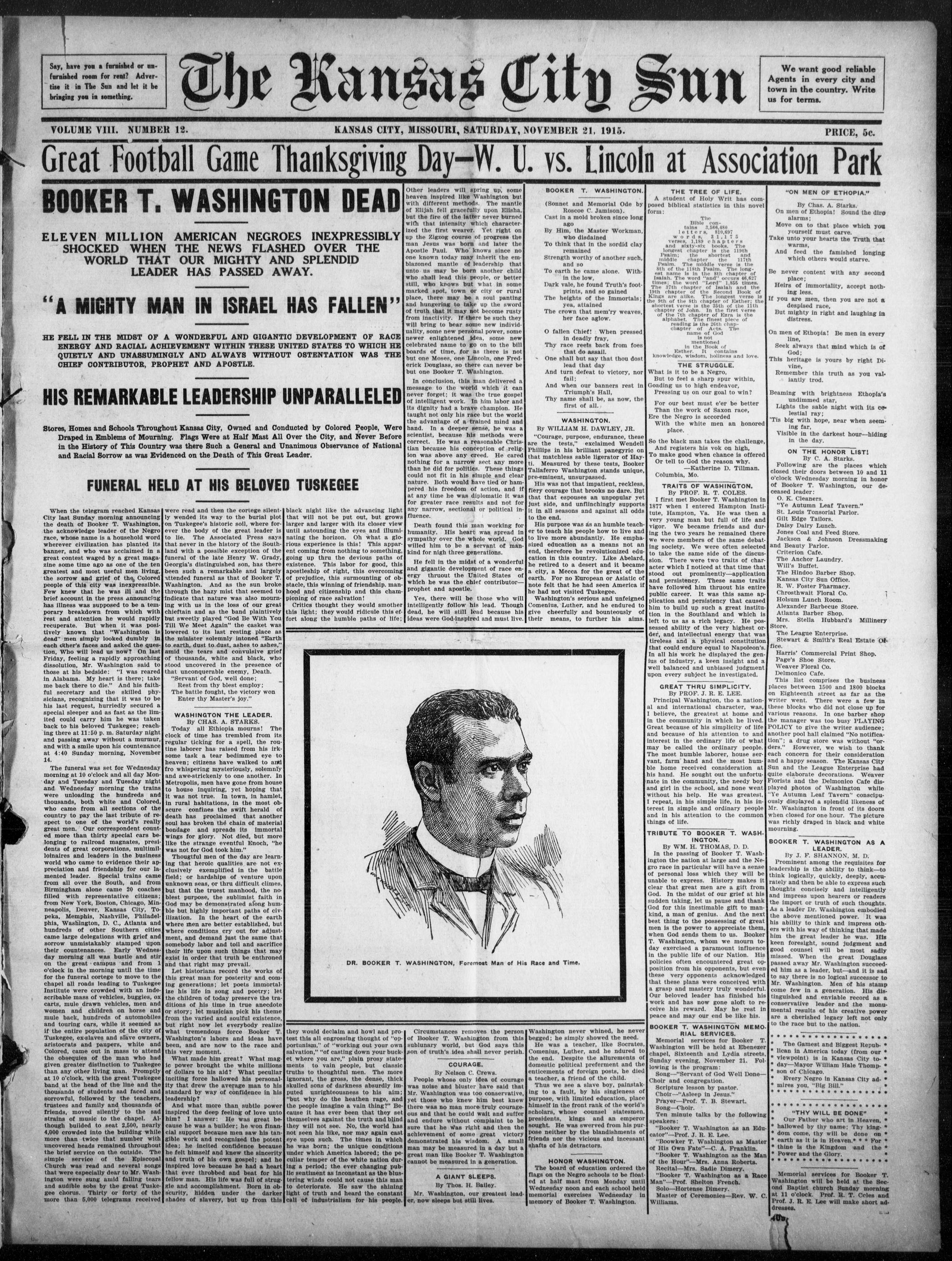
BOOKER T. WASHINGTON DEAD
ELEVEN MILLION AMERICAN NEGROES INEXPRESSIBLY SHOCKED WHEN THE NEWS FLASHED OVER THE WORLD THAT OUR MIGHTY AND SPLENDID LEADER HAS PASSED AWAY.
"A MIGHTY MAN IN ISRAEL HAS FALLEN"
HE FELL IN THE MIDST OF A WONDERFUL AND GIGANTIC DEVELOPMENT OF RACE ENERGY AND RACIAL ACHIEVEMENT WITHIN THESE UNITED STATES TO WHICH HE QUIETLY AND UNASSUMINGLY AND ALWAYS WITHOUT OSTENTATION WAS THE CHIEF CONTRIBUTOR, PROPHET AND APOSTLE.
HIS REMARKABLE LEADERSHIP UNPARALLELED
Stores, Homes and Schools Throughout Kansas City, Owned and Conducted by Colored People, Were Draped in Emblems of Mourning. Flags Were at Half Mast All Over the City, and Never Before in the History of This Country was there Such a General and Unanimous Observance of National and Racial Sorrow as was Evidenced on the Death of This Great Leader.
FUNERAL HELD AT HIS BELOVED TUSKEGEE
---
Say, have you a furnished or unfurnished room for rent? Advertise it in The Sun and let it be bringing you in something.
When the telegram reached Kansas City last Sunday morning announcing the death of Booker T. Washington, the acknowledge leader of the Negro race, whose name is a household word wherever civilization has planted its banner, and who was acclaimed in a great contest waged by a great magazine some time ago as one of the ten greatest and most useful men living, the sorrow and grief of the Colored people of this city was inexpressible. Few knew that he was ill and the brief account in the press announcing has illness was supposed to be a temporary breakdown from which with rest and attention he would rapidly recuperate. But when it was positively known that "Washington is dead" men simply looked dumbly in each other's faces and asked the question, Who will lead us now? On last Friday, feeling a rapidly approaching dissolution, Mr. Washington said to those at his bedside: "I was reared in Alabama. My heart is there; take me back there to die." And his faithful secretary and the skilled physicians, recognizing that it was to be his last request, hurriedly secured a special sleeper and as fast as the limited could carry him he was taken back to his beloved Tuskegee; reaching there at 11:50 p. m. Saturday night and passing away without a murmur, and with a smile upon his countenance at 4:40 Sunday morning, November 14.
The funeral was set for Wednesday morning at 10 o'clock and all day Monday and Tuesday and Tuesday night and Wednesday morning the trains were unloading the hundreds and thousands, both white and Colored, who came from all sections of the country to pay the last tribute of respect to one of the world's really great men. Our correspondent counted more than thirty special cars belonging to railroad magnates, presidents of great corporations, multimillionaires and leaders in the business world who came to evidence their appreciation and friendship for our lamented leader. Special trains came from all over the South, and from Birmingham alone came 20 coaches filled with representative citizens; from New York, Boston, Chicago, Minneapolis, Denver, Kansas City, Topeka, Memphis, Nashville, Philadelphia, Washington, D. C., Atlanta and hundreds of other Southern cities came large delegations with grief and sorrow unmistakably stamped upon their countenances. Early Wednesday morning all was bustle and from 1 o'clock in the morning until the time for the funeral cortege to move to the chapel all roads leading to Tuskegee Institute were crowded with an indescribable mass of vehicles, buggies, ox carts, mule drawn vehicles, men and women and children on horse and mule back, hundreds of automobiles and touring cars, while it seemed as if the entire population of the city of Tuskegee, ex-slaves and slave owners, aristocrats and paupers, white and Colored, came out in mass to attend the obsequies of the man who had given greater distinction to Tuskegee than any other living man. Promptly at 10 o'clock, with the great Tuskegee band at the head of the line and the thousands of students sad faced and sorrowful, followed by the teachers, trustees and family and thousands of friends, moved silently to the sad strains of music to the chapel. Although built to seat 2,500, nearly 4,000 crowded into the building while more than twice that number with uncovered heads remained throughout the brief service on the outside. The simple service of the Episcopal Church was read and several songs that were especially dear to Mr. Washington were sung amid falling tears and audible sobs by the great Tuskegee chorus. Thirty or forty of the more than 5,000 telegrams received
The Kansas City Sun
were read and then the cortege silently wended its way to the burial plot on Tuskegee's historic soil, where forever the body of the great leader is to lie. The Associated Press says that never in the history of the Southland with a possible exception of the funeral of the late Henry W. Grady, Georgia's distinguished son, has there been such a remarkable and largely attended funeral as that of Booker T. Washington. And as the sun broke through the hazy mist that seemed to indicate that nature was also mourning with us in the loss of our great chieftain and as the band plaintively but sweetly played "God Be With You Till We Meet Again" the casket was lowered to its last resting place as the minister solemnly intoned "Earth to earth, dust to dust, ashes to ashes," amid the tears and convulsive grief of thousands, white and black, who stood uncovered in the presence of that unconquerable enemy, Death.
"Servant of God, well done;
Rest from the blest employ;
The battle fought, the victory won
Enter the Master's joy."
WASHINGTON THE LEADER.
By CHAS. A. STARKS
Today all Ethiopia mourns! The clock of time has trembled from its regular ticking for a spell, the routine laborer has raised from his irksome task a tear bedimmed eye to heaven; citizens have walked to and fro whispering mysteriously, solemnly and awe-strikenly to one another. In Metropolis, men have gone from house to house inquiring, yet hoping that it was not true. In town, in hamlet, in rural habitations, in the most obscure confines the swift herald of death has proclaimed that another soul has broken the chain of material bondage and spreads its immortal wings for glory. Not died, but more like the strange eventful Enoch, "he was not for God took him."
Thoughtful men of the day are learning that heroic qualities are not exclusively exemplified in the battle field; or hardships of venture upon unknown seas, or thru difficult climes, but that the truest manhood, the noblest purpose, the sublimist faith in God may be demonstrated along humble but highly important paths of civilization. In the heart of the earth where men are better established, but where conditions cry out for adjustment, and demand just the same that somebody labor and toil and sacrifice their life upon such things that may exist in order that truth be enthroned and that right may prevail.
Let historians record the works of this great man for posterity and coming generations; let poets immortalize his life in song and poetry; let the children of today preserve the traditions of his time in true anecdote or story; let musician pick his theme from the varied and soulful existence, but right now let everybody realize what tremendous force Booker T. Washington's labors and ideas have been, and are now to the race and this very moment.
What made him great? What magic power brought the white millions of dollars to his aid? What peculiar inciting force hallowed his personality that drew the average man to his standard by way of confidence in his leadership?
And what more than subtle power inspired the deep feeling of love unto him? I answer: He was great because he was a builder; he won financial support because men saw his tangible work and recognized the potent idea; he inelted confidence because he felt himself and knew the sincerity and truth of his own gospel; and he inspired love because he had a heart that ever throbbed and beat for his fellow man. His life was full of struggle and accomplishment. Born in obscurity, hidden under the darker shades of slavery, but up from this
KANSAS CITY, MISSOURI, SATURDAY, NOVEMBER 21. 1915.
DR. BOOKER T. WASHINGTON, Foremost Man of His Race and Time.
black night like the advancing light that will not be put out, but grows larger and larger with its closer view until astounding the eyes and illuminating the horizon. Oh what a glorious experience is this! This apparent coming from nothing to something, going up thru the devious paths of existence. This labor for good, this apostleship of right, this overcoming of prejudice, this surmounting of obstacle, this winning of friendship, manhood and citizenship and this championing of race salvation!
Critics thought they would smother this light; they would ridicule this effort along the humble paths of life;
DR. BOOKER T.
they would declaim and howl and protest this all engrossing thought of "opportunism," of "working out your own salvation," "of casting down your bucket where you are," plain prosy statements to vain people, but classic truths to thoughtful men. The more ignorant, the gross, the dense, thick skulled sons of darkness absurdly imputed unrighteousness to his aim; "but why do the heathen rage, and the people imagine a vain thing?" Because it has ever been that they set themselves against the truth and blind they will not see. No, the world has not seen his like, nor may again cast eye upon such. The times in which he was born; the unique conditions under which America labored; the peculiar temper of the white nation during a period; the ever changing public sentiment as inconstant as the blustering winds could not cause this man to deteriorate. He saw the shining light of truth and heard the constant call of industrialism for his people.
Other leaders will spring up, some heaven inspired like Washington but with different methods. The mantle of Elijah fell gracefully upon Elisha, but the fire of the latter never burned with that intensity which characterized the first weaker. Yet right on up the Zigzog course of progress the man Jesus was born and later the Apostle Paul. Who knows since no one known today may inherit the emblazoned mantle of leadership that unto us may be born another child who shall lead this people, or better still, who knows but what in some marked spot, town or city or rural place, there may be a soul panting and hungering to take up the sword of truth that it may not become rusty from inactivity. If there be such they will bring to bear some new individuality, some new personal power, some newer enlightened idea, some new celebrated name to go on to the bill boards of time, for as there is not but one Moses, one Lincoln, one Frederick Douglass, so there can never be but one Booker T. Washington.
In conclusion, this man delivered a message to the world which it can never forget; it was the true gospel of intelligent work. In him labor and its dignity had a brave champion. He taught not only his race but the world advantage of a trained mind and hand. In a deeper sense, he was a scientist, because his methods were correct. He was a reasonable Christian because his conception of religion was above any creed. He cared nothing for a narrow sect any more than he did for politics. These things could not fit in his simple and clear nature. Both would have tied or hampered his freedom of action, and if at any time he was diplomatic it was for greater race results and not for any narrow, sectional or political influence.
Death found this man working for humanity. His heart was spread in sympathy over the whole world. God willled him to be a servant of mankind for nigh three generations.
He fell in the midst of a wonderful and gigantic development of race energy through the United States of which he was the chief contributor—prophet and apostle.
Yes, there will be those who will intelligently follow his lead. Though dead, he will still lead because his ideas were God-inspired and must live.
WASHINGTON, Foremost Man of Hi
Circumstances removes the person of Booker T. Washington from this sublunary world, but God says this son of truth's idea shall never perish.
COURAGE.
People whose only idea of courage was noise and bluster have said that Mr. Washington was too conservative, yet those who knew him best knew there was no man more truly courageous and that he could wait and suffer and endure without compliant to be sure that he was right and then the achievement of some great victory demonstrated his wisdom. A small man may be measured in a day but a great man like Booker T. Washington cannot be measured in a generation.
A GIANT SLEEPS.
Mr. Washington, our greatest leader, now sleeps but still lives.
BOOKER T. WASHINGTON.
(Sonnet and Memorial Ode by Roscoe C. Jamison).
Cast in a mold broken since long ago
By Him, the Master Workman, who disdained
To think that in the sordid clay remained
Strength worthy of another such, and so
To earth he came alone. With in the low.
The crown that mem'ry weaves,
her face aglow.
O fallen Chief! When pressed
in deadly fray.
Thy race reels back from foes that do assail.
One shall but say that thou dost lead that day
And turn defeat to victory, nor fail;
And when our banners rest in Triumph's Hall,
Thy name shall be, as now, the first of all.
WASHINGTON.
By WILLIAM H. DAWLEY, JR.
"Courage, purpose, endurance, these are the tests," exclaimed Wendell Phillips in his brilliant panegyric on that matchless slick ligerator of Hayti. Measured by these tests, Booker Talafero Washington stands unique, pre-eminent, unsurpassed. His was not that impatient, reckless, fiery courage that brooks no dare. But that that espouses an unpopular yet just side, and unflinchingly supports it in all seasons and against all odds to the end.
His purpose was as an humble teacher to teach his people how to live and to live more abundantly. He emphasized education as a means not an end, therefore he revolutionized education in this country. Like Abelard, he retired to a desert and it became a city, a Mecca for the great of the earth. For no European or Asiatic of note felt that he had seen America if he had not visited Tuskegee.
Washington's serious and unfeigned Comenius, Luther, and he endured to give cheerfully and bounteously of their means, to further his aims.
Race and Time.
Washington never whined, he never begged; he simply showed the need. He was a teacher, like Socrates, Comenius, Luther, and he indured to the end. Despite the allurements of domestic political preferment and the enticements of foreign posts, he died a teacher, a friend of the child. Thus we see a slave boy, painstaking to a fault, by his singleness of purpose, with limited education, place himself in the front rank of the world's scholars, whose counsel statesmen, presidents, kings and an emperor sought. He was swerved from his purpose neither by the blandishments of friends nor the vicious and incessant shafts of his detractors.
HONOR WASHINGTON
HONOR WASHINGTON.
The board of education ordered the flags on the Negro schools to be floated at half mast from Monday until Wednesday noon and each school held memorial exercises Wednesday in memory of Booker T. Washington.
THE TREE OF LIFE.
A student of Holy Writ has composed biblical statistics in this novel form:
The
Bible contains 2,366,480 letters, 810,897 written verses, 1,189 chapters and sixty-six books. The longest chapter is the 119th Psalm; the shortest and middle chapter the 117th Psalm. The middle verse is the 8th of the 118th Psalm. The longest verse of Isaiah. The word "and" occurs 46,627 times; the word "Lord" 1,555 times. The 37th chapter of Isaiah and the 38th chapter of Elijah the Book of Kings are alike. The longest verse is the 9th of the 8th chapter of Esther; the shortest verse is the 35th of the 11th chapter of Esther; the verse of the 7th chapter of Ezra is the alphabet. The finest piece of
THE STRUGGLE.
What is it to be a Negro,
But to feel a sharp spur within,
Goading us to high endeavor,
Pressing us on our goal to win?
For our best must e'er be better
Than the work of Saxon race,
Ere the Negro is accorded
With the white men who became
With the white men an honored place.
So the black man takes the challenge,
And registers his vok on high,
To make good when chance is offered
Or tell to God the reason why.
—Katherine D. Tillman.
Columbia, Mo.
TRAITS OF WASHINGTON.
BY PROF B. R. T. COLES.
BY PROF. R. T. COLES.
I first met Booker T. Washington in 1877 when I entered Hampton Institute, Hampton, Va. He was then a very young man but full of life and vigor. We became friends and during the two years he remained there we were members of the same debating society. We were often selected to take the same side of the discussion. There were two traits of character which I noticed at that time stood out prominently—application and persistency. These same traits have followed him thruout his entire public career. It was this same application and persistency that caused him to build up such a great institution in the Southland and which is left to us as a rich legacy. He possessed ability of the very highest order, and intellectual energy that was tireless and a physical constitution that could endure equal to Napoleon's. In all his work he displayed the genius of industry, a keen insight and a well balanced and unbiased judgment upon every subject he investigated.
GREAT THRU SIMPLICITY.
By PROF. J. R. E. LEE.
Principal Washington, tho a national and international character, was, I believe, the greatest at home and in the community in which he lived. Great because of his simplicity of life and because of his attention to and interest in the ordinary life of what may be called the ordinary people. The most humble laborer, house servant, farm hand and the most humble home received consideration at his hand. He sought out the unfortunate in the community, the needy boy and girl in the school, and none went without his help. He was greatest, I repeat, in his simple life, in his interest in simple and ordinary people and in his attention to the common things of life.
TRIBUTE TO BOOKER T. WASH
INGTON.
By WM. H. THOMAS, D. D.
In the passing of Booker T. Washington the nation at large and the Negro race in particular will have a sense of personal loss which they will be unable to express. History makes it clear that great men are a gift from God. In the midst of our grief at his sudden taking, let us pause and thank God for this inestimable gift to mankind, a man of genius. And the next best thing to the possessing of great men is the power to appreciate them, when God sends them to us. Booker T. Washington, whom we mourn today exercised a paramount influence in the public life of our Nation. His policies often encountered great opposition from his opponents, but even these very opponents acknowledged that these plans were conceived with a grasp and mastery truly wonderful. Our beloved leader has finished his work and has now gone aloft to receive his reward. May he rest in peace and may our end be like his.
BOOKER T. WASHINGTON MEMO
RIAL SERVICES.
Memorial services for Booker T. Washington will be held at Ebeneben chapel, Sixteenth and Lydia streets, Sunday evening, November 21. Following is the program:
Song—"Servant of God Well Done—Choir and congregation.
Ten minute talks by the following speakers:
"Booker T. Washington as an Educator"—Prof. J. R. E. Lee.
"Bowker T. Washington as Master of His Own Fate"—C. A. Franklin.
"Booker T. Washington as the Man of the Hour"—Mrs. Anna Roberts.
Recital—Mrs. Sadie Dimery.
"Booker T. Washington as a Race Man"—Prof. Shelton French.
Solo—Hortense Dimente.
Master of Ceremonies—Rev. W. C. Williams.
We want good reliable Agents in every city and town in the country. Write us for terms.
PRICE, 5c.
iation Park
"ON MEN OF ETHOPIA."
By Chas. A. Starks.
On men of Ethiopia! Sound the dire alarms;
Move on to that place which you yourself must carve.
Take unto your hearts the Truth that warms,
And feed the famished longing which others would starve.
Be never content with any second place;
Heirs of immortality, accept nothing less.
If you are men, then you are not a despised race.
But mighty in right and laughing in distress.
On men of Ethiopia! Be men in every line,
Seek always that mind which is of God;
This heritage is yours by right Divine,
Remember this truth as you valiantly trod.
Beaming with brightness Ethiopia's undimmed star,
Lights the sable night with its celestial ray;
'Tis big with hope, near when seeming far. Visible in the darkest hour—hiding in the day.
Following are the places which closed their doors between 10 and 11 o'clock Wednesday morning in honor of Booker T. Washington, our deceased leader:
O. K. Cleaners.
"Ye Autumn Leaf Tavern."
St. Louis Tonsialor Parlor.
Gilt Edge Tailors.
Daisy Dairy Lunch.
Jones Coal and Feed Store.
Jackson & Johnson Dressmaking and Beauty Parlor.
Criterion Cafe.
The Anchor Laundry.
Will's Buffet.
The Hindoo Barber Shop.
Kansas City Sun Office.
R. W. Foster Pharmacy.
Chrostwish Floral Floral Co.
Holsum Lunch Room.
Alexander Barbecue Store.
Atlanta Barber Shop.
Mrs. Stella Hubbard's Millinery Store.
The League Enterprise.
Stewart & Smith's Real Estate Office.
This list comprises the business places between 1500 and 1800 blocks on Eighteenth street as far as the writer went. There were a few in these blocks who did not close up for various reasons. In one barber shop the manager was too busy PLAYING POLICY to give the writer audience; another pool hall claimed "No notification"; a drug store was without "orders." However, we wish to thank each concern for their consideration and a happy season. The Kansas City Sun and the League Enterprise had quite elaborate decorations. Weaver Florists and the Delmonico Cafe displayed photos of Washington white "Ye Autumn Leaf Tavern" conspicuously displayed a splendid likeness of Mr. Washington in front of its doors when closed for one hour. The picture was richly draped in black and white mourning.
BOOKER T. WASHINGTON AS A LEADER.
By J. F. SHANNON, M. D.
Prominent among the requisites for leadership is the ability to think—to think logically, quickly, deeply, accurately and then be able to express such thoughts concisely and intelligently and impress upon hearers or readers the import or truth of such thoughts.
As a leader Dr. Washington embodied the above mentioned power. It was his ability to think and impress others with his way of thinking that made him the great leader he was. His keen foresight, sound judgment and good counsel will be most sadly missed. When the great Douglas passed away Mr. Washington succeeded him as a leader, but—and it is sad to say there is no logical successor to Mr. Washington. Men of his stamp come few in a generation. His distinguished and enviable record as a conservative leader and the monumental results of his creative power are a cherished legacy left not only to the race but to the nation.
* The Gamest and Biggest Republican in America today (from our viewpoint) is in Kansas City today—Mayor William Hale Thompson of Chicago.
* Every Negro in Kansas City admires you, "Big Bill."
Memorial services for Booker T. Washington will be held at the Second Baptist church Sunday morning at 11 o'clock. Prof. R. T. Ccles and Prof. J. R. E. Lee will make short addresses.
M4 7 ]
HOTY UF GiGatel nalisds Uily
(Your name, business, address and telephone carried in this directory at 26 cente
per month, $3,00 a year; lena than one cont a day. Can you beat It? ‘To secure apace
fall Sun Office, Hell phone 999 Kast, or see our agent.)
BEAUTY PARLORS AND HAIR DRESSERS.
J.B, LAING, 1715 East 18th St.
MESDAMES JACKSON & JOHNSON, 18th and Highland Ave. Bell
phone BE. 4788,
MRS. CADDIE WITCHER, 1708 Michigan Ave. Madame Walker's
Hair and Sealp Treatment. Bell phone, East 4167X.
CAFES.
DELMONICA CAFE, 1512 East 18th St. Bell phone, East 618.
CARPET CLEANERS.
EUREKA CARPET CLEANING CO., 1718.20 Euclid Ave, Bell phone,
East 3555 ; Home, East 4169.
COAL AND FEED.
W. W. PAYNE, 1902 1-2 Vine St. Bell phone, East 539; Home phone,
East 4132.
CLEANERS, DYERS AND TAILORS.
G. V. GOLDEN, 1650 East 18th St. Bell phone East 539.
WORTHAM BROS,, 1831 Paseo. Bell Phone East 701.
DENTISTS.
DR. E. 0. BUNCH, 716 East 12th St. Bell phone G. 2553 W.
DRUG STORES.
THEODORE SMITH, 1301 East 18th St. Bell phone Grand, 4591,
Home Main 5467.
PEOPLE'S DRUG STORE, 18th and Paseo, Bell phone East 1814,
Home East 4082.
R. W. FOSTER'S PHARMACY—18th and Woodland.
Bell phone East 272, Home phone East 4070.
DRY GOODS AND NOTIONS.
TAYLOR-HOLMES & CO., 2409 Vine Street.
EXPRESS AND BAGGAGE.
THOS. JACKSON, 1816 Highland, Bell phone, East 3485W.
FLORISTS.
CROSTHWAIT FLORAL CO., 1301 East 18th St. Bell phone, East
272. Home phone, East 4070.
GROCERS.
M. R. WILSON, 2644 Woodland Ave, Bell phone, East 1493.
INSURANCE.
STANDARD LIFE INSURANCE CO., 1507 East 18th St., Bell phone
Grand 2666J. T. A. Ross, ;
JEWELERS.
J. A. WILSON, 1616 West 9th St., Bell phone, Main 6248R.
LAUNDRIES.
THE ELECTRIC LAUNDRY CO,, J. C. Hale, Mgr., 2928 Summit St
Home phone 3160.
LAWYERS.
©, H, CALLOWAY, 601 Delaware, Home phone M58, Bell phone Main
448. Practices in all courts.
‘W. C. HUESTON, 601 Delaware, Home phone M58, Bell phone Main
448. Legal advice. Practices in all courts.
GEO. T. WASSOM, Attorney at Law, 307 Walnut street.
Bell phone East 2727, Home phone East 4070.
E. A. SHACKLEFORD, Attorney at Law, 516 Minnesota Ave., Kan
sas City, Kas. Bell phone, West 3866.
MILLINERY.
CALDWELL CHAPMAN, 18th and Paseo. Home phone East 4009
MISS EVA P. WASHINGTON, 849 Freeman Ave. Bell phone, Wes
2306, Kansas City, Kas. Also hair work.
MME, STELLA HUBBARD, latest things in hats. Old hats mad
new. 1510 East 18th street. Bell phone E, 4798.
PHOTOGRAPHERS.
©, BRUCE SANTEE, Proprictor The Fad, 1607 East 18th St. Bel
phone East 1643.
PHYSICIANS.
DR. R. J. LAMBERT, Therapties, P. 0. box 90A, Bell phone, Rosedal
528, Rosedale, Kas.
PRINTERS.
©, A, FRANKLIN, 1008 East 18th St. Bell phone Grand 2988.
REAL ESTATE and EMPLOYMENT.
STEWART & SMITH, 1515 East 18th St. .Bell phone East 489:
Home phone East 4024.
AFRO-AMERICAN REAL ESTATE & INVESTMENT CO, Help fur
nished. 911 McGee street.
Bell Phone 751 Main. Home Phone 7555 Mair
COLORED PEOPLE'S INVESTMENT CO., 2427 Vine St. Bell Phon
East 1011, Home East 4011, Sol Smith, Pres.; C. H. Adkins, Tre
SECOND-HAND GOODS.
‘W. G, HOPKINS, 2122 Vine St. Bell phone Hast 3851 ,
UNDERTAKERS,
ADKINS BROS. & GREEN, 19th and Vine Sts, Bell phone East 4781
C. H. COUNTEE, Licensed Embalmer, 2220 Vine St., Bell Phone, Eas
3336, Home Kast 3341.
WATKINS BROS,, 1729 Lydia Ave. Bell Phone Grand 987, Hom
‘Main 7989. Res., Bell East 3281.
Rear aL ibe Veer te zal ook. Oe Bar GAO fea bes SE RRA ON ae
|. CALDWELL & CHAPMAN
ais
Hair and Millinery
18th and Paseo, Kansas City, Mo.
Home Phone East 4009
Sealp Treatment a Specialty. Caldwell's Pomade and Tonic really
Grows Hair, Try it. Save your combings, cut hair
and any old hat you may have,
Hair Matched From Samples. Feathers and Hats Cleaned, Dyed and
Blocked. Agents for Spirelia Corsets. Mail orders answered promptly
WORK GUARANTEED, LIVE AGENTS WANTED
MANICURING FACIAL MASSAGE
We teach the work we do
Subscribe lor The Stn
The New Dance School
Frederick L. Conley, Kansas City’s
leading dancing instructor, has or
ganized a new class at the Armory
hall, Cottage and Vine streets, teach-
ing the very latest dances of the sea-
son, also introducing a new method
of dancing for the benefit of the danc-
ing class of people of Kansas City.
Come out and learn the new dances
and the new way of dancing by the
new music conducted by the new man.
The dances, including the one step,
hesitation waltz, Broadway glide, fox
trot, Blue Danube waltz are now be-
ing taught having quite a few in num-
ber in my classes every Thursday
evening. Learn the new dances from
& man that can dance and can teach
dancing and will guarantee to teach
you to dance even if you never danced
before,
Grand Opening
On November 25 there will be a
grand opening ball of the new dance
class, dancing the new dances and
whatever you want to dance. ‘Try and
attend the classes before that time,
so that you will be a qualified attend-
ant of that night, ‘There will be ex-
hibitions o fthe latest fancy dancing
of that night, introduced by Freder-
ick L. Conley, the proprietor of the
grand opening. Come out and see
demonstrations of the fancy dances,
Special Notice to the Readers of the
Kansas City Sun Who Are Inter-
ested in Dancing.
‘We teach by careful demonstrations
explaining every step and motion of
the dance and you can accomplish
more in half the time than any other
school of dancing in the city. Why
can we do so? Because we teach in
detail every part of the dance so that
‘You may not only dance correctly, but
know how to do them, Because we
teach the head to know and direct the
feet, and do not pull or haul you
around. Because by our method it
is impossible to conflict dances as we
teach the motion as well as the steps.
Come out and hesitate.
HANCEFORD BEARD, Assistant.
Excellent Opportunity
Par Ambitions Men.
After giving five years of hard study
and hard work amonk my people in
the insurance capicity, one year of
tihme time has been given to the peo-
ple of Kansas City, and I am very
pleased to say that I have been into
over 1,000 homes in this city who
state they would much prefer hav-
ing young men of their own race call-
ing to their homes collecting their in-
surance than white agents collecting
their insurance, and only wished that
some old line responsible company
writing weekly insurance would em-
ploy colored men as agents, After
learning that our people are so very
anxious to have colored collectors, I
have taken up this subject with the
home office, and they have willingly
consented to give colored agents. an
opportunity, providing I can find am-
bitious men who are willing to work
and learn the business. Thihs is the
problem that confronts me now is
finding the men who are willing to
work, We will pay you well for your
services. We are also writing month-
ly insurance. Experience is not nec-
essary, as I am willing to teach you
the business. If you are not in post-
tion to take advantage of this oppor-
tunity, I will appreciate it if you will
advise a friend whom you think has
the ambition to make good in the in-
surance business. Call at my office
and let’s talk it over together. Call
any day before noon or by appoint:
ment.
CLOVER LEAF CASUALTY Co.
J. J. Allen, Superintenden, 1507 ©.
18th street, Kansas City, Mo.
Bell phone East 4955.
ge
ie ae ae |
eee Res
i eat
Sie 4 Vy eta?
pee RN
fe ie eee
bid eae eee
eee Nes
PA
2 ty sabes
is
Nee cote pit
ome ig ethoaeg Py
So be
‘Ww. C, MOON,
’,
Moon’s New Market
“Anything Worth Doing
Is Worth Doing Well”
The “Best of Everything”
Fresh from the country, We can
help you. We've got the goods,
the service and a history “chock
full” of satisfaction to all con-
cerned,
Thanksgiving Turkeys, Geese
and Ducks
Are here—the cost is no more.
For quick service call Bell Grand
146W.
MOON’S
Poultry and Provision Co.
Dressed young hens......,.18/2e
Dressed springs ..........16/4¢
Dressed broilers ..,.,..-.:17/%e
A ORE ae
B %
; ‘ TO THE PUBLIC:
f We want you to come to us for everything carried by a Drug Store, &
*
2 DRUGS, MEDICINES, TOILET ARTICLES, RUBBER GOODS, COMBS,
BRUSHES, MADAM WALKER HAIR-GROWER-DRYING COMBS, ' &
ING COMBS, ETC. +
S We recommend and guarantee everything offered for aale to be %
& bxactly as represented, WE DO NOT “SUBSTITUTE” nor ask you to +
% take other brands than you ask for. You “want what you want” and
We want you to have It,
% OUR PRICES ARE RIGHT ‘
All down the line. | We give careful attention to all orders, and alm
: by, gaurteoue and tale Fane te lve perfect eatlefaction to our
customers. When you think of Druge think of
2 THEO. SMITH'S PHARMACY. §
% , No demand is too difficult for us to supply. If you are too busy
# to come to our store, phone us your wants and we will do the rest.
% Mall Orders Solicited and Promptly Filled. F
« Th .
eo. Smith's Drug Store. %
. . 5
+ Bell Phone 4591 Grand. Home Phone 8467 Main. :
% 1201 E, 18th t, KANSAS CITY, Mo, &
EEE ES ELEC EL ELE OEE OE CES ERERECER EEC ERS
FILE IAIL ALIA SE BLS LILIA IA IL SA IAI Be Me Ht HH
Palace of Fashion and Beauty Parlor
MRS. BIRDIE JACKSON MME LILLIE JOHNSON
HAIR DRESSER AND BEAUTY
DESIGNER AND DRESSMAKER SPECIALIST
Scalp Treatment a Specialty
Latest Styles
Latest and Most Approved Methods
We Alter and Repair Clothing aati
Manicuring and Massaging
Northwest corner 18th St. and Highland Ave.
BELL PHONE—EAST 4788
EAESALESA SE SALE SALAS ALE SALE SESE SE IE IE IE IES
Sraewb eee
ce aw
24 fi
a ye hy ee
i A Pauainioas Sich bp 4 een
First class shaves, hair cuts and shampoos. Best shop in the city.
Do not take your money down town when you can get good service
for it at home. You will always find us at our post and ready to
serve. GIVE US A CALL.
If You are Pleased Tell Your Friends, and If Not Tell Us.
MUSIC EVERY WEDNESDAY AND SATURDAY EVENINGS.
FIRE FIRE FIRE
Protect your home and personal
property. Call Jackson County
Home Mutual Fire Insurance Co.
They will do the rest
630 N. Y. LIFE BUILDING
HOME PHONE 9814 MAIN
\ 1
One Woman
Wished To Improve Her Appearance.
| Her only fault was a large mouth with heavy lips, A friend
‘recommended Thin-lip Creamoline and one box reduced the lips and
‘mouth. No! There isn’t a happier woman anywhere, It will do the
‘same for you. Price, $1.00 prepaid, in plain package by return mail,
| MACKINAW SPECIALTY CO.
MACKINAW CITY, MICH.
ie} 7 %
Laing’s New Patent Incline Straight-
ening Comb Just Out.
CROSS SECTION OF COMB r- ZZ
QZ LA
5 el
gS ‘THE KING OF ALL STRAIGHTENERS
cs f {II 5; inch wide, 934-inches long, guaranteed
nl! or money refunded.
” Rotail..........$1.00 EACH
‘These Combs are Sold in Wholesale and Job Lots.
‘The hair is immediately straightened while it passes be-
tween these wide teeth of the comb from the roots to the ends.
The comb can be used both ways, right or left hand, by ex-
changing handle; a hole at each end. The comb will straighten
the shortest hair around the neck and edges. The only re-
versible com) made on the market.
HAIR DRESSING PARLOR
J. E, LAING
Hair Dressing Taught in All Branches, Manicuring, Facial Mas-
sage, also Hair Dressers’ Supplies, Combings Made Over.
We guarantee to Cure Different Scalp Diseases by
Giving Different Scientific Treatments.
Manufacturer of instantaneous hair dye in black, brown,
and blonde.
Manufacturer of all kinds of human hair goods, refined,
bleach, and dye, any shade.
Manufacturer of wigs, toupes, doll wigs, French ventilat-
ing on nets made to order.
Manufacturer of Shampoo Drier and straightening combs.
United States Patent Office, Washington, D. C., Serial 798947.
Manufaéturer of face and hair toilet articles,
Colored People’s Goods a Specialty—Mail Orders Promptly
Filled.
MAIN OFFICE, 1715 EAST 18TH STREET
KANSAS CITY, MO.
AGENTS WANTED EVERYWHERE.
The Tub That Folds In A Roll
Surely a rare happy invention that meets with instant approval.
Extremely simple, easily adjusted, thoroughly efficient and absolutely
| satisfying in every respect. In truth a God send to humanity,
|
oe | CA :
x 2
\ ——— os
- oe
~
———
$10.00 SUPPLIES YOUR HOME WITH A MODERN BATH ROOM
which you do not leave for the landlord but can move with you wher-
ever you go. Investigate this by calling on D. M. West, 1718 Euclid
Avenue, Agent, or call Home phone, East 4169; Bell phone, East 3555.
You can see them at 1718 Euclid Avenue, or call up and I will bring
one to you for your inspection.
D. M. WEST, Agent
ANNOUNCEMENT
Chas, H. Adkins R. V. Adkins R. F. Green
ADKINS BROS. & GREEN
FUNERAL DIRECTORS AND EMBALMERS
Have purchased the People’s Undertaking Co. and are planning to
give Kansas City the most up-to-date and complete Unders
taking establishment in the city.
Carriage or Auto Funerals at the Same Price
Our service will be unsurpassed
Chapel Free—Lady Attendants—Calls Answered Night or Day.
LOCATION—19th and Vine, Bell Phone E4784
R. F, GREEN, Licensed Embalmer and Manager.
ee cea
ba le oe
ate
aN Be
py
Muehlebach’s
Pilsener Beer
4A HOME PRODUCT”
“A DELICIOUS DRINK”
“A BEER OF PURITY”
Surpassed by none in the market
Geo. Muehlebach’s Brewing Company
Bell Phone 777 Grand Kansas City, Me, Home Phone 3277 Main
MRS V.L. HUESTON
owe
é
ee
THE DELUX cozy
FURNISHED ROOMS
Hot and Cold Baths — All Outside Rooms.
Luncheon served at night.
339 RICH STREET
————-AL80 —____
NEW HOTEL PANAMA
Rooms With or Without Board, Hot and Cold
Baths, Running Water in Every Room,
All Outside Rooms.
422 Brannan 8t., SAN FRANCISCO, CALIF.
Mrs, V. L. North Hueston, Prop,
A WONDERFUL HAIR DRESSER AND GROWER.
One thousand agents wanted. Good money made.
We want agents in every city and village to ‘sell
THE STAR HAIR GROWER. This is a wonderful
preparation. Can be used with or without straight-
ening frons,
Sells for 25¢ per box—one 25e box will prove its
value, Any person that will use @ 250 box will be
convinced, No matter what has failed to grow
your hair just give THE STAR HAIR GROWER a
trial and be convinced. Send 25¢ for full size box.
If you wish to be an agent send $1.00 and we will
send you a full supply that you can begin work with
at once; also agents’ terms. Send all money by
Money Order to
THE STAR HAIR GROWER MFGR.
1118 Clark Street. Evanston, I,
SOLD AT COOPER & y 4
EgRER OT Soot *scauremsie onus grone
And Have Good Hair
P. M. Dabney's
Century Hair Grower
Mme. P. M. Dabney's
XXth Century Pressing Oil
Mme. P. M. Dabney's XXth Century Hair Grow
Madam P. M. Dabney's XXth Century Hair Grower promotes a beautiful growth of hair, stops falling out and breaking of hair, removes dandruff and relieves itching of scalp. It will make YOUR hair grow. For woman, man or child.
PRICE 50c. PER JAR
Mme. P. M. Dabney's XXth Century Hair Grower
Six Weeks'
TESTIMONIAL
"This is to certify that the writer suffered for four years with danduff and itching of the scalp until practically bald, trying many remedies but of no avail. About six months ago I began to use Madam P. M. Dabney's XXth Century Hair Grower, the results up to date are pleasing. Dandruff removed, itching stopped, good growth of hair started. The remedy is O.K. Yours for succes, Rev. L. W. Harris, Mod. Mt. Zion Baptist Association, Carrollton, Mo."
Make a course of treatm
which will last six weeke
enclosing P. O. money on
by parcel post prepaid, or w
mation to
Madam P. M. Da
HAIR PREP
1806 E. 24th St.
BEWARE
NS:—
g to Make "PORO"
Preparations With Broken Seal
Preparations said to be As Good as "PORO"
Preparations with Name Sounding Anything
66 TRADE PORO MARK
Unsealed Goods Without Labels, as "PORO
ns are swindling people out of their money
er. Do not give them your money, but write
"PORO" COLLEGE COMPANY
100 PINE STREET
O"
In Broken Seal
to be As Good as "PORO"
In Name Sounding Anything Like
ORO MARK
Without Labels, as "PORO"
people out of their money the country
them your money, but write us.
COLLEGE COMPANY
ONE STREET
Claiming to Make "PORO"
Selling Preparations With Broker
Selling Preparations said to be As
Selling Preparations with Name
66 TRADE PORO
Selling Unsealed Goods Without
These persons are swindling people or
over. Do not give them you
"PORO" COLLEGE
3100 PINE
Claiming to Make "PORO"
Selling Preparations With Broken Seal
Selling Preparations said to be As Good as "PORO"
Selling Preparations with Name Sounding Anything Like
TRADE PORO MARK
Selling Unsealed Goods Without Labels, as "PORO"
These persons are swindling people out of their money the country over. Do not give them your money, but write us.
"PORO" COLLEGE COMPANY
3100 PINE STREET
ST. LOUIS, MO.
BEWARE OF IMITATIONS
Expert Dental Special
OF KANSAS CITY
Our work has stood the test. We have been doing high class dental Work for the past 29 years. We have thousands of satisfied
REMEMBER, IN BUSINESS 29 YEARS
All work kept in repair free of charge.
SAVE MONEY EXAMINATION FREE All work guaranteed 20 years. GET T
The doctor who extracts your teeth here has undoubtedly had no in this line than any other dentist in the city, so you get the machet.
Cert Dental Special
OF KANSAS CITY
stood the test. We have been doing high class g
or the past 29 years. We have thousands of satis
REMEMBER, IN BUSINESS 29 YEARS
All work kept in repair free of charge.
MONEY EXAMINATION FREE
All work guaranteed 20 years.
Who extracts your teeth here has undoubtedly had
an any other dentist in the city, so you get the m
Dental Specialists
KANSAS CITY
We have been doing high class guaranteed Den-
We have thousands of satisfied patients.
IN BUSINESS 29 YEARS
in repair free of charge.
IMMATION FREE
guaranteed 20 years.
with here has undoubtedly had more experience
in the city, so you get the most expert serv-
Expert Dental Specialists
Our work has stood the test. We have been doing high class guaranteed Dental Work for the past 29 years. We have thousands of satisfied patients.
REMEMBER, IN BUSINESS 29 YEARS
All work kept in repair free of charge.
SAVE MONEY EXAMINATION FREE All work guaranteed 20 years. GET THE BEST
The doctor who extracts your teeth here has undoubtedly had more experience in this line than any other dentist in the city, so you get the most expert service.
BRIDGE WORK
Spaces where from one to ten teeth have been lost we replace with bridge work. If looks the same as natural teeth, lasts a life time and requires no plate. Broken down teeth we restore to beauty and usefulness with crowns of porcelain and gold.
Spaces where from one to ten teeth have been lost we replace with bridge work. It looks the same as natural teeth, lasts a lifetime and requires no plate. Broken down teeth we restore to beauty and usefulness with crowns of porcelain and gold.
GOLD CROWNS, $3, $4 AND $5
CROWNS, $3, $4 AND $5
UPPER AND LOWER, $5.00 AND UP
K DENTAL CO.
Walnut Street
e, 1 door north Emery, Bird, Thayer Co.
WHITE CROWNS
SET OF TEETH, UPPER A
NEW YORK D
1017-19 Walm
Over Jaccard's Jewelry Store, 1 door
Don't Wait
Until Too Late
WHITE CROWNS, $3, $4 AND $5
SET OF TEETH, UPPER AND LOWER, $5.00 A
YORK DENTAL
1017-19 Walnut Street
Rockard's Jewelry Store, 1 door north Emery, Bird, T
WHITE CROWNS, $3, $4 AND $5
SET OF TEETH, UPPER AND LOWER, $5.00 AND UP
Over Jaccard's Jewelry Store, 1 door north Emery, Bird, Thayer Co.
Your work may overtax and weaken your eyes. Don't wait until your eyes are weakened by your eyes with correct glasses.
Your eyes examined without charge by our expert specialist.
We offer you our $4.00 twenty-year gold filled eye-glasses or spectacles for taking advantage of this special offer. Your eyes examined only with our expert optician and fitted with proper glasses for two dollars.
We Guarantee
Our Work
Co. 1203 Grand Ave.
Home Phone Main 3306
Hakan Optical Co.
n Optical Co. 1203 Gran
OF PERSONS:—
Madam P. M. Dabney's XXth Century Pressing Oil is an ideal hair dressing, having properties which protect the hair from wind, weather and disease, make it soft and glossy; improves the quality of the hair and promotes straightening without irons. For woman, man or child.
Mme. P. M. Dabney's XXth Century Pressing Oil
Six Weeks' Treatment $1.25
Make a course of treatment for the hair and scalp which will last six weeks. Send us an order today enclosing P. O. money order for $1.25 and receive them by parcel post prepaid, or write for literature and information to
Madam P. M. Dabney's XXth Century
HAIR PREPARATIONS CO.
1806 E. 24th St. Kansas City, Mo.
BRIDGE WORK
$2
One jar Madam P. M. Dabney's XXth Century Hair Grower One box Madam P. M. Dabney's XXth Century Pressing Oil And one bottle Madam P. M. Dabney's . . . . .
XXth Century Shampoo ..
TESTIMONIAL
"With the use of Madam P. M. Dabney's XXth Century Hair Preparations my hair has grown four inches in six months. I would not be without them." Mrs. Henderson, 1721 Forest Ave., Kansas City, Mo.
Madam P. M. Dabney's XXth Century Shampoo is the best cleaner for the washing of the heads of colored people. It contains no astringents or other ingredients harmful to the scalp. It promotes hair health and vigor. For woman, man or child.
Mme. P. M. Dabney's XXth Century Shampoo Treatment $1.25
treatment for the hair and scalp
seeks. Send us an order today
by order for $1.25 and receive them
or write for literature and infor-
Dabney's XXth Century
EPARATIONS CO.
Kansas City, Mo.
WEAR GOOD SHOES.
Noah Thomas, the BEST Shoemaker and Repairer in Greater Kansas City, has installed in his Always Busy Shop, at 1902 Vine Street, a
BRAND NEW ELECTRICALLY OPERATED AMERICAN FINISHER MACHIN
At a cost of $225, which enables him to repair any kind of a Shoe in less time than it takes you to cross the road.
Mr. Thomas is an honor graduate of Tuskegee Institute and learned the Shoe business from A to Z, and if you don't believe he's the best Shoemaker in town—why just go and try him with any kind of an old shoe—and he'll show you.
Shoes called for and delivered. Remember the place—19th and Vine Sts.
Bell phone East 559.
SMITH'S HAIR GROWER.
Madame C. A. Smith announces to the public that her marvelous hair grower and scalp treatment has been tested out thoroughly and proven to be the MOST WONDERFUL TREATMENT FOR THE HAIR She has ever used or seen used. Every ingredient safe and harmless. Patients received from 8:30 a. m. to 6 p. m. Bell phone East 4975. 1100 Highland Ave.
What it Takes to Satisfy the Dancing Public—We've Got it.
Dancing Wednesday nights, classes Saturday nights, Armory Hall, Cottage and Vine streets. Learn from a teacher that guarantees or money refunded. All dances taught in private classes. Bell phone East 2690. Prof Roscoe White, dancing master. Mrs. Janie White, lady teacher. Prof. White's famous orchestra, Miss Neoma Thomas and Prof. Dude Knox. Secure your season tickets.
Bell Phone E. 4394Y
THE Modern E
THE Modern Builders Co.
General Contractor Repairing a Special
SATISFACTION GUARANTY
SATISFACTION GUARANTEED
YOUNG MAN.
If you will from about age 28 pay to Standard Life Insurance Co., less than 2 per cent per annum on any stipulated sum of money, such as you would like to leave as a legacy to your family, the Standard Life Insurance Co. will pay to your family in the event of your death, the full amount in cash on which you have paid interest, in annual instalments for any number of years that you may suggest. If you should for any reason wish to increase the rate of interest so as to mature the sum of money during your lifetime, we will make the change without any additional cost save the difference in interest rates and thereafter make you a loan in cash without voiding your contract. There is no just reason why every NEGRO FAMILY should not be left
We call for you with our 5-passenger car to show you our
Markers and
Prices ranging from $15.00 up. L
them up before winter. M
GEO. W.
BELL PHON
Collector for High
and Ag
KANSAS CITY GRAN
Directly opposite El
Markers and Monuments
Prices ranging from $15.00 up. Let us show you that you may have them up before winter. Make your appointment with
KANSAS CITY GRANITE & MONUMENT CO.
Directly opposite Elmwood Cemetery Co.
4801 EAST 15TH ST., KANSAS CITY
Thomas J. Pillow is regularly employed as demonstrator for the Western Motor Car Company of Los Angeles, Calif. His picture was shown in the last issue of "Motor" showing him with a group of representatives sent out by the California Automobile Club to mark the western end of the trans-continental highway.
The Royal Life Insurance of Chicago, Ill., has inaugurated partment for Colored p. Frank L. Gillespie of Chica intendent. In addition to this responsible position, of the company presented gold watch as a token of for his long and faithful s them.
Blind
HIS EARLY LIFE A
(By Miss M
Handsomely bound.....$1.50
ON SALE AT LEAGUE E
Big Money t
Mailed Any Pla
Blind Boone!
HIS EARLY LIFE AND ACHIEVEMENTS
(By Miss Melissa Fuell)
Handsomely bound.....$1.50 In Morocco.....$2.50
ON SALE AT LEAGUE ENTERPRISE BOOK STORE
Big Money to Canvassers.
Mailed Any Place at Net Prices.
CHAS. A. STARKS, GENERAL AGENT
1521 EAST 18TH ST. BELL PHONE E. 1521
KELLEY'S FLOUR
BEST
HIGH PATENT
Kelley's Best
Beat all the Rest
Kelley Milling Co.
K.C. U.S.A.
Office 2460 Waldrond Ave.
Builders Co.
S, President
Contracting
a Specialty
GUARANTEED
a legacy of from $1,000 to $5,000 according to the family income. Let me come to see you and explain in detail just how you can adequately protect your obligations and provide for your loved ones by leaving an income that will guarantee their education.
GOD intended that you be a MAN. You are less if you fail to provide. Get your Protection NOW. See Thos. A. Ross, with the only OLD LINE LEGAL RESERVE NEGRO LIFE INSURANCE IN THE WORLD, The Standard Life Insurance Co., of Atlanta, Ga.
Branch Office, 1507 East 18th St., Kansas City, Mo. Bell Phone Grand 2666J.
High Class Representatives wanted in every town in Missouri. OVER $1,700,000 IN LIFE INSURANCE IN FORCE.
Monuments
Let us show you that you may have
Make your appointment with
L. LITTLE
THE MAIN 2967
Oakland Cemetery Co.
agent for
ITE & MONUMENT CO.
Timwood Cemetery Co.
KANSAS CITY, MO.
The Royal Life Insurance Company of Chicago, Ill., has inaugurated a department for Colored people with Frank L. Gillespie of Chicago as superintendent. In addition to giving him this responsible position, the officers of the company presented him with a gold watch as a token of appreciation for his long and faithful service with them.
Boone!
AND ACHIEVEMENTS
Ielissa Fuell)
In Morocco.....$2.50
INTERPRIZE BOOK STORE
to Canvassers.
price at Net Prices.
Crittenden. C. Clark, St. Louis,
Grand Junior Warden.
Rooms to Rent
Bell Phone West 455W
All Work Guaranteed.
Sumner Cleaners
OLD HATS MADE NEW
GLOVES AND TIES CLEANED FREE
Goods Called For and Delivered
WM. ROUTTLEDGE and
S. R. WILSON, Props.
1319 N. 9th St., Kansas City, Kas.
Quinoleum Is Queen
THE FILM MAKER
FOR SALE—Four-room cottage, $50
cash, balance easy payments. Home
phone South 4897.
For Rent—Room, furnished or un-
furnished; men preferred. Call Bell
phone South 1117W.
For Sale—Mahogany library table
almost new; cost $35; will sell for
$16. Colonial, 1910, East 24th st.,
second floor.
For Rent—Nice furnished room;
house strictly modern; private family;
with or without board; on car
line. Mrs. S. McWilliam, 343 Gree-
ley ave, Kansas City, Kas. Bell
phone West 2367M.
7-Pasenger Automobile. As a pleas ure car the Clipper has no equal. Driven by owner. 24-hour service. Stick this near your telephone. W. H. HUBBELL. Bell Phone East 2013W. Home phone East 4159.
FOR RENT
KAN CITY SUN-NOV 19-C H B
AITY, a 5r 15.00
Michigan, t 4r 15.00
East 10th, 7r mod 25.00
Flora, 3r 8.00
Torton, t 4r mod 15.00
Torton, 6r part mod 25.00
Cottage, 4r mod 18.00
111-113 E. 6th, 30r 50.00
112-116 G. 6th, 30r 10.00
2490 Flora, 3rd fl, 7r 10.00
2490 Flora, 3rd fl, 2d 15.00
2281 Michigan, 7r 15.00
Euclid, 5r part modern 17.50
Summit, turn or unfun, 5r 20.00 or 25.00
Terrace, 4r 8.50
1180 Vine, (lean) 7.00
1180 Vine, (lean) 4r 10.00
1753 Lyda, 3r 14.00
Belfontaine 4r Apt. 16.00
Woodland, part mod. 16.00
1607-7 E. 2nd, 2d mod 15.00
150-12 E. 6th, 40r 75.00
Garfield, 3rd modern 15.00
Ontario, 5r 10.00
Locust, 3r 15.00
Norton, 7r mod 15.00
FOR SALE.
1327 Woodland, 7 rooms, strictly modern, pressed brick. Price $3,500; $200 per month. Now renting for $35 per month.
1017 Woodland, 5 rooms, $1,800; $100 down.
Truck Farm on Bonner Springs line—
4 acres, 4-room house, lots of fruit,
$1,000; $300 down and $50 every six
months.
2621 Euclid, 5 rooms, modern, brick
bungalow. Price $2,200; $200 down,
$20 per month.
Vacant lot on Highland between 24th
and Howard. 75x130. Price $1,250.
Vacant lot, 1618 Agnes, 25x125—$600.00;
$50.00 down, $10.00 per month.
1515 E. 17th St.—5-room cottage, newly
decorated and painted. Price $1,300;
$100 down and $12 per month.
Persons renting or buying from us will
be given preference on all employment in
our employment department.
AFRO-AMERICAN
911 McGee St.
Phones:—Home, 7555 M. Bell, 751 M.
Officers—1915-16.
N. C. Crews, Kansas City, Grand Master.
Deputy Grand Master, Richard Young, Lincoln, Neb.
Wm. Green, Plattsburg, Mo., Grand
Senior Warden.
H. H. Walker, St. Joseph, Grand Treasurer.
Geo. W. K. Love, Grand Secretary,
Kansas City, Mo.
W. W. Fields, Secretary of Masonite
Relief, Cameron, Mo.
P. L. Pratt, Kansas City, Mo., Grand Lecturer.
Royal Arch Masons:
Grand High Priest—Geo. Bloomfield, St. Louis.
Deputy Grand High Priest—T. G. McCampbell, Kansas City.
Grand King—A. L. Thomas, Jefferson City.
Grand Scribe—J. P. Moffett, Sedalia.
Grand Treasurer—Chas. Griggsby, Liberty.
Grand Secretary—E. S. Baker, Kansas City.
Grand Lecturer—W. H. McAdams, Springfield.
Grand Chaplain—Rev. R. Barber.
**Knights Templars:**
Right Eminent Grand Commander—Willis G. Moseley, Kansas City.
Deputy R. E. . C—Peter Kincade, Kansas City.
Grand Inspector—T. G. McCampbell, Kansas City.
Grand Captain General—James W. Beard, St. Louis.
Grand Senior Warden—Geo A. Johnson, Kansas City.
Grand Generalissmo—Joseph H. Cherwood, St. Paul, Minn.
Grand Junior Warden—B. F. Gray, St. Joseph.
Grand Prelate—Henry Roan, St. Louis.
Grand Recorder—James T. Cannon, St. Louis.
MASONIC BUILDING ASSOCIATION MEMBERS.
W. G. Mosely, Chairman.
E. S. Baker, Secretary.
R. W. Foster, Treasurer.
W. C. Mallory, Sandy Meyers,
Wm. Washington, F. P. Porteet,
T. W. H. Williams, R. T. Coles,
J. E. Herriford, E. G. Lacey,
E. G. Miller, Robt. Willey.
Lodge Directory
G
M. J.
Pritchard Lodge No. 42, A. F. and A. M. meets the 2nd and 4th Monday in each month. All Master Masons in good standing welcome. Cecil Thompson, W. H. SPIGENER, Secretary.
Rone Lodge No. 25, A. F. and A. M. meets the 1st and 2nd Monday in each month. All Master Masons in good standing welcome. M. T.; J. McCamball, Secy.
G
MASONRY
M. Olive Lodge No. 53, A. F.
and A. M., meets the 2nd and
fifth Friday in every month. Visi-
tory may be held at the balcony.
Sandy Myers, W. M.;
Frank Lowe, Secretary, 1818
Baltimore Ave.
I. O. I.
Queen Esther Court No. 43.
Hale from the I. O. I. meets the
first and midwives in each month at
2:30 p.m. at the 10th and Campbell Sts, Kansas
City. Mo. Mrs. Bettle Davis,
Q. R. Rosa L. Jones, Chron.
1406 3rd St, Kansas City, Kas.
U. B. F.
King of the West Lodge No.
218 meets first and third Mondays in each month at 563
Grand Avenue. C. F. Wilson,
W. M. D. West, 1718 Euclid
Avenue. Secretary.
The Handy
Colored Store
2409 Vine St.
Ladies' and Gents' Furnishing
Goods and Notions
HARDWARE DEPARTMENT
Enamelware, Pocket Knives,
Fire Shovels, Iron Handles,
Padlocks, Coal Hods, Stove
Pipe, Elbows, Nails, Curtain
Rods.
Hinges and Hasps, Bolts,
Screws, etc., Window Shades,
Fixtures, Moulding, Hooks,
Brass Cup Hooks, Mouse and
Rat Traps.
Special Bargains in our Notion Department and Hair Goods
Help Make Our Store Your Store, Our Customers Your Friends
Special Values in Furnishings for Men Women and Children
GIVE US A CALL
All communications should be addressed to The Kansas City Sun, 1803 East 18th Street.
Bell Phone East 999.
Entered as second-class matter, August 19, 1908, at the postoffice at Kansas City, Mo., under the act of March 4, 1879.
Nelson C. Crews.....Editor and Owner
Willin R. Glenn.....General Manager
SUBSCRIPTION RATES:
One Year.....$1.50
Two Months.....75
Three Months.....50
ADVERTISING RATE, 50 CENTS PER INCH.
CHURCH DIRECTORY
Bethal A. M. E. Church, 24th and Flora
St. Stephen's Baptist Church, 604 Char-
lotte St.
Centennial M. E. Church, 19th and Wor-
land.
Second Baptist Church, 10th and Char-
lotte.
Jim Chapel A. M. E. Church, 10th and
Charlotte.
Kansas Ave. Baptist Church, 46th and
Kansas.
Ebenezer A. M. E. Church, 17th and
Troost.
St. Augustine's P. E. Church, 11th and
Troost.
St. Baptist Church, 1825 Vine St.
Ward Chapel A. M. E. Church, 11th and
Woodland.
Blue Valley Baptist church, 1120 Crystal
avenue.
St. John's A. M. E. Church, 1743 Belle-
view.
Saventh Day Adventist, 23rd and Wood-
land.
St. Monica's Catholic, 17th and Lydia.
Morning Star Baptist Church, 2311 Vine.
Highland Avenue Baptist Church, 1111
Bishopville.
Centropolis A. M. E. Church, Centropolis, Mo.
St. James A. M. E. Z. Church, 1832
Woodland Ave.
Third Baptist Church, Roundtop,
Pineville Mission, 300th and Genesee.
St. Paul's Baptist Church, 19th and
Highland.
Friendship Baptist Church, 17th and
Tracy Avenue.
Pilgrim Baptist Church, 614 Charlotte
St.
Pleasant Green Baptist Church, Independence Avenue and Tracy.
Calvary Baptist Church, 19th and
Aksew.
Selow A. M. E. Mission, 5th and
Lydia.
Progressive Baptist Church, 29th and
Summit.
C. M. E. Church, 1817 Flora Ave.
St. Luke's Baptist Church, 4030 Mill St.
St. Luke's A. M. E. Church, 43rd and
Prospect Place.
A. M. E. Mison, 555 Grand Ave.
CLARK CHAPEL M. E. CHURCH,
1654 Madison Ave.
KANAS CITY, KAN. CHURCHES.
First A. M. E. Church, 3th and Neb.
First Green Baptist Church, 1st and
Splitting.
Eighth St. Baptist Church, 8th and Oakland.
First Baptist Church, 5th and Neb.
King Solomon Baptist Church, 3rd and
Sebastian.
Quindaro A. M. E. Church, Quindaro,
Fleasant Valley Baptist Church, Rosedale,
Kan.
M. E. Church, 9th and Oakland.
A. M. E. Church, 4th and Oakland.
Salter Mission, A. M. E. Church, South
Park, Kan.
First Baptist Episcopal, 3rd and Stewart.
Second Baptist Church, 24th and Ruby.
Wesley Chapel M. E. 106 Shawnee.
St. Paul A. M. E. Zion Church, 4000
Akron.
Bethel A. M. E. Church, Roselake, Kan.
Mt. Zion Baptist Church, 4th and Virginia.
Glenesee A. M. E. Church, Sanford and
Tremont.
Mt. Zion Primitive Baptist Church,
Westport avenue and Tangent street,
Rosedale.
EDITORIALS.
The Negro professional man who closes his place of business and goes off to a white football game without notifying his patrons is sure some sport.
We have a first class laundry, several creditable grocery and meat shops, several notions shops, two florists, many taller shops and six drug stores. These could all double their capacity in one year if freely patronized by our people.
Two negro girls will shake no more dice in a cigar store adjoining the Louisville Liquor Company's saloon at 2201 Vine street and operated by that firm. J. S. Lapsley, police commissioner, issued an order yesterday forbidding their furtheer employment in the place. The order was made on the complain of H. P. Ewing.—Star.
Well, that's one good thing Ewing has done.
Then there's the Kansas City Sun striving to fight the battles of the race in this community for equal rights of citizenship and equal opportunities for all men. Just imagine what we could do if each beneficiary would only do his part, pay for the paper, patronize those who advertise with us and send us the news. In one year we could double our capacity for doing good.
The health meeting to be held at Lincoln High school next Sunday afternoon ought to interest every Negro citizen. The idea of Dr. Paquin that people should be taught how to avoid disease rather than cure it is certainly as sensible as it is terse. The Doctor will be present and address the meeting and the auditorium should be crowded with interested hearers. This phase of general education was one of the ambitions of the late Dr. Booker T. Washington.
Perhaps, too, those who attend the Sunday meeting may be impressed with the necessity for improving the appearance of the high school auditorium. Those dingy walls, those dusty mouldings, that shabby stage with its dinky equipment ought to arouse the feelings of the most dormant. It is difficult to understand how the elementary schools of the city can be kept so neat and clean and be so frequently painted and decorated and nothing ever done to the high school, which ought to be the crowning point in the artistic school life of the child.
FOOTBALL.
That the football contest between Lincoln Institute and Western University will be the big event of the year is already attested by the constant inquiry of people both in and out of the city, and as to where the game is to be played and at what hour. Kansas feels pretty "chesty"
over its victory of last year and loudly boasts that it is going to do the same thing again this year, only by an increased score. While word comes from Lincoln that Missouri need not be alarmed "that Kansas hasn't got a chance." No doubt this game will bring out the largest crown of any Negro football game ever witnessed in this city, and with the two college bands—the glee clubs—college yells and songs and the large student body in attendance from each institution, it will undoubtedly be the day of days.
KLU-KLUX CLAN
The threats, attempted intimidation and cowardly actions of the Klu Klux Clan crowd known as the Linwood Improvement Association that went in a band of forty or fifty to the homes of inoffensive Negroes whose only crime is that they have been good, thrifty and industrious citizens and home buyers and threatened dire vengeance unless they sold their property and moved away even intimating that they would not be responsible if ARSON AND MURDER were committed by some of the hot heads they could not hold in leash is as mean and contemptible a thing as has ever occurred in Kansas City. And Thomas S. Ridge and his associates assume a grave responsibility if murder, riot and arson result from the incendiary utterances of this organization. The Sun advises the Colored people in that vicinity to be quiet, orderly and law abiding and to enlist the authorities in the protection of their homes and lives; but like every true American, DEFEND THEIR HOMES AND LIVES REGARDLESS OF THE COST OR CONSEQUENCES.
By J. E. HERRIFORD,
Principal Lincoln School.
Two continents join this week in lamenting th death of Dr. Booker T. Washington, founder of Tuskegee, race leader, scholar and teacher. In the face of such great loss and at a time when a continuation of his service is so much needed, words are inadequate for expression of sorrow and pain. It is one of those losses which stupefy rather than distress. The services of Dr. Washington had become not only a blessing to the race but a real necessity—something not to be done without. He was the great connecting link between the two races in this country. Through him we were able to reach the ears of those who otherwise would scorn us. Through him we had consideration and respect from those who otherwise would despise us. He was so moderate and practical at all times that no man refused to give him a hearing, no man refused him aid in the great work of his life, that of lifting as he arose.
From the little hatless, ragged, unkept druggie boy he rose to the highest example of useful and trained citizenship, thus illustrating his own life the lessons which he gave to thousands of his own people. His example has been an inspiration to people of every race, and the rich and powerful have never tired of his life story and his ambition. Another decade of his work would have been an untold blessing to the Negroes of America, for it will be difficult even if possible, for another to take up the work where he left off so abruptly—called by the Great Creator, who raised him up for us from the very dust.
Betty & Sam's
Little Corner
THEY SAY
—That chickens come home to roost. Well they'd better roost high.
—That travel broadens some people but we know a whole lot of others whom it broke.
—That if a certain man doesn't come back home pretty soon, he won't have any sweetheart. Nuff sed.
—That if some girls are as old as they look they sure must be nearly a hundred. Not Kansas City girls surely.
—That some of those who holler amen the loudest in some of our Churches pay more for policy tickets than they do for the Church. Surely not.
—That "there is honor among thieves" was proven last week by a well known man who ran away with another's wife some time ago bringing her back to her former husband.
—That a certain woman who in recent world has been elevated in the social world was heard to boast of her popularity. Her neighbors however immediately opened her "closet door" and behold she had a skeleton lurking there. Be careful all ye who are forgeful.
—That a well known lady proudly announced this summer that she was going to California to visit the Fair but a party of folks from this old town enroute to the Fair happened to stop off at a little town in Kansas to get a lunch and found her rustling pots and pans to beat the band. Well that's fair to some.
Fifty Years of Masonry
By JOE E. HERRIFORD, P. M.
Chapter 10.
By 1883 the city of St. Joseph had become one of the strongest Masonic centers in the jurisdiction and the literal ideals of the craft had attained high rank in the work of the brethren of that locality. The coming of the grand body to that city meant as much to the parent organization as it did to the entertaining subordinates. Another lodge, Pride of the West, No. 75, had been instituted within the city and the new view with the old in making the seventeenth annual communication a memorable event.
When the roll was called soon after 10 a. m., August 21, it was answered by the largest attendance ever known to the Grand Lodge. Among those
A. B.
present to support the work of the new Grand Master, Robert O. Smith, were Willis N. Brent, then Grand Secretary; Amos Johnson, William H. Jones, Moses Dickson, Alexander Clark, Alexander Chinn, William B. Ousley, G. W. Guy, G. W. Dupee, E. R. Overall, R. H. Cole and J. M. Trent, all conspicuous for past attainments within and without the fraternity. Grand Master Smith took hold of the reins of government with little apparent lack of self-confidence. He strictly observed all the time-honored rites and ceremonies of opening and set the Craft to work in good form.
The brilliant young Joseph H. Pelham was there at the head of the committee on Grand Master's address and with his eye on the seat of the Grand Secretary. He felt that it was his psychological moment, no doubt, and his friend and skillful brother, Charles P. Covington, was encouraging all his ambitions. Pelham's star had risen, a bright orb calculated to shine brighter and brighter during years to follow.
The annual address of the new Grand Master was a classic in form and diction. Except at Keokuk, internal conditions were good. In the Iowa city there was much strife and discord occasioned by the contentions of the so-called African Grand Lodge. Illinois and Kentucky had hastily acknowledged the regularity of the African Grand Lodge and this caused no little disappointment to the Missouri brethren, who considered the work irregular and could cite reasons therefor. Missouri had always been willing to release the Iowa lodges at any time a majority of them wanted to go, but in this instance the work had been done by a minority of the lodges, who were openly charged with being inspired by spite and sedition. The Grand Master entered a formal protest against the alliance formed by Illinois and Kentucky and the brethren joined in with full accord. A study of the address, however, shows that Grand Master Smith was rather puzzled as to the best method of solving the most vexatious condition. His recommendations along that line were quite lacking in positiveness and disrectness.
One brother, J. N. Conna, W. M. of Graham lodge No. 85, of Kansas City, and who had been made district deputy, was declared to have flagrantly betrayed his trust. The Grand Master said that Conna "was a consumate scoundrel, and I immediately revoked his commission and ordered him from the lodge," which was quite a stretch of the Grand Master's authority, even in such provocative circumstances. There is no record of the erring brother's having had any sort of trial, just a sort of Masonic lynching which the Grand Lodge by vote approved.
The Masonic Relief was working all right, except that a great many of the brethren did not wish to carry it and these had their representatives upon the floor of the Grand Lodge who, led by Brother John W. Wheeler, always an insurgent, succeeded in modifying the law so as to make the obligation optional, thus dealing to the fine spirit of the Relief Department a blow from which it has scarcely recovered even to this day. It was afterwards ordered that all brethren suspended for refusing to pay relief dues should be reinstated at once.
Brother E. J. Cooper, then a young man and new to the ways of the old guard, was apparently much impressed with the city of St. Joseph and was one of several to be fined for being absent from the session without permission.
Major W. Love, love of our present R. W. Grand Secretary and one of the most typical Masons that the jurisdiction has ever produced, was present as the representative of Prichard Lodge, No. 42.
James H. Crews, brother of our present M. W. Grand Master, represented Graham Lodge, No. 85.
Sonny Vaughn came up from Weston and K. D. Smith from DeSoto.
In the annual election of officers the same roster was continued except that W. H. Jones became Deputy Grand Master and Joseph P. Pelham became Grand Secretary. The records show that Brother Pelham was a past master of Central Star Lodge, No. 94, located at Prairieville, Mo. This lodge has since become extinct. Sedalia won the next meeting of the Grand Lodge.
TO KNOCK OUT NEGRO VOTE.
OKLAHOMA DEMOCRATS SEEK TO REVIVE A "GRANDFATHER" CLAUSE.
A Supreme Court Decision Prevents It When Congressional Candidates 4Are Being Voted Upon, But Not So on State Candidates.
The Negroes of Oklahoma are not done with the "grandfather" clause. That amendment to the Oklahoma constitution, which disenfranchised the Negro and made the state certainly Democratic, was annulled last June by a unanimous decision of the United States supreme court.
Politically, the decision meant the putting of Oklahoma into the Republican column at the next election, for the Negro vote, added to the white Republican vote in the state, would sweep the Democrats out of office. But since June the Oklahoma Democracy has been busy. Gov. Robert L. Williams will call a special session of the legislature January 10 to put into law a plan which will virtually annul the effects of the supreme annul the effects of the supreme court's decision.
The "grandfather" clause provided a literacy test for certain voters. Without mentioning the Negro it was made to apply to him and him only, and it was enforced in a way which made it immaterial whether the Negro was or was not illiterate. A Negro graduate of Harvard once attempted to vote at Muskogee. Not twenty-five men in the state excelled him in literacy. He read the section of the constitution given him with a fine understanding and a beautiful enunciation. The judges were compelled to nod approvingly. The test next required that he put what he had read in writing. He was given a fountain pen and a large section of blotting paper and instructed to write on the blotting paper with the fountain pen. His protests were laughe dat and he did not vote.
Admission 25 Cents Ad
SOMETHING NEW! GREAT! PLEA
WRIGHT'S DANCING AG
14TH and MICHIGAN
BIG DANCE THANKSGIVING AFTERNOON
Dancing Every Thursday Afternoon
Hall For Rent at Any Time
Biggest in the City for Colored
The supreme court's decision knocked out all this procedure, but a federal court has jurisdiction only in an election at which federal officers are voted on.
The law whichh the special session of the Oklahoma legislature is expected to enact will provide for two boths at a general election, one at which state officers only will be voted on and the other for congressional balloting. The "grandfather" clause will be enforced with all its old time rigor at the state booth. At the congressional booth the Negro will be allowed to cast his ballot. The result will probably mean a gain of three Republican congressmen in Oklahoma and an advantage for the Republican presidential candidate in 1916 and succeeding years, but the Democrats will continue to maintain their complete control of the state offices.
DIE IN FLAMES.
Mrs. Charity Howard, 35 years old, her 11-year-old daughter, Ruth, and Sydney Sims, 35, a boarder, all Nogrews, were burned to death this morning in a fire which destroyed the Howard home at First street and Oakland avenue, Kansas City, Kas. Jesse Howard, 9, and George Howard, 7, escaped with several burns. The explosion of a kerosene lamp caused the fire.
Jake Howard, the husband, a railroad laborer, was not at home. He is working on a construction job in Kansas.
There was a party at the Howard home last night, authorities say, and the sounds of hilarity kept neighbors awake until an early hour this morning. Suddenly, about 4 o'clock, screams of terror aroused residents of the neighborhood and they saw the Howard cottage in flames. The house was burned almost to the ground before the firemen arrived.
CHILLICOTHE, MO.
Miss Williams of Gallatin, Mo., was the guest of Mr. and Mrs. Thomas Williams this week....Mrs Ruth Anderson and Miss Lizzie Jones were visitors at Utica last Monday....One of the attractive features at the Farm Congress last week was "Rex Beach," the high school horse owned and trained by Mr. Tom Bass of Mexico, Mo. Mr. Bass was the guest of Mr. and Mrs. Alex Wintrey while in the city....Mr. Daniel Monroe, who manages what his large and varied patronage indicates as being the favorite lunch room of the city, is recovering from an attack of rheumatism....Revs. Talley and Lovell have their respective members working so zealously for profitable Thanksgiving entertainments that each and all are gaining a new sense of unity....We are highly pleased with the manner in which the Ideal restaurant maintains its neat and sanitary appearance, its well prepared and prompt meals. This is due to the proprietor, Mr. Jas Burton, who has the executive ability. Visitors and local patrons receive the same cordiality at Ideal.
Mr. Gus Washington, Dr. J. A. Tay
lor and Mr. I. H. Jackson went to Chi
Booker T. Washington, the founder and principal of the Tuskegee, Alabama. Normal Industrial Institute, was born at Hale's Ford Postoffice, Franklin county, Virginia, about 1856 or 1867. At the age of 9 he went with his mother and the rest of the family to Malden, Kanawah county, West Virginia. Here he attended the common schools until 1872. In the fall of that year he left Malden and proceeded to Hampton Institute, Hampton, Va. His means were scanty and money enough to reach that face. He on his arrival at Richmond he found himself minus enough to pay for a night's lodging. He took the next best, shelter under a sidewalk. Next morning he got employment in helping to unload a vessel, thus earning to continue his journey to Hampton. At this journey he aided his expenses by working, with a brother helping him some. The two remaining years he worked out his entire expenses as jantor. Graduating in 1875 at Hampton the place of his birth. In 1878 he entered Wayland Seminary and took a course of studies there. After leaving there he was given a position in Hampton Institute which position he held two years, the last year having charge of the Indian boys. Meanwhile the legislature of Alabama passed an act establishing a Normal School at Tuskegee, Ala. The State Commissioners applied to Gen. S. C. Armstrong, principal of Hampton Institute to recommend some one for principal. He recommend him at once to Alabama and organized the school July 4, 1881. The buildings then occupied were a church and a small dwelling house with thirty pupils and one teacher. Since that time it has made such wonderful progress that today the site of the institution is a city within itself.
Admission 25 Cents
GREAT! PLEASING!
CING ACADEMY
MICHIGAN
AFTERNOON AND NIGHT
Saturday Afternoon
Very Low Prices
cago last Friday. While in the city Mr. Jackson, manager of the Athletics, arranged a game with the Chicago Y. M. C. A. football team to play a game here some time in the near future. .....Through the efforts of M. C. A. Buckner arrangements have been made with the M., K. & T. Railroad Company for a special train to carry the rooters, football team and band to Jefferson City Tuesday. Watch these columns for full report of game. .....Members of the Western football team, assisted by Miss Beulah Douglass, gave a grand musical at the A. M. E. church last Thursday night. Every member on the program was received with hearty applause. After the program Major N. C. Smith made a short but impressive speech outlining the rapid progress that is being made at the race university. .....Among those who accompanied the members of the Western U. football team to Columbia were Professors Jones, Jackson, Jacobs, Major N. C. Smith and Miss Beulah Douglass. Columbia Athletics Defeat Western
The Columbia Athletics added another victory to their long list of victories again by defeating Western U. 12 to 2. Although greatly outweighed the Kansas aggregation seemed to be one of the toughest propositions that Columbia has met yet. From the time of the first quarter until the whistle for the final, both teams were fighting to win. And only in some of the critical moments did Boodler and Tet save the game. As everyone starred it is impossible to say just at this time who was the best.
Western. Columbia.
Baugh. F. B. R. Tibbs
Franklin. L. H. R. Clarkson
Manley. L. H. Porter
Hanly. C. Fisher
Reeves. R. G. Foster
MacIntosh. L. G. Boodler Brown
Williams. R. T. Jake Foster
Burbridge. L. T. Williams
Turner. R. E. Fisher
Howard. L. E. Epperson
Russell. Q. B. Zuzu Finney
Referee-Geo. W. Scott. Umpire-
Prof. Jacobs. Head Linesman-Slater
Longan. Timekeeper-Prof. Jackson.
Several of the new church boards
organized by Dr. Tillman will be
installed at the Sunday night service at
St. Paul. Mrs. G. M. Tillman has
been invited to speak at the opening
of the Phyllis Wheatley Y. W. C. A.
in St. Louis, Nov. 23. Mrs. Lucy
Douglas, president of St. Paul.
Stewardess Board No. 1, gave a
successful plate social at her home,
Monday, Nov. 8. Mr. and Mrs. Kirby,
Mrs. Tymony and little Miss Audrey
of Moberly and little Miss Dorothy
Tillman were the guests of Dr. Tymony
at dinner and an automobile
drive Sunday. Mrs. Stran entrained eight of the Western University party at supper Thursday. Miss
Beulah Douglass and Prof. R. G. Jackson were guests of Dr. and Mrs. Tillman at dinner Thursday. "Aunt
Betsy's Thanksgiving," a popular play
written by Mrs. Katherine D. Tillman, will be given, together with good musical selections, at St. Paul hall
Thanksgiving dinner. Night will be
served under Captain Dicy Williams
and Eulala Jones. "The Women's
Mite Missionary Society will have a
Christmas sale and sock social just before Christmas. Mrs. Mattie Shell, president...Mrs. Redd, president of the Mothers' Club of Douglass school, is convalescing...St. Luke's church held its quarterly service Sunday. The Communion sermon was preached by Dr. Tillman.
GLASGOW, MO.
By Mrs. Paul Wells
The drill given by the young men at the A. M. E. church on last Friday evening was well attended.....Miss Erma Williams visited friends in Moberly and Higbee last week.....Mr. and Mrs. C. W. Moore, Mr. and Mrs. G. W. Brown and daughter Miss Hazel, attended services in Richland last Sunday.....Prof. A. R. Chinn, C. G. M. of the Order of Twelve was making official visits last week.....Rev. W. D. Wilkins of Keytesville, Mo., was shaking hands with friends here Tuesday.....Mrs. Fannie Melesey returned from Armstrong last week.....Mrs. Fannie Washington and Mrs. Millie Snoddy returned from Higginsville Sunday night where they had visited a sick relative.....Prof. A. R. Chinn attended the funeral of J. Milton Turner in St. Louis Sunday.....Rev. S. L. Brooks, pastor of Campbell's Chapel, A. M. E. church, has been transferred to Ward's Chapel, St. Louis, Mo. His congregation here is very sorry of this change but pray for his success in the new field.
ROSEDALE, KAS
Miss Sophia Williams was very pleasantly surprised at her residence, 3836 Lloyd avenue, Saturday evening by a large number of friends who had been invited by Miss Elizabeth Ralls and Mrs. Alfred Davis.....Master Walton Everett is ill at his home, 3908 Lloyd avenue.....Mrs. Claude Bates was hostess at luncheon given for the Speakwell club Friday afternoon at her residence. The club is doing splendidly with their art work. Mrs. W. G. Pinkard is president.. Mr. Wm. Saddler, who has been quite ill, is convalescing at the residence of his sister, Mrs. L. C. Allen.....Mr. G. W. Schooler, 118 Lafayette, was painfully injured Sunday in attempting to board a car. He missed a step and was thrown to the pavement.....Mrs. Albertha Jones of Monroe, La., arrived Wednesday for an indefinite visit with her aunt, Mrs. Eli Tuppence and Mr. Tuppence, 4010 Adams street ....Mr. John Muse is ill at his home, 40th and Adams.....Mr. and Mrs. William Anderson and daughter, Miss Nora Dena of Troy, Mo., are the guests of Mr. and Mrs. Hayes Long, 4137 Lloyd avenue. Mrs. Long is a sister of Mr. Anderson.....Mrs. Joseph Collins, 3921 Lloyd avenue, is recovering from a recent illness.....Mrs. F. E. Jones entertained the Pleasant Valley Baptist Mission Circle at her residence, 3829 Adams street, Monday afternoon.....Mrs. Susan Johnson and daughter, Mrs. Aaron Jackson of Kansas City, Kas., were visitors and made some very interesting talks.
GLASGOW, MO.
Mrs. R. F. Brooks left Tuesday for St. Louis where she will join her husband who has charge of Wayman's chapel....Rev. B. W. Stewart, a former pastor of Campbell's chapel, in the city this week the guest of Mr. C. W. Moore. Rev. Stewart has many friends here who are glad to shake hands with him....Rev. G. E. Pettigrew and wife of Independence arrived here Saturday afternoon and have taken charge of the Campbell chapel A. M. E. church. We hope for him a successful year in the work of Christ and his kingdom....Mrs. A. R. Chinn accompanied by Mrs. N. H. Kenner of Marshall, Mo., spent the week end in Chicago, returning home Monday..Mr. and Mrs. Rassie Woods are rejoicing over the arrival of a boy.
TROY. KAS.
The funeral of Mrs. Louisa Holland was held from the A. M. E. church November 12. Rev. C. A. Woods officiated. The Morning Star Chapter No. 20 took charge of the services at the cemetery....The following persons from out of town attended the funeral: Mrs. Rena Boots and Mrs. Lee Stillman, White Cloud; Mrs. Ann Robinson and Mrs. Verda Alexander, Hawatha; Mrs. Henrietta Botts of Blair, Kas; Mr. and Mrs. Carl Holland and Mr. Henry Davis of Wathena, Kas; Miss Lizzie Lightle of Topea, and Mrs. Hiram Hughes and Mr. Jas. Lightle of St. Joseph, Miss Eva Lighte of Kansas City and Mrs. Emma Moore of Omaama....Mrs. Tolliver of St. Joseph was the guest of Mr. and Mrs. William Gaskin....Mrs. Myrtle Hughes of Falls, City, Neb., was the guest of her father, Mr. James Butler, Friday and Saturday and also attended the funeral of Mrs. Louisa Holland....Despite the inclementity of the weather the Eastern Star entertainment was largely attended Saturday evening....The Ladies' Aid was entertained by Miss Anna D. Taylor at the home of Mrs. Hannah Martin's Thursday evening. A very pleasant evening was spent and a dainty lunch served....Mr. and Mrs. M. W. Webster and children of St. Joseph Mo., were the guests of Mr. and Mrs. Chas. Schumache Saturday and Sunday....Mr. Albert Price of Leavenworth is the guest of his mother, Mrs. Mary Johnson, who is quite ill at her home northwest of town.
ST. JOSEPH. MO.
Mrs. Mille Williams was called to her father's home at Cameron, Mo., on account of his serious illness.... The memorial services for Booker T. Washington will be held at Francis Street Baptist church Sunday at 2:30 by the business Men's League.... Mrs. V. Matthews was on the sick list.... Mrs' Bell McGee, the president of the Whatsoever Society, is very ill at the writing. We hope she will be out again soon....The C. M. E. church has a new minister for the next conference. Rev. Redd wa transferred to Kansas conference and left Tuesday to take up his work there. Mr. George Starks of Stewartville was visiting here last Sunday, the guest of Mr. and Mrs George Morton, North Third street.... Mrs. N. C. Buren and Mrs. Lillie Webster attarded the teachers' meeting of the state of Kan-
sas at Topeka. ..Rev. Barksdale of Cape Girardeau, presiding elder, was a visitor of Rev. Buren and wife and preached morning and evening at the A. M. E. church, Third and Antonia ....The grandson of Frederick Douglas played to a crowded house on the evening of November 15 at the Harts Bijou Dreams.
Friar's Heel.
Friar's Heel is the name given to a large stone at Stonehenge, England. An interesting tale surrounds the placing of this stone in its present upright position. It is related that Geoffrey on Monmouth said that the devil bought some stones of an old woman in Ireland, wrapped them up in withies and brought them to Salisbury plain. Just before he got to Mt. Ambre the withies broke and one of the stones fell into the Avon; the rest were carried to the plain. After the fiend had fixed them in the ground he cried out, "No man will ever find out how these stones came here." A friar replied, "That's more than the can tell," whereupon the fiend threw one of the stones at him and struck him on the heel. The stone stuck in the ground and is said to remain there to the present hour.
The Kitchen
As a means of promoting efficiency and saving labor nothing can be more important than the study of the American kitchen. It is the workshop in which hundreds of millions of dollars' worth of material, more or less raw, is made into a manufactured product which goes directly into tens of millions of human mouths and sustains tens of millions of human brains and bodies. Upon the quality of this manufactured product depends the welfare of the nation. Good food makes happy homes, keeps families united, accomplishes wonders in keeping men from drink and children from breaking down under the stress of modern education. Upon it hang the issues of life and death. The kitchen, then, should need no advocate and no defender. It is the most important room in the house.
Rapid Calculation Trick
By means of a simple arrangement of numbers, a calculation can be made which will easily puzzle any unsuspecting person. If the two numbers, 41,096 and 83, be written out in multiplication form, very few will endeavor to write down the answer directly without first going through the regular work. By placing the 3 in front of the 4 and the 8 back of the 6, the answer is obtained at once. Thus: 41,096 by 83 equals 3,410,968. A larger number which can be treated in the same way is the following: 4,109,589,041,968 by 83 equals 341,095,410,968—Popular Mechanics.
FASCINATING CROCHET AND
EMBROIDERY
For Holiday Gifts.
Handkerchiefs, Wash Cloths, Towels,
Cuffs, Collars—anything for any-
body who admires art needlework.
Place your orders now. Prices right.
MRS. W. T. SUMLIN,
2822 Pine St. St. Louis, Mo.
Have you been to Mrs. Stella
Hubbard's
NEW MILLINERY SHOP
1609 E. 18th St.
It's cozy—Go see her.
I am sure it would be gratifying as well as profitable to you, to visit R. W. Foster's Pharmacy at 18th and Woodland. See our beautiful building and get our prices; they are reasonable and our goods are just as represented, if not bring them back and we make them so, or money back. We have prescriptions promptly to any part of the city is one of our specialties, and the calls are are easy. Give a charitable contribution. Phone E. 272: Home E. 4070.
ADKINS BROS, & GREEN
Undertakers and Embalmers
"SAYS"
They eliminate all doubt at a
time when confidence in a
square deal is most requisite.
19th and Vine Streets
Both Phones East 4349
PRINTING?
Why Certainly
SEE FRANKLIN.
Bell phone Grand 2988.
Everything it takes to make
Printing pleasing and attractive—
why he's got it.
"He Delivers the Gooda."
1008 East 18th Street.
(Near 18th and Troost).
List Your Vacant or Improved Property with
Wm. Hopkins
Modern Homes for Sale on
Easy Trem:
Bell Phone East 3851
Home Town Helps
MUST NOT BE USED ALONE
But Cement Plaster May Be Made
Quite Artistic When Employed
With Wood Trimmings.
A homebuilder purposing to use cement plaster for the exterior covering of his new house, will obtain better results in the completed building if, before beginning operations, he acquaints himself with the peculiarities and possibilities of cement plaster.
Used understandingly and properly, it is an ideal covering; otherwise it may prove most uninteresting and unsatisfactory.
Cement accentuates poor design more than do most other materials; consequently care in design is essential. Unusual structural features should be avoided; beauty of line and proportion will furnish the principal medium for decorative qualities.
Cement is apt to be colorless and monotonous if used alone; it is at its best when combined with other materials.
Used with wood trimmings, it is extremely pleasing, and makes possible attractive window arrangements. Cement has a peculiar quality of reflecting the color of materials used with it. With trimmings of brown, the plaster takes on a brownish tint, while green trimmings give it a tone of green.
White trimming for cement houses are rarely effective, unless set off by green blinds.
SPRING OR FALL PLANTING
Matter of Moment Over Which Experts Have Disagreed for a Great Many Years.
Among horticulturists in Illinois there is a keen dispute as to whether spring or fall planting of fruit trees is better. The preponderance of testimony is in favor of spring planting. But, for all of that, some of the fall planted trees succeed well; and often it is much more convenient to plant in the fall than in the spring. It is the belief of the writer that a person sending to a nursery in the early fall for a certain tree is more likely to get that tree than in the spring, because the variety desired is more likely not to have been all sold out. The disadvantage of fall planting is that the roots are covered by loose dirt and the roots freeze harder than they would in the ground from which they are dug. Fall planted fruit trees should have the dirt heaped quite high above the roots, and, after the ground is partly frozen, some litter should be scattered about the roots of the tree and tramped down hard to keep mice from working in it and gnawing bark of the young tree. Horse manure is good for this purpose and will often cause the frost to penetrate the ground only lightly. —Chicago Daily News.
Mary Anderson.
Madame de Navarro, the Mary Anderson of other days, who made her debut as a sixteen-year-old Juliet at Macaulay's theater, Louisville, and who withdrew from the stage upon her marriage many years ago, has long made her home in England, at a quaint little village in Worcestershire. The other day she appeared as Juliet for a charitable purpose, the occasion being just forty years after her debut. Her home is within easy driving distance of Stratford-on-Avon, which she first visited when eighteen years old. Even then she resolved, it is said, to make her home in the land of Shakespeare. It was in the middle eighties, when her photograph was in great demand and sold everywhere in England as well as in the United States by the thousand.
Plant More Acacias.
While the aspiring eucalypt largely dominates the landscape views of the valleys and foothills there is no family of trees better fitted to the demands of the public or private parks or cottage dooryard than the varied and variable acacias. Whether in flower or wearing their quiet summer dress of grayish or bluish green all bear a sufficiently shade-yielding head that marks them as desirable subjects for building attractive and comfortable places of rest in all classes of gardens. During the summer days, when "all round the languid air doth swoon," the value of these plant emigrants from the antipodes can be appreciated, for during the long, hot days, though they both hunger and thirst, they fail not—Exchange.
Ideal City Has 32,000
Cities that are using all legitimate efforts, and even some efforts that cannot be so described, to climb to a slightly higher rank in the census list, may be interested to know that Ebenezer Howard, an English authority on city planning, places the maximum population of the ideal city at about 32,000, depending somewhat on the size of the component families. Increase in population should be provided for, he thinks, by building another city near by. Mr. Howard's ideal city covers 6,000 acres, of which about half is cultivated, the other half being occupied by streets and buildings—Literary Digest.
Slight Mlsunderstanding
Lady Shopper (in dry goods store)
—Let me look at your lightweight underwear, please.
New Clerk—Excuse me, ma'm, but I've had the gripe for several weeks, and I'm still wearing my fannels.
A Real Comforter
Hub- If business doesn't improve I shall go crazy. I am literally up to my cars in debt.
Wife- Cheer up, dear. Just think how much worse it would be if you were a tall man-
TURKEY is the GREAT AMERICAN BIRD
AMERICAN BIRD
DELIVERING TURKEYS BY AUTOMOBILE TRUCK
THE KATAL AXE
THE GREAT AMERICAN BIRD
HE turkey is truly an American bird. It existed on this continent with the Indians before Columbus landed. Only a few years ago among the caves of Arizona the mummified remains of a turkey were found. Practically every cave once occupied by the cliff dwellers of that region contained the bones or feathers of the turkey, but this specimen is intact. Its age is a matter of speculation among the scientists of the National museum, where the specimen is on exhibition.
Another interesting fact in this same connection resulted from a scientific expedition which Dr. C. Hart Merrigan made among the mountains of Arizona; he came across a living species of bird identical with the one found mummified and which is now known to the scientific world by his name.
Another recent discovery in connection with the turkey was a Maya hieroglyphic. This piece of parchment shows a grocer's account in which are mentioned, with other things, ten turkey hens and five turkey cocks. This is thought to be the first record of the turkey in this country and antedates the expedition of Cortes to Mexico in 1519.
But the turkey goes back farther among the Indians than even the probable date at which the specimen found in the cave existed. Among the Zunis, for instance, there exist many legends, handed down from time immemorial, which have for their subject the turkey.
The turkey plays a more important part in the life of the Indian than in his legends alone. Not only is it regarded as a choice article of food, but in many tribes it is held sacred. In the parts of the country where the turkey was worshiped—with that curious devotion to animals which characterizes different stages in the development from savagery to civilization—it was never eaten except when other food was unobtainable. And even then separate portions were divided among various tribes, so that the religious custom would not be violated.
Turkey feathers rank next in importance to those of the eagle with all tribes, while the Apaches, the Pamunkeys and Cheyennees chose the turkey's feathers for all ceremonial headaddresses and ornaments. The Pamunkey tribe also used turkey feathers for ornamental purposes on their clothing, as well as for their headgear. To this day, when they don their native costumes the turkey feather is preferred as ornament.
If Benjamin Franklin's words had been heeded the turkey would have been the national bird of the United States. The eagle is a first cousin to the species known of old in the eastern hemisphere. Furthermore, it has appeared upon the banners of many nations. It was a symbol of the Roman empire. It was known in China for ages, and today it appears upon the banners of Russia, Germany and several other nations.
The turkey, however, is indigenous to America. When the early European adventurers and settlers arrived they beheld great flocks of turkeys, and it soon became known that they were a favorite food among the Indians. After a while turkeys were proudly sent home as trophies of the chase. In this way the turkey became practically a world-favorite as a food.
When Cortes, in 1519, ascended to the plateau of Mexico, he found a social life developed to a high degree of refinement. He was entertained with oriental magnificence. All the delicacies to be found within the empire were set before him; and though game was abundant, the turkey held the place of honor among the fowl. This was the first time that the Spaniards had eaten turkey, and the experience proved a most satisfying one. They also saw the great tame flocks of the birds. In fact, since prehistoric times the turkey
For retail dealers there has been invented a machine that will take coal from a pile and pour it into bags for handling at the rate of 25 tons an hour.
Scarlet Fever and Milk.
Scarlet fever is practically unknown in the tropics and doctors say this is because so little fresh milk is drunk there. The streptococcus, which occurs in large quantities in most raw milk is always present in scarlet fever and experts see in that a cause and effect.
T
POSTSCRIPTS
Japan will build at Tokyo an astronomical observatory the equal in size and completeness of anything in the United States or Europe.
An attachment has been invented to be snapped over skate runners to permit a person to walk over the ground without removing his skates
Electric locomotives have been built for a German railroad having heavy grades that draw loads of 230 tons at a speed of 42 miles an hour.
A man holding a dead goose.
PICKING A GOOD ONE
has been domesticated and raised for market.
Today, in Mexico, many of the quaint customs then in vogue are still kept alive. And so it is that the purchaser of today may select his choice of a fowl in the village street. Or, if he prefers, the vender will bring it alive to his door for inspection, fresh from the farm.
North of the Rio Grande the turkey was equally well known and treasured. The celebrated expedition of Coronado, between 1527 and 1547, penetrated this unexplored region west of the Mississippi. His explorations were chiefly in what is today Texas, Arizona and New Mexico, the home of the cliff-dwelling Indians of the Southwest. In all the Indian villages, according to those early explorers, turkeys were to be found, both wild and domesticated.
From America the turkey has spread to be a world favorite. But the fact that today the turkey is considered a delicacy in so many lands is due to human agencies, and not to the turkey itself. Slow of movement and deliberate both in beginning flight and in the choice of its alighting, the turkey unaided would never have become known outside its native habitat.
Cortes, in one of his famous letters written about 1518, mentions the turkey. He carried specimens of the bird to Spain in 1520, where they came into immediate popularity, and the breeding of turkeys soon became established. It was then that the turkey became known as "pavos," on account of his relationship to the peacock, which was then called "pavo real"—the fowl of kings.
It was a long time before the turkey reached France, as far as can be learned from history, for the first turkey eaten there was at the wedding of Charles IX and Elizabeth of Austria, June 27, 1570, or 50 years after Spain had first tasted the bird. The turkey supplied for the wedding came from "somewhere in the American wilderness."
Its introduction into England seems to have been in 1524. But, whenever it was, it soon came into popular favor and was given such local names as Black Norfolk and Large Cambridge.
It is an interesting fact that these descendants of the parent stock were carried back again across the Atlantic ocean to New England, where, crossed with the original turkey already there, they began the breed that has spread from one end of the country to the other.
As in this country, the turkey has come to be looked upon elsewhere as a holiday feast attraction.
In the early colonial days turkeys were still abundant in Massachusetts, the rest of New England, Maryland, Virginia, the Carolinas and Florida; while in the last named states the turkey is still found as a native wild fowl, although in greatly decreased numbers.
But a short distance from Richmond is a small island inhabited by a tribe of Indians, the Pamun
Scarlet Fever and Milk
e turkey has come to be
us as a holiday feast attrac-
days turkeys were still
its, the rest of New Engla-
cia, the Carolinas and
st named states the tur-
tative wild fowl, although
ubbers.
white and
years, how
such a po
in size, ur
place.
Whatever
falling to
for it by f
—it has n
Under British rule alone there are more than 25,000,000 dwellers in the tropics.
Experiments have shown that paper pulp can be economically made from the stalks of the millet that grows prolifically in Manchuria.
Investigation in Germany has shown that the partridge eats the seeds of many noxious weeds and insects destructive to plant life, therefore deserves protection.
keys. They are part of the Powhatans, and under an old colonial treaty they pay no taxes and have their own government. They must, however, send to the governor of Virginia each year a gift of game or fowl; and very often this gift takes the form of several large, plump turkeys. Many have been the explanations made as to how the bird now so popular at Thanksgiving came to be called the turkey, most of which, to the true scientist, are nothing but 'fanciful. One such is the explanation that it comes from the East Indian word "toka," which, in Hebrew, takes the form "ukki," the peacock. As the Jews in South Europe were acquainted with this fowl, which is related, it is assumed that they naturally applied the word to the turkey wherever it was introduced into Spain, and that thereafter it was so called.
Such a roundabout way explanation, say those who know, is entirely unnecessary. The bird was called turkey because it was supposed to come from Turkey, where it was known as an Egyptian hen. This, it is claimed, is merely in accordance with a habit very general in the sixteenth century. Whenever new and strange things were presented to an ignorant public, knowledge spread slowly, but superstition was deep, and hearsey was taken for truth. The markets of North Europe received this fowl as coming from South Europe, directly or indirectly from Turkey. In France, however, the bird was called "dindon," or in the feminine "dinde," as though it were the fowl *dInde*—from India. The Mexican name for the bird is "huaJolote," which scientists claim, indicates the old Aztec knowledge of the turkey.
But whatever dispute has arisen as to the name of the turkey, the fact yet remains that the turkey is indigenous to America. Although scientists believe it is possible that there was a species, the original of the present turkey, indigenous to the West Indian islands, it is generally conceded that all turkeys have descended in some way or other from the three forms known today as the North American, the Mexican and the Honduras, the ocellated varieties.
The Mexican turkey is found wild throughout the republic. It is short in shank, with feathers on its body of a metallic black shaded only slightly with bronze, while all its feathers are tipped with white. This appears to be the species first taken to Spain and other European countries. It is thought that the white markings of the variety of domestic turkey known today as the Narragansett come from this species.
The Honduras turkey today is scattered all over most of Central America and is extremely wild. It has a freer flight than its cousins of the North. The head and neck of this bird are naked. The ground color of the plumage is a beautiful bronze green, banded with bold bronze, blue and red, with bands of brilliant black. This bird, however, cannot be bred successfully nor domesticated away from its native habitat, while even there it can hardly be successfully domesticated. The bronze turkey, that variety which today holds the place of honor in the North American group of turkeys, is outdone by none when it comes to beauty or size.
In the United States there are six standard varieties recognized and grown. They are the bronze, Narragansett, buff, slate, and black. The chief differences are in size and color of plumage. The bronze and Narragansett are the largest, the buff and slate medium, while the white and black are the smallest. Within late years, however, the white variety has reached such a point of popularity that it has increased in size, until with some dealers it occupies third place.
Whatever the turkey may have missed through falling to secure that place of honor suggested for it by Benjamin Franklin—as the national bird—it has nevertheless found a place in the regard of the American people which is held by no other fowl.
ACTS
Vice-Consul Caspar L. Dreier of Singapore notes that coconut planting is rapidly coming into prominence as a staple rather than a subsidiary industry throughout British North Borneo.
To Clean Ceiling.
When the ceiling above the gas jet has become darkened from heat or smoke, apply a layer of starch and water with a piece of flannel. Let it dry and then brush off lightly with a brush. No mark will remain.
USE BRUSH IN THE KITCHEN
Vegetables Cleaned With That Implement May Be Served With Assurance of Perfect Safety.
One of the best ways to wash vegetables is to provide yourself with a stout little brush, which should be kept in a convenient place by the sink. With this you will find the work of washing the vegetables will be made a great deal easier. Then there is something that concerns house brushes of all kinds. When they are in need of cleaning, put tupid water into a pan, sufficient in quantity to cover the bristles of the brush, but not to reach the backs, which perhaps would be injured by the water. Add to the water three tablespoonfuls of ammonia for each quart of water, then put the brushes in to soak for ten minutes. Rinse them well in cold water and set them to dry, with bristles downward. In washing hair brushes, be careful not to use soap. Instead, dissolve a piece of soap in warm water and allow the bristles of the brush to stand in the water. The bristles will become white and clean. When allowed to dry you will find that the bristles will be just as stiff and firm as ever they were and the backs of the brushes will not have been hurt by soap getting down into the places where the bristles are set into the backs. An old tooth brush is a pretty good thing to save. It may often be found very useful in the kitchen around clean-up times, in getting into little niches where ordinary brush or cloth would not reach.
CASSEROLE A GOOD FRIEND
Especially Valuable in its Usefulness in the Making Over of Joints of Preceding Days.
When the making over of cold meats into warm dishes is in question consider the casserole. By its use even the smallest scraps of meat, vegetables, sauces and gravies can be used up. Not a spoonful of anything edible need go to waste.
When the Sunday joint of roast beef has been served hot and then cold make a delicious lunch or supper of the remains if there is insufficient for a dinner. In the bottom of the casserole put sliced potatoes, a carrot and a couple of onions, small, chopped, and, if on hand, a few mushrooms. Over this pour the gravy left from the meat, or, if this has been thrown away, add water seasoned with pepper and salt. Put on the cover and bake in a slow oven for an hour. Half an hour before serving lay the cold meat on top of the vegetables, replace the cover, and continue the baking.
Cold roast of lamb will prove a very tasty dish cooked in a casserole with peas. The peas placed in layers in the casserole alternately with slices of the lamb. The liquor in which the peas were boiled is thickened and poured over the casserole being set in the oven until the meat has heated through. Served with mashed potatoes, an appetizing meal is the result. When cold peas ar other vegetables are on hand a white sauce can be poured over, or any gravy that may be available. The liquor from the peas is not absolutely necessary, though it adds to the nutriment of the dish.
Cuban Stew
Four pounds mutton, one cupful oil, one can tomatoes, eight medium-sized onions, one can peas, one can mushrooms, eight good-sized potatoes, tablespoonful salt and pinch of pepper. Put olive oil in bottom of kettle and add tomatoes and sliced, then mutton cut in pieces large enough to serve, then salt and pepper. Cover closely and simmer three hours. Then add potatoes cut in halves, and when they are cooked add peas and mushrooms, both drained from liquor in the cans. When peas and mushrooms have been heated, thicken the whole and serve.
Tonsils and Rheumatism Dr
Tonsils and Rheumatism Dangerous.
Rheumatism in its many forms is, according to a famous British specialist, the most dangerous disease with which physicians have to deal, more dangerous than even tuberculosis, cancer or blood disease. He notes that 75 per cent of young patients who are the victims of acute rheumatism also suffer from disease tonsils, and asserts that "rheumatism affecting young children or adolescents leaves mitral stenosis (contraction of the mitral valve of the heart) as its most frequent and crippling valvular affection."
Lemon Cup Cake.
One-half cupful butter, one cupful sugar, grated rind and juice of one-half lemon, four eggs, one and one-fourth cupfuls of pastry flour, one-fourth teaspoonful salt, one-fourth teaspoonful soda.
Cream the butter and sugar, add the lemon juice and grated rind and the yolk of the eggs. Sift together the salt, flour and soda. Add this mixture to the other and when thoroughly mixed fold in the stiffly beaten egg whites. Bake in small tins.
Grilled Sweet Potatoes
Boll large sweet potatoes with the skins on. When cool peel and slice in thick slices. Dip each slice in melted butter and broil on a hot gridiron. Dust with salt and paprika and serve very hot on a hot dish.
Prune and Raisin Pie
This is nice when you have left-over prunes. Wash them and mix in a few raisins that have stood in boiling water for a few minutes. add a few drops of lemon juice, sugar to your taste. Bake in two crusts.
After Fringed Articles Dry
If you are washing fancy-fringed bedspreads, towels or tablecloths, after they are dry and ready for ironing shake well and brush the fringe out with a clean whisk broom. it will be almost like new.
Good Advice.
"To those burning with a desire to see themselves in print, it should be said: "Don't take down the shutters until there is somethipz in the window."
INTERNATIONAL SUNDAY SCHOOL
(By E. O. SELLERS, Acting Director of
Courses in Course of Moody Bible
Institute of Church
JONAH A MISSIONARY TO
NINEVEH.
LESSON TEXT—Jonah 3:10
GOLDEN TEXT—Go ye therefore, and make disciples of all nations, baptising them into the name of the Father and of the Son and of the Holy Spirit; teaching them all things whatsoever I command you; and I will with all ways, even unto the end of the world.—Matt. 28:19, 20 R. V.
The story of Jonah is one of the most famous and most interesting in the Bible. In former series of lessons more extended use has been made of the book giving time to discuss its historicity and other questions involved. This time only one reference is used and that for the purpose of its missionary teaching. We accept the record of the book literally because similar facts are recorded in profane history but chiefly because of the testimony and the usage made of it by Jesus (see Matt. 12:40; 16:4 and Luke 11:30).
II. The People Penitent, vv. 5-10. Nineveh did immediate heed to the man who did not slur over God's warning. Had the city continued in sin, it had not been delivered. Nineveh did four things and as a result they were saved: (1) They believed, "believed God" (v. 5). All true repentance is conditioned upon accepting God at his word (John 13:20). (2) They evidenced humiliation (v. 6). They gave such evidence by humbling themselves in the sight of God from the king upon the throne to "even the least." There was no apparent attempt to qualify or to evade God's decree, but rather to accept it and by taking a proper place in his sight be delivered from the penalty of their just deserts. (3) They prayed (v. 8; cf. 6, 7). Their prayer was intense. The kind of prayer that counts with God must also count upon God, and God "is slow to anger, and plenteous in mercy" (Neh. 9:17). Prayer that is effective is (a) grounded upon the word of God (b) forsakes sin and (c) obeys the will of God. James 1:22; 2:17. (4) They made sacrifice (v. 8). More humiliation and prayer does not effect a remedy unless there is a merciless judgment executed upon sin. The essence of repentance is to turn away from sin. (Isa. 55:6, 7). God saw "their works" that they, turned from their "evil way" (v. 10), not ways, and he did not execute the threatened judgment upon the city. God did not change. Hated their sin and would surely have executed his penalty, but they changed, hence their deliverance.
Their changed attitude was acceptable to him.
Did Jonah fail in his mission? No! for God's predictions of ruin are not absolute and unconditional! (Jer. 18:7-10). Chapter four is the record of Jonah's petulance and of God's loving-kindness.
Nineveh continued for nearly 200 years subsequently but it was then so completely destroyed that for nearly 2,000 years its location was unknown and disputed now though yielding a rich harvest for the archeologist and Bible student.
Can a nation be stirred today? For answer witness Mott and Eddy in China. In 14 of China's chief cities during three months of 1913, 7,000 of the leaders of that nation enrolled as inquirers.
By George Munson
(Copyright, 1915, by W. G. Chapman).
When Lottis, seated at his desk in his office in the little Indian town where he was deputy magistrate, looked up to see his trusted orderly, Ram Singh, covering him with a revolver, his first idea was that the heat had affected his brain. His second, which was the correct one, was that the long-expected mutiny had broken out at last.
Ram Singh spoke with quiet deliberation. "Your time has come, Sahib. Will you please me your Sahib's word to please quietly outside, where the Rajah awaits you? Or must I shoot the Sahib?"
Loftis understood the alternative. It was sudden death without torture, or a slow death plus torture. Personally he preferred the former. But as the sole representative of British power within a radius of seventy miles, he conceived the idea that it was his duty to be game to the last, and, looking up, he saw that Ram Singh had formed the same opinion concerning his intentions.
Loftis walked quietly out of his office into the presence of the muteineers drawn up outside the office. Among them, reclining in his palanquin, was the Rajah.
Lottis had known the Rajah for three years. The Rajah was an up-to-date ruler, with a palace a mile away, brilliantly illuminated by electricity, and full of electrical devices, phonographs, moving-picture apparatus, with a whole company of trained actors upon the spot, automatic birds and animals—just such a ruler as modern India turns out by the score. Lottis had been instrumental in arous-
A
Looks Very Much Like the Tiger.
ing the Rajah's anger six months previously. He had, in fact, rescued an unfortunate slave who was about to be thrown to the Rajah's pet tiger. The ruler had hated him cordially ever since, and Loftis suspected what fate was awaiting him.
He faced the king with steady eyes. The Rajah smiled. Loftis did not smile.
"This means rebellion?" he asked.
The Rajah nodded. "O yes, yes, certainly," he answered. "Will you please come to my palace? It is necessary to take care of you in the present disturbed state of affairs, you know. You will be very—er—comfortable there."
Loftis, guarded by two soldiers of the native army, followed in the wake of the palanquin.
Arrived at the palace, he was escorted to a luxuriantly-furnished suite of rooms and left under close guard. He spent the remainder of the day there. He wondered what particular form of cruelty the Rajah was devising for him. From his impression of the Rajah's character he assumed that the pleasanter the preliminaries, the more distasteful the sequence would be.
On the following morning at daybreak he was aroused by two of the Rajah's men and escorted toward the throne room. Before reaching the entrance, however, his guard turned aside and led him down a flight of stone stairs that led into a dungeon. As Loftis gazed about him in the profound darkness, he became aware that he was moving upward. The dungeon was, in fact, a large edition of an elevator. It stopped, and suddenly it was flooded with light.
He looked up, to find himself in the throne room. Before him, seated upon a daisy, was the Rajah, wearing a benevolent smile, round the ruler were gathered his chiefs and statesmen, all intently watching the prisoner.
Loftis discovered that he was in a huge transparent cage, built presumably of glass, but thick enough to have the resisting power of steel. The cage was circular, and beyond it the faces of the spectators were perfectly visible.
The glass was as conductive of sound as all glass is. Loftis could hear the aplause, he wondered what devitry the Rajah was contriving.
Swiftly he knew, for he heard a snarl behind him, and, turning, perceived the man-eating tiger within the cage. At the same time he heard a click, and an attendant scurried away.
The cage had evidently a door, fitting so closely that it escaped detection. Through this the monster had been driven, and now stood with bared fangs, confronting him.
It wheeled and began to encircle him. Lofts turned too. Beyond the tiger's face he could see the interested face of the Rajah, and those of the audience, evidently enjoying themselves.
His blood ran cold as he looked into the snarling, cavernous jaws, distended, the gleaming fangs, the claws out
stretched from the velvet paws, ready to rend him.
Unarmed, he had no chance whatever. All he could do was to die as gamely as possible. He tried to nerve himself to set an example to the ruler; he knew that on his behavior might depend the lives of hundreds of women and children, shut up in lonely hill stations within the Rajab's realm.
The tiger suddenly leaped. Loftis dodged, ducked and fled away until he came up against the glass partition. He heard the laughter of the audience; he heard the handclapping. It was rare sport for them.
The tiger leaped again, and again Loftis dodged it. It was curious, but when he regained his poise the monster seemed no nearer than before. It circled round and round, as if it would never weary of stalking him, the saliva dripping from its fangs, its huge tusks projecting like an elephant's.
Suddenly Lotis remembered that he had his pocket knife in his trousers. With that—well, there was practically no chance, but at least he could make a better showing. He drew it out and held it in his hand. It was a large pocket knife, but a tiny weapon indeed. If he could strike forebly enough to penetrate the monster's hide and cut the blood vessels of the throat! That was his only desperate hope.
He, in turn, began to stalk the monster, which seemed curiously evasive in the dim light at that end of the hall. Either some of the bulbs had been turned out or he was growing dizzy. He tried to steady himself. He was drawing nearer to the creature at every step, though they circled about each other continuously.
He looked into the striped face, the gleaming eyes, he read the murder impulse there, and suddenly its mate leaped up in his heart. His fears left him. With a ringing shout he sprang forward and dashed at the monster's throat.
It was gone. He fell with a thud against the glass of the wall. Stunned, he dropped unconscious; yet even in that instant he noted an extraordinary fact that he had not previously discerned.
The monster had sh. legs, the extra pair singly tucked away under its chin.
"Yes—O indeed, yes, we thank you for a most entertaining exhibition," said the Rajah to Loftis.
Loftis opened his eyes. He was back in his apartment, and the Rajah was bending over him with a pleased smile.
"You see," the ruler explained, "my people are very bitter against the English just now. It was necessary to give a spectacle—a show, you understand, before they would consent to my sparing your life and remaining neutral in this war. That is a nice tiger, eh, Mr. Loftis?" He chuckled and doubled over. "No tiger," he said. "Just orthopteris, you understand. Indian cricket, shaped and striped like a tiger, but only half an inch long. Looks very much like a tiger, eh, with a half inch of magnifying glass in front of him?"
LOWELL'S TRIBUTE TO RILEY
Older Poet Quick to Recognize the Genius Shown by Youthful Man of Letters.
Shortly after the return of James Russell Lowell from England a series of authors' readings were given in New York at which the returning ambassador and poet presided. James Whitcomb Riley, the Hoosier poet, had a place on the second program.
On the morning of the day of the reading Mr. Lowell met a friend in one of the passages leading to the hall.
He stopped him and said: "Why have I not heard more of Riley? Tell me all you know about him. I sat up until two o'clock this morning reading his verse, and nothing that has been written in this country for years has touched me so deeply as 'Knee Deep in June.'"
Coming back from his long absence to the New England he loved, eager for the wild flowers and for the songs of the birds of his old home, the older poet of the older section understood at once the new poet of the newer section.
Lose Their Appetite for Prunes.
Lose Their Appetite for Prunes.
It is one of the saddest, if not one of the most comforting, things in life, that when people have caught a glimpse of the best, the second-best can never again content them. If they have once—he it only for a moment—worn the best robe and sat down to the feast, they will never more really enjoy the husks of the far country; even though the citizens of that country prepare _he same with their most delicate arts, and serve them up on gold plate. Unwise men do not consider this, and fools do not understand it; so that the former ind out too late that their souls must be starved to death for lack of that better thing which they once so carelessly threw away; while the latter enjoy their husky diet in peace, unknowing that there is any better thing at all.—From "Concerning Isabel Carnaby," by Ellen Thorneycroft Fowler.
"Canned" Oratory.
"Our candidate is going to use phonographs in his campaign. I'll have charge of one machine."
"That's a new idea in political machines. Of course somebody will have to start the thing."
"Yes. And I'm expected to stop it whenever the voters feel like cheering a particularly ringing statement, so as to provide suitable intermissions for applause."
Superfluous Question
"In that new servant girl," said Mr. Testy, as he discovered the sugar in the salt shaker, "it seems to me you have found the possessor of stupidity in its unadulterated, double distilled form. May I ask where you obtained her?" "Why," replied Mrs. Testy, "at the intelligence office, of course."—Judge.
Protection for Submarines
An automatic device prevents submarines from descending to a depth where the pressure of water would be dangerous.
THE WORLD'S FINEST FASHIONIST
House Gown of Two Materials
---
The crisp days of autumn spur women up to the consideration of their needs, or desires, in furs, and the furriers' shop is soon caught in its annual whirlwind of business. In order to anticipate the rush, the stores and shops show advance models in August and advertise special values. A good many sales are made then, but not enough to relieve the pressure later. But styles become established, at any rate, and certain furs become leaders, quite often making a quick advance in price.
For the present season all furs are fashionable. Skunk or martin stands close to the head, with mink in the same class. Opossum fur, especially as a trimming, has sprung into a sudden venge; fox of every variety is selling freely and good Hudson seal brings a higher price than ever.
Martin and mink are among the "hard" furs. That is, they will wear longer than many others, and they bring a higher price than the less durable, or "soft" furs. But this is not an invariable rule, for certain rare
House Gown of
The little house gown of two materials' causing a great deal of attention just now. Every couturier seems intent upon rendering it more and more attractive, and fresh essays are made every day to add distinctive touches. The original design which is our small contribution to the galerie, while following certain accepted decrees, is yet quite a distinctive little scheme. The favorite alliance of velvet and Georgette is the selected expression, and one that never fails to carry conviction. Favors are about divided so far as the skirt is concerned, the velvet, however, taking a certain assertive position in front of the skirt. The little sleeveless corsage is slightly indeterminate, a square slice being taken out beneath the arm and suggesting that an under bodice of the Georgette is worn.
The sleeves are clearly of the latter, and note should be taken of their fashioning, the cut allowing of a decided droop at the back of the wrists, the fullness being subsequently drawn
Gift for an Invalid.
"During a recent illness the nicest thing I had given me was a little old-fashioned wrap called 'a nightingale,'" so writes one suburban contributor, and she suggests the article as a gift for other invalids knowing its value by experience.
A pattern for the nightingale may be bought, but the article is easily shaped without one, as it is in one straight piece, with a cut six inches deep on one side. If it is worn in bed it buttons in the back and falls
species of fox fur bring fabulous prices.
Neckpieces are moderate in width and length and many of them are decidedly short, worn about the neck like a high chooker collar, with a short end hanging at the back and one at the side. A straight neckpiece is worn close up about the neck with ends crossing and both hanging at the back.
Muffs are worn in several sizes, but fashion clings to the larger ones. They are round or barrel-shaped and a few fancy shapes and patterns have been introduced.
A fine set of mink is shown in the picture. It is a conservative design, as it should be in such choice furs, for fine furs are somewhat independent of the whims of fashion.
When furs are to be selected an expert judge of quality will be needed, since there are so many grades of the same kind. Their value is considerably influenced by fashion, but the rarest furs—sable, mink, ermine and rare fox—constantly grow more valuable.
of Two Materials
up on cords, with two ruffles as a finish. Another interesting decorative detail is silver or dull gold galon, both of which are very much in favor just now; while the vest, with its picturesque roll back collar, delicately picot edged, is supported by a high roll collar of the velvet. And this is but one of similar ideas that run into hundreds. As the cold weather advances, these dresses will be worn more than ever as a balance to the weight of a fur coat. And they have unquestionably come prepared to subside in a settled acceptance.
Julia Bottomley
For Afternoon.
For afternoon or dressy wear therae are smart little velvet coats, made with semifitted body, to which is attached a full circular peplum extending to the knees. Fur forms the collar and trims the cuffs.
over the chest and arms, protecting them from drafts; when the patient sits up, it is fastened in front.
A yard and three-quarters of soft wool material, 27 inches wide, three small pearl buttons and some skeins of wash embroidery silk for briar-stitching, are the materials required.
Two belts are seen on many frocks—one at the normal waist line, the other a little below it, holding in the fullness of the gathered or plaited skirt.
TO MAKE WITH CHESTNUTS
Variety of Good Things That Will Be Appreciated by Those Fond of the Edible.
Chestnuts are liked by almost everybody, although they are sometimes found indigestible. If they are boiled, they are easily digested. This is a good way to boil them: Cut each chestnut with a cress on the stem end, and tie them in a piece of cheesecloth or put them in a cheesecloth bag. Boil them until tender in salted water. Then serve them with butter and salt, as they are, or prepare them more elaborately.
Guestnut custard is a delicious dessert, and can be made either from roast or boiled chestnuts. Remove the shells and skins from the cooked chestnuts—a pound and a half of them. Rub them through a sieve and mix with a cupul of butter, to a paste. Add the yolks of six eggs beaten creamy, three-quarters of a cupul of powdered sugar and half a cupul of cream, whipped stiff. Then fold in lightly the whites of the eggs, beaten stiff, and heat in a double boiler until it thickens. Do not boil. Chill thoroughly before serving.
For chestnut salad, boil 20 chestnuts, as directed above, and drop into cold water to harden. Then peel and cut into pieces the size of the chestnut quarters. Serve with French dressing on crisp leaves of lettuce.
Chestnut souffle calls for a pint of cooked chestnut rubbed through a sieve. Thicken six tablespoonfuls of hot milk with four level tablespoonfuls of flour rubbed smooth with two of butter. Add the yolks of three eggs beaten, two tablespoonfuls of sugar, and stir in lightly the stiff whites of four eggs. Bake 20 minutes.
For chestnut pudding boil a pound and a half of chestnuts and work them to a paste. Cream half a cupful of butter with half a cupful of sugar and add the beaten yolks of six eggs stiff and fold them in lightly. Pour in a buttered mold and steam for an hour and serve with a sweet pudding sauce.
Stewed Shoulder of Mutton
Stewed Shoulder of Mutton.
Choose a small shoulder of mutton, as lean as possible, have all the bones removed and broken up, and roll up the shoulder very tightly; put in a saucepan one or two sliced carrots, two medium-sized onions with two cloves in one of them. $1\frac{1}{2}$ pints of stock made from the bones, a bunch of herbs and a rind of bacon; put in the shoulder, cover down, and place the pan over a good fire, bring it to the boil, then draw the pan to one side and let the contents simmer very gently for three to four hours; when half cooked turn the shoulder, when cooked lift it out and keep it hot. Skim the gravy, strain it, put it back in the pan with the shoulder, and let them simmer for another ten minutes, or, if there is too much liquid, let the simmering continue for a short time the vegetables should be carefully saved, for if they are passed through a sieve they make an excellent soup with the addition of a little stock, so that nothing need be wasted.
Green Peppers in Oil.
Sweet green peppers, breadcrumbs, good olive oil. Cut the peppers down one side and remove the seeds, pith and stem. Fill them with stale breadcrumbs, slightly salted and peppered if the green peppers are not hot. Tie up each pepper with a bit of clean cord or coarse thread and fry them in the oil when it is boiling hot, keeping the lid on the baking dish all the while.
Cheap Pudding.
Here is a cheap pudding if any of the sisters would like it. Use one heaping teaspoonful of baking powder to one cupful of flour, pinch of salt and wet with milk to make stiff batter. Butter a dish and place layer of dough and drop jelly thickly over this, another layer of dough and jelly and so on. Steam. It doesn't take so very long to cook. Serve with liquid sauce quite sweet.
Kentucky Scalloped Potatoes
Kentucky Scraped Butteries.
Since potatoes and lay in the water half an hour. Place a layer of potatoes in a well-battered baking dish. sprinkle with pepper, salt and pieces of butter; repeat the process until there is sufficient quantity. Pour over this chicc milk to cover and bake an hour, and a half or until the potatoes are thoroughly cooked. If onions are liked with the potatoes, alternate layers may be used.
Dutch Stew.
Use two pounds of stew beef, cut up raw into small pieces, one-half can tomatoes, one can of peas, one onion cut up fine, one small carrot cut fine, four whole cloves, one-fourth cupful tapicera, one-fourth cupful of bread crumbs, salt and pepper to taste. Put all in a bean pot or deep casserole, cover with water and bake (covered) for four hours. A delicious and convenient dish when one is to be busy or away from home till meal time.
Cranberry Punch.
Seed one-fourth cupful raisins, cover with two cupfuls boiling water and simmer one-half hour. Wash three cupfuls cranberries and added to drained liquor: boil ten minutes; force through a sieve. Add one and one-half cupfuls sugar, three tablespoonfuls lemon juice and a pinch of salt. Freeze to a mush.—Woman's Home Companion.
Grape Conserve.
Seven pounds grapes, four pounds sugar, one pound walnut meat, two pounds raisins, five or six medium-sized apples. Pulp the grapes and boll with the apples until soft. Press through a sieve and add to the chopped skins and walnut meat. Add the sugar and raisins (cut fine) and boll until it is thick enough. Rubhub conserve may be made the same way.
To Clean Sweeper:
Remove the brush and after rubbing off all the hairs and lint, rub with ker osene. Let the brush stand in the air until all the odor has evaporated. The sweeper will do much better work after this treatment.
AFRO-AMERICAN CULLINGS
In a communication to The Living Church, George F. Bragg, Jr. of Baltimore, advances the following arguments for church unity:
A National and Not a Sectional Question.
To the Editor of The Living Church:
It is perfectly permissible, as well as lawful, within the bounds of Province No. 2, for a congregation of colored persons to be constituted on racial lines. It is permissible, and lawful, also, for colored persons to become members of parishes made up of white people. We certainly would not change this liberty. We would vigorously protest against any law declaring that colored people shall be organized along racial lines. We would as vigorously protest against a law which compelled the admission of colored persons into white parishes.
What we now ask is that the several congregations organized on racial lines within the province be permitted either to associate themselves with the diocesan convention of the particular diocese where situate or to associate themselves with similar congregations within the province and be given a "status" of their own, with a convocation and missionary bishop. In every division of the church there will be colored members, but in the racial division the great body of colored people will be found. The point of unity is in the one episcopate. Still again, this unity would be in evidence in the Provincial synod.
By such an arrangement, which is not mandatory but simply permissive, the great body of colored churchmen would be associated together in the work of missions, and also in building up institutions for colored orphans, the aged and infirm, and other charitable concerns. Otherwise, they would justly claim the benefits of such institutions now practically confined to white people. Right here is a great and vexing problem that is sure to arise, without the permissive legislation which is sought.
We are asking simply for the legislation. The initiative, in every case, must be taken by the diocesan bishops. The question of a more elastic episcopal supervision for the colored race is not a sectional but a national question, and is intimately connected with the subject of church unity.
If in 1878, when an entire Negro denomination, bishop, ministers, and laity, asked to be received into the Episcopal church in Virginia, the legislation which we are now asking the general convention to adopt had been a part of our canon law, the church would not have lost such a splendid opportunity. At the next meeting of the house of bishops the bishop of Virginia would have laid the whole matter before that body. And the probable result would have been some what like this: North Carolina and Virginia would have been constituted a special missionary district with respect to the colored race, and the very best colored priest that could be secured consecrated a missionary bishop and set to work, with the co-operation and guidance of the bishops of North Carolina and Virginia. That organization alone would have given him twenty-odd ministers, and more than two thousand communicant members.
I know enough about racial life to assert that it is entirely within the range of possibility, some day, for the bishop of New York to be surprised with a request from some Negro body in the state of New York, seeking admission into the church, not as pau
At a colored Baptist ministers' meeting it was decided to hold a city-wide evangelical campaign in Washington during the two weeks beginning October 24. The following evangelists participated: Revs. Richard Carroll and William Carter of South Carolina; S. L. Johnson and S. A. Brown of Virginia; Granville Hunt and C. Le Roy Butler of New York; Junius Gray of Maryland and J. W. Bailey of Texas. An executive committee, consisting of the following pastors, was selected to have charge of the campaign; Rev. M. W. D. Norman, chairman; Rev. J. I. Loving, secretary; Rev. W. D. Jarvis, treasurer, and Revs. Joseph H. Lee, Robert J. Hawkins, William Bishop Johnson, A. Wilbanks, J. E. Willis, J. P. Green, G. W. Brent, A. J. Tyler, Walter H. Brooks, J. W. Howard, S. G. Lamkins, Holland Powell, William H. Jernagin and J. Milton Waldron. It is the general opinion that this was the great revival meeting ever held among colored people in Washington.
Redditch is where all British needles are made.
Rev. Dr. Weston Bruner, formerly of this city, but for some time past at the head of the department of evangelism of the home board of the Southern Baptist convention, is now engaged in work for the evangelization of the entire South, and has already inaugurated a series of meetings in nearly a hundred cities and towns of the South, these meetings including both white and colored Baptist churches.
British Columbia reports the discovery of extensive gypsum deposits.
Birds Build Bowers.
Australian bower birds construct galleries under hanging branches, which they adorn with highly-colored feathers, rags, shells, bones, etc. These bowers are used for mating in the breeding season.
Might Be Doing Worse
"When a man is satisfied to kick about de weather," said Uncle Eben, "let 'im alone. He ain't tryin' to make nobody discontented wif his job."
pers, but as self-supporting people. Such a happening would almost daze the good bishop, when immediately the vexing character of the new problem would dawn upon him in all its fullness. Under the legislation which is proposed, the solution would be quite easy, and prove a great triumph for the church, and the cause of Christian unity. The clerical and lay deputies in the general convention from the North are not wise in treating this question as pertaining to the South. Southern Negroes are constantly flocking to the North, and when they go they carry themselves. They have the same desire in the North that they have in the South. They want their own convention, and their own bishop. Sooner or later, there will be "trouble" in the white camp if the black saints of the household are "snubbed."
Twelve hundred Chicago Negroes have banded together and purchased about eleven hundred acres of land on the shores of Crook lake, just outside Baldwin, Mich., and the islands which dot the lake, and are perfecting a form of government for the colony to be transplanted to the new city the first of next May.
At a meeting a committee was appointed to draft a constitution, arrange for an election of officers by postcard ballot and make preparations for building a clubhouse on an island in the lake, which has been rechristened Lake Idlewilde.
The new city is to be called Idlewilde.
Negotiations are being conducted by a syndicate of Chicago Negroes looking toward the purchase of the Draper Hall summer resort in Oconomowoc, Wis.-Chicago Herald.
How the Tuskegee Normal and Industrial institute is teaching Negroes and whites of the South to raise their own food crops; how it is establishing rural schools, largely through donations from Mr. and Mrs. Julius Rosenwald of Chicago, and how it is establishing a farm colony for graduates are some of the things disclosed in the annual report of the principal, Dr. Booker T. Washington.
In the report is made an appeal to the public for funds to carry on the work of this institution for the benefit of the Negro race.
Seth Low, chairman of the trustees, announced the annual deficit is about $50,000, and Doctor Washington says there is needed a $3,000,000 addition to the endowment fund; $50,000 each for boys' and girls' dormitories.
"The Star of Ethiopia" was the name of a pageant held by colored citizens in celebration of the fiftieth anniversary of the adoption of the thirteenth amendment to the Constitution. The American League baseball park was the scene of the celebration.
Mrs. Quincy Shaw of Boston and the Misses Lewison of New York and others furnished the fund with which this pageant is given. The colored citizens of Washington guaranteed an additional fund of $1,000.
Charles C. Hopkins, clerk of the supreme court at Lansing, Mich., is the oldest employee of the state in point of continuous service, having held his present position 33 years. Clerk Hopkins is also the only clerk the supreme court has had since the court was given power to appoint its clerk.
Booker T. Washington has issued a circular directing attention to the claims on public generosity of the Tuskegee Normal and Industrial institute, Alabama, of which he is the principal. The school, which was established to educate Negroes, started with one teacher and 30 students, and now has 1,500 students from 33 states and 18 foreign countries, officers and teachers numbering 193. The institution owns 3,000 acres of land, and the entire value of its property is $1,362,000. Training is given in academic studies, trades and religion, and 6,000 graduates and undergraduates have been sent out as farmers, mechanics, housewives, teachers, and business men. The managers are seeking help for operating expenses and to increase the endowment fund of the institution. Seth Low is chairman of the board of trustees.
Maxim Gorky is fighting as a volunteer with the Russian army in Galicia.
The rivers of the United States are wearing down its lands at a rate of about a foot in 9,120 years.
When an aged man recovers from a severe illness the neighbors make the best of it. But they never are able entirely to conceal their disappointment.
In communities large enough to support more than one newspaper there always are two sides to every question.
The popular conception of the devil is that of a male adult adorned with hoofs and a forked tail. But the devil people really dread is old age.
A theatrical man, in an appreciation of Junius Brutus Booth, declares that "Intellectually he stood above any actor of his own or any other time." In justification of this praise these claims are made: Booth had a knowledge of seamanship (acquired as a midshipman), was an expert printer, had studied law and medicine, was an acute theologian, and spoke eight languages fluently, besides being "the greatest actor who ever spoke the English language."
THE GOLDEN WEST.
AN INTERESTING REVIEW OF THE PEOPLE, TOWNS AND POSSIBILITIES OF THE GREAT WESTERN SEC-TION OF OUR COUNTRY.
The Colored Americans Making Good in the Far West and a Steady Stream of Desirable Immigration New Pouring Into That Splendid Country With Its Wonderful Possi-bilities.
—By the Editor.
BACK TO LOS ANGELES.
Chapter 6.
One thing that Los Angeles appreciates very much is the fact that you cannot get to San Diego without going to Los Angeles and consequently that city is constantly crowded with visitors going to and from the two great expositions and is giving a splendid impression to them and many are the complimentary remarks on the beauty, push and aggressiveness of this the city beautiful of the Pacific Coast and it is little wonder that its population increases by leaps and bounds and in five years it will surpass Frisco in population. Well we lingered, another day here and loath to give it up we boarded the train Wednesday evening and amid the wishes for a pleasant journey from the delegation that accompanied us to the Station we started on our journey to the Panama-Pacific International Exposition.
THE JEWEL CITY.
We arrived in Frisco at 4:00 P. M. the next day after passing thru the greatest grape and fruit country we have ever seen. We saw men shoveling grapes like coal into flat cars built especially for that purpose and passed one train of 22 cars made up wholly of freshly gathered grapes of all varieties to be made into wine and grape juice. It looks as if there should be splendid opportunities for the industrious Colored man on farm and fruit ranches in that country and quite a few are taking advantage of their opportunity. Before reaching Frisco we were all unloaded from the cars onto the ferries at Oakland which are large, comfortable boats with every convenience and which carried us across the bay which is six miles wide there in about 20 minutes. On a clear day you get an excellent view of the city which is one day destined to rival New York in its foreign and sea going tra. .c. To a person who had never been to Frisco there were no evidences of the great earthquake catastrophe that overwhelmed that city several years ago. But it is one of the most progressive and bustling cities in the whole Country. There are not a great many Colored people living in Frisco but the bulk of those in that section of the State live over in Oakland where our people conduct many creditable places of business. During our stay we were the guests at the Hotel Panama conducted by a former Kansas Cityian, Mrs. V. L. North Hueston who made our stay pleasant while there. She also conducts the new Hotel DeLuxe which is headquarters for railroad men running into Frisco and seems to be doing nicely. We alternated our stay between the great Fair going on and the Imperial Council being held in Oakland where we met a number of the Masonic dig nitaries of the Country. Over in Oakland we met a splendid Kansas City boy who was a splendid Kansas City boy who is successfully practicing law in that city and is located in one of the best buildings in the city; also Ernest Love, the oldest brother of the Grand Secretary, who is one of the best known chiefs of the Northwest. The Stag conducted by Lett and Fisher is one of the most popular places in the two cities and here we met quite a few of the prominent railroad men who run into Frisco and Oakland. Over in Frisco we met an old friend, S. L. Flash, attorney-at-law, whom we knew many years ago in Des Moines, Ia. Sam is still delving in politics and seemed to be very much in demand in the political campaign which was then being waged in Frisco. Possibly the most pretentious business place conducted by our people is the Bancroft Cabaret and Cafe located at 236-242 Townsend street, opposite the Southern Pacific Coastline station. Here we found a very nice Chinese restaurant where we took our meals at the Grand Secretary was a lit lie chary about Chinese service.
While visiting the Fair we met a number of distinguished gentlemen from other cities and states among whom were Joseph P. Evans of Baltimore, Md., Grand Master of Masons; Dr J. C. Lowe of M. Pleasant, Tenn., who bought quite an extensive ranch near Frisco; Isaac W. Young, M. D. the mayor of Boley, Okla.; and Jno Mitchell, Jr. editor of the Planet of Richmond, Va.
FORWARD.
If you strike a rose or thistle,
Walk away, an' sing or whistle,
Whatsoever
Fortune brings you
Don't look like
The thistle sting you!
Only way to win the race—
Brave heart and a smilin' face.
KEEP ON.
Fumin' never wins a fight,
An' frettin' never pays;
There ain't no good a broodin'
O over pessimistic ways;
Smile jus' kinder cheerfully
For the contest won't be long,
Jus' keep a smilin' thru years,
An' keep on keepin' on.
EXSLAVE PENSIONS
The timely warning of Secretary of the Treasury McAdoo that the suit to recover $68,000,000 from the public funds for the payment of ex-slaves for labor in the cotton fields of the South is without merit, has had the widest publicity, and has saved confiding ones many hard earned dollars, which they might have wasted on designing promoters had use secretary withheld his note of caution.
A MAN OF IDEAS.
By J. A. WILSON (Jeweler).
Whatever else may be said of Mr. Washington this must not be omitted—that he was an intensely practical man who did not believe in shams or mere appearances. Everywhere he went his eyes were open for practical ideas and knowledge and all for the purpose of elevating and bettering mankind. He saw in the course of his life that hamlets, villages, towns, cities, states, countries and empires were made possible mainly thru business and commerce, and that the men who controlled these affairs were potent and to be considered then appeared to him the clear and unmistakable vision—this is what my people need.
The encouraging of Negro business and enterprise, preaching the doctrine of race patronage and support and the organization and development of the National Negro Business League was added to his life work. Tuskegee, which is the result of his first vision, is conducted on strictly practical business principles. Its influence extends outside its boundaries to surrounding communities where men and women desire to learn how to do things better. Its students are taught to use the means at hand, to utilize the present time, to "let down your buckets where you are" and not to sit idle with folded hands dreaming or wishing for things which can only be obtained by work and toil.
When a few years ago the Negro press agitated changing the name Negro on account of the opprobrium attached to it and offered in its place certain high sounding names, Mr. Washington counseled against the change, claiming that the name had been linked with the history of the race since its advent in this country, that it was the heritage of men of the race who had creditably added to the world's history and that it was better to so conduct and build up ourselves that we would rob the name of its odium and win for it instead respect.
There is no man of the race who has merited such a world wide recognition and praise as Booker T. Washington, and no man who has been more abused than he by those of his own race who did not or would not understand him, but his practical mind caused him to waste no time in replying to his critics but strengthened his resolution to continue doing something for the good of mankind. But a few years have gone by since the first meeting of the National League, and its members have been imbued with hope because they see in a clearer light the advantage of industry and business to the race, the organization aided by Mr. Washington's magnetic personality has encouraged hundreds to enter the business world where some have gained a foothold, it has drawn into its ranks the best men of the race, it has attracted the attention and won the interest of the potent men of other races, it has commanded municipal favor so that cities have appropriated hundreds of dollars to welcome black men in the annual gatherings. And then comes that inscrutable mystery Deah, and a good man, a noble man, a loved man, a useful man, our matchless benefactor and leader is stricken while working.
It is as we like a child were lost in the forest and could find no path leading out. Depressed in spirit it heard a voice which said: "Come, I will show you a way," and then a stranger appeared with smiling face and outstretched hands, but his offer was met with childlike suspicion and mistrust, petulant, scolding and wayward abuse. But the stranger still smiled and said "Come," until at last he secured the hand of the child and led it out and put it in the path for home. And now with confidence gained and traveling joyously on the road, he who has now become our accepted friend stops and says: "Here we must part; I must go another way; there is your way, follow it."
Our race is the child in economic knowledge, and we fain would sit awhile and mourn the departure of our friend, but the future is before us and the path is dear to our eyes; let us continue on our journey and make such progress that our success will be a fitting memorial to the memory of him whose revered name will be honored as long as the memory of man survives.
WASHINGTON, THE PRACTICAL.
By R. B. DEFRANTZ, Secretary Y. M.
C. A.
My first distinct recollection of Mr. Washington by reputation came to me when still a student in school. The teacher of psychology used an incident in Mr. Washington's life to illustrate the force of habit. It was an illustration of practical thoroughness. This teacher, known for his narrow views on the race question, enlarged to such an extent to this illustration that the entire lesson period was thus consumed. This deeply impressed me, while still a boy, with the fact that earnest efforts along practical lines will receive due recognition. From that time to the present I have thought that if as in ancient time, when men of renown were given titles according to their dominant trait, as Just, Good, Innocent, Mr. Washington's should have been "Washington, the Practical."
Mr. Washington was ever optimistic. While other men in positions of leadership deplored the condition of the race, he resolutely set about to remedy these conditions. He met the problems of his day, the days succeeding slavery, in ways conducive to better conditions. He turned what seemed to be insurmountable obstacles into victories. When discriminated against he circumvented the difficulties thus arising by changing conditions. He considered problems in life as fortunate means for endeavor. He one time said:
"The difficulties that the Negro has met since emanication have, in my opinion, not always, but on the whole helped him more than they have hindered him."
The principles and the practical methods of the Young Men's Christian Association soon appealed to Mr. Washington. He closely followed its development. His was the first cok
ored school to employ a secretary, who gives his entire time to the promotion of this work among the students. He was the principal speaker at the corner stone laying or dedication of the first four modern buildings. Because of previous pressing engagements and failing health he could not be at the opening exercises of the Kansas City building, the fifth and last to be opened to date. He said on one of these occasions:
"The thing about the Y. M. C. A. that impresses me most is that it administers to the needs of the entire man, physically, mentally, socially as well as spiritually. It prepares men to live a full, useful life. It meets the needs of all classes of men and boys and unites all elements high and low of a community in a practical working force for the common good." His struggles, the difficulties overcome his ability to turn every circumstance into practical use and finally the place of supreme leadership he attained will ever be an inspiration for young men and boys.
WASHINGTON A MOSES
Dr. Booker T. Washington, as I knew him, was the world's greatest educator, a Moses to his race and a martyr to his faith, being closely associated with him for the past eight years in the work of the National Negro Business League.
I had an opportunity to study him at close range. He was a firm believer that the hope and salvation of the Negro race was in the commercial and agricultural field, and for the past fifteen years he has been giving freely of his time and money to arouse our people to the realization that we must take hold of these opportunities.
If we are to become a self-respecting, self-supporting, independent race of people, I feel that the greatest honor we can do him is to help in every way possible to carry on the work that has been so nobly started by him.
F. J. WEAVER,
President Negro Business League of Greater Kansas City.
HE STILL LIVES
How sad to think of our greatest leader having to leave us so soon. But since our loss is heaven's gain we must bear it in bitter pain. I have been traveling along with the Booker Washington party for the last six years and listening very closely to his good doctrine in the different cities and towns during the national conventions. Sometimes he was so sick and weak we would shudder for him while he was speaking, but with no complaints and as humble as a babe he fulfilled his duty and laid down his life for his Lord and people. The he is dead his good work lives on.
THANKS.
* The Sun sincerely thanks those
* of our loyal subscribers who re-
sponded so generously to our ap-
peal to pay up. They came from
* both in and out of the city, and
* if delinquents would do as well
* we would have no cause to com-
plain.
*
DEATH OF WASHINGTON
Booker T. Washington has four claims to very high rank—among the distinguished men of his times, of whatever race.
He was a diplomatist of unusual talent, he was a great executive, he was a writer whose books will remain on the shelves of all of the libraries, and he was a public speaker of unusual persuasiveness.
No one will dispute that he secured a personal recognition never enjoyed by any other member of his race, and that during the very years in which he was busiest with his plans for the Negro. He was received on terms of social equality by the King of Denmark, everywhere in Europe he was a distinguished visitor. President Roosevelt entertained him at lunchon, Mr. Carnegie made him financially independent. Very few of his contemporaries traveled more widely, were welcomed more conspicuously or deported themselves with greater regard for the proprietie: of time and place.
But it is as builder and manager of the institute at Tuskegee that he will be remembered. When we consider the difficulty our great universities are experiencing in finding men to take them in hand after they have been equipped and the student body gathered, we can form some notion of the varieties of talent involved in building a great school from nothing, in a hostile neighborhood, out of the most unlikely materials, and in conducting it in such a way as to gain at once the confidence of educators and of men of large business experience and to gnide it from year to year into one of the really notable institutions of a country where notable educational institutions are the rule and not the exceptions.
There has always been dispute over the aims of Tuskegee, Mr. Washington, without lending his voice to those who believe the Negro should not aspire to the highest, still devoted all his energies to laying foundations. In this he frequently disappointed the leaders of his own race. A marked line of division has existed during the last decade, with Mr. Washington leading in one direction and W. E. B. DuBois in the other. But now that Mr. Washington is dead, the opinion must be unanimous that he did a great and needed work.
Nobody can put a final estimate on the future of the American Negro. Another generation or two must pass before he gets his proper rating in the competitions he is subjected to. But the life of one Washington is the prophecy of a future of distinction. For Washington, without advantage of birth, without education, without financial assistance during the really trying times, easily took his place with the select few. There were not so many Americans who outranked him in native ability, in training or in achievement.—Des Moines Register.
By EDWARD J. PERRY, M. D.
The early dawn of the morning of November 14 brought the news of the seemingly untimely death of the most noted American Negro educator. The information saddened the hearts of millions of America's Negro citizens, who were staunch admirers of the sage's wisdom and firm believers in his doctrine. It reminds us of the uncertainty of life, and the surety of death—which ends the career of mankind.
Booker T. Washington is dead, but his enduring efforts, brilliant career and matchless achievements are so indelibly fixed in the minds of his contemporaries that time will not efface them.
Life is not measured in years but rather in the accomplishment of results that are most beneficial to mankind. The first indication of greatness is for a man to raise his ambition above selfish aggrandizement and toll for the uplift of his fellowman. Such a spirit demonstrates the magnanimity of a man's mind and the depths of his character.
History fails to record the achievements of any citizen of modern times whose efforts are so pregnant with brilliant results as that of our deceased benefactor.
The magnificent institution which bears the name of "Tuskegee Institute" remains as an exemplification of the broadness of his vision and his unflagging confidence in the possibilities of his people.
We mourn the loss, yet in our sorrows we thank God, who controls the destiny of man, that He gave to us such an eminent character who has so nobly fought in the race's battles in the time of our fiercest conflicts. He has gone, but his lie will serve as a monument to which we can always point with pride and which is worthy of the emulation of all American citizens.
NOTICE!
Only a few m
Clean, Electric-lighted Steam
at the Paseo
A picture of Dr. Washington, M.
and Dr. and Mrs. Wm. J. Thompkin
of the old City Hospital last July. D
with President Weaver and Dr. Tho
tional Negro Business League meeti
A GREAT MUSICAL
EBENEZER CHURCH
By Ebenezer's Splendid Choir
PROG
Opening Chorus—"Come Away" Thompson
Quartet—"Sweet and Low" Parks...
Mrs. Edward
Recitation—Selected...
Quintet—"Good News"
...Work, Mesdames Dimery, Mott, D
Soprano Solo—"The Day is Slowly Sink
Saxaphone Selection...
Recitation—Selected
Trio—"Praise Ye" Verdi... Miss Maud
Contralto Solo—"O, Those Tears" Del Riege
Jubilee Chorus—"Look Away"
Bass Solo—"Rest, Sad Heart" Del Riege
Duet, Soprano and Contralto—"Love Sh
Piano Selection—"Melody of Love" Em
Soprano Solo—"In the Garden of My H
Closing Chorus—"The Shadows of the
B. J. Knox, Director.
Chitterling Lunch will B
ADMISSION
THE FOUR MEN
A picture of Dr. Washington, M r. and Mrs. F. J. Weaver, on the left, and Dr. and Mrs. Wm. J. Thompkin s, on the right, taken on the veranda of the old City Hospital last July. D during this visit a conference was held with President Weaver and Dr. The mpkins relative to bringing the National Negro Business League meeting to Kansas City next year.
A GREAT MUSICAL CONCERT AT
EBENEZER CHURCH—16TH AND LYDIA
By Ebenezer's Splendid Choir Thanksgiving Night
Opening Chorus—"Come Away" Thompson ..... Choir
Quartet—"Sweet and Low" Parks ..... Mrs. Edwards, Shoes, Messrs. Dimery and Jackson
Recitation—Selected ..... Mrs. M. V. White
Quintet—"Good News" ..... Work, Mesdames Dimery, Mott, Douglass and Messrs. Knox and Jackson
Soprano Solo—"The Day is Slowly Sinking to a Close" Woodman ..... Mrs. Mabel Dimery
Saxaphone Selection ..... Dr. J. E. Diddle
Recitation—Selected ..... Mrs. Sadie Dimery
Trio—"Praise Ye" Verdi .. Miss Maud Williams, Messrs. Dimery and Jackson
Contraito Solo—"O. Those Tears" Del Riego ..... Mrs. Ethel Shores
Jubilee Chorus—"Look Away" ..... Choir led by Mrs. Walker
Bass Solo—"Rest, Sad Heart" Del Riego ..... Mr. David Jackson
Duet, Soprano and Contralto—"Love Shall Guide Thee" White ..... Mrs. Bertha Edwards and E. A. Knox
Piano Selection—"Melody of Love" Engelman ..... Mrs. M. V. White
Soprano Solo—"In the Garden of My Heart" Ball ..... Mrs. Bertha Edwards
Closing Chorus—"The Shadows of the Evening Hours" ..... Nichols Choir
B. J. Knox, Director ..... Mrs. Cora Moore, Pianist
BOOKER T. WASHINGTON
MEMORIAL SERVICE AT ALLEN
CHAPEL
IF YOU THINK THE SUN IS FIGHTING THE BATTLES OF THE RACE, SUBSCRIBE AND HELP IT FIGHT.
MR. WASHINGTON'S RACE
LOYALTY.
By G. N. Grisham.
The test of leadership is loyalty to the class or Nation that the leader represents. Mr. Washington was before the people forty years and during the last twenty years of his life was the most prominent Negro in America and the best known Negro in the world. During that period his people were tried more severely than any free element in any Nation since the world began. Disfranchised, "Jimcrowed," mobbed, segregated they seemed to have no right which white men cared to respect. When outrages were perpetrated by individuals the State was silent. When the States passed unjust restrictions the Nation virtually endorsed them. In all this period Mr. Washington addressed large ariences of white men both North and South. Did he use these occasions to ask for justice and the righting of wrongs? Would it be fair to test his race loyalty by the answer to this question? He has been charged with trying to establish a new slavery by making ours a race of menia; but he simply sought to make the laborer more e. client. He has been accused of cheapening Negro education. He really aimed to do the best he could for the greatest number he could reach. College men charge that he belittled higher education; but he offered employment to more college graduates than any other Negro in the Country. He has been accused of endeavoring to make the people satisfied with humiliations and restrictions. He really tried to lead them to make the best use of their remaining opportunities. Was it really lowal? He was no agitator and was unwilling to jeopardize the good he knew he could do by attempting any doubtful task. No mortal man could have stemmed the tide of opposition that arose against the Negro after the reconstruction period and it will take generations of growth and
development for the Negro to attain any civil standing or political equality worth the name. He knew this full well. He was loyal and he served his generation as no other man has done. Re-read his Atlanta Exposition speech, then turn to his address before 5,000 educators at St. Louis in 1904 and you will see him rise to the full measure of a loyal race leader, "I only ask an equal chance in the world for the Negro." "I claim for the Negro all the rights enjoyed by any other race, but I also maintain we must have a foundation on which to rest our claims." Washington wrought well in his own chosen way, and we honor him for it. There is room for other leaders of a far different type to achieve honor in the same field and in other fields of racial endeavor. May they be as effective as unselfish, as loyal as Booker Washington. _____
Perhaps no one felt more keenly the loss of Booker T. Washington than did Mrs. Mattie Thompson, who presented him an elegant bouquet on the occasion of his last public address here at the Second Baptist Church and for which she received a very beautiful letter of thanks after his return home, which letter she now holds as a priceless memento.
WESTERN QUEEN COURT'S MAT
RON HONORED AND SUR-
PRISED
A very pleasant and unusual affair occurred at the meeting of Western Queen Court Monday, November 15. Just as the matron, Sister Julia Logan, was about to close the meeting Sister Tooley and Mrs. Anna J. Carter approached the altar and asked permission to speak. Sister Tooley was the first to speak and explained the object of the committee. She lauded the work of the matron and told how untiring she had been in her efforts to further the cause of the court and how she had gained the love of every member of the court by he rimpartial and fair treatment of every member. Sister Carter then on behalf of Western Queen Court, in well chosen words, complimented the court and its matron and presented her a beautiful Heroine pin. Sister Logan being completely taken by surprise could not find words to thank the sisters but her tears spoke more eloquently. After the presentation there were rfreshmints served. Short talks were made complimenting the matron upon her work by Sister Crews, Brother Tooley, Sister Brown and the worthy Joshua Jas J. Crews.
VIOLA CHAPMAN, Chairman
LILLIAN TOOLEY,
JAS. H. CREWS,
Committee.
BOOKER WASHINGTON'S LIFE HIS
OWN EPITAPH.
BY J. DALLAS BOWSER.
In his genius for organization, his unparalleled achievement in the founding of a great university, in the international fame he secured as an orator and educator in the plaudits of an appreciative people, and now in the well nigh national sorrow his untimely death has created, Prof. Booker T. Washington has written his own epitaph. His life, his work, his victories over obstacles but exemplify a great human law that no man who continues to add something to the material, intellectual and moral well-being if the place in which he lives is long left without a proper reward; that there is no human agency that can stop the growth of the world in the direction of giving mankind more intelligence, more culture, more skill, more liberty and more brotherly love and justice.
A PROPHET GONE
BY PROF. T. W. H. WILLIAMS.
Dr. Booker T. Washington is no more. No, he still lives. His ideals are as a rich legacy to the race for their inheritance. How profound and prophetic was his interpretation of the race problem. Had he left only the following lines, history would have recorded him famous:
"The whole future of the Negro race rests largely upon the question as to whether or not he should make himself, through his skill, intelligence and character of such undeniable value to the community in which he lives that the community could not dispense with his presence. That any individual who learned to do something better than anybody else, learned to do a common thing in an uncommon manner had solved his problem regardless of the color of his skin and that in proportion as the Negro learned to produce what other people wanted and must have in the same proportion would he be respected."
Deepest study upon these views made me an advocate student and writer upon the Dr. Booker T. Washington ideas.
N. A. A. C. P. AND BOOKER WASH-
INGTON.
The Kansas City branch of the National Association for the Advancement of Colored People joins in the nation wide movement of paying our respects to the memory of the greatest American Negro citizen. Dr. Booker T. Washington has accomplished more good for the greatest number of his race than any other individual since the Emancipation. He occupied a most unique position in the affairs of this country; just as the great Panama Canal connects the two mighty oceans, this man's life work was an effort to bring a better feeling between the two races and at the same time working heroically to uplift his own. The greatness of the man since his death will be magnified when his achievements, which he was too modest to mention, are related to us. May his great work go on!
Yours with fullest condolence and sympathy.
H. M. SMITH, M. D. President.
WASHINGTON THE BENEFACTOR
By S. W. BACOTE D. D.
No one can estimate the services Booker T. Washington rendered the race, the nation and the world. In the language of another, incidents of birth, parentage, schooling early struggles, may be detailed with accuracy but his life was so incorporated, transfused into millions of others broadening views, exalting ideals, molding character that no pen can describe it. All things considered, no man in ancient or modern history was a greater benefactor to the world.
TIRELESS AND UNSELFISH.
By WM. J. THOMPKINS, M. D.
No circumstances could have better illustrated the unselfishness of Dr. Washington than did the trip from Muskogee, Ok., to Boley, Ok., during the meeting of the Business Men's League in August, 1914, and as a physician having been asked to attend him for the day, none could observe it better than I. After a sleepless night of illness he was on hand at 6:30 a.m. ready for his part in the day's program, and no more arduous part could have been taken. Dusty, hot, tired and ill, much against the protestations of family and friends, he would rouse himself for each of the half dozen speeches he had been scheduled to make on the trip only to fall back after each, thoroughly spent with his efforts. He seemed only to think of the disappointment that would come to those people who had for the most part come from miles in the country to hear him please he deny
himself to them. Even more impressive, however, was his interest in his little grandchildren under the same trying circumstances as they played around his knee and his demonstrative affection for them. I could only think how truly did he live for others.
ALLEN CHAPEL NOTES.
Sunday morning November 14, was Allen chapel's auspicious yet peculiar day. Just as the congregation began assembling and were extending the usual Sabbath morning greetings, and wishing the women of the church success in their financial effort, Prof. R. T. Coles announced the sudden and unexpected death of Dr. Booker T. Washington and filled each heart with sadness.
Dr. William T. Thomas then appointed the following committee to draft resolutions to be read at the funeral of Dr. Washington: Prof. R. T. Coles, Hon. Nelson C. Crews, Dr. T. C. Unthank, Dr. J. E. Dibble and C. H. Halloway. This committee arranged for memorial exercises to be held in honor of Dr. Washington in Allen chapel Sunday evening, November 21.
Dr. Thomas began preaching at 11:30. His text was "Thou mayest add thereto," found in the fourteenth verse of the twenty-second chapter of First Chronicles. His subject was: "Contributions of One Generation to Another." Just to say that Dr. Thomas preached is amply sufficient; to attempt to say how well he preached would do him an injustice, for his reputation as a pleasing, lucid, convicing and forceful preacher is as wide as is the country itself.
At 12:30 Lawyer W. C. Hueston, in his masterly and eloquent way, made the final appeal for the ladies of the church, and the women captains came forward and took their places at the six tables and the women's rally was on. The members and friends of the church responded nobly.
At 1 o'clock the funeral of Brother Lewis Woods, under the auspices of the K. P. and U. B. F. lodges were conducted. Dr. Thomas preached the funeral. At 3 o'clock the women gave the following program:
Music—Ladies' band.
Selection—Choir.
Invocation—Mrs. Jennie Hunter.
Solo—Miss Pauline Vaughn.
Address—Miss Victoria Overall.
Solo—Mrs. Susie Andrews.
Paper—Mrs. Emma Vaughn.
Selection—Ladies' band.
Address—Mrs. Mary Woods.
Selection—Ladies' band.
Address—Madame Beck.
Address—Miss Anna H. Jones.
The program was high class through olt.
At 6 o'clock the three Endeavor societies met in their appointed rooms. The seniors were led by Prof. A. M. Wilson. The intermediates were led by Miss Ida Williams, and the juniors by Mrs. Sadie E. Talton. The subject of the lessons was "Denominational Union."
In the evening the minister preached from the following text: "They prayed without ceasing unto God for Him," found in the fifth verse of the twelfth chapter of the Acts. His subject was "How to Pray So as to Get What You Ask For."
Following is a partial report of the woman's rally:
Captain Crews . . . $ 65.42
Captain Harrison . . . 29.55
Captain Gilmore . . . 139.36
Captain Baldwin . . . 8.10
Captain Williams . . . 18.35
Captain Simmons . . . 55.00
Captain Cowden . . . 34.20
Captain Robinson . . . 32.70
Captain Smith . . . 30.00
Captain Harmon . . . 19.85
Captain Morgan . . . 31.10
Captain Birch . . . 9.15
Captain Perry . . . 6.90
Total . . . $479.68
The rally will be continued next Sunday.
CANADA NOTES.
By B. C. ALLEN, Journalist.
Dear Sir:-I am sending you a little report of our Journalist, which I hope you will find space to print. We have organized in our company a literary society, and this is a report of the current events. The object is to deepen the interest in things tending to elevate the race and dignify their person, artistic and company work; also to encourage personal dignity and so forth. The young people interest themselves in helpful literature and topics of vital interest to us as a race and are fully and very intelligently discussed. We will send from time to time items concerning the progress of our little society.
Prop. of the Dixie Jubilee Co.
In the busy and enterprising city of
Saskatoon, Sunday, October 23, this
happy little organization was named
or christened the D. I. L. S. The place
of our meeting is in the delightful
parlors of the homelike Hotel Barry,
Mr. and Mrs. Wilson proprietors.
War Notes—Canada is warmly
thanked by the King for her great
assistance rendered in the war. Her
contribution so far has been 90,000
men, and their plans are to send 100,
000 more soldiers, which gratifies
the imperial government.
It is noted from the daily papers
that Wm. J. Bryan will go to Europe
on a mission to establish peace. He
will leave early in December and will
be in conference with Pope Benedice
during the holidays.
It is suggested that the warring countries adopt the plan of France and Belgium. That is to teach disabled soldiers a trade of some kind, so as to have a means of earning a livelihood.
The report comes from trustworthy but unofficial sources that Germany will conclude peace on the basis of granting cession to Germany, Belgium and the payment of an indemnity of $7,500,000,000. Let us hope that intended peace will soon be a reality.
Mr. Ernest K. Settles is in the city looking for a location to open a shoe polish manufacturing company and messenger service. Mr. Settles is of the Settles-Thompson Shoe Polish Manufacturing Co., at Omaha, Neb.