Kansas City Sun
Saturday, January 8, 1916
Kansas City, Missouri
Page text (machine-generated)
Spectacular Musical-Camp Fire Girls-Jan.14, 2d Baptist Church
VOLUME VIII. NUMBER 19. Spectacula
On his face. If he worried, he hid it.
He started to sing as he tackled the thing
That couldn't be done, and he did it.
Somebody scoffed: "Oh, you'll never do that;
At least no one ever has done it."
But he took off his coat and he took of his hat.
And the first thing we knew he'd begin it;
With the lift of his chin, and a bit of a grin,
Without any doubting or quiddit;
He started to sing as he tackled the thing
That couldn't be done, and he did it.
There are thousands to tell you it can not be done.
There are thousands to prophesy failure;
There are thousands to point out to you, one by one.
The dangers that wait to assail you;
But just buckle in with a bit of a grin,
Then take off your coat and go to it;
Just start in to sing as you tackle the thing
That "can not be done," and you'll do it.
—Unidentified.
Say, have you a furnished or unfurnished room for rent? Advertise it in The Sun and let it be bringing you in something.
IT CAN BE DONE.
Somebody said that it couldn't be done.
Who wouldn't say so till he'd tried.
So he buckled right in, with the trace
of a grin
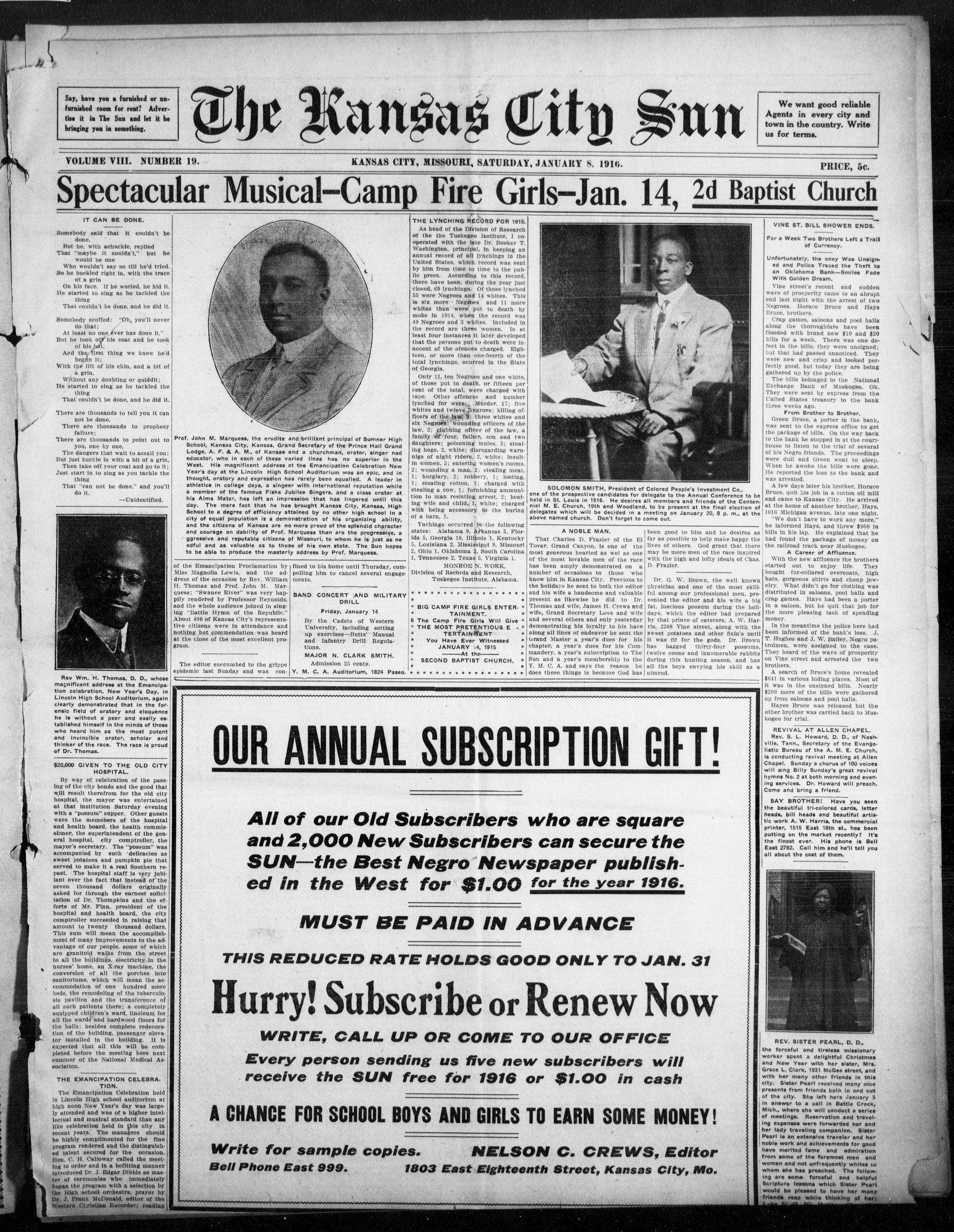
Rev Wm. H. Thomas, D. D., whose magnificent address at the Emancipation celebration, New Year's Day, in Lincoln High School Auditorium, again clearly demonstrated that in the forensic field of oratory and eloquence he is without a peer and easily established himself in the minds of those who heard him as the most potent and invincible orator, scholar and thinker of the race. The race is proud of Dr. Thomas.
$20,000 GIVEN TO THE OLD CITY
HOSPITAL.
By way of celebration of the passing of the city bonds and the good that will result therefrom for the old city hospital, the mayor was entertained at that institution Saturday evening with a "possum" supper. Other guests were the memebers of the hospital and health board, the health commissioner, the superintendent of the general hospital, city comptroller, the mayor's secretary. The "possum" was accompanied by such delicacies as sweet potatoes and pumpkin pie that served to make it a real Southern repast. The hospital staff is very jubilant over the fact that instead of the seven thousand dollars originally asked for through the earnest solicitation of Dr. Thompkins and the efforts of Mr. Finn, president of the hospital and health board, the city comptroller succeeded in raising that amount to twenty thousand dollars. This sum will mean the accomplishment of many improvements to the advantage of our people, some of which are grantfold walks from the street to all the buildings, electricity in the nurses' home, an X-ray machine, the conversion of all the porches into sanitioriums, which will mean the accommodation of one hundred more beds, the remodeling of the tuberculosis pavilion and the transference of all such patients there; a completely equipped children's ward, linoleum for all the wards and hardwood floors for the halls; besides complete redecoration of the building, passenger elevator installed in the building. It is expected that all this will be completed before the meeting here next summer of the National Medical Association.
THE EMANCIPATION CELEBRATION.
The Emancipation Celebration held in Lincoln High school auditorium at high noon New Year's day was largely attended and was of a higher intellectual and musical standard than any like celebration held in this city in recent years. The managers should be highly complimented for the fine program rendered and the distinguished talent secured for the occasion. Hon. C. H. Calloway called the meeting to order and in a befitting manner introduced Dr. J. Edgar Dibble as master of ceremonies who immediately began the program with a selection by the High school orchestra, prayer by Dr. J. Frank McDonald, editor of the Western Christian Recorder; reading
The Kansas City Sun
[Picture of a man in a suit].
Prof. John M. Marquess, the erudite and brilliant principal of Summer High School, Kansas City, Kansas, Grand Secretary of the Prince Hall Grand Lodge, A. F. & A. M., of Kansas and a churchman, orator, singer nad educator, who in each of these varied lines has no superior in the West. His magnificent address at the Emancipation Celebration New Year's day at the Lincoln High School Auditorium was an epic, and in thought, oratory and expression has rarely been equalled. A leader in athletics in college days, a singer with international reputation while a member of the famous Fiske Jubilee Singers, and a class orator at his Alma Mater, has left an impression that has lingered until this day. The mere fact that he has brought Kansas City, Kansas, High School to a degree of efficiency attained by no other high school in a city of equal population is a demonstration of his organizing ability, and the citizens of Kansas are no more proud of the splendid character and courage an ability of Prof. Marquess than are the progressive, a aggressive and reputable citizens of Missouri, to whom he is just as neefful and as valuable as to those of his own state. The Sun hopes to be able to produce the masterly address by Prof. Marquess.
OUR ANNUAL SUBSCRIPTION GIFT!
All of our Old Subscribers who are square and 2,000 New Subscribers can secure the SUN—the Best Negro Newspaper published in the West for $1.00 for the year 1916.
Hurry! Subscribe or Renew Now
WRITE, CALL UP OR COME TO OUR OFFICE Every person sending us five new subscribers will receive the SUN free for 1916 or $1.00 in cash
Write for sample copies. NELSON C. CREWS, Editor Bell Phone East 999. 1803 East Eighteenth Street, Kansas City, Mo.
of the Emancipation Proclamation by Miss Magnolia Lewis, and the address of the occasion by Rev. William H. Thomas and Prof. John M. Marquess; "Swane River" was very happily rendered by Professor Reynolds, and the whole audience joined in singing "Battle Hymn of the Republic." About 400 of Kansas City's representative citizens were in attendance and nothing but commendation was heard at the close of the most excellent program.
The editor succumbed to the gripe epidemic last Sunday and was con-
KANSAS CITY, MISSOURI, SATURDAY, JANUARY S. 1916.
fined to his home until Thursday, compelling him to cancel several engagements.
BAND CONCERT AND MILITARY DRILL
By the Cadets of Western University, including setting up exercises—Butts' Manual and Infantry Drill Regulations.
MAJOR N. CLARK SMITH.
Admission 25 cents.
Y. M. C. A. Auditorium, 1824 Paseo
THE LYNCHING RECORD FOR 1915.
As head of the Division of Research of the the Tuskegee Institute, I cooperated with the late Dr. Booker T. Washington, principal, in keeping an annual record of all lynchings in the United States, which record was sent by him from time to time to the public press. According to this record, there have been, during the year just closed, 69 lynchings. Of those lynched 55 were Negroes and 14 whites. This is six more Negroes and 11 more whites than were put to death by mobs in 1914, when the record was 49 Negroes and 3 whites. Included in the record are three women. In at least four instances it later developed that the persons put to death were innocent of the offences charged. Eighteen, or more than one-fourth of the total lynchings, occurred in the State of Georgia.
Only 11, ten Negroes and one white, of those put to death, or fifteen per cent of the total, were charged with rape. Other offences and number lynched for were: Murder, 17; five whites and twelve Negroes; killing officers of the law, 9; three whites and six Negroes; wounding officers of the law, 3; clubbing officer of the law, a family of four, father, son and two daughters; poisoning mules, 3; stealing hogs, 2, white; disregarding warnings of night riders, 2, white; insult in women, 3; entering women's rooms, 2; wounding a man, 2; stealing meat, 1; burglary, 2; robbery, 1; looting, 1; stealing cotton, 1; charged with stealing a cow, 1; furnishing ammunition to man resisting arrest, 2; beating wife and child, 1, white; charged with being accessory to the buring of a barn, 1.
Ynchings occurred in the following states: Alabama 9, Arkansas 5, Florida 5, Georgia 18, Illinois 1, Kentucky 5, Louisiana 2, Mississippi 9, Missouri 2, Ohio 1, Oklahoma 3, South Carolina 1, Tennessee 2, Texas 5, Virginia 1.
MONROE N. WORK.
Division of Records and Research.
Tuskegee Institute, Alabama.
SOLOMON SMITH, President of Colored People's Investment Co., one of the prospective candidates for delegate to the Annual Conference to be held in St. Louis in 1916. He desires all members and friends of the Centenary M. E. Church, 19th and Woodland, to be present at the final election of delegates which will be decided in a meeting on January 20, 8 p. m., at the above named church. Don't forget to come out.
A NOBLE MAN
That Charles D. Frazier of the El Tovar, Grand Canyon, is one of the most generous hearted as well as one of the most lovable men of the race has been amply demonstrated on a number of occasions to those who know him in Kansas City. Previous to the holidays he sent to both the editor and his wife a handsome and valuable present as likewise he did to Dr. Thomas and wife, James H. Crews and wife, Grand Secretary Love and wife and several others and only yesterday demonstrating his loyalty to his hace along all lines of endeavor he sent the Grand Master a year's dues for his chapter, a year's dues for his Commandery, a year's subscription to the Sun and a year's membership to the Y. M. C. A. and says the reason he does these things is because God has
been good to him and he desires as far as possible to help make happy the lives of others. God grant that there may be more men of the race inspired with the high and lofty ideals of Chas D. Frazier.
Dr. G. W. Brown, the well known physician and one of the most skillful among the professional men, pre presented the editor and his wife a big fat, luscious possum during the holi days, which the editor had prepared by that prince of caterers, A. W. Harris, 2208 Vine street, along with the sweet potatoes and other fixin's until it was fit for the gods. Dr. Brown has bagged thirty-four possums twelve coons and innumerable rabbits during this hunting season, and has all the boys envying his skill as a nimrod.
We want good reliable Agents in every city and town in the country. Write us for terms.
PRICE. 5c.
VINE ST. BILL SHOWER ENDS.
For a Week Two Brothers Left a Trail of Currency.
Unfortunately, the oney Was Unsigned and Police Traced the Theft to an Oklahoma Bank—Smiles Fade With Golden Dream.
Vine street's recent and sudden wave of prosperity came to an abrupt end last night with the arrest of two Negroes, Horace Bruce and Hays Bruce, brothers.
Crap games, saloons and pool halls along the thoroughfare have been flooded with brand new $10 and $20 bills for a week. There was one defect in the bills, they were unsigned; but that had passed unnoticed. They were new and crisp and looked perfectly good, but today they are being gathered up by the police.
The bills belonged to the National Exchange Bank of Muskogee, Ok. They were sent by express from the United States treasury to the bank three weeks ago.
From Brother to Brother.
Green Bruce, a porter in the bank, was sent to the express office to get the package of bills. On the way back to the bank he stopped in at the court-house to listen to the trial of several of his Negro friends. The proceedings were dull and Green went to sleep. When he awoke the bills were gone. He reported the loss to the bank and was arrested.
A few days later his brother, Horace Bruce, quit his job in a cotton oil mill and came to Kansas City. He arrived at the home of another brother, Hays, 1016 Michigan avenue, late one night. "We don't have to work any more," he informed Hays, and threw $900 in bills in his lap. He explained that he had found the package of money on the railroad track near Muskogee.
A Career of Affluence.
With the new affluence the brothers started out to enjoy life. They bought fur-collared overcoats, high hats, gorgeous shirts and cheap jewelry. What didn't go for clothing was distributed in saloons, pool halls and crap games. Hays had been a porter in a saloon, but he quit that job for the more pleasing task of spending money.
In the meantime the police here had been informed of the bank's loss, J. T. Hughes and J. W. Bailey, Negro patrolmen, were assigned to the case. They heard of the wave of prosperity on Vine street and arrested the two brothers.
A search of Bruce's home revealed $641 in various hiding places. Most of it was in the unsigned bills. Nearly $200 more of the bills were gathered up from saloons and pool halls.
Hayes Bruce was released but the other brother was carried back to Muskogee for trial.
REVIVAL AT ALLEN CHAPEL.
Rev. S. L. Howard, D. D., of Nashville, Tenn., Secretary of the Evangelistic Bureau of the A. M. E. Church, is conducting revival meeting at Allen Chapel. Sunday a chorus of 100 voices will sing Billy Sunday's great revival hymns No. 2 at both morning and evening services. Dr. Howard will preach. Come and bring a friend.
SAY BROTHER! Have you seen the beautiful tri-colored cards, letter heads, bill heads and beautiful artistic work A. W. Harris, the commercial printer, 1515 East 18th st., has been putting on the market recently? It is the finest ever. His phone is Bell East 2782. Call him and he'll tell you all about the cost of them.
A
REV. SISTER PEARL, D. D., the forceful and tireless missionary worker spent a delightful Christmas and New Year with her sister, Mrs. Grace L. Clark, 1931 McGee street, and with her many other friends in this city. Sister Pearl received many nice presents from friends both in and out of the city. She left here January 5 in answer to a call in Battle Creek, Mich., where she will conduct a series of meetings. Reservation and traveling expenses were forwarded her and her lady traveling companion. Sister Pearl is an extensive traveler and her noble work and achievements for good have merited fame and admiration from some of the foremost men and women and not unfrequently whites to whom she has preached. The following are some. forceful and helpful Scripture lessons which Sister Pearl would be pleased to have her many friends read while thinking of her
AFRO-AMERICAN CULLINGS
Tuskegee institute was developed by Booker T. Washington, and it is fitting that the trustees of the institution should seek to perpetuate his name. Their idea is to solicit a $2,000,000 endowment, to be known as the "Washington memorial." Almost one quarter of this amount has already been subscribed, a part, however, contingent on other contributions. The Trustees look to Negroes for at least $250,000. This is not a large sum to ask from the colored race, inasmuch as Tuskegee typifies the best that is being done for them. In Indianapolis there are more prosperous Negroes to provide no small portion of the minimum expected.
When Doctor Washington took charge of Tuskegee it owned nothing. Classes were housed in shanties, and the future held out no great hopes. The perseverance with which he kept at his work, his remarkable ability and his sterling character attracted the necessary support. Today Tuskegee is a valuable property, even from a physical standpoint. Yet its work is so largely philanthropic that there is always a gap between income and outgo. During Doctor Washington's lifetime this deficit was easily met. His acquaintance was wide, and included persons of wealth. In asking help now the trustees of the institute possibly look not so much to wealthy philanthropists as to persons who are willing to give a little in order that a good cause may be promoted.
"Tuskegee institute," reads the announcement, "is Booker T. Washington's monument, and his most fitting memorial is the perpetuation of its great work for the benefit of the colored people and for the promotion of helpful relations between the races. The gap at present existing between the ordinary income of the institute and its annual outgo is approximately $150,000." All that is desired is to raise a trust fund of such proportions as will reduce this annual charge to "manageable proportions." It is hoped that enough will be contributed by Negroes to meet not only a fair share of the fund, but also to provide sufficient money to erect a tablet or other memorial in the grounds of the institute. At present there is only one such institution; there should be many. It is therefore important that Tuskegee institute be preserved and enlarged as an example in the education of the colored people of this country.
The heat of the sultry day had made the kitchen stove about the most unbearable thing one could possibly conjure up. The whole kitchen was steamy and uninviting. Outside the sun baked down, and the vacation days made the restless children unhappy and cross; a slovenly, unkempt colored girl was rocking a crying baby; an older colored woman was getting a breath of air at the door. The baby didn't stop crying, the dinner was getting overdone, and the poor, tired mother, almost distracted, wondered where was the trouble. Somehow, we seldom go quite far enough back in our minds to really get at the root of things, writes Mrs. Sidney M. Ullman of the Social Service department, in the Birmingham (Ala.) Age-Herald. This mother, like most of us, saw only in her troubles the inefficiency in her own servants. She was paying for poorly cooked meals and badly trained children; little boys and girls of impressionable age, associating with ignorant Negro nurses;
The following letter will show some of the practical workings of the pupils of the industrial high school at Birmingham, Ala:
"My Dear Mrs. Ullman: I had the pleasure a few days ago of being a guest at luncheon of the negro industrial high school, together with Dr. J. H. Phillips, Mrs. Ben M. Jacobs, Mrs. Echols, Mr. J. B. Gibson, Mr. C. B. Glenn, Mrs. Bruce, Mr. S. J. Bowle, Judge A. O. Lane and Doctor Curren of North Carolina. We were impressed with the splendid, practical work done in every department of the school, but the demonstration of the cooking class appealed to us most, for one very obvious reason, the hour was one o'clock. Besides this, all persons who have made any kind of study of social problems know that we can not expect health, work, efficiency and happiness without food that has been properly selected and properly prepared.
"The luncheon served us was prepared by a group of girls from this class of 41. They were selected not because of their superior proficiency, because all were equally capable, so
Statistics show that in the early days of American colleges about one half the graduates adopted the ministry as a profession. At the present time only about 5 per cent of the college graduates become ministers.
Chinese chambers of commerce exist in New York, San Francisco and Manila.
King Ferdinand of Bulgaria has the abominable habit of smothering himself with strong perfumes.
Story of Emperor Alexander. The late Emperor Alexander of Russia tried hard to put a stop to alcoholism in his army. Whenever a case of nebriety came to his notice he ordered summary punishment. One evening an officer, decidedly the worse for liquor, was driving on one of the boulevards of St. Petersburg. To his terror, he saw the car in his open carriage coming from the opposite direction. Motoning the officer's driver to stop, and stopping his
in spite of the school and the home environment, they were picking up bad English. Who is to blame for the incompetency and ignorance of the Negro servants? The illiteracy of the Negro is bringing down the fair state of Alabama to the very bottom of the ladder in education. Some overcrowded, poorly equipped schools are doing wonderful work. These are seldom encouraged by a visit from the white neighbor. We ease our conscience with the knowledge that there is something being done and that is all-sufficient. The whole system under which we allow the race to exist is wrong. From an essay read at the Industrial High school commencement by a young Negro boy, we quote the following: "The Negro in embryo, is surrounded by the shell of ignorance and poverty. Outside conditions must be favorable if he is to come out of his shell prepared to be an asset and not a liability to the community. The most illiterate class of people should have the largest opportunity for getting the rudiments of an education in order that they may not lower the standard of living in their city. Whether they go to school should not be left to the whim of this class—but they should be compelled to go. The stats must protect itself from the ignorance of its masses by forcing them into schools."
The progress of the Negro during the last 50 years has been marked by a wholesome and steady growth, with no tendency toward a lapse into the state of bewilderment which characterized the business, agricultural and commercial activities of the race immediately after the war. Between 1900 and 1915, for instance, farm property owned by Negroes has increased 177 per cent in value—from $177,404,688 to $492,892,218. The Negro Business league has recently published some statistics which show that since 1900 the number of Negro business enterprises in this country has increased from 20,000 to 45,000; the number of Negro banks from two to 51; the number of drug stores, from 250 to 695, and the number of general retail stores, from 10,000 to 25,000. These figures show that education and a more comprehensive knowledge of the possibilities of freedom are helping the Negro to do for himself that which no one can do for him. And it is altogether fitting that leaders of the race should agree that it is time to bring to public attention the achievements of the race.
Theodore Leschetitzky, who died at Dresden recently, aged eighty-five, was the principal master of Paderewski. Leschetitzky made his debut in Vienna in 1845, and for several years taught at St. Petersburg conservatory.
Among the titles of the sultan of Turkey are sultan of sultans, king of kings, bestower of crowns upon the princes of the world, emperor and sovereign of the two seas, and shadow god upon earth.
Frozen meat from South America is sold in large quantities in the Netherlands, but those who can afford it buy the unfrozen inland meat, which costs one-third more, but has more flavor.
Fifty women take an active part in the municipal governments of Swedish cities. Seven of them are busy in Stockholm.
those were chosen who had been best in attendance.
"From the lamb roast to the last crumb of leing on Mr. Jacob's slice of cake both science and care were employed in the selection and preparation.
"We were agreed that none of us had ever eaten a more perfectly prepared meal. It reflected credit on the teacher, who besides being efficient, is very practical.
"The work of the entire institution reflects credit on A. H. Parker, the principal, whose remarkable ability and understanding eminently fits him for the position he holds. He is contributing a large share to the solution of some of our social problems and deserves the interest, assistance and commendation of every man and woman in Birmingham.
"The industrial high school has not come into being in a day, but has been evolved with our entire school system, then the wonderful personality and consecrated service of him, who, for 33 years has been at the helm.
"MRS. DUPONT THOMPSON."
President Wilson is the third chief executive to marry while occupying the chief magistracy of the United States. The others were John Tyler and Grover Cleveland.
The gems, ornaments and precious stones belonging to the shah of Persia are estimated to be worth about $35,000,000.
In a year 4,472 hours of sunshine are possible, but few places ever experience the maximum.
own carriage, the emperor exclaimed, in an angry tone:
"Major X—, what are you doing here?"
Pulling himself together, partly sobered by the czar's presence, the officer stood up, saluted, and replied, with shaky voice:
"Your majesty, I am just taking a drunken officer to the guard-house."
This presence of mind and ready wit pleased the emperor so much that he pardoned the officer there and then.
INTERNATIONAL NEWS SERVICE
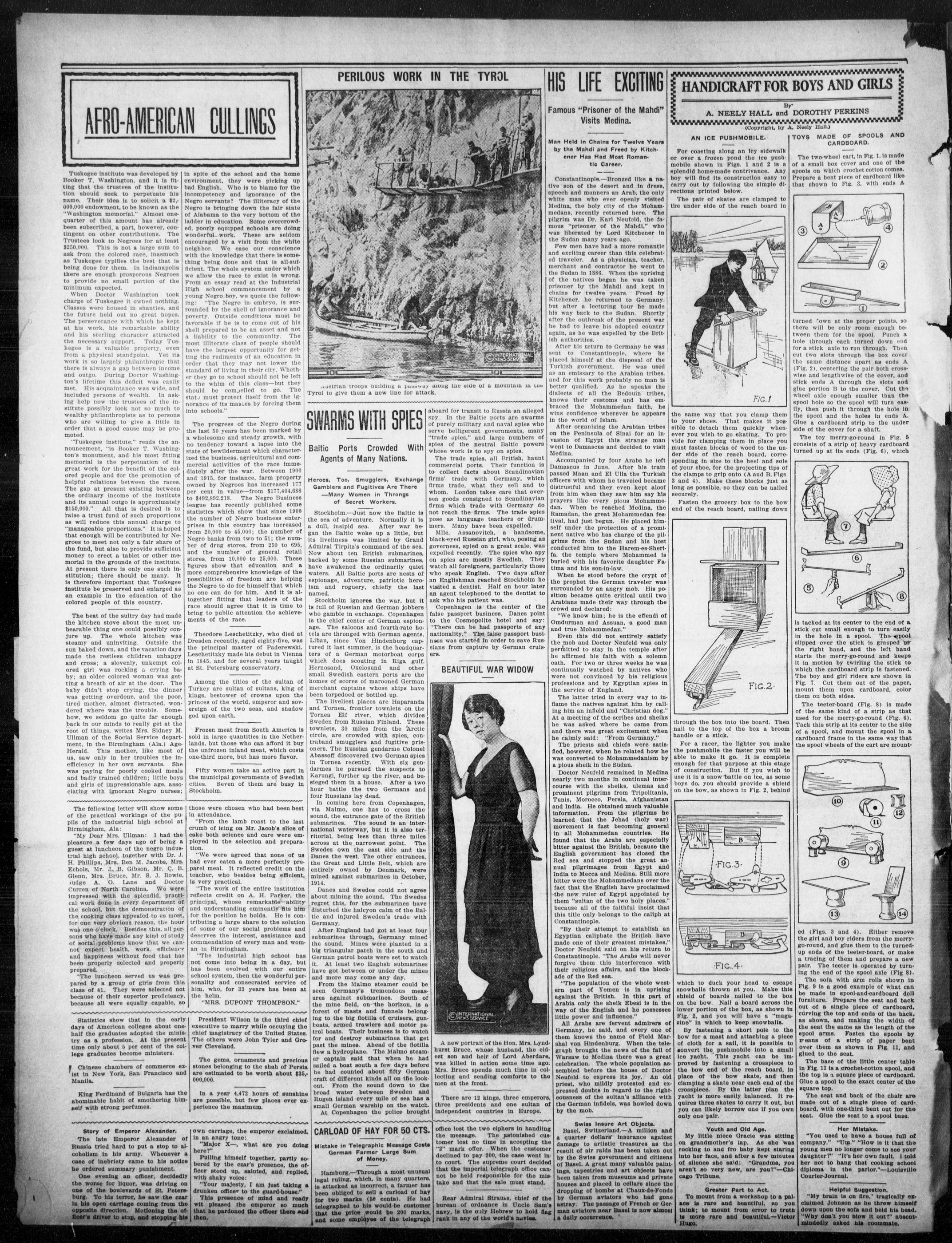
Austrian troops building a passway along the side of a mountain in the Tyrol to give them a new line for attack.
SWARMS WITH SPIES
Baltic Ports Crowded With Agents of Many Nations.
Heroes, Too, Smugglers, Exchange Gamblers and Fugitives Are There —Many Women in Thrones of Secret Workers.
Stockholm—Just now the Baltic is the sea of adventure. Normally it is a dull, insipid sea. After war began the Baltic woke up a little, but its liveliness was limited by Grand Admiral Tiritz's command of the sea. Now about ten British submarines, backed by some Russian submarines, have awakened the ordinarily quiet waters. All Baltic ports are nests of espionage, adventure, patriotic heroism and roguery, chiefly the last named.
Stockholm ignores the war, but it is full of Russian and German jobbers who gamble in exchange. Copenhagen is the chief center of German espionage. The saloons and fourth-rate hotels are thronged with German agents. Libau, since Von Hindenburg captured it last summer, is the headquarters of a German motorboat corps which does scouting in Riga gulf Hernosand, Oxelosund and other small Swedish eastern ports are the homes of scores of marooned German merchant captains whose ships have been torpeded or bottled up.
The liveliest places are Haparanda and Tornea, frontier townnets on the Tornea Elf river, which divides Sweden from Russian Finland. These townnets, 30 miles from the Arctic circle, are crowded with spies, contraband smugglers and fugitive prisoners. The Russian gendarme Colonel Abassou discovered two German spies in Tornea recently. With six gendarmes he pursued the suspects to Karungi, further up the river, and besieged them in a house. After a two hour battle the two Germans and four Russians lay dead.
In coming here from Copenhagen, via Malmo, one has to cross the sound, the entrance gate of the British submarines. The sound is an international waterway, but it is also territorial, being less than three miles across at the narrowest point. The Swedes own the east side and the Danes the west. The other entrances, the Great and Little Belt, which are entirely owned by Denmark, were mined against submarines in October, 1914.
Danes and Swedes could not agree about mining the sound. The Swedes regret this, for the submarines have disturbed the halcyon calm of the Baltic and injured Sweden's trade with Germany.
After England had got at least four submarines through, Germany mined the sound. Mines were planted in a big triangular patch in the south and German patrol boats were set to watch it. At least two English submarines have got between or under the mines and more may come any day.
From the Malmo steamer could be seen Germany's tremendous measures against submarines. South of the mine field, on the horizon, is a forest of masts and funnels belonging to the big flotilla of cruisers, gunboats, armed trawlers and motor patrol boats. Their business is to watch for and destroy submarines that get past the mines. Ahead of the flotilla flew a hydroplane. The Malmo steamer captain said that when he had sailed a boat south a few days before he had counted about fifty German craft of different kinds all on the look-out. From the sound down to the broad water between Sweden and Rugen island near mile of sea has a small German warship on the watch. At Copenhagen the police brought
CARLOAD OF HAY FOR 50 CTS.
Mistake in Telegraphic Message Costs German Farmer Large Sum of Money.
Hamburg.—Through a most unusual legal ruling, which, in many quarters, is attacked as incorrect, a farmer has been obliged to sell a carload of hay for two marks (50 cents). He had telegraphed to his would-be customer that the price would be 200 marks, and some employee of the telegraph
aboard for transit to Russia an alleged spy. In the Baltic ports are swarms of purely military and naval spies who serve belligerent governments, many "trade spies," and large numbers of spies of the neutral Baltic powers whose work is to spy on spies. The trade spies, all British, haunt commercial ports. Their function is to collect facts about Scandinavian firms' trade with Germany, which firms trade, what they sell and to whom. London takes care that overseas goods consigned to Scandinavian firms which trade with Germany do not reach the firms. The trade spies pose as language teachers or drummers. Many have been expelled.
Mile. Assanovitch, a handsome, black-eyed Russian girl, who, posing as governess, spied on a great scale, was expelled recently. The spies who spy on spies are mostly Swedish. They watch all foreigners, particularly those who speak English. Two days after an Englishman reached Stockholm he visited a dentist. Half an hour later an agent telephoned to the dentist to ask who his patient was.
Copenhagen is the center of the false passport business. Danes point to the Cosmopolite hotel and say: "There can be had passports of any nationality." The false passport business was started in order to save Russians from capture by German cruisers.
BEAUTIFUL WAR WIDOW
INTERNATIONAL
CINEMASERVICE
A new portrait of the Hon. Mrs. Lyndhurst Bruce, whose husband, the eldest son and heir of Lord Aberdare, was killed in action some time ago. Mrs. Bruce spends much time in collecting and sending comforts to the men at the front.
There are 12 kings, three emperors, three presidents and one sultan of independent countries in Europe.
office lost the two ciphers in handling the message. The astonished customer lost no time in accepting the "2" mark offer. When the customer declined to pay 200, the case went into court. The supreme court decided that the imperial telegraph office cannot be held responsible for the mistake and that the sale must stand.
Rear Admiral Straus, chief of the bureau of ordinance in Uncle Sam's navy, is the only Hebrew to hold flag rank in any of the world's navies.
HIS LIFE EXCITING
Famous "Prisoner of the Mahdi" Visits Medina.
Man Held in Chains for Twelve Years by the Mahdi and Freed by Kitchener Has Had Most Romantic Career.
Constantinople.—Bronzed like a native son of the desert and in dress, speech and manners an Arab, the only white man who ever openly visited Medina, the holy city of the Mohammedans, recently returned here. The pilgrim was Dr. Karl Neufeld, the famous "prisoner of the Mahdi," who was liberated by Lord Kitchener in the Sudan many years ago.
Few men have had a more romantic and exciting career than this celebrated traveler. As a physician, teacher, merchant and contractor he went to the Sudan in 1886. When the uprising of the natives began he was taken prisoner by the Mahdi and kept in chains for twelve years. Freed by Kitchener, he returned to Germany, but after a lecturing tour he made his way back to the Sudan. Shortly after the outbreak of the present war he had to leave his adopted country again, as he was expelled by the British authorities.
After his return to Germany he was sent to Constantinople, where he placed himself at the disposal of the Turkish government. He was used as an emissary to the Arabian tribes, and for this work probably no man is better qualified. As he speaks the dialects of all the Bedouin tribes, knows their customs and has embraced the Mohammedan faith, he wins confidence wherever he appears in the world of Islam.
After organizing the Arabian tribes on the Peninsula of Sinai for an invasion of Egypt this strange man went to Damascus and decided to visit Medina.
Accompanied by four Arabs he left Damascus in June. After his train passed Maan and El Ulla the Turkish officers with whom he traveled became distrustful and they even kept aloof from him when they saw him say his prayers like every pious Mohammedan. When he reached Medina, the Ramadan, the great Mohammed festival, had just begun. He placed himself under the protection of a prominent native who has charge of the pilgrims from the Sudan and his host conducted him to the Harem-es-Sherifa, the temple where Mohammed is buried with his favorite daughter Fatima and his son-in-law.
When he stood before the crypt of the prophet the German traveler was surrounded by an angry mob. His position became quite critical until two Arabians made their way through the crowd and declared:
"We know him; he is the effendi of Omdurman and Assuan, a good man and true Mohammedan."
Even this did not entirely satisfy the mob and Doctor Neufeld was only permitted to stay in the temple after he affirmed his faith with a solemn oath. For two or three weeks he was continually watched by natives who were not convinced by his religious professions and by Egyptian spies in the service of England.
The latter tried in every way to inflame the natives against him by calling him an infield and "Christian dog." At a meeting of the scribes and sheiks he was asked where he came from and there was great excitement when he calmly said: "From Germany."
The priests and chiefs were satisfied, however, when he related how he was converted to Mohammedanism by a pious sheik in the Sudan.
Doctor Neufeld remained in Medina nearly two months in continual intercourse with the sheiks, ulemas and prominent pilgrims from Tripolitania, Tunis, Morocco, Persia, Afghanistan and India. He obtained much valuable information. From the pilgrims he learned that the Jehad (holy war) movement is fast becoming general in all Mohammedan countries. He found that the Arabs are especially bitter against the British, because the English government has closed the Red sea and stopped the great annual pilgrimages from Egypt and India to Mecca and Medina. Still more bitter were the Mohammedans over the fact that the English have proclaimed the new ruler of Egypt appointed by them "sultan of the two holy places," because all of the faithful insist that this title only belongs to the caliph at Constantinople.
"By their attempt to establish an Egyptian caliphate the British have made one of their greatest mistakes," Doctor Neufeld said on his return to Constantinople. "The Arabs will never forgive them this interference with their religious affairs, and the blockade of the Red sea.
"The population of the whole western part of Yemen is in uprising against the British. In this part of Arabia only the sheik Ebesi is in the way of the English and he possesses little power and influence."
All Arabs are fervent admirers of Germany, he said, and every one of them knows the name of Field Marshal von Hindenburg. When the telegraph brought the news of the fall of Warsaw to Medina there was a great celebration. The whole population assembled before the house of Doctor Neufeld to express its joy. An old priest, who mildly protested and expressed doubts in regard to the rightness of the suitan's alliance with the German infidels, was howled down by the mob.
Basel, Switzerland.—A million and a quarter dollars' insurance against damage to artistic treasures as the result of air raids has been taken out by the Swiss government and citizens of Basel. A great many valuable paintings, tapestries and art objects have been taken from museums and private houses and placed in cellars since the dropping of bombs at Chau-de-Fonds by German aviators who had gone astray. The passage of French or German aviators near Basel is now almost a daily occurrence.
HANDICRAFT FOR BOYS AND GIRLS
AN ICE PUSHMOBILE.
For coasting along an key sidewalk or over a frozen pond the ice pushmobile shown in Figs. 1 and 2 is a splendid home-made contrivance. Any boy will find its construction easy to carry out by following the simple directions printed below.
The pair of skates are clamped to the under side of the reach board in
FIG.1
the same way that you clamp them to your shoes. That makes it possible to detach them quickly whenever you wish to go skating. To provide for clamping them in place you must fasten blocks of wood to the under side of the reach board, corresponding in size to the heel and sole of your shoe, for the projecting tips of the clamps to grip onto (A and B, Figs 3 and 4). Make these blocks just as long as possible, so they can be nailed securely.
Fasten the grocery box to the bow end of the reach board, nailing down
FIG.2.
through the box into the board. Then nail to the top of the box a broom handle or a stick.
For a racer, the lighter you make the pushmobile the faster you will be able to make it go. It is complete enough for that purpose at this stage of construction. But if you wish to use it in a snow battle on ice, as some boys do, you should provide a shield on the bow, as shown in Fig. 2, behind
A B
FIG.3.
A B
FIG.4.
which to duck your head to escape snowballs thrown at you. Make this shield of boards nailed to the box on the bow. Nail a board across the lower portion of the box, as shown in Fig. 2, and you will have a "magazine" in which to keep snowballs. By fastening a short pole to the bow for a mast and attaching a piece of cloth for a sail, it is possible to convert the pushmobile into a small ice yacht. This yacht can be improved by fastening a crosspiece to the bow end of the reach board, in place of the bow skate, and then clamping a skate near each end of the crosspiece. By the latter plan the yacht is more easily balanced. It requires three skates to carry it out, but you can likely borrow one if you own only one pair.
Youth and Old Age
My little niece Oracie was sitting on grandmother's iap. As she was rocking to and fro baby kept staring into her face, and after a few minutes of silence she said: "Grandma, you aren't so very new, are you?"—Chi cago Tribute.
Greater Part to Act
To mount from a workshop to a palace is rare and beautiful, so you think; to mount from error to truth is more rare and beautiful.—Victor Hugo.
TOYS MADE OF SPOOLS AND CARBOARD.
The two-wheel cart, in Fig. 1, is made of a small box cover and one of the spoils on which crochet cotton comes. Prepare a bent piece of cardboard like that shown in Fig. 3, with ends A
$\textcircled{3}$
$\textcircled{4}$
$\textcircled{2}$
$\textcircled{1}$
turned 'own at the proper points, so there will be only room enough between them for the spool. Punch a hole through each turned down end for a stick axle to run through. Then cut two slots through the box cover the same distance apart as ends A (Fig. 2), centering the pair both crosswise and lengthwise of the cover, and stick ends A through the slots and glue portion B to the cover. Cut the wheel axle enough smaller than the spool hole so the spool will turn easily, then push it through the hole in the spool and the holes in ends A. Glue a cardboard strip to the under side of the cover for a shaft.
The toy merry-go-round in Fig. 5 consists of a strip of heavy cardboard turned up at its ends (Fig. 6), which
$\textcircled{7}$
$\textcircled{6}$
$\textcircled{5}$
$\textcircled{8}$
is tacked at its center to the end of a stick cut small enough to turn easily in the hole in a spool. The spool slipped over the stick is grasped by the right hand, and the left hand starts the merry-go-round and keeps it in motion by twirling the stick to which the cardboard strip is fastened. The boy and girl riders are shown in Fig. 7. Cut them out of the paper, mount them upon cardboard, color them on both sides. The teeter-board (Fig. 8) is made of the same kind of a strip as that used for the merry-go-round (Fig. 6). Tack this strip at its center to the side of a spool, and mount the spool in a cardboard frame in the same way that the spool wheels of the cart are mount-
10 12
11
9
13 14
ed (Figs. 3 and 4). Either remove the girl and boy riders from the merry-go-round, and glue them to the turned-up ends of the teeter-board, or make a tracing of them and prepare a new pair. The teeter is operated by turning the end of the spool axle (Fig 8). The sofa with arm rolls shown in Fig. 9 is a good example of what can be made in spool-and-cardboard doll furniture. Prepare the seat and back out of a single piece of cardboard, curving the top and ends of the back, as shown, and making the width of the seat the same as the length of the spool arms. Fasten the spools by reams of a strip of paper bent over them as shown in Fig. 11, and glued to the seat.
The base of the little center table in Fig. 13 is a crochet-cotton spool, and the top is a square piece of cardboard. Glue a spool to the exact center of the square top.
The seat and back of the chair are made out of a single piece of cardboard, with one-third bent out for the seat. Glue the seat to a spool base.
Her Mistake.
"You used to have a house full of company." "Um." "How is it that the young men no longer come to see your daughter?" "It's her own fault, I told her not to hang that cooking school diploma in the parlor."—Louisville Courter-Journal.
Helpful Suggestion.
"My brain is on fire," tragically exclaimed Johnson as he threw himself down upon the sofa and held his head.
"Why don't you blow it out?" absent-mindedly asked his roommate.
WASHINGTON CITY
SIDELEIGHTS
Washington Matrons Feel Lack of Eligible Men
Washington Matrons Feel Lack of Eligible Men
WASHINGTON.—As the debutante days roll around the conditions and attractions for young girls in Washington come uppermost in the minds of the chaperons and entertainers. They are not of the most enticing—the
their professions or to learn a business and then pursue it. The consequence is that the girls are left here, to mingle with what is left, which is not always the best possible.
It is not an uncommon thing at all for a hostess, who is launching a debutante on the social wave, to ask despairingly of her friends, even those who are not "in society," "Do you know some young men for me to cultivate, to ask to my parties this year?"
So completely are girls "out of things" socially here, if they are not formally presented by their parents, that it is almost a necessity for them to go through with the formality of a debut tea or dance. This has, at last, come to be recognized, even by the foreigners, who have always frowned the heaviest on this strictly American custom.
This Is How They See United States Capitol
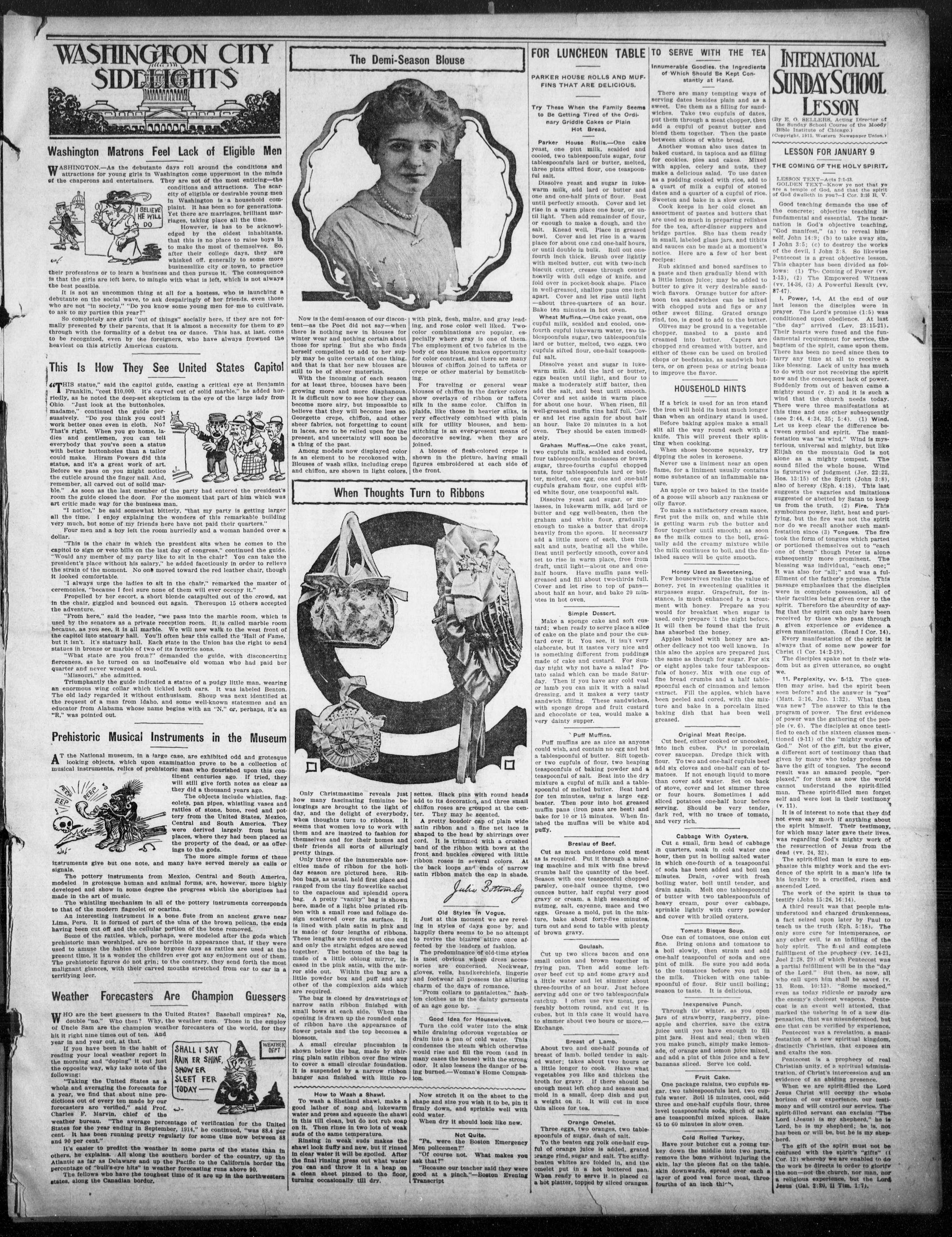
"THIS statue," said the capitol guide, casting a critical eye at Benjamin Franklin, "cost $10,000. It's carved out of solid marble" he added hurriedly, as he noted the deep-set skepticism in the eye of the large lady from Ohio. "Just look at the buttonhole.
ble." As soon as the last member of the party had entered the president's room the guide closed the door. For the moment that part of him which was art critic made way for the business man.
"I notice," he said somewhat bitterly, "that my party is getting larger all the time. I enjoy explaining the wonders of this remarkable building very much, but some of my friends here have not paid their quarters."
Four men and a boy left the room hurriedly and a woman handed over a dollar.
"This is the chair in which the president sits when he comes to the capitol to sign or veto bills on the last day of congress," continued the guide. "Would any member of my party like to sit in the chair? You can take the president's place without his salary," he added facetiously in order to relieve the strain of the moment. No one moved toward the red leather chair, though it looked comfortable.
"I always urge the ladies to sit in the chair," remarked the master of ceremonies, "because I feel sure none of them will ever occupy it."
Propelled by her escort, a short blonde catapulted out of the crowd, sat in the chair, giggled and bounced out again. Thereupon 15 others accepted the adventure.
"From here," said the leader, "we pass into the marble room, which is used by the senators as a private reception room. It is called marble room because, as you see, it is all marble. We will now walk to the west front of the capitol into statuary hall. You'll often hear this called the 'Hall of Fame,' but it isn't. it's statuary hall. Each state in the Union has the right to send statues in bronze or marble of two of its favorite sons.
"What state are you from?" demanded the guide, with disconcerting fierceness, as he turned on an inoffensive old woman who had paid her quarter and never wronged a soul.
"Missouri," she admitted.
Triumphantly the guide indicated a statue of a pudgy little man, wearing an enormous wing collar which tickled both ears. It was labeled Benton. The old lady regarded it without enthusiasm. Shoup was next identified at the request of a man from Idaho, and some well-known statesmen and an educator from Alabama whose name begins with an "N." or, perhaps, it's an "R," was pointed out.
Prehistoric Musical Instruments in the Museum
AT the National museum, in a large case, are exhibited odd and grotesque looking objects, which upon examination prove to be a collection of musical instruments, relics of prehistoric man who flourished upon this con-
The more simple forms of these instruments give but one note, and many have served merely as calls or signals.
The pottery instruments from Mexico, Central and South America, modeled in grotesque human and animal forms, are, however, more highly developed and show in some degree the progress which the aborigines had made in the art of music.
The whistling mechanism in all of the pottery instruments corresponds to that of the modern flagoete or ocarina.
An interesting instrument is a bone flute from an ancient grave near Lima, Peru. It is formed of part of the ulna of the brown pelican, the ends having been cut off and the cellular portion of the bone removed.
Some of the rattles, which, perhaps, were modeled after the gods which prehistoric man worshiped, are so horrible in appearance that, if they were used to amuse the babies of those bygone days as rattles are used at the present time, it is a wonder the children ever got any enjoyment out of them.
The prehistoric figures do not grin; to the contrary, they send forth the most malignant glances, with their carved mouths stretched from ear to ear in a terrifying leer.
Weather Forecasters Are Champion Guessers
WHO are the best guessers in the United States? Baseball umpires? No, double "no." Who then? Why, the weather men. Those in the employ of Uncle Sam are the champion weather forecasters of the world, for they hit it right nine times out of ten. And
weather bureau. "The average percentage of verification for the United States for the year ending in September, 1914," he continued, "was 88.4 per cent. It has been running pretty regularly for some time now between 88 and 90 per cent."
It's easier to predict the weather in some parts of the states than in others, he explains. All along the southern border of the country, up the Atlantic as far as Delaware and up the Pacific to the California border the percentage of "bull's-eye hits" in weather forecasting runs above 90.
The fellows who have the toughest time of it are in the northwestern states, along the Canadian border.
I BELIEVE
HE WILL
DO
their professions or to learn a business,
is that the girls are left here, to mingle,
the best possible.
It is not an uncommon thing at a
debutate on the social wave, to ask d
who are not "in society," "Do you know
to ask to my parties this year?"
So completely are girls "out of this
mally presented by their parents, that i
through with the formality of a debut
to be recognized, even by the foreign
heaviest on this strictly American cust
This Is How They See
"THIS statue," said the capitol guide
Franklin, "cost $10,000. It's carv
rriedly, as he noted the deep-set skeptic
Ohio. "Just look at the buttonholes, madame," continued the guide persuasively. "Do you think you could work better ones even in cloth. No? That's right. When you go home, ladies and gentlemen, you can tell everybody that you've seen a statue with better buttonholes than a tailor could make. Hiram Powers did this statue, and it's a great work of art. Before we pass on you might notice the cuticle around the finger nail. And, remember, all carved out of solid mar-
ble." As soon as the last member of room the guide closed the door. For the art critic made way for the business man "I notice," he said somewhat bitty all the time. I enjoy explaining the very much, but some of my friends he Four men and a boy left the room dollar.
"This is the chair in which the capitol to sign or veto bills on the last "Would any member of my party like president's place without his salary," the strain of the moment. No one move it looked comfortable.
"I always urge the ladies to sit ceremonies, "because I feel sure none. Propelled by her escort, a short t in the chair, giggled and bounced out the adventure.
"From here," said the leader, "wused by the senators as a private rec because, as you see, it is all marble, the capitol into statuary hall. You'll o but it isn't. It's statuary hall. Each s statues in bronze or marble of two of it "What state are you from?" der fierceness, as he turned on an inoff quarter and never wronged a soul.
"Missouri," she admitted. Triumphantly the guide indicated an enormous wing collar which tickled The old lady regarded it without entitle the request of a man from Idaho, an educator from Alabama whose name b "R," was pointed out.
Prehistoric Musical Inst
A T the National museum, in a larger looking objects, which upon exam musical instruments, relics of prehistor
PEEP
PEEP
PEEP
instruments give but one note, and signals.
The pottery instruments from the modeled in grotesque human and are developed and show in some degree made in the art of music.
The whistling mechanism in all to that of the modern flageolet or oca.
An interesting instrument is a b Lima, Peru. It is formed of part of the having been cut off and the cellular p.
Some of the rattles, which, perha prehistoric man worshiped, are so how used to amuse the babies of those b present time, it is a wonder the children. The prehistoric figures do not grin; to malignant glances, with their carved terrifying leer.
Weather Forecasters A
WHO are the best guessers in the U double "no." Who then? Why, t of Uncle Sam are the champion weat hit it right nine times out of ten. And year in and year out, at that.
If you have been in the habit of reading your local weather report in the morning and "doping" it out just the opposite way, why take note of the following:
"Taking the United States as a whole and averaging the forecasts for a year, we find that about nine predictions out of every ten made by our forecasters are verified," said Prof. Charles F. Marvin, chief of the
weather bureau. "The average perc
States for the year ending in September
cent. It has been running pretty reg
and 90 per cent."
It's easier to predict the weather
others, he explains. All along the so
Atlantic as far as Delaware and up th
percentage of "bull's-eye hits" in weath
The fellows who have the toughest
states, along the Canadian border.
conditions and attractions. The scarcity of eligible or desirable young men in Washington is a household complaint. It has been so for generations. Yet there are marriages, brilliant marriages, taking place all the time. However, is has to be acknowledged by the oldest inhabitants, that this is no place to raise boys in to make the most of themselves. So, after their college days, they are whisked off, generally to some more businesslike city or town, to practice
s and then pursue it. The consequence
e with what is left, which is not always
all for a hostess, who is launching a
despairingly of her friends, even those
new young men for me to cultivate,
ings" socially here, if they are not for-
it is almost a necessity for them to go
tea or dance. This has, at last, come
gners, who have always frowned the
atom.
The United States Capitol
de, casting a critical eye at Benjamin
ved out of solid marble. he added huric
ism in the eye of the large lady from
J
of the party had entered the president's
the moment that part of him which was
man.
bitterly, "that my party is getting larger
the wonders of this remarkable building
there have not paid their quarters."
in hurriedly and a woman handed over a
president sits when he comes to the
first day of congress," continued the guide.
he to sit in the chair? You can take the
he added facetiously in order to relieve
loved toward the red leather chair, though
in the chair," remarked the master of
of them will ever occupy it."
blonde catapulted out of the crowd, sat
at again. Thereupon 15 others accepted
we pass into the marble room, which is
reception room. It is called marble room.
We will now walk to the west front of
often hear this called the 'Hall of Fame,
state in the Union has the right to send
its favorite sons.
commanded the guide, with disconcerting
tensive old woman who had paid her
a statue of a pudgy little man, wearing
led both ears. It was labeled Benton.
thusiasm. Shoup was next identified
and some well-known statesmen and an
begins with an "N," or, perhaps, it's an
Instruments in the Museum
the case, are exhibited odd and grotesque
examination prove to be a collection of
toric man who flourished upon this con-
tinent centuries ago. If tried, they will still give forth notes as clear as they did a thousand years ago.
The objects include whistles, flageolets, pan pipes, whistling vases and rattles of stone, bone, reed and pottery from the United States, Mexico, Central and South America. They were derived largely from burial places, where they had been placed as the property of the dead, or as offerings to the gods.
The more simple forms of these many have served merely as calls or Mexico, Central and South America, animal forms, are, however, more highly the progress which the aborigines had of the pottery instruments corresponds arina. bone flute from an ancient grave near the ulna of the brown pelican, the end portion of the bone removed. aps, were modeled after the gods which orrible in appearance that, if they were bygone days as rattles are used at the ren ever got any enjoyment out of them, o the contrary, they send forth the most mouths stretched from ear to ear in a
Are Champion Guessers
United States? Baseball umpires? No, the weather men. Those in the employ other forecasters of the world, for they
SHALL I SAY
RAIN ER SHINE,
SNOWER
SLEET FER
TODAY
WEATHER
DEPT
percentage of verification for the United
ober, 1914," he continued, "was 88.4 per
regularly for some time now between 88
or in some parts of the states than in
southern border of the country, up the
the Pacific to the California border the
other forecasting runs above 90.
last time of it are up in the northwestern
1
G
Now is the demi-season of our discontent—as the Poet did not say—when there is nothing new in blouses for winter wear and nothing certain about those for spring. But she who finds herself compelled to add to her supply may be quite certain of one thing, and that is that her new blouses are still to be of sheer materials.
With the incoming of each season for at least three, blouses have been growing more and more diaphanous. It is difficult now to see how they can become more airy, but impossible to believe that they will become less so. Georgette crepe, chiffon, and other sheer fabrics, not forgetting to count in laces, are to be relied upon for the present, and uncertainty will soon be a thing of the past.
Among models now displayed color is an element to be recoked with. Blouses of wash silks, including crepe and chiffon, are shown in light colors.
When Thoughts
Only Christmastime reveals just how many fascinating feminine belongings are brought to the light of day, and the delight of everybody, when thoughts turn to ribbons. It seems that women love to work with them and are inspired to fashion for themselves and for their homes and their friends all sorts of alluringly pretty things.
Only three of the innumerable novelties made of ribbon for the holiday season are pictured here. Ribbon bags, as usual, held first place and ranged from the tiny flowerlike sachet to the capacious and splendid oper bag. A pretty "vanity" bag is shown here, made of a light blue printed ribbon with a small rose and foliage design scattered over its surface. It is lined with plain satin in pink and is made of four lengths of ribbons. These lengths are rounded at one end and only the straight edges are sewed together. The bottom of the bag is made of a little oblong mirror, incased in the pink satin, with the mirror side out. Within the bag are a little powder box and puff and any other of the complexion aids which are required.
The bag is closed by drawstrings of narrow satin ribbon finished with small bows at each side. When the opening is drawn up the rounded ends of ribbon have the appearance of flower petals and the top becomes a blossom. A small circular pincushion is shown below the bag, made by shirring plain satin ribbon over fine wires to cover a small circular foundation. It is suspended by a narrow ribbon hanger and finished with little ro-
To wash a Shetland shawl, make a good lather of soap and lukewarm water and press and squeeze the shawl in this till clean, but do not rub soap on it. Then rinse in two lots of weak suds of the same temperature.
Rinsing in weak suds makes the shawl look fluffy and new, but if rinsed in clear water it will be spoiled. After the final rinsing press out what water you can and throw it in a heap on a clean sheet pinned to the floor, turning occasionally till dry.
with pink, flesh, maize, and gray leading, and rose color well liked. Two-color combinations are popular, especially where gray is one of them. The employment of two fabrics in the body of one blouse makes opportunity for color contrast, and there are many blouses of chiffon to taffeta or crepe or other material by hemstitching.
For traveling or general wear blouses of chiffon in the darker colors show overlays of ribbon or taffeta silk in the same color. Chiffon in plaids, like those in heavier silks, is very effectively combined with plain silk for utility blouses, and hemstitching is an ever-present means of decorative sewing, when they are joined.
A blouse of flesh-colored crepe is shown in the picture, having small figures embroidered at each side of the front.
Turn to Ribbons
settes. Black pins with round heads add to its decoration, and three small chiffon roses are grouped at the center. They may be scented.
A pretty boudour cap of plain wide satin ribbon and a fine net lace is shaped to the head by shirrings over cord. It is trimmed with a crushed band of the ribbon with bows at the front and buckles covered with little ribbon roses in several colors. At the back loops and ends of narrow satin ribbon match the cap in shade.
Julia Bottomley
Old Styles in Vogue.
Just at this moment we are reveling in styles of days gone by, and happily there seems to be no attempt to revive the bizarre attire once affected by the leaders of fashion.
The predominance of old-time styles is most obvious where dress accessories are concerned. Neckwear, gloves, veils, handkerchiefs, lingerie and footwear all possess the alluring charm of the days of romance.
"From collars to pantalettes," fashion clothes us in the dainty garments of an age gone by.
Good Idea for Housewives.
Turn the cold water into the sink while draining odorous vegetables or drain into a pan of cold water. This condenses the steam which otherwise would rise and fill the room (and in many cases the house) with the strong odor. It also lessens the danger of being burned.—Woman's Home Companion.
Now stretch it on the sheet to the shape and size you wish it to be, pin it firmly down, and sprinkle well with cold water.
When dry it should look like new.
Not Quite.
"Pa. were the Boston Emergency Men policemen?"
"Of course not. What makes you ask that?"
"Because our teacher said they were good at a pinch."—Boston Evening Transcript
PARKER HOUSE ROLLS AND MUF-
FINS THAT ARE DELICIOUS.
Try These When the Family Seems
to Be Getting Tired of the Ordi-
nary Griddle Cakes or Plain
Hot Bread.
Parker House Rolls.—One cake
yeast, one pint milk, scaled and
cooled, two tablespoonfuls sugar, four
tablespoonfuls lard or butter, melted,
three pints sifted flour, one teaspoon-
ful salt.
Dissolve yeast and sugar in lukewarm milk, add lard or butter and one and one-half pints of flour. Beat until perfectly smooth. Cover and let rise in a warm place one hour, or until light. Then add remainder of flour, or enough to make a dough, and the salt. Knead well. Place in greased bowl. Cover and let rise in a warm place for about one and one-half hours, or until double in bulk. Roll out one fourth inch thick. Brush over lightly with melted butter, cut with two-inch biscuit cutter, crease through center heavily with dull edge of knife, and fold over in pocket-book shape. Place in well-greased, shallow pans one inch apart. Cover and let rise until light—about three-quarters of an hour. Bake ten minutes in hot oven.
Wheat Muffins.—One cake yeast, one cupful milk, scalded and cooled, one-fourth cupful lukewarm water, two tablespoonfuls sugar, two tablespoonfuls lard or butter, melted, two eggs, two cupfuls sifted flour, one-half teaspoonful salt.
Dissolve yeast and sugar in lukewarm milk. Add the lard or butter, eggs beaten until light, and flour to make a moderately stiff batter, then add the salt, and beat until smooth. Cover and set aside in warm place for about one hour. When risen, fill well-greased muffin tins half full. Cover and let rise again for about half an hour. Bake 20 minutes in a hot oven. They should be eaten immediately.
Graham Muffins.—One cake yeast, two cupfuls milk, scaled and cooled, four tablespoonfuls molasses or brown sugar, three-fourths cupful chopped nuts, four tablespoonfuls lard or butter, melted, one egg, one and one-half cupfuls graham flour, one cupful sifted white flour, one teapoonful salt.
Dissolve yeast and sugar, or molasses, in lukewarm milk, add lard or butter and egg well-beaten, then the graham and white flour, gradually, enough to make a batter that drops heavily from the spoon. If necessary add a little more of each, then the salt and nuts, beating all the while. Beat until perfectly smooth, cover and set to rise in warm place, free from draft, until light—about one and one-half hours. Have muffin pans well-greased and fill about two-thirds full. Cover and let rise to top of pans—about half an hour, and bake 20 minutes in hot oven.
Simple Dessert.
Make a sponge cake and soft custard; when ready to serve place a slice of cake on the plate and pour the custard over it. You see, it isn't very elaborate, but it tastes very nice and is something different from puddings made of cake and custard. For Sunday night why not have a salad? Potato salad which can be made Saturday. Then if you have any cold veal or lamb you can nix it with a salad dressing, and it makes a very tasty sandwich filling. These sandwiches, with sponge drops and fruit custard and chocolate or tea, would make a very dainty supper.
` Puff Muffins.
Puff muffins are as nice as anyone could wish, and contain no egg and but a tablespoonful of butter. Sift together two cupfuls of flour, two heaping teaspoonfuls of baking powder and a tablespoonful of salt. Beat into the dry mixture a cupful of milk and a tablespoonful of melted butter. Beat hard for ten minutes, using a large eggbeater. Then pour into hot greased muffins (iron pans are best) and bake for 10 or 15 minutes. When finished the muffins will be white and puffy.
Breslau of Beef.
Cut as much underdone cold meat as is required. Put it through a mincing machine and mix with fine bread crumbs half the quantity of the beef. Season with one teaspoonful chopped parsley, one-half ounce thyme, two ounces butter, half cupful very good gravy or cream, a high seasoning of nutmeg, salt, cayenne, mace and two eggs. Grease a mold, put in the mixture, bake about forty-five minutes, turn out and send to table with plenty of brown gravy.
Goulash.
Cut up two slices bacon and one small onion and brown together in frying pan. Then add some leftover beef cut up and some gravy and a little water and let simmer about three-fourths of an hour. Just before serving add one or two tablespoonfuls catchup. I often use raw meat, preferably bottom round, and cut it in cubes, but in this case it would have to simmer about two hours or more.—Exchange.
Breast of Lamb.
About two and one-half pounds of breast of lamb. boiled tender in salted water; takes about two hours or a little longer to cook. Have what vegetables you like and thicken the broth for gravy. If there should be enough meat left chop and season and mold in a small, deep dish and put a weight on it. It will cut in nice thin slices for tea.
Orange Omelet
Three eggs, two oranges, two tablespoonfuls of sugar, dash of salt.
To the beaten egg yolk one-half cupful of orange juice is added, grated orange rind, sugar and salt. The stiffly-beaten whites are folded in, and the omelet put in a hot buttered pan. When ready to serve it is placed on a hot platter, topped by sliced oranges.
TO SERVE WITH THE TEA
Innumerable Goodies. the Ingredients of Which Should Be Kept Constantly at Hand.
There are many tempting ways of serving dates besides plain and as a sweet. Use them as a filling for sandwiches. Take two cupfuls of dates, put them through a meat chopper, then add a cupful of peanut butter and blend them together. Then the paste between slices of white bread.
Another woman also uses dates in baked custard, in tapioca and as filling for cookies, pies and cakes. Mixed with apples, celery and nuts, they make a delicious salad. To use dates as a pudding cooked with rice, add to a quart of milk a cupful of stoned dates and a quarter of a cupful of rice. Sweeten and bake in a slow oven.
Cook keeps in her cold closet an assortment of pastes and butters that are used so much in preparing relishes for the tea, after-dinner suppers and bridge parties. She has them ready in small, labeled glass jars, and titbits and sauces can be made at a moment's notice. Here are a few of her best recipes:
Rub skinned and boned sardines to a paste and then gradually blend with a little lemon juice; may be added to butter to give it very desirable sandwich flavors. Orange butter for afternoon tea sandwiches can be mixed with chopped nuts and figs or any other sweet filling. Grated orange rind, too, is good to add to the butter.
Olives may be ground in a vegetable chopper, mashed to a paste and creamed into butter. Capers are chopped and creamed with butter, and either of these can be used on broiled chops or beefsteaks, as sandwich butters, or on green peas or string beans to improve the flavor.
HOUSEHOLD HINTS
If a brick is used for an iron stand the iron will hold its heat much longer than when an ordinary stand is used.
Before baking apples make a small slit all the way round each with a knife. This will prevent their splitting when cooking.
When shoes become squeaky, try dipping the soles in kerosene.
Never use a liniment near an open flame, for a liniment usually contains some substance of an inflammable nature.
An apple or two baked in the inside of a goose will absorb any rankness or oily flavor.
To make a satisfactory cream sauce, first put the milk on, and while this is getting warm rub the butter and flour together until smooth; as soon as the milk comes to the boil, gradually add the creamy mixture while the milk continues to boil, and the finished sauce will be quite smooth.
Honey Used as Sweetening.
Few housewives realize the value of honey, yet in sweetening qualities it surpasses sugar. Grapefruit, for instance, is much enhanced by a treatment with honey. Prepare as you would for breakfast when sugar is used, only prepare it the night before. It will then be found that the fruit has absorbed the honey.
Apples baked with honey are another delicacy not too well known. In this also the apples are prepared just the same as though for sugar. For six or eight apples take four tablespoonfuls of honey. Mix with one cup of fine bread crumbs and a half tablespoonful each of cinnamon and lemon extract. Fill the apples, which have been peeled and cored, with the mixture and bake in a porcelain lined baking dish that has been well greased.
Original Meat Recipe
Cut beef, either cooked or uncooked,
into inch cubes. Pu* in porcelain
cover saucepan. Dredge thick with
flour. To two and one-half cupfuls beet
add six cloves and one-half can of tomatoes. If not enough liquid to more
than cover add water. Set on back
of stove, cover and let simmer three
or four hours. Sometimes I add
sliced potatoes one-half hour before
serving. Should be very tender,
dark red, with no trace of tomato,
and very rich.
Cabbage With Oysters
Cut a small, firm head of cabbage in quarters, soak in cold water one hour, then put in boiling salted water in which one-fourth of a teaspoonful of soda has been added and boil ten minutes. Drain, cover with fresh boiling water, boil until tender, and drain again. Melt one tablespoonful of butter with two tablespoonfuls of heavy cream, pour over cabbage, sprinkle lightly with curry powder and cover with brailed oysters.
Tomata Bisque Soup
One can of tomatoes, one onion cut fine. Bring onions and tomatoes to a boil slowly, then strain and add one-half teaspoonful of soda and one pint of milk. Be sure you add soda to the tomatoes before you put in the milk. Thicken with one tablespoonful of flour. Stir until boiling; season to taste. It is delicious.
Inexpensive Punch
Through the winter, as you open jars of strawberry, raspberry, pineapple and cherries, save the extra juice until you have enough to fill pint jars. Heat and seal; then when you make punch, simply make lemonade, of orange and lemon juice mixed, and add a pint of this juice and a few bananas sliced. Serve ice cold.
Fruit Cake.
One package raisins, two cupfuls sugar, two tablespoons lard, two cupfuls water. Boil 15 minutes, cool, add three and one half cupfuls four, three level teaspoonfuls soda, pinch of salt, one teaspoonful mixed spices. Bake 45 to 60 minutes in slow oven.
Cold Rolled Turkey
Have your butcher cut a young turkey down the middle into two parts, remove the bone without injuring the skin, lay the pieces flat on the table, skin downwards, spread over each a layer of good veal force meat, three fourths of an inch thigh.
INTERNATIONAL
SUNDAY SCHOOL
LESSON
(By E. O. SELLERS, Acting Director of
the Sunday School Course of the Moody
Bible Institute of Chicago.)
(Copyright, 1915, Western Newspaper Union.)
LESSON FOR JANUARY 9
THE COMING OF THE HOLY SPIRIT.
LESSON TEXT—Acts 2:1-13
GOLDEN TEXT—Know ye not that ye are a temple of God, and that the spirit of God dwelleth in you?—I Cor. 3:16 R. V.
Good teaching demands the use of the concrete; objective teaching is fundamental and essential. The incarnation is God's objective teaching, "God manifest," (a) to reveal himself, John 14:9; (b) to take away sin, I John 3:5; (c) to destroy the works of the devil, I John 3:8. So likewise Pentecost is a great objective lesson. This chapter has been divided as follows: (1) The Coming of Power (vv. 1-13); (2) The Empowered Witness (vv. 14-36); (3) A Powerful Result (vv. 87-47).
1. Power, 1-4. At the end of our last lesson the disciples were in prayer. The Lord's promise (1:5) was conditioned upon obedience. At last "the day" arrived (Lev. 13:15-21). Their hearts were fused and the fundamental requirement for service, the baptism of the spirit, came upon them. There has been no need since then to tarry any time at all to receive a like blessing. Lack of unity has much to do with our not receiving the spirit now and the consequent lack of power. Suddenly from out of heaven came a mighty sound (v. 2) and it is such a wind that the church needs today. There were three manifestations at this time and one other subsequently (see 2:44, 4:34, 35; 5:4). (1) Wind. Let us keep clear the difference between symbol and spirit. The manifestation was "as wind." Wind is mysterious, universal and mighty, but like Elijah on the mountain God is not alone as a mighty tempest. The sound filled the whole house. Wind is figurative of judgment (Jer. 22:22, 3:15) of the Spirit (John 3:8), also of heresy (Eph. 4:18). This last suggests the vagaries and imitations suggested or abetted by Satan to keep us from the truth. (2) Fire. This symbolizes power, light, heat and purifying, but the fire was not the spirit nor do we recall another such manifestation since (3) Tongues. The fire took the form of tongues which parted or portioned themselves out to "each one of them" though Peter is alone subsequently more prominent. The blessing was individual, "each one;" it was also for "all;" and was a fulfillment of the father's promise. This passage emphasizes that the disciples were in complete possession, all of their faculties being given over to the spirit. Therefore the absurdity of saying that the spirit can only have been received by those who pass through a given experience or evidence a given manifestation. (Read I Cor. 14.1). Every manifestation of the spirit is always that of some new power for Christ. (1 Cor. 14:2-19).
The disciples spake not in their wisdom but as given utterance, so ought we.
11. Perplexity, vv. 5-13. The question may arise, had the spirit been seen before? and the answer is "yes" (Matt. 3:16, Jno. 1:32). What then was new? The answer to this is the program of power. The first evidence of power was the gathering of the people (v. 6). The disciples at once testified to each of the sixteen classes mentioned (9-11) of the "mighty works of God." Not of the gift, but the giver, a different sort of testimony than that given by many who today profess to have the gift of tongues. The second result was an amazed people, "perplexed," for them as now the world cannot understand the spirit-filled man. These spirit-filled men forget self and were lost in their testimony (v. 11).
It is of interest to note that they did not even say much if anything about the spirit himself. Their testimony, for which many later gave their lives, was regarding God's mighty work of the resurrection of Jesus from the dead (vv. 24, 32).
The spirit-filled man is sure to emphasize this mighty work and the evidence of the spirit in a man's life is his loyalty to a crucified, risen and ascended Lord.
The work of the spirit is thus to testify (John 15:26, 16:14).
A third result was that people misunderstood and charged drunkenness, a fact seized upon later by Paul to teach us the truth (Eph. 5:18). The only sure cure 'or intemperance, or any other evil, is an infilling of the holy spirit. The fault and complete fulfillment of the prophecy (vv. 14:21, Joel 2:28, 29) of which Pentecost was a partial fulfillment will be in the "day of the Lord." But then, as now, all who call upon him shall be saved (v. 13. Rom. 10:13). "Some mocked," even as today ridicule or parody are the enemy's choicest weapons. Pentecost is an event well attested, that marked the ushering in of a new dispensation, that was misunderstood, but one that can be verified by experience. Pentecost was a revelation, a manifestation of a new spiritual kingdom, distinctly Christian, that exposes sin and exalts the son.
Pentecost is a prophecy of real Christian unity, of a spiritual administration, of Christ's intercession and an evidence of an abiding presence. When we are spirit-filled the Lord Jesus Christ will occupy the whole horizon of our experience, our testimony and will control our service. The spirit-filled servant can exclaim "The Lord (Jesus) is my shepherd," he is Lord, he is my shepherd; he is, not has been or will be, but he is my shepherd.
The gift of the spirit must not be confused with the spirit's "gifts" (1 Cor. 12) whereby we are enabled to do the work he directs in order to glorify the son—not the church, nor man, nor a religious experience, but the Lord Jesus (Gal. 2:20, II Tim. 1:7).
THE KANSAS CITY SUN PUBLISHED WEEKLY.
All communications should be addressed
The Kansas City Sun, 1803 East 18th
Street
Bell Phone East 999
Entered as second-class matter, August
12, 1908, at the postoffice at Kansas City,
Mo., under the act of March 3, 1879.
Nelson C. Crews. Editor and Owner
Willis B Glenn. General Manager
SUBSCRIPTION RATES:
One Year. $1.50
Six Months. 75
Three Months. 50
ADVERTISING RATE 50 CENTS PER
INCH.
CHURCH DIRECTORY.
Bethel A. M. E. Church, 24th and Flora.
St. Stephen's Baptist Church, 604 Charlotte.
Centennial M. E. Church, 19th and Woodland.
Second Baptist Church, 10th and Charlotte.
Allen Chapel A. M. E. Church, 10th and Charlotte.
Kansas Ave. Baptist Church, 46th and Kansas.
Ebenezer A. M. E. Church, 17th and Travis.
St. Augustine's P. E. Church, 11th and Troost.
Village St. Baptist Church, 1825 Vine St.
Ward Chapel A. M. E. Church, 11th and Woodland.
Sue Valley Baptist church, 1120 Crystal avenue.
St. John's A. M. E. Church, 1743 Belville
Seventh Day Adventist, 23rd and Woodland.
St. Monica's Catholic, 17th and Lydia.
Morning Star Baptist Church, 2311 Vine.
Highland Avenue Baptist Church, 1111 Hickory.
Centropolis A. M. E. Church, Centropolis, Mo.
St. James A. M. E. Z. Church, 1823
Woodland Ave.
Third Baptist Church, Roundtop.
Pearl's Mission, 30th and Genesee.
St. Paul's Baptist Church, 19th and
Highland.
Friendship Baptist Church, 17th and
Tracy Avenue.
Pilgrim Baptist Church, 614 Charlotte
st.
Progressive Baptist Church, 29th and
C. M. E. Church, 1817 Flora Ave.
5t. James Baptist Church, 4039 Mill St.
5t. James Church, M. E. Church, 43rd and
Prospect Place.
KANSAS CITY, KAN. CHURCHES.
First A. M. E. Church, 8th and Neb.
Pleasant Green Baptist Church, 1st and
Spruce.
Eighth St. Baptist Church, 8th and
Oakland.
Metropolitan Baptist Church, 9th and
Washington.
Washington M. E. Church, Water and
Steward Streets.
St. Paul A. M. E. Church, 21st and
Ruby.
First Baptist Church, 5th and Neb.
King Solomon Baptist Church, 3rd and
Staircase.
Quindaro A. M. E. Church, Quindaro,
Pleasant Valley Baptist Church, Rosedale,
Kan.
A. M. E. Church, 9th and Oakland.
A. M. E. Church, 4th and Oakland.
Salter Mission, A. M. E. Church, South
Park, Kan.
First Baptist Episcopal, 3rd and Stewart.
Second Baptist Church, 24th and Ruby.
Wesley Chapel M. E., 106 Shawnee.
St. Paul A. M. E. Zion Church, 4000
Adams.
Bethel A. M. E. Church, Roselale, Kan.
Rose Zion Baptist Church, 4th and
Virginia.
Ebenezer A. M. E. Church, Sanford and
Tremont.
Mary Zion Primitive Baptist Church,
Westport avenue and Tangent street,
Rosedale.
EDITORIAL.
The suggestion is offered by a phar-
see that before we have another big
community meeting to be addressed
by a stranger we first hold a public
school of good manners.
The eagerness with which those
managing social affairs have sought
the use of the larger hall at Fourteenth
and Michigan fully demonstrates the
fact that such a place owned and oper-
ated by our people would prove a pay-
nig proposition. The big local fraternities are surely sleeping upon a fine opportunity.
In appropriating over one million dollars for Georgia secondary schools, only eight thousand went to Negro institutions, and this sum was not so provided until it was found to be illegal to use it for the white schools. Georgia lynched twice as many Negroes last year as did any other state, and it is evident that the "Crackers" do not intend to run out of material.
RACE NOTES.
At the Ohio state prison several Negroes attracted attention by their skill in making mechanical toys which were presented to state officials at Christmas.
At Ogden, Utah, colored men have supplanted white men as ushers at the Union railway station. Each receives a salary of $60 per month. The change took place January 1.
Tuskegee Institute has sent a formal greeting to the newly elected principal, Major Robert R. Moten, in which he is assured of the high esteem of officers, faculty and students.
Even in Georgia justice sometimes carries aright. A white jury has just given a white man 99 years in prison for the murder of a colored woman whose offense was refusal to work for him.
At Charleston, W. Va., Negroes made a brave and manly fight against the "Birth of a Nation," billed for Christmas week. The mayor went to another city, saw the play and announced that he would prohibit it. The courts stepped in and by injunction allowed the play to proceed.
Montgomery Bell, a Negro, died at Las Vegas, N. M., last week and was buried with great ceremony, due to the uprightness with which he had lived. All his pallbearers were white men, and the public offices were closed during the hour of the funeral. He was also said to be wealthy.
"THE ALLEN"
AUTO CONVEYANCE
Special Rates to Couples and Parties
for the entire Holiday Festivities
Phones—Office, both E-3336
Residence, Bell E-1029
C. H. COUNTEE
EVER CORNER
THEY SAY
—That it pays to tell the truth.
—That a Negro with a few dollars and big ideas don't last long.
—That President Wilson has not yet heard of the death of Booker Washington.
—That the surly, uncouth and insulting Negro is a distinct handicap to the race.
—That whatever happened in your life, somebody knows about it. So why should the spirit of mortal be proud?
—That I. H. Bradbury of St. Louis is the greatest hustler in the state. He was the high captain in the recent Y. M. C. A. campaign in that city.
—That there are several Negroes in this city whose conscience must hurt them, knowing as they do that they owe this paper and will not pay.
—That a certain man who said last year he would not eat anything but the hind leg of a rabbit, eats any part he can get this year. Must be hard times.
—That at a recent revival while everybody was shouting, somebody dropped a bottle of whiskey, and it was such "high proof" that the fumes like to have choked everybody to death.
—That a certain sharp dude who is always looking for the best of it saw an advertisement in an Eastern paper which said "that if you send us 25 cents we will send you a substantial and handsome coat hanger and a never-failing cigar lighter," so he hurriedly sent 25 cents, and he received in a few days neatly wrapped a ten penny nail and a plain every day match. Well, he got what he asked for, didn't he?
BOOKER T. WASHINGTON
(Memorial Edition by Frederick E. Drinker, editor and author.) Containing an accurate and interesting account of the life an dtimes on one of the world's greatest men. A description of his trip abroad, with photographs of him in the various large European capitals; profusely illustrated with photographs of buildings and students, operations at Tuskogee. Handsomely bound, containing 350 pages. Price $1.00 and $1.50 Orders promptly filled. But order early as hundreds of these books will be sold within the next few weeks. Address E. E. Vaughan, 26th and Parkway, Kansas City, Kas., exclusive agent for Missouri, Kansas and Oklahoma.
Y. M. C. A. NOTES
Swimming after "gym" class is very popular with the men. "Every member swim" is the slogan.
Prof. N. Clark Smith's initial band concert and drill of this season at the Y. M. C. A. on next Friday night, January 14, will be a treat to music lovers.
The attendance in both the boys' game room and gymnasium classes is better this year than ever before. The High School boys are beginning to see and use the many privileges offered them by the association.
"The Right Way" is the subject of the address by Evangelist Howard of Nashville, Tennessee, now conducting the revival service at Allen Chapel, who will address the men's meeting Sunday, January 9, 3:30 p. m.
Prof. G. N. Grisham, having become official score-keeper of the Noonday "gym" class, increased zest and enthusiasm is shown by the members of this class.
The men are taking advantage of their privileges and at each session of the class new faces are showing up. A special effort is made to adapt the exercises to the individual need of the men.
The friends and members of the Y. M. C. A. are to be congratulated over the fine results of the first year in the building. From present indications there will be only a small deficit on the current expense, if any at all, when the books are balanced for the year. At the beginning of December there was a deficit of nearly $1,000. Through the combined efforts of friends and members, led by the Committee of Managers, the present healthy financial condition obtains. Tuesday, January 11, 8 p. m., the Committee of Managers will be nominated. All active members are invited to be present.
SENATOR CUMMINS' VIEWS.
Des Moines, Ia., Dec. 22, 1915.
Hon. Nelson C. Crews, 1803 East Eight
teenth St., Kansas City, Mo.
Dear Sir: I am inclosing to you
some personal correspondence with
Senator A. B. Cummins and also state
ments from him regarding his vote
on the agricultural extension bills.
These articles show his attitude to
ward the Negro and toward the great
political questions that have arisen
with regard to the Negro voter in the
Southern states.
In sending these to you I am ask-
ing of you two favors. First, please
be kind enough to publish them in
your excellent paper; second, kindly
study the senator's position and see
if he does not stand exactly where
the Negro citizens desire a president
to stand, and then let me know if you
will give to him your support for the
high office which his friends are seek-
ing for him.
Des Moines, Ia., December, 1913.
Senator Cummins: Dear Sir—Do you consider the war amendments to the federal constitution as dead letters so far as they affect the Negro citizens of this country? If not, is it your opinion that the Republican party will enforce them in the future if it is returned to power?
What is your attitude regarding the re-enrichment of the Negro citizens in the Southern states?
Do you not consider it unjust to the loyal Negro Republicans of the South to cut down their representation in the national convention and still allow that great disproportion of representation to continue in the congress of the United Sates?
Are you not aware of the fact that if justice were done to the Negro in the South a number of the Southern districts would send Republicans to congress and that several of the Southern states would be debatable ground in the presidential campaigns? I submit these questions because I am sure you do not desire us to submit to the domination of Tillman, Vardaman, and Smith, who are keeping the southern Negro out of politics.
Washington, D. C., Feb. 26, 1913.
My Dear Mr. Jones:
have yours of the 28th inst., and
I am very glad to give you my view
with regard to the several matters
of which you write. I do not consider
the war amendments to the constitution
as dead letters. I think they ought
LINCOLN HIGH SCHOOL EXTENSION
The regular monthly School and Community Improvement meeting of the Lincoln High School will be held Sunday, January 16, at 3 p. m. Mr. E. E. Rouse, Assistant Cashier of the Missouri Savings Bank Association, will speak, subject "Education Thru the Savings Habit." Special music by Lincoln High School Orchestra. The entire public is invited and urged to be present.
to be enforced to the limit of federal authority.
Whether the Republican party can or will be able to pass such laws as will make these amendments fully effective it is utterly impossible for me to predict. It is of course perfectly well known to you that in most of the southern states they have so framed their constitutions that the discrimination is made in such a way that hitherto there has been found no plan through which the desired result could be attained. I believe, however, that the Republican party will do whatever can be done to better conditions in that respect.
I consider it a great wrong, as I have publicly declared many times, to allow the South a representation upon its population which includes the non-novoting Negro men so long as their constitutions and laws are so adjusted as to prevent the Negro from voting and that until this injustice is repaired that representation in Congress should be based upon the voting population instead of upon the full population. I do not consider it unjust to cut down the representation of the South in our National Conventions to their voting strength, for I believe that those who actually do vote are entitled to control the the policies of the party to which they belong, and I further believe that the change in the basis of representation in Conventions will be an influential force in restoring to the Negro his full rights. I am perfectly sure that if the Negro voted in the South as fully as he does in the North that there would be Southern states that at least would be debatable ground in presidential campaigns.
In another letter the Senator writes:
Why I voted against the Jones amendment to the agricultural extension bill.
The facts are that in the agricultural extension bill there was a provision that in those states which had two or more agricultural colleges, the Legislatures of the states should determine what colleges ought to have the appropriation. Senator Jones of Washington offered an amendment which is a substantial copy of the law relating to former appropriations to agriculture colleges for colored people.
"I was making a speech against the provision in the bill permitting the Legislatures of the states to decide where the appropriation should go, for it was perfectly manifest that if the Legislatures were permitted to decide the matter the colored colleges in the South would get no benefit whatever.
"I must have made some impression because during the course of my speech Senator Shafroh of Colorado rose and said that he thought I was right, and suggested instead of the Jones amendment te bill be so changed that it would require the joint act of the Governor of the states and the Secretary of Agriculture, and he asked
Very truly yours.
me what I thought of such a provision.
Impulsively and immediately I answered that such a provision would be better than the Jones amendment and I still think so.
It will do more to get part of this money into the hands of the colleges for colored people than the Jones amendment.
Shafroth immediately offered that sort of an amendment to the original bill, and it was adopted. Then Jones' amendment came up which would have stricken out what I had already secured and to which I had agreed, and of course I had to vote against the Jones amendment."
From the above statement it is very clear that Senator Cummins was the only man who succeeded in getting anything into this bill that would give the Negroes a chance for their rights.
Sincerely yours, I. M. JONES.
HELENA, MONT.
Better health—greater happiness—more prosperity—is the wish of the writer to all, and as the New Year 1916, came in, may it push out of our hearts all evil hatred—malice—jealousy and envy. (If there were any, and fill us with kindness and love. What a gay, glorious Christmas week and New Year's for the little folks whom had real grown-up folks' dinners, parties and dances. On Christ mas Day little Marian Lucas entered her young friends at her home to moving picture show, slides being shown by J. W. Clarke. The guests were delighted with the affair. Little Leota Walker entertained Sunday at dinner a few of her friends. ...On Monday, Little Hazel Cott姑 gave a children's party, and dainty refreshments were served. ...On Tuesday, December 28, Naomi Household of Ruth No. 842 held their election of officers. ...Born to Mr. and Mrs. John Williams, December 30, an eight-pound baby girl. ...Miss Helen Christe and two brothers, Horace and Ellsworth, are visitors during the holidays from Townsend. ...Miss Knott of Great Falls and Miss Cavarino of Great Falls left for their homes Sunday, after spending the holidays in Helena. ...Mr. and Mrs. J. Ridleyof Butte were Helena visitors last week. ...On Sunday afternoon Mr. Merrill gave a matinee party to the young debutantes. ...On Tuesday the young girls gave a Leap Year skating party; after enjoying skating, the young men were
taken to the restaurant and shown how to spend their money.....Wednesday, Mr. Arthur Ford had several of his friends to the movies, and later at his home, where refreshments were served.....On Thursday, Mrs. H. Carnell entertained the young people with music and dancing. Miss Knott and Miss Cavarro were the honored guests.
Friday night the Literary Society held its meeting with an excellent program...Mrs. Etta White is quite sick ...Mrs. G. W. Alexander is on the sick list...Mrs. E. G. Cole has the grip...Mrs. C. C. Matthews, Mrs. Napper and Mr. Jeff Harrison are convalescent...Rev. C. N. Douglass, presiding elder of the Helena district, and his sister, Mrs. Fannie Johnson, of Missoula, are both sick with lagripe...Miss Antoinette Williams has gone to Wil伯force college...Mr. Arthur Ford returned to Bozeman to resume his study...Mrs. A. J. Butler has returned to Helena after a year's visit in Salt Lake...Mrs. Ada Salburg gave a dinner Christmas to a few of her friends...After a week's visit with his family, Mr. G. W. Lee, Sr. has returned to Boulder...Mrs. Mattie McGinnis has returned home, after a week's visit in Missoula, the guest of her cousins...The weather is quite cold, registering 20 below zero, with a light snow; ideal weather for skating, but not any sleighing this winter...Mrs. Jeff Harrison had a miraculous escape from serious injury when on Wednesday her range exploded; her stone was a total wreck, and Mrs. Harrison badly frightened.
..Mr. J. H. Hillard, deputy S. C. of Montana, leaves soon on a tour of Montana in the interest of the K. of P. lodge....Mrs. L. T. Day of Livingston family, of Helena, is reported sick with lagripe.
ROCHEPORT, MISSOURI
Mrs Annabelle Barnett of Columbia was here Sunday visiting relatives.
Mrs. Buelah Gray of Columbia was here to see her mother, who was seriously ill.
Mr. and Mrs. Walker Smith spent part of the holidays in Sedalia with Mrs. Smith's mother.
Mr. Shedric Kimbrough was called here owing to the death of his mother, Mrs. Pollie Chocran.
Mesdames Brooksey Smith, Nettie Smith and Aresilia Gray of Columbia spent Christmas with home folks here.
Mrs. Pollie Chocran, who has been very ill with pneumonia, died Thursday night, December 29, and was buried in Columbia Saturday, January 1. She was a member of Macedonia Temple of Rocheport and a member of the A. M. E. church.
Negro Business and Professional Directory of Greater Kansas City
BEAUTY PARLORS AND HAIR DRESSERS.
J. E. LAING, 1715 East 18th St.
MESDAMES JACKSON & JOHNSON, 18th and Highland phone E. 4788.
MRS. CADDIE WITCHER, 1708 Michigan Ave. Madam Hair and Scalp Treatment. Bell phone, East 4167X.
CAFES.
DELMONICA CAFE, 1512 East 18th St. Bell phone, East
CARPET CLEANERS.
EUREKA CARPET CLEANING CO., 1718-20 Euelid Ave. East 3555; Home, East 4169.
COAL AND FEED.
W. W. PAYNE, 1902 1-2 Vine St. Bell phone, East 559; H East 4132.
IES JACKSON & JOHNSON, 18th and Highland Ave. Bell E. 4788.
ODDIE WITCHER, 1708 Michigan Ave. Madame Walker's and Scalp Treatment. Bell phone, East 4167X.
CAFES.
ICA CAFE, 1512 East 18th St. Bell phone, East 618.
MESDAMES JACKSON & JOHNSON, 18th and Highland Ave. Bell phone E. 4788.
MRS. CADDIE WITCHER, 1708 Michigan Ave. Madame Walker's Hair and Scalp Treatment. Bell phone. East 4167X.
DELMONICA CAFE, 1512 East 18th St. Bell phone, East 618.
CARPET CLEANERS
CARPET CLEANING CO., 1718-20 Euelid Ave. Bell phone, 555; Home, East 4169.
COAL AND FEED.
LYNE, 1902 1-2 Vine St. Bell phone, East 559; Home phone, 4132.
EUREKA CARPET CLEANING CO., 1718-20 Euelid Ave. Bell phone, East 3555; Home, East 4169.
COAL AND FEED.
W. W. PAYNE, 1902 1-2 Vine St. Bell phone, East 559; Home phone, East 4132.
CLEANERS, DYERS AND TAILORS
G. V. GOLDEN, 1650 East 18th St.
WORTHAM BROS., 1831 Paseo
DRUG
THEODORE SMITH, 1301 East
Home Main 5467.
PEOPLE'S DRUG STORE, 18th
Home East 4082.
R. W. FOSTER'S PHARMACY,
Bell phone East 272, Home
DRY GOODS
TAYLOR-HOLMES & CO., 24099
EXPRESS A
THOS. JACKSON, 1816 Highland
FLOR
CROSTHWAIT FLORAL CO., 272. Home phone, East 4070
GR
M. R. WILSON, 2644 Woodland
INSU
STANDARD LIFE INSURANCE
Grand 2666J. T. A. Ross,
JEW
J. A. WILSON, 1616 West 9th St.
LAW
C. H. CALLOWAY, 601 Delaware
448. Practices in all courts.
W. C. HUESTON, 601 Delaware
448. Legal advice. Practice.
GEO. T. WASSOM, Attorney at
Bell phone East 2727, Home.
E. A. SHACKLEFORD, Attorney
sas City, Kas. Bell phone,
MILK
MRS. T. A. HOLLAND, Fashion
phone, East 4600. 1706 East
CALDWELL CHAPMAN, 18th
PHOTO
C. BRUCE SANTEE, Proprietor
phone East 1643.
PHYS
DR. R. J. LAMBERT, Therapeutics
523, Rosedale, Kas.
PRINT
C. A. FRANKLIN, 1008 East 18th
REAL ESTATE
AFRO-AMERICAN REAL ESTATE
nished. 911 McGee street.
Bell Phone 751 Main.
COLORED PEOPLE'S INVESTMENT
East 1011, Home East 4011.
HOLDEN, 1650 East 18th St. Bell phone East 539.
RAM BROS., 1831 Paseo. Bell Phone East 701.
DRUG STORES.
RE SMITH, 1301 East 18th St. Bell phone Grand 4591, Main 5467.
S DRUG STORE, 18th and Paseo. Bell phone East 1814, East 4082.
OSTER'S PHARMACY—18th and Woodland. Phone East 272, Home phone East 4070.
DRY GOODS AND NOTIONS.
HOLMES & CO., 2409 Vine Street.
EXPRESS AND BAGGAGE.
ICKSON, 1816 Highland, Bell phone, East 2377J.
FLORISTS.
WAIT FLORAL CO., 1801 East 18th St. Bell phone, East Home phone, East 4070.
GROCERS.
ASON, 2644 Woodland Ave. Bell phone, East 1493.
INSURANCE.
RED LIFE INSURANCE CO., 1507 East 18th St., Bell phone 2666J. T. A. Ross.
JEWELERS.
SON, 1616 West 9th St., Bell phone, Main 6248R.
LAWYERS.
LOWAY, 601 Delaware, Home phone M58, Bell phone Main Practices in all courts.
ESTON, 601 Delaware, Home phone M58, Bell phone Main Legal advice. Practices in all courts.
ASSOM, Attorney at Law, 307 Walnut street.
HOME EAST 2727, Home phone East 4070.
ICKLEFORD, Attorney at Law, 516 Minnesota Ave., Kan-y, Kas. Bell phone, West 3866.
MILLINERY.
HOLLAND, Fashionable Dressmaking and Tailoring. Bell East 4600. 1706 East 19th.
LL CHAPMAN, 18th and Paseo. Home phone East 4009.
G. V. GOLDEN, 1650 East 18th St. Bell phone East 539. WORTHAM BROS., 1831 Paseo. Bell Phone East 701.
TAYLOR-HOLMES & CO., 2409 Vine Street.
EXPRESS AND BAGGAGE.
THOS. JACKSON, 1816 Highland, Bell phone, East 2377J.
FLORISTS.
CROSTHWAIT FLORAL CO., 1801 East 18th St. Bell phone, East 272. Home phone, East 4070.
GROCERS.
M. R. WILSON, 2644 Woodland Ave. Bell phone, East 1493.
INSURANCE.
STANDARD LIFE INSURANCE CO., 1507 East 18th St., Bell phone Grand 2666J. T. A. Ross.
JEWELERS.
J. A. WILSON, 1616 West 9th St., Bell phone, Main 6248R.
LAWYERS.
C. H. CALLOWAY, 601 Delaware, Home phone M58, Bell phone Main 448. Practices in all courts.
W. C. HUESTON, 601 Delaware, Home phone M58, Bell phone Main 448. Legal advice. Practices in all courts.
E. A. SHACKLEFORD, Attorney at Law, 516 Minnesota Ave., Kansas City, Kas. Bell phone, West 3866.
MRS. T. A. HOLLAND, Fashionable Dressmaking and Tailoring. Bell phone, East 4600. 1706 East 19th.
CALDWELL, CHAPMAN. 18th and 19th ed. Houghton Mifflin Harcourt.
PHOTOGRAPHERS
SANTEE, Proprietor The Fad, 1607 East 18th St. Bell East 1643.
PHYSICIANS.
LAMBERT, Theraptics, P. O. box 90A, Bell phone, Rosedale Rosedale, Kas.
PRINTERS.
BKLIN, 1008 East 18th St. Bell phone Grand 2988.
REAL ESTATE and EMPLOYMENT.
ERICAN REAL ESTATE & INVESTMENT CO., Help fur-
911 McGee street.
Phone 751 Main. Home Phone 7555 Main.
PEOPLE'S INVESTMENT CO., 2427 Vine St. Bell Phone
111, Home East 4011. Sol Smith, Pres.; C. H. Adkins, Tres.
C. BRUCE SANTEE, Proprietor The Fad, 1607 East 18th St. Bell phone East 1643.
DR. R. J. LAMBERT, Therapeutics, P. O. box 90A, Bell phone, Rosedale 523, Rosedale, Kas.
C. A. FRANKLIN, 1008 East 18th St. Bell phone Grand 2988.
AFRO-AMERICAN REAL ESTATE & INVESTMENT CO., Help fur-
nished. 911 McGee street.
Bell Phone 751 Main. Home Phone 7555 Main.
COLORED PEOPLE'S INVESTMENT CO., 2427 Vine St. Bell Phone
East 1011, Home East 4011. Sol Smith, Pres.; C. H. Adkins, Tres.
SECOND-HAND GOODS
W. G. HOPKINS, 2122 Vine St.
UNDER
ADKINS BROS. & GREEN, 19th
J. H. COUNTEE, Licensed Embar-
3336, Home East 3341.
WATKINS BROS., 1729 Lydia
Main 7989. Res., Bell East 3
CALDWELL
Hair and
18th and Paseo
Home Pho
Scalp Treatment a Specialty. C
Grows Hair. Try it. S
and any old H
Hair Matched From Samples. F
Blocked. Agents for Spirella Cor
WORK GUARANTEED.
MANICURING
We teach t
KINS, 2122 Vine St. Bell phone East 3851
UNDERTAKERS.
BROS. & GREEN, 19th and Vine Sts. Both phones E. 4349.
NTEE, Licensed Embalmer, 2220 Vine St., Bell Phone, East
Home East 3341.
BROS., 1729 Lydia Ave. Bell Phone Grand 987, Home
989. Res., Bell East 3281.
HALDWELL & CHAPMAN
Hair and Millinery
18th and Paseo, Kansas City, Mo.
W. G. HOPKINS, 2122 Vine St. Bell phone East 3851
UNDERTAKERS
ADKINS BROS. & GREEN, 19th and Vine Sts. Both phones E. 4349.
C. H. COUNTEE, Licensed Embalmer, 2220 Vine St., Bell Phone, East 3336, Home East 3341.
WATKINS BROS., 1729 Lydia Ave. Bell Phone Grand 987, Home Main 7989. Res., Bell East 3281.
CALDWELL & CHAPMAN Hair and Millinery 18th and Paseo, Kansas City, Mo.
Home Phone East 4009
Treatment a Specialty. Caldwell's Pomade and Tonic really Grows Hair. Try it. Save your combings, cut hair and any old hat you may have.
Mached From Samples. Feathers and Hats Cleaned, Dyed and Agents for Spirella Corsets. Mail orders answered promptly
WORK GUARANTEED. LIVE AGENTS WANTED
CURING FACIAL MASSAGE
Scalp Treatment a Specialty. Caldwell's Pomade and Tonic really Grows Hair. Try it. Save your combits, cut hair and any old hat you may have.
Hair Matched From Samples. Feathers and Hats Cleaned, Dyed and Blocked. Agents for Spirella Corsets. Mail orders answered promptly
WORK GUARANTEED. LIVE AGENTS WANTED
We teach the work we do
Say Friend!
CAN YOU TELL ME WHERE Drugs, Toilet A Prescription Su
U TELL ME WHERE IS THE BEST PLACE TO BUY
Bugs, Toilet Articles and have
Prescriptions Filled?
Sure
—AT—
FOSTER'S PHARMACY 18TH AND WOODLAND AVE.
By the way, they fill and deliver
city; they will call for them, too.
BOTH PHONES: Bell E
When not Convenient
Remember the Place E
ay, they fill and deliver prescriptions to any part of the will call for them, too. TH PHONES: Bell East 272. Home East 4070. When not Convenient to Come, Call Us Up. the Place EIGHTEENTH and WOODLAND
By the way, they fill and deliver prescriptions to any part of the city; they will call for them, too.
Remember the Place EIGHTEENTH and WOODLAND
CAFES.
DRUG STORES.
FLORISTS
GROCERS.
INSURANCE
JEWELERS.
LAWYERS
MILLINERY
PHYSICIANS.
PRINTERS.
N. C. Crews, Kansas City, Grand Master.
Deputy Grand Master, Richard Young, Lincoln, Neb.
Wm. Green, Plattsburg, Mo., Grand Senior Warden.
Crittenden C. Clark, St. Louis, Grand Junior Warden.
H. H. Walker, St. Joseph, Grand Treasurer.
Geo. W. K. Love, Grand Secretary, Kansas City, Mo.
W. W. Fields, Secretary of Masonic Relief, Cameron, Mo.
P. L. Pratt, Kansas City, Mo., Grand Lecturer.
Royal Arch Masons:
Grand High Priest—Geo. Bloomfield, St. Louis.
Deputy Grand High Priest—T. G. McCampbell, Kansas City.
Grand King—A. L. Thomas, Jefferson City.
Grand Scribe—J. P. Moffett, Sedalia.
Grand Treasurer—Chas. Griggsby, Liberty.
Grand Lecturer—W. H. McAdams,
Springfield.
Grand Chaplain—Rev. R. Barber.
Knights Templars:
Right Eminent Grand Commander
—Willis G. Moseley, Kansas City
Deputy R. E. . C.—Peter Kincade,
Kansas City.
Grand Inspector—T. G. McCampbell,
Kansas City.
Grand Captain General—James W.
Beard, St. Louis.
Grand Senior Warden—Geo A.
Johnson, Kansas City.
Grand Generalissmo—Joseph H.
Cherwood, St. Paul, Minn.
Grand Junior Warden—B. F. Gray,
St. Joseph.
Grand Prelate—Henry Roan, St.
Louis.
Grand Recorder—James T. Cannon,
St. Louis.
MASONIC BUILDING ASSOCIATION
MEMBERS.
W. G. Mosely, Chairman.
E. S. Baker, Secretary.
R. W. Foster, Treasurer.
W. C. Mallory, Sandy Meyers.
Wm. Washington, F. P. Porteet.
T. W. H. Williams, R. T. Coles.
J. E. Herriford, E. G. Lacey,
E. G. Miller, Robt. Wiley.
Lodge Directory
G
M. J
LODGE DIRECTORY
Pritchard Lodge No. 42, A. 2, F
and A. M., meet the 2nd and
4th Monday in each month.
All Master Masons in good standing
welcome. Cecil Thompson, W.
H. SPIGENER, Secretary
G
WESTMINSTER
Rone Lodge No. 25, A. F. and A. M., meets the 1st and 2nd床. M., makes the 1st month. All Master Masons in each welcome. J. C. Granger, W. M.; T. J. McCampbell, Bee'y.
Mt. Olive Lodge No. 53, A. F. and A. M., meets the 4th Friday in every month. Visiting Master Masons are welcome. Sandy Myers. W. M.; M. Love. Secretary, this Baltimore Lodge.
G
MASONRY
Liberty Lodge No. 37. A. F. Liberty Lodge, meet the second and fourth nights in each month. V. T. Nelson, master G. Nelson Wall, See '13. Nelson Wall, See '13.
1. 0. 1.
Queen Esther Court No. 43
Hale from the O. I. m. takes the first and third Mondays in each month at 2:30 p.m. at the hall 1040, Belle Blvd. KK, City, Mo. Mrs. Bettie Davis, M. B. Q. Rosa L. Jones, Chron. 1406 North 3d St., Kansas City, Kaa.
U. B. F.
King of the West Wodge 104
21 meets first and third Mondays in each month at 6:58
M. W. M.; C. F. Wilson, M. W.; D. M. West, 1718 Euclid Ave., Secretary.
* PRINTING?
* Why Certainly
* SEE FRANKLIN.
* Bell phone Grand 2988.
* Everything it takes to make
* Printing pleasing and attractive—
* why he's got it.
* "He Delivers the Goods."
* 1008 East 18th Street.
* (Near 18th and Troost).
Quinoleum Is Queen
YES, I Use Quinoleum, and like it fine."
Just Follow Directions
Ours are the finest made preparations for the hair and face.
Quinoleum Hair Grower ..... 50c
Quinoleum Hair Tonic ..... 50c
Quinoleum Hair Shampoo ..... 25c
Face Preparations.
Quinoleum Face Bleach.....25c
Quinoleum Face Cream.....25c
Quinoleum Camphor Ice.....25c
A liberal sample of our new preparations, a fragrantly perfumed toilet powder and a velvety face powder in pink and flesh colors (brown) sent free with any order.
Call Bell Phone West 1757.
26th and Parkway, Kansas City, Kas.
QUINOLEUM MANUFACTURING COMPANY.
CITY NEWS.
$1.00 Special Rate Offer $1.00
Sir: Please enter my name as a subscriber to The Kansas City Sun for 1916 per your Special Rate Offer and stop my paper on December 31, 1916, unless otherwise notified.
I herewith enclose One Dollar to pay the Special Rate for one year. Respectfully,
Name.....
```markdown
```
Order the Sun now. Bell phone East
999.
The Sun for one dollar for 1916,
if ordered now.
Mrs. H. D. Neal of Denver is visit-
ing her mother, Mrs. Charles Green,
this city.
Miss Helen Forbes of Topeka, Kas.,
has returned home after a visit with
Miss Helen Brown.
Mrs. W. H. Hubbel, who has been
ill with pneumonia, is convalescing
and able to be about the house.
Mrs. Benjamin Martin, 2008 Bales
avenue, has been seriously ill with
pneumonia but is now improving.
Mr. and Mrs. J. H. Oliver, 2435 Flora avenue, left for Morgantown, W. Va., and will stop enroute at St. Louis, Mo.
Miss Ruby Mosely was married to Mr. Reuben Anderson of Carrotton, Mo., last Thursday, December 30, by Rev. W. C. Williams.
Mr. Richard Gaines, Mr. Chas, N. Jackson of Chicago and Mr. W. H. Wahsington of Topeka, Kas, motored down from Santa Barbara to Los Angeles Christmas day and returned Sunday, making a trip of 216 miles. The boys report having a delightful trip over the mountains and enjoying the beautiful California sunshine.
$1.00 Special R
The Kansas City Sun,
Nelson C. Crews, Editor,
1803 East 18th Street, Kansas C
Sir: Please enter my name
City Sun for 1916 per your S
paper on December 31, 1916, un
I herewith enclose One Do
one year. Re
Name.....
Town.....
Date...
OWNERS AND CHAUFFEURS can be supplied with applications for license to operate automobiles by calling on C. H. Calloway, 601 Delaware St.
Mr. and Mrs. F. F. J. Weaver have moved to 1510 East 18th street, where Mrs. Weaver conducts her flower and fruit store. All friends are cordially invited to call.
Miss Chlora Moore, the neice of Mr. and Mrs. Allen Moore, was quietly married to Mr. David Cunningham Thursday evening, December 30, at their home, 1705 Forest avenue.
Mrs. Anna Bradley Clark, 82 years of age, of 1827 Highland avenue, died December 25, and her funeral services were held the 28th. Mrs. Clark has been a resident of this city for fifty-two years.
A Christmas eve party was given at the residence of Mr. and Mrs. Charles Carr, 1813 Locust street. Those present were: Mr. and Mrs. Jesse Carr of Omaha, Neb.; Miss Loise Johnson of Lawrence, Kas.; Miss Sadie House, Mr. and Mrs. Monroe Lee, Mr. and Mrs. Frank Miller, Miss Lola Williams, Mr. I. H. Browning, Mr. and Mrs. John cKay. An enjoyable evening was spent.
BOOKER T. WASHINGTON MEM
ORIAL SERVICE.
Sunday afternoon, February 13,
memorial services in honor of the late
booker T. Washington will be held
at Central High School, 11th and Locust
streets, by the citizens of the two
Kansas Cities. A complete program
will be given in next week's Sun.
CARD OF THANKS.
We desire to thank our many friends for their sympathy and kindness during our great sorrow. We especially are grateful to Mrs. Bessie M. Weaver and the teachers of Attucks school for the beautiful floral tribute—G. A. Page, for Jno. D. Page, Sr., and family, Toneka, Kas.
WARD CHAPEL
The services were well attended Sunday with three additola. Presiding Elder Gilbert worshipped with us Sunday evening. This is a week of prayer. Mrs. Amie J. Wade, the evangelist, will be with us next week. We hope to have a great meeting. Welcome to all who wish to attend our meetings.
J. F. SAGE, Pastor.
CENTENNIAL M. E. CHURCH.
"This is prayer week at Centennial, preparatory to the revival to begin soon. Each evening there are short talks as to why we should pray, how we should pray, and the need of prayer, by the pastor and others. These meetings are extremely interesting and helpful.
"David's Prayer for Heart Purity," Psalms, 51-9, was the text chosen for Sunday evening. Discourse by Rev. Davis, and delivered in the usual splendid spirit. Al are welcome at the services.
---
Women's Clubs.
Mrs. A. M. Dozier of Chicago is visit ing her sister, Mrs. R. F. Green.
The Editor received a beautiful cal endar photo of Mrs. Alma Clark Grand Treasurer, O. E. S., of St. Louis Mo., and also one from her distin guished husband, Hon. C. C. Clark Grand Junior Warden, A. F. & A. M. both of which were most highly prized.
WANTED
Five hundred refined young ladies
and gentlemen from high schools,
churches and so forth for big production
in moving picture Ethiopia. Apply
at 600 State Avenue, Kansas City,
Kansas. ARTHUR A. ANDERSON...
Manager.
OAK LEAF ART CLUB.
A New Year basket of fruits, nuts
and candy was given by the Oak Leaf
Art Club to the Orphans' Home.
Committee:
ETTA KENYON,
CARRIE ODEN,
MAGGIE WARD.
THE CLIPPERS
The Clippers held their annual New Year's party with Clipper Bradley. Dancing was enjoyed and delicious refreshments were served. This was one of the jolliest parties of the season. Business meeting was held with Clip-
SEND MAIL OR SEND TO OUR OFFICE.
Rate Offer $1.00
City, Mo.
me as a subscriber to The Kansas
Special Rate Offer and stop my
less otherwise notified.
dollar to pay the Special Rate for
spectfully,
State.
per Barbee, January 2. Refreshments were served.
The A. N. D. Club wishes to announce that the proceeds amounting to $20 realized from their entertainment, was given to the Women's League.
CAMP FIRE GIRLS' ENTERTAIN-MENT.
The entertainment to be given by the Camp Fire Girls, January 14, is the heaviest program these young people have ever attempted. Camp Fire Girls is the sister organization to the Boy Scouts. Both organizations are for the purpose of training and elevating our youth. All the aid now given to these girls comes from the white race, but we now call upon our own people. Any individual buying as many as four tickets will have his name on our list of patrons. Tickets are on sale at: Peoples Drug Store, Smith's Drug Store, McCampbell & Houston's Drug Store, Foster's Drug Store, Webb's Grocery, 23d and Vine; Palace Drug Store, Taylor, Holmes & Co. 2409 Vine street.
OAK LEAF ART CLUB.
The ladies of the Oak Leaf Art Club kept open doors from 3 to 11 New Year's Day at the Studio. The rooms were beautifully and artistically decorated in the club's colors. The ladies in the receiving line were handsomely gowned and were kept busy receiving the many callers. About three hundred visitors were entertained during the afternoon and evening. Mr. Earl Thomas of Kansas City, Kansas, presided at the piano and charmed his hearers with sweet strains of music. Mrs. Toney is president and Miss Elizabeth Wanzer is secretary. Happiness and good cheer reigned supreme, and each guest left feeling that they had been royally entertained by the members of the Oak Leaf Club. The club will meet with Mrs. Oden. 1808 East 24th street, January 14, 1916.
SECOND BAPTIST CHURCH.
Lawyer Knox made an excellent talk in the B. Y. P. U. last Sunday after which the following officers were elected for the ensuing term: E. W. Thompson, president; Bertha Sanders, vice president;; Christiana Davis, secretary; Stephen Young, treasurer, and Ell Logan, librarian....The watch meeting services, first Friday, were well attended and enjoyed by all. During this service Dr. Bacote held a memorial service for all friends and members of the congregation who had departed this life during the past year....The services all day last Sunday were excellent....The pastor delivered a fine discourse in the morning. The evening worship was devoted to covenant meeting and the Lord's Supper which was partaken of by an unusually large membership. Another revival for the ingathering of souls will be started in the near future.
```markdown
```
DELIGHTFUL RECEPTION.
The open house reception tendered the friends and subscribers of the Sun last Saturday was the most enjoyable affair and was largely attended. Dainty refreshments were served and a beautiful souvenir of the late Booker T. Washington was given to each caller. The following are among those who registered:
BROWN CLIPPER
40-Horse Power
7-Pasenger Automobile. As a pleasure car the Clipper has no equal. Driven by owner. 24-hour service. Stick this near your telephone.
W. H. HUBBELL.
Bell Phone East 2013W.
Home phone East 4159.
VINE STREET CHURCH.
All of the services Sunday were well attended.....Rev. Frank Thomas is very ill. We hope for him a speedy recovery.....Mrs. S. C. Plits was able to be at church.... We are glad to see Mesdames Yocum and Blackwell much improved.....Mrs. Julia Taylor, sister of G. W. Taylor, is ill.... Everybody is invited to attend the B. Y. P. U. next Sunday. Mrs. P. A. McFadden, the president, is striving to make the B. Y. P. U. the best in the city.
DAMON COURT.
Damon Court No. 3, Court of Calanthe, was very royally entertained Saturday, January 1, by its W. C., Mrs. C. L. Davis, at her residence, 1320 Kensington avenue. She was aly assisted by Mesdames Alice Simpson, Sadie Frye and Nellie Drew. An elaborate repast was served....The Centennial Woman's Home Missionary was given showers of Christmas delicacies at the residence of Mrs. Rebecca Ralston, 1523 Lydia avenue, Thursday, December 23.
The gentlemen of the Owl Club entertained the P. H. Club with a banquet New Year's night at Mr. Douglass Griffen's residence, 1827 East 14th street. Those entertained were: Mr. and Mrs. Stephen Warden, Mr. and Mrs. Douglass Griffen, Mr. and Mrs. Will Yancy; Messrs. Gus Payne, Marion Redd, Geo. Payne, Richard Hart; Mesdames Levada Brown, Dora Whitmore, Estella Brown, Florence Davis, Mattie Ferguson, Francis Tutt, Pearl Ewing of Atchison, Kas. Every one had a delightful time.
REV. A. A. GILBERT PRESIDING
ELDER OF THE S. W. MISSOU-
RI CONFERENCE IS BE-
LOVED BY ALL.
A Splendid Successor to Rev. Wm. H.
Peck.
When it was learned that Rev. Wm. H. Peck, who had been our presiding elder for two years, was to leave us and take up the pastorate again, we were in a quandary as to whom we were to get as his successor, but when it was announced that Rev. Gilbert was to be our presiding elder we were very much gratified, because we remember when he was one of our city pastors and the splendid work done by him while here among us. His exemplary life and Christian deportment endeared him to the people of Kansas City regardless of denomination. And now since he is on the field his work is speaking for itself. I can say from my personal observation from the quarterly meetings that I have attended throughout the city that the spiritual uplift is the greatest that we have ad in years. It reminds us of old times. While we regret the fact that we had to lose the brilliant and versatile Dr. Peck, and the services and counsel of his lovable wife, who has built up the greatest Christian Endeavor Society in this country among our young people here in Allen Chapel, we shall always love and revere them for the splendid services rendered while here with us, and wish for them continued success in their new field of labor. But we feel that we have in Rev. Gilbert a Christian gentleman that will prove entirely satisfactory to this district. So let us encourage him by welcoming him back home not as a stranger, but one that we know and confide in.
JAS. H. CREWS.
CARD OF THANKS.
In sad commemoration of our beloved one George Jordan who departed this life December 18, 1915, we, the bereaved family, do extend our hearty thanks to you for your expressed sympathy and floral offerings.
MRS. ROSE JORDAN,
MISS MAE JORDAN,
MRS. ANNA JOHNSON.
FESTUS, MISSOURI.
At the last annual conference the bishop sent to us Rev. E. E. Treadwell of Kansas City, who is doing a great work here. On Christmas morning at 5 o'clock the Christians had a glorious meeting and the pastor delivered an able sermon. Rev. Mrs. Edith Randoht of Hannibal, who was the leader of the revival, preached very hard to save souls. Last Sunday memorial services were held for the late Booker T. Washington. We have Allen Endeavor every Endeavor every Sunday.
The Sun from now until January 31 at the special rate of one dollar.
KANSAS CITY, KAS.
Miss Gertrude Lankford, 835 Nebraska, is ill.
Rev. and Mrs. D. A. Holmes had as a guest Mrs. W. M. Brown of Lincoln, Mo.
Mr. C. Walley of Reno, Kas., spent Saturday and Sunday with his daughter, Mrs. Nettie Brown.
Mrs. Pomar of 1532 North Eighth gave a dinner complimentary to Rev. and Mrs. D. A. Holmes.
Mrs. Bettie Brown of 1235 Armstrong spent Christmas at Reno with her parents, Mr. and Mrs. H. Walton.
Mrs. N. H. Walker and two children of 415 Miami spent Christmas with her sister, Mrs. Jeff Roffel, at Reno, Kas.
Misses Agnes Wheatley and Ruth Bell of St. Joseph, Mo., spent the holidays with Mrs. Willa Dwiggins at 852 Oakland avenue.....Mrs. Andrew Wilson gave a 6 o'clock dinner for Misses Agnes Wheatley and Ruth Bell. ...Mrs. James Dickerson gave a 10:30 breakfast for Misses Wheatley and Ruth Bell of St. Joseph, Mo. Covers were laid for ten.
To the following friends who so kindly assisted at our recent twenty-fifth wedding anniversary, we are very grateful:
Mr. and Mrs. Barnett
Mrs. Maud Gamble
Mrs. C. H. Franklin
Mrs. Minnie Crosthwait
Mrs. Thomas Herndon
Mrs. Richard Allen
Mrs. Corrine Wells
Mrs. Scottie Dickens
Mrs. Mary Davis
Mrs. Annis Garrett
Mrs. Lauline Holbert
Mrs. Mabel Willis
Mrs. Tilford Davis
Mrs. T. B. Watkins
Mrs. W. F. Fairfax
Mrs. M. Benton Dean
Miss Maud Olden
Miss Sadie Thornton
Respectfully,
MR. AND MRS. D. A. WILLIS.
Winter Shoes
FOR
Men, Women, Children
Dependable Footwear
Prices are Right
Come in now
G. A. PAGE, Prop.
1507 EAST 18th STREET
BELL PHONE, EAST 1328
Rooms to Rent
Nearly furnished rooms. Men only.
All modern conveniences. Over Peoples' Drug Store. Call Bell phone, East 479T, or Sun office.
FOR RENT—Nicely furnished rooms with or without board. Modern conveniences; on car line; in private family. West 2367M. Mrs. S. McWilliams, 343 Greely, Kansas City, Kas.
FOR RENT—Modern furnished and unfurnished rooms; prices reasonable. 1026 Woodland Ave., 2d floor. Mrs. Mattie Jefferson.
FOR RENT—Front room furnished, or two unfurnished rooms, $8, or three unfurnished $12, at 1228 Vine street.
FOR RENT
3015 Wynan, 10r mod. 30.00
N, 9th, K, K', C, K., storeroom 16.00
3292 Landslide, 3r 16.00
Esplanade, 3r 9.00
Terrace, 4r 8.50
3032 Terrace, 4r 8.50
3610 East 10th, 4r mod. 27.00
Scotland, 4r 12.50
1517-19-11 E, 19th, 8r mod apt. 12.50
Highland, 8r 25.00
E, 18th, 5r 22.00
E, 18th, 5r 12.50
1517-17 E, 18th, 6r 13.50
South Park, 1 acre. 6.00
704 W, 30th, 8r 12.00
1610 W, 30th, 8r mod apt. 12.00
Pacific, 5r 12.50
Lydia, 6r 15.00
2635 Euclid, 5r modern 20.00
Holmes, 5r modern 16.00
Holmes, 5r modern 16.00
W, Prospect, 3r 10.00
Rowland, 6r 12.00
E, 5th, 3r cottage 8.00
Jardin, 4th floor 14.00
Mich, 9r, modern 25.00
Euclid, 5r 15.00
Vine, 5r 15.00
A, 5r 15.00
Michigan, 6r 15.00
Norton, 4r, mod 1 fl 15.00
Michigan, 7r 15.00
Euclid, 4th art modern 15.00
Belfontine, 4r Apt 10.00
15-12 E, 6th, 40r 75.00
2457 Belfontine, 5r 16.00
2457 Belfontine, 5r 16.00
2458 Norton, 4r mod 15.00
FOR SALE
1327 Woodland, 7 rooms, strictly modern, pressed brick. Price $3,500; $200 down on every month. Now renting for $3 per month.
Truck farm on Bonner Springs line.— acres, 4-room house, lots of fruit, $1,000; $300 down and $50 every six months.
2631 Euclid. 5 rooms, modern, brick mungation. Price $2,200; $200 down, $20 per month.
Vacant lot on Highland between 24th and Howard, 75x180. Price, $1,250.
Vacant lot, 1618 Agnes, 25x125—$600.00; $50.00 down, $10.00 per month.
1515 E. 17th St.—5-room cottage, newly decorated and painted. Price, $1,300; $100 down and $12 per month.
Persons renting or buying from us will be given preference on all employment in our employment department.
AFRO-AMERICAN
INVESTMENT & EMPLOYMENT Co
911 McGee St.
Phones:—Home, 7555 M; Bell, 751 M.
Cheap John's Place
2122 VINE STREET
WM. HOPKINS, Proprietor
New and Second Hand Furniture
Bought, Sold and Exchanged
Great Bargains in stoves, $2.00 and
$3.00 and up. Bell phone East 3851.
HOME COOKING SHOP.
Mrs. B. T. Lewis has opened a neat, appetizing, home cooking shop at 1507 $ \frac{1}{2} $ East 12 st. near the Paseo where she will be pleased to meet her friends and the public. Lunches of all kinds nicely served. Customers given strict attention. Remember the place.
Give us a call. Remember the place. Mrs. B. T. LEW19, 15071/2 East 12 street.
Toilet Art Prescriptions fi by Graduat Anything in People Drug Line
Prescriptions filled accurately and promptly by Graduate Registered Pharmacists.
Ask Mrs. Nannie Fields, 1333 Vine St., Mrs. Anna Simms, 1915 Oak St., Mrs. Nettie Johnson, 1806 East Howard St., Mrs. Harry Fields, 2539 Michigan Ave., Mrs. Eleanor Hammond, 1806 East Georgia Lewis, 4061 Wornall Road, Mrs. Amanda Slaughter, 1009 Euclid Ave., Mrs. Minnie Jackson, 1320 East 12th St., Mrs. McGary, 1416 East 24th St., Mrs. W. M. Hicks, Woodland Hall, all are employed and have used and ARE using "SHOW-ME" WASHINES and say they can do more work and are not so tired.
Mrs. Nelson C. Crews, 2624 Highland Ave., is well pleased with the "SHOW-ME" as is also Mrs. L. E. Alemann, 50 Lydia Ave.
SAVE YOUR BACK AND HANDS, YOU MAY NEED THEM SOME DAY.
ARRANGE WITH THE SUN FOR FREE TRIAL
H. A. MANUFACTURING CO., IRA C. HUBBELL, Pres.
4961 Wornall Rd., KANSAS CITY, MO.
WE GUARANTEE
NO YELLOW
WASH
WITH THE
"SHOW-ME"
dresses
WASH
not so
Mrs.
please
Alkmaar
8A
ARR.
4961
p. Nelson C. Crews 2024 Highland Ave., is well
placed in the Row 62W-ME" as is also her L. E.
Aleman. 342 Lvla Ldr.
Bell Phone E. 4394Y
THE Modern
A. E. E.
Genera
Repairi
SATISFACT
The Moses Dickson
1217
Regalias,
HEROINES OF JERICHO
ORDER
Badges and Emblems for
LODGE ROOM
Souvenir
THOMAS
TONSOR
221
Modern Builders Co.
A. E. ESTES, President
General Contracting
Repairing a Specialty
TISFACTION GUARANTEED
ses Dickson Regalia and Supplies Co.
1217 WOODLAND AVENUE
Kansas City, Mo.
Regalias, Rituals and Ceremonials for
S OF JERICHO
ORDER EASTERN STAR
MASONIC BODIES
ORDER OF TWELVE
d Emblems for U. B. F. & S. M. T.
Special Catalogues for Each
LODGE ROOM FURNITURE MADE TO ORDER
Souvenir Badges for All Conventions
THOMAS L. GREAR'S
NSORIAL PARLOR
2211 $^{1}$ Vine Street
SATISFACTION GUARANTEED
THE BARBER'S CHAIR
THOMAS L. GREAR'S TONSORIAL PARLOR 2211 $ _{2}^{1} $ Vine Street
BARBERS:
T. E. GREAR, Proprietor.
J. R. SHIELDS, O. W. WALKER, Artists.
First class shaves, hair cuts and shampoos. Best shop
Do not take your money down town when you can get
for it at home. You will always find us at our post
serve. GIVE US A CALL.
If You are Pleased Tell Your Friends, and If Not
MUSIC EVERY WEDNESDAY AND SATURDAY
TO THE PUBLIC:
We want you to come to us for everything carried by a
DRUGS, MEDICINES, TOILET ARTICLES, RUBBER GOOD
BRUSHES, MADAM WALKER HAIR-GROWER-DRYING
mess shaves, hair cuts and shampoos. Best shop in the city. Buy your money down town when you can get good service time. You will always find us at our post and ready to BE US A CALL. Are Pleased Tell Your Friends, and If Not Tell Us. EVERY WEDNESDAY AND SATURDAY EVENINGS.
First class shaves, hair cuts and shampoos. Best shop in the city. Do not take your money down town when you can get good service for it at home. You will always find us at our post and ready to serve. GIVE US A CALL.
If You are Pleased Tell Your Friends, and If Not Tell Us.
MUSIC EVERY WEDNESDAY AND SATURDAY EVENINGS.
TO THE PUBLIC:
you to come to us for everything carried by a Drug Store. MEDICINES, TOILET ARTICLES, RUBBER GOODS, COMB8, MES, MADAM WALKER HAIR-GROWER-DRYING COMB8, STRAIGHTENING COMB5, ETC.commend and guarantee everything offered for sale to be represented. WE DO NOT "SUBSTITUTE" nor ask you to brands than you ask for. You "want what you want" and you to have it.
OUR PRICES ARE RIGHT
the line. We give careful attention to all orders, and almous and fair treatment to give perfect satisfaction to our.
When you think of Drugs think of THEO. SMITH'S PHARMACY.
mand is too difficult for us to supply. If you are too busy to our store, phone us your wants and we will do the rest.
Mail Orders Solicited and Promptly Filled.
Theo. Smith's Drug Store.
Cell Phone 4591 Grand. Home Phone 5467 Main.
8th St. KANSAS CITY, MO.
We want you to come to us for everything carried by a Drug Store.
DRUGS, MEDICINES, TOILET ARTICLES, RUBBER GOODS, COMB8,
BRUSHES, MADAM WALKER HAIR-GROWER-DRYING COMB8,
STRAIGHTENING COMB5, ETC.
We recommend and guarantee everything offered for sale to be
exactly as represented. WE DO NOT "SUBSTITUTE" nor ask you to
take other brands than you ask for. You "want what you want" and
we want you to have it.
OUR PRICES ARE RIGHT
All down the line. We give careful attention to all orders, and alm
by courteous and fair treatment to give perfect satisfaction to our
customers. When you think of Drugs think of
THEO. SMITH'S PHARMACY.
No demand is too difficult for us to supply. If you are too busy
to come to our store, phone us your wants and we will do the rest.
Mall Orders Sollicited and Promptly Filled.
Home Phone
East 4082
"SHOW-ME"
PATS. PEND'G.
WASH
SEATED
IN COMFY
CHAIR
GOOD SERVICE
Bell Phone
East 1814
START THE NEW YEAR RIGHT. WHAT IS
THE USE OF YOUR WIFE WEARING HER-
SELF OUT DOING A LOT OF HARD LABOR
WHEN IT IS SO EASY WITH THE
"SHOW-ME" WASHER
to do TWICE as much WASHING in the week EARNING twice as much money and use LESS SOAP and FUEL.
We GUARANTEE cleaner clothes and better COLOR.
Ask Mrs. Nannie Fields, 1333 Vine St., Mrs. Anna Simms, 1915 Oak St., Mrs. Nettie Johnson, 1806 East Hickens, Mrs. Emma Jenkins, 1810 East Howard St., Mrs. Georgia Lewis, 4061 Wornal Road, Mrs. Amanda Slaughter, 1009 Euclid Ave., Mrs. Minnie Jackson, 1820 East 12th St., Mrs. Amanda Hicks, 1117 Woodland Ave. All are used laundresses and have used and ARE using "SHOW-ME" WASHERS and say they can do more work and are
Office 2460 Waldrond Ave.
ELECTRIC LIGHTED
HELPING A FRIEND
By CHARLES TURNER ROSS
"What a charming man," said Miss Ada Rankin.
Her practical father noticed her flushed cheeks and shining eyes critically. Then he propounded:
"How long will he last?"
Ada shivered. She had not thought of that. She and her father had been interested for years in mission work over in the poor section of fronton. Philanthropically inclined, Mr. Rankin and some other charitably inclined men of wealth in the rich section of the town had financed the movement, and Ada and her girl friends had done a good deal of missionary work to help along.
Three ministers in turn had essayed to "reform the humble and erring." They had failed signally. One remained only a month, his fastidiousness taking alarm a the constant proximity of rags and dirt. A second esayed to quiet a riot on the rear benches and was unnercifully bored. The latest incumbent had an tagnized the "scoffers," who were nominated as "lost souls," and they had forthwith forbidden their wives and children from "going nigh to that gospel shop."
Rev. Abbott Winslow had met with considerable success in conducting a large mission in the heart of the slums of a big city. He had overworked himself and his physicians had ordered less arduous labor. Mr. Rankin had heard of him. Mr. Winslow had been invited to meet a group of representative local business men of ironton interested in missionary progress. He
A
"I Should Say, No."
had pleased them greatly. Miss Rankin particularly had been drawn toward this earnest, unselfish man, who it could be readily seen was one-minded and sincere in principle and practice.
The words of her father aroused in Ada thought and anxiety. How long, indeed, would Mr. Winslow last with the unruly mob who resented intrusion on what they called their rights? It needed a trained pupilist to handle some of the rough ones. Mr. Winslow was not frail or puny, but Ada shuddered as a mental picture of the brawny fists and bulging shoulders of some of the mill workers flashed through her mind.
| "If they only give him a chance," reflected Ada. "He does not talk like the others. His soul is full of pity and charity. I wish I could help him."
Meantime, at the mission in the city a certain James Frawley, otherwise known as "Big Jim," was arranging to give some creditable help to the young man who had so impressed Ada Rarkin. Jim was a natural product of the slums. He had lorded it over all the other hoodlums until they were forced to acknowledge his supremacy. He had run the gauntlet of police supervision until he had gained a very bad name.
One day he stood in the prisoner's dock, "good for a tennier," his pals had decided, for Jim had become mixed up in a very bad case of highway robbery. One man in the district stood by him. It was Rev. Abbott Winslow. Jim had no part in the actual crime. It was a case of keeping bad company. Mr. Winslow had done him a kindness some time previous. Jim had remembered it and sneaked into the mission several times. One night a rowdy crew started to make "rough house" in the meeting. Jim simply throw them out and issued a warning as to other disturbers. There was peace and quiet after that.
Jim made no professions of reformation, but the subtle, unobtrusive interest of the good man began finally to bear fruit. Jim went to work. In a month he was running two shoe blacking stands. At the end of a year he was the proprietor of twenty, making money and whenever opportunity
MATTER HAD BEEN SETTLED
Sympathetic Man Had Little Doubt as to Who Was Head of One Particular House.
"I reckon I'm getting into the game now," chuckled the little man on the tram car as he hugged his packages and smiled at the sympathetic man with glasses who sat next.
"I don't quite understand, my friend."
"Of course not, but it's this way. You see, it's kind of an open question up at our house whether she or I is the head of the family, and we're both doing the cunning act just to feel our way. On my birthday she had saved up enough of my own money to buy me some precents. What I got was a diamond ring that's so small that she has to wear it, a lot of toilet fixin's for our common sleeping room, and a pair of kid gloves that happened to be her number. I took it all so well that she thinks she's the boss, and that I daren't enter a protest."
"Wouldn't it be well to assert your self—just enough, you know?"
afforded contributed liberally to the collection box at the mission.
It was the day after the visit of Mr. Winslow to fronton that Jim entertained a friend in his room, just arrive, as if from a journey.
"Well, Dacey," he submitted, "what's the layout?"
"Bad, Jim. If your friend goes to fronton there's a gang there ready to smash him."
"Our kind?"
"No, just the rough, prejudiced factory crowd. They've been nagged and tagged by the wrong kind of soul-savers till they think it's hades anyway for them, so they take a delight in raising it on home territory."
"I should say, no. You see, it's a big joint there where they dispense the hotstuff. Only one license is allowed by the town and another will never be issued when that one expires. It's when the bad ones get fired up that the trouble commences. Cut out the booze and the loafing place and the mission might draw." "Who runs it?" asked Jim thoughtfully.
"A man named Ward. He is a consumptive and wants to sell out to go South. Why, where are you going?" as Jim in his impetuous way put on his hat and started for the door.
"Back to where you came from, Ironton. I've got my tip. There's ten dollars for your work. Thanks."
The Golden Horn, for such was the name of the one tavern in Ironon, changed hands one week later, James Frawley, sole proprietor. If Jim's method of reaching a final goal of good at the cost of incidental wickedness of no ordinary character along his line of progress was crude, it had sensational embellishments.
Mr. Winslow, arriving at Ironon and beginning his duties, was amazed to find this "brand from the burning" dispensing his fluid to the weak and thirsty of Ironon. He met Jim on the street and hinted gently at his backward step. Jim was iron. He knew his business—good day!
None of the brawlers invaded the mission. Jim kept them too busy for that. He ran the Golden Horn at a mad-riot pace. He dispensed free cigars and liquor lavishly. He encouraged brawls, he sold to minors and at the end of two weeks his various misdemeanors justified the authorities in canceling his license and closing up the place.
"I'm through," announced Jim blandly, appearing unexpectedly before Rev. Abbott Winslow one day. "The only liquor license in Ironstone is canceled and there'll never be another one. I bought out the Golden Horn, so I own the lease. I'm thinking of fitting it up as a gymnasium and club for the crowd and gently drift 'em up against you, see?"
There were no half way measures about Mr. James Frawley. He had money, he was loyal to his friend, he decided to become rustler and reformer combined. Some of his old customers drifted across country to a distant greggery when they needed refreshment. Most of them fell unsuperingly under the wiles of Jim's plan.
"I hardly know what to say in the way of gratitude for your great aid to Mr. Winslow," said Miss Rankin, meeting Jim on the street one day.
"Don't try to." laughed Jim. "but there's something I'd like to say to you, if I don't offend."
"What is that?" inquired Ada.
"Mr. Winslow. Young lady, he's wearing his heart away thinking about you. You see I know it. I just give you the tip."
Ada blushed, more beautiful than ever. Jim chuckled to himself as she passed on, for, keen-witted fellow that he was, he noted a new happiness in her bonny face. (Copyright, 1915, by W. G. Chapman.)
Likely to Go Hungry
An old Cheshire woman called to her lord and master: "Jabez! Will t' coom t' tha baggin?" "Baggin" in Cheshire means dinner. "What's use? Ah canna found my old weskut." "Well, it's warm enough. The can冲yt wi'out the old weskut." "Nay; that Ah canna. Ah've left my false teeth i' t' pockets." "Then tha'll ha' to starve. Ah gave that weskut to t' ragman this morning."—London Mail.
Ferns as Weeds.
Of the 200 species of ferns native to this country a few have become more or less serious weed pests. The most troublesome are the hay-scanted fern and the brake. According to a recent bulletin of the department of Agriculture, cutting off the tops close to the soil surface twice a year for two years will kill out nearly all ferns. —Scientific American.
Some Amusement:
"I'm surprised to hear that lecturers do so well in Boston."
"Why so?"
"I thought Boston people were well posted on every subject. What have they to learn from a lecture?"
"Maybe they go to see how well the lecturer is posted."—Louisville Courier-Journal.
"Well, I should clearly enunciate! Tomorrow's her birthday. See these bundles? All presents for her. There's a pair of trousers made to my measurement, three neckties, half a dozen big finen handkerchiefs, a pair of shoes that she could slip down and sit in, a seven and one-eighth derby hat, a briarwood pipe, and four pounds of tobacco. They're all for her," and the little man laughed till he dropped most of his packages.
Next forenoon the same two happened to ride down town together, and the little man had his packages
"How did your wife enjoy the presents?" asked the sympathetic man.
"I don't see what business you have inquiring into my private affairs, str. If I choose to get these things exchanged, I don't have to advertise the fact!"
'Tis Ever Thus.
After a man has been defeated by a few votes his friends know just where they could have obtained the required number to elect him, had they suspected the race was going to be so close.
Baqdad the Magnificent
BAGDAD has been the fencing ground of generations of the most skilful of European diplomats and secret agents, and is one of the most important strategic centers in the near East. It is the dominant city of the eastern part of the Ottoman empire, yielding little in importance to its great sister metropolis on the Bosporus. As Constantinople is the guarding heart and brain of Turkey in the west, so Bagdad is the strength of the empire's eastern defense. Within its boundaries are the administrators, the officers, the supply depots and the bureaus for organization, operation and supply, which constitute the backbone of defense in the whole Mesopotamia division of Turkey, says a bulletin of the National Geographic society.
The ancient city, moreover, lies upon the natural line of communication between Persia and the West, and between the West and the Persian Gulf. Three ancient caravan routes, one from Khorassan, another up the Euphrates into Syria and the last up the Tigris into the Armenian plateau and to the Black sea behind it, were the elements of Bagdad's trading strength in ancient times. Today its importance is almost wholly bound up in the potential wealth of its surrounding plains, watered by the Tigris and the Euphrates, where some of the earth's earliest civilizations dawned, flourished, decayed and shrank into oblivion; and in its dominating position upon the limbs of communication between India, Persia and the West.
Now a Decaying City.
Bagdad the Magnificent is now a decaying city, and the years that have rolled by since Turkish overlordship
THE STREET
UNDERWARD
UNDERWARD
STREET SCENE IN BAGDAD
first began for Mohammedan lands of the near East have seen it sink slowly in importance as a mart for international trade, as a station on the path of the rich merchandise caravans from the East and West, and as the center of a land of abundant harvest. It is still, however, the second city in the empire, and its loss to the Turk would be relatively almost as great as the loss of Chicago would be to the United States. But more than this, the nation of the West controlling Bagdad would control the whole fruitful area between the world's two most historic rivers—the Tigris and the Euphrates; would dominate the Persian gulf; and would exercise a powerful influence in the affairs of southern Persia.
Bagdad has awakened during recent years, and has given its strength to schemes for reclaiming the vast waste areas about it by irrigation it planned the expenditure of $130,000,000 for the reclamation of 12,500,000 acres, and as an immediate project it decided upon the reclaiming of a tract of more than three million acres. A new order of things began for the time-burdened city in the few years before the outbreak of the war, and hints of the nervous, keen, hazy, modern life of the West were multiplying. The restless beat of the American oil engine was replacing more deliberate ways of the donkeys and heat-opressed human. Oil wells were sunk in the Karun river region, south of Bagdad, and American well drills were employed. Oil refineries were built here, and
LOST BROOM AND TEMPER
Groceryman the Center of Little Tragedy Which Newspaper Man Was Privileged to Witness.
If a contrib had sent this tale in we should have filed it quick, believing it to be a yarn, remarks the Cleveland Leader. But since we were so fortunate as to witness the little tragedy, it must be a true story.
He was a fat German-American groceryman. His shop is well out on the edge of town. The other morning after he had filled all his orders and started his boy out to make the delivery rounds, he sat down for a little rest and a quiet puff at his pipe. He snapped his blazing match through his thumb and finger, as was always his habit, once his pipe was going, to hear it zing. This time he didn't notice where it fell. A crackling noise made him look around, and he saw a broom blazing up. Grabbing the broom he ran to the street, where he began to sweep the sidewalk so vigorously that a half dozen sons of Italy, who were there waiting for a
modern Bagdad contemplated industries for the manufacture of native materials supplied with this fuel. Before the discovery of oil, Bagdad's industry was hampered by the exorbitant prices which coal brought in this region, so distant from its source of production—$15 and $20 a ton. Bitumen and asphalt lakes and springs abound on the northern reaches of the Tigris, and promise riches to a future Bagdad.
Its People Are Shiite Arabs.
The city has a population of about two hundred thousand, and is governed by a pasha, who is assisted by a council. The pasha comes from Constantinople. There is some difference between the ruling Turks from Constantinople and the native Arab population of Bagdad, as the Turks are Sunnites and the Arabs are Shites. This religious difference has many times prevented harmonious co-operation between the Turk and Arab. The city does an annual trade in normal times in imports and exports of about fifteen million dollars, buying oil, cheap cotton, shoes and other western manufactures, and selling hides, wool and dates. Germany, England and Russia have been the strongest dealers in diplomacy and commerce at Bagdad.
The city lies about five hundred miles from the Persian gulf, following the course of the river The Tigris, like the Danube, is the great water highway of an agricultural country, and it is the main artery of Bagdad's external traffic. It maintains, in times of peace, steam communication with its port toward the Persian gulf by means of one British and one Turkish line of steamers. Steamer service on
UNDERHOOD
UNDERWED
the tigris ends at Bagad, though sailings vessels ascend much higher up the river. Two lines of telegraph, one British and one Turkish, formerly connected the city with Europe, while the Euphrates furnishes a water highway through many hundreds of miles to the northwest. Bagad and Teheran, for years diplomacy's chief near eastern theaters of strategic endeavor, have been places of keenest interest to the foreign offices of England, Russia and Germany. In these two cities, the one the second city of the Turkish empire and the other the capital of the decaying Persia, the great game of eastern politics was fought at close range with all the dexterity which the great empires could bring to bear.
Here's the latest in the way of kisses: Exit the lingering kiss, the soul kiss, and the bird peck. Enter the sympathetic kiss. "I did not assault this lady. I kissed her because I felt sorry for her when she told me that her husband did not love her as she wanted him to." This is what a man told a New York magistrate when he was arraigned to answer a charge of assault preferred by the kissable woman. "What kind of a kiss would you call it?" asked the magistrate. "I would call it purely a sympathetic kiss," said the sympathetic one. But the magistrate had never heard of a sympathetic smack. So it was the cooler for the sorrowful man.
car, broke into ejaculations of joy and wonder. The harder the G.A-swept the brisker burned the broom, and the louder the Italians ejaculated. There was no putting out the blaze—the straw was dry and it went like paper. In an incredibly short time there was nothing left but a broom-stick. Then the G.A- got mad. He turned on the howling Italians and chased them, chased them half a block, and made them lose their car. Coming back, he met a dog that dared snarl at him, and he broke the stick over the animal's head. Then he went in and finished his smoke.
"Of course," said the bachelor thoughtfully, "there can be no such thing as joint rule in a family. Someone must be the head." "True; but the scepter passes from one to another." "How?" "Well, at the beginning of married life the husband holds it; then it gently and unobtrusively passes to the wife, and he never gets it back again." "She keeps it forever?" "Oh, no; the baby gets it next."
He Just Pitied Her.
Passing of the Scepter.
IN THE SCHOOL LUNCH
SANDWICHES NECESSARILY PLAY
AN IMPORTANT PART.
So Great a Variety Is Possible That the Children Will Not Soon Tire of Them—Some Substitutes for Meat.
Well-prepared sandwiches should form an important part of every school lunch. They are easily made and should be very wholesome and palatable. Variety is the spice of life here as elsewhere, and there should be at least two kinds of sandwiches in each lunch. The number and kind may be varied from day to day.
Cut the bread for sandwiches into thin slices of uniform thickness with a sharp knife, and spread the butter evenly over both slices of bread in order to keep it moist and prevent any fruit filling that may be used from making the sandwiches soggy or indigestible. Sandwiches made several hours before they are to be eaten should be wrapped in a moist cloth and kept in a cool place, or wrapped in wax paper, to prevent them from drying or absorbing odors. In giving these directions for making sandwiches, Miss Bab Bell of the University of Missouri, college of agriculture, says little about meat sandwiches because most people are familiar with the ordinary ham sandwich, and in many cases such meat substitutes as peanut butter, eggs or cheese should be used instead of the more expensive meats. Here are some good sandwich materials:
Bread and Butter.—Cut the bread in thin slices. Spread the butter evenly on both slices and press together.
Lettuce.—Make a bread-and-butter sandwich and place a leaf of crisp lettuce, washed and thoroughly dried, between the two slices. Put a teaspoonful of mayonnaise dressing on the lettuce leaf.
Nuts.—Make a lettuce sandwich, spread one side with nuts, chopped fine, and mixed with good dressing
Chicken.—Chop cold boiled chicken and moisten with mayonnaise dressing. Spread between bread. Add a lettuce leaf.
Eggs.—Chop the whites of hard boiled eggs very fine. Mix the yolks with mayonnaise dressing and season with pepper and salt. Add the whites and spread between bread. Lettuce may be used also.
Dates.—Make a filling of one-half cupful of stoned dates, one-half cupful of sweet cream; spread between slices of buttered bread.
Pimento and Cheese.—Make a filling of one-half cupful of cream cheese and one-fourth cupful of chopped pimento, two tablespoonfuls salad dressing, salt and pepper. Spread on butter evenly. Cottage cheese may be used or the pimento may be left out.
Peanut Butter.—Peanuts ground and mixed with a salad dressing make an excellent filling. The commercial peanut butter may also be used. Spread evenly between buttered bread. A crisp lettuce leaf adds to the attractiveness of this sandwich.
Beef Patties.
Take thick slices of bread—a week old if it can be obtained—make them the desired form and size with a tin cutter; scoop out the middle to receive the mince; dip each piece of bread into cream and when drained brush them with the white of egg; dredge bread crumbs or bread raspings over them; fry in good fresh butter, then fill them with the following mince, made hot. Shred one pound undercooked beef, a little fat and lean together; season with pepper or cayenne, salt and little onion or shallot.
Delicious, Boast, Lamb
To give an entirely new and delicious flavor to a leg of lamb prepare it in this way: Squeeze over it the juice of half a lemon, then sprinkle with a teaspoonful of onion juice, and finally spread with a thin coat of any acid jelly, preferably currant. Baste with the drippings in the pan, which are flavored with the melted jelly and other ingredients with which the lamb is spread.
New Way to Clean Silver.
I have discovered a way to clean silverware and I think work done by this method is superior to that done by bought polish. Beat to a stiff froth the white of an egg, and to this add enough soda to make a stiff paste. First wash and thoroughly dry silver, then scour with the paste until all dark places are removed. Now rinse in cold water and it will be perfectly clean.—Exchange.
Cocoanut Custard Pudding
Ococanut Custard Pudding.
One-half cupful prepared cocoonam, two cupful milk, one-quarter cupful sugar, one cupful breadcrumbs, yolk one egg, a little nutmeg, one teaspoonful butter. Soak cocanut and breadcrumbs in milk an hour. Bake about an hour. Frost with white of one egg beaten, two tablespoonfuls powdered sugar and one tablespoonful cocoonam. Brown slightly in oven.
Orange Trifle
One teaponful gelatin, one-fourth cupful boiling water, one-fourth cupful cold water and three-fourths cupful of cream whipped, one-half teaspoonful lemon juice, grated rind of one-half orange. Soak gelatin in cold water, add sugar and fruit juices, strain in chilled bowl, cool, beat until it begins to thicken, fold in beaten cream and mold.
Keeping Yeast.
Where convenient purchase yeast cakes just before using. However, the yeast will remain fresh and sweet for a week or ten days if kept in a cool, dry place, preferably a refrigerator. A slight discoloration has no effect on the quality of yeast. If it is firm, it is suitable for use—if too soft to handle, it must be used.
When Baking Potatoes
Butter potatoes when putting them into the oven to bake, as the fat softens the skin and makes a more attractive vegetable to serve.
SIMPLE DANCE FROCK
TO RENEW FADED CLOTHES
ESPECIALLY DAINTY IN DESIGN
AND EASILY MADE.
Net Flouces, So Popular This Year,
Constitute the Principal Trimming
—Wide Silk Girdle Should
Be Worn With It.
It would not be possible to find a
simpler or more easily made little
frock for misses and small women
than is shown in this design. The ines
are good and are easily put together
by the home dressmaker, and the Spanish flouces can be made of bordered
or plain or any kind of material of
which the frock is built. So many embo-
dered and fancy net floucings are
on the market that one is saved much
stitching and planning when these can
be purchased and merely sewed to
together and adjusted to the waistband.
Here is the secret of a well-fitting
skirt. Make your skirt top well set
and the whole skirt will hang prettily.
One of the most popular of the net flouncements for dresses this year is all embroidered with narrow braids, such as soutache, satin braid, rat-tail and the like. These braids are so stitched upon the net as to give the effect of novel hand-embroidery, and they weight the net sufficiently to make it serviceable as a flounce. The lining of these frocks may be of any color of silk, or a substitute for silk, and so the color effect is obtained. Of course, such ribbons and flowers as are used should be of a color to match the lining or to harmonize with the complexion, eyes or hair of the girl. Either long or short sleeves may be worn, and the collar at the back may be omitted, at will, since collars vary so that a dress for a whole season will want more than one sort of collar before the season is concluded.
For young girls sashes are prettier and more fashionable than belts, and wide silk girdles, many of them
1920
Dainty Dance Frock, fringed, are preferred to the simpler forms of girdles. The general tendency in dress accessories is to quaintness and to the styles worn during the Civil war and on the continent when Eugenie reigned empress of beauty as
Simple Method by Which Color May Be Restored to Garments That Have Lost Freshness.
Have you a little pile of discarded underwear and blouses in one end of a bureau drawer—clothes discarded because they have lost their once pink complexion and are now a disconsolate grayish-yellow heap?
If you have such things, take heart. The blouse that through careless washing or sun or perspiration has turned yellow can be made a pink again. The night gown or petticoat, camisole or other piece of underlinen can be restored to its original pinkness.
More than that, a white garment that has grown yellow because of the water, perhaps, with which it is necessarily washed—a surprisingly large amount of water has a yellow tinge—can be dipped and made pink to cover the yellowness.
Now, there are several ways of coloring white things pink.
One way is to buy a package of red
Garments for Small Maidens Have Individuality and Charm Which Make Them Welcome.
Many of the early social functions are of a character where children and misses are on view. Sometimes they are to be seen in all their simplicity of dress and beauty of face at matinees of plays written with a view to attracting the younger generation.
Clothes enter very freely into the leisure time of the youngsters no less than into that of their superiors in years. They are chosen with just as much color care and with just as fine reference to occasion as that which governs the selection of garments for the adult wordrobe. The result is that never have little girls been as well dressed as at the present time.
There is an absence of fussiness which is indeed praiseworthy. No longer do they look like little old women cut down to simulate children. They have styles and individuality expressed in their dainty frocks, their tailored coats and their French bon-
[Image of a person wrapped in a blanket with a hood, wearing a headband and a scarf. The person is standing with their hands clasped together.]
A striking innovation in capec is this monk's cowl of brown broadcloth. The capec is very simply made, without trimmings, and reaches to the knees. One side is thrown over the shoulder. To the cape there is attached a hood edged with braid and trimmed with a fancy rosette in front and back.
well as empress of the French.—Washington Star.
MATERIALS FOR THE JUNIORS
List Is a Long One, and Provision Has Been Made for Every Style of Garment.
Tweed, cheviot, vicuna, corduroy and broadcloth form the coat fabric list. Sometimes there is a border of plush simulating fur, but mostly it is fur itself that constitutes the trimming. Dressy coats of velveteen incline to such shades of Burgundy, Russian green, sapphire, blue and gold.
For the dressy frock Georgette crepe combined with velvetteen, with taffetta or crepe de chine is favored. The semiprince style is the one which young girls seem to like, but no matter what the special lines, always the ensemble remains exceedingly simple and appropriate for the youthful wearer.
Evening gowns are liked in tulle in several pastel tones mounted over satin. Two-tone taffeta is another favored material, and there are beautiful frocks of velvet with just a suspicion of gold tracery on bodice and skirt. Many of the party frocks are provided with sheer yokes and sleeves of tulle or maline.
For sport wear there are sweaters of angora or llama wool, with borders and collars in contrasting color. For those who like the silk sweater there are new models in checked or striped designs. High colors lead in sport garments, but the girl who is going to normal school or entering her freshman year at college will be able to select a sweater with a matching cap and scarf in the school or college colors.
The schoolgirl who is the daughter of a practical mother has her dress of plaited washable flannel or of serge completed by bloomers of matching material, which add to the warmth of the garment without additional weight. Moreover, there is economy in the bloomer dress, since the nether garment does not show the soil as quickly as the muslin one. The wise parent usually provides two or more bloomers to a single dress.
dye and use a very little of it. well diluted with water. Dip the thing to be pinked into this, and if it is not dark enough, add more dye. Let it dry and iron it and it will be ready to wear. Of course this color, easily applied, easily comes out. so after a few washings the dipping must be repeated—perhaps the very next washing will take it all out. But it is no more trouble to use than bluing water. Then there are special colored powders for the purpose that are dissolved in water to be used like bluing. These powders come in most of the popular light shades—tan and lavender, blue and pink.
High Satin Boots for Evening.
The shoe shops are showing satin boots in all the evening colors for wear with dance frocks and in beautiful brocades as well.
The newest office building feature is a garage for the accommodation of tenants.
nets. They fit nicely into the sartorial frame as designed by either the French, the English or the American artist and they appear all the happier and the healthier for the distinctive attention which has been bestowed on their juvenile wardrobe.
Without doubt simplicity is the keynote at present. It is true in this elimination of trimming that the greater attention paid to cut and style has not brought about any noticeable condition of economy. As a matter of fact, children's clothes are expensive, if one seeks the best and most artistic.
Delightful Bath Powder
A very simple powder delightful to use after the bath is made as follows: Boric acid one once, precipitated chalk two ounces, perfumed powdered talcum, seven ounces Of course, a smaller quantity may be made up of the same preparations. After bathing the armpits with warm water and castle soap, dry thoroughly and then dust with this powder to help excessive perspiration.
Amid War's
Alarms
By MABEL WORTHINGTON
(Copyright, 1915, by W. G. Chapman.)
A bomb burst fifty feet away from the street. A woman screamed and even a municipal officer lost his head and dashed helter-skelter from the spot. A young man, well dressed, composed, rather interested than aroused, lit a fresh cigarette and viewed the scampering residents, a slightly amused expression upon his handsome face.
A new philosophy had been born in him during recent critical hours. He was one of many refugees driven to the little Belgian town, at first a seeming sanctuary from war's slarms, but now practically invested by the enemy. In one direction it was open country, but there was a desolate waste to cross scarcely having roads before a railroad was to be reached. That leaving the town was torn up for ten miles and blocked beyond.
Driven closer and closer to the border, some fifty tourists had been finally grouped at the little town. They had rapidly separated in various directions. Those of the permanent inhabitants who could had fled. That morning Adrian Noble had arrived in an old-time diligence attached to a tired and wornout horse. At Manse it had picked up a young lady passenger. She, too, had come to Ellon to find herself there with no guaranteed egress from the place.
Noble was a man of leisure. This much he learned of Miss Violet Moore: She was of an artistic temperament and the war had interfered with her plans for a long-continued hegira. Her uncle, a wealthy man, was awaiting her in Paris. Her beauty had captivated Noble at the first. Her courage and fearlessness of a situation that would have thrown most women into
CAI
A Bomb Burst Fifty Feet Away.
hysterics aroused his admiration. Just now he saw her coming down the street, calm, unterrilled at the peril and panic on the street. She halted to reassure a frightened child, rushing to her skirts for protection. Noble lifted his hat as he approached, with the words:
"I do not imagine that these stray shells are anything worse than a reminder, or a threat, to scare the natives, but you should not court the risk of the open street."
"But you?" she challenged him, with a friendly smile.
He shrugged his shoulders. It was not in disdain or braggart indifference. Everything was ennui to him at the present moment.
"I have a mission," she continued, her face instantly becoming grave. "The priest at the old hospice down the street yonder sent a messenger to the hotel to learn if some arrival there bound for France would call upon him on a matter of vital importance. I was the only one there answering the description, so—"
"You risked your life!" interposed Noble. "Miss Moore, I shall insist upon being your escort. We are companions of voyage and it is my province to protect you."
"As you like, and thanks," she laughed lightly, but with an entire absence of affectation or coquetry. "I fear some new situation and misery impels the appeal.
That was true. As they rushed to the old, dilapidated shell of a building they were greeted at the door by a serious but kindly-faced old man in the garb of a priest.
He led them into a room where a dozen young children were playing on the floor with some building blocks. He motioned his visitors to be seated.
"You are truly kind," he said. "I am placed in a position where my heart nearly fails me. You see these poor little ones? They are orphans, all of them, brought from along the line of war devastation, without friends, without a shelter save my poor home here."
Noble viewed the little group pitiously, a tear stood in the eye of Miss Moore.
"They are in new danger now," continued the priest, "and my duty calls me to the hospital at Manse, where a score are dying daily. Madam, sir, you will certainly find some way to reach safety. These little ones—I would save them. If they could be got to Paris the aid societies there would take charge of them."
"But I scarcely know how I shall get there myself," explained the young lady.
The priest regarded Noble wistfully. The latter had been roused out of him.
self by the pathetic incident of the hour.
"There are no trains," he said, "nobody here of the inhabitants seems to think of anything but his own escape. I doubt if I could find a conveyance in the town, but—there may be a way. I will see."
A queer sensation of interest thrilled Adrian Noble as the beautiful girl directed toward him an approving and appreciative glance. He made his departure, strangely anxious to continue her favorable opinion of him.
It was an hour later when Noble reappeared at the old hospice. He drove a sorry nag, attached to a hay rack. This was piled knee-deep with hay, and over it some ragged but thick blankets lay.
"It is the best I could do," he explained to the priest. "A refugee was anxious to get rid of his surplus and, under the present conditions, worthless belongings. I struck a bargain for cash."
"But who will drive?" inquired the innocent-faced priest.
"Why, myself," replied Noble, with a careless laugh. Then he caught a merry gleam in the eyes of Miss Moore. She had read him aright as a fastidious idler, used to the equipages of luxury, rather than this slatternly outfit, and the vivid contrast momentarily amused her.
The priest helped them to pack the little ones into the vehicle. He added to their equipment all the eatables he had in the house. As they drove off Noble lifted his hat reverently and the eyes of Miss Moore were full of tears. Their recent host had his hands raised in benediction. Then he turned to face new duties amid carnage and suffering.
The blind route the refugees took led them a good many more than forty miles are they reached safety. It was pitiful to view the orphaned little ones leaving their native land forever. Miss Moore was tender and attentive. Noble made them comfortable and buoyant. This was decidedly a new experience and its winning phase was the presence of the lovely girl, who took up the care of the children as though it was her life work.
When they reached Paris their charges were taken to a hotel by Noble. There appeared Miss Moore and her father a little later. He thanked Noble for his保护 escort. He looked over the children speculatively. "I think I'll adopt them," he said finally. "I say, Violet, we can get the people at the home farm to take them in and ourselves keep track of their progress in life."
"I shall be interested to see them permanently housed," remarked Noble. "As I am going also to return to the United States—"
"We can't spare you from the party, of course." declared Violet's uncle.
or course, declared violet's uncle.
And one beautiful moonlight night,
steaming homeward bound, Adrian Noble
told his love to the girl who had
roused him to a new and truer interest
in humanity.
"Our little wards," spoke Noble tenderly,
when Violet had said yes. "We
will see them grow into men and wom
en together."
MAKE THEIR MEANING PLAIN
Masters of Literature Have Always Refrained From What Might Be Called "Highbrow" Writing.
It is quite generally assumed that the great and the true are intrinsically too difficult for common understandings. I believe the assumption to be nonsense, Henry Sydnor Harrison writes in the Atlantic. If a man thinks he has a story to tell and deliberately sets to work to tell it in such a manner that only extraordinary and brilliant persons can hope to follow him, that man is a dreary fool.
But great novelists, whatever else they are, are never dreary fools; and their unapproachableness, when they are unapproachable, is never willful, I suppose, and never the proof of their greatness. To employ a manner and a narrative method which ordinary readers find quite impenetrable and even the most cultivated persons at times find irritating to the last degree—this is no mark of the good, but the limp in a great man's gait.
To baffle, bewilder, frustrate and "lock up" the reader—this is a novelist's crime, no matter who commits it. And the fixed truth seems to be that the biggest episodes, characters, conflicts, morals and meanings are not at all beyond the mental grasp of ordinary persons; and the greatest novelists have commonly and without effort, lodged their intentions in the minds of great masses of plain people.
Serb Footwear Praised.
"Opauken," the ordinary footwear of the Serbs, men and women, work-a-day and holiday, have again proved their efficiency for soldiering in this war, the London Chronicle observes. Flat feet, perspiring feet, sores and similar complaints are unknown where "opauken" are worn, and the surgeon in charge of the Dutch ambulance, who went through last autumn's campaign, as well as two earlier Balkan wars with the Serbian army, has declared that he never had a single case of foot trouble to deal with. These sandals—for such they are—are composed simply of a piece of hard leather, bent, loosely plaited and open across the foot, and fastened by a hook at the tip. There is thus no pressure—everything is wide and open to the air.
Movement of Martian Canals
With regard to the alleged shifting of the canals of Mars over the face of the planet, Professor Lowell states in Popular Astronomy that this phenomenon was detected at his observatory 19 years ago, and is therefore no novelty. He believes that there is not an actual displacement of the canals, but that there are, in each case, several canals that become successively visible.
Concelted.
"He's as conceived a youth as I ever met."
"What's the matter now?"
"He says he is sure he can make Elizabeth happy if we let them marry. As if any man could be sure of making a woman happy?"
GREAT RECLAMATION
SHOWING THE IMMENSITY OF THE WORK
Several advantages are claimed for a spring hat and coat hook that closes flush with the wall to which it is fastened when idle.
n the valley of the Rio Grande river, on the border between the United States and Mexico, engineers of the United States have almost finished the greatest reclamation project ever attempted. At a cost of $10,000,000 the Elephant Butte dam in New Mexico, which will turn 180 square miles of almost worthless desert into fertile farms, has been constructed. For three
N the valley of the Rio Grande river, on the border between the United States and Mexico, engineers of the United States have almost finished the greatest reclamation project ever attempted. At a cost of $10,000,000 the Elephant Butte dam in New Mexico, which will turn 180 square miles of almost worthless desert into fertile farms, has been constructed. For three years from the time the water was turned into the gigantic reservoir, the entire flow of the Rio Grande will be required to fill it. This artificial lake is forty miles long and from three to six miles wide. It will hold 650,000,000 gallons, or enough to cover 2,000,000 acres of land with water to a depth of one foot.
The work on the dam was started in the spring of 1911, and more than one thousand workmen have been employed on the construction ever since that time. When the project is finally completed 110,000 acres of land in New Mexico, 45,000 acres in Texas and 25,000 acres in old Mexico will be irrigated. Five hundred and fifty thousand cubic yards of solid masonry will have been put in place. This masonry forms a mass, which, if placed on a tract of land of the dimensions of an ordinary city block, would cover the tract to a height equal to that of a 13 story building. This masonry has been placed at the rate of 1,252 cubic yards daily.
All the gates of the dam have been put in place and the water in the reservoir stands at 37 feet above the old river bed. When it is filled it will have an average depth of approximately 66 feet.
The Elephant Butte dam project far surpasses in magnitude the Assuan dam on the Nile in Egypt, which has in the past been regarded as the climax of possibilities in irrigation. As a matter of actual figures, the Nile dam holds only half as much water as will be contained back of Elephant Butte.
The Elephant Butte dam project far surpasses in magnitude the Assuan dam on the Nile in Egypt, which has in the past been regarded as the climax of possibilities in irrigation. As a matter of actual figures, the Nile dam holds only half as much water as will be contained back of Elephant Butte dam.
The dam itself is 1,200 feet long and will be 304 feet high at the highest point. A permanent roadway 16 feet high is being constructed on top. The dam gradually widens to the base, forming a concrete foundation, against which the raging torrents from the streams of the Rocky mountains will beat for centuries without effect.
In the construction of the reservoir it was necessary to wipe out three small towns; and although the population was not large, the property values, which were made good by the government, represented in the aggregate a
considerable sum. Another town sprang up for the army of workmen. A railroad 15 miles long was built to haul material to the place where the dam was erected. In fact, the preliminary work was not a small part of the undertaking. Plants for the manufacture of cement, buildings for the housing of the workmen, a store, power station, transmission lines and a great embankment at a gap in the hills northwest of the dam proper had to be provided.
Construction of main flumes, cofferdams, excavation in the river bed and the building of roads were among the preliminary tasks presented to the engineers. The cost, with the exception of $1,000,000, will eventually be paid back into the government reclamation fund by land owners who will benefit by the dam, and will again be used by the government for reclamation work in some other section of the country.
The $1,000,000 was appropriated outright and is being used for that portion of the work which will benefit farmers in old Mexico. The appropriation was made to furnish this water in settlement of several million dollars in claims which the Mexican government had presented to the United States for damages to land on the Mexican side, as a result of the water from the river being used in small irrigation projects on the American side, thus robbing Mexican farmers of water which naturally would have gone to them.
Something of what is to be expected as a result of the work is demonstrated by the small tracts that have been irrigated by private irrigation systems. The great dam will connect two division dams already completed. One of these, at Leasburg, waters 25,000 acres in what is known as the rich Mesilla valley. It has been wonderfully productive. Farmers in this section have received a profit of $600 an acre from truck in a single year. At other points along the Rio Grande, in both Texas and New Mexico, small dams have brought tracts of land under irrigation and made it possible to raise bountie crops.
The same fertility will be found on the 155,000 acres around the new dam in New Mexico and Texas. Great valleys which have hitherto produced only during the infrequent years that nature was kind enough to send more than the average rainfall, will be reached by the water from the irrigation canals and large yields will be assured.
The statement that the reservoir will hold three years' flow of the Rio Grande river shows the greatness of the project. The Rio Grande is one of the longest rivers in the United States. It forms far up in Colorado and is fed by rivers and streams extending much farther to the north. It flows through a portion of Colorado, across New Mexico and forms the border between Texas and Mexico, finally reaching the Gulf.
considerable sum. Another town sprang up for the army of workmen. A railroad 15 miles long was built to haul material to the place where the dam was erected. In fact, the preliminary work was not a small part of the undertaking. Plants for the manufacture of cement, buildings for the housing of the workmen, a store, power station, transmission lines and a great embankment at a gap in the hills northwest of the dam proper had to be provided.
Construction of main flumes, cofferdams, excavation in the river bed and the building of roads were among the preliminary trks presented to the engineers. The cost, with the exception of $1,000,000, will eventually be paid back into the government reclamation fund by land owners who will benefit by the dam, and will again be used by the government for reclamation work in some other section of the country.
The $1,000,000 was appropriated outright and is being used for that portion of the work which will benefit farmers in old Mexico. The appropriation was made to furnish this water in settlement of several million dollars in claims which the Mexican government had presented to the United States for damages to land on the Mexican side, as a result of the water from the river being used in small irrigation projects on the American side, thus robbing Mexican farmers of water which naturally would have gone to them. Something of what is to be expected as a result of the work is demonstrated by the small tracts that have been irrigated by private irrigation systems. The great dam will connect two division dams already completed. One of these, at Leasburg, waters 25,000 acres in what is known as the rich Mesilla valley. It has been wonderfully productive. Farmers in this section have received a profit of $600 an acre from truck in a single year. At other points along the Rio Grande, in both Texas and New Mexico, small dams have brought tracts of land under irrigation and made it possible to raise bounteous crops.
The same fertility will be found on the 155,000 acres around the new dam in New Mexico and Texas. Great valleys which have hitherto produced only during the infrequent years that nature was kind enough to send more than the average rainfall, will be reached by the water from the irrigation canals and large yields will be assured.
The statement that the reservoir will hold three years' flow of the Rio Grande river shows the greatness of the project. The Rio Grande is one of the longest rivers in the United States. It forms far up in Colorado and is fed by rivers and streams extending much farther to the north. It flows through a portion of Colorado, across New Mexico and forms the border between Texas and Mexico, finally reaching the Gulf.
Extensive irrigation from the river without the aid of a great dam and reservoir is impossible, because of the rapidity with which the stream changes from a raging torrent to a bed of dry sand.
With the completion of the dam and other irrigation projects which will follow a great future for New Mexico is assured. New Mexico lies in the heart of the arid section of America. She has 122,460 square miles of broad plains, rugged mountains, sage brush deserts; greater in extent than all New England. With New York and New
GATHERED INFORMATION
An artificial coffee has been invented in Japan which is said to have the right flavor and a large percentage of nourishment.
A woman is the patentee of appliances with which fruit and vegetables can be canned in jars in ordinary wash boilers.
The discovery of a gas having the same relation to hydrogen that ozone has to oxygen is claimed by an English scientist.
U.S.GOVERNMENT ENGINEERS HAVE JUST FINISHED DAM THAT WILL TURN 180 SQUARE MILES OF DESERT INTO FERTILE FARMS IN SOUTHWEST.
ELEPHANT
BUTTE DAM
ALMOST
COMPLETED
A Military Surgeon's Experience in Berlin
A small war which France is carrying on, but of which little is heard, is being waged in Tunis. The conflict consists chiefly of engagements with vast robber bands crossing the frontier from Tripoli, which besides plundering the country, cut the telegraph wires and attack provision convoyes to the French posts. Important fighting of this kind took place in the Dehlab region from September 25 to October 9, during which time the French garrison of 200 men kept a large number of robbers at bay until relief arrived.
Detachable cabins for aeroplanes, which can be put on machines to protect pilots and passengers when desired, have been invented in France.
Jersey thrown in, but with a population of only about 500,000.
So many generations ago that no records are left, a mighty civilization is said to have flourished in this territory. When Coronado sailed up the Rio Grande, Indians were leading the waters of the river over their fields and blossoming gardens. But with the coming of civilization, led by the Spaniards, who sought only gold, the ancient irrigation system was abandoned, and for many generations this land which will now be made fertile was left idle.
A Military Surgeon's E
By PROF. CARL LUDWIG SCHLEICH.
They who return from the field of battle are changed men, with a peculiar expression of the face which has become characteristic of those who are fighting for their country. Though there is a uniformity of desire to serve the fatherland further after as speedy a recovery as may be possible, on the features of all these members of the giant organism lies the stamp of the horrors of war which they have witnessed, and this expression is in direct relation to the culture of the individual.
Notwithstanding their iron purpose to return when their injuries shall have healed, these fighters are all, psychologically speaking, not quite intact. A tragic look in the deep-set eyes, an almost stony rigidity of face are characteristic, especially of the officers who come under observation. It seems as if all Lee horrors of conflict had impressed themselves upon the vision and had given an expression first of astonishment at the enormities of destruction witnessed. Then gradually as the eyes became weary and accustomed to the sights of slaughter they mirrored the full picture of the horrible.
This condition is followed by one of uncanny calm and fixity of expression, which, visilike, retains its demoniac hold upon the face, causing the eyes to sink deeper into the head, to become dimmed and the lower lid marked with the shadow and weariness within. The eyes lie deep in their bony sockets as in those suffering from insomnia or those who have been deeply touched by life's miseries. This expression of the face we find even where the individual returns to his home uninjured.
Under solicitous care the rigidity and look of distress disappear in the course of a few weeks, but on their arrival from the field these men are all slightly changed—as though they had learned to shudder and no longer knew the unrestraint of joyous laughter. They have seen the Gorgon's head. This changed expression of the face, this deadly serious look, this aging of the features in a short period of time is well known to relatives and friends. It is the expression of a condition which the technical physician characterizes as chronic shock of the sympathetic system, expressed particularly in the arteries.
The effect of this is marked not alone on the pulse, but also on the heart itself. Under the constant impulse of its contracting muscle the heart becomes dilated and hypertrophied. This physical condition results in that psychic unrest
When New Mexico became a part of the United States fully one-third of its area was included in Mexican and Spanish land grants, which for years afterward were unconfirmed and therefore paid no taxes, and were not available to settlers. The Indians and their Mexican neighbors had been irrigating their few crops through ditches constructed hundreds of years before.
Little more than a quarter of a century ago, with the arrival of a railroad, new settlers began
to inhabit the section and modern irrigation systems were first thought of. The ditches these farmers made soon decreased the water supply in the Rio Grande, so that further development was impossible unless storage water was provided. This resulted in many of the old ditches being abandoned and thousands of acres were left to parch till the coming of Uncle Sam with his engineers, whose work will turn the arid desert into fertile fields, which will again be green with crops, as they were centuries ago, before the white man invaded the territory.
Experience in Berlin
which makes life seem unattractive and gray, and the future veiled in leaden mists and without hope, while all the time the recent past is lived over in the mind and seems like an unreal, not quite tangible dream.
Insomnia is the worst of the psychic disturbances that follow in the wake of the heart condition, and it may assume a severe form which cannot be alleviated by the known remedies. These half-sick people lie awake at night racked by their memories, staring with open eyes into the dark. They will hear the rattle and shriek of artillery, the crash of the machine guns and an echo of imminent danger; these memories will seem to them as the flight of the iron birds of destiny.
We have no sharply defined psychosis of war with constantly characteristic symptoms. The occasion of war may serve to develop the latent predispositions of mental derangement, and in this a habitual misuse of alcohol may play a considerable role, but true psychic disturbances, as such, have their roots further back. In other words, it is the faint indication of psychic abnormality which is brought to rapid development through war, but war in itself does not develop a symptom complex of its own or a true psychosis.
Some unusual instances of hysteria have come under observation, patients in whom functional derangements were effected by purely psychic means. One is the case of a corporal of an excitable, wild and unrestrained disposition.
He came to the hospital shot through both shoulders and with profuse inflammation of the shoulder joints. After four months he was almost restored to health and was amusing himself by playing upon his mouth harmonica, the childish and individual musical instrument of the army. Opposite to him in the hospital lay a soldier suffering from the effects of a shot through the head, with stupor and violent convulsions. The indications for a cranial operation were being discussed, and the remark was made, "It may be a case of tetanus."
Some unusual instances of hysteria have come under observation, patients in whom functional derangements were effected by purely psychic means. One is the case of a corporal of an excitable, wild and unrestrained disposition.
He came to the hospital shot through both shoulders and with profuse inflammation of the shoulder joints. After four months he was almost restored to health and was amusing himself by playing upon his mouth harmonica, the childish and individual musical instrument of the army. Opposite to him in the hospital lay a soldier suffering from the effects of a shot through the head, with stupor and violent convulsions. The indications for a cranial operation were being discussed, and the remark was made, "It may be a case of tetanus."
It proved not to be tetanus and the spasms were relieved by the removal of a bone splinter, which resulted in progressive recovery. But his neighbor, the corporal with healed shot wounds in the arms, after three days developed typical symptoms of tetanus, without fever.
The manifestations continued for several weeks and disappeared finally under suggestion, on the emphatic assurance that no tetanus was present. New York Sun.
THE WORLD OVER
America's 1915 cranberry crop is estimated at 4,300 barrels.
British Columbia's annual mineral output is valued at $30,000,000. Two English physicians are experimenting with a parasite with which they hope to exterminate the flies of their country within a few years. Poor fruit crops are reported by Scotland, where the weather during the last three months has been very rainy, with frequent thunderstorms
Home Town Helps
STREET NAMES SHOW BOLDLY
Experiment Being Made in San Francisco Seems to Promise to Be-come Popular.
At an intersection of two thoroughfares in the business district of San Francisco an experiment is being made with a novel plan for displaying
Besides Showing the Street Name, the Sign Lights the Curbstones for Pedestrians.
street names. Electrically illuminated signs bearing the street titles have been embedded in the vertical sides of the curbs. These consist of waterproof cast iron boxes, 40 inches long and 8 inches deep, perforated with the street names and illuminated by means of tubular electric lamps which are connected with the city lighting system. Two of these signs are installed at each of the four corners at the intersection.—Popular Mechanics.
IMPORTANCE OF THE ALLEY
Writer Shows How It May Be Maintained With Great Advantage to the Community.
"The objections made to alleys are, first, that the ground cannot be afforded for this use; second, that the expenditure necessary to pave, clean, police and light an alley system is not warranted," says a correspondent of the Chicago Daily News. "These objections have as their basis the question of expense only. As to the first, it is my belief that the area set apart for alley purposes is better utilized than that taken for any part of the lot itself, and is second only in importance to that portion of the ground area needed for the street, which, we may remark is often of unnecessary width
"Admitting that alleys in many cases are at present a marked nuisance for lack of proper maintenance, I can only urge the necessity that they be paved, as a prerequisite to proper cleaning. That they demand lighting and policing is of course evident, but this expense is much less in the case of alleys extending directly through the square than those which have offsets or bends in this course.
"For the safeguarding of light and air in city blocks in our own day and for the preservation of these essentials of sanitation in the days that are to come, let us stimulate an appreciation of the benefits conferred by alleys and by providing suitable equipment and adequate care minimize their disadvantages."
"We" and "They."
In the smaller towns and country districts people say "we" when they speak of governmental activity. "We" built the courthouse and got it done at low cost. "We" organized the high school. "We" pay the expenses of keeping prisoners in the jail.
In the big cities people say "they". "Why don't they" do thus and so? People wonder when the city government falls down. It isn't a personal matter with them. The government isn't their government. It belongs to somebody else.
There is a world of difference in the two attitudes. When the people of the cities get to saying "we" about their cities and counties then they are going to clean house and take possession.—Kansas City Star.
Identification.
Case and Comment is authority for the following: The case was reached on the trial docket, and just as the judge took his seat one of the lawyers walked up to the opposing counsel and said to him, "You agreed to so and so." The latter replied, "I did not." Thereupon the first lawyer angrily asserted in audible tones that his opponent was "A damn liar!" and the latter shook his fist in the face of his acuser and said that he was "a damned scoundrel!" Here the court intervened and blandly said, "Now, gentlemen, since you have thoroughly identified each other to the court you will please proceed with the case."
Remarkable Aurora.
Owain to a cloud hanging above the horizon and serving as a screen an aurora was observed about half an hour before sunset at Viking, Alberta, Canada, some months ago. "Numerous bright, hazy, milk-like streamers, appearing to have their source just below the cloud," were observed darting to a height of about 15 degrees.
At the End of Forty-Eight Hours.
"Papa certainly didn't manage this European trip very well. He said we'd be in Rome two days, but he made a mistake and it's three—and now we've seen everything, and there's absolutely nothing to do for a whole day."—Lippincott's.
Cleaning House.
"Wife, can't we get rid of some of this old plunder?" "Everything may come in handy some time." "Still, I think we run no risk in disposing of this old calendar for 1802."
Mrs. Dora Lee and daughter, Mrs. Ola Thomas, have been the guests of Mrs. Florence Hughes and Mrs. Myrtle Smith of St. Joseph, Mo., the past few days... Mrs. Myrtle Smith of St. Joseph, Mo., visited Mrs. Ola Thomas Friday... Mr. Forest Ward left Monday for Salt Lake City, Utah... Mrs. Nelle Evelyn Howard was granted a divorce from Mr. Charles O. Howard in the district court this January term and restored to her haiden name, Nelle Evelyn Schumache... Mrs. Ada Birch and children of St. Joseph, Mo., spent Sunday with her parents here... Mrs. Ophelia Snoddy visited in St. Joseph. ...Quite a number of Elwood people attended court here this week... Mrs. Dilcey Suggs of Hiawata was in Troy Tuesday... Mr. Stanley Snoddy visited in St. Joseph the past week. ...Miss Rosa Snoddy entertained the Mite Missionary Society at the home of her parents Tuesday afternoon. A dalty menu was served after the general routine of business... Mr. Julius Butcher is taking a course in civil service... Mrs. C. A. Woods and Mrs. Hattie Hughes are on the sick list this week. ...Miss Nelle E. Schumache visited in White Cloud Thursday and Friday and attended a play given by the High School students in which Mrs. Hattie Breckenridge the only colored mulit participated.
..Mr. E. D. Holland served a midnight dinner on New Year's night, and covers were laid for twenty-one. Words are inadequate to express the appreciation of each and everyone present for having been fortunate enough to be invited, but from the way they feasted and stayed until the wee hours of the morning tells for itself.... Geo. Davis of Elwood and Mr. Scott of Wathena were here Monday.... Mrs. Aile Duncan and daughter, Wilma, spent Sunday in Troy.
Mrs. Maggie Crockett has been on the sick list, but is better at this writing.....The funeral of Mr. James Whitney took place at the corner of Ninth and Angelique at the M. E church, under the auspices of the Hod carriers' Union. Rev. Woodford officiated. He leaves a sister, two brothers and a son to mourn his loss.....Miss Beatrice Crockett spent Christmas and New Year's visiting Miss Alice Brown in Valley Falls, Kas., and returned home Sunday night. She reports a nice time.....Mr. Oliver Henderson gave a swell entertainment at his home at the corner of Eighteenth and Sylvanit for the A. R. Chinn Pal
DIRECT ROAD
TO
MAJOR
OXFORD
HAI
Hair Grower 50c per bo
4246 W. Belle Pl., St. Louis, M
Palace of Fashion
DIRECT ROAD
TO
MAJORS'
OXFORD COLLEGE
OF
HAIR CULTURE.
THE BEST
FOR
SPEED & QUALITY
MENTHOL MINT BLEACH CREAM
25¢
WRITE FOR HISTORY OF COLLEGE
COMPLETE COURSE $25
AGTS. EVERYWHERE
Hair Grower 50c per box
4246 W. Belle Pl., St. Louis, Mo.
Palace of Fashion and Beauty Parlor
MRS. BIRDIE JACKSON
DESIGNER AND DRESSMAKER
Latest Styles
We Alter and Repair Clothing
MME LILLIE JOHNSON
HAIR DRESSER AND BEAUTY
SPECIALIST
Scalp Treatment a Specialty
Latest and Most Approved Methods
—in—
Manicuring and Massaging
Northwest corner 18th St. and Highland Ave.
BELL PHONE—EAST 4788
Expert Dental
OF KANSAS
Our work has stood the test. We have
tal Work for the past 29 years. We
REMEMBER, IN BU
All work kept in re
SAVE MONEY
EXAMINATION
All work guardan
The doctor who extracts your teeth here
in this line than any other dentist in the
ice.
---
Expert Dental Specialists
Our work has stood the test. We have been doing high class guaranteed Dental Work for the past 29 years. We have thousands of satisfied patients.
REMEMBER, IN BUSINESS 29 YEARS
All work kept in repair free of charge.
SAVE MONEY EXAMINATION FREE All work guaranteed 20 years. GET THE BEST
The doctor who extracts your teeth here has undoubtedly had more experience in this line than any other dentist in the city, so you get the most expert service.
BRIDGE WORK
Spaces where from one to ten teeth have been lost we replace with bridge work. It looks the same as natural teeth, lasts a life time and requires no plate. Broken down teeth we restore to beauty and usefulness with crowns of porcelain and gold.
GOLD CROWNS, $3, $4 AND $5
WHITE CROWN
SET OF TEETH, UPPE
NEW YORK
1017-19 Wa
Over Jaccard's Jewelry Store, 1 de
WHITE CROWNS, $3, $4 AND $5
SET OF TEETH, UPPER AND LOWER, $5.00 AND UP
NEW YORK DENTAL CO.
1017-19 Walnut Street
Over Jaccard's Jewelry Store, 1 door north Emery, Bird, Thayer Co.
TROY, KANSAS
ST. JOSEPH, MO.
atine Guards. The rooms were beautifully decorated and the Guards had a time of their life. What was known to be the greatest social affair ever held in this city among Colored people was the second annual dinner dance given by the Bachelor Boys Wednesday evening at the Masonic Temple, Second and Lewis streets. The hall was beautifully decorated in red and white and illuminated with hundreds of colored light, so artistically was everything arranged that it make one feel as if they were in a summer flower garden instead of a dance hall. During the intermission of twenty minutes a delightful two course buffet luncheon was served while the guests were entertained by Williams Saxaphone Orchestra. Those present were many of St. Joseph's most prominent people and also many out of town guests.
ROSEDALE, KANSAS.
While at work Tuesday morning at the Frisco elevator in this city Mr. George Henderson, Jr., was caught between two cars and received injuries from which he died two hours later. He is survived by his mother, father and two other relatives...Mrs. Matie Berry has returned to her home in Omaha, Neb., after a pleasant stay with Mr. and Mrs. Noah Everett, 3900 Lloyd avenue...Mrs. Levi Collins is ill at her residence, 3904 Lloyd...Mrs. Rosena Dangerfield, Kansas City, Kas. Sunday...Mrs. Tennessee Motin of Osage City, Kas., and daughter, Miss Edna Motin, of Kansas City, Mo., and Mr. Howard Wilson, also of Kansas City, Mo., were the guests of Miss Edith E. Simpson, 3908 Lloyd...Mr. Chas. Young, 909 Division, is somewhat better at this writing...The Holiday Club entertained a large number of guests with a dinner party at the residence of Mr. and Mrs. Irvin Johnson, 4045 Adams street...Raymond, the infant son of Mr. and Mrs. Geo. Williams, 3918 Lloyd, has almost recovered from his recent illness...Mrs. Georgia Fredericks and daughter, Helen, have returned from Springill, Kas., where they accompanied the body of Mrs. Fredericks' mother, Mrs. Tripplett...Mrs. Walter Henderson, 3836 Lloyd avenue, is able to be out again, after a recent illness.
Dr. G. M. Tillman, pastor of the St. Paul A. M. E. church, Columbia, Mo., a stag toast luncheon for his official board. Many excellent toasts were given complimentary to the host and pledges of co-operation for a greater St. Paul. Those present outside of the
ROAD
MORS'
RD COLLEGE
OF
HAIR CULTURE.
THE BEST
FOR
SPEED & QUALITY
r box
is, Mo.
on and Beauty Parlor
MME LILLIE JOHNSON
HAIR DRESSER AND BEAUTY
SPECIALIST
Scalp Treatment a Specialty
Latest and Most Approved Methods
—in—
Manicuring and Massaging
Metal Specialists
KANSAS CITY
We have been doing high class guaranteed Den-
We have thousands of satisfied patients.
IN BUSINESS 29 YEARS
in repair free of charge.
INATION FREE
guaranteed 20 years.
GET THE BEST
In here has undoubtedly had more experience
in the city, so you get the most expert serv-
BRIDGE WORK
Spaces where from one to ten teeth have been lost we replace with bridge work. It looks the same as natural teeth, lasts a lifetime and requires no plate. Broken down teeth we restore to beauty and usefulness with crowns of porcelain and gold.
CROWNS, $3, $4 AND $5
UPPER AND LOWER, $5.00 AND UP
K DENTAL CO.
Walnut Street
, 1 door north Emery, Bird, Thayer Co.
COLUMBIA MO
board were the Rev. S. C. Doby and Editor R. L. Logan. . . Presiding Elder P. C. Crews of the Columbia District and his wife shared their New Year's turkey with their daughters, Mrs. Ida Johnson and Mrs. Nettle Crews Woods of St. Louis; his son-in-law, Mr. T. E. Martin, lay delegate to General Conference and wife and two children, and Dr, and Mrs. G. M. Tillman and Dorothy Tillman. The P. E. is a live wire in his district and keeps everything going. . . The Junior League was entertained at a very pretty New Year's party at the A. M. E. parsonage New Year's day. Bible game, flags of nations, donkey game, and a free hand drawing contest furnished the little folk lots of amusement until the refreshments were served. . . Mrs. Annie Fisher, the popular cateress, entertained New eYar's Sunday at an elegantly appointed dinner complimentary to the ministers and their families. Those present were: Rev. and Mrs. Reeves and little son of the St. Luke church, Rev. Redd of the Broadway Baptist church, Rev. and Mrs. S. C. Doby, Esther and Ruth Doby, Rev. and Mrs. G. M. Tillman and Dorothy Tillman, Mrs. Fisher's parents, Mr. and Mrs. Knolly. . . Mrs. E. O. Boone, Jr. and Miss Alma Williams kept open house New Year's day. A large number of the society folk of Columbia attended.
COLORED PEOPLE'S INVESTMENT COMPANY
Call Us Up on These Splendid Offerings
Bell, East 1011—Home, East 4011
2502 Woodland Ave. 6r, water in yd. $15.00
Howard and Vine. 6r, mod. apt. 2d 2f 0.00
1528 Vine St. 5r, mod. cottage. 20.00
1529 Vine St. 5r, 3r, w and gas. 9.00
2502 Grove. 3r. 9.00
2502 East 13th, 2d fl, water in yd. 12.50
2623 highland Ave. 2d fl, str. mod. 15.00
2624 highland Ave. 4r furnished with g. 15.00
2630 Highland Ave. 4r cottage with g. 15.00
2704 East 27th, 4r cottage. 15.00
2706 East 27th, 4r cottage. 15.00
2736 Vine St. (near) 3r. 17.00
2739 Vine St. (near) 3r. 17.00
Call our office. Arrangements made to show property. We have other choice offerings not included in this list. We wholesale and inedible coal at popular prices. We also make a specialty of family moving. Milton Turner, well known transfer man, is now a part of the Colorado Deposit Investment Co. and assures good service.
SMITH'S HAIR GROWER.
Madame C. A. Smith announces to the public that her marvelous hair grower and scalp treatment has been tested out thoroughly and proven to be the MOST WONDERFUL TREATMENT FOR THE HAIR.
She has ever used or seen used. Every ingredient safe and harmless. Patients received from 8:30 a.m. to 6 p. m.
Bell phone East 4975.
1100 Highland Ave.
ALTHOL MINT BLEACH CREAM
25¢
ITE FOR HISTORY OF COLLEGE
COMPLETE COURSE $25
EVERYWHERE
.....
THE HOME OF THE
MARSHALS
JUST THINK, MODERN,
PRICE $1,800.
$50 down; $10 a month until paid. Cheaper than rent. If you are thinking of buying a home, here is your opportunity.
A six-room frame, can be arranged for two families, hot and cold water and bath, located at 2012 Bales avenue; good neighborhood, good place to raise chickens and garden. Might accept a trade as a first payment down, so what have you to offer?
Why keep on paying rent and taking your landlord's insults? You can be your own boss and let your rent buy you a home. See Kinsler, Bell phone Grand 2303-R.
918 E. 21st St.
Grand 914; East 4059—Both Phones. 7-Passenger Limousine Theatre Parties, Receptions and Boulevard Trips a Specialty. RATES REASONABLE. FOR FIRST CLASS AUTO SERVICE CALL FLOYD W. STONE
KELLEY'S FLOUR
BEST
HIGH PATENT
Kelley's Best
Beat all the Rest.
Kelley Milling Co.
K.C., U.S.A.
By Joe E. Herriford, P. M.
CHAPTER 15.
Wilkerson Lodge, No. 26, City of St. Joseph, again had the pleasure of entertaining the M. W. Grand Lodge, convening in its twenty-second annual communication, August 21, 1888, at 10 a. m.
Grand Master Pelham was presiding for the fourth time, and had the reins of government well in hand. He early showed a rare tact in the handling of new men who came upon the floor of the Grand Lodge from time to time Chinn was Grand Secretary, Jones was Grand Treasurer, Ricketts was Junior Grand Warden. Foster held an ap pointey position Johnny Jenkins was kept busy on committee work, S. G.
P. R.
Woodling, a favored brother, was busy as official reporter, WIILIAM Cross had no time to spare while making up the tedious report on Returns of Lodges, and each aggressive spirit was kept in a sort of cabinet membership which, while not exactly a bribe, was a sort of check upon any tangential activity.
Few fairminded men can read the annual address of Grand Master Pelham upon this occasion without admiring the broad scholarship and practical grasp which it conveys. Nor would the reader have to possess any unusual degree of perspacity to plainly read between the lines that barely disguised appeal to partisanship and clamishness which never have and never should be a characteristic of Freemasonry.
The topic of Masonic Relief offered the desired point for this particular display of "loyalty." It was pointed out that many members of the Grand Lodge were secretly fighting the Masonic Relief, while most vallantly supporting the same principle in other organizations. No names were cited, but every member who had attained any sort of prominence in any other order came in for this blanket accusation. No matter what objection a member might urge to the Johnson plan of managing the Masonic Relief he was an enemy before he spoke, especially if he belonged to another secret society. The Grand Master exclaimed, "Why is it that those who are most deeply interested in other orders are the most hostile and outspoken against the Masonic Relief?" He warned the brethren to be not deceived by those who only sought to destroy the Masonic Relief in order to make the same feature more cogent in other organizations.
This naturally had its effect, especially as the Grand Master was not a member of any other society, and served not only to silence the tongues but to safely curb the ambitions of all who were so unfortunate as to be a participant in any other work of fraternal kind.
Of course the argument was wholly fallacious. No one was opposing the Masonic Relief department. There were those who did not approve of many of its features nor of the manner in which the financial affairs were operated under the hand of Brother Amos Johnson. It was quite vain in the Grand Master to arrogate to himself the protecting angelship of afeature of the work which all the brethren were equally pledged to support and which all were equal, bound to sustain. He surely did not believe his own doctrine, being the unusually intelligent man that he was.
As a matter of fact the chief obaries, while the salary and office ex-
penses of Secretary Amos Johnson amounted to three hundred seventy-one dollars. jection of the Masonic Relief at that time was the enormous expense of the secretary's office. The Grand Master recommended that the secretary suggest some means by which this expense might be reduced—a mere asking of the physician to heal himself. Naturally the matter of the shortage of Grand Treasurer J. J. Bruce would recur at this session. Brother Bruce was present and had repaid about two hundred dollars of the delinquency. He made an appeal to the Grand Lodge for an indulgence of patience, brought tears to the eyes of the Old Guard, and got a stay of execution from those who had made up their minds to riddle him with invective. The money has never been repaid.
The Heroines of Jericho came in for some very kind and considerate notice and might have been drawn quite snugly under the arm of the Grand Lodge had not another unlooked-for matter intervened.
It appears that the new order Eastern Star also came up to this meeting in two rival factions asking for recognition. This so irritated many of the peace loving brethren that the disposition to warm up toward the "adoptive rites" was decidedly cooled and the whole question was passed over for the time being.
The Building Committee recommended a certain lot in Jefferson City to be had for the sum of three thousand dollars and for the erection of a Masonic Temple. It appears that the offer was accepted tentatively.
The blanket ballot system was employed in the election which took place on the second day. The principal change was the advancement of Dr. Ricketts to the office of D. G. M. James Gordon was made Junlor Grand Warden, and the next place of meeting was voted to St. Paul, Minn.
Instead of being taxed fifteen cents upon each death claim for the Masonic Relief, it was voted to tax each member one dollar annually for the support of the department, the aggregate to be equally divided by the number of deaths for the year after deducting operating expenses.
A vote also taxed each member one dollar toward the Temple fund, same to be paid within the current year.
Fifteen hundred dollars from Relief funds were disbursed among benefici-
TOO NOISY.
Did you ever notice how noisy a certain class of our people are? It just seems to be natural for some to be noisy. This class talks loud on the streets, in the street cars or wherever they may be. Of course, the undiscriminating public finds it quite convenient to put us all in the same class and to say we are all noisy. This, of course, is not true, but the noisy, loud-mouthed fellows make so much noise and there are so many of them, as compared with the more refined class, that the impression prevails that all Negroes are noisy.
Now, some of you noisy fellows are going to read this. Of course you are. You don't think you are harming anybody by your noise, and you doubtless think that it is your own noise and that it is therefore nobody's business how much noise you make.
Perhaps you are wholly unconscious of the fact that you are noisy. But if you think your noisiness harms nobody you are wrong. For in the first place it harms you. It puts you down as an ignorant or clownish chap. It may keep you out of a good job. And then it harms the race to which you belong. In the eyes of many the whole race is judged and condemned by your noisiness and clownishness and through you certain privileges may be restricted or denied. True, people may only want an excuse to deny these privileges, and you furnish that excuse. Did you ever think of it in that light?
Empty wagons are noisy. Loaded wagons make very little noise. Ever notice it? Don't be satisfied to be an empty wagon.
Next time you are in a bunch of fellows notice how noisy they are and see if you cannot be a little less noisy yourself and induce the other fellows to be a little less noisy, too.
You owe it to yourself. You owe it to your race. Let us correct our faults whatever they may be, and being too noisy and boisterous is one of these faults.—Monitor.
FORMULATED 1900
PORO
HAIR GROWN
MADE ONLY BY
Mrs Amber Burrow
Malloni
ST. LOUIS
MISI
FOR DANDRUFF, FALLING HAIR
SCALP; GIVING LIFE, BEAUTY
AND ABUNDANT GROWN
THIS STYLE OF BOX ADOPTED JUNE
PRICE 50 CENTS
FORMULATED 1900
88 PORO
HAIR GROWER
MADE ONLY BY
Mrs Ammi Poblurbo
-Malone
ST. LOUIS
MISSOURI
FOR DANDRUFF, FALLING HAIR, ITCHING
SCALP; GIVING LIFE, BEAUTY, COLOR
AND ABUNDANT GROWTH
THIS STYLE OF BOX ADOPTED JUNE 12,1915
PRICE 50 CENTS
Of all
Good Hair Dressers
3100 Pine St., Dept. G. St. Louis, Mo.
Laing's New Patent I
ening Comb Ju
New Patent Incline Straightening Comb Just Out.
Laing's New Patent Incline Straightening Comb Just Out.
CROSS SECTION OF COMB
THE KING OF ALL STRAIGHTENERS
3¼-inch wide, 9½-inches long, guaranteed or money refunded.
Retail.....$1.00 EACH
These Combs are Sold in Wholesale and Job Lots.
The hair is immediately straightened while it passes between these wide teeth of the comb from the roots to the ends. The comb can be used both ways, right or left hand, by exchanging handle; a hole at each end. The comb will straighten the shortest hair around the neck and edges. The only reversible comb made on the market.
the Combs are Sold in Wholesale and Job Lots. hair is immediately straightened while it passes be wide teeth of the comb from the roots to the ends. can be used both ways, right or left hand, by ex- handle; a hole at each end. The comb will straighten at hair around the neck and edges. The only re- mb made on the market.
These Combs are Sold in Wholesale and Job Lots.
The hair is immediately straightened while it passes between these wide teeth of the comb from the roots to the ends. The comb can be used both ways, right or left hand, by exchanging handle; a hole at each end. The comb will straighten the shortest hair around the neck and edges. The only reversible comb made on the market.
HAIR DRESSING PARLOR
J. E. LAING
Hair Dressing Taught in All Branches, sage, also Hair Dressers' Supplies, We guarantee to Cure Different Giving Different Scientific
Manufacturer of instantaneous hair and blonde.
Manufacturer of all kinds of hure bleach, and dye, any shade.
Manufacturer of wigs, toupes, doing on nets made to order.
Manufacturer of Shampoo Drier United States Patent Office, Washing
Manufacturer of face and hair to Colored People's Goods a Specialty- Filled.
MAIN OFFICE, 1715 EAST KANSAS CITY,
Being Taught in All Branches, Manicuring, Facial Mas-
soo Hair Dressers' Supplies, Combings Made Over.
Guarantee to Cure Different Scalp Diseases by
Giving Different Scientific Treatments.
racturer of instantaneous hair dye in black, brown,
racturer of all kinds of human hair goods, refined,
dye, any shade.
racturer of wigs, toupes, doll wigs, French ventilat-
made to order.
racturer of Shampoo Drier and straightening combs.
ates Patent Office, Washington, D. C., Serial 798947.
racturer of face and hair toilet articles.
People's Goods a Specialty—Mail Orders Promptly
Filled.
MAIN OFFICE, 1715 EAST 18TH STREET
KANSAS CITY, MO.
Hair Dressing Taught in All Branches, Manicuring, Facial Massage, also Hair Dressers' Supplies, Combings Made Over. We guarantee to Cure Different Scalp Diseases by Giving Different Scientific Treatments.
Manufacturer of instantaneous hair dye in black, brown, and blonde.
Manufacturer of all kinds of human hair goods, refined, bleach, and dye, any shade.
Manufacturer of wigs, toupes, doll wigs, French ventilating on nets made to order.
Manufacturer of Shampoo Drier and straightening combs. United States Patent Office, Washington, D. C., Serial 798947.
Manufacturer of face and hair toilet articles.
Colored People's Goods a Specialty—Mail Orders Promptly Filled.
MAIN OFFICE, 1715 EAST 18TH STREET
KANSAS CITY, MO.
AGENTS WANTED EVERYWHERE.
Adkins R. V. Adkins R. F. Green
Adkins Bros. & Green
GENERAL DIRECTORS AND EMBALMERS
ate all doubt at a time when confidence in a square
is most requisite. Lady assistant. Free chapel.
Calls answered day or night.
Chas. H. Adkins R. V. Adkins Adkins Bros. FUNERAL DIRECTORS AND We eliminate all doubt at a time when deal is most requisite. Lady assist Calls answered day or
FUNERAL DIRECTORS AND EMBALMERS
We eliminate all doubt at a time when confidence in a square deal is most requisite. Lady assistant. Free chapel.
Calls answered day or night.
BOTH PHONES—EAST 4349
12TH and VINE STREETS KANSAS CITY, MO.
Muehleba Pilsener
Muehlebach's Pilsener Beer
Muehlebach's Pilsener Beer
"A HOME PRODUCT"
"A DELICIOUS DRINK"
"A BEER OF PURITY"
Surpassed by none in the market
Geo. Muehlebach's Brew
Bell Phone 777 Grand Kansas City, Mo.
Subscribe for
Muehlebach's Brewing Company
777 Grand Kansas City, Mo. Home Phone 3277 Main
Geo. Muehlebach's Brewing Company Bell Phone 777 Grand Kansas City, Mo. Home Phone 3277 Main
Subscribe for The Sun
PORD
MAIR GROWER
WEST BROOK
WEST BROOK
WEST BROOK
Chas. H. Adkins
BORN
HAIR GROWER
R. F. Green
KANSAS CITY, MO.