Kansas City Sun
Saturday, January 22, 1916
Kansas City, Missouri
Page text (machine-generated)
Only 9 Days More of Special $1.00 Rate. Call Bell 'Phone 999 East for Collector
VOLUME VIII. NUMBER 21.
Say, have you a furnished or unfurnished room for rent? Advertise it in The Sun and let it be bringing you in something.
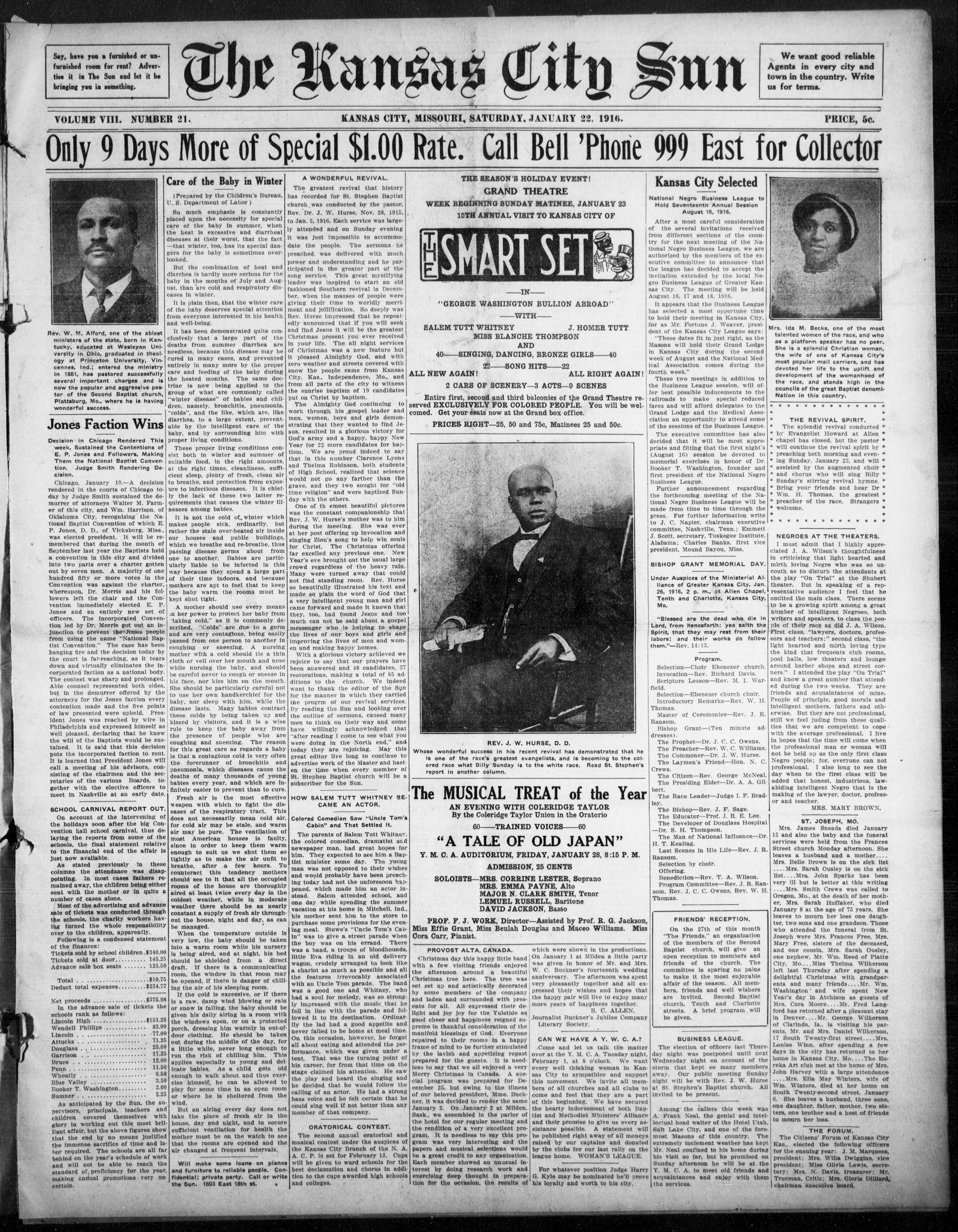
Rev. W. M. Alford, one of the ablest ministers of the state, born in Kentucky, educated at Wesleyan University in Ohio, graduated in theology at Princeton University, Vincennes, Ind.; entered the ministry in 1881, has pastored successfully several important charges and is now the popular and aggressive pastor of the Second Baptist church, Plattsburg, Mo., where he is having wonderful success.
Jones Faction Wins
Decision in Chicago Rendered This week, Sustained the Contents of E. P. Jones and Followers, Making Them the National Baptist Convention. Judge Smith Rendering Decision.
Chicago. January 10.—A decision rendered in the courts of Chicago today by Judge Smith sustained the demurrer of attorneys Walter M. Farmer of this city, and Wm. Harrison, of Oklahoma City, recognizing the National Baptist Convention of which E. P. Jones, D. D., of Vicksburg, Miss., was elected president. It will be remembered that during the month of September last year the Baptists held a convention in this city and divided into two parts over a charter gotten out by seven men. A majority of one hundred fifty or more votes in the Convention was against the charter, whereupon. Dr. Morris and his followers left the chair and the Convention immediately elected E. P. Jones and an entirely new set of officers. The incorporated Convention led by Dr. Morris got out an injunction to prevent the Jones people from using the name "National Baptist Convention." The case has been hanging fire and the decision today by the court is far-reaching, as it tears down and virtually eliminates the incorporated faction as a national body. The contest was sharp and prolonged. Able counsel represented both sides, but in the demurrer offered by the attorneys for the Jones faction every contention made and the five points of law presented were upheld. President Jones was reached by wire in Philadelphia and expressed himself as well pleased, declaring that he knew the will of the Baptists would be sustained. It is said that this decision puts the incorporated faction to rout It is learned that President Jones will call a meeting of his advisors, consisting of the chairmen and the sec retarales of the various Boards, together with the elective officers to meet in Nashville at an early date
SCHOOL CARNIVAL REPORT OUT.
On account of the intervening of the holidays soon after the big Convention hall school carnival, thus delaying the reports from some of the schools, the final statement relative to the financial end of the affair is just now available.
As stated previously in these columns the attendance was disappointing. In most cases fathers remained away, the children being either sent with the mother or in quite a number of cases alone.
Most of the advertising and advance sale of tickets was conducted through the schools, the charity workers having turned the whole responsibility over to the children, apparently.
Following is a condensed statement of the finances:
of the finances:
Tickets sold by school children. $340.00
Tickets sold at door. 145.25
Advance sale box seats 125.50
Total 10.75
Deduct total expenses 234.77
Net proceeds 375.98
In the advance sale of tickets the schools rank as follows:
Lincoln High 151.25
Wendell Phillips 83.00
Lincoln 77.00
Attucks 71.25
Douglass 25.00
Garrison 17.25
Bruce 12.00
Penn 11.50
Wheatly 8.50
Blue Valley 3.50
Booker T. Washington 3.00
Summer 2.25
As anticipated by the Sun, the supervisors, principals, teachers and children covered themselves with glory in working out this most brilliant affair, but the above figures show that the end by no means justified the immense sacrifice of time and labor required. The schools are all far behind on the year's schedule of work and will not be able to reach the standard of proficiency for the year, making annual promotions very un
The Kansas City Sun
Care of the Baby in Winter
(Prepared by the Children's Bureau, U. S. Department of Labor)
So much emphasis is constantly placed upon the necessity for special care of the baby in summer, when the heat is excessive and diarrheal diseases at their worst, that the fact—that winter, too, has its special dangers for the baby is sometimes overlooked.
But the combination of heat and diarrhea is hardly more serious for the baby in the months of July and August, than are cold and respiratory diseases in winter.
It is plain then, that the winter care of the baby deserves special attention from everyone interested in his health and well-being.
It has been demonstrated quite conclusively that a large part of the deaths from summer diarrhea are needless, because this disease may be cured in many cases, and prevented entirely in many more by the proper care and feeding of the baby during the heated months. The same doctrine is now being applied to the group of what are commonly called "winter disease" of babies and children, namely, bronchitis, pneumonia "dren," and the like, which are, like diarrhea, to a large extent, prevent able by the intelligent care of the baby, and by surrounding him with proper living conditions.
These proper living conditions consist both in winter and summer of suitable food, in the right amounts, at the right times, cleanliness, sufficient sleep, plenty of fresh, clean air to breathe, and protection from exposure to infectious diseases. It is chiefly the lack of these two latter requirements that causes the winter illnesses among babies.
It is not the cold of winter which makes people sick, ordinarily, but rather the stale over-heated air inside our houses and public buildings, which we breathe and re-breathe, thus passing disease germs about from one to another. Babies are particularly liable to be infected in this way because they spend a large part of their time indoors, and because mothers are apt to feel that to keep the baby warm the rooms must be kept shut tight.
A mother should use every means in her power to protect her baby from "taking cold," as it is commonly described. "Colds" are due to a germ and are very contagious, being easily passed from one person to another in coughing or sneezing. A nursing mother with a cold should tie a thin cloth or veil over her mouth and nose while nursing the baby, and should be careful never to cough or sneeze in his face, nor kiss him on the mouth. She should be particularly careful not to use her own handkerchief for the baby, nor sleep with him, while the disease lasts. Many babies contract these colds by being taken up and kissed by visitors, and it is a wise rule to keep the baby away from the presence of people who are coughing and sneezing. The reason for this great care as regards a baby is that a contagious cold is very often the forerunner of bronchitis and pneumonia, which diseases cause the deaths of many thousands of young babies every year, and which are infinitely easier to prevent than to cure.
Fresh air is the most effective weapon with which to fight the diseases of the respiratory tract. This does not necessarily mean cold air, for cold air may be stale, and warm air may be pure. The ventilation of most American houses is faulty, since in order to keep them warm enough to suit us we shut them so tightly as to make the air unfit to breathe, after a few hours. To counteract this tendency mothers should see to it that all the occupied rooms of the house are thoroughly aired at least twice every day in the coldest weather, while in moderate weather there should be as nearly constant a supply of fresh air throughout the house, night and day, as can be managed. When the temperature outside is very low, the baby should be taken into a warm room while his nursery is being aired, and at night, his bed should be shielded from a direct draft. If there is a communicating room, the window in that room may be opened, if there is danger of chilling the air of his sleeping room.
If the cold is excessive, or if there is a raw, damp wind blowing or rain or snow is falling, the baby should be given his daily airing in a room with the windows open, or on a protected porch, dressing him warmly in out-of-door clothing. He should be taken out during the middle of the day, for a little while, never long enough to run the risk of chilling him. This applies especially to young and delicate babies. As a child gets old enough to walk about, and thus exercise himself, he can be allowed to play for some time in an open room or where he is sheltered from the wind.
But an airing every day does not take the place of fresh air in the house, day and night, and to secure sufficient ventilation for health the mother must be on the watch to see that the rooms are opened and the air changed at frequent intervals.
Will make some loans on pianos and furniture to reliable people. Confidential; private party. Call or write the Sun. 1803 East 18th st.
KANSAS CITY, MISSOURI, SATURDAY, JANUARY 22. 1916.
The greatest revival that history has recorded for St. Stephen Baptist church was conducted by the pastor, Rev. Dr. J. W. Hurse, Nov. 28, 1915, to Jan. 5, 1916. Each service was largely attended and on Sunday evening it was just impossible to accommodate the people. The sermons he preached was delivered with much power and understanding and he participated in the greater part of the song service. This great mystifying leader was inspired to start an old fashioned Southern revival in December, when the masses of people were giving their time to worldly merriment and jollification. So deeply was Rev. Hurse impressed that he repeatedly announced that if you will seek and find Jesus it will be the greatest Christmas present you ever received in your life. The all night services of Christmas was a new feature but it pleased Almighty God, and with zero weather and streets covered with snow the people came from Kansas City, Kas., Independence, Mo., and from all parts of the city to witness the sunrise baptism of 19 candidates put on Christ by baptism.
The Almighty God continuing to work through his gospel leader and men, women, boys and girls demonstrating that they wanted to find Jesus, resulted in a glorious victory for God's army and a happy, happy New Year for 22 more candidates for baptism. We are proud indeed to say that in this number Clarence Lyons and Thelma Robinson, both students of High School, realized that science would not go any farther than the grave, and they two sought for "old time religion" and were baptized Sunday with the others.
One of the most beautiful pictures was the constant companionship that Rev. J. W. Hurse's mother was to him during the meeting. She was ever at her post offering up invocation and singing Zion's song to help win souls for Christ. The Christmas offering far excelled any previous one. New Year's eve brought out the usual large crowd regardless of the heavy rain. Many were turned away that could not find standing room. Rev. Hurse so beautifully illustrated his text and made so plain the word of God that a very intelligent young man and girl came forward and made it known that they, too, had found Jesus and too much can not be said about a gospel messenger who is helping to shape the lives of our boys and girls and improving the lives of men and women and making happy homes.
With a glorious victory achieved we rejoice to say that our prayers have been answered and 48 candidates, 37 restorations, making a total of 85 additions to the church. We indeed want to thank the editor of the Sun for the manner in which they carried the program of our revival services. By reading the Sun and looking over the outline of sermons, caused many men to think on their way and some have willingly acknowledged that "after reading I come to see what you were doing in the North end," and today they are rejoicing. May this great editor live long to continue to advertise work of the Master and hasten the time when every member of St. Stephen Baptist church will be a subscriber for the Sun.
HOW SALEM TUTT WHITNEY BE
CAME AN ACTOR.
Colored Comedian Saw "Uncle Tom's Cabin" and That Settled It.
The parents of Salem Tutt Whitney, the colored comedian, dramatist and newspaper man, had great hopes for him. They expected to see him a Baptist minister some day. The young man was not opposed to their wishes and would probably have been preaching today had not the unforesoon happened, which made him an actor instead. Salem attended school, and one day while spending the summer vacation at his home in Mitchell, Ind., his mother sent him to the store to purchase some provisions for the evening meal. Stowe's "Uncle Tom's Cabin" was to give a street parade when the boy was on his errand. There was a band, a troupe of bloodhounds, little Eva riding in an old delivery wagon, crudely arranged to look like a charlot as much as possible and all the features irrevocably associated with an Uncle Tom parade. The band was a good one and Whitney, who had a soul for melody, was so strongly impressed with the music that he fell in line with the parade and followed it to its destination. Ordinarily the lad had a good appetite and never failed to be home at meal time. On this occasion, however, he forgot all about eating and attended the performance, which was given under a tent. That was the turning point of his career, for from that time on the stage claimed his attention. He saw the play and heard the singing and he decided that he would follow the calling of an actor. He had a strong bass voice and he felt certain that he could sing well if not better than any member of that company.
ORATORICAL CONTEST.
The second annual oratorical and musical contest under the auspices of the Kansas City Branch of the N. A. A. C. P. is set for February 12. Cups will be given to ward schools for the best declamation and chorus in addition to the cups awarded high schools and colleges.
THE SEASON'S HOLIDAY EVENT!
GRAND THEATRE
WEEK BEGINNING SUNDAY MATINEE, JANUARY 23
15TH ANNUAL VISIT TO KANSAS CITY OF
THE SMART SET
SALEM TUTT WHITNEY J. HOMER TUTT MISS BLANCHE THOMPSON
Entire first, second and third balconies of the Grand Theatre reserved EXCLUSIVELY FOR COLORED PEOPLE. You will be well comed. Get your seats now at the Grand box office.
PRICES RIGHT—25, 50 and 75c. Matinees 25 and 50c.
THE EDITOR
REV. J. W. HURSE. D. D.
Whose wonderful success in his rec
is one of the race's greatest ev
ored race what Billy Sunday is the
report in another column.
The MUSICAL TITLE
AN EVENING WITH
By the Coleridge Taylor
60—TRAINER
"A TALE OF
Y. M. C. A. AUDITORIUM, FR
ADMISSION
SOLOISTS—MRS. CORRID
MRS. EMMA
MAJOR N. CLE
LEMUEL RUS
DAVID JACK
PROF. F. J. WORK, Director
Miss Effie Grant, Miss Beulah D.
Cora Carr, Pianist.
PROVOST ALTA, CANADA.
Whose wonderful success in his recent revival has demonstrated that he is one of the race's greatest evangelists, and is becoming to the colored race what Billy Sunday is to the white race. Read St. Stephen's report in another column.
The MUSICAL TREAT of the Year AN EVENING WITH COLERIDGE TAYLOR By the Coleridge Taylor Union in the Oratorio 60—TRAINED VOICES—60
SOLOISTS—MRS. CORRINE LESTER, Soprano
MRS. EMMA PAYNE, Alto
MAJOR N. CLARK SMITH, Tenor
LEMUEL RUSSELL, Baritone
DAVID JACKSON, Basso
PROF. F. J. WORK, Director—Assisted by Prof. R. G. Jackson,
Miss Effie Grant, Miss Beulah Douglas and Maceo Williams. Miss
Cora Carr, Pianist.
Christmas day this happy little band with a few visiting friends enjoyed the afternoon around a beautiful Christmas tree here. The tree was set up and artistically decorated by some members of the company and laden and surrounded with presents for all. All expressed their delight and joy joy for the Yuletide as good cheer and happiness reigned supreme in thankful consideration of the manifold blessings of God. Everyone repaired to their rooms in a happy frame of mind to be further stimulated by the lavish and appetizing repast prepared for the guests. It is needless to say that we all enjoyed a very Merry Christmas in Canada. A special program was prepared for December 25, but owing to the illness of our beloved president, Mme. Buckner, it was decided to render the same January 2. On January 2 at Milden, Sask., we assembled in the parlor of the hotel for our regular meeting and the rendition of a very excellent program. It is needless to say this program was very interesting and the papers and musical selections would be a great credit to any organization. Each member showed an unusual interest by doing research work and exercising deep thought in preparation for the occasion, the results of
```markdown
```
GREAT of the Year
COLERIDGE TAYLOR
or Union in the Oratorio
VOICES——60
OLD JAPAN"
SUNDAY, JANUARY 28, 8:15 P. M.
N, 25 CENTS
NE LESTER, Soprano
PAYNE, Alto
BARK SMITH, Tenor
NSELL, Baritone
SON, Basso
Assisted by Prof. R. G. Jackson,
Douglas and Maceo Williams. Miss
which were shown in the productions. On January 1 at Milden a little party was given in honor of Mr. and Mrs. W. C. Buckner's fourteenth wedding anniversary. The afternoon was spent very pleasantly together and all expressed their wishes and hopes that the happy pair will live to enjoy many more years of happiness together. B. C. ALLEN, Journalist Buckner's Jubilee Company Literary Society.
CAN WE HAVE A Y. W. C. A.?
Come and let us talk the matter over at the Y. M. C. A. Tuesday night, February 1, at 8 o'clock. We want every well thinking woman in Kansas City to sympathize and support this movement. We invite all members of all churches and all clubs to come and feel that they are a part of this beginning. We have secured the hearty indorsement of both Baptist and Methodist Ministers' Alliance and their promise to give us every assistance possible. A statement will be published right away of all moneys raised by our captains and donated by the clubs for our last rally on the league home. WOMAN'S LEAGUE.
For whatever position Judge Harry G. Kyle may be nominated he'll prove his loyalty and worth to his city.
---
Kansas City Selected
National Negro Business League to Hold Seventeenth Annual Session August 16, 1916.
After a most careful consideration of the several invitations received from different sections of the country for the next meeting of the National Negro Business League, we are authorized by the members of the executive committee to announce that the league has decided to accept the invitation extended by the local Negro Business League of Greater Kansas City. The meeting will be held August 16, 17 and 18, 1916.
It appears that the Business League has selected a most opportune time to hold their meeting in Kansas City, for as Mr. Fortune J. Weaver, president of the Kansas City League says: "These dates fit in just right, as the Masons will hold their Grand Lodge in Kansas City during the second week of August and the National Medical Association comes during the fourth week."
These two meetings in addition to the Business League session, will offer best possible inducements to the railroads to make special reduced fares and will afford delegates to the Grand Lodge and the Medical Association an opportunity to attend some of the sessions of the Business League.
The executive committee has also decided that it will be most appropriate and fitting that the first night's (August 16) session be devoted to memorial exercises in honor of Dr. Booker T. Washington, founder and first president of the National Negro Business League.
Further announcement regarding the forthcoming meeting of the National Negro Business League will be made from time to time through the press. For further information write to J. C. Napier, chairman executive committee, Nashville, Tenn.; Emmett J. Scott, secretary, Tuskegee Institute, Alabama; Charles Banks, first vice president, Mound Bayou, Miss.
BISHOP GRANT MEMORIAL DAY
Under Auspices of the Ministerial Alliance of Greater Kansas City, Jan. 26, 1916, 2 p. m., at Allen Chapel, Tenth and Charlotte, Kansas City, Mo.
"Blessed are the dead who die in Lord, from henceforth: yea saith the Spirit, that they may rest from their labors; and their works do follow them."—Rev. 14:13.
Program.
Selection—Choir Ebenezer church.
Invocation—Rev. Rev. Richard Davis.
Scripture Lesson—Rev. M. I. Warfield.
Selection—Ebenezer church choir.
Introductory Remarks—Rev. W. H. Thomas.
Master of Ceremonies—Rev. J. R. Ransom.
Bishop Grant—(Ten minute addresses).
The Prophet—Dr. J. C. C. Owens.
The Preacher—Rev. W. C. Williams.
The Commoner—Dr. J. W. Hurse.
The Laymen's Friend—Hon. N. C. Crews.
The Citizen—Rev. George McNeal.
The Presiding Elder—Dr. A. A. Gill bert.
The Race Leader—Judge I. F. Bradley.
The Man of National Influence—Dr
H. T. Kealing.
Last Scenes in His Life—Rev. J. R
Ransom.
Selection by choir.
Offering.
Benediction—Rev. T. A. Wilson.
Program Committee—Rev. J. R. Ran
som. Rev. J. C. C. Owens, Rev. W. H
Thomas.
FRIENDS' RECEPTION.
On the 27th of this month "The Friends," an organization of the members of the Second Baptist church, will give an open reception to members and friends of the church. The committee is sparing no pains to make it the most enjoyable affair of the season. All members, friends and well wishers are invited. Second Baptist church, Tenth and Charlotte streets. A brief program, will be given.
BUSINESS LEAGUE.
The election of officers last Thursday night was postponed until next Wednesday night on account of the storm that kept so many members away. Our public meeting Sunday night will be with Rev. J. W. Hurse at St. Stephen's Baptist church. All invited to be present.
Among the callers this week was A. Frank Neal, the genial and intellectual head waiter of the Hotel Utah, Salt Lake City, and one of the foremost Masons of this country. The extremely inclement weather has kept Mr. Neal confined to his home during his visit so far, but he promised on Sunday afternoon he will be at the Y. M. C. A. to meet old friends and acquaintances and enjoy with them the services.
We want good reliable Agents in every city and town in the country. Write us for terms.
PRICE, 5c.
Mrs. Ida M. Becks, one of the most talented women of the race, and who as a platform speaker has no peer. She is a splendid Christian woman, the wife of one of Kansas City's most popular mail carriers, and has devoted her life to the uplift and development of the womanhood of the race, and stands high in the councils of the great Baptist denomination in this country.
```markdown
```
THE REVIVAL SPIRIT
THE REVIVAL SPIRIT.
The splendid revival conducted by Evangelist Howard at Allen chapel has closed, but the pastor will continue the revival spirit by preaching both morning and evening Sunday, January 23, and will assisted by the augmented choir and chorus who will sing Billy Sunday's stirring revival hymns. Bring your friends and hear Dr Wm. H. Thomas, the greatest preacher of the race. Strangers welcome.
NEGROES AT THE THEATERS.
NEGROES AT THE THEATERS.
I must admit that I highly appreciated J. A. Wilson's thoughtfulness in criticising that light hearted and mirth loving Negro who was so uncoath as to disturb the attendants at the play "On Trial" at the Shubert theater. But in speaking of a representative audience I feel that he omitted the main class. There seems to be a growing spirit among a great number of intelligent Negroes, both writers and speakers, to class the people of their race as did J. A. Wilson. First class, "lawyers, doctors, professors and teachers;" second class, "the light hearted and mirth loving type the kind that frequents club rooms, pool halls, low theaters and lounge around barber shops and street corners." I attended the play "On Trial" and know a great number that attended during the two weeks. They are friends and acquaintances of mine. People of principle, good morals and intelligent mothers, fathers and otherwise. But they are not professional, still we feel juding from these qualities that we are competent to cope with the average professional. I live in hopes that the time will come when the professional man or woman will not be held up as the only first class Negro people; for, everyone can not professional. I also long to see the day when to the first class will be added that honest, industrious, law abiding intelligent Negro that is the making of the lawyer, doctor, professor or and teacher.
MRS. MARY BROWN.
ST. JOSEPH. MO.
Mrs. James Sneads died January 15 and also the baby and the funeral services were held from the Frances Street church Monday afternoon. She leaves a husband and a mother... Mrs. Belle Brown is on the sick list ... Mrs. Sarah Ousley is on the sick list... Mrs. Sparks has been very ill but is better at this writing ... Mrs. Smith Crews was called to Oregon. Mo. at the death of her mother, Mrs. Sarah Huffaker, who died January 8 at the age of 75 years. She leaves to mourn her loss one daughter, two sons and one grandson. Those who attended the funeral from St. Joseph were Mrs. Frances Free, Mrs. Mary Free, sisters of the deceased, and one cousin, Mrs. Sarah Ousley, one nephew, Mr. Wm. Reed of Platte City, Mo... Miss Thelma Wilkerson left last Thursday after spending a delightful Christmas with grandparents and many friends... Mr. Wm. Washington' and wife spent New Year's day in Atchison as guests of Mrs. Cora Moore...Mr. Fred Langford has returned after a pleasant stay in Denver...Mr. George Wilkerson of Clarinda, Ia., is visiting his parents, Mr. and Mrs. Daniel Wilkerson, 17 South Twenty-first street...Mrs. Louise Winn, after spending a few days in the city has returned to her home in Kansas City, Mo... The Eureka Art club met at the home of Mrs. John Harvey with a large attendance ... Mrs. Ella May Winters, wife of Wm. Winters, died at her home on South Twenty-second street, January 6. She leaves a husband, three sons, one daughter, father, mother, two sisters, one brother and a host of friends to mourn her loss.
THE FORUM.
The Citizens' Forum of Kansas City Kas., elected the following officers for the ensuing year: J. M. Marquess, president; Mrs. Willa Dwiggins, vice president; Miss Olivia Lewis, secretary; Mrs. N. Davis, treasurer; Mr. Trueman, Critic; Mrs. Gloria Dillard, chairman executive board.
INTERNATIONAL
SUNDAY SCHOOL
LESSON
(By E. O. SELLERS, Acting Director of the Sunday School Course of the Moody Bible Institute of Chicago.)
(Copyright, 1915, Western Newspaper Union.)
LESSON FOR JANUARY 23
LESSON TEXT—Romans 8:12-30.
GOLDEN TEXT—As many as are led by the spirit of God, these are the sons of God—Rom. 8:14.
The connection of this lesson with the others of the series is in the fact that this chapter is a panegyric regarding the spirit-filled life, the coming of which we have so recently studied. Read prayerfully in this connection Gal. 5:22, 26. We somehow feel that we ought to study this entire chapter rather than that portion assigned. The key to the whole is found in verse thirty-seven. "We are more than conquerors." If conquerors, how be more than conquerors? Very simple. Some victories leave the victor so exhausted that he cannot possess nor enjoy his victory; not so the spirit-filled Christian for he is "more' than conqueror."
Previously in this epistle the spirit is mentioned but once (5:5); in this chapter he is mentioned nineteen times. Over what is the spirit-filled man conqueror?
1. Over the Condemnation of Sin.
v. 1. The spirit-filled Christian lives in another realm than that of the flesh (v. 9). The spirit removes us from the realm to that of the spirit, quickening us (i. e., making us alive who were dead in sins) to condemn sin in the flesh and enabling us to "walk not after the flesh, but after the spirit."
II. Conquerors Over the Power and Dominion of Sin, vv. 24. While we still have the body yet it is our privilege, through the spirit's power at work within us, to put to death its deeds every day and each minute (Gal. 5:16, 22, 23). To live otherwise is to displease God (v. 8). Those who surrender their lives to the control of the indwelling spirit are "sons of God" and therefore "free from the law of sin and death" (v. 2), for the same spirit that "raised from the dead" (v. 11) not alone makes us sons but gives us the same power.
As long as we are under laws and ordinances we are "children" (Gal. 4:3 R. V.), but when we live the life of liberty in Christ Jesus we are led, not by these outward laws, but by a living spirit as "sons" (Gal. 5:18).
III. Conquerors Over Fear, v. 15. The righteousness of the law is fulfilled in us "who walk not after the flesh but after the spirit" (v. 4) and having received the "spirit of adoption" (i. e., being placed as sons) we cringe not before God in terror, nor call him a tyrant, or even ruler, but exclaim "Abba, my father." As "sons" we are spiritually minded and have "life and peace" (v. 6. Gal. 4:6).
IV. Conquerors Over Suffering, v. 18. We are joint heirs with Jesus "if so be we suffer with him." Our position and heirship in Christ involves our participation in his sufferings (Gal. 6:17, II Tim. 2:11, 12, Acts 14:22). What we often call afflictions are only discomforts and frequently the results of our own foolish carelessness. But as contrasted with his glory there is no comparison. Only eternity will enable us to comprehend what it means to be made perfect through suffering (Phil. 3:10, II Tim. 2:12, Heb. 5:8). If we are heirs of all God has and that God is, we are likewise an heir just as Christ is, and to the extent that Christ is an heir and hence to his sufferings (we suffer with him) though we are even there more than conquerors for like him we too shall rise triumphant "over all things."
V. Conquerors Over Vanity, v. 20. This glory is contrasted with the creation now subject to vanity, but which is in degradation by comparison. The creature (v. 21) (i. e., creation) was made subject not willingly but by reason of him who subjected it in hope that the creation should yet be delivered from the bondage to the principles of death and decay into the glorious liberty, or the liberty of the glory, of the children of God.
VI. Conquerors Over Infirmities, v. 26. The believer's all-sufficiency and perfect security in the Lord Jesus. We may not have all we want yet we have all we need (Phil. 4:19). This sufficiency is in the privilege we possess in praying "according to the will of God"—we need not how to pray as we ought but the spirit maketh intercession for us (v. 26); so also Christ, "who is at the right hand of God," intercedes for us (v. 34). The spirit knows the mind of God the father, teaches us how to pray and at times places a yearning in our hearts too deep for our own comprehension.
Even God must search the heart to know the mind of the spirit (v. 27) and in this God does "exceeding abundantly above all that we ask or think" (Eph. 3:20).
At other times he enables us to pray with the spirit and the understanding as well (I Cor. 14:15). If the spirit leads us in our prayers our petitions will be "according to the will of God" and therefore granted (I John 5:14, 15).
In thus praying and being guided by the spirit we will overcome our infirmities.
VII. Conquerors Over All Things, v. 28. The crowning privilege the spirit-filled life has, is in knowing that all things work together for good and hence we are free from all possible anxiety of heart under any and all circumstances. Whatever comes to me is a part of his "all things" and therefore I should be grateful because the outcome will be good. We are not fore-ordained to salvation irrespective of what we may be or do but we are fore-ordained as believers "to be conformed to the image of his Son" (v. 29). Thus those who become candidates are those elected.
AFRO-AMERICAN CULLINGS
---
Maj. Robert R. Moton of Hampton institute, Hampton, Va., was selected to succeed Booker T. Washington as president of Tuskegee institute, Tuskegee, A.a., at a meeting of the special committee of the trustees of the institute. The choice was unanimous. The committee making the selection was composed of Seth Low, chairman of the Tuskegee trustees; Frank Trumbull of the Chesapeake and Ohio railroad, Edgar A. Bancroft, W. W. Campbell and Victor H. Tulane. Major Moton will not be installed as head of the famous Negro institute until the commencement exercises in May, 1916. Until that time he will give his services to the campaign for the Booker T. Washington memorial fund. The new head of Tuskegee has been commandant of cadets at Hampton since 1890. He was born in Virginia and is of pure Negro parentage. In a statement issued by the committee it is declared that by the elec
CATHERINE LOWE
JOHN C. COPELAND
Robert Russa Moton. tion of Major Moton, "the policies, aim and attitude of the institute will continue unchanged." The committee paid tribute to the ability of Emmett J. Scott, temporary head of the institute since the death of Doctor Washington, as follows: "In taking this action the committee has not been unmindful of the long devotion and of the many qualifications of Mr. Emmett J. Scott for the position. The problem to be dealt with is a many-sided one, and it has seemed wise to seek a solution of it that will bring to the work of Tuskegee another forceful personality."
In the death of the great Negro industrial leader, educator, and organizer, Dr. Booker T. Washington, the American nation has lost a great instrument for good; the Negro race in our nation a leader-mediator; the civilized world one of its champions of a great cause, writes F. Wilcoon Ellegor of Liberia, in a communication to the New York Times. There are times when even profound minds find it difficult to give out the fullest expressions of sentiment upon peculiar occasions and subjects—when words do not seem to give the significance they are employed to convey.
"A great Negro leader has fallen," "a mediator and friend of his race," or an active and indefatigable educator and industrialist, all convey
"Major Moton knows by intuition northern white people and southern white people. I have often heard the remark made that the southern white man knows more about the Negro in the South than anybody else. I will not stop here to debate that question, but I will add that colored men like Major Moton know more about the southern white man than anybody else on earth," was a remark made by Booker Washington.
"This thorough understanding of both races which Major Moton possesses has enabled him to give his students just the sort of practical and helpful advice and counsel that no white man who has not himself faced the peculiar conditions of the Negro could be able to give.
"I have seen Major Moton in a good many trying situations in which an ordinary man would have lost his head, but I have never seen him when he seemed to feel the least degraded or humiliated. I have learned from Major Moton that one need not belong to a superior race to be a gentleman.
"It has been through contact with
Of children born of parents at the age of forty-one years one-third die during the first year, while the rate of mortality among those born of parents between the ages of twenty-one and thirty is less than eight per cent.
The emerald is worth more por carat than any other stone.
You could put all the United States except Alaska in Brazil and have 200,000 square miles left.
Students in the college of arts and pure science of New York university no longer will be obliged to confine their endeavors to purely academic and nonprofessional studies. According to plans contemplated for the collegiate year beginning this month, a four-year course in commercial training will be offered as a distinct department of the university college, which is at the University Heights division of the university. While the regular study of prescribed subjects of
much, but fall to bring out the fullest measure of those elemental qualities that combined to make Mr. Washington the truly great man that he was.
Booker T. Washington was able in a very positive manner to give the demonstration of the fact that with opportunities and proper equipments millions of colored people would become capable of the highest mechanical and industrial training; he was able to prove the possibility of a good understanding and, what is more, of good feeling between the white and colored elements; he was able to prove that the individual sacrifice, perseverance, determination, thrift, energy, and steadfastness are unit builders of the useful community that must eventually turn out of its mold a prosperous, well-equipped people, rightly for a good place in the world. This is how we view the work of Booker Washington in Liberia, West Africa, where his name has become a household word and the Tuskegee model plant regarded as a valuable asset, an object lesson for any industrial effort.
I feel it my duty as one connected with Negro advancement work in Liberia, and deeply interested, too, in the industrial outlook of that country, to express in behalf of my colleagues there an appreciation for the life and work of that great opportune man, whose career may be briefly summed up in the words: Veni, vidi, vici. He really came "as one born in due time," saw and grasped a necessity, and put into effect propaganda that must of necessity continue to be a workable and progressive monument erected for the wellbeing of the race in America.
Mr. Washington's death, then, should prove to be a signal for united thought and effort among the colored race in America, in all those ways that tend toward the uplift of thousands of the people. And to my mind the very best way to show appreciation for and loyally to that devoted son of the race would be by uniting in encouraging and supporting in any and every possible way that wonderful working "Washington monument" at Tuskegee.
That the Negro must look to the schools for preparation for his work in life, and that he must erect schools and maintain them himself, was the declaration of Dr. A. P. Camphor, president of Central Alabama college, before the Central Alabama conference of the Methodist Episcopal church, in delivering the principal address at the educational anniversary. An audience that filled every available bit of space in St. Paul's Methodist church at Birmingham heard his address, which was the feature of the day's work. He pleaded for greater interest in Negro education, paid a high tribute to the work of the Methodist Episcopal church in providing educational institutions for all people, and showed the unmistakable duty of the Negro of today to help more largely in the education of the Negro youth.
Just what was being done at Central Alabama college, the local institution maintained by the church for Negroes at Mason City, was told by the speaker. The choir from the school rendered music for the occasion.
An electric motor no bigger than a watch is said to produce one horse power.
men like Major Moton—clean, wholesome, high-souled gentlemen under black skins—that I have received a kind of education no books could impart. Whatever disadvantages one may suffer from being a part of what is called an 'inferior race,' a member of such a race has the advantage of not feeling compelled to go through the world, as some members of other races do, proclaiming their superiority from the housetops. There are some people in this world who would feel lonesome, and they are not all of them white people either, if they did not have someone to whom they could claim superiority."
When a Sunbury (Pa.) man pulled his horse out of the well into which the thoughtless equine had fallen he found attached to one of its shoes a rusty bucket containing more than $3,000 in Spanish gold. The money is supposed to have belonged to a hermit whom legend assigns residence in the vicinity 50 or more years ago.
Small practice can lead to great perfection in the art of laziness.
Four hundred years ago the average length of human life was between eighteen and twenty years. One hundred years ago the average human life was less than thirty. The average human life today reaches nearly forty years.
Switzerland now owns the St. Gothard tunnel and railway.
The Brazilian government estimates next year's revenue at $169,660,000, and expenditures at $174,254,000.
general educational value will be adhered to during the first year, the work of the sophomore term will include studies of corporation finance, banking, bookkeeping and economics. The final two years are to be devoted almost exclusively to work along strictly technical lines, with supplementary study in research problems in the laboratory.
Nothing makes a man feel so important as his ability to answer the questions of a small boy.
THE WEEKEND
Last Word in Winter Hats
---
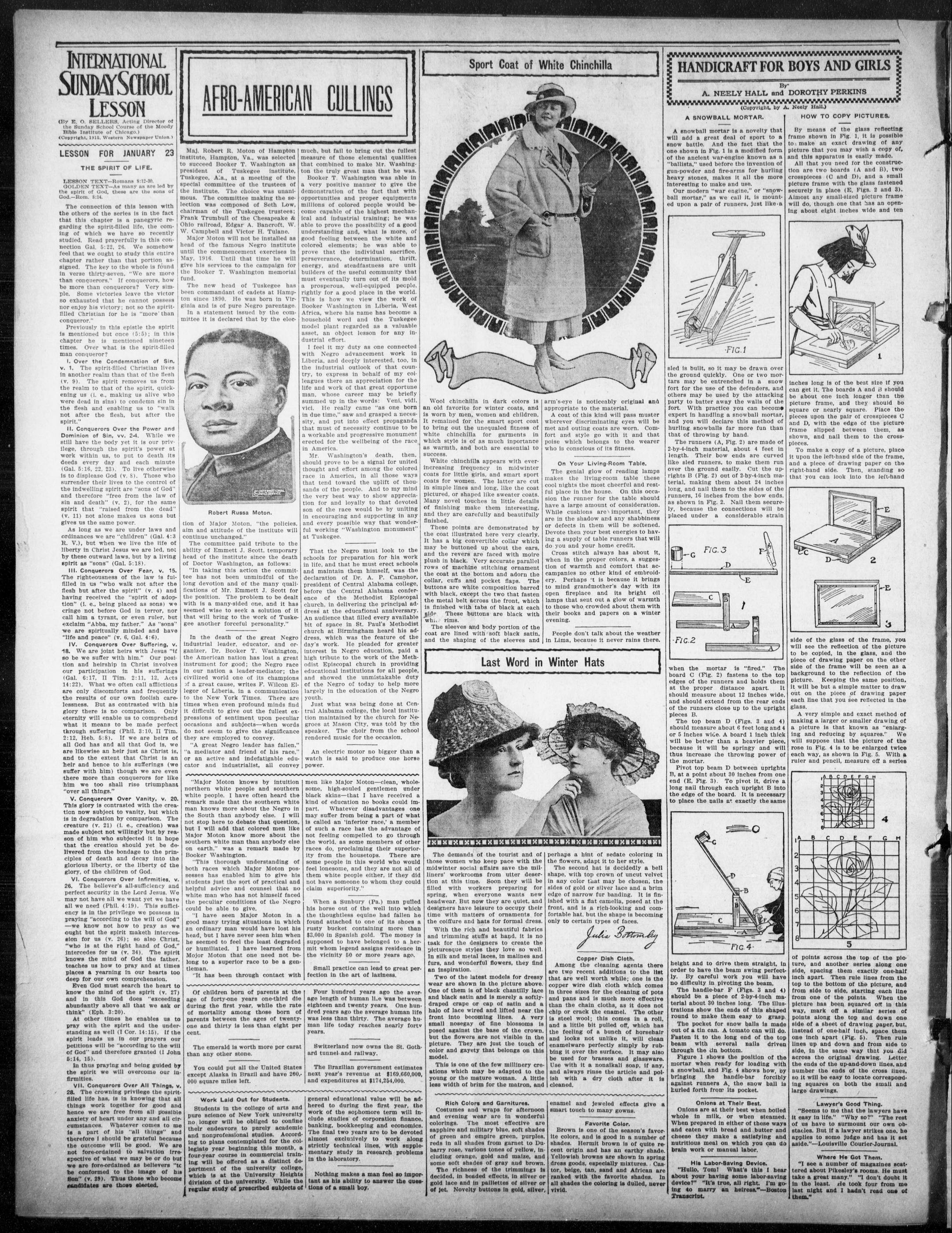
Wool chinchilla in dark colors is an old favorite for winter coats, and is worn by men, women and children. It remained for the smart sport coat to bring out the unequaled fitness of white chinchilla for garments in which style is of as much importance as warmth, and both are essential to success.
White chinchilla appears with ever-increasing frequency in midwinter coats for little girls, and smart sport coats for women. The latter are cut in simple lines and long, like the coat pictured, or shaped like sweater coats. Many novel touches in little details of finishing make them interesting, and they are carefully and beautifully finished.
These points are demonstrated by the coat illustrated here very clearly. It has a big convertible collar which may be buttoned up about the ears, and the revers are faced with moore plush in black. Very accurate parallel rows of machine stitching ornament the coat at the bottom and adorn the collar, cuffs and pocket flaps. The buttons are white composition barred with black, except the two that fasten the metal belt across the front, which is finished with tabs of black at each side. These buttons are black with white rims. The sleeves and body portion of the coat are lined with soft black satin, and the shaping of the sleeves and
Last Word in
The demands of the tourist and of those women who keep pace with the midwinter social affairs save the milliners' workrooms from utter desertion at this time. Soon they will be filled with workers preparing for spring, when everyone wants new headwear. But now they are quiet, and designers have leisure to occupy their time with matters of ornaments for the coiffure and hats for formal dress. With the rich and beautiful fabrics and trimming stuffs at hand, it is no task for the designers to create the picturesque styles they love so well. In silk and metal laces, in malines and furs, and wonderful flowers, they find an inspiration.
Two of the latest models for dressy wear are shown in the picture above. One of them is of black chantilly lace and black satin and is merely a softly-draped crape or cap of satin and a halo of lace wired and lifted near the front into becoming lines. A very small nosegay of fine blossoms is posed against the base of the crown, but the flowers are not visible in the picture. They are just the touch of color and gayey that belongs on this model.
This is one of the few millinery creations which may be adapted to the young or the mature woman. A little less width of brim for the matron, and
Rich Colors and Garnitures
Rich Colors and Garnitures.
Costumes and wraps for afternoon
and evening wear are in wonderful
colorings. The most effective are
sapphire and military blue, soft shades
of green and empire green, purple,
reds in all shades from garnet to Dubarry rose, various tones of yellow,
including orange, gold and maize,
and some soft shades of gray and brown.
The richness of the trimmings is
decided, in beaded effects, in silver or
gold lace and in palliettes of silver or
of jet. Novelty buttons in gold, silver,
arm's eye is noticeably original and appropriate to the material. A coat of this kind will pass muster wherever discriminating eyes will be met and outing coats are worn. Comfort and style go with it and that poise which belongs to the wearer who is conscious of its fitness.
On Your Living-Room Table.
The genial glow of reading lamps makes the living-room table these cool nights the most cheerful and restful place in the house. On this occasion the runner for the table should have a large amount of consideration. While cushions are important, they are in the shadow and any shabbiness or defects in them will be softened. Devote then your best energies to having a supply of table runners that will do you and your home credit. Cross stitch always has about it, when in the proper colors, a suggestion of warmth and comfort that accompanies no other kind of embroidery. Perhaps 't is because it brings to mind grandmother's day with its open fireplace and its bright oil lamps that sent out a glow of warmth to those who crowded about them with their books and papers on a winter evening.
People don't talk about the weather in Lima, because it never rains there.
n Winter Hats
perhaps a hint of sedate coloring in the flowers, adapt it to her style.
The second hat is decidedly a bell shape, with top crown of uncut velvet in any color that may be chosen, the sides of gold or silver lace and a brim edge of narrow fur banding. It is finished with a flat camelia, posed at the front, and is a rich-looking and comfortable hat, but the shape is becoming only to certain types of faces.
Julia Bottomly
Copper Dish Cloth.
Among the cleaning agents there are two recent additions to the list that are well worth while; one is the copper wire dish cloth which comes in three sizes for the cleaning of pots and pans and is much more effective than the chain cloth, as it does not chip or crack the enamel. The other is steel wool; this comes in a roll, and a little bit pulled off, which has the feeling of a bunch of horsehair and looks not unlike it, will clean enamelware perfectly simply by rubbing it over the surface. It may also be used for brasses and glassware. Use with it a nonalkali soap, if any, and always rinse the article and polish with a dry cloth after it is cleaned.
enamel and jeweled effects give a smart touch to many gowns.
Favorite Color
Brown is one of the season's favorite colors, and is good in a number of shades. Hermit brown is of quite recent origin and has an earthy shade. Yellowish browns are shown in spring dress goods, especially mixtures. Castor, beige, tan, sand and African are ranked with the favorite shades. In all shades the coloring is dulled, never vivid.
HANDICRAFT FOR BOYS AND GIRLS
A. NEELY HALL and DOROTHY PERKINS
(Copyright, by A. Neely Hall.)
A SNOWBALL MORTAR.
A snowball mortar is a novelty that will add a great deal of sport to a snow battle. And the fact that the one shown in Fig. 1 is a modified form of the ancient war-engine known as a "ballista," used before the invention of gun-powder and fire-arms for hurling heavy stones, makes it all the more interesting to make and use.
Our modern "war engine," or "snowball mortar," as we call it, is mounted upon a pair of runners, just like a
HOW TO COPY PICTURES.
By means of the glass reflecting frame shown in Fig. 1, it is possible to make an exact drawing of any picture that you may wish a copy of and this apparatus is easily made.
All that you need for the construction are two boards (A and B), two crosspieces (C and D), and a small picture frame with the glass fastener securely in place (E, Figs. 2 and 3). Almost any small-sized picture frame will do, though one that has an open
FIG.1
sled is built, so it may be drawn over the ground quickly. One or two mortars may be entrenched in a snow fort for the use of the defenders, and others may be used by the attacking party to batter away the walls of the fort. With practice you can become expert in handling a snowball mortar, and you will declare this method of hurling snowballs far more fun than that of throwing by hand.
The runners (A, Fig. 2) are made of 2-by-4-inch material, about 4 feet in length. Their bow ends are curved like sled runners, to make them run over the ground easily. Cut the uprights B (Fig. 2) out of 2-by-4-inch material, making them about 24 inches long, and nail them to the sides of the runners, 16 inches from the bow ends, as shown in Fig. 2. Nail them securely, because the connections will be placed under a considerable strain
FIG. 3
G
D
E
FIG. 2
C
B
A
B
A
when the mortar is "fried." The board C (Fig. 2) fastens to the top edges of the runners and holds them at the proper distance apart. It should measure about 12 inches wide, and should extend from the rear ends of the runners close up to the upright pieces B.
The top beam D (Figs. 3 and 4) should measure about 6 feet long and 4 or 5 inches wide. A board 1 inch thick will be better than a heavier piece, because it will be springy and will thus increase the throwing power of the mortar.
Pivot top beam D between uprights B, at a point about 30 inches from one end (E. Fig. 3). To pivot it, drive a long nail through each upright B into the edge of the board. It is necessary to place the nails at exactly the same
height and to drive them straight, in order to have the beam swing perfectly. By careful work you will have no difficulty in plvoting the beam.
The handle-bar B (Figs. 3 and 4) should be a piece of 2-by-4-inch material about 30 inches long. The illustrations show the ends of this shaped round to make them easy to grasp. The pocket for snow balls is made out of a tin can. A tomato can will do. Fasten it to the long end of the top beam with several nails driven through the tin bottom.
Figure 1 shows the position of the mortar when ready for loading with a snowball, and Fig. 4 shows how, by bringing the handle-bar forcibly against runners A, the snow ball is hurled forth from its pocket.
Onions at Their Best
Onions are at their best when boiled whole in milk, or when steamed. When prepared in either of these ways and eaten with bread and butter and cheese they make a satisfying and nutritious meal on which you can do brain work or manual labor.
His Labor-Saving Device.
"Hullo, Tom! What's this I hear about your having some labor-saving device?" "It's true, all right. I'm going to marry an heiresa."—Boston Transcript.
HOW TO COPY PICTURES.
By means of the glass reflecting frame shown in Fig. 1, it is possible to make an exact drawing of any picture that you may wish a copy of, and this apparatus is easily made.
All that you need for the construction are two boards (A and B), two crosspieces (C and D), and a small picture frame with the glass fastened securely in place (E, Figs. 2 and 3). Almost any small-sized picture frame will do, though one that has an opening about eight inches wide and ten
1
inches long is of the best size if you can get it. The boards A and B should be about one inch longer than the picture frame, and they should be square or nearly square. Place the pieces upon the pair of crosspieces C and D, with the edge of the picture frame slipped between them, as shown, and nail them to the crosspieces.
To make a copy of a picture, place it upon the left-hand side of the frame, and a piece of drawing paper on the right-hand side. Then, standing so that you can look into the left-hand
E
B
A
2
D
E
3
side of the glass of the frame, you will see the reflection of the picture to be copied, in the glass, and the piece of drawing paper on the other side of the frame will be seen as a background to the reflection of the picture. Keeping the same position, it will be but a simple matter to draw out on the piece of drawing paper each line that you see reflected in the glass. A very simple and exact method of making a larger or smaller drawing of a picture is that known as "enlarging and reducing by squares." We will suppose that the picture of the rose in Fig. 4 is to be enlarged twice each way, as shown in Fig. 5. With a ruler and pencil, measure off a series
4
A B C D E F G H
5
of points across the top of the picture, and another series along one side, spacing them exactly one-half inch apart. Then rule lines from the top to the bottom of the picture, and from side to side, starting each line from one of the points. When the picture has been squared off in this way, mark off a similar series of points along the top and down one side of a sheet of drawing paper, but, instead of one-half inch, space them one inch apart (Fig. 5). Then rule lines up and down and from side to side, in the same way that you did across the original drawing. Letter the ends of the up-and-down lines, and number the ends of the cross lines, so it will be easy to locate corresponding squares on both the small and large drawings.
Lawyer's Good Thing.
"Seems to me that the lawyers have it easy in life." "Why so?" "The rest of us have to surmount our own obstacles. But if a lawyer strikes one, he applies to some judge and has it set aside."—Louisville Courier-Journal.
Where He Got Them.
"I see a number of magazines scattered about Pikesel's rooms. He must take a great many." "I don't doubt it in the least. He took four from me last night and I hadn't read one of them."
GOD OF BATTLES
Bdwardes, listening could plainly
hear the sound of the German saps
being driven toward the Canadian
trenches. It was eerle, listening there
by the light of the electric torch, bur-
rowing like a mole beneath the slushy
Flanders soil, and crouching knee-
deep in water, to prevent striking his
head against the timbered roof.
He wondered often whether the Ger.
mans had heard him. Each side was
Projecting a sap against the trenches
‘of the enemy, When the saphead
was ready hundred of pounds of gun-
powder would be ignited; there would
be a devastating explosion, and the
trenches, damaged beyond repair,
would be occupied by the troops be
hind.
It was thus a race between the Ca-
nadians and the Germans, The sap.
extended outward from the Canadian
lines, was now parallel with that oI
the enemy, and the extremity of each
was barely a dozen yards from that
of the other.
‘The sappers were resting in the
traverse behind. Edwardes sat alone
in the water, figuring out the plan.
So many yards, so many cuble feet o!
timber . . . Milly, in Toronto; his
thoughts always recurred to her.
As he crouched there, to his aston:
ishment he found that he could heat
the voices of the Germans. There was
De Ro
age hi Crema
Liye Gs ee
Vm, aa
Co ie
1G PAL [Wy
heat et! le
a oe ee
(agi ten FZ
My \ (2 = Ge
Se -
ees
SAA Ginn Tees kak
a flaw in the ground, a section of the
crumbling rock, soft as chalk, had
“slipped,” probably as a result of the
subterranean operations, leaving a
crack in the earth, imperceptible, but
conveying sounds clearly,
Suddenly the earth rocked about
him. He was flung to the bottom of
the sap by a terrific explosion. The
plank roof collapsed over his head.
‘Stunned, dazed, ‘bewildered, he man-
aged by a supreme effort to keep his
face above the water.
In a few moments he understood
what had occurred. A shell from 4
German 42-centimeter gun had fallen
squarely above the opening of the sap,
obliterating it and destroying all the
men of his company.
He stretched out his arms and felt
the wall that blocked the entrance.
He called in a low voice, but there
came no response,
‘The air was already filled with the
creeping fumes of the explosive. Ed:
wardes crawled back toward the sap-
head, He crouched there, consider-
ing. He could still hear the murmur
of the voices of the hostile party, But
they seemed clearer.
Edwards felt the earth wall cau-
tlously, His fingers touched the damp,
impenetrable mass and found no crev-
fee; yet of a sudden he was amazed
to see a tiny twinkle, apparently in
the heart of the ground,
He stared at ft in doubt; presently
he could no longer deny the truth. In
credible as it seemed, the explosion
had shaken the collapsing stratum
still further, leaving a tiny gap be
tween the two passages. And the en.
emy worked on, all unconscious of his
Presence.
‘The only possible way of escape
from his underground hiding place lay
through that gap, into the midst of the
enemy.
Nolselessly as a mole ho began to
scrape a way toward the light. But
suddenly he remembered that three
bombs had been left near his own sap-
head, in case of surprise. ‘They could
not be discharged until the firing pin
‘was withdrawn. He crept back, fum-
bled in the darkness until he found
them, and returned.
‘Then he began to separate the par-
ticles of the earthen wall. The light
had disappeared, but the murmurs
continued. Evidently the soldiers
were moving, probably at work. He
surmised that the saphead had been
GET TO KNOW YOUR WORK
Self-Confidence and Hard Work Are
the Two Big Factors in a Man's
‘Success.
Get acquainted with your work it
you want to be one of the men whom
people will look up to. There fs no
Yeuson why any man should have to
bo classed among the lethargists. You
must have confidence in your own
ability to do the big things in life be-
fore you can ever expect to accom.
plish anything which {s worth while,
the Toledo Times observes.
‘Those who are prone to consider
themselves exempt from hard work
have never been known to obtain the
success which real people covet. You
trave to keop working every minute to
get anywhere, Just as soon as you
stop the other fellow is bound to go
ahead.
It you feel that it 1s better for all
concerned that the other fellow have
oe best tings tn this life, woll and
. However, a man cannot %
eee lived’n tontiitte IF Aiy he athe ei
der his hands, though his nails were
torn and bleeding, At last the work
was accomplished. A thin partition
remained between himself and the
sap; he could hear the murmurs dis-
tinetly, and could breathe the fresher
air. He took a bomb in his hand, and
with the other forced away the last
of the barrier,
He sprang forward, Ho found him
felt confronting two Germans, One
was a young officer holding a torch,
the other—a girl!
Edwardes, with his arm poised in
the act of throwing, stood petrified.
He had not withdrawn the firing pin.
He could not hurl the bomb now.
‘The German, for his part, stood as
if petrified, and the girl remained with
her mouth open, staring at him. ‘Then,
with @ scream, she ran before her
lover. But Edwardes did not throw
the bomb,
“A truce, kamerad!” eried the Ger-
man suddenly. “I am a Saxon. 1
speak English.”
Edwardes lowered his arm slowly.
‘The Saxons and the Canadians bad
preserved a semblance of good feeling
during the conflict; he knew the man
would not act treacherously,
“You will let this girl go?” asked
the soldier, “Then we fight it out to-
gether."
“She can go.” answered Edwards,
“but you are my prisoner."
‘The German smiled and raised his
arm. “Listen!” he said
The Canadian only then became
aware that the continuous reverbera-
tion of the cannon, which had been in
his oars for hours, had ceased. He
knew what that meant, And in a mo-
ment the ground above them trembled,
It shook under the footsteps of thow-
sands of men, rushing toward each
other in the fury of battle.
“If 1 am your prisoner,” said the
Saxon, “where can you take me when
your men are beaten?"
“They can't be beaten."
“Listen, then. We go out after the
fight, and if my men have won, you
are my prisoner. If yours have won,
{am your prisoner.”
“If our side wins, you are my pris
oner,” answered Edwardes, “Mean:
while—tet the girl go!”
“But where can she go now?” asked
the Saxon,
Nowhere! The three must wait there
till the conflict ended. Edwardes was
disarmed by the presence of this girl
who had stolen in to meet her lover.
He thought of Milly again, and he
realized as never before the sadness
of the struggle. All personal thoughts
must be set aside.
“Throw down your revolver,” he
commanded.
‘The Saxon, with a shrug, obeyed.
‘They watched each other. Overhead
the sounds had lessened. They ceased.
‘The dull boom of the cannon began
again,
“We have taken your trenches,” said
the Canadian.
The Saxon smiled.
“March before me! Take the girl
on your arm, You will not be harmed.
‘They will let her go. You are for.
tunate to have the hope of mecting
atter the war,”
| “May I tell her?”
Edwardes bowed his head slightly.
and heard the German translate. The
girl looked at him incredulously for a
| moment; then she flung her arms
wbout her lover's neck and embraced
him. She clasped her hands again
and looked imploringly at the Cana.
dian,
“I's all right," said Edwardes, “I
have—Ich habe ein fraulein,” he ex-
plained clumsily, thinking of Milly.
‘The Saxon smiled at him. “You un
derstand, you are taking me to free.
dom and yourself to imprisonment?"
he asked.
“Our men hold your trenches,” an
swered Edwardes, in a tone that ad:
mitted no denial, Yet, as the pair pre-
ceded him along the sap, there came
into his heart the faintest fear that
the attack had been repelled,
But he only squared his shoulders
and crouched behind the two, and fol-
lowed them toward that gleam of day.
Nght that became slowly stronger.
Overhead sounded the cannon, louder,
more insistently.
‘They reached the entrance to the
sap. No one was visible. Dead men
and broken arms lay heaped in piles
Edwardes raised himself and stared
about him. What had happened? Had
the trench been taken or—were the
enemy still in possession?
‘He saw his own doubts on the Sax-
on's face. ‘The two looked at each
other silently. The girl was standing
‘@ little distance away.
And it was thus, in their ignorance,
in their pathetic helplessness, that
their fate came to them in the form
of the scattering shrapnel, Edwardes
and the Saxon fell together, With a
last effort he raised himself upon his
arm and, staring at the uninjured girl,
motioned imperatively toward the dis-
tance,
And he fell back, seeing the Saxon’s
uncomprehending eyes fixed upon his.
‘The form of Milly hovered before his
gaze—and vanished,
(Copyright, 1910, by W, G, Chapman.)
Ran
has been to sit down and watch other
people work and become better.
This world needs the efforts of ev-
eryone. ‘There is no reason why the
burdens of life should be shouldered
by a few, Unless you intend to do
Something that will make people think
‘better of you there is no reason why
you should inhabit this sphere,
Look to your own accomplisments
before believing yourself incapable of
doing as much as the other fellow.
Within you may Me dormant factors
whieh, if awakened, will lead you to
greater success than you could have
dreamed of, Don't waste time trying
to figure out how easy it would be
for you to get along, but make a big
effort to do something that will make
you respected by all,
Distressing Preliminary.
“Do you think the world is growing
better?"
“I'm not sure about it," replied Miss
Cayenne. “The world may be like a
city—when Improvements are contem-
plated it's always terribly torn up tor
awhile,” “f
AMERICAN AIRMEN WHO AID FRANCE
“og oe \
ON he q
4 : by & \ rc 4
te 4 ne f e
(Ve) 7 a
' ts be f e : oe
3 po , a a pees f
i Pe . pe pe i ies a
ie 3 em Geen oe.
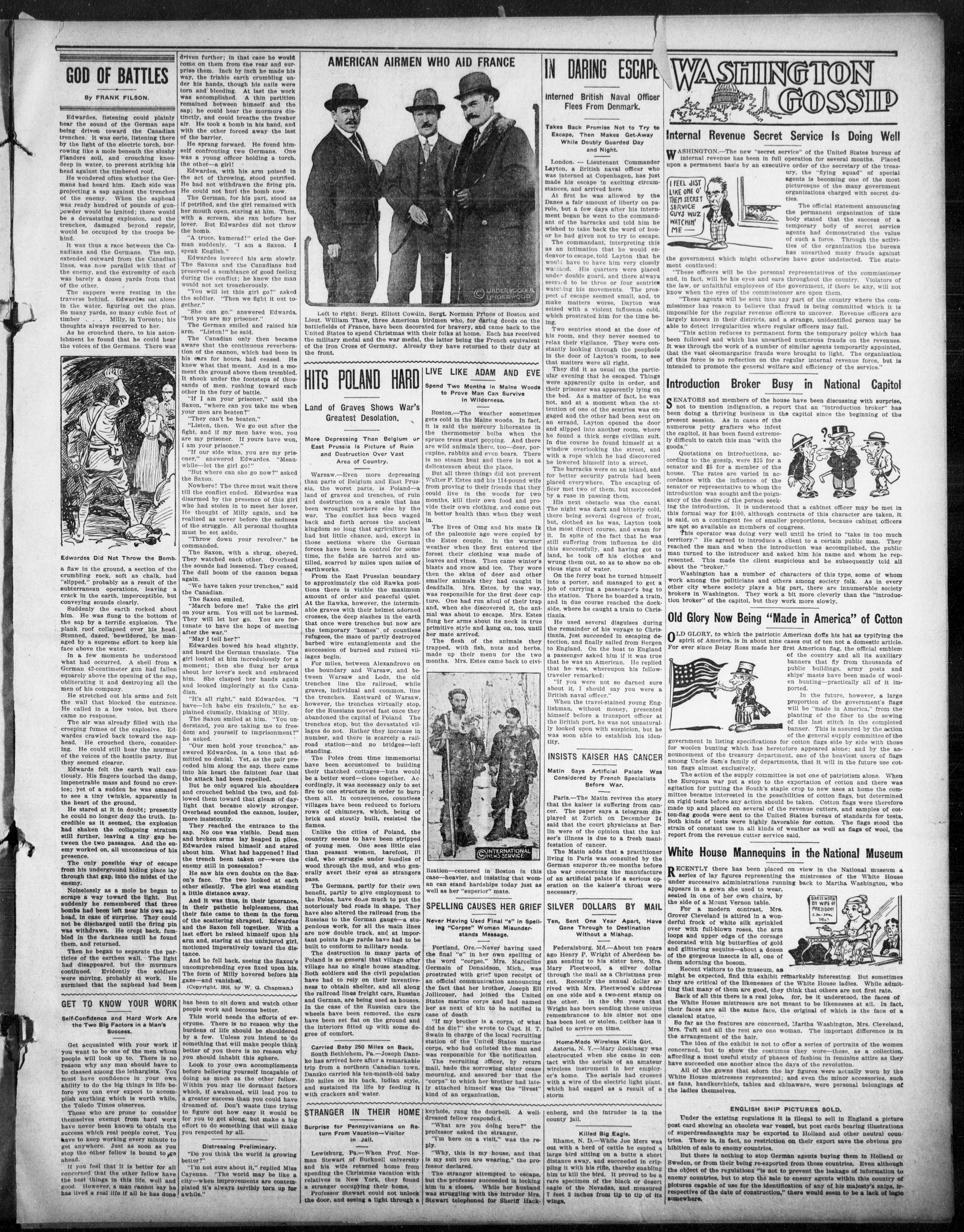
Left to right: Sergt. Elliott Cowdin, Sergt. Norman Prince of Boston and
Lieut. William Thaw, three American birdmen who, for daring deeds on the
battlefields of France, have been decorated for bravery, and came back to the
United States to spend Christmas with their folks at home. Each has recelved
the military medal and the war medal, the latter being the French equivalent
of the Iron Cross of Germany. Already they have returned to their duty at
the front.
NTT
AND HARD LIVE LIKE ADAM AND EVE
Spend Two Months in Maine Woods
to Prove Man Can Survive
ar in Wilderness.
’, as
Land! of /Gravea Shows War's) inxs | esther sometimes
Greatest Desolation. _ | gets cold in the Maine woods, In fact,
{t 1s sald the mercury hibernates in
are the thermometer bulbs when the
More Depressing Than Belgium or | spruce trees start popping. And there
East Prussia Is Picture of Ruin | are wild animals there, too—deer, por-
and Destruction Over Vast cupine, rabbits and even bears. There
apeared Counkey) is no steam Weat and there {s not a
Warsaw.—Even more depressing
than parts of Belgium and East Prus-
sia, the worst parts, is Poland—a
land of graves and trenches, of ruin
and destruction on a scale that has
been wrought nowhere else by tho
war, The contlict has been waged
back and forth across the ancient
kingdom so long that agriculture has
had but little chance, and, except in
those sections where the German
forces have been in control for some
time, the fields are barren and un-
tilled, scarred by miles upon miles of
earthworks.
From the East Prussian boundary
to approximately the old Rawka posi-
tions there {s visible the maximum
amount of order and peaceful quiet.
At the Rawka, however, the intermin-
able graves with their helmet adorned
crosses, the deep slashes in the earth
that once were trenches but now are
the temporary “homes” of countless
Tefugees, the maze of partly destroyed
barbed wire entanglements and the
succession of burned and ruined vi
lages begin,
For miles, between Alexandrovo on
the boundary and Warsaw, and be:
tween Warsaw and Lodz, the old
trenches line the railroad, while
graves, individual and common, line
the trenches. Eastward of Warsaw.
however, the trenches virtually stop,
for the Russians moved fast once they
abandoned the capital of Poland ‘The
trenches stop, but the devastated vil
Jages do not. Rather they increase in
number, und there is scarcely a rail-
road station—and no bridges—lett
standing.
‘The Poles from time ‘mmemoria!
have been accustomed to building
their thatched cottages—huts would
be a better word—close together. Ac
cordingly, it was necessary only to set
fire to one structure in order to burn
them all. In consequence, countless
villages have been reduced to forlorn
rows of chimneys, which, being of
“brick and stoutly built, resisted the
‘flames.
- Unilke the eltles of Poland, the
country seems to have been stripped
of young men, One sees Httle else
‘than peasant women, barefoot, I]
clad, who struggle under bundles of
‘wood through the mud, and who gen:
‘erally avert their eyes as strangers
pass.
‘The Germans, partly for their own
benefit, partly to give employment to
the Poles, have doe much to put the
notoriously bad roads in shape. ‘They
have also altered the railroad from the
Russian to the German gaugé—a stu-
pendous work, for all the main lines
‘are now double track, and at impor.
tant points huge yards have had to be
built to conform to military needs.
‘The destruction in many parts of
Poland {s so general that village after
village has no single house standing.
Both soldiers and the civil population
have had to rely on their inventive.
ness to obtain shelter, and all along
the railroad Iines freight cars, Russian
and German, are being used as houses.
In the case of the Russian cars the
wheels have been removed, the cars
have been set flat on the ground and
the Interiors fitted up with some de-
gree of comfort.
Carried Baby 260 Miles on Back.
South Bethlehem, Pa,—Joseph Danz-
ko has arrived here after a remarkable
trip from a northern Canadian town.
Danzko carried his ten-month-old baby
250 miles on his back, Indian style,
and sustained its life by feeding it
with crackers and water.
STRANGER IN THEIR HOME
Surprise for Pennoyivanians on Re-
turn From Vacation—Visitor
in Jail.
Lewisburg, Pa—When Prof. Nor
man Stewart of Bucknell university
and his wife returned home trom
spending the Christmas vacation with
relatives in New York, they found
@ Stranger occupying their home,
Professor Stewart could not unlock
‘the door, and seeing a light through a
LIVE LIKE ADAM AND EVE
Spend Two Months in Maine Woods
to Prove Man Can Survive
in Wilderness.
Boston.—The weather sometimes
gets cold in the Maine woods. In fact,
{t 18 sald the mercury hibernates in
the thermometer bulbs when the
spruce trees start popping. And there
are wild animals there, too—deer, por-
cupine, rabbits and even bears. There
fs no steam teat and there is not a
delicatessen about the place.
But all these things did not prevent
Walter F. Estes and his 114-pound wife
from proving to thelr friends that they
could live in the woods for two
months, kill their own food and pro
vide their own clothing, and come out
In better health than when they went
in.
The lives of Omg and his mate Ik
of the paleozole age were copied by
the Estes couple, In the warmer
weather when they first entered the
forest their clothing was made ot
leaves and vines, ‘Then came winter's
blasts and snow and ice. They wore
then the skins of deer and other
smaller animals they had caught in
deadfalls, Mrs. Estes, by the way
was responsible for the first deer cap
ture, One had run afoul of their tray
and, when she discovered it, the ant
mal was about to escape. Mrs. Estes
flung her arms about its neck in true
primitive style and hung on, too, unt
her mate arrived.
‘The flesh of the animals they
trapped, with fish, nuts and herbs
made up their menu for the two
months. Mrs. Estes came back to civi
* Ley we
on
Gand Wik a
Fate ve) | a) HG
FF lode co eA
Pesan Space
i eae YBN ag
ae ~— ae
> Be te te |
A. ee
je cua
Nzation—centered in Boston in this
case—heavier, and insisting that wom-
SPELLING CAUSES HER GRIEF
Never Having Used Final “e” in Spell-
tng “Corpse” Woman Misunder.
stands Message.
Portland, Ore.—Never having used
the final “e” in her own spelling of
the word “corpse,” Mrs. Marceline
Germain of Donaldson, Mich. was
prostrated with grie? upon receipt of
an official communication announcing
the fact that her brother, Joseph Bll
Jollicouer, had joined the United
States marine corps and had named
her as next of kin to be notified in
case of death
“It my brother Is a corps, of what
did he die?" she wrote to Capt. H. T.
‘Swain in charge of the local recruiting
station of the United States marine
corps, who had enlisted the man and
‘was responsible for the notification.
‘The recruiting oMcer, by return
mail, bade the sorrowing sister cease
mourning. and assured ber that the
“corps” to which her brother had late-
ly attached himself was the “livest”
kind of an organization,
keyhole, rang the doorbell, A well-
dressed fellow responded,
“What are you doing here?” the
professor asked the stranger,
“Um here on a visit," was the re
ply.
“Why, this is my house, and that
is my suit you are wearing,” the pro-
fessor declared,
‘The stranger attempted to escape,
but the professor succeeded in locking
him in @ closet. While her husband
‘was sertesiing with the intruder Mrs,
‘Stewart for Sherif Hack-
interned British Naval Officer
Flees From Denmark.
" Back Promise Not to Try te
Escape, Then Makes Get-Away
While Doubly Guarded Day
‘and Night.
London. — Lieutenant Commander
Layton, a British naval officer who
‘was interned at Copenhagen, has just
made his escape {n exciting circum:
stances, and arrived here.
At first he was allowed by the
‘Danes a fair amount of liberty on pa-
Tole, but a few days after his intern-
‘ment began he went to the command-
‘ant of the barracks and told him he
wished to take back the word of hon-
or he had given not to try to escape.
‘The commandant, interpreting this
as an intimation that he would en-
deavor to escape, told Layton that he
woul have to have him very closely
waicuod. His quarters were placed
under double guard, and there always
Seemed to be three or four sentries
wate!.ing his movements. The pros-
Dect of escape seemed small, and, to
make matters worse, Dayton was
seized with a violent influenza cold,
which prostrated him for the time be-
ing.
Two sentries stood at the door ot
his room, and they never seemed to
relax their vigilance. They were con-
stantly looking through the peephole
in the door of Layton's room, to see
that matters were all right.
‘They did it as usual on the partic-
ular evening that he escaped. Things
were apparently quite in order, and
thelr prisoner was apparently lying on
the bed. As a matter of fact, he was
not, and at a moment when the at-
tention of one of the sentries was en-
gaged and the other had been sent on
an errand, Layton opened the door
and slipped into another room, where
he found a thick serge civilian suit.
In due course he found himselt at a
window overlooking the street, and
with a rope which he had discovered
he lowered himself into a street.
‘The barracks were on an island, and
for better security patrols had been
placed everywhere. The escaping of-
ficer met two of them, but succeeded
by a ruse in passing them.
His next obstacle was the canal.
‘The night was dark and bitterly cold,
there being several degrees of frost,
but, clothed as he was, Layton took
the most direct course, and swam for
it, In spite of the fact that he was
still suffering from influenza he did
this successfully, and having got to
land, he took off his clothes and
wrung them out, so as to show no ob
vious signs of water.
On the ferry boat he turned himsel
{nto a porter, and managed to get 2
Job of carrying a passenger's bag tc
the station. There he boarded a train
and in due course reached the dock
side, where he caught a train to Chris
tania.
He used several disguises during
the remainder of his voyage to Chris
tiania, Just succeeded in escaping de
tection, and finally sailed from Berger
to England. On the boat to England
@ passenger asked him if it was true
that he was an American. He replied
that he was, whereupon his fellow
traveler remarked:
“If you were not so darned sure
about it, I should say you were
British naval officer.”
When the travel-stained young Eng
lishman, without money, presented
himself before a transport officer al
the British port, he was not unnatural
ly looked upon with suspicion, but he
was soon able to establish his iden
tity.
INSISTS KAISER HAS CANCER
Matin Says Artificial Palate Was
Considered by French Specialists
Before War.
Paris.—The Matin revives the story
that the kaiser is suffering from can-
cer. The paper says a telegram dis-
played at Zurich on December 24
sald that the court physicians at Ber-
Mn were of the opinion that the kal
ser’s illness is due to a fresh mant-
festation of cancer.
‘Tho Matin adds that a practitioner
living in Paris was consulted by the
German emperor three months before
the war concerning the manufacture
of an artificial palate if a serious op-
eration on the kaiser’s throat were
necessary,
SILVER DOLLARS BY MAIL
Ten, Sent One Year Apart, Have
Gone Through to Destination
Without a Mishap.
Federalsburg, Md.—About ten years
ago Henry P. Wright of Aberdeen be-
gan sending to his sister here, Mra.
Mary Fleetwood, a silver dollar
through the mail as a Christmas pres:
ent. Recently the annual doilar ar-
rived with Mrs. Fleetwood’s addross
‘on one side and a two-cent stamp on
the other. in the tén years that
Wright has boen sending these unique
remembrances to his sister not one
has been lost or stolen, neither has it
failed to arrive on time,
Home-Made Wireless Kills Girl,
Astoria, N. ¥.—Mary Roskinsgy was
electrocuted when she came in con
tact with the aerials of an amateur
wireless instrument in her employ-
er’s home, Tho aerials had crossed
with a wire of the electric light plant,
which had sagged as a result of a
storm
enberg, and the intruder is in the
county Jail,
Killed Big Eagle.
Rhame, N. D.—While Joo Merz was
out with a herd of cattle he esptod n
large bird sitting on a butte a short
distance away, and succeeded in erip-
pling {t with his rifle, thereby enabling
‘him to kill the bird, It proved to be a
rare specimen of the black or desert
eagle of the Nevadas, and measured
7 feet $ inches from tip to tip of tts
wings, : g 7 ok
WASHINGTON
het), COSSID
Internal Revenue Secret Service Is Doing Well
| (feeh sist
}LIKE OME 0° |i, yen
THEM SECRET E,(g
service =p
Guys wuz.) QY
vaTchiy |
me— ) fie)
|
Sy —_
the government which might otherwi
ment continued:
“These officers will be the persona
and, in fact, will be his eyes and ears
the law, oF uatalthfal employees of th
know when the eyes of the commissio
“These agents will be sent into at
missioner has reason to believe that
impossible for the regular revenue off
largely known in their districts, and
able to detect irregularities where reg
; “This action reduces to permanent
been followed and which has unearth
It was through the work of a number c
that the vast oleomargarine frauds we
of this force is no reflection on the
‘intended to promote the general welfa
| =
Introduction Broker Bu
ee and members of the hou
not to mention indignation, a rep
been doing a thriving business in tt
the government which might otherwise have gone undetected, The state-
ment continued:
“These officers will be the personal representatives of the commissioner
and, in fact, will be his eyes and ears throughout the country. Violators of
the law, or unfaithful employees of the government, if there be any, will not
know when the eyes of the commissioner are upon them.
“These agents will be sent into any part of the country where the com-
missioner has reason to believe that fraud {s being committed which it is
impossible for the regular revenue officers to uncover. Revenue officers are
largely known in their districts, and a strange, unidentified person may be
able to detect irregularities where regular officers may fail.
“This action reduces to permanent form the temporary policy which has
been followed and which has unearthed numerous frauds on the revenues.
It was through the work of a number of similar agents temporarily appointed,
that the vast oleomargarine frauds were brought to light. The organization.
of this force {s no reflection on the regular internal revenue force, but 1s
intended to promote the general welfare and efficiency of the service."
Introduction Broker Busy in National Capitol
sins and members of the house have been discussing with surprise,
not to mention indignation, a report that an “introduction broker" has
been doing a thriving business in the capitol since the beginning of the
‘present session. As in cases of the
‘numerous petty grafters who infest
the capitol, it has been found extreme- 9. E>)
ly difficult to catch this man “with the . he
goods.” « Cre
Quotations on introductions, ac- \ S AY
cording to the gossip, were $25 for a &
senator and $5 for a member of the S!
house, The rates are vatied in ac- aa
cordance with the influence of the 4h?
senator or representative to whom the Ms
Introduction was sought and the pole. oS
‘ancy of the desire of the person seek-
‘ing the Introduction. it is understood that a cabinet officer may be met in
this formal way for $100, although contracts of this character are taken, it
is said, on a contingent fee of smaller proportions, because cabinet officers
are 4 80 available as members of congress.
his operator was doing very well until he tried to “take in too much
territory.” He agreed to introduce a client to a certain public man. They
‘reached the man and when the Introduction was accomplished, the public
‘Man turned to the introducer and asked him his name and whom he rep-
/resented. This made the client suspicious and he subsequently told all
about the “broker.”
Washington has a number of characters of this type, some of whom
work among the politicians and others among society folk. As in every
other city where society plays a big part, there are innumerable society
“brokers in Washington. They work a bit more cleverly than the “introduc-
| tion broker” of the capitol, but they work more slowly.
‘ Ty * waa’?
Old Glory Now Being “Made in America” of Cotton
pe
02, GLORY, to which the patriotic American doffs his hat as typifying the
spirit of America, is in about nine cases out of ten not a domestic article.
For ever since Betsy Ross made her first American flag, the official emblem
of the country end all its auxiliary
R banners that fly from thousands of
| exstes public buildings, army posts and
hei =A Shiga manta have beet anata Of ook
pees Se en bunting—practically all of it im-
She ported.
ZF Oe In the future, however, a large
a5 Proportion of the government's flags
Ne ee will be “made in America,” from the
| (hit oe planting of the fiber to the sewing
th) of the last stitch in the completed
- ea Danner. This is assured by the action
government in listing specifications for cotton flags side by side with those
for woolen bunting which has heretofore appeared alone; and by the an-
nouncement of the treasury department, one of the heaviest users of flags
among Uncle Sam's family of departments, that it will in the future use cot-
ton flags almost exclusively.
The action of the supply committee is not one of patriotism alone. When
the European war put a stop to the exportation of cotton and there was
agitation for putting the South’s staple crop to new uses at home the com-
mittee became interested in the possibilities of cotton flags, but determined
on rigid tests before any action should be taken. Cotton flags were therefore
ade up and placed on several of the revenue cutters, and samples of cot-
ton-flag goods were sent to the United States bureau of standards for tests.
Both kinds of tests were highly favorable for cotton. The flags stood the
‘strain of constant use in all kinds of weather as well as flags of wool, the
report from the revenue cutter service said.
White House Mannequins in the National Museum
Roa there has been placed on view in the National museum a
series of lay figures representing the mistresses of the White House
under successive administrations running back to Martha Washington, who
appears in a gown she used to wear,
seated in one of her own chairs, by me .
the side of a Mount Vernon table. ‘BY WIFE OF — fb
For a modern contrast, Mrs. presioon| GO) J Z/ |
Grover Cleveland {s attired in a won- Cote Y
derful frock of white silk sprinkled A 7
over with full-blown roses, the arm =} Jax P Se 8
loops and upper edge of the corsage ate TANS Ye
decorated with big butterflies of gold ees 7) 7
and glittering sequins—about a dozen 745 Chae San\
of the gorgeous insects in all, one of HH ae
them adorning the bosom, — 2 toe D et
Recent visitors to the museum, as’
might be expected, find this exhibit remarkably interesting. But sometimes
they are critical of the likenesses of the White House ladies. While admit-
ting that many of them are good, they think that others are not first rate.
Back of all this there is a real joke. for, be it understood, the faces of
the White House mistresses are not meant to be likenesses at all. In fact,
their faces are all the same face, the original of which is the face of @
classical statue,
So far as the features are concerned, Martha Washington, Mrs, Cleveland,
Mrs, Taft and all the rest are oue woman. The important difference is in
the arrangement of the hair,
‘The {dea of tho exhibit is not to offer a series of portraits of the women
concerned, but to show the costumes they wore—these, as a collection,
affording a most useful study of phases of fashion in feminine attire as they
have succeeded one another since the days of the revolution.
All of the gowns that adorn the lay figures were actually worn by tho
White House mistresses represented; and even the minor accessories, such
as fans, handkerchiefs, tables and chinaware, were personal belongings of
the ladies themselves,
‘Under the existing regulations it is illegal to sell in England a picture
Post card showing an obsolete war vessel, but post cards bearing illustrations
of superdreadnaughts may be exported to Holland aud other neutral coun:
tries. There is, in fact, no restriction on their export save the obvious pro
hibition of sale to enemy countries.
But there is nothing to stop German agents buying them in Holland or
‘Sweden, or from their being re-exported from those countries. Even although
the object of the regulations “is not to prevent the leakage of information to
enemy countries, but to stop thé sale to enemy agents within this country of
pictures capable of use for the identification of any of his majosty’s | La
respective af the date of construction," there would aot to be 8 lack o gle
Mek ae Gea ee ar ee
agents is becoming one of the most
Picturesque of the many government
organizations charged with secret du-
tee
The official statement announcing
the permanent organization of this
body stated that the success of a
temporary body of secret service
agents had demonstrated the value
of such a force. Through the activi-
ties of the organization the bureau
has unearthed many. fraude, against
se have gone undetected. The state-
1 representatives of the commissioner
; throughout the country. Violators of
@ government, f there ve any, will nt
mer are upon’ tem,
ny Tart of the country where the com-
fraud is being committed which it is
icers to uncover. Revenue officers are
a strange, unidentified person may be
ular officers may fail.
t form the temporary policy which has
1ed numerous frauds on the revenues.
of similar agents temporarily appointed,
are brought to light. The organization
regular internal revenue force, but is
re and efficiency of the service.”
sy in National Capitol
se have been discussing with surprise,
ort that an “introduction broker" has
he capitol since the beginning of the
A t =
a aN
ip SY
: ne S
me Gi
2
| tint cablant oltoer mmey be male ta
tracts of this character are taken, it
1 proportions, because cabinet officers
ngress.
ll until he tried to “take in too much
client to a certain public man. They
oduction was accomplished, the public
ked him his name and whom he rep-
spicious and he subsequently tcld all
haracters of this type, some of whom
ers among society folk. As in every
F pert, there are lnntimerable soclety
a bit more cleverly than the “introduc-
work more slowly.
7 ap
ade in America” of Cotton
American doffs his hat as typifying the
cases out of ten not a domestic article
first American flag, the official emblem
OF the country end all its auxiliary
banners that fly from thousands of
public buildings, army posts and
ships’ masts have been made of wool-
en bunting—practically all of it im-
ported.
In the future, however, a large
Proportion of the government's flags
will be “made in America,” from the
planting of the fiber to the sewing
of the last stitch in the completed
| banner. This is assured by the action
of the general supply committee of the
or cotton flags side by side with those
ofore appeared alone; and by the an-
ent, one of the heaviest users of flags.
nents, that it will in the future use cot-
¢ is not one of patriotism alone. When
) exportation of cotton and there was
le crop to new uses at home the com-
ibilities of cotton flags, but determined
| be taken. Cotton flags were therefore
© revenue cutters, and samples of cot-
d States bureau of standards for tests.
able for cotton. The flags stood the
weather as well as flags of wool, the
sald,
3 in the National Museum
| on view in the National museum a
the mistresses of the White House
ning back to Martha Washington, who
ee wal S Y
wane) SS
Presioor| && ®O)) TA
ao we Ye
ait rR
| a | Jan)
eng.
: Me i Like, Ce
OR lh gn ar
‘emarkably interesting. But sometimes
the White House ladies. While admit-
; think that others are not first rate.
. for, be it understood, the faces of
meant to be likenesses at all. In fact,
he original of which is the face of a
od, Martha Washington, Mrs, Cleveland,
yoman. The important difference is in
offer a serion of portraits of the women
es they wore—these, as a collection,
es of fashion in feminine attire as they
days of the revolution.
lay figures were actually worn by the
| and even the minor accessories, such
hinaware, were personal belongings of
THE KANSAS CITY SUN PUBLISHED WEEKLY.
All communications should be addressed
Kansas City Sun, 1803 East 18th
Street.
Bell Phone East 999.
Entered as second-class matter, August
42, 1908, at the postoffice at Kansas City,
Mo., under the act of March 3, 1879.
Nelson C. Crews.....Editor and Owner
Willa B. Glenn.....General Manager
SUBSCRIPTION RATES:
One Year
14 Months
Three Months
$1.50
$75
$50
CHURCH DIRECTORY.
Bethel A. M. E. Church, 24th and Flora.
St. Stephen's Baptist Church, 604 Charlotte St.
Centennial M. E. Church, 19th and Worcester.
Second Baptist Church, 10th and Charlotte.
Allen Chapel A. M. E. Church, 10th and St. Louis.
Kansas Ave. Baptist Church, 46th and Kansas.
Ebenezer A. M. E. Church, 17th and Tracy.
St. Augustine's P. E. Church, 11th and Troost.
Vine St. Baptist Church, 1825 Vine St.
Vine St. Chapel A. M. E. Church, 11th and
Woodland
Blue valley Baptist church, 1120 Crystal avenue.
St John's A. M. E. Church, 1743 Belleville
Seventh Day Adventist, 32rd and Woodland.
Monica's Catholic, 17th and Lydia.
Morning Star Baptist Church, 2311 Vine,
Highland Avenue Baptist Church, 1111
Highland.
Centropolis A. M. E. Church, Centropolis, Mo.
St. James A. M. E. Z. Church, 1822
Washington Church, 1822
Third Baptist Church, Roundtop.
People's Mission, 30th and Genesee.
Paul's Baptist Church, 19th and
Highland.
Friendship Baptist Church, 17th and Tracy Avenue.
Pilgrim Baptist Church, 614 Charlotte
St.
Pleasant Green Baptist Church, Independence Avenue and Tracy.
Calvary Baptist Church, 19th and Askew.
Bigelow A. M. E. Mission, 5th and Lyda.
Progressive Baptist Church, 29th and Summit.
C. M. E. Church, 1817 Flora Ave.
St. James Baptist Church, 4058 Mill St.
C. M. E. Church, 43rd and Prospect Place.
A. M. E. Mission, 655 Grand Ave.
CLARK CHAPEL M. E. CHURCH,
1664 Madison Ave.
KANSAS CITY, KAN. CHURCHES.
First A. M. E. Church, 8th and Neb.
Present Green Baptist Church, 1st and
Spilburg.
Eighth St. Baptist Church, 8th and
Oakland.
Metropolitan Baptist Church, 9th and
Washington.
Bethel A. M. E. Church, Water and
Steward Streets.
St. Paul A. M. E. Church, 21st and
Ruby.
First Baptist Church, 5th and Neb.
King Solomon Baptist Church, 3rd and
Quindaro A. M. E. Church, Quindaro
Pleasant Valley Baptist Church, Rosedale,
M. E. Church, 9th and Oakland.
A. M. E. Church, 4th and Oakland.
Salter Mission, A. M. E. Church, South
Park, Kan.
Protestant Episcopal, 3rd and Stewart.
Second Baptist Church, 24th and Ruby.
Wesley Chapel M. E., 108 Shawnee.
St. Paul A. M. E. Church, 4000
Austin.
Bethel A. M. E. Church, Roseale, Kan.
Mt. Zion Baptist Church, 4th and Virginia.
Ebenzeer A. M. E. Church, Sanford and
Tremont.
Mt. Zion Primitive Baptist Church,
Westport avenue and Zionant street,
Rosedale.
EDITORIAL.
EDITORIAL
Hurrah! the Smart Set is coming to the Grand tomorrow. Everybody's going.
An advertisement announces "The Wolf" at the Garden. If this brand of weather keeps up the Wolf will soon be at the Door.
The Safety First plan for all Negro professional men is to stay out of cheap politics, stay off the street corners and stay in their offices sometimes.
The efforts of Principal Lee toward improving the working value of the Lincoln High will have the unreserved support of the school patrons, all of whom agree that there is a great field for operation.
It's the duty of the Republican party and its managers to put up a high class, clean cut representative ticket in this municipal campaign. If they do so they can win with ease. Any other kind of ticket will lose worlds without end. Let's be wise.
Every race loving woman and every progressive man of the race in this city should be in hearty sympathy with the movement inaugurated by the Woman's League to establish a Y. W. C. A. in this city. This will in no way detract from the work being done by the branch in Kansas City, Kas, but the splendid work being done by the Y. M. C. A. for men furnishes ample reason for a like institution for women in this city. Let's one and all rally to their support.
It has come to Missouri. The Maryland residence segregation idea is to be voted upon in the city of St. Louis next month and a heated campaign is being waged over the subject. Naturally the Negroes regard the movement as a mere effort to legalize race hatred and race degradation. For it is nothing less than degradation to compel a man to live in an undesirable section of a city simply because his skin is black and when he is well able to live a desirable locality. The predilection of white people to stand together when a secret ballot is taken upon any issue effecting the rights of black men renders the outcome of the contest very uncertain. Yet the St. Louis Negro citizens are waging an organized, determined fight for their rights and have the open support of many prominent white men. The city is nominally Republican, and in this fact much hope is centered. However, it would not be surprising to see the proposition carry and the colored citizens driven to the necessity of carrying their rights into the courts for protection. Kansas City Negroes will be ready to lend all possible aid when the call for assistance is rendered necessary.
Betty & Sam's Little Corner
Little Corner
THEY
—That "Might makes right" among Kansas City politicians. But does it?
—That "hell hath no fury like a woman scorned" or a man dead broke.
—That the Negro Handy Store on Vine street is making good. Hurrah!
—That a certain Negro in business has spent enough for policy tickets to buy a home. Too bad.
—That it looks like R-O-O-S-E-V-E-L-T for the next president. Well, he suits Betty and Sam.
—That there are some people fools because they can't help it, and others because they enjoy it.
—That those Negroes wishing for "one of dem ole time wintahs" have surely got their hide full.
—That if you miss this special rate for the Sun this month you will have no one to blame but yourself.
—That you can never tell whether a woman is sorry or glad when she cries. Better find out before you "butt" in.
—That a whole lot of people have been using their bath tubs for coal bins this winter. Well, keep them away from the fire, please.
That a woman bootleger recently arrested in Kansas City, Kas., had twelve pints of whisky suspended by cords from around her waist under her clothing. That's going some, ain't it?
Editor the Sun: The Kansas City Sun came to hand on time as news and bright as a gold dollar. Hope that the splendid speech of Prof. Marquess and Dr. Thomas will be in the next issue. Such a splendid champion of Negro rights and manhood ought to be in the homes of every family in Kansas City, Mo., and that subscribers should be so proud of it that they should not be reminded that the collector will be around for what is so meritoriously deserved. Altho my subscription has not expired I grasp the opportunity to renew at your special rate. Enclised is money order for $1 for renewal. Yours for success,
GEC. W. PRIOLEAU,
Chapman Tenth Cavalry.
GLASGOW MO
Rev. J. F. Thornley has been on the sick list for a few days....The reception given by the men of the A. M. E. Church last Friday evening was a success. It was well attended and everyone spoke well of their management and culinary art....Mrs. Mac Owens of Kansas City was the guest of relatives, Saturday and Sunday....Mr. Owen Holliday is reported on the sick list....The funeral of Mr. Nelson Payne, one of our old and respected citizens, was held from Lewis Chapel, M. E. Church, last Wednesday, Rev. B. McCain officiating. Deceased was a member of Hill City Lodge A. F. & A. M....Rev. Lockwood, of Slater, and Rev. Wheeler, of Kansas City, attended the funeral of Mr. Payne....Mr. Moses Elliott is on the sick list....George Edwin, the infant son of Mr. and Mrs. Elmer Holder, died last Monday....Messrs. Paul Wells and Geo W. Brown were Kansas City visitors the first of the week....Messrs John Payne, of St. Louis; Thaxton Payne, of Kansas City; Gwyn Emery, of Omaha, Nebr., and Mrs Lucy Sanford, of Carroll, la., were called here last week by the death of their father and grandfather....Mrs. Luella Wilson, of Kansas City attended the funeral of Mr. Payne last Wednesday....Mrs. Jane Dehart of Kansas City, was here on business last week.
Mrs. Paul Wells.
NOTICE.
Owing to increased business we have moved to larger quarters, 414 South Main street, and the business in the future shall be known as Larkins & Walker. All kinds of candies, tobaccos and cigars will be sold. Also the Kansas City Sun.
LARKINS & WALKER,
Successors to Jerry Larkins, Butte,
Mont.
GRANT MEMORIAL.
Bishop Grant Memorial day will be celebrated under the auspices of the Ministerial Alliance of Greater Kansas City Wednesday, January 26. in Allen chapel at 2 o'clock in the afternoon. A great program will be rendered. The public is invited.
"He Delivers the Goods."
1008 East 18th Street.
(Near 18th and Troost).
Y. M. C. A. NOTES
The treat of the year, Coleridge Taylor's "A Tale of Old Japan," rendered by 60 trained voices at the Y. M. C. A. Friday, January 28, 8:15 p. m.
Handball, the business man's game, par excellent, is being started among the men. All fellows interested in this sport call Dr. T. C. Chapman.
The enthusiasm for class work is running at a very high pitch and the enrollment in all men's gym classes is increasing at each meeting.
Mr. Chas. D. Frazier, now located in Grand Canyon, Ariz., who recently renewed his membership, is due to visit Kansas City in the near future.
The grade school boys are now taking advantage of all privileges. The boys' department will be open for reading and discussion Sunday afternoons from 2:30 to 5. We hope soon to have a meeting for boys on Sunday simi
SIR A. FRANK NEALE.
DR. L. L. S.
DENT
Announces the opening of a de-
and Vine streets, over McCampbe-
would be pleased to make an e-
mate on your work.
Office hours, 9:00 A. M to 6 P. M.
A FEW WARM, S
ROOMS F
PASEO Y. M. C
$1.50 PER W
One of the most popular men and Masons in this country, now head waiter at the great Hotel Utah, Salt Lake City, where he has made an international reputation, now home on a visit for the first time in four years, accompanied by his charming wife.
DR. L. L. SHELTON
DENTIST
Announces the opening of a dental office at corner of Howard and Vine streets, over McCampbell & Houston's Drug Store. He would be pleased to make an examination and submit an estimate on your work.
Office hours, 9:00 A. M to 6 P. M. Sundays by Appointment.
lar to that of the men's meeting.
Through the cold and the blizzard the men came in such large numbers last Sunday to hear Evangelist S. L. Howard that the lobby was practically filled. Through the kindness of Dr. Ransom of the Methodist church of Kansas City, Kas., for whom Dr. Howard will conduct a revival for the next few weeks, the men are to have one more opportunity to hear the evangelist in a Sunday afternoon meeting. If the crowd increases in proportion next Sunday as did last Sunday's, the meeting will be forced to the gymnasium.
Mr. A. Frank Neale, a head waiter of the Hotel Utah, Salt Lake City, is taking his vacation here in Kansas City, his home town. Although he has been out of the city for over five years, his allegiance to the Y. M. C. A. of which he was a manager before leaving the city, is as strong as ever. Together with his men, he subscribed more than $300 to erect the present building. Always in the van of progress, he has enrolled in the business men's noon day gymnasium class during his stay in the city. He will meet his many association friends Sunday at the men's meeting.
"Tuscon", the biggest little city in Arizona, the possessor of the world's greatest climate, is at the present time the wettest place in the dry state of Arizona, by reason of the fact that while the eastern states are shivering with the thermometer down to zero and below, we of the so-called desert are enjoying the most delightful showers that would do justice to the most delightful spring weather. The graceful pepper trees cast their shadows, the ivy full of life, and the "Green grass grew all around", has served to make the numerous social affairs during the past two weeks all the more enjoyable...One of the most delightful after holiday events was the elaborate dinner party given by Mrs. W. C. Hendry of East Fifth Street last Friday evening in honor of her daughter, Mrs. Maud McKinney. The pleasant home was very tastefully decorated with Poinsettas and American Beauty roses. After dinner the guests were entertained at bridge. Mrs. McKinney was the winner of the first prize, which was a magnificent silver loving, cup and the second prize went to Mrs. Thompson, a very beautiful candelabra. Music was furnished throughout the evening and a delightful time was the decision
TUSCON. ARIZONA
of all present....One of the season's most elaborate affairs was the public reception given by Good Hope Lodge 152, A. F. & A. M., at their hall last Thursday evening. A rather interesting program was rendered. Three numbers worthy of special mention were the addresses of Mrs. C. B. Lawson, R. M., of the Eastern Star Chapter, and Mr. U. S. Kay, P. S., of Sunset Lodge, G. U. O. F. Mrs. Lawson's subject was "Masonry and its relation to the Church." Mr. Kay's subject was "Fraternalism and Its Purpose." Both of these subjects were handled very creditably and left a lasting impression upon their hearers....Mrs. Maud McKinney was hostess at a dainty five-course dinner Sunday evening. Her guests were Mrs. W, C. Hendry, Mr. Gus McNeal and Mr. U. M. Carter....The local Odd Fellows' Lodge gave an enjoyable entertainment at their hall during the past week, the same being in commemoration of their annual feast....Mr. U. S. Kay is building another cottage in the northwest part of town. Keep it up brother....Mr. P
®
SHELTON
ENTIST
Rental office at corner of Howard
Bell & Houston's Drug Store. He
examination and submit an esti-
Sundays by Appointment.
STEAM HEATED
FOR MEN
C. A. BUILDING
WEEK AND UP
C. Pogue, who spent the past three months in California, has returned and has entered the transfer business.... Mattie McCutcheon, of North Ninth Avenue, has been confined to her home the past three weeks with a severe attack of La Gripe, but is reported to be rapidly improving.... Mr. and Mrs. R. M. Lawson were hosts at a very pretty dinner party last Thursday evening at their dainty little apartment. A four-course dinner was served. The table being round, was very tastefully decorated with red and green dominating, the centerpiece being a beautiful fivepointed star composed of fern leaves at the points with a wreath of vinca leaves and carnations. The star was illuminated by tiny electric bulbs concealed amid the foliage in the center of which was a massive cut glass bowl inverted as a dome under which a soft light shown through colored paper from a uniquely arranged light. Between each point of the star was a cut glass candlebra from which a streamer of green ribbon extended to each place card which contained a humorous but sensible verse. Covers were laid for Mrs. Matilda McAlston, Mrs. Louise McKnight, of Los Angeles; Miss Camille Watkins, Mrs. R. M. Lawson, and Mr. R. M. Lawson.
Owing to the severe cold weather the school attendance has been low....Rev. C. R. McDowell of Hannibal was in the city for a few hours this week....Mrs. Mary Evans entertained twelve guests at her home on North Hocker avenue Friday evening, January 7, for Mrs. Henry Clark, Mrs. Geo Clark and Mrs Anna L. Law....The Avondale Whist club met this week with the Misses Raglains....Miss Golden Pollard of the Wheatey Provident hospital was a visitor in the city Sunday....Mrs. Fannie Willis died of pneumonia at the home of her father, Mr. Amos Bush, January 10 and was buried January 12. Funeral services at White Oak street M. E. church....The funeral of Mr. Matthew Tadlock was conducted at the Second Baptist church January 11.
Mrs. Borem Wright—"Gracle, why isn't your brother Georgie at our party, too?" Gracle—"Georgie's been a good boy all week, and mama said he needn't come."—Philadelphia Bulletin.
INDEPENDENCE, MO.
Georgle's Reward.
Negro Business and Professional Directory of Greater Kansas City
BEAUTY PARLORS AND HAIR DRESSERS.
J. E. LAING, 1715 East 18th St.
MESDAMES JACKSON & JOHNSON, 18th and Highland phone E. 4788.
MRS. CADDIE WITCHER, 1708 Michigan Ave. Madam Hair and Scalp Treatment. Bell phone, East 4167X.
CAFES.
DELMONICA CAFE, 1512 East 18th St. Bell phone, East
COAL AND FEED.
W. W. PAYNE, 1902 1-2 Vine St. Bell phone, East 559; E East 4132.
MRS. CADDIE WITCHER, 1708 Michigan Ave. Madame Walker's
Hair and Scalp Treatment. Bell phone. Fast 4167X.
DELMONICA CAFE, 1512 East 18th St. Bell phone, East 618.
COAL AND FEED.
W. W. PAYNE, 1902 1-2 Vine St. Bell phone, East 559; Home phone
East 4132.
CLEANERS, DYERS AND TAILORS
WORTHAM BROS., 1831 Paseo
DRU
THEODORE SMITH, 1301 East
Home Main 5467.
PEOPLE'S DRUG STORE, 18
Home East 4082.
R. W. FOSTER'S PHARMAC
Bell phone East 272, Home
DRY GOOD
TAYLOR-HOLMES & CO., 240
BROS., 1831 Paseo. Bell Phone East 701.
DRUG STORES.
SMITH, 1301 East 18th St. Bell phone Grand 4591,
in 5467.
DRUG STORE, 18th and Paseo. Bell phone East 1814,
est 4082.
ER'S PHARMACY—18th and Woodland.
The East 272, Home phone East 4070.
DRY GOODS AND NOTIONS.
LIMES & CO., 2409 Vine Street.
Liberty.
Grand
sas City.
Grand
Springfield.
Grand
Right
—Willis
Deputy
Kansas O
Grand
Kansas O
Grand
THEODORE SMITH, 1301 East 18th St. Bell phone Grand 4591 Home Main 5467.
PEOPLE'S DRUG STORE, 18th and Paseo. Bell phone East 1814 Home East 4082.
EXPRESS AND BAGGAGE.
THOS. JACKSON, 1816 Highland
MOVING VANS, F. W. DAVIS,
hold goods. Home phone, E.
272. Home phone, East 400.
GLE
M. R. WILSON, 2644 Woodland
INS
STANDARD LIFE INSURANCE,
Grand 2666J. T. A. Ross,
JE
J. A. WILSON, 1616 West 9th
LA
C. H. CALLOWAY, 601 Delawar
448. Practices in all court
W. C. HUESTON, 601 Delawar
448. Legal advice. Pract
E. A. SHACKLEFORD, Attor
sas City, Kas. Bell phone.
MIL
MRS. T. A. HOLLAND, Fashion
phone, East 4600. 1706 E.
CALDWELL CHAPMAN, 1816
PHOTO
C. BRUCE SANTEE, Proprietor
phone East 1643.
PH
DR. R. J. LAMBERT, Therapist
523, Rosedale, Kas.
PH
C. A. FRANKLIN, 1008 East 11
REAL ESTATE
AFRO-AMERICAN REAL EST
nished. 911 McGee street
Bell Phone 751 Main.
A B C EMPLOYMENT AND B
(upstairs) Kansas City, I
phone, West 1036. C. W.
COLORED PEOPLE'S INVES
East 1011, Home East 4011.
SECOND
W. G. HOPKINS, 2122 Vine S
UND
ADKINS BROS. & GREEN, 1915
C. H. COUNTEE, Licensed Em-
3336, Home East 3341.
WATKINS BROS., 1729 Lyd-
Main 7989. Res., Bell Ea
CALDWELL
Hair and
18th and Past
Home
Scalp Treatment a Specialty.
Grows Hair. Try it
and any o.
Hair Matched From Samples.
Blocked. Agents for Spirella.
WORK GUARANTEE
MANICURING
We test
Say
CAN YOU TELL ME WHAT
Drugs, Toilet
Prescrip
KESON, 1816 Highland, Bell phone, East 2377J.
INS, F. W. DAVIS. Moving, packing and storing house-
dels. Home phone, East 2158. Residence, 1229 Woodland.
FLORISTS.
NIT FLORAL CO., 1801 East 18th St. Bell phone, East
one phone, East 4070.
GROCERS.
N, 2644 Woodland Ave. Bell phone, East 1493.
INSURANCE.
LIFE INSURANCE CO., 1507 East 18th St., Bell phone
66J. T. A. Ross;
JEWELERS.
N, 1616 West 9th St., Bell phone, Main 6248R.
LAWYERS.
WAY, 601 Delaware, Home phone M58, Bell phone Main
actices in all courts.
TON, 601 Delaware, Home phone M58, Bell phone Main
legal advice. Practices in all courts.
KLEFORD, Attorney at Law, 516 Minnesota Ave., Kan-
Kas. Bell phone, West 3866.
MILLINERY.
NOLLAND, Fashionable Dressmaking and Tailoring. Bell
East 4600. 1706 East 19th.
CHAPMAN, 18th and Paseo. Home phone East 4009.
THOS. JACKSON, 1816 Highland, Bell phone, East 2377J.
MOVING VANS, F. W. DAVIS. Moving, packing and storing house-
hold goods. Home phone, East 2158. Residence, 1229 Woodland.
FLORISTS.
CROSTHWAIT FLORAL CO., 1801 East 18th St. Bell phone, East
272. Home phone, East 4070.
GROCERS.
M. R. WILSON, 2644 Woodland Ave. Bell phone, East 1493.
INSURANCE.
STANDARD LIFE INSURANCE CO., 1507 East 18th St., Bell phone
Grand 2666J. T. A. Ross;
JEWELERS.
J. A. WILSON, 1616 West 9th St., Bell phone, Main 6248R.
LAWYERS.
C. H. CALLOWAY, 601 Delaware, Home phone M58, Bell phone Main
448. Practices in all courts.
W. C. HUESTON, 601 Delaware, Home phone M58, Bell phone Main
448. Legal advice. Practices in all courts.
E. A. SHACKLEFORD, Attorney at Law, 516 Minnesota Ave., Kansas
City, Kas. Bell phone, West 3866.
MRS. T. A. HOLLAND, Fashionable Dressmaking and Tailoring. Bell phone, East 4600. 1706 East 19th.
PHOTOGRAPHERS
GANTEE, Proprietor The Fad, 1607 East 18th St. Bell East 1643.
PHYSICIANS.
LIMBERT, Therapeutics, P. O. box 90A, Bell phone, Rosedale Redale, Kas.
PRINTERS.
BKLIN, 1008 East 18th St. Bell phone Grand 2988.
REAL ESTATE and EMPLOYMENT.
RICAN REAL ESTATE & INVESTMENT CO., Help fur- 911 McGee street.
Home 751 Main. Home Phone 7555 Main.
LOYMENT AND INVESTMENT CO., 500 Minnesota Ave.
Kansas City, Kans. Bell phone, West 1743; Home West 1036. C. W. Neloms, Mgr.
PEOPLE'S INVESTMENT CO., 2427 Vine St. Bell Phone, Home East 4011. Sol Smith, Pres
C. BRUCE SANTEE, Proprietor The Fad, 1607 East 18th St. Bell phone E 1643.
DR. R. J. LAMBERT, Therapeutics, P. O. box 90A, Bell phone, Rosedale 523, Rosedale, Kas.
C. A. FRANKLIN. 1008 East 18th St. Bell phone Grand 2988.
AFRO-AMERICAN REAL ESTATE & INVESTMENT CO., Help furnished. 911 McGee street. Bell Phone 751 Main. Home Phone 7555 Main.
A B C EMPLOYMENT AND INVESTMENT CO., 500 Minnesota Ave. (upstairs) Kansas City, Kans. Bell phone, West 1743; Home phone, West 1036. C. W. Neloms, Mgr.
COLORED PEOPLE'S INVESTMENT CO., 2427 Vine St. Bell Phone East 1011, Home East 4011. Sol Smith, Pres
SECOND-HAND GOODS
BINS, 2122 Vine St. Bell phone East 3851
UNDERTAKERS.
BROS. & GREEN, 19th and Vine Sts. Both phones E. 4349.
TEE, Licensed Embalmer, 2220 Vine St., Bell Phone, East
Home East 3341.
BROS., 1729 Lydia Ave. Bell Phone Grand 987, Home
89. Res., Bell East 3281.
CILDWELL & CHAPMAN
Hair and Millinery
18th and Paseo, Kansas City, Mo.
Home Phone East 4009
Treatment a Specialty. Caldwell's Pomade and Tonic really
Grows Hair. Try it. Save your combings, cut hair
and any old hat you may have.
Bred From Samples. Feathers and Hats Cleaned, Dyed and
Agents for Spirella Corsets. Mail orders answered promptly
ARK GUARANTEED. LIVE AGENTS WANTED
CURING FACIAL MASSAGE
W. G. HOPKINS, 2122 Vine St. Bell phone East 3851
ADKINS BROS. & GREEN, 19th and Vine Sts. Both phones E. 4349.
C. H. COUNTEE, Licensed Embalmer, 2220 Vine St., Bell Phone, East
3336, Home East 3341.
WATKINS BROS., 1729 Lydia Ave. Bell Phone Grand 987, Home
Main 7989. Res., Bell East 3281.
CALDWELL & CHAPMAN Hair and Millinery
Scalp Treatment a Specialty. Caldwell's Pomade and Tonic really Grows Hair. Try it. Save your combits, cut hair and any old hat you may have.
Hair Matched From Samples. Feathers and Hats Cleaned, Dyed and Blocked. Agents for Spirella Cornets. Mail orders answered promptly
Say Friend!
YOU TELL ME WHERE IS THE BEST PLACE TO BUY
bugs, Toilet Articles and have
Prescriptions Filled?
Sure
—AT—
FOSTER'S PHARMACY 18TH AND WOODLAND AVE.
By the way, they fill and a city; they will call for them,
BOTH PHONES: B
When not Conve
Remember the Place
ay, they fill and deliver prescriptions to any part of the will call for them, too. TH PHONES: Bell East 272. Home East 4070. When not Convenient to Come, Call Us Up. the Place EIGHTEENTH and WOODLAND
By the way, they fill and deliver prescriptions to any part of the city; they will call for them, too.
Remember the Place EIGHTEENTH and WOODLAND
CAFES.
FLORISTS
GROCERS
INSURANCE.
JEWELERS.
LAWYERS.
MILLINERY
PHYSICIANS.
PRINTERS.
UNDERTAKERS
We teach the work we do
A. F. and A. M.
N. C. Crews, Kansas City, Grand Master.
Wm. Green, Plattsburg, Mo., Grand
Senior Warden.
Crittenden C. Clark, St. Louis,
Grand Junior Warden.
H. H. Walker, St. Joseph, Grand
Treasurer.
Geo. W. K. Love, Grand Secretary,
Kansas City, Mo.
W, W. Fields, Secretary of Masonic
Relief, Cameron, Mo.
P. L. Pratt, Kansas City, Mo., Grand Lecturer.
Royal Arch Masons:
Grand High Priest—Geo. Bloomfield, St. Louis.
Deputy Grand High Priest—T. G. McCampbell, Kansas City.
Grand King—A. L. Thomas, Jefferson City.
Grand Scribe—J. P. Moffett, Sedalia.
Grand Treasurer—Chas. Griggsby, Liberty.
Grand Secretary—E. S. Baker, Kansas City.
Grand Lecturer—W. H. McAdams, Springfield.
Right Eminent Grand Commander
—Willis G. Moseley, Kansas City
Deputy R. E. . C.-Peter Kincade,
Kansas City.
Grand Inspector—T. G. McCampbell,
Kansas City.
Grand Senior Warden—Geo A.
Johnson, Kansas City.
Grand Generalissimo—Joseph H. Cherwon, St. Paul, Minn.
Grand Junior Warden—B. F. Gray,
St. Joseph.
Grand Prelate—Henry Roan, St.
Louis.
Grand Recorder—James T. Cannon,
St. Louis.
MASONIC BUILDING ASSOCIATION
MEMBERS.
W. G. Mosely, Chairman.
E. S. Baker, Secretary.
R. W. Foster, Treasurer.
W. C. Mallory, Sandy Meyers,
Wm. Washington, F. P. Porteet,
T. W. H. Williams, R. T. Coles,
J. E. Herriford, E. G. Lacey,
E. G. Miller, Robt. Willey.
Lodge Directory
G
M. J
Pritchard Lodge No. 42, A. P. and A. M., meets the 2nd and 4th Monday in each month. All Master Masons in good standing welcome. Cecil Thompson, W. H. SPIGENER Secretary
G
Rone Lodge No. 25, A. F. and
J. F. Lodge No. 26, A. F. and
Monday in each month. All
Master Masons in good standing
M. C. F. J. McCampbell, pacey.
G
MASONIC
SQUARE
M. Olive Lodge No. 53, A. F. and A. M. meets the 2nd and 4th Friday in every month. Visiting Master Masons are waited for. Movers. W. M. Frank Lowe. Secretary. 1818 Baltimore Sec.
G
WESTERN
Liberty Lodge No. 37, A. F. A.
second, and fourth. Saturday
nights in each month. V. T.
Master; Nelson Wall, Sec 37.
Nelson Wall, Sec 37.
101
Queen Esther Court No. 43,
Hale from the I. O. 1. meets
the first and third Mondays in each
month at 10th and Campbell Sts.
10th and Campbell Sts.
Kansas City, Mo. Mrs. Bettie Davis,
M. B. Q.; Rosa L. Jones, Chron.
1469 North 3d St., Kansas City,
Kas.
U. B. F.
King of the West Lodge No.
219 models and titled the
days in each month at 588
Grand avenue. C. F. Wilson,
W. M.; D. M. West, 1718 Euclid
Ave., Secretary.
SAY BROTHER! Have you seen
the beautiful tri-colored cards, letter
heads, bill heads and beautiful arti-
cistic work A. W. Harris, the commercial
printer, 1515 East 18th st., has been
putting on the market recently? It’s
the finest ever. His phone is Bell
East 2782. Call him and he’ll tell you
all about the cost of them.
THE WOMEN'S CHURCH
REV. SISTER PEARL, D. D., the forceful and tireless missionary worker spent a delightful Christmas and New Year with her sister, Mrs. Grace L. Clark, 1931 McGee street, and with her many other friends in this city. Sister Pearl received many nice presents from friends both in and out of the city. She left here January 5 in answer to a call in Battle Creek, Mich., where she will conduct a series of meetings. Reservation and traveling expenses were forwarded her and her lady traveling companion. Sister Pearl is an extensive traveler and her noble work and achievements for good have merited fame and admiration from some of the foremost men and women and not unfrequently whites to whom she has preached. The following are some forceful and helpful Scripture lessons which Sister Pearl would be pleased to have her many friends read while thinking of her: Luke 9: 49, 50; Matthew 23: entire chapter.
o a Fe aes
= if ey
> Fav Se
Pe / «i ff
dui i iy. Aa
—— ss |
- i sil 5
iat
be ae: ORs
‘SOLOMON SMITH.
The efficient president of the Colored People’s Investment Company, who
also begs to announce that the date of the election of a delegate to the
annual conference has been changed from January 20 to February 14.
The election will be held at the Centennial M. E. Church, Nineteenth
and Woodland, at 8 p.m. All members and friends are requested to
be present. Mr. Smith says if he is elected as delegate he will also
be in the field for representative to the General Confrence, to be held
in Syracuse, N. Y., next May.
Kt ee
i
- '
| $1.00 Special Rate Offer $1.00 |
a i
} ‘The Kansas City Sun,
Nelson 0. Crews, Editor,
1803 East 18th Street, Kansas City, Mo.
Sir: Please enter my name as a subscriber to The Kansas |
City Sun for 1916 per your Special Rate Offer and stop my |
paper on December 31, 1916, unless otherwise notified. |
I herewith enclose One Dollar to pay the Special Rate for |
one year. Respectfully,
MRA Se ey Cte get tetevariey ra rsean ts
UR Sr ec ct oC SEMte cca en neues at
DANG sea vesieenwans naees aecacconta
|
FEES ARE ASSES SR Ee, ee PTA Ene ea Re EO,
Good morning.
Order the Sun now, Bell phone East
999,
‘The Sun for one dollar for 1916,
if ordered now.
Prof. Roscoe White will enforce the
rules of the board of welfare. Jin:
gle, one step and Castle walk are
barred.
‘Mr, Martin H. Young, 2412 Kast 21st,
‘was suddenly taken {ll during the past
week but is much improved at the
present writing.
Mrs. 0. B. Mickens and baby, O. B.
Jr, returned home from Seattle with
her father, W. J. Dixon, 2028 Cleveland
ave., Tuesday night.
We are requested to announce that
the misunderstanding between Solo-
mon Smith and two of his clients has
Veen satisfactorily adjusted as an-
nounced in the Times last Tuesday.
Prof. Robt. G. Jackson is the proud
possessor of a new $1,000 Steinway
plano, which 1s to be used. exeluisvely
for his pupils at his Allen chapel stu-
dio, Its tone is magnificent,
Mme, Benton Dean of 1010 Troost
avenue was called to Chicago on busi-
ness last Saturday. While there she
will. be the guest of Mr.and Mrs. Wil-
Hams. 4
Dancing teachers wanted at Mr. and
Mrs. White's dancing academy, Ar
mory hall, Cottage and Vine streets,
every Wednesday and Saturday nights.
Bell phone East 2690,
J. H. Doniphan of Denver, Col., ts
visiting his siter, Mrs. Lottie D. Hall,
in Kansas City, Kas- He visited the
oftice of the Sun, the leading Negro
Journal of the grand old state of Mis:
sourt,
Any deserving school children who
have been prevented from going to
school because they have no shoes
will have a new pair furnished by ap:
plying to the principal of thelr school.
aecokn BASTIAT CHURCH.
Prof, H. O. Cook make an interesting
and instructive talk to the B, Y. P. U
last Sunday, Miss Grace Woodson
conducted the meeting, On account
of the severe weather the attehdance
was only 62, Next Sunday, January
24, Lawyer Calloway will address the
B, Y. P. U. and Miss Marguerite Lo
gan will conduct the meeting. Come
early. Everybody 4s invited. Mr. E
W. Thompson conducted the prayer
meeting last Wednesday evening. Al
who were present spoke of the un.
usual amount of interest and spirit
in the meeting, Dr, Bacote delivered
‘@ most logical and instructive ser-
mon last Sunday morning. The Sun:
day school was interesting but not so
well attended. ...At the evening serv:
{ces the Business Men's League ueld
its session in this auditorium,
VINE STREET BAPTIST CHURCH.
Mrs. Albert Miller is on the sick
list. All services were poorly attend:
ed Sunday on account of the extreme
cold weather....We are indeed glad
to see Brother H. J. Spigener, super-
intendent of the Sunday school who
has been visiting his mother Mrs. Spig-
ner, his brother, Mr. Wm. Spigner
and sister, Mrs. S. A, Robinson and
J. M. Hill, all of Arcadia, Ok. He
visited some of the principal cities of
Oklahoma and spent two weeks hunt-
ing on their 480-acre farm and reports
that part of the country in a pros-
perous condition.
Master Albert Addison Stewart en-
tertained a few of his school mates
December 29. The following were
present: Misses Ruth Dickson, Dor-
othy Dickson, Ruth White, Helen
White, Margaret Wilkins, Corene Col-
Mins, Bernice Dailey,.Helen Simpson,
Lorene Bruce, Sylvia Bruce, Fannie
Gordon; Masters Chrispum McCoy,
David Baker, Henry Baker, Haywood
MeNeary, T. B, Richardson, Henry
Falls, Harold Coleman, Samuel Davis,
Richard Green, Harold Coleman won
the first prize and Henry Falls the
second, The party was at the home
of his parents, 1404 Highland.
‘The wife of Mr, Chas. Parker of 814
Washington boulevard, Kansas City,
Kas,, was taken suddenly and serious:
Jy ill and was compelled to be taken
to her former home in Chicago. Mr.
Parker's many friends, as well as the
Sun, wish for her a speedy recovery.
Mr. Aaron W. Fox and Mrs. Eva M.
Smith, both prominent and well known
people of our city, were united in
marriage last Thursday night by Rev,
8, W. Bacote. The Sun extends its
sincere greetings.
Stop paying piano storage. Garrison
Square Club room needs a piano.
Building steam heated and fire proof.
Will take good care and use little.
Bell phone Main 2550.
WARD CHAPEL.
We had a great meeting Sunday
with several additions. Rey. Sage's
sister from St, Louls is visiting us for
a few weeks... ,Don't fail to hear Mrs,
Anna J, Wade, the evangelist, at this
chureh....The public {s invited to at-
tend our meeting if you want to en-
Joy an old time meeting,
¢ , t
i Women’s Clubs. i
The Federated Alunmi will be ad-
dressed February 12 by Prof. Frank
L, Williams, principal of the Sumner
High school, St. Louis, Mo.
The Ladies’ Aid Society of the Cen-
tennial M. EB. Church, was royally en-
tertained at 1621 East 13th street Fri-
day afternoon by Mesdames Fannie
Carson and Anna L. Ray.
PORTIA GAYS.
Miss Clara Carter entertained the
Portia Gays with a dancing party Fri-
day evening, January 14, at the Field
Holle, Te wan roported aa’ sety ef
joyable evening.
OAK LEAF ART CLUB.
Oak Leaf Club is doing fine. All
members who miss a meeting miss a
teeat: The wise Mijating Win be pile
urs. Mary Jonas, (sib null Bane
sas City, Kas., January 28,
MRS, TONEY, President.
BE. WANZER, Secretary.
As hand Relua aa eee, wigs
visiting the old home, will be here a
couple of weeks, @Everybody is glad
OWNERS AND CHAUFFEURS can
be supplied with applications for lic-
ense to operate automobiles by calling
on C. H. Calloway, 601 Delaware St.
‘The following are the persons who
subscribed to the special fund for
Evangelist Howard at Allen chapel:
One dollar each—Jefferson Brown, N.
C. Crews, S. H. P, Edwards, St. Clair
Buckner, C. H. Caloway, T. C. Un:
thank, Wm. Ballard, John Green, Dr,
J. F. McDonald, Mrs. Collins, R. G.
Jackson, Leonard Johnson, Mrs. G. D.
‘Tyler, J. J. Seats, A, V, Monholland,
John Haworth, F. G. Gilmore, Dr. M,
B, Jones, John Rone, John Woodiand,
A. J. Sullivan, Miss Lillian Tooley,
Mrs, Lucy Jackman, Mrs. Fannie Daw.
ley, Mrs, Sylvia Vaughan, Mrs. Sim:
ons, Amanda Chrisman, Mrs, A. Young,
C. A, Fox, Wm. H. Dawley, Jr., Geo.
W. Teeters, Samuel Jackson, D. A.
Willis, Elija Washington, Mrs. Lizzie
Rollins, W. C. Hueston, J. J. Allen,
James H. Crews, Mrs, Walter John:
son, Bettie Williams, B. S. Lewis, R.
‘T. Coles, Sister Green, Brother Owens,
Brother Oden, A. J. Keith, Virginia
Walls, Sister Sullivan, Mrs. A. B, Jen:
kins, Prof. J. E, Herriford, C. J, Wil-
son, Rey. Wm. H. Thomas, Evelyn
Hughes, B. W. Walker, Rosa Brown,
James Baker, L. C, Smith, W. W. God
win, Moses Roland, L. C. Stewart, J.
H. Walls, James Holly, A. R. Hughes,
Louis Bell, Mary Craig, F. C. Meyers,
B. B. Francis, Robt. Sneed, R. C. Pat
terson, A. B. Robinson, Edna Harmon,
Mr. Owens, Thos. Flood, A. A. Brox
ton, T. Williams, Susie Johnson, Rev
J. W. Hurse, Jno, Barnes, Etta Ken
yon, Grant Letcher, Mrs, Dickens
Emma Allen, Minnie Robinson, Mrs
B, F. Monroe, P. W. Whitworth, Mrs
Lizie Bell, Ethel Bragg. Fifty cents
each—Tillie London, Miss Jessie Her
riford, A Friend, Grant Venerable
Susie Johnson, Shack Harris, R. Mil
ler, Fred Peeler, S. H. Burnett, Wm
Lewis, Geo. Fowler, Dora Massey.
Walter Johnson, G. C, Alston, Emmet
Spruell, 8. L. Ward, Paris Boswell, H
Avery, Ida Williams, Katherine Ander
son, Annis Taylor, Josephine Stewart
Maggie Washington. Twenty-five cents
—Jobn Synder, M. C. Carter, Mrs. Idi
Lee.
Unless we miss our guess a genuine
treat is in store for the patrons of the
Grand, commencing Sunday. ‘The at
traction will be the famous Smart Se
company, an organization of colorec
fun makers who have already won
place in the theatrical firmament, A:
in former years the production, whicl
is entitled “George Washington Bul
lion Abroad,” will be headed by Salen
‘Tutt Whitney, a comedian who car
be depended upon to entertain. Th
offering is described as a musical cou
edy in three acts. It was written b3
Mr, Whitney himself, and if imme
diate indorsement is any criterion i
is safe to say that the inimitable stat
in this line shines equally as well aj
an author. He has furnished a par
for himself that permits his talents
plenty of scope. Everything that he
says or does is the signal for genuine
laughter, in fact, the offering is.
scream from start to finish, Bright
lines and tuneful songs predominate
then again the cast is well chosen
combining in its entirety a vehicle
destined to establish new records for
continuous hilarity and fun. One i
bound to be amused as well as con
vulsed. There are specialties and sur
prises galore and features that aré
not to be found in any other show
All told, the combination is high clas:
throughout.
AS SE
IN" MEMORIAM.
In loving memory of our beloved
father, Andrew Nelson, who departec
this life one year ago, Jan. 20, 1915.
‘They folded your hands,
Dear father of ours,
And laid you away mid beautiful flow
ers.
And we knew every look on your beau
tiful face
‘That no other father could take you
place.
MRS, WALTER NELSON,
MRS, MARY KIRKPATRICK.
MRS. AMELIA LEWIS.
MRS. FANNIE CARSON,
‘When Greek Meets Greek.
Two Greek women were haled to
court for trying to dissect each other.
‘The chief witness for the prosecution
was a typical New Yorker, and in the
chotcest of New Yorkesque he gave
his testimony. “That there woman,”
he said, pointing to one of the women,
“rushed across the street and hit this
here woman,” indicating the other one,
“over the bean with a bushel measure,
‘Then this here guy, carbolie,” mean:
ing the first woman, “grabbed a club
and smashed this here gink over the
nut with it.” The lawyer for the de-
fendants wanted to know the meaning
of “a guy,” “a gink,” “a nut,” and “a
bean.” After being put wise, he re-
buked the witness because he had no
sense of dignity. “Dignity,” he snort:
ed, “I've got dignity to burn, but I
ain't familiar with these here Greek
words, and I ain't going to throw no
blu for no lawyer.” What's that
lawyer expect anyway, when Greek
meets Greek?—New York Times,
Sine ane Bhaving.
The classic case of a king who knew
better than to let anybody else shave
him {s that of Dionysius the Blder,
tyrant of Syracuse, who appears to
have been unable to shave himself;
for he is said to have resorted to
the uncomfortable device of singeing
off his beard with hot walnut shells
says the London Chronicle. We may
suspect that Napoleon's was another
case of the kind. Rogers asked Tal-
leyrand whether Napoleon shaved him
self. “Yes,” replied Talleyrand; “onc
born to be a king has someone to
shave him; but they who acquire
kingdoms shave themselves.” That
way of putting it pleusantly empha
sizes the practical superiority of the
parvenu to the helpless spoiled child
of heredity; but prudence probably
entered into the matter also, if Tal
leyrand’s statement was correct.
‘Shadetion ‘vita.
An emergency bag js a very con-
venient addition to the medicine clos-
et; it should be made of two strips ot
heavy linen or denim, about six or
seven inches deep, the back piece to
be made about 18 inches long and
the front 27 inches; the two strips
should be bound together at the ends
and across the bottom, then stitched
to form several pockets (eight or
nine); a flap should be buttoned over
the top and each pockét labeled with
indelible ink. One pocket should con-
tain rolls of bandages, another bits
of old soft linen, another lint from
worn-out napkins; other pockets
should be made to hold bottles of ar-
nica, witch-hazel, carbolic, Jamaica
ginger, absorbent cotton, a box of
healing salve, a piece of castile soap,
and one-half dozen fingers cut from
old, large kid gloves.
“Here's an item,” said the telegraph
editor, “about a New York man giv-
ing his wife a $50,000 tiara. ‘That will
make every man’s wife in America
‘want something of the kind.” “Kill
tho item,” directed the proprietor.
“What's the use of running a news-
paper if you can't occasionally help
your fellow men?—Louisville Cour-
anton
te Colored
Women, Our
Bite Style Book
- We aro the
(Th Nags Targent mane
EES dntarereot
Ae hte colored. wor
an SSMRED, men's nur
Sk i order
eA ONED (introduce
ray oo ses
Rie YEG frco our la
ie BY tse book G
cee: Phowing
SE Colorea ‘vo=
cara en, in tho
eg 3 atest hale
es dressing
Every col-
|Jlored woman should have one.” We
J guarantee every” article. we sell ‘or
Money reronded, “All hair will poss
| ively stand combing and washing the
same as. your own.
PO We mansfacture s STmaromrzx.
Para cons of solid brane, with ex:
Era neavy back, absolutely, the (pest
ana ‘most “serviceable “made, foil |
guaranteed. “With exch comb we sli
EE the low-price of 89 genta we give
lamp “cup free. | Sead "your onder
for thls straightening comb today f |
ns
Perici a
CRU Sect postpaid for 89. |
tA FULL LINE of Hair Brushes.
Note and Tollet Articles (a Wustrated
And can be bought for lees than cf
fered elsewhere.
Send tworcent gtamp for book today
AGENTS WANTED.
RUMANIA mare Comvary,
Igtas? Park Bow. New York.
| Address Department 100
gr
‘The World's Three Greatest Books
Br Sidney OC, Tanne, Pa.
iq, The Truth About the Bible,” about
ffve, hundred page 93.00, "Why, Jeaus
Wee a TMtan: and Not a, Womany three
iNuntrsd pages 42.00, “sexology. of the
Aare Pee tad hundred and. poventys
verpagss, 42.50. Ail cloth-bound. ‘these
eae Erte Pot ind ook OF the Bible: and
jow that the Bible iaa book of eek and
‘book of sprit, and that sex la the d=
Haine Ging? betwee the. physical and
pinitaal worlds” “They ‘ahow? that, diss
eee, elekises and insanity "are withia
‘the sex, and that sex-lust was the orig-
Fnei'sia and Cause of deaths They” afs
Posting’ te atcontion of the medical
entific. philosophical and theological
orlde and “people of all classes 28 0
Ror books ‘of modern times and wil
robebly' do more ta shape the thoughts
Ft Numan raco, than any hpokhS¥88
tien nsthe ‘history “of the “world
are dally oli 19 tNe great Chink
‘fall parte'of the civilized world.
“T would rather be the author of the
rat About the Bivige by. Saney 0G
app, than to be, the President of the
Mia ihtves. ints “sex “Interpretacton
Of the Bible ag tthereln ‘contained, I
80 daring and sis conclusions are so uns
Snewerabio that ‘the. human ineeilec
Binagera Under the Viens presented. oR
athe world's ‘greatest book
Mr. ‘apps, books" on the ‘Bible and. hls
tex interpretation of the Bible, will tive
Until time shall be no ‘more. “Republics
Hhay perish‘and Bmplvew may decay, Du
GRO Hag prenehcod Ay TY Suh Ip
eno bookg on the Bible, will never dle
Miron s Eilts Harris, A a
“Mr. Tapp's works on the Bible will
‘do tora Wo empty aus dalle: Insane “in
Helse gna Wodpltala Rha ny, och
ion that an ‘ver been given tos th
Moria’ in Gur_splnion ‘to “say” nothing
Bethe, great’ goed” bratty and” spirit
Hany cee the witt'do ths runt race
that should be in’every home and library
dating elvilived world:
W. A. Thompson, M.D.
Wid swear,
Eu PecaPhins. MD.
‘F. Mikel, A.B, “2..
Theouore Fy Clark, MD’
‘We have arranged with the author to
auhOraehy Tor’ thea "pookin Heml
eS eee
.
‘ou wish and eke game will Be
ite he tanaka nk
Winter Shoes
FOR
Men, Women, Children
Dependable Footwear
Prices are Right
Came in now
G. A. PAGE, Prop.
1507 EAST 18th STREET
BELL PHONE, EAST 1328
PHT A SATA SAT LES ES SH TAPE SLEE AS SESE SE SP OVS,
*
; TO THE PUBLIC: ‘
t We want you to come to us for everything carried by a Drug Stare. 2
; DRUGS, MEDICINES, TOILET ARTICLES, RUBBER GOODS, COMBB, §
; BRUSHES, MADAM WALKER HAIR.GROWER-DRYING COMB,
: STRAIGHTENING COMBS, ETC. 3
7 We recommend and guarantee everything offered for sale to be &
x exactly as represented. WE DO NOT “SUBSTITUTE” nor ask you to
%, take other brands than you ask for. You “want what you want" and %
K We want you to have It. '
% OUR PRICES ARE RIGHT %
* All down the line. We give careful attention to all orders, and alm #
~ by courteous and fair treatment to give perfect satisfaction to our
customers. When you think of Drugs think of ‘
: THEO. SMITH'S PHARMACY. 3
; No demand {s too difficult for us to supply. it you are too busy &
* to come to our store, phone us your wants and we will do the rest.
; Mall Orders Solicited and Promptly Filled. ‘
: Theo. Smith's Drug Store. ‘
‘ Bell Phone 4591 Grand, Home Phone 5467 Main. *
% 1301 E. 18th St. KANSAS CITY, MO. ,
.
CECE EEN EERE ERE ERE OE EEE eee eres
Home Phone CALL US UP Bell Phone
eas (At Eighteenth & Paseo) East 1814
Toilet Articles Delivered
Prescriptions filled accurately and promptly
by Graduate Registered Pharmacists.
Anything p S Everything
in for the
Drug Line eoples Drug tore Toilet
“THE ALLEN”
7 Passenger 7Passenger
AUTO CONVEYANCE
Special Rates to Couples and Parties
for the entire Holiday Festivities
Phones—Office, both E3936
Residence, Bell E-1029
Cc. H. COUNTEE,
SHOW-ME" sTaRT THE NEW YEAR RIGHT. WHAT IS
PATS. zi THE USE OF YOUR WIFE WEARING HER-
-~ i SELF OUT DOING A LOT OF HARD LABOR
aus 2 WHEN IT 1S SO EASY WITH THE
Ech 4g "9
32) “SHOW-ME” WASHER
Ke rege, to do TWICE as much WASHING in the
~~"<. yg 4 week EARNING twice as much money
Rear and use LESS SOAP and FUEL.
fa ‘We GUARANTEE cleaner clothes and
[L= ‘A better COLOR.
ES eae Bee, Hai teehee OL See eee
Se gimme, 1015 Ouk St Mra, Nettle, Johnadn, 1906 Bast
weer 3 Howarnma’Jenkins, 1310 East toward St Mrs. Geor?
SEATED HW SP EROS cur"worhal Road, Mra, Amanda Slaughter,
Incomry Sl) fitu'ucliatAver Sirs. Alinnié Jackson, 1890 Bane 15th
CHAIR Be? five QrcGare tio Bast 2th Ste Mra, We ak
Hine Tin? Woodland Aves ‘all'are eperienced iaun=
detec tana have aved and, ANE! wang “SHOW-ME
WEGUARANTEE WASHERS and say'they'exn do More work and are
‘ide Neiton ©, Crews, 202 Highland Ave., 1 well
NOYELLOW —yiesea withthe “GHOW-Aim” at ie hho Six.
AEAVE YOUR. BACK AND HANDS, YOU MAY
WASH NEED THEM SOME DAY.
ARRANGE WITH THE SUN FOR FREE TRIAL
CET H. A. MANUFACTURING CO.,
“SHOW-ME” IRA C. HUBBELL, Pres,
4961 Wornall Rd, | KANSAS CITY, MO.
For Rent—Four rooms; partly mod-
ern. 2440 Flora ave, Call Bell phone
East 2507.
| —
_ For Rent—Nicely furnished rooms;
upstairs or down; $2 per week. 1024
Michigan.
For Rent—Neatly furnished rooms;
modern, 241% Flora avenue, Mrs. An-
na Love.
For Sale—Five-room house, partly
modern; price $1,400; $100 down, $10
per month, Call East 4349, both
phones,
COLORED PEOPLE's INVESTMENT
COMPANY.
(SOLOMON SMITH, Pres.)
Call Us Up on These Splendid offerings.
Bel Eoee lola eHome, ast s0i)
2508 Woodland Ave, ars water te iartts.00
Howard and Vine: ai mode apt. 24 f 20-00
L328 Vine Bt, art mod cottagees s.r 2000
Biz Mich, Ba fi, Brew and waass2. “8.30
S587 Grove, deed Te eam 8
‘To! Kant t3en, a°a) water in yal 1230
2408 Highland’ Ave! 3a fi ath. Midd,
hot water” furniatieds fe". 15,00
sett ‘ilgtiand Aver ie cotage with g.t800
HH ease ath Te cottages ees Sabon
Tite eect Shek, ecconensec sso oce AED
Hise Wooaiandira'rs oeetsccssccct 4400
Hitt Wine wencrear) de 222000220002 Mn
ail our offices, Arrangéinénts inade: to
show ‘property: “We have other eilolse of
Herings not included In this. list, — We
Siholesale ‘and rota "cout at popula
Wicen," Wer also! make a specialty Bf tam
[ie Smoving: “'Muten‘rurners weil, known
tangtar than, te vow a past of the Colse
ea People's investment’ Co, “and assures
ed People's |
Bell Phone E, 4394Y Office 2460 Waldrond Ave.
| :
™ Modern Builders Co.
| A. E. ESTES, President
| General Contracting
Repairing a Specialty
0 Se Sears
| SATISFACTION GUARANTEED
SMITH’S HAIR GROWER.
Madame C. A. Smith announces to
the public that her marvelous hair
grower and scalp treatment has been
tested out thoroughly and proven to
be the
MOST WONDERFUL TREATMENT
FOR THE HAIR
She has ever used or seen used.
Every ingredient safe and harmless.
Patients received from 8:30 a. m. to
6 p.m.
Bell phone East 4975,
1100 Highland Ave.
The Moses Dickson Regalia and Supplies Co,
Regalias, Rituals and Ceremonials for
HEROINES OF JERICHO
ORDER EASTERN STAR
MASONIC BODIES
Badges and Emblems for U. B. F. & 8. M. T.
Special Catalogues for Each
Souvenir Badges for All Conventions
1824 Woodland, Gr c.eceeeeeeeee 16.00
029 Garfield, KC. 6.) Ge 20000022 100
1319 Highland, “Sr... 25.00
it Virginia: & rooms; Fears 22.2, 7.00
3015 Wyan. 10r mod. .seee.ececcccc. B00
2829 Highland, Sr. 020200 000000002 “9.00.
25 Esplanade, 8r.°.°.0000200 00011 600.
gone Terrace, 0 SII Se
110 Babe deny ade’ mod. IIIT aroe
$500 H. 16th, Br, cncesectsoccesuca, 2200
WG-1F Beh, 6 se Veeachh 18.00.
704 W. doth, fr, 6 SLITS 100
Mat Pacitien gr... IIIT 10.00
USE Lydia. @r. 200000 aso
2685 Euclid, Sr, modern "2200010001 26.00
2032 Holmes, 7r modern ......21.., 16.00
2983 Summit, 4r modern. .2.00022221 15-00
IMG We Prospect, Sr ..0 00200001201 10,00
$63 Rowland, Oro. s.sns.ticictshs 3200
HE. Sth. 8F cottage ....0000 001201 8.00
428 Bast oth, dr, Ist floor se..ss.s+5 12.00
2526 Mich,, #e, modern ...20002125. 25.00
THG Buclid, Be eecsse-esccccsclssss2 15.00
HOS Vine, Sr, 5 ciisiescsssecessssscs 10:00
WOOT Veo Se sencsasscsisssccsescsesy 3600
2303 Michigan, OF.°2° 200000. 0.02 1glo0
1619 Norton, dr, mod YA 0000000015 15.00
BIS Michigan, Tree ee. 18.00
2684 Kuclid, Sr, part, modern ....1.. 17.50
‘2B1 Belfontalne dr Apt. ...-.cs0252 10.00
$1012 HOt, AO cvrecesccnseccecss 79.00
‘UBT Belfontaine, Gro. ....0. 22022, 18:00
Seah. Werte Tet a See a rese cet sees
ioe - pe | ere ish, RY
aaah . aps hs 2 BUR
Orb Walaa ~ ea
per Re ae: : Bie
crs a) "i ~ ee
Py rss Py 4
ae 3 Tatas,
s jee 4 } - }
PUR SALE
| TERK Mar on, Bonner Springs ine
ek Hao ouae ieee “tie
H,00bs sau" town and’ $30" every sls
weer
Seai" ucla, 5 rooms, modern, _bric
outa Brite $206; HERO down, $a
portmonth,
Vacant tot on Tilghland between 24th
and tars asd MSs, WI.
Vacant lot, 1818 Agnes, 25x125—9600.00
Wed ai*ESwne sheieo Ser tion
1616 B. 17th S.—S-room cottage, new.
ty adracedt anh painted, Prices 41900
#100 down and $12 per month,
ices Ne NORE PC ia
THOMAS L. GREAR’S
TONSORIAL PARLOR
2211: Vine Street
GOOD SERVICE ELECTRIC LIGHTED
BARBERS:
1. E, GREAR, Proprietor.
J. R, SHIELDS, 0. W. WALKER, Artists,
| AFRO-AMERICAN |
INVESTMENT & EMPLOYMENT Co
‘11 Modeo
Phones:—Home, 7555 M; Bell, 751 M.
PEPEEEEEEEE EEE TESTES E IED
’
Cheap John’s Place
2122 VINE STREET
WM. HOPKINS, Proprietor
New and Second Hand Furniture
| Bought, Sold and Exchanged
' Great Bargains in stoves, $2.00 and
$3,00 and up, Bell phone East 3851.
OT Ae ees Ve"
First class shaves, hair cuts and shampoos, Best shop in the eity.
Do not take your money down town when you can get good service
for it at home. You will always find us at our post and ready to
serve, GIVE US A CALL. i
If You are Pleased Tell Your Friends, and If Not Tell Us.
MUSIC EVERY WEDNESDAY AND SATURDAY EVENINGS,
TRAIN COMES BACK
PRETTY ACCESSORY IS A WELCOME REVIVAL.
Few Figures to Which It Will Not Lend Grace—Illustration Shows One of the Newest of the Skirts.
It is a long time since trains were stylish, but they are in vogue now, and are, no matter what hygienists say about them, very becoming to women. They lend grace and an appearance of height to a short woman, and cause a fat one to look less bulky. Besides, they give an air of dignity that many a figure requires, and which some figures never exhibit except in a train dress.
This design is one of a three-gored skirt and can be made with or without a train. It also gives a tunic over skirt in the event that the home needlewoman desires to make up a tunic in the new style, to conceal a narrow skirt that must still do service
Some of the trains are now made of different material and design from that employed in the rest of the gown. One of the most beautiful was seen in an exhibition of foreign gowns in New York, when the model showed a black dress, handsomely trimmed, with a
A
Season's Trained Skirt.
bodice and train of stiff brocade, in black, covered with bunches of natural-colored flowers. The sleeves were made in the elbow lengths that obtained when this Watteau fashion prevailed, and the ungathered flounce opened below the elbow to show a fall of lace. The bodice was high in the back and fitted tightly, and this was attached to the train, which began well at the sides.
LAMPS IN FORM OF BASKETS
Charming Designs Meant for Lighting the Boudoir or Drawing Room Are in the Market.
Charming lamps for the boudoir or drawing room are made in the semblance of baskets of flowers. The baskets are made of gilded metal, in various graceful shapes. Some of them are tall, with high, arched handles. Some have no handles, and are squat and low.
They are all lined with silk—rose-colored silk is the favorite color. Across the top of the basket a piece of silk is fastened, and to this piece of silk small silk flowers are attached. Sometimes there is a tiny electric bulb in the center of each flower, sometimes a big bulb is hidden under the flowers, and the light shines through the sides of the basket as well as through the flowers.
Some of the baskets are a little one-sided, as if they were made of flexible reeds and had been crushed against a wall. And these are hung on the wall, at the side of a bed or above a writing desk, or at the side of a dressing table.
Long Gloves Preferred
Smart women are wearing the gloves with a long wrist, which is brought up cufflike over the sleeve. White is the preferred color, but gray and delicate tan and also dark blue are seen.
Stockings Are Welcome Gifts on Which Small People May Lavish Any Amount of Work.
Embroidered stockings, now so much used with more elaborate dress, are welcome gifts at any time of the year to almost any woman, and happy the skilled embroiderer who will thus be able, at a moderate expense, to provide her friends with beautiful hand-worked examples of her skill, which will add so decidedly to the beauty of their wardrobe.
Many of the stockings which are to be worn with evening dress are embroidered in self-tones and in delicate designs of flowers, buds and leaves. A great many stockings also are embroidered with tiny beads, some of them in flowers and in conventional patterns and others with butterflies.
Jet is used for embroidering white silk stockings, and in crystal beads and spangles all the colors are employed on stockings of the same shade or on those of contrasting color. Another manner of using the embroidery
PRETTY IDEAS FOR GIFTS
Some Little Things Which the Small Girl May Take to Herself and Elaborate.
Some of the embroidery shops are showing half-made bags which will particularly appeal to the little girl who wants to make something pretty for a gift to her mother or her most favored friends. Most of the various forms of embroidery are beyond her, but this little workbag is decorated with the simplest stitch, the satin stitch, which any girl can do if she has
Pansy Bag.
patience. It is simply a series of long, stitches laid very close together. No padding is necessary.
The bag is made of white linen with a colored lining. The five petals of a pansy are stamped on the lining at the top. These are to be worked in two shades of the color of the lining, the curved part nearest the edge in the lighter. The long lines in the center of the petals are to be worked in outline stitch, first a black line and then a yellow one. After the work is finished the petals are cut out very carefully so as not to snip them. The prettiest bags are made of white and lavender because they resemble the pansy more than the other colors.
In the illustration of the unmade bag the petals of the pansy are stamped on the outside of the bag in order to show them more clearly, but the ac tual bag has the petals stamped on the inside.—Washington Star.
MAKES THE WORK LIGHTER
Useful Article That Will Be Found of Advantage If Circumstances Are Right.
Our sketch shows a very useful article that will be found well worth the trouble and slight expense that will be entailed in preparing it. It can be made from any strong wooden box or packing case of a suitable shape and size. The lid is well padded and first covered with coarse canvas, which is in
.
turn covered with cretonne, and the edges of the lid are finished off with braid and brass-headed nails of a fancy pattern. The sides of the box are also smoothly covered with cretonne, the material being turned over at the edges and underneath the box and fastened on with tacks. Castors are screwed on at each corner underneath, and the box is lined throughout with sateen. Across the center, inside the lid, a band of broad white elastic is fastened down at intervals, with small brass-headed nails, so that it forms a series of loops into which scissors, bodkins, etc., may be slipped and held in place.
Boudoir Mules Are Latest.
For boudou uses there are lovely little mules made of satin ribbon and the fleece wool sole may be centered if one likes. Likewise there are round garters made of satin ribbons, shirred over elastic bands and garnished with miniature flowers, also of ribbon center lace rosettes. The round garter is in demand for wear with the negligee, because it is supposed that when one lounges in the retirement of her own room she dispenses with corsets and the stocking supporters that are a part of the corset.
is to employ a somewhat more brilliant shade of the same color as the stockings for working it. Pale colored stockings, embroidered in gold or silver thread, are also extremely attractive and most fashionable for wear with slippers.
The Child's Coat.
I saw a lovely child's coat of quilted satin the other day, the quilting placed about the outer edges and forming a design.
Light blue broadcloth coats worn by two seven-year-old children recently had the addition of a deep cape collar of white batiste, embroidered by hand, the edges scalloped all about. Another little coat, worn by a New York child known for the artistic manner in which she is dressed, was made of white velvet, the fullness falling from a little round yoke.
For the little chap four to seven years old there are smart tailored outside coats of white broadcloth. They are made with an underarm seam which is shaped to make the coat fare ever so slightly—New York Herald.
BEST OF CANDIED FRUITS
Many Delicious Varieties That May Be Put Up at This Time of the Year.
Seasonable fruits for preserving just now are sickle pears, sections of oranges, bits of pineapple and grapes. A sirup is made from two cupfuls of sugar, one cupful of water, and one-eighth teaspoonful of cream of tartar. This is boiled until it will make a soft ball when tried in cold water. Then the fruit is dropped in sufficient to cover the surface of the sirup. In about ten minutes this should be skimmed out and more fruit put in until all is cooked. Tender, juicy fruits may not take quite ten minutes, while hard pieces like pineapple will probably take longer. Care must be taken not to puncture the outside covering of any sweet, juicy fruit, as the sirup will not candy if the juice becomes mixed with it.
When all the fruit is cooked it should be drained and allowed to lie in granulated sugar till dry. Amber jelly is another delicacy out of the ordinary that can be made at this time of year. The ingredients are one grapefruit, one orange, one lemon and granulated sugar. The fruit is peeled, being careful not to remove the white pulp with the skin. This must be saved for the pectin (jelly-making substance) it contains.
After peeling, the fruit is cut into lengths, removing the white center of the grapefruit, which is very bitter. The pulp with the skin of the orange cut fine is measured, and to each cupful of pulp a cupful of water is added. This is put over the stove and boiled for five minutes. Then hot water is added equal to one-quarter the amount of water originally added. When this comes to a boil the kettle is removed from the stove and the contents measured. To five cupfuls of the pulp four cupfuls of sugar is the right proportion. This is boiled for 45 minutes, then poured into jars and sealed.
THREE HINTS FOR HOUSEWIFE
Excellent Use for Discarded Feather Bed—Broken-Needle Holder in the Work Basket.
A good use for discarded feather beds is to put a small portion of the feathers into a tick made of muslin the size of the bed. Spread the feathers evenly, tack the case on quilting frames, cover both sides with silkline, and knot or tie as you would a comforter. A most excellent substitute for a down quilt is the result.
For a broken-needle holder for the work basket use a small, round bottle about two inches long, with a plain crochet covering of silk of any desired color, and cover the mouth of the bottle with a piece of silk fastened with narrow ribbon. A medium-sized cork, covered with crocheted silk, in which to insert the point of the scissors, is pretty and useful for the work basket.
Probably you believe that you are practicing all of the economies known to the up-to-date housekeeper, but have you turned inward the out-edge of a half-worn tablecloth? It is done exactly as a wide sheet is rejuvenated and if a very fine seam is carefully felled on the wrong side of the damask, the joining will never show.
Cornmeal and Salt to Clean.
Any light woolen material may be cleaned by this method: Mix cornmeal and salt in equal parts, then spread out the material or garment on a white cloth on the kitchen table and cover it with the cornmeal and salt mixture. When it has been on for a short time, cover your clothes brush or scrub brush with a soft white cloth, and go over the entire surface of the garment. After it has been brushed thoroughly, shake well and hang in the open air. The same process may be used with white dooskin gloves.
Halibut au Gratin.
Take five pounds of fresh chicken halibut, peel off skin and take out bones. Cut into small pieces, put in a roast pan, season well with salt, cayenne pepper, table sauce, one-half pound melted butter and one gill sherry wine. Bake about 15 minutes. When ready, mix the fish well with three pints of cream sauce. Put in baking dishes, around it a border of mashed potatoes, on top some grated cheese and bread, small piece fresh butter. Bake in a hot oven for ten minutes. Serve very hot.
New Laundry Bag.
An ordinary wooden coat hanger forms the top of this cretonne laundry bag. The top is curved to fit smoothly over the hanger. A slit from the top half way down the center of the front is bound with ribbon and forms the opening. The hook of the hanger is bound with ribbon and finished with a bow. This style of bag is much superior to the drawstring laundry bag
Smoked Salmon Canapes
Cut the salmon to fit small rounds of buttered toast, season with pepper and heat thoroughly. Serve with a garnish of watercress. It is well to cover the canapes while heating them, otherwise the salmon may become too brown. They are good appetizers.
Ginger Puffs.
Beat one egg well, add one-half cupul sugar, one-half cupul molasses, one-fourth cupul melted butter, one-half cupul warm water, two cupuls of flour sifted with one teaspoonful each of cassia, ginger and soda and one-half teaspoonful salt. Bake in individual tins.
Lemon Pie.
Cupful of sugar, two tablespoonful flour, small piece of butter (melted), grated rind and juice of one lemon, yolks of two eggs, one cupful milk, whites of two eggs beaten stiff; bake in one crust for 45 minutes in a very slow oven.
Ginger Cookies.
Two cupfuls of molasses, one cupful sugar, one cupful shortening, one cupful water, two teaspoonfuls soda, salt, teaspoonful ginger, flour to make dough. Will make six dozen cookies.
Coptic Monks of the Sahara
THE LION
DWELLERS IN THE DESERT
HAVE come on norseback over and built roul
reed-covered swamps and burning fortress
desert to an enigmatic looking at a height of
building which has the shapelessness and silence of a ruin, writes a traveler in the Sahara desert. The cream-colored walls are lined, patched, broken, gigantic. It is a rectangular fortress. There is but the entrance, and that is a small one and heavily barred. A bell rope hangs down the wall by the door. Jingle, jangle! I ring the bell. There is a long silence and I ring again. Then a disheveled, barefoot monk laboriously undoes the little door in the wall. I present the letter which I bear from the patriarch, and I am admitted.
The monks are pleased; all shake hands. I sit on one divan and five of them on another. A novice washes my hands, another brings me a glass of brown liquid—water full of medlar fiber in suspension. When I finish this he brings a glass of pink sugar water, then coffee all round—thimblefins of sweet coffee. The abbot, a fine looking fellow with regular features, broad face, black mustache and beard, and with an open space showing the freshness of the lower lip, is talkative. He has a towel wrapped round his brows for turban, and fingers black beads as he talks. Next to him is a comfortable looking monk in a blue smock and a white knitted skull cap on his head. Next to him, an old fellow with wizened bare legs and feet, old yellow rags on his grizzled head, a ragged black cassock over his gray underclothes.
"What do you do all day?" I asked. "Pray, read, sing." they answered. "What do you think of the war?"
"The war does not touch us. If they come and kill us we do not mind, but we pray each day that God will bring it soon to a close."
"If the Arabs come, what will you do?"
"If they shoot at us we will throw bread to them; that will be our reply."
They Are Christian Fanatics. There were only sixteen monks, and including hermits there would not be more than 150 of these holy men in the desert altogether. There remain but four monasteries, whereas in the fourth century there were several hundred. Seven thousand holy bachelors and virgins learned of Ammon and his virgin bride alone. Here lived many of the most eccentric of the hermits and world deniers of the early church, the men who without knowing it gave Christianity tremendous advertisement. The men who prayed to God, kneeling for years on the tops of high columns, the men and women who had themselves bound to crosses or laden with irons, the saints who tamed the beasts of the forest, all gave to Christianity public interest and interesting lore. It became even fashionable to retire to Nitria and deny the world. Monasteries sprang up over the caves and cells of the saints, and gold and jewels poured into the monasteries. Art was bestowed on the building of new churches, and celebrated artists painted the frescoes on the walls. Not an inch of these little desert temples was left uncovered by Byzantine fresco.
But the Saracen came and murdered the cultured clergy, and tore away the jewels, as was fit, and rolled down many a wall, wrecked many an altar. The holy brotherhood was annihilated and there was a sixty-years' gap in history. Then a wilder type of Christian took possession, converted Arabs, for the most part, and they knew little Coptic, and so brought Arabic gospels and liturgies. They repaired the damage and put up Arabic inscriptions,
Wit Saved Labor
Tom Williams is one of the heroes who use their wit to save their strength. During a camping trip in the Maine woods Tom was easily the laziest man in the party. Finally, his exasperated comrades told him that if he did not kill something besides time they would pack him off for home. The next morning Tom borrowed a rifle and went off up the mountain. Two hours later the men in camp saw Tom running down again as fast as he could come, and close behind him was a bear. The men watched the chase with loaded rifles ready. On reaching camp Tom turned and shot the bear. When the men had recovered from their laughter one of them said:
"Tom, what on earth possessed you to run that distance, with the bear so close, when you might have killed him on the hill and saved your breath?" Tom smiled slowly. What's the use of killing a bear in the mountains and lugging him in when you can run him in?" he asked.
and built round their temples impregnable fortress walls with drawbridges at a height of forty feet. They withstood sieges and persisted to this day. The abbot showed me round the monastery. The buildings were all a patchwork of ruin and repairs and changes. The frescoes had been whitewashed out in nearly every part. The old stained glass, broken and shapeless, was mortared in with new glass. And yet there was a real odor of antiquity in the place. The patterns in the ikons were but dust patterns, and the face of the Virgin crumbled away as the abbot took the picture down to show me. In a niche here and there left by accident were the original frescoes in wonderful purple and crimson, pictures of the saints, their faces and bodies all of that unearthly and mystical shape and color to which the early Christians loved to attribute citizenship of heaven.
The lectern had a nail on which to fix the candle. The communion cup was swathed in the oldest vestments of the monastery. In a cupboard in one church they showed me the mummies of sixteen patriarchs, unwrapped one a little and showed me his dry, brown flesh. The seventeenth patriarch of the Coptic church is ninety-four years of age, and will be embalmed and put with these others in his turn. Here also in one of the churches is the mummy of the primitive hermit Macarius, once a candy seller in Alexandria. The church, perhaps, took the idea of embalming the saints from the Egyptians, and the fresco from the hieroglyph. The books from which the service is read are all copied books, beautiful specimens of calligraphy spattered on every page in a hundred places with new and ancient spots of candle grease. From the vault of one of the churches hang seven old dusty ostrich eggs. A monk explained to me that as the ostrich looks to its egg as the most precious thing in life, so they look to God in their prayers—at least the egg is to remind them.
We went into the fortress church, the only entrance to which is at a height of forty feet by a bridge from the outer rampart. They showed me how the bridge could be drawn in and the monks be safe from assault of arms. Upon the ramparts a novice had his duty beside a pile of bread and a stoup of water. When Bedouin beggars ring the monastery bell he lowers them bread and water in a basket. They showed me the illuminated books of a thousand years old, and the scrivener's cell where, among many quills, a monk still copies the scriptures day by day. They showed me one chapel, the floor of which was covered with chiles drying, the long room where every night all the monks gather about the abbot to read the gospel and discuss its meanings, and the massive doors, two feet thick, of wood and iron.
The monks were most kind, simple and loving. It was an amusing spectacle at lunch. I lunched; everyone else waited on me. An Abyssinian boy washed my hands, two monks shelled eggs all the time and filled my plate, two others stripped cucumbers for me, another kept helping me to hot milk soup in which slabs of sugar were dissolving. The abbot stood above me with a feather brush, waving the flies off. At one time there were a dozen shelled eggs in my soup and five pared cucumbers beside me. I lunched and slept a little. Then my horse was brought out and I rode back to the village on the other side of the salt marshes.
Millions Without Sight.
The total number of blind persons in the world is roughly estimated at 3,390,000. The total number enumerated at the most recent censuses of the blind in all countries in which such censuses have been taken is 1,194,346. These countries represent all of Australia, nearly all of Europe and North America, and portions of South America, Africa and Asia, together with certain of the insular possessions of European and American countries. The only countries and provinces in which the ratios of the blind to the total population are lower than that for the United States (52.3 per 100,000) are Canada, where the ratio was 44.9 per 100,000 in 1911; Belgium, where it was 43.5 in 1910; Denmark, 52.7 in 1911; Germany, 60.9 in 1900; Netherlands, 46.3 in 1909; New South Wales, 61.4 in 1911; western Australia, 50.3 in 1911; and New Zealand, 47.8 in 1911.
The Bassano dam, in Alberta, Canada, one of the greatest irrigation works in the world, has been completed.
Bread and Books.
HORSE NOT YET OBSOLETE
Will Remain, It May Be Safely Asserted, Long After Some Prophets Have Been Forgotten.
Some prophets and sons of prophets who predict that horses on the farms will soon be only a memory will have passed away, and pleasing epitaphs will be carved into the stones which mark their resting place, long before their prophecies become fact. The introduction of the farm tractor will not, as some believe, remove the horses from the fields and from their pastures, Farm Machinery asserts. The advent of the street cars did not have that effect upon horses, neither did the bicycle nor automobile. Today there are more horses in this country than there were ten years ago, and prices are considerably higher. The one thing that the farm tractor will do is to supply the need of power on the farms which horses cannot give. Take away the farm tractors which are in use today and several hundred thousand horses would be required to replace them, or if horses could not be had the lands would have to go unplowed and untitled. The number of tractors now in use will be multiplied many times within the next ten years, but there will be as many horses in this country as there are today, and prices will be even higher than now.
Farm tractors are becoming a necessity, just as electric street cars have become—the same as telephones have supplanted the telegraph in a way and have taken the place of messenger boys and quick delivery of mail. No one will agree that there are not more miles of telegraph wire in use today than ten years ago, nor can it be said that there are fewer messenger boys, yet the telephone is in almost every business house and in many households, doing work for which there was little demand a few years ago.
The farm tractors will simply fit into the greater needs of the country and will do the heavier chores and drudgery which horses are little fit for. They will not replace the horses, but will simply assist them and make life easier for them. They will also enable farmers to breed better horses because their mothers will be kept for that purpose instead of spending half or more of their time in doing heavy work. Let us not dream too long upon the practicability of the horseless farm. It is a long way off, as yet.
"Bowl of Death"
The latest thriller for amusement parks and similar institutions is a so-called "bowl of death," which turns from a horizontal to a vertical position and then back again as the rider drives his motorcycle at high speed around the rim. A picture of this device appears in the Popular Mechanics Magazine. The bowl is made up of segments of perforated steel, is 15 feet in diameter and is hemispherical in shape except for a flat section at the center and a sharp inward curve at the rim designed to furnish the rider some degree of protection against the danger of running off the edge. When the motorcyclist begins his ride the bowl is horizontal, with the open side up. As soon as the machine attains sufficient speed to ride on the vertical edge the bowl is slowly swung to a position in which the open side is vertical.
Cape Cod Canal a Success
The government test of the Cape Cod canal has been declared a success. Two submarines made the trip from Boston to Newport at the rate of eleven miles an hour, and at a great saving of time, as compared with the outside route. The eight-mile trip through the canal was made in forty-five minutes, and by using this passage the submarines saved six miles of distance and avoided much rough weather. The Kiel canal was built by the Germans at a cost approaching $100,000,000, mainly for strategic purposes; yet it is a fact that the reduction of distance between the German base in the Baltic and the North sea by this canal is little greater than the gain to the American fleet, which would result from the enlargement of Cape Cod canal to accommodate our battleships between those two important strategic centers. Newport and Boston.
Harry A. Franck, famous as a world wanderer, who has just returned from a four years' hike in South America, tells the following about the impression left by Colonel Roosevelt with the natives of Paraguay:
"I got near the trail of Colonel Roosevelt, though not nearer than a couple of hundred miles. He was on his trip to the River of Doubt and I heard much about him from the natives, and from two men who had been with him, Father Zahm and Mr. Sipp. I heard many yarns about Roosevelt. At one village, in the wildest part of Central South America, hundreds of miles from civilization and peopled only by a few Indians, the inhabitants. I was told, had been greatly shocked because the colonel walked about their streets without his coat on!"—New York Times.
Chinese Minister Long a Diplomat.
Dr. Wellington Koo, who has been appointed Chinese minister to this country, in succession to Kai Fu-Shah, was until his appointment, minister to Mexico, Peru and Cuba. Doctor Koo was an undersecretary in the Chinese foreign office until recently, and as such was a member of a diplomatic commission which conducted the negotiations in Peking with the Japanese minister. He speaks English perfectly, and is a graduate of Columbia university, where he received his doctorate.
Growth of Rubber Industry
The world's production of crude rubber last year amounted to 142,000 tons. This is a substantial increase over 1914. Of this amount of rubber 75,000 tons is used in the United States, and of that amount more than one-half finds its way into Akron, O., the home of the tire industry. It is a matter of record that in 1905 75,000 acres of land were devoted to rubber culture, and in 1915 there were 1,330,000 acres devoted to this industry.
WAYS TO USE LEMONS
FIVE SUGGESTIONS THAT ARE OF REAL MERIT.
Made Into Pie, its Tart Flavor WILL
Be Appreciated by Many—Lemon
Butter a Delicacy Highly
Considered.
Lemon Pie.—Two slices of stale
bread, two-thirds of an inch thick;
one cupful of boiling water, one cup-
ful of sugar, one tablespoonful of but-
ter, the juice and grated rind of one
lemon, two eggs. Dissolve the bread
in hot water; add the sugar, butter,
lemon and yolks of the eggs, well
beaten. Bake in a moderate oven.
When done make a meringue of the
whites of the eggs and pie on top.
Brown in a very slow oven.
Lemon Souffle.—One cupful of sugar, one tablespoonful of butter, two tablespoonfuls of flour, the juice and grated rind of one lemon, one cupful of milk, two eggs. Cream the butter, sugar and flour together. Add the juice and rind of the lemon, then the beaten yolks and the milk. Add the well-beaten whites last. Bake in a pudding dish placed in a large pan half full of boiling water. This is a most convenient pudding to make in a hurry, as it does not need a sauce. The top is a delicious souffle and the bottom a creamy sauce.
Lemon Butter.—Half cupful of water, half cupful of flour, half cupful of sugar, one egg, salt. Boil the water and add the flour mixed to a paste. Then add the sugar, the egg well beaten and a pinch of salt. Cook until stiff and creamy. Take off from the stove and add four tablespoonfuls of lemon juice and a teaspoonful of grated rind. Spread between slices of bread for the children's sandwiches.
Lemon Cheese Cakes.—One heaping tablespoonful of butter, two-thirds cupful of sugar, two eggs, one lemon. Cream the butter and sugar, add the yolks of the eggs, well beaten, and the juice and grated rind of the lemon and cook till thick in a lemon boiler. Bake in muffin pans, lined with pastry, and cover the tops with meringue made from the whites.
Lemon Cream Pie.—Half cupful of water, one tablespoonful of cornstarch, three tablespoonfuls of sugar, two eggs, one lemon. Line two plates with pastry and bake. When cold, put together with the following: Boil the water and add the cornstarch, mixed with a little cold water, and the lemon juice. Beat the yolks of the eggs with the sugar, add a pinch of salt and cook all together till thick. Make a meringue of the whites and spread over the top. Do not put together till just before it is to be served.
Delicious Sweet Scones.
Whole wheat flour, one pound; lard or butter, two ounces; sultanas, one ounce; carbonate of soda, three-quarters of a teaspoonful; tartaric acid, half a teaspoonful, free from lumps; buttermilk or sweet milk, one teacupful; golden sirup, one teaspoonful (about two ounces). Put flour into a basin and thoroughly mix in the butter, sultanas, soda and acid. Pour the sirup into the milk and add this to the dry ingredients, working it into a smooth dough. Knead as quickly as possible, roll out to half an inch in thickness, cut in rounds.
Apple Sponge.
Soften one-third of a box of gelatin in one-third of a cupful of cold water, then dissolve it in one-third of a cupful of boiling water. Add one cupful of sugar, stir over boiling water until dissolved, then add the juice of one lemon and one cupful of unsweetened apple sauce. Let stand until it begins to thicken, fold in the stiffly-beaten whites of three eggs, beat until white and frothy, turn into a ring mold and place on ice until firm. Unmold and serve with sweetened whipped cream in the center.
Delicious Meat Flavoring
Garlic vinegar makes meat rich and tender and gives it a delicious flavor that is hard to define. It is made by placing in a quart bottle a small garlic, which is replenished as the vinegar is used. Pour into the pores of the meat as much vinegar as it will absorb, then brush over with olive oil.
Fish Hash.
Place pound of salt fish in dish on second cover of stove with cold water to cover. After it soaks a while change the water again and let it just steam, but not boll. About 6 or 7 boiled potatoes. Chop all together and fry in pork fat till brown. Moisten a little with milk.
Novelty Potatoes.
Chop very fine one quart cold boiled potatoes, put them into a saucepan with one cupful cream, two tablespoonfuls butter, salt and pepper, set on fire, stir until hot, then turn into a baking dish. Cover with bread or cracker crumbs and bake brown in a brick oven.
Cocoanut Cups.
One-half cupful coconut, one cupful sugar, one cupful milk, one egg, one tablespoonful butter, one teaspoonful vanilla, two cupfuls of flour, two teaspoonfuls of baking powder. Beat well. Fill greased cups half full and steam one hour. To be eaten with whipped cream.
For Sandwiches.
To make a good sandwich filling take one cupful of whipped cream. a pinch of salt, a little iemon juice; and one half cupful of nut meats. Mix and spread between thin slices of bread.—Mother's Magazine.
Score One for Sandy.
Pat and Sandy were discussing the merits of their respective regiments, and each one was of the opinion that his own was the best. "Why," said Pat, "whin our colonel is dismissin us he says to the officers, 'Full out, gintemen!'" "That disna coont ior muckle," replied Sandy. "Gin oor colonel wis the say that, a' the regiment wad fa' oot."
A Lucky Mistake
By A. G. SHERWIN
(Copyright, 1915, by W. G. Chapman.)
"I am hungry, sir. If you could spare me a few cents—"
"There's a nickel—go and get a drink with it, of course!"
"I'm not a drinking man, sir—" but the tall, well-dressed benefactor had swung on his way.
Thad Brown sent a "Thank you, anyway" after the vanishing figure and started for the town center. Five cents was not much, but it would buy a loaf of bread, and he was desperately hungry. Then, amid the sweet appetizing scent of the bakeshop he gave a great start, as in return for his "nickel," after inspecting it closely and glancing suspiciously at his customer, the proprietor counted out four dollars and ninety-five cents on the glass-topped case and pushed it over to Brown.
"Eh, what's that for?" inquired the latter in amazement.
"Your change, of course. Didn't you give me a five-dollar gold piece. Or mebble you thought it was a twenty or a double eagle!" insinuated the speaker sarcastically. "There's the five," and he showed the coin to Brown, who stood stupefied, but
A man in a suit and hat stands in front of a counter, holding a bag of cookies. A woman in a suit and hat stands behind the counter, looking at the man.
"Mebbe You Thought It Was a Twenty."
finally took up his half-dozen rolls and the change and went outside.
"The man made a mistake—gave me a five-dollar gold piece instead of a nickel," promptly decided Brown. "I've got to find him."
Brown nibbled at the rolls as he started on his quest. He gave up the task after an hour's steady tramping. He did not, of course, know his benefactor's name. He could barely describe him, for the gift had been bestowed in the dusk of the evening. Still, he would know that stalwart form and the anxious, but pleasant face which he had noted momentarily.
Brown slept in his customary bed that night—a convenient barn loft. He had tied the four dollars and ninety-five cents in a corner of his rag of a handkerchief and had stowed it in an inner pocket. He was hungrier than ever when he woke up, but he did not disturb the little hoard. Brown did some work in a garden and earned his breakfast. Then he started on his quest anew. He had seen better days, he was not a tramp, although his benefactor had treated him like one. Time was when Thad Brown had a home of his own. There had come sickness, bereavement, discouragement. He had been employed in a piano factory. He lost his job, and, with the sole equipment of a tuning key, had started out to make a living.
Sometimes there were plenty of instruments to tune, but slack times came in between. The present was one of many occasions where Brown found nothing to do. He had never been driven to ask for charity before. Through it all he was strictly honest. The four dollars and ninety five cents did not belong to him. It was a trust, therefore, and as such he regarded it.
It was the morning of the second day after he had received the five-dollar gold piece that Brown was passing by a small hotel on the principal street of the town. Twenty feet away he saw a man stepping into an automobile. In a flash Brown recognized him—it was his kindly almoner of forty-eight hours previous.
"Hey—one minute, please," he shouted, and rushed for the curb, but the chauffeur had received an order and the car flashed down the street beyond hall or halt.
Brown went into the hotel and questioned the clerk. The latter regarded his well-worn clothes and was reticent. He scanned his face and opened up. The man Brown described was Mr. Alvin Thorpe, guest for two days past, a stranger in the town. Did not know when he would return—probably by noon, he supposed.
It was an hour after midday when Brown went back to the hotel. The clerk announced that Mr. Thorpe had returned, paid his bill and was going away on the afternoon boat. However, he believed he was still in his room—No. 17, third floor.
Up the stairs Brown proceeded. He located No. 17. He knocked—no one responded. He tried the door—it was unlocked and he pressed open the door to find the room untenanted.
"This Mr. Thorpe has gone to the boat already," decided Brown. "Well.
maybe I can catch him before it leaves."
Brown turned to leave the room when he was met at the threshold by a boy. The latter looked excited and worried. He burst instantly into an incongruous announcement.
"I'm awfully sorry," he babbled forth, "but there is an answer to the note you sent yesterday. And I lost it, and was afraid to come and tell you. And I sneaked home and kept out of your way. And just a little while ago I found it—see, down inside the lining of my coat. Look, there's the slit in my pocket it must have gone through. And there's the letter, and I'm awfully glad I found you," and thrusting an addressed letter into the hands of Brown the lad bolted with a relieved face.
"Hold on!" challenged Brown, but the boy was down the stairs three steps at a time.
Brown gazed at the letter. It was directed to "Mr Alvin Thorpe." More need than ever to overtake the departing visitor to the town. Brown got to the street. He made for the wharf where the river boats docked. The Favorite was just pulling out into midstream.
"Stop—she's off!" yelled a wharf-hand as Brown in his urgency and excitement ran on to the slanting gang-plank, just pulled free of the steamer. Splash!
Over into the stream Brown went. The swell of the boat drew him towards the central current. He made a speedy decision. He swam toward the turning side of the steamer. A deck hand threw a rope to him. Brown was dragged to the deck, panting, dripping, surveyed with marveling regard by the passengers.
"What now?" bellowed the captain, advancing blusteringly, but Brown had dashed the water from his eyes and was staring keenly about him. He made out Mr. Alvin Thorpe, seated alone near the rail. He ran up to him. He drew the old handkerchief from his pocket. He untied the knot.
"You gave me a five-dollar gold piece instead of a nickel, as you supposed, the other evening, and there's the change," announced Brown breathlessly, and he pressed the wet coins into the hand of Mr. Alvin Thorpe.
"Well, well, well—of all the honest men!" began Mr. Thorpe, recalling his pensioner and then staring as Brown drew from his pocket the letter he had received at the hotel. In a moment Brown saw that the address on the envelope had startled Mr. Thorpe. As the latter perused it his handsome face broke into a smile of the most wonderful delight.
"Where did you get this?" he challenged quickly, and Brown explained. Mr. Thorpe hastened in search of the captain of the steamer. He bribed him to make a landing so he could return to the town. He motioned to Brown to follow him to land. Very briefly he made Brown understand that he had come to the place to make up a quarrel with the young lady he loved. The delayed letter, an answer to his, had sent him away, intending to never return, but Brown had saved the day.
"My friend," said the grateful Thorpe, "you have proved yourself a jewel. You say you are a plano tuner?"
"Yes, sir," assented Brown.
"Well, I shall lodge you at the hotel at my expense, get you a new rig, and—why! I'll buy you a little piano factory and start you in business for what you've done for me!"
Questions on Evolution.
"The Word and Way" says concerning the theory of evolution: "Notwithstanding the bold and boastful claims to the contrary, the 'missing link' is still missing, so far as any evidence yet adduced is concerned. Man began as man. The sheep has always been the sheep. The hog has always been a hog. The grasshopper has always been a grasshopper, and the flea has always been a flea. In the absence of any proof to the contrary, this is the logical inference. The universal law that everything produces after its kind has never been proved false. Why, if the theory of evolution be true, has there not been some observable and provable evolution within the limits of human history? Why have the hog and the sheep and the horse and the hornet and the doodlebug ceased evolving? Any way, if this theory be true, will it not follow eventually that everything that is will evolve into something else? Aren't the figs and dates, the camels and goats, just today what they were 2,000 years ago? And if they are today what they were 2,000 years ago, why not what they were 10,000 or 100,000 years ago?"
Prominent Russian Women.
Prominent Russian Women. From time immemorial Russian women have taken an active part in the social and political affairs of their country. Not only have they played a conspicuous role in revolutionary movements, education, labor questions and charity work, but they have figured prominently in art, science, diplomacy and court intrigues, Ivan Narodny writes in the New York Sun. Catherine the Great was a striking figure in Russian history, and so were Anna Joanova, Mme. Novikoff and many others. The heroism of Mmes. Broshkowskaya, Sussulitch and Figner displayed in Russian reform movement is well known. Pavlowa, Karsavina and Nazimova are well known Russian stage celebrities. The influences that Mme. Denisova and Countess Ignatiewa have exercised in Petrograd during the present decade speaks eloquently of the far-reaching power of Russian women, although their method is fundamentally different from that of their American and west European sisters.
Thrown In.
"How much is this old point lace?" "That lace is $1.98 per yard, madam, and we include a nice legend about it having been in the family for generations."
Perfectly Proper.
"Maud, did you give that young Jiggers a kiss?"
"No, ma; he took it, but it's all right, for I made him give it right back."
Gen. Gorgas, U.S.A., Enemy of Disease
HE HAS MADE HEALTH RESORTS OF PLAGUE SPOTS. CONGRESS HAS GIVEN HIM SOME SPECIAL HONORS. MOST OF THE WORLD'S GREAT UNIVERSITIES AND SCIENTIFIC SOCIETIES HAVE BESTOWED DEGREES. HE IS VERY SHY AND DOESN'T AT ALL LIKE TO DISCUSS HIS ACHIEVEMENTS.
Surgeon General Gorgas
HOSPITAL FOR CANAL EMPLOYEES
By EDWARD B. CLARK.
AJ. GEN. WILLIAM CRAWFORD Gorgas, chief of the medical crops of the United States army, is by many men accounted the greatest soldier of them all. He has met and overcome disease on many fields, and disease is accounted, even in war time, the greatest enemy of the human race. When one writes of this modest-appearing man, who never speaks voluntarily of his own achievements on the sickness-
tarily of his own achievements on the sickness-stricken field, he is writing of one of the most famous men of any nation. He does not belong to Washington, nor yet to the United States, but to the world.
Here is a doctor and a soldier whose record stands unique. In order to honor him congress in a way upset its traditions and changed a line of legislative action which for years ran one unvarying course. Last spring the congress of the United States paid General Gorgas the highest compliment that it is within its power to pay. It gave him the thanks of the congress of the United States; it promoted him to the grade of major general, and it so changed established custom as to enable him to remain at the head of the medical crops of the army for some months after the four years allotted for such service shall have expired.
In other words, through the action of congress, General Gorgas, instead of being surgeon general of the army for the term of only four years, will hold that office until he retires from active work at the age of sixty-four years.
The thanks of congress, promotion to the rank of major general and the provision which would enable the incumbent to remain surgeon general for a longer period than the usually allotted time came to this doctor, as the resolutions of congress show, because of his great work in routing disease from the Panama Canal zone and in making a former plague spot one of the most healthful districts in the world.
It is virtually impossible to get the records of all the great scientists of the world for purposes of immediate comparison, but it seems to be safe to say that no other man has been so honored by educational institutions and by learned societies as has William Crawford Gorgas. He received his modest A. B. from the University of the South at Sewanee, Tenn., in the year 1875, and his M. D. from Bellevue Hospital Medical college in New York city four years later. From that time to this honors have been piled upon him, and he has borne them all with a modesty that resembles meekness. It is held by many that doctor of science is the highest honor which any institution of learning can confer upon a man. Seven great universities, including Oxford, Harvard, Pennsylvania, Brown and Princeton have conferred the doctor of science degree upon this American army doctor.
To him have come LL. D's from Johns Hopkins, and from many other universities. By the decree of Yale, Georgetown and Washington universities he is a doctor of laws. He has medals from societies, from medical associations and from national academies of science "for distinguished achievement in the interest of mankind." He has the Seaman medal from the American Museum of Safety, and he has the Mary Kindlesdal medal from the Liverpool (Engand) School of Tropical Medicine. He is a member, either active or honorary, of virtually every great scientific society in the world. The honors have sought him out. He has gone on with his work seeking nothing except that which will benefit his yellow man. General Gorgas was born in Mobile, Ala., Oc
Sofia, the Bulgarian Capital.
Sofia, the Bulgarian Capital.
HOSPITAL FOR CANAL EMPLOYEES
tarily of his own achievements on the sickle
strenken field, he is writing of one of the m
m famous men of any nation. He does not be
to Washington, nor yet to the United States, or
to the world.
Here is a doctor and a soldier whose reco
stands unique. In order to honor him cong
in a way upset its traditions and changed a
of legislative action which for years ran
unvarying course. Last spring the congress
the United States paid General Gorgas the he
est compliment that it is within its power to do
it. gave him the thanks of the congress of
United States; it promoted him to the grade
major general, and it so changed establish
custom as to enable him to remain at the h
of the medical crops of the army for so
months after the four years allotted for s
service shall have expired.
In other words, through the action of congress
General Gorgas, instead of being surgeon gen
of the army for the term of only four years,
hold that office until he retires from active w
at the age of sixty-four years.
The thanks of congress, promotion to the r
major general and the provision which we
enable the incumbent to remain surgeon gen
for a longer period than the usually allotted t
came to this doctor, as the resolutions of the
grass show, because of his great work in our
disease from the Panama Canal zone and in m
ing a former plague spot one of the most hea
ful districts in the world.
It is virtually impossible to get the records
all the great scientists of the world for purp
of immediate comparison, but it seems to
safe to say that no other man has been so b
ored by educational institutions and by learn
societies as has William Crawford Gorgas.
received his modest A. B. from the University
of the South at Sewanee, Tenn., in the year
1875, and his M. D. from Bellevue Hospital
mical college in New York city four years la
From that time to this honors have been pu
up upon him, and he has borne them all with a m
esty that resembles meekness. It is held
many that doctor of science is the highest hoo
which any institution of learning can con
up a man. Seven great universities, includ
Oxford, Harvard, Pennsylvania, Brown
Princeton have conferred the doctor of sel
degree upon this American army doctor.
To him have come LL. d's from John H
kins, and from many other universities. By de
decree of Yale, Georgetown and Washington
universities he is a doctor of laws. He has med
from societies, from medical associations
from national academies of science "for
tinguished achievement in the interest of m
kind." He has the Seaman medal from
American Museum of Safety, and he has a
Mary Kindlesley medal from the Liverpool
(Eng) and School of Tropical Medicine. He is a m
ember, either active or honorary, of virtually ev
east scientific society in the world. The h
ors have sought him out. He has gone on w
his work seeking nothing except that which w
benefit his yellow man.
General Gorgas was born in Mobile, Ala.,
No city in the East has undergone such a magic transformation as Soila. Prior to the emancipation of the Bulgars it was a small Turkish town of 20,000, with narrow, dirty streets. There was practically no trade and the people were in a hideous state of poverty. The city which has now risen up has a population of about 125,000 and is rapidly becoming one of the best in eastern Europe. Architecturally, it has far more claims to
respect streets, beautify the adjoining portion of the town, bank, school Bulgars bank, public
DEADLY MOSQUITO SWAMP IN CUBA
tober 3, 1854; was educated at the University of the South at Sewanee, Tenn., where he studied from 1869 to 1875, graduating with the degree of bachelor of arts. He graduated in medicine at the Bellevue Hospital Medical college in 1879. He served on the house staff of the Bellevue hospital from 1879 to 1880; entered the United States army in 1880, and served in Florida and on the western frontier until the Spanish-American war broke out in 1898. He went to Cuba with the expedition which captured Santiago.
After the fall of Santiago General Gorgas contracted typhoid fever, and was sent back to the United States. He went with the expeditionary force which occupied Havana in December, 1898, where he remained as health officer until the fall of 1902. During his incumbency as health officer of the city of Havana the army medical board made a discovery with regard to yellow fever and found that it was conveyed by the Stegomiya mosquito. As health officer, with his subordinates he devised plans and measures whereby this discovery was put into practical service.
As a result of these measures Havana was freed from yellow fever entirely in about eight months, although the disease had been there continuously for the previous 150 years. For this work he was promoted by special act of congress from the grade of major to that of colonel.
emens to be open so honoubly learnedorgas. He University in the year hospital Mediears later. He been piled with a modis held by chest honor can confer, including brown and of science or. Johns Hopkins. By theington unhas medals tations and "for disst of manfrom the pool (Engis a memely every The honoe on with which will, Ala., O-
For ten years Doctor the Panama Canal zone ficer of the isthmian co- ordered to Panama in years thereafter Theodem member of the commis the Panama work been made Panama one of the world and, more theing conditions of the la sanitary, as comfortable conditions surrounding the world.
Two years ago when service on the isthmus because of the near ap- plition of the waterway the Canal zone. With some friends, to a land off the coast. This by the French. When the isthmus he took the perfect sanitary condition of reception for conv never was full, because sickness in the zone o enough at any time to The fact that this part crowded, and that it was perhaps furnishes one o of the commanding o done in a place genera the most unhealthy on During the visit to
Vegarian Capital.
For ten years Doctor Gorgas was stationed in the Panama Canal zone, as the chief health officer of the isthmian canal commission. He was ordered to Panama in March, 1904, and three years thereafter Theodore Roosevelt made him a member of the commission. He was chosen for the Panama work because of his record. He made Panama one of the healthiest places in the world and, more than this, he made the living conditions of the laborer on the isthmus as sanitary, as comfortable and as desirable as the conditions surrounding the laborer anywhere in the world.
Two years ago when General Gorgas' term of service on the isthmus was drawing to a close because of the near approach of the water of completion of the waterway, your correspondent visited the Canal zone. While there he was taken, with some friends, to visit a hospital on an island off the coast. This hospital had been built by the French. When General Gorgas went to the isthmus he took the building, put it into perfect sanitary condition and made it a place of reception for convalescents. The hospital never was full, because there wasn't enough sickness in the zone to produce convalescents enough at any time to tax the hospital facilities. The fact that this particular building never was crowded, and that it was a small building at best, perhaps furnishes one of the best proofs possible of the commanding medical work which was done in a place generally accounted as one of the most unhealthy on the face of the globe.
During the visit to Panama a statement was
For ten years Doctor Gorgas was stationed in the Panama Canal zone, as the chief health officer of the isthmian canal commission. He was ordered to Panama in March, 1904, and three years thereafter Theodore Roosevelt made him a member of the commission. He was chosen for the Panama work because of his record. He made Panama one of the healthiest places in the world and, more than this, he made the living conditions of the laborer on the isthmus as sanitary, as comfortable and as desirable as the conditions surrounding the laborer anywhere in the world.
Two years ago when General Gorgas' term of service on the isthmus was drawing to a close because of the near approach of the day of completion of the waterway, your correspondent visited the Canal zone. While there he was taken, with some friends, to visit a hospital on an island off the coast. This hospital had been built by the French. When General Gorgas went to the isthmus he took the building, put it into perfect sanitary condition and made it a place of reception for convalescents. The hospital never was full, because there wasn't enough sickness in the zone to produce convalescents enough at any time to tax the hospital facilities. The fact that this particular building never was crowded, and that it was a small building at best, perhaps furnishes one of the best proofs possible of the commanding medical work which was done in a place generally accounted as one of the most unhealthy on the face of the globe.
respect than is at first apparent. The streets, which are well paved and beautifully clean, are too narrow for the adequate display of the fine proportions of the czar's palace, the National theater, the general post office, the war office, the Bulgarian National bank, the William Gladstone high school for boys, the Grand Hotel de Bulgarie, the National Agricultural bank, the Sobranje, and many other public buildings which are of fine
---
Gorgas was stationed in, as the chief health official commission. He was March, 1904, and three are Roosevelt made him aion. He was chosen for cause of his record. He the healthiest places in an this, he made the liv-borer on the isthmus as and as desirable as the the laborer anywhere in General Gorgas' term of was drawing to a close of the day of com- your correspondent visi- thile there he was taken, visit a hospital on an ish- hospital had been built General Gorgas went to the building, put it into con and made it a place salesces. The hospital use there wasn't enough to produce convalescents aux the hospital facilities.icular building never was a small building at best, the best proofs possible medical work which was only accounted as one of the face of the globe. Panama a statement was found out. An ablaze was put in and acted of gold for who after money. When the toes in it was close tent and matter. Drown or ceived some bodies. Other to tioned in it tain dista- first tent by color fior. In that we fever most Surgeon ters in Wily subject his own jio to go stairs man enemy responsible Texas in Philippine like and arise. He the service
sandstone. The ecclesiastical edifices are of remarkable beauty, especially the new cathedral—From "The Bulgarians and Their Country," by Oliver Bainbridge, in the American Review of Reviews.
Somewhat Different
First Girl-I wonder if it is true that the young widow has promises to marry old Gotrox?
Second Girl-No; but I understand that she has threatened to marry him.
DIGGING SANITARY SEWERS IN CANAL ZONE
made to your correspondent by General Gorgas which was nothing short of startling in its nature. He said: "If the governments of Venezuela and Ecuador would spend a few thousand dollars to stamp out yellow fever there never would be another case of the disease known to the world."
For some reason or other the South American countries in which the yellow fever still exists will not spend the money necessary to stamp it out. So it is that so long as the disease exists there it is possible for some man, perhaps a sailor, to be bitten by a fever-laden mosquito just before he sails for another port and to carry with him the poison. It is held by the high thinkers that the countries of South America where yellow fever exists should be forced to stamp out the disease in order that the rest of the world may be safe for all time from the menace of the dread "yellow jack."
Some time ago, during a process of dredging, a low spot on the zone was turned into a marsh, and almost instantly the malaria mosquito began to breed there abundantly. Literally millions of the insects appeared. Now, there was no danger that they would spread malaria among the zone people, because the insects had to become charged with the poison first; but, of course, it was necessary to determine how far the creatures could travel, and this is the way they found out:
An able-bodied and perfectly willing native was put into a mosquito net tent, where he sat and acted as bait. He was paid a certain amount of gold for his balting work and he, with others who afterward were employed, said it was easy money.
When the tent had a million or more mosquitoes in it the native came out and the entrance was closed. Then the scientists sprayed the tent and its confined mosquitoes with coloring matter. The spray was so fine that it did not drown or even drench the insects, but they received some coloring matter on their wings and bodies.
Other tents were pitched and in each was stationed a human bait. These tents were at certain distances apart. All the mosquitoes in the first tent were released and they were traced by color from tent to tent until none were found. In that way they found out how far the malaria fever mosquito would travel.
Surgeon General Gorgas makes his headquarters in Washington, but he is a soldier constantly subject to orders and also to the dictates of his own judgment. Any day he may be obliged to go straight to the front, not to meet the human enemy, but the disease enemy. His is the responsibility for the health of the soldiers in Texas, in the Canal zone, in Hawaii and in the Philippine islands. It is his to meet, physicianlike and soldierlike, any emergency which may arise. He is one of the gentlest men known to the service and he is also one of the bravest.
His Attitude.
"I fatter myself," remarked the successful candidate, "that I did not seek office."
"Yes, I saw you shaking hands with the voters right and left, acting as judge at baby shows, presiding at welfare meetings and giving out numerous interviews to newspaper reporters."
"Hum. That was merely to show the public that while I scorned to seek office, I would be in a receptive mood if the office sought me."
Home Town Helps
Practically No More Important Things Can Be Given Attention by City Planners.
It may be said that there is no plane of human existence in society which the housing question does not touch. There is no form of vice, crime, debility or shiftlessness which bad housing does not tend to nurture. Keeping up appearances is often decried, and deserves much of the reproach cast upon it when it simply means unwarranted extravagance to maintain a position which one's income does not justify, but among the poor it is an ever-present aid to the maintenance of self-respect and is to be encouraged rather than decried.
During his campaign for the presidency the late Benjamin Harrison uttered an epigram which made him the target of much criticism. He said: "A cheap coat makes a cheap man," and this statement, which was intended to epitomize his views on the protective tariff, was twisted into meaning that people whose clothes were cheap were purchasable. This was not true, and it would be no more true that bad housing made bad citizens under all circumstances. But, next to an inadequate and unwholesome food supply, poor housing does stand as the most deleterious element in our civic life. Sanitary research shows how important is the reaction of adequate light and ventilation on the health, stamina and moral character of individuals. Bad housing furnishes the fruitful nurseries of disease germs of all kinds, while at the same time creating conditions which prevent the building up of resistance to their inroads.
IS KING OF URBAN TREES
Elm Famous for Developing Fine Symmetry When Allowed to Grow Alone.
"The elm is essentially a self-sufficient tree. It does not thrive in groves," Walter Prichard Eaton writes in the Century. "It has a standard type of its own, and it either attains this type or is lost to view. The elm which comes to maturity is usually the one which has lodged in a favored spot where there is no competition, such as a river meadow, where the spring freshhes have dropped the seed on fertile soil and the roots can get down to water.
"We all know the type, the noble trunk of massive girt tapering very gradually upward to the first spring of branches, and then dissolving in those branches as a water jet might dissolve in many upward and outcurving streams, till the whole is lost in the spray of the foliage. Like many other trees that grow alone, it develops an exquisite symmetry; but with the elm this symmetry is not only one of general contour, but of individual limbs. Not only is the silhouette symmetrical, but the skeleton also, branch balancing branch. That is what gives it its remarkable fitness to comport with architectural lines, with geometrically designed vistas. It has a formal structure and a consequent dignity which makes it the logical shade for a village street, a chapel, a library, the scholarly procession in cap and gown. Add to that dignity its arched and airy lightness and its splendid size, and you have the king of urban trees."
GOOD PLACE FOR FOUNTAIN
Builder in Western City Has Proved That He Had the Right Idea in Its Construction.
In constructing a building in a western city, a sanitary drinking
a bouncing in a sanitary drinking fountain has been set in a niche provided in the front wall of the structure between two stores. The outer edge of the porcelain water bowl is flush with the face of the brickwork, so that it does not jut out in the way of pedestrians. By placing the fountain here, instead of erecting a pedestal at the curb, as is frequently done, the sidewalk was left free from obstructions. The foun-
set in a niche provided in the front wall of the structure between two stores. The outer edge of the porcelain water bowl is flush with the face of the brickwork, so that it does not jut out in the way of pedestrians. By placing the fountain here, instead of erecting a pedestal at the curb, as is frequently done, the sidewalk was left free from obstructions. The fountain is both a convenience to the public and an ornament.—Popular Mechanics.
Municipal Enterprise
Rochester, N. Y., has an annual exposition that is partly a municipal enterprise. The exposition was started by a number of private concerns, but its success was so great that the city government provided it with an exposition ground of 45 acres, fitted up with handsome buildings. Here both manufacturing and agricultural exhibits are shown, the former including the lines that have made Rochester famous, such as cameras, optical goods, shoes, clothing, office fixtures and prepared foods.
Honest Confession
"Queer how some women manage to get husbands. Look at that frump over there with a face that could stop a clock. What boob do you suppose ever fell for a frontispiece like that?" "I did. That's my wife."
His Place.
"What person on the paper, sir, shall I give this article on the Modern Feminine Face?"
"I should say from my observation of the subject, to the make-up man."
You Should Use
Madam P. M. Dab
XXTH CENTURY
HAIR PREPARATION
dam P. M. Dabne
XXTH CENTURY
HAIR PREPARATION
Madam P. M. Dabney's XXTH CENTURY HAIR PREPARATIONS
And Have Good Hair
Mme. P. M. Dabney's XXth Century Hair Grower
Madam P. M. Dabney's XXth Century Hair Grower promotes a beautiful growth of hair, stops falling out and breaking of hair, removes dandruff and relieves itching of scalp. It will make YOUR hair grow. For woman, man or child.
PRICE 50c. PER JAR
Mme. P. M. Dabney's XXth Century Hair Grower
TESTIMONIAL
"This is to certify that the writer suffered for four years with danduff and itching of the scalp until practically bald, trying many remedies but of no avail. About six months ago I began to use Madam P. M. Dabney's XXth Century Hair Grower, the results up to date are pleasing. Dandruff removed, itching stopped, good growth of hair started. The remedy is O. K. Yours for success, Rev. L. W. Harris, Mod. Mt. Zion Baptist Association, Carrollton, Mo."
DIRECT ROAD
TO
MAJORS
OXFORD C
OF
HAIR
Hair Grower 50c per box
4246 W. Belle Pl., St. Louis, Mo.
Palace of Fashion a
MRS. BIRDIE JACKSON
DIRECT ROAD
TO
MAJORS'
OXFORD COLLEGE
OF
HAIR CULTURE
Air Grower 50c per box
6 W. Belle Pl., St. Louis, Mo.
e of Fashion and Beau
DIRECT ROAD
TO
MAJORS'
OXFORD COLLEGE
OF
HAIR CULTURE
THE BEST
FOR
SPEED & QUALITY
MENTHOL MINT BLEACH CREAM
25¢
WRITE FOR HISTORY OF COLLEGE
COMPLETE COURSE $25
ACTS. EVERYWHERE
Hair Grower 50c per box
4246 W. Belle Pl., St. Louis, Mo.
Palace of Fashion and Beauty Parlor
Palace of Fashion and Beauty Parlor
DESIGNER AND DRESSMAKER
Latest Styles
We Alter and Repair Clothing
BELL PHONE—EAST 4788
Expert Dental Special
OF KANSAS CITY
Our work has stood the test. We have been doing high
tal Work for the past 29 years. We have thousands of
REMEMBER, IN BUSINESS 29 YEAR
All work kept in repair free of charge
SAVE MONEY
EXAMINATION FREE
All work guaranteed 20 years.
The doctor who extracts your teeth here has undoubted
in this line than any other dentist in the city, so you go
ice.
BRIDGE
ert Dental Special
OF KANSAS CITY
has stood the test. We have been doing high cla
k for the past 29 years. We have thousands of s
REMEMBER, IN BUSINESS 29 YEARS
All work kept in repair free of charge.
MONEY EXAMINATION FREE
All work guaranteed 20 years.
GET
who extracts your teeth here has undoubtedly h
than any other dentist in the city, so you get th
BRIDGE W
---
Expert Dental Specialists
Our work has stood the test. We have been doing high class guaranteed Dental Work for the past 29 years. We have thousands of satisfied patients. REMEMBER, IN BUSINESS 29 YEARS All work kept in repair free of charge.
The doctor who extracts your teeth here has undoubtedly had more experience in this line than any other dentist in the city, so you get the most expert service.
BRIDGE WORK
Spaces where from one to ten teeth have been lost we replace with bridge work. It looks the same as natural teeth, lasts a life time and requires no plate. Broken down teeth we restore to beauty and usefulness with crowns of porcelain and gold.
GOLD CROWNS, $3, $4 AND $5
WHITE CROWNS, $3, $4 AND $5
SET OF TEETH, UPPER AND LOWER, $5.00 AND UP
NEW YORK DENTAL CO.
1017-19 Walnut Street
Over Jaccard's Jewelry Store, 1 door north Emery, Bird, Thayer Co.
OWNS, $3, $4 AND $5
WHITE CROWNS, $3, $4 AND $5
SET OF TEETH, UPPER AND LOWER, $5.5
NEW YORK DENTAL
1017-19 Walnut St
Jaccard's Jewelry Store, 1 door north Emery, Bl
WHITE CROWNS, $3, $4 AND $5
SET OF TEETH, UPPER AND LOWER, $5.00 AND UP
Over Jaccard's Jewelry Store, 1 door north Emery, Bird, Thayer Co.
M. Dabney's
ANTURY
SEPARATIONS
Mme. P. M. Dabney's XXth Century Pressing
Madam P. M. Dabney's XXth Century Pressing Oil is an ideal hair dressing, having properties which protect the hair from wind, weather and disease, make it soft and glossy; improves the quality of the hair and promotes straightening without irons. For woman, man or child.
PRICE 50c. PER BOX
Mme. P. M. Dabney's XXth Century Pressing Oil
Six Weeks' Treatment $1.25
XXth Century
Make a course of treatment
which will last six weeks.
enclosing P. O. money ord
by parcel post prepaid, or wri
mation to
Madam P. M. Dabu
HAIR PREPA
1806 E. 24th St.
ROAD
ORS'
RD COLLEGE
OF
HAIR CULTURE
THE BEST
FOR
SPEED & QUALITY
r box
is, Mo.
on and Beauty Parlor
Make a course of treatment for the hair and scalp which will last six weeks. Send us an order today enclosing P. O. money order for $1.25 and receive them by parcel post prepaid, or write for literature and information to Madam P. M. Dabney's XXth Century HAIR PREPARATIONS CO. 1806 E. 24th St. Kansas City, Mo.
MME LILLIE JOHNSON
HAIR DRESSER AND BEAUTY
SPECIALIST
Scalp Treatment a Specialty
Latest and Most Approved Methods
—in—
Manicuring and Massaging
Metal Specialists
KANSAS CITY
we have been doing high class guaranteed Den-
We have thousands of satisfied patients.
IN BUSINESS 29 YEARS
in repair free of charge.
INATION FREE
guaranteed 20 years. GET THE BEST
th here has undoubtedly had more experience
in the city, so you get the most expert serv-
BRIDGE WORK
Spaces where from one to ten teeth have been lost we replace with bridge work. It looks the same as natural teeth, lasts a lifetime and requires no plate. Broken down teeth we restore to beauty and usefulness with crowns of porcelain and gold.
CROWNS, $3, $4 AND $5
UPPER AND LOWER, $5.00 AND UP
K DENTAL CO.
Walnut Street
e, 1 door north Emery, Bird, Thayer Co.
r
Weeks' Treatment
One jar Madam P. M. Dabney's
XXth Century Hair Grower
One box Madam P. M. Dabney's
XXth Century Pressing Oil
And one bottle Madam P. M.
Dabney's
XXth Century Shampoo . . . course of treatment for the hair will last six weeks. Send us an order P. O. money order for $1.25 and recipient post prepaid, or write for literature no
Alam P. M. Dabney's XXth Cent HAIR PREPARATIONS CO. 24th St. Kansas C
THE BEST FOR ED & QUALITY
MENTHOL MINT BLEACH C 25¢
WRITE FOR HISTORY OF CO. COMPLETE COURSE $25
ACTS. EVERYWHERE
Bird, Thayer Co. 918 E. 21
TESTIMONIAL
"With the use of Madam P. M. Dabney's XXth Century Hair Preparations my hair has grown four inches in six months. I would not be without them." Mrs. Henderson, 1721 Forest Ave., Kansas City, Mo.
Mme. P. M. Dabney's XXth Century Shampoo
Madam P. M. Dabney's X7Xth Century Shampoo is the best cleaner for the washing of the heads of colored people. It contains no astringents or other ingredients harmful to the scalp. It promotes hair health and vigor. For woman, man or child.
PRICE 50c. PER BOTTLE
Mme. P. M. Dabney's
XXth Century Shampoo
Treatment $1.25
treatment for the hair and scalp
seeks. Send us an order today
by order for $1.25 and receive them
or write for literature and infor-
Dabney's XXth Century
DEPARATIONS CO.
Kansas City, Mo.
MENTHOL MINT BLEACH CREAM
25¢
WRITE FOR HISTORY OF COLLEGE
COMPLETE COURSE $25
ACTS. EVERYWHERE
Mme. Benton Dean, the popular milliner, resides at 1010 Troost avenue, where she is elegantly located and will be extremely pleased to meet her many friends and customers at that number. Bell phone Main 2102J.
```markdown
```
THE HOME OF THE
FAMILY
JUST THINK, MODERN,
PRICE $1,800.
$50 down; $10 a month until paid. Cheaper than rent. If you are thinking of buying a home, here is your opportunity. A six-room frame, can be arranged for two families, hot and cold water and bath, located at 2012 Bales avenue; good neighborhood, good place to raise chickens and garden. Might accept a trade as a first payment down, so what have you to offer?
Why keep on paying rent and taking your landlord's insults? You can be your own boss and let your rent buy you a home. See Kinsler, Bell phone Grand 2303-R.
918 E. 21st St.
Fifty Years of Masonry
By JOE E. HERRIFORD, P. M.
As before stated, the twenty-third annual communication of the Most Worshipful Grand Lodge had been appointed to meet in the city of St. Paul, Minn. This was done as its too frequently the case, more from the desire of the members to visit that city than from any cogent good that might come to the jurisdiction in setting the place of meeting so far from the bulk of the jurisdiction.
It appears that no sooner had the grand body closed than a loud protest arose from the lodges against this action. It was also found that the lodge in St. Paul was about to sever its connections with the Missouri jurisdiction
[Name]
tion, thus creating a condition similar to that when the National Grand Lodge appointed itself to meet for the last time in the city of St. Louis.
So the Grand Master found it necessary to cast around for a more desirable appointment. Columbia was finally selected and even in that city such difficulties were found as necessiated a change of date.
It was not until Aug. 27, 1889, that the formalities of the session were begun, and a very satisfactory attendance was noted.
The Grand Lodge had gotten into the habit of doing things without sufficient deliberation and without properly consulting the men behind the guns—the brethren at home—and these never failed to make themselves heard when the hasty actions failed to appeal to them.
This spirit was strongly manifested toward the action of the last session in locating the Grand Masonic Temple at Jefferson City. Though the capital of the state and otherwise appropriate for such distinction as that of being the permanent seat of Masonic work for the jurisdiction, the city was none too conveniently reached at that time and the conveniences for entertainment were not altogether satisfactory especially to the big city members.
Perhaps the spirit of jealousy also entered into the other objections and so great was the tide of complaint that one of the first acts of the twenty-third annual communication was to rescind the action of location and open up the whole subject for renewed consideration. Several cities, St. Louis, Kansas City and Independence among them, made extravagant though somewhat indefinite bids for the location. Jefferson City was not to be outdone and made such an alluring amended offer as to hold the title at the close of the session with the proviso that within ninety days it should make good with a bonus of $1,500 and a rental guarantee of at least $1,200 annually along with other promises. This doubtless looked easier at Columbia than when the representatives returned to Jefferson City. It was not done.
At this meeting it was found that the Masonic relief was in better condition, due to the improved method of financing, and a real effort was made toward cutting down its operating expenses. At the same time there was much arrearage due from the lodges and quite a number of claims were either unpaid or in a evry tangled state of adjustment, due to deaths occurring in delinquent lodges. The Grand Lodge found that many details, hitherto overlooked or hastily considered, must now be worked out.
The Grand Lodge found that many details, hitherto overlooked or hastily considered, must now be worked out. Perhaps in this emergency credit is due to no member of the body more
Taylor Holmes & Co.
Mrs. Annie Holmes, Mngr
2409 VINE ST., Kansas City,
Grand 914; East 4059—Both Phones. 7-Passenger Limousine Theatre Parties, Receptions and Boulevard Trips a Specialty.
RATES REASONABLE.
FOR FIRST CLASS AUTO SERVICE CALL
FLOYD W. STONE
KELLEY'S FLOUR
BEST
HIGH PATENT
Kelley's Best
Beat all the Rest.
Kelley Milling Co.
K.C. U.S.A.
than to Brother A. B. Moore, who was a member of the committee appointed for that purpose, and who for several years had been one of the most useful members. He was a very quiet, cosmopolitan yet polished and genteel sort of man, possessing great intellectual ability and wise discernment.
He never got far into the official ranks of the Grand Lodge, his most conspicuous position being that of Grand Registrar, but as a floor member and arduous committee worker he set a mark for all time.
So, many of the wrinkles were froned out of the Masonic Relief, even though roughly in spots, and the Grand Lodge closed much stronger than when it began.
It was ordered that the dollar tax for the Masonic Temple be paid in quick installments and the Grand Master was instructed to go ahead with the building as soon as Jefferson City made its promises.
Only minor changes occurred in the elections, which were conducted on the old short ballot style. Dr. Ricketts voluntarily gave up his seat as Deputy Grand Master after having declined to be a candidate for Grand Master, and James Gordon, a most worthy and deserving member of Wilkerson lodge No. 26, St. Joseph, was advanced to that position.
The next meeting was voted to Boonville.
TROY, KAS.
Messrs. Fred Graves and Luther Irvin of near Hiawatha passed thru here en route to White Cloud...Mr. A. E. McCurry was in St. Joseph Saturday...Mrs. Ola Thomas of Sedalia returned home Friday...Mrs. Ophelia Snoddy and Mrs. Kathalee Snoddy visited in St. Joseph...Mr. Ed Penel is in Des Moines, Ia...Prof. Martin Powell of Wathena, Kas., was here Monday...Mrs. Maud Butcher and daughter Amanda visited in St. Joseph Saturday and Sunday...Emery Smith of St. Joseph was here...The revival is doing nicely...Mrs. C. N. Buren and neice, Miss Nellie Bibbs, Mrs. M. W. Webster and children were guests of Mr. and Mrs. Charles Schumache Saturday and Sunday...Mrs. Buren and Mrs. Webster attended the teachers' association here...A large crowd attended the Blind Boone Concert company Wednesday...The funeral services of Mrs. Rosa Harvey were held from the A. M. E. church Monday afternoon. She leaves to mourn her loss two sisters, two brothers, one son, three grandchildren and a host of relatives, besides many friends. Many out of town persons were in attendance. Miss Rosa Snoddy is quite indisposed...Mr. Chas. Bucher is suffering from heart trouble...The home of Mr. and Mrs. Hiram Hughes was destroyed by fire Monday night.
The Handy
Colored Store
2409 Vine St.
Ladies' and Gent's Furnishing
Goods and Notions
HARDWARE DEPARTMENT
Enamelware, Pocket Knives,
Fire Shovels, Iron Handles,
Padlocks, Coal Hods, Stove
Pipe, Elbows, Nails, Curtain
Rods.
Hinges and Hasps, Bolts,
Screws, etc., Window Shades,
Fixtures, Moulding, Hooks,
Brass Cup Hooks, Mouse and
Rat Traps.
SPECIAL BARGAINS IN OUR
NOTION DEPARTMENT
AND HAIR GOODS.
Help Make Our Store, Your Store, Our
Customers Your Friends
Special Values in Furnishings for
Men, Women and Children.
GIVE US A CALL.
2409 VINE ST., Kansas City, Mo.
Phones. 7-Passenger Limousine
FORMULATED 180
PORO
HAIR GROWTH
MADE ONLY BY
Miss Amanda Furry
-Mallon
ST. LOUIS
MIS
FOR DANDRUFF, FALLING HAIR
SCALP; GIVING LIFE, BEAUTY
AND ABUNDANT GROWTH
THIS STYLE OF BOX ADOPTED JUNE
PRICE 50 CENTS
FORMULATED 1800
86 99
PORO
HAIR GROWER
MADE ONLY BY
Mrs. Amelia Purshulo
-Malou
ST. LOUIS
MISSOURI
FOR DANDRUFF, FALLING HAIR, ITCHING
SCALP: GIVING LIFE, BEAUTY, COLOR
AND ABUNDANT GROWTH
THIS STYLE OF BOX ADOPTED JUNE 18, 1915
PRICE 50 CENTS
Of all
Good Hair Dressers
3100 Pine St., Dept. G. St. Louis, Mo.
New Patent Incline Straightening Comb Just Out.
Laing's New Patent Incline Straightening Comb Just Out.
Laing's New Patent Incline Straightening Comb Just Out.
CROSS SECTION OF COMB
THE KING OF ALL STRAIGHTENERS
3¼-inch wide, 9½-inch long, guaranteed or money refunded.
Retail.....$1.00 EACH
These Combs are Sold in Wholesale and Job Lots.
The hair is immediately straightened while it passes between these wide teeth of the comb from the roots to the ends. The comb can be used both ways, right or left hand, by exchanging handle; a hole at each end. The comb will straighten the shortest hair around the neck and edges. The only reversible comb made on the market.
ese Combs are Sold in Wholesale and Job Lots.
hair is immediately straightened while it passes be- ses wide teeth of the comb from the roots to the ends.
b can be used both ways, right or left hand, by ex- handle; a hole at each end. The comb will straighten best hair around the neck and edges. The only re- comb made on the market.
These Combs are Sold in Wholesale and Job Lots.
The hair is immediately straightened while it passes between these wide teeth of the comb from the roots to the ends. The comb can be used both ways, right or left hand, by exchanging handle; a hole at each end. The comb will straighten the shortest hair around the neck and edges. The only reversible comb made on the market.
HAIR DRESSING PARLOR
J. E. LAING
Hair Dressing Taught in All Branches
sage, also Hair Dressers' Supplies,
We guarantee to Cure Different
Giving Different Scienti
Manufacturer of instantaneous hair
and blonde.
Manufacturer of all kinds of hu-
bleach, and dye, any shade.
Manufacturer of wigs, toupes, ding
on nets made to order.
Manufacturer of Shampoo Drier,
United States Patent Office, Washing
Manufacturer of face and hair to
Colored People's Goods a Specialty
Filled.
MAIN OFFICE, 1715 EAST
KANSAS CITY,
ssing Taught in All Branches, Manicuring, Facial Masalso Hair Dressers' Supplies, Combings Made Over. guarantee to Cure Different Scalp Diseases by Giving Different Scientific Treatments.
ufacturer of instantaneous hair dye in black, brown, de.
ufacturer of all kinds of human hair goods, refined, and dye, any shade.
ufacturer of wigs, toupes, doll wigs, French ventilatets made to order.
ufacturer of Shampoo Drier and straightening combs. states Patent Office, Washington, D. C., Serial 798947.
ufacturer of face and hair toilet articles.
People's Goods a Specialty—Mail Orders Promptly Filled.
MAIN OFFICE, 1715 EAST 18TH STREET
KANSAS CITY, MO.
Hair Dressing Taught in All Branches, Manicuring, Facial Massage, also Hair Dressers' Supplies, Combings Made Over. We guarantee to Cure Different Scalp Diseases by Giving Different Scientific Treatments.
Manufacturer of instantaneous hair dye in black, brown, and blonde.
Manufacturer of all kinds of human hair goods, refined, bleach, and dye, any shade.
Manufacturer of wigs, toupes, doll wigs, French ventilating on nets made to order.
Manufacturer of Shampoo Drier and straightening combs. United States Patent Office, Washington, D. C., Serial 798947.
Manufacturer of face and hair toilet articles.
Colored People's Goods a Specialty—Mail Orders Promptly Filled.
MAIN OFFICE, 1715 EAST 18TH STREET
KANSAS CITY, MO.
AGENTS WANTED EVERYWHERE.
R. Adkins R. V. Adkins R. F. Green
Bkins Bros. & Green
FUNERAL DIRECTORS AND EMBALMERS
inquire all doubt at a time when confidence in a square is most requisite. Lady assistant. Free chapel. Calls answered day or night.
Chas. H. Adkins R. V. Adkins Adkins Bros. FUNERAL DIRECTORS AND We eliminate all doubt at a time when deal is most requisite. Lady assis Calls answered day o
FUNERAL DIRECTORS AND EMBALMERS
We eliminate all doubt at a time when confidence in a square deal is most requisite. Lady assistant. Free chapel.
Calls answered day or night.
BOTH PHONES—EAST 4349
19TH and VINE STREETS KANSAS CITY, MO.
Muehlebach's Pilsener Beer
"A HOME PRODUCT"
"A DELICIOUS DRINK"
"A BEER OF PURITY"
Surpassed by none in the market
Geo. Muehlebach's Bre
Bell Phone 777 Grand Kansas City, Mo.
Subscribe for
o. Muehlebach's Brewing Company
Phone 777 Grand Kansas City, Mo. Home Phone 3277 Main
Subscribe for The Sun
Geo. Muehlebach's Brewing Company Bell Phone 777 Grand Kansas City, Me. Home Phone 3277 Main
Subscribe for The Sun
PORTE
MARQUES
DE
LA
CASA
DE
LA
CASA
DE
LA
CASA
Chas. H. Adkins
PORR
HAIR CUPPED
100% COTTON
100% COTTON
100% COTTON
R. F. Green
KANSAS CITY, MO.