Kansas City Sun
Saturday, February 19, 1916
Kansas City, Missouri
Page text (machine-generated)
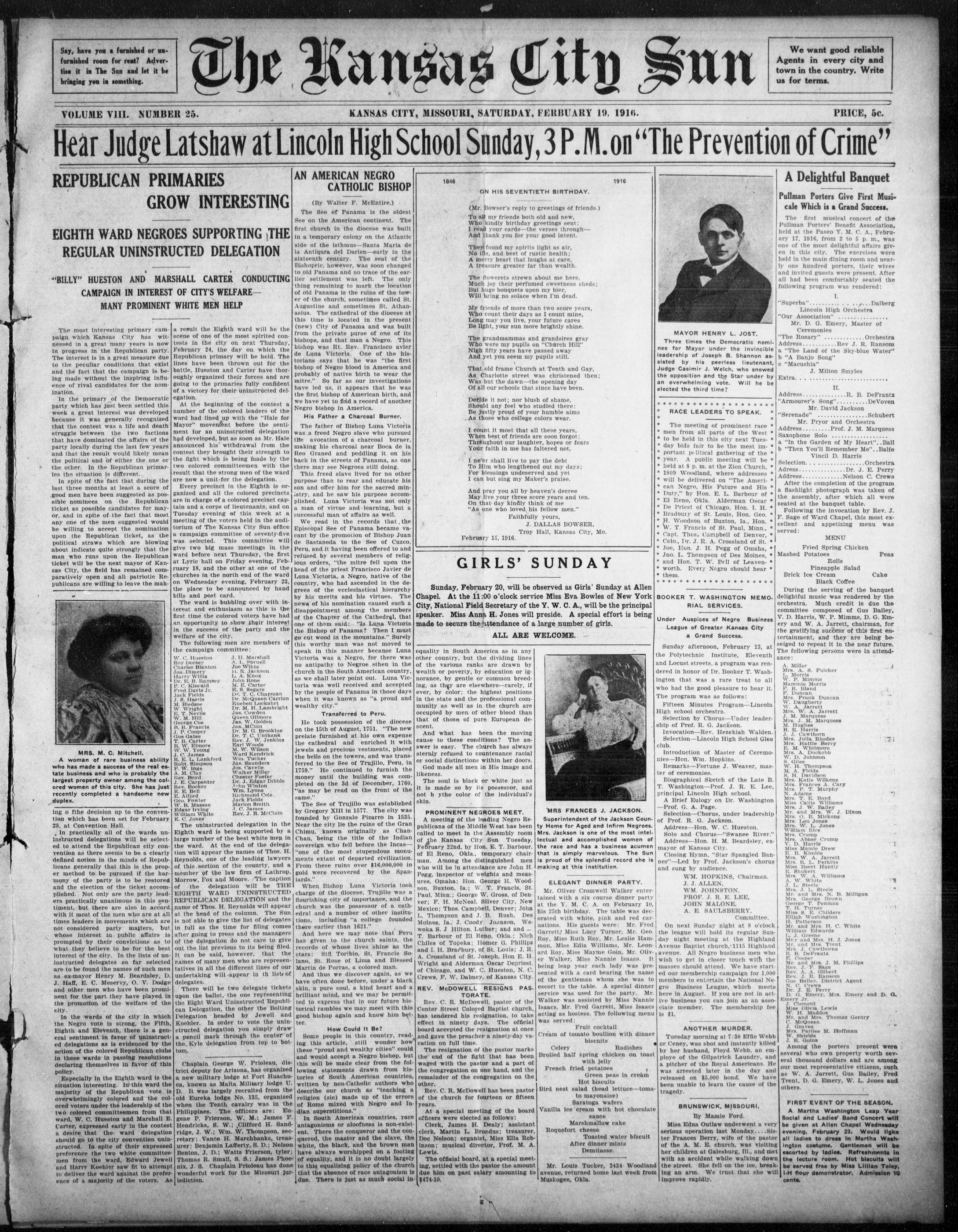
Hear Judge Latshaw at Lincoln High School Sunday, 3 P.M.on "The Prevention of Crime"
VOLUME VIII. NUMBER 25
Hear Judge Lat
REPUBLICAN PRIMA
ge Latshaw at Li PRIMARIES
GROW INTERESTING
EIGHTH WARD NEGROES S
REGULAR UNINSTRUCTE
"BILLY" HUESTON AND MARSHALL
CAMPAIGN IN INTEREST OF CIN
MANY PROMINENT WHITE
DEGROES SUPPORTING THE
INSTRUCTED DELEGATION
O MARSHALL CARTER CONDUCTING
INTEREST OF CITY'S WELFARE—
MINENT WHITE MEN HELP
EIGHTH WARD NEGROES SUPPORTING THE REGULAR UNINSTRUCTED DELEGATION
"BILLY" HUESTON AND MARSHALL CARTER CONDUCTING CAMPAIGN IN INTEREST OF CITY'S WELFARE MANY PROMINENT WHITE MEN HELP
---
---
Say, have you a furnished or unfurnished room for rent? Advertise it in The Sun and let it be bringing you in something.
The most interesting primary campaign which Kansas City has witnessed in a great many years is now in progress in the Republican party. The interest is in a great measure due to the peculiar conditions that exist and the fact that the campaign is being made without the inspiring influence of rival candidates for the nomination.
In the primary of the Democratic party which has just been settled this week a great interest was developed because it was generally recognized that the contest was a life and death struggle between the two factions that have dominated the affairs of the party locally during the last few years and that the result would likely mean the political end of either the one or the other. In the Republican primaries the situation is different.
In spite of the fact that during the last three months at least a score of good men have been suggested as possible nominees on the Republican ticket as possible candidates for mayor, and in spite of the fact that most any one of the men suggested would be willing to accept the nomination upon the Republican ticket, as the political straws which are blowing about indicate quite strongly that the man who runs upon the Republican ticket will be the next mayor of Kansas City, the field has remained comparatively open and all patriotic Republican are willing to leave the make-
MRS. M. C. Mitchell.
A woman of rare business ability who has made a success of the real estate business and who is probably the largest property owner among the colored women of this city. She has just recently completed a handsome new duplex.
ing o fthe decision up to the convention which has been set for February 28. at Convention Hall.
In practically all of the wards uninstructed delegates will be selected to attend the Republican city convention as there seems to be a clearly defined notion in the minds of Republicans generally that this is the proper method to be pursued if the harmony of the party is to be restored and the election of the ticket accomplished. Not only are the party leaders practically unanimous in this sentiment, but there are also in accord with it most of the men who are at all times leaders in movements which are not considered party matters, but whose interest in public affairs is prompted by their convictions as to what they believe to be for the best interest of the city. In the lists of uninstructed delegates so far selected are to be found the names of such men as ex-mayor Henry M. Beardsley, D. J. Haff, E. C. Meserv, O. V. Dodge and other men who have been prominent for the part they have played in the promotion of the welfare of the city.
In the wards of the city in which the Negro vote is strong, the Fifth, Eighth and Eleventh, there is a general sentiment in favor of uninstructed delegations as is evidenced by the action of the colored Republican clubs in these wards in passing resolutions declaring themselves in favor of this policy.
Especially in the Eighth ward is the situation interesting. In this ward the majority of the Republican vote is overwhelmingly colored and the colored voters under the leadership of the two colored committeemen from that ward, W. C. Hueston and Marshall E. Carter, expressed early in the contest a desire that the ward delegation should go to the city convention uninstructed. In spite of their expressed preference the two white committeemen from the ward, Edward Jewell and Harry Koehler saw fit to attempt to deliver the ward against the preference of a majority of the voters. As
The Kansas City Sun
a result the Eighth ward will be the scene of one of the most spirited contests in the city on next Thursday, February 24, the day on which the Republican primary will be held. The lines have been thrown out for the battle, Hueston and Carter have thoroughly organized their forces and are going to the primaries fully confident of a victory for their uninstructed delegation.
At the beginning of the contest a number of the colored leaders of the ward had lined up with the "Hale for Mayor" movement before the sentiment for an uninstructed delegation had developed, but as soon as Mr. Hale announced his withdrawal from the contest they brought their strength to the fight which is being made by the two colored committeemen with the result that the strong men of the ward are now a unit-for the delegation.
Every precinct in the Eighth is organized and all the colored precincts are in charge of a colored precinct captain and a corps of lieutenants, and on Tuesday evening of this week at a meeting of the voters held in the auditorium of The Kansas City Sun office a campaign committee of seventy-five was selected. This committee will give two big mass meetings in the ward before next Thursday, the first at Lyric hall on Friday evening, February 18, and the other at one of the churches in the north end of the ward on Wednesday evening, February 23, the place to be announced by hand bills and post card.
The ward is bubbling over with interest and enthusiasm as this is the first time the colored voters have had an opportunity to show their interest in the success of the party and the welfare of the city.
The following men are members of the campaign committee:
W. C. Hueston J. H. Marshall
Roy Dorsey A. L. Spruell
Charles Blanton Joe White
Jos. Dimery J. R. Jackson
Hip K. Vickers J. R. Jackson
Dr. E. B. Ramsey John Rone
P. C. Kincaid M. E. Carter
Fred Davis Jr. E. S. Segars
J. Harris Dr. C. Carpman
J. J. Harris Dr. McQueen Carrion
M. Bledsoe Rueben Lockakhr
W. Wright Dr. M. H. Lambright
E. P. Nevils J. W. Moore
W. M. Moore Queen Gilmore
George Coe Jas. W. Golden
B. B. Francis Jas. McUin
J. P. Cooper Dr. C. Brookins
T. B. Carter Dr. T. C. Unthank
T. B. Carter Rev. J. W. Jenkins
W. R. Elmore Earl Woods
W. W. Young Ward Kernick
R. E. L. Lankford Wm. Tucker
Robt. Simpson Jas. Saunders
P. W. Inge Jos. Cavelle
W. K. Meyer Wakefield
Rev. Bowl Chester Foster
J. E. Carpenter Dr. J. Edgar Dibble
Rev. Booker John Winton
R. E. Bell John Winton
E. A. Elford Richmond Cole
Geo. Fowler Jack Fields
W. B. Massae Marlon Smith
Edgar Irving J. C. James
William White J. C. James
R. C. Jones
The uninstructed delegation in the Eighth ward is being supported by a large number of the best white men in the ward. At the end of the delegation will appear the names of Thos. H. Reynolds, one of the leading lawyers of this section of the county, and a member of the law firm of Lathrop, Morrow, Fox and Moore. The caption of the delegation will be THE EIGHTH WARD UNINSTRUCTED REPUBLICAN DELEGATION and the name of Thos. H. Reynolds will appear at the head of the column. The Sun is not able to give the list of delegates in full as the time for filing comes after going to press and the managers of the delegation do not care to give out the list previous to its being filed. It can be said, however, that the names of many men who are representatives in all the different lines of our undertaking will appear in th list of delegates. There will be two delegate tickets upon the ballot, the one representing the Eight Ward Uninstructed Republic Delegation, the other the Bolting Delegation headed by Jewell and Koehler. In order to vote the uninstructed delegation you simply draw a pencil mark through the center of the, Kyle delegation from top to bottom.
Chaplain George W. Prioleau, district deputy for Arizona, has organized a new military lodge at Fort Huachuca, known as Malta Military lodge U. D. It was largely recruited from the old Eureka lodge No. 135, organized when the Tenth cavalry was in the Philippines. The officers are: Eugene P. Frierson, W. M.; James F. Hendricks, S. W.; Clifford H. Sanda ridge, J. W.; Wm. W. Thompson, see retary; Vance H. Marchbanks, treasurer; Benjamin Lafferty, S. D.; Nelson Benton, J. D.; Watts Frierson, tyler; Thomas R. Small, S. S.; James Phoenix, J. S. Chaplain Prioleau has done wonderful work for the Missouri juridiction.
KANSAS CITY, MISSOURI, SATURDAY, FERBUARY 19, 1916.
AN AMERICAN NEGRO
CATHOLIC BISHOP
(By Walter F. McEntire.)
The See of Panama is the oldest See on the American continent. The first church in the diocese was built in a temporary colony on the Atlantic side of the isthmus—Santa Maria de Antiquara del Darien—early in the sixteenth century. The seat of the Bishopric, however, was soon changed to old Panama and no trace of the earlier settlement was left. The only thing remaining to mark the location of old Panama is the ruins of the tower of the church, sometimes called St. Augustine and sometimes St. Athanasius. The cathedral of the diocese at this time is located in the present (new) City of Panama and was built from the private purse of one of its bishops, and that man a Negro. This bishop was Rt. Rev. Francisco avier de Luna Victoria. One of the historians says that he was "the first bishop of Negro blood in America and probably of native birth to wear the mitre." So far as our investigations have led us, it appears that he was the first bishop of American birth, and we have yet to find a record of another Negro bishop in America.
His Father a Charcoal Burner.
The father of Bishop Luna Victoria was a freed Negro slave who pursued the avocation of a charcoal burner, making his charcoal near Boca de la Reo Graned and peddling it on his back in the streets of Panama, as one there may see Negroes still doing.
This freed slave lived for no other purpose than to rear and educate his son and offer him for the sacred ministry, and he saw his purpose accomplished. Luna Victoria was not only a man of virtue and learning, but a successful man of affairs as well.
We read in the records that the Episcopal See of Panama became vacant by the promotion of Bishop Juan de Sastaneda to the See of Cuzco, Peru, and it having been offered to and refused by several members of religious orders, "the mitre fell upon the head of the priest Francisco Javier de Luna Victoria, a Negro, native of the country, who had ascended in the degrees of the ecclesiastical hierarchy by his merits and his virtues. The news of his nomination caused such a disappointment among the members of the Chapter of the Cathedral, that one of them said: "Is Luna Victoria the Bishop of Panama? Then I must go cut wood in the mountains." Surely this worthy man was not moved to speak in this manner because Luna Victoria was a Negro, for there was no antipathy to Negro sten in the church in the South American country, as we shall later point out. Luna Victoria was well received and accepted by the people of Panama in those days when it was known as "a proud and wealthy city."
Transferred to Peru.
He took possession of the diocese on the 15th of August, 1751. "The new prelate furnished at his own expense the cathedral and enriched it with jewels and precious vestments, placed the bells on the towers, and was transferred to the See of Trujillo, Peru, in 1759." He continued to furnish the money until the building was completed on the 3d of December, 1760, "as may be read on the front of the same."
The See of Trujillo was established by Gregory XIII in 1577. The city was founded by Gonzalo Pizarro in 1535. Near the city lie the ruins of the Gran Chimu, known originally as Chan-Chan, being the title of the Indian sovereign who fell before the Incas—"one of the most stupendous monuments extant of departed civilization. From these ruins over $16,000,000 in gold were recovered by the Spaniards."
When Bishop Luna Victoria took charge of the diocese, Trujillo was a flourishing city of importance, and the church was the possessor of a cathedral and a number of other institutions, including "a college founded there earlier than 1621."
And here we may note that Peru has given to the church saints, the records of whose lives shine as the stars: Stfl Toribio, St. Francis Solano, St. Rose of Lima and Blessed Martin de Porras, a colored man.
And thus we discover again, as we have often done before, under a black skin, a pure soul, a kind heart and a brilliant mind, and we may be permitted to express that in our future historical rambles we may meet with this good bishop again and know him better.
How Could It Be?
Some people in this country, reading this article, still wonder how these "proud and wealthy cities" could and would accept a Negro bishop, but this will be made clear from the following statements drawn from histories of South American countries, written by non-Catholic authors who describe our church as "teaching a religion (sic) made up of the errors of Rome mixed with Negro and Indian superstitions."
In South American countries, race antagonisms or aloofness is non-existent. There the conqueror and the conquered, the master and the slave, the white, the black, and the brown man have always worshipped on a footing of equality, and it is no doubt largely to this equalizing policy of the church that the absence of race antagonism is due. There is just as much social in
ON HIS SEVENTIETH BIRTHDAY.
(Mr. Bower's reply to greetings of friends.)
To all my friends both old and new,
Who kindly birthday greetings sent;
I read your cards—the verses through—
And thank you for your good intent.
They found my spirits light as air,
No ills, and best of rustie health;
A merry heart that laughs at care,
A treasure greater far than wealth.
The flowerets strewn about me here,
Much joy their perfumed sweetness sheds;
But huge bouquets upon my bier,
Will bring no solace when I'm dead.
My friends of more than two score years,
Who count their days as I count mine,
Long may you live, your future cares
Be light, your sun more brightly shine.
The grandmammas and grandsires gray
Who were my pupils on "Church Hill"
Nigh fifty years have passed away
And yet you seem my pupils still.
That old frame Church at Tenth and Gay,
As Charlotte street was christened then;
Was but the dawn—the opening day
Of all our schools that since have been.
Deride it not; nor blush of shame,
Should any feel who studied there;
Be justly proud of your humble aims
As those who college colors wear.
I count it most that all these years,
When best of friends are soon forgot;
Throughout our laughter, hopes or fears
Your faith in me has faltered not.
I ne'er shall live to pay the debt
To Him who lengthened out my days;
For blessings undeserved and yet
I can but sing my Maker's praise.
And pray you all by heaven's decree
May live your three score years and ten.
On that day kindly think of me
"As one who loved his fellow men."
Faithfully yours
DALLAS BOWSER,
Hall, Kansas City, Mo.
SUNDAY
observed as Girls' Sunday at Allen
ice Miss Eva Bowles of New York
e Y. W. C. A., will be the principal
preside. A special effort is being
large number of girls.
WELCOME.
GIRLS' SUNDAY
GIRLS' SUNDAY
Sunday, February 20, will be observed as Girls' Sunday at Allen Chapel. At the 11:00 o'clock service Miss Eva Bowles of New York City, National Field Secretary of the Y. W. C. A., will be the principal speaker. Miss Anna H. Jones will preside. A special effort is being made to secure the attendance of a large number of girls.
MRS FRANCES J. JACKSON.
Superintendent of the Jackson County Home for Aged and Infirm Negroes. Mrs. Jackson is one of the most intellectual and accomplished women of the race and has a business acumen that is simply marvelous. The Sun is proud of the splendid record she is making at this institution.
ELEGANT DINNER PARTY.
Mr. Oliver Cromwell Walker entertained with a six course dinner party at the Y. M. C. A. on February 10, his 25th birthday. The table was decorated with white, pink and red carnations. His guests were: Mr. Fred Garrett, Miss Lucy Turner, Mr. Geo Roy, Miss Ruth Roy, Mr. Leslie Hammon, Miss Edia Williams, Mr. Leonard Roy, Miss Mayne Goin, Mr. Oliver Walker, Miss Nannie Isaacs. It being leap year each lady was presented with a card bearing the name of the gentleman whom she was to escort to the table. A special dinner service was used for the party. Mr. Walker was assisted by Miss Nannie Isaacs, Mr. Fred Garrett, Miss Isaacs acting as hostess. The following menu was served:
Fruit cocktail
Cream of tomato bouillon with dinner biscuits
Celery Radishes
Broiled half spring chicken on toast with jelly
French fried potatoes
Green peas in cream
Hot biscuits
Bird nest salad (head lettuce—tomato mayonnaise)
Saratoga wafers
Vanilla ice cream with hot chocolate sauce
Marshmallow cake
Roquefort cheese
Toasted water biscuit
After dinner mints
Demitasse.
Mr. Louis Tucker, 2434 Woodland avenue, returned home last week from Muskogee, Okla.
February 15, 1916.
equality in South America as in any other country, but the dividing lines of the various ranks are drawn by wealth or poverty, by education or ignorance, by gentle or common breeding, as they are elsewhere—rarely, if ever, by color; the highest positions in the state and the professional community as well as in the church are occupied by men of other blood than that of those of pure European descent.
And what has been the moving cause to these conditions? The answer is easy. The church has always sternly refused to countenance racial or social distinctions within her doors.
God made all men in His image and likeness.
The soul is black or white just as it is made so by its possessor, and not b y the color of the individual's skin.
PROMINENT NEGROES MEET
PROMINENT NEGROES MEET.
A meeting of the leading Negro Republicans of the Middle West has been called to meet in the Assembly room of the Kansas City Sun Tuesday February 22nd, by Hon. E. T. Barbour of El Reno, Okla., temporary chairman. Among the distinguished men who will be in attendance are John H Pegg, inspector of weights and measures, Omaha; Hon. George H. Woodson, Buxton, Ia.; W. T. Francis, St Paul, Minn.; W. George W. Gros, of Denver; F. H. McNeal, Silver City, New Mexico; Thos. Campbell, Denver; John L. Thompson and J. B. Rush, Des Moines, Ia.; J. Coody Joinson, We waka S. J. Hall, Luther, and and T. Barbour of El Reno, Okla.; Nich Chiles of Topeka; Homer G. Phillips and I. H. Bradbury, of St. Louis; J. R. A. Crossland of St. Joseph, Hon E. H Wright and Alderman Oscar Despriet of Chicago, and W. C. Hueston, N. C Crews, F. W. Dabney, of Kansas City
REV. McDOWELL RESIGNS PAS
TORATE.
Rev. C. R. McDowell, pastor of the Center Street Colored Baptist church, has tendered his resignation, to take effect in ninety days. The official board accepted the resignation at once and gave the preacher a ninety-day vacation on full time.
The resignation of the pastor marks the end of the fight that has been waged with the pastor and a part of the congregation on one hand, and the remainder of the congregation on the other.
Rev. C. R. McDowell has been pastor of the church for fourteen or fifteen years.
At a special meeting of the board officers were elected as follows:
Clerk, James H. Dealy; assistant clerk, Martin L. Broedus; treasurer, Doc Nelson; organist, Miss Ella Robinson; musical director, Prof. M. A. Lewis.
The official board, at a special meeting, settled with the pastor the amount due him on past salary amounting to $474-10.
MAYOR HENRY L. JOST.
Three times the Democratic nominee for Mayor under the invincible leadership of Joseph B. Shannon assisted by his peerless lieutenant, Judge Casimir J. Welch, who snowed the opposition and the Star under by an overwhelming vote. Will he be elected the third time?
RACE LEADERS TO SPEAK.
* The meeting of prominent race men from all parts of the West to be held in this city next Tuesday bids fair to be the most important political gathering of the year. A public meeting will be held at 8 p. m. at the Zion Church, 1809 Woodland, where addresses will be delivered on "The American Negro, His Future and His Duty," by Hon. E. L. Barbour of El Reno, Okla. Alderman Oscar De Priest of Chicago, Hon. I. H. Bradbury of St. Louis, Hon. Geo. H. Woodson of Buxton, Ia., Hon. W. T. Francis of St. Paul, Minn., Capt. Thos. Campbell of Denver, Colo., Dr. J. R. A. Crossland of St. Joe, Hon. J. H. Pegg of Omaha, Jno. L. Thompson of Des Moines, and Hon. T. W. Pell of Leavenworth. Every Negro should hear them.
---
BOOKER T. WASHINGTON MEMO
RIAL SERVICES.
Under Auspices of Negro Business League of Greater Kansas City a Grand Success.
Sunday afternoon, February 13, at the Polytechnic Institute, Eleventh and Locust streets, a program was rendered in honor of Dr. Booker T. Washington that was a rare treat to all who had the good pleasure to hear it. The program was as follows:
Fifteen Minutes Program—Lincoln High school orchestra.
Selection by Chorus—Under leadership of Prof. R. G. Jackson.
Invocation—Rev. Hezekiah Walden.
Selection—Lincoln High School Glee club.
Introduction of Master of Ceremonies—Hon. Wm. Hopkins.
Remarks—Fortune J. Weaver, master of ceremonies.
Biographical Sketch of the Late B. T. Washington—Prof. J. R. E. Lee, principal Lincoln High school.
A Brief Eulogy on Dr. Washington—Prof. G. A. Page.
Selection—Chorus, under leadership of Prof. R. G. Jackson.
Address—Hon. W. C. Hueston.
Solo and Chorus—"Swanee River."
Address—Hon. H. M. Beardsley, ex-mayor of Kansas City.
Closing Hymn, "Star Spangled Banner"—Led by Prof. Jackson's chorus and sung by audience.
WM. HOPKINS, Chairman.
J. J. ALLEN,
WM. JOHNSTON.
PROF. J. R. E. LEE,
JOHN MALONE.
A. E. SAULSBERRY.
Committee.
On next Sunday night at 8 o'clock the league will hold its regular Sunday night meeting at the Highland Avenue Baptist church,*1115 Highland avenue. All Negro business men who wish to get in closer touch with the masses should attend. We have started our membership campaign for 1,000 members to entertain the National Negro Business League, which meets here in August. If you are not in active business you can join as an associate member. The membership fee is $1.
ANOTHER MURDER.
Tuesday morning at 7:30 Effie Webb or Ceney, was shot and instantly killed by her husband, Floyd Webb, an employee of the Gilpatrick Laundry, and a pitcher of the Royal Americans. He was arrested later in the day and released on $5,000 bond. We have been unable to learn the cause of the tragedy.
BRUNSWICK, MISSOURI.
Miss Edna Outlaw underwent a very serious operation last Monday...Sister Frances Berry, wife of the pastor of the A. M. E. church, was visiting her children at Galesburg, Ill., and met with an accident while walking down the street. She fell on the ice, breaking an arm. We trust that she will improve rapidly.
We want good reliable Agents in every city and town in the country. Write us for terms.
PRICE. 5c.
A Delightful Banquet
Pullman Porters Give First Musicale Which is a Grand Success.
The first musical concert of the Pullman Porters' Benefit Association, held at the Paseo Y. M. C. A., February 17, 1916, from 2 to 5 p. m., was one of the most delightful affairs given in this city. The exercises were held in the main dining room and nearly one hundred porters, their wives and invited guests were present. After all had been comfortably seated the following program was rendered:
I.
"Superba" ... Dalberg
Lincoln High Orchestra
"Our Association" ...
Mr. D. G. Emery, Master of
Ceremonies
"The Rosary" ... Orchestra
Address ... Rev J. R. Ransom
a "The Land of the Sky-blue Water"
b "A Banjo Song"
c "Macushla"
J. Milton Smyle
Extra. ...
II.
Address ... R. B. DeFrantz
"Armourer's Song" ... DeVoven
Mr. David Jackson
"Serenade" ... Schubert
Mr. Pryor and Orchestra.
Mr. Pryor and Orchestra
Address. Prof. J. M. Marquess
Saxonport, MA. a in "The garden of My Heart". Ball
h "Then You'll Remember Me". Balfe
a "In the Garden of My Heart"..Ball
b "Then You'll Remember Me"..Balfe
Vinell D. Harris
Selection.....Orchestra
Address.....Dr. J. E. Perry
Address.....Nelson C. Crews
After the completion of the program
a flashlight photograph was taken of
the assembly, after which all were
seated at the banquet table.
Following the invocation by Rev. J.
F. Sage of Ward Chapel, this most
excellent and appetizing menu was
served:
MENU
Fried Spring Chicken
Mashed Potatoes Peas
Rolls
Pineapple Salad
Brick Ice Cream Cake
Black Coffee
During the serving of the banquet
delightful music was rendered by
the orchestra. Much credit is due
the committee composed of Gus Bailey,
V. D. Harris, W. P. Mimms, D. G. Emery
and W. A. Jarrett, chairman, for
the gratifying success of this first
entertainment, and they are being
beesigned to repeat it in the near future.
The following persons were in attendance:
A. Miller
Mrs. A. S. Fulcher
L. Moyle
W. P. Mimmis
Mammie Morris
F. R. Bland
F. Dunnett
Mrs. Frank Duncan
W. Daugherty
W. A. Jarrett
Mrs. W. A. Jarrett
J. M. Marquess
M. J. M. Marquess
M. Hughes
E. R. Harris
J. J. Cawthorn
Mrs. Julia Rhodes
Mrs. Hattie Berry
D. M. Whitmore
Mrs. A. Duckob
W. D. Johnson
S. Giles
W. H. Thompson
M. A. Fields
S. H. Davidson
Mrs. Katie Wilkens
Mrs. Pruss A. Cary
Mrs. P. T. Murphy
N. Adams
Mrs. W. E. Boyd
Miss Calile Williams
Mrs. J. W. Bailey
Mr. and Mrs. W. J. Dixon
Mrs. O. B. Mickens
Mrs. Lachie Pope
Mrs. W. L. Jones
William Rice
Mrs. Crump
Mrs. A. Abner Crump
V. D. Harris
Miss Mamie Drew
J. H. Kumble
Mrs. W. A. Jarrett
Mrs. R. L. Perkins
Miss Beert Huntly
R. Shukert
Mrs. V. A. Williams
A. W. White
J. L. Steele
Mrs. J. L. Steele
Mr. and Mrs. N. B. Milligan
Mrs. George Brown
George T. Penman
T. H. Prentz
Miss S. E. Childers
Elijah Washington
H. Patterson
Mr. and Mrs. H. C. White
William Edwards
L. J. Greene
Mrr. and Mrs. H. J. Jones
Mr. and Mrs. Trent
Mrs. J. Cawthorne
R. B. DeFrantz
F. Coope
Mr. and Mrs. J. M. Phillips
Rev. J. F. Saze
Rev. A. G. Gilbert
Rev. V. R. Ransom
Gas Balley District Agent
N. C. Crews
Dr. J. E. Perry
D. J. Emery, Mrs. Emery and D. G.
Emery Jr.
Miss Olivia Lewis
W. H. Maddux
Mr. and Mrs. Thomas Gentry
C. McQueen
J. Graves
Mrs. Diane M. Hoffman
W. Shields
J. R. Goins
Among the porters present were several who own property worth several thousand dollars and are among our most representative citizens, such as W. A. Jarrett, Gus Bailey, Fred Trent, D. G. Emery, W. L. Jones and others.
FIRST EVENT OF THE SEASON.
A Martha Washington Leap Year Social and Ladies' Band Concert will be given at Allen Chapel Wednesday evening, February 23. Would ligike all ladies to dress in Martha Washington costume. Gentlemen will be escorted by ladies. Refreshments in the lecture room. Hot biscuits will be served free by Miss Lillian Toley, I-H flour demonstrator. Admission 10 cents.
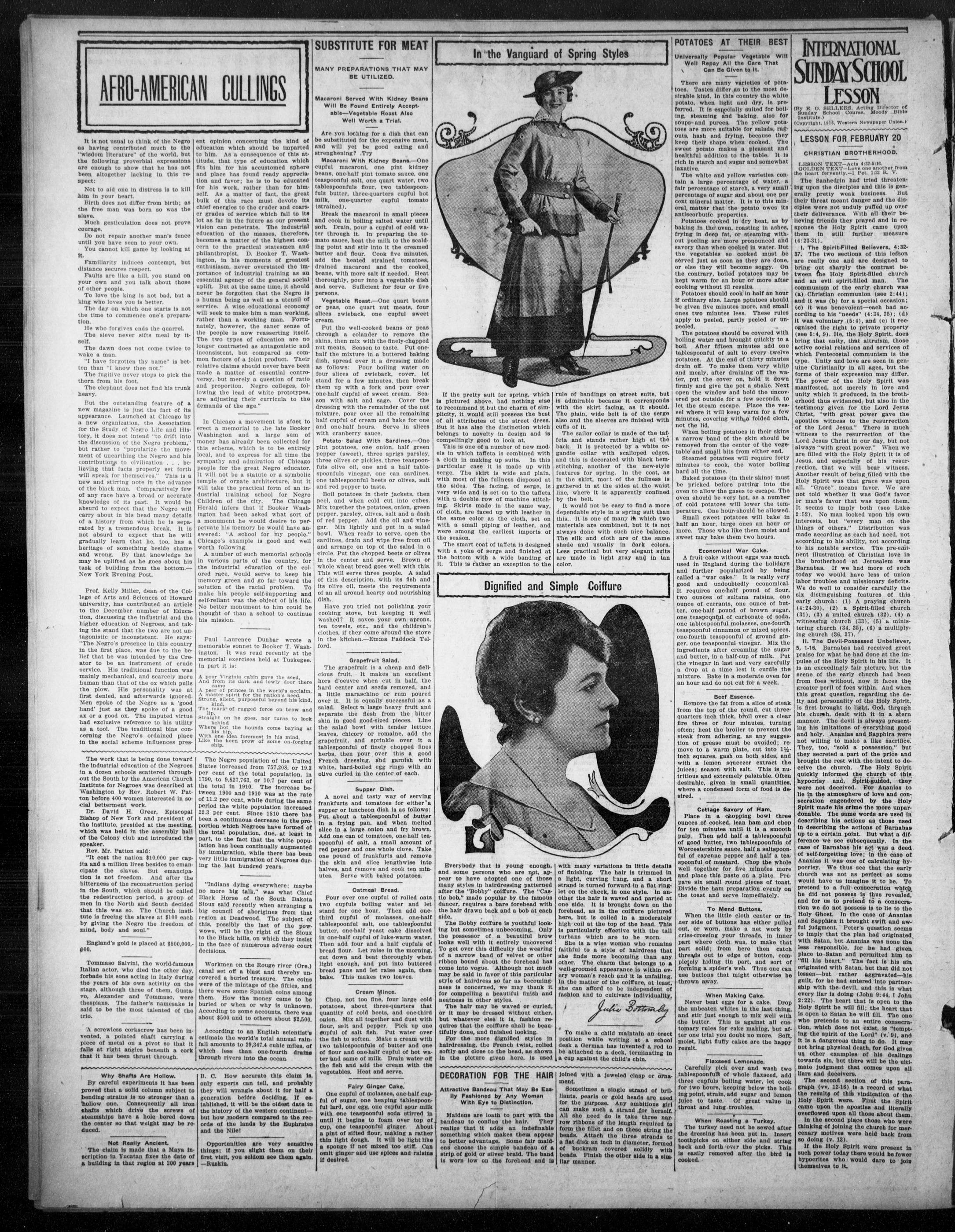
AFRO-AMERICAN CULLINGS
It is not usual to think of the Negro as having contributed much to the "wisdom literature" of the world, but the following proverbial expressions are enough to show that he has not been altogether lacking in this respect:
Not to aid one in distress is to kill him in your heart.
Birth does not differ from birth; as the free man was born so was the slave.
Much gesticulation does not prove courage.
Do not repair another man's fence until you have seen to your own.
You cannot kill game by looking at it.
Familiarity induces contempt, but distance secures respect.
Faults are like a hill, you stand on your own and you talk about those of other people.
To love the king is not bad, but a king who loves you is better.
The day on which one starts is not the time to commence one's preparation.
He who forgives ends the quarrel.
The sieve never sifts meal by itself.
The dawn does not come twice to wake a man.
"I have forgotten thy name" is better than "I know thee not."
The fugitive never stops to pick the thorn from his foot.
The elephant does not find his trunk heavy.
But the outstanding feature of a new magazine is just the fact of its appearance. Launched at Chicago by a new organization, the Association for the Study of Negro Life and History, it does not intend "to drift into the discussion of the Negro problem," but rather to "popularize the movement of unearthing the Negro and his contributions to civilization . . . believing that facts properly set forth will speak for themselves." This is a new and stirring note in the advance of the black man. Comparatively few of any race have a broad or accurate knowledge of its past. It would be absurd to expect that the Negro will carry in his head many details of a history from which he is separated by a tremendous break. It is not absurd to expect that he will gradually learn that he, too, has a heritage of something beside shame and wrong. By that knowledge he may be uplifted as he goes about his task of building from the bottom—New York Evening Post.
---
Prof. Kelly Miller, dean of the College of Arts and Sciences of Harvard university, has contributed an article to the December number of Education, discussing the Industrial and the higher education of Negroes, and taking the stand that the two are not antagonistic or inconsistent. He says: "The Negro's presence in this country in the first place, was due to the belief that he was intended by the Creator to be an instrument of crude service. His traditional function was mainly mechanical, and scarcely more human than that of the ox which pulls the plow. His personality was at first denied, and afterwards ignored. Men spoke of the Negro as a 'good hand' just as they spoke of a good ax or a good ox. The imputed virtue had exclusive reference to his utility as a tool. The traditional bias concerning the Negro's ordained place in the social scheme influences pres
The work that is being done toward the industrial education of the Negroes in a dozen schools scattered throughout the South by the American Church Institute for Negroes was described at Washington by Rev. Robert W. Patton before 400 women interested in social betterment work. Dr. David H. Greer, Episcopal Bishop of New York and president of the institute, presided at the meeting, which was held in the assembly hall of the Colony club and introduced the speaker. Rev. Mr. Patton said:
"It cost the nation $10,000 per capita and a million lives besides to emancipate the slaves. But emancipation is not freedom. And after the bitterness of the reconstruction period in the South, which should be called the redemption period, a group of men in the North and South decided that this was so. The Church institute is freeing the slaves at $100 each by giving the Negro the freedom of mind, body and soul."
England's gold is placed at $800,000.00.
Tommaso Salvini, the world-famous Italian actor, died the other day, forbade his sons acting in Italy during the years of his own activity on the stage, although three of them, Gustavo, Alexander and Tommaso, were the thespians. The father's namesake is said to be the most talented of the trio.
A screwless corkscrew has been invented, a pointed shaft carrying a piece of metal on a plov so that it falls at right angles beneath a cork that it has been thrust through.
By careful experiments it has been proved that a solid column subject to bending strains is no stronger than a hollow one. Consequently all iron shafts which drive the screws of steamships have a hole bored down the center so that weight may be reduced.
Not Really Ancient.
The claim is made that a Maya inscription in Yucatan fixes the date of a building in that region at 200 years
ent opinion concerning the kind of education which should be imparted to him. As a consequence of this attitude, that type of education which fits him for his accustomed sphere and place has found ready appreciation and favor; he is to be educated for his work, rather than for himself. As a matter of fact, the great bulk of this race must devote its chief energies to the cruder and coarser grades of service which fall to its lot as far in the future as our present vision can penetrate. The industrial education of the masses, therefore, becomes a matter of the highest concern to the practical statesmen and philanthropist. D. Booker T. Washington, in his moments of greatest enthusiasm, never overstated the importance of industrial training as an essential agency of the general social uplift. But at the same time, it should never be forgotten that the Negro is a human being as well as a utensil of service. A wise educational economy will seek to make him a man working, rather than a working man. Fortunately, however, the saner sense of the people is now reasserting itself. The two types of education are no longer contrasted as antagonistic and inconsistent, but compared as common factors of a joint product. Their relative claims should never have been made a matter of essential controversy, but merely a question of ratio and proportion. Negro colleges, following the lead of white prototypes, are adjusting their curricula to the demands of the age."
In Chicago a movement is afoot to erect a memorial to the late Booker Washington and a large sum of money has already been collected for this scheme, which is to be entirely local, and to express for all time the sympathy and admiration of Chicago people for the great Negro educator. It will not be a statute or a symbolic temple of ornate architecture, but it will take the practical form of an industrial training school for Negro Children of the city. The Chicago Herald infers that if Booker Washington had been asked what sort of a monument he would desire to perpetuate his memory he would have an answered: "A school for my people." Chicago's example is good and well worth following.
A number of such memorial schools in various parts of the country, for the industrial education of the colored race, would serve to keep his memory green and go far toward the solution of the racial problem. To make his people self-supporting and self-reliant was the object of his life. No better monument to him could be thought of than a school to continue his mission.
Paul Laurence Dunbar wrote a memorable sonnet to Booker T. Washington. It was read recently at the memorial exercises held at Tuskegee. In part it is:
A poor Virginia cabin gave the seed, And from its dark and lowly door there came a peace of princes in the world's acclaim. A master spirit for the nation's need. Strong, silent, purposeful beyond his kind, Kind the rugged force on brow and lip, Straight on he goes, nor turns to look sbowl. Where hot the hounds come baying at his hip. With the idea foremost in his mind. Like the idea prow of some on-forging ship.
The Negro population of the United States increased from 757,208, or 19.3 per cent of the total population, in 1790, to 9,827,763, or 10.7 per cent of the total in 1910. The increase between 1900 and 1910 was at the rate of 11.2 per cent, while during the same period the white population increased 22.3 per cent. Since 1810 there has been a continuous decrease in the proportion which Negroes have formed of the total population, due, at least in part, to the fact that the white population has been continually augmented by immigration, while there has been very little immigration of Negroes during the last hundred years.
---
"Indians dying everywhere; maybe no more big talk," was what Chief Black Horse of the South Dakota Sioux said recently when arranging a big council of aborigines from that region at Deadwood. The subject of this, possibly the last of the powwows, will be the right of the Sioux to the Black hills, on which they insist in the face of numerous adverse court decisions.
Workmen on the Rouge river (Ore.) canal set off a blast and thereby uncovered a buried treasure. The coins were of the mintage of the fifties, and there were some Spanish coins among them. How the money came to be buried or when or why is unknown. According to some accounts, there was about $500 and to others about $2,500.
According to an English scientist's estimate the world's total annual rainfall amounts to 29,347.4 cubic miles, of which less than one-fourth drains through rivers into the ocean.
B. C. How accurate this claim is, only experts can tell, and probably they will wrangle about it for half a generation before deciding. If established, it will be the oldest date in the history of the western continent—but how modern compared to the records of the lands by the Euphrates and the Nile!
Opportunities are very sensitive things; if you slight them on their first visit, you seldom see them again.—Ruskin.
MANY PREPARATIONS THAT MAY BE UTILIZED.
Macaroni Served With Kidney Beans
Will Be Found Entirely Acceptable—Vegetable Roast Also Well Worth a Trial.
Are you locking for a dish that can be substituted for the expensive meat, and will yet be good eating and strengthening? Try
Macaroni With Kidney Beans.—One cupful macaroni, one pint kidney beans, one-half pint tomato sauce, one teaspoon salt, one quart water, two tablespoonfuls flour, two tablespoonfuls butter, three-quarters cupful hot milk, one-quarter cupful tomato (strained).
Break the macaroni in small pieces and cook in boiling salted water until soft. Drain, pour a cupful of cold water through it. In preparing the tomato sauce, heat the milk to the scalding point and stir into it the creamed butter and flour. Cook five minutes, add the heated strained tomatoes, drained macaroni and the cooked beans, with more salt if needed. Heat thoroughly, pour into a vegetable dish and serve. Sufficient for four or five persons.
**Vegetable Roast.**—One quart beans or peas, one quart nut meats, four slices zwieback, one cupful sweet cream.
Put the well-cooked beans or peas through a colander to remove the skins, then mix with the finely-chapped nut meats. Season to taste. Put one-half the mixture in a buttered baking dish, spread over it a dressing made as follows: Pour boiling water on four slices of zwieback, cover, let stand for a few minutes, then break them up with a fork and pour over one-half cupful of sweet cream. Season with salt and sage. Cover the dressing with the remainder of the nut mixture, pour over all the remaining half cupful of cream and bake for one and one-half hours. Serve in slices with cranberry sauce.
**Potato Salad With Sardines.**—One pint potatoes, one onion, half green pepper (sweet), three sprigs parsley, three olives or pickles, three teaspoonful olive oil, one and a half tablespoonful vinegar, one can sardines, one tablespoonful beets or olives, salt and red pepper to taste.
Boil potatoes in their jackets, then peel, and when cold cut into cubes. Mix together the potatoes, onion, green pepper, parsley, olives, salt and a dash of red pepper. Add the oil and vinegar. Mix lightly and put in a salad bowl. When ready to serve, open the sardines, drain and wipe free from oil and arrange on top of the salad in a circle. Put the chopped beets or olives in the center and serve. Brown or whole wheat bread goes well with this. This will serve three people. A salad of this description, with its fish and its olive oil, meets the requirements of an all around hearty and nourishing dish.
Have you tried not polishing your cooking stove, but keeping it well washed? It saves your own aprons, tea towels, etc., and the children's clothes, if they come around the stove in the kitchen—Emma Paddock Telford.
Grapefruit Salad.
The grapefruit is a cheap and delicious fruit. It makes an excellent hors d'oeuvre when cut in half, the hard center and seeds removed, and a little maraschino or rum poured over it. It is equally successful as a salad. Select a large heavy fruit and separate the flesh from the bitter skin in good good-sized pieces. Line the salad bowl with tender lettuce leaves, chicory or romaine, add the grapefruit, and sprinkle over it a tablespoonful of finely chopped fines herbs, then pour over this a good French dressing, and garnish with white, hard-boiled egg rings with an olive curled in the center of each.
Supper Dish.
A novel and tasty way of serving frankfurters and tomatoes for either a supper or luncheon dish is as follows: Put about a tablespoonful of butter in a frying pan, and when melted slice in a large onion and fry brown. Add one can of tomatoes, one half teaspoonful of salt, a small amount of red pepper and one whole clove. Take one pound of frankfurters and remove the skin and slice lengthwise into halves, and remove and cook ten minutes. Serve with baked potatoes.
Oatmeal Bread.
Pour over one cupful of rolled oats two cupfuls boiling water and let stand for one hour. Then add one third cupful of molasses, one-half tablespoonful salt, one tablespoonful butter, one-half yeast cake dissolved in one-half cupful of luk-warm water. Then add four and a half cupfuls of bread flour. Let raise in the morning, cut down and beat thoroughly when light enough, and put into buttered bread pans and let raise again, then bake. This makes two loaves.
Cream Mince
Chop, not too fine, four large cold potatoes, about three-quarters that quantity of cold beets, and one-third onion. Mix all together and dust with flour, salt and pepper. Pick up one cupful of salt fish. Put water over the fish to soften. Make a cream with two tablespoonfuls of butter and one of flour and one-half cupful of hot water and same of milk. Drain water off the fish and add the cream with the vegetables. Heat and serve.
Fairy Ginger Cake.
One cupful of molasses, one-half cupful of sugar, one heaping tablespoonful lard, one egg, one cupful sour milk with one teaspoonful soda stirred in until it begins to foam over top of cup, one teaspoonful ginger. About a pint of sifted flour, making a rather thin light dough. It will be light like a sponge if not mixed too stiff. Can omit ginger and use spices and raisins if desired.
In the Vanguard of Spring Styles
Dignified and Simple Coiffure
If the pretty suit for spring, which is pictured above, had nothing else to recommend it but the charm of simplicity, it would still possess the best of all attributes of the street dress. But it has also the distinction which belongs to novelty in design and is compellingly good to look at.
This is one of a number of new models in which taffeta is combined with a cloth in making up suits. In this particular case it is made up with serge. The skirt is wide and plain, with most of the fullness disposed at the sides. The facing, of serge, is very wide and is set on to the taffeta with a double row of machine stitching. Skirts made in the same way, of cloth, are faced up with leather in the same color as the cloth, set on with a small piping of leather, and were among the earliest imports of the season.
The smart coat of taffeta is designed with a yoke of serge and finished at the bottom with a wide banding of it. This is rather an exception to the
Dignified and S
Everybody that is young enough, and some persons who are npt, appear to have adopted one of those many styles in hairdressing patterned after the "Bobby" coiffure. The "Castle bob" made popular by the famous dancer, requires a bare forehead with the hair drawn back and a bob at each side. The Bobby coiffure is youthful looking but sometimes unbecoming. Only the possessor of a beautiful brow looks well with it entirely uncovered To get over this difficulty the wearing of a narrow band of velvet or other ribbon bound about the forehead has come into vogue. Although not much may be said in favor of this particular style of hairdress so far as becomingness is concerned, we may thank it for compelling a beautiful finish and neatness in other styles. The hair may be waved or curled, or it may be dressed without either, but whatever else it is, fashion requires that the coiffure shall be beautifully done, and finished looking.
For the more dignified styles in hairdressing, the French twist, rolled softly and close to the head, as shown in the picture given here, is used
DECORATION FOR THE HAIR
Attractive Bandeau That May Be Easily Fashioned by Any Woman With Eye to Distinction.
Maldens are loath to part with the bandeau to confine the hair. They realize that it adds an indefinable something which makes them appear to better advantage. Some fair maldens choose the simple bandeau of a strip of gold or silver braid. The band is worn low on the forehead and is
rule of bandings on street suits, but is admirable because it corresponds with the skirt facing, as it should. The plain, wide belt is of the serge also and the sleeves are finished with cuffs of it.
The sailor collar is made of the tafeta and stands rather high at the back. It is protected by a white organdie collar with scalloped edges, and this is decorated with black hem-stitching, another of the new-style features for spring. In the coat, as in the skirt, most of the fullness is gathered in at the sides at the waist line, where it is apparently confined by the belt.
It would not be easy to find a more dependable style in a spring suit than this. It is one of many which two materials are combined, but it is not always done with such nice balance. The silk and cloth are of the same shade and usually in dark colors. Less practical but very elegant suits are made in light gray and in tan color.
Simple Coiffure
with many variations in little details of finishing. The hair is trimmed in a light, curving tang, and a short strand is turned forward in a flat ringlet on the cheek, in one style. In another the hair is waved and parted at one side. It is brought down on the forehead, as in the coiffure pictured here, but is coiled in a moderately high collat at the top of the head. This is particularly effective with the tall turbans which are to be worn. She is a wise woman who remains faithful to a style of hairdress that she finds more becoming than any other. The charm that belongs to a well-groomed appearance is within every woman's reach and it is unfailing. In the matter of the coiffure, at least, she can afford to be independent of fashion and to cultivate individuality.
To make a child maintain an erect position while writing at a school desk a German has invented a rod to be attached to a deck, terminating in a cup against the child's chin.
Joined with a jeweled clasp or ornament.
Sometimes a single strand of brilliants, pearls or gold beads are used for the purpose. Any ambitious girl can make such a strand for herself. All she need do is take three narrow ribbons of the length required to form the fillet and on these string the beads. Attach the three strands to a flat disk an inch in diameter, formed of buckram covered solidly with beads. Finish the other side in a similar manner.
---
Universally Popular Vegetable Will Well Repay All the Care That Can Be Given to it.
There are many varieties of potatoes. Tastes differ as to the most desirable kind. In this country the white potato, when light and dry, is preferred. It is especially suited for boiling, steaming and baking, also for soups and purées. The yellow potatoes are more suitable for salads, ragouts, hash and frying, because they keep their shape when cooked. The sweet potato makes a pleasant and healthful addition to the table. It is rich in starch and sugar and somewhat laxative.
The white and yellow varieties contain a large percentage of water, a fair percentage of starch, a very small percentage of sugar and about one per cent mineral matter. It is to this mineral matter that the potato owes its antiscorbic properties.
Potatoes cooked in dry heat, as by baking in the oven, roasting in ashes, frying in deep fat, or steaming without peeling are more pronounced and savory than when cooked in water. But the vegetables so cooked must be served just as soon as they are done, or else they will become soggy. On the contrary, boiled potatoes may be kept warm for an hour or more after cooking without ill results.
Potatoes should cook in half an hour if ordinary size. Large potatoes should be given five minutes more, and small ones two minutes less. These rules apply to peeled, partly peeled or unpeeled.
The potatoes should be covered with boiling water and brought quickly to a boil. After fifteen minutes add one tablespoonful of salt to every twelve potatoes. At the end of thirty minutes drain off. To make them very white and mealy, after draining off the water, put the cover on, hold it down firmly and give the pot a shake. Next open the window and hold the uncovered pot outside for a few seconds, to let the steam escape. Place the vessel where it will keep warm for a few minutes, covering with a folded cloth, not the lid.
When boiling potatoes in their skins a narrow band of the skin should be removed from the center of the vegetable and small bits from either end.
Steamed potatoes will require forty minutes to cook, the water boiling hard all the time.
Baked potatoes (in their skins) must be pricked before putting into the oven to allow the gases to escape. The oven should be very hot, as a number of cold potatoes will lower the temperature. One hour should be allowed. Small sweet potatoes will bake in half an hour, large ones an hour or more. Those who like them moist and sweet may make them two hours.
Economical War Cake
Economical War Cake.
A fruit cake without eggs was much used in England during the holidays and further popularized by being called a "war cake." It is really very good and undoubtedly economical. It requires one-half pound of flour, two ounces of sultana raisins, one ounce of currants, one ounce of butter, one-half pound of brown sugar, one teaspoonful of carbonate of soda, one tablespoonful molasses, one-fourth teaspoonful cinnamon or mixed spices, one-fourth teaspoonful of ground ginger, one teaspoonful vinegar. Mix the ingredients after creaming the sugar and butter, in a half-cup of milk. Put the vinegar in last and very carefully a drop at a time lest it curdle the mixture. Bake in a moderate oven for an hour and do not cut for a week.
Beef Essence.
Remove the fat from a slice of steak from the top of the round, cut three-quarters inch thick, broil over a clear fire three or four minutes, turning often; heat the broiler to prevent the steak from adhering, as any suggestion of grease must be avoided; remove to a warm plate, cut into 1½-inch squares, gash on both sides, and with a lemon squeezer extract the juices; season with salt. This is nutritious and extremely palatable. Often desirable, given in small quantities, where a condensed form of food is desired.
Cottage Savory of Ham.
Place in a chopping bowl three ounces of cooked, lean ham and chop for ten minutes until it is a smooth pulp. Then add half a tablespoonful of good butter, two tablespoonfuls of Worcestershire sauce, half a saltspoonful of cayenne pepper and half a tea spoonful of mustard. Chop the whole well together for five minutes more and place this paste on a plate. Prepare six small round pieces of toast Divide the ham preparation evenly on the toast and serve immediately.
To Mend Buttons
When the little cloth center or inner side of buttons has either pulled out, or worn, make a net work by criss-crossing your threads, in inner part where cloth was, to make that part solid; from here then catch threads out to edge of button, completely hiding tin part, and sort of forming a spider's web. Thus one can use buttons that might otherwise be thrown away.
When Making Cake.
Never beat eggs for a cake. Drop the unbeaten whites in the last thing, and stir just enough to mix well with the butter. This is against all customary rules for cake making, but after one trial you doubt no more. Soft, moist, light fluffy cakes are the happy result.
Flaxseed Lemonade.
Carefully pick over and wash two tablespoonful of whole flaxseed, add three cupfuls boiling water, let cook for two hours, keeping below the boiling point, strain, add sugar and lemon juice to taste. Of great value in throat and lung troubles.
When Roasting a Turkey.
The turkey need not be sewed after the dressing has been put in. Insert toothpicks on either side and string back and forth over the picks. This is easily removed after the bird is cooked.
INTERNATIONAL
SUNDAY SCHOOL
LESSON
(BY E. O. SELLERS, Acting Director of
Sunday School Course, Moody Bible
Illustrations)
LESSON FOR FEBRUARY 2
CHRISTIAN BROTHERHOOD.
LESSON TEXT—Acts 4:22-5:16.
GOLDEN TEXT—Love one another from the heart fervently.—1 Pet. 1:22 R. V.
The Sanhedrin had tried threatening upon the disciples and this is generally pretty weak business. But their threat meant danger and the disciples were not unduly puffed up over their deliverance. With all their believing friends they prayed and in response the Holy Spirit came upon them in still further measure
(4:23-31).
1. The Spirit-Filled Believers, 4:32-37. The two sections of this lesson are really one and are designed to bring out sharply the contrast between the Holy Spirit-filled church and an evil spirit-filled man. The communism of the early church was (a) Christian communion (see 2:44); and it was (b) for a special occasion; (c) it was benevolent—each had according to his "needs" (4:34, 35); (d) it was voluntary (5:4), and (e) it recognized the right to private property (see 5:4, 9). He, the Holy Spirit, does bring that unity, that altruism, those active social relations and services of which Pentecostal communism is the type. Unity and love are seen in genuine Christianity in all ages, but the forms of their expression may differ. The power of the Holy Spirit was manifested, not merely in love and unity which it produced, in the brotherhood thus evidenced, but also in the testimony given for the Lord Jesus Christ, "with great power gave the apostles witness to the resurrection of the Lord Jesus." There is much witness to the resurrection of the Lord Jesus Christ in our day, but not always "with great power." When we are filled with the Holy Spirit it is of Jesus, and especially of his resurrection, that we will bear witness. Another result of being filled with the Holy Spirit was that grace was upon all. "Grace" means favor. We are not told whether it was God's favor or man's favor that was upon them. It seems to imply both (see Luke 2:52). No man looked upon his own interests, but "every man on the things of others." Distribution was made according as each had need, not according to his ability, not according to his notable service. The pre-eminent illustration of Christian love in the brotherhood at Jerusalem was Barnabas. If we had more of such today we would have less of union labor troubles and missionary deficits. We do well to consider carefully the six distinguishing features of this early church: (1) A praying church (2:42-30), (2) a Spirit-filled church (31), (3) a united church (32), (4) a witnessing church (33), (5) a ministering church (34, 35), (6) a multiplying church (36, 37).
II. The Devil-Possessed Unbeliever, 5. 1-16. Barnabas had received great praise for what he had done at the impulse of the Holy Spirit in his life. It is an exceedingly fair picture, but the scene of the early church had been from foes without, now it faces the greater peril of foes within. And when this great question, regarding the deity and personality of the Holy Spirit, is first brought to light, God, through his church, dealt with it in a stern manner. The devil is always presenting his imitations of everything good and holy. Ananias and Sapphira were not willing to make a like sacrifice. They, too, "sold a possession," but they secreted a part of the price and brought the rest with the intent to deceive the church. The Holy Spirit quickly informed the church of this hypocrisy and, Spirit-guided, they were not deceived. For Ananias to lie in the atmosphere of love and consecration engendered by the Holy Spirit made his crime the more unparadonable. The same words are used in describing his actions as those used in describing the actions of Barnabas up to a certain point. But what a difference we see subsequently. In the case of Barnabas his act was a deed of self-forgetting love; in the case of Ananias it was one of calculating hypocrisy. We thus see that the early church was not as perfect as some would have us imagine it to be. To pretend to a full consecration which he did not possess is thus revealed, and for us to pretend to a consecration we do not possess is to lie to the Holy Ghost. In the case of Ananias and Sapphira it brought swift and awful judgment. Peter's question seems to imply that the plan had originated with Satan, but Ananias was none the less responsible, for he had given place to Satan and permitted him to "fill his heart." The fact is his sin originated with Satan, but that did not lessen—but rather aggravated—his guilt, for he had entered into partnership with the devil, and this is what every liar is doing (John 9:44, I John 2:22). The heart that is open to the Holy Spirit he will fill; the heart that is open to Satan he will fill. The one who pretends to an entire consecration, which does not exist, is "tempting the spirit of the Lord" (v. 9), and it is a dangerous thing to do. It may not bring physical death, for God gives us other examples of his dealings towards sin, but there will be the ultimate judgment that comes upon all lilars and deceivers.
The second section of this paragraph (vv. 12-16) is a record of what the results of this vindication of the Holy Spirit were. First the Spirit came upon the apostles and literally overflowed upon all those about them. In the second place those who were thinking of joining the church for mercenary motives were held back from so doing (v. 13). If the Holy Spirit were present in such power today there would be fewer hypocrites who would dare to join themselves to it.
Madam P. M. Dabney's XXTH CENTURY HAIR PREPARATIONS
And Have Good Hair
Mme. P. M. Dabney's XXth Century Hair Grower
Madam P. M. Dabney's XXth Century Hair Grower promotes a beautiful growth of hair, stops falling out and breaking of hair, removes dandruff and relieves itching of scalp. It will make YOUR hair grow. For woman, man or child.
PRICE 50c. PER JAR
Mme. P. M. Dabney's XXth Century Hair Grower
IAL Six Weeks' T
TESTIMONIAL
"This is to certify that the writer suffered for four years with danduff and itching of the scalp until practically bald, trying many remedies but of no avail. About six months ago I began to use Madam P. M. Dabney the XXth Century Hair Grower, the results up to date are pleasing. Dandruff removed, itching stopped, good growth of hair started. The remedy is O. K. Yours for success, Rev. L. W. Harris, Mod. Mt. Zion Baptist Association, Carrollton, Mo."
Make a course of treatment which will last six weeks enclosing P. O. money or by parcel post prepaid, or wation to
Madam P. M. Dal
HAIR PREP
1806 E. 24th St.
---
---
DR. L. L. SHELTON DENTIST
Announces the opening of a dent
and Vine streets, over McCampbell
would be pleased to make an exam
mate on your work.
Office hours, 9:00 A. M to 6 P. M.
places the opening of a dental office at corp
streets, over McCampbell & Houston's D
pleased to make an examination and s
your work.
s, 9:00 A. M to 6 P. M. Sundays by
mg of a dental office at corner of Howard
McCampbell & Houston's Drug Store. He
make an examination and submit an esti-
to 6 P. M. Sundays by Appointment.
Announces the opening of a dental office at corner of Howard and Vine streets, over McCampbell & Houston's Drug Store. He would be pleased to make an examination and submit an estimate on your work.
Office hours, 9:00 A. M to 6 P. M. Sundays by Appointment.
[Image of a woman with long hair]
A WONDERFUL HAIR DRESSER AND GROWER
One thousand agents wanted. We want agents in every city of THE STAR HAIR GROWER. The preparation. Can be used with o ening irons. Sells for 25c per box—one 25c value. Any person that will use convinced. No matter what h your hair just give THE STAR trial and be convinced. Send 25 If you wish to be an agent send
One thousand agents wanted. Good money made. We want agents in every city and village to sell THE STAR HAIR GROWER. This is a wonderful preparation. Can be used with or without straight ening irons.
Sells for 25c per box—one 25c box will prove its value. Any person that will use a 25c box will be convinced. No matter what has failed to grow your hair just give THE STAR HAIR GROWER a trial and be convinced. Send 25c for full size box. If you wish to be an agent send $1.00 and we will
One thousand agents wanted. Good money made.
We want agents in every city and village to sell
THE STAR HAIR GROWER. This is a wonderful
preparation. Can be used with or without straight-
ening irons.
Sells for 25c per box—one 25c box will prove its
value. Any person that will use a 25c box will be
convinced. No matter what has failed to grow
your hair just give THE STAR HAIR GROWER a
trial and be convinced. Send 25c for full size box.
If you wish to be an agent send $1.00 and we will
send you a full supply that you can begin work
with at once; also agents' terms. Send all money
by Money Order to
THE STAR HAIR GROWER MFGR.
1413 Clark Street. Evanston, Ill.
KELLEY'S BEST
KELLEY'S
BEST
HIGH PATENT
FLOUR
Kelley's Best
Beat all the Rest.
Kelley Milling Co.
K.C., U.S.A.
CUT THIS BLANK OUT, FILL IT IN, AND MAIL OR SEND TO OUR OFFICE.
Sir: Please enter my name as a subscriber to The Kansas City Sun for 1916 per your Special Rate Offer and stop my paper on December 31, 1916, unless otherwise notified.
Mme. P. M. Dabney's XXth Century Pressing Oil
Madam P. M. Dabney's XXth Century Pressing Oil is an ideal hair dressing, having properties which protect the hair from wind, weather and disease, make it soft and glossy; improves the quality of the hair and promotes straightening without irons. For woman, man or child.
PRICE 50c. PER BOX
Mme. P. M. Dabney's XXth Century Pressing Oil
Six Weeks' Treatment $1.25
Make a course of treatment for the hair and scalp which will last six weeks. Send us an order today enclosing P. O. money order for $1.25 and receive them by parcel post prepaid, or write for literature and information to
Madam P. M. Dabney's XXth Century
HAIR PREPARATIONS CO.
1806 E. 24th St. Kansas City, Mo.
One jar Madam P. M. Dabney's
XXth Century Hair Grower
One box Madam P. M. Dabney's
XXth Century Pressing Oil
And one bottle Madam P. M.
Dabney's . . . . .
XXth Century Shampoo . .
TESTIMONIAL
"With the use of Madam P. M. Dabney's XXth Century Hair Preparations my hair has grown four inches in six months. I would not be without them." Mrs. Henderson, 1721 Forest Ave., Kansas City, Mo.
Mme. P. M. Dabney's XXth Century Shampoo
Madam P. M. Dabney's XXth Century Shampoo is the best cleaner for the washing of the heads of colored people. It contains no astringents or other ingredients harmful to the scalp. It promotes hair health and vigor. For woman, man or child.
PRICE 50c. PER BOTTLE
Mme. P. M. Dabney's
XXth Century Shampoo
Treatment $1.25
treatment for the hair and scalp
seeks. Send us an order today
by order for $1.25 and receive them
or write for literature and infor-
Dabney's XXth Century
EPARATIONS CO.
Kansas City, Mo.
Kansas City Selected
National Negro Business League to Hold Seventeenth Annual Session August 16, 1916.
After a most careful consideration of the several invitations received from different sections of the country for the next meeting of the National Negro Business League, we are authorized by the members of the executive committee to announce that the league has decided to accept the invitation extended by the local Negro Business League of Greater Kansas City. The meeting will be held August 16, 17 and 18, 1916.
It appears that the Business League has selected a most opportune time to hold their meeting in Kansas City, for as Mr. Fortune J. Weaver, president of the Kansas City League says: "These dates fit in just right, as the Masons will hold their Grand Lodge in Kansas City during the second week of August and the National Medical Association comes during the fourth week."
These two meetings in addition to the Business League session, will offer best possible inducements to the railroads to make special reduced fares and will afford delegates to the Grand Lodge and the Medical Association an opportunity to attend some of the sessions of the Business League.
The executive committee has also decided that it will be most appropriate and fitting that the first night's (August 16) session be devoted to memorial exercises in honor of Dr. Booker T. Washington, founder and first president of the National Negro Business League.
Further announcement regarding the forthcoming meeting of the National Negro Business League will be made from time to time through the press. For further information write to J. C. Napier, chairman executive committee, Nashville, Teen; Emmett J. Scott, secretary, Tuskegee Institute, Alabama; Charles Banks, first vice president, Mound Bayou, Miss.
1916 Style Book
We are the largest manufacturers of coats, men's hair, and in order to ensure our goods we are sending free our latest sho wing styles for body stand, groove, men, in the latest hair dressing.
Every polled woman should have We guarantee every article we sell or money refunded. All hair will post-email stand, groove, and washing the same with your own.
We manufacture a STRAIGHTEN-ING COMB of solid brass, with ex-ten-sided knobs and washing made, fully guaranteed. With each comb we sell at the low price of $6.99. Send your order for this straightening comb today
Sent postpaid for 89c.
A FULL LINE of Hair Brushes.
Note that Tolstoi articles are illustrated
and can be bought for less than offer-
ed elsewhere.
Send two-cent stamp for book today
AGENTS WANTED.
MUMANIA MADE COMPANY,
181-187 Park Row, New York.
Address Department 100
We are the
industrys of
colored women's hair,
our manufacturers to introduce our goods we are the latest book, our styles for colored women in the hair dressing
MOBERLY, MISSOURI.
Mrs. Sarah Washington was hostess to the Calendar club Wednesday at which time Mrs. H. Tymony read an interesting paper entitled the "Mother of Jesus." At the conclusion of business a delightful luncheon was served...Miss Onetta Car spent Sunday at the home of her parents, Mr. and Mrs. J. T. Carr, the latter of whom is reported ill...Miss Mayme Vaughan is reported quite ill...Mrs. Mack Fort of Iowa is spending a few days in the city the guest of friends and relatives...Mrs. Albert Graves of St. Louis is in the city, called by the serious illness of her sister, Miss Mayme Vauhan. The Second Baptist church revival is still in progress and is being well attended...Services at the M. E. church were well attended...Mr. and Mrs. Haskell Washington are mourning the loss o their infant son, who departed this life February 12 at the age of 2 months and 3 days. Mr. Ollie Cameron, son of Mr. and Mrs. Henry Cameron, departed this life February 14 and was buried at 2:30 p.m. Tuesday. The funeral was held fro mthe residence...The Calendar club will meet Wednesday with Mrs. R. E. Atterbury...Mrs. Effie Minor of Salisbury, Mo., is spending the week end with her daughter and sister...The Elysian Art club entertained in honor of their husbands Monday evening, February 14, at the cozy home of Mr. and Mrs. Wm. Bartlett. The evening was most enjoyably spent in music and games. A most delicious and elaborate luncheon of three courses was served. Besides the honored guests those who enjoyed the hospitality of these genial ladies were Mr. and Mrs. Johnson Barnes, Galesburg, Ill. Mr. and Mrs. Johnson Barnes are guests of Mr. and Mrs. B. Barnes.
TROY. KANSAS.
By MRS. NELLE HOWARD
Mr. Loren Hughes and his father,
Mr. Lemuel Hughes, are working in
St. Joseph.....Mrs. Mary Schumachem
returned Sunday evening after having
spent several days in St. Joseph
the guest of her daughter, Mrs. W. W.
Webster 'and grandchildren.....Mrs.
Ophelia Snoddy is able to be about
again after a few days' illness.....Mr.
Arthur Hughes returned to his home
in Hastings, Neb., after having spent
several weeks at the home of his
parents, Mr. and Mrs. Joseph Hughes.....
Mrs. Dore Lee was called to Sedalia
on account of the illness of her daughter,
Mrs. Ola Thomas.....Mr. Boyd
Snoddy and Miss Rosa Snoddy entertained the following friends at their home Sunday evening and a very pleasant time was reported: Miss Elsie
Lair, Mr. Will Wilkinson, Miss Lizzie
Lightle, Mr. Charles Hackley, Mr. Julius Butcher and Mr. Clarence Henry
...The Woman's Mite Missionary tea was held at the home of Rev. and Mrs. C. A. Woods Tuesday afternoon.... The German club, with Mr. Joe Lee as captain, made quite a rush into battle Saturday night with his full force of co-workers and all the delicacies of the season were served in style. However the Russians are not frightened with Mrs. Hannah Martain, captain. February 26 they will give an entertainment and musical program.... The get together social by the Allen Christian Endeavor Monday night was a complete success....Mr. Alex Wilkinson and Mr. Aaron Wilkinson were in White Cloud attending the bedside of their son and brother, Mr. Ira Kilkinson, who is suffering from pneumonia ....Mr. Edward Pennel returned home Wednesday from Des Moines, Davenport, Council Bluffs, Omaha and Falls City. Mr. John Wallaea returned from St. Joseph Sunday....Mr. Bert Snoddy met with a painful accident while coasting down a hill Saturday....Mr. Samuel Beard and Mrs. Robert Sawyers of Wathena are guests of Mr. and Mrs. Chas. Butcher.
ROSEDALE. KANSAS.
BY MRS. ROSA MORTON JONES.
Mr. W. O. Fisher is able to be out again after receiving a serious accident January 22...The Pleasant Valley Mission Circle was delightfully entertained by Mrs. Joseph Collins with a delicious luncheon at her residence, 3921 Lloyd avenue, Monday afternoon ...The services of the Pleasant Valley Baptist church were well attended Sunday. Rev. M. Williams delivered two splendid sermons. Revival services are being conducted by Rev. Williams and we are anxious that all Christians come and assist us in securing souls for Christ...Mr. George Wilson, Jr., of this city and Miss Lugena Downs of Kansas City, Kas. were married about two weeks ago and are at home with Mr. and Mrs. George Wilson, Sr.
TEBBETTS. MISSOURI.
Clara Ewing departed this life February 11. She was the mother of nine children and leaves to mourn her loss Mrs. Helen Langley of this city. She was the grandmother of 32 children, 72 great-grandchildren and 31 great-great-grandchildren... Miss Millie Scott was called to the beside of her mother, who is quite ill... Mrs. Edna Ewing spent Sunday with Mrs. James Ferguson... Mr. Isaac Sydor spent the week end in Jefferson City... Mr. and Mrs. George Kemp entertained Mr and Mrs. Wesly Radican, Wm./ Parnell and Mrs. Margarette Farmer Sunday... Miss Rissie Parnell and little brother have been quite ill with pneumonia... Mrs. Gertrude Break and Miss Annie Ferguson spent the week end in Makane.
LAGRANGE, MISSOURI.
Mr. Albert Dabner of Decatur, Ill. visited his sister a few days last week .....Rev. E. D. Gree nfilled his pulit Sunday. ..Mr. Robert Hawkins of Shelbina, Mo., and Mrs. Eliza Orange of Lagrange surprised their many friends and were quietly married Saturday. We wish for them a happy life. ..Rev. Page was a Lagrange visitor. ..Mrs. Harriett Douglass is still sick. Mr. John Emerson is somewhat better at this writing. ..There will be an entertainment given by George F. Neal lodge at the home of Ed Bailey Saturday night. ..Mrs. Carrie Kincaid of Quincy visited her cousin, Mrs. J. M. Wilson, Monday. ..The social given Monday evening was a grand
success. A lovely program was rendered. ....Little Benjamin Tuprin is sick.
CHILLICOTHE, MO.
By BENJ. V. LONGDON.
Mr. Daniel Honroe and Mr. Henry Green visited relatives at Gallatin, Mo., last Sunday...Mrs. James Banks left Sunday for Ottumwa, Ia., to attend the funeral of her brother, Mr. Thos. Spicer, who was associated with Mr. Banks in the barber business several years ago....The popular verdict concerning the Bethel Literary Society is that its recent general discussions, debates and mok trials are unexcelled, in the history of the society
...An interesting spelling contest reminding us of our "dear old golden school days" was given at the Baptist church last Friday night under the supervision of Mr. Lucillius Sawyer and Mrs. Lottie Montgomery. ...Although Bachelor girls are capable of all kinds of treason during leap year, we readily confess there is a seeming devotion among our males who were highly entertained by Miss Josephine Anderson on the afternoon of October 7 and on Lincoln's birthday, with Miss Lizzie Jones as hostess. A number of our representative men appeared before the city council last Monday evening and protested against the "Birth of a Nation," a film drama to be shown at a local theater during April. Such men are courageous. There is no minus quantity as to their backbone. ...Quarterly meeting was held at the A. M. E. church last Sunday with Rev. M. S. Bryant presiding.
NOTICE
Queen Etta Temple>S. M. T., meets
the second Saturday of each month at
2:30 at 824 East Tenth street.
PEARL M. DABNEY,
Worthy Princess.
LELIA M. ALLEN,
Worthy Secretary.
CHRISTIAN CHURCH.
Twenty-fourth and Woodland.
Sunday School at 9:45 a.m. M. Preaching at 11:00 a.m. M. and 7:45 p. M. Christian Endeavor at 6:45 p. M. R. C. Pierce, pastoring.
Ex-Judge Mayo of Chicago will preach Sunday evening. All invited.
SAY BROTHER! Have you seen the beautiful tri-colored cards, letter heads, bill heads and beautiful artistic work A. W. Harris, the commercial printer, 1515 East 18th st., has been putting on the market recently? It's the finest ever. His phone is Bell East 2782. Call him and he'll tell you all about the cost of them.
WANTED—Colored man or woman with capital as business partner in Undertaking Establishment in or out of Kansas City, Mo. For further information call home phone South 1237 or write Geo. Hall, 4438 Main street, Kansas City, Mo.
Quinoleum Is Queen
YES, I Use Quinoleum, and like it fine.
JUST FOLLOW DIRECTIONS.
Ours are the finest made preparations for the hair and face.
Quinoleum Hair Grower..... 50c
Quinoleum Hair Tonic..... 50c
Quinoleum Hair Shampoo..... 50c
Face Preparations.
Quinoleum Face Bleach..... 25c
Quinoleum Face Cream..... 25c
Quinoleum Camphor Ice..... 25c
A liberal sample of our new preparations, a fragrantly perfumed toilet powder and a velvety face powder in pink and flesh colors (brown) sent free with any order.
Call Bell Phone West 1757.
26th and Parkway, Kansas City, Kas.
QUINOLEUM MANUFACTURING COMPANY.
Sex the Key to the Bible
The World's Three Greatest Books
By Sidney C. Tann, Ph.B.
"The Truth About the Bible," about five hundred pages, $3.00. "Why Jesus Was a Man and Not a Woman, three hundred pages," $2.00. "The first one of the hundred pages," five pages, $2.00. One cloth-bound. These books treat the sex of the Bible, and show that the Bible is a book of sex and a book of a type, and the book is the one in which the�, a viding, the between the physical and spiritual worlds. They show that disease, sickness and insanity are within the same order of life. It is a final sin and cause of death. They are arresting the attention of the medical, scientific, philosophical and theological, and the human classes of the world. The book of modern times, and will probably do more to shape the thoughts of the human race than any books ever written, are the blasts of the life of the world. They are daily going to the great thinkers of all parts of the civilized world.
"I would rather be the author of the truth about the Bible," said Sidney C. Thurman, the author of the Presidential United States. His sex interpretation of the Bible, as therein contained, is "not a man's conclusion; it is unanswerably that the wholes are so unstageers under the idea presented. For ideas, it is the world's greatest book."
"I think the book is the most important of the Bible, will be until time shall be no more. Republics may perish and Empire may decay, but in these books on the Bible will never die."
"Prof. J. Silas Harris, A. M.
"Mr. Tapp's works on the Bible will do more to empty our jails, insane institutions and hospitals than any other world, and to give us a world, in our opinion, to say nothing of the great good, morally and spiritually, that they will do the ruman race. He himself indeed produced a world idea that would home and library in the civilized world.
We have arranged with the author to
buy the book or the book prices
of book or books you desire to
this paper and name of the book or
the book the same will be sent
to you at once.
Laing's New Patent Incline Straightening Comb Just Out.
CROSS SECTION OF COMB
JELANG
METALSPO
PATIENTS
THE KING OF ALL STRAIGHTENERS
3/4-inch wide, 9 1/2-inches long, guaranteed
or money refunded.
Retail..... $1.00 EACH
These Combs are Sold in
The hair is immediately tween these wide teeth of the The comb can be used both changing handle; a hole at ear the shortest hair in the versatile comb made on the ma
HAIR DRESS
J. E.
Hair Dressing Taught in All Sage, also Hair Dressers' S We guarantee to Cure Giving Different
Manufacturer of instants and blonde.
Manufacturer of all kind bleach, and dye, any shade.
Manufacturer of wigs, ting on nets made to order.
Manufacturer of Shampoo United States Patent Office.
Manufacturer of face and Colored People's Goods a S
MAIN OFFICE, 171 KANSA
These Combs are Sold in Wholesale and Job Lots.
A hair is immediately straightened while it passes because wide teeth of the comb from the roots to the ends. A comb can be used both ways, right or left hand, by ex- handle; a hole at each end. The comb will straighten best hair around the neck and edges. The only re-comb made on the market.
HAIR DRESSING PARLOR
J. E. LAING
Pressing Taught in All Branches, Manicuring, Facial Mas- also Hair Dressers' Supplies, Combings Made Over. guarantee to Cure Different Scalp Diseases by Giving Different Scientific Treatments.
ufacturer of instantaneous hair dye in black, brown, wide.
ufacturer of all kinds of human hair goods, refined, and dye, any shade.
ufacturer of wigs, toupes, doll wigs, French ventilat- ents made to order.
ufacturer of Shampoo Drier and straightening combs, states Patent Office, Washington, D. C., Serial 798947.
ufacturer of face and hair toilet articles.
People's Goods a Specialty—Mail Orders Promptly Filled.
MAIN OFFICE, 1715 EAST 18TH STREET
KANSAS CITY, MO.
These Combs are Sold in Wholesale and Job Lots.
The hair is immediately straightened while it passes between these wide teeth of the comb from the roots to the ends. The comb can be used both ways, right or left hand, by exchanging handle; a hole at each end. The comb will straighten the shortest hair around the neck and edges. The only reversible comb made on the market.
Hair Dressing Taught in All Branches, Manicuring, Facial Massage, also Hair Dressers' Supplies, Combings Made Over. We guarantee to Cure Different Scalp Diseases by Giving Different Scientific Treatments.
Manufacturer of instantaneous hair dye in black, brown, and blonde.
Manufacturer of all kinds of human hair goods, refined, bleach, and dye, any shade.
Manufacturer of wigs, toupes, doll wigs, French ventilating on nets made to order.
Manufacturer of Shampoo Drier and straightening combs. United States Patent Office, Washington, D. C., Serial 798947.
Manufacturer of face and hair toilet articles.
Colored People's Goods a Specialty—Mail Orders Promptly Filled.
MAIN OFFICE, 1715 EAST 18TH STREET
KANSAS CITY, MO.
AGENTS WANTED EVERYWHERE.
PORO
REQUESTED BY THE ORIGINAL
HAIR GROWER
MADE ONLY BY
Mr Amble Burkebo
Malton
ST. LOUIS, MO.
FOR DANDRIFT
FALLING HAIR
TICKING SCALP
GIVING LOSS
BEAUTY, COAT
AND BRUNCH
GROWTH
ALCOHOL
PORO
HAIR GROWER
Mr Amble Burkebo
Malton
ST. LOUIS, MO.
3100 Pine Street, D
The Moses Dickson L
1217 WOOD
Kansas
Regallias, Rituals
Pine Street, Dept. G., St. Louis, Mo.
oses Dickson Regalia and Supp lies Co
1217 WOODLAND AVENUE
Kansas City, Mo.
Regallias, Rituals and Ceremonials for
The Moses Dickson Regalia and Supp lies Co
A FEW WARM, STEAM HEATED ROOMS FOR MEN PASEO Y. M. C. A. BUILDING $1.50 PER WEEK AND UP
"A HOME PRODUCT"
"A DELICIOUS DRINK"
"A BEER OF PURITY"
Surpassed by None in the Market.
Geo. Muehlebach Brewing Co.
Bell Phone 777 Grand Kansas City, Mo. Home Phone 3277 Main
FRUITS AND VEGETABLES
Everything Fresh and First Class
HOME PHONE 6496 MAIN
THE KANSAS CITY SUN PUBLISHED WEEKLY
All communications should be addressed
the Kansas City Sun. 2609 East 18th
Broad.
Bell Phone East 999.
Entered as second-class matter, August
12, 1908, at the postoffice at Kansas City,
Mo., under the act of March 3, 1879.
Nelson C. Crews.....Editor and Owner
Willa B. Glenn.....General Manager
SUBSCRIPTION RATES:
One Year.....$1.50
Six Months.....75
Three Months.....56
ADVERTISING RATE, 50 CENTS PER
INCH.
CHURCH DIRECTORY
Bethel A. M. E. Church, 24th and Flora
St. Stephen's Baptist Church, 604 Charlotte St.
Benennial M. E. Church, 19th and Woodland.
Second Baptist Church, 10th and Charlotte.
Nen Chapel A. M. E. Church, 10th and Charlotte.
Kansas Ave. Baptist Church, 46th and Kansas.
Bebenezer A. M. E. Church, 17th and Trinity.
St. Augustine's P. E. Church, 11th and Troost.
Wilton St. Baptist Church, 1825 Vine St.
Ward Chapel A. M. E. Church, 11th and Woodland.
Blue Valley Baptist church, 1120 Crystal avenue.
Joe'sn A. M. E. Church, 1743 Beaulieu
Seventh Day Adventist, 23rd and Wood-
St. Monica's Catholic, 17th and Lydia
Morning Star Baptist Church, 231 Vine
Highland Avenue Baptist Church, 111
Highland.
Centropolis A. M. E. Church, Centropolis, Mo.
St. James A. M. E. Z. Church, 1823 Woodland Ave.
Third Baptist Church, Roundtop.
People's Mission, 30th and Genesee.
St. Paul's Baptist Church, 19th and Highland.
Friendship Baptist Church, 17th and Tracy Avenue.
Pilgrim Baptist Church, 614 Charlotte St.
Pleasant Green Baptist Church, Independence Avenue and Tracy.
Calvary Baptist Church, 19th and Ankew.
Bigelow A. M. E. Mission, 5th and Lyda.
Progressive Baptist Church, 29th and
Birmingham.
C. M. E. Church, 1817 Flora Ave.
St. James Baptist Church, 4039 Mill St.
C. M. E. Church, 43rd and
Prospect Place.
A. M. E. Mission, 565 Grand Ave.
CLARK CHAPEL, M. E. CHURCH,
1664 Madison Ave.
KANSAS CITY, KAN. CHURCHES.
First A. M. E. Church, 8th and Neb.
Pleasant Green Baptist Church, 1st and
Springs.
Eldred St. Baptist Church, 8th and
Oakland.
Metropolitan Baptist Church, 9th and
Washington.
Bethlehem A. M. E. Church, Water and
Steward Streets.
St. Paul A. M. E. Church, 21st and
River.
First Baptist Church, 5th and Neb.
King Solomon Baptist Church, 3rd and
State.
Quindarro A. M. E. Church, Quindarro,
Pleasant Valley Baptist Church, Rosedale,
King
Protestant Episcopal, 3rd and Stewart.
Second Baptist Church, 24th and Ruby.
Wesley Chapel M. E. 106 Shawnee.
St Paul A. M. E. Zion Church, 4000 Adams.
Bethel A. M. E. Church, Roselale, Kan.
Zion Baptist Church, 4th and Virginia.
Ebenezer A. M. E. Church, Sanford and Tremont.
Zion Primitive Baptist Church,
Westport avenue and Tangent street,
Rosedale.
EDITORIALS
Finally will Chief Sam bear the same relationship to Africa that Uncle Sam bears to the United States?
If the T. R. boom for the Republican nomination really gets under headway it is pathetic to realize that the Kansas City Journal cannot head it off or beat him at the polls in November.
If those who are attempting to eliminate the Negro from eighth ward politics are really taking themselves seriously the Colored voters should unite to disappoint them even more seriously.
Rather than trust the fate of the proposed segregation ordinance to the ignorant white voters, the Negroes of St. Louis have taken their case to the learned and more impartial judges of the supreme court.
Lying for some people is no more or less than a disease and a sense of pity rather than vindictive spirit should be felt for the person whose word cannot be relied upon even in trivial affairs.
RACE NOTES
It is claimed that a secret treaty is being negotiated, the terms of which will make Haiti practically a territory of the United States.
Robert R. Church of Memphis is heading a statewide movement among colored voters against lilywhite tactics in Tennessee politics.
Negroes of New York are to erect a Y. M. C. A. building to cost two hundred thousand dollars. A site has been chosen and work will begin May 1.
William E. Booker, a colored boy of Norfolk, is the champion deep water diver of the world. He worked at the Gen. Slocum steamboat disaster and brought up 366 bodies.
Fred Chambers and two sons, all farmers near Memphis, Tenn., have been arrested for holding Negro tenants in a state of peonage and for shamelessly violating young Negro girls.
WARD CHAPEL
The services were well attended. We closed our meetings with 14 additions to our church....The members of Ward Chapel gave their pastor and family a surprise Saturday evening at 9:30. The pastor and family feel very grateful to the members who have been so kind since their arrival.... Ward Chapel's Progressive Club gave an entertainment Thursday night.... Miss Inez Jeans and Mrs. Sallie Sage paid Lawrence, Kas., a visit last week.... Our second Quarterly meeting will be Sunday the 20th. We hope to have a great meeting. We invite all pastors and their congregations to be with us in the afternoon at 3:00 p. m.
Y. M. C. A. NOTES
Y. M. C. A. NOTES
Next week we will publish the results obtained at the various churches where "Boy's Sunday" was observed.
The big annual checker tournament is now in full swing, E. D. Jackson leading, M. W. Wilson a close second.
Big results followed the "Campaign of Friendship" waged in the five high schools of Kansas City last week by four International Secretaries.
Sunday, February 20, will be "Railroad" Men's Sunday. Judge Mayo, one of the founders of Gary, Ind., and formerly a judge of the criminal court of Chicago, will make the principal remarks. Remarks will be made by Supt J. D. Elliott and Asst. Supt W. Venn of the Pullman company.
Persons who enjoy an exciting and skillful game should avail themselves of the opportunity to witness the Tuesday and Thursday evening basketball games played by the men's teams of the Major Basketball League. All gymnasium classes are filling up. New classes will be soon necessary to accommodate the increased attendance.
The militant association address by Prof. Frank L. Williams of the Summer High School of St. Louis, wherein he told of their titanic building campaign, renewed the building campaign spirit of 1913 at last Sunday's meeting. Attorney Vaughn, also of St. Louis, in eloquent remarks further stirred the men to the ability of the men of the Negro race to accomplish great deeds in united efforts.
The Associated Colored Chauffeurs League, which meets weekly at the Y. M. C. A., has issued a set of 13 "Don't's" to the chauffeurs of the city. Among these are the following: "Don't steal cars out of the garage, it betrays your trust." "Don't have a crowd around your car, it doesn't look good to the people when they come to get in." "Don't stand your car in front of a saloon, it looks as though you are on the inside."
Betty & Sam's Little Corner
A
—That woman, not money is the root of all evil. How's that boys?
—That Po'k chops em sho' hard to get dese days. True brother, true.
—That a woman can change her mind oftener than a dude his clothes.
—That certain Negroes ought to stop stealing the Sun from their neighbors.
—That if you kiss longer than thirty seconds you violate the law. Away with the law, so say we all.
—That putting your picture in the Sun is the same as putting it in the Hall of Fame. "Home Gawge."
—That now it's getting a little warmer there are a whole lot of "dinies" who won't work for love or money.
—That there are more lying, beer guzzling, cat chasing political grafting alleged Negro preachers in Kansas City whose word ain't worth a darm, than any city of like size in America. It's a shame the upright, honorable ministers are embarrassed and handicapped by these scullions.
—That just as a certain lady who makes big pretensions of her wealth was preparing to serve a party of friends at her home, the furniture people drove up and loaded the stove, dining room suite and dishes on their wagon and drove off. Wasn't that awful?
—That a Negro cook named Shorten was recently arrested in Portland after a chase and charged with stealing meat, and when his wife of the old fashioned type began in court to upbraid him for his actions, he replied, "Doan" fuss at me, honey, like Jack Johnson, I was only trying to "bring home" de bacon. Six months said the judge.
DR. STRAWN A BENEDICT.
Promising Young Physician Surprises Friends by Marrying Sunday.
A surprise to his many friends in Columbia was furnished by Dr. Estel Y. Strawn of St. Joseph when it became known that he had been joined in holy wedlock to Miss Ruth Endicott, also of St. Joseph. The ceremony was performed at the strawn home on North Third street in the presence of only members of the family and Mrs. G. M. Tillman, wife of Rev. G. M. Tillman, who performed the ceremony, and Mrs. J. A. Endicott, mother of the bride. The plans to keep the affair from the public until it was over, were well laid and carried out completely. Mrs. Endicott and her daughter, the bride-to-be, arrived in Columbia from Marshall, where the daughter had been teaching, Saturday evening, supposed-
by for a visit with the Strawn family, and Dr. Strawn, in company with Mr. W. A. Coffey of St. Joseph, arrived Sunday morning at 7 o'clock, secured his license and the ceremony was performed at 8 a. m.. They attended services at the A. M. E. church and after enjoying an elaborate dinner with the groom's parents, they departed for St Joseph Sunday evening at 4:30, where they will go to housekeeping in a home recently purchased by Dr. Strawn—Columbia World.
Injustice to the Negro Press.
An Open Letter to Negro Merchants —Business League Talk No. 4.
As one reads the Negro newspapers from week to week they can not but feel that as a class the Negro editors are just about as unselfish as any set of people in the country. They are, in fact, the ultra exponents of unselfishness.
No less than a dozen of these papers take their turn each week and speak editorially to the race, urging them to patronize the members of the race who are in business. That appears to be one topic on which all the publishers agree, and in agitating for more liberal and sustained patronage for Negro business enterprises they are prompted by no loftier motive than their pride of race and their absorbing desire for the race's upclimb into the more important avenues of commerce and industry. For this they are to be commended and should be encouraged.
By continually urging the race to support its business men, these papers are extending the trade of the Negro business men. But what are the Negro merchants as a group giving back to the Negro papers in return, and what are they doing to cooperate with all this agitation?
It must be granted that quite a few individual merchants give their printing of stationery to colored printers, and not a few insert small advertisements in Negro newspapers which in many instances is "traded out," but there is entire absence of group appreciation on the part of Negro merchants for the great work now being done for them by the Negro editors.
Here are some questions which suggest themselves as we read the Negro papers and see how earnestly they are pulling for the Negro business men:
Why do the colored merchants not speak up for themselves?
Why do they continue to let the Negro newspapers pay their advertising bills?
Why are they content with the business which "drifts in?" Why do they not combine and go after the race's business in a big way?
The business is certainly there for the asking. The race is spending now about $600,000,000 a year for food and only about a fourth of this is going to colored merchants; the race is spending $50,000,000 a year for shoes, and only about one-twentieth of this is going to Negro dealers. There is but one way to get this business, and that is to go after it in a definite and determined way.
The burden of educating and cultivating this trade rests with the business men themselves, and should not be left to the colored papers. They have their hands quite full in getting our young folks educated and in protecting our rights.
To accomplish something that would really justify the effort, the merchants must of course realize the situation as it is and then determine to work out a plan which will accomplish the desired results. First, have a common understanding on the question of service. White merchants are their chief competitors, and no step towards securing bigger Negro trade can be made without studying the methods of competitors in order to meet them with methods equally as effective. Service has been one of the important contributing factors to the success of white business enterprises and service is 50 per cent of any selling plan.
SOUTHERN ATTITUDE TOWARD
THE NEGRO.
If the Northern states had all been sunk in the sea before our Civil war, the Southern states would have freed the Negro sooner or later. A prerequisite to the settlement of the race problem is that we shall treat it precisely as if the Negro had been freed by Southern legislation. I believe that we are at bottom more interested in these weaker people than we are willing to admit, and that the time is coming when our best people will speak out. I hope to see the day when our teachers will prepare our children for the right attitude toward the Negro by telling them all about his African home, the conditions which have delayed his development there, the opportunity which his presence in our midst gives us to raise him, the obligation of every person of the higher race to bear with him and to help him. I believe that such talks will have real effect on the lives of these children and help them to deal with their own problems of right and wrong, of God and the soul. Let their maxim be "Noblesse oblige." Is not this the way to fit our children for the maintenance of white ascendancy?
We sincerely wish to improve the Negro—for his good and for our own—but we do not stop to consider that self-respect is as essential to his improvement as it is to ours. It is God's way of pointing the upward path. The matter must be explained to our people in order that the white man with whom the Negro may be brought in contact shall understand that it is not manly to humiliate him.—Bolton Smith of Nashville in the Southern Workman.
A CAUSE OF THE WAR.
We hear a good deal about the race problems in Europe, and we prick up our ears, for we, too, have a race problem as to which our conscience is not entirely tranquil. We feel that perhaps race antagonism between the Gaul, the Teuton and the Slav, has made this war inevitable, that perhaps race antagonisms do present problems impossible of solution, and we are troubled; for we have the
Negro in our midst! the Japanese across the Pacific, and beyond we see the 400,000,000 Chinese whom the Japanese may some day drill and send against the world. We forget that we have already reconciled greater antagonisms of race than those which brought o nthils war.
The statesmen of Europe had been willing to learn of so young a nation they could have avoided this war: Germany, by granting genuine local self-government, could have made Al-That would have ended the revanche in France and her unnatural alliance with Russia. Austria, by granting similar liberties to Bosnia-Herzegovina, could have greatly lessened Servian antagonism; might even have secured Servian friendship. The Germans of Switzerland outnumber the Italians and French, the head of the Swiss army is a Teuton, and to make matters worse, his wife is a niece of Bismarck. But the French-Swiss do not want to join France; nor do the Italian-Swiss go over to Italy. They have justice, sympathy, freedom where they are.
These are the talismans which the central empires have declined to try. But had they been truly Christian they would have tried them and there would have been no war.—Address at George Peabody College, published in the Southern Workman.
SOMETHING ABOUT COURTSHIP
Boys of the present are slower about marrying than were those of the past, because sparking conditions are better now. When a boy can sit out a summer with his girl in a porch swing, and then sit out a winter in a comfortable room, he is likely to worry mother by delaying the wedding.
In the old days when the family outgrew the house, the young lover did not fare so well. During hot weather a portion of the rising generation slept on the front porch, making this a poor place for carrying on a love affair. And when winter came it was necessary to spread down a pallet in the parlor for a number of the children.
Of course if the affair was progressing nicely, mother would persuade the little chaps to remain up late so as to give beau a chance to look at daughter as long as he wished. But often the youngsters, not realizing the importance of getting sister married off, would set up a howl to go to bed. Under those conditions it was necessary for a boy to go ahead and marry, or get out of the way and give some one else a chance.
We really need more of those old-fashioned homes. When you go to a house where you must use care in walking about the rooms after dark for fear of stepping on a lot of the sons and daughters, you have found a home that is worth more to the country than a dozen of the kind where they raise nothing but poodles. The ideal family is one where three or four of the older boys sleep at one end of the porch, father at the other end, mother and the two younger children in the sitting room bed, the two grown daughters in the parlor bed and the balance of the youngsters scattered about the floor.
The day will come when Japan or any other power can thrash us if we quit raising men. No nation is secure where the families are so small that none of them has to sleep on pallets. We can't drive invaders from our shore by sickling the dogs on them.—Claud Callan, in Fort Worth Star Telegram.
THE DENVER LAW
The following ordinance was passed in Denver some weeks ago before the vicious and iniquitous "Birth of a Nation" got a chance to show there. The credit for its passage is due Hon. W B. Townsend, the well known attor-
AN ORDINANCE
An Ordinance to prohibit certain kinds of shows and theatrical plays in the city and county of Denver, and to repeal all acts and parts of acts in conflict therewith, and to fix the punishment for violation of the same.
Be It Enacted by the City Council for the City and County of Denver, that from and after the passage of this ordinance, it shall be unlawful for any person or persons, company, combination, corporation or corporations to advertise, publish, produce, exhibit, or cause to be advertised, produced or exhibited, at any time or place, in the City and County of Denver, any theatrical play, act, picture, picture show, lithograph, drama, photo drama, drawing, sketch, or historical production, which is contrary to good order and the public welfare, and which tends to reflect reproach upon any race, or incites race hatred, race riot, and which stirs up race prejudice, and tends to disturb the public peace, or that shall represent or purport to represent any hanging, lynching, or burning of any human being, incited by race hatred.
Any person or persons, company, combination, corporation or corporations violating this ordinance shall be deemed guilty of a misdemeanor, and upon conviction shall be fined in a sum of not less than two hundred dollars ($200), nor more than three hundred dollars ($300) for the first violation thereof, and for the second violation and every violation thereafter shall be fined in the sum of not less than five hundred dollars ($500), nor more than one thousand dollars ($1,000); and said violator or violators shall be confined in the city jail until said fine is paid. All ordinances and parts of ordinances in conflict with this ordinance are hereby repealed. This ordinance shall take effect and be in force from and after its passage.
Avoid Worry.
To live above worry is no little task, especially for persons of a nervous temperament. Nevertheless, it is possible and can be attained through the ever conquering power of the will. Then, too, worry is one of beauty's greatest destroyers; it lines the face with furrows that are difficult to remove and far from pleasing to look upon.
S & CO., 2409 Vine Street.
EXPRESS AND BAGGAGE.
1816 Highland, Bell phone, East 2377J.
F. W. DAVIS. Moving, packing and storing house-
home phone, East 2158. Residence, 1229 Woodland.
FLORISTS.
LORAL CO., 1801 East 18th St. Bell phone, East
one, East 4070.
INSURANCE.
INSURANCE CO., 1507 East 18th St., Bell phone
T. A. Ross,
JEWELERS.
16 West 9th St., Bell phone, Main 6248R.
LAWYERS.
601 Delaware, Home phone M58, Bell phone Main
in all courts.
601 Delaware, Home phone M58, Bell phone Main
device. Practices in all courts.
ORD, Attorney at Law, 516 Minnesota Ave., Kan-
Bell phone, West 3866.
MILLINERY.
BAND, Fashionable Dressmaking and Tailoring. Bell
300. 1706 East 19th.
APMAN, 18th and Paseo. Home phone East 4009.
REE, Proprietor The Fad, 1607 East 18th St. Bell 43.
PHYSICIANS.
ART, Theraptics, P. O. box 90A, Bell phone, Rosedale Kas.
PRINTERS.
1008 East 18th St. Bell phone Grand 2988.
REAL ESTATE and EMPLOYMENT.
IN REAL ESTATE & INVESTMENT CO., Help fur-MeGee street.
11 Main. Home Phone 7555 Main.
MENT AND INVESTMENT CO., 500 Minnesota Ave. Kansas City, Kans. Bell phone, West 1743; Home 1036. C. W. Neloms, Mgr.
LE'S INVESTMENT CO., 2427 Vine St. Bell Phone East 4011. Sol Smith, Pres
SECOND-HAND GOODS.
2122 Vine St. Bell phone East 3851
SHOE STORE.
SHOE STORE, 1507 East. 18th street. Bell phone.
UNDERTAKERS.
& GREEN, 19th and Vine streets. Both phones, Licensed Embalmer, 2220 Vine St., Bell Phone, East East 3341.
, 1729 Lydia Ave. Bell Phone Grand 987, Home Res., Bell East 3281.
DOWELL & CHAPMAN and Millinery
8th and Pasco, Kansas City, Mo.
Home Phone East 4009
At a Specialty. Caldwell's Pomade and Tonic really Hair. Try it. Save your combings, cut hair and any old hat you may have.
From Samples. Feathers and Hats Cleaned, Dyed and for Spirella Corsets. Mail orders answered promptly
GUARANTEED. LIVE AGENTS WANTED
RING FACIAL MASSAGE
Say Friend!
CALL ME WHERE IS THE BEST PLACE TO BUY
s, Toilet Articles and have
Prescriptions Filled?
Sure
—AT—
Negro Business and Professional Directory of Greater Kansas City
BEAUTY PARLORS AND HAIR DRESSERS.
J. E. LAING, 1715 East 18th St.
MESDAMES JACKSON & JOHNSON, 18th and Highland Ave. Bell phone E. 4788.
MRS. CADDIE WITCHER, 1708 Michigan Ave. Madame Walker's Hair and Scalp Treatment. Bell phone. East 4167X.
CAFES.
DELMONICA CAFE, 1512 East 18th St. Bell phone, East 618.
COAL AND FEED.
W. W. PAYNE, 1902 1-2 Vine St. Bell phone, East 559; Home phone, East 4132.
CLEANERS, DYERS AND TAILORS.
WORTHAM BROS., 1831 Paseo. Bell Phone East 701.
DRUG STORES.
THEODORE SMITH, 1301 East 18th St. Bell phone Grand 4591
Home Main 5467.
R. W. FOSTER'S PHARMACY—18th and Woodland. Bell phone East 272, Home phone East 4070. DRY GOODS AND NOTIONS. TAYLOR-HOLMES & CO. 2409 Vine Street.
MOVING VANS, F. W. DAVIS. Moving, packing and storing household goods. Home phone, East 2158. Residence, 1229 Woodland.
FLORISTS.
CROSTHWAIT FLORAL CO., 1801 East 18th St. Bell phone, East 272. Home phone, East 4070.
INSURANCE
STANDARD LIFE INSURANCE CO., 1507 East 18th St., Bell phone Grand 2666J. T. A. Ross.
JEWELERS.
J. A. WILSON, 1616 West 9th St., Bell phone, Main 6248R.
C. H. CALLOWAY, 601 Delaware, Home phone M58, Bell phone Main 448. Practices in all courts.
W. C. HUESTON, 601 Delaware, Home phone M58, Bell phone Main 448. Legal advice. Practices in all courts.
E. A. SHACKLEFORD, Attorney at Law, 516 Minnesota Ave., Kansas City, Kas. Bell phone, West 3866.
MILLINERY
MRS. T. A. HOLLAND, Fashionable Dressmaking and Tailoring. Bell phone, East 4600. 1706 East 19th.
PHOTOGRAPHERS.
C. BRUCE SANTEE, Proprietor The Fad, 1607 East 18th St. Bell phone Ease 1643.
PHYSICIANS.
DR. R. J. LAMBERT, Therapics, P. O. box 90A, Bell phone, Rosedale 523, Rosedale, Kas.
PRINTERS
C. A. FRANKLIN, 1008 East 18th St. Bell phone Grand 2988.
REAL ESTATE and EMPLOYMENT.
AFRO-AMERICAN REAL ESTATE & INVESTMENT CO., Help furnished. 911 McGee street. Bell Phone 751 Main. Home Phone 7555 Main.
A B C EMPLOYMENT AND INVESTMENT CO., 500 Minnesota Ave. (upstairs) Kansas City, Kans. Bell phone, West 1743; Home phone, West 1036. C. W. Neloms, Mgr.
COLORED PEOPLE'S INVESTMENT CO., 2427 Vine St. Bell Phone East 1011, Home East 4011. Sol Smith, Pres
SECOND-HAND GOODS.
W. G. HOPKINS, 2122 Vine St. Bell phone East 3851.
SHOE STORE.
G. A. PAGE'S SHOE STORE, 1507 East, 18th street. Bell phone East 1328.
UNDERTAKERS
ADKINS BROS. & GREEN, 19th and Vine streets. Both phones, East 4349.
WATKINS BROS., 1729 Lydia Ave. Belli Phone Grand 987, Home
Main 7989. Res., Bell East 3281.
CALDWELL & CHAPMAN Hair and Millinery 18th and Paseo, Kansas City, Mo.
Scalp Treatment a Specialty. Caldwell's Pomade and Tonic really Grows Hair. Try it. Save your combings, cut hair and any old hat you may have.
Hair Matched From Samples. Feathers and Hats Cleaned, Dyed and Blocked. Agents for Spirella Corrats. Mall orders answered promptly
MANICURING FACIAL MASSAGE We teach the work we do
FOSTER'S PHARMACY
18TH AND WOODLAND AVE.
By the way, they fill and deliver prescriptions to any part of the city; they will call for them, too.
BOTH PHONES: Bell East 272. Home East 4070.
When not Convenient to Come, Call Us Up.
Remember the Place EIGHTEENTH and WOODLAND
N. 6. Crews, Kansas City, Grand Master.
Crittenden C. C. Clark, St. Louis,
Grand Junior Warden.
H. H. Walker, St. Joseph, Grand Treasurer.
Geo. W. K. Love, Grand Secretary, Kansas City, Mo.
W. W. Fields, Secretary of Masonte
Relief, Cameron, Mo.
P. L. Pratt, Kansas City, Mo., Grand Lecturer.
Royal Arch Masons:
Grand High Priest—Geo. Bloomfield, St. Louis.
Deputy Grand High Priest—T. G. McCampbell, Kansas City.
Grand King—A. L. Thomas, Jefferson City.
Grand Scribe—J. P. Moffett, Sedalia.
Grand Treasurer—Chas. Griggsby, Liberty.
Grand Secretary—E. S. Baker, Kansas City.
Grand Lecturer—W. H. McAdams, Springfield.
Grand Chaplain—Rev. R. Barber.
Knights Templars:
Right Eminent Grand Commander—Willis G. Moseley, Kansas City.
Deputy R. E. . C. Peter Kincade, Kansas City.
Grand Inspector—T. G. McCampbell, Kansas City.
Grand Captain General—James W. Beard, St. Louis.
Grand Senior Warden—Geo A. Johnson, Kansas City.
Grand Generalissimo—Joseph H. Cherwon, St. Paul, Minn.
Grand Junior Warden—B. F. Gray,
St. Joseph.
Grand Prelate—Henry Roan, St. Louis.
Grand Recorder—James T. Cannon, St. Louis.
MASONIC BUILDING ASSOCIATION MEMBERS
MEMBERS.
W. G. Mosely, Chairman.
E. S. Baker, Secretary.
R. W. Foster, Treasurer.
W. C. Mallory, Sandy Meyers.
Wm. Washington, L. P. Porteet,
T. W. H. Williams, R. T. Coles,
J. E. Herritt, G. B. Lacey,
Geo. Johnson, Robt. Wiley.
R. N. Adkins.
Lodge Directory
G
M. J.
Pritchard Lodge No. 42, A. F. and A. M., meet the 2nd and 4th Monday in each month. All Master Masons in good standing welcome. Cecil Thompson, W. H. SPIGENER, Secretary.
G
WEST MASONRY
Rone Lodge No. 25. A. F. and
M. F. in each month.
Monday in each month.
All Master Masons in good standing
M. T. J. McCambell, Secy.
G
M. Olive Lodge No. 53, A. F. and A. M. meets the 2nd and 4th Friday in every month. Visiting Master Masons are wel- lited by Masons. W. M. Frank Lowe. Secretary, 1618 Baltimore Ave.
G
Liberty Lodge No. 37, A. F.
& A. M., Liberty, Mo, meets the
second and fourth Saturday
in the month V. T.
Starka, W., Acting Master;
Nelson Wallar, See'y.
Lebanon Lodge No. 126, A. F.
& A. M., Lincoln, Neb., meets
the second Saturday in the
month. All Master Masons in
good standing are welcome.
John C. Galbreath, W. M.; W.
Moseley, Moseley, See'y, 1253 Rose
St.
G
1. 0. 1.
Queen Esther Court No. 43.
Hale from the I. O. I. meet the first and third Mondays in each month at 2:30 p. m., at the hall, 10th and Campbell Sts., Kansas City.
M. B. Q.; R. Rosa, Lones. City,
1406 North 3d St., Kansas City,
Kas.
```markdown
```
King of the West Lodge
No. 218 meets first and third
983 Grand avenue, C. F.
1718 Euclid Ave., Secretary
1718 Euclid Ave., Secretary
REV. SISTER PEARL, D. D., the forceful and tireless missionary worker spent a delightful Christmas and New Year with her sister, Mrs. Grace L. Clark, 1931 McGee street, and with her many other friends in this city. Sister Pearl received many nice presents from friends both in and out of the city. She left here January 5 in answer to a call in Battle Creek, Mich., where she will conduct a series of meetings. Reservation and traveling expenses were forwarded her and her lady traveling companion. Sister Pearl is an extensive traveler and her noble work and achievements for good have merited fame and admiration from some of the foremost men and women and not unfrequently whites to whom she has preached. The following are some forceful and helpful Scripture lessons which Sister Pearl would be pleased to have her many friends read while thinking of her; Luke 9: 49, 50; Matthew 23; entire chapter.
---
Mrs. Mattie Slaughter, 2615 Highland avenue, is quite ill.
Mrs. Dora Dorgans has returned from St. Joseph on a ten day's visit.
Mr. Epp Love, a member of Rone Lodge, is seriously ill at his residence, 1410 E. 18th street.
Mrs. Jas. H. Crews, who is at Bell Memorial Hospital, shows signs of improvement to the pleasure of her many friends.
Miss Willa Glass, 1609 E. 10th street, returned February 14 from a seven weeks' stay at Chicago and Little Rock visiting relatives and friends.
Miss Daisy Mathena of 1101 Woodland, who has been confined to her bed for the past two weeks, is now able to be out again.
Lot for Sale—By owner; 50v200 feet; Bryn Mawr addition, 21st st. Rosedale, Kas. ;terms reasonable Bell phone Merriam 150. J. D. Maxey
Mrs. Rosa L. Hurt and Mr. Chas. A Washington were quietly married Saturday, February 12. Mr. and Mrs. Washington are at home at 914 Vine street.
Supreme Chancellor S. W. Green of the Knights of Pythias, has issued a proclamation announcing March 26 as the Annual Thanksgiving day to be observed.
Mr. and Mrs. H. W. Miller, 1621 Nor ton avenue, entertained at dinner last Sunday in honor of Mr. Miller's cousin, Miss Willa M. Porter of St. Louis Mo. Covers were laid for eight.
Mrs. Fannie B. Peck, wife of the distinguished pastor of St. James A.M. E. Church, St. Louis, Mo., spent a few days in the city this week visiting relatives and looking after her property.
Mr. and Mrs. David K. Fisher, daughter and son-in-law of Mr. and Mrs. Tucker, 2434 Woodland, are the proud parents of a daughter born February 14. Mother and daughter are doing nicely.
Dancing every Wednesday and Saturday nights at Mr. and Mrs. White's dancing academy, Armory Hall, Cottage and Vine streets. Bell phone E. 2690. Dancing teachers wanted. Private lessons any time.
Mr. and Mrs. Thos. J. Saunders announce the birth Friday, February 11, of a son, to whom was given the name of Thomas Joyner, and also wish to thank their neighbors and friends for their loyalty and kindness during Mrs. Saunders' long spell of sickness.
Mrs. Lucy Wilson, sister of the late MaJ. W. Love, died Sunday, February 13, at the home of Mrs. Anna Love, 2413 Flora avenue. Funeral was held from the above address Tuesday, February 15, under the auspices of Carnation Court No. 95, H. of J. Burial was in Highland cemetery.
Miss DeKonza, special stenographer in the Clover Leaf Casualty insurance office, from 10 a. m. to 4 p. m. Can take your dictation and typewrite the work. Also can rearrange your material to make it more grammatical or business-like. No job for less than 25 cents considered. Ask for terms on your circular letters or lengthy manuscripts. 1507 East Eighteenth street, upstairs at the left. Room 3.
CARD OF THANKS.
We wish to thank the officers and members of Carnation Court No. 95 H. of J., and friends for the assistance rendered in the sickness and death of Lucy Wilson. MRS. ANNA LOVE and family.
IN MEMORIAM.
In loving memory of my niece Mayme E. Brown, who died three years ago, February 18, 1913.
Dear Mayme how we miss you,
Never will your memory fade;
Sweetest thoughts will ever linger
Around the spot where you are laid
Sadly missed by
MRS. F. PRYOR.
CARD OF THANKS
CARD OF THANKS.
We desire to thank our friends and neighbors for their kindness and sympathy shown us during the illness and death of our husband and father, Adam Vernon; also for the beautiful floral offerings.
MRS. MARGARETTE VERNON,
MRS. E. F. LANDOR,
REV. W. T. VERNON.
CARD OF THANKS.
Mrs. W. H. Coates, 5330 Kansas avenue, wishes to thank her town and suburban friends and neighbors for their loyalty and kindness to her during the serious illness of Mr. Coates, who is now out of the city and doing nicely. She also is very thankful to all who were kind after her loss by fire. Mrs. Coates has just completed her home and will be at home to friends after February 20.
CENTENNIAL M. E. CHURCH.
The services last M. Sunday were well attended. Two impressive sermons were delivered by the pastor and one addition was made to the church. The collection was 64.19.... Prof. Joseph E. Jones of the George R. Smith College, visited us Sunday morning and sang to an appreciative audience a beault-
CITY NEWS.
ful hymn. . .Mrs. Black, 1014 Highland avenue, is on the stick list....The funeral of Mrs. Lydia Allen, mother of Mrs. Mayme McLean, 1820 Woodland avenue, was held from the church Tuesday, February 8. The family have our heartfelt sympathy.
SECOND BAPTIST CHURCH
SECOND BAPTIST CHURCH.
Last Sunday being Boy's Day, the boys took charge of the B. Y. P. U. and held a splendid session. The lesson topic was interesting and well discussed. The attendance wa s85. Next Sunday Prof. Lee will address the meeting.... We are in the midst of a great revival. Over 25 additions have been made. Everybody is invited.... The services were up to the standard last Sunday with good music.... The Sunday school was well attended.... At the evening service the pastor's discourse was a strong appeal for the unsaved to accept Jesus Christ as their personal Saviour.
A GOOD WOMAN GONE.
Mrs. Laura Chrisman was born in Jasper county, Ky., May 1, 1841, and was brought to Lexington, Mo., in childhood. At a later date she moved to Kansas City, Mo., and united with Allen chapel A. M. E. church and was a faithful member until the last. Hers was an untimely death. She caught fire by some unknown means February 3 and was seriously burned and suffered patiently until the end, February 11. She was conscious of her surroundings and requested that her favorite hymn be sung a ther funeral, "Just Lean Upon the Arm of Jesus." Her funeral was held at her church Sunday under the auspices of Star of the West Court No. 77, and Ada Chapter No. 3, the 13th at 2:30 p. m. Many friends were present to pay the last tribute of respect. Dr. W. H. Thomas officiated. The only surviving relative is one daughter, Florida, whom with many friends mourn their loss.
IN MEMORIAM.
In loving memory of our wife and
saintly mother, Mary Kennedy, who
departed this life Feb. 11, 1912, in the
fullness of her religious faith.
Softly breathe her name to us,
Ah, we love her so.
Gentle let your tribute be,
None they better know.
Her true words than we who weep
Owe her as she lies asleep, soft
asleep.
Safe above the water's swirl,
She has crossed the bar.
Earth has lost, a precious pearl,
Heaven has gained a star.
That shall ever sing and sigh
Till it quells this grief of ours for our
love.
E. K. KENNEDY, Husband.
JOHN N. KENNEDY,
CHAS. A. KENNEDY,
POET KENNEDY,
HORACE KENNEDY,
BLANCHE KENNEDY,
CLEOPATRA KENNEDY HICKS,
SELINA KENNEDY HEGWOOD,
MARTHA KENNEDY MOSELY.
Children
ALLEN CHAPEL.
Last Sunday was Boys' day and the young men turned out well. Many accepted Christ. Mr. F. B. Myers conducted the services. Mr. A. Johnson offered prayer and Mr. E. Unthank read the scripture lesson. Mr. Ralph Wisdom gave a fine heart to heart talk on "Clean Living" followed by a talk by Prof. Frank L. Williams, principal of Summer High school, St. Louis. His talk was grand. At the evening services Hon. Nelson C. Crews and Attorney Geo. L. Vaughan of St. Louis spoke to a splendid congregation. Mr. Crews made the first talk, and in addressing the young men said: "Seek ye first the Kingdom of God and His righteousness and all these things shall be added unto you." Mr. Crews is a natural born orator. He is at home in the halls of oratory, on the stump, in the prayer meetings and even in the pulpit. He was followed by that brilliant, pleasing and forceful speaker, Attorney Vaughan, who spoke to the young men on the "Preparedness for Life," and its work, and when he finished his address and wound up in one of those climaxes which usually sets an audience wild with applause, had it not been that we were in God's house the applause would have been long and loud, for Mr. Vaughan made a splendid talk.
Next Sunday is Girls' day at Allen. The meeting will be in charge of Miss Cook, secretary of the Y. W. C. A. of Kansas City, Kas. Miss Eva Bowles of New York and our Miss Anna Jones Come and bring a girl. Next Tuesday February 22, the election of trustess at Allen will be held. All members are requested to be present and vote Bishop J. Albert Johnson will preach at the morning services at Allen February 27. The members and friends of Allen are asked to hold in mind the county fair which will take place during April.
—Three sharp earthquake shocks occurred recently at Panama. The city and the canal zone were shaken. The disturbance was felt most severely in the new Administration Building, several of the clerks running out of the structure in alarm. No damage to the canal locks or dams is reported.
—The Echo Belge says that two Zeppelins have been lost near Aph in Hainault. The first collided with a tree top while returning from a raid on Paris January 30. The second was brought down by French airmen.
Women's Clubs.
The Misses Quarrels and sister, Mrs. Ross, attended the Kewpie boys' party at, Topeka, Kas., February 11, the guests of Miss Izene Smith.
The Woinan's Home Missionary Society of Centennial M. E. church met at the residence of Mrs. Bessie Woods February 10. They were served an elaborate luncheon by the hostess. Mrs. Anna Long, president; Cherry McGill, reporter.
Mrs. E. W. Fields was hostess of a Valentine tea Monday afternoon at her home, 2319 Michigan, to meet Mrs. Simms and Miss Beatrice Mize of Richmond, Mo. A vase of American Beauty roses and cupid hearts formed the centerpiece of the dining room table. The window was banked with ferns and pink carnations. Tea was poured by Mrs. E. W. Fields. There were eight guests.
THE CLIPPERS.
Regular business meeting of the Clippers was held with Misses Hutchings February 16. Leave of absence for an indefinite period was granted Miss Rush Bradley, who leaves shortly for St. Louis and other points East
OAK LEAF ART CLUB
The Oak Leaf Art club spent several hours in needle work, after which the club was opened by the vice president, Mrs. Ward. The chaplain being absent, Mrs. McDonnell offered prayer and after the business was over we were served a lovely three-course luncheon and adjourned to meet with Washington February 25 at 909 Garfield avenue.
MRS. TONEY, President.
MISS WANZER, Secretary.
OVER $1,000.00 IN SICK AND ACCIDENT CLAIMS PAID TO COLORED PEOPLE NI KANSAS CITY WITH IN THE PAST SIX MONTHS BY THE CLOVER LEAF CASUALTY COMPANY. OUR CLAIMANTS BECOME OUR BEST BOOSTERS AND GREATEST ADVERTISERS.
It is quite remarkable to note the great work that the Clover Leaf Casualty Company is doing among our people, not only in Kansas City, but also in almost every city in the United States. The Clover Leaf is one of the strongest and most reliable Health and Accident insurance companies in the United States, and has in its employ more colored agents, than any other white insurance company.
We have over 1,000 sat.sfed policyholders in Kansas City, and others are joining every day. Fall in line with your friends and carry a Clover Leaf policy. See one of our agents, and sign an application blank today. Below is published a partial list of claims paid in Kansas City within the past six months. Be sure to read it, for I am sure that you know some of them personally.
Albert Price, $20.75; Leslie Brown, $6.30; Rev. Harris, $23.24; George Johnson, $11.62; Mrs. Weaver, $4.63; Mrs. Mamie Hill, $4.63; J. C. Carter, $9.00; Randolph Stewart, $1.50; Russell Johnson, $19.92; H. H. Ashby, $16.60; Green Hudson, $13.00; James Sadler, $5.60; Ell Brown, $6.00; Robt Maddox, $19.82; Frank Nelson, $6.00; Wm Hawkins, $7.50; Sam Marshall, $24.00; Arthur Stroud, $8.30; T. D. Wilson, $17.00; J. T. Black, $4.98; Jesie Myers, $8.12; J. J. Seals, $20.60; Frank Johnston, $8.30; Dorsey Brown, $11.62; George L. Scott, $13.16; Henry Howard, $7.00; Ed. Abernathy, $5.83; George Alexander, $15.00; Dr. Miller, $15.00; Dr. Fletcher, $15.08; Wm Emery, $3.00; Thomas Wilson, $8.70; Mrs. E. Knox, $7.47; Theresa Boyd, $3.63; Wm Robbins, $8.00; Jas. Sprangles, $28.00; R. L. Johnson, $38.00; G. Emerson, $15.00; Mitchell Walker, $15.66; Ernest Gossin, $9.86; Jessie Nichols, $6.00; Herbert Hill, $10.00; W. G. Moore, $23.24; L. A. Knox, $14.00; Thos. Shores, $11.92; Mollie Pirkell, $9.24; Furcron, $54.00; R. Smith, $11.60; Lottle Thurston, $9.25; Forest Smith, $9.30; Wm Woods, $19.95; John Johnson, $9.96; R. L. Anderson, $7.00; James Lee, $9.96; Wm. E. Cooper, $4.06; Albert Harnwell, $19.95; Estella Ross, $40.60; Eugene B. Bouren, $6.69; Rev. Green, $14.95; Ben AlnL, $24.25; Mrs. Fannie Parker, $10.00; Dr. W. H. Bruce, $19.88; Jos. Smith, druggistf $9.96.
Besides the above in monthly insurance are the following in the weekly department:
Addie Pearon, $1.50; Beatrice Chambers, $5.00; W. C. Cummings, $7.00; Babe Johnson, $3.00; Mollie Wilson, $3.00; J. O. Loving, $3.50; Yueen Jones, $5.00; Wm. Woods, $2.50; Pauline Young, $2.50; Mattie Cooper, $5.00; Minnie Woods, $10.00; Ermie Robinson, $5.00; Ruth Allen, $4.00; Herbert Kellery, $7.00; Lizzie Readus, $5.00.
If you are interested to know more about the Clover Leaf Casualty company, please ask one of our claimants or policy-holders, or one of our agents. Do not ask the agents of another company, who are ur competitors and enemies from the fact that they are jealous of our success. On our agency staff is young men of high standing who are well known in Kansas City, as follows: P. C. James, J. J. Seals, C. J. Williams, ohn M. Day, D. W. Williams, M. L. Harris; J. A. Butler, M. S. Sledge, Thomas Williams, M. H. Evans.
J. J. ALLEN,
District Manager,
Office, 1507 East Eighteenth street,
Second floor, rooms 3 and 4.
Bell phone, East 2766.
KANSAS CITY, KAS.
By MRS. KITTY B. DAVIS.
Rev. J. W. Jacobs spent last week at home.
The Avondale club was entertained by Mrs. J. R. Thompson February 17.
Prof. Isaacs gave the students a Victrola entertainment Wednesday morning.
The leap year party to be given by the E. P. C. club is expected to be a swell affair.
The first military social was given at the music hall of Western University February 18.
Born to Mr. and Mrs. Richard Hobbs, Tenth and Freeman, three girls. They lived only three edays.
Mr. and Mrs. Golden of Denver, Col., are stopping with Mrs. J. W. Jacobs and contemplate a permanent stay.
Mrs. Kitty B. Davis of 1018 Freeman, Bell phone West 634, is our authorized agent for Kansas City, Kas.
The senior class rendere da Frederick Douglass program Monday morning, February 14, and enjoyed a half holiday.
Miss Joyce Dorsey, a graduate from the music department of Western University, gave a recital Tuesday morning, February 15.
The Gracco Art club gave its annual exhibit Monday night, February 14. Mrs. Gilford Davis had china painting worth $75.
Boys' day services held at Metropolitan Baptist church, Mr. Arthur Saunders delivered a very inspiring address on "The Safety of the Boy."
The Aesculpian Medical Society met in regular session at the office of Dr. I. H. Anthony, who read a beautiful paper. It was discussed at length.
Prof. Pearson, superintendent of public schools, addressed the Citizens' Forum last Sunday, supported by musical numbers and the chorus of Sumner High school.
Misses Olivia Lewis and Gertrude Langford entertained the Bachelor Malds with a very pretty Valentine party Monday evening at the home of the latter. All reported a lovely evening.
The funeral services of Rev. Ferguson, former pastor of Mt. Zion Baptist church, were held last Sunday at Mt. Zion. Rev. Boren officiated. The Knights of Tabor turned out in good order.
Mr. Lloyd Harden and son William of Junction City, Kas., paid a visit to Mr. and Mrs. Dwiggins, 9th and Oakland. They expressed a desire to remain longer but business responsibilities would not permit.
One of the two men arrested Friday night, February 11, was identified by Dr. A. Porter Davis, who succeeded in having hi mtransferred to the Kansas side to be tried for defrauding him out of $200 September 11, 1915.
The physicians appointed by the board of health received their commissions last week and are doing some active work in the public schools endeavoring to prevent the spread of contagious diseases, especially scarlet fever, which is now raging. The appointees were: Drs. S. H. Thompson son, A. Porter Davis, G. R. Thompson son, J. G. N. Soanes, G. E. Horsey, R. C. Hayden, I. H. Anthony, S. M. Banks L. R. Petty, W. W. Montgomery, G. E Love and Marion Cotten and H. D Vorhies, dentists.
The Summer night school gave a memorial program for Abraham Lincoln last Friday night. A beautiful bust of Lincoln was on the stage. The guests of honor were Dr. Williams and Prof. J. B. Morgan, whose address was the principal feature. Mrs. D. Holmes sang a beautiful solo and Mrs. M. C. Matthews read an original poem on Lincoln. Mrs. Elia Lasley assisted in rendering a musical selection. Prof. Reynolds was pianist and Prof. J. P. King master of ceremonies. L. A. Halbert, president of the Welfare Board of Kansas City, Mo., will address the Forum next Sunday.
ARGENTINE, KANSAS.
By MRS. OPHELIA JACKSON.
Dr. A. Porter Davis has been appointed inspector of the public schools.
Remember Mrs. Ophelia Watts Jackson is our authorized representative for this city.
Mrs. Annie High, organist of the Baptist church, who has been very sick, is gradually improving.
Mesdames Massey and McReynolds spent quite an enjoyable Sunday at Lawrence.
Fourteen malds and bachelors will tell why they never married at a lear year entertainment at St. Paul A. M. E. church Friday evening, March 3.
Mrs. Victoria McDaniels, one of the leading soprano singers of St. Paul choir, was in her place last Sunday after an absence caused by a severe cold.
The talk made by Miss Cook of the Y. W. C. A. to the young people last Sunday at the Methodist church was very interesting. During the discourse she told of the efforts of the association and how four cases had been benefitted by the influence thereof.
P. O. Appointments Confirmed.
Washington, Feb. 8.—The senate today confirmed the appointment of Otto Praeger of Texas to be second assistant postmaster general and Merritt O. Chance of this city to be postmaster of Washington, D. C.
A. FRANKLIN RADFORD
Physician and Surgeon.
716 E. 12th St., Kansas City, Mo.
Office Hours - 10-12 a. m.; 3-5; 7-8
p. m. Office phone, Bell Grand 2553W
Residence phone Bell East 3398.
Residence - 2447 Highland Ave.
DR. A. D. BRADBURY.
Office, 821 Indep, Ave., Bell Phone
Main 4438.
Residence, 531 Tracy Ave.
Office hours—9:00 to 12:00 a. m.
2:00 to 5:00 and 5:00 to 9:00 p. m.
Winter Shoes
FOR
Men, Women, Children
Dependable Footwear
Prices are Right
Rubbers--Rubbers
G. A. PAGE, Prop.
1507 EAST 18th STREET
BELL PHONE, EAST 1328
Rooms to Rent
FOR RENT—Furnished rooms, modern. Mrs. Jessie Smith, 1822 Woodland. —Mar11
Five-room modern house; $50 down and $10 per month. Both phones East 4349. Ask for White.
For Rent—Nearly furnished front
room; modern, with telephone. 1606
Garfield. Mrs. N. D. Hines. Bell
phone East 2027W.
FOR RENT—Furnished room in private
family. Bell phone Grand 4748.
Major Wright, 1712 Forest, 2nd floor.
For Rent—Apartment upstairs; 4
rooms, gas and water; $12 per month.
Wm. H. Bradford, 2517 Michigan.
FOR RENT
2635 Euclid, 5r, modern 20.00
2635 Michigan, 4r 10.50
2635 Norton, 4r 10.50
1909 A. E. 10th, 4r, mod 15.00
1528 E. 14th, 5r, w. and g. paid 15.00
2943 Summit, 4r (mod) 15.00
2943 Michigan, 7r, mod 15.00
2943 7-Campbell, 20r, mod 50.00
2943 East, 15r 10.00
1909 East, 22d, 4r 10.00
1559 East, 18th, 5r 22.00
1559 Lynda, storeroom 2.00
553 Lynda, rear, 5r 15.00
551 Atwood, 4r 10.00
509 -509 E. 6th, 5r $0.00 to $12.00
1516 E. 18th, storeroom 30.00
1915 Lynda, rear, 5r 17.00
1912 E. 13th (rear) mod, 17.00
2302 Forest, 7r 17.00
1711 Highland, 8r 25.00
1711 Virtue, 2 rooms, rear 30.00
2915 Wyan, 10r mod. 16.00
1715 -17 E. 11th, 6r 10.00
1421 Pacific, 5r 10.00
2032 Holmes, 7r modern 16.00
1715 W. Prospect, 3r 10.00
1423 E. W.ottage 10.00
2423 East, 6th, 4r, 1st floor 12.00
1108 Vine, 5r 10.00
174 -5r 15.00
2218 Michigan, 7r 15.00
2634 Euclid, 5r, part modern 17.00
2451 Belfontaine 4 Apt. 10.00
2457 Belfontaine, 5r 10.00
2958 Norton, 7r, mod. 15.00
A. E.
FOR SALE
Truck Farm on Bonner Springs line.—
1 acres, 4-room house, lots of fruit,
$1,000; $300 down and $50 every six
miles
mortgage. 5 rooms, modern, brick
bungalow. Price $2,200; $200 down, $20
per month.
Vacant lot, 1618 Agnes, 25x125—$600.00;
$60.00 down, $10.00 per month.
Persons renting or buying from us will be employed in our employment department.
AFRO-AMERICAN
911 McGee St.
Phones:—Home, 7555 M; Bell, 751 M.
Cheap John's Place
2122 VINE STREET
WM. HOPKINS, Proprietor
New and Second Hand Furniture
Bought, Sold and Exchanged
Great Bargains in stoves, $2.00 and
$3.00 and up. Bell phone East 3851
TO THE PUBLIC:
We want you to come to us for DRUGS, MEDICINES, TOILET A BRUSHES, MADAM WALKER, STRAIGHTEN. We recommend and guarantee exactly as represented. WE DO take other brands than you ask we want you to have it.
OUR PRICE
All down the line. We give cash by courteous and fair treatment customers. When you think of THEO. SMITH.
No demand is too difficult to come to our store, phone us Mail Orders Solicit
Theo. Smith
Bell Phone 4591 Grand.
1301 E. 18th St.
We are anxious to serve is no obligati
RANDOLPH BROS. & SON, 1207 H
Bell phone East 1330.
Home to us for everything carried by a Drug Store,
TES, TOILET ARTICLES, RUBBER GOODS, COMB5,
RAM WALKER HAIR-GROWER-DRYING COMB5,
STRAIGHTENING COMB5, etc.
and guarantee everything offered for sale to be
ated. WE DO NOT "SUBSTITUTE" nor ask you to
than you ask for. You "want what you want" and
love it.
OUR PRICES ARE RIGHT
We give careful attention to all orders, and aim
fair treatment to give perfect satisfaction to our
you think of Drugs think of
THEO. SMITH'S PHARMACY.
Too difficult for us to supply. If you are too busy
store, phone us your wants and we will do the rest.
Orders Solicited and Promptly Filled.
eo. Smith's Drug Store.
4591 Grand. Home Phone 5467 Main.
KANSAS CITY, MO.
We want you to come to us for everything carried by a Drug Store.
DRUGS, MEDICINES, TOILET ARTICLES, RUBBER GOODS, COMB8,
BRUSHES, MADAM WALKER HAIR-GROWER-DRYING COMB8,
STRAIGHTENING COMB8, ETC.
We recommend and guarantee everything offered for sale to be
exactly as represented. WE DO NOT "SUBSTITUTE" nor ask you to
take other brands than you ask for. You "want what you want" and
we want you to have it.
```markdown
```
THE INTERIOR OF THE MASTER'S LABORATORY.
to serve you. Send for us. There
no obligation to purchase.
SON, 1207 HIGHLAND AVENUE.
830. KANSAS CITY, MO.
CALL US UP Bell Phone
(At Eighteenth & Paseo) East 1814
Articles Delivered
ions filled accurately and promptly
graduate Registered Pharmacists.
Apples Drug Store Everything
for the Toilet
We are anxious to serve you. Send for us. There is no obligation to purchase.
RANDOLPH BROS. & SON, 1207 HIGHLAND AVENUE.
Bell phone East 1330. KANSAS CITY, MO.
Toilet Article
(Prescriptions filled a
by Graduate Reg
Anything
in
Drug Line
"SHOW-ME"
PATS. PEND'G.
START
THE US
Prescriptions filled accurately and promptly by Graduate Registered Pharmacists.
START THE NEW YEAR RIGHT. WHAT IS
THE USE OF YOUR WIFE WEARING HERSELF OUT DOING A LOT OF HARD LABOR
WHEN IT IS SO EASY WITH THE
to do TWICE as much WASHING in the week EARNING twice as much money and use LESS SOAP and FUEL.
We GUARANTEE cleaner clothes and better COLOR.
Ask Mrs. Mrs. Nainley Fields, 1333 Vine St., Mrs. Anna Simms, 1015 Oak St., Mrs. Nettle Johnson, 1806 East Howard St., Mrs. Harry Fields, 2539 Michigan Ave. Howard St., Mrs. Harry Fields, 2539 Michigan Ave. Georgia Lewis, 4961 Wornall Road, Mrs. Amanda Slaughter, 1009 Euclid Ave., Mrs. Minnie Jackson, 1830 East 12th St., Mrs. McGary, 1415 East 24th St., Mrs. W. M. Fickle, H.F. Wornall Ave. All are experienced hand-dresses and have used and ARE using "SHOW-ME" WASHERS and say they can do more work and are not so tired.
Mr. Mrs. McGary, 1415 East 24th St., Mrs. W. M. Fickle, H.F. Wornall Ave. All are experienced hand-dresses and have used and ARE using "SHOW-ME" WASHERS and say they can do more work and are not so tired.
Mr. Mrs. McGary, 1415 East 24th St., Mrs. W. M. Fickle, H.F. Wornall Ave. All are experienced hand-dresses and have used and ARE using "SHOW-ME" WASHERS and say they can do more work and are not so tired.
SAVE YOUR BLOOD AND HANDS, YOU MAY NEED THEM SOME DAY.
ARRANGE WITH THE SUN FOR FREE TRIAL
H. A. MANUFACTURING CO.,
IRA C. HUBBELL, Pres.
4961 Wornall Rd., KANSAS CITY, MO.
Ask Mrs. Nannie Island, 1333 Vine St. Mrs. Anna Simms, 1915 Oak St. Mrs. Jettie Johnson, 1896 East Mrs. John Doe, 1896 East Mrs. Emma Jenkins, 1810 East Howard St. Mrs. Georgia Lewis, 4916 Worcester Road, Mrs. Amanda Slaughter, 1099 East Mrs. Emma Slaughter, Mrs. McGary, 1416 East 24th St. Mrs. W. M. Hickls, 1117 Woodland Ave. All are experienced laundresses and have used and are using "SHOW-ME" WASHERS and say they can do more work and are
WE GUARANTEE
NO YELLOW
WASH
WITH THE
"SHOW-ME"
Mrs. Nelson C. Crews, 2624 Highland Ave., in well
courty of 100 SW-ME' is also as Mrs. L. B.
Aleman, 345 Lydia Ave.
4961 Wornall Rd., KANSAS CITY, MO
ern Builders Co.
E. E. ESTES, President
General Contracting
Repairing a Specialty
FACTION GUARANTEED
THE Modern
A. E. EST
General
Repairing
SATISFACTION
For Biscuits Fine
And Cakes Divine
Bakes Perfect Bread
All The Time
Corn Meal Too
THE Modern Builders Co.
SATISFACTION GUARANTEED
ISMERT-HINCKE MILLING CO.
---
Home Phone
East 4082
WASH
SEATED
IN COMFY
CHAIR
Bell Phone E. 4394Y
Artistic Wall Papers
Inexpensive Decoration Is our Motto
Let Us Prove It.
Samples submitted at your own home.
We Show New Patterns Only
Bell Phone
East 1814
"SHOW-ME" WASHER
Office 2460 Waldrond Ave.
ISMERT-HINCKE
MILLING CO.
I-H
BEST PATENT
HARD WHEAT FLOUR.
KANSAS CITY, U.S.A.
I-H
The Town
Inventor
By HAROLD CARTER
If Eph Knight had come back a rich man it is probable that Lausanne would have seen its first lynching. But Eph came back a tired, wormout man of forty-three, stone-poor; and before Lausanne knew that he was in town again he had taken a mechanic's job in the auto factory which is all that keeps Lausanne's population up to the five thousand mark.
His disappearance had not been so sensational as his return. He was living at the hotel and flinging money around. Everybody knew Eph; he had been born on a farm and had flown kites and made flying machines in the days when Langley was a national jest. He had been on the verge of success, however, at last. A company—the Knight company—had been formed to exploit the new flying machine which the Wrights were soon to consign to the scrap heap. All Lausanne had gone crazy over his dream. The Widow Gill, whose daughter, Polly, Eph had been courting, invested twelve hundred dollars in the concern. Then the Wrights took out their patent and Eph's company turned turtle. "Keep the stock; it will be valuable some day," Knight had told Mrs. Gill. And it still reposed, forgotten, among a number of papers—her insurance endowment, the title to the farm, etc., in the safety-deposit box that the Widow Gill held at the local bank. But Knight
THE CRAFTSMAN
This Time He Was Devising a New Torpedo.
had fled, while his worthless stock went tumbling about his ears.
That was eight years before, and Polly had grown from a beautiful girl to a disappointed spinster of considerably more than thirty. Nobody expected Polly to marry, although she had had suitors before Knight put in his appearance. But nobody dreamed that Knight was still the knight of her heart, and that she repeated his words to herself every evening:
"I'll be true to you, Polly, however long I'm gone. And I'll come for you some day, never doubt me, dear."
Then Knight had come back, to board at the Widow Gill's, instead of at the hotel. At first the people of Lausanne evidenced sullen antipathy. Some still held Knight's rotten script; a few had unloaded theirs upon credulous neighbors. But the Widow Gill had forgiven him.
"It ain't Eph's fault," she would explain. "He couldn't know the Wrights would get out their patent ahead of him like that."
Something about her tone made folks prick up their ears. Surely it wasn't possible, but it was! Eph Knight was courting Polly Gill again—he, the twelve-dollar mechanic, and she the seven-dollar stenographer. And the old maid look was being froned out of the face of this woman of thirty-four, and Eph Knight stepped down the street beside her like a young man again.
There was no doubt of it. They were to be married some day—some day, when Eph's dreams came true. But Eph wouldn't hear of his wife working, and twelve dollars cut no ice eve in Lausanne. Worst of all, Eph still had those invention ideas swarming in his head. He didn't stay long at work. As soon as he had saved a hundred dollars he put up a shed and started on his models. This time he was devising a new torpedo. A hundred dollars, with board to meet, doesn't go far in making torpedoes. Eph became raggeder and more unkempt. It was seen that he would never be able to take care of Polly. Only the girl and her mother believed in him at all, and he was getting behind in his board. The chances of marriage were more and more remote. People spoke indignantly of the fellow.
Then the war broke out, and Eph's torpedo was nearly completed. He had the plans drawn, and off he went to Washington, to submit them to the patent office. He found that he would have to prove they were workable and returned to the factory. He was refused permission to experiment there—it was the busy season.
Nobody in Lausanne would help Eph, even if he had wanted to be helped. Jim Carew set the pace, and he was bitter against Eph. Carew had turned Eph's invention into a company concern, and he was loaded down to the heels with the worthless stock. Eph wanted Polly badly; he humbled himself to go to the magnate and ask for work as—his chauffeur!
"Your man's left, I hear," Eph began.
"You want the job," said Carew, and a devilish clever thought came to him. "How would twenty-five a week suit you?" he asked.
AT THE ENGLISH HOME OF THE WASHINGTON FAMILY
Sulgrave Manor, in Northamptonshire, is preserved as a peace memorial between Great Britain and the United States. Here is an interesting story of the historical place
J
to the old building the heraldic device of stars and stripes which Washington accepted as his own coat of arms, and which is commonly regarded as the origin of the American flag. In the summer of 1911 the suggestion was made by a prominent member of the British Peace committee that the historical property should be purchased and dedicated as a memorial to the peaceful relations existing between the two countries during the past century, the dedication to be one of the features of the international celebrations in 1914. This idea immediately met with popular favor. The British committee acquired the property, and dedicated it to peace between England and the United States. The manor has been made into a Hall of Records, where matter pertaining to Anglo-American unity is kept. It is understood that a lecture chair soon will be supplied by the purchasers and that James Bryce, ex-ambassador to the United States, will be its first occupant.
to the old building the heraldic device of stars and stripes which Washington accepted as his own coat of arms, and which is commonly regarded as the origin of the American flag.
In the summer of 1911 the suggestion was made by a prominent member of the British Peace committee that the historical property should be purchased and dedicated as a memorial to the peaceful relations existing between the two countries during the past century, the dedication to be one of the features of the international celebrations in 1914. This idea immediately met with popular favor. The British committee acquired the property, and dedicated it to peace between England and the United States.
The manor has been made into a Hall of Records, where matter pertaining to Anglo-American unity is kept. It is understood that a lecture chair soon will be supplied by the purchasers and that James Bryce, exambassador to the United States, will be its first occupant.
The manor is a charming piece of old architecture, gray with the rains, frost and sunshine of 300 years. The house stands at the eastern extremity of the village of Sulgrave, in Northamptonshire, and it is approached from the west by a pretty green croft, separated from the almost encircling road by a hedge.
To the right of the gable end of the macer is a low stone wall with a larch gate, facing a small court, partly paved and partly in grass. From the courtyard the house is entered by a handsome old stone doorway, above which a little attic projects from a tiled roof. The fine old Tudor doorway is surmounted by a shield containing the Washington coat of arms, which three centuries have somewhat robbed of its original sharpness, but which is still unmistakable.
What a fortune had that shield of a private English gentleman—to become the most notable blazon of all the world! Strange to think that this little obscure stone coat of arms in a secluded Northamptonshire village should be the original of so much—should still be extant. As strange to think of the contrast between the torpid and monotonous rustic life surrounding it for so many generations with the rush and roar of existence in our great republic.
There is very little doubt that the three stars and the three stripes furnished the idea for the American flag. In the flag, as in the original, the stars signify divine influence guiding the bearer in the right way, while the bars denote one who sets the bar of conscience and religion against wicked temptations and evil desires. The colors, red and white, seem to follow also; the red meaning military bravery and fortitude; the white peace and sincerity.
To the right of the gable end of the mansor is a low stone wall with a larch gate, facing a small court, partly paved and partly in grass. From the courtyard the house is entered by a handsome old stone doorway, above which a little attic projects from a tiled roof. The fine old Tudor doorway is surmounted by a shield containing the Washington coat of arms, which three centuries have somewhat robbed of its original sharpness, but which is still unmistakable.
What a fortune had that shield of a private English gentleman—to become the most notable blazon of all the world! Strange to think that this little obscure stone coat of arms in a secluded Northamptonshire village should be the original of so much—should still be extant. As strange to think of the contrast between the torpid and monotonous rustic life surrounding it for so many generations with the rush and roar of existence in our great republic.
There is very little doubt that the three stars and the three stripes furnished the idea for the American flag. In the flag, as in the original, the stars signify divine influence guiding the bearer in the right way, while the bars denote one who sets the bar of conscience and religion against wicked temptations and evil desires. The colors, red and white, seem to follow also; the red meaning military bravery and fortitude; the white peace and sincerity.
Tradition attributes the suggestion to Benjamin Franklin. Tupper is probably right when, in his "Contennial Drama," he makes Franklin say:
. . . I proposed it to the congress.
It was the leaders old crusading blazon,
Washington's coat, his own heraldic shield.
And on the spur, when we must choose a flag
Symboling independent unity.
We and not he—all was unknown to him—
Took up his coat of arms and multiplied
And magnified it, in every way to this
Our glorious national banner.
He adds, also, some allusions to the old mansion:
. . . The Washingtons, of Wassyngton,
In County Durham, and on Sulgrave Manor,
County Northampton, bore upon their shield
Three stars atop . . .
and for the crest
An eagle's head upspringing to the light,
The architraves of Sulgrave testify,
As sundry printed windows in the hall
WASHINGTON'S APPEAL TO GOD
WASHINGTON'S APPEAL TO GOD
One day a Quaker farmer was passing through the winter woods near Valley Forge at twilight. Suddenly he heard a voice, and, following the sound, he came upon Commander Washington upon his knees in the snow, his cheeks wet, his voice pleading brokenly for his country and his people. The farmer returned to his home, his eyes dark and solemn with conviction.
"I'll take you, then. And I'll pay you twenty-five—in the Knight company stock."
Eph never blinked. "That suits me," he answered. And he went to work.
The Knight company, insolvent as ever, made steel castings in a small way, and the twenty-five dollar shares were still to be bad, if anyone wanted them, at about three dollars apiece. The widow had fifty. Carew held forty thousand, and every Saturday one was unloaded on Eph. After a couple of months the magnate grew reckless.
"I'll raise you to a hundred," he said. That meant about twelve dollars a week to Eph. Actually, Carew was afraid of losing a good chauffeur. "I'll make it two hundred," he said a little later. "Pretty good salary for a chauffeur?"
"Yes, sir," said Eph.
Eight shares a week passed into Eph's pocket, or twenty-five dollars at the actual Knight prices. In six months he held something over two hundred shares, representing a capital of $600. Polly was jubilant. He had spoken of marrying her.
One Saturday Carew said, "I'll buy back those shares at five apiece. Eph. I hear the company's doing a little business. I understand you haven't cashed in on them."
"I'm going to hold them, sir," said Eph. "I'm going to sell them my torpedo and, when they start manufacturing, the shares will be worth the old price, and something more."
"Well, I'll pay you cash in future," grumbled Carew.
"There won't be any future," answered Eph. "I'm going to leave you tomorrow, Mr. Carew."
He did, and the bans were put up in church, while Eph went back to the shed and invested everything in a forge and torpedo metal. Folks pitied Polly now. They spoke more harshly of Eph than ever. He had sold his stock at six, and it was rising, rising. It became twelve, twenty, fifty. The war bomb broke with a vengeance. It rose to ninety. It touched a hundred. There was a wild flurry to sell. Everyone sold except the Wildow Gill, whose five thousand dollars' worth remained in the bank vaults. People alternately cursed and praised Eph, according as they had won or lost. "It'll touch two hundred," said Eph, when the slump followed. Only Knight stocks held steady. Nobody understood.
Not till Eph and Polly, both radiantly happy, had started on their honeymoon. Then the papers were full of the news. The Knight company—Eph Knight, president, had the exclusive right to manufacture the new torpedo for the allied governments. And Eph, who had sold at six, held fifty thousand shares, new shares, at two hundred!
"Welcome home!" said the triumphal banner under which the honeymooners rode on their return journey.
But when the mobs had dispersed Polly sat beside Eph, radiantly happy, in the old woodshed, while the inventor, lost in thought worked on his improved aeroplane engine.
KILLING ANTS WITH CANNON
Only Way Known to Kill Off Destructive Little Warrior Insects Common to South Africa.
It is hard to imagine big guns killing anything except men and horses. In South Africa and other tropical counties, however, they are used to kill ants—the termites, or warrior ants. These ants are highly organized. They live in a republic of their own, and are divided into classes of workmen, soldiers and queens.
The workmen construct the huge nests, the soldiers defend them and keep order, and the females, or queens, are cared for by all the others.
The ant heaps of these particular ants are often twenty feet high and pyramidal in shape. Cattle climb up on them without crushing them. A dozen men can find shelter in some of their chambers, and native hunters often lie in wait inside them when out after wild animals—after the nests have been deserted, of course.
The ants construct galleries which are as wide as the bore of a large cannon, and which run three or four feet underground. If we built houses as big in proportion, a workingman would live in a dwelling as big as a pyramid of Egypt. These ants are frightfully destructive, and the only way to kill them off is to blow them and their nests to pieces with guns loaded with grape shot.
Needed.
A woman who had had four stalwart soldiers billeted on her endeavored to use as little butcher meat as possible. Day after day there was served up at dinnertime a scanty meal, the chief item of which was tea. "Ah," she said one day, pointing to a tea-leaf floating in one of the cups, "there's to be a visitor today!" "Well, madam," said one of the hungry four, "let us hope it's the butcher!"
First Real British Census
The first real census of Great Britain and Ireland was taken in 1801, when the population of England, Scotland, Wales and Ireland was found to be 15,717,287. Food prices were then regulated by parliamentary enactment and "forestallers," or speculators in provisions, were severely punished by imprisonment. After the close of the Waterloo campaign prices receded to almost former rates and the British people were again happy.
Gleaned From the Visiting Nurse.
In order to keep your hands from being parboiled when you have to provide hot compresses for the invalid, run two long wooden rods into slots stitched in the ends of the flannel or linen compresses. Rest these sticks on the top of the pan of boiling water and when it is time to apply the compress it is easily wrung by twisting the sticks in opposite directions.
Getting a Start.
He had just taken his first cold bath. "Now," said he to himself, "I must go downstreet and brag about the cold bath I take every morning."
N a quiet, rural neighborhood, where the farmhouses are quaint, and antiquated, stands Sulgrave Manor, the one-time English home of the Washington family. The manor never really saw George Washington or his father, or even his grandfather, but the Washington family possessed and occupied it during most of the sixteenth and seventeenth centuries. It is still possible to distinguish over the main entrance
on family, really saw this father, but, the assessed and cost of the tenth centible to dismantle entrance of stars died as his commonly reflag. It was made Peace could be put the peace to countries to be one celebrations with popular and the propion England. All of Reco- American picture chair and that United States. Old archi sunshine the eastern Northpeace west by the almostamanor is a small From the oldsame old projects doorway the Wash-uries have impress, but a private best notable think that is in a se- be the extant. As then the for- tending it for and roar of three stars area for the original, the bearer the one who against the colors, red mean- the white to Benja- night when, is Franklin on, shield.
The old building is its preservation. The main and an oak beam celli- case has very beguiling fascinating secret cupboard. The drawing floor, as was the custom built, and in one of the Queen Elizabeth once se- the estate surrounds sists of about two hundred hand, substantially all manor. The ownership ship of the manor, "wife Privileges and Appurten- and is subject to "a fee per annum." Sulgrave Manor is the closely associated with and yet it is true that his self attached little early days of the Amer- was despised much more. In 1788 George Washing- dedication of a book on tion of the community w "Clamorously endeavor that those whom you vignate by the name w in the first instance to from their compatriots privileges to the billl But the ability to tra- greater value in tra- in the days of the first knew very little about he he was asked about the Arms, he said the first, had come from one of England, possibly York even farther north. Later disputation about the from which he was de- agreed by genealogists Sulgrave and Brighton the Washingtons in War the Westmoreland border.
Several generations of are recorded, and one of Laurence Washington, n 1532 and 1545. He seen residence at Sulgrave, family continued to rem- generations. This Laurene mother the daughter of grave in Suffolk. This considerable importance it brought them into cecers of Althrop and W marriage of Sir Thomas, erine, to John Spine whose grandson, Sir Rob Baron Spencer of Worm. In the process of time grave appear to have gone Laurence Washington en- haps induced to do so. Spencer was one of the day. This Laurence account in the wool trade. In n of the Manor of Sulgrave hundred and twenty-onelings, and subsequently, property.
He had many sons, Robert, the ancestor of succeeded his father in age of forty, but he does so prosperous as his father he was able to send be and William, to Oriel co were in 1588, the year Robert's oldest was na after the mayor of No Robert, in agreement with Sulgrave to their cousin The second Laurence V to Brington, near North haps going with him, the in the family vault at Sington had seventeen cl
APPEAL TO GOD
"George Washington will succeed," he told his wife; "George Washington will succeed. The Americans will secure their independence!"
"What makes thee think so, Isaac?" mildly inquired his wife. "I have heard him pray, Hannah, out in the woods today, and the Lord will surely hear his prayer. He will, Hannah; thee may rest assured he will." And he did.
Charming Old Place.
Home of Washington's Ancestors
d. At Wessington, this was their family coat.
t. And at Mount Vernon I myself have noted
v. An old cast-iron, scutcheoned chimney-back
sh Charged with that heraldry.
The old building is in an excellent state of preservation. The main hall has a fine fireplace and an oak beam ceiling. The ancient oak staircase has very beguiling twisted banisters and fascinating secret cupboard at the intermediate landing. The drawing room is on the second floor, as was the custom in the days when it was built, and in one of the bedrooms it is said the Queen Elizabeth once slept.
The estate surrounds Sulgrave manor consists of about two hundred acres of gently rollled land, substantially all of it in full view of the manor. The ownership carries with it the loft of the manor, "with the Rights, Royalities, Privileges and Appurtenances thereto belonging and is subject to "a fee farm rent of 11s 5d ($2.95 per annum."
Sulgrave Manor is the place in England most closely associated with the name of Washington and yet it is true that George Washington himself attached little importance to this fact. In the early days of the American republic, an ancestor was despised much more than is now the case. In 1788 George Washington refused to accept a dedication of a book on heraldry because a portion of the community were:
"Clamorously endeavoring to propagate an idea that those whom they wished invidiously to denigrate by the name 'well-born' were meditation in the first instance to distinguish themselves from their compatriots and to wrest the dear privileges from the bulk of the people."
But the ability to trace one's ancestors has given the value in this country today than it has in the days of the first president. Washington knew very little about his own forefathers. When he was asked about them by the Garter King-Arms, he said the first of his family in Virginia had come from one of the northern cities of England, possibly Yorkshire or Lancashire, even farther north. Later there was considerable disputation about the root of the family tree from which he was descended, and it was finally agreed by genealogists that the Washington's Sulgrave and Sulgrave in Warton, Lancashire, a place in the Westmoreland border.
Several generations of Washington's Warton are recorded, and one of these was the father of Laurence Washington, mayor of Northampton in 1532 and 1545. He seems to have taken up his residence at Sulgrave, though members of his family continued to remain at Warton for several generations. This Laurence Washington had a mother the daughter of Robert Kytson of Hoghrein in Suffolk. This proved a matter of very considerable importance in their history, because it brought them into connection with the Spurs of Althorp and Wormleighton, through the marriage of Sir Thomas Kytson's daughter, Carerine, to Sir John Spencer of Wormleighton, whose grandson, Sir Robert Spencer, was created Baron Spencer of Wormleighton in 1603.
In the process of time the Washington's Sulgrave appear to have got into financial difficulties. Laurence Washington entered the wool trade, which induced to do so by the fact that Le Spencer was one of the great flock-masters of the day. This Laurence acquired considerable rich in the wool trade. In 1539 he became possessor of the Manor of Sulgrave for the sum of the hundred and twenty-one pounds, fourteen shillings, and subsequently he purchased additional property.
The old building is in an excellent state of preservation. The main hall has a fine fireplace and an oak beam ceiling. The ancient oak staircase has very beguiling twisted banisters and a fascinating secret cupboard at the intermediate landing. The drawing room is on the second floor, as was the custom in the days when it was built, and in one of the bedrooms it is said that Queen Elizabeth once slept.
The estate surrounding Sulgrave manor consists of about two hundred acres of gently rolling land, substantially all of it in full view of the manor. The ownership carries with it the lordship of the manor, "with the Rights, Royalities, Privileges and Appurtenances thereto belonging," and is subject to "a fee farm rent of 11s 5d ($2.84) per annum."
Sulgrave Manor is the place in England most closely associated with the name of Washington, and yet it is true that George Washington himself attached little importance to this fact. In the early days of the American republic, ancestry was despised much more than is now the case. In 1788 George Washington refused to accept the dedication of a book on heraldry because a portion of the community were:
"Clamorously endeavoring to propagate an idea that those whom they wished invidiously to designate by the name 'well-born' were meditating in the first instance to distinguish themselves from their compatriots and to wrest the dearest privileges from the bulk of the people."
But the ability to trace one's ancestors has a greater value in this country today than it had in the days of the first president. Washington knew very little about his own forefathers. When he was asked about them by the Garter King-of-Arms, he said the first of his family in Virginia had come from one of the northern counties in England, possibly Yorkshire or Lancashire, or even farther north. Later there was considerable disputation about the root of the family tree from which he was descended, and it was finally agreed by genealogists that the Washingtons of Sulgrave and Brighton did actually spring from the Washingtons in Warton, Lancashire, a place on the Westmorland border.
Several generations of Washington's of Warton are recorded, and one of these was the father of Laurence Washington, mayor of Northampton in 1532 and 1545. He seems to have taken up his residence at Sulgrave, though members of his family continued to remain at Warton for several generations. This Laurence Washington had for mother the daughter of Robert Kytson of Hengrave in Suffolk. This proved a matter of very considerable importance in their history, because it brought them into connection with the Spencers of Althrop and Wormleighton, through the marriage of Sir Thomas Kytson's daughter, Catherine, to Sir John Spencer of Wormleighton, whose grandson, Sir Robert Spencer, was created Baron Spencer of Wormleighton in 1603.
In the process of time the Washingtonts of Sulgrave appear to have got into financial difficulties. Laurence Washington entered the wool trade, perhaps induced to do so by the fact that Lord Spencer was one of the great flock-masters of his day. This Laurence acquired considerable riches in the wool trade. In 1539 he became possessed of the Manor of Sulgrave for the sum of three hundred and twenty-one pounds, fourteen shillings, and subsequently he purchased additional property.
Sundial With Washington Arms.
He had many sons, of whom the oldest was Robert, the ancestor of George Washington. He succeeded his father in 1585, when he was of age of forty, but he does not seem to have been so prosperous as his father. Yet it appears that he was able to send both his sons, Christopher and William, to Oriel college, Oxford, where they were in 1588, the year of the great armament Robert's oldest was named Laurence, probably after the mayor of Northampton, and in 1589 Robert, in agreement with his son, agreed to s. Sulgrave to their cousin, Laurence Makepeace. The second Laurence Washington then removal to Brington, near Northampton, his father p. haps going with him, though the latter was buried in the family vault at Sulgrave. Laurence Washington had seventeen children, two of whom re
He had many sons, of whom the oldest was Robert, the ancestor of George Washington. He succeeded his father in 1585, when he was of the age of forty, but he does not seem to have been so prosperous as his father. Yet it appears that he was able to send both his sons, Christopher and William, to Oriel college, Oxford, where they were in 1588, the year of the great armada. Robert's oldest was named Laurence, probably after the mayor of Northampton, and in 1610 Robert, in agreement with his son, agreed to sell Sulgrave to their cousin, Laurence Makepeace. The second Laurence Washington then removed to Brington, near Northampton, his father perhaps going with him, though the latter was buried in the family vault at Sulgrave. Laurence Washington had seventeen children, two of whom rose
in an excellent state of hall has a fine fireplace. The ancient oak stair-twisted banisters and a guard at the intermediate room is on the second in the days when it was bedrooms it is said that sept. King Sulgrave manor conceived acres of gently rolling of it in full view of the carries with it the lord of the Rights, Royalities,ances thereto belonging,"arm rent of 11s 5d ($2.84)
The place in England most the name of Washington, George Washington himimance to this fact. In the american republic, ancestry else than is now the case.ton refused to accept the heraldry because a porere: to propagate an idea finished invidiously to desil-born' were meditating and to streat the dearest of the people." One one's ancestors has a today than it had president. Washington is own forefathers. When in by the Garter King-of his family in Virginia in the northern counties inshire or Lancashire, or there was considerable root of the family treeended, and it was finally that the Washingtons of did actually spring from london, Lancashire, a place on.
Washingtons of Warton these was the father of mayor of Northampton in has to have taken up his although members of his in at Warton for several once Washington had for Robert Kytson of Hen-proved a matter of very in their history, because connection with the Spen-wormleighton, through the Kytson's daughter, Cath-encer of Wormleighton,ert Spencer, was created heilen in 1683. The Washingtons of Sul-into financial difficulties,tered the wool trade, per- by the fact that Lord great flock-masters of his required considerable riches 539 he became possessed for the sum of three pounds, fourteen shill- the purchased additional
ton in 1683 John Warton Thrapstory. The old St. Mary the Wash-ly worst years, is old man a good stair-ervation. In containing, the gray stance Was- consist of bearing the inscription: "Here lyingo, Geni issue lijjj day ceased the Apparent great-grand this monu-ing the day in after his done.
Two other found in the township, stands the Sulgrave. Warton die upon a sur arms.
In the Cl. Robert Was as follows: "Here llyingon, widit tilley a body of Roh band second grave in yea this life you lovingly to Laurence rence of Suther-
Unfortunately as it was in mains. Alage, and an anicle with neat Church of the business city, but with the community presence of
In dedic peaceful rea-English-spe British commercial of
First
It would killed in the revolt people and
of whom the oldest was George Washington. He was 1585, when he was of the age not seem to have been there. Yet it appears that with his sons, Christopher College, Oxford, where they of the great armada. named Laurence, probably Bertham, and in 1610 with his son, agreed to sell him. Laurence Makepeace. Washington then removed Hampton, his father per-ugh the latter was buried grave. Laurence Wash-children, two of whom rose
war accrued more independent battle of collisions March 5, 1611 citizens, first to fall mulatto. T cord, April Massachusetts cord the missing, be served.
Kindleine beg you to treasure.—
First President's High Character
It was always known by his friends, and it was soon acknowledged by the whole nation, and by the English themselves, that in Washington America had found a leader who could be induced by no earthly motive to tell a falsehood or to break an engagement or to commit any dishonorable act. Men of this moral type are happily not rare, and we have all met them in our experience; but there is scarcely another instance in history of such a
to high positions and were knighted —Sir William Washington of Packington in 1622 and Sir John Washington of Thrapston in 1623. The old church of St. Mary's, where the Washington family worshiped for years, is near the old manor, and is in a good state of pres
ervation. It forms a point of considerable interest containing, as it does, three memorial brasses on the gray stone slab put down in memory of Laurence Washington and his family. These brasses consist of Laurence Washington's effigy, a shield bearing the Washington arms, and the following inscription:
"Here lyth buried ye bodys of Laurence Washingo, Gent, & Anne his wyf by whom he had issue iii jous and ij daughters wo laurence Dyed ye day, ano 15, & Anne Deceased the v1 of October and Dni 1564."
Apparently Laurence great-grandfather of O'Chish monument as a dating the date of his oak in after his death. The done.
Two other records found in the village township, not far distand the house to wi Sulgrave. It was in汀tinged in 1622, upon a sundial, is four arms.
In the Church of Al Robert Washington is as follows:
"Here lies interred ington, widow, who a taitile ye 19th day of body of Robert Wash band second sonne of grave in ye County of this life ye 10th of Mlowingly together."
Laurence Washingtonrence of Sulgrave, died here.
Unfortunately little as it was in the days mains. A disastrous lage, and only a relic in an ancient house, with neat brick hou Church of All Saints, the business center of city, but with rather the community held in presence of the old cl
In dedicating the peaceful relations exis English-speaking nati British committee ha mortal of permanent
Apparently Laurence Washington, great-great-great-grandfather of George Washington, devised this monument as a memorial to his wife, leaving the date of his own death blank to be filled in after his death. This, however, has never been done.
Two other records of the Washington are found in the village of Brington. In this little township, not far distant from Northampton, stands the house to which the family moved from Sulgrave. It was in this house that Robert Washington died in 1622, and in the yard, engraved upon a dailial, is found the Washington coat of arms.
In the Church of All Saints, near at hand, where Robert Washington is buried, an inscription reads as follows:
"Here lies interred ye bodies of Elizab Washington, widow, who changed this life for immortalty ye 19th day of March, 1622. As also ye body of Robert Washington, Gent., her late husband second sonne of Robert Washington Solgrave in ye County of North, Esqr., who depted this life ye 10th of March, 1622, after they lived lovingly together."
Laurence Washington, grandson of the Laurence of Sulgrave, died in 1616, and is also buried here.
Unfortunately little of the village of Sulgrave as it was in the days of the Washington now remains. A disastrous fire in 1675 swept the village, and only a relic may be seen here and there in an ancient house. Most of the streets are set with neat brick houses. Coming toward the Church of All Saints, one might fancy oneself in the business center of some minor New England city, but with rather less of glare and noise, and the community held in a certain abeyance by the presence of the old church.
In dedicating the manor as a memorial to the peaceful relations existing between the two great English-speaking nations during a century, the British committee has created a permanent memorial of permanent interest.
Apparently Laurence Washington, great-great-great-grandfather of George Washington, devised this monument as a memorial to his wife, leaving the date of his own death blank to be filled in after his death. This, however, has never been done.
Two other records of the Washington are found in the village of Brington. In this little township, not far distant from Northampton, stands the house to which the family moved from Sulgrave. It was in this house that Robert Washington died in 1622, and in the yard, engraved upon a sundial, is found the Washington coat of arms.
In the Church of All Saints, near at hand, where Robert Washington is buried, an inscription reads as follows:
"Here lies interred ye bodies of Elizab Washington, widow, who changed this life for immortalite ye 19th day of March, 1622. As also ye body of Robert Washington, Gent., her late husband second son of Robert Washington of Solgrave in ye County of North, Esqr., who depted this life ye 10th of March, 1622, after they lived lovingly together."
Laurence Washington, grandson of the Laurence of Sulgrave, died in 1616, and is also buried here.
Unfortunately little of the village of Sulgrave as it was in the days of the Washington now remains. A disastrous fire in 1675 swept the village, and only a rollie may be seen here and there in an ancient house. Most of the streets are set with neat brick houses. Coming toward the Church of All Saints, one might fancy oneself in the business center of some minor New England city, but with rather less of glare and noise, and the community held in a certain abeyance by the presence of the old church.
In dedicating the manor as a memorial to the peaceful relations existing between the two great English-speaking nations during a century, the British committee has created a permanent memorial of permanent interest.
First to Die for Liberty
It would be difficult
killed in the Revolution
revolt prevailed and the
people and British se
war actually began.
curred more than a year
Independence, but the
battle of Concord.
Collisions was the
March 5, 1770, in which
citizens, killing three
first to fall in this af-
mulot. The first man
cord, April 19, 1775, w
Massachusetts "minute
cord the Americans
missing, but no comp
served.
Kindliness is the tr
beg you to keep it in
treasure.—Giusti.
It would be difficult to say who was the first man killed in the Revolutionary war. The spirit of revolt prevailed and some collisions between the people and British soldiers occurred before the war actually began. The battle of Concord occurred more than a year before the Declaration of Independence, but there was bloodshed before the battle of Concord. One of the earliest of these collisions was the so-called Boston massacre, March 5, 1770, in which British soldiers fired upon citizens, killing three and wounding eight. The first to fall in this affray was Crispus Attucks, a mulatto. The first man killed in the battle of Concord, April 19, 1775, was Capt. Isaac Davis of the Massachusetts "minute men." In the battle of Concord the Americans lost 93 killed, wounded and missing, but no complete list of names was preserved.
Kindliness is the true wealth of the mind and I beg you to keep it in your heart as a priceless treasure.—Glusti.
It would be difficult to say who was the first man killed in the Revolutionary war. The spirit of revolt prevailed and some collisions between the people and British soldiers occurred before the war actually began. The battle of Concord occurred more than a year before the Declaration of Independence, but there was bloodshed before the battle of Concord. One of the earliest of these collisions was the so-called Boston massacre, March 5, 1770, in which British soldiers fired upon citizens, killing three and wounding eight. The first to fall in this affray was Crispus Attuck, a mulatto. The first man killed in the battle of Concord, April 19, 1775, was Capt. Isaac Davis of the Massachusetts "minute men." In the battle of Concord the Americans lost 93 killed, wounded and missing, but no complete list of names was preserved.
Kindliness is the true wealth of the mind and it beg you to keep it in your heart as a priceless treasure—Glusti.
man having reached and maintained the highest position in the convulsions of civil war and of a great popular agitation.
Remedy In Religion.
One of the best alleviatives of nerousness, in addition to rest, and such remedies as expert medical advice may prescribe, is meditation on the promises of God, perhaps accompanied by audible repetition of the verses of Scripture, as they may occur to the mind.
★★★
Remedy In Religion.
HOME TOWN HELPS
French Architect Sees Great Changes to Be Brought About in the Years to Come.
At a recent gathering of world-renowned architects Edouard Henard, architect for the city of Paris, presented a paper which included a number of novel suggestions as to the requirements in the city plan of the future. He predicted that public service within the next quarter of a century will include many details not yet even under consideration. Most of these are to be supplied by tube and provision for a perfect network of service tubes must be made in city planning. They would seriously interfere with present arrangements.
Vacuum cleaning may be one of these and it will require a pipe from every house for the pneumatic dust removal which will be regarded as an essential part of public health work. As the uses of cold air increase, other tubes will supply it to lower the temperature as desired and for the distribution of fresh air from the sea or the mountains. Mr. Henard emphasized the feasibility of this fresh air supply as a health measure, because of the fact that a meter of fresh air from a nearby street contained 6,000 disease germs, while the same amount from the mountains or the sea need contain almost none. As coal oil is largely used for fuel purposes in Paris and is productive of less smoke and dust than other fuels, he suggests the possibility of an oil pipe service for all residences similar to the gas pipes now in use.
The old idea that the street should be level with the ground may in future be considered erroneous. It should be sufficiently above the surface it is held, to give room for all these service utilities between it and the ground. The adjacent houses should have basement floors. The sidewalks and roadways should be built like continuous substantial bridges, which after proper construction, would not need to be medded with except for repairs. They should be supported by walls of masonry parallel to the adjacent houses and on a level with the second story.
Such a plan would make the modern city street two storied, the upper part for pedestrians and light weight vehicles, the lower for service and heavy traffic. This arrangement has already been introduced in Chicago for traffic between the railway stations and certain private warehouses.
Re-enforced concrete roofs, Mr. Henard holds, will provide gardens and also landing places for the aeroplanes which will come into more general use. Garages and hangars will be available below the surface and great elevators will lift these machines from their subterranean quarters as desired.
The beginning of these innovations is said to be already in sight. At least one large American hotel has already provided a roof landing for aeroplanes. New York has now a public playground and garden built upon bridge trestling fifty feet from the ground.
BEST TREES FOR THE STREET
Selection Should by No Means Be Allowed to Be a Mere Matter of Haphazard.
As to the planting of street trees it is well before coming to any definite decision to study the special situation carefully and to consult a reliable nurseryman and then plant with a fixed determination to give each tree every possible chance to make good, which means protection from insects, giving water when needed, insisting that drivers do not leave their horses near the trees where they can gnaw the bark, and last but not least, seeing that the trees have an occasional pruning. The following is a list of the best standard street trees: Rock and Norway Maples, the foliage turning a rich gold and crimson in the autumn; American Ash, which has beautiful compound foliage, dark green above and lighter beneath, and turns from green to yellow and then to a purplish tint in the autumn; English Elm, which is very ornamental and retains its leaves longer than any other variety in the autumn, but which should be protected by spraying from the gypsy moth and elm beetles; American Linden, which flowers in July, but as the blossoms are small the falling petals do not litter the ground; Ginkgo, a Japanese tree, growing to a height of some forty to sixty feet and robust enough to endure general city planting; Sycamore and Oriental Plane, the latter a rapid grower and singularly free from insects. The Blue Gum tree may be also added to the list in southern climates.
Many Mialaid Articles
Protectors against rain seem to be the most easily forgotten impediments that the traveler carries. During a recent week 157 articles were left in trains of the Chicago & Northwestern railway. Of these, 34 were umbrellas and 15 were raincoats. These articles were probably carried by unusually forehanded travelers, but doubtless the clouds cleared off and the careful citizens became preoccupied in fair weather thoughts.
Truthful Debtor.
Broad-By the way, old man, do you remember borrowing ten dollars from me six months ago?
"Our pastor asked me to get him a dog. What would you advise?" "By all means, get him a shepherd dog."
FIGHTING TENTH ADDS GLORY TO THE IRISH ARMS
Makes Most Remarkable Stand Against Overwhelming Force of Bulgars.
DIDN'T KNOW THEY HAD LOST
Allied Division Slowly Pushed Back but Exacts Awful Toll in Slaughter for Every Yard—Machine
London.—Although the government has repeatedly been pressed to give the country the story of the stand of the Tenth (Irish) division against overwhelming forces of the Bulgars in Macedonia before the retreat of the allies to Saloniki, the United Kingdom, and Ireland in particular, is still waiting for the official account of the action, which, though it ended adversely, will rank among the finest exploits of British arms.
The Weekly Dispatch publishes the story of how the Irish regiments stood their ground against wave upon wave of Bulgars, mowing them down with rifle and machine guns to the accompaniment of shouts of "Stick it, jolly boys; give 'em hell, Connaughts!" The account fills more than a page of that newspaper, and the following are the main points of the story.
Officers Were Warned.
"On December 3, which was a Friday, the British outposts brought in six Bulgar deserters, who had much of interest to tell. They said that the Bulgars not only had suffered very heavily in their engagements with the Serbians, but were losing men rapidly owing to sickness and frostbite.
"What is more to the point, they warned the officers that a big attack against our line was impending, that it had been arranged to take place that day, but that the severe snowstorm had caused them to put it off to another day, which would not be long delayed.
"These opportune tidings, which, as events proved, were thoroughly reliable, were communicated to headquarters and the necessary precautions for battle taken. The outposts were drawn in and finishing touches given to the trenches.
"Dawn had scarcely broken when the enemy made his expected attack. The conditions wholly favored him, for a fairly dense fog prevailed, and under its cover the Bulgars were able to get within 300 yards of parts of our line without being observed. The iniskillings were the first to be attacked; about 5 a. m. their outposts were driven in and then a great mass of the enemy swooped down on the trenches, but were driven back by the fire of our Maxim guns and by the steady magazine fire that came from the trenches.
Mad. Rush to Slaughter.
"Scarcely had the attack on the extreme right of our line had time to develop when the main body of Bulgarians were seen running down a defile leading to the center of our front. They were perceived as a long, interminable stretch of men—a mass of shadowy figures revealed half distinctly in the mist. As they reached the end of the defile they spread out as from a bottle neck, and with wild cheers flung themselves on our line. But before they had got so far our guns smashed and battered the thick procession of men leaping out of the narrow gorge. It was impossible to miss them. British artillery had never had such a target since the first battle of Ypres, when the guns literally mowed down the half-trained German troops who attacked on the Yser.
"The slaughter of the guns was magnified by the slaughter of the rapid magazine fire at short range. Wave after wave of the enemy came on, each broken as it swept out of the defile, but the Bulgars were not to be denied. Though their comrades fell thick and fast they came on, and by sheer impetus of numbers reached our trenches, where awful work was wrought. It was hand to hand fighting then—terrible to witness, terrible to think of. The short bayonet of the Bulgar, however, was of little use in these trench combats, and man for man the British won, but the Bulgars had the numbers and temporarily the first line of the Twelfth division was overborne. The British were driven out.
Wonderful bayonet Charge.
"The British artillery had been doing splendid work, but now the enemy artillery was in full blast, and they poured a devastating and withering hall of fire on our positions, which through faulty ranging put out of action more of the Bulgars than it did of us. The Munsters and the Connaughts and the Dublins quickly rallied, and with a wonderful bayonet charge drove the enemy out of their trenches again. The enemy, massed in close formation, swarmed in once more, but against the deadly fire poured into them they could make no headway for some time. The brave Irish regiments were pouring lead into them as fast as they could load their rifles. They poured into the oncoming masses as much as 175 rounds at point blank range.
"But it was, for all our grim resist-
Experiments Made by New Jersey Man Show Bivalves Alive After Six Weeks.
Sayville, N. J.—Preserving shell oysters in cold storage has been successfully tried by Capt. Frederick Ockers of West Sayville.
"I am, convinced that frozen oysters will live for a great length of time," he says. "They will practically be in a state of suspended animation and
INTERNATIONAL
NEWS SERVICE
Photograph of the sinking of the British torpedo-boat destroyer Louis which was destroyed by the Turks after it had stranded and had been abandoned by its crew.
ance,' a hopeless kind of struggle. Sooner or later that unceasing stream of men issuing out of the narrow defile must sweep us back. Always the enemy renowned to the charge, undertered by heavy losses, undismayed by our deadly guns and magazine fire.
could continue to maintain this deliberate rate of retirement with our formations still intact we could hope for salvation, for we knew that re-enforcements were due.
"The night of the 7th the Bulgars made a final attempt to smash our re
"In the end we gave the enemy his dearly bought line of trenches and slowly fell back to our second line of positions, where the remainder of the division joined us and helped to beat off the sustained attacks, which lackedaught in violence. All day the Bulgars alternately bombarded andcharged us. There seemed to be thousands and thousands of them. They gave us no rest at night. Wherever we stood they rained an unceasingfusillade of shell upon us and followedeach rafale up with a determinedinfantry attack.
"Outnumbering the Tenth division in the proportion of at least eight to one, they were obstinately bent on its destruction at whatever cost to themselves. Their artillery far exceeded ours in weight of metal, but in effectiveness there was no comparison. Almost all our shells told, while many of theirs did no more than splinter the rocks yards away. So Monday, December 6, was passed with the Tenth division mightly pressed but still well able to hold its own. Tuesday, the 7th, was an exact replica of the previous day.
Tenth Held Its Own.
Fenth Held Its Own.
"The Bulgars heavily bombarded our line; then sent forward strong storming parties before whom we recoiled a little, but no more. The division never lost its cohesion, and it gave ground only at the rate of two miles a day, which is a proof, if any were needed, of the splendid rear-guard action that this much-outnumbered force fought. Our artillery kept them in sufficient check to give us all the respite we needed, and the rifle fire of the different regiments bit gaping wounds in the enemy mass that helped to throw them into temporary confusion.
"Teodorow, the Bulgarian general, is a great believer in the German method of attack. He reckons no loss in men is too great if the objective be gained. The objective in this case was the decimation of the Tenth division, and under his orders the Bulgars charged and charged until the snowdrifts over which the battle was fought was black with the recumbent forms of his men.
"In the two days we drew four miles nearer to the Greek frontier. If we HEADS SOUTHERN SOCIETY
Mary
Miss Nannie Randolph Heth is president of the Southern Relief society, which recently held its annual charity ball in Washington. This was the biggest social affair of the season. The proceeds are used for the relief of the needy of the national capital who, or whose parents, worked or fought for the Confederacy. Miss Heth's father was Gen. Harry Heth, who fired the first shot for the Confederacy at the battle of Gettysburg. Her mother was the first president of the Southern Relief society 25 years ago.
can be kept indefinitely until wanted. Then they may be gradually thawed back to life."
Captain Ockers' idea is that during suspended animation their condition will be similar to that of the frog frozen in a cake of ice. Captain Ockers believes that oysters can be put into the freezer in April or any other time when they are in prime condition and held for a favorable market. He has made successful experiments up to six weeks, and believes that if an oyster can be frozen for six weeks
could continue to maintain this deliberate rate of retirement with our formations still intact we could hope for salvation, for we knew that re-enforcements were due.
"The night of the 7th the Bulgars made a final attempt to smash our resistance. They redoubled the force of their bombardment; they increased still more the momentum of their infantry attacks. They came very near to achieving their purpose, and there were hours when one would have asked prayers for the Tenth division, but British bulldog courage and obstinacy withstood all the fury of the enemy's onset, and our mountain artillery always found an easy target. By the 8th the force of the Bulgar attacks had spent itself. They still shelled our line and sent forward their infantry to the charge, but the sting had gone out of their efforts and we were able with comparatively little difficulty to repel them, our machine guns in particular doing bitter havoc in their serrilled ranks. Later our heroie Tenth division was placed in sec and line. The effect of our re-enforcements was quickly felt on the enemy who as we continued our retirement became more cautious, following us only at a respectful distance.
Proved Their Mettle.
"In the two days battle the Tenth division inflicted on the enemy at least four times their own number of casualties, and what is possibly equally of importance, they taught him the temper and morale of British infantry. The Bulgars were fighting on ground which they knew as well as the Inniskillings knew Ulster. They had the advantage of our men in artillery, and beyond all question in numbers. When they commenced their attack on Monday they disposed of at least three divisions, the whole of the first Bulgar army and part of the second. By the end of the first day the remainder of the second army had formed up so that one division of British was opposed to four Bulgar divisions, but the Tenth division had been thinned down, and it is no exaggeration to say that it fought against odds of eight to one.
"The Tenth division outlived the horrors of Sulva; it outlived the days and nights of biting cold on the Serbian frontier ranges, and it finished the miracle, to quote the official phrase, by 'sustaining violent attacks delivered by the enemy in overwhelming numbers.' The slow, punishing, rearguard action it fought allowed the allies to withdraw all their accumulated stores and munitions and to fall back without congestion into Greek territory again.
"The Tenth division saved the situation by a display of courage and dogged heroism that cannot be too highly praised. One of these days we shall be told what the general said to the thinned units when he met them again at Salonikl. At the moment all that can be said is that they were high words of praise.
"They have brought the wounded Connaughts, Munsters, Inniskillings, West Kents and the rest to Plymouth, and you will find them distributed over the various wards of the military hospital. A cheery, good-humored body of men they are, disposed to make light of their experiences.
"It is hard to explain how the Tenth division, encompassed as it was, won through, and perhaps the most satisfactory thing to do is to fall back on the explanation of a Munster Fanger, whose only grumble is that he was kept twelve hours in those terrible forty-eight hours' fighting without food: 'They beat us with numbers. We couldn't hope to hold up against the crowd they sent against us, a draft, clumsy gang of men. We gave 'em hell, but their numbers beat us. But two days wasn't much of a time to give theirselves to make us see we were beaten, and so we got away with them still coming after us. You'd got to be there to see what happened.' It sounds very much like an anti-cilimax, but it is really what happened. The Tenth division escaped because it hadn't time to know that by all the rules it was beaten."
"You say your friend's business is light reading. Does he read novels for a publishing house?"
"No; he reads meters for the gas company."
and still live the process may be extended indefinitely.
Petrified Tree in Mine
Nevada City, Nev.—A petrified tree has been uncovered in the bottom of a mine at Washington, this county. The main trunk of the tree was encountered at a depth of 150 feet and the entire tree and branches have been traced. The tree was evidently hickory, the grain showing straight and perfect. No hickory trees are growing in this region now.
Old Slave Mart New Orleans
YOU are a lover of the quaint, the picturesque, the old, or you would not find yourself in the old slave mart of Le Vieux Carre de New Orleans on a glowering day, when the storm clouds overhanging the East are sending out streaks of lightning. Presently you pass through an ornate entrance to the ground floor of a huge old wrinkled building, peeling off for its final plunge into oblivion. It is the historic Hotel St. Louis, erected in 1836. Don Pedro, emperor of Brazil, and afterward his grandson, were its guests. Here banqueted statesmen, princes and famous men, and here, before the changing of the tides, were sittings of legislative bodies, says the Kansas City Star.
As you stand in the listening silence, in the dampness of mold and decay, you unconciously visualize the life of a long-gone yesterday. Now suddenly you start, disturbed by an impression of sound down a long, dark, dusty passageway. It is only the rain seeping in, drip, drip, every spatter echoing hollowly in the emptiness. Again you drift back to your dreams, and, again your nerves twang, this time at the scuttle of a rat in the broken wainscoting behind an old slave block, showing the crumbling, though quite distinguishable, name of a famous auctioneer of ante-bellum days. Beyond the block and the mart about it your searching eyes find a wide expanse of earth and cement floor bordered by rows of cells almost wholly striped of bars.
With a swift intake of breath you reach the rusty gratings and peer into the dusky interior. You catch a whiff of chill, earthy air and the plaintive chirp of a cricket. It requires but a slight turn of your imagination to people the prison with soft-eyed patient slaves awaiting orders with the stolidity and obedience that was part of their nature. You see the old and the young, the strong and the weak, and all the various types, from a coarse Herculean African to a slender, clear-eyed octoroon. The octoroon holds your attention. She is young and
THE HOTEL
THE HOTEL ST LOUIS
INTERNATIONAL
NEWS SERVICE
strong and will sell for several thousand dollars. In a moment she stands on the block and the voice of the auctioneer leaps out like a whip lash: "Gentlemen, this is a likely wench. What am I bid for her?" There follows a rapid, sing-song recital of the girl's salable points, ending with scarcely a noticeable break in the crisp, persuasive challenge:
A prosperous looking planter strides forward and touches her arms apprasially, then his hand falls unabashed to her strong bare ankles. He steps back obviously pleased, calling out with assumed indifference: "One thousand dollars!" Higher the bids go, higher and higher; voices rise and fall, rise and soar and swell, until at last the hammer falls, the bable subsides and the octoroon steps down to her new master. As by no volition of your own, your mind slips back to the cells and to a buxom, kind-faced mammy, created and endowed to nurse the offspring of white mothers. She will bring but a modest price in the mart, for there are many of her kind. Here is a young quadroon, there a gray old Creole darky, somewhere else a very black and strapping half-grown negress. You sense their speaking voices, deep and melodious, a jargon of French and Spanish inlaid with many little English words. Suddenly, 'in the cells occupied by the men, the coarser black!' break out in a burst of wild, weird song, cut through by the tamam of a drum made of a gourd covered with sheepskin.
A tail and sinewy negro rises and steps out quickly to the center of the
As a way to beat lawyers who thrive on long-drawn-out will contests we recommend the last will and testament of a Los Angeles man who died leaving an estate of $110,000. This was his will, fourteen words in all: "I direct that all my property be distributed according to the laws of California." As an example of multum in parvo this will is entitled to rank as a classic. Maybe this man's will was superfluous, but he had the fun of making a will, which is all the satisfaction that many of them get out of it.
One reads some so very silly articles upon the subject of recurrence of dreams that it is necessary to repeat that our dreams are nothing more than a continuation of the state previous to sleep when we lie with no bodily or mental occupation beyond following out whatever train of thought happens to have been suggested, a writer in the London Observer remarks. Two common dream experi-
Short and Sweet.
floor and dances with rolling eyes and
gaping mouth to the time of the primi-
tive drum.
Now, a bat flutters out of the shadows
and brushes your face, while you
stir out of cramping muscles with a
muttered word of relief. Drip, drip,
drip, the rain sees in, steadily, now,
like a clock ticking.
You mount a flight of broad and
creaking walnut stairs and pause at
the first landing to view a pink and
illac tracery on the wall which once
represented a painting of De Soto's
first view of the Mississippi.
Led by the Chateaigne.
You glance at two holes high up in the outer wall which show the light like a pair of prying eyes under shaggy brows, then you take a bracing breath and go on. But you halt abruptly at the sound of an opening door and the echo of slow and dragging feet coming nearer and nearer. In a moment a woman short and heavy of build, with the mingled air of graciousness and reserve, is before you. She is the chatelaine. You know it before she says "Entrez!" in her charming throaty French. She has on a skirt of faded crimson and blue, with a basquelike bodice of luminous green. She wears a cap of soiled D'Alencon lace, and a fine odd brooch of jet as sparkling black as her deepest eyes. Instinctively you drop a silver piece into the bag which dangles with a bunch of keys from her ample waist, and follow her shuffling lead.
To the accompaniment of her explanatory and also rapid French, you are shown salons with cracked and sunken marble fireplaces, salons with vanished onyx floors, once pressed by the satin-clad feet of many beautiful women, mildewed mirrors made in the days of the first empire, crystal chandellers with broken pear-shaped prisms, and walls from which priceless frescoes and friezes and medallions have been removed, bits of bronze from an old balustrade, the battered fragments of a fountain.
One Room Still a Home. When you have looked into countless chambers and heard the history
INTERNATIONAL
CINEMASERVICE
L ST LOUIS
of each, you come upon a half-open door which reveals a scene of homely comfort. Here lives the chatelaine, alone, save for a white cockatoo, a canary and a tortoise shell cat. There's one old mended antique chair upholstered in gay colored chintz, a spindle-legged table rich with carving and black with age, a shelf set with a row of clean blue dishes and shining pots and pans. A kettle singing over the fire gives out the appetizing smell of a shrimp pot-pourri. On the broad window ledge is a box of kitchen bouquet; basil, cheval, coriander, and on the odd little balcony jutting out from it a sweet box garden of petunias, cypress vines and myrtle. Above it a freighted clothesline flaps in the wind and rain.
Here you say "B'soir," and insist that you can find your way without further guidance. You retrace your steps, halting now and then to be certain of your direction, and come at last to view the ruin of a fine old tapestry. On you go to the great ground floor and linger a moment for one last look at the slave mart. Then your feet find the quiet street and a cool, mist-driven wind smites your face refreshingly. You swing back easily to the present and everyday realities, but the old Hotel St. Louis is graven upon your heart. It will slip into your thoughts again and again no matter where you may be. At the theater perhaps, at the dance, in the busy, noisy rounds of life rather than in the silences, you will remember, you will re-see it, re-live it. And you will hear the sound of rain keeping in—drip, drip, drip—the plaintive chirp of a cricket and the scutter of a rat in the broken wainscoting
ences frequently recurring are those of the sensation of flying and of the uneasy impression of being about in public in insufficient attire. The first is caused by the physical fact that we are, at the moment, without noticeable pressure actually suspended in space; the second by the equally physical fact that few people in these days go to bed in their boots. It is beyond question that dreams are started or suggested, not only by these personal hints, but by external events, usually a noise.
Evelyn—Why, I thought you were to sail for Europe yesterday.
Reginald—That was my aw-intention, donchier know, but law-changed me mind at the lawst moment.
Evelyn—Glad to hear it, and I hope you got a better ove in the change.
Speaking of Ankles.
The law says every dog is entitled to two bites, but some ankles on view in Strate stret wouldn't afford a Japanese spaniel half his legal rights.—Bulkerbooker Press.
Led by the Chatelaine.
What She Hoped
HANDICRAFT FOR BOYS AND GIRLS
A HOMEMADE SAFE WITH A TIME-LOCK.
All of you boys will want to make this unique safe for your bedroom.
An ordinary alarm-clock is required for a lock.
Let the dimensions of the safe be determined by the size of box which you can get. Fig. 5 shows the interior, with shelves spaced at the right distances apart to allow for four tiers of boxes. Cigar boxes with spool knobs are excellent for these boxes. Fasten the shelves as shown at A, Fig. 2.
Nail a strip about an inch and one-half wide to one edge of the box, for a hinge-strip (B, Fig. 2.) Then make a door out of the box-cover boards.
$\textcircled{1}$
fastening these together with battens (C, Fig. 3). Locate the opening for the clock face in the center of the width of the door, and several inches above the center of the height. Make it a trifle smaller than the clock case, so the case will set over it as shown in Fig. 5. Fig. 3 suggests how to make the hole by first boring a number of holes and then cutting out the wood between with a small saw or chisel. Hinge the door as shown in Figs. 1 and 4.
Now for the time-lock. Fasten the clock back of the opening with a staple driven over the top ring and another over each foot (Fig. 5). Then cut latch D (Figs. 5 and 6) several inches shorter than the width of the
A A B
$\textcircled{2}$
$\textcircled{3}$
$\textcircled{4}$
door, and cut crosspiece E several inches shorter than D. Nail crosspiece E to the door an inch and one half below the clock, pivot latch D to it with a screw, and nail block F to the door just below E for a stop for the latch. Screw a screw-eye into the latch at G, and two others into the door at H and I; then tie a latch-string to screw-eye G, run it up to and through screw-eyes H and I, and down to the alarm winding key of the clock. Pull the string taut, and, after winding the alarm, tie the string to the key. Now, when the alarm goes off and the key reverses, the string will wind about it and raise the latch. There must be a catch J (Figs. 5 and 6) for the latch to drop behind.
The combination shown in Fig. 1 is make-believe. The knob is a snool
H
E
D
F
J
G
$\textcircled{5}$
L
K
N
$\textcircled{7}$
D
$\textcircled{6}$
(K, Fig. 7), the large dial is the top of a sirup can, and the two are pivoted to the safe door with a nail. A button mold (M, Fig. 7) may be used to keep the spool from pulling off of the nail.
Four spool feet fastened with nails to the safe bottom, and a couple of coats of black paint, will complete the safe.
By setting the alarm-hand twice a day, you may have the safe open each morning when you arise, and each night at bedtime.
Origin of Fire Damp.
Fire damp is the ordinary name for the carbureted hydrogen which issues from "blowers" or fissures in coal seams. It is inflammable and when mixed with air in certain proportions is highly explosive. Its ignition is attended by the danger of an explosion of coal dust.
A headlight on an automobile is of little use if there is a light head at the steering gear.—Richmond Times-Dispatch.
FOR A WASHINGTON'S BIRTH-
DAY PARTY.
A Washington's birthday party may
be given several days preceding or
following February the twenty-second,
according to the time most convenient.
Crossing the Delaware is a good
test of the steadiness of one's hand,
and produces much merriment because
seldom more than one, or two at most.
$\textcircled{1}$
can meet the requirements. The game consists in carrying a peanut upon the blade of a table knife while walking the length of a room. And, to make the test more difficult, obstructions must be placed in the path so the girls and boys must step over them while crossing. Fig. 1 suggests how the obstructions may be formed with boards placed across books, and broomhandles placed across the rounds of chairs. Award a prize to the boy and another to the girl who crosses without dropping the peanut. Pinning the hatchet in the notch of George Washington's cherry tree is an adaptation of the game of pinning the tail upon the donkey. Paste together several sheets of wrapping-paper. Then place this large sheet upon the floor, or pin it upon the wall, and
$\textcircled{2}$ 6 $\textcircled{3}$
with a crayon or soft pencil draw a tree five or six feet high, as in Fig 2. Draw the hatchets upon heavy cardboard (Fig. 3), making them in proportion to the tree; cut them out, and paint the blades red and the handles brown. Stick a pin through the blade. After giving out the hatchets, blind-fold the players one at a time, turn them about several times, and start them in the direction of the tree. A prize should be awarded to the one pinning a hatchet nearest the notch in the tree.
George Washington shadowgraphe is a splendid guessing game. Hang a sheet in a doorway, and have all the boys go on one side, and the girls on the other side. Then beginning with the boys, have each in turn put on a cocked hat and pose between a strong light and the screen, so as to throw
$\textcircled{2}$
$\textcircled{6}$
$\textcircled{4}$
$\textcircled{5}$
$\textcircled{3}$
profile view of himself upon the sheet,
as shown in Fig. 3. Each boy must
have a number (unknown to the girls)
and while his portrait is upon the
screen the girls on the other side of
the screen must guess who it is and
write his name upon paper provided,
in this way: "No. 1—George Washington
Jones," "No. 2—George Washington
Thompson," etc., prefixing the
boys' last names with that of George
Washington.
Fig. 4 shows the cocked hat. 6
a circular piece of wrapping, 20
inches in diameter for the hat brim
(Fig. 5), and cut a center, opening for
the crown. Make a crown of a strip
of cardboard bent into a band to fit
your head, with a circular piece fitted
to its top (Figs. 6 and 7).
Fig. 3 shows how to arrange a
lamp for projecting the light.
To Tighten Loose Machine Belt.
Instead of stopping your work wheel
the sewing machine belt gets loose
and taking time then to cut it off and
fasten it, simply slip a few large rubber bands over the small wheel. They will hold the belt firmly until time for permanent repairs can be taken.
Good Housekeeping.
Minute But Malignant.
The germ of smallpox, discovered by a German scientist, is so small that it passes through the most minute filters.
MADAM KATIE MARTIN'S "Sanitary" Hair Preparations
"Sanitary" Hair Preparations are just what the name implies. They cleanse and cure the scalp of all diseases, such as Dandruff, Tetter or Eczema, and finally produce a thick growth of hair.
A six weeks' trial treatment will convince any one of the value of Madam Martin's Sanitary Hair Preparations. A six weeks' trial treatment consisting of Sanitary Shampoo, 50c; Sanitary Grower, 50c; Sanitary Glossine, 35c; Sanitary Temple Grower, 35c, will be sent to any address in United States, prepaid, for $1.70.
No goods sent C. O. D.
Madam Martin Met-
—of—
Treating Scalps and O
Hair
Taught for $25.00
Write for Informa
MME. KATE MAR-
Scalp Specialist
AGENTS WANTED!
GOOD PROFIT!
Madam Katie Martin has given pared to meet the demands
I have been taking treatment from Mme. Martin for about three months. My hair has grownwonderfully—three inches. My scalp is perfectly clean of disease, which was never so before. Sanitary Hair preparations have given me perfect satisfaction. I recommend them highly.
Martin has given a careful
the demands of the people
TESTI
ing treatment from
out three months.
downwonderfully—
scalp is perfectly
which was never so
Hair preparations
fect satisfaction.
highly
her preparation
for using my
account of my k
is thicker than
and it has gr
since March Is
Madam Katie Martin has given a careful study to hair and scalp culture and is prepared to meet the demands of the people. She manufactures all of her preparations
I have been taking treatment from Mme. Martin for about three months. My hair has grownwonderfully three inches. My scalp is perfectly clean of disease, which was never so before. Sanitary Hair preparations have given me perfect satisfaction. I recommend them highly.
MRS. KATIE BROOKS,
2112 W. Prospect,
Kansas City, Mo.
her preparations are wonderful. Be fore using my hair was very thin on account of my bad scalp, but now it is thicker than it has been for years and it has grown several inches since March 1st, 1915.
MRS. G. H. SMITH,
3406 E. 6th St.
Kansas City, Mo
Madam Martin's "Sanitary Hair I began to use Madam Martin's Preparations" have produced results "Sanitary Hair Preparations" March that no other preparations have lst, 1915. I can positively say that done. My scalp was in a very bad
I began to use Madam Martin's "Sanitary Hair Preparations" March 1st, 1915. I can positively say that
When writing to Madam B if answer is desired.
DIRECT ROAD TO MAJOR OXFORD OF HAIR
Hair Grower 50c per box
4246' W. Belle Pl., St. Louis, M
Palace of Fashion
MRS. BIRDIE JACKSON
DESIGNER AND DRESSMAKER
DIRECT ROAD
TO
MAJORS'
OXFORD COLLEGE
OF
HAIR CULTURE
over 50c per box
e Pl.,St. Louis, Mo.
Fashion and Beauty
When writing to Madam Martin Manufacturing Co. enclose two-cent stamp for postage if answer is desired.
DIRECT ROAD
TO
MAJORS'
OXFORD COLLEGE
OF
HAIR CULTURE.
THE BEST
FOR
SPEED & QUALITY
MENTHOL MINT BLEACH CREAM
25¢
WRITE FOR HISTORY OF COLLEGE
COMPLETE COURSE #25
ACTS. EVERYWHERE
Hair Grower 50c per box
4246, W. Belle Pl., St. Louis, Mo.
```markdown
```
Palace of Fashion and Beauty Parlor
We Alter and Repair Clothing
Expert Dental Spe
Dental Spee
---
Expert Dental Specialists
OF KANSAS CITY
Our work has stood the test. We have been doing high
tal Work for the past 29 years. We have thousands of
REMEMBER, IN BUSINESS 29 YEAR
All work kept in repair free of charge
SAVE MONEY EXAMINATION FREE All work guaranteed 20 years.
The doctor who extracts your teeth here has undoubtedly
in this line than any other dentist in the city, so you get
ice.
BRIDGE
the test. We have been doing high
ast 29 years. We have thousands of
MEMBER, IN BUSINESS 29 YEAR.
All work kept in repair free of charge.
EXAMINATION FREE
All work guaranteed 20 years.
Gives your teeth here has undoubtedly
other dentist in the city, so you get
BRIDGE
Our work has stood the test. We have been doing high class guaranteed Dental Work for the past 29 years. We have thousands of satisfied patients.
REMEMBER, IN BUSINESS 29 YEARS
All work kept in repair free of charge.
SAVE MONEY
EXAMINATION FREE
All work guaranteed 20 years.
GET THE BEST
Spare
been
looks
time
teeth
with
GOLD CROWNS, $3, $4 AND $8
WHITE CROWN
SET OF TEETH, UPPER
NEW YORK
1017-19 Wash
Over Jaccard's Jewelry Store, 1 do
WHITE CROWNS, $3, $4 AND
TEETH, UPPER AND LOWER, $
YORK DENT
7-19 Walnut St
Jewelry Store, 1 door north Emery,
WHITE CROWNS, $3, $4 AND $5
SET OF TEETH, UPPER AND LOWER, $5.00 AND UP
Over Jaccard's Jewelry Store, 1 door north Emery, Bird, Thayer Co.
Latest Styles
A. B.
has given a careful study to hair a ends of the people. She manufact
TESTIMONIALS
her preparations are wonderful. Before using my hair was very thin on account of my bad scalp, but now it is thicker than it has been for years and it has grown several inches since March 1st, 1915.
MRS. G. H. SMITH,
3406 E. 6th St.,
Kansas City, Mo.
Madam Martin's "Sanitary Hair Preparations" have produced results that no other preparations have done. My scalp was in a very bad condition.
Madam Martin Manufacturing Co. enclo
ROAD TO ORS'
ORD COLLEGE
OF HAIR CULTURE.
THE BEST FOR SPEED & QUALITY
er box
nis, Mo.
MME LILLIE JOHNSON
HAIR DRESSER AND BEAUTY
SPECIALIST
Scalp Treatment a Specialty
Latest and Most Approved Methods
—in—
Manicuring and Massaging
Dental Specialists
KANSAS CITY
we have been doing high class guaranteed Den-
We have thousands of satisfied patients.
IN BUSINESS 29 YEARS
in repair free of charge.
INATION FREE
guaranteed 20 years.
GET THE BEST
with here has undoubtedly had more experience
in the city, so you get the most expert serv-
BRIDGE WORK
Spaces where from one to ten teeth have been lost we replace with bridge work. It looks the same as natural teeth, lasts a lifetime and requires no plate. Broken down teeth we restore to beauty and usefulness with crowns of porcelain and gold.
CROWNS, $3, $4 AND $5
UPPER AND LOWER, $5.00 AND UP
K DENTAL CO.
Walnut Street
e, 1 door north kimery, Bird, Thayer Co.
Madam Martin Method
—of—
Treating Scalps and Growing
Hair
Taught for $25.00
Write for Information.
MME. KATE MARTIN
Scalp Specialist
2220 MICHIGAN AVENUE
KANSAS CITY, MO.
Bell Phone, E. 3936A.
and scalp culture and is pre-
tures all of her preparations
condition; my hair was about 1½
inches; in length, but after three
months' treatment with Mme. Martin's Sanitary Hair Preparations my
hair has grown 3½ inches.
For many years I tried many other preparations, but found nothing that would heal my scalp and grow my hair, until I used Mme. Martin's Preparations. I highly recommend them.
Any information desired consult,
MRS. HARRIET FRISTO,
2223 Woodland Ave.,
Kansas City, Mo.
MENTHOL MINT BLEACH CREAM
25£
WRITE FOR HISTORY OF COLLEGE
COMPLETE COURSE $25
6TS. EVERYWHERE
* PRINTING?
! SEE FRANKLIN.
* Bell phone Grand 2988.
* Everything it takes to make
* Printing pleasing and attractive—
* why he's got it.
* "He Delivers the Goods."
* 1008 East 18th Street.
(Near 18th and Troost).
SMITH'S HAIR GROWER.
Madame C. A. Smith announces to the public that her marvelous hair grower and scalp treatment has been tested out thoroughly and proven to be the
MOST WONDERFUL TREATMENT
FOR THE HAIR
She has ever used or seen used.
Every ingredient safe and harmless.
Patients received from 8:30 a. m. to
6 p. m.
Bell phone East 4975.
1100 Highland Ave.
```markdown
```
H. P. 7555 Main. B. P. 4798 East.
WEAVER
FLORAL CO.
All Kinds of Fruit.
Cut Flowers and
Potted Plants
For all Occasions, From the Cradle to
the Grave.
We Please the People.
1510 E 18th St. Kansas City, Mo.
By JOE E. HERRIFORD, P. M.
Chapter 20.
Hard times prevailed throughout the country in 1893. Hundreds of men were out of work in every village and city. Small financial concerns went under and the big concerns were very conservative.
This condition made the proxy crop unusually good prior to the convening of the twenty-seventh annual communication of the M. W. Grand Lodge in Kansas City, August 15.
The Grand Master and Grand Secretary ever having easiest access to the jurisdiction, were always the earl
A. E.
test garners of these plums. If, as was often the case, either of these grand officers gleaned more than five or six the surplusage was given out to trusted friends. In this way it frequently happened that one grand officer practically cast from 30 to 40 votes. The attendance was noticeably reduced at Kansas City, the result of the stringent times, but the meeting was enthusiastic and reports of each department encouraging. The Grand Master, in his annual address, stated that discordant notes in some parts of the urisdiction were marring the hitherto reign of harmy.
Most of the unharmonious affairs of the Missouri Grand Lodge have come to it from outside the borders of the state. There was the Iowa trouble which hung on on an until it wore itself out. Then after a brief spell of quiet the Omaha lodges vigorously took up the task of supplying the red fire, and their supply lasted through several years.
One of these cases was appealed to the Grand Lodge at the present sitting and was the source of unprecedented ill feeling among the adherents of either side. Indeed, upon the evening of the third day the session was continued during the whole night, so virulent were the contentions of the friends of one V. B. Walker, who had been expelled from Excelsior lodge No. 110.
Happily these affairs have grown more and more infrequent as the years have passed and even those of long ago might have been averted by the use of a little more backbone upon the part of those entrusted with the executive powers of the organization.
There came up at this all night session, also a contention over the salary and expense account of the Grand Lecturer. For some unexplainable reason this grand officer was never considered in his true light of usefulness by the members of the fraternity. It was always the open season when anyone saw fit to take a shot at the Grand Lecturer.
The Grand Master always excused himself from visiting the lodges on the plea that he did not wish to burden them with the expense. Indeed he put that argument on so strong until the lodges evidently thought no one else should visit them, unless he did so gratis. The Grand Lecturer usually hinted mildly to the lodges that he had to pay car fare and other traveling expenses but in most cases they apparently thought he was joking and the matter was passed over. The rand Lecturer made note of the lodge's indifference, brought the bill to the Grand Lodge and it always made a big fuss. Only a few men had the temerity to accept this otherwise honorable office.
Upon the present occasion it was occupied by Brother George W. Dupee, one of the stalwart Masons of the old guard who had come with the body through all its phases of development, and who at this very day is one of its most useful as well as distinguished votries. No one ever questioned his integrity or honor as a man and Mason. It seems that the insurgents just picked him out as an object upon which to express their disapproval of the big expense account of the Grand Lodge.
Prince Hall lodge No. 1 of St. Louis announced the death of Brother Wm. H. Gilbert, who had the unusual distinction of having been made a Mason in England sixty years previously and had been a member of Prince Hall for thirty-six years.
At the election of officers Brother Pelham was compelled to defeat both Yates and Chinn for the office of Grand Master.
Harry R. Graham received the well earned honor of being chosen Deputy Grand Master and the next meeting was voted to Moberly.
ST. JOSEPH, MO.
At the morning service Sunday at the A. M. E. church Prof. Coleman spoke on "Peace." A large crowd attended..., Mr. Richard B. Harrison gave a recital at the A. M. E. church last Thursday evening, February 10...Rev. N. C. Buren was called to Horton, Kas., to see a slick minister Monday...We understand that Dr. E. Y. Stranem was married at his home in Columbia last Sunday, February 6...There will be a quarterly meeting next Sunday at St. Luke church,
Nineteenth and Angelique.....Mr. Lincoln Washington died at the St. Joseph hospital February 7. He leaves two aunts, a niece and nephew to mourn his loss....The daughters of Isis gave a leap year party at the Masonic Temple February 14, and it was well attended....The little grandson of Mrs. Hayden died February 14 and the funeral arrangements were not made on going to press....Mr. Albert Hopakee of Organ, Mo., was a visitor in this city last Friday.....Mrs. Elizabeth Barnes is on the sick list.....Mrs. Ada Rockerson is able to be out after being confined for several weeks....There was a leap party the 17th at the A. M. E. church.
Tribulations of a Volunteer.
Richard de Gunpwow was an enthusiast. He was so enthusiastic that he enlisted in the Harvard Hundreds. Moreover, he was so very enthusiastic that he enlisted twice. Then matters became confused, for he was assigned to two different regiments. In some way, however, he managed to persuade his superior officers that he would rather be wholly and entirely in one company than partly in two. So one of his enlisted selves joined the other in the same squad. But now he was absolutely beside himself; every time he turned around he hit himself in the back; whenever he was out of step he trod on his own heels; every time he—what should—what could he do? What would you have done?
But the captain was cleverer than you. He selected one of Richard's enlisted selves and made him an officer. So now Sergeant de Gunpwow once more has complete command of himself—Harvard Lampoon.
LIFE, HEALTH AND ACCIDENT INSURANCE.
We give $100 funeral benefits with our accident policies. You can readily see that the Fidelity is meeting our needs. Should you have a Fidelity policy and die from sickness we will give your beneficiary $100 as funeral expenses, and should you die from an accident we will give from $100 to $2,000, according to the monthly premium paid. See one of the Fidelity agents today and let him insure you. Because if by reason you are laid off from your work because of sickness or accident Fidelity will place you on its pay roll. You can see we have a fine contract, because we pay any way you die as well as pay you when you are sick. Then get a Fidelity contract. Now hide your little hammer and don't be a knocker, because nobody gets stuck on a knock. Our office is with the Standard Life Insurance Company, 1507 East 18th street. Bell phone East 4955.
Agents—A. C. Harper, Louis Wheeler, 2024 Harrison ;John L. Allen, 1607 East 14th street.
R. O. JOHNSON, Manager.
AGENTS WANTED.
National Colored Dressmaking College 12th and Vine Streets
The reliable place to learn the art of Ladies' Tailoring and Fancy Dressmaking Expert Teachers in Attendance. Recognized authority in advanced styles. Coats, suits and fancy dresses made to order. Bring your material and make your own suits and dresses under expert instructors. For further information call on or address MRS. ALICE STEELE, President
The Handy Colored Store
2409 Vine St.
Ladies' and Gent's Furnishing
Goods and Notions
Enamelware, Pocket Knives, Fire Shovels, Iron Handles, Padlocks, Coal Hods, Stove Pipe, Elbows, Nails, Curtain Rods.
Hinges and Hasps, Bolts, Screws, etc., Window Shades, Fixtures, Moulding, Hooks, Brass Cup Hooks, Mouse and Rat Traps.
BARGAINS
SPECIAL BARGAINS IN OUR NOTION DEPARTMENT AND HAIR GOODS.
Help Make Our Store, Your Store, Our Customers Your Friends
Special Values in Furnishings for Men, Women and Children.
GIVE US A CALL.
THE HOME OF THE HOME OF THE HOME
When you can buy this beautiful stricly modern Home just completed for a small payment down and balance like rent. It has six large airy rooms and bath with a full cemented basement, laundry and furnace heat. All street improvements in and paid. Everything new and ready to be occupied, located in a high class Negro neighborhood.
PRICE $2,750. Terms to suit. Will be glad to call and show it to any one who is interested in buying a home.
We also have some four-room modern cottages that will be completed within a few days. PRICE, $1,500.
AFRO-AMERICAN INVESTMENT CO., 911 McGEE ST.,
Home Phone 7555 Main. Bell Phone 751 Main
LINCOLN HIGH SCHOOL EXTENSION MONTHLY SCHOOL AND COMMUNITY IMPROVEMENT MEETING
Of Jackson County Criminal Court
Will Speak at
LINCOLN HIGH SCHOOL AUDITORIUM
19TH AND TRACY
SUNDAY, FEBRUARY 20TH—AT 3 P. M.
Subject:
"PUBLIC EDUCATION THE REMEDY FOR CR
SPECIAL MUSIC by Lincoln High School Orche
Subject:
PUBLIC EDUCATION THE REMEDY FOR CRIT
SPECIAL MUSIC by Lincoln High School Orchestra
Subject:
'PUBLIC EDUCATION THE REMEDY FOR CRIME'
SPECIAL MUSIC by Lincoln High School Orchestra
THE ENTIRE PUBLIC IS INVITED
LINCOLN HIGH SCHOOL
ORCHESTRA
RICHARD B. HARRIS
of Chicago, the well known Comic and
will appear at
LINCOLN HIGH SCHOOL on FRID
FEBRUARY 25 at 8 O'C
In a benefit Entertainment for the High S
proceeds to go for the purchase o
and One Trap Drum S
ADMISSION
CHILDREN—15 CENTS
COLN HIGH SCHOOL
ORCHESTRA BENE
RICHARD B. HARRISON
Chicago, the well known Comic and Dramatic Man
will appear at
COLN HIGH SCHOOL on FRIDAY EVENT
FEBRUARY 25 at 8 O'CLOCK
efit Entertainment for the High School Orchestra
proceeds to go for the purchase of One Clarinet
and One Trap Drum Set.
ADMISSION
BENE—15 CENTS
ADULTS—2
RICHARD B. HARRISON of Chicago, the well known Comic and Dramatic Reader will appear at LINCOLN HIGH SCHOOL on FRIDAY EVENING FEBRUARY 25 at 8 O'CLOCK In a benefit Entertainment for the High School Orchestra. The proceeds to go for the purchase of One Clarinet and One Trap Drum Set.
WANTED
FOR LINCOLN ELECT
KANSAS CITY, M
SEASON 1916
NE FERRIS WHEEL
GOOD ATTRACTIONS OF A
FOR COLORED ONE
Those wishing concessions write or call
O. H.
Pase
LINCOLN ELECTRIC H
KANSAS CITY, MO.
SEASON 1916
IS WHEEL ONE MERRY
GOOD ATTRACTIONS OF ALL KINDS
FOR COLORED ONLY
wishing concessions write or call
ONE FERRIS WHEEL ONE MERRY-GO-ROUND GOOD ATTRACTIONS OF ALL KINDS FOR COLORED ONLY
Bell Phone, East 3744.
THE NEW STYLES ARE IN THIS BOOK
FREE TO COLORED WOMEN
THE NEW STYLES ARE IN THIS BOOK
FREE TO COLORED WOMEN
This beautiful book shows styles of the very best quality creole hair, that is guaranteed to stand洗澡 and washing the same as your own. We are the largest manufacturers and importers of this hair and can sell you the best creole hair obtainable at prices lower than you pay elsewhere for cheap and inferior hair.
We fully guarantee every article sold, and if you are not fully satisfied your money will be refunded.
This straightening comb is made of solid brass with an extra heavy back and is the best and most serviceable made. Sent postpaid for 89c.
We also sell hair by the pound, hair nets, brushes
and other toilet articles at extraordinary
Send two cent stamp for booklet, mentioning
name of this paper.
AGENT
HUMANIA-HAIR CO.
Department
23 Duan
We also sell hair by the pound, hair nets, brushes, combs,
and other toilet articles at extraordinary low prices.
stamp for booklet, mentioning
me of this paper.
AGENTS WANT
ANIA-HAIR CO.
Department 100
23 Duane Street,
```markdown
```
EMEDY FOR CRIME"
High School Orchestra
SCHOOL
EXTRA BENEFIT
MERRISON
Music and Dramatic Reader
at
1 FRIDAY EVENING
8 O'CLOCK
High School Orchestra. The
phase of One Clarinet
rum Set.
ON
ADULTS—25 CENTS
ELECTRIC PARK
Y, MO.
1916
ONE MERRY-GO-ROU
OF ALL KINDS
ONLY
r call
O. H. McDANIEL,
Paseo Hotel, 1737 Paseo.
BOOK
FORED
ON
very best
combining
largest
well you
can you
old, and if you are
will be refunded.
Hairbrushes.
nets, brushes, combs,
ordinary low prices.
ENTS WANTED
department 100
Duano Street, NEW YORK