Kansas City Sun
Saturday, February 26, 1916
Kansas City, Missouri
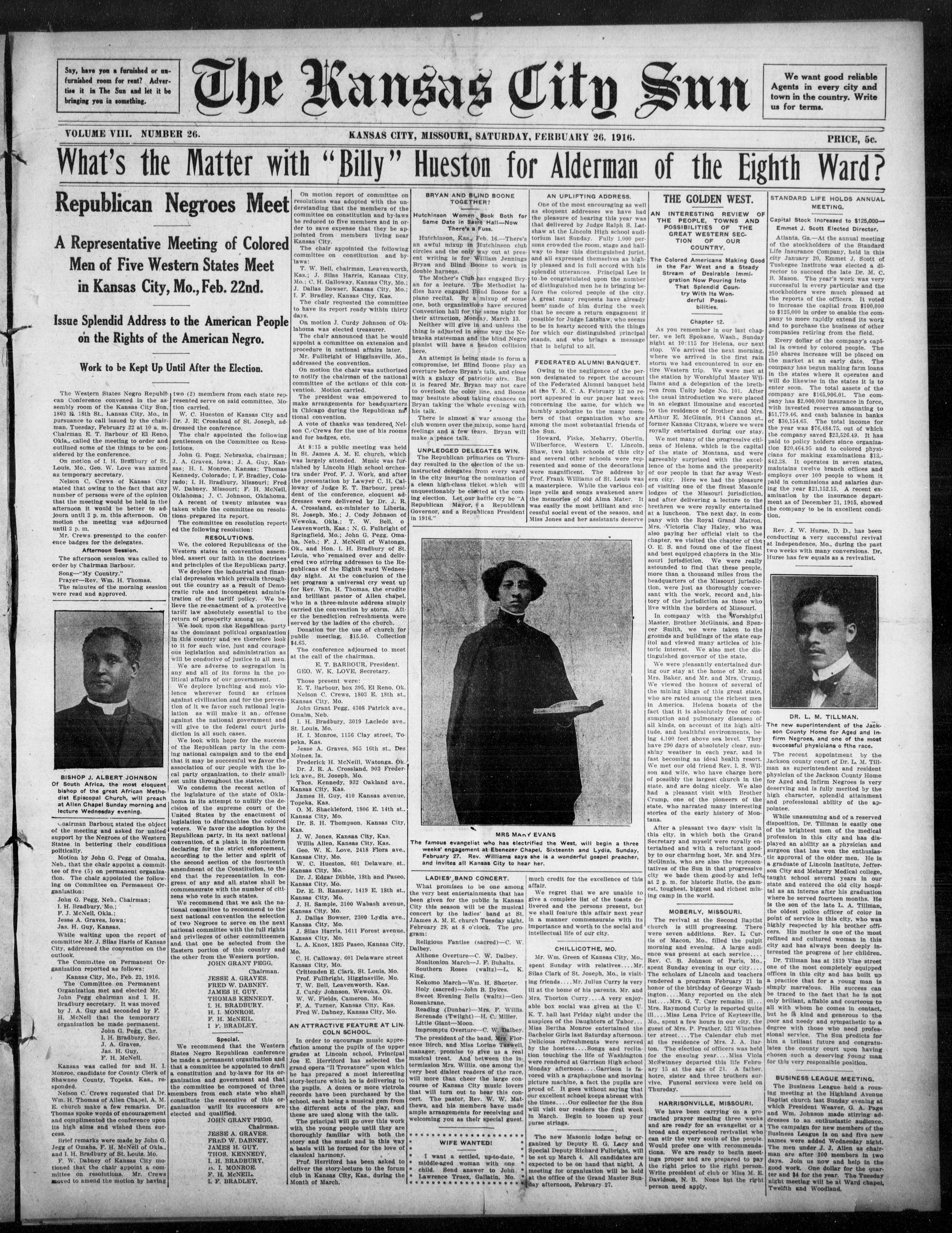
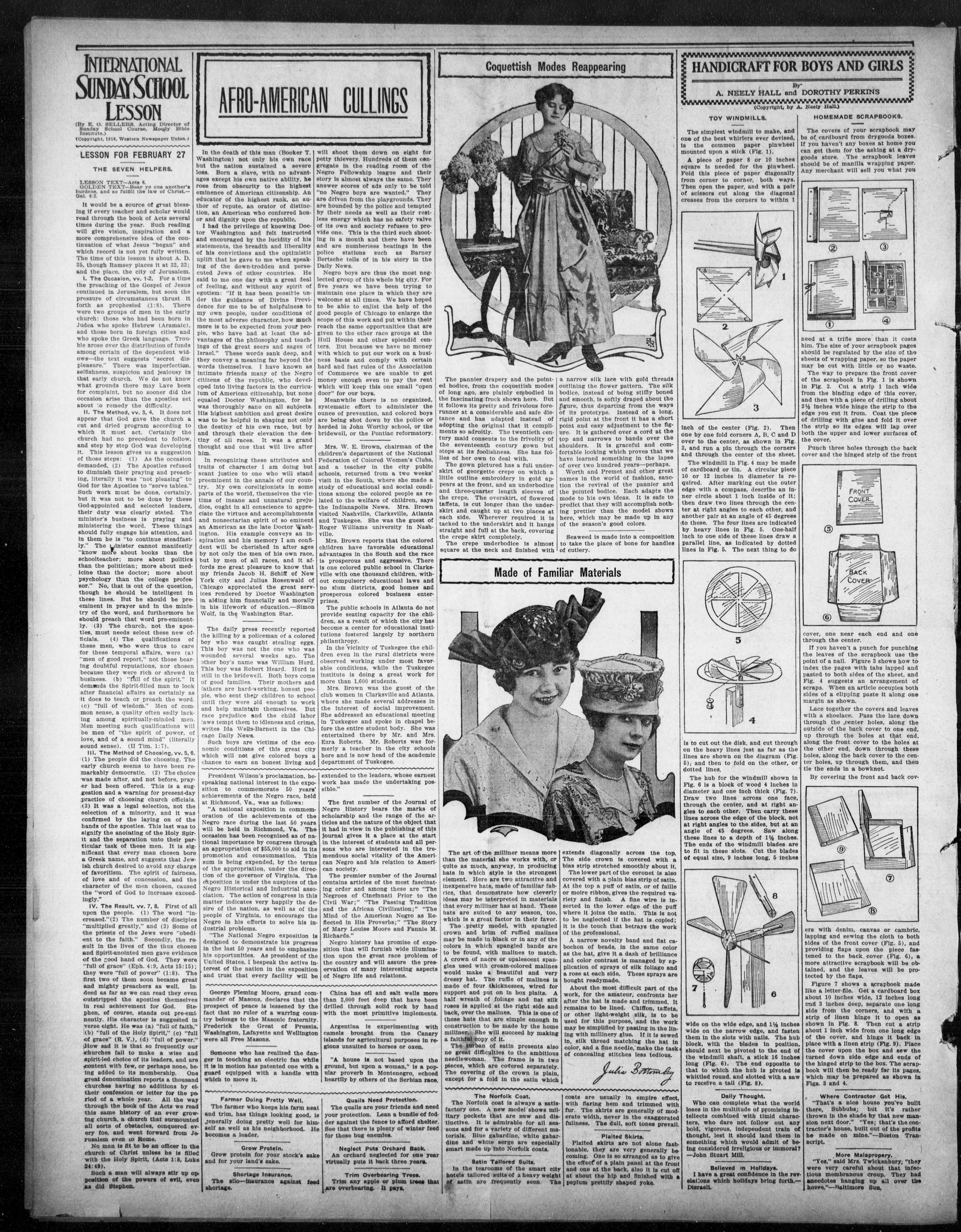
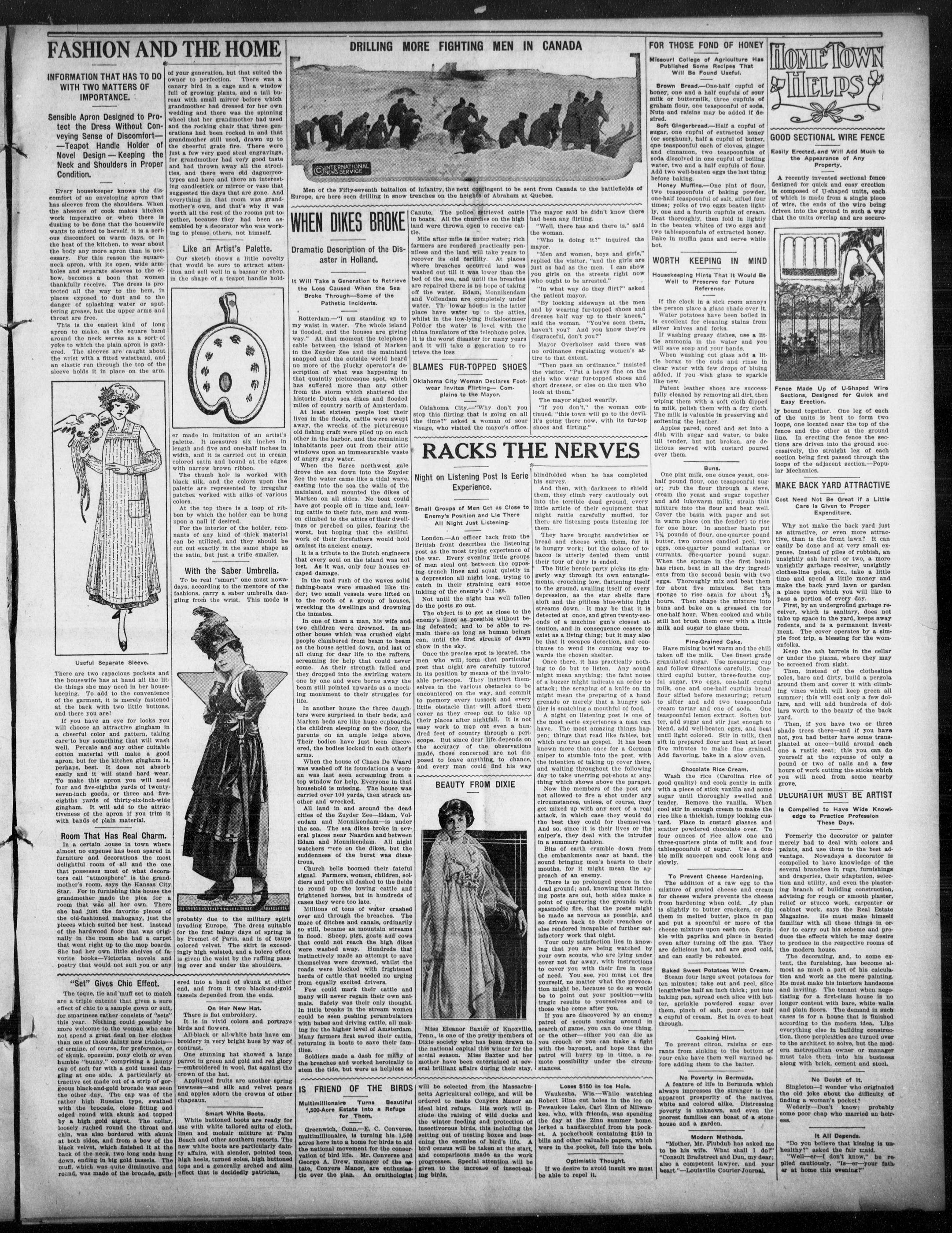
Page text (machine-generated)
What's the Matter with "Billy" Hueston for Alderman of the Eighth Ward?
VOLUME VIII. NUMBER 26.
What's the M
Republican Neg
A Representative Meeting
Men of Five Western
in Kansas City, Mo.,
Issue Splendid Address to the
on the Rights of the Am
Work to be Kept Up Until Aft
Republican Negroes Meet
Republican Negroes Meet
A Representative Meeting of Colored Men of Five Western States Meet in Kansas City, Mo., Feb. 22nd.
Issue Splendid Address to the American People on the Rights of the American Negro.
Work to be Kept Up Until After the Election.
We, the colored Republicans of the Western states in convention assembled, assert our faith in the doctrines and principles of the Republican party. We deplore the industrial and financial depression which prevails throughout the country as a result of Democratic rule and incompetent administration of the tariff policy. We believe the re-enactment of a protective tariff law absolutely essential to the return of prosperity among us. We look upon the Republican party as the dominant political organization in this country and we therefore look to it for such wise, just and courageous legislation and administration as will be conducive of justice to all men. We are adverse to segregation in any and all of its forms in the political affairs of our government. We deplore lynching and mob violence wherever found as crimes against civilization and for the prevention of it we favor such rational legislation as will make it an offense against the national government and will give to the federal court jurisdiction in all such cases. We look with hope for the success of the Republican party in the coming national campaign and to the end that it may be successful we favor the association of our people with the local party organization, to their smallest units throughout the states.
We condemn the recent action of the legislature of the state of Oklahoma in its attempt to nullify the decision of the supreme court of the United States by the enactment of legislation to disfranchise the colored voters. We favor the adoption by the Republican party, in its next national convention, of a plank in its platform declaring for the strict enforcement, according to the letter and spirit of the second section of the fourteenth amendment of the Constitution, to the end that the representation in congress of any and all states shall be commensurate with the number of citizens who vote in such states.
We recommend that we ask the national committee to recommend to the next national convention the selection of two Negroes to serve on the next national committee with the full rights and privileges of other committeemen and that one be selected from the Eastern portion of this country and the other from the Western portion.
We recommend that the Western States Negro Republican conference be made a permanent organization and that a committee be appointed to draft a constitution and by-laws for its organization and government and that the committee be composed of three members from each state who shall constitute the executive of this organization until its successors are elected and qualified.
---
Say, have you a furnished or unfurnished room for rent? Advertise it in The Sun and let it be bringing you in something.
The Western States Negro Republic can Conference convened in the assembly room of the Kansas City Sun, 1803 E. 18th St., Kansas City, Mo., in pursuance to call issued by the chairman, Tuesday, February 22 at 10 a.m. Chairman E. T. Barbour of El Reno, Okla., called the meeting to order and outlined some of the things to be considered by the conference.
On motion of I. H. Bradbury of St. Louis, Mo., Geo. W. Love was named as temporary secretary.
Nelson C. Crews of Kansas City stated that owing to the fact that any number of persons were of the opinion that the meeting would be held in the afternoon it would be better to adjourn until 3 p. m. this afternoon. On motion the meeting was adjourned until 3 p. m.
Mr. Crews presented to the conference badges for the delegates.
Afternoon Session.
The afternoon session was called to order by Chairman Barbour.
Song—"My Country."
Prayer—Rev. Wm. H. Thomas.
The minutes of the morning session were read and approved.
BISHOP J. ALBERT JOHNSON
Of South Africa, the most eloquent
bishop of the great African Methodist Episcopal Church, will preach
at Allen Chapel Sunday morning and lecture Wednesday evening.
Chairman Barboug stated the object
of the meeting and asked for united
support by the Negroes of the Western
States in bettering their conditions
politically.
Motion by John G. Pegg of Omaha
Neb., that the chair appoint a commite
tee of five (5) on permanent organiza
tion. The chair appointed the follow
ing on Committee on Permanent Org
anization:
John G. Pegg, Neb., Chairman;
I. H. Bradbury, Mo.;
F. J. McNell, Okla.;
Jesse A. Graves, Iowa;
Jas. H. Guy, Kansas.
While waiting upon the report of
committee Mr. J. Silas Haris of Kansas
City, addressed the convention on the
outlook.
The Committee on Permanent Or
ganization reported as follows:
Kansas City, Mo., Feb. 22, 1916.
The Committee on Permanent
Organization met and elected Mr.
John Pegg chairman and I. H.
Bradbury secretary. It was moved
by J. A. Guy and seconded by F.
H. McNeil that the temporary
organization be made permanent.
John G. Pegg, Chr.
I. H. Bradbury, Sec.
J. A. Graves,
Jas. H. Guy,
F. H. McNell.
Kansas was called for and H. I
Monroe, candidate for County Clerk of
Shawnee County, Topeka, Kas., re
responded.
Nelson C. Crews requested that Dr. Wm. H. Thomas of Allen Chapel, A. M. E. church make a few remarks. Dr. Thomas spoke words of encouragement and complimented the conference upon its high aims and wished them success. Brief remarks were made by John G. Jegg of Omaha, F. H. McNeill of Okla, and I. H. Bradbury of St. Louis, Mo. F. W. Dabney of Kansas City motioned that the chair appoint a committee on resolutions. Mr. Crews moved to amend the motion by having
The Kansas City Sun
two (2) members from each state represented serve on said committee. Motion carried. W. C. Hueston of Kansas City and Dr. J. R. Crossland of St. Joseph, addressed the conference. The chair appointed the following gentlemen on the Committee on Resolutions. John G. Pogg, Nebraska, chairman; J. A. Graves, Iowa; J. A. Guy, Kansas; H. I. Monroe, Kansas; Thomas Kennedy, Colorado; I. F. Bradley, Colorado; I. H. Bradbury, Missouri; Fred W. Dahney, Missouri; F. H. McNell, Oklahoma; J. C. Johnson, Oklahoma. A recent of twenty minutes was taken while the committee on resolutions prepared its report. The committee on resolution reported the following resolution:
Chairman.
JESSE A. GRAVES.
FRED W. DABNEY.
JAMES H. GUY.
THOMAS KENNEDY.
I. H. BRADBURY.
H. I. MONROE.
F. H. McNEIL.
I. F. BRADLEY.
JOHN GRANT PEGG,
Chairman.
JESSE A. GRAVES.
FREED W. DABNEY.
JAMES H. GUY.
THOS. KENNEDY.
L. H. BRADBURY.
I. I. MONROE.
F. H. McNEIL.
I. F. BRADLEY.
KANSAS CITY, MISSOURI, SATURDAY, FERBUARY 26, 1916.
On motion report of committee on resolutions was adopted with the understanding that the members of the committee on constitution and by-laws be reduced to five members and in order to save expense that they be appointed from members living near Kansas City.
The chair appointed the following committee on constitution and by-laws:
T. W. Bell, chairman, Leavenworth, Kas.; J. Silas Harris, Kansas City, Mo.; C. H. Galloway, Kansas City, Mo.; J. Dallas Bowser, Kansas City, Mo.; I. F. Bradley, Kansas City, Kas.
The chair requested the committee to have its report ready within thirty days.
On motion J. Curdy Johnson of Oklahoma was elected treasurer.
The chair announced that he would appoint a committee on extension and procedure in national affairs later.
Mr. Fullbright of Higginsville, Mo., addressed the convention.
On motion the chair was authorized to notify the chairman of the national committee of the actions of this convention. Motion carried.
The president was empowered to make arrangements for headquarters in Chicago during the Republican national convention.
A vote of thanks was tendered, Nelson C. Crews for the use of his rooms and for badges, etc.
At 8:15 a public meeting was held in St. James A. M. E. church, which was largely attended. Music was furnished by Lincoln High school orchestra under Prof. F. J. Work, and after the presentation by Lawyer C. H. Calloway of Judge E. T. Barbour, president of the conference, eloquent addresses were delivered by Dr. J. R. A. Crossland, ex-minister to Liberia, St. Joseph, Mo.; J. Cody Johnson of Wewoka, Okla.; T. W. Bell, oLeavenworth, Kas.; N. G. Fulbright of Springfield, Mo.; John G. Pegg, Omaha, Neb.; F. J. McNellil of Watonga, Ok., and Hon. I. H. Bradbury of St. Louis, who remained over and delivered two stirring addresses to the Republicans of the Eighth ward Wednesday night. At the conclusion of the set program a universal cry went up for Rev. Wm. H. Thomas, the erudite and brilliant pastor of Allen chapel, who in a three-minute address simply carried the convention by storm. After the benediction refreshments were served by the ladies of the church. Donation for the use of church for public meeting, $15.50. Collection $4.65.
The conference adjourned to meet at the call of the chairman.
E. T. BARBOUR, President.
GEO. W. K. LOVE, Secretary.
Those present were:
E. T. Barbour, box 395, El Reno, Ok.
Nelson C. Crews, 1803 E. 18th st., Kansas City, Mo.
John Grant Pegg, 4308 Patrick ave.
Omalia, Neb.
I. H. Bradbury, 3019 Laclede ave.
St. Louis, Mo.
H. I. Monroe, 1156 Clay street, Topeka, Kas.
Jesse A. Graves, 955 16th st., Des Moines, Ia.
Frederick H. McNeill, Watonga, Ok.
Dr. J. R. A. Crossland, 903 Frederick ave. St. Joseph, Mo.
Thos. Kennedy, 932 Oakland ave. Kansas City, Kas.
James H. Guy, 410 Kansas avenue
Topeka, Kas.
O. M. Shackleford, 1806 E. 14th st.
Kansas City, Mo.
Dr. S. H. Thompson, Kansas City
Kas.
J. W. Jones, Kansas City, Kas.
Willis Allen, Kansas City, Kas.
Geo. W. K. Love, 2418 Flora ave.
Kansas City, Mo.
W. C. Hueston, 601 Delaware st.
Kansas City, Mo.
Dr. J. Dr. Dibble, 18th and Paseo
Kansas City, Mo.
Dr. E. B. Ramsey, 1419 E. 18th st.
Kansas City, Mo.
J. H. Sample, 3100 Wabash avenue
Kansas City, Mo.
J. Dallas Bowser, 2300 Lydia ave.
Kansas City, Mo.
J. Sillas Harris, 1611 Forest avenue Kansas City, Mo.
Kansas City, Mo.
L. A. Knox, 1825 Paseo, Kansas City,
Mo.
C. H. Calloway, 601 Delaware street
Kansas City, Mo.
Crittenden E. Clark, St. Louis, Mo.
Prof. Fullbright, Higginsville, Mo.
T. W. Bell, Leavenworth, Kas.
J. Curdy Johnson, Wewoka, Ok.
W. W. Fields, Cameron, Mo.
F. A. Turner, Kansas City, Kas.
Fred W. Dabney, Kansas City, Mo.
AN ATTRACTIVE FEATURE AT LIN COLN SCHOOL.
In order to encourage music appreciation among the pupils of the upper grades at Lincoln school, Principal Joe E. Herriford has selected the grand opera "Il Trovatore" upon which he has prepared a most interesting story-lecture which he is delivering to the pupils. A dozen or more victrola records have been purchased by the school, each being a musical gem from the different acts of the play, and these are used along with the talk. The principal will go over this work with the young people until they are thoroughly familiar with both the story and the music and in this way a basis will be formed for the love of classical harmony. Prof. Herriford has been asked to deliver the story-lecture to the forum club in Kansas City, Kas., during the Month of March.
BRYAN AND BLIND BOONE
TOGETHER?
Hutchinson Women Book Both for Same Date in Same Hall—Now There's a Fuss.
Hutchinson, Kas., Feb. 16. There's an awful mixup in Hutchinson club circles and the only way out at present writing is for William Jennings Bryan and Blind Boone to work in double harness.
The Mother's Club has engaged Bryan for a lecture. The Methodist ladies have engaged Blind Boone for a piano recital. By a mixup of some one, both organizations have secured Convention hall for the same night for their attraction, Monday, March 13.
Neither will give in and unless the thing is adjusted in some way the Nebraska statesman and the blind Negro pianist will have a headon collision here.
An attempt is being made to form a compromise, let Blind Boone play an overture before Bryan's talk, and close with a galaxy of patriotic airs. But it is feared Mr. Bryan may not care to overlook the color line, and Boone may hesitate about taking chances on Bryan taking the whole evening with his talk.
There is almost a war among the club women over the mixup, some hard feelings and a few tears. Bryan will make a peace talk.
UNPLEDGED DELEGATES WIN.
UNPLEDGED DELEGATES WIN.
The Republican primaries on Thursday resulted in the election of the uninstructed delegates from every ward in the city insuring the nomination of a clean high-class ticket which will unquestionably be elected at the coming election. Let our battle cry be "A Republican Mayor, a Republican Governor, and a Republican President in 1916."
MRS MAN
The famous evangelist who has elected weeks' engagement at Ebenezer City February 27. Rev. Williams says and invites all Kansas City to hear
MRS MANY EVANS
The famous evangelist who has electrified the West, will begin a three weeks' engagement at Ebenezer Chapel, Sixteenth and Lydia, Sunday, February 27. Rev. Williams says she is a wonderful gospel preacher, and invites all Kansas City to hear her.
The famous evangelist who has electrified the West, will begin a three weeks' engagement at Ebenezer Chapel, Sixteenth and Lydia, Sunday, February 27. Rev. Williams says she is a wonderful gospel preacher, and invites all Kansas City to hear her.
LADIES' BAND CONCERT.
What promises to be one among the very best entertainments that has been given for the public in Kansas City this season will be the musical concert by the ladies' band at St. JJames A. M. E. church Tuesday night, February 29, at 8 o'clock. The program:
Religious Fantise (sacred)—C. W. Dalbey.
Althone Overture—C. W. Dalbey.
Monitonlon March—J. F. Buhalts.
Southern Roses (waltz)—L. K. King.
Kokomo March—Wm. H. Shorter.
Holy (sacred)—John B. Dykes.
Sweet Evening Bells (waltz)—Geo. Rosenkrane.
Reading (Dunbar)—Mrs. F. Willis.
Serenade (Twilight)—H. C. Miller.
Little Giant—Moon.
much credit for the excellence of this affair.
We regret that we are unable to give a complete list of the toasts delivered and the persons present, but we shall feature this affair next year in a manner commensurate with its importance and worth to the social and intellectual life of our city.
CHILLICOTHE, MO.
Mr. Wm. Green of Kansas City, Mo. spent Sunday with relatives...M. Silas Clark of St. Joseph, Mo., is visiting friends...Mr. Julius Curry is very ill at the home of his parents, Mr. and Mrs. Thornton Curry...A very enjoyable box social was given at the U. K. T. hall last Friday night under the auspices of the Daughters of Tabor.
Impromptu Overture—C. W. Dalbye
The president of the band, Mrs. Florence Birch, and Miss Lorine Taswell manager, promise to give us a real musical treat. And between the intermission Mrs. Willis, one among the very best dialect readers of the race will more than cheer the large course of Kansas City music lovers that will turn out to hear this concert. The pastor, Rev. W. W. Mathews, and his members have made ample arrangements for receiving and welcoming you as their special guest
AN UPLIFTING ADDRESS.
One of the most encouraging as well as eloquent addresses we have had the pleasure of hearing this year was that delivered by Judge Ralph S. Latshew at the Lincoln High school auditorium last Sunday. Fully 1,000 persons crowded the room, stage and hallway to hear this distinguished jurist, and all expressed themselves as highly pleased and in full accord with his splendid utterances. Principal Lee is to be congratulated upon the number of distinguished men he is bringing before the colored people of the city. A great many requests have already been made of him during the week that he secure a return engagement if possible for Judge Latshew, who seems to be in heart accord with the things for which our distinguished principal stands, and who brings a message that is helpful to all.
FEDERATED ALUMNI BANQUET.
Owing to the negligence of the person designated to report the account of the Federated Alumni banquet held at the Y. M. C. A. February 12 no report appeared in our paper last week concerning the same, for which we humbly apologize to the many members of that organization who are among the most substantial friends of the Sun.
Howard, Fiske, Meharry, Oberlin, Wilberforce, Western U. Lincoln, Shaw, two high schools of this city and several other schools were represented and some of the decorations were magnificent. The address by Prof. Frank Williams of St. Louis was a masterpiece. While the various college yells and songs awakened anew the memories of old Alma Mater. It was easily the most brilliant and successful social event of the season, and Miss Jones and her assistants deserve
actrified the West, will begin a three Chapel, Sixteenth and Lydia, Sunday, says she is a wonderful gospel preacher, dear her.
much credit for the excellence of this affair. We regret that we are unable to give a complete list of the toasts delivered and the persons present, but we shall feature this affair next year in a manner commensurate with its importance and worth to the social and intellectual life of our city.
Mr. Wm. Green of Kansas City, Mo., spent Sunday with relatives...Mr. Silas Clark of St. Joseph, Mo., is visiting friends...Mr. Julius Curry is very ill at the home of his parents. Mr. and Mrs. Thorton Curry...A very enjoyable box social was given at the U. K. T. hall last Friday night under the auspices of the Daughters of Tabor... Miss Bertha Monroe entertained the Bachelor Girls last Saturday afternoon. Delicious refreshments were served by the hostess...Songs and recitation touching the life of Washington were rendered at Garrison High school Monday afternoon...Garrison is favored with a graphaphone and moving picture machine, a fact the pupils are proud of. It goes without saying that our excellent school keeps ahead with the times...Our collector for the Sun will visit our readers the first week in March. Begin to loosen up your purse strings.
The new Masonic lodge being organized by Deputy E. G. Lacy and Special Deputy Richard Fulbright, will be set up March 4. All candidates are expected to be on hand that night. A meeting for organization will be held at the office of the Grand Master Sunday afternoon, February 27.
---
CHILLICOTHE, MO.
THE GOLDEN WEST.
AN INTERESTING REVIEW OF THE PEOPLE, TOWNS AND POSSIBILITIES OF THE GREAT WESTERN SEC-TION OF OUR COUNTRY.
The Colored Americans Making Good in the Far West and a Steady Stream of Desirable Immigration Now Pouring Into That Splendid Coun-try With Its Wonderful Possibil-ibilities.
As you remember in our last chapter, we left Spokane, Wash., Sunday night at 10:115 for Helena, our next stop. We arrived the next morning where we arrived in the first rain storm we had encountered in our entire Western trip. We were met at the station by Worshipful Master Williams and a delegation of the brethren from Unity lodge No. 101. After the usual introduction we were placed in an elegant limousine and escorted to the residence of Brother and Mrs Arthur E. McGinnis, 914 Cannon st., former Kansas Cityans, where we were royally entertained during our stay. We met many of the progressive citizens of Helena, which is the capital of the state of Montana, and were agreeably surprised with the excellence of the home and the prosperity of our people in that far away Western city. Here we had the pleasure of visiting one of the finest Masonic lodges of the Missouri jurisdiction, and after delivering a lecture to the brethren we were royally entertained at a luncheon. The next day, in company with the Royal Grand Matron, Mrs. Victoria Clay Haley, who was also paying her official visit to the chapter, we visited the chapter of the O. E. S. and found one of the finest and best equipped chapters in the Missouri jurisdiction. We were really astounded to find that these people, more than a thousand miles from the headquarters of the Missouri jurisdiction, were just as thoroughly conversant with the work, record and history of the jurisdiction as those who live within the borders of Missouri.
In company with the Worshipful Master, Brother McGinnis, and Spencer Smith, we were taken to the grounds and buildings of the state capitol and viewed many articles of historic interest. We also met the distinguished governor of the state.
We were pleasantly entertained during our stay at the home of Mr. and Mrs. Baker, Mr. and Mrs. Crump. We viewed the homes of several of the mining kings of this great state, who are rated among the richest men in America. Helena boasts of the fact that it is absolutely free of consumption and pulmonary diseases of all kinds, on account of its high altitude, and healthful environments, being 4,100 feet above sea level. They have 290 days of absolutely clear, sunshine weather in each year, and is fast becoming an ideal health resort. We met our old friend Rev. I. S. Wilson and wife, who have charge here of possibly the largest church in the state, and are doing nicely. We also had a pleasant visit with Brother Crump, one of the ploneers of the state, who narrated many interesting stories of the early history of Montana.
After a pleasant two days' visit in this city, in which both the Grand Secretary and myself were royally entertained and with a reluctant goodby to our charming host, Mr. and Mrs. McGinnis, who are also the representatives of the Sun in that progressive city we bade them good-by and left at 2 p. m. for historic Butte, the game, toughest, biggest and richest mining camp in the world.
MOBERLY, MISSOURI
The revival at the Second Baptist church is still progressing. There were seven additions. Rev. L. Curtis of Macon, Mo., filled the pulpit morning and evening. A large audience was present at each service. Rev. C. B. Johnson of Paris, Mo., spent Sunday evening in our city. The scholars of Lincoln and teachers rendered a program February 21 in honor of the birthday of George Washington. Many reported on the sick list... Mrs. G. T. Carr remains ill. Mrs. Raymond Curby is reported quite ill. Miss Lena Price of Keyesville, Mo., spent a few hours in our city, the guest of Mrs. P. Prather, 523 Winchester street. The Calendar club met at the residence of Mrs. J. A. Barton. The election of officers was held for the ensuing year. Miss Viola McSwainney departed this life February 15 at the age of 21. A father hotre, sister and three brothers survive. Funeral services were held on Thursday.
HARRISONVILLE, MISSOURI
We have been carrying on a protracted prayer meeting three weeks and are ready for an evangelist or a broad and experienced revivalist who can stir the very souls of the people. Would prefer one with recommendations. We are ready to begin meetings proper and are prepared to pay the right price to the right person. Write president of club or Miss M. E Davidson, N. B. None but the right person need apply.
We want good reliable Agents in every city and town in the country. Write us for terms.
PRICE, 5c.
STANDARD LIFE HOLDS ANNUAL MEETING.
Capital Stock Increased to $125,000—Emmet J. Scott Elected Director.
Atlanta, Ga.—At the annual meeting of the stockholders of the Standard Life Insurance Company, held in this city January 20, Emmet J. Scott of Tuskegee Institute was elected a director to succeed the late Dr. M. C. B. Mason. The year's work was very successful in every particular and the stockholders were much pleased at the reports of the officers. It voted to increase the capital from $100,000 to $125,000 in order to enable the company to more rapidly extend its work and to purchase the business of other companies retiring from the field.
Every dollar of the company's capital is owned by colored people. The 250 shares increase will be placed on the market at an early date. The company has begun making farm loans in the states where it operates and will do likewise in the states it is to enter soon. The total assets of the company are $165,906.01. The company has $2,000,000 insurance in force, with invested reserves amounting to $51,779.46 and cash balance in banks of $30,154.65. The total income for the year was $76,484.75, out of which the company saved $23,526.49. It has paid to policy holders since organization $20,464.95 and to colored physicians for making examinations $13,842.38. It operates in seven states, maintains twelve branch offices and employs over 100 people to whom it paid in commissions and salaries during the year $21,152.15. A recent examination by the insurance department as of December 31, 1915, showed the company to be in excellent condition.
Rev. J. W. Hurse, D. D., has been conducting a very successful revival at Independence, Mo., during the past two weeks with many conversions. Dr. Hurse has few equals as a revivalist.
DR. L. M. TILLMAN.
The new superintendent of the Jackson County Home for Aged and Infirm Negroes, and one of the most successful physicians of the race.
The recent appointment by the Jackson county court of Dr. L. M. Tillman as superintendent and resident physician of the Jackson County Home for Aged and Infirm Negroes is very deserving and is fully merited by the high character, splendid attainment and professional ability of the appointee.
While unassuming and of a reserved disposition. Dr. Tillman is easily one of the brightest men of the medical profession in this city and has displayed an ability as a physician and surgeon that has won the enthusiastic approval of the older men. He is a graduate of Lincoln Institute, Jefferson City and Meharry Medical college, taught school several years in our state and entered the old city hospital as an interne after his graduation where he served fourteen months. He is the son of the late L. A. Tillman, the oldest police officer of color in point of service in this city, who was highly respected by his brother officers. His mother is one of the most refined and cultured woman in this city and has always been deeply interested the progress of her children. Dr. Tillman has at 1819 Vine street one of the most completely equipped offices in this city and has built up a practice that for a young man is simply marvelous. His success can be traced to the fact that he is not only brilliant, affable and courteous to all with whom he comes in contact, but he is kind and generous to the poor and needy and sympathetic to a degree with those who need professional service. The Sun predicts for him a brilliant future and congratulates the county court upon having chosen such a deserving young man for this very responsible position.
BUSINESS LEAGUE MEETING
The Business League held a rousing meeting at the Highland Avenue Baptist church last Sunday evening at which President Weaver, G. A. Page and Wm. Johnson made stirring addresses to an enthusiastic audience. The campaign for new members of the Business League is on and five new names were added Wednesday night. The men under J. J. Allen as chairman are after 100 members in two days. Join us now and help in the good work. One dollar for the quarter and $4 for the year. The Tuesday night meeting will be at Ward chapel, Twelfth and Woodland.
INTERNATIONAL
SUNDAY SCHOOL
LESSON
(By E. O. SELLERS, Acting Director of
Sunday School Course, Moogly Bible
Institute.)
(Copyright, 1916, Western Newspaper Union.)
LESSON FOR FEBRUARY 27
THE SEVEN HELPERS.
LESSON TEXT—Acts 6.
LESSON TEXT—Acts 6
GOLDEN TEXT—Bear you one another's burdens and so fulfill the law of Christ—Gal. 6:2.
It would be a source of great blessing if every teacher and scholar would read through the book of Acts several times during the year. Such reading will give vision, inspiration and a more comprehensive idea of the continuation of what Jesus "began" and which record is not yet fully written. The time of this lesson is about A. D. 35, though Ramsey places it at 23, 33; and the place, the city of Jerusalem.
1. The Occasion, vv. 1-2. For a time the preaching of the Gospel of Jesus continued in Jerusalem, but soon the pressure of circumstances thrust it forth as prophesied (1:8). There were two groups of men in the early church: those who had been born in Judea who spoke Hebrew (Aramaic); and those born in foreign cities and who spoke the Greek language. Trouble arose over the distribution of funds among certain of the dependent widows—the text suggests "secret displeasure." There was imperfection, selfishness, suspicion and jealousy in that early church. We do not know what grounds there may Have been for complaint, but no sooner did the occasion arise than the apostles set about to remedy the difficulty.
II. The Method, vv. 3, 4. It does not appear that God gave the church a cut and dried program according to which it must act. Certainly the church had no precedent to follow, and step by step God was developing it. This lesson gives us a suggestion of those steps: (1) As the occasion demanded, (2) The Apostles refused to diminish their praying and preaching, literally it was "not pleasing" to God for the Apostles to "serve tables." Such work must be done, certainly, but it was not to be done by these God-appointed and selected leaders, their duty was clearly stated. The minister's business is praying and ministering the word. These things should fully engage his attention, and in them he is "to continue steadfastly." The minister cannot manifestly "know more about books than the schoolteacher; more about politics than the politician; more about medicine than the doctor; more about psychology than the college professor." No, that is out of the question, though he should be intelligent in these lines. But he should be pre-eminent in prayer and in the ministry of the word, and furthermore he should preach that word pre-eminently. (3) The church, not the apostles, must needs select these new oficials. (4) The qualifications of these men, who were thus to care for these temporal affairs, were (a) "men of good report," not those bearing doubtful reputations, nor chosen because they were rich or shrewd in business. (b) "full of the spirit." It demands the Spirit-filled man to look after financial affairs as certainly as it does to teach or preach the word. (c) "full of wisdom." Men of common sense, a quality often sadly lacking among spiritually-minded men. Men meeting such qualifications will be men of "the spirit of power, of love, and of a sound mind" (literally sound sense). (II Tim. 1:7).
III. The Method of Choosing, vv. 5, 6.
(1) The people did the choosing. The early church seems to have been remarkably democratic. (2) The choice was made after, and not before, prayer had been offered. This is a suggestion and a warning for present-day practice of choosing church officials. (3) It was a legal selection, not the selection of a minority, and it was confirmed by the laying on of the hands of the apostles. This last was to signify the anointing of the Holy Spirit and the separation unto their particular task of these men. It is significant that every man chosen bore a Greek name, and suggests that Jewish church desired to avoid any charge of favoritism. The spirit of fairness of love and of concession, and the character of the men chosen, caused the "word of God to increase exceedingly."
IV. The Result, vv. 7, 8. First of all upon the people. (1) The word "increased." (2) The number of disciples "multiplied greatly," and (3) Some of the priests of the Jews were "obedient to the faith." Secondly, the result in the lives of the thus chosen and Spirit-anointed men gave evidence of the good hand of God. They were "full of grace" (Eph. 4:9; Acts 15:15); they were "full of power" (1:8). The first two of them soon became great and mighty preachers as well. Indeed as far as we can read they even outstripped the apostles themselves in real achievement for God. Stephen, of course, stands out pre-eminent. His character is suggested in verse eight. He was (a) "full of faith," (b) "full of the Holy Spirit," (c) "full of grace" (R. V.), (d) "full of power." How sad it is that so frequently our churches fail to make a wise and spirit-led choice of its leaders, and are content with few, or perhaps none, being added to its membership. One great denomination reports a thousand churches having no additions by their confession or letter for the period of a whole year. All the way through the book of the Acts we read this same history of an ever growing church, a church that surmounted all sorts of obstacles, conquered every foe, and went forward from Jerusalem even to Rome.
No man is fit to be an officer in the church of Christ unless he is filled with the Holy Spirit, (Acts 1:8, Luke 24:49).
Such a man will always stir up opposition of the powers of evil, even as did Stephen.
AFRO-AMERICAN CULLINGS
In the death of this man (Booker T. Washington) not only his own race but the nation sustained a severe loss. Born a slave, with no advantages except his own native ability, he rose from obscurity to the highest eminence of American citizenship. An educator of the highest rank, an author of repute, an orator of distinction, an American who conferred honor and dignity upon the republic.
I had the privilege of knowing Doctor Washington and felt instructed and encouraged by the lucidity of his statements, the breadth and liberality of his convictions and the optimistic uplift that he gave to me when speaking of the down-trodden and persecuted Jews of other countries. He said to me one day with a great deal of feeling, and without any spirit of egotism: "If it has been possible under the guidance of Divine Providence for me to be of helpfulness to my own people, under conditions of the most adverse character, how much more is to be expected from your people, who have had at least the advantages of the philosophy and teachings of the great seers and sages of Israel." These words sank deep, and they convey a meaning far beyond the words themselves. I have known as intimate friends many of the Negro citizens of the republic, who developed into living factors in the curriculum of American citizenship, but none equaled Doctor Washington, for he was thoroughly sane on all subjects. His highest ambition and great desire was to be helpful in shaping not only the destiny of his own race, but by and through their elevation the destiny of all races. It was a grand thought and one that will live after him.
In recognizing these attributes and traits of character I am doing but scant justice to one who will stand preeminent in the annals of our country. My own coreligionists in some parts of the world, themselves the victims of insane and unnatural prejudice, ought in all conscience to appreciate the virtues and accomplishments and nonsectarian spirit of so eminent an American as the late Doctor Washington. His example conveys an inspiration and his memory I am confident will be cherished in after ages by not only the men of his own race, but by men of all races, and it affords me great pleasure to know that my friends Jacob H. Schiff of New York city and Julius Rosenwald of Chicago appreciated the great services rendered by Doctor Washington in aiding him financially and morally in his lifework of education.—Simon Wolf, in the Washington Star.
The daily press recently reported the killing by a policeman of a colored boy who was caught stealing eggs. This boy was not the one who was wounded several weeks ago. The other boy's name was William Hurd. This boy was Robert Heard. Hurd is still in the bridewell. Both boys come of good families. Their mothers and fathers are hard-working, honest people, who sent their children to school until they were old enough to work and help maintain themselves. But race prejudice and the child labor laws tempt them to idleness and crime, writes Ida Wells-Barnett in the Chicago Daily News. Such boys are victims of the economic conditions of this great city which will not give colored boys a chance to earn an honest living and
President Wilson's proclamation, bespeaking national interest in the exposition to commemorate 50 years' achievements of the Negro race, held at Richmond, Va., was as follows: "A national exposition in commemoration of the achievements of the Negro race during the last 50 years will be held in Richmond, Va. The occasion has been recognized as of national importance by congress through an appropriation of $55,000 to aid in its promotion and consummation. This sum is being expended, by the terms of the appropriation, under the direction of the governor of Virginia. The exposition is under the auspices of the Negro Historical and Industrial association. The action of congress in this matter indicates very happily the desire of the nation, as well as of the people of Virginia, to encourage the Negro in his efforts to solve his industrial problems.
"The National Negro exposition is designed to demonstrate his progress in the last 50 years and to emphasize his opportunities. As president of the United States, I bespeak the active interest of the nation in the exposition and trust that every facility will be
George Fleming Moore, grand commander of Masons, declares that the prospect of peace is lessened by the fact that no ruler of a warring country belongs to the Masonic fraternity. Frederick the Great of Prussia, Washington, Lafayette and Wellington were all Free Masons.
Someone who has realized the danger in touching an electric fan while it is in motion has patented one with a guard equipped with a handle with which to move it.
Farmer Doing Pretty Well.
The farmer who keeps his farm neat and trim, has things looking good, is generally doing pretty well for himself as well as his neighborhood. He becomes a leader.
Grow Protein.
Grow protein for your stock's sake and for your land's sake.
Shortage Insurance.
The silo—insurance against feed shortage.
will shoot them down on sight for petty thievery. Hundreds of them congregate in the reading room of the Negro Fellowship league and their story is almost always the same. They answer scores of ads only to be told "no Negro boys are wanted." They are driven from the playgrounds. They are hounded by the police and tempted by their needs as well as their restless energy which has no safety valve of its own and society refuses to provide one. This is the third such shooting in a month and there have been and are numberless beatings in the police stations such as Barney Bertsche tells of in his story in the Daily News.
Negro boys are thus the most neglected group of this whole big city. For five years we have been trying to maintain one place in which they are welcome at all times. We have hoped to be able to enlist the help of the good people of Chicago to enlarge the scope of this work and put within their reach the same opportunities that are given to the other race groups at the Hull House and other splendid centers. But because we have no money with which to put our work on a business basis and comply with certain hard and fast rules of the Association of Commerce we are unable to get money enough even to pay the rent which will keep this one small "open door" for our boys.
Meanwhile there is no organized, systematic effort to administer the ounce of prevention, and colored boys are being shot down by the police or herded in John Worthy school, or the bridewell, or the Pontiac reformatory.
Mrs. W. E. Brown, chairman of the children's department of the National Federation of Colored Women's Clubs, and a teacher in the city public schools, returned from a two weeks' visit in the South, where she made a study of educational and social conditions among the colored people as related to the welfare of children, says the Indianapolis News. Mrs. Brown visited Nashville, Clarksville, Atlanta and Tuskegee. She was the guest of Roger Williams university in Nashville.
Mrs. Brown reports that the colored children have favorable educational advantages in the South and the race is prosperous and aggressive. There is one colored public school in Clarksville with one thousand children, without compulsory educational laws and no slum districts, good homes and prosperous colored business enterprises.
The public schools in Atlanta do not provide seating capacity for the children, as a result of which the city has become a center for educational institutions fostered largely by northern philanthropy.
In the vicinity of Tuskegee the children even in the rural districts were observed working under most favorable conditions, while the Tuskegee institute is doing a great work for more than 1,600 students.
Mrs. Brown was the guest of the club women in Clarksville and Atlanta, where she made several addresses in the interest of social improvement. She addressed an educational meeting in Tuskegee and spoke in chapel before the entire student body. She was entertained there by Mr. and Mrs. Ezra Roberts. Mr. Roberts was formerly a teacher in the city schools here and is now head of the academic department of Tuskegee.
extended to the leaders, whose earnest work has made the undertaking possible."
The first number of the Journal of Negro History bears the marks of scholarship and the range of the articles and the nature of the object that it had in view in the publishing of this journal gives it a place at the start in the interest of students and all persons who are interested in the tremendous social vitality of the American Negro and his relation to American society.
The premier number of the Journal contains articles of the most fascinating order and among these are "The Negroes of Cincinnati Prior to the Civil War;" "The Passing Tradition and the African Civilization;" "The Mind of the American Negro as Reflected in His Proverbs;" "The Story of Mary Louise Moore and Fannie M Richards."
Negro history has promise of exposition that will furnish wide illumination upon the great race problem of the country and will assure the preservation of many interesting aspects of Negro life and relations.
China has oil and salt wells more than 2,000 feet deep that have been drilled through solid rock by hand with the most primitive implements.
Argentina is experimenting with camels brought from the Canary islands for agricultural purposes in regions unsuited to horses or oxen.
"A house is not based upon the ground, but upon a woman," is a popular proverb in Montenegro, echoed heartily by others of the Serbian race.
Quails Need Protection
The quails are your friends and need your protection. Lean a bundle of fodder against the fence to afford shelter. See that there is plenty of winter feed for these bug enemies.
Neglect Puts Orchard Back.
An orchard neglected for one year virtually puts it back three years.
Trim Overbearing Trees.
Trim any apple or plum trees that are overbearing. It pays.
Joquettish Modes Reappearing
Made of Familiar Materials
The pannier drapery and the pointed bodice, from the coquettish modes of long ago, are plainly embodied in the fascinating frock shown here. But it follows its pretty and frivolous foreruner at a considerable and safe distance and has adapted instead of adopting the original that it compliments so adroitly. The twentieth century maid consents to the frivolity of the seventeenth century gown but stops at its foolishness. She has follies of her own to deal with.
The gown pictured has a full underskirt of georgette crepe on which a little outline embroidery in gold appears at the front, and an underbodice and three-quarter length sleeves of the crepe. The overskirt, of flowered taffetta, is cut longer than the underskirt and caught up at two places at each side. Wherever required it is tacked to the underskirt and it hangs straight and full at the back, covering the crepe skirt completely.
The crepe underbodice is almost square at the neck and finished with
Made of Famil
The art of the milliner means more than the material she works with, or quite as much, anyway, in producing hats in which style is the strongest element. Here are two attractive and inexpensive hats, made of familiar fabrics, that demonstrate how cleverly ideas may be interpreted in materials that every milliner has at hand. These hats are suited to any season, too, which is a great factor in their favor.
The pretty model, with spangled crown and brim of ruffled malines may be made in black or in any of the colors in which spangled bands are to be found, with malines to match. A crown of nacre or opalescent spangles used with cream-colored malines would make a beautiful and very dressy hat. The ruffle of malines is made of four thicknesses, wired for support and put on in box plaits. A half wreath of foliage and silk roses is applied at the right side and back, over the malines. This is one of those hats that are simple enough in construction to be made by the home milliner. She will succeed by making a faithful copy of it.
The turban of satin presents also no great difficulties to the ambitious needlewoman. The frame is in two pieces, which are covered separately. The covering of the crown is plain, except for a fold in the satin which
The Norfolk coat is always a satisfactory one. A new model shows military pockets that are new and distinctive. It is admirable for all seasons and for a variety of different materials. Blue gabardine, white gabardine and white serge are especially smart made up into Norfolk coats.
Satin Tailored Suits.
In the tearooms of the smart city hotels tailored suits of a heavy weight of satin are frequently seen. The
a narrow silk lace with gold threads outlining the flower pattern. The silk bodice, instead of being stiffly boned and smooth, is softly draped about the figure, thus departing from the ways of its prototype. Instead of a long, rigid point at the front it has a short point and easy adjustment to the figure. It is gathered over a cord at the top and narrows to bands over the shoulders. It is graceful and comfortable looking which proves that we have learned something in the lapse of over two hundred years—perhaps. Worth and Premet and other great names in the world of fashion, sanction the revival of the pannier and the pointed bodice. Each adapts the mode to his own ideas. It is safe to predict that they will accomplish nothing prettier than the model shown here, which may be made up in any of the season's good colors.
Seaweed is made into a composition to take the place of bone for handles of cutlery.
iliar Materials
extends diagonally across the top. The side crown is covered with a bias strip stretched smoothly about it. The lower part of the coronet is also covered with a plain bias strip of satin. At the top a puff of satin, or of faille or moire ribbon, gives the required variety and finish. A fine wire is inserted in the lower edge of the puff where it joins the satin. This is not to be neglected if the hat is copied; it is the touch that betrays the work of the professional.
A narrow novelty band and flat cabochon of beads, in the same color as the hat, give it a dash of brilliance and color contrast is managed by application of sprays of silk foliage and a rose at each side. These sprays are bought readymade.
About the most difficult part of the work, for the amateur, confronts her after the hat is made and trimmed. It remains to be lined. Chiffon, taffeta, or other light-weight silk, is to be used for this purpose, and the work may be simplified by pasting in the lining with millinery glue. If it is sewed in, silk thread matching the hat in color, and a fine needle, make the task of concealing stitches less tedious.
Julia Bottomley
coats are usually in empire effect, with flaring hem and trimmed with fur. The skirts are generally of moderate width, never in the exaggerated fullness. The dull, soft tones prevail.
Plaited skirts are not alone fashionable, they are very generally becoming. One is so arranged as to give the effect of a plain panel at the front and one at the back, also it is cut off at about the hip and finished with a peplum prettily shaped yoke.
HANDICRAFT FOR BOYS AND GIRLS
A. NEELY HALL and DOROTHY PERKINS
(Copyright by A. Neely Hall)
TOY WINDMILLS.
The simplest windmill to make, and one of the best whirlers ever devised, is the common paper pinwheel mounted upon a stick (Fig. 1).
A piece of paper 8 or 10 inches square is needed for the pinwheel. Fold this piece of paper diagonally from corner to corner, both ways. Then open the paper, and with a pair of scissors cut along the diagonal creases from the corners to within 1
1
2
3
inch of the center (Fig. 2). Then one by one fold corners A, B, C and D over to the center, as shown in Fig. 3, and run a pin through the corners and through the center of the sheet. The windmill in Fig. 4 may be made of cardboard or tin. A circular piece 10 or 12 inches in diameter is required. After marking out the outer edge with a compass, describe an inner circle about 1 inch inside of it; then draw two lines through the center at right angles to each other, and another pair at an angle of 45 degrees to these. The four lines are indicated by heavy lines in Fig. 5. One-half inch to one side of these lines draw a parallel line, as indicated by dotted lines in Fig. 5. The next thing to do
5
4
is to cut out the disk, and cut through on the heavy lines just as far as the lines are shown on the diagram (Fig. 5), and then to fold on the other, or dotted lines.
The hub for the windmill shown in Fig. 6 is a block of wood 4 inches in diameter and one inch thick (Fig. 7). Draw two lines across one face, through the center, and at right angles to each other. Then carry these lines across the edge of the block, not at right angles to the sides, but at an angle of 45 degrees. Saw along these lines to a depth of $1\frac{1}{2}$ inches. The ends of the windmill blades are to fit in these slots. Cut the blades of equal size, 9 inches long, 5 inches
8
6
7
wide on the wide edge, and $1\frac{1}{2}$ inches wide on the narrow edge, and fasten them in the slots with nails. The hub block, with the blades in position, should next be pivoted to the end of the windmill shaft, a stick 16 inches long (Fig. 6). The end opposite to that to which the hub is pivoted is whittled round, and slotted with a saw to receive a tail (Fig. 8).
Daily Thought.
Who can complete what the world loses in the multitude of promising intellects combined with timid characters, who dare not follow out any bold, vigorous, independent train of thought, lest it should land them in something which would admit of being considered irreligious or immoral? —John Stuart Mill.
Believed in Holidays.
I have a great confidence in the revelations which holidays bring forth—Disraeli.
The covers of your scrapbook may be of cardboard from drygoods boxes. If you haven't any boxes at home you can get them for the asking at a drygoods store. The scrapbook leaves should be of manilla wrapping paper. Any merchant will sell you what you
$\textcircled{2}$ $\textcircled{3}$
$\textcircled{1}$ $\textcircled{4}$
need at a trilie more than it costs him. The size of your scrapbook pages should be regulated by the size of the sheets of wrapping paper, so the paper may be cut with little or no waste. The way to prepare the front cover of the scrapbook In Fig. 1 is shown in Fig. 2. Cut a strip 1 inch wide from the binding edge of this cover, and then with a piece of drilling about $3\frac{1}{2}$ inches wide hinge the strip to the edge you cut it from. Coat the piece of drilling with glue and fold it over both the upper and lower surfaces of the cover. Punch three holes through the back cover and the hinged strip of the front
FRONT COVER
$\textcircled{5}$
BACK COVER
$\textcircled{6}$
cover, one near each end and one through the center.
If you haven't a punch for punching the leaves of the scrapbook use the point of a nail. Figure 3 shows how to index the pages with tabs lapped and pasted to both sides of the sheet, and Fig. 4 suggests an arrangement of scraps. When an article occupies both sides of a clipping paste it along one margin as shown.
Lace together the covers and leaves with a shoelace. Pass the lace down through the _center holes, along the outside of the back cover to one end, up through the holes at that end, along the front cover to the holes at the other end, down through these holes, along the back cover to the center holes, up through them, and then tie the ends in a bowknot.
By covering the front and back cov-
$\textcircled{9}$
$\textcircled{7}$
$\textcircled{8}$
ers with denim, canvas or cambric, lapping and sewing the cloth to both sides of the front cover (Fig. 5), and providing flaps upon the piece fastened to the back cover (Fig. 6), a more attractive scrapbook will be obtained, and the leaves will be protected by the flaps.
Figure 7 shows a scrapbook made like a letter-file. Get a cardboard box about 10 inches wide, 12 inches long and 3 inches deep, separate one long side from the corners, and with a strip of linen hinge it to open as shown in Fig. 8. Then cut a strip about 1 inch wide from one long edge of the cover, and hinge it back in place with a linen strip (Fig. 9). Place the cover upon the box and sew the turned down side edge and ends of the hinged strip to the box. The scrapbook will then be ready for its pages, which may be prepared as shown in Figs. 3 and 4.
Where Contractor Got His.
"That's a nice house you've built there, Subbubs; but it's rather thrown in the shade by that new mansion next door." "Yes; that's the contractor's house, built out of the profits he made on mine."—Boston Transcript.
More Malapropery.
"Yes," said Mrs. Twickenbury, "they were very careful about that infectious membranous croup. They had anecdotes hanging up all over the house."-Baltimore Sun.
FASHION AND THE HOME
INFORMATION THAT HAS TO DO WITH TWO MATTERS OF IMPORTANCE.
Sensible Apron Designed to Protect the Dress Without Conveying Sense of Discomfort—Teapot Handle Holder of Novel Design — Keeping the Neck and Shoulders in Proper Condition.
Every housekeeper knows the discomfort of an enveloping apron that has sleeves from the shoulders. When the absence of cook makes kitchen work imperative or when there is dusting to be done that the housewife wants to attend to herself, it is a serious discomfort on warm days, or in the heat of the kitchen, to wear about the body any more apron than is necessary. For this reason the square-neck apron, with its open, wide armholes and separate sleeves to the elbow, becomes a boon that women thankfully receive. The dress is protected all the way to the hem, in places exposed to dust and to the danger of splashing water or sputtering grease, but the upper arms and throat are free.
This is the easiest kind of long apron to make, as the square band around the neck serves as a sort of yoke to which the plain apron is gathered. The sleeves are caught about the wrist with a fitted waistband, and an elastic run through the top of the sleeve holds it in place on the arm.
A
There are two capacious pockets and the housewife has at hand all the little things she may need in her housekeeping. To add to the convenience of the garment, it is merely fastened at the back with two little buttons, and there you are!
If you have an eye for looks you will choose an attractive gingham in a cheerful color and pattern, taking care to buy something that will wash well. Percale and any other suitable cotton material will make a good apron, but for the kitchen gingham is, perhaps, best. It does not absorb easily and it will stand hard wear.
To make this apron you will need four and five-eighths yards of twenty-seven-inch goods, or three and five-eighths yards of thirty-six-inch-wide gingham. It will add to the attractiveness of the apron if you trim it with bands of plain material.
Room That Has Real Charm.
In a certain house in town where almost no expense has been spared in furniture and decorations the most delightful room of all and the one that possesses most of what decorators call "atmosphere" is the grandmother's room, says the Kansas City Star. For in furnishing this house the grandmother made the plea for a room that was all her own. There she had just the favorite pieces of the old-fashioned mahogany, just the pieces which suited her best. Instead of the hardwood floor that was originally in the room she had a carpet that went right up to the mop boards. She had her own little shelves of favorite books—Victorian novels and poetry that would not suit you or any
"Set" Gives Chic Effect.
The toque, tie and 'muff set to match are a triple entente that gives a sure effect of chic to a sample gown or suit, for smartness rather consists of "sets" this year. Nothing could possibly be more welcome to the woman who cannot spend a great deal on her clothes than one of these dainty new triollets—of ermine, of course, for preference, or of skunk, opossum, pony cloth or even humble "bunny," comprising a jaunty cap of soft fur with a gold tassel dangling at one side. A particularly attractive set made out of a strip of gorgeous black-and-gold brocade was seen the other day. The cap was of the rather high Russian type, swathed with the brocade, close fitting and edged round with skunk and topped by a high gold aigret. The collar, loosely ruched round the throat and chin, was also bordered with skunk at both sides, and from a bow of the black velvet, which finished it at the back of the neck, two long ends hung down, ending in big gold tassels. The muff, which was quite diminutive and round, was made of the brocade, gath
of your generation, but that suited the owner to perfection. There was a canary bird in a cage and a window full of growing plants, and a tail bureau with small mirror before which grandmother had dressed for her own wedding and there was the spinning wheel that her grandmother had used and the rocking chair that three generations had been rocked in and that grandmother still used, drawn up to the cheerful grate fire. There were just a few very good steel engravings, for grandmother had very good taste and had thrown away all the atrocities, and there were old daguerreotypes and here and there an interesting candlestick or mirror or vase that suggested the days that are gone. And everything in that room was grandmother's own, and that's why it was worth all the rest of the rooms put together, because they had been assembled by a decorator who was working to please others, not himself.
Like an Artist's Palette.
Our sketch shows a little novelty that would be sure to attract attention and sell well in a bazaar or shop, in the shape of a teapot handle hold-
er made in imitation of an artist's palette. It measures six inches in length and five and one-half inches in width, and it is carried out in cream colored satin and bound at the edges with narrow brown ribbon.
The thumb hole is worked with black silk, and the colors upon the palette are represented by irregular patches worked with silks of various colors.
At the top there is a loop of ribbon by which the holder can be hung upon a nail if desired.
For the interior of the holder, remnants of any kind of thick material can be utilized, and they should be cut out exactly in the same shape as the satin, but just a trifle smaller.
With the Saher Umbrella
To be real "smart" one must nowdays, according to the mentors of the fashions, carry a saber umbrella dangling from the wrist. This mode is
A
probably due to the military spirit invading Europe. The dress suitable for the first balmy days of spring is by Premet of Paris, and is of taupe colored velvet. The skirt is exceedingly high waisted, and a bolero effect is given the waist by the ruffling passing over and under the shoulders.
ered into a band of skunk at either end, and from it two black-and-gold tassels depended from the ends.
It is in vivid colors and portrays birds and flowers.
All-black or all-white hats have embroidery in very bright hues by way of contrast.
One stunning hat showed a large parrot in green and gold and red glory — embroidered in wool, flat against the crown of the hat.
Appliqued fruits are another spring newness—and silk and velvet pears and apples adorn the crowns of other chapeaux.
Smart White Boots.
White buttoned boots are ready for use with white tailored suits of cloth, linen and mohair mixture at Palm Beach and other southern resorts. The new white boots are particularly dainty affairs, with slender, pointed toes, high heels, turned soles, high buttoned tops and a generally arched and slim effect that is decidedly patrician.
DRILLING MORE FIGHTING MEN IN CANADA
Men of the Fifty-seventh battalion of infantry, the next contingent to be sent from Canada to the battlefields of Europe, are here seen drilling in snow trenches on the heights of Abraham at Quebec.
WHEN DIKES BROKE
Dramatic Description of the Disaster in Holland.
It Will Take a Generation to Retrieve the Loss Caused When the Sea Broke Through—Some of the Pathetic Incidents.
Rotterdam.—"I am standing up to my waist in water. The whole island is flooded, and the houses are giving way." At that moment the telephone cable between the island of Marken in the Zuyder Zee and the mainland snapped and the outside world heard no more of the plucky operator's description of what was happening in that quantily picturesque spot, which has suffered more than any other from the storm which shattered the historic Dutch sea dikes and flooded miles of country north of Amsterdam.
At least sixteen people lost their lives in the floods, cattle were swept away, the wrecks of the picturesque old fishing craft were piled up on each other in the harbor, and the remaining inhabitants peer out from their attic windows upon an immeasurable waste of angry gray water.
When the fierce northwest gale drove the sea down into the Zuyder Zee the water came like a tidal wave, casting into the sea the walls of the mainland, and mounted the dikes of Marken on all sides. No boat could have got people off in time and, leaving cattle to their fate, men and women climbed to the attics of their dwellings or perched on piles, fearing the worst, but hoping that the skilful work of their forefathers would hold against its ancient enemy.
It is a tribute to the Dutch engineers that every soul on the island was not lost. As it was, only four houses escaped damage.
In the mad rush of the waves solid fishing-boats were smashed like tinder; two small vessels were lifted on to the roofs of a group of houses, wrecking the dwellings and drowning the inmates.
In one of them a man, his wife and two children were drowned. In another house which was crushed eight people clambered from beam to beam as the house settled down, and last of all clung for dear life to the rafters, screaming for help that could never come. As their strength failed and they dropped into the swirling waters one by one and were borne away the beam still pointed upwards as a mocking monument to their struggles for life.
In another house the three daughters were surprised in their beds, and Marken beds are like huge cupboards, the children sleeping on the floor, the parents on an ample ledge above. Their bodies have just been discovered, the bodies locked in each other's arms.
When the house of Chaes De Waard was washed off its foundations a woman was last seen screaming from a top window for help. Everyone in that household is missing. The house was carried over 100 yards, then struck another and wrecked.
All land in and around the dead cities of the Zuyder Zee—Edam, Volendam and Monnikendam—is under the sea. The sea dikes broke in several places near Naarden and between Edam and Monnikendam. All night watchers were on the dikes, but the suddenness of the burst was disastrous.
Church bells boomed their fateful signal. Farmers, women, children, soldiers and police all dashed to the fields to round up the lowing cattle and frightened horses, but in hundreds of cases they were too late.
Millions of tons of water crashed over and through the breaches. The maze of ditches and canals, ordinarily so still, became as mountain streams in flood. Sheep, pigs, goats and cows that could not reach the high dikes were washed away. Hundreds that instinctively made an attempt to save themselves were drowned, whilst the roads were blocked with frightened herds of cattle that needed no urging from equally excited drivers.
Few could mark their cattle and many will never regain their own animals. Safety was their only thought. In little breaks in the stream women could be seen pushing perambulators with babes and driving cattle, all making for the higher level of Amsterdam. Many farmers first saved their cattle, returning in boats to save their families. Soldiers made a dash for many of the breaches and worked heroically to stem the tide, but were as helpless as
IS FRIEND OF THE BIRDS
Multimillionaire Turns Beautiful
1,500-Acre Estate into a Refuge
for Them.
Greenwich, Conn.-E. C. Converse,
multimillionaire, is turning his 1,500
acres here into a home for birds to aid
the national movement for the conservation
of bird life. Mr. Converse and
George A. Drew, manager of the estate,
Conyers Manor, are enthusiastic
over the plan. An ornithologist
RACKS THE NERVES
Canute. The police retrieved cattle in boats. All the churches on the high land were thrown open to receive cattle. Mile after mile is under water; rich farmers are rendered practically peniless and the land will take years to recover its old fertility. At places where breaches occurred land was washed out till it was lower than the bed of the sea, and until the breaches are repaired there is no hope of taking off the water. Edam, Monnikendam and Vollendam are completely under water. The lower houses in the latter place have water up to the attics, whilst in the low-lying Bulkslootmeer Poldor the water is level with the china insulators of the telephone poles. It is the worst disaster for many years and it will take a generation to retrieve the loss
BLAMES FUR-TOPPED SHOES
Oklahoma City Woman Declares Foot-
invite Invites Flirting—Com-
plains to the Mayor.
Oklahoma City.—"Why don't you
stop this flirting that is going on
the time?" asked a woman of sour
visage, who visited the mayor's office.
Night on Listening Post Is Eerie Experience.
Small Groups of Men Get as Close to Enemy's Position and Lie There All Night Just Listening-
London—An officer back from the British front describes the listening post as the most trying experience of the war. Every evening little groups of men steal out between the opposing trench lines and squat quietly in a depression all night long, trying to catch in their straining ears some inkling of the enemy's deaths.
Not until the night has well fallen do the posts go out.
The object is to get as close to the enemy's lines as possible without being defeated; and to be able to remain there as long as human beings can, until the first streaks of dawn show in the sky.
Once the precise spot is located, the men who will, form that particular post that night are carefully tutored in its position by means of the invaluable periscope. They instruct themselves in the various obstacles to be encountered on the way, and commit to memory every tussock and every little obstacle that will afford them cover as they creep out to take up their places after nightfall. It is not easy work to map out even a hundred feet of country through a periscope. But since dear life depends on the accuracy of the observations made, those concerned are not disposed to leave anything to chance, and every man could find his way
BEAUTY FROM DIXIE
Miss Eleanor Baxier of Knoxville, Tenn., is one of the pretty members of Dixie society who has been drawn to the national capital this winter for the social season. Miss Baxter and her mother have been entertained at several brilliant affairs during their stay.
will be selected from the Massachusetts Agricultural college, and will be ordered to make Conyers Manor an ideal bird refuge. His work will include the raising of wild ducks and the winter feeding and protection of insectivorous birds, this including the setting out of nesting boxes and lessening the enemies of bird's life. A bird census will be taken at the start, and comparisons made as the work progresses. Special attention will be given to the increase of insect-eating birds.
The mayor said he didn't know there had been any flirting.
"Well, there has and there is," said the woman.
"Who is doing it?" inquired the mayor.
"Men and women, boys and girls," replied the visitor, "and the girls are just as bad as the men. I can show you girls on the streets right now who ought to be arrested."
"In what way do they flirt?" asked the patient mayor.
"By looking sideways at the men and by wearing fur-topped shoes and dresses half way up to their knees," said the woman. "You've seen them, haven't you? And you know they're disgraceful, don't you."
Mayor Overholser said there was no ordinance regulating women's attire to that extent.
"Then pass an ordinance," insisted the visitor. "Put a heavy fine on the girls who wear fur-topped shoes and short dresses, or else on the men who look at them."
The mayor sighed wearily.
"If you don't," the woman continued, "this town will go to the devil. It's going there now, with its fur-top shoes and flirting."
blindfolded when he has completed his survey.
And then, with darkness to shield them, they climb very cautiously out into the terrible dead ground, every little article of their equipment that might rattle carefully muffled, for there are listening posts listening for them.
They have brought sandwiches or bread and cheese with them, for it is hungry work; but the solace of tobacco is utterly denied them until their tour of duty is ended.
The little heroic party picks its gingerly way through its own entanglements, crouching low, flattening itself to the ground, availing itself of every depression, as the star shells flare aloft and the pitiless blue-white light streams down. It may be that it is detected at once, and given twenty-seconds of a machine gun's closest attention, and in consequence ceases to exist as a living thing; but it may also be that it escapes detection, and continues to wend its cunning way towards the chosen shelter.
Once there, it has practically nothing to do but to listen. Any sound might mean anything; the faint noise of a buzzer might indicate an order to attack; the scraping of a knife on tin might mean the preparing of a hand grenade or merely that a hungry soldier is snatching a mouthful of food.
A night on listening post is one of the most eerie experiences a man can have. The most amazing things happen; things that read like fables, but which are true as gospel. It has been known more than once for a German sniper to stumble into the post, with the intention of taking up cover there, and waiting throughout the following day to take unerring pot-shots at anything which shows above the parapet. Now the members of the post are not allowed to fire a shot under any circumstances, unless, of course, they get mixed up with any sort of a real attack, in which case they would do the best they could for themselves. And so, since it is their lives or the sniper's, they deal with the intruder in a summary fashion. Bits of earth crumble down from the embankments near at hand, the sound bringing men's hearts to their mouths, for it might mean the approach of an enemy.
There is no prolonged peace in the dead ground; and, knowing that listening posts are out, both sides make a point of quartering the grounds with spasmodic fire, that the posts might be made as nervous as possible, and so driven back to their trenches or else rendered incapable of further satisfactory work that night.
Your only satisfaction lies in knowing that you are being watched by your own scouts, who are lying under cover not far away, with instructions to cover you with their fire in case of need. You see, you must lot fire yourself, no matter what the provocation might be, because to do so would be to point out your position—with tragic results to yourselves and to those who come after you.
If you are discovered by an enemy patrol of scouts nosing around in search of game, you can do one thing, or the other—either you can die as you crouch or you can make a fight with the bayonet, and hope that the patrol will hurry up in time, a remote possibility under the circumstances.
Loses $150 In Ice Hole.
Wankesha, Wis.-While watching Robert Hine cut holes in the ice on Pewanakee Lake, Carl Zinn of Milwaukee, who, with friends, was spending the day at the Zinn summer home. jerked a handkerchief from his pocket. A pocketbook containing $150 in bills and other valuable papers, which were in the pocket, fell into the hole.
Optimistic Thought.
If we desire to avoid insult we must be able to repel it.
FOR THOSE FOND OF HONEY
Missouri College of Agriculture Has Published Some Recipes That Will Be Found Useful.
Brown Bread.—One-half cupful of honey, one and a half cupfuls of sour milk or buttermilk, three cupfuls of graham flour, one teaspoonful of soda, Nuts and raisins may be added if desired.
Soft Gingerbread.—Half a cupful of sugar, one cupful of extracted honey (or sorghum), half a cupful of butter, one teaspoonful each of cloves, ginger and cinnamon, two teaspoonfuls of soda dissolved in one cupful of boiling water, two and a half cupfuls of flour. Add two well-beaten eggs the last thing before baking.
Honey Muffins—One pint of flour, two teaspoonfuls of baking powder, one-half teaspoonful of salt, sifted four times; yolks of two eggs beaten lightly, one and a fourth cupfuls of cream. Beat thoroughly, then fold in lightly in the beaten whites of two eggs and two tablespoonfuls of extracted honey. Bake in muffin pans and serve while hot.
WORTH KEEPING IN MIND
Housekeeping Hints That It Would Be Well to Preserve for Future Reference.
If the clock in a sick room annoys the person place a glass shade over it.
the person place a glass shade over it.
Water potatoes have been boiled in is excellent for cleaning stains from silver knives and forks.
If washing greasy dishes, use a little ammonia in the water and you will save soap and your hands.
When washing cut glass add a little borax to the suds and rinse in clear water with few drops of bluing added, if you-wish glass to sparkle like new.
Patent leather shoes are successfully cleaned by removing all dirt, then wiping them with a soft cloth dipped in milk, polish them with a dry cloth.
The milk is valuable in preserving and softening the leather.
Apples pared, cored and set into a dish with sugar and water, to bake till tender, but not broken, are delicious served with custard poured over them.
Buns.
One pint milk, one ounce yeast, one half pound flour, one teaspoonful sugar; rub the flour through a sieve. cream the yeast and sugar together and add lukewarm milk; strain this mixture into the flour and beat well. Cover the basin with paper and set in warm place (on the fender) to rise for one hour. In another basin put $1\frac{1}{4}$ pounds of flour, one-quarter pound butter, two ounces candied peel, two eggs, one-quarter pound sultanas or currants, one-quarter pound sugar. When the sponge in the first basin has risen, beat in all the dry ingredients from the second basin with two eggs. Thoroughly mix and beat them for about five minutes. Set this sponge to rise again for about $1\frac{1}{2}$ hours. Then shape the mixture into buns and bake on a greased tin for one-half hour. When cooked and while still hot brush them over with a little milk and sugar to glaze them.
Fine-Grained Cake.
Have mixing bowl warm and the chill taken off the milk. Use finest grade granulated sugar. Use measuring cup and follow directions carefully. One-third cupful butter, three-fouths cupful sugar, two eggs, one-half cupful milk, one and one-half cupful bread flour sifted before measuring; return to sifter and add two teaspoonfuls cream tartar and one of soda. One teaspoonful lemon extract. Soften butter, add sugar and stir just enough to blend, add well-beaten eggs, and beat until light colored. Stir in milk, then sift in prepared flour and beat at least five minutes to make fine grained. Add flavoring, bake in a fine oven.
Chocolate Rice Cream.
Wash the rice (Carolina rice of good quality) and cook gently in milk with a piece of stick vanilla and some sugar until thoroughly swelled and tender. Remove the vanilla. When cool stir in enough cream to make the rice like a thickish, lumpy looking custard. Place in custard glasses and scatter powdered chocolate over. To four ounces of rice allow one and three-quarters pints of milk and four tablespoonfuls of sugar. Use a double milk saucepan and cook long and slowly.
To Prevent Cheese Hardening.
The addition of a raw egg to the mixture of grated cheese and cream for cheese wafers prevents the cheese from hardening when cold. *Ay plan is slightly to butter crackers, or dip them in melted butter, place in pan and put a spoonful or more of the cheese mixture upon each one. Sprinkle with paprika and place in heated oven after turning off the gas. They are delicious hot, and are good cold, and can easily be reheated.
Baked Sweet Potatoes With Cream.
Steam four large sweet potatoes for ten minutes; take out and slice, lengthwise half an inch thick; put into baking pan, spread each slice with butter, sprinkle powdered sugar over them, pinch of salt, pour over half a cupful of cream. Set in oven to heat through.
Cooking Hint.
To prevent citron, raisins or currants from sinking to the bottom of your cake have them well warmed before adding them to the batter.
No Poverty In Bermuda
A feature of life in Bermuda which always impresses the stranger is the apparent prosperity of the natives, white and colored alike. Distressing poverty is unknown, and even the poorest families can boast of a stone house and a garden.
Modern Methods.
"Mother, Mr. Flubdbus has asked me to be his wife. What shall I do?"
"Consult Bradstreet and Dun, my dear; also a competent lawyer, and your heart."-Louisville Courier Journal.
HOME TOWN
HELPS
GOOD SECTIONAL WIRE FENCE
Easily Erected, and Will Add Much to
the Appearance of Any
Property.
A recently invented sectional fence designed for quick and easy erection is composed of U-shaped units, each of which is made from a single piece of wire, the ends of the wire being driven into the ground in such a way that the units overlap and are secure
```markdown
```
Fence Made Up of U-Shaped Wire Sections, Designed for Quick and Easy Erection.
Fence Made Up of U-Shaped Wire Sections, Designed for Quick and Easy Erection.
ly bound together. One leg of each of the units is bent to form two loops, one located near the top of the fence and the other at the ground line. In erecting the fence the sections are driven into the ground successively, the straight leg of each section being first passed through the loops of the adjacent section—Popular Mechanics.
MAKE BACK YARD ATTRACTIVE
Cost Need Not Be Great if a Little Care Is Given to Proper Expenditure.
Why not make the back yard just as attractive, or even more attractive, than is the front lawn? It can easily be done and at very small expense. Instead of piles of rubbish, an unsightly ash barrel or two, a more unsightly garbage receiver, unsightly clothes-line poles, etc., take a little time and spend a little money and make the back yard lawn or garden a place upon which you will like to pass a portion of every day.
First, by an underground garbage receiver, which is sanitary, does not take up space in the yard, keeps away rodents, and is a permanent investment. The cover operates by a simple foot trip, a blessing for the womenfolks.
Keep the ash barrels in the cellar or under the piazza, where they may be screened from sight.
Then, instead of the clothesline poles, bare and dirty, build a pergola around them and cover it with climbing vines which will keep green all summer; this will cost only a few dollars, and will add hundreds of dollars worth to the beauty of the back yard.
Then, if you have two or three shade trees there—and if you have not, you had better have some transplanted at once—build around each one a rustic seat; this you can do yourself at the expense of only a pound or two of nails and a few hours of work cutting the sticks which you will need from nearby grove.
DECURATUR MUST BE ARTIST
Is Compelled to Have Wide Knowledge to Practice Profession These Days.
Formerly the decorator or painter merely had to deal with colors and paints, and use them to the best advantage. Nowadays a decorator is compelled to have knowledge of the several branches in rugs, furnishings and draperies, their adaptation, selection and utility, and even the plastering branch of building construction, advising for rough or smooth plaster, relief or stucco work, carpenter or cabinet work, says the Real Estate Magazine. He must make himself familiar with all these things in order to carry out his scheme and produce the effects which he may desire to produce in the respective rooms of the modern house.
The decorating, and, to some extent, the furnishing, has become almost as much a part of his calculation and work as the mere painting. He must make his interiors handsome and inviting. The tenant when negotiating for a first-class house is no longer content with bare, white walls and plain floors. The demand in such cases is for a house that is finished according to the modern idea. Like everything else in building construction, these perplexities are turned over to the architect to solve, but the modern metropolitan owner or manager must take them into his business along with brick, cement and steel.
No Doubt of It.
Singleton—I wonder who originated the old joke about the difficulty of finding a woman's pocket? Wederly—Don't know; probably some poor chap who married an heiress.
It All Depends.
"Do you believe that kissing is unhealthy?" asked the fair maid.
healthy: naked the fair man.
"Well—er—I don't know," he replied cautiously. "is-er—your father at home this evening?"
PUBLISHED WEEKLY.
All communications should be addressed to The Kansas City Sun, 1803 East 18th Stret.
Bell Phone East 999.
Entered as second-class matter, August 19, 1908, at the postoffice at Kansas City, Mo., under the act of March 3, 1879.
Nelson C. Crews.....Editor and Owner
Willa B. Glenn.....General Manager
SUBSCRIPTION RATES:
One Year ..... $1.50
Two Months ..... $1.00
Three Months ..... $5.00
CHURCH DIRECTORY.
Bethel A. M. E. Church, 24th and Florn.
St. Stephen's Baptist Church, 604 Charlotte St.
Epstein. M. E. Church, 19th and Woodland.
Second Baptist Church, 10th and Charlotte.
Ben Chapel A. M. E. Church, 10th and Charlotte.
Kansas Avo. Baptist Church, 46th and Kansas.
Ebenezer A. M. E. Church, 17th and Troxy.
St. Augustine's P. E. Church, 11th and Troost.
St. Baptist Church, 1835 Vine St.
Ward Chapel A. M. E. Church, 11th and Woodland.
Blue Valley Baptist Church, 1120 Crystal St.
St. John's A. M. E. Church, 1743 Belle-
St. Monica's Catholic, 17th and Lydia.
Morning Star Baptist Church, 2311 Vine.
Highland Avenue Baptist Church, 1111
Highland.
Centropolis A. M. E. Church, Centropolis, Mo.
St. James A. M. E. Z. Church, 1823
Woodland Ave.
Third Baptist Church, Roundtop.
Filgrim Baptist Church, 614 Charlotte
t.
Pleasant Green Baptist Church, Independence Avenue and Tracy.
Calvary Baptist Church, 19th and
Akew.
Bigelow A. M. E. Mission, 5th and
Lydia.
Progressive Baptist Church, 29th and
Summit.
O. M. E. Church, 1817 Flora Ave.
St. James Baptist Church, 4059 Mill St.
St. Luke's A. M. E. Church, 43rd and
Prospect Place.
A. M. E. Mission, 565 Grand Ave.
CLARK CHAPEL M. E. CHURCH,
1664 Madison Ave.
KANSAS CITY, M. K. CHURCHES.
First A. M. E. Church, 3th and Neb.
Pleasant Green Baptist Church, 1st and
Sunday Street.
Eighth St. Baptist Church, 8th and
Oakland.
Metropolitan Baptist Church, 9th and
Washington.
A. M. E. Church, Water and
Steward Streets.
St. Paul A. M. E. Church, 21st and
Third Street.
First Baptist Church, 5th and Neb.
King Solomon Baptist Church, 3rd and
State.
Quindare A. M. E. Church, Quindare,
Pleasant Valley Baptist Church, Rosedale,
Kan.
M. E. Church, 9th and Oakland.
M. E. Gishur, 4th and Collington.
Church, th and Oakland.
Salter Mission, A. M. E. Church, South
Park, Kan.
Protestant Episcopal, 3rd and Stewart.
Second Baptist Church, 24th and Ruby.
Wesley Chapel M. E., 106 Shawnee.
Paul A. M. E., 210 Church, 4000
Adams.
Bethel A. M. E. Church, Roselale, Kan.
Zion Baptist Church, 4th and Virginia.
Ebenezer A. M. E. Church, Sanford and
Tremont.
Mt. Zion Primitive Baptist Church,
Woodland avenue and Tangent street,
Rosedale.
EDITORIALS
The state supreme court has decided that the St. Louis segregation election may proceed. Now let us see what the big Republican majority in that city will do in this crucial test of fairness toward the greatest element of its strength.
The fine address delivered by Judge Ralph E. Latshew to the crowded community meeting at Lincoln High school last Sunday ought to inspire every Negro along the line of higher ideals in virtue, temperance and domestic economy. Principal Lee is leading a great work.
This is to be a great convention year for the Colored people of Kansas City. The National Business League as well as the semi-centennial celebration of the Masonic Grand Lodge will bring into our midst the foremost men and women of our race from all parts of the country.
The fact that the Star and the Post are each supporting the so-called Non-partisan movement does not mean that those two journals are together by any means. It is an old, selfish hob by of the former and the latter is supporting it because its editor was for it before he fell out with the Star. The only thing it is likely to accomplish is the re-election of Jost and the perpetuation of the Democratic machine.
A valuable addition to the social and business life of this city is Mr. T. A. Dickson, special representative of the Standard Life Insurance Company, who was general manager before coming here of the Union Guarantee Insurance Company of Missisippi, with headquarters at Jackson He is a high churchman, a musician of unusual ability and a thorough gen-tleman in every sense of the word Dr. W. T. Vernon, in a letter of in-troduction, speaks of him in the high est terms, and we have found him during our short acquaintance to be a man of exceptional caliber and ability. We predict for him unqualified success in this city.
Hennessey, Ok.—Editor of the Sun:
Who is the man that is born and
reared in America with all of our free
privileges and rights that can't vote
or what is he disfranchised for? I
find all other classes can vote and
sit on a jury although they be immig-
rants, and but three to six months
in this country, they are accorded all
the rights and privileges of American
citizens, yet the man who has lived
here over 200 years, fought in the
army to protect his country, in some
states can't vote or sit in the jury box.
Who is that man? T. M. HOLLAND.
The editor had as his house guests
this week: Hon. I. H. Bradbury and
Lawyer Crittenden C. Clark, both of
St. Louis, who were attending the Negro
Republican conference.
---
Y. M. C. A. NOTES
Y. M. C. A. NOTES
Many hikes to places of interest in and near Kansas City are planned for the boys during the early spring months. The first of these was on Washington's birthday, when the boys visited Scarritt Point.
Rev. J. D. Isaacs, professor of theology in the theological department of Western University, addresses the Men's Meeting Sunday, February 27, at 3:30 p. m. Also Charles Stewart, the press correspondent, will speak. Hear them.
Mr. Vincil D. Harris has loaned his elegant piano, which has been in storage for the past year, to the Association. Still another piano and a music box are desired. Any person with a piano in storage, wishing to save the storage charges and at the some time render a service to the young men and boys of the community, is solicited to lend it to the Y. M. C. A.
Handball, the popular game of the business men connected with the K. C. Athletic Association and the Central Y. M. C. A., is now occupying the center of interest in our physical department. H. B. Smallfield, the champion handball player of the city, with his partner, gave an exhibition of this wonderful game to the noonday class on last Wednesday. It is said that the Paseo handball court, which has practically four solid walls, is the best in the city.
All branches of railroad service were represented at the Railroad Men's meeting on last Sunday, when nearly 100 men heard addresses by Judge Mayo, of Gary, Ind., Prof. G. N. Grisham and three representatives of the Pullman Car Co., J. B. Fox, A. Tilner and Wm. Venn, assistant superintendent of the Kansas City district. The tenor of the talks was that a new type of railroad man had been evolved during the past few years and a different attitude is now being shown this high type of manhood, both by railroad companies and the public.
A
—That chickens that come home to roost have more sense than some men.
—That there is no house on earth big enough for two women to live in and each be boss.
—That two prominent ladies have hired attorneys to protect their character. Guess who.
—That Judge Latshaw delivered one of the most impressive addresses at Lincoln High last Sunday ever heard in our city.
—That there are a whole lot of people who think the vote was only given them to sell for $2. Well, they'd better wake up or Judge Latshaw will wake them up some day.
—That the hair pullingen, scrappest, scratchingest fight witnessed in many a day took place a few days ago between two women over which should be allowed the right to purchase a well known buffet flat which was being offered for sale. Now who were they?
—That a Negro preacher was discussing the subject of faith and knowledge, and in presenting this to his congregation gave the following argument: "Now breddern, hea sits Brother Johnson; in the same seats sits Sister Johnsing, and between sits five little Johnsings. Sister Johnsing knows them's her children; she knows it. Now that's knowledge. Brother Johnsing he thinks dem's his chillen. Now dat's faith."
HELENA, MONT.
After three weeks of severe cold the sun is shining like spring...Sunday was quarterly meeting at the A. M. E. church and Rev. C. N. Douglass, the presiding elder, preached to two large and appreciative audiences... Mr. J. Harrison had a new tank and reservoir placed in the parsonage at his expense...Mr. Wm. Mason has been appointed assistant custodian at the Federal building at Helena... Mr. A. E. McClinnih received a letter from J. L. Johnson's singers, who were at the state fair last fall, saying they were having remarkable success in New York City at the Palace theater... Miss Emma Dorsey has entered High school...Word has been received from Miss C. V. Ford that she is having a fine time in Spokane, Wash, owing to the snow slide in the Cascade mountains...The stewardess gave a chitterling supper February 22 at the residence of Mrs. Dorsey, 900 Eighth avenue...Miss O. Butler, formerly of this city, is now in Salt Lake City at Barrich Conservatory. The literary society met Friday night at St. James A. M. E. church...The ladies of the church gave a costume social Wednesday night...Mrs. Geo. Lee, jr., won first prize, wearing the finest costume, Mrs. Mona Mathias
The Moses Dickson Regalia and Supplies Co.
KELLEY'S FLOUR
BEST
HIGH PATENT
Kelley's Best
Beat all the Rest.
Kelley Milling Co.
K.C., U.S.A.
second as the most comical dress and Miss Ruth Hooper was quite unique as a lawn tennis girl, also Ruth Blanks as Chas. Chapman and R. Merrill as a coachman. All was a grand success....The Baptist church gave a Lincoln social at the parsonage Monday night, which was a grand success....Mr. and Mrs. Williams of the Georgia Jubilee singers are visitors in the city, the guests of Mrs. Ada Salisburgh on State street....Mrs. Etta Boles and sister, Mrs. Vene Anderson, are expected here from Detroit soon....The Masons are preparing for a grand entertainment to be given the first of March....Mrs. Charles Oliver and Mrs. Robert Houston have returned home from Kansas and Missouri after spending the winter there....Miss C. V. Ford left for Seattle after a six weeks' visit here....Mrs. North Walker will leave in a few days for her home in Seattle....Mrs. M. A. Greene will soon sail for Honolulu.
ST. JOSEPH, MISSOURI.
By SMITH CREWS
Mr. and Mrs. Charlie Gipson and Mr. and Mrs. Jacob Hayden and family went to Lawrence, Kas. last Thursday to bury their son and grandson, little Charlie Gipson. The chief and her daughters met the bereaved family at the depot with a beautiful wreath of flowers. The family has our deepest sympathy, as this is their first death in their family. May they all live to meet their little Charlie again where parting is no more... Mr. Earl Kiger is on the sick list... Mrs. Mary Harvey, who has been very sick, is up and out again... Mr. Manual Creek is on the sick list... Mr. Grant Askins, who has been sick so long, is not much better at this writing... Mr. Silas Clark was in Chillicothe last Sunday to visit friends... Mr. Samuel Stanton died February 18 at a local hospital and was buried from the A. M. E. church, of which he was a member. The Masons turned out in a large body. He leaves a wife, one daughter, brother and sister to mourn his loss... Mr. Raymond Robinson is on the sick list... There will be quarterly meeting next Sunday at the A. M. E. church... Mr. Sherman Thal of Oregon spent Sunday with his mother, Mrs. Crews.
TROY, KANSAS.
Mrs. Effie Clark of Highland, Kas., has moved here with the new doctor that has come to this city. She is an estimable woman and we are glad to have her with us....The Ladies' Aid was entertained at the A. M. E. church Thursday evening by Miss Anna D. Taylor. Quite a number attended and partook of the dainty refreshments....Mrs. Mollie Brown visited in St. Joseph Thursday and Friday, the guest of Mr. and Mrs. Webster and family....Miss Mintle Wilkerson is staying in St. Joseph a couple of weeks working....Miss Nellie E. Shumache and Mr. Charles Schumache were in Elwood and Wathena, Kas., Sunday in the interest of the ladies' day program which will be held at the A. M. E. church next Sunday....Mr. Harrison Wilkinson visited from Thursday until Monday in Elwood, Kas., the guest of his sister, Mrs. M. A. McCurry....Mrs. Mary Schumache is the guest of her daughter, Mrs. M. Webster of St. Joseph, this week....Mr. Will Wilkinson was visiting in St. Joseph Saturday and Sunday....Mr. Isaac Turner visited in Elwood and Wathena Sunday....Miss Annie D. Taylor entered the Ladies' Aid at the church last Thursday evening....Mr. Robert Sawyers of Wathena was transacting business in Troy this week....Miss Lizzie Light entertained a few friends Sunday afternoon at her residence....Quite a few of the younger set surprised Miss Nellie E. Schumache last Friday evening, it being her birthday, and took the house by storm in cooking, making candy and popping corn for themselves as well as herself.
LAGRANGE, MISSOURI
Mrs. Gerrtrude Scott is visiting in Keokuk...Rev. C. H. Hardy of Hannibal, Mo., is in the city a few days on business...James is the name of the son at the home of Mr. and Mrs. James Williams. Mother and son are doing nicely...A special sermon for boys and men at the A. M. E. church Sunday...Those on the sick list are reported better...The I. O. O. F. Jolly club will give a dance Friday night. Prof. Dorsey Taylor and orchestra will furnish the music...Mrs. Marta Hunter of Hannibal, Mo., is visiting her mother...Rev. E. D. Green will preach Sunday...A nice crowd attended the entertainment at the home of Ed Bailey Saturday night.
NOTICE
Truck farm on Bonner Springs line-
truck farm on Bonner Springs line-
0,000 $40 awning and $50 every six months.
After "Poro" Humbugs
Mr. L. M. Singleton, field agent for the "Poro" College, St. Louis, Mo., spent ten days in Kansas City, Mo., and Kansas City, Kans., getting evidence against persons claiming to make "Poro" and selling unsealed goods without labels or revenue stamps as "Poro." He states that the people throughout the country are being beaten out of their money by such practice an dthat "Poro" is made only by Mrs. Pope-Turnbo-Malone, St. Louis, Mo. Persons who have been thus victimized will please notify Mrs. Pope-Turnbo-Malone, 3100 Pine street, St. Louis, Mo.
CHRISTIAN CHURCH.
Twenty-fourth and Woodland.
Sunday School at 9:45 a.m. Preaching at 11:00 a.m. m. and 7:45 p. m.
Christian Endeavor at 6:45 p. m. R. C. Pierce, pastoring.
Ex-Judge Mayo of Chicago will preach Sunday evening. All invited.
SAY BROTHER! Have you seen the beautiful tri-colored cards, letter heads, bill heads and beautiful artistic work A. W. Har. is, the commercial printer, 1515 East 18th st., has been putting on the market recently? It's the finest ever. His phone is Bell East 2782. Call him and he'll tell you all about the cost of them.
Quinoleum Is Queen
YES, I Use Quinoleum, and like it fine
JUST FOLLOW DIRECTIONS.
Ours are the finest made preparations for the hair and face.
What We Manufacture—
Hair Preparations.
Quinoleum Hair Grower.....50c
Quinoleum Hair Tonic.....50c
Quinoleum Hair Shampoo.....50c
Face Preparations.
Quinoleum Face Bleach.....25c
Quinoleum Face Cream.....25c
Quinoleum Camphor Ice.....25c
A liberal sample of our new preparations, a fragrantly perfumed toilet powder and a velvety face powder in pink and flesh colors (brown) sent free with any order.
Call Bell Phone West 1757.
26th and Parkway, Kansas City, K.S.
QUINOLEUM MANUFACTURING
COMPANY.
Free. to w 191
We are the largest manufacturer of colored women's hair, and we want to introduce our goods we are proud to offer our latest book, styling styles for colored women, in the latest hair dressing colored woman should have one. We guarantee every article to sell money refunded. All hair will positively stand combing and washing the same way. We manufacture a STRAIGHTENING COMB of solid brass, with exquisite design and most serviceable made, fully guaranteed. With each comb we sell the most free of costs we give a lamp cup free of cents for this straightening comb today
BROS., 1831 Paseo. Bell Phone East 701.
DRUG STORES.
SMITH, 1301 East 18th St. Bell phone Grand 4591, in 5467.
DRUG STORE, 18th and Paseo. Bell phone East 1814, at 4082.
ER'S PHARMACY—18th and Woodland.
East 272, Home phone East 4070.
DRY GOODS AND NOTIONS.
LMES & CO., 2409 Vine Street.
SON, 1816 Highland, Bell phone, East 2377J.
INS, F. W. DAVIS. Moving, packing and storing house-
s. Home phone, East 2158. Residence, 1229 Woodland.
FLORISTS.
T FLORAL CO., 1801 East 18th St. Bell phone, East
e phone, East 4070.
INSURANCE.
LIFE INSURANCE CO., 1507 East 18th St., Bell phone
6J. T. A. Ross,
JEWELERS.
Y, 1616 West 9th St., Bell phone, Main 6248R.
LAWYERS.
WAY, 601 Delaware, Home phone M58, Bell phone Main
tices in all courts.
ON, 601 Delaware, Home phone M58, Bell phone Main
al advice. Practices in all courts.
LEFORD, Attorney at Law, 516 Minnesota Ave., Kan-
Kas. Bell phone, West 3866.
MILLINERY.
DOLLAND, Fashionable Dressmaking and Tailoring. Bell
est 4600. 1706 Estr 19th.
CHAPMAN, 18th and Paseo. Home phone East 4009.
ANTEE, Proprietor The Fad, 1607 East 18th St. Bell
st 1643.
PRINTERS.
LIN, 1008 East 18th St. Bell phone Grand 2988.
REAL ESTATE and EMPLOYMENT.
MICAN REAL ESTATE & INVESTMENT CO., Help fur-
111 McGee street.
e 751 Main. Home Phone 7555 Main.
EMPLOYMENT AND INVESTMENT CO., 500 Minnesota Ave.
Kansas City, Kans. Bell phone, West 1743; Home
est 1036. C. W. Neloms, Mgr.
OPLE'S INVESTMENT CO., 2427 Vine St. Bell Phone
Home East 4011. Sol Smith, Pres
NS, 2122 Vine St. Bell phone East 3851
SHOE STORE.
SHOE STORE, 1507 East 18th street. Bell phone,
UNDERTAKERS.
ROS. & GREEN, 19th and Vine streets. Both phones,
REE, Licensed Embalmer, 2220 Vine St., Bell Phone, East
East 3341.
ROS., 1729 Lydia Ave. Bell Phone Grand 987, Home
. Res., Bell East 3281.
CALDWELL & CHAPMAN
r and Millinery
18th and Paseo, Kansas City, Mo.
Home Phone East 4009
iment a Specialty. Caldwell's Pomade and Tonic really
ows Hair. Try it. Save your combings, cut hair
and any old hat you may have.
d From Samples. Feathers and Hats Cleaned, Dyed and
agents for Spirella Corsets. Mail orders answered promptly
GUARANTEED. LIVE AGENTS WANTED
URING FACIAL MASSAGE
Say Friend!
TELL ME WHERE IS THE BEST PLACE TO BUY
igs, Toilet Articles and have
Prescriptions Filled?
Sure
Negro Business and Professional Directory of Greater Kansas City
BEAUTY PARLORS AND HAIR DRESSERS.
MESDAMES JACKSON & JOHNSON, 18th and Highland Ave. Bell phone E. 4788.
MRS. CADDIE WITCHER, 1708 Michigan Ave. Madame Walker's Hair and Scalp Treatment. Bell phone. East 4167X.
CAFES.
W. W. PAYNE, 1902 1-2 Vine St. Bell phone, East 559; Home phone East 4132. CLEANERS. DYERS AND TAILORS.
DRUG STORES
THEODORE SMITH, 1301 East 18th St. Bell phone Grand 4591, Home Main 5467.
PEOPLE'S DRUG STORE, 18th and Paseo. Bell phone East 1814 Home East 4082.
DRY GOODS AND NOTIONS.
TAYLOR-HOLMES & CO., 2409 Vine Street.
EXPRESS AND BAGGAGE
MOVING VANS, F. W. DAVIS. Moving, packing and storing house hold goods. Home phone, East 2158. Residence, 1229 Woodland
FLORISTS.
CROSTHWAIT FLORAL CO., 1801 East 18th St. Bell phone, East 272. Home phone, East 4070.
INSURANCE
STANDARD LIFE INSURANCE CO., 1507 East 18th St., Bell phone
Grand 2666J, T. A. Ross.
JEWELERS.
J. A. WILSON, 1616 West 9th St., Bell phone, Main 6248R.
LAWYERS.
C. H. CALLOWAY, 601 Delaware, Home phone M58, Bell phone Main 448. Practices in all courts.
W. C. HUESTON, 601 Delaware, Home phone M58, Bell phone Main 448. Legal advice. Practices in all courts.
E. A. SHACKLEFORD, Attorney at Law, 516 Minnesota Ave., Kansas City, Kas. Bell phone, West 3866.
MILLINERY.
MRS. T. A. HOLLAND, Fashionable Dressmaking and Tailoring. Bell phone, East 4600. 1706 East 19th.
PHOTOGRAPHERS.
C. BRUCE SANTEE, Proprietor The Fad, 1607 East 18th St. Bell phone East 1643.
PRINTERS.
C. A. FRANKLIN, 1008 East 18th St. Bell phone Grand 2988.
REAL ESTATE and EMPLOYMENT.
AFRO-AMERICAN REAL ESTATE & INVESTMENT CO., Help furnished. 911 McGee street.
Bell Phone 751 Main. Home Phone 7555 Main.
A B C EMPLOYMENT AND INVESTMENT CO., 500 Minnesota Ave. (upstairs) Kansas City, Kans. Bell phone, West 1743; Home phone, West 1036. C. W. Neloms, Mgr.
COLORED PEOPLE'S INVESTMENT CO., 2427 Vine St. Bell Phone East 1011, Home East 4011. Sol Smith, Pres
SECOND-HAND GOODS
W. G. HOPKINS, 2122 Vine St. Bell phone East 3851
SHOE STORE
G. A. PAGE'S SHOE STORE, 1507 East 18th street. Bell phone East 1328.
UNDERTAKERS
ADKINS BROS. & GREEN, 19th and Vine streets. Both phones, East 4349.
C. H. COUNTEE, Licensed Embalmer, 2220 Vine St., Bell Phone, East 3336, Home East 3341.
WATKINS BROS., 1729 Lydia Ave. Bell Phone Grand 987, Home Main 7989. Res., Bell East 3281.
CALDWELL & CHAPMAN Hair and Millinery 18th and Paseo, Kansas City, Mo.
Scalp Treatment a Specialty. Caldwell's Pomade and Tonic really Grows Hair. Try it. Save your combings, cut hair and any old hat you may have.
Hair Matched From Samples. Feathers and Hats Cleaned, Dyed and Blocked. Agents for Spirella Correts. Mail orders answered promptly
We teach the work we do
CAN YOU TELL ME WHERE IS THE BEST PLACE TO BUY Drugs, Toilet Articles and have Prescriptions Filled?
By the way, they fill and deliver prescriptions to any part of the city; they will call for them, too.
N. C. Crews, Kansas City, Grand Master.
Deputy Grand Master, Richard Young, Lincoln, Neb.
Wm. Green, Plattsburg, Mo., Grand Senior Warden.
Crittenden C. Clark, St. Louis, Grand Junior Warden.
H. H. Walker, St. Joseph, Grand Treasurer.
Geo. W. K. Love, Grand Secretary, Kansas City, Mo.
W. W. Fields, Secretary of Masonic Relief, Cameron, Mo.
P. L. Pratt; Kansas City, Mo., Grand Lecturer.
Royal Arch Masons:
Grand High Priest—Geo. Bloomfield, St. Louis.
Deputy Grand High Priest—T. G. McCampbell, Kansas City.
Grand King—A. L. Thomas, Jefferson City.
Grand Scribe—J. P. Moffett, Sedalia.
Grand Treasurer—Chas. Griggsby, Liberty.
Grand Secretary—E. S. Baker, Kansas City.
Grand Lecturer—W. H. McAdams, Springfield.
Right Eminent Grand Commander
—Willis G. Moseley, Kansas City.
Deputy R. E. . C.—Peter Kincade,
Kansas City.
Grand Inspector—T. G. McCampbell,
Kansas City.
Grand Captain General—James W.
Beard, St. Louis.
Grand Junior Warden—B. F. Gray,
St. Joseph.
Grand Prelate—Henry Roan, St.
Louis.
Grand Recorder—James T. Cannon,
St. Louis.
MASONIC BUILDING ASSOCIATION
MEMBERS.
W. G. Mosely, Chairman.
E. S. Baker, Secretary.
R. W. Foster, Treasurer.
W. C. Mallory, Sandy Meyers.
Wm. Washington, L. P. Porteet,
T. W. H. Williams, R. T. Coles,
J. E. Herriford, E. G. Lacey,
Geo. Johnson, Robt. Wiley.
R. Y. Adkins.
Lodge Directory
G
M. J.
LODGE DIRECTORY
Pritchard House No. 42, A. F. and
4th Monday in each month. All
Master Masons in good standing
welcome. Ceil Thompson, W.
G
MASONRY
Rone Lodge No. 25, A. F. ase
Monday in each month.
Monday in each month.
All Master Masons in good standing.
M. T.; J. M. McCaddell, Scey.
G
Mt. Olive Lodge No. 53, A. F.
and M. meets the 2nd and
4th Saturday mornings in
writing Master Masons are
welcome. Sandy Myers. W. M.
Frank Lowe, Secretary, 1613
Baltimore Ave.
Liberty Lodge No. 37, A. F.
& A. M., Liberty, Mo. meets the
second and fourth Saturday
mornings in writing M. T.
Starks, S. W., acting Master;
Nelson Wallar, Sec'y.
Lebanon Lodge No. 128, A. F.
& A. M., Lincoln, Neb. meets
the second and fourth Saturday
month. All Master Masons in
good standing are welcome.
John C. Galbreth, W. M.; Willis
W. Moseley, Sec'y, 1353 Rose St.
1. 0. 1.
Queen Ether Court No. 43.
Buena from the C. I. meets the
Arizona from the C. I. month at 2:30 p. m., at the hall,
joth and Campbell St. Kansas
M. B. O. Ross L. Jones, Chron.
1466 North 3d St, Kansas City,
#
U. B. F.
King of the West Lodge
No. 218 meets first and third
Mondays in each month at
560 Grand avenue. G.F.
Wilton, W. V. D. M. West,
1718 Euclid Ave., Secretary.
Queen Etta Temple, S. M. T., meets
the second Saturday of each month at
2:30 at 824 East Tenth street.
PEARL M. DABNEY,
Worthy Princess.
LELIA M. ALLEN,
Worthy Secretary.
THE WOMEN'S CHURCH
REV. SISTER PEARL, D. D., Rev. Sister Pearl has just made her arrival in this city from Battle Creek, Mich., where she has been successful in holding a series of meetings. After resting up for a few days she has now gone East where she has several calls that she will answer before she returns to Kansas City. After leaving here her first stop will be in Pittsburg, Kas., where she will fill an appointment. All expenses for herself and lady companion were forwarded.
WANTED—Colored man or woman with capital as business partner in Undertaking Establishment in or out of Kansas City, Mo. For further information call home phone South 1237 or write Geo. Hall, 4438 Main street, Kansas City, Mo.
Mrs. G. H. Purnell, 1312 Vine street is ill at her home.
Mrs. Bertha Murry left Wednesday for Hiawatha, Kas.. to visit her parents. She will remain three weeks.
Mrs. Gussie Shelby, the efficient insurance collector, is recovering from an illness covering a period of three weeks.
Mrs. Ida C. W. Gladney, 916 Garfield avenue, has again resumed her duties at Bruce school after an illness of four weeks' duration.
The Martha Washington social at Allen chapel last Saturday night, assisted by the ladies' concert band, was a splendid success. A large crowd was in attendance.
Mrs. James H. Crews, who is at Bell Memorial hospital at Rosedale, has passed a very quiet week and seems to be gradually improving, to the pleasure of her many friends.
Mrs. Clara Harris, mother of Mrs. Sarah Brown, 1808 East Twelfth, has been confined to her bed for six weeks. She is much improved and when able she will go to Pueblo, Col.
Mrs. Clara Adams, 2540 Michigan, was called to Sacramento, Cal., last week to attend the funeral of a sister of her husband's. She is expected to visit Los Angeles, Oakland and San Francisco before returning home.
Mr. G. W. Tillman of Lathrop, Mo. passed thru the city Monday in company with Prof. B. B. Tully and wife, enroute to Lexington with the body of their nephew, Kenneth Osborne, 6 years old, where interment will be made:
Mrs. Laura Moore Bush and little Miss Clara Moore, mother and niece of Mr. A. Moore, 1705 Forest avenue, formerly residents of this city after a nine months' visit with relatives and friends, returned last Wednesday to Bonner Springs, Kas.
Mrs. Rachel Keys departed this life Saturday, February 19, and the funeral services were held at the Centennial church, Nineteenth and Woodland. Rev. J. R. Ransom officiated, assisted by Rev. Richard Davis. She leaves a daughter, two sons and a host of friends to mourn her loss.
On February 17 Mesdames Eldora Woods and Vallie Crawford entertained at whist at the residence of Mr. and Mrs. Frank Thompson, 2615 Highland avenue, in honor of Miss Margaret Idellet of Ogden, Utah. After whist from 10:30 a. m. to 12:30 in which Mrs. Frankie Givens won the first prize and Mrs. ooper the booby price, a dainty and appetizing luncheon was served to the 28 ladies present. It was one of the swellest affairs of the year.
Mr. and Mrs. J. L. Brown of Emporia were called to this city last week on account of the death of his mother, Mrs. Rachel Keys, 1717 East Nineteenth street. The funeral was held from the Centennial M. E. church Monday. Burial was at Burlington, Kas. Mrs. Keys left two other children besides Mr. J. L. Brown—Jordan Brown and Mrs. Ada Cooper, of this city.
Miss DeKonza, special stenographer in the Clover Leaf Casualty insurance office, from 10 a. m. to 4 p. m. Can take your dictation and typewrite the work. Also can rearrange your material to make it more grammatical or business-like. No job for less than 25 cents considered. Ask for terms on your circular letters or lengthy manuscripts. 1507 East Eighteenth street, upstairs at the left. Room 3.
CARD OF THANKS.
Mr. and Mrs. Milton Turner desire to thank their many friends and Success Temple No. 308, S. M. T., for their assistance and also the many floral offerings at the death of their little daughter, Clara Juanta.
A CARD OF THANKS.
I desire to thank the following orders: Star of the West No. 77 "Ada Chapter No. 3 of Kansas City, Mo., also the friends who were so kind during the illness and death of my mother, especially Mrs. Jennie Whitworth; also those who contributed the floral offerings.
FLORIDA HUTCHISON.
ST. JOHN A. M. E. CHURCH.
Quarterly meeting at St. John A. M. E. church, 1747 Bellview avenue, Rev. T. A. Wilson, pastor. Sunday school at 10 a. m., preaching at 11 a. m. and 3 p. m. Prew. W. W. Mathews, D. D., pastor of St. James A. M. E. Zion church, will preach for us All come and hear him. At 6:30 the A. C. E. L. will have its meeting. At 8 p. m. preaching. Brethren, sisters and friends, come and help us in God's name.
VINE STREET BAPIST CHURCH.
All services were well attended last Sunday. Two additions to the church
...Mrs. F. D. Michael fell on the icy ground and fractured her shoulder.
She is somewhat better at this writing.
We hope she will continue to improve...Mrs. Hattie Brinkley is much better at this writing....The lecture given by Mr. A. M. Miles on hygienics was indeed-grand. We only wish that we had more such noble women. Mrs. Miles said many good things. Among them was that we as a race needed more men. We wonder why?
CITY NEWS.
CENTENIAL M. E. CHURCH.
The services at Centennial were a little above the average Sunday. In the morning the pastor, Rev. Davis, delivered a noble sermon, his text being "The glory of Christ revealed." It was handled in a masterly way. In the evening Lawyer W. C. Hueston addressed the League on the subject of the "Withered Hand," and all who listened enjoyed his talk....Centennial is very busy at this time preparing for its conference April 5 at St. Louis....There was one conversion at the Sunday services and one on Tuesday evening at the class. May God bless the work and may our pastor live long and prosper. He has just passed his thirty-ninth wedding anniversary and 63d birthday. God bless them both.
SECOND BAPTIST CHURCH
SECOND BAPTIST CHURCH.
The B. Y. P. U. by the interest and general discussion of the lesson topic, held a fine session last Sunday. The attendance was 75. On account of other business Prof. Lee could not speak for us last Sunday, but he will address the Union February 27. Come out and hear this great orator....The revival has been very successful so far. There have been 80 additions to the church....The services last Sunday were interesting and well attended. The pastor, Dr. Bacote, delivered a wonderful sermon in the morning....The Sunday school is progressing nicely....At the evening service the pastor delivered a fine message which was an appeal to the unsaved....The first Sunday in March Dr. Bacote will celebrate his twenty-first anniversary as pastor of this church. We are looking forward to a great spiritual feast on that day, as everybody is invited to come and enjoy with us the blessings of God.
60
MISS LILLIAN TOOLEY.
The popular demonstrator of the I-H flour, who is much in demand at the various entertainments of the race.
CARD OF THANKS
We wish to express our heartfelt thanks and appreciation to the neighbors and friends who rendered assistance to us during the illness and death of our beloved daughter and sister Julia Logan. We also thank Rev Thomas, Rev. Wells and Rev. McDonald, Sister Tooley, little Hortense Dimery and all who gave floral offerings, especially Western Juen Court No. 5 and Foster Chapter No. 25. Marrons' Council, the Heroines of Jeri cho and Eastern Star, the Steward esses auxiliary, the Temperance Legion and the neighborhood paper.
JULIA LOGAN, Mother.
NANNIE CHOTEAU,
CARRIE LOGAN,
ARCHIE WALDRON,
LUCY WALDRON,
WILLIAM LOGAN;
Brothers and Sisters.
CHAS' CHOUTEAU,
MABLE CHOUTEAU,
GEORGE LOGAN,
CLARENCE LOGAN,
TOM LOGAN,
MABLE LOGAN,
Nephews and pieces.
ALLEN CHAPEL.
Last Sunday was "Girls' Day" at Allen. In numbers and congregation they outdid the boys. It was an ideal Sabbath and the people felt the touch of spring and an unusually large congregation assembled in Allen, filling both auditorium and balcony.
The morning services were in charge of Miss Anna H# Jones, who gave a splendid talk and some timely advice to young and older people alike. Miss Neosho Venerable read an excellent paper on "The Necessary Assets to an Aim in Life." Mrs. Merytle F. Todd of Lincoln High School, gave an instructive and very pleasing talk. She was followed by Miss Morgan, our teacher in Physical Culture. Miss Morgan spoke on the "Practical Things of Life." Her talk was highly appreciated. Miss Eva Bowles of New York City also spoke. She told of the needs of a Y. W. C. A. in Kansas City and of the untold good the few Y. W. C. A.'s of other cities are doing for the women's of our race. At the evening services the minister preached from the 15th chapter of Matthew and the 25th verse. His text was "Lord Help Me." His subject was "A Mother's Prayer." The sermon was clear and forceful.
Bishop J. Albert Johnson will fill the pulpit of Allen tomorrow morning. Come and hear this most distinguished divine. The Presiding Elder's Council will convene in Allen Chapel March 7. Some of our most ministers will be here. During the month of April the County Fair will be held at Allen. Be loyal to your Church and your Christian duty and attend this Fair.
Women's Clubs.
The Oak Leaf Art club had a lovely meeting last week. We regretted that Mrs. Thomas was sick and could not meet with us. March 3 the club will meet with Mrs. Mary ones, 1240 Barnett avenue.
MRS. TONEY, President.
MISS WANZER, Secretary.
THE CLIPPERS.
On Saturday morning last Misseses Newsom entertained the club members and several friends at a breakfast, delightful and unique. After the repast several games of whist were indulged in and very handsome prizes were awarded. The Clipper prize went to Miss Bessie Jacobs, the guest prize to Miss Josephine Yate and the consolation to Miss Edna Hill.
ROSEDALE KANSAS
The Tivola Club meet Friday, February 18, at the home of Mrs. Lillian Robernett, 1236 Barnett avenue, Kansas City, Kas. Seven members were present. The next meeting will be held at the home of Mrs. Susie Craig, 1801 Bellview avenue, Kansas City, Mo.
MRS. SUSIE CRAIG, President,
MRS. BELFORED GREER, V.-P.
MRS. LULU MALLORY, Secy,
MRS. L. M. ROBERNETT, Treas,
MRS. EMMA BANKS, Teacher,
MRS. S. SLATER, Chairman,
MRS. LULU LEWIS.
OVER $1,000.00 IN SICK AND ACCIDENT CLAIMS PAID TO COLORED PEOPLE NI KANSAS CITY WITHIN THE PAST SIX MONTHS BY THE CLOVER LEAF CASUALTY COMPANY. OUR CLAIMANTS BECOME OUR BEST BOOSTERS AND GREATEST ADVERTISERS.
It is quite remarkable to note the great work that the Clover Leaf Casualty Company is doing among our people, not only in Kansas City, but also in almost every city in the United States. The Clover Leaf is one of the strongest and most reliable Health and Accident insurance companies in the United States, and has in its employ more colored agents than any other white insurance company.
We have over 1,000 sat.shed policyholders in Kansas City, and others are joining every day. Fall in line with your friends and carry a Clover Leaf policy. See one of our agents, and sign an application blank today. Below is published a partial list of claims paid in Kansas City within the past six months. Be sure to read it, for I am sure that you know some of them personally.
Albert Price, $20.15; Leslie Brown, $6.30; Rev. Harris, $23.24; George Johnson, $11.62; Mrs. Weaver, $4.63; Mrs. Mamie Hill, $4.63; J. C. Carter, $9.00; Randolph Stewart, $1.50; Russell Johnson, $19.92; H. H. Ashby, $16.60; Green Hudson, $13.00; James Sadler, $5.60; Eli Brown, $6.00; Robt Maddox, $19.82; Frank Nelson, $6.00; Wm. Hawkins, $7.50; Sam Marshall, $24.00; Arthur Stroud, $8.30; T. D. Wilson, $17.00; J. T. Black, $4.98; Jesie Myers, $8.12; J. J. Seals, $20.60; Frank Johnston, $8.30; Dorsey Brown, $11.62; George L. Scott, $13.16; Henry Howard, $7.00; Ed. Abernathy, $5.83; George Alexander, $15.00; Dr. Miller, $15.00; Dr. Fletcher, $15.08; Wm Emery, $3.00; Thomas Wilson, $8.70; Mrs. E. Knox, $7.47; Theresa Roya $D.36; Wm. Robbins, $8.00; Jas. Spanies, $28.00; R. L. Johnson, $38.00; G. Emery, $15.00; Mitchell Walker $15.66; Ernest Gossin, $9.86; Jessie Nichols, $6.00; Herbert Hill, $10.00; W. G. Moore, $22.24; L. A. Knox $14.00; Thos. Shores, $11.02; Mollie Pirkell, $9.24; Furcron, $54.00; R. Smith, $11.60; Lottle Thurston $9.28; Forest Smith, $9.30; Wm Woods, $19.95; John Johnson, $9.96; R. L. Anderson, $7.00; James Lee $9.96; Wm. E. Cooper, $4.06; Albert Harnwell, $19.95; Estella Ross, $40.00; Eugene B. Bouren, $6.69; Rev.] Green $14.95; Ben Alin $24.25; Mrs. Fannie Parker, $10.00; Dr. W. H. Bruce $19.88; Jos. Smith, druggistf $9.96.
Besides the above in monthly insurance are the following in the weekly department:
Addle Pearon, $1.50; Beatrice Chambers, $5.00; W. C. Cummings, $7.00;
Babe Johnson, $3.00; Mollie Wilson, $3.00; J. O. Loving, $3.50; Yueen Jones, $5.00; Wm. Woods, $2.50; Pauline Young, $2.50; Mattie Cooper, $5.00;
Minnie Woods, $10.00; Ermie Robinson, $5.00; Ruth Allen, $4.00; Herbert Kelley, $7.00; Lizzie Readus, $5.00
If you are interested to know more about the Clover Leaf Casualty company, please ask one of our claimants or policy-holders, or one of our agents. Do not ask the agents of another company, who are ur competitors and enemies from the fact that they are jealous of our success. On our agency staff is young men of high standing who are well known in Kansas City, as follows: P. C. James, J. Seals, C. J. Williams, ohn M. Day, D. W. William, M. L. Harris; J. A. Butler, M. S. Sledge, Thomas Williams, M. H. Evans.
J. J. ALLEN,
District Manager
Office, 1507 East Eighteenth street,
Second floor, rooms 3 and 4.
Bell phone, East 2766
Gypales Unpopular
Home two hundred thousand gypsies wander about Hungary and are regarded as a dangerous community. So notorious are their thieving propensities that they are not allowed inside the towns, while the villages tolerate them for only two days.
KANSAS CITY, KAS.
KANSAS CITY, KAS.
By MRS. KITTY B. DAVIS.
The E. P. C. club gave a Washington supper at Metropolitan Baptist church the night of February 22.
Sumner night school had memorial services for Washington. Prof. Bailey of Sumner High talked on "Washington" and the chorus sang.
Dr. H. T. Kealing delivered an enthusiastic address to a large audience Tuesday night at Sumner High school auditorium under the auspices of the National Association for the Advancement of Colored People. After which a banquet was tendered.
---
"Bigger and Better Babies" solgan. Baby week March 4 to 11 will be observed on the Kansas, side under the auspices of the N. A. A. C. P. committee, in charge of Miss Caution Davis, chairman. Mrs. Willa Dwiggins, Mrs. Ella Smith and Mrs. G. B. Buster. Watch the paper for further announcements.
The Citizens' Forum had a large number at its last meeting. President Marquess presided and the following program was rendered: Current events, by D. W. White and Mrs. D. Thompson; Instrumental solo by Mr. Lee; address, Social Service, Superintendent D. A. Halbert of the board of public welfare, Kansas City, Mo.; solo, Mrs. G. Dillard. All enjoyed the program and the philanthropic address.
The Metropolitan Baptist church congregation is still working well. Their church is said to be the finest of that denomination, white or colored. The beautiful windows are about all in and the highest price to be taken are the plate glass doors by the charter members and the teachers of Sumner High. The biggest for one person is the $30 plate glass dor or $20 panel reserved for Mrs. M. C. Matthews. The ordinary occlusion last Sunday was $92.50. The steam heating plant has arrived.
ARGENTINE, KANSAS.
By MRS. OPHELIA JACKSON.
Mrs Sallie Kelley is improving after an illness of two weeks.
Miss Georgia Tucker has returned home after having been absent from the city since Christmas.
Mr. Zebbie Anderson was absent from the choir last Sunday on account of the death of his wife's uncle.
Helen, the only daughter of Mr. and Mrs. Robert Kelton, departed this life January 30. Mother, father and four brothers mourn her death.
Plans are on foot to organize what shall be known as a Community Club. The object of the club will be to help the sick and do charity work in the neighborhood of its members.
Much interest is being manifested among the school children in the good citizens' list or honor roll which is read at the churches every month. The roll is composed of the names of the children whose deportment and class work merit it and its being read before the public makes the children put forth a greater effort and informs the parents what their children are doing.
ROSEDALE, KANSAS
Communion will be administered in the afternoon.
Last Sunday the services were well attended and the collections also were good.
Rev. Williams will deliver a sermon. The text will be "Let your light shine."
Mrs. J. L. Pearson is quite ill at her residence, 2719 West Fourteenth street.
Mr. Jesse Williams has returned after an absence of two weeks in Chicago and other cities.
Mr. and Mrs. George Williams and baby, Raymond, were the guests of Mr. and Mrs. Louis Williams in Kansas City Sunday.
Monday night, February 28, there will be a vesper rally at the church. Every one should attend this very important event, as it promises to be an interesting affair.
The revival services at the Pleasant Valley Baptist church are being well attended. No one should fall to hear Rev. Williams, as his sermons are very interesting and well delivered.
FOREST GREEN, MISSOURI.
The church is prospering under the leadership of the pastor, Rev. Davis... We are pleased to note that after several weeks' attack of the grip our pastor has recuperated and was able to fill the pulpit...Brother Richard White, a prominent member and officer of our church, has purchased a 40-acre farm in a beautiful locality, well drained and fitted for agriculture and stock raising, and is now erecting a new home...The pastor has organized a Bible class of 25 young men which meets Sunday afternoons
...The work of repairing and remodeling the church will begin next week, which was withheld on account of the inclement weather...Services at the Pilgrim Rest Baptist church were well attended Sunday, with two additions and a good collection at each service....Grant chapel services were well attended. Two additions and $35 in collection...Rev. J. W. Gordon of Richmond arrived Monday to conduct revival services at Pilgrim Rest....Onward Star Commandery, K. T., held its big convocation Thursday night. Several were admitted to the Royal Chamber.
716 E. 12th St., Kansas City, Mo.
Office Hours—10-12 a. m.; 3-5; 8-
p. m. Office phone, Bell Grand 2533W
Residence phone Bell East 3398.
Residence—2447 Highland Ave.
DR. A. D. BRADBURY
Physician and Surgeon.
Office, 821 Indep. Ave., Bell Phone
Main 4438.
Residence, 531 Tracy Ave.
Office hours—9:00 to 12:00 a. m.
2:00 to 5:00 and 5:00 to 9:00 p. m.
A HANDSOME AUTOMOBILE
The new 1916 7-Passenger
BROWN CLIPPER
Is here.
The car of class, driven by owner.
W. H. HUBBELL.
Both phones—
Bell East 2013W.
Home East 4159.
Winter Shoes
FOR
Men, Women, Children
Dependable Footwear
Prices are Right
Rubbers--Rubbers
G. A. PAGE, Prop.
1507 EAST 18th STREET
BELL PHONE, EAST 1328
Rooms to Rent
For Rent—Large cozy room with al-
cove; privilege of bath and phone;
private home; desirable location. 1011
Michigan.
For Rent—One-nalf acre ground, suitable for raising hogs or chickens, and 3-room house; $6 per month. Call Bell phone Rosedale 523. Dr. R. Lambert.
FOR RENT—Furnished rooms, modern. Mrs. Jessie Smith, 1822 Woodland. —Mar11
Lot for Sale—By owner; 50x200 feet; Bryn Mawr addition, 21st st., Rosedale, Kas. ;terms reasonable. Bell phone Merriam 150. J. D. Maxey.
For Rent—Apartment upstairs; 4 rooms, gas and water; $12 per month. Wm. H. Bradford, 2517 Michigan.
FOR RENT
2600 Euclid, 5r, str. modern, brick 20.00
2631 Euclid, 5r part, mod. br. vacant 17.50
March 4th, 5r modern 20.00
2633 Euclid, 5r, modern 20.00
2635 Mefichgan, 4r 19.50
2743 Norton, 4r 6.00
1960 A. E. 14th, 5r, mod. 20.00
2745 E. 14th, 5r w. and g. paid 15.00
2746 Summit, 4r mod. 15.00
2749 Cherry (rear) tr. 12.00
2750 Malonado, 5r mod. 25.00
1965-7. Campbell, 20r mod. 50.00
1735 Lydia, 3r 10.00
1967 East 14th, 4r 10.50
1509 East 18th, 5r 22.00
553 Lydia, storeroom 2.00
553 Lydia, rear, 5r 15.00
1719 Aksos, 5r 15.00
501-509 E. 6th, 5r ..... $9.00 to $12.00
1516 E. 18th, storeroom 30.00
1231 E. 15th, 4r 12.00
1912 E. 13th (rear) mod. 5r 17.00
2302 Forest, 5r 17.00
1519 Highland, 5r 25.00
711 Virginia rooms, rear 7.11
3015-Wyan, 10r mod. 30.00
1715-17 E. 11th, 6r 16.00
704 W. 30th, 5r 12.00
1421 Pacific, 5r 10.00
2032 Holmes, 17r modern 16.00
1715 W. Prospect, 3r 10.00
1424 E. 5th, 5r rottage $8.00
423 East 6th, 4r 1st floor 12.00
1108 Vine, 5r 10.00
1007 Va. 5r 15.00
2215 Michigan, 17.50
2634 Euclid, 5r, part modern 17.50
2451 Belfontaine 4r Apt. 10.00
510-12 E. 6th, 5r 15.00
2457 Belfontaine, 16.00
2958 Norton, 17.50
FOR SALE
2313 Woodland, 18, modern, br., $2,500;
$200 down $18 per month without interest.
118 Iine, 4r, part modern cottage,
$1,700; $200 down and $12 per month.
Truck Farm on Bonner Springs line.—4 acres, 4-room house, lots of fruit,
$1,000; $300 down and $50 every six months.
2631 Euclid, 5 rooms, modern, brick
oungaild. Price $2,200; $200 down, $20
per month.
Vacant lot on Highland between 24th
and Howard, $751x180. Price $1,250.
Vacant lot, 1618 Agnes, $25x12—$600.00;
$50.00 down, $10.00 per month.
1515 E. 17th St.—5-room cottage, newly
decorated and painted. Price $1,300;
$100 down and $15 per month.
Persons renting or buying from us will
be given preference in employment department.
AFRO-AMERICAN INVESTMENT & EMPLOYMENT Co
911 McGee St.
Phones:—Home, 7555 M; Bell, 751 M.
Cheap John's Place
2122 VINE STREET
WM. HOPKINS, Proprietor
New and Second Hand Furniture
Bought, Sold and Exchanged
Great Bargains in stoves, $2.00 and
$3.00 and up. Bell phone East 3851.
TO THE PUBLIC:
We want you to come to us for DRUGS, MEDICINES, TOILET ARMS, BRUSHES, MADAM WALKER, STRAIGHTENING. We recommend and guarantee exactly as represented. WE DO NOT take other brands than you ask for we want you to have it.
OUR PRICE: All down the line. We give care by courteous and fair treatment to customers. When you think of D. THEO. SMITH. No demand is too difficult for to come to our store, phone us we Mail Orders Solicited.
Theo. Smith
Bell Phone 4591 Grand.
1301 E. 18th St.
The
Pass-
word
of
3100 Pine Street, De
Home Phone
East 4082
CALL U
(At Eighteenth
Toilet Article
Prescriptions filled accl
by Graduate Regi
Anything
in
Drug Line
Peoples D
Welcome to us for everything carried by a Drug Store.
MES, TOILET ARTICLES, RUSBER GOODS, COMBS,
DAM WALKER HAIR-GROWER-DRYING COMBS,
STRAIGHTENING COMBS, ETC.
and guarantee everything offered for sale to be
rented. WE DO NOT "SUBSTITUTE" nor ask you to
than you ask for. You "want what you want" and
love it.
OUR PRICES ARE RIGHT
We give careful attention to all orders, and aim
fair treatment to give perfect satisfaction to our
you think of Drugs think of
THEO. SMITH'S.PHARMACY.
too difficult for us to supply. If you are too busy
store, phone us your wants and we will do the rest.
Orders Solicited and Promptly Filled.
Eco. Smith's Drug Store.
4591 Grand. Home Phone 5467 Main.
KANSAS CITY, MO.
We want you to come to us for everything carried by a Drug Store.
DRUGS, MEDICINES, TOILET ARTICLES, RUBBER GOODS, COMBBS,
BRUSHES, MADAM WALKER HAIR-GROWER-DRYING COMBBS,
STRAIGHTENING COMBBS, ETC.
We recommend and guarantee everything offered for sale to be
exactly as represented. WE DO NOT "SUBSTITUTE" nor ask you to
take other brands than you ask for. You "want what you want" and
we want you to have it.
OUR PRICES ARE RIGHT
All down the line. We give careful attention to all orders, and aim
by courteous and fair treatment to give perfect satisfaction to our
customers. When you think of Drugs think of
THEO. SMITH'S.PHARMACY.
No demand is too difficult for us to supply. If you are too busy
to come to our store, phone us your wants and we will do the rest.
Mail Orders Solicited and Promptly Filled.
---
PORO
TRADE
MARK
All
Good
Hair
Dressers
Street, Dept. G., St. Louis, Mo.
CALL US UP
(At Eighteenth & Paseo)
Bell Phone
East 1814
Articles Delivered
ons filled accurately and promptly
graduate Registered Pharmacists.
Apples Drug Store
Everything
for the
Toilet
PORO
PRODUCED AND PAST OF
HAIR GROWER
MADE ONLY BY
Mr. Amelia Chandler
Melbourne
FOR DIAMOND
FALLING HAIR
ITCHING SO
GIVING L
BENEUTY, CO
AND ABUND
GROWTH
ALCOHOL
PORO
HAIR GROWER
MADE ONLY BY
Mr. Amelia Chandler
Melbourne
FOR DIAMOND
FALLING HAIR
ITCHING SO
GIVING L
BENEUTY, CO
AND ABUND
GROWTH
ALCOHOL
All
Good
Hair
Dressers
3100 Pine Street, Dept. G., St. Louis, Mo.
Prescriptions filled accurately and promptly by Graduate Registered Pharmacists.
THE Modern
A. E. ESTE
General
Repairing
SATISFACTION
Laing's New Paternal
ening Com
E. E. ESTES, President
General Contracting
Pairing a Specialty
FACTION GUARANTEED
New Patent Incline Straight-
ing Comb Just Out.
ON OF COMB
Repairing a Specialty
SATISFACTION GUARANTEED
Laing's New Patent Incline Straightening Comb Just Out.
CROSS SECTION OF COMB
THE KING OF ALL STRAIGHTENERS 3/4-inch wide, 91/2-inches long, guaranteed or money refunded.
These Combs are Sold in
The hair is immediately tween these wide teeth of the The comb can be used both changing handle; a hole at each the shortest hair around the reversible comb made on the ma
umbs are Sold in Wholesale and Job Lots.
We immediately straightened while it passes be- teeth of the comb from the roots to the ends. We used both ways, right or left hand, by ex- a hole at each end. The comb will straighten or around the neck and edges. The only re-ade on the market.
These Combs are Sold in Wholesale and Job Lots.
The hair is immediately straightened while it passes between these wide teeth of the comb from the roots to the ends. The comb can be used both ways, right or left hand, by exchanging handle; a hole at each end. The comb will straighten the shortest hair around the neck and edges. The only reversible comb made on the market.
HAIR DRESSING PARLOR
J. E.
Hair Dressing Taught in All B
saga, also Hair Dressers' Su
We guarantee to Cure D
Giving Different
Manufacturer of instanta
and blonde.
Manufacturer of all kind
bleach, and dye, any shade.
Manufacturer of wigs, to
ing on nets made to order.
Manufacturer of Shampoo
United States Patent Office,
Manufacturer of face and
Colored People's Goods a S
Brought in All Branches, Manicuring, Facial Mas-
ir Dressers' Supplies, Combings Made Over.
Guitee to Cure Different Scalp Diseases by
Using Different Scientific Treatments.
Oer of instantaneous hair dye in black, brown,
Oer of all kinds of human hair goods, refined,
any shade.
Oer of wigs, toupes, doll wigs, French ventilat-
te to order.
Oer of Shampoo Drier and straightening combs.
Patent Office, Washington, D. C., Serial 798947.
Oer of face and hair toilet articles.
's Goods a Specialty—Mail Orders Promptly
Hair Dressing Taught in All Branches, Manicuring, Facial Massage, also Hair Dressers' Supplies, Combings Made Over. We guarantee to Cure Different Scalp Diseases by Giving Different Scientific Treatments.
Manufacturer of instantaneous hair dye in black, brown, and blonde.
Manufacturer of all kinds of human hair goods, refined, bleach, and dye, any shade.
Manufacturer of wigs, toupes, doll wigs, French ventilating on nets made to order.
Manufacturer of Shampoo Drier and straightening combs. United States Patent Office, Washington, D. C., Serial 798947.
Manufacturer of face and hair toilet articles.
Colored People's Goods a Specialty—Mail Orders Promptly Filled.
MAIN OFFICE, 1715 EAST 18TH STREET
KANSAS CITY, MO.
AGENTS WANTED EVERYWHERE.
Bell Phone E. 4394Y
JE LAING
R T K C A D
PAT AUG 2014
Office 2460 Waldrond Ave.
Retail.....$1.00 EACH
Riches With
Wings
By Frances E. Lanyon
(Copyright, 1916, by W. G. Chapman.)
"My daughter shall never marry out of her class!" vociferated self-opinionated old Joel Clarke.
"Well, I'm not in her class, I'll admit," spoke Percy Lane, lugubriously.
"She's a princess, a queen, I know that."
"You mistake my meaning," retorted Clarke, incisively. "Blanche is a poor man's daughter. You have become a scion of wealth. You'll never have an opportunity to throw your wealth in her face."
"Oh!" drawled out honest, well-meaning and madly-in-love Percy, "it's the money? Why, first thing I got it, and all so unexpectedly, my thought was of Blanche, dear girl; and how delighted I'd be to be able to give her all the luxuries she deserves."
"Wrong pew!" observed Clarke, sententiously. "You've got my ultimatum. Go away."
"All right, sir."
"And stay away."
"Very well."
"And don't ever come back again, for it will be no use."
"I won't, until I'm poor as a church mouse."
"You can't be that, with a big business block all your own, and all kinds of stocks and bonds and bank accounts, they tell me. No, go and marry a millionaire's daughter. She's the sort for you. You shan't, Blanche. I'm a consistent man. Go away!" this time thundered the old man.
Percy Lane departed dolorously. It was "hard luck!" He had always loved Blanche and she loved him in return. He was sure of that.
So sure, he ruminated as he took the train back for his home town, "that I'll write her my sentiments."
His "sentiments" were forthwith enunciated in a brief note, which he
TOMMY HOWARD
"I'll Trade It Off for a Horse With a Spavin."
Indited on the train and mailed that very evening. It ran:
"Dear Blanche: Your father objects to a rich son-in-law. Watch me make ducks and drakes of the fortune Uncle Allen so kindly left me!"
Poor, worrying Blanche received the note and proceeded to expect some terrible news from down Rushville way. She knew that it would be useless to appeal to or remonstrate with her resolute father. She forthwith wrote to a cousin in Rushville, asking her to keep her fully posted as to everything going on in general and about the man she loved in particular.
Percy Lane started out to cut a wide swath. First and foremost, he sent for all the poor relatives that Uncle Allen had forgotten in his will. He distributed the year's income from the big business block among them. Then he went the rounds of the churches and local charity societies. His donations were princely. By this time his actual cash holdings had got pretty low.
"I'll make a thorough job of it," decided Percy grimly, and the august conservative president of the local bank looked positively agast one morning when Percy entered the institution with the announcement:
"There's some stocks and bonds of mine here. I want them."
"My dear sir," expostulated the old banker, "I hope you are not going to change the form of security. Those you now have are seasoned guaranteed investments."
"I know, I know," responded Percy, lightly. "Well, I'm going to the city to try a scurry on the market."
"You'll regret it, sir, let me assure you," prophesied the banker. "If, however, you are bent on your own way—"
"I am," asserted Percy stubbornly. "Any advice I can give you—"
"Thanks, no," dissented Percy. "I want experience and I'm willing to pay for it."
Percy Lane got the "experience" right enough. That he paid for it, and dearly, too, was known all over the town when he returned. It looked as though he had employed some secret press agent to spread the details of his "furry on the market."
"Wildcat stocks," Percy was charged with having remarked—"they're just what I want. The name suggests fighting, and that will give some vim to the occasion.
"And the gold mine in Alaska, Percy?" a friend insinuated.
"Oh, the first funds helped the promoters along. They sloped, leaving the investors to hold the bag; but that's one of the risks of the game, see?"
Very soon the town "saw" that Percy had got rid of about all he had. Blanche heard of it and really sorrowed, for money was money. Still she fathomed the reckless procedure of her lover as the only means of finally winning her.
Uncle Sam's Indian Wards
WHAT THE GOVERNMENT IS DOING TO MAKE FIRSTCLASS MEN AND WOMEN OF THE SONS AND DAUGHTERS OF REAL RED MEN—SOME EXCELLENT RESULTS.
COPYRIGHT BY WESTERN
NEWSPAPER UNION
COPYRIGHT BY WESTERN
NEWSPAPER UNION
By EDWARD B. CLARK.
N
ally known. It is recognized by everybody that the Indian has certain rights of fostering care and of direction along the road to civilization, prosperity and health, and it is for this high and humane reason that the office of Indian affairs, of which Cato Sells is the directing chief, must be administered sanely and helpfully.
Even today American people, notably the Easteners, think of the American Indians in the mass as still being in a more or less savage state, or at any rate, a state of barbarism. The old-time problem had to do largely with the men who constantly went on the warpath and who were a menace to the advancing civilization of the whites. The Indian problem for a long time was in considerable part a war department problem.
Today things have changed. The problem largely is with the young Indians, the boys and the girls who must be trained along lines running diametrically opposite to those followed by their ancestors. It is largely a problem of education, and the United States government today is trying to teach the young Indians in order that when they become old Indians they will present no such task of regulation and of government as that which confronted the authorities in the cases of their forefathers.
Today there is only one roving band of Indians in the continental United States, and even this band is now at rest within certain limits where it probably will remain contented.
Of course on occasion the restless elders among the Indians wander about a little, but the aborigines no longer are roamers and wanderers in the sense that they were as late as a quarter of a century ago. The one roving band is that of Chief Rocky Boy, and this little group of about three hundred Indians has roused pity and made occasional trouble for a good many years. It is a Montana band, and while many years ago congress tried to do something definite for Rocky Boy and his followers, the attempt came to little or nothing, and they kept on roving, a charge if not a menace to the people of Montana.
The present commissioner of Indian affairs, Mr. Sells of Texas, a lawyer, a banker and a farmer, transplanted temporarily at least into a field of endeavor concerning which he knew a good deal before the transplanting, has succeeded in inducing Rocky Boy and the men, women and children in his following to locate upon government land in Montana, where they have an area equal to four townships on which to dwell, there to till the soil to earn their living. Congress will be asked this winter to set aside this land as a reservation for Rocky Boy, the rover.
As has been said, the chief problem today is with the young Indians. If they can be educated properly the Indian problem in a few years will vanish. Recently there was held in Washington a meeting of the supervisors and superintendents and instructors of the greater schools for the Indians throughout the United States. They were called together by Commissioner Sells to consider a reconstruction of the system of study for the Indian children of school age. A course of study has been prepared and has been adopted. It is hoped that it will give to the children of the Indians the best vocational training offered by any school system in the United States.
Concerning this course of study which has just been adopted the commissioner says:
"It emphasizes the study of home economics and agricultural subjects, because any attempt to change the Indian population of this country from a dependent to an independent people within a reasonable length of time must give special consideration to the improvement of the Indians' homes and to the development of their lands. The usual subjects of school instruction are not neglected, but they are subordinated to subjects which, if learned practically, lead directly to productive efficiency and self-support."
The Indian children of the United States receive primary, provocational and vocational instruction. In an introduction to the report on the new course of study prepared under the direction of the commissioner this explanation is made:
ally known. It is recognized by everybody that the Indian has certain rights of fostering care and of direction along the road to civilization, prosperity and health, and it is for this high and humane reason that the office of Indian affairs, of which Cato Sells is the directing chief, must be administered sanely and helpfully. Even today American people, notably the Easterners, think of the American Indians in the mass as still being in a more or less savage state, or at any rate, a state of barbarism. The old-time problem had to do largely with the men who constantly went on the warpath and who were a menace to the advancing civilization of the whites. The Indian problem for a long time was in considerable part a war department problem.
Today things have changed. The problem largely is with the young Indians, the boys and the girls who must be trained along lines running diametrically opposite to those followed by their ancestors. It is largely a problem of education, and the United States government today is trying to teach the young Indians in order that when they become old Indians they will present no such task of regulation and of government as that which confronted the authorities in the cases of their forefathers.
Today there is only one roving band of Indians in the continental United States, and even this band is now at rest within certain limits where it probably will remain contented.
Of course on occasion the restless elders among the Indians wander about a little, but the aborigines no longer are roamers and wanderers in the sense that they were as late as a quarter of a century ago. The one roving band is that of Chief Rocky Boy, and this little group of about three hundred Indians has roused pity and made occasional trouble for a good many years. It is a Montana band, and while many years ago congress tried to do something definite for Rocky Boy and his followers, the attempt came to little or nothing, and they kept on roving, a charge if not a menace to the people of Montana.
The present commissioner of Indian affairs, Mr. Sells of Texas, a lawyer, a banker and a farmer, transplanted temporarily at least into a field of endeavor concerning which he knew a good deal before the transplanting, has succeeded in inducing Rocky Boy and the men, women and children in his following to locate upon government land in Montana, where they have an area equal to four townships on which to dwell, there to till the soil to earn their living. Congress will be asked this winter to set aside this land as a reservation for Rocky Boy, the rover.
As has been said, the chief problem today is with the young Indians. If they can be educated properly the Indian problem in a few years will vanish. Recently there was held in Washington a meeting of the supervisors and superintendents and instructors of the greater schools for the Indians throughout the United States. They were called together by Commissioner Sells to consider a reconstruction of the system of study for the Indian children of school age. A course of study has been prepared and has been adopted. It is hoped that it will give to the children of the Indians the best vocational training offered by any school system in the United States. Concerning this course of study has just been adopted the commissioner says:
"It emphasizes the study of home economics and agricultural subjects, because any attempt to change the Indian population of this country from a dependent to an independent people within a reasonable length of time must give special consideration to the improvement of the Indians' homes and to the development of their lands. The usual subjects of school instruction are not neglected, but they are subordinated to subjects which, if learned practically, lead directly to productive efficiency and self-support."
The Indian children of the United States receive primary, prevocational and vocational instruction. In an introduction to the report on the new course of study prepared under the direction of the commissioner this explanation is made:
An automatic mileage recorder has been invented to be built into an automobile tire to show how far it is run.
The business end of a new broom is made reversible so that either the coarse or fine ends of straw can be used.
Soaking in sour milk, followed by a rinsing in water to which a little ammonia has been added, will polish silverware.
Percy met Blanche's father on a country road one day. Percy assumed the reckless air of a man of the world arrived at the end of his rope.
"Oh, you ain't so poor!" remarked Mr. Clarke. "There's that big business block left yet."
"I'll trade it off for a horse with a spavin, or a second-hand tin-Lizzle, but I'll get rid of it." vaunted Percy. And then, one morning, as he started downtown, a neighbor made a somewhat startling announcement.
"I suppose you know about it," were his words, "but your business block burned to the ground last night."
"That so?" observed Percy. "Anybody hurt?"
"Not a soul."
"Then—hurrah!"
Percy Lane packed up his belongings. He was at the home town of his flancee by noon; he was in consultation with her father an hour later.
"I've made it!" he announced jubilantly to the old man.
"Made what?" questioned Mr. Clarke suspiciously.
"Poverty—humble life ahead—one of your class. Liquid assets all speculated away. Last remnant of former prosperity, the business block, went up in smoke last night."
"Surely poor, are you?" queried Clarke.
"I surely am!" asserted Percy, proudly.
"Then what are you going to get married on?" demanded the practical old man.
"Oho! shifting winds when the situation changes?" railed Percy. "Well, I have made arrangements for a living position down at the telegraph office."
Percy insisted upon an immediate marriage. He was through with wealth and was ready to settle down to a humble, honest career. His sacrifice and pertinacity staggered the old man. Blanche seconded the proposition. It was an economical wedding. The honeymoon meant a gay day of strolling in the woods amid the beauties of nature. Then Percy went to work. Then Blanche settled down to happy, contented housekeeping in two rooms. "This is real life!" exulted Percy. "Oh, what bliss after the cankering cares of wealth!"
Three days later old Clarke burst in upon the loving pair. His face showed intense excitement, his manner was wroth.
"Baffled! derided! tricked!" he spluttered, and glared at the astounded Percy.
"What now, father?" intimated the latter, softly.
"Bah! traitor! avaunt! base deceiver!"
"Bah and avail?!" repeated Percy, reflectively. "What's the answer?"
"This is the answer!" shouted Blanche's father, and he ripped open a newspaper in his hand:
"We are advised that Mr. Percy Lane, our young esteemed townsman, will receive sixty thousand dollars insurance on the hotel block recently destroyed by fire," read the old man.
"Aha!" cried Percy. "I never thought of t at."
"Oh, Percy!" prattled Blanche, delightedly. "Now we can buy that new parlor set—"
"Rich!" howled old Clarke. "A Croesus!"
"Father," said Percy, soothingly, "can I help it? I thought I was poor, you accepted me as poor. Money shan't take me from honest work and honest love, so be sensible and join us in sunning ourselves under this unexpected shower of gold!"
Polite Literature.
When "A History of New York," by Washington Irving, appeared in the Christmas season of 1809, it made a tremendous sensation, according to Hamilton Wright Mable. It was greeted with a chorus of laughter or with shouts of denunciation.
To satirize the Dutch families of that time was to lay an irreverent hand on the social ark; and a decade later a distinguished citizen of Dutch descent described it as a "gross caricature." while Scott wrote to Henry Brevoort that he had been reading it aloud to Mrs. Scott and two ladies who were guests, and "our sides have been absolutely sore with laughter." It was not a great work, but it was the beginning of what used to be called "polite literature" in this country.
From the hour of its publication American books began to be read abroad, and the literary idea and atmosphere found a home in the new world.
Sleep of Men and Women
Women go to sleep less quickly than men, but they sleep more soundly and longer. For a short period of time—not more than about half an hour in each night—a man gets into a state of sleep which is more profound than a woman's, but he comes out of this with a rush and sleeps more lightly than the woman during the latter part of the night. His waking is more gradual and he does not become fully awake so rapidly.
Precocious Youngster
One day Charles 'father was sitting by the window reading his paper when he felt his son lean against his knee. As he lowered his paper and looked at him the little fellow said: "Say, papa, let's get out with the guys. I am tired of staying around here with mamma all the time."
Association of Ideas.
Fogg was giving his four-year-old a "piggy back" ride. In this position the youngster came into close proximity with the bald pate of his sire. Rubbing his tiny hand over the glossy surface, he exclaimed, "Moon, papa, moan!"
To the Finish.
"Going to the meeting of the Peace society tonight?"
"I don't know. Anything particular doing?"
"I should say so. Annual election of officers. They say there'll be a hot fight on."
The Alternative.
Nickier—Did he mortgage his house for an auto?
Bocker—Yes; it was a case of roof it or hoof it.
O OTHER bureau in any other department of the United States government employs as many men and women in its field of work as does the office of Indian affairs. Here is an office which in a vital way has control of the affairs of 350,000 people who once owned all of the continental United States. There are about as many Indians in this and as there were the day that Columbus landed, a fact not gener-
"The primary division includes the first three
The richest ruby mines in the world in Burma are known to have been operated since early in the seventeenth century.
Musical instruments composed chiefly of wood suffer more from the climate in India than any other wooden structures.
A novel gas headlight for automobiles has three burners, so placed as to utilize the entire surface of the reflector.
The wealth of France is estimated at $50,000,000,000.
CONDENSATIONS
GRADUATING CLASS WAHEPTON INDIAN SCHOOL
LEARNING TO COOK WELL
SCORING SWINE AT SCHOOL
INDIAN GIRL TRAINED NURSE
In different parts of the West and all the Indian school superintendents and teachers will attend to exchange views with a view to bettering the service. In addition to this the best-known educators in the country will be invited to attend the institutes and address the teachers. The final effort is to give the Indian exactly what he needs to better his way, health and industrial prosperity, being two of the main objects. The idea is to hurry the day when the Indian no longer will
grades, the provocational division includes the next three grades, and the vocational division contemplates a four-year course above the sixth grade. The first group is the beginning stage, the second group is the finding stage, and the third group is the fitting stage."
There should be interest in knowing how this course of study for the Indians compares with the course which white children follow. In the first six years the Indian course parallels the public school course in all the essentials of academic work. In this period the principles are taught and application of them is made just as soon after the principles are understood. The knowledge of industrial and domestic activities at this stage centers more or less around the conditions essential to the proper maintenance and improvement of the rural home.
For years the adult Indians resented all efforts to secure their consent that their children should attend the Indian schools. In December, 1890, there was an Indian uprising produced by various conditions and fostered by what was known as the ghost dance craze. On the Pine Ridge reservation in South Dakota at that time the Indians were divided into two camps on the question of allowing children to attend school at the agency. Those who refused to allow their children to go to school looked upon those who were in favor of the school plan as enemies of the Sloux race.
When the Indians that year were upon the warpath, the children of the peaceful ones continued to attend school at the Pine Ridge agency. One day a band of warriors left the main body of Indians in the field and swept down by the agency and fired a fusillade into the school building, which stood on a bluff. Happily one of the school-teachers had seen the Indians hiding behind a clump of willows on White Clay creek and had sounded an alarm. The school children were hurried to the basement of the building and thus escaped injury when the structure was riddled with bullets.
This incident is spoken of only to show the vast difference that has been created by time and by the advance in civilization. Today Commissioner Sells reports that the vast majority of the Indians are anxious and urgent that the little ones shall go to their lessons. The problem now instead of being one of how to induce their parents to let them come, concerns itself with providing school room for all of those who seek to fit themselves for the life's work.
Aggressive steps have been taken toward the development of improved vocational training among the Indians. The Indian office has adopted plans which it believes will accomplish the education necessary to instill in the Indian youth the responsibility of self-support and citizenship. Emphasis is being placed on agricultural and domestic science. This program will be carried out in all the Indian schools.
Next summer teachers' institutes will be held
The Foolkiller, a submarine which was invented and put into commission at Chicago soon after the great fire of 1871, and which sank with its owner to the bottom of the Chicago river, has recently been found. The craft was cigar-shaped, 40 feet long and five feet wide.
To enable an automobile to pull itself out of a mud hole there has been invented a reel of broad tape which, when fastened to a mired wheel, is unwound by it to form a dry pathway.
There are many farms for the use of Indian pupils. They usually consist of large tracts of fertile land capable of raising every crop that the climate in which the school is located will permit. In some cases these farms are well irrigated. Every school, Commissioner Sells says, has been or will be furnished with all the equipment necessary for tilling the farms to the fullest extent, and they will be furnished with stock so that lessons can be given in the care of animals and in their raising. It is believed that a substantial showing along these lines can be made.
Every farm is expected to grow all the crops that it is possible to raise in the localities in which they are situated, corn, oats, wheat, alfalfa, clover, timothy and so on. The schools are expected to raise all the potatoes and other vegetables with which to supply the tables of the pupils. At the Chocloo Indian school on the edge of Oklahoma last year the pupils put up for their own use 20,000 gallons of vegetables and fruits. This, of course, was in addition to the fresh material which was on the table during the ripening season.
In a letter to the superintendent of the Indian schools, Commissioner Sells says:
"I believe there is a splendid chance for increased efficiency of our school service by special effort and co-operation along the lines indicated. I must insist that you give the development of the school farm your most careful attention to the end that the highest degree of efficiency and results be accomplished. There is absolutely no excuse for a waste acre of overlooked opportunity on the school farms. We need all they will produce and we cannot justify the purchase of anything we can raise. It is inconsistent to expect the Indian boys and girls to return home from their schools and do more than they have witnessed their teachers doing for them when they are supposed to be qualifying themselves for industrial equipment and self-support."
The Indian schools prepare the children for vocational and industrial work. They are expected, and the records show that the expectation is not vain, to go back to the places from which they came, there to become self-supporting, to take the same interest in life's work that the white man does and thus eventually to solve forever what has been known for some centuries of American life as the Indian problem.
Landlady—You didn't wear glasses when you came here, Mr. Newbord. Why do you wear them now?
Newbord--I want to make the food look as large as possible.
There are about 85,000,000 German-speaking people in the world and about 82,000,000 speaking Spanish.
CHEATING HIS STOMACH
y-You didn't wear glasses when you
e. Mr. Newbord. Why do you wear
?
d-I want to make the food look as
possible.
are about 85,000,000 German-speaking
the world and about 82,000,000 speak
sh.
POSTSCRIPTS
Someone who has realized the danger in touching an electric fan while it is in motion has patented one with guard equipped with a handle with which to move it.
Some kinds of copra obtained in French colonial possessions contain as much as 13 per cent of glycerin, or about twice the quantity yielded by average animal fats.
Lisbon will spend $5,000,000 to improve its port facilities.
VARIETY OF WAYS IN WHICH IT MAY BE SERVED.
This Favorite Vegetable of Southern France Has Possibilities That Probably Are Not Sufficiently Appreciated Here.
The eggplant, well seasoned and carefully cooked, may give in many disguises many varieties to the menu. Many of the recipes given below are from southern France, where the eggplant is the favorite vegetable. When choosing an eggplant select one of medium size and firm, otherwise it may be too ripe and full of grains inside. However great the virtues of the eggplant may be, remember that by itself it is quite tasteless; so season and season well.
Eggplant Salad—Put in the oven one eggplant, five green peppers and two tomatoes. You will bake the tomatoes first, then the peppers, and the eggplant last. Gradually skin, grain and drain off the above vegetables. Use a silver knife. Arrange in a dish. On a moderate fire in a half cupful of olive oil fry a small onion cut into small pieces and half a cupful of olives stoned and cut into pieces. When the onion is slightly brown and everything to the dish. Salt and pepper to taste and add two tablespoonfuls of good wine vinegar. To be eaten cold. Broiled Eggplant—Cut the eggplant in two lengthwise. Put in a marinate composed of two tablespoonfuls of olive oil, one teaspoonful of salt, one-half teaspoonful of pepper and some parsley. Leave it to marinate for an hour or more. Broil and serve with the marinate.
For Fritters.—Soak the pieces two hours in milk; dry and fry, using the following recipe for fritter batter: One cupful of flour, two teaspoonfuls of baking powder, one-fourth teaspoonful salt, one-fourth cupful of milk, two eggs, one tablespoonful lemon juice. Sift the dry ingredients; add the well-beaten eggs, lemon juice and milk. Beat well. Prepare a few hours ahead.
Stuffed Eggplant—Cut the eggplant lengthwise. Make incisions with a knife, salt and let stand for an hour. Drain off the water; cut the pulp and fry it for a few minutes in oil. Pound well; add four tablespoonfuls of pounded ham, a teaspoonful of parsley, salt and pepper. Sprinkle with crumbs, to which may be added some parmesan. Put over it a little oil and bake in an oiled pan for an hour. Of course you may use butter instead of oil, but the olive oil blends itself better with the eggplant. If instead of ham you use hashed muon, cooked rice and a bit of garlic and pimento you may call this dish "eggplant a la Turque."
Eggplant and Tomatoes—Peel the eggplant; cut lengthwise in pieces one half inch thick. Salt, let stand and dry. Put in a pan; cover with a well-seasoned tomato sauce. Cover the pan and cook on a moderate fire for an hour.
Hasty Pudding.
This is a Scotch recipe for an economical breakfast dish, and quickly made, as its name indicates. The ingredients are oatmeal and suet; for the latter butter may be substituted if preferred.
Put one pound of minced suet in saucepan, set on the stove and bring slowly to boiling point, then stir in eight handfuls of oatmeal (medium quality). Let this boil for one minute, stirring all the time, then pour in one teacupful of boiling water and continue stirring for another minute, when the pudding will have thickened and be ready. Add salt to taste.
It is quite as nice heated up again, either in saucepan or under the grill. It is usually eaten with oatcake in Scotland.
Home-Made Beef Tea
Cut half-pound of lean beef into very small pieces; do not have a grain of fat on it; put into a bottle that has a large opening (an olive or horseradish bottle will be nice); put in half-cupful cold water and cork tight; set this in a basin of cold water and place on fire where it will come to a boiling point but not boil; keep at this temperature for two hours, then strain and season with salt.
Oatmeal Cookies
One cupful sugar, two-thirds cupful lard, two eggs, one-fourth cupful water, one teaspoonful soda, one teaspoonful cinnamon, one cupful chopped raisins, two cupfuls uncooked rolled oats, one and a half cupfuls flour, one half cupful chopped walnuts, if liked. Drop with spoon on greased pans, bake slowly. I do not use nut meats, as they are good without.
Toast Water.
Take thin slices of stale bread and dry thoroughly in a slow oven until crisp and brown. Break into pieces and to a measure of bread add equal measure of boiling water; let stand one hour; strain through a cheese-cloth; season with salt and serve hot or cold. To be used in extreme cases of nausea.
Toasted Corn.
An improvement over boiled corn is toasted corn, which has a much more delicious flavor. After boiling the ears st: minutes, so s to cook them partially, remove to a bread-toaster and place over hot coals, turning until they are browned evenly.
Worth Knowing.
Hashes and minces are much improved if the meat be soaked in the gravy or sauce some time before being reheated.
Apple water, barley water, clam water, rice water, toast water, lemonade, flaxseed lemonade (for throat and lung trouble).
For Rusty Range.
Use sandpaper to remove spots of rust from your gas or coal range.
A WOMAN'S SACRIFICE
By GEORGE MUNSON.
Nurse Winfred stood beside Muriel's cot in the children's ward, waiting for the doctor's verdict.
"I'm afraid we'll have to send her home tomorrow," he said at last.
"That hip disease is completely cured. It has been for weeks, you know. We've kept the child principally—well, because you have taken a fancy to her," he said, smiling.
"I like them all," said the nurse.
"But this little five-year-old—poor little motherless thing! Doctor, I don't like to think of that father of hers taking her."
"I'm afraid he's got the law on his side," the doctor answered. "Besides, what's the matter with him?"
"I don't like him, doctor," answered the nurse. "I don't think he's the sort of man who would be kind to a child."
"Nonsense!" said the doctor, brusquely. "Anyhow, she can't stay here for ever."
"Just one week longer!" pleaded Nurse Winifred.
"Very well. One week. But no more," said the doctor, as he turned away.
Nurse Winifred felt the tears come into her eyes. She had mothered Muriel Clauson ever since the child had been brought there by the father, a year before. The mother was dead; the father, who came every week, seemed to like the little girl after his fashion, but Nurse Winifred did not like him.
THE LIST OF THE SERVICES
When Muriel learned that she was to go home with her father in the near future she was heartbroken.
"Promise me you'll come too, nurse," she pleaded. And Nurse Winifred, to save the child a week of heartbreak, promised that she would.
She broke the news to the father the next day. He only glared at her morosely. She found herself wondering whether he would know how to care for the child, whether there were any women in his family.
"I suppose you will get someone to look after the child," she suggested.
"I am capable of looking after her," answered the father.
"But you want a woman to care for her. You can't look after a child yourself!"
"I'll have no woman in my home," he almost shouted at her.
"You'll have to," answered Nurse Winifred deliberately. "Otherwise—you shall not get possession of the child."
"Maybe you'd like to look after her yourself!" jeered the man.
Nurse Winifred flushed. "I certainly should," she answered quietly. "However, that is not the point. I shall speak to the hospital authorities."
And she took the matter up with them. They agreed that it might be possible to have the child committed to an institution. "But it wouldn't be wise," was the verdict. "No doubt the father will prove amenable to reason. You see, the poor are suspicious, and it would give the hospital a bad name."
The nurse retired, completely battled. She thought about the matter all day, and cried most of the night. Then she arrived at her decision. When the father came she told him plainly that she was willing to give up her spare time to the child. She would come for a couple of hours daily; if he was unwilling she would have the child taken from him. The man looked at her with dull rage. He had not dreamed that she would take him at his word. "Well, I guess I can stand it for two hours a day," he answered at length. When the time came for the child's removal she accompanied him in a cab to where he lived. It was a cozy little apartment, not nearly so bad as she had imagined. It consisted of five
One hot summer night, a heavy rain came up suddenly over New York, and the spectators at the ringside of a fight in Madison Square garden had to flee to avoid the downpour through an open skylight in the roof just above the roped square.
Billy Gibson, matchmaker for the Garden, hustled around and got the skylight closed, and then the flight went on. It was a rotten fight. At the end of the second round a fellow in the first gallery lifted his voice and bawled:
"Hey, Gib. Git that skylight open again quick, and maybe we can drown these two bums!"
Success.
"One night at Lady Jeune's house Joseph Chamberlain said to me that he believed any man of even moderate endowment could attain any given aim which he set before him with unremitting effort and 'enduring to the end.' To my question, 'Why, then, do so many men fall short of their ambitions?' he answered: 'They come to the place where they turn back. They
rooms, and the nurse was sure, the moment she set eyes on it, that a woman had had a part in the furnishing. Perhaps it was the dead moth She pitied her devoutly. Then, be' AK a practical woman, Nurse Winifred at once set about preparing for the child's life in the flat. "You'll have to have a crib," she said. The man pulled out a roll of bills and handed her fifty dollars. "Order what you want," he said curtly. That was the beginning of the strange experience. The man's workroom was at the end of the flat, a large room filled with glass of all shapes and sizes. Angels' heads started out from between strips of lead. The floor was splashed with coloring. When the nurse came Clauson shut himself up and refused to see her.
Weeks passed. They hardly ever met. Clauson had given her a key and knew her hours. She would hear him at work in his room as she tended Muriel. Gradually she began to see that a ce-tain affection had sprung up between the child and the father. She began to pity the lonely man. Once, when they met, she showed this sympathy, and she fancied that the look in his eyes was like that of a dog, starving for affection. But then the mask fell again, and he was gruffer than ever when they next met. One day, as she was leaving, he came in and stood beside her.
"Well, how long is this going on?" he asked.
"As long as I am needed," she answered with spirit.
"It will take a lot of explaining," thought Nurse Winifred; but she only waited for what he was going to say.
"I want to tell you," he continued, "that the child's mother is still alive."
"Then why don't you bring her?" demanded Nurse Winifred, starting up in consternation.
"Because she wouldn't come," he answered. "She never wanted the child. She hated the idea of giving life to her. She only cared for—society, and such things."
"Oh!" murmured the nurse, beginning to sense something of the tragedy.
"I wrote to her after she had left me. She ran away—she left a note for me saying that she couldn't live in poverty. I was not successful then. It was hard work to live. But she never cared 'o: the child. I wrote to her, begging her to come back for her sake. But she refused. She secured a divorce from me in the West and married a rich man. The child meant nothing to her and does not remember her.
"After that experience I hated all women. I vowed that no woman should ever enter my home again. I resolved to bing up the child alone, to try to make her better than her mother was. But she had to go to the hospital, and, and—"
"I understand," answered. Nurse Winifred gently.
"Then, when you came here I determined never to see you. But you showed me that there were some women who were different. And I am sorry. I know how you have given all your spare time in spite of the work in the hospital. So I want to make you a suggestion. I am not fit to care for the child. Take her awa, and bring her up as yours. I will pay you. I am doing well, and I can sign an agreement—" "Nonsense, Mr. Clauson," answered the nurse promptly. "I am willing to continue coming here. Muriel likes me, and—it is my greatest happiness." Her eyes filled with tears. He made no answer, but went out of the room quickly.
But after that she had, more and more frequently, glimpses of the real man beneath the mask of indifference and selfishness. It was a slow process. It began when they put their heads together to plan for the girl's welfare. But it might have been infinitely slow had not Nurse Winifred suddenly failed to appear one afternoon. The next day Clauson was at the hospital. They told him that she had been struck down with pneumonia from overwork; that there was no hope for her.
Nurse Winifred, lying in a coma, was wholly ignorant of the man who sat beside the bed. He had been there from morn till night for seven days. "There is one chance in a hundred," the doctor said. "It is the critical period. If she awakens . . . but she is not likely to awaken."
As the angels of death and life struggled with one another the sound of a man's grief reached the nurse's mind in its misty recesses. Faintly she opened her eyes. "Live!" he was whispering. "Live for Muriel—and me." With all her effort she focused her consciousness upon the words.
"Yes! I will live!" she whispered back.
(Copyright. 1916, by W. G. Chapman.)
may have killed the dragon at the first bridge and at the second, perhaps even at the third; but the dragons are always more formidable the farther we go. Many turn back disheartened, and very few will meet the monsters to the end. Almost none is willing to have a try with the demon at the last bridge; but if he does, he has won forever."—Princess Lazarovich, in Century.
Matter for Little Doubt
A certain candidate for parliamentary honors was possessed of a particularly hooked nose of a rather ruddy hue, which organ was dubbed "Benjamin's Bill" by his political opponents, from its resemblance to a parrot's beak, the candidate's Christian name being Benjamin. This gentleman, however, had the good fortune to be elected, and, in giving thanks to his supporters after the declaration of the poll, exclaimed, in the fullness of his joy, "Benjamin's Bill will be laid before parliament after all!" "An' bedad," shouted an Irish opponent, "there's no doubt it'll be read."
NEWS and GOSSIP of WASHINGTON
Museum Exhibit Shows How Felt Hats Are Made
WASHINGTON.—All of us wear hats, and many of us what are known as felt hats, but how many know that they are made of fur or the difference between a soft felt and a stiff one? One of the latest exhibits in the division of textiles of the National museum shows clearly just how such hats are made—from the fur to the finished product—and includes many of the latest and most popular styles ready to wear, as well as special shapes manufactured for particular foreign markets. The exhibit is accompanied with photographs illustrating scenes in the factory of one of the largest and best-known American hat manu facturers. These enable the observer
and finished products shown, into a tazer one of the most popular brands of Amebeaver, South American nutria, Saxony are used. When the pelts of these ants are first washed with whale-oil soap, after moved, since they would tend to make then treated with nitrate of mercury, gives the fur its "felting properties," water and pressure are applied. The which removes all the dust and other brushed the skin next goes to a cuttin strip away the fur, cutting it so close off.
When the fur has been properly sections to produce the desired texture and then weighed out, according to the weight upon a copper cone perforated with nylon looks like a sieve. The cone is about the base. An exhaust fan operates it passes through the openings, but the whole surface. The cone holding a fitting jacket and lowered into a vat, felting properties of the fur, the part enabling the thin, delicate film of wet resulting cone of fur is a very delicate respect it might be the hat for a giant large forms is rolled in a wet condition giving the hats hardness and strength kettle, where they are shrunk in hot they are between ten and fourteen in stretched, pulled and blocked with the form of a regular hat with crown and tail.
The museum exhibit includes five raw and prepared materials, one the hat each the leather and silk trimmings, a finished hats for our own and for export.
Amusing Incident at a
JOHN OLIVER LA GORCE, one of the Magazine, is a most imposing-looking reception he was one of a small party, name is Percival, and two ladies. It was a crowded reception and John Oliver panted for space to spread himself.
and finished products shown, into a tangible story. In the manufacture of one of the most popular brands of American hats the fur of North American beaver, South American nutria, Saxony hare, and English and Scotch coney are used. When the pelts of these animals are received at the factory they are first washed with whale-oil soap, after which the long, coarse hairs are removed, since they would tend to make the felt too rough. The skins are then treated with nitrate of mercury, a process called "carroting," which gives the fur its "felting properties," making it knot together when hot water and pressure are applied. The skins are then brushed by a machine which removes all the dust and other foreign substances. Having been brushed the skin next goes to a cutting machine, where revolving shears strip away the fur, cutting it so close that it appears to have been shaved off.
in, into a tangible story, kinds of American hats theatria, Saxony hare, and E of these animals are received oil soap, after which the tend to make the felt to touch of mercury, a process of properties," making it soiled. The skins are the best and other foreign snips to a cutting machine, it so close that it appears properly seasoned, it is hard texture and color. A key to the weight of the hat is hatred with many thousand feet, about three feet in operates inside and bogs, but the fine particles one holding the film of fur into a hat of boiling water, the particles of which film of wet fur to be lively delicate embryo hat, for a giant. A bundle of a fetet condition until the fibre and strength. Then the chunk in hot water, beaten fourteen inches in diarized with the aid of hot crown and brim. Includes five cases, ones, one the hats in the pre-primmings, and the last one for export trade.
at a White
E, one of the editors of losing-looking individual, small party, including one ladies.
When the fur has been properly seasoned, it is mixed in certain proportions to produce the desired texture and color. A certain amount of fur is then weighed out, according to the weight of the hat to be made, and blown upon a copper cone perforated with many thousand tiny holes, so that it looks like a sieve. The cone is about three feet in height, and as wide at the base. An exhaust fan operates inside and below the cone. The air passes through the openings, but the fine particles of fur stick and cover the whole surface. The cone holding the film of fur is inclosed in a snugly fitting jacket and lowered into a vat of boiling water. This develops the felting properties of the fur, the particles of which mat and lock together, enabling the thin, delicate film of wet fur to be lifted from the cone. The resulting cone of fur is a very delicate embryo hat, except as to size; in that respect it might be the hat for a giant. A bundle of about twelve of these large forms is rolled in a wet condition until the fibers knit together slightly, giving the hats hardness and strength. Then they are put into a sizzling kettle, where they are shrunk in hot water, beaten, and manipulated until they are between ten and fourteen inches in diameter. Each hat is then stretched, pulled and blocked with the aid of hot water until it takes the form of a regular hat with crown and brim.
The museum exhibit includes five cases, one containing the different raw and prepared materials, one the hats in the process of manufacture, one each the leather and silk trimmings, and the last containing many styles of finished hats for our own and for export trade.
Amusing Incident at a White House Reception
Amusing Incident at a White House Reception
JOHN OLIVER LA GORCE, one of the editors of the National Geographic Magazine, is a most imposing-looking individual. At a recent White House reception he was one of a small party, including one Val Ridsdale, whose real
Over on the right was the little blue room with only a few persons in it, and John Oliver, little dreaming that it was a place to segregate a select few for special reasons, began moving toward the door accompanied by one of the ladies.
He was a grand sight!
At the door of the blue room an
of dress uniform placed
and air:
"La Gorce seemed to be tr
that young lieutenant he
prairie fire licks up the
with the tone of voice
Applan way traffic cop
in dropped as if a lightb
g. The La Gorce proce
Mr. Ridsdale, who saw
quiet of the blue room.
covered his stony counten-
ment and then made a g
llency's suite," he said.
unt withered and the arm
Washington Most
believe Washington is the
English visitor, evident
army officer in great coils of dress uniform placed his arm across the open door and asked with frigid air:
"Have you entree here?"
And then John Oliver La Gorce seemed to be translated to a great height, and looking down upon that young lieutenant he replied with scorn that licked up that officer as a prairie fire licks up the dry grass in early autumn. He drew back a trifle, and, with the tone of voice one would expect a Roman emperor to use when an Applan way traffic cop stopped his charlot, said:
"Certainly."
And then John Oliver La Gorce see and looking down upon that young girl licked up that officer as a prairie fire. He drew back a trifle, and, with the to emperor to use when an Appian way "Certainly."
The army officer's arm dropped a and he mumbled something. The La. And then came along Mr. Riddsale booming onward into the quiet of the army officer, who had recovered his s "Have you entree here?" Riddsale paused a moment and the "I am one of his excellency's suit And again the lieutenant withered
Briton Finds Washington
"DO YOU know that I believe Wash world," and a recent English vi having to make the admission, came
The army officer's arm dropped as if a lightning bolt had withered it, and he mumbled something. The La Gorce procession swept in.
And then came along Mr. Ridsale, who saw his buddy John Oliver booming onward into the quiet of the blue room. He, too, approached the army officer, who had recovered his stony countenance in time to ask again:
"Have you entree here?"
Ridsale paused a moment and then made a gesture toward John Oliver.
"I am one of his excellency's suite," he said.
And again the lieutenant withered and the arm came down.
Briton Finds Washington Most Beautiful City
DO YOU know that I believe Washington is the most beautiful city in the world," and a recent English visitor, evidently very much surprised at having to make the admission, came to a dead stop at the intersection of Massachusetts avenue and Sixteenth street. Behind him and in front of the five-mile stretch of linden trees lining this avenue made a seemingly endless pleached walk for as far as the eye could reach in both directions; the White House completed the lovely vista on the south, and at that twilight hour North Sixteenth street presented its best aspect of green and gracious affluence.
"It is very extraordinary," mur-
concede this superiority in municipal If not already so, Washington is a world, and its well-laid design sets it it will soon hold without question. now come to be regarded as one of cation. To the late George Hay Brown, Washington, is largely due the splen city without question the best shaded. After Mr. Brown's death, five year held for the post of landscape archi cants examined. George Burnap, then nell university, won the position. He talks of the possibility of Washington world as a matter to be looked forward
in municipal beauty to an
national rapist is rapidly become
assign sets it easily in the
question. The landscape
as one of the most pot
May Brown, for fifty year
she the splendid showing
best shaded in the world
nath, five years ago, a civ
escape architect. There
Burnap, then professor of
position. He is an enthu
of Washington's becoming
boked forward with to ce
ing field for landscape as
to its early designers, it
lack of means. The lack
enditures that landscape
with and importance of
a financial support is to
make rapid advancement
working slowly along the
complished some things t
If not already so, Washington is rapidly becoming the fairest city in the world, and its well-laid design sets it easily in line for the premier position it will soon hold without question. The landscape gardening of a city has now come to be regarded as one of the most potent factors in its beautification.
To the late George Hay Brown, for fifty years landscape gardener of Washington, is largely due the splendid showing of trees which makes the city without question the best shaded in the world.
After Mr. Brown's death, five years ago, a civil service examination was held for the post of landscape architect. There were over seventy applicants examined. George Burnap, then professor of landscape design in Cornell university, won the position. He is an enthusiast in his profession and talks of the possibility of Washington's becoming the city beautiful of the world as a matter to be looked forward to with certainty.
"It is a more promising field for landscape architecture than any other city," he said. "Thanks to its early designers, its skeleton lines are right.
"Our main problem is lack of means. The lack of a practical realization by those who govern expenditures that landscape gardening on a scale commensurate with the growth and importance of the capital of the United States, requires adequate financial support is a serious handicap to those who wish Washington to make rapid advancement as a modern and model city. We are, however, working slowly along the best lines in landscape architecture and have accomplished some things that are gratifying."
AMAZING APPETITES
appetite of a young potato
every 24 hours. If a horse
is size, it would consume
twice its weight of leaves
at least five times its w
so much money to the farm
is the grasshopper, which
times its weight of veget
ated by its multitudinous
heels completed and vesse
naval standing is: Great
third; France, fourth; J
eighth, and Greece, ninth.
If a baby had the appetite of a young potato bettle it would eat from 50 to 100 pounds of food every 24 hours. If a horse ate as much as a caterpillar, in proportion to its size, it would consume a ton of hay every 24 hours. A caterpillar eats twice its weight of leaves every day; but a potato beetle devours every day at least five times its weight of foliage, every bit of which represents just so much money to the farmer. The most destructive of all insects, however, is the grasshopper, which, when in good health, consumes in a day ten times its weight of vegetation. No wonder that whole districts are devastated by its multitudinous swarms.
On the basis of vessels completed and vessels under construction the rank of the nations in naval standing is: Great Britain, first; Germany, second; United States, third; France, fourth; Japan, fifth; Russia, sixth; Italy, seventh; Austria, eighth; and Greece, ninth.
He was a grand sight!
"Have you entree here?"
division of textiles of the National museum shows clearly just how such hats are made—from the fur to the finished product—and includes many of the latest and most popular styles ready to wear, as well as special shapes manufactured for particular foreign markets. The exhibit is accompanied with photographs illustrating scenes in the factory of one of the largest and best-known American hat manufacturers. These enable the observer to connect the materials, apparatus
tangible story. In the manufacture of American hats the fur of North American hare, and English and Scotch coney animals are received at the factory they offer which the long, coarse hairs are reake the felt too rough. The skins are dry, a process called "carotting," which "making it knot together when hot skins are then brushed by a machine other foreign substances. Having been getting machine, where revolving shears be that it appears to have been shaved seasoned, it is mixed in certain propor- and color. A certain amount of fur is weight of the hat to be made, and blown in many thousand tiny holes, so that it but three feet in height, and as wide at inside and below the cone. The air fine particles of fur stick and cover the film of fur is inclosed in a snugly set of boiling water. This develops the articles of which mat and lock together, let fur be lifted from the cone. The embryo hat, except as to size; in that ant. A bundle of about twelve of these on until the fibers knit together slightly, sixth. Then they are put into a sizzling hot water, beaten, and manipulated until inches in diameter. Each hat is then the aid of hot water until it takes the elm brim. Five cases, one containing the different hats in the process of manufacture, one and the last containing many styles of export trade.
A White House Reception
The editors of the National Geographicing individual. At a recent White House, including one Val Ridsdale, whose real
CERTAINLY
uniform placed his arm across the open
seemed to be translated to a great height,
g lieutenant he replied with scorn that
he licks up the dry grass in early autumn.
stone of voice one would expect a Roman
ay traffic cop stopped his charlot, said:
as if a lightning bolt had withered it,
a Gorce procession swept in.
sale, who saw his buddy John Oliver
the blue room. He, too, approached the
stony countenance in time to ask again:
then made a gesture toward John Oliver,
ite," he said.
ed and the arm came down.
Boston Most Beautiful City
washington is the most beautiful city in the
visitor, evidently very much surprised at
to a dead stop at the intersection of Massachusetts avenue and Sixteenth street. Behind him and in front of the five-mile stretch of linden trees lining this avenue made a seemingly endless pleached walk for as far as the eye could reach in both directions; the White House completed the lovely vista on the south, and at that twilight hour North Sixteenth street presented its best aspect of green and gracious affluence.
"It is very extraordinary," murmured the Briton, as though loth to
real beauty to an American city. It is rapidly becoming the fairest city in the it easily in line for the premier position. The landscape gardening of a city has of the most potent factors in its beautifi- n. for fifty years landscape gardener of candid showing of trees which makes the ed in the world. years ago, a civil service examination was architect. There were over seventy appli- len professor of landscape design in Corie is an enthusiast in his profession andton's becoming the city beautiful of the hard to with certainty. for landscape architecture than any other y designers, its skeleton lines are right. means. The lack of a practical realization that landscape gardening on a scale com- portance of the capital of the United support is a serious handicap to those aid advancement as a modern and model slowly along the best lines in landscape some things that are gratifying."
a young potato bottle it would eat from yours. If a horse ate as much as a cater- would consume a ton of hay every 24 weight of leaves every day; but a potato live times its weight of foliage, every bit money to the farmer. The most destructive shadhopper, which, when in good health, weight of vegetation. No wonder that is multitudinous swarms.
otted and vessels under construction the riding is: Great Britain, first; Germany, ace, fourth; Japan, fifth; Russia, sixth; Greece, ninth.
WHEN THE MEAT IS BOILED
Some Simple Rules That Must Be Observed If the Best Results Are to Be Had.
Boiled meats to be palatable and juicy must be cooked with care and always below the boiling point. To boil meat plunge it into a kettle of boiling water, boil rapidly for five minutes to seal or cement the juices on the outside, then push it to the back of the stove where it cannot possibly boil, but will remain at about 180 degrees Fahrenheit for six or eight hours. A piece of boiled meat should be juicy, tender and rich in flavor. Add salt one hour before the meat is done.
In all methods of cooking the object is to make the meat tender, to increase its flavor, and to retain its juices. No matter which of the methods you choose to accomplish this, we must quickly sear the outside of the meat to prevent the entrance of water and the escape of the juices.
In making soups purchase the shin or leg of beef, and use cold water to draw out the flavoring juices. The object is directly opposite from boiling. By using cold water and cooking the meat at a low temperature, we get the flavoring and stimulating parts of the meat, but we cannot make a meat soup nutritious unless we add other materials. Clear and hot, it is stimulating, but has no food value.
DAINTY MENU FOR BREAKFAST
First Meal of the Day Is of Considerable Importance to All the Family.
The question of the breakfast menu depends upon the individual taste. The fruit should not be too cold. The fruits in season should naturally be served. If the tray is of ample size a small compute filled with cherries and currants arranged together on shaved ice is attractive. Oranges should never be sent up on a tray unprepared. Hot toast, preferably unbuttered, seems to be growing in favor for breakfast, though other hot breads are frequently served.
Popovers and crisp corn muffins are excellent for breakfast if they can be served as soon as baked, and with them there should be marmalade of some variety. It is a wise plan to see that the tray is always supplied with a little jar of jam or marmalade.
Staffordshire English Mince Tarts.
One-half pound of flour, one teaspoonful of salt, four ounces of lard and one teaspoonful of baking powder and enough ice water to mix dough. Sift dry ingredients, rub in lard and mix to a stiff dough with ice water. Let it stand for one hour in a cool place. Roll out thin and cover a pie plate with the paste. Fill with mincemeat, then put strips one-half inch wide across the top, in lattice fashion, to cover the pie. Brush with white of beaten egg and bake in moderato oven until well browned. When ready to cut place one teaspoonful of orange marmalade on each piece. Serve hot with a mug from the wassail bowl.
To brew the wassail—Place in a large punchbowl one lemon and one orange sliced thin, two sticks of cinnamon, one-half teaspoonful of grated nutmeg; pour over this one gallon of boiling cider. Let this mixture cool and then cut into quarters four apples that have been previously roasted. Serve this drink in punch glasses or mugs.
Make the Beds Correctly
To make up a bed so that it will be smooth, tuck the clothes in, one piece at a time, at the sides, and complete the work all but tucking the clothes in at the foot. Now draw the clothes down, one at a time, as taut as possible, and tuck them in at the foot. The bed will be far nicer looking than would be otherwise possible. If the bed is of iron or brass, which does not permit of tucking in the coverlet, tuck in the other clothes as directed, placing the coverlet over all.
Veal in a Mold.
This is a dish that can be prepared the day before and can be served cold for the next day's luncheon or dinner. Boil a knuckle of veal until tender. Pour off the water in which it was boiled and mince the veal. Add the minced veal to the juice and pour in a mold. Add thin slices of hard-boiled egg and place in a cool place, and when cold place on the ice. Serve on a platter, garnished with parsley.
Fish Souffle.
One-half pound cooked fish, two eggs, two ounces butter, pepper and salt to taste; anchovy sauce if liked. Pound up the fish, melt the butter, add it to the fish with the beaten yolks of eggs and seasoning. Beat up the whites of eggs to a stiff froth, add them lightly to the other mixture in the ple dish and bake in a quick oven about twenty minutes.
Beef With Tomato
Take pieces of beef left from a roast that are not inviting enough to serve again at the table. Place in the bottom of a granite baking dish, season with salt and pepper and pour over this a quart can of tomatoes, or a can of tomato soup is even better. Then cover with bread crumbs and dot with butter and bake till golden brown. Fine served with fried potatoes.
Barley Water
Wash one and a half tablespoonful barley, cover with cold water and soak over night; in the morning add water to one pint, boil until tender and the liquid reduced to one cupful. Strain, season with salt, adding a little milk or cream if desired. Rice water is prepared as barley water, only shorter cooking.
Wash Carefully.
Both woolens and flannels require specially careful washing when they are first new; if they once become thick and harsh they are spoiled forever.
Ironing Calicoes.
Dark calicoes should be ironed on the wrong side with irons that are not too hot.
BEAUTIFUL CORFU
The Villa Achilleion.
ONLY a little over a decade ago the beautiful and picturesque Elizabeth, empress of Austria, built upon that lovely island, Corfu, the Villa Achilleion. And here just to the west of northern Greece, that restless royal soul was not to "steal awhile away" from the irksome royal etiquette of the Austrian court and "invite her soul." Then a wretched anarchist shot her in Switzerland and presently the kaiser acquired the delightful Villa Achilleion as a southern residence.
extraordrane the g 1863 the sires of to their Greece
Havin ana (cu stroll e) (built by nata (es fortification sou
Now that the allies, who have occupied Corfu, have decided to there rehabilitate the Servian army the charming little island is again in the public eye, writes F. Maude Smith.
If you love color, go to Corfu.
Corfu, like all Greece, is simply bathed in light.
Under certain conditions the mountains are illac, deepening to rose and crimson, the fields violet, with salmon pink, purple, ochre and cinnamon, all melting into each other. Over all is "a sky miraculously blue."
Though separated only by a strait from Greece visitors usually come across the Adriatic from Brindish, embarking in the evening and seeing the island next morning. Others come down from Flume and Trieste. One may simply stop as long as the ship is discharging and taking on cargo, galloping over a part of the ground, or one may "stay over," which is, of course, the better plan.
In fact, most of us, after once getting ashore at these lovely eastern places vow never to leave, thanks to the confusing noise and insolence of the boatmen who convey passengers and luggage ashore.
The Island and the City.
The Island and the City.
Corfu (Kerkyra) is the capital of its namesake island. Very irregularly shaped it covers 277 square miles and contains something like 115,000 inhabitants, over 25,000 of this population being in the city of Corfu and its sulurbs. The safe and spacious harbor on the east side, next Greece, is lively with shipping (they export olive oil and a few years ago imported chiefly Russian grain and English manufactures). There are ruined fortifications, of course, the Fortezza Vecchia to the east of the town and the Fortezza Nuova to the northwest. Originally the town was inclosed by a wall, so the streets are very narrow and the stone houses four and five stories in height. March, April and May are the ideal times in which to visit this interesting island. October and the first half of November are also very pleasant, but the summer is very hot and the winter is noted for sudden changes of temperature and heavy rains.
In the Odyssey one comes upon Corfu under the rule of Alkinoos, the ancients identifying it with the Phaeacian island of Scheria.
The Corinthians in 734 B. C. established a colony here and the infant so flourished as to menace mamma. In 665 B. C. they fought a battle, the now grown-up offspring (called Corcyra) being victorious. A shrewd colony, she did not share in the Persian wars because she was waiting to throw in her lot with the victors.
Indeed, it has been a case of war, war, war, with Corfu. In 229 B. C. the Romans took possession, but on the partition of the Byzantine empire by the Crusaders in 1205 A. D. it fell to the share of the Venetians, who were replaced by the kings of Naples from 1267 to 1380. The Venetians took it again in the fourteenth century. The Turks made two tries for it (1537 and 1716) and the French occupied it from 1807 to 1814, while from 1815 to 1863 it formed with the other Ionian islands a Heptanosos (seven island state) under England's protection. In 1858 Gladstone was sent as
PUT IN HOLIDAYS WALKING
One Hundred and Forty Miles Traveled in Seven Days Is Record of Minnesota Girl.
While many Minneapolisans rose from the dinner table and walked to the drug store two blocks away to settle their Christmas dinners, Miss Amelia Braathen went without a Christmas dinner and started out on a walk which lasted a week, says the Minneapolis Journal. She returned to Minneapolis New Year's eve after she had walked 140 miles and visited fourteen towns and eight counties. She wore out a pair of shoes, but came home satisfied with her Christmas vacation.
Miss Braathen was the guest of a sister in Minneapolis. She is teaching a rural school. She left Minneapolis for her work soon after returning from the walking trip.
"I have always liked to walk," Miss Braathen said. "My home is on a farm and there is a lot of room for walking out there. I often used to take walks of ten miles or more, but
extraordinary commissioner to consider the grievances of the people. In 1863 the English yielded to the desires of the islanders and consented to their incorporation in the kingdom of Greece.
Its Beautiful Gardens.
Having been released from the Dogana (custom house) the visitor may stroll eastward to the royal palace (built by the English) and to the Spaniata (esplanade) that is from the new fortifications to the old ones. Continuing south we come upon the strada marina, where the sea and the moonlight are enjoyed to wonderful advantage.
And the gardens!
In them flourish the olive, cypress, orange, lemon, fig, magnolia, palm, banana, eucalyptus, aloe and papyrus. But the olive is seen in greatest profusion in the center of the island, 4,000,000 trees being in the groves. April sees them in bloom, while the fruit ripens from December to March. Unfortunately Corfu does not produce choice oil owing to the primitive appliances for expressing and clearing it. The inhabitants show more culture than is usual in Greece. This is said to be due to the Venetian and English domination of Corfu. Good roads lead to nearly all parts of the island.
Some seven miles south of Cortu is the Villa Achilleion, which, a few years ago, was to be seen providing one was armed with a permesso from the Austrian consul. The most interesting part of its varied architecture is the colonnade to the east with its fine frescoes. The large park descends to the sea in terraces, the fishing village of Benizee with the remains of a Roman villa being below. Among the works of art is a Dying Achilles by Herter and (in a small temple) seated marble statue of Heine by the Danish sculptor Hassleries. Drives to the westward are embowered with medlar and apricot trees and romantic cypresses.
A drive to the north and west of the city of Cortu (nearly crossing the long, narrow island) discloses red cliffs on the west coast honeycombed with caves. On top of the rocky height there's a wonderful view—behind the city of Cortu and the picturesque east coast, while far to the northwest are the Othonian islands, one of which is thought to be the isle of Calypso. There is also a fantastically shaped rock resembling a sailing ship which was once thought to have been actually the vessel of Ulysses.
Real climbers are content with nothing less than an ascent of Monte S. Salvatore, the island's highest peak. This view embraces the entire island, the Othonian Isles, the mainland of Greece to the east, the island of Cephalania to the south and to the west the sea.
Admiral von Holtzendorff, recently announced as the new head of the German naval staff, is former commander of the German high seas fleet and one of the big men of the navy. Emperor William gave him command of the high seas fleet at the outset of the dreadnaught era, when the advent of the all-big gun type of battleship made Germany a dangerous rival of Great Britain, and he retained that command until just before the war began, when he was succeeded by Admiral von Ingenholh, who gave way in turn last spring to Admiral von Pohl.
Well Received.
Mabel—So you asked papa for my hand? Did he give you any encouragement?
Arthur—Well, no, but he gave me a drink and a cigar, so I had no kick coming.
this was my first attempt at a really long trip.
"On the whole, the trip was not eventful. In all the towns through which I passed I was received most courteously. The last day of my trip I though my shoes would give out before I reached home, so I bought a pair of rubbers to save the day.
"I traveled light, with my baggage in a small satchel. The first few days I took it easy because I didn't know how fast I could go, but one day I made twenty-five miles. After that I took it easy again, because I was getting near home too fast."
Why Water Gurgles From a Bottle
Water or any other liquid cannot flow from a bottle in a steady stream because until the bottle is empty there is a continuous struggle between the tendency of the liquid to fall from the bottle and the rushing of the air to get in. When a full bottle without a coak is turned upside down there will be an alternate realization of two operations—the liquid to follow the attraction of gravitation and the air to obey its natural impulse to Dill a void.
Head of German Naval Staff.
Well Received
MADAM KATIE MARTIN'S "Sanitary" Hair Preparations
"Sanitary" Hair Preparations are just what the name implies. They cleanse and cure the scalp of all diseases, such as Dandruff, Tetter or Eczema, and finally produce a thick growth of hair.
A six weeks' trial treatment will convince any one of the value of Madam Martin's Sanitary Hair Preparations. A six weeks' trial treatment consisting of Sanitary Shampoo, 50c; Sanitary Grower, 50c; Sanitary Glossine, 35c; Sanitary Temple Grower, 35c, will be sent to any address in United States, prepaid, for $1.70.
No goods sent C. O. D.
Madam Martin Metz—of—
Treating Scalps and G
Hair
Taught for $25.00
Write for Information
MME. KATE MAR
Scalp Specialist
AGENTS WANTED!
GOOD PROFIT!
Madam Katie Martin has gi
pared to meet the demands
I have been taking treatment from
Mme. Martin for about three months.
My hair has grownwonderfully—
three inches. My scalp is perfectly
clean of disease, which was never so
before. Sanitary Hair preparations
have given me perfect satisfaction.
I recommend them highly.
Martin has given a careful
the demands of the people
TESTI
hair treatment from
about three months.
rownwonderfully—
scalp is perfectly
which was never so
Hair preparations
perfect satisfaction,
highly.
her preparation
fore using my b
account of my b
is thicker than
and it has gr
since March is
Madam Katie Martin has given a careful study to hair and scalp culture and is prepared to meet the demands of the people. She manufactures all of her preparations
I have been taking treatment from Mme. Martin for about three months. My hair has grown wonderfully—three inches. My scalp is perfectly clean of disease, which was never so before. Sanitary Hair preparations have given me perfect satisfaction. I recommend them highly.
MRS. KATIE BROOKS,
2112 W. Prospect,
Kansas City, Mo.
I began to use Madam Martin's "Sanitary Hair Preparations" March 1st, 1915. I can positively say that her preparations are wonderful. Before using my hair was very thin on account of my bad scalp, but now it is thicker than it has been for years and it has grown several inches since March 1st, 1915.
MRS. G. H. SMITH,
3406 E. 6th St.,
Kansas City, Mo.
Madam Martin's "Sanitary Hair Preparations" have produced results that no other preparations have done. My scalp was in a very bad
I began to use Madam Martin's "Sanitary Hair Preparations" March 1st, 1915. I can positively say that
When writing to Madam L if answer is desired.
DIRECT ROAD TO MAJOR OXFORD OF HAIR
Hair Grower 50c per box
4246 W. Belle Pl., 'St. Louis, M
Palace of Fashion
MRS. BIRDIE JACKSON
DESIGNER AND DRESSMAKER
Latest Styles
Madam Martin's Preparations" have positively say that no other done. My scalp long to Madam Martin Manufactured.
DIRECT ROAD TO MAJORS'
OXFORD COLLEGE OF HAIR CULTURE
over 50c per box
e Pl.,'St. Louis, Mo.
Fashion and Beauty
When writing to Madam Martin Manufacturing Co. enclose two-cent stamp for postage if answer is desired.
DIRECT ROAD
TO
MAJORS'
OXFORD COLLEGE
OF
HAIR CULTURE.
THE BEST
FOR
SPEED & QUALITY
MENTHOL MINT BLEACH CREAM
25¢
WRITE FOR HISTORY OF COLLEGE
COMPLETE COURSE $25
ACTS. EVERYWHERE
Hair Grower 50c per box
4246 W. Belle Pl.,'St. Louis, Mo.
---
Palace of Fashion and Beauty Parlor
We Alter and Repair Clothing
Expert Dental Spe
Dental Spe
---
Expert Dental Specialists
OF KANSAS CITY
Our work has stood the test. We have been doing high
tal Work for the past 29 years. We have thousands of
REMEMBER, IN BUSINESS 29 YEAR
All work kept in repair free of charge
SAVE MONEY EXAMINATION FREE All work guaranteed 20 years.
The doctor who extracts your teeth here has undoubtedly
in this line than any other dentist in the city, so you get
ice.
BRIDGE
the test. We have been doing high
last 29 years. We have thousands of
MEMBER, IN BUSINESS 29 YEAR
all work kept in repair free of charge
EXAMINATION FREE
All work guaranteed 20 years.
Gives your teeth here has undoubtedly
other dentist in the city, so you get
BRIDGE
Our work has stood the test. We have been doing high class guaranteed Dental Work for the past 29 years. We have thousands of satisfied patients.
REMEMBER, IN BUSINESS 29 YEARS
All work kept in repair free of charge.
SAVE MONEY EXAMINATION FREE
All work guaranteed 20 years.
GET THE BEST
The doctor who extracts your teeth here has undoubtedly had more experience in this line than any other dentist in the city, so you get the most expert service.
BRIDGE WORK
Spaces where from one to ten teeth have been lost we replace with bridge work. It looks the same as natural teeth, lasts a lifetime and requires no plate. Broken down teeth we restore to beauty and usefulness with crowns of porcelain and gold.
GOLD CROWNS, $3, $4 AND $6
WHITE CROWNS
SET OF TEETH, UPPER
NEW YORK
1017-19 Wash
Over Jaccard's Jewelry Store, 1 do
$4 AND $5
WHITE CROWNS, $3, $4 AND
F TEETH, UPPER AND LOWER, $
YORK DENT
7-19 Walnut St
Jewelry Store, 1 door north Emery,
WHITE CROWNS, $3, $4 AND $5
SET OF TEETH, UPPER AND LOWER, $5.00 AND UP
Over Jaccard's Jewelry Store, 1 door north Emery, Bird, Thayer Co.
A. E.
has given a careful study to hair a bands of the people. She manufact
TESTIMONIALS
it from months. fully. perfectly ever so variations
her preparations are wonderful. Before using my hair was very thin on account of my bad scalp, but now it is thicker than it has been for years and it has grown several inches since March 1st, 1915.
Madam Martin's "Sanitary Hair Preparations" have produced results that no other preparations have done. My scalp was in a very bad condition.
Madam Martin Manufacturing Co. encloses the ROAD TO OORS' BRD COLLEGE OF HAIR CULTURE.
THE BEST FOR SPEED & QUALITY
Mer box
Luis, Mo.
MME LILLIE JOHNSON
HAIR DRESSER AND BEAUTY
SPECIALIST
Scalp Treatment a Specialty
Latest and Most Approved Methods
—in—
Manicuring and Massaging
tal Specialists
have been doing high class guaranteed Den-
We have thousands of satisfied patients.
IN BUSINESS 29 YEARS
in repair free of charge.
INATION FREE
guaranteed 20 years.
GET THE BEST
here has undoubtedly had more experienc
in the city, so you get the most expert serv-
BRIDGE WORK
Spaces where from one to ten teeth have
been lost we replace with bridge work. It
looks the same as natural teeth, lasts a lifetime
and requires no plate. Broken down
teeth we restore to beauty and usefulness
with crowns of porcelain and gold.
CROWNS, $3, $4 AND $5
UPPER AND LOWER, $5.00 AND UP
K DENTAL CO.
Walnut Street
e, 1 door north Emery, Bird, Thayer Co.
MRS. G. H. SMITH,
3406 E. 6th St.
Kansas City, Mo
Madam Martin Method
—of—
Treating Scalps and Growing
Hair
Taught for $25.00
Write for Information.
MME. KATE MARTIN
Scalp Specialist
2220 MICHIGAN AVENUE
KANSAS CITY, MO.
Bell Phone, E. 3936A.
and scalp culture and is pre-
tures all of her preparations
condition; my hair was about 1½
inches in length, but after three
months' treatment with Mme. Martin's Sanitary Hair Preparations my
hair has grown 3½ inches.
For many years I tried many other preparations, but found nothing that would heal my scalp and grow my hair, until I used Mme. Martin's Preparations. I highly recommend them.
Any information desired consult,
MRS. HARRIET FRISTO,
2223 Woodland Ave.,
Kansas City, Mo.
ENTHOL MINT BLEACH CREAM
25¢
WRITE FOR HISTORY OF COLLEGE
COMPLETE COURSE $25
TS. EVERYWHERE
PRINTING?
SEE FRANKLIN:
Bell phone Grand 2988.
Everything it takes to make
Printing pleasing and attractive—
why he's got it.
"He Delivers the Goods."
1008 East 18th Street.
(Near 18th and Troost).
SMITH'S HAIR GROWER.
Madame C. A. Smith announces to the public that her marvelous hair grower and scalp treatment has been tested out thoroughly and proven to be the
MOST WONDERFUL TREATMENT FOR THE HAIR
She has ever used or seen used.
Every ingredient safe and harmless.
Patients received from 8:30 a. m. to 6 p. m.
```markdown
```
H. P. 7555 Main. B. P. 4798 East.
WEAVER
FLORAL CO.
All Kinds of Fruit.
Cut Flowers and
Potted Plants
For all Occasions, From the Cradle to
the Grave.
We Please the People.
1510 E 18th St. Kansas City, Mo.
By JOE E. HERRIFORD, P. M.
The financial stress under which the country was suffering was but little relieved when the time came to go up to the twenty-seventh annual communication of the Most Worshipful Grand Lodge, which was appointed to be held at Moberly. Thirty-two lodges were represented by proxy and the attendance was not large.
Grand Master Pellham reported that the harmony of the jurisdiction as well as a reasonable degree of prosperity was undisturbed and that six new lodges had been organized. Owing to the hard times, however, only two of this number became firmly established. The Vic Walker affair, which had come down from Omaha the year before and had caused an all night
[Image of a man in a suit and bow tie].
display of oratory and reason at the old Turner Hall in Kansas City, had been settled, not by the special commission created for that purpose nor by the high power in any official vested, but by Brother Vic Walker himself, who had made a fair investigation of the position he had taken in regard to the financial affairs of his lodge and was compelled in fairness to state that he had been in the wrong and had caused all the trouble over practically nothing.
The Grand Master used this incident as an object lesson to all fault-finding and trouble brewing brothers. Most of the trouble of this life—in lodeg and out—is caused by misunderstandings. If friends and brethren would only take the time to be absolutely sure before speaking doubtfully or critically there would be fewer disappointments and heartaches. Once let the fire of discord get under way and though it may be quenched after much labor and loss, yet the scarred and charred forms remain ever to blight the horizon of a retrospect which otherwise would have remained a perpetual joy. Few men realize until too late just what it means to renounce friendship and love cultivated through years of mutations and vlcissitudes. In fact, such calamities are seldom the result of any sort of deliberate action but rather of some hasty or passionate action born of suspicion, distrust or jealousy. This human weakness has not only broken up Masonic lodges, it has destroyed homes, wrecked cities and dissipated whole empires.
The Grand Master and his deputies had visited over sixty lodges during the year and had found conditions encouraging. It was found, however, that room still existed for improvement in the Masonic relief operations. It had been a custom of the officers when a death occurred in a lodge which happened to be in arrears to pay the beneficiaries a certain amount and require the lodge to make up the deficit. Now the lodge being already weakened by the expense of caring for the deaceless brother, was usually in such state as to make its settlement with the heirs a long drawn out affair—sometimes becoming a mild scandal, especially in the smaller towns and villages. This sometimes went so far as to cause distrust among the members of the lodge and to center blame upon the Grand Lodge itself.
From time to time members like A. B. Moore, O. H. Winston and M. O. Rickettts attempted to persuade the Grand Lodge to remedy this condition, but for some reason they made but little headway, the brethren apparently being slow in waking up to the real seriousness of the condition.
Now the Grand Master comes forward and states the case to the craft and urges other progressive steps for the relief work of the body. His advice appears to have been listened to with respect, but either forgotten or neglected.
It has never been intended that the benefits of this department should fulfill every exigency that the name implies. The amount of money paid to beneficiaries could hardly be sufficient to wholly meet the needs of the bereaved for the reason that the per capita tax can scarcely be made sufficient to guarantee this end. The main purpose of the work as carried on by the Grand Lodge is to simply exemplify the tent of charity as far as possible and to show forth in the relief granted from contributions of the whole fraternity the real spirit of brotherly love. If the contributions to this department were made optional it is possible that quite a large number of the brethren could be found who are able to pay a considerable tax or premium and the returns would be correspondingly larger; but in that case the ideal of Masonic charity would be wholly lost for the reason that the ver yones who most needed it would be without its advantages.
At the time the Grand Lodge met in Moberly it may be said that the relief department was in as good working shape as could be expected. It was a new feature in lodge work and had to grow up along with the ideals of those who supported it rather than according to the sanguine hopes of those who managed it.
Even at this time the brethren are able to pay a much larger tax for the support of this department but they have not grown into it yet and can not be hurried.
National Colored Dressmaking College
12th and Vine Streets
Kansas City, Mo.
The reliable place to learn the art of
Ladies' Tailoring and Fancy Dressmaking
Expert Teachers in Attendance.
Recognized authority in advanced styles. Coats, suits and fancy dresses made to order. Bring your material and make your own suits and dresses under expert instructors. For further information call on or address MRS. ALICE STEELE. President
The Handy
Colored Store
2409 Vine St.
Ladies' and Gent's Furnishing
Goods and Notions
PUBLISHING GOODS & MORE
Enamelware, Pocket Knives, Fire Shovels, Iron Handles, Padlocks, Coal Hods, Stove Pipe, Elbows, Nails, Curtain Rods.
Hinges and Hasps, Bolts, Screws, etc., Window Shades, Fixtures, Moulding, Hooks, Brass Cup Hooks, Mouse and Rat Traps.
BARGAINS
SPECIAL BARGAINS IN OUR NOTION DEPARTMENT AND HAIR GOODS.
Help Make Our Store, Your Store, Our Customers Your Friends
Special Values in Furnishings for Men, Women and Children.
GIVE US A CALL.
Taylor Holmes & Co.
Mrs. Annie Holmes, Mngr.
2409 VINE ST., Kansas City, Mo.
You Should Use
Madam P. M. Dab
XXTH CENTURY
HAIR PREPARATION
XXTH CENTURY HAIR PREPARATIONS
And Have Good Hair
Mme. P. M. Dabney's XXth Century Hair Grower
Madam P. M. Dabney's XXth Century Hair Grower promotes a beautiful growth of hair, stops falling out and breaking of hair, removes dandruff and relieves itching of scalp. It will make YOUR hair grow. For woman, man or child.
PRICE 50c.-PER JAR
Mme. P. M. Dabney's XXth Century Hair Grower
TESTIMONIAL
"This is to certify that the writer suffered for four years with danduft and itching of the scalp until practically bald, trying many remedies but of no avail. About six months ago I began to use Madam P. M. Dabney's XXth Century Hair Grower, the results up to date are pleasing. Dandruff removed, itching stopped, good growth of hair started. The remedy is O. K. Yours for succes, Rev. L. W. Harris, Mod. Mt. Zlon Baptist Association, Carrollton, Mo."
---
THE HOME OF THE HERITAGE CLUB
When you can buy this beautiful stricly modern Home just completed for a small payment down and balance like rent. It has six large airy rooms and bath with a full cemented basement, laundry and furnace heat. All street improvements in and paid. Everything new and ready to be occupied, located in a high class Negro neighborhood.
PRICE $2,750. Terms to suit. Will be glad to call and show it to any one who is interested in buying a home.
We also have some four-room modern cottages that will be completed within a few days. PRICE, $1,500.
```markdown
```
For Biscuits Fine
And Cakes Divine Bakes Perfect Bread All The Time Corn Meal Too
ISMERT-HINCKE MILLING CO.
M. Dabney's
TURY
PARATIONS
Mme. P. M. Dabney's XXth Century Pressing Oil
Madam P. M. Dabney's XXth Century Pressing Oil is an ideal hair dressing, having properties which protect the hair from wind, weather and disease, make it soft and glossy; improves the quality of the hair and promotes straightening without irons. For woman, man or child.
PRICE 50c. PER BOX
Mme. P. M. Dabney's XXth Century Pressing Oil
Six Weeks'
Six Weeks' Treatment $1.25
XXth Cent
Make a course of treat
which will last six week
enclosing P. O. money o
by parcel post prepaid, or
mation to
Madam P. M. Da
HAIR PRE
1806 E. 24th St.
Make a course of treatment for the hair and scalp which will last six weeks. Send us an order today enclosing P. O. money order for $1.25 and receive them by parcel post prepaid, or write for literature and information to
Madam P. M. Dabney's XXth Century
HAIR PREPARATIONS CO.
1806 E. 24th St. Kansas City, Mo.
A WONDERFUL HAIR DRESSER AND GROWER.
One thousand agents wanted. Good money made. We want agents in every city and village to sell THE STAR HAIR GROWER. This is a wonderful preparation. Can be used with or without straightening irons.
Sells for 25c per box—one 25c box will prove its value. Any person that will use a 25c box will be convinced. No matter what has failed to grow your hair just give THE STAR HAIR GROWER a trial and be convinced. Send 25c for full size box. If you wish to be an agent send $1.00 and we will send you a full supply that you can begin work with at once; also agents' terms. Send all money by Money Order to
THE STAR HAIR GROWER MFGR.
1113 Clark Street. Evanston, Ill.
One jar Madam P. M. Dabney's XXth Century Hair Grower One box Madam P. M. Dabney's XXth Century Pressing Oil And one bottle Madam P. M. Dabney's
WENDERFUL HAIR DRESSER AND GROWER. A thousand agents wanted. Good money made, sent agents in every city and village to sell STAR HAIR GROWER. This is a wonderful station. Can be used with or without straight arms. For 25c per box—one 25c box will prove its Any person that will use a 25c box will beiced. No matter what has failed to grow air just give THE STAR HAIR GROWER a and be convinced. Send 25c for full size box wish to be an agent send $1.00 and we will you a full supply that you can begin work it once; also agents' terms. Send all money they Order to
THE STAR HAIR GROWER MFGR.
Mark Street. Evanston, III
ISMERT-HINGKE
MILLING CO.
I-H
BEST PATENT
HARD WHEAT FLOUR.
KANSAS CITY, U.S.A.
I-H
---
TESTIMONIAL
"With the use of Madam P. M. Dabney's XXth Century Hair Preparations my hair has grown four inches in six months. I would not be without them." Mrs. Henderson, 1721 Forest Ave., Kansas City, Mo.
Mme. P. M. Dabney's XXth Century Shampoo
Madam P. M. Dabney's XXth Century Shampoo is the best cleaner for the washing of the heads of colored people. It contains no astringents or other ingredients harmful to the scalp. It promotes hair health and vigor. For woman, man or child.
PRICE 50c. PER BOTTLE
Mme. P. M. Dabney's
XXth Century Shampoo
Treatment $1.25
tury Shampoo . .
treatment for the hair and scalp
teks. Send us an order today
or order for $1.25 and receive them
or write for literature and infor-
Dabney's XXth Century
EPARATIONS CO.
Kansas City, Mo.
Bell Phone 751 Main